Hebrews 1:2
Hebrews 1:3
Hebrews 1:4
Hebrews 1:5
Hebrews 1:6
Hebrews 1:7
Hebrews 1:8
Hebrews 1:9
Hebrews 1:10
Hebrews 1:11
Hebrews 1:12
Hebrews 1:13
Hebrews 1:14
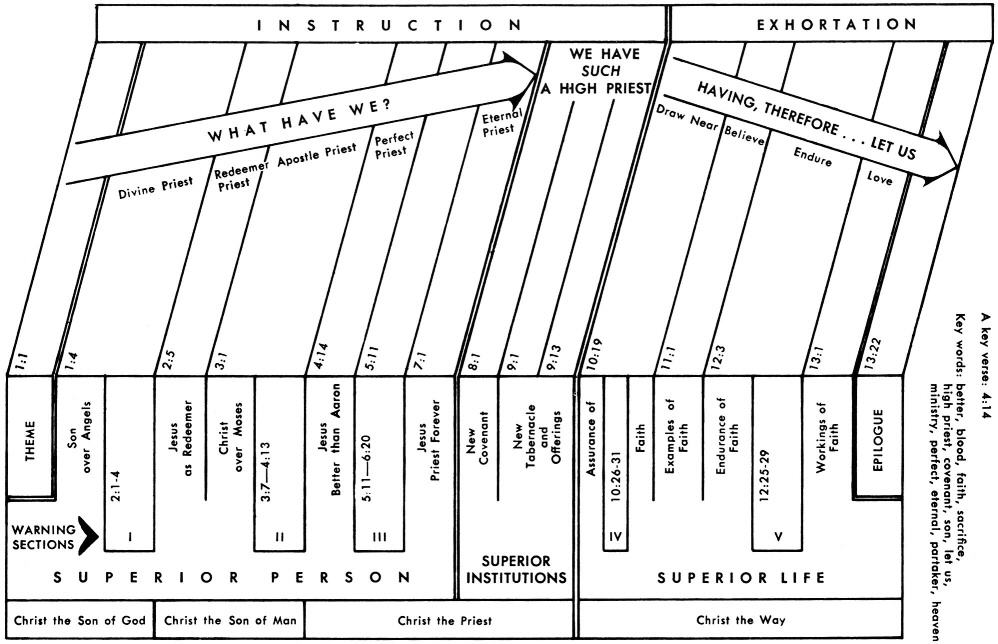
CONSIDER JESUS OUR GREAT HIGH PRIEST
Click chart to enlarge
Charts from Jensen's Survey of the NT - used by permission
Swindoll's Chart, Interesting Pictorial Chart of Hebrews, Another Chart
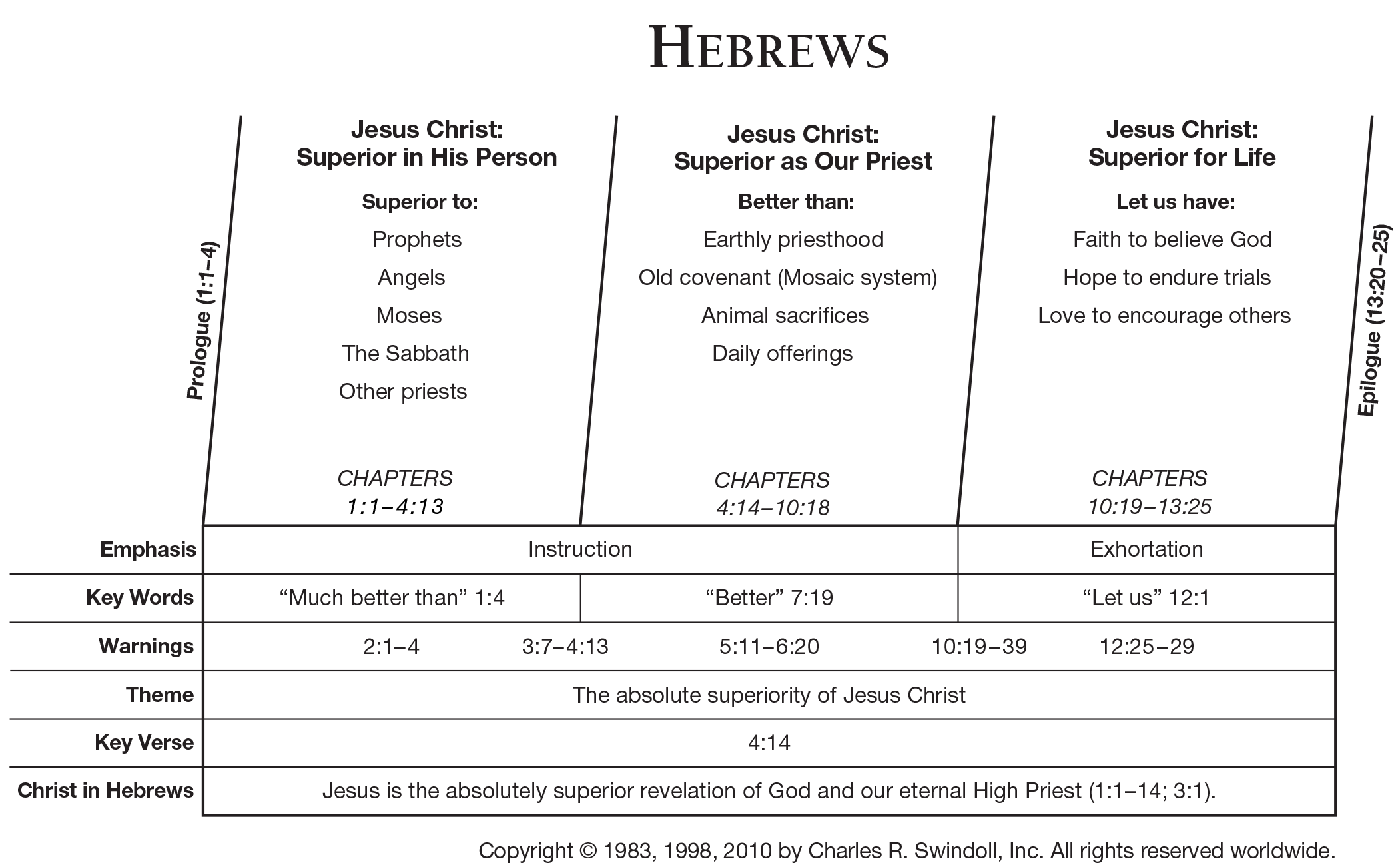

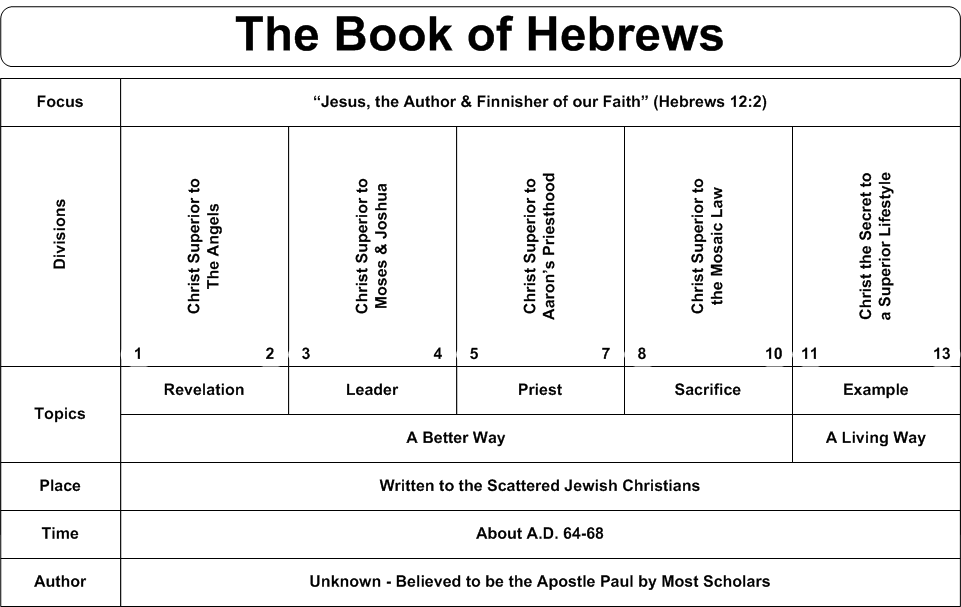
|
The Epistle |
||||
| INSTRUCTION Hebrews 1-10:18 |
EXHORTATION Hebrews 10:19-13:25 |
|||
| Superior Person of Christ Hebrews 1:1-4:13 |
Superior Priest in Christ Hebrews 4:14-10:18 |
Superior Life In Christ Hebrews 10:19-13:25 |
||
| BETTER THAN PERSON Hebrews 1:1-4:13 |
BETTER PRIESTHOOD Heb 4:14-7:28 |
BETTER COVENANT Heb 8:1-13 |
BETTER SACRIFICE Heb 9:1-10:18 |
BETTER LIFE |
| MAJESTY OF CHRIST |
MINISTRY OF CHRIST |
MINISTERS FOR CHRIST |
||
|
DOCTRINE |
DUTY |
|||
|
DATE WRITTEN: |
||||

See ESV Study Bible "Introduction to Hebrews"
(See also MacArthur's Introduction to Hebrews)
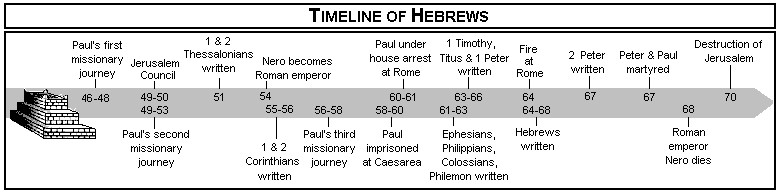
Borrow Ryrie Study Bible

Timeline of Hebrews - ESV Study Bible
Hebrews 1:14 Are they not all ministering spirits, sent out to render service for the sake of those who will inherit salvation? (NASB: Lockman)
Greek: ouchi pantes eisin (3PPAI) leitourgika pneumata eis diakonian apostellomena (PPPNPN) dia tous mellontas (PAPMPA) kleronomein (PAN) soterian?
BGT οὐχὶ πάντες εἰσὶν λειτουργικὰ πνεύματα εἰς διακονίαν ἀποστελλόμενα διὰ τοὺς μέλλοντας κληρονομεῖν σωτηρίαν;
Amplified: Are not the angels all ministering spirits (servants) sent out in the service [of God for the assistance] of those who are to inherit salvation? ( (Amplified Bible - Lockman)
ALT: They are all spirits of spiritual service being sent out to render service for the sake of the ones being about to be inheriting salvation, are they not?
BBE: Are they not all helping spirits, who are sent out as servants to those whose heritage will be salvation?
KJV: Are they not all ministering spirits, sent forth to minister for them who shall be heirs of salvation?
NKJ Are they not all ministering spirits sent forth to minister for those who will inherit salvation?
NLT: But angels are only servants. They are spirits sent from God to care for those who will receive salvation. (NLT - Tyndale House)
Phillips: Surely the angels are no more than spirits in the service of God, commissioned to serve the heirs of God's salvation. (Phillips: Touchstone)
Wuest: Are not they all ministering spirits to render service, sent on a commission for the sake of those who are about to inherit salvation? (Eerdmans)
Young's Literal: are they not all spirits of service -- for ministration being sent forth because of those about to inherit salvation?
NET Are they not all ministering spirits, sent out to serve those who will inherit salvation?
CSB Are they not all ministering spirits sent out to serve those who are going to inherit salvation?
ESV Are they not all ministering spirits sent out to serve for the sake of those who are to inherit salvation?
NIV Are not all angels ministering spirits sent to serve those who will inherit salvation?
NLT Therefore, angels are only servants-- spirits sent to care for people who will inherit salvation.
MIT Are they all not ministering spirits, commissioned to serve those about to gain possession of salvation?
NJB Are they not all ministering spirits, sent to serve for the sake of those who are to inherit salvation?
NRS Are not all angels spirits in the divine service, sent to serve for the sake of those who are to inherit salvation?
RSV Are they not all ministering spirits sent forth to serve, for the sake of those who are to obtain salvation?
NAB Are they not all ministering spirits sent to serve, for the sake of those who are to inherit salvation?
GWN What are all the angels? They are spirits sent to serve those who are going to receive salvation.
BBE Are they not all helping spirits, who are sent out as servants to those whose heritage will be salvation?
ASV Are they not all ministering spirits, sent forth to do service for the sake of them that shall inherit salvation?
- Booklet - What Can We Learn From The Angels?
- Ministering spirits - Heb 8:6; 10:11; Ps 103:20, 21; Da 3:28; 7:10; Mt 18:10; Lk 1:19; 2:9, 13, 1Ki 22:19; Job 1:6; Ps 104:4; Isa 6:2 6:3; Da 7:10; Mt 13:41 49, 50; Lk 1:19; 2Th 1:7; Jude 1:14
- Sent out: Ge 19:15,16 32:1,2,24 Ac 11:22 1Pe 1:12 Rev 5:6
- Render service: Ps 34:7 91:11,12 Da 6:22 9:21-23 10:11,12 Mt 1:20 2:13 24:31 Lu 16:22 Ac 5:19 10:3,4 12:7,23 16:26 27:23
- Will inherit salvation - He 6:12,17 Mt 25:34 Ro 8:17 Ga 3:7,9,29 Eph 3:6 Tit 3:7 Jas 2:5 1Pe 1:4, 3:7
- Recommended online book (no restrictions) - All the Angels in the Bible
- Study Questions for Hebrews - 5W/H questions for leading lessons
- Hebrews 1 Resources - Multiple Sermons and Commentaries
Related Passages:
2 Kings 6:15-17 Now when the attendant of the man of God had risen early and gone out, behold, an army with horses and chariots was circling the city. And his servant said to him, “Alas, my master! What shall we do?” 16 So he answered, “Do not fear, for those who are with us are more than those who are with them.” 17 Then Elisha prayed and said, “O LORD, I pray, open his eyes that he may see.” And the LORD opened the servant’s eyes and he saw; and behold, the mountain was full of horses and chariots of fire all around Elisha.
1 Kings 19:5+ (ELIJAH) He lay down and slept under a juniper tree; and behold, there was an angel touching him, and he said to him, “Arise, eat.”
Romans 8:17+ and if children, heirs also, heirs of God and fellow heirs with Christ, if indeed we suffer with Him so that we may also be glorified with Him.
Hebrews 6:12+ so that you will not be sluggish, but imitators of those who through faith and patience inherit (kleronomeo) the promises.
1 Peter 1:3-5+ Blessed be the God and Father of our Lord Jesus Christ, who according to His great mercy has caused us to be born again to a living hope through the resurrection of Jesus Christ from the dead, 4 to obtain an inheritance which is imperishable and undefiled and will not fade away, reserved in heaven for you, 5who are protected by the power of God through faith for a salvation ready to be revealed in the last time.
Psalm 68:17+ The chariots of God are myriads, thousands upon thousands; The Lord is among them as at Sinai, in holiness.
Psalm 104:4+ He makes the winds His messengers, Flaming fire His ministers (leitourgos).
Mark 1:13+ And He was in the wilderness forty days being tempted by Satan; and He was with the wild beasts, and the angels were ministering (diakoneo) to Him.
Luke 16:22 “Now the poor man died and was carried away by the angels to Abraham’s bosom; and the rich man also died and was buried.
Luke 22:43+ Now an angel from heaven appeared to Him, strengthening Him.
2 Thessalonians 1:7+ and to give relief to you who are afflicted and to us as well when the Lord Jesus will be revealed from heaven with His mighty angels in flaming fire,
Revelation 5:12-14+ saying with a loud voice, “Worthy is the Lamb that was slain to receive power and riches and wisdom and might and honor and glory and blessing.” 13 And every created thing (INCLUDING ANGELS) which is in heaven and on the earth and under the earth and on the sea, and all things in them, I heard saying, “To Him who sits on the throne, and to the Lamb, be blessing and honor and glory and dominion forever and ever.” 14 And the four living creatures kept saying, “Amen.” And the elders fell down and worshiped.
THE FUNCTION OF ANGELS:
SERVICE FOR SALVATION
Are they not (ouchi) all ministering (leitourgikos) spirits (pneuma), sent out (apostello) to render service (diakonia) for the sake of those who will inherit (kleronomeo) salvation (soteria) - THEY refers to the angels. Keep the context in mind. We see a stark contrast between the reigning Son (Heb 1:13+) and the ministering angels! To be sure the Son temporarily came not to be served, but to serve and give His life a ransom for many (Mk 10:45+, cf Php 2:7+). But His role of suffering Servant has now been replaced by the reigning Son. The Greek for NOT is ouchi which when used in a question expects an affirmative answer. Therefore, the answer to this rhetorical question is a resounding Yes! The point is in fact, yes, the angels are ministering spirits. How many? ALL of them (the highest and lowest angels)! (Note the contrast with "none" of the angels in previous verse and all of the angels here). Their destiny is to continue to minister to believers in time on earth and throughout eternity but Jesus’ destiny is to reign forever and ever and it follows that He is immeasurably superior to the angels. Note that the angels "stand" (Lk 1:19+, Rev 8:2+) before God, while the Son is "seated at the right hand of the Majesty on high" (He 1:3+ He 1:13+)
David Guzik has an interesting note - Angels are ministering spirits, not governing spirits; service, not dominion is their calling. In this respect angels are like a toy that won’t quit. They keep working while the Son takes a posture of rest because He is the Son. Jesus is also called a servant and a minister, but this is part of His voluntary humiliation, not his essential nature – as it is in the essential nature of angels to be servants.
Sent out (apostello) is in the present tense indicating that the angels are continually sent out as authoritative representative of God to minister a truth we see clearly testified to throughout Scripture. A T Robertson adds that the present tense signifies "sent forth repeatedly, from time to time as occasion requires." Does this mean they are still be sent out today to render service to believers? Without a doubt! Who is the Sender of the angels? God of course, but specifically the Sender is sometimes stated to be Jesus as when “The Son of Man will send forth (apostello) His angels, and they will gather out of His kingdom all stumbling blocks, and those who commit lawlessness." (Mt 13:41+) In Mt 24:31+ Jesus "will send forth (apostello) His angels with A GREAT TRUMPET and THEY WILL GATHER TOGETHER His elect from the four winds, from one end of the sky to the other." Again, we see the superiority of the Sender, the Son over the angels, the "sent ones."
BLESSED ASSURANCE
Angels descending, bring from above,
echoes of mercy, whispers of love.
FANNY J. CROSBY
Render service (diakonia) is the word normally used for the service Christians render to God and man. Here angels are the servants of men regarding the inheritance of salvation. This salvation could refer to those who are not yet converted (past tense salvation) or those who are born again but who are saved from in regard to their progressive sanctification (present tense salvation). R C H Lenski thinks that salvation refers to future tense salvation writing "Salvation” refers to our deliverance at the time of death (Lk 16:22+) and in the final judgment." Notice that the angelic service in this passage refers specifically to believers. And of course one service in the realm of salvation that the angels could not perform for men was the preaching of the Gospel which had to be from man to man.
F F Bruce on this use of salvation (most- The salvation here spoken of lies in the future; it is yet to be inherited, even if its blessings can already be enjoyed in anticipation. That is to say, it is that eschatological salvation which, in Paul’s words, is “nearer to us now than when we first believed” (Ro 13:11) or, in Peter’s words, is “ready to be revealed in the last time” (1Pe 1:5).Our author does not need to explain to his readers what he means by this salvation; the term and its meaning are familiar to them already. What they do need to understand is the fearful danger to which they will be exposed if they treat this salvation lightly. (See The Epistle to the Hebrews - Page 65)
Cleon Rogers has an interesting note on diakonia stating that "The rabbinical term, “angel of service or ministry,” was used of angels who protected or accompanied a person." (Borrow The New Linguistic and Exegetical Key to the Greek New Testament page 518)
R C H Lenski - It is the angels’ delight to do this service for Christ’s saints. To act as Christ’s officiating ministrants in saving us poor mortals is the height of their joy. It is also the limit of their activity. They cannot make us heirs of salvation, only the heir (Heb 1:2) can do this, who alone has the inheritance to share with us as joint heirs (Rom. 8:17+). (Borrow The Interpretation of the Epistle of Hebrews page 62)
Reformation Study Bible - The Son's position of heavenly authority (Heb 1:3; 8:1) is contrasted to the angels' role as servants to "those who are to inherit salvation" (that is, who share as co-heirs in the Son's rights as heir, Heb 1:2, 5; Heb 2:10; Heb 6:12; cf. Rom. 8:17, 29).
Salvation (soteria) would have carried tremendous meaning to the Hebrew Christians and was a truth which undergirded and enabled them to show "sympathy to the prisoners, and" to accept "joyfully the seizure of your property, knowing that you have for yourselves a better possession and an abiding one." (He 10:34+). While salvation most likely refers to spiritual salvation, this word does convey the sense of deliverance and would be meaningful to these saints who were being persecuted.
The writer of Hebrews adds that it is "through faith and patience" (He 6:12+) that we "inherit the promises" (He 6:12+) and thereby become "the heirs of the promise" (Heb 6:17+) for "those who are of faith… are sons of Abraham" (Gal 3:7+) and "Abraham's offspring, heirs according to promise" (Gal 3:29+), "heirs of God and fellow (joint) heirs with Christ" (Ro 8:17+).
Paul further explains that we "inherit salvation" as the result of "being justified by His grace… (so that we might be) made heirs according to the hope of eternal life." (Titus 3:7+)
James adds that God chose "the poor of this world to be rich in faith and heirs of the kingdom which He promised to those who love Him" (James 2:5+)
Peter reminds all saints undergoing various trials that "those who will inherit salvation" will "obtain an inheritance which is imperishable and undefiled and will not fade away, reserved in heaven… " (1Pe 1:4+)
Little wonder the writer of Hebrews refers to inheritance as "so great a salvation". (Heb 2:3)
THOUGHT- Are you eagerly looking forward to your glorious, safely preserved, eternal, indescribable inheritance? Let this truth motivate you daily to seek His presence in His powerful Word, His powerful Spirit in your life and His Father's glory in your life. Such a "future focus" will radically alter your present outlook regardless of your current circumstances (cf 2Cor 4:17,18+, Heb 12:2+, Col 3:1+; Col 3:2+). (See also Vertical Vision)
One of the earliest examples of an occasion that God deemed necessitated the sending out of an angel is found after Adam sinned and God "drove the man out and at the east of the garden of Eden He stationed the cherubim and the flaming sword which turned every direction, to guard the way to the tree of life." (Gen 3:24+)
The cherubim, like all angels, are spirit beings, but they can take on physical bodies. Adam and Eve were barred by a flaming sword from the garden that God had planted for their enjoyment. There was no way back in. The fact that the tree of life remained, even though guarded by angels and a sword, was a ray of hope. Is it not possible that because He had it guarded and did not uproot it, that one day its fruit may be eaten again? Indeed, one day we will see it again (Rev 22:2). Adam and Eve were no longer welcome in God’s presence, but they had the hope that one day Paradise would be regained. (See The Nelson Study Bible)
The Psalmist describes the ministering spirits "Bless the LORD, ye his angels, that excel in strength, that do his commandments, hearkening unto the voice of his word. Bless ye the LORD, all ye his hosts; ye ministers (LXX = leitourgos) of his, that do his pleasure." (Ps 103:20-21)
Spurgeon comments: We are bidden to do these commandments, and alas we fail; let those unfallen spirits, whose bliss it is never to have transgressed, give to the Lord the glory of their holiness. They hearken for yet more commands, obeying as much by reverent listening as by energetic action, and in this they teach us how the heavenly will should evermore be done; yet even for this surpassing excellence let them take no praise, but render all to him who has made and kept them what they are. O that we could hear them chant the high praises of God, as did the shepherds on that greatest of all birth nights -- Our glad heart anticipates the hour when we shall hear them "harping in loud and solemn guise," and all to the sole praise of God.....Ye ministers of his that do his pleasure; in whatever way ye serve him, bless him as ye serve. The Psalmist would have every servant in the Lord's palace unite with him, and all at once sing out the praises of the Lord. We have attached a new sense to the word "ministers" in these latter days, and so narrowed it down to those who serve in word and doctrine. Yet no true minister would wish to alter it, for we are above all men bound to be the Lord's servants, and we would, beyond all other ministering intelligences or forces, desire to bless the glorious Lord.
Even as the priest was primarily ministering to God, Jamieson comments that the ministering of angels is "not properly rendered to men, since the latter have no power of commanding them, though their ministrations to God are often directed to the good of men."
Matthew Henry adds that "Angels are ministering spirits under the blessed Trinity, to execute the divine will and pleasure; they are the ministers of divine Providence."
Gill comments that ministering (leitourgikos) spirits is "a rabbinical term frequent in Jewish writings and so quite familiar and appealing to the Jewish recipients of this epistle. "
God used His angelic messengers to not only warn Lot but to withdraw Lot from harm's way - And when morning dawned, the angels urged Lot, saying, "Up, take your wife and your two daughters, who are here, lest you be swept away in the punishment of the city." But he hesitated. So the men seized his hand and the hand of his wife and the hands of his two daughters, for the compassion of the LORD was upon him; and they brought him out, and put him outside the city." (Ge 19:15;16+) (ED: Unfortunately, there is a "lot of Lot in a lot of us" isn't there?)
Simon Kistemaker - Scripture teaches that angels are ministering spirits, “sent to serve those [the people of God] who will inherit salvation.” Angels announce the law of God (Acts 7:53; Gal. 3:19; Heb. 2:2); deliver messages to God’s people (Isa. 6:6–7; Dan. 8:18–19; 9:20–23; 10:12, 14; Luke 1:18–19); minister to the needs of the people of God (1 Kings 19:5, 7; Ps. 91:11–12; Matt. 18:10; Acts 7:38; 12:15; 1 Cor. 11:10); are appointed guardians of cities and nations (Ezek. 9:1; Dan. 10:13, 20–21; 11:1; 12:1); and will gather the elect at the time of Christ’s return (Matt. 24:31; Mark 13:27). However, the angels have not been commissioned to teach or preach to the elect. Nor are they given power to govern God’s people, although the angels stand in the presence of God and share his plans (Zech. 1:12–13). (BORROW Exposition of the Epistle to the Hebrews)
A potentially confusing Scripture on this topic of angelic service is "The Angel of the LORD encamps around those who fear Him, and rescues them." (Ps 34:7) because here the Angel of the LORD (see Angel of the LORD: summary) when compared to other Scriptures is undoubtedly the pre incarnate Christ. Even the context of the verse supports that this is not a reference to a created angel, for we are never commanded to fear angels but to "Fear God and give Him the glory" (Rev 14:7+)
FEAR GOD - This phrase occurs 18x in NAS and is worth taking a moment to study the uses - make a list of the truths you learn and then pray over that list! = Ge 22:12; 42:18; Ex 18:21; Deut 25:18; Job 1:9; Ps 55:19; 66:16; Eccl 5:7; 8:12, 13; 12:13; Luke 18:2, 4; 23:40; Acts 13:16, 26; 1Pet 2:17; Rev 14:7
John MacArthur agrees commenting on The angel of the Lord in Ps 34:7 - A special manifestation of Yahweh Himself at strategic historical junctures (cf. Ge 16:7ff.; 18; 19; 31:11ff.; Jos 5; Jdg 6; 13). A strong case can be made that these were pre-incarnate appearances of the Lord Jesus Christ. (See MacArthur Study Bible)
The writer of Hebrews notes later that God "does not give help to angels, but He gives help to the descendant of Abraham." (He 2:16+). And in the context of Heb 1:14, one of the ways God gives help to the descendant of Abraham is through ministering spirits!
Psalm 91:11-12 is a wonderful description of angels sent out to render service to believers...
For He will give His angels charge concerning you, To guard (see discussion this great Greek verb diaphulasso used in the Septuagint) you in all your ways. They will bear you up in their hands, That you do not strike your foot against a stone.
This is the passage the devil quoted to Jesus in his temptation (Lk 4:10, 11+) but he omitted the crucial phrase in all thy ways!
He keeps in His way,
and then the angels keep him.C H Spurgeon comments that the qualifying phrase in all Thy ways emphasizing that this phrase "is no limit (boundary or restriction) to the heart which is right with God. It is not the way of the believer to go out of His way. (Ed: Notice the following order) He keeps in His way, and then the angels keep him. How angels thus keep us we cannot tell. Whether they repel demons, counteract spiritual plots, or even ward off the subtler physical forces of disease, we do not know. Perhaps we shall one day stand amazed at the multiplied services which the unseen bands have rendered to us. (See commentary)(ED: Amen to that last statement!)
To claim the promise in an act of disobedience
would be tempting God.William MacDonald adds that the promise of protection in Ps 91:11-13 "presupposed living in God's will. To claim the promise in an act of disobedience would be tempting God. The time would come when Jesus would be revealed as Messiah, but the cross must come first. The altar of sacrifice must precede the throne. The crown of thorns must precede the crown of glory. Jesus would await God's time and would accomplish God's will." (BORROW Believer's Bible Commentary page 1212)
Adam Clarke that for those who walk in all Thy ways "Evil spirits may attempt to injure you; but they shall not be able. The angels of God shall have a special charge to accompany, defend, and preserve you; and against their power, the influence of evil spirits cannot prevail. These (angels) will, when necessary, turn your steps out of the way of danger; ward it off when it comes in your ordinary path; suggest to your mind prudent counsels, profitable designs, and pious purposes; and thus minister to you as a child of God, and an heir of salvation. The path of duty is the way of safety. We cannot reasonably expect protection if we do not walk in the way of obedience. Our ways are the paths of duty, which God's word and providence have marked out for us. The way of sin is not our way, our duty, our interest. Keep in your own ways, not in those of sin, Satan, the world, and the flesh; and God will take care of you!". (Ps 91 Commentary)
As mentioned above the rabbinical term angel of service or ministry was well known and was often descriptive of angels whose service was to protect a person. The psalmist gives Scriptural credence to this rabbinical belief, recording that God gives
His angels charge concerning you, to guard you in all your ways. They will bear you up in their hands, lest you strike your foot against a stone. (Ps 91:11-12)
Spurgeon comments (Treasury of David) - For he shall give his angels charge over thee. Not one guardian angel, as some fondly dream, but all the angels are here alluded to. They are the bodyguard of the princes of the blood imperial of heaven, and they have received commission from their Lord and ours to watch carefully over all the interests of the faithful. When men have a charge they become doubly careful, and therefore the angels are represented as bidden by God himself to see to it that the elect are secured. It is down in the marching orders of the hosts of heaven that they take special note of the people who dwell in God. It is not to be wondered at that the servants are bidden to be careful of the comfort of their Master's guests; and we may be quite sure that when they are specially charged by the Lord himself they will carefully discharge the duty imposed upon them.
To keep thee in all thy ways. To be a bodyguard, a garrison to the body, soul, and spirit of the saint. The limit of this protection "in all thy ways" is yet no limit to the heart which is right with God. It is not the way of the believer to go out of his way. He keeps in the way, and then the angels keep him. The protection here promised is exceeding broad as to place, for it refers to all our ways, and what do we wish for more? How angels thus keep us we cannot tell. Whether they repel demons, counteract spiritual plots, or even ward off the more subtle physical forces of disease, we do not know. Perhaps we shall one day stand amazed at the multiplied services which the unseen bands have rendered to us.
They, that is the angels, God's own angels, shall cheerfully become our servants. They shall bear thee up in their hands; as nurses carry little children, with careful love, so shall those glorious spirits bear up each individual believer.
Lest thou dash thy foot against a stone; even minor ills they ward off. It is most desirable that we should not stumble, but as the way is rough, it is most gracious on the Lord's part to send his servants to bear us up above the loose pebbles. If we cannot have the way smoothed it answers every purpose if we have angels to bear us up in their hands. Since the greatest ills may arise out of little accidents, it shows the wisdom of the Lord that from the smaller evils we are protected.
Steven Cole has a summary of ministering angels - The descriptions of angels in the Bible show that they are impressive beings. In Genesis, two angels rescued Lot and his family from Sodom and then called down fire and brimstone from heaven on the wicked cities. On another occasion, an angel struck down 70,000 in Israel on account of David’s sin (2Sa 24:15–17). One angel went out into the camp of Sennacherib’s army and struck down 185,000 soldiers in a night (Isa 37:36). An angel shut the lions’ mouths so that Daniel was kept safe, and an angel revealed to Daniel the amazing prophecies of things to come. When Daniel saw the angel, it wiped out his strength and took his breath away (Da 6:22; 9:20–27; 10:17). An angel delivered Peter from prison and then struck the proud Herod Agrippa, so that he was eaten by worms and died (Acts 12:3–23). The Bible teaches that angels guard believers (2Ki 6:15–18; Ps. 91:11–12; Mt 18:10) and look in on our church services (1Co 11:10), although we are not able to see them. And yet, as great and powerful as angels are, they are just servants who stand before Him who sits at the right hand of the Majesty on high! Worship Him alone, because He is Almighty God! (The Son's Superiority over Angels)
Angels, from the Realms of Glory
Angels, from the realms of glory
Wing your flight o’er all the earth;
Ye who sang creation’s story,
Now proclaim Messiah’s birth:
Come and worship, come and worship,
Worship Christ, the newborn King.
John MacArthur one of the foremost evangelical expositors of our day commenting on (Mt 18:10) says that "This does not suggest that each believer has a personal guardian angel. Rather, the pronoun is collective and refers to the fact that believers are served by angels in general. These angels are pictured “always” watching the face of God so as to hear His command to them to help a believer when needed. It is extremely serious to treat any fellow believer with contempt since God and the holy angels are so concerned for their well-being."
The well done RBC booklet What Can We Learn From The Angels? adds that "to make this claim is to go beyond what Jesus said. His statement certainly assures us that we have angels who work in our behalf, but it does not necessarily declare that there is one assigned angel for every person. It may be, but not necessarily. However, this should not trouble us. God can and will look after each one of us individually. He certainly has enough angels available if He chooses to use them to protect or help us. Myriads of these heavenly beings are our friends and stand ready to be our helpers and protectors. but it is difficult to specifically find this very popular teaching in Scripture." McGee has a pithy question for anyone tempted to argue over whether guardian angels exist -- “Are you a child of God?” If you are, you are indwelt by the Holy Spirit of God, Who is the third Person of the Godhead. What could a guardian angel do for you that He couldn’t do for you? Do you want to think that over for a while?
Is it not even more comforting to know that the angels are continuously sent out from the throne of God of Him Who sees all things and Who "upholds all things by the word of His power" (Heb 1:3+)?
Is it not even better than a "guardian angel" (if there be such) to be assured of the Lord's promise that
"I WILL NEVER DESERT YOU, NOR WILL I EVER FORSAKE YOU," so that we confidently say, "THE LORD IS MY HELPER, I WILL NOT BE AFRAID. WHAT SHALL MAN DO TO ME?" (Heb 13:5-6+)
In much of modern evangelical doctrinally shallow teaching are we not at risk (like the early Jewish believers) of focusing more attention on the messengers (angels) rather than on "the Messenger of the Covenant", (Malachi 3:1+) the Lord Jesus Christ Himself? Witness the "angel craze" in Christian bookstores (angel figurines, paintings, etc), television shows (Touched By An Angel [circa year 2000] - not a "bad" show per se but unfortunately sometimes containing "bad theology") and popular Christian books like "This Present Darkness", which sadly often is a major source of "doctrines of" angels - much of which is not Scripturally sound).
Angels are important as the writer of Hebrews emphasizes but Jesus is infinitely, incomparably much better than the angels. Fix your eyes on Jesus (see Fix Your Eyes On Jesus - 44 excellent meditations) not on the angels who themselves obey the voice of Him Who Alone is bearing all things to their final conclusion by the word of His power.
One of the most famous services rendered occurred when Daniel was preserved from the lions and explained to King Darius - "My God sent His angel and shut the lions' mouths and they have not harmed me, inasmuch as I was found innocent before Him; and also toward you, O king, I have committed no crime. (Da 6:22+) Later God sent Gabriel to give Daniel "insight with understanding" into the incredible OT prophecy often referred to as Daniel's Seventieth Week in which the time of Messiah's first coming is given as well as an overview of the last 7 years of Israel and the rule of the Antichrist (see discussion of Daniel 9:24-27: Part 1: Notes on Daniel 9:24-25) (Daniel 9:24-27: Part 2) (Summary Chart of Daniel's Seventieth Week)
In the early days of the church, Jewish resistance resulted in Peter and the apostles being cast into prison.
"But an angel of the Lord (note carefully Luke does not say "the" angel of the Lord which most evangelical commentators agree is a reference to the pre-incarnate appearances of Christ) during the night opened the gates of the prison, and taking them (Peter and the apostles) out he said "Go your way, stand and speak to the people in the temple the whole message of this Life." (Acts 5:19,20+)
In Acts 10 messengers from the Gentile Cornelius were sent to Peter "and they said, "Cornelius, a centurion, a righteous and God-fearing man well spoken of by the entire nation of the Jews, was divinely directed by a holy angel to send for you to come to his house and hear a message from you. (Acts 10:22+) In short Thus God used the angel to open the door for the gospel to the Gentiles who would inherit salvation!
Bob Utley - Angels exist to serve God and mankind. Redeemed mankind is a higher spiritual order of creation than the angels.
- Angels are not created in the image and likeness of God (cf. Gen. 1:26-27).
- Jesus did not die to redeem the angels (cf. Heb. 2:14-16).
- Believers will judge the angels (cf. 1 Cor. 6:3).
Wayne Grudem - WHAT ARE ANGELS? We may define angels as follows: angels are created spiritual beings with moral judgment and high intelligence but without physical bodies. Angels have not always existed; they are part of the universe that God created. In a passage that refers to angels as the “host” of heaven (or “armies of heaven”), Ezra says, “You are the LORD, you alone. You have made heaven, the heaven of heavens, with all their host … and the host of heaven worships you” (Neh. 9:6; cf. Ps. 148:2, 5). Paul tells us that God created all things “visible and invisible” through Christ and for him, and then specifically includes the angelic world with the phrase “whether thrones or dominions or rulers or authorities” (Col. 1:16). That angels exercise moral judgment is seen in the fact that some of them sinned and fell from their positions (2 Peter 2:4; Jude 6; see chapter 20). Their high intelligence is seen throughout Scripture as they speak to people (Matt. 28:5; Acts 12:6–11, et al.) and sing praise to God (Rev. 4:11; 5:11). Since angels are “spirits” (Heb. 1:14) or spiritual creatures, they do not ordinarily have physical bodies (Luke 24:39). Therefore they cannot usually be seen by us unless God gives us a special ability to see them (Num. 22:31; 2 Kings 6:17; Luke 2:13). In their ordinary activities of guarding and protecting us (Ps. 34:7; 91:11; Heb. 1:14) and joining with us in worship to God (Heb. 12:22), they are invisible. However, from time to time angels took on a bodily form to appear to various people in Scripture (Matt. 28:5; Heb. 13:2). Other Names for Angels - Scripture sometimes uses other terms for angels, such as “sons of God” (Job 1:6; 2:1), “holy ones” (Ps. 89:5, 7), “spirits” (Heb. 1:14), “watchers” (Dan. 4:13, 17, 23), “thrones,” “dominions,” “rulers,” and “authorities” (Col. 1:16). (Read Grudem's entire chapter - What are angels? Why did God create them? EXPLANATION AND SCRIPTURAL BASIS in Systematic Theology page 343)
LORD GOD, WE ALL TO THEE GIVE PRAISE
A roaring lion round he goes,
No halt nor rest he ever knows;
He seeks the Christians to devour
And slay them by his dreadful power.
But watchful is the angel band
That follows Christ on every hand
To guard His people where they go
And break the counsel of the Foe.
For this, now and in days to be,
Our praise shall rise, O Lord, to Thee,
Whom all the angel hosts adore
With grateful songs forevermore.
Ministering (3010) (leitourgikos from léïtos = of the people + érgon = work; English liturgy = a prescribed form for public worship) in Greek referred especially to those who performed public duties or works of public use (public servants). It means related to the performance of religious or liturgical service. See also leitourgos (He 1:7+) leitourgia ( Heb 8:6+, He 9:21+)
Leitourgikos is found only in this verse in the NT. Most of the uses of this word group is found in the Septuagint (LXX) Greek translation of the Hebrew OT (which would have been very familiar to Jewish readers of this epistle) describing priestly service to God and public ministry to men including performance of both worship and charitable functions.
Leitourgikos - 5 uses in the OT - Ex 31:10, Ex 39:1, Nu 4:12, 26, Nu 7:5, 2Chr 24:14
Sent out (649) (apostello from apo = from, away from + stello = to withdraw from, avoid) means to send off, to send forth, to send out. To send out; to commission as a representative, an ambassador, an envoy. The idea is to send forth from one place to another. But the meaning of apostello is more than just to send because it means "to send off on a commission to do something as one’s personal representative, with credentials furnished" (Wuest) To send upon some business (Mt. 2:16; 10:5; 20:2). To send away in the sense of to dismiss (Mk 12:3, 4). To send or thrust forth as a sickle among corn (Mk 4:29).
Render service (1248) (diakonia) means the rendering or assistance or help by performing certain duties, often of a humble or menial nature serve, including such mundane activities as waiting on tables or caring for household needs—activities without apparent dignity.
Click for Scriptures that depict angels rendering service to saints
DIAKONIA - 34x in 32v - ministries(1), ministry(19), mission(1), preparations(1), relief(1), serve(1), service(7), serving(2), support(1).Lk. 10:40; Acts 1:17; Acts 1:25; Acts 6:1; Acts 6:4; Acts 11:29; Acts 12:25; Acts 20:24; Acts 21:19; Rom. 11:13; Rom. 12:7; Rom. 15:31; 1 Co. 12:5; 1 Co. 16:15; 2 Co. 3:7; 2 Co. 3:8; 2 Co. 3:9; 2 Co. 4:1; 2 Co. 5:18; 2 Co. 6:3; 2 Co. 8:4; 2 Co. 9:1; 2 Co. 9:12; 2 Co. 9:13; 2 Co. 11:8; Eph. 4:12; Col. 4:17; 1 Tim. 1:12; 2 Tim. 4:5; 2 Tim. 4:11; Heb. 1:14; Rev. 2:19
Inherit (2816) (kleronomeo from kleros = a lot + nemomai = to possess; see study of related word Kleronomos) means to receive a possession and benefit as a gift from someone who has died, in this case the Son Who has made purification (Heb 1:3-+) and propitiation for sins (Heb 2:17+) thus becoming "the Guarantee (posted bond or bail) of a better covenant" (Heb 7:22+), which is our birthright, into the possession of which we enter by virtue of being fellow heirs (Ro 8:17+) with the Son Who is Heir of all things.
In the Sermon on the Mount Jesus promised "blessed are the gentle, for they shall inherit the earth (Mt 5:5+)
KLERONOMEO - 18X/17V - heir(1), inherit(16), inherited(1). Matt. 5:5; Matt. 19:29; Matt. 25:34; Mk. 10:17; Lk. 10:25; Lk. 18:18; 1 Co. 6:9; 1 Co. 6:10; 1 Co. 15:50; Gal. 4:30; Gal. 5:21; Heb. 1:4; Heb. 1:14; Heb. 6:12; Heb. 12:17; 1 Pet. 3:9; Rev. 21:7
Salvation (4991) (soteria from sozo = to rescue from peril, protect, keep alive) describes the rescue or deliverance from danger, destruction, peril and slavery to and consequences of sin and unto restoration to a former state of safety, health, well being and also alludes to the continuing preservation from the danger of destruction. In the Greco-Roman world the emperor was looked upon as a savior. So the NT meaning of this great word was well understood by the reader. The characteristic use of soteria and related (cognate) words (e.g., s) in the Bible is to sum up and describe the spiritual and eternal deliverances which result from the intervention of God on behalf of those who trust Him. In the NT salvation describes a condemned sinner who is delivered (and daily is being delivered) from enslavement to sin and to restoration to a former state of safety, health, well being in which he or she is preserved (eternally) from danger of destruction (especially eternal destruction).
SOTERIA - 45V - deliverance(2), preservation(1), salvation(42). Lk. 1:69; Lk. 1:71; Lk. 1:77; Lk. 19:9; Jn. 4:22; Acts 4:12; Acts 7:25; Acts 13:26; Acts 13:47; Acts 16:17; Acts 27:34; Rom. 1:16; Rom. 10:1; Rom. 10:10; Rom. 11:11; Rom. 13:11; 2 Co. 1:6; 2 Co. 6:2; 2 Co. 7:10; Eph. 1:13; Phil. 1:19; Phil. 1:28; Phil. 2:12; 1 Thess. 5:8; 1 Thess. 5:9; 2 Thess. 2:13; 2 Tim. 2:10; 2 Tim. 3:15; Heb. 1:14; Heb. 2:3; Heb. 2:10; Heb. 5:9; Heb. 6:9; Heb. 9:28; Heb. 11:7; 1 Pet. 1:5; 1 Pet. 1:9; 1 Pet. 1:10; 1 Pet. 2:2; 2 Pet. 3:15; Jude 1:3; Rev. 7:10; Rev. 12:10; Rev. 19:1
A W Pink Commentary on Hebrews 1:14
Three things are to be considered:
- those to whom the angels minister,
- why they thus minister and
- the form their ministry takes.
those to whom the angels minister,
Those to whom the angels minister are here termed "heirs of salvation," an expression denoting at least four things. There is an Estate unto which God has predestined His people, an inheritance—willed to them by God. This Estate is designated "salvation," see 1 Thessalonians 5:9, where our appointment unto it is mentioned. It is the consummation of our salvation which is in view, Hebrews 9:28; 1 Peter 1:3,4. Well may this estate or inheritance be called "Salvation," for those who enter it are forever delivered from all danger, freed from all enemies, secured from all evils. This expression "heirs of salvation" also denotes our legal rights to the inheritance: our title is an indefeasable one. Further, it presupposes the coming in of death, Christ's death. Finally, it implies the perpetuity of it—"to him and his heirs forever."
It is to these "heirs of salvation" that the angels minister. To enable us the better to grasp the relation of angels to Christians, let us employ an illustration. Take the present household of the Duke of York. In it are many servants, honored, trusted, loved. There are titled "ladies" and "lords" of the realm, yet they are serving,"ministering," to the infant Princess Elizabeth. At present, she is inferior to them in age, strength, wisdom and attainments; yet is she superior in rank and station. She is of the royal stock, a princess, possibly heir to the throne. In like manner, the heirs of salvation are now in the stage of their infancy; they are but babes in Christ; this is the period of their minority. The angels far excel us in strength, wisdom, attainments; yet are they our servants, they "minister" unto us. Why? Because we are high above them in birth, rank, station. We are children of God, we are joint-heirs with Christ, we have been redeemed with royal blood, yes, we have been made "kings and priests unto God" (Rev. 1:6). O how wonderful is our rank—members of the Royal family of Heaven, therefore are we "ministered" unto by the holy angels. What a calling is ours! What provision has Divine love made for us!
Why do they thus "minister" unto us
Let us now inquire, Why do they thus "minister" unto us? For what reason or reasons has God ordained that the angels should be our attendants? All His ways are ordered by perfect wisdom. Let us then reverently inquire as to His purpose in this arrangement.
First, is it not to exercise the graces of obedience and benevolence in the angels themselves? Such a task being assigned them constitutes a real test of their fidelity to their Maker. They are bidden to leave the glories of Heaven and come down to this poor sin-cursed earth; yes, oftentimes to seek out children of God in hovels and workhouses. What a test of their loyalty to God! Not only so, but what an opportunity is thus afforded for the exercise in them of the spirit of benevolence! As the frail and suffering children of God, how their sympathies must be drawn out. There are no such objects in Heaven, there is no distress or suffering there; and me-thinks, that were the angels to be confined to that realm of unclouded bliss, they would be stoics—unable to sympathize with us poor afflicted creatures. Therefore, to cultivate both the spirit of obedience and of benevolence, God has commissioned them to "minister for them who shall be heirs of salvation."
Second, has not God assigned to them this ministry in order to give them a closer acquaintance with His own wondrous grace and matchless love for poor sinners? The angels are not simply far-distant spectators of the out-working of God's wondrous purpose of mercy, but have been made, in part, the actual administrators of it! Thus, by virtue of this commission which they have received from Him, they learn in a practical way how much He cares for us.
Third, has not God assigned to them this ministry in order that there might be a closer bond between the different sections of His family? That word in Ephesians 3:15, refers, we believe, not only to the redeemed of Christ, but to all of Heaven's inhabitants—"of whom the whole family in Heaven and earth is named." Yes, the angels are members of God's "family" too. Note how in Hebrews 12:22, 23 the two great sections of it are placed side by side: "to an innumerable company of angels, to the general assembly and Church of the Firstborn." Thus, the angels are commissioned to minister for those who shall be heirs of salvation in order that there may be formed a closer bond of fellowship and sympathy between the two great sections of God's family.
Fourth, has not God assigned them this ministry in order to magnify the work of the Lord Jesus? The angels are not only subject to Christ as their Lord, are not only called on to worship Him as God, but they are also employed in watching over the safety and promoting the temporal interests of His redeemed. No doubt this fourth named reason is both the primary and ultimate one. How this magnifies the Savior! Commissioning them to "minister for those who shall be heirs of salvation" is God's putting His imprimature upon the cross-work of Christ.
how the angels "minister" to us.
Let us now consider how the angels "minister" to us.
First, in protecting from temporal dangers. A striking example of this is found in 2 Kings 6:15-17. Elisha and his servant were menaced by the king of Syria. His forces were sent out to capture them. An host compassed the city where they were. The servant was terrified; then the prophet prayed unto the Lord to open his eyes, "and the Lord opened the eyes of the young man; and he saw: and, behold, the mountain was full of horses and chariots of fire round about Elisha," which, in the light of Psalm 68:17 and Hebrews 1:7, we know were the protecting angels of God. In the sequel we learn that the enemy was smitten with blindness, and thus the servants of God escaped. This was a concrete illustration of Psalm 34:7, "The angel of the Lord encamps round about them that fear Him, and delivers them."
Second, in delivering from temporal dangers. A case in point is that which is recorded of Lot: "And when the morning arose, then the angels hastened Lot, saying, Arise, take your wife and your two daughters which are here; lest you be consumed in the iniquity of the city. And while he fingered, the men laid hold upon his hand, and upon the hand of his wife, and upon the hand of his two daughters; the Lord being merciful unto him, and they brought him forth, and set him without the city." How often angels have "hastened" us when in the place of danger, and "laid hold" of us while we lingered, perhaps the Day will reveal.
Another example is found in the case of Daniel. We refer to the time when he was cast into the lions' den. All Bible readers are aware that the prophet was miraculously preserved from these wild beasts, but what is not generally known is the particular instrumentality which God employed on that occasion. This is made known in Daniel 6:22: "My God has sent His angel, and has shut the lions' mouths, that they have not hurt me." What an illustration is this of Psalm 34:7, "The angel of the Lord encamps round about them that fear Him, and delivers them!"
Nor is angelic deliverance of God's people confined to Old Testament times. In Acts 5:17-19 we read, "Then the high priest rose up, and all they that were with him (which is the sect of the Sadducees) and were filled with indignation, and laid their hands on the apostles, and put them in the common prison, But the angel of the Lord by night opened the prison doors, and brought them forth." Again, in Acts 12:6-9 we read, "The same night Peter was sleeping between two soldiers, bound with two chains; and the keepers before the door kept the prison. And, behold, the angel of the Lord came upon him, and a light shined in the prison: and he smote Peter on the side, and raised him up, saying, Arise up quickly. And his chains fell off from his hands . . . And he went out, and followed him."
One other form which the ministry of angels takes in connection with their custody of God's children is brought before us in Luke 16:22: "And it came to pass, that the beggar died, and was carried by the angels into Abraham's bosom." To our natural feelings, a death-bed scene is often a most painful and distressing experience. There we behold a helpless creature, emaciated by disease, convulsed with pain, panting for breath; his countenance pallid, his lips quivering, his brow bedewed with a cold sweat. But were not the spiritual world hidden from us by a veil of God's appointing we should also see there the glorious inhabitants of Heaven surrounding the bed, waiting for God's summons, to convoy that soul from earth, through the territory of Satan, up to the Father's House. There they are, ready to perform their last office in ministering for those who shall be heirs of salvation. Then, Christian, why fear death?
It should be carefully noted that angels are mentioned in the plural number in Luke 16:22, so also are they in Psalm 91:11, 12: "For He shall give His angels charge over you, to keep you in all your ways. They shall bear you up in their hands, lest you dash your foot against a stone." There is nothing whatever in Scripture to support the Romish tradition of a single guardian angel for each person or Christian: the plural number in the above passages make directly against it.
"Are they not all ministering spirits, sent forth to minister for them who shall be heirs of salvation?" (verse 14). "This text wears an interrogative form; but it is just equivalent to a strong affirmation. It is certain that no angel sits on the throne of God; it is certain that they are all ministering spirits. A minister is a servant—a person who occupies an inferior place, who acts a subordinate part, subject to the authority and regulated by the will of another. The angels are 'ministering spirits,' they are not governing spirits. Service, not dominion, is their province. In the first phrase there is an expression of their being God's ministers or servants; in the second, that He sends forth, commissions these servants of His to minister to those who shall be heirs of salvation. They are His servants, and He uses their instrumentality for promoting the happiness of His peculiar people. There is a double contrast. The Son is the co-ruler—they are servants; the Son sits- they are sent forth" (Dr. J. Brown).
Finally, it should be observed that "ministering spirits" is a title or designation. Not only do the angels render service to God's saints, but they have an office so to do. It is not simply that they "go forth" to minister for them, but they are "sent forth." They do not take this work upon themselves, but have received a definite charge or commission from their Maker. How this evidences, once more, the preciousness to Christ of those whom He purchased with His blood! O that our hearts may be bowed in wonderment and worship for this blessed provision of His love toward us while we are left in this wilderness scene. O that our fears may be removed, and our hearts strengthened by the realization that, amid the dangers and perils with which we are now surrounded, the angels of God are guarding and ministering both for and to us.
Most are from John Blanchard's Complete Gathered Gold (recommended resource).
Jacob saw angels ascending and descending, but none standing still. Anon.
Angels mean messengers and ministers. Their function is to execute the plan of divine providence, even in earthly things. Thomas Aquinas
Angels will never be kings. They will always be servants. Andrew Bonar
Angels are the dispensers and administrators of the divine beneficence towards us. John Calvin
Angels are the ministers of God’s wrath, as well as of his grace. John Calvin
They who think that each of us is defended by one angel only wickedly depreciate the kindness of God. John Calvin
Under Christ, as the Head, angels are the guardians of the church. John Calvin
The Bible assumes, rather than asserts, the existence of angels, as it does the fact of God himself. C. T. Cook
According to Scripture, the angels praise God chiefly for two things: God’s creation of the world and God’s redemption of the world through Jesus Christ. Let us follow the angels’ example. William Dembski
Angels have a much more important place in the Bible than the devil and his demons. Billy Graham
We must not get so busy counting demons that we forget the holy angels. Billy Graham
Angels are clothed with God’s powers to accomplish his will in the realm of nature. T. Hewitt
I meditate on the blessed obedience and order of angels, without which no peace could be in heaven, and oh that it might be so on earth! Richard Hooker
An angel is a spiritual creature created by God without a body, for the services of Christendom and of the church. Martin Luther
Millions of spiritual creatures walk the earth unseen, both when we sleep and when we awake. John Milton
If two angels were sent from heaven to execute a divine command, one to conduct an empire and the other to sweep a street in it, they would feel no inclination to change employments. John Newton
We rob ourselves of much joy if we forget the loving and caring presence all round about us of the angels of God. Maurice Roberts
Activity is the mark of holy spirits and should be the mark of holy men. C. H. Spurgeon
Take away purity from an angel and he is no more an angel but a devil. Thomas Watson
Herbert Lockyer - The Teachings of the Book of Hebrews on Angels from online source All the Angels in the Bible page 122
So he became as much superior to the angels as the name he has inherited is superior to theirs. For to which of the angels did God ever say, “You are my Son; today I have become your Father”? (Hebrews 1:4–5)
The book of Hebrews was written to Jews in order to convince them of the truth that (1) Christ is superior to angels: (2) Christ is superior to Moses; (3) Christ is superior to Aaron. Here we consider the first proposition, that Christ is superior to angels.
It may be questioned why such an obvious comparison should have to made, for there can be no question of Christ’s superiority over angels. Before His incarnation He was higher than the angels, but in His human form He was made lower than the angels: You made him a little lower than the angels; … But we see Jesus, who was made a little lower than the angels … (Hebrews 2:7, 9). Now, as before His incarnation, He is again higher than the angels.
Angels were venerated by the devout. Jews. The angels gave them the Law through Moses; angels ministered to Abraham, Jacob, Joshua, and Elijah. Angels led them through the forty-year journey in the wilderness, and cherubim watched over the ark of the covenant. Thus it was essential that the Jewish believers should understand the infinite superiority of Christ over the heavenly beings they reverenced in their lives. If the law that was given by angels could not be slighted, how could men and women escape condemnation if they neglected the word spoken by One who is infinitely superior in design and power to angels—even the Lord Himself?
Therefore Christ is shown in Hebrews to be greater than angels in the following ways:
(1) Because He has a more excellent name than they (Heb 1:4–5),
(2) Because angels of God adore Him (Heb 1:6),
(3) Because angels were created by Him (Heb 1:7),
(4) Because in His human nature He had greater gifts than angels (Heb 1:8–9),
(5) Because He is eternal (Heb 1:10–12),
(6) Because angels are servants of God; He is the Son (Heb 1:14), and
(7) Because He subdued all things (Heb 2:9).
Therefore God exalted him to the highest place and gave him the name that is above every name, that at the name of Jesus every knee should bow, in heaven and on earth … (Philippians 2:9–10).
***
Herbert Lockyer - There is a new wave of interest in angels in our land today. Public interest is evidenced by the many books, magazine articles, and stories of angel encounters or near death experiences. Movies and television shows feature shining angel companions. People need protection; people are searching for a more meaningful life; people are looking for deeper spirituality. This interest in angels reveals the longing of the human inner life to have contact with angels.
When Time magazine in their extensive poll asked, “Do you believe in angels?” sixty-nine percent of those answering said “yes.” When asked, “Have you personally felt an angelic presence?” thirty-two percent responded “yes.” A survey among Roman Catholic and Protestant church members revealed that ninety-seven percent believe in angels, and twenty-three percent have seen angels. The angels were seen in dreams or in a bright human or angelic form.
Angels do not change; they are ever the same. They can do for those who believe today what they accomplished in times past. Billy Graham says, “Every true believer in Christ should be encouraged and strengthened! Angels are watching; they mark our path. They superintend the events of your life and protect the interests of the Lord God, always working to promote His plans and to bring about His highest will for you.”
As Europe emerged from the Dark Ages, a leader of the Reformation, John Calvin, wrote, “Scripture informs us that angels guard our safety, undertake our defense, direct our way, and exercise constant solicitude that no evil befalls us … all orders of the celestial army watch for our safety … not one particular angel” (Book 1, Chapter 14).
In every age, old and new, the Bible reveals all that we need to know—all that our finite minds can comprehend—about angels. The sacred Scriptures of Jews, Catholics, and Protestants develop the doctrine of angelology, which rests not upon reason or supposition, but upon revelation. “As the universe has been ordered, it has not pleased God to give more intercourse with the angels or any consciousness of their presence; yet the Bible states that angels not only observe the affairs of men, but that good angels minister to man’s well-being (Hebrews 1:14)” (Lewis Sperry Chafer, Book 2, Page 3).
In our study of All the Angels in the Bible we have read that angels exist as the eternal messengers of Yahweh and also as the companions of the church and Christians. These angelic beings are God’s powerful attendants, and also the keepers of those who follow Christ. They have strength in the one hand, in the other tenderness.
Their strength is illustrated in the shutting of the mouths of lions, the slaying of 185,000 Assyrians, the rolling away of the sealed stone at the tomb of Jesus, and the winning of the final war in heaven against the devil and his fallen angels. Their tenderness is illustrated in their provision of water for Hagar in the desert, a sacrifice for Abraham, food for Elijah, a dream for Jacob, good news for the shepherds, a miracle for Mary and Joseph and strength for our suffering Saviour.
Let us not be afraid of the evil within or the evil without. God has ordained His angels of strength and tenderness who will minister to our daily needs as we come in prayer, in faith, in the name of the Father, Son, and Holy Spirit. We do not have to wait to die to encounter the strength and the tenderness of angels. “Are not all angels ministering spirits sent to serve those who will inherit salvation?” (Hebrews 1:14). Angels are part of our daily lives: night and day they are near; sometimes we see or feel their presence; on occasion they save us from danger; sometimes they touch our tired and weak bodies; sometimes we entertain angels without knowing it (Hebrews 13:2). Angels today hear our prayers; they know when we give to the poor; they guard us in danger; they are there when we are afraid; they watch over our children; they know when we acknowledge Christ; they know when we disown Christ; they are with us when we die; they will meet us in heaven; they are offended if we worship them. Some day we will judge them for their faithfulness to God, to the Lord Jesus, and to us who believe.
The challenge of the study of angels is today, as always, that of claiming their theological significance for the church and the proclamation of the Gospel. If, like the pointed finger, angels direct our attention to themselves, then they lead the faithful astray, and their end becomes worse than either the denial of their existence or their non-existence. The task of the faithful and the church is to reclaim them as messengers of God, to assay their role in the economy of salvation, to investigate their employment in the Divine purpose, and to recognize anew how they become vehicles of the grace of God that comes to the world in Jesus Christ. When angels are perceived and received as messengers of God, then their obedience to the divine becomes a source of inspiration for our obedience to it; the purity of their worship and praise of God assists us in our feeble efforts in the same; and their assistance in times of adversity and discouragement enables us to know that we are not alone in our earthly pilgrimage of faith, but that God is the lover of our souls who declares Himself to be our Guide, Protector, and Savior. (Contributed by James R. Edwards, Jamestown College, 1995.)
Therefore, whatever is said concerning the ministry of angels, let us direct it to this end, that, overcoming all diffidence, our hope in God may be more firmly established. For the Lord has provided these guards for us, that we may not be terrified by a multitude of enemies, as though they could prevail in opposition to His assistance, but have recourse to the sentiment expressed by Elisha, “There are far more for us than against us (2 Kings 6:17).” (John Calvin, Institutes of the Christian Religion, Book 1, Chapter 12, p. 160) (All the Angels in the Bible)
Lord! when I leave this mortal ground,
And Thou shalt bid me rise and come,
Send a beloved angel down,
Safe to convey my spirit home!
-- Isaac Watts
1) Angels attend and worship God.
The basic activity of angels appears to be gathering around the throne of God and proclaiming His worthiness (Mt 18:10; Rev 5:11).
2) Angels protect God’s people.
The Bible relates numerous instances of angels delivering heroes, such as Daniel and Peter, from threatening situations (Da 6:22; Acts 5:19). However, all believers in Christ are objects of angelic concern (Heb. 1:14).
3) Angels guide God’s people.
Angels directed the women to see the empty tomb and told Jesus’ disciples He was risen (Mt 28:5, 6, 7). An angel guided Philip to the desert where he met the Ethiopian eunuch (Acts 8:26). An angel assured Paul that he would reach Rome safely (Acts 27:23, 24). They probably guide many Christians who do not realize where their help is coming from.
4) Angels bring judgment on the wicked.
Angels participated in the destruction of Sodom and Gomorrah (Ge 19:12, 13). They struck down Herod when he received worship (Acts 12:23). They pour out bowls of judgment in Rev. (Rev. 16).
5) Angels assisted Jesus on earth.
Angels prepared Mary and Joseph for Jesus’ birth (Mt 1:20; Lk 1:26-38). They announced Jesus’ birth to the shepherds (Lk 2:8-15). They ministered to Jesus after His wilderness temptation (Mk 1:13). An angel strengthened Him in Gethsemane (Lk 22:43). Angels rolled away the rock from the tomb and ministered to the women (Mt 28:2, 3, 4, 5, 6, 7). Angels were present at Christ’s ascension (Acts 1:11).
5) Angels will assist Christ at His return.
An archangel will announce the return of Christ (1Th 4:16). Angels will gather all believers from the ends of the earth (Mt 24:31). They will separate the true from the false (Mt 13:39, 49, 50). They will serve as an honor guard at the gates of the New Jerusalem (Rev 21:12). (Adapted and modified from the Open Bible)
Bob Utley - There are many examples of angels helping Jesus during His time on earth, but there are also a few texts about angels helping/protecting/messaging believers.
- Ps. 34:7; 91:11
- Acts 5:19; 10:3; 12:6-11; 27:23
- Matt. 18:10; Acts 12:15 (guardian angels)
Spurgeon - Morning and Evening - Angels are the unseen attendants of the saints of God; they bear us up in their hands, lest we dash our foot against a stone. Loyalty to their Lord leads them to take a deep interest in the children of his love; they rejoice over the return of the prodigal to his father's house below, and they welcome the advent of the believer to the King's palace above. In olden times the sons of God were favoured with their visible appearance, and at this day, although unseen by us, heaven is still opened, and the angels of God ascend and descend upon the Son of man, that they may visit the heirs of salvation. Seraphim still fly with live coals from off the altar to touch the lips of men greatly beloved. If our eyes could be opened, we should see horses of fire and chariots of fire about the servants of the Lord; for we have come to an innumerable company of angels, who are all watchers and protectors of the seed-royal. Spenser's line is no poetic fiction, where he sings-
How oft do they with golden pinions cleave
The flitting skies, like flying pursuivant
Against foul fiends to aid us militant!
To what dignity are the chosen elevated when the brilliant courtiers of heaven become their willing servitors! Into what communion are we raised since we have intercourse with spotless celestials! How well are we defended since all the twenty- thousand chariots of God are armed for our deliverance! To whom do we owe all this? Let the Lord Jesus Christ be for ever endeared to us, for through him we are made to sit in heavenly places far above principalities and powers. He it is whose camp is round about them that fear him; he is the true Michael whose foot is upon the dragon. All hail, Jesus! thou Angel of Jehovah's presence, to thee this family offers its morning vows.
Good Angels Adapted from a sermon by John Wesley
SCRIPTURE: Hebrews 1:14
INTRODUCTION: An ancient poet wrote: “Millions of spiritual creatures walk the earth unseen.” People have always believed in angels, but only God’s Word gives us a clear, consistent account of those whom our eyes have not seen.
- The Essence of Angels: They are spirits, not material beings, not clogged with flesh and bone like us. See Psalm 104:4.
- The Office of Angels: They are sent to serve. Many of God’s ministries of mercy to us are conveyed by angels. They minister to us in a thousand ways we do not now understand.
- The Beneficiary of Angels: Their ministry is for us who are heirs of salvation.
CONCLUSION: “O everlasting God who ordains and constitutes the services of angels and men in a wonderful manner; grant that as your holy angels serve You always in heaven, so by Your appointment they may strengten and defend us on earth, through Jesus Christ our Lord.”
Robert Hawker - Are they not all ministering spirits sent forth to minister for them who shall be heirs of salvation?—Hebrews 1:14.
My soul! art thou an heir of salvation? Think then of thy high privilege. “If,” saith an apostle, “we are children, then heirs, yea, heirs of God, and joint-heirs with Christ.” (Rom. 8:17.) Though in this life in a state of childhood, and under age, yet by adoption and grace we are made “heirs of God.” Not like men of the world, in their earthly portions, where only one in a family can be the heir, and that the first-born; but all the Church are included, for the Church itself is called “the first-born which are written in heaven.” (Heb. 12:23.) And in this heaven-born inheritance, thou hast, my soul, if thou be a child of God, a portion in God thy Father; for all his people are a nation of spiritual priests, who, like Aaron of old, “have the Lord for their portion.” (Numb. 18:20.) Yea, by virtue of thy union to Christ, who as God-man Mediator, is “heir of all things,” thou art interested in all things which are his, by virtue of his mediation. Oh, the rapturous thought! But do not stop here. By reason of this heirship, behold thy high dignity! Angels, who are high in intellect, disembodied spirits, and who excel in wisdom and in power, are servants in thine Emmanuel’s kingdom, to minister unto thee, and to all thy brethren in Jesus, who are heirs of salvation. Oh! couldst thou see how they watch over thee—how they guard thee from a thousand evils; didst thou but know how eternally safe thou art amidst a host of foes which come against thee; then, like the prophet’s servant, thou wouldst frequently see, by the eye of faith, “the mountain around thee full of horses and chariots of fire.” (2 Kings 6:17.) And who shall say to what extent their ministry is exercised? If a single angel destroyed seventy thousand in the host of Israel, at the command of God, and a hundred and fourscore and five thousand of the Assyrians, which came forth against Israel, what may not a child of God hope for, who is an heir of salvation from the perpetual ministry of these ministering spirits? (2 Sam. 24:15; 2 Kings 19:35.) O thou dear Lord, cause thine holy angels thus, by night and day, to take their stand, and watch over my defenceless hours! And, yet more than this, my adored Redeemer! come thou, and bless me with the unceasing visits of thy love, and say to me, as to thy Church of old: “Fear thou not, for I am with thee: be not dismayed, for I am thy God: I will strengthen thee, yea, I will uphold thee with the right hand of my righteousness.” (Isaiah 41:10.)
Are they not all ministering spirits, sent forth to minister for them who shall be heirs of salvation?—Hebrews 1:14.
Near you in sympathy the angels stand,
Their unseen hosts encompass you around,
Strong and unconquerable the glorious band,
And loud their songs and hymns of victory sound,
And near you, though invisible, are those,
The good and just of every age and clime,
Who while on earth have fought the self-same foes,
And won the fight through faith and love sublime;
Let not the hosts of sin inspire a fear,
For lo! far mightier hosts are ever near! JONES VERY.
With every evil: overcome, and every new likeness of Christ inwardly put on, you are brought more completely within the circle of the great cloud of witnesses, the myriads of angels in full assembly, and the spirits of good men made perfect; their strength passes mightily into your soul and their peace is laid brightly within the heart. This is one of the essential elements of our strength when we are supported and buoyed up in doing the Divine will. You are not marching alone. You feel it; you know it. Visible or invisible, a mighty host is with you; you are marching with them in countless and serried numbers; one spirit moves the whole and lifts their feet, and they keep step to the same music. EDMUND H. SEARS.
Choosing Your Angel - Vance Havner
Are they not all ministering spirits, sent forth to minister for them who shall be heirs of salvation? Hebrews 1:14.
Satan himself is transformed into an angel of light. 2 CORINTHIANS 11:14.
Beloved, believe not every spirit, but try the spirits whether they are of God. I John 4:1.
Angels ministered to Jesus, they minister for the saints, they minister to little children. But Satan goes about as a Mock Angel and does more harm in that pose than as a roaring lion. Again he comes as the Accuser and whispers insinuations which harassed believers imagine proceed from themselves. Christian in Pilgrims Progress was grievously beset in the Valley by such a spirit. Satan can produce a false conviction and we may mistake his voice for that of God's Spirit. In such a dark and dismal state many harassed souls fancy they have lost their salvation or have committed the unpardonable sin.
We are commanded to test such voices by the Word of God. We need not walk in such company. Submitting first to God, we must resist the devil, bidding him in the name of Christ to depart.
Do not take up with the wrong spirit. Satan apes God, and we must not be ignorant of his devices. While on your guard against the Roaring Lion, do not be deceived by the Mock Angel
HEBREWS 1:14 READ: Psalm 34:1-7
AT one point in his stormy career, Martin Luther received some discouraging news. But he responded by saying, "Recently I have been looking up at the night sky, spangled and studded with stars, and I found no pillars to hold them up. Yet they did not fall."
Luther was encouraged as he reminded himself that the same unseen God who was upholding the universe was caring for him.
There is another unseen source of help from which God's children can take courage when facing a physical or spiritual crisis—angels. Those heavenly hosts, called "ministering spirits" (Hebrews 1:14), are instantly responsive to God's command. Little do we know what powerful protection and help they provide. When Jesus was enduring agony in Gethsemane, "an angel appeared to Him from heaven, strengthening Him" (Luke 22:43).
But you say, "I've never seen an angel." No need of that! It's enough to know that they do their quiet, delivering work beyond the realm of physical sight (Psalm 34:7), calling no attention to themselves lest we look away from Jesus, our Savior and Lord. But their protection is real. Just knowing that these unseen helpers are on our side strengthens our trust in the God they so faithfully serve. —DJD
Thank You, Lord, that You prove Your power without being seen. Let me understand what it means to do work that speaks for itself. May I think more about what my work says about You than the attention it brings to me. (Reprinted by permission from Our Daily Bread Ministries. Please do not repost the full devotional without their permission.)
Paul Enns - Hebrews 1:14
Hang gliders are fascinating to watch. I remember taking the chair lift up Mount Norquay at Banff National Park in western Canada; the view was spectacular-snow-capped mountain peaks and lush valleys entranced the eye. The people at the bottom of the chair lift looked like ants. Suddenly I watched a young man with a hang glider run to the edge of the cliff and dive out into space. My hands were moist just watching him leap. Off he sailed, gliding lazily along until he landed at the bottom of the mountain. I supposed many have desired the freedom to jump into space unrestricted.
Angels are spirit beings, unhindered by the confines and some of the restrictions of a human body. They are identified as "ministering spirits" sent to serve believers (Hebrews 1:14). Similarly, demons, who are identified as fallen angels, are called evil spirits (Luke 8:2).
Do angels have bodies? Some believe that angels have bodies because they are subject to space limitations-they must move from one place to another. It is possible that angels have bodies that are different from ours. We know, for example, that the resurrection body will be different from our present body-yet it is a body nonetheless (1 Corinthians 15:44).
Do angels have gender? Whereas we know that angels do not marry or procreate (Matthew 22:30), they nonetheless appear as men in the Scriptures. When three angels appeared to Abraham they appeared as men (Genesis 18:2); when an angel brought a message to Samson's mother, he was called "a man of God" (Judges 13:6). We conclude that angels appear as men in the Scriptures, and although they are spirit beings, they are not necessarily sexless.
Because angels are spirit beings they are immortal; they are not subject to the corruption and decay of a human body. They do not die (Luke 20:36). Believers, though temporarily made lower than the angels (Psalm 8:5), have a greater destiny than angels.
LESSON: Whereas they frequently appear as men, angels are spirit beings and therefore immortal.
TODAY IN THE WORD
Are not all angels ministering spirits sent to serve those who will inherit salvation? - Hebrews 1:14
The End of Spear is the moving account of five missionaries martyred in Ecuador in 1956, written by one of the martyr's sons, Steve Saint. Years later, Steve and his family spent several years among the Waodani, the people who killed his father. During this time, Steve learned from Mincayani, one who participated in the massacre, about the presence of angels escorting the young missionaries into glory: “We saw them. Your father saw them, too. Shining ones!”
There are numerous other accounts in history of angels ministering to believers, including today's passage. The Herod we meet here was Herod the Great's grandson. He spent his youth in imperial Rome, and, as a ruler, was anxious to remain in Rome's good graces. He was also eager to please the Jews, because Jews objected to the Herodian mixed ancestry. Thus, when Herod saw that beheading James pleased the Jews, he wanted to kill Peter too.
This account is filled with irony. First, while the Jews were celebrating Passover, a preacher of God's final act of deliverance through Jesus Christ was languishing in prison. Second, Herod took extraordinary precautions so Peter couldn't escape, yet the power of Herod's prison was no match for the power of prayer and an angel! Notice Peter's profound faith—the night before his likely execution, he was sound asleep. Notice also the irony that, despite their fervent prayers, the believers in Mary's house couldn't believe their prayers had been answered! (The comment about Peter's angel indicates the common Jewish belief in guardian angels.)
It's possible Herod left Jerusalem for Caesarea out of frustration over Peter's escape. We get a glimpse into his true character from the flattery used on him by the desperate representatives of Tyre and Sidon. Herod's death (in A.D. 44) is also recorded by the Jewish historian, Josephus. Both Luke and Josephus indicate that Herod died because he received glory intended only for God.
TODAY ALONG THE WAY
It's natural to see God's sovereignty in events such as Peter's miraculous rescue. Yet what about James? Or the five missionaries in Ecuador? Is God still sovereign in these events? The martyrdom of Steve Saint's father and his colleagues eventually opened the door for the Waodani to receive the gospel. God is no less sovereign when circumstances turn out differently than we would like. A good example of this is the book or video End of the Spear, available in local Christian bookstores.
David Holwick - sermon in 2003 - Calling All Angels
I. Angels are hot.
A. They continue to be very popular. According to a Time Magazine/CNN poll a few years back, 69% of American adults believe in the existence of angels. (Since then it has climbed to 72%) 46% of Americans believe they have their own Guardian Angel. Almost one-third (32%) say they have, at one time or another, personally felt an angelic presence in their life. If there is such a thing as a universal idea, one that cuts across cultures and religions, common through the centuries, it is this belief in angels. Not only do Christians, Jews, and Muslims have angels, but Buddhism, Hinduism, and Zoroastrianism do, too. Winged figures appear in primitive Sumerian carvings, Egyptian tombs, Assyrian reliefs, and Greek vases.
B. Popularity can lead to hokiness.
Life magazine tells the story of Jane Howard, who conducts angel seminars and teaches people to be on "angel alert," watching for clues as to an angel's presence. That article also mentions Cheryl Welsh-Charrier, who refers to herself as an "angelic counselor." For a mere $75.00 she will give a 90 minute session where she will introduce you to your guardian angels.
C. The quest for the spiritual.
1) Much of modern popularity is related to our quest for spirituality.
2) We are intrigued by the supernatural - as long as it doesn't put moral demands on us.
3) So religion is old-fashioned but angels are cool
"Heirs of Light, Attended"
They blaze unseen on silent wings,
God's messengers of flame,
Sent not for praise or golden thrones,
But in salvation’s name.
Not thrones, nor crowns, nor sceptered might,
Is theirs to seek or own,
Yet angels bow in servant flight
Before the Savior’s throne.
They move through storm and shadowed path,
Where heirs of grace may stray,
To guard, to guide, to strengthen faith,
And gently light the way.
Not for the proud, the rich, the wise,
Their ministry is shown—
But for the ones who trust the Christ,
Whose hearts are not their own.
Though mortals stumble, faint, or fear,
Still heaven’s ranks descend—
For those who shall inherit life,
God sends His flames as friend.
So lift your eyes and hold your ground,
Though dark the road may be;
The Lord of Hosts has called His own—
And angels walk with thee.
My All in All: Daily Assurance of God's Grace - Page 20 - Robert Morgan
Are they [angels] not all ministering spirits sent out to serve those who... inherit salvation? Hebrews 1:14
Where the young man came from, I don't know. I never saw him again, but I've wondered many times if he were an angel.
It was on a train in Paris. I was returning from Africa with my daughter, Grace, and we had a short time to get to the airport. I wasn't sure we'd boarded the right train, so I nervously asked everyone in earshot, "Is this the train to Charles de Gaulle?" No one spoke English, and I gave up, studied my maps, and hoped for the best.
When the train stopped at an intermediate station, people began exiting. I sat there glancing at my watch and worried about our connections. Suddenly a voice spoke perfect English: "If you're going to Charles de Gaulle Airport, you're on the wrong train." Sitting across from me was a young man who added, "The train you want is right over there," pointing to the opposite platform.
With a quick "Thanks!" I leaped up and jerked Grace out the door. As we lugged our bags toward the other train, I heard the voice again: "Here!" He tossed me my backpack through the closing doors. In my panic, I'd left it on the seat, and it held our passports, tickets, identification, and money.
I've had a nagging sense all these years that he might have been an angel. At the very least, I believe he could have been angelic. God's angels surround us more than we know—all of them ministering spirits sent to serve His children.
Angels have much more to do with us than we imagine.—Charles H. Spurgeon
Many have used this passage to suggest that each person has a so called "guardian angel". Coupling this Psalm with our Lord’s warning
"See that you do not despise one of these little ones, for I say to you, that their angels in heaven continually behold the face of My Father who is in heaven.” (Mt 18:10),
This passage has led some to teach that each Christian has a guardian angel. Jewish superstition also held the belief that each person had his own guardian angel who could assume that person’s form. However close examination of the Scriptures used to support "guardian angels" leaves this "doctrine" at the very least debatable.
Hebrews 1:14 Are they not all ministering spirits, sent out to render service for the sake of those who will inherit salvation?
YOU ARE NEVER ALONE - David Jeremiah - Your Daily Journey with God: 365 Daily Devotions - Page 355
Are they not all ministering spirits sent forth to minister for those who will inherit salvation? HEBREWS 1:14
In the beginning, God established the principle of community when He said, “It is not good that man should be alone” (Genesis 2:18). That referred first to marriage, of course, but the theme of relationships and community is carried forth throughout the New Testament (1 Corinthians 12, for example). There is, however, another form of community that is just as real but to which we pay little attention —to our detriment. And that is the community of the angels of heaven.
One of the purposes of the angels is to minister to the needs of God’s people —“those who will inherit salvation” (Hebrews 1:14). The template for their activity is established in the life of Christ: angels attended His birth (Hebrews 1:6), His life on earth (1 Timothy 3:16), His temptation in the wilderness (Matthew 4:11), His agony in the garden of Gethsemane (Luke 22:43), and His resurrection (Matthew 28:2). At every crisis point of Christ’s life, angels were with Him.
No matter the lack of people around you, you are never alone in times of trouble. If you are a child of God, angels are sent forth from heaven to minister to you.
Jacob saw angels ascending and descending,
but none standing still.
ANONYMOUS
Hebrews 1:14 Our Unseen Helpers
Are [angels] not all ministering spirits sent forth to minister? —Hebrews 1:14
Read: Hebrews 1:5-14 | Bible in a Year: 2 Chronicles 25-27; John 16
At one point in Martin Luther’s stormy career, he received some discouraging news. But he responded by saying, “Recently I have been looking up at the night sky, spangled and studded with stars, and I found no pillars to hold them up. Yet they did not fall.” Luther was encouraged as he reminded himself that the same unseen God who was upholding the universe was caring for him.
There is another unseen source of help from which God’s children can take courage when facing a physical or spiritual crisis—angels! Those heavenly hosts are called “ministering spirits” (Hebrews 1:14), and they are instantly responsive to God’s command. Little do we know what powerful protection and help they provide. When Jesus was enduring agony in Gethsemane, “an angel appeared to Him from heaven, strengthening Him” (Luke 22:43).
But you say, “I’ve never seen an angel.” No need of that! It’s enough to know that they do their quiet, protecting work beyond the realm of physical sight. They call no attention to themselves, lest we focus on them instead of Jesus. But their presence is real. Just knowing that these unseen helpers are on our side strengthens our trust in God, whom they faithfully serve. (Reprinted by permission from Our Daily Bread Ministries. Please do not repost the full devotional without their permission.)
The angels of God assist the people of God as they do the work of God.
MINISTERING SPIRITS - David Jeremiah Journey: Moments of Guidance in the Presence of God - Page 21
An angel appeared to Him from heaven, strengthening Him. LUKE 22:43
The phrase “there for me” has entered the cultural conversation in recent years, appearing everywhere: song titles, tributes, testimonies, eulogies, and the like. Rarely is the phrase illustrated by specific examples, but readers and listeners generally get the idea: one person steps in to bring aid, comfort, advice, or resources to another person in need.
While it may sound trite to apply it to them, we could say that the angels were always there for Jesus. At least twice in His life that we know of, in moments of weakness and stress, one or more angels appeared to support Jesus: following His forty days of fasting and temptation in the wilderness, “angels came and ministered to Him” (Matthew 4:11), and during the hours of His agony in the garden of Gethsemane an angel appeared to strengthen Him (Luke 22:43). While it is hard for us to imagine Jesus needing ministry or strengthening, in His humanity He suffered the same tests we do, yet He was without sin (Hebrews 4:15; 5:8).
Fortunately, angels are there for us as well, “sent forth to minister for those who will inherit salvation” (Hebrews 1:14).
Beside each believer stands an angel as protector and shepherd leading him to life. ST. BASIL THE GREAT
Raymond Brown - In our own century, Marie Monsen, a Norwegian missionary serving in North China, testified to the intervention of angels at times when Christians were in danger. On one occasion, when looting soldiers surrounded her mission compound, those who had taken refuge within its flimsy walls were astonished to find that they were left is peace. A few days later the mirauders explained that they were ready to enter when they noticed tall soldiers with shining faces on a high roof in the compound. An unbeliever asked: ‘Who were standing out on the east verandah all last night … there were many people there each time I opened the door to see if there was a fire anywhere near us.’ Marie Monsen said, ‘The heathen saw them, it was a testimony to them, but they were invisible to us. It came powerfully to me and showed me how little we reckon with “The Lord, the God of Hosts”, who sends forth his angels, mighty in strength “to do service for the sake of them that shall inherit salvation” (Heb. 1:14 RV).’ (BORROW M. Monsen, A Present Help, pp. 37–38.)
Guardian Angels - Curtis Sliwa's Guardian Angels first showed up in the Bronx in 1979. Known initially as The Rock Brigade, the volunteer citizens group started as a neighborhood anti-litter squad. A short time later, the 23-year-old Sliwa, who was night manager of a fast-food restaurant, expanded the group to The Magnificent Thirteen. They began riding New York subways to protect riders from muggings. Seven months later they took the name Guardian Angels and adopted the identifying marks of red berets and T-shirts bearing the logo of a winged eye. Today the Angels have almost 70 chapters and 7,000 members.
We know more about Sliwa's group than we do about the angels they are named after. While the Bible has many references to spirits who worship God and do His will, there is reason for the mystery that surrounds them. Even though they serve us on behalf of God, our ultimate well-being is not in their hands. They are examples to us of the obedience and worship God deserves, but they are not to distract us from the One who is their Lord and ours.
The message of Hebrews 1 is clear. Jesus is far superior to the angels (v.4). Their worship of Christ teaches us that He alone deserves our trust and worship. --M R De Haan II (Reprinted by permission from Our Daily Bread Ministries. Please do not repost the full devotional without their permission.)
The angels show us what it means
To serve God and obey;
Their constant worship of the Lord
Inspires us to pray. --Sper
Angels are examples of worship, not objects of worship
QUESTION - Do we have guardian angels? GOTQUESTIONS.ORG WATCH VIDEO
ANSWER - Matthew 18:10 states, “See that you do not look down on one of these little ones. For I tell you that their angels in heaven always see the face of my Father in heaven.” In the context, “these little ones” could either apply to those who believe in Him (v. 6) or it could refer to the little children (vs. 3-5). This is the key passage regarding guardian angels. There is no doubt that good angels help protect (Daniel 6:20-23; 2 Kings 6:13-17), reveal information (Acts 7:52-53; Luke 1:11-20), guide (Matthew 1:20-21; Acts 8:26), provide for (Genesis 21:17-20; 1 Kings 19:5-7), and minister to believers in general (Hebrews 1:14).
The question is whether each person—or each believer—
has an angel assigned to him/her.
The question is whether each person—or each believer—has an angel assigned to him/her. In the Old Testament, the nation of Israel had the archangel (Michael) assigned to it (Daniel 10:21; 12:1), but Scripture nowhere states that an angel is “assigned” to an individual (angels were sometimes sent to individuals, but there is no mention of permanent assignment). The Jews fully developed the belief in guardian angels during the time between the Old and New Testament periods. Some early church fathers believed that each person had not only a good angel assigned to him/her, but a demon as well. The belief in guardian angels has been around for a long time, but there is no explicit scriptural basis for it.
To return to Matthew 18:10, the word “their” is a collective pronoun in the Greek and refers to the fact that believers are served by angels in general. These angels are pictured as “always” watching the face of God so as to hear His command to them to help a believer when it is needed. The angels in this passage do not seem to be guarding a person so much as being attentive to the Father in heaven. The active duty or oversight seems, then, to come more from God than from the angels, which makes perfect sense because God alone is omniscient. He sees every believer at every moment, and He alone knows when one of us needs the intervention of an angel. Because they are continually seeing His face, the angels are at His disposal to help one of His “little ones.”
If we have an omniscient, omnipotent, all-loving God with us, does it really matter
whether or not there is a finite guardian angel protecting us?
It cannot be emphatically answered from Scripture whether or not each believer has a guardian angel assigned to him/her. But, as stated earlier, God does use angels in ministering to us. It is scriptural to say that He uses them as He uses us; that is, He in no way needs us or them to accomplish His purposes, but chooses to use us and them nevertheless (Hebrews 1:7). In the end, whether or not we have an angel assigned to protect us, we have an even greater assurance from God: if we are His children through faith in Christ, He works all things together for good (Romans 8:28-30), and Jesus Christ will never leave us or forsake us (Hebrews 13:5-6). If we have an omniscient, omnipotent, all-loving God with us, does it really matter whether or not there is a finite guardian angel protecting us?
QUESTION - What is the purpose of angels? GOTQUESTIONS.ORG
ABSENCE - Naked cherubs, wings, halos, and cute kindergartners in the Christmas play are some of the images that come to mind when we think about angels. But God’s Word gives us an entirely different picture. Hebrews 1:7 says, “He makes his angels spirits, and his servants flames of fire.” Angels are spirits created to serve God’s purposes.
Scripture gives us only glimpses into the supernatural realm, but it is enough to learn that angels perform a variety of tasks and are used for several purposes:
1. To serve the people God saves. One purpose of angels is to minister to the elect of God: “Are not all angels ministering spirits sent to serve those who will inherit salvation?” (Hebrews 1:14). Paul experienced an angelic visitation during a storm at sea. The angel brought him comfort (Acts 27:23–24). Others who have been served by angels include Elijah (1 Kings 19:3–8) and Peter (Acts 12:6–10).
2. To deliver messages. The word angel literally means “messenger.” In the Bible, angels usually appeared as men when they delivered messages from God to people (see Genesis 18:1–3). The angel Gabriel appeared to at least three people in the Bible. He interpreted a vision for Daniel (Daniel 8:16), told Zechariah about the birth of John the Baptist (Luke 1:19), and proclaimed to Mary that she would be the mother of the Messiah (Luke 1:26). Angels in the form of men also warned Lot of God’s impending judgment on Sodom and Gomorrah (Genesis 19:1).
3. To wage spiritual battle. Another purpose of angels is to fight the forces of spiritual darkness who try to thwart God’s plans (Ephesians 6:12; Jude 1:9). When an angel appeared to Daniel to deliver the interpretation of a vision, the angel stated that Michael the archangel had to help him fight his way through enemy forces (Daniel 10:10–14). The full extent of angelic warfare is not known to us, but these few glimpses are enough to suggest that a fierce cosmic battle rages just out of sight.
4. To worship God. Angels constantly surround the throne of God, worshiping and shouting His praises (Psalm 148:1–2; Isaiah 6:3, Hebrews 1:6; Revelation 5:8–13). Since angels were created to worship God, their rejection of that purpose is an unforgivable wrong. When Lucifer, a chief angel, refused to worship God and insisted that angels worship him instead, God cast him from heaven (Isaiah 14:12–18). Angels siding with Lucifer were exiled with him.
5. To serve. Angels exist to do the will of their Creator. They go where God sends them, say what He gives them to say, and minister to His children on earth (Psalm 103:20; Revelation 22:9; Hebrews 1:14). After Jesus’ forty-day temptation in the wilderness, angels came and ministered to Him (Matthew 4:11). When the righteous die, it seems that angels carry them straight to the place of God’s rest (Luke 16:22).
6. To execute judgment. Angels are not all radiance and joy. They also carry out God’s orders for destruction. The book of Revelation foretells many angelic acts that will bring about the ultimate destruction of the world (Revelation 7:1; 8—10). When Pharaoh refused to let the people of God leave Egypt, God sent an angel to strike down every firstborn son (Exodus 12:12, 23). Angels were involved in the death of Herod (Acts 12:23), the slaughter of the Assyrian army (2 Kings 19:35), and the punishment of Jerusalem (1 Chronicles 21:15).
7. To aid in the transmission of God’s Word. Hebrews 2:2, speaking of the Mosaic Law, calls it “the message spoken through angels.” Somehow, angels were involved in the process of Moses receiving the law on Sinai, revealing yet another purpose of angels.
God uses angels any way He chooses. Because we hardly know anything about a world outside our physical universe, we cannot possibly understand all the purposes angels fulfill. But Christians have the confidence that God’s holy angels stand ready to protect and deliver God’s mortal children (Psalm 91:11). While angels are created beings, as we are, and should never be worshiped, we can thank the Lord for them and the unseen ways He uses them to impact our lives.
QUESTION - What do angels do? GOTQUESTIONS.ORG
ANSWER - Angels do many things. All that angels do is in reference to God and according to His will. The good angels (elect angels) worship and serve God, while also having a role in the world that the Lord created. There are different types of angels with unique roles: archangels, cherubim, and seraphim, for example. In the Bible, Michael the archangel is listed as being the chief of angels and seems to have a special role regarding Israel (Daniel 10:13; 12:1). In addition, the other named angel in Scripture, Gabriel, was tasked with delivering important messages to Daniel, Zechariah, and Mary (Daniel 8:15–26; Luke 1:11–17, 19; 2:26–37). Some angels will have specific tasks in the future, such as the seven angels in charge of sounding the seven trumpets during the tribulation (Revelation 8:6—9:19).
The Bible tells us that angels worship the Lord and offer praises to Him (Psalm 148:2; Luke 2:13; Hebrews 1:6; Revelation 5:11–12). Thousands upon thousands of angels worship the Lord, bringing Him glory (Hebrews 12:22). At certain times God calls angels to present themselves before Him (Job 1:6; 2:1). Angels also serve God and carry out His commands (Psalm 103:20). Some of these commands include being sent by God to answer prayer (Daniel 10:12; Acts 12:5–10) and serve and protect believers (Psalm 34:7; Daniel 6:22; Hebrews 1:14). At times, God can use angels as instruments of judgment on unbelieving and rebellious people and nations (Genesis 19:13; Acts 12:23; Revelation 15:6–8). Everything that angels do is in accordance with the will of God.
Scripture indicates that angels observe Christians and their lives (1 Corinthians 4:9; Ephesians 3:10). Angels cannot experience salvation, and they are interested in the conversion experience of individuals and the application of God’s grace (Luke 15:10). Salvation through Jesus’ death and resurrection is such an amazing event that angels desire to investigate the preaching of the gospel: “It is all so wonderful that even the angels are eagerly watching these things happen” (1 Peter 1:12, NLT). Angels have delivered messages to humans that have provided guidance and encouragement (Daniel 10:12, 14; Matthew 1:20–21; Luke 1:11–17, 19; 2:26–37; Acts 10:3–6; 27:23–24). Angels are “ministering spirits sent to serve those who will inherit salvation” (Hebrews 1:14). At the end of a believer’s life, angels provide care at the time of death (Luke 16:22).
Scripture shows angels involved in battles in the spiritual realm (Daniel 10:13; Jude 1:9; Revelation 12:7–9). We may be unaware of the angelic battles, but they do happen. Angels also are a part of new epochs of history. Angels were present when the earth was created, giving praise to God (Job 38:4–7). At the giving of the law to Moses, angels were present and had a part in it (Acts 7:53). At the first coming of Jesus into the world, angels announced His birth (Luke 2:10–11). At the rapture, the archangel (presumably Michael) will be present and call out (1 Thessalonians 4:16). And during the tribulation, Jesus’ return, the millennial kingdom, and the eternal state, angels will have plenty to do, issuing punishment from God, binding Satan, and measuring the New Jerusalem (Revelation 5:11–12; 8:2–3, 6–12; 9:1, 13; 10:1; 14:6, 8–9; 15:6; 16; 18:1–3; 19:9; 20:1–3; 21:15; 22:1, 6).
Christians can learn much from the example of angels about obeying the Lord and praising His name. Truly, we can add our praises with the angels’ worship and say with the psalmist, “Let every living creature praise the LORD. Shout praises to the LORD!” (Psalm 150:6, CEV).
Related Resources on Angels from Gotquestions.org
- What does the Bible say about angels?
- Where do angels come from? What is the origin of angels?
- When did God create the angels?
- If angels and demons can’t die, what is the point of their engaging in battle?
- Can angels die? Can angels be hurt?
- Do Christians have the authority to command angels?
- Who are the watcher angels / Grigori?
- What are the different types of angels?
- What do angels do?
- How many angels are there?
- Do angels exist?
- Are there angels among us?
- Is there an angel of death?
- Are angels male or female?
- Where do demons come from? What is the origin of demons?
- What do angels look like?
- What are archangels?
- Who is the angel of the Lord?
John Paton was a missionary in the New Hebrides Islands. One night hostile natives surrounded the mission station, intent on burning out the Patons and killing them. Paton and his wife prayed during that terror-filled night that God would deliver them. When daylight came they were amazed to see their attackers leave. A year later, the chief of the tribe was converted to Christ. Remembering what had happened, Paton asked the chief what had kept him from burning down the house and killing them. The chief replied in surprise, "Who were all those men with you there?" Paton knew no men were present--but the chief said he was afraid to attack because he had seen hundreds of big men in shining garments with drawn swords circling the mission station. (Moody Bible Institute - Today in the Word)
A modern-day account of angels protecting believers? We can’t say for sure, but the Bible teaches that angels minister to believers today just as they did with Jesus and saints of the past. See:Psalm 34:7; Ps 91:9–12; Hebrews 1:14
Angels Watching over Us HEBREWS 1:14 NIV - Billy Graham - Hope for Each Day Morning and Evening Devotions - Page 585
Her car accident was serious; she felt she had been almost miraculously delivered from death. “It’s almost as if an angel intervened to protect me,” she wrote. “Do angels still do things like that?”
The answer is yes; angels are just as active today as they were in Bible times. Angels are spiritual beings that seldom assume physical form, which is why we don’t see them and why we are largely unaware of their presence. But I am convinced that when we get to Heaven, we will be amazed to discover how often God’s angels intervened to help or protect us. The Bible says that God “will command his angels concerning you to guard you in all your ways” (Psalm 91:11 NIV).
If you have ever had an experience similar to this woman’s, I hope you didn’t consider it merely a lucky escape—because it wasn’t. God protected and preserved you. Don’t miss whatever lessons He wants to teach you from that experience. And thank Him for both His protection and His lessons!
The Work of Angels - Billy Graham - Hope for Each Day Morning and Evening Devotions - Page 468
It’s natural to concentrate on what the angels do for us, these beings who are “sent to serve those who will inherit salvation” (Hebrews 1:14 NIV).
But the Bible indicates that angels do much more than this. Especially, we are told, the angels unite in constant praise to God, giving glory to His name and rejoicing in His holiness and perfection.
God gave Isaiah a vision of Heaven, where the angelic hosts proclaim, “Holy, holy, holy is the LORD of hosts; the whole earth is full of His glory!” (Isaiah 6:3). John saw “many angels around the throne . . . saying with a loud voice: ‘Worthy is the Lamb who was slain!’ ” (Revelation 5:11–12). Jesus said there is “rejoicing in the presence of the angels of God over one sinner who repents” (Luke 15:10 NIV).
Are these angels not examples to us? Shouldn’t rejoicing and praise be hallmarks of our lives? Praise banishes darkness and brings us closer to God. Martin Luther once said, “Come, let us sing a psalm and drive away the devil!”
Phillips Brooks - Are they not all ministering spirits, sent forth to minister for them who shall be heirs of salvation?—Heb. 1:14.
To him to whom life is but an episode, a short stage in the existence of eternity, who is always cognizant of the great surrounding world of mystery, grief comes as angels came to the tent of Abraham. Laughter is hushed before them. The mere frolic of life stands still, but the soul takes the grief in as a guest, meets it at the door, kisses its hand, washes its travel-stained feet, spreads its table with the best food, gives it the seat by the fireside, and listens reverently for what it has to say about the God from whom it came.… I beg you, if God sends you grief, to take it largely by letting it first of all show you how short life is, and then prophesy eternity. Such is the grief of which the poet sings so nobly,—
Grief should be
Like joy, majestic, equable, sedate;
Confirming, cleansing, raising, making free;
Strong to consume small troubles; to commend
Great thoughts, grave thoughts, thoughts lasting to the end.
But grief, to be all that, must see the end; must bring and forever keep with its pain such a sense of the shortness of life that the pain shall seem but a temporary accident, and that all that is to stay forever after the pain has ceased, the exaltation, the unselfishness, the mystery, the nearness to God, shall seem to be the substance of the sorrow.
Heavenly Protection At the Master's Feet: A Daily Devotional
Are not all angels ministering spirits sent to serve those who will inherit salvation? HEBREWS 1:14
How safe and happy we ought to feel when we know that God has charged the angels to take care of us! Do not be so nervous, my dear sister, the next time there is a little storm, or even a great storm. Do not be afraid, my dear friend, when sickness comes into your house.
How holy we ought to be with such holy beings watching over us! If the angels are always hovering round you, mind what you are at. Would you have spoken as you did when you were coming in at that door yonder if you had seen an angel standing by your side, listening to what you were saying? Oh no; you are wonderfully decorous when there is somebody near whom you respect! How often your glib tongue is checked when there is some Christian man or woman, whom you highly esteem, within hearing! How many a thing is done that would not be done under the eye of one whom you love! Whether we are alone or in company, let us not sin, because angels are ever watching us, and the angels’ Lord is also watching us. May he graciously keep us in his holy way, and if we are so kept, we shall be preserved from all evil while we are here, and at last we shall see his face with joy and abide with him forever.
A W Tozer - Just a Small Church Upcountry Tozer on the Son of God: A 365-Day Devotional - Page 6
How precious also are thy thoughts unto me, O God! how great is the sum of them! If I should count them, they are more in number than the sand: when I awake, I am still with thee. —Psalm 139:17–18
No matter how insignificant he may have been before, a man becomes significant the moment he has had an encounter with the Son of God. When the Lord lays His hand upon a man, that man ceases at once to be ordinary. He immediately becomes extraordinary, and his life takes on cosmic significance. The angels in heaven take notice of him and go forth to become his ministers (Hebrews 1:14). Though the man had before been only one of the faceless multitude, a mere cipher in the universe, an invisible dust grain blown across endless wastes—now he gets a face and a name and a place in the scheme of meaningful things. Christ knows His own sheep “by name.”
A young preacher introduced himself to the pastor of a great metropolitan church with the words, “I am just the pastor of a small church upcountry.” “Son,” replied the wise minister, “there are no small churches.” And there are no unknown Christians, no insignificant sons of God. Each one signifies, each is a “sign” drawing the attention of the Triune God day and night upon him. The faceless man has a face, the nameless man a name, when Jesus picks him out of the multitude and calls him to Himself.
Lord, I pray for the pastors of small churches. Let them see how much You care for them, and how significant You see their ministry to be. Amen.
Dignity of Believers - NT Illustrations - William Jones
Are they not all ministering spirits, sent forth to minister for them who shall be heirs of salvation?—Heb. 1:14.
The high estimate set by Heaven on the true people of God is made apparent by the fact that angels minister unto them.
The wicked may revile them, and point at them the finger of scorn; but angels, unspotted, noble, glorious angels love them, appreciate them, and cheerfully do them service. The name saint in this world, where right and wrong are confounded, and vice bears rule, is often a term of reproach. O what a different meaning does that word convey to the mind of Him “who seeth not as man seeth, but who looketh upon the heart,” and to the mind of intelligent heaven! There are those now who are ashamed to be considered Christians. Look at it. Ashamed to be one of those to whom angels are not ashamed to minister! How ridiculous in the eyes of angels and of God do such appear! or rather, if angels could blush at what others ought to blush at, how would they blush at such a spectacle! No. “Let evening blush to own her stars;” let Satan, apostate, abandoned Satan, blush at the remembrance of his once lofty perfections and dignified estate; but let no man blush at the name of Christian. I wonder not that the wicked are represented at the last day as “calling upon the rocks and mountains to fall upon them,” I wonder not that, having been ashamed of Christians and the Christian name, they should then be ashamed of themselves, and “awake to shame and everlasting contempt.” I wonder not at that expression, “confusion of face.” I should think that there would be confusion of face whenever the ungodly looked at their Maker, their conduct, or their company.
C H Spurgeon - Comfort proclaimed
“Comfort ye, comfort ye my people, saith your God.” Isaiah 40:1 (Acts 12:6–11)
To angels, first of all, I believe this command is addressed: “Comfort ye, comfort ye my people.” You often talk about the insinuations of the devil; I frequently hear you bemoaning yourselves because you have been attacked by Apollyon, and have had a hard struggle with Beelzebub; you have found it hard to resist his desperate thrusts which he made against you; and you are always talking about him. Allow me to remind you that there is another side of that question, for if evil spirits assault us, doubtless good spirits guard us; and if Satan can cast us down, doubtless it is true God gives his angels charge over us, to keep us in all our ways, and they shall bear us up in their hands lest at any time we dash our feet against a stone.
It is my firm belief that angels are often employed by God to throw into the hearts of his people comforting thoughts. There are many sweet thoughts which we have by the way, when we sit down, and when we rise up, which we scarcely dare attribute immediately to the Holy Spirit, but which are still beautiful and calm, lovely, and fair, and consoling; and we attribute them to the ministry of angels. Angels came and ministered unto Jesus, and I doubt not that they minister unto us. Few of us have enough belief in the existence of spirits. I like that saying of Milton’s, “Millions of spiritual creatures walk this earth, both when we sleep and when we wake.” And if our minds were opened, if our ears were attentive, we might hold fellowship with spirits that flit through the air every moment. Around the death-bed of saints, angels hover; by the side of every struggling warrior for Christ the angels stand. (The verses Spurgeon goes on to quote—Psalm 34:7 and Hebrews 1:14.)
John MacArthur - If you are a Christian, God has promised never to leave you or forsake you (Heb. 13:5). He will be with you in every circumstance. When necessary, He will dispatch His angels to minister to you in special ways (Heb. 1:14). Let that truth encourage you today, especially if you are undergoing a trial. (Strength for Today: Daily Readings for a Deeper Faith - Page 19)
John MacArthur - But what about the angels? While Christ has the greater destiny, it is their destiny to serve forever those who will inherit salvation (Heb. 1:14)—and that’s us! Angels protect and deliver believers from temporal danger. They rescued Lot and his family from the destruction of Sodom. They went into the lions’ den with Daniel and protected him. In addition to being forever in God’s presence, our destiny is to be served by angels forever—service that begins at the moment of our salvation. (Drawing Near: Daily Readings for a Deeper Faith - Page 39)
Spurgeon on Ge 32:1 - “And God’s angels met him.” When he left the promised land, he had a vision of angels ascending and descending a ladder, as if to bid him farewell. Now that he is going back, the angels are there again to speed him on his way home to the land of the covenant, the land the Lord had promised to give to Abraham and his seed. We may go on our way in peace and safety, for God’s hosts are all around us. We do not go unattended at any single moment of our lives. Better than squadrons of horses and regiments of foot soldiers are the “ministering spirits sent out to serve those who are going to inherit salvation” (Heb 1:14).
Martyn Lloyd Jones - ANGELIC REVELATIONS
Are they not all ministering spirits, sent forth to minister for them who shall be heirs of salvation? HEBREWS 1:14
Another function of the angels is to reveal God’s purposes. It was through angels that God revealed to Abraham His purpose with regard to Sodom and Gomorrah (Genesis 18), and He revealed His will to Jacob more than once in the same way. Gideon also was told God’s purpose for him through an angel, and in the New Testament Zacharias was told about the birth of his son, who became known as John the Baptist, through an angel that appeared to him when he was in the Temple. It was an angel who told Joseph that he need not worry about the condition of his espoused wife Mary. It was an angel also who told him to flee to Egypt, and an angel who told him to come out of Egypt.
But I would say that the most comforting and the most wonderful aspect of this teaching is what we are told in the Scriptures of the way in which God uses angels to bless and to care for His own people: “Are they not all ministering spirits, sent forth to minister for them who shall be heirs of salvation?” (Hebrews 1:14). What is the greatest function of the angels? It is to minister to you and to me—to minister to the “heirs of salvation.”
It seems to me from this biblical teaching that I am entitled to say that the angels are used by God with respect to us and to our salvation. For example, in the account of the conversion of Cornelius in Acts 10, we are told that as Cornelius was praying one day an angel suddenly appeared to him and began to give him a preview, as it were, of his own salvation and to tell him what he should do in order that his salvation might be realized. God uses angels to bless and to care for His own people.
D Young - The Mission of Angels - Hebrews 1:14
THE HABITUAL POST OF THE ANGELS. They are ministering spirits, literally, "liturgical spirits." The work of the priests and Levites in connection with tabernacle and temple was known as a liturgical work. Again and again in the Septuagint the work of Aaron and his subordinates is indicated by this verb, λειτουργεῖν. AS the angels are called liturgical spirits, so the priest and his subordinates might have been called liturgical men. They were the men who, on behalf of all the people, managed things pertaining to the worship of Jehovah. So in several passages the officials connected with the court of a king are known as liturgi - liturgical men. And if we would see what is meant by calling the angels liturgical spirits, we cannot do better than consider, first of all, Isaiah 6:2, 3. There we read of the six-winged seraphim, who cried one to another and said, "Holy, holy, holy, is the Lord of hosts: the whole earth is full of his glory." Saying this, they were engaged in liturgical service. Then turn to Revelation 4., where we read of the four living things, each, like the seraphim, six-winged, who rest not day and night, saying, "Holy, holy, holy, Lord God Almighty, which was, and is, and is to come." These four living things were also engaged in liturgical services. What priest and Levite were on earth, angels were and are in heaven. Nor angels alone. The spirits of the just made perfect are joined to seraphim, and all others of the heavenly host by whatever name they may be called, in liturgical service.
II. THE SPECIAL SERVICE OF THE ANGELS. These liturgical spirits are sent forth on errands of helpfulness to God's people on earth in their times of emergency. They are sent forth to minister to those who shall be heirs of salvation - heirs of salvation, but not yet rejoicing in a deliverance from every sort of evil. We are saved by hope; we are in process of salvation, but the process involves trials and sufferings. We are not without notable instances of what is meant by angelic service to the heirs of salvation. Jesus himself was, in a certain sense, an heir of salvation. He had to be saved from this body of death, if not from this body of sin. And concerning him we read how, at the close of the temptation, angels came and ministered to him. Then, more important still, because the service is more definitely indicated, is the opening of the prison doors to liberate the apostles (Acts 4:19), and the after-opening to deliver Peter from the hands of Herod (Acts 12:7). And though comparatively few such instances of διακονία be recorded, that is not to say that only a few happened. Nor is it to be said that angelic service has ceased. Angels may render very important and comforting services to men, although they themselves may not be seen.
III. THE EXAMPLE ANGELS THUS GIVE TO CHRISTIANS. Angels find their habitual employ in adoring God, in serving him in heavenly worship. But from worship they may at any moment be turned to work, and work most agreeable to the will and pleasure of their Master, doing something which will be felt as a help by some one who is dear to Christ. The λειτουργία fits for the διακονία, and. the διακονία, faithfully rendered, sends back with fresh zest to the λειτουργία. There is a place for both; and we, who have also to go forth to minister to the heirs of salvation, shall find our ministry all the more effectual if only it can be truly said. of us, in the best sense of the word, that we are liturgical Christians. That man whose reading of the Scriptures has in it not only quantity but quality, not only recollection of words but increasing perception of meaning, who reads that he may understand and obey - such a one is a liturgical Christian. He is constantly enriching his heart, getting nearer to God, and, as a matter of course, better able to serve men. We must always be serving God, whether in those things which have the formal look of Divine service, or in those which may look nothing more than a temporal ministry to men. We may at the same time be λειτουργοί towards God and διακονοί towards men; we can pray without ceasing, and also follow in the footsteps of him who came, not to be ministered to, but to minister. - Y.
Oh, come angel band, come and around me stand;
My latest sun is sinking fast, my course is nearly run;
My greatest trials now are past, my triumph is begun.
Oh, come Angel band, come and around me stand;
Oh, bear me away on your snowy wings to my immortal home.
“Oh Come, Angel Band,”
Jefferson Hascall, 1860
Rick Renner - Are they not all ministering spirits, sent forth to minister for them who shall be heirs of salvation?— Hebrews 1:14
October 3, 1993. It was our wedding anniversary, and Denise and I were in Murmansk, Russia, located just north of the Arctic Circle. We had been ministering there in one of the largest churches in Russia at the time. After several days of wonderful meetings, we concluded the last evening service and returned to the apartment where we were staying. Our plan was to begin preparing for our trip home early the next morning. As we packed, we decided to turn on the television to see the late-night news.
We sat nearly frozen in disbelief as we learned that there had been a major coup in the city of Moscow! The image of the Russian Vice President appeared on the TV screen before us. Looking disheveled, this man morbidly glared into the TV camera and stated that a coup had begun in Moscow and that Russia’s newly gained democracy was about to be lost. We were stunned when we heard him “beckon” people to go into the streets to fight using whatever they could find from their homes as weapons to oppose the pro-Communist faction — especially in the area near Red Square — that was trying to seize control. (CLICK HERE FOR THE CONCLUSION OF THIS STORY)
Rick Renner concludes the preceding story this way "If you look back over your own life, I’m sure it won’t be difficult to recall moments when you experienced angelic assistance to help you overcome in the midst of what you were enduring. You may not have seen those ministering spirits with your physical eyes or even felt their presence, but it is certain they were there, for that is God’s promise to you and to me in Hebrews 1:14!"
Angels are God’s supernatural servers who have been dispatched
to attend to the needs, wants, and wishes of the saints.
Adrian Rogers - Did you know that you and I have angels that are supposed to attend to our need? Did you know that God wants to send His wonderful angel? Well, you remember when Jesus was fasting and praying there in the wilderness? The Bible tells us in Mark 1:13, that the angels came and ministered unto Him. (Mark 1:13) Do you remember when Peter was in prison and the church prayed for Peter in Acts the twelfth chapter? Do you remember there in verse 7 where the angel of the Lord came into the prison and set Peter free? (Acts 12:7) Why, listen, friend: you read in Hebrews 1:14, the Bible says that angels are ministering spirits to serve those of us who are heirs of salvation. (Hebrews 1:14) When we pray, the forces of darkness are driven back. God’s dear, sweet, beautiful holy angels are set free to watch over us. When I get on an airplane, I put an angel on each wing. I say, “Lord, you just take care.” I ask angels to watch over my children when they go out at night. I do. You know, the Bible speaks of their angels always beholding the face of the Father. (Matthew 18:10) I believe that God has sent these beautiful creatures to take care of us. Oh, they’re unseen so many times. Sometimes in Bible times the angels took bodily form and appeared unto men; but most of the time we don’t see angels, because they’re spirit beings. But what I’m trying to tell you, friend, is that there is a whole realm—a whole realm—of possibilities all around us. Do you remember when Elisha was at Dothan, and the armies of the Syrians were all around Elisha, and his servant said, “Alas, my master, what are we going to do”? (2 Kings 6:15) And Elisha said, “Lord … open his eyes, that he may see.” And God opened the eyes of this man, and the Bible says, “And, behold, the mountain was full of horses and chariots of fire round about Elisha.” (2 Kings 6:17) Oh, friend, an innumerable host of angels encamp around those who love the Lord. This is where the warfare is; this is the where the battle is. We’re wrestling not against flesh and blood, but against principalities, and powers, and spiritual wickedness in high places. (Ephesians 6:12) This is where the war is. First, see the adversary; then, put on the armor; and then, attack—and you do that by “praying always with all prayer and supplication.” (Ephesians 6:18) (See full sermon Spiritual Warfare page 753)
Greg Laurie - KEPT IN HIS WAYS Every Day With Jesus: Forty Years of Favorite Devotions
For He shall give His angels charge over you, to keep you in all your ways. (Psalm 91:11)
The angels of God are nearer than you may think. They are all around us all the time, taking care of us and ministering to us, even when we’re not aware of their presence (ED: I SURMISE MOST OF THE TIME WE ARE NOT AWARE! HOW COULD WE BE? WE CANNOT SEE THEM!). That’s fine with them, because essentially they are God’s secret agents, doing His bidding and the work He has called them to do. Many, many times they have intervened in our lives and we didn’t even know they were doing so.
According Psalm 91 and other passages of Scripture, angels are actively involved in the life of the believer. Hebrews 1:14 says that they are ministering spirits, sent forth to minister to those who will inherit salvation. Hebrews 13:2 tells us not to be forgetful to entertain strangers, for in doing so, some have entertained angels without even knowing it. There are so many stories in the Bible of angels who delivered the people of God—we read about Jacob, Lot, Daniel, Peter, and Paul, among others.
But as wonderful as the promise of angelic involvement in our lives is, we must first recognize what the conditions are for this promise to be activated in our lives: “ For He shall give His angels charge over you, to keep you in all your ways” (Psalm 91:11). Recognize the fact that the phrase “to keep you in all your ways” is not referring to whatever path you choose, but to God’s ways.
There is a difference between trusting the Lord and testing Him by taking unnecessary chances with your life or even endangering your spiritual safety by doing stupid things, expecting God to bail you out. God will keep you in all your ways—but your ways must be His ways.
C. H. Spurgeon - There is rejoicing in the presence of the angels of God over one sinner who repents.—Luke 15:10
Never was husband nearer to his wife and never soul nearer to the body than Christ is to you. Do not think that heaven and earth are divided. They are but two ships moored close to one another, and one short plank of death will enable you to step from one to the other. This ship, having done the coasting trade, the business of today, and full of the blackness of sorrow. That ship, all golden, with its ensign flying and its sails all spread, fair as the angel’s wing. The ship of heaven is moored side by side with the ship of earth. Though this ship may rock and career, yet the golden ship of heaven sails by her side, never separated, always ready, so that when the hour comes, you may leap from the dark ship and step on the golden deck of that happy one on which you will sail forever.
There are other golden links besides this that bind the present to the future and time to eternity. This earth is heaven below, the next world is only heaven above. The spirits of the just made perfect are never far from you and me if we are lovers of Jesus. All those who have passed the flood still have communion with us.
Aren’t the saints above us a cloud of witnesses? We are running in the plains and the glorified ones are looking down on us.
Our text assures us that the angels have communion with us. Bright spirits, firstborn children of God, oh, cherubim, seraphim, do you think of us?
Those angels of God are creatures mighty and strong, doing his commandments, heeding his Word. And do they take notice of us? Let the Scripture answer: “Are not all angels ministering spirits sent to serve those who will inherit salvation?” (Heb. 1:14). Yes, the brightest angels are but the servants of the saints.
There is a greater connection between earth and heaven than any of us dreamed. Let none of us think, when we look upward to the sky, that we are far from heaven.
Hail, bright spirits! Hail, angels! Hail, you who are redeemed! A few more hours or days or months, and we will join your happy throng. Until then, your fellowship, your compassion will ever be our comfort and consolation. And having weathered all storms of life, we will at last anchor with you within the port of everlasting peace.
Hebrews 1:6–14 WHICH OF THE ANGELS … MY RIGHT HAND? - Day by Day - Ken Totton
The first chapter of the Epistle to the Hebrews has seven quotations from the Old Testament scriptures to confirm the supremacy of the Lord Jesus over all principalities, powers, and angelic spirits. Might we say, reverently, that the final quotation is the greatest of them? Is there a clearer confirmation anywhere in scripture of the eternal deity and greatness of the Lord Jesus than to hear David say by the Spirit, ‘The Lord said unto my Lord, Sit thou at my right hand, until I make thine enemies thy footstool’, Ps. 110:1? (Remember that this quotation, like all other Old Testament quotations in the Epistle, is taken from the Greek version known as the ‘Septuagint’. This often explains why such quotations are not always as they appear in the Old Testament).
The inspiration of scripture by the Holy Spirit is the only explanation for the exactness of Psalm 110. David wrote of the return of the Lord Jesus to heaven after His rejection by men, and the assurance He was given by God that, in the fullness of time, all His enemies would be subdued beneath His feet. Without pausing, David continued to write verse 2 of Psalm 110, ‘The Lord shall send the rod of thy strength out of Zion: rule thou in the midst of thine enemies’. What David could not have understood was that between verses 1 and 2 of the psalm there would be a period of time stretching out more than 2000 years! Verse 1 describes the Lord’s return to heaven at His ascension and verse 2 describes His return to the earth to establish His millennial kingdom in power and great glory.
But to which of the angels did God say at any time, ‘Sit on my right hand, until I make thine enemies thy footstool?’ Clearly the answer is ‘none’! They were created as ministering spirits, not rulers, Heb. 1:14, ‘For unto the angels hath he not put in subjection the world to come’, 2:5. There was one angel, Lucifer, who aspired to the throne and he was cast down. His end will be the lake of fire, whilst the kingdom and the glory of universal dominion will be given to the one blessed Man who is entitled to it all, our Lord Jesus Christ. God has said, ‘Yet have I set my king upon my holy hill of Zion’, Ps. 2:6.
Carried by Angels - Nancy Leigh DeMoss - The Quiet Place: Daily Devotional Readings - Page 22
“The poor man died and was carried by the angels to Abraham’s side.”—Luke 16:22
ANGELS APPEAR MORE OFTEN IN SCRIPTURE than you might think; they perform many wonderful roles in our lives as “ministering spirits sent out [by God] to serve for the sake of those who are to inherit salvation” (Heb. 1:14).
One of their most comforting responsibilities toward us takes me back to my early twenties when I was leading a summer day camp for elementary school children. We had taken the day off to celebrate Independence Day, and several of our camp counselors decided to spend the day hiking in the Blue Ridge Mountains. I’ll never forget receiving the call letting me know that one of those college students—a young woman—had slipped on the path and tragically had fallen 150 feet or more to her death.
You can imagine our anguish, not only at this heartrending loss but also in trying to explain to the children the next day why Miss Vicki wouldn’t be there anymore. The Lord brought to mind this passage in Luke’s gospel where Jesus spoke of angels carrying a man to heaven when he died. I shared with the children that when it looked to us like Miss Vicki had slipped and fallen on that hiking trail, what we couldn’t see was that God had sent His angels to go get Miss Vicki and carry her to Jesus.
What may sound like wishful thinking for young children’s imaginations is actually a sweet reality for every true believer in Christ, as we face our own deaths as well as those of our loved ones and friends. When you find yourself frightened by such thoughts and uncertainties, know that none of God’s children must walk unaccompanied into the next life. His powerful angels, after faithfully serving, protecting, and ministering to us on earth, will escort us into the presence of God to live with Him forever.
Thank God for the ministry of His angels in your life as a believer—in unseen ways during your days on earth, all the way to your final journey to His presence.
Has an Angel Helped You This Week?
SCRIPTURE: Acts 12
INTRODUCTION: Has an angel helped you this week? Hebrews 1:14 says that angels are ministering spirits sent to serve those who inherit salvation. The early Christians benefited from angelic ministry. Angels are mentioned in the Book of Acts in chapters 1, 5, 6, 7, 8, 10, 11, 12, 23, and 27. In Acts 12, we have three fascinating insights about this angelic ministry.
- The Delivering Angel (Acts 12:7–11).
- The Personal Angel (Acts 12:15). Luke passes along the comment, “It is his angel,” without comment, leaving unanswered the question about the Jewish belief that each of God’s children has an angel assigned to him or her. (see Matt. 18:10; Dan. 10:21; Ps. 91:11).
- The Death Angel (Acts 12:20–24). Angels can kill people. They are sometimes God’s instruments of judgment.
CONCLUSION: We may not be able to see them, and we aren’t sure of all their activities, but we know the angels of God are watching over us.
Henrietta Mears - GOD’S ANGELS: MESSENGERS AND SERVANTS BORROW God's plan : finding yourself in His grand design - Read full article
Excerpt - There is an old hymn that says, “I want to be an angel and with the angels stand.” Do you want to be an angel when you die? If you do, I am afraid you are never going to make it. God has something much better for you than being an angel. God’s children will reign with Him; angels serve Him.
Statements like the words of the hymn quoted above have given a very wrong idea of just what angels are. People have an idea that those who have died have been given a pair of wings and a harp and now are angels. This is a common mistake; it is not what the Scriptures teach. It is true that all Christians who die trusting in the Lord Jesus Christ as Savior are in His presence in heaven, but they are not angels. The Bible teaches that angels are a distinct class of beings who have never been human beings. They are ministering spirits (see Heb. 1:14).
Our Lord said that human beings after they die and rise from the dead “are like angels of God in heaven” (Matt. 22:30) in the matter of marriage and giving in marriage. This shows that human beings in heaven are like angels in this respect, but they are not angels. Know this: Christians will no more become angels when they die than they will become birds or fish. Believers in Christ are called saints; they are never called angels in the Bible.
Oswald Chambers - The angel of the LORD encampeth round about them that fear him, and delivereth them.—Psalm 34:7
IN THE SUBCONSCIOUS REALM OF our lives, embraced by our sleep, is the ministry of angels. As so often is the case, our children’s hymns are nearer the truth than the speculations of philosophers. When we were taught that angels guarded our beds and watched over us and ministered to us, we were not being told a fairy story; we were being told a fact that has been revealed in the Bible: “Are they not all ministering spirits, sent forth to minister for them who shall be heirs of salvation?” (Hebrews 1:14).
Angels nowadays rarely materialize; therefore, we do not see them with our bodily eyes or feel them with our bodily consciousness. But the ineffable refreshing and intuitive sense of security that merges around our lives at times surely rises from these garrison soldiers of God.
Can you imagine the unspeakable danger of a soul unguarded by God, to whom the unconscious hours of sleep are open to the subtle onslaught of Satan? Being guarded within and without by the Spirit of God, the terrors by night and the destruction that wasteth at noonday have no part in the life of the saint. The ungodly are not shielded from them by their unconsciousness, except by the prayers of their godly friends. This ought to awaken terror in the hearts of those who are living a self-satisfied life, unyielded to God.
There’s a Bomb on the Plane! - Rick Renner Sparkling Gems from the Greek Vol. 2: 365 New Gems To Equip
Are they [angels] not all ministering spirits, sent forth to minister for them who shall be heirs of salvation?—Hebrews 1:14
Today I want to talk to you about the ministry of angels, and how they work to protect and deliver us in times of trouble. Let me begin by retelling a part of a story that I related to you in the May 29 Gem, and I want add a story at the end to demonstrate the point even stronger.
I had long wanted to visit the city of Vorkuta, located above the Arctic Circle in Russia. It was one of the major cities where Joseph Stalin deported believers during a raging period of persecution. There Christians were incarcerated in huge prison camps and forced to work deep under the earth in dangerous coal mines, where they dug the coal that fired the massive coal-burning factories and trains of the Soviet Union.
I sensed that it was a divine assignment to visit Vorkuta at that time. Because of its notorious place in history for Christian believers, I wanted to talk to the TV director that covered that large area in order to obtain a contract for broadcasting our TV program. I also intended to find out how many believers still lived there and what we could do to be of assistance to them.
As I related in the earlier Gem, my seat on the airplane was at the front of the plane near the flight attendant station, and I was seated next to a window, which made it possible for me to see everything happening outside of the airplane. My particular seat faced the tail of the plane, so I could also see everything that was happening inside the aircraft.
First, all the passengers boarded. Then I watched out my window as cargo handlers began to load cargo into the underside of the plane. I was shocked at the amount of boxes, suitcases, and cargo they were putting into the cargo hold. In fact, it was so overfilled that when it came time to shut the doors to the cargo hold, it took several men to shut it, because the overflowing cargo was pressing against the door.
Meanwhile, inside the plane from where I was seated, I watched as airport workers piled boxes, boxes, and more boxes in the tail of the plane, until the rear end of the plane—that is, the kitchen and the toilets—were no longer visible or accessible. After that, they began piling luggage and boxes into empty seats, and then they started stacking them from the back to the front of the center aisle of the plane. The extra cargo filled the cabin all the way from the very back to where I sat in the front of the plane!
Because I was seated close to the flight attendants, I could hear their conversations. I overheard one flight attendant say to another, “I’m getting off this plane, because it’s so severely overloaded that I’m afraid this plane is not going to make it.”
Yet I knew I was supposed to go to Vorkuta. So what should I do? I thought. I bowed my head with those who were traveling with me, and we prayed, “Lord, if this plane is going to crash, please do anything needed to get us off this plane!”
Just as we finished praying, a flight attendant frantically yelled, “Everyone—as quickly as possible—get off this plane! We just received a phone call that there’s a bomb on this plane!”
People started fighting with each other and shoving their way to the airplane door. At last when everyone was off the plane, and we were inside the terminal, a public announcement was made, which declared that the entire plane was being unloaded so the authorities could search for a bomb. After hours of our waiting and wondering what to do next, another public announcement was made over the intercom, saying, “After searching the aircraft, we found no bomb on the plane. It was a false threat. However, we have decided that when we all reboard the aircraft, no extra luggage or boxes will be permitted. Only the suitcases of passengers will be permitted on this airplane.”
My companions and I stepped into the plane and reseated ourselves in the same seats that had been assigned to us. People looked relieved, peaceful, and thankful that the plane was no longer overloaded. I heard the same flight attendant who had earlier threatened to get off the plane tell his colleague, “Now we’ll have a safe flight.”
This brings me to what I want to share today about the delivering and protective ministry of angels—because I asked myself that day, Who was that mysterious phone caller who said there was a bomb on the airplane? Who caused the airplane to be so quickly emptied, leading to the fortuitous decision to remove all that dangerous extra cargo? I wondered, Is it possible that an angel was the unidentified mystery caller?
Hebrews 1:14 declares, “Are they [angels] not all ministering spirits, sent forth to minister for them who shall be heirs of salvation?” According to this verse, angels are “sent forth to minister” on behalf of those who belong to the family of God.
The word “minister” is the Greek word diakonia, a word that depicts high-level service. It is important to note that rabbis in New Testament times used a very similar phrase to describe what they called “angels of service or ministry”—angels whom they believed were assigned to protect individuals and deliver them from harm.
Let us be confident that part of the angelic ministry is to ensure a believer’s safety from dangerous and harmful things. Certainly that day at the airport, something inexplicable happened that saved the lives of my team and everyone else who was on that airplane. There were five believers on my team. I would not be surprised if that event was some type of angelic intervention to spare our lives from tragedy. In fact, I truly believe this is what happened.
Especially during the time period when Hebrews 1:14 was written, believers were often forced to physically move from one place to another and were regularly caught in difficult circumstances. But “ministering spirits”—that is, angels—were sent forth to “minister” to them. These angels provided the highest level of service available to help these believers and protect them from harm as they were en route from one place to another.
The phrase “sent forth” in Hebrews 1:14 is a translation of the Greek word apostello, which describes one who is dispatched on a mission. Therefore, these angels spoken of in this verse are purposefully dispatched on a mission to serve and protect the heirs of salvation. It was, and it remains, the mission of angels to serve the needs of the saints and to provide them protection.
Even as you read this, perhaps you can think of people who were in the direct path of harm until something happened to divert their course, and it was that change of direction that spared them from a catastrophic event. I am reminded of a time when our eldest son Paul had a car accident in Moscow. He hit a pole, and it turned the car over multiple times, totally crushing the vehicle. Yet all three people in that car walked away unharmed! The street-side pole was destroyed; the car was completely crushed. But the three people traveling in the car were unscathed. It was truly miraculous.
When Denise and I saw the car, we cried, because we realized there was no human way that death could have been avoided. It was clear to us that our son and his companions had been protected by angels who were assigned to protect them and save them from harm.
So today I want to encourage you to know that there are angels on assignment, sent to minister to you and to protect you in times of danger. To qualify for this angelic protection, Hebrews 1:14 states that one must be an “heir of salvation”—or one must be a child of God. So if you have made Jesus the Lord of your life, you qualify—and it’s time for you to recognize that angels have been assigned to you and to call upon them as you travel and traverse the twists and turns of your life.
Now every time I enter a plane, I lay my hands on its exterior and thank God for the angels who are traveling with me and who are assigned to keep me and all those traveling with me from harm. Knowing that God has provided such protection has kept me in peace on many occasions when I could have been inwardly disturbed in difficult situations. I keep in mind that Psalm 34:7 declares, “The angel of the Lord encampeth round about them that fear him, and delivereth them.”
This is a good day to take a few minutes to reflect on the times when your life has been spared by the divine intervention of God and His angelic hosts. Or perhaps you can think back to times when the lives of people near and dear to you were divinely protected. If they are heirs of salvation and the way they were spared was absolutely miraculous, you can know that they lived to tell the story because of angelic intervention. Angels were sent on assignment to travel with them and to protect them.
Although we certainly don’t worship angels, I think it’s right for us to thank God for providing this high-level service to keep us and protect us from harm!
MY PRAYER FOR TODAY
Father, I thank You for assigning angels to protect me from harm. I am grateful for Your promise to send angels on a special mission to protect, minister to, and help the heirs of salvation. Since I’m an heir of salvation, I qualify! I am so thankful to know that I have angels assigned to keep watch over me and that they will serve me with the highest-level service possible. So rather than let fear try to grab hold of me in times of hardship or potential danger, I will give thanks to You for the angels who are present and on active duty—sent on a mission to protect and minister strength and help to me when I need it most!
I pray this in Jesus’ name!
MY CONFESSION FOR TODAY
I confess that God sends His angels to guard me. These ministering spirits are as flames of fire and they are on a specific mission to protect the children of God. Wherever I go, angels are on assignment to go with me and to surround me and keep me safe. Because these angels hearken to the voice of God’s Word, I speak the Word and believe in its power—knowing that angels watch over those words to perform them. Although I cannot visibly see them, I have angelic traveling companions who are with me all the time in every situation I face. According to Psalm 34:7, I am surrounded by the angels of the Lord, and He delivers me from harm!
I declare this by faith in Jesus’ name!
QUESTIONS FOR YOU TO CONSIDER
1. Can you think of moments in your own life when you were miraculously, inexplicably spared from tragedy? Do you see now that angels are assigned to protect you?
2. Do you know others whose lives were protected unexplainably? Were the situations they found themselves in potentially catastrophic—yet instead of suffering tragedy, were they protected from harm?
3. Can you think of situations in the Bible where angels provided safety, protection, or deliverance from danger?
God’s Secret Agents - Warren Wiersbe Prayer, Praise & Promises: A Daily Walk Through the Psalms - Page 264
HAVE YOU THOUGHT LATELY ABOUT ANGELS? WE USUALLY DON’T think about them because we don’t see or hear them. But God’s Word tells us they are His special messengers. “Who makes His angels spirits, His ministers a flame of fire” (v. 4). We have a fire of God at work—His angels, accomplishing His will.
The angels have always served God. They sang at creation. They visited Abraham. They came to Hezekiah when Jerusalem was under attack, and one angel destroyed 185,000 soldiers. They announced the coming of the Messiah. They sang at Jesus’s birth. They were with Him in the wilderness when He was tempted. They were with Him when He was in the Garden of Gethsemane. And now that Jesus has ascended to heaven, the angels worship and glorify Him there.
Angels also serve us. Hebrews 1:14 says, “Are they not all ministering spirits sent forth to minister for those who will inherit salvation?” Angels are God’s invisible army, His servants, working for us.
I have a feeling that when we get to heaven we’ll find out that there were many times when angels protected us from harm and strengthened us. Let’s rejoice today that we are not alone. Greater are those who are with us than those who are against us.
God sends angels to minister to you. It should encourage you to know that they are working on your behalf. Today, thank Him for His angels and for their ministry.
ANGELS OF LIGHT - David Jeremiah - Discovering God: 365 Daily Devotions - Page 341
Satan himself transforms himself into an angel of light. 2 CORINTHIANS 11:14
Paul warns us to be wary of false prophets claiming to be apostles. Satan pretends to be an angel of light, and “his ministers also transform themselves into ministers of righteousness, whose end will be according to their works” (2 Corinthians 11:15).
Our society is captivated by angels. In fact, many religions boast of their “angels of light.” We mustn’t get caught up in mystic speculations or false prophets in our pursuit of knowledge about angels. The study of angels isn’t a fanciful leap into the realm of the supernatural. The true understanding of angels comes by rightly dividing Scripture.
It isn’t a false worship of angels we need, but the Word of God with its reassuring truth that angels are ministering spirits sent to serve those who inherit salvation (Hebrews 1:14).
Satan does far more harm as an angel of light than as a roaring lion. VANCE HAVNER
ILLUSTRATION - On a dark night about a hundred years ago, a Scottish missionary couple found themselves surrounded by cannibals intent on taking their lives. That terror-filled night they fell to their knees and prayed that God would protect them. Intermittent with their prayers, the missionaries heard the cries of the savages and expected them to come through the door at any moment. But as the sun began to rise, to their astonishment they found that the natives were retreating into the forest. The couple’s hearts soared to God. It was a day of rejoicing! The missionaries bravely continued their work. A year later the chieftain of that tribe was converted. As the missionary spoke with him, he remembered the horror of that night. He asked the chieftain why he and his men had not killed them. The chief replied, “Who were all those men who were with you?” The missionary answered, “Why, there were no men with us. There were just my wife and myself.” The chieftain began to argue with him, saying, “There were hundreds of tall men in shining garments with drawn swords circling about your house, so we could not attack you.” This story, recorded in Billy Graham’s book Angels (BORROW), is one of the great tales of missionary history. The missionary was the “legendary” John G. Paton of the New Hebrides.
ANGELS AMONG US - David Jeremiah - Your Daily Journey with God: 365 Daily Devotions - Page 382
The devil left Him, and behold, angels came and ministered to Him. MATTHEW 4:11
Several years ago, Anita Deyneka of the Slavic Gospel Association told of a man named Yuri who was sentenced to a Siberian prison for his faith. Facing intense loneliness, Yuri asked God to let him be with a group of believers with whom he could pray and observe the Lord’s Supper. One night, Yuri was awakened by a voice saying, “Come with me.” He opened his eyes to see a stranger before him.
The stranger led him outside the prison gates onto the road leading to the nearby village, and then the man disappeared. Yuri hurried toward the village, where he discovered a bright cottage, crowded with Christians having a prayer meeting. Entering, Yuri worshiped with them and shared the Lord’s Supper. Then he sensed a voice telling him to return to prison, which he did without incident.
Though we cannot often see them, the Bible teaches that angels are “ministering spirits” sent to serve those who inherit salvation (Hebrews 1:14, NIV). After His temptation, Jesus was alone in the wilderness —but He wasn’t alone. The angels were with Him.
The angels of the Lord surround you, too, for you are in His care.
MINISTERING ANGELS
I went once to see a dying girl whom the world had roughly treated. She never had a father, she never knew her mother. Her home had been the poorhouse, her couch the hospital cot, and yet, as she staggered in her weakness there, she picked up a little of the alphabet, enough to spell out the New Testament, and she had touched the hem of the Master’s garment and had learned the new song. And I never trembled in the presence of majesty as I did in the majesty of her presence as she came near the crossing. “Oh, sir,” she said, “God sends His angels. I read in His Word: ‘Are they not ministering spirits, sent forth to minister to them who shall be the heirs of salvation?’ And when I am lying in my cot they stand about me on this floor, and when the heavy darkness comes and this poor side aches so severely He comes, and He says, ‘Lo, I am with you,’ and I sleep, I rest’ (Heb. 1:14).—Bishop C. H. Fowler.
Ministering Angels Psalm 91:11; Hebrews 1:14
Edwin and Carol Carlson served as missionaries for twenty-seven years on the China-Tibet border.
In 1922, the young couple first arrived in China. The two had met in Wheaton College and this was the first missionary assignment.
Edwin had chosen to serve in western Chinese border, ministering to the people in both China and Tibet. He used the Chinese village of Chone as his headquarters. He would often trek into the wilderness to reach those who were living on the frontier.
It was an extremely dangerous area, but the bandits in the area never bothered Edwin.
“Edwin was protected by angels” said Carol. Though he would travel alone, he always enjoyed safe travel.
Through the years, several bandits reported to the Carlsons that they did not attack Edwin either at Chone or on his travels because he was escorted by the “people in white.”
Angels are ministering spirits sent to serve us and protect us as we share the good news of Christ.
Large Audience Of Angels
An old minister worked into the night on a sermon for his small congregation. His unsympathetic wife chided him for spending so much time on a message that so few will appreciate. To this the minister replied: “You forget, my dear, how large my audience will be!” If angels are looking, nothing on earth done for Christ is trivial.
An Angel Stood by Me
We read of a Christian youth on whom his persecutors put in practice a more than common share of their ingenuity, that, by his torments, they might compel him to deny his Lord and Savior.
After a long endurance of those pains, they released him, in wonder at his obstinacy. His Christian brethren are said to have wondered too, and to have asked him by what mighty faith he could so strangely subdue the violence of the fire as that neither a cry nor a groan escaped him.
“It was indeed most painful,” was the noble youth’s reply; “but an angel stood by me when my anguish was at the worst, and, with his finger, pointed to heaven.”
Billy Graham - AWARE OF ANGELS Unto the Hills: A Daily Devotional - Page 109
Are [angels] not all ministering spirits sent forth to serve, for the sake of those who are to obtain salvation? HEBREWS 1:14 RSV
Angels are messengers of God who serve men as ministering spirits (Hebrews 1:14). So far as I know, no Scripture says that the Holy Spirit ever manifested Himself in human form to men, as Jesus did in His incarnation. The glorious Holy Spirit can be everywhere at the same time, but no angel can be in more than one place at any given moment. We know the Holy Spirit as spirit, not flesh, but we can know angels not as spirits alone but sometimes also in visible form.
At the same time, both angels and the Holy Spirit are at work in our world to accomplish God’s perfect will. Frankly, we may not always know the agent or means God is using—the Holy Spirit or the angels—when we discern God’s hand at work. We can be sure, however, that there is no contradiction or competition between the Holy Spirit and God’s command of the angelic hosts. God Himself is in control to accomplish His will—and in that we can rejoice!
God uses angels to work out the destinies of men and nations. He has altered the courses of the busy political and social arenas of our society and directed the destinies of men by angelic visitation many times over. We must be aware that angels keep in close and vital contact with all that is happening on the earth. Their knowledge of earthly matters exceeds that of men. We must attest to their invisible presence and unceasing labors. Let us believe that they are here among us. They may not laugh or cry with us, but we do know they delight with us over every victory in our lives.
Our Father and our God, Your magnificent angels attend to my every need. They protect me from the demons of Satan. They keep my feet on the right path to You. Thank You for their comfort and their care, Lord. Help me learn that angels are Your messengers—Your hands at work. In Jesus’ name. Amen.
Train Stops Just In Time
The British express train raced through the night, its powerful headlamp spearing the black darkness ahead. The train was carrying Queen Victoria.
Suddenly the engineer saw a startling sight. Revealed in the beam of the engine’s headlights was a weird figure in a black cloak standing in the middle of the tracks and waving its arms. The engineer grabbed for the brakes and brought the train to a grinding halt.
He and his fellow trainmen climbed out to see what had stopped them. But they could find no trace of the strange figure. On a hunch, he walked a few yards further up the tracks. Suddenly he stopped and stared into the fog in horror. The bridge had been washed out in the middle and had toppled into a swollen stream. If he had not heeded the ghostly figure, the train would have plunged into the stream.
While the bridge and the tracks were being repaired, the crew made a more intensive search for the strange flagman. But not until they got to London, did they solve the mystery.
At the base of the engine’s head lamp, the engineer discovered a huge dead moth. He looked at it a moment, then on impulse wet its wings and pasted it to the glass of the lamp.
Climbing back into his cab, he switched on the lamp and saw the “flagman” in the beam. He knew the answer now: the moth had flown into the beam, seconds before the train was due to reach the washed-out bridge. In the fog, it appeared to be a phantom figure, waving its arms.
When Queen Victoria was told of the strange happening she said, “I’m sure it was no accident. It was God’s way of protecting us.”
Board Tilts Against Gravity
In A Slow and Certain Light, Elizabeth Elliot told about her father’s experiences with angelic helpers:
“My father, when he was a small boy, was climbing on an upper story of a house that was being built. He walked to the end of a board that was not nailed at the other end, and it slowly began to tip. He knew that he was doomed, but inexplicably the board began to tip the other way, as though a hand had pushed it down again. He always wondered if it was an angel’s hand.—Bible Expositor
R Kent Hughes gives 3 illustrations of angels rendering service to believers...
In 1956 during the Mau Mau uprisings in East Africa, a band of roving Mau Maus came to the village of Lauri, surrounded it, and killed every inhabitant including women and children, 300 in all. Not more than three miles away was the Rift Valley Academy, a private school where missionary children were being educated. Immediately upon leaving the carnage of Lauri the natives came with spears, bows and arrows, clubs, and torches to the school with violent intentions. In the darkness lighted torches were seen coming toward the school. Soon there was a complete ring of terrorists around the academy, cutting off all avenues of escape. Shouts and curses could be heard coming from the Mau Maus. They began to advance on the school, tightening the circle, shouting louder and louder, coming closer. Then inexplicably, when they were close enough to throw spears, they stopped. They began retreating and soon were running into the jungle. The army was called out and fortunately captured the entire band of raiders. Later, at their trial, the leader was called to the witness stand. The judge questioned him: "On this particular night, did you kill the inhabitants of Lauri?" "Yes." "Well, then, why did you not complete the mission? Why didn't you attack the school?" The leader of the Mau Maus answered, "We were on our way to attack and destroy all the people and school... but as we came closer, all of a sudden, between us and the school there were many huge men, dressed in white with flaming swords and we became afraid and ran to hide!"
Jim Marstaller recounts the following story, told to him by his "Uncle Clyde," Clyde Taylor, founder of the National Association of Evangelicals:
Dr. Clyde Taylor, who married my grandfather's sister... and my Uncle Charlie Marstaller were missionaries in the early 1920's to a head hunting tribe in South America. They were beside a river in the forest living in a thatched hut. One day, late in the afternoon, they noticed a dugout being paddled down the river with only one man in it. Their immediate thought was that the warriors were coming to kill them that night. The dugout could hold over 40 men and they realized that the men were probably going to try to kill them that night.
Uncle Clyde and Charlie had a .22 rifle in their hut and took it and some ammo out into the tall grass off to the side of their dwelling. There they stayed all night, in their own private prayer meeting, expecting that if attacked they would fire the gun into the air to frighten the head-hunters. Nothing happened that night and they had no trouble with the tribe for the rest of their term in South America. They both returned home after their term was over, and it wasn't until 9 years later that Clyde was able to visit the field. One day he encountered one of the men from the tribe who had since become a Christian; so he asked the native about what happened that night.
The former head-hunter said, "I remember that night, there were 44 of us and we were coming to set fire to your hut. When we got there and surrounded the hut we realized we could not attack because there were hundreds of men, dressed in white, with swords and shields, standing all around your hut and even on the roof. That is why I am a Christian now." Uncle Clyde realized then that God had protected them with His angels and used this account to be an encouragement to many others throughout the rest of his life.
In March 1980 I taped an interview with Mrs. Carol Carlson, a missionary from the church I serve as pastor, College Church in Wheaton (Illinois). Mrs. Carlson and her husband Edwin served in China and Tibet for over fifty years. Mrs. Carlson told of several deliverances, including this one:
It was early in 1922 that we arrived in West China at the station called Titao, and the gatekeeper there impressed us as a man rather different from the type of Chinese we had met thus far during our first days on the field. He was bold and forward and sometimes rather brassy, not the quiet, polite Chinese we had met thus far. But he seemed to be very greatly loved by all the people on the station and we understood this when they told us he had been a professional brigand; that is, a member of a robber band that worked the area not too far from Titao, and that the band had come one very dark night expecting to attack the mission station. They were on their way down a side street and as they drew near to the walls of the mission compound, the men were terrorized by the sight of men in white walking up and down on the wall. Of course they couldn't go any farther. But his curiosity was aroused as to what kind of people the missionaries might be and what it was they were teaching there in the church. So, little by little, he began to come and listen, which, of course, resulted in his conversion—and he was indeed a faithful, very loyal, and very useful helper for many years there on the station. (See Hebrews : An Anchor for the Soul)
Seeing the Unseen - In a materialistic world like ours, we are tempted to conclude that the only real things are those we experience with our five senses. Yet "there are things we cannot see: things behind our backs or far away and all things in the dark," said C. S. Lewis.
There is another realm of reality, just as actual, just as factual, just as substantial as anything we see, hear, touch, taste, or smell in this world. It exists all around us—not out there "somewhere," but "here." There are legions of angels helping us, for which the world has no counter-measures (Hebrews 1:14). The psalmist David referred to them as a force of thousands of thousands of chariots (Psalm 68:17 - Spurgeon's note). We cannot see God nor His angels with our natural eyes. But they are there, whether we see them or not. I believe the world is filled with them.
Faith is the means by which we are able to "see" this invisible world. That is belief's true function. Faith is to the spiritual realm what the five senses are to the natural realm. The writer of Hebrews says that faith is "the evidence of things not seen" (He 11:1+). By faith we recognize the existence of the spiritual world and learn to depend on the Lord for His help in our daily life. Our goal, then, as George MacDonald once said, is to "grow eyes" to see the unseen. —David H. Roper (Reprinted by permission from Our Daily Bread Ministries. Please do not repost the full devotional without their permission.)
At times our fears may loom so large,
We long for proof that God is near;
It's then our Father says to us,
"Have faith, My child, and do not fear."
—DJD
Faith sees things that are out of sight.
- From the International Standard Bible Encyclopedia article by John Macartney Wilson
ANGEL - Hebrew = mal'akh; Septuagint and New Testament = aggelos
I. DEFINITION AND SCRIPTURE TERMS
II. ANGELS IN OLD TESTAMENT
1. Nature, Appearances and Functions
2. The Angelic Host
3. The Angel of the Theophany
III. ANGELS IN NEW TESTAMENT
1. Appearances
2. The Teaching of Jesus about Angels
3. Other New Testament References
IV. DEVELOPMENT OF THE DOCTRINE
V. THE REALITY OF ANGELS
I. Definition and Scripture Terms.
The word angel is applied in Scripture to an order of supernatural or heavenly beings whose business it is to act as God's messengers to men, and as agents who carry out His will. Both in Hebrew and Greek the word is applied to human messengers (1 Ki 19:2; Lk 7:24); in Hebrew it is used in the singular to denote a Divine messenger, and in the plural for human messengers, although there are exceptions to both usages. It is applied to the prophet Haggai (Hag 1:13), to the priest (Mal 2:7), and to the messenger who is to prepare the way of the Lord (Mal 3:1). Other Hebrew words and phrases applied to angels are bene ha-'elohim (Ge 6:2,4; Job 1:6; 2:1) and bene 'elim (Ps 29:1; 89:6), i.e. sons of the 'elohim or 'elim; this means, according to a common Hebrew usage, members of the class called 'elohim or 'elim, the heavenly powers. It seems doubtful whether the word 'elohim, standing by itself, is ever used to describe angels, although Septuagint so translates it in a few passages. The most notable instance is Ps 8:5; where the Revised Version (British and American) gives, "Thou hast made him but little lower than God," with the English Revised Version, margin reading of "the angels" for "God" (compare Heb 2:7,9); qedhoshim "holy ones" (Ps 89:5,7), a name suggesting the fact that they belong to God; `ir, `irim, "watcher," "watchers" (Da 4:13,17,23). Other expressions are used to designate angels collectively: codh, "council" (Ps 89:7), where the reference may be to an inner group of exalted angels; `edhah and qahal, "congregation" (Ps 82:1; 89:5); and finally tsabha', tsebha'oth, "host," "hosts," as in the familiar phrase "the God of hosts."
In New Testament the word aggelos, when it refers to a Divine messenger, is frequently accompanied by some phrase which makes this meaning clear, e.g. "the angels of heaven" (Mt 24:36). Angels belong to the "heavenly host" (Lk 2:13). In reference to their nature they are called "spirits" (Heb 1:14). Paul evidently referred to the ordered ranks of supra-mundane beings in a group of words that are found in various combinations, namely, archai, "principalities," exousiai, "powers," thronoi, "thrones," kuriotetes, "dominions," and dunameis, also translated "powers." The first four are apparently used in a good sense in Col 1:16, where it is said that all these beings were created through Christ and unto Him; in most of the other passages in which words from this group occur, they seem to represent evil powers. We are told that our wrestling is against them (Eph 6:12), and that Christ triumphs over the principalities and powers (Col 2:15; compare Rom 8:38; 1Cor 15:24). In two passages the word archaggelos, "archangel" or chief angel, occurs: "the voice of the archangel" (1Th 4:16), and "Michael the archangel" (Jude 1:9).
II. Angels in Old Testament.
1. Nature, Appearances and Functions:
Everywhere in the Old Testament the existence of angels is assumed. The creation of angels is referred to in Ps 148:2,5 (compare Col 1:16). They were present at the creation of the world, and were so filled with wonder and gladness that they "shouted for joy" (Job 38:7). Of their nature we are told nothing. In general they are simply regarded as embodiments of their mission. Though presumably the holiest of created beings, they are charged by God with folly (Job 4:18), and we are told that "he putteth no trust in his holy ones" (Job 15:15). References to the fall of the angels are only found in the obscure and probably corrupt passage Gen 6:1, 2, 3, 4, and in the interdependent passages 2Pet 2:4 and Jude 1:6, which draw their inspiration from the Apocryphal book of Enoch. Demons are mentioned (see Demon); and although Satan appears among the sons of God (Job 1:6; 2:1), there is a growing tendency in later writers to attribute to him a malignity that is all his own (see Satan).
As to their outward appearance, it is evident that they bore the human form, and could at times be mistaken for men (Ezek 9:2; Ge 18:2,16). There is no hint that they ever appeared in female form. The conception of angels as winged beings, so familiar in Christian art, finds no support in Scripture (except, perhaps Da 9:21; Rev 14:6, where angels are represented as "flying"). The cherubim and seraphim (see CHERUB; SERAPHIM) are represented as winged (Ex 25:20; Isa 6:2); winged also are the symbolic living creatures of Ezek (Ezek 1:6; compare Rev 4:8).
As above stated, angels are messengers and instruments of the Divine will. As a rule they exercise no influence in the physical sphere. In several instances, however, they are represented as destroying angels: two angels are commissioned to destroy Sodom (Ge 19:13); when David numbers the people, an angel destroys them by pestilence (2Sa 24:16); it is by an angel that the Assyrian army is destroyed (2Ki 19:35); and Ezekiel hears six angels receiving the command to destroy those who were sinful in Jerusalem (Ezek 9:1,5,7). In this connection should be noted the expression "angels of evil," i.e. angels that bring evil upon men from God and execute His judgments (Ps 78:49; compare 1Sa 16:14). Angels appear to Jacob in dreams (Gen 28:12; 31:11). The angel who meets Balaam is visible first to the ass, and not to the rider (Nu 22 ff). Angels interpret God's will, showing man what is right for him (Job 33:23). The idea of angels as caring for men also appears (Ps 91:11 f), although the modern conception of the possession by each man of a special guardian angel is not found in Old Testament.
2. The Angelic Host:
The phrase "the host of heaven" is applied to the stars, which were sometimes worshipped by idolatrous Jews (Jer 33:22; 2Ki 21:3; Zeph 1:5); the name is applied to the company of angels because of their countless numbers (compare Da 7:10) and their glory. They are represented as standing on the right and left hand of Yahweh (1Ki 22:19). Hence God, who is over them all, is continually called throughout Old Testament "the God of hosts," "Yahweh of hosts," "Yahweh God of hosts"; and once "the prince of the host" (Da 8:11). One of the principal functions of the heavenly host is to be ever praising the name of the Lord (Ps 103:21; 148:1, 2). In this host there are certain figures that stand out prominently, and some of them are named. The angel who appears to Joshua calls himself "prince of the host of Yahweh" (Josh 5:14, 15). The glorious angel who interprets to Daniel the vision which he saw in the third year of Cyrus (Da 10:5), like the angel who interprets the vision in the first year of Belshazzar (Da 7:16), is not named; but other visions of the same prophet were explained to him by the angel Gabriel, who is called "the man Gabriel," and is described as speaking with "a man's voice" (Da 9:21; 8:15, 16). In Daniel we find occasional reference made to "princes": "the prince of Persia," "the prince of Greece" (Da 10:20). These are angels to whom is entrusted the charge of, and possibly the rule over, certain peoples. Most notable among them is Michael, described as "one of the chief princes," "the great prince who standeth for the children of thy people," and, more briefly, "your prince" (Da 10:13; 12:1; 10:21); Michael is therefore regarded as the patron-angel of the Jews. In Apocrypha Raphael, Uriel and Jeremiel are also named. Of Raphael it is said (Tobit 12:15) that he is "one of the seven holy angels who present the prayers of the saints" to God (compare Rev 8:2, "the seven angels that stand before God"). It is possible that this group of seven is referred to in the above-quoted phrase, "one of the chief princes". Some (notably Kosters) have maintained that the expressions "the sons of the 'elohim," God's "council" and "congregation," refer to the ancient gods of the heathen, now degraded and wholly subordinated to Yahweh. This rather daring speculation has little support in Scripture; but we find traces of a belief that the patron-angels of the nations have failed in establishing righteousness within their allotted sphere on earth, and that they will accordingly be punished by Yahweh their over-Lord (Isa 24:21, 22; Ps 82:1ff; compare Ps 58:1,2f the Revised Version, margin; compare Jude 1:6).
3. The Angel of the Theophany (See also Angel of the LORD):
This angel is spoken of as "the angel of Yahweh," and "the angel of the presence (or face) of Yahweh." The following passages contain references to this angel: Gen 16:7ff--the angel and Hagar; Gen 18--Abraham intercedes with the angel for Sodom; Gen 22:11ff--the angel interposes to prevent the sacrifice of Isaac; Ge 24:7,40--Abraham sends Eliezer and promises the angel's protection; Ge 31:11ff--the angel who appears to Jacob says "I am the God of Beth-el"; Ge 32:24ff--Jacob wrestles with the angel and says, "I have seen God face to face"; Ge 48:15, 16--Jacob speaks of God and the angel as identical: Ex 3(compare Acts 7:30ff)--the angel appears to Moses in the burning bush; Ex 13:21; 14:19 (compare Nu 20:16)--God or the angel leads Israel out of Egypt; Ex 23:20 ff--the people are commanded to obey the angel; Ex 32:34 through Ex 33:17 (compare Isa 63:9)--Moses pleads for the presence of God with His people; Josh 5:13 through Josh 6:2--the angel appears to Joshua; Jdg 2:1, 2, 3, 4, 5--the angel speaks to the people; Jdg 6:11ff--the angel appears to Gideon.
A study of these passages shows that while the angel and Yahweh are at times distinguished from each other, they are with equal frequency, and in the same passages, merged into each other. How is this to be explained? It is obvious that these apparitions cannot be the Almighty Himself, whom no man hath seen, or can see (see Jn 1:18). In seeking the explanation, special attention should be paid to two of the passages above cited. In Ex 23:20ff God promises to send an angel before His people to lead them to the promised land; they are commanded to obey him and not to provoke him "for he will not pardon your transgression: for my name is in him." Thus the angel can forgive sin, which only God can do, because God's name, i.e. His character and thus His authority, are in the angel. Further, in the passage Ex 32:34 through Ex 33:17 Moses intercedes for the people after their first breach of the covenant; God responds by promising, "Behold mine angel shall go before thee"; and immediately after God says, "I will not go up in the midst of thee." In answer to further pleading, God says, "My presence shall go with thee, and I will give thee rest." Here a clear distinction is made between an ordinary angel, and the angel who carries with him God's presence. The conclusion may be summed up in the words of Davidson in his Old Testament Theology: "In particular providences one may trace the presence of Yahweh in influence and operation; in ordinary angelic appearances one may discover Yahweh present on some side of His being, in some attribute of His character; in the angel of the Lord He is fully present as the covenant God of His people, to redeem them."
The question still remains, Who is theophanic angel? To this many answers have been given, of which the following may be mentioned:
(1) This angel is simply an angel with a special commission;
(2) He may be a momentary descent of God into visibility;
(3) He may be the Logos, a kind of temporary pre-incarnation of the second person of the Trinity (Ed: I think the evidence is overwhelming that this "Angel" was divine and by far the most likely member of the Trinity would be Christ - See Angel of the LORD).
Each has its difficulties, but the last is certainly the most tempting to the mind. Yet it must be remembered that at best these are only conjectures that touch on a great mystery. It is certain that from the beginning God used angels in human form, with human voices, in order to communicate with man; and the appearances of the Angel of the LORD, with his special redemptive relation to God's people, show the working of that Divine mode of self-revelation which culminated in the coming of the Saviour, and are thus a fore-shadowing of, and a preparation for, the full revelation of God in Jesus Christ.
III. Angels in New Testament.
1. Appearances:
Nothing is related of angels in New Testament which is inconsistent with the teaching of Old Testament on the subject. Just as they are specially active in the beginning of Old Testament history, when God's people is being born, so they appear frequently in connection with the birth of Jesus, and again when a new order of things begins with the resurrection. An angel appears three times in dreams to Joseph (Mt 1:20; 2:13,19). The angel Gabriel appears to Zacharias, and then to Mary in the annunciation (Lk 1). An angel announces to the shepherds the birth of Jesus, and is joined by a "multitude of the heavenly host," praising God in celestial song (Lk 2:8ff). When Jesus is tempted, and again during the agony at Gethsemane, angels appear to Him to strengthen His soul (Mt 4:11; Lk 22:43). The verse which tells how an angel came down to trouble the pool (Jn 5:4) is now omitted from the text as not being genuine. An angel descends to roll away the stone from the tomb of Jesus (Mt 28:2); angels are seen there by certain women (Lk 24:23) and (two) by Mary Magdalene (Jn 20:12). An angel releases the apostles from prison, directs Philip, appears to Peter in a dream, frees him from prison, smites Herod with sickness, appears to Paul in a dream (Acts 5:19; 8:26; 10:3; 12:7ff; 12:23; 27:23). Once they appear clothed in white; they are so dazzling in appearance as to terrify beholders; hence they begin their message with the words "Fear not" (Mt 28:2, 3, 4, 5).
2. The Teaching of Jesus about Angels:
It is quite certain that our Lord accepted the main teachings of Old Testament about angels, as well as the later Jewish belief in good and bad angels. He speaks of the "angels in heaven" (Mt 22:30), and of "the devil and his angels" (Mt 25:41). According to our Lord the angels of God are holy (Mk 8:38); they have no sex or sensuous desires (Mt 22:30); they have high intelligence, but they know not the time of the Second Coming (Mt 24:36); they carry (in a parable) the soul of Lazarus to Abraham's bosom (Lk 16:22); they could have been summoned to the aid of our Lord, had He so desired (Mt 26:53); they will accompany Him at the Second Coming (Mt 25:31) and separate the righteous from the wicked (Mt 13:41,49). They watch with sympathetic eyes the fortunes of men, rejoicing in the repentance of a sinner (Lk 15:10; compare 1Pe 1:12; Ep 3:10; 1Cor 4:9); and they will hear the Son of Man confessing or denying those who have confessed or denied Him before men (Lk 12:8, 9). The angels of the presence of God, who do not appear to correspond to our conception of guardian angels, are specially interested in God's little ones (Mt 18:10). Finally, the existence of angels is implied in the Lord's Prayer in the petition, "Thy will be done, as in heaven, so on earth" (Mt 6:10).
3. Other New Testament References:
Paul refers to the ranks of angels ("principalities, powers" etc.) only in order to emphasize the complete supremacy of Jesus Christ. He teaches that angels will be judged by the saints (1Co 6:3). He attacks the incipient Gnosticism of Asia Minor by forbidding the, worship of angels (Col 2:18). He speaks of God's angels as "elect," because they are included in the counsels of Divine love (1Ti 5:21). When Paul commands the women to keep their heads covered in church because of the angels (1Co 11:10) he probably means that the angels, who watch all human affairs with deep interest, would be pained to see any infraction of the laws of modesty. In Heb 1:14 angels are (described as ministering spirits engaged in the service of the saints. Peter also emphasizes the supremacy of our Lord over all angelic beings (1 Pet 3:22). The references to angels in 2 Peter and Jude are colored by contact with Apocrypha literature. In Revelation, where the references are obviously symbolic, there is very frequent mention of angels. The angels of the seven churches (Rev 1:20) are the guardian angels or the personifications of these churches. The worship of angels is also forbidden (Rev 22:8 f). Specially interesting is the mention of elemental angels--"the angel of the waters" (Rev 16:5), and the angel "that hath power over fire" (Rev 14:18; compare Rev 7:1; 19:17). Reference is also made to the "angel of the bottomless pit," who is called Abaddon or Apollyon (which see), evidently an evil angel (Rev 9:11 the King James Version, the Revised Version (British and American) "abyss"). In Rev 12:7ff we are told that there was war between Michael with his angels and the dragon with his angels.
IV. Development of the Doctrine.
In the childhood of the race it was easy to believe in God, and He was very near to the soul. In Paradise there is no thought of angels; it is God Himself who walks in the garden. A little later the thought of angels appears, but, God has not gone away, and as "the angel of Yahweh" He appears to His people and redeems them. In these early times the Jews believed that there were multitudes of angels, not yet divided in thought into good and bad; these had no names or personal characteristics, but were simply embodied messages. Till the time of the captivity the Jewish angelology shows little development. During that dark period they came into close contact with a polytheistic people, only to be more deeply confirmed in their monotheism thereby. They also became acquainted with the purer faith of the Persians, and in all probability viewed the tenets of Zoroastrianism with a more favorable eye, because of the great kindness of Cyrus to their nation. There are few direct traces of Zoroastrianism in the later angelology of the Old Testament. It is not even certain that the number seven as applied to the highest group of angels is Persian in its origin; the number seven was not wholly disregarded by the Jews. One result of the contact was that the idea of a hierarchy of the angels was more fully developed. The conception in Dan of angels as "watchers," and the idea of patron-princes or angel-guardians of nations may be set down to Persian influence. It is probable that contact with the Persians helped the Jews to develop ideas already latent in their minds. According to Jewish tradition, the names of the angels came from Babylon. By this time the consciousness of sin had grown more intense in the Jewish mind, and God had receded to an immeasurable distance; the angels helped to fill the gap between God and man.
The more elaborate conceptions of Daniel and Zechariah are further developed in Apocrypha, especially in 2 Esdras, Tobit and 2 Macc.
In the New Testament we find that there is little further development; and by the Spirit of God its writers were saved from the absurdly puerile teachings of contemporary Rabbinism. We find that the Sadducees, as contrasted with the Pharisees, did not believe in angels or spirits (Acts 23:8). We may conclude that the Sadducees, with their materialistic standpoint, and denial of the resurrection, regarded angels merely as symbolical expressions of God's actions. It is noteworthy in this connection that the great priestly document (Priestly Code, P) makes no mention of angels. The Book of Revelation naturally shows a close kinship to the books of Ezekiel and Daniel.
Regarding the rabbinical developments of angelology, some beautiful, some extravagant, some grotesque, but all fanciful, it is not necessary here to speak. The Essenes held an esoteric doctrine of angels, in which most scholars find the germ of the Gnostic eons.
V. The Reality of Angels.
A belief in angels, if not indispensable to the faith of a Christian, has its place there. In such a belief there is nothing unnatural or contrary to reason. Indeed, the warm welcome which human nature has always given to this thought, is an argument in its favor. Why should there not be such an order of beings, if God so willed it? For the Christian the whole question turns on the weight to be attached to the words of our Lord. All are agreed that He teaches the existence, reality, and activity of angelic beings. Was He in error because of His human limitations? That is a conclusion which it is very hard for the Christian to draw, and we may set it aside. Did He then adjust His teaching to popular belief, knowing that what He said was not true? This explanation would seem to impute deliberate untruth to our Lord, and must equally be set aside. So we find ourselves restricted to the conclusion that we have the guaranty of Christ's word for the existence of angels; for most Christians that will settle the question.
The visible activity of angels has come to an end, because their mediating work is done; Christ has founded the kingdom of the Spirit, and God's Spirit speaks directly to the spirit of man. This new and living way has been opened up to us by Jesus Christ, upon whom faith can yet behold the angels of God ascending and descending. Still they watch the lot of man, and rejoice in his salvation; still they join in the praise and adoration of God, the Lord of hosts, still can they be regarded as "ministering spirits sent forth to do service for the sake of them that shall inherit salvation."
One of the Holy Trinity - Trinitarian authorities interpret the Scriptures cited under this topic as referring to Christ, who according to this view was the divine presence in the wilderness.
Called…
- Angel, Acts 7:30, 35;
- Mine Angel, Ex. 32:34;
- Angel of God, Ex. 14:19; Jdg. 13:6; 2Sa 14:17, 20;
- Angel of the LORD, Ex. 3:2; Jdg. 2:1
- Angel of his Presence, Isa. 63:9.
A Celestial Spirit
Called…
- Angel of the Lord, Mt. 1:20, 24; 2:13, 19; 28:2; Lk 1:11; Acts 5:19; 8:26; 12:7, 23;
- Morning Stars, Job 38:7;
- Armies, Ge 2:1; 32:2; Josh. 5:14; 1 Chr. 12:22; Ps 33:6; 103:21; Luke 2:13
- Principalities, Powers, Ep 3:10; Col. 1:16.
- Created, Gen. 2:1; Neh. 9:6; Col. 1:16.
- Of different orders, Isa. 6:2; 1 Thess. 4:16; 1 Pet. 3:22; Jude 9; Rev. 12:7.
- Immortal, Luke 20:36.
- Worship God, Neh. 9:6; Phil. 2:9-11; Heb. 1:6.
- Not to be worshipped, Col. 2:18; Rev. 19:10; 22:8, 9.
- Do not marry, Matt. 22:30; Mark 12:25; Luke 20:35.
- Are obedient, Ps. 103:20; Matt. 6:10; Luke 11:2; 1 Pet. 3:22; 2 Pet. 2:11; Jude 6.
- Have knowledge of, interest in, earthly affairs Mt 24:36; Lk 15:7, 10; 1Ti 5:21; 1Pe 1:12.
- To be judged by men, 1 Cor. 6:3.
- Men called angels, 2 Sam. 19:27.
- Are examples of meekness, 2 Pet. 2:11; Jude 9.
Are…
- wise, 2Sa 14:17, 20;
- mighty, Ps 103:20; 2Pe 2:11;
- holy, Mt 25:31; Mk 8:38;
- elect, 1Ti 5:21;
- innumerable, Dt. 33:2; 2Ki 6:17; Job 25:3; Ps 68:17; Heb 12:22; Jude 14.
Aspects of, Judg. 13:6; Isa. 6:2; Dan. 10:6; Matt. 28:3.
Functions of
- Guard the way to the tree of life, Gen. 3:24.
- Law given by, Acts 7:53; Gal. 3:19; Heb. 2:2.
- Medium of revelation to prophets, 2 Kin. 1:15; Dan. 4:13-17; 8:19; 9:21-27; 10:10-20; Zech. 1:9-11; Acts 8:26; Gal. 3:19; Heb. 2:2; Rev. 1:1; 5:2-14; 7:1-3, 11-17; 8:2-13; Rev 9:1 thru Rev 20, Rev 22:6,16.
- Reproves Balaam, Nu 22:22-27.
Announces the birth…
- of Samson, Judg. 13;
- of John the Baptist, Luke 1:11-20;
- of Jesus, Matt. 1:20, 21; Luke 1:28-38; 2:7-15.
- Warns Joseph to escape to Egypt, Matt. 2:13.
- Minister to Jesus after the temptation, Matt. 4:11; Mark 1:13; John 1:51;
- During his passion, Luke 22:43.
- Present at the tomb of Jesus, Matt. 28:2-6;
- The ascension, Acts 1:11.
Will be with Christ…
- At his second coming, Mt. 25:31; Mk 8:38; 2Th 1:7; Jude 14, 15;
- At the judgment, Matt. 13:39, 41, 49; 16:27; 24:31; 25:31; Mk 13:27.
Gen. 16:7; Gen. 24:7 [Ex. 32:34; 33:2.] Gen. 24:40; Ex. 23:20, 23 Ex. 33:2. Num. 20:16; 1 Kin. 19:5-8; 2 Chr. 18:18; Psa. 34:7; Psa. 68:17 2 Kin. 6:17. Psa. 91:11, 12 Matt. 4:6; Luke 4:10, 11. Psa. 104:4; Eccl. 5:6; Isa. 63:9; Dan. 6:22; Dan. 7:10; Luke 16:22; John 1:51; John 5:4; Acts 5:19, 20; Acts 10:3-6; Acts 12:7-10; Heb. 1:7, 14; Heb. 13:2
Execute Judgments Upon the Wicked:
Gen. 19:1, 13 vs. 1-25.; 2 Sam. 24:16, 17 1 Chr. 21:15, 16. 2 Kin. 19:35; 2 Chr. 32:21 Isa. 37:36. Psa. 35:5, 6; Psa. 78:49; Matt. 13:41, 42 vs. 49,50.; Acts 12:23; Acts 27:23, 24; Jude 14, 15; Rev. 7:1, 2; Rev. 9:15; Rev. 15:1
Unclassified Scriptures Relating to
Num. 22:35; Deut. 33:2; Job 4:15-19; Job 38:7; Ps 68:17 2 Kin. 6:17. Psa. 103:20, 21; Psa. 104:4 Heb. 1:7. Psa. 148:2; Isa. 6:2, 5-7; Ezek. 1:13, 14, 24, 4-25;; Ezek. 10. Dan. 4:13, 17; Dan. 8:13, 14; Dan. 9:21-23; Zech. 1:12-14; Zech. 6:5; Matt. 4:6, 11 Mark 1:13. Matt. 13:41, 42; Matt. 18:10; Matt. 24:31, 36; Matt. 25:31; Matt. 26:53; Luke 9:30, 31 Matt. 17:3; Mark 9:4. Luke 12:8, 9 Mark 8:38. Luke 15:10 v. 7.; John 1:51; Acts 7:53; Acts 8:26; Gal. 3:19; Eph. 1:20, 21; Eph. 3:10; Col. 1:16; Col. 2:10; 2 Thess. 1:7; 1 Tim. 3:16; 1 Tim. 5:21; Heb. 1:4, 5, 13; Heb. 2:2, 7v. with v. 5.; Psa. 8:5. Heb. 2:16; Heb. 12:22; Heb. 13:2; 1 Pet. 1:12; 1 Pet. 3:22; 2 Pet. 2:11; Rev. 4:8-11; Rev. 5:9-11; Rev. 7:9, 10; Rev. 10:1-6; Rev. 14:10; Rev. 18:1-3; Rev. 19:10; Rev. 22:8, 9
Appearances of
- To Abraham, Gen. 18:2; 22:11-18;
- Hagar, in the wilderness, Ge 16:7;
- Lot, in Sodom, Gen. 19:1-17;
- Jacob, in his various visions, Ge. 28:12;
- Moses, Ex. 3:2;
- Israelites, Ex 14:19; Jdg 2:1, 2, 3, 4;
- Balaam, Nu 22:31;
- Joshua, "the captain of the Lord's army,'' Josh 5:15;
- Gideon, Judg. 6:11-22;
- Manoah, Jdg. 13:6, 15, 16, 17, 18, 19, 20;
- David, at the threshing floor of Araunah, 2Sa 24:16, 17; 1Chr. 21:15, 16;
- Elijah, while he lay under the juniper tree, 1Ki 19:5-11;
- Daniel, in the lions' den, Da 6:22; 8:16; 9:21; 10:5-10, 16, 18; 12:5, 6, 7
- Shadrach, Meshach, and Abed-nego, in the fiery furnace, Da 3:25, 28; (?Jesus)
- Zechariah, in a vision, Zech. 2:3; 3:1, 2; 4:1;
- Joseph, in a dream, Mt. 1:20; 2:13, 19.
- At the transfiguration of Jesus, Matt. 17:3; Luke 9:30, 31.
- To Mary, concerning Jesus, Luke 1:26-38;
- Zacharias, Luke 1:11-20, 26-38;
- Shepherds, Luke 2:9-11, 13, 14;
- Jesus, after his temptation, Matt. 4:11;
- Jesus in Gethsemane, Luke 22:43.
- At the sepulcher, Mt. 28:2-5; Mk 16:5, 6, 7; Lk 24:23; Jn 20:12
- The ascension, Acts 1:10, 11.
- To Peter and John, while in prison, Acts 5:19;
- Philip, Acts 8:26;
- Cornelius, in a dream, Acts 10:3, 30-32;
- Peter, in prison, Acts 12:7-11;
- Paul, on the way to Damascus, Acts 27:23;
- John, in Patmos, Rev. 1:1; 5:2; 7:11; 10:9; 11:1; 17:7; 19:10; 22:8.
Fallen - Job 4:18; Matt. 25:41; 2 Pet. 2:4; Jude 6; Rev. 12:9.
Hebrews 1:4-14 beautifully delineates the preeminence of Christ over the angels: He is the Son to whom all the angels are to give their worship (He 1:5, 6). He is called “God,” and His throne is “forever and ever,” while angels are created beings and are His servants (He 1:7, 8, 9). Jesus has existed forever, from all eternity, will never change, and is now enthroned in heaven, whereas angels are “ministering spirits” who are sent out by Him to serve “those who will inherit salvation” (He 1:10, 11, 12, 13, 14).
|
DEMONSTRATED BY SEVEN OT QUOTATIONS All from the Septuagint - LXX |
||
| HEBREWS | OT QUOTE | PROVES THAT… |
| Hebrews 1:5 | Psalms 2:7 | Jesus is God's only begotten Son |
| Hebrews 1:5 | 2 Samuel 7:14 | God is His Father Jesus is the Son |
| Hebrews 1:6 | Psalms 97:7* | Jesus is to be worshipped by angels |
| Hebrews 1:7 | Psalms 104:4 | Angels are His Ministers |
| Hebrews 1:8, 1:9 | Psalms 45:6-7 | Jesus Christ is God Forever and ever |
| Hebrews 1:10, 11,12 | Psalms 102:25-27 | Jesus is Immutable and Eternal |
| Hebrews 1:13 | Psalms 110:1 | Jesus is Honored as Victor over All |
|
*Psalm 97:7 - Some scholars favor this quotation as from Deut 32:43 which in the Greek (LXX) reads "Rejoice, ye heavens, with him, and let all the angels of God worship him". Either quote substantiates the writer's main premise. |
||