Hebrews 13:1
Hebrews 13:2
Hebrews 13:3
Hebrews 13:4
Hebrews 13:5
Hebrews 13:6
Hebrews 13:7
Hebrews 13:8
Hebrews 13:9
Hebrews 13:10
Hebrews 13:11
Hebrews 13:12
Hebrews 13:13
Hebrews 13:14
Hebrews 13:15
Hebrews 13:16
Hebrews 13:17
Hebrews 13:18
Hebrews 13:19
Hebrews 13:20
Hebrews 13:21
Hebrews 13:22
Hebrews 13:23
Hebrews 13:24
Hebrews 13:25
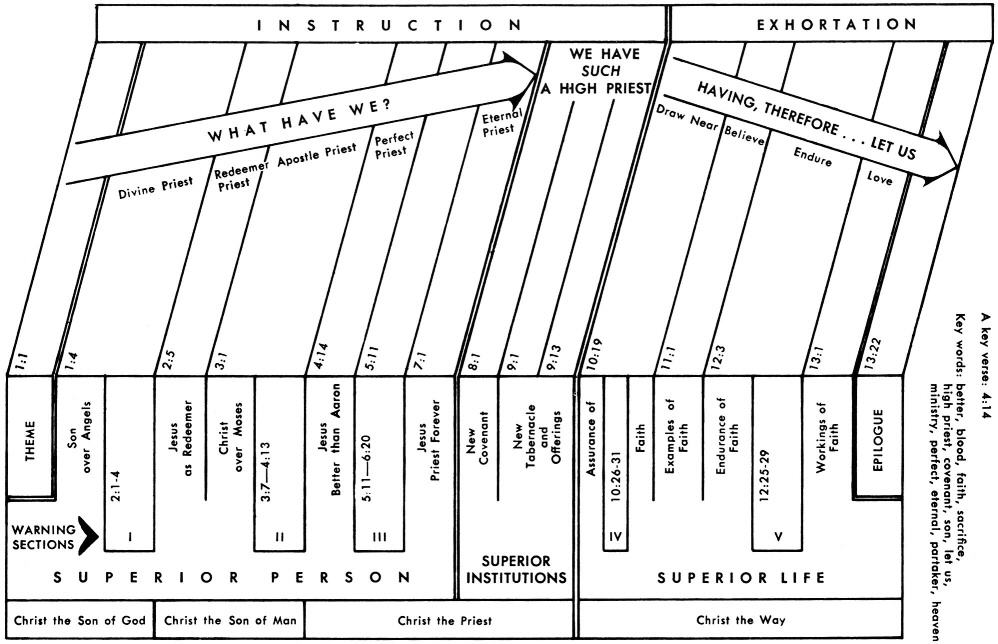
CONSIDER JESUS OUR GREAT HIGH PRIEST
Click chart to enlarge
Charts from Jensen's Survey of the NT - used by permission
Swindoll's Chart, Interesting Pictorial Chart of Hebrews, Another Chart
|
The Epistle |
||||
| INSTRUCTION Hebrews 1-10:18 |
EXHORTATION Hebrews 10:19-13:25 |
|||
| Superior Person of Christ Hebrews 1:1-4:13 |
Superior Priest in Christ Hebrews 4:14-10:18 |
Superior Life In Christ Hebrews 10:19-13:25 |
||
| BETTER THAN PERSON Hebrews 1:1-4:13 |
BETTER PRIESTHOOD Heb 4:14-7:28 |
BETTER COVENANT Heb 8:1-13 |
BETTER SACRIFICE Heb 9:1-10:18 |
BETTER LIFE |
| MAJESTY OF CHRIST |
MINISTRY OF CHRIST |
MINISTERS FOR CHRIST |
||
|
DOCTRINE |
DUTY |
|||
|
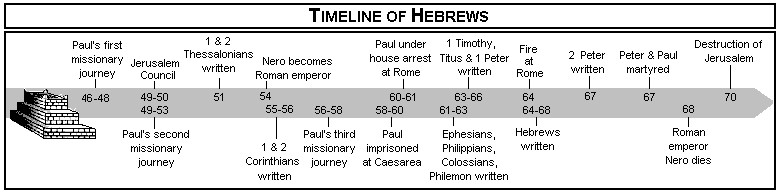
DATE WRITTEN: |
||||

See ESV Study Bible "Introduction to Hebrews"
(See also MacArthur's Introduction to Hebrews)
Borrow Ryrie Study Bible
Hebrews 13:5 Make sure that your character is free from the love of money, being content with what you have; for He Himself has said, "I WILL NEVER * DESERT YOU, NOR WILL I EVER * FORSAKE YOU," (NASB: Lockman)
Greek: Aphilarguros o tropos; arkoumenoi (PPPMPN) tois parousin; (PAPNPD) autos gar eireken, (3SRAI) Ou me se ano (1SAAS) oud' ou me se egkatalipo; (1SAAS)
BGT Ἀφιλάργυρος ὁ τρόπος, ἀρκούμενοι τοῖς παροῦσιν. αὐτὸς γὰρ εἴρηκεν· οὐ μή σε ἀνῶ οὐδ᾽ οὐ μή σε ἐγκαταλίπω,
Amplified: Let your character or moral disposition be free from love of money [including greed, avarice, lust, and craving for earthly possessions] and be satisfied with your present [circumstances and with what you have]; for He [God] Himself has said, I will not in any way fail you nor give you up nor leave you without support. [I will] not, [I will] not, [I will] not in any degree leave you helpless nor forsake nor let [you] down (relax My hold on you)! [Assuredly not!] (Amplified Bible - Lockman)
My Amplified Paraphrase: Let your way of life—your attitudes, decisions, and daily conduct—be free from the love of money, greed, and grasping for more; refuse to build your security on possessions, wealth, or material gain. Instead, cultivate a settled contentment, a satisfied heart that rests in what God has already provided, trusting His wise and faithful care. For He Himself has spoken with emphatic certainty: “I will never, ever abandon you; I will never, under any circumstance, leave you without support, forsake you, or let you down.” Therefore, your contentment is not rooted in what you have, but in Who has you.
Barclay: Let your way of life be free from the love of money. Be content with what you have for he has said: “I will never fail you and I will never forsake you”; (Westminster Press)
NLT: Don’t love money; be satisfied with what you have. For God has said, “I will never fail you. I will never abandon you.” (NLT - Tyndale House)
KJV Let your conversation be without covetousness; and be content with such things as ye have: for he hath said, I will never leave thee, nor forsake thee.
NKJ Let your conduct be without covetousness; be content with such things as you have. For He Himself has said, "I will never leave you nor forsake you."
NET Your conduct must be free from the love of money and you must be content with what you have, for he has said, "I will never leave you and I will never abandon you."
CSB Your life should be free from the love of money. Be satisfied with what you have, for He Himself has said, I will never leave you or forsake you.
ESV Keep your life free from love of money, and be content with what you have, for he has said, "I will never leave you nor forsake you."
NIV Keep your lives free from the love of money and be content with what you have, because God has said, "Never will I leave you; never will I forsake you."
Phillips: Keep your lives free from the lust for money: be content with what you have. God has said: 'I will never leave you nor forsake you'. Phillips: Touchstone)
Wuest: Let your manner of life be without love of money, being satisfied with your present circumstances. For He himself has said, and the statement is on record, I will not, I will not cease to sustain and uphold you.
Young's Literal: Without covetousness the behaviour, being content with the things present, for He hath said, ‘No, I will not leave, no, nor forsake thee
- character is free from the love of money - Ex 20:17; Josh 7:21; Ps 10:3; Ps 119:36; Jer 6:13; Ezek 33:31; Mk 7:22; Lk 8:14; Lk 12:15-21; 16:13,14; Ro 1:29; 1Co 5:11; 6:10; Eph 5:3, Ep 5:5; Col 3:5; 1Ti 3:3; 1Ti 6:9-10; 2Pe2:3, 2Pe 3:14; Jude 1:11
- being content - Ex 2:21; Mt 6:25, Mt 6:34; Luke 3:14; Phil 4:11,12; 1Ti 6:6-8
- Hebrews 13:5-6 Cultivating Contentment - Steven Cole
- Hebrews 13:5-6 The Principles of Contentment - John MacArthur
- Hebrews 13 Resources - Multiple Sermons and Commentaries
Related Passages:
Proverbs 11:28 He who trusts in his riches will fall, But the righteous will flourish like the green leaf.
1 Timothy 6:9-10 But those who want to get rich fall into temptation and a snare and many foolish and harmful desires which plunge men into ruin and destruction. 10 For the love of money is a root of all sorts of evil, and some by longing for it have wandered away from the faith and pierced themselves with many griefs.
Luke 16:13-14 "No servant can serve two masters; for either he will hate the one, and love the other, or else he will hold to one, and despise the other. You cannot serve God and mammon." 14 Now the Pharisees, who were lovers of money, were listening to all these things, and they were scoffing at Him.
Ecclesiastes 5:10 He who loves money will not be satisfied with money, nor he who loves abundance with its income. This too is vanity.
Comment - This verse returns to one of Solomon’s most consistent themes in Ecclesiastes: the futility of pursuing satisfaction through material wealth, in this section we might call it the "Money Mirage" or the hit song in the Greatest Showman "Never Enough."
Proverbs 27:20 “Sheol and Abaddon are never satisfied, nor are the eyes of man ever satisfied.”
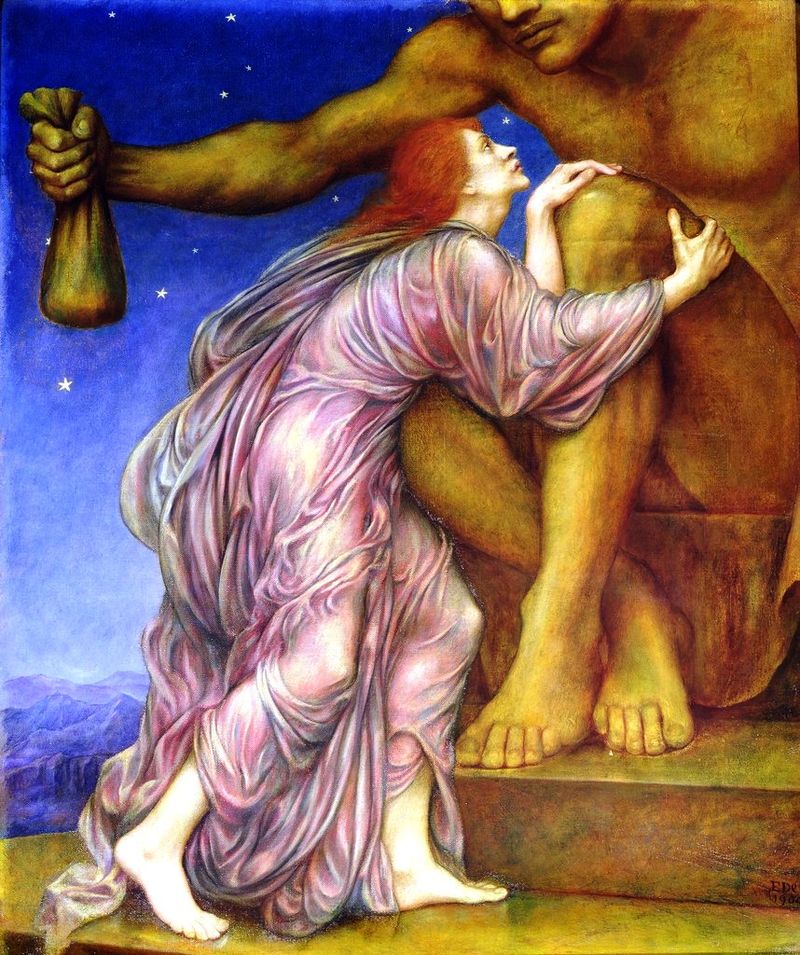
The Worship of Mammon
Evelyn De Morgan
LET YOUR TRUE
CHARACTER SHOW
Hebrews 13:5 shifts the focus from purity in marriage (Heb 13:4) to purity in motives (or "possession of money"). The same God who calls His people to sexual faithfulness now calls them to financial faithfulness. The love of money is a subtle rival god (see depiction above!)—one that quietly promises security, identity, and contentment yet never delivers. This verse reminds us that true contentment is not found in accumulated possessions but in the abiding presence of God Himself.
Make sure that your character (tropos - habitual conduct, customary way of life) is free from the love of money (aphilarguros) - The phrase "make sure that" is added by the NAS. Your character (tropos) is a call to watch one's inner disposition, not just one's isolated actions but the overall direction of one's life, to ensure that it is not governed by love of money but instead by contentment with God's provision. Believers are to live in such a way that their lives are not driven by materialism or greed. This echoes Jesus’ teaching that “You cannot serve God and wealth.” (Mt 6:24) Similarly Paul warned “the love of money is a root of all sorts of evil.l" (1Ti 6:10)
Reputation is what others think you are.
Character is what God knows you are!
Free from the love of money (aphilarguros) is literally "Without covetousness the behaviour" and is used as a qualification of elders to be "free from the love of money." (1Ti 3:3). This word (aphilarguros) describes one whose heart is not attached to wealth, who is not driven by material gain, and who is content with what God provides. This exhortation is not just about external behavior, but about the inner orientation of one's heart, calling on believers to reject greed and covetousness (Ex 20:17; Lk 12:15), to seek to live with integrity and simplicity and (in context) to trust God as the ultimate Provider. One might sum up this exhortation as a call for one's heart that to be satisfied in God, not in possessions. This mindset (heart attitude) is the opposite of the world’s values, which equate success with wealth. In short, this exhortation is a call to the readers to a "countercultural way of life!" To clarify, note that to be aphilarguros is not a call to despise money per se, but a charge to refuse to be mastered by it. To put it bluntly, to love money is to worship a false god, placing trust in riches rather than in the Lord.
J Vernon McGee - Don’t be known as a moneygrabber, as one who puts the almighty dollar above almighty God. He may not make you a millionaire, but He will never leave you or forsake you. I(BORROW Thru the Bible)
Marvin Vincent - The love of filthy lust and the love of filthy lucre follow one another as closely akin, both alienating the heart from the Creator to the creature.
Spurgeon on free from the love of money - Covetousness is classed with the very filthiest of vices of the flesh. Let the Christian dread it. God is not selfish; God is love. God does not hoard; He gives liberally (James 1:5). He does not refuse the poor; He delights in mercy. He spreads abroad in the midst of His creatures the good things that belong to Him, and He bids them freely gather what He freely gives; even this way He would have us distribute generously and disperse freely without covetousness.
When your focus is fixed on material things,
your getting will never catch up with your wanting.
The "law of getting and wanting" - The more you get the more you want. When your focus is fixed on material things, your getting will never catch up with your wanting!This is nothing short of greed which is no small sin. Greed has kept many out of the kingdom of God (see warning of fate of "covetous" in 1Co 6:10 and Eph 5:5 which do not speak of loss of rewards for believers) and has robbed many believers of their joy. When possessions multiply, our peace evaporates. Remember this: whenever you trust in money, you are revealing a distrust in God. The love of money displeases Him and drives a wedge between your heart and His.
Benjamin Franklin once said "Money never made a man happy yet, nor will it...Instead of its filling a vacuum, it makes one. If it satisfies one want, it double and trebles that want another way!"
Greed enlarges the appetite
but shrinks the soul.
Let's be honest and acknowledge that for all its "advantages" in this temporal life, wealth has major disadvantages regarding eternal life. Jesus clearly taught that it is "easier for a camel to go through the eye of a needle, than for a rich man to enter the kingdom of God." (Mt 19:24) It is difficult to have wealth and not trust in it. Material possessions tend to focus one’s thoughts and interests on this world alone. Wealth can enslave so that one becomes possessed by possessions, comforts, and recreations. The writer of Hebrews would exhort his wealthy Jewish readers to "Lay aside these temporal, worldly encumbrances" (cf Heb 12:1). Jesus said, “the worries of the world, and the deceitfulness of riches, and the desires for other things enter in and choke the word, and it becomes unfruitful.” (Mk 4:19). Do not even entertain the tiniest thought of church leadership if you are a lover of money. (1Ti 3:2-3).

Peace and contentment
Eduard von Grützner (1897)
THE GLORIOUS GIFT
OF CONTENTMENT
Being content (arkeo) with what you have (pareimi) - Being content is explained in more detail below but suffice it to say the contentment the writer is calling his readers to embrace is contentment which is not self-generated, not circumstantial (related to our circumstances), not achieved by discipline alone, but represents a Spirit-enabled satisfaction rooted in God’s presence and promises. This is why Paul can say, “I have learned to be content” (Phil. 4:11). Contentment is taught by God, not acquired by willpower. The phrase with what you have (pareimi) refers to the things that are present, what is near at hand, what currently exists, the things God has already placed (or allowed) in your life, your present circumstances, provisions, and resources. The verb pareimi does not refer to potential opportunities, or better future conditions, but what is actually there right now. In this passage the writer calls for his readers (and us) to be content with what God has actually provided in the present moment. As someone once told me, when you realize all you have left is God, you come to the realization that God is all you need! In short, our contentment is anchored not in what we possess but in the God Who possesses us.
Contentment is possible because God never leaves,
not because circumstances are ideal.
Be continually satisfied with what God has presently provided,
because the Giver is always with you.
We are not defined by what we own, nor sustained by what we can earn. God calls us to loosen our grip on possessions and tighten our grip on His promises. Contentment isn’t the absence of desire, but it is the presence of Christ. When He is enough, everything else finds its proper place. Or as the hymn writer Helen Lemmel said "Turn your eyes upon Jesus, Look full in His wonderful face, And the things of earth will grow strangely dim, In the light of His glory and grace." Amen?
The more you chase money,
the faster contentment runs.
The basis for our contentment is God’s unchanging promise of His presence and His power—His assurance that He will supply every necessity of life (cf. Php 4:19, Mt 6:25-34). True contentment flows from confidence in the God Who is with us and for us. It describes the Spirit-enabled ability of the believer to remain inwardly at rest and satisfied, independent of outward circumstances. In other words, contentment is the God-given capacity to be unmoved by what changes around us because we are anchored in the One Who is "the same yesterday and today and forever." (Heb 13:8)
In this passage being content (arkeo) is in the passive voice which conveys the meaning of being satisfied or being made content with something. Understanding the passive voice here is crucial for it communicates that contentment is something done TO you, not something produced BY you. In other words, you do not generate your own contentment. Contentment is supernaturally WORKED IN YOU by an outside Agent, in context by God’s presence and promise. In other words, the passive voice of arkeo shows that contentment is not something we create, but something God creates in us. True contentment is the Spirit's work in us, not our work for Him.
Hebrews 13:5 invites us to place our trust not in our possessions, but in the God who lovingly, graciously possesses us. The writer is not calling us to manufacture our own contentment, but calling on us to allow ourselves to be satisfied by God. He Himself supplies all that is needed. True contentment, then, is not something we achieve by self-effort, but something we receive by faith. It is a Spirit-enabled disposition of the heart, a settled confidence in the sufficiency of God’s presence and God's provision. The believer is called to receive and rest in what God has provided, rather than anxiously striving for more. It is a call to trust not in what we possess, but in the One who possesses us.
Contentment is not rooted in possessions,
but in the presence and promises of God.
Being content (arkeo) in the present tense calls for us to continually allow God’s provision to be enough. This is a call to ongoing contentment, not a one-time decision, but a daily spiritual discipline of trusting God. We could paraphrase it "Keep on being made content with what you possess, allowing God’s continual provision and presence to satisfy you fully.” This sense fits perfectly with the flow into the next clause ("for He HImself has said...") which shows that we are made content because the God Who never leaves us is Himself our sufficiency. Thus, we experience an inner contentment not based on abundance, but grounded in the unchanging promise of God.
We don’t create contentment —
we receive it.
Does the previous description arkeo describe you beloved? If not, ponder Paul's testimony…
Not that I speak from want; for I have learned to be (present tense = continually) content (autarkes from autos = reflexive pronoun = self + arkeo = be sufficient, suffice) in whatever circumstances I am. I know how to get along with humble means, and I also know how to live in prosperity; in any and every circumstance I have learned the secret of being filled and going hungry, both of having abundance and suffering need. I can do (OUR RESPONSIBILITY) all things through Him Who strengthens (SPIRIT'S POWER) me. (Php 4:11, 12 Php 4:13) (See "Paradoxical Principle of 100% Dependent and 100% Responsible").
Paul's great example begs several questions...
Am I learning contentment, or just longing for different circumstances?
If Paul learned contentment through highs and lows,
what is God trying to teach me in mine?
Where am I seeking contentment—my situation or my Savior?
When I feel discontent, is it a signal to complain—
or an invitation to depend on Christ’s power?
Paul wrote to Timothy about contentment
"But (contrast = Always stop, look and listen - Ask what is being contrasted? See 1Ti 6:5) godliness actually is a means of great gain, when accompanied by contentment (autarkeia - Spirit enabled "self-sufficiency"). 7 For we have brought nothing into the world, so we cannot take anything out of it either. 8 And if we have food and covering, with these we shall be content. (1Ti 6:6, 1Ti 6:7, 1Ti 6:8)
Wuest writes that "The word “content” is the translation of arkeo “to be possessed of unfailing strength, to be strong, to suffice, to be enough,” finally, “to be satisfied, contented.” The underlying thought is that one should be satisfied with that which meets our need, and not desire a superfluity. The cognate noun of this verb is compounded with the personal pronoun “self” in Philippians 4:11 to mean “self-sufficient.” This latter word was used by the Stoics to express the favorite doctrine of the sect, that man should be sufficient to himself for all things, able by the power of his will to resist the shock of circumstance. Paul was self-sufficient because he was Christ-dependent. The word “content,” therefore, in our Hebrew passage means more than “satisfied.” It refers to the ability of the Christian dependent upon the Holy Spirit, to be independent of outward circumstances. (Hebrews)
Spurgeon - There is a laudable pursuit of gain, without which business would not be properly carried on. But there is a line, scarcely as broad as a razor’s edge, between diligence in business and greediness for gain. We can so easily pass from the one into the other that we may hardly be aware of it ourselves. When a man is increasing his investments, when he is extending his agencies, when he is enlarging his warehouse, when he is employing a larger number of persons than before, or even when he is bemoaning the depression of his trade, and his heart is aching because he has to do only half as much business as before, covetousness may insinuate itself into his conversation. It is a snake that can enter at the smallest hole. It lurks in the grass where it is long, but it glides also where the pasture is bare. It may come in either in prosperity or in adversity, and it is needful to whisper in the ear of each believer, whether going up or down in the world, “Your lifestyle—your daily conduct—must be free from the love of money.”.....There is a fortune for you, that is a pension to fall back upon. You may very well be content to leave your temporal concerns in the hands of God, for he hath said, “I will never leave thee, nor forsake thee.” Why, if you believe that one promise of God, he will be better to you than ten thousand friends who promise to provide for you! The Provider in heaven is better than any provider on earth. A beautiful motto is that of the old house of Chester, “God’s providence is my inheritance.
Warren Wiersbe - The word content actually means “contained.” It is a description of the man whose resources are within him so that he does not have to depend on substitutes without. (Bible Exposition Commentary)
Dwight Pentecost wisely explains that "Air and water are two entirely different elements or spheres, and it is impossible to have a vessel filled with air and water at the same time. One that is filled with air must have the air displaced in order to be filled with water. Similarly, if a man’s life is given over to the pursuit of material things, that life cannot then be filled with Jesus Christ. Until that love for material things is displaced, that life cannot and will not be filled with Jesus Christ. When a man gives himself to the pursuit of all that is involved in this world and makes its position and its material things his goal and his standard and the center of his life, he will not find the satisfaction that comes from making Jesus Christ the center of his life. To be content is the opposite of to be covetous, to be greedy, to be worldly, to be materialistic… The reason material things can never make a man content is that a man is never able to get enough of them to satisfy him… Someone once asked John D. Rockefeller how much money is enough. He thought a moment and said, “Just a little more than one has.” The world’s wealthiest man has yet to say, “I have enough to be satisfied.” (BORROW The Joy of Living: A Study of Philippians PAGE 220)
Jesus warned - Beware (present imperative = Command to continually "Watch out") and be on your guard (phulasso also in the present imperative) against every form of greed (pleonexia- from pleíon = more + écho = have -- means literally to have more and describes a strong desire to acquire more and more material possessions, especially that which is forbidden); for (See term of explanation) not even when one has an abundance does his life consist of his possessions. (Luke 12:15)
Comment: Jesus in effect gives a double warning! He knows that greed is subtle and sinister. Life is not one's possessions, and he who dies with the most toys does not win, contrary to a modern bumper sticker saying! Paul says Christ is our life. (Col 3:4). True life is a Person, not possessions! We can never accumulate enough "things" if "things" to satisfy our inner God given need. Only Jesus can give genuine satisfaction and contentment.
Being satisfied with...Why? because of His "faithful Word" which the writer goes on to quote. The truth is that when you come to the point in a particular circumstance or relationship where you realize that all you have left is Jesus, then you come to experientially know that Jesus is all you need. (cp 2Co 12:9,10)
Related resources:
The psalmist writes…
Psalm 10:3 For the wicked boasts of his heart's desire, and the greedy man curses and spurns the LORD.
Spurgeon comments: The evidence is very full and conclusive upon the matter of pride, and no jury could hesitate to give a verdict against the prisoner at the bar. Let us, however, hear the witnesses one by one. The first testifies that he is a boaster.
For the wicked boasteth of his heart's desire. He is a very silly boaster, for he glories in a mere desire: a very brazen faced boaster, for that desire is villainy; and a most abandoned sinner, to boast of that which is his shame. Bragging sinners are the worst and most contemptible of men, especially when their filthy desires, -- too filthy to be carried into act, -- become the theme of their boastings. When Mr. Hate Good and Mr. Heady are joined in partnership, they drive a brisk trade in the devil's wares. This one proof is enough to condemn the prisoner at the bar. Take him away, jailor! But stay, another witness desires to be sworn and heard. This time, the impudence of the proud rebel is even more apparent; for he blesseth the covetous, whom the Lord abhorreth. This is insolence, which is pride unmasked. He is haughty enough to differ from the Judge of all the earth, and bless the men whom God hath cursed. So did the sinful generation in the days of Malachi, who called the proud happy, and set up those that worked wickedness (Malachi 3:15). These base pretenders would dispute with their Maker; they would --
"Snatch from his hand the balance and the rod,
Rejudge his justice, be the god of God."
How often have we heard the wicked man speaking in terms of honour of the covetous, the grinder of the poor, and the sharp dealer! Our old proverb hath it, --
"I wot well how the world wags;
He is most loved that hath most bags."
Pride meets covetousness, and compliments it as wise, thrifty, and prudent. We say it with sorrow, there are many professors of religion who esteem a rich man, and flatter him, even though they know that he has fattened himself upon the flesh and blood of the poor. The only sinners who are received as respectable are covetous men. If a man is a fornicator, or a drunkard, we put him out of the church; but who ever read of church discipline against that idolatrous wretch, -- the covetous man? Let us tremble, lest we be found to be partakers of this atrocious sin of pride, "blessing the covetous, whom Jehovah abhorreth." .
Asaph expounds on the ultimate source of contentment asking and answering the question we would all do well to ask ourselves…
Whom have I in heaven but Thee? And besides Thee, I desire nothing on earth. My flesh and my heart may fail, but God is the strength of my heart and my portion forever. (Ps 73:25, 26)
Spurgeon comments: Whom have I in heaven but Thee? Thus, then, he turns away from the glitter which fascinated him to the true gold which was his real treasure. He felt that his God was better to him than all the wealth, health, honour, and peace, which he had so much envied in the worldling; yea, He was not only better than all on earth, but more excellent than all in heaven. He bade all things else go, that he might be filled with his God.
How small is the number of those who keep their affections fixed on God alone! (cp Col 3:1, Col 3:2) We see how superstition joins to him many others as rivals for our affections. While the Papists admit in word that all things depend upon God, they are, nevertheless, constantly seeking to obtain help from this and the other quarter independent of him. John Calvin.
It pleased David, and it pleases all the saints, more that God is their salvation, whether temporal or eternal, than that he saves them. The saints look more at God than at all that is God's. They say, Non tua, sed te; we desire not thine, but Thee, or nothing of thine like Thee. Whom have I in heaven but Thee? saith David. What are saints? what are angels, to a soul without God? It is true of things as well as of persons. What have we in heaven but God? What's joy without God? What's glory without God? What's all the furniture and riches, all the delicacies, yea, all the diadems of heaven, without the God of heaven? If God should say to the saints, Here is heaven, take it amongst you, but I will withdraw myself, how would they weep over heaven itself, and make it a Baca, a valley of tears indeed. Heaven is not heaven unless we enjoy God. It is the presence of God which makes heaven: glory is but our nearest being unto God. As Mephibosheth replied, when David told him, "I have said, thou and Ziba divide the land:" "Let him take all, if he will," saith Mephibosheth, I do not so much regard the land as I regard thy presence; "Let him take all, forasmuch as my lord the king is come again in peace to his own house," where I may enjoy him. So if God should say to the saints, Take heaven amongst you, and withdraw Himself, they would even say, Nay, let the world take heaven, if they will, if we may not have Thee in heaven, heaven will but be an earth, or rather but a hell to us. That which saints rejoice in, is that they may be in the presence of God, that they may sit at His table, and eat bread with Him; that is, that they may be near Him continually, which was Mephibosheth's privilege with David. That's the thing which they desire and which their souls thirst after; that's the wine they would drink. "My soul," says David (Psalms 42:2), "thirsts for God, for the living God; when" (I think the time is very long, when) "shall I come and appear before God?" Joseph Caryl.
Heaven and earth ransacked to find a joy equal to the Lord himself. Let the preacher take up various joys and show the inferiority.
And there is none upon earth that I desire beside thee. No longer should his wishes ramble, no other object should tempt them to stray; henceforth, the Ever living One should be his all in all.
My flesh and my heart faileth. They had failed him already, and he had almost fallen; they would fail him in the hour of death, and, if he relied upon them, they would fail him at once.
But God is the strength of my heart, and my portion for ever. His God would not fail him, either as protection or a joy. His heart would be kept up by divine love, and filled eternally with divine glory. After having been driven far out to sea, Asaph casts anchor in the old port. We shall do well to follow his example. There is nothing desirable save God; let us, then, desire only him. All other things must pass away; let our hearts abide in him, who alone abideth for ever.
God is the strength of my heart, and my portion for ever. The Hebrew carrieth it, but God is the rock of my heart, i.e., a sure, strong, and immovable foundation to build upon. Though the winds may blow, and the waves beat, when the storm of death cometh, yet I need not fear that the house of my heart will fall, for it is built on a sure foundation: God is the rock of my heart. The strongest child that God hath is not able to stand alone; like the hop or ivy, he must have somewhat to support him, or he is presently on the ground. Of all seasons, the Christian hath most need of succour at his dying hour; then he must take his leave of all his comforts on earth, and then he shall be sure of the sharpest conflicts from hell, and therefore, it is impossible he should hold out without extraordinary help from heaven. But the psalmist had armour of proof ready, wherewith to encounter his last enemy. As weak and fearful a child as he was, he durst venture a walk in the dark entry of death, having his Father by the hand: "Though I walk through the valley of the shadow of death, I will fear no evil: for thou art with me; thy rod and thy staff they comfort me," Psalm 23:4. Though at the troubles of my life, and my trial at death, my heart is ready to fail me, yet I have a strong cordial which will cheer me in my saddest condition: God is the strength of my heart.
And my portion. It is a metaphor taken from the ancient custom among the Jews, of dividing inheritances, whereby every one had his allotted portion; as if he had said, God is not only my rock to defend me from those tempests which assault me, and, thereby, my freedom from evil; but he is also my portion, to supply my necessities, and to give me the fruition of all good. Others, indeed, have their parts on this side the land of promise, but the author of all portions is the matter of my portion. My portion doth not lie in the rubbish and lumber, as theirs doth whose portion is in this life, be they never so large; but my portion containeth him whom the heavens, and heaven of heavens, can never contain. God is the strength of my heart, and my portion for ever; not for a year, or an age, or a million of ages, but for eternity. Though others' portions, like roses, the fuller they blow, the sooner they shed; they are worsted often by their pride, and wasted through their prodigality, so that at last they come to want -- and surely death always rends their persons and portions asunder; yet my portion will be ever full, without diminution. Without alteration, this God will be my God for ever and ever, my guide and aid unto death; nay, death, which dissolves so many bonds, and unties such close knots, shall never part me and my portion, but give me a perfect and everlasting possession of it. George Swinnock.
ILLUSTRATION - John D Rockefeller was once asked what it would take to make him happy to which he retorted "One dollar more!" Benjamin Franklin (a deist and probably not a believer) was correct when he said "Money never made a man happy yet, nor will it...Instead of its filling a vacuum, it makes one. If it satisfies one want, it double and trebles that want another way!" O so true! A fascinating survey was published in which people of various income levels were asked how much more more they needed to be happy. Individuals making $20,000 through $30,000 would do it. People who made $45,000 thought the magic number was $60,000, while people at $100,000 were convinced that if only they made $200,000, they would finally be happy. In fact study after study has shown that the desire for material good, which has gone hand in hand with the rise of income in the West is actually a happiness suppressant! (from a secular book entitled "The Happiness Makeover")
GREED - ILLUSTRATION - In the days following her flight from the Philippines with her deposed husband, revelations about Imelda Marcos made her name a synonym for greed. What can a woman do with thousands of pairs of shoes? But the Imelda Marcos syndrome operates throughout the economic scale. The term “greed” means simply “a consuming desire to have more”; it has the nuance of a grasping for more, a lust to acquire. It is the very opposite of the contentment that accompanies true godliness (1 Timothy 6:6). We miss the point, however, if we see covetousness as an issue of amount not attitude. The poorest can be greedy; the richest can avoid greed. But the danger of possessions is that they often arouse the desire for more.
Ivan Boesky, who went to prison and paid a fine of $100 million for insider trading was, a few years earlier, the darling of Wall Street. During that time he declared at a graduation ceremony at a major university, “Greed is all right. I want you to know I think greed is healthy. You can be greedy and still feel good about yourself.” As Newsweek later commented, “The strangest thing when we look back will not be just that Ivan Boesky could say that at a business school graduation, but that it was greeted with laughter and applause” (December 1, 1986).
In the 1950s, wrestling was almost as popular as it is at present (and just as authentic!). The European champion was Yussif the Turk, who came to America to fight Strangler Lewis for the “world championship” and $5,000. Yussif won and insisted that the $5,000 be paid in gold, which he stuffed into his championship belt. The money mattered so much that he refused to remove the belt until he had reached home safely. Boarding the first available ship to Europe, he headed home. But halfway across the Atlantic, the ship foundered in a storm and began to sink. In a panic, Yussif jumped for a lifeboat, missed, and went straight to the bottom. His golden belt had become a golden anchor, a vivid illustration of the Lord’s words. (Gary Inrig - Borrow The parables : understanding what Jesus meant - see page 93)
Steven Cole (see full sermon on How To Be Really Rich)
A TEST FOR GREED: Here are five questions to ask yourself:
(1) Do my thoughts more often run after material things than after God Himself? If I am often thinking about that new car or that nicer house or that better computer, and I seldom think about how I can know God better, I am tainted by greed.
(2) Do I ever compromise godly character in the pursuit of material gain? If I sometimes cheat or lie or steal to get ahead financially or to avoid loss, I am being greedy. If I am willing to shred relationships or to take advantage of another person for financial gain, I am being greedy. If I care more about making money than about being a witness for Jesus Christ, I am being greedy.
(3) Do I enjoy material things more than I enjoy knowing God? If my happiness soars when I get a new car, but I am bored by the things of God, I am greedy. If I rejoice when I win a raffle or door prize, but I yawn when I hear about a soul being saved, I am greedy.
(4) How do I respond when I lose material things? When the stock market drops, do I fall apart emotionally? If I get robbed or lose some or all of my things in a fire, does it devastate me? I’m not saying that we must be stoical about such losses. We will always feel some sadness when we lose things. But if it wipes us out, then we’re probably too attached to this world and its goods.
(5) What would I do if I suddenly came into a fortune? I presume that none of you play the lottery, but what if you won the Reader’s Digest Sweepstakes? What if a distant relative died and left you a large inheritance? Would your first thought be, “Now I can get that better house or car or boat”? “Now I can take that trip around the world I’ve always wanted to take.” Or, would you think, “Now I can support dozens of missionaries”? “Thousands of people can hear about Christ because He has given me funds to invest in the spread of His kingdom!”
- The more a man gathers, the more gaps he discovers to fill.
- Wanting more always grows faster than getting more.
- Wealth can fill your pockets, but it cannot fill your heart.
- Happiness grows from gratitude, not from gain.
- Possessions multiply; peace evaporates.
- A full barn cannot quiet an empty soul.
- Greed is a fire that grows hotter with every log you throw on it.
- You can never get enough of what never satisfies.
- Big mouthfuls often choke. Anon.
- The problem is not wealth. The problem is the love of money. I love money. So I have a problem with wealth.
- No gain satisfies a greedy mind. Anon.
- Greed of gain is nothing less than the deification of self, and if our minds are set on hoarding wealth we are being idolatrous. John Blanchard
- Greed and ambition … the two sources from which stems the corruption of the whole of the ministry. John Calvin
- The lack of faith is the source of greed. John Calvin
- Somehow, for all the wondrous glimpses of ‘goodness’ I see in society, there remains the unmistakable stain of selfishness, violence and greed. John Dickson
- Greed is a bottomless pit which exhausts the person in an endless effort to satisfy the need without ever reaching satisfaction. Erich Fromm
- If your desires be endless, your cares and fears will be so too. Thomas Fuller
- Riches have made more covetousness than covetousness has made rich men. Thomas Fuller
- The world provides enough for every man’s need but not for every man’s greed. Mohandas Gandhi
- That we shall carry nothing out of this world is a sentence better known than trusted, otherwise I think men would take more care to live well than to die rich. John P. K. Henshaw
- Whereas other vices grow as a man advances in life, avarice alone grows young. Jerome
- Avarice increases with the increasing pile of gold. Juvenal
- Nearly all those evils in the world which people put down to greed or selfishness are really far more the result of pride. C. S. Lewis
- Avarice is as destitute of what it has as poverty of what it has not. Publilius Syrus
- Poverty wants much; greed everything. Publilius Syrus
- Most men pray more for full purses than for pure hearts. Thomas Watson
- Wealth is the devil’s stirrup whereby he gets up and rides the covetous. Thomas Adams
- He who coverts is poor, notwithstanding all he may have acquired. Ambrose
- Charity gives itself rich; covetousness hoards itself poor. Anon.
- Gold is the heaviest of all metals, but it is made more heavy by covetousness. Anon.
- Much trouble is caused by our yearnings getting ahead of our earnings. Anon.
- Seeking empties a life; giving fills it. Anon.
- Covetousness is a sin that comes earliest into the human heart, and is the last and most difficult to be driven out. George Barlow
- Covetousness makes us the slaves of the devil. John Calvin
- Faith is the sovereign antidote to covetousness. John Calvin
- Covetousness is the blight that is withering our church life in all directions. Samuel Chadwick
- When all sins are old in us and go upon crutches, covetousness does but then lie in her cradle. Thomas Decker
- Riches have made more covetous men than covetousness has made rich men. Thomas Fuller
- Covetousness is commonly a master-sin and has the command of other lusts. Matthew Henry
- Covetousness is spiritual idolatry; it is the giving of that love and regard to worldly wealth which are due to God only. Matthew Henry
- He is much happier that is always content, though he has ever so little, than he that is always coveting, though he has ever so much. Matthew Henry
- Poor people are as much in danger from an inordinate desire towards the wealth of the world as rich people from an inordinate delight in it. Matthew Henry
- The covetous man sits hatching upon his wealth and brooding over it, till it is fledged, as the young ones under the hen, and then it is gone. Matthew Henry
- Covetousness swallows down any lie. William Jenkyn
- The soul of man is infinite in what it covets. Ben Jonson
- Beware … of the beginnings of covetousness, for you know not where it will end. Thomas Manton
- There are two sins which were Christ’s sorest enemies, covetousness and envy. Covetousness sold Christ and envy delivered him. Thomas Manton
- Coveting is something we do with our hearts, not our hands or feet. Will Metzger
- We may love money without having it, just as we may have money without loving it. J. C. Ryle
- One can be covetous when he has little, much, or anything between, for covetousness comes from the heart, not from the circumstances of life. Charles Caldwell Ryrie
- Covetousness is both the beginning and the end of the devil’s alphabet—the first vice in corrupt nature that moves, and the last which dies. Robert South
- We need not covet money, for we shall always have our God, and God is better than gold, his favour is better than fortune. C. H. Spurgeon
- Covetous men, though they have enough to sink them yet have they never enough to satisfy them. John Trapp
- A man may be said to be given to covetousness when he takes more pains for getting earth than for getting heaven. Thomas Watson
- Covetousness is dry drunkenness. Thomas Watson
- Covetousness is not only in getting riches unjustly, but in loving them inordinately, which is a key that opens the door to all sin. Thomas Watson
- The itch of covetousness makes a man scratch what he can from another. Thomas Watson
- The sin of covetousness is the most hard to root out. Thomas Watson
- There is no better antidote against coveting that which is another’s than being content with that which is our own. Thomas Watson
- I have heard thousands of confessions, but never one of covetousness. Francis Xavier
(From John Blanchard - The Complete Gathered Gold: A Treasury of Quotations for Christians)
Thomas Fuller “A man’s desire is as insatiable as the sea, and as little satisfied.” Source: Gnomologia (1732).
Seneca “It is not the man who has too little, but the man who craves more, that is poor.” Source: Letter II (Seneca, Epistulae Morales, Letter 2.6).
John Stuart Mill “I have learned to seek my happiness by limiting my desires, rather than in attempting to satisfy them.” Autobiography (1873).
(This one is also already correct.)
Socrates (via Xenophon): “He who is not contented with what he has, would not be contented with what he would like to have.”
Charles Spurgeon “You say, ‘If I had a little more, I should be very satisfied.’ You make a mistake. If you are not content with what you have, you would not be satisfied if it were doubled.” John Ploughman’s Talks (Chapter on “Contentment”).
FOR HE HIMSELF HAS SAID I WILL NEVER DESERT YOU, NOR WILL I EVER FORSAKE YOU: autos gar eireken (3SRAI) ou me se ano oud ou me se egkatalipo (1SAAS):
- I will never desert you - Ge 28:15; Deut 31:6,8; Josh 1:5; 1Sa 12:22; 1Chr 28:20; Ps 37:25, Ps 37:28; Isa 41:10,17
- Hebrews 13 Resources - Multiple Sermons and Commentaries
- Hebrews 13:5-6 Cultivating Contentment - Steven Cole
- Hebrews 13:5-6 The Principles of Contentment - John MacArthur
Related Passages
Deuteronomy 31:6 (JEHOVAH'S PROMISE TO JOSHUA) “Be strong and courageous, do not be afraid or tremble at them, for the LORD your God is the one who goes with you. He will not fail you or forsake you.”
Deuteronomy 31:8 “The LORD is the one who goes ahead of you; He will be with you. He will not fail you or forsake you. Do not fear or be dismayed.”
Joshua 1:5 “No man will be able to stand before you all the days of your life. Just as I have been with Moses, I will be with you; I will not fail you or forsake you.
1 Chronicles 28:20 (JEHOVAH'S PROMISE TO DAVID) Then David said to his son Solomon, “Be strong and courageous, and act; do not fear nor be dismayed, for the LORD God, my God, is with you. He will not fail you nor forsake you until all the work for the service of the house of the LORD is finished.
Isaiah 41:10 (JEHOVAH'S PROMISE TO ISRAEL) ‘Do not fear, for I am with you; Do not anxiously look about you, for I am your God. I will strengthen you, surely I will help you, Surely I will uphold you with My righteous right hand.’
Psalms 118:6 The LORD is for me; I will not fear; What can man do to me?
THE GOD WHO NEVER LEAVES BUT
PROMISES HIS ABIDING PRESENCE
For (gar) is always important to identify and interrogate because it often introduces an explanation (see term of explanation). In the present context it introduces the reason why the child of God can and should obey the preceding admonition to be free of the love of money and why they should be content with what they have.
Spurgeon says "Here it is—‘For he hath said, I will never leave thee, nor forsake thee.’ This is the reason why we must not be covetous. There is no room to be covetous, no excuse for being covetous, for God hath said, ‘I will never leave thee, nor forsake thee.’ We ought to be content. If we are not content, we are acting insanely, seeing the Lord has said, ‘I will never leave thee, nor forsake thee.’
He Himself has said, "I WILL NEVER (ou me - double negative) DESERT (aniemi) YOU, NOR (oude + ou me) WILL I EVER FORSAKE (egkataleipo) YOU - It is notable that there are 5 separate Greek words (ou me… oud ou me) that convey a negative sense. God wants to make it very clear that this is an irrefutable, eternal promise to all of His children. Amen! The Amplified Version picks up the repeated negatives "I will not in any way fail you nor give you up nor leave you without support. [I will] not, [I will] not, [I will] not in any degree leave you helpless nor forsake nor let [you] down (relax My hold on you)! [Assuredly not!]" This clause teaches that the antidote to greed is not poverty, but presence: “for He Himself has said, ‘I will never leave you nor forsake you.’”
🙏 THOUGHT - The writer is quoting the Septuagint of Dt 31:6 and Dt 31:8 which are Moses' encouraging exhortations to Joshua who would soon lead Israel into possess the Promised Land. Beloved, this is pure gold for us, because we are each in process of possessing the "Promised Life" in Christ Jesus and God's Spirit wants us to do so with full assurance of faith (Heb 10:22), so that we obey His Word, grow in grace and Christlikeness and experience abundant life (Jn 10:10b) which our Father desires for all of His children to possess! While all believers are in Christ by virtue of the New Birth, not all believers are possessing all the "promised life" that is available to us in Christ. To say it another way, at salvation we receive all of the Spirit of Christ we will ever get, but the Spirit progressively receives more of us as we grow in faith and grace (aka "progressive sanctification") and surrender more of our lives to His control. May God's Spirit grant each of to continually "grow in the grace and knowledge of our Lord and Savior Jesus Christ. To Him be the glory, both now and to the day of eternity. Amen." (2 Peter 3:18)
Here you have nourishment for that which is good
and poison for that which is evil.
Spurgeon comments that He Himself has said "is not only useful to chase away doubts, fears, difficulties, and devils, but it also yields nourishment to all our graces. Here you have nourishment for that which is good and poison for that which is evil. Search, then, the Scriptures, for so shall you grow healthy, strong, and vigorous in the divine life (2Pe 3:18). But when did God originally say this? Well, you cannot find the exact words in the Scriptures of the Old Testament, but He did say the same in effect to Jacob at Bethel (Ge 28:15), and to Joshua before he went to the invasion of Canaan (Deut 31:8); David said it in the Lord’s name to Solomon (1 Chr 28:20), and Isaiah said the same to the whole people of God (Isa 41:10). Whatever God says to one saint He says, virtually, to all saints who have like faith. This renders the Bible such a rich storehouse of comfort to us. No Scripture is of private interpretation, but all Scripture is given for our personal appropriation. No promise is hedged about as the exclusive property of the one man who received it. If the Lord gave a promise to Jacob, it was not meant to be restricted to Jacob, but to belong to all those who, like Jacob, can wrestle in prayer; and if God spoke, as He did, a promise to Joshua, it was not intended to be for Joshua only, but for all who were in similar circumstances to his. All Scripture promises have a message to all believers; and if you believe in Jesus, what God has said to other believers of old He says this day to you.....You have a grand reserve, therefore. What you have in possession is only a little spending money to use on the road to heaven, but “he hath said, I will never leave thee, nor forsake thee.” You may confidently fall back upon the providence of God in all times of straitness and need.....These words are remarkably forcible in the original. You probably have heard that in the Greek there are no less than five negatives. We cannot well translate them into English except in such language as that of the verse we were singing just now:
The soul that on Jesus hath leaned for repose,
I will not, I will not desert to his foes;
That soul, though all hell should endeavor to shake,
I'll never, no never, no never forsake.
Has said - Mark it down that the phrase "has said" is intensive and adds emphasis to the fact that the following promise was spoken by the Lord Himself! Furthermore, the verb said is in the perfect tense which means that God's statement has been made at some point in time in the past and has not been retracted or reversed but is still in effect. His Word is a faithful (trustworthy) Word (Titus 1:9).
I like Wuest's rendering "For He himself has said, and the statement is on record, I will not, I will not cease to sustain and uphold you." (Hebrews)
Ray Pritchard - The Lord Jesus says to us, “I will never leave you” (Hebrews 13:5). That’s a promise. It’s true and you can rest your life upon it. If you belong to him, he will never leave you. Because he rose from the dead, he lives today and will be with us forever. Therefore, we are never alone, never forsaken.....Are you excited about your future? If you’re a child of God, you ought to be excited about your future. Jesus Christ has already taken care of your past, your present and your future. He’s taken care of your past by forgiving your sins. He’s taken care of your present when he said, “I will never leave you.” (Hebrews 13:5) He’s taken care of your future when he said, “In my Father’s house are many mansions."....God is always near his people. This promise is repeated many places in scripture. Hebrews 13:5b says, ‘‘Never will I leave you; never will I forsake you.” In Matthew 28:20b Jesus promised, “I am with you always.....In our worship services we sometimes have a prayer called an “invocation,” which means we pray and invite God’s presence in our midst. Now I know what is meant by that. We are praying for God’s manifest or powerful presence in our midst. However, I do think it’s good to remember that we don’t have to ask God to be with us because he is always with us. We don’t have to “invoke” God’s presence. He’s already here!
Spurgeon - “I cannot under the influence of this grand text find room for doubt or fear. I cannot stand here and be miserable to-night. I am not going to attempt such a thing; but I cannot be despondent with such a text as this, ‘I will never leave thee, nor forsake thee.’ I defy the devil himself to mention circumstances under which I ought to be miserable if this text is true. Child of God, nothing ought to make you unhappy when you can realize this precious text.”
The context of Dt 31:6,8 (cp Jos 1:5) is a promise by the Lord to all Israel first & then specifically to Joshua as he prepared to lead the Israelites across the Jordan and into the promised land (of "rest" Jos 1:13). The writer exhorts his Jewish readers with this well-known OT promise, the promise of God’s presence going with before them and with them. Jesus has made the same promise for us to claim as well (Mt 28:20). And He has also entered in as a Forerunner for us into the very presence of God, our Source of eternal Rest (Heb 6:19,20).
IF you really believe this promise, if you believe it is true, and your heart is satisfied with the God Who promises to be there for you and help you, THEN you will not crave money, you will keep your marriage vows, you care for prisoners, welcome strangers and love each other.
Faith in the promises of God is the power to live a radical, normal Christian life.
Never - This is a double negative - Never, ever is the idea. He could not state this point any stronger!
The Greek reading is even more emphatic - "ou me se ano (aniemi) oud ou me se egkatalipo." Notice there are 5 negative particles in the Greek with two "ou me" combinations (see and here for other great uses of "ou me"), which is the strongest way to state a negative in the Greek (“This is the strongest way to negate something in Greek.”—Daniel Wallace, Greek Grammar Beyond the Basics). One might read it "I will never, never, never leave you." As a believer, we all have times when we feel far from God or maybe even feel like He has "left" us but in those moments when our faith sags, we need to recall Hebrews 13:5 to mind (you might write it on a card and/or memorize it). Remember faith comes from hearing and hearing by the word of Christ. (Ro 10:17). Another good verse to recall when our faith dips is Mark 9:24b “I do believe; help my unbelief.” Then just wait upon the LORD and exchange His strength for your flagging strength and the Spirit will enable you to mount up on wings like an eagle (Isaiah 40:31).
A friend is he who always knows
When the cold wind of trouble blows,
Who comes in dark and stormy night
With friendship's glowing lamp alight.
—MasonA true friend stays true to the end.
Jesus is our truest Friend to the end.
(Mt 28:20)
Spurgeon - It would hardly be possible in English to give the full weight of the Greek. We might render it, “He himself has said, I will never, never desert you, and I will never, never, never abandon you.” Though that would be not a literal, but rather a free rendering, yet, since there are five negatives in the Greek, we do not know how to give their force in any other way. Two negatives nullify each other in our language. In the Greek, they intensify the meaning following one after another, as I suppose David’s five stones out of the brook would have done if the first had not been enough to make the giant reel. It means that in no one single instance will the Lord leave you, nor in any one particular will He leave you, nor for any reason will He leave you. If you have cast yourself upon His infinite power and grace, He will carry you to the end. Not only will He not desert you altogether, but He will not leave you even for a little while. He may seem for a small moment to hide His face from you, but He will still love you and still supply your needs.
Poole writes that this verb speaks of "a desertion, as leaves destitute in deep trouble or distress, when they should be helping. (Matthew Poole's Commentary)
The promise to never leave was made to Joshua when he succeeded Moses : [Dt 1:7-8, Jos 1:5,9] and is fulfilled in Jesus [Mt 28:20, Acts 18:9, 10 1Ch 28:20]
The two quotations, one from Dt 31:6 and the other from Ps 118:6, reveal that the answer to any kind of fear, including the fear of poverty, is found in the commitment of God to ever be with us. There are many warnings in Scripture against loving money. Jesus said it was impossible to serve both God and money, and Paul had written young Timothy in 1Ti 6:9.
Though credit cards were unknown in the first century, they often constitute a trap today that results in financial ruin and destruction. The point of danger is the love of money which cancels out the sense of God’s love and promised supply, and launches the believer into worldly schemes for financial security that belie all trust in God. This is not to set aside the recognition that God can and often does supply methods of financial support using banks, insurance, securities and other means. But all these must be seen as coming from his hand. It is always spiritually dangerous to grow financially discontent. Remember Paul’s words in 1Ti 6:10.
Remember --
When it’s just you and God, that’s enough.
When we are weak and in despair,
Our mighty God is near;
He'll give us strength and joy and hope,
And calm our inner fear.
—Sper
With God behind you and His arms beneath you,
you can face whatever is before you.
C. H. Spurgeon said "I’ve been in a lot of testimony meetings, and I’ve heard a lot of people share how they’ve sinned, and I’ve had people come to me and make confession of sin. But in all my life I’ve never had one person confess the sin of covetousness to me.
Spurgeon adds that "It is not possible to satisfy the greedy. If God gave them one whole world to themselves they would cry for another; and if it were possible for them to possess heaven as they now are, they would feel themselves in hell, because others were in heaven too, for their greed is such that they must have everything or else they have nothing.
Spurgeon - Let your conversation be without that covetousness that shows itself in envy. If the Lord has given you one talent, use it, but do not waste your time in finding fault with him who has five talents. If your Master makes you a woodcutter, throw your strength into your felling and cleaving. Do not throw the axe at your fellow servant. If He makes you a drawer of water, do not empty your buckets on your neighbor, but do your own service well, and bring what you have done and lay it at your Master’s feet. This will be thankworthy; this will be Christlike. You will then be obeying the injunction, “Your lifestyle must be free from the love of money” (Heb 13:5).
And covetousness may show itself in another way, namely, by perpetually craving and desiring that which we do not have. The old moralists used to say that the man who wanted to be truly rich would be better off curtailing his appetites than increasing his fortune. Some men seem as if they can never fix their thoughts on what they have, but they are always in the other tense and mood, thinking of what they could, would, or should have. Some years ago they told us a little more would content them, and a great deal more has been added to their stores, but still they want a little more now. Let your conversation be without covetousness in that respect, and be content with such things as you have.
In many, this anxiety for acquisition betrays itself in fretful fears about the future, and I must in all honesty grant that this form of the vice sometimes has the appearance of being the most excusable of the whole. “What shall I do,” we are apt to say, “in case I should be laid off, and a precarious income should suddenly come to an end? It is not for myself alone. It is for my wife and numerous family that I am chiefly concerned—how could they be provided for?” Many a man lies awake at night desiring to increase his income, not because he is ambitious to be rich, but because he is haunted with the fear of being poor. Gifted, perhaps, for the present with competency, he is still scared with dire forebodings—“What will become of my family if I die?” or “Should such and such source of income be dried up, and it is very precarious, what then will become of my household? What then?” Many are not content with such things as they have because the dread of a distant season of trial is constantly harassing them. They cannot be happy in the present sunshine because perhaps a storm is brewing out of sight. They cannot lie down in peace because they want to lay up against a rainy day. For them, their table is bountifully spread in vain unless they have a store in hand against every contingency that may happen.
Do you notice how precious is that promise that provides for all possible casualties that may befall you? “He himself has said, ‘I will never desert you, and I will never abandon you’ ” (Heb 13:5). (1440. A Vile Weed And A Fair Flower - Answers in Genesis)
Character (5158) (tropos from trope = a turning from trépo = turn or guide towards a thing, turn one’s self, direct one’s attention to a thing, be occupied with it) originally referred to a turn or direction. In this context it speaks of the manner in which something is done or one's manner of life, with focus upon customary acts. Tropos is used in polytropos in Heb 1:1 "in many ways." Most of uses in the Septuagint are with the idea of just as in the phrase (hon tropon) (Ge 26:29, Ex 2:14, Ex 16:34, Ex 39:29, 31, 40:15, etc - over 170 occurrences of "hon tropon" in Lxx out of a total of 178 hits of tropos in the Lxx) Hon tropon occurs in NT in Mt 23:37, Lk 13:34, Acts 1:11, Acts 7:28, Acts 15:11, Acts 27:25, 2Ti 3:8)
Tropos is used to describe customary behavior in Acts 1:11 – “This Jesus...will come in just the same way (tropos) as you have watched Him go into heaven.” Vine says in Heb 13:5 tropos "denotes either a disposition or a behavior, a manner of life." In other words, in Heb 13:5, tropos refers to the moral and spiritual quality of a person’s life, that which shapes their decisions, desires, and values.
Acts 7:28 – “Do you not mean to kill me as you killed the Egyptian yesterday?” (referring to the manner in which something was done)
TROPOS - 13V - character(1), circumstance(1), exactly*(1), just*(1), respect(1), same way(1), way(5). Matt. 23:37; Lk. 13:34; Acts 1:11; Acts 15:11; Acts 27:25; Rom. 3:2; Phil. 1:18; 2 Thess. 2:3; 2 Thess. 3:16; Heb. 13:5; Jude 1:7
Thayer - (1) manner, way, fashion; hon tropon = as, even as, like as (see note on Septuagint below) (2) manner of life (Heb 13:5)
BDAG summarized - 1. the manner in which something is done = manner, way, kind, guise (latter in a secular sentence "appear in the guise of a slave") 2. the way in which a person behaves or lives = ways, customs, kind of life (Heb 13:5).
Friberg - strictly turn, direction; (1) manner, way, fashion; (kata medena tropon) = by no means, in no way (2Th 2.3); (in panti tropho) = in every way, by all means (2Th 3.16); (katho on tropon) = in the same way as (Acts 15.11); (hon tropon) = in the manner in which, just as (Mt 23.37); (2) as customary behavior way of life, character (Heb 13.5) (BORROW Analytical Lexicon of the Greek New Testament)
KJV Dictionary of tropos - Meaning: 1) a manner, way, fashion 1a) as, even as, like as 2) manner of life, character, deportment
Zodhiates on tropos - A turning, turn in direction, hence, a general manner, way, mode. (I) Generally in adv. constructions: (A) Acc. with katá (2596), according to, meaning in the manner of, as even as (Acts 15:11; 27:25, “in every way”; Rom. 3:2, “much every way”; 2 Thess. 2:3; Sept.: Num. 18:7). (B) Acc. as an adv. hón trópon (hón, acc. relative pron. of hós [3739], in which, with trópon) in which manner, as, even as (Matt. 23:37; Luke 13:34; Acts 1:11; 7:28; 2 Tim. 3:8; Jude 1:7 tón hómoion trópon [hómoios {3664}, similar], “in the like manner”; Sept.: Gen. 26:29; Obad. 1:16). (C) Dat. pantí trópō (pantí [dat. of pás {3956]}, every, with trópō), in every way (Phil. 1:18). With en pantí trópō (en [1722], in, as; pantí [3956], every), in every way (2 Thess. 3:16). (II) Figuratively a turn of mind and life, disposition, manner, mode of thinking or feeling, acting (Heb. 13:5). (BORROW The Complete Word Study Dictionary: New Testament)
Tropos - 178v in the Septuagint -Ge 26:29; Ex 2:14; 13:11; 14:13; 16:34; 39:29, 31, 43; 40:15, 21, 23, 25; Lev 4:10, 20f, 31, 35; 7:38; 8:4, 9, 17, 31; 9:10, 21; 10:5, 15, 18; 16:15; 18:28; Num 1:19; 3:16, 42, 51; 4:49; 14:17, 28; 15:14; 18:7; 23:2; 26:4; 31:47; 32:27; 34:13; 36:10; Deut 1:21; 2:1, 12, 22; 4:33; 5:12, 16, 32; 6:16; 11:25; 12:21; 13:17; 15:6; 19:8, 19; 20:17; 23:23; 24:8; 27:3; 28:9, 63; 29:13; 32:50; Josh 1:3, 17; 5:4; 8:2, 6, 27; 10:1, 28, 30, 32, 35, 37, 39f; 11:9, 12, 15, 20; 13:6; 14:2, 5, 10, 12; 21:8; 22:4; 23:15; Jdg 2:22; 6:27; 8:8; 11:36; 15:10f; 1 Sam 25:33; 2 Sam 10:2; 16:23; 17:3; 24:19; Esth 8:12; Job 4:8, 19; 29:25; Ps 42:1; Pr 9:11; 23:7; 24:29; Isa 5:24; 7:2; 9:3; 10:10f; 13:19; 14:19, 24; 17:5, 9; 20:3; 24:13; 25:10f; 29:8; 31:4; 33:4; 38:19; 51:13; 52:14; 62:5; 65:8; 66:22; Lam 1:22; Ezek 10:10; 12:11; 15:6; 16:48, 57; 18:4; 20:32, 36; 22:22; 23:18, 44; 24:18, 22; 25:8; 40:23; 42:3, 7; 45:6; 46:12; 48:11; Dan 1:14; 2:40f, 45; Hos 9:13; Amos 2:13; 3:12; 5:14, 19; 9:9; Obad 1:15f; Jonah 1:14; Mic 3:3; 5:8; Zech 4:1; 7:13; 8:13f; 10:6; 11:13; Mal 3:17
In the Septuagint tropos means "custom" in Nu 18:7 (Lxx = "according to the whole manner of the altar") so that the sons of Aaron were to minister according to the custom of the altar. In 1Sa 25:33 it refers to the conduct (NAS - discernment) Abigail demonstrated. More often tropos functions with the relative pronoun (hon) and is used to translate several Hebrew words and phrases that describe comparison, especially phrases like "ka'asher" (as, just as), as for example in Ex 2:14 ("Are you intending to kill me, AS you killed the Egyptian?") Joshua 10:1 describes how Joshua destroyed Ai JUST AS he destroyed Jericho.
Free from the love of money (866) (aphilarguros from a = negates + philarguros = avaricious [cp philarguria] from philos = friend or loving + árguros = silver, money) is literally "free from affection for silver". Notice the target that "love of money" takes aim at! Our character! Loving money as a dear friend must be avoided for it becomes a substitute for faith in God’s loving watchcare and produces a false sense of trust in an unreliable supply, for as Solomon reminds us in Pr 23:5 “wealth certainly makes itself wings.” (cp Eccl 5:10, Lk 12:15, Ps 62:10, Job 31:24,25, 28, Mt 6:8)
Aphilarguros is to be one of the character traits of prospective elders - 1 Timothy 3:3 "not addicted to wine or pugnacious, but gentle, uncontentious, free from the love of money."
Study the following Scriptural examples of "love of money" and the "cost of loving money" - Achan (Joshua 7:1, 5, 25). Gehazi (or here), Elisha’s servant (2Ki 5:15-27), Judas (Mt 26:14,15). Ananias and Sapphira (Acts 5:12-10).
Being content (714) (arkeo) in the active voice means to be enough, be sufficient, be adequate. In the passive voice the meaning is to be satisfied or be contented with something (Lk 3.14 = "be content with your wages.”) In the active voice meant to be enough, to be sufficient, to be adequate (eg, God's supply of grace to Paul is sufficient to enable Paul to bear his affliction or weakness - 2Co 12:9).
ARKEO - 8 times in the NT - Mt 25:9; Lk 3:14; Jn 6:7; 14:8; 2Co. 12:9; 1Ti 6:8; He 13:5; 3Jn 1:10.
Septuagint (Lxx)- 7X - Ex 12:4; Nu 11:22; Jos. 17:16; 1Ki 8:27; 2Chr 6:18; Pr 30:15, 16.
What you have (3918) (pareimi from para - beside + eimi - to be) literally means “to be beside” and so to be present, to be near, to be at hand.It can refer to physical presence (someone being nearby or in attendance), arrival (someone having come to a place) or ongoing nearness (someone remaining close or available). In Heb 13:5 pareimi is used to describe that which is present and at one's disposal (one's possessions). The literal idea is the things which are at present around one, especially one’s circumstances.
Pareimi - 24X - Mt. 26:50; Lk. 13:1; Jn. 7:6; 11:28; Acts 10:21, 33; 12:20; 17:6; 24:19; 1 Co. 5:3; 2 Co. 10:2, 11; 11:9; 13:2, 10; Gal. 4:18, 20; Col. 1:6; Heb. 12:11 = "FOR THE MOMENT"; 13:5; 2 Pet. 1:9, 12; Rev. 17:8
Desert (447) (aniemi) has a range of meetings (see below) including to send back, to relax, to loosen, not to uphold, to let sink but in this verse in Hebrews refers to the fact that God will not abandon us. He is not going to leave us, fail to uphold us or let us sink!
Aniemi is used in [Acts 16:26; 27:40] meaning to loosen and in [Eph 6:9] meaning to give up or forbear. Aniemi is used somewhat in this last sense here in Hebrews, so that one might translate this phrase -- “I will in no way let you go.” "I will not relax my hold on you." This is God's good medicine for our anxious doubting souls (Mt 6:25, Mt 6:30, Mt 6:32) This promise is of His presence the Old Testament promise he quotes one which assures His power! This Truth should be cause for contentment regardless of our circumstances!
Play Matt Redman's song "You Never Let Go"
Related Resource:
Forsake (1459) (egkataleipo from en = in + kataleipo = forsake, desert <> kata = intensifies or strengthens the next word + leipo = leave behind, idea of forsaking) means to abandon, desert, or leave in straits. It speaks of forsaking someone in a state of defeat or helplessness, even in midst of hostile circumstances. Paul uses this verb to describe the way Demas left him in a lurch, utterly forsaking him, letting him down and bring disappointment to the great apostle who sat in a prison cell!
EGKATALEIPO - 10X - Matt. 27:46; Mk. 15:34; Acts 2:27; Acts 2:31; Rom. 9:29; 2 Co. 4:9; 2 Tim. 4:10; 2 Tim. 4:16; Heb. 10:25; Heb. 13:5
Hebrews 10:25 not FORSAKING our own assembling together, as is the habit of some, but encouraging one another; and all the more as you see the day drawing near.
Wuest writes that forsake "is a compound of three Greek words, eg meaning “in,” kata meaning “down,” and leipo meaning “to leave.” Leipo has the idea of forsaking one, kata suggests rejection, defeat, helplessness, and eg refers to some place or circumstance in which a person may find himself helpless, forsaken. The meaning of the word is that of forsaking someone in a state of defeat or helplessness in the midst of hostile circumstances. The word in its totality means “to abandon, desert, leave in straits, leave helpless, leave destitute, leave in the lurch, let one down.” There are three negatives before this word, making the promise one of triple assurance. It is, “I will not, I will not, I will not let thee down, leave thee in the lurch, leave thee destitute, leave thee in straits and helpless, abandon thee.” All of which means that our God will come to our rescue when we find ourselves in difficult circumstances. (Hebrews) (Amen! Praise be to His Holy Name!)
A Jewish man in Hungary went to his rabbi and complained, “Life is unbearable. There are nine of us living in one room. What can I do?” The rabbi answered, “Take your goat into the room with you.” The man was incredulous, but the rabbi insisted, “Do as I say and come back in a week.”
A week later the man returned looking more distraught than before. “We can’t stand it,” he told the rabbi. “The goat is filthy.” The rabbi said, “Go home and let the goat out, and come back in a week.” A week later the man returned, radiant, exclaiming, “Life is beautiful. We enjoy every minute of it now that there’s no goat- only the nine of us.” (Reader's Digest [12/81].) Contentment is more a matter of our perspective than of our circumstances, isn’t it!
But even among God’s people, true contentment is not common. The Puritan Jeremiah Burroughs captured this fact by titling his book, The Rare Jewel of Christian Contentment. The philosopher, Immanuel Kant, saw this when he observed, “Give a man everything he wants, and at that moment, everything will not be everything” (cited by Richard Swenson, Margin [NavPress], p. 190).
Though rare, contentment is not just nice for believers. The participle implies a command: “Be[ing] content with what you have.” To grumble about our circumstances is to challenge the love and goodness of our heavenly Father. To be discontented implies that He has not provided us with what we need. Discontent was the sin of Israel in the wilderness. God had just miraculously delivered them from slavery in Egypt and He was miraculously meeting their needs, yet they grumbled about their hardships and threatened to return to Egypt.
The exhortation of our text may stem from what the author said in He 10:34, where he reminded them that in the former days (He 10:32), “you…accepted joyfully the seizure of your property, knowing that you have for yourselves a better possession and a lasting one.” But now they needed endurance (He 10:36). Perhaps after their property had been unlawfully seized, anxiety had set in. Some of them now were focused on regaining their possessions, no matter what it required. But, pursuing material things can easily cross the line into loving them. And the love of money or things (He 13:5) is opposed to the love of the brethren (He 13:1). So the author calls them to contentment and shows them how to cultivate this rare, but essential, Christian jewel.
Contentment is cultivated by pulling the weeds of greed
and by building your life on God and His promises.
1. Contentment must be cultivated.
Like a beautiful garden, contentment does not grow without deliberate aim and effort. The apostle Paul wrote from prison (Phil. 4:11), “I have learned to be content in whatever circumstances I am.” If Paul had to learn contentment, then so do we.
What is Christian contentment? Jeremy Burroughs defines it as “that sweet, inward, quiet, gracious frame of spirit, which freely submits to and delights in God’s wise and fatherly disposal in every condition” (in Swenson, p. 200).
John Owen wrote, “… contentment is a gracious frame or disposition of mind, quiet and composed; without, [1.] Complaining … at God’s providential disposals of our outward concerns; [2.] All envy at the more prosperous conditions of others; [3.] Fears and anxious cares about future sup-plies; and, [4.] Desires and designs of those things which a more plentiful condition than what we are in would supply us [with]” (An Exposition of Hebrews [The National Foundation for Christian Education], pp. 411-412).
To develop and maintain contentment, we must realize that…
A. The world constantly seeks to make us feel discontented.
All advertising, whether on TV, billboards, or in catalogs, is designed to make you think, “I need this product to be happy!” A PBS television program stated that the average American sees over a million commercials by age 20 (Randy Alcorn, The Treasure Principle [Multnomah Publishers], p. 50). I don’t know how they came up with that number, but it averages out to 137 per day, if you start at birth! Even a fraction of that many commercials has got to affect us! So we have to fight the influence of the world, or its swift cur-rent will sweep us downstream.
Before we go farther, we should address the question that our text raises, “Is it wrong to seek to better our circumstances through hard work and a better income?” The opposite question would be, “Should we be unconcerned about material things and our financial condition?” Should we just drift through life without ambition, living from hand to mouth?
As with many biblical principles, there is a balance that we must maintain by holding seemingly opposite truths in tension. On the one hand, the Bible condemns laziness and calls us to work hard to provide for our family’s and our own needs (Pr 10:4, 5; 24:30, 31, 32, 33, 34). Paul strongly states (1Ti 5:8): “But if anyone does not provide for his own, and especially for those of his household, he has denied the faith and is worse than an unbeliever.” He reminded the Thessalonians of his own example of hard work to provide for his needs (2Th 3:7, 8, 9, 10, 11, 12). He commanded them (2Th 3:10), “if anyone is not willing to work, then he is not to eat, either.”
The Bible also commends wealth as a sign of God’s blessing (Ps 112:3; Pr 10:22). It commands us to manage the money and possessions that God has entrusted to us carefully and to have the foresight and discipline to provide for anticipated future needs (Pr 6:6-11; 13:22; 15:6; 21:5, 20; 27:23-27).
On the other hand, the Bible warns us about the dangers of wealth (Pr 11:4, 28; 30:8, 9). Jesus shocked the disciples when He said, “Truly I say to you, it is hard for a rich man to enter the kingdom of heaven” (Mt. 19:23). Paul warned (1Ti 6:9, 1Ti 6:10),
“But those who want to get rich fall into temptation and a snare and many foolish and harmful desires which plunge men into ruin and destruction. For the love of money is a root of all sorts of evil, and some by longing for it have wandered away from the faith and pierced themselves with many griefs.”
As you hold these truths in tension, your motive for seeking more money is crucial. To seek to meet legitimate personal or family needs so that you don’t become a burden to the church or society is proper. To want more money so that you can give more is good (2Co 9:8; Eph. 4:28).
But if you drift into trusting wealth rather than the Lord for present or future security, you’re off course (Pr 11:28; Jer. 17:5, 6). If you’re storing up treasures on earth, rather than in heaven, you’ll lose it all (Mt. 6:19-34). If you live in abundance, but don’t help the poor, you’re committing the sin of the people of Sodom (Ezek 16:49). If you’re seeking contentment in money or things, rather than in God Himself, you will come up empty (1Ti 6:5-8, 1Ti 6:9, 1Ti 6:10). So, be careful so that you’re not deceived.
B. Contentment does not grow without cultivation and maintenance.
You may be content in the Lord today, but tomorrow you could be tempted toward greed or envy. Contentment and greed are attitudes that start in your mind. To cultivate contentment, you’ve got to guard your thought life and constantly work at developing a biblical view of life, of material possessions, and of eternity. You have to avoid comparing yourself with others, recognizing that God is sovereign and that He has different purposes for different people. Perhaps He knows that if He entrusted more money to you, you would stop trusting Him and be spiritually ruined.
So to cultivate and maintain contentment, you must daily bow before God’s sovereignty, trust Him to provide for all of your needs, and keep an eternal perspective. The beloved Psalm 23 is a picture of a contented sheep, enjoying the provision of the Good Shepherd. Meditate on it until it becomes your perspective.
But our text recognizes that the garden of contentment does not grow weed-free. Therefore,
2. Contentment is cultivated by constantly pulling the weeds of greed.
“Make sure that your character [or, way of life] is free from the love of money.” This is not the only place where greed is listed in the same context as sexual immorality (Ro 1:26, Ro 1:27, Ro 1:29; 1Co 5:10, 11; Ep 4:19; Ep 5:3, Ep 5:5; Col 3:5; 1Th 4:3, 1Th 4:4, 5, 1Th 4:6; 2Pe 2:14). The Bible presents greed as a terrible sin, equal to idolatry (Ep 5:5; Col 3:5). It ruined Balaam (2Pe 2:15), Achan (Jos 7:1, 20, 21), Elisha’s servant, Gehazi (2Ki 5:20-27), the rich young ruler (Mt. 19:16-22), Judas Iscariot (John 12:6), Ananias and Sapphira (Acts 5:1-10), and Felix (Acts 24:26).
Jesus mentions “worries and riches and the pleasures of this life” as the thorns that choke out the word from bearing fruit (Luke 8:14). He warned, “Beware, and be on your guard against every form of greed; for not even when one has an abundance does his life consist of his possessions” (Luke 12:15). He went on to tell the parable of the rich fool who planned to build bigger barns to hold his wealth, but died that night. He concluded, “So is the man who stores up treasure for himself, and is not rich toward God” (Luke 12:21).
So greed or the love of money is a dangerous weed that keeps popping up in each of our lives. You can pull it one day, and it comes back the next. You will not enjoy God’s contentment unless you keep weeding. Here are four ways to keep it from taking over:
A. To pull the weeds of greed, acknowledge God’s owner-ship of all that you have.
Psalm 24:1 declares, “The earth is the Lord’s, and all it contains.” Paul asks rhetorically (1Co 6:19, 1Cor 6:20), “Or do you not know … that you are not your own? For you have been bought with a price…” Jesus frequently used parables in which God is the owner and we are His managers or stewards (Mt 25:14-30). As such, the owner entrusts us with resources that we are to use to make a profit for His purposes. The owner lets us draw a reasonable salary, but to squander the owner’s assets on frivolous things for our own use is to be an irresponsible manager. If we do that, we’re forgetting that we don’t own the store. We just work there, man-aging it for the owner. Someday He is going to check the books to see if we made a profit for His interests.
To pull out the weeds of greed and to get God’s perspective on money and possessions, yield it all to Him because He rightfully owns it. You need to manage it and take care of it for Him, but if He takes it away, that’s His business. I know that it’s painful to suffer a financial loss or to have property stolen. But it’s less painful if you can say, “Lord, they stole Your property!”
B. To pull the weeds of greed, put your treasure where you want your heart to be.
Jesus plainly taught, “for where your treasure is, there your heart will be also” (Mt 6:21). You’ve experienced this principle. Perhaps you invested in a stock, such as AT&T. You pick up the paper and read that some communication giant has just bought out AT&T. Do you go, “Ho hum,” and turn the page? No, you read that article carefully to learn whether your AT&T stock is going up or down. You may read the Wall Street Journal to get their take on things, and maybe call your broker. Why? Because your heart followed your treasure into AT&T.
If you want your heart in the things of God, invest your treasure there. If you support a missionary in China and you read about a government crackdown on Christianity in China, you’ll have that missionary and country on your heart in prayer. You’ll contact him to find out what’s going on. Your heart is there because you in-vested your treasure there.
C. To pull the weeds of greed, live in light of eternity.
Greed is always shortsighted, focused on this life only. Put a man on his deathbed, and offer him a billion dollars. Apart from leaving it to his heirs, the money would be worthless to him. Death isn’t a pretty good chance-it’s a certainty! And you leave it al behind. Two people were discussing the recent death of a wealthy man. One asked, “How much did he leave?” The other answered, “All of it!” You never see a hearse pulling a U-Haul!
You can’t take it with you, but you can send it ahead to the Bank of Heaven. Both Jesus and Paul talked about laying up treasures in heaven (Mt 6:19; 1Ti 6:17, 18, 19). Jesus told the parable about the unrighteous steward (Luke 16:1, 2, 3, 4, 5, 6, 7, 8), who knew that he was going to get fired. So he quickly used what he had to make friends for himself for the future. Jesus applied it (Luke 16:9), “And I say to you, make friends for yourselves by means of the wealth of unrighteousness, so that when it fails, they will receive you into the eternal dwellings.” He did not say, “if it fails,” but, “when it fails.” Money will fail us at death. Jesus is telling us to use unrighteous money now to make friends for eternity. Use your money that undoubtedly will fail to invest in something that certainly will succeed, namely, bringing people to heaven.
D. To pull the weeds of greed, make it your aim to give more, not to accumulate more.
Giving is God’s antidote for the poison of greed. But when we get more money, we’re all tempted to spend or keep it for our-selves. God may be sending you more to help you get some things to make life more comfortable. As a loving Father, He does not deny His children good things. But He may be sending you more so that you can channel it to further His purposes. If you assume that it’s all to spend on yourself, you may be misusing it.
As I’ve often taught, tithing (giving 10 percent) is not God’s standard for New Testament giving. It may be a convenient low amount to start with, but the New Testament standard is, as God has prospered you (1Co 16:2). Remember, He owns it al, not just ten percent! In the context of an appeal for giving, Paul wrote, “And God is able to make all grace abound to you, so that always having all sufficiency in everything, you may have an abundance for every new toy” (2Cor. 9:8). No, he didn't say that! He said, “for every good deed”! When God gives you an abundance, if your needs are met, prayerfully consider giving the surplus to the Lord’s work.
George Muller, who depended on God’s people for his sup-port, lived simply and gave away the rest. For many years, he al-most, if not completely, supported the entire staff of 33 missionaries with the China Inland Mission (Roger Steer, George Muller: Delighted in God [Harold Shaw Publishers], p. 224)! In a typical year, 1874, he lived on eight percent of his income, and gave away 92 percent (A. T. Pierson, George Muller of Bristol [Revell], pp. 183, 338). Muller could have been a wealthy man, living lavishly. He chose instead to live simply and lay up treasures in heaven. Giving is God’s way to pull the weeds of greed.
Contentment must be cultivated, and it comes by constantly pulling the weeds of greed. But what’s the motivation for this?
3. Contentment comes by building your life on God and His promises.
“For He Himself has said, ‘I will never desert you, nor will I ever forsake you,’ so that we confidently say, ‘The Lord is my helper, I will not be afraid. What will man do to me?’”
The first quote is not found in this exact form in the Old Testament, but there are many similar quotes (Dt. 31:6, 8; Jos 1:5; 1Chr 28:20; Isa. 41:10, 11, 12, 13). Perhaps the author was lumping them together in summary form. The second quote is from Psalm 118:6. These verses could easily be expanded into another sermon, but note briefly:
A. Contentment comes through building your life on God Himself, not on something you want Him to give you.
If you are “using” God to give you what you want, you will never be content, because things can never satisfy our hearts. You get what you thought would make you happy, but the glitter quickly wears off, and you go searching for something else. Only God can satisfy our hearts. Israel in the wilderness craved intensely for meat. God sent them meat, but with it they got leanness of soul (Ps. 106:15, NASB, margin). Rachel told Jacob, “Give me children, or else I die” (Ge 30:1). God gave her children, but she did die at the birth of the second son.
By way of contrast, in Psalm 73, the psalmist was envious of the prosperity of the wicked until he considered things in light of eternity. He realized that God would judge the wicked, but that he would go to heaven. Then he exclaimed (Ps 73:25, Ps 73:26),
Whom have I in heaven, but You? And besides You, I desire nothing on earth. My flesh and my heart may fail, but God is the strength of my heart and my portion forever.
Yes! Build your life on God Him-self and your soul will be satisfied. David was in a barren desert, with enemies seeking his life. But because he sought God, he wrote,
My soul is satisfied as with marrow and fatness, and my mouth offers praises with joyful lips. (Ps. 63:5).
B. Contentment comes through building your life on God’s certain promises.
“He Himself has promised!” These promises are not the words of fickle men, who may mean well, but who often fail. These are the promises of the living God, Who spoke the universe into existence, Who never fails! The author mentions two promises:
(1) Build your life on God’s promise never to desert or forsake you.
Our English translations do not bring out the Greek, which has five negatives for emphasis. Perhaps the best English rendering is the hymn, “How Firm a Foundation”:
The soul that on Jesus hath leaned for repose,
I will not, I will not, desert to his foes;
That soul, though all hell should endeavor to shake,
I’ll never, no never, no never forsake!
God hammers home the assurance that there are no circumstances, ever or anywhere, in which He abandons His children. Even when His saints go through horrible persecution or tortuous deaths, He is there with them and uses the trial to take them to be with Him in heaven for all eternity. The reality of that comforting truth enables us to be content in all circumstances. Our money, our health, or our loved ones may all be taken, but God Himself re-mains! Having God is all that we need for contentment!
(2) Build your life on God’s promise to be your helper.
The Hebrews were facing persecution, which is scary. But the author quotes Psalm 118:6 to make the point, if God is your helper, what can man do to you? In fear, you may say, “Man can take all my earthly possessions! Man can torture me or kill me or my family!” True, but no one can take the Lord or His riches in heaven from you, and that’s what matters. As Martin Luther put it (“A Mighty Fortress is Our God”),
The body they may kill:
God’s truth abideth still.
His kingdom is forever.
Conclusion: Henry Kissinger observed, “To Americans usually tragedy is wanting something very badly and not getting it. Many people have had to learn in their private lives, and nations have had to learn in their historical experience, that perhaps the worst form of tragedy is wanting something badly, getting it, and finding it empty” (cited by Swenson, p. 196).
So, where do you begin to cultivate contentment that will never disappoint? You have to start in the right place. A. W. Tozer had it right when he said,
The man who has God for his treasure has all things in One (Online Book - AW Tozer - The Pursuit of God - Introduction).
A Puritan sat down to his meal and found that he had only a little bread and some water. His response was to exclaim, “What? All this and Jesus Christ, too!”
George Muller used to say that the first business of every day is to be truly at rest and happy in God (Pierson, pp. 257, 315). Start there! And make sure to spend some time each day pulling the weeds of greed.
Discussion Questions
1. How can a believer know when “enough is enough” with regard to our level of affluence?
2. Should Christians have investments, savings and retirement accounts? If so, how do we know how much?
3. How can a Christian determine whether to take a job promotion that requires a move and more of his time?
4. Where is the line between seeking God for something you want Him to give you, and seeking God for Himself? (Hebrews 13:5-6 Cultivating Contentment)
ILLUSTRATION - In 1923 a group of the world’s most successful financiers met at the Edgewater Beach Hotel in Chicago. Collectively, these tycoons controlled more wealth than there was in the United States Treasury, and for years newspapers and magazines had been printing their success stories and urging the youth of the nation to follow their examples.
Twenty-seven years later, let’s see what happened to them.
(1) CHARLES SCHWAB—the president of the largest independent steel company—lived on borrowed money the last five years of his life, and died penniless.
(2) ARTHUR CUTTEN—the greatest wheat speculator—died abroad insolvent.
(3) RICHARD WHITNEY—the president of the New York Stock Exchange—was released some time ago from Sing Sing.
(4) ALBERT FALL—the member of the President’s Cabinet—was pardoned from prison so he could die at home.
(5) JESSE LIVERMORE—the greatest bear in Wall Street—committed suicide.
(6) LEON FRASER—the president of the Bank of International Settlement—committed suicide.
(7) IVAR KREUGER—the head of the world’s greatest monopoly—committed suicide.
All of these men had learned how to make money, but not one of them had learned how to live.
“For what good does it do a person to gain the whole world, and forfeit his soul?” — Mark 8:36
Howard Hughes - Once one of the richest men in the world, Hughes died a recluse, mentally unstable, and physically deteriorated. Despite his wealth, he was tormented by fear, isolation, and paranoia. His life is often used to illustrate Ecclesiastes 5:10 – “He who loves money will not be satisfied with money…”
Jay Gould - A 19th-century railroad magnate who amassed great wealth. On his deathbed, he reportedly said, “I suppose I am the most miserable man on earth.” His story echoes 1 Timothy 6:10, where the love of money leads to grief and ruin.
Henry Kissinger observed, “To Americans usually tragedy is wanting something very badly and not getting it. Many people have had to learn in their private lives, and nations have had to learn in their historical experience, that perhaps the worst form of tragedy is wanting something badly, getting it, and finding it empty” (cited by Swenson, p. 196).
So, where do you begin to cultivate contentment that will never disappoint? You have to start in the right place.
A. W. Tozer had it right when he said, “The man who has God for his treasure has all things in One.Many ordinary treasures may be denied him, or if he is allowed to have them, the enjoyment of them will be so tempered that they will never be necessary to his happiness. Or if he must see them go, one after one, he will scarcely feel a sense of loss, for having the Source of all things he has in One all satisfaction, all pleasure, all delight. Whatever he may lose he has actually lost nothing, for he now has it all in One, and he has it purely, legitimately and forever.
O God, I have tasted Thy goodness, and it has both satisfied me and made me thirsty for more. I am painfully conscious of my need of further grace. I am ashamed of my lack of desire. O God, the Triune God, I want to want Thee; I long to be filled with longing; I thirst to be made more thirsty still. Show me Thy glory, I pray Thee, that so I may know Thee indeed. Begin in mercy a new work of love within me. Say to my soul, "Rise up, my love, my fair one, and come away." Then give me grace to rise and follow Thee up from this misty lowland where I have wandered so long. In Jesus' Name, Amen. ” (See online - The Pursuit of God , p. 20).
A Puritan sat down to his meal and found that he had only a little bread and some water. His response was to exclaim, “What? All this and Jesus Christ, too!”
George Muller used to say that the first business of every day is to be truly at rest and happy in God (George Muller of Bristol by Arthur Pierson, pp. 257, 315). Start there! And make sure to spend some time each day pulling the weeds of greed.
A FEW "RICHISM'S"
Naismith has written, “Where is happiness found? John D. Rockefeller, a Christian millionaire, said, “I have made many millions, but they have brought me no happiness. I would barter them all for the days I sat on an office stool in Cleveland and counted myself rich on three dollars a week.” Broken in health, he employed an armed guard.
There are two ways in which a Christian may view his money—‘How much of my money shall I use for God?’ or ‘How much of God’s money shall I use for myself?’ W. Graham Scroggie
Money, in truth, is one of the most unsatisfying of possessions. It takes away some cares, no doubt; but it brings with it quite as many cares as it takes away. There is the trouble in the getting of it. There is anxiety in the keeping of it. There are temptations in the use of it. There is guilt in the abuse of it. There is sorrow in the losing of it. There is perplexity in the disposing of it. J. C. Ryle
Two-thirds of all the strifes, quarrels and lawsuits in the world arise from one simple cause—money! J. C. Ryle
How we use our money demonstrates the reality of our love for God. In some ways it proves our love more conclusively than depth of knowledge, length of prayers or prominence of service. Charles Caldwell Ryrie
W. H. Vanderbilt said, “The care of 200 million dollars is too great a load for any brain or back to bear. It is enough to kill anyone. There is no pleasure in it.”
When I have any money I get rid of it as quickly as possible, least it find a way into my heart. John Wesley
John Jacob Astor left five million, but had been martyr to dyspepsia and melancholy. He said, “I am the most miserable man on earth.”
Henry Ford, the automobile king, said, “Work is the only pleasure. It is only work that keeps me alive and makes life worth living. I was happier when doing a mechanic’s job.”
Andrew Carnegie, the multi-millionaire, said, “Millionaires seldom smile.””
The two great tests of character are wealth and poverty.
Wealth can do us no good unless it help us toward heaven. Thomas Adams
The greater our wealth, the greater our dangers. Aristotle
Whenever wealth keeps a man from thinking about God it is not a blessing but a curse. John Blanchard
Worldlings make gold their god; saints make God their gold. Matthew Henry
Gold will be slave or master. Horace
The real measure of our wealth is how much we’d be worth if we lost all our money. John Henry Jowett
Few people have the spiritual resources to be both wealthy and godly. Erwin W. Lutzer
God gave us wealth, not that we should be hoarders but dispensers. Thomas Manton
Wealth often ends in pride. Thomas Manton
Wealth is no mark of God’s favour. Poverty is no mark of God’s displeasure. J. C. Ryle
Wealth ruins far more souls than poverty. J. C. Ryle
The wealthiest man is he who is contented with least. Socrates
Many a man’s gold has lost him his God. George Swinnock
The streets of gold do not have too great an appeal for those who pile up gold here on earth. A. W. Tozer
Money is like sea-water; the more a man drinks, the more thirsty he becomes
Money often unmakes the man who makes it.
There are no pockets in a shroud.
You can blot out the sun if you hold a penny close enough to your eye.
Money is like muck, no good unless it is spread. Francis Bacon
Nearly half the parables Jesus told have the use of money as their main subject. It is sometimes said that we should give until it hurts. But Jesus teaches that it should hurt when we cease to give! Ian Barclay
Few things test a person’s spirituality more accurately than the way he uses money. John Blanchard
We cannot serve God and mammon, for as the thoughts of the one rise up, the other goes down. Donald Cargill
Lust and lucre follow one another as closely akin, both seducing the heart from the Creator to the creature. A. R. Fausset
Make money your god, it will plague you like the devil. Henry Fielding
Time and money are the heaviest burdens of life, and the unhappiest of all mortals are those who have more of either than they know how to use. Samuel Johnson
If a man’s religion does not affect his use of money, that man’s religion is vain. Hugh Martin
The poorest man I know is the man who has nothing but money. John D. Rockefeller
By doing good with his money a man, as it were, stamps the image of God upon it, and makes it pass current for the merchandise of heaven. John Rutledge
It is possible to love money without having it, and it is possible to have it without loving it. J. C. Ryle
The late Robert Horton once said the greatest lesson he learned from life was that people who set their minds and hearts on money are equally disappointed whether they get it or whether they don’t.
Upon the statue of Joseph Brotherton, the English church reformer and political activist of the early 1800’s, is the inscription, “A man’s riches consist not in the amount of his wealth, but in the fewness of his wants.”
God's Presence
"When you have closed your doors, and darkened your room, remember never to say that you are alone, for you are not alone; God is within, and your genius is within—what need have they of light to see what you are doing."—Epictetus SEE: DEUTERONOMY 31:6-8; MATTHEW 6:6; JOHN 8:12; HEBREWS 13:5
There is a mild southerly wind in Europe called the foehn. It blows up from the Mediterranean Sea bringing spring-like weather right in the midst of winter. So, too, even in the dark winters of the soul, it is possible to feel the gentle warmth of the presence of God and the blessed influence of the Holy Spirit. SEE: DEUTERONOMY 31:6-8; PSALMS 42; PSALMS 62:7-8; MATTHEW 6:6; JOHN 8:12; HEBREWS 13:5
Three years ago a slum in Manila was called "Poor Walang Dios," the place without God. Impoverished peasants coming to the city were squatters there. There was no sewage disposal, no garbage disposal. The sewers and drains were open and diseases rampant. The place has now been cleaned up and given a new name, "Bagong Paraiso," which means New Paradise. Paradise it isn't but it is proof that there really is no such thing as a place without God.
ILLUSTRATION OF THE RICH MAN'S INDIFFERENCE TO ETERNAL MATTERS - When Henry David Thoreau was on his deathbed, he was visited by a minister who urged his dying friend to be ready for death: “Do you know where you’re going in the next world?” Thoreau waved him away with the words, “One world at a time.” His attitude has caused humanists to uphold him as a man of moral courage, resisting a cowardly flight to religion. He was, in fact, the model of a fool. Imagine a man in Florida boarding a plane to Alaska in mid-winter with no baggage, who answers the question, “Do you know where you’re going?” with “One city at a time, my friend.” Only a fool fails to plan ahead for the inevitable.
Patience In Prison
September 2, 2009 — by Dave Branon
[God] Himself has said, “I will never leave you nor forsake you.” —Hebrews 13:5
Have you ever noticed that other people’s forgetfulness can try your patience? As a college professor, I find my patience stretched when a student forgets to do an assignment that’s clearly spelled out in the syllabus.
In the Old Testament story of Joseph, we see a far worse example of forgetfulness—and we can only imagine how he struggled to be patient as a result.
While in prison, Joseph interpreted a dream of the king’s butler, which led to the man’s release. Joseph told him, “Remember me when it is well with you, and please show kindness to me; make mention of me to Pharaoh, and get me out of this house” (Gen. 40:14). It would seem that after Joseph had helped the butler gain freedom, remembering him would have been high on his “to do” list. But it was 2 years before the butler spoke to Pharaoh about Joseph (41:9). Finally, Joseph was freed.
Imagine the impatience Joseph felt as he waited each day in that dungeon (40:15)—perhaps thinking his only chance at freedom had passed. Yet Joseph had a resource: He had God’s presence (39:21), as do we (Heb. 13:5). When you’re feeling impatient, lean on the God who is always with you. He’ll turn your impatience into patient trust. (Reprinted by permission from Our Daily Bread Ministries. Please do not repost the full devotional without their permission.)
Tune your anxious heart to patience,
Walk by faith where sight is dim;
Loving God, be calm and trustful
And leave everything to Him.
—Chambers
Patience means awaiting God’s time without doubting God’s love.
Hebrews 13:5: God's Astonishing Promise
The writer to the Hebrews quotes God as saying to His people, "I will never leave you nor forsake you" (Hebrews 13:5). How does that strike you? Is it just some pleasant piety that evokes a wide yawn?
This isn't like saying we have coffee with the President or a Supreme Court justice. Knowing people like that would say something significant about us. But to claim that God is with us every moment of every day, as close as our skin, in every turn of life, tear-stained or drenched in smiles—some would say that borders on insanity.
Yet throughout history men and women have staked their lives on that truth. Abraham, Moses, Rahab, Joshua, David, Esther, just to name a few. The promise was true for them, but how can we know it's true for us?
It is true for us because of Jesus. By His coming, He says, "I want to be with you; I gave Myself to you; I gave Myself for you. Do you really think I would ever forsake you?"
How do you respond to this astonishing promise? Say it's too good to be true. Say it sounds unbelievable. But don't ignore it. In your hurts, your fears, your struggles, your temptations, there is no more wonderful promise than this: "I will never leave you nor forsake you."— Haddon W. Robinson (Reprinted by permission from Our Daily Bread Ministries. Please do not repost the full devotional without their permission.)
Though all around is darkness,
Earthly joys have flown;
My Savior whispers His promise
Never to leave me alone.
—Anon.
No matter where you go, God goes with you.
A Difficult Place By Randy Kilgore
I will never leave you nor forsake you. —Hebrews 13:5
When a sudden change in technology made his job obsolete, a highly trained scientist found himself working in a fast-food restaurant. One evening after our Bible study he described the situation as difficult and humbling. He said, “One good thing I can say is that the young people there seem very interested in my faith.” A member of the group responded, “I admire you for being humble. I know your faith must have something to do with it.”
Like my acquaintance, Philip may have wondered why God would pull him off an assignment in Samaria (Acts 8:4-8) and plop him in the middle of the desert (v.26). But then he found that the Ethiopian needed help understanding the Scriptures (vv.27-35), and his place made sense.
When Jesus promised He would never leave us alone (Matt. 28:20; Heb. 13:5), He meant in the hard times as well as in the good times. Our mission in the difficult seasons of life is to work or serve remembering we are doing it for God, and then to watch as God works to accomplish His purposes.
Look for God in your difficult place and discover what He’s doing in and through you there. (Reprinted by permission from Our Daily Bread Ministries. Please do not repost the full devotional without their permission.)
Disappointment—His appointment,
No good thing will He withhold;
From denials oft we gather
Treasures of His love untold.
—Young
What’s better than answers to our why questions?
Trusting a good God Who has His reasons.
Jesus shares your worries and cares
You'll never be left all alone,
For He stands beside you to comfort and guide you,
He always looks out for His own.
—BrandtIf you know Jesus,
you'll never walk alone.
Larry Richards - . “Keep your lives free from the love of money” Heb. 13:4–6. BORROW Do not forget to entertain strangers” Heb. 13:2–3 The 365 day devotional commentary page 1088
It’s easy to say. But how do we find contentment, when everything in our society shouts at us, insisting that we desire more?
The answer is, remember that in God you already possess everything.
The stock market can fall, and you will lose everything. Thieves can break in, and your possessions will disappear. The economy can crash and interest rates rise. In this world there simply is no security in wealth, or the things that money can buy. But when God is with you, and when you have His promise, “Never will I leave you,” you enjoy the ultimate security.
God, the Creator of heaven and earth, the Owner of the cattle on a thousand hills, is your helper. There is nothing that can threaten the man or woman who walks hand in hand with the Lord.
WHO HOLDS THE ROPE? Some years ago I read an account that went something like this:
A group of scientists and botanists were exploring remote regions of the Alps in search of new species of flowers. One day they noticed through binoculars a flower of such rarity and beauty that its value to science was incalculable. But it lay deep in a ravine with cliffs on both sides. To get the flower someone had to be lowered over the cliff on a rope.
A curious young boy was watching nearby, and the scientists told him they would pay him well if he would agree to be lowered over the cliff to retrieve the flower below.
The boy took one long look down the steep, dizzy depths and said, “I’ll be back in a minute.” A short time later he returned, followed by a gray-haired man. Approaching the botanist, the boy said, “I’ll go over that cliff and get that flower for you if this man holds the rope. He’s my dad.”
Oh, that God might give us the faith of that boy! Have you learned to trust the Lord like that, my friend? If anyone else holds the rope, I dare not go. But since Jesus is holding me fast, I can never doubt. Are you willing to say, “If my Father holds the rope, I shall not fear”?— by M. R. De Haan (Our Daily Bread, Copyright RBC Ministries, Grand Rapids, MI. Reprinted by permission. All rights reserved)
He holds my hand, this wonderful Savior,
And He is mine;
So why should I fear when I know He's so near,
And I know that His hand holds mine?
—Smith © 1941 Singspiration, Inc.Fear fades
when we trust our Father.
FOR THE SAKE OF HIS NAME - The ancient Israelites gathered at Gilgal for the coronation of Saul as their first king (1 Sam. 11:15). The Lord was not pleased that His people had asked for a king, yet on this occasion Samuel uttered these words: “The Lord will not forsake His people, for His great name’s sake, because it has pleased the Lord to make you His people” (12:22).
We too are God’s “own special people” if we have trusted Jesus as Savior (1 Peter 2:9). He will not forsake us even though He knows we will fail Him. He knows what we are like—sinful, weak, and frail. He knew it before He called us and drew us to Himself. The certainty of our salvation rests not in ourselves but on the character of God (1 John 5:20). He will keep us to the end.
This does not give us an excuse to continue in sin. Paul said, “Certainly not! How shall we who died to sin live any longer in it?” (Rom. 6:2). Our choices do reflect on God’s reputation, our witness in the world, and our fellowship with Him. But God will never reject His people, those who are truly His. The Lord cannot and will not forsake His own (Heb. 13:5).
We can rest assured. What God saves, He keeps—for the sake of His great name!— by David H. Roper (Our Daily Bread, Copyright RBC Ministries, Grand Rapids, MI. Reprinted by permission. All rights reserved)
“Able to keep!” how sure is the word!
He is my Keeper, Savior, and Lord.
“Never shall perish,” one of His sheep,
Glory to God! He is able to keep.
—Anon.
Lives rooted in God’s unchanging grace
can never be uprooted.
FOR THE BIRDS - The bird feeder attached to my office window is just beyond the reach of the squirrels. But one squirrel has made it his mission to get the seeds meant for the birds. Having seen his tiny neighbors nibbling noisily from the abundant supply, the squirrel is fixated on enjoying the same pleasure. He has tried coming at the feeder from every direction but without success. He clawed his way up the wooden window casing to within inches of the feeder but slid down the slippery glass. He climbed the thin branches of the forsythia bush. Then he reached so far that he fell to the ground.
The squirrel’s tireless attempts to get what isn’t meant to be his calls to mind a man and woman who reached for food that wasn’t meant to be theirs. They too suffered a fall—a fall so severe that it hurt the whole human race. Because they were disobedient and helped themselves to food that God told them not to eat, He put them where they could no longer reach it. As a result of their disobedience, they and their descendants must now work hard to get what He originally had given as a gift—food (see Ge 2:1–3:14, 3:15).
May our desire to have what God has kept from us not keep us from enjoying what He has given to us (Heb. 13:5). — by Julie Ackerman Link (Our Daily Bread, Copyright RBC Ministries, Grand Rapids, MI. Reprinted by permission. All rights reserved)
Thinking It Through
What (or who) am I looking to for happiness?
Is this wise? Or do I need to make some changes?
How may I be content? (Heb. 13:5).
Godliness with contentment is great gain. —1 Timothy 6:6
FOR THIS I HAVE JESUS - In an evangelistic meeting in Ireland, the speaker was explaining what it means to abide in Christ and to trust Him completely in every trial. Concluding his message, he repeated several times, “It means that in every circumstance you can keep on saying, ‘For this I have Jesus.’ ”
The meeting was then opened for testimonies. One young woman said, “Just a few minutes ago I was handed this telegram. It reads, ‘Mother is very ill; take train home immediately.’ When I saw those words, I knew that tonight’s message was meant just for me. My heart looked up and said, ‘For this I have Jesus.’ Instantly a peace and strength flooded my soul.”
Three or four weeks later the evangelist received a letter from this woman. It read, “Thank you again for the message you gave that day. Life has become an uninterrupted psalm of victory, for I have come to realize that no matter what life brings, for this I have Jesus.”
That believer in Christ had found in her Savior the One who would be with her “through fire and through water,” and who would bring her “out to rich fulfillment” (Ps. 66:12).
If you are enduring a great trial of affliction, remember—for this you have Jesus! — by Henry G. Bosch (Our Daily Bread, Copyright RBC Ministries, Grand Rapids, MI. Reprinted by permission. All rights reserved)
I’ve found a refuge from life’s care in Jesus,
I am hiding in His love divine;
He fully understands my soul’s deep longing,
And He whispers softly, “Thou art Mine.”
—Christiansen
If every circumstance finds us abiding in Christ,
we will find Christ abiding with us in every circumstance.
WHERE WAS GOD? - Was God sadistically absent? That’s what Robert McClory, professor emeritus of journalism at the Northwestern University’s Medill School of Journalism, asked after Hurricane Katrina devastated the New Orleans area of the US.
We may want to try to exonerate the Almighty for permitting disasters that rip apart vulnerable communities. But is God absent in such situations? No, McClory insists. Talking about the Katrina tragedy, he said that God was invisibly present “with the suffering and the dying. He was in the individuals, communities, churches, and schools that organized aid for the victims and took evacuees into their cities and homes. He was with the hundreds of thousands who showed compassion by prayer and financial assistance.”
So it is in our own lives when a heartbreaking tragedy occurs, such as the death of someone we love. We have no completely satisfactory answer to life’s painful problems. We do know, however, that the Lord is present with us, for He said He would never leave us (Heb. 13:5). Jesus’ name “Immanuel” literally means “God with us” (Matt. 1:23).
Even though suffering baffles our minds, we can trust God to be near and to work out His purposes.— by Vernon C. Grounds (Our Daily Bread, Copyright RBC Ministries, Grand Rapids, MI. Reprinted by permission. All rights reserved)
God’s unseen presence comforts me,
I know He’s always near;
And when life’s storms besiege our soul,
He says, “My child, I’m here.”
—D. De Haan
The storms of our life prove the strength of our Anchor.
YOU'RE NOT ALONE - If you’re in a situation where you feel that you’re the only one standing true to God, take heart! There’s encouragement in the story of Elijah.
The prophet had experienced the Lord’s protection and miraculous provision, and he had just won a great victory over those who had led God’s people astray (1 Ki. 17-18). But then we find Elijah running for his life and sinking into despair, convinced that he was the only one of God’s prophets who hadn’t been destroyed by the enemy (1 Ki. 19). After having exhibited great courage, he suddenly was overcome with fear.
We may have a similar reaction. It may occur in the early stages of an unknown venture or after a great success. Suddenly we feel isolated, vulnerable, alone, afraid.
God came to Elijah in his darkest moment and gave the fearful prophet a word of encouragement. The Lord told him, “I have reserved seven thousand in Israel, all whose knees have not bowed to Baal” (1 Ki. 19:18).
Seven thousand! God has His people everywhere. In your job, neighborhood, dormitory, or barracks, you may feel that you’re the only one standing for Christ. Take courage! Other believers are in the same situation. And most important, God will not leave you. You are not alone.— by David C. McCasland (Our Daily Bread, Copyright RBC Ministries, Grand Rapids, MI. Reprinted by permission. All rights reserved)
Though all around me is darkness
And earthly joys are flown,
My Savior whispers His promise—
Never to leave me alone.
—Anon.
When we have nothing left but God, God is enough.
NEVER ALONE - Robinson Crusoe, the chief character in a novel by Daniel Defoe, was shipwrecked and stranded on an uninhabited island. Life was hard, but he found hope and comfort when he turned to the Word of God.
Crusoe said, “One morning, being very sad, I opened the Bible upon these words, ‘I will never, never leave thee, nor forsake thee.’ Immediately it occurred that these words were to me; why else should they be directed in such a manner, just at the moment when I was mourning over my condition, as one forsaken of God and man?
“‘Well then,’ said I, ‘if God does not forsake me, … what matters it, though the world should all forsake me … ?’ From this moment I began to conclude in my mind that it was possible for me to be more happy in this forsaken, solitary condition than it was probable that I should ever have been in any other state in the world; and with this thought I was going to give thanks to God for bringing me to this place.”
Have you been forsaken by a friend, a child, a spouse? God has said, “I will never leave you nor forsake you” (Hebrews 13:5). So you too can say with confidence, “The Lord is my helper; I will not fear. What can man do to me?” (He 13:6).— by David H. Roper (Our Daily Bread, Copyright RBC Ministries, Grand Rapids, MI. Reprinted by permission. All rights reserved)
When all around me is darkness
And earthly joys have flown,
My Savior whispers His promise
Never to leave me alone.
—Anon.
Fear will leave us when we remember that God is always with us.
NEVER ALONE - Have you ever been alone—really alone? Many people can answer yes because they feel that way every day. I’m not referring to people who live in a remote cabin on a mountaintop far from civilization. I’m talking about those who feel alone in a crowded mall, or in a church full of people.
I’m referring to people who simply cannot find anyone to connect with. Perhaps they are new to a community. Maybe they have lost a spouse. It could be that they simply feel alone because they think of themselves as different, unusual, and left out of normal communication with others.
Have you ever been alone, really alone? If so, there’s good news. If you have invited Christ into your life as Savior and Lord, you’re never alone. You have His constant presence. Here is His promise: “I am with you always, even to the end of the age” (Matthew 28:20). And from God the Father: “I will never leave you nor forsake you” (Hebrews 13:5). Recognize with the psalmist that there’s no place you can go where God is not with you (Psalm 139:7).
Sure, we all need flesh-and-blood companions, but let’s not overlook the reality of the Lord’s presence. We can depend on it. With Him by our side, we’re never alone. — by Dave Branon (Our Daily Bread, Copyright RBC Ministries, Grand Rapids, MI. Reprinted by permission. All rights reserved)
On life's pathway I am never lonely,
My Lord is with me, my Lord divine;
Ever present guide I trust Him only,
No longer lonely, for He is mine.
—Harkness (c) Renewal 1950 Broadman Press
God's presence with us
is one of His presents to us.
PATIENCE IN PRISON - Have you ever noticed that other people’s forgetfulness can try your patience? As a college professor, I find my patience stretched when a student forgets to do an assignment that’s clearly spelled out in the syllabus.
In the Old Testament story of Joseph, we see a far worse example of forgetfulness—and we can only imagine how he struggled to be patient as a result.
While in prison, Joseph interpreted a dream of the king’s butler, which led to the man’s release. Joseph told him, “Remember me when it is well with you, and please show kindness to me; make mention of me to Pharaoh, and get me out of this house” (Gen. 40:14). It would seem that after Joseph had helped the butler gain freedom, remembering him would have been high on his “to do” list. But it was 2 years before the butler spoke to Pharaoh about Joseph (41:9). Finally, Joseph was freed.
Imagine the impatience Joseph felt as he waited each day in that dungeon (Ge 40:15)—perhaps thinking his only chance at freedom had passed. Yet Joseph had a resource: He had God’s presence (Ge 39:21), as do we (Heb. 13:5). When you’re feeling impatient, lean on the God who is always with you. He’ll turn your impatience into patient trust. — by Dave Branon (Our Daily Bread, Copyright RBC Ministries, Grand Rapids, MI. Reprinted by permission. All rights reserved)
Tune your anxious heart to patience,
Walk by faith where sight is dim;
Loving God, be calm and trustful
And leave everything to Him.
—Chambers
Patience means awaiting God’s time
without doubting God’s love.
A LITTLE CONCERN - I know I’m not supposed to worry, but I’m a little concerned about something. Perhaps it’s because of a new situation in our family. As I look around, I can’t help but have a bit of anxiety. You see, my wife and I recently found out that we were going to be grandparents. This led me to think about the kind of world our grandchild will grow up in.
When he or she graduates from high school, it will be 2024. Will college cost $100,000 a year by then? If there’s any oil left, will gas cost $25 a gallon? Will morals and ethics be outmoded? And will the church still be making an impact?
The future can be a scary place. The unknown can be overwhelming, especially when the known has so many struggles. That’s why we need to trust in what God has promised.
No matter what situation our grandchildren will face, they can depend on God’s promise of help—regardless of what trouble the world will be in. God said, “I will never leave you nor forsake you” (Heb. 13:5). And Jesus said, “I am with you always, even to the end of the age” (Matt. 28:20).
Those are great promises to depend on when we start to worry about the future, whether it’s ours or the next generation’s. — by Dave Branon (Our Daily Bread, Copyright RBC Ministries, Grand Rapids, MI. Reprinted by permission. All rights reserved)
Concern for future cares and problems
Will only bring us pain and sorrow;
The Lord has told us not to worry
About the troubles of tomorrow.
—Sper
We may not know what the future holds,
but we can trust the One who holds the future.
The King & the Contented Man: A story received from ancient times tells of a king who was suffering from a certain malady and was advised by his wise men that he would be cured if the shirt of a contented man were brought to him to wear. The search began for a contented man, but none could be found. So emissaries were sent to the edge of the realm, and after a long search a man was found who was truly content. But he had no shirt! The consensus of enduring wisdom is that contentment comes from a Source other than things or possessions.
The soul that on Jesus hath lean’d for repose,
I will not, I will not, desert to his foes;
That soul, tho' all hell should endeavour to shake,
I will never, no never, no never forsake!
SOULS AND WALLETS - The book of Hebrews strikes a strange note for men and women living with the values of the 21st century. “Let your conduct be without covetousness,” the writer urged, and “be content with such things as you have” (Heb 13:5). He wasn’t saying that having money is a sin, but it can be a problem. Our world has bought into the myth that riches and contentment go together, that they’re almost the same thing. Yet, many wealthy people who boast large bank accounts are not content. They always want more, and they live in dread that they will lose what they have.
“Be content with such things as you have.” Well, what do you have? Do you immediately think of what’s in your savings account or stock portfolio? You are looking in the wrong place. The writer of Hebrews said that if you live with faith in the Lord of eternity, you have Him. He has promised, “I will never leave you nor forsake you” (Heb 13:5). You have Him, so you can say with confidence, “The Lord is my helper; I will not fear. What can man do to me?” (Heb 13:6).
If you have everything else but the Lord, you don’t have much at all. If you have the Lord’s presence and little else, you can be content. Better to have a satisfied soul than a thick wallet. — by Haddon W. Robinson (Our Daily Bread, Copyright RBC Ministries, Grand Rapids, MI. Reprinted by permission. All rights reserved)
O Lord, help us to be content
With all that we possess,
And may we show our gratitude
With heartfelt thankfulness.
—Sper
Contentment is priceless.
CONTENTED - Early one dreary, rainy morning I sat in my study and looked out the window. I watched a fat robin pull three worms from the grass, swallow them, and then fly up to the telephone wire. There, just 10 feet from me, he began to sing. For a half-hour I sat and enjoyed the robin’s rendition of “Praise the Lord!”
The robin did not complain about the color or size of the worms, but he was satisfied with what he found. He was content. He was delighted with what the heavenly Father had provided.
A young girl whose father was a chronic grumbler said to her mother, “I know what everybody in this family likes. Johnny likes hamburgers, Janie likes ice cream, Willie likes bananas, and Mommy likes chicken.” The father, irked because he had not been included in the list, asked, “What about me? What do I like?” The innocent little one replied, “You like everything we haven’t got.”
Paul could say, “I have learned in whatever state I am, to be content” (Phil. 4:11). In Hebrews 13:5 we read, “Be content with such things as you have. For He Himself has said, ‘I will never leave you nor forsake you.’” That’s enough to satisfy anyone!— by M.R. De Haan (Our Daily Bread, Copyright RBC Ministries, Grand Rapids, MI. Reprinted by permission. All rights reserved)
I would be quiet, Lord, and rest content,
By grace I would not pine, nor would I fret;
With You to guide and care, my joy be this:
Not one small need of mine will You forget!
—HGB
Thankfulness is the soil in which joy thrives.
GOD'S ANSWER TO LONELINESS - Most of us have experienced loneliness in some form or another. I remember the deep sense of aloneness that swept over me during my first day in the military when I was exposed to almost constant cursing and foul language.
People with physical disabilities have said that their greatest pain is loneliness. It is also felt by parents who have been neglected by their children, by husbands or wives who have lost their mate, and by people from a minority group who have been excluded from social activities.
If we want to be followers of our Savior, we should be reaching out to the lonely all around us. But we can’t be with them all the time, nor can we fully know their pain. Our presence may help, but we are never enough. Only God can meet the needs of the lonely. And here is the good news. In Jesus He has revealed Himself as “Immanuel,” which means, “God with us.”
One day G. Campbell Morgan visited an elderly woman who lived alone. Before leaving, he read, “Lo, I am with you always, even to the end of the age” (Matthew 28:20). “A great promise,” he said. With a twinkle in her eye she retorted, “Dr. Morgan, that’s not a promise. It’s reality!” For her, Immanuel was the ultimate cure for loneliness. — by Herbert Vander Lugt (Our Daily Bread, Copyright RBC Ministries, Grand Rapids, MI. Reprinted by permission. All rights reserved)
Though all around me is darkness
And earthly joys have flown,
My Savior whispers His promise—
Never to leave me alone.
—Anon.
God said, "I will never leave you nor forsake you." —Hebrews 13:5
GOD'S ASTONISHING PROMISE - The writer to the Hebrews quotes God as saying to His people, "I will never leave you nor forsake you" (Hebrews 13:5). How does that strike you? Is it just some pleasant piety that evokes a wide yawn?
This isn't like saying we have coffee with the President or a Supreme Court justice. Knowing people like that would say something significant about us. But to claim that God is with us every moment of every day, as close as our skin, in every turn of life, tear-stained or drenched in smiles—some would say that borders on insanity.
Yet throughout history men and women have staked their lives on that truth. Abraham, Moses, Rahab, Joshua, David, Esther, just to name a few. The promise was true for them, but how can we know it's true for us?
It is true for us because of Jesus. By His coming, He says, "I want to be with you; I gave Myself to you; I gave Myself for you. Do you really think I would ever forsake you?"
How do you respond to this astonishing promise? Say it's too good to be true. Say it sounds unbelievable. But don't ignore it. In your hurts, your fears, your struggles, your temptations, there is no more wonderful promise than this: "I will never leave you nor forsake you."— Haddon W. Robinson (Our Daily Bread, Copyright RBC Ministries, Grand Rapids, MI. Reprinted by permission. All rights reserved)
Though all around is darkness,
Earthly joys have flown;
My Savior whispers His promise
Never to leave me alone.
—Anon.
No matter where you go,
God goes with you.
F B Meyer - Our Daily Walk - OUR RESOURCES
SUCH THINGS as ye have, plus! The Greek literally means that there is within us an undeveloped power only awaiting the call, and there will be enough. I may be speaking to people who wish that they had more money, or more brains, or more influence. They dream of the lives they would live, of the deeds they would do, if only they were better circumstanced. But God says No! You have present within the narrow confines of your own reach the qualities that the world is wanting. Use them, and be content with the things that you have. You have never explored the resources of your own soul.
"Such things as ye have"--Moses had only a rod, but a rod with God can open the Red Sea. David had only five pebbles, but these with God brought down Goliath. The woman had only a little pot of oil, but that pot of oil with God paid all her debts. The poor widow was scraping the bottom of the barrel, but with God the handful of meal kept her child, herself, and the prophet until the rain came. The boy had only five tiny loaves and two small fish, but with Jesus they were enough for five thousand men, beside women and children. Estimate what you have got, and then count God into the bargain! He never lets go your hand. He will never leave nor forsake those that trust in Him!
Therefore be content! The most glorious deeds that have blessed and enriched the world have not been done by wealthy men. Our Lord had none of this world's goods; the apostles had neither silver nor gold; Carey was only a poor cobbler; Bunyan a travelling tinker; Wesley left two silver spoons. It is not money, but human love and God that is needed. Therefore do not be covetous; do not hoard, but give! Be strong and content. With good courage say: "The Lord is my Helper; I will not fear"--for life or death, for sorrow or joy!
The soul that to Jesus has fled for repose,
He cannot, He will not, desert to its foes.
That soul, though all hell should endeavour to take,
He'll never, no never, no never forsake! AMEN.
Hebrews 13:6 so that we confidently say, "THE LORD IS MY HELPER, I WILL NOT BE AFRAID. WHAT WILL MAN DO TO ME ?" (NASB: Lockman)
Greek: hoste tharrountas (PAPMPA) hemas legein, (PAN) Kurios emoi boethos, [kai] ou phobethesomai; (1SFPI) ti poiesei (3SFAI) moi anthropos?
BGT ὥστε θαρροῦντας ἡμᾶς λέγειν· κύριος ἐμοὶ βοηθός, [καὶ] οὐ φοβηθήσομαι, τί ποιήσει μοι ἄνθρωπος;
Amplified: So we take comfort and are encouraged and confidently and boldly say, The Lord is my Helper; I will not be seized with alarm [I will not fear or dread or be terrified]. What can man do to me? (Amplified Bible - Lockman)
My Amplified Paraphrase: So that (result): We boldly, confidently, courageously, and fearlessly proclaim: The Lord my Helper—the One who hears my cry and runs to my aid, my ever-present and ever-ready Deliverer—is with me. Therefore, I will not fear or be intimidated, I will not be shaken, I will not shrink back or be anxious, I will not be overwhelmed. For what real harm can man—a mere mortal, a finite, powerless creature—ultimately do to me since my life is held, protected, and governed by God?
Barclay: so that we can say with confidence: “The Lord is my helper: I will not be afraid. What can man do to me?” (Westminster Press)
NLT: So we can say with confidence, “The Lord is my helper, so I will have no fear. What can mere people do to me?” (NLT - Tyndale House)
KJV So that we may boldly say, The Lord is my helper, and I will not fear what man shall do unto me.
NKJ So we may boldly say: "The LORD is my helper; I will not fear. What can man do to me?"
NET So we can say with confidence, "The Lord is my helper, and I will not be afraid. What can man do to me?"
CSB Hebrews 13:6 Therefore, we may boldly say: The Lord is my helper; I will not be afraid. What can man do to me?
ESV Hebrews 13:6 So we can confidently say, "The Lord is my helper; I will not fear; what can man do to me?"
NIV Hebrews 13:6 So we say with confidence, "The Lord is my helper; I will not be afraid. What can man do to me?"
Phillips: We, therefore, can confidently say: 'The Lord is my helper; I will not fear. What can man do to me?' (Phillips: Touchstone)
Wuest: I will not, I will not, I will not let you down. So that, being of good courage, we are saying, The Lord is my helper. I will not fear. What shall man do to me?
Young's Literal: so that we do boldly say, ‘The Lord is to me a helper, and I will not fear what man shall do to me.
- Confidently say - He 4:16; He 10:19; Eph 3:12
- The Lord - Ge 15:1; Ex 18:4; Dt 33:26,29; Ps 18:1,2; Ps 27:1-3,9; Ps 33:20; Ps 40:17; Ps 54:4; Ps 63:7; Ps 94:17; Ps 115:9-11; Ps 118:7-9; Ps 124:8; Ps 146:3; Isa 41:10,14; Ro 8:31
- Hebrews 13 Resources - Multiple Sermons and Commentaries
- Hebrews 13:5-6 Cultivating Contentment - Steven Cole
- Hebrews 13:5-6 The Principles of Contentment - John MacArthur
Related Passage:
Psalm 118:6-9 The LORD is for me; I will not fear; What can man do to me? 7 The LORD is for me among those who help me; Therefore I will look with satisfaction on those who hate me. 8 It is better to take refuge in the LORD Than to trust in man. 9 It is better to take refuge in the LORD Than to trust in princes.
Hebrews 2:18 For since He Himself was tempted in that which He has suffered, He is able (dunamai - present tense) to come to the aid (boetheo - Literal picture = “To run in response to a cry”) of those who are (present tense - continually being) tempted. (TAKEAWAY? CRY OUT!!! PLAY THE OLD MARANATHA SONG "CRY OUT")
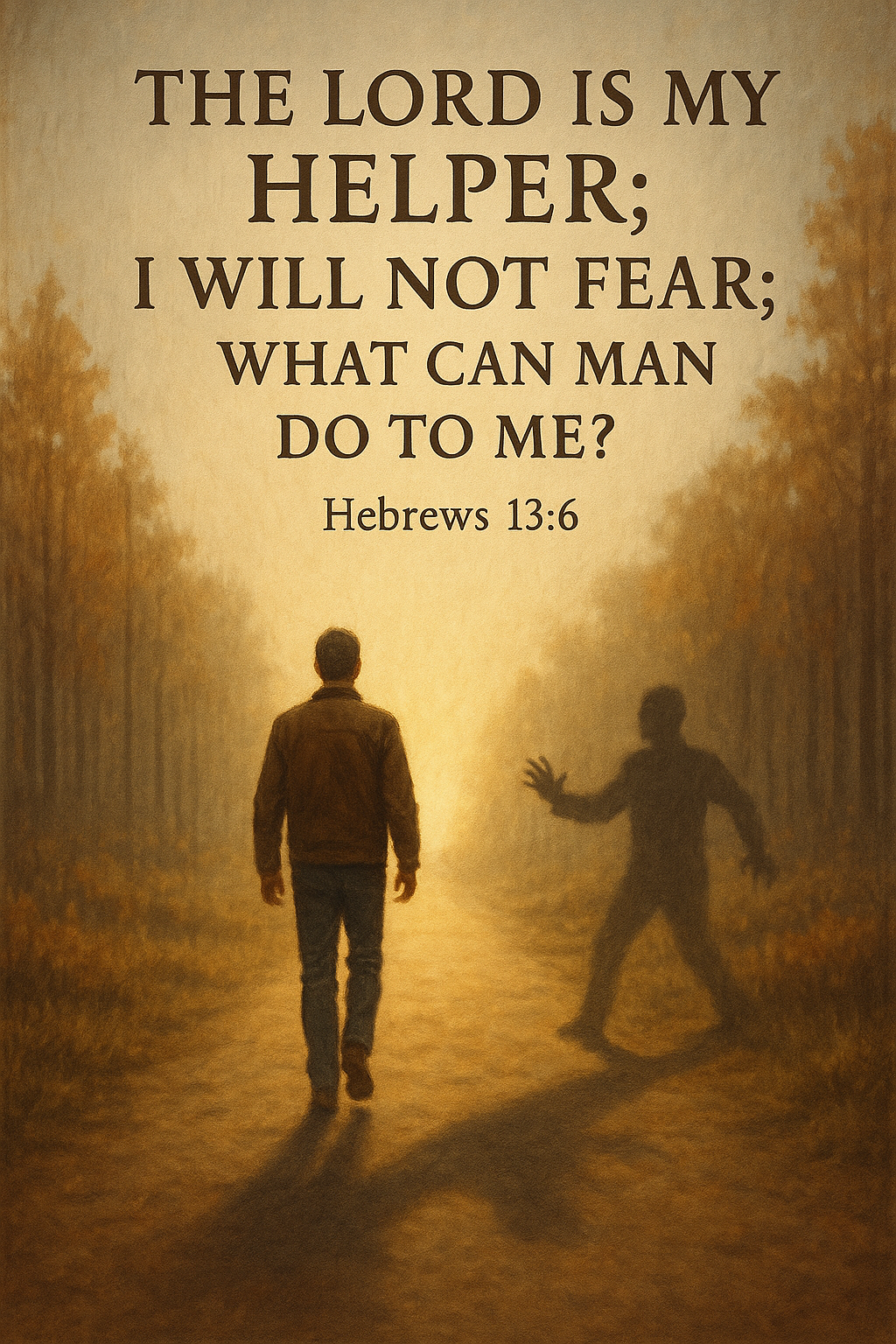
CONFIDENCE IN THE HELP OF
OUR COVENANT KEEPING GOD
So that (hoste) is a term of purpose or result -The logical result is this: because God has promised never to leave or forsake us, we are able to speak with confidence. This foundational truth produces courage in the believer and enables us to boldly declare the words that follow. Because God has spoken, we can speak with confidence—His promise makes our courage inevitable. His pledge produces our boldness.
We confidently (tharrheo - be courageous, boldness based on certainty) say, "THE LORD (kurios - the Sovereign Lord) IS MY HELPER (boetheos - One Who runs to my cry), I WILL NOT (ou - absolutely not) BE AFRAID (phobeo - be intimidated, be struck with terror). WHAT WILL MAN DO TO ME?" Because God never leaves, the believer can always speak with boldness. Confidence is not a feeling—it is a conclusion drawn from God’s character. In the present context we can continually (tharrheo - present tense) being full of courage, can act boldly in speaking or claiming the OT promise that Jehovah is our Helper (boetheos), the One who hears our cry and runs to our aid. It pictures a believer whose fear dissolves in the presence of God’s promises. This is not self-confidence, not circumstantial confidence but God-confidence. It is not our courage but His presence that takes fear away. Are you confident of this wonderful truth beloved?
Confidence in Christ is meant
to be continual, not occasional
Say in is present tense, continually say. To whom do we say the following? Our confidence in God gives us the courage to say to people that He is our Helper. Don't read this too fast. Ponder the thought a moment -- that the Almighty One, the Living God, the infinite, transcendent, omnipotent, etc God, the very God of gods and Lord of lords is our personal Helper! Do I really grasp the significance and practical import of this awesome truth?
🙏 THOUGHT - Pause and ponder this truth. Don’t rush past it. Think of it: The Almighty One…the Living God…the infinite, eternal, transcendent, sovereign, omnipotent Lord of heaven and earth—He is our personal Helper. The God Who spoke galaxies into existence… the God Who rules nations… the God before Whom angels veil their faces… He is the One Who runs to our cry. Do I truly grasp the weight, the wonder, the significance, and the practical implications of this? This is not abstract theology—it is the everyday reality that the Creator of the universe willingly, lovingly, and continually comes to my aid. What fear can survive that truth? What trial can crush the one who knows that the Lord Himself has pledged to be his Helper? And if that were not enough, our Great High Priest is continually interceding for us! (Heb 7:25).
The Lord is my Helper (boetheos - One Who runs to my cry) - There is no verb "is" in the Greek, so it's almost like its God's Name equates with "My Helper"! (see Jehovah Ezer: The LORD our Helper) Awesome! The LXX of Ps 19:14 translates David's affirmation "O LORD, my Rock" as "kurie boethe mou" which literally reads "Lord Helper my"! David sees the Rock as his Helper!
🙏 THOUGHT -Practically how would you come to know God as your Helper even as David had come to know Him in such an intimate way? We have to remember to cry out to Him for help in the midst of the testing circumstances (which we do because we trust Him and know He is faithful), when the waters are rising and all we can see is disaster and doom. As we learn to do this as a lifestyle, we will grow (like David did as he learned to depend on God while fleeing from Saul) in our experiential knowledge that God alone is our Rock, our Helper in times of temptation and like Paul we will come to know that Jesus is our ever present Friend Who sticks closer than a brother and Who will come to our cry for help. (see Paul's testimonies in Php 4:11,12, Php 4:13, 2Co 12:9, 2Cor 12:10, cp Jesus desire to come when we cry out for His help - Heb 2:18).
Man’s actions are limited;
God’s help is limitless.
David Guzik - “The LORD is my helper.” Real contentment comes only when we trust in God to meet our needs and to be our security. Strangely we are often more likely to put security and find contentment in things far less reliable and secure than God Himself. (Hebrews 13)
Spurgeon - This promise of the Lord is fitted to nerve us with courage, as well as to solace us with contentment. Chicken hearts and craven fears ill become the disciples of Christ. If God is our helper, why should we shrink or falter? Why should we droop or look dismayed? Why should we hold our peace or speak with bated breath? Are there any of you who are afraid to confess my Lord’s name before men, to enlist in His service, to buckle on His armor, to avow yourselves His followers? Parley no longer, I ask you, with such ungracious fears.
The writer is quoting from the Septuagint (LXX) translation of Ps 118:6 a Messianic psalm (see below) which is therefore fulfilled in Jesus Christ the One Who sticks closer than a brother (Pr 18:24)! If God be our friend, it matters not who is our enemy. Contented Christians are people with priorities, and material things are not high on their priority list. They have begun to more and more lay aside those things that weigh them down and which impede fruitful, focused ministry (cp He 12:1 "encumbrances"; "20/20" spiritual vision in He 12:2).
Hebrew translation = Psalm 118:7 The LORD is for me among those who help me; Therefore I shall look with satisfaction on those who hate me. 8 It is better to take refuge in the LORD Than to trust in man. 9 It is better to take refuge in the LORD Than to trust in princes.
Septuagint (LXX) translation = LXE Psalm 118:7 The Lord is my helper; and I shall see my desire upon mine enemies. 8 It is better to trust in the Lord than to trust in man. 9 It is better to hope in the Lord, than to hope in princes.
The writer combines the Septuagint translations from 2 Psalms -- Ps 118:6 [Lxx: kurios emoi boethos ou phobethesomai (1SFPI) ti poiesei (3SFAI) moi anthropos] and Ps 56:11 [Lxx: ti poiesei (3SFAI) moi anthropos (what can man do to me)]
Confidently (2292) (tharrheo from tharsos = cheer, cheerful, courage - Ac 28:15) means to be of good cheer or to have confidence or certainty in a matter. It expresses boldness rooted in assurance, not arrogance. It is used in contexts where believers are encouraged to remain courageous in the face of fear or uncertainty because of God's promises and the assurance of His presence. Expresses inner confidence or boldness in the face of trials or uncertainty. Reflects a Spirit-empowered confidence rooted in faith in God’s promises, not in human strength.In 2 Corinthians 5:6–8, Paul uses tharrheo to describe the believer’s mindset in the face of death. This courage is not rooted in self-assurance but in the certainty of being with Christ after death, a truth made possible by the resurrection. In 2 Corinthians 7:16, Paul uses tharrheō to express restored relational confidence in the Corinthian church after their repentance. This word reminds us that Christian courage is not the absence of fear, but the presence of faith—a faith that looks beyond the temporal to the eternal, and acts boldly in love and truth.
Tharreo - 5 uses in the NT - 2 Co. 5:6; 2 Co. 5:8; 2 Co. 7:16; 2 Co. 10:1; 2 Co. 10:2; Heb. 13:6
Lord (2962)(kurios from kuros = might or power) refers to master or the one who exercises absolute control and is the Greek word used to translate the Hebrew word Jehovah (in Ps 118:6). At its core, kurios means master, owner, or one who possesses authority. In secular Greek, it could refer to a landowner, a head of household, or a political ruler. However, in the New Testament, its significance is elevated and deepened, especially when applied to Jesus Christ. The word kurios is far more than a title of respect—it is a declaration of divine authority. When applied to Jesus, it affirms His deity, sovereignty, and right to rule. To call Jesus Lord is to acknowledge Him as the risen King, the Judge of all, and the One to whom every knee will bow. This confession is central to the gospel and essential to Christian faith.
Helper (998) (boethos is the noun form of the verb boetheo from boe = cry for aid + theo = to run) describes one (Jehovah in context) who runs on hearing a cry to give assistance, especially in danger. A helper, one who succors. Thus, boēthos is not a passive helper, but an active, responsive deliverer—someone who is poised and ready to come to the aid of someone in distress. God’s help is not distant, but is help that hastens to the side of the one who cries. This concept is also closely related to Hebrews 2:18, where Jesus is described as One who is able to “come to the aid” (boetheo) of those who are tempted. Jesus, our High Priest, is not only sympathetic but also responsive. He is ready to help us in our weakness, temptation, and suffering. Ponder this picture for a moment! Praise should be the natural outcome of meditation on this awesome truth! See Jehovah Ezer: The LORD our Helper
BOETHOS - ONLY ONCE IN NT BUT 45X in SEPTUAGINT - YOU MIGHT TAKE SOME TIME AND GO THROUGH SOME OF THESE FOR MANY REFER TO JEHOVAH - Ge 2:18; Gen. 2:20; Ex 15:2; Ex 18:4; Dt. 33:7; Dt. 33:26; Dt. 33:29; 1Sa. 7:12; 2Sa 22:42; 1 Chr. 12:18; Est. 4:17; Job 22:25; Job 29:12; Ps. 9:9; Ps. 18:2; Ps. 19:14; Ps. 27:9; Ps. 28:7; Ps. 30:10; Ps. 33:20; Ps. 40:17; Ps. 46:1; Ps. 52:7; Ps. 59:17; Ps. 62:8; Ps. 63:7; Ps. 70:5; Ps. 71:7; Ps. 72:12; Ps. 78:35; Ps. 81:1; Ps. 94:22; Ps. 115:9; Ps. 115:10; Ps. 115:11; Ps. 118:6; Ps. 118:7; Ps. 119:114; Ps. 146:5; Isa. 17:10; Isa. 25:4; Isa. 50:7; Isa. 63:5; Ezek. 12:14; Nah. 3:9;
An example from the Septuagint -
Psalm 115:9-11 O Israel, trust in the LORD; He is their help and their shield. 10 O house of Aaron, trust in the LORD; He is their help and their shield. 11 You who fear the LORD, trust in the LORD; He is their help and their shield (Who are those who can call God "their help and their shield"?).
Spurgeon comments: He is their help and their shield. He is the friend of his servants, both actively and passively, giving them both aid in labour and defence in danger. In the use of the pronoun "their," the Psalmist may have spoken to himself, in a sort of soliloquy: he had given the exhortation, "trust in Jehovah," and then he whispers to himself, "They may well do so, for he is at all times the strength and security of his servants."
He does aid and protect all those who worship him in filial fear, to whatever nation they may belong. No doubt these repeated exhortations were rendered necessary by the trying condition in which the children of Israel were found: the sneers of the adversary would assail all the people, they would most bitterly be felt by the priests and ministers, and those who were secret proselytes would groan in secret under the contempt forced upon their religion and their God. All this would be very staggering to faith, and therefore they were bidden again and again and again to trust in Jehovah.
John Gill: He is the help of his people; they are helpless in themselves, and vain is the help of man, for there is none in him; there is no help but in the Lord, and he is a present, seasonable, and sufficient help. Jehovah the Father has promised them help, and he is both able and faithful to make it good; he has laid help upon his Son for them; and has set up a throne of grace, where they may come for grace to help them in time of need. Christ has helped them out of the miserable estate they were fallen into by sin; he helps them on in their way to heaven, by his power and grace, and at last brings them thither. The Spirit of God helps them to the things of Christ; to many exceeding great and precious promises; and out of many difficulties, snares and temptations; and he helps them in prayer under all their infirmities, and makes intercession for them, according to the will of God; and therefore they should trust in the Lord, Father, Son, and Spirit.
The Fireman Who Ran Toward the Flames - When others were running out of the burning building, one firefighter ran into it. Why? Someone had cried for help. That is the picture of boēthos—God running toward danger for the sake of His child. When fear rises like smoke around your soul, remember: God does not run away—He runs toward you.
The Lifeguard Who Dove In - At the beach, a lifeguard sits high above the water. He watches calmly—until he hears a cry. The moment the cry reaches his ear, he moves. He doesn’t debate. He dives. God hears your cry before the words fully leave your mouth. His help is not delayed—it is decisive.
The Guide in the Cave - Inside a cave, one step can mean safety or disaster. A guide leading a tour once said, “Stay close to me. If you’re near me, you’re safe even in the dark.” People followed without fear. Your safety is not found in perfect vision but in perfect proximity—staying close to your Helper.
The Storm-Tossed Boat and the Lighthouse - A sailor caught in a storm could barely steer, but the lighthouse piercing through the rain gave him a direction he could trust. The storm didn’t vanish, but he was no longer afraid—because he had a helper guiding him home. God doesn’t always calm the waves, but He always shines the way. 1Co 10:13 says "No temptation has overtaken you but such as is common to man; and God is faithful, who will not allow you to be tempted beyond what you are able, but with the temptation will provide THE WAY OF ESCAPE also, so that you will be able to endure it. "
The Child Crossing the Busy Street - A father took his daughter’s hand to cross a chaotic street. She held his finger weakly; he clasped her hand firmly. Cars zoomed by, but she was never in danger—not because she held on, but because he wouldn’t let go. God’s grip outmatches your fear. “I will not be afraid” because He holds on.
The Mountain Climber’s Rope - A climber slipped on an icy ledge and hung suspended over a ravine. The rope held him, not his strength. When he reached safety, he said, “The rope saved me, not my grip.” Your security rests not in how tightly you hold God, but how faithfully He holds you. “The Lord is my helper.”
The Toddler and the Thunderstorm - A little child trembled in the night as thunder cracked over the house. She cried out, “Daddy!” Her father didn’t call back from across the hallway—he ran to her room and scooped her up. The storm didn’t stop, but her fear did—because her helper had arrived. God may not silence every storm, but He never ignores your cry. His presence calms what His power has not yet removed.
HELP - This is the age of “How To” books. You can find nearly every kind of “How To” imaginable. In fact, a quick search of one online bookstore revealed 32,000 different “How To” titles!
But what happens when you can’t find the “How To” you need most? What do you do when you want to know How To Get Your Children To Live Right, or How To Make Your Spouse Cherish You, or How To Survive The Death Of A Loved One, but you simply cannot find an answer?
When the “How To” books of life don’t bring you what you are so desperately seeking, here’s how to make it when “How To’s” don’t work.
* If you are a believer in Christ, remember His promise never to leave you (Hebrews 13:5).
* Realize the remarkable truth that the Holy Spirit is praying for you. Ro 8:26 says that the Spirit understands your difficulties when you cannot even express them, and He prays to the Father for you.
* Turn to the Lord in the midst of your difficulty, for He is your refuge and strength. When trouble hits, He’s there with you to calm your fears (Psalm 46:1, 2).
With help from God, you can get through even your toughest challenges. — by Dave Branon (Our Daily Bread, Copyright RBC Ministries, Grand Rapids, MI. Reprinted by permission. All rights reserved)
Got any rivers you think are uncrossable?
Got any mountains you can't tunnel through?
God specializes in things thought impossible—
He does the things others cannot do.
—Eliason Poem (August 20) by Oscar Eliason,
(c) Renewal 1973 by Singspiration, Inc.
Our troubles seem smaller
when we ponder the greatness of God.
I WILL NOT BE AFRAID. WHAT SHALL MAN DO TO ME?: (kai) ou phobethesomai (1SFPI) ti poiesei (3SFAI) moi anthropos:
- I will not be afraid - Ps 56:4,11,12; Ps 118:6; Da 3:16, 17, 18; Mt 10:28; Lk 12:4,5, Isa 41:10
- Hebrews 13 Resources - Multiple Sermons and Commentaries
- Hebrews 13:5-6 Cultivating Contentment - Steven Cole
- Hebrews 13:5-6 The Principles of Contentment - John MacArthur
FEAR GOD AND YOU
WILL FEAR NO MAN
I WILL NOT (ou - absolutely not) BE AFRAID (phobeo - be intimidated, be struck with terror). WHAT WILL MAN DO TO ME?" This is the mind-set that will ride the waves no matter how high the water rises or how hard the wind blows—just as Chrysostom did when he was brought before the Roman emperor and was threatened with banishment: “Thou canst not banish me for this world is my father’s house.” “But I will slay thee,” said the Emperor. “Nay, thou canst not,” said the noble champion of the faith, “for my life is hid with Christ in God.” “I will take away thy treasures.” “Nay, but thou canst not for my treasure is in heaven and my heart is there.” “But I will drive thee away from man and thou shalt have no friend left.” “Nay, thou canst not, for I have a friend in heaven from whom thou canst not separate me. I defy thee; for there is nothing that thou canst do to hurt me.”
Shadrach, et al are a perfect OT illustration of application of this truth…
Daniel 3:16 Shadrach, Meshach and Abed-nego (faced with certain death at least from a human perspective) answered and said to the king, "O Nebuchadnezzar, we do not need to give you an answer concerning this matter. 17 "If it be so, our God whom we serve is able to deliver us from the furnace of blazing fire; and He will deliver us out of your hand, O king. 18 "But even if He does not, let it be known to you, O king, that we are not going to serve your gods or worship the golden image that you have set up."
Spurgeon - Do not let fifty places or five hundred people make you swerve from the course that faith dictates and duty demands. Appeal to God, and He will provide for you. Any temporary loss you may sustain will be much more than made up in the prosperity He awards you, or if not in that way, in the peace He gives you and the honor He confers on you in suffering for Christ’s sake.
Related Resources
- How To Handle Fear Part 1
- How To Handle Fear Part 2
- How To Handle Fear Part 3
- How To Handle Fear Part 4
- The Fear of the Lord
- Anxiety (merimna) - Word Study
- Anxious, be anxious (merimnao) - Word Study
- Anxiety-Worry-Quotes, Devotionals & Illustrations
Be afraid (5399) (phobeo from phobos = fear source of our English "phobia") means to be in an apprehensive state that can range from mild uneasiness to stark terror as when one is frightened, terrified or alarmed. (Mt 10:31). Phobeo can be a fear of man (Lk 20:19, Mt 2:22, Mt 21:26, 46) as when Peter feared "the party of the circumcision" (Gal 2:12) which motivated him "to withdraw and hold himself aloof." Pilate experienced fear when he was about to sentence Jesus to death (Jn 19:8). Fear of people kept religious leaders from laying hands on Jesus (Luke 20:19) On the other hand Moses did not fear man (pharaoh - Heb 11:27) Believers were afraid of Paul after his Damascus Road experience, not realizing he had been born again (Lk 9:26). It is worth noting that fear (in negative sense) is a response contrary to faith and we all need the Lord's grace to overcome this fear, recalling that overcomers are those who believe (1Jn 5:4, 1Jn 5:5).
PHOBEO SEE below for all 85 uses
Wayne Detzler on the root word phobos - In ancient Greek the word phobos came from the word phebomai meaning to flee, or to be startled. Thus phobos meant flight or terror, and was connected with fear of the unknown, fear of the future, and fear of authorities. It also took on the meaning of fear or reverence for God. This was particularly true in the teaching of Aristotle. (New Testament Words in Today's Language)
John MacArthur on phobeo - the most common use of it in the New Testament represents reverential awe, not cringing fright. It expresses the feeling of a person who is in the presence of someone infinitely superior… (Commenting on phobos and phobeo) In the synoptic gospels and Acts the term is never used to speak of anything other than the feeling in a person’s heart when he is confronted with divine power, and it is declared to be a part of the Christian’s attitude as he seeks to faithfully serve the Lord (Acts 9:31). Reverential awe of God is a part of the truly repentant life (2Cor. 7:10–11), the chaste life (1 Pet. 3:2), the holy life (2 Cor. 7:1), and the godly life (Phil. 2:12). Mutual ministry, love, and respect, as well as powerful evangelism and proper church discipline, are all grounded in reverential awe of the Lord (see 2 Cor. 5:11; Eph. 5:21; 1 Tim. 5:20). It is the substance out of which all right Christian worship, behavior, and service must come. (Matthew Commentary)
Fear of God takes two forms, a healthy, reverential awe of the creature before the Creator including the idea of fear of offending (Ro 11:20) or the terror and dread of the unregenerate sinner in the presence of the just and holy God (Lxx of Ge 3:10, cp Lk 12:5).
Puritan Charles Bridges defines fear of God - It is that affectionate reverence by which the child of God bends himself humbly and carefully to his Father's law. His wrath is so bitter, and His love so sweet; that hence springs an earnest desire to please Him, and—because of the danger of coming short from his own weakness and temptations—a holy watchfulness and fear, 'that he might not sin against Him.
Webster's English definitions of to fear (Etymology - Old English = "faer" = danger; faeran = frighten) - To experience an unpleasant feeling of distress, apprehension, alarm caused by impending danger, pain, etc. It is to have a painful agitation in the presence or anticipation of danger implying anxiety and usually loss of courage (e.g., "fear of the unknown") To fear is experience an unpleasant often strong emotion, painful emotion or passion excited by an expectation of evil, or the apprehension of impending danger. Webster's 1828 adds that " In Scripture, fear is used to express a filial or a slavish passion. In good men, the fear of God is a holy awe or reverence of God and His laws, which springs from a just view and real love of the divine character, leading the subjects of it to hate and shun every thing that can offend such (a holy being, and inclining them to aim at perfect obedience. This is filial fear. "I will put My fear in their hearts." (Jer. 32:40) Slavish fear is the effect or consequence of guilt; it is the painful apprehension of merited punishment. (Ro 8:15)."
George Brooks - The word “fear” (phobeo) means to reverence or stand in awe. It carries the idea of devotion, worship, and adoration. The fear of God is the beginning of wisdom. Fearing God includes trusting him at all times and in all circumstances. Fearing God is trusting his wisdom and his works. God can be trusted because we as Christians know that he works all things for our good and his glory. Fearing God is a motivating factor in Christian living. Because of our reverence and respect for God, we want to please him. We do not want to do things that anger God when we reverence and respect him. (George Brooks Sermon Commentary)
Stephen Renn - Divine exhortations for people “not to fear” in the face of theophanic revelations include those in Mt 1:20; 28:5, 10; Mk 5:36; Lk 1:13; 2:10; Jn 6:20; Rev. 1:17. See also Mt 10:26 ff.; Jn 12:15; Heb. 11:23. General references to people “being afraid” include Mt 2:22; Lk 19:21; Jn 19:8; Acts 5:26; 2Co. 12:20; Gal. 2:12; 1Jn. 4:18. In particular, Mt 27:54; Mk 4:41; Lk 2: 9; 8:35; 9:34; Jn 6:19 record people’s fear at the manifestation of signs and miracles. Lk 1:50; Acts 10:2, 22; Col. 3:22; 1Pe. 2:17; Rev. 14:7 describe the positive phenomenon of expressing “fear” towards God. In contrast, Lk 12:5 contains a warning “to fear” God, who is able to cast one into hell. See also Lk 23:40. An exhortation to “fear” the civil authorities for their power to wield the sword in judicial execution is noted in Ro 13: 4. The meaning “to respect” is indicated in the context of a wife’s appropriate attitude to her husband in Eph. 5:33. (Expository Dictionary)
Nelson's New Illustrated Dictionary (BORROW) on fear - a feeling of reverence, awe, and respect, or an unpleasant emotion caused by a sense of danger. Fear may be directed toward God or humankind, and it may be either healthy or harmful. A healthy fear is reverence or respect. The Bible teaches that children are to respect their parents (Lev. 19:3), wives are to respect their husbands (Eph. 5:33), and slaves are to respect their masters (Eph. 6:5). The Scriptures also declare that "the fear of the LORD is the beginning of knowledge" (Pr. 1:7) as well as "the beginning of wisdom" (Pr. 9:10). A harmful fear is a sense of terror or dread. Believers are instructed not to fear human beings (Matt. 10:28; Phil. 1:28), because they cannot ultimately harm us. Wicked men, however, are constantly fearing other people, especially the righteous (Pr. 28:1; Matt. 14:5; Ro 13:3-4). Such fear causes them to act deceitfully in an attempt to hide their sins (2Sa 11; Matt. 28:4-15). On the other hand, the unbeliever has every reason to be panic-stricken at thoughts of God, for he stands condemned before Him (Mt. 10:28; Jn 3:18). And yet, this kind of fear of God does not often lead to repentance. It normally leads to a feeble attempt to hide from God (Ge 3:8,10; Rev. 6:15-17) or worse, to a denial of God’s existence and His claim on a person’s life (Ps. 14:1; Ro 1:18-28). (Youngblood, Ronald F.; Bruce, F. F.; Harrison, R. K)
In the Gospels phobeo is frequently a command from Jesus to not fear or to stop fearing. (Mt 10:28, 31)
The human response to supernatural phenomena is often fear (Mt 14:27 - phobos used in Mt 14:26, Mt 17:6 "heard this" = Mt 17:5, Mt 27:54, 28:5, Lk 2:9, Lk 8:35, Lk 1:13 - see context Lk 1:12 which uses phobos; cp phobos in Lk 7:16) but sometimes they were struck with awe (phobeo) (Mt 9:8).
In other contexts phobeo has the sense of to reverence, to show awe or to show respect, and speaks especially of having reverential fear of God (Lk 1:50, 1Pe 2:17, see this sense of the noun phobos in Eph 5:21). This sense describes a wife having respect for her husband (Eph 5:33).
Romans 13:3-4 speaks of fear of authority as a motivation to not commit evil.
While fear can be a strong emotion with negative effect, Jesus describes fear as a powerful motive in Mt 10:28 and Lk 12:4-5. Similarly "fearing the Lord" is a positive motivation in Col 3:22.
To have fear is a desirable attitude in several other contexts - fear of God (Acts 10:2) In Acts 13:16, 26 we see a distinction between Jews and those who fear God, which presumably describe Gentile "God fearers" (cf the Gentile Cornelius in Acts 10:2, 22, 35).
Fear of God in Rev 14:7 is associated with the eternal Gospel (Rev 14:6). In Rev 11:18 fear appears to be associated with believers described as "those who fear Your Name." Fear of God is a heart attitude of those who know Him in Rev 19:5. Sadly while unbelievers should be afraid of God's wrath and the judgment that awaits, "there is no fear (phobos) of God before their eyes" (Ro 3:18).
In 2 Cor 12:20 Paul says "I am afraid" expressing an intense, deep-seated anxiety specifically regarding his great concern for the situation at Corinth (cp similar meaning in 2Cor 11:3). As John MacArthur says "Nothing is more painful for the faithful pastor than unrepentant sin among his flock."
Vine - phobeo - in earlier Greek, "to put to flight", in the NT is always in the Passive Voice, with the meanings either (a) "to fear, be afraid," its most frequent use, e.g., Acts 23:10 or (b) "to show reverential fear" (1) of men, Mk 6:20; Eph 5:33 (2) of God, e.g., Acts 10:2,22; 13:16,26; Col 3:22; 1Pe 2:17; Rev 14:7; 15:4; 19:5; (a) and (b) are combined in Lk 12:4,5 , where Christ warns His followers not to be afraid of men, but to "fear" God. (Vine's Expository Dictionary)
Related Resources:
- Fear Multiple dictionaries and International Standard Bible Encyclopedia
- Fear - Trench's Synonyms of the New Testament
- What does “perfect love casts out fear” mean? Gotquestions.org
- What does the Bible say about fear? Gotquestions.org
- How is the fear of the Lord the beginning of wisdom? Gotquestions.org
- What does it mean to have the fear of God? Gotquestions.org
- How can I overcome the fear of death? How can I stop being scared of dying? Gotquestions.org
- What does it mean to work out salvation with fear and trembling (Philippians 2:12)? Gotquestions.org
- Faith vs. fear - what does the Bible say? Gotquestions.org
- How can I overcome my fear of the end of days? Gotquestions.org
- What does the Bible say about having a phobia? Gotquestions.org
- How can a Christian overcome the fear of witnessing? Gotquestions.org
Fear God (offer service with reverence and awe because God is a consuming fire) not men.
Isaiah 41:10 'Do not fear, for I am with you; Do not anxiously look about you, for I am your God. I will strengthen you, surely I will help you, Surely I will uphold you with My righteous right hand.'
Isaiah 41:14 "Do not fear, you worm Jacob, you men of Israel; I will help you," declares the LORD, "and your Redeemer is the Holy One of Israel.
Romans 8:31 What then shall we say to these things? If God is for us, who is against us?
Psalm 56:4 In God, whose word I praise, In God I have put my trust; I shall not be afraid. What can mere man do to me?
Spurgeon comments: In God I will praise his word. Faith brings forth praise. He who can trust will soon sing. God's promise, when fulfilled, is a noble subject for praise, and even before fulfilment it should be the theme of song. It is in or through God that we are able to praise. We praise as well as pray in the Spirit. Or we may read it -- in extolling the Lord one of the main points for thanksgiving is his revealed will in the Scriptures, and the fidelity with which he keeps his word of promise.
In God I have put my trust. Altogether and alone should we stay ourselves on God. What was a gracious resolve in the former verse, is here asserted as already done.
I will not fear what flesh can do unto me. Faith exercised, fear is banished, and holy triumph ensues, so that the soul asks, "What can flesh do unto me?" What indeed? He can do me no real injury; all his malice shall be overruled for my good. Man is flesh, flesh is grass -- Lord, in thy name I defy its utmost wrath. There were two verses of complaint (Ps 56:1,2), and here are two of confidence (Ps 56:3,4); it is well to weigh out a sufficient quantity of the sweet to counteract the sour.
Psalm 56:11 In God I have put my trust, I shall not be afraid. What can man do to me?
Septuagint (LXX) translation = Psalm 56:11 I have hoped in God; I will not be afraid of what man shall do to me.
Spurgeon comments: In God have I put my trust. This and the former verse are evidently the chorus of the Psalm. We cannot be too careful of our faith, or see too sedulously that it is grounded on the Lord alone.
I will not be afraid what man can do unto me. Faith has banished fear. He views his foes in their most forcible character, calling them not flesh, but indicating them as man, yet he dreads them not; though the whole race were his enemies he would not be afraid now that his trust is stayed on God. He is not afraid of what they threaten to do, for much of that they cannot do; and even what is in their power, what they can do, he defies with holy daring. He speaks for the future, "I will not," for he is sure that the security of the present will suffice for days to come.
Vance Havner - Pattern for Perilous Times
There is a price to pay (2 Tim. 4:9-22).
There is a promise to plead (2 Tim. 4:17; Heb. 13:5, 6).
There is a prize to possess (2 Tim. 4:8).
Vance Havner - Following on to Know the Lord (Hos. 6:1-3)
A heavenly promise: "Then shall we know..."
A high pursuit: "If we follow on..."
A holy purpose: "To know the Lord..."
We are bought with an infinite price (1 Peter 1:18, 19).
We are beset by invisible powers (Eph. 6:12).
We are blessed by an invincible presence (Heb. 13:5, 6).
Holy Dependence
There is no security in things. In fact, things are deceptive: they appear to be satisfying and lasting when they are actually temporary and unable to satisfy the deepest needs of life... Certainly, God wants us to enjoy the blessings of life. There is nothing spiritual about sitting morosely in a corner and saying, "These things will not last anyway! Why enjoy them?" God wants us to enjoy his good gifts, just as we want our children to enjoy what we give them. But he does not want us to depend on things—He wants us to depend on Him. —Warren W. Wiersbe in Meet Yourself in the Parables. Christianity Today, Vol. 32, no. 4. See: Job 11:18; Psalms 112:7; Hebrews 13:6.
Taking the Plunge
I had just gone through a series of medical tests. Fearful of the results, I went swimming at the local YMCA to pass the time. There I noticed a father carrying his son over to the deep end. Still holding his child, he plunged into the deep water. A few seconds later they surfaced—the son laughing and brushing water from his eyes, the father guiding him safely to the pool's edge. This picture of a father and child spoke powerfully to me. I realized that just like that boy, we are protected by our heavenly Father—and when we can be confident we're in his arms. —Martha Whitmore Hickman, "Heart to Heart," Today's Christian Woman. See: Job 11:18; Psalms 112:7; Hebrews 13:6
James Smith - THE POWER OF HIS PRESENCE.
The presence of Christ means power, whether we are conscious of it or not. When He gave His last commission to His disciples, saying, "All power is given unto Me... Go ye therefore... . Lo, I am with you alway." He was pledging His presence as the guarantee of every needful thing for the fulfilment of His will through them. His presence—
1. Gives SECURITY to the perplexed (Gen. 28:15).
2. Gives ENCOURAGEMENT to witness-bearing (Exod. 3:12; Heb. 13:5, 6).
3. Gives STRENGTH to the warrior (Josh. 1:5).
4. Gives COMFORT to the timid (Jer. 1:8).
5. Gives VICTORY to the tempted (Gen. 39:2-21).
6. Gives CONFIDENCE to the servant (Matt. 28:20; Phil. 4:13).
7. Gives REST to the pilgrim (Exod. 33:14).
James Smith - EMMANUEL. Matthew 1:23."They shall call His Name Emmanuel, which, being interpreted is, God with us."
1. God with us in the flesh (1 Tim. 3:16; John 1:14).
2. God with us as a Redeemer (Acts 20:28; 1 Peter 1:18, 19).
3. God with us to reconcile (2 Cor. 5:19).
4. God with us in all fullness (Col. 2:9; John 1:16, 17).
5. God with us as an example (Phil. 2:5, 6).
6. God with us as a companion (2 Cor. 6:16).
7. God with us always (Matt. 28:20; Heb. 13:5, 6).
Partnership with God
This partnership with God ought to give us the same sense of confidence as the youngster had who was selling five-cent pencils door-to-door to raise money for a 30-million-dollar hospital for the community. One day a woman opened the door, and he said, "Ma'am, would you buy one or two pencils from me? I'm going to help build a 30-million-dollar hospital for our community."
She said, "Sonny, that's a mighty big goal for just one kid selling pencils for a nickel."
He said, "Oh, Ma'am, it's not me alone. See that boy across the street? He's my partner. He's helping. We're really doing it together."
This little boy had great faith in a partner who was probably his equal. Should we not have this kind of confidence in a God who is unequalled, a God who is in partnership with us to make our lives fruitful? See: Psalm 146:5-6; Isaiah 41:10; Romans 4:18-21; Hebrews 13:6
Vance Havner - Take Hold!
"The spider taketh hold with her hands, and is in kings' palaces." Prov. 30:28
The spider is not popular but she is diligent and aggressive and gets things done. If one web is swept away she spins another and doesn't hesitate to take up quarters even in kings' palaces.
So might you and I dwell in the spiritual King's palace if only we took hold by the hand of faith. If we took hold of God's grace and took hold of opportunity and took hold of life with a positive eye to business instead of timidly and gingerly, we should live in the courts of the King instead of in some spiritual attic.
We get mixed up in our ideas of humility. It is never inconsistent with a holy boldness for we take hold in the name of Another. Since he is our High Priest, we may come boldly to the throne of grace and since he has said we may boldly say (Heb. 4:16; 13:6). If you have a spirit of fear you didn't get it from God for he has not given us such torment (2 Tim. 1:7).
Take hold boldly by faith and dare to spin your web in the King's palace! Don't live in an attic!
Vance Havner - "But God Was with Him"
But God was with him. Acts 7:9.
This is one of the many "But Gods" in the Book that spell quite a difference. Joseph's brothers sold him into Egypt, but God was with him. Joseph himself put it this way: "Ye thought evil against me; but God meant it unto good" (Gen. 50:20). What men thought was overruled by what God wrought. "Man proposes but God disposes."
"He hath said, I will never leave thee, nor forsake thee. So that we may boldly say, The Lord is my helper, and I will not fear what man shall do unto me" (Heb. 13:5, 6). No plottings of men, no combinations of circumstances can defeat the man who has God as his helper. Here is the secret of many a life, conspired against by ill health, poverty, evil men, foes in the household, the world, the flesh and the devil, but victorious, anyway—God was with him. The devil and men often overstep themselves, sell Joseph into Egypt, but God makes him Prime Minister! "If God be for us, who can be against us?"
And even in the last dark chapter we need not tremble at our Adversary, but triumph with our Ally—"I will fear no evil, for thou art with me."
But God was with him. What a difference that makes!
The Wisdom of the Coney
The coney, or rock badger, is a small creature—something like an oversized prairie dog. Its gray fur blends so well with the rocky cliffs that when it lies still on the sun-warmed stone, it is nearly invisible. But when danger approaches, the coney knows exactly what to do: it darts into a narrow crevice in the rock. If a hawk or eagle wants to seize it, the predator would practically have to tear the mountain apart to reach it.
Coneys are not strong. They are not fast. But they are wise—they know where their security lies. As long as they stay near the rock, they are safe.
(BOY, DOES THAT PREACH! - cf David's words in Ps 18:1-2 - "“I love You, O LORD, my strength.” The LORD is my rock and my fortress and my deliverer, My God, my rock, in whom I take refuge; My shield and the horn of my salvation, my stronghold.") But if a coney wanders out onto the open prairie, far from its refuge, it becomes easy prey. It doesn’t matter how brave it feels or how much it “trained” at the animal gym—the smallest predator can take it down. Away from the rock, a coney is simply dead meat.
The biblical writers would look at the coney and draw a spiritual lesson:
“If you have the wisdom of a rock badger,
you will know where your true security is found.
"Your refuge must be in God Himself.”
Adapted from Haddon Robinson, "The Wisdom of Small Creatures," Preaching Today, Tape No. 93. See: Job 11:18; Psalms 91:5; Proverbs 3:24; Hebrews 13:6.
Robert Morgan - How would you fill in this blank: The Lord is my ___________. Various characters in the Bible answered that question in different ways:
• Moses said, "The Lord is my strength and my song.... The Lord is my banner" (Exod. 15:2, 17:15).
• The psalmist said, "The Lord is my refuge" (Ps. 94:22).
• Isaiah said, "God is my salvation" (Isa. 12:2).
• Jeremiah wrote, "The Lord is my portion" (Lam. 3:24).
• The writer of Hebrews said, "The Lord is my helper" (Heb. 13:6).
• David said, "The Lord is my rock, my fortress, and my deliverer, my God, my mountain where I seek refuge, my shield and the horn of my salvation, my stronghold" (Ps. 18:2).
• And we all say, "The Lord is my Shepherd" (Ps. 23:1).
The old-time Christians had a phrase for all this. When we seek Him with all our hearts, Jesus becomes our "all-in-all." He fills all our lives, meets all our needs, and claims all our affections.
(ED: SUGGESTION - TAKE ABOUT 3 MINUTES AND LISTEN/SING THE SONG "MY ALL IN ALL"! JESUS IS OUR ALL IN ALL FOREVER AND EVER. AMEN AND AMEN!!!)
Jesus only, Jesus ever,
Jesus all in all we sing,
Savior, Sanctifier, and Healer,
Glorious Lord and coming King.
—A. B. Simpson
Only believe, and thou shalt see
That Christ is all in all to thee.
—John S. B. Monsell
First Flight
Our daughter was terribly anxious the first time she flew in a plane. "What if the plane falls down?" she asked as we boarded. "What's that sound?" she questioned as the engines revved. During take-off she squeezed my hand till her knuckles turned white. However, once we were above the clouds, she released her grip and announced, "It's okay now. I'm not afraid. We're above the clouds... and next to heaven." —Joan Marie Arbogast, Ohio. "Small Talk," Today's Christian Woman.
Vance Havner - "He Hath Said"
"He hath said... so that we may boldly say...." Heb. 13:5, 6
Satan came in the form of a serpent asking, "Yea, hath God said?" Our Lord came in the form of a servant affirming, "Yea, God hath said!"
We either ask or affirm, we don't believe or we do. A Christian is a human question mark that has been straightened out by the grace of God into an exclamation mark of positive affirmation.
Consider the authority of the promiser: "He hath said." What gives the word of God authority is simply the fact that it is the word of God! Consider the authority of the promise: "He hath said." A check has no authority of its own, the name on the bottom gives it its value. It is God's name to the Book that gives it authority and please remember that his promises are checks to be cashed, not mere mottoes to hang on the wall!
Consider the authority of the promisee: "So that we may boldly say...." Backed up by God's Word, the checkbook of glory, we can invest heavily and carry on great business buying up the time although we are only beggars in ourselves. Arm a beggar with a millionaire's signed checkbook and see what happens! Yet God has armed us who believe with the checkbook of the Word and some of us go on in a miserly way as though nothing had happened! We don't have to get rich, we are rich and won't believe it!
John Wayne said "Courage is being scared to death and saddling up anyway."
Kay Arthur - As God’s child, you no longer have to fear being abandoned, left alone, or left without help.
When we walk with God in the silent times, He becomes all that matters—not our emotions, not our desires, not our pleasures. We begin to walk in meekness, accepting everything as coming from God without murmuring, disputing, or retaliating. This precious truth becomes ours.
Kenneth Osbeck - Borrow Amazing grace : 366 inspiring hymn stories for daily devotions
HOW FIRM A FOUNDATION
1787 “K”—in Rippon’s Selection of Hymns,
So we say with confidence, “The Lord is my helper; I will not be afraid. What can man do to me?” (Hebrews 13:6).
A believer’s stability for this life, as well as his confidence for eternity, rests solely on the written promises of God’s Word. The direction of the living God for our lives is very definite. It is found in a firm foundation—the written revelation: “Thus saith the Lord.”
In the first stanza the sure foundation of the Christian faith is established as being the Word of God. This challenging question is posed: What more can God do than provide His very Word as a completed revelation of Himself to man? The succeeding verses personalize precious promises from His Word:
Verse Two—Isaiah 41:10—“Fear thou not, for I am with thee, be not dismayed, for I am thy God …”
Verse Three—Isaiah 43:2—“When thou passest through the waters, I will be with thee …”
Verse Four—2 Corinthians 12:9—“My grace is sufficient for thee; for my strength is made perfect in weakness …”
Verse Five—Hebrews 13:5—“I will never leave thee, nor forsake thee …”
The authorship of the text has always been a mystery to hymnologists. Its first appearance was in 1787 in Selection of Hymns, published by Dr. John Rippon, pastor of the Carter’s Lane Baptist Church in London. He was one of the most popular and influential dissenting ministers of his time.
How firm a foundation, ye saints of the Lord, is laid for your faith in His excellent Word! What more can He say than to you He hath said—To you, who for refuge to Jesus have fled?
“Fear not, I am with thee—O be not dismayed, for I am thy God, I will still give thee aid; I’ll strengthen thee, help thee, and cause thee to stand, upheld by my gracious, omnipotent hand.
“When thru the deep waters I call thee to go, the rivers of woe shall not thee overflow; for I will be with thee thy troubles to bless, and sanctify to thee thy deepest distress.
“When thru fiery trials thy pathway shall lie, My grace, all-sufficient, shall be thy supply; the flame shall not hurt thee—I only design thy dross to consume and thy gold to refine.
“The soul that on Jesus hath leaned for repose, I will not, I will not desert to his foes; that soul, tho all hell should endeavor to shake, I’ll never—no, never—no, never forsake.”
For Today: Deuteronomy 31:6, 8; Psalm 36:1; Psalm 118:6, 7; Hebrews 13:5, 6
Plant your feet firmly on the “thus saith the Lords” and live life confidently in that strength. Carry this musical message with you—
How Firm a Foundation - BORROW 101 HYMN STORIES BY KENNETH OSBECK
Author—“K” in Rippon’s Selection of Hymns, 1787
Music—An Early American Folk Melody from Caldwell’s Union Harmony, 1837
Tune Name—“Foundation”
Meter—11 11. 11 11
So that we may boldly say, The Lord is my helper, and I will not fear what man shall do unto me. Hebrews 13:6
Throughout our country this hymn has been for many years one of the stalwart hymns in evangelical churches, especially the Baptist Churches.
The authorship of the text has always been a mystery to hymnologists. Its first appearance was in 1787 in a hymnal, Selection of Hymns, published by Dr. John Rippon, pastor of the Carter’s Lane Baptist Church, London, England. Dr. Rippon was pastor of this important church for sixty-three years and was considered to be one of the most popular and influential dissenting ministers of his time. The hymn appeared anonymously in his collection with the author indicated merely as “K—.” Later reprints also gave “Kn,” and one, “Keen.” Since the music director in Dr. Rippon’s church was named R. Keene, it has generally been thought that he was the author of the text.
Rippon’s hymnal was exceedingly popular immediately: eleven editions were printed in England before the pastor’s death in 1836, and an American edition was also printed by the Baptist Churches in Philadelphia in 1820. This hymnal has often been called the “unofficial hymn textbook for Baptist Churches.” “How Firm a Foundation” became well-known throughout our Northern and Southern States during the time of the Civil War and was included in most American publications of that time.
The composer of this music is also unknown. It has been established that the tune is one of the sturdy folk tunes originating in the South. It first appeared in 1837 in William Caldwell’s publication, Union Harmony.
Like many of our fine hymns this text is really a sermon in verse. In the first stanza the sure foundation of the Christian faith is established as being the Word of God. This challenging question is posed: what more can God do than provide His very Word as a completed revelation of Himself to man? The succeeding verses personalize the precious promises from His Word:
Verse Two—Isaiah 41:10— “Fear thou not, for I am with thee, be not dismayed, for I am thy God …”
Verse Three—Isaiah 43:2— “When thou passest through the waters, I will be with thee …”
Verse Four—2 Corinthians 12:9— “My grace is sufficient for thee; For my strength is made perfect in weakness …”
Verse Five—Hebrews 13:5— “I will never leave thee, nor forsake thee …”
“How Firm a Foundation” has been a favorite hymn and testimonial of many of God’s children throughout the years. It was the favorite of such American leaders as Theodore Roosevelt, Andrew Jackson, who requested that it be sung at his bedside shortly before he died at the Hermitage, as well as Robert E. Lee, who also requested it for his funeral hymn “as an expression of his full trust in the ways of the Heavenly Father.”
C H Spurgeon - WE MAY BOLDLY SAY. Hebrews 13:6
The fact that the Lord has constantly been our helper confirms our faith. If in looking back we could find a point where God failed, we might let our faith waiver. I speak from experience. I cannot find one example in all my life in which God was untrue or unkind. If we never doubt God until we have a reason, we will never doubt so long as we live.
Yesterday I looked at some birds in a cage. These poor little creatures are entirely dependent on those who feed them. They cannot help themselves. If seed and water is not supplied, they will die. Yet there they sit and sing with all their might. Their state of dependence never distresses them. They never think that their keeper will fail them.
That is my position. I am God’s singing bird. Perhaps I wonder where I shall get my bread or my next sermons, and a great many cares and troubles come to me. But why should I be troubled? Instead of mistrusting my keeper, who has fed me these many years, I had best sit and sing as loudly as I can. That is the best thing to do. The birds do it, so why not you and me? We are suppose to have more intellect than a bird, but at times we do not seem to have half as much.
The Lord has constantly been true. Do not doubt. If some remarkable trial should waylay you between here and heaven, you will find extraordinary deliverance from Him who has been your helper. “For He Himself has said, ‘I will never leave you nor forsake you.’ So we may boldly say: ‘The LORD is my helper; I will not fear’ ” (Heb. 13:6).
Stephen Olford - The Lord is my helper; I will not fear.” – Hebrews 13:6
What an encouraging verse this is! Solomon says, “The fear of man brings a snare” (Prov. 29:25). How true this is! Bondage to men because of fear is one of the greatest snares in a Christian's life. But this need not be if the heart is in the experience of this verse: “The Lord is my helper, I will not fear. What can man do to me?” (Heb. 13:6).
O, that I may enter into the practical experience of this verse; that I may be delivered from the fear of man. It would almost seem that Timothy suffered from the same things, for Paul writes to him, “Stir up the gift of God… . For God has not given us a spirit of fear, but of power and of love and of a sound mind. Therefore do not be ashamed of the testimony of our Lord” (2 Tim. 1:6-8).
SAMUEL LAMB - by Joyce Brown - Courageous Christians: Devotional Stories for Family Reading
THE LORD IS MY HELPER; I WILL NOT BE AFRAID. WHAT CAN MAN DO TO ME? (HEBREWS 13:6)
Samuel Lamb was born in China in 1924. His parents were Christians who modeled trust in God and obedience. He was a small, frail child who often had infections in his lungs. At five, he became so ill from diphtheria that a doctor said he had no chance of living. But he did live, and it is said his mother told him, “God touched you because He needs you.” Later, during World War Two, a Japanese bomb barely missed him. Again Samuel felt that God had spared his life for a special reason.
During his teens and early twenties, he developed many abilities that would one day help him serve God. He went to a boarding school in Hong Kong, where he learned to speak English. In college he became a gifted concert pianist, learned to give his classmates haircuts, memorized large portions of Scripture, and went beyond his required studies to become a pastor.
After the war, the new Chinese government tried to stop all religious groups except the official church (a church that claimed the Bible was not accurate and that Christ was not really God). The government restrictions caused Christians to start worshiping in homes. Samuel began a church in his home with thirty members.
He was speaking at a church in a nearby city one day when he met a lovely Christian woman named Sing Yin. Believing she was God’s choice for him, he asked her to marry him the following year. Samuel and Sing Yin deeply loved the Lord, one another, and the two children who later blessed their home.
By 1955, the government said that not cooperating with the official church and its beliefs was the same as not obeying the government. Samuel knew that if he continued to preach the complete Word of God he would be in danger. But he obeyed God, anyway. Soon the government declared that house churches with more than thirty-five people were illegal, and Samuel was arrested.
He was not allowed to attend his own trial. Witnesses who defended him were soon silenced. People who had never been to his church lied about what he preached. In prison he risked further punishment and death by witnessing to the other prisoners. He also wrote several hymns, even though he was not allowed to sing. After a year and a half, he was set free because of the lack of evidence against him.
Without hesitating, he went back to leading his house church. It soon grew to more than one hundred members. Less than a year later, he was again arrested. This time he was sentenced to twenty years of hard labor.
First, Samuel was sent to a livestock and tea plantation. Although he barely weighed a hundred pounds, he was forced to work at removing old tea shrubs with a shovel, pick, and ax. After they had worked long hours in the fields, prisoners were given some cabbage soup and for several more hours were forced to listen to talks on being better Communists. Sometimes the pain and exhaustion seemed too much to bear, but he found comfort by remembering Bible verses such as “I can do all things through Christ who strengthens me.”
As he worked and as he lay on his insect-covered bed, Samuel strained to remember more Bible verses. Many prisoners noticed his kindness and spiritual strength and quietly asked him about his faith. Risking severe punishment, he led them to the Lord. Eventually, he was assigned to office work and was later made the camp barber. Because he cut the prisoners’ hair one at a time, he was able to do more witnessing and to encourage other Christians.
After five years, he met a prisoner who had a New Testament. The man let him use it. Samuel made handwritten copies of as much Scripture as he could late at night—until a guard caught him. The guard took away the Bible and Samuel’s copies.
For punishment, he was moved to a coal mine, where the work was even harder than the fieldwork had been. The mines were dark, dirty, and dangerous. Coal dust got in his lungs and weakened his body. All day long he strained his muscles almost beyond endurance and then was forced to sit through eight- to twelve-hour lectures on Communism. Others lost hope, but Samuel felt the Lord was always with him.
Finally he was released, and he rushed home to Sing Yin—only to learn that she was dead. Communist soldiers had taken most of the family’s belongings, part of their home, and all of Samuel’s Bibles and books. His sister had been able to find another Bible somewhere, which he gratefully read for hours at a time.
Once more, he began holding church services in his home. This time the congregation grew to thirteen hundred members, who came on different days of the week. Police and other officials threatened him several times.
And then China started opening its doors to the Western world. People representing President Reagan, and later President Bush, visited Samuel. Billy Graham featured him on one of his television programs. News reporters from different countries broadcast reports of the trouble the Chinese government gave him. This attention helped protect Samuel and his church from further punishment. But police still tried to frighten him and sometimes seized his teaching materials.
By 1980 he was the best-known house church pastor in China. Other pastors traveled hundreds of miles to learn from him. Churches listened to cassettes of his teaching and passed them on to other churches. Thousands of copies of the booklets he wrote were spread throughout China.
DISCUSS As Christians in America, we are not put in jail or threatened by police because of what we believe. Still, what are some ways that fear of people can keep us from living for Christ?
David Jeremiah - I will not fear. What can man do to me? Slaying the Giants in Your Life: You Can Win the Battle and ... - Page 13
Mighty Lord, who shall separate me from the love of Christ? Shall tribulation, distress, persecution, famine, nakedness, peril, or sword? Yet in all these things I am more than a conqueror through Jesus who loved me.
I will not be afraid of those who kill the body, and after that have no more that they can do. But Jesus has shown me whom I should fear: fear Him who, after He has killed, has power to cast into hell; yes, Jesus says fear Him!
I am blessed when I am persecuted for righteousness’ sake, for mine is the kingdom of heaven. I am blessed when they revile and persecute me, and say all kinds of evil against me falsely for Jesus’ sake. I will rejoice and be exceedingly glad, for great is my reward in heaven. None of these things move me; nor do I count my life dear to myself, so that I may finish my race with joy. I will speak of Your testimonies, Lord God, before kings, and will not be ashamed.
May I fear You and You alone, Lord,
and therefore be bold in my witness to Your truth,
Your mercy, and Your grace.
HEBREWS 13:6; ROMANS 8:35, 37; LUKE 12:4–5; MATTHEW 5:10–12; ACTS 20:24; PSALM 119:46
C H Spurgeon - THE LORD IS MY HELPER. Hebrews 13:6
The God of the past has blotted out your sins (Acts 3:19). The God of the present makes all things work together for your good (Rom. 8:28). The God of the future will never leave you nor forsake you (Heb. 13:5). In God you are prepared for every emergency.
There is no point in having a God if you do not use Him, and yet many professing Christians would never dream of going to God for practical help. I believe that it is as well to have no God as to have an unreal God, one who cannot be found in the midnight of need. What a blessing to be able to go to God and pour out our hearts. God will be our Helper (Ps. 54:4), a near and dear Friend in joy and sorrow.
Dear friend, are you in trouble? Do you have a God? Then pray and spread your trial before Him. Do you have a troublesome letter in your house (2 Kin. 19:10–13)? Then go, like Hezekiah, and tell the Lord (2 Kin. 19:14). Is your child dying? Then cry to the Lord as David did (2 Sam. 12:16). Are you as low as Jonah? Then let your prayer rise from the bottom (Jon. 2:1). Are you bitter? Pour it out before the Lord.
Make good use of your God. Gain full advantage by pleading with Him. Tell Him your troubles. Search His promises, and then petition Him with holy boldness, for this is the surest and the fastest way to find relief.
What would we do if we could not speak with God, our ever–gracious Friend? We would die of a broken heart. Like Job, we would curse the day of our birth. We would wish that we had never been born (Job 3:3) and look forward to annihilation. But praise God, we can go to Him by faith and plead His promise. The dark clouds will withdraw, and we will come into the light and sing:
This God is our God forever and ever,
He will be our Guide, even unto death.
Adrian Rogers - We Have the Comfort of His Protection
Now, here is the fourth thing that will help you to face this coming year without fear, and that is the comfort of His protection. Notice Hebrews 13:6: “So that we may boldly say, The Lord is my helper, and I will not fear what man shall do to me—what man shall do unto me.” Now, most of us are saying, “What about Al Qaeda?” What about the terrorists? What about Saddam Hussein? What about this person? Listen, friend. God has said, “He will never leave you, He will not forsake you, and you must not fear what man shall do to you. The sum of all these is security; it is courage that comes from knowing that God is present. (See his full sermon A New Year Without Fear on page 1063)
John Piper - REASONS BELIEVERS IN CHRIST NEED NOT BE AFRAID (download pdf Pierced by the Word - Thirty-One Meditations for Your Soul)
OVER A HUNDRED TIMES IN THE BIBLE WE ARE TOLD not to be afraid. “Fear not, for I am with you; be not dismayed, for I am your God” (Isaiah 41:10). When we are young we are easily made afraid, though our knowledge of what can harm us is small. As we get older, our knowledge of risk and peril increases. Must our fears increase? One might answer no, because we also become wiser and more able to avoid danger and avert peril and overcome assault.
But there are better reasons not to let our fears increase. It is not so much because we become smarter or more able to avoid danger, but that we become more confident that, by faith in Jesus, God will take care of us in the way He sees best. It does not guarantee safety or comfort in this life. But it does guarantee everlasting joy, as we trust in Him. Trusting God, through Jesus Christ, is the key to fearlessness. And promises from God are the key that leads from the dungeon of fear. So consider these and be courageous.
1. We will not die apart from God’s gracious decree for His children.
If the Lord wills, we will live and do this or that. (James 4:15)
“Are not two sparrows sold for a penny? And not one of them will fall to the ground apart from your Father. But even the hairs of your head are all numbered. Fear not, therefore; you are of more value than many sparrows.” (Matthew 10:29–31)
See now that I, even I, am he, and there is no god beside me; I kill and I make alive; I wound and I heal; and there is none that can deliver out of my hand. (Deuteronomy 32:39) (See also Job 1:21; 1 Samuel 2:6; 2 Kings 5:7.)
2. Curses and divination do not hold sway against God’s people.
For there is no enchantment against Jacob, no divination against Israel. (Numbers 23:23)
3. The plans of terrorists and hostile nations do not succeed apart from our gracious God.
The LORD brings the counsel of the nations to nothing; he frustrates the plans of the peoples. (Psalm 33:10)
Take counsel together [you peoples], but it will come to nothing; speak a word, but it will not stand, for God is with us. (Isaiah 8:10) (See also 2 Samuel 7:14; Nehemiah 4:15.)
4. Man cannot harm us beyond God’s gracious will for us.
The LORD is on my side; I will not fear. What can man do to me? (Psalm 118:6)
In God I trust; I shall not be afraid. What can man do to me? (Psalm 56:11)
5. God promises to protect His own from all that is not finally good for them.
Because he holds fast to me in love, I will deliver him; I will protect him, because he knows my name. (Psalm 91:14)
6. God promises to give us all we need to obey, enjoy, and honor Him forever.
Therefore do not be anxious, saying, “What shall we eat?” or “What shall we drink?” or “What shall we wear?” … Your heavenly Father knows that you need them all. But seek first the kingdom of God and his righteousness, and all these things will be added to you. (Matthew 6:31–33)
And my God will supply every need of yours according to his riches in glory in Christ Jesus. (Philippians 4:19)
7. God is never taken off guard.
Behold, he who keeps Israel will neither slumber nor sleep. (Psalm 121:4)
8. God will be with us, help us, and uphold us in trouble.
“Fear not, for I am with you; be not dismayed, for I am your God; I will strengthen you, I will help you, I will uphold you with my righteous right hand.” (Isaiah 41:10)
“For I, the LORD your God, hold your right hand; it is I who say to you, ‘Fear not, I am the one who helps you.’ ” (Isaiah 41:13)
9. Terrors will come, some of us will die, but not a hair of our heads will perish.
Then [Jesus] said to them, “… there will be terrors and great signs from heaven.… and some of you they will put to death.… But not a hair of your head will perish.” (Luke 21:10–11, 18)
10. Nothing befalls God’s own but in its appointed hour.
So they were seeking to arrest him, but no one laid a hand on him, because his hour had not yet come. (John 7:30) (See also John 8:20; 10:18.)
11. When God Almighty is your helper, none can harm you beyond what He decrees.
So we can confidently say, “The Lord is my helper; I will not fear; what can man do to me?” (Hebrews 13:6)
If God is for us, who can be against us? (Romans 8:31)
12. God’s faithfulness is based on the firm value of His name, not the fickle measure of their obedience.
And Samuel said to the people, “Do not be afraid; you have done all this evil.… For the LORD will not forsake his people, for his great name’s sake.” (1 Samuel 12:20–22)
13. The Lord, our protector, is great and awesome.
Do not be afraid of them. Remember the Lord, who is great and awesome. (Nehemiah 4:14)
Great God of promise, grant us to believe what You have said. Take away our doubting. Don’t let us be like Peter, halfway across the waves of obedience, sinking for fear. Fix our minds and hearts firmly on Your Word and make us lionhearted in our love for others. Oh, that Your church would be the happiest, boldest, most unwavering risk-takers in the cause of justice and love! In Jesus’ all-providing name we pray. Amen.
Charles Spurgeon - Fear Only God
“So that we may boldly say, The Lord is my helper,and I will not fear what man shall do unto me.”—Hebrews 13:6
BECAUSE God will never leave nor forsake us, we may well be content with such things as we have. Since the Lord is ours, we cannot be left without a friend, a treasure, and a dwelling place. This assurance may make us feel quite independent of men. Under such high patronage, we do not feel tempted to cringe before our fellow men and ask of them permission to call our lives our own; but what we say, we boldly say and defy contradiction.
He who fears God has nothing else to fear. We should stand in such awe of the living Lord that all the threats that can be used by the proudest persecutor should have no more effect upon us than the whistling of the wind. Man in these days cannot do so much against us as he could when the apostle wrote the verse at the head of this page. Racks and stakes are out of fashion. Giant Pope cannot burn the pilgrims now. If the followers of false teachers try cruel mockery and scorn, we do not wonder at it, for the men of this world cannot love the heavenly seed. What then? We must bear the world’s scorn. It breaks no bones. God helping us, let us be bold; and when the world rages let it rage, but let us not fear it.
Living by the Polls - James Scudder
So that we may boldly say, The Lord is my helper, and I will not fear what man shall do unto me. Hebrews 13:6
The latest opinion poll finds that the majority of Americans are tired of opinion polls. I cannot prove that last statement, but I wouldn't doubt if it were true. Do you ever get sick of polls? They do serve a purpose, but I believe far too many decisions are based on the opinions of a select group of people.
It is hard to find leaders in government, business, and even in the church who are willing to stand for principle rather than what people want. We're often told that such courage doesn't win elections or produce large profit margins.
Harry Truman, one of my favorite presidents, was once quoted as saying, "How far would Moses have gone if He had taken a poll in Egypt? What would Jesus Christ have preached if he had taken a poll in the land of Israel? What would have happened to the Reformation if Martin Luther had taken a poll? It isn't polls or public opinion of the moment that counts. It is right and wrong and leadership."
Christians cannot run their lives based on public opinion. People are fickle and their desires change. The Apostle Paul stated his case saying, "If I yet pleased men, I should not be the servant of Christ." (Galatians 1:10)
God never promised that Christianity would be popular. Often, we try too hard to be people-pleasers rather than focusing on our main purpose-to be God-pleasers. We should be more worried about what God thinks of our lives than the fickle opinions of men.
It isn't polls or public opinion of the moment that counts.
It is right and wrong and leadership.
--Harry Truman
David Jeremiah - God is my defense. (ED: for a special blessing watch and listen to Marty Goetz's sing his song HE IS MY DEFENSE on Psalm 62. If this doesn’t lift your soul set your feet tapping, I’m not sure what will!)
You, Lord God, are my rock and my fortress and my deliverer; the God of my strength, in whom I will trust; my shield and the horn of my salvation, my stronghold and my refuge; my Savior. You, Lord, are my strength and my shield; my heart trusted in You, and I am helped; therefore my heart greatly rejoices, and with my song I will praise You.
When the enemy comes in like a flood, Your Spirit will lift up a standard against him. We may boldly say: “The Lord is my helper; I will not fear. What can man do to me?”
You are my light and my salvation; whom shall I fear? You are the strength of my life; of whom shall I be afraid?
As the mountains surround Jerusalem, so You, Lord God, surround Your people from this time forth and forever. Because You have been my help, therefore in the shadow of Your wings I will rejoice.
For Your name’s sake, lead me and guide me.
Almighty God, I praise You for Your power and strength—which You exercise on behalf of Your people.
Thank You for being my help, my protection, and my defense.
PSALM 59:9; 2 SAMUEL 22:2–3; PSALM 28:7; ISAIAH 59:19; HEBREWS 13:6; PSALM 27:1; PSALM 125:2; PSALM 63:7; PSALM
David Jeremiah - The Lord was my support. Life-Changing Moments with God: Praying Scripture Every Day
Lord, truly, it is vain to hope for salvation from the hills, and from the multitude of mountains; for truly, in You, Lord God, is the salvation of Israel. You, Lord, are my rock and my fortress and my deliverer; my God, my strength, in whom I will trust; my shield and the horn of my salvation, my stronghold. I cry out and shout, as an inhabitant of Zion, for great is the Holy One of Israel in our midst!
Your angel, Lord God, encamps all around those who fear You, and delivers me. The righteous cry out, and You, Lord, hear, and deliver me out of all my troubles. Eternal God, You are my refuge, and underneath are the everlasting arms. So I boldly say: “The Lord is my helper; I will not fear. What can man do to me?” Who is God, except You, Lord? And who is a rock, except You, my God? It is You, Almighty God, who arms me with strength, and makes my way perfect.
By Your grace, Father God, I am what I am.
Lord God, may I always and only look to You, my Shield, my Stronghold, my Helper.
PSALM 18:18; JEREMIAH 3:23; PSALM 18:2; ISAIAH 12:6; PSALM 34:7, 17; DEUTERONOMY 33:27; HEBREWS 13:6; PSALM 18:31–32; 1 CORINTHIANS 15:10
David Jeremiah - Life-Changing Moments with God: Praying Scripture Every Day
Let us therefore come boldly to the throne of grace, that we may obtain mercy and find grace to help in time of need.
Loving Father, I will be anxious for nothing, but in everything by prayer and supplication, with thanksgiving, let my requests be made known to You, Lord God; and Your peace, which surpasses all understanding, will guard my heart and mind through Christ Jesus. I did not receive the spirit of bondage again to fear, but I received the Spirit of adoption by whom I cry out, “Abba, Father.”
You, Lord, did not say to the seed of Jacob, “Seek Me in vain.” Having boldness to enter the Holiest by the blood of Jesus, by a new and living way which He consecrated for me, through the veil, that is, His flesh, and having a High Priest over the house of God, I draw near with a true heart in full assurance of faith, having my heart sprinkled from an evil conscience and my body washed with pure water. I may boldly say: “The Lord is my helper; I will not fear. What can man do to me?”
Lord God, may I never hesitate to go boldly before You in prayer. As a result may I know Your indescribable peace and a rich relationship with You.
HEBREWS 4:16; PHILIPPIANS 4:6–7; ROMANS 8:15; ISAIAH 45:19; HEBREWS 10:19–22; HEBREWS 13:6
C H Spurgeon - I WILL HELP YOU. Isaiah 41:10 (If you want to listen to an encouraging song - play MY HELP sung by the Brooklyn Tabernacle Choir.)
Yesterday’s promise secured strength for what we have to do today, but this promise guarantees help when we cannot act alone. The Lord says, “I will help you.” Strength within is supplemented by help from without. God can raise up allies in our warfare if it seems good in His sight. Even if He doesn’t send human assistance, He Himself will be at our side, and this is even better. “Our august Ally” is superior to thousands of human helpers.
His help is timely, for He is a very present help in time of trouble (Ps. 46:1). His help is wise, for He knows how to give what is good for us. His help is effective, though futile is the help of friends. His help is more than help, for He carries all the burdens and supplies, all the needs. “The LORD is my helper; I will not fear. What can man do to me?” (Heb. 13:6). Because He has already been our help, we feel confidence in Him for the present and the future.
Our prayer is, “LORD, be my helper” (Ps. 30:10).
Our experience is, “The Spirit also helps in our weaknesses” (Rom 8:26).
Our expectation is, “I will lift up my eyes to the hills—from whence comes my help? My help comes from the LORD, who made heaven and earth” (Ps. 121:1).
Our song will be, “You, LORD, have helped me and comforted me” (Ps. 86:17).
Robert Hawker - For he hath said, I will never leave thee, nor forsake thee. So that we may boldly say, The Lord is my helper, and I will not fear what man shall do unto me.—Hebrews 13:5, 6.
Sweet thought! Blessed promise of a covenant promiser, whose name is I AM! Indeed, the whole covenant of grace is made up of God’s wills, and his engaging for our shalls: and the whole is founded in the purposes of God’s love, and faithfulness, and immutability; secured in the blood and righteousness of Christ; and stamped with the broad seal of heaven, by God the Holy Ghost. Hence, therefore, the covenant runs, “I will be their God, and they shall be my people.” Hence, also, Jesus with all his fulness is in the covenant. And hence, also, the Holy Ghost is engaged to abide with them for ever, to lead them into all truth, and to glorify the Lord Christ in their hearts. How is it possible for them to do otherwise than rejoice, and boldly to say, “The Lord is my helper!” for the fear of man is driven out by the fear of God? My soul! what saith thine experience to this? Surely, thou wilt take up the same confident language, and from the same cause, as the Church. If the Lord hath said it, he will confirm it: He will never leave, neither forsake the redeemed of Jesus. So that I never shall be left hopeless, helpless, comfortless! Precious Jesus! in thee I set up the Ebenezer afresh this evening: Thou, Lord, art my helper: “I will not fear what man shall do unto me!”
Bill Bright - He Is My Helper
That is why we can say without any doubt or fear, ‘The Lord is my Helper, and I am not afraid of anything that mere man can do to me.’ HEBREWS 13:6
Do you and I really exercise perfect confidence that God will help us in our times of need?
The writer to the Hebrews borrows a clause, an expression, used by the psalmist. “The Lord taketh my part with them that help me: therefore shall I see my desire upon them that hate me” (Psalm 118:7, KJV).
With the Lord as our helper, mere man can do nothing to us or against us except that which God permits (Acts 4:28). Whatever trials we face, the fact remains that God will be our protector and friend in and through them all.
One effective tool of the enemy is to bring up “exception clauses” time and time again. “My God is able to do anything, but … I’m not quite sure of His interest and/or power in this particular situation.” “I know He can help me, but it may not be His will at this particular time or in this particular case.”
In the face of God’s power, mere man begins to look pretty small, and that is just the way God intends it to be. He wants to give us confidence that He is able for every need we have: large, small or medium. None is too large, none too small for Him.
Joshua Rowe The Lord Is My …
Often we view ourselves as the Lord’s people, His servants, His messengers, and rightly so. I wonder how often, though, we remember what the Lord is to us.
The Lord Is My …
- The Lord Is My Rock and My Fortress (2 Sam. 22:2; Ps. 18:2).
- The Lord Is My Light (Ps. 27:1).
- The Lord Is My Strength (Ex. 15:2; Ps. 28:7; 118:14).
- The Lord Is My Shield (Ps. 28:7).
- The Lord Is My Song (Ex. 15:2; Ps. 118:14).
- The Lord Is My Portion (Lam. 3:24).
- The Lord Is My Helper (Heb. 13:6).
- The Lord Is My Salvation (Ex. 15:2; Ps. 27:1).
May these verses encourage us to have closer intimacy with God and exhort us to daily crown Him as our Lord.
Daily Light on the Daily Path - You, O God, are my fortress.
“The Lord is my rock and my fortress and my deliverer, my God, my rock, in whom I take refuge, my shield, and the horn of my salvation, my stronghold and my refuge, my savior.”—The Lord is my strength and my shield; in him my heart trusts, and I am helped; my heart exults, and with my song I give thanks to him.
He will come like a rushing stream, which the wind of the Lord drives.—We can confidently say, “The Lord is my helper; I will not fear; what can man do to me?”
The Lord is my light and my salvation; whom shall I fear? The Lord is the stronghold of my life; of whom shall I be afraid?
As the mountains surround Jerusalem, so the Lord surrounds his people, from this time forth and forevermore.—For you have been my help, and in the shadow of your wings I will sing for joy.
For your name’s sake you lead me and guide me.
Ps. 59:9; 2 Sam. 22:2–3; Ps. 28:7; Isa. 59:19; Heb. 13:6; Ps. 27:1; Ps. 125:2; Ps. 63:7; Ps. 31:3
Daily Light on the Daily Path - The Lord was my support.
“Truly the hills are a delusion, the orgies on the mountains. Truly in the Lord our God is the salvation of Israel.”—The Lord is my rock and my fortress and my deliverer, my God, my rock, in whom I take refuge, my shield, and the horn of my salvation, my stronghold.—“Shout, and sing for joy, O inhabitant of Zion, for great in your midst is the Holy One of Israel.”
The angel of the Lord encamps around those who fear him, and delivers them. . . . When the righteous cry for help, the Lord hears and delivers them out of all their troubles.—“The eternal God is your dwelling place, and underneath are the everlasting arms.”—So we can confidently say, “The Lord is my helper; I will not fear; what can man do to me?”—For who is God, but the Lord? And who is a rock, except our God?—the God who equipped me with strength and made my way blameless.
But by the grace of God I am what I am.
Ps. 18:18; Jer. 3:23; Ps. 18:2; Isa. 12:6; Ps. 34:7, 17; Deut. 33:27; Heb. 13:6; Ps. 18:31–32; 1 Cor. 15:10
Daily Light on the Daily Path - I will not fear; what can man do to me?”
Who shall separate us from the love of Christ? Shall tribulation, or distress, or persecution, or famine, or nakedness, or danger, or sword? No, in all these things we are more than conquerors through him who loved us.
“Do not fear those who kill the body, and after that have nothing more that they can do. But I will warn you whom to fear: fear him who, after he has killed, has authority to cast into hell. Yes, I tell you, fear him!”
“Blessed are those who are persecuted for righteousness’ sake, for theirs is the kingdom of heaven. Blessed are you when others revile you and persecute you and utter all kinds of evil against you falsely on my account. Rejoice and be glad, for your reward is great in heaven.”—“But I do not account my life of any value nor as precious to myself, if only I may finish my course.”—I will also speak of your testimonies before kings and shall not be put to shame.
Heb. 13:6; Rom. 8:35, 37; Luke 12:4–5; Matt. 5:10–12; Acts 20:24; Ps. 119:46
Daily Light on the Daily Path - Let us then with confidence draw near to the throne of grace, that we may receive mercy and find grace to help in time of need.
Do not be anxious about anything, but in everything by prayer and supplication with thanksgiving let your requests be made known to God. And the peace of God, which surpasses all understanding, will guard your hearts and your minds in Christ Jesus.—For you did not receive the spirit of slavery to fall back into fear, but you have received the Spirit of adoption as sons, by whom we cry, “Abba! Father!”
“I did not say to the offspring of Jacob, ‘Seek me in vain.’”—Therefore, . . . since we have confidence to enter the holy places by the blood of Jesus, by the new and living way that he opened for us through the curtain, that is, through his flesh, and since we have a great priest over the house of God, let us draw near with a true heart in full assurance of faith, with our hearts sprinkled clean from an evil conscience and our bodies washed with pure water.—So we can confidently say, “The Lord is my helper; I will not fear; what can man do to me?”
Heb. 4:16; Phil. 4:6–7; Rom. 8:15; Isa. 45:19; Heb. 10:19–22; Heb. 13:6
Daily Light on the Daily Path - “I will never leave you nor forsake you.”
So we can confidently say, “The Lord is my helper; I will not fear; what can man do to me?”
“Behold, I am with you and will keep you wherever you go, and will bring you back to this land. For I will not leave you until I have done what I have promised you.”—“Be strong and courageous. Do not fear or be in dread of them, for it is the Lord your God who goes with you. He will not leave you or forsake you.”
For Demas, in love with this present world has deserted me. . . . At my first defense no one came to stand by me, but all deserted me. May it not be charged against them! But the Lord stood by me and strengthened me.—For my father and my mother have forsaken me, but the Lord will take me in.
“And behold, I am with you always, to the end of the age.”—“[I am] the living one. I died, and behold I am alive forevermore.”— “I will not leave you as orphans; I will come to you.”—“My peace I give to you. “
Heb. 13:5; Heb. 13:6; Gen. 28:15; Deut. 31:6; 2 Tim. 4:10, 16–17; Ps. 27:10; Matt. 28:20; Rev. 1:18; John 14:18; John 14:27
HE'S ALWAYS THERE IN YOUR DARKEST NIGHT
The darkness shall not hide from You; the darkness and the light are both alike to You. PSALM 139:12 Hebrews 4:13, Hebrews 13:5, 6
The early American Indians had a unique practice of training young braves. On the night of a boy's thirteenth birthday, after learning hunting, scouting, and fishing skills, he was put to one final test. He was placed in a dense forest to spend the entire night alone. Until then, he had never been away from the security of the family and the tribe. But on this night, he was blindfolded and taken several miles away. When he took off the blindfold, he was in the middle of a thick woods and he was terrified! Every time a twig snapped, he visualized a wild animal ready to pounce. After what seemed like an eternity, dawn broke and the first rays of sunlight entered the interior of the forest. Looking around, the boy saw flowers, trees, and the outline of the path. Then, to his utter astonishment, he beheld the figure of a man standing just a few feet away, armed with a bow and arrow. It was his father. He had been there all night long.
We sometimes feel like that boy—alone, fearful, engulfed by darkness. But in the thickest gloom is the all-seeing eye of our Father God. We have no reason to fear. —D. J. D. (Reprinted by permission from Our Daily Bread Ministries. Please do not repost the full devotional without their permission.)
IN THE DARK OF THE NIGHT,
GOD IS THE LIGHT.
TOMORROW'S TERRORS - Peter Marshall, whose dynamic preaching attracted crowds of people, died suddenly on the morning of January 25, 1949, at the age of 46. In one of his sermons he had said: “When the clock strikes for me, I shall go, not one minute early, and not one minute late. Until then, there is nothing to fear. I know that the promises of God are true, for they have been fulfilled in my life time and time again. Jesus still teaches and guides and protects and heals and comforts, and still wins our complete trust and our love.”
Do you and I share that same fear-dispelling conviction? Can each of us, like David, say to our Lord, “My times are in Your hand”? (Psalm 31:15). Are we confident that God holds us in His almighty hands? Can we boldly say, “The Lord is my helper; I will not fear. What can man do to me?” (Hebrews 13:6).
True, we may have concern about the days ahead. As Scripture reminds us, we “do not know what will happen tomorrow” (James 4:14). But we do know that whatever happens He will always be with us (Hebrews 13:5). That knowledge can lighten any burden of worry about the future.
Some anxiety about the process of dying is normal. Yet, by the grace of God and by the comfort of His Spirit, we can face tomorrow’s terrors with courage. — by Vernon C. Grounds (Our Daily Bread, Copyright RBC Ministries, Grand Rapids, MI. Reprinted by permission. All rights reserved)
I don't know about tomorrow,
Nor what coming days will bring;
But I know my Lord is with me,
And His praise my heart will sing. —FitzhughWorry can do a lot of things to you;
prayer can do a lot of things for you.
HE'S THERE FOR ME - Because I frequently interview Christian athletes for Sports Spectrum magazine, I notice common themes that run through their lives. One theme is the importance of parents in the lives of stars who find success in life as well as on the field.
Howard Cross, a football player for the New York Giants, typifies that response. “I spent most of my time with my dad. He was always there for me, taking care of me, pointing me in the right direction.” And basketball player Avery Johnson, point guard for the San Antonio Spurs, says, “My parents were prime-time examples. They were always there for me.”
“Always there”—what a tribute those two words are for parents! The importance of “being there” is indisputable. Children need a shoulder to cry on, a hand to hold, a heart to share.
Let’s take it another step. Parents who demonstrate this “being there” attitude show us on a small scale what God does for us. He literally is always there! And He promises, “I will never leave you nor forsake you” (Heb 13:5).
There’s never a moment you can’t ask your heavenly Father for help. There’s not a trial you go through without His assistance. Once you’ve placed your faith in Christ, you can confidently say, “He’s always there for me!” — by Dave Branon (Our Daily Bread, Copyright RBC Ministries, Grand Rapids, MI. Reprinted by permission. All rights reserved)
Never a burden that He does not carry,
Never a sorrow that He does not share;
Whether the days may be sunny or dreary,
Jesus is always there.
—Lillenas
You need not fear where you're going,
because God is going with you.
WHAT DO YOU FEAR - One of Grimm’s fairy tales is about a rather dimwitted young man who didn’t understand what it meant to shudder in fear. People attempted to shock him by putting him in all sorts of terrifying situations—but to no avail. He finally did shudder, though not out of fear. He was asleep when someone poured a bucket of cold water and wiggling fish on top of him.
Something is wrong with us if we’re never afraid. Fear is the natural human reaction to any difficult or dangerous undertaking, and God doesn’t condemn it. Neither does He want us to be crippled by fear. Jesus’ words to His disciples on more than one occasion were, “Do not be afraid” (Luke 5:10; 12:4; John 6:20). In each case He used a verb tense that suggests continuance. In other words, He told them, “Don’t keep on fearing.”
We need not be overcome by our fear, nor should we ever say no to doing what we know God wants us to do merely because we are fearful. God can turn our fear into fortitude. We can trust God and “not be afraid” (Psalm 56:11).
Courage is not the absence of fear but the mastery of it. So let’s resist our fear and meet it with faith in our Lord, for He has said, “I will never leave you nor forsake you” (Hebrews 13:5).— by David H. Roper (Our Daily Bread, Copyright RBC Ministries, Grand Rapids, MI. Reprinted by permission. All rights reserved)
Do not fear the darkness that is gathering all around,
For the Lord is with you, and in Him true peace is found;
When you're facing trouble, or when tragedy seems near,
Jesus is the only one to drive away your fear. —Hess
We can face any fear when we know the Lord is near.
(See Related Resource Onsite - Fear, How to Handle It )
LIFETIME GUARANTEE - Three years ago I bought a suitcase with a lifetime guarantee. “We don’t care who breaks it,” the manufacturer said, “we’ll repair or replace it free—forever.” To its credit, the company repaired it twice, just as promised. But a few weeks ago I learned that the business had filed for bankruptcy and its future was in doubt. If the company goes under, so does the guarantee.
In a world where we can’t always depend on guarantees, there is one promise we can trust. Throughout Scripture we find the Lord’s pledge to be with His people. In Deuteronomy 31 we read Moses’ assuring words to Joshua: “The Lord … will be with you, He will not leave you nor forsake you; do not fear nor be dismayed” (Dt 31:8 also Dt 31:6).
This promise is repeated in the New Testament: “He Himself has said, ‘I will never leave you nor forsake you.’ So we may boldly say: ‘The Lord is my helper; I will not fear. What can man do to me?’” (Hebrews 13:5, 6). The promise of God’s unfailing presence with us is the key to living with confidence and contentment.
No matter how many pledges are broken by people, God’s promises will last through all time and eternity. Because He is eternal, He can give us an eternal guarantee. — by David C. McCasland (Our Daily Bread, Copyright RBC Ministries, Grand Rapids, MI. Reprinted by permission. All rights reserved)
Sweetest of all life's blessings,
Communion with Christ above,
Assurance of His presence,
His matchless, eternal love.
—Anon.
Every promise of God
comes with an eternal guarantee.
95x in 92v in the NT - NAS Usage: afraid(39), am afraid(2), awestruck(1), fear(27), feared(5), fearful(2), fearing(6), fears(2), frightened(7), have… fear(1), respects(1), terrified(1).
Matthew 1:20 But when he had considered this, behold, an angel of the Lord appeared to him in a dream, saying, "Joseph, son of David, do not be afraid (verb subjunctive aorist passive 2nd person functioning as verb imperative aorist passive) to take Mary as your wife; for the Child who has been conceived in her is of the Holy Spirit.
Matthew 2:22 But when he heard that Archelaus was reigning over Judea in place of his father Herod, he was afraid to go there. Then after being warned by God in a dream, he left for the regions of Galilee,
Matthew 9:8 But when the crowds saw this, they were awestruck, and glorified God, who had given such authority to men.
Matthew 10:26 "Therefore do not fear them (verb subjunctive aorist passive 2nd person functioning as verb imperative aorist passive), for there is nothing concealed that will not be revealed, or hidden that will not be known.
28 "Do not fear (present imperative with a negative) those who kill the body but are unable to kill the soul; but rather fear Him who is able to destroy both soul and body in hell.
31 "So do not fear (present imperative with a negative); you are more valuable than many sparrows.
Matthew 14:5 Although Herod wanted to put him to death, he feared the crowd, because they regarded John as a prophet.
27 But immediately Jesus spoke to them, saying, "Take courage, it is I; do not be afraid (present imperative with a negative)."
30 But seeing the wind, he became frightened, and beginning to sink, he cried out, "Lord, save me!"
Matthew 17:6 When the disciples heard this, they fell face down to the ground and were terrified.
7 And Jesus came to them and touched them and said, "Get up, and do not be afraid (present imperative with a negative)."
Matthew 21:26 "But if we say, 'From men,' we fear the people; for they all regard John as a prophet."
46 When they sought to seize Him, they feared the people, because they considered Him to be a prophet.
Matthew 25:25 'And I was afraid, and went away and hid your talent in the ground. See, you have what is yours.'
Matthew 27:54 Now the centurion, and those who were with him keeping guard over Jesus, when they saw the earthquake and the things that were happening, became very frightened and said, "Truly this was the Son of God!"
Matthew 28:5 The angel said to the women, "Do not be afraid (present imperative with a negative); for I know that you are looking for Jesus who has been crucified.
10 Then Jesus said to them, "Do not be afraid (present imperative with a negative); go and take word to My brethren to leave for Galilee, and there they will see Me."
Zodhiates - Fear will also grip people when Jesus returns to earth accompanied by heavenly signs and disturbances (Luke 21:25-27). Scripture says that men's hearts [will be] failing [from apopsúchō , expiring as if the soul {psuche} were departing "from" {apó} the body, literally being scared almost to death] them for fear [from phóbos], and for looking after those things which are coming on the earth: for the powers of heaven shall be shaken. (Luke 21:26) (Exegetical Commentary on Matthew)
Mark 4:41 They became very much afraid (Mt 8:27 says they were "amazed") and said to one another, "Who then is this, that even the wind and the sea obey Him?"
Mark 5:15 They came to Jesus and observed the man who had been demon-possessed sitting down, clothed and in his right mind, the very man who had had the "legion"; and they became frightened.
33 But the woman fearing and trembling, aware of what had happened to her, came and fell down before Him and told Him the whole truth.
36 But Jesus, overhearing what was being spoken, said to the synagogue official, "Do not be afraid (present imperative with a negative) any longer, only believe."
Mark 6:20 for Herod was afraid of John, knowing that he was a righteous and holy man, and he kept him safe. And when he heard him, he was very perplexed; but he used to enjoy listening to him.
50 for they all saw Him and were terrified. But immediately He spoke with them and said to them, "Take courage; it is I, do not be afraid (present imperative with a negative)."
Mark 9:32 But they did not understand this statement, and they were afraid to ask Him.
Zodhiates - imperfect middle of phobéō, to be afraid] to ask Him" (a.t.). The middle voice implies that cause and effect are both internal; that is, they were causing themselves to fear. How so? They subjectively reacted (effect) to the subjective possibility (cause) that Jesus' hope of resurrection was wishful thinking on His part. But this was not objective. Objectively, it was impossible that He not be raised from the dead: "It was not possible [ouk dunatón] for Him to be held [krateísthai] by [Death]" (Acts 2:24; a.t.). Accordingly, the subjective fear that He was wrong and they would never see Him again prevented their talking about His death. (Exegetical Commentary on Matthew)
Mark 10:32 They were on the road going up to Jerusalem, and Jesus was walking on ahead of them; and they were amazed, and those who followed were fearful. And again He took the twelve aside and began to tell them what was going to happen to Him,
Alan Carr - There was something in our Lord's demeanor that caused His men to be filled with fear. There was something about the resolve in the eyes of Jesus that filled his men with fear. (Sermons)
Mark 11:18 The chief priests and the scribes heard this, and began seeking how to destroy Him; for they were afraid of Him, for the whole crowd was astonished at His teaching.
32 "But shall we say, 'From men?"-- they were afraid of the people, for everyone considered John to have been a real prophet.
Mark 12:12 And they were seeking to seize Him, and yet they feared the people, for they understood that He spoke the parable against them. And so they left Him and went away.
Mark 16:8 They went out and fled from the tomb, for trembling and astonishment had gripped them; and they said nothing to anyone, for they were afraid.
MacArthur - Overwhelmed by the shocking and wondrous reality of the resurrection, the empty tomb left the women shaking and speechless. It had the same effect on Mark. (MacArthur New Testament Commentary)
Luke 1:13 But the angel said to him, "Do not be afraid (present imperative with a negative), Zacharias, for your petition has been heard, and your wife Elizabeth will bear you a son, and you will give him the name John.
30 The angel said to her, "Do not be afraid (present imperative with a negative), Mary; for you have found favor with God.
50 "AND HIS MERCY IS UPON GENERATION AFTER GENERATION TOWARD THOSE WHO FEAR HIM.
Luke 2:9 And an angel of the Lord suddenly stood before them, and the glory of the Lord shone around them; and they were terribly frightened.
10 But the angel said to them, "Do not be afraid (present imperative with a negative); for behold, I bring you good news of great joy which will be for all the people;
Luke 5:10 and so also were James and John, sons of Zebedee, who were partners with Simon. And Jesus said to Simon, "Do not fear (present imperative with a negative), from now on you will be catching men."
Luke 8:25 And He said to them, "Where is your faith?" They were fearful and amazed, saying to one another, "Who then is this, that He commands even the winds and the water, and they obey Him?"
35 The people went out to see what had happened; and they came to Jesus, and found the man from whom the demons had gone out, sitting down at the feet of Jesus, clothed and in his right mind; and they became frightened.
50 But when Jesus heard this, He answered him, "Do not be afraid (present imperative with a negative) any longer; only believe, and she will be made well."
Luke 9:34 While he was saying this, a cloud formed and began to overshadow them; and they were afraid as they entered the cloud.
45 But they did not understand this statement, and it was concealed from them so that they would not perceive it; and they were afraid to ask Him about this statement.
Luke 12:4 "I say to you, My friends, do not be afraid (verb subjunctive aorist passive 2nd person plural functioning as verb imperative aorist passive) of those who kill the body and after that have no more that they can do.
5 "But I will warn you whom to fear: fear (aorist imperative) the One who, after He has killed, has authority to cast into hell; yes, I tell you, fear (aorist imperative) Him!
7 "Indeed, the very hairs of your head are all numbered. Do not fear (present imperative with a negative); you are more valuable than many sparrows.
32 "Do not be afraid (present imperative with a negative), little flock, for your Father has chosen gladly to give you the kingdom.
Luke 18:2 saying, "In a certain city there was a judge who did not fear God and did not respect man.
4 "For a while he was unwilling; but afterward he said to himself, 'Even though I do not fear God nor respect man,
Luke 19:21 for I was afraid of you, because you are an exacting man; you take up what you did not lay down and reap what you did not sow.'
Luke 20:19 The scribes and the chief priests tried to lay hands on Him that very hour, and they feared the people; for they understood that He spoke this parable against them.
Luke 22:2 The chief priests and the scribes were seeking how they might put Him to death; for they were afraid of the people.
Luke 23:40 But the other answered, and rebuking him said, "Do you not even fear God, since you are under the same sentence of condemnation?
John 6:19 Then, when they had rowed about three or four miles, they saw Jesus walking on the sea and drawing near to the boat; and they were frightened. 20 But He said to them, "It is I; do not be afraid (present imperative with a negative)."
John 9:22 His parents said this because they were afraid of the Jews; for the Jews had already agreed that if anyone confessed Him to be Christ, he was to be put out of the synagogue.
John 12:15 "FEAR NOT (present imperative with a negative), DAUGHTER OF ZION; BEHOLD, YOUR KING IS COMING, SEATED ON A DONKEY'S COLT."
John 19:8 Therefore when Pilate heard this statement, he was even more afraid;
Acts 5:26 Then the captain went along with the officers and proceeded to bring them back without violence (for they were afraid of the people, that they might be stoned).
Acts 9:26 When he came to Jerusalem, he was trying to associate with the disciples; but they were all afraid of him, not believing that he was a disciple.
Acts 10:2 a devout man and one who feared God with all his household, and gave many alms to the Jewish people and prayed to God continually.
22 They said, "Cornelius, a centurion, a righteous and God-fearing man well spoken of by the entire nation of the Jews, was divinely directed by a holy angel to send for you to come to his house and hear a message from you."
35 but in every nation the man who fears Him and does what is right is welcome to Him.
Acts 13:16 Paul stood up, and motioning with his hand said, "Men of Israel, and you who fear God, listen:
26 "Brethren, sons of Abraham's family, and those among you who fear God, to us the message of this salvation has been sent.
Acts 16:38 The policemen reported these words to the chief magistrates. They were afraid when they heard that they were Romans,
Acts 18:9 And the Lord said to Paul in the night by a vision, "Do not be afraid (present imperative with a negative) any longer, but go on speaking and do not be silent;
Acts 22:29 Therefore those who were about to examine him immediately let go of him; and the commander also was afraid when he found out that he was a Roman, and because he had put him in chains.
Acts 23:10 And as a great dissension was developing, the commander was afraid Paul would be torn to pieces by them and ordered the troops to go down and take him away from them by force, and bring him into the barracks.
Acts 27:17 After they had hoisted it up, they used supporting cables in undergirding the ship; and fearing that they might run aground on the shallows of Syrtis, they let down the sea anchor and in this way let themselves be driven along.
24 saying, 'Do not be afraid (present imperative with a negative), Paul; you must stand before Caesar; and behold, God has granted you all those who are sailing with you.'
29 Fearing that we might run aground somewhere on the rocks, they cast four anchors from the stern and wished for daybreak.
Romans 11:20 Quite right, they were broken off for their unbelief, but you stand by your faith. Do not be conceited, but fear;
Romans 13:3 For rulers are not a cause of fear for good behavior, but for evil. Do you want to have no fear of authority? Do what is good and you will have praise from the same;
4 for it is a minister of God to you for good. But if you do what is evil, be afraid (present imperative with a negative); for it does not bear the sword for nothing; for it is a minister of God, an avenger who brings wrath on the one who practices evil.
2 Corinthians 11:3 But I am afraid that, as the serpent deceived Eve by his craftiness, your minds will be led astray from the simplicity and purity of devotion to Christ.
2 Corinthians 12:20 For I am afraid that perhaps when I come I may find you to be not what I wish and may be found by you to be not what you wish; that perhaps there will be strife, jealousy, angry tempers, disputes, slanders, gossip, arrogance, disturbances;
Galatians 2:12 For prior to the coming of certain men from James, he used to eat with the Gentiles; but when they came, he began to withdraw and hold himself aloof, fearing the party of the circumcision.
Galatians 4:11 I fear for you, that perhaps I have labored over you in vain.
Ephesians 5:33 Nevertheless, each individual among you also is to love his own wife even as himself, and the wife must see to it that she respects her husband.
Colossians 3:22 Slaves, in all things obey those who are your masters on earth, not with external service, as those who merely please men, but with sincerity of heart, fearing the Lord.
Hebrews 4:1 Therefore, let us fear if, while a promise remains of entering His rest, any one of you may seem to have come short of it.
Hebrews 11:23 By faith Moses, when he was born, was hidden for three months by his parents, because they saw he was a beautiful child; and they were not afraid of the king's edict.
Hebrews 11:27 By faith he left Egypt, not fearing the wrath of the king; for he endured, as seeing Him who is unseen.
Hebrews 13:6 so that we confidently say, "THE LORD IS MY HELPER, I WILL NOT BE AFRAID. WHAT WILL MAN DO TO ME?"
1 Peter 2:17 Honor all people, love the brotherhood, fear God, honor the king.
1 Peter 3:6 just as Sarah obeyed Abraham, calling him lord, and you have become her children if you do what is right without being frightened by any fear.
1 Peter 3:14 But even if you should suffer for the sake of righteousness, you are blessed. AND DO NOT FEAR (verb subjunctive aorist passive 2nd person plural functioning as verb imperative aorist passive) THEIR INTIMIDATION, AND DO NOT BE TROUBLED,
1 John 4:18 There is no fear in love; but perfect love casts out fear, because fear involves punishment, and the one who fears is not perfected in love.
Revelation 1:17 When I saw Him, I fell at His feet like a dead man. And He placed His right hand on me, saying, "Do not be afraid (present imperative with a negative); I am the first and the last,
Revelation 2:10 'Do not fear (present imperative with a negative) what you are about to suffer. Behold, the devil is about to cast some of you into prison, so that you will be tested, and you will have tribulation for ten days. Be faithful until death, and I will give you the crown of life.
Revelation 11:18 "And the nations were enraged, and Your wrath came, and the time came for the dead to be judged, and the time to reward Your bond-servants the prophets and the saints and those who fear Your name, the small and the great, and to destroy those who destroy the earth."
Revelation 14:7 (Context = "eternal Gospel" Rev 14:6) and he said with a loud voice, "Fear God (aorist passive imperative), and give Him glory, because the hour of His judgment has come; worship Him who made the heaven and the earth and sea and springs of waters."
Revelation 15:4 "Who will not fear, O Lord, and glorify Your name? For You alone are holy; For ALL THE NATIONS WILL COME AND WORSHIP BEFORE YOU, FOR YOUR RIGHTEOUS ACTS HAVE BEEN REVEALED."
Revelation 19:5 And a voice came from the throne, saying, "Give praise to our God, all you His bond-servants, you who fear Him, the small and the great."
Phobeo in the Septuagint (LXX) (321 verses)Gen. 3:10; Gen. 15:1; Gen. 18:15; Gen. 19:30; Gen. 20:2; Gen. 20:8; Gen. 21:17; Gen. 22:12; Gen. 26:7; Gen. 26:24; Gen. 28:13; Gen. 28:17; Gen. 32:7; Gen. 32:11; Gen. 42:18; Gen. 42:35; Gen. 43:23; Gen. 46:3; Gen. 50:19; Gen. 50:21; Exod. 1:17; Exod. 1:21; Exod. 2:14; Exod. 9:20; Exod. 9:30; Exod. 14:10; Exod. 14:31; Exod. 20:18; Exod. 34:30; Lev. 19:3; Lev. 19:14; Lev. 19:30; Lev. 19:32; Lev. 25:17; Lev. 25:36; Lev. 25:43; Lev. 26:2; Num. 12:8; Num. 14:9; Num. 21:34; Num. 22:3; Deut. 1:21; Deut. 1:29; Deut. 2:4; Deut. 3:2; Deut. 3:22; Deut. 4:10; Deut. 5:5; Deut. 5:29; Deut. 6:2; Deut. 6:13; Deut. 6:24; Deut. 7:18; Deut. 7:19; Deut. 8:6; Deut. 10:12; Deut. 10:20; Deut. 13:4; Deut. 13:11; Deut. 14:23; Deut. 17:13; Deut. 17:19; Deut. 19:20; Deut. 20:1; Deut. 20:3; Deut. 20:8; Deut. 21:21; Deut. 25:18; Deut. 28:10; Deut. 28:58; Deut. 28:66; Deut. 28:67; Deut. 31:6; Deut. 31:8; Deut. 31:12; Deut. 31:13; Jos. 1:9; Jos. 4:14; Jos. 8:1; Jos. 9:24; Jos. 10:2; Jos. 10:8; Jos. 10:25; Jos. 11:6; Jos. 24:14; Jdg. 4:18; Jdg. 6:10; Jdg. 6:23; Jdg. 6:27; Jdg. 6:34; Jdg. 7:3; Jdg. 7:10; Jdg. 8:20; Ruth 3:11; 1 Sam. 3:15; 1 Sam. 4:7; 1 Sam. 4:20; 1 Sam. 7:7; 1 Sam. 12:14; 1 Sam. 12:18; 1 Sam. 12:20; 1 Sam. 12:24; 1 Sam. 14:26; 1 Sam. 15:24; 1 Sam. 17:11; 1 Sam. 18:12; 1 Sam. 21:12; 1 Sam. 22:23; 1 Sam. 23:3; 1 Sam. 23:17; 1 Sam. 28:5; 1 Sam. 28:13; 1 Sam. 28:20; 1 Sam. 31:4; 2 Sam. 1:14; 2 Sam. 3:11; 2 Sam. 6:9; 2 Sam. 9:7; 2 Sam. 10:19; 2 Sam. 12:18; 2 Sam. 13:28; 1 Ki. 1:50; 1 Ki. 1:51; 1 Ki. 2:29; 1 Ki. 3:28; 1 Ki. 8:40; 1 Ki. 8:43; 1 Ki. 12:24; 1 Ki. 18:3; 1 Ki. 18:12; 1 Ki. 19:3; 2 Ki. 1:15; 2 Ki. 4:1; 2 Ki. 6:16; 2 Ki. 10:4; 2 Ki. 17:7; 2 Ki. 17:25; 2 Ki. 17:28; 2 Ki. 17:32; 2 Ki. 17:33; 2 Ki. 17:34; 2 Ki. 17:35; 2 Ki. 17:36; 2 Ki. 17:37; 2 Ki. 17:38; 2 Ki. 17:39; 2 Ki. 17:41; 2 Ki. 19:6; 2 Ki. 25:24; 2 Ki. 25:26; 1 Chr. 10:4; 1 Chr. 13:12; 1 Chr. 16:30; 1 Chr. 22:13; 1 Chr. 28:20; 2 Chr. 5:6; 2 Chr. 6:31; 2 Chr. 6:33; 2 Chr. 20:3; 2 Chr. 20:15; 2 Chr. 20:17; 2 Chr. 32:18; Neh. 1:11; Neh. 2:2; Neh. 4:14; Neh. 6:13; Neh. 6:16; Neh. 7:2; Est. 1:1; Est. 2:20; Est. 9:1; Job 5:21; Job 5:22; Job 6:21; Job 9:35; Job 11:15; Job 32:6; Job 37:24; Ps. 3:6; Ps. 15:4; Ps. 22:23; Ps. 22:25; Ps. 23:4; Ps. 25:12; Ps. 25:14; Ps. 27:1; Ps. 27:3; Ps. 31:19; Ps. 33:8; Ps. 33:18; Ps. 34:7; Ps. 34:9; Ps. 40:3; Ps. 46:2; Ps. 49:5; Ps. 49:16; Ps. 52:6; Ps. 53:5; Ps. 55:19; Ps. 56:3; Ps. 56:4; Ps. 56:11; Ps. 60:4; Ps. 61:5; Ps. 64:4; Ps. 64:9; Ps. 65:8; Ps. 66:16; Ps. 67:7; Ps. 76:8; Ps. 77:16; Ps. 85:9; Ps. 86:11; Ps. 91:5; Ps. 102:15; Ps. 103:11; Ps. 103:13; Ps. 103:17; Ps. 111:5; Ps. 112:1; Ps. 112:7; Ps. 112:8; Ps. 115:11; Ps. 115:13; Ps. 118:4; Ps. 118:6; Ps. 119:63; Ps. 119:74; Ps. 119:79; Ps. 119:120; Ps. 128:1; Ps. 128:4; Ps. 135:20; Ps. 145:19; Ps. 147:11; Prov. 3:7; Prov. 3:25; Prov. 7:1; Prov. 13:13; Prov. 14:2; Prov. 14:16; Prov. 24:21; Prov. 29:25; Prov. 30:1; Eccl. 3:14; Eccl. 5:7; Eccl. 7:18; Eccl. 8:12; Eccl. 8:13; Eccl. 9:2; Eccl. 12:13; Isa. 7:4; Isa. 7:16; Isa. 8:12; Isa. 10:24; Isa. 12:2; Isa. 13:2; Isa. 19:17; Isa. 29:23; Isa. 33:7; Isa. 35:4; Isa. 37:6; Isa. 40:9; Isa. 41:5; Isa. 41:10; Isa. 41:13; Isa. 43:1; Isa. 43:5; Isa. 44:2; Isa. 50:10; Isa. 51:7; Isa. 51:12; Isa. 51:13; Isa. 54:4; Isa. 54:14; Isa. 57:11; Isa. 59:19; Isa. 60:5; Isa. 63:17; Jer. 1:8; Jer. 1:17; Jer. 2:30; Jer. 3:8; Jer. 5:22; Jer. 5:24; Jer. 10:2; Jer. 10:5; Jer. 17:8; Jer. 23:4; Jer. 26:19; Jer. 32:39; Jer. 33:9; Jer. 39:17; Jer. 40:9; Jer. 41:18; Jer. 42:11; Jer. 42:16; Jer. 46:27; Jer. 46:28; Lam. 3:57; Ezek. 2:6; Ezek. 3:9; Ezek. 11:8; Ezek. 18:14; Ezek. 26:16; Ezek. 26:18; Ezek. 27:28; Dan. 3:12; Dan. 3:17; Dan. 4:19; Dan. 10:12; Dan. 10:19; Dan. 11:12; Hos. 10:3; Amos 3:8; Jon. 1:5; Jon. 1:10; Jon. 1:16; Mic. 6:9; Mic. 7:17; Hab. 3:2; Zeph. 3:7; Hag. 1:12; Zech. 9:5; Mal. 2:5; Mal. 3:5; Mal. 3:16; Mal. 4:2
Here are some representative uses in the Septuagint (LXX)…
Genesis 3:10 And he said, “I heard the sound of Thee in the garden, and I was afraid (Heb = yare; Lxx = phobeo) because I was naked; so I hid myself.”
Genesis 15:1 After these things the word of the LORD came to Abram in a vision, saying, “Do not fear (In Lxx phobeo in present imperative with a negative), Abram, (God explains why he need not fear men) I am a shield to you; Your reward shall be very great.”
Genesis 22:12 He said, "Do not stretch out your hand against the lad, and do nothing to him; for now I know that you fear (Heb = yare; Lxx = phobeo in present tense) God, since you have not withheld your son, your only son, from Me."
Exodus 1:17 (Ex 1:21) But the midwives feared (Heb = yare; Lxx = phobeo) God, and did not do as the king of Egypt had commanded them, but let the boys live.
Leviticus 19:3 'Every one of you shall reverence (Heb = yare; Lxx = phobeo) his mother and his father, and you shall keep My Sabbaths; I am the LORD your God.
Leviticus 25:17 'So you shall not wrong one another, but you shall fear (Heb = yare; phobeo) your God; for I am the LORD your God.
Leviticus 26:2 'You shall keep My Sabbaths and reverence (Heb = yare; Lxx = phobeo) My sanctuary; I am the LORD.
Deuteronomy 1:21 'See, the LORD your God has placed the land before you; go up, take possession, as the LORD, the God of your fathers, has spoken to you. Do not fear (In Lxx phobeo in present imperative with a negative) or be dismayed.'
Nehemiah 1:11 "O Lord, I beseech You, may Your ear be attentive to the prayer of Your servant and the prayer of Your servants who delight to revere (Heb = yare; Lxx = phobeo) Your name, and make Your servant successful today and grant him compassion before this man." Now I was the cupbearer to the king
Psalm 15:4 In whose eyes a reprobate is despised, But who honors those who fear (Heb = yare; Lxx = phobeo) the LORD; He swears to his own hurt and does not change;
Malachi 3:5 "Then I will draw near to you for judgment; and I will be a swift witness against the sorcerers and against the adulterers and against those who swear falsely, and against those who oppress the wage earner in his wages, the widow and the orphan, and those who turn aside the alien and do not fear (Heb = yare; Lxx = phobeo) Me," says the LORD of hosts.
Malachi 3:16 Then those who feared the LORD spoke to one another, and the LORD gave attention and heard it, and a book of remembrance was written before Him for those who fear (Heb = yare; Lxx = phobeo) the LORD and who esteem His name.
Hebrews 13:7 Remember those who led you, who spoke the word of God to you; and considering the result of their conduct, imitate their faith (NASB: Lockman)
Greek: Mnemoneuete (2PPAM) ton egoumenon (PMPMPG) humon, hoitines elalesan (3PAAI) humin ton logon tou theou, on anatheorountes (PAPMPN) ten ekbasin tes anastrophes mimeisthe (2PPMM) ten pistin.
BGT Μνημονεύετε τῶν ἡγουμένων ὑμῶν, οἵτινες ἐλάλησαν ὑμῖν τὸν λόγον τοῦ θεοῦ, ὧν ἀναθεωροῦντες τὴν ἔκβασιν τῆς ἀναστροφῆς μιμεῖσθε τὴν πίστιν.
Amplified: Remember your leaders and superiors in authority [for it was they] who brought to you the Word of God. Observe attentively and consider their manner of living (the outcome of their well-spent lives) and imitate their faith (their conviction that God exists and is the Creator and Ruler of all things, the Provider and Bestower of eternal salvation through Christ, and their leaning of the entire human personality on God in absolute trust and confidence in His power, wisdom, and goodness) (Amplified Bible - Lockman)
My Amplified Paraphrase - Keep continually calling to mind those faithful leaders who first guided you in the things of God—those who opened the Scriptures to you, taught you the Word of truth, and shepherded your souls. Reflect carefully and thoughtfully on the entire outcome of their lives—their conduct, their character, their perseverance, and the fruit that God produced through them, even to the very end. And having considered the testimony of their walk, let their steadfast trust in God become the pattern you follow. Imitate their faith—their confidence in Christ, their obedience to the Word, and their unwavering hope—so that your life, like theirs, will point others to Him.
Barclay: Remember your leaders, the men who spoke the word of God to you. Look back on how they made their exit from this life and imitate their faith. (Westminster Press)
NLT: Remember your leaders who taught you the word of God. Think of all the good that has come from their lives, and follow the example of their faith. (NLT - Tyndale House)
KJV Remember them which have the rule over you, who have spoken unto you the word of God: whose faith follow, considering the end of their conversation.
NKJ Remember those who rule over you, who have spoken the word of God to you, whose faith follow, considering the outcome of their conduct.
NET Remember your leaders, who spoke God's message to you; reflect on the outcome of their lives and imitate their faith.
CSB Remember your leaders who have spoken God's word to you. As you carefully observe the outcome of their lives, imitate their faith.
ESV Remember your leaders, those who spoke to you the word of God. Consider the outcome of their way of life, and imitate their faith.
NIV Remember your leaders, who spoke the word of God to you. Consider the outcome of their way of life and imitate their faith.
Phillips: Never forget your leaders, who first spoke to you the Word of God. Remember how they lived, and imitate their faith. (Phillips: Touchstone)
Wuest: Be constantly remembering those ruling over you, especially as they are those who spoke to you the word of God, whose faith imitate as you closely observe the outcome of their manner of life.
Young's Literal: Be mindful of those leading you, who did speak to you the word of God, whose faith—considering the issue of the behavior—be imitating
- Remember - Heb 13:17,24; Mt 24:45; Lk 12:42; Acts 14:23; 1Th 5:12-13; 1Ti 3:5
- Who spoke - Lu 8:11 Ac 4:31 13:46 Ro 10:17 1Th 2:13 Rev 1:9 6:9 20:4
- Considering - Acts 7:55-60, 1Co 10:13
- Imitate - He 6:12 Song 1:8 1Co 4:16 11:1 Php 3:17 1Th 1:6 2Th 3:7,9
- Hebrews 13 Resources - Multiple Sermons and Commentaries
- Hebrews 13:7-14 The Antidote for False Teaching - Steven Cole
- Hebrews 13:7-8, 17-19 Submission and Supplication - John MacArthur
- Hebrews 13:7-14 Steadfastness, Separation, Sacrifice - John MacArthur
Related Passages:
Hebrews 13:17 Obey (present imperative see our need to depend on the Holy Spirit to obey) your leaders and submit (present imperative see our need to depend on the Holy Spirit to obey) to them, for they keep watch over your souls as those who will give an account. Let them do this with joy and not with grief, for this would be unprofitable for you.
Hebrews 13:24 Greet (present imperative see our need to depend on the Holy Spirit to obey) all of your leaders and all the saints. Those from Italy greet you.
1 Thessalonians 5:12-13 But we request of you, brethren, that you appreciate those who diligently labor among you, and have charge over you in the Lord and give you instruction, 13 and that you esteem them very highly in love because of their work. Live in peace with one another.
1 Timothy 4:16 (IMPORTANCE OF SPEAKING WORD OF GOD) Pay close attention (present imperative see our need to depend on the Holy Spirit to obey) to yourself and to your teaching; persevere (present imperative see our need to depend on the Holy Spirit to obey) in these things, for as you do this you will ensure salvation both for yourself and for those who hear you.

THE LEGACY OF GODLY
LEADERSHIP
Before giving final exhortations, the writer of Hebrews directs believers to reflect on the godly leadership God had placed in their lives. These were teachers who not only proclaimed the Word but embodied its truth. Their lives—examined from start to finish—become a pattern worth imitating. Hebrews 13:7 invites us to consider the fruit of their conduct and follow their faith-filled example.
Remember (mnemoneuo) those who led (hegeomai - guided, directed through teaching and example) you, who spoke (laleo) the word (logos) of God (theos) to you; and considering (anatheoreo) the result (ekbasis) of their conduct (anastrophe) imitate (mimeomai) their faith (pistis) - This verse calls believers to look back, look carefully, and look ahead—honoring godly leaders of the past by recalling their lives, evaluating their character, and following the pattern of their faith. Remember is in the present imperative which is a command to keep on remembering! Think back into the past, to leaders who have passed on to glory (cp current leaders in He 13:17, Heb 13:24). Remember those whose conduct you can survey from beginning to end, and consider all of it but consider especially how they ended! The church is strengthened by remembering the men and women whose faithful teaching and godly lives formed the foundation of our spiritual growth.
Those who led (hegeomai - guided, directed through teaching and example) you The writer points backward to faithful leaders who had completed their course. The phrase who spoke (laleo) the word (logos) of God (theos) to you means these men spoke plainly, clearly, intelligently, with understanding. This emphasizes that they spoke faithful proclamation, not clever rhetoric or human opinions (and stories). The point is that these leaders are remembered not because of charisma, personality, or innovation, but because they faithfully handled God’s Word. (2Ti 2:15) What a great "legacy". It should be every pastor and teacher and elder and father's goal that this likewise be their "legacy" - that they were those who spoke the Word of God!
David Thompson - What spiritual leaders do is they lead us in the sense of going in front of us and guiding us in the way we ought to go, which is a way consistent with the Word of God. (Hebrews 13:7-9)
Warren Wiersbe makes an interesting comment on spoke (laleo) the word (logos) of God (theos) - These leaders probably had led the readers to Christ because the leaders had spoken the Word to them. When you recall that few Christians then had copies of the Scriptures, you can see the importance of this personal ministry of the Word. Today, we can read the Bible for ourselves, listen to radio or television sermons, and even listen to cassettes. We are in danger of taking the Word for granted. (Bible Exposition Commentary)
The author does not appeal to any other ground
of authority rather than the preached word.
David Allen makes an excellent point - These leaders are described as being those “who spoke the word of God to you.” This phrase can refer both to evangelistic preaching as reflected in Acts (e.g., 8:25; 11:19; 13:46) as well as preaching to the church (Acts 4:29, 31; 1 Pet 4:11). The leaders of the church are described here less by their office and more by their function of preaching and teaching the Word of God. Their leadership authority derives from the authority of the Word. Furthermore, this designation indicates the primacy of the preaching/teaching ministry of the leaders in the local church. The author does not appeal to any other ground of authority rather than the preached word. (Hebrews)
Considering (anatheoreo) means to look at again and again and thus speaks of careful observation, not a casual glance. The writer is calling on his readers to study their leader's lives in detail, looking at the entire course, and not just a moment. In a very real sense, “dead heroes” may actually be more valuable to us than “living heroes.” Living heroes matter, of course—but their story is not yet finished . We have not seen the end of their race. What if, before they cross the finish line, they falter? . What if they fall into sin, drift into error, or tarnish the testimony that once inspired us? Sadly, this happens all too often in modern Christendom. (E.g., Steven Lawson, a man I thought was one of the most Bibliocentric preachers of our generation but who failed to cross the finish line and lost his legacy!) And when it does, we find ourselves disappointed, disillusioned, even deeply discouraged. But the heroes who have finished their course—those whose faith held firm to the end—can no longer fail us. Their record is complete, their testimony sealed, their race run with endurance. They stand as unchanging examples of faithfulness that cannot be undone by later failure.
The result (ekbasis) of their conduct (lifestyle, patten) - Ekbasis literally describes a "going out," a departure, an end. It sometimes refers to the final outcome of a life, not merely how it ended physically, but how it culminated in faithfulness to God, leading to the believer’s entrance into eternal rest. It is the “going out” not into oblivion, but into the presence of the Lord Jesus Christ, completing the course of a life lived in faith and obedience. The charge is for the readers to look at how their leaders lived and how they died. Did they finish faithfully? Did they endure to the end?
🙏 THOUGHT - In light of the godly men who have led us—men who ran their race with endurance (Heb. 12:1) and finished with a triumphant “I have fought the good fight… I have kept the faith” (2Ti 4:7)—may the Holy Spirit use the memory of their lives to move us deeply. Let their example stir our hearts to ponder the brevity of our own pilgrimage, to number our days with wisdom (Ps. 90:12 - see article), to redeem the time (Eph 5:16) and to remember that our race is short but eternally significant. And may their faithful finish inspire us to run our course with grace, perseverance, and unwavering devotion to Christ, so that we too may cross the finish line with joy and hear, “Well done, good and faithful servant.” (Mt 25:21, cf Jude 1:24) As you prayerfully ponder what remains of your race, listen to the powerful words of Steve Green's song FIND US FAITHFUL. Father, by Your Word and Your Spirit's enablement and for the glory of Your Son, may these lyrics reflect the desire and prayer of our hearts. Amen...
Oh, may all who come behind us find us faithful
May the fire of our devotion light their way
May the footprints that we leave lead them to believe
And the lives we live inspire them to obey
Oh, may all who come behind us find us faithful
These holy men ended their lives with Christ;
their exit was to go to Jesus, and to reign with him.
--Spurgeon
Spurgeon - God’s people are a thoughtful people. If they are what they ought to be, they do a great deal of remembering and considering; that is the gist of this verse. If they are to remember and to consider their earthly leaders, much more are they to recollect that great Leader, the Lord Jesus, and all those matchless truths that fell from His blessed lips. I wish, in these days, that professing Christians remembered and considered a great deal more; but we live in such a flurry, and hurry, and worry, that we do not get time for thought. Our noble forefathers of the Puritan sort were men with backbone, men of solid tread, independent and self-contained men who could hold their own in the day of conflict. The reason was because they took time to meditate, time to keep a diary of their daily experiences, time to commune with God in secret. Take the hint, and try and do a little more thinking.....It seems that there were special persons, who were leaders in the Church of God, who were to be remembered, and thought upon, and considered. They were set apart for this world: “them which have the rule over you, who have spoken unto you the word of God.” They were leaders among the saints, and Paul would have the rank and file imitate them in their confident trust in the Lord Jesus Christ: “whose faith follow, considering the end of their conversation:” —
Steven Cole agrees exhorting believers to that "Read the biographies of godly Christians. I’m not talking about the biography of some sports hero or movie star who claims to be a Christian. Read about the Reformers or other great preachers, who proclaimed God’s truth in previous times. Read about missionaries who braved all sorts of difficult conditions to take the gospel to remote places. I have gained more from reading such biographies than from any other source outside of the Bible. (I have a bibliography, “Reading Christian Biographies,”). There is also on the web site an article I wrote on the benefits of reading biographies, “Mining for Gold.” (Hebrews 13:7-14 The Antidote for False Teaching)
🙏 THOUGHT - By way of application, a fruitful, encouraging practice for modern believers would be to read sound, well written biographies of saints who have finished their race and done so with "gusto". A great "starting point" would be to read (and I also highly recommend listening to) John Piper's biographical messages (click here) which will challenge and encourage your faith. See also
John Piper in his message on this section of Hebrews said "Some of you may wonder why for 11 years at our pastors' conference I have given biographical lectures on people in church history - Luther, Calvin, Edwards, Brainerd, Spurgeon, Machen, Lloyd-Jones, etc. It's not just because they're interesting. It's because God said, "Remember those who led you and spoke the word of God to you. (Read Piper's message "Be Strengthened by Grace")
Spurgeon - It is for your own benefit to remember in your prayers those who preach the Word of God to you, for what can they do without divine assistance? and how can you be profited by them unless they are first blessed of God? Therefore, remember them.
Stephen Cole comments on the word of God that "God’s Word is the only source for sound teaching. Yet we live in a day when very few pastors devote themselves to teaching God’s Word in a systematic way. Many evangelical churches, in an attempt to reach the unchurched (“seekers”), have abandoned teaching through the Bible verse by verse, for fear that some of the difficult doctrines may offend people (ED: Church should be a place where the pastor preaches to comfort the afflicted and afflict the comfortable!). They aim the church service at giving the “customers” what they want: topical messages on how to have a happy life. They avoid talking about sin or judgment or anything controversial. In many cases, their messages could have come out of Reader's Digest rather than the Bible! You should evaluate any teaching by the criteria, “Does it explain the text of Scripture in its context and apply it to my life?” (Hebrews 13:7-14 The Antidote for False Teaching)
John Piper on the result (ekbasis) of their conduct (anastrophe) feels that the idea is to look at the whole course of their life, especially the end of it. How did they run? Did they hold fast until the end? Did they finish well? (cp Heb 3:6,14, 4:14, 10:23, 12:1) Did they do what this whole letter of Hebrews is written to help us do - To persevere to the end and be saved
Note: perseverance does not earn salvation, but is a "marker" of genuine salvation, for the only one who would persevere to the end would be the person who has the supernatural power to do so, i.e., one who is born again and has the enabling, indwelling power of the Holy Spirit of God.
Homer Kent - It was their first leaders who had brought to these readers the word of God. They needed to remember the results of those early days, how a real work of God’s grace had been accomplished through the ministry of their faithful leaders. Eventually these leaders had passed from the scene. It need not be inferred that they had all died martyrs’ deaths, although some may have. The real importance was that all had been faithful to the end. None had wavered and given up faith in Christ. Let these readers continue imitating that steadfast example. May not even one fail to arrive at the goal. May each one “hold fast the beginning of the confidence firm until the end” (Heb 3:14). As their leaders and as the patriarchs of old (Heb 11:13), they should take courage that they too might “die in faith.” (Borrow Hebrews Commentary)
J Vernon McGee - There are some ministers who use this verse and say that the members of their church are to obey them. However, it seems rather that the thought here is of leadership. He is speaking of spiritual leaders, and spiritual leaders are to lead folk to Christ. If a man is presenting Christ and is attempting to bring people into the presence of Christ, then that is a man to whom you should be loyal. (See Thru the Bible: Genesis through Revelation)
Never build your life on any servant of God.
Build your life on Jesus Christ.
Warren Wiersbe writes - After I had announced my resignation from a church I had been pastoring for several years, one of the members said to me, “I don’t see how I’m going to make it without you! I depend so much on you for my spiritual help!” My reply shocked him. “Then the sooner I leave, the sooner you can start depending on the Lord. Never build your life on any servant of God. Build your life on Jesus Christ. He never changes.” (Bible Exposition Commentary)
Larry Richards - “Remember your leaders” Heb. 13:7. What a fascinating way to put this. The writer didn’t say, “Remember what your leaders taught.” He didn’t say “Remember what your leaders told you to do,” even though they “spoke the Word of God to you.” What the writer said was, “Consider the outcome of their way of life and imitate their faith.” We are to remember them, for their example teaches us something that their words cannot. As we consider the faith they live by, we learn to live by faith.
R. Albert Mohler: To the casual observer, this final section of Hebrews might seem somewhat disjointed, in much the same way that those who read a military briefing from World War II today might find that account disjointed. In a military briefing, a commanding officer informs troops about the battle plan, provides tactical information, makes clarifications, and gives personal instruction. Troops receiving such a briefing would certainly see the instructions as coherent, but we, being so far removed from the original situation, would find it perplexing. This is why these concluding commands in Hebrews 13 might seem disconnected to us. Hebrews 13:7-14 is a commanding officer’s last order of business with his troops. It was a word they needed to hear then, and it is a word we still need to hear now. (See Exalting Jesus in Hebrews - Page 225)
Homer Kent - Present leaders are referred to in Heb 13:17. . . It was their first leaders who had brought to these readers the word of God. They needed to remember the results of those early days, how a real work of God’s grace had been accomplished through the ministry of their faithful leaders. Eventually these leaders had passed from the scene. It need not be inferred that they had all died martyrs’ deaths, although some may have. The real importance was that all had been faithful to the end. None had wavered and given up faith in Christ. Let these readers continue imitating that steadfast example. May not even one fail to arrive at the goal. (Borrow The Epistle to the Hebrews page 280)
F. F. Bruce - Those who planted this community of Christians and fostered it by the ministry of the word of God and the example of a life of faith had run the race unwavering to the end; what they had done their followers could also do. It is not necessary to suppose that they had suffered martyrdom; but like the heroes of Chapter 11 they “died in faith. (See The Epistle to the Hebrews - Page 375)
Lowell Johnson - Three times the writer used the designation, “Them that have the rule over you.” (Hebrews 13:7, 17, 14) The phrase refers to the spiritual leaders of the local assemblies.
Each Christian has five responsibilities toward spiritual leaders in his local church:
1. Remember your leaders Heb 13:7
2. Obey your leaders Heb 13:17
3. Submit to their leadership Heb 13:17
4. Pray for your leaders Heb 13:18
5. Greet your leaders Heb 13:24
Remember (recall, bearing in mind) (3421)(mnemoneuo from mimnesko = to recall to one's mind) means to exercise memory, call something to mind, recollect, to pay attention to something and so to be warned (eg, Lk 17:32). It means to use the faculty of memory given by God and keep in one’s mind people, things, and circumstances because memory is basis of learning and of motivation for future action.
Friberg has an excellent summary of the NT meanings - (1) of recollection recall, remember (Mt 16.9); (2) of solicitous concern be mindful of, think of, remember (Gal 2.10); (3) of self-reflection remember, keep in mind (Eph 2.11); (4) speak (of), (make) mention (of) (He 11.22) (BORROW Analytical Lexicon of the Greek New Testament)
Led (2233)(hegeomai) means first to lead, then to think or regard. Obviously the former meaning describing men in any leading position.
Spoke (2980) (laleo) which originally referred to the chattering of birds or prattling of children and evolved in use to the highest form of speech, the thrice holy God choosing language as His primary medium of communication to fallen, sinful mankind.
Considering (333) (anatheoreo from ana = emphatic + theoreo = to view, observe) means to look again and again (and the use of the present tense even further emphasizes the importance of this "looking"!). The idea is to view or behold attentively (Acts 17:23+). Anatheōreō in classical Greek refers to earnest contemplation and close examination, implying a keen interest in what is observed. There are no uses in the Septuagint.
Marvin Vincent on considering - Greek, “looking up to,” “diligently contemplating all over,” as an artist would a model.
Thayer says the idea is "to survey a series of things from the lowest to the highest". Clearly the meaning is to look attentively making certain that one observes accurately and considers carefully. There is only one other NT use…
Acts 17:23 (Paul in Athens where his spirit within was provoked as he saw a city full of idols Acts 17:16) "For while I was passing through and examining (anatheoreo) the objects of your worship, I also found an altar with this inscription, 'TO AN UNKNOWN GOD.' What therefore you worship in ignorance, this I proclaim to you.
Result (1545) (ekbasis) speaks of the endpoint of an event, the outcome, and here in the context of the result of one's way of life (with the implication of it being spiritually "successful").
Thayer comments that ekbasis refers "not merely the end of their physical life, but the manner in which they closed a well-spent life as exhibited by their spirit in dying.
The result of their conduct - Its not just what they say but how they live (lips and live must match!). Look closely at the outcome, literally, the "exit" of their way of life.
The Faded Footprints on the Mountain Trail - A young hiker once followed a rugged mountain trail that seemed to disappear in places. When the path faded, he found faint footprints of a seasoned climber who had gone ahead. Those prints gave him confidence to continue.
Our spiritual leaders leave “footprints of faith” along life’s steep trails—marks of prayer, obedience, sacrifice, and perseverance. When our path feels unclear, their example shows us where to step next. We remember them, consider their life, and walk in their prints until we reach the summit.
The Torch Passed in the Relay Race - In the Olympic relay, the most critical moment is the handoff. One runner finishes his lap and passes the torch to the next. For a brief moment, two hands touch the same flame.
Faithful leaders run their lap with endurance (Heb 12:1) and, at the end, place the torch of truth into our hands. Remembering them strengthens us; imitating them keeps the flame burning in our generation. The Gospel advances through faithful handoffs.
The Teacher Whose Bible Was Worn Smooth - A student once asked his elderly Bible teacher why his Bible was so worn. He smiled and said, “Because every day it has worn me.” Hebrews 13:7 calls us to remember spiritual leaders like that—men and women shaped by Scripture. Their lives are living commentaries. We honor them best not by admiring them, but by opening our own Bibles and letting God’s Word wear smooth the rough edges of our hearts.
The Lighthouse Keeper - A lonely lighthouse keeper faithfully trimmed the lamp, polished the glass, and refilled the oil every night—even when storms raged and no ship could be seen. Decades later, a retired sailor said, “We never met him, but his light saved hundreds of us.”
Many of our leaders quietly fulfilled their calling, unseen and uncelebrated. Yet their faithful obedience guided countless souls safely toward Christ. Hebrews 13:7 calls us to remember them and to let their steadfastness inspire our own hidden obedience.
The Mentor’s Empty Chair - A young pastor kept the empty chair of his spiritual mentor in his office long after the mentor died. When decisions were difficult, he would look at the chair and ask, “What would my mentor’s faith lead him to do?”
That is Hebrews 13:7 in practice—remember, consider, imitate. Faithful leaders continue to teach us long after they are gone. Their lives point us beyond themselves to the Christ they loved.
The Carpenter Who Left No Sermons—Only Changed Lives - An old village carpenter never preached a sermon, yet after he died, dozens testified that his gentle service, generosity, and quiet faith had led them to Christ.
Some leaders preach from pulpits; others preach by how they live. Both leave a legacy of faith worth imitating. Hebrews 13:7 is not just for famous leaders—it's for every faithful believer whose life points us to Jesus.
Newspaper Honesty
Read: Hebrews 13:7-21
We have a good conscience, in all things desiring to live honorably. —Hebrews 13:18
As a schoolboy, I worked with my father during the summer months. Each morning we stopped to pick up the early edition of the newspaper at a small grocery store.
One morning when we got to work, my father found that by mistake he had taken two newspapers instead of one. He first thought of paying the man the extra price the next morning, but then after a moment’s consideration he said, “I had better go back with this paper. I don’t want the man at the store to think I’m dishonest.” He got in his car, drove back to the store, and returned the paper.
About a week later, someone stole money from the grocery store. When police pinpointed the time it occurred, the grocer remembered only two people being in the store at the time—and one was my father. The grocer immediately dismissed my father as a suspect, saying, “That man is really honest. He came all the way back here just to return a newspaper he took by mistake.” The police then focused their investigation on the other man, who soon made a full confession. My father’s honesty made a big impression on that non-Christian storeowner, and on me.
Does your Christian walk square with your Christian talk? Is your honesty above question? By Henry G. Bosch (Our Daily Bread, Copyright RBC Ministries, Grand Rapids, MI. Reprinted by permission. All rights reserved)
When others view our lives today,
Our honesty is on display;
Lord, help us point the way to You
By doing what is right and true.
—Branon
Your life is like a newspaper; do people read honesty in you?
Larry Richards - Remember your leaders” Heb. 13:7. “Keep your lives free from the love of money” Heb. 13:4–6. BORROW Do not forget to entertain strangers” Heb. 13:2–3 The 365 day devotional commentary page 1088
What a fascinating way to put this. The writer didn’t say, “Remember what your leaders taught.” He didn’t say “Remember what your leaders told you to do,” even though they “spoke the Word of God to you.” What the writer said was, “Consider the outcome of their way of life and imitate their faith.”
We are to remember them, for their example teaches us something that their words cannot. As we consider the faith they live by, we learn to live by faith.
THE LIFE THAT MATTERS - Isaac Hann was a little-known pastor who served a small church in Loughwood, England, in the mid-18th century. At the close of his ministry, the membership of the church numbered 26 women and 7 men. And only 4 of the men attended with any regularity.
In this age of mass media and mega-churches, who would consider this a successful work? In our world today, Isaac Hann would be considered one of those pastors who never quite “made it.” He certainly wouldn’t have been invited to speak at pastors’ conferences, nor would he have written articles on church growth.
Yet, when he died at 88 his parishioners placed a plaque on the wall of their meeting house that remains to this day. It reads in part:
Few ministers so humble were, yet few so much admired: Ripened for heaven by grace divine, like autumn fruit he fell;
Reader think not to live so long, but seek to live as well.
First Peter 5:5-6 comes to mind: “God resists the proud, but gives grace to the humble. Therefore humble yourselves under the mighty hand of God, that He may exalt you in due time.” Reverend Isaac Hann “made it big” in a way that matters—humility before God and a reward in heaven. We can too.— by David H. Roper (Our Daily Bread, Copyright RBC Ministries, Grand Rapids, MI. Reprinted by permission. All rights reserved)
True greatness does not come to those
Who strive for worldly fame,
It lies instead with those who choose
To serve in Jesus’ name.
—D. De Haan
Humility is the recipe for success.
IMITATE THEIR FAITH: mimeisthe (2PPMM) ten pistin:
- Imitate - Heb 6:12; ; 1Co 4:16; 1Co 11:1; Php 3:17; 1Th 1:6; 2Th 3:7,9 Song 1:8
- Hebrews 13 Resources - Multiple Sermons and Commentaries
- Hebrews 13:7-14 The Antidote for False Teaching - Steven Cole
- Hebrews 13:7-8, 17-19 Submission and Supplication - John MacArthur
- Hebrews 13:7-14 Steadfastness, Separation, Sacrifice - John MacArthur
Related Passages:
Hebrews 6:12 so that you will not be sluggish, but imitators (mimetes) of those who through faith and patience inherit the promises.
1 Corinthians 4:16 Therefore I exhort you, be (present imperative see our need to depend on the Holy Spirit to obey) imitators (mimetes) of me.
1 Corinthians 11:1 Be (present imperative see our need to depend on the Holy Spirit to obey) imitators of me, just as I also am of Christ.
Philippians 3:17 Brethren, join (present imperative see our need to depend on the Holy Spirit to obey) in following my example (summimetes), and observe (skopeo - present imperative see our need to depend on the Holy Spirit to obey) those who walk according to the pattern you have in us.
1 Thessalonians 1:6 You also became imitators (mimetes) of us and of the Lord, having received the word in much tribulation with the joy of the Holy Spirit,
1 Thessalonians 2:13-14 For this reason we also constantly thank God that when you received the word of God which you heard from us, you accepted it not as the word of men, but for what it really is, the word of God, which also performs its work in you who believe. 14 For you, brethren, became imitators (mimetes) of the churches of God in Christ Jesus that are in Judea, for you also endured the same sufferings at the hands of your own countrymen, even as they did from the Jews,
2 Thessalonians 3:7-9 For you yourselves know how you ought to follow our example (mimeomai), because we did not act in an undisciplined manner among you, 8 nor did we eat anyone’s bread without paying for it, but with labor and hardship we kept working night and day so that we would not be a burden to any of you; 9 not because we do not have the right to this, but in order to offer ourselves as a model for you, so that you would follow our example (mimeomai).
2 Timothy 3:10-11 Now you followed my teaching, conduct, purpose, faith, patience, love, perseverance, 11persecutions, and sufferings, such as happened to me at Antioch, at Iconium and at Lystra; what persecutions I endured, and out of them all the Lord rescued me!
Mime

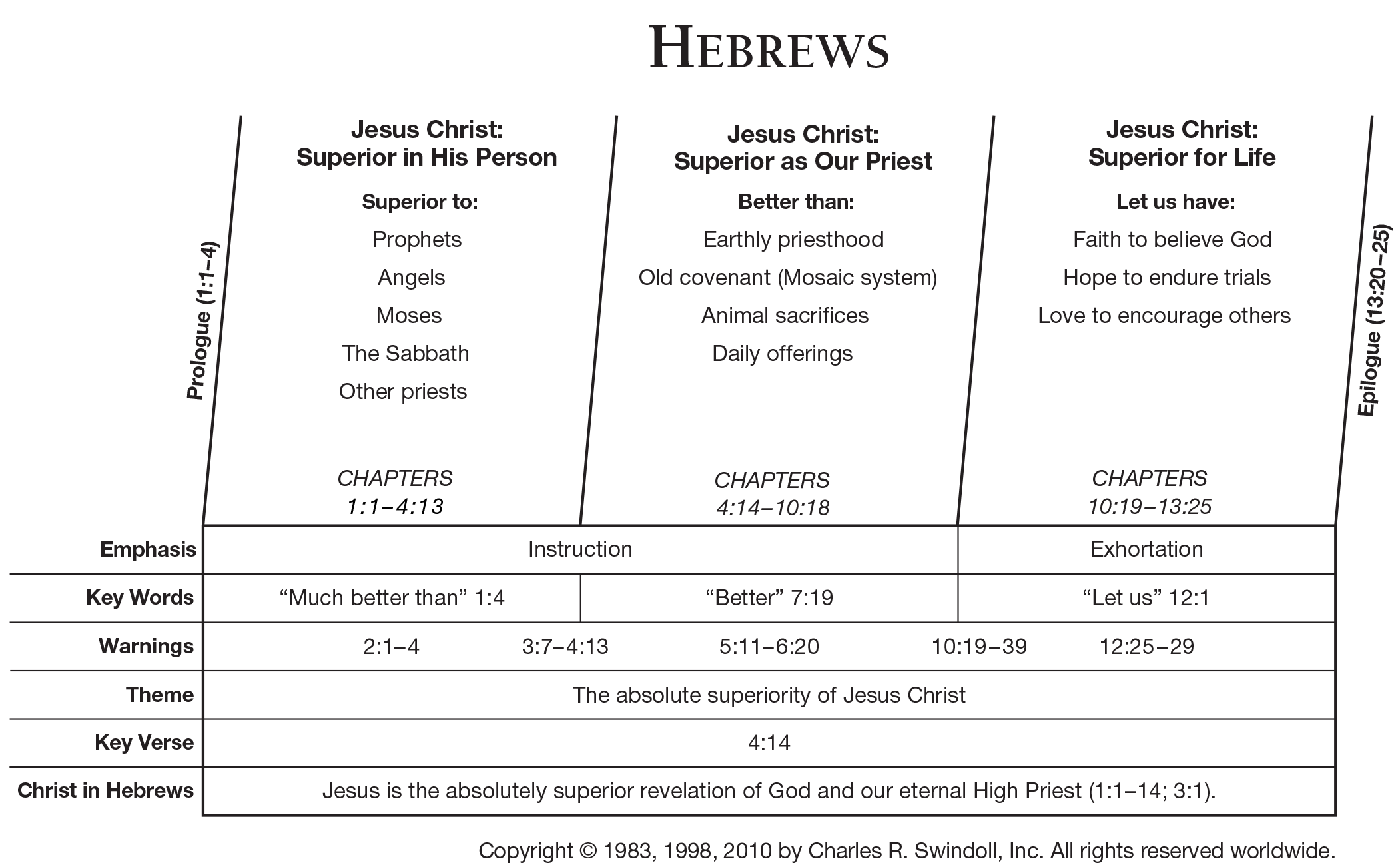

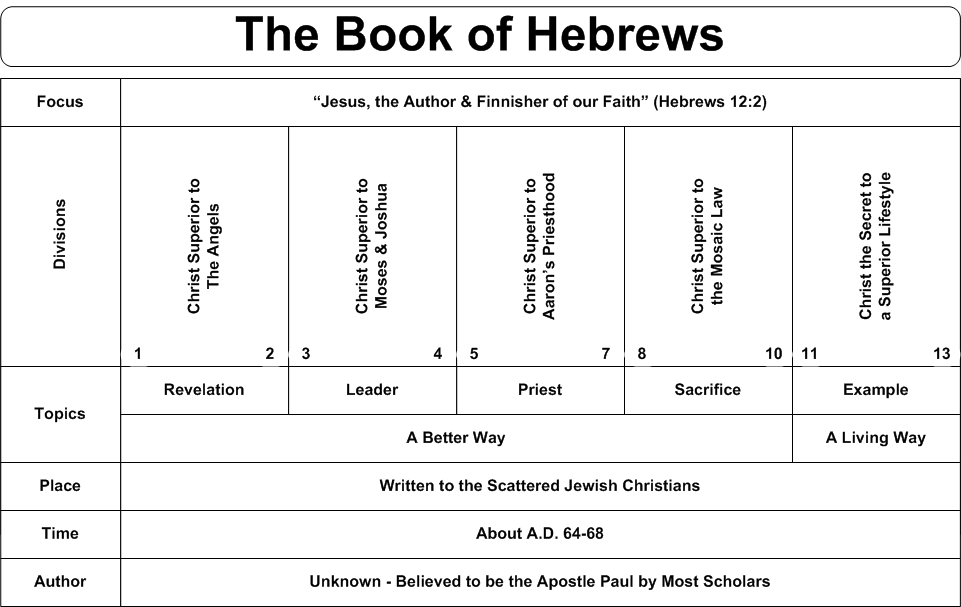
IMITATE FAITHFUL
LEADERS
A mime is someone who acts out a story without using words. In a very real way, that picture reminds us of our calling as followers of Christ and aligns beautifully with Hebrews 13:7. We are commanded to remember our leaders, those who spoke the Word of God to us; to consider the outcome of their way of life; and to imitate their faith. Their lives—their integrity, devotion, endurance, and obedience—were living sermons long before they ever preached with their lips. They taught us the Gospel not only through words but through a consistent “acted-out” faith.
Likewise, our own lives should demonstrate the reality of the Gospel we proclaim. While we must speak—especially Gospel words—the authenticity of our message is displayed in the daily choices, sacrifices, and Christlike character that others can see as we let our actions speak louder than our words. The lost are watching this great redemptive drama lived out in us, observing whether our conduct truly matches our confession. And when they perceive integrity and Christlike consistency, they are far more inclined to listen to the message of the Gospel because they have seen it embodied before they ever hear it proclaimed.
So, just as we imitate the faith of godly leaders who finished well, we now become models for those who come behind us. May the Holy Spirit empower us to imitate Christ—and to mirror the faith of our faithful leaders—in every sphere of influence, so that both our lives and our lips bear witness to His saving grace. May the Spirit enable us to imitate Christ in all our spheres of influence so that we have an opportunity to speak the Gospel for the glory and honor of our King. Amen.
As William Barclay said "“The duty of the real preacher is not so much to talk to men about Christ as to show men Christ in his own life and work and being. Men listen not so much to what the man is saying as to what the man is. His life is not an argument in words but a demonstration in living." (Daily Study Bible)
Imitate (mimeomai) their faith (pistis) Imitate is in the present imperative which means ''Keep on imitating the faith of the leaders.'' Make it your habit to imitate their faith. They were not perfect and yet God calls them faithful and calls the readers to follow their examples of faithfulness. Beloved, faithfulness is not manifest by one's perfection but by one's general direction (toward heaven, not hell!) Considering how well these leaders lived, imitate their faith, where faith of course speaks to both their faith and their conduct. The author emphasizes their faith because he wants us to see that faith in Christ is the firm foundation for Christian conduct. In other words our behavior is not to be an outward conformity to rules or rituals.
There's no better sermon
than a good example.
Grant Osborne on imitate their faith - The process of discipleship and Christian growth begins with bringing the lessons to mind, then thinking and meditating on their significance and how to emulate them, then “imitating” or putting the lessons into practice in day-to-day life. This is called imitatio Christi, and in the early church, it meant to model Christ to others in the church. The leaders become walking examples of the Christlike life, and the goal is “attaining to the whole measure of the fullness of Christ” (Eph 4:13).
Donald Guthrie points out that "The imitation which is urged upon the readers is no mechanical copying of the actions of others, but a call to emulate their faith." (Borrow Hebrews Commentary)
John Phillips - The lives of God’s mighty men are set up as beacons along the way. They are shining examples, and we should imitate them. (See Exploring Hebrews: An Expository Commentary - Page 194)
Leon Morris on the godly leaders - They are held up as examples to be imitated and, specifically, their faith is singled out. Faith is the important thing, and the readers were being tempted to unbelief in falling back from the Christian way. They should instead follow these good examples of faith. (See The Expositor's Bible Commentary - Abridged Edition)
F F Bruce - By precept and example they showed the right path to tread; being dead they yet speak, and the record of their faith is still alive in the memory of those who knew them. In ch. 11 the faith of men and women of earlier generations is presented for emulation, but there is something in the vivid recollection of a life that we have seen which cannot be conveyed by a record that has come to us only by reading or hearing. Those who planted this community of Christians and fostered it by the ministry of the word of God and the example of faith had run the race unwavering to the end; what they had done their followers could also do. It is not necessary to suppose that they had suffered martyrdom; but like the heroes of ch. 11 they “died in faith.” (See The Epistle to the Hebrews - Page 375)
Ray Stedman - It is particularly their faith that must be emulated, since it was fixed on Jesus who is unchangeable and always available. Almost every Christian has some mentor who has shaped his or her faith by godly example, and their memory is a continual encouragement to draw strength from the unchanging Lord. The memorial marker to John Wesley in Westminster Abbey bears the inscription: "God buries his workmen, but he carries on his work." Memories of godly lives help best when they turn us to the One who never needs to be replaced and who is permanently available to his people. This great statement that Jesus is unchanged and unchangeable builds upon Heb 1:10-12 where all creation may pass away but Jesus the Creator remains forever the same (Hebrews 13:8). Here, at the end of Hebrews Jesus' role as mediator of the new covenant and pioneer of faith who is always available to his people is even more the focal point of the author's declaration. (Hebrews 13:1-25. Faith At Work)
Oswald Chambers gives us another perspective on memories writing that "At the end of the year we turn with eagerness to all that God has for the future, and yet anxiety is apt to arise from remembering the yesterdays. Our present enjoyment of God’s grace is apt to be checked by the memory of yesterday’s sins and blunders. But God is the God of our yesterdays, and He allows the memory of them in order to turn the past into a ministry of spiritual culture for the future. God reminds us of the past lest we get into a shallow security in the present… Let the past sleep, but let it sleep on the bosom of Christ. Leave the irreparable past in His hands, and step out into the irresistible future with Him.
Spurgeon - There is an itching, nowadays, after originality, striking out a path for yourself. When sheep do that, they are bad sheep. Sheep follow the shepherd, and, in a measure, they follow one another when they are all together following the shepherd. Our Great Master never aimed at originality; He said that He did not even speak His own words, but the words that He had heard from His Father. He was docile and teachable. As the Son of God, and the servant of God, His ear was open to hear the instructions of the Father, and He could say, “I always do the things that are pleasing to him” (John 8:29). Now, that is the true path for a Christian to take: to follow Jesus, and, in consequence, to follow all such true saints as may be worthy of being followed, imitating the godly so far as they imitate Christ.
See discussion of importance of imitation in discussion of the life of Barnabas, a man full of the Spirit and faith - click note on Acts 11:24.
R Kent Hughes on remembering, considering and imitating godly leaders - Significantly, this is beautifully consistent with the purpose of chapter 13, which is to strengthen the little Hebrew church so it will ride out the coming storms of persecution. A church that adequately recalls its godly leaders and considers the outcome of their way of life and attempts to imitate that way of life will sail well! Remembering, considering, and imitating the virtues of departed believers is of greatest spiritual importance both to one's family and to the broader family of the Body of Christ. Doing so will certainly help keep the boat afloat. (See Hebrews: An Anchor for the Soul)
R C Sproul - Moreover, we are called not only to think of our leaders but also to imitate their faith. Not that we imitate men; rather, we imitate them as they imitate Jesus. Some remarks by John Owen on these verses are helpful as we conclude today: “We are not to follow mere men, not even the best of men, as our model and example in all things is Christ alone. But we can learn to emulate Christian graces where we see them displayed in Christian leaders.”
See The Holy Spirit-Walking Like Jesus Walked!
As an African chief once said: A good example is the tallest kind of preaching.
Be like Jesus, this my song,
In the home and in the throng;
Be like Jesus, all day long!
I would be like Jesus.
—Rowe
Imitate(3401) (mimeomai from mimos = imitator, "mimic") means to imitate, to use a model, to emulate, to follow (someone's actions or way of life), especially to follow an example (good example - 2Th 3:7, 9, Hebrews 13:7) and not to follow a bad example (3 Jn 1:11).
Mimeomai is found only here and in…
2Th 3:7 For you yourselves know how you ought to follow our example, because we did not act in an undisciplined manner among you,
2Th 3:9 not because we do not have the right to this, but in order to offer ourselves as a model for you, that you might follow our example.
3Jn 1:11 Beloved, do not imitate (present imperative with negative = stop doing this! Don't let this happen!) what is evil, but (always be alert to contrasts) what is good. The one who does good is of God; the one who does evil has not seen God.
Faith (4102)(pistis) is synonymous with trust or belief and is the conviction of the truth of anything, but in Scripture usually speaks of belief respecting man's relationship to God and divine things, generally with the included idea of trust and holy fervor born of faith and joined with it.
It is notable that only the book of Romans surpasses the book of Hebrews (click uses of pistis in Hebrews) in the number of uses of pistis (Romans = 35, Hebrews = 31, out of 243 NT uses) Pistis (NAS) which is translated: faith, 238; faithfulness, 3; pledge, 1; proof, 1.
As pistis relates to God, it is the conviction that God exists and is the Creator and Ruler of all things well as the Provider and Bestower of eternal salvation through Christ. As faith relates to Christ it represents a strong and welcome conviction or belief that Jesus is the Messiah, through Whom we obtain eternal salvation and entrance into the Kingdom of Heaven. Stated another way, eternal salvation comes only through belief in Jesus Christ and no other way.
See related studies on the specific phrases (1) "the faith" and (2) the "obedience of faith". See also study on pistos
True faith that saves one's soul includes at least three main elements
(1) firm persuasion or firm conviction,
(2) a surrender to that truth and
(3) a conduct emanating from that surrender. In sum, faith shows itself genuine by a changed life. (Click here for W E Vine's similar definition of faith)
Respected theologian Louis Berkhof defines genuine faith in essentially the same way noting that it includes an intellectual element (notitia), which is
a positive recognition of the truth”; an emotional element (assensus), which includes “a deep conviction of the truth”; and a volitional element (fiducia), which involves “a personal trust in Christ as Savior and Lord, including a surrender … to Christ.” (Louis Berkhof, Systematic Theology. Grand Rapids: Eerdmans, 1939)
Faith is relying on what God has done rather than on one’s own efforts. In the Old Testament, faith is rarely mentioned. The word trust is used frequently, and verbs like believe and rely are used to express the right attitude to God. The classic example is Abraham, whose faith was reckoned as righteousness (Ge 15:6). At the heart of the Christian message is the story of the cross: Christ’s dying to bring salvation. Faith is an attitude of trust in which a believer receives God’s good gift of salvation (Acts 16:30,31) and lives in that awareness thereafter (Gal 2:20; cf. Heb 11:1).
Pistis in Hebrews -Heb. 4:2; Heb. 6:1; Heb. 6:12; Heb. 10:22; Heb. 10:38; Heb. 10:39; Heb. 11:1; Heb. 11:3; Heb. 11:4; Heb. 11:5; Heb. 11:6; Heb. 11:7; Heb. 11:8; Heb. 11:9; Heb. 11:11; Heb. 11:13; Heb. 11:17; Heb. 11:20; Heb. 11:21; Heb. 11:22; Heb. 11:23; Heb. 11:24; Heb. 11:27; Heb. 11:28; Heb. 11:29; Heb. 11:30; Heb. 11:31; Heb. 11:33; Heb. 11:39; Heb. 12:2; Heb. 13:7
J. B. Lightfoot discusses the concept of faith in his commentary on Galatians. He notes that in Hebrew, Greek, and Latin, the definition of the word for faith "hovers between two meanings: trustfulness, the frame of mind which relies on another; and trustworthiness, the frame of mind which can be relied upon… the senses will at times be so blended together that they can only be separated by some arbitrary distinction. The loss in grammatical precision is often more than compensated by the gain in theological depth… They who have faith in God are steadfast and immovable in the path of duty."
Faith, like grace, is not static. Saving faith is more than just understanding the facts and mentally acquiescing. It is inseparable from repentance, surrender, and a supernatural longing to obey. None of those responses can be classified exclusively as a human work, any more than believing itself is solely a human effort.
Faith is manifest by not believing in spite of evidence but obeying in spite of consequence. John uses the related verb pisteuo to demonstrate the relationship between genuine faith and obedience writing "He who believes (present tense = continuous) in the Son has eternal life; but he who does not obey the Son shall not see life, but the wrath of God abides on him." (John 3:36)
Charles Swindoll commenting on faith and obedience in John 3:36 concludes that "In 3:36 the one who “believes in the Son has eternal life” as a present possession. But the one who “does not obey the Son shall not see life.” To disbelieve Christ is to disobey Him. And logically, to believe in Christ is to obey Him. As I have noted elsewhere, “This verse clearly indicates that belief is not a matter of passive opinion, but decisive and obedient action.” (quoting J. Carl Laney)… Tragically many people are convinced that it doesn’t really matter what you believe, so long as you are sincere. This reminds me of a Peanuts cartoon in which Charlie Brown is returning from a disastrous baseball game. The caption read, “174 to nothing! How could we lose when we were so sincere?” The reality is, Charlie Brown, that it takes more than sincerity to win the game of life. Many people are sincere about their beliefs, but they are sincerely wrong!" (Swindoll, C. R., & Zuck, R. B. Understanding Christian Theology.: Thomas Nelson Publishers) (This book is recommended if you are looking for a very readable, non-compromising work on "systematic theology". Wayne Grudem's work noted above is comparable.)
Subjectively faith is firm persuasion, conviction, belief in the truth, veracity, reality or faithfulness (though rare). Objectively faith is that which is believed (usually designated as "the faith"), doctrine, the received articles of faith. Click separate study of "the faith (pistis)"
True faith is not based on empirical evidence but on divine assurance.
Spurgeon wrote that "Faith is the foot of the soul by which it can march along the road of the commandments.
When missionary John Paton was translating the Scripture for the South Sea islanders, he was unable to find a word in their vocabulary for the concept of believing, trusting, or having faith. He had no idea how he would convey that to them. One day while he was in his hut translating, a native came running up the stairs into Paton's study and flopped in a chair, exhausted. He said to Paton,
“It’s so good to rest my whole weight in this chair.”
John Paton had his word: Faith is resting your whole weight on God. That word went into the translation of their New Testament and helped bring that civilization of natives to Christ. Believing is putting your whole weight on God. If God said it, then it’s true, and we’re to believe it.
Nothing before, nothing behind,
The steps of faith
Fall on the seeming void, and find
The rock beneath
-- Whittier
Without “confidence” in God - in his fidelity, his truth, his wisdom, his promises. The essence of faith consists in believing and receiving what God has revealed, and may be defined as that trust in the God of the Scriptures and in Jesus Christ whom He has sent, which receives Him as Lord and Savior and impels to loving obedience and good works (Jn 1:12; Ja 2:14 - 26).
FAITH IN THE BOOK OF HEBREWS - Clearly faith is a key word in Hebrews. Study the 31 uses of pistis in Hebrews in context …
Hebrews 4:2 - For indeed we have had good news preached to us, just as they also; but the word they heard did not profit them, because it was not united by faith in those who heard.
Hebrews 6:1 - Therefore leaving the elementary teaching about the Christ, let us press on to maturity, not laying again a foundation of repentance from dead works and of faith toward God,
Hebrews 6:12 -so that you will not be sluggish, but imitators of those who through faith and patience inherit the promises.
Hebrews 10:2 - let us draw near with a sincere heart in full assurance of faith, having our hearts sprinkled clean from an evil conscience and our bodies washed with pure water.
Hebrews 10:38 - BUT MY RIGHTEOUS ONE SHALL LIVE BY FAITH; AND IF HE SHRINKS BACK, MY SOUL HAS NO PLEASURE IN
Hebrews 10:39 - But we are not of those who shrink back to destruction, but of those who have faith to the preserving of the soul.
Hebrews 11:1 - Now faith is the assurance of things hoped for, the conviction of things not seen.
Hebrews 11:3 - By faith we understand that the worlds were prepared by the word of God, so that what is seen was not made out of things which are visible.
Hebrews 11:4 - By faith Abel offered to God a better sacrifice than Cain, through which he obtained the testimony that he was righteous, God testifying about his gifts, and through faith, though he is dead, he still speaks.
Hebrews 11:5 - By faith Enoch was taken up so that he would not see death; AND HE WAS NOT FOUND BECAUSE GOD TOOK HIM UP; for he obtained the witness that before his being taken up he was pleasing to God.
Hebrews 11:6 - And without faith it is impossible to please Him, for he who comes to God must believe that He is and that He is a rewarder of those who seek Him.
Hebrews 11:7 - By faith Noah, being warned by God about things not yet seen, in reverence prepared an ark for the salvation of his household, by which he condemned the world, and became an heir of the righteousness which is according to faith.
Hebrews 11:8 - By faith Abraham, when he was called, obeyed by going out to a place which he was to receive for an inheritance; and he went out, not knowing where he was going.
Hebrews 11:9 - By faith he lived as an alien in the land of promise, as in a foreign land, dwelling in tents with Isaac and Jacob, fellow heirs of the same promise;
Hebrews 11:11 - By faith even Sarah herself received ability to conceive, even beyond the proper time of life, since she considered Him faithful who had promised.
Hebrews 11:13 - All these died in faith, without receiving the promises, but having seen them and having welcomed them from a distance, and having confessed that they were strangers and exiles on the earth.
Hebrews 11:17 - By faith Abraham, when he was tested, offered up Isaac, and he who had received the promises was offering up his only begotten son;
Hebrews 11:20 - By faith Isaac blessed Jacob and Esau, even regarding things to come.
Hebrews 11:21 - By faith Jacob, as he was dying, blessed each of the sons of Joseph, and worshiped, leaning on the top of his staff.
Hebrews 11:22 - By faith Joseph, when he was dying, made mention of the exodus of the sons of Israel, and gave orders concerning his bones.
Hebrews 11:23 - By faith Moses, when he was born, was hidden for three months by his parents, because they saw he was a beautiful child; and they were not afraid of the king's edict.
Hebrews 11:24 - By faith Moses, when he had grown up, refused to be called the son of Pharaoh's daughter,
Hebrews 11:27 - By faith he left Egypt, not fearing the wrath of the king; for he endured, as seeing Him who is unseen.
Hebrews 11:28 - By faith he kept the Passover and the sprinkling of the blood, so that he who destroyed the firstborn would not touch them.
Hebrews 11:29 -By faith they passed through the Red Sea as though they were passing through dry land; and the Egyptians, when they attempted it, were drowned.
Hebrews 11:30 - By faith the walls of Jericho fell down after they had been encircled for seven days.
Hebrews 11:31 - By faith Rahab the harlot did not perish along with those who were disobedient, after she had welcomed the spies in peace.
Hebrews 11:33 -who by faith conquered kingdoms, performed acts of righteousness, obtained promises, shut the mouths of lions,
Hebrews 11:39 - And all these, having gained approval through their faith, did not receive what was promised,
Hebrews 12:2 - fixing our eyes on Jesus, the author and perfecter of faith, who for the joy set before Him endured the cross, despising the shame, and has sat down at the right hand of the throne of God.
Hebrews 13:7 - Remember those who led you, who spoke the word of God to you; and considering the result of their conduct, imitate their faith.
Adrian Rogers - You're going to find that God will use other people to help you know His will for your life, just as God used Ananias to help Saul know His will. Could it be that God is using me right now to help you navigate your way through a cloudy stretch of road in your life? In the same way, you may be used of God to help other people who are caught in confusion and crisis.
You are often going to discover that you find the will of God in the context of a Christian church and with other believers in Christ.
The Echo in the Canyon - A hiker shouted into a canyon and heard his voice echo back—fainter, but unmistakably similar. The echo carried the same shape, tone, and rise and fall of the original sound.
That is what it means to imitate their faith: our lives become an echo of the faith we saw modeled—never as loud or perfect, but unmistakably shaped by the original.
Norman Geisler comments on the way 1Cor 11:1 is misinterpreted asking Does Paul’s statement “Imitate me” justify authoritarianism, as some cultic groups claim?
MISINTERPRETATION: Paul sometimes calls on his followers to imitate him (see also 1 Cor. 4:16). Some authoritarian cults, such as the Boston Church of Christ, use this to justify their authoritarianism. Is this a legitimate inference from these verses?
CORRECTING THE MISINTERPRETATION: The New Testament often exhorts believers to submit to their leaders (1Cor. 16:16; Heb. 13:17; 1 Peter 5:5). It also says wives are to submit to their husbands, children to their parents (Col. 3:18-20), and citizens to their governments (Titus 3:1). But this should not be twisted into ecclesiastical authoritarianism.
This submission is qualified. Children are to obey their parents only “in the Lord” (Eph. 6:1), not in literally anything their elders may command. The same is true of citizens submitting to their respective governments. There are many instances of justified disobedience to government, such as when the Pharaoh commanded the midwives to kill every male baby that was born (Exod. 1:15–21) or when the three Hebrew children were commanded to bow before an idol (Dan. 3). We should submit to a proper authority only when it takes its place under God but not when it takes the place of God.
There is an important difference between legitimate submission and illegitimate authoritarianism. Proper submission to a church leader is voluntary, not compulsory. It involves a free choice to join or leave that organization without intimidation or reprisal. It is done out of love and respect (cf. Heb. 13:7), not out of fear. While the Bible speaks of voluntary submission from the bottom up, it nowhere enjoins compulsory obedience from the top down. That is, it never says that leaders should command (or demand) obedience; only that followers should freely give it. Church leaders themselves are reminded not to “lord it over the flock” but rather to be “examples” to it (1 Peter 5:2–3). They are to lead by their life, not their lips; by their character, not their commands. (When cultists ask: a popular handbook on cultic misinterpretations)
Jonathan Edwards was so concerned about the example which he set which others might imitate, that he framed the resolve to "never to do anything which I would be afraid to do if it were the last hour of my life." Find a man like this and become an imitator of him!
Here is a secular quote that has more truth in it then we would like to believe (think of "spiritual children") "Children have never been very good at listening to their elders, but they have never failed to imitate them. They must, they have no other models. (James Baldwin)
Our children watch and imitate
The things we say and do;
So if we imitate the Lord,
They'll imitate Him too.
—Sper
Children may close their ears to advice,
but their eyes are always open to example.
The Mirror Tilted Toward Heaven A craftsman once set a small mirror outside his shop to reflect the sunlight into the darker interior. Over time the mirror tarnished, but it still redirected the light.
Our leaders were not perfect mirrors, but they reflected enough of Christ’s light to help us see Him better. Imitating their faith means orienting our lives in the same direction—toward the Light.
The Tree Planted by an Older One Foresters often plant new saplings near sturdy, mature trees. The young tree naturally bends its trunk toward the older tree’s strength and direction.
So too with leaders whose lives have bent toward Christ. Their example helps us “grow in the same direction.”
Lifelong Service
J. Oswald Sanders was nearing his ninetieth birthday when he died-working on his last book. Before he was 50 he was afflicted with arthritis so badly that he could hardly get out of bed. He could have taken a nice retirement. Instead he entered the most procreative years of his life.
At age 50 he left a prosperous career as an attorney in New Zealand to lead the China Inland Mission (now Overseas Missionary Fellowship). Remarkably, as he entered his second and third careers he was totally freed from arthritis.
After several years of leading the mission, he retired, only to take on the directorship of a Christian college. Another step downward. Then he retired again. A widower twice, he certainly deserved a rest. But rather than taking it easy, he accelerated, spending his last 20 years speaking around the world over 300 times per year. His respect grew even though he never sought the limelight or tried to maintain his position.
See: Hebrews 13:7; John 17:4; 1 Thessalonians 2:8
Remember those who rule over you, who have spoken the word of God to you, whose faith follow. HEBREWS 13:7
Just before winter sets in, geese from northern Canada begin their journey south, migrating to the lakes and ponds of North Carolina, Georgia, and Florida. Perhaps you have seen the majestic flight of those birds—whose wingspans can reach five to six-and-a-half feet—as they traverse the sky in their characteristic flight pattern. According to Lamar Dodd's Mark Trail, some authorities believe that "Canada geese fly in a V-formation to take advantage of the air currents stirred up by the birds flying ahead. The lead goose does most of the hard work, overcoming air resistance." The trailing birds benefit from the ones in front.
Think of all those who have gone before—some giving their lives—so we could hear about Christ. They were pioneers. And now perhaps God has placed us in a position where resistance to the gospel is strong. Our witness in that God-appointed spot can clear the way for others to follow. So let's keep flying! As we follow the faith of previous Christian stalwarts, we provide encouragement and help for fellow Christians who come later. —P R. V
WOODEN’S WINNING WAYS
Reference: Hebrews 13:7
John Wooden’s UCLA teams won ten NCAA championships in twelve years. Still, the 1960s were a turbulent time when Bill Walton played for UCLA under Wooden, and young people were asking hard questions of anyone in authority.
Wooden’s answers to such questions never varied. "We thought he was nuts, but in all his preachings and teachings, everything he told us turned out to be true," Walton said. "His interest and goal was to make you the best basketball player but first to make you the best person. He would never talk wins and losses but what we needed to succeed in life. Once you were a good human being, you had a chance to be a good player. He never deviated from that.
"He never tried to be your friend. He was your teacher, your coach. He handled us with extreme patience."
Today Walton and Wooden, ninety, talk frequently. "He has thousands of maxims," Walton says. "He is more John Wooden today than ever. He is a man who truly has principles and ideas."
"When you’re touched by someone that special, it changes your life," Walton adds. "You spend your life chasing it down, trying to recreate it."
—Hal Bock, Associated Press, "A Coach for All Seasons," Spokane Review (December 4, 2000)
The Number One Way To Change Lives Is Modeling
In a personal letter to Charles Swindoll, Tim Hansel mentions a Harvard University study conducted rather extensively within recent months where they tried to determine the most effective way to change lives. Their findings surprised even those doing the study. Amidst the high tech sophistication and advanced techniques of our world, the number one way to change lives was modeling. When it is all said and done, the best way to impact another life is to demonstrate, to practice, what one teaches. You know that is why you cannot get out of your mind the model of your parents, nor can I.
See: 2 Kings 14:1, 3; 1 Corinthians 4:15-16; Philippians 3:17; 2 Thessalonians 3:7-9; Hebrews 13:7
Leaders Wield Considerable Influence
One Sunday morning in 1865, a black man entered a fashionable church in Richmond, Virginia. When Communion was served, he walked down the aisle and knelt at the altar. A rustle of resentment swept the congregation. How dare he! After all, believers in that church used the common cup. Suddenly a distinguished layman stood up, stepped forward to the altar, and knelt beside the black man. With Robert E. Lee setting the example, the rest of the congregation soon followed his lead.
Leaders carry a great responsibility and wield considerable influence. Others look to them for direction.
Let's be careful of the example we show.
IMITATION FIXATION The Christian History Devotional: 365 Readings & Prayers
Remember your leaders. … Consider the outcome of their way of life and imitate their faith. HEBREWS 13:7
1946: One of the world’s best-selling novels owed its sales not just to popularity but to an accident. Its author, Charles M. Sheldon, died on this date and is remembered for In His Steps, a novel that grew out of a sermon series Sheldon preached on the question “What would Jesus do?” which is the novel’s subtitle. (ED: WHILE I CERTAINLY AGREE WITH "WHAT WOULD JESUS DO?" I THINK IT IS IMPORTANT TO ASKE "HOW DID JESUS DO IT?" AND THE ANSWER IS APPLICABLE TO OUR LIVES - The Holy Spirit-Walking Like Jesus Walked!)
In the novel, published in 1897, pastor Henry Maxwell turns away a jobless man who appears at his door. The following Sunday the same man walks into the church and confronts the people about their lack of compassion. The next Sunday the pastor poses a challenge to his congregation: for an entire year they will not do anything without first asking, “What would Jesus do?” The rest of the novel follows various members of the congregation as they rise to the pastor’s challenge.
The book sold well when published, but afterward the publisher realized a serious mistake had been made: the copyright had not been filed correctly, so the book could be copied and published by other companies without paying a cent to the author or the original publisher. Needless to say, publishers took advantage of this, and numerous editions of the book were published, which did not make any money for Sheldon but did increase the book’s sales since it was available at low prices. Probably 30 million copies of the book were sold.
And what about the author? Sheldon was a Congregational pastor in Topeka, Kansas, when he wrote his novel and was a tireless crusader for prohibition and women’s rights. He believed that true Christianity consisted of modeling one’s behavior on Jesus. As we might put it today, he was more concerned with “walking the walk” than with “talking the talk.” All who knew Sheldon agreed that he “walked the walk” and never asked his congregation to do anything he was not willing to do himself.
Prayer: Lord, in all our acts, great or small, help us remember and honor your Son. Amen.
John Bennett - Hebrews 13:7 REMEMBER THEM WHICH HAVE THE RULE OVER YOU
Three times in this chapter the apostle refers to ‘them that have the rule over you’, vv. 7, 17 and 24. He is contemplating the ordered structure of a New Testament local assembly within which were those who would lead, guide and teach the believers. Such men were essential for the well-being of the assembly, especially as these Hebrew believers were being assailed by ‘reproaches and afflictions’, 10:33, as a result of which their faith in the Lord Jesus was being severely tested.
In verses 17 and 24, the exhortation to obey and salute (or greet), obviously has in view those leaders who were presently active among the believers. The words of verse 7, however, suggest a remembrance, or calling to mind, of those who had been responsible for bringing the word of God to them, who had established them in the faith, but who now had finished their course. Such leaders were to be remembered not just for sentimental reasons, but with a view to following or imitating their faith. Furthermore, the readers of this epistle were to consider carefully the good which resulted from their manner of life; the blessing brought to others who heard their teaching and observed their testimony.
There is a danger of underestimating the value of the legacy left by saints of God in previous generations. Good it is when their influence is still felt. We recall that Israel served the Lord not only in Joshua’s lifetime, but also ‘all the days of the elders that overlived Joshua’, Josh. 24:31, such was the authority of the man! No doubt most of us can recall with affection dear saints, now with the Lord, to whom we owe so much. Maybe there were times when they corrected or reproved us. At the time, perhaps we resented the admonition, or even rebelled against it. Yet now, through His grace, we realise that they only had our best interests at heart, and we thank God for their loving care as they watched for our souls. May the fragrance of their testimony be an incentive to us, that we too may follow their faith and, if the Lord has not come, leave an inheritance which will be a blessing to future generations.
How should the people of God treat those men who preach the gospel to them? - Don Fortner
Read Hebrews 13:7–19
The tendency among men is either to treat God’s servants with contempt, as the judaizers at Galatia did Paul (Gal. 4:16), or regard them with an adoring, worshipful reverence, as Cornelius did Peter (Acts 10:25). Both of these attitudes are wrong. The faithful gospel preacher is only a man; therefore he must not be placed on a pedestal to be worshipped and followed blindly. But he is God’s man, God’s messenger to men; therefore he must not be despised, ignored and treated with contempt, Paul tells us plainly how the people of God should treat faithful preachers (pastors, evangelists, missionaries).
A faithful pastor is one who labors among God’s people. He is not a lazy sluggard, but a diligent laborer. His time, energy and attention are consumed by the ministry of the gospel. He studies, prays and preaches, watching over the souls of God’s elect as one who must give account. He has little time for anything other than the work of the gospel. Such a man, who spends his life serving the interest of men’s souls, should be highly honored by those for whom he labors (2 Thess. 3:1, Heb. 13:7, 17; 1 Cor. 9:9–14).
‘Know them which labour among you.’ God’s people should make it their business to become personally, even intimately, acquainted with faithful gospel preachers, especially their own pastor. Get to know the man who ministers to you. Try to know what his personal needs are, so that you can supply those needs. Try to find a way to assist him and relieve him of unnecessary burdens, so that he may more fully give himself to the work of the gospel. ‘Esteem them very highly in love for their work’s sake.’ Every faithful gospel preacher deserves and should have the high esteem and sincere love of God’s people, because of the work which he performs. He is God’s spokesman and representative to you, and he should be treated as such. Those churches which develop such an attitude towards the servants of God will in great measure ‘be at peace among themselves’.
FACING WINDS OF ADVERSITY - Charles Stanley
SCRIPTURE READING: Hebrews 13:5–9
KEY VERSE: Psalm 57:1
Be merciful to me, O God, be merciful to me!
For my soul trusts in You;
And in the shadow of Your wings I will make my refuge,
Until these calamities have passed by.
When the winds of adversity whip up swirling whitecaps of stress, you can rely on several calming biblical truths to anchor your inner person.
First, recall God’s activity in the lives of His people (and yours) in the past: “Remember those who led you.… Imitate their faith” (Heb. 13:7 NASB). The lives of Abraham, Moses, Joshua, David, Daniel, Peter, and Paul are illustrations of God’s dealing with men. Examine His methods. Investigate their response.
Second, count on God’s fixed, unfluctuating character: “Jesus Christ is the same” (Heb. 13:8 NASB). God rewards your faith as He did Abraham’s, your obedience as He did Joshua’s, your commitment as He did Daniel’s, your repentance as He did David’s. You can depend on God to act consistently with the revelation of Himself through His Word.
Third, magnify the power of God’s grace: “It is good for the heart to be strengthened by grace” (Heb. 13:9 NASB). Grace works every time. Grace is His supernatural provision for every need, every problem, every circumstance. Grace overwhelms every obstacle, overflows every failure, overcomes every dilemma.
Heavenly Father, give me the grace that overwhelms every obstacle, overflows every failure, and overcomes each dilemma. I rest in the assurance that Your grace works every time.
“It Stirs Me Up Much …” Jim Elliot, who perished while trying to reach the Auca Indians in 1956, left behind a journal that has deeply moved multitudes and been the means of many young people giving their lives to missions. Interestingly, Elliot’s own interest in missions was whetted while reading another journal. In Shadow of the Almighty (BORROW), Elisabeth Elliot quotes from Jim’s journal, dated October 24, 1949:
I see the value of Christian biography tonight, as I have been reading Brainerd’s Diary much today. It stirs me up much to pray and wonder at my nonchalance while I have not power from God. I have considered Hebrews 13:7 just now, regarding the remembrance of certain ones who spake the word of God, “consider the outcome of their life, and imitate their faith.”
Robert Morgan has an illustration entitled "It Stirs Me Up Much"...
Jim Elliot, who gave his life while trying to reach the Auca Indians, was largely shaped through the reading of Christian biography.
I see the value of Christian biography tonight, he wrote in his journal, 'as I have been reading Brainerd's Diary much today. It stirs me up much to pray and wonder at my nonchalance while I have not power from God. I have considered Heb 13:7 (note) just now, regarding the remembrance of certain ones who spake the word of God, 'consider the outcome of their life, and imitate their faith'.
I recall now the challenge of Goforth's Life and By My Spirit, read in the summer of 1947, the encouragement of Hudson Taylor's Spiritual Secret , and The Growth of a Soul. There are incidents which instruct me now from the reading of J. G. Paton's biography, read last winter. And now this fresh Spirit-quickened history of Brainerd. O Lord, let me be granted grace to 'imitate their faith.'
It has since been through the reading of Elliot's journals that scores of young people have given their lives to the service of the Gospel. (Morgan, R. J. Nelson's Complete Book of Stories, Illustrations, and Quotes: Thomas Nelson Publishers) (I highly recommend reading Hudson Taylor's "Spiritual Secret" which can be downloaded free Hudson Taylor's Spiritual Secret)
ILLUSTRATION OF IMITATION - When in the Mexican War, the troops were wavering, a general rose in his stirrups, and dashed into the enemy’s lines, shouting, “Men, follow!” They, seeing his courage and disposition, dashed on after him, and gained the victory. What men want to rally them for God is an example to lead them. All your commands to others to advance amount to nothing so long as you stay behind. To affect them aright, you need to start for heaven yourself, looking back only to give the stirring cry of “Men, follow!” (Talmage quoted by D L Moody in "Thoughts for the Quiet Hour")
Copy Me - Imitate me, just as I also imitate Christ. —1 Corinthians 11:1
As we sat at the table one day last week, my oldest son began protesting about his little sister “always” copying him. When she imitates his laugh or eats her French fries before her burger like he does, it annoys him. My wife and I tried to get him to realize that he has an opportunity to influence her by setting a good example.
Unlike my son, Paul invited others to copy his example (1 Cor. 11:1). In this verse, he concluded his discussion from chapter 10 about the Corinthians loving others enough to limit their freedom. He said that when they were invited to a nonbeliever’s home for dinner, they were free to eat what was set before them (1Cor 10:27). But if their freedom to eat the meat offered to idols caused another believer to question whether or not what they were doing was right, they were to limit their freedom for the good of the “weaker” believer (1Cor 10:28).
Paul encouraged the people to follow his example in this matter, in the same way he followed Christ’s example. Paul did not seek his own good, but the good of others by imitating Jesus’ example of love, unity, acceptance, and sacrifice.
In the same way, we are to follow Jesus’ example so closely that we can say with confidence to our brothers and sisters, “Copy me as I copy Christ.” (Reprinted by permission from Our Daily Bread Ministries. Please do not repost the full devotional without their permission.)
Show me the way, Lord, let my light shine
As an example of good to mankind.
Help them to see the patterns of Thee,
Shining in beauty, lived out in me.
—Neuer
Live a life worth imitating by imitating Christ.
Life Shadowing
Read: Acts 20:17-21,31-38
Imitate me, just as I also imitate Christ. —1 Corinthians 11:1
When our daughter Julie was a high school senior, she had the opportunity to “job shadow” for 2 weeks. She went “on the job” to find out firsthand about two professions that had captured her interest. For the first week, she sat in on the classes of a math teacher at another school. For the second week, she shadowed a college basketball coach.
The idea of shadowing is a vital one, because it emphasizes the importance of example. A person who is being shadowed knows he or she is setting an example for the student.
We are all participants in a process that might be called “life shadowing.” If we are parents, our children shadow us all the time, learning how to act as adults. At work, we have fellow employees who notice our reactions to all kinds of situations. In our community, our neighbors observe us and see how Christians live, even when we don’t realize they are watching.
Is our life worthy of shadowing? Does our example lead others in the right direction? Paul said that his life was worth shadowing because he followed Jesus—the ultimate example (1 Cor. 11:1).
If you want to become a worthy example for others, shadow the Savior! By Dave Branon (Reprinted by permission from Our Daily Bread Ministries. Please do not repost the full devotional without their permission.)
You're teaching a lesson each day that you live;
Your actions are blazing a trail
That others will follow for good or for ill;
You'll help them or cause them to fail.
—Bosch
To cast a good shadow, walk in God's light.
You Are A Role Model - Imitate me, just as I also imitate Christ. —1 Corinthians 11:1
Charles Barkley, superstar basketball player for the Phoenix Suns, said in a television ad, “I am not a role model.” But, like it or not, he is. Everybody is a role model for somebody else.
As we grow up, we have many role models, people who inspire us—parents, teachers, athletes, political leaders, characters in novels and in the pages of history.
The Bible also gives us many role models. The apostle Paul, for one, is a challenging example of discipleship. In fact, he held himself up as a pattern for all Christians to follow. “Imitate me,” he urged, “just as I also imitate Christ” (1Cor. 11:1). He knew, of course, that he could serve as a godly example only if he faithfully followed his Lord.
Paul commended the Thessalonians because they followed him and the Lord (1 Th. 1:6). They became examples to all the believers in Macedonia and Achaia, and they were well-known for their faith in God (1Cor. 11:7-8).
As we copy Paul, who himself was copying the Savior, we in turn become models who are being copied. What is the quality of our spiritual influence? Negative or positive? Remember, it can’t be neutral. No one can rightly say, “I’m not a role model.” By Vernon C. Grounds (Reprinted by permission from Our Daily Bread Ministries. Please do not repost the full devotional without their permission.)
We cannot live our lives alone,
For other lives we touch
Are either strengthened by our own
Or weakened just as much.
—Anon.
The best role models model Christ.
A Lasting Legacy - Imitate me, just as I also imitate Christ. —1 Corinthians 11:1
My middle-aged friend, who was a medical doctor, knew that he was suffering from a disease that would gradually cripple him and eventually kill him. What an emotional struggle he experienced in coming to accept his condition! He had expected to be helping sick children for many years. He had also hoped that he would provide a comfortable life for his family and the best possible education for his children. But how could he do that now? What could he leave as an inheritance to his children?
In my visits with him, my despairing friend would often raise that issue. But he gradually came to believe that the all-important legacy we can leave our families is not a comfortable home and a large income. The greatest legacy is a spiritual one that no amount of money can buy. It’s an example of unwavering trust in God’s love and wisdom. It’s also an example of steadfast endurance, courage, patience, and hope for eternity when all hope in this world is gone. I told him that if he left that legacy for his family, they would bless his memory until they too departed for glory.
Are we laying up a lasting spiritual legacy of priceless value for those we love? —By Vernon C. Grounds (Reprinted by permission from Our Daily Bread Ministries. Please do not repost the full devotional without their permission.)
Faithful parents never carve their name
On marbled columns built for earthly fame;
They build instead a legacy that springs
Out of a life lived for the King of kings.
—Gustafson
A life lived for Christ is the best inheritance we can leave our children.
Walking Our Faith - Do you see that faith was working together with his works, and by works faith was made perfect? —James 2:22
Often we Christians are urged not just to “talk the talk” but to “walk the talk.” The same advice may be expressed in these words: Don’t let your behavior contradict your professed belief. At other times we are admonished to be sure that life and lip agree. If our conduct doesn’t harmonize with our confession of faith, however, that discrepancy nullifies the testimony of the gospel which we proclaim.
As far as we can know, Mahatma Gandhi never became a Christian, but he made a statement that we who follow Jesus would do well to ponder. When asked to put his message into one short sentence, he replied, “My life is my message.”
Certainly we should explain the gospel message as clearly as possible. Yet the clearest explanation isn’t going to win hearts for our Lord unless His love is embodied in our lives. To quote the apostle Paul in 1Corinthians 11:1, “Imitate me, just as I also imitate Christ.” And holding himself up as a pattern, he wrote in Philippians 4:9, “The things which you learned and received and heard and saw in me, these do, and the God of peace will be with you.”
Pray, then, that like Paul we may live out our saving faith before the watching world. - Vernon C. Grounds (Reprinted by permission from Our Daily Bread Ministries. Please do not repost the full devotional without their permission.)
Let the beauty of Jesus be seen in me—
All His wonderful passion and purity!
O Thou Spirit divine, all my nature refine,
Till the beauty of Jesus be seen in me.
—Orsborn
The world is watching us—do they see Jesus?
Scattered Fruit - Imitate me, just as I also imitate Christ. —1 Corinthians 11:1
The story is told of a Christian who was home on furlough from serving in the armed forces. He was rushing to catch his train when he ran into a fruit stand on the station platform, knocking most of the piled-up apples to the ground.
The young boy who operated the stand tried to pick up his scattered fruit but was having difficulty. The apologetic serviceman put down his luggage and started collecting the apples. He polished each one with his handkerchief and put it back on the counter. So impressed was the boy that he asked gratefully, “Soldier, are you Jesus?” With a smile the soldier replied, “No, but I’m trying to be like Him.”
Sometimes, as we hurry about our own responsibilities, we become too busy to care about other people. But we must remember that Jesus urges us to show kindness and concern for our fellow travelers. He set the example for us in John 13 by being a servant. We need to take the time to be helpful also.
Would anyone ask of us, “Are you Jesus?” And could we honestly respond, “No, I’m not Jesus, but I’m trying to be like Him”? Christlike kindness can open the door for a heart-touching testimony. - Vernon C. Grounds (Reprinted by permission from Our Daily Bread Ministries. Please do not repost the full devotional without their permission.)
Be like Jesus, this my song,
In the home and in the throng;
Be like Jesus, all day long!
I would be like Jesus.
—Rowe
Nothing is more attractive
than being like Jesus.
Choosing A Good Leader - Imitate me, just as I also imitate Christ. —1 Corinthians 11:1
I was having coffee at McDonald’s when I noticed a man walk in who was holding a white cane. He had his hand on a young boy’s shoulder and appeared to have complete trust in his ability to guide him.
Jesus spoke about leaders who couldn’t be trusted. He called the religious leaders of His day “hypocrites” and “blind leaders of the blind” (Mt. 15:7-14). The scribes and Pharisees were teaching man-made traditions, not God’s commands (Mt 15:3-9).
Today many voices are crying out from radio, TV, and the pulpit: “Follow me! I have the truth.” It’s a cacophony of confusion that often leads people astray. The apostle John anticipated such a time when he wrote, “Do not believe every spirit, but test the spirits, whether they are of God” (1 Jn 4:1).
How do we “test the spirits”? By asking these questions: Does the teacher’s life reflect the life of Christ? Does the teacher proclaim salvation by grace through faith—not by works? Reliable teachers and leaders will always point us to Jesus, the way, the truth, and the life (Jn. 14:6), and not to themselves. Otherwise, they are merely blind leaders of the blind.
Let’s choose with great care the leaders we follow. - By Dennis J. De Haan (Reprinted by permission from Our Daily Bread Ministries. Please do not repost the full devotional without their permission.)
For Further Study
- Read 1John 2:4; 3:18-19; 4:2-3.
- How can we be sure of knowing truth from error?
- How does God help us? (1Jn 4:4).
A good leader knows the way,
shows the way, and goes the way.
Color Courage - Imitate me, just as I also imitate Christ. —1 Corinthians 11:1
A radio ad for watches suggests that listeners buy a watch with a bright color band and then wear it with clothes of other colors. When people notice your watch because of its contrasting color, the ad says, “They’ll see that you have ‘color courage.’ And they’ll want to be like you.” Something in us enjoys having others follow our example.
If you do a quick reading of 1 Corinthians 4, you might think the apostle Paul sounds a bit boastful when he says to follow his example of self-sacrifice (v.16). But a closer look at Paul’s words shows why he wrote so confidently. He could ask people to imitate him because he imitated Christ (1Cor 11:1), the greatest Servant of all.
The persecution he endured and the position he held in the church (1Cor 4:10-17) all happened because Paul followed Jesus. When he mentioned that even if the Corinthians had 10,000 teachers he would still be their father in the faith (1Cor 4:15), he was acknowledging that Jesus is the only reason people could trust his teaching.
If we want people to imitate us, we must first imitate our Lord. If we have any reason for people to follow our example—if we have any courage to point others to the Savior—it is because of Him, not us. (Reprinted by permission from Our Daily Bread Ministries. Please do not repost the full devotional without their permission.)
Joyfully following Jesus the Lord
And trusting His lead every day
Makes us examples that others can see
To follow when trials come their way.
—Sper
Others should imitate us
only as far as we imitate Christ.
Just Watch - Imitate me, just as I also imitate Christ. —1 Corinthians 11:1 -The young boy looked up at his grandfather and wondered aloud, “Grandpa, how do you live for Jesus?” The respected grandfather stooped down and quietly told the boy, “Just watch.”
As the years went by, the grand-father was an example to the boy of how to follow Jesus. He stayed rock-steady in living for Him. Yet the grandson often lived in a way that was not pleasing to God.
One day the young man visited his grandfather for what both knew would be the last time. As the older man lay dying, his grandson leaned over the bed and heard his grandpa whisper, “Did you watch?”
That was the turning point in the boy’s life. He understood that when his grandpa had said, “Just watch,” he meant, “Imitate me, just as I also imitate Christ” (1 Corinthians 11:1). He vowed that from then on he would live as his grandfather did—striving to please Jesus. He had watched, and now he knew how to live.
Is somebody watching you? Are there younger Christians who need to see that it is possible to live for Jesus every day and in every way? Challenge them—and yourself. Challenge them to “just watch.” Then show them the way. (Reprinted by permission from Our Daily Bread Ministries. Please do not repost the full devotional without their permission.)
Be aware that someone's watching
As you go along your way;
Your example is remembered
More than anything you say.
—Hess
There's no better sermon than a good example.
Imitate Me - Andrew Marton recalls the first time he met his future brother-in-law Peter Jennings, who was a top foreign news correspondent in 1977. He said he was so nervous that he acted like “a jittery fan in the presence of a journalistic hero whose personal wattage could light up Manhattan.”
Andrew looked up to Peter and tried to emulate him. He became a journalist too and approached his assignments the way Peter did—“he dove in and worked harder than everybody else.” Andrew tried to walk like Peter, to dress like him, and to have the same “aura.”
We all tend to follow the patterns of others. The Corinthians did too. But they shifted their focus away from Christ and onto individual leaders. Rather than emulating the Christlike qualities of these leaders, they let their allegiances lead to various divisions and contentions in the church (1 Cor. 1:10-13). The apostle Paul recognized their error, so he sent Timothy to remind them of his teachings and the importance of walking in obedience to the Lord (1Cor 4:16-17).
We are to imitate Christ (1Peter 1:15-16). It can also be helpful to have mentors who imitate Him. Those who walk in step with Christ provide a model for us to emulate. But our ultimate example is Jesus Himself. (Reprinted by permission from Our Daily Bread Ministries. Please do not repost the full devotional without their permission.)
To follow in the steps of those
Whose eyes are on the Lord
Will help to keep us strong and true,
And faithful to His Word.
—D. De Haan
Imitate those who imitate Christ.
Apprenticeship Program - I urge you, imitate me. —1 Corinthians 4:16 - Life certainly was a lot simpler years ago. If a man was a carpenter, his son was likely to be the same. That’s because the shop was at home and the boy worked with his father. The son watched carefully as Dad cut the wood, planed and smoothed it, then fastened it together to build a table or a bench. It was apprenticeship by example.
Most young people don’t learn their trades like that anymore. Vocations are far too complex and the training way too demanding. One aspect of life, however, is the same as it was years ago. Children not only learned how to do things from Dad and Mom, they also learned about life. They saw their parents’ values and ethics in action every day in their homes.
Christian moms and dads still have “little apprentices” watching how they put their beliefs into practice. It goes on at mealtime, in the car, in the store, in conversation with or about neighbors—all the time. What a wonderful opportunity to teach our children how to live for Christ! And young people not only need it, they want it.
Paul told his children in the faith to imitate him—to follow his example (1 Cor. 4:16). Are we living for Christ in such a way that we want our children to imitate us? (Reprinted by permission from Our Daily Bread Ministries. Please do not repost the full devotional without their permission.)
Our children watch and imitate
The things we say and do;
So if we imitate the Lord,
They'll imitate Him too.
—Sper
Children may close their ears to advice,
but their eyes are always open to example.
PONDER THE PASTOR'S EXAMPLE
Given the fact that many Christians observe their pastors as those they might seek to imitate, it is worth surveying what it is they are imitating. And as you read the list remember that you are looking in the mirror? Would you want others to imitate you (even in those times when you know no one is watching or listening)?
Here is research that we distilled from Barna, Focus on the Family, and Fuller Seminary, all of which backed up our findings, and additional information from reviewing others' research:
Fifteen hundred pastors leave the ministry each month due to moral failure, spiritual burnout, or contention in their churches.
Fifty percent of pastors' marriages will end in divorce.
Eighty percent of pastors feel unqualified and discouraged in their role as pastor.
Fifty percent of pastors are so discouraged that they would leave the ministry if they could, but have no other way of making a living.
Eighty percent of seminary and Bible school graduates who enter the ministry will leave the ministry within the first five years.
Seventy percent of pastors constantly fight depression.
Almost forty percent polled said they have had an extra-marital affair since beginning their ministry.
Seventy percent said the only time they spend studying the Word is when they are preparing their sermons (This is Key).
From our recent research we did to retest our data, 1050 pastors were surveyed from two pastor's conferences held in Orange County and Pasadena, Ca-416 in 2005, and 634 in 2006 (I conducted a similar study for the Fuller Institute in the late 80s with a much greater sampling).
Of the one thousand fifty (1,050 or 100%) pastors we surveyed, every one of them had a close associate or seminary buddy who had left the ministry because of burnout, conflict in their church, or from a moral failure.
Nine hundred forty-eight (948 or 90%) of pastors stated they are frequently fatigued, and worn out on a weekly and even daily basis (did not say burned out).
Nine hundred thirty-five, (935 or 89%) of the pastors we surveyed also considered leaving the ministry at one time. Five hundred ninety, (590 or 57%) said they would leave if they had a better place to go-including secular work.
Eighty- one percent (81%) of the pastors said there was no regular discipleship program or effective effort of mentoring their people or teaching them to deepen their Christian formation at their church (remember these are the Reformed and Evangelical-not the mainline pastors!). (This is Key)
Eight hundred eight (808 or 77%) of the pastors we surveyed felt they did not have a good marriage!
Seven hundred ninety (790 or 75%) of the pastors we surveyed felt they were unqualified and/or poorly trained by their seminaries to lead and manage the church or to counsel others. This left them disheartened in their ability to pastor.
Seven hundred fifty-six (756 or 72%) of the pastors we surveyed stated that they only studied the Bible when they were preparing for sermons or lessons. This left only 38% who read the Bible for devotions and personal study.
Eight hundred two (802 or 71%) of pastors stated they were burned out, and they battle depression beyond fatigue on a weekly and even a daily basis.
Three hundred ninety-nine (399 or 38%) of pastors said they were divorced or currently in a divorce process.
Three hundred fifteen (315 or 30%) said they had either been in an ongoing affair or a one-time sexual encounter with a parishioner.
Two hundred seventy (270 or 26%) of pastors said they regularly had personal devotions and felt they were adequately fed spirituality. (This is Key).
Two hundred forty-one (241 or 23%) of the pastors we surveyed said they felt happy and content on a regular basis with who they are in Christ, in their church, and in their home!
Of the pastors surveyed, they stated that a mean (average) of only 25% of their church's membership attended a Bible Study or small group at least twice a month. The range was 11% to a max of 40%, a median (the center figure of the table) of 18% and a mode (most frequent number) of 20%. This means over 75% of the people who are at a "good" evangelical church do not go to a Bible Study or small group (that is not just a book or curriculum study, but where the Bible is opened and read, as well as studied), (This is Key). (I suspect these numbers are actually lower in most evangelical and Reformed churches because the pastors that come to conferences tend to be more interested in the teaching and care of their flock than those who usually do not attend.) (Statistics on Pastors from "Into Thy Word")
Hand-Held Time Bombs - Robert Morgan
December 8
Remember those who rule over you, who have spoken the word of God to you, whose faith follow, considering the outcome of their conduct. Hebrews 13:7
I wonder if Jim Elliot ever dreamed that his own
biography would one day inspire multitudes.
I once heard Warren Wiersbe say he loved reading because of the joy of meeting people he has always wanted to know. “If it were announced that Hudson Taylor or Charles Spurgeon was speaking at a particular church,” he quipped, “Christians from all over the world would show up. But when I open my book, Hudson Taylor opens his mouth. We have a great time together, and these people are my friends.”
“Through a book,” added Haddon Robinson, “we can wrestle with the thoughts of Augustine, rub shoulders with Calvin, make progress with Bunyan’s pilgrim, enjoy the wit of C. S. Lewis, and hear the sermons of John Chrysostom.”
Christian biographies have often proved hand-held time bombs which, when detonated through reading, can divert the course of a person’s life. For example, God has used Elizabeth Elliot’s biography of her husband Jim, martyr of the Ecuadorian Aucas, to direct many young people into missionary service.
Interestingly, Jim’s own interest in missions was whetted while reading a biography. In Shadow of the Almighty, Elizabeth quotes from his journal, dated October 24, 1949: I see the value of Christian biography tonight, as I have been reading Brainerd’s Diary much today. It stirs me up much to pray and wonder at my nonchalance while I have not power from God. I have considered Hebrews 13:7 just now, regarding the remembrance of certain ones who spake the word of God, “consider the outcome of their life, and imitate their faith.” I recall now the challenge of Goforth’s Life, read in the summer of 1947, the encouragement of Hudson Taylor’s Spiritual Secret. There are incidents which instruct me from the reading of J. G. Paton’s biography last winter. And now this fresh Spirit-quickened history of Brainerd. O Lord, let me be granted grace to “imitate their faith.” *
I wonder if Jim Elliot ever dreamed that his own biography would one day inspire multitudes.
Today’s Suggested Reading
Hebrews 13:1–9