Hebrews 13:1
Hebrews 13:2
Hebrews 13:3
Hebrews 13:4
Hebrews 13:5
Hebrews 13:6
Hebrews 13:7
Hebrews 13:8
Hebrews 13:9
Hebrews 13:10
Hebrews 13:11
Hebrews 13:12
Hebrews 13:13
Hebrews 13:14
Hebrews 13:15
Hebrews 13:16
Hebrews 13:17
Hebrews 13:18
Hebrews 13:19
Hebrews 13:20
Hebrews 13:21
Hebrews 13:22
Hebrews 13:23
Hebrews 13:24
Hebrews 13:25
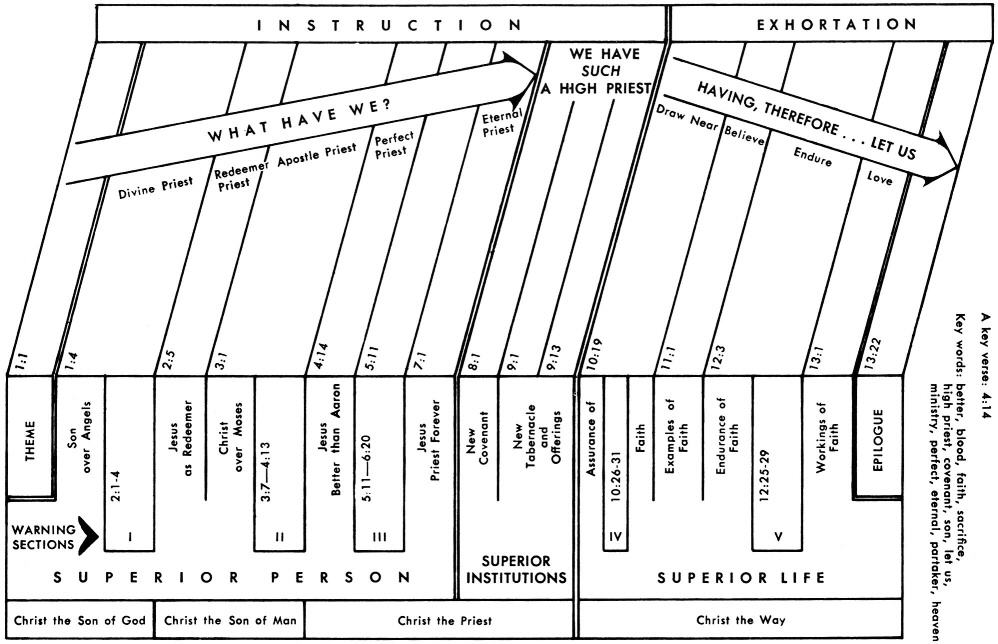
CONSIDER JESUS OUR GREAT HIGH PRIEST
Click chart to enlarge
Charts from Jensen's Survey of the NT - used by permission
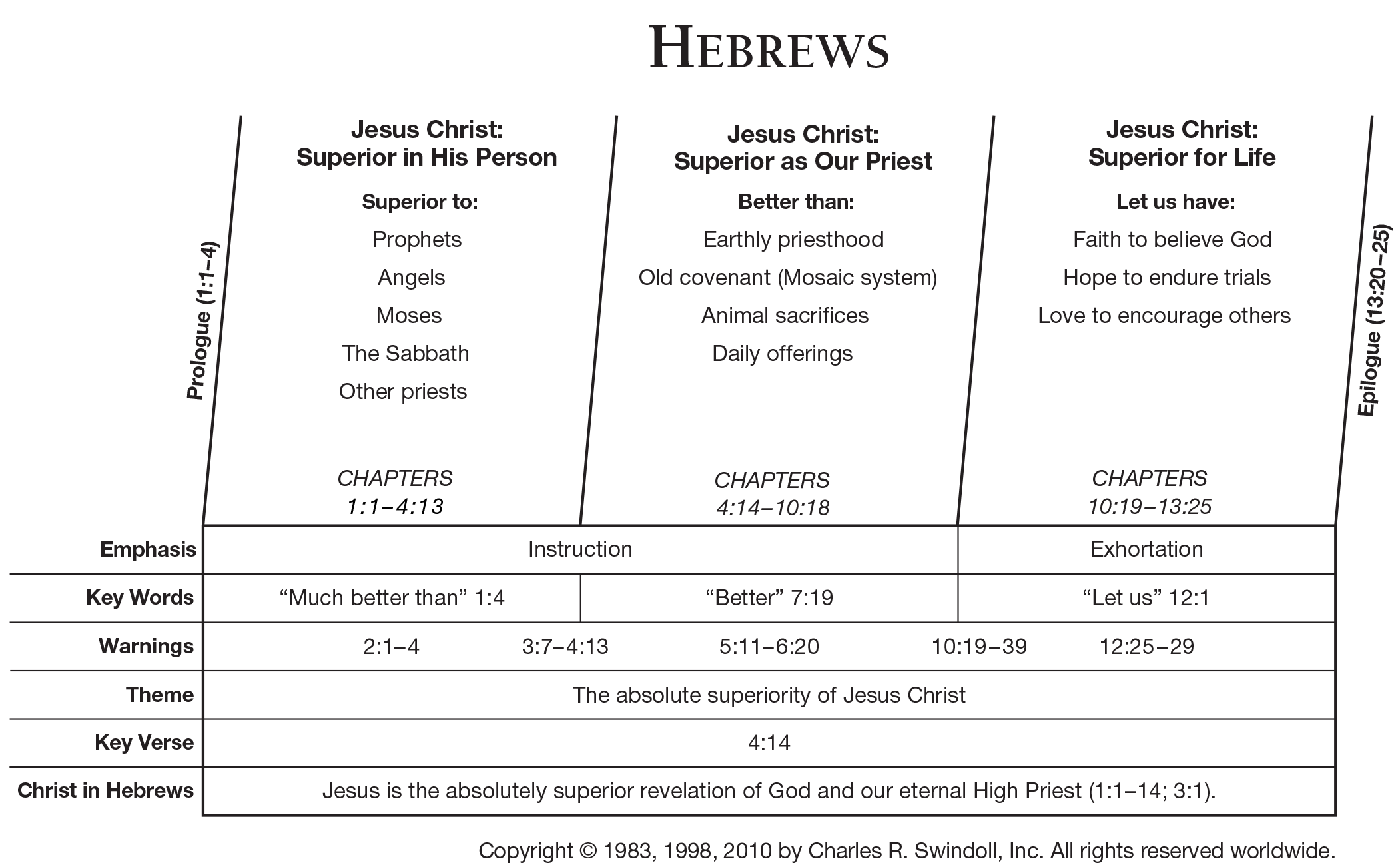
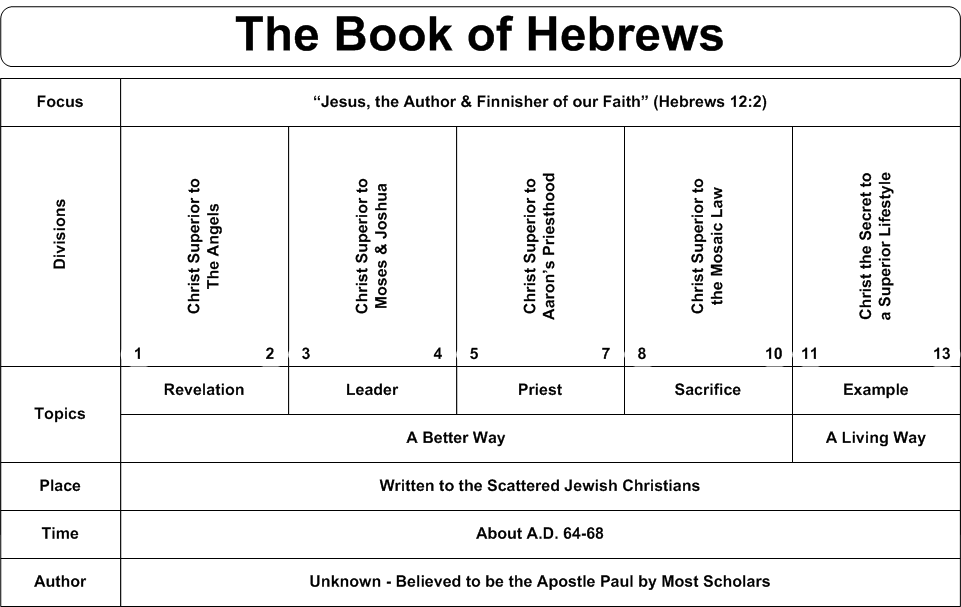
Swindoll's Chart, Interesting Pictorial Chart of Hebrews, Another Chart

|
The Epistle |
||||
| INSTRUCTION Hebrews 1-10:18 |
EXHORTATION Hebrews 10:19-13:25 |
|||
| Superior Person of Christ Hebrews 1:1-4:13 |
Superior Priest in Christ Hebrews 4:14-10:18 |
Superior Life In Christ Hebrews 10:19-13:25 |
||
| BETTER THAN PERSON Hebrews 1:1-4:13 |
BETTER PRIESTHOOD Heb 4:14-7:28 |
BETTER COVENANT Heb 8:1-13 |
BETTER SACRIFICE Heb 9:1-10:18 |
BETTER LIFE |
| MAJESTY OF CHRIST |
MINISTRY OF CHRIST |
MINISTERS FOR CHRIST |
||
|
DOCTRINE |
DUTY |
|||
|
DATE WRITTEN: |
||||

See ESV Study Bible "Introduction to Hebrews"
(See also MacArthur's Introduction to Hebrews)
Borrow Ryrie Study Bible
Hebrews 13:8 Jesus Christ is the same yesterday and today and forever (NASB: Lockman)
Greek: Iesous Christos echthes kai semeron o autos, kai eis tous aionas.
BGT Hebrews 13:8 Ἰησοῦς Χριστὸς ἐχθὲς καὶ σήμερον ὁ αὐτὸς καὶ εἰς τοὺς αἰῶνας.
Amplified: Jesus Christ (the Messiah) is [always] the same, yesterday, today, [yes] and forever (to the ages). (Amplified Bible - Lockman)
My Amplified Paraphrase: Jesus Christ—the eternally anointed Savior—is unchanging in His person, His character, His love, His power, and His purposes; the very same Jesus who was faithful ‘yesterday’ (in eternity past, in the Old Testament, in His earthly life, death, and resurrection) is the same ‘today’ (in His present reign, intercession, and help for His people), and will remain exactly the same ‘forever’ (through death, judgment, eternity, and ages to come). Therefore, you can anchor your soul in Him with absolute confidence, because nothing in Him will ever grow weak, wear out, change, or fail.
NLT: Jesus Christ is the same yesterday, today, and forever.. (NLT - Tyndale House)
KJV Jesus Christ the same yesterday, and to day, and for ever.
NKJ Jesus Christ is the same yesterday, today, and forever.
NET Jesus Christ is the same yesterday and today and forever!
CSB Jesus Christ is the same yesterday, today, and forever.
ESV Jesus Christ is the same yesterday and today and forever.
NIV Jesus Christ is the same yesterday and today and forever.
Phillips: Jesus Christ is always the same, yesterday, today and for ever. (Phillips: Touchstone)
Wuest: Jesus is Messiah, yesterday and today the same, and forever. (Eerdmans Publishing - used by permission)
Young's Literal: Jesus Christ yesterday and to-day the same, and to the ages;
- He 1:12; Psalm 90:2,4; Ps 102:27,28; Ps 103:17; Isaiah 41:4; Isa 44:6; Malachi 3:6; John 8:56-58; James 1:17; Revelation 1:4, Re 1:8, Re 1:11, Re 1:17, Re 1:18)
Related Passages:
Psalm 90:2 Before the mountains were born Or You gave birth to the earth and the world, Even from everlasting to everlasting, You are God.
Psalm 102:27 “But You are the same, And Your years will not come to an end.
Isaiah 41:4 “Who has performed and accomplished it, Calling forth the generations from the beginning? ‘I, the LORD, am the first, and with the last. I am He.’”
Isaiah 44:6 “Thus says the LORD, the King of Israel and his Redeemer, the LORD of hosts: ‘I am the first and I am the last, And there is no God besides Me.
Hebrews 1:10-12 (UNCHANGING IDENTITY AND ETERNAL EXISTENCE) And, “YOU, LORD, IN THE BEGINNING LAID THE FOUNDATION OF THE EARTH, AND THE HEAVENS ARE THE WORKS OF YOUR HANDS; 11 THEY WILL PERISH, BUT YOU REMAIN; AND THEY ALL WILL BECOME OLD LIKE A GARMENT, 12 AND LIKE A MANTLE YOU WILL ROLL THEM UP; LIKE A GARMENT THEY WILL ALSO BE CHANGED. BUT YOU ARE THE SAME, AND YOUR YEARS WILL NOT COME TO AN END.”
Hebrews 7:24 (CHRIST PRIESTHOOD NEVER CHANGES BECAUSE HE NEVER CHANGES) but Jesus, on the other hand, because He continues forever, holds His priesthood permanently.
Hebrews 7:25 (HIS UNCHANGING LIFE GUARANTEES ETERNAL SALVATION) Therefore He is able also to save forever those who draw near to God through Him, since He always lives to make intercession for them.
Hebrews 7:28 (CHRIST'S PERFECTION IS ETERNAL) For the Law appoints men as high priests who are weak, but the word of the oath, which came after the Law, appoints a Son, made perfect forever.
Hebrews 9:12 (UNCHANGING REDEMPTION ROOTED IN AN UNCHANGING REDEEMER) and not through the blood of goats and calves, but through His own blood, He entered the holy place once for all, having obtained eternal redemption.
Hebrews 12:2 (CHRIST'S FINISHED WORK AND ENTHRONED POSITION DO NOT CHANGE) fixing our eyes on Jesus, the author and perfecter of faith, who for the joy set before Him endured the cross, despising the shame, and has sat down at the right hand of the throne of God.
Hebrews 13:5 (UNCHANGING PROMISES AND PRESENCE) Make sure that your character is free from the love of money, being content with what you have; for He Himself has said, “I WILL NEVER DESERT YOU, NOR WILL I EVER FORSAKE YOU,”
Malachi 3:6 “For I, the LORD, do not change; therefore you, O sons of Jacob, are not consumed.
John 8:56-58 “Your father Abraham rejoiced to see My day, and he saw it and was glad.” 57So the Jews said to Him, “You are not yet fifty years old, and have You seen Abraham?” 58 Jesus said to them, “Truly, truly, I say to you, before Abraham was born, I am.”
James 1:17 Every good thing given and every perfect gift is from above, coming down from the Father of lights, with whom there is no variation or shifting shadow.
Revelation 1:4 John to the seven churches that are in Asia: Grace to you and peace, from Him who is and who was and who is to come, and from the seven Spirits who are before His throne,
Revelation 1:8 “I am the Alpha and the Omega,” says the Lord God, “who is and who was and who is to come, the Almighty.”
Revelation 1:17-18 When I saw Him, I fell at His feet like a dead man. And He placed His right hand on me, saying, “Do not be afraid; I am the first and the last, 18 and the living One; and I was dead, and behold, I am alive forevermore, and I have the keys of death and of Hades.
Revelation 22:13 “I am the Alpha and the Omega, the first and the last, the beginning and the end.”
Micah 5:2 “But as for you, Bethlehem Ephrathah, Too little to be among the clans of Judah, From you One will go forth for Me to be ruler in Israel. His goings forth are from long ago, From the days of eternity.”
Matthew 28:20 teaching them to observe all that I commanded you; and lo, I am with you always, even to the end of the age.”
THE IMMUTABLE
JESUS CHRIST
Immutable describes that which does not change. Everything around us changes—leaders rise and fall, emotions fluctuate, seasons end, bodies weaken, cultures shift—but Jesus Christ remains gloriously, perfectly the same. In a world of constant change, He is the anchor of our souls that holds us fast (Heb 6:18) when everything around us is changing. He is the unchanging King of an unshakeable kingdom (Heb 12:28+). The Christ Who sustained the spiritual leaders (Heb 13:7) is the Christ Who sustains us now and will sustain every generation to come. That is immutability!
So that we do not "yank" this verse out of context (which is easy to do), as we remember the faith of those who led us and consider their lives and legacy (Heb. 13:7), we are reminded that even the greatest spiritual leaders come and go. Their seasons end. Their voices fall silent. Their footsteps fade. But the writer of Hebrews lifts our eyes from passing human examples to the unchanging, immutable Christ who stands above every generation. In a world of shifting leaders, changing cultures, and uncertain futures, we are anchored by One who is forever the same. The constancy of Jesus Christ—“yesterday and today and forever”—is the bedrock of our faith, the source of our hope, and the ultimate model we imitate. Our leaders may inspire us, but Christ sustains us. Our mentors may change, but our Master never does. And this same unchanging nature of Jesus Christ guards us against changing doctrine in Hebrews 13:9.
Jesus (Iesous) Christ (Christos) is the same yesterday and today (semeron) and forever (aion) - Praise God that some things (Some One) do not change. We should take care to remember… and imitate their faith which was in the unchanging Jesus. Let us fix our eyes on the unchanging Solid Rock, Jesus (Click for Scripture chain & chart on Christ as the Rock/Stone - would make a great Sunday School series)…
Yesterday - The day of the apostles
Today - The day of the writing of the letter to the Hebrews
Forever - Throughout eternity (this includes yesterday and today!)
Jesus is worthy of our total commitment of faith… so like the leaders who we have watched for years, observing their faith as manifest by their conduct, let us fix our hope completely on the grace to be brought to us at the revelation of Jesus Christ (1Pe 1:13). Believers today have access to the same grace today that these suffering believers did at the time of writing of the epistle of Hebrews. The faith we are to imitate is faith in future grace, not just past grace. We are to imitate the faith that the living Jesus who helped yesterday will help today and tomorrow.
He is immutable; he will not change.
He is all-wise; he need not change.
He is perfect, he cannot change.
--C H Spurgeon
Jesus is the unchanging Rock (), the immutable Hope (1Ti 1:1), the same Firm Foundation today that He was yesterday and He will still be the same tomorrow when you trust Him.
Though human leaders pass from the scene, Jesus Christ is “the same” (He 1:12) yesterday (in which God spoke through prophets, Heb 1:1), today (in context, as God summons us to enter His rest through faith, He 3:7, He 3:13; He 4:7), and forever (Heb 1:8; He 7:17, He 7:21, He 7:24, He 7:28). Christ the Immutable One is our sure anchor amid waves of suffering, affliction and uncertainty (He 6:19).
Jesus Christ is "Alpha and Omega" (Rev 1:11), the beginning and the end. Jesus Created all things in the past (Col 1:16), is now continually "upholding all things" today (Heb 1:3), and will one day "make all things new" in the future (Rev 21:5). Praise and glory and honor to Jesus Christ, the eternal Creator, the living Lord, and our soon coming King of kings (Rev 19:16)
Raymond Brown - This sentence (13:8) is probably the letter’s most famous verse. We must not forget its context. It is set between the commendation of faithful leaders (13:7) and the condemnation of false ones (13:9). Some of these Christians may have taken their eyes off Christ (12:2), only to develop ‘itching ears’ by accumulating ‘teachers to suit their own likings’.(2Ti 4:3)." (Borrow The message of Hebrews : Christ above all)
Simon Kistemaker on Hebrews 13:8 - First, note that the writer uses both names, "Jesus" and "Christ." The name Jesus embraces the work and word of God's Son on earth. He has come to save his people from their sin. The name Christ is the official title that expresses the divinity of the Son. The double name occurs only three times in Hebrews (10:10; 13:8, 21). Next, not only Christ's divinity but also His changelessness the author explains in the first chapter of his epistle. For instance, quoting Ps 102:27, he says, "But you remain the same, and your years will never end" (Heb. 1:12; 7:24). Furthermore, note the sequence of time: past, present, and future. The term "yesterday" relates to the mediatorial work of Jesus on earth, proclaimed and confirmed to the readers by those who heard him (Heb. 2:3). The expression "today" refers to the intercessory work Jesus performs in heaven, where he represents the believer in God's presence (Ro 8:34; Heb. 7:25; 9:24). And the word "forever" pertains to the priesthood of Christ. He is priest forever (Heb. 5:6; 6:20; 7:17, 21, 24, 28). (BORROW Exposition of the Epistle to the Hebrews PAGE 414)
David Thompson - Dr. S. Lewis Johnson said one thing that often gets overlooked here is the fact that Hebrews 13:8, which is so often quoted, is preceded by Hebrews 13:7 and followed by Hebrews 13:9 (Hebrews 13:7-9, p. 2). The specific challenge for us here is to keep our focus on God’s grace found in Jesus Christ and not ever go back under some O.T. form of ritualistic legalism. One of the key ways we do this is by remembering those who taught us the grace Gospel concerning Jesus Christ and by remembering and in fact mimicking their faith.(Hebrews 13:7-9)
Spurgeon - Jesus Christ is the same now as He was in times gone by. He is the same today as He was from old eternity. Before all worlds, He planned our salvation; He entered into covenant with His Father to undertake it. His delights were with the sons of men in prospect, and now today He is as steadfast to that covenant as ever. He will not lose those who were then given to Him, nor will He fail or be discouraged until every stipulation of that covenant shall be fulfilled. Whatever was in the heart of Christ before the stars began to shine, that same infinite love is there today. Jesus is the same today as He was when He was here on earth. I have seen men change. A little frost turns the green forest to bronze, and every leaf forsakes its hold, and yields to the winter’s blast. So fade our friends, and the most attached adherents drop away from us in the time of trial; but Jesus is to us what he always was. (Sermon Jesus Christ Immutable)
A. W. Tozer: Mal. 3:6 “For I am the Lord, I change not, therefore ye sons of Jacob are not consumed.” Now there is in God no mutation possible. As it says in James, “with whom is no variableness, neither shadow of turning” (James 1:17) – there is no variation due to change . . . Incidentally, He’s the only One in the universe that can say that, And He did say it! He simply says that He never changes, that there is no change possible in God. God never differs from Himself. If you get a hold of this, it can be to you an anchor in the storm, a hiding place in danger. There is no possibility of changing in God. And God never differs from Himself. (Tozer on the Almighty God: A 366-Day Devotional - Page 27)
Wayne Grudem - The Importance of God’s Unchangeableness: At first it may not seem very important to us to affirm God’s unchangeableness. The idea is so abstract that we may not immediately realize its significance. But if we stop for a moment to imagine what it would be like if God could change, the importance of this doctrine becomes more clear. For example, if God could change (in his being, perfections, purposes, or promises), then any change would be either for the better or for the worse. But if God changed for the better, then he was not the best possible being when we first trusted him. And how could we be sure that he is the best possible being now? But if God could change for the worse (in his very being), then what kind of God might he become? . . . How could we ever trust such a God who could change? How could we ever commit our lives to him? Our faith and hope and knowledge all ultimately depend on a person who is infinitely worthy of trust – because he is absolutely and eternally unchanging in his being, perfections, purposes, and promises. Systematic Theology
J. I. Packer - God's Son does not change. His touch has still its ancient power. Where is the sense of distance and difference, then, between believers in Bible times and ourselves? It is excluded. On what grounds? On the grounds that God does not change. Fellowship with Him, trust in His word, living by faith, “standing on the promises of God”, are essentially the same realities for us today as they were for Old and New Testament believers. This thought brings comfort as we enter into the perplexities of each day: amid all the changes and uncertainties of life in a nuclear age, God and His Christ remain the same – almighty to save. But the thought brings a searching challenge too. If our God is the same as the God of New Testament believers, how can we justify ourselves in resting content with an experience of communion with Him, and a level of Christian conduct, that falls so far below theirs? If God is the same, this is not an issue that any one of us can evade. (See Knowing God Through the Year: A 365-Day Devotional - Page 83 See also Knowing God - Page 18)
G. Campbell Morgan says: This is the ultimate statement in the book as to the finality of what God has said to men in His Son. There can be no change, because He is changeless. While referring to Him "today", the writer links the statement with the past "yesterday," and with all the future, "unto the ages." The reference to "yesterday " includes not merely the period of God's speech to men, but the far-flung mystery of which we can only speak as ages past. The reference to the future shows that in Him all life is to be conditioned not here and now alone, but in all the mystery of that which is to come, "unto the ages."....In all human life we need a centre of permanence, that to which we can fasten our lives, and know that is abides. We also need a secret of perennial freshness. Both are found in Him. I change, He changes not. Moreover, He is the Secret of perennial freshness. There is never a day in the loneliness of our own situation when, if we abide in Him, He does not break upon us with some new glory, some new beauty. Thus the final word of God to men is spoken in a Son, Jesus Christ, Who is "the same yesterday, today and unto the ages."
A W Pink points out: Some of their spiritual guides had already passed away, and in those still left, time and change would swiftly work their sure effects; but the great Head of the Church remained, being alive for evermore. Jesus Christ was the One who had supported their deceased leaders, who had passed through their trials victoriously, and if trusted in, He would sustain them, for He was the same gracious and powerful Shepherd of the sheep. He is for you, as for them, "the same" Object of faith, "the same" all-sufficient Saviour, "the same" effectual Intercessor. He is "the same" in His loving design and covenant faithfulness. Then cleave to Him with unshakeable confidence.
Here are several reasons why Hebrews 13:8 precedes Hebrews 13:9:
1. Christ’s Unchanging Nature Guards Us Against Changing Doctrine Hebrews 13:8 declares: Christ never changes which Hebrews 13:9 warns that false doctrines do change.Christ is steady. False teaching is shifting. The writer is saying we must anchor ourselves to the unchanging Christ so you won’t be swept away by unstable teaching.
2. Christ’s Immutability Guarantees Doctrinal Immutability. If Christ never changes, His gospel never changes, His priesthood never changes, His grace never changes, His salvation never changes. So any “new,” “novel,” or “strange” teaching that departs from Christ’s finished work is automatically suspect. In short, if the teaching changes Christ, it isn’t Christian.
3. The Warning in Hebrews 13:9 Targets Teachings That Add, Alter, or Replace Christ. The phrase “varied and strange teachings” in Heb 13:9 could include ritual-based religion, food regulations, legalistic additions and/or man-made systems. But Hebrews has spent 12 chapters proving that Christ is enough. Christ is final. Christ is complete. So the logic is in Heb 13:8 Christ never changes, so in Hebrews 13:9 don’t change the Gospel. Remember that most false religions attempt to alter, diminish, or distort some truth about Jesus Christ.
Howard Parnell:
1. Health may fail us -- but His strength is made perfect in our weakness.
2. Adversity may crash upon us -- but He draws closer than a brother and whispers, "In the world ye shall have tribulation: but be of good cheer; I have overcome the world."
3. Friends may desert us, so that we end up saying with Paul, "No man stood with me." -- But we can also say with him in the next verse, "Notwithstanding, the Lord stood with me."
4. And even when death draws near He assures us, "I am the resurrection and the life."
I take great comfort in knowing that my Saviour is referred to in Isa. 9:6 as "the everlasting Father" and as One with whom is no variableness or shadow of turning.
The unchangeableness of Christ
Homilist.
I. HE MUST BE ESSENTIALLY DIVINE.
1. The history of all creature existences shows that they are essentially mutable.
2. The nature of things shows that the uncreated alone can be immutable.
II. His GOSPEL MUST STAND FOR EVER AS THE LIVING EXPRESSION OF HIMSELF.
III. HIS FRIENDS ARE ETERNALLY BLESSED.
(Homilist.)
“The immutability of God appears in its most perfect beauty when viewed against the mutability of men,” observed A. W. Tozer. “In God no change is possible; in men change is impossible to escape. Neither the man is fixed nor his world, and he and it are in constant flux.”
Spurgeon: The Immutability of Christ -- Jan. 3, 1858
It is well there is one person who doesn’t change; Think of the changes that have taken place in your life this past year and caused you grief; Think of changes on the world scene; the world is growing old; they shall perish; but blessed be Him who forever will be the same and for whose years there is no end;
I. Word of Explanation
A. The same in His Person – as loving, as approachable, as generous, as kind
B. The same in regard to His relationship to His Father – His well-beloved
C. The same to His people forever – has never failed us once;
D. The same to Sinners – Come and try Him!
E. The same in the Teachings of His Word – People say we need a different style of preaching than what was effective for Bunyan, etc.; the gospel is the same; “Hold fast the form of sound words”; preaching of Paul must be the preaching of today; we may advance in our knowledge of it; but it stands perfect; mongrel mixture of Arminianism and Calvinism is preached today; election and perseverance not mentioned
II. Answer Objections
Incredulity and Unbelief cries out: “How can that be true?”
Yesterday Christ was all sunshine to me; today He is causing me distress???
The sun is the same always even though we see clouds at times
We change; not God
The fact that you have troubles is a proof of His faithfulness
You will find that the flame has not hurt you; just consumed your dross
III. Application – If Christ be always the same . . .
A. Don’t set your affections on those things of this world that changes and soon will pass away;
B. Endeavor to imitate Christ so that you will not change despite your outward circumstances
C. Rejoice in your security
Steven Cole has the following note on this section - I confess that the first twenty or so times that I read our text, it seemed to me to be a disjointed, random bunch of verses. I could not see any unified theme. But the more I meditated on these verses, I came to see that there is a common theme, namely, the danger of false teaching and the true antidote to it, namely, the person and work of Jesus Christ. The author was concerned that his readers would be “carried away by varied and strange teachings” (He 13:9), including returning to Judaism. So he calls them to remember the godly teachers who had spoken the word of God to them (He 13:7). Even though these men had now died, Jesus Christ, whom they preached, is the same yesterday, today, and forever (He 13:8). His grace (He 13:9) and His sacrificial death on the cross (He 13:10, 11, 12) are at the center of sound doctrine. Jesus and His death on the cross have become our altar, which supercedes and replaces the Jewish altar in the temple. Therefore, we must turn our backs on Judaism and every other religion and hold firmly to Christ and the cross (He 13:13). If such faith leads to hardship, rejection, persecution, or even death, keep in mind that we are not living for rewards in this life, but for the reward He has promised us in heaven (He 13:14). That is the flow of thought here, as I understand it. He is saying,
To avoid being carried away by false teaching, imitate the faith of godly leaders and hold firmly to the centrality of Jesus Christ, His sacrificial death, and the promise of heaven…
… He 13:8 seems out of context, but I believe the author put it here in a somewhat abrupt manner to make a point:
A. Godly teachers come and go, but Jesus Christ remains the same forever (He 13:8).
That is the point when the verse is joined to the previous context. Sometimes people become so enamored with some godly man or his teaching that they are devastated when that man dies. The author is not diminishing the value of sound teachers, but he is saying that after the teachers die, Jesus Christ remains solid, steady, and unchanging. He 13:8 also relates to the following context, in the sense that the unchanging Jesus Christ and His sacrifice for our sins is the perpetual antidote to false teaching. “Jesus Christ, and Him crucified” (1Co 2:2) was the sum and substance of Paul’s teaching. That must be our focus, also. In Hebrews 1, the author cited from Psalm 102 some verses that referred to God, but he applies them to Jesus Christ. In contrast to the earth and the heavens, he states (He 1:11, 12)
“They will perish, but You remain; and they all will become old like a garment, and like a mantle You will roll them up; like a garment they will also be changed, but You are the same, and Your years will not come to an end.”
F. F. Bruce points out other instances of words that were originally addressed to the God of Israel, but are “taken over and applied to Jesus without any sense of incongruity.” He adds (see The Epistle to the Hebrews - Page 375),
Yesterday Jesus “offered up prayers and supplications with strong crying and tears unto him that was able to save him from death” (He 5:7); today He represents His people in the presence of God, a high priest who is able to sympathize with them in their weakness, because He was “in all points tempted like as we are, yet without sin” (He 4:15); for ever He lives, this same Jesus, “to make intercession for them” (He 7:25). His help, His grace, His power, His guidance are permanently at His people’s disposal; why then should they lose heart? (The Antidote to False Teaching)
Forever (165) aion generally means an extended period of time and has various meanings depending on the context. Age, referring to an age or time in contrast to kósmos, referring to people or space. Denotes duration or continuance of time, but with great variety.
Friberg on aion - era, time, age; (1) as a segment of contemporary time lifetime, era, present age (Lk 16.8); (2) of time gone by past, earliest times (Lk 1.70); (3) of prolonged and unlimited time = eternity (1Ti 1.17); (4) of time to come = eternity, age to come (Lk 20.35); idiomatically eis ton aiona literally into the age, i.e. forever, eternally (Jn 6.51); eis tous aionas ton aionas literally into the ages of the ages, i.e. forever and ever, forevermore (Heb 1.8); (5) plural, as a spatial concept, of the creation as having a beginning and moving forward through long but limited time universe, world (Heb 1.2; 9.26; 11.3) (Borrow Analytical lexicon of the Greek New Testament)
- To face life’s changes, look to the unchanging Christ.
- When everything shifts, Jesus stands.
- Our world changes constantly—Christ never does.
- A changing world needs an unchanging Savior.
- Anchor your heart to the Christ who cannot change.
- New fears, same Christ.
- New seasons, same Savior.
- New trials, same throne.
- New problems, same power.
- New days, same faithful Jesus.
- What changes around us never changes Who Christ is.
- The unchanging Christ is our unshakable hope.
- Everything moves—Christ remains.
- Christ is the constant in every circumstance.
- His love doesn’t fade; His faithfulness doesn’t fail.
- We change. Christ doesn’t.
- The immovable Christ steadies movable hearts.
- Yesterday’s grace is today’s strength and tomorrow’s hope.
- Trends change. Truth doesn’t—because Christ doesn’t.
- An unchanging Christ guarantees an unchanging gospel.
As the pages of our lives turn and seasons come and go, let us rest in this unwavering truth: Jesus Christ has not changed, will not change, and cannot change. The One who carried us yesterday will sustain us today and will be faithful forever. Trust Him. Lean on Him. Rest in Him—the unchanging Christ.
When your future feels uncertain and your heart feels unsteady, lift your eyes to the One who never shifts. The world may move beneath your feet, but Jesus Christ remains the same. Let His unchanging presence be your peace, His unchanging promise be your confidence, and His unchanging love be your anchor.
Leaders may pass on, plans may unravel, and circumstances may surprise us—but Christ never will. He is the same Savior, the same Shepherd, the same King. Walk into tomorrow with courage, because the Christ who reigns forever walks with you today.
You don’t know what this week holds—but you know the One Who holds this week and Who holds you. Yesterday’s grace was enough, today’s grace is sufficient, and tomorrow’s grace is already waiting. Take the next step with quiet confidence in the unchanging Jesus Christ.
Let every change in life push you closer to the One who never changes. Hold loosely to what shifts and tightly to the Savior who stands. In His unchanging heart you will find rest, strength, and unshakeable hope.
Storms rise, fears whisper, and pressures mount—but Christ remains. His throne is steady, His love unaltered, His Word unfailing. Leave this moment with renewed assurance: the unchanging Christ is enough for every changing circumstance.
Whatever yesterday held, whatever today brings, whatever tomorrow may demand—Jesus Christ is the same. So go forward in faith. The One Who was faithful then is faithful now and will be faithful forever.
Jesus is not to us as Christmas is to the world, here today and gone tomorrow.
Lowell Johnson on Hebrews 13:8
He is the ONE Who never wavers, never changes. He is always the same.
– Look at Him when the pressures of life crowded in upon Him.
– Look at Him in the heat of debate with accusations, slander, and loaded questions coming at Him from every side.
– Look at Him at the supper in the Upper Room.
– Look at Him when He was confronted with mob violence in Pilate's judgment hall.
– Look at Him when talking to cultured, moral, upright Nicodemus ...when talking to the sin-laden woman at the well ...when faced with a bereaved widow's grief.
– Look at Him as a boy of twelve asking and answering questions in the temple.
He is always the same …never ruffled ...never complaining ...never at a loss for words ...never wondering what to do ...never wrong ...never needing to apologize ...never out of communion with His Father.
What a Leader He is! What an Example He is for us to follow!!
LOOK AT HIM!
ONE AND THE SAME NIV, Once-A-Day: Worship and Praise Devotional
Jesus Christ is the same yesterday and today and forever. HEBREWS 13:8
Is this ever different, Jeff thinks. It’s nothing like our old church. Just like Chicago is nothing like the last city.
Jeff and his family have moved around the country. A lot. He is sick of it.
“Could this place get any older?” he whispers to his mother. She shrugs; she is sick of change too. They find some seats and look around. Finally, their eyes focus on the large lettering way above the altar: Jesus Christ is the same yesterday and today and forever. They gulp. They blink. They close their eyes and thank the changeless One.
The current Moody Memorial Church building was completed in 1925, itself a product of great change. Started as a Sunday school by the evangelist Dwight L. Moody, it was organized as a church in 1864 but burned in the Great Chicago Fire of 1871. The words of Hebrews 13:8 echo in the hearts and minds of all worshipers there.
Only there? Limitations of time and geography vanish in the verse. The verb tense is past, present and future.
The truth reaches back to the second century, to Saint Irenaeus as recorded in “Irenaeus Against Heresies” in The Apostolic Fathers, Justin Martyr, Irenaeus: “For, although the languages of the world are dissimilar, yet the import of the tradition is one and the same. For the Churches which have been planted in Germany do not believe or hand down anything different, nor do those in Spain, nor those in Gaul … For the faith being ever one and the same.”
What changes are you facing today? Rest in the One who remains wonderfully the same. Praise his changeless name.
PRAYER Christ Jesus, I rejoice that you are the same …
Max Lucado - The present-tense Christ. He never says, “I was.” We do. We do because “we were.”We were younger, faster, prettier. Prone to be people of the past tense, we reminisce. Not God. Unwavering in strength, he need never say, “I was.” Heaven has no rearview mirrors.…
Can God be more God? No. He does not change. He is the “I am” God. “Jesus Christ is the same yesterday, today, and forever.”
John Bennett - Psalm 102:24–28; Hebrews 13:8 THE SAME
The Hebrew epistle highlights for us the prophetic setting and the personal significance of this title. If the Spirit had not told us that the words, ‘But thou art the same, and thy years shall not fail’, Heb. 1:12, were spoken to the Son by the Father, we would hardly have know that. As the dark clouds of His death on the cross threatened their storm, the prayer of verse 24, ‘O my God, take me not away in the midst of my days’, are consistent with ‘O my Father, … let this cup pass from me’, Matt. 26:39. The communication contains the assurance of resurrection. Praying to Him ‘that was able to save him from [out from] death’, Heb. 5:7, He was heard, and He moved forward, a dependent man acting in faith, depending on God’s word. The words, ‘Thou art the same’, also carry the thought that the purpose which He and the Father shared in creation would be accomplished, despite the universal effects of sin.
In the Hebrew epistle, where we find ancient promises, abundant promises, and an able priest, believers who died as a result of persecution or natural causes, would not be prevented from coming into the promised blessings. God is the God of resurrection. More than that, the truth of an immutable God was exactly what they needed. ‘Jesus Christ is the same yesterday, and today, and to the ages to come’, Heb. 13:8 JND. He who gave the promises yesterday has not changed His word. He who has demonstrated His might for His people in the past remains as mighty to fulfil His promises into the ages to come. He is the same yesterday and to the ages. But He is the same today. As He graciously shepherded His people and surrounded them with every provision for their journey, so the Hebrew believers could count on Him in their day. Those ancient people had a priest to maintain them in the enjoyment of God’s presence, which assured their every blessing.
The eternal God who chose us for a sovereign purpose is capable of fulfilling that purpose through time and into eternity. As that purpose unfolds, He is unchanging in His ability to sustain us in the presence of our God. We are assured of every blessing.
CHANGE
Hebrews 13:8 “Jesus Christ is the same yesterday and today and forever.”
In the mid 18th century, wealthy Massachusetts colonists built an elegant house to reflect their status in the new world. Over the next two hundred years, the same house sheltered all kinds of Americans, including revolutionaries who took up arms against the British, a family of abolitionists, a mill worker and her Irish mother, and finally, a family of frugal Yankees who fought World War II on the home front.
Forty years ago, the neglected and sagging house was marked for demolition when the city of Ipswich needed a new parking lot. Residents of the area recognized the historic value of the old home, and fought to save it from the bulldozers. They feared that the destruction of the old house meant losing touch with the past. Today, the house is a permanent display at the National Museum of American History. Though visitors can not actually go inside the structure, they can look through windows and cut away walls to get a sense of what it was like to live in the house during various periods of American history.
Museum historian and one the curators of the show, Lonn Taylor says, “In my opinion, it’s the greatest artifact in the museum.” Shelly Nickles, one of the other curators adds, “It should inspire people to realize the connections between themselves and their home lives and something greater. It surprise visitors how much history can be found by traveling through time and the lives of people in one house.”
—Smithsonian, June 2002, pg. 31, Old House, New Home, Cocoa McCabe. Submitted By Jim Sandell.
A W Tozer - A Blessing: The Unchanging Faithfulness of God Evenings with Tozer: Daily Devotional Readings - Page 68
Jesus Christ the same yesterday, and to day, and for ever. Hebrews 13:8
It is a gracious thing in our relationship with the heavenly Father to find that He loves us for ourselves and values our love more than galaxies of new created worlds.
The added blessing is to discover His faithfulness—for what He is today we shall find Him tomorrow, the next day and the next year!
Actually, the fellowship of God with His redeemed family is beyond all telling. He communes with His redeemed ones in an easy, uninhibited fellowship that is restful and healing to the soul.
He is not sensitive nor selfish nor temperamental. He is not hard to please, though He may be hard to satisfy. He expects of us only what He has Himself first supplied.
He is quick to mark every simple effort to please Him, and just as quick to overlook imperfections when He knows we meant to do His will. Surely He loves us for ourselves!
Unfortunately, many Christians cannot get free from their perverted notions of God, and these notions poison their hearts and destroy their inward freedom. These friends serve God grimly, as the elder brother did, doing what is right without enthusiasm and without joy, and seem altogether unable to understand the buoyant, spirited celebration when the prodigal comes home. Their idea of God rules out the possibility of His being happy in His people!
How good it would be if we could learn that God is easy to live with, the sum of all patience, the essence of kindly good will!
A W Tozer - He Never Changes Tozer on the Almighty God: A 366-Day Devotional - Page 22
Jesus Christ the same yesterday, and to day, and for ever.—Hebrews 13:8
It seems to be very hard for us to comprehend the importance of the fact that Christ does not change and that there is no fluctuation in His character, in His nature, in His resources, in His love and mercy.
Because change is everywhere around us at all times on this earth and among human beings, it is difficult for us to grasp the eternal and unchanging nature and person of Jesus Christ.…
But nothing about our Lord Jesus Christ has changed down to this very hour. His love has not changed. It hasn’t cooled off, and it needs no increase because He has already loved us with infinite love and there is no way that infinitude can be increased. His compassionate understanding of us has not changed. His interest in us and His purposes for us have not changed.
He is Jesus Christ, our Lord. He is the very same Jesus. Even though He has been raised from the dead and seated at the right hand of the Majesty in the heavens, and made Head over all things to the Church, His love for us remains unchanged. Even though He has been given all authority and power in heaven and in earth, He is the very same Jesus in every detail. He is the same yesterday, today and forever!
Telling Time Quiet Reflections of Hope: 120 Devotions to Start Your Day - Page 179
Jesus Christ is the same yesterday, today, and forever. Hebrews 13:8
The longcase clock, also known as a grandfather clock, has been a symbol of time since its advent in 1670. You can count on it to chime the quarter hour, half hour, and the hour. Tick. Tock. Gong . . . gong . . . gong. The clock indicates the passage of time, and change is time’s companion.
Whether or not invited, unexpected twists and turns permeate our lives. As the old saying goes, change is the only constant in this world. Relationships go through seasons of change, jobs change, and disasters sometimes trigger unexpected changes. This is the nature of a temporary world.
Perhaps tonight you’re contemplating or reeling from an unexpected change. If so, take heart. The writer of Hebrews declares that Jesus will never change. When all else seems uncertain, rest assured that our Savior was and is and will forever be constant. We can find trust in and rely on Him, knowing that His promises to us will not falter.
Take a moment to quietly reflect on cherished memories that have remained constant in your life from year to year. Is it the family’s chiming grandfather clock in the hallway? Is it a tradition that takes place each holiday season? What remains unchanged, providing a sense of comfort and familiarity? Praise God for the constants and for His presence in every season of life.
Henry Blackaby - OUR UNCHANGING GOD Discovering God's Daily Agenda: 365 Devotions- Page 13
Jesus Christ is the same yesterday, today, and forever. HEBREWS 13 : 8
That simple, straightforward statement holds great riches to be uncovered.
To begin with, consider the qualities of God that are especially meaningful to you during this season of your life. Perhaps you think of His presence with you, His faithfulness, or His goodness. Maybe you focus on His holiness, justice, and perfection. You may think of His redemptive power and His ability to bring beauty out of ashes. Or you are clinging to the fact that He is all-powerful, all-knowing, and sovereign over the unfolding history of this world as well as your own personal pilgrimage. Whatever divine characteristics come to mind, know that God has always been that way and will always remain that way. Find comfort and peace in that assurance.
Now consider some implications of God’s unchanging nature. The way Jesus led His twelve disciples is the same way He will lead you… The love Jesus expressed on the cross is the same compassion He extends to you… The power that raised Jesus from the dead is the same power available to you today… Count on the certainty that Christ will not change and then live boldly in light of that wonderful truth.
Robert Hawker —Heb. 13:8.
PRECIOUS truth to open the year with, and to keep constantly in view amidst all the fluctuating and changeable circumstances arising both within and without, and all around! My soul, meditate upon it: fold it up in thy bosom to have recourse to as may be required. Contemplate thy redeemer as he is here described. He is Jesus, thy Jesus, a Saviour, for he shall save his people from their sins. He is Christ also, God thy Father’s Christ, and thy Christ; the Anointed, the Sent, the Sealed of Jehovah. He is the same in his glorious person; the same in his great salvation.—Yesterday; looking back to everlasting: To-day; equally so through all the periods of time: For ever; looking forward to the eternity to come. And, blessed thought! He is the same in his love, in the efficacy of his redemption; his blood to cleanse, his righteousness to justify, his fulness to supply grace here and glory hereafter. And what sums up the precious thought; amidst all thy variableness, thy frames, thy fears, doubts, and unbelievings, he abideth faithful. He is, he will be, he must be, Jesus. Hallelujah!
Our Permanent Pastor
Bible Verses: Hebrews 7:23–24; Hebrews 13:8
In April 1932, Reverend Henry A. Miner died in Madison, Wisconsin. He was three months shy of his 103 birthday. Born in Halifax, Vermont in 1829, He graduated from Williams College in 1853 and then Bangor (Maine) Theological Seminary in 1856. In 1857, at age 28 years old, he moved to Menasha, Wisconsin where he held his first pastorate. For the next seventy-three years, Reverend Miner was active in the Congregational Church in Wisconsin.
On his 100th birthday, he preached and then thanked his congregation for “a long life that served the greatest good and greatest number.”
During his life, Reverend Miner was appointed superintendent of home mission work in the southern district of Wisconsin, was a trustee of Beloit and Ripon colleges, and elected a trustee of the Wisconsin Female College.
Unofficially, Reverend Henry A. Miner served longer as a pastor than any other person in American history. He saw great changes during his lifetime and served an extraordinary long time, but eventually his ministry did come to an end.
In Jesus Christ, we have a Priest, Pastor, Shepherd and Friend who will last throughout eternity.
The Tule Tree (See Wikipedia article Árbol del Tule)
Bible Verses: Hebrews 1:12; Hebrews 13:8
In Santa Mara del Tule, near Oaxaca City, Mexico, grows the world’s oldest tree. The “Tule Tree” (Arbol del Tule) is a Montezuma cypress that grows on a church grounds in the small town.
The tree also has the distinction of having the stoutest trunk of any tree in the world. In 2005, its trunk had a circumference of more than 100 feet, equating to a rough diameter of 35 feet. This is greater than any of the Giant Sequoia trees in the Pacific Northwest of the United States.
The tree’s height in 2005, measured by a laser, was 116 feet.
The tree has been nicknamed “the Tree of Life” because as one looks at the various gnarls of the trunk, one sees the appearances of different animals hiding in the tree, including elephants and jaguars.
The age of the “Tule Tree” is unknown. By most estimates it is between 1,200 and 3,000 years old. If that is true, it is the oldest living thing on earth.
Though the “Tule Tree” is old, it will eventually die. Jesus Christ lives before, during and well after this old tree.
Christ the Unchangeable One
Jesus Christ the same yesterday, and to-day, and for ever.—Heb. 13:8.
In a world of change, we thirst for the permanent. We long for identification with the unchangeable, because we are immortal. In Jesus Christ, the changeless One amid all changes, we have a constant and abiding refuge. The Forgiver of sins in the past is still the same in power and tenderness. In him there is a refuge abiding, always open, always perfect and complete. In the changeless Christ we have a stable and an immutable government. A flaw would destroy it. No supplementary review or amendment could add to its perfection. Here alone is reliable and perennial friendship. This gives us the foundation for unfailing and permanent sufficiency. No exigency can arise in man’s history for which Christ is unprepared. It is not only God who continues the same, but Jesus Christ, our Saviour, our divine Friend, in all the tenderness of his humanity, in all the richness of his human experience. In the changeless One is presented a beautiful and imperishable prospect. We can not depend upon human friendships, but we can depend upon Christ.
“A” is Good News
The story is told of a man who came to visit his old friend, a music teacher. As the man came in, he said, “What’s the good news today?” The old teacher was silent as he stood up and walked across the room. He picked up a small hammer and struck a tuning fork. As the note sounded throughout the room, he said, “That is ‘A.’ It is ‘A’ today; it was ‘A’ 5, 000 years ago, and it will be ‘A’ 10, 000 years from now. The soprano upstairs sings off-key, the tenor across the hall flats on his high notes, and the piano downstairs is out of tune.” He struck the note again and said, “That is ‘A,’ my friend, and that’s the good news for today!”
The only hope for a world out of tune is to know that Jesus is the truth: “Yesterday, today and forever” (Hebrews 13:8). That’s the good news of truth! Dr. Clyde McDowell, Focal Point, Spring, 1997, p. 3
Henrietta Mears - God Is Unchangeable
“Jesus Christ is the same yesterday, today, and forever” (Heb. 13:8). It is wonderful to know that in this world where everything is changing constantly, God remains the same.
The sun is not fickle or partial because it melts wax but hardens clay. The change is not in the sun, but in the object it shines upon. When a man bicycling against the wind turns about and goes with the wind instead of against it, the wind seems to change. But it is really the man’s direction that has changed.
Scripture often says that God repents of what He has done, but let us look at it. God’s unchanging holiness requires Him to treat the wicked differently from the righteous. When the righteous become wicked, His treatment of them must change.
Divine repentance is therefore the same principle acting differently in altered circumstances. God ever hates the sin and ever loves the sinner. God’s character never changes, but His dealing with people change as they change from ungodliness to godliness and from disobedience to obedience.
Rick Renner - excerpt from Jesus Christ—the Same Past, Present, and Future (click for full article)
Do you ever feel like the world is shifting and swirling so fast that it is different from one day to the next? It is simply a fact that we live in an age when everything seems to be changing before our eyes. In fact, technology develops so quickly that if I listed devices that represent the “new” technology of today, whatever I wrote down would be outdated before this book is printed!
Not only have we seen technologies change quickly, but we have also seen politics and political parties, national and international boundaries, and currencies change — and the list goes on and on. And in the midst of this climate of sweeping changes that the world is caught up in, scores of people have been swept into a seismic shift in core biblical values and morals, even concerning the most basic tenets of faith. These changes are occurring at an alarming rate, but we should not be surprised by it, because the Holy Spirit warned us 2,000 years in advance that this would occur in the very last part of the last days. Perhaps the shock we feel is that so many are abandoning former positions of faith to embrace new ones at what seems to be such lightning speed.
In the midst of this ever-changing environment, it is good to remember that there is one thing that never changes — and that is Jesus Christ! He was in the past exactly who He is in the present and precisely who He will be forever! That’s why Hebrews 13:8 says, “Jesus Christ is the same yesterday, and today, and forever.” Today I want us to focus on this verse, because it shows the immutability of Jesus Christ!
C H Spurgeon - Daily Help - Christ is always the same. Christ’s person never changes. Should He come on earth to visit us again, as surely He will, we should find Him the same Jesus, as loving, as approachable, as generous, and as kind. Though He will be arrayed in nobler garments than He wore when first He visited earth, though He will no more be the Man of Sorrows and grief’s acquaintance (see Isaiah 53:3), yet He will be the same person, unchanged by all His glories, His triumphs, and His joys. We bless Christ that, amid His heavenly splendors, His person is just the same and His nature unaffected. “Jesus Christ the same yesterday, and to day, and for ever” (Heb. 13:8).
Oh, my heart, I bid you now put your treasure where you can never lose it. Put it in Christ; put all your affections in His person, all your hope in His glory, all your trust in His effectual blood, all your joy in His presence, and then you will have put yourself and put your all where you can never lose anything because it is secure. Go, tell your secrets to that “friend that sticketh closer than a brother” (Prov. 18:24). My heart, I charge you, trust all your concerns with Him who can never be taken from you, who will never let you leave Him, even “Jesus Christ the same yesterday, and to day, and for ever” (Heb. 13:8).
Serving an Unchanging God
“Jesus Christ the same yesterday, and to day, and for ever” (Heb. 13:8).
I. Jesus is unchanging in his friendship
II. Jesus is unchanging in his providential care
III. Jesus is unchanging in his love
IV. Jesus is unchanging in his power to save
Jesus Never Fails
When events don't go as you had planned and you are feeling like a complete failure, remember what that great missionary to China, J. Hudson Taylor, once said:
I have failed,
I am failing,
I will fail,
But Jesus never fails.
Ian Paisley - O Thou That Changest Not
"Jesus Christ the same yesterday, and to day, and for ever." Hebrews 13:8
We are changing creatures in a changing world. Change and decay in all around I see and not only around me but within me. But what a verse is this.
The Glowing Statement
"Jesus Christ the same"
Here is a light which will light our pathway forever. Here is a warmth which will always warm our chilled hearts and minds. The Lord Jesus is the same, the same to His Father, the same to the Spirit, the same to the Church, the same to His people, and, best of all, the same to poor, lost, guilty, naked, wretched sinners. Yes, and He is the same in the teaching of Holy Scripture. Anything new in theology is false. You can be sure of that.
The Great Experience
"yesterday and today"
We have experienced in all our yesterdays that the Lord Jesus is the same. His sameness has made our yesterdays a passage to the mornings which always follow the believers' evenings. And now today we are again experiencing the blessedness of His sameness. What a great experience this is!
The Glorious Prospect
"forever"
Christ's unchangingness is forever. In a billion years, as we look upon Him He will still be that same Jesus.
CHANGE
How fast is your world changing? Personally, I’m having difficulty coping with the breakneck speed of life. It seems like everything around me is changing. Sometimes I feel like Margaret Freese must have felt when the receptionist at the doctor’s office was updating her chart and asked her, “Has your birth date changed?”—Reader’s Digest, March 2003, p. 130
While everything around us is changing, isn’t it wonderful to know that some things never change?
Hebrews 13:8 NASB “Jesus Christ is the same yesterday and today, yes and forever.”
Vance Havner - DAY AFTER CHRISTMAS
Jesus Christ the same yesterday, and today, and for ever. Hebrews 13:8.
The day after Christmas is a day of broken toys, opened boxes, torn packages, thread and ribbons galore, the surprises all over, thank yous all said. A long time coming and so soon gone! But, when Jesus Christ is born in our hearts, there are no sad days after, no waiting a year, no putting away the thank yous for another twelve months. Every day is Christmas when the Saviour lives within, the same today as yesterday. Each day brings fresh gifts from above, not a holiday but a holy day. And we are not merely the recipients, we give because He gave, we love because He loved, and we want to share Him with everybody. Once-a-year Christmas on the calendar is precious, but there is no "day after" when we can say, "Christ liveth in me."
Vance Havner - Now Is the Time
"But exhort one another daily, while it is called To day...." Heb. 3:13
Procrastination is thief both of time and eternity. We live either in memory or anticipation: we were happy yesterday, we shall be happy tomorrow, but we never know what to do with today. God lives in an everlasting now for he is the eternal I AM.
If we are ever going to be or do or say anything for our Lord, now is the time. He wants our bodies as living sacrifices, not corpses; he wants us to buy up the time today; today he must abide at our house. "If only I had lived when Jesus was in the flesh", says one, but he is "Jesus Christ the same yesterday, and to day..." (Heb. 13:8). "But if he would come and make it all plain, it is such a puzzle"; "The word is nigh thee, even in thy mouth" (Rom. 10:8). We say "There are yet four months, and then cometh harvest" (John 4:35). We are going to live this life when we have a deeper experience, or when we understand it, or when we feel better, but today is as good a time as tomorrow ever will be.
Today is the day of condemnation for "he that believeth not is condemned already", not when he dies or at the judgment (John 3:18). You are never more lost than lost without Christ, and you are lost now! But now is also the accepted time, the day of salvation (2 Cor. 6:1). "To day if ye will hear his voice, harden not your hearts" (Heb. 3:15).
Tomorrow's sun may never rise
To bless thy long deluded sight.
Now is the time!
Whoppers Or Adventures?
Read:Psalm 102:18-28
But You are the same, and Your years will have no end. — Psalm 102:27
My grandfather loved to tell stories, and I loved to listen. Papaw had two kinds of tales. “Whoppers” were stories with a whiff of truth, but which changed with each new telling. “Adventures” were stories that really happened, and the facts never changed when retold. One day my grandfather told a story that just seemed too far-fetched to be true. “Whopper,” I declared, but my grandfather insisted it was true. Although his telling never varied, I simply couldn’t believe it, it was that unusual.
Then one day, while I was listening to a radio program, I heard the announcer tell a story that confirmed the truth of my grandfather’s tale. My grandfather’s “whopper” suddenly became an “adventure.” It was a moving moment of remembrance that made him even more trustworthy in my eyes.
When the psalmist wrote about the unchanging nature of God (102:27), he was offering this same comfort—the trustworthiness of God—to us. The idea is repeated in Hebrews 13:8 with these words, “Jesus Christ is the same yesterday, today, and forever.” This can lift our hearts above our daily trials to remind us that an unchanging, trustworthy God rules over even the chaos of a changing world. — Randy Kilgore
Our God is God—He does not change;
His truth, His love remain each day the same,
He’s faithful to His matchless name,
For Christ is God—He does not change.
Let the sameness of Christ waft over your heart
with His peace in your storms.
Swift to its close ebbs out life's little day,
Earth's joys grow dim, its glories pass away;
Change and decay in all around I see—
O Thou who changest not, abide with me!
—Lyte
To face life's changes, look to the unchanging Christ
Matthew Henry - Forever the Same
Jesus Christ is the same yesterday and today and forever. Hebrews 13:8
The people of God express deep concern for the ruins of the temple, more than for any other of their calamities. But whatever changes there are on earth, God is still the same, and remains for ever wise and holy, just and good; with him there is no variableness or shadow of turning. They earnestly pray to God for mercy and grace, “Turn us to you, O Lord.” God never leaves any till they first leave him; if he turns them to him in a way of duty, no doubt he will quickly return to them in a way of mercy. If God by his grace renew our hearts, he will by his favor renew our days. Troubles may cause our hearts to be faint, and our eyes to be dim, but the way to the mercy-seat of our reconciled God is open. Let us, in all our trials, put our whole trust and confidence in his mercy; let us confess our sins, and pour out our hearts before him. Let us watch against repinings and despondency; for we surely know, that it shall be well in the end with all that trust in, fear, love, and serve the Lord. Are not the Lord’s judgments in the earth the same as in Jeremiah’s days? Let Zion then be remembered by us in our prayers, and her welfare be sought above every earthly joy. Spare, Lord, spare your people, and give not your heritage to reproach, for the heathen to rule over them.
Vance Havner - "And Today"
Jesus Christ the same yesterday, and today, and forever. Hebrews 13:8.
It is said that George Muller kept on his desk a motto bearing the central words of our text, "AND TODAY." Well might he do so and surely few men have demonstrated better the truth of it. It is not difficult to believe in Jesus Christ the same yesterday. And He will prove one day that He is the same forever. But "Jesus Christ the same today" —what a time we have with that middle span! Amid the dull monotony of things as they are, when the skies seem leaden and nothing breaks on the uninteresting scene, it is easier to visualize the Christ of the Galilean Past or the Christ of the Glorious Future than to expect great things from the Christ of the Glamourless Now.
But our text stoutly insists and today. We may not see Him in the flesh as they saw Him yesterday, and we see not yet all things put under Him as one day we shall, but He said He would be with us "all the days," and that includes today.
Is not many a Christian experience like this verse with "and today" in very fine type—strong in faith in the Christ of yesterday and forever, but very weak in faith in His presence and power today?
Saint Nicholas
The most popular non-Biblical saint in Christendom, he is the patron of children, sailors, merchants, bankers, thieves, scholars, Greece, Sicily, Russia, and New York City. Traditionally, he is identified as a fourth-century bishop of Myra in Asia Minor. His relics were stolen from Myra in the Middle Ages and removed to Bari, Italy. In southern Italy in the early eighteenth century, wives wishing to get rid of their husbands used phials of poison inscribed "Manna of Saint Nicholas of Bari." Saint Nicholas legends have been said to represent sexual dream symbolism. The English in colonial New York adopted from the Dutch the now unrecognizable saint, calling him Santa Claus, a contradiction of the Dutch Saint Nicholas, and moved St. Nicholas's feast day, December 6, to the English gift holiday, Christmas. Fat and jolly are recently acquired characteristics.
The secular symbol of Christmas has changed often and drastically over the years. What a joy it is to know the real symbol of Christmas reigns preeminently and unchanging for all eternity!
Vance Havner - This Is the Day!
This is the day which the Lord hath made; we will rejoice and be glad in it. Psalm 118:24.
The psalmist does not mean some special day or holiday nor must we limit this to Sunday or some rare occasion. Any day and every day is the day which the Lord hath made. Therefore any day and every day is the day in which to rejoice and be glad. All days are not alike. Some days are more troublesome than others. But the most troublesome may be the most triumphant.
New Year's Day has a bad reputation because it is the birthday of so many resolutions that die in infancy! It is not the day that is so important but the God who made it. Any day is somebody's birthday, and every day really begins a new year. The God who made them all is the Great I Am and lives in a timeless Now. Any day you can begin a new life in Him. "Behold, now is the accepted time; behold, now is the day of salvation" (II Cor. 6:2).
And every day you can know Him better, for He is "the same today"
--Hebrews 13:8
Jesus Never Changes
Abraham Lincoln once told of a farmer trying to teach his son how to plow a straight furrow. In the time-honored tradition, he told the boy to keep his eyes on some object at the other end of the field and plow straight for it. The boy started plowing and the farmer went about his chores. When he returned after several hours to check on the boy's progress, he was shocked to find instead of straight rows something that looked like a question mark. The boy had obeyed his father's instructions. He had fixed his eyes on something at the other side of the field—a cow. Unfortunately, the cow had moved!
Evidently, that father forgot to tell his son to look for a stable object, one that wouldn't shift or move around. That's one mistake we don't have to make. We can fix our eyes on Jesus who never changes.
Vance Havner - Christ Contemporary
Christ come.
Christ coming.
Christ contemporary
He has come in grace.
He is coming in glory.
He is with us now.
He is with us now. George Muller had on his desk a motto of two words, AND TODAY, from that great verse, "Jesus Christ the same yesterday, and today, and for ever" (Heb. 13:8). Most of us believe in Christ come and in Christ coming, but we are weak on the middle span of that all-encompassing verse, Christ contemporary... lo, I am with you always" is not a promise, it is a fact—not "I will be with you" but "I am with you all the days, including today."
TODAY IN THE WORD

MOBIUS STRIP
Hebrews 13:8; Revelation 21:1-7
I am the Alpha and the Omega . . . who is, and who was, and who is to come, the Almighty. - Revelation 1:8
A Mobius strip (depicted above) may seem an unlikely way to conclude our series on the names of Christ! You may remember from school that a Mobius strip is simply a long strip of paper that has been given a one-half twist and then taped together at the ends. The remarkable thing about a Mobius strip is that you can lay your finger flat against one side of the strip and, as you keep running your finger along the edge, you will trace over both the outside and inside edges of the strip--without ever lifting your finger from the paper!
Yet a Mobius strip is a helpful way to approach New Year’s Eve, when we often look back over the past year’s events forward to the upcoming year. At such times, it is wonderful to remember that “Jesus Christ is the same yesterday and today and forever” (Heb. 13:8)
It seems only appropriate to conclude our study of the names of Christ with the description of Christ’s eternal nature found in the book of Revelation that uses the first and last letters of the Greek alphabet--the Alpha and the Omega (Rev. 1:8; 21:6). Elsewhere in this book Jesus’ eternity is des-cribed as the First and the Last (1:17) and the Beginning and the End (21:6). (All three titles appear together in 22:13.) Much of this rich imagery was first used when Isaiah described our eternal Lord: “I am the first and I am the last; apart from me there is no God!” (Isa. 44:6; cf. 48:12).
Another way to understand this eternal name of Christ is to see that He is Lord over creation (recall our study on the Word; see December 10) and that He is Lord over the new creation (recall our study on the First-born; see December 29).
TODAY ALONG THE WAY
One popular form of poetry is the acrostic, in which the letter of each line also spells a word.
How about writing your own acrostic poem? You could spell out J-E-S-U-S C-H-R-I-S-T or you could list all the letters of the alphabet in a vertical column on a piece of paper.
TODAY IN THE WORD Hebrews 13:7-19
Jesus Christ is the same yesterday and today and forever. - Hebrews 13:8
British-born Bible teacher and pastor G. Campbell Morgan has become a friend this month (see the April 9 and 16 studies). Through his writings and godly influence, Dr. Morgan is one of those saints who still speaks even though he is no longer living (Heb. 11:4). Dr. Morgan's ministry of careful and thorough Bible exposition came at a crucial time in history for the church in Great Britain and America. He ministered to and helped to establish in the faith many of the thousands of new converts who flooded the churches following the work of great revivalists such as Charles Finney, D.L. Moody, Gipsy Smith, and Billy Sunday.
Campbell Morgan is one of those leaders to be remembered and imitated. The Hebrews had been led by such people, and by pointing to them the writer was probably coming at his main point another way: ""Remember the faithfulness of your early leaders, and be like them. Don't waver, give up, or turn away from Christ.""
Notice the contrast between these human leaders, who apparently were no longer on the scene, and the eternal, abiding presence of Jesus Christ. It's only because of Him and His unchanging nature that any of us can find the strength to be faithful.
At this point in the letter the author made one final plea for faithfulness to Christ. He returned to the major truth of the book: the once-for-all sacrifice of Jesus Christ had set aside the Law and made believers holy (see 2:11; 10:10, 14). There was nothing to turn back to, because, as believers in Christ, they were fed spiritually from a greater altar--probably a reference to Christ's sacrificial death.
The writer acknowledged that identifying with Christ would ""disgrace"" them in the eyes of those who were trying to turn those believers back to the old ways (v. 13). But as people who were on their way to a better and eternally enduring city, they would be foolish to turn back.
Verses 15-17 contain one final word on sacrifices, and it's a good one. As Christians, we have our own sacrifices to offer God: praise and good works from a heart of love for Christ. The same spirit of love and humility needed to be shown to their current leaders, of whom the writer considered himself a part (v. 18).
TODAY ALONG THE WAY We regularly encourage our Today readers to honor their spiritual leaders. Recall how you felt the last time someone wrote you a note of thanks or spoke a word of sincere appreciation. Why not do the same this week for your pastor or other church leader--or perhaps your spiritual parent? A good book or other gift, along with an offer to pray for any prayer requests, would also be a welcome encouragement.
A W Tozer - The Eternal Verity Mornings with Tozer: Daily Devotional Readings - Page 6
Jesus Christ the same yesterday, today and forever. (Hebrews 13:8)
There is a great deal of discussion now taking place about the lack of spiritual power in our Christian churches. What about the New Testament patterns?
Brethren, the apostolic method was to provide a foundation of good, sound biblical reasons for following the Savior, for our willingness to let the Spirit of God display the great Christian virtues in our lives.
That is why we come in faith and rejoicing to the eternal verity of Hebrews 13:8, “Jesus Christ, the same yesterday, today and forever!” This proclamation gives significance to every other section of teaching and exhortation in the letter to the Hebrews. In this verse is truth that is morally and spiritually dynamic if we will exercise the faith and the will to demonstrate it in our needy world.
I think this fact, this truth that Jesus Christ wants to be known in His church as the ever-living, never-changing Lord of all, could bring back again the power and testimony of the early church!
The Abidingness of God (Hebrews 13:8)
People change, and so we often lose those whom we counted friends. We ourselves change; and how full of changes is the world around us! But God reveals Himself as without shadow of turning: whom He loves He loves to the end. And so it is that Christ, His Son, is set before us as “the same yesterday, and today, and forever” (Heb. 13:8). Let us rejoice in this. At the same time let us remember that He is unchangeable in His holiness. Let us avoid the sins which He hates. Oh that we may be sanctified wholly!—John Hall
J C Philpot - The same Jesus
"Jesus Christ the same yesterday, and today, and forever." Hebrews 13:8
The eye of our faith must be ever fixed on Jesus. Is He not the same Jesus now in heaven—which He was when He was on earth? He is exalted, it is true, to an inconceivable height of glory. But He is the same Jesus now—as when He was the man of sorrows and acquainted with grief. And as He wears the same human body—so He has the same tender, compassionate heart. All that He was upon earth as Jesus—He is in heaven still. All that tenderness and gentleness—all that pity to poor sensitive sinners—all that compassion on the ignorant and on those who are out of the way—all that grace and truth—all that bleeding, dying love—all that sympathy with the afflicted and tempted—all that power to heal—all that surpassing beauty and blessedness as the chief among ten thousand and the altogether lovely One—He retains in the highest heavens but is, so to speak, endowed with greater capacity to use them, for all power is given to Him in heaven and earth, and all things are put under His feet, and that not only for His own sake, but that He might be the Head over all things to the Church.
Summary - Jesus—though now exalted in unimaginable glory—is the very same tender, compassionate, loving Savior He was on earth, still possessing the same heart, mercy, power, and sympathy, only now exercising them with even greater authority for the good of His Church.
Jesus Christ is the same yesterday, today, and forever. Heb 13:8
An unusual phenomenon can be seen at the Bay of Fundy on the eastern coast of Canada. Near the mouth of the St. John River, where it flows into the bay, are the Reversing Falls Rapids. They are created by the rise and fall of the extreme tides in the Bay of Fundy, and the flow of water from the St. John River.
At low tide the river flows in thundering rapids out to the sea. But at high tide that great current is changed and water surges upstream, reversing the flow of the falls. In the period of time when the tide is slack and the river and bay are at equal levels, that mighty torrent appears as calm as a mill pond.
How like human nature are those changing tides. Our emotions and actions vary with the day—and sometimes by the hour. But this is not so with our immutable God, who has revealed Himself in His Son Jesus Christ. His truth, grace, mercy, and love for us remain constant.—P R. V
THE BEST WAY TO FACE LIFE'S CHANGES
IS TO LOOK TO THE UNCHANGING GOD.
J R Miller - "Jesus Christ is the same yesterday and today and forever!" Hebrews 13:8
We leave many things behind us, as we go on. We can never go back again over the closing year. We never go over any life-path a second time. We never pass a second time through any experience. We have infancy once, childhood once, youth once, manhood and womanhood once, old age once, and we die once. We are forever leaving things, places, conditions, and experiences behind us. But through all these, we have the same Christ, unchanged, unchanging.
The Christ of childhood and of youth remains the Christ of manhood and of old age. Whatever changes the years bring to us—we must ever keep our eyes on the living Christ. He will always be all we need. There will never be a path which he cannot find for us and show us. There will never be a dark valley which he cannot light up for us. There will never be a battle which he cannot fight for us. There will never be an experience through which he cannot safely take us. We are leaving the old year behind, but we are not leaving Christ in the dead year. We need not be afraid, therefore, to go forward, if we go with him. We have not passed this new way before, and it is all strange to our inexperience; but Christ knows and he will guide us, and all will be well—if we put our hand in his.
Summary - Though life continually moves us forward through seasons we can never repeat, we need not fear the unknown, for the unchanging Christ walks with us in every step, every valley, every battle, and every year, remaining all we need and guiding us safely wherever we go.
Paul Enns - CHRIST NEVER CHANGES
Jesus Christ is the same yesterday and today, yes and forever. (Hebrews 13:8)
y cousin passed away a few months ago. I can hardly believe it-she wasn't very old and was always so full of life. When I think of her, I can see her friendly face-always smiling, laughing, talking. But now she is with the Lord. When a loved one departs it is a reminder of change. We would like to think we have drunk from the fountain of eternal youth, but we get older, our friends pass on, and eventually we do too. Death is a solemn reminder of the continuing cycle of change.
But Jesus Christ never changes! He remains forever the same in His person. What does that mean? It means that He forever retains His humanity, and thus He understands us. He sympathizes with our weaknesses be-cause He has partaken of our humanity (Hebrews 2:15). Because He is also God He is able not only to understand us but to lift the burden from our back (Philippians 4:13). It means He is unchanging in His grace toward us.
Unlike the religions of this world, Christ does not meet us on the basis of our works. He meets us on the basis of His grace-and it is endless: "For of His fullness we have all received, and grace upon grace" (John 1:16). Do you need God's grace? Because Jesus Christ is unchanging He will give you grace, and you will never exhaust it. Use it up, and He will give you more. And because Christ is unchanging, His love for us is constant. We cannot grasp the width, length, height, and depth of Christ's love (Ephesians 3:18). It is unchanging.
Of what significance is it that Jesus Christ does not change? It is because He does not change that He is able to help us. The One who never changes (Hebrews 13:8) is also the One who never deserts us (v. 5). For that reason we can say, "The Lord is my helper, I will not be afraid. What shall man do to me?" (v. 6). Jesus Christ remains the same to help us.
What is your burden today? Christ is unchanging toward you in His love, His mercy, and His grace. Will you leave your burdens with the unchanging Christ today?
LESSON: Because Jesus Christ is forever unchanging, He is always able to help His people.
Martin Manser - The unchanging one
Jesus Christ is the same yesterday and today and for ever. (Hebrews 13:8)
We live in a world where things are rapidly changing—so rapidly that at times it is hard to keep up. Consider how computers are now part of everyday life, whereas two decades ago they were still quite rare. Or think about mobile phones: not only now does every young person in the west seem to have one, but they are almost as commonplace on a crowded bus in Kenya or a heaving train in India. Yes, things are certainly changing.
Of course, change is not always for the better, is it? There was a time when we could always trust our pension company, but not any longer; there was a time when we could always trust our employer to provide a job for life, but not any longer; there was a time when we could always trust people who worked with children, but not any longer. The prevailing philosophical view of ‘the ascent of man’—the steady, upward progress of the human race—now somehow seems rather shaky. Yes, things have certainly changed.
In the midst of a changing world—both for good and for bad—there is one who never changes, however—and that is Jesus. He is just as faithful, just as dependable, just as kind, just as powerful as he ever was. And because he is the same, he can still meet our needs as much as he ever did. For this Jesus is the eternal Son of God, the one who was at the Father’s side from before the beginning of time, and so is eternally relevant.
You may be facing all sorts of change at this time. But the promise of God is that his unchanging son is with you, bringing to you his unchanging power and purposes for your life. Today, focus not what on is changing all around you, but on him, the unchanging one.
Because God wanted to make the unchanging nature of his purpose very clear to the heirs of what was promised, he confirmed it with an oath. God did this so that, by two unchangeable things in which it is impossible for God to lie, we who have fled to take hold of the hope offered to us may be greatly encouraged. (Hebrews 6:17–18)
Daily Light on the Daily Path - What is your life? For you are a mist that appears for a little time and then vanishes.
“My days are swifter than a runner; they flee away; they see no good. They go by like skiffs of reed, like an eagle swooping on the prey.”—You sweep them away as with a flood; they are like a dream, like grass that is renewed in the morning: in the morning it flourishes and is renewed; in the evening it fades and withers.—“Man who is born of a woman is few of days and full of trouble. He comes out like a flower and withers.”
And the world is passing away along with its desires, but whoever does the will of God abides forever.—They will perish, but you will remain; they will all wear out like a garment. You will change them like a robe, and they will pass away, but you are the same, and your years have no end.—Jesus Christ is the same yesterday and today and forever.
James 4:14; Job 9:25–26; Ps. 90:5–6; Job 14:1–2; 1 John 2:17; Ps. 102:26–27; Heb. 13:8
Daily Light on the Daily Path - Around the throne was a rainbow that had the appearance of an emerald.
“This is the sign of the covenant that I make between me and you and every living creature that is with you, for all future generations: I have set my bow in the cloud. . . . I will see it and remember the everlasting covenant between God and every living creature of all flesh that is on the earth.”—An everlasting covenant, ordered in all things and secure.—So that by two unchangeable things, in which it is impossible for God to lie, we who have fled for refuge might have strong encouragement to hold fast to the hope set before us.
“And we bring you the good news that what God promised to the fathers, this he has fulfilled to us their children by raising Jesus.”
Jesus Christ is the same yesterday and today and forever.
Rev. 4:3; Gen. 9:12–13, 16; 2 Sam. 23:5; Heb. 6:18; Acts 13:32–33; Heb. 13:8
Daily Light on the Daily Path - He spread a cloud for a covering, and fire to give light by night.
As a father shows compassion to his children, so the Lord shows compassion to those who fear him. For he knows our frame; he remembers that we are dust.
The sun shall not strike you by day, nor the moon by night.—There will be a booth for shade by day from the heat, and for a refuge and a shelter from the storm and rain.
The Lord is your keeper; the Lord is your shade on your right hand. The Lord will keep your going out and your coming in from this time forth and forevermore.—And the Lord went before them by day in a pillar of cloud to lead them along the way, and by night in a pillar of fire to give them light, that they might travel by day and by night. The pillar of cloud by day and the pillar of fire by night did not depart from before the people.
Jesus Christ is the same yesterday and today and forever.
Ps. 105:39; Ps. 103:13–14; Ps. 121:6; Isa. 4:6; Ps. 121:5, 8; Ex. 13:21–22; Heb. 13:8
Daily Light on the Daily Path - “God is not man, that he should lie, or a son of man, that he should change his mind.”
The Father of lights with whom there is no variation or shadow due to change.—Jesus Christ is the same yesterday and today and forever.
His faithfulness is a shield and buckler.
When God desired to show more convincingly to the heirs of the promise the unchangeable character of his purpose, he guaranteed it with an oath, so that by two unchangeable things, in which it is impossible for God to lie, we who have fled for refuge might have strong encouragement to hold fast to the hope set before us.
“The faithful God who keeps covenant and steadfast love with those who love him and keep his commandments, to a thousand generations.”—All the paths of the Lord are steadfast love and faithfulness, for those who keep his covenant and his testimonies.—Blessed is he whose help is the God of Jacob, whose hope is in the Lord his God . . . who keeps faith forever.
Num. 23:19; James 1:17; Heb. 13:8; Ps. 91:4; Heb. 6:17–18; Deut. 7:9; Ps. 25:10; Ps. 146:5–6
Daily Light on the Daily Path - But you are the same, and your years have no end.
Before the mountains were brought forth, or ever you had formed the earth and the world, from everlasting to everlasting you are God.
“For I the Lord do not change; therefore you, O children of Jacob, are not consumed.”—Jesus Christ is the same yesterday and today and forever.
Every good gift and every perfect gift is from above, coming down from the Father of lights with whom there is no variation or shadow due to change.—For the gifts and the calling of God are irrevocable.
God is not man, that he should lie, or a son of man, that he should change his mind.—The steadfast love of the Lord never ceases; his mercies never come to an end.
But he holds his priesthood permanently, because he continues forever. Consequently, he is able to save to the uttermost those who draw near to God through him, since he always lives to make intercession for them.—“Fear not, I am the first and the last.”
Ps. 102:27; Ps. 90:2; Mal. 3:6; Heb. 13:8; James 1:17; Rom. 11:29; Num. 23:19; Lam. 3:22; Heb. 7:24–25; Rev. 1:17
Daily Light on the Daily Path - The Lord is compassionate and merciful.
As a father shows compassion to his children, so the Lord shows compassion to those who fear him.—The Lord is gracious and merciful. . . . He remembers his covenant forever.
He who keeps you will not slumber. Behold, he who keeps Israel will neither slumber nor sleep.—Like an eagle that stirs up its nest, that flutters over its young, spreading out its wings, catching them, bearing them on its pinions, the Lord alone guided him, no foreign god was with him.
His mercies never come to an end; they are new every morning; great is your faithfulness.—[Jesus] went ashore he saw a great crowd, and he had compassion on them and healed their sick.—Jesus Christ is the same yesterday and today and forever.
“Even the hairs of your head are all numbered. . . . Are not two sparrows sold for a penny? And not one of them will fall to the ground apart from your Father. . . . Fear not, therefore.”
James 5:11; Ps. 103:13; Ps. 111:4–5; Ps. 121:3–4; Deut. 32:11–12; Lam. 3:22–23; Matt. 14:14; Heb. 13:8; Matt. 10:30, 29, 31
Daily Light on the Daily Path - “I have made, and I will bear.”
But now thus says the Lord, he who created you, O Jacob, he who formed you, O Israel: “Fear not, for I have redeemed you; I have called you by name, you are mine. When you pass through the waters, I will be with you; and through the rivers, they shall not overwhelm you.”—“Even to your old age I am he, and to gray hairs I will carry you.”
Like an eagle that stirs up its nest, that flutters over its young, spreading out its wings, catching them, bearing them on its pinions, the Lord alone guided him.—He lifted them up and carried them all the days of old.
Jesus Christ is the same yesterday and today and forever.—I am sure that neither . . . height nor depth, nor anything else in all creation, will be able to separate us from the love of God in Christ Jesus our Lord.
“Can a woman forget her nursing child, that she should have no compassion on the son of her womb? Even these may forget, yet I will not forget you.”
Isa. 46:4; Isa. 43:1–2; Isa. 46:4; Deut. 32:11–12; Isa. 63:9; Heb. 13:8; Rom. 8:38–39; Isa. 49:15
Daily Light on the Daily Path - Vanity of vanities! All is vanity.
For all our days pass away under your wrath; we bring our years to an end like a sigh. The years of our life are seventy, or even by reason of strength eighty; yet their span is but toil and trouble; they are soon gone, and we fly away.
If in Christ we have hope in this life only, we are of all people most to be pitied.—For here we have no lasting city, but we seek the city that is to come.—“I the Lord do not change.”—But our citizenship is in heaven, and from it we await a Savior, the Lord Jesus Christ, who will transform our lowly body to be like his glorious body, by the power that enables him even to subject all things to himself.—For the creation was subjected to futility, not willingly, but because of him who subjected it, in hope.
Jesus Christ is the same yesterday and today and forever.—“Holy, holy, holy, is the Lord God Almighty, who was and is and is to come!”
Eccles. 1:2; Ps. 90:9—10; 1 Cor. 15:19; Heb. 13:14; Mal. 3:6; Phil. 3:20–21; Rom. 8:20; Heb. 13:8; Rev. 4:8
C H Spurgeon - The immutability of Christ
“Jesus Christ the same yesterday, and to day, and forever.” Hebrews 13:8
It is well that there is one person who is the same. It is well that there is one stable rock amidst the changing billows of this sea of life; for how many and how grievous have been the changes of last year? How many of you who commenced in affluence, have by the panic, which has shaken nations, been reduced almost to poverty? How many of you, who in strong health marched into this place on the first Sabbath of last year, have had to come tottering here, feeling that the breath of man is in his nostrils, and wherein is he to be accounted of? Many of you came to this hall with a numerous family, leaning upon the arm of a choice and much loved friend. Alas! for love, if that were all, and nought beside, O earth! For you have buried those you loved the best. Some of you have come here childless, or widows, or fatherless, still weeping your recent affliction. Changes have taken place in your estate that have made your heart full of misery. Your cups of sweetness have been dashed with draughts of gall; your golden harvests have had tares cast into the midst of them, and you have had to reap the noxious weed along with the precious grain. Your much fine gold has become dim, and your glory has departed; the sweet feelings at the commencement of last year became bitter ones at the end. Your raptures and your ecstasies were turned into depression and forebodings. Alas! for our changes, and hallelujah to him that has no change.
C H Spurgeon -Jesus Christ immutable
‘Jesus Christ the same yesterday, and to day, and for ever.’ Hebrews 13:8
I have preached from this text before, but we need not be at all afraid of preaching from the same text twice; the word is inexhaustible, it may be trodden in the winepress many times, and yet run with generous wine. We ought not to hesitate to preach a second time from a passage, any more than anyone would be ashamed to put down the same bucket twice at the village well, or feel aggrieved at sailing twice down the same river; for there is always a freshness about gospel truth, and though the matter may be the same, there are ways of putting it in fresh light, so as to bring new joy to those who meditate upon it. Moreover, what if we should repeat our teachings concerning Christ? What if we should hear over and over again the same things ‘touching the King’? We can afford to hear them. Repetitions concerning Jesus are better than varieties upon any other subject; we would sooner hear again and again the precious truths which glorify our Lord Jesus, than listen to the most eloquent orations upon any other theme in all the world. There are a few works of art and wonders of creation which you might gaze upon every day in your life, and yet not weary of them. A great architect tells us there are only a few buildings of this kind, but he instances Westminster Abbey as one; and everyone knows who has ever looked upon the sea, or upon the Niagara Falls, that look as often as you may, though you see precisely the same object, yet there are new tints, new motions of the waves, and new flashings of the light, which forbid the least approach of monotony, and give to the assembling of the waters an ever-enduring charm. Even thus is it with that sea of all delights which is found in the dear Lover of our souls.
SUMMARY OF SERMON - Jesus Christ Immutable - Spurgeon begins by saying we never tire of hearing about Christ—repetition about Jesus is better than novelty about anything else, because Christ is an inexhaustible subject. He then unfolds the two names in the text: “Jesus” (Jehovah-Salvation, the Saviour in every stage—infancy, childhood, ministry, death, resurrection, ascension, and return) and “Christ” (the Anointed One—our divinely appointed and fully qualified Prophet, Priest, and King). Put together, Jesus Christ means “Saviour-Anointed”—the One God has both appointed and equipped to save, so we should cease our quibbles and simply trust Him.
From there he expounds the phrase “the same yesterday, and today, and forever.” Christ is not changed in circumstances (humiliation vs. glory) or activities, but He is always Himself—the same anointed Saviour in every age. He was the same to OT believers as to us; the same on earth as now in heaven; the same to the apostles, to our fathers in the faith, and to us today; and He will be the same in all future days, in death, in glory, and throughout eternity. Because Jesus is unchanging, Spurgeon draws several practical claims:
- Follow Him to the end, as earlier saints did.
- Be steadfast in doctrine, not carried about by new and strange teachings, since the Christ of Scripture is enough.
- Worship Him as God, for immutability belongs only to Deity.
- Trust Him fully, since an unchanging Christ is a rock for our faith.
- Rejoice in Him always, because if He was once a cause of joy, He is always a cause of joy.
In short: the sermon presses us to adore, trust, follow, and rejoice in the unchanging Saviour–Anointed One, who is eternally everything His people need.
I CAN'T CHANGE JESUS - Bill Irwin, a friend of mine who is blind, has a talking computer he uses to study the Bible. He’s had a few chuckles over some of the pronunciations. “For a long time,” Bill says, “the computer pronounced Holy Bible as ‘holly bibble’ until I figured out how to modify it.”
But there was one thing Bill couldn’t change. The computer uses the Spanish pronunciation for Jesus Christ—HEYsus Krist. “The programmer is Hispanic,” Bill told me with a smile, “and he made sure that HEYsus Krist cannot be altered.”
I like that. It reminds me that among the things in life that can be changed to suit my taste, one remains tamper-resistant—I can’t change Jesus.
When life is unsettled, I gain great comfort from the Bible’s affirmation that “Jesus Christ is the same yesterday, today, and forever” (Heb 13:8). But the statement is also a stern rebuke to my tendency to try to modify the words and character of Christ when I don’t like what He says. How easy it is to forget that I came to Christ longing for Him to transform me, not the other way around!
Praise God that His Word and His love are perfect and unchanging. And praise Him too that in His love He is working to change me (Mt. 5:48; Ro 5:3, Ro 5:4, 5).— by David C. McCasland (Our Daily Bread, Copyright RBC Ministries, Grand Rapids, MI. Reprinted by permission. All rights reserved)
Great is Thy faithfulness, O God my Father!
There is no shadow of turning with Thee;
Thou changest not, Thy compassions they fail not;
As Thou hast been, Thou forever wilt be.
—Chisholm © Renewal 1951 Hope Publishing Company
In a world of constant change,
you can trust the unchanging Christ.
Joseph Stowell Jesus in the Spin Zone
“Jesus Christ is the same yesterday, today and forever. Do not be carried away by all kinds of strange teachings.” Hebrews 13:8-9
After Rosie O’Donnell announced that she was “coming out of the closet,” I watched with interest as Bill O’Reilly interviewed her on his TV program, The O’Reilly Factor, during a feature that he affectionately dubs “The No Spin Zone.” He asked if she felt threatened by religious leaders who spoke out against the gay movement. “No,” she replied, because she knew that Jesus taught love, kindness, compassion and understanding. When O’Reilly asked Rosie if she thought God would judge her for her lifestyle, she calmly said no, because after all she had endured while growing up, Jesus would smile on the fact that she could love at all.
As I listened I thought, Wow, Jesus is being spun big time right here in the “no spin zone”!
But spinning Jesus is big sport these days. Not only do people twist Him to fit their agendas, but movie producers and authors reduce Him to a mere mortal, spinning Him in affairs with a prostitute and a marriage to Mary Magdalene. Muslims, while denying His deity, claim Him as one of their prophets. Politicians evoke His name when it might get them a few votes. And religious liberals defrock Him of His divine credentials, His miracle-working power, and His role as righteous Judge. Which relegates Him to the role of history’s leading Mr. Nice Guy. And He is nice, but if that’s all you have, then you don’t have Jesus. At least not the One who walked our planet 2,000 years ago.
When spin doctors go to work on Jesus, left on the editing room floor are facts like His judgment of the living and the dead, and that He will say things like, “Depart from me, you who are cursed” (Matthew 25:41).
Rosie is a classic example. She’s on the money when it comes to Jesus preaching love and compassion. Matthew 5:44 says, “Love your enemies.” If you have one of those cool Bibles with the red ink that shows the words of Christ, you could skim through the New Testament and find over a dozen places where Jesus instructed us to love both friends and enemies.
But Jesus is also the ultimate spiritual referee, as noted in John 5:27, where the text tells us that God has given Christ the authority to judge. For Jesus to fit into Rosie’s mold, He would have to deny 1 Corinthians 6:9-10, which says, “Do not be deceived: Neither the sexually immoral . . . nor homosexual offenders . . . will inherit the kingdom of God.” And it’s not just sexual sin, but it’s all the ways that we fall short of God’s holy standards that leave us in jeopardy before Jesus as Judge and King.
So, beware of any attempts to dish out Jesus as something less then He really is. Hebrews 13:8-9 says, “Jesus Christ is the same yesterday, today, and forever. Do not be carried away by all kinds of strange teachings.” A spin doctor’s clever quip about Jesus can’t change who He has always been and always will be. It would be a bad day to have lived as though there were no accountability for sin, only to find out too late that Jesus is the Judge!
But here’s the really good news. It’s also true that the Judge came to our planet to pay our penalty for sin and to become our Savior and friend (John 3:16-21). That’s something I’d like to tell Rosie—or anyone else for that matter!
YOUR JOURNEY…
Why do people want to put their own spin on Jesus? Have you ever done this, even if it has only been in your own mind?
This week, look for opportunities to keep Christ out of the “spin zone” by getting the truth out there. Post it on your blog; take out an ad in the newspaper; rent a billboard if you have to!
Memorize Colossians 1:15-20. When you are uncertain about what the world says about Christ, measure it against God’s Word.
Find a Bible that shows Jesus’ words in red letters. Take some time to read Jesus’ recorded words. In your journal, write down what His words reveal about the true Christ.
Joseph Stowell - THE GIFT THAT KEEPS ON GIVING
JESUS CHRIST IS THE SAME YESTERDAY AND TODAY AND FOREVER.—Hebrews 13:8
At a recent dinner, Martie and I were seated next to Billy Graham. In the course of the evening I asked Him, “Of all the experiences you have had in ministry what have you enjoyed the most?” And then, as though he might have trouble thinking of something, I suggested that perhaps it was having influence on kings and presidents or the privilege of preaching the gospel to countless millions around the world. But I had hardly finished, when he took his hand and brushed it across the linen tablecloth as though to push those suggestions aside and replied, “By far the greatest joy of my life has been my fellowship with Jesus. Having Him guide me, hearing His voice in my heart, to be blessed with His presence and power. This has been my highest pleasure.”
It was spontaneous, unrehearsed, and obviously sincere.
I will never forget the moment. It struck me afresh that Jesus is indeed the most important gift we have ever been given, and that for those who honor His presence in their lives, He proves Himself wonderful all the way to the end.
Dr. Graham’s words took on additional meaning against the backdrop of the words of Chuck Templeton. Templeton was an early friend of Billy’s. They founded Youth for Christ in Canada together. Chuck Templeton was the pastor in a leading church in Toronto and a household name in evangelical circles. But years ago, to everyone’s shock, Templeton openly rejected God, left his church and family, and launched a stellar career in Canada’s media and political scene.
When Templeton was in his eighties, he granted an interview to Lee Strobel, who was writing his book A Case for Faith. In the interview, Strobel asked Templeton if he had ever regretted turning his back on God. Templeton’s answer was a resolute no. Then Strobel asked him, “What about Jesus?” Templeton began to weep, put his face in his hands, and, as he sobbed, said, “I miss Him.”
Two friends. Two divergent paths. One weeps over the loss of Jesus. One rejoices in Jesus as the greatest gift in his life.
I’d rather have Jesus!
J Oswald Sanders - God Carries on the Work Hebrews 13:8
God is surely eager to use the powers of gifted people, but few of them are as willing as Paul was to place those gifts without reservation at God’s disposal. When such people learn to rely not on their own power and wisdom but to depend on God, there is no limit to their usefulness in God’s service.
Toward the end of his life, A. B. Simpson was at a great convention when a respected New York minister observed that there was no one similarly qualified to continue leadership of the organization when Simpson’s tenure was done. The minister suggested that a large endowment be established to ensure that the work continued. Simpson said and did nothing in response. He believed that if his work was from God, nothing could dismantle it; if it were not from God, no good purpose was served by keeping it going.
Simpson rejoiced during the last months of his life when he had retired from leadership in the Alliance as reports came in of increased missionary offerings and progress on the foreign fields. The year after his death proved to be the most prosperous year in the history of the society. No greater tribute could be paid to the quality of Simpson’s leadership.
Only one Leader holds office forever; no successor is needed for Him. The disciples made no move to appoint a replacement for Jesus, clear evidence that they were conscious of the abiding presence of their living leader and Lord. At times the church has lost a vivid sense of Jesus’ presence, but there has never been the panic cry of a leaderless army. The perils and distress of the church weigh deeply on Jesus’ heart.
“We tell our Lord plainly,” said Martin Luther, “that if He will have His Church then He must look to and maintain and defend it, for we can neither uphold nor protect it; and if we could, then we should become the proudest donkeys under heaven.”
Since our Leader conducts His work in the power of an endless life—He is the same yesterday, today, and forever—changes in human leadership should not shake or dismay us.
OUR CHANGING WORLD - Change is one thing we can be sure of in this life. Our relationships change as we move to new places, experience illness, and ultimately face death. Even the cells in our bodies are always in the process of change. When cells wear out, most are replaced by new ones. This is especially noticeable with our skin—we shed and regrow outer skin cells about every 27 days.
Yes, change is the one certainty in our world. Henry Lyte’s melancholy line in his hymn “Abide With Me” is true: “Change and decay in all around I see.” But the hymn immediately adds, “O Thou who changest not, abide with me!”
By faith in Jesus Christ we can have a relationship with the unchanging God, who says of Himself in Malachi 3:6, “I am the Lord, I do not change.” We can depend on God to be the same forever, as the psalmist says (Psalm 102:27). Hebrews 13:8 adds this reassuring testimony: “Jesus Christ is the same yesterday, today, and forever.” He is our firm foundation, who can give us confidence and security in this changing world.
We creatures, caught up in the swirling tide of time, can rest our souls on the everlasting arms, which will never let us go.— by Vernon C. Grounds (Our Daily Bread, Copyright RBC Ministries, Grand Rapids, MI. Reprinted by permission. All rights reserved)
Swift to its close ebbs out life's little day,
Earth's joys grow dim, its glories pass away;
Change and decay in all around I see—
O Thou who changest not, abide with me!
—Lyte
To face life's changes,
look to the unchanging God.
See related resource: God's great attribute of His unchangeable, immutable character
Vance Havner - JESUS CHRIST THE SAME Hebrews 13:8 (See full book - Road to Revival)
In a world of constant change, fleeting security, and shifting circumstances, our unshakable hope is that Jesus Christ remains eternally the same—yesterday, today, and forever—faithful in His power, presence, love, and saving work for His people.
HERE are many who do not believe this to be a century of progress, but no one will deny that it is a century of change. A cynic has remarked that nothing is permanent except change. From ladies' hats to legislation, from automobiles to art, from furniture to finances, styles and customs and conditions change overnight. World events tumble over each other with barely enough time to happen. A week-old newspaper is as out of date nowadays as was a month-old paper fifty years ago. Pity the lecturer on current events! By the time he has prepared his speech and found somewhere to deliver it his current events will have begun already to breathe the fragrance of lavender and old lace.
In such a breath-taking age men look here and there for a point of permanence. Some rely upon financial investments, but money has been setting a record for a quick getaway. Others seek to endure through fame, honors, position; but bricks follow bouquets and the famous are soon the forgotten. Some rely upon friends, but too many friends, like shadows, follow only in sunny weather and even the best must sometime be called away.
Thousands seek to escape life's boredom through modern fads and isms of many a shade and hue. Someone has said: "The religion of China is Confucian: the religion of America is confusion." Men wander in a wilderness of cults seeking lasting satisfaction.
A man who had been a Baptist, Methodist, and a Presbyterian told his temporary pastor, "I'm planning to join the Congregationalists." Thoughtfully, the old minister replied, "Well, I don't think it does any harm to change labels on an empty bottle!" Millions of "empty bottles" today think to fill themselves by a change of labels.
A friend of mine gave me a book containing the statements of faith, or rather of the lack of faith, of many prominent modern writers. I read it one afternoon and was growing weary of it, when the radio began to broadcast from somewhere those dear old lines:
"Change and decay in all around I see;
O Thou Who changest not, abide with me!"
I threw down the book and said, "Thank GOD, I don't have to read such drivel, for I know the changeless CHRIST in this changing world, JESUS CHRIST the same yesterday, today, and forever."
Have you ever thought what a boundless satisfaction there is for us in those first four words, "Jesus Christ the same"? I am sure that many who read this have found along the trail of the years that in this life things do not stay the same. Perhaps there are some who know that once your eye was bright and your nerves a tingle with the wine of health, but the years have taken their toll and now when the doctor shakes his head and pain cuts its furrows, you know that health does not stay the same.
Or maybe a few years ago you were in better circumstances: you were meeting your financial obligations and not wrestling nightly with a nightmare of notes and mortgages; but now adversity has become a regular boarder at your house and you know that circumstances do not stay the same.
Again, you have been impressed, doubtless, with the fickleness of human nature - your own, for instance. You have had your rare moments when you wanted to build tabernacles and house the vision, but you have had to descend to the drab and commonplace and you sigh, "Why am I not always like I am sometimes?" So you grieve over your uncertain nature, as changeable as a thermometer in March, and you know that does not stay the same.
Or you may have been made aware in a bitter manner of the changeableness of others. You have trusted and been disappointed; your own familiar friend who did eat your bread has lifted his heel against you. Perhaps you must live or work with someone who can change moods faster than a chameleon can turn color and you sometimes wish he were not so ideal at any particular time, if only he were dependably the same all the time.
More serious still, it may be that years ago you enjoyed the fellowship of one who meant more than anything else earthly, but there came the day when as the minister said the old familiar committal and, as one grave closed, another opened in your heart and you realized as never before that earthly relationships cannot remain the same.
Since all this is true, what a relief it is to turn from these changing scenes to JESUS CHRIST, the same. Here is One Who never fails the heart that leans on Him for repose.
- Health may fail us but His strength is made perfect in our weakness.
- Adversity may crash upon us, but He draws nearer than a brother, and whispers, "In the world ye shall have tribulation: but be of good cheer; I have overcome the world."
- Friends may desert us, so that, like Paul, we may have to say, "No man stood with me." But we may also say with him in the next verse, "Notwithstanding the Lord stood with me" (II Timothy 4:16, 17).
We may have to say with Jeremiah: "The crown is fallen from our head: woe unto us, that we have sinned! For this our heart is faint; for these things our eyes are dim"; but we may also say with him, "Thou, O LORD, remainest forever; thy throne from generation to generation" (Lamentation 5:16, 17, 19). And even when death draws near He assures us, "I am the resurrection and the life" (John 11:25).
My love is ofttimes low;
My joy still ebbs and flows;
But peace with Him remains the same;
No change JEHOVAH knows.
I change, He changes not;
My CHRIST can never die;
His love, not mine, the resting place;
His truth, not mine, the tie."
The Word declares that He is JESUS CHRIST the same yesterday, today, and forever. If we are to appreciate what JESUS CHRIST the same today means, we must know something of JESUS CHRIST the same yesterday. That truncated Christianity which disregards the pre-incarnation CHRIST, the CHRIST of history, and the CHRIST of the future, and emphasizes only a subjective experience of a CHRIST Who need not ever have lived at all is as absurd as it is impossible.
We need to be careful as to how we speak of JESUS CHRIST the same yesterday.
Many think of our Lord as though He began to be only nineteen hundred years ago in Bethlehem. But there is an eternity in "Jesus Christ the same yesterday," as well as in "Jesus Christ the same... forever." Eternity stands on either side of the CHRIST of today in Hebrews 13:8. Strictly speaking, there is no past tense with the Lord JESUS CHRIST. He Himself used the eternal present tense in John 8:58: "Before Abraham was, I AM." "In the beginning was the Word, and the Word was with God, and the Word was God. The same was in the beginning with God" (John 1:1, 2).
We need to assert afresh the eternal pre-existence of our Lord. The "yesterday" of Hebrews 13:8 is without beginning.
But because this truth is infinite and we are finite, we more readily think of JESUS CHRIST yesterday as the human CHRIST Who trod the roads of Galilee. Critics ridicule our "theories" and insist that they want to live by facts. Then what will they do with the historic CHRIST, the greatest fact of all time? It is amazing how men will boast of "living by facts" and ignore the preeminent fact of history, the life of our Lord.
Consider JESUS CHRIST yesterday: born in another man's stable, buried in another man's tomb; living in a little land about one-fourth the size of Illinois; in His public ministry never over a hundred miles from home; writing no books, leading no armies, trusting His truths with a few plain and unpromising disciples; dying the death of a criminal outside the city walls. Yet that life stands alone, the one perfect chapter in all the annals of time. What He said and did proves Who He is. There is no answer save Simon Peter's (Matthew 16:16) to the CHRIST of yesterday.
Christians are not living on a memory. Our Lord only began to do and teach yesterday (Acts 1:1). How else can you explain another stupendous fact of history, the Christian Church? A few days after Calvary the disciples were brokenhearted, in despair. Some of them went fishing to forget the bitter disappointment. The fair dream had faded; there was a guarded grave. But a few days later these disciples were defying the world with a message of victory.
They were not the same men and never were again. What happened? The Lord JESUS CHRIST had come from the grave with a new body, had promised them His Presence, had returned to the Father, had sent them the Paraclete. No other explanation can account for the early church, a fact second only to the life of our Lord.
The heroes of faith of the past nineteen centuries were not living upon a mere memory.
Our Lord has been living in the hearts and working through the heads and hands of men: indwelling Paul, so that he could say, "Not I, but Christ"; sustaining martyrs through dungeon, fire and sword; transforming Augustine from a slave of lust into a saint; in Luther heralding the Reformation; guiding Tyndale's hand in Bible translation; preaching in earth's far corners through missionaries; evangelizing England through Wesley and America through Moody; healing broken bodies through consecrated physicians and nurses; ministering to the slums in mission work; teaching the Word in faithful pulpits; living in millions of ordinary Christian lives; shining through pain-furrowed faces of invalid saints in Galilee. He only began to do and to teach!
JESUS CHRIST yesterday is the Eternal SON from everlasting with the Father, sharing Him in creation. JESUS CHRIST yesterday is the Word made flesh, taking the form of a servant, made sin for us, though He knew no sin. JESUS CHRIST yesterday is the risen and glorified CHRIST, living His life in millions of lives through nineteen centuries.
He is also JESUS CHRIST the same today. Some Christians, like John the Baptist in prison, have grown discouraged because our Lord is not setting up His kingdom as they expected. Some have begun to wonder in their hearts, "Art thou he that should come, or do we look for another?" It is true that the world is not being converted: that never was our Lord's purpose.
But He is doing exactly what He purposed to do in the present age, and His program is following the Father's schedule.
- The blind are seeing,
- the lame walk,
- the lepers are cleansed,
- the deaf hear,
- the dead are raised up,
- the poor have the Gospel preached to them.
- Eyes blinded by the god of this world are still being opened.
- Sin's cripples walk in newness of life.
- Modern Naamans dip in the fountain filled with blood and lose their leprosy.
- Ears are opened to the music of Heaven.
- The dead in trespasses and sins are quickened to eternal life.
- And over the wide world the poor hear the Gospel.
The Lord JESUS CHRIST is still the same and blessed is he whosoever is not offended in Him.
There are many believers today who are actually offended with the Lord. From dungeons of doubt and discouragement they ask cynical questions, their hearts are rebellious. The Lord is not doing things as they expected, and they are offended in Him. Now we know that He is an offence to Israel (Isaiah 8:14; Romans 9:33); we know that the cross is an offence to the world (Galatians 5:11; I Corinthians 1:23); we know that our Lord was and is an offence to the Pharisees (Matthew 15:12) and to the unbelieving Nazarenes (Matthew 13:57) and to superficial disciples (Matthew 13:21; John 6:61).
But what a sad thing that true disciples should ever be offended because of unanswered prayer, or adversity, or because He does not follow their schedule! He has spoken precious truths to us that we should not be offended (John 16:1), and they that love GOD's Word shall not be offended (Psalm 119:165); but it is a very prevalent weakness today among Christians in these tragic times. We need a fresh realization of JESUS CHRIST the same today.
He is still doing mighty works and if He is not doing them in your life, your church, your community, it is because of your unbelief. The only thing in existence that can limit the power of the Lord JESUS CHRIST is our unbelief. He is hindered today by the same things that have always hindered Him - unbelieving Nazarenes calling Him the carpenter's son and reducing Him in their thinking to the stature of a common man, and discouraged Christians letting the dungeon of circumstances becloud His deity. He is the same as ever, but He can mean to us only as much as our faith lets Him mean.
The eternal CHRIST is with us today, and wherever men yield to Him He works as of old.
Men ask, Is the day of miracles past yet? There is no "day" of miracles. Miracles are simply the supernatural operation of GOD, and He is timeless - there is no "day" with Him. He has seen fit to perform different types of miracles to suit His purpose in different periods of earthly time, but His supernatural power is always the same, and wherever He regenerates and directs a human heart there you have a miracle. There is abundant evidence all over the world to a wonder-working GOD and to a CHRIST Who is the same today.
There are thousands of lives that can be accounted for in no other way. The experiences of certain well-known faith-missions, for instance, testify daily to a living CHRIST and a prayer-answering GOD.
But, after all, the proof of JESUS CHRIST the same today is to know Him. For those who do not know Him no mere argument is enough. For those who do know Him no argument is necessary. It is possible to know Him historically, as a fact of history, or to know Him theologically and assent intellectually to the doctrines about Him, and yet not know JESUS CHRIST the same today.
And it is possible to know Him experimentally as Saviour and yet walk with eyes holden while He travels with us the Emmaus road a veiled figure. May He open the Scriptures, open your eyes, open your understanding, as He did for these long ago!
Finally, He is JESUS CHRIST the same forever.
It would not be enough that He is the same yesterday and today if somewhere down the road He should cease to be. But the best is yet to come. He has promised to be with us alway, even unto the end of the age. And He has promised to return for those who know Him. Later He will come again to reign over a redeemed earth, and finally He shall triumph over the last foe and reign forever over a new Heaven and a new earth.
It is true that "now we see not yet all things put under Him." Sorrow removed, sickness vanquished, sin finally conquered, death destroyed - in our actual experiences we see these things not yet. But amid all that we do not see we do see Him, the Eternal Positive amid earth's negatives. And He is the pledge of all these things, for what with Him is possible He is soon to make actual, when the last enemy is destroyed and He reigns unhindered. Let us not allow the things we see not yet put under Him hinder us from seeing Him!
So, in this changing day, believers rejoice in a changeless CHRIST. He is the same yesterday, and because of Who He was yesterday, the Son of GOD dying for the sins of the world, He meets the problem of our yesterdays, our guilt before a holy GOD. He is the same today, and because of Who He is today, our Lord and our Advocate, He meets the problem of our todays, He directs our lives and pleads our cases before the Father. He is the same forever, and because He is, He meets the problem of our tomorrows, He assures us of life eternal and a home with Him.
We must be careful to remember that at the heart of our faith stands a Person. It is possible to exalt some doctrine above Him in Whom all the doctrines about Him consist. It is possible to fall into thinking of Him as the centerpiece of a program, a philosophy, a set of principles, with ourselves His lawyers, instead of thinking of Him as a Living Person, with ourselves His witnesses.
It is possible to lose the reality of His Presence in abstract theorizing about Him.
It is only as we know Him in forgiveness and fellowship, as we share with Him in sacrifice and suffering and service, that we become like Him and can lead others to Him.
Back of the Bible and the church and the creeds and the programs and the activities of Christians stands the Eternal CHRIST, and we must in our thinking and living and witnessing give Him the pre-eminence even over those things which are of His very life. Our business is to know Him and to make Him known: anything less is useless, anything more is superfluous.
Hebrews 13:9 Do not be carried away by varied and strange teachings; for it is good for the heart to be strengthened by grace, not by foods, through which those who were so occupied were not benefited (NASB: Lockman)
Greek: didachais poikilais kai xenais me parapheresthe (2PPPM) kalon gar chariti bebaiousthai (PPN) ten kardian, ou bromasin, en ois ouk ophelethesan (3PAPI) oi peripatountes. (PAPMPN)
Amplified: Do not be carried about by different and varied and alien teachings; for it is good for the heart to be established and ennobled and strengthened by means of grace (God’s favor and spiritual blessing) and not [to be devoted to] foods [rules of diet and ritualistic meals], which bring no [spiritual] benefit or profit to those who observe them. (Amplified Bible - Lockman)
My Amplified Paraphrase - Do not let your mind or heart be swept along, pulled off course, or lured away by every new, novel, or sensational teaching that comes along—teachings that sound spiritual but are foreign to the truth of Christ. Instead, recognize that true stability, inner strength, and lasting nourishment for the soul come only from God’s grace—from His unearned favor and empowering presence—not from externals like ritual diets, religious rules, or ceremonial foods, which never produced real spiritual benefit for those who obsessed over them (Col 2:23). Grace strengthens; rituals cannot.
Barclay: Do not let yourselves be carried away by subtle and strange teachings, for it is a fine thing to have your heart made strong by grace not by the eating of different kinds of food, for they never did any good to those who took that line of conduct. (Westminster Press)
NLT: So do not be attracted by strange, new ideas. Your strength comes from God’s grace, not from rules about food, which don’t help those who follow them. (NLT - Tyndale House)
Phillips: Do not be swept off your feet by various peculiar teachings. Spiritual stability depends on the grace of God, and not on rules of diet - which after all have not spiritually benefited those who have made a speciality of that kind of thing. (Phillips: Touchstone)
Wuest: Stop being carried away with variegated teachings and teachings foreign to Christianity in that they come from the pagan religions, for it is good when the heart is established by grace, not with foods, by means of which they who ordered their behavior in their sphere were not profited. (Eerdmans Publishing)
Young's Literal: with teachings manifold and strange be not carried about, for it is good that by grace the heart be confirmed, not with meats, in which they who were occupied were not profited;
-
Mt 24:4,24; Acts 20:30; Ro 16:17-18; 2Co 11:11-15; Gal 1:6-9; Ep 4:14; Ep 5:6; Col 2:4,8; 2Th 2:2; 1Ti 4:1-3; 6:3-5,20; 1Jn 4:1; Jude 3
Related Passages:
Matthew 7:15 “Beware (present imperative see our need to depend on the Holy Spirit to obey) of the false prophets, who come to you in sheep’s clothing, but inwardly are ravenous wolves.
Acts 20:29-30 “I know that after my departure savage wolves will come in among you, not sparing the flock; 30 and from among your own selves men will arise, speaking perverse things, to draw away the disciples after them.
Romans 16:17-18 Now I urge you, brethren, keep your eye on those who cause dissensions and hindrances contrary to the teaching which you learned, and turn away from them. 18 For such men are slaves, not of our Lord Christ but of their own appetites; and by their smooth and flattering speech they deceive the hearts of the unsuspecting.
2 Corinthians 11:11-15 Why? Because I do not love you? God knows I do! 12 But what I am doing I will continue to do, so that I may cut off opportunity from those who desire an opportunity to be regarded just as we are in the matter about which they are boasting. 13 For such men are false apostles, deceitful workers, disguising themselves as apostles of Christ. 14 No wonder, for even Satan disguises himself as an angel of light. 15 Therefore it is not surprising if his servants also disguise themselves as servants of righteousness, whose end will be according to their deeds.
Galatians 1:6-9 I am amazed that you are so quickly deserting Him who called you by the grace of Christ, for a different gospel; 7 which is really not another; only there are some who are disturbing you and want to distort the gospel of Christ. 8 But even if we, or an angel from heaven, should preach to you a gospel contrary to what we have preached to you, he is to be accursed! 9 As we have said before, so I say again now, if any man is preaching to you a gospel contrary to what you received, he is to be accursed!
Ephesians 4:14 As a result, we are no longer to be children, tossed here and there by waves and carried about by every wind of doctrine, by the trickery of men, by craftiness in deceitful scheming;
Colossians 2:4 I say this so that no one will delude you with persuasive argument.
Colossians 2:8 See to it (present imperative see our need to depend on the Holy Spirit to obey) that no one takes you captive through philosophy and empty deception, according to the tradition of men, according to the elementary principles of the world, rather than according to Christ.
Colossians 2:16-17 Therefore no one is to act as your judge in regard to food or drink or in respect to a festival or a new moon or a Sabbath day–things which are a mere shadow of what is to come; but the substance belongs to Christ.
1 Timothy 4:3 men who forbid marriage and advocate abstaining from foods which God has created to be gratefully shared in by those who believe and know the truth.
Hebrews 2:1-3 For this reason we must pay much closer attention to what we have heard, so that we do not drift away from it. 2 For if the word spoken through angels proved unalterable, and every transgression and disobedience received a just penalty, 3 how will we escape if we neglect so great a salvation? After it was at the first spoken through the Lord, it was confirmed to us by those who heard,
Hebrews 9:10 since they relate only to food and drink and various washings, regulations for the body imposed until a time of reformation.
DON'T BE SWEPT AWAY
BY DOCTRINAL DECEPTION
As the writer closes this great epistle, he issues a final pastoral warning: the greatest danger to a wavering believer is not persecution from the outside, but deception from the inside. The early church was surrounded by persuasive voices—ritualists, legalists, and novelty-seekers—offering “new” spiritual paths that subtly pulled hearts away from the sufficiency of the unchanging Christ (Heb 13:8). Hebrews 13:9 reminds us that the Christian life is not stabilized by trends, rules, or religious externals, but by God's grace alone. In a world obsessed with fresh ideas and spiritual fads, this verse calls us to theological sobriety and steadfast allegiance to the Lord Jesus Christ, Whose grace (2Co 13:14) alone strengthens the heart and whose truth alone keeps us from being carried off course.
F F Bruce says: The reminder that "Jesus Christ is the same" links what precedes it with what follows it. Because "Jesus Christ is the same," says our author, "do not be swept off your course by all sorts of outlandish teachings;54 it is good that our souls should gain their strength from the grace of God, and not from scruples about what we eat, which have never done any good to those who were governed by them" (NEB).
Do not be carried away (paraphero) by varied (poikilos - variegated, "many colored") and strange (xenos) teachings (didache) - Do not be carried away (paraphero) commands the readers to not be pulled, pushed, or swept downstream like a drifting object (cf "drift away" - Heb 2:1, "shrinks back" - Heb 10:38). Stay anchored—don’t passively go wherever the current of new ideas flows. The present imperative with a negative indicates that some of his readers were already being led astray by the erroneous teachings. The thrust of this command is "Stop being carried away." The present tense alert them to the fact that the danger was real right now—a continual pressure to be carried away by strange teachings. This is not a one-time threat but a constant, active pull that requires ongoing vigilance to resist drifting. Varied (poikilos) teachings means the false doctrines were that were diverse, ever-changing, and “multi-colored” in their appeal—attractive to the flesh through works-righteousness, yet devoid of biblical truth and stability. Strange (xenos) teachings (didache) are teachings that are foreign to Scripture, ideas that do not belong to the Gospel (cf Gal 1:6-9), are outside apostolic truth (cf Heb 2:3-4), and even preach another Christ (2Co 11:4).
Any doctrine that does not align fully and faithfully with the Word of God is, by definition, foreign to the truth—strange, alien, and outside the boundaries of biblical teaching. If it cannot be rooted in Scripture, it cannot be trusted and thus is "strange!"
Wuest writes that these varied and strange teachings "refer to the various phases of one radical error; the denial of the Messiahship of Jesus, and of His Messianic sacrifice as superseding Judaism. (Hebrews)
Leon Morris - Most religions of the day had food regulations, as did the Jews; but usually this meant that some foods were regarded as “unclean.” The foods were not regarded as “good for our hearts.” (Borrow Expositor's Bible Commentary)
It is unfortunate that there is not more doctrinal preaching today
because Bible doctrine is the source of strength and growth in the church.
Warren Wiersbe - The purpose of spiritual ministry is to establish God’s people in grace, so they will not be blown around by dangerous doctrines (Eph. 4:11–14). Some recipients of the Letter to the Hebrews were considering going back to Jewish laws that governed foods. The writer warned them that these dietary regulations would not profit them spiritually because they never profited the Jews spiritually! The dietary laws impressed people as being spiritual, but they were only shadows of the reality that we have in Christ (read Col. 2:16–23 carefully). When local churches change pastors, there is a tendency also to change doctrines or doctrinal emphases. We must be careful not to go beyond the Word of God. We must also be careful not to change the spiritual foundation of the church. It is unfortunate that there is not more doctrinal preaching today because Bible doctrine is the source of strength and growth in the church. (Borrow Bible Exposition Commentary)
Jack Arnold - The unchangeableness of Christ moves the author to say something of Christ’s unchangeable truth as found in the Holy Scriptures. These Hebrew-Christians were to be true to the teachings of Christianity. In context, the “varied and strange teachings” refer to Jewish food restrictions and external religious demands that false teachers said were necessary to be a spiritual person. Some of the Hebrew-Christians felt they had to keep the strict dietary laws of Judaism if they were to be genuinely saved. They were legalistic because they wanted to add something to the death of Christ for salvation, but the author points them to the way of grace in Christ Jesus. It is grace, not legalism, that causes a person to grow up spiritually. “... but grow in the grace and knowledge of our Lord and Savior Jesus Christ” (2 Pet. 3:18).
Ray Stedman - The section of verses 9–12 is directed against the tendency of many Christians then and now to seek approval or status from God by eating, or refraining from eating, certain special foods. The once-held Catholic practice of eating fish on Friday would be a case in point. Many appeals are made today for vegetarianism, special diets, and even the use of marijuana, peyote or other hallucinogenic drugs, which are designed to enhance spiritual vitality. The author calls such practices all kinds of strange teachings and warns against becoming involved with such be liefs. They turn attention from the strengthening by grace which trust in the living Christ can bring to the troubled heart. For, in any case, the ascetic practices of some have done them no good, for the author asserts they are of no value to those who eat them. It brings to mind Paul’s word to the Colossians: “Such regulations indeed have an appearance of wisdom, with their self-imposed worship, their false humility and their harsh treatment of the body, but they lack any value in restraining sensual indulgence” (Col 2:23). Churches should frequently alert their people against involvement in such useless practices.
Spurgeon - Jesus Christ is the same today as He was yesterday in the teachings of His Word. They tell us in these times that the improvements of the age require improvements in theology. I have heard it said that the way Luther preached would not suit this age. We are too polite! The style of preaching, they say, that was in John Bunyan’s day is not the style now. True, they honor these men. They are like the Pharisees; they build the tombs of the prophets that their fathers killed, and so confess that they are their fathers’ sons, and like their parents (Luke 11:47). And men who stand up to preach as those men did, with honest tongues, and do not know how to use polished courtly phrases, are as much condemned now as those men were in their time. They say the world is marching on, and the gospel must march on too. No, the old gospel is the same. Not one of her stakes must be removed; not one of her cords must be loosened. “Hold fast to the pattern of sound words that you heard from me in the faith and love that are in Christ Jesus” (2 Tim 1:13). Theology has nothing new in it except that which is false. The Lord Jesus Christ was the perfect revelation of God. He was the express image of the Father’s person, and the brightness of his glory. In previous ages, God had spoken to us by His prophets; but in these last days He has spoken to us by His Son. Now as to that which was a complete revelation, it is blasphemous to suppose that there can be any more revealed than has been made known in the person and work of Jesus Christ the Son of God. He is God’s ultimatum; last of all, He sends His Son (Mark 12:6).
Lane says: The tenor of the passage is clear. The word that the former leaders proclaimed is now threatened by teaching that is inconsistent with the message the community received. The “various strange teachings" competing for their attention are incompatible with the original, always valid, instruction delivered by the founding fathers of the community (vv 7-8). Foreign teaching and the grace of God mediated through the new covenant are mutually exclusive. (See Hebrews 9-13, Volume 47B - Page 530)
Matthew Poole comments that "the doctrine of Christ being immutable, it is necessary to exhort his subjects from deserting it, which the apostle does here; that they should not be wheeling or whirling about with an unstable and inconstant motion of judgment, faith, and practice concerning such human doctrines which are vain rules to lead one to God, such as are different in nature from Christ, one and the same rule, and those very numerous and various, strange and untrue, taught by false apostles and teachers, taken out of Gentilism (secular teaching) and Judaism, and added to the Gospel by them, as necessary, together with Christ, to justification and salvation (see Mt 15:9 2Co 11:3 Eph 4:14 2Th 2:10, 12 1Ti 4:1, 2, 3 2Ti 4:3, 4 2Pe 2:1, 18, 19 Jude 1:12.
Richards says: In this concluding chapter, the writer returns to an earlier thought. The shadows are gone. Our lives are no longer to be built on form and habit, on externals and empty behavior.
The doctrine of Immutability (He 13:8) teaches us that at the heart of an ever-changing universe & various winds of doctrine is an unchanging God. "He is the still point in a turning world."
Change and decay in all around I see,
O Thou Who changest not, abide with me.
Do not be carried away (3911) (paraphero from para = past, by , beyond + phero = bring, bear) is literally to bear or lead along and so means to be carried off as by the force of the wind or a stream of water, but in this passage referring to figuratively being led away from the path of truth. The idea is that of misleading someone from the true or right way and thus leading them astray.
Paraphero is used 4 times in the NT - Mk. 14:36; Lk. 22:42; Heb. 13:9; Jude 1:12
Why should they refrain from being carried away (keep context in mind)? Because of the truth in Hebrews 13:8, and Jesus' attribute of immutability. He is the immutable, unchangeable anchor of our souls -- stop letting other "isms" carry you away. The readers were very likely being tempted to go back to Jewish legalistic practices of keeping strict dietary laws. See Col 2:23 (in context of Col 2:16-23, Mt 15:9, Mk 7:7,Ep 4:14)
Varied (4164) (poikilos) means existence in various kinds or modes, diversified, manifold, variegated, many colored. Poikilos was used to describe the skin of a leopard, the different-colored veining of marble or an embroidered robe and thence passes into the meaning of changeful, diversified, applied to the changing months or the variations of a strain of music.
Poikilos - 10 times in the NT - Matt. 4:24; Mk. 1:34; Lk. 4:40; 2 Tim. 3:6; Titus 3:3; Heb. 2:4; 13:9; Jas. 1:2; 1 Pet. 1:6; 4:10
Hebrews 2:4 God also testifying with them, both by signs and wonders and by various miracles and by gifts of the Holy Spirit according to His own will.
Strange (3581) (xenos - cp xenophobia = fear of strangers) means not being previously known and hence unheard of and unfamiliar, foreign, alien, surprising or strange. Robertson says xenos can convey the sense of unheard of. He goes on to add that…
The new is not always wrong any more than the old is always right (Mt 13:52). But the air was already full of new and strange teachings that fascinated many by their very novelty. The warning here is always needed. (Cf. Gal. 1:6, 7, 8, 9; 2Ti 3:16)
Xenos - 14 times in the NT - Mt 25:35, 38, 43, 44; 27:7; Acts 17:18, 21; Ro 16:23; Ep 2:12, 19; He 11:13; Heb 13:9; 1Pe 4:12; 3Jn 1:5
Hebrews 11:13 All these died in faith, without receiving the promises, but having seen them and having welcomed them from a distance, and having confessed that they were strangers and exiles on the earth.
Teachings (1322) (didache from didasko = to give instruction in a formal or informal setting with the highest possible development of the pupil as the goal; English = didactic = intended to teach, particularly in having moral instruction as an ulterior motive) is a noun which describes the activity of teaching (instruction). See studies on related words - Teach (teaching, taught) (1321) didasko and Teaching (instruction) (1319) didaskalia. In the passive sense didache speaks of the content of what is taught or the doctrine. Didache or "the teaching" was that instruction which elucidated the meaning of the facts which were proclaimed. The idea of didache then is to impart knowledge to or instruct someone, for example in how to do something, etc. Teaching or doctrine is that which communicates to another the knowledge of that which heretofore that person was ignorant or ill informed, in the present context diverse, foreign (to the Bible) instruction.
Didache - 30 times in the NT - Matt. 7:28; 16:12; 22:33; Mk. 1:22, 27; 4:2; 11:18; 12:38; Lk. 4:32; Jn. 7:16f; 18:19; Acts 2:42; 5:28; 13:12; 17:19; Rom. 6:17; 16:17; 1 Co. 14:6, 26; 2 Tim. 4:2; Titus 1:9; Heb. 6:2; 13:9; 2 Jn. 1:9f; Rev. 2:14f, 24
Hebrews 6:2 of instruction about washings and laying on of hands, and the resurrection of the dead and eternal judgment.
Scott Lindsay on strengthened...not by foods - Practices that once were legitimate before Christ have now become, since the coming of Christ, practices that are no longer necessary. And for someone to teach that they were still necessary, or for someone to come to believe that the Old Testament system was a valid option to which they might return - such teaching or belief was, indeed, "strange and diverse" to say the least. Returning to that former way of belief and practice now would do the readers of this letter no good. Adherence to the many and various food laws contained within that system would not accomplish anything, it would not benefit them in any way, it would not strengthen their hearts in any way. Only the grace of God in Jesus Christ could do that.
It is important, I believe, to have some sympathy for what it must have been like for these early believers to leave behind their Jewish beliefs and embrace the Christian faith. Because they were coming out of a system of belief that was very visceral, tangible, visual. It was a system that involved a number of feasts and festivals. It was a system that involved a temple, and numerous regular sacrifices and then one really, really important sacrifice once a year.
So their former beliefs and practices included a great deal of visual drama, and an imposing temple, and various sounds and smells and sacrifices and offerings, as well as all the pageantry associated with the priests who were put in charge of all these things, especially the High Priest with his highly ornate robe, as well as other vestments.
That was the system they were coming out of. To come out of that sort of experience and practice and into the Christian faith was something of a shock to the system. When they embraced Christianity they soon discovered that it was, by comparison, pretty simple and spare and certainly not nearly as elaborate. Gone were the various feasts and festivals and, in their place, was the very simple Lord's Supper. There was no longer any need for animal sacrifices, and thus no need for a temple, or for priests to look after it and oversee its services. So, given those realities, you could hardly blame believers going through that kind of transition for occasionally feeling that their new-found faith might be lacking, or otherwise suffering by comparison. (Sermon)
J. Vernon McGee points out: It is amazing that most of the cults today go in for special diets. I believe that food is important as far as the health of the body is concerned, but it has nothing to do with your relationship to God. Paul wrote, "But meat commendeth us not to God: for neither, if we eat, are we the better; neither, if we eat not, are we the worse" (1 Cor. 8:8). He is saying the same thing here. Do not go off into these strange cults and teachings in which diet and ceremonies and rituals and little study groups are supposed to make you a super-duper saint. (See Thru the Bible Vol. 52: The Epistles Hebrews 8-13)
Don Anderson makes an interesting statement...
You can always tell a cult because of:
- FOODS,
- FAMILY, and
- FALSEHOOD.
They focus on the:
- FAMILY RELATIONSHIP--which are usually distorted,
- FOODS--which is usually distorted, and
- FALSEHOOD--instead of truth in the teaching which they perpetrate.
Like the old gospel song says, ”It won’t be old Buddha who’s sitting on the throne. And it won’t be old Mohammed that’s calling us home. And it won’t be Hare Krishna who plays that trumpet tune, Cause we’re going to see the Son, not Reverend Moon.”
Swindoll in his book Improving Your Serve (Borrow) says: Philosophers are people who talk about something they don't understand and make you think it's your fault! Lots of philosophies are floating around, and most of them are more confusing than they are helpful. Interestingly, those that are clear enough to be understood usually end up focusing full attention on the individual. Consider a few of them:
- Greece said, "Be wise, know yourself!"
- Rome said, "Be strong, discipline yourself!"
- Religion says, "Be good, conform yourself!"
- Epicureanism says, "Be sensuous, enjoy yourself!"
- Education says, "Be resourceful, expand yourself!"
- Psychology says, "Be confident, assert yourself!"
- Materialism says, "Be satisfied, please yourself!"
- Pride says, "Be superior, promote yourself!"
- Asceticism says, "Be lowly, suppress yourself!"
- Humanism says, "Be capable, "Believe in yourself!"
- Legalism says, "Be pious, limit yourself!"
- Philanthropy says, "Be generous, release yourself!"
S Lewis Johnson - And then, finally, in that verse, he says, “Which have not profited those who have been occupied with them.” The profit comes from him. The hermits, the monks, the nuns were occupied with things. And Martin Luther is one of the great examples of that. Luther said, “If monk-ery could ever have gotten a person to heaven, he would have gotten to heaven by virtue of his monk-ery.” He actually punished himself, in order to live up to the things that were supposed to be means for spiritual growth and development until he discovered “The just shall live by faith.” And that gracious gospel is what really, ultimately, came to his heart by the Holy Spirit. He says, “It’s good for the heart to be established by grace,” the knowledge of what God does for us, rather than to be occupied in the things that we are eating.
DON'T BE FOOLED - People don’t like to be fooled, but it happens so often that it might seem as if they do.
Far too many people fall for crooked schemes that cost them money, endanger their health, or waste their time.
It happens to elderly people when they trust the friendly, persuasive person who comes to the door selling a too-good-to-be-true product. It happens when a shyster tells a couple that he’s from the bank, and they need to withdraw money and give it to him to fix a bank error. It happens when a person with health problems buys hundreds of dollars’ worth of bogus medicine.
It can happen to us too—in spiritual matters. We can be fooled by deceitful presentations that make guarantees far beyond what God has clearly promised. But this isn’t anything new. Paul warned about this kind of deception in Colossians 2:8.
So, how do you protect yourself from those who make religious claims that God’s Word does not support? By being “rooted and built up in [Christ Jesus] and established in the faith, as you have been taught” (Col 2:7).
Whether listening to a salesperson or to a preacher, be discerning. Don’t be fooled. — by Dave Branon (Our Daily Bread, Copyright RBC Ministries, Grand Rapids, MI. Reprinted by permission. All rights reserved)
Christ is all we need, His truth complete—
The world will try to add, subtract, distort;
Cling to what you know, and trust God's Word,
Don't let yourself believe a false report.
—Carbaugh
Feeding on God's truth
will keep you from swallowing a lie.
SPIRITUAL JUNK FOOD - In many countries, childhood obesity is at an all-time high. A major culprit in such unhealthy weight gain is poor eating habits and junk food.
The term junk food refers to items that taste good but lack nutritional value and are often very high in calories and fat. Chips, soft drinks, candy bars, cookies, and many meals purchased at fast-food restaurants fit these criteria.
To be spiritually healthy, we have to avoid “spiritual junk food” as well. Some religious teachers proclaim “a different gospel” (Gal 1:6), ranging from health-and-wealth to a counterfeit spirituality. And some Christian music and books also contain false teaching. Taking in this kind of “food” may seem to satisfy spiritual hunger, but it will not lead to spiritual health.
Hebrews warns us: “Do not be carried about with various and strange doctrines. For it is good that the heart be established by grace” (Heb. 13:9). False teaching is detrimental to our health and is not profitable, because it cannot cleanse from sin nor give power for spiritual growth. But biblical content that is based upon grace and truth does both.
Avoid “spiritual junk food” and instead feast on God’s Word to promote your spiritual health. — by Dennis Fisher (Our Daily Bread, Copyright RBC Ministries, Grand Rapids, MI. Reprinted by permission. All rights reserved)
To walk close by Your side, my dear Savior,
To be led by You, doing each task,
To feast richly on grace at Your table,
And to know You is all that I ask.
—Somerville
Steven Cole makes the critically important point that…
False teaching is a perpetual danger for God’s people. The author warns, “Do not be carried away by varied and strange teachings” (He 13:9).
We live in a day when evangelical Christians minimize the importance of sound doctrine and even speak against it as something that divides us and goes against Christ’s commands to love one another. The emphasis today is on coming together where we can agree, rather than dividing over doctrines where we disagree. To say, “I’m right and you’re wrong” over doctrinal matters smacks of pride and intolerance. It will earn you the unwelcome labels of “fundamentalist” or “separatist.” The concept that any religious teaching may be universally true or false runs counter to the modern mindset.
We view religious or spiritual views as a matter of preference, not of truth. Pastor Leith Anderson told of a visitor to his church who said that he liked Reformed Theology, the inerrancy of Scripture—and reincarnation. Although Anderson explained that reincarnation is unbiblical, the man didn’t alter his theology (cited in Gene Edward Veith, Postmodern Times: A Christian Guide to Contemporary Thought and Culture [Crossway Books], pp. 175-176). Truth was reduced to personal preference: “I like vanilla, you like chocolate. But neither is right or wrong.”
A 1991 George Barna survey found that only 23 percent of evangelical Christians expressed a strong belief in absolute truth. Among the American public the number jumped to 28 percent! (Cited by James Dobson, Dec., 1991 newsletter.) If only one-fourth of evangelicals hold a strong belief in absolute truth, then the idea of avoiding false teaching is not going to be of much concern. But the New Testament is filled with warnings against false doctrine. Jesus warned, “Beware of the false prophets, who come to you in sheep’s clothing, but inwardly are ravenous wolves” (Mt. 7:15). Paul warned the Ephesian elders to be on guard for savage wolves, and then added (Acts 20:30), “and from among your own selves men will arise, speaking perverse things, to draw away the disciples after them.” He warned the Galatians about men who were preaching a false gospel (Gal. 1:6, 7, 8, 9). In Colossians, he warned against being taken captive by philosophy and those who imposed rules about food and drink and the observance of certain days (Col 2:8, Col 2:16). His pastoral letters frequently mention sound doctrine and warn against false teaching (1Ti 1:6, 7; 4:1, 2, 3; 6:3, 4, 5; 2Ti 2:16, 17, 18, 2Ti 2:25; 3:6-9; 4:3, 4; Titus 1:10, 11, Titus 1:12, 13, Titus 1:14, 15, Titus 1:16). (See also, 2Pe 2:1, 2f; 1Jn 2:18, 19, 20, 21, 22, 23, 24, 25, 26; 3:7; 4:1, 2, 3, 4, 5, 6; 2Jn 7, 8, 9, 10, 11; Jude; Rev 2:1f, Re 3:1f.)
Although the Hebrews knew exactly what the author was referring to in our text, we do not. It may have been Jewish regulations about clean or unclean foods, or some Jewish sacrificial ceremony, such as eating the Passover lamb, that was supposed to have benefited the partakers. The force of the imperative indicates that some were already being carried away with this teaching and needed to stop. Perhaps it was the same thing that the author referred to in Hebrews 9:9, 10, where he said that various sacrifices offered could not make the worshiper perfect in conscience, “since they relate only to food and drink and various washings, regulations for the body imposed until a time of reformation.”
John Owen (An Exposition of Hebrews [The National Foundation for Christian Education], p. 436) points out that the Jews put so much weight on these foods because they were associated with the Jewish altar. Taking them away declared that their altar, which was the center of their religion, was of no more use. The Judaizing Christians thought that somehow the use of such food had a place in establishing or confirming the heart, perhaps even in the matter of salvation. But such practices were of no benefit because they pulled the Jews away from the only means of salvation, namely, God’s grace in Christ.
The main point to note here is that Satan has always infiltrated the church with false teaching that invariably dilutes or digresses from God’s grace in Jesus Christ. If we buy into the modern idea that doctrinal truth is a personal preference of minimal importance, we join these early Hebrews, in danger of being “carried away by varied and strange teaching.” To deny the vital importance of sound doctrine makes us prime targets for the enemy’s attacks. (The Antidote to False Teaching )
FOR IT IS GOOD FOR THE HEART TO BE STRENGTHENED BY GRACE, NOT BY FOODS: kalon gar chariti bebaiousthai (PPN) ten kardian ou bromasin:
- It is good - Acts 20:32; 2Cos 1:21; Gal 6:1; 2Th 2:17; 2Ti 2:1,2
- Not by foods - He 9:9,10; Lev 11:1-47; Dt 14:3-21; Acts 10:14, 15, 16; Ro 14:2,6,17; 1Co 6:13; 8:8; Col 2:16-23; 1Ti 4:3-5; Titus 1:14,15
GRACE STRENGTHENS
FOODS DO NOT!
Brian Bell entitles this section "Grace or Grub!"
For (gar) is a term of explanation explains the reason behind the warning, so because false teaching is a constant threat, these believers must continually resist error and continually depend on grace, the only power that truly strengthens their heart.
It is good (kalos - beneficial, fitting) for the heart (kardia - the inner person, control center of life) to be strengthened (bebaioo) by grace (charis), not by foods (broma), through which those who were so occupied (peripateo) were (ou - absolutely) not benefited (opheleo) - Note first the positive and then the negative. It is good (kalos) means it is truly beneficial, spiritually healthy, morally right and God's approved way. After warning his readers about being swept away by strange and shifting doctrines, the writer redirects them to what is good and truly nourishes and stabilizes the soul. Many in this largely Jewish congregation relied on external rituals, dietary rules, and religious practices to feel spiritually secure, assuming that outward legalistic observances could generate inward spiritual strength and growth. The writer reminds his readers that spiritual growth and strength never comes from ceremonies, regulations, or external performance. True Spirit energized, grace-giving strength comes only from God’s Spirit of grace. What the hearts of the readers needed most was not more religious rules, but more reliance on God's amazing grace.
The Heart refers not merely to emotions, but to the entire inner life—the mind, the will, the desires, and the motivations—the control center that directs how we think, choose, and live. The writer’s point is that our deepest spiritual need is not satisfied by rituals related to foods, but by spiritual food (the Word - Mt 4:4) that strengthens the soul. Grace (charis) is not just God's unmerited favor, but more importantly refers to Spirit given power to not be carried away in their difficult circumstances.
To be strengthened (bebaioo - present tense - continually) by grace (charis) means to be made firm, stabilized, and secure. It pictures their hearts becoming anchored by God’s grace—unshakable and no longer drifting, doubting, or collapsing in the face of persecution, fear, or false teaching. We are saved by grace through faith to start this race, but it remains a grace race, because we are progressively sanctified by grace working through faith that obeys.
Grace in Christ, not ritual dining, not dietary rules, not ceremonial observances
is the source of spiritual life and stability.
Charles Swindoll - Not surprisingly, in the first century these false teachings attacked the fundamental principle of grace (Heb 13:9). God had granted the gifts of salvation and spiritual strength through Jesus Christ by the power of the Holy Spirit. However, false teachers, like those trying to woo Jewish believers back to the Law, were attempting to enslave believers—who had been saved by grace through faith—under an obsolete system of dietary regulations that was never meant to provide inner strength. The same kind of Judaizing heresy was being propounded elsewhere (Gal. 3:1–5; Col. 2:16, 20–23; 1Ti 4:3).(See Insights on Hebrews - Page 221)
Raymond Brown adds “It is grace which strengthens the believer’s heart, not subscription to rules and the avoidance of prohibited foods. There is no room now for material sacrifices, animal offerings, sacred meals and hallowed altars. All that is over and gone.” (BORROW The message of Hebrews : Christ above all PAGE 256)
Not by foods in the Jewish context of this book points to Jewish ceremonial and dietary practices, external regulations and rituals tied to the Old Covenant system. This included regulations about clean and unclean foods—what could or could not be eaten—and the dietary purity laws found especially in Leviticus 11:1–47. These Old Testament regulations and rituals marked Israel as distinct from the surrounding pagan nations, but they could not change the heart or impart spiritual strength.
Rituals might fill their schedule,
but could never fill their soul.
Philip Edgcumbe Hughes summarizes this section - Food goes into the stomach for the strengthening of the body; but only grace strengthens the heart, that is, the vital center of man’s being and personality and the source of his conduct and character. (See A Commentary on the Epistle to the Hebrews - Page 574)
William Barclay - The writer to the Hebrews is convinced that real strength comes to a man’s heart only from the grace of God and that what people eat and drink has nothing to do with their spiritual strength.
Commenting on the phrase It is good (kalos) for the heart (kardia) to be strengthened (bebaioo) by grace (charis), Steven Cole writes that "Invariably, false teaching goes astray on the doctrine of God’s grace. The error of the Judaizers, whom Paul confronted in Galatians, was to add the need to be circumcised to the doctrine of salvation by grace through faith alone. They could have argued that circumcision was a God-given command that predated the law. But Paul said that to add circumcision or anything else to the gospel of God’s grace is to incur eternal damnation (Gal. 1:6-9)! To add human works or merit or indulgences or penance to Christ’s death on the cross as necessary for salvation is to commit the Galatian heresy. As the Reformers clearly taught, we are saved by grace alone through faith alone in Christ alone. We dare not add human works to God’s all-sufficient grace. But this idea of works salvation is ingrained in the fallen human heart. I’ve talked with people who have sat under my preaching for months, and when I ask them why God should let them into heaven, they reply, “Well, I’ve always tried to be a good person and not hurt anyone.” God’s grace means that He chose us totally apart from and in spite of anything in us (Rom. 11:5-6). Even saving faith is His gift (Phil. 1:29). As Paul wrote (Eph. 2:8-9), “For by grace you have been saved through faith; and that not of yourselves, it is the gift of God; not as a result of works, so that no one may boast.” So all of our salvation, including our faith, is God’s gift according to His unmerited favor. Thus the author shows the centrality of Jesus Christ and His sacrificial death by showing that He is unchanged and that His grace is at the heart of sound doctrine. (The Antidote to False Teaching )
🙏 THOUGHT - To speak metaphorically, believers should eat "grace flakes" for breakfast, not special "mystery" diets that claim to increase one's "spirituality". In the year 2008 (when notes first were written - it is now 2025 so I cannot remember name of this movement), there is a movement in evangelicalism which seems to me to be a bit on the mystical/experiential side and is wanting for the plumbline of sound doctrine. Be wary when you hear teaching that emphasizes feelings over sound doctrine! On the other hand, orthodoxy is far from being dull, drab or dead, and indeed should be the exact opposite. Let our Christian faith be like one news station advertises "Fair and balanced"!
Matthew Poole comments that this grace reflects "the free love of God put out in Christ, for regeneration and preservation of souls unto life eternal, carried in the simple doctrine of Christ, which is always the same, 2Th 2:16, 17 1Pe 5:10+.
R Kent Hughes - Actually, the grace we imbibe comes directly from the cross of Christ, for in v10 the preacher adds, “We have an altar from which those who minister at the tabernacle have no right to eat,” referring to the cross because in a Christian context the sacrifice must be on the cross—the sacrificial altar of our faith. Our spiritual food is nothing less than the life of Christ! Therefore, do not get mixed up with strange teaching such as that leading to spiritual diets. Our nourishment comes from grace, which comes directly from the altar—the Cross of Christ. This meal goes to the humble! (See Hebrews: An Anchor for the Soul)
A straightforward reading suggests that the writer is making a general reference to the food regulations (clean and unclean) that God had specified to the Moses in the Law (eg, Lev 11:1-3f, 9, 13, 20, 24, etc). Earlier our writer had emphasized that the dietary regulations were merely “external” rules "since they relate only to food and drink and various washings, regulations for the body imposed until a time of reformation (“to bring matters to a satisfactory state” = introduction of the New Covenant which displaces the Old Covenant). (He 9:10).
Jamieson commenting on not by foods writes "not with observances of Jewish distinctions between clean and unclean meats, to which ascetic Judaizers added in Christian times the rejection of some meats, and the use of others: noticed also by Paul in 1Co 8:8, 13; 6:13; Ro 14:17+, an exact parallel to this verse: these are some of the “divers and strange doctrines” of the previous sentence. Christ’s body offered once for all for us, is our true spiritual “meat” to “eat” (Heb 13:10+), “the stay and the staff of bread” (Isa 3:1+), the mean of all “grace.”
Good (2570)(kalos) describes that which is inherently excellent or intrinsically good, providing some special or superior benefit. Kalos is good with emphasis on that which is beautiful, handsome, excellent, surpassing, precious, commendable, admirable. Kalos describes that which is inherently excellent or intrinsically good and/or that which provides some special or superior benefit.
In classical Greek kalos was originally used to describe that which outwardly beautiful. Other secular uses of kalos referred to the usefulness of something such as a fair haven, a fair wind or that which was auspicious such as sacrifices. Kalos referred to that which was "morally beautiful" or noble and hence virtue was called "the good" (to kalon).
The New Testament uses of kalos are similar to the secular Greek -- outwardly fair, as the stones of the temple (Lk 21:5); well adapted to its purpose, as salt ("salt is good" Mk 9:50); competent for an office, as deacons ("good servant of Christ Jesus" 1Ti 4:6); a steward ("serving one another, as good stewards of the manifold grace of God", 1Pe 4:10); a good soldier (2Ti 2:3); expedient, wholesome ("it is better for you to enter life crippled" Mk 9:43, 45, 47); morally good, noble, as works ("Let your light shine before men in such a way that they may see your good works" Mt 5:16); conscience ("we are sure that we have a good conscience", He 13:18). The phrase it is good, i.e., a good or proper thing ("It is good not to eat meat or to drink wine",
Heart (2588)(kardia) does not refer to the physical organ but is always used figuratively in Scripture to refer to the seat and center of human life. The heart is the center of the personality, and it controls the intellect, emotions, and will. No outward obedience is of the slightest value unless the heart turns to God.
In modern culture, we usually associate the heart with feelings (“He has a broken heart”). But in Scripture, the heart is primarily the center of thought, reason, and moral judgment. Jesus said, “Out of the heart come evil thoughts, murders, adulteries, fornications, thefts, false witness, slanders” (Mt. 15:19). That’s why Proverbs commands, “Watch over your heart with all diligence” (Proverbs 4:23). In the ancient world—among Hebrews, Greeks, and others—the heart was viewed as the seat of the mind, will, and understanding. The heart could be instructed in ways the brain alone could not. The emotions were secondary and flowed from the heart’s commitments. What you set your mind and will upon shapes how you feel (cf Col 3:2). Interestingly, emotions and intense feelings were often associated not with the heart but with the intestines or “bowels,” which is why Scripture sometimes speaks of being “moved with compassion” in those terms. So biblically, the heart is the control center of thinking, choosing, and believing—and what rules the heart will eventually rule the emotions and the life.
KARDIA IN HEBREWS - Heb. 3:8; Heb. 3:10; Heb. 3:12; Heb. 3:15; Heb. 4:7; Heb. 4:12; Heb. 8:10; Heb. 10:16; Heb. 10:22; Heb. 13:9; STUDY THE FOLLOWING TO GET A GOOD SENSE OF MEANING OF HEART IN HEBREWS...
Hebrews 3:8 DO NOT HARDEN YOUR HEARTS AS WHEN THEY PROVOKED ME, AS IN THE DAY OF TRIAL IN THE WILDERNESS,
Hebrews 3:10 “THEREFORE I WAS ANGRY WITH THIS GENERATION, AND SAID, ‘THEY ALWAYS GO ASTRAY IN THEIR HEART, AND THEY DID NOT KNOW MY WAYS’;
Hebrews 3:12 Take care, brethren, that there not be in any one of you an evil, unbelieving heart that falls away from the living God.
Hebrews 3:15 while it is said, “TODAY IF YOU HEAR HIS VOICE, DO NOT HARDEN YOUR HEARTS, AS WHEN THEY PROVOKED ME.”
Hebrews 4:7 He again fixes a certain day, “Today,” saying through David after so long a time just as has been said before, “TODAY IF YOU HEAR HIS VOICE, DO NOT HARDEN YOUR HEARTS.”
Hebrews 4:12 For the word of God is living and active and sharper than any two-edged sword, and piercing as far as the division of soul and spirit, of both joints and marrow, and able to judge the thoughts and intentions of the heart.
Hebrews 8:10 “FOR THIS IS THE COVENANT THAT I WILL MAKE WITH THE HOUSE OF ISRAEL AFTER THOSE DAYS, SAYS THE LORD: I WILL PUT MY LAWS INTO THEIR MINDS, AND I WILL WRITE THEM ON THEIR HEARTS. AND I WILL BE THEIR GOD, AND THEY SHALL BE MY PEOPLE.
Hebrews 10:16 “THIS IS THE COVENANT THAT I WILL MAKE WITH THEM AFTER THOSE DAYS, SAYS THE LORD: I WILL PUT MY LAWS UPON THEIR HEART, AND ON THEIR MIND I WILL WRITE THEM,” He then says,
Hebrews 10:22 let us draw near with a sincere heart in full assurance of faith, having our hearts sprinkled clean from an evil conscience and our bodies washed with pure water.
Hebrews 13:9 Do not be carried away by varied and strange teachings; for it is good for the heart to be strengthened by grace, not by foods, through which those who were so occupied were not benefited.
Strengthened (950)(bebaioo from bébaios = sure, fixed, standing firm on the feet, steadfast, maintaining firmness or solidity. In classical Greek from the 5th cent. B.C. bebaios acquires the meaning of firm, durable, unshakeable, sure, reliable, certain; and in the legal sphere, valid, legal <> bebaios is derived from baino = fit to tread on = having a firm foundation) is a verb which means to make sure or certain, to prove valid or reliable or to verify and (in legal language) to guarantee.
Bebaioo describes an increase in inner strength (with passive voice implying from outside source) with the implication that the result is a greater firmness of character or attitude in one's heart.
Bebaioo - 8 uses in the NT - Mk. 16:20; Ro 15:8; 1Co. 1:6, 8; 2Co 1:21; Col 2:7; Heb 2:3; 13:9. Note that at least 5/8 uses of "bebaioo" (confirm, establish, strengthen) are somehow related to a work of God or Christ (see Ro 15:8, 1Co 1:8, 2Co 1:21, Col 2:7, Heb 13:9) as in Hebrews 13:9.
Vincent - There is an emphasis on heart as well as on grace. These strange teachings all emphasised externalism, in contrast with Christianity, which insisted upon the purification of the heart and conscience. The contrast is strongly stated in ch. 9:9, 14, and the Epistle constantly directs the readers to the heart as the true point of contact with God, and the source of all departures from him. See ch. 3:8, 10, 12, 15; 4:7, 12; 8:10; especially 10:22. Hence, the writer says, “it is good that the solid basis of your assurance before God be in the heart, purged from an evil conscience, so that you can draw near to God with a firmly-established confidence, with a true heart, in full assurance of faith”: ch. 10:22; comp. 1 Th. 3:13; 2 Tim. 2:22.
Grace (5485)(charis) in my opinion is a word that is somewhat difficult to define and any definition I attempt will fall far short of the wealth of meaning found in this great Biblical word! That said, one of the most familiar short definitions of grace is "God's unmerited favor." (Lewis Sperry Chafer). Sadly, the working definition of grace for many believers goes little beyond this basic simple definition.
CHARIS IN HEBREWS - Heb. 2:9; Heb. 4:16; Heb. 10:29; Heb. 12:15; Heb. 12:28; Heb. 13:9; Heb. 13:25;
Hebrews 2:9 But we do see Him who was made for a little while lower than the angels, namely, Jesus, because of the suffering of death crowned with glory and honor, so that by the grace of God He might taste death for everyone.
Hebrews 4:16 Therefore let us draw near with confidence to the throne of grace, so that we may receive mercy and find grace to help in time of need.
Hebrews 10:29 How much severer punishment do you think he will deserve who has trampled under foot the Son of God, and has regarded as unclean the blood of the covenant by which he was sanctified, and has insulted the Spirit of grace?
Hebrews 12:15 See to it that no one comes short of the grace of God; that no root of bitterness springing up causes trouble, and by it many be defiled;
Hebrews 12:28 Therefore, since we receive a kingdom which cannot be shaken, let us show gratitude, by which we may offer to God an acceptable service with reverence and awe;
Hebrews 13:9 Do not be carried away by varied and strange teachings; for it is good for the heart to be strengthened by grace, not by foods, through which those who were so occupied were not benefited.
Hebrews 13:25 Grace be with you all.
As Hampton Keathley says "since grace is at the very heart, indeed, it is the very foundation and fountain of true Christianity, we should have a better grasp of this important word and its truth… Furthermore, the doctrine of God’s Grace in Christ is multi-sided. As a doctrine of the Word it touches every area of truth or doctrine in one way or another. Every aspect of doctrine is related to grace. It is no wonder grace is an important word and one that Paul desires to be experienced by all. It is a fountain from which we must all drink deeply, but it is one that runs counter to our own natural tendencies. Rather than drink from God’s fountain, we tend to build our own broken cisterns. (Jer 2:13)
A Basic Definition—lexical: The Greek word for grace is charis. Its basic idea is simply “non-meritorious or unearned favor, an unearned gift, a favor or blessings bestowed as a gift, freely and never as merit for work performed.”
Expanded Definition—theological: Grace is “that which God does for mankind through His Son, which mankind cannot earn, does not deserve, and will never merit”1
Grace is all that God freely and non-meritoriously does for man and is free to do for man on the basis of Christ’s person and work on the cross. Grace, one might say, is the work of God for man and encompasses everything we receive from God. see Grace and Peace)
I would add given the truth that we begin this race of salvation by grace, run daily by grace and finish by grace, it behooves every Christian runner to understand some of these practical truths about how he or she is enabled to run with endurance the grace race that is set before us.
Someone has devised the following acronym which is not a bad "definition" of grace…
G (God's), R (Riches) A (At) C (Christ's) E (Expense)
Grace however is not only God's provision for our new birth (past tense salvation [see "Tenses" of Salvation] - positional sanctification) but is His present provision for our daily salvation (present tense salvation - experiential or practical or progressive sanctification) in which God's Spirit gradually and progressively sets believers apart more and more unto God and from the power of sin (Ro 6:11, Ro 6:12, 13), the lure of this evil world system (this "present evil age" Ga 1:4) and the temptations of the devil (Mt 4:1, 13). In other words if one defines grace by its divine "functions", it is first saving (regenerating, redeeming) grace and then is sanctifying grace, grace that provides the inner power for saints to walk in victory over the world, the flesh and the devil.
Grace is the "mace" that allows us to kill the flesh, putting to death the deeds of the flesh by the power of the indwelling Holy Spirit (Ro 8:13). Don't try to kill the lusts of the flesh with dead works… they effect nothing except possibly a veneer of pride and possibly a transient "cooling" of the passions. Only by grace do we enter. Only by grace do we stand against the enemy our flesh which continuously "strategizes" and wages war against our soul (1Pe 2:11, Gal 5:16, Ga 5:17)
The gravity of grace flows into the humble of heart. James writes that "He (God) gives a greater grace. Therefore it says, "GOD IS OPPOSED (antitasso - a frightful picture) TO THE PROUD, BUT GIVES GRACE TO THE HUMBLE (from Pr 3:34)." (Jas 4:6+)
The stiff necked soul who stands proudly before God receives no benefit from God’s grace. Legalism in all forms, including as adherence to external food rules, impedes the flow of grace. As Wuest suggests the writer is referring to "the system of ceremonial observances… (which) emphasizes externalism."
THROUGH WHICH THOSE WHO WERE THUS OCCUPIED WERE NOT BENEFITED: en ois ouk ophelethesan (3PAPI) oi peripatountes (PAPMPN):
Related Passages:
Colossians 2:20-23 If (SINCE) you have died with Christ to the elementary principles of the world, why, as if you were living in the world, do you submit yourself to decrees, such as, 21 “Do not handle, do not taste, do not touch!” 22 (which all refer to things destined to perish with use)–in accordance with the commandments and teachings of men? 23 These are matters which have, to be sure, the appearance of wisdom in self-made religion and self-abasement and severe treatment of the body, but are of no value against fleshly indulgence. (THEN PAUL GIVES US THE WAY TO DEAL WITH FLESHLY INDULGENCES IN Col 3:1-4 AND AFTER THAT TRUTH ISSUES A COMMAND TO KILL FLESHLY INDULGENCES - ONLY POSSIBLE BY THE SPIRIT - Col 3:5. THIS PATTERN REFLECTS THE TRUTH OF THE EXPULSIVE POWER OF A NEW AFFECTION!)
FLESH CAN NEVER
CONTROL OR CAST OUT FLESH!
The purpose of ministry is to establish God’s people in God's grace, centered in God's Word and empowered by God's Spirit, so that they will not be blown around by every wind of doctrine (Ep 4:11, Ep 4:12, 13, 14). Undoubtedly, some recipients of this letter were considering going back to Jewish laws governing diet and foods. In this passage the writer gives a clear warning that these dietary regulations would not profit them spiritually because they never profited the Jews spiritually! The dietary laws impressed people, but they were only shadows of the reality that we have in Christ.
The flesh can never control—or cast out—the flesh, because weakness cannot conquer itself. Only the Spirit has the power to subdue what the flesh produces. Self-effort may restrain sin for a moment, but only God’s power can defeat it.
Through which (points back to foods) those who were so occupied (peripateo) refers to those immersed themselves in dietary laws, to priests and worshipers involved in ritual food practices, to Jews who focused on ceremonial observances as a path to holiness or to anyone who trusted religious regulations rather than God’s grace. In sum, these were those people whose religious life revolved around external rules.
Were (ou - absolutely) not benefited (opheleo) means they received absolutely no true spiritual advantage. These ‘food-focused’ devotees gained no inner strength, no growth in holiness, and no lasting—let alone eternal—benefit before God. Why? Because external rituals and dietary regulations can never change the inner person. The danger of relying on food-focused religion is that it cannot bring salvation, cannot cleanse the conscience, and cannot stabilize or strengthen one's heart. Only Christ, and the grace found in Christ through the Spirit of grace (Heb 10:29), can do what rituals never can—save, cleanse, and anchor the heart.
Paul encountered similar strange teachings in Colossae where he warned that "These are matters which have, to be sure, the appearance of wisdom in self-made religion and self-abasement and severe treatment of the body, but are of no value against fleshly indulgence. (Colossians 2:23, cp Col 2:16, 17, Col 2:18, 19, Col 2:20, 21, 22).
Jamieson on not profited writes "namely, in respect to justification, perfect cleansing of the conscience, and sanctification. Compare on “walked,” Acts 21:21; namely, with superstitious scrupulosity, as though the worship of God in itself consisted in such legal observances.
Occupied (4043) (peripateo from peri = about, around + pateo = walk, tread) means literally to walk around, to go here and there in walking, to tread all around. To walk about is often used to express habitual practice or general conduct of life (Cp Ro 6:4; 2Co 10:3; Ep 2:10; Col 3:7; Col 4:5) The present use is figurative referring to how one conduct his or her life (what "occupies" their time). Only use of peripateo in Hebrews.
Not (3756)(ou, ouk, ouch) signifies absolute negation. No exceptions. Not one iota of spiritual benefit, no matter how much more "spiritual" one might "feel"! Feelings are deceiving. Legalism is always vanity and futility like chasing after the wind. Pursue Christ, not the shadows that point to Christ. Ceremonialism and ritualism will always fail edify and build up one's spiritual life (no "strengthening of one's heart" transpires!).
Benefited (5623) (opheleo from ophelos = increase, profit <> opheleia = benefit profit) means to provide assistance, with emphasis upon the resulting benefit, in this case none!
Opheleo - 15 times in the NT - Matt. 15:5; Matt. 16:26; Matt. 27:24; Mk. 5:26; Mk. 7:11; Mk. 8:36; Lk. 9:25; Jn. 6:63; Jn. 12:19; Rom. 2:25; 1 Co. 13:3; 1 Co. 14:6; Gal. 5:2; Heb. 4:2; Heb. 13:9
Finding Grace
The moment of grace comes to us in the dynamics of any situation we walk into. It is an opportunity that God sews into the fabric of a routine situation. It is a chance to do something creative, something helpful, something healing, something that makes one unmarked spot in the world better off for our having been there. We catch it if we are people of discernment.
Charles Stanley - THE ASSURANCE OF THE WORD
SCRIPTURE READING: HEBREWS 13:7–9
Do not be carried about with various and strange doctrines. For it is good that the heart be established by grace, not with foods which have not profited those who have been occupied with them.
In seeking to anchor our lives in Christ for those days when storms strike, we must start with God’s Word. Bible teacher Warren Wiersbe explains:
The purpose of spiritual ministry is to establish God’s people in grace, so they will not be blown around by dangerous doctrines (Ephesians 4:11–14). Some recipients of the letter to the Hebrews were considering going back to Jewish laws that governed foods. The writer warned them that these dietary regulations would not profit them spiritually because they never profited the Jews spiritually! The dietary laws impressed people as being spiritual, but they were only shadows of the reality that we have in Christ (Colossians 2:16–23).
When local churches change pastors, there is a tendency also to change doctrines or doctrinal emphases. We must be careful not to go beyond the Word of God. We must also be careful not to change the spiritual foundation of the church. It is unfortunate that there is not more doctrinal preaching today because Bible doctrine is the source of strength and growth in the church.
Finding our foundation, our anchor, in God’s Word is crucial to weathering the trials in our lives. Nothing prepares us more for life’s tests than a deep knowledge of God’s Word.
Lord, I do not want to trade in my rootedness in You for a false sense of security offered by popular and erroneous doctrines. Keep me anchored in Your truths.
R C Sproul - Strange Culinary Doctrines
Do not be carried away by all kinds of strange teachings. It is good for our hearts to be strengthened by grace, not by ceremonial foods, which are of no value to those who eat them. [Heb. 13:9]
Strange teachings have always plagued the Christian church. Somebody begins to teach an exotic or bizarre idea that has no place in the historic doctrines of Christianity. Soon a surprising number of people are fascinated by it. In fact, they line up to give money to promote the weird ideas, while they struggle who teach the central truths of Christianity in a sober fashion.
One false teaching circulating on the fringes of the early Jewish Christian community was that the Mosaic food laws must be kept. Evidently there were those who taught that keeping these food laws was a spiritual discipline that would strengthen the heart. The author of Hebrews repudiates such an idea. The heart is strengthened by grace. The food laws of Leviticus were never designed as some kind of ascetic dietary regimen, but were largely symbolic teaching devices whose time has passed with the coming of the new covenant.
The believer eats food from the altar (v. 10). Under the law only priests might eat food given to the Lord in the full sacrificial sense of being given to the altar (see Levit. 7:28–36). In the new covenant, all believers can eat such sacrificial food. The altar here is a metaphor for either the cross or Christ’s body. The altar-food we eat refers either to spiritual feeding on Christ (as in John 6), or to the communion meal—or both. Certainly, the Lord’s Supper fulfills all the food laws and communion meals and festivals of the Old Testament.
The priests of the tabernacle ate only some of the sacrificial food. They never ate the flesh of the goat sacrificed on the Day of Atonement. The Day of Atonement is in view in these verses. Lesser sin offerings were partially eaten by the priests. But on the Day of Atonement, the blood was taken into the Holy of Holies, and the animal was completely burned up (v. 11; see Leviticus 16).
Christian believers, however, feed on Christ, the ultimate sin offering. Why should we return to the mere shadows of the old covenant sacrifices, meals, and food laws. We have lost our taste for them.
Coram Deo - Some strange ideas have been in circulation so long that we take them for granted. They seem normal. To avoid being misled, we need to keep immersing our minds in Scripture and the core of historic Christianity expressed in the early creeds and great Reformation confessions. Read the creeds and confessions of your church. If your denomination does not stress creeds, your pastor still can point you to some statements of faith.
GRACE OVERFLOWING - Barry Davis
ILLUSTRATION:
Forgiveness was in the air Saturday, December 18th, 2004, in Boise, Idaho. That’s where a cross-denominational group of pastors gathered outside of city hall and sat at tables for three hours with checkbook in hand. The members of the Treasure Valley Pastors Association proceeded to write checks to the city on behalf of those with unpaid parking tickets.
The much-publicized event called Grace Gift/Paid in Full Project was not all that complicated. To take advantage of the free offer, those with outstanding violations simply had to acknowledge their guilt by showing up and asking for the payment. Up to $10,000 was earmarked for the unprecedented demonstration of forgiveness. The money was raised from local businesses and was made available on a firstcome-first-served basis.
“We wanted to help people understand, in a practical way, that even though we’ve all made mistakes, God’s grace and forgiveness is received, just by asking,” said Montie Ralstin, Pastor of Boise Valley Christian Communion and president of the pastors’ association sponsoring the event.
Although the offer struck many as too-good-to-be-true, not all who heard about the modern-day parable were positively impressed. Some thought the pastors should donate the monies raised to charities that helped the poor. Responding to that criticism, Pastor Michael Boerner remarked, “I would agree, I think it’s a really poor use of finances just to pay someone’s parking ticket if that’s all it was, but really it’s not about that.”
1. GRACE TO SAVE
For by grace are ye saved through faith; and that not of yourselves: it is the gift of God: Not of works, lest any man should boast.—Ephesians 2:8–9
2. GRACE TO ESTABLISH
Be not carried about with divers and strange doctrines. For it is a good thing that the heart be established with grace; not with meats, which have not profited them that have been occupied therein.—Hebrews 13:9
3. GRACE TO SUSTAIN
And God is able to make all grace abound toward you; that ye, always having all sufficiency in all things, may abound to every good work.—2 Corinthians 9:8
4. GRACE TO SERVE
But by the grace of God I am what I am: and his grace which was bestowed upon me was not in vain; but I laboured more abundantly than they all: yet not I, but the grace of God which was with me.—1 Corinthians 15:10
Daily Light on the Daily Path - He makes me lie down in green pastures.
“But the wicked are like the tossing sea; for it cannot be quiet. . . . There is no peace,” says my God, “for the wicked.”—“Come to me, all who labor and are heavy laden, and I will give you rest.”—Be still before the Lord.—Whoever has entered God’s rest has also rested from his works.
Do not be led away by diverse and strange teachings, for it is good for the heart to be strengthened by grace.—So that we may no longer be children, tossed to and fro by the waves and carried about by every wind of doctrine, by human cunning, by craftiness in deceitful schemes. Rather, speaking the truth in love, we are to grow up in every way into him who is the head, into Christ.
With great delight I sat in his shadow, and his fruit was sweet to my taste. He brought me to the banqueting house, and his banner over me was love.
Ps. 23:2; Isa. 57:20–21; Matt. 11:28; Ps. 37:7; Heb. 4:10; Heb. 13:9; Eph. 4:14–15; Song 2:3–4
WEEDING THE SCRIPTURE GARDEN The Christian History Devotional: 365 Readings & Prayers to ...
Do not be carried away by all kinds of strange teachings.HEBREWS 13:9
203: At the end of the twentieth century, readers became intrigued by the Gnostic Gospels. Most of these readers were not Christians but people who liked to believe that the “real” Christian writings had been suppressed centuries ago.
This idea would have greatly surprised Irenaeus who was the bishop of Lyons in Gaul (in what is now France). His most famous writings were against the Gnostics in a work titled Against Heresies. As he saw it, the Gnostic Gospels were suppressed for a good reason: they were false.
The Gnostics were a diverse group, but they agreed that Christ only appeared to be human (which meant his death on the cross was only playacting). They thought that matter was corrupt, that only spirit was important (which led many to believe that whatever they did with their bodies had no effect on their spiritual lives). They had no real interest in the Jesus of history except to use him as a mouthpiece for “secret teachings” that they wrote into their Gospels.
For the Christians, Jesus was the Son of God but also the fully human carpenter of Nazareth, and his words and deeds had been recorded faithfully in the four Gospels. The Christians knew salvation came through faith in Christ. The Gnostics had no interest in faith, for they were saved by gnosis, knowledge. They did not care about the Bible as a record of history, and they felt free to mix snippets from the true Gospels with bizarre myths of their own.
The Gnostics had one positive effect on Christianity: they led writers like Irenaeus to identify just which writings were sacred, worth including in the New Testament. The circulation of false Gospels led Christians to agree on the true ones. When he died on June 28, 203, Irenaeus left the world more certain about the basis of Christian belief.
Prayer: Lord, open our eyes to discern the true from the false. Amen.
A W Tozer - Grace Can Be Costly Mornings with Tozer: Daily Devotional Readings - Page 10
For it is a good thing that the heart be established with grace … grace be with you all. Amen. (Hebrews 13:9, 25)
Christians all around us are trying every shortcut they can think of, to get “something for nothing” in the kingdom of God. Talk to them and they will predictably flare up: “Isn’t grace something for nothing?”
That depends upon what kind of grace we are talking about.
Pastor Dietrich Bonhoeffer gave his life as a martyr in Hitler’s Germany, but he left a book now known around the world: The Cost of Discipleship. He pointed out a sharp distinction between “cheap grace” and “costly grace.” Although God’s grace has been given freely to humans who do not deserve it, Bonhoeffer believed it rightly could be called “costly grace” because it cost our Lord Jesus Christ even the suffering of death.
Some men and women have actually turned God’s grace into lasciviousness. They do not know what the word grace means—that God gives us out of His rich and full goodness although we are unworthy of it. When I preach about the grace of God and point out that Jesus commanded us to take up our cross and follow Him, those who do not know the meaning of grace respond: “Oh, Tozer is now preaching legalism.”
- We’re not exactly sure what their immediate problem was, but obviously they held to some sacred menu, thinking it would make them more spiritual then the rest
- It’s Grace…not foods. It’s Grace…not a certain day of the week. It’s Grace…not which gift the H.S. has gifted you with. It’s Grace… not how often you take communion. It’s Grace…not when you think Jesus is returning.
- Kent Hughes gives an analogy of grace being like rain descending upon us. But any that stand proudly, when grace falls upon them it drips away like rain from a statue. Yet like water flowing continuously to the lowest places of the earth, so the Grace of God continues to bring life, growth & nourishment to those lowly in heart.
- Thus w/the Pharisee & the Tax collector (explain Lk.18:9-14). Again if Grace was rain, then the one, was a cold dead statue & the other, a dry thirsty sponge.
- On one of my 1st trips to Belize, we went with the group out to dinner. Bob Marley our waiter comes over, I’m 1st. I order from the menu. I’ll have the hamburger. He responds, No man! I’ll have the fish. He responds, No man! (Now, John Gotz is bent over laughing at me, I’m not understanding) You simply ask what they have that day...& thats what you want.
- On God’s menu is 1 selection...Grace...if you try to order anything else...you have no right to eat. 10b
- The altar proclaims that God & man may meet. Lev.15, 5x’s w/insistent explicitness prescribes all sacrifices to be done there.
- The altar is the cosmic collision of a holy God & sinful man.
- The altar screams of sacrifice where God is pleased & alienated man is reconciled.
- Nothing in our universe is more important to us human beings than the altar, the place where God & men meet.
- We commemorate this altar this Friday, Good Friday, because this altar is the Cross.
- The Cross, the Hinge of History. The Cross, the Lightening Rod of Grace. The Cross, the last argument of God. Spurgeon
Here is a list of some of the various and strange doctrine which have crept into the church over the past 2000 years (it is not meant to be all inclusive)...Dr Wayne Grudem's Systematic Theology covers a lot of these
1. Salvation by Works Alone
The idea that human effort, rituals, sacraments, or morality earn salvation—rather than salvation being by grace through faith (Ep 2:8–9).
Error: Denies the sufficiency of Christ’s finished work. Most cults and other non-Christian religions have some form of works righteousness.What is the relationship of faith, works, and security in salvation ...
Why is salvation by works the predominantly held viewpoint ...
Is salvation by faith alone, or by faith plus works? | GotQuestions.org
2. Gnosticism
An early belief that salvation comes through secret knowledge, and that the physical world is evil.
Error: Denies creation’s goodness and often rejects Christ’s true humanity.What is Christian Gnosticism? | GotQuestions.org
What is the definition of the term Gnostic? | GotQuestions.org
3. Arianism
Taught that Jesus was a created being—not fully God.
Error: Undermines the deity of Christ and the Trinity (cf. John 1:1; Col. 2:9).
4. Pelagianism
Claimed humans are not born sinful and can obey God without grace.
Error: Denies original sin and the necessity of divine grace.
5. Universalism
Teaches that everyone will be saved, regardless of repentance or faith in Christ.
Error: Contradicts Jesus’ teaching on judgment and hell (Matt. 25:46).Is universalism / universal salvation biblical? | GotQuestions.org
6. Prosperity Gospel
Asserts that God guarantees health, wealth, and success if you have enough faith or sow financial “seeds.”
Error: Replaces the gospel of grace with materialism.What does the Bible say about the prosperity gospel ...
Are all prosperity preachers charlatans and/or false teachers ...
What is seed faith? What is a seed faith offering? | GotQuestions.org
7. Word of Faith / “Name It and Claim It”
Claims believers can speak realities into existence through positive confession.
Error: Attributes God-like creative power to human speech.Is the Word of Faith movement biblical? | GotQuestions.org
What is the Word of Faith movement? Is it biblical? - Compelling Truth
8. Denial of Hell or Eternal Judgment
Some teach hell is symbolic, temporary, or nonexistent.
Error: Rejects Jesus’ clear teaching on eternal punishment (Mark 9:43–48).
9. Sacred Tradition Equal to—or Above—Scripture
Teaches that extra-biblical revelation is authoritative on the level of Scripture.
Error: Undermines sola Scriptura (2 Tim. 3:16–17).
10. Positive-Only Christianity
Insists that preaching should avoid sin, wrath, repentance, or judgment.
Error: Removes essential elements of the gospel message.Is there any power in positive thinking? | GotQuestions.org
Is there power in positive confession? | GotQuestions.org
The seeker-sensitive approach to ministry is rooted in the mid-20th century church-growth movement. Robert Schuller’s focus on positive preaching at the Crystal Cathedral is often seen as a precursor to the felt-needs approach to ministry, though Bill Hybels of Willow Creek Community Church is regarded as the pioneer of the seeker-sensitive movement. Other notable leaders include pastors Rick Warren, Andy Stanley, and Joel Osteen.
11. Legalistic Asceticism
Teaches that spiritual maturity comes through self-denial rules (don’t taste, don’t touch, don’t enjoy).
Error: Paul calls this “self-made religion” with “no value” (Col. 2:20–23).
What is the Christian view of asceticism / monasticism ...
12. Hyper-Grace
Claims Christians no longer need to repent, confess sin, or pursue holiness.
Error: Contradicts Scripture’s call to obedience and sanctification (Heb. 12:14).
What is hyper-grace? | GotQuestions.org
13. New Revelation Prophets
Claims modern leaders receive authoritative revelation equal to Scripture.
Error: Opens the door to spiritual manipulation and false authority.
Is God giving new revelation today? | GotQuestions.org
14. Reincarnation
Adopted by some fringe groups—teaches multiple lifetimes and self-purification.
Error: Denies Hebrews 9:27: “It is appointed for men to die once…”
What does the Bible say about reincarnation? | GotQuestions.org
15. Denial of the Trinity
Modalism, Oneness theology, and others teach God is one person who merely appears in different modes.
Error: Rejects the historic, biblical doctrine of Father, Son, and Spirit.What is modalism / Modalistic Monarchianism? | GotQuestions.org
What are Sabellianism, Modalism, and Monarchianism?
What is Unitarianism? | GotQuestions.org
What is Oneness doctrine? (Oneness Pentecostalism) | GotQuestions.org
Why are there so many Trinitarian heresies? | GotQuestions.org