Romans 1:2
Romans 1:3
Romans 1:4
Romans 1:5
Romans 1:6
Romans 1:7
Romans 1:8
Romans 1:9
Romans 1:10
Romans 1:11
Romans 1:12
Romans 1:13
Romans 1:14
Romans 1:15
Romans 1:16
Romans 1:17
Romans 1:18
Romans 1:19
Romans 1:20
Romans 1:21
Romans 1:22
Romans 1:23
Romans 1:24
Romans 1:25
Romans 1:26
Romans 1:27
Romans 1:28
Romans 1:29
Romans 1:30
Romans 1:31
Romans 1:32
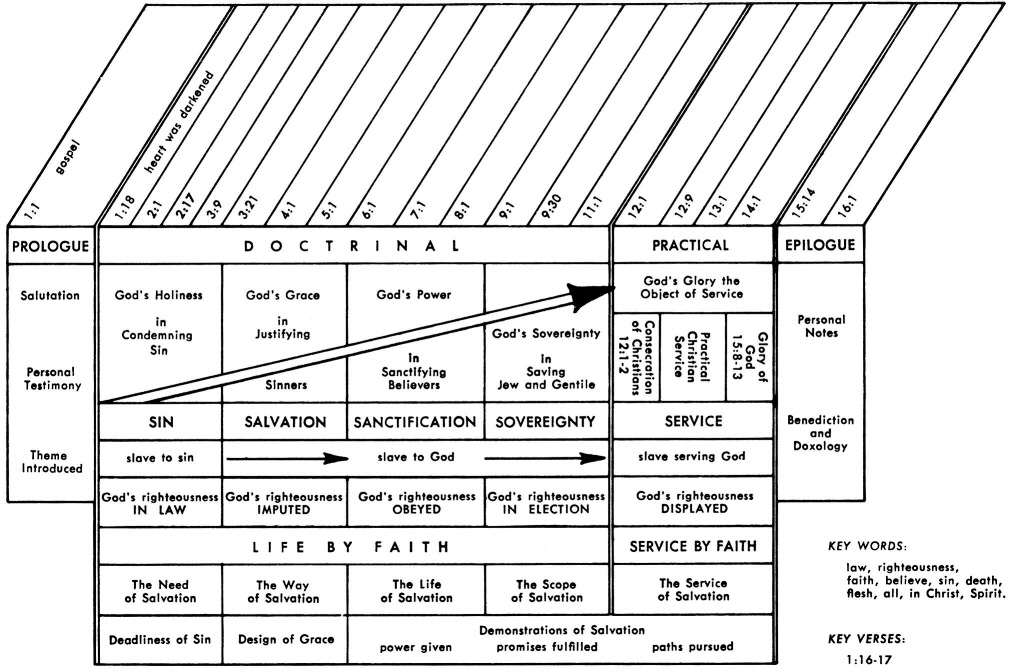
Click chart to enlarge
Chart from recommended resource Jensen's Survey of the NT - used by permission
Romans Overview Chart - Charles Swindoll
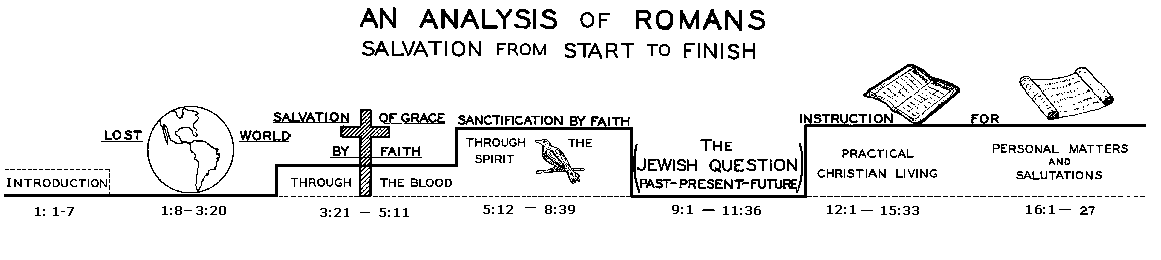
Source: Dr David Cooper
Click to Enlarge
R Ruin (Romans 1:17 – 3:20) – The utter sinfulness of humanity
O Offer (Romans 3:21-31) – God’s offer of justification by grace
M Model (Romans 4:1-25) – Abraham as a model for saving faith
A Access (Romans 5:1-11) – The benefits of justification
N New Adam (Romans 5:12-21) – We are children of two “Adams”
S Struggle w/ Sin (Romans 6-8) Struggle, sanctification, and victory
|
ROMANS ROAD |
||||
| Romans 1:18-3:20 | Romans 3:21-5:21 | Romans 6:1-8:39 | Romans 9:1-11:36 | Romans 12:1-16:27 |
| SIN | SALVATION | SANCTIFICATION | SOVEREIGNTY | SERVICE |
| NEED FOR SALVATION |
WAY OF SALVATION |
LIFE OF SALVATION |
SCOPE OF SALVATION |
SERVICE OF SALVATION |
| God's Holiness In Condemning Sin |
God's Grace In Justifying Sinners |
God's Power In Sanctifying Believers |
God's Sovereignty In Saving Jew and Gentile |
Gods Glory The Object of Service |
| Deadliness of Sin |
Design of Grace |
Demonstration of Salvation | ||
| Power Given | Promises Fulfilled | Paths Pursued | ||
| Righteousness Needed |
Righteousness Credited |
Righteousness Demonstrated |
Righteousness Restored to Israel |
Righteousness Applied |
| God's Righteousness IN LAW |
God's Righteousness IMPUTED |
God's Righteousness OBEYED |
God's Righteousness IN ELECTION |
God's Righteousness DISPLAYED |
| Slaves to Sin | Slaves to God | Slaves Serving God | ||
| Doctrine | Duty | |||
| Life by Faith | Service by Faith | |||
|
Modified from Irving L. Jensen's chart above |
||||
Romans 1:16 For I am not ashamed of the Gospel, for it is the power of God for salvation to everyone who believes, to the Jew first & also to the Greek . (NASB: Lockman)
Greek: Ou gar epaischunomai (1SPMI) to euaggelion, dunamis gar Theou estin (3SPAI) eis soterian panti to pisteuonti, (PAPMSD) Ioudaio te proton kai Helleni
Amplified: For I am not ashamed of the Gospel (good news) of Christ, for it is God’s power working unto salvation [for deliverance from eternal death] to everyone who believes with a personal trust and a confident surrender and firm reliance, to the Jew first and also to the Greek, (Amplified Bible - Lockman)
NLT: For I am not ashamed of this Good News about Christ. It is the power of God at work, saving everyone who believes--Jews first and also Gentiles. (NLT - Tyndale House)
Phillips: For I am not ashamed of the Gospel. I see it as the very power of God working for the salvation of everyone who believes it, both Jew and Greek. (Phillips: Touchstone)
Wuest: For I am not ashamed of the good news. For God's power it is, resulting in salvation to everyone who believes, to Jew first and also to Gentile (Eerdmans)
Young's Literal: for I am not ashamed of the good news of the Christ, for it is the power of God to salvation to every one who is believing, both to Jew first, and to Greek.
FOR I AM NOT ASHAMED: Ou gar epaischunomai (1SPMI):
I am not ashamed. Ps 40:9,10; 71:15,16; 119:46; Mark 8:38 Lk 9:26 1Co 2:2 2Ti 1:8,12,16 1Pe 4:16)
Let me never be ashamed of the truth of the Gospel,
that I may bear its reproach,
vindicate it,
see Jesus as its essence,
know in it the power of the Spirit.
--Valley of Vision, Banner of Truth, 1975
For (1063) (gar) is a subordinating conjunction expressing cause or explanation and thus introduces an explanation. In simple terms for is a term of explanation and its occurrence should always prompt one to pause and ponder the text and context, asking what the author is explaining, how does he explain it, etc. While not every "for" in the Bible is a term of explanation, most are and since there are over 7500 uses of for (NAS), you will have ample opportunity to observe and interrogate the text. As you practice this discipline of pausing to ponder, you are establishing the context (which leads to more accurate interpretation and thus more apropos application) and you are in effect engaging in the blessed activity of Biblical Meditation (See Ps 1:2, Ps 1:3 and Joshua 1:8 for the blessed benefits of meditation). When for is used at the beginning of a passage (as here in Ro 1:16) it is usually a term of explanation.
Here Paul is explaining why he is eager to preach the Gospel to the saints in Rome (notice the Gospel is not just to "get one saved" but is actively involved in our ongoing day to day salvation from sin, Satan and self (see Three Tenses of Salvation) Too often in modern evangelicalism we think that once the person is regenerated by the Spirit and the power of the Gospel, the Gospel is not longer needed in that new believer's life. Wrong! It's needed as much after regeneration as before and in both situations is "tapped into" by grace through faith. Most saints have no problem with the teaching that we are saved by faith alone, but then they begin the walk of sanctification with the misunderstanding that they can do it in their own power. Salvation the first time was a miracle and salvation every day from my filthy flesh (not to mention the world system and the devil's minions) is just as much a miracle. Husbands, have you ever thought about how you are going to love your wife like Christ loved the Church? Just try to do it in your own strength (I speak from 42 years of marital experience!) So that is why Paul is addressing believers. He wants them to fully understand the Gospel that saves.
Moule - The “for” links this verse to the last thought. At Rome, if anywhere, he might be “ashamed” (Mark 8:38) of the message of a crucified Saviour; a message, too, which pronounced “the whole world guilty before God.” But he was not ashamed of his message, and so was ready to “see Rome.”
Not (3756) (ou) indicates absolute negation and strongly denies the possibility that Paul might ever be ashamed of the glorious Gospel. The verb ashamed is also in the present tense indicating this was Paul's continual attitude.
Ashamed (1870) (epaischunomai [word study] from epi = upon or used to intensify the meaning of the following word + aischunomai from aischos = disfigurement & then disgrace) (used 2x in Romans) means to experience a painful feeling or sense of loss of status because of some particular event or activity. It describes one's consciousness of guilt or of exposure or the fear of embarrassment that one's expectations may prove false. Epaischunomai is associated with being afraid, feeling shame which prevents one from doing something, a reluctance to say or do something because of fear of humiliation, experiencing a lack of courage to stand up for something or feeling shame because of what has been done.
Epaischunomai - 9x in 9v - Mark 8:38; Luke 9:26; Ro 1:16; 6:21; 2Ti 1:8, 12, 16; Heb 2:11; 11:16
Writing to the Corinthian saints Paul explained that
we preach (kerusso = herald as a public crier) Christ crucified, to Jews a stumbling block (Greek = skandalon gives us our English "scandal" = circumstance or action that offends propriety or established moral conceptions), and to Gentiles foolishness (considered intellectually weak and irrational) (1Cor 1:23)
We can thus see why the Gospel might bring about situations in which one would be tempted to feel a sense of shame.
Paul was indubitably unashamed and the Gospel had indeed created many "scandals" for Paul - he had been imprisoned in Philippi (Acts 16:23, 24), chased out of Thessalonica (Acts 17:1-9), smuggled out of Berea (Acts 17:10, 11, 12, 13, 14, 15-see note), sneered at in Athens (Acts 17:32), regarded as a fool in Corinth (1Cor 1:18 23), and stoned in Galatia (Acts 14:19), but Paul remained eager to preach the Gospel in Rome—the seat of contemporary political power and pagan religion. Neither ridicule, criticism, nor physical persecution could curb his boldness. (See 2Cor 4:5-18; 11:23, 24, 25, 26, 27, 28; 12:9). But its inherent glory, as God's life-giving message to a dying world, so filled his soul, that, like his blessed Master, he "despised the shame." (see Hebrews 12:2)
Paul knew that Rome was a volatile place and that Christians there had already experienced persecution. He knew that the capital city of the empire was steeped in immorality and paganism, including emperor worship. He knew that most Romans would despise him and that many probably would do him harm. Yet he was boldly eager to go there, for his Lord’s sake and for the sake of the Lord’s people.
He was not ashamed even though he had been imprisoned in Philippi, chased out of Thessalonica, smuggled out of Damascus and Berea, laughed at in Athens, considered a fool in Corinth, and declared a blasphemer and lawbreaker in Jerusalem. He was stoned and left for dead at Lystra. Some pagans of Paul’s day branded Christianity as atheism because it believed in only one God and as being cannibalistic because of a misunderstanding of the Lord’s Supper. Although that GOSPEL was then, and still is today, a stumbling block to Jews and foolishness to Gentiles, it is the only way God has provided for the salvation of men, and Paul was both overjoyed and emboldened by the privilege of proclaiming its truth and power wherever he went.
The fellowship of the unashamed - When we have opportunity to speak for Christ, we often do not. We know the Gospel is unattractive, intimidating, and repulsive to the natural, unsaved person and to the ungodly spiritual system that now dominates the world. The Gospel exposes man’s sin, wickedness, depravity, and lostness, and it declares pride to be despicable and works righteousness to be worthless in God’s sight. To the sinful heart of unbelievers, the Gospel does not appear to be good news but bad, and when they first hear it they often react with disdain against the one presenting it or throw out arguments and theories against it. Fear of men and of not being able to handle their arguments are some of the greatest impediment to being a bold witness for the Gospel of Jesus Christ.
It is said that if a circle of white chalk is traced on the floor around a goose that it will not leave the circle for fear of crossing the white mark. In a similar way, the "chalk marks" of criticism, ridicule, tradition, and rejection prevent many believers from leaving the security of Christian fellowship to witness to the unsaved.
FELLOWSHIP OF THE
UNASHAMED
You are probably familiar with Christian "T shirts" with the logo "FOTU" (Fellowship of the Unashamed), which stands for "fellowship of the unashamed" which summarizes the credo below...
I am a part of the fellowship of the Unashamed. I have the Holy Spirit Power. The die has been cast. I have stepped over the line. The decision has been made. I am a disciple of Jesus Christ. I won't look back, let up, slow down, back away, or be still. My past is redeemed, my present makes sense, and my future is secure. I am finished and done with low living, sight walking, small planning, smooth knees, colorless dreams, tame visions, mundane talking, chintzy giving, and dwarfed goals. I no longer need preeminence, prosperity, position, promotions, plaudits, or popularity. I don't have to be right, first, tops, recognized, praised, regarded, or rewarded. I now live by presence, learn by faith, love by patience, lift by prayer, and labor by power.
My pace is set, my gait is fast, my goal is Heaven, my road is narrow, my way is rough, my companions few, my Guide is reliable, my mission is clear. I cannot be bought, compromised, deterred, lured away, turned back, diluted, or delayed. I will not flinch in the face of sacrifice, hesitate in the presence of adversity, negotiate at the table of the enemy, ponder at the pool of popularity, or meander in the maze of mediocrity.
I won't give up, back up, let up, or shut up until I've preached up, prayed up, paid up, stored up, and stayed up for the cause of Christ. I am a disciple of Jesus Christ. I must go until He returns, give until I drop, preach until all know, and work until He comes.
And when He comes to get His own, He will have no problem recognizing me. My colors will be clear for "I am not ashamed of the Gospel, because it is the power of God for the salvation of everyone who believes.." (Romans 1:16) (Reported to have been written by Bob Moorehead)
C H Spurgeon wrote that...
When we preach Christ crucified, we have no reason to stammer, or stutter, or hesitate, or apologize; there is nothing in the gospel of which we have any cause to be ashamed.
Jamieson writes that Paul's
language implies that it required some courage to bring to "the mistress of the world" what "to the Jews was a stumbling-block and to the Greeks foolishness" (1Co 1:23). But its inherent glory, as God's life-giving message to a dying world, so filled his soul, that, like his blessed Master, he "despised the shame."
Warren Wiersbe gives a personal illustration of why Paul was not ashamed:
During my years in high school, I was chosen to be an office monitor. The other hall monitors sat at various stations around the building, but I was privileged to sit right outside the door of the main high school office. I was entrusted with important messages that I had to deliver to different teachers and staff members, and on occasion even to other schools. Believe me, it was fun to walk into a classroom and even interrupt a lesson! No teacher ever scolded me, because all of them knew I carried messages from the principal. I never had to be afraid or ashamed, because I knew where my messages came from.
Richard Halverson asks Why are men ashamed of the Gospel? ...
Paul says to the Jew the Gospel is a "stumbling block" (skandalon); to the Greek it is "foolishness."
A stumbling block to the Jew because he requires a sign. What sign does he require? The Jew thought of his MESSIAH in terms of an earthly kingdom, the restoration of the Throne of David, giving the Jew a place of preeminence among the nations. They did not see their MESSIAH as "despised and rejected of men," as a suffering servant. They did not see their MESSIAH hanging on a Cross, His body broken, bleeding, a crown of thorns on His head. This could not be their MESSIAH. But it was; and as we traverse Paul's letter to the Romans, we shall discover that the Old Testament taught that the MESSIAH was to be this.
The Gospel is foolishness to the Greek, and one enamored of intellect. The Gospel is an offense to pride of intellect, and Paul is writing to Rome, the mistress of the world. What is his message? He proclaims a despised and rejected Nazarene, crucified on a Cross as a common criminal. Is this message supposed to have appeal for the proud Roman? Paul is not ashamed of it! Paul is proud to declare it; but how many, for no other reason than ego, deprive themselves of this glorious message?
You will remember the interesting story of Naaman (2Kings 5:1ff), the captain of the king's host of Syria. Naaman was a great man, possessing all that any man could want, enjoying status and position; but says the Scripture with penetrating realism, "he was a leper," a type of sin in the Bible. He would have paid any price to be rid of his leprosy. Now it happened that in one of the wars between Syria and Israel, a little Jewish girl was captured in Samaria and taken to the house
of Naaman. When she learned of his desire to be cured of leprosy, she said, "Oh if he only knew of the man of GOD in Samaria!" The king of Syria, hearing this, order Naaman to go to the King of Israel, and in the course of events Naaman was brought to Elisha, the man of GOD. Elisha sent a servant who said, "Go and wash in Jordan seven times, and thy flesh shall come again to thee, and thou shalt be clean" (2Kings 5:10).
Naaman responded in proud wrath saying, "Are not Abana and Pharpar, rivers of Damascus, better than all the waters of Israel? may I not wash in them, and be clean? So he turned and went away in a rage" (2Kings 5:12). But with irresistible logic the servant said, "My father, if the prophet had bid thee do some great thing, wouldest thou not have done it?" Yielding to such clear logic the wise captain turned and washed in the water seven times and came up clean. There are men and women who for no other reason than sheer unmitigated pride are depriving themselves of the cleansing, forgiving, regenerating power of GOD in the Gospel. Offer them profound thoughts, some thing intellectual which appeals to their pride of understanding, this they will take seriously. Give them some difficult thing to do that they may boast in accomplishment, it is acceptable; but to simply trust what JESUS CHRIST did on the Cross of Calvary, how many turn their backs on that incredible offer? Thank GOD that the Apostle Paul, one of the greatest intellects who ever lived, could say, "I am not ashamed of the Gospel of Christ." (Ref)
Unashamed - On one occasion Frederick the Great invited some notable people to his royal table, including his top-ranking generals. One of them by the name of Hans von Zieten declined the invitation because he wanted to partake of communion at his church. Some time later at another banquet Frederick and his guests mocked the general for his religious scruples and made jokes about the Lord’s supper. In great peril of his life, the officer stood to his feet and said respectfully to the monarch, “My lord, there is a greater King than you, a King to whom I have sworn allegiance even unto death. I am a Christian man, and I cannot sit quietly as the Lord’s name is dishonored, His character belittled, and His cause subjected to ridicule. With your permission I shall withdraw.” The other generals trembled in silence, knowing that von Zieten might be killed. But to their surprise, Frederick grasped the hand of this courageous man, asked his forgiveness, and requested that he remain. He promised that he would never again allow such a travesty to be made of sacred things. (Our Daily Bread, Copyright RBC Ministries, Grand Rapids, MI. Reprinted by permission. All rights reserved)
OF THE GOSPEL: to euaggelion:
- Ro 15:19,29 Lk 2:10,11 1Co 9:12,18 2Co 2:12; 4:4 2Co 9:13 Ga 1:7 1Ti 1:11
The Puritan William Gurnall wrote that...
The Gospel is the chariot wherein the Spirit rides victoriously when He makes His entrance into the hearts of men.
E. Stanley Jones once wrote that while the world's vast array of
Religions are man’s search for God; the Gospel is God’s search for man. There are many religions, but one Gospel.
Samuel Davies writes that the Gospel's...
very name has something endearing in the sound, "good tidings," "joyful news". It is the wisdom of God in a mystery, 1Corinthians 2:7; the mystery which had been hidden from ages and from generations, Col. 1:26; the ministration of the Spirit, and of righteousness, which far exceeds all former dispensations in glory. 2Corinthians 3:8, 9. And it is represented as the only scheme for the salvation of sinners. When the wisdom of the world had used its utmost efforts in vain, it pleased God, by the despised preaching of this humble gospel, to save those who believe. 1Corinthians 1:21. (The Nature of Justification)
W H Luckenbach observes...
What grand truths lie concealed in Romans 1:16, as in a kaleidoscope! The Gospel being its focal point, several easy turns bring into clearest view some of the most precious things of our Christian faith.
I. The first turn presents its EFFICACY: “It is…power.”
II. The second its DIVINITY: “It is the power of God.”
III. The third its OBJECT: “It is the power of God unto salvation.”
IV. The fourth its IMPARTIALITY: “It is the power of God unto salvation to everyone.”
V. The fifth its CONDITIONALITY: “It is the power of God unto salvation to everyone that believeth.”
VI. The sixth the ORDER in which it was to be preached to and employed by guilty man: “To the Jews first, and also to the Greek.”
A man who can define it so comprehensively and grandly, could not well be “ashamed of the gospel of Christ.” In more than the sense of willingness he is “ready to
preach” it anywhere. (Biblical Illustrator)
Gospel (2098) (euaggelion/euangelion [word study] from eú = good + aggéllo/angello = proclaim, tell) was originally a reward for good news and later became the good news itself. The word euaggelion was in just as common use in the first century as our words good news today. “Have you any good news for me today?” would have been a common question. In this secular use euaggelion described good news of any kind and prior to the writing of the New Testament, had no definite religious connotation in the ancient world until it was taken over by the "Cult of Caesar" which was the state religion and in which the emperor was worshipped as a god.
William Tyndale (1494–1536) who was martyred because he was not "ashamed of the Gospel" said
'Euaggelion (which we call Gospel)...signifies good, merry, glad, and joyful tydings, that makes a mans heart glad, and makes him sing, dance, and leap for joy.'
Do this and live, the Law commands,
But gives me neither feet nor hands.
A better word the Gospel brings.
It bids me fly and gives me wings
Martin Luther reiterated this truth when he said that "The Law is what we must do; the Gospel is what God will give."
Euaggelion - 76x in 73v in the NT -
Mt 4:23; 9:35; 24:14; 26:13; Mk. 1:1, 14, 15; 8:35; 10:29; 13:10; 14:9; 16:15; Acts 15:7; 20:24; Ro 1:1, 9, 16; 2:16; 10:16; 11:28; 15:16, 19; 16:25; 1Co. 4:15; 9:12, 14, 18, 23; 15:1; 2Co. 2:12; 4:3, 4; 8:18; 9:13; 10:14; 11:4, 7; Gal. 1:6, 1:7, 11; 2:2, 5, 7, 14; Eph 1:13; 3:6; 6:15, 19; Phil 1:5, 7, 12, 16, 27; 2:22; 4:3, 15; Col 1:5, 23; 1Th 1:5; 2:2, 4, 8, 9; 3:2; 2Th 1:8; 2:14; 1Ti 1:11; 2Ti 1:8, 10; 2:8; Philemon 1:13; 1Pe 4:17; Rev 14:6. NAS = good news(1), Gospel(73), Gospel's(2).
Euaggelion - Only once in the Septuagint (LXX) - 2Sa 4:10 clearly not with the same meaning as "Gospel" in the NT! Note that the verb form euaggelizo/euangelizo occurs much more frequently in the Lxx (1Sa 31:9; 2Sa 1:20; 4:10; 18:19, 20, 26, 31; 1Kgs 1:42; 1Chr 10:9; Ps 40:9; 68:11; 96:2; Isa 40:9; 52:7; 60:6; 61:1; Jer 20:15; Joel 2:32; Nah 1:15) but most of these OT uses of the verb were in the context of proclamation of "good news" in general, not the Good News of the NT Gospel.
Euaggelion is found in several combination phrases, each describing the Gospel like a multifaceted jewel in various terms from a different viewpoint (from NASB77):
- the Gospel of the kingdom (Mt 4:23)
- the Gospel of Jesus Christ, the Son of God (Mark 1:1) because it centers in Christ
- the Gospel of God (Mark 1:14) because it originates with God and was not invented by man
- the Gospel of the kingdom of God (Lk 16:16)
- the Gospel of the grace of God (Acts 20:24),
- the Gospel of His Son (Romans 1:9)
- the Gospel of Christ (Romans 15:19)
- the Gospel of the glory of Christ (2Co 4:4)
- the Gospel of your salvation (Ephesians 1:13)
- the Gospel of peace (Ephesians 6:15)
- the Gospel of our Lord Jesus (2Thes 1:8)
- the glorious Gospel of the blessed God (1Ti 1:11)
- In Ro 16:25, 26 (see note) Paul called it “my Gospel” indicating that the special emphasis he gave the Gospel in his ministry.
In light of A W Pink's observation that the modern church is "far more concerned about the results of the gospel than we are about the purity of it" several passages will be reviewed below to give you an accurate Biblical description of the Gospel. To really understand the Gospel one needs to read and study the Book of Romans is in a sense Paul's expanded treatise on the Gospel according to Jesus. In fact pause for a moment and peruse the summary table of the Book of Romans (Table), which is a summary of the bad news followed by the good news! (See also the Romans Road Bridge Illustration of the Bad News & then the Good News).
Paul's "definition" of the Gospel is summarized in the following passage (as you present the Gospel be sure to include these foundational truths)
1CORINTHIANS 15:1-11
1 Now I make known to you, brethren, the Gospel which I preached to you, which also you received, in which also you stand,
2 by which also you are saved, if you hold fast the word which I preached to you, unless you believed in vain.
3 For I delivered to you as of first importance what I also received, that Christ died for our sins according to the Scriptures,
4 and that He was buried, and that He was raised on the third day according to the Scriptures,
5 and that He appeared to Cephas, then to the twelve.
6 After that He appeared to more than five hundred brethren at one time, most of whom remain until now, but some have fallen asleep;
7 then He appeared to James, then to all the apostles;
8 and last of all, as it were to one untimely born, He appeared to me also.
9 For I am the least of the apostles, who am not fit to be called an apostle, because I persecuted the church of God.
10 But by the grace of God I am what I am, and His grace toward me did not prove vain; but I labored even more than all of them, yet not I, but the grace of God with me.
11 Whether then it was I or they, so we preach (the Gospel which has inherent power and do so by the empowering grace of God that works within us) and so you believed. (1Co 15:1, 1Co 15:2 1Co 15:3-5, 1Co 15:6-8)
Spurgeon summarized the Gospel declaring...
If our Lord's bearing our sin for us is not the Gospel, I have no Gospel to preach....The heart of the gospel is redemption, and the essence of redemption is the substitutionary sacrifice of Christ.
See me, see me, once a rebel,
Prostrate at His Cross I lie—
Cross, to tame earth's proudest able,
Who was e'er so proud as I?
He convinced me, He subdued me,
He chastised me, He renewed me;
The nails that pierced, the spear that slew Him,
Transfixed my heart, and bound me to Him.
See me! see me! once a rebel,
Prostrate at His cross I lie.
Paul had explained earlier in this same letter to the church at Corinth that proclamation of the Gospel was his primary mandate (note again Paul's repeated emphasis on the Gospel as the inherent [dunamis] power of God)...
1CORINTHIANS 1:17-25
17 for Christ did not send (apostello - our word "apostle") me to baptize, but to preach the Gospel, (how?) not in cleverness of speech, (why not use "clever speech"?) that the cross of Christ (in context synonymous with the Gospel) should not be made void.
18 For the word of the cross (again synonymous with the Gospel) is to those who are perishing (not being annihilated but suffering eternal loss and ruin, no longer ever able to be useful for the purpose for which they were created!) foolishness (this is why Paul said he was not ashamed of the Gospel for the wise would try to shame those who proclaim such a foolish message), but to us who are being saved it is the (inherent ability or) power of God .
19 For it is written, "I WILL DESTROY THE WISDOM OF THE WISE, AND THE CLEVERNESS OF THE CLEVER I WILL SET ASIDE."
20 Where is the wise man? Where is the scribe? Where is the debater of this age? Has not God made foolish the wisdom of the world?
21 For since in the wisdom of God the world through its wisdom did not come to know God, God was well-pleased through the foolishness (Paul is being sarcastic and explains that God's "foolishness" is wiser than man) of the message preached to save those who believe.
22 For indeed Jews ask for signs, and Greeks search for wisdom;
23 but we preach Christ crucified (the heart of the Gospel message 1Cor 15:3-4), to Jews a stumbling block, and to Gentiles foolishness,
24 but to those who are the called, both Jews and Greeks, Christ (and the good news about Him which is ) the power of God and the wisdom of God.
25 Because the foolishness of God is wiser than men, and the weakness of God is stronger than men.
Paul again explained his purpose writing in
1CORINTHIANS 2:1-7
2:1 And when I came to you, brethren, I did not come with superiority of speech or of wisdom, proclaiming to you the testimony (marturion) of God (the Gospel, cf "the testimony of our Lord" and "power of God" are mentioned in 2Ti 1:8).
2 For I determined (resolved) to know nothing among you except Jesus Christ, and Him crucified.
3 And I was with you in weakness (state of incapacity to do something = we like Paul should be so "weak" that our only power is from God) and in fear and in much trembling (quaking or quivering with fear but still unashamed).
4 And my message (logos) and my preaching (proclamation) were not in persuasive words of wisdom (as men would use in attempting to win an argument or debate), but in demonstration of the Spirit and of power (perfect parallel of Romans 1:16 for the omnipotent Spirit coupled with dunamis emphasizes the intrinsic supernatural, divine power of the Gospel),
5 that your faith should not rest on the wisdom (sophia) of men (earthly, natural, unspiritual, fleshly, even motivated by the Devil), but on the power of God (the Gospel of God).
6 Yet we do speak wisdom among those who are mature (see teleios); a wisdom, however, not of this age, nor of the rulers of this age, who are passing away (not so much simply dying but katargeo = basic idea is they are useless and ineffective);
7 but we speak God's wisdom in a mystery, the hidden wisdom, which God predestined before the ages to our glory (He made it for our benefit before the world began); (1Corinthians 2:1-7)
1CORINTHIANS 4:1-2
Paul considered himself first as a servant of Christ with his call to proclaim the Gospel as a stewardship...
1 Let a man regard us (indicating Paul, Apollos, Cephas, and, by extension, all other “fellow–workers”) in this manner, as servants (huperetes = “under rowers” = lowest galley slaves rowing on bottom tier of ship = most menial, unenvied, despised of slaves = thus subordinates of any sort, to those under the authority of another) of Christ (servants cannot serve men rightly unless they serve their Lord rightly and they cannot serve Him rightly unless they see themselves rightly = as His under-slaves, His menial servants - he serves Christ first and then and only then can he best serve people), and stewards (responsible for the Master's "property" and one day to give an account) of the mysteries (musterion = in NT that which was previously hidden but now made known only by divine revelation) of God.
2 In this case, moreover, it is required of stewards (oikonomos = “house manager” = person placed in complete control of household supervising property, fields, finances, etc on behalf of his master) that one be found trustworthy (faithful).
Finally in Paul explains why he must preach the Gospel...
1CORINTHIANS 9:16-18
16 For if I preach the Gospel, I have nothing to boast of, for I am under compulsion (if someone is compelled they are driven irresistibly - Does that describe you? Do we eagerly look for opportunities to tell others of the glorious Gospel?); for woe is me if I do not preach the Gospel.
17 For if I do this voluntarily, I have a reward; but if against my will, I have a stewardship (responsible management of the Gospel entrusted to Paul’s care) entrusted to me.
18 What then is my reward? That, when I preach the Gospel, I may offer the Gospel without charge, so as not to make full use of my right in the Gospel.
The so-called "health and wealth Gospel" that has swept through the church in America (especially via television) is not offensive to the world because it offers what the world wants. But this is false Gospel ("a different [heteros] Gospel which is really not another" Galatians1:6-7) and not the Gospel of Jesus Christ. What does the Gospel do? It saves sinners. What else will save sinners? Not science, not education, not religion, not moral reformation, not fame and fortune. The Gospel, and only the Gospel, saves sinners. But it must be the genuine Gospel, the whole truth and nothing but the truth. God will add the power!
"AN INOFFENSIVE GOSPEL
IS AN INOPERATIVE GOSPEL"
Geoffrey Wilson emphasizes the need for the "pure" Gospel writing that...
The unpopularity of a crucified Christ has prompted many to present a message which is more palatable to the unbeliever, but the removal of the offense of the cross (1Co1:18) always renders the message ineffective. An inoffensive Gospel is also an inoperative Gospel.
The Good News Is Not Simply That We Are Okay
The Good News Is Not Simply That God Is Love
The Good News Is Not Simply That Jesus Wants to Be Our Friend
The Good News Is Not Simply That We Should Live Right
Richard Owen Roberts in fact notes that "The nature of the Gospel is that it divides."
John MacArthur emphasizes that Romans 1:16-17...
express the theme of the book of Romans, and they contain the most life-transforming truth God has put into men’s hands. To understand and positively respond to this truth is to have one’s time and eternity completely altered. These words summarize the Gospel of Jesus Christ, which Paul then proceeds to unfold and explain throughout the remainder of the epistle. Some years ago after speaking at a youth rally, the wife of the rally director approached (MacArthur) and said, “Your message offended me, because you preached as if all of these young people were sinners.” To which he replied “I’m glad it came across that way, because that is exactly the message I wanted to communicate.” (MacArthur, J: Romans 1-8. Chicago: Moody Press)
To reiterate simply scanning the main subjects in the divisions of Romans (see table) leaves no doubt that the presentation of the Gospel begins with the "bad news" to awaken in the hearer the fact that he or she needs God's provision of righteousness which is credited to the spiritual "bank" account of all those who believe in Jesus' substitutionary (He died the death I should have died for my sins), atoning death on the Cross. As Paul said "Believe in the Lord Jesus, and you shall be saved." (Acts 16:31). "Confess with your mouth Jesus as Lord, and believe in your heart that God raised Him from the dead, you shall be saved; for with the heart man believes, resulting in righteousness, and with the mouth he confesses, resulting in salvation." (Romans 10:9, 10)
WHAT BETTER NEWS CAN A
SPIRITUALLY DEAD SINNER HEAR?
Pastor Mark Dever emphasizes that...
Good News of Christianity has a specific, cognitive content. It is not simply a religious enthusiasm. It is not simply a deep personal intuition. It is news—news that says something about ourselves, about God, about Jesus. It is either right or wrong. Either we are sinful (as the Bible claims) or we are not sinful. Either God does or does not exist. Either He is or He is not who the Bible says He is. Either Jesus did die on the Cross and rise from the dead or He did not. In our own local church, I always ask prospective members to tell me the Gospel in one minute or less (unlike what I’ve done in this chapter!). I do that because I want it to be clear. I want people to know the Gospel, to understand what they’re saying. Have you stopped and thought recently about what you claim to believe if you are a Christian? B. B. Warfield described it this way:
A dozen ignorant peasants proclaiming a crucified Jew as the founder of a new faith; bearing as the symbol of their worship an instrument which was the sign of ignominy, slavery and crime; preaching what must have seemed an absurd doctrine of humility, patient suffering and love to enemies—graces undreamed of before; demanding what must have seemed an absurd worship for One Who had died like a malefactor and a slave, and making what must have seemed an absurd promise of everlasting life through one Who had Himself died, and that between two thieves.
As extraordinary as this message is, it is true. It really happened this way. This is what God has done. These other messages—“I’m O.K., you’re O.K.,” “Whatever you think of as love is God,” “Jesus is your friend,” “You should live right”—these messages are messages other than the Good News of Christianity. They are half true at best, and they are dangerously untrue when they are relied on as the Christian Gospel. But this Good News of Christ’s death on the Cross as an atoning sacrifice for the sins of all those who would ever turn and trust in Him—this good news is not make-believe. This is for real!...
Have we heard the Gospel? Have we believed it with our lives or are we still playing at religion? Do we attend church occasionally when our curiosity is up or our guilt is aroused, while regularly and with great satisfaction serving first of all ourselves?
To really hear the Gospel is to be shaken to your core. To really hear the Gospel is to change. Have you heard the Gospel—not a soothing word about your goodness, or about God’s acceptance, or about Jesus’ inoffensive willingness to befriend all and sundry, or even some convicting word about getting rid of some sin in your life—but have you heard the Bible’s great message about God and us? Does it sound like the best news you’ve ever heard? Old sins forgiven! New life begun! A personal relationship with your God, your Creator, now and forever! What better news could you hear? (Nine Marks of a Healthy Church - Recommended Reading)
Alexander Maclaren describes the Gospel...
The Gospel of Jesus Christ presents itself, not as a mere republication of morality, not as merely a new stimulus and motive to do what is right, but as an actual communication to men of a new power to work in them, a strong hand laid upon our poor, feeble hand with which we try to put on the brake or to apply the stimulus. It is a new gift of a life which will unfold itself after its own nature, as the bud into flower, and the flower into fruit; giving new desires, tastes, directions, and renewing the whole nature. (Transfiguration - Scroll down)
Guy King - In ringing tones he declares, "I am not ashamed of the gospel of CHRIST", Romans 1:16; and he unfolds the reasons why he was not ashamed, in the use of those four "for's" in Romans 1:16-18:
(1) "For" the People it serves: Roman, Jew, Greek, so universal in its range.
(2) "For" the Power it shows: the dynamite (Gk.) of GOD: not to destruction, but to salvation, "turning right side up", not as Acts 17:6.
(3) "For" the Problem it solves: the way in which GOD can righteously exercise His love in saving us.
(4) "For" the Pardon it secures: instead of "the wrath of God" for all who turn and trust Him. All which the gospel does for believers; and such glorious effects endow Paul's message with a quality for which he can never be ashamed. (Philippians 1:12-26 The Happiness of a Humble Spirit)
From the Valley of Vision A collection of Puritan Prayers & Devotions edited by Arthur Bennett, Banner of Truth (1975)...
Blessed Lord Jesus,
No human mind could conceive or invent
the Gospel.
Acting in eternal grace, Thou art both
its messenger and its message,
lived out on earth through infinite compassion,
applying Thy life to insult, injury, death,
that I might be redeemed, ransomed, freed.
Blessed be Thou, O Father, for contriving this way,
Eternal thanks to Thee, O Lamb of God,
for opening this way,
Praise everlasting to Thee, O Holy Spirit,
for applying this way to my heart.
Glorious Trinity, impress the Gospel on my soul,
until its virtue diffuses every faculty;
Let it be heard, acknowledged, professed, felt.
Teach me to secure this mighty blessing;
Help me to give up every darling lust,
to submit heart and life to its command,
to have it in my will,
controlling my affections,
molding my understanding;
to adhere strictly to the rules of true religion,
not departing from them in any instance,
nor for any advantage in order to escape evil,
inconvenience or danger.
Take me to the Cross to seek glory from its infamy;
Strip me of every pleasing pretence of righteousness
by my own doings.
O gracious Redeemer,
I have neglected Thee too long,
often crucified Thee,
crucified Thee afresh by my impenitence,
put Thee to open shame.
I thank Thee for the patience that has borne with me
so long,
and for the grace that now makes me willing to be Thine.
O unite me to Thyself with inseparable bonds,
that nothing may ever draw me back from Thee,
my Lord, my Saviour.
ARE YOU PREACHING THE GOSPEL
TO YOURSELF EVERY DAY?
Jerry Bridges emphasizes our daily need to "preach the Gospel" to ourselves...
I begin my time with God by reviewing and appropriating to myself the Gospel. Since the gospel is only for sinners, I come to Christ as a still practicing sinner. In fact, I usually use the words of that tax collector in the temple when he cried out, “God, be merciful to me, a sinner” (Luke 18:13). God has been merciful, and I’m quick to acknowledge his mercy in my life, but I say to him that I come in the attitude of that tax collector. “I need your mercy. I am still a practicing sinner. Even my very best deeds are sinful in your sight, and I am an object of your mercy and your grace.” It’s important that we come, first of all, by appropriating the Gospel because it’s through Christ that we have access to God the Father. Paul says in Ephesians 2:18, “For through him we both [Jew and Gentile] have access in one Spirit to the Father.” We cannot come directly to God. We must always come through the blood of the Lord Jesus Christ. But God not only allows us to come; He invites us to come. The writer of Hebrews says, “Therefore, brothers, since we have confidence to enter the holy places by the blood of Jesus, by the new and living way that he opened for us through the curtain, that is, through his flesh, and since we have a great priest over the house of God, let us draw near with a true heart in full assurance of faith” (Heb. 10:19–22). And so as we appropriate the Gospel it gives us the confidence to come into the very presence of God to have communion with Him. So we need to learn to live by the Gospel every day of our lives. In the early years of my Christian life and even in my early ministry I regarded the Gospel as a message for the unbeliever. Now that I was a Christian I personally no longer needed the gospel except as a message to share with unbelievers....
Now this raises an apparent problem or question. That is, we know that justification is a point-in-time past event. At the time you trusted Christ you were at that precise moment declared righteous by God. You were justified. That’s why Paul in Ro 5:1 can speak of justification in the past tense when he says, “Therefore, since we have been justified by faith, we have peace with God through our Lord Jesus Christ.” And yet (in Gal 2:20) he speaks of it in the present tense. “The life that I now live in the flesh,” today. The life that I live today, “I live by faith in the Son of God, who loved me and gave himself for me.” So if justification is a point-in-time event that happened in our past, why does Paul speak of it in the present tense? The life that I now live today I live by faith in the Son of God. The answer to that question is one of the most important truths we can learn about the Gospel.
For the apostle Paul, justification was not only a past event;
it was also a present reality.
This is where so many Christians miss it. They can look back to the day that they trusted Christ. And if you press them on that they will say, “Yes, I was justified at that time.” But today they seek to live their lives as if it depends upon them. In their mind they have reverted to a performance relationship with God. And so the thinking is, if I had my quiet time and if I haven’t had any lustful thoughts and these kind of things, then I expect God to bless me today. We want to pay our own way. We want to earn God’s blessings. The apostle Paul didn’t do that. Paul looked outside himself and saw himself clothed in the righteousness of Christ (1Cor 1:30). He saw himself declared righteous. We say to a person who trusts Christ, “You have been justified. You’ve been declared righteous. Your sins have been forgiven. You stand before God today clothed in the righteousness of Jesus Christ.” And then we can point to eternity and say, “When you go to be with the Lord forever, you will still stand clothed in the righteousness of Jesus Christ.” Even though we will have left our sinful nature behind, even though we will be righteous people made perfect, as the writer of Hebrews says (Heb. 12:23), we will for all eternity stand in the righteousness of Christ. That never changes. But what about from the time of our conversion until the time we go to be with the Lord? For most Christians it’s a performance relationship. That is why we need a daily appropriation of the Gospel, because it is our nature to drift toward a performance relationship. Going back to those days of crossing the Pacific Ocean and getting those navigational positions twice a day, if we did not get those we would drift slowly off course. And if you do not daily appropriate the gospel, you will drift toward a performance relationship with God. And when you do that, you lead yourself in one of two directions. If you have a very superficial view of sin in your life—that is, if you think of sin in terms of the big gross sins that society outside of us commits—then you will tend toward religious pride because you’re not doing those things. But if you are conscientious and if you’re seeing some of these “respectable” sins, such as gossip and pride, jealousy and envy and a critical spirit and these kind of things, if you’re seeing those in your life and you do not live by the gospel, that can lead you to despair. And so oftentimes people in this second category just kind of slack off because they can’t handle the tension. They can’t handle the difference between what they know they should be and what they honestly see themselves to be. And what resolves that tension is the Gospel, which reminds us that our sins are forgiven and that we are clothed in the righteousness of Jesus Christ. At the same time, that which keeps us from spiritual pride is the Gospel, because again the Gospel is only for sinners. But we are all sinners, still practicing sinners, even though we’ve been delivered from the guilt and the dominion of sin. Yes, that’s true. And we are now called saints, separated ones. But we still sin in thought, word, deed, and most of all in motive because we often do the right thing for a wrong reason or for a mixed reason. We want to please God, but we want to look good in the process. And so we come to the Lord and we say, “Lord, I come still a practicing sinner, but I look to Jesus Christ and His shed blood and His perfect obedience, His righteous life that has been credited to me. And I see myself standing before you clothed in His righteousness.”...
We need to appropriate the gospel every day of our lives, because God only accepts us for Christ’s sake. God sees us clothed in the righteousness of Christ, and he wants us to see ourselves clothed in the righteousness of Christ, so that we will come to him on that basis and seek to relate to him through the merit of the Lord Jesus Christ and not through our own works. All of us in our sinful nature are prone to slide toward a works-based relationship with God. And even though I have been preaching this kind of message for many years, I can tell you honestly it is so easy to revert in that direction because of our sinful human nature. It is our sinful nature that thinks we must somehow earn God’s favor by our own hard work or our own faithfulness. Now we want to be faithful, we want to work hard, but not in order to earn God’s approval, but because we have God’s approval. And so a daily appropriation of the gospel is essential to enduring to the end. (Stand- A Call for the Endurance of the Saints - Recommended Read).
FOR IT IS THE POWER OF GOD: dunamis gar theou estin (3SPAI):
- Ro 10:17 Ps 110:2 Is 53:1 Jer 23:29 1Co 1:18-24, 1Co 2:4, 14:24,25 1Co 15:2 2Co 2:14-16; 2 Cor 10:4,5 Col 1:5,6 1Th 1:5,6; 1 Th 2:13 Heb 4:12)
Here are a few verses on the power of God's Word, especially the GOSPEL
Jeremiah 23:29 “Is not My word like fire?” declares the LORD, “and like a hammer which shatters a rock?
1 Corinthians 1:18 For the word of the cross (THE GOSPEL) is foolishness to those who are perishing, but to us who are being saved it is the power of God.
1 Corinthians 2:4 and my message and my preaching (THE GOSPEL) were not in persuasive words of wisdom, but in demonstration of the Spirit and of power,
Colossians 1:5; 6 because of the hope laid up for you in heaven, of which you previously heard in the word of truth, the gospel which has come to you, just as in all the world also it (THE GOSPEL) is constantly bearing fruit and increasing (NOTE THE INTRINSIC POWER OF THE GOSPEL - WHEN YOU SPEAK IT FORTH IT IS NOT YOUR POWER BUT GOD'S POWER GOING FORTH! THAT TAKES THE PRESSURE OFF OF US TO HAVE A "PERFECT PRESENTATION!"), even as [it has been doing] in you also since the day you heard [of it] and understood the grace of God in truth
1 Thessalonians 1:5 for our gospel did not come to you in word only, but also in power and in the Holy Spirit and with full conviction; just as you know what kind of men we proved to be among you for your sake.
1 Thessalonians 2:13 For this reason we also constantly thank God that when you received the word of God (THE GOSPEL) which you heard from us, you accepted [it] not [as] the word of men, but [for] what it really is, the word of God (THE GOSPEL), which also performs (energeo in the present tense = continually!) its work in you who believe.
Related Resources:
SUPERNATURAL POWER
IS YOURS IN THE GOSPEL
For (1063) (gar) is a subordinating conjunction expressing cause or explanation and thus introduces an explanation. In simple terms for is a term of explanation and its occurrence should always prompt one to pause and ponder the text and context, asking what the author is explaining, how does he explain it, etc. While not every "for" in the Bible is a term of explanation, most are and since there are over 7500 uses of for (NAS), you will have ample opportunity to observe and interrogate the text. Whenever you observe the little preposition "for" at the beginning of a sentence, it is often used by the writer as a term of explanation. This observation provides an excellent opportunity to pause and ponder the passage. In other words, as you learn to "slow down" (it's difficult to meditate when you are speed reading!) and interrogate what (why?, how?, when?, to whom?, etc) is being explained. As you interact with the text and the Divine Author (the Spirit), you are practicing the rewarding art of Biblical Meditation (See what God promises when we meditate on His Word -Joshua 1:8, Ps 1:2, Ps 1:3). As you practice this discipline of pausing to ponder, you are establishing the context which leads to more accurate interpretation and thus more apropos application.
J C Ryle reminds us of the supernatural power of the Gospel writing that...
There are no incurable cases under the Gospel. Any sinner may be healed if he (or she) will only come to Christ.
Spurgeon adds
I bless my Lord and Master He has given me a Gospel which I can take to dead sinners, a Gospel which is available for the vilest of the vile.
W Sidebottom comments on the Gospel as a the power of God...
The Gospel is a power. This power is manifested —
(1) In overcoming deeply rooted prejudices. Perhaps no man was more prejudiced than was Paul. Yet he embraced it.
(2) In triumphing over cruel persecutions.
(3) In overturning systems of long-established idolatry. Diana of the Ephesians, worshipped by the world, lost her adherents when the gospel was proclaimed. All the deities of Greece and Rome were soon dethroned. Buddhism, Brahmanism, and other isms are furnishing unmistakable signs of decay.
(4) In its influence over men’s lives. When imprisonment, stripes, destitution, and disgrace have been powerless to reform, the gospel of Christ has succeeded. (Biblical Illustrator)
Roy Gustafson reminds us that...
Religion is the story of what a sinful man tries to do for a holy God; the Gospel is the story of what a holy God has done for sinful men.
Notice that "Gospel" begins with "Go" the first portion of the Great Commission Jesus gave to His disciples in Mt 28:18-20. But remember the "operating manual" today is the same as it was in the book of Acts. You will "Go" when you receive power (dunamis) of the Holy Spirit (Acts 1:8). Beloved, all believers have received this enabling power because every true follower of Christ is indwelt by His Spirit (Ro 8:9). We can obey Jesus charge to "Go" as we enabled by the power of the Spirit (not our so-called power) and equipped with the Gospel which has inherent power! No wonder Jesus said the gates of Hell shall not prevail against the church! Just make sure you rely on the provision of divine power in the Person of the Spirit and proclamation of the Gospel! Present the Gospel but rely on the Holy Spirit of God to do the convicting and convincing and converting! The great evangelist of yesteryear, George Whitefield made it his practice to share something of the Lord, in the first 15 minutes of meeting someone. Not a bad modus operandi! However, remember that you are under grace, not law, so be sensitive for the opportunities the Lord provides. I have found that as I pray for salvation of specific individuals, God will often give me an opportunity to share the Gospel with them! So pray. Then present the Good News. Then be at peace, for it is God's power, not ours!
Vance Havner challenges all disciples of Christ to "Go" and share the Gospel reminding us that...
Any man (or woman) touched by Jesus Christ
is good publicity for the Gospel! (Amen)
For (continued from above comments)(gar) explains why Paul is not ashamed of the Gospel. Why isn't he ashamed? Are you ashamed of the Gospel? What does Paul's description teach us that "takes the pressure off of us" so to speak? In other words when we present the plight of man in sin and the present of God in the Gospel (see 1Cor 15:1-8 above) is the efficacy or effect of the Good News dependent on our eloquence or persuasiveness? Is God interested in our ability or our availability (our willingness to present the bad news about men in Adam and the good news about men in Christ (Ro 5:12, Ro 3:23, Ro 6:23, Ro 10:9, 10, 1Cor 15:22).
Power of God - Study the 13 NT occurrences of this great phrase = Mt 22:29; Mk 12:24; Lk 22:69; Acts 8:10; Ro 1:16; 1Cor 1:18, 24; 2:5; 2Cor 6:7; 13:4; 2Ti 1:8; 1Pet 1:5. Note that in each of these passages power translates one of my favorite Greek words, dunamis , the inherent ability to accomplish a task (see below).
Matthew Henry alluded to the power of God when he pointed out that...
The success of the Gospel exasperates its enemies.
John Calvin conveyed this same thought (that the Gospel is the power of God) when he said...
Whenever the Gospel is preached it is as if God himself came into the midst of us.
Spurgeon comments on Romans 1:16 noting that...
It is a wonderful heart-searching text...let us put ourselves under its (the Gospel's) power. Whatever you obey, that is your master: and if you obey the suggestions of sin, you are the slave of sin (Ro 6:16): and it is only as you are obedient to God that you are truly the servants of God (Ro 6:17). So that, after all, our outward, walk and conversation are the best test of our true condition (Cp James 2:14-26, see 1Jn 1:6 notes). Without holiness no man shall see the Lord (Heb 12:14), nor can he have any reason to believe that he belongs to God (cp 2Pe 1:11, 12, 2Cor 13:5).
The power of God - As Morris says...
The Gospel is not advice to people, suggesting that they lift themselves. It is power. It lifts them up. Paul does not say that the Gospel brings power, but that it is (present tense = continually) power, and God’s (Omnipotent) power at that. (Morris, Leon. The Epistle to the Romans. Page 68. Grand Rapids, Mich.; Leicester, England: W. B. Eerdmans; Inter-Varsity Press. 1988) (Bolding, italics and words in parentheses added)
John MacDuff writes of the Christ of the Gospel that...
He is the Power of God to atone for sin. He is the Power of God to satisfy justice, and meet the requirements of the law. He is the Power of God to rob death of its sting, and the grave of its victory.
We hear much of the antiquated power of man. The Nile, the Euphrates, the Tiber are washing, to this hour, the colossal memorials of that power. Man's control, too, in these later days, over the elements, is a mighty thing; his making the winged lightning his ambassador, annihilating space, converting the world into a vast whispering gallery—tidings from battle-fields, or secrets in which the fate of empires and centuries are suspended, transmitted by a magic touch from capital to capital; the power of the steam-engine, too, like a fiery spirit, careering majestically over land and ocean.
But what is man's power when brought to bear on the soul, and the sinner, and eternity? A voice is heard saying of, and to, all human might—"Thus far shall you go, and no further: here let your proud waves be stayed." The world, we, repeat, had given it long eras to work out, if it could, the problem of its own self-salvation. But after these centuries of failure; after God had given man his own time and means to exhaust every effort to solve himself, He says—'Now, listen to My own Divine expedient: By lifting up My beloved Son on the cross, I intend to draw all men unto Me!' Verily here is a new power—"a new thing" on the earth. The world is to be conquered; society is to be remolded; time-honored religions are to be overthrown; Pantheons are to be subverted—yes, better than all, souls are to be saved, by the power of a silent transforming principle. "Every warrior's boot used in battle and every garment rolled in blood will be destined for burning, will be fuel for the fire."
Ah! there is no power—no influence that can unloose the fetters of fallen humanity like this! We are reminded of the maniac of old who dwelt among the tombs. No man could bind him. They had tried it; but he had burst their bonds like thread, and roamed that dark graveyard. At last he spied, on the white strand of Gennesaret, ONE of whom he had heard. It was Jesus! See that maniac now—sitting "clothed, and in his right mind." So with the soul still. There are many who, in the mad fever of their passions, have roamed for years amid the place of the dead, "crying and cutting themselves with stones." But the Divine Redeemer, in the glories of His person—in the completeness of His work—has stood before them. Unreclaimable, untamable, by all human means, they have taken a child's place at the foot of His cross; and there they now are sitting, with the peace of Heaven mirrored in their hearts—"the joy of the Lord their strength." (A GREAT SALVATION)
Power was an attribute that certainly characterized the Roman Empire in Paul's day, but their power was only human power and the "powerful" Romans like all men of all ages were powerless to make themselves righteous before a holy God! Seneca in fact called Rome a "cesspool of iniquity" and Juvenal was not much kinder referring to Rome as a "filthy sewer into which the dregs of the empire flood." And so we see that humanly "powerful" Rome, like all men who are born into Adam (Romans 5:12) was in desperate need of the Gospel and the righteousness of God revealed in that good news!
Mark Dever describes the power of the Gospel and the joy that it brings into one's life...
While (writing Nine Marks of a Healthy Church - I highly recommend this book if you are pastor, elder or church leader!), two of the men now on our pastoral staff were first friends of mine when they were non-Christians. I studied the gospel of Mark with them. By God’s grace, I saw both of them come to know the Lord, and I now sit and listen to them preach the everlasting Gospel to others. My eyes moisten even while I write these words. (See website - Nine Marks of a Healthy Church)
Greg Herrick tells a story that aptly illustrates the Gospel's power...
In Christianity Today, Wendy Murray Zoba says that one of the more effective evangelistic tools that Campus Crusade for Christ has developed is the Jesus film. She writes: “Several years ago in Peru, during the insurgence of the Sendero Luminoso (Shining Path), a Wycliffe couple was traveling to show the film in a village. Their vehicle was intercepted by the Senderos, and they feared for their lives (with just cause). Instead of killing them, however, the terrorists decided to seize their equipment, including the film projector. The husband boldly suggested that they might as well take the film reels too. Some time later, a man contacted them to say that he had been among the Senderos who had robbed them. He told them they watched the film seven times (out of sheer boredom), and some had been converted through it. He came to apologize and to tell of his ministry in preaching and evangelism.” (Study and Exposition of Romans 1:16-17)
Moule - The doctrine of the true Messiah brought to bear God’s energy (dunamis), to the result of “salvation.”
Power (1411) (dunamis from stem duna-/dyna- ~ basic sense of ability or capability) in simple terms describes inherent power residing in a thing by virtue of its nature. Dunamis is power that which overcomes resistance. Dunamis is power in action, the power to accomplish. Dunamis is the ability to produce a strong effect. Dunamis is the capacity for something (ability or capability to carry out something) as in 2Cor 8:3. Dunamis is translated miracle, miracles or miraculous powers 22 times (out of 119 uses in the NT) which gives you as sense of the meaning, these uses of course reflecting the supernatural manifestation of power.
Dunamis is the root from which we derive the English word dynamic, (synonyms = energetic, functioning, live, operative, working) which describes that which is marked by usually continuous and productive activity or change. That which is dynamic is characterized by energy or forces that produce motion, as opposed to that which is static. Another English word dynamite, is derived from dunamis and since dunamis is used by Paul to describe the "power of God", some have suggested that the Gospel is "God’s dynamite". This is misapplication of this English derivative in an attempt to try to picture the life saving power of the Gospel. Dunamis does not refer to explosive power, as if the Gospel will blow men to bits but as discussed above, it refers to intrinsic power (cp Jer 23:29) The Gospel is dynamic, God’s dynamic, and so is powerful and able to effect radical regeneration of spiritually dead men and women. The Gospel makes dunamis power available to all believers.
Dunamis - 119x in 115v in the NT. Clearly dunamis is a key word in the NT and is found most often in the Gospels -
Mt 7:22; 11:20, 21, 23; 13:54, 58; 14:2; 22:29; 24:29, 30; 25:15; 26:64; Mark 5:30; 6:2, 5, 14; 9:1, 39; 12:24; 13:25, 26; 14:62; Lk 1:17, 35; 4:14, 36; 5:17; 6:19; 8:46; 9:1; 10:13, 19; 19:37; 21:26, 27; 22:69; 24:49; Ac 1:8; 2:22; 3:12; 4:7, 33; 6:8; 8:10, 13; 10:38; 19:11; Ro 1:4, 16, 20; 8:38; 9:17; 15:13, 19; 1Co 1:18, 24; 2:4, 5; 4:19, 20; 5:4; 6:14; 12:10, 28, 29; 14:11; 15:24, 43, 56; 2Co 1:8; 4:7; 6:7; 8:3; 12:9, 12; 13:4; Gal 3:5; Ep 1:19, 21; 3:7, 16, 20; Php 3:10; Col 1:11, 29; 1Th 1:5; 2Th 1:7, 11; 2:9; 2Ti 1:7, 8; 3:5; Heb 1:3; 2:4; 6:5; 7:16; 11:11, 34; 1Pe 1:5; 3:22; 2Pe 1:3, 16; 2:11; Re 1:16; 3:8; 4:11; 5:12; 7:12; 11:17; 12:10; 13:2; 15:8; 17:13; 18:3; 19:1. Translated as - ability(4), meaning(1), mightily(1), mighty(1), miracle(2), miracles(17), miraculous powers(3), power(83), powers(6), strength(2), wealth(1).
In his letter to the Corinthian Christians Paul emphasized that "the kingdom of God does not consist in words but in power" (1Cor 4:20, see context 1Cor 4:19).
Paul's confidence in the Gospel was based on the supremacy (that which holds the highest place in power, that which is greatest or most excellent) of its divine message to a world enslaved to and deceived by sin. He knew the Gospel was superior to any religion or philosophy ever concocted by the sinful minds of men. The ancient world in Paul's day was dominated by Greek logic, Roman law and Hebrew thought but all paled before the the supremacy of the Gospel of God.
Augustine said that every individual is created with a spiritual "God shaped vacuum" and it will be filled by something ("Nature abhors a vacuum!"), either divine spiritual truth or demonic spiritual lies. Every one has an innate desire to be changed especially in a way that will make them feel less guilty and more content. They seek to fill this need by immersing themselves in a variety of programs, philosophies, and religions (cp Paul's strong warning in Col 2:8) that promise to meet their felt need. Sadly, these "methods" may ostensibly succeed in making people feel better about themselves, but they have no ability to liberate them from their enslavement to the power of Sin which stimulates sinful behavior and the resultant feelings of guilt and discontent (ultimately an uneasiness that they are not "right" with God, because they're not!). The tragedy is that the more "successful" such approaches are, the more they drive people away from God and insulate them from His salvation. (cp futile speculations followed by a heart that becomes darkened to life giving spiritual truth - Ro 1:21).
John MacArthur discusses power in the Bible noting that
Scripture certainly testifies to God’s glorious power (Ex 15:6), His irresistible power (Dt 32:39), His unsearchable power (Job 5:9), His mighty power (Job 9:4), His great power (Ps 79:11- Spurgeon's note), His incomparable power (Ps 89:8 - Spurgeon's comment), His strong power (Ps 89:13 - Spurgeon's note), His everlasting power (Isa 26:4), His effectual power (Is 43:13), and His sovereign power (see Ro 9:21). Jeremiah declared of God, “It is He who made the earth by His power, who established the world by His wisdom” (Jer 10:12), and through that prophet the Lord said of Himself, “I have made the earth, the men and the beasts which are on the face of the earth by My great power and by My outstretched arm” (Jer 27:5). The psalmist admonished, “Let all the earth fear the Lord; let all the inhabitants of the world stand in awe of Him. For He spoke, and it was done; He commanded, and it stood fast” (Ps 33:8, 9 see Spurgeon's notes Verse 8; V9). His is the only power that can save. (MacArthur, J: Romans 1-8. Chicago: Moody Press) (See also Torrey's Topic "Power of God", Attributes of God)
Ancient pagans mocked Christianity not only because the idea of a substitutionary atonement seemed ridiculous but also because their mythical gods were apathetic, detached and remote, in short, totally indifferent to the welfare of men. The idea of a caring, redeeming, self-sacrificing God was beyond their comprehension (1Cor 1:18, 21, 23, 25, 2:14). While excavating ancient ruins in Rome, archaeologists discovered a derisive, utterly blasphemous painting depicting a slave bowing down before a cross with a donkey hanging on it. The caption reads, “Alexamenos worships his god.” Doubtless the painter of that horrible image, has had time to ponder the "error" of his ways!
J R Miller Illustrates the Power of God - A Christian left a Bible in a godless home. As the man and his wife sat together in the evenings, the man took up the book, and reading in it began to feel its power. "If this book is true," he said one evening to his wife, "then we are wrong!" He read more, and a few evenings after said again, with deep concern and alarm, "If this book is true—then we are lost." He read still further, and through the darkness the light began to break, as he caught a glimpse of the cross and the Savior, and at last he said to his wife with glowing joy, "If this book is true—then we may be saved." That is the story always of the work of grace in the heart. First there is the law-work, which shows us our guilt and hopelessness in ourselves. Then the gospel comes, showing us salvation and life. (Pauls Message for Today)
JOHN WESLEY'S ENCOUNTER WITH THE GOSPEL - The simple truth of this poem was dramatically illustrated in the conversion of the renowned preacher John Wesley who had just returned to England from an discouraging "evangelistic" trip to Savannah, Georgia, having encountered difficulty with the colonists and also coming under conviction that he himself might not be genuinely born again. On the evening of May 24, 1738, he unwillingly agreed to attend a society in Aldersgate Street, where someone was reading Luther's Preface to the Epistle to the Romans not knowing that he would soon be forever a new man. Wesley later wrote
"About a quarter before nine, while he (Luther) was describing the change which God works in the heart through faith in Christ, I felt my heart strangely warmed. I felt I did trust in Christ, Christ alone, for my salvation; and an assurance was given me that he had taken my sins away, even mine; and saved me from the law of sin and death."
Armed with the liberating Gospel message Wesley embarked on 40 years of ministry and was instrumental along with George Whitfield in launching the First Great Awakening in the 1730's and 1740's in England and across the Atlantic in colonial America. Before this spiritual reawakening ended, over half of America's colonists were touched by the preaching of the Gospel and the foundation was in fact laid for the American Revolution. The Gospel certainly is the power of God to change a man and change a nation. May God be pleased to once again send His revival winds on the spiritually darkening land of America.
FOR SALVATION: eis soterian:
For (1519) (eis) is first of all a preposition that indicates motion into a place or thing. Figuratively as used in this verse eis marks the object or point toward which the Gospel ends, i.e. salvation. More literally it reads "unto salvation". As Spurgeon says "This, indeed, is the great reason why the Bible is written, that we may believe on the Lord Jesus and have life through His name." (cp Jn 20:30, 31)
Salvation (4991) (soteria [word study] from soter [word study] = Savior in turn from sozo [word study] = save, rescue, deliver) describes the rescue or deliverance from danger, destruction and peril. As discussed more below, salvation is a broader term in Greek than we often think of in English. Other concepts that are inherent in soteria include restoration to a state of safety, soundness, health and well being as well as preservation from danger of destruction. (See also soterios/soterion and rhuomai the verb meaning to deliver.)
Greg Herrick writes...
“Salvation” includes both the negative aspect of being forgiven for all sin and delivered from the penalty of sin, but it also includes in it the positive idea of personal relationship with God, i.e., the restoration of a relationship previously ruined through sin (Ro 5:10-11). According to Paul, it is only the message of the cross that affects the power of God and restores the relationship between sinner and Lord. (Study and Exposition of Romans 1:16-17)
There are 45 uses of soteria in the NT -
Mark 16:8; Lk 1:69, 71, 77; 19:9; Jn 4:22; Ac 4:12; 7:25; 13:26, 47; 16:17; 27:34; Ro 1:16; 10:1, 10; 11:11; 13:11; 2Co 1:6; 6:2; 7:10; Ep 1:13; Phil 1:19, 28; 2:12; 1Th 5:8, 9; 2Th 2:13; 2Ti 2:10; 3:15; Heb. 1:14; 2:3, 10; 5:9; 6:9; 9:28; 11:7; 1Pe 1:5, 9, 10; 2:2; 2Pe 3:15; Jude 1:3; Re 7:10; 12:10; 19:1. NAS = deliverance(2), preservation(1), salvation(42).
The Hebrew (cp Ge 49:18, Ex 14:13, 15:2 where Salvation = yeshuah [= deliverance - related to the Hebrew Name for Jesus - Yeshua]; Lxx = soteria) and the Greek words for salvation both convey the ideas of deliverance (rescue), safety, preservation, healing, and soundness so that in context the picture of the Gospel is that it manifests the power of God to rescue men from the penalty of sin which is everlasting spiritual death and separation from the presence of God's Glory (2Th 1:8,9).
Salvation carried tremendous meaning in Paul’s day, especially its basic of “deliverance,” for this concept was applied not only to personal but also to national deliverance (something Israel was looking for in Messiah Who they for the most part failed to recognize as their personal Deliverer - Jn 1:11). And so the emperor of Rome was looked on as a sort of a "savior".
It is fascinating to read this secular definition of salvation in Collin's dictionary...
the act of preserving or the state of being preserved from harm...deliverance by redemption from the power of sin and from the penalties ensuing from it. (Excellent definition in this secular resource!)
Men are continually looking for salvation of one kind or another. Even before Paul’s day, Greek philosophy had turned inward and begun to focus on changing man’s inner life through moral reform and self-discipline. The Greek Stoic philosopher Epictetus called his lecture room “the hospital for sick souls.” Epicurus called his teaching “the medicine of salvation.” Seneca, a contemporary of Paul, taught that all men were looking ad salutem (“toward salvation”) and that men are overwhelmingly conscious of their weakness and insufficiency in necessary things and that we therefore need “a hand let down to lift us up”, to which I echo "Amen!"
As Oswald Chambers said...
There is nothing attractive about the Gospel to the natural man; the only man who finds the Gospel attractive is the man who is convicted of sin.
How relevant to Seneca's declaration is God's rhetorical question in Isaiah's prophecy...
Is My hand to short that it cannot ransom? Or have I no power to deliver? (Isaiah 50:2) (And what is your answer to this rhetorical question?)
Again in God declares
Behold, the LORD's hand is not so short that it cannot save (Hebrew = Yasha' esp used in Psalms and Isaiah = deliver, rescue, preserve, avenge, defend; Greek = Lxx = sozo). Neither is His ear so dull that it cannot hear. (Isaiah 59:1)
Salvation is the great inclusive word of the Gospel, gathering into itself all the redemptive acts and processes: as justification, redemption, grace, propitiation, imputation, forgiveness, sanctification, and glorification. The Gospel has the power to...Forgive sins (past), impart new life (present) and admit into heaven (future). No other power on earth can do that!
Through Jeremiah (cp "through His prophets" - Ro 1:2), the Lord asked...
Can the Ethiopian change his skin or the leopard his spots? Then you also can do good who are accustomed to do evil (Jer 13:23).
It is note within man's power to change his own nature. In rebuking the Sadducees who tried to entrap Him, Jesus said,
You are mistaken, not understanding the Scriptures, or the power (dunamis) of God (Mt 22:29).
Only the power of God is able to overcome man’s natural tendency to commit sin and impart supernatural life. The Bible makes it clear that men cannot be spiritually changed or saved by good works (Ep 2:9), by the church, by being raised in a God fearing home, by rituals (including water baptism), or by any other human means (cp Jn 1:12, 13, Ro 5:6).
Salvation through Christ is God’s powerful hand, as it were (Is 50:2, 59:1), that He has let down to lift men up from the deadly "bite" and despair of sin (Jn 3:13, 14, 15) and the destiny of eternal separation from His glorious presence (2Th 1:8, 9). His salvation brings deliverance from the spiritual infection of “this perverse generation” (Acts 2:40, Php 2:15), from lostness (Mt 18:11), from sin (Mt 1:21 = Jesus very name = Jehovah saves!), and from the wrath of God (1Th 1:10, Ro 5:9). The Good News believed brings about deliverance from gross and willful spiritual ignorance (Ho 4:6; 2Cor 4:3, 4, 5), from evil self-indulgence (Lk 14:26), and from the kingdom of darkness and dominion of Satan (Acts 26:18, Col 1:13; 1Pe 2:9).
Clearly all men possess an innate knowledge of their great need for salvation (cp Ro 2:14, 15, 16) and they attempt many ways to attain it as the following Global Prayer Digest story illustrates (Beloved, I highly recommend you consider adding this precious resource to your daily intercessory prayer list - it provides the priceless privilege of praying for those have never heard the Gospel and in so doing, as led by the Spirit, storing up treasure in heaven - cp 1Th 2:19, 20)...
The Maha Kumbh Mela is so important to Hindus that millions will attend this festival that happens once every 12 years. According to Hindu myths, when the stars come together on a certain line, a person may gain salvation (moska) by taking a holy dip. Sadhus and other Hindu VIPs get the first chance to take the holy dip. From Jan 9 to Feb 21, 2001 they will do it again in Allahabad. This time, Indian officials expect to have 45 million attending, a record-breaking number! (Bolding added) (Global Prayer Digest - December 24, 2000)
Kittel's Theological Dictionary of the New Testament entry has an interesting description of the word group ("salvation") as used in secular Greek. As you read through these various uses, see if you can identify any spiritual parallels (you will be intrigued I think)..
1. Saving. These terms first refer to salvation (human or divine) from serious peril. Curing from illness is another sense. Horses may save in battle, or night may save an army from destruction, good counsel may save ships, etc. Cities, castles, ships, etc. may be saved as well as people. At times protection may be the meaning, and soteria can have the sense of a “safe return.”
2. Keeping. The meaning at times may be that of keeping alive, e.g., pardoning, protecting, keeping from want, keeping a fire going.
3. Benefiting. The idea of rescuing from peril disappears when the idea is that of keeping in good health, or benefiting, or when the noun means “well-being,” i.e., of a city, country, family, etc.
4. Preserving the Inner Being. A special nuance is when the terms refer to preserving the inner being or nature. In philosophy inner health may be the point or the preservation of one’s humanity.
5. Religious Usage. All the nuances occur in religious usage. Thus the gods rescue from the perils of life. Philosophy discusses the preservation of all things from perishing. A demand arises for the preservation of life beyond death. In the Gnostic sphere gnósis supposedly saves from death as it is imparted by revelation (Paul's epistle to the Colossians refutes this heresy) In the mysteries initiates share in the salvation of a mythical divine being from death and thereby attain to a blissful life in the hereafter (a clear counterfeit!). A special Syrian belief mentioned in Origen Against Celsus 7.9 is that there is salvation from eternal punishment by worship of a divine envoy and faith in him. ("there is salvation in no one else; for there is no other name under heaven that has been given among men by which we must be saved." Acts 4:12) (Kittel, G., Friedrich, G., & Bromiley, G. W. Theological Dictionary of the New Testament. Eerdmans)
TO EVERYONE WHO BELIEVES: panti to pisteuonti (PAPMSD) :
Everyone (3956) (pas) means all with no exception. In the present context there is the qualification that the "all" truly believe the Gospel. Paul writes later that "whoever will call upon the Name of the Lord will be saved." (Ro 10:13-note). If you stopped with "salvation to everyone" and yanked it out of context, you would have the false teaching of universalism. Paul qualifies it with "who believes" which in the present tense signifies they keep on believing the truth of the Gospel. In short, the offer of the Gospel is universal, but participation is limited to those who trust.
Spurgeon tells the story illustrating the power of the Gospel...
Preacher converted by his own preaching. I wish that it might happen to you as it did with my dear friend, Mr. Haslam, whom God has blessed to the conversion of so many. He was preaching a sermon that he did not understand, and while he preached it, he converted himself. By God's grace he began to feel the power of the Holy Spirit and the force of divine truth. He so spoke that a Methodist in the congregation called out, "The parson is converted"; and so the parson was. He owned it, and praised God for it, and all the people sang:—
"Praise God from Whom all blessings flow."
His own utterances concerning Christ crucified had been the power of God unto salvation to him. (Barbed Arrows from the Quiver of C. H. Spurgeon)
Here's another story that speaks to the mysterious supernatural power of God's Word for salvation to everyone who believes His Gospel...
The renowned preacher C H Spurgeon once tested an auditorium in which he was to speak that evening. Stepping into the pulpit, he loudly proclaimed,
Behold the lamb of God Who takes away the sin of the world.
Satisfied with the acoustics, he left and went his way. Unknown to him, there were two men working in the rafters of that large auditorium, neither one Christians. One of the men was pricked in his conscience by the verse Spurgeon quoted and became a believer later that day! Such is the penetrating power of God's eternal word! Little wonder that Paul is so insistent on our "preaching of the Word." (See discussion of 1Th 2:13 regarding the power of God's Word which in context = the Gospel)
Related Resource:
Believes (4100) (pisteuo [word study]) means an adherence to, committal to, faith in, reliance upon or trust in a person or an object, in this case the Gospel of Jesus Christ. As discussed below this belief involves not only the consent of the mind, but an act of the heart and will. As someone has said (probably someone's mother) the medicine will not cure you if it is not taken. One must believe the objective facts of the Gospel. To truly believe unto salvation is more than mental assent although it certainly does include use of our reasoning faculties and initial receipt of the truth (e.g., "come let us reason together" in Isa 1:18, "And how shall they believe in Him whom they have not heard?" Ro 10:14 - see note).
Notice that pisteuo is in the present tense and active voice which more literally could be rendered "continually making a volitional choice to believe." This is not saying genuine believers won't have days of doubt because they will (I certainly do), but as the general direction of their life they are believing in Jesus and His Gospel and His power to save us every day (present tense salvation) and keep us steadfast until the end (future tense salvation).
Genuine belief includes (this definition is adapted from from Vines Lexicon entry for pisteuo)
1) A mental or intellectual apprehension of the facts concerning the Gospel
2) A firm conviction which produces full acknowledgment of God's revelation of Truth
2) A personal surrender to the Truth
3) And a conduct inspired by and consistent with one's surrender
Daily living is filled with acts of faith. Virtually all of life requires a natural faith. But Paul has in mind here a supernatural faith, made available by God, for it is a “faith that is not of yourselves but the gift of God” (see Eph 2:8). Eternal life is both gained and lived by faith from God in Jesus Christ. (from faith to faith). All who believe may be saved. Only those who truly believe will be.
Salvation is not something we ACHIEVE, but something we RECEIVE when we BELIEVE. (cp Jn 1:11, 12, 13) I would add that the Gospel is not just some "thing" we receive but some "One" we receive for when we believe we receive the Spirit of Jesus Christ indwelling our bodies, His "temple".
TO THE JEW FIRST AND ALSO TO THE GREEK: Ioudaio te proton kai Helleni:
To the Jew...and...Greek - From a Biblical perspective all humanity is either Jew or Gentile. This phrase again stresses the offer of God's salvation in the Gospel is to everyone...specifically everyone who believes.
Samuel Davies writes that Paul "represents it as a 'catholicon', a universal remedy, equally adapted to Jews and Greeks, to the posterity of Abraham, and to the numerous Gentile nations, and equally needed by them all. (The Nature of Justification)
Jew (2453) (ioudaios) according to Easton's Dictionary "derived from the patriarch Judah, at first given to one belonging to the tribe of Judah or to the separate kingdom of Judah (2Ki 16:6), in contradistinction from those belonging to the kingdom of the ten tribes, who were called Israelites. During the Captivity, and after the Restoration, the name, however, was extended to all the Hebrew nation without distinction. Originally this people were called Hebrews, but after the Exile this name fell into disuse. In the NT "Jew" is frequently used to distinguish the descendants of Israel from proselytes, Samaritans, and Gentiles.
The ISBE entry states that
Jew denotes originally an inhabitant of Judah (2 Kings 16:6 applies to the two tribes of the Southern Kingdom), but later the meaning was extended to embrace all descendants of Abraham. In the Old Testament the word occurs a few times in the singular. (Esther 2:5; 3:4, etc.; Jer 34:9; Zech 8:23); very frequently in the plural in Ezra and Nehemiah, Esther, and in Jeremiah and Daniel. The adjective in the Old Testament applies only to the "Jews' language" or speech (2Ki 18:26,28 parallel Neh 3:24; Is 36:11,13). "Jews" (always plural) is the familiar term for Israelites in the Gospels (especially in John), Acts, Epistles, etc. "Jewess" occurs in 1Chr 4:18; Ac 16:1; 24:24. In Titus 1:14 (note) a warning is given against "Jewish fables" (in Greek the adjective is found also in Gal 2:14). The "Jews' religion" (Ioudaismos) is referred to in Gal 1:13,14. (James Orr)
Verses that translate Yehudi (Jew, Jewish, Judeans) --
2Ki. 16:6; 25:25; Neh. 1:2; 2:16; 4:1f, 12; 5:1, 8, 17; 6:6; 13:23; Esther 2:5; 3:4, 6, 10, 13; 4:3, 7, 13, 14, 16; 5:13; 6:10, 13; 8:1, 3, 5, 7, 8, 11, 13, 16, 17; 9:1, 2,3, 5, 6, 10, 12, 13, 15, 16, 18, 19, 20, 22, 23, 24, 27, 28, 29; 10:3; Jer 32:12; 34:9; 38:19; 40:11, 12, 15; 41:3; 43:9; 44:1; 52:28, 30; Zech. 8:23
To the Jew first - This phrase was fulfilled literally and historically as Luke documents in the book of Acts, e.g. on the day of Pentecost in Acts 2:1, 5. Certainly we are still to proclaim the Gospel to the Jews, but this phrase does not imply that we are required to evangelize the Jew before we go to the Gentiles. Even in context this phrase is preceded by the non-exclusive word everyone.
First (4413) (proton) as alluded to in the preceding comment means first in time as actually occurred in the first century AD.
John Piper has an entire sermon entire sermon (click here) in which he addresses the specific question "in What Ways Do the Jews Have Priority?"
Newell explains first ...
is an order of sequence; just as the Gospel came first to the Jew and then to Greek, and now, since the "no difference" fact, is proclaimed to all indiscriminately, Jews and Greeks.
Murray adds that...
There is no discrimination arising from race or culture and there is no obstacle arising from the degradation of sin.
S Lewis Johnson remarks that first to the Jew and also to the Greek is...
not to be taken to express preference, that is, that the Gospel is to be preached to the Jew first down through the centuries, but simple historical precedence, that is, that the Gospel was preached to the Jew first, and then to the Greek (cp similar thought in Ro 2:9 ). The Jew was first in point of time (cf. Romans 15:8, 9, 10, 11, 12, 13; Lk 24:47; Ac 13:46, "first"). The priority is that of the divine program.
Other Scriptures substantiating that the Gospel is to be preached to all men, both Jews and Gentiles, without preference for either...
And Paul and Barnabas spoke out boldly and said, "It was necessary that the word of God should be spoken to you (Jews) first; since you repudiate it, and judge yourselves unworthy of eternal life, behold, we are turning to the Gentiles. (Ac 13:46)
Comment: God offered the plan of salvation to the Jews first but because the Jews rejected the Gospel Paul turned to the Gentiles. God never planned salvation as an exclusive possession of the Jews.
He (God) says, "It is too small a thing that You should be My Servant To raise up the tribes of Jacob, and to restore the preserved ones of Israel; I will also make You a light of the nations (the Gentiles) So that My salvation may reach to the end of the earth." (Isaiah 49:6)
For I say that Christ has become a servant to the circumcision on behalf of the truth of God to confirm the promises given to the fathers, 9 and for the Gentiles to glorify God for His mercy; as it is written, "THEREFORE I WILL GIVE PRAISE TO THEE AMONG THE GENTILES, AND I WILL SING TO THY NAME." 10 And again he says, "REJOICE, O GENTILES, WITH HIS PEOPLE." 11 And again, "PRAISE THE LORD ALL YOU GENTILES, AND LET ALL THE PEOPLES PRAISE HIM." 12 And again Isaiah says, "THERE SHALL COME THE ROOT OF JESSE, AND HE WHO ARISES TO RULE OVER THE GENTILES, IN HIM SHALL THE GENTILES HOPE." 13 Now may the God of hope fill you with all joy and peace in believing, that you may abound in hope by the power of the Holy Spirit.
Repentance for forgiveness of sins should be proclaimed in His name to all the nations, beginning from Jerusalem. (Luke 24:47)
Barnhouse writes that To the Jew first and also to the Greek...
was the Jewish phrase for expressing the universality of the human race. The reason for Paul’s speaking of the Jew and Greek here is evident. He has come to his central theme. He is the herald of the Gospel. He who was once the exponent of a narrow racial religion now announces that the Gospel is the universal power of God. It comes to the whole world. It is to “every one that believeth.” He could not forget the great operations of God in the past for Israel, so he announces that the Gospel came first to them; but he is careful to say that it is also for the Gentile or the heathen.
This verse has been grossly misinterpreted. The Gospel is not to the Jew first in point of importance but in point of time. It came to them before it came to us. When the great Jew, Disraeli, became Lord Beaconsfield, he was once twitted in the House of Lords because of his Jewish ancestry. With a courtly bow he answered the seventeenth baron of something or other who had had the bad taste to speak in such a fashion, and put him in his place forever. “Yes, my noble Lord,” replied Disraeli, “I am a Jew. And when your ancestors were living on acorns in the German forest my ancestors were giving to the world law, literature, religion, and our very Saviour.” He had by far the best of it. (Barnhouse, Donald Grey. Man's Ruin: Romans 1:1-32. Page177. Grand Rapids, MI.: William B. Eerdmans Publishing Company. 1952)
Newell commenting on to the Jew first and also to the Greek writes that...
The Jew had the Law. They had the temple, with its divinely prescribed worship. Heretofore, if a Gentile were to be saved, let him become a proselyte and come to Jerusalem to worship as did the Ethiopian eunuch. Christ came "to His own things" (Jn 1:11), to Jerusalem, to His Father's house (literally, "the things of My Father"). The apostles were to be witnesses-beginning from Jerusalem (Lk 24:47). The Holy Spirit fell upon the hundred and twenty at Jerusalem. Upon the persecution that arose in Jerusalem from Stephen, the disciples "were all scattered abroad throughout the regions of Judea and Samaria, except the apostles, " but Jerusalem was the Gospel's first center, then Antioch in Syria, whence Paul and Barnabas, afterwards Paul and Silas, went forth. Afterwards, the center of God's operations was Ephesus, the capital of proconsular Asia, where after being rejected by the Jews in many cities, Paul separates the disciples, and all distinction between Jew and Greek in the assemblies of the saints is gone. Then he goes to Jerusalem to be finally and officially rejected-killed, if it were possible. God waits two years at Caesarea for Jewish repentance: there is none, but the direct opposite. Then the apostle, having been driven into the hands of the Romans by the Jews goes to Rome, the world's center, only to have the Jews reject his teaching (Acts 28). Thereupon it is announced: "Be it known therefore unto you, that this salvation of God is sent unto the Gentiles: they will also hear."
Therefore, in expressing to the Jew first, Paul is not at all prescribing an order of presentation of the Gospel throughout this dispensation. He is simply recognizing the fact that to the Jew, who had the Law and Divine privileges, the Gospel offer had first been presented, and then to the Gentile. As Paul says in Ephesians "And He came and preached peace to you that were far off (the Gentile), and peace to them that were nigh (the Jews)" (see Eph 2:17). We might just as sensibly claim that Ephesians 2.17 gives Gentiles priority because they are mentioned first -"you that were afar" over the Jews who were mentioned last, -"them that were nigh."
To claim that the Gospel must be preached first to the Jew throughout this dispensation, is utterly to deny God's Word that there is now no distinction between Jew and Greek either as to the fact of sin (see Ro 3:22) or the availability of salvation (see Ro 10:12). (Newell, William: Romans Verse by Verse Commentary)
James Montgomery Boice adds that...
Paul’s phrase first for the Jew, then for the Gentile has led readers to think that he was saying something like “to the Jew above the Gentile” or “to the Jew simply because he is a Jew and therefore of greater importance than other people.” But, of course, this is not what Paul intends. In this text Paul means exactly the same thing Jesus meant when he told the woman of Samaria that “salvation is from the Jews” (John 4:22). Both were speaking chronologically. Both meant that in the systematic disclosure of the Gospel the Jews had occupied a first and important place. This was because, as Paul says later in Romans, theirs was “the adoption as sons; theirs the divine glory, the covenants, the receiving of the law, the temple worship and the promises. Theirs are the patriarchs, and from them is traced the human ancestry of Jesus Christ …” (Ro 9:3; 9:4; 9:5 --see notes Ro 9:3; 4; 5). No one can fully understand the Gospel if he or she neglects this historical preparation for it. But this does not mean that Paul is setting the Jew above the Gentile in this text or, as some would desire by contrast, that he is setting the Gentile above the Jew. On the contrary, Paul’s point is that the Gospel is for Gentile and Jew alike. It is for everybody.
Why? Because it is the power of God, and God is no respecter of persons. If the Gospel were of human power only, it would be limited by human interests and abilities. It would be for some and not others. It would be for the strong but not for the weak, or the weak but not for the strong. It would be for the intelligent but not the foolish, or the foolish but not the wise. It would be for the noble or the well-bred or the sensitive or the poor or the rich or whatever, to the exclusion of those who do not fit the categories. But this is not the way it is. The Gospel is for everyone. John wrote, “For God so loved the world that he gave his one and only Son, that whoever believes in him shall not perish but have eternal life” (John 3:16, italics mine). At Pentecost Peter declared, “Everyone who calls on the name of the Lord will be saved” (Acts 2:21; cf. Joel 2:32). Indeed, the Bible ends on this note: “The Spirit and the bride say, ‘Come!’ And let him who hears say, ‘Come!’ Whoever is thirsty, let him come; and whoever wishes, let him take of the free gift of the water of life” (see Re 22:17). (I have added italics to these passages to emphasize this important point.) (Boice, J. M. Romans. Grand Rapids, Mich.: Baker Book House )
Barnes writes that first means...
First in order of time. Not that the Gospel was any more adapted to Jews than to others; but to them had been committed the oracles of God; the Messiah had come through them; they had had the law, the temple, and the service of God, and it was natural that the Gospel should be proclaimed to them before it was to the Gentiles. This was the order in which the Gospel was actually preached to the world, first to the Jews, and then to the Gentiles. Comp. Acts 2 and Acts 10; Mt 10:6; Lk 24:49; Ac 13:46, "It was necessary that the word of God should first have been spoken to you; but seeing ye put it from you, and judge yourselves unworthy of everlasting life, lo, we turn to the Gentiles." Comp. Mt 21:43. (Albert Barnes. Barnes NT Commentary).
Leon Morris comments that...
The Gospel is for all and knows no limitation by race. In the matter of salvation God puts no difference between one nation and another. Paul assigns a certain priority to the Jew but immediately balances it with his reference to the Greek. Historically the Gospel came to the Jews first, but Paul seems to mean more than this. The priority was in God’s plan. An electing purpose is expressed in it. But there is not one Gospel for Jews and another for Gentiles. All who are saved are saved by the one Gospel and are brothers and sisters in Christ. Just as it is true that it is first for the Jew, then for the Gentile, so it is true that “There is neither Jew nor Greek … for you are all one in Christ Jesus” (Gal. 3:28). But if everyone marks the universality, a restriction is indicated by who believes. The powerful salvation of which Paul writes is not the possession of any unbeliever. Each person must make it his own by his act of faith. This does not mean that faith is like another kind of law, but easier, as though God and man were cooperating to bring about salvation. “It is not man’s faith that gives the Gospel its power; quite the contrary, it is the power of the Gospel that makes it possible for one to believe” (Nygren). Paul is not saying that people achieve power by their own believing effort. He is saying that the power of God is at work in the Gospel. (Morris, Leon. The Epistle to the Romans. Page 68. Grand Rapids, Mich.; Leicester, England: W. B. Eerdmans; Inter-Varsity Press. 1988)
Luke records...
For you (Jews) first (protos = first in time), God raised up His Servant and sent Him to bless you by turning every one of you (Jews) from your wicked ways. (Acts 3:26, cf Mt 10:5, 6, 7; Ro 2:9)
As J Vernon McGee says...
To the Jew first, and also to the Greek” does not imply that the Jew has top priority to the Gospel today. The important thing is to make sure the Jew is on a par with the Gentile as far as evangelism is concerned. Chronologically the Gospel went to the Jew first. If you had been in Jerusalem on the Day of Pentecost, you would have seen an altogether Jewish meeting. And Paul in his missionary journeys took the Gospel first to the Jewish synagogue, but in Acts 13:46 we are told,
“And Paul and Barnabas spoke out boldly and said, "It was necessary that the word of God should be spoken to you first; since you repudiate it, and judge yourselves unworthy of eternal life, behold, we are turning to the Gentiles.”
The Gospel began in Jerusalem, a Jewish city, then spread to Judea, Samaria, and to the ends of the earth. (McGee, J V: Thru the Bible Commentary: Thomas Nelson)
Greek (1672) (hellen) could refer either to a Greek either by nationality, whether a native of the main land or of the Greek islands or colonies or in a wider sense Greek embraces all nations not Jews that made the language, customs, and learning of the Greeks their own; the primary reference is to a difference of religion and worship. In the context of the preceding word everyone, Greek is synonymous with Gentiles. Just as all men are either in Adam (unregenerate) or in Christ (born again), so too all the world can be divided Biblically speaking into two groups, Jews and Gentiles and that is the idea of the word Greek in this passage.
Jesus had instructed His disciples that repentance and remission of sins were to be preached in His Name unto all the nations, “beginning from Jerusalem” (Luke 24:47). They were to be His witnesses first in Judea and Samaria, and then unto the uttermost parts of the earth (Acts 1:8). Salvation was to come first to the Jews because it was through them He ordained salvation to come (Jn 4:22). The Messiah came first to the lost sheep of the house of Israel (Mt 15:24). In the Gospels and in the Book of Acts the preaching of the Gospel was addressed to the Jews first, and, at the beginning, to them alone, (Mt 10:5, 6, 7).
The Scottish evangelist Robert Haldane wrote:
The preaching of the Gospel to the Jews first served various important ends. It fulfilled OT prophecies, as Is 2:3. It manifested the compassion of the Lord Jesus for those who shed His blood, to whom, after His resurrection, He commanded His Gospel to be first proclaimed. It showed that it was to be preached to the chief of sinners, and proved the sovereign efficacy of His Atonement in expatiating [sic] the guilt even of His murderers. It was fit, too, that the Gospel should be begun to be preached where the great transactions took place on which it was rounded and established; and this furnished an example of the way in which it is the will of the Lord that His Gospel should be propagated by His disciples, beginning in their own houses and their own country. (Haldane, R. An Exposition on the Epistle to the Roman. Ages Classic Commentaries)
D-Day began the liberation of Europe June 6, 1944, the day Allied forces landed in northern France to begin the liberation of occupied Europe in World War II. General Eisenhower’s D-Day Proclamation was sent to all in combat...
Soldiers, Sailors and Airmen of the Allied Expeditionary Force! You are about to embark upon the Great Crusade, toward which we have striven these many months. The eyes of the world are upon you. The hopes and prayers of liberty-loving people everywhere march with you. In company with our brave Allies and brothers-in-arms on other Fronts, you will bring about the destruction of the German war machine, the elimination of Nazi tyranny over the oppressed peoples of Europe, and security for ourselves in a free world. Your task will not be an easy one. Your enemy is well trained, well equipped and battle-hardened. He will fight savagely. But this is the year 1944! Much has happened since the Nazi triumphs of 1940-41. The united nations have inflicted upon the Germans great defeats, in open battle, man-to-man. Our air offensive has seriously reduced their strength in the air and their capacity to wage war on the ground. Our Home Fronts have given us an overwhelming superiority in weapons and munitions of war, and placed at our disposal great reserves of trained fighting men. The tide has turned! The free men of the world are marching together to Victory! I have full confidence in your courage, devotion to duty and skill in battle. We will accept nothing less than full Victory! Good Luck! And let us all beseech the blessing of Almighty God upon this great and noble undertaking. - Dwight Eisenhower
Step one to the Allied Forces victory over a vicious enemy was the establishment of a beachhead. In a similar way, "step one" is establishing a beachhead by proclaiming and living in light of the Gospel of Jesus Christ. To paraphrase Eisenhower "We will achieve nothing less than full Victory" through the Gospel, the supernatural, undefeatable power of God. Amen
GOSPEL OF POWER - One reason many Christians are so hesitant to witness for Christ is that they fear failure. They forget the life-changing power of the Gospel.
Peter V. Deison, in his book The Priority Of Knowing God, tells about Ramad, a man in India who was a member of a gang of robbers. On one occasion, while burglarizing a house, Ramad noticed a small black book containing very thin pages just right for making cigarettes. So he took it. Each evening he tore out a page, rolled it around some tobacco, and had a smoke. Noticing that the small words on the pages were in his language, he began to read them before rolling his cigarettes.
One evening after reading a page, he knelt on the ground and asked the Lord Jesus to forgive his sins and to save him. He then turned himself over to the police, much to their amazement. Ramad the bandit became a prisoner of Jesus Christ. And in the prison where he served his sentence, he led many others to the Savior.
What was the book he had been reading? It was a Bible. The Holy Spirit used "the Gospel of Christ," and for Ramad it became "the power of God to salvation" (Romans 1:16).
Because there is great power in the Gospel, we can always share the good news with confidence. —Richard De Haan (Our Daily Bread, Copyright RBC Ministries, Grand Rapids, MI. Reprinted by permission. All rights reserved)
The words we speak, the lives we live
Say much about the Lord we love;
But power in our witnessing
Comes from God's Word, sent from above.
—Sper
Religion can reform
but only the Gospel can transform
Some evangelicals feel that God has revealed the Gospel in the stars, a theory that may have been popularized by E W Bullinger's book and the teaching of Chuck Missler. A few well respected teachers like the late D James Kennedy espoused this theory. Creationist Dr Henry Morris felt that at one time in the history of the world, the Gospel may have been evident in the stars. He wrote "It may be impossible at this late date to fully recover this ancient “gospel in the stars,” though a number of attempts have been made. For that matter, since we no longer need this revelation, its main value now is as a weapon in our arsenal of Christian evidences." (The Remarkable Record of Job) I certainly agree that we no longer need this revelation, but have serious doubt that the Gospel was ever "written" in the stars. Here are several others who agree that this is an untenable postulate...
J VERNON MCGEE - There are people who try to find the gospel written in the stars or try to find their future written in the stars. Shakespeare said, “It’s not in our stars but in ourselves that we are underlings.” Our problem is within ourselves, not up yonder in the stars. We won’t find the gospel in the stars; we find it in the Word of God. Without the Word of God we would not suspect that the gospel was in the stars (Ed: Excellent point!). Mankind is not without excuse because they could read the gospel in the stars but because all creation reveals God’s eternal power and Godhead.
JOHN MACARTHUR - One surprisingly popular view is that the gospel is revealed through the signs of the zodiac. The zodiac could be interpreted in a myriad of ways (as a comparison of any two random horoscopes will show). Some have suggested that it gives an account of the gospel in pictorial fashion. Virgo supposedly speaks of the virgin mother, the serpent is ostensibly Satan, and some of the other constellations are said to picture Christ in various stages of humility and triumph. E. W. Bullinger wrote an entire book titled The Witness of the Stars in 1893 outlining the gospel through the signs of the zodiac. The view has been revived recently and promoted by D. James Kennedy and Chuck Missler. Some have even suggested that the zodiac is an extra-biblical witness to the gospel through which multitudes who have never had the Scriptures preached to them might find Christ. The problem with this view is that it is based on nothing but sheer imagination. One thing is certain: The zodiac has never communicated the gospel in any sensible way to those who are most obsessed with it. And there is no credible record of anyone who ever discovered the gospel message in the stars that way.
JONATHAN F HENRY - Some have claimed that the constellations were a kind of primeval revelation before God gave His written word to mankind, so there is a “gospel in the stars.” If this were true, there is introduced into the pre-Mosaic dispensations a mode of revelation present in nature that went beyond the general revelation mentioned in Romans 1:20. However, the Bible specifies that even in the pre-Mosaic dispensations, God gave special revelation to man through chosen prophets and preachers (Gen 5:21–24; Jude 14–15), and since the close of the apostolic age, only through His written Word....Was there ever a need for a Gospel in the stars? A careful reading of the Bible suggests not, for even among the ante-diluvians Enoch (Gen 5:21–24) “prophesied . . . saying, Behold, the Lord cometh with ten thousands of his saints” (Jude 14–15). And long before this, Genesis 3:15—the so-called “proto-evangelium”—records that God, speaking to Adam and Eve, had prophesied the coming of His Son to earth. (Scroll down to page 15 and read the section subtitled "Is the Gospel in the Stars?" in Dr Henry's article Origin Of The Constellations At Babel - Journal of Dispensational Theology - formerly "The Conservative Theological Journal")
NORMAN GEISLER - Some, following E. W. Bullinger (1837–1913) in The Witness of the Stars, have even contended that the gospel is spelled out in the constellations, later distorted into what we know as the signs of the zodiac. There are several serious problems with this view.
First, the so-called “gospel in the stars” obviously is not clear to everyone, as the Bible says general revelation is to all (Ro 1:19). Many people, including this author, confess to not being able to see the plan of salvation in the sky, even when it is explained by proponents of the view.
Second, there are no lines between the stars or numbers on them for guidance in drawing them. Lines can be drawn in ways that do not spell out the gospel.
Third, even when the lines are drawn in a way favorable to the view, it still falls short of a clear gospel presentation.
Fourth, it is a form of astrology, a practice that is often biblically condemned (cf. Ex. 22:18; Lev. 19:26; Deut. 18:10; Jer. 50:36; Ezek. 13:7; Dan. 2:2ff.) whether it is “Christianized” or not.
Fifth, the stars were given for signs and seasons (Ge 1:14), not for days and years. They were given neither to foretell human events nor to proclaim the gospel.
Sixth, the so-called “gospel in the stars” is a false gospel, since Centaur, who is supposedly a picture of Christ, is part horse and part man, not wholly God and wholly man. (In reality, this is a Greek myth about illicit sex between humans, animals, and the gods.)
Seventh, and finally, the view is contrary to the Protestant principle of Sola Scriptura, which says that God’s Word alone is our source of information about salvation. Again, general revelation brings condemnation but not salvation (Ro 1:20; 2:15). (Systematic Theology, Volume 3. Page 456-457)
In summary, the teaching of "The Gospel in the Stars" is speculation, has no definitive Scriptural support and is not needed now that we have the written Word of God.
Romans 1:17 For in it the righteousness of God is revealed (3SPPI) from faith to faith; as it is written (3SRPI), "BUT THE RIGHTEOUS man SHALL LIVE (3SFMI) BY FAITH." (NASB: Lockman)
Greek: dikaiosune gar Theou en auto apokaluptetai (3SPPI ) ek pisteos eis pistin, kathos gegraptai, (3SRPI) ho de dikaios ek pisteos zesetai. (3SFMI)
Amplified: For in the Gospel a righteousness which God ascribes is revealed, both springing from faith and leading to faith [disclosed through the way of faith that arouses to more faith]. As it is written, The man who through faith is just and upright shall live and shall live by faith. [Hab 2:4] (Amplified Bible - Lockman)
NLT: This Good News tells us how God makes us right in his sight. This is accomplished from start to finish by faith. As the Scriptures say, "It is through faith that a righteous person has life." (NLT - Tyndale House)
Phillips: I see in it God's plan for imparting righteousness to men, a process begun and continued by their faith. For, as the scripture says: 'The just shall live by faith'. (Phillips: Touchstone)
Wuest: for God's righteousness in it is revealed on the principle of faith to faith, even as it stands written, And the one who is just, on the principle of faith shall live. (Eerdmans)
Young's Literal: For the righteousness of God in it is revealed from faith to faith, according as it hath been written, 'And the righteous one by faith shall live,'
The Septuagint (LXX) of Hab2:4 is word for word identical to the Greek in Romans 1:17 = de dikaios ek pisteos mou zesetai (3SFMI) Throughout Romans when Paul quotes the OT he quotes primarily from the Septuagint.
FOR [because] IN IT THE RIGHTEOUSNESS OF GOD: dikaiosune gar theou en auto:
In it - The question is "In what?" and the obvious answer is the Gospel.
Righteousness (1343) (dikaiosune see adjective dikaios) is derived from a root word that means “straightness.” It refers to a state that conforms to an authoritative standard or norm and so is in keeping with what God is in His holy character. Righteousness is a moral concept. God’s character is the definition and source of all righteousness. God is totally righteous because He is totally as He should be. The righteousness of human beings is defined in terms of God’s. In short, the righteousness of God is all that God is, all that He commands, all that He demands, all that He approves and all that He provides (through the Gospel).
The righteousness of God in opposition to the righteousness of men (Php 3:9, Ps 71:15, 16, Is 45:24, 25, 53:11, Jer 23:6, 33:16, Ro 3:21, 22, 4:5, 6, 1Co 1:30, 2Co 5:21, Ga 2:16, 2Pe 1:1): and because it justifies men in the sight of God. This specific phrase Righteousness of God is found in 7v in NASB (Click here)
Here are the 92 uses of dikaiosune in the NT -- Mt 3:15; 5:6, 10, 20; 6:1, 33; 21:32; Lk. 1:75; Jn. 16:8, 10; Acts 10:35; 13:10; 17:31; 24:25; Rom. 1:17; 3:5, 21, 22, 25, 26; 4:3, 5, 6, 9, 11, 13, 22; 5:17, 21; 6:13, 16, 18, 19, 20; 8:10; 9:30, 31; 10:3, 4, 5, 10; 14:17; 1 Co. 1:30; 2 Co. 3:9; 5:21; 6:7, 14; 9:9, 10; 11:15; Gal. 2:21; 3:6, 21; 5:5; Eph. 4:24; 5:9; 6:14; Phil. 1:11; 3:6, 9; 1 Tim. 6:11; 2 Tim. 2:22; 3:16; 4:8; Titus 3:5; Heb. 1:9; 5:13; 7:2; 11:7, 33; 12:11; James. 1:20; 2:23; 3:18; 1 Pet. 2:24; 3:14; 2 Pet. 1:1; 2:5, 21; 3:13; 1 Jn. 2:29; 3:7, 10; Rev. 19:11; 22:11
A T Robertson says that "righteousness of God" in the Greek is "Subjective genitive, "a God kind of righteousness," one that each must have and can obtain in no other way save "from faith unto faith"
Another rendering is righteousness from God, indicating that He imparts His own righteousness to those who believe. It is thereby not only revealed but reckoned to those who believe in Christ (see Ro 4:5).
Ray Pritchard comments on righteousness made available in the the Gospel:
"Here is where the greatness of the Gospel is clearly seen. It provides for us what we could never provide for ourselves. On our own merits we all stand condemned before the Almighty. Who is there who would dare to say, "I am good enough to go to heaven." As someone has said,
"A clear conscience is the result of a poor memory."
The only people who think they are good enough to go to heaven are the people who don't know how bad they really are! Righteousness is what we need but do not have. Therefore God, knowing that we could never be righteous on our own, has provided a righteousness which comes down to us from heaven above. It's not earned or deserved, but is given to us by God as a free gift."
Matthew Henry adds that...
"The Gospel makes known a righteousness. (Paul's desire was that he might "be found in Him [Christ], not having a righteousness of my own derived from the Law, but that which is through faith in Christ, the righteousness which comes from God on the basis of faith," Php 3:9) While God is a just and holy God, and we are guilty sinners, it is necessary we should have a righteousness wherein to appear before Him; and, blessed be God, there is such a righteousness brought in by Messiah the Prince and revealed in the Gospel; a righteousness, that is, a gracious method of reconciliation and acceptance, notwithstanding the guilt of our sins. This evangelical righteousness is called the righteousness of God; it is of God’s appointing, of God’s approving and accepting. It is so called to cut off all pretensions to a righteousness resulting from the merit of our own works. It is the righteousness of Christ, Who is God, resulting from a satisfaction of infinite value."
The great Princeton theologian Charles Hodge said this about "righteousness from God":
"The righteousness for which we are justified is neither anything done by us or wrought in us, but something done for us and imputed to us. It is the work of Christ, what He did and suffered to satisfy the demands of the law. Hence not merely external or ceremonial works are excluded as the ground of justification; but works of righteousness, all works of whatever kind or degree of excellence. Hence this righteousness is not our own. It is nothing that we have either wrought ourselves, or that inheres in us. Hence Christ is said to be our righteousness; and we are said to be justified by His blood, His death, His obedience; we are righteous in Him, and are justified by Him or in His name, or for His sake. (Hodge, Charles: Commentary on Romans. Ages Classic Commentaries) (Bolding added)
Jaroslav Pelikan says that
"The righteousness of God that Paul spoke of in this passage was not the righteousness by which God was righteous in Himself (that would be passive righteousness,) but the righteousness by which, for the sake of Jesus Christ, God made sinners righteous (that is, active righteousness) through the forgiveness of sins in justification."
Righteousness is that which comes from a surrendered relationship to Christ. If you want to be righteous then bow down to Him and surrender to His Word. Admit the weakness of your flesh. Confess your sin. Repent of that sin. And then let Jesus be Jesus in your life. Righteousness ("righteous living") is the outflow of a surrendered will. In Isaiah 64:6 the prophet describes man's own inherent righteousness as filthy rags. No man in his flesh can produce what God commands and demands from His righteousness. However, enabled by His grace, this righteousness can come forth in our lives as we walk by faith, for without faith it is impossible to please Him.
As noted above this phrase is probably better translated, “righteousness from God” and this great truth is clearly a major theme of Romans appearing over 30 times in one form or another (Romans). Other terms from the same Greek root occur some 30 times and are usually translated “justified,” “justification” or similarly. Only God is inherently righteous (Dt 32:4; Job 9:2; Ps 11:7; 116:5; Jn 17:25; Romans 3:10 [note]; 1Jn 2:1; Re 16:5 [note]), and man falls woefully short of the divine standard of moral perfection "for all have sinned and fall short of the glory of God" (see Ro 3:23 note). But the Gospel reveals that on the basis of faith alone, God will impute His righteousness to ungodly sinners (Romans 3:21, 22, 23 see notes Ro 3:21ff).
F B Meyer wrote that...
It is important to understand this verse, because it is the key to the Epistle. In the deepest sense, righteousness stands for two things — first, our standing before God; and next, our personal character our position and our condition — what we are in Jesus, and what we are in ourselves by the Holy Spirit. Hooker, therefore, well expresses the truth when he says, “The righteousness with which we shall be clothed in the world to come, is both perfect and inherent; that wherewith we are justified is perfect, but not inherent; that by which we are sanctified is inherent, but not perfect.” The term righteousness, therefore, covers justification and sanctification, whereof the former is treated in the first five chapters of this Epistle; and to this we confine ourselves.
There is a difference between forgiveness and justification. By forgiveness the sinner may be reinstated in the confidence of Him whom he has wronged; by justification he is declared righteous according to law, and thereby commended to the confidence and respect of all men.
Justification is our position through the wonderful grace of God, and by virtue of the finished work of Christ, which is imputed to all who believe. All that He is, is reckoned to us who are in Him. We are not merely forgiven, great and wonderful as that act of love and grace would be; but we are dealt with as though we had never sinned. Instead, therefore, of the law being against us, as we deserve, it is on our side, defending and protecting us. Our salvation actually rests on law. We may claim it as an absolute right. And all this because of God’s infinite grace: because, in the person of Jesus, He has perfectly met, and satisfied, the claims of his holy but broken law. (Meyer, F. B. Our Daily Homily)
Count Zinzendorf founder of the Moravians wrote the following great hymn relating to God's righteousness made available in Christ. Zinzendorf's life motto was...
“I have but one passion and that is He and only He.”
May his tribe increase!
Jesus, Thy Blood and Righteousness
Nikolaus Von Zinzendorf (1700-1781)
Jesus, Thy blood and righteousness
My beauty are, my glorious dress;
’Midst flaming worlds, in these arrayed,
With joy shall I lift up my head.
Bold shall I stand in Thy great day,
For who aught to my charge shall lay?
Fully absolved through these I am,
From sin and fear, from guilt and shame.
Lord, I believe Thy precious blood,
Which, at the mercyseat of God,
Forever doth for sinners plead,
For me, e’en for my soul was shed.
Lord, I believe were sinners more
Than sands upon the ocean shore,
Thou hast for all a ransom paid,
For all a full atonement made (Play hymn)
IS REVEALED: apokaluptetai (3SPPI):
Is revealed - More literally "is being (continually) revealed". Yes, God's righteous wrath is continually being revealed against unrighteousness, but the full revelation of His wrath is described in the last book of the Bible, the Revelation of Jesus Christ, when the "dam" holding back His righteous indignation against sin will finally and fully break forth on an unrighteous world! Woe! God grant us Your Spirit's power to get the Gospel out to all the nations while today is still called today! Amen
Revealed (601) (apokalupto [word study] from apó = from + kalúpto = hinder the knowledge of a thing; cover, conceal; see study of related word apokalupsis) means literally to remove the veil or covering exposing to open view what was before hidden.
Here are the 26 NT uses of apokalupto --
Mt. 10:26; 11:25, 27; 16:17; Lk. 2:35; 10:21, 22; 12:2; 17:30; Jn. 12:38; Rom. 1:17, 18; 8:18; 1 Co. 2:10; 3:13; 14:30; Gal. 1:16; 3:23; Eph. 3:5; Phil. 3:15; 2 Thess. 2:3, 6, 8; 1 Pet. 1:5, 12; 5:1
This righteousness is continuously (present tense) caused to be (passive voice = outside Source, the so-called "Divine" passive) fully known, disclosed, exposed to open view though previously hidden. This righteousness is not known by the revelatory light of the CREATION (i.e., the Gospel is not "in the stars" but in the "Book"!), nor by the LAW of Moses. This righteousness made available through the Gospel is hidden from every natural (in Adam) man, including the wisest and most prudent, and is even hidden from God's elect until conversion at which time it is revealed. Note that although the Gospel was not as clearly stated in the Old Testament, it was present for Paul in his description of Abraham's salvation writes that...
"the Scripture, foreseeing that God would justify (declare righteous) the Gentiles by faith, preached the Gospel beforehand to Abraham, saying, "ALL THE NATIONS SHALL BE BLESSED IN YOU." (Galatians 3:8)
The Gospel which Abraham heard was “good news”, the good news that salvation was by faith alone. Salvation by keeping the Law or by doing "good" works would not be good news but bad news! How would you know when you had done enough? How impossible it would be keep the Law perfectly? Observe also in this verse from Galatians that Scripture is personified as if speaking for God and affirms the truth that when the Bible speaks, God speaks! This is an awesome truth. Do you believe it? Does the time you spend reading God's Word demonstrate that you really believe it is God Himself speaking?
Vincent has this note regarding revealed
Emphasizing the peculiar sense in which “righteousness” is used here. Righteousness as an attribute of God was revealed before the Gospel. Righteousness in this sense is a matter of special revelation through the Gospel. The present tense describes the Gospel in its continuous proclamation: is being revealed.
For a long time Martin Luther saw only the condemning righteousness of God and hated it. When he saw that that righteousness that condemns when rejected but saves when accepted by grace through faith, the light of the Gospel broke into his sinful, dead, spiritually darkened heart and soul. This righteousness Paul says is revealed in the Good Hews, the Gospel of our salvation, even as it was Luther's Good News of salvation. Martin Luther wrote that he loved his wife Catherine Von Bora, and once said of the Book of Romans "It is my Catherine Von Bora”. It is notable that John Chrysostom (the fifth century’s greatest preacher) had Romans read aloud to him once a week!
FROM FAITH TO FAITH: ek pisteos eis pistin:
Faith (4102) (pistis [word study]) is synonymous with trust or belief and is the conviction of the truth of anything, but in Scripture usually speaks of belief respecting man's relationship to God and divine things, generally with the included idea of trust and holy fervor born of faith and joined with it. Note that this discussion of pistis is only an overview and not a detailed treatise of this vitally important subject. Those interested are directed to respected, conservative books on systematic theology for more in depth discussion (eg, Dr Wayne Grudem's book Systematic Theology: An Introduction to Biblical Doctrine is an excellent, uncompromising, imminently readable resource for the lay person. See especially Chapter 35 which addresses the question "What is saving faith?" in an easy to understand manner.) Much of this "definition" deals with the general word group for faith (pistis = noun, pistos = adjective, pisteuo = verb)
As pistis relates to God, it is the conviction that God exists and is the Creator and Ruler of all things well as the Provider and Bestower of eternal salvation through Christ. As faith relates to Christ it represents a strong and welcome conviction or belief that Jesus is the Messiah, through Whom we obtain eternal salvation and entrance into the Kingdom of Heaven. Stated another way, eternal salvation comes only through belief in Jesus Christ and no other way.
Wayne Grudem defines faith that saves one's soul...
Saving faith is trust in Jesus Christ as a living person for forgiveness of sins and for eternal life with God. This definition emphasizes that saving faith is not just a belief in facts but personal trust in Jesus to save me... The definition emphasizes personal trust in Christ, not just belief in facts about Christ. Because saving faith in Scripture involves this personal trust, the word "trust" is a better word to use in contemporary culture than the word "faith" or "belief." The reason is that we can "believe" something to be true with no personal commitment or dependence involved in it. (Grudem, W. A. Systematic Theology: An Introduction to Biblical Doctrine Zondervan) (Bolding added)
Larry Richards has an excellent discussion on faith writing that...
Originally this word group seems linked with a more formal contract between partners. It stressed faithfulness to the agreement made or trustworthiness in keeping promises. In time the use expanded. In the classical period, writers spoke of trust in the gods as well as trust in people. In the Hellenic era, "faith in God" came to mean theoretical conviction about a particular doctrine, a conviction expressed in one's way of life. As different schools of philosophy and religion developed, the particular emphasis given pistis was shaped by the tradition within which it was used. The NT retains the range of meanings. But those meanings are refined and reshaped by the dynamic message of the Gospel.
The verb (pisteuo) and noun (pistis) are also used with a number of prepositions. "To believe through" (dia) indicates the way by which a person comes to faith (Jn 1:7; 1Pe 1:21). "Faith en" indicates the realm in which faith operates (see Ep 1:15; Col 1:4; 2Ti 3:15). The most important construction is unique to the NT, an invention of the early church that expresses the inmost secret of our faith. That construction links faith with the preposition eis, "to" or "into." This is never done in secular Greek. In the NT it portrays a person committing himself or herself totally to the person of Jesus Christ, for our faith is into Jesus. (Ed note: Leon Morris in "The Gospel According to John" agrees with Richards writing that "Faith, for John, is an activity which takes men right out of themselves and makes them one with Christ" indicating that Morris likewise understands the Greek preposition eis in the phrase pisteuo eis, to be a significant indication that NT faith is not just intellectual assent but includes a "moral element of personal trust.")
One other aspect of the NT's use of faith words is fascinating. Usually the object of faith is Jesus. Only twelve verses have God as the object of faith (Jn 12:44; 14:1; Ac 16:34; Ro 4:3, 4:5, 17, 24 see notes Ro 4:3, 4:5, 4:17, 4:24; Gal 3:6; 1Th 1:8; Titus 3:8; Heb 6:1;1Pe 1:21). Why? The reason is clearly expressed by Jesus himself: "I am the way and the truth and the life. No one comes to the father except through me" (Jn 14:6). God the Father has revealed himself in the Son. The Father has set Jesus before us as the one to whom we must entrust ourselves for salvation. It is Jesus who is the focus of Christian faith. (Richards, L O: Expository Dictionary of Bible Words: Regency)
Wuest in his study of pistis and the related words in this family, pistos and pisteuo, explains that...
When these words refer to the faith which a lost sinner must place in the Lord Jesus in order to be saved, they include the following ideas; the act of considering the Lord Jesus worthy of trust as to His character and motives, the act of placing confidence in His ability to do just what He says He will do, the act of entrusting the salvation of his soul into the hands of the Lord Jesus, the act of committing the work of saving his soul to the care of the Lord. This means a definite taking of one's self out of one's own keeping and entrusting one's self into the keeping of the Lord Jesus. (Wuest, K. S. Wuest's Word Studies from the Greek New Testament: Studies in the Vocabulary of the Greek New Testament: Grand Rapids: Eerdmans)
William Barclay notes that "Faith begins with receptivity. It begins when a man is at least willing to listen to the message of the truth. It goes on to mental assent. A man first hears and then agrees that this is true. But mental assent need not issue in action. Many a man knows very well that something is true, but does not change his actions to meet that knowledge. The final stage is when this mental assent becomes total surrender. In full-fledged faith, a man hears the Christian message, agrees that it is true, and then casts himself upon it in a life of total yieldedness. (Romans 1 Commentary Online - Daily Study Bible )
Faith is relying on what God has done rather than on one's own efforts. In the Old Testament, faith is rarely mentioned. The word trust is used frequently, and verbs like believe and rely are used to express the right attitude to God. The classic example is Abraham, whose faith was reckoned as righteousness (Ge 15:6). At the heart of the Christian message is the story of the cross: Christ's dying to bring salvation. Faith is an attitude of trust in which a believer receives God's good gift of salvation (Acts 16:30,31) and lives in that awareness thereafter (see Galatians 2:20 ; cf. Hebrews 11:1 note).
From faith to faith has been variously interpreted as meaning:
(1) from the faith of the OT to that of the NT
(2) from the faith of the preacher to that of the hearers
(3) from God's faithfulness to man's faith
(4) from a young faith to a mature faith.
Literally, the words can be translated "out of faith into faith." Although one cannot be dogmatic, the fourth interpretation is the most probable. This new life in Christ begins out of faith and is lived out daily by faith (sanctification as described in Romans 6-8) and that faith holds on firm to the end when faith becomes sight being consummated in glory in the glorious presence of God. Faith then is pictured as one's all in all, both in the beginning and in the progress of one's Christian life.
Vine explains this faith to faith --
From faith points to the initial act; to faith to the life of faith which issues from it.
AS IT IS WRITTEN BUT THE RIGHTEOUS MAN SHALL LIVE BY FAITH: kathos gegraptai (3SRPI) ho de dikaios ek pisteos zesetai (3SFMI):
- Hab 2:4 Jn 3:36 Ga 3:11 Php 3:9 Heb 10:38; 11:6,7
As is the strong connecting word kathos, meaning “just as,” and the use here emphasizes sameness and the formula “it is written” reminds the reader that Paul is quoting authoritative Scripture.
Written (1125) (grapho [word study] from root graph- = primarily means to scratch on or engrave as on an ornament, reports, letters, etc; English = graph, graphic, etc) means to engrave or inscribe with a pen or stylus characters or letters on a surface which can be wood, wax, metal, leather, stone, parchment, dirt (John ), paper, etc. (Click all 191 uses of grapho in the NAS)
The phrase It is written occurs 76 times in the NAS (Mt. 4:4, 6, 7, 10; 11:10; 21:13; 26:24, 31; Mark. 1:2; 7:6; 9:13; 14:21, 27; Lk. 2:23; 3:4; 4:4, 8, 10; 7:27; 19:46; 24:46; Jn. 6:31, 45; 12:14; Acts 1:20; 7:42; 15:15; 23:5; Ro 1:17; 2:24; 3:4, 10; 4:17; 8:36; 9:13, 33; 10:15; 11:8, 26; 12:19; 14:11; 15:3, 9, 21; 1 Co. 1:19, 31; 2:9; 3:19; 9:9; 10:7; 14:21; 15:45; 2 Co. 8:15; 9:9; Gal. 3:10, 13; 4:22, 27; Heb. 10:7; 1 Pet. 1:16). When we were children and our parents told us to do something and we questioned "Why?", the answer was usually "Because I said so!". Why are we commanded to be holy? Because God said so! A popular saying is
God said it, I believe it, that settles it.
This sounds good but isn't accurate because God's Word is true, irregardless of whether we believe it or not. A more accurate "saying" would be
God said it, that settles it!
It is written should put a stop to every complaint or excuse. Paul is saying don't judge but remember you will appear before Me to give an account (as the next verse clarifies). This sobering thought should motivate us to obey this injunction.
The original sense of grapho was to carve or to engrave as deduced from uses in the Septuagint (where grapho occurs some 300 times usually for the Hebrew kathab 03789) such as the following...
Write (LXX = grapho) on them (LXX = lithos = stones) all the words of this law (Deut 27:3)
Then he (Solomon) carved (LXX = egkolapto = cut or carve) all the walls of the house round about with carved (Lxx = grapho) engravings of cherubim... (1Kings 6:29)
...You who carve (LXX = grapho) a resting place for yourself in the rock? (Isaiah 22:16)
NIDNTT has a historical note writing that...
grapho is found in its original sense in Homer, Il. 17, 599. In Herodotus, 4, 36 the word is used meaning to draw, of lines on maps; and scholars of the 3rd cent. B.C. used it of drawing of mathematical figures. In Homer grapho is already used in the sense of scratching signs on a tablet as a kind of letter (Il. 6, 169). From the time of Herodotus. it is used generally in the normal sense of to write, and from the time of Pindar in the derived sense of to prescribe, to order. From the practice of handing in a written accusation, grapho came in judicial language to mean to accuse (Plato, Euthyphro 2b). (Brown, Colin, Editor. New International Dictionary of NT Theology. 1986. Zondervan)
The verb grapho is perfect tense (gegraphtai) signifying that God's Word has been written down at a point of time in the past (cf Lev 11:44, 19:2, 20:7 were originally inscribed with a stylus by Moses probably on clay tablets under the inspiration of the Holy Spirit circa 1500BC) and remains on record as the eternal, unchanging Word of God.
Where is it written? The Old Testament, Habakkuk 2:4. So what is Paul's point? The news he is explaining in Romans is not new news but good news "promised beforehand through the prophets" (Ro 1:2:2). The Gospel is not a "novel upstart" doctrine. In a sense the righteousness from faith to faith could be from Old Testament faith in a Messiah Who was promised to come to New Testament faith in a Christ already come.
In Romans 1, Paul introduces the theme of righteousness, on which the entire book focuses. The Gospel is about a righteousness that comes from God and is appropriated "by faith from first to last" (Romans 1:17). The NT shifts emphasis from a righteousness linked with human behavior to a righteousness that God provides in Christ. The NT explains the truth first clearly seen in Genesis 15:6 that "Abraham believed God and He reckoned it to him as righteousness." God's righteousness was placed on the account of those who had faith.
Whereas this verse from Habakkuk 2:4 in the specific Old Testament context referred to physical life for Israel, in Romans 1:17 the Spirit inspired text refers to God's gift of eternal life.
Righteous (1342)(dikaios [word study] from dike = right, just) defines that which is in accordance with high standards of rectitude. It is that which is in right relation to another and so in reference to persons defines the one who is morally and ethically righteous, upright or just.
The Greek writers used dikaios in the context of social rule to refer to that which is well-ordered or civilized. Thus one Greek writer describes a "dikaios" citizen - a "good citizen" or a "civilized (dikaios) way of life."
Vine comments that
dikaios was first used of persons observant of dike, custom, rule, right, especially in the fulfillment of duties towards gods and men, and of things that were in accordance with right. The English word “righteous” was formerly spelt ‘rightwise’, i.e., (in a) straight way. In the NT it denotes righteous, a state of being right, or right conduct, judged whether by the Divine standard, or according to human standards, of what is right. Said of God, it designates the perfect agreement between His nature and His acts (in which He is the standard for all men). (Vine, W E: Vine's Complete Expository Dictionary of Old and New Testament Words. 1996. Nelson)
Here are the 79 NT uses of dikaios --
Matt. 1:19; 5:45; 9:13; 10:41; 13:17, 43, 49; 20:4; 23:28, 29, 35; 25:37, 46; 27:19; Mark. 2:17; 6:20; Lk. 1:6, 17; 2:25; 5:32; 12:57; 14:14; 15:7; 18:9; 20:20; 23:47, 50; Jn. 5:30; 7:24; 17:25; Acts 3:14; 4:19; 7:52; 10:22; 22:14; 24:15; Ro 1:17; 2:13; 3:10, 26; 5:7, 19; 7:12; Gal. 3:11; Eph. 6:1; Phil. 1:7; 4:8; Col. 4:1; 2 Thess. 1:5, 6; 1 Tim. 1:9; 2 Tim. 4:8; Titus 1:8; Heb. 10:38; 11:4; 12:23; James. 5:6, 16; 1 Pet. 3:12, 18; 4:18; 2 Pet. 1:13; 2:7, 8; 1 Jn. 1:9; 2:1, 29; 3:7, 12; Rev. 15:3; 16:5, 7; 19:2; 22:11
The basic meaning of the adjective dikaios describes that which is proper, right, fitting, fair, righteous, just (acting or being in conformity with what is morally upright or good). From a legal viewpoint dikaios refers to one who is law-abiding (doing all that law or justice requires), honest and good in behavior and from a religious viewpoint one who is rightly related to God. In simple terms this trait describes being in accordance with what God requires. The righteous man does what he ought. He or she is the person who conforms to the standard, will or character of God. For example, Luke describes Zacharias and Elizabeth (John the Baptist's parents) as
both righteous (dikaios) in the sight of God, walking blamelessly in all the commandments and requirements of the Lord. (Lk 1:6)
Comment: Many NT saints do not fully comprehend how God transformed a sinner into a saint before the Cross of Christ (cp Zacharias and Elizabeth). A common misconception is that this transformation came about in saints who kept the OT laws and faithfully carried out the Levitical sacrifices, feasts, etc. Paul demolishes this misconception in many NT passages, including Ro 3:20 (cp Gal 2:16, Jas 2:10). Some argue that since James seems to "contradict" Paul, it leaves open the possibility of justification by good works or by keeping the law in the OT. Suffice it to say that James uses justify meaning to "demonstrate or show one to be righteous" (by one's righteous deeds - see Jas 2:21, Jas 2:25) while Paul uses justify to mean "declare righteous". For more detailed discussion see the in depth notes on James 2:14-26 (notes). Abraham heard the Gospel (Gal 3:8) and he believed and was reckoned or accounted righteous by faith (Ge 15:6, cp Gal 3:6; Ro 4:3; and Jas 2:23). Righteousness has always been obtained the same way in the OT and NT - by faith in the good news of Christ. Every "religion" other that Christianity in some way replaces this truth with "good works" which Paul explained are not the way of salvation lest anyone boast about how their good works secured salvation (see Eph 2:8, 9)
Zacharias and Elizabeth were rightly related to God and because of their right relationship which was secured by God's grace and their personal expression of faith in the truth that had been revealed about the Messiah and they walked or conducted themselves accordingly (see related discussion on Paul's phrase "Obedience of faith"). The Bible repeatedly teaches the clear relationship between personal righteousness (positional righteousness - God now sees saints in Christ, the Righteous One) and righteous conduct in His sight.
DIKAIOS
A PRACTICAL
DEFINITION
John gives us an easily understandable Scriptural "definition" of dikaios writing...
Little children (a distinctly Johannine term of endearment referring to believers - John 13:33; 1 John 2:1, 12, 28; 3:7, 18; 4:4; 5:21), let no one deceive you (present imperative + negative = command to stop letting this happen, in context men coming into their midst saying "Just believe and you are saved forever, even if you spend the rest of your life practicing sin!" This heresy is being taught even in modern day evangelicalism - John says stop being led astray by this deadly doctrine of demons! 1Ti 4:1, cp Ep 5:6 1Co 6:9, 10, 11); the one who practices (present tense = habitually, as a lifestyle, speaking of direction not perfection) righteousness is righteous (dikaios), just as He (Jesus, the perfectly Righteous One Je 23:5, 6, 33:16) is righteous (dikaios). The one who practices sin (present tense = habitually = This is what the deceivers [1Jn 2:18, 19, 26] were saying a person could habitually practice sin as long as they said they "believed in Jesus"! See Jesus' frightening warning noting His association of what one says and how one lives ["Practice" in Mt 7:23 is present tense = Lips and life should match!] - Mt 7:21, Mt 7:22, 23) is of the diabolos (Beloved, could the Lord Jesus Christ and His apostle [messenger] John have been any clearer about what we say we believe and how we live!); for the devil has sinned from the beginning. The Son of God appeared for this purpose, that He might destroy the works of the devil (Ge 3:15, Ro 16:20, Heb 2:14,15, Col 2:15 Rev 12:9, Rev 12:10, Re 20:10) (Praise God!). (1Jn 3:7, 8)
The one who habitually (not perfectly - think "direction not perfection") does what is right is righteous (dikaios). Righteous character expresses itself in righteous conduct. True belief breeds godly behavior. If a man knows God, he will obey God, not perfectly but as the general "tenor" of his life. A man cannot claim genuine salvation if he is habitually living in sin. On the other hand, a man can only practice genuine righteousness because he possesses the nature of the One Who is righteous. Remember that the practice of righteousness is not what makes the individual “righteous” (dikaios), but is that which reveals the inner nature of the one who says they believe in Jesus. A person practices righteousness because of his or her righteous character. The indwelling Holy Spirit empowers holy living. In a parallel declaration (in context speaking primarily of false teachers) our Lord Jesus said
You will know them by their fruits (Mt 7:16).
An individual’s conduct is certain evidence of his or her nature. The one who practices righteousness does so because he or she has been granted the righteousness of God and has the indwelling power to live righteously.
Charles Colson once remarked that...
The Gospel is Good News. But Jesus never said it was easy news. The central truth of the Cross is death before life (Mk 8:35), repentance before reward (Acts 3:19, 20, 11:18, 20:21, 26:20 cp Mk 1:15, Lk 3:8, 5:32, 13:3,4, 5, 15:10, 16:30, 24:46, 47, Ro 2:4). Before His Gospel can be the Good News of redemption, it must be the bad news of the conviction of sin. (Bolding and Scriptures added).
Shall live by faith - See discussion above of pistis.
Spurgeon in Faith's Checkbook offers these devotional thoughts on the just shall live by faith emphasizing that Paul is saying...
By Faith , Not Feeling - I SHALL not die. I can, I do, believe in the Lord my God, and this faith will keep me alive. I would be numbered among those who in their lives are just; but even if I were perfect, I would not try to live by my righteousness; I would cling to the work of the Lord Jesus, and still live by faith in Him and by nothing else. If I were able to give my body to be burned for my Lord Jesus, yet I would not trust in my own courage and constancy, but still would live by faith.
“Were I a martyr at the stake
I’d plead my Savior’s name;
Intreat a pardon for His sake,
And urge no other claim.”
To live by faith is a far surer and happier thing than to live by feelings or by works. The branch, by living in the vine, lives a better life than it would live by itself, even if it were possible for it to live at all apart from the stem. To live by clinging to Jesus, by deriving all from Him, is a sweet and sacred thing. If even the most just must live in this fashion, how much more must I who am a poor sinner! Lord, I believe. I must trust Thee wholly. What else can I do? Trusting Thee is my life. I feel it to be so. I will abide by this even to the end.
Shall live (2198) (zao) in this context means “shall be saved”. It is consistent with the salvation mentioned in the previous verse. Remember that salvation past (justification), present (sanctification) and future (glorification) are all the result of faith. (see The 3 Tenses of Salvation). Salvation results in life that can be lived as God meant it to be lived -- lived to the full, lived for His glory, lived in light of eternity. And it is the Gospel which opens the door to real life, yea, even abundant life (Jn 10:10, cp especially Mt 4:4, 2Co 5:5, 13:4, Gal 2:19, 20; 3:11, 12; 5:25, Phil 1:21, 1Th 3:8, 5:10, 2Ti 3:12, Titus 2:12, 1Pe 2:24, and I love 1Jn 4:9).
Here are the 140 uses of zao in the NT --
Matt. 4:4; 9:18; 16:16; 22:32; 26:63; 27:63; Mark. 5:23; 12:27; 16:11; Lk. 2:36; 4:4; 10:28; 15:13, 32; 20:38; 24:5, 23; Jn. 4:10, 11, 50, 51, 53; 5:25; 6:51, 57, 58; 7:38; 11:25, 26; 14:19; Acts 1:3; 7:38; 9:41; 10:42; 14:15; 17:28; 20:12; 22:22; 25:19, 24; 26:5; 28:4; Ro 1:17; 6:2, 10, 11, 13; 7:1, 2, 3, 9; 8:12, 13; 9:26; 10:5; 12:1; 14:7, 8, 9, 11; 1Co. 7:39; 9:14; 15:45; 2Co 1:8; 3:3; 4:11; 5:15; 6:9, 16; 13:4; Gal. 2:14, 19, 20; 3:11, 12; 5:25; Phil 1:21, 22; Col 2:20; 3:7; 1Th 1:9; 3:8; 4:15, 17; 5:10; 1Ti 3:15; 4:10; 5:6; 2Ti 3:12; 4:1; Titus 2:12; Heb 2:15; 3:12; 4:12; 7:8, 25; 9:14, 17; 10:20, 31, 38; 12:9, 22; James. 4:15; 1Pe 1:3, 23; 2:4, 5, 24; 4:5, 6; 1Jn 4:9; Re 1:18; 2:8; 3:1; 4:9, 10; 7:2; 10:6; 13:14; 15:7; 19:20; 20:4, 5. (The Living God is a repeated phrase -- Mt 16:16; 26:63; Ac 14:15; Ro 9:26; 2Co 3:3; 6:16; 1Ti 3:15; 4:10; Heb 3:12; 9:14; 10:31; 12:22; Re 7:2. Cp OT occurrences of The Living God - Deut. 5:26; Jos. 3:10; 1 Sam. 17:26, 36; 2Ki. 19:4, 16; Ps 42:2; 84:2; Is 37:4, 17; Jer. 10:10; 23:36; Da 6:20, 26; Ho 1:10)
Paul intends to prove that it has always been God’s way to justify sinners by grace on the basis of faith alone. There is emphasis here on the continuity of faith. It is not a one-time act, but a way of life. The true believer made righteous will live in faith all his life. This expression emphasizes that true faith is not a single event, but a way of life—it endures. Theologians have called this “the perseverance of the saints”, not that their perseverance saves them but that it proves or shows them to be saved.
God established Abraham as a pattern of faith (Romans 4:22, 23, 24, 25; Galatians 3:6, 7) and calls him the father of all who believe (Romans 4:11, 16). Elsewhere, Paul uses this same phrase to argue that no one has ever been declared righteous before God except by faith alone (Galatians 3:11) and that true faith will demonstrate itself in action (Php 2:12, 13).
In its original context the statement in Habakkuk 2:4 refers to the necessity for God’s people to trust His purposes and His providence regarding the temporal fate of the nation of Israel, specifically their deliverance from the hands of their enemies. Habakkuk began by complaining to God about the injustice being suffered by some Israelites at the hands of their own countrymen (Hab1:1, 2, 3, 4). God replies that he is already planning to rectify the situation by having the cruel Babylonian hordes overrun and plunder the land (Hab 1:56, 7, 8, 9, 10, 11). Habakkuk then says in effect “Lord, are you sure you know what you are doing? If this happens, won’t the ‘cure’ be worse than the disease? Please explain” (Hab1:12, 13, 14, 15, 16, 16, 2:1). Part of God’s reply is to say "I know you don’t understand, Habakkuk; but you will just have to trust me “the righteous will live by his faith” (Hab 2:4). It is not clear whether “will live” by faith here means “will conduct his life” by faith, or whether it means “will be preserved alive” by faith when the enemy comes. If the former, it is an admonition on how to live. If the latter, it is a promise to the faithful. In any case it is the promise of earthly deliverance in the face of an earthly threat.
Vine explains the nuances of the 3 NT quotes of Habakkuk 2:4 writing that...
"the point of the quotation (in Romans 1:17) is that a man who is righteous has life, not because of his adherence to law, but by faith.
In Galatians 3:11 the apostle is teaching the same thing, but there he is combating Judaism, and the force of his argument is that no man, however virtuous, can be justified by law keeping.
In Hebrews 10:38, faith is again emphasized as an essential thing. The prophet Habakkuk showed that deliverance from impending national danger would be granted to the man who had faith in God. In the New Testament, the teaching is transferred from the material blessing of deliverance from national danger to the spiritual blessing of eternal life."
Romans 1:16-17 changed the world. It first changed a man, and that man changed the world. It is impossible to over-estimate the importance of this text in the history of western civilization.
Martin Luther, reflecting back on what this text meant in his life, offered this testimony: "When by the Spirit of God, I understood these words—"The just shall live by faith"—then I felt born again like a new man. I entered through the open doors into the very paradise of God."
When Martin Luther found this text—or more accurately—when this text found him, it turned his life upside down. No longer was he willing to remain a simple monk at the monastery in Erfurt. Once the blazing truth of justification by faith set a fire burning in his soul, he set himself to igniting a fire that eventually spread throughout Europe and eventually to the ends of the earth.
Martin Luther later commented on Romans that "The chief purpose of this letter is to magnify sin and to destroy all human wisdom and righteousness, to bring down all those who are proud and arrogant on account of their works. We need to break down our “inner self satisfaction.” God does not want to redeem us through our own, but through external righteousness and wisdom; not through one that comes from us and grows in us, but through one that comes to us from the outside; not through one that originates here on earth, but through one that comes from heaven."