Ruth 1:2
Ruth 1:3
Ruth 1:4
Ruth 1:5
Ruth 1:6
Ruth 1:7
Ruth 1:8
Ruth 1:9
Ruth 1:10
Ruth 1:11
Ruth 1:12
Ruth 1:13
Ruth 1:14
Ruth 1:15
Ruth 1:16
Ruth 1:17
Ruth 1:18
Ruth 1:19
Ruth 1:20
Ruth 1:21
Ruth 1:22
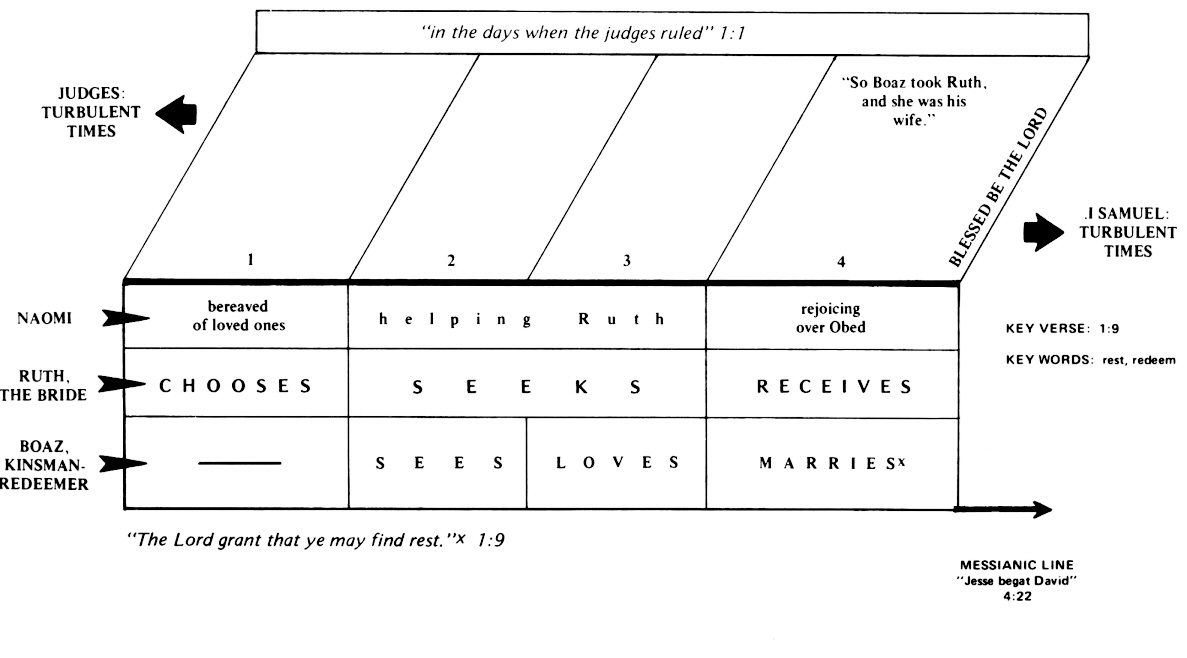
Irving Jensen's Survey of Bible (see his summary of Ruth online - page 392)
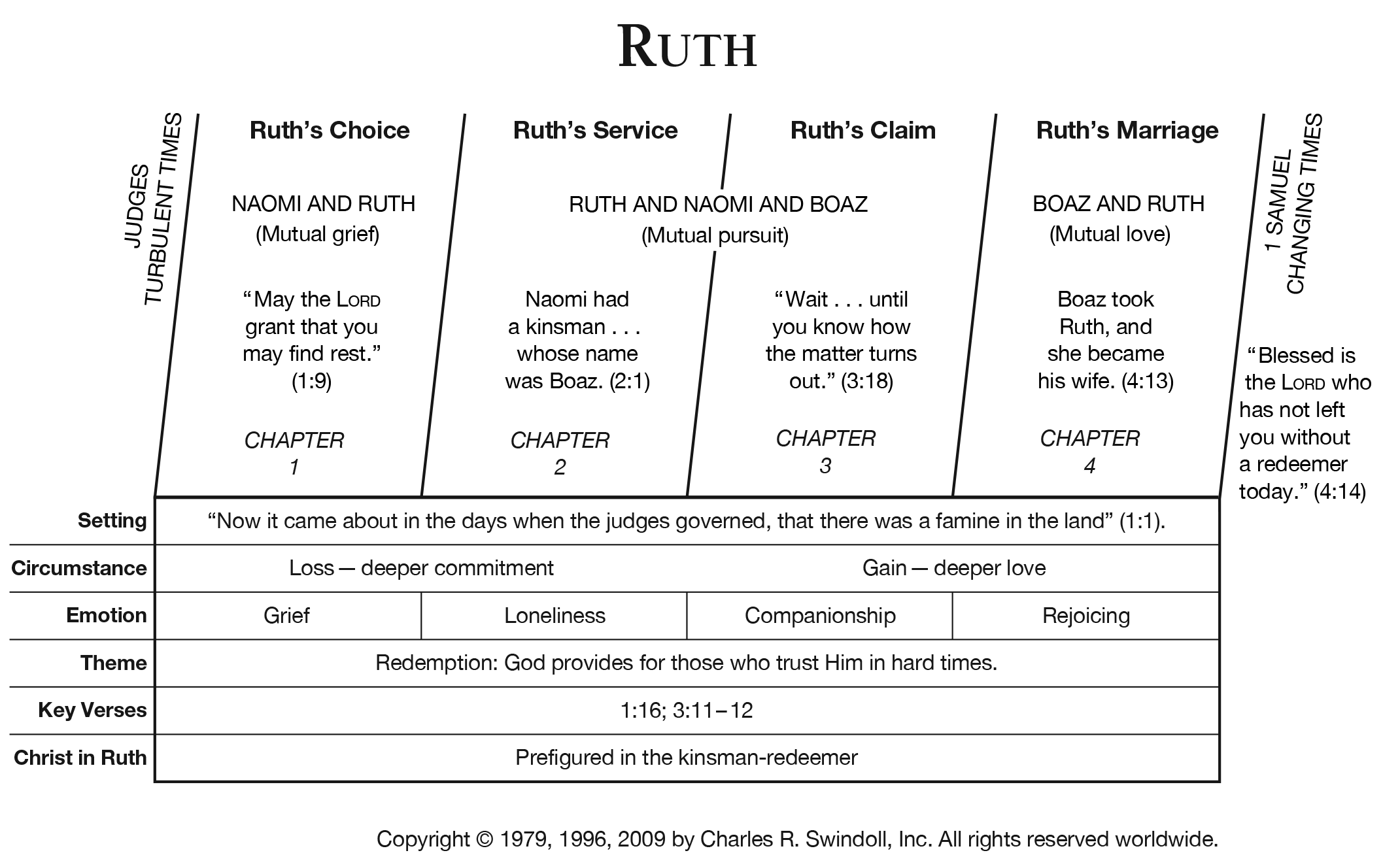
See Swindoll's summary chart of Ruth See Ruth Devotionals
|
RUTH: GOD PROVIDES |
|||
| Ruth 1 | Ruth 2 | Ruth 3 | Ruth 4 |
| Ruth's Choice | Ruth's Service | Ruth's Claim | Ruth's Marriage |
| Ruth's Resolve | Ruth's Rights | Ruth's Request | Ruth's Reward |
| Naomi and Ruth Mutual Grief |
Ruth and Naomi and Boaz Mutual Pursuit |
Boaz and Ruth Mutual Love |
|
| Ruth's Decision: Return with Naomi |
Ruth's Devotion: Provide for Naomi |
Ruth's Request: Redemption by Boaz |
Ruth's Reward: Relative of Messiah |
| Ruth and Naomi |
Ruth and Boaz |
||
| Death of Naomi's Family |
Ruth Cares for Naomi |
Boaz Cares for Ruth |
God Blesses with New Birth |
| Grief | Loneliness | Companionship | Rejoicing |
| Location: Plains of Moab |
Location: Fields of Bethlehem |
Location: Threshing floor of Bethlehem |
Location: Little town of Bethlehem |
| Time Lapsed: About 30 Years See Timeline |
|||
| Setting: Ru 1:1 Now it came about in the days when the judges governed Jdg 21:25+ In those days there was no king in Israel; everyone did what was right in his own eyes. |
|||

Suggested Outline of Ruth - (borrow Wiersbe's expository outlines on the Old Testament)
I. Ruth’s Sorrow (1)
A. Naomi’s wrong decision (Ru 1:1–5)
B. Naomi’s wrong counsel (Ru 1:6–18)
C. Naomi’s wrong attitude (Ru 1:19–22)
II. Ruth’s Service (2)
A. God guides Ruth (Ru 2:1–3)
B. Boaz shows kindness to Ruth (Ru 2:4–16)
C. Naomi encourages Ruth (Ru 2:17–23)
III. Ruth’s Surrender (3)
A. She obeys Naomi’s counsel (Ru 3:1–5)
B. She submits to Boaz (Ru 3:6–13)
C. She waits for Boaz to work (Ru 3:14–18)
IV. Ruth’s Satisfaction (4)
A. Boaz redeems Ruth (Ru 4:1–12)
B. Boaz marries Ruth (Ru 4:13)
C. Boaz and Ruth have a son (Ru 4:14–21)
Ruth 1:1 Now it came about in the days when the judges governed, that there was a famine in the land. And a certain man of Bethlehem in Judah went to sojourn in the land of Moab with his wife and his two sons. (NASB: Lockman)
ASV: And it came to pass in the days when the judges judged, that there was a famine in the land. And a certain man of Beth-lehem-judah went to sojourn in the country of Moab, he, and his wife, and his two sons.
BBE: Now there came a time, in the days of the judges, when there was no food in the land. And a certain man went from Beth-lehem-judah, he and his wife and his two sons, to make a living-place in the country of Moab.
GWT: Long ago, in the days before Israel had a king, there was a famine in the land. So a man named Elimelech, who belonged to the clan of Ephrath and who lived in Bethlehem in Judah, went with his wife Naomi and their two sons Mahlon and Chilion to live for a while in the country of Moab. (GWT)
KJV: Now it came to pass in the days when the judges ruled, that there was a famine in the land. And a certain man of Bethlehem judah went to sojourn in the country of Moab, he, and his wife, and his two sons.
Young's Literal: And it cometh to pass, in the days of the judging of the judges, that there is a famine in the land, and there goeth a man from Beth-Lehem-Judah to sojourn in the fields of Moab, he, and his wife, and his two sons.
Septuagint (LXX): kai egeneto (3SAMI) en to krinein (PAN) tous kritas kai egeneto (3SAMI) limos en te ge kai eporeuthe (3SAPI) aner apo Baithleem tes Iouda tou paroikesai (AAN) en agro Moab autos kai e gune autou kai oi huioi autou
Click for explanation of verb parsing abbreviations in parentheses after each verb
English of Septuagint: And it came to pass when the judges ruled, that there was a famine in the land: and a man went from Bethleem Juda to sojourn in the land of Moab, he, and his wife, and his two sons.
|
"in the days when the JUDGES governed" |
|||||||
| Exodus | 40 Years | Israel Enters Canaan | JUDGES | Saul | David | Messiah | |
|
Redemption from Slavery |
Wilderness Wandering |
Canaan Conquered |
LIGHT of book of RUTH |
To obey is better than sacrifice |
Man after God's Own Heart |
The Lamb that was slain |
|
| -- | 40 yrs | ~24 yrs |
350+ yrs |
40 yrs | 40 yrs | Forever | |
| MESSIAH'S LINE | To Salmon was born Boaz by Rahab | To Boaz was born Obed by Ruth | To Obed was born Jesse | To Jesse was born David the King | Jesus Christ the Lord | ||
| 1445BC |
1445 -1405 |
1405 -1381 |
1381-1051 |
1051-1011 | 1011-971 | 4AD | |

Irving Jensen's Survey of Bible (see his summary of Ruth online - page 392)
The Dates of the Judges timeline is from Dr Irving Jensen and is more detailed, but keep in mind that the specific dates of the judges are "best approximations." That said, Dr Jensen feels that Ruth occurred near the end of the time of the book of the Judges (?1120 BC). While 1120 BC is also an approximation, it seems quite reasonable, for if Ruth had occurred at the beginning of the 300+ year period (circa 1373 BC), it would not be compatible with the time necessary for Boaz to father Obed, Obed to father Jesse and Jesse to father David who began his reign as king of Israel in about 1100 BC.
John MacArthur - This exquisite story most likely appeared shortly before or during David’s reign of Israel (1011–971 B.C.) since David is mentioned (Ru 4:17, 22) but not Solomon. Goethe reportedly labeled this piece of anonymous but unexcelled literature as “the loveliest, complete work on a small scale.” What Venus is to statuary and the Mona Lisa is to paintings, Ruth is to literature....By working backward in time from the well known date of David’s reign (1011–971 B.C.), the time period of Ruth would most likely be during the judgeship of Jair, (ED: WHICH IS WHERE JENSEN PLACE IT IN THE TIMELINE ABOVE) circa 1126–1105 B.C. (Jdg 10:3–5). Ruth covers about 11–12 years according to the following scenario: 1) Ru 1:1–18, ten years in Moab (Ru 1:4); 2) Ru 1:19–2:23, several months (mid-Apr. to mid-June) in Boaz’s field (Ru 1:22; 2:23); 3) Ru 3:1–18, one day in Bethlehem and one night at the threshing floor; and 4) Ru 4:1–22, about one year in Bethlehem.
Roy Hession introduces his comments on Ruth commenting on the pivotal statement by Naomi that...
I went out full, and the Lord hath brought me home again empty." The first chapter of the book of Ruth is a very important one. Every preacher knows, or should know, he has to begin by awakening a sense of need in his hearers. He cannot plunge in too quickly with the positive side of his message. He must first convince the people that they are in just that state of need which requires the provision he proposes to speak about. So it is, before we are introduced to the subject of redemption in the book of Ruth, we have brought before us a story of trouble and loss which occasions the need for one who can redeem.
And that is what the first chapter is all about. Although the title of the book is Ruth, the central character of the first chapter is Naomi, whom I think we can describe as the prodigal daughter of the Old Testament. As we pursue the story we cannot but notice certain marks of similarity between her and the prodigal son in our Lord's parable in the New Testament (Luke 15:11-32+). That son, as he returned, could well have used the same words that Naomi did, `I went out full, and the Lord hath brought me home again empty.' True, he did not remain empty and neither did Naomi; and that is what the remaining chapters of the book of Ruth unfold. (Borrow Our nearest kinsman : the message of redemption and revival in the book of Ruth)
NOW IT CAME ABOUT IN THE DAYS WHEN THE JUDGES GOVERNED:
- Ruth 1 Resources - Multiple Sermons and Commentaries
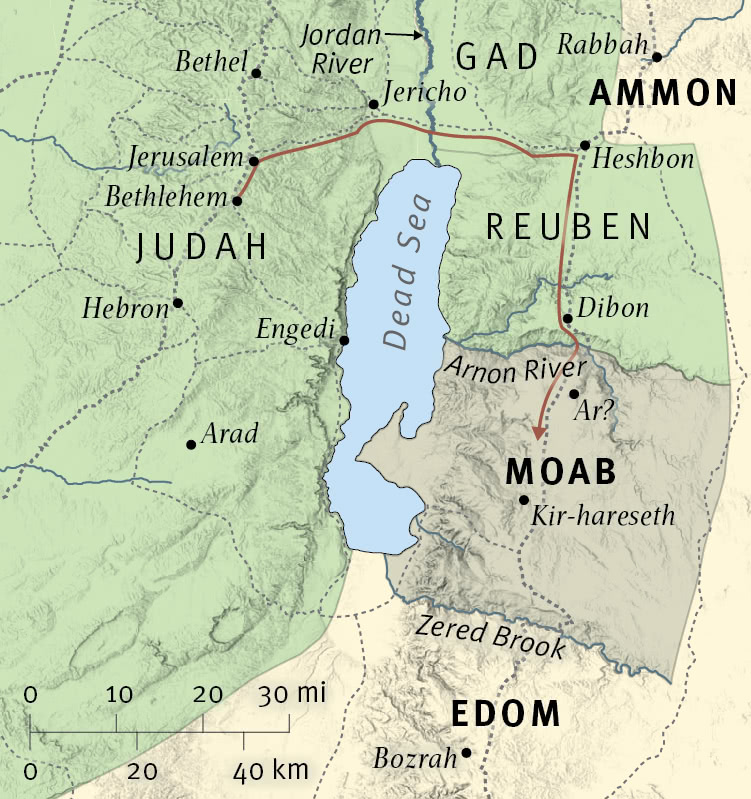
Setting the Scene Geographically
Ruth 1:1+ "Bethlehem in Judah...sojourn in...Moab"
(Source: ESV Global Study Bible)

WHEN THE
JUDGES "JUDGED"
Now it came about in the days when the Judges (shaphat) governed (shaphat) - The Hebrew literally reads "it was the days of the judging of the judges." Let's first establish the context noting that the first mention of judges is in Judges 2...
Judges 2:8-15+ Then (THIS IS AN IMPORTANT TIME PHRASE) Joshua the son of Nun, the servant of the LORD, died at the age of one hundred and ten. 9 And they buried him in the territory of his inheritance in Timnath-heres, in the hill country of Ephraim, north of Mount Gaash. 10 All that generation also were gathered to their fathers; and there arose another generation after them who did not know the LORD (NO PERSONAL EXPERIENCE), nor yet the work which He had done for Israel (NO EXPERIENCE OF HIS POWER). 11 Then (WHEN?) the sons of Israel did evil in the sight of the LORD and served the Baals, 12 and they forsook the LORD, the God of their fathers, Who had brought them out of the land of Egypt, and followed other gods from among the gods of the peoples who were around them, and bowed themselves down to them; thus they provoked the LORD to anger. 13 So they forsook the LORD and served Baal and the Ashtaroth. 14 The anger of the LORD burned against Israel, and He gave them into the hands of plunderers who plundered them; and He sold them into the hands of their enemies around them, so that they could no longer stand before their enemies. 15 Wherever they went, the hand of the LORD was against them for evil, as the LORD had spoken and as the LORD had sworn to them, so that they were severely distressed. (NOW COME THE DAYS OF THE JUDGES...)
Then (Always stop and ask questions like When? Why? [see 5W'S & H]) the LORD raised up judges who delivered them from the hands of those who plundered them.
Observe that from this introduction one can accurately establish the historical context. What do we know about the days when the judges governed? The book of Judges sums up these "days" as "dark days" because Israel had an "eye" ("I") problem "In those days there was no king in Israel; every man did what was right in his own eyes." (Jdg 17:6+, cf Jdg 18:1+, Jdg 19:1+, Jdg 21:25+) The phrase "there was no king in Israel" occurs in each of these verses and helps one understand the self-centered, self-seeking mindset that controlled the children of Israel during this 300-350 year period which accounts for almost 25% of Israel's history in the Old Testament (see the abbreviated timeline above)!
Wiersbe on no king in Israel - We live today at a time when there is “no king in Israel” (Jdg 17:6+, cf Jdg 18:1+, Jdg 19:1+, Jdg 21:25+), for the Jews rejected their King; but during this time, a beautiful love story is taking place in this world: God is getting a Bride for His Son. The Book of Ruth is a harvest story, as the “Lord of the harvest” gathers His sheaves (John 4:31–38). (See context in Wiersbe's Expository Outlines on the Old Testament or borrow Wiersbe's Expository Outlines on the Old Testament)
Who should have been the king over Israel? Read 1 Samuel...
And the LORD (see Jehovah) said to Samuel, "Listen to the voice of the people in regard to all that they say to you, for they have not rejected you, but they have rejected (A strong verb in Heb = ma'as = reject, despise, abhor, refuse; treat as loathsome, cp uses in 1Sa 10:19, Je 8:9; Lv 26:15, Is 30:12, and even Israel's first king, Saul - 1Sa 15:23, cp the ultimate rejection of the ultimate King - Ps 118:22-note!!! Septuagint -LXX = exoudenoo = to make of no account, to despise utterly! And the perfect tense = speaks of the permanence of their rejection! Used in 1Th 5:20+) Me from being king over them. 8 Like all the deeds which they have done since the day that I brought them up from Egypt even to this day-- in that they have forsaken Me and served other gods (cf Jdg 2:12, 13+) -- so they are doing to you also. (1Sa 8:7, 8)
The days when the Judges governed was a time marked by apostasy, apathy, and anarchy, and was intimately entangled with idolatry, immorality, and war. It is instructive (and poignant) to contrast the two contemporaneous books of Judges with Ruth (adapted and modified from Wilkinson, B, & Boa, K. Talk thru the Bible. Nashville: T. Nelson)
THOUGHT - Which column would you place your life in over the past days, weeks, months, or even years? Would your life be characterized as more like the book of Ruth or more like the book of Judges?
| RUTH | JUDGES |
|
Spiritual |
Spiritual |
|
Purity |
Immorality |
|
Deciding for |
Pursuing Idols |
|
Devotion |
Disloyalty |
|
Love |
Lust |
|
Peace |
War |
|
Kindness |
Cruelty |
|
Obedience |
Disobedience |
|
Oasis |
Desert |
|
Faithfulness |
Faithlessness |
Ruth is the story of one individual's faithfulness, (albeit there are other actors in this drama who clearly are faithful - men like Boaz, women like Naomi) in the face of national faithlessness and underscores the truth that God graciously preserves a godly remnant (see study of the important doctrine of "remnant") of Israelites who believe in the hope of the Messiah and who do what is right in the sight of the Lord even when the ungodly majority do what is right in their own eyes. Ruth is far more than a beautiful "love story" and in fact the word "love" is actually not even used in the narrative! Ruth is part of the unfolding narrative of how God will carry out His everlasting covenant promise to the patriarchs (Abraham, Isaac and Jacob), to redeem a people who will be His own forever. God has not forgotten or forsaken His covenant promises to Israel and you can be absolutely certain that the Church is not the "new Israel" as so many falsely teach even in evangelical circles (see resources below)!
Related Resources:
- The Israel of God - Galatians 6:16
- Are Israel and the church the same thing? Does God still have a plan for Israel? | GotQuestions.org
- What is New Israel? | GotQuestions.org
- What is replacement theology / supersessionism? | GotQuestions.org
The book of Ruth focuses particularly on the details of divine providence in the day to day affairs of ordinary people and how these details play an intimate role in the unfolding of the grand plan of divine redemption. An apropos title of Ruth might be
An Extraordinary God
In the Lives of Ordinary People
William Cowper wrote a hymn which beautifully expresses the essence of the providential working of God in unfolding the story of Ruth and Naomi and our Kinsman Redeemer (see especially stanzas 4 & 5 - this may be where you are dear saint even as you are reading these notes...but remember that God is the same yesterday, today and forever, Heb 13:8+). Note especially stanza 4...
God Moves in A Mysterious Way
(Play this hymn - a variation)
(Or Listen to a chorale arrangement)
God moves in a mysterious way
His wonders to perform;
He plants His footsteps in the sea
And rides upon the storm.
Deep in unfathomable mines
Of never failing skill
He treasures up His bright designs
And works His sovereign will.
Ye fearful saints, fresh courage take;
The clouds ye so much dread
Are big with mercy and shall break
In blessings on your head.
Judge not the Lord by feeble sense,
But trust Him for His grace;
Behind a frowning providence
He hides a smiling face.
His purposes will ripen fast,
Unfolding every hour;
The bud may have a bitter taste,
But sweet will be the flower.
Blind unbelief is sure to err
And scan His work in vain;
God is His own interpreter,
And He will make it plain.
Here is a note introducing Cowper's beautiful poem - It is reportedly the last hymn Cowper ever wrote, with a fascinating (though unsubstantiated) story behind it. Cowper often struggled with depression and doubt. One night he decided to commit suicide by drowning himself. He called a cab and told the driver to take him to the Thames River. However, thick fog came down and prevented them from finding the river (another version of the story has the driver getting lost deliberately). After driving around lost for a while, the cabby finally stopped and let Cowper out. To Cowper’s surprise, he found himself on his own doorstep: God had sent the fog to keep him from killing himself. Even in our blackest moments, God watches over us.
"THE GLASS HALF FULL"
Using the modern saying one might entitle Ruth 1 "The Glass Half Full." Why? Because there are generally two types of people (even Christians!) - pessimists (glass half empty) and optimists (glass half full). By the end of this chapter Naomi seems to fit in the former, and Ruth more in the latter group (based primarily on her decision in Ru 1:16, 17).
🙏 THOUGHT - The point is that we all tend to view our temporal circumstances with physical eyes and are all in continual need to lay hold of that supernatural, eternal vision that comes when we put on the "glasses of faith" (2Co 5:7+, 2Cor 4:16, 17, 18+, cp Ro 8:24, 25+, 1Co 13:12+, 1Pe 1:8+ - See VERTICAL VISION EMPOWERS HORIZONTAL LIVING). Faith, albeit intangible, is nevertheless not some imaginary entity, but a vital component in the life of every believer, whether in the Old or New Testament. And faith is cultivated (Ps 37:3+) by taking in the truth about God (Ro 10:17+) found only in His Word of Truth (Ps 119:43+, 2Co 6:7+, Col 1:5+, 2Ti 2:15+, the word of truth birthed us and is necessary to grow us = Jas 1:18+; 1Pe 2:2+). Naomi needed to lay hold of truths (written later by Ruth's offspring David) like Psalm 34:19 (note the contrast word "but" which Spurgeon calls a "blessed but" see notes below - read Spurgeon's excellent note), a truth all believers have access to now and need to recall to our minds when afflictions strike unexpectedly and our tendency is to become bitter. This is easy to write but much harder to put into practice (as I have found out in the last 7 weeks, which have been the most difficult test of my faith in 36 years).
I like Spurgeon's comments on Ps 37:3 (ESV has "befriend faithfulness";) that relate to the book of Ruth where he writes that...
Faith cures fretting. Sight is cross-eyed, and views things only as they seem... faith has clearer optics to behold things as they really are, hence...peace.
And do good. True faith is actively obedient. Doing good is a fine remedy for fretting. There is a joy in holy activity which drives away the rust of discontent.
So shalt thou dwell in the land. In "the land" which flows with milk and honey; the Canaan of the covenant. Thou shalt not wander in the wilderness of murmuring, but abide in the promised land of content and rest.
"We which have believed do enter into rest."
Very much of our outward depends upon the inward:
where there is heaven in the heart there will be heaven in the house.
And verily thou shalt be fed, or shepherded. (Ed: The Hebrew actually is an imperative or command to "shepherd" or "tend" faithfulness, which explains the NAS translation of "cultivate faithfulness") To integrity and faith necessaries are guaranteed. The good shepherd will exercise his pastoral care over all believers. In truth they shall be fed, and fed on truth. The promise of God shall be their perpetual banquet; they shall neither lack in spirituals nor in temporals. Some read this as an exhortation, "Feed on truth;" certainly this is good cheer, and banishes for ever the hungry heart burnings of envy.
Psalm 34:19 reads...
Many (Read that again!) are the afflictions of the righteous; but the LORD delivers him out of them all.
Spurgeon comments that "Many are the afflictions of the righteous. Thus are they made like Jesus their covenant Head (cp Col 1:24+). Scripture does not flatter us like the story books with the idea that goodness will secure us from trouble; on the contrary, we are again and again warned to expect tribulation (Acts 14:22+) while we are in this body. Our afflictions come from all points of the compass, and are as many and as tormenting as the mosquitoes of the tropics. It is the earthly portion of the elect to find thorns and briars growing in their pathway, yea, to lie down among them, finding their rest broken and disturbed by sorrow. BUT, blessed but, how it takes the sting out of the previous sentence! (cp Ps 119:50+)
But the Lord delivereth him out of them all. Through troops of ills Jehovah shall lead His redeemed scatheless and triumphant. There is an end to the believer's affliction, and a joyful end too. None of his trials can hurt so much as a hair of his head, neither can the furnace hold him for a moment after the Lord bids him come forth of it (Da 3:22-30+). Hard would be the lot of the righteous if this promise, like a bundle of camphire (see description of camphire), were not bound up in it, but this sweetens all. The same Lord Who sends the afflictions will also recall them when His design is accomplished, but He will never allow the fiercest of them to rend and devour His beloved.
"No times are so wild but that in them are quiet corners,
green oases, all the greener for their surroundings...."
-- Alexander Maclaren
Alexander Maclaren - The lovely idyl (means "a short poem") of Ruth is in sharp contrast with the bloody and turbulent annals of Judges. It completes, but does not contradict, these, and happily reminds us of what we are apt to forget in reading such pages, that no times are so wild but that in them are quiet corners, green oases, all the greener for their surroundings, where life glides on in peaceful isolation from the tumult. Men and women love and work and weep and laugh, the gossips of Bethlehem talk over Naomi's return ('they said,' in Ruth 1:19+, is feminine), Boaz stands among his corn (Ed: actually barley and wheat, cp Ru 2:23+), and no sounds of war disturb them. Thank God! the blackest times were not so dismal in reality as they look in history. There are clefts in the grim rock, and flowers blooming, sheltered in the clefts. The peaceful pictures of this little book, multiplied many thousand times, have to be set as a background to the lurid pictures of the Book of Judges. (Ruth Exposition)
How important is an understanding of the "days when the Judges governed"? Paul comments that
Now these things happened (IN "DAYS WHEN THE JUDGES GOVERNED") as examples (tupos) for us, so that (term of purpose - WHAT PURPOSE?) we would not crave evil things as they also craved (epithumeo - coveted, desired, lusted for). (1Cor 10:6+)
Now these things happened to them as an example (tupos), and they were written for our instruction, upon whom the ends of the ages have come. (1Co 10:11+)
Comment - The Greek word for "instruction" (nouthesia from nous = mind + tithemi = place - cf related verb noutheteo) literally means to place in one's mind and refers to training of one's mind (nous) and conveys the ideas of encouraging, warning and advising and is a comprehensive term for counseling. Ruth is one of those books that counsels us in our affliction. A T Robertson says the word nouthesia describes "Putting sense into the heads of people. A thankless, but a necessary, task."
So it behooves us to be knowledgeable of the days of the judges so that we might not repeat their mistakes and also that we might not become discouraged and lose hope at the darkness that seems so prevalent and so powerful in America in the 21st Century, for...
whatever was written in earlier times (OT Scriptures [see graphe = Scriptures] - this should be a motivation for all teachers and preachers to be sure to "supplement" their exposition of the NT with the OT contra Andy Stanley's borderline heretical teaching! cp Paul's testimony = Acts 20:27+) was written for our instruction (didaskalia --shaping of will of one instructed, doing so by Word), that through perseverance (hupomone) and the encouragement of the Scriptures (graphe) we might have hope. (elpis; see Believer's Blessed Hope)" (Romans 15:4+)
Apparently it was Augustine who in explained the interwoven nature of the Old and New Testaments pointing out that...
The New is in the Old concealed and The Old is the New revealed
C. I. Scofield has an interesting parallel of the 4 chapters of Ruth with the general pattern of the experience of the believer:
I. Ruth deciding
II. Ruth serving
III. Ruth resting
IV. Ruth rewarded
ILLUSTRATION - The book of Ruth is nothing short of a literary masterpiece as every careful reader will attest. In the 18th century Dr. Samuel Johnson, a Christian, read a copy of Ruth before a prestigious London book review club and did so as if it were a recently written work. The club was vocal and unanimous in its praise of this new work. It was only after their acclaim abated that Dr. Johnson informed them that the masterpiece they had so unreservedly endorsed was to be found in a book that most of them rejected—the Bible! Thus we see that Ruth’s literary genius is recognized even by those with no Christian allegiance.
ILLUSTRATION - A very similar story is told of Benjamin Franklin who while serving at the French court heard some aristocrats denigrating the Holy Bible as not worth reading, lacking style, etc. Although Franklin was not a born again believer (as best can be discerned from written descriptions of his beliefs he is probably best classified as a Deist), he had been sufficiently exposed to the merits of Scripture as literature that he foisted the following ruse on the French skeptics. Franklin proceeded to copy Ruth in longhand, changing all the names to French names. He then read the manuscript to the aristocratic elitists who to a man praised the elegance and simple style of the touching story. One then queried Franklin “But where did you find this gem of literature, Monsieur Franklin?” Franklin quipped "It comes from that Book you so despise, la sainte Bible!”
Ruth was written by an anonymous author, but in its final form must date from the time of David because of the facts noted in (Ru 4:7+, Ru 4:18-22+). Jewish tradition says that Samuel is the author of Ruth. Since the book ends with David, the final manuscript cannot have written before his time. Samuel did anoint David king and may well have provided the book to show the monarch-to-be's pedigree. Alternatively it is possible that David was the author but we will have to wait until glory to find out for sure. Won't Heaven be an exciting place!
| SUMMARY OF RUTH | ||||
| I | II | III | IV | |
| PLOT | God moves Ruth to Israel | God introduces Ruth to Boaz | God arranges details for marriage proposal | God culminates marriage of Ruth & Boaz |
| PLACE | Moab | Barley Field in Bethlehem |
Threshing Floor in Bethlehem |
City Gate in Bethlehem |
| PEOPLE | Elimelech & sons Naomi, Ruth, Orpah |
Boaz Ruth Cares for Naomi |
Boaz Cares for Ruth |
Boaz, Nearest Kinsman, Ruth, Naomi |
| PROGRESS | Ruth's Decision | Ruth's Devotion | Ruth's Request for Redemption | Ruth's Reward of Redemption |
| MOOD | Death & Despair in Moab |
Hope Dawning in Bethlehem |
Hope Growing in Bethlehem |
Life & Joy Birthed in Bethlehem |
| TIME | 10 years | Months | One Day | One Year |
THAT THERE WAS A FAMINE (raab) IN THE LAND:
- Famine Ge 12:10; 26:1; 43:1; Lv 26:19, 26; Dt 28:23,24,38; 2Sa 21:1; 1Ki 17:1-12; 18:2; 2Ki 8:1,2; Ps 105:16+; Ps 107:34+; Isa 3:1, Jer 14:1, 15:2; Lam 4:9, 10, Ezekiel 14:13-16, 21; Joel 1:10,11,16-20; Am 4:6
- Ruth 1 Resources - Multiple Sermons and Commentaries
Related Passages:
Deuteronomy 11:13-17+ “It shall come about, if you listen obediently to my commandments which I am commanding you today, to love the LORD your God and to serve Him with all your heart and all your soul, 14 that He will give the rain for your land in its season, the early and late rain, that you may gather in your grain and your new wine and your oil. 15 “He will give grass in your fields for your cattle, and you will eat and be satisfied. 16 “Beware that your hearts are not deceived, and that you do not turn away and serve other gods and worship them. 17 “Or the anger of the LORD will be kindled against you, and He will shut up the heavens so that there will be no rain and the ground will not yield its fruit; and you will perish quickly from the good land which the LORD is giving you.
THE CAUSE OF THE SOJOURN
FAMINE IN THE LAND
That there was a famine (raab) in the land - The land refers of course to the land of Israel. The irony is that this famine includes the little town of Bethlehem which means "house of bread"! Micah uses another OT name for Bethlehem, Bethlehem Ephrathah, which adds to the bitter irony, for the word Ephrath means fruitfulness! Finally Bethlehem is referred to as Bethlehem of Judah where means praise! The house of bread and fruitfulness was not a source of much praise for the Elimelech family!
ESV Study note - A famine was sometimes a divine scourge (Deut. 11:14; 32:24; cf. Lev. 26:3-4), but it could also advance God’s purposes, as it did for the sons of Israel in Joseph’s time (Gen. 42:5; 45:5-8; Ps. 105:16-17, 23). (Borrow ESV Study Bible)
🙏 THOUGHT - God is clearly in control from the beginning (famine in land) to end (fertility of Ruth). God is sovereign, (what word do you see in "sovereign"?) which in simple terms means that He is in complete control over ALL the affairs of nature and history and has the absolute right to act according to His perfect will and His good pleasure. The Bible in general and Ruth in particular is the story (history = "His-Story") of God working out His sovereign plan of redemption for the world toward a conclusion which is so certain that we can stake our very life on it. So don't think that the paucity of the mention of God's name in Ruth suggests that He is absentee (as Deism teaches) or that He is not actively involved. It follows that no "famine" just "happens" in the land, but that God sovereignly controls every famine. What "famine" are you going through beloved child of God? Is He in control? Do you believe that is true? Most of us are either in a "famine," getting ready to go into a "famine" or just coming out of a "famine!" "Famines" are the classrooms in which the Father gives us the opportunity for our faith to be tested and to grow (if we yield to His loving hand). (Meditate on James 1:2-8+ and 1 Peter 1:6-7+)
Why was there a famine in the land? Moses had warned Israel that one of the consequences of disobedience would be famine writing that "if you will not obey the LORD your God, to observe to do all His commandments and His statutes with which I charge you today, that all these curses shall come upon you and overtake you...And the heaven which is over your head shall be bronze, and the earth which is under you, iron. The LORD will make the rain of your land powder and dust; from heaven it shall come down on you until you are destroyed." (Deut 28:15, 23, 24+) That's God's recipe for a famine of devastating proportions!
🙏 THOUGHT - Missionary Application: God's intention was that Israel should be blessed and then be a blessing to the nations (Acts 13:47+ quoting Isa 42:6). Instead, Israel scorned her Maker, and God's subsequent affliction of people and land drove many Israelites to seek sustenance from other nations. When God's people refuse to use the resources God has given them to bless the families of the earth, God may withdraw those blessings from them and bring them by force to face both their own poverty of soul and the needs of the peoples of the earth. This refers not just to our money, but our time. One way you can invest your time in eternity is taking a few minutes each morning to pray for the Hidden People Group of the Day (on this page you can also get an APP that will automatically message you each day regarding the hidden people group so you can join with thousands of other saints in prayer for lost souls - be motivated by the future truth in Col 3:23-24+, Rev 22:12+, 2Cor 5:10+, Mt 6:19-21+).
Elimelech's family left "the house of bread" and went into Moab which God calls "My washbowl"! (Ps 60:8+, Ps 108:9+) The meaning of Moab is "Water of a father; i.e., seed, progeny; desire; progeny of a father; of the father. Waste; nothingness" (Smith & Cornwall's "Exhaustive Dictionary of Bible Names") The point is that Elimelech left the promised land to seek help in a pagan land and essential lost everything - his life, his two sons - and there was no restoration his wife Naomi returned to the the house of bread.
Elimelech seems to have forgotten the eternal truth about God's faithfulness to His covenant promises for as David wrote years later "Trust in Jehovah and do good. Dwell in the land, and feed on His faithfulness.Delight yourself also in the Lord, and He shall give you the desires of your heart. (Ps 37:3,4NKJV) As Spurgeon says "Make Jehovah the joy and rejoicing of thy spirit....Every name, attribute, word, or deed of Jehovah, should be delightful to us, and in meditating thereon (see Primer on Biblical Meditation) our soul should be as glad as is the epicure who feeds delicately with a profound relish for his dainties."
Spurgeon: There is an ascent in this third precept. He who was first bidden not to fret, was then commanded actively to trust, and now is told with holy desire to delight in God. Delight thyself also in the Lord. Make Jehovah the joy and rejoicing of thy spirit. Bad men delight in carnal objects; do not envy them if they are allowed to take their fill in such vain idols; look thou to thy better delight, and fill thyself to the full with thy more sublime portion. In a certain sense imitate the wicked; they delight in their portion -- take care to delight in yours, and so far from envying you will pity them. There is no room for fretting if we remember that God is ours, but there is every incentive to sacred enjoyment of the most elevated and ecstatic kind. Every name, attribute, word, or deed of Jehovah, should be delightful to us, and in meditating thereon (see Primer on Biblical Meditation) our soul should be as glad as is the epicure who feeds delicately with a profound relish for his dainties.
And he shall give thee the desires of thine heart. A pleasant duty is here rewarded with another pleasure. Men who delight in God desire or ask for nothing but what will please God; hence it is safe to give them carte blanche. Their will is subdued to God's will, and now they may have what they will. Our innermost desires are here meant, not our casual wishes; there are many things which nature might desire which grace would never permit us to ask for; these deep, prayerful, asking desires are those to which the promise is made.
🙏 THOUGHT - However, lest we be too critical of Elimelech, we need to remember that there is a little of "Elimelech" in all of us and looking into the face of famine (in whatever form that takes in our life) can be quite fearful and overwhelming! And we too may be tempted to seek secular (pagan) solutions over God's solution.
Roy Hession comments that "The rains, it would seem, had ceased to come at their usual seasons, and that probably not for one year, but for several years. As a result, crops had failed and there was a terrible famine in the area. Could it be, famine in the `house of bread'? Surely not; but so it was. It was the very opposite of what one would have expected, a virtual denial of the very name of Bethlehem. Had God not also said about the Promised Land that it was to be a land of milk and honey (Ex 3:8, 17; 13:5; 33:3; Lv 20:24; Nu 13:27; 14:8; 16:13, 14; Dt 6:3; 11:9; 26:9, 15; 27:3; 31:20; Jos 5:6; Jer 11:5; 32:22; Ezek 20:6, 15) where His people would eat bread without scarceness (Dt 8:9KJV)? Indeed, He had; but He had also said in various places that if His people who were called by His name should turn away from Him, worshipping other gods, transgressing His laws, and not be willing to repent, He might well find it necessary to shut up heaven that there should be no rain, and even to command the locusts to devour the land and, further, to send pestilence among His people. (2Chr 7:13, 14, 2Chr 6:26, 27, Dt 11:17, Lv 26:19, 1Ki 8:35, 36, 17:1, Je 14:1-6, Dt 28:23, 24, Hag 1:9-11) Sadly, this too is pictorial of what sometimes happens in the life of a Christian. Yes, it is a land of milk and honey for him (e.g., Ep 1:3+, Col 2:3+), but if he turns away from the Lord his God in this matter or that, and will not heed the word of correction that God is sure to give him, He sometimes finds it necessary for the restoration of that saint to shut up heaven over his head that there be no rain (cp Heb 12:5, 6+, He 12:7, 8, 9, 10+, He 12:11+). The refreshing movings of the Spirit are no longer known in his heart, the Bible becomes dead, prayer is empty, personal witness and Christian service are chores and he ceases to have a joyous testimony. What a terrible possibility that there can be such a famine in our souls! Amos talks about a famine, not `of bread, nor a thirst for water, but of hearing the words of the Lord.' Amos 8:11 That is a famine indeed when we cease to hear from heaven, and who of us has not known such times? And all this can take place, if you please, m the `house of bread.' (See context in Our Nearest Kinsman: The Story of Ruth and Our Redemption in Ruth or borrow this book Our nearest kinsman).
The Psalmist adds that God "called for a famine on the land and destroyed all their supplies of food and he sent a man before them -- Joseph, sold as a slave." (Ps 105:16, 17NIV). God moves "chess pieces" (so to speak) by sending famine. And so He moves Elimelech to the land of Moab where one of his sons just happens (providence) to meet and marry Ruth the Moabitess, who will just happen (providence) to come into the line of David and then the Messiah! As God's sovereign plan unfolded in Joseph's life he said to his deceitful brothers "as for you, you meant evil against me, but God meant it for good in order to bring about this present result, to preserve many people alive." (Ge 50:20) So in order to "preserve many people alive" God used "famine on the land." If you don't believe that God is in control of "famines" than you will also have difficulty believing the NT counterpart of Genesis 50:20 that "God causes all things to work together for good to those who love God, to those who are called according to His purpose. (Ro 8:28+)
GOD'S SOVEREIGNTY
AND GOD'S SURETY
Meditate and meander slowly through the book of Ruth and you will be encouraged as you come to the understanding that God's sovereignty is also His surety (ground of confidence and security). Lay hold of this great attribute of God (see "Attributes of God" for an encouraging study: see also "Sovereignty"), so that you won't faint during the "famine", but instead be firmly grounded in this truth about God, so that by His Spirit you will continue steadfast in the confidence that "He Who began a good work in you will complete in the day of Christ Jesus." (Php 1:6+) So what begins with a famine in the land was but opening of the "Director's" master script for Ruth to be brought into the nation of Israel through her kinsman-redeemer Boaz, thereby becoming a link in the line of the Messiah, our Kinsman-Redeemer. As God reminds us "For as the heavens are higher than the earth, so are My ways higher than your ways and My thoughts than your thoughts." (Isaiah 55:9, cf Ro 11:33-36+)
There are some other important principles regarding famine which are worth noting. A famine brings hunger and hunger tests a man (Ge 12:10; 26:1; 43:1) for as Moses reminded Israel
And you shall remember all the way which the LORD your God has led you in the wilderness these forty years, that He might humble (Heb = 'anah = to afflict, cause to be bowed down, often as in this verse conveys the idea that God sends affliction to discipline/correct/instruct - used in Ps 90:5) you, testing (Heb = nacah/nasah = conveys the idea of testing someone by allowing stress, adversity, difficulty, hardship) you, to know what was in your heart, whether you would keep His commandments or not (What shows the true state of our heart? Obedience! Lxx = ekpeirazo). 3 And He humbled you and let you be hungry, and fed you with manna which you did not know, nor did your fathers know, that He might make you understand that man does not live by bread alone, but man lives by everything that proceeds out of the mouth of the LORD. 4 "Your clothing did not wear out on you, nor did your foot swell these forty years. 5 "Thus you are to know in your heart that the LORD your God was disciplining (Hebrew = yasar/yacar = instructs, chasten, reflects God's loving correction) you just as a man disciplines his son. (Dt 8:2-5+; cf Mt 4:4+, Lk 4:4+).
🙏 THOUGHT - The lesson for each of us to learn is that pressures and trials wrought by the ''famines'' in our life are sovereignly sent (or allowed) by God not to destroy us but to humble us (repeated in Dt 8:2, 3+) and to teach us to "trust in Jehovah with all (our) heart and...not (to) lean on (our) own understanding" but "in all (our) ways (to) acknowledge Him", fully confident that "He will make (our) paths straight." (Pr 3:5, 6+)
May we all grow in grace and the knowledge of our Lord and Savior Jesus Christ (2Pe 3:18+) and learn what Habakkuk learned so that we respond the way he did to "bad news" --
"Though the fig tree should not blossom, and there be no fruit on the vines, though the yield of the olive should fail, and the fields produce no food, though the flock should be cut off from the fold, and there be no cattle in the stalls, yet I will exult in the LORD, I will rejoice in the God of my salvation." (Hab 3:17-19+)
"Famine" times help grow us in our dependence on the all sufficient supply of Jehovah, "our Refuge and Strength, a very present Help (Heb = 'ezrah ; Lxx/Greek = boethos) in trouble." (Ps 46:1+, cf Heb 13:6+) Spurgeon comments: God is our Refuge and Strength. Not our armies, or our fortresses. Israel's boast is in Jehovah, the only living and true God. Others vaunt their impregnable castles, placed on inaccessible rocks, and secured with gates of iron, but God is a far better refuge from distress than all these: and when the time comes to carry the war into the enemy's territories, the Lord stands His people in better stead than all the valour of legions or the boasted strength of chariot and horse. Soldiers of the cross, remember this, and count yourselves safe, and make yourselves strong in God. Forget not the personal possessive word our; make sure each one of your portion in God, that you may say, "He is my refuge and strength." Neither forget the fact that God is our refuge just now, in the immediate present, as truly as when David penned the word. God alone is our all in all. All other refuges are refuges of lies, all other strength is weakness, for power belongeth unto God: but as God is all sufficient, our defence and might are equal to all emergencies. A very present help in trouble, or in distress He has so been found, hH has been tried and proved by His people. He never withdraws Himself from His afflicted. He is their help, truly, effectually, constantly; He is present or near them, close at their side and ready for their succour (see word study on boethos), and this is emphasized by the word very in our version, He is more present than friend or relative can be, yea, more nearly present than even the trouble itself. To all this comfortable truth is added the consideration that His assistance comes at the needed time. He is not as the swallows that leave us in the winter; He is a Friend in need and a Friend indeed. When it is very dark with us, let brave spirits say, "Come, let us sing the forty-sixth Psalm." See also Jehovah Ezer: The LORD our Helper
"A fortress firm, and steadfast rock,
Is God in time of danger;
A shield and sword in every shock,
From foe well known or stranger."
How comforting for believers to recall to mind Paul's great encouragement "Who shall separate us from the love of Christ? Shall tribulation, or distress, or persecution, or famine, or nakedness, or peril, or sword?...in all these things we overwhelmingly conquer through Him who loved us. For I am convinced that (nothing) ...shall be able to separate us from the love of God, which is in Christ Jesus our Lord." (Ro 8:35, 36, 37, 38, 39 - see notes Ro 8:35; 36; 37; 38; 39)
Genesis records another "famine in the land, besides the previous famine that had occurred in the days of Abraham" (Ge 26:1) in the life of Isaac. In contrast to the responses of Abraham in Genesis and Elimelech in Ruth, Moses records that "the LORD appeared to (Isaac) and said, "Do not go down to Egypt. Stay in the land of which I shall tell you. Sojourn in this land and I will be with you and bless you, for to you and to your descendants I will give all these lands, and I will establish the oath which I swore to your father Abraham." (Ge 26:2, 3)
The Famine in Bethlehem: The House of Bread
In Bethlehem, the House of Bread,
Where golden fields once flourished, fed,
A famine came, the land stood dry,
And hunger dimmed each hopeful eye.
What irony, that in this place,
Where grain should grow in Heaven’s grace,
The tables bare, the storehouse thin,
Did God forget His own within?
Yet in the drought, His hand was near,
A sovereign will, both firm and clear,
For what men call a time of loss,
God writes in love upon the cross.
For famine drove one soul away,
To Moab’s land, she went astray,
Yet through the sorrow, loss, and strife,
God wove the strands of greater life.
A widow wept, a daughter stayed,
Through providence, a path was laid,
And in the dust of grief so deep,
God sowed a promise He would keep.
For Ruth would come, the gleaner blessed,
A foreign bride, yet Heaven’s guest,
Through Boaz' grace, through mercy sown,
A lineage to David’s throne.
So famine falls, but not in vain,
God molds His plan through joy and pain,
For every sorrow, loss, and night,
He turns to dawn with sovereign light.
What seemed like loss was grace instead,
Even famine in the House of Bread.
John Blanchard in his book The Complete Gathered Gold (one of the best books of Christian quotations = quotes are Biblically faithful rather than emotionally attractive and are often very thought provoking - highly recommended!) has the following quotes on the blessings of affliction...
- Adversity introduces a man to himself.- Anon. (some attribute this to Albert Einstein)
- Affliction is God's shepherd dog to drive us back to the fold. - Anon.
- Affliction is the school of faith. - Anon.
- Affliction, like the iron-smith, shapes as it smites.- Anon.
- Afflictions are often God's best blessings sent in disguise.-Anon.
- Crosses are ladders that lead to heaven.-Anon.
- Fire is the test of gold, adversity of strong men.-Anon.
- Our great Teacher writes many a bright lesson on the blackboard of affliction.-Anon.
- Some hearts, like evening primroses, open more beautifully in the shadows of life.-Anon.
- The Christian justifies tribulation. Ten thousand times ten thousand saints... are ready to witness that their most manifest and rapid spiritual growth is traceable to their periods of trial.-Anon.
- The darker the night, the brighter the stars; the hotter the fire, the purer the gold.-Anon.
- The gem cannot be polished without friction, nor man perfected without trials.-Anon.
- The hammer shatters glass, but forges steel.-Anon.
- The more a tree of righteousness is shaken by the wind, the more it is rooted in Christ.-Anon.
- The water that dashes against the wheel keeps the mill going; so trial keeps grace in use and motion.-Anon.
- Trial is the school of trust.-Anon.
- Where there are no trials in life, there are no triumphs.-Anon.
Judges...governed (08199) shaphat is a verb that means to judge or govern. While it frequently translated judge, this is somewhat misleading as shaphat is not typical of the modern concept of judge (as in a court of law), but is much more inclusive -- to function as ruler or governor - individuals (Jdg. 16:31; 1 Sa 7:16), king (1 Ki. 3:9); even God Himself (Ps. 50:6; 75:7) because He is the source of authority and will eventually conduct all judgments (Ps. 96:13). In a judicial sense shaphat could refer to the arbitration of civil, domestic, and religious disputes (Dt. 25:1), fulfilled by the congregation (Nu 35:24), by individual judges (Ex 18:16; Dt. 1:16), by the king (1 Sa 8:5, 6, 20) or by God Himself (Ge 16:5; 1 Sa 24:12, 15).
Famine (07458)(raab) means hunger, or famine which is a drastic, usually widespread food shortage, an extreme scarcity of food. Ra'ab means "hunger" as opposed to "thirst". In some areas the cause is overpopulation, but it is usually a failure of crops that results in a serious shortage of nutritional foods. The first famine is described in Genesis 12:10 "Now there was a famine in the land; so Abram went down to Egypt to sojourn there, for the famine was severe in the land." God allows or causes famines and clearly He was testing Abram's faith at this time. We see a repeat in Genesis 26:1 "Now there was a famine in the land, besides the previous famine that had occurred in the days of Abraham. So Isaac went to Gerar, to Abimelech king of the Philistines." Not only did famines occur in Canaan but Egypt also suffered cycles of famine (Ge 41:27, 30, 31). In Ps 105:16 "He called for a famine upon the land" and the result was that Jacob took his family to Egypt! (cf Ge 50:20) God is sovereign in History! Famine can be the discipline of God on His people (Isa. 5:13). Through His prophet Ezekiel God warned Judah (the 10 northern tribes having already been taken off into captivity by Assyria in 722BC) "Son of man (Ezekiel), if a country sins against Me by committing unfaithfulness, and I stretch out My hand against it, destroy its supply of bread, send famine against it, and cut off from it both man and beast even though these three men, Noah, Daniel and Job were in its midst, by their own righteousness they could only deliver themselves,” declares the Lord GOD." (Ezekiel 14:13-14) Famine is frequently mentioned in the terrible triad "sword, famine, and pestilence," (Jer. 14:13, 27:8, 13, 18, 32:24, 36, 34:17, 38:2, 42:17, 22, 44:13, Ezek 6:11), Famine is used figuratively of spiritual nourishment, God declaring "I will send a famine on the land, Not a famine for bread or a thirst for water, But rather for hearing the words of the LORD. sword, famine, and pestilence. Amos mentions a famine of the Word of God, not food, that the Lord will send!" (Amos 8:11). The line between famine and plenty in Palestine depends mainly on the rains coming at the right time and in the proper supply, famine was an ever-present threat.
In summary raab is a prolonged scarcity of food, accompanied by extreme hunger. It is listed as one of God’s ‘four sore acts of judgment’ along with the sword (war), evil beasts, and pestilence (Eze 14:21). It is also a divine judgment in Jeremiah, along with the sword (fourteen times), and with the sword and pestilence (fifteen times). In Dt 28:48, hunger is one of the many curses God will send for disobedience. Famine may lead to disease (Jer 14:18) and, most gruesome of all, cannibalism of one’s own offspring (Dt. 28:47-57). Other attendant judgments may be captivity (Jer 15:2), exile (Ezek 5:12), nakedness (Dt. 28:47)
God used a "famine" as a means
of judgment (Jer 5:12),
of warning (1Ki 17:1), (Elijah)
of correction (2Sa 21:1),
of punishment (Jer 14:12),
of humbling (Dt 8:3)
of expressing sovereign control (Ru 1:1)
Famine is always under divine control,
being planned and used by Yahweh.
Gilbrant - Appearing about 100 times in the OT, the masculine noun rāʿāv, "hunger," "famine," is the most common word derived from rāʿfiv (HED #7742), "to be hungry." Frequently, rāʿāv refers to a famine which causes hunger in an entire land, nation or city (Gen. 12:10; 26:1; 41:30f; Exo. 16:3; 2 Sam. 21:1; 24:13; 2 Ki. 4:38; 6:25). Some passages make a special point of recording the famine as severe (1 Ki. 18:2; Jer. 52:6). In other uses, rāʿāv means "the hunger of an individual" (Deut. 28:48; 2 Chr. 32:11; Jer. 38:9). Occasionally, it is paired with tsāmfiʾ (HED #7039), "to be thirsty" (Deut. 28:48; 2 Chr. 32:11; Neh. 9:15; Isa. 5:13; Amos 8:11). The uses of rāʿāv are clustered around the story of Joseph and the famine that brought his family to Egypt (Gen. 41-47) and Jeremiah's warnings about the coming desolation of Jerusalem and other parts of Judah (Jer. 5:12; 11:22; 14:12; 21:7, 9). Other notable famines include the one predicted by Elijah (1 Ki. 17:1), the one that lasted three years during the reign of David (2 Sam. 21:1) and the one suffered by the Jews after their return from Babylon (Hag. 1:10f).
The peoples of Palestine in ancient times were particularly vulnerable to famine. A primitive food-distribution system combined with limited options for food preservation meant that an area could suffer a severe famine even though other areas relatively near were enjoying plenty. Most Israelites lived from year to year on the crops they could grow, with little provision for long-term stockpiling. Their crop yield depended on local rain, while Egypt's crops depended on the Nile, which gathered rain from a large area and was thus much more reliable. Located on the border between the desert and the Mediterranean Sea, Palestine was subject to wide variations in rain patterns. Since farming was the backbone of the economy, famine also meant economic disruption.
A number of natural causes could trigger famine: the failure of the early or late rain (Deut. 11:14), too much rain or rain at the wrong time (Exo. 9:25), plagues of locusts or other parasites (Exo. 10:14; Amos 4:9) or policies to scorch the earth during times of war (2 Ki. 3:19). The OT, however, makes it clear that God was the ultimate cause of famine, for He controls every natural cause (Ps. 33:19). In his goodness, He makes land fertile (Deut. 7:12f) and provides food in abundance (Pss. 107:4-9, 35-42). He particularly commits himself to meet the needs of the godly (37:18f). The Law taught the people to expect God to bless them with prosperity when they faithfully obeyed Him (Lev. 26:3-12). The link between righteousness and physical reward, of course, is a general principle rather than an unvarying pattern, as can be seen from the Book of Job, Ps. 73 and Ecc. 5:8-12. Jeremiah often mentioned famine along with the sword and pestilence as one of the three great judgments of God (e.g., Jer. 29:17). Ezekiel repeated the fearsome trio, adding the fourth plague of fierce animals (Ezek. 14:21), a foreshadowing of John's vision of four horsemen in Rev. 6:1-8. Famine was also linked with nakedness and want (Deut. 28:48), pestilence (32:24), death and captivity (Jer. 15:2).
The results of hunger can be profound. Many of the migrations in the ancient world were motivated by famine (e.g., Abraham's, Jacob's, Naomi's). Indeed, prolonged hunger can drive people to step beyond their normal moral boundaries, even to the point of cannibalism (2 Ki. 6:25-29). It can, however, produce the positive results of a motivation for labor (Prov. 16:26). The Lord warns that prosperity can easily lead to complacency (Deut. 6:10ff). Amos uses rāʿāv figuratively to describe a famine of the Word of the Lord. The nation of Israel ignored God long enough, so they were to be punished by a removal of revelation (Amos 8:11). In other words, God would cease sending his spokesmen to make his will plain to them, leaving them to wander into deeper sin, and ultimately to judgment. Part of the glorious promises of the kingdom of the Messiah is the assurance that famine will no longer strike the land (Isa. 4:2; 25:6ff; Hos. 2:21f; Amos 9:13). God will bless Israel lavishly, not because of their merit, but to demonstrate his glory (Ezek. 36:22-30). (Complete Biblical Library)
Raab - 101x in 88v - famine(94), famished(1), hunger(6). Gen. 12:10; Gen. 26:1; Gen. 41:27; Gen. 41:30; Gen. 41:31; Gen. 41:36; Gen. 41:50; Gen. 41:54; Gen. 41:56; Gen. 41:57; Gen. 42:5; Gen. 43:1; Gen. 45:6; Gen. 45:11; Gen. 47:4; Gen. 47:13; Gen. 47:20; Exod. 16:3; Deut. 28:48; Deut. 32:24; Ruth 1:1; 2 Sam. 21:1; 2 Sam. 24:13; 1 Ki. 8:37; 1 Ki. 18:2; 2 Ki. 4:38; 2 Ki. 6:25; 2 Ki. 7:4; 2 Ki. 8:1; 2 Ki. 25:3; 1 Chr. 21:12; 2 Chr. 6:28; 2 Chr. 20:9; 2 Chr. 32:11; Neh. 5:3; Neh. 9:15; Job 5:20; Ps. 33:19; Ps. 105:16; Isa. 5:13; Isa. 14:30; Isa. 51:19; Jer. 5:12; Jer. 11:22; Jer. 14:12; Jer. 14:13; Jer. 14:15; Jer. 14:16; Jer. 14:18; Jer. 15:2; Jer. 16:4; Jer. 18:21; Jer. 21:7; Jer. 21:9; Jer. 24:10; Jer. 27:8; Jer. 27:13; Jer. 29:17; Jer. 29:18; Jer. 32:24; Jer. 32:36; Jer. 34:17; Jer. 38:2; Jer. 38:9; Jer. 42:16; Jer. 42:17; Jer. 42:22; Jer. 44:12; Jer. 44:13; Jer. 44:18; Jer. 44:27; Jer. 52:6; Lam. 2:19; Lam. 4:9; Lam. 5:10; Ezek. 5:12; Ezek. 5:16; Ezek. 5:17; Ezek. 6:11; Ezek. 6:12; Ezek. 7:15; Ezek. 12:16; Ezek. 14:13; Ezek. 14:21; Ezek. 34:29; Ezek. 36:29; Ezek. 36:30; Amos 8:11
Related Resources:
- Famine in Torrey's Topic
- Dictionary Articles on Famine
QUESTION - What does the Bible say about famine?
ANSWER - In many parts of the world today, food supply chains are an afterthought. But, throughout Scripture, famine was not an uncommon occurrence. While the physical causes of the famines varied, the Bible indicates that God is in control, even during times of scarcity. God’s desire in bringing famine upon Israel was to gain His people’s attention in a sure-fire way—through their stomachs.
Not all famines are a result of God’s direct judgment. We live in a world that has been cursed as a result of sin, and the ground does not produce like it did before the fall of man. Genesis 3:17–19 tells us that not only was mankind cursed, but also the entire creation. Through various times of famine, people have been faced with an opportunity to turn to the true God and Creator of everything. Joseph’s time in Egypt allowed him to administrate the country through a time of both incredible bounty and severe famine (Genesis 41:25–31). It’s clear that God had absolute power over this famine (verse 28), but it’s not described as a direct judgment since the famine became severe among many nations (verse 57).
There are many examples of famines that are similar to the one in Joseph’s time that are not given as any specific judgment. However, there are plenty of famines that were used as a judgment to display the severity of the people’s sin and to bring them to repentance. As Moses was giving the Israelites some final instructions from God, he spoke of the blessings and curses of either obeying or denying the Lord. If they chose to disobey God’s commands and follow idols, “then the Lord’s anger will burn against you, and he will shut up the heavens so that it will not rain and the ground will yield no produce, and you will soon perish from the good land the Lord is giving you” (Deuteronomy 11:17).
During the time of King Ahab, “the famine was severe in Samaria” (1 Kings 18:2). It’s no coincidence that Ahab had previously “set up an altar for Baal in the temple of Baal that he built in Samaria. Ahab also made an Asherah pole” (1 Kings 16:32–33). God had been crystal clear in the law: if Israel served false gods, then there would be famine in the land. Ahab bowed to false gods, and God stopped the rain. The famine during the reign of Ahab and Jezebel should have been no surprise to anyone.
Under the terms of the Old Covenant, people trying to live without God were often awakened to their true need by experiencing famine. Going without sufficient food has a way of getting our attention, as God well knows: “He humbled you, causing you to hunger and then feeding you with manna, which neither you nor your ancestors had known, to teach you that man does not live on bread alone but on every word that comes from the mouth of the LORD” (Deuteronomy 8:3).
Even worse than a famine of physical food is a famine of spiritual food. Because Israel rejected the prophets, God promised a severe judgment: “‘The days are coming,’ declares the Sovereign LORD, ‘when I will send a famine through the land—not a famine of food or a thirst for water, but a famine of hearing the words of the LORD’” (Amos 8:11). How tragic to turn a deaf ear to God and be given just what we want—silence from God!
In His goodness, God sent His Son to earth. Jesus is the Bread of Life “that comes down from heaven and gives life to the world” (John 6:33). Jesus promised us that, through faith in Him, we will never experience spiritual famine again: “Whoever comes to me will never go hungry” (verse 35). So much better than the manna of the Old Testament, Jesus gives life forevermore: “I am the bread of life. Your ancestors ate the manna in the wilderness, yet they died. But here is the bread that comes down from heaven, which anyone may eat and not die. I am the living bread that came down from heaven. Whoever eats this bread will live forever” (verses 48–51). In Christ, there is no spiritual famine; rather, we have a veritable feast of God’s goodness. Someday the curse upon the ground will be lifted as well, and the new earth will never see a famine of any kind (Revelation 22:3).GotQuestions.org
- Sent by God -Psalms 10:16-note
- Often on account of sin -Leviticus 26:21,26; Lamentations 4:4, 5, 6
- One of God’s four sore judgments -Ezekiel 14:21
CAUSED BY
- God’s blessing withheld -Hosea 2:8,9; Haggai 1:6
- Want of seasonable rain -1 Kings 17:1; Jer 14:1, 2, 3, 4; Amos 4:7
- Rotting of the seed in the ground -Joel 1:17
- Swarms of insects -Deuteronomy 28:38,42; Joel 1:4
- Blasting and mildew -Amos 4:9; Haggai 2:17
- Devastation by enemies -Deuteronomy 28:33,51
- Often long continued -Genesis 41:27; 2 Kings 8:1,2
- Often severe -Genesis 12:10; 1 Kings 18:2; Jeremiah 52:6
EXPRESSED BY
- Taking away the stay of bread, &c -Isaiah 3:1
- Cleanness of Teeth -Amos 4:6
- The arrows of famine -Ezekiel 5:16
- Often accompanied by war -Jeremiah 14:15; 29:18
- Often followed by pestilence -Jeremiah 42:17; Ezekiel 7:15; Matthew 24:7
THINGS EATEN DURING
- Wild herbs -2 Kings 4:39,40
- Ass’s flesh -2 Kings 6:25
- Dung -2 Kings 6:25; Lamentations 4:5
- Human flesh -Leviticus 26:29; 2 Kings 6:28,29
- Provisions sold by weight during -Ezekiel 4:16
- Suffering of brute creation from -Jeremiah 14:5,6
CAUSED
- Burning and fever -Deuteronomy 32:24
- Blackness of the skin -Lamentations 4:8; 5:10
- Grief and mourning -Joel 1:11-13
- Faintness -Genesis 47:13
- Wasting of the body -Lamentations 4:8; Ezekiel 4:17
- Death -2 Kings 7:4; Jeremiah 11:22
- God provided for his people during -1 Kings 17:4,9; Job 5:20; Psalms 33:19; 37:19
INSTANCES OF, IN SCRIPTURE
- In the days of Abraham -Genesis 12:10
- In the days of Isaac -Genesis 26:1
- In the days of Joseph -Genesis 41:53-56
- In the day of the Judges -Ruth 1:1
- In the reign of David -2 Samuel 21:1
- In the reign of Ahab -1 Kings 17:1; 18:5
- In the time of Elisha -2 Kings 4:38
- During the siege of Samaria -2 Kings 6:25
- Of seven years foretold by Elisha -2 Kings 8:1
- In the time of Jeremiah -Jeremiah 14:1
- During the siege of Jerusalem -2 Kings 25:3
- After the captivity -Nehemiah 5:3
- In the reign of Claudius Caesar Acts 11:28
- Before destruction of Jerusalem -Matthew 24:7
- The Jews in their restored state not to be afflicted by -Ezekiel 36:29,30
ILLUSTRATIVE OF
- A dearth of the means of grace -Amos 8:11,12
- Destruction of idols -Zephaniah 2:11
Sent as a judgment
- Leviticus 26:19-29; Deuteronomy 28:23,24,38-42; 1 Kings 17:1; 2 Kings 8:1; 1 Chronicles 21:12; Psalms 105:16; 107:33,34; Isaiah 3:1-8; 14:30; Jeremiah 19:9; 14:15-22; 29:17,19; Lamentations 5:4,5,10; Ezekiel 4:16,17; 5:16,17; 14:13; Joel 1:15,16; Amos 4:6, 7, 8, 9; 5:16,17; Haggai 1:10,11; Matthew 24:7; Luke 21:11; Revelation 6:5-8
Righteous delivered from -
- Job 5:20; Psalms 33:19; 37:19
Related Resources:
- Nave Topical Bible Famine
- Thompson Chain Reference Famine
- American Tract Society Famine
- Easton's Bible Dictionary Famine
- Fausset Bible Dictionary Famine
- Holman Bible Dictionary Famine and Drought
- Hastings' Dictionary of the Bible Famine
- Hastings' Dictionary of the NT Famine (2) Famine
- Hawker's Poor Man's Dictionary Famine
- People's Dictionary of the Bible Famine
- Smith Bible Dictionary Famine
- 1911 Encyclopedia Britannica Famine
- International Standard Bible Encyclopedia Famine
- McClintock and Strong's Bible Encyclopedia Famine
- The Jewish Encyclopedia Famine
Here is a table summarizes some of the major Biblical famines and the general purpose of each famine...
| FAMINE | REFERENCE | DIVINE PURPOSE |
|---|---|---|
| Abraham | Genesis 12:10+ | Test of faith |
| Isaac | Genesis 26:1–2 | Obedience and covenant reaffirmation |
| Joseph | Genesis 41–47 | Preservation of life, providence |
| Ruth | Ruth 1:1+ | Discipline, yet path to redemption |
| David | 2 Samuel 21:1+ | Justice for covenant violation |
| Elijah | 1 Kings 17–18+ | Judgment on idolatry |
| Amos | Amos 4; 8:11 | Spiritual warning |
| Claudius (NT) | Acts 11:27–30+ | Opportunity for compassion |
A CERTAIN MAN OF BETHLEHEM IN JUDAH
- Jdg 17:8+; Jdg 19:1,2+
- Ruth 1 Resources - Multiple Sermons and Commentaries
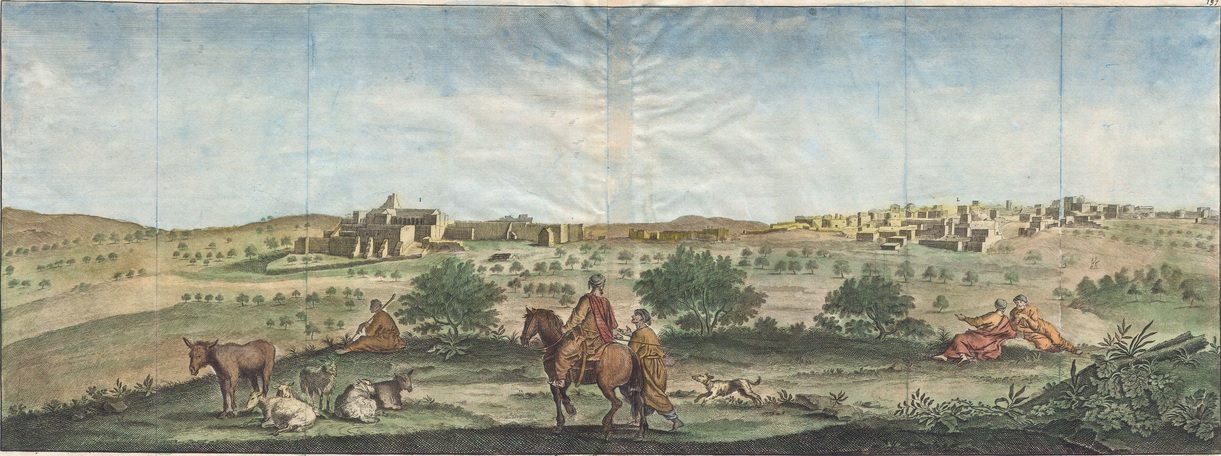
O LITTLE TOWN
OF BETHLEHEM
A certain man of Bethlehem (Beth Lechem) in Judah - The writer now introduces the first character in our drama and tells us his home town is Bethlehem in Judah not the other Bethlehem in Zebulun. (Jos 19:15+).
Bethlehem means "house of bread" - "Rachel died and was buried on the way to Ephrath (that is, Bethlehem)." (Ge 35:19)

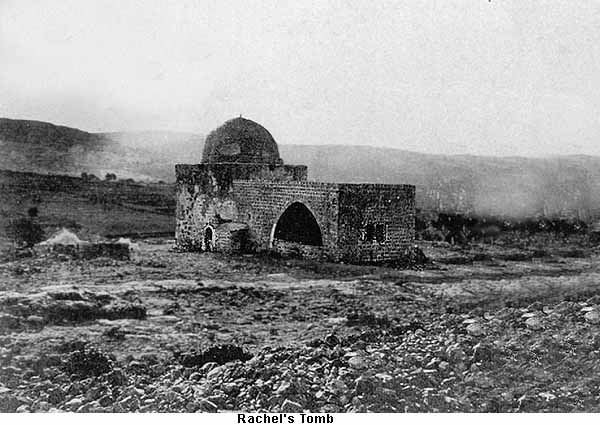
Rachel's Tomb at Bethlehem
David's father Jesse was from Bethlehem which was David's birthplace -- "Now David was the son of the Ephrathite of Bethlehem in Judah, whose name was Jesse, and he had eight sons. And Jesse was old in the days of Saul, advanced in years among men." (1Sa 17:12, cf Ru 4:22+) Bethlehem was later referred to as "the city of David...called Bethlehem..." (Lk 2:4+) The Messiah, who referred to Himself as true "Bread of life" (Jn 6:48, 33, 34, 35) would one day be born in the "house of bread" as God prophesied through Micah -- "from (Bethlehem Ephrathah) One will go forth for Me to be ruler in Israel. His goings forth are from long ago, from the days of eternity." (Micah 5:2 fulfilled in Mt 2:1) (See Messianic Prophecies) Centuries later the angels announced to the "shepherds staying out in the fields, and keeping watch over their flock by night" (Lk 2:8) that "today in the city of David there has been born for you a Savior, Who is Christ the Lord." (Lk 2:11+)
O little town of Bethlehem, how still we see thee lie!
Above thy deep and dreamless sleep the silent stars go by.
Yet in thy dark streets shineth the everlasting Light;
The hopes and fears of all the years are met in thee tonight.For Christ is born of Mary, and gathered all above,
While mortals sleep, the angels keep their watch of wondering love.
O morning stars together, proclaim the holy birth,
And praises sing to God the King, and peace to men on earth!How silently, how silently, the wondrous Gift is giv’n;
So God imparts to human hearts the blessings of His Heav’n.
No ear may hear His coming, but in this world of sin,
Where meek souls will receive Him still, the dear Christ enters in.Where children pure and happy pray to the blessèd Child,
Where misery cries out to Thee, Son of the mother mild;
Where charity stands watching and faith holds wide the door,
The dark night wakes, the glory breaks, and Christmas comes once more.O holy Child of Bethlehem, descend to us, we pray;
Cast out our sin, and enter in, be born in us today.
We hear the Christmas angels the great glad tidings tell;
O come to us, abide with us, our Lord Emmanuel!
Bethlehem (01035)(Beth Lechem) literally means "house of bread". There are two places named Bethlehem, one a city in Zebulun (Josh 19:15) the home of an Israelite judge, Ibzan, (Jdg. 12:8, 10) and located seven miles west and north of Nazareth. The more commonly used Bethlehem is located about 5 miles south of Jerusalem and is distinguished by Bethlehem Ephrathah (Jdg 17:7,8; Ru 1:1,2) and Bethlehem Judah.
Bethlehem is the birthplace of King David (1 Sam. 17:12, 15, 58; Luke 2:4), and of Jesus Christ (Matt. 2:1, 5, 6). Its messianic genealogical roots start with Ruth and Boaz (Ruth 4:11), and finds its ultimate fulfillment in Jesus Christ through the line of David (Matt. 11-16; 2:1, 5, 6; Luke 2:4, 15; 3:23-38). David was also anointed king at Bethlehem (1 Sam. 16:12).
Bethlehem was also the home of the Levite's concubine (Judg. 19:1,2), and the burial place of Asahel (2 Sam. 2:32). It is first referred to as Ephrath when Rachel is buried by Jacob on the way to Ephrath, but "Bethlehem" is added to clarify the meaning for the reader (Gen. 35:19; 48:7). The name appears as Bethlehem Ephrathah in Mic. 5:2. Perhaps Ephrathah is added to distinguish it from the Bethlehem in the territory of Zebulun (Josh. 19:15).
NET Note - The name Bethlehem (בֵּית לֶחֶם, bet lekhem) is from “house, place” (בֵּית) and “bread, food” (לֶחֶם), so the name literally means “House of Bread” or “Place of Food.” Perhaps there is irony here: One would not expect a severe famine in such a location. This would not necessarily indicate that Bethlehem was under divine discipline (ED: POSSIBLE BUT IN CONTEXT OF DAYS OF JUDGES DIVINE DISCIPLINE IS CERTAINLY A STRONG CONSIDERATION), but merely that the famine was very severe, explaining the reason for the family’s departure.
Bethlehem - 41x in 39v - Gen. 35:19; Gen. 48:7; Jos. 19:15; Jdg. 12:8; Jdg. 12:10; Jdg. 17:7; Jdg. 17:8; Jdg. 17:9; Jdg. 19:1; Jdg. 19:2; Jdg. 19:18; Ruth 1:1; Ruth 1:2; Ruth 1:19; Ruth 1:22; Ruth 2:4; Ruth 4:11; 1 Sam. 16:4; 1 Sam. 17:12; 1 Sam. 17:15; 1 Sam. 20:6; 1 Sam. 20:28; 2 Sam. 2:32; 2 Sam. 23:14; 2 Sam. 23:15; 2 Sam. 23:16; 2 Sam. 23:24; 1 Chr. 2:51; 1 Chr. 2:54; 1 Chr. 4:4; 1 Chr. 11:16; 1 Chr. 11:17; 1 Chr. 11:18; 1 Chr. 11:26; 2 Chr. 11:6; Ezr. 2:21; Neh. 7:26; Jer. 41:17; Mic. 5:2 (See also Bethlehem in the NT - Mt. 2:1, 5, 6, 8, 16; Lk. 2:4, 15; Jn. 7:42)
Bethlehem is situated 2,527 feet above sea level (commanding a view of the mountains of Moab to the East) about 5-6 miles (8-10 km) south of Jerusalem (click map below) in the district known as Ephrathah in the land of the tribe of Judah (Micah 5:2), on a narrow eastward ridge which breaks down in abrupt terraced slopes to the deep valleys below, surrounded by fertile fields, fig and olive orchards, and vineyards. Bethlehem is about 40-60 miles from Moab which lies on the southeastern side. In 1995 the estimated population of Bayt Lahm was 32,000. Bethlehem was particularly susceptible to the climate because there was no spring and it relied on cisterns to gather water. The main produce of the area includes grain crops (wheat and barley), olives and grapes.
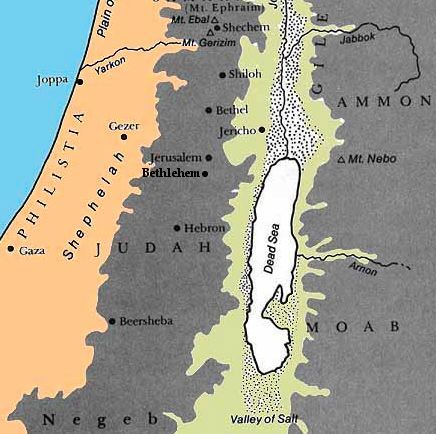
Bethlehem
- A city southwest of Jerusalem -Judges 17:7-note; Jdg 19:18-note
- Called Ephratah and Ephrath -Ge 48:7; Ps 132:6-note; Micah 5:2
- And Bethlehem Judah - Jdg 17:7, 8, 9; 19:1,18; Ru 1:1; 1Sa 17:12
- Rachel dies and is buried at -Ge 35:16,19; 48:7
- The city of Boaz -Ruth 1:1,19; 2:4
- Taken and held by the Philistines -2Sa 23:14, 15, 16
- Jeroboam converts it into a military stronghold -2 Chr 11:6
- The city of Joseph -Matthew 2:5,6; Luke 2:4
- Birthplace of Jesus -Micah 5:2; Matthew 2; Lk 2:4,15
- Herod murders the infants of -Mt 2:16, 17, 18
- A town of Zebulun, six miles west of Nazareth -Jos 19:15
- Israel judged at -Jdg 12:10-note
QUESTION - What is the importance of Bethlehem in the Bible?
ANSWER - Bethlehem’s central importance in the Bible comes from its relationship to Jesus Christ. The prophet Micah foretold that Israel’s Messiah would be born in Bethlehem: “But you, Bethlehem Ephrathah, though you are small among the clans of Judah, out of you will come for me one who will be ruler over Israel, whose origins are from of old, from ancient times” (Micah 5:2; Matthew 2:4–6). Both Matthew and Luke report that Jesus was born in the humble village of Bethlehem (Matthew 2:1–12; Luke 2:4–20).
Bethlehem is also known as the City of David. The city was David’s family home (1 Samuel 16:1; 17:12) and the place where he was anointed king (1 Samuel 16:4–13). The city is sometimes called Bethlehem of Judah or Bethlehem Ephrath (Genesis 35:19) to set it apart from the Bethlehem of Zebulun (Joshua 19:15).
The name Bethlehem means “House of Bread,” probably suggesting a broader context of “food” because of its nearness to bountiful fields within the Judean desert. The town of Bethlehem is situated about five miles southwest of Jerusalem in the hill country of Judah, about 2,500 feet above sea level. The climate is mild, and rainfall is plentiful. Fertile fields, orchards, and vineyards surround the city. Located on a rocky spur just off the main route to Hebron and Egypt, the city has welcomed a fusion of cultures and peoples since its origin.
Bethlehem is first mentioned in the Bible as the town nearest to where Jacob’s wife Rachel died and was buried (Genesis 35:19; 48:7); at that time, it was a Canaanite settlement.
Bethlehem was the home of a young Levite who served as an idolatrous priest for a man named Micah in Ephraim (Judges 17:7–13). It was also the hometown of a concubine whose murder brought on the massacre of the people of Gibeah (Judges 19-20).
Naomi, her husband, and their two sons lived in Bethlehem before traveling to Moab during a famine (Ruth 1:1). It was to Bethlehem that Naomi returned after the deaths of her husband and sons, along with her daughter-in-law Ruth (Ruth 1:16–19, 22). To the east of Bethlehem lies the valley where Ruth gleaned in the fields of Boaz (Ruth 2:4). Boaz and Ruth were married in Bethlehem, where they also had their son, Obed, who was the grandfather of King David (Ruth 4:13, 17).
Caleb’s family settled in Bethlehem, and his grandson Salma became known as “the father of Bethlehem” (1 Chronicles 2:51). Bethlehem was the hometown of two of David’s mighty men: Elhanan, son of Dodo; and Asahel (2 Samuel 2:32; 23:24; 1 Chronicles 11:26). While David was camped at the cave of Adullam, three of his war heroes risked their lives by breaking through a Philistine garrison that occupied Bethlehem to bring David water to drink from the well at the city’s gate (2 Samuel 23:13–17).
As the City of David, Bethlehem became a symbol of the king’s dynasty. Under Solomon and later Rehoboam, Bethlehem expanded in importance as a strategic fortress. Much later, after the murder of Gedaliah in the days of Babylonian occupation, some Jewish refugees stayed near Bethlehem on their way to Egypt (Jeremiah 41:17). Later, more than a hundred people from Bethlehem were among those who returned to their homeland from exile in Babylon (Ezra 2:21; Nehemiah 7:26).
Bethlehem, while diminished in importance to a humble village in New Testament times, remains distinguished above all other biblical cities as the place where our Savior Jesus Christ was born. When the time came for Mary to give birth, Roman Emperor Caesar Augustus decreed that a census be taken. The law required every citizen to return to his or her hometown to register. Joseph went with Mary to Bethlehem “because he belonged to the house and line of David” (Luke 2:4). In Bethlehem, Mary gave birth to Jesus. “She wrapped him in cloths and placed him in a manger, because there was no guest room available for them” (Luke 2:7).
In another fulfillment of prophecy (Jeremiah 31:15), King Herod, who was plotting to kill the newborn king, ordered the murder of all male babies two years old and younger in and surrounding Bethlehem (Matthew 2:16–18).
Today the Church of the Nativity, built by Constantine the Great around AD 330, still stands in Bethlehem. Tradition states that a cave under the church is the actual spot where Jesus Christ was born. The manger site is marked by a star with the Latin inscription, Hic De Virgine Maria Jesus Christus Natus Est, meaning “Here Jesus Christ was born of the virgin Mary.” GotQuestions.org
Related Resources:
- Where was King David born? | GotQuestions.org
- Where was Jesus born? | GotQuestions.org
- Is Micah 5:2 a Messianic prophecy? | GotQuestions.org
- What was the star of Bethlehem? | GotQuestions.org
- Who were the Ephrathites? | GotQuestions.org
WENT TO SOJOURN
- Ruth 1 Resources - Multiple Sermons and Commentaries
A SHORT BUT
EVENTFUL TRIP
Went to sojourn (gur) - NET = "went to live temporarily" NIV = "live for a while." Webster defines "sojourn" as a "temporary stay". The Hebrew verb gur means to dwell as an alien, stranger or foreigner. The idea is to be in a place with a focus that one is living as a guest or stranger. The point is that in using this word, the writer is implying that Elimelech's intent was not to take up residence but to secure sustenance. And he left home with the intention to return.
TECHNICAL NOTE - The Septuagint (abbreviated "LXX" for "seventy" which by tradition is the number of Hebrew scholars involved in the translation) is the name of the Greek translation of the Hebrew Old Testament and it will be used frequently to supplement the meaning of key words in these notes. It may surprise you to know that most of the Old Testament quotations in the New Testament (by Jesus, Paul, John, Peter, etc) are not from the original Hebrew (with exceptions) but are from the Greek translation, the Septuagint. In this verse the Septuagint (LXX) translates sojourn with the Greek verb paroikeo (pará = near + oikéo = to dwell - cf paroikos) which literally means to dwell beside or among and describes one living in a place without holding citizenship and thus one who is living as an alien dwelling temporarily in the land. Paroikeo is used positively to describe Abraham who "by faith...lived as an alien (paroikeo) in the land of promise" (Heb 11:13+) In this sense all believers are sojourners "aliens and strangers" (2Pe 2:11+) who because of "His promise...are looking (prosdokao - present tense - continually waiting, expecting, anticipating) for new heavens and a new earth, in which righteousness dwells. (2Pe 3:13+)
NET NOTE on sojourn - Or “to live temporarily.” The verb גּוּר (gur, “sojourn”) may refer to (1) temporary dwelling in a location (Deut 18:6; Jdg 17:7) or (2) permanent dwelling in a location (Jdg 5:17; Ps 33:8). When used of a foreign land, it can refer to (1) temporary dwelling as a visiting foreigner (Gen 12:10; 20:1; 21:34; 2 Kgs 8:1–2; Jer 44:14) or (2) permanent dwelling as a resident foreigner (Ge 47:4; Ex 6:4; Num 15:14; Dt 26:5; 2 Sa 4:3; Jer 49:18, 33; 50:40; Ezek 47:22–23). Although Naomi eventually returned to Judah, there is some ambiguity whether or not Elimelech intended the move to make them permanent resident foreigners. Cf. NASB “to sojourn” and NIV “to live for a while,” both of which imply the move was temporary, while “to live” (NCV, NRSV, NLT) is more neutral about the permanence of the relocation.
THOUGHT- How can we as believers apply these truths to our everyday life? Don't get too attached to this temporal world (cf Gal 6:14+) or its shiny trinkets and toys because as the Bible says "The world is passing away, and also its lusts; but the one who does the will of God lives forever...For here we do not have a lasting city, but we are seeking the city which is to come." (1Jn 2:17+, Heb 13:14+) Are you living like you're staying or sojourning like you're going (Soon and very soon)? Listen to Looking for the City and Heaven in the Real World.
Gur is commonly used to describe the movement of the patriarchs as when Abram went "down to Egypt to sojourn there, for the famine was severe in the land" (of Canaan) (Ge 12:10+). Unfortunately Abram "went down" in more ways than one, for he received more than he bargained for, returning with the Egyptian handmaiden Hagar, the eventual mother of Ishmael who became the protagonist of Isaac, presaging the current Jewish-Muslim conflict in the Middle East. Beware for sin is sadly the "gift that keep on giving!"
Along life's road are obstacles—
Our choice becomes a test;
Help us, O Lord, to know Your way
That we may choose what's best. |
—D. De Haan
And so it seems Elimelech was only going for a short time, just to sojourn. But it became a long sojourn, for as we soon learn he never came back, nor did his sons; and when at last Naomi did, ten long years had passed.
THOUGHT - It is vital that we remember that every test ("famine") or temptation is an opportunity to trust God. As we see in the description of Elimelech's sojourning, there is no Scriptural record of Abram or Elimelech seeking God's leading to sojourn. It is not surprising that both sojourns ended up reaping a "harvest" of tragedy (at least until we get to chapter 2 of Ruth!) On this side of the cross we would do well to remember that when the "famine" comes, and especially if it is related to personal disobedience, God is still there, mercifully holding out the promise that if "My people (this applies primarily to Israel but in principle to saints of all ages) who are called by My name humble themselves and pray, and seek My face and turn from their wicked ways, then I will hear from heaven, will forgive their sin, and will heal their land." (2Chr 7:14) To reiterate every test is an opportunity to trust God.
Some choices have good consequences but Elimelech's choices led to dire consequences. Someone has well said that if you don't want to end in failure, be sure to begin with God. As you make your decisions today, be sure to include God (there is no record Elimelech included God in his decision to detour). It's tempting for us all to look for the "easy way" out of pressing problems and crushing circumstances, forgetting that God uses these to press out of us what is on the inside and ultimately to mold us into the image of His son. Everyone loves to read Romans 8:28-note but many forget the important rule of reading verses in context for proper interpretation, so be sure to note God's purpose in Romans 8:29-note. Paul writes
And we know that God causes all things to work together for good to those who love God, to those who are called according to His purpose. For (explains why He works all things out) whom He foreknew, He also predestined to become conformed (or molded, describing an inward and not merely a superficial conformity) to the image of His Son, that He might be the first-born among many brethren."
Do you see problems as...OBSTACLES or OPPORTUNITIES? When we keep our eyes on Christ and God's ultimate purpose in our lives, obstacles begin to be seen as opportunities.
The obstacles that we must face
Along life's rocky way
Are used by God so we might hear
"Well done" from Him someday.
—Sper
Remember that any choice that takes us away from God (from Bethlehem to Moab so to speak) is a sojourn in the wrong direction. Elimelech's choice which he made to preserve life, ultimately brought death to himself and his two sons. No matter how desperate the situation, it is always better to face what our sovereign God has allowed and trust His hand of mercy and provision than to run from the circumstances. If you are going through a "famine", seek to make your choice based on clear direction from God as revealed in His all sufficient Word and prayer supplemented by the counsel from godly men and women.
"There is a way which seems right to a man, but its end is the way of death."
-- Pr 14:12
To enjoy your walk with God, keep in step with His Word, which always unfolds His will (cp Ps 119:130+). Don't allow a feeling of desperation to steer you in the wrong direction. Unaided human nature (i.e., the fallen flesh) leads people to make wrong choices which can lead ultimately to death as Solomon writes in this proverb. The untrained conscience cannot be a trusted guide. When pressing circumstances come, press harder against the "sufficient One", EL Shaddai - God Almighty, for
after you have suffered for a little while, the God of all grace, who called you to His eternal glory in Christ, will Himself perfect, confirm, strengthen and establish you. (1Pe 5:10+).
Austrian psychiatrist Viktor Frankl died on September 2, 1997 at the age of 93. During World War II, Dr. Frankl was imprisoned at Auschwitz, where he was stripped of his identity as a medical doctor and forced to work as a common laborer. His father, mother, brother, and wife died in the concentration camps. All his notes, which represented his life's work, were destroyed. Yet Frankl emerged from Auschwitz believing that "everything can be taken from a man but one thing: the last of the human freedoms--to choose one's attitude in any given set of circumstances." We may not be able to choose our circumstances, but we can choose our attitude toward them. The apostle Paul gave us an example of how this works. He wrote,I have learned in whatever state I am, to be content...I can do all things through Christ who strengthens me" (Php 4:11, 12+, Php 4:13+). True contentment does not come in having everything, but in being satisfied with everything you have! Whatever our circumstances may be, we can draw on the power of Christ for the strength to face them and experience the rest and contentment found in Him and ultimately only in Him (cp Mt 11:28, 29, 30). Yes, we have free will and so we always have a choice--and that choice will always make a difference. Remember that desperate choices are seldom the best choices but those who learn to "wait (hope with a sense of expectancy and confidence) for the LORD will gain (Hebrew word means to exchange their "strength" for God's strength) new strength. They will mount up with wings like eagles. They will run and not get tired. They will walk and not become weary." (Isa 40:31)
What may appear to be a shortcut to success may in fact be a broad road to disaster. Remember, the decisions you make will make you. So to reiterate, even though you can't control your circumstances, you can control your attitude. Therefore rather than complaining about the thorns on roses, begin to practice the discipline of being thankful for the roses among the thorns. As discussed in the quotes recorded above, afflictions can become blessings when blended with acceptance and Spirit enabled obedience. When we stop saying, "Why me?" and start saying, "Why not me?" we take the first step to glorifying God in our trials.
O Lord, give me the grace to be
Content with what You give to me!
No! More than that, let me rejoice
In all You send me--it's Your choice!
Be this the purpose of my soul,
My solemn, my determined choice:
To yield to God's supreme control,
And in my every trial rejoice. —Anon
"When trouble comes to our lives, we can do one of three things:
endure it, escape it, or enlist it."
-- Warren Wiersbe
I love what Warren Wiersbe says - "When trouble comes to our lives, we can do one of three things: endure it, escape it, or enlist it. If we only endure our trials, then trials become our master, and we have a tendency to become hard and bitter. If we try to escape our trials, then we will probably miss the purposes God wants to achieve in our lives. But if we learn to enlist our trials, they will become our servants instead of our masters and work for us; and God will work all things together for our good and His glory (Ro 8:28+). (See context in The Bible Exposition Commentary or borrow Be Committed)
Remember that true freedom comes not from choosing our way,
but from yielding to God's way.
Although I may not understand
The path You've laid for me,
Complete surrender to Your will—
Lord, this my prayer shall be. (Amen)
—Sherbert
In some ways it seems that Elimelech made a wrong choice in hard times, as subsequent events suggest. He did not have to make this choice because as we soon see the inhabitants of Bethlehem were (1) still there (had not died of starvation) and (2) there was a harvest of barley (Ru 1:22)
Sojourn (reside)(01481) gur means a temporary stay, to reside temporarily, to dwell as a foreigner; a short stay somewhere. In the reflexive sense, to seek hospitality with. The first use of gur is Ge 12:10 of "Abram (who) went down to Egypt to sojourn there, for the famine was severe in the land." (Other patriarchs - Ge 20:1, 21:23, 34, 26:3, 32:4, 25:27, 47:4). The term is commonly used of the patriarchs who sojourned in Canaan (Ge 26:3; 35:27); places outside Canaan (Ge 12:10; 20:1; 21:23; 32:4; 47:4); Naomi and her family in Moab (Ruth 1:1); the exiles in Babylonia (Jer. 42:15). Metaphorically, the term is used of one who worships in God’s temple (Ps 15:1; 61:4[5]). Gur is used reflexively with the meaning to seek hospitality in 1Ki 17:20. TWOT adds that the root of gur "means to live among people who are not blood relatives; thus, rather than enjoying native civil rights, the gēr ("sojourner") was dependent on the hospitality that played an important role in the ancient near east. When the people of Israel lived with their neighbors they were usually treated as protected citizens; foreigners in Israel were largely regarded as proselytes." (Borrow the TWOT)
Gur - 82x in 80v - abide*(1), alien(1), aliens(1), assemble(1), colonize(1), dwell(3), dwells(1), habitation(1), live(4), live as aliens(2), lives(1), reside(13), resided(1), resides(3), sojourn(11), sojourned(9), sojourning(1), sojourns(13), stay(6), staying(4), stays(1), strangers(3). Ge 12:10; Ge 19:9; Ge 20:1; Ge 21:23; G. 21:34; Ge 26:3; Ge 32:4; Ge 35:27; Ge 47:4; Ex 3:22; Ex 6:4; Ex 12:48; Ex 12:49; Lev. 16:29; Lev. 17:8; Lev. 17:10; Lev. 17:12; Lev. 17:13; Lev. 18:26; Lev. 19:33; Lev. 19:34; Lev. 20:2; Lev. 25:6; Lev. 25:45; Nu 9:14; Nu 15:14; Nu 15:15; Nu 15:16; Nu 15:26; Nu 15:29; Nu 19:10; Dt. 18:6; Dt. 26:5; Jos. 20:9; Jdg. 5:17; Jdg. 17:7; Jdg. 17:8; Jdg. 17:9; Jdg. 19:1; Jdg. 19:16; Ru 1:1; 2 Sam. 4:3; 1 Ki. 17:20; 2 Ki. 8:1; 2 Ki. 8:2; 1 Chr. 16:19; 2 Chr. 15:9; Ezr. 1:4; Job 19:15; Job 28:4; Ps. 5:4; Ps. 15:1; Ps. 61:4; Ps. 105:12; Ps. 105:23; Ps. 120:5; Isa. 5:17; Isa. 11:6; Isa. 16:4; Isa. 23:7; Isa. 33:14; Isa. 52:4; Jer. 35:7; Jer. 42:15; Jer. 42:17; Jer. 42:22; Jer. 43:2; Jer. 43:5; Jer. 44:8; Jer. 44:12; Jer. 44:14; Jer. 44:28; Jer. 49:18; Jer. 49:33; Jer. 50:40; Lam. 4:15; Ezek. 14:7; Ezek. 47:22; Ezek. 47:23; Hos. 7:14
Thompson Chain Reference - Sojourners - Ge 12:10; 20:1 ;21:34 ; 47:4 Lv 18:26, 20:2, 25:40 Nu 15:15 Dt 26:5 Jdg 17:7+ Ru 1:1 Heb 11:9+
IN THE LAND OF MOAB:
- Ruth 1 Resources - Multiple Sermons and Commentaries
Setting the Scene Geographically
Ruth 1:1+ "Bethlehem in Judah...sojourn in...Moab"
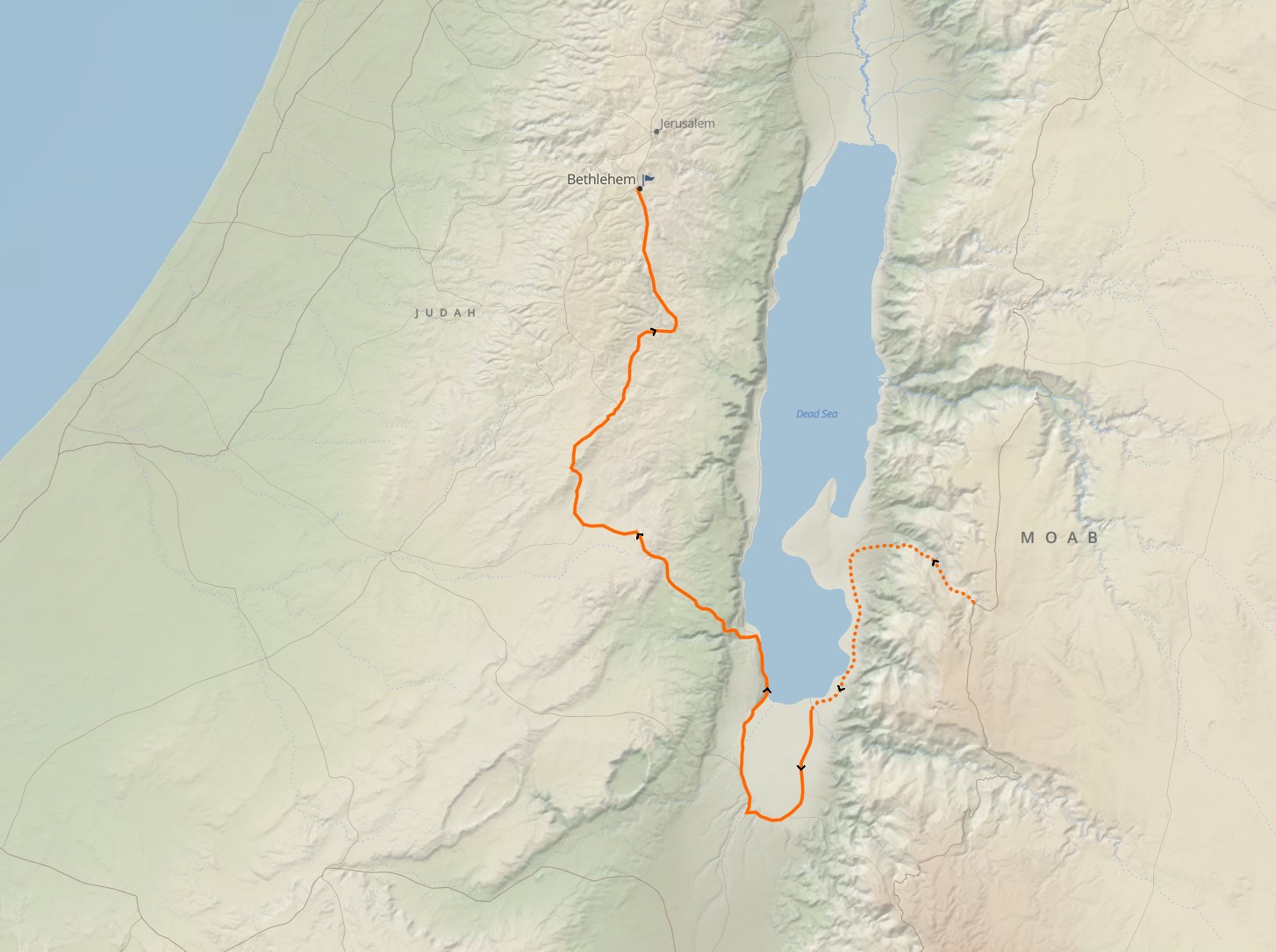
Another Possible Route from Bethlehem to Moab
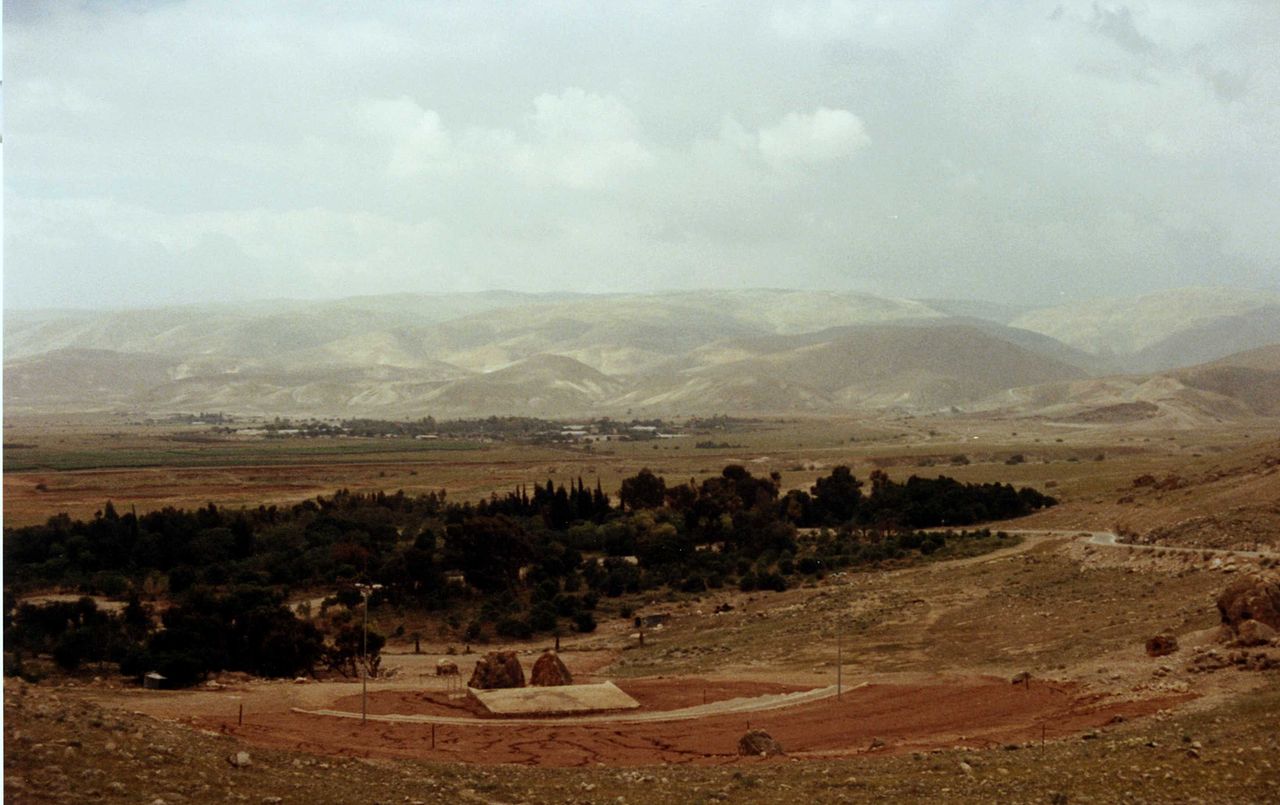
Moab mountain range viewed from Jordan Valley
MOAB - GOD'S
WASHBOWL
In Psalm 60:8+ and Psalm 108:9+ God declares "Moab is My washbowl", which is clearly a term of contempt, for the bowl used to wash dirty, dirty feet! And at this time they had a "dirty" people, worshipping the abominable god Chemosh.
In the land of Moab - We don't know when the events in Ruth occurred during the 300+ years described in the book of Judges, but it is notable that early in the period of the judges, Eglon King of Moab had invaded and dominated the Israelites for eighteen years (Jdg 3:14+). Did Elimelech sojourn to Moab before or after this time of Moabite oppression? We simply cannot say with certainty as there are no other clues in Ruth. From the two maps above, one can readily see there were two possible routes from Bethlehem to Moab (both about 70-80 miles, a journey on foot of about 5-7 days), a northern route (top map) and a southern route around the tip of the Dead Sea. We cannot be certain which route Elimelech took or even if Naomi and Ruth returned by the same route. We'll ask them in Heaven!
BACKGROUND ON MOAB: (Click for much more detail) The Moabites were descended from Lot who fathered Moab by an incestuous union with his oldest daughter (Ge 19:37). Thus Moabites were distant relations of Israel, but they had been hostile when the Israelites had approached from Egypt after the exodus (Nu 21:29+). The Moabites worshipped Chemosh (associated with the practice of child sacrifice - see Who was Chemosh? | GotQuestions.org) and other pagan gods. Scripture records two times when the Moabites directly fought against Israel (Jdg 3:12-30+ 1Sa 14:47) and once indirectly with Balak king of Moab tried to get Balaam to curse Israel (Nu 22-25+, cf Nu 25:1-8+). Saul defeated the Moabites (1Sa 14:47) while David seemed to enjoy a peaceful relationship with them (1Sa 22:3, 4). Later, Moab again troubled Israel (2Ki 3:5–27; Ezra 9:1). Because of Moab’s idolatrous worship of Chemosh (1Ki 11:7, 33; 2Ki 23:13) and its opposition to Israel, God cursed Moab (Isaiah 15:1-9 Isa 16:1-14; Jer. 48:1-47; Ezek. 25:8–11; Amos 2:1–3).
Moab was situated along the eastern border of the Dead Sea, on the plateau between the Dead Sea and the Arabian desert. It was about 35 miles long and 25 miles wide. Although primarily a high plateau, Moab also had mountainous areas and deep gorges. It was a fertile area for crops and herds.
Moab is an elevated, rolling plateau (averaging 3,300 ft elevation) about 35 miles long and 25 miles wide, bounded on the west by the rugged escarpment which drops down to the Dead Sea (Shown in the picture above) (which is almost 1,300 ft below sea level), on the east by the Arabian desert, and running through it the steep Wadi Mujib canyon (pix) with the Arnon River which flows east-west and enters the Dead Sea approximately midway along western shore, separating northern Moab from Moab proper. Relatively few springs appear on the Moabite plateau, and the waters of the Arnon are virtually inaccessible because of the steepness of the river canyon. Still, the area is well watered by winter rains brought by winds from the Mediterranean and thus Moab was a fertile area for crops and herds.

Daniel Block has an interesting note on the sojourn to Moab - The fact that Elimelech headed across the Jordan to Moab east of the Dead Sea suggests the famine was localized in the land of Israel. The narrator does not tell us how to interpret the move. Was it an act of faith or unbelief? The parallels with the account of Abraham’s sojourn in Egypt in Genesis 12 suggest the latter. According to the Book of Deuteronomy, if the people would repent (The Heb word for repent is שוב, shub “to turn, return,” which will occur a dozen times in this chapter but never with this theological meaning), Yahweh would withdraw his anger and lift the famine. (Dt 30:1–3, 8–10+) It seems, however, that Elimelech designed his own solution instead of calling on God for mercy and repenting of the sins that plagued the nation during the dark days of the judges. The narrator’s choice of verb, gûr, “to sojourn,” suggests that he intended to wait out the famine in the land of Moab and to return to Bethlehem when it was over. Not that this was an easy choice. The move to Moab must be interpreted in light of the general Israelite disposition toward the Moabites. That disposition seems to have been colored by five factors in their history: (1) the Moabites’ contemptible origins in the incestuous relationship of Lot and his daughter (Ge 19:30–38); (2) the Moabites’ resistance to Israelite passage through their territory when they came from Egypt (Numbers 22–24); (3) the Moabite women’s seduction of the Israelites and the latter’s subsequent punishment (Num 25:1–9+); (4) Israel’s constitutional exclusion of Moab from the assembly of the LORD (Dt 23:3–6+); and (5) the recent oppression of the Israelites by Eglon the king of Moab (Jdg 3:15–30+). This combination of factors may explain the impression created by the narrator that of the Bethlehemites only Elimelech’s family sought refuge from the famine in Moab. (On the surface David’s sojourning among the enemy Philistines in 1 Samuel 27:1-12 seems similar, but unlike Elimelech, David was fleeing from Saul, who sought his life.) They also render even more remarkable the whole-hearted acceptance of Ruth successively by Naomi, Boaz, and the people of Bethlehem. (Borrow Judges, Ruth. Vol. 6: New American Commentary - page 627)
QUESTION - Who were the Moabites?
ANSWER - The Moabites were a tribe descended from Moab, the son of Lot, born of an incestuous relationship with his oldest daughter (Genesis 19:37). From Zoar, the cradle of this tribe, on the southeastern border of the Dead Sea, they gradually spread over the region on the east of Jordan. Shortly before the Exodus, the warlike Amorites crossed the Jordan under Sihon their king and drove the Moabites out of the region between the Arnon River Valley and the Jabbok River, and occupied it, making Heshbon their capital. The Moabites were then confined to the territory to the south of the Arnon Valley (Numbers 21:26–30).
During the Exodus the Israelites did not pass through Moab, but through the “wilderness” to the east, eventually reaching the country to the north of Arnon. The Moabites were alarmed, and their king, Balak, sought aid from the Midianites (Numbers 22:2–4). This was the occasion when the visit of Balaam to Balak took place (Numbers 22:2–6).
In the Plains of Moab, which was in the possession of the Amorites, the children of Israel had their last encampment before they entered the land of Canaan (Numbers 22:1; Joshua 13:32). If we had nothing else to interest us in the land of Moab, it was from the top of Pisgah that Moses, the mightiest of prophets, looked upon the Promised Land; it was here on Nebo that he died his solitary death; it was here in the valley over against Beth-peor where he was buried (Deuteronomy 34:5–6).
A basalt stone, bearing an inscription by King Mesha, was discovered at Dibon by Klein, a German missionary at Jerusalem, in 1868, consisting of thirty-four lines written in Hebrew-Phoenician characters. The stone was set up by Mesha about 900 BC as a record and memorial of his victories. It records Mesha’s wars with Omri, his public buildings, and his wars against Horonaim. This inscription supplements and corroborates the history of King Mesha recorded in 2 Kings 3:4–27. It is the oldest inscription written in alphabetic characters and, in addition to its value in the domain of Hebrew antiquities, is of great linguistic importance.
Perhaps the most significant Bible character to come from Moab was Ruth, who was “of the women of Moab” but was genetically linked to Israel through Lot, the nephew of Abraham (Genesis 11:31). Ruth is an example of how God can change a life and take it in a direction He has foreordained, and we see God working out His perfect plan in Ruth’s life, just as He does with all His children (Romans 8:28). Although she came from a pagan background in Moab, once she met the God of Israel, Ruth became a living testimony to Him by faith. Ruth, the Moabitess, is one of the few women mentioned in the genealogy of Jesus Christ (Matthew 1:5). GotQuestions.org
QUESTION - What is the significance of Moab in the Bible?
ANSWER - Moab, a small kingdom in the central Transjordan (SEE MAP), was a familiar setting in the Bible.
Genesis 19:30–38 accounts for the origins of the nation of Moab. After Lot and his daughters escaped from Sodom, they lived in a cave in the hills near Zoar. When Lot became drunk, his daughters seduced him. Both conceived and bore children. Lot’s oldest daughter named her son Moab, from whom the Moabites descended, and Lot’s younger daughter called her son Ben-ammi, from whom the Ammonites descended. The Septuagint explains that the name Moab means “he is of my father,” a perpetual reminder of Moab’s incestuous beginnings.
Moab was located on a high geographical plateau directly east of the Dead Sea, between Edom and Ammon. The territory was skirted by the valleys of the Arnon and the Zered, the scarps of the Dead Sea Rift, and the gorge of the Arnon River. With desert land to the east and the rift-valley to the west, Moab measured only about 60 miles from north to south and 20 miles from east to west.
Moab’s northern boundary shifted in times of military strength, but even at its greatest extent, Moab encompassed no more than about 1,400 square miles. The main region north of the Arnon River was assigned to Reuben in the tribal allotment, but the tribe was not able to hold onto the land. Gradually, the territory was absorbed into Moab.
Moab’s terrain consisted mostly of gently rolling tableland separated by numerous ravines. It was known for its rich pastureland for sheep and other livestock (Numbers 32:1; 2 Kings 3:4). Moab’s soil and climate were ideal for growing wheat, barley, and other grains. Stretching through the heart of Moab, in its eastern part, was the King’s Highway, a major trade route that led to Syria in the north and the Gulf of Aqaba in the south.
After leaving Egypt and camping at Mount Sinai, Israel wandered in the wilderness for 38 years before arriving at the boundary of the Promised Land in the plains of Moab (Numbers 10:11–22:1). From this point forward, Moab supplied the background for much of the biblical drama until Joshua 3.
God’s chosen people were now poised to move swiftly toward their final destination in Canaan. To advance, Israel had to fight against King Sihon of the Amorites (Deuteronomy 2:26–37; Numbers 21:21–23) and King Og of Bashan (Deuteronomy 3:1–7; Numbers 21:33–35). Both kings were defeated in Moab.
Subsequently, on the order of Balak, king of Moab, the prophet Balaam attempted to curse the Israelites. Instead, Balaam ended up confirming God’s magnificent promise of blessing on His people and, through them, on the whole world (Numbers 22—24).
Moses reviewed the law and transferred leadership from himself to Joshua on the plains of Moab (Deuteronomy 29—33). And in the land of Moab, Moses died and was buried (Deuteronomy 34:1–6).
Other mentions of Moab and the Moabites occur throughout the Old Testament:
• Judges 3:12–31 gives an account of the 18-year oppression of Israel under King Eglon of Moab until God raised Ehud to deliver the people.
• Second Kings 3 describes the war between Israel and Moab in the ninth century BC.
• David entrusted his father and mother to the king of Moab while he dealt with Saul’s hostility (1 Samuel 22:3–4).
• Solomon took foreign wives, including women from Moab, and pursued idolatrous worship of Chemosh, the god of Moab, which turned his heart away from the Lord and cost him his kingdom (1 Kings 11:1, 7, 33).
• The first part of Ruth and Naomi’s story took place in Moab, a nation hostile to Israel (Ruth 1—2). Ruth, a Moabitess, became the great grandmother of King David. Her place in the genealogy of Jesus Christ is a beautiful example of God’s impartiality.
• The Psalms and several prophets refer to Moab as the enemy of Israel (Psalm 60:8; Isaiah 15—16; Jeremiah 48).GotQuestions.org
Related Resource:
Nave's Topic MOAB
- 1. Son of Lot, Ge 19:37.
- 2. Plains of. Israelites come in, Deut. 2:17, 18.
- Military forces numbered in, Nu 26:3, 63.
- The law rehearsed in, by Moses, Nu 35, 36; Deut. 29-33.
- The Israelites renew their covenant in, Deut. 29:1.
- The land of promise allotted in, Josh. 13:32.
MOABITES
- Descendants of Lot through his son Moab, Gen. 19:37.
- Called the people of Chemosh, Nu 21:29.
- The territory E. of Jordan, bounded on the N. by the river Arnon, Num. 21:13; Jdg. 11:18.
- Children of Israel commanded not to distress the Moabites, Deut. 2:9.
- Refuse passage of Jephthah's army through their territory, Jdg. 11:17, 18.
- Balak was king of, Num. 22:4; calls for Balaam to curse Israel, Nu. 22-24; Jos. 24:9; Mic. 6:5.
- Are a snare to the Israelites, Nu. 25:1, 2, 3; Ru 1:4; 1Ki 11:1; 1Chr 8:8; Ezra 9:1, 2; Neh. 13:23.
- Land of, not given to the Israelites as a possession, Dt. 2:9, 29.
- David takes refuge among, from Saul, 1Sa 22:3, 4.
- David conquers, 2Sa 8:2; 23:20; 1Chr 11:22; 18:2, 3, 4, 5, 6, 7, 8, 9, 10, 11.
- Israelites had war with, 2Ki 3:5-27; 13:20; 24:2; 2 Chr. 20.
- Prophecies concerning judgments upon, Jer. 48.
WITH HIS WIFE AND HIS TWO SONS:
- Ruth 1 Resources - Multiple Sermons and Commentaries
ELIMELECH'S "DETOUR"
A GOOD OR BAD MOVE?
With his wife and two sons - On one hand Elimelech appears to have made a bad decision, because as the story unfolds he exchanges one famine for three funerals!
Spurgeon for example feels that this "was a bad move on their part." He reasons that "Better poverty with the people of God, than plenty outside of the covenanted land."
Better to starve in the will of God than to eat the enemy’s bread!
-- Warren Wiersbe
Warren Wiersbe is even more direct writing "Naomi and her husband sinned when they left Judah for enemy country. Better to be hungry in the will of God than to have a full stomach and be out of His will. They planned to stay in Moab a short time, but their “sojourn” was long enough for their sons to marry. Then the sons and father died. You can run away from famine, but you cannot escape death." (See context in With the Word: The Chapter-by-Chapter Bible Handbook or borrow With the Word ).
NET NOTE - Some interpreters view Elimelech’s departure from Judah to sojourn in Moab as lack of faith in the covenant God of Israel to provide for his family’s needs in the land of promise; therefore his death is consequently viewed as divine judgment. Others note that God never prohibited his people from seeking food in a foreign land during times of famine but actually sent his people to a foreign land during a famine in Canaan on at least one occasion as an act of deliverance (Ge 37–50). In this case, Elimelech’s sojourn to Moab was an understandable act by a man concerned for the survival of his family, perhaps even under divine approval, so their death in Moab was simply a tragedy, a bad thing that happened to a godly person.
In Acts 13:47+ Paul quotes Isaiah 42:6 “For so the Lord has commanded us, ‘I HAVE PLACED YOU AS A LIGHT FOR THE GENTILES, THAT YOU MAY BRING SALVATION TO THE END OF THE EARTH.’” In quoting Isa 42:6, Paul showed that he clearly understood God's intention for the Jewish nation to be a light to the Gentiles. Instead of quoting his own commission to the Gentiles given to him on the road to Damascus, he chose to quote God's commission of all Jews as found in the Old Testament. Israel refused to be the "lighthouse" to the Gentiles dying without the covenants and promises of God. And so in Ruth we see a famine force a family to go to foreigners to rescue a soul named Ruth from perishing!
THOUGHT - It is often that way in our life...when we refuse to go the direction which God has foreordained for us to walk in (cf Eph 2:10+), He sovereignly orchestrates events to shuttle us along the way we should go! Been there, done that beloved! He loves us too much too let us languish and waste our lives (Read Hebrews 12:5-11+, especially Heb 12:11+) but desires us to redeem the brief time He has allotted to each of us (Eph 5:16+, cf Ps 90:12). Praise the LORD!
"Fortunately God’s providence covers even our mistakes!"
--David Atkinson
David Atkinson comments on whether Elimelech was right or wrong to go to Moab - "And of all places, why go to Moab! Centred on the high plateau east of the Dead Sea, Moab was populated by the descendants of Lot. Though the Moabites were not attacked by the Israelites on their return to the promised land after the exodus, despite their characteristic unfriendliness, Moabites were not to be admitted to the congregation of Israel. Why? They were worshipers of Chemosh, a god to whom human sacrifice was apparently made. The Moabites were sometimes referred to as ‘the people of Chemosh’.[8] Furthermore, during the early period of the times of the judges, Eglon, the king of Moab, had invaded the land of the Israelites and pressed the people of Israel into servitude for eighteen years. It was therefore a very curious place for the worshiper of Yahweh from Bethlehem to choose for his sojourn. Why did they not go somewhere where Yahweh was worshiped? Was this distrust in the providence of God? While commending Elimelech’s desire, as he assumes, to care for his family in their hunger, Matthew Henry asks how the move to Moab could possibly have been justified. ‘It is evidence of a discontented, distrustful, unstable spirit to be weary of the place in which God has set us, and to be leaving it immediately, whenever we meet with any uneasiness or inconvenience in it.’ We are not told enough to know whether Elimelech’s action justified Matthew Henry’s comment. But whatever lack of faith or expression of discontent with Yahweh Elimelech’s action implies, the rest of the book of Ruth amply demonstrates that God’s gracious providence is not bound by man’s foolishness. The ultimate joy in the family and purpose in their history which derive from the arrival of Ruth on the scene demonstrate the rich lovingkindness of God’s providential care. It is evidence of his love that such benefits were reaped as a result of such foolish conduct. Fortunately God’s providence covers even our mistakes!" (See context in The Message of Ruth: The Wings of Refuge)
Alexander Maclaren points out that "The household of Elimelech emigrated to Moab in a famine, and, whether that were right or wrong, they were there among heathens as Jehovah worshippers. They were meant to be missionaries, and, in Ruth's case, the purpose was fulfilled. She became the 'first-fruits of the Gentiles'; and one aim of the book, no doubt, is to show how the believing Gentile was to be incorporated into Israel...All this is a beautiful completion to the other side of the picture which the fierce fighting in Judges makes prominent, and teaches that Israel's relation to the nations around was not to be one of mere antagonism, but that they had another mission other than destruction, and were set in their land, as the candlestick in the Tabernacle, that light might stream out into the darkness of the desert. The story of the Moabitess, whose blood flowed in David's veins, was a standing protest against the later narrow exclusiveness which called Gentiles 'dogs,' and prided itself on outward connection with the nation, in the exact degree in which it lost real union with the nation's God, and real understanding of the nation's mission. (Ruth Exposition)
Baker's Evangelical Dictionary of Biblical Theology - The Book of Ruth furnishes a panorama of God's sovereignty in everyday life, especially in the three most important needs of ancient Near Eastern people: food, marriage, and children. Famine drove Elimelech's family from the land of Judah; the likelihood of starvation appears to have compelled Naomi to return to her native land after the death of her husband and sons. The need for the protection of marriage induced Ruth to implement the bold plan of requesting Boaz to act as her kinsman redeemer. Barrenness in ancient times was a cause of embarrassment and concern; without an heir, the family name and lineage could not be carried on, and estates were forfeited. God blessed Ruth with both a child and an important lineage, the lineage of David. (Reference)