2 Kings 19:2
2 Kings 19:3
2 Kings 19:4
2 Kings 19:5
2 Kings 19:6
2 Kings 19:7
2 Kings 19:8
2 Kings 19:9
2 Kings 19:10
2 Kings 19:11
2 Kings 19:12
2 Kings 19:13
2 Kings 19:14
2 Kings 19:15
2 Kings 19:16
2 Kings 19:17
2 Kings 19:18
2 Kings 19:19
2 Kings 19:20
2 Kings 19:21
2 Kings 19:22
2 Kings 19:23
2 Kings 19:24
2 Kings 19:25
2 Kings 19:26
2 Kings 19:27
2 Kings 19:28
2 Kings 19:29
2 Kings 19:30
2 Kings 19:31
2 Kings 19:32
2 Kings 19:33
2 Kings 19:34
2 Kings 19:35
2 Kings 19:36
2 Kings 19:37
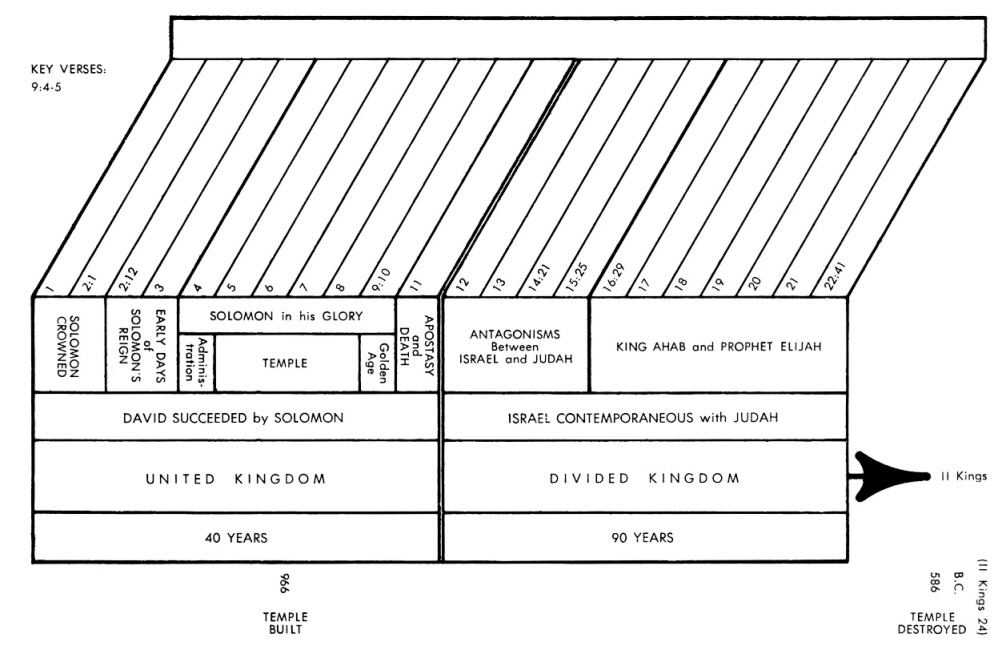
Chart from recommended resource Jensen's Survey of the OT - used by permission
1 Kings Chart from Charles Swindoll

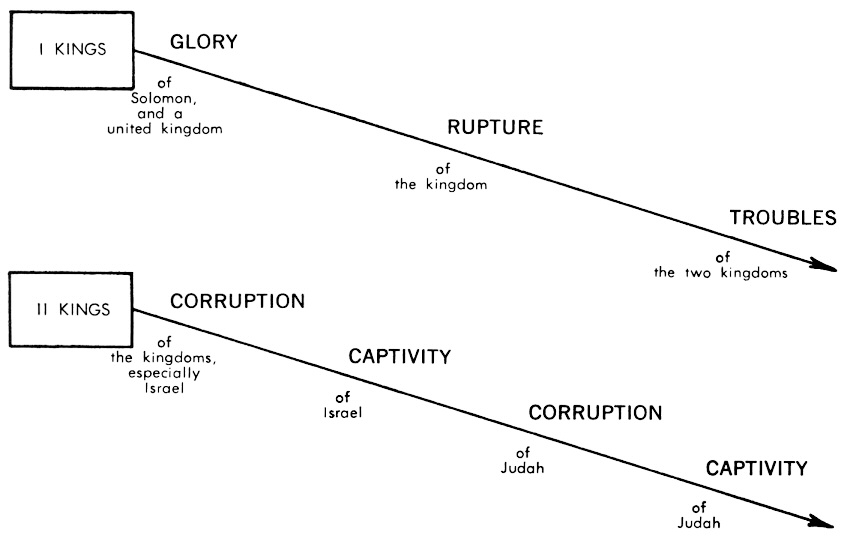
THE DOWNWARD SPIRAL
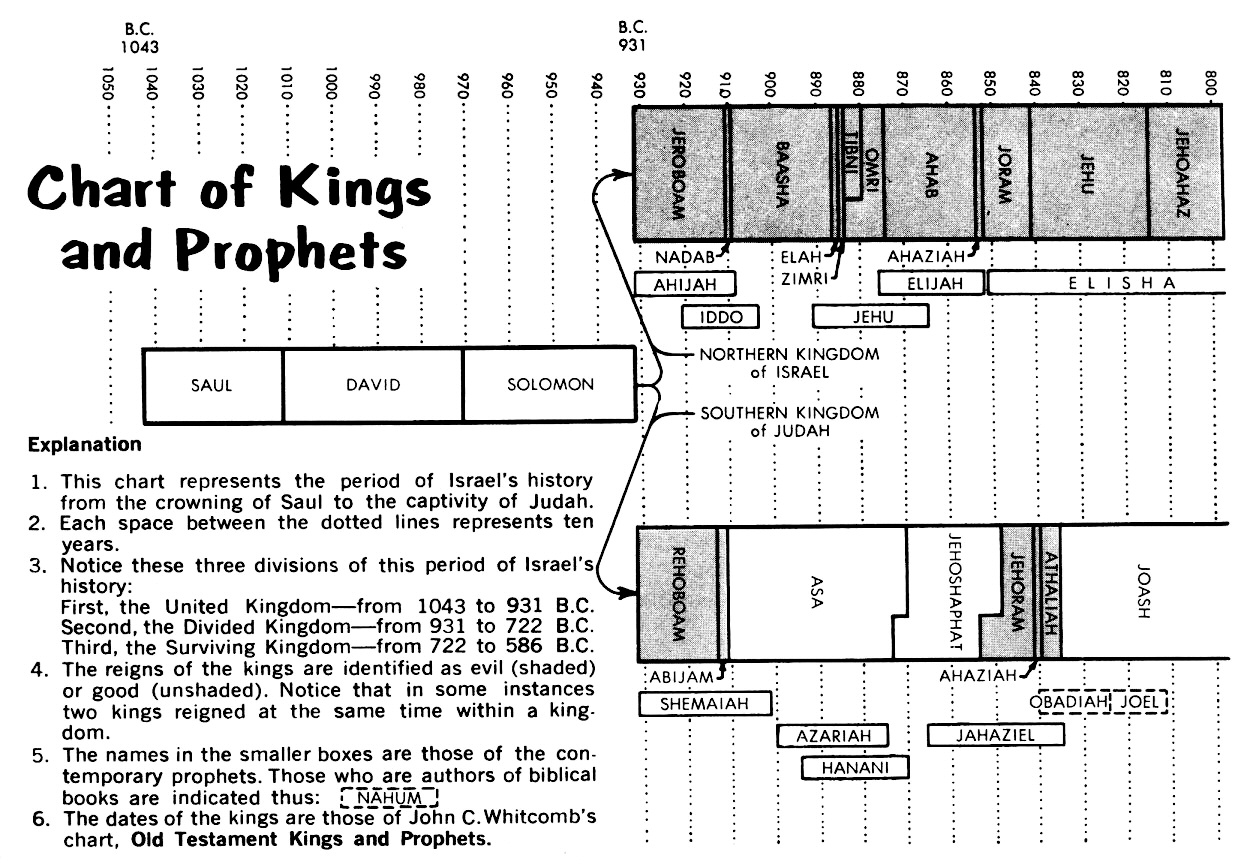
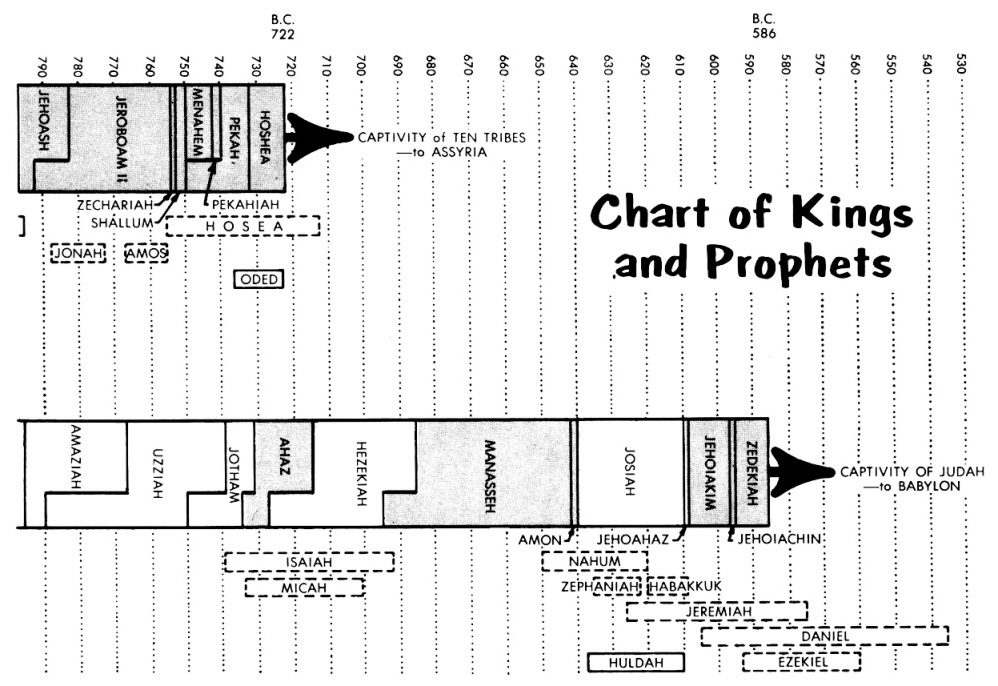
Click to Enlarge
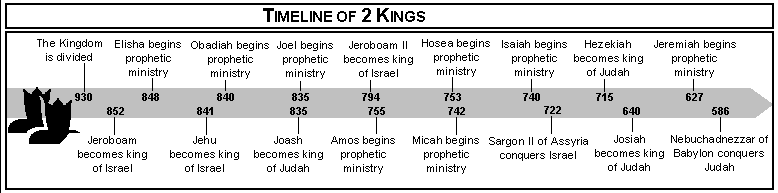
Ryrie Study Bible - Borrow
Click to Enlarge
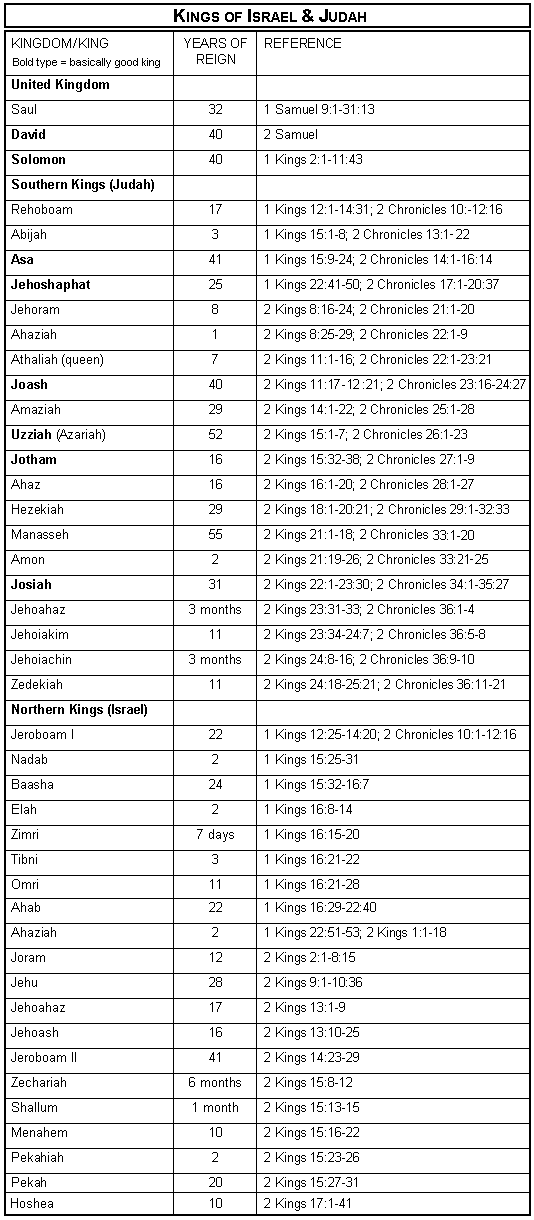
(NOTE: Many consider Amaziah and Hezekiah as "good" kings)
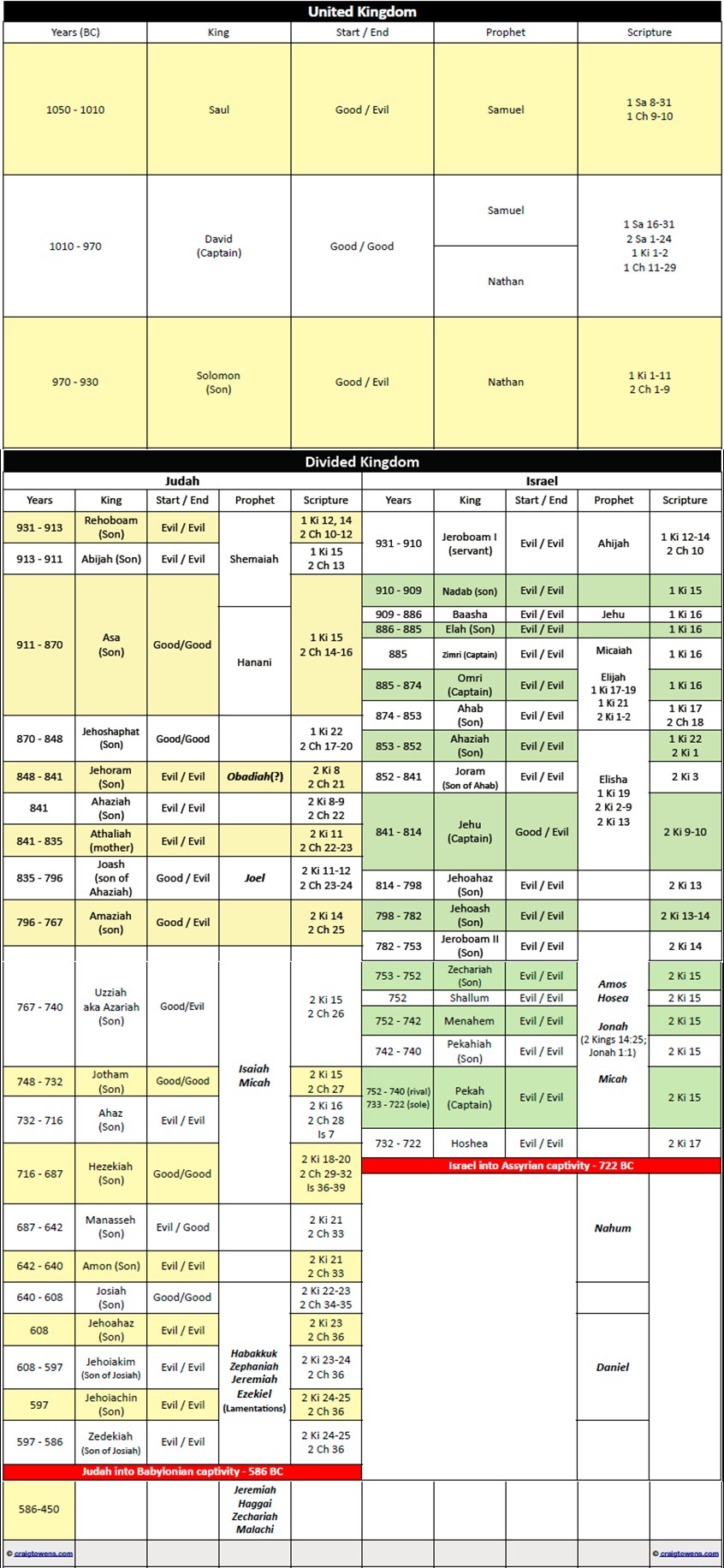
SEE ALSO:
ESV chart - kings of Israel - more information
ESV chart - kings of Judah - more information
Another Chart with Variable Dates for Reigns of King
2 Kings 19:1 And when King Hezekiah heard it, he tore his clothes, covered himself with sackcloth and entered the house of the LORD.
- when king: Isa 37:1-7
- he tore his clothes, 2Ki 5:7 18:37 1Sa 4:12 Ezr 9:3 Job 1:20 Jer 36:24 Mt 26:65
- covered: 2Ki 6:30 Ge 37:34 1Ki 21:27,29 Es 4:1-4 Ps 35:13 Jon 3:8 Mt 11:21
- entered the house of the LORD: 2Ch 7:15,16 Job 1:20,21
Parallel Passages:
Isaiah 37:1 And when King Hezekiah heard it, he tore his clothes, covered himself with sackcloth and entered the house of the LORD.
HEZEKIAH'S REACTION:
TO RUN TO THE LORD
And when - Note this time marker. Always pause to ask questions like what happens when, why it happens, and to whom it happens. These simple questions, when guided by the Spirit, train us to meditate fruitfully on God’s Word. Such Spirit energized thoughtful reflection leads to spiritual understanding and blessing, as Scripture promises to those who meditate on His law day and night. (Joshua 1:8+, Ps 1:1,2,3+).
Warren Wiersbe notes that Hezekiah's servants left the fullers field and returned to tell "their king what the field commander had said, and the report must have broken Hezekiah’s heart. How could anybody be so arrogant and so blaspheme the name of the Lord? The Rabshakeh had reproached the living God by daring to associate Him with the dead idols of the nations."
King Hezekiah heard it, he tore his clothes (note), covered himself with sackcloth (note) and entered the house of the LORD. - When Hezekiah hears the Assyrian threats, he responds not with panic or political maneuvering, but with actions that symbolize humility. Hezekiah's actions signify genuine repentance, grief (see grieving) over the blasphemy against God, and wholehearted dependence on the LORD in the face of overwhelming danger. Hezekiah’s response models the proper spiritual posture in crisis, bringing fear and distress into God’s presence rather than relying on human strength, alliances, or strategies. By seeking the LORD first, King Hezekiah demonstrates faith that God alone is sufficient to defend His people. As Ps 46:1 declares, “God is our refuge and strength, a very present help in trouble.” Hezekiah recognized the seriousness of the Assyrian threats. Leaving behind worldly alliances, he turned to God in faith and humility.
CONTEXT - We have seen Hezekiah as a bold and faithful reformer, one who purified and consecrated the temple, restored true worship, and reestablished the priestly ministry in obedience to the Law of the LORD. Yet his life also reveals the frailty common to even the godliest leaders. When faced with Assyrian pressure, Hezekiah chose diplomacy over dependence, submitting to Assyria and paying a heavy tribute in a misguided effort to prevent war—an act that exposed a momentary reliance on human strategy rather than wholehearted trust in God. The LORD later humbled him through a life-threatening illness, and Hezekiah, brought low, cried out for mercy, which God graciously granted. Tragically, after this deliverance, he faltered once more by welcoming Babylonian envoys and proudly displaying treasures they had no right to see. That episode uncovered lingering pride and spiritual shortsightedness, reminding us that great victories do not immunize God’s servants against future failure. Though not a commendable chapter in Hezekiah’s life, it stands as a sober warning about the dangers of self-reliance and the ongoing necessity of humility before the LORD.
David Guzik - There was good reason for Hezekiah to be so humble before the LORD. “City after city has fallen to Sennacherib and long lines of deportees are already snaking their bitter way into exile – and it is all Hezekiah’s fault! He followed the lunatic policy of rebellion and was bewitched by Egyptian promises. He might as well have sold his people himself. But even when a matter is our own fault we can still pray about it. And the Lord can always be trusted to pity his people.” (Motyer, commentary on Isaiah)
Bob Utley "tore his clothes, covered himself with sackcloth" These are two signs of mourning in Jewish culture. The king is following the actions of his officials who related the message from King Sennacherib (cf. 1 Kgs. 18:37). It is significant to note that when Hezekiah heard these words he immediately went to the house of the Lord. Hezekiah was one of the godly kings of Judah.
🙏 THOUGHT - When faced with this adverse circumstance, Hezekiah's "righteous reflex" was to run to Jehovah's presence. This reminds me of Pr 18:10+ "The name of the LORD is a strong tower; The righteous runs into it and is safe (Hebrew word = sagab which pictures one lifted up above the ongoing fray beneath them. The problem may still be present, but in God's Name, the Spirit supernaturally lifts you "above" the problem! If you will let Him!) ." What is your first "refex response" when the crisis occurs in your life (and we all have crises of one degree or another)? Do you run into the Name, Jehovah Ezer: The LORD your Helper?
David Guzik - When it says, went into the house of the LORD, we should not think that it means that King Hezekiah went into the holy place itself, which was forbidden for all except priests. It simply means that Hezekiah went to the courts of the house of the LORD, to seek God in the place which was open to him as a man of Israel.
Whitcomb: Having been thoroughly chastened by his experience with the Assyrians, Hezekiah now set the pattern for his people in following God’s way of dealing with a great crisis: (1) self-humiliation – 19:1a; (2) going to the appointed place of worship – 19:1b; (3) consulting the Word of God through His prophets – 19:2; and (4) putting God’s honor and glory above everything else – 19:4.
EXCURSUS ON TEARING CLOTHES IN SCRIPTURE - The tearing of garments in Scripture is an ancient and vivid expression of mourning, grief, shock, repentance, or holy outrage. Its earliest appearance occurs when Reuben and Jacob mourn the apparent death of Joseph (Genesis 37:29, 34). Throughout the Old and New Testaments, faithful individuals tore their clothes in response to devastating loss or spiritual crisis: David at the deaths of Saul and Jonathan (2 Samuel 1:11–12), Elisha when Elijah was taken up (2 Kings 2:11–12), Job in overwhelming calamity (Job 1:20), Jephthah upon realizing the cost of his vow (Judges 11:34–35), Mordecai after learning of Haman’s genocidal decree (Esther 4:1), Ahab when confronted with divine judgment (1 Kings 21:27), and Paul and Barnabas when blasphemously worshiped as gods (Acts 14:14). This act was often accompanied by other signs of humility such as sackcloth, dust, or shaved heads (Job 1:20; Job 2:12; 2 Samuel 3:31). Conversely, the refusal to tear garments could signal spiritual hardness, as when King Jehoiakim and his officials showed no fear or repentance while destroying God’s prophetic word (Jeremiah 36:23–24). Notably, the high priest was forbidden to tear his garments, reflecting the sanctity and distinctiveness of his office (Leviticus 21:10). While the practice continues today in the Jewish rite of keriah, Scripture ultimately insists that outward signs must correspond to inward reality: “Rend your heart and not your garments” (Joel 2:13), with the promise that the LORD is gracious, compassionate, and near to the brokenhearted (Joel 2:13; Psalm 34:18).
Dictionary of Biblical Imagery (online) has this note under "Garments" - Another major motif is the tearing of clothes as a ritual gesture of grief or as an act of uncontrollable rage. Indeed, one of the best indices to the emotionalism of the ancient Hebrews is the frequency with which we read about people tearing their garments in a display of strong feeling. To cite just three specimens, Reuben tears his clothes when he returns to the pit and finds Joseph missing (Ge 37:29), Ezra rends his garments when he learns about the Israelites’ intermarriage (Ezra 9:3), and King Hezekiah tears his clothes when he receives the threatening letter from the Assyrian king (Is 37:1). If we trace the three dozen explicit references to people’s tearing their clothing, we find four main categories of crisis-grief or mourning over the loss of something or someone, sorrow for sin in an act of repentance, fear or alarm and anger or frustration.
SACKCLOTH AND ASHES - In the Old Testament, sackcloth and ashes served as a visible expression of mourning, humiliation, and repentance, symbolizing inner sorrow and a humbled heart before God. Sackcloth—a coarse, uncomfortable garment—signified self-abasement, while ashes represented ruin and desolation. Individuals wore sackcloth in personal grief, as when Jacob mourned Joseph (Genesis 37:34) and David lamented Abner’s death (2 Samuel 3:31). Sackcloth with ashes often marked national crisis or repentance, seen vividly when Mordecai and the Jews responded to Haman’s decree with fasting, weeping, and ashes (Esther 4:1–3), and when Nineveh—from king to commoner—repented at Jonah’s warning, prompting God’s mercy (Jonah 3:5–10). Scripture also records this posture among leaders and prophets seeking God’s favor or confessing sin, including Hezekiah (Isaiah 37:1), Ahab (1 Kings 21:27), Daniel (Daniel 9:3), and the elders of Jerusalem (Lamentations 2:10). Ultimately, sackcloth and ashes were outward signs of inward humility; it was not the ritual itself but the repentant heart God regarded (1 Samuel 16:7). When repentance was genuine, God responded with grace—so David could say, “You have turned for me my mourning into dancing… You have loosed my sackcloth and clothed me with gladness” (Psalm 30:11).
Grieving in the Old Testament — In the Old Testament, the Israelites expressed sorrow over national disasters, the death of loved ones, personal repentance, and corporate guilt through a wide range of embodied actions that visibly communicated inner anguish before God and the community. These practices included tearing the outer robe (Gen. 37:29, 34; 44:13; Judg. 11:35; 2 Sam. 1:11; 3:31; 13:31; 1 Kgs. 21:27; 2 Kgs. 6:30; Job 1:20; Jer. 41:5), putting on sackcloth (Gen. 37:34; 2 Sam. 3:31; 1 Kgs. 21:27; Isa. 22:12; Jer. 48:37; Ezek. 7:18; Amos 8:10), removing shoes (2 Sam. 15:30; Isa. 20:3; Ezek. 24:17, 23; Mic. 1:8), placing hands on the head (2 Sam. 13:19; Jer. 2:37), putting dust on the head (Josh. 7:6; 1 Sam. 4:12; Neh. 9:1; Job 2:12), sitting or lying on the ground (Lam. 2:10; Ezek. 26:16; 2 Sam. 12:16; Isa. 47:1), beating the breast and mourning aloud (1 Sam. 25:1; 2 Sam. 11:26; Nah. 2:7), cutting the body (Deut. 14:1; Jer. 16:6; 41:5; 47:5; 48:37), fasting (2 Sam. 1:12; 12:16, 21; 1 Kgs. 21:27; 1 Chr. 10:12; Neh. 1:4), chanting formal laments (2 Sam. 1:17; 3:31; 2 Chr. 35:25), shaving or pulling out hair as a sign of baldness (Lev. 21:5; Job 1:20; Isa. 22:12; Jer. 16:6; 41:5; 47:5; 48:37; Ezek. 7:18; Amos 8:10), trimming the beard (Lev. 21:5; Jer. 48:37), and covering the head or face (2 Sam. 15:30; 19:4). Scripture presents these actions as outward signs of profound inner grief; however, it also warns that some similar practices were rooted in pagan and ancestral worship—such as cutting or gashing the body, tattooing, shaving parts of the head or beard, and extreme acts intended to attract a deity’s attention, as seen in Baal worship (Lev. 19:28; 21:5; Deut. 14:1; 1 Kgs. 18:28). This contrast is illustrated by the sailors of Tyre, who cried loudly, threw dust on their heads, wallowed in ashes, made themselves bald, and wore sackcloth in their mourning (Ezek. 27:30–31; cf. Jer. 25:34; Mic. 1:10), underscoring the biblical distinction between covenantal lament before the LORD and mourning practices shaped by idolatrous belief. (Compiled from outline by Bob Utley)
Bob Utley gives some interesting background on this passage:
- There has been much discussion among commentators as to the number of invasions by Sennacherib, king of Assyria, which are discussed in the literary unit of 2 Kings 18-19. Some see one invasion described in 2Ki 18:17-19:8, and a second invasion in 19:8-35. See Edwin Yamauchi, borrow The Stones and the Scriptures, pp. 78-80.
Warren Wiesbe adds "Most students believe that Judah was invaded twice by the Assyrian army, in 715 and in 701. The second invasion is given far more space in the biblical record because of the great miracle the Lord performed. It’s difficult to see 2 Kings 18:7–16 as a part of the 701 invasion, but it was a prelude to it."
- It is obvious from Assyrian records that Sennacherib invaded Judah around 701 B.C. However, this seems to contradict the dating found in 2 Kgs. 18:13 and Isa. 36:1. Even someone as conservative as Gleason Archer, in his book Encyclopedia of Bible Difficulties, concedes the fact that a scribe probably has made a numbering error in the dates found in the Bible. The relationship between the events of these two chapters is very uncertain. It is possible that we have a respite in the siege of Jerusalem by the threat of an imminent invasion of Ethiopian and Egyptian forces and not two distinct military campaigns. The invasion of 701 B.C. is a certainty and no other invasion is mentioned in the Assyrian documents.
- The Assyrian documents assert that Sennacherib invaded Phoenicia, Judah, and Egypt in 701 B.C. They state that forty-six walled cities of Judah fell and that 200,146 Judeans were exiled during this invasion. They further state that Hezekiah, king of Judah, was "pinned up in Jerusalem like a bird in a cage."
- Allusions to Assyria's military campaigns against
- Jerusalem ‒ 2 Kgs. 18:13-25; 19:29-36
- Syria and other northern kingdoms ‒ 2 Kgs. 18:34-35
- coastal Judea ‒ 2 Kgs. 19:8,12-13
- Lebanon ‒ 2 Kgs. 19:23
- Egypt ‒ 2 Kgs. 19:24 (or possibly against a northern place named Mt. Musri)
- The funeral dirge of 2Ki 19:21-28 is hard to outline, as far as who is addressing whom (i.e., ambiguous PRONOUN antecedents).
2 Kings 19:2 Then he sent Eliakim who was over the household with Shebna the scribe and the elders of the priests, covered with sackcloth, to Isaiah the prophet the son of Amoz.
- he sent Eliakim: 2Ki 18:18 22:13,14 Isa 37:2-5
- to Isaiah: 2Ch 26:22 Mt 4:14 Lu 3:4, Esaias
- the son of Amoz: Isa 1:1, 2:1
Related Passages:
Isaiah 37:2 Then he sent Eliakim who was over the household with Shebna the scribe and the elders of the priests, covered with sackcloth, to Isaiah the prophet, the son of Amoz.
HEZEKIAH WISELY SENDS
ENVOYS TO ISAIAH
Then - THEN is a temporal connector, marking an immediate, deliberate response to the crisis described in the preceding verses. After hearing the Rabshakeh’s blasphemous threats and witnessing the nation’s distress (2 Kgs 18:37–19:1), “then” signals what Hezekiah did next as a direct consequence of that report. It introduces a purposeful shift from human fear to divine counsel: having humbled himself before the LORD (tearing clothes, covering himself with sackcloth, entering the house of the LORD, v. 1), then he sends his highest officials and senior priests to Isaiah the prophet (v. 2).
THEN signifies movement from Assyrian intimidation to prophetic revelation;
from panic to prayerful dependence.
He sent Eliakim who was over the household with Shebna the scribe and the elders of the priests, covered with sackcloth (note), to Isaiah the prophet the son of Amoz - Hezekiah moves from mourning before God to seeking God’s authoritative word through His prophet,. King Hezekiah sends his envoy, not in glorious attire, but clothed in sackcloth as a visible sign of mourning, to seek counsel from the prophet Isaiah. This action reveals Hezekiah’s faith-filled leadership for rather than turning to political alliances or military strategies like many previous kings had done, he deliberately sought the Word of the LORD through God’s appointed messenger Isaiah. Some of the other kings had prophets but sadly refused to consult them (Saul 1Sa 28:6,7+, Ahab blames Elijah 1Ki 18:17,18+, Hezekiah's father Ahaz refused God's offer of a sign - Isa 7:10-12+). Many kings had prophets readily available, yet rejected God’s word because it confronted their pride, fear, or desire for control (cf. 2Ch 36:15, 16+).
The sackcloth underscores the seriousness of the crisis and the posture of submission with which they approach God's prophet. This scene teaches that in moments of fear and uncertainty, God’s people must look first to God’s Word for clarity, correction, and hope. True wisdom is found not in human calculation but in humble reliance on the LORD, Who Alone directs the path of those who trust Him. As Pr 3:5–6 instructs, “Trust in the LORD with all your heart, and do not lean on your own understanding. In all your ways acknowledge Him, and He will make straight your paths.”
The prophet Isaiah devoted his attention primarily to Judah and Jerusalem. He had access to the royal court, and his advice was usually heard with respect, even if in the end it was disregarded. In particular, Isaiah insisted that Judah should not rely upon aid from Egypt (Isa. 19:1-22; 30:1-7; 31:1-3).
Paul House: Hezekiah knows he needs a word from the Lord, so he sends Eliakim, Shebna, and some priests to the prophet Isaiah. Again, the king’s behavior is extraordinary in light of past kings. Before, the prophets sought the kings, only to be rebuked. Now, the king actually wants a prophetic word. He is not simply acting out of desperation (Ahaz took quite another route when he was desperate. Hezekiah acts out his personal convictions). (See 1, 2 Kings - Volume 8 - Page 366)
John Walton - Shebna the secretary. Shebna was a high-level bureaucrat during the reign of Hezekiah. He was at one point a “royal steward,” a position of uncertain function. The royal steward was probably the top civil servant in the administration. The office is documented numerous times in the text as well as in the corpus of official seals and their bullae (see sidebar in Jer 32). Shebna was later demoted to scribe or secretary (presumably because of some unknown scandal). A tomb has been found near Jerusalem with a fragment of a personal name (with Yahweh as an ending) and the title royal steward. Some believe this to be the tomb of Shebna referred to in Isaiah 22:15–16. (IVP Background Commentary - OT - page 405)
QUESTION - Who was Eliakim son of Hilkiah? | GotQuestions.org
ANSWER - Eliakim son of Hilkiah was an important figure during the reign of King Hezekiah of Judah. Eliakim was known for his role as royal steward during a tremendous political and military crisis. His service in Hezekiah's administration, particularly during the Assyrian siege of Jerusalem, reveals his significance as a faithful and trusted leader. Eliakim’s actions demonstrate wisdom, loyalty, and trust in God. During his brief but significant presence in the Bible during a challenging time, Eliakim models the steadfastness of those who sought to defend the city and its people.
Eliakim’s story is recorded in the books of 2 Kings and Isaiah, where he is described as the steward or palace administrator during Hezekiah’s reign. His position was one of considerable influence, as he managed the royal household and served as an advisor to the king. Eliakim is first mentioned during the Assyrian invasion of Judah when the Assyrian army besieges Jerusalem: “[The Assyrian envoy] called for the king; and Eliakim son of Hilkiah the palace administrator, Shebna the secretary, and Joah son of Asaph the recorder went out to them” (2 Kings 18:18).
The historical context in which Eliakim son of Hilkiah lived is critical. The Assyrian Empire, under King Sennacherib, had already conquered the northern kingdom of Israel and was now threatening the southern kingdom of Judah. Sennacherib’s army was known for its brutality, and the siege of Jerusalem was part of the Assyrians’ broader campaign to subjugate the region. As the Assyrian forces surrounded the city, the Assyrian envoy, the Rabshakeh, delivered a speech intended to demoralize the people of Jerusalem and make them question God and Hezekiah’s leadership (2 Kings 18:28–30).
Eliakim and his colleagues were sent to meet with the Rabshakeh. During the exchange, Eliakim asked the Assyrian official to not speak in Hebrew: “Please speak to your servants in Aramaic, since we understand it. Don’t speak to us in Hebrew in the hearing of the people on the wall” (2 Kings 18:26). Eliakim’s concern was that, if the people of Jerusalem heard and understood what the Assyrians were saying, they would be that much more demoralized. However, the Rabshakeh refused to speak in Aramaic and continued to communicate in Hebrew, further inciting fear among the citizens of Jerusalem.
Eliakim’s actions reflect his commitment to maintaining calm and order in the city. After the meeting with the Assyrian envoy, Eliakim and the other officials tore their clothes in grief and returned to Hezekiah, reporting the blasphemous words they had heard. In response, Hezekiah sought guidance from the prophet Isaiah, who delivered a message of reassurance. Isaiah prophesied that God would defend Jerusalem and that Sennacherib would fail in his siege. In Isaiah 37:6–7, Isaiah tells Hezekiah’s officials, “This is what the Lord says: Do not be afraid of what you have heard—those words with which the underlings of the king of Assyria have blasphemed me. Listen! When he hears a certain report, I will make him want to return to his own country, and there I will have him cut down with the sword.”
Eliakim’s role extended beyond the immediate crisis. Isaiah 22 contains a prophecy about Eliakim’s future leadership and his authority in Judah: “In that day I will summon my servant, Eliakim son of Hilkiah. I will clothe him with your robe and fasten your sash around him and hand your authority over to him. He will be a father to those who live in Jerusalem and to the people of Judah. I will place on his shoulder the key to the house of David; what he opens no one can shut, and what he shuts no one can open” (Isaiah 22:20–22). This prophecy foretells Eliakim’s rise to even greater authority, symbolized by his having the “key to the house of David,” which represents the stewardship of the royal household and the responsibility for guiding the people of Judah.
The description of Eliakim as a “father to those who live in Jerusalem” in Isaiah 22:21 emphasizes his role as a compassionate and caring leader, someone who would lead with integrity and wisdom. His leadership contrasts with that of Shebna, the previous steward, who had misused his position for personal gain (see Isaiah 22:15–19). Eliakim’s appointment to this position was a divinely ordained act that would stabilize Judah. He was not only Hezekiah’s servant but God’s.
2 Kings 19:3 They said to him, “Thus says Hezekiah, ‘This day is a day of distress, rebuke, and rejection; for children have come to birth and there is no strength to deliver.
- This day: 2Ki 18:29 Ps 39:11 123:3,4 Jer 30:5-7 Ho 5:15 6:1
- distress, rebuke, and rejection, Ps 95:8 Heb 3:15,16
- for children: Isa 26:17,18 66:9 Ho 13:13
Related Passages
Isaiah 37:3 They said to him, “Thus says Hezekiah, ‘This day is a day of distress, rebuke and rejection; for children have come to birth, and there is no strength to deliver.
A DAY OF DEEP
DISTRESS
They said to him, “Thus says Hezekiah, ‘This day is a day of distress, rebuke (NET - "insults"), and rejection ("contempt"); for children have come to birth and there is no strength to deliver. (deliver not it Hebrew but implied and is present in Isa 37:3 parallel) - Hezekiah’s messengers convey the gravity of Judah’s crisis to the prophet Isaiah, describing it as a day of distress like a mother who has reached the moment of childbirth but lacks the strength to deliver. This striking metaphor captures Judah’s utter helplessness before Assyria’s overwhelming power. Judah has come to a decisive moment, yet possesses no ability to save itself. The image underscores both desperation and urgency, human resources are exhausted, and only divine intervention can avert defeat and disaster.
Moments of crisis expose the limits of human strength and drive God’s people to depend wholly on Him alone. Deliverance does not arise from within, but from above. As Ps 121:2 affirms, “My help comes from the LORD, who made heaven and earth.”
NET NOTE - Heb “when sons come to the cervical opening and there is no strength to give birth.”
David Guzik - for children have come to birth and there is no strength - Hezekiah put these words in the mouth of his messengers to Isaiah to express the total calamity of the situation. This was a proverbial expression for a disaster – a woman so exhausted by labor that she could not complete the birth, so it was likely that both mother and child would die.
Bob Utley - The pain of child birth is a recurrent biblical image of distress (cf. Exod. 15:14; 2 Kgs. 19:3; Isa. 13:8; 21:3; 26:17; Jer. 4:31; 6:24; 13:21; 22:23; 50:43; Hos. 13:13). 2 Kings 19:3c is apparently a popular proverb of the day involving one's inability to perform a needed task. The same type of proverb is in Hosea 13:13.
Whitcomb: If the thrice-holy God of Israel had honored the sincere repentance of a wicked king like Ahab (1 Kings 21:29), and later honored the repentant prayer of another wicked king named Manasseh (2 Chron. 33:12, 13), He would surely respond to this king of a prayer form this king of a king. And Hezekiah was not disappointed. The Lord promised through Isaiah that the blasphemies of Rabshakeh would be dealt with. With regard to Sennacherib, God would maneuver him back to Nineveh (possibly by a report of potential rebellion there) and cause him to be killed at the hand of assassins.
2 Kings 19:4 ‘Perhaps the LORD your God will hear all the words of Rabshakeh, whom his master the king of Assyria has sent to reproach the living God, and will rebuke the words which the LORD your God has heard. Therefore, offer a prayer for the remnant that is left.’”
- Perhaps the LORD Ge 22:14 De 32:36 Jos 14:12 1Sa 14:6 2Sa 16:12
- whom his master the king of Assyria 2Ki 18:17-35
- reproach: 2Ki 19:22 1Sa 17:45 Ps 50:21 74:18
- lift up: 2Ch 32:20 Ps 50:15 Jer 33:3 Eze 36:37 Ro 9:27 Jas 5:16,17
- the remnant: 2Ki 17:5,6 18:13 2Ch 28:5,6 Isa 8:7,8 10:6
SEEKING GOD'S HONOR
IN CRISIS
Perhaps - PERHAPS expresses humble submission, not uncertainty about God’s power. It acknowledges that God’s intervention is sovereign, not automatic or deserved.
the LORD your God will hear all the words of Rabshakeh, whom his master the king of Assyria has sent to reproach (charaph; LXX - oneidizo = revile, disparage, insult) the living God, and will rebuke the words which the LORD your God has heard. - This plea expresses humble dependence on God in a moment of utter helplessness. Hezekiah’s messengers express hope grounded in God’s honor (see Moses' prayer based on God's honor - Ex 32:11-14+), trusting that the LORD will hear the blasphemous words spoken by the Assyrian spokesman and act to defend His own name.
Therefore, offer a prayer (tepillah; LXX - proseuche) for the remnant (sheerith; LXX - leimma) that is left Because the crisis concerns God’s glory, the proper response is intercession, not strategy. Isaiah is asked to act as a mediating prophet, seeking God’s word and will. Remnant acknowledges Judah’s weakness and smallness after Assyrian devastation.
This passage teaches that even when God’s people are weak, fearful, and few in number, they may confidently appeal to Him to act for His glory and for their deliverance. Prayer becomes the bridge between human helplessness and divine power. As Psalm 50:15 declares, “Call upon Me in the day of trouble; I will deliver you, and you shall glorify Me.”
Bob Utley - "remnant" Most of the covenant people had been killed or captured. Only Jerusalem is left. They are the remnant of YHWH's promise in 2 Samuel 7; 1 Chronicles 17. REMNANT is used in three senses: (1) those who survived the famine in Joseph's day ‒ Gen. 45:7 (note v. 5) (2) those who survived the Exiles (e.g. 2 Kgs. 19:30-31; Ezra 9:8,14-15; Neh. 1:2-3; Isa. 10:20-23; 17:4-6; 37:4,31-32; 46:3; Jer. 23:3; 31:7-8; 40:11-12; 42:15,19; 44:12,14,28; 50:20; Micah 2:12; 5:7-8; 7:18; Hag. 1:12-14; 2:2; Zech. 8:6,11-12) (3) those who remain faithful to YHWH while most of the seed of Abraham did not (e.g. 1 Kgs. 19:18; Isa. 4:1-5; 10:20-22; 11:11,16; 28:5; 37:30-31; 59:12-15a; Joel 2:32; Amos 5:14-15)
NOTE: The exact identification of the REMNANT depends on the context, some uses speaking of physical survivors, some speaking of physical surviors mixed with spiritual (true believers) survivors and some referring primarily to spiritual survivors. So for accurate interpretation you need to carefully examine the surrounding context. See in depth discussion of the Remnant of Israel.
Reproach (revile, scorn, taunt) (02778) charaph means to reproach or to agitate someone about something, especially to cast blame or scorn on them. It refers to sarcastic challenge in a mocking or insulting manner. It suggests a jeeringly provoking insult or challenge. As explained below this word actually as 3 senses. Vine says the idea "to say sharp things, reproach." The root with the meaning "to be sharp" is found in Northwest and South Semitic languages. In Hebrew the verb refers to a manner of speech, i.e., to reproach someone. The word appears about 50 times in the Old Testament, once in Psa. 42:10: "As with a sword in my bones, mine enemies reproach me; while they say daily unto me, Where is thy God?"" Charaph is more than mere rude talk, this strong verb denotes demeaning something or someone by complete devaluation, defiance, or despising
Charaph has three contextual meanings, though by far its most common sense is “to reproach, taunt, or revile.” In this usage it describes hostile mockery directed against individuals, God’s people, or God Himself, as seen in the taunts of enemies (Ps. 119:42), Goliath’s defiance of Israel (1 Sam. 17:10), and Assyria’s blasphemous reproach of the living God (2 Kgs. 19:4). Less frequently, the verb can mean to remain through the winter or harvest season, referring to lingering or dwelling (Isa. 18:6), and in a rare legal sense it can mean to engage or betroth, describing the lawful acquisition of a woman for marriage (Lev. 19:20).
Remnant (07611)(sheerith/she'eriyth) means the rest, residue, remainder, remnant 1a) rest, what is left 1b) remainder, descendants. She'eriyth is derived from the verb shāʾar (“to remain, be left over”), consistently carries the idea of what survives after loss, judgment, or elimination, and is the Old Testament’s primary word for the “remnant.” While it can denote something morally neutral, such as leftover wood (Isa. 44:17) or territory (Isa. 15:9), it most often refers to survivors of catastrophe, whether among the nations (Jer. 47:4; Amos 1:8) or within Israel itself (Jer. 40:11; 42:2). The prophets use it especially to describe those left after divine judgment—sometimes a threatened remnant (Jer. 44:7, 12), but more often a preserved remnant by grace, promised restoration and future blessing (2 Kgs. 19:31; Isa. 37:32; Mic. 5:7–8; Zech. 8:11–12). This concept reaches back to Joseph’s declaration that God preserved a remnant through famine (Gen. 45:7) and forward to prophetic hope, where God fulfills His covenant promises through a faithful remnant of Israel (Zech. 8:6–13; cf. Rom. 11:25–29). In every usage, sheʾērît emphasizes survival by divine purpose, not human strength.
Scofield summarizes the Remnant: In the history of Israel a remnant may be discerned, a spiritual Israel within the national Israel. In Elijah's time 7000 had not bowed the knee to Baal (1Ki 19:18). In Isaiah's time, Israel had been reduced to only a few godly "survivors" (Isa 1:9), for whose sake God still forebore to destroy the nation. During the captivities the remnant appears in Jews like Esther, Mordecai, Ezekiel, Daniel, Shadrach, Meshach, and Abednego. At the end of the seventy years of Babylonian captivity it was the remnant that returned under Ezra and Nehemiah. At the advent of our Lord, John the Baptist, Simeon, Anna, and those "who were looking forward to the redemption of Jerusalem" (Lk 2:38) were the remnant. During the Church Age the remnant is composed of believing Jews (Ro 11:4 - 5). But an important aspect of the remnant is prophetic. During the great tribulation a remnant out of all Israel will turn to Jesus as Messiah, the "sealed" Israelites of Rev 7:3-8.
A prophetic aspect of remnant concept is seen in these verses (Note: Not all use sheerith) - Jeremiah 15:11-21; Jeremiah 23:3-8; Jeremiah 31:7; Jeremiah 31:14; Isaiah 1:9; Ezekiel 6:8; Ezekiel 8:11-14; Ezekiel 9:4; Ezekiel 11:16-21; Joel 2:32; Amos 5:15; Micah 2:12; Micah 4:1; Micah 5:3; Micah 7:18; Zephaniah 2:7; Zephaniah 3:13; Haggai 1:14; Zechariah 8:6; Malachi 3:16-18; Romans 11:5.
Prayer (08605) tepillah from palal = to intervene, to interpose, to pray) describes the act of speaking to God, of making requests of Him. Request, petition. Often in the form of a plea "Hear my prayer" (Ps 4:1 - cp Ps 6:9, 39:12, 54:2, 55:1, 61:1, Da 9:17 - all of these uses are translated in Lxx with proseuche the general word for prayer and is used only of prayer to God). The root verb palal conveys the idea of to cause another to intervene or arbitrate in one's case. And indeed this is exactly what we are often doing in prayer asking Him to intervene?
As an aside it should be noted that there are no less than twelve Hebrew words that are rendered pray (or prayer) in English. The first Hebrew word indicating the general idea of prayer is the verb palal (06419), with the derivative noun tepillah. The Septuagint usually translates palal with the Greek proseuchomai, the most common word for prayer in the NT.
In the Old Testament, tepillâh (“prayer”) is a central term for verbal обращения to God, appearing prominently in the Psalms and historical narratives. Five psalms are explicitly labeled “a prayer” in their superscriptions (Pss. 17; 86; 90; 102; 142), all rendered in the Septuagint with proseuchē, a usage that has shaped the devotional practice of “praying the Psalms.” The term also introduces prophetic prayer, as in Habakkuk 3:1, and is frequently paired with related expressions such as “cry” or “supplication” (1 Kgs. 8:28; Ps. 6:9; Dan. 9:3), highlighting prayer as spoken dependence, lifted hands (Ps. 141:2), or heartfelt words (Ps. 54:2). From David’s response to God’s covenant (2 Sam. 7:27), Solomon’s temple prayers (1 Kgs. 8; 9:3), Hezekiah’s plea for healing (2 Kgs. 20:5), Manasseh’s repentance (2 Chr. 33:18–19), and the intercessions of Nehemiah, Job, Jonah, and Daniel (Neh. 1; Job 16:17; Jonah 2:7; Dan. 9), Scripture presents prayer as both personal and corporate, offered in ordinary life and extreme circumstances. While many texts affirm that God hears and accepts prayer (Ps. 6:9; 66:20; 102:17; Prov. 15:29; Isa. 38:5), others soberly warn that prayer may be refused when accompanied by persistent rebellion (Jer. 7:16; Ps. 80:4; Isa. 1:15), reinforcing that prayer is relational, covenantal, and inseparable from obedience—hence the temple’s designation as “a house of prayer” (Isa. 56:7).
2 Kings 19:5 So the servants of King Hezekiah came to Isaiah.
DECISIVE STEP
OF FAITH
So the servants of King Hezekiah came to Isaiah - Having humbled himself before God in the temple, Hezekiah now acts through his representatives. Sending servants shows Hezekiah's orderly action. He is not panicking. The servants of Hezekiah come to the prophet Isaiah to deliver their message and seek the LORD’s guidance.
This action reflects Hezekiah’s confidence in God’s word spoken through Isaiah and his clear recognition that true deliverance does not come through military strength, alliances, or human wisdom, but through divine revelation. By turning to God’s prophet, the king places the crisis squarely in the LORD’s hands and submits himself to whatever God declares.
This reminds us that when we experience moments of fear, confusion, or uncertainty, the wisest and safest response is to seek direction from God’s Word rather than rely on our own understanding. God’s word alone provides true clarity when circumstances are dark, confusing or threatening. As Psalm 119:105 affirms, “Your word is a lamp to my feet and a light to my path.”
2 Kings 19:6 Isaiah said to them, “Thus you shall say to your master, ‘Thus says the LORD, “Do not be afraid because of the words that you have heard, with which the servants of the king of Assyria have blasphemed Me.
- Isaiah: Isa 37:6,7-38
- Do not be afraid 2Ki 6:16 Ex 14:13 Lev 26:8 De 20:1,3,4 Jos 11:6 2Ch 20:15,17 Isa 41:10-14 51:7,12,13
- the servants: 2Ki 18:17,35 Ps 74:18,23 Rev 13:6
GOD'S WORD
DO NOT FEAR
Isaiah said to them, “Thus you shall say to your master, ‘Thus says the LORD, “Do not be afraid because (term of explanation) of the words that you have heard, with which the servants of the king of Assyria have blasphemed Me. - Note God's words through His prophet begin with God's recognition that as human beings there was genuine fear (and there was a reason to fear), encouraging them to fear not. The LORD explains why they should not fear by reframing the threat: the danger lies not with Judah, but with Assyria’s blasphemy against Him. The command “Do not be afraid” is grounded in the fact that the words causing fear are mere human speech—“the words that you have heard”—and those words are not authoritative but blasphemous insults spoken by servants, not by equals of God. By saying they have “blasphemed Me,” the LORD declares that the offense is personal and theological, not military; Assyria has challenged God’s honor, thereby placing itself under divine judgment. In effect, God assures His people that once the conflict becomes God’s own cause, fear is misplaced, because the outcome no longer depends on Judah’s strength but on God’s resolve to defend His name.
This verse teaches that fear loses its power when God’s people rest in His sovereign awareness and righteous action. When God is present and attentive, anxiety has no rightful place. As Isaiah 41:10 declares, “Fear not, for I am with you; be not dismayed, for I am your God; I will strengthen you, I will help you, I will uphold you with My righteous right hand.”
Paul House: Isaiah’s response to the envoys’ visit is clear, concise, confident, and comforting. He, too, reflects on the military and religious issues at hand, with the primary emphasis on the spiritual matters, which he in turn believes will decide the military concerns. Hezekiah need not fear, for the Lord will make himself known to the Assyrian king who has blasphemed him. Isaiah offers very specific promises, ones that will prove he is either a true prophet or a liar. His words also take Hezekiah one step further in his quest to serve the Lord. He knows now that the Lord promises to help him, yet he must believe this new promise, just as he has believed in the past. (See 1, 2 Kings: An Exegetical and Theological Exposition)
NET NOTE - Heb “by which the servants of the king of Assyria have insulted me.”
David Guzik - With which the servants of the king of Assyria have blasphemed Me: How these words must have cheered Hezekiah! Before, he had hoped it may be that the LORD your God will hear the words of the Rabshakeh… to reproach the living God (2 Kings 19:4). Now, the LORD spoke through the prophet Isaiah, saying He had indeed heard those words. It was evident that God took this offense personally. The servants of the king of Assyria: Servants is “a deliberately belittling expression, ‘the king of Assyria’s lads/flunkies’.” (Motyer, commentary on Isaiah) “He calls Rabshakeh and the other officers of the army the slaves or servant boys – we could say the errand boys – of the king of Assyria.” (Bultema, commentary on Isaiah)
Bob Utley - "with which the servants of the king of Assyria have blasphemed Me" The term "servants" (naar) here, is not the normal term but one which had derogatory implication of menial slaves. The fact that God felt they had blasphemed (gadaph, Piel PERFECT; NIDOTTE, vol. 1, p. 829, #1) Him is significant to the interpretation of this entire chapter (cf. 2Ki 19:10, 30).
2 Kings 19:7 “Behold, I will put a spirit in him so that he will hear a rumor and return to his own land. And I will make him fall by the sword in his own land.”’”
- a blast: 2Ki 19:35-37 Job 4:9 Ps 11:6 18:14,15 50:3 Isa 10:16-18 11:4 Jer 51:1
- hear a rumour: 2Ki 7:6 Job 15:21 Jer 49:14 51:46 Ob 1:1
- I will cause: 2Ki 19:36,37 2Ch 32:21
YAHWEH'S SOVEREIGN
COUNTERMOVE!
Behold (hinneh; LXX - idou) Spurgeon reminds us that "Behold is a word of wonder; it is intended to excite admiration. Wherever you see it hung out in Scripture, it is like an ancient sign-board, signifying that there are rich wares within, or like the hands which solid readers have observed in the margin of the older Puritanic books, drawing attention to something particularly worthy of observation." I would add, behold is like a divine highlighter, a divine underlining of an especially striking or important text. It says in effect "Listen up, all ye who would be wise in the ways of Jehovah!"
I will put a spirit in him so that he will hear a rumor and return to his own land. And I will make him fall (kill him) by the sword in his own land. Isaiah predicted that Sennacherib would return home and be killed (2 Kin. 19:37). Isaiah did not say WHEN (recall Isaiah is speaking circa 701 BC) this would happen, but history records that he was assassinated almost 20 years later in 681 BC in Nineveh (2Ki 19:37, Isa 37:38), even surviving Hezekiah who died in 686 BC (note some disagree with this date, but majority accept it). Assyrian records align with the 681 BC date and confirm a violent death followed by Esarhaddon’s accession, fitting the biblical chronology.
NET NOTE - Heb “I will put in him a spirit.” The precise sense of רוּחַ (ruakh), “spirit,” is uncertain in this context. It may refer to a spiritual being who will take control of his mind (see 1 Kgs 22:19), or it could refer to a disposition of concern and fear. In either case the LORD’s sovereignty over the king is apparent.
This prophecy was literally fulfilled later when Sennacherib was slain by two of his own sons (2 Kings 19:36,37). This event is also found described in an Assyrian inscription.
God promises through the prophet Isaiah that He will sovereignly intervene by causing the Assyrian king Sennacherib to hear a report—a rumor—that will compel him to withdraw from Judah and return to his own land, where he will ultimately meet his death (Isaiah 37:7). This prophecy underscores God’s absolute rule over international events and human authorities: even something as intangible as a rumor lies fully within His control and can serve His purposes. What appears accidental or circumstantial to human eyes is, in reality, directed by divine sovereignty. Spiritually, the verse reassures God’s people that the LORD actively defends those who trust Him and that no enemy—however powerful—can thwart His will. As Proverbs 21:1 declares, “The king’s heart is a stream of water in the hand of the LORD; He turns it wherever He will.”
Behold (02009) hinneh is an interjection meaning behold, look, now; if. "It is used often and expresses strong feelings, surprise, hope, expectation, certainty, thus giving vividness depending on its surrounding context." (Baker) Hinneh generally directs our mind to the text, imploring the reader to give it special attention. In short, the Spirit is trying to arrest our attention! And so hinneh is used as an exclamation of vivid immediacy (e.g., read Ge 6:13)! Hinneh is a marker used to enliven a narrative, to express a change a scene, to emphasize an idea, to call attention to a detail or an important fact or action that follows (Isa 65:17, Ge 17:20, 41:17). The first use of hinneh in Ge 1:29 and second in Ge 1:31 - "And God saw all that He had made, and behold, it was very good. And there was evening and there was morning, the sixth day." Hinneh is oftn used in the idiom "Here I am" in Ge 22:1, 7,11 Ge 27:1,18, Ge 31:11, Ge 46:2 Ex 3:4 1Sa 3:4, 3:16, 12:3, 2Sa 1:7, Isa 52:6, Isa 58:9. Hinneh is used most often to point out people but also to point out things (Ge 31:41, 17:4). God uses hinneh to grab man's attention before He brings destruction (Ge 6:13, 17). God uses hinneh when He establishes covenants (Ge 9:9, 15:12, 17 [when Jehovah cut the Abrahamic covenant], Ge 17:4, cp Ge 28:13, 15), when He provided a sacrificial substitute for Isaac (foreshadowing His giving us His only Son!) (Ge 22:13). Hinneh marks the "chance (The Providence of God)" arrival of Boaz at the field where Ruth was gleaning (Ru 2:4-read about this "chance romance" - Indeed, "Behold!"). Hinneh is used to announce the Lord’s sending of a child as a sign and a prophecy of Immanuel-Emmanuel, the Messiah (Isa. 7:14-note). In fact W E Vine says that it is notable that when behold (hinneh) is used in Isaiah, it always introduces something relating to future circumstances.
2 Kings 19:8 Then Rabshakeh returned and found the king of Assyria fighting against Libnah, for he had heard that the king had left Lachish.
- Libnah: 2Ki 8:22 Jos 10:29 12:15 15:42
- Lachish: 2Ki 18:14 Jos 12:11 15:39 Isa 37:8,9 Mic 1:13
SENNACHERIB MOVES FROM
LACHISH TO LIBNAH
Then Rabshakeh returned - He returns, not in defeat, but to regroup. The silence of Jerusalem (2Ki 19:7) did not soften Assyria’s resolve.
And found the king of Assyria fighting against Libnah - Sennacherib is fighting Libnah another fortified Judean city, likely near Lachish which shows Assyria’s methodical advance, taking one stronghold after another. While Jerusalem was only being threatened verbally, elsewhere Judah was being crushed militarily.
David Guzik makes an interesting comment that relates to Isaiah's prophecy in 2Ki 19:7 - This must have seemed to Hezekiah to be the fulfillment of the LORD’s promise through the prophet Isaiah (ED: BUT IT WAS NOT - THE PROPHECY WAS FULFILLED IN THE DEATH OF KING SENNACHERIB 20 YEARS LATER). The Rabshakeh left Jerusalem and Hezekiah must have thought, “Now he’ll go back to his own land and be killed, just like the LORD promised. Good riddance! Thank You, LORD!”
For he (the Rabshakeh) had heard that the king had left Lachish - Lachish was the primary Assyrian siege base and was Judah’s second most important city fortress city after Jerusalem. The fall of Lachish is famously depicted in Assyrian reliefs. Here Sennacherib’s move from Lachish to Libnah suggests that Lachish was likely secured or neutralized and they the campaign was progressing successfully. This unexpected redirection fulfills the LORD’s word spoken earlier through the prophet Isaiah, that Sennacherib would be distracted by other concerns and drawn away from Jerusalem. What appeared to be a routine military adjustment was, in reality, the outworking of divine sovereignty, as God quietly but decisively altered the course of Assyria’s campaign.
This episode demonstrates that the LORD is fully able to frustrate the plans of proud kings like Sennacherib and redirect even the most powerful rulers to protect His people. Human strategies may seem unstoppable, but they are always subject to God’s higher purpose. As Proverbs 21:1 teaches, “The king’s heart is like channels of water in the hand of the LORD; He turns it wherever He wishes. ”
John Walton - Sennacherib against Libnah. Libnah was in the Judean Shephelah eight miles northeast of the fortress city of Lachish. It is probably to be identified either with Khirbet Tell el-Beida or Tell Bornat (five miles further west), strategically located by the Wadi Zeita guarding the best route to Hebron from the coast. The Assyrian annals describe Sennacherib besieging Gath and Azekah, and wall reliefs at Nineveh show the siege of Lachish. Libnah was in this vicinity, showing that the Assyrian monarch was slowly moving towards the intended victim, Jerusalem. (Walton - IVP Background Commentary - OT - page 405)
QUESTION - Who was Rabshakeh in the Bible? | GotQuestions.org
ANSWER - The term Rabshakeh means “the chief of the princes” and refers to a field commander sent by Sennacherib, king of Assyria, as a messenger to King Hezekiah of Judah (Isaiah 36). It is unclear whether Rabshakeh was the man’s given name or whether it was merely his title, designating his office. Other Bible versions translate Rabshakeh as “field commander” (NIV), “Assyrian chief of staff” (NLT), and “royal spokesman” (CSB). Rabshakeh could also refer to the chief cupbearer or vizier of the Assyrian court.
Sennacherib’s Assyrian army had defeated the northern kingdom of Israel. 2 Kings 18:12 says that “this happened because they [Israel] had not obeyed the Lord their God, but had violated his covenant—all that Moses the servant of the Lord commanded. They neither listened to the commands nor carried them out.” Sennacherib had also captured all the fortified cities in Judah and was poised to capture Jerusalem, too. He sent the Rabshakeh with a great army to issue a challenge to Hezekiah. Using the Hebrew language, the Rabshakeh said, “Tell Hezekiah that this is what the great king, the king of Assyria, says: What is the basis of this confidence of yours? You claim to have a strategy and strength for war, but these are empty words. In whom are you now trusting, that you have rebelled against me?” (Isaiah 36:4–5). The Rabshakeh used the native language of the Jews in order to be heard by the Jewish guards on the wall. He may have been hoping his words would terrify them into pressuring Hezekiah to surrender.
Hezekiah’s emissaries, Eliakim, Shebna, and Joah, said to the Rabshakeh, “Please speak to your servants in Aramaic, since we understand it. Don’t speak to us in Hebrew in the hearing of the people on the wall” (Isaiah 36:11). But the Rabshakeh only shouted louder in Hebrew, hoping to shake their faith and turn the common people of Judah against their king (Isaiah 36:13).
The Rabshakeh’s message to the people of Jerusalem was full of lies, boasts, and blasphemies:
• he questioned the object of their trust
• he ridiculed Hezekiah’s strategy as weak and ineffective
• he discounted any help they might receive from Egypt
• he told them the Lord had turned against them
• he claimed the Lord had sent him to destroy the land of Judah
• he crudely reminded them of the horrors of being under siege
• he accused Hezekiah of deceiving the people
• he scoffed at the notion of trusting in the Lord
• he offered gifts of land and peace to anyone who would surrender
• he reminded them that no nation’s gods had yet been able to deliver it from Assyria
• he equated the Lord with the impotent gods of the other nations
When Hezekiah heard the threats, he sent his emissaries to consult with the Lord’s prophet, Isaiah (Isaiah 37:1–2). Isaiah told them, “This is what the Lord says: Do not be afraid of what you have heard—those words with which the underlings of the king of Assyria have blasphemed me. Listen! When he hears a certain report, I will make him want to return to his own country, and there I will have him cut down with the sword” (verses 6–7). Hezekiah also took the message he had received from the Rabshakeh to the temple, where he laid it before the Lord and prayed for help.
The Lord did defend Jerusalem, just as He promised (Isaiah 37:36–38). Despite the taunts and manipulative attempts by the Rabshakeh to defeat God’s people, the Assyrian army was destroyed, and the Lord’s purpose prevailed. It will always prevail (Isaiah 46:9–11).
Many today attempt to dishearten God’s people, through ridicule, blasphemy, and lies. Like the Rabshakeh, they see themselves as invincible and possibly even claim that God is on their side. Believers must run to God’s Word, seek for wisdom, and pray. Then they must trust in God’s promises.
Malachi 3:17–18 reveals God’s response when a modern-day Rabshakeh challenges us:
“‘On the day when I act,’ says the Lord Almighty, ‘[those who feared the Lord] will be my treasured possession. I will spare them, just as a father has compassion and spares his son who serves him. And you will again see the distinction between the righteous and the wicked, between those who serve God and those who do not.’”
2 Kings 19:9 When he heard them say concerning Tirhakah king of Cush, “Behold, he has come out to fight against you,” he sent messengers again to Hezekiah saying,
- when he heard: When Sennacherib had levied contributions on Hezekiah, he marched his army into Egypt; where, after several successes, he laid siege to Pelusium, and spent much time in it; but hearing that Tirhakah, king of Ethiopia, whom Strabo calls Therchon, was marching against him with a great army, to assist his kinsman Sevechus, or Sethon, the king of Egypt, he durst not abide his coming, but raised the siege; and returning to Judea, he encamped against Lachish, and afterwards against Libnah. But finding that Tirhakah pursued him as a fugitive, he marched back to encounter him; and having totally routed his army, he returned to wreak his vengeance on Hezekiah. 1Sa 23:27 Isa 37:9
- sent: 2Ki 18:17
SENNACHERIB HEARS OF
ANOTHER ENEMY RISING
When he (Sennacherib) heard them This signals a report of intelligence, for the Assyrian kings relied heavily on messengers and scouts. This shows that new information has entered the situation, altering Assyria’s calculations.
Say concerning Tirhakah king of Cush - This fact made Sennacherib consider his position more dangerous and this motivates him to seen the Rabshakeh back to Jerusalem to pressure Hezekiah to surrender without having to carry out a costly siege. Tirhakah was a powerful ruler from Cush (Nubia) who later became Pharaoh of Egypt. At this time, he was the leading military champion of the Egyptian–Cushite alliance. His mention is significant showing that Assyria now faces a credible opposing force, not a small rebellion. Cush refers to the region south of Egypt (modern Sudan), known for strong armies, skilled archers and warrior-kings.
“Behold (hinneh; LXX - idou) - The word “Behold” again functions as an alarm signal.
He has come out to fight against you - Tirhakah is not posturing but has mobilized troops, and come out implies an offensive maneuver, not just a defensive tactic. This represents the first real military threat Sennacherib has faced during this campaign against Judah.
David Guzik While the Rabshakeh was away, the Assyrians learned that Egyptian troops (under an Ethiopian king) were advancing from the south. This would be the Egyptian intervention Assyria feared, and that many in Judah trusted in. As Isaiah prophesied, it would come to nothing (Isaiah 20:1-6 and Isa 30:1-7).
He sent messengers again to Hezekiah saying, - This section is a little confusing because the message recorded in 2Ki 20:10- 13 was in the form of a letter (2Ki 20:14) carried by the messengers and was not another person to person encounter. When Sennacherib hears that Tirhakah is advancing to wage war against him, he responds by sending messengers once to deliberately targeted target Hezekiah. Note the word again emphasizes Assyria's second round of intimidation. In this context the repeat attempt by Sennacherib is not because Assyria is strong, but is motivated now because it is uneasy with other enemies rising up.
In short, instead of marching immediately on Jerusalem, Sennacherib tries to break Hezekiah’s faith with a threatening letter before engaging Tirhakah. This is classic psychological warfare—secure the rear before confronting a new front. Is this not evidence of the Great Chess Player, moving pieces around to providentially protect His Holy City? Who had allowed the "Tirakah distraction?" Clearly Jehovah to give Hezekiah more time, in this case time to pray!
In sum, when Sennacherib heard of an Ethiopian army, led by Prince Tirhakah, coming to the aid of Jerusalem, Sennacherib turned aside to meet Tirhakah king of Cush rather than continuing on immediately to Jerusalem. The Rabshakeh also temporarily withdrew to assist. Sennacherib's own inscription says that he encountered an Egyptian force and defeated it in the plain of Eltekeh, near Ekron. Egyptian kings at this time were Ethiopian (Cushite) in lineage. But lest he forget Jerusalem, Sennacherib sent a message to Hezekiah warning him that he would return.
This episode reminds us that nations may scheme and rulers may threaten, but their plans unravel under God’s sovereign will. As Ps 33:10–11 declares, “The LORD brings the counsel of the nations to nothing; He frustrates the plans of the peoples. The counsel of the LORD stands forever, the plans of His heart from generation to generation.”
NET NOTE - Heb “heard concerning Tirhakah king of Cush, ‘Look, he has come out to fight with you.’ ”
RYRIE - Tirhakah. If this is related to a single campaign of Sennacherib against Judah in 701 B C, then Tirhakah was at that time a general, though he is designated by the title of king, which he later assumed. If (though less likely) there were two separate campaigns (a 13- or 14-year break coming between 2Ki 18:16 and 2Ki 18:17), then he was king at this time. In any case, this threat from Egypt made it urgent for Sennacherib to press Judah to surrender.
Tirhakah. Tirhakah (Nubian: Taharqa) was a Kushite king of Egypt in the Twenty-Fifth Dynasty (reigned 690–664 B.C.). For geographical identification of Cush see comment on Numbers 12:1. Although no extrabiblical text confirms this, the biblical title “King of Kush” may have been given to him while he was crown prince. He was an energetic builder in Egypt, refurbishing temples and city walls at Memphis (his royal residence), Thebes and Napata. He left numerous inscriptions throughout Egypt. Tirhakah campaigned vigorously in the Levant preceding 674 B.C. In that year, Esarhaddon of Assyria attacked Egypt, only to be driven back by Tirhakah’s forces. Three years later, however, Esarhaddon captured Memphis, causing the Egyptian monarch to flee to the south. Another Assyrian force came in 666 B.C., causing him to flee to Nubia. He was still recognized as king of Egypt until his death in 664. (Walton - IVP Background Commentary - OT - page 405)
Bob Utley - Tirhakah king of Cush This is one of the powerful kings of Ethiopia and Egypt (twenty-fifth dynasty). His brother, Shebteko, was king of Egypt and later he himself became king of Egypt (cf. Isa. 37:9). Judah was told over and over again not to trust in the military might of Egypt and this is an example of the folly of trusting in horses and chariots. See K. A. Kitchen, BORROW Ancient Orient and the OT, pp. 82-84. (See also KINGS OF EGYPT)
2 Kings 19:10 “Thus you shall say to Hezekiah king of Judah, ‘Do not let your God in whom you trust deceive you saying, “Jerusalem will not be given into the hand of the king of Assyria.”
- 2Ki 18:5,29,30 2Ch 32:15-19 Isa 37:10-14
ATTEMPT TO UNDERMINE
GOD'S PROMISES
Thus you shall say to Hezekiah king of Judah - Hezekiah is addressed personally and officially. This is not a battlefield shout but a formal diplomatic message. The Assyrians want their words to carry authority and permanence, as if this were settled policy, not intimidation. Note that this "confrontation" was not person to person but via a letter sent to Hezekiah from Rabshakeh.
David Guzik points out that "The Rabshakeh was not in Jerusalem, but that didn’t stop him from trying to build fear, discouragement, and despair in Hezekiah. He sent a letter (2Ki 19:14) to the king of Judah to attack him from a distance."
Bob Utley - This shows some of the theological mocking and psychological techniques employed to discourage Hezekiah (cf. 2 Kgs. 18:30).
Do not let your God in Whom you trust deceive you saying This is the core spiritual assault of this verse. Sennacherib is not denying that Hezekiah trusts his God, but instead he seeks to exploit his trust. He does so by giving a shocking accusation stating flat out that Hezekiah's god is misleading him. Sennacherib's goal is to cause Hezekiah to see his divine assurance as wishful thinking rather than truth. This is a classic tactic or our enemy Satan (who obviously is behind the Assyrians), for if Satan cannot deny God’s existence, he will attack God’s reliability and try to generate doubt in one's mind.
Jerusalem will not be given into the hand of the king of Assyria.” Here Sennacherib pretends to be a "prophet" who trumps God, saying that God's promise is a deception. The Assyrian rejects this promise outright, and presumptously assumes that their power, not Hezekiah's God, would determine the outcome.
In effect, Sennacherib is openly mocking Hezekiah’s faith, warning him not to trust that the LORD will deliver Jerusalem. This taunt exposes Sennacherib’s profound hubris as well as his outright blasphemy, for he in effect equates the living God with the powerless idols of the nations Assyria had already subdued. Sennacherib should have read Ps 115:3 which declares, “Our God is in the heavens; He does all that He pleases.”
2 Kings 19:11 ‘Behold, you have heard what the kings of Assyria have done to all the lands, destroying them completely. So will you be spared?
- 2Ki 19:17,18 17:5-11 2Ch 32:13,14 Isa 10:8-11
SENNACHERIB APPEALS TO
ASSYRIA'S REPUTATION
Behold, (hinneh; LXX - idou) This opening word is a rhetorical alarm. It means “Look!” or “Pay attention!” The Assyrian king demands that Hezekiah focus not on God’s promises, but on what Assyria wants him to see—empirical evidence and past victories. It is the language of intimidation, drawing attention away from faith and toward fear.
You have heard Sennacherib proudly appeals to his reputation and to rumor. Assyria’s military successes were widely known throughout the ancient Near East. The statement implies: “You already know this—everyone does.” It pressures Hezekiah psychologically by suggesting resistance is irrational in light of well-known facts.
What the kings of Assyria Notice the plural “kings”. This broadens the threat beyond Sennacherib alone to a long dynasty of conquerors. The boastful message is: The current power of Assyria is not a fluke or a single campaign, but is what Assyria always does. It is an attempt to plant in Hezekiah's mind that Assyria was historically unstoppable.
Have done to all the lands - This is deliberate exaggeration. And while it is truly hyperbolic, it does reflect Assyria’s vast conquests across Mesopotamia, Syria, and the Levant. The intent is to universalize Assyria’s dominance, in effect saying no region, no culture, no god has escaped. And Jerusalem and your God will not escape! Wrong!
NET NOTE - Heb “Look, you have heard what the kings of Assyria have done to all the lands, annihilating them.”
Destroying them completely - The description is not totally inaccurate for it underscores Assyrian's total annihilation with cities razed, populations deported, gods humiliated. This phrase is calculated to evoke Hezekiah's fear by emphasizing finality for Jerusalem with no chance of no recovery, no reversal, no survivors. It implies that resistance to Assyria is futile and irreversible.
So will you be spared? - This is the climactic taunt, framed as a question but functioning as a statement of contempt. The logic is brutal and simple: If no one else survived, why should you?
NET NOTE - So will you be spared? Heb “and will you be rescued?” The rhetorical question expects the answer, “No, of course not!”
2 Kings 19:12 ‘Did the gods of those nations which my fathers destroyed deliver them, even Gozan and Haran and Rezeph and the sons of Eden who were in Telassar?
- Did the gods. 2Ki 18:33 2Ki 18:34
- Gozan. 2Ki 17:6 1Ch 5:26
- Haran. Gen 11:31 Gen 29:4 Act 7:4
- Eden. Gen 2:8 Isa 37:12
- Telassar. Eze 27:23
DID THE IDOLS DELIVER
OTHER NATIONS?
Did the gods of those nations which my fathers destroyed deliver them, The Assyrian king Sennacherib boasts of his past victories, insisting that no nation has ever escaped his power and implying that Judah will inevitably fall as well. His confidence rests on military success and historical precedent, but it also exposes deep pride and a fatal miscalculation—he refuses to acknowledge the sovereignty of the living God and assumes that Judah’s fate will mirror that of nations whose gods were mere idols.
NET NOTE - Heb “Did the gods of the nations whom my fathers destroyed rescue them—Gozan and Haran, and Rezeph and the sons of Eden who are in Telassar?”
Even Gozan - Gozan was a well-known Assyrian province in upper Mesopotamia, along the Habor River. It had already been fully subdued and absorbed into the Assyrian system. Israelites from the Northern Kingdom were later deported there (2 Kgs 17:6), making it especially ominous. The implication: a place associated with Israel’s own exile could not stand—why should Judah?
And Haran - Haran was an ancient, prestigious city, famous as Abraham’s stopping place (Gen 12:4; Acts 7:2–4) and as a major trade and religious center. By naming Haran, the Assyrians highlight that heritage, antiquity, and spiritual significance offer no protection against their power.
And Rezeph - Rezeph was a fortified city in western Mesopotamia / Syria, known for its strategic value. Its defeat demonstrates that military strength and defensive position were ineffective. The message of Rezeph was that even well-defended cities collapse before Assyria.
And the sons of Eden - Eden does not refer to the Garden of Eden, but to a prosperous Aramean people or principality (also mentioned in Amos 1:5). The phrase evokes wealth, beauty, and abundance. The irony is sharp: even those living in “Eden-like” prosperity were destroyed.
Who were in Telassar? Telassar was likely a regional center or city-state associated with the sons of Eden but the exact location of Telassar remains uncertain.
The rhetorical question implies total extinction: they are no longer there to answer for themselves. It functions as a verbal grave marker, so to speak, to Hezekiah (who would have been familiar with all these named places) reminding him of all the peoples and cultures Assyria had already essentially "erased" from the land.
Sennacherib's boast illustrates a recurring human error: measuring reality by visible power while ignoring divine authority. Scripture repeatedly reminds us that human strength, however impressive, is finite and fragile, whereas God’s power is limitless and unrivaled. As Isaiah 40:15 declares, “Behold, the nations are like a drop from a bucket, and are accounted as the dust on the scales.”
Gozan was in Syria, where deportees from Israel had been sent (see comment on 18:11). Haran was west of Gozan along the Balikh River in present-day Turkey. Rezeph (Rasappa) mostly likely was the city that became an Assyrian provincial capital in Syria east of Emar and west of Mari along the upper Euphrates. The Aramean tribe of Bit-Adini (Eden) in northwest Syria had been conquered by Shalmaneser III (reigned 858–824 B.C.) and resettled in Telassar, which was most likely Til-Ashshuri (“mound of the Assyrians”), a site in the Zagros Mountain range near the Diyala River in Iraq. Hamath and Arpad were major Aramean city-states in Syria conquered by Tiglath-Pileser III (reigned 745–727 B.C.). Sepharvayim has been tentatively identified as Sipirani, south of Nippur, though Shabarain in Syria is still a possibility. Hena and Ivvah are unknown. (Walton - IVP Background Commentary - OT - page 405)
2 Kings 19:13 ‘Where is the king of Hamath, the king of Arpad, the king of the city of Sepharvaim, and of Hena and Ivvah?’”
- the king: 2Ki 17:24 Nu 13:21 34:8 Isa 11:11 Jer 39:5 49:23 Zec 9:2
- Arpad: 2Ki 18:34 Isa 37:13-20, Arphad
WHERE ARE THEY? OBLITERATED
OBLITERLIKE YOU WILL BE
Where is the king of Hamath, Hamath was a major Aramean city-state in central Syria that once had its own king, army, and gods. “Where is…?” means he is gone, either killed, deposed, or exiled. The implication is that his political power did not save him. Sennacherib's rhetorical question is not seeking information but is announcing obliteration for Jerusalem
The king of Arpad - Arpad was a heavily fortified city north of Hamath that resisted Assyria but eventually fell after siege (Conquered byTiglath-Pileser III 740 BC). It represents military resistance crushed by persistence. The message is clear that even strong defenses and courage fail.
The king of the city of Sepharvaim - Sepharvaim was likely a twin-city region in Mesopotamia (but scholars debate the precise location.) and was known in Scripture for its abominable idol worship including child sacrifice (2 Ki 17:31). Mentioning its king underscores that their gods did not save them. Their evil gods survived only as names, not deliverers. Sepharvaim was one of the places from which the Assyrians imported people to repopulate Israel (2Ki 17:24)
And of Hena and Ivvah? - Hena and Ivvah were smaller city-states absorbed by Assyria and represent lesser, forgotten powers. Their kings are so thoroughly erased that history barely remembers them. The silence surrounding them is the Assyrian's point that he would bring about total disappearance.
In short, Sennacherib mocks Hezekiah by cataloging the rulers and kingdoms he has already conquered, sarcastically asking where they are now as supposed proof that no one has ever escaped Assyria's power. The taunt is meant to overwhelm Hezekiah's faith and intimidate Judah into surrender. This exposes Sennacherib’s fatal error for he fails to recognize that the God of Israel is not comparable to the powerless idols of defeated nations.
2 Kings 19:14 Then Hezekiah took the letter from the hand of the messengers and read it, and he went up to the house of the LORD and spread it out before the LORD.
- Hezekiah: Isa 37:14
- spread it: 1Ki 8:28-30 Ezr 9:5 Ps 74:10,11 91:1,2 123:1-4
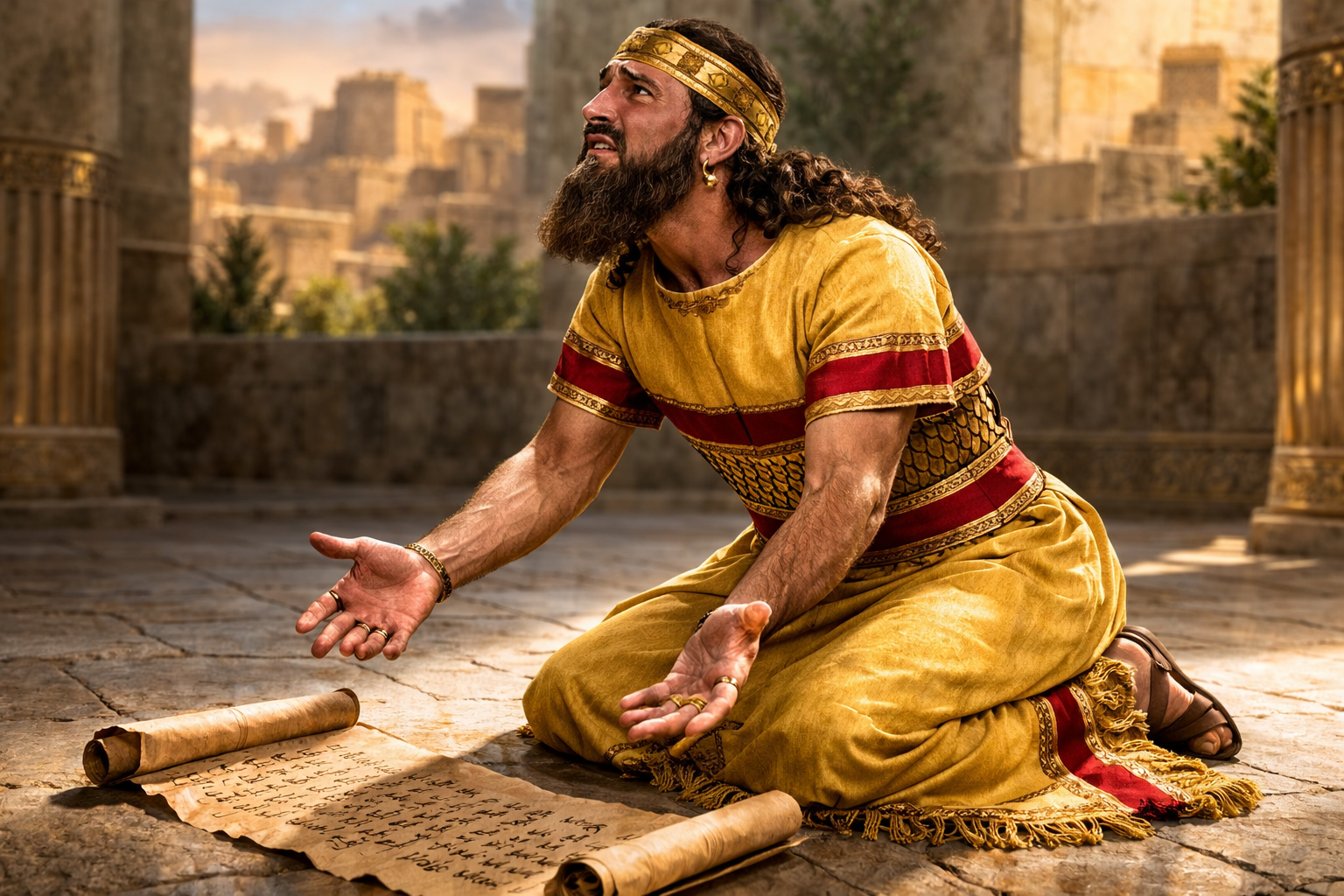
SPREADING ONE'S TROUBLE
OUT BEFORE JEHOVAH
Then - Recall Hezekiah's first reaction was to send his officials to Isaiah, but this time he goes directly to God.
Hezekiah took the letter from the hand of the messengers Hezekiah receives the Assyrian threat in written form, not merely spoken taunts. The letter represents official, fixed policy and being written it is meant by the Assyrians to linger, to be reread and weighed. And Hezekiah does not destroy it or deny it but receives it personally as the King of Judah.
Bob Utley - "Then Hezekiah took the letter from the hand of the messengers and read it" Because earlier in this chapter the message was orally delivered and here we have a written letter, some have assumed that these are two different accounts, and therefore, possibly two different invasions. Since we do not have any historical information about this second invasion, it is impossible to speculate about it at this point. Notice that Hezekiah spread it before the Lord.
David Guzik - Hezekiah did exactly what any child of God should do with such a letter. He took it to the house of the LORD (to the outer courts, not the holy place), and he spread it out before the LORD. In this, Hezekiah boldly and effectively fulfilled the later command of 1 Peter 5:7: casting all your care upon Him, for He cares for you.
And read it, Hezekiah faces the reality of the threat. Faith here is not denial. He reads the full scope of Assyria’s claims, including their blasphemy.
And he went up to the house of the LORD The house of the LORD (the Temple) is his decisive destination. Went up reflects both geography and theology, approaching God’s dwelling. Instead of rushing to Egypt, generals, or strategy, Hezekiah goes directly to Yahweh, and as a godly king acknowledges that crisis belongs first in God’s presence.
And spread it out before the LORD - Hezekiah lays the Assyrian's letter open as if God must read it, though of course God already knows the blasphemous contents. Hezekiah's act symbolizes his dependence on God, saying in effect “Lord, this is not just my problem; this is an attack on Your Name.” Hezekiah does not merely ask for help; he hands the situation over. The letter moves from Assyria’s authority to God’s courtroom. This deliberate act reveals Hezekiah’s humility and genuine faith: instead of responding with panic, diplomacy, or military calculation, he brings the threat itself into God’s presence, laying the crisis openly before Him. By placing the letter before the LORD, Hezekiah acknowledges that the situation is beyond human solution and must be resolved by divine intervention.
🙏 THOUGHT - Hezekiah's humble action reminds us that we as believers are invited to come boldly into God's presence (Heb 4:16+), bringing our fears, our afflictions, and our humanly impossible circumstances honestly and directly to God, trusting Him to act according to His good and acceptable and perfect will (Ro 12:2b+). Such prayer has the potential to transform our anxiety into supernatural peace as Paul says in Philippians 4:6-7+ exhorting us to “Be anxious for nothing, but in everything by prayer and supplication with thanksgiving let your requests be made known to God. And the peace of God, which surpasses all comprehension, will guard your hearts and your minds in Christ Jesus.” Do you have any "letter" you need to lay before the Lord today?
Hezekiah's action reminds me of the instruction of the psalmist
Cast your burden upon the LORD and He will sustain you; He will never allow the righteous to be shaken. (Ps 55:22+)
This exhortation is echoed by Peter...
Therefore humble yourselves under the mighty hand of God, that He may exalt you at the proper time, casting all your anxiety on Him, because He cares for you.(1Peter 5:6-7+)
Meyer - “When therefore letters come to you, anonymous or otherwise, full of bitter reproach; when unkind and malignant stories are set on foot with respect to you; when all hope from man has perished, then take your complaint – the letter, the article, the speech, the rumour – and lay it before God. Let your requests be known unto Him.”
ILLUSTRATION - One old preacher received a letter with no sender or return address on the envelope. When he opened it, he saw a single piece of paper with only one word: “Fool!” He took it to the pulpit the next Sunday, and said: “I received an unusual letter this week. Never before have I received a letter where the writer signed his name, but forgot to write anything else!”
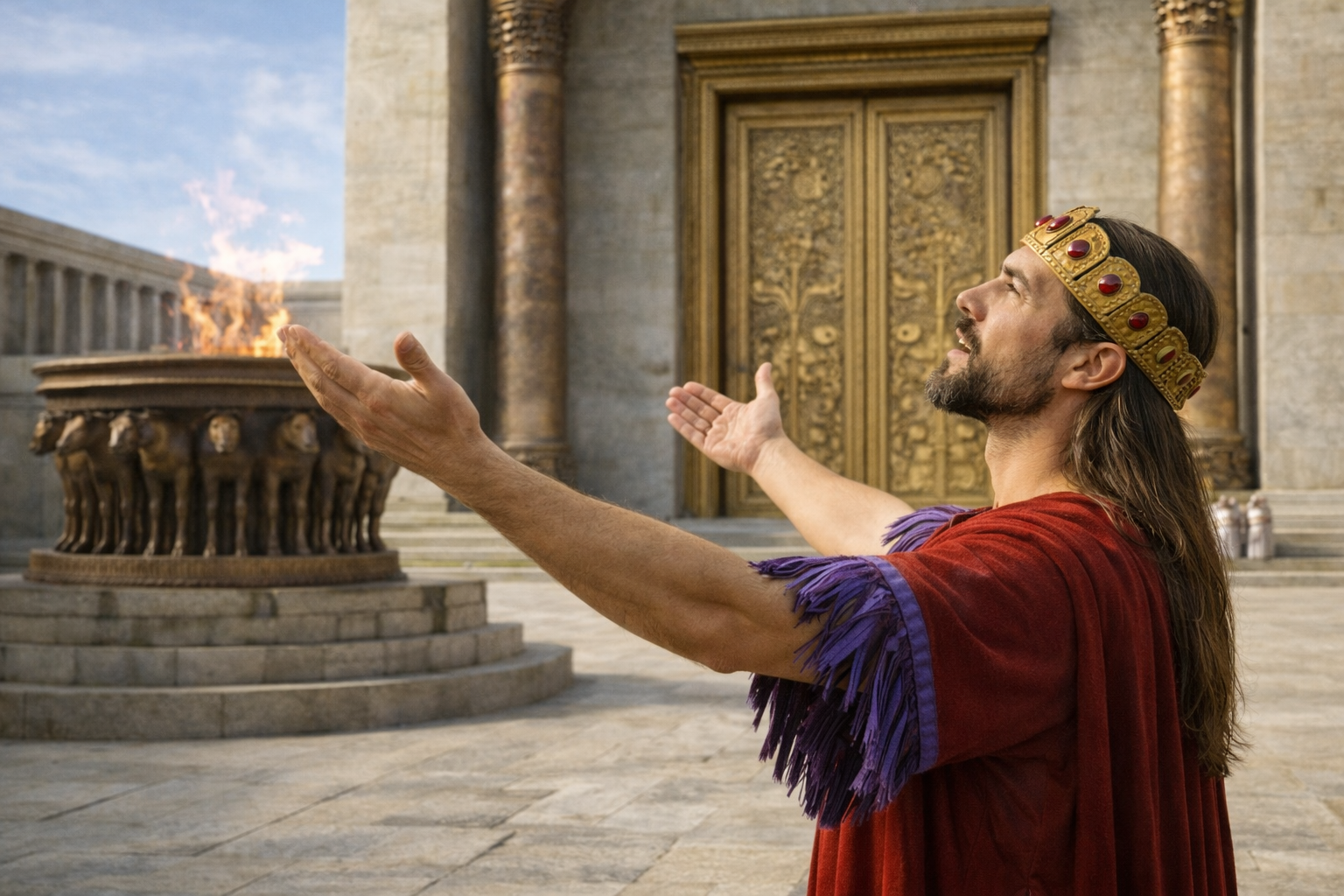
2 Kings 19:15 Hezekiah prayed before the LORD and said, “O LORD, the God of Israel, Who are enthroned above the cherubim, You are the God, You alone, of all the kingdoms of the earth. You have made heaven and earth.
- prayed: 2Sa 7:18-28 2Ch 14:11 20:6 32:20 Da 9:3,4
- O LORD, the God of Israel,: Ge 32:28 33:20 1Ki 8:23 1Ch 4:10 Isa 41:17
- Who are enthroned: Ex 25:22 1Sa 4:4 2Ch 5:7,8 Ps 80:1 99:1
- ou are the God,: 2Ki 5:15 1Ki 18:39 Isa 43:10 44:6,8 45:22 Da 4:34,35
- You have made heaven and earth: Ge 1:1 2:4 Ps 33:9 102:25 146:6 Jer 10:10-12 Joh 1:1-3:36
HEZEKIAH'S PRAYER
BEFORE JEHOVAH
Hezekiah prayed before the LORD Hezekiah moves from action to intercession. The verb prayed emphasizes audible, deliberate prayer, and before the LORD emphasizes Hezekiah's conscious awareness of God’s presence. Here a king humbly bows as a servant, as a human sovereign before the sovereign God.
and said, “O LORD, the God of Israel - LORD invokes God’s self-existent, faithful covenant Name. God of Israel reminds Yahweh of His immutable relationship with His people based on His unbreakable covenant with Abraham, Isaac and Jacob. In short, Hezekiah anchors his prayer not in his worthiness as a godly king or in Judah’s worthiness, but in Yahweh's unchanging faithfulness to His covenant. What a great way for us to begin our prayers, for we too are in an unbreakable New Covenant because of the blood of His Son (Heb 13:20,21+).
Is this a cue for us to take more care about our address
to God, about the way we begin our prayers?
Dale Ralph Davis: Hezekiah comes to a God of intense presence (‘enthroned above the cherubim’), sovereign sway (‘God … of all the kingdoms …’), and massive power (‘you have made heaven and earth’). Yahweh is specially present to Israel in his temple (‘enthroned above the cherubim’) but that does not mean he has gone AWOL among the nations or throughout the world. In one sentence Hezekiah confesses that he approaches a God Who is near, vast, and mighty. One Who is accessible, sovereign, and able. He packs a three-point sermon into the opening lines of his prayer! And the twist is that it’s not only true but helpful. Is this not precisely what Hezekiah needs to remember in the present distress? What better way for Hezekiah to encourage Hezekiah than to rehearse God’s majesty as he requests God’s help? Speaking truth about God to God may stir up assurance in God. Is this a cue for us to take more care about our address to God, about the way we begin our prayers? (BORROW 2 Kings: The Power and the Fury, page 246)
David Guzik agrees with the prior note on God of Israel: This title for God reminded Hezekiah – and the LORD also, in our human way of understanding – that the LORD God was the covenant God of Israel, and that He should not forsake His people.. As recorded in Isaiah 37:16, Hezekiah also used another title when he addressed God, crying out “O LORD of hosts.” This title for our God essentially means, “LORD of armies.” Hezekiah was in a crisis that was primarily military in nature, so it made sense for him to address the LORD first according to the aspect of God’s nature that was most needful for him. “LORD of armies, send some troops to help us!”
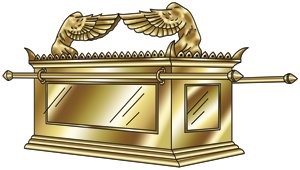
Who are enthroned above the cherubim - Hezekiah is alluding to the Ark of the Covenant in the Holy of Holies where the cherubim stood above the Ark symbolizing Yahweh's royal throne. With this beautiful picture Hezekiah affirms that though God is unseen, He reigns on the throne. Hezekiah is directly countering Assyrian's claim that their king rules supreme. There is no mention of the Shekinah glory cloud at this time, the last mention being in 1Ki 8:10-11+. Clearly God was still present. We do see the glory of the LORD departing circa 586 BC before the temple was destroyed (Ezekiel 10:18-19+).
Bob Utley - "who are enthroned above the cherubim" The cherubim are angelic creatures on the lid of the ark of the covenant. They are described in Exod. 25:22. YHWH symbolically dwelt between the wings of these cherubim (cf. 1 Sam. 4:4; 2 Sam. 6:2; 1 Chr. 13:6; Ps. 80:1; 99:1). This was the place of His footstool, while the third heaven was the place of His abode. We learn from 1 Kgs. 6:23-28 the shape and size of these cherubim in Solomon's temple. (CHERUBIM)
You are the God, You alone - Hezekiah now makes a clear, bold confession of exclusivity, his repetition of "You" intensifying his affirmation. He is setting the Living God up against Assyria’s dead gods and the catalog of defeated gods they had mentioned. In effect Hezekiah declares his belief in one God, setting monotheism radically apart from polytheism! Not only that, but this designation of "You alone" denies legitimacy to all rival so called gods.
Bob Utley - "You are the God, You alone, of all the kingdoms of the earth. You have made heaven and earth." Here is a series of affirmations about the supremacy and uniqueness of YHWH. Notice that this is very monotheistic. YHWH is not only the creator of heaven and earth, but He is the God of all the kingdoms of the earth. There is even a universal implication here that YHWH is in control of all human events (i.e., Deut. 32:8; Isa. 55:8-11).
Of all the kingdoms of the earth - God is the only God over all kingdoms for His rule is universal, not local. Yahweh is not merely Judah’s tribal God. Every kingdom, even Assyria, is under His supreme authority. With this designation Hezekiah directly overturns Assyria’s worldview.
You have made heaven and earth - Hezekiah ends this opening salvo of adoration with creation theology, emphasizing God is not only King of Israel but Creator of everything. And creation establishes His ultimate authority, for what God made, He has the right to govern. This also speaks of Yahweh's infinite power to speak creation into existence (Heb 1:3, Heb 11:3) and by that same word to speak the Assyrian army out of existence!
By insinuating that Jehovah was merely one “god” among the many deities of the nations, Rabshakeh forced the issue—and Hezekiah responded by recognizing that the LORD is not one god among many, but the very Creator of heaven and earth.
King Hezekiah opening reflects profound reverence and a settled confidence in God’s absolute rule. Before presenting his request, Hezekiah anchors his prayer in worship, affirming that the crisis facing Jerusalem is already encompassed by God’s throne and authority.
Hezekiah shows us that true prayer starts with a right vision of God, recognizing who He is in His majesty and sovereignty before seeking what He will do. When God’s greatness is rightly acknowledged, our fear of circumstances is put in its proper place. As Ps 86:10 declares, “For You are great and do wondrous things; You alone are God.”
Henry Morris - The cherubims at Eden's gate (Genesis 3:24) and their replicas over the mercy-seat in the tabernacle (Hebrews 9:5) indicated the presence of God as He came to meet with His people on earth. We can, like Hezekiah, enter His presence on His heavenly throne through the amazing privilege of prayer.
2 Kings 19:16 “Incline Your ear, O LORD, and hear; open Your eyes, O LORD, and see; and listen to the words of Sennacherib, which he has sent to reproach the living God.
- Incline: Ps 31:2 Isa 37:17
- Open: 1Ki 8:29 2Ch 6:40 Da 9:18
- which he has sent 2Ki 19:4 Ps 79:12 Isa 37:4,17 Heb 11:26
CRIES TO YAHWEH: INCLINE, HEAR,
OPEN, SEE, LISTEN
Incline Your ear, O LORD and hear - This is language of humble urgency, not doubt. Hezekiah speaks as a servant appealing to a sovereign King. Incline Your ear does not imply God is inattentive, but expresses dependence and reverence. bThe request acknowledges that only God’s attention can resolve the crisis. The prayer begins by confessing that help must come from above, not from human strategy.
TECHNICAL NOTE - Note all the "red" verbs which are commands. At first glance, the clustering of imperative verbs may seem startling, as though Hezekiah were issuing orders to the Most High God. Yet these “commands” function very differently from human commands given between equals or from a superior to a subordinate. In prayer when imperatives are clearly addressed to God they are not presumption, but are better understood as urgent petitions or faith-filled appeals. The speaker is not attempting to control God but is boldly calling upon Him to act in accordance with His revealed character, promises, and covenant faithfulness. Because God has already disclosed Who He is and what He delights to do, the petitioner speaks with reverent confidence rather than timid hesitation. These commands are not arrogant demands but the language of trust under pressure. They reflect the deep conviction that God hears, sees, inclines His ear, and intervenes for His people. Far from diminishing God’s sovereignty, they actually affirm it, because the speaker assumes that God alone has the power and freedom to act. (See also ANTHROPOMORPHIC LANGUAGE USED TO DESCRIBE GOD)
Open Your eyes, O LORD, and see - This is anthropomorphic language, speaking of God in human terms. Hezekiah asks God to look upon the situation as Judge and King. The parallelism (“ear…hear / eyes…see”) intensifies the appeal: hear the words, see the reality. It conveys the idea of full divine awareness, both verbal and factual. Hezekiah is not asking God to learn something new, but to act upon what He already knows.
Hezekiah was not informing the LORD of something unknown. He knew that God had already heard every blasphemous word and seen every arrogant gesture of Rabshakeh. His prayer is a reverent appeal for God to act in accordance with His holy character—resting in the assurance that the God who truly hears and sees will not remain silent.
And listen to the words of Sennacherib, which he has sent to reproach the living God. - Sennacherib is named deliberately. The crisis is no longer framed merely as a threat against Judah. The words of the Assyrian themselves are now under divine review. In effect by naming Sennacherib, Hezekiah places the Assyrian king directly before God’s judgment seat. What Assyria meant as intimidation is formally submitted as evidence (so to speak). Which he has sent recalls the written letter just spread before the LORD, making the threat is official, intentional, and deliberate. These are not battlefield insults but personal insults against Jehovah which makes the offense weightier.
To reproach the living God is the theological heart of the verse. In other words, the primary issue is no longer will Jerusalem fall? The issue is will God’s Name be dishonored, for the verb reproach means to mock, insult, or defy with contempt. Hezekiah's calling Yahweh the living God draws a sharp contrast with the dead idols of Assyria. With these words Hezekiah reframes the entire conflict as not merely an attack on God's Holy City, but an attakc against the Holy God Himself!
NET NOTE - Heb “Hear the words of Sennacherib which he sent to taunt the living God.”
King Hezekiah earnestly pleads with God to hear and see the blasphemous words spoken by Sennacherib, who had openly mocked the living God. His prayer rises above personal safety or national survival; at its heart is a passion for God’s honor to be vindicated before the watching nations. Hezekiah understands that the Assyrian threat is ultimately a challenge to the LORD Himself, and he entrusts the matter to God’s perfect justice. Spiritually, this moment assures believers that no insult, accusation, or defiance against God’s name goes unnoticed. The LORD is neither indifferent nor distant—He sees, He hears, and He acts for His glory and for the good of His people. As Psalms 34:15 declares, “The eyes of the LORD are toward the righteous and His ears toward their cry.”
2 Kings 19:17 “Truly, O LORD, the kings of Assyria have devastated the nations and their lands
- Truly,: Job 9:2 Isa 5:9 Jer 26:15 Da 2:47 Mt 14:33 Lu 22:59 Ac 4:27 1Co 14:25
- the kings: 2Ki 16:9 17:6,24 1Ch 5:26 Isa 7:17,18 10:9-11
ASSYRIA'S POWER TO
DEVASTATE WAS REAL
Truly (NET = "it is true"; LXX - aletheia = the real state of affairs), O LORD, the kings of Assyria have devastated the nations and their lands Hezekiah begins his prayer by honestly admitting to Yahweh the indisputable reality Assyria is powerful, their victories are real, and many nations have been utterly destroyed. But by saying this to the LORD, he places these frightening facts under God’s sovereign authority and prepares the way for the key truth that follows, that those nations fell because their so-called gods were not the living God.
Truly (onnam - admittedly) Hezekiah begins with an affirmation of fact and seriousness. This word underscores that what follows is not rumor, exaggeration, or fear-mongering, but undeniable reality. He is acknowledging the situation as it actually stands.
O LORD, the kings of Assyria Hezekiah begins by appealing to the personal, faithful God Who has bound Himself to His people by covenant and is not to an abstract deity like the gods of the nations. Kings is plural emphasizing Assyria’s long imperial history. This is not the achievement of one ruler such as Sennacherib, but of multiple Assyrian kings over decades, so that their reputation for wreaking havoc in war was well established.
Have devastated (chareb; LXX - eremoo = brought to ruin,depopulated) the nations and their lands The verb conveys complete destruction and ruin, not merely military victory. It includes siege, slaughter, deportation, and economic collapse. Hezekiah acknowledges the thoroughness and brutality of Assyria’s campaigns to the many peoples Assyria had already conquered. These defeated nations serve as visible evidence of Assyria’s power, which would logically serve to intensify the fear Judah now faces (and the torn clothes and sackcloth!). The fact that Hezekiah includes their lands” emphasizes Assyria's destruction extended beyond people to territory itself, with cities leveled, fields ruined, infrastructure destroyed. Assyria left regions politically, economically, and agriculturally broken.
In sum, King Hezekiah openly acknowledges before God that the Assyrian kings have, in fact, destroyed many nations and laid their lands waste. Hezekiah does not minimize the seriousness of the threat or deny Assyria’s military power.
Devastated (laid waste,) (02717) chareb is a verb that means to be desolate, ruined or destroyed, in essence to lay in ruins in a state of utter destruction. (Ezek 26:19; 30:7) To be dry (Jdg 16:7-8), to dry up (Ge 8:13, 2Ki 19:24), to lay waste. Note that most of the uses of this word are in the prophets where we see them repeatedly warn of coming desolation not just to Israel but to other nations (eg, Tyre in Ezek 26:2,19).
CHAREB - 36V - become waste(2), desolate(4), destroyer(1), devastated(3), devastators(1), laid waste(5), lay waste(1), made their desolate(1), utterly ruined(1). Gen. 8:13; Jdg. 16:7; Jdg. 16:8; Jdg. 16:24; 2 Ki. 3:23; 2 Ki. 19:17; 2 Ki. 19:24; Job 14:11; Ps. 106:9; Isa. 19:5; Isa. 19:6; Isa. 34:10; Isa. 37:18; Isa. 37:25; Isa. 42:15; Isa. 44:27; Isa. 49:17; Isa. 50:2; Isa. 51:10; Isa. 60:12; Jer. 2:12; Jer. 26:9; Jer. 50:21; Jer. 50:27; Jer. 51:36; Ezek. 6:6; Ezek. 12:20; Ezek. 19:7; Ezek. 26:2; Ezek. 26:19; Ezek. 29:12; Ezek. 30:7; Hos. 13:15; Amos 7:9; Nah. 1:4; Zeph. 3:6
2 Kings 19:18 and have cast their gods into the fire, for they were not gods but the work of men’s hands, wood and stone. So they have destroyed them.
- have cast their gods into the fire, 2Sa 5:21 Isa 46:1,2
- for they were not gods: Ps 115:4-8 Isa 37:18,19 44:9-20 Jer 10:3-9,14-16 Ac 17:29
FUTILITY OF FALSE GODS
REDUCED TO ASHES
And have cast their gods into the fire - This describes Assyria’s practice of ritual humiliation and destruction of conquered nations’ gods. Casting idols into fire symbolized total defeat—both militarily and religiously. From a human perspective, it looked as though Assyria had triumphed not only over peoples but over their deities.
For they were not gods - This is the theological heart of the verse. Hezekiah draws a decisive distinction: the Assyrians destroyed these “gods” not because Assyria was divine, but because the gods themselves were no gods at all. Their defeat proves their falseness.
Bob Utley - "and they are not gods but the work of men's hands, wood and stone" Here is the folly of man made gods (cf. Ps. 115:3-8; 135:15-18; Isa. 40:19-20; 41:7; 42:17; 44:9-20; 45:16; 46:6,7; Jer. 10:3-10; Rom. 1:18-23).
But (term of contrast) the work of men’s hands, wood and stone - Here the text emphasizes human origin. These gods were manufactured, shaped, and fashioned by people. Anything made by human hands cannot be sovereign, living, or saving. The phrase exposes idolatry as a reversal of Creator and creature. The materials wood and stone underscore lifelessness and fragility. Wood can burn; stone can shatter. These substances highlight the impotence of idols which are mute, immobile, and powerless to defend themselves or their worshipers.
So they have destroyed them - The conclusion follows logically that because these gods were lifeless objects, they were easily destroyed. Their downfall required no divine contest, only physical force. The sentence closes with quiet finality—idols perish because they lack life.
Bob Utley - So they have destroyed them" From the Assyrian documents and archaeological discoveries we know that Assyria took the idols of gold, silver, and precious stones and placed them in their temples as symbols of their victories over these other national gods. However, the bronze, wooden, and stone idols of the people were destroyed.
Hezekiah’s argument is devastating. Assyria’s past victories do not prove Assyria’s supremacy over the true God. They only prove that false gods cannot save. By exposing the emptiness of idolatry, Hezekiah prepares the ground for his unspoken plea—Judah’s God is not like theirs. This insight exposes the fundamental futility of idolatry: objects created by human hands possess no life, no power, and no ability to save. Their apparent defeat by Assyria only confirmed what was already true—they were empty substitutes for the living God.
This verse reminds us that only the LORD, the Creator of heaven and earth, is real, powerful, and worthy of worship, and that trust placed anywhere else is ultimately misplaced. As Psalm 115:4–5 declares, “Their idols are silver and gold, The work of man’s hands. 5They have mouths, but they cannot speak; They have eyes, but they cannot see”
2 Kings 19:19 “Now, O LORD our God, I pray, deliver us from his hand that all the kingdoms of the earth may know that You alone, O LORD, are God.”
- O LORD our God: Ex 9:15,16 Jos 7:9 1Sa 17:45-47 1Ki 8:43 18:36,37 20:28 Ps 67:1,2 83:18 Da 4:34-37
HEZEKIAH'S CRY FOR SALVATION
FOR THE SAKE OF GOD'S NAME
Hezekiah prays for deliverance not merely to be rescued, but so that God’s saving power would proclaim to all nations that the LORD alone is truly God.
Now - This marks a turning point in the prayer. After acknowledging Assyria’s power and exposing the emptiness of idols, Hezekiah moves from confession of facts to petition. The timing is urgent—this is the decisive moment.
O LORD our God - Hezekiah combines the covenant name (Yahweh) with personal possession (“our God”). This expresses both reverence and relationship. Judah’s hope rests not in a distant deity, but in the God who has bound Himself to His people.
I pray conveys a humble entreaty, not a demand. Hezekiah approaches God as a dependent servant, fully aware that deliverance rests solely in God’s will and power.
Deliver (yasha'; LXX - sozo - save, preserve, rescue) us from his hand (yad ~ power) - Hezekiah is pleading for deliverance. Deliver is a command but expresses the urgency of the situation. He is not commanding God to do this. Hand symbolizes power, control, and threat. Hezekiah is asking for rescue from Assyria’s grasp—an act only God can accomplish, since no human strategy remains. The request is direct, simple, and faith-filled.
That (term of purpose) all the kingdoms of the earth may know - Here Hezekiah reveals his purpose of his prayer. The prayer moves beyond personal survival or national security. He desires a global testimony, that God’s intervention would be unmistakable and widely recognized among the pagans.
That You alone O LORD are God - The emphasis is exclusive. Hezekiah is not asking that God be known as one god among many, but as the only true God. This directly counters Assyria’s claim that all gods are alike and equally powerless. The repetition of the divine name (O LORD) reinforces both authority and identity. The God being appealed to is Yahweh—the self-existent, covenant-keeping God, unlike the manufactured idols just described. The statement are God affirms absolute deity. God does not merely act like God; He is God by nature. Deliverance will not prove God’s power—it will reveal His identity.
Bob Utley - "that all the kingdoms of the earth may know that You alone, O Lord, are God" We must remember that Israel's purpose from the very beginning was to be a kingdom of priests to bring all the world to God (cf. Exod. 19:4,5; Ps. 22:27; Isa. 45:22; 52:10; Jer. 16:19; Micah 5:4). All that God was doing through and for Israel was to be a witness to the world (cf. Gen. 12:3; Josh. 4:24; 1 Sam. 17:46; 1 Kgs. 8:42-43,60; and Ps. 59:13).
Dale Ralph Davis - Yahweh’s deliverance at Jerusalem will magnify Yahweh’s reputation throughout the world. Dozens of deities had proven helpless against the mighty Sennacherib and Sennacherib’s lord, Assur; but when Assur meets Yahweh and gets creamed he will go (as it were) and join the other loser gods. Hezekiah’s plea has its eye on his trouble and on Yahweh’s glory—and when we are concerned with God’s glory we are likely to be heard....When the driving passion of our prayers is Yahweh’s honor a strange confidence begins to seep into them. Prayer is frequently unnerving because it is the activity we engage in between catastrophe and deliverance. But if we pray truth, as Hezekiah did, we will find it not only reaches God but anchors us. (BORROW 2 Kings: The Power and the Fury, page 246)
Hezekiah’s prayer climaxes with a request that is God-centered, mission-oriented, and theologically pure. Deliverance is sought not primarily for Judah’s sake, but for God’s glory, so that the entire world would know the unrivaled reality of the LORD alone as God.
The prayer teaches that true intercession seeks God’s honor above personal relief and longs for His glory to be displayed in the world. Such prayer aligns human need with divine purpose. As Psalm 86:9-10 declares, “All nations whom You have made shall come and worship before You, O Lord, And they shall glorify Your name. 10 For You are great and do wondrous deeds; You alone are God.”
Deliver (save, help) (03467) yasha' (See also yeshua from which we get our word "Jesus") is an important Hebrew verb which means to help, to save, to deliver. The root in Arabic is "make wide" which underscores the main thought of yasha' as to bring to a place of safety or broad pasture in contrast to a narrow strait which symbolizes distress or danger.
TWOT adds that the concept of "wide" "connotes freedom from distress and the ability to pursue one’s own objectives. To move from distress to safety requires deliverance. Generally the deliverance must come from somewhere outside the party oppressed. In the OT the kinds of distress, both national and individual, include enemies, natural catastrophies, such as plague or famine, and sickness. The one who brings deliverance is known as the “savior.” (Here is a link to the TWOT = Harris, R L, Archer, G L & Waltke, B K Theological Wordbook of the Old Testament)
Thus yasha' connotes protection that produces freedom from a present danger (2Sa 22:3, Job 5:4), salvation or deliverance in a religious sense (Ps 51:12), a title of God (Savior - 2Sa 22:47; 1Chr 16:35; Ps 18:46; Ps 24:5; Ps 25:5; Ps 27:9; Ps 65:5; Ps 79:9; Ps 85:4; Isa 17:10; 62:11; Mic 7:7 Hab 3:18), victory as an act or a result of conquering (2Sa 22:36; Ps 18:35) It is notable that almost 20% of the uses of yasha' are found during the dark days of Judges (dominated by the heart attitude of Jdg 21:25), which surely speaks of the undeserved lovingkindness of God!
YASHA IN KINGS AND CHRONICLES - 2 Ki. 6:26; 2 Ki. 6:27; 2 Ki. 13:5; 2 Ki. 14:27; 2 Ki. 16:7; 2 Ki. 19:19; 2 Ki. 19:34; 1 Chr. 11:14; 1 Chr. 16:35; 1 Chr. 18:6; 1 Chr. 18:13; 1 Chr. 19:12; 1 Chr. 19:19; 2 Chr. 20:9; 2 Chr. 32:22;
2 Kings 19:20 Then Isaiah the son of Amoz sent to Hezekiah saying, “Thus says the LORD, the God of Israel, ‘Because you have prayed to Me about Sennacherib king of Assyria, I have heard you.’
- Because you have prayed to Me about Sennacherib 2Sa 15:31 2Sa 17:23
- I have heard: 2Ki 20:5 2Ch 32:20,21 Job 22:27 Ps 50:15 65:2 Isa 58:9 65:24 Jer 33:3 Da 9:20-23 Joh 11:42 Ac 10:4,31 1Jn 5:14,15
Related Passages:
2 Samuel 15:31+ (DAVID'S EXAMPLE OF PRAYING AGAINST AN ENEMY) Now someone told David, saying, “Ahithophel is among the conspirators with Absalom.” And David said, “O LORD, I pray, make the counsel of Ahithophel foolishness.”
2 Samuel 17:23+ (GOD ANSWERS DAVID) Now when Ahithophel saw that his counsel was not followed, he saddled his donkey and arose and went to his home, to his city, and set his house in order, and strangled himself; thus he died and was buried in the grave of his father.
GOD HEARS AND RESPONDS TO
HEZEKIAH'S PRAYER OF FAITH
Then - This marks progression in the narrative and in this context is God’s response following Hezekiah’s prayer.
Isaiah the son of Amoz sent to Hezekiah saying, “Thus says the LORD, the God of Israel,- Isaiah is the prophetic channel whom God uses to answer Hezekiah's prayer, reminding him that the Lord still speaks and guides His people through His revealed word. Unlike many kings, Hezekiah was humble enough to listen to God’s mouthpiece and submit himself to the word of the LORD. The fact that Isaiah was sent shows that the initiative belongs to God. In other words, Hezekiah does not summon Isaiah again, but God takes the first step to communicate His response. Isaiah introduces the message as a direct revelation from Yawhen so that what follows carries divine authority. Using the designation the God of Israel underscores that He is the covenant keeping God, signifying that the One Who speaks is bound by His lovingkindness and faithfulness to Israel. Note He is not designated the God of Judah, which emphasizes God's covenant with all His people.
Because (term of contrast) you have prayed to Me about Sennacherib king of Assyria - Thishighlights the causal connection between Hezekiah's prayer and the divine response. In other words, God explicitly acknowledges Hezekiah’s prayer is the reason for His action, which affirms that prayer truly matters and is heard. God acknowledges that Sennacherib is a threat, showing His full awareness of the situation.
David Guzik - Because you have prayed to Me: The glorious answer which fills the rest of the chapter came because Hezekiah prayed. What if he had not prayed? Then we are to think that no answer would have come, and Jerusalem would have been conquered. Hezekiah’s prayer really mattered. We should ask: How many blessings, how many victories, how many souls saved for Jesus’ glory, lie unclaimed in heaven until the LORD can say, “because you have prayed to Me”?
Bob Utley - "Because you have prayed to Me about Sennacherib" Notice that our prayers do affect God. Intercessory prayer is a way of changing the way events would normally come about. Theologically I think we must say that God has chosen to limit Himself to the prayers of His children. "We have not because we ask not" (James 4:2). God affirms that He will act in a distinctive way. (1) because Hezekiah prayed (2) because of His name's sake (3) because of His promises to David
I have heard you - This is the heart of the assurance. God declares that Hezekiah’s prayer has not fallen into silence or delay. To be “heard” means more than acknowledged and implies acceptance and a forthcoming answer.
God responds to Hezekiah’s prayer through His prophet, affirming that specific, faith-filled prayer to the covenant God is truly heard and answered, even in the face of overwhelming imperial power.
🙏 THOUGHT - God responds to earnest prayer by speaking His authoritative word, assuring His people that their cries are heard and that no enemy is beyond His rule.
God responds to Hezekiah’s prayer through the prophet Isaiah, assuring him that his plea has been heard. This divine reply confirms that Hezekiah’s prayer—offered in humility, faith, and concern for God’s glory—has reached the throne of heaven. The response is not delayed or uncertain; it underscores that the LORD is attentive to the cries of those who trust Him and seek His honor rather than their own advantage. Spiritually, the passage reminds us that prayer is never empty or ineffective, because it brings us into communion with the living God who both hears and acts according to His perfect will. The power of prayer lies not in the one who prays, but in the God who listens and delivers. As Psalms 34:17 declares, “When the righteous cry for help, the LORD hears and delivers them out of all their troubles.”
EFFECTIVE PRAYER - Effective prayer is not a technique for producing results but a gracious privilege made possible only through the atoning work of Jesus Christ, who by His suffering and death opened the way for sinners to approach the throne of grace with confidence (Heb. 10:19–25; 4:16). To be heard by the Creator of the universe and to know that He acts on behalf of His children is itself astounding, and Scripture consistently teaches that the effectiveness of prayer depends more on the character and posture of the one praying than on the method employed, for “the effective prayer of a righteous man can accomplish much” (James 5:16); “the eyes of the LORD are toward the righteous and His ears are open to their cry” (Ps. 34:15; 1 Pet. 3:12), and “the prayer of the upright is His delight” (Prov. 15:8). Throughout redemptive history, God has responded powerfully to the prayers of those walking in right relationship with Him—delivering Daniel from the lions (Dan. 6:11–23), sustaining Israel through Moses’ intercession (Exod. 16–17), granting Hannah a son who became the prophet Samuel (1 Sam. 1:20), shaking a prison through Paul’s prayers (Acts 16:25–26), and accomplishing great things through earnest intercession (Num. 11:2)—demonstrating that prayer flows from communion with the Triune God, abiding union with Christ (John 15:7; 1 John 3:24), submission to the Father’s will (“Your will be done,” Matt. 6:10), prayer offered in Jesus’ name for the Father’s glory (John 14:13–14; 15:16; 16:23–24), and dependence upon the Holy Spirit who intercedes according to God’s will when we do not know how to pray (Rom. 8:27; Eph. 6:18; Jude 20).
Because prayer is relational, effective prayer must also be shaped by holy motives and obedient living: believers are to pray continually and persistently without losing heart (1 Thess. 5:17; Luke 18:1; Col. 4:2), in faith rather than wavering doubt (Matt. 21:22; James 1:6–7; Mark 11:22–24), with thanksgiving (Phil. 4:6), forgiveness toward others (Mark 11:25), and hearts aligned with God’s revealed will, for “if we ask anything according to His will, He hears us” (1 John 5:14–15). Selfish desires and wrong motives hinder prayer (James 4:2–3), as do cherished sin and unconfessed iniquity, which fracture fellowship and obstruct communion with God (Ps. 66:18; Isa. 59:1–2; 64:7), though confession restores fellowship and effectiveness (1 John 1:9). Scripture further warns that rejecting God’s counsel (Prov. 1:24–28), clinging to idols (Jer. 11:11–14), mistreating others or neglecting the needy (Prov. 21:13), and relational discord—especially in the home—can hinder prayer (1 Pet. 3:7). Thus, while all prayer is answered in God’s perfect wisdom, not all prayer is effective, for prayer is a two-way relationship in which God, in love, refuses requests that would oppose His will, harm His children, or diminish His glory, while inviting those who walk humbly with Him to come boldly before His throne and receive mercy and grace in their time of need (Heb. 4:16).
2 Kings 19:21 “This is the word that the LORD has spoken against him: ‘She has despised you and mocked you, The virgin daughter of Zion; She has shaken her head behind you, The daughter of Jerusalem!
NET This is what the LORD says about him: "The virgin daughter Zion despises you, she makes fun of you; Daughter Jerusalem shakes her head after you.
BGT οὗτος ὁ λόγος ὃν ἐλάλησεν κύριος ἐπ᾽ αὐτόν ἐξουδένησέν σε καὶ ἐμυκτήρισέν σε παρθένος θυγάτηρ Σιων ἐπὶ σοὶ κεφαλὴν αὐτῆς ἐκίνησεν θυγάτηρ Ιερουσαλημ
LXE This is the word which the Lord has spoken against him; The virgin daughter of Sion has made light of thee, and mocked thee; the daughter of Jerusalem has shaken her head at thee.
CSB This is the word the LORD has spoken against him: Virgin Daughter Zion despises you and scorns you: Daughter Jerusalem shakes her head behind your back.
ESV This is the word that the LORD has spoken concerning him: "She despises you, she scorns you-- the virgin daughter of Zion; she wags her head behind you-- the daughter of Jerusalem.
NIV This is the word that the LORD has spoken against him: " 'The Virgin Daughter of Zion despises you and mocks you. The Daughter of Jerusalem tosses her head as you flee.
NLT And the LORD has spoken this word against him: "The virgin daughter of Zion despises you and laughs at you. The daughter of Jerusalem shakes her head in derision as you flee.
- The virgin: Isa 23:12 37:21,22-35 47:1 Jer 14:17 18:13 31:4 La 1:15 2:13 Am 5:2
- the daughter: Ps 9:14 137:8 Isa 1:8 23:10 47:5 Jer 46:11 La 2:13 4:21 Mic 4:8 Zec 9:9
- shaken her head: Job 16:4 Ps 22:7,8 Isa 37:22 La 2:15 Mt 27:39
Related Passages:
Psalm 2:4+ He who sits in the heavens laughs (sachaq), The Lord scoffs (LXX - ekmukterizo - literally turn one's nose up) at them.
GOD BEGINS TO PRONOUNCE
JUDGMENT ON PROUD ASSYRIA
This is the word that the LORD has spoken against him - NET = "This is what the LORD says about him: "The virgin daughter Zion despises you, she makes fun of you; Daughter Jerusalem shakes her head after you." This is God’s judicial verdict, indicating that Assyria now stands under divine judgment, reversing the power dynamic. In short, the conqueror is being addressed by the Sovereign Judge. Note that 2Ki 19:21–28 is addressed to Sennacherib and 2Ki 19:29–34 is addressed to Hezekiah.
She has despised (bazah; LXX - exoutheneo = treat as of no account) you and mocked (KJV - "laughed you to scorn" - sachaq; LXX -mukterizo - literally turn one's nose up at) you, the virgin daughter of Zion (aka Jerusalem) - The verbs signal contempt and ridicule, not fear. Assyria, once terrifying, is now treated as insignificant. This is not Judah’s bravado, but God’s declared perspective on the enemy’s arrogance. The phrase “the virgin daughter of Zion” is a poetic personification of Zion and depicts Jerusalem as like a virgin who is protected, untouched, and secure under the LORD’s care. It emphasizes inviolability and purity, that Jerusalem has not been conquered or violated, despite Assyria’s threats. Zion appears weak and defenseless, yet remains untouched because the LORD Himself is her protector.
Bob Utley - "the virgin daughter of Zion" This is a common personification of Jerusalem (cf. Ps. 9:14; Isa. 1:8; 16:1; 62:11; Jer. 6:23; Lam. 4:22; Micah 4:8; Zeph. 3:14). (See ZION)
She has shaken her head behind you, The daughter of Jerusalem! This gesture of shaking of the head conveys derision against Assryia after defeat. Assyria is pictured retreating, while Jerusalem dismisses her former terror with a contemptuous shake of the head. The image is vivid and humiliating. By repeating the daughter of Zion, it reinforces intimacy and identity of Jerusalem as not merely any city but as God’s cherished people, personified as His daughter. The One who defends her is the LORD Himself.
Bob Utley - "She has shaken her head behind you" This is a sign of derision (cf. Job 16:4; Ps. 22:7; 109:25; Isa. 37:22; Jer. 18:16; 48:27; Lam. 2:15; Matt. 27:39; Mark 15:29; NIDOTTE, vol. 3, p. 62, #1).
In sum, God declares that the empire which mocked Him will itself be mocked, and the city that appeared weakest will stand secure—because the LORD defends Zion and reduces human pride to scorn. In other words, God overturns human arrogance by declaring that mighty Assyria will be scorned by seemingly weak Zion, because the LORD Himself defends His people and humbles the proud. His declaration underscores that the conflict is ultimately between human arrogance and His sovereignty, and that the outcome is never in doubt.
Richard Patterson - The first of the utterances is given in the ancient taunt-song form, designed so as to humiliate Sennacherib by casting his own words in his teeth, thus showing him how ridiculous they sounded. Did Sennacherib despise and degrade all nations and their worship? Jerusalem, in turn, would disdain him, tossing her head at him (cf. Job 16:4; Pss 22:7; 109:25; Jer 18:16) as he fled in cowardice. The term “virgin” emphasizes that Jerusalem would not be violated by Sennacherib. By the use of a rhetorical question, God points out that Sennacherib had not wisely considered his course of action. His pride and arrogance had caused him to insult the Holy One of Israel. God’s own holiness had been manifested clearly through his chosen people Israel (Ps 89:18), however much they may have failed him or poorly represented him (cf. Ps 78:41). What Sennacherib needed to understand was that a holy God would not countenance sin, whether in his own people (cf. Isa 1:4–31) or in those nations whose destinies he controls (Jer 50:29). (See The Expositor's Bible Commentary - Abridged Edition- Page 568)
This passage reassures God’s people that He actively defends those who belong to Him and decisively humbles all who defy His authority. No enemy, however powerful, can overturn God’s purposes. As Proverbs 21:30 affirms, “No wisdom, no understanding, no counsel can avail against the LORD.” This passage also recalls Isaiah 54:17 "No weapon that is formed against you will prosper; And every tongue that accuses you in judgment you will condemn. This is the heritage of the servants of the LORD, And their vindication is from Me,” declares the LORD." Beloved of God in Christ, the application of these assuring words is for us, for as Paul writes "What shall we then say to these things? If God be for us, who can be against us?....Nay, in all these things we are more than conquerors through him that loved us." (Ro 8:31,35KJV+)
Despised (0959) bazah is from a root meaning to accord little worth to something) means to disdain or to hold in contempt. Bazah is used in a number of places to mean “despise” in the sense of treating someone or something as totally insignificant or worthless. Bazah means to raise the head loftily and disdainfully, to look down one's nose at something (so to speak)! The idea is that one undervalues something or someone which implies contempt for that thing or person (in this case God's Name in Mal 1:6 and here His table/altar, the place He is to be worshipped, revered, and adored! Woe!) Lest we be too hard on these ancient Israelites, let us "moderns" consider what we do EVERY TIME we willfully sin against God! Are you as convicted as I am! In fact Larry Richards writes that "Disobedience and other sins are portrayed in the OT as nothing less than evidences that we despise God. When we disobey, we show that we place little value on the Lord."
Bazah means to treat things of value with contempt, as if they were worthless, the classic example being the very first use in Scripture in which Esau "despised his birthright" and sold it for lentil stew! (Ge 25:34, cp Heb 12:15-16+)
Mocked (laughed) (07832) sachaq means "to laugh," "to amuse," "to mock," "to rejoice" or "to struggle." A cognate form is found only in the Ethiopic term sahaqa, meaning "to laugh." The root of sāchaq conveys the general idea of laughter, especially in the Qal, whether in joy or amazement, and can connote either positive or negative uses. In a positive sense, Job smiled in spite of his terrible plight (Job 29:24); the wife of noble character can "rejoice in time to come" (Prov. 31:25); the opposite of weeping is identified as laughing (Ecc. 3:4). Sāchaq has a negative usage as well. For example, young men laughed mockingly at Job's misfortune (Job 30:1) in contrast to the respect he had been honored with previously (see Job 29:7-11). Also, the destruction of Jerusalem was laughed at by her neighbors (Lam. 1:7), and the Chaldeans "shall deride every strong hold" (Hab. 1:10) of their weaker enemies. Metaphorically, the wild donkey scornfully laughed at cities (Job 39:7), the ostrich laughed at the horse and its rider whom she could easily outrun (v. 18), the brave warhorse laughed in the face of fear (v. 22) and the sea monster Leviathan laughed at man's feeble weapons (41:29). Further, obstinate sinners were laughed at by God (Pss. 2:4; 37:13; 59:8), by Wisdom (Prov. 1:26) and by righteous men (Ps. 52:6). Samson was forced to serve as a joker by amusing and entertaining the Philistine crowd (Judg. 16:27). References to sāchaq in the Piel stem connote the idea of "to be merry," in addition "to laugh." For example, the Philistines "made sport" of Samson by forcing him to entertain them, possibly with feats of strength (Judg. 16:25). Jeremiah prophesied of singing and rejoicing at the time when Israel would be restored (Jer. 30:19; 31:4). The prophet disliked the company of revelers (Jer. 15:17). Sāchaq illustrates the merriment of children (Zech. 8:5), wild animals playing in the mountains (Job 40:20) and the Leviathan frolicking in the sea (Ps. 104:26). The women of Israel danced and sang for Saul and David because of their military prowess (1 Sam. 18:7), and David danced before God in thanksgiving, raising the disdain of Saul's daughter Michal (1 Chr. 15:29; cf. 2 Sam. 6:5, 21). Elsewhere, men from the armies of Saul and David conducted a contest of martial sport, an idea originating from Abner and Joab, the generals of each army (2 Sam. 2:14). The twelve-on-twelve competition proved indecisive, resulting in fierce battle that day. The one instance of sāchaq in the Hiphil stem involves the people's ridicule and scorn of Hezekiah's couriers, who delivered the king's message encouraging everyone to celebrate the Passover in their homes once again (2 Chr. 30:10). (Complete Biblical Library - Incredible Resource)
2 Kings 19:22 ‘Whom have you reproached and blasphemed? And against whom have you raised your voice, And haughtily lifted up your eyes? Against the Holy One of Israel!
- Whom: 2Ki 18:28-35 Ex 5:2 Ps 73:9 74:22,23
- raised your voice: Ex 9:17 Pr 30:13 Isa 10:15 14:13,14 Eze 28:2-9 Da 5:20-23 2Co 10:5 2Th 2:4
- the Holy One: Ps 71:22 Isa 5:24 30:11,12,15 Jer 51:5
GOD'S ACCUSATORY QUESTION:
WHOM HAVE YOU INSULTED?
‘Whom have you reproached (charaph; LXX - oneidizo - disparage, insult) and blasphemed (LXX - blasphemeo - insult, defame, slander, speak injuriously)? Remember that Jehovah Himself is speaking and that 2Ki 19:21–28 are His words addressed to Sennacherib and Assyria. God begins with accusatory (essentially rhetorical) questions that expose the true target of Assyria’s insults. God's point in effect is to ask “Do you know whom you are dealing with?” The Assyrians' obviously did not know. Reproached and blasphemed show that Sennacherib’s words were not mere political taunts but were in fact religious offenses representing a direct assault on God's honor.
Bob Utley - "Whom have you reproached and blasphemed?" This is the essence of this entire confrontation. Sennacherib had not only reviled the people of God, but Judah's God (cf. vv. 4, 6, 10, 27, 28). "the Holy One of Israel" This is a recurrent title in Isaiah.
And against Whom have you raised your voice, Raising the voice fits with the Rabshakeh's public, defiant speech for all the Israelites to hear. Assyria did not whisper its threats, but proclaimed them loudly, intending to intimidate God’s people and diminish confidence in the LORD.
And haughtily lifted up your eyes? Against the Holy One of Israel! The picture haughtily lifted up describes Sennacherib's pride and self-exaltation. In Scripture, lifted eyes often symbolize arrogance, so that one is in effect looking down on others and, here, presuming superiority even over God Himself. What incredible hubris! Assyria thought it was mocking Jerusalem and Hezekiah, but in reality it confronted the Holy One of Israel, the uniquely pure, sovereign, covenant God Himself! This title Holy One of Israel emphasizes God’s moral perfection and absolute otherness, making Assyria’s arrogance not only foolish but, as we shall soon see, fatal.
The LORD makes it unmistakably clear that Sennacherib’s insults were not merely directed against Judah or its king, but against God Himself thus elevating the offense from political hostility to spiritual rebellion. By exalting himself and mocking the LORD, Sennacherib challenged God’s holiness, sovereignty, and rightful authority over the nations.
This passage teaches that pride and defiance toward God are never abstract or impersonal but that all rebellion is ultimately against the Holy One of Israel. No insult, boast, or act of defiance goes unnoticed. As Galatians 6:7+ warns, “Do not be deceived: God is not mocked, for whatever one sows, that will he also reap.”
Reproached (reviled, scorned, taunted) (02778) charaph means to reproach or to agitate someone about something, especially to cast blame or scorn on them. It refers to sarcastic challenge in a mocking or insulting manner. It suggests a jeeringly provoking insult or challenge. As explained below this word actually as 3 senses. Vine says the idea "to say sharp things, reproach." The root with the meaning "to be sharp" is found in Northwest and South Semitic languages. In Hebrew the verb refers to a manner of speech, i.e., to reproach someone. The word appears about 50 times in the Old Testament, once in Psa. 42:10: "As with a sword in my bones, mine enemies reproach me; while they say daily unto me, Where is thy God?"" Charaph is more than mere rude talk, this strong verb denotes demeaning something or someone by complete devaluation, defiance, or despising
2 Kings 19:23 ‘Through your messengers you have reproached the Lord, And you have said, “With my many chariots I came up to the heights of the mountains, To the remotest parts of Lebanon; And I cut down its tall cedars and its choice cypresses. And I entered its farthest lodging place, its thickest forest.
- messengers: 2Ki 18:17 2Ch 32:17
- With the multitude: 2Ki 18:23,33,34 Ps 20:7 Isa 10:7-11,14 37:24,25 Eze 31:3-18
ASSYRIAS BOASTING AGAINST
GOD'S CREATION
Through your messengers (2Ki 18:17-37) you have reproached the Lord” God cuts to the chase and exposes the means of Assyria’s offense. The insults and blasphemy were delivered through official envoys (the Rabshakeh), making the insult deliberate, public, and authoritative. Though spoken by messengers, the guilt belongs fully to the king behind them, to Sennacherib! And what follows is Assyria’s own self-testimony as the omniscient God now reliably quotes Sennacherib’s boastful words back to him, showing that nothing spoken in arrogance escapes His divine notice.
With my many chariots highlights Sennacherib's boast in his military pride and human strength. Chariots were the pinnacle of ancient military technology, symbols of speed, dominance, and invincibility. Assyria trusted in numbers, machinery, and force.
I came up to the heights of the mountains - While mountains represented natural barriers, Assyria boasts that no terrain was too high, difficult, or inaccessible. What others considered untouchable, Assyria claims to have mastered. This is hubris on steroids, so to speak!
To the remotest parts of Lebanon This phrase symbolizes the distance Assyria covered and how widespread was their reputation as an invincible force. Sennacherib's boast implies Assyria's total reach, stating in effect that no land was too far and no kingdom was beyond Assyria’s grasp.
And I cut down its tall cedars and its choice cypresses - The cedars of Lebanon were renowned for majesty, durability, and value. Cutting them down is a metaphor for destroying the strongest and noblest powers of the nations, their kings, elites, fortresses, and institutions.
John Walton on cut down its tall cedars - Isaiah is paraphrasing the boasting of the Assyrian king Sennacherib. The Assyrian royal annals of the ninth and eighth centuries B.C. employed the motifs of traveling through difficult passes, cutting mighty trees and supplying the army with water. Sennacherib claimed to have felled the Lebanon cedars and used them to build his royal palaces and public buildings in Nineveh. (Walton - IVP Background Commentary - OT - page 405)
Patterson - The penetration of Lebanon’s forest is a frequent boast of the Mesopotamian kings from Gilgamesh onward (The Expositor's Bible Commentary - Abridged Edition)
And I entered its farthest lodging place This conveys penetration into what others thought was secure. Assyria claims to have reached the deepest, most protected places, in effect saying that no refuge remained safe from their armies.
Its thickest forest - The thick forest symbolizes the dense defenses and hidden strength of Assyria's opponents. Assyria boasts that it cleared even what seemed impenetrable, leaving nothing standing.
Bob Utley - "I came up to the heights of the mountains. . .forest. . .rivers" This is a brag that no natural barrier can stop the military advance of the king of Assyria. However, there seems to be a possible undercurrent in these verses that speak of the ostentatious pride of the king of Assyria. This is very similar to the pride of the king of Babylon discussed in Isaiah 14 and the king of Tyre in Ezekiel 28. There even seems to be a possible allusion in these verses to the mysterious mountain in the far north where gods lived (cf. Ps. 48:2; Isa. 14:13; Ezek. 28:14). As Isaiah 14 and Ezekiel 28 are used as examples of human prideful attitudes, this passage may be a parallel.
In summary, God unmasks Assyria’s arrogance and the king's boast that his power and reach have overcome every barrier and every stronghold, but, by rehearsing these claims, God prepares to show that human pride that exalts itself against the Lord will be decisively humbled.
Sennacherib assumed that his success flowed from his own power and brilliance, failing to recognize that every victory occurred only because God sovereignly permitted it. In exposing this delusion, the LORD makes clear that human rulers are instruments at best, never ultimate authorities.
Spiritually, the passage warns that pride blinds the heart to God’s hand and inevitably precedes ruin, for all authority, power, and success belong to Him alone. As Proverbs 16:18 declares, “Pride goes before destruction, and a haughty spirit before a fall.”
2 Kings 19:24 “I dug wells and drank foreign waters, And with the sole of my feet I dried up All the rivers of Egypt.”
- with the sole: Ex 15:9 2Sa 17:13 1Ki 20:10 Da 4:30
SENNACHERIB'S BOAST OF
HIS "OMNIPOTENCE"
I dug wells and drank foreign waters I have conquered strange countries, and marched through the driest places, in which I have dug wells for my army.
And with the sole of my feet I dried up All the rivers of Egypt My infantry have been so numerous, that they alone have been sufficient to dry up all the rivers of besieged places, either by drinking them, or by diverting their course into other channels.
This is a boast of self-sufficiency and dominance. Assyria claims it could sustain itself anywhere, even in чуж lands. Digging wells implies independence from local resources—we need nothing from those we conquer. It pictures a power that believes it can survive and thrive wherever it goes. Assyria is not merely passing through lands; it is consuming their life-sources. Water, the essence of survival, is taken at will—symbolizing total domination. Overall Sennacherib's rhetoric reveals breathtaking arrogance, as he credits himself with powers that belong to God alone, the Creator and Sustainer of the earth.
And with the sole of my feet conveys contemptuous ease. What should require immense effort is done casually, almost accidentally. Assyria boasts that its victories require no strain—its power is effortless. I dried up all the rivers of Egypt signifies absolute conquest and devastation. To remove water is to remove life, productivity, and future recovery. Assyria claims not only to defeat nations, but to render them incapable of revival. Egypt represents the greatest natural and political power of the ancient world, sustained by the Nile. To claim the drying up of Egypt’s rivers is to boast of supremacy over even the most formidable empire. Assyria presents itself as stronger than geography, nature, and history itself.
Dilday - “With the soles of my feet was Sennacherib’s boast that he commanded so many soldiers that when they marched across riverbeds, they literally dried up the rivers.” (See The Preacher's Commentary - 1 and 2 Kings - Page 35)
Patterson - The digging of wells was common in the ancient Near East and extremely important (e.g., Gen 26:18–22). Sennacherib often reported his concern with water, especially in association with the traditional Mesopotamian royal duty of the digging of canals (e.g., Luckenbill, Ancient Records, 2:149f.). Although Sennacherib’s traversing of formidable streams is frequently reported (ibid., pp. 123, 144), he did not reach the Nile River in Egypt. (The Expositor's Bible Commentary - Abridged Edition)
Assyria boasts of limitless power, that she is able to sustain itself anywhere, dominate every land, and even neutralize mighty Egypt, but in doing so, it reveals a pride that assumes divine prerogatives, setting itself directly against the Lord who alone controls nations, waters, and history. By portraying his conquests as self-generated and irresistible, Sennacherib exalts human strength to a divine level approaching "omnipotence."
This passage warns of the folly of human pride that forgets its dependence on the Creator and forgets that all might, success, and authority are derivative, not inherent. True boasting, Scripture insists, belongs only in knowing the LORD. As Jeremiah 9:23–24 teaches, “Let not the mighty man boast in his might… but let him who boasts boast in this, that he understands and knows Me.”
2 Kings 19:25 ‘Have you not heard? Long ago I did it; From ancient times I planned it. Now I have brought it to pass, That you should turn fortified cities into ruinous heaps.
- Have you not heard Ps 33:11 76:10 Isa 10:5,6,15 37:26,27 45:7 46:10,11 54:16 Ac 4:27,28
GOD'S DECLARATION
OF HIS PURPOSES
In 2 Kings 19:25-28 Yahweh now addresses Sennacherib who himself cannot hear these words, but Hezekiah hears them and is encouraged by them.
Have you not heard? This opening question is rebuke and exposure. God implies that Assyria’s ignorance is willful, not innocent. The king boasts as if history began with him, yet he has failed to recognize the larger divine story already at work.
Long ago I did it God asserts prior causation. He Alone is the Creator and Sustainer and history is "His Story!" The events Assyria claims as its own achievements were already set in motion by the LORD. What Assyria calls conquest, God calls execution of His will. The LORD confronts the proud Assyrian king Sennacherib with a humbling truth that his victories were not the result of his own strength or brilliance, but the outworking of God’s sovereign plan established long ago.
From ancient times I planned it This reaches even deeper, into God’s eternal counsel. Assyria’s campaigns were not improvised successes or lucky victories but they unfolded according to God's plans formed long before Assyria existed as a power. Human history operates within divine sovereignty. Think of it as the passengers on a giant ship, the passengers having freedom to move about the ship, but the ship irrevovably heading to the port God as foreordained! What Sennacherib boasted of as personal achievement was, in reality, divinely permitted and precisely governed to accomplish God’s purposes in history.
Now I have brought it to pass The word NOW emphasizes God's present fulfillment. What He planned long ago, He actively accomplished in real time. The LORD is not a distant planner but an engaged Actor in history as well as the Writer, Director and Producer! This revelation strips human pride of its illusion of control and reasserts the LORD as the true architect of events, nations, and outcomes.
The victories of the Assyrians
are God-appointed victories
Bob Utley - This is affirmation that YHWH is in control of history (i.e., Isa. 22:11; 45:7; 46:11). The victories of the Assyrians are God-appointed victories (cf. Isa. 10:55ff, where Assyria is called the "rod of God's anger"). See note at v. 15.
That you should turn fortified cities Assyria is addressed as an instrument, not an independent agent. Yes, the king did act, but only as a tool in God’s hand. The strength of fortified cities did not fall because Assyria was supreme, but because God permitted it.
Into ruinous heaps The phrase underscores total devastation, yet also limits it. Assyria’s destructive success went only as far as God allowed. What looks like unchecked imperial power is, in reality, measured judgment under divine control.
God declares that Assyria’s victories were neither accidental nor autonomous—they were foreordained acts of divine sovereignty, carried out by a proud instrument that mistook God’s permission for its own greatness.
In 2 Kings 19:25, the LORD confronts the proud Assyrian king Sennacherib with a humbling truth: his victories were not the result of his own strength or brilliance, but the outworking of God’s sovereign plan established long ago.
This verse teaches that all human power is derivative and temporary, always subject to God’s will and timing. Plans may be formed by kings and empires, but only God’s purpose ultimately prevails. As Proverbs 19:21 declares, “Many are the plans in the mind of a man, but it is the purpose of the LORD that will stand.”
2 Kings 19:26 ‘Therefore their inhabitants were short of strength, They were dismayed and put to shame; They were as the vegetation of the field and as the green herb, As grass on the housetops is scorched before it is grown up.
- short of strength: Heb. short of hand, Nu 11:23 14:9 Ps 48:4-7 127:1 Jer 37:10 50:36,37 51:30,32
- they were: Ps 92:7 102:11 Isa 40:6-8 Jas 1:10,11 1Pe 1:24
- grass: Ps 129:6-8
THE WEAKNESS OF GODLESS NATIONS
PEOPLE WITHOUT STRENGTH
Therefore This term of conclusion connects this verse directly to the previous one. Because the LORD had planned and brought these events to pass, the outcome of the nations was inevitable. Their weakness was not accidental, but was the result of divine determination.
Their inhabitants were short of strength - This describes powerlessness of Assyria's foes. The peoples Assyria defeated lacked the capacity to resist, not merely militarily but providentially. God had withdrawn sustaining strength, leaving them unable to stand.
They were dismayed and put to shame This points to the psychological and moral collapse of these nations when confronted with the Assyrian threat. Fear paralyzed them, and defeat exposed their vulnerability. Their confidence, defenses, and hopes were stripped away.
They were as the vegetation of the field and as the green herb as grass on the housetops- Field vegetation is temporary and fragile, dependent on conditions beyond its control. This image stresses how quickly these nations withered when pressure came. Even when green, appearing healthy and strong, the lives of these nations were short-lived. Their outward vitality did not translate into lasting endurance. Grass growing on rooftops has no deep soil or roots. It springs up quickly but cannot survive heat or drought which vividly portrays those nations that looked secure but lacked any real foundation. This imagery underscores how fragile and fleeting human power becomes when God withdraws His sustaining protection. Kingdoms that appear strong can collapse overnight if the LORD no longer upholds them.
Bob Utley - "They were as the vegetation of the field" This is a common metaphor of the frailty of humankind (cf. Ps. 37:2; 90:5-6; 103:15-16; Isa. 40:6,8). I have included my note from Isa. 40:6. Isa. 40:6 "All flesh is grass" This recurrent metaphor refers to the frailty and transitoriness of human corporal existence compared to the eternality of God (cf. Gen. 6:3; Job 10:4; 14:1-2; Ps. 78:39; 90:5-6; 103:15-18; 1 Pet. 1:24-25). To whom is the voice speaking? (1) all humans (2) world powers. It seems to be God's message to human governments. They may be temporarily powerful, but in time and in reality (i.e., in light of God's power) they are not!! The parallel in Isa. 37:27 is slightly different.
Which is scorched before it is grown up The final image emphasizes premature destruction. Before these peoples could mature, stabilize, or recover, they were burned away. Their end came swiftly and decisively.
God explains that the nations fell not because Assyria was unstoppable, but because He had rendered them weak and rootless, like shallow grass scorched before maturity, showing that human strength without divine support cannot endure.
This passage should remind us that all human strength is contingent and temporary, and that apart from God, even the mightiest powers fade like grass under the sun. In contrast, only God’s Word and God's purpose endures. Isaiah 40:7–8 declares, “The grass withers, the flower fades, When the breath of the LORD blows upon it; Surely the people are grass. The grass withers, the flower fades, But the word of our God stands forever. ”
SHAME IN THE BIBLE - Shame, in its theological sense, goes far beyond wounded pride or damaged reputation and signifies a profound breach of covenant loyalty resulting in loss of fellowship with God, as first illustrated by the contrast between humanity’s original innocence—“the man and his wife were both naked and were not ashamed” (Gen. 2:25)—and the post-fall reality of fear, guilt, and hiding from God (Gen. 3:10). In the Ancient Near Eastern worldview, shame was a devastating condition that penetrated to the core of one’s being (Ps. 69:20), encompassing embarrassment from failed social expectations, rejection by community and friends, and ultimately abandonment under divine judgment; thus Scripture frequently associates shame with idolatry, where false worship leads to public exposure and disgrace (Exod. 32:25; Ps. 97:7; Isa. 42:17; 44:9, 11; 45:16; Jer. 50:2; 51:17). Biblically, shame functions as a marker of God’s judgment on sin, often set in sharp contrast to the vindication of the righteous, as seen in the antithetical parallelism of Psalm 31:17—“Let me not be ashamed… let the wicked be ashamed”—and echoed in passages linking shame with divine reckoning (2 Chr. 32:21; Ps. 53:5; 119:1–8, 80; Dan. 12:2). Yet Scripture also holds out a dominant redemptive theme: those who trust in YHWH will not be put to shame (Ps. 25:2–3, 20; 31:1, 17; 119:6, 31, 41; Isa. 49:23; Jer. 17:18; Joel 2:27), a promise reaffirmed in the New Testament for those who believe in Christ (Rom. 9:33; 1 Pet. 2:6; 1 John 2:28). Paradoxically, the ultimate instrument of salvation—the cross—is described in terms of shame, which Christ willingly endured and despised for the joy set before Him (Heb. 6:6; 12:2), thereby reversing the curse of shame for believers while guaranteeing that those who oppose the gospel will have their supposed “glory” finally and irrevocably turned into shame. (See Wikipedia article on Guilt–shame–fear spectrum of cultures)
2 Kings 19:27 ‘But I know your sitting down, And your going out and your coming in, And your raging against Me.
- I know: Ps 139:1-11 Jer 23:23,24
- going out: De 28:6,19 Ps 121:8 Isa 37:28,29
NOTHING HIDDEN
FROM JEHOVAH!
But This term of contrast marks a sharp change of direction. After describing how God sovereignly planned and limited Assyria’s successes, the LORD now turns directly to the king himself—shifting from explanation to personal accountability.
I know your sitting down This is a declaration of the omniscient God's complete, exhaustive knowledge. Nothing about Assyria’s actions, movements, or motives has been hidden from God. The king who thought himself autonomous stands fully exposed and fully known by the LORD. Sitting down represents rest, inactivity, and private moments. God knows the king in his stillness and security, even when no one else is watching. Recall Ben‑hadad II, king of Aram, who was disturbed not by espionage but divine revelation, the fact the LORD was revealing the king’s private plans to Elisha, demonstrating that no strategy, secrecy, or power can outmaneuver God’s sovereign knowledge. (2Ki 6:8–12)
Your going out and your coming in - This is a Hebrew idiom for the totality of daily life and activity. Every campaign, march, decision, and return falls under God’s awareness. Assyria moves—but never outside God’s sight or control.
Bob Utley - This parallels the same truth said so beautifully in Psalm 139. God knows all events, both individual and national. I reject "Open Theism"!
Your raging against Me - Note the pronoun "ME!" Here the heart of the offense is named. Assyria’s aggression was not merely political or military, but was direct hostility toward God Himself. The LORD takes the king’s arrogance personally, because it challenged His authority and holiness.
Bob Utley - Your raging against Me. . Here, we see the problem. Not only had the king of Assyria attacked the forces of Judah but he was attacking the God of Judah. This is much like the confrontation between Nebuchadnezzar and the three Hebrew children (cf. Daniel 3).
God declares that Assyria’s king is never unseen or unaccountable and thatevery movement and every outburst of pride is fully known, and his rage is ultimately against the LORD Himself, not merely against nations.
2 Kings 19:28 ‘Because of your raging against Me, And because your arrogance has come up to My ears, Therefore I will put My hook in your nose, And My bridle in your lips, And I will turn you back by the way which you came.
- your raging against Me: Ps 2:1-5 7:6 10:13,14 46:6 93:3,4 Lu 6:11 Joh 15:18,23,24 Ac 7:51
- your arrogance: Ps 65:7 74:4,23 83:2
- I will put: Job 41:2 Ps 32:9 Eze 29:4 38:4 Am 4:2
- by the way: 2Ki 19:33,36,37
SENNACHERIB'S PRIDE
PROVOKES JUDGMENT
Because (term of explanation) of your raging against Me and because (term of explanation) your arrogance has come up to My ears Here the because introduces the reason for God’s action, so that the cause is stated before the effect that follows. God identifies the true offenses Assyria’s raging and arrogance was not merely against Judah but against Himself. What the king regarded as political dominance and military success, God exposes as personal rebellion against the living God.
Come up to My ears vividly portrays Sennacherib's raging and arrogance as loud, offensive, and impossible to ignore. Assyria’s boasting words and blasphemies reached heaven, provoking divine response. Pride is not silent before God but is always heard by the Almighty!
Therefore - This strategic term of conclusion marks the inevitable consequence. God’s judgment is not impulsive but judicial. Because arrogance and rage have crossed a divine boundary, action must follow.
I will put My hook in your nose - The Assyrians were among the cruelest people in history. This image comes directly from Assyrian practice. Assyrian inscriptions and reliefs show that captives and slaves were often led away with hooks driven through the nose or lips, a brutal method also analogous to how beasts in the East—especially dromedaries—were controlled by a bridle fastened to a ring through the nostril. By invoking this imagery, God deliberately turns Assyria’s own cruelty back upon itself, declaring that the feared conqueror will become the captive. The nation renowned as one of the cruelest in history would itself be subjected to the very methods of domination it had inflicted on others, demonstrating that divine justice can make the oppressor taste his own violence.
John Walton - hook in the nose. This image has parallels in Assyrian literature and iconography. Esarhaddon is depicted on a stele from Zinjirli in Syria as leading Baal of Tyre and Tirhakah of Egypt by a rope tied to a ring through their lips. Ashurbanipal claims to have pierced the cheeks of Uate’ (king of Ishmael) with a sharp edged tool and put a ring in his jaw. Thus Isaiah is again mocking Assyrian practices.(Walton - IVP Background Commentary - OT - page 405)
Patterson The figures of the hook in the nose and the bit in the mouth are used in the OT of restraining animals (e.g., Ps 32:9; Ezek 19:4). Used in reference to Sennacherib’s activities, the figures are doubly fitting. Not only did he need to be restrained like a wild animal (cf. Isa 30:28), but the Assyrians frequently thus treated their captured prisoners (see online Luckenbill, Ancient Records, 2:314–15, 319). The Assyrian drawings often depict the leading of bound prisoners of war (cf. Pritchard, Pictures, vol. 1, fig. 121).(The Expositor's Bible Commentary - Abridged Edition)
And My bridle in your lips A bridle controls an animal’s direction and speed. The metaphor emphasizes absolute restraint and humiliation. The king who claimed unstoppable freedom will now move only where God directs. What Sennacherib boasted as unstoppable power will be reduced to helpless submission under God’s hand. This declaration underscores the LORD’s absolute sovereignty over even the mightiest kings: no ruler is beyond His control, and no pride goes unanswered.
Bob Utley - We know from Assyrian and Babylonian documents that these methods of torture were practiced by these two kingdoms. They would bring important prisoners before the king with nose rings and lip hooks as a sign of their utter defeat and humiliation. The nose rings can be seen in 2 Chr. 33:11; Ezek. 29:4; and 38:4. The lip hooks can be seen in Isa. 30:28.
And I will turn you back by the way which you came - God asserts sovereign reversal. Assyria’s campaign will not end in victory or expansion but in forced retreat. The direction of history is not set by imperial ambition but by divine command. This completes the humiliation. Assyria will leave without conquest, without glory, and without Jerusalem, retreating the same way it advanced, exposed as limited and restrained by God.
God declares that arrogant power which rages against Him will be restrained, reversed, and humiliated, proving that even the mightiest empire moves only at the LORD’s command.
This passage warns that opposition to God inevitably ends in humiliation, while submission brings grace. As James 4:6 reminds us, “God opposes the proud but gives grace to the humble.”
2 Kings 19:29‘ Then this shall be the sign for you: you will eat this year what grows of itself, in the second year what springs from the same, and in the third year sow, reap, plant vineyards, and eat their fruit.
- Then this shall be the sign: 2Ki 19:21,31-34 20:8,9 Ex 3:12 1Sa 2:34 Isa 7:11-14 Lu 2:12
- you will eat this year: Lev 25:4,5,20-22 Isa 37:30
GOD'S SIGN TO HEZEKIAH
OF DIVINE RESTORATION
Then - Marks progression in God's response now addressing Hezekiah with the incredible promise of immediate deliverance from the Assyrian thret.
This shall be the sign ('oth) for you - In this context note that 2Ki 19:29–34 are no longer addressed to Sennacherib, but are now addressed to King Hezekiah. God graciously provides confirmation. The sign is not to convince God’s people of His power, but to reassure them that His word of deliverance is certain and unfolding exactly as promised.
Bob Utley - This basically is Isaiah the prophet providing a sign for the king of Judah (cf. 1 Sam. 2:34; 14:10; 2 Kgs. 20:9), much as he did for King Ahaz, as recorded in Isaiah 7. The sign for Hezekiah was the promise of agricultural stability as a metaphor for the security of Judah against Assyria. It would take two growing seasons for life to return to normal.
You will eat this year what grows of itself - This describes volunteer growth, of produce that springs up without sowing. Because the land had been ravaged by invasion and siege, normal agriculture was impossible. God promises provision even in disruption, sustaining His people when ordinary means are unavailable.
John Walton - Renewed agriculture. The verse implies that the countryside had been ravaged by the Assyrian army. That the Assyrians intentionally devastated an enemy’s countryside is well attested in their annals. Tiglath-Pileser III destroyed the surroundings of Damascus by cutting its orchards. His annals describe similar destruction during his campaigns in Babylonia. In spite of all this, Isaiah tells Hezekiah that the “aftergrowth” would be sufficient for two years, before normal fieldwork resumed.(Walton - IVP Background Commentary - OT - page 405)
Motyer - You will eat this year what grows of itself - “The invasion prevented sowing in 702 b.c., but when the threat lifted in 701 they would find sufficient growth to preserve life; in 701 the withdrawing Assyrians still inhibited agriculture, yet in 700 there would still be enough through ‘chance growth’. Thus the Lord would confirm retrospectively that it was his hand that dispersed the threat.” (Motyer,
In the second year what springs from the same - God alerts Hezekiah that the hardship will continue for a time. Recovery is gradual, not instant. Yet God assures continued provision through natural regrowth, reinforcing that His care extends through the entire recovery process, not just the crisis moment. In other words, for two years the people would live off what sprang up naturally from the land, but in the third year they would again sow, reap, plant vineyards, and eat their fruit, a clear indication that normal life, peace, and stability would be restored.
The promise moves beyond survival to flourishing,
showing that when the LORD saves, He also rebuilds.
And in the third year sow, reap, plant vineyards and eat their fruit - Here the turning point arrives with 4 commands. By the third year all the agricultural problems caused by Assyria's "scorched earth" invasion will be gone. Normal agricultural cycles resume—planting and harvesting—signaling stability, peace, and restoration. God’s deliverance is not temporary relief but a return to ordered life. Vineyards take years to mature, so this promise implies long-term security (but it will take a while until it matures). God assures Judah that they will not merely survive but remain in the land long enough to enjoy its future fruitfulness. And eat their fruit is a promise of enjoyment and abundance. God’s salvation restores not only safety but blessing, so that His people will personally partake of the fruit of restored life.
Patterson - When in the harvest of the third year the people ate in abundance, they would know assuredly that God had been in the entire crisis.
John Whitcomb - there was hope for the remnant of Judah. The fruitful fields and vineyards which the Assyrians had devastated (cf. Isa. 7:18-25) would be resown and replanted, and by the third year the normal agricultural cycle would function again. To encourage his people, it is quite possible that Hezekiah wrote Psalm 126. The first three verses of this psalm reflect the national and international astonishment that Jerusalem could be delivered so suddenly from such a peril (cf. II Chron. 32:22, 23). Verse 4 is a prayer for the return of prosperity. And verses 5 and 6 are an encouragement to the remnant of Judah to sow their precious seed (instead of eating it), for even though it might involve weeping and tears, yet great joy would come with the harvesting of sheaves. (Borrow Solomon to the Exile - Studies in Kings and Chronicles)
In sum, God gives Judah a tangible sign that His deliverance will move from survival, to recovery, to lasting restoration, showing that when the LORD saves, He restores life fully and securely over time.
This verse reminds us that God’s acts of deliverance are often followed by seasons of restoration, growth, and renewed fruitfulness for His people. As Joel 2:25+ promises, “Then I will make up to you for the years That the swarming locust has eaten, The creeping locust, the stripping locust and the gnawing locust, My great army which I sent among you.”
Sign (0226) 'oth means a signal, a mark a miracle and is used to describe amazing events such as God bringing Israel out of Egypt (Ex 4:8, 9, Nu 14:22) or a sign serving to authenticate the message as from God (1Sa 2:34, 10:7, 9) in contrast to the signs from false prophets (Dt 13:1, 2). King Hezekiah received a sign from Jehovah that the He would add fifteen years to his life (Isa 38:1, 2, 3, 4, 5, 6, 7, 8; Gideon - Jdg 6:17+) As an aside, while the Bible does record individuals asking for signs of divine approval or affirmation, this process is not to be the norm. In other words, it is usually not best to test God by asking Him for signs! Perhaps better is the prayer of the sick boy's father in Mark (Mk 9:24)!
2 Kings 19:30 ‘The surviving remnant of the house of Judah will again take root downward and bear fruit upward.
- the remnant: etc. Heb. the escaping of the house of Judah that remaineth, 2Ki 19:4 2Ch 32:22,23 Isa 1:9 10:20-22
- will again take root downward: Ps 80:9 Isa 27:6 37:31,32
PRESERVED REMNANT
ROOTED BELOW, FRUIT ABOVE
The surviving remnant (sha'ar/sa'ar) of the house of Judah emphasizes God's grace to Judah. Judah’s survival is not due to strength or strategy but to God’s mercy. The remnant theme underscores that God preserves a people for Himself even when judgment has reduced them to weakness. (See discussion of Remnant of Israel) His promise is covenantal and specific to Judah. Because of His covenant with David, God had not abandoned the Davidic line or His promises to Judah. Despite devastation, His redemptive purposes continue through this chosen people. In short, God promises that a faithful remnant of Judah will survive the Assyrian crisis and go on to flourish, despite the devastation surrounding them.
Iain Provan: The second part of the prophecy looks beyond the withdrawal of the Assyrians from Judah, addressing the question of what will happen then. Recovery will be slow, but the remnant remaining in Jerusalem will survive (cf. 19:4) and go on to take root in the land and prosper (vv. 30–31). The sign that this human recovery will take place in the long term is to be found in the way the remnant will be provided for in the short term. In the aftermath of the Assyrian assault, life will be bleak. But the people will be able to survive because of the crops that spring up from what is already in the ground, and in the third year it will be possible to resume normal agricultural practice. The initial fragility of both human and economic conditions, in other words, should not be a reason for despair. This is not a people under God’s judgment, like those in verse 26—grass sprouting on the roof, withering in the sun for lack of deep roots. This is a people under God’s providential care, guaranteed to bear fruit (cf. Matt. 13:1–30, 36–43; Mark 4:1–20; Luke 8:1–15). (See 1 & 2 Kings - Page 52)
Will again take root downward and bear fruit upward This signals renewal and reversal. What was lost or damaged will not remain so. God restores what judgment and invasion threatened to erase. The imagery points to hidden strengthening. Roots grow unseen before fruit appears. God promises spiritual, social, and national stabilization—deep foundations of faith, obedience, and dependence on Him. Fruitfulness is the visible result of restored roots. God’s deliverance leads not merely to survival but to productive, God-honoring life. What He stabilizes inwardly, He blesses outwardly.
God promises that Judah’s remnant will not merely survive but be deeply reestablished and visibly fruitful, showing that lasting restoration begins with roots anchored in Him and ends with lives that bear fruit. This assurance underscores that God’s covenant purposes cannot be extinguished by invasion or threat; though judgment may come, destruction is not His final word for His people.
This passage teaches that God preserves and nurtures those who trust Him, even through seasons of hardship, enabling them to emerge stronger and more fruitful than before. As Jeremiah 17:7–8 declares, “Blessed is the man who trusts in the LORD And whose trust is the LORD. “For he will be like a tree planted by the water, That extends its roots by a stream And will not fear when the heat comes; But its leaves will be green, And it will not be anxious in a year of drought Nor cease to yield fruit."
2 Kings 19:31 ‘For out of Jerusalem will go forth a remnant, and out of Mount Zion survivors. The zeal of the LORD will perform this.
- For: 2Ki 19:4 Jer 44:14 Ro 9:27 11:5
- zeal: Isa 9:7 59:17 63:15 Eze 5:13 20:9 Zec 1:14 Joh 2:17
DIVINE DELIVERANCE
PROMISED TO REMNANT
For (term of explanation) introduces the reason Judah’s restoration and fruitfulness are guaranteed. What follows explains why the remnant will endure and prosper, explaining that Judah’s survival and future restoration are acts of divine grace, not human achievement.
Out of Jerusalem will go forth a remnant (sheerith; LXX - kataleimma = what has been left behind, remains, survivors) and out of Mount Zion survivors - Jerusalem, the very city under threat, will become the source of survival, not destruction. God preserves His people at the center of the crisis, showing that what appears most vulnerable is actually most secure under His protection. God promises that a faithful remnant will survive from Jerusalem and Mount Zion, preserved not by military strength or human resolve, but by His own sovereign power and covenant passion. Mount Zion represents God’s dwelling place and covenant presence. Survivors emerge not by chance but because Zion is where the LORD has chosen to place His name. Divine presence, not geography, is the reason for preservation.
Remnant (Doctrine of the Remnant) - (See earlier discussion of REMNANT) Note on Joel 2:32 The “survivors” are God’s elect remnant of Jews whom he will regather to his land and who will turn to their Messiah and enter into the millennial kingdom (Isa 10:20–23; 11:11–16; Jer 23:1–18; 31:1–14, 27–37; Ezek 11:13–20; Amos 5:15; Mic 2:12–13; 4:1–8; 5:7–8 [6–7 MT]; 7:18–20; Zeph 2:7–9; 3:9–20; Zech 8:6–8; cf. Rom 11:4–5). On
Donald Wiseman - “The doctrine of the remnant (vv. 4, 30) left by God’s grace through times of trial was demonstrated by Isaiah, whose son was named Shear-Jashub, ‘remnant will return’ (Isaiah 7:3; 37:30-32). Israelites fled to Judah so that in one sense Judah also included the remnant of Israel to carry on God’s name and work.” (See 1 and 2 Kings: An Introduction and Commentary - Page 297)
John MacArthur sees this section of the prophecy as having a near and far fulfillment - The same confirmation of God’s promise in 19:7 assured the future establishment of the messianic kingdom. Deliverance from Sennacherib in Hezekiah’s day was a down payment on the literal, final restoration of Israel at Christ’s second coming.
The zeal (qin'ah; LXX - zelos - "ferment of spirit" ardor) of the LORD Will perform this - Zeal speaks of God’s fervent, jealous, covenantal passion and lovingkindnesses which are new every morning (Lam 3:22-23). It represents His ardent commitment to defend His name, keep His promises, and accomplish His redemptive purposes. This is not reluctant mercy but intense commitment. God acts because His honor, promises, and people are bound together. The certainty of the culmination of this promise is absolute because deliverance does not depend on Judah’s strength or faithfulness alone, but on God’s own omnipotent action. What He promises, He personally accomplishes.
Bob Utley - "The zeal of the Lord shall perform this" The term "zeal" (BDB 888) is a very important Hebrew word. It can be translated as "jealousy," which makes it a love word. Basically this is the affirmation that God will accomplish His will in human history (cf. Isa. 9:7; 37:32; 45:7; 55:9-11). The Masoretic scholars suggested that "the zeal of the Lord" be changed to "the zeal of the Lord of hosts" (cf. 1 Kgs. 18:15; 19:10,14; 2 Kgs. 3:14, Qere)
In sum, Judah’s survival flows from God’s chosen dwelling place and is guaranteed not by human effort, but by the burning zeal of the LORD to uphold His promises and protect His people.
This principle carries into the New Testament, where God’s saving work continues through a remnant upheld by grace rather than merit. As Romans 11:5+ explains, “In the same way then, there has also come to be at the present time a remnant according to God’s gracious choice.”
Zeal (07068) qin'ah (See another study on qin'ah) means ardor, zeal, jealousy. The picture is that of intense fervor, passion, and emotion. Zeal is an eagerness and ardent interest in pursuit of something and implies energetic and unflagging pursuit of an aim or devotion to a cause. Zephaniah 1:18 uses this same word describing the time when "all the earth will be devoured In the fire of His jealousy."
Num. 5:14; Num. 5:15; Num. 5:18; Num. 5:25; Num. 5:29; Num. 5:30; Num. 25:11; Deut. 29:20; 2 Ki. 10:16; 2 Ki. 19:31; Job 5:2; Ps. 69:9; Ps. 79:5; Ps. 119:139; Prov. 6:34; Prov. 14:30; Prov. 27:4; Eccl. 4:4; Eccl. 9:6; Cant. 8:6; Isa. 9:7; Isa. 11:13; Isa. 26:11; Isa. 37:32; Isa. 42:13; Isa. 59:17; Isa. 63:15; Ezek. 5:13; Ezek. 8:3; Ezek. 8:5; Ezek. 16:38; Ezek. 16:42; Ezek. 23:25; Ezek. 35:11; Ezek. 36:5; Ezek. 36:6; Ezek. 38:19; Zeph. 1:18; Zeph. 3:8
2 Kings 19:32 Therefore thus says the LORD concerning the king of Assyria, “He will not come to this city or shoot an arrow there; and he will not come before it with a shield or throw up a siege ramp against it.
- He will not come to this city Isa 8:7-10 10:24,25,28-32 37:33-35
- throw up a siege ramp against it. 2Sa 20:15 Eze 21:22 Lu 19:43,44
Related Passages:
Isaiah 37:33 “Therefore, thus says the LORD concerning the king of Assyria, ‘He will not come to this city or shoot an arrow there; and he will not come before it with a shield, or throw up a siege ramp against it.
THE ENEMY WILL NOT ENTER
THE CITY WILL BE SPARED
Therefore This draws a logical conclusion from everything that precedes, God’s zeal, His preservation of the remnant, and His sovereign control over Assyria. What follows is not hopeful speculation but settled divine determination.
Thus says the LORD This authoritative formula signals a final, binding decree. The outcome of the crisis is decided not by military movement but by the spoken word of God.
Concerning the king of Assyria "He will not come to this city God addresses the source of the threat, not merely the army. The most powerful ruler of the age is directly placed under divine jurisdiction. This is the core promise: Jerusalem will not be invaded. Despite Assyria’s presence nearby and its reputation for conquest, the city itself will remain untouched.
God promised that they
wouldn’t even begin a siege.
Or shoot an arrow there Not even the first act of attack will occur. The battle will not begin—no opening volley, no initial engagement. God stops the conflict before it starts.
John Walton - No arrow or ramp. Sennacherib has a detailed description in his annals concerning the sieges of forty-six cities and towns of Judah. Furthermore, the Assyrian king claims to have “caged up” Hezekiah in Jerusalem and surrounded the city with “earthwork.” However, nowhere in the annals does Sennacherib claim to have begun a siege at Jerusalem, as he did at the other towns. He continues to describe the tribute sent to him by Hezekiah but not the capture of the city itself. (Walton - IVP Background Commentary - OT - page 405)
And he will not come before it with a shield This refers to troop formations advancing for assault. Assyria will not even take its position for battle. The threat collapses before deployment.
“Or throw up a siege ramp against it Siege ramps were the decisive step toward capturing fortified cities. By denying even this action, God declares that Jerusalem will not enter a siege at all. The city will be spared entirely, not merely rescued at the last moment.
In summary God declares through Isaiah that the Assyrian king will not even begin his attack on Jerusalem, which would have been welcome news to the mourning officials! Sennacherib will not shoot an arrow, raise a shield, or build a siege ramp against the city, like he did at Lachish (see diagram of seige ramp at Lachish) enabling him to take that fortress city. This promise shows God’s absolute protection over His people and His power to stop the enemy before any harm is done.
🙏 THOUGHT - This is a good reminder to us that when God defends His own, no weapon can prevail, as He Himself declared in Isaiah 54:17 assures, “No weapon that is fashioned against you shall succeed, and you shall refute every tongue that rises against you in judgment.”
2 Kings 19:33 “By the way that he came, by the same he will return, and he shall not come to this city,”’ declares the LORD.
- By the way: 2Ki 19:28,36
THE RETREAT OF THE PROUD
WAY BACK IS THE SAME
By the way that he came This points to Assyria’s approach route—the path of invasion, threat, and intimidation. What looked like the road to conquest will become the road of retreat and ultimately defeat. We know from historical records that this is absolutely accurate and that the Assyrians invaded Judah through the coastal plain and returned the same way without besieging Jerusalem.
By the same he will return The repetition stresses total reversal. There will be no victory march, no alternate route of expansion, no territorial gain. Assyria leaves exactly as it arrived, empty-handed and restrained. God declares with absolute authority that the Assyrian king will return by the same way he came and will not enter Jerusalem, drawing a firm boundary around the enemy’s reach.
And he shall not come to this city God reaffirms the central promise. Jerusalem remains untouched and unconquered. Despite Assyria’s power and proximity, the city under God’s protection is inaccessible to the enemy.
Declares the LORD This closing formula seals the statement with divine authority and certainty. The outcome rests not on probability or military calculation, but on the irrevocable word of Yahweh. This pronouncement highlights the LORD’s sovereign control over events: He not only determines outcomes, but also sets precise limits on what hostile powers may and may not do. The threat that loomed so large is decisively curtailed by God’s word alone.
God decrees a humiliating reversal for Assyria: the invader will retreat the same way he came, never setting foot in Jerusalem—because the LORD’s spoken word decisively governs history.
The promise reassures God’s people that He faithfully protects those who trust Him and that His promises are fulfilled with exactness—nothing unfolds beyond His will. Human strategies may appear formidable, but they collapse before divine decree. As Ps 33:10–11 declares, “The LORD nullifies the counsel of the nations; He frustrates the plans of the peoples. The counsel of the LORD stands forever, The plans of His heart from generation to generation."
2 Kings 19:34 ‘For I will defend this city to save it for My own sake and for My servant David’s sake.’”
- I will defend: 2Ki 20:6 Ps 46:5,6 48:2-8 Isa 31:5 38:6
- for My: De 32:27 Isa 43:25 48:9,11 Eze 36:22 Eph 1:6,14
- my servant: 1Ki 11:12,13 15:4 Isa 9:7 Jer 23:5,6 33:21,26
GOD DEFENDS HIS CITY
HONOR DAVID'S PROMISE
For (term of explanation) introduces the ultimate reason Jerusalem will be spared. Everything promised so far rests on what follows—not on military strategy or human merit.
I will defend this city to save it God Himself assumes the role of divine warrior and protector. Jerusalem’s safety does not depend on walls, armies, or alliances, but on the LORD’s personal intervention. The goal is rescue and preservation, not merely delay or partial relief. God’s defense is effective and decisive—He intends the city to survive intact. deliverance rests entirely on God’s character, His faithfulness to His word and His Covenant. In doing so, the LORD also intends to display His power and holiness before the watching nations, showing that He alone is the true and living God.
For My own sake This is the primary motive. God acts to uphold His name, honor, and glory. Assyria’s threats challenged God’s reputation; Jerusalem’s deliverance will vindicate His holiness and sovereignty before the nations.
And for My servant David’s sake This anchors the promise in covenant faithfulness. God remembers His oath to David—that his line and Jerusalem would endure (2 Sam 7:12-16). The city is spared not because the present generation deserves it, but because God keeps His word across generations.
David Guzik - “For My servant David’s sake.” King David had died almost 300 years before this, but God still honored His promise to David (2 Samuel 7:10-17). God defended Jerusalem, not for the city’s sake at all – Jerusalem deserved judgment! But He did it for His own sake and for the sake of David. In the same way, God the Father defends and blesses us, not for our own sake – we often deserve His judgment – but He often does it for His own sake, and for the sake of Jesus Christ our Lord.
Bob Utley - "For I will defend this city to save it for My own sake and for My servant David's sake" This is a very significant truth. YHWH is going to act because of His own name's sake (cf. Ezek. 36:22-36). He is trying to reveal Himself to the world through Israel. Israel was meant to be a kingdom of priests, Exod. 19:5,6, so that the entire world might know and come to YHWH. Also, God had made a covenant promise with Abraham, later with Israel, uniquely personified in David (cf. 2 Samuel 7; 1 Chronicles 17), and He is faithful to His covenant promises (1 Kgs. 11:12,13).
Donald Wiseman - Jeremiah later argued that those who traded on this prophecy as meaning that the temple in Jerusalem would never be taken were superstitious and presumptuous (Jeremiah 7:1-15). (1 and 2 Kings: An Introduction and Commentary - Page 302)
Jerusalem is saved not because of human strength or worthiness, but because God zealously guards His own glory and remains faithful to His covenant promises to David.
Patterson - The previous satanic attempt to unseat illegally the house of David in the days of Hezekiah’s father, Ahaz, had been overruled by God (Isa 7:1–16). Sennacherib’s efforts to unseat the godly Hezekiah would fare no better. When it would be time for a sinful Jerusalem to fall, it would be at the divine direction (2 Chronicles 36:14–17); and even then the house of David would be sovereignly sustained until the coming of the Messiah (Isa 7:1–9:7; Matt 1; Luke 1:26–37, 67–69; 2:4–11).
This verse reminds us that salvation is grounded not in human worthiness, but in God’s covenant love, grace, and zeal for His Own Name. As Ps 106:8 declares, “Nevertheless He saved them for the sake of His name, That He might make His power known."
Patterson - That Sennacherib failed in his attempt to take Jerusalem is apparent from the annals of his third campaign. Although he claimed the capture and despoiling of some forty-six Judean cities, when it came to Jerusalem, he could only report: “Himself [Hezekiah] I made a prisoner in Jerusalem, his royal residence, like a bird in a cage (ANET, p. 288). The only validity to Sennacherib’s face-saving words can be seen when he surrounded Jerusalem during his protracted campaigning in Judah and Philistia. (See The Expositor's Bible Commentary - Abridged Edition- Page 50)
2 Kings 19:35 Then it happened that night that the angel of the LORD went out and struck 185,000 in the camp of the Assyrians; and when men rose early in the morning, behold, all of them were dead.
- Then it happened that night: Ex 12:29 Da 5:30 1Th 5:2,3
- angel of the LORD Ex 12:29,30 2Sa 24:16 1Ch 21:12,16 2Ch 32:21,22 Ps 35:5,6 Ac 12:23
- and struck: Isa 10:16-19,33 30:30-33 37:36 Ho 1:7
- when men arose: Ex 12:30 Ps 76:5-7,10
ONE NIGHT, TOTAL DEFEAT
ASSYRIA STRUCK DOWN!
Then it happened that night that the angel of the LORD went out and struck 185,000 in the camp of the Assyrians; and when men rose early in the morning, behold (hinneh; LXX - idou), all of them were dead
Then it happened that night - This is a strategic time phrase, underscoring God’s sudden and sovereign intervention. No warning, no battle sequence, no human preparation! Devine deliverance comes while events seem unchanged and the threat still looms.
That the angel of the LORD went out The Deliverer is divinely commissioned. The “angel of the LORD” represents God’s direct action, so that this is not natural coincidence or military maneuvering, but heavenly judgment executed on earth.
Iain Provan has an interesting comment on angel which can mean "messenger" -- The angel of the Lord. There is a play on the Hb. word malʾāk (“angel, messenger”) similar to that in 1 Kgs. 19:1–8. Sennacherib’s messengers speak many words against the Lord (2 Kgs. 19:9, 14, 23), but neither Sennacherib nor his messengers have any power to act. The Lord has power of both speech and action and a messenger who is terribly effective. (See 1 & 2 Kings - Page 52)
And struck 185,000 in the camp of the Assyrians - God dramatically demonstrates His absolute power. The scale is staggering and deliberate. The number emphasizes total and overwhelming defeat, making it unmistakable that this was God’s work, not human resistance or gradual attrition. Judgment falls where Assyria felt most secure—their own camp. The place of confidence becomes the place of catastrophe, showing that no position is safe when God acts.
Bob Utley - "struck 185,000 in the camp of the Assyrians" We are not sure where the camp of the Assyrians was located. Some believe it was at Libnah (cf. 19:18), but others, following Herodotus (Herodotus 2.141), say it was in the Nile delta at a city called Pelusium. It is interesting to note that Herodotus records an Egyptian account that the vast army of the Assyrians was reduced by an invasion of field mice which ate their weapons. Others have asserted from this that there may have been a bubonic plague. However, from the account of the Bible, it seems to have been a much more rapid demise that occurred silently in one night. I really think that the supernatural aspect of this is much more plausible from the biblical account than the theories of disease.
And when men rose early in the morning This phrase heightens the shock. What should have been a routine start to another day of conquest becomes a moment of horrified discovery.
Behold The word signals astonishment and disbelief. What the survivors see defies expectation and explanation. This miraculous intervention fulfilled God’s promise to defend Jerusalem and unmistakably proved that no military force, however vast or feared, can stand against His sovereign will.
All of them were dead - What human strength could not accomplish in years, God achieved in a moment, without Judah lifting a sword. The finality is absolute. No survivors to fight, regroup, or threaten Jerusalem. God’s deliverance is complete and irreversible.
In summary, in a single night, God decisively ended Assyria’s threat, not through human warfare, but by His own hand, proving that the LORD alone determines the rise and fall of nations.
This event reveals that the LORD Himself is the true Defender of His people and that deliverance comes not by human effort, but in God’s perfect timing and by His mighty hand. See discussion of our Covenant Defender. The victory belongs wholly to Him, leaving no room for human boasting.
Ps 46:10-11 declares, “Cease striving and know that I am God; I will be exalted among the nations, I will be exalted in the earth.” 11The LORD of hosts is with us; The God of Jacob is our stronghold. Selah.
Deity wiping out enemy. In one of Ashurbanipal’s inscriptions he claims that Erra (the deity representing plague) struck down Uaite (Arab king of Shumuilu) and his army for failing to keep the terms of their treaty agreement. (Walton - IVP Background Commentary - OT - page 405)
2 Kings 19:36 So Sennacherib king of Assyria departed and returned home, and lived at Nineveh.
- Sennacherib: 2Ki 19:7,28,33
- Nineveh: Ge 10:11,12 Jon 1:2 3:2-10 Na 1:1 2:8 Mt 12:41
PRIDE SENT PACKING
PREPARING FOR HIS END
So - This term of conclusion word signals consequence. What follows is the direct result of the LORD’s overnight intervention. The unstoppable invader now responds to divine reality.
Sennacherib king of Assyria departed and returned home This happened exactly as God said it would. The verse deliberately names the king, emphasizing that the proud ruler himself, not just his army, has been humbled. The one who boasted against the LORD is personally affected. This marks withdrawal and defeat. There is no battle report, no counterattack, no explanation—just departure. The silence itself underscores how thoroughly God has ended the threat. Instead of conquest, Sennacherib goes back empty-handed. The campaign that promised glory ends in retreat. Jerusalem stands untouched, just as God declared.
Sennacherib's withdrawal fulfills the LORD’s word exactly, that he would not enter Jerusalem but would return by the same way he came, powerless to carry out his threats against Jerusalem. What appeared to be an unstoppable empire is reduced to silent retreat by a single act of divine judgment.
And lived at Nineveh This phrase carries a note of unfinished judgment. Sennacherib survives, for now, but only to return to his capital. The verse prepares the reader for what follows (v. 38), where God’s justice will reach him even there.
The king who threatened Jerusalem leaves in humbled silence, retreating to Nineveh exactly as God foretold—showing that when the LORD acts, even the mightiest rulers can do nothing but go home.
This episode stands as a sobering reminder that human pride, military might, and arrogant boasting collapse instantly before God’s sovereign authority. No power can defy the LORD and prevail. As Pr 16:18 warns, “Pride goes before destruction, And a haughty spirit before stumbling.
David Guzik - After this retreat from Judah, Sennacherib commissioned a record, which is preserved in the spectacular Annals of Sennacherib (the Taylor Prism), which can be seen in the British Museum. It shows how full of pride Sennacherib’s heart still was, even if he could not even claim he conquered Jerusalem.
“I attacked Hezekiah of Judah who had not subjected himself to me, and took forty-six fortresses, forts and small cities. I carried away captive 200,150 people, big and small, both male and female, a multitude of horses, young bulls, asses, camels, and oxen. Hezekiah himself I locked up in Jerusalem like a bird in its cage. I put up banks against the city. I separated his cities whose inhabitants I had taken prisoners from his realm and gave them to Mitiniti, king of Ashdod, Padi, king of Ekron, and Zilbel, king of Gaza and thus diminished his country. And I added another tax to the one imposed on him earlier.” (Cited in Bultema, commentary on Isaiah)
“The Biblical account concludes with the much debated statement that the Assyrian army was struck down in some way during the night with considerable loss of life, following which the siege was called off… The Assyrian Annals tacitly agree with the Biblical version by making no claim that Jerusalem was taken, only describing tribute from Hezekiah.” (T.C. Mitchell, The Bible in the British Museum)
2 Kings 19:37 It came about as he was worshiping in the house of Nisroch his god, that Adrammelech and Sharezer killed him with the sword; and they escaped into the land of Ararat. And Esarhaddon his son became king in his place.
- Nisroch: 2Ki 19:10 18:5,30 De 32:31 2Ch 32:14,19 Isa 37:37,38
- killed: 2Ki 19:7 2Ch 32:21
- the land: Armenia or Ararat is a province of Asia, comprising the modern Turcomania and part of Persia; having Georgia on the north, Curdistan, or the ancient Assyria on the south, and Asia Minor, now Natolia, on the west.
- Armenia: Heb. Ararat, Ge 8:4 Jer 51:27
- Esarhaddon: Ezr 4:2
Related Passages:
2 Chronicles 32:21 And the LORD sent an angel who destroyed every mighty warrior, commander and officer in the camp of the king of Assyria. So he returned in shame to his own land. And when he had entered the temple of his god, some of his own children killed him there with the sword.
JUDGMENT OF PRIDE
DEATH BEFORE DEAD IDOLS!
It came about - Not accidentally but providentially! This phrase signals delayed but certain fulfillment. God’s judgment did not end with Assyria’s retreat; it continued unfolding in God’s perfect timing.
As he was worshiping in the house of Nisroch his god The moment is deeply ironic. Sennacherib is engaged in religious devotion, yet his worship offers no protection. The scene exposes the utter helplessness of false religion in the face of real danger. The setting intensifies the contrast. Sennacherib is in the temple of his own god, seeking security, favor, or legitimacy—yet this god cannot save even his most devoted worshiper. The false god stands silent and powerless.
Patterson helps place this time in a historical perspective - Though he (Sennacherib) would yet fight another five campaigns, he would never again return to Judah. The Israelite’s God was the living God! Some twenty years later (681 B.C.), two of Sennacherib’s own sons assassinated him and successfully escaped to Urartu. Another son, Esarhaddon (681–686), succeeded Sennacherib as king. The last vestige of the divine prophecy stood complete. While God’s program may seem to tarry (cf. 2 Peter 3:4–9), it will be accomplished. The mills of God grind slowly but exceedingly fine. (See The Expositor's Bible Commentary - Abridged Edition- Page 50)
That Adrammelech and Sharezer killed him with the sword Judgment comes from within his own household. The mighty king who slaughtered nations falls not in battle, but by assassination, humiliating, unexpected, and intimate. The sword he wielded against others now ends his life.
Bob Utley - "that Adrammelech and Sharezer killed him" From Isa. 37:38 and the Septuagint we learn that these were his sons. It is interesting that the Assyrian documents record that early in the reign of Esarhaddon, 681-669 B.C., that he fought a battle in the north with some of his brothers. This seems to fit the historical context exactly. This happened in history some twenty years after the 701 B.C. invasion. This is another reason why some believe there were two invasions of Palestine by Assyria which are combined in chapters 18 and 19.
And they escaped into the land of Ararat The assassins flee, underscoring political chaos and instability within Assyria itself. The empire that terrorized others now cannot even secure its own throne.
John Walton - Ararat (or Urartu) was a powerful kingdom in present-day Armenia around the vicinity of Lake Van, Lake Urmia and Lake Sevan. Esarhaddon mentions his brothers who fought against his succession but does not state where they sought refuge. However, Esarhaddon demanded from the king of Shurpia in southern Ararat that he extradite runaway Assyrians, some of whom may have been the brothers in question. The kingdoms of Ararat posed a constant threat to the Assyrian’s northern border for about three centuries (c. 900–600 B.C.). Excavations there have exposed a thriving civilization with sophisticated iconography and literature. (Walton - IVP Background Commentary - OT - page 406)
And Esarhaddon his son became king in his place The succession continues, but without triumph. Power passes on, yet the narrative emphasizes that God’s word stands, regardless of who sits on the throne. Assyria remains subject to divine rule.
In summary, Sennacherib dies helplessly and humiliatingly in the temple of a false god, murdered by his own sons, proving that idols cannot save, pride invites judgment, and the LORD’s word is fulfilled with absolute precision. This dramatic end fulfilled the LORD’s prophecy that Sennacherib would fall by the sword in his own land, a striking demonstration that no ruler, however powerful, can escape God’s sovereign judgment.
This event underscores the deadly end of idolatry and pride for Sennacherib died not on the battlefield but in the very act of worshiping a dead god. Scripture warns that divine justice is inescapable, for “Do not be deceived: God is not mocked, for whatever one sows, that will he also reap” (Galatians 6:7).
Paul House: Isaiah’s predictions have all come true now. Sennacherib has heard a rumor, has gone home, and has now been killed (cf. 2 Kgs 19:7). In other words, Isaiah’s predictions are not just short-term in nature, they also cover long-term events. Thus, God is in control of all occurrences. Nothing happens outside the Lord’s realm of authority, not even if it has no direct impact on Israel because contrary to Sennacherib’s words the Lord is not a local deity nor a mere idol. (See 1, 2 Kings - Page 372)