Joel 1:2
Joel 1:3
Joel 1:4
Joel 1:5
Joel 1:6
Joel 1:7
Joel 1:8
Joel 1:9
Joel 1:10
Joel 1:11
Joel 1:12
Joel 1:13
Joel 1:14
Joel 1:15
Joel 1:16
Joel 1:17
Joel 1:18
Joel 1:19
Joel 1:20
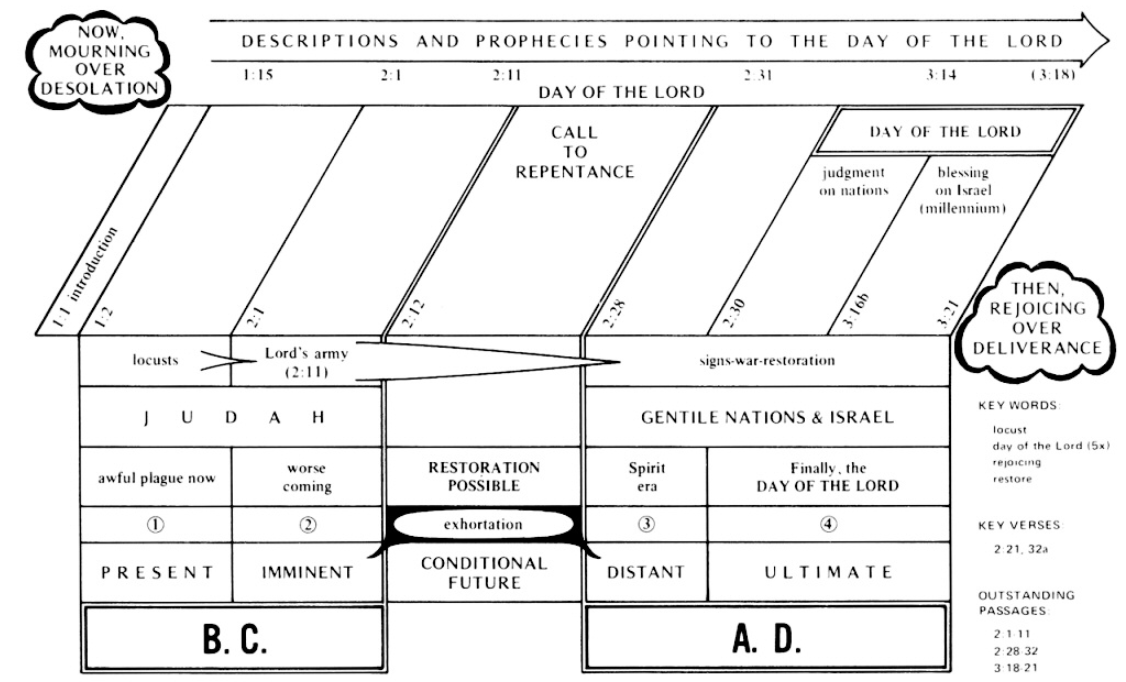
Click chart to enlarge
Chart from recommended resource Jensen's Survey of the OT - used by permission
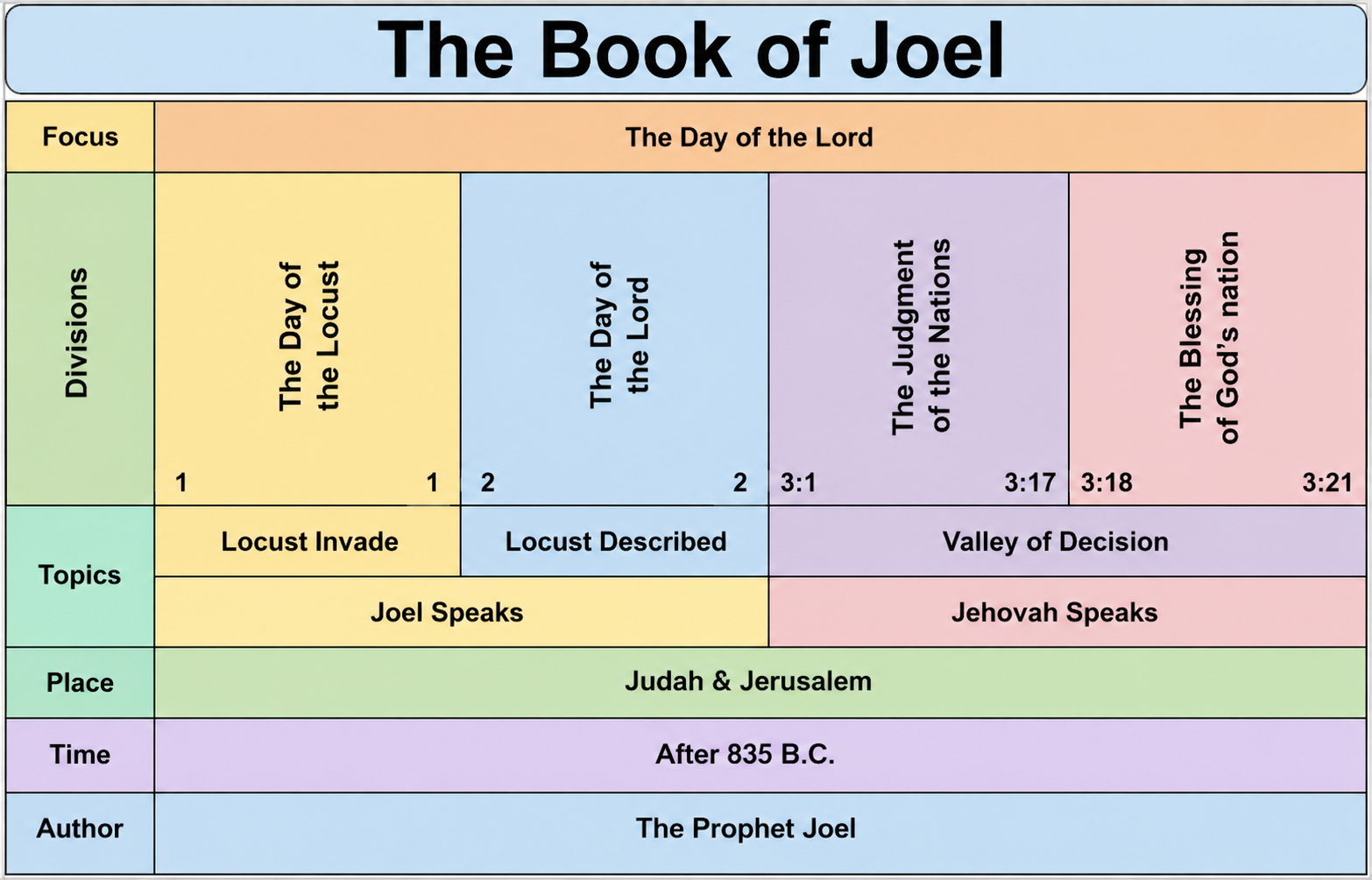
AI Summary of JOEL 1 Commentary — SUMMARY & APPLICATION
- Unprecedented devastation — Locusts and drought ravaged Judah, destroying crops, pastures, and water supplies (Joel 1:2–4, 10–12, 17–20).
- God was speaking through the calamity — Judah needed to wake up, listen, and recognize their dependence upon God.
- Everyone was called to respond — People, farmers, priests, and leaders were commanded to lament, fast, gather, and cry out to the LORD (Joel 1:5, 11, 13–14).
- The locust plague was a warning — This immediate disaster foreshadowed the far greater Day of the LORD (Joel 1:15).
- Joel led by example — “To You, O LORD, I cry” (Joel 1:19). When earthly resources failed, he turned immediately to God.
APPLICATION
- Don't waste your trials. Ask what God wants to teach you through them.
- Trials expose our dependence on God and can awaken us from spiritual complacency.
- Trouble should drive us to prayer, self-examination, and renewed devotion to God.
- Spiritual leaders should lead the way in repentance and prayer.
- The coming Day of the LORD makes repentance urgent.
Bottom line: When God allows our resources to run out, He may be reminding us that He is our ultimate Resource.
- John MacArthur's Introduction to Book of Joel
- Chuck Swindoll's Introduction to the Book of Joel see his Joel Chart
AUTHOR: Joel = YHWH is God
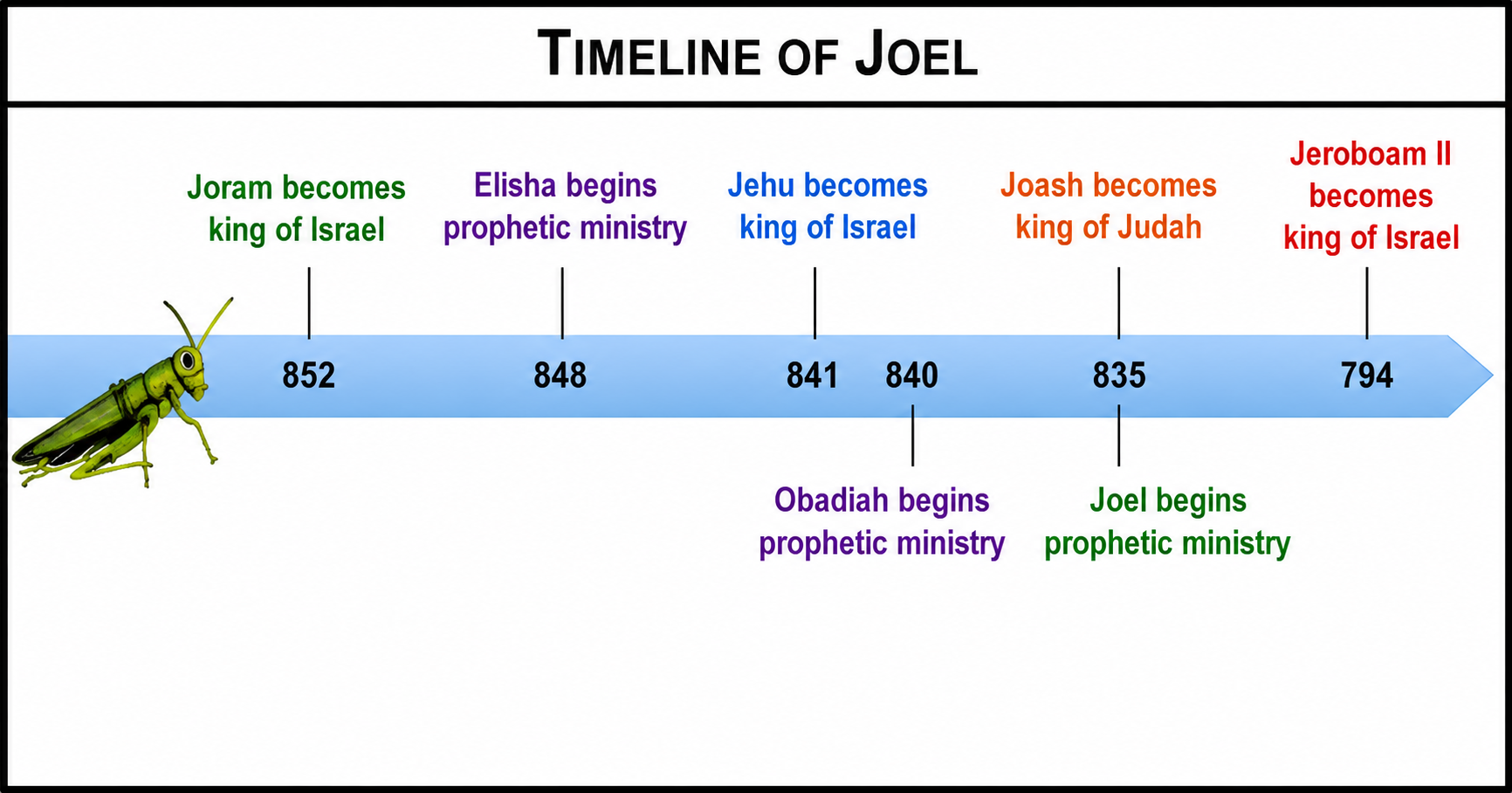
DATE: 835 B.C.
This makes Joel a pre-exilic prophet, who ministered before the fall of the northern kingdom of Israel (721 B.C.) or the southern kingdom of Judah (586 B.C.). Other pre-exilic prophets include Obadiah, Jonah, Hosea, Amos, Isaiah, and Micah. Joel is one of the earliest prophets—only Obadiah prophesied before his time (845 B.C.). 835 B.C. was a time of turmoil and transition in Judah, at the end of the reign of the Queen Mother Athaliah and the beginning of the reign of King Joash. Athaliah seized power at the sudden death in battle of her son Ahaziah, who only reigned one year (2 Kings 8:26, 2 Kings 11:1). Athaliah killed all her son’s heirs, except for one who was hidden in the temple and escaped—one-year-old Josiah (2 Kings 11:3). Her six-year reign of terror ended in 835 B.C. when the High Priest Jehoiada overthrew Athaliah and set the seven-year-old Josiah on the throne (2 Kings 11:4–21).. During her six years as queen over Judah, Athaliah reigned wickedly. She was the granddaughter of the wicked King Omri of Israel—making her daughter or niece to Ahab, one of Israel’s worst kings (2 Kings 8:26). Athaliah raised her son Ahaziah to reign in the wicked pattern of Ahab, and even brought in Ahab’s counselors to advise him (2 Chronicles 22:2–4). When Ahaziah was killed in battle and she seized power, she set her other sons to evil, even desecrating the temple and its sacred things (2 Chronicles 24:7).. If we are accurate in thinking that Joel prophesied in 835 B.C. then the judgment he described came toward the end of the six-year reign of ungodliness under Queen Athaliah. No wonder God brought a heavy hand on Judah! (Note from David Guzik)
The Prophet and His Times Joel, whose name means "Yahweh is God," apparently wrote during the days of young King Jehoash (835-796), who was under the regency of priests when he ascended the throne of Judah at the age of seven (2 Kings 11:21). Though some date the book after the Exile, the enemies of Judah are not identified in the prophecy as Arameans, Assyrians, or Babylonians, as would be the case if the book were written after the captivity (see 3:4, 19). The prophecy was occasioned by a severe drought and an invasion of locusts, which Joel saw as a punishment for the sins of the people. He also depicted this invasion of locusts as an army, a harbinger of a future military campaign in the Day of the Lord.
Charles Feinberg - Joel was probably one of the earliest of the minor prophets. Compare the quotation of Joel 3:16 in Amos 1:2 and that of Joel 3:18 in Amos 9:13. The sins denounced by Amos and Hosea are not mentioned here, nor is the sin of idolatry touched upon at all. (SEE The Minor Prophets)
The Day of the LORD
The Day of the Lord, the major theme of this prophecy, involves God's special intervention in the affairs of human history. Three facets of the Day of the Lord, are discernable: (1) the historical, that is, God's intervention in the affairs of Israel (Zeph. 1:14-18; Joel 1:15) and heathen nations (Isa. 13:6; Jer. 46:10; Ezek. 30:3); (2) the illustrative, whereby an historical incident represents a partial fulfillment of the eschatological Day of the Lord (Joel 2:1-11; Isa. 13:6-13); (3) the eschatological. This eschatological "day" includes the time of the Great Tribulation (Isa. 2:12-19; 4:1), the second coming of Christ (Joel 2:30-32), and the Millennium (Isa. 4:2; 12; 19:23-25; Jer. 30:7-9).
Lloyd J. Ogilvie - Seven words. We have heard them said with a sigh of hopeless resignation or with a cry of anguished grief. We hear them in hospital rooms, in deep conversations with friends, in times of calamity and adversity. The seven words expressing the loneliness of suffering are: “I just don’t know where to turn!” We have all said these words. We get to the end of our endurance and do not know what to do. We face seemingly impossible problems that stretch us beyond our understanding and our ability to find solutions. All of the alternatives seem equally unacceptable and unworkable. Sometimes physical suffering brings us to the place where we do not know where to turn. Emotional pain can be just as excruciating. Failures, broken relationships, anxiety, and fear can paint us into a lonely corner. Then there are times when these seven words take on a third person intensity or shared dilemmas. In a marriage in tension, a family facing a crisis, or a church that needs renewal, we cry out, “We just don’t know where to turn!” Also, these words are drenched with dismay when we confront the monumental problems of our society or allow ourselves to empathize with the suffering of the disadvantaged, the poor, and the hungry. And we wring our hands over the lack of morality and integrity around us. Added to all this are the natural disasters that hit us or someone we know. The emergency makes us wonder where to turn. For many people, times when we do not know where to turn expose that we have been living life on two separate tracks that seldom meet. One track is our relationship with God that often lacks vitality and power because of either benign neglect, willful independence, or unconfessed sin. On the other track is the reality of daily life with its mixture of routines, pressures, and busyness pursued with little thought of God. Sometimes this track gets littered with disappointments, frustrations, and conflicts. It is in times of great distress that these two tracks have an opportunity to come together in a profound way. In those times, the vital connection is made between what is happening to or around us and our supreme need for God. Then we can discover the prescription for perplexity:
“When you don’t know where to turn,
return to the Lord.”
This is the central theme of the prophet Joel. He is the prophet of the vital connection. At a time of a national catastrophe in Judah, Joel called the people to return to God. Their only hope was in Him. He helped them connect what was happening and what God wanted to have happen in His people. Preaching and teaching from Joel gives us an opportunity of being communicators of the vital connection. There is a tendency in our day to think that being a Christian should put us on a route bypassing the distresses of life. But shallow triumphalism does not help in the depths of difficulties. If God is only for the up, successful, hurrah times of life, He is excluded from three-fourths of our lives. Joel helps us stand at the intersection of the two tracks of life when painful, heartbreaking things happen. It is then that people exclaim, “What can I say?” and we enable them to ask a much more crucial question, “What is God saying in this?” There is a place to turn. Tough times are the times to return to God. He has something to say to us. (SEE The Preacher's Commentary - Vol. 22: Hosea / Joel / Amos)
OUTLINE OF JOEL
I. Title Verse: the Author, Joel 1:1
II. Desolation, Joel 1:2-Joel 2:17
A. The Character of the Desolation, Joel 1:2-12
B. The Reactions to the Desolation, Joel 1:13-14
C. The Picture of the Desolation, Joel 1:15-20
D. The Prophecy of Future Desolation, Joel 2:1-11
E. The Exhortation in View of Desolation, Joel 2:12-17
III. Deliverance, Joel 2:18-Joel 3:21
A. The Promise of Immediate Deliverance, Joel 2:18-27
B. The Promise of Future Deliverance, Joel 2:28-Joel 3:21
1. Its initiation, Joel 2:28-32
2. Its judgments, Joel 3:1-17
3. Its consummation, Joel 3:18-21
(Ryrie Study Bible)
Joel - Judgment precedes Israel’s future spiritual revival.
John Phillips Outline Joel: Prophet Of The Plague
- Day of the Locust (Joel 1:1-14)
- Divine Displeasure Expressed (Joel 1:1-5)
- A Word for the Prophet (Joel 1:1)
- A Word for the People (Joel 1:2-5)
- Descendants (Joel 1:2-4)
- Drunkards (Joel 1:5)
- Divine Displeasure Expressed (Joel 1:1-5)
- Divine Displeasure Expanded (Joel 1:6-14)
- Desecration (Joel 1:6-7)
- Desolation (Joel 1:8-12)
- Desperation (Joel 1:13-14)
- The Day of the Lord (Joel 1:15-3:21)
- Day of Assyria (Joel 1:15-2:32)
- A Day of Destruction (Joel 1:15-20)
- A Day of Darkness (Joel 2:1-10)
- A Day of Deliverance (Joel 2:11-32)
- A Call for Repentance (Joel 2:11-19)
- A Call for Rejoicing (Joel 2:20-27)
- A Call for Revival (Joel 2:28-32)
- Day of Antichrist (Joel 3:1-16)
- The Gathering of the Hebrew People (Joel 3:1)
- The Gathering of the Heathen Peoples (Joel 3:2-16)
- A Gathering of the Wicked (Joel 3:2-8)
- A Gathering of the Warmongers (Joel 3:9-13)
- A Gathering of the World (Joel 3:14-16)
- Day of Anticipation (Joel 3:17-21)
(SEE Exploring the Minor Prophets: An Expository Commentary - Page 69)
- Day of Assyria (Joel 1:15-2:32)
Sidlow Baxter (Explore the Book) Outline of Joel
I. Title Verse: the Author, Joel 1:1
II. Desolation, Joel 1:2-2:17
A. The Character of the Desolation, Joel 1:2-12
B. The Reactions to the Desolation, Joel 1:13-14
C. The Picture of the Desolation, Joel 1:15-20
D. The Prophecy of Future Desolation, Joel 2:1-11
E. The Exhortation in View of Desolation, Joel 2:12-17
III. Deliverance, Joel 2:18-3:21
A. The Promise of Immediate Deliverance, Joel 2:18-27
B. The Promise of Future Deliverance, Joel 2:28-3:21
1. Its initiation, Joel 2:28-32
2. Its judgments, Joel 3:1-17
3. Its consummation, Joel 3:18-21 (SEE Ezekiel to Malachi)
Lloyd J. Ogilvie's summary of Joel 1 from The Preacher's Commentary
A Word of the Lord to Joel (1:1)
Listen and Tell of the Extraordinary (1:2–4)
An Impassioned Call to Lament (1:5–14)
A Foretaste of the Day of the Lord (1:15–20)
A Diminutive Day of the Lord
Joel 1:1 The word of the LORD that came to Joel, the son of Pethuel.
- The word of the LORD Jer 1:2 Eze 1:3 Ho 1:1 2Pe 1:21
- that came to Joel: Ac 2:16
A VERY SPECIAL
WORD FROM JEHOVAH
The prophecy of Joel is very special to me, for this is the name we gave our firstborn son. When Marty and I were newly weds in medical school (a long, long time ago, August, 1969), we were told by the fertility experts at the University of Texas Southwestern Medical School in Dallas (which was internationally know for its work in this field) that we would never have children. And yet we did not give up and God visited us with our first pregnancy which we quickly lost, thinking that was probably our one in a million chance. And then we got pregnant again and although neither of us were genuine believers (if you had ask us we probably would have said we were "Christians" but neither of us had yet been born again), we named our first born son, Joel, for reasons that I cannot remember as there is no one on either side of our family by that name. Of course Joel's name means "Jehovah is God" (we did not know that at the time), and as God's good hand of blessing would have it as the years passed, both my wife Marty (1982) and I (1984) were born from above (Jn 3:3-8) by the Spirit of God and the Word/Gospel of God (through the ministry of Bible Study Fellowship) and within a very short time Joel and Meredith (our oldest daughter of 4 children by then - so much for "infertility!") also were born again and all four of us had the wonderful experience of being baptized together in 1984. O glorious day! As I was writing these notes it dawned on me that instead of the name "Joel," we should have name our son "Matthew" which means "Gift of God," because clearly considering the dire prognosis for fertility by the experts, Joel was truly, indubitably a gift of God! Joel has grown up to be a godly young man, a man of the Book, holding fast to faithful word (Titus 1:9) as an elder and Bible teacher at the Austin Stone, a large evangelical church in Austin, Texas. I apologize for all the personal background, but it helps you understand the context for why the Book of Joel holds such a special place in my heart. And when you combine that with the deep, abiding love that God's Spirit has placed in my heart for the Jews and the Nation of Israel, you can see why I consider it an unbelievable blessing and privilege to be allowed to write comments on this incredible prophetic book! (See My Personal Testimony of God's Grace)
John Ruskin once said "The Bible is indeed a deep book, when depth is required, that is by a deep people; but it is not intended particularly for profound persons. And, therefore the first, and generally the main and leading idea of the Bible is on its surface, written in the plainest possible Greek, Hebrew, or English, needing ...nothing but what we all might give - attention." (Side note on Ruskin - Margaret Ruskin, an Evangelical Christian, more cautious and restrained than her husband, taught young John to read the King James Bible from beginning to end, and then to start all over again, committing large portions to memory. Its language, imagery and stories had a profound and lasting effect on his writing.)
Sidlow Baxter observes that "Both in style and subject this Book of Joel is arresting. For vividness of description and picturesqueness of diction Joel is scarcely equaled. His pen-pictures of the plague-stricken land, the invading locust-army, and the final gathering of all nations to the valley of judgment, are miniature masterpieces of graphic vigour." (Explore the Book)
Charles Feinberg on how Joel presages the Day of the LORD
Though the plague be literal and the prophet bewails the destruction wrought thereby, yet the plague in its literal sense does not exhaust the intent of the Lord. It points ahead to the coming great visitation of the day of Jehovah. This day is mentioned in Joel 1:15; 2:1, 11, 31; 3:14. Because the day of Jehovah looms so large in prophetic Scriptures, we define it and its relation to other days designated in the Word of God. In 1 Corinthians 4:3YLT Paul speaks of “man’s day”. The day here spoken of is that in which we live, when man has sway and governs on the earth. To represent this rule God gave Nebuchadnezzar a dream of an image of a man (Dan 2:1-45, Da 2:31-45). This day will come to an end, as far as the Church is concerned, with the “day of Christ” which is the rapture. (See Phil 1:6.) After the rapture “the day of Jehovah” begins. It comprises the time of the Great Tribulation on earth, the seventieth week of Daniel 9:27, and the time of the rule of the Messiah of Israel over them in Jerusalem on the throne of David. (See not only the Scriptures noted above in Joel, but Amos 5:18; Zep 1:14-2:2 together with Isaiah 2:1-21 among many Scriptures throughout the prophetic books.) At the termination of the day of Jehovah, the “day of God” will begin. In that day the elements will melt with fervent heat and the new heavens and the new earth will result (2Pe 3:10-15, Rev 20:11, Rev 21:1-2). This day lasts throughout eternity when God is all and in all. (Cp. 1 Co 15:28.) We have purposely elaborated upon these vital days, because the theme of the prophecy of Joel is The Day of Jehovah. With this truth in mind, we can readily discern how the locust plague serves as a harbinger or foreshadowing of the coming Day of Jehovah. Joel rightly views it with alarm. The then present judgment spoke clearly of the future terrifying day of judgment. (SEE The Minor Prophets)
The word of the LORD that came to Joel, the son of Pethuel (As to most of the prophets, e.g., Jer 1:2, Ezekiel 1:3, Jonah 1:1, Micah 1:1, Zeph 1:1, Zech 1:1, Hosea 1:1) - The source of the prophecy is not Joel but Yahweh. What a great phrase "the word of the LORD came" which not only conveys a privilege but also a responsibility! Thank You Jehovah, that You condescended to speak to such frail, depraved creatures as we are since sin entered the world and enthroned itself on our hearts usurping Your rightful rule and reign (cf Ro 5:12, Ro 6:12-14), for indeed "for no prophecy was ever made by an act of human will, but men moved by the Holy Spirit spoke from God." (2Pe 1:21)
🙏 THOUGHT - This glorious phrase, “the word of the LORD,” occurs some 257 times in the NASB. Today we possess God's revealed Word in the Scriptures. God, Who “spoke long ago to the fathers in the prophets in many portions and in many ways,” has in these last days spoken to us in His Son (Heb 1:1–2; cf. 2 Ti 3:16–17, cf Isa 55:11). What a privilege, then, to COME to the Word of the LORD each morning, not as a legalistic duty but as a grace-enabled necessity, depending on the Holy Spirit to give us understanding and power to obey (Gal 3:3; Ro 6:14; 7:4–6; 1 Co 2:12–13). Just as our physical bodies require daily food, our souls require daily spiritual nourishment, for “man shall not live on bread alone, but on every word that proceeds out of the mouth of God” (Dt 8:3; Mt 4:4; Lk 4:4). Each new day the LORD has made brings fresh needs, temptations, decisions, and opportunities (Ps 118:24–25). We therefore need His Word for nourishment (Jer 15:16; 1 Pe 2:2), direction (Ps 119:105), wisdom (Ps 119:98–100), and protection from sin (Ps 119:9, 11; Eph 6:17). So the question is not simply, “Do I own a Bible?” but “Am I coming to the Word of the LORD and heeding what I hear?” What an astounding privilege that we can actually read and meditate upon the living words of the living God! And with that privilege comes responsibility. We are called not merely to hear His Word but to “prove yourselves doers of the word, and not merely hearers” (Jas 1:22; cf. Lk 11:28). God's Word never returns empty but accomplishes the purpose for which He sends it (Isa 55:10–11). See Quiet Time: 7 Minutes With God and Thoughts on the Quiet Time. THOUGHT: Begin each day listening to the Word of the LORD, then spend the day living out what you heard.
Ogilvie - The word of Yahweh came not merely to communicate information, but as a word of power (Lk 1:37ASV), an agent to accomplish the purpose of God in difficult times. The word came “to” Joel, but was not to stop there. It was a word for Joel’s generation and beyond (Joel 1:3), continuing to accomplish God’s purpose long after Joel had left the scene. This is the quality of all of God’s word given to us in the Bible (2 Tim. 3:16–17), but seldom is it so explicit as in the opening verses of Joel. (SEE The Preacher's Commentary - Vol. 22: Hosea / Joel / Amos)
The pen was Joel's,
but the prophecy was the Lord's.
John Phillips - The pen was Joel's, but the prophecy was the Lord's (2Pe 1:21). The word of the Lord came to Joel out of eternity—from God's throne on high. The prophecy came from the One Who gathers all the ages into the eternal present, Who sees the end from the beginning. He sees tomorrow's distant day of the LORD as clearly as yesteryear's day of the locust. (SEE Exploring the Minor Prophets: An Expository Commentary - Page 69)
The Word of the LORD came...Gen. 15:4; 1 Sam. 15:10; 2 Sam. 7:4; 2 Sam. 24:11; 1 Ki. 6:11; 1 Ki. 13:20; 1 Ki. 16:1; 1 Ki. 17:2; 1 Ki. 17:8; 1 Ki. 18:1; 1 Ki. 19:9; 1 Ki. 21:17; 1 Ki. 21:28; 2 Ki. 20:4; 1 Chr. 22:8; 2 Chr. 11:2; 2 Chr. 12:7; Isa. 38:4; Jer. 1:2; Jer. 1:4; Jer. 1:11; Jer. 1:13; Jer. 2:1; Jer. 13:3; Jer. 13:8; Jer. 18:5; Jer. 24:4; Jer. 28:12; Jer. 32:6; Jer. 32:26; Jer. 33:1; Jer. 33:19; Jer. 33:23; Jer. 34:12; Jer. 35:12; Jer. 36:27; Jer. 37:6; Jer. 42:7; Jer. 43:8; Ezek. 1:3; Ezek. 3:16; Ezek. 6:1; Ezek. 7:1; Ezek. 11:14; Ezek. 12:1; Ezek. 12:8; Ezek. 12:17; Ezek. 12:21; Ezek. 12:26; Ezek. 13:1; Ezek. 14:2; Ezek. 14:12; Ezek. 15:1; Ezek. 16:1; Ezek. 17:1; Ezek. 17:11; Ezek. 18:1; Ezek. 20:2; Ezek. 20:45; Ezek. 21:1; Ezek. 21:8; Ezek. 21:18; Ezek. 22:1; Ezek. 22:17; Ezek. 22:23; Ezek. 23:1; Ezek. 24:1; Ezek. 24:15; Ezek. 24:20; Ezek. 25:1; Ezek. 26:1; Ezek. 27:1; Ezek. 28:1; Ezek. 28:11; Ezek. 28:20; Ezek. 29:1; Ezek. 29:17; Ezek. 30:1; Ezek. 30:20; Ezek. 31:1; Ezek. 32:1; Ezek. 32:17; Ezek. 33:1; Ezek. 33:23; Ezek. 34:1; Ezek. 35:1; Ezek. 36:16; Ezek. 37:15; Ezek. 38:1; Jon. 1:1; Jon. 3:1; Hag. 1:1; Hag. 1:3; Hag. 2:1; Hag. 2:10; Hag. 2:20; Zech. 1:1; Zech. 1:7; Zech. 4:8; Zech. 7:1; Zech. 7:8
Joel gives a series of descriptions and prophecies which ultimately point to the great and awesome Day of the LORD (Joel 1:15, Joel 2:1, Joel 2:11, Joel 2:31, Joel 3:14, Joel 3:18). In Joel 1:1-2:11 the prophet is addressing Judah describing the plague of locusts which recalls a past historical event of an invasion of insects and predicts a future "plague" of an invasion of Gentile armies and emphasizes that this Day of YAHWEH is imminent and brings with it desolation. The past plague was awful, but as they say (as Joel says) "the worst is yet to come" and it is imminent (Joel 2:1). The etymology of the English word imminent is picturesque for it is derived from the Latin word imminens in turn from imminere a verb which means to hang or project over. So do you see the picture? The idea of imminent is some event is "hanging or projecting over" and thus is impending. As we move from Joel 1 to Joel 3 the prophet moves from a day of mourning to a day of rejoicing. This progression recalls the words of the Psalmist David...
For His anger is but for a moment, His favor is for a lifetime; Weeping may last for the night, But a shout of joy comes in the morning.
Thou hast turned for me my mourning into dancing; Thou hast loosed my sackcloth and girded me with gladness;
That my soul may sing praise to Thee, and not be silent. O LORD my God, I will give thanks to Thee forever. (Psalm 30:5.11-12)
The LORD - This is Jehovah (LXX - kurios - Master, Owner, one having legal power, control and authority) or Yahweh (YHWH - Hebrew had no vowels) which "speaks of intimacy and a relationship bonded metaphorically through the covenant likened to marriage and thus carries special significance to Israel (Ex 3:14)." (SEE MacArthur Study Bible)
Spurgeon writes "The name of Jehovah reminds us that He has within Himself sufficiency for all His will; He hath adequate power of performance for all His purposes and decrees; Jehovah wills, and it is done. He has created legions of angels, but He borrows nothing from them. He can truly say, “I am, and there is none beside Me.” Those mysterious living creatures which are nearest to His throne are His creatures, and not His helpers. The best instructed and the most willing of His servants, derive their all from Him, but supply Him with nothing. (Read Spurgeon's full sermon - Jeremiah 32:26,27 Is Anything too Hard for the LORD? - Pdf)
See in depth article "On the Divine Name (Jahveh, Jehovah)" in volume 1 of the 8 volume work entitled "The History of Israel" by Heinrich Ewald (1843-1859)
J. A. Motyer emphasizes the association of God's Name with His character rendering Exodus 6:3 "And I showed myself to Abraham, to Isaac, and to Jacob in the character of El Shaddai, but in the character expressed by my name Yahweh I did not make myself known to them. (Bolding added) Motyer concludes that "it was the character expressed by the name that was withheld from the patriarchs and not the name itself. To know by name means to have come into intimate and personal acquaintance with a person." (Motyer is quoted by Charles Gianotti in his article The Meaning of the Divine Name YHWH in Vital Old Testament Issues: Examining Textual and Topical ... - Page 28)
In "The Book of Consolation" in Jeremiah (in context of sacking of the city, destruction of the Temple and Judah's final exile to Babylon in 586 BC) God promised a future day of joy for the forlorn city of Jerusalem (to be fulfilled in the Millennium)
“Again I will build you and you will be rebuilt, O virgin of Israel! Again you will take up your tambourines, And go forth to the dances of the merrymakers. (Jeremiah 31:4)
In Joel 2:12-17 the Joel exhorts the nation in a call to repentance emphasizing that restoration of Israel is possible. In fact the theme is "Repent, for the Day of the LORD is near." Then in Joel 2:18-27 the prophet issues one of the greatest prophetic promises of hope in the entire Old Testament. Finally in Joel 2:28-3:21 the prophet predicts the coming of the Holy Spirit, the judgment of God, the Kingdom of God and the consummation of the Day of the LORD.
Pethuel - The Septuagint and the Peshita have "Bethuel" (a name found in Ge 22:22,23; 24:15,24,47,50; 25:20; 28:2,5). Otherwise, only mention of the specific name Pethuel in Scripture. Some suggest that because there is no additional description this suggest the prophet was well known and therefore needed no additional introduction. Derived from the verb pathah meaning to be spacious, wide or open. So the name Pethuel is variously interpreted to mean "Enlargement of heart," "Openheartedness of/toward God," or “Persuaded of God." (See devotional on the name Pethuel).
Henrietta Mears - Traditionally, Joel is called the prophet of Pentecost, since his prophecy of the outpouring of the Spirit (see Joel 2:28–32) is quoted by Peter in Acts 2:16–21 to explain the outpouring of the Holy Spirit at Pentecost....Joel has been called the prophet of religious revival. He knew that revival must follow repentance. As Robert Lee, the author of The Bible at a Glance, wrote, “A rent heart is followed by a rent veil and heaven.” Joel tried to bring his people to that place. We will find access to the throne of grace and know the presence of the Holy Spirit when we truly repent. (BORROW What the Bible is all about)
Summary of Joel - God's word came to Joel to deliver to Jerusalem in the midst of a devastating locust plague that had destroyed the crops, made temple sacrifices impossible, and caused the priests to put on mourning clothes. The locusts represented a nation about to invade Judah, so Joel called Jerusalem to fast and pray to God for help. (SEE Holman Old Testament Commentary - Hosea, Joel, Amos- Page 116)
Big idea: the devastation of the coming day of the lord (prefigured in the locust plague and severe drought) should prompt heartfelt repentance that will lead to god’s gracious promises of restoration and blessing “Yet even now, declares the Lord, Return to Me with all your heart, and with fasting, weeping and mourning; and rend your heart and not your garments. Now return to the Lord your God, for He is gracious and compassionate, slow to anger, abounding in lovingkindness and relenting of evil.” (Joel 2:12-13) (Paul Apple Joel Overview - Repentance and Restoration Contrasted with the Devastation of the Coming Day of the Lord)
I like Trent Butler's summary - "Joel concentrates on one theme—the Day of the Lord. He plays several variations on that theme. The day is past, being experienced in a plague of locusts and in a natural drought and famine. The day is current or imminent, carried out by an enemy military force. The day is future: immediately in the salvation of Jerusalem from current problems; long-range in the giving of the Spirit of God on all people and the deliverance of all who call on the name of the Lord; and ultimate in the eternal holiness of Jerusalem, protected from its enemies, flowing with fertility, lived in obedience to the one true covenant God, and enabled by God's pardon of Israel's guilt." (See Holman Old Testament Commentary - Hosea, Joel, Amos - Page 113)
Warren Wiersbe's outline is somewhat similar to Butler - Outline: I. The Immediate Day of the Lord (1:1-20) II. The Imminent Day of the Lord (2:1-27) III. The Ultimate Day of the Lord (2:28 – 3:21) Joel refers to three important events, each of which he calls a “day of the Lord.” He sees the plague of locusts as an immediate day of the Lord (1:1-20), the invasion of Judah by Assyria as an imminent day of the Lord (2:1-27), and the final judgment of the world as the ultimate day of the Lord (2:27 – 3:21). In the first, the locusts are a metaphorical army; in the second, the locusts symbolize a real army; in the third, the locusts aren’t seen at all and the armies are very real and very dangerous. (Page 1407 Bible Exposition Commentary - Old Testament )
What are the KEY WORDS in Joel? While some of the key words below are not frequent, nevertheless they are key because of their importance to the overall message of Joel.
- Locust - Joel 1:4, Joel 2:25
- Day of the LORD (5x) - Joel 1:15 Joel 2:1 Joel 2:11 Joel 2:31 Joel 3:14
- Five more allusions to the Day of the LORD - "Day" = Joel 2:2 (twice), Days = Joel 2:29, In those days = Joel 3:1, In that day = Joel 3:18
- Rejoicing - Joel 1:12 (Gladness and joy = Joel 1:16) Joel 2:21 Joel 2:23
- Restore - Joel 3:1
There is another key phrase which is easily overlooked but clearly is the KEY to the entire prophecy. It is the little phrase "I WILL" which underscores the sovereignty and sufficiency of our great Savior to consummate the promises He makes to Israel in the prophecy of Joel. Here are the 13 uses of "I WILL" in 11 verses
- Joel 2:19 Joel 2:20 Joel 2:25 Joel 2:28 Joel 2:29 Joel 2:30 Joel 3:2 Joel 3:4 Joel 3:8 Joel 3:12 Joel 3:21
Duane A. Garrett - The Day of the LORD refers to a decisive action of Yahweh to bring his plans for Israel to completion... The Day of the LORD is more of a theological idea than a specific event. As a theological idea it can manifest itself in human history many times and in many forms.
Sidlow Baxter on the Day of the LORD - Three facets of the Day of the Lord, are discernable:
(1) THE HISTORICAL, that is, God’s intervention in the affairs of Israel (Zeph. 1:14-18; Joel 1:15) and heathen nations (Isa. 13:6; Jer. 46:10; Ezek. 30:3);
(2) THE ILLUSTRATIVE, whereby an historical incident represents a partial fulfillment of the eschatological Day of the Lord (Joel 2:1-11; Isa. 13:6-13);
(3) THE ESCHATOLOGICAL. (Eschatology from eschatos = last) This eschatological “day” includes the time of the Great Tribulation (Isa. 2:12-19; 4:1), the second coming of Christ (Joel 2:30-32), and the Millennium (Isa. 4:2; 12; 19:23-25; Jer. 30:7-9). (Explore the Book)
John MacArthur on the Day of the LORD - The phrase does not have reference to a chronological time period, but to a general period of wrath and judgment uniquely belonging to the Lord. It is exclusively the day which unveils His character – mighty, powerful, and holy, thus terrifying His enemies. The Day of the Lord does not always refer to an eschatological event; on occasion it has a near historical fulfillment, as seen in Ezekiel 13:5, where it speaks of the Babylonian conquest and destruction of Jerusalem. As is common in prophecy, the near fulfillment is a historic event upon which to comprehend the more distant, eschatological fulfillment. (SEE MacArthur Study Bible)
Kenneth O. Gangel - Memories fifty years old are as vivid as yesterday. We would wake up one morning in west Texas to a darkened sky. The crickets had paid another visit. Walk out your door, and every step went crunch, crunch, crunch as you made your way to the morning paper or the morning milk bottles by stepping on the swarming crickets that filled the sidewalks and driveways. How can you drive when front and back windows are crawling with crickets? Shopkeepers had an even worse nightmare. The sidewalks in front of their stores as well as their plate glass windows were covered with crickets. But the worst cricket problem belonged to the farmers and gardeners. Whatever crops the perpetual west Texas drought had left, the chirping invaders gobbled up. What a helpless feeling! All we knew to do was wait it out and sweep up the dead bodies when the swarm moved on eastward. Joel's people faced the same problem. Locusts, locusts everywhere and not a crop to spare. Temple offerings stopped. People either drank themselves into oblivion or prayed. In such a disastrous time, God gave Joel a message—mourn, pray for help, but know this is only a sign of worse things to come. (See Holman Old Testament Commentary - Hosea, Joel, Amos - Page 117)
Brian Bell - When I was 5 years old standing in my backyard in Whittier it happened… A large grasshopper landed on my left shoulder! He was the size of a small Mack truck. He had armor plating all over his body. He was huge, mean, & he was going to eat me alive. I hate them still to this day. I’ve grabbed a rattle snake by his tail once(explain) but I don’t do grasshoppers! An old Arabian proverb claims(picture this), “In the locust, slight as it is, is the nature of 10 of the larger animals – the face of a horse, the eyes of an elephant, the neck of a bull, the horns of a deer, the chest of a lion, the belly of a scorpion, the wings of an eagle, the thighs of a camel, the feet of an ostrich, the tail of a serpent.” Joel is writing in-between invasions: Between a locust plague recently past and future judgments of a military invasion, and ultimately “The Day of the Lord.” Joel is writing to Judah & writes to the old men/elders (Joel 1:1-4); to the drunkards (Joel 1:5-7); to the worshippers (Joel 1:8-10); to the farmers (Joel 1:11,12); & to the priests (Joel 1:13,14.) (Joel 1 - “Locust Plague…a mini-version of The Day of the Lord!”)
Sidlow Baxter concludes that Joel's prophecy is clearly to the Southern Kingdom of Judah noting that "he exercised his prophetic ministry in or near Jerusalem. It is the inhabitants of that city whom he addresses (Joel 2:23). It is Jerusalem which he sees in danger (Joel 2:9). It is in Zion that the "alarm" is to be sounded (Joel 2:1,15). It is in Mount Zion and in Jerusalem that deliverance shall be in the after-days (Joel 2:32). It is the captivity of Judah and Jerusalem which is then to be ended (Joel 3:1); and it is Judah and Jerusalem which shall "dwell forever" (Joel 3:20). The ten-tribed northern kingdom is not once mentioned." (Explore the Book)
PETHUEL - Thomas Walker, of Tinnevelly, one of the Lord's greatest missionaries to India and with whom Amy Carmichael had eighteen years of close co-operation, was a profound Bible student and, when speaking on the prophecy of Joel, was in the habit of directing attention to Joel's father, whose name "Pethuel" means "enlargement of heart" or "openheartedness."
Walker of Tinnevelly, the name by which he was best know, was fond of telling a most interesting story, one that befits our subject, from the life of a fellow minister in London. A few days after the first child was born in his friend's home, the mother passed away. The grief of the tragic event was intensified a little later when the father was informed that his little daughter was totally blind. For the next sixteen years no expense was spared in seeking to rectify the condition, but without the slightest relief. At this stage a famous eye specialist from Vienna started a practice on Harley Street, London. The blind daughter was now sixteen-and-a-half years of age, and the father was urged by his friends to take her to the specialist to find out if anything could be done. At first he was very reluctant to venture, lest it might prove to be only another expensive disappointment. However, the insistence of his friends prevailed, and after an examination of the girl's eyes, the specialist informed him that although a thick film covered the surface of each eyeball, he believed that underneath there was a normal pupil, and behind the eye an unimpaired retina. "Provided the film is successfully removed without injury to the eyes," he said, "it will be necessary for the patient to remain in subdued light for five or six weeks. Are you willing to entrust your daughter to my care for that time?"
Agreement was reached in the matter and, after the surgery, the father was informed from time to time of the progress being made. After five long weeks the father was notified that he would be permitted to see his daughter at the hospital at a specified hour. On arrival he was conducted to a dimly-lighted room, and shortly afterward the surgeon entered with his daughter. When the surgeon removed the shade from her eyes, she stepped quickly toward her father and throwing her arms round his neck, kissed him repeatedly. He noticed the tears running from her eyes, and intently inquired, "Are you in pain, darling?"
"No daddy," she said. "Then why are you sobbing?" Back came the reply, "To think I have had such a loving father for sixteen years and have never before seen his face."
Have we realized that the heart of God our Father is enlarged toward us (LIKE THE NAME PETHUEL)? Do we really know Him as the openhearted Father of mercies, or do we go on blindly year by year without realizing that He is generously kind? The Apostle Paul could say to the Christians at Corinth, "Our heart is enlarged... and now for a recompense in the same, I speak as to my children, be ye also enlarged" (II Corinthians 6:11, 13). The Father of Lights, from whom cometh every good and perfect gift, giveth to all liberally and upbraideth not (James 1:5, 17). (Charles Roll)
Joel 1:1-7 TODAY IN THE WORD
Some counselors utilize a concept called “tough love”--a love that is strong enough to be tough when needed. Parents show tough love to a child when they refuse to give in to a temper tantrum. Tough love is strong enough to reprove one who needs correction, and it is willing to allow others to suffer the consequences of their foolish actions in the hope that they will learn from their experiences.
God often expresses tough love in the form of divine discipline. Jesus told the church of Laodicea, “Those whom I love I rebuke and discipline. So be earnest, and repent” (Rev 3:19) (See in depth word studies on The verb Repent = metanoeo; the noun Repentance = metanoia). This was also God’s message to His people through the prophet Joel.
We do not know when the book of Joel was written. The lack of any reference to Judah’s king has prompted some scholars to suggest that it was written during the time when Joash, the boy king, ruled Judah (835-739 B.C., see 2Ki 11–12). Other scholars think that the book was written some time after the Babylonian exile. All that is known of the book’s author is that his name was Joel and that he was the son of Pethuel (Joel 1:1).
TODAY ALONG THE WAY - Can you think of the events in your life that God has used to get your attention? Perhaps He has used the consequences of your own actions to help you see the folly of making sinful choices. Or He may have used circumstances that are beyond your control to show you your need for His power and grace. Such experiences are not for your benefit alone. Like the tough love experienced by those in Joel’s day, these lessons can benefit others. Ask some trusted friends to share some things God has used to get their attention and the lessons they learned as a result. Share your story and thank God together for His tough love.
THE WORD OF GOD IS A "WORD...
- …of the kingdom” Mt 13:19
- ...of all the good words" Jos 23:14
- ...of Thy lips" Ps 17:4
- ...of this salvation" Acts 13:26
- ...of God" Acts 13:44, et al
- ...of the Lord" Acts 8:25; 13:44, 48, 49; 15:35, 36; 16:32; 19:10, 20; 1Th 1:8; 4:15; 2Th 3:1; 1Pe 1:25
- ...of His Grace Acts 14:3, 20:32
- ...of the Gospel" Acts 15:7
- ...of promise" Ro 9:9
- ...of faith" Ro 10:8
- ...of Christ" Ro 10:17, Col 3:16
- ...of the Cross" 1Co 1:18
- ...of reconciliation" 2Co 5:19
- ...of truth" 2Co 6:7; Eph 1:13; Col 1:5; 2Ti 2:15; Jas 1:18
- ...of life" Php 2:16, 1 Jn 1:1
- ...of God's message" 1Th 2:13 (NASB 1977)
- ...of His power" Heb 1:3
- ...of righteousness" Heb 5:13
- ...of the oath" Heb 7:28
- ...of exhortation" Heb 13:22
- ...living & abiding Word of God 1Pe 1:23
- ...of Life" 1 Jn 1:1
- ...of My perseverance" Rev 3:10
TO SUMMARIZE - The Word of the KINGDOM announces the King; the Word of the CROSS tells what the King accomplished; the Word of RECONCILIATION tells what His death achieved; the Word of SALVATION tells what He offers; the Word of GRACE tells how it is received; the Word of FAITH tells how we respond; the Word of TRUTH tells why it can be trusted; and the Word of LIFE tells what it produces.
NET NOTE - The dating of the book of Joel is a matter of dispute. Some scholars date the book as early as the ninth century b.c., during the reign of the boy-king Joash. This view is largely based on the following factors: an argument from silence (e.g., the book of Joel does not mention a king, perhaps because other officials de facto carried out his responsibilities, and there is no direct mention in the book of such later Israelite enemies as the Assyrians, Babylonians, and Persians); inconclusive literary assumptions (e.g., the eighth-century prophet Amos in Amos 9:13 alludes to Joel 3:18); the canonical position of the book (i.e., it is the second book of the Minor Prophets); and literary style (i.e., the book is thought to differ in style from the postexilic prophetic writings). While such an early date for the book is not impossible, none of the arguments used to support it is compelling. Later dates for the book that have been defended by various scholars are, for example, the late seventh century or early sixth century or sometime in the postexilic period (anytime from late sixth century to late fourth century). Most modern scholars seem to date the book of Joel sometime between 400 and 350 b.c. For a helpful discussion of date see J. A. Thompson, “The Date of the Book of Joel,” A Light unto My Path, 453-64. Related to the question of date is a major exegetical issue: Is the army of chapter two to be understood figuratively as describing the locust invasion of chapter one, or is the topic of chapter two an invasion of human armies, either the Babylonians or an eschatological foe? If the enemy could be conclusively identified as the Babylonians, for example, this would support a sixth-century date for the book.
QUESTION - When was Joel written? | GotQuestions.org
ANSWER - The prophet Joel ministered to the southern kingdom of Judah in the second half of the ninth century BC. Although Joel wasn’t a priest, he emphasized the importance of worshiping God in a holy way (e.g., Joel 1:9; 2:13–16). His references to the temple in Jerusalem indicate that he ministered during a time when it was still central to Judah’s worship. This detail suggests that Joel ministered before foreign powers disrupted temple worship through invasion or exile. The best evidence suggests that Joel wrote the book between 835 and 800 BC.
Bible scholars consider Joel one of
the most difficult books in the Bible to date.
Bible scholars consider Joel one of the most difficult books in the Bible to date. One reason is that Joel does not mention any kings of Israel or Judah. In contrast, the opening verses of other prophetic books often name reigning kings, which helps determine when those prophets ministered (e.g., Isaiah 1:1; Jeremiah 1:2–3; Ezekiel 1:3).
However, certain details within the book of Joel offer helpful clues about when it was written. First, Joel identifies himself as the book’s author in the opening verse: “The word of the Lord that came to Joel son of Pethuel” (Joel 1:1). While the book provides no further personal details about Joel or his father, this reference helps date the content to the prophet’s lifetime.
Furthermore, Joel names several nations hostile to Israel in his time, including Tyre, Sidon, and the regions of Philistia (Joel 3:4). These nations were notably active and antagonistic toward Israel during the second half of the ninth century BC. This lends support to the view that the book may have been composed during that period.
Similarly, Joel refers to Egypt and Edom, which lay to the south of Israel. He writes, “But Egypt will be desolate, Edom a desert waste, because of violence done to the people of Judah, in whose land they shed innocent blood” (Joel 3:19). These nations were active regional powers during the ninth century. This supports the timeframe of Joel’s ministry and the composition of the book.
While the nations Joel names help determine when the book was written, so do the ones he does not mention. Certain empires later played major roles in the histories of Israel and Judah, and their absence in Joel suggests the book was written before they rose to regional dominance. For instance, prominent future enemies such as Assyria, Babylon, and Persia, central players in later prophetic books, are not mentioned in Joel.
Joel also shares parallels with the prophets Hosea and Amos that help date the book. These similarities are significant because they suggest an overlap in the timing of their ministries. For example, Joel 3:16 and Amos 1:2 both say, “The Lord will roar from Zion and thunder from Jerusalem.” Similarly, Joel 3:18 and Amos 9:13 include the imagery of “new wine dripping from the mountains.” These shared expressions support the notion that Joel wrote around the same time as Hosea and Amos and lend further weight to a ninth century BC date of writing.
Although little is known about Joel personally, his book makes it clear that he was devoted to God and cared deeply that people worship Him in a holy manner. His plea to his fellow Israelites, delivered during a time of national crisis, reflected both his heart and God’s: “Rend your heart and not your garments. Return to the Lord your God, for he is gracious and compassionate, slow to anger and abounding in love, and he relents from sending calamity” (Joel 2:13).
SUMMARY - INTERNAL EVIDENCE FOR AN EARLY DATE OF JOEL, ca. 835–800 BC
- Although Joel names no reigning king, making precise dating difficult, several internal clues favor an early pre-exilic date in the ninth century BC:
- The Temple is standing and worship is functioning (Joel 1:9, 13–14; 2:15–17). Priests, sacrifices, the altar, and the house of the LORD are prominent throughout the book.
- Priests and elders are prominent, but no king is mentioned (Joel 1:2, 9, 13; 2:17). This fits well with the early reign of Joash, who became king at age seven and was strongly influenced by Jehoiada the priest (2Ki 11:21–12:2).
- Judah's enemies are Tyre, Sidon, Philistia, Egypt, and Edom (Joel 3:4, 19), all appropriate enemies in an early period.
- Assyria, Babylon, and Persia are conspicuously absent, although these empires dominate the historical setting of later prophets.
- Joel has striking parallels with Amos, including “The LORD roars from Zion” (Joel 3:16; Amos 1:2) and the imagery of mountains dripping with sweet wine (Joel 3:18; Amos 9:13). If Amos is drawing upon Joel, Joel necessarily predates Amos's eighth-century ministry.
- There is no unmistakable reference to the Babylonian destruction of Jerusalem or the Temple, which would be surprising if Joel were describing events after 586 BC.
While the evidence is not conclusive, the internal picture fits well with an early pre-exilic date, approximately 835–800 BC, possibly during the early reign of Joash. A functioning Temple, the prominence of priests and elders, the particular enemies named, the absence of Assyria and Babylon, and parallels with Amos collectively support an early date for Joel.
The word of the LORD that came to Joel son of Pethuel JOEL 1:1
We really don’t know a lot about Joel, or even about his book of the Bible, beyond the evidence it gives about itself.
Because Joel does not mention his country or king, we cannot date his book with precision. He is largely concerned with Jerusalem, so he was probably from Judah, but scholars have differed on the time in which he lived. Joel uses language typical of all the prophets, so using linguistic methods to date his book has not proved successful.
Joel reports the desolation of the land by locusts and invaders. Desperation fills the people, and the prophet calls for repentance. Then he pictures the day of the Lord, both in the immediate sense, as his people are attacked, and the long-term vision in which the Lord will judge all nations. One day, as pagan nations are judged, God’s people will be restored. In either case, Joel encourages God’s people to trust in Him as their refuge. His book ends with the words “The LORD dwells in Zion” (Joel 3:21).
Whether disaster or blessing overcomes us,
do we believe that God remains on His throne and rules our lives?
Our circumstances never dethrone our God. Whether in blessing or adversity, He is still sovereign, still faithful, and still on His throne. (Ps 103:19; Da 4:35; Ro 8:28; Eph 1:11)
Joel 1:2 Hear this, O elders, And listen, all inhabitants of the land. Has anything like this happened in your days Or in your fathers' days?
KJV Hear this, ye old men, and give ear, all ye inhabitants of the land. Hath this been in your days, or even in the days of your fathers?
NET Listen to this, you elders; pay attention, all inhabitants of the land. Has anything like this ever happened in your whole life or in the lifetime of your ancestors?
NLT Hear this, you leaders of the people. Listen, all who live in the land. In all your history, has anything like this happened before?
BGT ἀκούσατε δὴ ταῦτα οἱ πρεσβύτεροι καὶ ἐνωτίσασθε πάντες οἱ κατοικοῦντες τὴν γῆν εἰ γέγονεν τοιαῦτα ἐν ταῖς ἡμέραις ὑμῶν ἢ ἐν ταῖς ἡμέραις τῶν πατέρων ὑμῶν
LXE Hear these words, ye elders, and hearken all ye that inhabit the land. Have such things happen in your days, or in the days of your fathers?
CSB Hear this, you elders; listen, all you inhabitants of the land. Has anything like this ever happened in your days or in the days of your ancestors?
ESV Hear this, you elders; give ear, all inhabitants of the land! Has such a thing happened in your days, or in the days of your fathers?
NIV Hear this, you elders; listen, all who live in the land. Has anything like this ever happened in your days or in the days of your forefathers?
YLT Hear this, ye aged ones, And give ear, all ye inhabitants of the land, Hath this been in your days? Or in the days of your fathers?
RSV Hear this, you aged men, give ear, all inhabitants of the land! Has such a thing happened in your days, or in the days of your fathers?
NAB Hear this, you elders! Pay attention, all you who dwell in the land! Has the like of this happened in your days, or in the days of your fathers?
GWN Listen to this, you leaders! Open your ears, all inhabitants of this land! Nothing like this has ever happened in your lifetime or in your ancestors' lifetime.
BBE Give ear to this, you old men, and take note, you people of the land. Has this ever been in your days, or in the days of your fathers?
- Hear this: Ps 49:1 Isa 34:1 Jer 5:21 Ho 5:1 Am 3:1 Am 4:1 Am 5:1 Mic 1:2 Mic 3:1,9 Mt 13:9 Rev 2:7
- O elders: Job 8:8 12:12 15:10 21:7
- Has anything like this happened in your days: Joel 2:2 De 4:32-35 Isa 7:17 Jer 30:7 Da 12:1 Mt 24:21
Related Passages:
Hosea 5:1 Hear this, O priests! Give heed, O house of Israel! Listen, O house of the king! For the judgment applies to you, For you have been a snare at Mizpah And a net spread out on Tabor.
Amos 3:1 Hear this word which the LORD has spoken against you, sons of Israel, against the entire family which He brought up from the land of Egypt:
Amos 4:1 Hear this word, you cows of Bashan who are on the mountain of Samaria, Who oppress the poor, who crush the needy, Who say to your husbands, “Bring now, that we may drink!”
Amos 5:1 Hear this word which I take up for you as a dirge, O house of Israel:
Micah 1:2 Hear, O peoples, all of you; Listen, O earth and all it contains, And let the Lord GOD be a witness against you, The Lord from His holy temple.
Micah 3:1; 9 And I said, “Hear now, heads of Jacob And rulers of the house of Israel. Is it not for you to know justice? (3:9) Now hear this, heads of the house of Jacob And rulers of the house of Israel, Who abhor justice And twist everything that is straight,
Deuteronomy 4:32-35 “Indeed, ask now concerning the former days which were before you, since the day that God created man on the earth, and inquire from one end of the heavens to the other. Has anything been done like this great thing, or has anything been heard like it? 33 “Has any people heard the voice of God speaking from the midst of the fire, as you have heard it, and survived? 34 “Or has a god tried to go to take for himself a nation from within another nation by trials, by signs and wonders and by war and by a mighty hand and by an outstretched arm and by great terrors, as the LORD your God did for you in Egypt before your eyes? 35 “To you it was shown that you might know that the LORD, He is God; there is no other besides Him.
Joel 2:2 A day of darkness and gloom, A day of clouds and thick darkness. As the dawn is spread over the mountains, So there is a great and mighty people; There has never been anything like it, Nor will there be again after it To the years of many generations.
Isaiah 7:17 “The LORD will bring on you, on your people, and on your father’s house such days as have never come since the day that Ephraim separated from Judah, the king of Assyria.”
Jeremiah 30:7 ‘Alas! for that day is great, There is none like it; And it is the time of Jacob’s distress, But he will be saved from it.
Daniel 12:1 “Now at that time Michael, the great prince who stands guard over the sons of your people, will arise. And there will be a time of distress such as never occurred since there was a nation until that time; and at that time your people, everyone who is found written in the book, will be rescued.
UNDIVIDED ATTENTION CALLED FOR
AN UNPRECEDENTED PLAGUE
Hear (shama - command; LXX - akouo - pay attention, obey) this....and listen - He begins with commands to hear this (the word of the LORD) and listen. This is a clarion call for his readers/listeners to give this message their undivided attention! Hear and listen are frequently used together (Ge. 4:23; Num. 23:18; Isa. 1:2; 32:9) with the idea that the hearing results in a response or action.
🙏 THOUGHT - Truth is not merely to be known, but obeyed. Indeed, every encounter with truth calls for a decision (Is that true in my/your life?). Ultimately, God does not reveal truth merely to inform us, but to transform us. And you can mark it down that to hear God's truth and yet refuse to act is itself a response! Greater light always brings greater responsibility. Revelation always calls for a response!
Ogilvie - Joel begins his communication of the Lord’s Word with an impassioned call to attention. The call to hear and give ear marks the message to follow as especially crucial, worthy of undivided attention. (See The Preacher's Commentary - Vol. 22: Hosea / Joel / Amos)
O elders - KJV = "ye old men" NLT = "you leaders" YLT = "ye aged ones" This is the first of several groups addressed by Joel. The elders could refer to the literally aged (who would have been more likely to have seen similar plagues during their life) but certainly would include community leaders who would be in a position to speak to the singularity of this plague.
🙏 THOUGHT - Hearing is a good thing! It is always wise to clean the wax out of our ears. Interestingly, James exhorts us to put aside “all filthiness” (Jas 1:21), using rhuparia, a word associated with filth or dirt and traditionally illustrated by the idea of earwax that obstructs hearing. But hearing is only the beginning! We must heed what we hear (Jas 1:22; Lk 8:18). Just as we need to clean the wax out of our ears, we need to clean the sin out of our hearts through confession and repentance, continually depending on the Holy Spirit to enable our obedience (1 Jn 1:9; Phil 2:13; Gal 5:16). In short, clean out the ears to HEAR the Word, clean out the heart to HEED the Word, and depend on the Spirit to DO the Word! Do you need to go buy some (spiritual) Q-Tips?
Has anything like this happened in your days Or in your fathers' days? - Joel (rhetorically) is drawing his readers into his message (using interrogative statements is always a good way to arrest your audience's attention and draw them to mentally engage in the discourse!) Further, Joel's rhetorical questions emphasize to the audience, the utter uniqueness of this present plague. This rhetorical question is to be answered with a firm “NO!” Joel is calling the old men to confirm the fact that there had never been a locust plague like this plague in Judah's history. This calamity is unprecedented. Joel's query recalls some of the descriptions of the extraordinary events during the Exodus (Ex. 10:6, 14; Dt. 4:32–35).
Privilege does not lessen our accountability but increases it.
Greater light brings greater responsibility.
🙏 THOUGHT - Here we see that Yahweh sent upon His own chosen people the very plague He had formerly sent upon Pharaoh and Egypt (the eighth plague, Ex 10:1–20)! God does not play favorites when it comes to sin (cf. Dt 10:17; Ro 2:11). How foolish and deceptive it is for a child of God to think, “I can get away with this sin because I belong to Him.” In fact, greater spiritual privilege brings greater responsibility and accountability (Lk 12:47–48; Jas 3:1). Paul warns those who presume upon God's kindness, “Do you think lightly of the riches of His kindness and tolerance and patience, not knowing that the kindness of God leads you to repentance?” (Ro 2:4). God's grace is never a license to sin (Ro 6:1–2, 14–15; Gal 6:7). Indeed, because we are His children, our loving Father disciplines us when we persist in sin (Heb 12:5–11; Rev 3:19).
D. Gilliland on these rhetorical questions - By this means he aims to provoke their thinking, stir their memories and search their conscience. This plague was not the norm. The likes had never happened before in previous generations. Here was something new, and by these new measures God was seeking to attract their attention to Himself. They were not to take this as merely an ordinary, natural disaster. Locust invasions were common enough in the ancient east but here was something unprecedented and unparalleled in the national memory for generations past, so they should sit up and listen. The "old men" could draw upon the memory of many years and testify to the uniqueness of recent happenings. (What the Bible Teaches)
Larry Richards - It’s typical of folks today to think that things “just happen.” A personal tragedy is only “bad luck” that “could have happened to anyone.” The same attitude was all too typical among some in ancient Judah. But when an enormous swarm of locusts devastated Judah, the Prophet Joel cried out, “Think!” This is the force of his question, “Has anything like this ever happened in your days or in the days of your forefathers?” Sometimes things happen that are so terrible we can’t dismiss them as mere chance. Underlying Joel’s cry was the conviction that God is in control of events in this world. When disaster strikes, an appropriate response is not to shrug and say, “Bad luck,” but to examine our hearts, and to see if perhaps God is crying out for our attention. (Borrow The 365 day devotional commentary)
In Joel 2:2 the prophet says "There has never been anything like it, Nor will there be again after it To the years of many generations."
While Joel is speaking of a literal locust plague in Judah the likes of which have never been seen before, the prophet's description is but a faint foretaste or foreshadowing of things to come for the nation of Israel for a similar declaration is made regarding the coming time of Israel's great distress, Time of Jacob's Distress (Jeremiah 30:7):
Jeremiah 30:7 ‘Alas! for that day is great, There is none like it; And it is the time of Jacob’s distress, But he will be saved from it.
Daniel 12:1-commentary “Now at that time Michael, the great prince who stands guard over the sons of your people, will arise. And there will be a time of distress such as never occurred since there was a nation until that time; and at that time your people, everyone who is found written in the book, will be rescued.
Matthew 24:21-commentary “For then there will be a great tribulation, such as has not occurred since the beginning of the world until now, nor ever will.
Comment: How sad it is for non-literal writers to try to twist and distort and contort the plain (literal) sense of Jesus' warning (Mt 24:16-19-commentary) into a description of the Roman siege of Jerusalem in 70 AD! Such attempts are utter foolishness and sadly miss the grave import of His solemn, urgent warning for the nation of Israel in that day, the Day of the LORD! (cf Zechariah 12:3-4) Fortunately it is a warning which is repeated as noted above, so that when the Day of the LORD does truly arrive (BUT IT WILL!), hopefully most of the Jews will have read the pure milk of God's Word and not the specious speculations of the theologians (especially the replacement theologians)! As Proverbs 30:5 says "Every word of God is tested; He is a shield to those who take refuge in Him." So we pray in that future Day of Destruction, the Jews will read the infallible Word from God and find refuge in Christ and not be led astray by the words of fallible men! (Read the warnings to those who add to or take away from God's word - Pr 30:6, Rev 22:18,19.)
Charles Feinberg - There is difference of opinion among students of the book as to whether the first part of the book is to be taken as a literal locust plague or to be understood allegorically (i.e., figuratively of some future judgment). We must decide for the literal view. An actual locust plague had devastated the land. There are no hints in the text itself that the prophet is using an allegory. The picture given in the prophecy of the locusts is true to their manner of action and to the results of their blighting invasions: the disappearance of the vegetation in the fields; the eating of the bark of woody plants together with the roots under the ground; their swarms darkening the sun; their compact march in military manner; the wind-like noise of their movements; and the munching sounds accompanying their eating. (SEE The Minor Prophets)
Allegory (Gk. allégoria; Lat. allegoria, allegory, lit. speaking otherwise than one seems to speak). The figurative representation or interpretation of one thing under the image of another. In theology it denotes a method of interpreting Scripture which sees in the text a meaning other than the apparently intended or historical one. The technique is found in pre-Christian literature, and was practised by the Alexandrian Jew, Philo (c. 20 B.c.-c. A.D. 50) to interpret the Law in terms of the Hellenistic philosophy of his day. It was taken over by the Christian Platonic theologians of Alexandria, Clement (c. 150—c. 215) and Origen (c. 185—c. 254). The latter sought to follow a threefold method of interpretation, seeing in most passages a literal, a moral and a spiritual meaning. Thus the story of the blind men at Jericho (Matt. 20:29-34) is not only literally true. According to the moral meaning, our eyes must be likewise opened by the Word of God and we must come out of our Jericho. According to the spiritual meaning, the two beggars represent Israel and Judah, whilst Jericho is the world. Traces of allegory have been detected in the NT in Gal. 4:21—26; 1 Cor. 9:8 ff.; and Heb. 7:2, though some regard these passages as examples of —> typology. The validity of any instance of allegory or typology turns on whether there are genuine similarities between the passage in its original intention and its spiritual interpretation. Otherwise allegorical interpretation reads into the text meanings which cannot be supported, at the expense of the intended meaning. (NIDNTT - GLOSSARY)
Joel 1:3 Tell your sons about it, And let your sons tell their sons, And their sons the next generation.
KJV Tell ye your children of it, and let your children tell their children, and their children another generation.
NET Tell your children about it, have your children tell their children, and their children the following generation.
NLT Tell your children about it in the years to come, and let your children tell their children. Pass the story down from generation to generation.
BGT ὑπὲρ αὐτῶν τοῖς τέκνοις ὑμῶν διηγήσασθε καὶ τὰ τέκνα ὑμῶν τοῖς τέκνοις αὐτῶν καὶ τὰ τέκνα αὐτῶν εἰς γενεὰν ἑτέραν
LXE Tell your children concerning them, and let your children tell their children, and their children another generation.
CSB Tell your children about it, and let your children tell their children, and their children the next generation.
ESV Tell your children of it, and let your children tell their children, and their children to another generation.
NIV Tell it to your children, and let your children tell it to their children, and their children to the next generation.
YLT Concerning it to your sons talk ye, And your sons to their sons, And their sons to another generation.
- Ex 10:1-2 Ex 13:14 De 6:7 Jos 4:6,7,21,22 Ps 44:1 Ps 71:18 Ps 78:3-8 Ps 145:4 Isa 38:19
Related Passages:
Exodus 10:1-2 1Then the LORD said to Moses, “Go to Pharaoh, for I have hardened his heart and the heart of his servants, that I may perform these signs of Mine among them, 2 and that you may tell in the hearing of your son, and of your grandson, how I made a mockery of the Egyptians and how I performed My signs among them, that you may know that I am the LORD.”
Deuteronomy 28:38 (CURSE FOR DISOBEDIENCE) “You shall bring out much seed to the field but you will gather in little, for the locust will consume it.
Joshua 4:6-7 “Let this be a sign among you, so that when your children ask later, saying, ‘What do these stones mean to you?’ 7 then you shall say to them, ‘Because the waters of the Jordan were cut off before the ark of the covenant of the LORD; when it crossed the Jordan, the waters of the Jordan were cut off.’ So these stones shall become a memorial to the sons of Israel forever.”
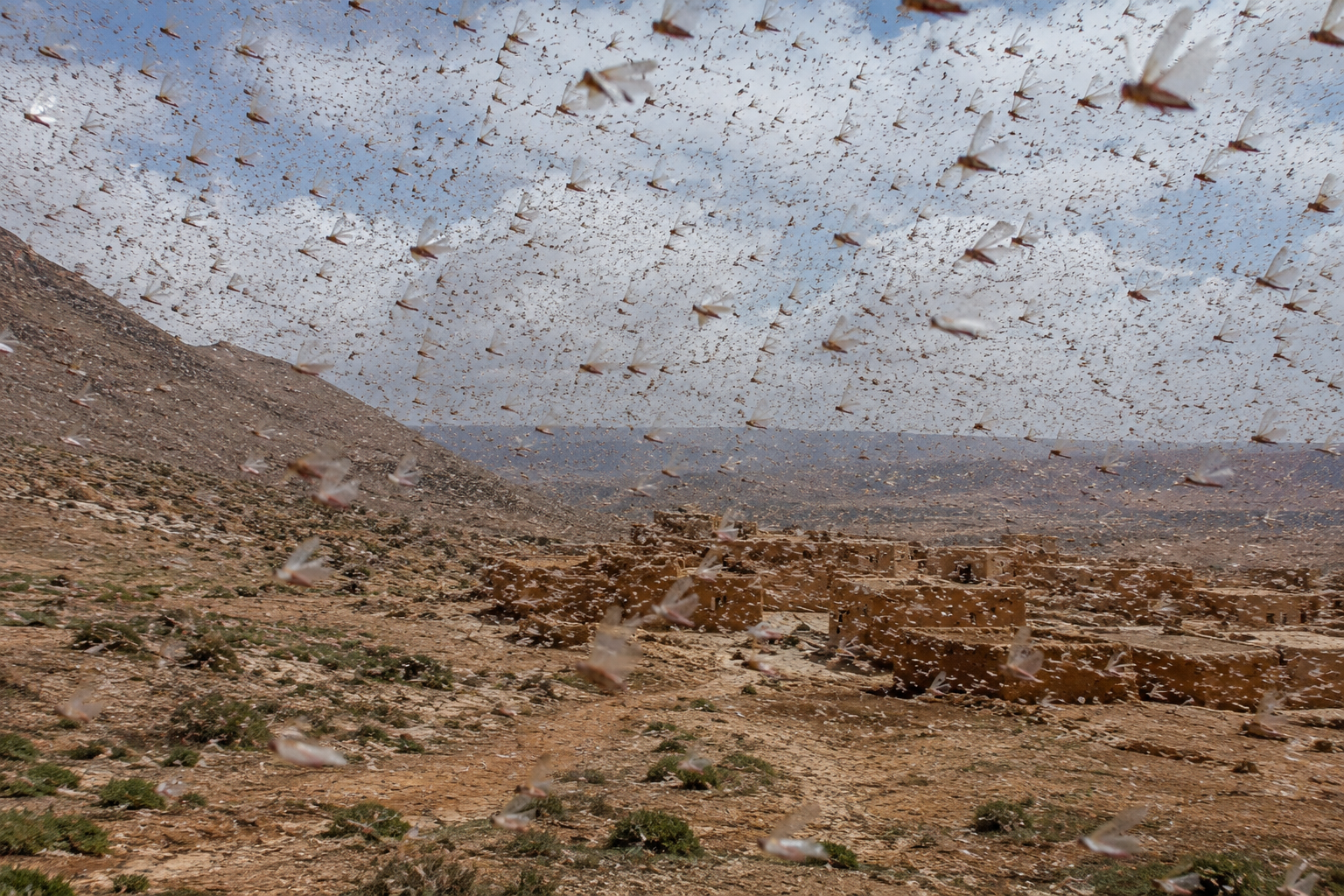
PASS IT ON!
Tell (command) your sons about it - Notice Joel does not say what it is they are to tell until Joel 1:4. Do you pass “lessons” you’ve learned on to your kids...successes and failures! There had been many locust invasions throughout Israel's history, but this one was unprecedented and ultimately in the context of this book, was symbolic of an equally devastating coming military invasion! Recount it to four generations, but of course the idea is to never cease passing it on. It is not so much to elaborate on the gory details of the gnawing locusts but on the greatness and power of our God Who is in control of the hordes of locusts which He brought on them as a punishment for hardness of heart (compare Pharaoh - Ex 10:1). In Dt 28:38 Moses had warned “You shall bring out much seed to the field but you will gather in little, for the locust will consume it." Israel was living like the world and now suffered like the world.
D. Gilliland adds that "This insect invasion was something which the Lord not only allowed, He actually sent it to bring the people to their spiritual senses and the prophet Joel's ministry was to make clear to the people their responsibility. Their true reaction in this situation was one of repentance. These locusts were the rod of the Lord to lead them to repentance." (What the Bible Teaches)
🙏 THOUGHT - Beloved, willful sin that is not quickly confessed and repented of will surely bring down the disciplining hand of the LORD (as I well know from personal experiences) in the form of "variegated locusts" (much like the 4 descriptions in Joel 1:4) so that His discipline may come in the form of a lawsuit (mine was and it was sorely painful), a loss of finances, illness, etc. (Disclaimer - not all these life events are necessarily divine discipline, so one must as always keep the life context in mind for the most accurate interpretation). Read Heb 12:5-11 and notice that it ends with a declaration of the disciplined one's good and God's glory for "All discipline for the moment seems not to be joyful, but sorrowful; yet to those who have been trained by it, afterwards it yields the peaceful fruit of righteousness." (Heb 12:11) APPLICATION: Parents (especially you fathers out there), the pattern in this passage is the Biblical pattern for parenting one's children as attested to repeatedly in the Old Testament...
Exodus 13:8; 14 “You shall tell your son on that day, saying, ‘It is because of what the LORD did for me when I came out of Egypt.’ 14 “And it shall be when your son asks you in time to come, saying, ‘What is this?’ then you shall say to him, ‘With a powerful hand the LORD brought us out of Egypt, from the house of slavery.
Deuteronomy 4:9 “Only give heed to yourself and keep your soul diligently, so that you do not forget the things which your eyes have seen and they do not depart from your heart all the days of your life; but make them known to your sons and your grandsons (I NEED TO TELL MY GRANDCHILDREN - RECENTLY I HAD TWO OVERNIGHT AND THEY ASKED ME "TELL US HOW YOU BECAME A BELIEVER" WHAT A PRIVILEGE TO BE ABLE TO PASS ON THE GREATEST MIRACLE THE LORD HAS PERFORMED IN MY LIFE! THANK YOU JESUS! AMEN. THAT WAS SEVERAL YEARS AGO AND NOW ONE IS A STRONG BELIEVER, NOT SURE ABOUT THE SECOND ONE...YET!).
Deuteronomy 6:4-7 “Hear, O Israel! The LORD is our God, the LORD is one! 5“You shall love the LORD your God with all your heart and with all your soul and with all your might. 6 “These words, which I am commanding you today, shall be on your heart. 7“You shall teach them diligently to your sons and shall talk of them when you sit in your house and when you walk by the way and when you lie down and when you rise up.
Deuteronomy 6:20-21 “When your son asks you in time to come, saying, ‘What do the testimonies and the statutes and the judgments mean which the LORD our God commanded you?’ 21 then you shall say to your son, ‘We were slaves to Pharaoh in Egypt, and the LORD brought us from Egypt with a mighty hand.
Ps 78:4-6 We will not conceal them from their children, But tell to the generation to come the praises of the LORD, And His strength and His wondrous works that He has done. 5 For He established a testimony in Jacob And appointed a law in Israel, Which He commanded our fathers That they should teach them to their children, 6 That the generation to come might know, even the children yet to be born, That they may arise and tell them to their children,
🙏 THOUGHT - And dear older believer who has walked with the Lord for a number of years, even several decades. Are you passing it on? Beloved, you will be held accountable for passing or not passing on what you have been privileged to learn. To what do I refer? This is a reference to Jesus' command to MAKE DISCIPLES (Mt 28:19-20). Paul presented the model in his letter to young Timothy writing
The things which you have heard from me in the presence of many witnesses, entrust these to faithful men who will be able to teach others also. (2 Ti 2:2)
Comment: Are you looking for some faithful younger men to spend some time with making the Word of the Lord and the Lord the central component of your time. Yes, accountability is important, but it should NEVER replace serious time together in the Word of truth, for it is from the Living and Active Word that we receive the power from the Spirit to be faithful in our accountability (cp John 6:63 = " the words that I have spoken to you are spirit and are life.").
Related Resource on "Passing it on" from generation to generation:
- Make Disciples 1
- Make Disciples 2 - Begins study of Five Most Important Passages for Believers
- Make Disciples 3 - Chart comparing Filled with the Spirit and the Word
- Make Disciples 4
- Make Disciples 5
- Make Disciples 6
- Make Disciples 7
- Make Disciples 8
Bob Utley - "Tell your sons" This IMPERATIVE (BDB 707, KB 765, Piel IMPERATIVE) is used to magnify the unique thing YHWH is about to do (i.e., bring locusts). There had been many locust invasions throughout Israel's history, but this one was very severe and was symbolic of a devastating military invasion! YHWH's coming judgment was to be retold and retold by succeeding generations as (1) covenant violations on the part of God's people (2) God's mercy to restore those who repent (3) a type of God's judgment on all unbelieving nations (like Obadiah) The spiritual education of Israel's children is mandated in Deuteronomy (cf. Deut. 4:9-10; 6:7,20-25; 11:19; 31:13; 32:46; also note Exod. 10:2; 12:26; 13:8,14). This mandate is continued in later Judaism by a time of special training in the Torah (Genesis ‒ Deuteronomy) and its interpretation (i.e., Talmud). For boys it was bar mitzvahi at age 13 and for girls, bat mitzvah at age 12. This knowledge of God's will becomes the basis of covenant rewards and punishments in the person's life. Knowledge brings responsibility! Faith runs through families (cf. Deut. 5:10; 7:9)!
Tell what? There is a touch of suspense in these first 3 verses. We don't find the answer until the next passage Joel 1:4.
D. Gilliland - Sometimes history is dismissed as irrelevant to a modern, progressive generation. What can such a generation, with all the technology and sophistication, learn from the experiences of the past? One is reminded of the words of the famous philosopher here: "Those who do not learn from the past are condemned to repeat it". (What the Bible Teaches)
NET NOTE - The circumstances that precipitated the book of Joel surrounded a locust invasion in Palestine that was of unprecedented proportions. The locusts had devastated the country's agrarian economy, with the unwelcome consequences extending to every important aspect of commercial, religious, and national life. To further complicate matters, a severe drought had exhausted water supplies, causing life-threatening shortages for animal and human life (cf. v. 20). Locust invasions occasionally present significant problems in Palestine in modern times. The year 1865 was commonly known among Arabic-speaking peoples of the Near East as sent el jarad, "year of the locust." The years 1892, 1899, and 1904 witnessed significant locust invasions in Palestine. But in modern times there has been nothing equal in magnitude to the great locust invasion that began in Palestine in February of 1915. This modern parallel provides valuable insight into the locust plague the prophet Joel points to as a foreshadowing of the day of the Lord. For an eyewitness account of the 1915 locust invasion of Palestine see THE ORIGINAL ARTICLE = J. D. Whiting, "Jerusalem's Locust Plague," National Geographic 28 (December 1915): 511-50.
Related Article - The Locust Plague of 1915 Photograph Album
Joel 1:3 Morning and Evening C H Spurgeon
“Tell ye your children of it, and let your children tell their children, and their children another generation.” — Joel 1:3
In this simple way, by God’s grace, a living testimony for truth is always to be kept alive in the land—the beloved of the Lord are to hand down their witness for the gospel, and the covenant to their heirs, and these again to their next descendants. This is our first duty, we are to begin at the family hearth: he is a bad preacher who does not commence his ministry at home. The heathen are to be sought by all means, and the highways and hedges are to be searched, but home has a prior claim, and woe unto those who reverse the order of the Lord’s arrangements. To teach our children is a personal duty; we cannot delegate it to Sunday school teachers, or other friendly aids; these can assist us, but cannot deliver us from the sacred obligation; proxies and sponsors are wicked devices in this case: mothers and fathers must, like Abraham, command their households in the fear of God, and talk with their offspring concerning the wondrous works of the Most High. Parental teaching is a natural duty—who so fit to look to the child’s well-being as those who are the authors of his actual being? To neglect the instruction of our offspring is worse than brutish. Family religion is necessary for the nation, for the family itself, and for the church of God. By a thousand plots Popery is covertly advancing in our land, and one of the most effectual means for resisting its inroads is left almost neglected, namely, the instruction of children in the faith. Would that parents would awaken to a sense of the importance of this matter. It is a pleasant duty to talk of Jesus to our sons and daughters, and the more so because it has often proved to be an accepted work, for God has saved the children through the parents’ prayers and admonitions. May every house into which this volume shall come honour the Lord and receive his smile.
Joel 1 - When Your Work Is Done
Read: Psalm 78:1-8
We will [tell] to the generation to come the praises of the Lord. —Psalm 78:4
The heritage of Christian workers never ends, though their work sometimes must.
I thought of this recently after hearing of an elderly woman who no longer feels useful. Despite her years of service as a Sunday school teacher (for which she is remembered fondly), as well as the spiritual influence she has already had on her children and grandchildren, she feels as if she isn’t helpful anymore. But it’s not true.
The Bible reminds us that God’s people are to pass along to the next generation the stories of God and His people. In Joel 1, for example, the inhabitants of Judah were told to convey a story about locusts to their children. Because the story had prophetic implications, it was an important part of the heritage of the people and thus it had to be passed on. In our reading for today, Psalm 78, the message is similar. The older Israelites were to tell the young people the story of God’s work in Israel’s past.
Today we have a message of salvation through Jesus and an opportunity to demonstrate a life of devotion to God. If you have passed the gospel to the next generation, your impact lingers. Even when your work is done, it keeps going. Your influence will never die. By Dave Branon (Reprinted by permission from Our Daily Bread Ministries. Please do not repost the full devotional without their permission.)
I love to tell the story,
It did so much for me;
And that is just the reason
I tell it now to thee.
—Hankey
Telling what Christ has done for us leaves signposts for those who follow.
Joel 1:4 What the gnawing locust has left, the swarming locust has eaten; And what the swarming locust has left, the creeping locust has eaten; And what the creeping locust has left, the stripping locust has eaten.
KJV That which the palmerworm hath left hath the locust eaten; and that which the locust hath left hath the cankerworm eaten; and that which the cankerworm hath left hath the caterpiller eaten.
NET What the gazam-locust left the 'arbeh-locust consumed, what the 'arbeh-locust left the yeleq-locust consumed, and what the yeleq-locust left the hasil-locust consumed!
NLT After the cutting locusts finished eating the crops, the swarming locusts took what was left! After them came the hopping locusts, and then the stripping locusts, too!
BGT τὰ κατάλοιπα τῆς κάμπης κατέφαγεν ἡ ἀκρίς καὶ τὰ κατάλοιπα τῆς ἀκρίδος κατέφαγεν ὁ βροῦχος καὶ τὰ κατάλοιπα τοῦ βρούχου κατέφαγεν ἡ ἐρυσίβη
LXE The leavings of the caterpillar has the locust eaten, and the leavings of the locust has the palmerworm eaten, and the leavings of the palmerworm has the cankerworm eaten.
CSB What the devouring locust has left, the swarming locust has eaten; what the swarming locust has left, the young locust has eaten; and what the young locust has left, the destroying locust has eaten.
ESV What the cutting locust left, the swarming locust has eaten. What the swarming locust left, the hopping locust has eaten, and what the hopping locust left, the destroying locust has eaten.
NIV What the locust swarm has left the great locusts have eaten; what the great locusts have left the young locusts have eaten; what the young locusts have left other locusts have eaten.
YLT What is left of the palmer-worm, eaten hath the locust, And what is left of the locust, Eaten hath the cankerworm, And what is left of the cankerworm, Eaten hath the caterpillar.
- Locust Joe 2:25 Am 4:9 See on Ex 10:4
- the swarming locust has eaten: Ex 10:12-15 De 28:38,42 1Ki 8:37 2Chr 6:28 7:13 Ps 78:46 105:34 Am 7:1 Rev 9:3-7
- the creeping locust has eaten: Na 3:15-17
- the stripping locust has eaten: Isa 33:4 Jer 51:14,27

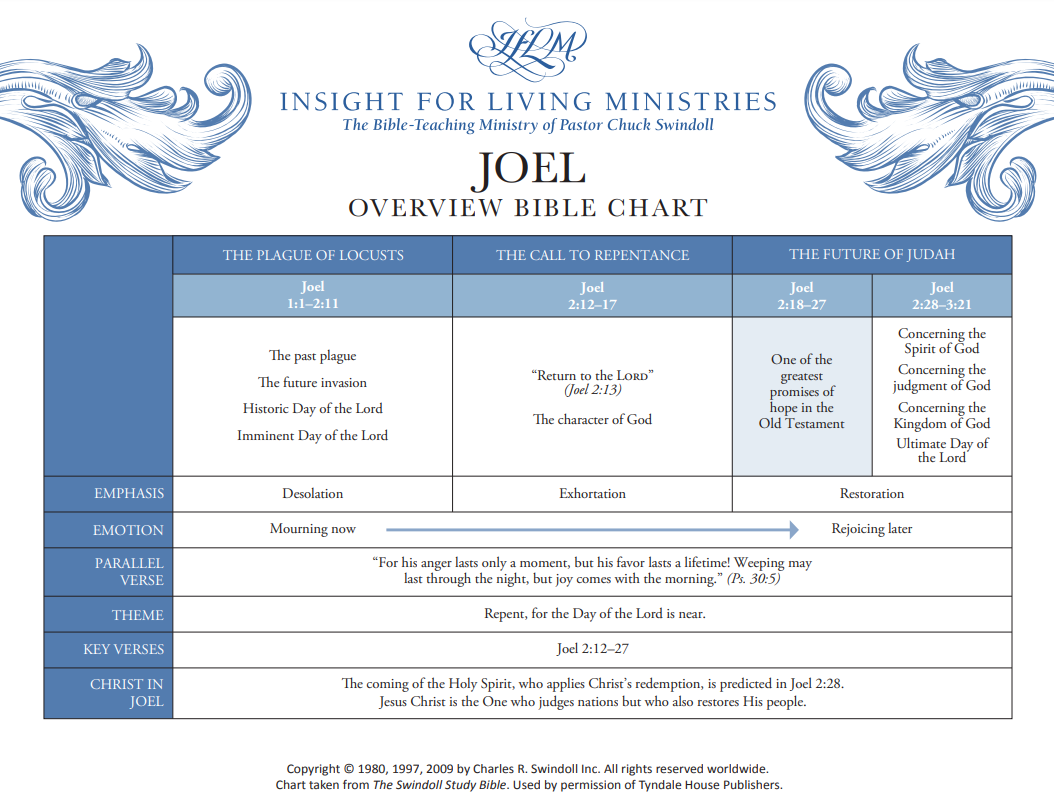
A SUPERNATURAL
"SCORCHED EARTH POLICY"
What the gnawing locust has left, the swarming locust (arbeh) has eaten; And what the swarming locust has left, the creeping locust has eaten; And what the creeping locust has left, the stripping locust has eaten. Like the lion, locusts have a strong bite and great power (Joel 1:6 "teeth of a lion"), grinding their food, completely destroying whatever they eat.
The repetition and plethora of terms for locusts at least in part serves to emphasize the profundity of the plague. This was not just a handful of locusts but a "horde full!" And their invasion was no accident but reflective of divine discipline (even as in Ex 10:12-20) and indeed this is part of why this story needed to be passed on. It would serve as a warning of the consequences of sin!
Bob Utley - "locusts" It must be understood that this plague of locusts is a direct result of the Covenant people rejecting their Covenant God (cf. Deut. 28:38). They are sent by YHWH! They are under His control!
John Phillips (Exploring the Minor Prophets - Page 70) adds an interesting note - The words are structured to provide a rhythmic beat for the ear and a precise order for the eye. Reinforcing the significance of the plague, this literary device helped impress the facts of that scourge on the minds and memories of succeeding generations. The English language cannot adequately convey the force of the original idioms, but they can be expressed as follows:
Gnawer's remnant, swarmer eats;
Swarmer's remnant, devourer eats;
Devourer's remnant, consumer eats.
Duane Garrett concludes: "Beyond the fact that they all in some way refer to locusts, we simply do not know what these four words denote....Duane Garrett: The impact of the verse is that the wrath of Yahweh is inescapable; those who think they have avoided one stage of the calamity are caught by another. In this Joel 1:4 is like Amos 5:19: “It will be as though a man fled from a lion only to meet a bear, as though he entered his house and rested his hand on the wall only to have a snake bite him.”" (NAC, 316). (SEE Hosea, Joel: An Exegetical and Theological Exposition)
Joel's description of the locusts is detailed and debated as to the meaning of the four different Hebrew words...
- gnawing locust - Hebrew = gazam (3x in 3v = Joel 1:4; Joel 2:25; Amos 4:9)
- swarming locust - Hebrew = arbeh (see uses below)
- creeping locust - Hebrew = yeleq (9x in 7v = Ps. 105:34; Jer. 51:14; Jer. 51:27; Joel 1:4; Joel 2:25; Nah. 3:15; Nah. 3:16)
- stripping locust - Hebrew = chasil from chasal = to consume (6x in 6v = 1 Ki. 8:37; 2 Chr. 6:28; Ps. 78:46; Isa. 33:4; Joel 1:4; Joel 2:25)
ESV Study Bible - The Bible often uses four agents of destruction to stress utter devastation (cf. Jer. 15:2-3; Ezek. 14:21; Rev. 6:1-8; 9:15).
Charles Feinberg - The four names in verse 4, meaning literally, the gnawer, the swarmer or multiplier, the licker, and the consumer or devourer, have been taken to mean either four types of locusts or four stages of growth in the case of one locust. (Note that the KJV and the ASV translate these Hebrew words alike.) Neither view is tenable, for the prophet uses the common word for locust (’arbeh) and then gives three poetic equivalents (Ed: But see Yamauchi's comment below). What the prophet means to convey is this: in the successive swarms of the locusts what one portion of them left the other portion devoured. Notice the number four in the matter of judgments in Jeremiah 15:3 and Ezekiel 14:21. Some Hebrew commentators have tried to relate the four names to the four empires in Daniel 2 and 7. Nothing in the text warrants such allegorical treatment. Furthermore, we have only to compare Joel 1:3 with Exodus 10:2, 6, and Deuteronomy 28:38-42 to realize the literal import of the words of the prophecy. Locusts have rightly been called “the incarnation of hunger.” They have been known to devour over an area of almost ninety miles every green herb and every blade of grass, so that the ground gave the appearance of having been scorched by fire. The locusts have a “scorched-earth policy” of their own. Joel’s description of the plague has been confirmed by many accounts of locust devastations. (See The Minor Prophets)
Ancient Locusts. THE Locust, or grasshopper, is one of the most formidable insects mentioned in the sacred writings. It is used as the symbol of desolation, so great and terrible were its ravages. It is still dreaded in the East. M. Olivier thus describes its attacks : "With the burning south winds (of Syria) there come from the interior of Arabia and the most southern parts of Persia, clouds of locusts, whose ravages to these countries are as grievous, and nearly as sudden, as those of the heaviest hail in Europe. We witnessed them twice. It is difficult to express the effect produced on us by the sight of the whole atmosphere filled on all sides, and to a great height, by an innumerable quantity of these insects, whose flight was slow and uniform, and whose noise resembled that of rain ; the sky was darkened, and the light of the sun was considerably weakened. In a moment the terraces of the houses, the streets, and all the fields were covered by these insects, and in two days they had devoured all the leaves of the plants." The effects of the locusts in Egypt (Ex 10:12-15) were terrible beyond description. No plague could have been more dreadful or impressive in the East, where the ravages of locusts are so dreadful that they are chosen as the fit symbol of a destroying conqueror. The very threat had urged Pharaoh's courtiers to remonstrance, but he had refused to yield and had driven Moses and Aaron from his presence. Now he recalled them in haste, and asked them to forgive his sin "only this once," and to entreat God to take away "this death only." A strong west wind removed the locusts as an east wind had brought them ; but their removal left the king's heart harder and more rebellious than ever. Locusts were used as food, and are still in some parts of the East. Sometimes they are ground and pounded, and mixed with flower and water, and made into cakes, or they are salted, and then eaten; sometimes smoked, boiled or roasted, stewed or fried in butter, and are considered a luxury. It was the locust that constituted the food of St. John the Baptist. (BORROW Animals, Birds, Insects, And Reptiles Of The Bible)
NET NOTE - Four different words for “locust” are used in this verse. Whether these words represent different life-stages of the locusts, or whether virtual synonyms are being used to underscore the severity of damage caused by the relentless waves of locust invasion, is not entirely certain. The latter seems more likely. Many interpreters have understood the locust plagues described here to be symbolic of invading armies that will devastate the land, but the symbolism could also work the other way, with real plagues of locusts described in the following verses as an invading army.
Yamauchi on these 4 descriptions of locusts - The four words used by Joel (Joel 1:4; 2:25) in his vivid description of the locust plague evidently represent stages of the locusts’ development (RSV, NEB, JB, NAB), rather than separate species of insects (KJV, KB). In Joel 2:25 we have first the ʾarbeh, the mature locust which deposits the eggs. The yeleq may be the larva as it emerges from the egg. The ḥāsîl may be the intermediate instar (stage between molts). The gāzām may be the ravenous nymph which strips the bark from the trees.
Edwin Yamauchi has an excellent discussion of locusts - (ʾarbeh) Locust. The word is probably derived from the root rābâ “to become numerous.” It occurs in Akkadian as erebu, arbû, etc. In the Ugaritic KRT text (103, 192), the king’s army is described as covering the field like locusts (irby). Of the many words for locust, ʾarbeh is the general word, and is used most frequently, twenty-four times. The KJV translates it “locust” twenty times and “grasshopper” four times. The ʾarbeh plague (Deut 28:38) is listed as one of the divine curses which would befall the Israelites if they disobeyed God’s commands. The ʾarbeh is one of the plagues which Moses called down upon Egypt (Ex 10:4ff.; Ps 78:46; 105:34). Locusts are used in similes of vast numbers in Jdg 6:5; Jdg 7:12; Jer 46:23; Nah 3:15. Locusts belong to the order of the Orthoptera, “straight-winged.” With the grasshoppers they belong to the subfamily Saltatoria, “leapers,” which were considered edible (Lev 11:21–22). The biblical locust is not the cicada called “locust” in some areas of the United States. Locusts belong to the family Acridiidae, “short-horned grasshoppers.” Of the ninety-one species found in Palestine only the desert locust (Schistocerca gregaria or Acridium peregrinum - see picture) has served to plague the near east from time immemorial. At maturity these locusts are two and one-half inches long. They have two sets of wings and an enlarged pair of legs for jumping. In appearance they are compared to horses (Joel 2:4; Job 39:20; Rev 9:7-see Tony Garland's interesting note on interpretation of the "locusts"; cf. German Heupferd, Italian caiallette). Desert locusts are phenomenal travelers. They are able to fly for seventeen hours at a time and have been known to travel fifteen hundred miles. The sound of their wings is compared to the sound of chariots (Joel 2:5; Rev 9:9). Their route of travel is determined by the prevailing winds (Ex 10:13, 19). In the plague of 1915 (see original article below), locusts came to Jerusalem from the northeast (cf. Joel 2:20). The Bible does not exaggerate when it speaks of swarms of locusts covering the ground (Ex 10:5). A swarm has been known to cover a hundred square miles and to be so dense as to blot out the sun. A truly large swarm may contain ten billion locusts. Unlike the Babylonians who resorted to magical incantations to avert locust plagues, the Israelites asked God in fasting, repentance, and prayer to remove locust plagues (1 Ki 8:37; 2 Chr 6:28). In Lev 11:22 the ʾarbeh and three other types of locusts (solʾām, ḥargōl, ḥāgāb) are listed as edible insects. Bas reliefs from Nineveh show servants bringing skewered locusts for Sennacherib’s table. John the Baptist subsisted on honey and locusts (Mt 3:4; Mk 1:6). Many Africans and Arabs after removing the wings, legs, and heads eat locusts either cooked or ground up as flour. There are nine Hebrew words which designate locusts: ʾarbeh, gāzām, gēbâ, only as plural gēbîm, gōbay, ḥāgāb, ḥasîl, yeleq, solʿām, ṣĕlāṣal. Akkadian recognizes eighteen names for locusts, and the Talmud twenty names. (TWOT online)
John Phillips - The swarms move forward in a kind of rolling motion, some of the locusts always being on the ground as the rear ones pass on to the front. As the rear of the swarm passes over them, those on the ground resume flight. The period spent on the ground enables each locust to replenish its fuel supply for further flight. Locusts look like well-armed horsemen and have incredible strength. With teeth like saws, they devour grass and leaves, fruit and foliage—everything green and edible; they attack the young branches of trees and the bark on trunks; they consume corn in the field and fall on vines, willows, and even bitter hemp; they strip palm trees bare. Many observers have described locust plagues. One person saw the air eighteen feet above the ground filled with the insects. Reddish-brown in color with gauzy wings sparkling in the sunlight, they reminded him of dense snowflakes driven by a storm. He was awed by their numbers and said the strange sight would have seemed beautiful if he could have forgotten about the devastation the locusts were bringing. Another person observed a plague that came like a living deluge on his village. The villagers dug trenches, kindled fires, beat drums, and flailed and burned locusts to death by the thousands, but their efforts were useless. The swarm rolled up the mountainside, poured over obstacles, and descended on crops and trees. It took days for the whole swarm to pass through the area. The roads were covered with locusts marching along like soldiers. The villagers broke their ranks, but the locusts closed rank again as soon as they passed the men. Someone else who witnessed a locust plague said that hundreds of the insects sat on each bush and after eating the leaves, gnawed frantically at the woody fibers. The locusts invaded towns and houses and devoured food, linen, woolen garments, and leather belts. Such a locust plague had devastated Judah in Joel's day. To the prophet the plague was both a parable and a prophecy. Although the scourge was past, Joel used it as a picture of worse things to come. The real locusts became symbols of real warriors who would invade the land in successive waves. (See Exploring the Minor Prophets: An Expository Commentary - Page 72)
Swarming locusts (0697)(arbeh from rabah = to be or become much, many, great) is a masculine noun translated in NAS as locust (8), locusts (11), swarming locust (5) and is the most commonly used Hebrew word for locusts. See the discussions below for more specific details about locusts. Solomon asked God that if there was a plague (including locusts) and Israel supplicated to Him, that He would forgive their sin (1 Ki 8:37, 35-40, cf 2 Chr. 6:28)
W E Vine on arbeh - This noun, which occurs 24 times, refers to a kind of swarming "locust": "Stretch out thine hand over the land of Egypt for the locusts, that they may come up upon the land of Egypt, and eat every herb of the land …" (Ex 10:12). Several other nouns related to this verb appear infrequently. Marbeh, which appears once, means "abundance" (Isa. 33:23). Marbît, which is found 5 times, refers to a "great number" (1 Sa 2:33) or the "greater half" (2 Chr 9:6). Tarbût has a single appearance to mean "increase" (Nu 32:14). Tarbît, which occurs 6 times, can mean "interest, increment, usury" (Lev 25:36). (Vine's Expository Dictionary)
The most concentrated use of arbeh is found in Moses' description of the locust plague on Egypt:
Then the LORD said to Moses, “Go to Pharaoh, for I have hardened his heart and the heart of his servants, that I may perform these signs of Mine among them, (Why did God harden Pharaoh's heart?) 2 and that you may tell in the hearing of your son, and of your grandson, how I made a mockery of the Egyptians and how I performed My signs among them, that you may know that I am the LORD.” 3 Moses and Aaron went to Pharaoh and said to him, “Thus says the LORD, the God of the Hebrews, ‘How long will you refuse to humble yourself before Me? Let My people go, that they may serve Me. 4‘For if you refuse to let My people go, behold, tomorrow I will bring locusts into your territory (The 8th of 10 Plagues or here). 5 ‘They shall cover the surface of the land, so that no one will be able to see the land. They will also eat the rest of what has escaped–what is left to you from the hail–and they will eat every tree which sprouts for you out of the field. 6 ‘Then your houses shall be filled and the houses of all your servants and the houses of all the Egyptians, something which neither your fathers nor your grandfathers have seen, from the day that they came upon the earth until this day.’” And he turned and went out from Pharaoh. 7 Pharaoh’s servants said to him, “How long will this man be a snare to us? Let the men go, that they may serve the LORD their God. Do you not realize that Egypt is destroyed?” 8 So Moses and Aaron were brought back to Pharaoh, and he said to them, “Go, serve the LORD your God! Who are the ones that are going?” 9 Moses said, “We shall go with our young and our old; with our sons and our daughters, with our flocks and our herds we shall go, for we must hold a feast to the LORD.” 10 Then he said to them, “Thus may the LORD be with you, if ever I let you and your little ones go! Take heed, for evil is in your mind. 11 “Not so! Go now, the men among you, and serve the LORD, for that is what you desire.” So they were driven out from Pharaoh’s presence. 12 Then the LORD said to Moses, “Stretch out your hand over the land of Egypt for the locusts, that they may come up on the land of Egypt and eat every plant of the land, even all that the hail has left.” 13 So Moses stretched out his staff over the land of Egypt, and the LORD directed an east wind on the land all that day and all that night; and when it was morning, the east wind brought the locusts. 14 The locusts came up over all the land of Egypt and settled in all the territory of Egypt; they were very numerous. There had never been so many locusts, nor would there be so many again. 15 For they covered the surface of the whole land, so that the land was darkened; and they ate every plant of the land and all the fruit of the trees that the hail had left. Thus nothing green was left on tree or plant of the field through all the land of Egypt. 16 Then Pharaoh hurriedly called for Moses and Aaron, and he said, “I have sinned against the LORD your God and against you. 17 “Now therefore, please forgive my sin only this once, and make supplication to the LORD your God, that He would only remove this death from me.” 18 He went out from Pharaoh and made supplication to the LORD. 19 So the LORD shifted the wind to a very strong west wind which took up the locusts and drove them into the Red Sea; not one locust was left in all the territory of Egypt.(Ex 10:1-19)
Arbeh - 24x in 19v - Ex. 10:4; Ex. 10:12; Ex. 10:13; Ex. 10:14; Ex. 10:19; Lev. 11:22 (=These of them you may eat: the locust in its kinds); Deut. 28:38 (Part of the curses = "you will gather in little, for the locust will consume it."); Jdg. 6:5 (Midianites and Amalekites "would come in like locusts for number, both they and their camels were innumerable; and they came into the land to devastate it."); Jdg. 7:12 (Midianites and Amalekites like locusts); 1 Ki. 8:37; 2 Chr. 6:28; Job 39:20; Ps. 78:46; Ps. 105:34 (="He spoke, and locusts came, And young locusts, even without number"); Ps. 109:23; Prov. 30:27 (="The locusts have no king, Yet all of them go out in ranks;"); Jer. 46:23; Joel 1:4; Joel 2:25; Nah. 3:15; Nah. 3:17
Related Resources:
- Watch this well done Locust Video,
- J D Whiting's famous 1915 National Geographic article below - "Jerusalem's Locust Plague"
- American Tract Society Locust
- Easton's Bible Dictionary Locust
- Fausset Bible Dictionary Locust
- Holman Bible Dictionary Destroying Locusts Bald Locust Locust
- Hastings' Dictionary of the Bible Bald Locust Locust
- Hastings' Dictionary of the NT Locust Locust
- Vines' Expository Dictionary Locust
- 1911 Encyclopedia Britannica Locust - Nice summary
- International Standard Bible Encyclopedia Bald Locust Locust
- Kitto Biblical Cyclopedia Locust
- McClintock and Strong's Bible Encyclopedia Locust Bald Locust
- The Jewish Encyclopedia Locust
McComiskey on locusts - In our generation areas having the potential for a locust outbreak are monitored by international agencies using satellite reconnaissance and other technology; incipient swarms are met by aircraft and trucks carrying powerful pesticides. However, if the locusts are not destroyed or contained shortly after the hatch, once the swarm has formed, control efforts are minimally effective even today. For example, in 1988 the civil war in Chad prevented international cooperation in attacking the hatch, and a destructive swarm spread throughout North Africa devastating some of the poorest nations and threatening Europe as well. It is difficult for modern Western people to appreciate the dire threat represented by a locust plague in earlier periods. Such outbreaks had serious consequences for the health and mortality of an affected population and for a region's economy. Scarcity of food resulting from the swarm's attack would bring the population to subsistence intake or less, would make the spread of disease among a weakened populace easier, would eliminate any trade from surplus food products, and would stimulate high inflation in the costs of food products. Disease outbreaks are further aggravated when swarms die; the putrefaction of the millions of locust bodies breeds typhus and other diseases that spread to humans and animals (see the description in Augustine's City of God 3.31). Baron (Desert Locust, pp. 3-7) catalogues many locust outbreaks known to have been accompanied by outbreaks of pestilence.
It was only in 1921 that the mystery of the locust was solved. Prior to this date researchers wondered what became of the locust during the years in which there were no outbreaks. In 1921 B. P. Uvarov demonstrated that the swarming locust was none other than an ordinary species of grasshopper. However, when moisture and temperature conditions favored a large hatch, the crowding, unceasing contact, and jostling of the nymphs begin to stimulate changes in coloration, physiology, metabolism, and behavior, so that the grasshopper nymphs make the transition from solitary behavior to the swarming gregarious and migratory phases of the dreaded plague. Plagues continue as long as climatic conditions favor the large hatches. Once entering their gregarious phase, swarms of locusts can migrate great distances and have even been observed twelve hundred miles at sea. The swarms can reach great sizes: a swarm across the Red Sea in 1889 was estimated to cover two thousand square miles. A swarm is estimated to contain up to 120 million insects per square mile (Baron, Desert Locust, p. 32). In 1881 an effort in Cyprus to prevent a possible outbreak of locusts by digging up and destroying their egg cases netted thirteen hundred tons of their egg masses. Locusts were the eighth plague on Egypt described in Exodus (Exod. 10:4-19); images of locusts were already carved in sixth-dynasty tombs at Saqqara over three-quarters of a millennium earlier (Baron, Desert Locust, p. 2; for Egyptological evidence, see Keimer, "Pendeloques en forme d'insects").
The lifespan of individual locusts is also influenced by temperature and other climatic conditions. In one swarm incubation was 14 days; the hopper period, 38 days; the immature stage, 45 days; and the breeding stage, 30 days—for a total of 127 days (Baron, Desert Locust, p. 34). During breeding the female lays approximately 250 to 300 eggs in individual pods dug in suitable soil, each pod containing 70 to 80 eggs. The hatch of an egg-field portends the swarm to follow. In the words of one entomologist (cited in Baron, Desert Locust, p. 41), "So far as the eye could see they were boiling out. Every inch of open ground appeared to be bubbling young locusts as pod after pod, many of them only a couple of inches apart, gave up its contents.... Within three days the whole of a vast egg-field had been hatched out and the hoppers were ready to march." (SEE The Minor Prophets: An Exegetical and Expository Commentary)
QUESTION - Is Joel 1:4 referring to literal locusts? When was this prophecy fulfilled?
ANSWER - The book of Joel mentions four types of locusts that would destroy the agriculture of Israel. Joel 1:4 says, “What the cutting locust left, the swarming locust has eaten. What the swarming locust left, the hopping locust has eaten, and what the hopping locust left, the destroying locust has eaten” (ESV). When were these predictions fulfilled? Were these literal locusts or a metaphorical reference to something else?
The time of the fulfillment depends, to some extent, on the date the book of Joel was originally written. Scholars debate the exact time of composition, but it was likely around 845 B.C. (ED: BEFORE THE ASSYRIAN INVASION IN 722 BC AND THE BABYLONIAN INVASION IN 586 BC)
In chapter 1, Joel describes the devastation caused by an invasion of locusts. The damage is so severe that the nation is brought to ruin; every strata of society is affected:
- drunkards (Joel 1:5-7),
- citizens of Jerusalem (Joel 1:8-10),
- farmers (Joel 1:11-12),
- and priests (Joel 1:13).
The prophet then calls on the people of God to repent.
Some interpreters see the locusts as symbolic of an invading army, suggesting the locusts refer to another animal such as a horse (similar to Jeremiah 51:27). Other commentators view these locusts as a reference to modern-day helicopters, interpreting Joel’s prophecy as a prediction of a future war. However, such views neglect the intention of the author and the understanding of the original audience. Israelites saw locust swarms as deadly due to the locusts’ ability to wipe out an entire year’s harvest. Locust plagues had been seen before (Exodus 10:1-3; Psalm 105:34-35).
There is no doubt that Joel was warning his readers about a future day when God would judge all people. Most likely, Joel used a recent devastation of locusts as an illustration of Judgment Day. The disaster brought upon Israel’s agriculture was a small taste of a coming judgment on Israel and a later judgment upon the whole earth. Part of this prophecy was fulfilled when Israel was defeated by its enemies and taken into exile. The remaining judgments (Joel 2:28ff) will take place in the future Day of the Lord.
In summary, the prophet Joel is most likely referring to a literal locust invasion that took place shortly before his writing, around 845 B.C. The literal swarms of locusts that invaded in successive waves to destroy the crops of Israel spoke of a soon-coming invasion of enemies as well as a future day of judgment.
QUESTION - Why did God use a locust swarm to punish Israel (Joel 1:4)?
ANSWER - A locust swarm has the potential to devastate all vegetation in its path and can cause economic disaster in a region. Ancient Israel was predominantly an agricultural society. As such, threats to the nation’s crops were one of the main concerns of its citizens. At times, God used a locust swarm as a judgment to call Israel to repent of their sins (Joel 1:4).
The following verses detail the extent of this locust swarm in Joel’s time:
– Loss of grapes for making wine: “The sweet wine . . . is cut off from your mouth” (Joel 1:5).
– Destruction of figs: “It has laid waste my vine and splintered my fig tree” (Joel 1:7).
– No grain or wine for offerings at the temple: “The grain offering and the drink offering are cut off from the house of the LORD” (Joel 1:9).
– Destruction of grain, which would result in no bread: “The fields are destroyed, the ground mourns, because the grain is destroyed” (Joel 1:10).
– Destruction of wheat and barley: “The wheat and the barley . . . has perished” (Joel 1:11).
– Loss of the fruit from trees: “Pomegranate, palm, and apple, all the trees of the field are dried up” (Joel 1:12).
– Loss of olives: “The oil languishes” (Joel 1:13).
– No food for the livestock (Joel 1:18).
As a result of the locust swarm, every major food source except meat and seafood had been destroyed for the year. The prophet Joel called the priests to repent (Joel 1:13) and urged them to call the people to fast and pray (Joel 1:14).
Insightful readers, especially the priests addressed in Joel 1:13, would have been aware that the invading locust swarm was a fulfillment of prophecy. Moses had warned Israel of the results of disobedience in Deuteronomy 28:37–38: “You will become a thing of horror, a byword and an object of ridicule . . . . You will sow much seed in the field but you will harvest little, because locusts will devour it.”
While tragedies such as a locust swarm are not always a sign of God’s judgment on a community, Joel said that, in Israel’s case, the invasion of locusts was a call for God’s people to repent in fasting and sackcloth.
Still today, when tragedy strikes, it can be a reminder to turn to God. God can use tragedies and the loss of material things to cause people to seek Him.
Nature in Uproar Joel 1:4 - Before the Face of God
We don’t know when Joel prophesied. Because it seems Isaiah quoted Joel, many expositors believe Joel was one of the earliest prophets; but perhaps it was Joel who quoted Isaiah. While Joel referred to Judah and Jerusalem several times, we assume that his prophecy was directed primarily toward Judah, the southern kingdom.
This world is God’s, and when people sin against him God summons the world to participate in his judgment against humankind. Beginning with the Garden of Eden, thorns and thistles multiplied against sinners. Joel uniquely focused on this theme by describing a horrendous locust plague. Several kinds of locusts invaded in succession. There followed a drought in which the land became so dry that great fires spread across the countryside (Joel 1).
The most pointed aspect of this devastation, said Joel, is that it prevented the people from offering sacrifices to God. The locusts ate the grain of the cereal offering and the grapes of the drink offering. Cattle and sheep died in great numbers (1:9, 13, 18). Thus the people were cut off from worshiping God in the manner he had prescribed.
Joel instructed the people to tell their children, grandchildren, and great-grandchildren about this devastating invasion because it foreshadowed another invasion to come. Joel 2 describes God’s coming judgment of the land. On that occasion he would bring in another locust army to punish the people for their sins. Many commentators believe that the locust imagery of Joel 2 is a symbolic prediction of the Assyrians and Babylonians who would be brought by God to destroy northern Israel and southern Judah, respectively. Joel 2:20 hints that a human army is what the passage really predicts.
Whether the locusts in Joel 2 are literal or figurative (or both), the message of Joel is summarized by a line from Francis Thompson’s famous poem “The Hound of Heaven.” In that poem, the Divine Pursuer tells the fleeing sinner, “All things betray thee, who betrayest Me.” If we do not obey God, even his world will rise up against us.
Coram Deo - Our culture focuses on the present. We often fail to learn from the past. A greater problem is our failure to prepare future generations for the world they will inherit. Joel knew the importance of teaching children. Make it your goal at home or with children at church to prepare the next generations for the future by reminding them of God’s judgments and blessings in the past.
For further study: Deuteronomy 4:9; 11:18–21; 2 Corinthians 4:16–18; 2 Timothy 4:1–8
BROKEN FELLOWSHIP JOEL 1:4
The book of Joel opens against the backdrop of a horrific natural disaster: an overwhelming invasion of locusts that devastated the land of Judah. Female locusts deposit their eggs beneath the surface of the soil, where they can remain until favorable conditions cause them to hatch. Once they emerge and multiply, enormous swarms can descend upon a region and strip its vegetation with astonishing thoroughness.
Judah had experienced just such a catastrophe. Wave after wave of locusts swept across the land, leaving devastation in their wake: “What the gnawing locust has left, the swarming locust has eaten; and what the swarming locust has left, the creeping locust has eaten; and what the creeping locust has left, the stripping locust has eaten” (Joel 1:4). Vineyards were ruined, fruit trees were stripped, and the grain harvest was destroyed (Joel 1:7, 10–12).
But the disaster reached far beyond the fields. The devastation of the land eventually reached the altar. With the grain and vineyards destroyed, “the grain offering and the drink offering are cut off from the house of the LORD” (Joel 1:9; cf. Joel 1:13). The very provisions God had given His people to bring before Him in worship were gone. The priests mourned, the regular offerings ceased, and the outward expression of Israel's fellowship with Yahweh was disrupted.
God was using the locust plague as an instrument
of discipline and a trumpet call to repentance.
Then Joel appeared with God's interpretation of their circumstances. This was not merely an unfortunate agricultural disaster. God was using the locust plague as an instrument of discipline and a trumpet call to repentance. The devastation was intended to awaken spiritually slumbering people and prompt them to turn their hearts back to Him. Joel therefore called them to mourn, fast, gather at the house of the LORD, and “cry to the LORD” (Joel 1:13–14).
Yet judgment was not God's final word. His purpose in discipline was not merely to devastate but to restore. Thus His appeal would soon come: “Yet even now...return to Me with all your heart, and with fasting, weeping and mourning; and rend your heart and not your garments.” (Joel 2:12–13, cf Heb 12:5-11)
And why could they return with confidence? Because “He is gracious and compassionate, slow to anger, abounding in lovingkindness” (Joel 2:13). If His people genuinely returned to Him, they would discover that the God Who disciplined them was also the God Who delighted to show mercy and restore blessing (Joel 2:18–27).
APPLICATION - Has God recently allowed some adversity, disappointment, loss, or disruption to enter your world? My guess is a large percentage of readers would answer "Yes!" One one hand, we should be careful not to assume that every trial is God's discipline for a particular sin (cf. Job 1:1, 8–12; Jn 9:1–3). Nevertheless, every trial provides an opportunity for spiritual examination (Ps 139:23–24). Could God be using your circumstances to get your attention, expose something that has come between you and Him, or call you back to a closer walk with Him? When fellowship with God has been disrupted by sin, the answer is not to run from Him but to run to Him in confession and repentance (1Jn 1:9; Jas 4:8–10). The same God Who exposes our sin graciously provides the way back into restored fellowship. (If you find yourself in a position of needing to run to Him, take a moment and listen to Kari Jobe's Run to Him)
Sometimes God allows our earthly comforts to be stripped away so that we might discover how far our hearts have drifted from Him. His discipline is not a closed door but a gracious call: “Return to Me.”
Has God recently allowed a disaster to enter your world?
Could it be God’s unequivocal message for you to return to Him?
Joel 1:5 Awake, drunkards, and weep; And wail, all you wine drinkers, on account of the sweet wine that is cut off from your mouth.
KJV Awake, ye drunkards, and weep; and howl, all ye drinkers of wine, because of the new wine; for it is cut off from your mouth.
NET Wake up, you drunkards, and weep! Wail, all you wine drinkers, because the sweet wine has been taken away from you.
NLT Wake up, you drunkards, and weep! Wail, all you wine-drinkers! All the grapes are ruined, and all your sweet wine is gone.
BGT ἐκνήψατε οἱ μεθύοντες ἐξ οἴνου αὐτῶν καὶ κλαύσατε θρηνήσατε πάντες οἱ πίνοντες οἶνον εἰς μέθην ὅτι ἐξῆρται ἐκ στόματος ὑμῶν εὐφροσύνη καὶ χαρά
LXE Awake, ye drunkards, from your wine, and weep: mourn, all ye that drink wine to drunkenness: for joy and gladness and removed are from your mouth.
CSB Wake up, you drunkards, and weep; wail, all you wine drinkers, because of the sweet wine, for it has been taken from your mouth.
ESV Awake, you drunkards, and weep, and wail, all you drinkers of wine, because of the sweet wine, for it is cut off from your mouth.
NIV Wake up, you drunkards, and weep! Wail, all you drinkers of wine; wail because of the new wine, for it has been snatched from your lips.
YLT Awake, ye drunkards, and weep, And howl all drinking wine, because of the juice, For it hath been cut off from your mouth.
- Awake, drunkards,: Isa 24:7-11 Am 6:3-7 Lu 21:34-36 Ro 13:11-14
- weep: Joel 1:11,13 Jer 4:8 Eze 30:2 Jas 5:1
- That is cut off from your mouth: Isa 32:10-12 Lu 16:19,23-25
Related Passages:
Luke 21:34-36 “Be on guard, so that your hearts will not be weighted down with dissipation and drunkenness and the worries of life, and that day will not come on you suddenly like a trap; 35 for it will come upon all those who dwell on the face of all the earth. (THE DAY OF THE LORD) 36 “But keep on the alert at all times, praying that you may have strength to escape all these things that are about to take place, and to stand before the Son of Man.”
Ephesians 5:18 And do not get drunk with wine, for that is dissipation, but be filled with the Spirit,
Joel 1:11 Be ashamed, O farmers, Wail, O vinedressers, For the wheat and the barley; Because the harvest of the field is destroyed.
Joel 1:13 Gird yourselves with sackcloth And lament, O priests; Wail, O ministers of the altar! Come, spend the night in sackcloth O ministers of my God, For the grain offering and the drink offering Are withheld from the house of your God.
Jeremiah 4:8 “For this, put on sackcloth, Lament and wail; For the fierce anger of the LORD Has not turned back from us.”
Ezekiel 30:2 “Son of man, prophesy and say, ‘Thus says the Lord GOD, “Wail, ‘Alas for the day!’
James 5:1 Come now, you rich, weep and howl for your miseries which are coming upon you.
1 Thessalonians 5:1-8 Now as to the times and the epochs, brethren, you have no need of anything to be written to you. 2 For you yourselves know full well that the day of the Lord will come just like a thief in the night. 3While they are saying, “Peace and safety!” then destruction will come upon them suddenly like labor pains upon a woman with child, and they will not escape. 4 But you, brethren, are not in darkness, that the day would overtake you like a thief; 5 for you are all sons of light and sons of day. We are not of night nor of darkness; 6 so then let us not sleep as others do, but let us be alert and sober. 7 For those who sleep do their sleeping at night, and those who get drunk get drunk at night. 8 But since we are of the day, let us be sober, having put on the breastplate of faith and love, and as a helmet, the hope of salvation.
A SOBERING THOUGHT
FOR DRUNKARDS!
Awake (qits; LXX - eknepho [1Co 15:34 "be sober minded"] = become sober after being drunk; figuratively of regaining proper control of one's thinking - come to one's senses) drunkards (sikkor) and weep (bakah) and wail (yalal) was the prophet's cry - This is a strong statement given that this was a triplicate of imperatives or commands! While this cry is to those who are physically drunk, the cry to awake clearly conveys a deeper meaning for them to awaken spiritually to what is happening around you! Those dulled by wine were commanded to wake up because God was using calamity to wake up the nation. Paul applies this same idea to the Church in his day (and surely to the church in our modern times which seems to be asleep spiritually, largely illiterate Biblically and with much too big of a "foot in the world!")
Romans 13:11-14 Do this, knowing the time, that it is already the hour for you to awaken from sleep; (SPIRITUALY ASLEEP!) for now salvation is nearer to us than when we believed (OUR FUTURE REDEMPTION - Eph 4:30, OUR GLORIFICATION - 1 Jn 3:2-3). 12 The night (SPIRITUAL DARKNESS OF THIS PRESENT EVIL AGE - Gal 1:4) is almost gone, and the (GLORIOUS) day is near (OF CHRIST'S RETURN!). Therefore let us lay aside the deeds of darkness and put on the armor of light. (CONDUCT THAT IS RIGHTEOUS AND HOLY AND HAS A PROPER FEAR OF THE LORD - 1 Pe 1:16-18) 13 Let us behave properly as in the day, not in carousing and drunkenness, not in sexual promiscuity and sensuality, not in strife and jealousy. 14 But put on (aorist imperative) the Lord Jesus Christ (BY GETTING HIS WORD IN US, DEPENDING ON HIS SPIRIT'S POWER TO ENABLE CHRIST-LIKE LIVING - Eph 5:18, Gal 5:16), and make no provision (present imperative with a negative - STOP PLANNING YOUR SIN!) for the flesh in regard to its lusts (WHICH CONTINUALLY WAGES WAR AGAINST OUR SOULS! (1 Pe 2:11).
Comment: May God grant by His enabling Spirit for the Church in America to "wake up" to discern the signs of the times so that we might redeem the time, for the days are evil and becoming more so every day! (Eph 5:16). In Jesus' Name. Amen.
How can you be so dead,
when you've been so well fed?🙏 THOUGHT - Dear brother and sister in Christ - can I encourage you to take 5 minutes to listen to an old Keith Green song almost "prophetically" entitled "Asleep in the Light." (A line from his lyrics = "How can you be so dead, when you've been so well fed?") May God's Spirit awaken our spiritual slumber and cause us to weep for the lost, for Jesus' sake. Amen
Awake, drunkards, and weep; And wail, all you wine drinkers, on account of the sweet wine that is cut off from your mouth - Hordes of gnawing locusts mean no vines. No vines mean no grapes and no wine. There is surely a bit of irony in this exhortation. Drunks can be difficult to arouse, but here Joel is arousing them with the bad news that their supply of alcohol will be cut off! As they go into withdrawal, one can see them weeping and wailing. Further, the weeping and wailing both speak of public mourning over this devastation. God is calling for a "spiritual awakening" not just a sobering up for inebriation. The call to weep and wail is not for show but was a call for brokenness and recognition of the fact that the locust plague was not a freak of nature, not a random or accidental event, but was a warning message sent by God to stir the nation to repentance. In fact they should not have needed anyone explain this to them for Moses had clearly warned the nation in Dt 28:38.
The LXX translates with the verb eknepho (in Job 1:5) which is a command to literally "sober up" after being drunk. Figuratively the idea means to regain proper control of one's thinking and so to come to one's senses (1 Cor 15:34).
Bob Utley - "awake. . .weep. . .wail" The foolish people of the land are addressed in three imperatives (which symbolize a call to spiritual awakening) ▣ "drunkards. . .wine drinkers" The prophetic word is not directed to alcoholics, but to God's people, drunk on the wine of covenant rebellion. The only cure is radical detoxification (i.e., judgment, cf. Joel 1:6). ▣ "On account of the sweet wine" Many have tried to make "sweet wine" (BDB 779) a non-alcoholic beverage, but this verse and Isa. 49:26 show that this refers to an alcoholic beverage. The Bible says that God gives wine as a gift to humans (cf. Gen. 27:28 [BDB 440]; Psalm 104:14-15[BDB 406]). Wine is not evil, but like all physical things, it can be abused! It is the drink of the eschaton (cf. Joel 3:18; Amos 9:13). SEE Biblical Attitudes Toward Alcohol and Alcohol Abuse
NET NOTE - The word drunkards has a double edge here. Those accustomed to drinking too much must now lament the unavailability of wine. It also may hint that the people in general have become religiously inebriated and are unresponsive to the Lord. They are, as it were, drunkards from a spiritual standpoint. Joel addresses the first of three groups particularly affected by the locust plague. In v. 5 he describes the effects on the drunkards, who no longer have a ready supply of intoxicating wine; in vv. 11–12 he describes the effects on the farmers, who have watched their labors come to naught because of the insect infestation; and in vv. 13–14 he describes the effects on the priests, who are no longer able to offer grain sacrifices and libations in the temple.
Thomas Finley - In his final appeal Joel calls explicitly for repentance and prayer to the Lord (Joel 2:12–17). Between the two parts of his admonitions, however, he compares the magnitude of the disaster to the day of the Lord (Joel 1:15–2:11). The only thing that might possibly avert such final judgment is a time of national lamentation and fasting; thus the urgency in the pleas to the people. (See Joel, Amos, Obadiah: An Exegetical Commentary - Page 28)
See Isaiah 5:11, 22, 23; 24:7-9; 28:7, 8; Amos 6:1-6 for drunkenness in the land.
The drunkards are the first of five groups who mourn the locust calamity - (1) drunkards (2) Nation (probably) depicted as a virgin (Joel 1:8), (3) priests (Joel 1:9), (4) the land (personified) (Joel 1:10) and (5) farmers and vinedressers (Joel 1:11). The devastating effect to the groups addressed in Joel 1:5-12 emphasize the total destruction at all social and economic levels.
Why the drunkards first? They would be representative of those in the nation who had come obsessed with the pursuit of pleasures in lieu of the pursuit of Jehovah! Sound familiar America? While most Americans know we have an escalating drug and alcohol problem in our nation, far fewer understand the depth and gravity and potential future repercussions. As an infectious disease specialist trained in the study of epidemics, the drug and alcohol problem is nothing short of a devastating epidemic (like a "locust plague" in a sense!) crossing all socio-economic strata. America (the Church of born again believers) needs to awaken and weep and wail, and seek the Lord while He may be found (Isa 55:6).
NET NOTE makes an interesting comment - The word drunkards has a double edge here. Those accustomed to drinking too much must now lament the unavailability of wine. It also may hint that the people in general have become religiously inebriated and are unresponsive to the Lord. They are, as it were, drunkards from a spiritual standpoint. Joel addresses the first of three groups particularly affected by the locust plague. In v. 5 he describes the effects on the drunkards, who no longer have a ready supply of intoxicating wine; in vv. 11–12 he describes the effects on the farmers, who have watched their labors come to naught because of the insect infestation; and in vv. 13–14 he describes the effects on the priests, who are no longer able to offer grain sacrifices and libations in the temple. (Net Notes Joel 1)
Sweet wine can refer to anything from freshly squeezed grapes or newly fermented wine (Hebrew word asis used in Song 8:2, Isa. 49:26; Joel 1:5, 3:18; Amos 9:13).
Richard Patterson explains the historical context of Joel's call to awake and weep and wail - Although the first half of the eighth century BC had seen some spiritual awakening in Judah (2 Chr 26:4–5), King Uzziah was not always the spiritual leader he should have been (2 Ki 15:4 - Ed: over and over in the OT the failure here proved to be a spiritual Achilles' heel! Are there any "High Places" in your life that you are unwilling to totally eradicate? If you do not then be forewarned and beware! cf Nu 32:23b). Ultimately, his sinful pride led to his downfall (2 Chr 26:2, 6–21). Nor were things better in the north (THE 10 NORTHERN TRIBES USUALLY KNOWN AS "ISRAEL"). Indeed, the eighth-century prophets indicate that the spiritual level of the populace had not risen above that of the kings of the northern and southern kingdoms (cf. Hos 4:11–19; 7:5, 13–14; Amos 2:4–8; 6:6). No doubt, the very prosperity of the eighth century contributed to the desperate spiritual condition of God’s people (ED: AS I WRITE IN AUG, 2026, THE U.S. STOCK MARKET HAS REPEATEDLY ACHIEVED ALL TIME HIGHS!). How tragic it is that times of ease and prosperity too often lead to spiritual and moral lethargy, and to compromise and defeat. The great military and economic gains of the era for both north and south are detailed in the Scriptures and validated by the archaeologist’s spade. Excavations at various biblical sites illustrate the condition of the times. At Samaria a cache of ostraca was found which proved to be receipts for wine, oil, and barley. The names of those involved in the transaction often included the name of the pagan deity Baal, attesting to the growing loss of true religion. Joel’s designation of the populace as “wine drinkers” was thus appropriate. They had turned what God intended as a blessing into a wanton consumption that all too often led to drunkenness and debauchery. Israel’s religious experience was seriously affected, degenerating into an empty formalism devoid of spiritual vitality. The eighth-century prophets denounced the wine-drinking habits of the people, complaining that such had permeated all levels of society (from the king downward) and had infected every area of the peoples’ lives (cf. Isa 5:11–12, 22; 22:13; 28:1; Hos 4:11–19; 7:5, 13–14; Amos 2:4–8; 6:6; Mic 2:11). (SEE Minor Prophets: Hosea through Malachi - Page 110)
John MacArthur has an excellent observation noting that "As if building toward a crescendo, the prophet noted in the first stanza that the luxuries of life were withdrawn. In the second, the elements needed to worship were interrupted. In the third, the essentials for living were snatched away. To lose the enjoyment of wine was one thing; to no longer be able to outwardly worship God was another; but to have nothing to eat was the sentence of death!" (SEE MacArthur Study Bible)
D. Gilliland – The intensity of the sorrow Joel called for is seen by the double call to "weep; and howl". These are terms often employed in a situation of bereavement. Here the drinkers of wine had become bereft of the new supply. The outlook was bleak. There was no joy on the horizon. Their attitude was to reflect the hopelessness of the situation. ((What the Bible Teaches)
The effect of the locust plague is described on
(1) Drunkards (Joel 1:5-7)
(2) Priests (Joel 1:8-10, 13-16)
(3) Farmers (Joel 1:11, 12, 17, 18)
(4) the Prophet Joel (Joel 1:19, 20)
Awake (07019)(qits) means to wake up, to arouse (as from sleep). Da 12:2 says "Many of those who sleep in the dust of the ground will awake," clearly speaking of the resurrection from the dead. Isa 26:19 also speaks of a future resurrection (Your dead will live; Their corpses will rise. You who lie in the dust, awake and shout for joy, For your dew is as the dew of the dawn, And the earth will give birth to the departed spirits. ). In 2 Ki 4:31 "The lad has not awakened” means come back to life as in Job 14:12.
Paul Gilchrist - Most of the uses are of a narrative nature relating the fact that a person "awoke" from his sleep, e.g. Noah (Genesis 9:24), Jacob (Genesis 28:16) Pharaoh (Genesis 41:4), Samson (Judges 16:14), Solomon (1 Kings 3:15), etc.Several times in the Psalms, it is associated with one's awaking and finding God's sustaining presence. Psalm 139:18 exalts the omnipresence of God; "When I awake, I am still with thee" (Psalm 17:15). In a slight metaphorical change, Proverbs 6:22 speaks of the law as guiding one and "when you sleep, they will watch over you and when you awake, they will talk to you." The thought is clear: God reveals himself through the inscripturated revelation, not through mystical experience. Ancient mythology expresses the limitation of the gods as needing to sleep, hence having to shout to awaken them. (Cf. the Ugaritic example noted above and 1 Kings 18:27). An allusion to this is made in several Psalms with reference to the Lord, e.g. Psalm 78:65, "Then the Lord awoke as if from sleep, like a warrior overcome by wine." From the human viewpoint, one may so speak of the Lord who keeps silent when sin and rebellion goes on without repentance. However, our theology is rather built on Psalm 121:3-4, "He who keeps you will not slumber. Behold he who keeps Israel will neither slumber nor sleep." (See online Theological Wordbook of the Old Testament)
Gilbrant - Most frequently, qîts is used to indicate arousal from sleep, either self-initiated or caused by an outside agent. Ordinarily, the reference is to awakening naturally. The psalmist lay down to sleep confident that he would awaken safely in the morning, "for the Lord sustained me" (Ps. 3:5). When he awakened, the expectation was that God would be present with him (Ps. 139:18). If wisdom is heeded, it will give direction for the day: "When you awake, it shall talk with you" (Prov. 6:22). In some cases, the context is that of a dream. The wicked fade as does a dream when a person awakens (Ps. 73:20). A hungry man dreams of food and water only to awaken hungry and thirsty (Isa. 29:8). Jeremiah's particular divine revelation occurred in the form of a dream, and he awoke refreshed (Jer. 31:26). At times, the individual or agent asks why God is not responding to his need and prayer. Expressing urgency, the Hiphil imperative is employed in these situations, "to stir or awaken." Elsewhere, with regard to Israel's sad plight, the psalmist cries, "O Lord? arise, cast us not off for ever" (Ps. 44:23). An appeal is made to God to deal with the heathen (Ps. 59:5). The one occurrence in the Qal stem (Isa. 18:6) is in an oracle against Cush (during Isaiah's day a Cushite established Egypt's Twenty-Fifth Dynasty). Representative of nations opposed to God's people, its judgment is portrayed in vivid imagery—birds feasting upon the leftover stalks of the cut fruit. Qîts is employed with sarcasm one other time in a condemnation of idolatry, "Woe unto him who says to the wood, Awake" (Hab. 2:19). Four times this verb refers to the stupor or sleep of drunkenness (Prov. 23:35; Jer. 51:39, 57; Joel 1:5). Those in such a condition are admonished to change, prodded cynically in Prov. 23:35, "When will I wake up so I can find another drink?" (NIV). Several occurrences of qîts address death and resurrection (2 Ki. 4:31; Job 14:12; Isa. 26:19; Jer. 51:39, 57; Dan. 12:2). In Jeremiah, God himself, the Commander of an army, will inflict a drunkenness ("a perpetual sleep," Jer. 51:39, 57) upon Babylon's forces and its captains. Elisha's servant, Gehazi, reported the death of the Shunammite's son with the words, "The child is not awaked" (2 Ki. 4:31). Unrighteousness or darkness will be swept away when the psalmist meets the Lord while in prayer. Hinted at is the thought that God will be met, not only in an earthly temple, but ultimately in its heavenly counterpart (Ps. 17:15). While the doctrine of an afterlife was not fully understood in OT times, a belief in a kind of shadowy existence after death was held even by Israel's pagan neighbors. Job asked whether a man at life's end, after lying down, would again "awake" (Job 14:12) and "live again" (v. 14). Daniel 12:2 speaks more clearly of a future resurrection, "And many of them that sleep in the dust of the earth shall awake." (Complete Biblical Library)
Qits - 20x in 19v - awake(13), awakened(2), awakens(2), awakes(1), awoke(2). 1 Sam. 26:12; 2 Ki. 4:31; Job 14:12; Ps. 3:5; Ps. 17:15; Ps. 35:23; Ps. 44:23; Ps. 59:5; Ps. 73:20; Ps. 139:18; Prov. 6:22; Prov. 23:35; Isa. 26:19; Isa. 29:8; Jer. 31:26; Ezek. 7:6; Dan. 12:2; Joel 1:5; Hab. 2:19
Drunkards (07910) sikkor (related to shakar, “to become drunk”) describes a person inebriated or under the influence of wine or strong drink, with the resulting loss of normal judgment, coordination, or self-control (1 Sa 1:13; 25:36; 1 Ki 16:9; 20:16; Pr 26:9; Joel 1:5). The related verb shakar means “to become drunk” in the Qal stem and “to make drunk” in the Piel and Hiphil stems. Scripture overwhelmingly uses this word group negatively, often portraying drunkenness as a condition of impaired judgment, vulnerability, confusion, and helplessness. Noah became drunk with wine (Ge 9:20–27); Nabal was “very drunk” (1 Sa 25:36); Elah was assassinated while drinking himself drunk (1 Ki 16:9); and Ben-hadad and the allied kings were drinking themselves drunk when Israel attacked (1 Ki 20:16).
The staggering and loss of direction associated with intoxication also provide vivid figurative imagery: God “makes the nations stagger like a drunken man” (Job 12:25), sailors in a violent storm “reeled and staggered like a drunken man” (Ps 107:27), and Isaiah describes a land staggering “like a drunken man” under divine judgment (Isa 24:20). Consequently, the word group is sometimes used metaphorically for God's judgment, in which people or nations are reduced to confusion and helplessness as though intoxicated (Isa 19:14; 49:26; 63:6; Jer 13:13; 25:27; 51:39, 57).
There are a few contexts where the root does not carry the usual condemnation of sinful drunkenness. Joseph and his brothers “drank freely” together, literally “drank and became intoxicated,” where the context emphasizes festive enjoyment rather than condemning drunken behavior (Ge 43:34); shekar, “strong drink,” could be poured out as a drink offering to the LORD (Nu 28:7), could be included in the celebration associated with the tithe (Dt 14:26), and could be given medicinally to one who was perishing or in severe distress (Pr 31:6). Nevertheless, the predominant biblical picture is decidedly negative: drunkenness represents loss of self-control and sound judgment and, figuratively, the confusion and helplessness that accompany divine judgment (cf. Pr 20:1; 23:29–35; Isa 5:11; 28:1, 7; Eph 5:18). This imagery is especially appropriate in Joel 1:5, where the command “Awake, drunkards, and weep” calls those dulled by wine to awaken abruptly to the devastating judgment that has fallen upon the land.
SIKKOR - 13V - drunk(4), drunkard(2), drunkards(3), drunken(1), drunken man(3). 1 Sam. 1:13; 1 Sam. 25:36; 1 Ki. 16:9; 1 Ki. 20:16; Job 12:25; Ps. 107:27; Prov. 26:9; Isa. 19:14; Isa. 24:20; Isa. 28:1; Isa. 28:3; Jer. 23:9; Joel 1:5
Weep (01058)(bakah) means to weep, bemoan, lament or wail, because of grief, pain, humiliation or even joy (Ge. 42:24; 43:30; Dt 21:13, Joel 1:5). Bakah is used also in Joel 2:17 (Lxx =klaio) The Lxx translates bakah in this verse with the verb klaio which means means to mourn, to weep, to lament or to wail with emphasis upon noise accompanying weeping. It expresses one’s immediate and outward reaction to suffering. The picture is of one lamenting with sobs or wailing aloud and was used to describe the wailing that took place when someone died. Weeping thus was a sign of the pain and grief for the entity or person being wept over. Klaio implies not only the shedding of tears, but also external expression of grief. It was a term frequently used to describe the actions of professional mourners. In Joel 1:5
Wail (howl) (03213)(yalal) is a verb that means to howl with loud crying and shrill shouting sounds of sorrow, with a wailing tone. This verb is found only in the prophets and most often in the context of divine judgment, especially the coming Day of the Lord. Thus it is not surprising that this verb is often used as an expression of mourning, distress or dismay! Joel uses this verb 3 times in this book, all in Joel 1 commanding wailing from the drunkards, the vine dressers and the priests.
Cut off (03772)(karath) in the more literal usage means cutting something off or down and in a sense the grapes are "cut off" by the devouring locusts which cuts off the supply of wine.
Joel 1:6 For a nation has invaded my land, mighty and without number; Its teeth are the teeth of a lion, and it has the fangs of a lioness.
KJV For a nation is come up upon my land, strong, and without number, whose teeth are the teeth of a lion, and he hath the cheek teeth of a great lion.
NET For a nation has invaded our land. There are so many of them they are too numerous to count. Their teeth are like those of a lion; they tear apart their prey like a lioness.
NLT A vast army of locusts has invaded my land, a terrible army too numerous to count. Its teeth are like lions' teeth, its fangs like those of a lioness.
BGT ὅτι ἔθνος ἀνέβη ἐπὶ τὴν γῆν μου ἰσχυρὸν καὶ ἀναρίθμητον οἱ ὀδόντες αὐτοῦ ὀδόντες λέοντος καὶ αἱ μύλαι αὐτοῦ σκύμνου
LXE For a strong and innumerable nation is come up against my land, their teeth are lion's teeth, and their back teeth those of a lion's whelp.
CSB For a nation has invaded My land, powerful and without number; its teeth are the teeth of a lion, and it has the fangs of a lioness.
ESV For a nation has come up against my land, powerful and beyond number; its teeth are lions' teeth, and it has the fangs of a lioness.
NIV A nation has invaded my land, powerful and without number; it has the teeth of a lion, the fangs of a lioness.
YLT For a nation hath come up on my land, Strong, and there is no number, Its teeth are the teeth of a lion, And it hath the jaw-teeth of a lioness.
- For a nation has invaded : Joe 2:2-11,25 Pr 30:25-27
- my land: Ps 107:34 Isa 8:8 32:13 Ho 9:3
- Its teeth are the teeth of a lion: Pr 30:14 Rev 9:7-10
Related Passages:
Leviticus 25:23 (MY LAND) ‘The land, moreover, shall not be sold permanently, for the land is Mine; for you are but aliens and sojourners with Me.
Joel 2:5 With a noise as of chariots They leap on the tops of the mountains, Like the crackling of a flame of fire consuming the stubble, Like a mighty people arranged for battle.
Revelation 9:7-10 The appearance of the locusts was like horses prepared for battle; and on their heads appeared to be crowns like gold, and their faces were like the faces of men. 8 They had hair like the hair of women, and their teeth were like the teeth of lions. 9 They had breastplates like breastplates of iron; and the sound of their wings was like the sound of chariots, of many horses rushing to battle. 10 They have tails like scorpions, and stings; and in their tails is their power to hurt men for five months.
LOCUSTS LIKE AN INVADING
ENEMY ARMY
For is a term of explanation. What is Joel explaining? Joel gives the reason for the commands to awake, weep and wail, and by implication to repent.
A nation (goy; LXX - ethnos - most often a body of persons) has invaded my land, mighty (atsum; LXX - ischuros - of military status - great, loud - flying locusts can be remarkably loud!) and without number - NLT = "A vast army of locusts has invaded my land" Joel uses nation as a figure of speech to describe the waves of invading armies of locusts, a fitting illustration of the invasion of Israel that would come about in the last days and which Joel describes in chapters 2 and 3. Especially interesting is how Joel parleys the locust invasion into a foreshadowing of the Day of the LORD, as for example in Joel 2:31 “The sun will be turned into darkness (EXACTLY WHAT WOULD HAVE OCCURRED WHEN THE GIANT LOCUST SWARM HAD FILLED THE SKY!) And the moon into blood Before the great and awesome day of the LORD comes."
It is interesting that God assigns the Hebrew word goy (LXX - ethnos) to the locusts, for this is normally a term used for pagan nations. The word invaded is alah which means to go up, to ascend or to climb, all good word pictures of what a swarm of locusts would do (going up in the air flying, ascending over trees, etc, climbing up and over walls like a victorious invading army would do).
Bob Utley - "For a nation has invaded my land" In Joel 2:4-11 the locusts are described as the army of God. This is why they are used as a metaphor for an invading foreign army of divine judgment (cf. Joel 2:4-11, i.e., Assyria and Babylon). ▣ "invaded" The literal phrase is "come up" (BDB 748, KB 828, Qal PERFECT), which is used for a military invasion in Jdg. 6:3 and 1 Kgs. 14:25.
NET Note on nation - As becomes increasingly clear in what follows, this nation is to be understood figuratively. It refers to the locust invasion as viewed from the standpoint of its methodical, destructive advance across the land (BDB 156 s.v. גּוֹי 2). This term is used figuratively to refer to animals one other time (Zeph 2:14). (Net Notes Joel 1)
Mighty (atsum; LXX - ischuros) - Not because they were individually mighty but because en masse they were an overwhelming invading force. Their might was in their numbers and their organized devastation of the land. Mighty "nearly always occurs in a context of great numbers (cf. Num. 32:1; Deut. 26:5; Ps. 35:18; Prov. 7:26; Isa. 60:22; Amos 5:12). The idea of might derives from the power of a collective force (“strength in numbers”). Locust plagues are destructive because of their great size." (Finley)
Without number is a great description of hordes of invading locusts because a large swarm could contain ten billion locusts. Whiting in his classic 1915 National Geographic article paints a picture of locusts without number writing that on one day their "Attention was drawn to them (the invading locusts) by the sudden darkening of the bright sunshine, and then by a veritable shower of their excretions, which fell thick and fast and resembled those of mice, especially noticeable on the white macadam roads!" One article says "A desert locust swarm can be 460 square miles (1,200 square kilometers) in size and pack between 40 and 80 million locusts into less than half a square mile (one square kilometer)."
One ancient writer described the countless numbers of locusts this way - “Their multitude is incredible, whereby they cover the earth and fill the air; they take away the brightness of the sun. I say again, the thing is incredible to one who has not seen them.”“It would not be a thing to be believed, if one had not seen it.” “On another day, it was beyond belief: they occupied a space of eight leagues (about 24 English miles). I do not mention the multitude of those without wings, because it is incredible.” “When we were in the Seignory of Abrigima, in a place called Aquate, there came such a multitude of locusts, as cannot be said. They began to arrive one day about terce (nine) and until night they cease not to arrive; and when they arrived, they bestowed themselves. On the next day at the hour of prime they began to depart, and at mid-day there was not one, and there remained not a leaf on the trees. At this instant others began to come, and staved like the others to the next day at the same hour; and these left not a stick with its bark, nor a green herb, and thus did they five days one after another; and the people said that they were the sons, who went to seek their fathers, and they took the road toward the others which had no wings. After they were gone, we knew the breadth which they had occupied, and saw the destruction which they had made, it exceeded three leagues (nine miles) wherein there remained no bark on the trees.” (Barnes' Notes on the Old Testament)
Another writes of South Africa (Barrow, S. Africa, p. 257);
“Of the innumerable multitudes of the incomplete insect or larva of the locusts, which at this time infested this part of Africa, no adequate idea could be conceived without having witnessed them. For the space of ten miles on each side of the Sea-Cow river, and eighty or ninety miles in length, an area of 16, or 1800 square miles, the whole surface might literally be said to be covered with them. The water of the river was scarcely visible on account of the dead carcasses which floated on the surface, drowned in the attempt to come at the weeds which grew in it.” (Barnes' Notes on the Old Testament)
A writer of reputation says of a “column of locusts” in India (Major Moor in Kirby on Entomology, Letter vi.);
“It extended, we were informed, 500 miles, and so compact was it when on the wing, that, like an eclipse, it completely hid the sun; so that no shadow was cast by any object, and some lofty tombs, not more than 200 yards distant, were rendered quite invisible.” (Barnes' Notes on the Old Testament)
The steppes,” says Clarke , an incredulous traveler, “were entirely covered by their bodies, and their numbers falling resembled flakes of snow, carried obliquely by the wind, and spreading thick mists over the sun. Myriads fell over the carriage, the horses, the drivers. The Tartars told us, that persons had been suffocated by a fall of locusts on the “steppes.” (Barnes' Notes on the Old Testament)
My land - Whose land? Recall God is the Speaker from Joel 1:1. This is God's land as clearly stated elsewhere (cf. Lev 25:23; Nu 36:2; Ezek 38:16, Hosea 9:3). It belongs to Him and tampering with Israel is tampering with God's land. In Joel 2:1 God calls Jerusalem "My holy mountain." The nations of the world will never learn and will pay the ultimate price of total defeat and devastation at the return of the King of kings!
Finley on "my land" - The NASB (Ed: as do most modern versions except the CSB) evidently referred the phrase to Joel (“my” in lowercase). In defense of this, one could appeal to the occurrence of “my God” in Joel 1:13. However, the Lord frequently designates Israel as “My land” in the prophets (Jer. 2:7; 16:18; Ezek. 36:5; 38:16; Joel 3:2).
D. Gilliland – The land was the physical and tangible sign of the spiritual bond between the Lord and His people. The cultivation and enjoyment of it belonged to them as part of His covenant. When they were living in obedience, the land prospered. When they were living in disobedience, the land suffered. The prosperity of their souls was reflected in the prosperity of the soil. Conversely, the barrenness of their lives was reflected in the barrenness of the land. This was the relationship Moses spelt out so clearly in Deuteronomy 28:1-68. (What the Bible Teaches)
Joel is explaining the unprecedented locust invasion as a nation that has invaded Palestine. We see other allusions to locusts as an army, with literal armies compared to locusts...
The locusts have no king, Yet all of them go out in ranks (Pr 30:27)
For they would come up with their livestock and their tents, they would come in like locusts for number, both they and their camels were innumerable; and they came into the land to devastate it. (Jdg 6:5; 7:12)
Now the Midianites and the Amalekites and all the sons of the east were lying in the valley as numerous as locusts; and their camels were without number, as numerous as the sand on the seashore. (Jdg 6:5; 7:12)
Your spoil is gathered as the caterpillar gathers; As locusts rushing about men rush about on it. (Isa. 33:4)
“They have cut down her forest,” declares the LORD; “Surely it will no more be found, Even though they are now more numerous than locusts And are without number. (Jer. 46:23)
The LORD of hosts has sworn by Himself: “Surely I will fill you with a population like locusts, And they will cry out with shouts of victory over you.” (Jer. 51:14)
Lift up a signal in the land, Blow a trumpet among the nations! Consecrate the nations against her, Summon against her the kingdoms of Ararat, Minni and Ashkenaz; Appoint a marshal against her, Bring up the horses like bristly locusts. (Jer. 51:27)
Its teeth are the teeth of a lion - Obviously this is not a reference to size of the locust's chewing apparatus but to the fact that their jaws are especially crafted by the Creator for chewing things like leaves and grain and bark and fruit, etc. Yes, the lion's teeth are big but so are a hippo's teeth. The difference is that the lions dentition is created to rip and tear and shred meat in a way that a hippo cannot and a way human teeth cannot. In this sense the locusts' "teeth" are particularly suited for their devastating work. The cutting strength of locusts was often reported in ancient times. Pliny the Elder (Natural History 1:212) wrote "Scorching numerous objects by their very contact, they eat away everything with their teeth, the very doors of the houses even." For a simple, interesting discussion of the specialized nature of the lion's teeth click Lion Anatomy- Teeth.
Locusts have sturdy jaws that bite or saw-off pieces of vegetation. Locusts jaws move from side to side. The locusts have such powerful jaws that the sound of a swarm of them eating can be heard from faraway. A swarm of locusts can eat up to 400 million pounds of plants each day! As the swarm descends, the insects eat everything in sight – garden crops, flowers, grass and even clothes hanging on a clothes line!
And it has the fangs of a lioness - Since the lioness actually kills the prey, her teeth are more fearsome than those of the male! Clearly this is a description of the gnawing and eating of anything and everything edible so that fig trees and vines, etc, were stripped totally bare by these "fangs" even as a lioness would consume her prey. "As one takes a closer look at the insects, one sees not simply “lion’s teeth,” but the very sharp “fangs” used by the lioness for dispatching her victim." (Finley)
NET Note on nation - the fangs - Literally “its incisors are those of a lioness.” The sharp, cutting teeth are metonymical for the action of tearing apart and eating prey. The language is clearly hyperbolic. Neither locusts nor human invaders literally have teeth of this size. The prophet is using exaggerated and picturesque language to portray in vivid terms the enormity of the calamity. English versions vary greatly on the specifics: KJV “cheek teeth”; ASV “jaw-teeth”; NAB “molars”; NASB, NIV, NRSV “fangs.” see Lion Anatomy- Teeth (Net Notes Joel 1)
Albert Barnes - The teeth of the locust are said to be “harder than stone.” (Morier, second. Journey, p. 99): “They appear to be created for a scourge; since to strength incredible for so small a creature, they add saw-like teeth admirably calculated to “eat up all the herbs in the land.””Some near the Senegal, are described as (Adansson, Voyage au Senegal, p. 88) “quite brown, of the thickness and length of a finger, and armed with two jaws, toothed like a saw, and very powerful." (Barnes' Notes on the Old Testament)
Mighty (06099) atsum from the verb atsom) is an adjective which means mighty, strong, numerous. Gilbrant writes that "Frequently, ʿātsûm occurs with other adjectives, especially rav/rab (as here in Ex 1:9), which means "much," "many" or "great," and can refer either to a measure of physical strength or to vast numerical quantity. Context decides which translation to choose, but often the most likely definition is difficult to determine since the meanings tend to overlap." The first use in Ge 18:18 was a prophecy by God thath "Abraham will surely become a great and mighty (atsum) nation." Atsûm depicts many of the native peoples of Canaan who were more numerous and powerful than Israel. Yet God enabled Israel to defeat them and settle in their land (Deut. 4:38; 9:1; 11:23; Josh. 23:9). In the future Millennial Kingdom described in Micah 4:1-3 we read that Messiah "will judge between many peoples and render decisions for mighty (atsum), distant nations. Then they will hammer their swords into plowshares And their spears into pruning hooks; Nation will not lift up sword against nation, And never again will they train for war." Atsum is used in a description of God bringing Israel into the land of Canaan "driving out from before you nations greater and mightier (Heb - atsum; Lxx - ischuros) than you, to bring you in and to give you their land for an inheritance, as it is today." (Dt 4:38; Dt 11:23 cf "stronger [atsum] in Dt 7:1, "mightier [atsum]" in Dt 9:1, 14)
ATSUM - 31V - great(1), large number(1), mightier(6), mighty(14), mighty men(1), mighty ones(1), numerous(1), strong(5), stronger(1). Gen. 18:18; Exod. 1:9; Num. 14:12; Num. 22:6; Num. 32:1; Deut. 4:38; Deut. 7:1; Deut. 9:1; Deut. 9:14; Deut. 11:23; Deut. 26:5; Jos. 23:9; Ps. 10:10; Ps. 35:18; Ps. 135:10; Prov. 7:26; Prov. 18:18; Prov. 30:26; Isa. 8:7; Isa. 53:12; Isa. 60:22; Dan. 8:24; Dan. 11:25; Joel 1:6; Joel 2:2; Joel 2:5; Joel 2:11; Amos 5:12; Mic. 4:3; Mic. 4:7; Zech. 8:22
Joel 1:7 It has made my vine a waste and my fig tree splinters. It has stripped them bare and cast them away; Their branches have become white.
KJV He hath laid my vine waste, and barked my fig tree: he hath made it clean bare, and cast it away; the branches thereof are made white.
NET They have destroyed our vines; they have turned our fig trees into mere splinters. They have completely stripped off the bark and thrown them aside; the twigs are stripped bare.
NLT It has destroyed my grapevines and ruined my fig trees, stripping their bark and destroying it, leaving the branches white and bare.
BGT ἔθετο τὴν ἄμπελόν μου εἰς ἀφανισμὸν καὶ τὰς συκᾶς μου εἰς συγκλασμόν ἐρευνῶν ἐξηρεύνησεν αὐτὴν καὶ ἔρριψεν ἐλεύκανεν κλήματα αὐτῆς
LXE He has ruined my vine, and utterly broken my fig-trees: he has utterly searched my vine, and cast it down; he has peeled its branches.
CSB It has devastated My grapevine and splintered My fig tree. It has stripped off its bark and thrown it away; its branches have turned white.
ESV It has laid waste my vine and splintered my fig tree; it has stripped off their bark and thrown it down; their branches are made white.
NIV It has laid waste my vines and ruined my fig trees. It has stripped off their bark and thrown it away, leaving their branches white.
YLT It hath made my vine become a desolation, And my fig-tree become a chip, It hath made it thoroughly bare, and hath cast down, Made white have been its branches.
- It has made my vine a waste: JoeL 1:12 Ex 10:15 Ps 105:33 Isa 5:5-6 24:7 Jer 8:13 Ho 2:12 Hab 3:17
Related Passages:
Isaiah 5:5-6 “So now let Me tell you what I am going to do to My vineyard: I will remove its hedge and it will be consumed; I will break down its wall and it will become trampled ground. 6“I will lay it waste; It will not be pruned or hoed, But briars and thorns will come up. I will also charge the clouds to rain no rain on it.”
Jeremiah 8:13 “I will surely snatch them away,” declares the LORD; “There will be no grapes on the vine And no figs on the fig tree, And the leaf will wither; And what I have given them will pass away.”’”
Hosea 2:12 “I will destroy her vines and fig trees, Of which she said, ‘These are my wages Which my lovers have given me.’ And I will make them a forest, And the beasts of the field will devour them.
Habakkuk 3:17-18 Though the fig tree should not blossom And there be no fruit on the vines, Though the yield of the olive should fail And the fields produce no food, Though the flock should be cut off from the fold And there be no cattle in the stalls, Yet I will exult in the LORD, I will rejoice in the God of my salvation.
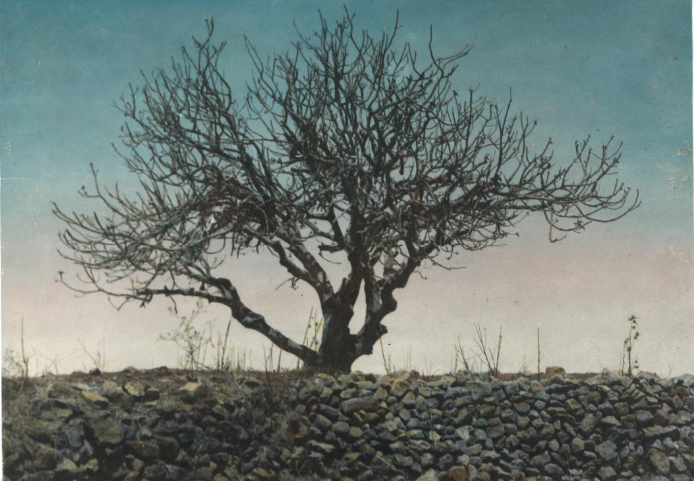
Fig Tree Stripped Bare by Locusts
Locust Plague of 1915
DEFOLIATION OF VINES
AND TREES
It (they) has made my vine a waste and my fig tree splinters - God ("My vine...My fig tree", cp Isa 5:3 "My vineyard" ~ nation of Israel) owns not only the land but the produce of the land. And here the very items He owns, He allows the locusts to destroy to arrest His people's attention, to bring them to a point of desperation, brokenness and repentance. While the primary sense is the destruction of the grape vines, there may be a double meaning because the “vine” is the well-known symbol of God’s people (Ps 80:8,14; Hosea 10:1; Isaiah 5:1-7; 27:2). Since fruitful vines and fig trees represented the blessing of the Lord on the land (1 Ki 4:25; Mic. 4:4; Zech. 3:10), so here we see a "divine inversion" of the pattern. The "good hand of the LORD" (as with Elijah - 1 Ki 18:46, Ezra - Ezra 7:6, 28, 7:9) was being removed from His people. (cf this aspect of the "hand of the LORD" in Ex 9:3 = against Egypt, Dt 2:15, Jdg 2:15 = against Israel, Ru 1:13 = Naomi, 1 Sa 7:13 = Philistines, etc)
NET Note on "IT" (they) - Throughout Joel 1:6–7 the Hebrew uses singular forms to describe the locust swarm, but the translation uses plural forms because several details of the text make more sense in English as if they are describing the appearance and effects of individual locusts.
Bob Utley - "It has made my vine a waste, and my fig tree splinters" The prophet is speaking for YHWH, for these agriculture products were gifts from Him (cf. Hosea 2:8, 9). Covenant violations removed YHWH's blessing (i.e., "waste," BDB 1031 I, cf. Deut. 28:37). Now they are totally taken away by the locusts (i.e., an army invasion).
Richard Patterson - Joel chides the people as those who would mourn the loss of vineyards, for that meant the loss of wine for drinking. In so doing, however, he calls attention not only to the vine but also to the fig tree. Both were well-known symbols of God’s blessing for his covenant people (cf. Hos 2:12; Amos 4:9; Mic 4:4; Hag 2:19; Zech 3:10 see also 1 Kgs 4:25; 2 Kgs 18:31, Ps 105:33; Isa 36:16; Jer 5:17; 8:13). In this, Joel recognized that the unprecedented locust plague was nothing less than the judgment of God upon his wayward people. Joel’s evaluation of his society stands as a warning to ours. That which so easily brings intoxication and personal degradation (Gen 9:21; 19:32; Prov 20:1; Isa 28:7) can easily corrupt one’s thinking, even that of God’s people (Hos 4:11). Far better is it to be free of its influence (Deut 29:6; Jer 35:6) and to be filled with the power of the Holy Spirit (Eph 5:18). While excessive drinking can lead to a degenerate lifestyle, it is not the only besetting sin. Whatever exerts so dominating and controlling an influence on a person’s life that it takes away spiritual vitality and productivity is sin; it needs to be abandoned (Rom 6:1–14; 14:23b; 1 John 5:21). May God help us to be preoccupied with Christ, not with selfish indulgence (Phil 3:7–11).(SEE Minor Prophets: Hosea through Malachi - Page 110)
Literally grapes and figs were two of the principle crops of the land of Israel but they are both laid bare! This devastation of these food staples is reminiscent of the prophetic curses that God would send on Israel if she disobeyed the Mosaic covenant. For example we read
"You shall plant and cultivate vineyards, but you shall neither drink of the wine nor gather the grapes, (WHY?) for the worm shall devour them." (Dt 28:39)

Locusts Chomping on Fig Leaves
Locust Plague of 1915
The fig tree splinters because the locusts with teeth like a lion gnaw off the outside bark, exposing the inner cambium.
NET Note - Both “vines” and “fig trees” are singular in the Hebrew text, but are regarded as collective singulars. Either the prophet speaks in the first person singular about his own vine in order to personalize the description, or we hear the voice of God speaking, and “my vine” and “my fig tree” do double duty to both represent the foliage being destroyed as well as the nation.
God frequently mentions vines and fig trees in the context of judgment
Jeremiah 8:13 “I will surely snatch them away,” declares the LORD; “There will be no grapes on the vine And no figs on the fig tree, And the leaf will wither; And what I have given them will pass away.”’”
Hosea 2:12 “I will destroy her vines and fig trees, Of which she said, ‘These are my wages Which my lovers have given me.’ And I will make them a forest, And the beasts of the field will devour them.
Habakkuk 3:17-18 Though the fig tree should not blossom And there be no fruit on the vines, Though the yield of the olive should fail And the fields produce no food, Though the flock should be cut off from the fold And there be no cattle in the stalls, Yet I will exult in the LORD, I will rejoice in the God of my salvation.
ESV Study Bible - The vine and fig tree are symbols of a prosperous and peaceful life for Israel (2 Kings 18:31; Mic. 4:4), which the Lord sees as His property.

Branches White
Locust Plague 1915
Their branches have become white - "Once choice leafy vegetation is no longer available to them, locusts have been known to consume the bark of small tree limbs, leaving them in an exposed and vulnerable condition. It is apparently this whitened condition of limbs that Joel is referring to here." (Net Notes Joel 1)
Bob Utley - "It has stripped them bare" This is a Qal INFINITIVE ABSOLUTE and a Qal PERFECT VERB from the same root (BDB 362, KB 359), which is a grammatical way of expressing intensification. ▣ "Their branches have become white" This is an agricultural allusion to the locusts destroying (by eating the green tips) the small branches of the trees. When the sun comes out it bleaches them white.
NET Note on - Once choice leafy vegetation is no longer available to them, locusts have been known to consume the bark of small tree limbs, leaving them in an exposed and vulnerable condition. It is apparently this whitened condition of limbs that Joel is referring to here.
D. Gilliland – These two trees are, in Scripture, used to describe a situation of idyllic prosperity as when men would sit under the vine and under the fig tree. Now these trees afford no shade and plenty has been exchanged for poverty. Whiting (see article below), gives a vivid description of the injury which can be inflicted on the fruit trees: "On every leaf dozens would be perched ... When the daintier morsels (fruit and leaves) were gone the bark was eaten off the young topmost branches which, after exposure to the sun, bleached snow white. Then, seemingly out of malice, they would gnaw off small limbs, perhaps to get at the pith within". (What the Bible Teaches)
Albert Barnes on It has made my vine a waste and my fig tree splinters - This describes an extremity of desolation. The locusts at first attack all which is green and succulent; when this has been consumed, then they attack the bark of trees. (Jackson’s Travels to Morocco ap. Kirby): “When they have devoured all other vegetables, they attack the trees, consuming first the leaves, then the bark.” (Shaw’s Travels, p. 257): “A day or two after one of these bodies were in motion, others were already hatched to glean after them, gnawing off the young branches and the very bark of such trees as had escaped before with the loss only of their fruit and foliage.” (Adansson, Ibid.): “They carried desolation wherever they passed. After having consumed herbage, fruit, leaves of trees, they attacked even their young shoots and their bark. Even the reeds, wherewith the huts were thatched, though quite dry, were not spared.” (Chenier, Recherches Historiques sur les Maures, iii. 496. “They destroyed the leaves and bark of the olive.” Dr. Freer, in Russell’s Aleppo, p. 230): “Everything in the country was devoured; the bark of figs, pomegranates, and oranges, bitter hard and corrosive, escaped not their voracity.” The effects of this wasting last on for many years. (Barnes' Notes on the Old Testament)
Barnes on It has stripped them bare and cast them away - (Constitutionnel, May, 1841, of locusts in Spain in that year. K.): “It is sufficient, if these terrible columns stop half an hour on a spot, for everything growing on it, vines, olive trees, and grain, to be entirely destroyed. After they have passed, nothing remains but the large branches, and the roots which, being under ground, have escaped their voracity.” (Philippians Trans. 1686. T. xvi. p. 148): “After eating up the corn, they fell upon the vines, the pulse, the willows and even the hemp, notwithstanding its great bitterness.” (Burekhardt, Notes, ii. 90): “They are particularly injurious to the palm trees; these they strip of every leaf and green particle, the trees remaining like skeletons with bare branches.” (Lichtenstein, Travels in South Africa. c. 46. p. 251): “The bushes were eaten quite bare, though the animals could not have been long on the spot. They sat by hundreds on a bush gnawing the rind and the woody fibres.” (Barnes' Notes on the Old Testament)
Barnes on Their branches have become white - (Alvarez, c. 33): “The country did not seem to be burnt, but to be much covered with snow, through the whiteness of the trees and the dryness of the herbs. It pleased God that the fresh crops were already gathered in.” (Barnes' Notes on the Old Testament)
Joel 1:8 Wail like a virgin girded with sackcloth for the bridegroom of her youth.
KJV Lament like a virgin girded with sackcloth for the husband of her youth.
NET Wail like a young virgin clothed in sackcloth, lamenting the death of her husband-to-be.
NLT Weep like a bride dressed in black, mourning the death of her husband.
BGT θρήνησον πρός με ὑπὲρ νύμφην περιεζωσμένην σάκκον ἐπὶ τὸν ἄνδρα αὐτῆς τὸν παρθενικόν
LXE Lament to me more than a virgin girded with sackcloth for the husband of her youth.
CSB Grieve like a young woman dressed in sackcloth, mourning for the husband of her youth.
ESV Lament like a virgin wearing sackcloth for the bridegroom of her youth.
NIV Mourn like a virgin in sackcloth grieving for the husband of her youth.
YLT Wail, as a virgin girdeth with sackcloth, For the husband of her youth.
- Wail like a virgin girded with sackclot: Joe 1:13-15 Joel 2:12-14 Isa 22:12 Isa 24:7-12 Isa 32:11 Jer 9:17-19 Jas 4:8-9 Jas 5:1
- For the bridegroom of her youth Pr 2:17 Jer 3:4 Mal 2:15
Related Passages:
Matthew 3:4 (SACKCLOTH, LOCUSTS) Now John himself had a garment of camel’s hair and a leather belt around his waist; and his food was locusts and wild honey.
Isaiah 22:12 Therefore in that day the Lord GOD of hosts called you to weeping, to wailing, To shaving the head and to wearing sackcloth.
James 4:8-9 Draw near to God and He will draw near to you. Cleanse your hands, you sinners; and purify your hearts, you double-minded. 9Be miserable and mourn and weep; let your laughter be turned into mourning and your joy to gloom.
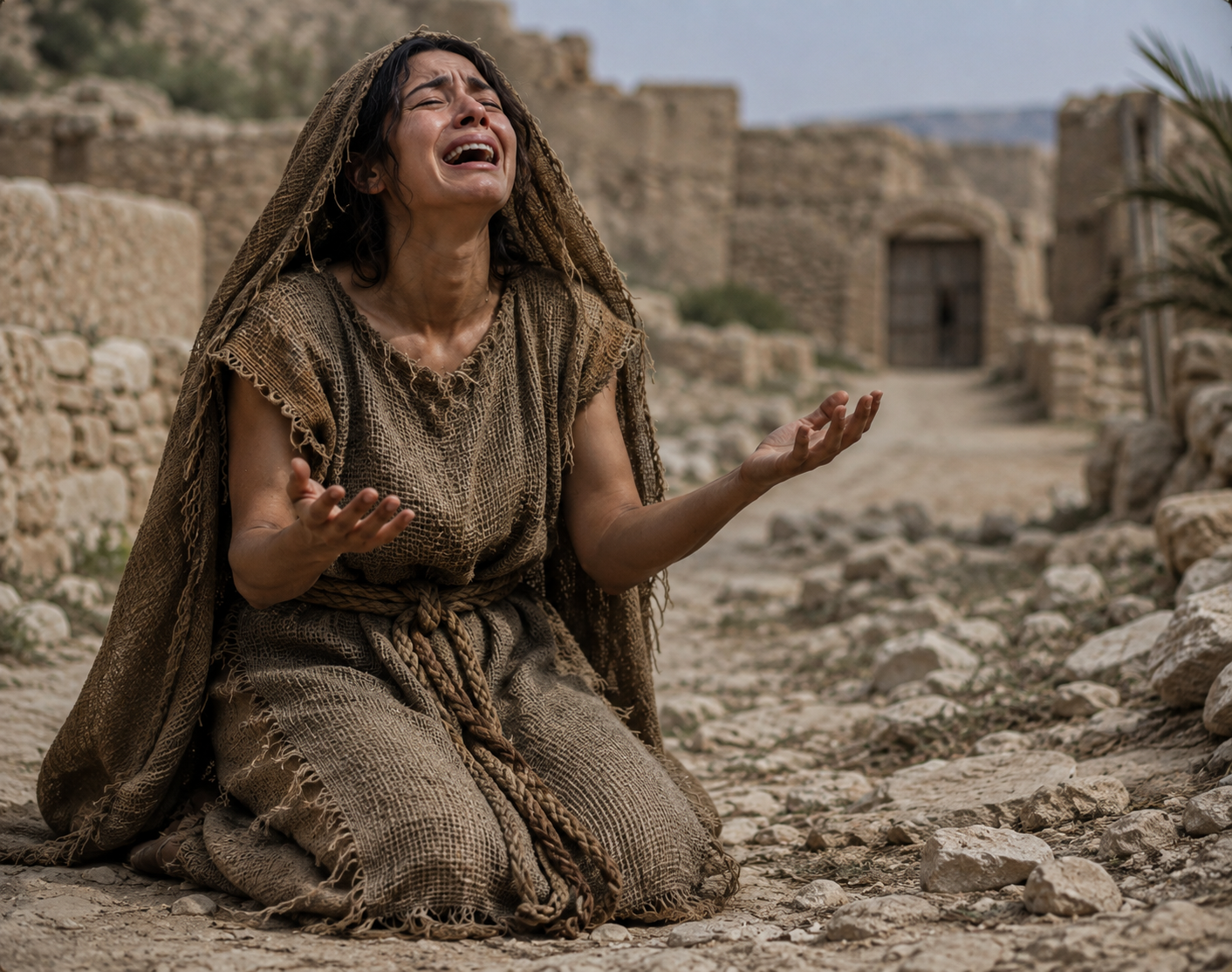
BITTER BEREAVEMENT LIKE
LOSS OF A BRIDEGROOM
Wail (alah) like a virgin (bethulah) girded with sackcloth (saq) for the bridegroom of her youth (or "like a bride dressed in black" = NLT but Patterson adds 'The NLT’s “husband” should not be taken to indicate that the marriage had been consummated—the young woman may yet have been in her father’s household.") - The subject is not clearly stated. A number of commentators feel since the imperative (wail) is feminine singular that this call is directed at Jerusalem which was often personified as a woman (cf Lam 1:1-2, Jer 31:15). Patterson adds that "Although the Hebrew text does not mention the death of a husband, such is the natural assumption of the virgin’s putting on sackcloth." (SEE Minor Prophets: Hosea through Malachi - Page 110)
NET Note on wail - The verb is feminine singular, raising a question concerning its intended antecedent. A plural verb would be expected here, the idea being that all the inhabitants of the land should grieve. Perhaps Joel is thinking specifically of the city of Jerusalem, albeit in a representative sense. The choice of the feminine singular verb form has probably been influenced to some extent by the allusion to the young widow in the simile of v. 8.
Thomas McComiskey sees Israel as the subject writing "Israel is to mourn like a young woman whose betrothed dies before the consummation of marriage; a time of anticipation and eagerness ends in frustration, disappointment, and sadness." (SEE The Minor Prophets: An Exegetical and Expository Commentary)
NET Note on “a young woman” (TEV, CEV). The word בְּתוּלָה (btulah) can be used as a technical term for “virgin” but often just refers to a young woman, perhaps to a woman who has not had children. Hebrew “over the husband of her youth.” The death of the husband is implied by the wailing. (Alternatively) The woman described here may already be married, so the reference is to the death of a husband rather than a fiancé (a husband-to-be). Either way, the simile describes a painful and unexpected loss to which the national tragedy Joel is describing may be compared.
The command issued is again a charge to lament like a young woman who has lost her prospective bridegroom and mourns (the LXX verb threueo can speak of a funeral dirge). The point is the depth of the loss to the young woman is profound, and so too would be the sense of loss to those in Judah at the losses suffered by the locust plague.
John MacArthur - The metaphor is significant because the OT speaks of the Lord as the husband of Israel, His wife (Isa 54:5-8; Jer 31:32). The covenantal offerings and libations could not be carried out; Israel, the wife of the Lord, was to repent, lest her relationship with the Lord became like that of the young widowed maiden. As with the drunkards, the religious leaders were to wail as a young maiden would upon the death of her youthful husband, wherein she exchanged the silky fabric of a wedding dress and the joy of a wedding feast for the scratchy, coarse clothing of goat's hair and the cry of a funeral dirge. (SEE MacArthur Study Bible) (SEE Israel the Wife of Jehovah)
Bob Utley - Wail like a virgin girded with sackcloth for the bridegroom of her youth" The VERBALS in this verse are all FEMININE SINGULAR ("wail," BDB 46, KB 51, Qal IMPERATIVE and "gird," BDB 291, KB 291, Qal PASSIVE PARTICIPLE used of putting on sackcloth, cf. Isa. 15:3; 22:12; Jer. 4:8; 6:26; 49:3; Lam. 2:10; Ezek. 7:18; 27:31), which may imply that Jerusalem as a whole is being addressed. The cultural setting is a betrothal in Jewish society. Apparently, betrothal was seen as marriage although unconsummated (cf. Mary and Joseph for the binding aspect of betrothal). Here the bride wears a sign of mourning (i.e., sackcloth, BDB 974) instead of a wedding garment. The social life of the people will be totally disrupted (cf. Joel 1:12, lines 5,6; Isa. 24:8-23). SEE Grieving Rites
Wail (0421)(alah) is a verb meaning to lament or wail and is used only in Joel 1:8 in the Bible. Unlike the more general term for weeping found in Joel 1:5 (bakah), the verb alah specifically denotes crying born of deep sorrow. The Lxx supports this idea translatinig alah with the Greek verb thorueo which is derived from threomai which means to shriek out and thus thorueo meant to express oneself in grief’, frequently in sounds and rhythms established by funereal custom in various regions of the ancient world.
NET Note - The verb (wail) is feminine singular, raising a question concerning its intended antecedent. A plural verb would be expected here, the idea being that all the inhabitants of the land should grieve. Perhaps Joel is thinking specifically of the city of Jerusalem, albeit in a representative sense. The choice of the feminine singular verb form has probably been influenced to some extent by the allusion to the young widow in the simile of v. 8. Heb “the husband of her youth.” The woman described here may already be married, so the reference is to the death of a husband rather than a fiancé (a husband-to-be). Either way, the simile describes a painful and unexpected loss to which the national tragedy Joel is describing may be compared. (Net Notes Joel 1)
Virgin (01330)(bethulah) is a feminine noun meaning virgin, a mature young woman that has never had sexual intercourse, and under the authority and protection of the father (translated as such 49x and once as maiden in the NAS). Judges 21:12 describes "400 young virgins who had not known a man by lying with him." So while the meaning of bethulah is unquestionably a virgin, that is not always the case for in Joel 1:8 we read "Wail like a virgin girded with sackcloth for the bridegroom of her youth," which suggests the bethulah is mourning for her husband. The LXX of Joel 1:8 translates bethulah with the noun nemphe which is literally a young woman engaged or newly married (Jn 3:29) Liddell-Scott on nymphe - a young wife, bride, Lat. nupta, 2. any married woman, 3. a marriageable maiden, 4. = Lat. nurus, daughter-in-law. Bruce Waltke adds that "in Joel 1:8, where the betûlâh is called upon to lament the death of her baʿal "husband," it probably does not mean "virgin" for elsewhere baʿal is the regular word for "husband" and its usual translation by "bridegroom" in the versions is otherwise unattested. (Theological Wordbook of the Old Testament)
Bethulah also refers to cities or countries that are personified as females (Isa. 37:22; 47:1; Jer. 18:13; 31:4, 21; Amos 5:2). Swanson adds that bethulah also means "young women, i.e., a class of young female, though the class may be virgins, the focus is on the youth group (Dt 32:25; Ps 148:12; Jer 31:13; Am 8:13)." Swanson adds that a third meaning of bethulah is "dear one, one cared for, loved one, formally, virgin daughter, a young woman who is loved by the father, with the associated meaning of being pure, innocent, and under the protection and care of the father (2Ki 19:21; Isa 23:12; 37:22, 22; 47:1, 1; Jer 46:11; La 1:15; 2:10, 13)."
Bethulah - 50x in 50v - maidens(1), virgin(32), virgins(17).Gen. 24:16; Exod. 22:16; Exod. 22:17; Lev. 21:3; Lev. 21:14; Deut. 22:19; Deut. 22:23; Deut. 22:28; Deut. 32:25; Jdg. 19:24; Jdg. 21:12; 2 Sam. 13:2; 2 Sam. 13:18; 1 Ki. 1:2; 2 Ki. 19:21; 2 Chr. 36:17; Est. 2:2; Est. 2:3; Est. 2:17; Est. 2:19; Job 31:1; Ps. 45:14; Ps. 78:63; Ps. 148:12; Isa. 23:4; Isa. 23:12; Isa. 37:22; Isa. 47:1; Isa. 62:5; Jer. 2:32; Jer. 14:17; Jer. 18:13; Jer. 31:4; Jer. 31:13; Jer. 31:21; Jer. 46:11; Jer. 51:22; Lam. 1:4; Lam. 1:15; Lam. 1:18; Lam. 2:10; Lam. 2:13; Lam. 2:21; Lam. 5:11; Ezek. 9:6; Ezek. 44:22; Joel 1:8; Amos 5:2; Amos 8:13; Zech. 9:17
- Virgin - Hastings' Dictionary of the Bible
- Virgin; Virginity - International Standard Bible Encyclopedia
- Virgin virginity - Hastings' Dictionary of the New Testament
Sackcloth generally was worn to depict sorrow and penitence or remorse for your past conduct. It was a rough, uncomfortable fabric that chaffed and irritated the skin. Other English dictionaries have this definition for penitence - the action of feeling or showing sorrow and regret for having done wrong, even repentance. Of course God's desire was that the despair from the dramatic losses would stimulate the people to search their hearts and come to a place of confession and repentance. God was not interested in external show but in internal surrender to Him.
Sackcloth (08242)(saq) means sack or sackcloth refers to a thick, coarse cloth, dark in color and typically woven from goat's hair and sometimes camel's hair. Sackcloth was worn traditionally to demonstrate mourning or despair; to convey the message dramatically. Sackcloth was used as a garment by mourners and those who wished to express contrition. It was worn in such a way as to leave the breast free for beating. As a garment of grief and self-abasement, sackcloth was sometimes the dress of the prophet who preached a message of repentance (cf. Rev. 11:3). Such a sight would be a call to trembling and repentance. Both Elijah and John, preachers of repentance, wore garments of camel's skin (2 Kings 1:8; Matthew 3:4). Persons might tear their clothes as well, especially at the death of a son. The word is also used of sacks used to transport various items of merchandise (Gen. 42:25, 27, 35)
Gilbrant - Sackcloth was worn by mourners who lamented either because of a national catastrophe (2 Ki. 6:30ff; Lam. 2:10) or a personal tragedy (Gen. 37:34; Job 16:15; Joel 1:8). For example, the elders of Jerusalem "cast up dust upon their heads; they have girded themselves with sackcloth" because of God's wrath which had come upon their nation (Lam. 2:10). Also, when Jacob was told that his beloved son Joseph had been mauled by a wild animal, he "rent his clothes, and put sackcloth upon his loins, and mourned for his son many days" (Gen. 37:34). The wearing of sackcloth symbolized a person's passionate desire for mercy from God (Dan. 9:3). The shape of the saq was possibly similar to a loincloth or a beanbag, while its dark color signified lamentation, grief and sorrow. Isaiah compared metaphorically the dark color of a sackcloth with the darkness of Israel's sky on account of their sin (Isa. 50:3). The darkness of the sackcloth contrasted the colorful garments worn at festive times and celebrations. Therefore, the absence of color signified sadness, while the presence of color signified joy. A saq could also be used as a holder of items such as food (Gen. 42:25, 27, 35; Lev. 11:32; Josh. 9:4) or as a blanket for covering (2 Sam. 21:10; Joel 1:13). (Complete Biblical Library)
Saq - 48x in 46v - sack(4), sackcloth(42), sacks(2). Gen. 37:34; Gen. 42:25; Gen. 42:27; Gen. 42:35; Lev. 11:32; Jos. 9:4; 2 Sam. 3:31; 2 Sam. 21:10; 1 Ki. 20:31; 1 Ki. 20:32; 1 Ki. 21:27; 2 Ki. 6:30; 2 Ki. 19:1; 2 Ki. 19:2; 1 Chr. 21:16; Neh. 9:1; Est. 4:1; Est. 4:2; Est. 4:3; Est. 4:4; Job 16:15; Ps. 30:11; Ps. 35:13; Ps. 69:11; Isa. 3:24; Isa. 15:3; Isa. 20:2; Isa. 22:12; Isa. 37:1; Isa. 37:2; Isa. 50:3; Isa. 58:5; Jer. 4:8; Jer. 6:26; Jer. 48:37; Jer. 49:3; Lam. 2:10; Ezek. 7:18; Ezek. 27:31; Dan. 9:3; Joel 1:8; Joel 1:13; Amos 8:10; Jon. 3:5; Jon. 3:6; Jon. 3:8
Resources on Sackcloth:
- Nave Topical Bible Sackcloth
- Torrey Topical Textbook Sackcloth
- American Tract Society Sack, Sackcloth
- Bridgeway Bible Dictionary Sackcloth
- Easton's Bible Dictionary Sackcloth
- Fausset Bible Dictionary Sackcloth
- Holman Bible Dictionary Sackcloth
- Hastings' Dictionary of the Bible Sackcloth
- Hastings' Dictionary of the NT Sackcloth Sackcloth
- Vines' Expository Dictionary Sackcloth
- Watson's Theological Dictionary Sackcloth
- International Standard Bible Encyclopedia Sackcloth
- Kitto Biblical Cyclopedia Sackcloth
- McClintock and Strong's Bible Encyclopedia Sackcloth
- The Jewish Encyclopedia Sackcloth
Joel 1:8-12 TODAY IN THE WORD
Godly sorrow brings repentance (See in depth word studies on The verb Repent = metanoeo; the noun Repentance = metanoia) that leads to salvation and leaves no regret. - 2 Corinthians 7:10
Dante Gabriel Rossetti, the British painter and poet, was so desolate when his wife committed suicide after only two years of marriage that he vowed to bury the poems he had written for her. He placed the book in the coffin, wrapped in the tresses of her long hair. But after a few years Rossetti regretted his decision. He believed that the poems were some of the best he had ever written. It seemed senseless to leave them buried. After a lengthy court battle Rossetti won the legal right to open the grave and recover the book.
Rossetti’s change of heart is similar to the way some people approach repentance. They may resolve to make changes or take action. But when the initial discomfort of their guilt dies down, they may have second thoughts and regret their decision. Others would prefer to avoid the discomfort of repentance altogether. They prefer a painless faith without the anguish of repentance. God, however, values repentance. One reason He allowed the people of Joel’s day to experience the devastation of the locust plagues was to bring them to a point of genuine grief over their sins (Joel 1:8). The resulting cessation of grain and drink offerings served as a painful reminder of the way their sins had hindered their fellowship with God (cf. Nu 29:39). These were hard measures designed to shatter their complacency. God intended for His people to feel remorse for their sin. The Hebrew term that is translated “despair” in Joel 1:11 might also be translated “be ashamed.” But this was not His only purpose. He did not merely hope that these experiences would make people feel badly about their sins. He also wanted them to “wail” or lament (Joel 1:11). True repentance expresses sorrow for sin.
TODAY ALONG THE WAY - Can you think of a time when you felt sorrow for sin? How did you respond to the sense of guilt and shame that you experienced? Not all sorrow for sin is true repentance. Genuine repentance may be painful, but it will enable you to see your need for the forgiveness that only Christ can offer. It is not too late to express your repentance for sin and to ask for God’s help in making the necessary changes in your life. “If we confess our sins, he is faithful and just and will forgive us our sins and purify us from all unrighteousness” (1John 1:9).
Joel 1:9 The grain offering and the drink offering are cut off From the house of the LORD. The priests mourn, The ministers of the LORD.
KJV The meat offering and the drink offering is cut off from the house of the LORD; the priests, the LORD'S ministers, mourn.
NET No one brings grain offerings or drink offerings to the temple of the LORD anymore. So the priests, those who serve the LORD, are in mourning.
NLT For there is no grain or wine to offer at the Temple of the LORD. So the priests are in mourning. The ministers of the LORD are weeping.
BGT ἐξῆρται θυσία καὶ σπονδὴ ἐξ οἴκου κυρίου πενθεῖτε οἱ ἱερεῖς οἱ λειτουργοῦντες θυσιαστηρίῳ
LXE The meat-offering and drink-offering are removed from the house of the Lord: mourn, ye priests that serve at the altar of the Lord.
CSB Grain and drink offerings have been cut off from the house of the LORD; the priests, who are ministers of the LORD, mourn.
ESV The grain offering and the drink offering are cut off from the house of the LORD. The priests mourn, the ministers of the LORD.
NIV Grain offerings and drink offerings are cut off from the house of the LORD. The priests are in mourning, those who minister before the LORD.
YLT Cut off hath been present and libation from the house of Jehovah, Mourned have the priests, ministrants of Jehovah.
- The grain offering and the drink offering are cut off : Joe 1:13,16 2:14 Ho 9:4
- The priests mourn,: Joe 2:17 La 1:4,16
- The ministers of the LORD: Ex 28:1 2Ch 13:10 Isa 61:6
WORSHIP OF THE LORD
IS JEOPARDIZED!
The grain offering and the drink offering are cut off - " Rather than grieving over what their loss of grain and wine meant to their daily consumption, they ought to have mourned the loss of their opportunities to perform the daily sacrifices. Without these products, the meal and drink offerings could not be offered. Both were crucial products in the sacrificial system. The drink offering is particularly significant to the full scriptural record. It was employed chiefly to accompany and culminate the offerings that are spoken of as having a pleasing aroma before God and that symbolize full dedication (the burnt offering, together with its grain offering, signifying active service) and loving communion (the peace offering) with God (Ex 29:38–42; Lev 2:2,9,16; Lev 6:14–18; Num 15:1–10; 28:3–8; 29:30)." (Patterson)
Empty altars meant empty stomachs!
Finley - For the average Judean, accustomed to presenting on a regular basis a portion of the harvest, it must have been quite a shock to be unable to supply the Lord’s portion, let alone have enough left to live on. (SEE Joel, Amos, Obadiah: An Exegetical Commentary - Page 30)
Bob Utley - "The grain offering and the libation are cut off From the house of the Lord" This seems to refer to the daily offerings. A lamb was offered in the morning (the Continual) and in the evening and was accompanied by a meal offering, wet with oil, and a wine libation. Therefore, the normal functions of the Temple were being disrupted. This was a sign of covenant violations and invasion (cf. Deut. 28:49-53).
Cut off (03772)(karath) in the more literal usage means cutting something off or down and like the grapes are "cut off" by the devouring locusts which cuts off the supply of wine for the drink offering and cuts off the supply of grain for the grain offering. The morning and evening offerings (Ex 29:38-42; Lev 23:13) required flour, wine, and oil, but now these were destroyed.
The effect of the cutting off of the offerings was to cut the people and the priests off from communion with God.
The priests mourn - The Hebrew expresses this as a fact. It is interesting that the Septuagint expresses it as a command for the priests to mourn using the verb pentheo denotes loud mourning such as the lament for the dead or for a severe, painful loss. One has to ask is their mourning over loss of the supply or over the loss of communion with the Source of the supply?
The priests would also undoubtedly mourn their loss of their divinely allocated supply of sustenance as they were allowed to eat a portion of the grain offering (Lev 2:3, 10).
Mourn (056)(abel from abal = to mourn) means to be in mourning process and speaks of actions and persons. The root verb abal describes mourning for the dead as did Jacob when he thought Joseph had died (Ge 37:34). Obstinate Israel heard the sad word in Ex 33:3 and went into mourning (Ex 33:4). Israel mourned after God killed the spies who gave a bad report in their foray to Canaan (Nu 14:39). Abel is used figuratively , "The earth mourns." (Isaiah 24:4).
Patterson on The ministers of the LORD - The Hebrew root of the word translated “ministers” (sharath) was often employed to depict the religious duties of the Levites and priests who served in the Tabernacle and Temple (cf. Ex 28:35, 43; 1 Chr 16:4, 37). It also became a technical term for one who does special or responsible service. Joseph was a minister to Potiphar (Ge 39:4), Joshua was Moses’s minister (Ex 24:13; 33:11; Josh 1:1), and Elisha performed a similar function for Elijah (1 Ki 19:21). The Greek word leitourgia (service) in the NT is similar in that it conveys the notion of priestly service. (Cornerstone Bible Commentary)
Finley on ministers of the LORD - (mĕšārĕtê YHWH, “ministers of Yahweh”) describes the priests more closely (see Additional Notes for a variant in LXX). They are those who perform the service before the Lord in the Temple. Joel attaches the phrase here to focus the scene even further. The priests, who are no less than those who attend to the Lord through offering and libation, have gone into deep mourning (אָבְלוּ, ʾābĕlû; cf. on v. 10 below). The Targum’s rendering, “the priests who serve in the house of the sanctuary of the Lord,” makes the parallel line descriptive. (Ibid)
The Preacher's Outline & Sermon Bible – The opportunity to worship through the required animal sacrifice, grain offerings, and drink offerings was now gone. If a person was truly faithful to the Lord, he was bound to suffer deep grief and sorrow due to his inability to worship the Lord as instructed. Also, the people were no longer able to support the priests, which probably meant that most of them would have to give up their ministries in order to have time to scratch out a living day by day.
D. Gilliland – Within the city there is one area where the result of the locust invasion will be felt more keenly than any other. That is the Sanctuary of the Lord. Here the worship had been crippled and reduced to poverty. Since the crops of grain had been devoured there was no flour for meal offerings, and since the vines had been stripped there was no wine for the drink offering. The fact that these offerings were "cut off" had its effect on the priests, for part of the meal offering was the priests' food. Not only was the Lord's portion withheld but the priests' portion also suffered and they mourned. However, it was more than personal loss which made them mourn, it was rather their inability to present to the Lord His due. So much seems to be implied by the designation in the verse of the priests as "the Lord's ministers". In fact, there was the daily meal offering, presented morning and evening, symbolising the relationship of the people with the Lord Himself and His covenantal blessing upon them. The suspension of this offering struck at the core of the nation's religious existence and her devotions. The very constitution of the nation was in question as the reason for its existence was to be a "kingdom of priests" worshipping the Lord. They could no longer fulfil their responsibilities in this regard. (What the Bible Teaches)
Joel 1:10 The field is ruined, The land mourns; For the grain is ruined, The new wine dries up, Fresh oil fails.
KJV The field is wasted, the land mourneth; for the corn is wasted: the new wine is dried up, the oil languisheth.
NET The crops of the fields have been destroyed. The ground is in mourning because the grain has perished. The fresh wine has dried up; the olive oil languishes.
NLT The fields are ruined, the land is stripped bare. The grain is destroyed, the grapes have shriveled, and the olive oil is gone.
BGT ὅτι τεταλαιπώρηκεν τὰ πεδία πενθείτω ἡ γῆ ὅτι τεταλαιπώρηκεν σῖτος ἐξηράνθη οἶνος ὠλιγώθη ἔλαιον
LXE For the plains languish: let the land mourn, for the corn languishes; the wine is dried up, the oil becomes scarce;
CSB The fields are destroyed; the land grieves; indeed, the grain is destroyed; the new wine is dried up; and the olive oil fails.
ESV The fields are destroyed, the ground mourns, because the grain is destroyed, the wine dries up, the oil languishes.
NIV The fields are ruined, the ground is dried up; the grain is destroyed, the new wine is dried up, the oil fails.
YLT Spoiled is the field, mourned hath the ground, For spoiled is the corn, Dried up hath been new wine, languish doth oil.
NKJ The field is wasted, The land mourns; For the grain is ruined, The new wine is dried up, The oil fails.
NJB The fields are ruined, the land is in mourning, for the grain has been ruined, the new wine has failed, of olive oil only a trickle.
- The field is ruined: Joe 1:17-20 Lev 26:20 Isa 24:3,4 Jer 12:4,11 14:2-6 Ho 4:3
- The new wine dries up: Joel 1:5,12 Isa 24:11 Jer 48:33 Ho 9:2 Hag 1:11
Related Passages:
Leviticus 10:12-13 (SOURCE OF PRIESTS' LIVELIHOOD) Then Moses spoke to Aaron, and to his surviving sons, Eleazar and Ithamar, “Take the grain offering that is left over from the LORD’S offerings by fire and eat it unleavened beside the altar, for it is most holy. 13“You shall eat it, moreover, in a holy place, because it is your due and your sons’ due out of the LORD’S offerings by fire; for thus I have been commanded.
Exodus 29:38-42 (ITEMS USED IN DAILY SACRIFICES) “Now this is what you shall offer on the altar: two one year old lambs each day, continuously. 39“The one lamb you shall offer in the morning and the other lamb you shall offer at twilight; 40and there shall be one-tenth of an ephah of fine flour mixed with one-fourth of a hin of beaten oil, and one-fourth of a hin of wine for a drink offering with one lamb. 41“The other lamb you shall offer at twilight, and shall offer with it the same grain offering and the same drink offering as in the morning, for a soothing aroma, an offering by fire to the LORD. 42“It shall be a continual burnt offering throughout your generations at the doorway of the tent of meeting before the LORD, where I will meet with you, to speak to you there.
JUDAH'S AGRICULTURE
DEVASTATED
The field is ruined (shadad) The land mourns (abal; LXX - talaiporeo - of emotion resulting from inner or outer torment be wretched); For the grain is ruined, The new wine dries up, Fresh oil fails. - The field of course stands for the crops grown in the field and indicate that the crops have been utterly destroyed by the locusts. The Hebrew and LXX personify the land as tormented, wretched!
NET Note - "the field has been utterly destroyed." The term "field," a collective singular for "fields," is a metonymy for crops produced by the fields. Joel uses intentionally alliterative language in the phrases שֻׁדַּד שָׂדֶה (shuddad sadeh, “the field is destroyed”) and אֲבְלָה אֲדָמָה (’avlah ’adamah, “the ground is in mourning”).
Bob Utley - Israel's agriculture was totally destroyed by the locusts (i.e., military invasion, cf. Isa. 16:10; 24:4,7). "the land mourns" The Prophets regularly use personification to heighten their metaphors: Isaiah - "gates shall lament and mourn," Isa. 3:26, "the earth mourns," Isa. 24:4; 33:9, "the new wine mourns," Isa. 24:7. Jeremiah - "earth mourns," Jer. 4:28, "land mourns," Jer. 12:4 Hosea - "land mourns," Jer. 4:3 It is possible that "mourns" (BDB 5, KB 6, Qal PERFECT) can mean "dry up" (KB 7 II) from an Akkadian root. If so, it (the land) would parallel "the new wine," both being dried up. The VERB "dried up" (BDB 386, KB 384, Hiphil PERFECT) is used several times in this context.
The land mourns - (same verb abal used for priests' mourning in Joel 1:9 and here the Lxx is again the verb pentheo and is in the present imperative) - Land personified as even mourns over the devastation. This same phrase is used only 3 other times, all in the prophets who are speaking of Israel...
Isaiah 33:9 The land mourns and pines away, Lebanon is shamed and withers; Sharon is like a desert plain, And Bashan and Carmel lose their foliage.
Jeremiah 23:10 For (Jer 23:8-9) the land is full of adulterers; For the land mourns because of the curse. The pastures of the wilderness have dried up. Their course also is evil And their might is not right.
Hosea 4:3 Therefore (See Hos 4:1-2, esp "Because there is no faithfulness or kindness") the land mourns, And everyone who lives in it languishes Along with the beasts of the field and the birds of the sky, And also the fish of the sea disappear.
Patterson adds this note on the land mourns - Although it can be used figuratively (e.g., “the earth mourns,” Isa 24:4) and in parallelism with verbs of weeping (2 Sa 19:2), the verb ʾabal [56, 61] is often used of mourning for the dead (2 Sa 13:31–37) or in connection with an announcement of coming judgment (Neh 1:4; Esther 4:3).....the grain...new wine (grapes)...oil - The loss of these crops, customarily harvested in the fall, points to God’s fulfilling the threatened judgment upon his nation for covenant unfaithfulness and transgressions (cf. Deut 28:51). All three were important agricultural products and deemed to be the result of God’s blessing upon his people—blessings that could be withdrawn as punishment for sin (Num 18:12; Deut 7:13; 11:14; 28:51; Jer 31:12). (See Minor Prophets: Hosea through Malachi - Page 109)
Ruined (07703)(shadad) means to spoil, to deal violently with, despoil, devastate, ruin, ravage, oppress, assault, lay waste. This verb is not found in the Pentateuch but predominantly in the prophets especially Jeremiah. Shadad is describes Babylon as the "destroyer" of Jerusalem (Jeremiah 6:26; Jeremiah 12:12), God's instrument for punishing Judah. But then shadad is used of God's anger on Babylon (Jer 51:48, 53, 55, 56; Ps 137:8). One gets a sense of the ferocity of shadad in its use describing the activities of a wolf (Jeremiah 5:6) who pursues, attacks, and mauls its victim. Shadad describes the destruction of the unfaithful due to their duplicity (Pr 11:3). Jeremiah uses the word to describe the destruction of the Tabernacle and the barrenness when everything was taken away (Jer. 10:20).
The LXX translates shadad in this verse with the verb talaiporeo which means to experience distress, to toil heavily, to endure labors and hardships; to be afflicted; to feel afflicted and miserable, endure sorrow/distress (James 4:9).
The shadad had been sent by Shadday, the Hebrew name for Shaddai as in the name of God, EL Shaddai - God Almighty.
Shadad - 56x in - assaults(1), completely destroyed(1), dead(1), desolate(1), despoil(1), destroy(7), destroyed(12), destroyer(9), destroyer still destroys(1), destroyers(4), destroying(2), devastate(2), devastated(6), lays waste(1), robbers(1), ruined(6). Jdg. 5:27; Job 12:6; Job 15:21; Ps. 17:9; Ps. 91:6; Ps. 137:8; Prov. 11:3; Prov. 19:26; Prov. 24:15; Isa. 15:1; Isa. 16:4; Isa. 21:2; Isa. 23:1; Isa. 23:14; Isa. 33:1; Jer. 4:13; Jer. 4:20; Jer. 4:30; Jer. 5:6; Jer. 6:26; Jer. 9:19; Jer. 10:20; Jer. 12:12; Jer. 15:8; Jer. 25:36; Jer. 47:4; Jer. 48:1; Jer. 48:8; Jer. 48:15; Jer. 48:18; Jer. 48:20; Jer. 48:32; Jer. 49:3; Jer. 49:10; Jer. 49:28; Jer. 51:48; Jer. 51:53; Jer. 51:55; Jer. 51:56; Ezek. 32:12; Hos. 10:2; Hos. 10:14; Joel 1:10; Obad. 1:5; Mic. 2:4; Nah. 3:7; Zech. 11:2; Zech. 11:3
Mourns (verb) (056) abal means to be in mourning process and speaks of actions and persons. The root verb abal describes mourning for the dead as did Jacob when he thought Joseph had died (Ge 37:34). Obstinate Israel heard the sad word in Ex 33:3 and went into mourning (Ex 33:4). Israel mourned after God killed the spies who gave a bad report in their foray to Canaan (Nu 14:39).
TWOT on the root verb abal - ʾābal describes mourning rites for the dead, though often, in its thirty-nine occurrences, it is used figuratively, "The land mourneth" (Isaiah 24:4). Some propose a separate meaning, "to dry up," when ʾābal parallels yābēsh (Jeremiah 12:4; Jeremiah 23:10; Amos 1:2; KB, p. 6): but "mourning" is contextually preferable (Jeremiah 12:11). Biblical mourning for the dead (expressed by abal, sāpad, etc.) involved emotion, usually expressed audibly (Jeremiah 22:18; Jeremiah 48:36) and visibly (Genesis 37:34; Psalm 35:14; Micah 1:8), especially for the decease of important leaders (2 Chr. 35:24-25; Ezek 31:15). Professional mourning women could be hired (Jeremiah 9:17; Eccles. 12:5), or the emotion could be merely simulated (2 Sa 14:2, ʾābal, Hithpael, "feign oneself a mourner"; Matthew 11:17). Yet the OT forbad such pagan exhibitions as tearing one's hair or flesh for the dead (Leviticus 19:28; Leviticus 21:5; but see Jeremiah 16:6; Jeremiah 41:5); for the OT gave an underlying assurance of immortality (Psalm 73:24; Job 19:25-27, Proverbs 15:24) and held out the prospect of bodily resurrection (Psalm 16:9-11; Isaiah 26:19; Daniel 12:2). (Theological Wordbook of the Old Testament online)
Joel 1:11 Be ashamed, O farmers, Wail, O vinedressers, For the wheat and the barley; Because the harvest of the field is destroyed.
KJV Be ye ashamed, O ye husbandmen; howl, O ye vinedressers, for the wheat and for the barley; because the harvest of the field is perished.
NET Be distressed, farmers; wail, vinedressers, over the wheat and the barley. For the harvest of the field has perished.
NLT Despair, all you farmers! Wail, all you vine growers! Weep, because the wheat and barley-- all the crops of the field-- are ruined.
BGT ἐξηράνθησαν οἱ γεωργοί θρηνεῖτε κτήματα ὑπὲρ πυροῦ καὶ κριθῆς ὅτι ἀπόλωλεν τρυγητὸς ἐξ ἀγροῦ
LXE the husbandmen are consumed: mourn your property on account of the wheat and barley; for the harvest has perished from off the field.
CSB Be ashamed, you farmers, wail, you vinedressers, over the wheat and the barley, because the harvest of the field has perished.
ESV Be ashamed, O tillers of the soil; wail, O vinedressers, for the wheat and the barley, because the harvest of the field has perished.
NIV Despair, you farmers, wail, you vine growers; grieve for the wheat and the barley, because the harvest of the field is destroyed.
YLT Be ashamed, ye husbandmen, Howl, vine-dressers, for wheat and for barley, For perished hath the harvest of the field.
- Be ashamed, O farmers: Jer 14:3,4 Ro 5:5
- Because the harvest of the field is destroyed: Isa 17:11 Jer 9:12
Related Passages:
Amos 5:16-17 Therefore thus says the LORD God of hosts, the Lord, “There is wailing in all the plazas, And in all the streets they say, ‘Alas! Alas!’ They also call the farmer to mourning And professional mourners to lamentation. 17 “And in all the vineyards there is wailing, Because I will pass through the midst of you,” says the LORD.
A SOBERING COMMAND:
BE ASHAMED! BE EMBARRASSED!
Be ashamed (bosh), O farmers, Wail (yalal) O vinedressers - Once again, both “be ashamed” and “wail” are commands (imperatives). This is not a call for merely outward displays of grief, but for genuine inward brokenness. The devastation of Judah's crops was more than an agricultural catastrophe. It was a warning message from God, intended to awaken His people from their spiritual stupor and self-deception and turn their hearts back to the Creator, the One Who had given fertility to their fields in the first place (cf. Dt 8:10–18; Hos 2:8–9). The loss of their crops should remind them that every good gift ultimately comes from God and remains under His sovereign control: “The LORD gave and the LORD has taken away. Blessed be the name of the LORD” (Job 1:21). Peter's later words to Israel express the same principle: “Therefore repent and return, so that your sins may be wiped away, in order that times of refreshing may come from the presence of the Lord” (Acts 3:19). God's discipline is intended to turn His people back to Himself (Heb 12:5–11; Rev 3:19).
🙏 THOUGHT - Dear wayward saint, remember that the road back to fellowship with God always passes through brokenness, confession, and repentance (Ps 51:17; Pr 28:13; 1 Jn 1:9). Like the prodigal son, we must “come to our senses,” arise, and return to our Father (Lk 15:17–24). The physical devastation was intended to produce a spiritual response. God was using the calamity not merely to make Judah mourn over what they had lost, but to make them recognize how far they had wandered from Him. This anticipates Joel's great appeal: “Return to Me with all your heart, and with fasting, weeping and mourning; and rend your heart and not your garments” (Joel 2:12–13). And when we return, we discover that the Father we wandered from is ready to receive the repentant child. Calamity gets our attention. Repentance turns our attention back to God.
Be ashamed as explained below conveys a combination of disappointment and disgrace, with a touch (hopefully) of embarrassment.
Thomas Finley - The failure of the harvest humiliates the farmers; they have nothing to show for their work. Consequently, they too should participate in ritual mourning, a rite that shows shame as well as sorrow (cf. Jer 48:1–5). (See Joel, Amos, Obadiah: An Exegetical Commentary - Page 31)
Richard Patterson - The imperatives directed at those who tend the crops reflect a sense of shame and intense disappointment, which is reflected in a terrified look and bitter cry (cf. Amos 5:16,17). (See Minor Prophets: Hosea through Malachi - Page 109)
For the wheat and the barley; Because the harvest of the field is destroyed - "Wheat and barley” function as a metonymy representing the total loss of the agricultural harvest." (Patterson)
Bob Utley - "for the wheat and the barley" Wheat (BDB 334) and barley (BDB 972) were the two major agricultural products in Palestine. The wheat was used for the bread of the wealthy and the barley for the bread of the poor.
Be ashamed (0954)(bosh from root = “to become pale” or “to blush”) is a verb which conveys the primary meaning of to fall into disgrace, normally through failure, either of self or of an object of trust. It is both an external and a subjective experience, ranging from disgrace (Hos. 10:6) to guilt (Ezra 9:6) When failure or sin occurs, there is a disconcerting feeling, a flushing of the face. This Hebrew verb bosh often occurs in contexts of humiliation and shattered human emotions, and can include the feeling of public disgrace. The confusion, embarrassment, or dismay when things do not turn out as expected.
Ashamed - Affected by shame; abashed or confused by guilt or a conviction of some criminal action or indecorous conduct, or by the exposure of some gross errors or misconduct, which the person is conscious must be wrong, and which tends to impair his honor or reputation. Confused by a consciousness of guilt or of inferiority; by the mortification of pride; by failure or disappointment.(Webster, 1828).
Shame - A painful sensation excited by a consciousness of guilt, or of having done something which injures reputation; or by the exposure of that which nature or modesty prompts us to conceal. Shame is particularly excited by the disclosure of actions which, in the view of men, are mean and degrading. Hence it is often or always manifested by a downcast look or by blushes, called confusion of face. (Webster, 1828).
The Advantages of a Bad Harvest (Joel 1:11, 12) —WILLIAM FORSYTH
I. It recalls us to a sense of dependence upon God.
II. It awakens us to a deeper feeling of the evil of sin.
III. It serves as a time of discipline for the improvement of character and the promotion of the general good.
IV. It impresses the soul with a sense of its higher needs and duties.
V. It invites us to draw nearer to God, and to regard Him as the only true and supreme God.
Joel 1:12 The vine dries up And the fig tree fails; The pomegranate, the palm also, and the apple tree, All the trees of the field dry up. Indeed, rejoicing dries up from the sons of men.
- The vine dries up Joe 1:10 Hab 3:17,18
- The pomegranate: Nu 13:23 Ps 92:12 Song 2:3 4:13 7:7-9
- Indeed, rejoicing dries up from the sons of men: Joel 1:16 Ps 4:7 Isa 9:3 Isa 16:10 Isa 24:11 Jer 48:3 Ho 9:1,2
Related Passages:
Numbers 13:23 Then they came to the valley of Eshcol and from there cut down a branch with a single cluster of grapes; and they carried it on a pole between two men, with some of the pomegranates and the figs.
Deuteronomy 8:8 a land of wheat and barley, of vines and fig trees and pomegranates, a land of olive oil and honey;
Joel 1:16 Has not food been cut off before our eyes, Gladness and joy from the house of our God?
Isaiah 16:10 Gladness and joy are taken away from the fruitful field; In the vineyards also there will be no cries of joy or jubilant shouting, No treader treads out wine in the presses, For I have made the shouting to cease.
Isaiah 24:11 There is an outcry in the streets concerning the wine; All joy turns to gloom. The gaiety of the earth is banished.
FRUITLESSNESS
DAMPENS JOY
The vine dries up (yabesh; LXX - xeraino) And the fig tree fails; The pomegranate, the palm also, and the apple tree, All the trees of the field dry up (yabesh). Indeed, rejoicing dries up (yabesh) from the sons of men.- Note the keyword, dries up...dry up...dries up. The locusts "menu" includes anything everything edible, all of which are items men are dependent upon. When we disobey God, we step out on "thin ice" so to speak. In Judah's case the "fruit" they reaped for the seeds of sin they sowed was costly indeed.
Holman Old Testament Commentary – The pomegranate (Deut. 8:8), the date palm (Lev. 23:40), and the apple tree (Prov. 25:11) represent fruit that was eaten as well as objects revered for their beauty and their connection with lovers. The sweetness of life had disappeared. (See Holman Old Testament Commentary - Hosea, Joel, Amos - Page 120)
Indeed, rejoicing dries up (yabesh) from the sons of men -Why does their joy dry up? Because their rejoicing was concentrated on their temporal supply rather than their eternal all sufficient supply in El Shaddai. Their joy was rooted in the gifts rather than the Giver, in the harvest rather than the Lord of the harvest. And temporal supplies are always vulnerable to loss, decrease, decay, or destruction (have we not all experienced this?). But El Shaddai, the Almighty, is immutable, inexhaustible, and eternally sufficient. When earthly supplies dry up, He remains an unfailing source of “soul food” for those who trust in Him (Ps 16:11; 73:25–26; Hab 3:17–18; Php 4:11–13, 19). Habakkuk beautifully expresses this truth. Even when the fig tree does not blossom, the vines produce no grapes, and the fields yield no food, he declares, “Yet I will exult in the LORD, I will rejoice in the God of my salvation” (Hab 3:17–18). Neh 8:10 says "the joy of the LORD is our strength!" Jude 1:24-25 describes our FUTURE JOY - "Now to Him who is able to keep you from stumbling, and to make you stand in the presence of His glory blameless with great joy, to the only God our Savior, through Jesus Christ our Lord, be glory, majesty, dominion and authority, before all time and now and forever. Amen." (cf Ps 16:11)
Joy rooted in our supply will rise and fall with our circumstances;
joy rooted in Shaddai rests securely in the One Who never changes.
Dries up is a key verb in Joel 1, where it is used in 4 verses: Joel 1:10, 12, 17, 20 -- describes the new wine dries up in Joel 1:10, The vine dries up in Joel 1:12. the grain dried up in Joel 1:17 and the water brooks dried up in Joel 1:20.
🙏 THOUGHT - The effect here of drying up circumstances in Joel 1:12 is to cause one's soul to dry up or wither! How's your joy today? If it is in people, circumstances, wine, fig trees, etc? If so, then look out because it is vulnerable and transient. If your joy is "in (locative of sphere) the LORD" as described in Paul's command in Php 4:4, then your Source of joy is inexhaustible and unwavering! (See related THOUGHT below)
NET Note on apple - This Hebrew word וְתַפּוּחַ (vetappuakh) probably refers to the apple tree (so most English versions), but other suggestions that scholars have offered include the apricot, citron, or quince.
Richard Patterson - Joel’s words to those who tend the crops (Joel 1:11–12) are also instructive. Although they would weep over the economic loss and the cutoff of their food supply, the commodities mentioned also had spiritual significance. Especially noteworthy are the vine and fig tree. These appear at times in the Scriptures to symbolize the basic relation of God to his people, as well as the blessings he bestows on them for their obedience (Ps 80:8–15; Isa 5:2–6; Jer 2:21; cf. Mt 21:18–21, 28–46). Indeed, the divine promise to a faithful remnant spoke of a future peace, prosperity, and felicity, symbolized by sitting under one’s own vine and fig tree (Mic 4:4; Zech 3:10). Likewise, the pomegranate, palm, and apple trees were not only important to the economy but often symbolized spiritual nourishment, refreshment, joy, and fruitfulness of life (Dt 8:6–10; Ps 92:12; Song 2:3). (SEE Minor Prophets: Hosea through Malachi - Page 112)
A fruitful life is a joyful life, and
fruit borne in time bears dividends in eternity.🙏 THOUGHT - There is surely an application for us today in Joel 1:12, where fruitlessness and the loss of joy are closely associated: “Indeed, rejoicing dries up from the sons of men.” Does not spiritual fruitlessness likewise diminish our joy? The question is rhetorical, of course! There is great joy in bearing fruit during the brief “day” God has given us to serve Him, especially as we anticipate the eternal rewards He will graciously bestow for faithfulness in time (2Co 5:10). Jesus said, “I chose you, and appointed you that you would go and bear fruit, and that your fruit would remain” (HOW LONG? THROUGHOUT ETERNITY!) (Jn 15:16). And significantly, in the same context Jesus connects fruit-bearing, abiding, and fullness of joy (Jn 15:5, 8, 11). Of course, the fruit we bear is ultimately produced by the Spirit, not by self-effort for “the fruit of the Spirit is love, joy, peace, patience, kindness, goodness, faithfulness, gentleness, self-control” (Gal 5:22–23). As we abide in Christ and walk by the Spirit (Gal 5:16), He produces fruit that glorifies the Father now and has consequences that reach into eternity.
Holman Old Testament Commentary – Throughout the section the prophet uses a play on Hebrew words meaning to be ashamed (bosh) and to dry up (yabesh). This comes to a climax here as the prophet summarizes all he has tried to say. Add up his inventory of resources, and you discover that "the jubilation has been put to shame (or withered away) from among the sons of man" (author's translation). Causes for joy are now causes for shame. Joy has dried up and withered away from Judah and Jerusalem. (SEE Holman Old Testament Commentary - Hosea, Joel, Amos- Page 120)
Dries up (03001) yabesh (יָבֵשׁ, yābēš) is a verb meaning to be dry, become dry, dry up, wither, shrivel, or cause something to dry up. It occurs about 70 times in the Old Testament and describes the loss of the moisture necessary to sustain normal life and vitality. It can refer literally to water disappearing, land becoming parched, vegetation withering, bread becoming dry, or a bodily member shriveling, and figuratively to failing strength, emotional distress, human mortality, and divine judgment. The basic picture is something that once possessed moisture, vitality, strength, or fruitfulness but has lost that life-sustaining supply and consequently dries up or withers. Thus yabesh naturally stands close to the concepts of weakness, barrenness, and even death. This makes the word especially vivid in Joel 1, where the vegetation withers and even human rejoicing “dries up” (Joel 1:12).
Literal Drying and Withering
Yabesh is frequently used in its straightforward physical sense. After the Flood, “the water was dried up from the earth” (Ge 8:7), and eventually “the surface of the ground was dried up” (Ge 8:14). Bread can become dried out (Josh 9:5), streams can dry up (1Ki 17:7), drought can parch the land (Jer 23:10; Amos 4:7), and grass, crops, and other vegetation can wither (Isa 19:7; 40:7–8; 42:15).
This physical meaning is especially prominent with vegetation. While yabesh overlaps with charab, another Hebrew word for drying up, yabesh is used especially for vegetation losing its moisture and withering, whereas charab is more frequently associated with bodies of water becoming dry.
The Sovereign Power of God
One of the most important theological uses of yabesh is to demonstrate Yahweh's absolute sovereignty over creation. What normally requires natural processes (which of course He is in control of also!), God can accomplish simply by His sovereign command.
He dried up the Red Sea so that Israel could escape Egypt (Josh 2:10), and later dried up the Jordan so His people could enter Canaan (Josh 4:23). The repetition of these miracles demonstrates that the God Who delivered Israel in one generation had not changed in the next. The psalmist therefore celebrates the LORD as the One Who “dried up ever-flowing streams” (Ps 74:15).
God's control extends equally to rain, rivers, seas, and vegetation:
He can withhold water until the land dries up (Job 12:15).
He can cause vegetation to wither (Isa 40:24).
He can dry up rivers (Isa 42:15).
“He rebukes the sea and makes it dry; He dries up all the rivers” (Nah 1:4).
Thus yabesh can become a word demonstrating God's omnipotence and sovereignty. The sea, rivers, rain, land, and vegetation remain entirely under His control.
Drying Up as Divine Judgment
Because water sustains life, yabesh naturally becomes a powerful picture of divine judgment. When God withholds the normal sources of life and fruitfulness, what once flourished begins to wither.
This judgment can fall upon entire nations. Moab's waters and vegetation dry up (Isa 15:6); Egypt's waters fail and its vegetation withers (Isa 19:5–7); Babylon's waters are threatened with drought (Jer 50:38; 51:36); and Israel and Judah experience the drying of their land and vegetation because of their rebellion (Jer 12:4; Joel 1:10–12, 20).
Ezekiel employs the withering of a vine as an illustration of God's judgment upon Judah (Ezek 17:9–10), and God declares His sovereignty over both exaltation and humiliation: “I am the LORD; I have brought down the high tree, exalted the low tree, dried up the green tree and made the dry tree flourish.” (Ezek 17:24)
God's judgment can also cause an individual physically to wither or shrivel. When Jeroboam stretched out his hand against God's prophet, “his hand which he stretched out against him dried up, so that he could not draw it back to himself” (1Ki 13:4; cf. Zech 11:17).
The imagery is unmistakable: God is the Source of life, and rebellion against the Source of life ultimately produces barrenness, withering, and death.
A Picture of Human Frailty and Mortality
Yabesh also vividly portrays the brevity and frailty of human life. Moses compares man's brief existence to grass: “In the morning it flourishes and sprouts anew; toward evening it fades and withers away.” (Ps 90:6)
Isaiah develops the same picture: “The grass withers, the flower fades, when the breath of the LORD blows upon it; surely the people are grass. The grass withers, the flower fades, but the word of our God stands forever.” (Isa 40:7–8)
Here the transient nature of man is deliberately contrasted with the permanence of God's Word. Man is like grass that flourishes briefly and then yabesh, withers away, but God's Word never withers.
The word can similarly describe the exhaustion of human strength. In the Messianic Psalm 22, the suffering One declares, “My strength is dried up like a potsherd” (Ps 22:15). Job likewise uses drying imagery for the approach of death (Job 14:11–12).
Thus yabesh reminds us that human vitality is temporary and dependent, while God and His Word are permanent and inexhaustible.
Emotional and Spiritual Withering
The physical image of something drying up can also describe the inner life of a person. The afflicted psalmist cries: “My heart has been smitten like grass and has withered away.” (Ps 102:4; cf. Ps 102:11)
Proverbs similarly observes the relationship between inward condition and physical vitality: “A joyful heart is good medicine, but a broken spirit dries up the bones.” (Pr 17:22)
The imagery moves from vegetation deprived of moisture to a person deprived of emotional vitality. Just as a plant withers when deprived of water, the human spirit can seem to wither under prolonged grief, affliction, discouragement, or distress.
Yabesh in Joel 1:12 - Joy Dries Up
This background gives special force to Joel's declaration: “Indeed, rejoicing dries up from the sons of men.” (Joel 1:12)
Joel deliberately surrounds this statement with things that have literally dried up and withered: “The vine dries up and the fig tree fails; the pomegranate, the palm also, and the apple tree, all the trees of the field dry up. Indeed, rejoicing dries up from the sons of men.” (Joel 1:12)
The progression is striking. The same word-picture moves from the physical world into the human heart: The trees wither → the harvest disappears → the people's joy withers.
The outward devastation has produced inward desolation. Their crops have dried up, and now their rejoicing has dried up with them. Joel therefore uses yabesh to connect the loss of material provision with the loss of emotional joy.
This fits the theological force of the chapter. Judah was learning painfully that earthly sources of satisfaction are inherently vulnerable. Vines can wither, figs can fail, fields can become barren, and earthly supplies can disappear. But the LORD, their Shaddai, does not wither, diminish, or change.
Habakkuk later expresses the proper response when earthly supplies disappear: “Though the fig tree should not blossom and there be no fruit on the vines, though the yield of the olive should fail and the fields produce no food...yet I will exult in the LORD, I will rejoice in the God of my salvation.” (Hab 3:17–18)
When joy is rooted in the harvest, it withers with the harvest;
when joy is rooted in the LORD, it has an inexhaustible Source.
-- REJOICE IN THE LORD!
YABESH - 51v - become dry(1), completely wither(1), dried(18), dries(5), dry(11), make her dry(1), make your dry(1), makes it dry(1), totally withered(1), wither(7), withered(5), withers(6). Gen. 8:7; Gen. 8:14; Jos. 2:10; Jos. 4:23; Jos. 5:1; Jos. 9:5; Jos. 9:12; 1 Ki. 13:4; 1 Ki. 17:7; Job 8:12; Job 12:15; Job 14:11; Job 15:30; Job 18:16; Ps. 22:15; Ps. 74:15; Ps. 90:6; Ps. 102:4; Ps. 102:11; Ps. 129:6; Prov. 17:22; Isa. 15:6; Isa. 19:5; Isa. 19:7; Isa. 27:11; Isa. 40:7; Isa. 40:8; Isa. 40:24; Isa. 42:15; Isa. 44:27; Jer. 12:4; Jer. 23:10; Jer. 50:38; Jer. 51:36; Lam. 4:8; Ezek. 17:9; Ezek. 17:10; Ezek. 17:24; Ezek. 19:12; Ezek. 37:11; Hos. 9:16; Joel 1:10; Joel 1:12; Joel 1:17; Joel 1:20; Amos 1:2; Amos 4:7; Jon. 4:7; Nah. 1:4; Zech. 10:11; Zech. 11:17
Summary - Yabesh fundamentally describes the loss of moisture resulting in dryness, withering, shriveling, barrenness, and loss of vitality. Literally, it describes dried land, disappearing waters, withered vegetation, dried bread, and shriveled limbs (Ge 8:7, 14; Josh 9:5; 1Ki 13:4; 17:7). Theologically, it demonstrates God's omnipotent control over creation (Josh 2:10; 4:23; Ps 74:15; Nah 1:4), portrays His judgment upon rebellion (Isa 15:6; 19:5–7; Jer 51:36; Ezek 17:9–10, 24), illustrates man's frailty and mortality (Ps 90:6; Isa 40:7–8), and depicts the drying up of human strength and inward vitality (Ps 22:15; 102:4, 11; Pr 17:22).
Joel 1:13 Gird yourselves with sackcloth And lament, O priests; Wail, O ministers of the altar! Come, spend the night in sackcloth O ministers of my God, For the grain offering and the drink offering are withheld from the house of your God.
- Gird yourselves with sackcloth And lament,: Joe 1:8,9 2:17 Jer 4:8 9:10 Eze 7:18
- O priests: 1Co 9:13 Heb 7:13,14
- Come, spend the night in sackcloth: 2Sa 12:16 1Ki 21:27 Jon 3:5-8
- O ministers of my God: Isa 61:6 1 Co 4:1 2 Co 3:6 6:4 11:23
- For the grain offering and the drink offering Are withheld from the house of your God: Joe 1:9 Lev 2:8-10 Nu 29:6
Related Passages:
Jeremiah 4:8 “For this, put on sackcloth, Lament and wail; For the fierce anger of the LORD Has not turned back from us.”
Jeremiah 6:26 O daughter of my people, put on sackcloth And roll in ashes; Mourn as for an only son, A lamentation most bitter. For suddenly the destroyer Will come upon us.
1 Kings 8:37-40 (SOLOMON'S PRAYER) - “If there is famine in the land, if there is pestilence, if there is blight or mildew, locust or grasshopper, if their enemy besieges them in the land of their cities, whatever plague, whatever sickness there is, 38 whatever prayer or supplication is made by any man or by all Your people Israel, each knowing the affliction of his own heart, and spreading his hands toward this house; 39 then hear in heaven Your dwelling place, and forgive and act and render to each according to all his ways, whose heart You know, for You alone know the hearts of all the sons of men, 40that they may fear You all the days that they live in the land which You have given to our fathers.
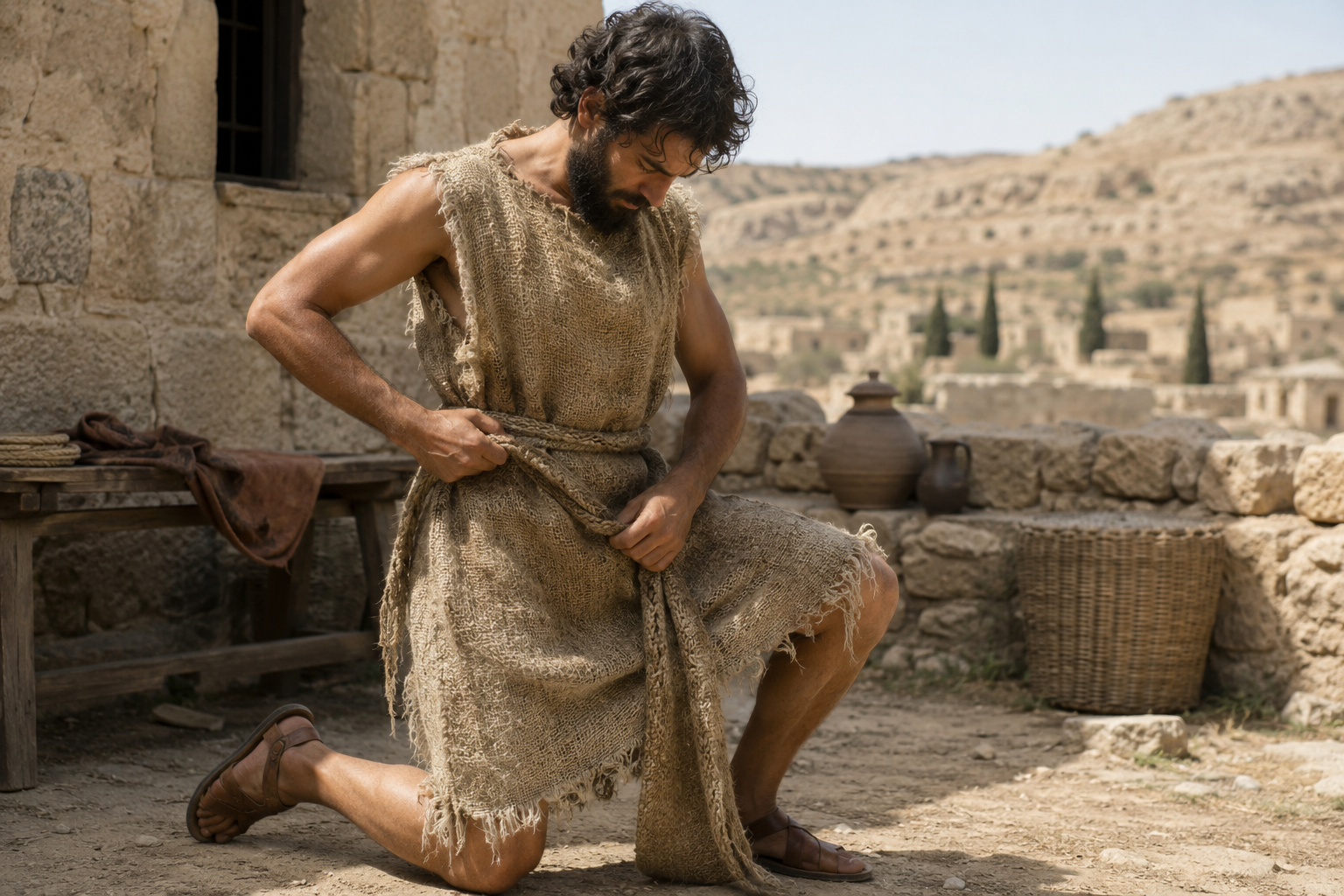
COMMAND TO THE PRIESTS
TO GIRD AND MOURN AND WAIL ALL NIGHT!
Gird yourselves with sackcloth (saq) And lament (saphad; LXX - kopto - beat one's breast as a strong expression of grief or remorse) O priests; Wail (yalal), O ministers of the altar! Come, spend the night in sackcloth (saq) O ministers of my God, For the grain offering (minchah) and the drink offering (necek) are withheld from the house of your God. - Joel gives four urgent commands not suggestions. The repeated imperatives intensify his call to mourning and repentance. Earlier Joel commanded the drunkards to “weep” and “wail” (Joel 1:5), and the farmers and vinedressers to “be ashamed” and “wail” (Joel 1:11). Now his attention turns specifically to the priests, those who ministered before the LORD and whose service had been directly affected by the devastation of the land.
Joel is deliberately widening the circle of mourning. He moves from particular groups among the people (Joel 1:5, 11), to the priests who minister at the altar (Joel 1:13), and finally to “the elders and all the inhabitants of the land” (Joel 1:14). The calamity demanded more than private grief; it called for corporate humiliation, fasting, prayer, and repentance before Jehovah. The entire nation needed to recognize God's hand in their circumstances and cry out to Him.
The sackcloth on the outside was
to symbolize brokenness on the inside.
Gird yourselves with sackcloth (saq) and lament (saphad; LXX - kopto - beat one's breast as a strong expression of grief or remorse) - The ornately embroidered robes of the priests, required when ministering to the LORD (Ex 28:3, 4, 43), were to be replaced with sackcloth. (Think of wearing a burlap sack!) The priests were commanded to wrap themselves in coarse sackcloth, the customary garment of mourning, humiliation, and repentance (Ge 37:34; 2 Sa 3:31; 1 Ki 21:27; Neh 9:1; Jonah 3:5–6). Gird yourselves pictures deliberately fastening the sackcloth tightly around the body, an outward act intended to express the inward grief and brokenness of the heart. Joel was not calling for religious show or spectacle, as emphaszied later when he makes clear that God desired more than torn garments: “Rend your heart and not your garments” (Joel 2:13). The sackcloth was meaningful only when it reflected a genuinely humble and broken heart before God (cf Isa 57:15). Lament intensifies the command. The priests were not merely to put on the clothing of mourning, but to experience and express the sorrow of mourning. The devastation of the land had interrupted the offerings at God's altar (Joel 1:9, 13), and those who ministered before Him should therefore be the first to recognize the spiritual significance of the calamity and lead the nation in repentance.
NET Note on gird - Heb “put on.” There is no object present in the Hebrew text, but many translations assume “sackcloth” to be the understood object of the verb “put on.” Its absence in the Hebrew text of v. 13 is probably due to metrical considerations. The meter here is 3 + 3, and that has probably influenced the prophet’s choice of words.
O priests - The priests are the very ones who should have set a high spiritual example (standard) for the nation, but as other prophets testify many of the priests were given over to imbibing (cf Isa 28:7-10), to instructing the people for a price (Micah 3:11; cf "peddling the word of God" in 2 Cor 2:17), flagrantly ignoring God’s law, and ultimately predisposing God's people to be "destroyed for lack of knowledge. Because you have rejected knowledge." (cf Hos 4:6, 4-9)!
The greater the stewardship, the greater the accountability.
The greater the light, the greater the responsibility to walk in it.
🙏 THOUGHT - There is a sobering application here for all pastors, elders, teachers, and spiritual leaders. Greater privilege brings greater responsibility. Jesus declared, “From everyone who has been given much, much will be required; and to whom they entrusted much, of him they will ask all the more” (Lk 12:48). Those entrusted with God's Word and the spiritual care of His sheep will be held to a higher standard of accountability (Jas 3:1; Heb 13:17; 1 Pe 5:2–4). Paul therefore reminds every spiritual leader, “It is required of stewards that one be found trustworthy” (1 Co 4:2). The issue at the Bema Seat will not be how prominent our ministry was, how many people followed us, or how much biblical knowledge we possessed, but how faithfully we handled what God entrusted to us.
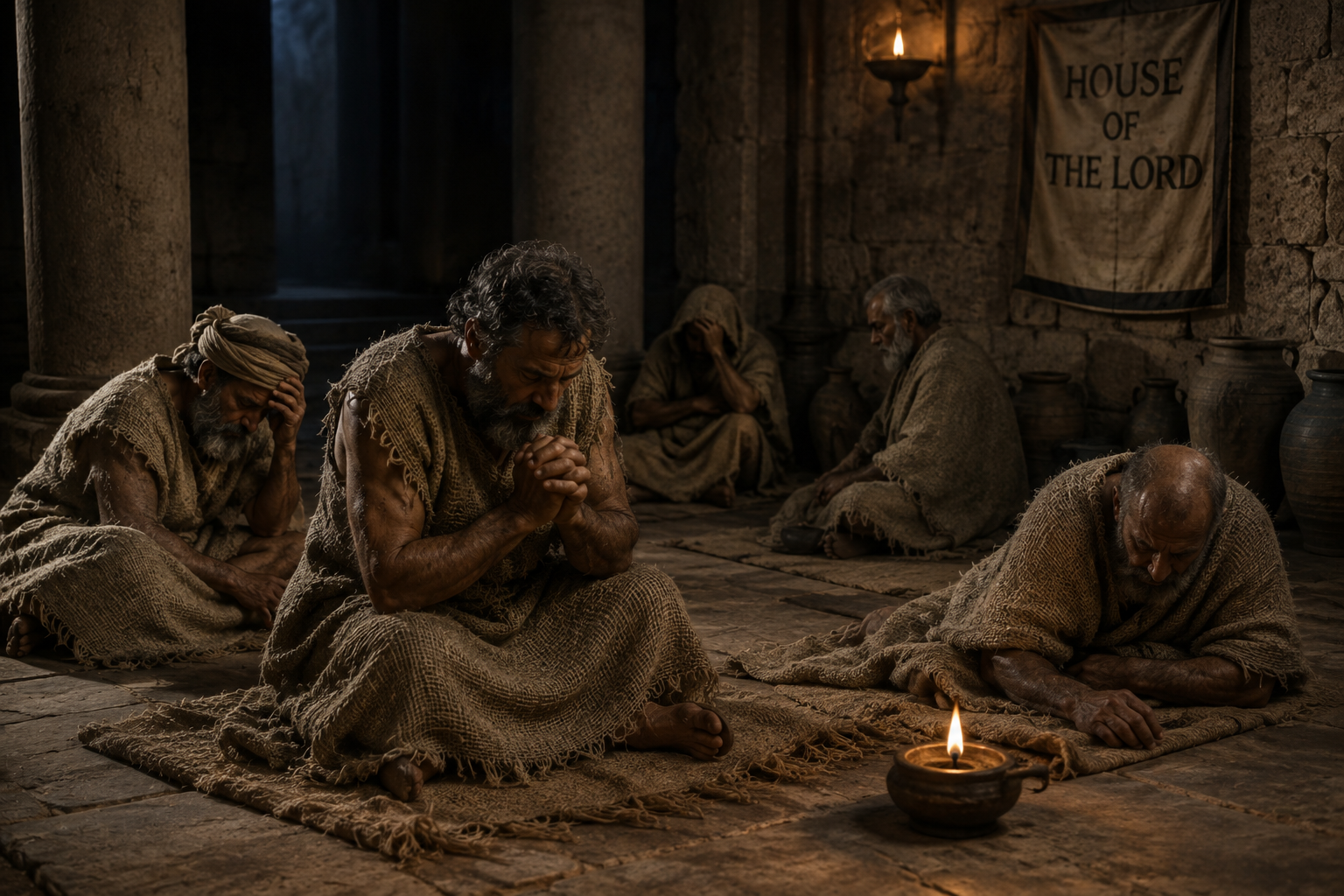
Come, spend the night in sackcloth (saq) O ministers of my God - They were not merely to put on sackcloth briefly as an outward symbol of mourning, but to remain in it throughout the night, demonstrating the depth and persistence of their grief before God. Their mourning was not to be momentary or superficial. The severity of the crisis called for prolonged humiliation, prayer, and earnest seeking of the LORD (cf. 2 Sa 12:16; Ps 30:11; Jonah 3:5–8).
Spend the night pictures the priests remaining before God when they ordinarily might have retired to their homes and beds. The night itself was to become a time of mourning and seeking God. There was an urgency about the situation that made business as usual inappropriate. The land was devastated, the people were suffering, and worship at the altar had been interrupted (Joel 1:9, 13).
For the grain offering (minchah) and the drink offering (necek) are withheld from the house of your God- The priests had special reason to mourn because “the grain offering and the drink offering are withheld from the house of your God.” The locust devastation had reached all the way from the fields to the altar. With the grain destroyed and the vineyards devastated, the offerings prescribed for the continual worship of the LORD could no longer be presented (cf. Ex 29:38–42; Nu 28:3–8; Joel 1:9). Thus the catastrophe was not merely economic and agricultural; it had become profoundly spiritual, disrupting the worship of God Himself.
🙏 THOUGHT - The drink offering was poured out completely before God. Paul saw in it a fitting picture of a life completely poured out for Christ (Phil 2:17; 2 Ti 4:6). What would that look like in my/your life? Doesn't it mean holding nothing back from the One Who held nothing back for us? Doesn't it means offering Him our time, talents, possessions, plans, relationships, opportunities, strength, and ultimately our very selves (Ro 12:1; 1 Co 6:19–20)? Those are both rhetorical questions of course! The truth be told, such a life is a life that says, “For to me, to live is Christ” (Phil 1:21), and willingly spends and is spent for the spiritual good of others (2 Co 12:15). A drink offering could not be retrieved once it was poured out. Likewise, the surrendered believer says, “Lord, my life is Yours. Pour it out however and wherever it will bring You the greatest glory.” And remember that a life poured out for Christ is never a life wasted.
Notice also Joel's movement from “my God” to “your God.” Ministers of my God emphasizes both their privileged relationship and their solemn responsibility. While Joel calls the priests are “ministers of my God,” he points out that the offerings have been withheld from “the house of your God.” Joel personally identifies himself with Jehovah while reminding the priests that the God Whose worship had been interrupted was their God. Their response should therefore be intensely personal.
Larry Richards - Clearly the clergy of Joel’s day failed to interpret the locust plague correctly. They themselves did not repent and they called for no national return to the Lord. What happens when the clergy are insensitive to the Lord? Just after the locust plague, God raised up another messenger, Joel, who was sensitive to Him! You and I needn’t wait for clergy to take the lead when our own hearts are grieved, or when we feel a burden for our land. What we do need to do is take the situation to heart and express our own grief and sorrow to the Lord. Then, like Joel, we need to speak out! (Borrow The 365 day devotional commentary)
Richard Patterson - It is only natural that the priests should realize what the loss of those crops meant not only to their inability to perform the sacrificial offerings but to Israel’s spiritual condition. The loss of the opportunity even to offer the sacrifices should have caused the citizenry as a whole to realize that their spiritual service had degenerated into a meaningless formalism (cf. Isa 1:2–20). Further, their unfaithfulness and syncretistic practices (Hos 2:5; Amos 2:8) had established them as those who had broken the covenant bond between themselves and the Lord (cf. Deut 8:19–20; 30:15–18). Israel’s condition was serious. Far more disastrous than what the locusts had done was what it symbolized! God would no longer tolerate their duplicity. Rather, he had taken away the ability and high privilege of offering those sacrifices that were intended to symbolize his people’s devotion to him (cf. Hos 2:9–13; 9:1–4). The lesson is obvious. True religion is an active one that comes from the heart (Deut 6:4–5; Jas 1:22–27). Mere ritual and routine, without the genuine spiritual reality that is evidenced by a demonstrated allegiance to a sovereign God, is unacceptable to him (1 Sam 15:22–23; Ps 40:6–8; Isa 1:10–20; Mic 6:8). May we be those who put our faith into action in true devotion, both in worship and service, while attending to our daily pursuits (Deut 10:12–13; Josh 22:5; 1 Sam 12:24; 1 Kgs 9:4; Ps 101:1–3; Matt 22:37–40). (See Minor Prophets: Hosea through Malachi - Page 111)
Thomas McComiskey - Temple personnel maintained a watch through the night apparently on a regular basis (1 Chron. 23:30; Pss. 92:2-4 [1-3]; 134:1), but in these difficult days their numbers would increase (see 2 Sam. 12:16) and a lament liturgy would be observed. (See The Minor Prophets: An Exegetical and Expository Commentary)
Bob Utley - "O priests. . .O ministers of the altar. . .O ministers of my God" The fourth group addressed are the leaders of the cultus. They are encouraged to repent and turn to God because the removal of agricultural blessings was related to Israel's spiritual problems (i.e., Leviticus 26; Deuteronomy 28). ▣ Notice the IMPERATIVES related to repentance: "gird" (i.e., with sackcloth) ‒ BDB 291, KB 291, Qal IMPERATIVE, "lament" ‒ BDB 704, KB 763, Qal IMPERATIVE, "wail" ‒ this is a repeat from Joel 1:5 and 11! Also in this same verse are two more IMPERATIVES, which are a call to spend the night in mourning in the temple. (1) "come" ‒ BDB 97, KB 112, Qal IMPERATIVE (2) "spend the night in sackcloth" ‒ BDB 533, KB 529, Qal IMPERATIVE. Repentance was to be initiated by the priests themselves. There was nothing to offer God! He had taken everything Himself! SEE Repentance (OT).
Lament (mourn) (05594) saphad - see note on mourning by Patterson) is a primary verb meaning to wail, to lament, to mourn and most of the references deal with the mourning rites at someone’s death. Saphad describes Abraham's reaction when his wife Sarah died (Ge 23:2), the great mourning over the death of Jacob (Ge 50:10), all Israel at the death of Samuel (1 Sa 25:1, 28:3), mourning for seven days at the death of King Saul (2 Sa 1:12), Bathsheba mourning over Uriah's death (2 Sa 11:26).
Given the emphasis with saphad on mourning over someone's death, when Israel's eyes are opened and they realize that they have killed their Messiah (as has every sinner), there will be mourning over His death. The Septuagint translates mourn in Zech 12:10 with a combination of the verb kopto which means to beat one's breast as a strong expression of grief and the rare noun kopetos (used only in Acts 8:2) which describe the beating of one's breast as a sign of grief. Ecclesiastes 3:4 says there is "A time to weep and a time to laugh; A time to mourn (saphad, Lxx = kopto) and a time to dance." The mourning of Zech 12:10 will be surely be followed by a time of dancing in Messiah's Kingdom!
Drink offering (05262) necek from nasak = to pour out - see note on root) refers most often to a libation and only rarely referred to a cast idol.
Drink offering or libation was a liquid offering poured out before the LORD as an act of worship, ordinarily consisting of wine or strong drink and usually accompanying an animal sacrifice and its grain offering rather than being offered alone (Ex 29:38–41; Nu 15:1–10; 28:7–8; 2 Chr 29:35). The practice was established in Israel's sacrificial system, although libations were also common among other peoples of the ancient Near East. Jacob provides an early biblical example when he erected a pillar at Bethel and “poured out a drink offering on it” (Ge 35:14).
Under the Mosaic Law, drink offerings formed a regular part of Israel's worship. With the daily burnt offering, a fourth of a hin of wine accompanied each lamb (Ex 29:40–41; Nu 28:7–8). Drink offerings were also presented on the Sabbath (Nu 28:9–10), at the appointed feasts (Lev 23:13; Nu 28–29), and with other sacrifices and grain offerings (Nu 6:15, 17; 15:1–12; 2 Ki 16:13; Ezra 7:17). The amount varied according to the sacrificial animal: one-fourth of a hin for a lamb, one-third for a ram, and one-half for a bull (Nu 15:5–10; cf. Nu 28:14). The drink offering was poured out before the LORD rather than consumed by the worshiper (Nu 28:7).
Thus the drink offering was a visible expression of worship, dedication, thanksgiving, and the presentation of something valuable to God. Wine, a product of God's provision from the land, was poured out before the One Who had provided it. Consequently, when the land ceased producing, Israel's worship was directly affected. This is particularly significant in Joel, where the locust devastation was so complete that “the grain offering and the drink offering are cut off from the house of the LORD” (Joel 1:9), and the priests are commanded to mourn because these offerings were “withheld from the house of your God” (Joel 1:13; cf. Joel 2:14). The devastation had traveled from the vineyard to the altar. No grapes meant no wine, and no wine meant no drink offering. Thus the agricultural catastrophe became a spiritual catastrophe because the regular worship of the LORD was interrupted.
Scripture also contrasts legitimate drink offerings to Yahweh with idolatrous libations offered to false gods. Israel was condemned for pouring out drink offerings to other gods (Isa 57:6; Jer 7:18; 19:13; 32:29), including offerings made to the “queen of heaven” (Jer 44:17–19, 25). David repudiated such idolatrous worship, declaring, “Their drink offerings of blood I will not pour out” (Ps 16:4). Thus the act of pouring out a libation was not inherently holy; its spiritual character depended upon the god to whom it was offered.
The imagery carries into the New Testament, where Paul uses the drink offering as a beautiful metaphor for pouring out one's life in sacrificial service to God. He tells the Philippians, “Even if I am being poured out as a drink offering upon the sacrifice and service of your faith, I rejoice” (Phil 2:17). Near the end of his life, knowing that martyrdom was approaching, he writes, “For I am already being poured out as a drink offering, and the time of my departure has come” (2 Ti 4:6). Just as the wine of the Old Testament libation was completely poured out before God, Paul viewed his own life as being completely expended in the service of Christ.
In summary, the drink offering was a prescribed liquid sacrifice, normally wine, poured out before the LORD and commonly accompanying burnt and grain offerings. It symbolized worship, dedication, thanksgiving, and the giving back to God of what He had graciously provided (Ex 29:38–41; Nu 15:5–10; 28:7–8). Its disappearance in Joel 1:9, 13 dramatically demonstrated the severity of Judah's calamity: God's judgment had so devastated the land that its effects reached all the way to the altar and interrupted the regular worship of the LORD.
Grain offering (offering) (04503) minchah means a gift (given to another without compensation = Ge 32:13, 2Ki 8:8), tribute ( payment by one ruler or nation to another in acknowledgment of submission or as the price of protection = Jdg 3:14, 2Sa 8:2; Hos 10:6) or offering (as a gift offered to God). The most common sense by far in the OT is as an offering (usually "grain offering" in the NAS but it could refer to animal offerings Ge 4:3-5 or "sacrifices" in general Isa 19:21). Minchah is translated most often (152x) simply as offering.
David Baker on minchah - The term “grain offering” (Lev 2:1) is ambiguous in the Old Testament. It first referred to both animal and vegetable sacrifices (Ge 4:3–5), and at other times it indicated offerings of meat (1Sa 2:12–17), mixed meat and bread (Jdg 6:18–20), incense (Nu 16:15–17), and offerings in general (1Chr 16:29; Ps 96:8; Zeph 3:10). In fact, in one eschatological passage the term refers to human beings who would be an offering to Yahweh (Isa 66:20). At other times, including the passage in Leviticus 2, it designated offerings of grain (Le 9:4, 17; 14:10, 20, 31; Nu 15:1–10). In nonreligious contexts, the term spoke of a gift, often to someone who was being honored (Ge 33:10), such as a king (1Sa 10:27; 1Kgs 10:25; 2Chr 17:5), or tribute, an expected or enforced “gift” (Jdg 3:15–18; 2 Sam 8:2). “Gift” seems to have been the basic meaning, becoming more specific if used in a religious or in a sociopolitical context (NIDOTTE 2.978–990). Here it was a gift in appreciation and worship of God. (Cornerstone Biblical Commentary)
QUESTION - What is a drink offering? | GotQuestions.org
ANSWER - The first recorded occurrence of a drink offering was that given by Jacob in Genesis 35:14, right after God changed his name to Israel. Drink offerings were also included with burnt and grain offerings in God-ordained sacrifices, including the morning and evening sacrifices of Exodus 29:40. One-quarter hin, about one quart, of wine was poured out into the altar fire for each lamb sacrificed (Numbers 15:4-5). A ram sacrifice required one third of a hin (Numbers 15:6), and a bull required one half (Numbers 15:10).
It has been speculated that the offering of an animal, grain, oil, and wine—the smoke making a “soothing aroma to the LORD”—is a metaphor for providing food for God, an important cultural requirement in the Middle East. What we do know is that the pouring out of a drink offering is a metaphor for the blood Jesus spilled on the cross. Jesus spoke to this directly in Luke 22:20 when He instituted the New Covenant. He picked up a cup of wine and said, “This cup which is poured out for you is the new covenant in My blood.” Jesus’ sacrifice fulfilled the need of a drink offering, His blood literally pouring out when the soldier pierced His side with a spear (John 19:34).
Paul took the metaphor further, twice using the image of a drink offering to describe his own service. In Philippians 2:17, he challenged the church in Philippi to live a life worthy of his dedication to them. In 2 Timothy 4:6, he sensed the end of his ministry, again comparing his efforts to wine poured out of a vessel onto an altar.
QUESTION - What is a grain offering? | GotQuestions.org
ANSWER - A grain offering is a type of sacrifice described in the Old Testament (Leviticus 2) that the Israelites offered to God. A grain offering would have most likely been one of wheat or barley, depending on what was available. While other sacrifices had very specific instructions from God as to how they were to be offered, the rules governing grain offerings had some flexibility.
A grain offering could be given to God either uncooked or cooked in an oven or pan (Leviticus 2:1; 4—5). The requirements for the grain offering were that it had to be finely ground and have oil and salt in it (Leviticus 2:1, 4, 13). It could not have any yeast (also called leaven) or honey in it (Leviticus 2:11). When a person brought a grain offering to the priests, a small portion of it was offered to God, with some frankincense, on the altar. The rest of the grain offering went to the priests (Leviticus 2:10). No specific amount of grain was required for an offering; people were free to give what they had.
The grain offering is described as “a most holy part of the food offerings presented to the Lord” (Leviticus 2:10b). Grain offerings would often be presented after a burnt offering, which was an animal sacrifice God required for the atonement of sin. Blood had to be shed for the remission of sins to take place, so a grain offering would not serve the same purpose as a burnt offering. Instead, the purpose of a grain offering was to worship God and acknowledge His provision. The burnt offering, which had strict regulations and could have nothing added to it, aptly represents the fact that we take no part in our atonement for sin. The grain offering, however, could be somewhat “personalized” in its presentation. It was to be given out of a person’s free will, just as our worship is our free will offering to God today.
It’s interesting to note that during the Israelites’ forty years of wilderness wandering grain would have been quite scarce. This made grain offerings more costly and precious for the people to offer to God. Giving a grain offering in those circumstances represented the Israelites’ complete dependence on God to provide for their needs each day. Jesus fulfilled the Law (Matthew 5:17), and we no longer have to do sacrifices as they did in the Old Testament. But, if the grain offering is similar to our offering of worship, it’s interesting to consider: how much does our worship today cost us?
Joel 1:13-15 TODAY IN THE WORD
Just as sin reigned in death, so also grace might reign through righteousness to bring eternal life through Jesus Christ. - Ro 5:21
When Arthur Andersen auditing firm was indicted for destroying documents related to a Federal investigation of one of its clients, some of the firm’s employees staged a public protest. One employee even wrote to the President of the United States, complaining that the indictment was unfair because of what it implied about the thousands of honest employees who worked for the company. “They are casting doubt on our honesty and our integrity,” he wrote. Some of the people of Joel’s day would identify with this complaint. They too may have wondered whether it was fair for many to suffer for the sins of a few.
The plague of locusts that had so devastated Israel’s crops carried an important lesson. Sin is not just an individual matter--it is a corporate one as well. The proper response was for God’s people to take responsibility for the sins of their nation and seek God’s forgiveness. Speaking through the prophet, the Lord called for Israel’s national and religious leaders to publicly express their grief for their sin in a “holy fast” and a “sacred assembly” (Joel 1:14). The priests were instructed to take the lead and summon both the elders and the people to the sanctuary in order to fast and cry out to God for deliverance.
The Bible supports the idea of corporate guilt. Israel’s defeat at Ai is a good example (see Josh 7:1, 2, 3, 4, 5). Only one man violated God’s command not to take any of the plunder from the defeat of Jericho, yet the Lord spoke in plural terms when He apportioned the blame (Josh 7:1). Only one man had sinned, yet both the guilt and its consequences were shared.
TODAY ALONG THE WAY - Just as in Joel’s day, one way that God’s people can express their grief over sin is through fasting. Fasting does not remove guilt--only God’s grace could do that for them. But it is a way to express repentance (See in depth word studies on The verb Repent = metanoeo; the noun Repentance = metanoia). If your physical health permits, why not skip a meal and spend that time confessing sin to the Father? Pray for yourself, your church, and your nation--God is pleased by our recognition of our corporate responsibility and our heartfelt repentance. When you are finished, thank God for His grace and mercy.
Matthew Henry - Joel 1:13
The sorrow of the people is turned into repentance and humiliation before God. With all the marks of sorrow and shame, sin must be confessed and bewailed. A day is to be appointed for this purpose; a day in which people must be kept from their common employments, that they may more closely attend God’s services; and there is to be abstaining from meat and drink. Everyone had added to the national guilt, all shared in the national calamity, therefore every one must join in repentance. When joy and gladness are cut off from God’s house, when serious godliness decays, and love waxes cold, then it is time to cry unto the Lord. The prophet describes how grievous the calamity. The prophet stirs them up to cry to God, with the consideration of the examples given them for it. His own example: “To you, O Lord, I call!” (Joel 1:19). He would not put them upon doing that which he would not resolve to do himself. See even the inferior creatures suffering for our transgression. And what better are they than the beasts who never cry to God but for corn and wine, and complain of the want of the delights of sense? Yet their crying to God in those cases, shames the stupidity of those who cry not to God in any case. Whatever may become of the nations and churches that persist in ungodliness, believers will find the comfort of acceptance with God, when the wicked shall be burned up with his indignation.
Joel 1:14 Consecrate a fast, Proclaim a solemn assembly; Gather the elders And all the inhabitants of the land To the house of the LORD your God, And cry out to the LORD.
- Consecrate a fast: Joel 2:15,16 2Ch 20:3-4
- Proclaim a solemn assembly: day of restraint, Lev 23:36 Ne 8:18
- Gather the elders: De 29:10,11 2Ch 20:13 Ne 9:2,3
- And cry out to the LORD: Jon 3:8
Related Passages:
Joel 2:15-16 Blow a trumpet in Zion, Consecrate a fast, proclaim a solemn assembly, Gather the people, sanctify the congregation, Assemble the elders, Gather the children and the nursing infants. Let the bridegroom come out of his room And the bride out of her bridal chamber.
2 Chronicles 20:3-4 Jehoshaphat was afraid and turned his attention to seek the LORD, and proclaimed a fast throughout all Judah. 4So Judah gathered together to seek help from the LORD; they even came from all the cities of Judah to seek the LORD.
Leviticus 23:36 ‘For seven days you shall present an offering by fire to the LORD. On the eighth day you shall have a holy convocation and present an offering by fire to the LORD; it is an assembly. You shall do no laborious work.
Numbers 29:35 ‘On the eighth day you shall have a solemn assembly; you shall do no laborious work.
Deuteronomy 16:8 “Six days you shall eat unleavened bread, and on the seventh day there shall be a solemn assembly to the LORD your God; you shall do no work on it.
Nehemiah 8:18 He read from the book of the law of God daily, from the first day to the last day. And they celebrated the feast seven days, and on the eighth day there was a solemn assembly according to the ordinance.
2 Kings 10:20 (PERVERTED SOLEMN ASSEMBLY!) And Jehu said, “Sanctify a solemn assembly for Baal.” And they proclaimed it.
2 Chronicles 7:9 On the eighth day they held a solemn assembly, for the dedication of the altar they observed seven days and the feast seven days.
Isaiah 1:13 “Bring your worthless offerings no longer, Incense is an abomination to Me. New moon and sabbath, the calling of assemblies– I cannot endure iniquity and the solemn assembly.
Amos 5:21 “I hate, I reject your festivals, Nor do I delight in your solemn assemblies.
2 Chronicles 7:13-14 “If I shut up the heavens so that there is no rain, or if I command the locust to devour the land, or if I send pestilence among My people, 14 and My people who are called by My name humble themselves and pray and seek My face and turn from their wicked ways, then I will hear from heaven, will forgive their sin and will heal their land.
A CALL TO NATIONAL
FASTING AND PRAYER
Consecrate (qadash; LXX - hagiazo - aorist imperative) a fast (tsom), Proclaim a solemn assembly (atsarah); Gather the elders And all the inhabitants of the land To the house of the LORD your God, And cry out (za'aq) to the LORD - Joel now moves from describing Judah's devastation to prescribing the proper response. There are three commands which are not suggestions. They call not for external actions but for internal contrition, confession and repentance. Here we reach the heart of the matter, for it was because of sin that God was punishing the nation. The mounting catastrophe was not merely something to observe or lament, but something that demanded corporate repentance and earnest prayer. Notice the rapid succession of commands: Consecrate! Proclaim! Gather! Cry out! The urgency of the crisis called for an urgent response from the entire nation.
Richard Patterson - Deeply moved, Joel wanted the leadership to experience his same spiritual concern. They were to lead the people in genuine repentance, calling on God for his forgiveness in order to avoid a still greater calamity (cf. Joel 2:15–20). Like the citizens of Nineveh (Jonah 3:5), those of Jerusalem were to confess their sins publicly. Fasting ought not to be simply routine or a matter of ritual (Matt 6:16–18). Rather, it should reflect the kind of anguish of heart that results from acknowledging sins committed (1 Sam 7:6) or recognizing a dire threat (2 Chr 20:1–3; Esth 4:1–3) or experiencing deep concern for another (e.g., Ps 35:13; Dan 6:18). Trying to achieve spiritual insight or make a spiritual decision can also be an occasion for fasting (Dan 9:1–19; 10:1–3; Acts 13:2; 14:23). Above all, it should be accompanied by a consistent lifestyle of righteous conduct (Isa 58:5–12; cf. Matt 6:16–18). (See Minor Prophets: Hosea through Malachi - Page 113)
Consecrate a fast (tsom) - To consecrate (qadash; LXX - hagiazo - aorist imperative) in Joel 1:14 means make holy, sanctify, set apart. This was not to be an ordinary day without food, but a fast specifically set apart to seek the LORD. Biblical fasting was never intended to be an empty religious ritual. Abstaining from food outwardly expressed an inward attitude of humiliation, mourning, dependence, and earnest seeking of God (Jdg 20:26; 1 Sa 7:6; Ezra 8:21–23; Neh 9:1–3; Jonah 3:5–10). Joel later makes this explicit: “Return to Me with all your heart, and with fasting, weeping and mourning; and rend your heart and not your garments” (Joel 2:12–13). God was interested not merely in empty stomachs, but in broken hearts.
The fact that a fast is to be set aside, consecrated or made (considered to be) holy indicates that it is not to be a ritual but a reflection of one's reverence for Jehovah, a work of the heart (energized and enabled by the Holy Spirit), not to gain merit before God but to be carried out as an act of worship and to be accompanied by the sharpening of one's spiritual senses in turn enhancing one's communion with God. The ritual of fasting is never to be replacement for righteous behavior!
Richard Patterson - Such fasts customarily lasted for a day (1 Sam 14:24) and were called in order to seek God’s favor (Judg 20:26; 1 Sam 7:6). National fasts were extraordinary (Neh 9:1–3; Jer 36:9), but this was an unprecedented emergency. (Cornerstone Bible Commentary)
Thomas Finley - It is interesting that Joel should call for a fast in 1:14. The prophets rarely mentioned fasting except to condemn it (Isa. 58:3, 4; Jer. 14:12; Zech. 7:5). (See Joel, Amos, Obadiah: An Exegetical Commentary - Page 32)
Irw Busenitz - The prophet instructs them to “consecrate a fast” (cp. Joel 2:15). Fasting was an official act set apart for the purpose of eliciting God’s compassion and averting his judgment (cf. 2Sa 12:22; Jonah 3:7–9). They were also to call a solemn assembly (Joel 1:14). Generally called for festive purposes (Lev 23:36; Neh 8:18), solemn assemblies were convened occasionally for the purpose of mourning. During solemn assemblies, work was specifically proscribed (Deut 16:8). In addition, the priests were to gather “all the inhabitants of the land to the house of the LORD.” The law required all males to appear before the LORD three times each year (Exod 23:17). But there is no such limitation here; all are to gather.
Warren Wiersbe - The Jews were required to observe only one fast, and that was on the annual Day of Atonement (Lev. 16:29, 31). But the religious leaders could call a fast whenever the people faced and emergency and needed to humble themselves and seek God’s face (Jdg 20:26; 2Chr 20:3; Ezra 8:21; Neh. 9:1–3; Jer. 36:9). This was such an emergency. (See Bible Exposition Commentary - Old Testament )
Thomas Finley - Fasting and the solemn assembly were proper ways for the community to show humility and submission to God in the face of national disaster, as long as they reflected reality faithfully. (SEE Joel, Amos, Obadiah: An Exegetical Commentary - Page 30)
Bob Utley - Joel is calling on Israel to do what she had done again and again in the past: call out to her God. He will forgive, deliver, and restore (cf. Joel 2:12-14). Sin is not a permanent barrier, but stubborn unbelief and intransigence is! God is waiting to act, but His people must act first in repentance and contrition. Biblical faith is a relationship (i.e., covenant). It involves initial and continuing repentance, faith, obedience, perseverance!!
Brian Bell on fasting - When did people in scripture fast, and why? Usually it was during times of calamity, disaster, or catastrophe. The purpose was to focus their attention on God and to demonstrate their change of heart and true devotion. What are the benefits of fasting?
[1] Fasting increases our dependence on the Lord. For our hunger and physical weakness continually remind us how we are not really strong in ourselves but need the Lord.
[2] Fasting allows us to give more attention to prayer. .For we are not spending time on eating.
[3] Fasting is a simple sacrifice of personal comfort. Which reminds us we must continually sacrifice all of ourselves to Him.
[4] Fasting is good exercise in self-discipline. .As we refrain from eating food...it also strengthens our ability to refrain from sin, to which we would otherwise be tempted to yield.
[5] Fasting also heightens spiritual & mental alertness. .As we focus less on food, the energies of our body are freed from digesting & processing food. So, we can focus on eternal spiritual realities that are much more important. We are saying no to the physical & yes to the spiritual.
[6] Fasting expresses earnestness & urgency in our prayers. .If we continued to fast we would die. Therefore, in a symbolic way, fasting says to God that we are prepared to lay down our lives that the situation be changed rather than continue. (Sermon)
PROCLAIM A
SOLEMN ASSEMBLY
Proclaim (Joel 1:14, 19, 2:15, 2:32, 3:9) a solemn assembly (atsarah) - Joel issues another command. A solemn assembly describes a sacred gathering when normal activities were to cease so that the nation could gather before God. The emergency was spiritual, so the people needed more than agricultural solutions. They needed to seek the LORD. The mere act of holding a solemn assembly had no spiritual value apart from the heart rightly related to God. A solemn assembly without solemn hearts was worthless to God (cf Amos 5:21, Isa 1:13).
The Septuagint is interesting (kerusso + therapeia) is like a town crier calling this out where one of the meanings of the noun therapeia is healing, suggesting this was to be a service to promote spiritual healing, healing of their rebellious hearts.
When disaster leaves us helpless, prayer directs
our helplessness toward the One Who is all-powerful.
🙏 THOUGHT - Disaster should always stimulate prayer. Recall the aftermath of 9/11 in America, when churches filled and prayer to the God of Heaven became unusually prominent and fervent. Calamity has a way of exposing our weakness and reminding us how desperately we need God. The same should be true of family crises, personal trials, national disasters, and unexpected adversity. Our first response should not merely be, “What can I do?” but “Lord, what would You have me do?” and “To You, O LORD, I cry” (Joel 1:19; cf. Ps 50:15; 86:7; 120:1). Trouble should drive us to our knees and toward God, not away from Him.
John MacArthur on solemn assembly - Directives for calling an assembly, generally for festive purposes (cf. 2Ch 7:9; Neh 8:18), are given in Nu 10:3. Parallel in thought to "consecrate a fast," no work was permitted on such days (Lv 23:36; Nu 29:35; Dt 16:8). (See MacArthur Study Bible)
Gather the elders and all the inhabitants of the land - No one was exempt. The elders, who represented the leadership of the nation, were specifically summoned, but Joel immediately expands the invitation to “all the inhabitants of the land.” The leaders were to lead out by example as all the inhabitants of the land came together and poured out their heart cries to Jehovah The calamity affected everyone, and everyone was called to humble himself before God. National judgment called for national repentance (cf. 2 Chr 7:14; Jonah 3:5–9). This Hebrew verb "gather" (asaph) is used 4 times in Joel - Joel 1:14, Joel 2:10 ("lose"), Joel 2:16 (Twice), Joel 3:15 ("lose").
Summoning the leaders recalls Judges 5:2NLT when leaders lead, recording that "Israel's leaders took charge, and the people gladly followed. Praise the LORD!"
To the house of the LORD your God - The people were summoned to the Temple in Jerusalem, where the Shekinah glory cloud of the LORD still dwelt. It is not specifically described as present but we know that God's glory did not depart until just prior to the third Babylonian invasion and destruction of the Temple in 586 BC (See- departure of the Glory of God). Note the personal expression the LORD your God. The God Who was disciplining them was still their God. Judgment had not eliminated the covenant relationship. The discipline was intended to drive them back to the One from Whom they had wandered (cf. Joel 2:12–13).
And cry out (za'aq; LXX - krazo cry out in a loud voice, scream like demons in Mk 5:5) to the LORD - This is the climax of the commands. The Hebrew verb za'aq describes an urgent cry for help arising from distress. Joel was not calling for polished prayers or religious formalities, but for desperate people to make desperate cries to the only One Who could deliver them (cf. Jdg 3:9, 15; Ps 34:17; 107:6, 13, 19, 28). Significantly, Joel himself immediately practices what he preaches in Joel 1:19 declaring “To You, O LORD, I cry”.
Consecrate (Sanctify, make holy)(Also used in Joel 2:15, 16) (06942)(qadash) means to set apart for a specific use. Removed from common use. To be holy. To show one's self to be holy. To consecrate or dedicate. To set apart a person or thing from all common or secular purposes to some religious use. Everything consecrated to God was separated from all profane use. This verb is found 4 times in Joel - Joel 1:14, Joel 2:15, Joel 2:16, Joel 3:9.
Fast (Also in Joel 2:12, 2:15)(06685)(tsom from tsum = to abstain from food, to fast) is a masculine noun indicating a fast, fasting and refers to the act or time of fasting, an act of worship in mourning, despairing while entreating God. Fasting is depriving the body of nourishment and is generally used as a sign that one is experiencing great sorrow and so it is often accompanied by mourning manifest by weeping, lamenting and donning sackcloth and ashes (e.g., Est 4:3). Not used in Pentateuch. First use describes David fasting when his first child with Bathsheba was deathly ill (2 Sa 12:16). Frequently associated with "proclaim" - 1 Ki 21:9, 21:12, 2 Chr 20:3, Ezra 8:21 (cf Neh 9:1). In Esther 4:3 Jews everywhere fasted because of the decree orchestrated by wicked Haman "to destroy, to kill and to annihilate all the Jews, both young and old, women and children, in one day." (Esther 3:13). Fasting is associated with humbling (Ps 35:13, chastening one's soul (Ps 69:10), making one weak (Ps 109:24), combined with scratchy sackcloth (Da 9:3), to be with weeping (Joel 2:12). Pagan king of Nineveh proclaimed a fast upon hearing Jonah's warning (Jonah 3:5). God is critical of Israel's sham fasting (Isa 58:3, 5, 6)
Gilbrant - In all cases (of fasting), the sovereignty of God has to be recognized and appreciated, even as David responded, after his child died, with restoration of normal life and glorification of the wisdom of God (2 Sam. 12:18-24). (Complete Biblical Library Hebrew-English Dictionary).
Eugene H. Merrill - The purpose of fasting is never explicitly stated in Scripture but its connection to penitence, mourning, and supplication suggests a self-denial that opens one to God and to the immaterial aspects of life. Inasmuch as food and drink typify life in the flesh and all its demands and satisfactions, their absence or rejection speaks to the reality of a higher dimension, one in which the things of the spirit predominate. The theology of fasting, then, is a theology of priorities in which believers are given the opportunity to express themselves in an undivided and intensive devotion to the Lord and to the concerns of the spiritual life. (Fast, Fasting in Baker Evangelical Dictionary - recommended article)
John Hartley on tsom and fasting in general - One could fast in behalf of another, e.g., the Psalmist for his enemies during their illness (Psalm 35:13). The fast most often lasted from sunrise until sunset (cf. 2 Samuel 1:12), and it could be total or partial abstinence (Psalm 35:13; Daniel 10:3). Fasting accompanied mourning for the dead, and for severe grief it lasted seven days (1 Samuel 31:13). One also fasted to gain the attention of God on behalf of his suffering in sickness. David's illegitimate son by Bathsheba was critically ill; therefore David fasted and mourned many days (2 Samuel 12:16ff.). On the seventh day David learned that the child had died; then he arose, washed, anointed himself and changed his clothing, for he perceived that he could accomplish nothing now that the child was dead (2 Samuel 12:20-23). Another occasion for fasting was making a critical decision or following an ominous course of action. Esther, intending to seek the king's favor in reversing the decree of Haman, placed herself under the king's mercy and possible wrath which could end in her death. Therefore she requested that all the Jews fast and entreat God for her mission (Esther 4:16). Nehemiah fasted upon learning of the sorrowful condition of Jerusalem (Neh. 1:4), and then proceeded to work to correct the situation. Apparently before a person was stoned for blasphemy, the people mourned the sin and coming execution with fasting. Jezebel proclaimed such a fast for Naboth (1 Kings 21:9, 12). Also upon learning of one's sin, fasting is in order. When Elijah condemned Ahab for Naboth's death, he mourned in sackcloth and fasted. God had mercy on him and delayed the punishment on his house (1 Kings 21:27ff.). An individual could intercede in supplication and fasting for an entire nation. Daniel confessed his sin and his people's sins that had led them into captivity (Daniel 9:3-19). Gabriel answered his prayer, assured him of the ending of the captivity and promised the establishing of a new covenant (Daniel 9:22-27). National fasting was called during times of extreme crisis, such as a plague, a military threat or the death of a king. Jehoshaphat proclaimed a fast because the kings of Moab and Ammon were planning a campaign against Judah. The people assembled at Jerusalem. Jehoshaphat led the assembly in prayer. Then Jahaziel, a Levite, under the inspiration of the Lord's Spirit, proclaimed an assurance of salvation. Prayer and enthusiastic praising followed. Afterwards Jehoshaphat led the army to war, but Yahweh had already discomfited the enemies, the army had only to collect the spoil (2 Chron. 20:1-29). In 604 when the Babylonian army was camped against Ashkelon about a three day march from Jerusalem, King Jehoiakim proclaimed a fast. Jeremiah used this occasion to have Baruch read his prophecies from a scroll before the people near the New Gate of the temple (Jeremiah 36:1-10). Jeremiah wanted the people to move from an outward show of contrition to true repentance. On another occasion, Joel foresaw the coming of the Day of Yahweh; therefore he exhorted the people to sanctify a fast and call a solemn assembly (Joel 1:14; Joel 2:15). He proclaimed that if the people would truly repent in mourning and fasting, then God would be gracious and postpone the day of judgment (Joel 2:12-14). The case of Nineveh shows God's desire to extend mercy and not judgment. On hearing the proclamation of judgment by Jonah, the Ninevites proclaimed a fast and repented. Thereby they averted for a time the day of judgment (Jonah 3:5-10). Certain days in the calendar were for national fasting, the most prominent being the Day of Atonement (Leviticus 16:29, 31; Leviticus 23:27-32; fasting is indicated in the phrase "afflict oneself," ʿnh npsh). The number of these days appears to have grown in the post-exilic period. Zech. 8:19 lists four fast days during the year. A fast day precedes the celebration of Purim (Esther 9:31). By the time of the NT the pious fasted on Monday and Thursday of every week (cf. Luke 18:12). Fasting in itself did not cause Yahweh to turn to his people. He did not succumb merely to the afflictions of the body. A true fast had to indicate that the people were intent on seeking righteousness, which included taking care of the poor and needy (Isaiah 58; cf. Jeremiah 14:12; Zech. 7:5). However, when the Lord brings final salvation to his people, the months of fast will be turned into feasts of joy and gladness (Zech. 8:19). (Theological Wordbook of the Old Testament)
TSOM - 26x in 22v - fast(17), fasted*(1), fasting(7), times of fasting(1). 2 Sa 12:16; 1 Ki. 21:9; 1 Ki. 21:12; 2 Chr. 20:3; Ezr. 8:21; Neh. 9:1; Est. 4:3; Est. 9:31; Ps. 35:13; Ps. 69:10; Ps. 109:24; Isa. 58:3; Isa. 58:5; Isa. 58:6; Jer. 36:6; Jer. 36:9; Dan. 9:3; Joel 1:14; Joel 2:12; Joel 2:15; Jon. 3:5; Zech. 8:19
Related Resources on fasting:
- Recommended articles on fasting from Desiringgod.org
- A Hunger for God John Piper (book)
- Sharpen Your Affections with Fasting David Mathis
- Fasting for Beginners David Mathis
- What is the connection between prayer and fasting?
- Christian fasting - what does the Bible say?
- What are the different types of fasting?
- What is the meaning of the parables of fasting at the wedding feast, the old cloth, and the wineskins?
- Why don't Christians fast the same as Muslims? What is Ramadan?
- How to fast—what does the Bible say?
- Why did Jesus fast?
- What is the meaning of Lent?
- Torrey Topical Textbook Fasting
- Nave Topical Bible Fasting - nice Scriptural summary
- American Tract Society Fasting
- Bridgeway Bible Dictionary Fasting
- Baker Evangelical Dictionary Fast, Fasting
- Charles Buck Dictionary Fasting
- Easton's Bible Dictionary Fast
- Fausset Bible Dictionary Fasting
- Holman Bible Dictionary Fasting
- Hastings' Dictionary of the Bible Fasting
- Hastings' Dictionary of the NT Fasting (2) Fasting
- Hawker's Poor Man's Dictionary Fasting Fast
- Smith Bible Dictionary Fasts
- Vines' Expository Dictionary Fast, Fasting Fast
- 1911 Encyclopedia Britannica Fasting
- International Standard Bible Encyclopedia Fasts and Feasts Fast; Fasting Feasts, and Fasts
- Kitto Biblical Cyclopedia Fasts
- The Jewish Encyclopedia Fasting and Fast-Days
Quotes on Prayer and Fasting
- Since this is a holy exercise both for the humbling of men and for their confession of humility, why should we use it less than the ancients did? John Calvin
- Fasting is the voluntary denial of a normal function for the sake of intense spiritual activity. Richard Foster
- Prayer is one hand with which we grasp the invisible; fasting the other, with which we let loose and cast away the visible. Andrew Murray
- By fasting, the body learns to obey the soul; by praying the soul learns to obey the body. William Secker
- Fasting is calculated to bring a note of urgency and importance into our praying, and to give force to our pleading in the court of heaven. The man who prays with fasting is giving heaven notice that he is truly in earnest. Arthur Wallis
- Few disciplines go against the flesh and the mainstream of culture as this one. Donald S. Whitney
- Without a purpose, fasting can be a miserable, self-centred experience. Donald S. Whitney
Solemn Assembly (06116)(atsarah) is a feminine noun meaning an assembly, sacred gathering, or convocation, usually referring to a community gathered and set apart from ordinary activities for a special religious purpose. The noun is related to the verb ʿatsar, meaning “to restrain, hold back, detain, or shut up,” which helps convey the idea of people being held back from their normal activities and gathered together before God. Thus, a solemn assembly was not merely a crowd or ordinary meeting, but a specially appointed gathering in which normal work ceased so that the people might devote themselves to worship, remembrance, prayer, fasting, repentance, or seeking God's help.
Under the Law, certain solemn assemblies were specifically commanded by God. The seventh day of the Feast of Unleavened Bread was designated a solemn assembly in which Israel was commanded, “you shall not do any work” (Dt 16:8). Likewise, the eighth day concluding the Feast of Booths was a sacred assembly in which “you shall do no laborious work” (Lev 23:36; Nu 29:35). Following the return from exile, Israel observed this command when “on the eighth day there was a solemn assembly according to the ordinance” (Neh 8:18). Solomon also observed a solemn assembly in connection with the dedication of the Temple (2 Chr 7:8–9). These passages emphasize that the people were to set aside ordinary pursuits in order to give concentrated attention to God.
A solemn assembly could also be proclaimed in response to an extraordinary national crisis. This is especially important in Joel. With Judah devastated by locusts and drought, Joel commands the priests, “Consecrate a fast, proclaim a solemn assembly; gather the elders and all the inhabitants of the land to the house of the LORD your God, and cry out to the LORD” (Joel 1:14). He repeats the command as the Day of the LORD approaches: “Blow a trumpet in Zion, consecrate a fast, proclaim a solemn assembly, gather the people, sanctify the congregation” (Joel 2:15–16). Here the solemn assembly was a corporate response to divine judgment, bringing the entire community together to humble themselves, fast, pray, repent, and urgently seek the LORD. The sequence in Joel 1:14 is instructive: consecrate the fast → proclaim the assembly → gather the people → come to God's house → cry out to the LORD. The gathering was not an end in itself; its purpose was to bring God's people corporately before Him.
Significantly, the mere act of holding a solemn assembly had no spiritual value apart from a heart rightly related to God. Isaiah records God's rebuke of Judah's hypocritical worship: “I cannot endure iniquity and the solemn assembly” (Isa 1:13). God was not rejecting the institution He had ordained, but the hypocrisy of people who participated in religious ceremonies while continuing in sin and injustice (Isa 1:15–17). Amos makes the same point when God declares, “I hate, I reject your festivals, nor do I delight in your solemn assemblies” (Amos 5:21), followed by the demand, “Let justice roll down like waters and righteousness like an ever-flowing stream” (Amos 5:24). A solemn assembly without solemn hearts was worthless to God.
The term itself did not guarantee that the gathering honored Yahweh. Jehu could command, “Sanctify a solemn assembly for Baal” (2 Ki 10:20), demonstrating that the word fundamentally describes a specially convened religious gathering and derives its spiritual character from whom the people assemble to worship. Jeremiah 9:2 contains the unusual nontechnical use of the word when sinful Israel is described as “an assembly of treacherous men.”
In summary, a solemn assembly was a specially proclaimed gathering in which God's people were called away from ordinary pursuits and gathered together for concentrated attention to sacred matters. It could accompany one of Israel's prescribed feast days (Lev 23:36; Nu 29:35; Dt 16:8; Neh 8:18), a special occasion of worship (2 Chr 7:9), or, as in Joel, an extraordinary time of national humiliation, fasting, repentance, prayer, and urgent seeking of God in the face of judgment (Joel 1:14; 2:15–17). Most importantly, Scripture makes clear that God desired more than the outward assembly of bodies; He demanded the inward assembly of humbled hearts, which explains Joel's later appeal, “Return to Me with all your heart, and with fasting, weeping and mourning; and rend your heart and not your garments” (Joel 2:12–13). (See notes below on Solemn Assembly)
Atsarah - 11x in 11c - assembly(2), solemn assemblies(1), solemn assembly(8). Lev. 23:36; Num. 29:35; Deut. 16:8; 2 Ki. 10:20; 2 Chr. 7:9; Neh. 8:18; Isa. 1:13; Jer. 9:2; Joel 1:14; Joel 2:15; Amos 5:21
Cry out (02199)(za'aq) means to cry out, to call out for help (especially when in distress), to appeal (even making public sounds of physical and/or emotional anguish - Ex 2:23, 2Chr 20:9, Job 35:9). Za'aq can be summoned in the sense of to be assembled (Jos 8:16; Jdg 6:34, 35; 18:22, 23) Finally, za'aq can mean to issue a proclamation by sending out an official written document with instructions or principles (Jonah 3:7).
QUESTION - What is a solemn assembly in the Bible? | GotQuestions.org
ANSWER - In the Bible, a solemn assembly is a gathering of the people of Israel for a sacred feast, festival, or holy occasion. A solemn assembly included a ritual of purification or observing a state of holiness in which all the people of the community were commanded to do no work. The solemn assembly is also called a “sacred assembly” and a “solemn meeting.”
One Hebrew word translated “solemn assembly” means “a day of restraint”—primarily from work. Another Hebrew term rendered “solemn assembly” denotes a unique, appointed time set apart for the keeping of festivals. On these special worship occasions, the whole community gathered together for either a feast or a fast day.
Solemn assemblies played a role in Israel’s annual feasts and festivals. As part of the observance of Passover, on the seventh day of the Festival of Unleavened Bread, God called for a solemn assembly: “For six days eat unleavened bread and on the seventh day hold an assembly to the LORD your God and do no work” (Deuteronomy 16:8). On the eighth day of the Feast of Booths (or Feast of Tabernacles), Israel was to hold a solemn assembly: “For seven days present food offerings to the LORD, and on the eighth day hold a sacred assembly and present a food offering to the LORD. It is the closing special assembly; do no regular work” (Leviticus 23:36).
The dedication of Solomon’s temple lasted seven days and closed with a solemn assembly on the eighth day, which was then followed by the Feast of Tabernacles: “On the eighth day they held an assembly, for they had celebrated the dedication of the altar for seven days and the festival for seven days more” (2 Chronicles 7:9).
An unusual solemn assembly took place during King Jehu’s reign in Israel. Jehu devised a scheme to purge the land of Baal worship by ordering a solemn assembly of all the priests of Baal. After cunningly luring them into their own temple, Jehu had the entire assembly slaughtered, and then he burned and destroyed the temple of Baal (2 Kings 10:18–28).
During times of crisis, the people of Israel gathered in solemn assembly for special days of fasting. When a devastating plague of locusts brought drought and famine to Israel, the prophet Joel called the people to a solemn assembly: “Declare a holy fast; call a sacred assembly. Summon the elders and all who live in the land to the house of the LORD your God, and cry out to the LORD” (Joel 1:14; cf. Joel 2:15).
The prophets sometimes criticized and condemned the people’s solemn assemblies because their gatherings were merely hypocritical religious shows: “Stop bringing meaningless offerings! Your incense is detestable to me. New Moons, Sabbaths and convocations—I cannot bear your worthless assemblies. Your New Moon feasts and your appointed festivals I hate with all my being. They have become a burden to me; I am weary of bearing them” (Isaiah 1:13–14). The Lord despises outward rituals that serve only to hide inward rebellion. In their everyday lives, the people of Israel were failing to act justly. They weren’t living up to the Lord’s standard of righteousness, yet, with their solemn assemblies, the Israelites were continuing a public charade of piety. God saw right through the religious hypocrisy and would have none of it: “I hate, I despise your religious festivals; your assemblies are a stench to me” (Amos 5:21).
Today, some Protestant churches periodically hold meetings they call "solemn assemblies"; their purpose is usually to pray and hear the Word during a time of corporate soul-searching and self-examination. Typically, the congregation comes together during a solemn assembly for repentance, confession of sin, and fasting.
F B Meyer Our Daily Homily
Joel 1:14 Sanctify a fast, call a solemn assembly, gather the elders, and cry unto the Lord. (r.v., marg.)
It was a terrible invasion. The locusts had lighted down upon the land of Israel; so that the seeds rotted under the clods; garners were desolate; the barns were broken down. Despair took hold of the husbandman; and the herds and flocks panted out their anguish. At this juncture the prophet called for a national fast.
Whenever our life is visited by special trials and perplexities, we should withdraw ourselves from common pursuits, and lay bare our heart-secrets, so that we may learn the cause of God’s controversy with us. There is a reason and a needs-be; because He does not afflict willingly, or grieve the children of men.
From time to time a call for prayer has issued from the hearts of men closest in touch with heaven. In the middle of the eighteenth century Jonathan Edwards issued such an appeal; and this led to that union of prayer, which played so significant a part in the origination of the great missionary societies. It was notably the effect of that appeal on Sutcliffe, Rylands, Fuller, and Carey, that led to the formation of the Baptist Missionary Society at the close of the eighteenth century.It may be that a wave of prayer is again about to break over the Church. There are many signs of it. We hear Christian people saying on all hands that they want to get back to God; and surely it would be one of the most significant signs of the unity of the Church and the power of the Holy Spirit, if such a prayer wave were to lift us all on to a new level of intercession for the Church of God and the world around us. We need not wait for the Church to appoint.
John Butler - SPECIAL MEETING NEED Joel 1:14 - Sermon Starters
“Sanctify ye a fast, call a solemn assembly, gather the elders and all the inhabitants of the land into the house of the LORD your God, and cry unto the LORD” (Joel 1:14).
This is a call for a special meeting in Israel in the time of Joel the prophet. There are some good applications for our day in this call.
FIRST—THE PROMPTING OF THE MEETING
The condition of the land prompted the call. Previously in Joel we read of the desolation of the land by insects and then the invasion of the land by the enemy. Israel was in big trouble. Their crops had been ruined and the enemy was ruining whatever was left. It was not a good period of time for Israel. They were in desperate condition. So what should they do? Not forsake church, that is for sure. They were to call a special meeting for the people. We are in the same boat as Israel was in Joel’s time and the boat is sinking fast. Sin abounds in the land and has left some terrible scars (such as school shootings and a burdensome government and other crime). It is time the church called some special meetings to get right with God but instead the church and God is being forsaken by the multitudes. The church is sick.
SECOND—THE PLACE OF THE MEETING
“The house of the LORD.” The place of the meeting was God’s house, namely the Temple in Israel’s time and the church in our time. The place of the meeting emphasized the cause for the meeting, namely, getting right with God. It also emphasized where help could be found (in God) for the sad conditions of the land. The only solution to the conditions of our land is a spiritual revival.
THIRD—THE PEOPLE FOR THE MEETING
“Gather the elders and all the inhabitants of the land into the house of the LORD.” Not only were the common people (“inhabitants of the land”) to be present at the meeting but so were the officials. The “elders” often feel they are exempt from such meetings. They think they are “above” lowering themselves in such situations. Have special meetings at church and notice how many deacons and other officers are not present. They will be present when the honor of their office is recognized, but they will not be present when spiritual revival is needed. The failure of the officials to attend makes them part of the problem instead of part of the solution.
FOURTH—THE PROGRAM FOR THE MEETING
“Cry unto the Lord.” This was not a meeting of food, fun, and fellowship (that type of meeting is all many church members are interested in). This was not the annual church picnic or ball game, but it was a meeting where people prayed earnestly to God for help. It was a meeting that would involve repentance of sin, for God had afflicted the land because of their sin. We need the same program. Evil is devouring our land and character. We need to cry unto God for help. Such action will help our land more than anything else.
D L Moody - Learn from calamities to humble yourselves before God.
Adrian Rogers - Fasting and Prayer Scripture Text: Joel 1:14; 2:12–19, 25–27
“Sanctify ye a fast, call a solemn assembly, gather the elders and all the inhabitants of the land into the house of the LORD your God and cry unto the LORD.” JOEL 1:14
Introduction
Be finding the book of Joel, and you might want to use the index. But find the book of Joel, if you can. If you have a Bible like mine, it is page 1137. And to be very honest, I marked mine before I came up here, so I have a head start on you. I have trouble with the Minor Prophets sometimes, finding them, but I assure you they are called Minor Prophets only because of the length of their message, not because of the importance of their message. The message we have tonight has a very simple title: “Fasting and Prayer.” Beloved, prayer can do anything that God can do—and God can do anything. Do you believe that? God can do anything. A wise man said, “Nothing lies outside the reach of prayer but that which lies outside the will of God.”
Now in praying, it is not the arithmetic of our prayers that counts—how many they are. It is not the rhetoric of our prayer that counts—how eloquent it might be. It is not the music of our prayers that count—how sweet they are. Certainly not the geometry of our prayers—how long they are. Not the logic of our prayers—how argumentative they may be. Or the method of our prayers—how methodical they are. The things, as I study the Bible, that seem to measure the effectiveness of prayer are two things: number one, faith; number two, fervency—faith and fervency. And fasting will help us in both of those areas: in faith, and in fervency.
Now I want us to see what the prophet Joel had to say about prayer, and then we’re going to see what our Savior said about prayer in the New Testament. Joel chapter 1, verse 14: “Sanctify ye a fast, call a solemn assembly,”—that’s what we’re doing this Wednesday: We’re sanctifying a fast; we’re calling a solemn assembly—“gather the elders and all the inhabitants of the land into the house of the LORD your God, and cry unto the LORD.” (Joel 1:14) That’s what we’re going to do this Wednesday night.
Joel chapter 2 and verse 12: “Therefore also now, saith the LORD, turn ye even to me with all your heart, and with fasting, and with weeping, and with mourning: and rend your heart, and not your garments, and turn unto the LORD your God: for he is gracious and merciful, slow to anger, and of great kindness, and repenteth him of the evil.” That means that when we repent of sin, God will repent of the judgment that is due to us, that God will change His mind. God has no sin to repent of, but God will change His mind as to judging our sin when we repent and cry out to Him. Notice verse 14: “Who knoweth if he will return and repent, and leave a blessing behind him; even a meat offering and a drink offering unto the LORD your God?” And every meat offering and drink offering in the Old Testament typified and prophesied the Lord Jesus. And it means that God will come back and endue us with the presence of God. “Blow the trumpet in Zion, sanctify a fast, call a solemn assembly: gather the people, sanctify the congregation, assemble the elders, gather the children, and those that suck the breasts: let the bridegroom go forth of his chamber, and the bride out of her closet.” He’s speaking to the entire family of God about something that takes precedent over the festivities of their life, even over a marriage celebration. “Let the priests, the ministers of the LORD, weep between the porch and the altar, and let them say, Spare thy people, O LORD, and give not thine heritage to reproach, that the heathen should rule over them: wherefore should they say among the people, Where is their God? Then will the LORD be jealous for his land, and pity his people. Yea, the LORD will answer and say unto his people, Behold, I will send you corn, and wine, and oil, and ye shall be satisfied therewith: and I will no more make you a reproach among the heathen.” (Joel 2:12–19)
And then, skip down, if you will, to verse 25 of that same chapter. God says, “And I will restore to you the years that the locust hath eaten,”—may I tell you, friend, that the locusts have eaten some years in America—“the cankerworm, and the caterpiller, and the palmerworm, my great army which I sent among you.” These pestilences were the judgment of Almighty God upon His people. “And ye shall eat in plenty, and be satisfied, and praise the name of the LORD your God, that hath dealt wondrously with you: and my people shall never be ashamed. And ye shall know that I am in the midst of Israel, and that I am the LORD your God, and none else: and my people shall never be ashamed.” (Joel 2:25–27)
Well, folks, those scriptures, and many, many others that we’re going to look at tonight, deal with the subject of fasting. Now, take your Bibles and turn to the New Testament, this time to the Sermon of the Mount in Matthew chapter 6, and let me show you what the Lord Jesus had to say, because sometimes we think, “Well, those Old Testament saints were different than we are. They walked on a different earth. They breathed a different air. They had different hearts and different blood. And somehow we’re not supposed to be like them or emulate them. That was for the olden days.” But notice what the Lord Jesus said here in Matthew chapter 6 and verse 16: “Moreover when ye fast …”—now He did not say, “If you fast …”—“Moreover when ye fast, be not, as the hypocrites, of a sad countenance: for they disfigure their faces, that they may appear unto men to fast. Verily I say unto you, They have their reward. But thou, when thou fastest, anoint thine head, and wash thy face; that thou appear not unto men to fast, but unto thy Father which is in secret: and thy Father, which seeth in secret, shall reward thee openly.” (Matthew 6:16–18)
Now Jesus assumed that His people would fast. And He assumed that we would fast, just like we would give. He said in Matthew chapter 6 and verse 2, “Therefore when thou doest thine alms …” (Matthew 6:2)—and He tells us how to give. He assumes, in Matthew chapter 6 and verse 5, that we will pray: “And when thou prayest, thou shalt not be as the hypocrites are …” (Matthew 6:5) And then He says in Matthew chapter 6 and verse 16, “Moreover when ye fast …” Our Lord expected us to fast, as He expects us to pray, and as He expects us to give.
In the modern church we hear much about giving, and we hear much about praying, but we don’t hear much about fasting. Leonard Ravenhill said, “The modern church has moved a long way from the early church. The early church had its upper room with its fire; we have our supper room with its smoke.” We’ve come a long way. Nothing wrong with feasting; but certainly, friend, there’s something wrong with feasting if we know nothing of fasting.
In Matthew chapter 9, just turn over a few verses here and notice in verse 14 what was the practice of Jesus and His disciples. Matthew chapter 9, verse 14: “Then came to him the disciples of John, saying, Why do we and the Pharisees fast oft, but thy disciples fast not?” At that time, Jesus and His disciples were not fasting, and some said, “Well, John and his disciples have been fasting.” And then, notice what Jesus said: “And Jesus said unto them, Can the children of the bridechamber mourn, as long as the bridegroom is with them? but the days will come …”—listen—“the days will come, when the bridegroom shall be taken from them, and then shall they fast.” (Matthew 9:14–15) It’s very clear that Jesus expected His people to fast.
I’ve been doing some study and some reading about fasting, and I found out that in the history of the early church, in the history of revival, that the men who have been mightily used of God—great men, whose names you may know if you know something of church history—were men who fasted. John Wesley, who was the founder of Methodism, the Methodist church, said: “When you seek God with fasting added to prayer, you cannot seek His face in vain.” Would you like to hear that again? “When you seek God with fasting added to prayer, you cannot seek His face in vain.”
I know all of us have heard the term Calvinism; we’ve heard of the reformer John Calvin and of Calvin’s Institutes, one of the greatest pieces of theological work ever written. John Calvin fasted and saw his prayers so answered that almost the entire city of Geneva came to Christ. If you’ve studied American history, you know of Jonathan Edwards, the great revivalist. He’s well-known for preaching a sermon called “Sinners in the Hands of an Angry God.” Jonathan Edwards is said by his biographer to have fasted and prayed until he was almost too weak to stand in the pulpit. But when he preached, how wonderfully God used his ministry! Charles Finney, whose book on revival lectures I have—a converted lawyer—would say, when he would detect a lack of the power of the Holy Spirit in his life, he would set aside a day, or several days, for fasting and prayer. Martin Luther, who led what we know as the Protestant Reformation, spoke often of the power of fasting and prayer.
So tonight, let’s think for just a few moments about fasting: the fasting that Joel told us to do, the fasting that Jesus expected us to do, the fasting that the leaders of the church have done down through the centuries, and the fasting that is so appropriate for us in these desperate days in which we live.
I. The Meaning of Fasting
First of all, what do we mean by fasting? Fasting means going without food or drink or certain pleasures for the purpose of seeking God—for a time of spiritual seeking after God. Now fasting is not mere dieting. Now some people fast for health reasons. And I think that’s a good idea. I think many of us could do that; many of us should do that. Somebody said, “We live on half of what we eat; the doctor lives on the other half.” And there ought to be times when we just simply fast for health reasons. Nothing wrong with that. That’s probably a wise thing to do. But that is not the fast that we are talking about. That is merely going hungry. Now what we’re talking about is bringing our hearts and our lives into such a burning focus seeking the heart, the face, of God that we set aside food and other pleasures to seek God. In the Bible, God links fasting with spiritual purposes. We find such phrases as prayer and fasting; watching and fasting; worshipping and fasting.
II. The Motivation of Fasting
Now, what is the motivation for fasting? I mean, why should we fast? The why is just as important as the what. It’s certainly possible to fast for the wrong motives. Remember that scripture that I just read to you from Matthew chapter 6 when the Lord Jesus was speaking about the way that the hypocrites fasted? And He says in Matthew chapter 6, verse 16 and following, “Moreover when ye fast, be not, as the hypocrites, of a sad countenance: for they disfigure their faces, that they may appear unto men to fast. Verily I say unto you, They have their reward. But thou, when thou fastest, anoint thine head, and wash thy face; that thou appear not unto men to fast, but unto thy Father which is in secret: and thy Father, which seeth in secret, shall reward thee openly.” (Matthew 6:16–18) So you’ve got to fast with the right motive. If you fast to be seen of men, to boast about it, to brag about it, the only reward that you will have is that you will be seen of men, and they will hear you boast and brag about it.
Let me tell you some things to avoid when you fast:
A. Avoid Exhibitionism
Number one: Avoid exhibitionism. Now it’s very hard to fast and not tell others that we are fasting. Now it’s not wrong to let others know that we are fasting. As a matter of fact, Joel said we are to sanctify a fast, set aside a fast, call a solemn assembly. Nothing wrong with letting people know that we fast. Nothing wrong with letting people know that we pray. Nothing wrong with letting people know that we give. But we do not pray, we do not fast, we do not serve God to be seen of men. Avoid being an exhibitionist about it.
B. Avoid Legalism
Now, secondly, avoid being a legalist about it. Don’t get the idea that if you fast that you can get God indebted to you, that somehow you can buy a blessing from God; or on the other hand, that God is so cruel, God is so vengeful, that God will not do anything for you until He sees you suffer. Avoid legalism. Fasting lays hold of God’s grace. But remember, you cannot buy a blessing.
C. Avoid Ritualism
Avoid ritualism. You can fast as a ritual. The Pharisees did. But God did not hear their prayers. As a matter of fact, their prayers were an abomination. And yet they fasted as a ritual. I’ll tell you, because of exhibitionism and legalism, ritualism came right on the heels of those things.
D. Avoid Asceticism
Avoid asceticism. What is asceticism? That is just simply turning ourselves into some sort of religious recluses, pious monks, abusing our bodies thinking that by being ascetic we can earn the pleasures of God. Jesus was not that way. As a matter of fact, they accused Jesus of being a winebibber and a glutton. Jesus attended parties. Jesus was easy to be with. Little children wanted to come and sit on His lap. Jesus was not a pale, sanctimonious, religious recluse, amen? Avoid asceticism.
E. Avoid Egotism
Avoid egotism. The Lord Jesus told about a man who went into the temple and prayed, “Lord, I fast twice a week. What a good boy I am!” Now he didn’t say the last part, but that’s what he meant. “What a good boy I am! Lord, you ought to be so proud of me.”
Now, of course, people have abused fasting, and perhaps that’s the reason that fasting is not done as much as it ought to be done in the modern church. But Satan, I believe, engineers those abuses because he knows how powerful true spiritual fasting and prayer can be. Real fasting, as I say, brings us to God; it centers on the Lord.
If you’re making notes, write down Zechariah 7:5—and here’s what God was saying to the people of Zechariah’s day. Now, don’t find Zechariah—you had enough trouble with Joel—but jot this verse down: Zechariah chapter 7 and verse 5. God is remonstrating with the people that they fasted, but they did not fast as unto the Lord, and He says, “Speak unto all the people of the land, and to the priests, saying, When ye fasted and mourned in the fifth and seventh month, even those seventy years, did ye at all fast unto me, even to me?” (Zechariah 7:5) What is the purpose of fasting? In one word, it is to bring us to God—to seek God—to seek the face of God.
III. The Ministry of Fasting
Now I’ve talked to you about the meaning and the motive; let me talk to you about the ministry of fasting. And I’m going to mention some things that fasting will do, and we can find these in the Bible. And I’m going to go hurriedly; we’re not going to keep these children out for a long time.
A. Fasting Strengthens Your Prayer Life
The one thing that fasting will do is that it will strengthen your prayer life. Ezra—put it down—Ezra chapter 8, verses 21 through 23. Ezra said, “Then I proclaimed a fast there, at the river of Ahava, that we might afflict ourselves before our God, to seek of him a right way for us, and for our little ones, and for all our substance. For I was ashamed to require of the king a band of soldiers and horsemen to help us against the enemy in the way: because we had spoken unto the king, saying, The hand of our God is upon all them for good that seek him; but his power and his wrath is against all them that forsake him. So we fasted and besought our God for this: and he was intreated of us.” (Ezra 8:21–23)
Now when the Bible says, “He was intreated of us,” that means, “He answered our prayer”—“He answered our prayer.” Ezra said, “We didn’t want to go to the secular and pagan king and say, ‘We need help,’ because we’d already made our boast of our God.” And he said, “God, we need you to make a way for us, and for our children, and for our substance. We fasted and prayed, and God heard us.” I’m telling you, folks, that when we fast and pray, we add a dimension to our prayers. Heaven bends an ear when we pray with fasting. Why is that? When we fast and pray, we’re giving notice to heaven that we are in earnest.
Remember the scripture that I read to you from Joel chapter 2 and verse 12: “Therefore also now, saith the LORD, turn ye even to me with all your heart, and with fasting, and with weeping, and with mourning”? (Joel 2:12) One of the reasons that we pray is that our prayers are easily uttered and soon forgotten, and many of us could not say tonight what we prayed for this morning—because we rattled off little prayers, and we did not pray with fasting and concentration, with all of our heart.
Put down what God says through Jeremiah—Jeremiah chapter 29, verse 13: “And ye shall seek me, and find me, when ye shall search for me with all your heart.” (Jeremiah 29:13) Halfhearted religion is an abomination to God. Fasting shows that we are seeking God with all of our heart. And God says in Jeremiah 29, verse 14, “And I will be found of you, saith the LORD: and I will turn away your captivity, and I will gather you from all the nations, and from all the places whither I have driven you, saith the LORD; and I will bring you again into the place whence I caused you to be carried away captive.” (Jeremiah 29:14) God says, “When you come to me, Jeremiah—you and the people—when you come with fasting and prayer and all of your heart, you’ll be heard.”
Now, why does fasting strengthen prayer? Because fasting brings faith into focus. Fasting is like a string tied around your finger. My mama taught me when I was a little boy, if there’s something you want to remember, something you are supposed to do, just tie a string around your finger. And every time you see it, you’ll say, “Why did I put that there? Oh yeah, I was supposed to do thus and such.” And fasting is like a spiritual string tied around your finger. When you fast, you get hunger pangs. And you begin to head toward the refrigerator, or the closet where those crackers are, or whatever is up there in your closet, and then you say, “Wait a minute. I can’t do that: I’m fasting.” And then you say, “Well now, why am I fasting?” And then you turn your heart to God, and you pray. It just simply brings your faith into focus.
If you ever want to read something that’s a blessing, read something that Andrew Murray has written. Andrew Murray—we have some of his books in our bookstore—Andrew Murray said this: “Fasting helps to express, to deepen, and to confirm the resolution that we are ready to sacrifice anything, to sacrifice ourselves, to attain what we seek for the kingdom of God.” That’s worth hearing again: “Fasting helps to express, to deepen, and to confirm the resolution that we are ready to sacrifice anything, to sacrifice ourselves, to attain what we seek for the kingdom of God.”
B. Fasting Subdues Self
So, what does fasting do? Number one: It strengthens prayer. Number two: It subdues self. This is very important. Many of us probably do not realize what slaves we are to the flesh and to our self-nature. And if you see what a slave you are to the refrigerator, for example, just fast. We’ve been taught to pamper ourselves. Many of us will be shocked at our slavery to food. Did you know in the Bible that pride and eating too much are linked together? We often talk about the wickedness of ancient Sodom, and we say, “Sodom was so wicked because of the Sodomites, the homosexuals, in that city.” But here is what God says about Sodom in Ezekiel chapter 16, verse 49: “Behold, this was the iniquity of thy sister Sodom, pride, fulness of bread, and abundance of idleness was in her …”—pride, gluttony, and laziness; pride, gluttony, and laziness, that’s what the sin of Sodom was—“… neither did she strengthen the hand of the poor and needy.” (Ezekiel 16:49)
Now obviously, God says in other places that the sin of Sodom was also homosexuality. But many times, those of us who are full of pride and gluttony and laziness look judgmentally upon those who commit these other sins. Many of us are guilty of the sin of gluttony. When we seem to have so much, when we can go to the refrigerator, or when we can go to the restaurant, or when we can go to the shopping center and buy what we want, when we want, do you know what we do sometimes? We forget God.
Deuteronomy chapter 8, verses 11 through 14—jot it down: “Beware that thou forget not the LORD thy God, in not keeping his commandments, and his judgments, and his statutes, which I command thee this day: lest when thou hast eaten and art full, and hast built goodly houses, and dwelt therein; and when thy herds and thy flocks multiply, and thy silver and thy gold is multiplied, and all that thou hast is multiplied; then thine heart be lifted up, and thou forget the LORD thy God, which brought thee forth out of the land of Egypt, from the house of bondage.” (Deuteronomy 8:11–14)
I have seen that happen so heartbreakingly many times as a pastor. I have watched young lawyers, young doctors, young entrepreneurs, who, when they’re starting out, are in the Young Married departments of our Sunday School and our church. They’re so faithful. They’re here to do those things. And then God begins to prosper them, and they get more and more, and then they say, “You know, we’ve got enough for retirement. Now, what else can we do? Well, we can get us a condominium over here, and we can do this, and we can do that.” And then, the first thing you see, these people are spending less time at church, and the very blessings that God has given them are the very things that turn their hearts away from God. And slowly but surely, they forget God. And I look back and I say, “Oh, I would to God to have that young doctor, to have that young lawyer, to have that young entrepreneur that I knew before he got rich, before he had enough money to satisfy his own needs and forget the Lord God that made him!” I’ve seen it happen so many times. And fasting reminds us one more time of just who we are and what we need from Almighty God.
C. Fasting Holds Back the Judgment of God
Fasting strengthens prayer. Fasting subdues self. And fasting will hold back the judgment of God. People say, “Pastor, do you think God is going to judge America?” Wake up! God is judging America. God is judging America. But notice what He says in Jonah chapter 3, verse 5, when God said that He was going to destroy Nineveh. Nineveh was an ungodly, lasciviously wicked place, a stench in the nostrils of God. He sent Jonah to stay forty days, and Nineveh was to be destroyed. But what happened when Jonah preached? Jonah chapter 3, verse 5: “So the people of Nineveh believed God, and proclaimed a fast, and put on sackcloth, from the greatest of them even to the least of them.” (Jonah 3:5) And Jonah chapter 3, verse 10: “And God saw their works, that they turned from their evil way; and God repented of the evil, that he had said that he would do unto them; and he did it not.” (Jonah 3:10)
Now Nineveh was the capital city of Assyria, and it was ripe—as a matter of fact, rotten—ready for judgment. And yet God showed mercy. Did you know that God had rather show mercy to America than judge America? Don’t get the idea that God wants to judge. Put this scripture down—Jeremiah chapter 18, verses 7 and 8. And here is what God said through the prophet Jeremiah: “At what instant I shall speak concerning a nation, and concerning a kingdom, to pluck up, and to pull down, and to destroy it; if that nation, against whom I have pronounced, turn from their evil, I will repent of the evil that I thought to do unto them.” (Jeremiah 18:7–8) When man repents of sin, God repents of judgment. Now what we need in America today are some people who will pray with fasting and prayer and stand in the gap for America.
D. Fasting Stops and Subdues Enemies
Fasting will stop and subdue enemies. I think all of us love that passage of Scripture over there in 2 Chronicles chapter 20 where good King Jehoshaphat saw a multitude that was coming against him. Let me share these verses with you. You won’t have time to turn to these tonight. Normally, I would ask you to turn, but for the sake of time, put them down, and I will share them with you. Second Chronicles chapter 20, verses 1 through 4: “It came to pass after this also, that the children of Moab, and the children of Ammon, and with them other beside the Ammonites, came against Jehoshaphat to battle.” Now this was a league of nations—wicked, vile, ungodly, pagan, heathen nations—that came against good King Jehoshaphat and his people. “Then there came some that told Jehoshaphat, saying, There cometh a great multitude against thee from beyond the sea on this side Syria; and, behold, they be in Hazazontamar, which is Engedi. And Jehoshaphat feared,”—now listen to this—“and set himself to seek the LORD …”—I love that phrase: He “set himself to seek the LORD.” That is one the most pregnant phrases in getting right with God. He—“set himself to seek the LORD, and proclaimed a fast throughout all Judah. And Judah gathered themselves together, to ask help of the LORD: even out of all the cities of Judah they came to seek the LORD.” (2 Chronicles 20:1–4)
Now when they did that, God said to Jehoshaphat, “Jehoshaphat, get you some praisers, and go out and begin to praise the Lord, for the battle is not yours; it is mine!” And 2 Chronicles chapter 20 and verse 22 says, “And when they began to sing and to praise, the LORD set ambushments against the children of Ammon, Moab, and mount Seir, which were come against Judah; and they were smitten.” (2 Chronicles 20:22) God’s people fasted, prayed, and praised. They did not overcome these armies with greater armaments, with swifter horses, with stronger shields—they did not have that. But they had Almighty God. Second Chronicles chapter 20, verse 29: “And the fear of God was on all the kingdoms of those countries, when they had heard that the LORD fought against the enemies of Israel.” (2 Chronicles 20:29)
You know what we have, folks? We’ve got a secret weapon—the Lord God, the Holy Spirit—and I think it’s time we dropped the H-bomb. It comes with fasting and prayer. I am so grateful for the movement for fasting and prayer that has come. Very frankly, the reason that I am preaching this message tonight is that the president of our Southern Baptist Pastors’ Conference preached and said to Southern Baptists: “I want us, across America, on this particular day, to preach on revival, fasting, and prayer, and to call this coming Wednesday a sanctified holy day to seek God for America, and to hold back the power of the enemy.” Now we have a greater enemy than Moab and Mount Seir; it’s Satan himself.
E. Fasting Brings Wisdom and Guidance
Fasting brings wisdom and guidance. Listen to these verses—Acts 13, verses 2 through 4. It speaks of the early church, and it says, “As they ministered to the Lord, and fasted …”—notice it’s ministering and fasting linked together—“As they ministered to the Lord, and fasted, the Holy Ghost said, Separate me Barnabas and Saul for the work whereunto I have called them.” While they were ministering, and while they were fasting, the Holy Spirit began the modern missions movement. “And when they had fasted and prayed, and laid their hands on them, they sent them away. So they, being sent forth by the Holy Ghost, departed unto Seleucia; and from thence they sailed to Cyprus.” (Acts 13:2–4) They found the will of God, modern missions began—or biblical missions began, New Testament missions—as they fasted and as they prayed.
If you have a great decision that you need to make, you need to fast and pray. I fasted and prayed before I came to be the pastor of this church. Brother Morris Mills—I see him right down here at the front—was on the pulpit committee, and others. I’d like to believe that they fasted and prayed. I know Joyce and I did because we wanted to know the will of God, whether or not God wanted us to come to this church and to leave the place where we were. I believe that one of the secrets of the growth of the early church—the early church grew exponentially—one of the secrets of the growth of the early church was in fasting and prayer. When we fast, iron gates seem to yield, and in the early church, the shout of victory was everywhere.
F. Fasting Will Shatter Strongholds
I’ll tell you what else fasting will do: Fasting will shatter strongholds. Listen to Isaiah chapter 58 and verse 6: “Is not this the fast that I have chosen? to loose the bands of wickedness, to undo the heavy burdens, and to let the oppressed go free, and that ye break every yoke?” (Isaiah 58:6) We have some people that are oppressed. There are people in the congregation tonight who are bound with invisible bonds of fear, and bitterness, and resentment, and habits, and perversion, and lust, and pornography. They are bound—and we need to fast and pray to set the captives free.
IV. The Manner of Fasting
An amazing thing to me as I read the Bible,
the Bible tells us very little as to how to fast.
Now, let me talk to you, last of all, about the manner of fasting. I’ve talked to you about the meaning and motive. And I’ve talked to you about what fasting does, the manifestations and the power of fasting, the ministry of fasting. Let me talk to you just for a few moments about the manner of fasting. An amazing thing to me as I read the Bible, the Bible tells us very little as to how to fast. And I’m glad that it tells very little about how to fast, because if the Bible told us exactly, precisely, how to fast, I think we’d turn more into legalists. And you can choose a fast that seems right with you and God.
A. Be Sure of Your Motivation
The very first thing is to be sure of your motivation—to be sure of your motivation. Don’t fast to be seen of men, but don’t be afraid to fast because your pastor has called you to fast. The Bible says we are to sanctify a fast. But when you fast, fast as to the Lord. Now others can be used of God to urge you to fast. But you go to God also, and let your fast be as unto the Lord and led by the Lord.
B. Prayerfully Choose Your Fast
Number two: Prayerfully choose your fast. Neither Christ nor the apostles laid down rules for fasting. You can miss a meal to fast. You can miss a day’s work to fast. You can go without marital relations to fast. You can go without food and water, or you can go without food and drink water. And that, I think, is the most common fast—when I fast, I normally go without food and drink water. Now you can go without food longer than you can go without water. But choose your fast prayerfully.
C. Avoid Extremism
I want to encourage you to avoid extremism. Don’t set out to fast, to begin with, for a great number of days. It would be far better, in my estimation, to choose a one-day fast. That’s a good beginning if you’ve not fasted at all. Choose a day when your activities are light so you can give yourself to prayer and seeking the face of God. Maybe fast for several days. Some of our staff have fasted for an extended period of time. I have never fasted for an extended period of time, but I am considering that. But avoid extremism.
Next, a normal fast is doing without food, but drinking water. Some fasts may be without water—but only for a short time, not for an extended period of time, because you will dehydrate. You need water. For most of us, it would be healthy for us to fast and do without food for a certain time.
Now if you have medical problems or think that you might, or if you’re sick or on medication, or if you’re pregnant, I would suggest that, unless you first get your doctor’s permission and advice, you ought not to fast—unless you feel unusually moved of God to do so. Be wise and take your doctor’s advice. Jesus said, “They that be whole need not a physician, but they that are sick.” (Matthew 9:12) Just avoid extremism. And then, when you break the fast and you resume eating, do it lightly. And we have some books that have been distributed on fasting. There are some in the library that will show you how to break a fast.
Conclusion
Now, folks, I just want to ask you now as your pastor to consider seriously, Monday, Tuesday, and Wednesday—one of those days—to set aside to fast and pray. If you can choose any of the three days, choose Wednesday. Then we’re going to come here to this auditorium Wednesday night. And we’re going to have a time of Scripture study, prayer, some testimony, some music, and then we’re going to call out to God and ask God to bless this nation of ours, to bless this city of ours, to bless this church of ours, to bless our homes and our hearts. It’s just that simple. So you pray about it and ask God what He would have you to do.
Now, Father, we pray in the name of Jesus that you would help us to bring our faith into focus. And, Lord, that we might pray with faith and with fervency through fasting. In the name of Jesus. Amen. •
Joel 1:15 Alas for the day! For the day of the LORD is near, And it will come as destruction from the Almighty.
KJV Alas for the day! for the day of the LORD is at hand, and as a destruction from the Almighty shall it come.
NET How awful that day will be! For the day of the LORD is near; it will come as destruction from the Divine Destroyer.
NLT The day of the LORD is near, the day when destruction comes from the Almighty. How terrible that day will be!
BGT οἴμμοι οἴμμοι οἴμμοι εἰς ἡμέραν ὅτι ἐγγὺς ἡμέρα κυρίου καὶ ὡς ταλαιπωρία ἐκ ταλαιπωρίας ἥξει
LXE Alas, Alas, Alas for the day! for the day of the Lord is nigh, and it will come as trouble upon trouble.
CSB Woe because of that day! For the Day of the LORD is near and will come as devastation from the Almighty.
ESV Alas for the day! For the day of the LORD is near, and as destruction from the Almighty it comes.
NIV Alas for that day! For the day of the LORD is near; it will come like destruction from the Almighty.
YLT And cry unto Jehovah, 'Alas for the day! For near is a day of Jehovah, And as destruction from the mighty it cometh.
- Alas: Joe 2:2 Jer 30:7 Am 5:16-18
- the day of the LORD is near: Joe 2:1 Ps 37:13 Isa 13:6-9 Eze 7:2-12 12:22-28 Zep 1:14-18 Lu 19:41-44 Jas 5:9 Rev 6:17
Related Passages:
Jeremiah 30:7 ‘Alas! for that day is great, There is none like it; And it is the time of Jacob’s distress, But he will be saved from it.
Ezekiel 30:2-3 “Son of man, prophesy and say, ‘Thus says the Lord GOD, “Wail, ‘Alas for the day!’ 3“For the day is near, Even the day of the LORD is near; It will be a day of clouds, A time of doom for the nations.
Isaiah 13:6 Wail, for the day of the LORD is near! It will come as destruction from the Almighty.
Joel 2:1 Blow a trumpet in Zion, And sound an alarm on My holy mountain! Let all the inhabitants of the land tremble, For the day of the LORD is coming; Surely it is near,
Joel 2:11 The LORD utters His voice before His army; Surely His camp is very great, For strong is he who carries out His word. The day of the LORD is indeed great and very awesome, And who can endure it?
Joel 2:31 “The sun will be turned into darkness And the moon into blood Before the great and awesome day of the LORD comes.
Joel 3:14 Multitudes, multitudes in the valley of decision! For the day of the LORD is near in the valley of decision.
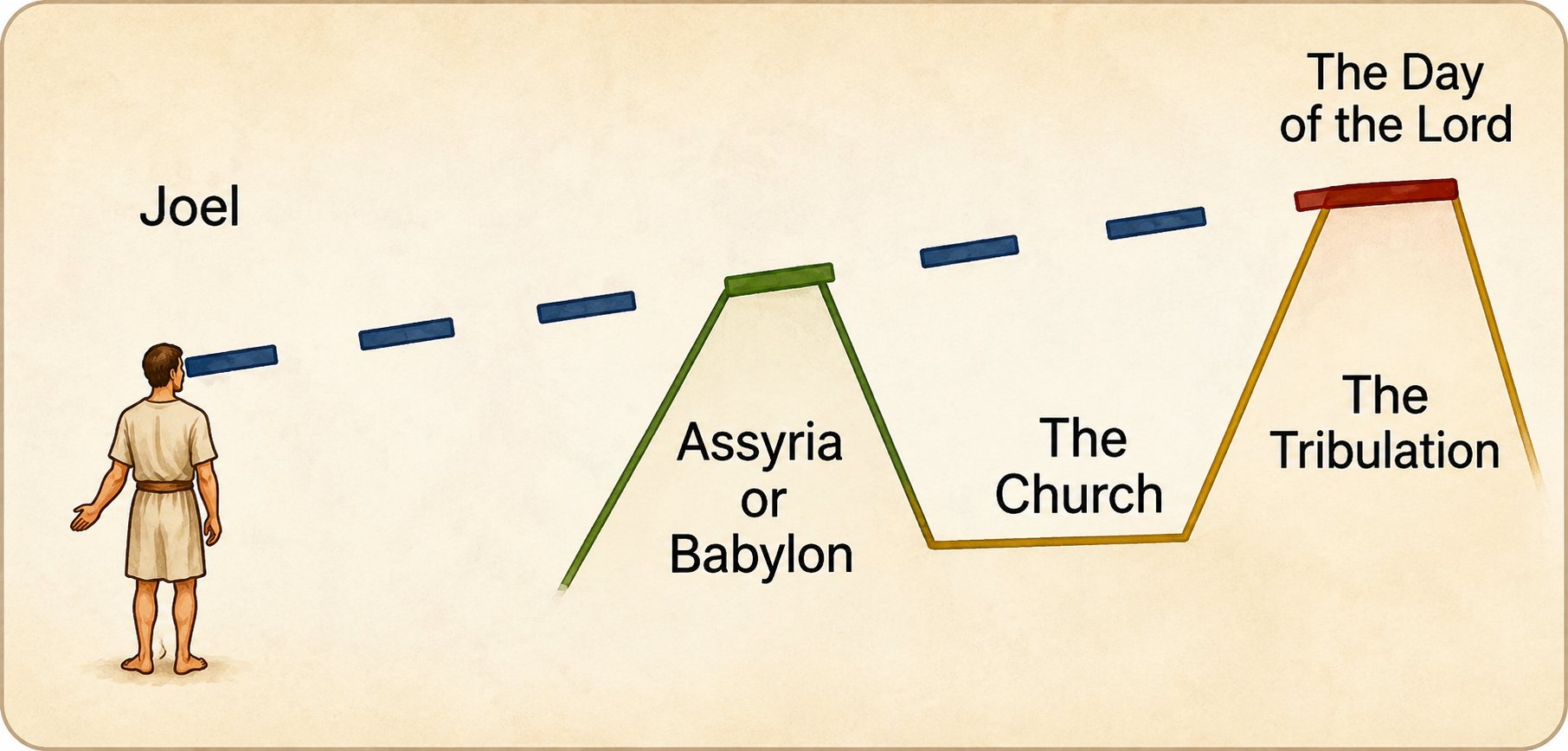
THE DAY OF THE LORD
IS NEAR
In Joel 1:15-18 we have the lament of the entire nation, followed by the prayer of the prophet in Joel 1:19-20 interceding for his nation.
Alas (ahah; LXX - oimmoi) for the day! This sudden cry expresses deep anguish, alarm, and lament over the catastrophe that had overtaken Judah. “Alas” (Hebrew ʾăhāh) is an exclamation of grief or distress, something like “Oh, what a terrible day!” Joel is not calmly describing the devastation; he is emotionally overwhelmed by its significance. The locust plague, drought, ruined crops, and cessation of offerings at the house of the LORD were reasons for profound mourning (Joel 1:4, 9–13).
But Joel's lament looks beyond the immediate disaster, for he immediately explains, “For the day of the LORD is near, and it will come as destruction from the Almighty” (Joel 1:15). The present catastrophe was therefore more than a natural disaster; it was a divinely appointed warning, a foretaste of the far greater Day of the LORD. Judah should not merely lament the loss of grain, wine, and crops; they should recognize that the calamity was calling them to reckon with God Himself (Joel 1:13–14; 2:1, 12–13).
The expression “Alas for the day!” is also found in contexts of divine judgment. Jeremiah cries, “Alas! for that day is great, there is none like it” (Jer 30:7), while Ezekiel declares, “Alas for the day! For the day is near, even the day of the LORD is near” (Ezek 30:2–3). Isaiah similarly commands, “Wail, for the day of the LORD is near! It will come as destruction from the Almighty” (Isa 13:6), wording remarkably similar to Joel 1:15.
Bob Utley - "Alas for the day" This INTERJECTION, usually translated "alas," is found by itself, Jdg. 11:35; 2 Kgs. 3:10; 6:5,15, connected to "Adon YHWH," Jos. 7:7; Jdg. 6:22; Jer. 1:6; 4:10; 14:13; 32:17; Ezek. 4:14; 9:8; 11:13; 21:5 and in Joel uniquely to "for the day," which denotes "the day of YHWH," which can be for blessing or judgment. The use of "also" clearly shows here it relates unexpectedly to God's judgment of His own people! Both Isaiah (i.e. Isa. 13:6,9) and Ezekiel (i.e. Ezek. 7:19; 13:5; 30:2) use the phrase, "the day of the Lord," but without "Alas" (cf. Joel 2:1,11,31; 3:14)
Believer's Study Bible on ALAS - "Alas for the day!" is a powerful, moving statement. It begins a lament (Joel 1:15-20) in light of the approaching day of the Lord, and is the cry of the prophet that reflects the burden that he bore for the people of God. The sin of the land, especially the sin of the priests, demanded repentance on the part of all. Before Joel calls them specifically to repentance (Joel 2:12, 13), he calls the priests to proclaim a fast (Joel 1:14) and to sound an alarm (Joel 2:1). Where are they who cry "Alas!"? Where are they who "fast" (Joel 1:14)? Where are they who sound the alarm and take seriously the sins of God's people in these latter days (Da 10:14)? The first responsibility for this rests with the spiritual leaders of God's people.
Irw Busenitz - Why the urgency? Because the historically unprecedented devastation caused by the locusts is a precursor of a far greater calamity to come. The prophet uses the contemporary situation to direct their attention toward a more awesome, terrifying day—the future day of the LORD. The present was a foreshadowing of a day yet to come. “Alas” is a cry of alarm, laden with ominous overtones. Unless they repent, the LORD’s speedily approaching visitation would come as destruction from the Almighty.
John MacArthur: This is the first occurrence of the theme. Later in the book (Joel 2:18ff.; 3:1,18–21), the Day of the Lord (the occasion when God pours out His wrath on man) results in blessing and exoneration for God’s people and judgment toward Gentiles (Isa 13:6; Ezek 30:3), but here Joel directs the warning toward his own people. The Day of the Lord is speedily approaching; unless sinners repent, dire consequences await them. See 2Th 2:2,3 (See MacArthur Study Bible)
Alas for the day - The word "alas" in this context clearly conveys a negative sense, sense of "Woe is me!" It anticipates a day of doom, not hope (at least not at the outset). What is fascinating is that the Septuagint has not one but three repetitions of the Greek equivalent (oimmoi = alas, woe, not in NT) of the Hebrew Alas (ahah), thus the English translation of the Septuagint reads "Alas, Alas, Alas for the day!" The Latin Vulgate also has the injection is triplicate.
For the Day of the LORD is near (qarob; LXX - eggus - near at hand) - The devastating “day of the locusts” that had overtaken Judah is now seen as a harbinger and foretaste of the far greater Day of the LORD. Playing off the horrors of the locust invasion described in the preceding passages, the Spirit inspires Joel to sweep down the corridors of time, from the calamity of his own day to the climactic events of the last days, when the LORD Himself will intervene directly and decisively in human history in judgment (Joel 2:1–2, 10–11, 30–31; 3:14–16; Isa 13:6–13; Zeph 1:14–18). Thus, the historical “day of the locusts” becomes a prophetic preview of the coming “Day of the LORD.” As dreadful as the locust devastation was, it was only a faint picture of the far greater outpouring of God's righteous wrath yet to come upon a rebellious world.
The “day of the locusts” was therefore like a giant finger ominously pointing forward to the Day of the LORD, emphasizing that this awesome Day is “near” (qarob; cf. Joel 2:1). The English word imminent provides a helpful picture. It derives from the Latin imminere, meaning “to overhang, project over, or threaten.” The picture is of something hanging overhead, ready to occur. In this sense, the Day of the LORD hangs ominously over a world under divine judgment. Joel does not want his readers to miss the urgency of this truth, for once in each chapter he sounds essentially the same prophetic alarm: “The day of the LORD is near!” (Joel 1:15; 2:1; 3:14). Thus, the historical devastation of Joel's day became a prophetic picture of a future Day of divine judgment.
The "day of the locusts" was like a giant finger ominously pointing to the Day of the LORD, and emphasizing that the dread Day is "at hand," or imminent (cf use of the same Hebrew word qarob in Joel 2:1). The etymology of the English word imminent gives us an incredible picture of the idea Joel is attempting to convey. The English word imminent is from the Latin word imminens in turn from imminere a verb which means to hang or project over. The picture of the Day of the LORD is that it is "hanging over" the heads of the readers, that it is impending. Joel wants to make absolutely sure his readers do not miss this point so three times, once in each chapter, he says "the day of the LORD is NEAR!" (Joel 1:15, Joel 2:1, Joel 3:14).
And it will come as destruction (shod) from the Almighty (Shadday) - NET = "the Divine Destroyer." Joel uses a striking play on words in Hebrew: shod (“destruction”) will come from Shadday (“the Almighty”). The sound of the two words reinforces the message that devastation is coming from the all-powerful God Himself. The NET vividly renders it, “It will come as destruction from the Divine Destroyer.” The point is that the coming calamity is neither accidental nor beyond God's control; the Almighty is sovereign over the judgment (cf. Isa 13:6, which repeats almost the identical expression). The One whose power is sufficient to save is also powerful enough to judge, and when Shadday brings shod, no human strength can withstand Him.
The Almighty is the Hebrew word Shadday which gives us our wonderful name of God, EL Shaddai - God Almighty. There is clearly a play on words with the word destruction (shod from shadad) and the word for Almighty (Shadday). The destruction is from the Almighty, the "Shattering from Shaddai"! In the present context this name does not at first glance appear so "wonderful," but as is always the case, before the LORD can heal, He has to break and the end result for the nation of Israel will indeed be "wonderful" in the last days. (cf Joel 3:16-17 "then you will know that I am the LORD your God.")
In summary we learn the Day of the LORD is (1) imminent (near), (2) that it will include destruction and (3) that this destruction is wrought by the hand of the omnipotent Almighty God. The Septuagint is interesting in this passage as it translates destruction from the Almighty as "trouble upon trouble," giving us a picture of God piling up Israel's trouble!
NET Note on destruction (shod; LXX - talaiporia - an emotional condition that arises from inner or outer torment ) from the Almighty - There is a wordplay in Hebrew here with the word used for “destruction” (שׁוֹד, shod) and the term used for God (שַׁדַּי, shadday). The exact meaning of “Shaddai” in the OT is somewhat uncertain, although the ancient versions and many modern English versions tend to translate it as “Almighty” (e.g., Greek παντοκράτωρ [pantokrator NOT USED HERE IN JOEL 1:15], Latin omnipotens). Here it might be rendered “Destroyer,” with the thought being that “destruction will come from the Divine Destroyer,” which should not be misunderstood as a reference to the destroying angel. The name “Shaddai” (outside Genesis and without the element “El” [“God”]) is normally used when God is viewed as the sovereign king who blesses/protects or curses/brings judgment. The name appears in the introduction to two of Balaam’s oracles (Num 24:4, 16) of blessing upon Israel. Naomi employs the name when accusing the Lord of treating her bitterly by taking the lives of her husband and sons (Ruth 1:20-21). In Ps 68:14; Isa 13:6; and the present passage, Shaddai judges his enemies through warfare, while Ps 91:1 depicts him as the protector of his people. In Ezek 1:24 and Ezek 10:5 the sound of the cherubim’s wings is compared to Shaddai’s powerful voice. The reference may be to the mighty divine warrior’s battle cry that accompanies his angry judgment.
Brian Bell asks "What is Joel’s main message? Turn back to God before an even greater judgment comes! God is coming to settle accounts! If you didn’t pay your landlord for your monthly apartment fee, wouldn’t you expect Him to come and pay you a visit, to “settle up!” Be assured the Lord will return and settle all of His accounts. When he settles up His punishment for sin it will be overwhelming, dreadful, and unavoidable! One day we must all reckon with Him! {Are you ready?} This locust plague was only an “appetizer” to the meal the Lord will one day serve up!" (Sermon)
Hampton Keathley IV -- If one assumes that Joel was written around 850 BC, then the coming army could be the Assyrians or Babylonians. The diagram above would depict this view (See more on Joel Commentary)
McComiskey on the Day of the LORD - In the prophetic traditions of the Old Testament, the day of the Lord was the day of Yahweh's holy war against evil, particularly against the Gentile nations that had opposed or oppressed Israel. However, the prophets were quick to show that the day of the Lord came against all evil, not just evil among the Gentiles, but evil within the covenant people, so that Israel too would experience periodic judgment that anticipated that terrible day. As this theme is developed in Joel's prophecy, the day of the Lord threatens the continued existence of the covenant people (Joel 1:2-2:11); but it is a day whose consequences can be averted through repentance (Joel 2:12-17), so that it becomes instead a day of blessing for God's people (Joel 2:18-32) and judgment on their enemies (Joel 3:1-2). During her history prior to the time of Joel, Israel had experienced periodic outbreaks or foretastes of the day of the Lord in the invasions of foreign nations; the locusts are likened to such a foreign invader in Joel 1:6 and Joel 2:6. The Babylonian invasion leading up to the destruction of Jerusalem in 586 b.c. had been the day of the Lord in the eyes of exilic and postexilic Judah, but the postexilic community was not now beyond the threat of divine punishment due to its own wickedness (Ezra 9:13-15; see Allen, Joel, p. 60). (See The Minor Prophets: An Exegetical and Expository Commentary)
David Guzik - The idea behind the phrase the day of the LORD is that this is Gods’ time. Man has his “day,” and the LORD has His day. In the ultimate sense, the day of the LORD is fulfilled with Jesus judges the earth and returns in glory. In a lesser sense, a time of judgment as Judah experienced with the locusts and drought is also an example of the day of the LORD.
Henry Morris - "The day of the LORD," in contrast to "man's day," refers to a coming time of judgment. The Lord, in severe judgment, after a long time of patient forbearance, will take strong control of the world and its inhabitants. This will be followed by cleansing and blessing. Such prophecies often refer to a current situation, such as the plague of locusts, then span over the centuries to the future end-time judgments. Sometimes it refers to the entire period of judgment, sometimes to the specific day on which that period will begin. In the prophets, it occurs first in Isaiah 2:12, last in Malachi 4:5. There are other phrases that are used synonymously--"the day of wrath," "the day of God," "that day." (Defender's Study Bible)
Richard Patterson on the Day of the LORD - The Day of the Lord can refer to a judgment in the near future (Jer 46:10; Amos 5:18–20) or to a more distant, comprehensive judgment (3:14–15; Zech 14:1–21; 2 Pet 3:10–13). Often the two blend into one future scene (Obad 1:15; Zeph 1:7, 14–18). The Scriptures teach that the Day of the Lord is one of judgment, whether for God’s people (Isa 2:12–22; 13:5) or for their enemies (Isa 13:6, 9; Jer 46:10; Mal 4:5–6 [3:23–24]). Prophecies describe it as a day of unprecedented warfare and cosmological events set in a scene of dark clouds. It will be accompanied by a mood of despair and pervading gloom (Zeph 1:14–15; cf. Rev 6:12–17). These same oracles are often accompanied by promises of deliverance for God’s faithful people (e.g., Isa 59:15b–21; Zeph 3:8–20). All of these features, already attested from the eighth century BC onward, provide elements for the emerging apocalyptic corpus both of the Scriptures and the extrabiblical writings of Judeo-Christian literature. The Day of the Lord thus stands as a vivid reminder to all that God does judge sin, and he will ultimately bring earth’s history to its proper and just culmination. (See Minor Prophets: Hosea through Malachi - Page 114)
Alas (0162)(ahah) is an interjection usually rendered ah! oh! or alas! indicating great emotion, such as grief or despair (Josh. 7:7; Jdg. 11:35; Ezek. 11:13). Ahah can also signify a strong sense of marvel with fear (Jdg. 6:22), a feeling of inability (Jer. 1:6), a sense of confusion (Jer. 4:10; Ezek. 4:14). In the present context ahah introduces the announcement of the Day of the LORD (Joel 1:15).
Most of the uses of ahah entail a sense of the speaker being overwhelmed by impending doom (Josh. 7:7; Jdg. 6:22; 2 Ki. 3:10; 6:15; Joel 1:15, etc.).
In English the term "ah" means an expression of surprise, delight, disgust, or pain in nearly all Indo-European languages. The English word "alas" is used to to express unhappiness, sorrow or regret.
Alas, ah in most places is used with "Lord GOD" (Josh 7:7; Jdg 6:22; Jer 1:6; Jer 4:10; Jer 14:13; Jer 32:17; Ezek 4:14; Ezek 9:8; Ezek 11:13).
Ahah - 15 verses - Ah(5), alas(10). Jos. 7:7; Jdg. 6:22; Jdg. 11:35; 2 Ki. 3:10; 2 Ki. 6:5; 2 Ki. 6:15; Jer. 1:6; Jer. 4:10; Jer. 14:13; Jer. 32:17; Ezek. 4:14; Ezek. 9:8; Ezek. 11:13; Ezek. 20:49; Joel 1:15
LXX translates ALAS with oimmoi = not in NT - 18x in 13v in the Septuagint of the following passages - Jdg. 11:35; 1 Ki. 17:20; Job 10:15; Ps. 120:5; Jer. 4:31; Jer. 15:10; Jer. 22:18; Jer. 45:3; Ezek. 9:8; Ezek. 11:13; Joel 1:15; Mic. 7:1
Near (07138) (qarob from the verb qarab = to come near) is an adjective meaning near, close by, closely related. Qarob refers to nearness in time or space: something is about to happen, is near at hand, e.g., judgment, calamity (Dt. 32:35) or something that is not near at hand, referring to its prophetic fulfillment as in Balaam's prophecy of the Messiah "I see him (MESSIAH), but not now; I behold him, but not near; A star (MESSIAH) shall come forth from Jacob." (Nu 24:17) The first use of qarob is in Ge 19:20 which describes the "town is near enough to flee to" from the coming destruction of Sodom and Gomorrah. Clearly in the three uses of qarob by Joel, the idea of near is that it is imminent, (as discussed above), in other worlds at a point in time close to another point of time as Moses writes
Vengeance is Mine, and retribution (Ro 12:19 and Heb 10:30 quote Lxx), In due time their foot will slip; For the day of their calamity is near, and the impending things are hastening upon them. (Dt 32:35 - This was the text for Jonathan Edwards' famous sermon "Sinners in the Hands of an Angry God.") - as noted the text was specifically addressed to unbelieving Israelites, but is applicable to all wicked people.)
Comment: Dt 32:35 is the bad news for Israel much like the message of the "Day of the LORD" would first bring bad news to Israel [e.g., the Time of Jacob's Distress -Jer 30:7] but it is followed by Dt 32:36 which is a promise to restore Israel much like the promise in Joel 3:1)
Qarob is translated in the Septuagint with the adverb eggus, which means near. David offers a great prayer (we would all do well to keep on our heart so that it is near our lips) "Be not far from me, for trouble is near (qarob; Lxx = eggus); For there is none to help (boetheo)." (Psalm 22:11)
Destruction (07701)(shod from shadad = to deal violently with, despoil, devastate, ruin) is a masculine noun meaning violence, destruction, desolation, robbery, spoil, wasting. The primary meaning of shod is violence or destruction and is used to describe an "act of violence or oppression." In Job the idea is not to fear coming violence - "And you will not be afraid of violence when it comes" (Job 5:21). Shod is used in Ps 12:5 to designate a reason for God's arising to protect the weak. Isaiah weeps over Israel (reminiscent of Jesus' words in Mt 23:37, Lk 13:34) - "Therefore I say, “Turn your eyes away from me, Let me weep bitterly, Do not try to comfort me concerning the destruction of the daughter of my people.” (Isa. 22:4). Shod was also used by Jeremiah and Amos to describe violence and havoc as social sins (Jer 6:7; Amos 3:10).
The primary meaning of destruction was used by Hosea and here by Joel to express God's reason for the coming Day of the LORD which will bring destruction on His Chosen People (Hos. 7:13 = "Woe to them, for they have strayed from Me! Destruction is theirs, for they have rebelled against Me! I would redeem them, but they speak lies against Me.").
Victor Hamilton adds that "the verb shādad has an interesting usage. In one sense it is applied to Babylon (in the Jeremiah passages obviously) as the "destroyer" of Jerusalem (Jeremiah 6:26; Jeremiah 12:12, inter alia). This militaristic world power, far from being an independent entity, is an actor chosen for the cast by God. Its function is to be the medium through which God's holy anger is outpoured on his own covenant children. Babylon itself will subsequently become the object of equal devastation (Jeremiah 51:48, 53, 55, 56; Psalm 137:8). The ferocity of shādad is indicated by its coupling with the activities of a wolf (Jeremiah 5:6) who pursues, attacks, and mauls its victim." (ONLINE Theological Wordbook of the Old Testament)
Shod - 25x in 24v - destroyed(1), destruction(12), devastation(7), violence(5).Job 5:21; Job 5:22; Ps. 12:5; Prov. 21:7; Prov. 24:2; Isa. 13:6; Isa. 16:4; Isa. 22:4; Isa. 51:19; Isa. 59:7; Isa. 60:18; Jer. 6:7; Jer. 20:8; Jer. 48:3; Ezek. 45:9; Hos. 7:13; Hos. 9:6; Hos. 10:14; Hos. 12:1; Joel 1:15; Amos 3:10; Amos 5:9; Hab. 1:3; Hab. 2:17
Almighty (07706) Shadday means most powerful. The Name Shaddai conveys the truth on the one hand that He is omnipotent and on the other that He is sufficient. El Shaddai = God Almighty the ever-present God who protects and provides, presents Himself as the One who makes a covenant with a human being named Abraham.
Davison writes "The exact origin, history, and etymology of the name (Shaddai) are highly debated. Traditionally, it has been connected to Hebrew šādad, “deal mightily with,” but the verb actually has the connotation “deal violently.” Other scholars associate it with Assyrian šadu, “mountain” or “high,” thus rendering the Hebrew as “High God” or “God of the Mountains.” The usual English translation, “Almighty,” derives from the rendering of the Hebrew in the LXX (Ed note: See pantokrator) and Vulgate (Ed note: E.g., Genesis 17:1 = "ego Deus omnipotens")., which was a free translation of what was by then an obscure term. (See Eerdmans Dictionary of the Bible - Page 403)
There are some authorities (most notably Nathan Stone - see note) who feel that the Hebrew Shaddai is derived from the Hebrew word shad which means breast (an etymology also made popular by the Scofield Reference Bible). If this is valid, it in turn suggests that Shaddai might signify the one who nourishes or supplies. El Shaddai then would be the one who is able to pour out His promises of provision and power in abundance.
Related Resources on Day of the LORD:
- Day of the Lord - on site discussion
- What is the day of the Lord? - The phrase “day of the Lord” usually identifies events that take place at the end of history (Isaiah 7:18-25) and is often closely associated with the phrase “that day.” One key to understanding these phrases is to note that they always identify a span of time during which God personally intervenes in history, directly or indirectly, to accomplish some specific aspect of His plan. Most people associate the day of the Lord with a period of time or a special day that will occur when God’s will and purpose for His world and for mankind will be fulfilled.
- Bridgeway Bible Dictionary Day of the lord - Israelites of Old Testament times looked for the day when God would intervene in the affairs of the world, righting the wrongs and establishing his just rule on the earth. They called this divine intervention the day of the Lord (Isaiah 2:12-19; Isaiah 13:6; Isaiah 13:9; Zephaniah 1:14-16; Zechariah 14:9).
- Holman Bible Dictionary Day of the Lord - The time when God reveals His sovereignty over human powers and human existence.
- Hastings' Dictionary of the Bible Day of the Lord The day in which Jehovah was expected to punish sinful Hebrews and the enemies of Israel, and to establish at least the righteous remnant of His people in political supremacy.
- Hastings' Dictionary of the NT Day of the Lord
- International Standard Bible Encyclopedia Day of the Lord (Yahweh) - The idea is a common Old Testament one. It denotes the consummation of the kingdom of God and the absolute cessation of all attacks upon it (Isaiah 2:12 ; Isaiah 13:6 , Isaiah 13:9 ; Isaiah 34:8 ; Ezekiel 13:5 ; Ezekiel 30:3 ; Joel 1:15 ; Joel 2:11 ; Amos 5:18 ; Zephaniah 1:14 ; Zechariah 14:1 ) It is a "day of visitation" (Isaiah 10:3 ), a day "of the wrath of Yahweh" (Ezekiel 7:19 ), a "great day of Yahweh" (Zephaniah 1:14 ). The entire conception in the Old Testament is dark and foreboding.
- The Jewish Encyclopedia Day of the Lord - An essential factor in the prophetic doctrine of divine judgment at the end of time (see Eschatology ), generally, though not always, involving both punishment and blessing.
G Campbell Morgan - Joel 1:15 - Alas for the day! for the day of the Lord is at hand.
Joel was, a prophet to Judah. His message, as found in this book, seems to be one; rather than the notes of a long period of ministry as in the case of Hosea to Israel. The occasion of its delivery was that of the desolation of the land by a locust plague. In the beginning of this chapter, we have his description of that desolation, and from it we learn how terrible it was. It was an hour in which men would be likely to brood upon the calamity, moved very largely by pity for themselves. Then the prophet spoke, and his word interpreted the, situation, and called men to recognize the real meaning of the calamities in the midst of which they were living. This was the Day of Jehovah, which meant that it was the Day of Divine government and activity. The coming of the locusts was no accident. They name in ranks, in order; and they wrought the will of God. Therefore the prophet called the priests and the people to humiliation. Here then is the first note of this prophecy. The burden of Joel from first to last was that of the Day of Jehovah, that is, the fact of the Divine government of human affairs; and his first application of that burden was that of calling the people to a recognition of the fact that the Day of Jehovah • was then present, it was at hand: that is, it was near, not in the sense of approaching, but rather in the sense of actual and immediate activity. There is more to say—as we shall see—but let this first fact be carefully noted. The Day of Jehovah is here and now. He is reigning today. The calamities through which men pass, are all under His control. Instead of mourning over sorrow, men should mourn over sin, and cry unto Jehovah.
Matthew Henry - Always Ready
Alas for the day! For the day of the Lord is near, and as destruction from the Almighty it comes. Joel 1:15
To watch for Christ’s coming, is to maintain that temper of mind which we would be willing that our Lord should find us in. We know we have but a little time to live, we cannot know that we have a long time to live; much less do we know the time fixed for the judgment. Our Lord’s coming will be happy to those who are found ready, but very dreadful to those who are not. If a man, professing to be the servant of Christ, be an unbeliever, covetous, ambitious, or a lover of pleasure, he will be cut off. Those who choose the world for their portion in this life will have hell for their portion in the other life. May our Lord when he comes pronounce us blessed and present us to the Father washed in his blood, purified by his Spirit, and fit to be partakers of the inheritance of the saints in light. Christ will come unlooked for, will find people busy at their usual occupations, in the field, at the mill; and then, according as they are vessels of mercy prepared for glory, or vessels of wrath prepared for ruin, accordingly it will be with them; the one taken to meet the Lord and his angels in the air, to be forever with him and them; the other left to the devil and his angels, who, when Christ has gathered out his own, will sweep up the residue. This will aggravate the condemnation of sinners that others shall be taken from the midst of them to glory, and they left behind. And it speaks abundance of comfort to the Lord’s people.
Walter Kaiser - The Day of the Lord - Hard Sayings of the Bible - page 295
What will this day of the Lord be like? And how can Joel say it is near or imminent when five different prophets in four different centuries (the latter ones aware of the earlier ones) declared that it was just that—near? If it were so near, why hadn’t it happened in over four hundred years?
Ten times the prophets warned that that day was near (Joel 1:15; 2:1; 3:14; Obad 15; Is 13:6; Zeph 1:7, 14 [twice]; Ezek 30:3 [twice]). But these prophets ministered in the ninth century B.C. (probably, but not with total certainty, Joel and Obadiah), the eighth century (Isaiah), the seventh century (Zephaniah) and the sixth century (Ezekiel). Yet each repeatedly warned that the day of the Lord was imminent and certain to come. They even gave their contemporaries instances of what impact it would have on people and the nations. But they always reserved the worst and final fulfillment for the future.
The day of the Lord is much too complex a subject to be contained in a brief discussion, for the prophets found it a most engaging topic in their ministries and writings. But it does not completely defy description. It will be a time when God judges the wicked as never before and simultaneously completes the salvation and deliverance of the redeemed.
The Lord will come to “judge the world” (Ps 9:8; 96:13; 98:9). In that day, “The LORD will be king over the whole earth. On that day there will be one LORD, and his name the only name” (Zech 14:9).
It will also be a day of theophany or the appearance of God. He will appear on the Mount of Olives, just where the Son of God told the men from Galilee that he would come again in like manner as they had seen him go (Zech 14:3–4). When he appears, Jerusalem will be attacked and he personally will lead his people against the nations that have gathered there to settle the Jewish question once and for all (Zech 14:3–12; Joel 3).
Because of this insurrection against the Lord and his cause, Amos describes this day as one of darkness and mourning (Amos 5:18–20) for those who had only the popular concept that the Messiah would return to magically right all wrongs for everyone, regardless of the person’s personal belief in him. Amos went on to show how false this hope was.
In the New Testament this day is still being discussed. It is known as that day (Mt 7:22; 1 Thess 5:4), the day of God (2 Pet 3:12), the day of wrath (Rom 2:5–6) and the day of our Lord Jesus Christ (2 Cor 1:14; Phil 1:6, 10). It had the same foreboding aspect of horrors for the unbeliever, yet it was a bright day of release and joy for all who looked forward to Christ’s coming.
But this day always had an impending nature to it. Though it found partial fulfillment in such events as Joel’s locust plagues, the destruction of Jerusalem and the threat of national invasions, its final and climactic fulfillment always remained in Christ’s future return.
Therefore, the day of the Lord was a term rich in content. It marked off a divinely inaugurated future period, which already had in some sense begun with the ongoing history of the kingdom of God. In such a blend of history and prophecy, the prophet’s promise that that day was coming in the eschatological (last days) setting was reinforced by God’s present-day foreshadowings of what was to come. This would induce men and women to repent and to prepare for that day. Its blessings would extend to a new Jerusalem, the endowment of the Holy Spirit in a unique way and the cleansing and purification of all that needed it.
When this came, the kingdom would be the Lord’s and all other rivalries would cease—forever!
THE BIBLE’S WATCHWORD: DAY OF THE LORD - Richard Mayhue
Introduction - The biblical phrase “Day of the Lord” (DOL) stands as a key term in understanding God’s revelation about the future.1 The NT writers’ use of DOL rested upon their understanding of the OT prophets. A survey of the OT indicates that it was used by the prophets when speaking of both near historical and future eschatological events involving God’s wrath. The NT writers picked up on the eschatological use and applied DOL both to the judgment which will climax the Tribulation period and the judgment which will usher in the new earth. This view is not only compatible with but also strengthens the case for Futuristic Premillennialism and a Pretribulational Rapture. (Click full 24 page article)
Joel 1:16 Has not food been cut off before our eyes, gladness and joy from the house of our God?
KJV Is not the meat cut off before our eyes, yea, joy and gladness from the house of our God?
NET Our food has been cut off right before our eyes! There is no longer any joy or gladness in the temple of our God!
NLT Our food disappears before our very eyes. No joyful celebrations are held in the house of our God.
BGT κατέναντι τῶν ὀφθαλμῶν ὑμῶν βρώματα ἐξωλεθρεύθη ἐξ οἴκου θεοῦ ὑμῶν εὐφροσύνη καὶ χαρά
LXE Your meat has been destroyed before your eyes, joy and gladness from out of the house of your God.
CSB Hasn't the food been cut off before our eyes, joy and gladness from the house of our God?
ESV Is not the food cut off before our eyes, joy and gladness from the house of our God?
NIV Has not the food been cut off before our very eyes-- joy and gladness from the house of our God?
YLT Is not before our eyes food cut off? From the house of our God joy and rejoicing?
- Has not food been cut off before our eyes Joe 1:5-9,13 Am 4:6-7
- Gladness and joy from the house of our God: De 12:6-7,11,12 Dt 16:10-15 Ps 43:4 Ps 105:3 Isa 62:8,
Related Passages:
Amos 4:6-7 “But I gave you also cleanness of teeth in all your cities And lack of bread in all your places, Yet you have not returned to Me,” declares the LORD. 7 “Furthermore, I withheld the rain from you While there were still three months until harvest. Then I would send rain on one city And on another city I would not send rain; One part would be rained on, While the part not rained on would dry up.
Psalm 43:4 Then I will go to the altar of God, To God my exceeding joy; And upon the lyre I shall praise You, O God, my God.
Psalm 105:3 Glory in His holy name; Let the heart of those who seek the LORD be glad.
JOEL REVERTS TO
EFFECTS OF LOCUST PLAGUE
Has not food been cut off (karath; LXX - exolethreuo - utterly destroyed, rooted out) before our eyes - This rhetorical question calls the people to take inventory of the devastation plainly visible before them and expects an affirmative answer. Their food supply had been cut off, and the evidence of God's judgment was impossible to ignore. Joel points to what their eyes could see in order to awaken their hearts to what God was saying. The physical famine was intended to stir a spiritual response, moving the people to mourning, fasting, prayer, and a wholehearted return to the LORD (Joel 1:13–14; 2:12–13).
Gladness (simchah; LXX - euphrosune - state of happiness, rejoicing) and joy (LXX - chara) from the house of our God - Gladness and joy normally characterized worship in the house of God, as the people gathered before the LORD with grateful hearts and brought offerings from the abundance He had provided (Dt 12:7, 12; 16:10–11; 1 Chr 29:9, 22; Ps 42:4). Israel's worship was intended to be marked not merely by solemnity, but also by joyful thanksgiving for the goodness and provision of God (Dt 16:15; Ps 100:1–4). But now, no abundance, no joy!
Bob Utley - "joy" This term is often associated with worship at the central shrine (cf. Deut. 12:6,7; Ps. 43:4). YHWH has taken away His gift of fertility and, therefore, the sacrifices and offerings have ceased (cf. Joel 1:9,13). The Israelites came to God's temple, but not to rejoice but to cry out for forgiveness and mercy because of their covenant rebellion (cf. Joel 1:13-14,19-20).
We see the relationship between offerings to the LORD and gladness and joy in Deuteronomy...
Deuteronomy 12:6;“There you shall bring your burnt offerings, your sacrifices, your tithes, the contribution of your hand, your votive offerings, your freewill offerings, and the firstborn of your herd and of your flock. 7 “There also you and your households shall eat before the LORD your God, and rejoice in all your undertakings in which the LORD your God has blessed you.
Deuteronomy 12:11 then it shall come about that the place in which the LORD your God will choose for His name to dwell, there you shall bring all that I command you: your burnt offerings and your sacrifices, your tithes and the contribution of your hand, and all your choice votive offerings which you will vow to the LORD. 12 “And you shall rejoice before the LORD your God, you and your sons and daughters, your male and female servants, and the Levite who is within your gates, since he has no portion or inheritance with you.
Deuteronomy 16:10-11 Then you shall celebrate the Feast of Weeks to the LORD your God with a tribute of a freewill offering of your hand, which you shall give just as the LORD your God blesses you; 11 and you shall rejoice before the LORD your God, you and your son and your daughter and your male and female servants and the Levite who is in your town, and the stranger and the orphan and the widow who are in your midst, in the place where the LORD your God chooses to establish His name.
🙏 THOUGHT - In the NT the greatest offering we can make each day (not just Sunday!) is our self, our body (Ro 12:1), and when we do so, we should experience gladness and joy. Perhaps your gladness and joy is at low ebb these days. Have you recently offered your body as "a living and holy sacrifice, acceptable to God, which is your spiritual service of worship?" If not, take a moment to humbly bow in worship (whether at work or school or home) and confess your failure to present yourself to the God Who rightly owns you (1 Cor 6:19-20), seeking His forgiveness and His Spirit's energizes the fruit of gladness and joy in your heart (Gal 5:22). You may be surprised at how much difference it makes in the rest of your day! And don't forget that integrally related to your offering is your subsequent conduct. Therefore "do not be conformed to this world, but be transformed by the renewing of your mind, so that you may prove what the will of God is, that which is good and acceptable and perfect." (Ro 12:2).
Joy (gladness, pleasure, delight) (08057) simchah from samach = to rejoice, be glad) is a feminine noun which means joy, gladness (with one's entire being as indicated by its association with the heart cf. Ex 4:14; Ps 19:8; 104:15; 105:3, soul Ps 86:4, cp verb samach in Pr 15:30 = "bright eyes gladden the heart") and refers to both the emotion and the manifestation of the emotion (Ezra 3:12, 13). Simchah refers to the reality, the experience and manifestation of joy and gladness. Joy is happiness over an unanticipated or present good. Delight or gladness in our heart comes from God (Psalm 4:7, cp 2Chr 20:27, 30:21). David prays "make me know joy and gladness (simchah)." (Ps 51:8) God desires that we serve Him with joy (Dt 28:47). Jdg 16:23 describes pagan (Philistines) rejoicing upon conquering their enemy (Israel). We see joy associated with music and/or singing (1Sa 18:6, 1Ki 1:40, 1Chr 15:16, 2Chr 23:18, 29:30). We see joy associated with willing offering from a whole heart (1Chr 29:9, 17). Joy was associated with celebration of the feast (2Chr 30:21, 23, 26, Ezra 6:22) In God's "presence is fullness of joy" (Ps 16:11). God gives a person "gladness of heart" in the labor and toil of this earthly life (Eccl. 5:20). One’s wedding day is a day of rejoicing (Song 3:11). The "joy of the godless" is momentary (Job 20:5) because it depends on joy producing circumstances. Even as God can give joy, He can also take it away (Isa 16:10, Jer 7:34, Joel 1:16).
Joel 1:16-20 TODAY IN THE WORD
God disciplines us for our good, that we may share in his holiness. - Hebrews 12:10b
A mother was working in the kitchen when she heard the sound of whimpering on the back porch. When she opened the door, she saw her small son sitting on the steps nursing a bruised finger and crying. He and a friend had been loading rocks in a basket when one of the rocks had landed on his hand. “Why didn’t you tell me you were hurt?” his mother asked. The boy sheepishly replied that he had been afraid to come to her. “Afraid?” she said in amazement. “Why would you be afraid?” “I thought you might be angry,” the boy explained. The mother bandaged her son’s finger and as she hugged him she said, “You never have to be afraid to come to us when you are hurt.”
The consequences of Israel’s disobedience in Joel’s day had been painful for both man and beast. A combination of locusts and drought had destroyed the crops. Men and animals alike were suffering. What is more, the shortage of food had interrupted the cycle of temple sacrifices and festivals (Joel 1:16). The pitiful lowing of hungry cattle and the bleating of starving sheep mirrored the anguished cries of God’s people (Joel 1:18). As Joel watched wild fires consume land and crops, he added his voice to this chorus of suffering (Joel 1:19). This was God’s intention. His design was that Israel’s suffering would make them aware of their own sin and would instill in them a longing for restoration. These sufferings prompted God’s creation to “pant” or long after God (Joel 1:20). It could only be hoped that His people would be as wise as the animals they tended.
TODAY ALONG THE WAY - How have you responded to the difficult circumstances in your life? Would you say that they have drawn you closer to God, or are you in danger of being driven away from Him? Take time to examine the difficulties you face. How has God been using them to teach you more about His faithfulness and forgiveness? While not every problem you meet may be a case of divine discipline, you can have confidence that God is lovingly working through the events that come your way to produce righteousness and peace in your life.
Joel 1:17 The seeds shrivel under their clods; The storehouses are desolate, The barns are torn down, For the grain is dried up.
KJV The seed is rotten under their clods, the garners are laid desolate, the barns are broken down; for the corn is withered.
NET The grains of seed have shriveled beneath their shovels. Storehouses have been decimated and granaries have been torn down, for the grain has dried up.
NLT The seeds die in the parched ground, and the grain crops fail. The barns stand empty, and granaries are abandoned.
BGT ἐσκίρτησαν δαμάλεις ἐπὶ ταῖς φάτναις αὐτῶν ἠφανίσθησαν θησαυροί κατεσκάφησαν ληνοί ὅτι ἐξηράνθη σῖτος
LXE The heifers have started at their mangers, the treasures are abolished, the wine-presses are broken down; for the corn is withered.
CSB The seeds lie shriveled in their casings. The storehouses are in ruin, and the granaries are broken down, because the grain has withered away.
ESV The seed shrivels under the clods; the storehouses are desolate; the granaries are torn down because the grain has dried up.
NIV The seeds are shriveled beneath the clods. The storehouses are in ruins, the granaries have been broken down, for the grain has dried up.
YLT Rotted have scattered things under their clods, Desolated have been storehouses, Broken down have been granaries, For withered hath the corn.
- seed: Heb. grains, Ge 23:16
WHEN THE SEED SHRIVELS
AND HARVEST FAILS
The seeds shrivel under their clods; The storehouses are desolate (shamen/samen; LXX - aphanizo - caused to disappear, ruined), The barns are torn down, For the grain is dried up (yabesh; LXX - xeraino) - This continues Joel’s picture of total agricultural collapse. The devastation has progressed from the vines and trees (Joel 1:12) to the very seed and grain supply upon which the next harvest depended.
Joel 1:20 describes conditions that suggest drought, but the ESV Bible marginal note reads 'The meaning of the Hebrew line is uncertain." In any event, in a drought seeds would not be able to germinate.
The seeds shrivel under their clods - The picture is of seed lying beneath the dry, hardened soil but failing to germinate and grow. The Hebrew here is difficult, and translations vary considerably, but the basic picture is clear. What should have produced life and a future harvest has instead dried up and perished beneath the soil. The disaster therefore threatens not merely the present harvest but the future harvest as well. There is nothing growing to replace what has already been lost.
The storehouses are desolate, the barns are torn down - Why maintain storage facilities when there is nothing to store? The empty storehouses testify to the severity of the judgment. The Hebrew idea behind desolate (shamen/samen) can carry the sense of being devastated, appalled, or abandoned. The barns have become useless because the fields have produced nothing to put into them.
For the grain is dried up - This gives the reason for their desolate condition. No grain means no harvest, no food, no seed for planting, no grain offering at the Temple, and no need for barns (cf. Joel 1:9, 13). The effects of the catastrophe ripple outward from aeed shriveled to harvest failed to storehouses emptied to barns abandoned to offerings ceased and finally to people and animals suffering.
Recall the striking contrast with God's covenant promises of blessing in Deuteronomy. Under obedience, Israel's barns would be filled (Dt 28:8; Pr 3:9–10), but disobedience would bring drought, crop failure, and famine (Dt 28:22–24, 38–40). Joel's generation was seeing those prophecies written over 500 years earlier being literally fulfilled before their eyes.
NET Note adds "These two lines of v. 17 comprise only four words in the Hebrew; three of the four are found only here in the OT. The translation and meaning are rather uncertain. A number of English versions render the word translated “shovels” as “clods,” referring to lumps of soil (e.g., KJV, NAB, NASB, NIV, NRSV)."
The cost of sin is rarely confined to the moment.
Today's compromise can become tomorrow's barren field.
🙏 THOUGHT - Is this not a picture of the ravages of persistent, unconfessed sin? Yesterday's harvest was gone, today's storehouses were empty, and tomorrow's seed was shriveling beneath the soil. Sin promises a harvest of pleasure, but when fully grown it leaves behind fields of loss (Gal 6:7–8; Jas 1:14–15). Or stated another way, sin's consequences are rarely confined to today, but can also shrivel "the seed" of tomorrow's "harvest."
Desolate (appalled, astonished) (08074) shamen/samen means ruin or waste and is a primary root which refers to a desolation caused by some great disaster, usually a result of divine judgment and is used of people (2 Sam. 13:20; Lam. 1:13, 16) and places (Lev. 26:31, 32; Isa. 61:4; Ezek. 35:12).Shamem also refers to the reaction to such a ruin, including consternation, astonishment, or being appalled (Job 18:20; Isa. 52:14; Jer. 18:16). Shamen often describes a person’s reaction on seeing desolation and destruction (1Ki 9:8) Lev 26:32 uses shamen/samen twice and conveys both of the ideas of this word the desolation and the reaction to the desolation = 'I will make the land desolate (shamen) so that your enemies who settle in it will be appalled (shamen) over it. Webster's English definition of desolate - Laid waste; in a ruinous condition; neglected; devoid of inhabitants and visitors; joyless, disconsolate, and sorrowful through or as if through separation from a loved one, showing the effects of abandonment and neglect; barren, lifeless (desolate landscape). Verb = to lay waste, to make wretched. Webster's English definition of appalled - to overcome with consternation, shock, or dismay; causing extreme dismay, horror, or revulsion
Joel 1:18 How the beasts groan! The herds of cattle wander aimlessly because there is no pasture for them; Even the flocks of sheep suffer.
KJV How do the beasts groan! the herds of cattle are perplexed, because they have no pasture; yea, the flocks of sheep are made desolate.
NET Listen to the cattle groan! The herds of livestock wander around in confusion because they have no pasture. Even the flocks of sheep are suffering.
NLT How the animals moan with hunger! The herds of cattle wander about confused, because they have no pasture. The flocks of sheep and goats bleat in misery.
BGT τί ἀποθήσομεν ἑαυτοῖς ἔκλαυσαν βουκόλια βοῶν ὅτι οὐχ ὑπῆρχεν νομὴ αὐτοῖς καὶ τὰ ποίμνια τῶν προβάτων ἠφανίσθησαν
LXE What shall we store up for ourselves? the herds of cattle have mourned, because they had no pasture; and the flocks of sheep have been utterly destroyed.
CSB How the animals groan! The herds of cattle wander in confusion since they have no pasture. Even the flocks of sheep suffer punishment.
ESV How the beasts groan! The herds of cattle are perplexed because there is no pasture for them; even the flocks of sheep suffer.
NIV How the cattle moan! The herds mill about because they have no pasture; even the flocks of sheep are suffering.
YLT How have cattle sighed! Perplexed have been droves of oxen, For there is no pasture for them, Also droves of sheep have been desolated.
- Joe 1:20 1Ki 18:5 Jer 12:4 14:5,6 Ho 4:3
Related Passages:
Romans 8:18-22 For I consider that the sufferings of this present time are not worthy to be compared with the glory that is to be revealed to us. 19For the anxious longing of the creation waits eagerly for the revealing of the sons of God. 20For the creation was subjected to futility, not willingly, but because of Him who subjected it, in hope 21that the creation itself also will be set free from its slavery to corruption into the freedom of the glory of the children of God. 22For we know that the whole creation groans and suffers the pains of childbirth together until now.
Jeremiah 9:10 “For the mountains I will take up a weeping and wailing, And for the pastures of the wilderness a dirge, Because they are laid waste so that no one passes through, And the lowing of the cattle is not heard; Both the birds of the sky and the beasts have fled; they are gone.
THE MISERY OF
THE ANIMAL KINGDOM
How the beasts groan! The herds of cattle wander aimlessly because there is no pasture for them; Even the flocks of sheep suffer - Joel now turns from the suffering of people to the suffering of animals, showing just how comprehensive the devastation had become. The effects of the locust plague and drought extended throughout the land. Even the animals, innocent of Judah's rebellion, were suffering under the consequences of a creation subjected to calamity (cf. Ro 8:20–22).
NET Note on wander aimlessly - Heb “the herds of cattle are confused.” The verb בּוּךְ (bukh, “be confused”) sometimes refers to wandering aimlessly in confusion (cf. Exod 14:3).
How the beasts groan! - The Hebrew verb conveys the distressed groaning or sighing of the animals. Joel could actually hear the misery produced by the judgment. Earlier the people were commanded to wail (Joel 1:5, 11, 13); now, in a sense, creation itself joins the lament. This provides a striking picture of the far-reaching consequences of sin and divine judgment.
The herds of cattle wander aimlessly because there is no pasture for them - The cattle are pictured confused and restless, roaming about in search of grass but finding none. They are desperately looking for food. The drought had destroyed what the locusts had not consumed (Joel 1:19–20). Normally Israel's fertile land provided abundant pasture, but now the cattle could find nowhere to feed. Their helpless wandering provided visible testimony to the severity of the disaster.
Even the flocks of sheep suffer - The word even intensifies the picture. Why so? The sheep are well known as "foraging machines" and require less grass than other grazing animals. Nevertheless it was so bad that even the sheep were without adequate grasses upon which to nibble!
The animals groaning and suffering remind us of Paul's description in Romans 8
For I consider that the sufferings of this present time are not worthy to be compared with the glory that is to be revealed to us. 19 For the anxious longing of the creation waits eagerly for the revealing of the sons of God. 20 For the creation was subjected to futility, not willingly, but because of Him who subjected it, in hope 21 that the creation itself also will be set free from its slavery to corruption into the freedom of the glory of the children of God. 22 For we know that the whole creation groans and suffers the pains of childbirth together until now.(Ro 8:18-22 a reflection of Ge 3:17-19)
Wiersbe - Creation longs for that day when the Creator will return to earth and set it free from sin’s shackles, and then “the wilderness and the solitary place shall be glad … and the desert shall rejoice, and blossom like the rose” (Isa. 35:1). (Page 1409 - Bible Exposition Commentary)
Joel 1:19 To You, O LORD, I cry; For fire has devoured the pastures of the wilderness And the flame has burned up all the trees of the field.
KJV O LORD, to thee will I cry: for the fire hath devoured the pastures of the wilderness, and the flame hath burned all the trees of the field.
NET To you, O LORD, I call out for help, for fire has burned up the grassy pastures, flames have razed all the trees in the fields.
NLT LORD, help us! The fire has consumed the wilderness pastures, and flames have burned up all the trees.
BGT πρὸς σέ κύριε βοήσομαι ὅτι πῦρ ἀνήλωσεν τὰ ὡραῖα τῆς ἐρήμου καὶ φλὸξ ἀνῆψεν πάντα τὰ ξύλα τοῦ ἀγροῦ
LXE To thee, O Lord, will I cry: for fire has devoured the fair places of the wilderness, and a flame has burnt up all the trees of the field.
CSB I call to You, LORD, for fire has consumed the pastures of the wilderness, and flames have devoured all the trees of the countryside.
ESV To you, O LORD, I call. For fire has devoured the pastures of the wilderness, and flame has burned all the trees of the field.
NIV To you, O LORD, I call, for fire has devoured the open pastures and flames have burned up all the trees of the field.
YLT Unto Thee, O Jehovah, I do call, For fire hath consumed comely places of a wilderness, And a flame hath set on fire all trees of the field.
- To You, O LORD, I cry Ps 50:15 91:15 Mic 7:7 Hab 3:17,18 Lu 18:1,7 Php 4:6,7
- For fire has devoured the pastures of the wilderness Joe 2:3 Jer 9:10 Am 7:4
PROPHET'S PLEA
OF INTERCESSION
To You, O LORD, I cry - It is interesting that Joel did not give Jehovah a specific request (petition) but simply explained the reason for his intercession for the suffering land.
Cry (0398) (qara) is used in Joel 1:14, Joel 1:19, Joel 2:15, Joel 2:32 and Joel 3:9. The Greek word used in Joel 1:19 to translate "cry" is the verb boao from boé (995) means raise a cry, call or shout of joy, pain, etc, by using one’s voice with unusually high volume. In several of the NT contexts (and many more of the Septuagint = LXX uses) crying out was in the context of one seeking help or assistance.
NET Note on translated it as "I call out for help" - The phrase “for help” does not appear in the Hebrew but is supplied in the translation for the sake of clarity.
Pusey points out the impossibility of remedying their situation without divine help: “All sin stupefies the sinner. All intoxicate the mind, bribe and pervert the judgment, dull the conscience, blind the soul and make it insensible to its own ills.”
Richard Patterson - Did the people not understand what all of this meant? The dryness and barrenness of the land reflected the spiritual dearth of their hearts (cf. Jer 23:10). Worship and service had given way to a mere routine that left their lives devoid of spiritual vitality. Surely they needed to realize that the present devastation was but a portent of a still greater catastrophe should they not repent and return to the Lord. (See Minor Prophets: Hosea through Malachi - Page 116)
For fire has devoured the pastures of the wilderness - Joel refers to uncultivated lands where animals previously were able to graze. Fire could be literal or figurative. Joel 1:20 "the water brooks are dried up" is surely literal and suggests significant dought. Dought would definitely predispose to literal fire of dry vegetation. On the other hand, in the OT, fire can represent devastating heat or judgment rather than requiring an independently occurring wildfire. For example, Amos 7:4 portrays divine judgment as fire consuming “the great deep” and farmland, obviously highly figurative imagery. Thus Joel could be saying that the land has become so sun-scorched and drought-stricken that it appears burned by fire. Whether literal fire or vivid imagery for drought, the point is the same that the devastation is comprehensive, leaving both man and beast utterly dependent upon Yahweh.
NET Note favors figurative for fire - "The locust plague, accompanied by conditions of extreme drought, has left the countryside looking as though everything has been burned up (so also in Joel 2:3). This fire was one of the effects of the drought. (NET) Fire here and in v. 20 is probably not to be understood in a literal sense. The locust plague, accompanied by conditions of extreme drought, has left the countryside looking as though everything has been burned up (so also in Joel 2:3).
Richard Patterson - Smith (1929:394) cites the following testimony: “Bamboo groves have been stripped of their leaves and left standing like saplings after a rapid brush fire, and grass has been devoured so that the bare ground appeared as if burned.” For the appearance of fields blackened by the destructive locusts, Finley (1990:38) points out that the OT uses of fire in connection with divine judgment “highlights the judgmental nature of the locusts and drought.” (See Minor Prophets: Hosea through Malachi - Page 116)
MacArthur rightly points out "As the first to call to repentance, the prophet had to be the first to heed the warning. He had to lead by example and motivate the people to respond. In the midst of proclaiming judgment, God's prophets often led in intercessory prayer for mercy and forgiveness (cf. Ex 32:11-14; Jer 42:1-4; Da 9:1-19; Am 7:1-6)." (See MacArthur Study Bible)
Joel 1:20 Even the beasts of the field pant for You; For the water brooks are dried up And fire has devoured the pastures of the wilderness.
KJV The beasts of the field cry also unto thee: for the rivers of waters are dried up, and the fire hath devoured the pastures of the wilderness.
NET Even the wild animals cry out to you; for the river beds have dried up; fire has destroyed the grassy pastures.
NLT Even the wild animals cry out to you because the streams have dried up, and fire has consumed the wilderness pastures.
BGT καὶ τὰ κτήνη τοῦ πεδίου ἀνέβλεψαν πρὸς σέ ὅτι ἐξηράνθησαν ἀφέσεις ὑδάτων καὶ πῦρ κατέφαγεν τὰ ὡραῖα τῆς ἐρήμου
LXE And the cattle of the field have looked up to thee: for the fountains of waters have been dried up, and fire has devoured the fair places of the wilderness.
CSB Even the wild animals cry out to You, for the river beds are dried up, and fire has consumed the pastures of the wilderness.
ESV Even the beasts of the field pant for you because the water brooks are dried up, and fire has devoured the pastures of the wilderness.
NIV Even the wild animals pant for you; the streams of water have dried up and fire has devoured the open pastures.
YLT Also the cattle of the field long for Thee, For dried up have been streams of water, And fire hath consumed comely places of a wilderness!'
- Even the beasts of the field pant for You: Job 38:41 Ps 104:21 145:15 147:9
- For the water brooks are dried up: 1Ki 17:7 18:5
EVEN SUFFERING ANIMALS
LOOK TO GOD FOR RELIEF
Even the beasts of the field pant for You - The suffering in this day spares no one. Pant is used only one other time in Ps 42:1 (occurring twice) "As the deer pants for the water brooks, So my soul pants for You, O God." The idea is that the beasts pant for the water which is supplied by God. The animals panting for Jehovah set a good example for the people to do likewise!
NET Note on the beasts of the field pant for You - Animals of course do not have religious sensibilities as such; they do not in any literal sense long for Yahweh. Rather, the language here is figurative (metonymy of cause for effect). The animals long for food and water, the ultimate source of which is Yahweh.
For the water brooks are dried up - Explains why the beasts are panting.
And fire has devoured the pastures of the wilderness - The plain reading suggests literal fire but most writers feel this is figurative. However the fact that water brooks had dried up suggests there was drought, which would make the gnawed, withering stubble ripe for wildfires. In either case the effect was the same - total consumption of the pastures.
ESV Study Bible - Fire is sometimes an expression of divine judgment (Gen. 19:24; Num. 11:1; Deut. 32:22; Jer. 4:4; Hos. 8:14; Amos 1:4, 7, 10, 12, 14; Zeph. 1:18; 3:8).
Warren Wiersbe sums up Joel 1 - Too often we drift along from day to day, taking our blessings for granted, until God permits a natural calamity to occur and remind us of our total dependence on Him. When water is rationed and food is scarce, and when prices for necessities escalate, then we discover the poverty of our artificial civilization and our throwaway society. Suddenly, necessities become luxuries, and luxuries become burdens. God didn’t have to send great battalions to Judah to bring the people to their knees. All He needed was a swarm of little insects, and they did the job. Sometimes He uses bacteria or viruses so tiny that you need a special microscope to see them. He is the “Lord of hosts,” the Lord of the armies of heaven and earth. He is “the Almighty” (Joel 1:15) and none can stay His powerful hand. (Page 1409 - Bible Exposition Commentary)
Richard Patterson applies the truths of Joel 1 - God should be given his rightful place in the believer’s life. It is one thing to confess one’s faith in God; it is another to surrender to him as God in everyday life. May our worship not be one of empty formality but that which is experienced in truth (1 Chr 16:29; John 4:24). May our lives not be merely routine; rather, let us give God his rightful place as Lord so that what we think and do is to the glory of God and thus for our own good (Ps 84:11; Rom 8:28–30; 15:17; Phil 2:13; Heb 13:20–21; Jas 1:5). The passage also is a reminder that believers have a real need for constant prayer (Luke 18:1; cf. Acts 1:14; 1 Thess 5:17). While this is particularly true in times of need, danger, and difficulty (cf. Ps 32:6), such as the case was in Joel’s day, believers always need to have a consistent prayer life. Believing prayer, together with confession of sin, can bring cleansing to the soul (1 John 1:9). Moreover, prayer is important for daily guidance and direction in every aspect of life (Phil 4:6; Jas 5:13–16; see the commentary on Jonah 2:1–10 and Zeph 2:1–3). Such a habit of life will pay eternal dividends and assure the believer of a continuing fellowship with God, free from sin’s dominance (Pss 66:17–20; 73:23–26; 1 Pet 3:12). (See Minor Prophets: Hosea through Malachi - Page 117)
NOTE: This article is from a file in archive.org and which had numerous typographical errors including unusual characters and letters that represent the "pictures" in the article. Bolding is mine for emphasis.
JERUSALEM'S LOCUST PLAGUE Being a Description of the Recent Locust Influx into Palestine, and Comparing Same with Ancient Locust Invasions as Narrated in the Old World's History Book, the Bible By John D. Whiting Author of "From Jerusalem to Aleppo" and "Village Life in the Holy Land," in the National Geographic Magazine (Source: Archive.org, Public Domain)
HEAR ye this, ye elders, and give ear, all ye inhabitants of the land, - hath this ever happened in your days? or in the days of your fathers? Concerning it to your children tell ye the story, - and your children to their children, and their children to the generation following: - That which was left by the creeping locust hath the swarming locust eaten, and that which was left by the swarming locust hath the grass locust eaten; and that which was left by the grass locust hath the corn locust eaten. Awake . . . and weep and howl . . . For a nation hath come up over my land, bold and without number" (Joel 1:2-6).
Thus Joel, writing some seven or eight hundred years B. C, begins his description of a locust plague, which then as now must have laid waste this land. We marvel how this ancient writer could have given so graphic and true a description of a devastation caused by locusts in so condensed a form.
FORMER LOCUST INVASIONS
One often finds among the old peasant men those who are gifted with telling stories, whether true or imaginary, and thus, as in Joel's days, history is still handed down to the children, children's children, and another generation. The oldest men have thus been recounting the stories of havoc caused by flying locusts fifty years ago that used to sound like "Arabian Nights" tales. Still there is no doubt that the present visitation eclipses any in the memory of the present generation, and probably equals in severity any former one.
Since 1865, so commonly called "sent el jarad" (year of the locusts), locusts have at intervals reappeared in Syria, but in smaller areas and causing nothing like a general disaster or distress, the more recent of these having occurred in 1892, in the Jordan Valley near Jericho, where waving fields of tall green barley and wheat were eaten down to the very stump in a remarkably short time. In 1899 they were found in small quantities in Galilee, and in 1904 in the southern desert, also visiting Egypt. The present influx covered all of Palestine and Syria - that is. from the borders of Egypt to the Taurus Mountains.
SCROLL DOWN FOR THE PICTURE ON PAGE 512: THE FIRST APPEARANCE OE THE LOCUSTS "Attention was drawn to them by the sudden darkening of the bright sunshine, and then by a veritable shower of their excretions, which fell thick and fast and resembled those of mice, especially noticeable on the white macadam roads. At times their elevation was in the hundreds of feet; at other times they came down quite low, detached members alighting"' (see text, page 513).
ADULT FLIERS FIRST APPEAR
It was one of the last days of February, 1915, that Air. Lewis Larson, to whose skill and energy we are indebted for the superb collection of locust pictures appearing on these pages, returned from the picturesque Ain Fara gorge, which borders on the Wilderness of Judea and is only a few miles east of Jerusalem, with word that swarms of locusts had flown overhead in such thick clouds as to obscure the sun for the time being.
However, before they were seen, a loud noise, produced by the napping of myriads of locust wings, was heard, described as resembling the distant rumble of waves, or, as St. John has it, "the sound of their wings was as the sound of chariots of many horses running into battle'' (Rev 9:9), the picture on page 512 vividly portraying Joel's word picture
"A day of clouds and thick darkness. As the dawn is spread over the mountains, So there is a great and mighty people' (Joel 2:2)
Immediately rumors poured in from the Christian towns of Es Salt, on the uplands east of the Jordan, and Bethlehem, that similar swarms had also visited them, causing much destruction.
In Jerusalem the first were seen one Monday of the first days of March, at noon. Attention was drawn to them by the sudden darkening of the bright sunshine, and then by a veritable shower of their excretions, which fell thick and fast and resembled those of mice, especially noticeable on the white macadam roads. At times their elevation was in the hundreds of feet ; at other times they came down quite low, detached members alighting. The clouds of them would be so dense as to appear quite black, with the edges vignetted till they thinned down and faded away into the clear blue sky around.
For several days Jerusalem was thus visited. Predictions were rampant as to the terrible results which would accrue, but now we can see that not even the worst pictured the actual ravages as severe as we now see them. They did not settle in Jerusalem, evidently seeking greener and less populated districts; so that after the first few days nothing more was seen of these adults here, while at Bethlehem they were brought to the earth by heavy showers of the late rains.
Quantities were now gathered by the poorer Bethlehemites. A few ate them roasted, describing the taste as delicious, especially the females full of eggs. Still the main reason for collecting them was in order to secure the small bonus offered by the local government of Bethlehem. Thus tons were destroyed, being buried alive till several ancient abandoned cisterns were filled, while in surrounding villages each family was required to produce a stipulated weight. Likewise in Jaffa they were destroyed by being thrown into the Mediterranean and, when washed ashore dead and dried on the beach, were collected and used as fuel in the public "Turkish baths" and ovens.
FROM WHENCE COME THE LOCUSTS?
These clouds of flying locusts, in Jerusalem at least, invariably came from the northeast going toward the southwest, and it was observed that when strong winds arose, too stiff for them to resist, rather than be carried they seemed to settle till the storm passed over.
Students of Joel, who assert that the first two chapters up to the 28th verse picture an actual invasion of locusts and not Judah's human enemies, as the Assyrians and Chaldeans, find a difficulty in the verse, "And the northerner will I remove far from you," since locusts were reported to invade Palestine from the south: the present experience not only removes this difficulty but establishes the accuracy of Joel's account.
As to the exact region from which they migrated to visit Palestine, it is now difficult to say, especially in view of the disorganization of mails and news channels caused by the present cruel European war.
SCROLL DOWN FOR THE PICTURE ON PAGE 514 NATURAL ENEMIES OF LOCUSTS
SCROLL DOWN FOR THE PICTURE ON PAGE 515 THE WALLS OF JERUSALEM
With these adult locusts, the Acridium peregrinum, more commonly termed Schistocerca peregrina, the males and females are readily distinguished, for, like most creatures, human beings excepted, the males are by far the handsomer. Both are about 2 inches long, the female being slightly larger. The wings are semi-transparent and filled with veins, or, more correctly, strengthening tissues, and are white with brown spots. The male has a vivid yellow body, while that of the female is a deep brown.
LAYING THE: EGGS AND DYING
At once these numberless hosts began to prepare for the destruction that was to follow. Each female, now loaded with eggs, seeks a place suitable to deposit them, and with her ovipositors is able to sink a hole as much as 4 inches deep, through hard compact soil, such as would try the strength of human muscles even with iron tools (see also page 521). How so small and frail a creature can bore in such hard ground and to such a depth seems a marvel which only nature can accomplish or explain. While boring the hole the female sits, wings outstretched, upon the earth, and possibly moistens the soil to facilitate the work. She evidently has the ability to stretch or lengthen her annulea, pressing her body into the hole till the depth required is attained.
The eggs, averaging about a hundred in number, are now deposited in the bot- tom of this hole, not haphazard, but neatly arranged in a long cylindrical mass and enveloped in a sticky glutinous secretion, with which frothy substance the top of the hole is also sealed to prevent enemies encroaching, and at the same time of such a nature as to allow the newly hatched brood to get out readily. It was found, in digging for these eggs, that when newly laid they could with ease be removed from the soil in one piece over an inch long and as thick as a slate pencil; but once a few days had passed, they crumbled apart when touched.
The eggs require a certain amount of moisture, for once dried or exposed to air they never hatch, which no doubt accounts for the depth to which the mother parent at times deposits them into the ground. Once the female locust has laid the eggs, her life mission is done; she flies away - where to one cannot say - and soon dies.
One remarkable feature is the variety of soils and climatic conditions under which these eggs were laid. In the Jordan Valley, earth's lowest spot, 1,300 feet below the Mediterranean, we find them deposited on the very banks of this historic river, notably at "the Ford," where it is supposed the Children of Israel passed over into Canaan (Josh. 3) ; also farther down toward the Dead Sea, in soil heavily impregnated with alkali, where are the "slime pits" into which probably, during their retreat, the kings of Sodom and Gomorrah fell when in full flight from Chedorlaomer and his allies (Gen. 14).
Then they were to be found on the highest mountain tops ; in the beautiful olive groves about Bethlehem and Zelzah, birthplaces of David and Saul, Israel's first kings ; also in the vicinity about the fields and village of the Shepherds, where, eighteen hundred years ago, mor- tal ears heard an angel chorus ; in the chalky soil of Wad el Nar (Valley of Fire), which is the extension of the Vale of Hinnom, a place where Israel caused "his son or his daughter to pass through the fire to Molech" (2 Kings 23: 10).
They were deposited in the barren districts of the wilderness of the "scape goat" (Lev. 16:7-26), as well as in the richest soil of the Philistine Plain, where Samson turned loose the 300 foxes with firebrands into his enemies' wheat fields (Judges 15:4, 5) ; also in the soft, moving sand-dunes along the seacoast of Tyre, Sidon, Askelon, and Gaza, cities once ranking with the greatest of the earth ; among the world - famed Jaffa orange orchards ; in the rocky and rugged valley between Mickmash and Gibeah, on whose precipitous sides "Jonathan climbed up on his hands and his feet" into the Philistine garrison and slew a score of them (1 Sam. 14:4-14). In fact, in all parts of the country so laden with historic events, whether in open fields or standing grain, in the plain or in the sterile and rocky mountains, whether it be damp grounds or those absolutely parched and dry, there seemed to be little difference.
SCROLL DOWN FOR THE PICTURE ON PAGE 517: THE TOWER OF DAVID ''Did not Joel then see the already ancient walls of Jerusalem in his day, as we do now, form so slender an obstacle to tiny soldiers composing immense armies, causing him to so graphically exclaim : 'They shall run like mighty men ; they shall climb the wall like men of war; and they shall march every one on his wars, and they shall not break their ranks!'" (Joel 2: 7) (see text, page 526).
SCROLL DOWN FOR THE PICTURE ON PAGE 518 A YOUNG LOCUST IN THE LARVA STAGE
SCROLL DOWN FOR THE PICTURE ON PAGE 519 THE LOCUST LARVA AS FIRST SEEN NEAR JERUSALEM
SCROLL DOWN FOR THE PICTURE ON PAGE 520: A VINEYARD STRIPPED BY LOCUSTS OF ALL ITS LEAVES "Once entering a Vineyard/ the sprawling vines would in the shortest time be nothing but bare bark, the long, dark stems lying flat on the ground much resembling snakes" (see text, page 529). Note how even some of the shoots have been barked, leaving them snow- white."
While going to the Samaritan Passover we observed in the valleys we passed between Bethel and Mount Gerizim swarms of the adult locusts flying about. At Zahtara the entire mountain side, a rocky slope facing south, with sparse wheat patches between the boulders, was simply covered with locusts preparatory to laying eggs. On the homeward trip the next day they were still there, and while climbing a short-cut on foot we each trod to death several hundreds, so thick were they. Five days later, returning for the ceremony on the last day of the Passover, not a trace of one was to be found.
COLLECTING THE LOCUST EGGS
Once the alarming extent to which these eggs were laid was realized, the authorities issued a proclamation, dated April 19, requiring each male person from 16 years to 60 to gather eleven pounds of the eggs.
To be among the first to set a good example, the young men of the American colony at once began the work of collecting; for so steeped are the natives in fatalism (Allah has sent the "jarad" and they are helpless to fight them) that, unless forced or shown how to, few would turn a finger over in self-defense. The fields chosen for our work were those last mentioned about "Gabah" (Gibeah), now a poor village, possibly the very Gibeah whose inhabitants were once the cause of the first Israelitish civil war, in which the tribe of Benjamin all but perished (Judges 20).
As we started out, loaded with small knapsacks of food and blankets, and armed with small picks, the clouds gathered and the winds blew. It was so late in the year that hard rains had not been anticipated ; but when the party got to Ain Farah, where headquarters were to be established with "Abid el Waleh," a character few who have been to Ain Fa- rah do not know, sleeping outdoors had to be abandoned because of the downpour.
* The party mentioned were the three responsible for the present article- Air. Lewis Larson, photographer ; Mr. Lars Lind, and the author.
Seemingly the only alternative was to accept the host's hospitality in his sheep- fold, a large natural cave with but a small opening, of which the precipitous cliffs here are full. Such were the "sheep-cotes," by the way, at Engedi, in which the pursuing King Saul lay asleep at the mercy of his fugitive David, who even now refrained from killing his life- long enemy, but, instead, only "cut off the skirt of Saul's robe" (1 Samuel 24).
But not relishing the enjoyment of passing the night in a flea-infested cave, the like of which kings in the past had not despised, Yankee ingenuity constructed instead a small roof out of a few sheets of corrugated iron, which were Abid el Waleh's share of booty from a recent pillage, and although the rain beat down relentlessly, it afforded some little protection. After two such nights and rainy days the party returned home with but a handful of eggs; but, better still, with fields for future egg hunting well located. The storm once over, a little tent afforded protection for the second campaign. Most of the locust eggs we discovered were in uncultivated fields of the hardest dark-red soil, covered with a thin sod. A small patch would be found only a few meters in extent literally honeycombed and filled with the eggs; then for a space no more would be found till a new spot was located. A warm, sunny place with a southern exposure seemed to be the rule.
It is estimated by competent authorities that as many as 65,000 to 75,000 locust eggs are concentrated in a square meter of soil, and allowing for a loss of 30 per cent in hatching, some 60,000 destroyers can emerge from a space 39 inches square (see also page 516).
NATURAL ENEMIES OF LOCUSTS
Locusts are not, however, without their own enemies provided by nature. Large flocks of storks flew past Jerusalem during the early days when the adults arrived and after the larvae were hatched, consuming abnormal quantities, for which reason the natives have always given "Abo Saad" a warm welcome (see page 514). (Abo Saad - Father of Good Luck - the Arabic name for the stork)
While collecting these eggs many of the cells were found to contain eggs laid by certain species of flies, probably the Ida lumata Fabr. and the Anthomya cana Macq., the young worm or larva of which, when hatched, lives upon the locust eggs, sucking them dry, till developed into the chrysalis and emerging a full-fledged fly. Wild birds and domestic fowls developed a ravenous appetite for locusts, while with the smaller larvae and pupae turkeys and chickens simply gorged themselves, with the result that the yolk of their eggs became a deep-red color.
At breakfast one morning Allie brought on a most gorgeously tinted omelet, when little Spafford, fixing his astonished eyes on it and hearing that the chickens feeding on locusts were responsible for the change in color, broke out with "Mama, if we hatched those eggs, would locusts come out with the chicks ?"
But while countless numbers thus fall prey to the appetites of tiny worms or these larger birds, it is said that the locust is its own worst enemy, as later we shall see (pages 544 and 547).
A TRICK IN EVERY TRADE
Of late the city natives have revived an old dish called "ishareyeh," a sort of macaroni rolled by hand from dough into small particles which exactly resemble locust eggs. While many forms of evading the law were sought, one of the trickiest ways was by a certain Jerusalemite who, not wishing to exert himself in collecting the locust eggs, shirked the burden in true Oriental style onto his wife. She, procuring some white clay, rolled it like "ishareyeh" into forms so like the locust eggs that, when presented to the officer in charge, they readily passed for the genuine article. She, of course, could not keep the secret; it was too good to keep, and that is how it is now known.
THE CREEPERS REACH JERUSALEM
Scarcely had Jerusalem gotten over the excitement of the search for eggs, scarcely had they relapsed into a sense of something like safety from disaster as a result of those efforts, than word poured in that first the lowlands, or Plain of Sharon, and then the hill country to the west of the city, were teeming with the young larvae.
At Jerusalem proper no eggs had been laid, as above noted, the nearest fields being in the Valley of the Roses, out of which the railroad emerges on approaching Jerusalem. From here, then, and from the Bethlehem district came the forces to attack the "Holy City."
When first hatched they were quite black and resembled large ants, having no signs of wings; but as they developed, passing through one stage and into an- other, they cast their little outer skins, now no longer large enough to contain the growing body. Thus they pass through several molts, of which, how- ever, but three stages are plainly distinguishable - the larva or wingless stage (see page 518), the pupa, with small wings, or properly wing sacks developing (see pages 536 and 543), and the full- fledged flying locust (see page 538).
Once hatched the little fellows seemed to hold together for a few days, till a little developed and in sufficient numbers, when they would start their forward march of from 400 to 600 feet per day, clearing the ground of any vegetation before them. It was observed that these new broods instinctively went in the reverse direction to that from which their flying parents had come, making practically for the northeast. None but those who have seen them can begin to imagine their count- less multitudes and the destruction to follow. No wonder, then, that the writer of the book of Judges likens the hordes of the Midianites, who had for years devastated Israel's land, to locusts, and to "the sand which is upon the sea-shore for multitude" (Judges 7:12) (see page 519). "For they (Midian) came up with their cattle and their tents; they came in as locusts for multitude ; both they and their camels were without number: and they came into the land to destroy it" (Judges 6:5).
SCROLL DOWN FOR THE PICTURES ON PAGE 524 A FIG TREE JUST BEFORE THE LOCUSTS ATTACKED IT (COMPARE WITH NEXT PHOTO )
SCROLL DOWN FOR THE PICTURE ON PAGE 525: A FRESHLY ATTACKED FIG TREE In an inconceivably short time every leaf is consumed, leaving bare and barked twigs only.
LOCUSTS CAUSE SEASICKNESS
One evening it was heard that the locusts had already reached the German colony and the railroad station, and as we went out the next day to see them, scarcely had our carriage swung around from the Jaffa Gate than we found the white road was already black with them. Ever in the same direction they pushed up the "Western Hill," still commonly called Zion, even entering the houses about the "Tomb of David." The roads now became so slippery from the masses of the little, greasy bodies crushed beneath the horses' hoofs that the horses could scarcely keep a footing and had consequently to be driven slowly and with great care. Afterward it was heard that likewise trains throughout the country had been stopped for hours at a time, notably on the Damascus-Haifa line near the Lake of Galilee.
Below the Lower Pool of Gihon old olive trees, yesterday green, were now nothing but bare trunks and twigs, and further up the valley a couple of beautiful mulberry trees had just been at- tacked, the leaves falling like rain, and already the ground was deeply strewn with them, and long before evening they, too, were leafless. This, however, proved to be but a sample of coming things.
The locusts, when advanced into the second or pupa stage, walk like ordinary insects, leaping only when frightened into a quicker pace, which they readily accomplish by the use of their two long and powerful posterior legs. However, while still in the first or larva stage, they seemed to hop much like fleas, so that when anything neared their thickened masses it seemed as if the entire surface of the ground moved, producing a most curious effect upon one's vision and causing dizziness, which in some was so severe as to produce a sensation not unlike seasickness. The same was also true when watching them undisturbed on tree or field.
SCALING THE TOWER OF DAVID
One of our most interesting experiences, while noting the locusts' methodical but stubborn moves, occurred when they first reached Jerusalem. Countless numbers of the young locusts poured into the broad, walled road leading into the city from the west, past the United States Consulate to the Jaffa Gate. For three or four days an incessant and un- ending stream filled the road from side to side, like numberless troops marching on parade, and in spite of the traffic at this junction, which to this city is like lower Broadway to New York, their ranks, although thinned, entered the ancient gateway and the New Breach. "Though in among the weapons they fall they shall not stop" (Joel 2:2)
SCROLL DOWN FOR THE PICTURE ON PAGE 526 "He hath...barked my fig tree; he hath made it clean bare... The branches thereof are made white" (Joel 1:7). This photograph was taken about two weeks after the locusts had destroyed the tree (see text, page 529).
Thus the moat around ''David's Tower" was so filled that the dry earth seemed to be a living mass. Up and up the city walls and the castle they climbed to their very heights.
The origin of this tower, as all will infer, has been attributed to King David ever since the Middle Ages, and while it may not be the very "Castle of Zion," the foundations, and especially the site as a natural defense, must have dated back many centuries, if not to the days when Jerusalem was created an Israelitish city from the older Jebus, wrested from the Jebusites by David. The castle now affords a fine example of the ancient style of fortifications (see page 517).
Did not Joel then see the already ancient walls of Jerusalem in his day, as we now do, form so slender an obstacle to tiny soldiers composing immense armies, causing him to so graphically exclaim: "They shall run like mighty men; they shall climb the wall like men of war; and they shall march everyone on his ways, and they shall not break their ranks"? (Joel 2:7). What should have impelled them thus, against odds, to make for the old walled town; for, as all who have been here know, "Jerusalem is built as a city that is compact together" (Psalm 122:3), affording nothing in the way of forage for them? Seemingly it can only be explained by their instinct leading them in a definite direction.
After a few days' effort, however, they re- versed their course, and for several days streams of them made for the opposite direction, but only far enough to* escape the barrier which the city afforded; and, this once attained, they swung around into the very direction heretofore pursued. Again, what could have instructed them thus to escape the difficulty? Solo- mon, the first naturalist, if we may thus call him, says of them: "The locust hath no king, yet go they forth all of them by bands" (Prov. 30:27). ' At the consulate the fight was taken up to save the garden. It lay, as we have seen, in the main path of the locusts. The enclosure, about the size of an ordinary American city lot, required five men to keep incessantly brushing the locusts down from the walls on the three sides attacked. At the southern end, so persistent were they that but a few seconds after being cleaned the wall would again become a living mass.
SCROLL DOWN FOR THE PICTURE ON PAGE 527: THE ATTACKING HOSTS 'Disastrous as they were in the country, equally obnoxious they became about the homes, crawling up thick upon the walls" (see text, page 533) Photo by Dr. P. Muhlens "and they shall, fill thy houses, and the houses of thy servants, and the houses of all the Egyptians"
SCROLL DOWN FOR THE PICTURE ON PAGE 528 Thus during the Egyptian plagues we find Moses announcing the locust scourge in terms of which our recent experience was such an exact duplicate (Exodus 10:4-6) (see text, Page 533).
It was the 28th of May when the larvae, already passing into the pupa stage, reached the quiet of Gethsemane, now in its full summer bloom; but scarcely had a day passed before every tender thing was consumed, and even the leaves of the woody cypress and of the olive trees, the latter about 1,000 years old, were threatened. "The land is as the garden of Eden before them, and behind them a desolate wilderness ; yea, and nothing shall escape them" (Joel 2:3). But now, after passing up this narrow defile between the city and Olivet, and to the west of the city, making through the more sparsely built new Jerusalem, they at last reached the northern suburbs ; so that the entire town, with the exception, as before noted, of the portion within the walls, fell a prey to their ravages. We shall now try to depict what was here seen and befell the entire land from "Dan to Beersheba"* (SCROLL DOWN TO see map).
VINES AND FIG TREES FIRST ATTACKED
Fortunately by the time these young broods had hatched the grain crops were too far advanced to be much hurt. The reaper had already thrust in his sickle. But alas for the fruits and summer crops! The native vineyards and orchards are always planted here in perfect confusion. Between the vines one finds figs, olives, pomegranates, quinces, and other trees. These were the places at which the locusts naturally halted, for the rapidity of their marches and the frequency of their stops seemed to be regulated by the amount of forage encountered.
Once entering a "vineyard," the sprawling vines would in the shortest time be nothing but bare bark, the long dark stems lying flat on the ground, much resembling snakes (see page 520). Fig leaves perhaps of all things best suited their taste, and when once a tree fell a prey to them the ground about would be literally layers deep, and the trunk so covered with crawlers as to make it a bright yellow color. On every leaf dozens would be perched (see page 523). They first ate away the tender parts, leaving a perfect skeleton of the large broad leaves.
*An expression taking in all of the land once belonging to the Hebrews (1 Kings 4:25).
But soon these, too, were devoured, and usually after one day's work the tree stood naked of any leaves, with nothing but the hard-unripe fruit protruding stiffly from the branches (see page 525).
When the daintier morsels were gone the bark was eaten off the young topmost branches, which, after exposure to the sun, bleached snow-white. Then, seemingly out of malice, they would gnaw off small limbs, perhaps to get at the pith within. The effect thus caused was a weird one, resembling white candles on a dried-up Christmas tree (see illustration on page 526).
"He hath laid my vine waste, and barked my fig tree: he hath made it clean bare, and cast it away ;* the branches thereof are made white" (Joel 1:7).
In the same manner all fruit and many shade trees were deprived of all that made them attractive and useful. The quinces (probably the "apple" of the Bible) were stripped of leaves, and, like the figs, the fruit was left on to wither, harden, and fall off, while the pitted fruits, like the apricots, had the meat of the fruit consumed and the seed left still adhering mockingly to the tree; so that, in but a few days, Jerusalem, although never too verdant in summer, presented a sad and desolate aspect. But worse was yet to come.
FRUIT AND VEGETABLE MARKETS EMPTY
The vegetable and fruit seasons were just setting in as the young brood was hatching. Even to one looking over the local desolation the vastness of the destruction could not be realized. One-day David's Street markets were full of fresh vegetables at the usual low prices. The commoner apricots from Ramlehf made their first appearance that day and were not seen again. The better ones from near Bethlehem likewise only on that day made their appearance, and it was not difficult to perceive that they had been prematurely and hurriedly plucked to save them.
SCROLL DOWN FOR THE PICTURE ON PAGE 530: AMERICAN'S FIGHTING LOCUSTS
SCROLL DOWN FOR THE PICTURE ON PAGE 531 A LOCUST TRAP "As long as they came in these endless chains, with but a little guiding, their ranks could be narrowed and practically driven from morning to night into the sunken box" (see preceding picture and text on page 535).
SCROLL DOWN FOR THE PICTURE ON PAGE 532 A LOCUST MOLTING AND HIDING PLACE
But these are but drops in the bucket. Miles and miles of water- and muskmelon fields fell a prey to the locusts on the plains. Likewise were destroyed the cucumber, vegetable marrow and tomato fields, and the truck gardens in plain and hill, to say nothing of the absolute an- nihilation of the grape and fig crops. Thousands of acres of dura, or native corn, still but a few inches tall, were eaten to the ground.
In fact, nothing escaped their ravages except the orange gardens at Jaffa, due to the heavy sea breezes and strenuous human efforts, while those of the suburbs were entirely eaten. The only vegetables now entering the Jerusalem markets came from Jericho. Here the eggs laid in the alkali fields seemed not to hatch, while those near the Jordan were thoroughly dug out; so that not a single wingless locust was seen there, and the crops remained undisturbed, till suddenly enveloped by the new fliers, as we shall see later (see page 544). The only vegetables and fruits now available came from the Jaffa gardens, but instead of being, as usual, the food for the poor, they were so rare that none but the richest could pay the price at which they sold.
INVADING THE HOMES
Disastrous as they were in the country, equally obnoxious they became about the homes, crawling up thick upon the walls and, squeezing in through cracks of closed doors or windows, entering the very dwelling rooms (see page 528). When unable to find an entrance they often scaled the walls to the roofs, and then got into the houses by throwing them- selves into the open courts, such as most Oriental houses are built around. Women frantically swept the walls and roofs of their homes, but to no avail.
In Nazareth it required several hundred men to sweep the locusts together and to destroy them, and many donkeys to carry away to near-by fields the miniature carcasses. Stores were closed and some houses abandoned, for there it seemed as if the locusts were even more active than in other towns.
During the Egyptian plagues we find Moses announcing the locust scourge in terms of which our present experience is such an exact duplicate, as follows : "Be- hold tomorrow will I bring the locusts into thy coasts : and they shall cover the face of the earth, . . . and they shall eat the residue of that which is escaped . . . every green tree which groweth. . . . And they shall fill thy houses, and the houses of thy servants, and the houses of all the Egyptians" (Ex 10: 4-6).
About our houses they became so thick that one could not help crushing them with every step. They even fell into one's shirt collar from the walls above and crawled up onto one's person. Women were especially troubled with them, and on one occasion a lady, after being away from home for half a day, returned with no of them concealed within the skirts. Whenever touched, or especially when finding themselves caught within one's clothes, they exuded from their mouth a dark fluid, an irritant to the skin and soiling the garments in a most disgusting manner. Imagine the feeling (we speak from experience) with a dozen or two such creatures over an inch long, with saw-like legs and rough bodies, making a race-course of your back!
One warm, breathless night they were found crawling thick into our windows, which were left open after sundown, for usually during the cool nights they never moved. "They shall run to and fro in the city ; they shall run upon the wall ; they shall climb up upon the houses ; they shall enter in at the windows like a thief" (Joel 2:9).
A FELLAH PESSIMIST
One evening of the first days of June, while fighting the locusts on Scopus, the mountain adjoining Olivet to the north, and the very ground on which Titus' Roman army pitched camp in 70 A. D., when Jerusalem was entirely destroyed (Mark 13:2), an aged fellah walked up, and notwithstanding the wholesale capture befalling the locusts, broke out with : "All this is no use ; go home and rest ; you can do nothing. They are Allah's army, and once they fly they will destroy everything. So it was 'sent el jarad' (year of the locusts) when I was young. In four minutes they left all the olive trees as wood."
SCROLL DOWN FOR THE PICTURE ON PAGE 534 - AN OLIVE ORCHARD JUST AFTER THE LOCUST INVASION
He walked away seemingly amused at our optimism, while we smiled, not knowing from experience, as he did, the truth of his apparent exaggerations.
ALLAH'S ARMIES
It is interesting to note that the natives all speak of them as "Jaish Allah" (God's army), they even finding the word "askar" (soldier) written in the Arabic characters upon the wings of the invading locusts. In the same way they were looked upon by the Hebrews of old. Thus : "The Lord shall utter his voice before his army : for his camp is very great" (Joel 2:11).
From the "Hadith," or books containing the collected oral sayings of Mo- hammed, with explanations, we translate the following: "Do not kill the locusts because they are the host of God the Most Mighty." It was so said (thus it is explained) provided they did not attempt to spoil the grain fields (that is, of the Mohammedans). For (so the story runs) a locust fell between the two hands of the Apostle (Mohammed), and it was written on its two wings in Hebrew: "We are the host of God the Most Mighty, and we have ninety-nine eggs, and had the hundredth remained to us we should have eaten the world with all that is in it." Therefore the "Apostle" said: "Our God, destroy the locust; kill its great ones and cause to die its little ones, and corrupt its eggs, and close their mouths against the plantings of the Mohammed- ans and their places of getting a living."
FIGHTING THE LOCUSTS
A few words of our personal experience fighting locusts may not be amiss.
At first the locusts, already having marched a considerable distance from the place of hatching, were found in end- less columns "as a strong people set in battle array" (Joel 2:5). It was now easy to entrap them. In their path was sunk a bottomless box, the inside lined with shining tin, up which the locusts could not crawl, while on each side a wing was provided, similarly prepared with a smooth metal face, with the object of directing them into the box.
The fighters now made two long lines, one on each side of the trap. To noise and racket the locusts seemed only to turn a deaf ear ; but a large flag - the darker the better - with which to cast a deep shadow upon the ground, proved to be the most formidable tool one could employ to make them move in the desired direction ; in fact, countless numbers could thus be guided and held in check if one but anticipated the general direction they wished to go (see page 530).
As long as they came in these endless chains, with but a little guiding their ranks could be narrowed and practically driven from morning to night into the sunken box (see page 531). Now and then the trap would have to be emptied ; or if the place the trap was set was to be abandoned in favor of a better position, it was an easy matter when this bottomless box was almost full to raise it out of the ground, leaving the locusts behind in the hole, and then hurriedly bury the contents. It was found by actual test that when thus buried in great masses they quickly died, and in 24 hours would develop into a putrid mass.
As the evening advanced they became sluggish and hard to move, and would crawl under individual stones, such as the fields are full of, or into small piles of rock and the common rubble walls ; but by the morning again instinct would have rejoined them into bands moving together on their plans of destruction.
However, toward the end of their pupa stage their columns became shorter and less constant. They seemed to form into smaller pillaging groups, with only the acquisition of food in view. Now it became more troublesome to trap them, as they had grown large and wary. Often, after anticipating their course and while sinking the trap into the hard and rocky soil, they would become alarmed and, turning tail, escape in all directions.
TRAPPING THE LOCUSTS
One evening while trapping them on the upper side of the hill we learned just in time that an immense number were just about to enter the property from the opposite side. At once all efforts were turned in this direction, and the trap was sunk into the lower edge of the field to- ward which they were making; but no sooner had it been set in place than the locusts again changed their course. Not- withstanding the laborious task involved, the trap had to be moved, during which process it was nip and tuck to keep the locusts from escaping. Once, however, they made in the right direction, they jumped, hundreds at a time, into this death trap.
SCROLL DOWN FOR THE PICTURE ON PAGE 536: THE locust (pupa) just before its final molt and transformation into the full-grown flying insect The large wings of its future state are fully developed and neatly folded up in the four membranous cases, resembling tiny wings (see text, pages 522 and 543)
The evening hours were now upon us ; the locusts, weary from being driven and benumbed from the cool breezes, seemed to near the trap exhausted, while those behind kept piling up till the earth for a small space was covered layers deep. To facilitate matters, with spade and rake they were scraped into the trap, now constantly being emptied.
Thus in about an hour's time four large sacks full were caught and destroyed, each containing no less than 100,000 of these insects. Many escaped and made for a near-by thorny patch, on which was now piled more dry sticks and thistles, which when set afire burned alive many thousands more. The above is but an average example showing how and in what quantities they were caught.
To overcome the difficulty of the labor and time required in shifting the sunken trap, Yankee ingenuity again came to the rescue. An old box, tin-lined, was set on top of the ground, with an inclined plane leading up to it. The locusts, which can make ascents so much easier than descents, were driven into it just as easily as into the sunken trap. It was so quickly and easily placed that it proved to be a great success, the only drawback, as with the older type, being the labor of emptying it and the numbers that un- avoidably escaped. The next development was a tin hopper set on legs high enough to admit of fastening a sack be- low. To this the inclined plane was similarly attached. Thus the locusts jumped directly into the bag, which, when full, was readily detached and replaced with another, while the full sacks, not a locust of which could escape, were so handy to carry away for destruction.
After over two weeks' steady and relentless work, after faces were crimson and peeling and hands blackened from wind and sun, the fight to save the fields was given up and efforts concentrated upon protecting our homes and garden plots. Was it a losing fight? The aged fellah who predicted that it was useless to combat "Allah's army" surely would have said it was. From the standpoint of dollars and cents' worth saved to our- selves, it certainly was. But when we calculated the tons' weight and countless numbers of the pests eliminated from the coming stages of dis- aster, to say nothing of the value of a good ex- ample and the engrossing interest in observing their habits and development, we felt that the results more than out- weighed the costs and efforts.
SCROLL DOWN FOR THE PICTURE ON PAGE 537 - SKELETON WHICH THE LOCUST SHOWN ON THE PRECEDING PAGE LEAVES BEHIND IT AFTER ITS FINAL MOLT.
SCROLL DOWN FOR THE PICTURE ON PAGE 538: DRYING THE WINGS The locust now has its wings in their normal shape and is ready to try to fly. As the new flying locust casts its nymph skin the colors of its body are the most delicate hues, but after a couple of days of flying they deepen into a pronounced red effect.
ESSA'S PARABLES
During the latter stages of the fight Essa had stayed at home protecting a garden from the locusts that by this time were encroaching upon the newer residential sections of Jerusa- lem. One evening Essa was found perched upon a rubble wall, two flags in hand, mechanically waving off the stubborn intruders. He looked as if he had an attack of something akin to St. Vitus' dance, for having been on the job for about two weeks his motions seemed automatic and almost without effort. Up to that time the locusts had tried to get into our garden only by the back wall, and at the time the writer was ignorant of their fresh efforts from other directions.
"Well, Essa, the Wrestler (for such is his nick-name), are you losing wrestler?" Essa dropped his flags a moment as if to rest, stroked his shaggy beard and adjusted his clumsy headgear, and then added with a twinkle of his small, dark eyes:
"Master, a certain son of evil on a lonely road met a peasant taking to market two large goatskins of oil, and, coveting the superior donkey carrying them, bethought himself of a method by which to get possession of it. Pretending to be anxious to buy the oil, the owner was persuaded to unload the two skins upon the ground and to open one for the supposed customer to see and taste. Once this son of evil had sampled the first skin he got the owner to hold the mouth shut while he should examine its mate. Having done so, he now pretended to wish to retaste the contents of the first skin, for which reason the owner held the second closed with his other hand. Thus the oil vendor found himself, both hands engaged, squatting between the two skins of oil, while the son of evil rode away on the donkey."
SCROLL DOWN FOR THE PICTURE ON PAGE 539: A PALM FALLING PREY TO THE FULL-GROWN LOCUSTS "Even on the scarce and prized palms they had no pity, gnawing off the tenderer ends of the sword like branches, and, diving deep into the heart, they tunneled after the juicy pith" (see text, page 543).
SCROLL DOWN FOR THE PICTURE ON PAGE 540 - A NYMPH CAMP
Essa smiled and his beady eyes again twinkled. "'You see," he added, "while I am holding the locusts at bay on this west side, they are entering over the south wall, and I am in the same dilemma as the fellah who had both hands occupied holding the oil skins shut, and should he drop them to rescue the don- key the oil would naturally spill."
Visiting Essa the next day, it was observed that half the bean patch had dis- appeared, for despite Essa and our combined efforts the tenderer plants through- out the garden were slowly vanishing. Charring Essa in fun for thus yielding the bean patch to the ravages of so weak a foe, he again stopped his work (few Arabs can work and talk at the same time, the hands being needed to gesticulate with) and answered with a parable, which ran thus :
"A certain hunter secured a living by making shepherds' flutes of bones taken from eagles' wings. One day. being with- out his gun. by chance he stumbled upon a carcass on which a number of eagles were perched, stupefied from overeating. Crawling stealthily up, he seized the legs of the two largest birds. They struggled to escape ; then, flapping their wings, started raising the hunter gently from the ground. Still so riveted were his thoughts upon the eight flutes he was going to make from their bones and the two megedies* (*A megedie is a Turkish dollar, equaling about 83 cents) he would get for each, that he did not realize his danger till too late. Looking down, he now saw the earth slowly receding from below him, when he heard a faint voice from a passer-by saying : 'Let go of one and hold on to one.' He did so, and one eagle, unable alone to sustain his weight, brought him to the earth safely, with one eagle bagged. So you see," Essa drew the lesson, "half a bean patch is better than none, just like the common saying, 'Half a stomach full removes the necessity of having a full one.' "
HAVOC CAUSED BY YOUNG FLYING LOCUSTS
In the early days of June a few scattered locusts of a decided red color were seen about the tree-tops. Some sup- posed them to be a kind of grasshopper, for they were so different in color to the fliers that first came and laid their eggs that it was difficult to detect in them the resemblance to the parents.
On the 10th of June the air all at once was filled with quantities of these new flying locusts, with the thin transparent wings, producing the effect of a large- flaked snow-storm. It was at first hard to realize that these had not, as most sup- posed, flown in from elsewhere, but right under our eyes had been transformed from the small, creeping locusts - a process we shall soon describe {see page 543).
During the day they kept busily hovering about from tree to tree or alighting on some green patch, while toward evening they settled for the night by myriads upon the olive trees, almost covering them and transforming the dark green foliage into a distinctive red appearance. At once they attacked the small berries, which fell to the ground like hail, along with occasional leaves, and as the fliers wrought destruction above, the creepers devoured what fell below: so that on the trees attacked often not a berry was to be found in the morning.
Up to this time the olive orchards had suffered comparatively little. The creeping locusts had not seemed to care for the tough, bitter leaves while better things were at hand, and as a rule only severely damaged individual trees where other food was scarce. But now that these ravenously hungry, freshly molted fliers appeared, food had already become scarcer, obliging the creepers to seek the heretofore despised olive, crawling up the trunks layers deep. Between the two they stripped every leaf, berry, and even the tender bark, leaving only, where such existed, the green tufts of the poisonous mistletoe.
SCROLL DOWN FOR THE PICTURE ON PAGE 542 MAP SHOWING THE REGION OF THE LOCUST PLAGUE WHICH RAVAGED THE ENTIRE LAND FROM "DAN TO BEER-SHEBA" (SEE PAGE 529)
Likewise every variety of tree was attacked and stripped, with the sole exception of the Persian lilac (Melia azedar- ach L.) and oleander bushes (Nerium oleander L.). "The succulent cactus (Opuntia Ficiis-indica L.) they seemed very fond of, but instead of commencing on the edge of the large leaves, they ate away layer after layer over the whole surface, giving the leaves the effect of having been jack-planed. Even on the scarce and prized palms they had no pity, gnawing off the tenderer ends of the sword-like branches, and, diving deep into the heart, they tunneled after the juicy pith (see page 539).
LAMPS NEVER BEFORE DIM ARE BEING EXTINGUISHED FROM LACK OF OLIVE OIL
Last spring the olive trees were over- loaded with bloom and a fine crop was anticipated. Now the majority of the groves have been so severely injured as to render them fruitless for several years (see page 534). As last year was the off or bad year, olive oil, usually so plentiful, is now high-priced and almost unprocurable, and being one of the food staples of the poor, taking the place of meat and butter, the loss of this crop, combined with the grapes, no doubt will out- weigh, economically and commercially, the destruction caused to all other crops combined.
From days immemorial olive oil in this land has been used as fuel for lighting sacred lamps. Because of the locusts, lamps never before dim, hanging in Christian churches in front of icons and altars, are daily being extinguished, just as the sacrifices of Judah's Temple were unwillingly suspended after the locust devastation described by Joel: "Gird yourselves, and lament, ye priests : howl, ye ministers of the altar, - for the meat offering and drink offering is withholden from the house of your God" (Joel 1:13KJV).
One bright spot, the only silver lining to the cloud yet seen, was indirectly caused by the annihilation of the grape crop, viz., already "drinks" have doubled in price; so that it is unnecessary with Joel to say, "Awake, ye drunkards, and weep; and howl, all ye drinkers of wine," because they are already doing it (Joel 1:5).
CHANGING THE NYMPH SKINS
At first the finding of a creeping locust in the act of changing its skin was a distinct novelty, for usually the process was effected during the early hours of the morning (see also page 522).
The pupa now had its entire growth. The large wings of its future state were fully developed and neatly folded up in the four membranous cases, resembling tiny wings (see page 536).
As the pupa neared this last molt it seemed to lose all appetite and seek a refuge from its brother locusts, for rea- sons we shall later see. To this end dry bushes and trees entirely devastated of any green or locust food were the usual nymph camps, while rubble walls and stone piles often formed substitutes - all such situated in a sunny, warm place (see page 532).
Just as it is about to molt the small body becomes much inflated with air; the bright yellow color of its skin seems to fade away and give place to a somber brownish red, the fact being that the outer skin, just about to be shed, as it loosens from the body, becomes semi-transparent, and we can actually look through it onto the outer skin of the future flier.
As the locust labors to release itself from the old shell, we see the new eyes emerging, leaving behind their old transparent films resembling miniature auto- mobile goggles. With much shoving and pushing, the head alone emerges, the long wings slowly unfold from the sacks containing them, and the entire body, legs and all, drops out of its old shell.
Instead of depending upon a framework of bones within its body to give it the required strength and stiffness, the locust relies upon its tough outer skin, and therefore, now that it has lost its old shell, it cannot be otherwise than limp and soft, so that it has to remain still until the hot sun and dry air have hardened and stiffened it anew.
As the locusts molt and dry they be- gin to try their wings - first a few feet from the ground, then into the tree-tops, where they spend about two days and nights, and with insatiable appetites build up solidly their frail bodies, till, at some unknown and unheard signal, they fly skyward, collecting like a cloud of dust in a whirlwind, and migrate. Thus every few days, after great numbers have molted, the air all at once would be thickened by the countless numbers leaving the country, while others of the creepers molted and took their places, finally ending in the complete clearance of the land of the pupa.
It was noticed that these new fliers never collected for migration except when a strong west wind was blowing, which therefore carried them due east.
THEY COVERED THE FACE OF THE WHOLE EARTH, SO THAT THE LAND WAS DARKENED
Twice Bedouins from En-gedi, the historic spring situated on the western shores of the Dead Sea, reported that in passing many locusts had fallen into this salt lake and were washed ashore in huge piles, which news, however, lacks confirmation. One thing seems certain from the course they took when leaving here - that they must have been making for the great desert just east of the arable range of Moab.
Similar must have been the case in Joel's experience, for we read from his minute and graphic narrative : "And the Northerner will I remove far from you, and drive him into a land parched and desolate, with his face towards the east- ern sea (Dead Sea), and his rear towards the hinder sea (Mediterranean),- then shall come up his ill odor, yea his stench shall ascend" (Joel 2:20).
That Joel depicts faithfully, if not even mildly, the bad smell of the dead locusts, no one who has got even a whiff of their putrid masses can ever doubt. In Nazareth, to which we have before alluded, where so many were crushed to death in the narrow streets, actual observers state that the air for awhile was so putrid and vile as to be almost unbearable
We have before noted that Jericho escaped the ravages of the creeping locusts (see page 533), but now, in passing the Jordan V r alley, these fliers of recent date came in clouds sufficiently dense to darken the sun and cleared this Jericho oasis of its vegetable gardens and' the leaves from the fruit trees, rendering it for a while as barren as the parched wilderness encircling it. Unlike the rest of the country, where the fliers (not to mention them in the creeping stages) remained for a couple of weeks, here the entire devastation was wrought by two visits lasting but a day or so each, after which diligent search could not produce a single locust.
Similarly, at the time of the Israelitish exodus, they formed one of the most grievous of the Egyptian
"And Moses stretched forth his rod over the land of Egypt, . . . and when it was morning, the east wind brought the locusts. And the locusts went up over all the land of Egypt; . . . very grievous were they. . . . For they covered the face of the whole earth, so that the land was darkened ; and they did eat every herb of the land, and all the fruit of the trees, . . . and there remained not any green thing through all the land of Egypt. Then Pharaoh . . . said I have sinned . . . entreat the Lord, that he may take away from me this death only. . . . And the Lord turned a mighty west wind, which took away the locusts, and cast them into the Red Sea ; there remained not one locust in all the coasts of Egypt" (Ex 10:13-19)-
LOCUST CANNIBALISM
One strange revelation while watching the fascinating insects was to find that, contrary to expectations, locusts are not strictly vegetarians, being especially fond of the taste of flesh of their own kind. While on the usual march, vegetable food being still abundant, it would often be seen that a larger locust would, with- out provocation or warning, walk up to a smaller one and with one bite nip off one of the long back legs. The victim seemed not to care, unless it happened to be a signal, as usually was the case, for dozens more to pounce on it, consuming the entire insect in a few moments. Sometimes a mightier one happened by and carried off the entire prey to devour by itself.
SCROLL DOWN FOR THE PICTURE ON PAGE 545: THE RIVER JORDAN, WHERE THE CHILDREN OE ISRAEL ARE SUPPOSED TO HAVE CROSSED INTO THE PROMISED LAND "One remarkable feature is the variety of soils and climatic conditions under which these eggs were laid. In the Jordan Valley, earth's lowest spot, 1,300 feet below the Mediterranean, we find them deposited on the very banks of this historic river, notably at 'the Ford/ where it is supposed the Children of Israel passed over into Canaan (Josh. 3) ; also farther down toward the Dead Sea, in soil heavily impregnated with alkali, where are the 'slime pits' into which probably, during their retreat, the kings of Sodom and Gomorrah fell when in full flight from Chedorlaomer and his allies" (Gen. 14) (see text, page 516).
SCROLL DOWN FOR THE PICTURE ON PAGE 546: A TYPICAL JERUSALEM STREET SCENE One morning Allie brought on a most gorgeously tinted omelet, when little bpaftord, fixing his astonished eyes on it and hearing that the chickens feeding on locusts were responsible for the change in color, broke out with 'Mama, if we hatched those eggs, would locusts come out with the chicks?' " (see text, page 522)
Similarly scarcely had a locust been hurt or crushed before its fellows would be found fighting over it like dogs with a bone. At times injured locusts would be found eating away at their own bruised bodies, and not uncommon was it to find a locust minus its annuli and entrails, running about seemingly unmindful of its deficiencies.
Nor was the craving for flesh restricted to locusts themselves, for they entered into beehives, and are reported to have spoiled them by eating both bees and honey. They likewise were seen eating ants. Still more remarkable was a story told by a doctor friend who personally treated the case in question. It ran thus : A peasant woman on the plain of Sharon, during the locust pest, employed herself in trying to drive the creeping locusts out of her orchard. She took a tiny baby with her, and laying it in the shade of a tree, proceeded to her work. Returning shortly after, she found the child literally covered with the insects and its eyes al- ready consumed out of the sockets. The writer's little boy also was bitten on the throat by one sufficiently to draw the blood.
LOCUSTS AS HUMAN FOOD
Since in Palestine and Syria locust visitations are very rare, the eating of them is practically unknown by the Arabs, while in Arabia, where the locusts make their appearances frequently, locust flesh is even found among the articles of trade. The natives dismember the insects, pulling off legs and wings, but not the head, and while still alive roast them in a pan over a hot fire; and after being thoroughly dried in the sun, they can be stored away in sacks. The taste is said by them to be akin to that of fish.
In the Levitical law locusts are mentioned among the clean and edible animals, as follows : "These ye may eat, of all creeping things that fly, that go on all fours, such as have legs above their feet to leap therewith (i. e., jointed hind legs). . . . These of them ye may eat : the swarming locust after its kind," etc. (Lev 2:21, 22). It will be recalled that John the Baptist is pictured as in the desert subsisting upon "locusts and wild honey" (Matt. 3:1-4)
LOCUSTS IN ARABIC HISTORY AND FOLK-LORE
In "Hiyat el Hiwan" (Life of the Animals), by Sheik Kamal el Din el Damari, written in the year 773 of the Hegira (560 years ago), we find many a novel anecdote about the locusts, their medical properties, sayings of Mohammed and his caliphs concerning them, with primitive description of the locust itself.
The following are selected quotations from this old writer, translated to preserve, as far as possible, the original author's style: "Jarad (locust, from ujrud, meaning to scrape clean). "When locusts come out of their eggs they are called debbi; when their wings appear they are called gowga, and when the color begins to appear in them, and the males become yellow and the females black, they are termed jarad. They are of different kinds - some large, some small, some red, some yellow, some white. When they want to lay eggs they choose hard places and rocks where cultivation is impossible. It strikes the place with its tail and the place opens, and in there it lays its eggs and here they are hatched and reared. The locust has six legs - two arms in the chest, two supports in the middle, and two legs on the body - and the edges of its legs are two saws. And they are of the animals that are led by a leader, and collect themselves like soldiers, and follow those which go first, whether up or down; and their spittle is pure poison for the plants ; whatsoever it falls on it destroys.*
MADE OF THE SAME CLAY AS ADAM
"It was also said of Omar Ibn el Khat-tabf (may Allah be pleased with him!), when he was caliph (that he said), 'I heard the Sent of Allah (on whom be the blessings of God and peace!) (referring to Mohammed) say that God (to whom be ascribed all honor and glory!) created one thousand nations (multitudes or hosts), six hundred of these on sea and four hundred on land, and the first to be destroyed of these nations are the locusts, and if the locusts are destroyed the (other) nations shall follow.
* Much of the above is quoted by Sheik Kamal el Din from the Koran.
Omar, the second caliph, who in 637 conquered Syria and Palestine and received the keys of Jerusalem.
"The above was translated (explained) by Mehmed Ibn Essa el Abdi (to mean) that the locust was the first to be destroyed because it was created from the clay that was left over from the piece Adam was made of."
According to Tibrani, author of one of the works known as the "Hadith," or oral sayings of Mohammed, the latter is credited with saying, concerning the locusts : "There is written on it 'I am Allah ; there is no other God but me, the Lord of the locusts. I provide for it when I wish and send it to some as a blessing, and to others as a woe when I choose.' "
WRITTEN CHARMS TO KEEP LOCUSTS AWAY
"To keep locusts away from a field the following is used: Take a hollow reed and place in it the following inscription, and bury it in the field or vineyard, and the locusts will not harm the place by Allah's permission : 'Praise be to God, the Lord of all creatures, the Most Merciful. Blessing be on our Lord Mohammed, and upon the prophets who are associates with our Lord Mohammed, and say peace. Destroy their little ones, and kill their big ones, and corrupt their eggs, and take away their mouths from our sources of living and from our goods! Thou art the one who answers prayer. I have put my trust in God, my Lord and your Lord. There is not an animal but he looks after it. Keep me in the right path. Oh thou above all the merciful ones art the Most Merciful, grant our prayer.'
"This recipe is good and tried. One of the ulama (learned men), whose name at present escapes me, told me that 'if locusts infest a country, and you want to get rid of them by the help of the Almighty God, take four of those locusts and write on each of the four wings of each (locust) four texts from the Holy Book of the Most High God; then take the locusts and let the first go, saying: 'Depart from here; Allah shall suffice you ; he is the all-knowing listener ;' and then the second, saying: Tut a hindrance between them and what they desire;' then the third, saying: 'Depart, may Allah cause your hearts to depart ;' then the fourth, saying '(go) to where you are destined, or, if it so be, to your comrades.' '
The author of "El Maarif (an Arabic Encyclopedia) gives a simpler method of fighting them, and this is found as fol- lows : "If you see locusts advancing to- wards a village, hide and let none appear, and if they see no one they will pass on, and if anything is burned and it smells the burning, it will not come to that village. And they have said other things beside these."
LOCUSTS IN ARABIAN PROVERBS
"A Bedouin saying is, 'A date is better than a locust.' "
"The enemy came like wide-spread locusts."
"More barren than the locusts" (can make them).
"More noisy than the winged locusts."
"You can't catch him like Avar's locust." (Ayar was roasting a locust and put it to his mouth before it got totally burned, and it got loose and flew away.)
"To take away freckles, anoint them with the eggs of locusts."
"If one sees locusts in their dreams, it means torment, because locusts were one of the plagues that Moses tormented the Egyptians (with)."
"If you see creepers, then you will meet bad men."
"If locusts fall somewhere and you eat of them, then it means plenty and abundance."
"If you see it in kettles and in (cooking) pots, then you will have lots of money."
"If you see it rain locusts of gold on you, then it means that God will restore to you what has been lost to you, like he did to Job, on whom be peace."
The following is a description of the locust as found in these old Arabic works and which is still commonly repeated by the natives :
"The locust has the form of ten of the…
SCROLL DOWN FOR THE PICTURE ON PAGE 549 A CIRCUMCISION PROCESSION Such events are the time for much feasting and joy. The little boy is dressed up and paraded around, riding in front of his father giants of the animal world, weak as he is - face of a mare, eyes of an elephant, neck of a bull, horns of a hart, chest of a lion, stomach of a scorpion, wings of an eagle, thighs of a camel, legs of an ostrich, and tail of a serpent."
A SPEAKING LOCUST
Since the present locust invasion has left the country other cures than those here related have been vouched for. Ac- cording to an elderly sheik, when the locusts appeared here fifty years ago a certain Persian brought bottles of water with him from his country and suspended them in the two large mosques, and right away black birds, like pigeons, called "Samarmar," collected in endless numbers and miraculously devoured the locusts.
While the winged locusts were still here Aisha brought the news that a native of the Mount of Olives had caught a locust, and as he held it between his fingers it spoke, advising mankind not to fight the locusts; for if they did a worse calamity would befall them ; and so frightened was the peasant that he took it to one of the highest officials, where it repeated what it had previously said, and at once orders were sent out to stop the locust fighting.
It is needless to say that no such orders were ever heard of. Aisha repeated the story to us as if she was ashamed to be found fully believing it, but still as if she was afraid not to, while Abu Baddir stood by and boldly placed himself as thoroughly crediting the tale.
THE FRUITFUL PALM TREK
One morning while watching the fascinating process of a locust molting on the dry twigs of a tree (a once beautiful pomegranate in a corner of the yard), Essa was called to look on, and viewing the process for the first time, he broke out, saying, with many gesticulations : "Subhannk ya Rub" (Thy majesty, Oh Creator!), "Amant b'ism Allah" (I believe on the name of God), etc., etc.
An Occidental present mused on what might happen if these newly winged creatures should remain in the country and lay their eggs. The young larvae would then be here just in time to destroy the coming grain crops, which this year so mercifully escaped. We shuddered at the thought, for not yet had any of them migrated, which they did subsequently, thus allaying such fears.
Essa, no longer able to contain his feelings, broke out with "Don't be foolish! Have you not been told the story of Moses and the black dog? Well, the prophet Moses (on whom be peace) once asked Allah which of all beasts he most despised, and 'the black dog' was the re- ply. Moses, thereupon securing a black dog, removed it into the wilderness where no one passed by and left it chained to a rock. Returning a considerable period later, Moses was surprised to find the dog well and fat, with a pure fountain of water filled with fish, on which it had been subsisting, before it.
"When Moses wondered at the sight, Allah answered : 'Oh Moses, with all life which I have created I have also created the necessary livelihood, and while I despise the black dog, yet will I not allow it to hunger.' ' Thus Essa drew an optimistic moral that even should the locusts return, the "Almighty" would provide.
A story is told of an aged man planting a young date palm and of the king passing by and wonderingly questioning the peas- ant as to his reasons for doing so, as he never could live to see it fruit. The planter replied : "Our fathers planted for their children and we plant for our children," which answer so pleased the king that he ordered 100 gold "dinars" to be given him as a reward. Immediately the old man said : "See, oh king ! the date palm has already borne fruit." The king, doubly pleased at this second reply, ordered another gift, to which again the old man replied: "See, oh king! this newly planted date slip has already borne two crops."
In like manner Essa's optimism has already borne fruit. A ship loaded with flour, sugar and rice, and a few other edibles has since arrived, sent by kind hearts and hands in America to the needy here, irrespective of creed, color, or religion. Thus the locust evil has been in part mitigated, and undoubtedly the palm tree will still continue to bear fruit.