2 Chronicles 31:2
2 Chronicles 31:3
2 Chronicles 31:4
2 Chronicles 31:5
2 Chronicles 31:6
2 Chronicles 31:7
2 Chronicles 31:8
2 Chronicles 31:9
2 Chronicles 31:10
2 Chronicles 31:11
2 Chronicles 31:12
2 Chronicles 31:13
2 Chronicles 31:14
2 Chronicles 31:15
2 Chronicles 31:16
2 Chronicles 31:17
2 Chronicles 31:18
2 Chronicles 31:19
2 Chronicles 31:20
2 Chronicles 31:21
| SECOND CHRONICLES The Kingdom of Israel From Splendor to Disaster |
|||||
| Splendor | Disaster | ||||
| King Solomon of Judah 2 Chronicles 1-9 |
Successive Kings of Judah 2Chr 10-36 |
||||
| Kingdom United |
Kingdom Divided 2Chr 10:1-19 |
Rulers of the Southern Kingdom of Judah After the Split |
The Exile of Judah 2Chr 36:17-23 |
||
| Inaugural
2Chr 1:1-17 |
Solomon's Temple 2Chr 2:1-7:22 |
Solomon's Glory 2Chr 8:1-9:31 |
|||
| Building of the Temple |
Decline & Destruction of the Temple |
Temple Destroyed |
|||
| ~40 Years | ~393 Years | ||||

Click chart to enlarge
Chart from Jensen's Survey of the OT - used by permission
Click Chart from Charles Swindoll
|
1107 |
1011 |
971 |
931 |
853 |
722 |
586 |
||||
| 1Samuel | 2 Samuel | 1Kings | 1Kings | 2 Kings | ||||||
|
31 |
1-4 | 5-10 | 11-20 | 21-24 | 1-11 | 12-22 | 1-17 | 18-25 | ||
|
1 Chronicles 10
|
1Chr 11-19 |
1Chr 20-29 |
2 Chronicles |
2 Chronicles |
2 Chronicles |
|||||
|
Legend: B.C. dates at top of timeline are approximate. Note that 931BC marks the division of the Kingdom into Southern Tribes (Judah and Benjamin) and Ten Northern Tribes. To avoid confusion be aware that after the division of the Kingdom in 931BC, the Southern Kingdom is most often designated in Scripture as "Judah" and the Northern Kingdom as "Israel." Finally, note that 1 Chronicles 1-9 is not identified on the timeline because these chapters are records of genealogy. |
||||||||||
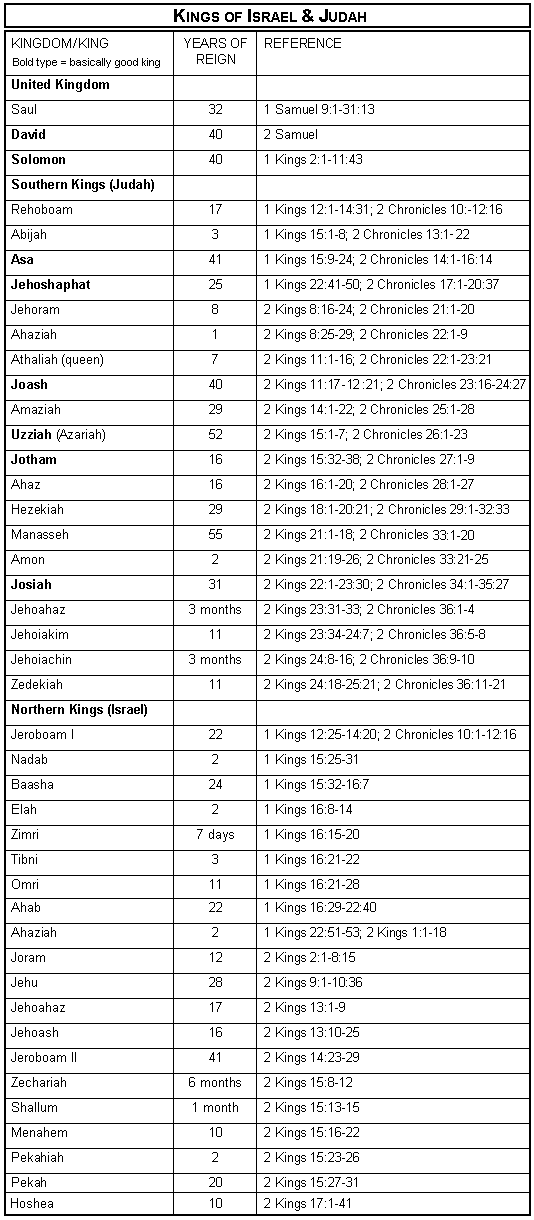
SEE ALSO:
ESV chart - kings of Israel - more information
ESV chart - kings of Judah - more information
Another Chart with Variable Dates for Reigns of Kings
2 Chronicles 31:1 Now when all this was finished, all Israel who were present went out to the cities of Judah, broke the pillars in pieces, cut down the Asherim and pulled down the high places and the altars throughout all Judah and Benjamin, as well as in Ephraim and Manasseh, until they had destroyed them all. Then all the sons of Israel returned to their cities, each to his possession.
- Now when: 2Ch 30:1-27
- all Israel: 1Ki 18:38-40 2Ki 23:2-20
- present: Heb. found, Ge 19:15 Es 4:16
- broke: 2Ch 14:3 23:17 32:12 34:3-7 Ex 23:24 De 7:5 2Ki 18:4
- Asherim: Heb. statues, 2Ch 30:14
- in Ephraim: 2Ch 30:1,18 34:6,7 2Ki 17:2 18:4 23:15
- CLICK 2 CHRONICLES COMMENTARIES FOR MULTIPLE SERMONS AND COMMENTARIES
- See BELOW FOR BIBLIOGRAPHY FOR 1-2 CHRONICLES - adapted from Paul Apple's Bible Outlines
Related Passages:
2 Chronicles 28:24-25 Moreover, when Ahaz gathered together the utensils of the house of God, he cut the utensils of the house of God in pieces; and he closed the doors of the house of the LORD and made altars for himself in every corner of Jerusalem. 25 In every city of Judah he made high places to burn incense to other gods, and provoked the LORD, the God of his fathers, to anger.
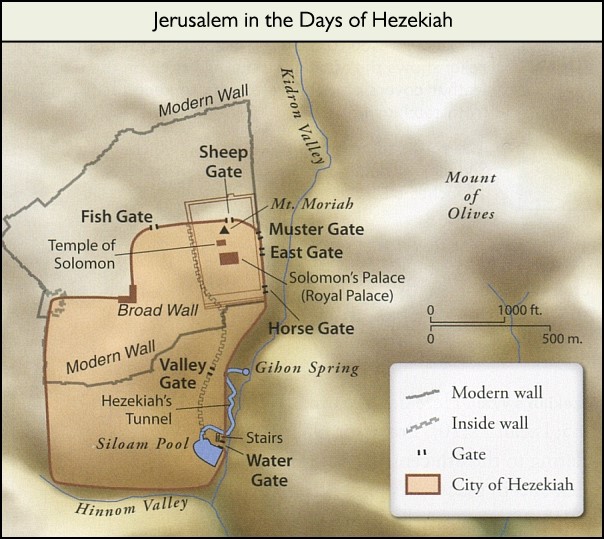
Source: Halley's Bible handbook BORROW
THE PURIFYING EFFECT
OF NATIONAL REVIVAL
Now when - This is a hinge phrase connecting the great Passover and national revival under King Hezekiah to what comes next: the practical fruit of that revival. In other words, NOW WHEN introduces the visible evidence of repentance.
All this was finished - The Passover celebration that brought consecration and revival to the people. The order is crucial. First conviction of sin and return to God (chapter 30) and then outward reform and cleansing of the land (chapter 31). True revival always moves from worship in the sanctuary to obedience in the life.
🙏 THOUGHT - Are you in need of revival? Ps 119:25 has the answer in the form of a prayer. "My soul cleaves to the dust; Revive me according to Your word." In short, Re-Bible can bring Revival!
All Israel who were present went out to the cities of Judah - Did you observe the KEY WORD in this passage? Don't miss it! It's the little word ALL. Now go back and read the passage to see the significance of this little word!
All signifies this was a national purging. Recall Ahaz had built altars and high places for idol worship throughout every city in Judah, replacing the worship of the LORD with false gods and bringing spiritual ruin upon the nation. In the past, we have read of faithful kings tearing down the high places, pillars, and Asherim; now, remarkably, we see all Israel doing so. For once, an entire generation acts in faith, seeking the LORD with a whole heart and removing every rival to His worship.
Broke the pillars in pieces, cut down the Asherim and pulled down the high places and the altars throughout all Judah and Benjamin, as well as in Ephraim and Manasseh - With hearts revived by being in God's presence, the people begin to carry out what Moses had called them to do in Dt 7:5 “But thus you shall do to them: you shall tear down their altars, and smash their sacred pillars, and hew down their Asherim, and burn their graven images with fire." What is amazing is that this revival ripple effect even extended to some of the areas in the Northern Kingdom (in Ephraim and Manasseh).
Until - Until is a great time phrase in context for it marks the end of the obliteration of the idolatrous objects.
They had destroyed (kalah; "eos eis telos" = until an end) them all - KJV = "utterly destroyed."
Then all the sons of Israel returned to their cities, each to his possession - Detroyed them all is a significant description of the impact of hearts ablaze with holiness!
🙏 THOUGHT - Years ago there was little pamphlet entitled My Heart, Christ's Home and it had a vivid description of some "altars" that were not torn down. It reads like this "There is just one more matter that I might share with you. One day I found Him waiting for me at the door. An arresting look was in His eye. As I entered, He said to me, "There is a peculiar odor in the house. There is something dead around here. It's upstairs. I think it is in the hall closet." As soon as He said this, I knew what He was talking about. Yes, there was a small closet up there on the landing, just a few feet square, and in that closet, behind lock and key, I had one or two little personal things that I did not want anyone to know about and certainly I did not want Christ to see them. I knew they were dead and rotting things left over from the old life. And yet I loved them, and I wanted them so for myself that I was afraid to admit they were there. Reluctantly, I went up with Him, and as we mounted the stairs the odor became stronger and stronger. He pointed at the door. "It's in there! Some dead thing!"..... Just authorize me to take care of that closet and I will." So with trembling fingers I passed the key to Him. He took it from my hand, walked over to the door, opened it, entered it, took out all the putrefying stuff that was rotting there, and threw it away. The He cleaned the closet and painted it, fixed it up, doing it all in a moment's time. Oh, what victory and release to have that dead thing out of my life!" This parable begs the question of all of us -- Are their any closets in my heart I have kept unholy things hidden, things which create a stench that permeates my entire heart? May Hezekiah's revival in 2Ch 30:1-27 and the effect on the nation motivate each of use to "clean house" and by the power of the Spirit to kill the sin which so easy entangles us and which we have kept secret for so long! (Hebrews 12:1, Romans 8:13, Col 3:5)
Raymond Dillard: Hezekiah’s reform proceeded in concentric circles from the temple (2Ch 29:3–36), through the city (2Ch 30:13–14), and into the surrounding territory, including portions of the North (2Ch 31:1). (Borrow 2 Chronicles)
Bob Utley - It was the worshipers (i.e., "all Israel who were present at the Passover") of chapter 30 who spread out over Judah, as well as Ephraim and Manasseh, destroying the Ba'al high places. - broke the pillars ‒ a raised stone symbolizing Ba'al (i.e., a phallic symbol); cut down the Asherim ‒ a planted or carved tree on the raised stone platform symbolizing the tree of life; pulled down the high places ‒ altars made of cut stone to form a raised platform for worship; altars ‒ probably a reference to the incense altars (cf. 2 Chr. 28:24; 30:14)
L.M. Grant: When Hezekiah had taken positive action to give God His true place of authority in the Passover feast, he rightly followed this up with the negative work of destroying the idolatrous pillars, images, high places and altars that had been introduced by earlier kings. The many people who had been present for the Passover carded out this destruction in the Cities of Judah, but also in Benjamin, Ephraim and Manasseh (2Ch 30:1) before returning to their own property
J. Parker: Mark the word “utterly.” It is for want of that word that so many men have failed. Many men have cut off the heads of weeds. Any man can do that. The weed is in the root, and the root is not straight down in the earth, so that it can be taken out easily; after a certain depth it ramifies, and care must be taken that we get out every fibre and filament, and having got it out, turn it upside down, and let the sun do the rest. A man has undertaken to abstain from some evil pursuit for a month: he has clipped off the top of the weed and looks just as well as anybody else, but he is not; he has still the root in him, and that must be taken out, though he be half murdered in the process.
Raymond Dillard: The Chronicler continues to liken Hezekiah to Solomon by showing his oversight of cultic personnel (2 Chr 8:14; cf. 1 Chr 23–26). Just as David and Solomon provided from their own wealth for the temple (), so also Hezekiah provides from his property. The Chronicler is 1 Chr 29:1–5; 2 Chr 9:10–11fond of showing that faithful and generous kings prompt similar generosity in the population (2Ch 31:5–10; 2Ch 24:8–14; 1 Chr 29:6–9) (Borrow 2 Chronicles)
PAUL APPLE - BIG IDEA: ADMINISTRATION OF SPIRITUAL WORSHIP AND SUPPORT FOR LEADERS REQUIRES FAITHFUL FINANCIAL STEWARDSHIP
John Gill: This chapter begins with the destruction of idolatrous worship, the appointment of the courses of the priests and Levites, and the royal bounty for sacrifices, 2 Chronicles 31:1, next follows the order Hezekiah gave, that the people at Jerusalem, and throughout the land, should make the proper provision for the priests and Levites, as the law directed; and which was cheerfully complied with, and the firstfruits and tithes were brought in, in great abundance, insomuch that there was enough, and plenty left, 2 Chronicles 31:4, wherefore chambers were prepared in the temple to lay it up in, and persons appointed to be the overseers of it, and to distribute it faithfully to their brethren and their families, to small and great, 2 Chronicles 31:11, and the chapter is closed in praise of the works of Hezekiah, and the success that attended him, 2 Chronicles 31:20.
Iain Duguid: Focus throughout is on well-supported and managed continuing temple ministry. The account is clearly an example for the postexilic community to emulate, especially if the laxity evident in postexilic accounts continued (Neh. 13:10–13 [contrast prior commitment; 10:32–39]; Mal. 1:8, 14; 3:8–9). The conclusion to 2 Chronicles 29–31 (2Ch 31:20–21) reinforces the message that seeking the Lord and acting according to the law lead to prospering. (ESV Expository Commentary (Volume 3): 1 Samuel–2 Chronicles)
Andrew Hill: The cleansing and reopening of the temple brings about the restoration of the temple liturgy. This means, in turn, that the sacrificial and musical guilds of the priests and Levites must be reorganized so they can adequately service the temple liturgy. Naturally, this calls for the reinstitution of the regular tithes and offerings prescribed by the law of Moses in order to support the temple personnel. This section of the Chronicler’s report of Hezekiah’s reign addresses the reordering of Levitical corps (2Ch 31:2-3) and the reestablishment of the Mosaic tithes and offerings (2Ch 31:4-19) (See The NIV Application Commentary on the Bible)
Martin Selman: Hezekiah’s cleansing of the temple (2Ch 29) and celebration of the Passover (2Ch 30) enabled him to re-establish regular worship. This involved two further tasks, reorganizing the priests and Levites (2Ch 30:2) and establishing proper financial support for temple personnel and the system of offerings (vv. 4-19). The dominant emphasis of 2Ch 31 falls on the practical giving of the people, however. Though the king’s leadership provided an important stimulus, an effective system of worship was not possible without full popular involvement. The apparently routine character of this chapter is deceptive, for it deals with two principles of first importance. - The first is that worship cannot be left to the “professionals”. - The second principle is the care needed to ensure that Israel’s worship is carried out “decently and in order”: (cf. 1 Cor. 14:40). Good planning and the implementation of adequate supporting structure provide a framework in which wholehearted and meaningful worship can take place. (Tyndale Old Testament Commentaries – 1 Chronicles. BORROW)
Matthew Henry Notes: 2Ch 31
SUMMARY - This passage recounts the thorough and fruitful reformation carried out under Hezekiah after the Passover, showing how true worship led to lasting obedience. Stirred by renewed communion with God, the people zealously destroyed every remnant of idolatry throughout Judah and even beyond, refusing to tolerate any rival to the LORD. Hezekiah then restored proper order to the temple service, appointing priests and Levites according to their courses and ensuring faithful worship was sustained. He generously supported the altar from his own resources and commanded the people to provide for the ministers, so they could devote themselves fully to the law of the LORD. In response, the people gave abundantly, bringing tithes and offerings with such fullness that great heaps remained, testifying to God’s blessing. The result was gratitude to God, commendation of the people, and a clear demonstration that genuine revival expresses itself not merely in sacred moments, but in lasting reform, joyful generosity, and faithful obedience in everyday life.
We have here a further account of that blessed reformation of which Hezekiah was a glorious instrument, and of the happy advances he made in it.
I. All the remnants of idolatry were destroyed and abolished (2Ch 31:1).
II. The priests and Levites were set to work again, every man in his place (2Ch 31:2).
III. Care was taken for their maintenance.
1. The royal bounty to the clergy, and for the support of the temple service, was duly paid (2Ch 31:3).
2. Orders were given for the raising of the people's quota (2Ch 31:4).
3. The people, thereupon, brought in their dues abundantly (2Ch 31:5-10). 4. Commissioners were appointed for the due distribution of what was brought in (v. 11-19). Lastly, Here is the general praise of Hezekiah's sincerity in all his undertakings (2Ch 31:20, 21).
2Ch 31:1-10
We have here an account of what was done after the passover. What was wanting in the solemnities of preparation for it before was made up in that which is better, a due improvement of it after. When the religious exercises of a Lord's day or a communion are finished we must not think that then the work is done. No, then the hardest part of our work begins, which is to exemplify the impressions of the ordinance upon our minds in all the instances of a holy conversation. So it was here; when all this was finished there was more to be done.
I. They applied themselves with vigour to destroy all the monuments of idolatry, 2Ch 31:1.
The king had done what he could of this kind (2 Ki. 18:4), but the people could discover those profane relics which escaped the eye of the king's officers, and therefore they went out to see what they could do, 2Ch 31:1. This was done immediately after the passover. Note, The comfort of communion with God should kindle in us a holy zeal and indignation against sin, against every thing that is offensive to God. If our hearts have been made to burn within us at an ordinance, that spirit of burning will consume the dross of corruption. What have I now to do any more with idols? Their zeal here in destroying the images and groves, the high places and altars, appeared,
1. In that they did this, not only in the cities of Judah and Benjamin, but in those of Ephraim and Manasseh. Some think that those cities are meant which had come under the protection and the jurisdiction of the kings of Judah. Others think that, Hoshea king of Israel not forbidding it, their zeal carried them out to the destruction of idolatry even in many parts of his kingdom. At least those that came out of Ephraim and Manasseh to keep the passover (as many did, ch. 30:18) destroyed all their own images and groves, and did the like for as many more as they had influence upon or could make interest in for leave to do it. We should not only reform ourselves, but do all we can to reform others too.
2. They destroyed all: they utterly destroyed all; they spared none through favour or affection either to the images or to their worshippers; though ever so ancient, ever so costly, ever so beautiful, and ever so well patronised, yet they must all be destroyed. Note, Those that sincerely set themselves against sin will set themselves against all sin.
3. They would not return to their houses, though they had been long absent, till this was done. They could not be easy, nor think themselves safe, in their cities, as long as the images and groves, those betrayers and destroyers of their country, were left standing. Perhaps the prophet Isaiah pointed to this when, a little before, he spoke of a day in which men should cast away the very idols that they themselves had made. So surprising was this blessed change, Isa. 2:20; 31:6, 7.
II. Hezekiah revived and restored the courses of the priests and Levites, which David had appointed and which had of late been put out of course, 2Ch 31:2.
The temple service was put into its proper method again, to run in the old channel. Every man was made to know his work, his place, his time, and what was expected from him. Note, Good order contributes much to the carrying on of a good work. The priests were appointed in their courses for burnt-offerings and peace-offerings; the Levites in their courses were some to minister to the priests, others to give thanks and praise. See 1 Chr. 23:4, 5. And all this in the gates or courts of the tents of the Lord. The temple is here called a tent because the temple privileges are movable things and this temple was shortly to be removed.
III. He appropriated a branch of the revenue of his crown to the maintenance and support of the altar.
Though the people were to be at the charge of the daily offerings, and those on the sabbaths, new moons, and feasts, yet, rather than they should be burdened with the expense, he allowed out of his own estate, or out of his exchequer, for all those offerings, 2Ch 31:3. It was a generous act of piety, wherein he consulted both God's honour and his people's ease, as a faithful servant to him and a tender father to them. Let princes and great men reckon that well bestowed, and set out to the best interest, which they give for the support and encouragement of religion in their country.
IV. He issued out an order to the inhabitants of Jerusalem first, 2Ch 31:4 (that those who were nearest the temple, and both saved and got by being so, might give a good example to others), but which was afterwards extended to, or at least admitted by, the cities of Judah, that they should carefully pay in their dues, according to the law, to the priests and Levites.
This had been long neglected, which made the work to be neglected (for a scandalous maintenance makes a scandalous ministry); but Hezekiah, having himself been liberal, might with a good grace require his subjects to be just to the temple service. And observe the end he aims at in recovering and restoring to the priests and Levites their portion, that they might be encouraged in the law of the Lord, in the study of it, and in doing their duty according to it. Observe here,
1. It is fit that ministers should be not only maintained, but encouraged, that they should not only be kept to do their work, but that they should also have wherewith to live comfortably, that they may do it with cheerfulness.
2. Yet they are to be maintained, not in idleness, pride, and luxury, but in the law of the Lord, in their observance of it themselves and in teaching others the good knowledge of it.
V. The people thereupon brought in their tithes very readily.
They wanted nothing but to be called upon; and therefore, as soon as the commandment came abroad, the first-fruits and all the holy things were duly brought in,2Ch 31:5, 6. What the priests had occasion for, for themselves and their families, they made use of, and the overplus was laid in heaps, 2Ch 31:6. All harvest-time they were increasing these heaps, as the fruits of the earth were gathered in; for God was to have his dues out of them all. Though a prescription may be pleaded for a modus decimandi-tenth proportion, yet it cannot be pleaded pro non decminado-for the omission of the tenth. When harvest ended they finished their heaps, 2Ch 31:7. Now here we have,
1. The account given to Hezekiah concerning those heaps. He questioned the priests and Levites concerning them, why they did not use what was paid in, but hoarded it up thus, (2Ch 31:9), to which it was answered that they had made use of all they had occasion for, for the maintenance of themselves and their families and for their winter store, and that this was that which was left over and above, 2Ch 31:10. They did not hoard these heaps for covetousness, but to show what plentiful provision God by his law had made for them, if they could but have it collected and brought in, and that those who conscientiously give God his dues out of their estates bring a blessing upon all they have: Since they began to bring in the offerings the Lord has blessed his people. See for this Hag. 2:19. "Try me,'' says God, "if you will not otherwise trust me, whether, upon your bringing the tithes into the store-house, you have not a blessing poured out upon you,'' Mal. 3:10, 11; Eze. 44:30.
2. The acknowledgment which the king and princes made of it, 2Ch 31:8. They gave thanks to God for his good providence, which gave them something to bring, and his good grace, which gave them hearts to bring it. And they also blessed the people, that is, commended them for their doing well now, without reproaching them for their former neglects. It is observable that after they had tasted the sweetness of God's ordinance, in the late comfortable passover, they were thus free in maintaining the temple service. Those that experience the benefit of a settled ministry will not grudge the expense of it.
C H Spurgeon - Reform
“Now when all this was finished, all Israel that were present went out to the cities of Judah, and brake the images in pieces, and cut down the groves, and threw down the high places and the altars out of all Judah and Benjamin, in Ephraim also and Manasseh, until they had utterly destroyed them all.” 2 Chronicles 31:1
There are many books that are to be so esteemed by the Christian man, that they must be cut down like the groves of trees, not because they are bad in themselves, but because there false gods are worshipped. Novel-reading is the rage of the present day. I go to a railway bookstall, and I cannot see a book that I can read, I get one, and it is all trash. I search to find something that would be really valuable, but I am told, “It would not sell here.” The fact is, nothing will sell but that which is light, and frothy, and frivolous; so every traveller is compelled to consume such food as that, unless he carry something better with him. Do I, therefore, say, that the Christian man must condemn all reading of fiction and novels? No, I do not, but I do say, that the mass of popular books published under the name of light literature, is to be eschewed and cut down, for the simple reason that the moral of it is not that of piety and goodness; the tendency of the reading is not to bring the Christian towards heaven, but rather to retard and impede him in his good course. I lift up my axe against many a work that I cannot condemn, if I look at it abstractedly in itself, but which must come down, because I recollect how much of my own precious time I wasted in such trivial reading, how many years in which I might have had fellowship with Christ have been cast away, whilst I have been foolishly indulging a vicious taste for the romantic and the frivolous. No, there are many things which are not wrong in themselves, but which nevertheless must be given up by the true Christian, because they have had, and do have association with things positively wrong. Just as these groves must be cut down—not because there can be a sin in trees, but because the trees have been associated with the worship of idols.
2 Chronicles 31:2 And Hezekiah appointed the divisions of the priests and the Levites by their divisions, each according to his service, both the priests and the Levites, for burnt offerings and for peace offerings, to minister and to give thanks and to praise in the gates of the camp of the LORD.
- appointed the divisions of the priests and the Levites by their divisions: 2Ch 5:11 8:14 23:8 1Ch 16:37,40 23:1-26:32 Ezr 6:18 Lu 1:5
- to give thanks: 2Ch 29:24-26 1Ch 16:4-6,41 23:30 25:1-3 Ne 11:17 Ps 134:1-3 Ps 135:1-3 Jer 33:11
- in the gates of the tents of the Lord: {Beshaarey machanoth Yehowah,} "within the gates of the camps of Jehovah;" which comprehended the whole of the buildings that surrounded the temple, in which the priests and Levites were stationed, and which resembled military encampments.
Related Passage:
1 Chronicles 24:4 Since more chief men were found from the descendants of Eleazar than the descendants of Ithamar, they divided them thus: there were sixteen heads of fathers’ households of the descendants of Eleazar and eight of the descendants of Ithamar, according to their fathers’ households.
HEZEKIAH RESTORES
PRIESTLY ORDER
And Hezekiah appointed the divisions of the priests and the Levites by their divisions, each according to his service, both the priests and the Levites, for burnt offerings and for peace offerings, to minister and to give thanks and to praise in the gates of the camp of the LORD - The ripple effect of revival continues and in order to keep it sustained Hezekiah organized the priests and Levites into their proper groups and duties, restoring temple worship, sacrifices, thanksgiving, and praise according to God’s law, so that worship of the LORD was orderly, continual, and heartfelt in His house. In short, the great Passover celebration had passed, but the effect of that celebration continued and ordering of the priests and Levites was the key to perpetuating the spiritual atmosphere of revival. Revival should never be one and done. If the truth be told, EVERY one of us needs revival EVERY day!
Bob Utley - These divisions of the families of Levites to assigned tasks goes back to David (cf. 1 Chronicles 23-26; 28:13,21; 2 Chr. 28:13).
Bob Utley - "peace offerings" These were free-will gifts of which a part was burned (i.e., fat, blood) to YHWH, given to the priest, given to the offerer to eat within three days (Leviticus 3). Surprisingly, the two required offerings were not mentioned (i.e., sin and guilt, cf. Leviticus 4-6), nor the grain/meal offering (cf. Leviticus 2).
Believer's Study Bible - The orderly form of priestly and Levitical service by divisions as organized by David (1 Chr. 23:6-23; 24:3-19) had apparently fallen into abuse and disuse during the time of apostate kings, particularly Ahaz, but was restored at this time by Hezekiah.
Iain Duguid: Restoring the “service of the house of the Lord” (2Ch 29:35) meant resuming the arrangement of “divisions” of priests and Levites, each with its own responsibilities for offerings and praise. The unusual phrase “the gates of the camp of the Lord” recalls the tabernacle, thus serving as a reminder of continuity with the wilderness tradition (Num. 2:17; cf. 1 Chron. 9:18–19). (ESV Expository Commentary (Volume 3): 1 Samuel–2 Chronicles)
Payne: The Hebrew for Hezekiah’s assigning the priests to divisions is definite: he “appointed THE divisions of the priests.” He reestablished the twenty-four rotating courses that had been set up by David (1 Chronicles 25) to insure orderly worship.
John Walton - 31:2. functions of the Levites. Hezekiah reaffirmed the functions of the Levitical order established by Solomon. Thus the priests were in charge of the offerings, and the Levites were in charge of the worship (also see the comment on 2 Chron 29:15).
2 Chronicles 31:2-21
In obedience to the law and the commands, he sought his God and worked wholeheartedly. - 2 Chronicles 31:21
TODAY IN THE WORD
During the days, weeks, and months following 9/11, generosity abounded. Thousands of volunteers stepped forward to do whatever they could. A special Amtrak train with relief supplies left Washington for New York City. For weeks following the tragedy, truckloads of items such as boots and goggles for the rescue workers arrived from all over America. Corporations donated vehicles, computers, office supplies, and many other items needed during the recovery and clean-up period. By the first anniversary, the Red Cross reported receiving nearly $1 billion in 9/11 donations, serving 14 million meals at the site, and providing hundreds of thousands of health and mental health consultations.
An outpouring of generosity from people marked the revival we've been studying. Hezekiah's personal generosity led to financial openhandedness from the other leaders and the general populace. In fact, the giving was so great that the king had to appoint officials to be in charge of receiving gifts and distributing funds. Conaniah and Kore had quite a bit of work to do! The people brought “heaps” of tithes and freewill offerings for the maintenance of the temple and the support of the priests and Levites (v. 10). They followed the biblical principle of “firstfruits,” or giving to the Lord first instead of whatever was left over. No one can outgive God, though, and the kingdom prospered greatly during this time (v. 21).
There were at least two more key elements in this spiritual revival under Hezekiah. First, order (v. 2). The king organized the priests and Levites in divisions according to various categories of duties. The genealogical records were brought out (v. 18)—these were integral in tracking the identity of the covenant people. Such actions might seem ordinary, but they reflect a God-honoring desire to do worship “in a fitting and orderly way” (1 Cor. 14:40). And second, obedience. Hezekiah honored the covenant by trying to obey all that was written in the Law.
TODAY ALONG THE WAY
Hezekiah led the people of Israel toward spiritual renewal as a community, but the substance of that renewal consisted in individuals getting their hearts right with God. In light of today's reading, perhaps it's time for a personal rededication or recommitment on your part as well. If you have sin to confess, confess it and be forgiven. If you've given up meeting with God's people, head back to church (Heb. 10:25). If you've neglected prayer and the Word, return to these essential and joyful disciplines.
SUMMARY - The passage compares the surge of generosity after 9/11 with the spiritual revival under Hezekiah, highlighting how renewed hearts naturally produce sacrificial giving, orderly worship, and obedient living. Just as Americans responded to tragedy with overwhelming generosity, Israel responded to revival with abundant tithes and offerings, so great that officials were needed to manage them, and God in turn prospered the nation. The revival was marked not only by generosity but also by restored order in worship and renewed obedience to God’s Law, underscoring that true spiritual renewal begins with individuals humbling themselves before God, confessing sin, returning to worship, and renewing devotion to prayer and Scripture.
2 Chronicles 31:3 He also appointed the king’s portion of his goods for the burnt offerings, namely, for the morning and evening burnt offerings, and the burnt offerings for the sabbaths and for the new moons and for the fixed festivals, as it is written in the law of the LORD.
- He also appointed the king’s portion : 2Ch 30:24 1Ch 26:26 Eze 45:17 46:4-7,12-18
- for the morning: Ex 29:38-42 Nu 28:3-8
- burnt offerings Nu 28:9,10
- for the new moons: Nu 28:11-31 29:1-40 De 16:1-17 Ps 81:1-4 Col 2:16,17
- the set feasts: Lev 23:2-44
Related Passages:
1 Chronicles 29:3-5 (HEZEKIAH DECLARED) “Moreover, in my delight in the house of my God, the treasure I have of gold and silver, I give to the house of my God, over and above all that I have already provided for the holy temple, 4 namely, 3,000 talents of gold, of the gold of Ophir, and 7,000 talents of refined silver, to overlay the walls of the buildings; 5of gold for the things of gold and of silver for the things of silver, that is, for all the work done by the craftsmen. Who then is willing to consecrate himself this day to the LORD?”
THE KING WHO
FUNDED WORSHIP
What a dramatic contrast with his father Ahaz who literally destroy true worship in Judah! What a difference a leader can make in a nation, a local church or a family! May God enable all of us to be "Hezekiah-like" leaders wherever He has placed us. In Jesus' Name. Amen.
He also appointed the king’s portion of his goods for the burnt offerings, namely, for the morning and evening burnt offerings, and the burnt offerings for the sabbaths and for the new moons and for the fixed festivals, as it is written in the law of the LORD - King Hezekiah personally dedicated part of his own wealth to provide the daily, weekly, and festival sacrifices required by God’s law, ensuring that regular worship and atonement offerings would continue faithfully before the LORD.
Bob Utley - The king was responsible for several offerings (cf. Ezek. 45:17,22; 46:2,16-18). (1) the continual (2) sabbaths (3) new moons (cf. 1 Chr. 23:21; 2 Chr. 2:3; 8:13; 31:3) (4) fixed festivals. Notice these different offerings involved daily, weekly, monthly, and annual worship events (cf. 1 Chr. 23:31; 2 Chr. 2:4; 8:13), which reflects Gen. 1:14. "as it is written in the law of the Lord" Obedience to the Mosaic covenant (cf. Numbers 28) was a crucial aspect of Hezekiah's reform. Chronicles reaffirms over and over that YHWH had revealed Himself through Moses. The Mosaic guidelines were not from a human origin but from YHWH. All things must be done according to these guidelines (cf. 1 Chr. 6:89; 15:15; 16:40; 22:13; 2 Chr. 8:13; 23:18; 24:6; 25:4; 30:16; 33:8; 34:14; 35:6,12).
The fixed festivals refers to the appointed holy days and feasts that God established for Israel in the Law of Moses, times set on the calendar for national worship and remembrance of God’s saving acts. These included the Passover, the Feast of Unleavened Bread, the Feast of Weeks (Pentecost), the Feast of Trumpets, the Day of Atonement, and the Feast of Tabernacles (Booths) as outlined in Leviticus 23. They were called “fixed” or “appointed” because God Himself had determined their specific times and purposes, reminding His people of His covenant faithfulness and calling them to regular thanksgiving, repentance, and celebration before Him.
Ryrie - appointed = contributed. The example of Hezekiah's generosity motivated the people to be generous (2Ch 31:5), as also occurred under David. See note on 1 Chron. 29:3-5.
Mark Boda: 2Ch 31:3 lists the many worship services that needed to be supported. Although not explicit in the Hebrew text, the list is organized by frequency of practice from daily (morning and evening burnt offerings), to weekly (Sabbath festivals), to monthly (new moon festivals), to annual (festivals) events. This list provides insight into the complex and demanding character of worship in Judah and is an essential foundation for understanding why priestly and Levitical orders needed to “devote themselves fully to the Law of the Lord” (2Ch 31:4).
John Walton - king’s contributions. In contrast to the contributions for the festival in 30:23–24, this verse speaks of regular and ongoing contributions funding the operation of the temple. Hezekiah followed the precedent of Solomon by providing burnt offerings on a regular basis for the temple services (2 Chron 2:4). The provisions for the offerings are described in Numbers 28–29. In the ancient Near East the king (representing the corporate nation) was the foremost worshiper of the national god. Therefore it would be expected that the palace would play a major role in supplying the regular sacrifices.
EXCURSUS ON BURNT OFFERING (see also Gotquestions.org) - In Leviticus 1, the burnt offering (olah) was presented on the bronze altar at the entrance of the Tabernacle—the altar of burnt offering made of acacia wood overlaid with bronze—where blood was applied to its sacred horns, symbolizing strength, refuge, and the offering lifted up to God. The worshiper brought an unblemished offering according to ability, ranging from a costly bull to a sheep or goat, or even birds for the poor, showing that access to God was open to all. The offerer personally identified with the sacrifice by laying hands on the animal, slaughtering it “before the LORD,” and preparing it, while the priest handled the blood and arranged the offering on the altar, emphasizing that life belonged to God and atonement required death. Unlike other sacrifices, the entire animal was consumed by fire, signifying total consecration, surrender, and devotion of the worshiper’s life to God. Offered daily and at all major feasts and sacred times, the burnt offering stood as the most complete sacrificial act—an expression of general atonement, thanksgiving, and wholehearted dedication—anticipating the perfect self-offering of Christ and calling every worshiper to present himself wholly to the LORD.
NEW MOONS - In the Old Testament, new moons marked the beginning of each month in Israel’s lunar calendar and were times of sacrifice, trumpet blasts, celebration, and covenant remembrance, expressing gratitude for God’s provision and calling His people to renewal before Him (Nu 10:10). These observances included communal gatherings and feasting (1 Sam. 20:5–24) and even a cessation from ordinary work, resembling Sabbath rest, so hearts could be refocused on the LORD (Amos 8:5). Yet the prophets warned that such rituals could become empty traditions when practiced without repentance and obedience, leading God to reject them when divorced from sincere faith (Isa. 1:13–14). In the New Testament, Paul clarifies that new moon observances are no longer binding under the New Covenant, describing them as shadows fulfilled in Christ (Col. 2:16), who alone provides true and lasting spiritual renewal. Thus, the new moon ultimately points beyond itself to God’s continual renewing grace, fulfilled in Christ, in whom His mercies are ever fresh and His faithfulness never fails (Lam. 3:22–23).
SUMMARY OF THE FEASTS OF ISRAEL - Under the Mosaic Law, Israel observed a divinely ordered calendar of feasts that shaped national worship, agricultural life, and covenant remembrance (Exod 23:14–17; Lev 23; Num 28–29; Deut 16). All Israelite males were required, when possible, to appear before the LORD three times annually (Exod 23:14,17; 34:23), at feasts that combined rest, worship, and communal fellowship with thanksgiving for God’s provision. These three pilgrimage feasts were Passover, commemorating the Exodus and celebrating the barley harvest, followed immediately by the Feast of Unleavened Bread (Exod 12:1–14, 21–28; 12:15–20; 34:18–20; Lev 23:4–14; Num 28:16–25; Deut 16:1–8); Pentecost (Feast of Weeks), marking the wheat harvest and later associated in Jewish tradition with the giving of the Law at Sinai (Exod 23:16; 34:22; Lev 23:15–21; Num 28:26–31); and Tabernacles (Booths), a joyful celebration of the final harvest that also recalled Israel’s wilderness sojourn, followed by a concluding eighth-day assembly (Exod 23:16; 34:22; Lev 23:34–44, 36; Num 29:35–38; Deut 16:13–17). Additional sacred times included the New Year (Rosh Hashanah) on the first of Tishri (Lev 23:23–25; Num 29:1–6), the Day of Atonement (Yom Kippur)—the only mandated fast—focused on repentance and corporate cleansing (Exod 30:10; Lev 16; 23:26–32; 25:9; Num 29:7–11), the weekly Sabbath (Gen 2:1–3; Exod 16:22–30; 20:8–11; 23:12; 31:12–16; Lev 23:1–3; Num 28:9–10), the Sabbath Year of land rest and debt release (Exod 23:10–11; Lev 25:1–7; Deut 15:1–6), the Jubilee Year of restoration and freedom (Lev 25:8–18; 25:10,13; 27:17–24), and the New Moon observances tied to Israel’s lunar calendar (Num 10:10; 28:11–15; cf. Exod 40:2,17). Together, these feasts reveal how God transformed seasonal, agricultural, and historical rhythms into uniquely covenantal occasions for worship, remembrance, and devotion to YHWH (Gen 1:14; Ps 104:19).
2 Chronicles 31:4 Also he commanded the people who lived in Jerusalem to give the portion due to the priests and the Levites, that they might devote themselves to the law of the LORD.
- the portion: 2Ch 31:16 Lev 27:30-33 Nu 18:8-21,26-28 Mal 3:8-10
- that they might: Ne 13:10-13 1Co 9:9-14 Ga 6:6
- the law: Mal 2:7
Related Passages:
Galatians 6:6 The one who is taught the word is to share all good things with the one who teaches him.
Numbers 18:20-21 Then the LORD said to Aaron, “You shall have no inheritance in their land nor own any portion among them; I am your portion and your inheritance among the sons of Israel. 21“To the sons of Levi, behold, I have given all the tithe in Israel for an inheritance, in return for their service which they perform, the service of the tent of meeting.
THE PEOPLE'S RESPONSIBILITY
TO THE PRIESTHOOD
Also he commanded the people who lived in Jerusalem to give the portion due to the priests and the Levites, that they might devote themselves to the law of the LORD - The portion refers to the support the priesthood (see Nu 18:8-20) King Hezekiah ordered the people of Jerusalem to provide the tithes and offerings that rightfully supported the priests and Levites, so they could be free from distraction and fully dedicate themselves to studying, teaching, and performing the duties of the Law of the LORD.
PROVISION FOR PRIESTS AND LEVITES - In the Old Testament, God provided for the priests and Levites, who were given no land inheritance, by appointing tithes, offerings, and portions of the sacrifices as their means of support, enabling them to devote themselves fully to temple service and the teaching of God’s Law (Nu 18:20–21). This system, renewed under Hezekiah in 2 Chronicles 31, showed how the people’s generous giving of firstfruits sustained spiritual leadership and allowed the priests and Levites to focus on their sacred duties. These provisions were not merely practical but expressed Israel’s acknowledgment that all blessings came from God and that worship and obedience were central to covenant life, ensuring justice and mutual dependence within the community. The principle continues in the New Testament, where those who minister the Word are likewise to be supported by God’s people (1 Cor. 9:14), demonstrating God’s enduring design that faithful giving sustains faithful ministry.
Raymond Dillard: Hezekiah restores the system of offerings used for the maintenance of the priests and Levites (31:4; Lev 6:14-7:36; Num 18:8–32; Dt 14:27–29; 18:1–8; 26:1–15) which had presumably been interrupted during the apostasy of Ahaz. These offerings were readily neglected by the people (Mal 3:8–12; Neh 13:10–13) and occasionally abused by the priests (1 Sam 2:12–16). Rather than describing these offerings as freeing the priests and Levites for devotion to the service of the temple, the Chronicler describes them as freeing the cultic personnel for devotion to the “law of Yahweh”; though both ways of describing the intended effect of the offerings may refer to temple duties, the Chronicler’s phraseology could reflect the growing importance of the study of the law in the post-exilic period (Williamson, 374). (Borrow 2 Chronicles)
Peter Wallace: Hezekiah sees his gift as an example to the rest of the congregation. Having exemplified sacrificial giving himself, he calls the people to imitate him. He will provide all the special offerings. But he calls them to provide the regular provision for the priests and Levites, so that they can devote themselves to the Law of the LORD (in other words, their duties as commanded by the law).
John Walton - Levites’ portions. The portion for the priests and Levites was delineated in Numbers 18 (see comments there), where the gifts were for the priests (v. 12) and the tithes were for the Levites (v. 21). Clearly Hezekiah was making a great attempt to have the religious officials devote themselves to the duties prescribed in the five books of Moses.
2 Chronicles 31:5 As soon as the order spread, the sons of Israel provided in abundance the first fruits of grain, new wine, oil, honey and of all the produce of the field; and they brought in abundantly the tithe of all.
- As soon as the order spread: 2Ch 24:10,11 Ex 35:5,20-29 36:5,6 2Co 8:2-5
- abundance the first fruits, Ex 22:29 23:19 34:22,26 Nu 18:12 Ne 10:35-39 12:44 13:12,31 Pr 3:9 1Co 15:20 Jas 1:18 Rev 14:4
THE LEADER LEADS &
THE PEOPLE FOLLOW
This verse echoes Judges 5:2 "That the leaders led in Israel, That the people volunteered, Bless the LORD!" Dear God, give us godly leaders in America for Thy Name's sake. Amen.
As soon as the order spread, the sons of Israel provided in abundance the first fruits of grain, new wine, oil, honey and of all the produce of the field; and they brought in abundantly the tithe of all - The example of Hezekiah's generosity motivated the people to be generous, as also occurred under David. This passage shows that the revival was not a "one and done," but that it had continuing impact, for once Hezekiah’s command was announced, the Israelites responded eagerly and generously, bringing the firstfruits and tithes of all their produce in abundance as an expression of gratitude and obedience to the LORD.
Honoring God with the first and best, rather than what is left over,
is a tangible expression of gratitude, dependence,
and confidence in His faithful provision.
The first fruits of grain, new wine, oil, and honey” represent the earliest and best portions of Israel’s harvest, offered to God as an act of thanksgiving, worship, and trust in His provision. Rooted in the Mosaic Law, this practice acknowledged that all sustenance came from the Lord and expressed faith that He would bless the remainder of the harvest. Under Hezekiah’s revival, the people’s abundant first-fruits giving signaled renewed devotion after a season of neglect, supplying the priests and Levites and restoring proper worship. Spiritually, the offering of first fruits illustrated a timeless principle: honoring God with the first and best, rather than what is left over, is a tangible expression of gratitude, dependence, and confidence in His faithful provision.
Bob Utley - "the tithe of all" “All” in this context can reasonably be understood to encompass the full range of covenantally required provisions designated for Israel’s sacred personnel, including all agricultural gifts (grain, wine, oil; cf. 2 Chr 31:5), all pastoral gifts (from herd and flock; cf. 2 Chr 31:6), and the people’s mandated contributions for the support of those who ministered before the LORD (cf. 2 Chr 31:4). This comprehensive understanding accords precisely with Numbers 18, where YHWH explicitly establishes His system for sustaining the tabernacle—and later temple—servants: the priests’ portion consisted of designated parts of the sacrifices (Num 18:8–11), including wave offerings, grain offerings, firstfruits, and the redemption price of the firstborn (Num 18:12–20), while the Levites’ portion was the tithe of the people given in return for their service at the tent of meeting (Num 18:21–24). From this tithe, the Levites themselves were required to offer a tithe of the tithe to the priests (Num 18:26–29). Thus, “all” signifies the entire divinely prescribed support system—agricultural, pastoral, sacrificial, and monetary—by which God faithfully provided for those who bore responsibility for His worship and service.
Raymond Dillard: The firstfruits of grain, wine, and oil are specifically assigned to the priests (Num 18:12–13) and the tithe to the Levites (Num 18:21). Though “honey,” actually a syrup-like product from fruits, is excluded from burnt offerings, it was nevertheless suitable for the support of the priests and was brought as part of the firstfruits (Lev 2:11–12). (Borrow 2 Chronicles)
TSK - honey: or, dates, The word {devash} generally denotes the honey produced by bees; but as we have already observed (on Ge 43:11,) the Jewish doctors are of opinion that it here signifies dates, of the fruit of the palm tree; which the Arabians call {daboos,} and the honey produced from them, {dibs.} "This liquor," says Dr. Shaw, "which has a more luscious sweetness than honey, is of the consistence of a thin syrup, but quickly grows tart and ropy, acquiring an intoxicating quality, and giving by distillation an agreeable spirit, or araky, according to the general name of these people for all hot liquors, extracted by the alembic." Though Jehovah forbad any {devash,} or honey, to offered to him upon the altar, yet it appears it might be presented as first-fruits, or in the way of tithes, which were designed for the sustenance of the priests.
EXCURSUS ON TITHING Tithing in Scripture refers to the Old Testament practice of giving a tenth (BDB 796) of Israel’s produce and livestock as part of a divinely instituted system that supported the central sanctuary and priesthood (Lev 27:30–32; Num 18:21–24; Deut 12:6–7, 17; 14:22–26; Neh 12:44; Mal 3:8–10), the local Levites who served throughout the land (Deut 12:12; 14:27; 26:12–15; Num 18:25–29; Neh 10:37–38), and every third year the local poor—the foreigner, orphan, and widow—demonstrating God’s concern for the vulnerable (Deut 14:28–29; cf. F. F. Bruce, Answers to Questions, 243–244). Although the texts are complex and sometimes difficult to harmonize (Num 18:21–32; Deut 14:22–29; 26:12), the essential purpose is clear: tithing functioned as a covenantal tax within Israel’s theocratic, temple-centered economy, acknowledging YHWH’s ownership of all things and sustaining worship, ministry, and mercy (cf. 1 Sam 8; NIDOTTE 2:1037–1039). The practice predates Mosaic Law (Gen 14:20; 28:22) but reaches its full expression within it, ultimately requiring more than a single ten percent when all tithes are considered. In the New Testament, however, tithing is never commanded for the church; it is mentioned only in reference to the Mosaic system (Matt 23:23; Luke 11:42; 18:12; Heb 7:6–9), and believers are instead exhorted to give freely, generously, sacrificially, and joyfully under grace rather than legal compulsion (1 Cor 16:2; 2 Cor 8–9; Rom 10:4; Gal 3:23–25; Eph 2:15). Thus, while voluntary tithing may serve as a helpful guideline for some, Scripture does not present it as a binding requirement for Christians, whose giving flows from faith, gratitude, and love—not law (Mark 12:41–44).
2 Chronicles 31:6 The sons of Israel and Judah who lived in the cities of Judah also brought in the tithe of oxen and sheep, and the tithe of sacred gifts which were consecrated to the LORD their God, and placed them in heaps.
- sons of Israel 2Ch 11:16,17
- the tithe: Lev 27:30 De 14:28
BRINGING IN
THE TITHE
The sons of Israel and Judah who lived in the cities of Judah also brought in the tithe of oxen and sheep, and the tithe of sacred gifts which were consecrated to the LORD their God, and placed them in heaps - The Israelites and people of Judah living outside Jerusalem faithfully brought a tenth of their livestock and the holy gifts dedicated to the LORD, gathering them in great piles as evidence of their generosity and renewed devotion to God’s service and worship. The literal Hebrew of "in heaps" reads heaps, heaps, repetition emphasizing the large number of heaps.
Morris - This reference implies that "the children of Israel," as well as "the children of Judah," were included in those "that dwelt in the cities of Judah." Probably some of those Israelites from the northern kingdom who had come to Jerusalem for the Passover were so convicted of its vital importance that they decided to make their permanent home in Judah. For example, Anna, the prophetess during the days of Christ, was from the tribe of Asher (Luke 2:36). It is very probable, if not certain, that all the tribes (in addition to Judah, Benjamin and Levi in the southern kingdom) were represented in the land of Israel during the days of Christ and thus are included among those known as the Jews today.
Iain Duguid: While king and chief priest took leadership (2Ch 31:10, 13), priests, Levites, (ESV Expository Commentary (Volume 3): 1 Samuel–2 Chronicles)
Frederick Mabie: Hezekiah praises the people for obediently and abundantly responding to this call of God (2Ch 31:6-7; cf. Dt 14:22-29). In the light of their obedience and generosity, Hezekiah blesses the people (2Ch 31:8), similar to David’s (cf. 1Ch 16:2) and Solomon’s (cf. 2Ch 6:3-11) blessings. Indeed, the storage and faithful disbursement of accumulated tithes (2Ch 31:11-18; cf. Dt 14:28-29) act as a means of appropriating God’s blessing (“so that the Lord your God may bless you in all the work of your hands”; Dt 14:29). Note that tithes have also been appointed for “aliens, the fatherless, and the widows who live in your towns” (Dt 14:29). (See The Expositor's Bible Commentary: 1 Chronicles-Job)
2 Chronicles 31:7 In the third month they began to make the heaps, and finished them by the seventh month.
- Lev 23:16-24
HEAPS TESTIFY TO
GOD'S BLESSING
In the third month they began to make the heaps, and finished them by the seventh month - the people started piling up their tithes and offerings in the third month (around May‑June, the time of the grain harvest) and continued bringing them until the seventh month (around September‑October, the time of the final harvest), showing that through the entire harvest season God so blessed them that the gifts accumulated in large heaps of abundance.
Bob Utley - "the seventh month" This harvest month (i.e., Tishri) has three scheduled corporate worship days. Feast of Trumpets. Day of Atonement. Feast of Booths/Tabernacles.
Andrew Hill: The rest of the section (2Ch 31:5-19) links the regular giving of the tithes and offerings to the vitality of temple worship. The response to the king’s command to bring the firstfruits of the produce of the field and tithe of the herds and flocks is overwhelming (2Ch 31:5-8). No doubt, the Chronicler understands these actions as signifying the genuineness of the people’s repentance. The offerings of grain, wine, and oil are designated for the priests (cf. Num. 18:12-13), while the Levites receive the tithe (cf. Num. 18:21). The contributions come from all Israel, including the citizens of Jerusalem as well as the residents of Judah and the Israelites from the northern tribes who have emigrated to Judah (2 Chron. 31:4, 6). The ingathering of both food stuffs and animals (31:7) lasts from the grain harvest of the third month (the Feast of Pentecost [May/June]) to the fruit and vine harvests of the seventh month (the Feast of Tabernacles [Sept/Oct]). (See The NIV Application Commentary on the Bible)
John Walton - calendar. The third month corresponded to mid-May through mid-June on our calendar. Although this month was called Sivan in the postexilic period, the name is not known during Hezekiah’s time. The seventh month, Ethanim (Tishri in the postexilic age), corresponded to mid-September through mid-October. The fact that the ingathering lasted from the third to the seventh month means that it included the harvest of every major crop (May, lentils, barley; June, wheat; September, dates, grapes; October, olives).
2 Chronicles 31:8 When Hezekiah and the rulers came and saw the heaps, they blessed the LORD and His people Israel.
- blessed: Ge 14:20 Judges 5:9 1Ki 8:14,15 1Ch 29:10-20 Ezr 7:27 2Co 8:16 Eph 1:3 Php 4:10,19 1Th 3:9 1Pe 1:3
- His people: 2Ch 6:3 Ge 14:19 2Sa 6:18 1Ki 8:55
LEADERS OFFER THANKSGIVING
FOR GOD'S BLESSING
When Hezekiah and the rulers came and saw the heaps, they blessed the LORD and His people Israel - When Hezekiah and the rulers came and saw the overflowing heaps of tithes and offerings, it was visible evidence of both God’s faithfulness and the people’s renewed devotion. The sight deeply moved them for these heaps weren’t just material abundance but a sign of spiritual revival. The people had returned wholeheartedly to the LORD, and the tremendous giving demonstrated that their hearts had been transformed. So Hezekiah and his leaders “blessed the LORD,” giving Him praise for prospering His people and stirring them to obedience (cf Dt 8:18), and they also blessed the people of Israel, expressing gratitude for their faithfulness and asking God’s continued favor upon them. This moment shows how true revival produces thanksgiving, generosity, and joyful worship, echoing what 2Co 9:11–12 later affirms that generosity results in thanksgiving to God and fulfilling the truth that “every good and perfect gift is from above” (James 1:17). Like the “now when” turning point in 2 Chronicles 31:1, this scene marks the tangible outcome of hearts turned toward God and His blessing overflowing in both material provision and spiritual joy.
2 Chronicles 31:9 Then Hezekiah questioned the priests and the Levites concerning the heaps.
Then Hezekiah questioned the priests and the Levites concerning the heaps : The verb questioned may give the impression of a somewhat hostile interrogation. But, in light of the following verse, the meaning is probably that the huge size of the piles made the king wonder whether the priests and Levites had actually been taking the portion that was due to them. So he asked the religious leaders about this because the piles were so large. His inquiry reflected wise stewardship and genuine concern that the people’s gifts were being used faithfully for God’s purposes.
John Butler - After seeing the great heaps of gifts, Hezekiah inquired about the use of the gifts. “Hezekiah wished to know whether the ministering priests and Levites had had their maintenance out of the tithes, and whether the accumulation which he saw was clear surplus” (F. C. Cook). The inquiry by Hezekiah was a wise inquiry, for it reflected Hezekiah’s concern that the gifts given by the people were being used in a proper way. Today the improper use of offerings is a continual problem in Christendom.
2 Chronicles 31:10 Azariah the chief priest of the house of Zadok said to him, “Since the contributions began to be brought into the house of the LORD, we have had enough to eat with plenty left over, for the LORD has blessed His people, and this great quantity is left over.”
- Azariah: 2Ch 26:17 1Ki 2:35 1Ch 6:8,14 Eze 44:15
- Since: Pr 3:9 Hag 2:18 Mal 3:10 1Ti 4:8
- we have had: 2Ki 4:43,44 Mt 15:37 Php 4:18
- the LORD has blessed His people: Ge 26:12 30:27-30 39:5,23 Lev 25:21 26:4,5 De 28:8 Pr 10:22 2Co 9:8-11
Related Passages:
Proverbs 3:9-10 Honor the LORD from your wealth And from the first of all your produce; 10 So your barns will be filled with plenty And your vats will overflow with new wine.
Malachi 3:10 “Bring the whole tithe into the storehouse, so that there may be food in My house, and test Me now in this,” says the LORD of hosts, “if I will not open for you the windows of heaven and pour out for you a blessing until it overflows.
2 Corinthians 9:8 And God is able to make all grace abound to you, so that always having all sufficiency in everything, you may have an abundance for every good deed;
THE BLESSING OF GENEROSITY
ROOTED IN OBEDIENCE
Azariah the chief priest of the house of Zadok said to him, “Since the contributions began to be brought into the house of the LORD, we have had enough to eat with plenty left over, for the LORD has blessed His people, and this great quantity is left over.” In responding to Hezekiah’s inquiry, the chief priest told Hezekiah that the priests and Levites were being provided for adequately, and the heaps represented the excessive amount of the gifts.
For - Term of explanation. What is it explaining.
The LORD has blessed His people, and this great quantity is left over There was such an abundance in the storehouses. The surplus did not exist because the priests took less than their due or because the people were merely generous by human standards, but because the LORD Himself had blessed His people. God prospered their harvests, moved their hearts to give willingly, and ensured that their obedience resulted in more than enough. The “great quantity left over” is therefore visible evidence of divine blessing and proof that when God’s people honor Him with their firstfruits, He faithfully provides both for their needs and an overflow beyond them. Their obedience unlocked the blessing promised under the covenant—when the people returned to God, He would bless their land and their labor (cf. Dt 28:1–8).
When God blesses, He gives abundantly
beyond mere sufficiency
The great heaps served as a visible testimony that obedience brings blessing and that everything given to God ultimately returns multiplied with His gracious provision. (See Pr 3:9-10, Mal 3:10, 2Co 9:8). When God’s people honor Him first, He blesses them in return, not only materially, but spiritually. Their act of giving was not a transaction but a testament to their renewed devotion, and the abundance of “left over” offerings was visible proof that God delights to bless a people who walk in faithfulness. As Luke 6:38 affirms, “Give, and it will be given to you. They will pour into your lap a good measure, pressed down, shaken together, and running over.”
In sum this section beautifully illustrates the faithfulness of God and the generosity of His people during King Hezekiah’s revival of proper worship in Judah.
2 Chronicles 31:11 Then Hezekiah commanded them to prepare rooms in the house of the LORD, and they prepared them.
- rooms in the house of the LORD Ne 10:38,39 13:5,12,13
HEZEKIAHS' WISE
STEWARSHIP OF GIFTS
Then Hezekiah commanded them to prepare rooms in the house of the LORD, and they prepared them - When the tithes and offerings began to arrive in overwhelming abundance, Hezekiah recognized that they could not be left in open heaps without risking waste, theft, or disorder. By commanding that rooms be prepared in the house of the LORD, he ensured that the gifts dedicated to God were stored securely, handled reverently, and administered properly. The act reflects Hezekiah’s reverence for God’s blessings and his commitment to faithful stewardship, ensuring that what was consecrated to the LORD was handled with order, care, and accountability. By organizing and safeguarding these gifts, Hezekiah enabled the priests and Levites to continue their ministry without distraction, demonstrating that true revival is marked not only by generous giving but also by responsible, God-honoring administration.
Raymond Dillard: The flow of thought and the precise significance of some of the details in this section are difficult. Hezekiah arranges for the storage and oversight of the offerings to be used to support the cultic personnel. Conaniah and Shimei are assisted by ten others responsible for the storerooms in the temple, while Kore and six others arranged distribution in the outlying priests’ towns (1 Chr 6:54–60). This distinction between those living in Jerusalem and those in the outlying towns is reiterated in 2Ch 31:16, 19; a distinction is also made in the basis for distribution between the priests (genealogical records) and the Levites (courses and divisions; 2Ch 31:17). (Borrow 2 Chronicles)
Peter Wallace: The point of 2Ch 31:11-16 is that the “heaps” of provision were such that they needed a whole structure for oversight and distribution.
Frederick Mabie: In light of the “heaps” of provisions being set aside for the priests and Levites (2Ch 31:4-8), Hezekiah orders the construction of storage areas in the temple complex. Hezekiah’s efforts are either a revamping of existing side storage areas reflected in the tripartite design of Solomon’s temple or the construction of additional storage capacity. In addition to foodstuffs as here, such storage rooms were used to store a wide variety of items needed by priests in their temple ministry. Such “side rooms” were under the charge of Levites (cf. 1Ch 23:28). (See The Expositor's Bible Commentary: 1 Chronicles-Job)
John Olley: Three times the work is said to be done “faithfully” (2Ch 31:12, 15, 18). The Hebrew term ʼemunah occurs in specific contexts in Chronicles, referring mainly to “trust (worthiness), honesty, conscientiousness” in matters of handling resources (2Ch 34:12; 1 Chron. 9:22, 26, 31; cf. 2 Kings 12:15; 22:7; Neh. 13:13). Such a quality is an outworking of sincere, intentional commitment to God and so also is expressed in “keeping [oneself] holy” (2 Chron. 31:18). Elsewhere in Chronicles it describes Hezekiah’s activity “before the Lord his God” (2Ch 31:20) and judicial decisions “in the fear of the Lord” (2Ch 19:9).
John Walton - storerooms in the temple. Most ancient Near Eastern temple complexes contained auxiliary rooms for storage, kitchens, priestly quarters and other various nonreligious functions. For example, the temple of Ninkarrak at Terqa in Syria (c. 1600 B.C.) had a large kitchen storage complex and priestly quarters (for dressing, not as a residence). Thus the new storerooms of Hezekiah were probably in addition to previously existing rooms.
Matthew Henry Notes: Verses: 2Ch 31:11-21
SUMMARY - This passage highlights Hezekiah’s wise and faithful oversight in preserving the reforms he had established, ensuring that the tithes and offerings were both carefully stored and responsibly distributed according to God’s purposes. He organized secure storehouses and appointed trustworthy officials so the gifts would not be wasted or misused, encouraging continued generosity through good stewardship. At the same time, he ensured fair and adequate support for all priests and Levites—including those serving in Jerusalem, in the cities, and in rural areas, along with their families—so they could minister in confidence and faith. Overall, Hezekiah’s kingdom-wide zeal, sincere devotion to God, perseverance, and wholehearted obedience resulted in lasting prosperity, demonstrating that work undertaken for God’s glory and according to His truth is blessed with success.
Here we have,
I. Two particular instances of the care of Hezekiah concerning church matters, having put them into good order, to keep them so. The tithes and other holy things being brought in, he provided,
1. That they should be carefully laid up, and not left exposed in loose heaps, liable to be wasted and embezzled.
He ordered chambers to be made ready in some of the courts of the temple for store-chambers (v. 11), and into them the offerings were brought and there kept under lock and key, v. 12, 13. Treasures or store-keepers were appointed, who had the oversight of them, to see that moth and rust did not corrupt them nor thieves break through to steal. This wisdom of laying up the surplus in days of plenty we may learn from the ant, who provideth meat in summer. The laying up in store what was brought in was an encouragement to people to pay in their contributions. That will be given cheerfully by the public which appears to be well husbanded.
2. That they should be faithfully laid out, according to the uses they were intended for.
Church treasures are not to be hoarded any longer than till there is occasion for them, lest even the rust should be a witness against those who hoard them. Officers were appointed, men (no doubt) of approved wisdom and faithfulness, to distribute the oblations of the Lord and the most holy things among the priests (2Ch 31:14), and to see that they all had a competent maintenance for themselves and their families. The law provided sufficient for them all, and therefore, if some had too little, it must be because others had too much; to prevent such inequality these officers were to go by some certain rule of proportion in the disposal of the incomes of the temple. It is said of the priests here (2Ch 31:18) that in their set office they sanctified themselves; in faith they sanctified themselves (so the word is), that is, as bishop Patrick explains it, they attended their ministry at the house of God, not doubting but they should be provided with all things necessary. Now, because they served God in that confidence, care was taken that they should not be made ashamed of their hope. Note, Those that sanctify themselves to God and his service in faith, believing that he will see them want for nothing that is good for them, shall certainly be fed. Out of the offerings of the Lord distribution was made,
(1.) To the priests in the cities (2Ch 31:15), who staid at home while their brethren went to Jerusalem, and did good there in teaching the good knowledge of the Lord. The preaching priests were maintained as well as the sacrificing priests, and those that abode by the stuff as well as those that warred the warfare.
(2.) To those that entered into the house of the Lord, all the males from three years old and upwards; for the male children even at that tender age, it seems, were allowed to come into the temple with their parents, and shared with them in this distribution, 2Ch 31:16.
(3.) Even the Levites from twenty years old and upwards had their share, 2Ch 31:17.
(4.) The wives and children of the priests and Levites had a comfortable maintenance out of those offerings, 2Ch 31:18. In maintaining ministers, regard must be had to their families, that not they only, but theirs, may have food convenient. In some countries where ministers have their salary paid them by the state an addition is made to it upon the birth of a child.
(5.) The priests in the country, that lived in the fields of the suburbs, were not overlooked in this ministration, 2Ch 31:19. Those also had their share who were inhabitants of the villages, though they might be supposed to live at a less expense.
II. A general character of Hezekiah's services for the support of religion, 2Ch 31:20, 21.
1. His pious zeal reached to all the parts of his kingdom: Thus he did throughout all Judah; every part of the country, and not those only that lay next him, shared in the good fruits of his government.
2. He sincerely designed to please God, and approved himself to him in all he did: He wrought that which was good before the Lord his God; all his care was to do that which should be accepted of God, which was right (that is, agreeable to natural equity), and truth (that is, agreeable to divine revelation and his covenant with God), before the Lord; to do according to that law which is holy, just, and good.
3. What he began he went through with, prosecuted it with vigour, and did it with all his heart.
4. All his good intentions were brought to a good issue; whatever he did in the service of the house of God, and in the government of his kingdom, he prospered in it. Note, What is undertaken with a sincere regard to the glory of God will succeed to our own honour and comfort at last.
2 Chronicles 31:12 They faithfully brought in the contributions and the tithes and the consecrated things; and Conaniah the Levite was the officer in charge of them and his brother Shimei was second.
- the consecrated things: 2Ki 12:15
- the officer in charge of them: 1Ch 26:20-26
Related Passages:
1 Corinthians 4:2 In this case, moreover, it is required of stewards that one be found trustworthy.
1 Chronicles 26:20–22 The Levites, their relatives, had charge of the treasures of the house of God and of the treasures of the dedicated gifts. 21 The sons of Ladan, the sons of the Gershonites belonging to Ladan, namely, the Jehielites, were the heads of the fathers’ households, belonging to Ladan the Gershonite. 22 The sons of Jehieli, Zetham and Joel his brother, had charge of the treasures of the house of the LORD.
FAITHFUL HANDING OF
GOD'S GIFTS
They - THEY in context Hezekiah had just commanded the priests and Levites to prepare rooms in the Temple - the laity could not enter the Temple, so here "they" is almost certainly the priests and Levites. It follows that THEY refers to the appointed Levite officials and assistants who were responsible for receiving, recording, and managing the offerings. The people had already brought the gifts; now these designated stewards faithfully handled them.
Faithfully brought in the contributions and the tithes and the consecrated things; and Conaniah the Levite was the officer in charge of them and his brother Shimei was second - The emphasis is on trustworthy administration, so that the offerings were not only given generously but also managed faithfully and responsibly under Hezekiah’s reforms.
Bob Utley - Here is a list of the things brought to the temple. the contributions, the tithes, the consecrated/dedicated things, freewill offerings, 2Ch 31:14.
2 Chronicles 31:13 Jehiel, Azaziah, Nahath, Asahel, Jerimoth, Jozabad, Eliel, Ismachiah, Mahath and Benaiah were overseers under the authority of Conaniah and Shimei his brother by the appointment of King Hezekiah, and Azariah was the chief officer of the house of God.
- by the appointment of King Hezekiah,: 2Ch 31:4,11 30:12
- Azariah: 2Ch 31:10 1Ch 9:11 24:5 Ne 11:11
APPOINTED ASSISTANTS
IN GOD'S HOUSE
Jehiel, Azaziah, Nahath, Asahel, Jerimoth, Jozabad, Eliel, Ismachiah, Mahath and Benaiah were overseers under the authority of Conaniah and Shimei his brother by the appointment of King Hezekiah, and Azariah was the chief officer of the house of God.
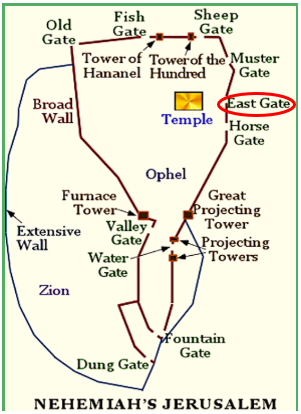
2 Chronicles 31:14 Kore the son of Imnah the Levite, the keeper of the eastern gate, was over the freewill offerings of God, to apportion the contributions for the LORD and the most holy things.
- the keeper of the eastern gate: 1Ch 26:12,14,17
- the freewill: Lev 22:18 23:38 Nu 29:39 De 12:6,17 16:10 Ezr 1:4 3:5 7:16 Ps 119:108
- to apportion the contributions: Ne 13:13
- the most holy things. Lev 2:10 6:16,17 7:1-6 10:12,13 27:28
FAITHFUL DISTRIBUTION
OF HOLY OFFERINGS
Kore the son of Imnah the Levite, the keeper of the eastern gate, was over the freewill offerings of God, to apportion the contributions for the LORD and the most holy things. Though frequently dismissed as tedious or thankless, faithful administration was vital to Israel’s worship, as the meticulously ordered system for distributing provisions to the Levites in 2 Chronicles 31:14–19 demonstrates that honoring God demanded accurate records, clearly defined roles, and disciplined stewardship to provide fairly for all who served.
Bob Utley - "the most holy things" This referred to the priests' part of the sin and guilt offering. The blood of these was taken into the shrine, therefore, it became "most holy" and could be eaten only by priests (cf. Lev. 6:24-30; 7:1-6).
The Eastern Gate (also called the east gate or the gate toward the sunrise) held special spiritual and ceremonial significance in the temple because it was considered the chief entrance, the gate facing the direction of the rising sun, symbolizing God’s glory, light, and the expectation of His presence. In the tabernacle and later in Solomon’s temple, the eastern side was the side of approach toward God’s sanctuary (see Ezek 43:1–4 BSB, where God’s glory enters by the east gate). Thus, being “keeper of the eastern gate,” thus Kore’s guardianship of it marked him as a faithful servant protecting the sacred flow of worship and offerings into God’s house, a living picture of faithfulness at the threshold of God’s glory
August Konkel: Administration is often perceived as tedious and thankless, but its importance and worth must not be minimized. An administrative list of the Levites appointed to the task of distribution describes how the contributions were to be apportioned (2Ch 31:14-19). The system was complex. A great number of people were eligible for service, the majority of them living in provincial towns. Small groups of them came to Jerusalem in a rotation system for short terms of office. The division system was further complicated by the fact that all members of the tribe of Levi were entitled to portions, but there were differences between the priests and other Levites. Since all the contributions were collected in Jerusalem, the logistics of distribution were complicated, and standards of eligibility had to be clear. This required an accurate registration and clear rules of status between those who officiated and those who did not, and between those who lived in the provinces and those in Jerusalem.
Bob Utley - "the keeper of the eastern gate" This was the main entrance to the temple area. The inner shrine faced east. These Levitical gatekeepers controlled access to the sacred area.
John Walton - keeper of the East Gate. One of the most important tasks assigned to priestly personnel was controlling access to the temple precinct, the inner circle of the “sacred compass” (on this concept see comments on Lev 16:2 and Num 18:1–7). Defiling the sanctuary with impurity required a purification offering (“sin” offering, see comment on Lev 4:1–3) and could bring punishment on the individual as well as the people. The gatekeepers had to prevent unqualified intrusion. There were also many valuable items in the temple precinct. Gold and silver were plentiful and a temptation to the unscrupulous individual who may not have feared divine retribution for trespass or theft of temple property. These valuables also had to be guarded. Misappropriation of that which was sacred required a reparation offering (“guilt” offering, see comment on Lev 5:14–16). The gatekeepers were charged with guarding against these offenses. An additional task clarified here is disbursing officer. The east gate is the most important since the temple faces east.
They reveal that God desires worship
that flows freely from the heart,
FREEWILL OFFERINGS - Freewill offerings were voluntary gifts brought to God out of gratitude, love, and devotion rather than obligation, distinct from required tithes and sacrifices in the Mosaic Law (Lev. 23:38). Though freely given, they were still offered according to God’s standards, involving acceptable sacrifices presented at the place He chose, often accompanied by grain, oil, and wine (Lev. 22:18–23; Num. 15:1–10). Spiritually, these offerings expressed heartfelt thanksgiving and trust in God’s provision, as seen when Israel willingly gave to build the tabernacle after the Exodus (Exod. 35:29). They reveal that God desires worship that flows freely from the heart, a principle carried forward in the New Testament, where believers are called to give willingly and joyfully in response to God’s grace (2 Cor. 9:7).
2 Chronicles 31:15 Under his authority were Eden, Miniamin, Jeshua, Shemaiah, Amariah and Shecaniah in the cities of the priests, to distribute faithfully their portions to their brothers by divisions, whether great or small,
- Under his authority : Heb. at his hand, 2Ch 31:13 *marg:
- the cities: Jos 21:9-19 1Ch 6:54-60
- to distribute faithfully, 1Ch 9:22
- whether great or small 1Ch 25:8
FAITHFUL DISTRIBUTION TO
PRIESTS OUTSIDE JERUSALEM
Under his authority - Kore described in 2Ch 31:14.
Were Eden, Miniamin, Jeshua, Shemaiah, Amariah and Shecaniah in the cities of the priests, to distribute faithfully their portions to their brothers by divisions, whether great or small (NET = "regardless of age" ESV "Old and young alike"). These men were appointed to oversee the equitable distribution of offerings and provisions
Spiritually, the verse highlights faithfulness, fairness, and order in God’s house—principles that reflect God’s character and expectations for His people (cf 1Co 4:2 “ In this case, moreover, it is required of stewards that one be found trustworthy” and , Ro 12:8 which calls those who lead to do so “with diligence”).
Bob Utley - "the cities of the priests" See Joshua 20-21.
John Butler - Distribution of the gifts were not to be done with favoritism. Equity in disbursement of church money is important. Some churches are very liberal with visiting evangelists but give miserly to their faithful pastor. Other churches will sacrifice for missionaries but not for the needs of the local ministry, and vice versa. But lack of fairness will hinder God’s work.
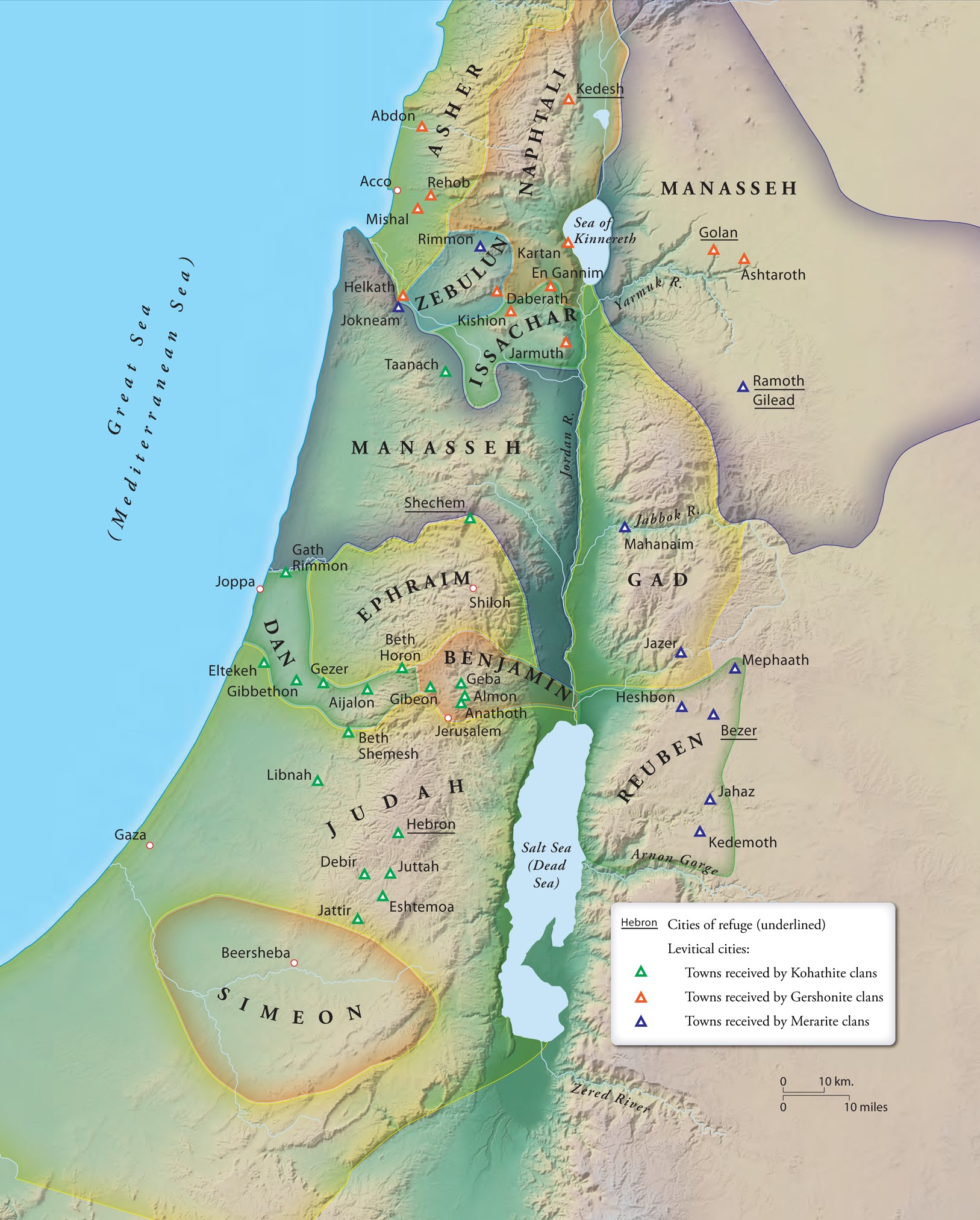
Map to help visualize cities of refuge = UNDERLINED
Zondervan Atlas of the Bible: C. Rasmussen
(recommended resource - do not reproduce)
EXCURSUS ON CITIES OF REFUGE - In the Old Testament, God regulated justice and restrained blood vengeance by providing asylum for those guilty of unintentional manslaughter, first through temporary sanctuary at the horns of a YHWH altar (Exod 21:12–14; 27:2; 30:10; 1 Kgs 1:50–53; 2:28–34), and later by instituting six Levitical cities of refuge strategically distributed throughout the Promised Land (Num 35:6–7, 10–28; Deut 4:41–43; 19:1–13; Josh 20). Three cities were appointed east of the Jordan—Bezer, Ramoth-gilead, and Golan—and three west of the Jordan—Kedesh, Shechem, and Hebron (Josh 20:7–8), all drawn from the forty-eight cities allotted to the Levites, who possessed no tribal territory but served as mediators, teachers, and judges (Num 35:6–7; cf. Num 1:50–53). A manslayer who fled to one of these cities received a formal hearing before the elders (Josh 20:4), and if found free of premeditated murder, was granted protection from the blood avenger until the death of the high priest, after which he could return home safely (Num 35:24–28; Josh 20:9); if found guilty, he was surrendered for execution with no provision for ransom (Num 35:16–21, 31–32). While asylum at religious sites was known elsewhere in the ancient Near East, Israel’s cities of refuge were unique in combining mercy, due process, and covenant justice, revealing YHWH’s concern to protect innocent life while upholding moral accountability (Deut 19:6, 10).
2 Chronicles 31:16 without regard to their genealogical enrollment, to the males from thirty years old and upward–everyone who entered the house of the LORD for his daily obligations–for their work in their duties according to their divisions;
- his daily: Lev 21:22,23
DAILY SUPPORT IMPARTIALLY FOR
ALL SERVING BY APPOINTMENT
without regard to their genealogical enrollment, to the males from thirty years old and upward–everyone who entered the house of the LORD for his daily obligations–for their work in their duties according to their divisions - This describes the distribution of temple provisions to every qualified male Levite who served in the temple, based on their ministry duties, regardless of whether their genealogical record was consulted at that moment. The support went to adult males (30 y.o. and upward) who were regularly entering the house of the LORD to carry out their daily responsibilities, ensuring that those faithfully performing their assigned duties within their divisions were adequately provided for.
The focus was on faithful service rather than family status. God honors faithful service over pedigree, echoing the principle that in His work, what matters most is devotion and obedience, not lineage or social standing (cf 1Sa 16:7, Col 3:23, 24).
Bob Utley -"their genealogical enrollment" The offices of priest and Levite were hereditary. The family lineage must be established.
2 Chronicles 31:17 as well as the priests who were enrolled genealogically according to their fathers’ households, and the Levites from twenty years old and upwards, by their duties and their divisions.
- who were enrolled genealogically: Nu 3:15,20 4:38,42,46 17:2,3 Ezr 2:59
- twenty: Nu 4:3 8:24 1Ch 23:24,27
- by their duties and their divisions: 2Ch 31:2 1Ch 24:20-31 25:1-26:32
Related Passages:
1 Chronicles 23:24 These were the sons of Levi according to their fathers’ households, even the heads of the fathers’ households of those of them who were counted, in the number of names by their census, doing the work for the service of the house of the LORD, from twenty years old and upward.
ORDERLY ENROLLMENT
FOR FAITHFUL SERVICE
as well as the priests who were enrolled genealogically according to their fathers’ households, and the Levites from twenty years old and upwards, by their duties and their divisions - Under Hezekiah’s reforms, the priests and Levites were carefully registered by name and age according to their assigned responsibilities in temple service. The priests were recorded by their family heads—the leading representatives of the priestly clans descended from Aaron—while the Levites were enrolled beginning at age twenty and upward, reflecting the age at which they entered regular service (cf 1Ch 23:24-27)
The significance of this recordkeeping was both spiritual and practical for it preserved order and accountability in the temple system, ensuring that those who served were rightly appointed (2Ch 31:18), protected the purity of ministry by confirming genealogical descent from the tribe of Levi and the family of Aaron, as God commanded in the Law (see Nu 3:5-10) and demonstrated that Hezekiah’s revival was not merely emotional but structurally faithful, aligning worship with God’s Word even down to the administrative details! In short, God values order, faithfulness, and correct calling in His service (cf 1Co 14:40 " all things must be done properly and in an orderly manner.")
John Gill: points out that "originally they were not admitted into the tabernacle till twenty five years of age, nor to officiate till thirty, but in David's time they were allowed at twenty years of age and upwards. (1Ch 23:24)
Bob Utley - "from twenty years old and upwards" This lower age requirement changes from period to period either because (1) there was a five year apprenticeship, (2) the number of Levites was smaller and they needed more; even after fifty the Levites could do some things in temple service that required less physical strength (3) see Hard Sayings of the Bible, p. 164
2 Chronicles 31:18 The genealogical enrollment included all their little children, their wives, their sons and their daughters, for the whole assembly, for they consecrated themselves faithfully in holiness.
- The genealogical enrollment, 2Ch 31:15 1Ch 9:22 *margins
- they consecrated themselves Isa 5:16 Ro 15:16
PROVISION FOR FAMILIES OF
PRIESTS AND LEVITES
The genealogical enrollment included all their little children, their wives, their sons and their daughters, for the whole assembly, for they consecrated themselves faithfully in holiness - the priests and Levites, not only as individuals but along with their entire families, were officially included in the records of temple service and provision. The enrollment ensured that those who dedicated themselves to the LORD’s work were properly cared for, both they and their households, because they had set themselves apart in holiness for continual service in God’s house.
For (term of explanation) they consecrated themselves faithfully in holiness - This shows that the priests and Levites were devoted not merely in ritual, but wholeheartedly with their life. Their families shared in their consecration because their vocation required complete dedication to God.
Spiritually, this verse teaches that holiness affects every part of life—including family. When people faithfully devote themselves to God, their commitment influences their whole household (cf Josh 24:15). It also shows that God honors and provides for those who faithfully consecrate themselves to His service.
2 Chronicles 31:19 Also for the sons of Aaron the priests who were in the pasture lands of their cities, or in each and every city, there were men who were designated by name to distribute portions to every male among the priests and to everyone genealogically enrolled among the Levites.
- in the pasture lands 2Ch 31:15 Lev 25:34 Nu 35:2-5 1Ch 6:54,60
- men: 2Ch 31:12-15 28:15
PROVISION FOR PRIESTS
IN THE FIELDS
Also for the sons of Aaron the priests who were in the pasture lands of their cities, or in each and every city, there were men who were designated by name to distribute portions to every male among the priests and to everyone genealogically enrolled among the Levites - Not all Levites served in the Temple. Some worked the surrounding fields, and because their labor supported the life of the Levites as a whole, they were rightly included in the sharing of the offering gifts.
2 Chronicles 31:20 Thus Hezekiah did throughout all Judah; and he did what was good, right and true before the LORD his God.
- and he did: 1Ki 15:5 2Ki 20:3 22:2 Joh 1:47 Ac 24:16 1Th 2:10 3Jn 1:5
HEZEKIAH'S REIGN
SUMMARIZED
These last 2 passages summarize Hezekiah's achievements in this time of spiritual revival and prosperity.
Thus Hezekiah did (1) throughout all Judah - His godly character permeated the entire land, like a sweet perfume. Hezekiah's actions were not limited to Jerusalem or a select group, but extended across the entire kingdom, bringing consistent spiritual renewal and faithful administration everywhere.
and (2) he did what was good, (3) right (yashar) and (4) true before the LORD his God - NET, ESV = "He did what the LORD his God considered good and right and faithful." The phrase “good, right, and true ('emeth) before the LORD” means that his actions conformed to God’s moral law, His revealed commands, and His covenant standards. It could be summed up as showing integrity in his leadership.
Hezekiah was true to Dt 6:18 which says "You shall do what is right and good in the sight of the LORD, that it may be well with you and that you may go in and possess the good land which the LORD swore to give your fathers."
Three key qualities are emphasized: Good—in motive, morals and compassion, seeking the people’s spiritual welfare. Right—in conformity and conduct to God’s law. True—in sincerity, serving God with integrity of heart, not hypocrisy.
Hezekiah was the epitome of a Micah 6:8 man...
He has told you, O man, what is good; And what does the LORD require of you But to do justice, to love kindness, And to walk humbly with your God?
Frederick Mabie has an excellent comment summing up Hezekiah's early years - This remarkable summary statement of praise (namely, “good and right and faithful … in everything … obedience … sought his God … worked wholeheartedly … prospered”) closes out the Chronicler’s account of Hezekiah’s reforms and is similar to the opening statement about his reign (cf. 29:2). As such, these remarks “frame” the overwhelmingly positive events of Hezekiah’s reign (chs. 29–31) and create a literary separation between these positive events and the following narrative (ch. 32), in which Hezekiah’s imperfections surface. Hezekiah’s reign is especially marked by an intense and sustained focus on “obedience to the laws and the commands” of God (e.g., 29:15, 25; 30:12, 16; 31:3).(See The Expositor's Bible Commentary: 1 Chronicles-Job)
John Butler - The proof of the high character of Hezekiah’s achievements is in the fact that they were honored by God. “Before the Lord his God” is like the statement seen often in the other Bible texts, “In the sight of the Lord” (2 Chronicles 29:2). This means that the achievements were observed and evaluated by God, and here He saw the achievements as “good and right and truth” which means they were indeed “good and right and truth,” for if God honors the achievements, they are truly honorable. It is the proof of the high character of the achievements.
True (faithful) (0571) 'emeth from the verb aman = to confirm, support, believe, be faithful) is a feminine noun meaning truth, faithfulness, that which gives complete reliability. It is frequently connected with lovingkindness (Pr 3:3; Hos 4:1, 40:11, 61:7, 69:13, 85:10, 86:14, 89:14, 108:4) and occasionally with other terms such as peace (2Ki 20:19); righteousness (Isa. 48:1); and justice (Ps. 111:7). To walk in truth is to conduct oneself according to God’s holy standards (1Ki 2:4; 3:6; Ps. 86:11; Isa. 38:3). Truth was a measure of one’s word (1Ki 22:16; Da 11:2) and actions (Ge 24:49; Josh. 2:14). God is the God of truth (Ps 31:5, Ps 57:3, 10, 69:13 = "saving truth"; Ps 71:22, Ps 111:7, 115:1)
Ultimately, God desires hearts shaped by His truth—
lives that reflect faithful integrity before Him, not merely outward
religion but wholehearted obedience grounded in reality as He defines it.
A biblical survey of ’emeth (truth/faithfulness) shows it is both a core attribute of God and a defining requirement for genuine service to Him. The LORD reveals Himself as the faithful “God of truth” (Ps 31:5), abounding in lovingkindness and truth (Exod 34:6), whose judgments are altogether righteous and true (Ps 19:9), and whose paths are “lovingkindness and truth” to those who keep His covenant (Ps 25:10). Throughout Scripture, God calls His people to mirror this truthfulness—choosing leaders who hate dishonest gain (Exod 18:21), dealing faithfully with others (Gen 47:29; Josh 2:12–14), and serving Him “in sincerity and truth” with undivided hearts (Josh 24:14; 1 Sam 12:24). David, Hezekiah, and others are commended for walking before God “in truth with all their heart” (1 Kgs 3:6; 2 Kgs 20:3; 2 Chr 31:20), while Psalm 15:2 declares that the one who dwells on God’s holy hill is the one who speaks truth in his heart. Against this backdrop, Scripture warns of the tragedy of life without truth (2 Chr 15:3) and presses the searching question of whether our service is sincere or hypocritical (Ps 51:6). Ultimately, God desires hearts shaped by His truth—lives that reflect faithful integrity before Him, not merely outward religion but wholehearted obedience grounded in reality as He defines it.
2 Chronicles 31:21 Every work which he began in the service of the house of God in law and in commandment, seeking his God, he did with all his heart and prospered.
- in law: Ps 1:2,3
- he did: De 6:5 10:12 1Ki 2:4 1Ch 22:19 Ec 9:10 Jer 29:13
- prospered: 2Ch 14:7 20:26 26:5 Jos 1:7,8 1Ch 22:13 Ps 1:3 Mt 6:33 7:24-27
DOING GOD'S WORK
WITH ALL ONE'S HEART
Every work which he began in the service of the house of God in law and in commandment, seeking his God, he did with all his heart and prospered - This verse captures not only the king’s devotion to God but also the divine blessing that followed his wholehearted obedience. He did with all his heart expresses complete sincerity, so that his motives were pure, his devotion was undivided and his goal God's glory. Because of that, he prospered not merely materially or politically but more important in spiritually in fruitfulness, national stability, and divine favor.
The key to understanding this verse lies in the phrase “seeking his God.” Hezekiah’s leadership was not driven by political ambition or national pride but by a sincere desire to honor the Lord and bring his people back into covenant fellowship. This echoes the biblical principle found in Deuteronomy 10:12-13
Now, Israel, what does the LORD your God require from you, but to fear the LORD your God, to walk in all His ways and love Him, and to serve the LORD your God with all your heart and with all your soul, 13 and to keep the LORD’S commandments and His statutes which I am commanding you today for your good?
Hezekiah fulfilled this command precisely. He approached every reform in the temple, every act of worship, and every commandment with full devotion, reflecting a heart wholly directed toward God. This testimony about Hezekiah also points to a larger spiritual truth that runs throughout Scripture: wholehearted devotion to God leads to blessing, not always in worldly terms, but in fellowship, peace, and divine approval.
2 Chronicles 31:21 is both a commendation and a lesson. It shows that when our work for God flows from sincere love, guided by His Word and done with all the heart, He blesses it. Hezekiah’s example encourages believers to serve God with that same spirit of wholehearted dedication. True prosperity, as modeled in his life, comes not from personal achievement but from faithfully walking in God’s ways and seeking His presence above all else.
Peter Wallace: Nowadays we seem to be divided between two horrible misunderstandings of this: one says that acting according to the law and the commandments means strict and precise observance of every jot and tittle; the other says that following the spirit of the law means that you can ignore the letter of the law entirely!
J.A. Thompson: “He succeeded in everything he undertook.” Thus Hezekiah serves as prime example of the Chronicler’s “retribution theology.” We are reminded again of the parallel between Hezekiah and Solomon (2Ch 7:11). Consequently he prospered in all that he did. (SEE 1, 2 Chronicles: An Exegetical and Theological Exposition)
Ron Daniel: The key to prosperity is not in the "name it and claim it" teachings. It is in the "seek God with your whole heart, walk in the light, live righteously" teachings. That is where prosperity comes from.
D L Moody - IN all ages God has used those who were in earnest. Satan always calls idle men into his service. God calls active and earnest—not indolent men. You remember where Elijah found Elisha ploughing in the field. Gideon was at the threshing floor. Moses was away in Horeb looking after the sheep. None of these were indolent men; what they did, they did with all their might. We want such men and women nowadays. If we cannot do God’s work with all the knowledge we would like, let us at any rate do it with all the zeal that God has given us.
G. Campbell Morgan: These words reveal his purpose, his method, and the result; and form a revelation of abiding value to all who are called upon to perform Divine service in any form.
- His purpose was ‘to seek his God’; and the expression is exactly equivalent to that with which we are familiar: ‘Seek ye first His kingdom.’ (Mt 6:33)
- His method was that of complete devotion, ‘with all his heart.’
- The result was that of prosperity, that is, of success in the very work which was attempted.
EXCURSUS ON "WITH ALL HIS HEART" - The phrase “with all his heart” in Scripture signifies complete devotion, sincerity, and undivided love toward God (Ps 86:11b). It expresses the biblical ideal that true faith is not half-hearted or merely external, but flows from the core of one’s being—the will, affections, and intentions. In the Old Testament, the “heart” (Hebrew lēb) represents the inner person, the seat of thought, desire, and decision. Therefore, to act “with all the heart” means to pursue God with total loyalty and genuine love (which is manifest as willing obedience), holding nothing back.
The foundation for this phrase is laid in Deuteronomy 6:5, which commands,
“You shall love the LORD your God
with all your heart
and with all your soul
and with all your might”.
This command reveals that wholehearted devotion is not optional but central to a right relationship with God. Such love involves both obedience and affection; it means aligning one’s desires and choices with God’s will. We are not talking perfection, but definitely speaking of direction! When Hezekiah is described as one who “did with all his heart and prospered” (2 Chronicles 31:21), it shows that his success flowed from this very posture—a heart fully yielded to God. His sincerity distinguished him (with few exceptions) from most of the other kings who obeyed only partially (good in first part of their reign, evil in the latter) or sought the LORD merely in times of crisis.
Throughout Scripture, God consistently blesses those who seek Him wholeheartedly. 2 Chronicles 15:12–15 records that when Judah covenanted “to seek the LORD God of their fathers with all their heart and soul,” the Lord gave them rest and peace from their enemies. Likewise, Jeremiah 29:13 promises, “You will seek Me and find Me when you search for Me with all your heart.” This pattern reveals that earnest, complete devotion draws divine favor and fellowship. Wholehearted service is not about perfection, but about an undivided pursuit—the refusal to serve both God and idols.
The opposite of serving “with all the heart” is hypocrisy, lukewarmness, or divided loyalty. Jesus rebuked such devotion in Matthew 15:8, quoting Isaiah: “This people honors Me with their lips, but their heart is far away from Me.” The New Testament continues the call for wholehearted faith, urging believers to love God fully and serve Him sincerely. Colossians 3:23 exhorts, “Whatever you do, do your work heartily, as for the Lord rather than for men”, reflecting the same principle that God desires integrity and passion in both worship and daily life.
The significance of this phrase is also captured in Pr 3:5–6, which commands, “Trust in the LORD with all your heart and do not lean on your own understanding. In all your ways acknowledge Him, and He will make your paths straight.” Here we see that wholehearted trust leads to divine guidance, for when the heart is fully committed to God, it becomes receptive to His direction and blessing.
In sum, “with all his heart” signifies the essence of true obedience and worship—complete, undivided devotion to God in love, faith, and action. Hezekiah, David, and others who lived by this principle experienced God’s presence and success, not because of their own strength, but because their hearts were wholly aligned with His will. It is this same wholehearted pursuit that Jesus affirmed as the greatest commandment and the defining mark of a faithful life before God.
2 Chr 16:9 says "For the eyes of the LORD move to and fro throughout the earth that He may strongly support those whose heart is completely His." Here is a concise summary of passages describe a heart that is completely God’s and a few that were not:
- Job 1:1, 8 – A heart wholly God’s is blameless, upright, God-fearing, and shuns evil; God Himself testifies to its integrity.
- Numbers 14:24 – A fully devoted heart follows the LORD completely, even when others turn back, and is marked by a different spirit.
- 1 Kings 8:61 – A whole heart is undivided and steadfast, walking in God’s statutes and keeping His commandments fully.
- 1 Kings 11:4 – A divided heart, like Solomon’s later years, turns away from the LORD, showing that partial devotion leads to spiritual decline.
- 1 Kings 15:3, 14 – God values wholehearted loyalty, as seen in David, even when there are failures; the heart’s direction matters more than perfection.
- 2 Kings 20:3 – A heart fully God’s walks in truth, sincerity, and wholehearted obedience, appealing confidently to God’s faithfulness.
- 1 Chronicles 12:38 – Wholehearted devotion produces unity and resolve among God’s people, without double-mindedness.
- 1 Chronicles 28:9 – A complete heart knows God personally and serves Him willingly, recognizing that God searches every heart and motive.
- 1 Chronicles 29:9, 19 – God delights in willing, joyful devotion, and a whole heart desires to remain fixed on God and obedient to His word.
- 2 Chronicles 15:17 – Even when outward imperfections remain, God honors a heart that is fully devoted to Him all one’s days.
- 2 Chronicles 16:9 – God actively supports and strengthens hearts that are completely His, showing divine favor toward wholehearted trust.
- 2 Chronicles 19:9 – A devoted heart serves the LORD faithfully, wholeheartedly, and reverently, especially in leadership and justice.
- 2 Chronicles 25:2 – External obedience without a whole heart is incomplete, reminding us that God weighs motives, not appearances.
- Isaiah 38:3 – A heart fully God’s walks faithfully and sincerely, able to appeal to God with humility and truth in times of crisis.
Summary takeaway: Across Scripture, a heart that is completely God’s is marked by integrity, sincerity, undivided loyalty, willing obedience, joyful devotion, and trust, and such a heart consistently draws God’s approval, support, and blessing—even when human weakness is present.
The Lord delights in hearts that are wholly His,
And pours His strength where true devotion is.
F B Meyer - 2 Chronicles 31:21 He did it with all his heart and prospered.
The man who does his business with all his heart, is sure to prosper. To put your heart into your work is like genius manipulating common materials, till their worth becomes priceless, just because of what has been put into it.
The heart stands for the emotions and affections. What the furnace is to the factory or steamship, that the heart is in the economy of our nature. It is a great thing to love our life-work, to have an aim that kindles us whenever we think of it. Those who are so happily circumstanced, cannot be sufficiently thankful. But what of those who are bound to a work which they did not choose and do not like, who find their daily toil irksome and distasteful— is there any help for them? Can they possibly learn to do such work from their hearts? Certainly: because of Him who set it, and for whom it may be done.
Love performs the most onerous duties with all its heart, if they conduce to the comfort and help of those whom it loves more than itself. Does not a mother or wife perform tasks from which the hireling would shrink? She does them with all her heart, not considering for a moment the loathesomeness and hardness of the demand. So if we look at our life-work as God-appointed; if we realize that He has fixed it for us, who determined the orbits of the stars; if we can hear the voice of Jesus saying, “Do this for Me”— there is no further thought of hardship or distaste. Remember to do all your life-work for Jesus; do all in His name and for His glory; ask Him to fill your. heart with submissive, loyal obedience, and you will find that when you introduce the personal element of Christ-service into the meanest acts, they will glisten like a piece of gold-tapestry.
TAKEAWAY - Any work becomes fruitful, noble, and joy-filled when it is done with all the heart as service to Christ, whose presence and purpose transform even the humblest tasks into offerings of lasting worth.
When done for Christ, no task is small or vain,
For heart-filled service turns all toil to gain.
C H Spurgeon - “He did it with all his heart and prospered.” —2 Chronicles 31:21
This is no unusual occurrence; it is the general rule of the moral universe that those men prosper who do their work with all their hearts, while those are almost certain to fail who go to their labour leaving half their hearts behind them. God does not give harvests to idle men except harvests of thistles, nor is he pleased to send wealth to those who will not dig in the field to find its hid treasure. It is universally confessed that if a man would prosper, he must be diligent in business. It is the same in religion as it is in other things. If you would prosper in your work for Jesus, let it be heart work, and let it be done with all your heart. Put as much force, energy, heartiness, and earnestness into religion as ever you do into business, for it deserves far more. The Holy Spirit helps our infirmities, but he does not encourage our idleness; he loves active believers. Who are the most useful men in the Christian church? The men who do what they undertake for God with all their hearts. Who are the most successful Sabbath-school teachers? The most talented? No; the most zealous; the men whose hearts are on fire, those are the men who see their Lord riding forth prosperously in the majesty of his salvation. Whole-heartedness shows itself in perseverance; there may be failure at first, but the earnest worker will say, “It is the Lord’s work, and it must be done; my Lord has bidden me do it, and in his strength I will accomplish it.” Christian, art thou thus “with all thine heart” serving thy Master? Remember the earnestness of Jesus! Think what heart-work was his! He could say, “The zeal of thine house hath eaten me up.” When he sweat great drops of blood, it was no light burden he had to carry upon those blessed shoulders; and when he poured out his heart, it was no weak effort he was making for the salvation of his people. Was Jesus in earnest, and are we lukewarm?
TAKEAWAY - True and lasting fruit—whether in life or in service for Christ—belongs to those who labor with wholehearted diligence and earnest zeal, for God prospers heart-work, not half-hearted effort.
Wholehearted toil the Lord delights to bless,
Half-hearted hands can never know success.
G Campbell Morgan —2 Chr 31.21.
This chapter gives in general terms the account of the work which followed worship; the reconstruction in the national life which eventuated from the national return to God which had been expressed in the great celebration of the Passover feast. It is very significant that the remnant gathered from Israel became the pioneers in the work of destroying all that remained of idolatry throughout the cities of Judah, and also in Ephraim and Manasseh. The king set in order the courses of priests and Levites; re-arranged the offerings according to the Law; and called for the payment of the tithe. The response was general and generous. The special value of the work was the thoroughness with which Hezekiah carried it out, and this is declared in this final verse. These words reveal his purpose, his method, and the result; and form a revelation of abiding value to all who are called upon to perform Divine service in any form. His purpose was "to seek his God"; and the expression is exactly equivalent to that with which we are familiar: "Seek ye first His Kingdom." His method was that of complete devotion, "with all his heart." The result was that of prosperity, that is, of success in the very work which was attempted. A right purpose and a true method always produce the highest results.
C H Spurgeon - Life in earnest - ‘He did it with all his heart and prospered.’ 2 Chronicles 31:21
Look around you; who are the most useful men in the Christian church today? The men who do what they undertake for God with all their hearts. Where is the preacher whom God blesses by the conversion of hundreds in a year? Is he a sleepy, prosaic soul? Does he confine himself within narrow limits? Does he speak sleepy words to a slumbering congregation? We know it is not so, but where God is pleased to assemble a congregation it is, whatever it may not be, a proof that there has been earnestness in the preacher. Who are the most successful Sunday school teachers? The most learned? Every superintendent will tell you it is not so. The most talented? The most wealthy? No; they who are the most zealous; the men whose hearts are on fire; those are the men who honour Christ. Who among you today is doing the most for your Master’s kingdom? I will tell you. Lend me a spiritual thermometer by which I may try the heat of your heart, and I will tell you the amount of your success. If your hearts be cold towards God, I am sure you are doing nothing though you may pretend to do it, but if you can say, ‘Lord, my soul is all on flame with an agony of desire to do good to the souls of men,’ then you are doing good, and God is blessing you as he did Hezekiah, who did it with all his heart and prospered. Feeling that very many Christians are not Christians with all their hearts, and that perhaps some of you have only given Jesus Christ a dull, cobwebby corner of your hearts, instead of bidding him sit at the head of the table and reign upon the throne: fearing that we are all in danger of getting into a Laodicean lukewarm state, I wish to stir you up.
PAUL APPLE - DEVOTIONAL QUESTIONS:
1) Do we pay enough attention to orderly administration of the local church?
2) Are we reluctant to ask God’s people to be responsible in their giving?
3) Should we expect the type of generous and abundant provision for ministry that we see here?
4) How do the Law of God and the Word of God dominate this topic in chap. 31?
QUOTES FOR REFLECTION:
Raymond Dillard: For most modern Western readers of the Bible this chapter reads somewhat awkwardly; it is one more example of the Chronicler’s punctilious concern with matters cultic, an interest at great chronological and cultural distance from his readers today. But for the Chronicler and his own contemporaries, rather than a distant and curious pericope, this section would have been full of the utmost practical relevance for godly living. Its reports of generosity and its focus on the correct worship of God through giving and caring for his servants were practical exhortations of what it meant to seek God and to obey his commandments. For the Chronicler it was a lesson from history that needed to be heard in his own day, for it remained the pathway to success and blessing (2Ch 31:21). Providing for the servants of God to free them for more important matters (2Ch 31:4) is likewise a concern of the NT (Phil 2:25–30; 4:14–19; 2 Cor 8:10—9:15; Acts 6:1–4; 20:32–35). (Borrow 2 Chronicles)
August Konkel: The provisions for the temple fall into two categories: - those from the king, and - those from the people (2 Chron 31:3-4). The portion of the king indicates obligatory provisions rather than voluntary contributions. The contribution of the king from his own possessions was his responsibility for daily sacrifices and the festival sacrifices in their annual cycle. The people were responsible to give provisions for the clergy. The king’s order was given to those who lived in Jerusalem, perhaps because they were in the closest proximity to the temple (2Ch 31:4). Word of the need for temple provisions spread abroad, and the response came from all Israel (2Ch 31:5). This included those who lived outside of Judah in the north. Two points emerge from this observation: - Israel was united in its support of the temple, and - the response became far more than anticipated or even required. The purpose of the gifts of support was that the clergy might devote themselves to the Law (2Ch 31:4).
David Guzik: What the New Testament does speak with great clarity on is the principle of giving; - that giving should be regular, planned, proportional, and private (1 Corinthians 16:1-4); - that it must be generous, freely given, and cheerful (2 Corinthians 9).
Martin Selman: The divine blessing which forms the climax in this chapter has several distinguishing marks.
- Firstly, it is the result of Hezekiah’s faithfulness to the principles established by David and Solomon. It was they who had originally organized the divisions of priests and Levites (2Ch 31:2; cf. 1 Chr. 28:13, 21; 2 Chr. 8:14), established the pattern of regular sacrificial worship (2Ch 31:2-3; 1 Chr. 23:31; 2 Chr. 2:4; 8:13), led the way in generosity (v. 3; 1 Chr. 29:2-5; 2 Chr. 7:5), and blessed the people (v. 8; 1 Chr. 16:2; 2 Chr. 6:3).
- Secondly, it is associated with Hezekiah’s wholehearted commitment to God’s law (2Ch 31:3, 4, 21). - Thirdly, God blesses his people through their own generosity (cf. 1 Chr. 29:14- 16). - Fourthly, God blesses beyond his people’s normal expectation (cf. 1 Chr. 13:14; 17:27). (Tyndale Old Testament Commentaries – 1 Chronicles. BORROW)
Mark Boda: For his community, this part of the Chronicler’s account of Hezekiah would have served two purposes.
First, it would have challenged them to give generously to the service of the Temple, especially focusing on tithing their harvests. Such gifts, according to the Chronicler, are essential so that the priests and Levites “could devote themselves fully to the Law of the Lord,” that is, the stipulations for worship contained in the Torah. The ideal scenario is described by Azariah, the Zadokite high priest, in 2Ch 31:10: “.” This is explicitly tied to the generosity of the people We have had enough to eat and plenty to spare (“Since the people began bringing their gifts to the Lord’s Temple”), which is a reflection of the blessing of the Lord upon them (“The Lord has blessed his people, and all this is left over”). The people of Jerusalem appear to have a role to play as examples to the rest of the community for this generosity (31:4), but the responsibility for the Temple and its personnel could not be borne by them alone. This was a task for all those living in the province of Judah.
Second, the account would have provided an administrative system for distributing the resources of the Temple to priestly and Levitical personnel throughout the province. This may suggest some conflict over this issue in the Chronicler’s time, but it may also simply be an affirmation of a system that was working well.
Geoffrey Kirkland: Hezekiah’s Great Reformation: The People’s Faithful & Generous Provision for the Leaders to Be Devoted to Scripture!
After a mountaintop experience (like celebrating the nationwide Passover with Hezekiah, 2 Chron 30!), we need to take care as we return to the ROUTINE OF DAILY LIFE.
Background of 2 Chronicles 31: So what do you do when Hezekiah’s reforms and Passover festival has ended and it’s time to go home? How do you keep spiritual health up? What do you do? How do you find teaching and instruction from the Law of God?
Two big picture lessons from 2 Chronicles 31:
#1- WORSHIP cannot be left to the ‘PROFESSIONALS’ alone
#2- WORSHIP is to be carried out in DECENCY AND IN ORDER
THESIS — What happens when great Reformation comes? What are some marks? Observing King Hezekiah’s reformation brought a number of results.
Reforms Bring...
I. HOLY VIOLENCE TOWARD SIN! (1)
II. HEARTFELT GRATITUDE TO GOD! (2)
III. PRECISE OBEDIENCE TO SCRIPTURE! (3)
Note Hezekiah’s commitment to the written Word
Note Hezekiah’s commitment to obedience
IV. GRACIOUS PROVISION TO TEACHERS! (2Ch 31:4-19) The focus here in this chap is on the HEARTS OF GOD’S PEOPLE; they give generously! *summary verse is 2Ch 31:10!*
1. GIVING for God’s Work (Contribution of the gifts) (2Ch 31:4-10) [Deut 14.29; 18:5; 1 Cor 9.13-14; 1 Tim 5.18]
2. SUPPORT for God’s Servants (Distribution of the gifts) (2Ch 31:11-19) The characteristic & main mark of all the distribution of the funds was “Faithfulness” (2Ch 31:12, 15, 18)
V. GODLY LEADERS OBEYING SCRIPTURE! (2Ch 31:20-21)
Summary of Hezekiah’s Leadership:
1. Hezekiah’s LEADERSHIP (he did)
2. Hezekiah’s CONSISTENCY (throughout ALL Judah)
3. Hezekiah’s AMBITION (he did before the LORD HIS GOD)
4. Hezekiah’s PRIORITY (he served the Lord in the house of God)
5. Hezekiah’s AUTHORITY (the Law and in Commandment)
6. Hezekiah’s PURSUIT (he sought his God)
7. Hezekiah’s PASSION (he did with all his heart)
8. Hezekiah’s BLESSING (and he prospered!)
Let us be faithful to give -- God supplies us, so let us give generously
NOTE: SOME CAN BE BORROWED FROM ARCHIVE.ORG
Archer, Gleason L. Jr. A survey of Old Testament introduction (BORROW). Chicago, IL: Moody Press, 1964.
Baxter, J. Sidlow. Explore the Book Vol. 2 Judges to Esther . Grand Rapids, MI: Zondervan, 1960.
Boda, Mark J. Cornerstone Biblical Commentary – 1-2 Chronicles. (Digital version) Carol Stream, IL: Tyndale House Publishers, 2010.
Braun, Roddy. Word Biblical Commentary – Volume 14 –1 Chronicles (BORROW). Grand Rapids, MI: Zondervan, 2018.
Cooper, Derek. Reformation Commentary on Scripture – Old Testament V – 1-2 Samuel, 1-2 Kings, 1-2 Chronicles. (Digital version) Downers Grove, IL: IVP Academic, 2016.
Constable, Thomas - 1&2 Chronicles (ONLINE)
Daniel, Ron - Teaching Notes - 1 Chronicles; 2 Chronicles (ONLINE)
Dillard, Raymond B. Word Biblical Commentary – Volume 15 – 2 Chronicles (BORROW) Grand Rapids, MI: Zondervan, 2018.
Ellison, H. L. The New Bible commentary, revised – 1 & 2 Chronicles (BORROW). Grand Rapids, MI: Wm. B. Eerdmans Publishing Co., 1970.
Guzik, David. Enduring Word Bible Commentary 1 Chronicles; 2 Chronicles (ONLINE)
Hill, Andrew E.The NIV Application Commentary on the Bible (Digital version) Grand Rapids, MI: Zondervan, 2003.
Keil, C. F. and Delitzsch, F. Commentary on the Old Testament – 1 Chronicles & 2 Chronicles. Grand Rapids, MI: William B. Eerdmans Publishing Company, 1975.
Konkel, August H. Believers Church Bible Commentary – 1 & 2 Chronicles. (Multipart video series also available) Harrisonburg, VA: Herald Press, 2016.
Mabie, Frederick J. The Expositor’s Bible Commentary Revised Edition – 1 & 2 Chronicles. (Digital Version) Grand Rapids, MI: Zondervan, 2010.
MacArthur, John. The MacArthur Study Bible (BORROW). Nelson Bibles, 2006.
Olley, John W. (ED: IAIN DUGUID) ESV Expository Commentary, Vol. III – 1 Samuel – 2 Chronicles. (Digital Version) Wheaton, IL: Crossway, 2019.
Payne, J. Barton. The Expositor’s Bible Commentary – 1 & 2 Chronicles. Grand Rapids, MI: Zondervan Publishing House, 1988.
Schultz, John. - 1 Chronicles (177 pages), 2 Chronicles (239 pages) (ONLINE)
Selman, Martin J. Tyndale Old Testament Commentaries – 1 Chronicles. (BORROW)Downers Grove, IL: InterVarsity Press, 1994.
Selman, Martin J. Tyndale Old Testament Commentaries – 2 Chronicles. (BORROW) Downers Grove, IL: InterVarsity Press, 1994.
Sherwin, Simon & Mabie, Frederick J. Zondervan Illustrated Bible Backgrounds Commentary -- 1 & 2 Chronicles. (Digital Version) Grand Rapids, MI: Zondervan, 2009.
Thompson, J.A. 1, 2 Chronicles: An Exegetical and Theological Exposition (Digital Version) Nashville, TN: B&H Publishing Group, 1994.
Utley, Bob. 1 Chronicles Table of Contents; 2 Chronicles Table of Contents
http://www.freebiblecommentary.org/old_testament_studies/VOL07BOT/VOL07BOT.html
Walton, John, et al - The IVP Bible Background Commentary Old Testament IVP - InterVarsity Press 2000.
Wiersbe, Warren W. Be Restored – Trusting God to See Us Through – OT Commentary – 2 Samuel & 1 Chronicles. (BORROW) Colorado Springs, CO: David C. Cook, 2010.
Wiersbe, Warren W. Be Distinct – Standing Firmly Against the World’s Tides – OT Commentary – 2 Kings & 2 Chronicles. (BORROW) Colorado Springs, CO: David C. Cook, 2010.
Williamson, H.G.M. New Century Bible Commentary – 1 and 2 Chronicles. Eugene, OR: Wipf and Stock Publishers 1982.
Wood, Leon. A Survey of Israel’s History. (BORROW) Grand Rapids: MI: Zondervan Publishing House, 1970.
Cyril Barber - 2 Chronicles: God’s Blessing of His Faithful People
Leslie Allen - 1, 2 Chronicles (BORROW)
Believer's Study Bible (Digital Version)
Ryrie Study Bible - BORROW
Defender's Study Bible - BORROW
NIV Study Bible - (BORROW)
ESV Study Bible - (BORROW)
Believer's Bible Commentary - (BORROW)