2 Kings 9:2
2 Kings 9:3
2 Kings 9:4
2 Kings 9:5
2 Kings 9:6
2 Kings 9:7
2 Kings 9:8
2 Kings 9:9
2 Kings 9:10
2 Kings 9:11
2 Kings 9:12
2 Kings 9:13
2 Kings 9:14
2 Kings 9:15
2 Kings 9:16
2 Kings 9:17
2 Kings 9:18
2 Kings 9:19
2 Kings 9:20
2 Kings 9:21
2 Kings 9:22
2 Kings 9:23
2 Kings 9:24
2 Kings 9:25
2 Kings 9:26
2 Kings 9:27
2 Kings 9:28
2 Kings 9:29
2 Kings 9:30
2 Kings 9:31
2 Kings 9:32
2 Kings 9:33
2 Kings 9:34
2 Kings 9:35
2 Kings 9:36
2 Kings 9:37
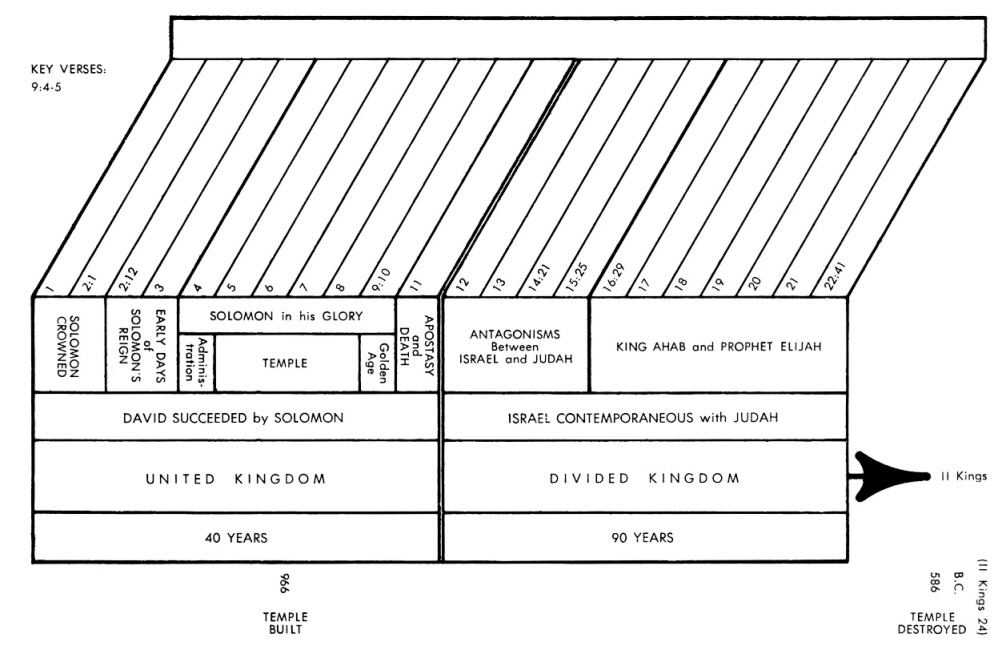
Chart from recommended resource Jensen's Survey of the OT - used by permission
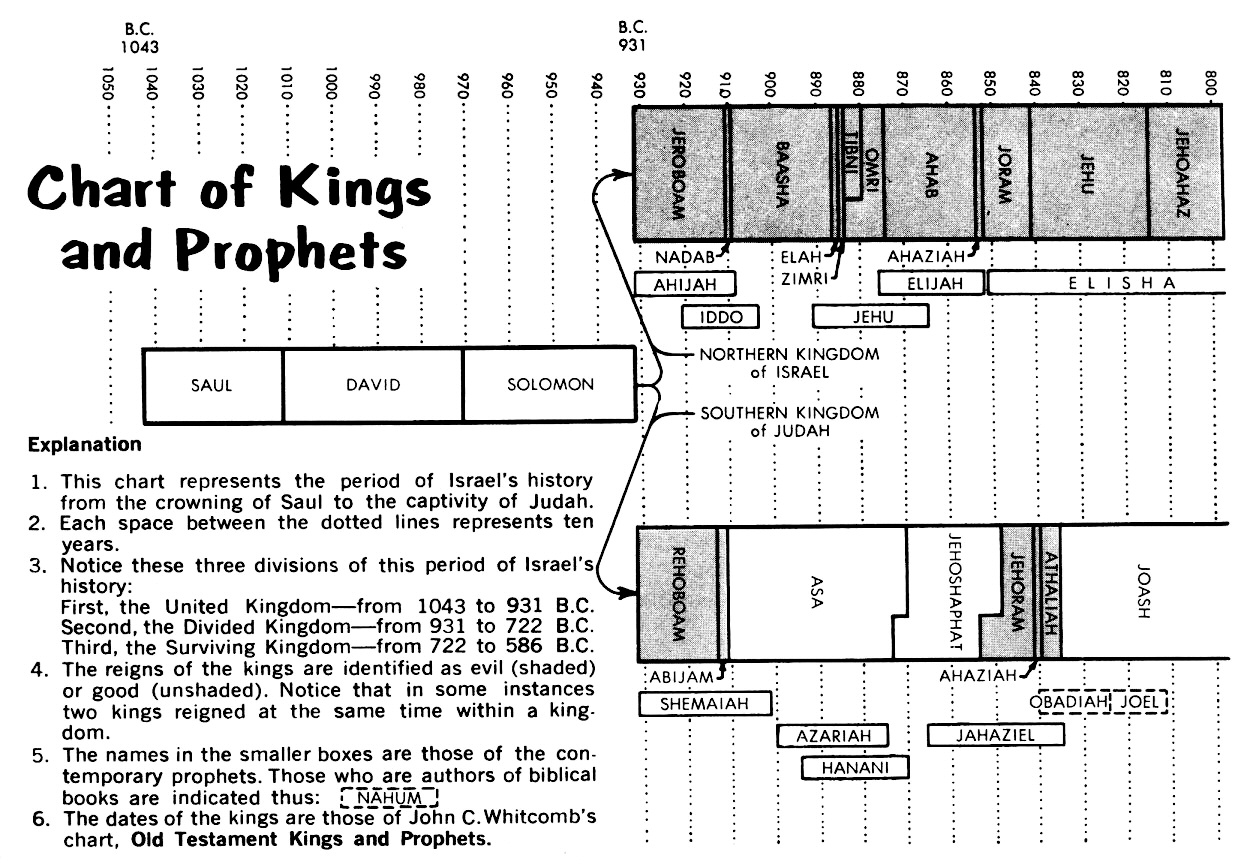
1 Kings Chart from Charles Swindoll
THE DOWNWARD SPIRAL
Click to Enlarge
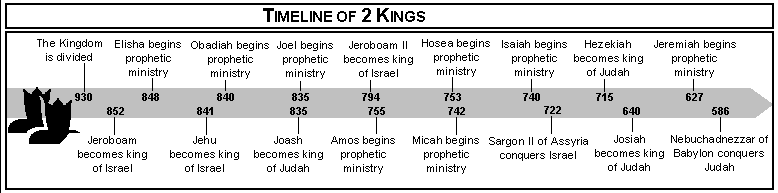
Ryrie Study Bible - Borrow
Click to Enlarge
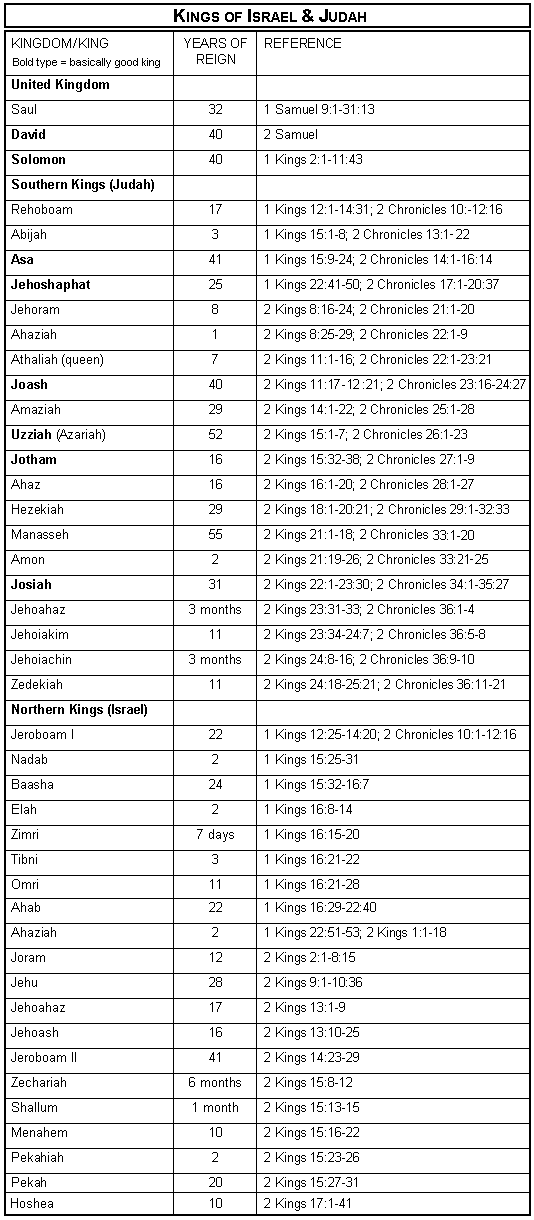
(NOTE: Many consider Amaziah and Hezekiah as "good" kings)
SEE ALSO:
ESV chart - kings of Israel - more information
ESV chart - kings of Judah - more information
Another Chart with Variable Dates for Reigns of Kings
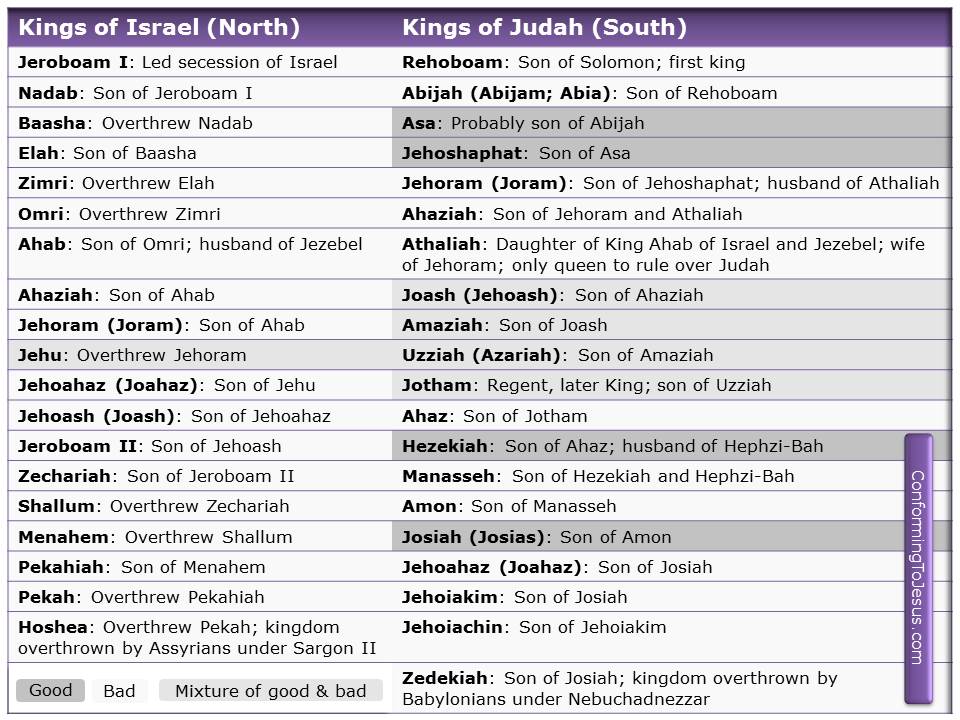
Source: ConformingtoJesus.com
2 Kings 9:1 Now Elisha the prophet called one of the sons of the prophets and said to him, “Gird up your loins, and take this flask of oil in your hand and go to Ramoth-gilead.
- 1Ki 20:35
- sons of the prophets: 2Ki 4:1 6:1-3
- Gird up thy loins: 2Ki 4:29 1Ki 18:46 Jer 1:17 Lu 12:35-37 1Pe 1:13
- flask of oil: 1Sa 10:1 16:1 1Ki 1:39
- Ramoth gilead: 2Ki 8:28,29 De 4:1,3 1Ki 22:4,20
Dale Ralph Davis outlines 2 Kings 9
- Instructions and obedience, 2Ki 9:1–10
- Coronation and conspiracy, 2Ki 9:11–16
- Riding and retribution, 2Ki 9:17–37
- A cloud of dust, 2Ki 9:17–20
- A series of deaths, 2Ki 9:21–37
Related Passages:
2 Kings 6:12 One of his servants said, “No, my lord, O king; but Elisha, the prophet who is in Israel, tells the king of Israel the words that you speak in your bedroom.”
Luke 4:27 “And there were many lepers in Israel in the time of Elisha the prophet; and none of them was cleansed, but only Naaman the Syrian.”
1 Samuel 10:1 (ANOINTING OF SAUL AS KING) Then Samuel took the flask of oil, poured it on his head, kissed him and said, “Has not the LORD anointed you a ruler over His inheritance?
1 Samuel 16:13 (ANOINTING OF DAVID AS KING) Then Samuel took the horn of oil and anointed him in the midst of his brothers; and the Spirit of the LORD came mightily upon David from that day forward. And Samuel arose and went to Ramah.

Jehu is at Ramoth-Gilead
PREPARATION FOR ANOINTING
OF JEHU AS KING OF ISRAEL
Now - NLT says "meanwhile"
Elisha the prophet (nabiy;) called one of the sons of the prophets and said to him - The sons of the prophets were part of the saved remnant, for God maintains a remnant of believing Jews in every generation. These were not biological sons but describe a prophetic training community, like a spiritual seminary or ministry school. It implies intentional discipleship (cf Jesus' last command to "make disciples" Mt 28:19).
SONS OF THE PROPHETS - 12X/11V - 1 Ki. 20:35; 2 Ki. 2:3; 2 Ki. 2:5; 2 Ki. 2:7; 2 Ki. 2:15; 2 Ki. 4:1; 2 Ki. 4:38; 2 Ki. 5:22; 2 Ki. 6:1; 2 Ki. 9:1; (Acts 3:25 - different context) Note that 10 of the 11 occurrences of this phrase refer to prophetic groups associated with Elisha. Sons of the prophets were more accurately understood as students, disciples, or members of prophetic guilds or schools. They were not biological sons of prophets (necessarily), but rather a community of prophetic apprentices or trainees, dedicated to following and learning the ways of the prophetic tradition and likely living in communal settings at places like Bethel, Jericho, and Gilgal. Think of them as kind of like seminary students or a prophetic order, much like a monastic or academic group. However they were not monastic in terms of celibacy for they were often married (2Ki 4:1). The "sons of the prophets" remind us that God always preserves a faithful remnant, even in dark times. They were men devoted to learning, living, and proclaiming God's truth in a culture that often rejected it. (See School of prophets)
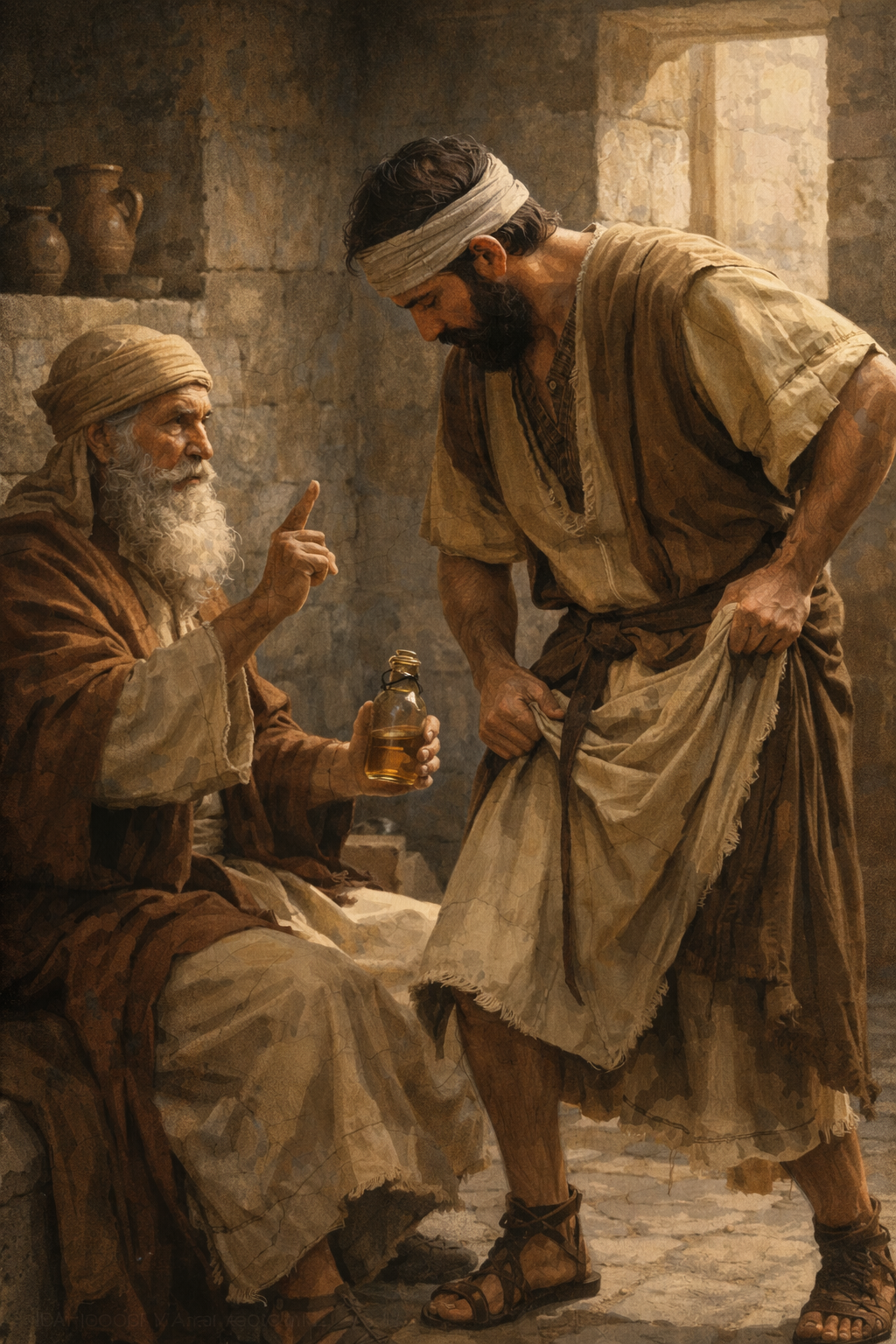
Gird up (hagar/chagar; LXX - zonnumi) your loins - This speaks of the urgency of the mission! In the ancient Near East, people typically wore long, loose, flowing outer garments. These robes were comfortable but impractical for strenuous activity, travel, or battle. To “gird up the loins” meant to gather up the long skirts of the robe and tuck them securely into a belt or girdle worn around the waist. This freed the legs for movement and prevented the garment from becoming an obstacle. Thus, the phrase Gird up your loins became an idiom meaning to prepare oneself for action, to brace for demanding work, or to be ready for decisive effort. It conveys alertness, discipline, and intentional readiness, moving from rest to resolve, from passivity to purposeful action.
Bob Utley - "Gird up your loins" This is an idiom for preparations for action (cf. Exod. 12:11; 2 Kgs. 4:29; Prov. 31:17; Dan. 10:5). Literally it turned a robe into pants as one grabbed the back of one's robe through one's knees and tucked it into the belt in front, thus making the robe tight across the thighs (see note at 1 Kgs. 18:36 online)
And take this flask of oil in your hand and go to Ramoth-gilead. The flask of oil was not symbolic decoration but was the instrument of divine appointment. In Israel, oil was used to anoint kings as a visible sign that God Himself had chosen and authorized the ruler (cf. 1Sa 10:1; 16:13). By placing the flask in his hand, Elisha underscores both the urgency and the authority of the mission. This son of the prophet was to act decisively and with the authority of the Elisha the prophet, fulfilling God's command to Elijah in 1Ki 19:16 "Jehu the son of Nimshi you shall anoint king over Israel."
Elisha's command take this flask of oil signals that judgment and transition are imminent. Jehu’s anointing at Ramoth-gilead would set in motion the overthrow of Ahab’s house, fulfilling earlier prophetic words (1Ki 19:16–17). Thus, this simple directive is loaded with meaning, for it launches a divinely ordained change of leadership, executed quietly at first, but with nation-shaking consequences.
What sounds like a simple travel instruction is actually a call to participate in God’s sovereign plan of carrying God’s authority (the oil) into a strategic place (Ramoth-gilead) at a decisive moment in Israel’s history.
Bob Utley - "this flask of oil" Olive oil was used for cooking and to rub on one's skin, but in a spiritual sense (i.e., special holy oil, cf. Exod. 30:23-25), it was used to anoint leaders (i.e., kings, priests, and prophets) and as fuel for the lights in the temple SPECIAL TOPIC: "ANOINTING" IN THE BIBLE
Ramoth-gilead was a strategic, contested military city east of the Jordan, often fought over between Israel and Aram (cf. 1 Kgs 22; 2 Kgs 8). At this moment it served as a military headquarters, where Jehu was stationed as a commander. God chooses this volatile setting to act, showing that His purposes move forward in the midst of political tension, warfare, and instability.
Bob Utley - Ramoth-gilead This city is located on the border between Syria and Israel on the eastern side of the Jordan River. It was on the King's Highway, which was a major north-south trade route. It had been the site of a border feud for years (cf. v. 14). The nation that occupied this city held taxation rights.
Matthew Henry comments that "Elisha did not go himself to anoint Jehu, because he was old and unfit for such a journey and so well known that he could not do it privately , could not go and come without observation; therefore he sends one of the sons of the prophets to do it." (ED: ALL OF THIS MAY BE TRUE BUT ARE NOT SPECIFICALLY STATED IN THE TEXT. ALWAYS BE A BEREAN!)
Paul Apple - Despite God’s promise of judgment against those who oppose Him and persist in their rebellion and sins, people tend to disregard or mock His threat. They imagine that life will go on along its present course without any divine intervention and righting of wrongs. The more powerful their status, the more their false confidence fortifies their wicked behavior. Here we see Jehu commissioned as God’s instrument of certain and sudden judgment against the idolatrous house of Ahab.
Iain Provan: The twelve years of Jehoram, son of Ahab, are completed (2 Kgs. 3:1; 2Ki 8:25); and the time for judgment has come (1 Kgs. 21:21–29). Elisha is still with us, and Hazael—though not in the way first planned—is king of Aram. Ahab’s drama is approaching its final curtain. Of the players mentioned in 1 Kings 19:15–18, we await only Jehu. Right on cue, he now makes his entrance. Israel will be purged at last of Ahab’s house and the worship of Baal it has introduced. Judah, too, will be cleansed. Even the Davidic line will seem under threat. God’s quiet ways are, for the moment, at an end. Earthquake is the order of the day. (1 & 2 Kings)G. Campbell Morgan: It is indeed a terrible chapter in which the truth of the divine government is written no longer in the gentle words of patient mercy, but in flames of fire. At last the day of God's patience had passed, and the devouring sword fell on the chief persons in the household of Ahab, who had done so much to encompass the ruin of His ancient people
QUESTION - What was the school of prophets? | GotQuestions.org
ANSWER - The Old Testament mentions a school of prophets in 1 Samuel 19:18–24 and in 2 Kings 2 and 2 Ki 4:38–44 (some translations say “company of prophets” or “sons of the prophets”). Also, the prophet Amos possibly mentions a prophetic school in stating his credentials (or lack thereof) to Amaziah the priest: “I was neither a prophet nor the son of a prophet” (Amos 7:14).
First Samuel 19 relates an account in which King Saul sends messengers to arrest David. When these men encountered a company of prophets under Samuel’s leadership, the king’s men also prophesied. This happened three times. Saul himself then went, and he, too, prophesied, leading people to ask, “Is Saul also among the prophets?” (1 Samuel 19:24), which became a saying in those days.
The “group of prophets” in 1 Samuel 19 was clearly comprised of students of the prophet Samuel. These students were likely Levites who served in roles related to the tabernacle and ceremonial worship. The content of their “prophesies” is not specified. Their messages could have been general teachings from God’s laws in the Books of Moses, or they could have included additional revelation.
In 2 Kings 2 Elijah is traveling with Elisha, and a group of prophets from Bethel tells Elisha that Elijah would be taken from him that day (2Ki 2:3). Another group of prophets at Jericho repeats the prophecy (2Ki 2:5), and a third group of prophets near the Jordan River also delivers the same message (2Ki 2:7). This third group of 50 men may have been a subset of the group of prophets at Jericho. After Elijah was taken up into heaven, Elisha reluctantly sends 50 of these prophets to search for Elijah for three days (2Ki 2:15–18).
In 2 Kings 4:38–41 Elisha is in Gilgal during a time of famine. Elisha miraculously changes an inedible stew into a comestible dish for the group of prophets there. Chapter 4 ends with Elisha’s turning 20 loaves of bread into more than enough food for 100 people. Nothing else is mentioned about this school of prophets, though it is clear they lived together in some kind of community and were known as sons of the prophets who worshiped the Lord.
These groups of men were likely leaders among those 7,000 Israelites who had not bowed down to Baal, as God had told Elijah (1 Kings 19:18). There were at least three schools or communities of these prophets and possibly more, consisting of men who were devoted to God and served Him. They followed the teachings of Samuel, Elijah, and Elisha during the time of the prophets and were known as their “students.”
John Butler - SERVICE 2 Kings 9:1 - Sermon Starters
“Elisha the prophet called one of the children of the prophets, and said unto him, Gird up thy loins, and take this box of oil in thine hand, and go to Ramoth-gilead” (2 Kings 9:1).
Elisha sends a young man to anoint Jehu to be king of Israel (northern kingdom). This sending of the young man is an excellent picture of service for the Lord.
FIRST—THE SUMMONS FOR SERVICE
“Elisha the prophet called one.” The first requirement for service is to be “called.” If you are not “called,” do not try to push yourself into service as Ahimaaz did (2 Samuel 18:23), and made a fool of himself, for he had no message. All he did was run. Make sure of your calling before you get in service for the Lord.
SECOND—THE SUPREMACY OF SERVICE
“Gird up thy loins.” This means to tie up one’s loose clothes (a typical situation in those days) so you can serve. In application it says to give priority to service. Do not let anything hinder you from fulfilling your calling.
THIRD—THE SKILL FOR SERVICE
“Take this box of oil in thine hand.” This speaks of enablement for service. The young man was to anoint Jehu king. He could not do this anointing without some oil. God will enable you for your calling. Whatever He calls you to do, you will be able to do it. This does not eliminate practice and preparation but it eliminates the many excuses for not serving, especially excuses that say we can’t do the job.
FOURTH—THE SITE FOR SERVICE
“Go to Ramoth-gilead.” Elisha told the young men where to go which says God has a place for us to serve. When God calls you, it is like Elisha’s calling the young men—He has it all planned our for you, and the place of service will be told you in due time. When you arrive at the place, the circumstances will confirm your calling and service. God does not call you to anoint someone and send you where there is no one to anoint.
FIFTH—THE SWEAT IN SERVICE
“Go to Ramoth-gilead.” This would require walking as there were no highways and cars nor even buses, trains, and planes. If you would serve God you will discover quickly that sweat is involved. The Lord’s service is no place for the slothful and lazy. You need to know how to roll up your sleeves and get to work if you would serve God. He has no easy jobs as far as the flesh in concerned.
SIXTH—THE SACRIFICE FOR SERVICE
“Go to Ramoth-gilead.” Service requires much sacrifice. The young man may have had other plans for the days involved, but he had to sacrifice them in order to serve the Lord. If you would serve the Lord you have to sacrifice everything just like we had to sacrifice in order to be a member of the United States military.
2 Kings 9:2 “When you arrive there, search out Jehu the son of Jehoshaphat the son of Nimshi, and go in and bid him arise from among his brothers, and bring him to an inner room.
- Jehu: 2Ki 9:14 1Ki 19:16,17
- among his brothers: 2Ki 9:5,11
- an inner room 1Ki 20:30 22:25
Related Passages:
1 Kings 19:15-18 The LORD said to him (ELIJAH), “Go, return on your way to the wilderness of Damascus, and when you have arrived, you shall anoint Hazael king over Aram; 16 and Jehu the son of Nimshi you shall anoint king over Israel; and Elisha the son of Shaphat of Abel-meholah you shall anoint as prophet in your place. 17“It shall come about, the one who escapes from the sword of Hazael, Jehu shall put to death, and the one who escapes from the sword of Jehu, Elisha shall put to death. 18“Yet I will leave 7,000 in Israel, all the knees that have not bowed to Baal and every mouth that has not kissed him.”
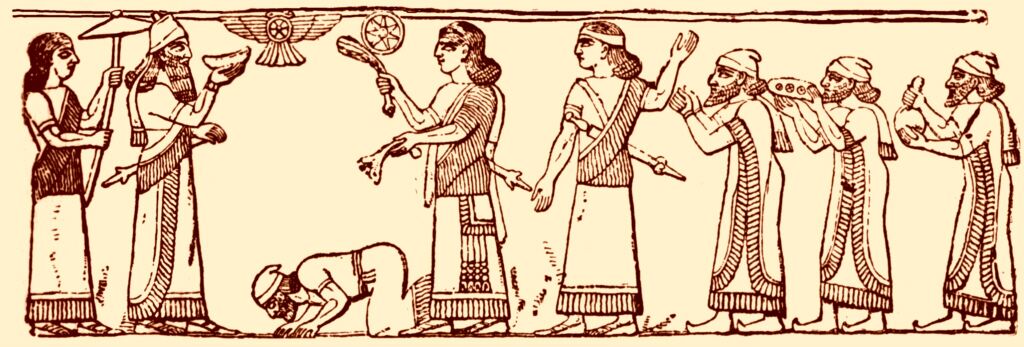
Drawing of king Jehu paying tribute to Shalmaneser III as depicted on the Black Obelisk (see note)
SERVANT'S MISSION
FIND JEHU
When you arrive there, search out Jehu the son of Jehoshaphat the son of Nimshi - Not the same Jehoshaphat who was king of Judah. Note Elisha says "when" not "if" which indicates that he knew this mission, although very dangerous, would be successfully accomplished, ultimately because he knew this was God's will. God’s will often advances quietly before it becomes visible, and many of His greatest works begin unseen and uncelebrated (Mt 13:31–33; Zech 4:10). We can rest assured that God’s work done God’s way will never lack God’s supply and in this case God's protection!
Bob Utley - "Jehu" The Hebrew spelling of Jehu (BDB 219) is similar to the Hebrew spelling of YHWH (BDB 217). Both come from the verb "to be." The name means "YHWH is the true one" or "YHWH is he." He was not of the royal family but of the military (NIDOTTE, vol. 4, pp. 749-750). A new dynasty begins with both Hazael and Jehu. Elisha is the divine instigator behind both rebellions. Jehu will bring about YHWH's judgment on the house of Omri. His father, Jehoshaphat, is not to be confused with the king of Judah by the same name. Possibly this is why both his father and grandfather are specified. This fulfills the instructions to Elijah in 1 Kgs. 19:15-16. Of the several tasks given to Elijah, Elisha does all but one of them.
And go in and bid him arise from among his brothers, and bring him to an inner room The insruction to take Jehu to an inner room highlights the need for privacy and urgency. This was not to be the time of public announcement or debate because the anointing of a new king especially during wartime was a dangerous and politically explosive act. Conducting it in secret protected both the messenger and Jehu and underscored that God often initiates major historical changes quietly before they erupt publicly.
God’s call often involves separation, privacy, and quiet obedience before public action. What He begins in secret, He later brings into the open according to His perfect timing.
MacArthur on an inner room - The rite was to be a secret affair without Elisha present so that Jehoram would not suspect that a coup was coming.
Bob Utley - "to an inner room" This was a private anointing, like Saul's (cf. 1 Sam. 10:1), and a limited one, like David's family only in 1 Samuel 16.
Tony Merida - As I looked at our main character, Jehu, I thought he might be called the most interesting man in the world. He drives like the actor Vin Diesel, he wipes out people like the Terminator, and he’s as cunning as Jack Bauer. Liam Neeson could play him well should Hollywood try to make an action-packed movie based on these two chapters. It’s indeed filled with swift drama. So who is Jehu son of Nimshi? This isn’t the prophet Jehu, son of Hanani, whom we met previously (1 Kgs 16). This Jehu was a military commander whom God appointed as His agent of judgment. Unfortunately, not everything about Jehu is commendable, but he’s definitely interesting....
We’re actually dealing with a difficult story as we consider King Jehu’s bloody purge. I suppose some may wonder why anyone would even bother with such a story. Why would anyone preach from a book of the Bible like this? Would this not shrink the church? Good question. I suppose there are many answers, but I might offer three.
To begin, we should teach the whole Bible, even hard passages, because God builds His church through His Word, not through gimmicks or great personalities. There’s a difference between building a church and building a crowd.
Additionally, I think people are actually interested in such passages. Several articles have been written recently about how to keep millennials in the church. One author, Rachael Held Evans, wrote an article for CNN’s religion blog titled “Why Millennials Are Leaving the Church.” In it she says they are leaving not because of style but for lack of “substance.” She says, “Having been advertised to our whole lives, we Millennials have highly sensitive BS meters, and we’re not easily impressed with consumerism or performances.” While you may not agree with her whole article, I think people long for something deeper than mere performance. They’re longing for truth, meaning, and community, which are found through knowing Christ.
Finally, passages like this are important because we need to know how to answer the skeptics of our day. Many argue that the Bible’s holy wars are just like Islamic jihads, but that shows a lack of good interpretation of hard texts. How do we answer the militant atheists of our day who say that “God is a moral monster” and that Christians should stop trying to persuade people to believe in such a deity? We can only respond well when we have studied diligently.....
It’s an easy section to outline, but for some it’s a hard section to read because it’s bloody. It’s divided into three parts: the anointing (9:1–13), the avenging (9:14–10:27), and the assessment (10:28–36). (See Exalting Jesus in 1 & 2 Kings)
HISTORICAL-ARCHAEOLOGICAL NOTE: The Black Obelisk of Shalmaneser III (British Museum) pictures a scene of a kneeling figure identified as “Jehu, son of Omri” (Assyrian designation for kings of Israel), apparently bringing TRIBUTE to Shalmaneser III, king of Assyria. This is the earliest known pictorial representation of an Israelite king. The inscription (standard translation) reads “The tribute of Jehu, son of Omri: I received from him silver, gold, a golden bowl, a golden vase with pointed bottom, golden tumblers, golden buckets, tin, a staff for a king [and] spears.” (See The Black Obelisk of Shalmaneser and the Earliest Depiction of an Israelite - The beginning of the end for the northern kingdom of Israel)
John Walton adds this note on TRIBUTE - When one state or other political entity conquered another or extended hegemony over its affairs, the result was the exaction of tribute payments from the subject people (see 2Sa 8:2; 1Ki 4:21; 2Ki 17:3-4). This could take the form of precious metals (by weight or as jewelry or implements), farm produce (a significant portion of the harvest), or labor service. Not surprisingly, this draining of the economy was unpopular and was generally the reason for revolt or warfare. Extrabiblical documentation for this practice is widespread. For instance, the annals of the Assyrian kings often include lists of items received as tribute: the “Black Obelisk” inscription of Shalmaneser III (859-824 B.C.) contains Jehu’s tribute to Assyria of silver, gold, lead and hard woods; Tiglath-Pileser III (744-727 B.C.) received elephant hide, ivory, linen garments and other luxury items from his vassals in Damascus, Samaria, Tyre and elsewhere. (See page 248 in The IVP Bible Background Commentary Old Testament)
QUESTION - Who was King Jehu in the Bible? | GotQuestions.org
ANSWER - Before his reign as king, Jehu functioned as a commander in the army of Ahab (2 Kings 9:5, 25) in the northern kingdom of Israel. Jehu was the son of Jehoshaphat, although he is more commonly mentioned as son of Nimshi, his grandfather, perhaps because Nimshi was more well-known. Jehu’s name, meaning “Yahweh is he,” portrays well his future, God-given task: to obliterate the house of Ahab along with the worship of Baal that pervaded Israel at the time.
Jehu was a reformer of sorts who was used by God to clean up the mess that Ahab had made. Of King Ahab it is recorded that he “did more evil in the eyes of the Lord than any of those before him” (1 Kings 16:30). Marrying Jezebel, daughter of the king of the Sidonians, Ahab was seduced into her idolatrous worship of Baal and Ashtoreth. Although God was patient for a time with Ahab, his many sins eventually brought God’s judgment upon his family line (1 Kings 21:20–22). This judgment first lands upon Ahab’s own head, as he is shot and killed in a battle against the Arameans (1 Kings 22:34–38).
God chose Jehu as one of three men who would enact His judgment upon Ahab’s family. God told the prophet Elijah, “Anoint Hazael king over Aram. Also, anoint Jehu son of Nimshi king over Israel, and anoint Elisha son of Shaphat from Abel Meholah to succeed you as prophet. Jehu will put to death any who escape the sword of Hazael, and Elisha will put to death any who escape the sword of Jehu” (1 Kings 19:15–17). One way or another, Ahab’s dynasty would be destroyed.
God also chose Jehu to be the king of Israel. After he was anointed king, Jehu immediately took steps to secure the throne. Knowing that Joram, son of Ahab, had recently gone to Jezreel to recover from wounds in a battle against the Arameans, Jehu ordered his men to seal the city so that no one could alert Joram of Jehu’s anointing (2 Kings 9:1–16). Jehu made haste to Jezreel and killed two of Ahab’s progeny—Joram, king of northern Israel; and Ahaziah, king of Judah (2 Kings 9:14–29). Jehu then proceeded to Jezebel’s palace in Jezreel, where the queen stood watching for him at her window. At Jehu’s command, eunuchs surrounding Jezebel threw her down from the window. Jezebel’s blood splattered over the pavement, and her body was eaten by dogs (2 Kings 9:30–37).
Jehu left no man standing who was in alliance with King Ahab, as God had commanded long before through Elijah. Entering the temple of Baal, Jehu slaughtered all the priests of Baal and destroyed the temple and its sacred stone, thus eradicating Baal worship in Israel (2 Kings 10:23–28).
The Lord blessed Jehu for his obedience, granting him a dynasty that would last to the fourth generation (2 Kings 10:30). However, because Jehu continued to hold on to the idolatrous worship of King Jeroboam (2 Kings 10:29, 31; 1 Kings 12:26–30), God began to reduce the size of Israel, gradually giving them over to the power of even Hazael of Syria (2 Kings 10:32–33). Jehu reigned over Israel a total of twenty-eight years and was succeeded by his son Jehoahaz (2 Kings 10:35–36).
Through Jehu we can learn that, although it is true that God blesses and grants success to those who seek to obey Him, God also can and will pull away His blessing from one who willfully chooses to live in sin. As Jesus says in Matthew 6:24, “No one can serve two masters. Either you will hate the one and love the other, or you will be devoted to the one and despise the other.” We cannot serve God while continuing to hold on to false gods. As Joshua said, we must “choose for [ourselves] this day whom [we] will serve” (Joshua 24:15). Where does your allegiance lie?
ANSWER - Jehu was anointed by the prophet Elisha as king over Israel in place of the evil Ahab (ED: THAT STATEMENT IS TRUE IN ONE SENSE, BUT ULTIMATELY IT WAS ELISHA'S SERVANT WHO CARRIED OUT THE ACTUAL ANOINTING - 2 Kings 9). This took place as part of the judgment on Ahab for his worship of Baal. Therefore, Jehu’s role was to end Baal worship in Israel.
In this role, Jehu clearly succeeded. First, he had all of the people who worshiped Baal put to death (2 Kings 10:18–26). After that, at Jehu’s command, “they demolished the pillar of Baal, and demolished the house of Baal, and made it a latrine to this day. Thus Jehu wiped out Baal from Israel” (verses 27–28). God’s goal of ridding the land of Baal worship had been accomplished.
However, the very next verse (2 Kings 10:29) states, “But Jehu did not turn aside from the sins of Jeroboam the son of Nebat, which he made Israel to sin—that is, the golden calves that were in Bethel and in Dan.” So, even though Baal was gone, other types of idolatry remained in Israel.
According to 1 Kings 12:28–29, Jeroboam himself had made the golden calves in Bethel and Dan. Some scholars surmise that, because Baal was originally a god of foreigners, Jehu may have limited his work to only clearing out the foreign gods. He left alone the “domestic” gods—those created and installed by Israel.
A more likely explanation is that the calf-worship sites were left intact because Israel was still a divided kingdom. The alternative would have been to realign with Judah and worship according to the Law at the temple in Jerusalem. This was not going to take place, as Jehu was at war with Judah (2 Chronicles 22:7–9).
Jehu was one of a long line of wicked kings in the northern kingdom of Israel—yet he was one of the “better” of the “bad kings.” Others were much worse. God granted Jehu a long reign of 28 years and gave him a promise: “Because you have done well in carrying out what is right in my eyes, and have done to the house of Ahab according to all that was in my heart, your sons of the fourth generation shall sit on the throne of Israel” (2 Kings 10:30). Jehu reigned approximately 841—814 BC.
Jehu’s influence in the northern kingdom would extend for a century; however, Syria began to take over larger portions of Israel: “from the Jordan eastward, all the land of Gilead, the Gadites, and the Reubenites, and the Manassites, from Aroer, which is by the Valley of the Arnon, that is, Gilead and Bashan” (2 Kings 10:33). Jehu’s reforms were ultimately only a partial and short-lived effort. Israel continued on the path to destruction, eventually being defeated by their enemies as prophesied (Hosea 1:4).
Related Resource:
- KING JEHU: AN ARCHAEOLOGICAL BIOGRAPHY by Bryan Windle - nice article with multiple pictures
2 Kings 9:3 “Then take the flask of oil and pour it on his head and say, ‘Thus says the LORD, “I have anointed you king over Israel.”’ Then open the door and flee and do not wait.”
- pour it: Ex 29:7 Lev 8:12 1Sa 16:13 1Ki 19:16
- I have anointed: 2Ki 8:13 1Sa 9:16 15:1,17 16:12 Ps 75:6,7 Pr 8:15,16 Jer 27:5-7 Da 2:1 4:35 5:18 Joh 19:10,11
- Then open the door and flee and do not wait: 1Sa 16:2 Mt 2:13 10:16
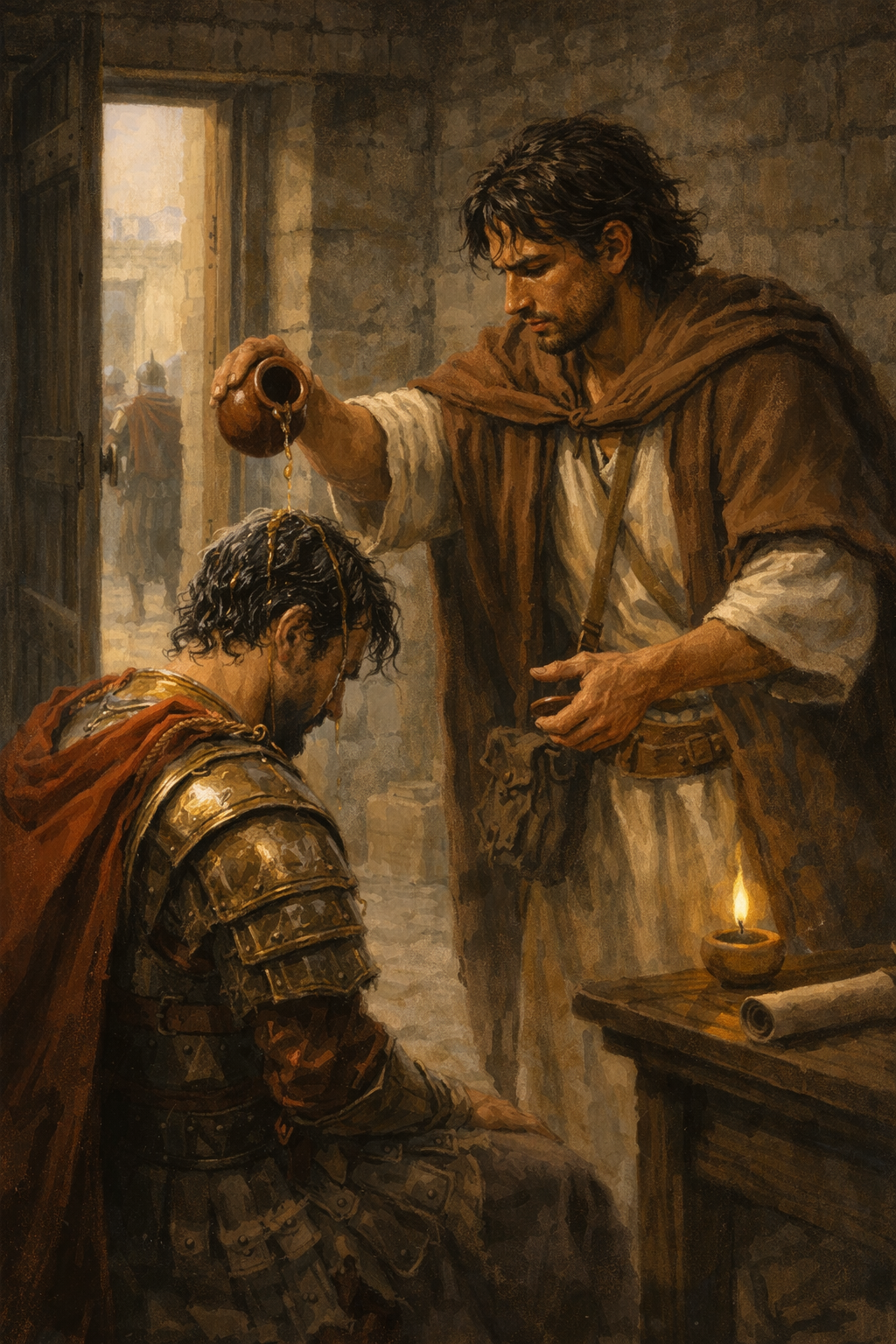
A SECRET ANOINTING THAT
WOULD SHAKE THE NATION
Then take the flask of oil and pour it on his head To pour the flask of oil on his head was the ancient, God-ordained sign of divine appointment. Anointing symbolized that authority came from the LORD Himself, not from popular support, military power, or royal lineage. This was not merely a political transfer but a theological declaration: God had chosen Jehu to rule and to execute judgment on the house of Ahab in fulfillment of earlier prophecy (1 Kings 19:16–17).
And say, ‘Thus says the LORD (Jehovah -- Yahweh) - The spoken formula Thus says the LORD is crucial. The messenger is not acting on personal authority, but is functioning as a prophet (God's mouthpiece) to deliver God’s direct word. Jehu’s kingship rests entirely on God's decree. Whatever follows, whether violence, upheaval, judgment, is the result of and flows from God’s sovereign decree, not human ambition. Yes, God would use Jehu's human ambition, but ultimately it was God Who was in full control. As Daniel decalred "It is He who changes the times and the epochs; He removes kings and establishes kings." (Da 2:21)
I have anointed (masah/maschah) you king over Israel - Elisha's young servant functions not just as Yahweh's mouthpiece but as His hands in carrying out the act of anointing.
Bob Utley - "anointed" This was the only northern king who was anointed in Scripture. Jeroboam, Baasha, and Omri were acknowledge by prophet's announcement
In the Old Testament, anointing with oil was a sacred act symbolizing God’s choice, empowerment by the Spirit, consecration to office, and divine authorization. Those anointed fall mainly into three God-ordained offices—prophets, priests, and kings—with a few special cases. Saul — anointed by Samuel (1 Sam 10:1) David — anointed by Samuel (1 Sam 16:13) Solomon — anointed by Zadok the priest & Nathan the prophet (1 Ki 1:39) Jehu — anointed by a prophet sent by Elisha (2 Ki 9:1–6) Joash — anointed in the temple (2 Ki 11:12) Aaron — anointed as high priest (Exod 29:7; Lev 8:12) Sons of Aaron — anointed for priestly service (Exod 30:30; Lev 8:30) Elisha — anointed and appointed to prophetic ministry (1 Ki 19:16) Prophets were usually called by the word of the LORD, not by oil, making Elisha's anointing exceptional. Other anointings in the OT - Tabernacle & furnishings — sanctified for worship (Exod 30:26–29) Altar — consecrated to the LORD (Exod 29:36) Stone at Bethel — anointed by Jacob (Gen 28:18). Of greatest significance is that OT kings, priests, and prophets foreshadow the coming Messiah (Seeo Messiah - Anointed One) Who would perfectly unite all three offices (Ps 2:2; Da 9:25), and is repeated several times in the New Testament...
Hebrew 1:9 "YOU HAVE LOVED RIGHTEOUSNESS AND HATED LAWLESSNESS; THEREFORE GOD, YOUR GOD, HAS ANOINTED (chrio) YOU WITH THE OIL OF GLADNESS ABOVE YOUR COMPANIONS.”
Luke 4:18 (Isaiah 61:1) “THE SPIRIT OF THE LORD IS UPON ME, BECAUSE HE ANOINTED (chrio) ME TO PREACH THE GOSPEL TO THE POOR. HE HAS SENT ME TO PROCLAIM RELEASE TO THE CAPTIVES, AND RECOVERY OF SIGHT TO THE BLIND, TO SET FREE THOSE WHO ARE OPPRESSED,
Acts 4:27 “For truly in this city there were gathered together against Your holy servant Jesus, Whom You anointed (chrio), both Herod and Pontius Pilate, along with the Gentiles and the peoples of Israel,
Acts 10:38 “You know of Jesus of Nazareth, how God anointed (chrio) Him with the Holy Spirit and with power, and how He went about doing good and healing all who were oppressed by the devil, for God was with Him.
2 Corinthians 1:21 (I COULDN'T LEAVE THIS ONE OUT - BELIEVERS HAVE AN ANOINTING!) Now He who establishes us with you in Christ and anointed (chrio) us is God (cf 1Jn 2:27),
Then open the door and flee and do not wait - Elisha is not telling his servant to fear, but to flee! Elisha knew that this anointing was politically explosive and potentially deadly for any participants! The servant was to give no explanation, have no discussion, or linger in Jehu's presence! God’s servant was to act swiftly, then withdraw, leaving the outcome entirely in God’s hands. This prevents Elisha's young servant from being drawn into the chaos that would inevitably follow. The young servant’s role was not to manage consequences but to faithfully carry out God’s command, ultimately fulfilling His instructions to Elijah (1Ki 19:16).
God’s purposes often unfold
progressively and cooperatively
Note that God's will was carried out by not one but through three obedient servants - Elijah, Elisha, Elisha's servant! Elijah received the original commission from the LORD, Elisha inherited and advanced that prophetic mission, and the unnamed servant faithfully carried it out at the decisive moment. Each played a distinct role across different stages and even different generations, reminding us that God’s purposes often unfold progressively and cooperatively. No single servant sees the whole plan, yet each act of obedience, whether prominent or obscure, is essential to the fulfillment of God’s will.
Donald Wiseman - Elisha sends a member of a prophetic group (cf. 1 Kgs 20:35) to fulfil the task of anointing Jehu that Elijah had passed on to him (1 Kgs 19:16). This unnamed young prophet is identified in Jewish tradition (Seder Olam) with Jonah (2 Kgs 14:25) and involves a foreign mission. Doubtless Jehu was motivated also by personal ambition and the current disaffection with the regime and its heavy taxation. He was, however, God’s agent using the army to end it just as the army had originally brought Omri to power. (See 1 and 2 Kings: An Introduction and Commentary - Page 231)
Anointed (04886) masah/maschah is a verb which basically means to smear something on, to rub with oil, to anoint (as in setting one apart for office or function - Elisha as prophet = 1Ki 19:16, kings for office = 1Sa 9:16 = Saul,1Sa 16:12 = David, 1Ki 1:39 = Solomon) and by implication to sanctify (set aside for sacred purpose) or consecrate (dedicate for a sacred purpose) (altar = Nu 7:10; vessels for worship - Ex 29:36 = "you shall anoint it to consecrate it;" Ex 30:26, 40:9-10). In the first OT use, Jacob "anointed a pillar" and made a vow to God (Ge 31:13; Lxx = aleipho = to anoint by applying a liquid - Jesus' feet were anointed with perfume - Lk 7:38, 46). Baker adds that "The anointing was done with oil to symbolize the elevation of the person to a new position such as priest or king (2Sa 5:3)."
MASAH/MASCHAH Gen. 31:13; Exod. 28:41; Exod. 29:2; Exod. 29:7; Exod. 29:29; Exod. 29:36; Exod. 30:26; Exod. 30:30; Exod. 40:9; Exod. 40:10; Exod. 40:11; Exod. 40:13; Exod. 40:15; Lev. 2:4; Lev. 6:20; Lev. 7:12; Lev. 7:36; Lev. 8:10; Lev. 8:11; Lev. 8:12; Lev. 16:32; Num. 3:3; Num. 6:15; Num. 7:1; Num. 7:10; Num. 7:84; Num. 7:88; Num. 35:25; Jdg. 9:8; Jdg. 9:15; 1 Sam. 9:16; 1 Sam. 10:1; 1 Sam. 15:1; 1 Sam. 15:17; 1 Sam. 16:3; 1 Sam. 16:12; 1 Sam. 16:13; 2 Sam. 2:4; 2 Sam. 2:7; 2 Sam. 3:39; 2 Sam. 5:3; 2 Sam. 5:17; 2 Sam. 12:7; 2 Sam. 19:10; 1 Ki. 1:34; 1 Ki. 1:39; 1 Ki. 1:45; 1 Ki. 5:1; 1 Ki. 19:15; 1 Ki. 19:16; 2 Ki. 9:3; 2 Ki. 9:6; 2 Ki. 9:12; 2 Ki. 11:12; 2 Ki. 23:30; 1 Chr. 11:3; 1 Chr. 14:8; 1 Chr. 29:22; 2 Chr. 22:7; 2 Chr. 23:11; Ps. 45:7; Ps. 89:20; Isa. 21:5; Isa. 61:1; Jer. 22:14; Dan. 9:24 = to anoint the most holy place.; Amos 6:6
Victor Hamilton (TWOT online) notes that "There is a fourfold theological significance of mashach. First, to anoint an individual or an object indicated an authorized separation for God’s service. Moses anointed Aaron “to sanctify him” (Lev 8:12;cf. Ex 29:36 for the altar). Note the expression “anointed to the Lord” (1Chr 29:22). Masah, while representing a position of honor, also represents increased responsibility. Both Saul and David are called to account for their sin with the reminder. “I (the Lord) anointed (mashach) you king” (1Sa 15:17; 2Sa 12:7). Secondly, though the agent might be the priest or prophet, writers speak of anointed ones as those whom the Lord anointed (e.g. 1Sa 10:1; 2Sa 12:7). Such language underscores that it is God who is the authorizing agent; that the anointed is inviolable (1Sa 24:8ff.); and that the anointed one is to be held in special regard (cf. 1Sa 26:9ff.). Thirdly, one may infer that divine enablement was understood as accompanying mashach. Of both Saul and David it is said in connection with their anointing that “the Spirit of God came mightily upon him” (1Sa 10:6ff; 1Sa 16:13ff.)." Finally, mashach was associated with the coming promised Deliverer, Jesus (cf. Isa 61:1). (TWOT)
2 Kings 9:4 So the young man, the servant of the prophet, went to Ramoth-gilead.
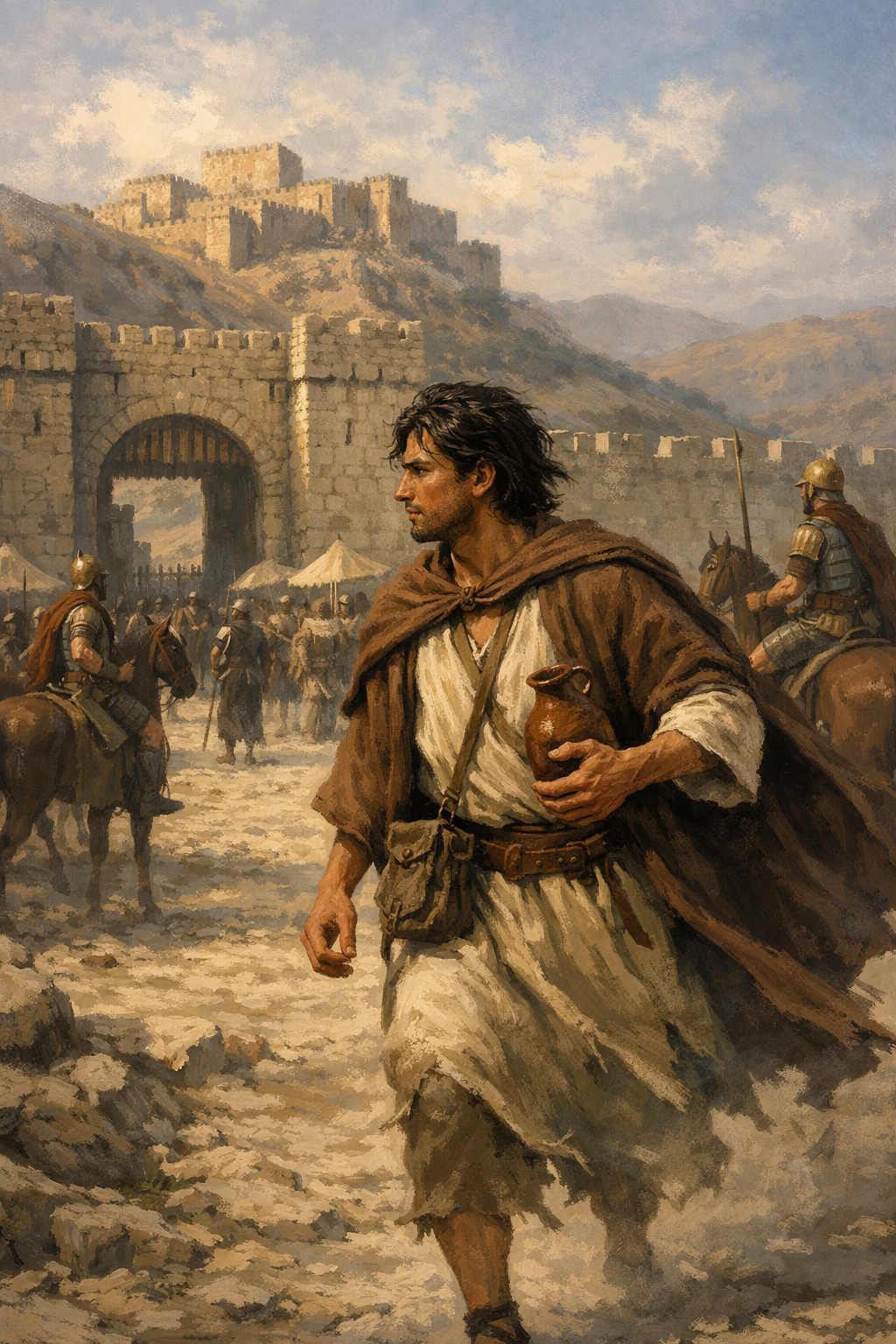
THE OBEDIENT SERVANT ON
A DANGEROUS MISSION
So the young man, the servant of the prophet, went to Ramoth-gilead - Though he was young in years, he displayed spiritual maturity beyond his age, acting with obedience, courage, and faithfulness to the task God had entrusted to him. The fact that the servant is unnamed focuses our attention on his mission, not the man, but rest assured he was not anonymous to Yahweh's omniscience (Pr 15:3)! The servant of the prophet highlights the fact that he is acting under Elisha's delegated authority, not his own initiative, carrying out the Word and Will of God entrusted to him by the man of God Elisha.
Went indicates that the servant obeyed Elisha's command without hesitation or questions! We today are servants of Christ (1Co 7:22, Eph 6:6, cf Ro 6:16, 17, 18) and do well to imitate this Old Testament servant! There is no recorded hesitation, fear, or request for clarification, even though the assignment is dangerous, because he is being sent into a military stronghold during wartime to secretly anoint a new king, an act that could easily be viewed as treason.
God advances His sovereign plans
through obedient servants.🙏 THOUGHT - The verse highlights how God often uses ordinary, anonymous servants to accomplish extraordinary purposes. Though unnamed and easily overlooked, this young man became the human instrument through whom God initiated the downfall of Ahab’s dynasty and the rise of Jehu. Beloved, are you serving the Lord in some seemingly obscure way? If you are truly serving Him, rest assured that your reward will come from your Lord in eternity. Persevere in your "obscure" position, even when you remain “anonymous.” Your work is not obscure to God's omniscience!
2 Kings 9:5 When he came, behold, the captains of the army were sitting, and he said, “I have a word for you, O captain.” And Jehu said, “For which one of us?” And he said, “For you, O captain.”
- I have a word for you Jdg 3:19
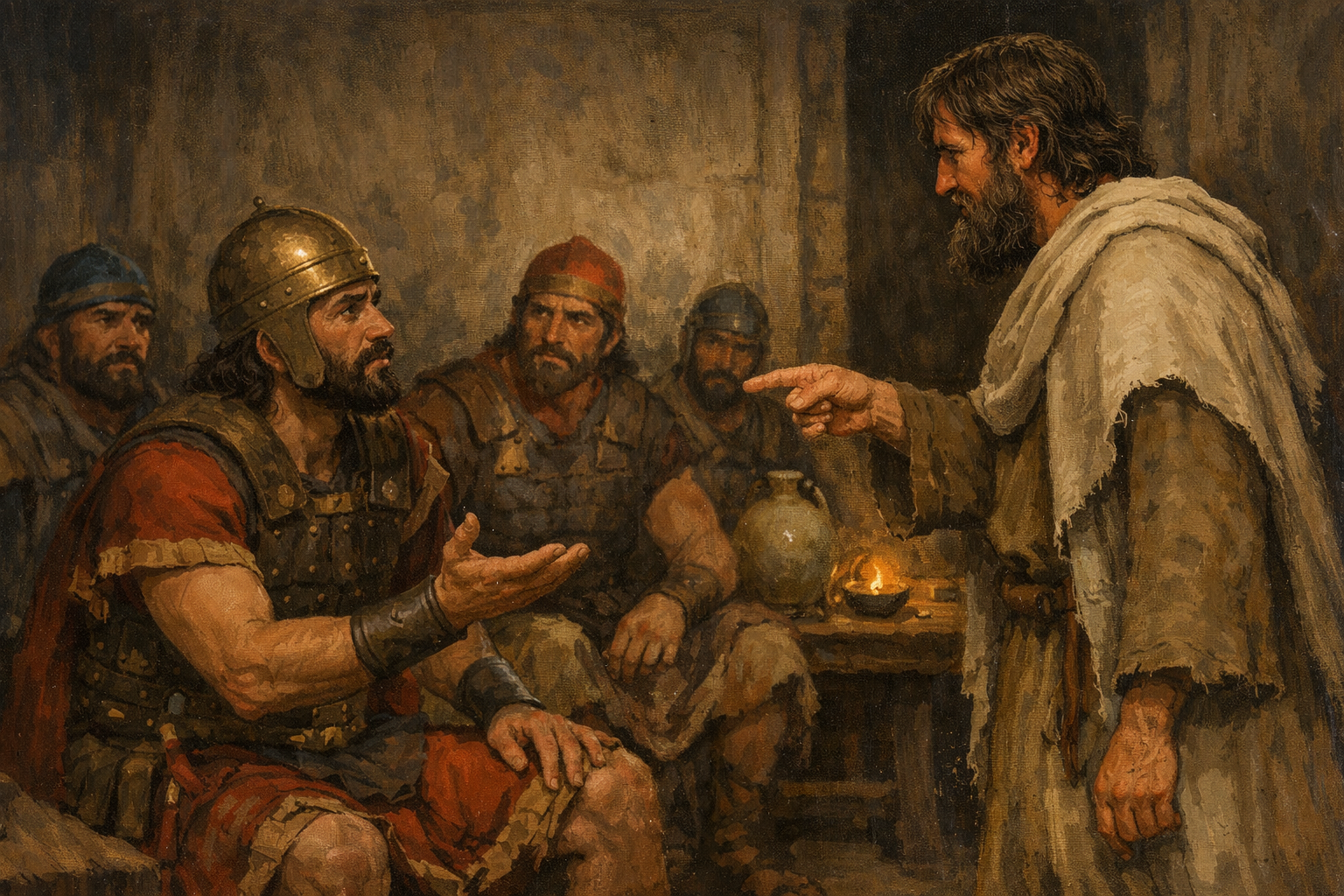
GOD'S CALL IN THE MIDST
OF ORDINARY DUTY!
When he came, behold (hinneh; ; Lxx - idou) - Behold (hinneh; ; Lxx - idou) signals something unexpected and significant. In this context behold alerts the reader that God’s decisive action is about to intrude into an ordinary military setting. The captains are sitting, relaxed and unaware that one of them is about to be separated by God for kingship.
The captains of the army were sitting, and he said, “I have a word for you, O captain This phrase immediately marks the message as prophetic, not personal. In Scripture, “a word” often signals a divine message demanding attention and response. The prophet does not yet name the recipient, heightening tension and anticipation.
And Jehu said, “For which one of us?” Jehu’s reply—“For which one of us?”—is telling and a bit surprising as Jehu had been informed he was destined for great things. It reflects genuine uncertainty; Jehu does not yet presume the message is for him. Surrounded by fellow officers of equal rank, he sees himself as one among many, unaware that God has already singled him out. Scripture gives no indication that Jehu knew beforehand of Elijah’s earlier commission (1 Kings 19:16) or that he had any expectation of kingship.
And he said, “For you, O captain - An abrupt but decisive answer with explanation in front of the other captains!
🙏 THOUGHT - God’s call can come suddenly, personally, and unmistakably, turning a routine moment into a life-altering encounter with His Word. May we all have ears to hear should He call us! And dear reader, if you are a believer, you have already received at least one eternity altering call from His Spirit, transferring you from the kingdom of darkness to Christ's Kingdom of light (Col 1:12, 13, 14)
Behold (02009) hinneh is an interjection meaning behold, look, now; if. "It is used often and expresses strong feelings, surprise, hope, expectation, certainty, thus giving vividness depending on its surrounding context." (Baker) Hinneh generally directs our mind to the text, imploring the reader to give it special attention. In short, the Spirit is trying to arrest our attention! And so hinneh is used as an exclamation of vivid immediacy (e.g., read Ge 6:13)! Hinneh is a marker used to enliven a narrative, to express a change a scene, to emphasize an idea, to call attention to a detail or an important fact or action that follows (Isa 65:17, Ge 17:20, 41:17). The first use of hinneh in Ge 1:29 and second in Ge 1:31 - "And God saw all that He had made, and behold, it was very good. And there was evening and there was morning, the sixth day." Hinneh is oftn used in the idiom "Here I am" in Ge 22:1, 7,11 Ge 27:1,18, Ge 31:11, Ge 46:2 Ex 3:4 1Sa 3:4, 3:16, 12:3, 2Sa 1:7, Isa 52:6, Isa 58:9. Hinneh is used most often to point out people but also to point out things (Ge 31:41, 17:4). God uses hinneh to grab man's attention before He brings destruction (Ge 6:13, 17). God uses hinneh when He establishes covenants (Ge 9:9, 15:12, 17 [when Jehovah cut the Abrahamic covenant], Ge 17:4, cp Ge 28:13, 15), when He provided a sacrificial substitute for Isaac (foreshadowing His giving us His only Son!) (Ge 22:13). Hinneh marks the "chance (The Providence of God)" arrival of Boaz at the field where Ruth was gleaning (Ru 2:4-read about this "chance romance" - Indeed, "Behold!"). Hinneh is used to announce the Lord’s sending of a child as a sign and a prophecy of Immanuel-Emmanuel, the Messiah (Isa. 7:14). In fact W E Vine says that it is notable that when behold (hinneh) is used in Isaiah, it always introduces something relating to future circumstances.
Spurgeon reminds us that "Behold is a word of wonder; it is intended to excite admiration. Wherever you see it hung out in Scripture, it is like an ancient sign-board, signifying that there are rich wares within, or like the hands which solid readers have observed in the margin of the older Puritanic books, drawing attention to something particularly worthy of observation." I would add, behold is like a divine highlighter, a divine underlining of an especially striking or important text. It says in effect "Listen up, all ye who would be wise in the ways of Jehovah!"
HINNEH IN 2 KINGS - 2 Ki. 1:14; 2 Ki. 2:11; 2 Ki. 2:16; 2 Ki. 2:19; 2 Ki. 3:20; 2 Ki. 4:9; 2 Ki. 4:13; 2 Ki. 4:25; 2 Ki. 4:32; 2 Ki. 5:6; 2 Ki. 5:11; 2 Ki. 5:15; 2 Ki. 5:20; 2 Ki. 5:22; 2 Ki. 6:1; 2 Ki. 6:13; 2 Ki. 6:15; 2 Ki. 6:17; 2 Ki. 6:20; 2 Ki. 6:25; 2 Ki. 6:30; 2 Ki. 6:33; 2 Ki. 7:2; 2 Ki. 7:5; 2 Ki. 7:6; 2 Ki. 7:10; 2 Ki. 7:13; 2 Ki. 7:15; 2 Ki. 7:19; 2 Ki. 8:5; 2 Ki. 9:5; 2 Ki. 10:4; 2 Ki. 10:9; 2 Ki. 11:14; 2 Ki. 13:21; 2 Ki. 15:11; 2 Ki. 15:15; 2 Ki. 15:26; 2 Ki. 15:31; 2 Ki. 17:26; 2 Ki. 18:21; 2 Ki. 19:7; 2 Ki. 19:9; 2 Ki. 19:11; 2 Ki. 19:35; 2 Ki. 20:5; 2 Ki. 20:17; 2 Ki. 21:12; 2 Ki. 22:16; 2 Ki. 22:20;
Hinneh is translated in the Septuagint with the interjection idou (strictly speaking a command in the second person aorist imperative, middle voice) a demonstrative particle (used 1377 times in the Septuagint and NT) which is found especially in the Gospels of Matthew and Luke "and giving a peculiar vivacity to the style by bidding the reader or hearer to attend to what is said: "Behold! See! Lo!" (Thayer) The command is calling for urgent attention. Do this now! Don't delay! It could be loosely paraphrased "Pay attention!" or "Listen up!" to arouse attention and introduce a new and extraordinary fact of considerable importance.
2 Kings 9:6 He arose and went into the house, and he poured the oil on his head and said to him, “Thus says the LORD, the God of Israel, ‘I have anointed you king over the people of the LORD, even over Israel.
- He arose and went into the house: Ac 23:18,19
- I have anointed you king: 2Ki 9:3 1Ki 1:34 19:16 2Ch 22:7 Ps 2:6 *marg: Ps 75:6 Isa 45:1 Da 2:21 4:17,32 5:20,21
- over the people: 1Ki 3:8 10:9 14:7 16:2
GOD ANOINTS JEHU
AS HIS KING OVER ISRAEL
He arose and went into the house - Now remember Jehu does not know what is about to take place. Therefore it is a bit surprising that a captain would respond to a young servant's instruction with submission and readiness, not questioning the instructions.
And he poured the oil (shemen) on his head - The act of pouring oil is not symbolic theater, but is the ancient sign of divine appointment and signifies that authority is being granted by God, as the young man then states.
And said to him, “Thus says the LORD (Jehovah - Yahweh), the God (Elohim) of Israel This declaration establishes absolute authority. The young prophet speaks not in his own name, nor in Elisha’s, but directly as God’s mouthpiece. What follows is not a suggestion but a divine decree.
Bob Utley - " the Lord, the God of Israel" This was a full title for Israel's covenant Deity. It includes the covenant name, YHWH, the general name for Deity, Eloah and the name of Abraham's descendant, Jacob (YHWH's promises to Abraham still applied to the northern kingdom.)
I have anointed (masah/maschah) you king - The Hebrew verb (masah/maschah) means Jehu has been set apart and consecrated for God's sacred task. The anointing with oil signifies that Jehu's authority is being granted by God, unrelated to whether Jehu merited that authority or not.
Over the people of the LORD (Jehovah - Yahweh), even over Israel - God is saying Israel is not merely a political entity but is the people of the LORD. The clear implication of God's declaration is that Jehu’s kingship is not just political but is covenantal and he is accountable to the Covenant God Yahweh. In other words, Jehu is being appointed to rule God’s people on God’s behalf, under God’s authority, and for God’s purposes. His power will be real but so will his responsibility and his accountability!
Warren Wiersbe (p 695) - It’s interesting that the young prophet called the people of Israel “the people of the Lord” (9:6). Even though Israel and Judah were separate kingdoms and not obedient to the covenant, the people were still the chosen ones of the Lord and Abraham’s descendants. God’s covenants with Abraham (Gen. 12:1–3) and with David (2 Sam. 7) would still stand. The people had turned away from the Lord, but He had not forsaken them
While this repeats a comment made earlier, it bears repeating that this verse also highlights God’s sovereignty in timing. Years earlier, God had commanded Elijah to anoint Jehu (1 Kings 19:16). Elijah passed the task to Elisha, and now—at precisely the right moment—it is carried out through an unnamed servant. God’s word may wait, but it never fails.
🙏 THOUGHT - The sudden anointing of Jehu teaches us that God alone appoints true authority, that His call may come suddenly and privately before it is made public, and that those whom God anoints are not owners of power but stewards over what belongs to the LORD. This truth recalls Saul’s sudden call by Jesus on the Damascus Road (Acts 9:3,4,5,6) and his subsequent stewardship of that extraordinary calling (1Co 4:1,2) which provides a pattern for all believers to imitate (1Co 11:1), for we have all received an "extraordinary calling." (1Co 1:2, 26, 27, 28).
Note that the only instruction recorded from Elisha to the servant is 2Ki 9:3, but when he addresses Jehu, the servant speaks from 2Ki 9:6-10 and then fled as Elijah had instructed. Dale Ralph Davis explains this "apparent discrepancy" as follows...
Now some have problems with Elisha’s understudy in this story. They point out that Elisha’s instructions in verses 1–3 only give the fellow a one-liner to speak (v. 3a) when he anoints Jehu, but when he actually carries out his commission he adds four more verses’ worth (vv. 7–10) to what Elisha had told him to say. (Substantially, he reasserts Elijah’s prophecy against Ahab in 1 Kings 21:21–24.) Some wonder about such ‘disobedience’.7 But the young fellow is not disobedient but only a ‘victim’ of Hebrew narrative. Sometimes, apparently to avoid unneeded repetition, a narrative gives only a snatch of—for example—what someone is to say, and then, when they actually say it, it will quote the person in full.8 One sees the same pattern in 1 Kings 21: there Yahweh gives Elijah a one-verse speech to make to Ahab (v. 19) which grows to four-plus verses when Elijah delivers it (vv. 20b–24). Was Elijah disobedient? I don’t think so—it’s just this summary-then-expansion literary pattern that doesn’t want to ruin a perfectly good story with undue repetition. (Borrow 2 Kings : the power and the fury page 150)
2 Kings 9:7 ‘You shall strike the house of Ahab your master, that I may avenge the blood of My servants the prophets, and the blood of all the servants of the LORD, at the hand of Jezebel.
- I may avenge: De 32:35,43 Ps 94:1-7 Mt 23:35 Lu 18:7,8 Ro 12:19 13:4 Heb 10:30 Rev 6:9,10 18:20 19:2
- at the hand of Jezebel 2Ki 9:32-37 1Ki 18:4 21:15,21,25
Related Passages:
1 Kings 18:4 for when Jezebel destroyed the prophets of the LORD, Obadiah took a hundred prophets and hid them by fifties in a cave, and provided them with bread and water.)
1 Kings 19:1-2 Now Ahab told Jezebel all that Elijah had done, and how he had killed all the prophets with the sword. 2Then Jezebel sent a messenger to Elijah, saying, “So may the gods do to me and even more, if I do not make your life as the life of one of them by tomorrow about this time.” (SHE IS ABOUT TO GET HER WISH BUT NOT FROM HER gods BUT FROM THE GOD!)
1 Kings 21:21 (GOD'S WORD THROUGH ELIJAH TO AHAB) “Behold, I will bring evil upon you, and will utterly sweep you away, and will cut off from Ahab every male, both bond and free in Israel;
1 Kings 21:25 Surely there was no one like Ahab who sold himself to do evil in the sight of the LORD, because Jezebel his wife incited him.
GOD'S DELAYED JUSTICE
NEVER FAILS BUT ALWAYS FALLS
You shall strike the house of Ahab your master - This is a command of divine judgment, not personal revenge. The house of Ahab refers to Ahab’s entire royal dynasty, his descendants, influence, and political legacy. Jehu is appointed as God’s instrument to bring that dynasty to an end. Though Ahab is already dead, his house continues to perpetuate idolatry, violence, and covenant rebellion, even extending its evil tentacles into the Southern Kingdom of Judah, via the evil reign of Jehoram.
That I may avenge (naqam; LXX - ekdikeo) the blood of My servants ('ebed; LXX - doulos) the prophets (nabiy) - God frames this judgment as a vengeance for innocent blood, especially the prophets who were hunted, silenced, and murdered under Ahab’s regime, most notoriously through the influence of Jezebel (cf. 1Ki 18:4; 1Ki 19:1–2; 1Ki 21:25). This is not delayed justice forgotten by God, but justice awaiting the appointed time. The word “avenge” emphasizes that God Himself is acting to right grievous wrongs. He will use a human instrument Jehu, but He is the Source of the vengeance. I am reminded of His words in Dt 32:35 "'Vengeance is Mine, and retribution, In due time their foot will slip; For the day of their calamity is near, And the impending things are hastening upon them." (cf Ro 12:19, Heb 10:30)
Bob Utley - that I may avenge the blood of My servants the prophets" This refers to the task of the Go'el ( goel/ga'al)( cf. Num. 35:19,21; Deut. 32:43). The background for this statement is found in 1 Kgs. 19:14,18.
And the blood of all the servants of the LORD The scope widens beyond the prophets alone. Jezebel’s reign of terror spilled the blood of many faithful servants, creating a culture where loyalty to Yahweh meant you had to count the cost! God hears the cries of all His persecuted people, not only the prominent ones. And there are many today (2026) being persecuted for the sake of the Name of Jesus and God takes note of every evil against His children and while ther perpetrator's judgment may be delayed, it is certain to come, even as evil Jezebel would soon find out!
At the hand (yad = power) of Jezebel (1Ki 19:1-2) - Although Ahab’s house bears responsibility, Jezebel is singled out as the chief instigator—the driving force behind the persecution and corruption. Scripture consistently presents her as a symbol of aggressive, unrepentant opposition to God (cf. 1 Kings 16:31; 21:25–26). Her apparent power and long impunity did not mean divine indifference.
Caleb Nelson: Why did God’s word set up Jehu like this to be king? Well, the text tells us at length. It was to avenge the blood of the prophets and the blood of all God’s people who had suffered under the depredations of Ahab and Jezebel. God highlights the fact that He is giving royal power to Jehu so that Jehu can take vengeance. Vengeance belongs to God, but in this case He is delegating it to a human agent.
August Konkel: The oracle has the two standard elements: There is a judgment relevant to the immediate situation (2Ki 9:7), followed by the stereotyped curse (2Ki 9:8–9). The oracle against Jezebel (2Ki 10) is specifically a fulfillment of the prophetic word (1Ki 21:23). The judgment speech brings to a climax the accumulated sins of Israel from Jeroboam to Joram. (See Revolt of Jehu in The NIV Application Commentary)
TAKEAWAY - God’s anointing of Jehu was not primarily about political change but moral reckoning. The fall of Ahab’s house would demonstrate that God is neither blind to injustice nor indifferent to the suffering of His servants—and that no power, however ruthless, escapes His righteous judgment.
Avenge (05358) naqam means to avenge, take vengeance, revenge, avenge oneself, be avenged, be punished. (Qal) to avenge, take vengeance, to entertain revengeful feelings. (Niphal) to avenge oneself, to suffer vengeance (Piel) to avenge. The first use in Ge 4:15 has "whoever kills Cain, vengeance will be taken on him sevenfold." In Lev 19:18 individual in Israel are instructed "You shall not take vengeance, nor bear any grudge against the sons of your people" On the other hand Yahweh has the right to vengeance declaring "I will also bring upon you a sword which will execute vengeance for the covenant." (Lev 26:25). The last OT use in Nahum 1:2 gives us a good sense of the meaning as it applies to divine vengeance - "A jealous and avenging God is the LORD; The LORD is avenging and wrathful. The LORD takes vengeance on His adversaries, And He reserves wrath for His enemies." God allows and uses men to take vengeance as Numbers 31 and also in the case of Samson when he "called to the LORD and said, “O Lord GOD, please remember me and please strengthen me just this time, O God, that I may at once be avenged of the Philistines for my two eyes.” (Jdg 16:28) That God is a God of righteous, just, holy, perfect vengeance should comfort all who have been unfairly treated, injured, etc in this life, for Deuteronomy 32:43 says “Rejoice, O nations, with His people; For He will avenge (verb naqam) the blood of His servants, And will render vengeance (noun naqam) on His adversaries, And will atone (kaphar) for His land and His people.”
NORMAN GEISLER - 2 Kings 9:7—How could God condemn Jehu for bloodshed when God had commanded him to exterminate the house of Ahab?
Problem: In 2 Kings 9:6–10, we find the commissioning of Jehu by the Lord to strike down the house of Ahab. According to 2 Kings 10:30, God commended Jehu for having destroyed the house of Ahab. However, Hoshea prophesied that God would “avenge the bloodshed of Jezreel on the house of Jehu” (Hosea 1:4). How could God condemn Jehu for shedding blood when it was God who had commanded him to do so?
Solution: God praised Jehu for obeying Him in destroying the house of Ahab, but condemned Jehu for his sinful motive in shedding their blood. Although 2 Kings 10:30 states that God told Jehu that he had done right in killing the relatives of Ahab, the previous verse observes that Jehu “did not turn away from the sins of Jeroboam … from the golden calves …” and verse 31 states that Jehu “took no heed to walk in the law of the Lord God of Israel with all his heart.” Obviously, since Jehu worshiped other gods and did not walk in God’s Law, he did not destroy Ahab’s family out of any devotion to the Lord.
Walter Kaiser - Jehu Punished for Doing As He Was Commanded? - See Hard Sayings page 235
Why is Jehu at first told to carry out the destruction of the house of Ahab and then later on threatened with punishment by the prophet Hosea for doing as he was told (Hos 1:4)?
Hosea 1:4 And the LORD said to him, “Name him Jezreel; for yet a little while, and I will punish the house of Jehu for the bloodshed of Jezreel, and I will put an end to the kingdom of the house of Israel.
Jehu was given a twofold divine commission: (1) he was to annihilate all the wicked and apostate house of Ahab, and (2) he was to avenge the blood that Jezebel had shed of the prophets of Yahweh. God’s instrument of choice was the army captain, Jehu. These tasks Jehu carried out to the full.
Why then was God displeased with Jehu, as Hosea seems to imply? Because it is one thing to be the instrument God has chosen to punish another person (or group of persons or even a nation) and another to find automatic approval at the completion of the act for the manner in which this task was carried out. For example, Assyria was ordered to move against Israel, but God disapproved of the brutal way Assyria carried out the warfare (Is 10:5–19 - "Woe to Assyria, the rod of My anger And the staff in whose hands is My indignation.....") Babylon was likewise authorized to move against Judah but was excoriated for cruelty in that war (Hab 1:6; 3:13–16).
Therefore, although Jehu was obedient to God’s directive (2 Kings 9:7), he erred grievously in that he killed more people than God had directed and did so with a savagery that did not earn God’s approval. It seems clear from Jehu’s conduct that he was motivated not by a desire to be obedient to God but by sheer personal ambition—thereby making his act of obedience wicked. It was this same spirit that was transmitted to his descendants, in a heightened degree if anything.
Jehu showed unnecessary cruelty when he slew not only the house of Ahab at Jezreel, but also the visiting monarch from Judah, Ahaziah, and almost all the members of the Davidic family (2 Kings 9:27; 10:13–14). Jehu, furthermore, extended this massacre to all the friends of the ruling family (2 Kings 10:11).
The point is most evident that divine approval for an act does not thereby carry with it indifference as to how that act is accomplished and how many others it may involve.
🙏 EDITORIAL TAKEAWAY THOUGHT - Jehu did what Yahweh told him to do, but he did not do it in Yahweh’s way or for Yahweh’s glory. Obedience that is not grounded in love for Yahweh finally becomes disobedience.” Hosea is not contradicting Kings; he is completing it. Kings tells us what Jehu did; Hosea tells us what Jehu was. Though Jehu carried out God’s command to destroy the house of Ahab (2 Kings 9–10), his motives were selfish and politically driven. Jehu’s actions were externally right but internally corrupt—and God judged both. Being God’s instrument does not cancel moral accountability. Let us serve the LORD God from hearts which are wholly devoted to Him always seeking His glory not ours.
QUESTION - Who was Jezebel in the Bible? | GotQuestions.org
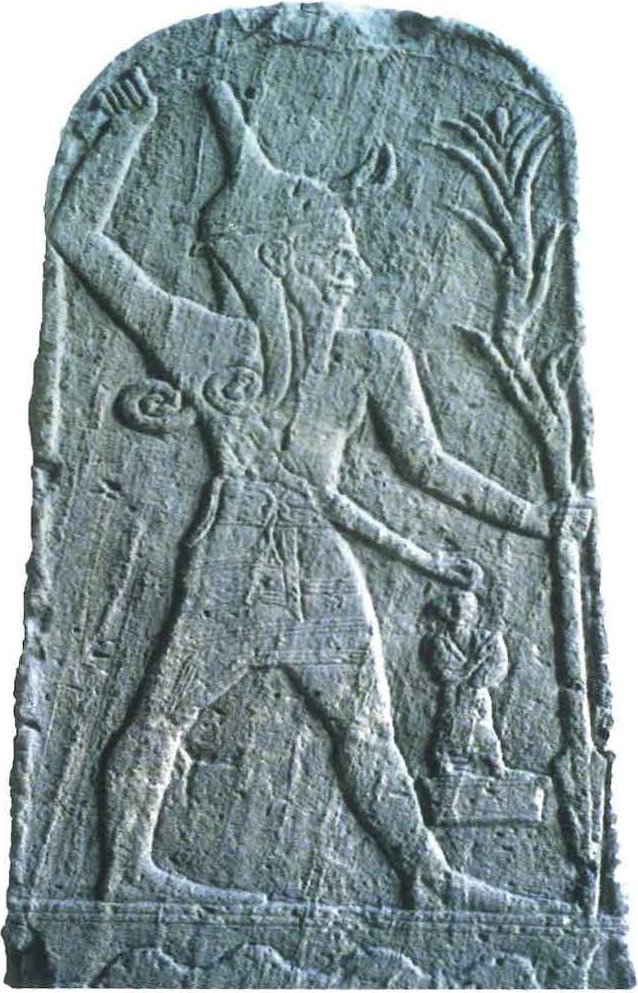
Baal the Canaanite storm god, also worshipped by the later Phoenicians.
In his left hand he holds a spear which flashes lightning and in his right
right hand a mace. The relief, which dates to 1650-1500 BC, was found in
a sanctuary in the Canaanite city of Ugarit, Syria, in 1932. It is now on
display in the Louvre Museum in Paris. Photo by Bryant Wood.
ANSWER - “Jezebel” is a name synonymous with evil; she is the epitome of the wicked woman. So infamous is her name that, to this day, no one names their baby daughter “Jezebel.” To call a woman a “Jezebel” is the greatest insult imaginable. Jezebel was the daughter of Ethbaal, a priest of the cruel, sensuous, false god Baal. Ethbaal, the priest-king of Tyre who murdered his own brother to take over the throne, was hardly a good father figure. But Jezebel followed in her father’s footsteps and was herself a power-hungry murderess who stopped at nothing to get what she wanted.
The king of Israel at the time was Ahab, a weak, self-pitying man who abdicated his authority to his bride, the princess Jezebel. In spite of God’s laws forbidding idolatry and the worship of any god but the Lord, Ahab married this princess who brought to Israel with her hundreds of priests of lewd Baal worship, a cult that tended to destroy manhood and drag womanhood into shame. Jezebel was such a domineering person that she soon became master over her weak husband. One of her first acts was to order the extermination of the prophets of the Lord (1 Kings 18:4, 13) and set up altars to Baal. So pervasive was her idolatrous influence in Israel that Jesus later used her name to refer to a woman who led the church at Thyatira into immorality and the worship of false gods (Revelation 2:20).
Jezebel’s strongest enemy was the great prophet Elijah, who defied her and opposed her evil rule. First, he pronounced the punishment of God upon Israel in the form of a drought which lasted three years (James 5:17). This culminated in a contest on Mount Carmel between the powers of Israel’s true God and the Baals. After the 450 priests of Baal and 400 priests of Asherah spent the day beseeching their gods with wailing and self-mutilation to end the drought, all to no avail, Elijah prayed to his omnipotent God who responded by accepting the sacrifice, having the false prophets slaughtered, and providing an abundance of rain (1 Kings 18:16-46). Instead of acknowledging the awesome power of the one true God, Jezebel was enraged and vowed to kill Elijah (1 Kings 19:1-2). Elijah fled from her wrath to the wilderness (1 Kings 19:3-8).
In the meantime, Jezebel was proving herself to be the greedy, murderous, evil woman she truly was. A righteous man named Naboth owned a vineyard next to Ahab’s palace. Ahab offered to buy the vineyard, but Naboth, honoring God’s command to keep inheritances within the family, rightly refused to sell. Ahab became “sullen and angry” and went home to sulk on his bed. Jezebel ridiculed him for his weakness and told him to cheer up for she would get the vineyard for him. She plotted with two lying scoundrels to have Naboth falsely accused and denounced, then put to death. Then she calmly declared to Ahab that the vineyard was his (1 Kings 21:1-16). Here we see the formula for a disastrous marriage: a weak, childish man who allows his evil, domineering wife to rule the home. This is the exact opposite of God’s plan for marriage: a loving husband who leads his family, and whose care for his wife mirrors that of Christ and His church (Ephesians 5:25-26, 28-29), and a godly woman who submits to her husband “as to the Lord” (Ephesians 5:22), each submitting to one another out of reverence for Christ (Ephesians 5:21; Colossians 3:18-19; 1 Peter 3:7).
As with all who defy the Lord, Jezebel’s end was not a pretty one, although it was more gruesome than most, perhaps as an object lesson to all who set themselves up against the one true God. Her doom was sure, having been prophesied by Elijah in 1 Kings 21:23. Even as she saw her death approaching, she remained defiant to the end, painting her face and adorning herself in queenly garments. She looked out the window and shouted her defiance to Jehu, the next king of Israel who came to take his throne (2 Kings 9:30-37). Jehu commanded her to be thrown out the window to her death, where she was trampled by the horses’ hooves and almost entirely consumed by dogs. Her thirty years of tyranny over Israel had ended. The terror visited upon Jezebel was a testimony to the Israelites, and to us, that God’s power is supreme and those who defy Him will meet a terrible end.
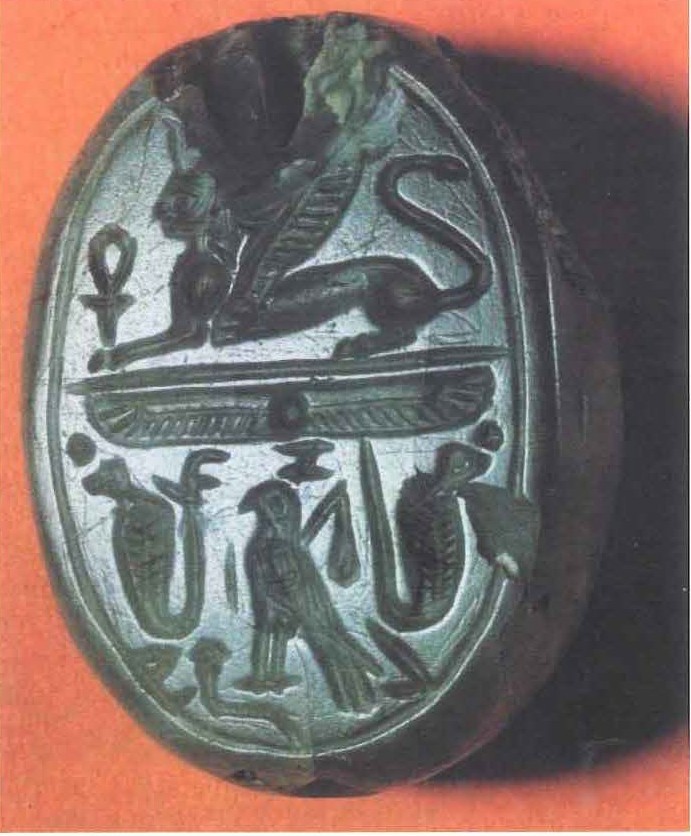
Collection of the Israel Museum, Jerusalem. Photo copyright: The Israel Museum. Opal seal with the name of Jezebel. The inscription and symbols on the seal make it highly likely that it was the official seal of the wicked woman of the Old Testament. She was a woman of power as indicated by her title "Queen Mother" (2 Kgs 10:13). Although Jezebel had her own seal to authenticate official correspondence, when she forged the letters to the elders and nobles of Jezreel in order do away with Naboth and seize his vineyard, she used Ahab's seal rather than her own for maximum authority (1 Kgs 21:8).
ADDENDUM ON ETYMOLOGY OF NAME JEZEBEL - The meaning is debated - Several BIBLE dictionaries say her name actually means "chaste"! UNBELIEVABLE! Others say "unexalted," "unhusbanded"
Most Likely Original Meaning (Phoenician / Canaanite) is that Jezebel meant something positive in its native pagan context: “Where is the Prince?” or “Where is Baal?” Possibly it was a cultic or ritual question, linked to Baal worship (cf. seasonal myths of Baal’s disappearance and return). This would fit her Phoenician background as the daughter of Ethbaal, king of Sidon (1 Ki 16:31). There is also a Hebrew Wordplay in which Biblical writers almost certainly intentionally reshaped the name to carry a derogatory sense: From zebel (זֶבֶל) = dung, refuse. The resulting sense is “Unexalted," “Without honor” or even “Where is the dung?” (a sarcastic corruption) This fits the Hebrew Bible’s frequent practice of mocking pagan names to express theological judgment. Jezebel becomes a type or archetype of corrupting influence in Revelation 2:20. The Bible does not merely record Jezebel’s name—it theologically redefines it. What may have begun as a pagan honor-name is transformed by Scripture into a lasting warning: A name once tied to Baal becomes synonymous with rebellion against the living God.
Dr Bryant Wood's article SEAL OF JEZEBEL IDENTIFIED - Woods writes that "Jezebel means "where is his highness (=Baal)?" (Korpel 2008: 37). Baal was the great Canaanite storm and fertility god. Jezebel's father Ethbaal, whose name means "with Baal" or "man of Baal," was king of the Phoenicians (1 Kgs 16:31). The Jewish historian Josephus tells us that Ethbaal was formerly a priest of Ashtoreth, consort of Baal, who usurped the throne and reigned over Tyre and Sidon for 32 years (Contra Apionem i.18.123). Baal was the great Canaanite storm and fertility god. Jezebel's father Ethbaal, whose name means "with Baal" or "man of Baal," was king of the Phoenicians (1 Kgs 16:31). The Jewish historian Josephus tells us that Ethbaal was formerly a priest of Ashtoreth, consort of Baal, who usurped the throne and reigned over Tyre and Sidon for 32 years (Contra Apionem i.18.123).
2 Kings 9:8 ‘For the whole house of Ahab shall perish, and I will cut off from Ahab every male person both bond and free in Israel.
KJV For the whole house of Ahab shall perish: and I will cut off from Ahab him that pisseth against the wall, and him that is shut up and left in Israel:
NKJ `For the whole house of Ahab shall perish; and I will cut off from Ahab all the males in Israel, both bond and free.
NET Ahab's entire family will die. I will cut off every last male belonging to Ahab in Israel, including even the weak and incapacitated.
BGT καὶ ἐκ χειρὸς ὅλου τοῦ οἴκου Αχααβ καὶ ἐξολεθρεύσεις τῷ οἴκῳ Αχααβ οὐροῦντα πρὸς τοῖχον καὶ συνεχόμενον καὶ ἐγκαταλελειμμένον ἐν Ισραηλ
LXE and at the hand of the whole house of Achaab: and thou shalt utterly cut off from the house of Achaab every male, and him that is shut up and left in Israel.
CSB The whole house of Ahab will perish, and I will eliminate all of Ahab's males, both slave and free, in Israel.
ESV For the whole house of Ahab shall perish, and I will cut off from Ahab every male, bond or free, in Israel.
NIV The whole house of Ahab will perish. I will cut off from Ahab every last male in Israel--slave or free.
NLT The entire family of Ahab must be wiped out. I will destroy every one of his male descendants, slave and free alike, anywhere in Israel.
YLT and perished hath all the house of Ahab, and I have cut off to Ahab those sitting on the wall, and restrained, and left, in Israel,
- I will cut off: 1Ki 14:10,11 21:21,22
- him that pisseth: 1Sa 25:22
- every male person both bond : 2Ki 14:26 De 32:36
Related Passages:
1 Kings 21:21-24 (ELIJAH'S PROPHECY TO AHAB - EVERY MALE CUT OFF) “Behold, I will bring evil upon you, and will utterly sweep you away, and will cut off from Ahab every male, both bond and free in Israel; 22 and I will make your house like the house of Jeroboam the son of Nebat, and like the house of Baasha the son of Ahijah, because of the provocation with which you have provoked Me to anger, and because you have made Israel sin. 23 “Of Jezebel also has the LORD spoken, saying, ‘The dogs will eat Jezebel in the district of Jezreel.’ 24 “The one belonging to Ahab, who dies in the city, the dogs will eat, and the one who dies in the field the birds of heaven will eat.”
1 Kings 14:10 (SIMILAR FATE FOR JEROBOAM) therefore behold, I am bringing calamity on the house of Jeroboam, and will cut off from Jeroboam every male person, both bond and free in Israel, and I will make a clean sweep of the house of Jeroboam, as one sweeps away dung until it is all gone.
1 Kings 16:3 (SIMILAR FATE FOR BAASHA) behold, I will consume Baasha and his house, and I will make your house like the house of Jeroboam the son of Nebat.
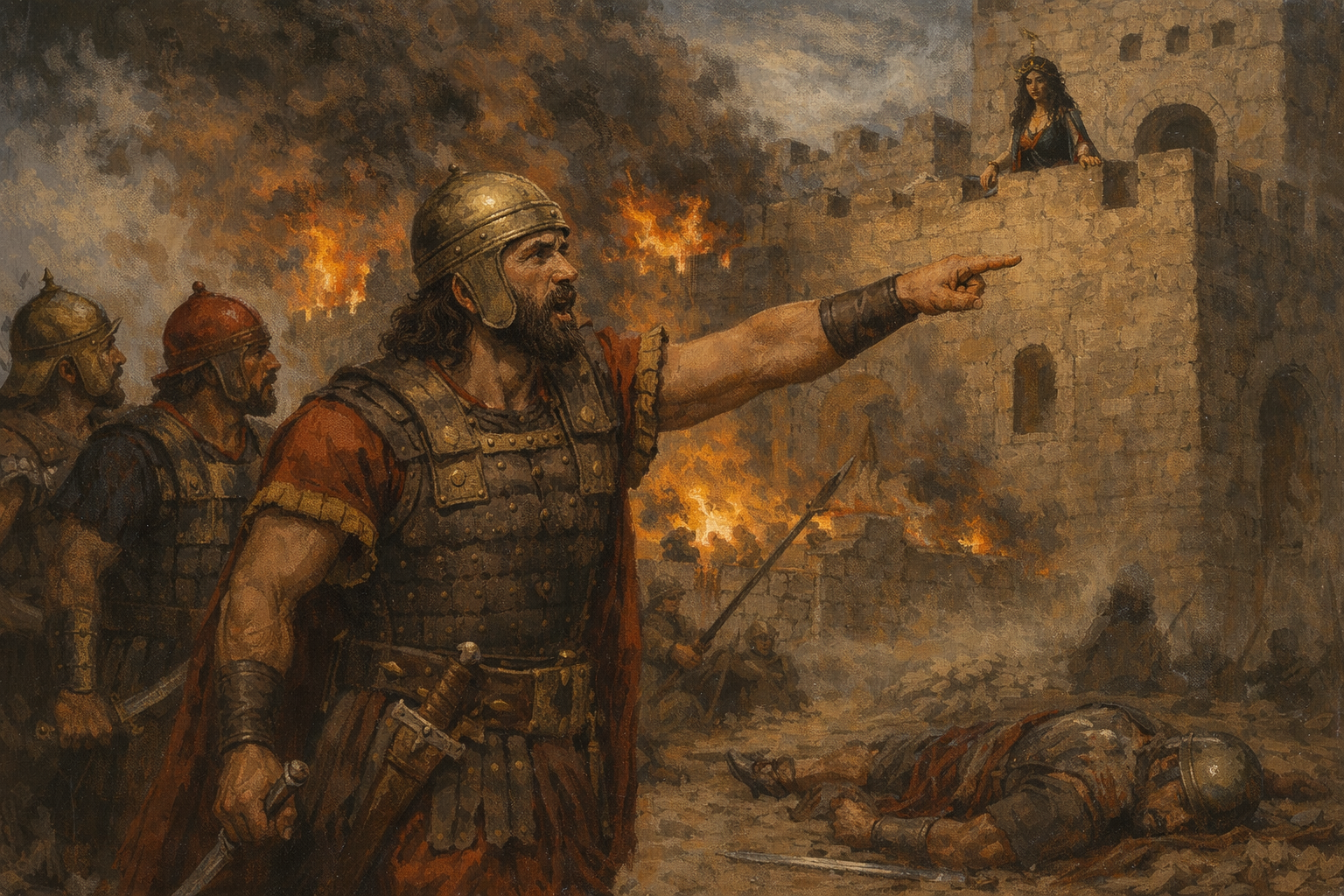
Jehu Wreaks Havoc on Ahab's Line
DIVINE DYNASTIC DESTRUCTION
OF AHAB'S LINEAGE
For the whole house of Ahab shall perish - The house of Ahab refers not merely to Ahab himself (in fact he is already dead by this time), but to his entire dynasty, his wife, sons, daughters, heirs, and royal line. God is announcing total dynastic destruction, meaning Ahab’s family will be removed from power so completely that his name will no longer rule in Israel. This fulfills earlier prophetic warnings spoken against Ahab because of his persistent idolatry, injustice, and corruption (cf. 1 Kings 21:21–24).
Warren Wiersbe - Just as God had wiped out the descendants of Jeroboam and Baasha (1 Kings 15:25–16:7), He would use Jehu to destroy the house of Ahab.
And I will cut off (karath; LXX - exolethreuo - utterly destroy) from Ahab every male person - The phrase cut off is covenantal language for decisive removal (karath ironically is used in the phrase when God cuts covenant). In the ancient Near Eastern context, eliminating male descendants meant the end of inheritance, succession, and legacy. God is not merely punishing individuals but ending a corrupt ruling house that had entrenched Baal worship and violence in Israel. As a physician who ran the local Tumor Conference for several decades, I learned that the most effective therapy to ensure a complete cure of cancer was to completely cut it out (not always possible). God is able to completely cut out the cancer of Ahab's lineage, even where it has "metastasized" so to speak!
Both bond and free in Israel - This phrase emphasizes totality and impartiality. Whether enslaved or free, high-status or low, no male connected to Ahab’s line would escape judgment. Social standing offers no protection when God executes righteous judgment. The corruption of Ahab’s house had spread so thoroughly that no exception could be made. God’s judgment may be delayed, but it is never diluted! God judges systems of evil, not just isolated acts!
NET NOTE - Heb “and I will cut off from Ahab those who urinate against a wall, [including both those who are] restrained and let free [or, ‘abandoned’] in Israel.” On the phrase וְעָצוּר וְעָזוּב (vé’atsur vé’azur, translated here “weak and incapacitated”) see the note at 1 Kgs 14:10.
Henry Morris - pisseth against the wall - This pronouncement of coming doom on the descendants of Ahab uses language that sound vulgar to modern ears, and modern translations invariably use some euphemism instead of the literal translation as in the Authorized Version. Nevertheless the actual words uttered by the prophet, quoting the words of the Lord Himself, were exactly as given in the King James, and it would seem there must be good reason why the Spirit-inspired Scriptures would use such explicit language--in this and several other instances--when it seems at first that "every adult male" would have done just as well. Wherever it is used (1 Samuel 25:22,34; 1 Kings 14:10; 16:11; 21:21), it is used as a pejorative and in a context of judgment against evil. It was evidently a proverbial expression in Israel, probably applied to those men who were of such arrogant and evil temperament as to blatantly engage in public urination against the walls of those they disliked. Not only were such descendants of Ahab to be cut off, but even those who were "shut up" (too old or too young to engage in outside work or warfare, and thus kept at home) and "left in Israel."
TAKEAWAY - The destruction of Ahab’s house shows that God will not allow entrenched, generational evil to continue indefinitely. When a ruling power consistently opposes God, sheds innocent blood, and promotes idolatry, God Himself intervenes to bring it to an end, proving that history ultimately answers to His righteous rule—not human dynasties.
2 Kings 9:9 ‘I will make the house of Ahab like the house of Jeroboam the son of Nebat, and like the house of Baasha the son of Ahijah.
- like the house: 1Ki 14:10,11 15:29 21:22
- and like the house: 1Ki 16:3-5,11,12
Related Passages:
1 Kings 14:10-11 therefore behold, I am bringing calamity on the house of Jeroboam, and will cut off from Jeroboam every male person, both bond and free in Israel, and I will make a clean sweep of the house of Jeroboam, as one sweeps away dung until it is all gone. 11 “Anyone belonging to Jeroboam who dies in the city the dogs will eat. And he who dies in the field the birds of the heavens will eat; for the LORD has spoken it.”’
1 Kings 16:1-4 Now the word of the LORD came to Jehu the son of Hanani against Baasha, saying, 2 “Inasmuch as I exalted you from the dust and made you leader over My people Israel, and you have walked in the way of Jeroboam and have made My people Israel sin, provoking Me to anger with their sins, 3 behold, I will consume Baasha and his house, and I will make your house like the house of Jeroboam the son of Nebat. 4 “Anyone of Baasha who dies in the city the dogs will eat, and anyone of his who dies in the field the birds of the heavens will eat.”
THE CERTAINTY OF JUDGMENT
AGAINST AHAB'S DYNASTY
This statement explains the pattern and certainty of God’s judgment against Ahab’s dynasty by comparing it to two earlier, well-known dynasties God destroyed. Ahab’s coming judgment was neither arbitrary nor unprecedented as these examples underscore.
I will make the house of Ahab like the house of Jeroboam the son of Nebat - Jeroboam was the first king of the Northern Kingdom and the one who institutionalized idolatry by introducing the golden calves at Bethel and Dan (1Ki 12:28–33). His sin set the spiritual trajectory for the Northern Kingdom of Israel, and God later announced that his entire house would be cut off (1Ki 14:10–11). By invoking Jeroboam, God is saying that Ahab’s dynasty will suffer the same total eradication because it followed and, even intensified, the same rebellious pattern. See discussion of What was the sin of Jeroboam? | GotQuestions.org.
And like the house of Baasha the son of Ahijah - Baasha came to power by violently wiping out Jeroboam’s family, but instead of reforming Israel, he walked in the same sins of Jeroboam! As a result, God decreed that Baasha’s own house would be destroyed in the same way (1Ki 16:1–4). His dynasty lasted only a generation.
This comparison of Ahab's house to the fate of Jeroboam and Baasha's houses underscores a sobering irony, that those who judge others for sin while repeating it invite the same judgment upon themselves. LOOK OUT!
TAKEAWAY - God’s dealings with Ahab follow a well-established biblical pattern. When leaders persist in leading God’s people into idolatry and bloodshed, their houses are removed entirely. History as recorded in the Bible is not random but is governed by a God Who judges consistently and remembers what He has spoken.
2 Kings 9:10 ‘The dogs shall eat Jezebel in the territory of Jezreel, and none shall bury her.’” Then he opened the door and fled.
- the dogs: 2Ki 9:35,36 1Ki 21:23 Jer 22:19
- he opened: 2Ki 9:3 Jdg 3:26
Related Passages:
1 Kings 21:23 (ELIJAH'S PROPHECY GIVEN TO KING AHAB) “Of Jezebel also has the LORD spoken, saying, ‘The dogs will eat Jezebel in the district of Jezreel.’
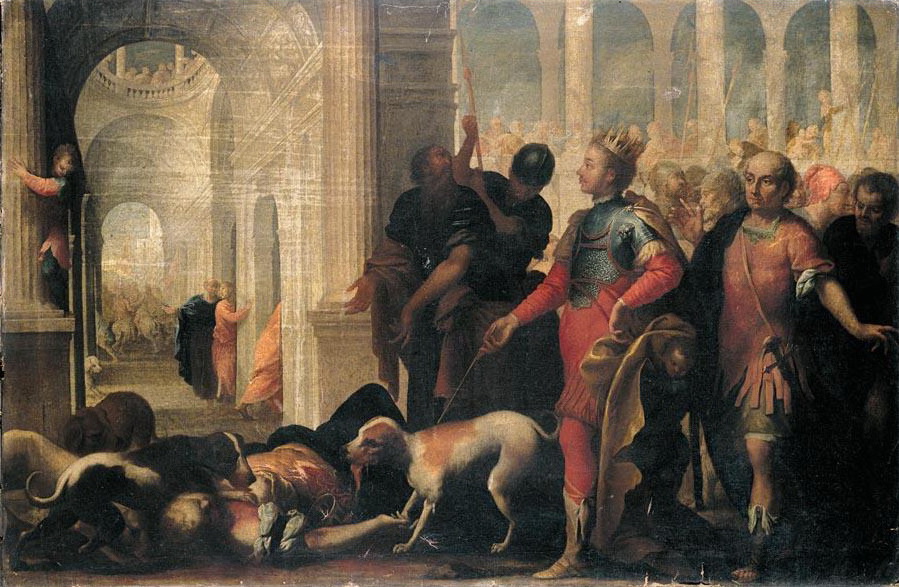
Dogs Feast on Flesh of Jezebel
GRUESOME PROPHECY
FOLLOWED BY FLEEING
The dogs shall eat Jezebel in the territory of Jezreel (Comes to pass in 1Ki 9:35,36) This is a prophecy of utter humiliation and divine judgment. In the ancient Near East, to be eaten by dogs was one of the most disgraceful fates imaginable. It signified not only death, but total dishonor—the stripping away of royal dignity, memory, and legacy. The mention of Jezreel is significant: Jezreel was the site of Jezebel’s greatest crimes, including the judicial murder of Naboth (1 Kings 21). Judgment would fall at the very place where her sin had been most openly displayed, demonstrating God’s perfect justice.
NET NOTE points out "how the young prophet greatly expands the message Elisha had given to him. In addition to lengthening the introductory formula (by adding “the God of Israel”) and the official declaration that accompanies the act of anointing (by adding “the LORD’s people”), he goes on to tell how Jehu will become king (by a revolt against Ahab’s dynasty), makes it clear that Jehu will be an instrument of divine vengeance, and predicts the utter annihilation of Ahab’s family and the violent death of Jezebel."
And none shall bury her (see 2Ki 9:35-37) - Burial was a basic act of honor and humanity in Israelite culture. To be denied burial meant being treated as worthless and accursed. This detail emphasizes the completeness of God’s judgment: Jezebel would receive no mourning, no memorial, and no honor, despite her former power and status as queen. Her end would match her life—violent, arrogant, and defiant of God. See note on BURIAL RITES.
This prophecy fulfills earlier words spoken by Elijah (1 Kings 21:23), showing again that God’s word may wait, but it never fails. Jezebel had appeared untouchable for decades, but her apparent immunity was only temporary.
Then he opened the door and fled - The young servant of Elisha obeyed his master's charge to "open the door and flee and do not wait!" (2Ki 9:3) His immediate departure underscores the urgency and danger of the moment. His task was not to argue, explain, or linger, but simply to deliver God’s word and withdraw. Once the decree was spoken, the outcome was certain. God would handle the execution of judgment in His time and way. WOE!
🙏 THOUGHT - This section teaches a great lesson that God’s servants are responsible for faithful proclamation, not managing results. Dr Wayne Barber is a man God used to disciple me and he had a couple of sayings this passage brings to mind. One is teach the word and duck! The other is set the table but know that you cannot make them eat! (cf 2Ti 4:1,2,3,4)
Henry Morris - Elijah had prophesied that dogs would lick the blood of King Ahab in the vineyard of Naboth, which Ahab had acquired by murdering Naboth (1 Kings 21:19), and that dogs would eat Queen Jezebel by the wall of Jezreel (1 Kings 21:23). The first prophecy was partly fulfilled at the death of Ahab when dogs licked the blood spilled from his chariot and his armor (1 Kings 22:38). It was completely fulfilled in the days of his son Joram, having been postponed by Ahab's slight repentance (1 Kings 21:29; 2 Kings 9:25,26). The prophecy against Jezebel was also literally fulfilled (2 Kings 9:35-37).
2 Kings 9:11 Now Jehu came out to the servants of his master, and one said to him, “Is all well? Why did this mad fellow come to you?” And he said to them, “You know very well the man and his talk.”
NET When Jehu rejoined his master's servants, they asked him, "Is everything all right? Why did this madman visit you?" He replied, "Ah, it's not important. You know what kind of man he is and the kinds of things he says."
BGT καὶ Ιου ἐξῆλθεν πρὸς τοὺς παῖδας τοῦ κυρίου αὐτοῦ καὶ εἶπον αὐτῷ εἰ εἰρήνη τί ὅτι εἰσῆλθεν ὁ ἐπίλημπτος οὗτος πρὸς σέ καὶ εἶπεν αὐτοῖς ὑμεῖς οἴδατε τὸν ἄνδρα καὶ τὴν ἀδολεσχίαν αὐτοῦ
LXE And Ju went forth to the servants of his lord, and they said to him, Is all well? Why came this mad fellow in to thee? And he said to them, Ye know the man, and his communication.
CSB When Jehu came out to his master's servants, they asked, "Is everything all right? Why did this crazy person come to you?" Then he said to them, "You know the sort and their ranting."
ESV When Jehu came out to the servants of his master, they said to him, "Is all well? Why did this mad fellow come to you?" And he said to them, "You know the fellow and his talk."
NIV When Jehu went out to his fellow officers, one of them asked him, "Is everything all right? Why did this madman come to you?" "You know the man and the sort of things he says," Jehu replied.
NLT Jehu went back to his fellow officers, and one of them asked him, "What did that madman want? Is everything all right?" "You know how a man like that babbles on," Jehu replied.
YLT And Jehu hath gone out unto the servants of his lord, and one saith to him, 'Is there peace? wherefore came this madman unto thee?' and he saith unto them, 'Ye have known the man and his talk.'
NJB Jehu came out to his master's officers. 'Is all well?' they asked him. 'Why did this madman come to you?' 'You know the fellow and how he talks,' he answered.
- Is all well: 2Ki 9:17,19,22 4:26 5:21
- this mad fellow: Isa 59:15 Jer 29:26 Ho 9:7 Mk 3:21 Joh 10:20 Ac 17:18 26:24 1Co 4:10 2Co 5:13
JEHU DEFLECTS AND DOWNPLAYS
FELLOW OFFICERS' QUERY
Now Jehu came out to the servants of his master - Presumably this is "the captains of the army" (2Ki 9:5) and Jehu returned from the private encounter to his fellow officers. Little did they know they were now in the presence of the King of Israel! Outwardly, nothing appeared different (although I bet Jehu had a bit of smile!), yet everything had changed.
and one said to him, “Is all well? (Lit - "Is there peace?" - shalom) - There is nothing that unusual about this question although it did suggests concern. These are officiers and trained to be good at observation. They clearly discerned that Jehu’s abrupt departure and quick return signalled that something was "afoot." Remember also that they surely had seen the flask in the young man's hand and now probably see his forehead looks a tad bit shiny and he smells better now than before he went into the room. So the officers are clearly extremely curious!
Why did this mad fellow come to you?” - It is difficult to determine exactly what this question meant. While prophets were sometimes regarded by others as a bit eccentric, the text does not tell us that they knew the young man was a prophet. Konkel however thinks the other officers knew the young man was a prophect writing that "Calling the prophet a “madman” is a derogatory reference to the eclectic nature of prophets."
Bob Utley - "this mad fellow" This is not used in a normal English sense of someone who has lost control of their mental abilities, but is used in the Hebrew OT in the sense of the prophetic spirit that sometimes causes one to appear abnormal to others (cf. 1 Sam. 21:14-15; Jer. 29:26; Hos. 9:7; NIDOTTE, vol. 4, p. 46).
Warren Wiersbe on mad fellow - More than one servant of God has been accused of madness, including Paul (Acts 26:24; 2 Cor. 5:13) and Jesus (Mark 3:20–21, 31–35; John 10:20). Actually, it’s the lost world that is mad and God’s people who are the sane ones!
And he said to them, “You know very well the man and his talk - CSB - "You know the sort and their ranting." NLT = ""You know how a man like that babbles on" Jehu’s response is deliberately evasive and he attempts to deflect their question by appealing to character of this type of man.
NET NOTE Heb “He said, ‘You, you know the man and his thoughts.’ ” Jehu tries to deflect their question by reminding them that the man is an eccentric individual who says strange things. His reply suggests that the man said nothing of importance. The translation seeks to bring out the tone and intent of Jehu’s reply.
Bob Utley - "You know very well the man and his talk" This particular son of the prophets must have been well known. It is possibly a collective slur on all the prophets. It is also possible that by depreciating the prophet's message Jehu was testing his officers to see their reaction to it.
August Konkel: Calling the prophet a “madman” (2Ki 9:11) is a derogatory reference to the eclectic nature of prophets. Prophets were those “crazy preachers”; the description does not refer to their activity in prophesying but to their manner of life and speech. But prophets did have influence, even when their ability to declare the divine will was disregarded. The officers know the prophetic emissary with Jehu, and his announcement is regarded as the occasion to act. The followers of Jehu immediately turn the bare steps into an ascent to a royal dais and declare Jehu as king. Blowing a trumpet was customary in installing a king (cf. 1 Kings 1:34, 39). It served as a public announcement to formally submit to the new monarch. Following the accession ceremony, a proclamation to announce the anointed as king was normal procedure (cf. 1:11, 13, 18). Though the prophetic herald is spoken of disparagingly, his word is effective. (See The NIV Application Commentary)
Ellicott has a different interpretation - Ye know the man.—There is emphasis on the ye. Jehu apparently implies that the man was sent to him by his fellow-generals—that they had planned the whole thing. His purpose is to find out their disposition. Or, more probably, his reply may simply mean: “Why ask me, when you yourselves must have divined the right answer to your question?”
Charles Ryrie also thinks the officers knew the young man was a prophet writing "The servants' impression of the prophet. You know very well the man. Jehu thought his fellow officers had sent the prophet to anoint him so that he would lead a revolt against Joram of Israel."
Well (Peace) (07965) shalom from salam/salem/shalam = to be safe, sound, healthy, perfect, complete [1Ki 7:51, Neh 6:18]) signifies a sense of well-being and harmony both within and without - Completeness, wholeness, peace, health, welfare, safety, soundness, tranquility, prosperity, fullness, rest, harmony; the absence of agitation or discord, a state of calm without anxiety or stress. The root meaning of shalom is to be whole or sound and this leads to translations that speak of completeness, wholeness, well-being, welfare and peace. Shalom also includes the idea of vigour and vitality in all dimensions of life. In short, shalom speaks of holistic ("holy") health for our souls and spirits. Basically it includes the ideas of wholeness, well-being, prosperity, and security, all associated with God's presence with His people. The Hebrew word shalom is translated peace over 200 times (see list of all uses below). Sometimes it is simply a form of greeting (Ge 29:6, 2Ki 4:26), but more often it describes relationships -- individual to individual (Ge 34:21NKJV), nation to nation (Dt 2:26, Josh 10:21JKJV, 1Ki 4:24, 5:12) or God to humans (Ps 85:8, Jer 16:5NKJV).
SHALOM - REPEATEDLY USED IN 2 KINGS 9 AND ONCE IN CHAPTER 10 - 2 Ki. 9:11; 2 Ki. 9:17; 2 Ki. 9:18; 2 Ki. 9:19; 2 Ki. 9:22; 2 Ki. 9:31; 2 Ki. 10:13
2 Kings 9:12 They said, “It is a lie, tell us now.” And he said, “Thus and thus he said to me, ‘Thus says the LORD, “I have anointed you king over Israel.”’
- Thus and thus: 2Ki 9:6-10
DISCERNING OFFICERS FINALLY
GET THE TRUTH FROM JEHU
They said, “It is a lie, tell us now.” - The fellow officers immediately rejected Jehu’s evasive answer and give a blunt and insistent reply. They know Jehu well enough to sense that something serious has occurred, and they are not satisfied with dismissive talk about a “mad prophet.” Ironically, their accusation of “a lie” reflects their skepticism toward prophets in general, even as they press for the truth. God’s word is often doubted at first, even by those who are about to submit to it.
And he said, “Thus and thus he said to me - Jehu initially reports the message indirectly, but with considerable caution. The repetition (“thus and thus”) suggests Jehu's hesitation as he measures the moment, aware that what he is about to reveal could ignite political upheaval and violence and even get him killed if these officers were loyal to the current King. Jehu was hesitant to announce what amounted to a military coup!
Thus says the LORD - Jehus can no longer restrain himself and thus the account shifts decisively. Once Jehu quotes the prophetic formula, the issue is no longer personal ambition or private conversation. The authority behind the message is made explicit that this was the LORD speaking. Everything now hinges on whether the hearers will accept or reject God’s declaration. But remember that God is in total control and is not about to let the other officers assassinate the man who have been King for less than an hour!
“I have anointed (masah/maschah) you king over Israel - We again encounter the Hebrew word masah/maschah indicating Yahweh has made this anointing (if the other officers believe Jehu).
Warren Wiersbe - Jehu’s opportunity came suddenly, but he accepted it by faith and immediately began to serve the Lord. A Chinese proverb says, “Opportunity has a forelock but not a pigtail. Once it is past, you cannot grasp it.” As the tenth king of Israel, Jehu started a new dynasty and reigned for twenty-eight years (10:36).
Dale Ralph Davis comments that "Jehu’s associates, of course, are incurably curious—what did this whacko want with him (2Ki 9:11a)? Jehu seems to dismiss the matter. But, unless Jehu had quick access to a shower and shampoo, it would be difficult to hide both the sight and the fragrance of the anointing oil on his head. When Jehu comes clean there is a spontaneous coronation (2Ki 9:12–13). One infers that Joram was hardly the poster-boy of the army. So the conspiracy is on (2Ki 9:14a), all furloughs are cancelled (2Ki 9:15b), and the mad ride to unseat the king begins (2Ki 9:16). (BORROW 2 Kings : the power and the fury PAGE 150)
2 Kings 9:13 Then they hurried and each man took his garment and placed it under him on the bare steps, and blew the trumpet, saying, “Jehu is king!”
- took his garment: Mt 21:7,8 Mk 11:7,8
- blew with trumpets: 2Sa 15:10 1Ki 1:34,39 Ps 47:5-7 98:6
Related Passages:
Matthew 21:7-9 (TRIUMPHAL ENTRY OF JESUS) and brought the donkey and the colt, and laid their coats on them; and He sat on the coats. 8 Most of the crowd spread their coats in the road, and others were cutting branches from the trees and spreading them in the road. 9 The crowds going ahead of Him, and those who followed, were shouting, “Hosanna to the Son of David; BLESSED IS HE WHO COMES IN THE NAME OF THE LORD; Hosanna in the highest!”
1 Kings 1:39 Zadok the priest then took the horn of oil from the tent and anointed Solomon. Then they blew the trumpet, and all the people said, “Long live King Solomon!”

TRUMPET SOUNDS
JEHU IS KING
Then they hurried They wasted no time in expressing their loyalty to the new king and recognizing his authority and anticipating his mission of swift judgment. Once the officers hear that the LORD has anointed Jehu, hesitation vanishes. God’s word, once accepted as true, demands decisive action.
And each man took his garment and placed it under him on the bare steps ("on the top of the steps") - Laying garments beneath a ruler was a symbolic act of submission and honor (echoed in Mt 21:7–9). By placing their cloaks under Jehu’s feet, the officers are effectively saying, “We place ourselves under your authority" and were creating a "makeshift throne" in Jehu's honor. The mention of the bare steps highlights the humility of the moment signifying that royal dignity is conferred not in a palace, but in a stark military setting. God’s kingship does not depend on ceremony or luxury.
Harry Shields (p533) - God’s word to Elijah had come to pass (1 Kings 19:15,16). What the Almighty says is to be taken as faithful and true—always!
Donald Wiseman - “The act of spreading out the garment was one of recognition, loyalty and promise of support.”
Bob Utley - Jehu's fellow military officers immediately acknowledged the prophetic emissary's message. (1) Place their clothes before him (cf. Matt. 21:7,8; Mark 11:7,8). (2) Blow the trumpet (cf. 2 Sam. 15:10; 1 Kgs. 1:34,39). (3) Shout royal affirmation (i.e., "Jehu is King!"; cf. 1 Kgs. 1:34,39; 2 Kgs. 11:12,14).
NET NOTE on bare steps - tn Heb “and they hurried and took, each one his garment, and they placed [them] beneath him on the bone [?] of the steps.” The precise nuance of גֶרֶם (gerem), “bone,” is unclear. Some suggest the nuance “bare” here; it may be a technical architectural term in this context.
And blew the trumpet - The trumpet blast now makes this a public proclamation. In Israel, trumpets announced kingship, victory, and divine action (cf. 1Ki 1:39). What had been spoken privately is now declared openly, signaling that the concealment has ended.
Saying, “Jehu is king!” - With this shout, Jehu is publicly recognized as Israel’s ruler by these officers and all present. What began moments before in a quiet inner room now erupts into an unmistakable declaration.
Donald Wiseman: The army officers took their cloaks and placed, spread or ‘set’ them under him to acclaim him as king. The act of spreading out the garment was one of recognition, loyalty and promise of support (cf. the people to Christ in Matt. 21:8; Luke 19:36). The place where they did this is not clear, for the word translated bare steps (Heb. gerem) occurs only here. If the same as ‘bone’ it is taken as the steps ‘themselves’, on the basis of the Hebrew reflexive based on ‘my bone’, i.e. myself. It may well be an architectural term, the landing part-way down the steps (Gray) or a raised supported structure (cf. Akkad. girnû). The trumpet (šôpār)-call (as used in the coronation of Solomon, 1 Kgs 1:34; and Joash, 2 Kgs 11:14) was to herald a public proclamation and assembly. It may be noteworthy that they said ‘Jehu rules as / is king’ rather than the popular acclamation ‘Long live the king’ which was only made when the full public assent had been made: as for Saul (1 Sam. 10:24), Absalom (2 Sam. 16:16), Solomon (1 Kgs 1:34, 39), Joash (2 Chr. 23:11) and Josiah (2 Kgs 11:12). Negotiations to that end for Jehu still lay ahead. (See 1 and 2 Kings: An Introduction and Commentary - Page 234)
Iain Provan: When Jehu tells them what has been said, they immediately proclaim him king (v. 13; cf. 1 Kgs. 1:34, 39; Matt. 21:8; Mark 11:8; Luke 19:36). They seem most eager to do so. Perhaps Jehoram’s lack of military success had already caused unrest in the army. (See 1 & 2 Kings (Understanding the Bible Commentary Series) - Page 41)
2 Kings 9:14 So Jehu the son of Jehoshaphat the son of Nimshi conspired against Joram. Now Joram with all Israel was defending Ramoth-gilead against Hazael king of Aram,
- conspired: 2Ki 9:31 8:12-15 10:9 15:30 1Ki 15:27 16:7,9,16
- Ramoth-gilead: 2Ki 8:28 1Ki 22:3
DIVINE ANOINTING LEADS
TO "CONSPIRACY" AGAINST JORAM
So Jehu the son of Jehoshaphat the son of Nimshi conspired against Joram - (Jehu's reign 841–814 BC; cf. 2Ch 22:7-12) The genealogy of Jehu grounds the account historically and legally, identifying Jehu as a real, known commander rather than a sudden upstart. The word conspired implies organized, purposeful action in response, in this case in concert with God’s revealed will. What makes this different from a typical coup is that the initiative originates with God’s command, not Jehu’s scheming. Once anointed, Jehu moves deliberately to carry out the judgment God had announced.
Now Joram with all Israel was defending Ramoth-gilead (see note below) - The timing is crucial. Joram (also called Jehoram) is absent from the capital, engaged in military operations. His focus is on defending Israel’s borders, not aware that he needed to defend his throne from internal enemies.
It is interesting that Ramoth-gilead is the very city where Ahab once sought victory over Aram and met his death in a prophetic judgment (1Ki 22:1-5ff). Now, while his son fights to hold it, God initiates the final unraveling of Ahab’s dynasty from the same region!
Against Hazael king of Aram - As we saw in 2 Kings 8, Hazael was destine to be a brutal and relentless enemy of Israel. The nation is already weakened by prolonged conflict (Edomites, Libnah, Philistines, Arabs in 2Ki 8), making this a moment of extreme political vulnerability for Joram. God has orchestrated the timing of all these events to place Ahab's house on the verge of collapse.
Harry Shields summarizes Jehu's mission - (2Ki 9:14–10:36) The prophecy given to Elijah about Jehu’s anointing as king of Israel, the northern kingdom, was now fulfilled. This section describes the purifying work of Jehu in five stages: (1) his assassination of Jehoram (2Ki 9:15-26); (2) his assassination of Ahaziah (2Ki 9:27-29); (3) the execution of Jezebel (2Ki 9:30-37); (4) the execution of Ahab’s 70 sons (2Ki 10:1-17); and (5) the execution of Baal worshipers (2Ki 10:18-28). The section closes with a summary of Jehu’s own shortcomings and the beginning of the end of the northern kingdom (2Ki 10:29-36).
Dale Ralph Davis: the demise of the wicked should be the joy of the righteous. It may sound crude to put it that way but that’s only because the church has stopped living in, for example, Psalm 83 and Ps 94 and has been sucking up the bland milk of tolerance from the breasts of an anemic culture for far too long. There is no biblical spine in our theology. (BORROW 2 Kings: the Power and the Fury, page 158)
John Walton on THE BATTLE OF RAMOTH GILEAD - battle at Ramoth Gilead. The sequence of events is very complex here, because this is 841, the same year that Shalmaneser III of Assyria invaded Aram and engaged in a series of military encounters with Hazael. According to Shalmaneser’s records, Hazael met him in pitched battle at Mount Hermon and was defeated. Hazael then safely retreated to Damascus, which was unsuccessfully besieged. Upon failing to overthrow Damascus, Shalmaneser vented his fury on the area of Hauran, just east of Ramoth Gilead, from where he marched to Mount Carmel and received tribute from Jehu. The march from Hauran to Carmel must have gone through the Jezreel Valley. If these events are all to fit together, one would have to suppose that Aram had moved against Ramoth Gilead in the early spring and was met by the combined forces of Judah and Israel. Shalmaneser typically left for his campaigns about May first, and it is about 550 miles from Assyria to Damascus, so he would not be arriving until maybe mid-June. As soon as Hazael received word that Shalmaneser was coming, he rushed north and met the Assyrian army at Mount Hermon. Jehu, still at Ramoth Gilead, likewise got the news of the Assyrian advance and was faced with the question of what Israel’s position would be. Gathering the support of the pro-Assyrian party and strengthened by the prophetic anointing, he proceeded with the coup. During the period that Shalmaneser was failing in his siege of Damascus and laying waste the area of Hauran, Jehu was exterminating the house of Ahab and the followers of Baal. Once he established his control, he willingly gave Shalmaneser access across Jezreel and paid tribute at Carmel. (SEE PAGE 396 The IVP Bible Background Commentary OT)
RAMOTH-GILEAD [ISBE] - ra'-moth-gil'-e-ad (ramoth gil'adh; Codex Vaticanus Rhemmath Galadd; Codex Alexandrinus Rhammoth, and other forms): A great and strong city East of the Jordan in the territory of Gad, which played an important part in the wars of Israel. It is first mentioned in connection with the appointment of the Cities of Refuge (Dt 4:43; Josh 20:8). It was assigned to the Merarite Levites (Josh 21:38; 1 Ch 6:80). In these four passages it is called "Ramoth in Gilead" (ramoth ba-gil'adh). This form is given wrongly by the King James Version in 1 Ki 22:3. In all other places the form "Ramoth-gilead" is used.e to the shape of a jaw-bone (Jdg 15:9,14,19). It may have been in Wady es-Sarar, not far from Zorah and Timnath; but the available data do not permit of certain identification.
History: Here Ben-geber was placed in charge of one of Solomon's administrative districts (1 Ki 4:13), which included Havvoth-jair and "the region of Argob, which is in Bashan." The city was taken from Omri by the Syrians under Ben-hadad I (Ant., VIII, xv, 3 ff), and even after the defeat of Ben-hadad at Aphek they remained masters of this fortress. In order to recover it for Israel Ahab invited Jehoshaphat of Judah to accompany him in a campaign. Despite the discouragement of Micalab, the royal pair set out on the disastrous enterprise. In their attack on the city Ahab fought in disguise, but was mortally wounded by an arrow from a bow drawn "at a venture" (1 Ki 22:1-40; 2 Ch 18). The attempt was renewed by Ahab's son Joram; but his father's ill fortune followed him, and, heavily wounded, he retired for healing to Jezreel (2 Ki 8:28 ff; 2 Ch 22:5 f). During the king's absence from the camp at Ramoth-gilead Jehu was there anointed king of Israel by Elisha (2 Ki 9:1 ff; 2 Ch 22:7). He proved a swift instrument of vengeance against the doomed house of Ahab. According to Josephus (Ant., IX, vi, 1) the city was taken before Joram's departure. This is confirmed by 2 Ki 9:14 ff. The place is not mentioned again, unless, indeed, it be identical with "Mizpeh" in 1 Macc 5:35.
2 Kings 9:15 but King Joram had returned to Jezreel to be healed of the wounds which the Arameans had inflicted on him when he fought with Hazael king of Aram. So Jehu said, “If this is your mind, then let no one escape or leave the city to go tell it in Jezreel.”
- returned: 2Ki 8:29 2Ch 22:6
- then let no one escape, 1Sa 27:9-11
JORAM RETURNS TO
HEAL AT JEZREEL
but King Joram had returned to Jezreel to be healed of the wounds - (See map below) King Joram (Jehoram of Israel) is no longer at the battlefield. Wounded in the fighting at Ramoth-gilead, he withdraws to Jezreel, the royal residence, to recover. This detail is crucial: the king is physically weakened and geographically isolated, separated from his army and commanders at the very moment God’s judgment is set in motion. What appears to be a routine medical retreat is actually part of God’s precise orchestration.
which the Arameans had inflicted on him when he fought with Hazael king of Aram - The mention of Hazael recalls the relentless pressure Israel faced from Aram. Joram’s wound is a visible sign of Israel’s decline under Ahab’s house. Even before Jehu acts, Joram is already suffering the consequences of failed leadership and divine discipline.
So Jehu said, “If this is your mind - Jehu now tests the loyalty of the officers who have just proclaimed him king. This phrase is essentially a challenge: If you truly support what God has declared, your allegiance must be decisive and undivided. Words alone are not enough; unity and action are required.
NET NOTE “If this is your desire.” נֶפֶשׁ (nefesh) refers here to the seat of the emotions and will. For other examples of this use of the word, see BDB 660–61 s.v.
then let no one escape or leave the city to go tell it in Jezreel - This command reflects strategic urgency, not paranoia. If word reaches Jezreel prematurely, Joram could rally forces, flee, or prepare defenses. Jehu understands that God’s work must be carried out swiftly, without allowing hesitation or divided loyalties to undermine it. Silence preserves momentum.
MacArthur: For Jehu to succeed in his revolt and to avoid a civil conflict, it was important to take Joram totally by surprise. Therefore, Jehu ordered the city of Ramoth-gilead where he had been anointed (vv. 2, 3) to be sealed lest someone loyal to Joram escape and notify the king. (See The MacArthur Study Bible)
TAKEAWAY - God’s timing places Joram wounded and removed, while Jehu is united with loyal commanders. When God opens a door, obedience must be immediate. Hesitation gives opportunity for resistance—but faith acts decisively, trusting that God has already gone ahead.
2 Kings 9:16 Then Jehu rode in a chariot and went to Jezreel, for Joram was lying there. Ahaziah king of Judah had come down to see Joram.
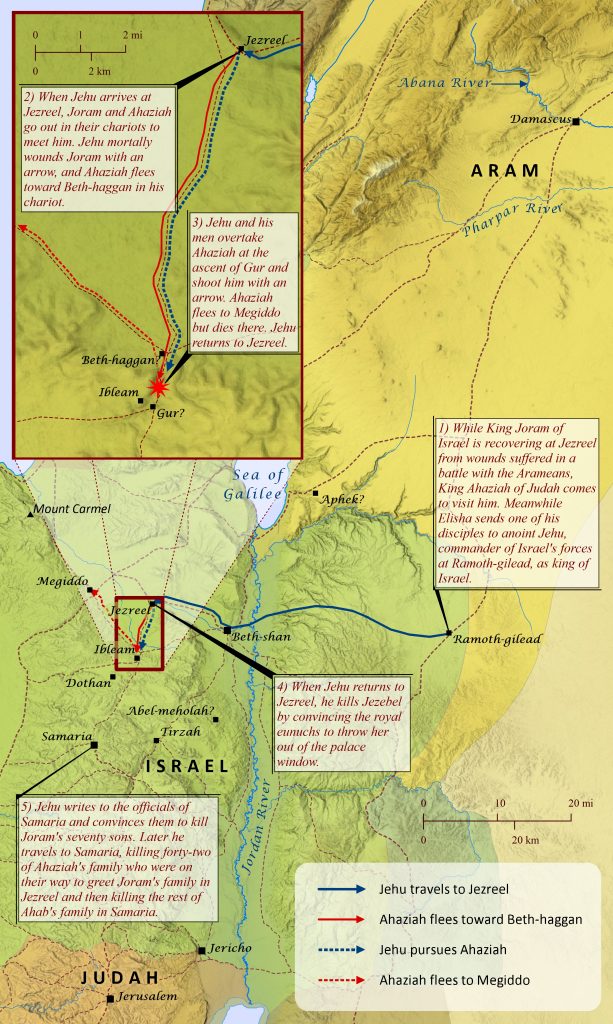
NOTE: Captions (1-4) Summarize Events in 2 Kings 9:16-37
Jehu's Killing of King Joram, King Ahaziah and Queen Jezebel
Then - This marks a strategic point in the narrative as God’s judgment converges rapidly and decisively on the house of Ahab.
Jehu rode in a chariot (rekeb) and went to Jezreel - Ramoth-Gilead to Jezreel is about 45 miles. Taking his chariot signals urgency, authority, and intent. Jehu does not send messengers or delay for ceremony but moves swiftly to act on what God has commissioned him to carry out. His ride to Jezreel is the transition from a private anointing to public execution of judgment. What God spoke in secret now will be "shouted" openly and irreversibly.
For Joram was lying there - King Joram is in Jezreel, recovering from battle wounds. The detail that he was “lying there” underscores his vulnerability and passivity—a wounded king, removed from the battlefield, unaware that judgment is approaching at full speed. God’s timing is precise for the king who once ruled aggressively now waits helplessly.
Ahaziah king of Judah had come down to see Joram - The presence of Ahaziah is both providential and ominous. His visit reflects the intertwined alliance between Judah and the house of Ahab—an alliance forged through marriage and shared political interests. By coming to Jezreel at this moment, Ahaziah unknowingly places himself within the orbit of God’s judgment. The visit that was meant to express solidarity and concern becomes the setting for shared calamity. God is gathering those bound together in compromise so that His judgment exposes the full cost of their ungodly partnerships!
What seems like coincidence is actually divinely orchestrated providence. This is confirmed by 2 Chronicles 22:7 which says
"Now the destruction of Ahaziah was from God, in that he went to Joram. For when he came, he went out with Jehoram against Jehu the son of Nimshi, whom the LORD had anointed to cut off the house of Ahab."
When God acts, events converge with remarkable precision. Jehu’s swift ride, Joram’s weakness, and Ahaziah’s visit all align at Jezreel, reminding us that no alliance, position, or timing can thwart the unfolding of God’s righteous purposes.
John Walton Trip from Ramoth Gilead to Jezreel. It is about forty-five miles from Ramoth Gilead to Jezreel. Jezreel is a fifteen-acre site situated at the southeastern entrance to the Jezreel Valley between the Hill of Moreh and Mount Gilboa. It was here that Ahab had built a winter capital. Excavations have unearthed a large royal enclosure from this time period occupying a large portion of the mound (see comment on 9:30). (SEE PAGE 396 The IVP Bible Background Commentary OT)
QUESTION - What is the meaning of Jezreel? | GotQuestions.org
ANSWER - Jezreel was a city in the plain, or valley, of Esdraelon. The area surrounding the city was also called the Valley of Jezreel. The word Jezreel comes from two Hebrew root words meaning “to sow” and “almighty.” Put together, the two root words mean “God will sow.”
The Valley of Jezreel is a beautiful, broad plain, stretching from west to east from Mount Carmel and the sea to the Jordan, which it reaches through two arms between the mountains of Gilboa, Little Hermon, and Tabor; and from south to north from the mountains of Ephraim to those of Galilee. Nazareth lies in the hills on the northern side of the valley. Jezreel is also called the Great Plain and the Valley of Esdraelon.
The city of Jezreel has a long and varied history and figures prominently in many Bible events, most of them violent. King Jehu ordered that the heads of King Ahab’s 70 sons be placed in heaps at the gate of Jezreel (2 Kings 10:1–11). Ahab’s queen, Jezebel, met her death by being thrown from a window of the palace of Jezreel, and it was there that her body was eaten by dogs (2 Kings 9:30–35). Jezreel was the scene of the phony trial of Naboth, who owned a vineyard near Ahab’s palace and who was murdered by Jezebel for his refusal to give his land to Ahab (1 Kings 21:1–23). The Valley of Jezreel was the scene of some important battles as well: the victory of Barak over Sisera (Judges 4); a victory of Gideon over the Midianites, the Amalekites, and their allies from the east (Judges 6 – 8); the victory of the Philistines over Saul and his sons (1 Samuel 31); and the Egyptians’ victory over King Josiah (2 Kings 23:29).
Jezreel is also the name of a son of the prophet Hosea, so named because God had declared that He would avenge the blood of Jezreel on the house of Jehu (Hosea 1:4–5).
Today, the Jezreel Valley is a green, fertile plain, covered with fields of wheat, cotton, sunflowers, and corn, as well as grazing tracts for multitudes of sheep and cattle. Because of its location in the same valley as Megiddo, Jezreel is considered to be a likely spot for the future battle of Armageddon (Revelation 16:16–21). In fact, the Valley of Megiddo is also called the Valley of Jezreel.
JEZREEL [SMITH] A city situated in the plain of the same name between Gilboa and Little Hermon, now generally called Esdraelon. [ESDRAELON] It appears in (Joshua 19:18) but its historical importance dates from the reign of Ahab, B.C. 918-897, who chose it for his chief residence. The situation of the modern village of Zerin still remains to show the fitness of his choice. Int he neighborhood, or within the town probably, were a temple and grove of Eastward, with an establishment of 400 priests supported by Jezebel. (1 Kings 16:33; 2 Kings 10:11) The palace of Ahab, (1 Kings 21:1; 18:46) probably containing his "ivory house," (1 Kings 22:39) was on the eastern side of the city, forming part of the city wall. Comp. (1 Kings 21:1; 2 Kings 9:25,30,33) Whether the vineyard of Naboth was here or at Samaria is a doubtful question. Still in the same eastern direction are two springs, one 12 minutes from the town, the other 20 minutes. The latter, probably from both its size and its situation, was known as "the spring of Jezreel." With the fall of the house of Ahab the glory of Jezreel departed.
2 Kings 9:17 Now the watchman was standing on the tower in Jezreel and he saw the company of Jehu as he came, and said, “I see a company.” And Joram said, “Take a horseman and send him to meet them and let him say, ‘Is it peace?’”
- watchman: 2Sa 13:34 18:24 Isa 21:6-9,11,12 56:10 62:6 Eze 33:2-9 Ac 20:26-31
- Take an horseman: 2Ki 7:14
- Is it peace: 2Ki 9:19 1Sa 16:4 17:22 1Ki 2:15 Lu 10:5,6
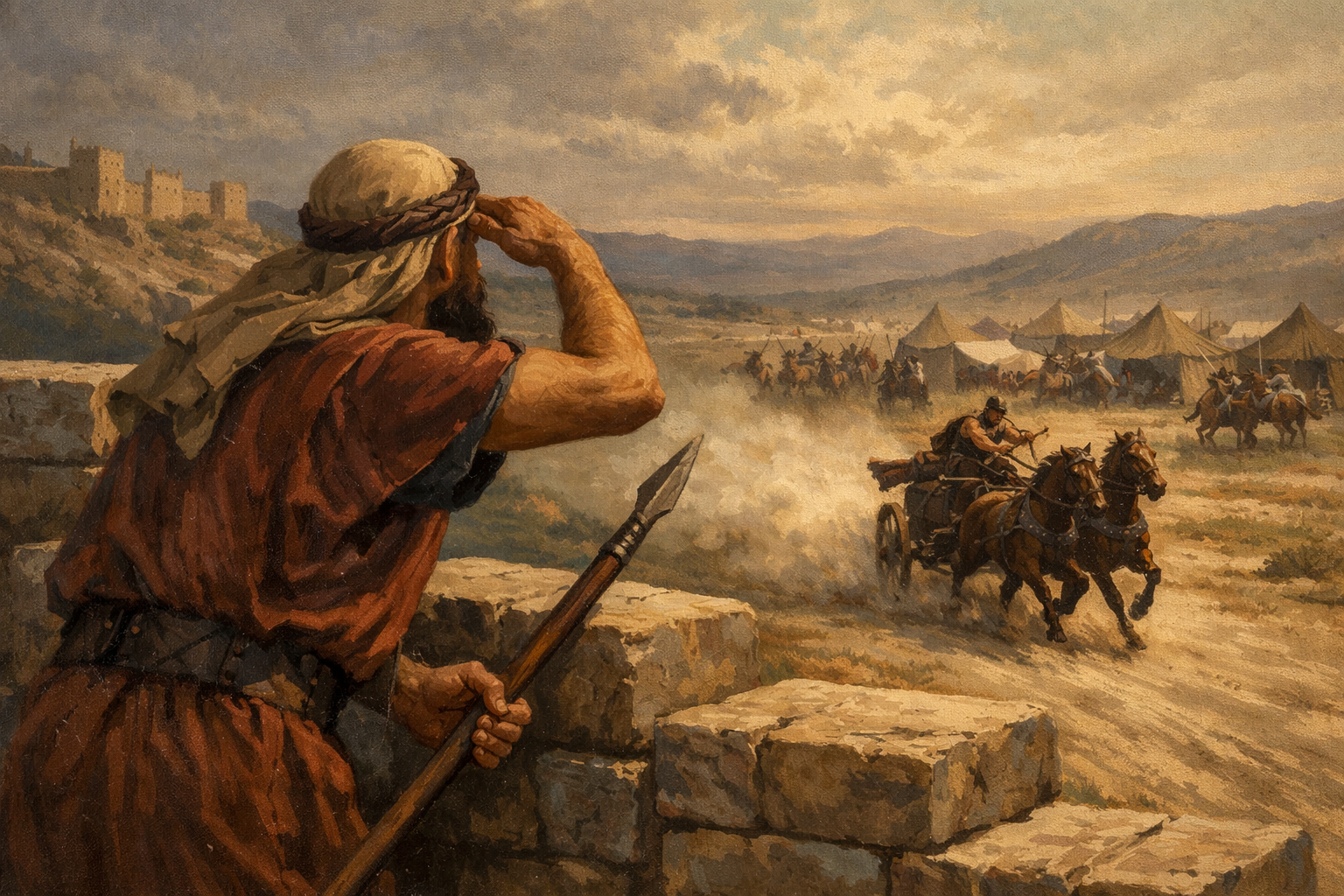
ALERT BUT UNAWARE
JUDGMENT IS COMING
Now the watchman was standing on the tower in Jezreel (means "God scatters") - The watchman’s post on the city tower indicates vigilance and expectation. Jezreel was a royal city, and with war raging to the east, sentries were alert for messengers or threats. The elevated position allows him to see what others cannot—an image that subtly contrasts human watchfulness with divine oversight. The watchman sees the movement, but only God knows its meaning.
And he saw the company of Jehu as he came, and said, “I see a company.” The approaching force is unmistakable. The watchman sees a group advancing rapidly, not a lone courier. Though he does not yet identify Jehu, the urgency of his report suggests something unusual. God’s judgment is no longer hidden; it is now coming over the horizon.
NET NOTE the company Heb “the quantity [of the men] of Jehu, when he approached.” Elsewhere שִׁפְעַה (shif’ah), “quantity,” is used of a quantity of camels (Isa 60:6) or horses (Ezek 26:10) and of an abundance of water (Job 22:11; 38:34).
And Joram said, “Take a horseman and send him to meet them King Joram, wounded and confined to Jezreel, responds as a king accustomed to command. He attempts to manage the situation from a distance by sending an emissary. This reflects false confidence—the assumption that the approaching force can be assessed, negotiated with, or controlled.
And let him say, ‘Is it peace The question “Is it peace?” (shalom) is deeply ironic. Joram seeks reassurance of safety and stability, unaware that the approach of Jehu signals not peace but divine reckoning. Throughout Scripture, rulers who ignore God’s warnings often ask for peace when judgment is already underway (cf. Jer 6:14). Joram’s concern is political calm, not spiritual repentance.
John Walton The rapid approach of a small chariot contingent only allows for a few possibilities, and none of them are good. They are either in flight from the enemy or are coming with evil intent. The rider sent out could serve either as a messenger to bring word back to the king or as a negotiator. What is unusual is that in such an uncertain situation the kings would ride out (apparently with no bodyguard) to meet Jehu (v. 21) and thus expose themselves to danger. (SEE PAGE 397 The IVP Bible Background Commentary OT)
2 Kings 9:18 So a horseman went to meet him and said, “Thus says the king, ‘Is it peace?’” And Jehu said, “What have you to do with peace? Turn behind me.” And the watchman reported, “The messenger came to them, but he did not return.”
- What have you to do with peace 2Ki 9:19,22 Isa 48:22 59:8 Jer 16:5 Ro 3:17
PEACE NON-NEGOTIABLE
& MESSENGER DEFECTS
So a horseman went to meet him and said, “Thus says the king, ‘Is it peace (shalom)?’” This scene intensifies the drama and exposes the false notion of peace held by the house of Ahab. The messenger comes speaking with royal authority—“Thus says the king”—echoing prophetic language but hollow by comparison. King Joram is not asking about righteousness or repentance, only about shalom in the political sense: Is there immediate danger? Is stability intact? This reveals a heart concerned with calm circumstances rather than a right standing before God.
Asking “Is it peace?” is meaningless when God has declared judgment. True peace cannot be negotiated at the last moment; it must be rooted in obedience long before crisis comes.
And Jehu said, “What have you to do with peace (shalom)? Turn behind me.” NET = "None of your business! Follow me." Jehu’s response is sharp and revealing. He does not deny peace outright; instead, he exposes the messenger’s lack of authority to define or assess it. Peace is no longer a matter for negotiation or inquiry—it is a matter already decided by God. By commanding the horseman to “turn behind me,” Jehu forcibly absorbs the king’s representative into his advancing column. In other words he is saying fall in at the rear of his soldiers. Jehu did not want to chance the possibility that his coming might get back to Joram and give him an opportunity to mount a defense. The messenger sent to evaluate the situation becomes evidence that judgment is moving forward.
And the watchman reported, “The messenger came to them, but he did not return.” - This report signals alarm (or at least it should have). In ancient warfare, a messenger’s failure to return meant loss of control. Joram’s attempt to manage events remotely has failed. One by one, his lines of communication are being swallowed up by the approaching force. What he thought could be questioned, delayed, or resolved diplomatically is now clearly irreversible.
2 Kings 9:19 Then he sent out a second horseman, who came to them and said, “Thus says the king, ‘Is it peace?’” And Jehu answered, “What have you to do with peace? Turn behind me.”
SECOND MESSENGER
SAME QUESTION, SAME FATE
Then - Another marker of progression in the narrative reinforcing the inevitability of God’s judgment and the futility of repeated human attempts to stop it.
He sent out a second horseman, King Joram persists in the same strategy, as though repeating the action might change the outcome. The second messenger shows denial and desperation—a ruler clinging to procedure when reality is already slipping away. Instead of repentance or preparation, Joram doubles down on diplomacy.
who came to them and said, “Thus says the king, ‘Is it peace (shalom)?’” The message is identical to the first, underscoring the king’s narrow concern. Joram wants reassurance of shalom —external calm, political stability, personal safety. Yet he still does not ask, “What has the LORD said?” The repetition highlights how human authority echoes itself when it has nothing new to say.
And Jehu answered, “What have you to do with peace? Turn behind me - NET = "Jehu replied, "None of your business! Follow me." ESV = Turn around and ride behind me." NIV/NLT = "Fall in behind me." Jehu’s response is unchanged, because God’s decree has not changed. Peace is no longer up for discussion. By repeating the same command, Jehu makes it unmistakable that the issue is not misunderstanding but irrelevance—the messengers have no standing to define peace when God has already declared judgment. Again, the king’s representative is absorbed into Jehu’s advancing force, showing that every attempt to intercept or evaluate God’s work only becomes part of its forward momentum.
When God has determined the outcome, repeating the same question will not alter the answer. Those who seek peace without submission to God’s will find that their efforts are simply overtaken by the purposes they hoped to avoid.
2 Kings 9:20 The watchman reported, “He came even to them, and he did not return; and the driving is like the driving of Jehu the son of Nimshi, for he drives furiously.”
- driving: or, marching, Hab 1:6 3:12
- the driving is like 2Ki 10:16 Ec 9:10 Isa 54:16 Da 11:44
FURIOUS DRIVING
IDENTIFIES THIS AS JEHU
The watchman reported, “He came even to them, and he did not return; The watchman has already seen two messengers sent—first on horseback, then by chariot—and neither returns. This signals that something is decisively interrupting royal control. In ancient royal protocol, messengers always returned with a report. Their silence suggests: Authority has shifted. The approaching commander is issuing commands, not receiving them. The king’s power is already being eclipsed. This prepares the reader for the sudden collapse of Joram’s reign.
And the driving is like the driving of Jehu the son of Nimshi, for he drives furiously - NRSV = "drives like a maniac" NET = "drives recklessly" CSB = "Drives like a madman" Jehu was a reckless charioteer and was easily recognizable by his distinct driving style. This is fascinating. Jehu’s manner of driving is so distinctive that he can be identified from a distance. Apparently Jehu was well known as a "hard driving man!" Little did the watchman know just how "hard driving" he would be this time!
Bob Utley on furious - This NOUN (BDB 993) is from the same root as "madman" of 2Ki 9:11. There was a divine purpose in Jehu's urgency! Exactly what the NOUN implies is uncertain. Some assume a back and forth zigzag pattern, LXX, he drives calmly or quietly, Targums, slowly or steadily, Josephus, Antiq. 9.6.3-8
The Hebrew idea behind furiously conveys reckless speed, intensity, and zeal. This fits Jehu perfectly because, while by nature he was "driven," now he is being driven by God's anointing him as king of Israel (2Ki 9:6,7). Notice how before Jehu even speaks, his actions are in effect declaring his mission! There is a bit of a play on words for Jehu's furious driving is a picture of God's judgment on Ahab's house, a judgment that will come swiftly once it begins to be unleashed. The delay in God's judgment of Ahab's house is over. As they say, the "hammer is about to fall!"
Furiously (07697) shiggaon (šiggāʿôn) from shaga - to be mad. A masculine noun meaning insanity, madness. It is always used in a negative. It is derived from the verb shāgha, “to be mad,” “to be insane,” shiggāʿôn denotes one of the curses which God would send upon his people if they did not obey his covenant which He established with them at Sinai (Dt. 28:28). It is used in parallel with “blindness” (ʿiwwārôn) and “confusion” (timmāhôn, cf. Zech. 12:4). In the Day of the LORD, the LORD will strike every rider with madness as He assaults those who besiege Jerusalem. Shiggāʿôn describes Jehu’s driving of his chariot, that is, in a frenzied, reckless state (2 Ki. 9:20).
TWOT - Madness, abandon, three times in the OT, two times as a form of judgment from God, either on Israel herself (Deut 28:28) or on those who attempt to destroy her (Zech 12:4). The noun is also used to describe King Jehu’s mad antics on the highway with his chariot, ’’For he drives like a madman/with abandon/ furiously” (KJV, II Kgs 9:20).
SHIGGAON - 3V - Deut. 28:28; 2 Ki. 9:20; Zech. 12:4
Dt 28:28 (CURSES ON ISRAEL FOR BREAKING MOSAIC COVENANT) “The LORD will smite you with madness and with blindness and with bewilderment of heart;
Zech 12:4 “In that day,” (DAY OF THE LORD WHEN YAHWEH SAVES JERUSALEM) declares the LORD, “I will strike every horse with bewilderment and his rider with madness. But I will watch over the house of Judah, while I strike every horse of the peoples with blindness.
2 Kings 9:21 Then Joram said, “Get ready.” And they made his chariot ready. Joram king of Israel and Ahaziah king of Judah went out, each in his chariot, and they went out to meet Jehu and found him in the property of Naboth the Jezreelite.
- ready: Heb. bind, 1Ki 20:14 Mic 1:13
- Joram: 2Ch 22:7
- to meet Nu 20:14
- the portion of Naboth: 2Ki 9:25 1Ki 21:1-7,15,18,19
Related Passages:
2 Chronicles 22:7 Now the destruction of Ahaziah was from God, in that he went to Joram. For when he came, he went out with Jehoram against Jehu the son of Nimshi, whom the LORD had anointed to cut off the house of Ahab.
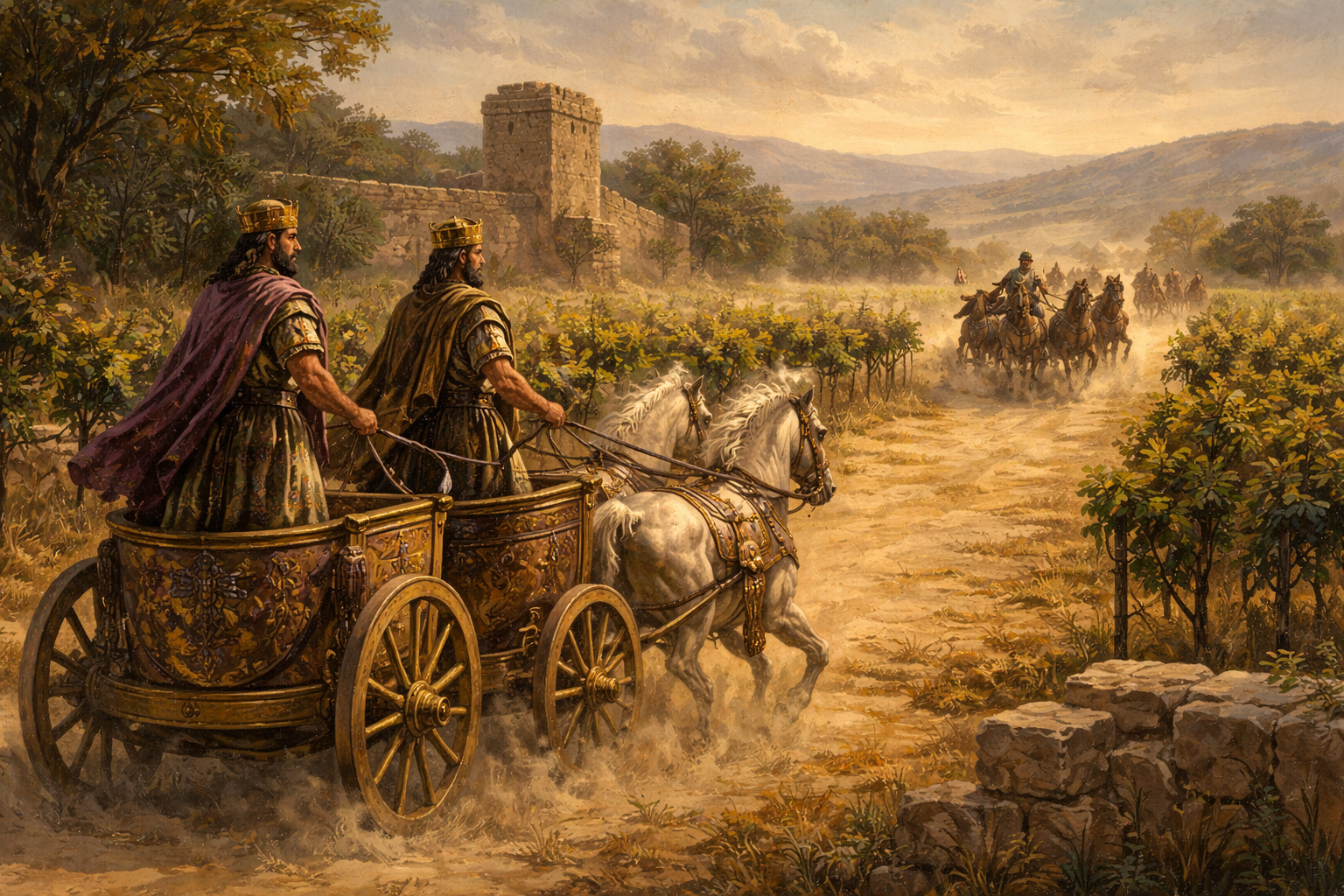
JORAM AND AHAZIAH
GO OUT TO MEET JEHU
Then Joram said, “Get ready.” - This expresses the king's confidence in his position and power, which will soon prove to be false confidence. He thinks he is still in control, but will be shown soon to be out of control, out of power and out of this life! Notice, not surprisingly, Joram does not inquire of Yahweh before going out to meet Joram. And indeed, ironically, his own command “Get ready” prepares him not for negotiation, but for his own death.
And they made his chariot (rekeb) ready. Joram king of Israel and Ahaziah king of Judah went out, each in his chariot (rekeb) - Note that the fact that they went out together reflects the alliance of the southern kingdom (Ahaziah) with the northern kingdom (Joram). It is also a literal picture unknown to these two kings of the imminent shift in authority. The paradox is that what looks like strength with two kings riding side by side is actually a foreboding picture of their mutual vulnerability. In addition, Ahaziah’s presence with the evil king Joram shows how Judah’s compromise with Israel’s sin places him in the path of judgment and justifies his assassination.
And they went out to meet Jehu and found him - In God's sovereign plan, His anointed agent Jehu is drawing the kings out of the place of safety and to the place of reckoning. They think they are confronting a rebel, but in reality, they are approaching their executioner.
In the property of Naboth the Jezreelite (see 1Ki 21:2-3, 13, 19) - Note that God still sees that as the property of Naboth, not Ahab. What an amazing detail, emphasizing this is no coincidence but divine providence! Naboth had been unjustly murdered under Ahab's leadership, specifically his wife Jezebel's evil plot with the result that his vineyard had been unlawfully seized (1 Kings 21:1-29) And more divine irony is seen in that Elijah had pronounced his judgment on this very ground!
Bob Utley Jehu had gone, not to the city of Jezreel, but to the place of Naboth's vineyard, which Ahab and Jezebel had wrongly taken as their own.
The scene could not be more apropos - Ahab’s son Joram stands on the stolen land. Another Ahab-linked king (Ahaziah) stands beside him. And God’s appointed judge stands before them. In a word, the crime scene became the courtroom and the vineyard became the execution ground! God is not mocked. What Ahab and Jezebel had sown, their son would now reap as God predicted when Ahab repented (1Ki 21:29)!
Ahab once coveted Naboth’s vineyard and now his dynasty will begin to die there. What was taken in Naboth's blood is reclaimed in Ahab's son's blood! The stolen vineyard gave silent testimony that God had not forgotten the injustice of Ahab and Jezebel. The vineyard reminds us that unrepented injustice leaves a footprint, and in God’s time, that footprint can become the place of reckoning.
2 Kings 9:22 When Joram saw Jehu, he said, “Is it peace, Jehu?” And he answered, “What peace, so long as the harlotries of your mother Jezebel and her witchcrafts are so many?”
- Is it peace: 2Ki 9:17
- What peace: 2Ki 9:18 Isa 57:19-21
- the harlotries/whoredoms: 1Ki 16:30-33 18:4 19:1,2 21:8-10,25 Na 3:4 Rev 2:20-23 17:4,5 Rev 18:3,23
Related Passages:
Deuteronomy 18:10-11, 14 “There shall not be found among you anyone who makes his son or his daughter pass through the fire, one who uses divination, one who practices witchcraft, or one who interprets omens, or a sorcerer, 11 or one who casts a spell, or a medium, or a spiritist, or one who calls up the dead....14 “For those nations, which you shall dispossess, listen to those who practice witchcraft and to diviners, but as for you, the LORD your God has not allowed you to do so.
Leviticus 20:6 ‘As for the person who turns to mediums and to spiritists, to play the harlot after them, I will also set My face against that person and will cut him off from among his people.
JEHU'S CONFRONATION
OF SINS OF AHAB'S HOUSE
When Joram saw Jehu, he said, “Is it peace (shalom), Jehu?” When Joram asks about peace (shalom), he is not asking about reconciliation with God but about whether Jehu is coming as a loyal servant of his, whether he comes as a friend or foe. Clearly he does not suspect Jehu's soon to unfold treachery, even in the face of his messengers failing to return. Obviously he was expecting good news in regard to Ramoth-Gilead. The messengers not returning should have been a clue to Joram that something was amiss, but remember also that God is behind the scenes orchestrating the scenes He is behind!
And he answered, “What peace (shalom)? - Jehu gives his version of peace (shalom)! Jehu clearly understands his mission explaining that there can be no peace in a dynasty in rebellion against the covenant God. In other words, the idea of peace (shalom) is not merely the absence of conflict, but speaks of wholeness which in turn is grounded in obedience to the LORD. As long as the systemic sin of Ahab and Jezebel remains, peace (shalom) is impossible.
NET NOTE Heb “How [can there be] peace as long as the adulterous acts of Jezebel your mother and her many acts of sorcery [continue]?” In this instance “adulterous acts” is employed metaphorically for idolatry. As elsewhere in the OT, worshiping other gods is viewed as spiritual adultery and unfaithfulness to the one true God. The phrase “many acts of sorcery” could be taken literally, for Jezebel undoubtedly utilized pagan divination practices, but the phrase may be metaphorical, pointing to her devotion to pagan customs in general
So long as the harlotries of your mother Jezebel - In the OT, harlotry was covenant language depicting spiritual adultery against the LORD. (See Israel the Wife of Jehovah for more on this concept) Here Jehu refers to Jezebel's spiritual adultery manifest by her idolatrous Baal worship and her seduction of the people of Israel away from Yahweh. She (and Ahab) had used their political power to coerce and enforce spiritual compromise in the nation.
Bob Utley "the harlotries of your mother Jezebel" This refers to Jezebel's attempt to destroy the YHWHistic faith by establishing the worship of Ba'al-Melqart, the Tyrian fertility god. The harlotries could be both literal (i.e., fertility worship practices) or spiritual (i.e., going after other gods (cf. Exod. 34:16; Lev. 17:7; Deut. 31:16). "witchcrafts" The etymology of this Hebrew term (BDB 506; NIDOTTE, vol. 2, pp. 735-738) is uncertain but it seems to be related to the use of drugs to attempt to foretell and control events. See detailed notes at Deut. 18:9-12 online.
And her witchcrafts (see related words kashaph and kāšap̱) are so many - This is the first time Israel (or Judah) is described as practicing witchcraft. Witchcraft speaks of occult practices, spiritual manipulation and false religion used to control people and outcomes (even though God is ultimately in full control even when allowing these evil practices!) Jezebel’s power was in effect spiritual deception institutionalized. As long as these Satanic practices dominated the nation of Israel, shalom was impossible, thus Jehu's reply "What peace?"
For an in depth discussion of witchcraft, magic, etc see online Theological Dictionary Of The Old Testament, Volume 7, page 361. Here is a short excerpt -
כָּשַׁף kāšap̱;* כֶּשֶׁף kešep̱; כַּשָּׁף kaššāp̱; אַשָּׁף ʾaššāp̱; יִדְּעֹנִי yiddeʿōnî; לָחַשׁ lāḥaš; לַחַשׁ laḥaš; נָחַשׁ nāḥaš I; נַחַשׁ naḥaš; עָנַן ʿānan II; שָׁחַר šaḥar I
Contents: I. 1. Etymology, Semantic Field; 2. Occurrences; 3. LXX. II. Ancient Near East: 1. Egypt; 2. Mesopotamia; 3. Western Semites. III. Israel: 1. Negative Assessment; 2. Alien Origin; 3. At Court. IV. Positive Assessment. V. 1. Magic; 2. Divination; 3. Astrology.
QUESTION - What does the Bible say about witchcraft / witches? Gotquestions.org WATCH VIDEO
ANSWER - The Bible has a lot to say about witchcraft. Witchcraft and its many cousins, such as fortune-telling and necromancy, are Satan’s counterfeits to holy spirituality. The Bible expressly condemns all forms of witchcraft.
Since early times, people have sought supernatural experiences God did not endorse. The nations that surrounded the Promised Land were saturated with such practices, and God had stern words for His people concerning any involvement with them. Deuteronomy 18:9–12 says, “When you enter the land the Lord your God is giving you, do not learn to imitate the detestable ways of the nations there. Let no one be found among you who sacrifices their son or daughter in the fire, who practices divination or sorcery, interprets omens, engages in witchcraft, or casts spells, or who is a medium or spiritist or who consults the dead. Anyone who does these things is detestable to the Lord.”
God takes witchcraft very seriously. The penalty for practicing witchcraft under the Mosaic Law was death (Exodus 22:18; Leviticus 20:27). First Chronicles 10:13 tells us that “Saul died because he was unfaithful to the Lord; he did not keep the word of the Lord and even consulted a medium for guidance.” In the New Testament, “sorcery” is translated from the Greek word pharmakeia, from which we get our word pharmacy (Galatians 5:20; Revelation 18:23). Witchcraft and spiritism often involve the ritualistic use of magic potions and mind-controlling drugs. Using illicit drugs can open ourselves up to the invasion of demonic spirits. Engaging in a practice or taking a substance to achieve an altered state of consciousness is a form of witchcraft.
There are only two sources of spiritual power: God and Satan. Satan has only the power that God allows him to have, but it is considerable (Job 1:12; 2 Corinthians 4:4; Revelation 20:2). To seek spirituality, knowledge, or power apart from God is idolatry, closely related to witchcraft. First Samuel 15:23 says, “For rebellion is as the sin of witchcraft, and stubbornness is as iniquity and idolatry.” Witchcraft is Satan’s realm, and he excels in counterfeiting what God does. When Moses performed miracles before Pharaoh, the magicians did the same things through demonic power (Exodus 8:7). At the heart of witchcraft is the desire to know the future and control events that are not ours to control. Those abilities belong only to the Lord. This desire has its roots in Satan’s first temptation to Eve: “You can be like God” (Genesis 3:5).
Since the Garden of Eden, Satan’s major focus has been to divert human hearts away from worship of the true God (Genesis 3:1). He entices humans with the suggestions of power, self-realization, and spiritual enlightenment apart from submission to the Lord God. Witchcraft is merely another branch of that enticement. To become involved in witchcraft in any way is to enter Satan’s realm. Seemingly “harmless” modern entanglements with witchcraft can include horoscopes, Ouija boards, Eastern meditation rituals, and some video and role-playing games. Any practice that dabbles in a power source other than the Lord Jesus Christ is witchcraft. Revelation 22:15 includes witches in a list of those who will not inherit eternal life: “Outside are the dogs, those who practice magic arts, the sexually immoral, the murderers, the idolaters and everyone who loves and practices falsehood.”
We don’t need to fear Satan’s power, but we should acknowledge it and stay away from it. First John 4:4 says, “Greater is He who is in you, than he who is in the world.” Satan can create much havoc, harm, and destruction, even in the lives of believers (1 Thessalonians 2:18; Job 1:12–18; 1 Corinthians 5:5). However, if we belong to the Lord Jesus Christ, there is no power that can ultimately defeat us (Isaiah 54:17). We are overcomers (1 John 5:4) as we “put on the whole armor of God so that you can take your stand against the devil’s schemes” (Ephesians 6:11). When we give our lives to Christ, we must repent. This repentance should include renouncing any involvement with witchcraft, following the example of the early believers in Acts 19:19.
Isaiah 8:19 says, “When someone tells you to consult mediums and spiritists, who whisper and mutter, should not a people inquire of their God? Why consult the dead on behalf of the living?” When we follow those words to their logical conclusion, we could also ask, “Why seek any power apart from the source of all real power? Why seek spirits who are not the Holy Spirit?” Witchcraft and its many counterparts promise spirituality but lead only to emptiness and death (Micah 5:12; Galatians 5:19–21). Only Jesus has the words of life (John 6:68, 63, cf Dt 32:47).
QUESTION - What is the occult? | GotQuestions.org
ANSWER - The dictionary defines occult as “hidden, secret and mysterious, particularly pertaining to the supernatural.” Examples of occult practices are astrology, witchcraft (Wicca), the black arts, fortune telling (divination), magic (both black and white), Ouija boards, Tarot cards, spiritism, (ED: See Hebrew word yiddeoni = spiritist) parapsychology, and Satanism. Human beings have always been interested the occult, from ancient times until today. Occult practices and psychic phenomena have captivated millions of people worldwide, and this is not limited to the ignorant or uneducated. There are several factors that make the occult fascinating to everyone, even in our age of technological and scientific advances.
For one thing, occult practices appeal to our natural curiosity. Many people who get involved in the occult begin with “harmless” practices such as playing with a Ouija board out of simple curiosity. Many who have experimented this way have found themselves going deeper and deeper into the occult. Unfortunately, this type of involvement is akin to quicksand—easy to get into and difficult to get out of. Another fascination of the occult is that it appears to offer quick and easy answers to life’s questions. The astrologer gladly charts your future, the Ouija board and Tarot cards give you direction, and the psychic gets you in touch with your Aunt Esther who tells you all is fine in the afterlife. Occult practices are controlled by demons, who offer just enough information to keep their victims intrigued, while exerting more and more control over gullible hearts and minds.
The danger of occult practices cannot be overstated. God strictly warned the Israelites against being involved with the occult (Leviticus 20:6). The pagan nations that surrounded Israel were steeped in divination, sorcery, witchcraft, and spiritism, and this is one reason why God gave His people the authority to drive them out of the land (Deuteronomy 18:9–14). The New Testament says that the rise of interest in the occult is a sign of the end of the age: “The [Holy] Spirit clearly says that in later times some will abandon the faith and follow deceiving spirits and things taught by demons” (1 Timothy 4:1).
How are we to recognize the occult and those who promote it? An incident involving Paul and Barnabas in the early days of the church is a good place to start. They “traveled through the whole island until they came to Paphos. There they met a Jewish sorcerer and false prophet named Bar-Jesus, who was an attendant of the proconsul, Sergius Paulus. The proconsul, an intelligent man, sent for Barnabas and Saul because he wanted to hear the word of God. But Elymas the sorcerer (for that is what his name means) opposed them and tried to turn the proconsul from the faith. Then Saul, who was also called Paul, filled with the Holy Spirit, looked straight at Elymas and said, ‘You are a child of the devil and an enemy of everything that is right! You are full of all kinds of deceit and trickery. Will you never stop perverting the right ways of the Lord?’” (Acts 13:6–10).
In this account, we see several characteristics of those involved in the occult. They are false prophets (verse 6) who deny the basic doctrines of Christianity: the deity of Christ, the fall of man into sin, heaven, hell, salvation and the atoning work of Christ on the cross. Second, they seek to influence other people, particularly those in positions of power, to turn them from the faith (verses 6-7). Third, they do everything in their power to keep the true gospel of Christ from being spread, opposing His ministers at every turn (verse 8). When the truth of the gospel is curtailed, watered down, or flatly rejected, Satan and his demons rejoice.
There is no mistaking the fact that the occult in all its forms should be avoided. We are to “be self-controlled and alert. Your enemy the devil prowls around like a roaring lion looking for someone to devour” (1 Peter 5:8). Part of being self-controlled and alert is being wise to Satan’s schemes, but not to delve into the details of every occult practice and phenomenon. We are to understand the devil’s ultimate goal—the destruction of our souls—and take the offense by putting on the “full armor of God” (Ephesians 6:10–18). Only then can we stand firm and extinguish the “flaming arrows” of the evil one.
F B Meyer - Is it peace, Jehu? And he answered, What peace?
We all want peace. Of every telegraph messenger, as he puts the buff-colored envelope into our hands, we ask almost instinctively, Is it peace? If there is a rumor of war, a depression in trade, a bad harvest, a sudden calamity in our neighborhood, we instantly consider the effect it may have on the tranquillity and prosperity of our life.
By peace we too often mean the absence of the disagreeable, the unbroken routine of outward prosperity, the serene passage of the years: not always eager for anything deeper. And if other and profounder questions intrude themselves, we instantly stifle or evade them. Like Herod, we shut up the Baptist in the dungeon. Like the Roman general, we make a desert and call it peace. Men will flee from a Gospel ministry which pursues them into close quarters, and arouses unwelcome questions that break the peace.
There cannot be true peace so long as we permit the infidelities and charms of some Jezebel of the soul-life to attract and affect us. Jezebel may stand for the painted world, with its wiles and snares, or for the flesh, or for some unholy association of the past life, like that which clung to Augustine. But there must be no quarter given to the unhallowed rival of our Lord. Whatever its charms, it must be flung out of the window before we can be at peace.
“Then, and not till then, we shall see Thee as Thou art;
Then, and not till then, in Thy glory bear a part;
Then, and not till then, Thou wilt satisfy each heart.”
If you are entirely surrendered to the Lord, “the peace of God, which passeth all understanding, shall guard your hearts and your thoughts in Christ Jesus.”
G Campbell Morgan - The hour had struck for the carrying out of the sentence of God upon the house of Ahab. Of this judgment, Jehu was the instrument. He was a man of furious driving, and this was the symbol of his character. He halted at nothing, but swept like a relentless whirlwind from point to point until he had accomplished his purpose. In these words, uttered to Joram in answer to his question: "Is it peace?" Jehu showed that, so far, he understood the righteousness of the judgment he was called upon to execute. That is a truth of persistent application. Peace is not peace which is merely a cessation of hostilities on the basis of compromise with evil. The words of a later prophet are for all time: "There is no peace, saith my God, to the wicked." In the presence of widespread and deep-rooted corruption the activity of the Divine government is no longer that of tenderness and compassion, but that of scorching and destructive flame and fire. Evil men will seek for peace, as ease, quietness, the end of suffering; but God never seeks peace except through purity. And here once more it is necessary to remind ourselves of the reasonableness and justice and beneficence of this fact. It is because God is ever seeking the true peace of man, individually, socially, racially, that He smites their godless shrines and shrivels with devouring fire the things that tend to disintegration and disturbance.
2 Kings 9:23 So Joram reined about and fled and said to Ahaziah, “There is treachery, O Ahaziah!”
- There is treachery: 2Ki 11:14 2Ch 23:13
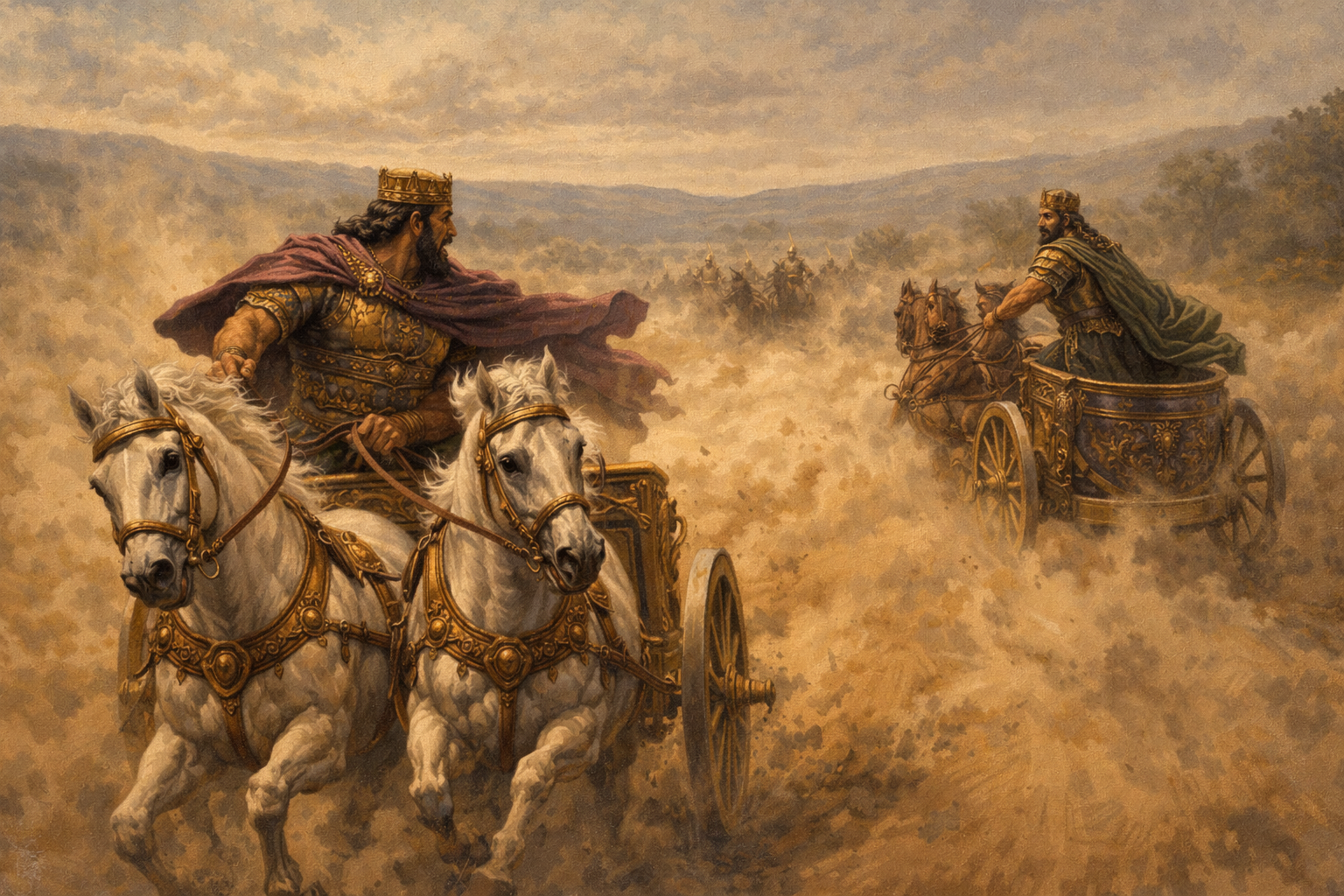
JUDGMENT FALLS
TOO LATE TO FLEE
So (term of conclusion) - Joram came to the correct conclusion but it was too late!
Joram reined about and fled - Joram came in authority, but now flees in panic! Notice he does not argue, for he knows what Jehu has declared is truth. In a moment the king has become the fugitive from God's justice! Even Joram's surely less than healthy conscience confirms to himself that Jehu's truth hurts and he got the point (pun intended). For he would soon hurt literally and receive a literal point! Don't miss the import of Joram's flight, for it is in effect his silent confession, an acknowledgment of his guilt before a Holy God! And undoubtedly Joram discerned this was not politically motivated but divinely driven! He does not have to ask "Is this from Yahweh," because he still has enough moral sense to know the answer!
And said to Ahaziah, “There is treachery, O Ahaziah!” - While Joram knew he was in trouble after Jehu's accusation, he mislabels God's justice and judgment as treachery! He is calling Jehu the traitor, but in truth Joram's argument is not with Jehu but with God. Jehu was simply God's instrument to bring about justice and judgment. King Ahaziah of Judah had compromised in allying with Joram and his shared compromise would now result in shared consequences! Ahaziah had foolishly followed Joram into Naboth's stolen vineyard and now is forced to follow him in the flight that would end in his doom.
NET NOTE treachery - Heb “Deceit, Ahaziah.”
🙏 THOUGHT - Beloved, compromise with the darkness always has consequences. Ask the Spirit "Search me, O God, and know my heart; Try me and know my anxious thoughts; 24And see if there be any hurtful way in me, And lead me in the everlasting way." (Ps 139:23-24) If there are any open (or secret) rooms of compromise in your heart, confess them today, repent of them today and walk in the freedom of God's mercy, forgiveness, grace and power, all for His glory in Christ. Amen.
When truth confronts unrepented sin, the guilty often flee, relabeling justice as injustice and even drawing others into their downfall. Beloved, what we refuse to face in confession and repentance, we will eventually try to outrun in fear, but we can never outrun the long arm of the LORD (listen to this poignnant old song by Wayne Watson - lyrics below)!
A million dark alleys you can hide in
Dig a tunnel to the center of the earth
Convinced you′ve got nobody to confide in
Got you questioning the sum of what you're worth
People label you the black sheep of the family
Come collect upon your prodigal rewardChorus
′Cause you can never outrun
Or go beyond the reaches
Of the long arm of the LordI've been ashamed--I've been humbled and forgiven
I′ve been chastened by my Father′s loving hand
But still, at times, I go on with my evil
It seems to constitute the nature of a man
But forgiveness is as close as my confession
And my sin amputated by His swordChorus
If He gave to me all that I deserve
This could be my final breath
But with compassion in His eyes
He's drawing me home
Into His arms--Into His tender arms of rest
There are pagans at the corners of creation
Making light of the salvation that we know
And with a small, narrow mind I give them over
To the passion of the godless seed they sow
But, in truth, we have just as much potential
To be Godly and perfected by the WordRepeat Chorus
My capacity for creative sin is never extended part God′s
capacity for restoration
2 Kings 9:24 And Jehu drew his bow with his full strength and shot Joram between his arms; and the arrow went through his heart and he sank in his chariot.
- shot Joram between: 1Ki 22:34 Job 20:23-25 Ps 50:22 Pr 21:30 Ec 8:12,13 1Th 5:3
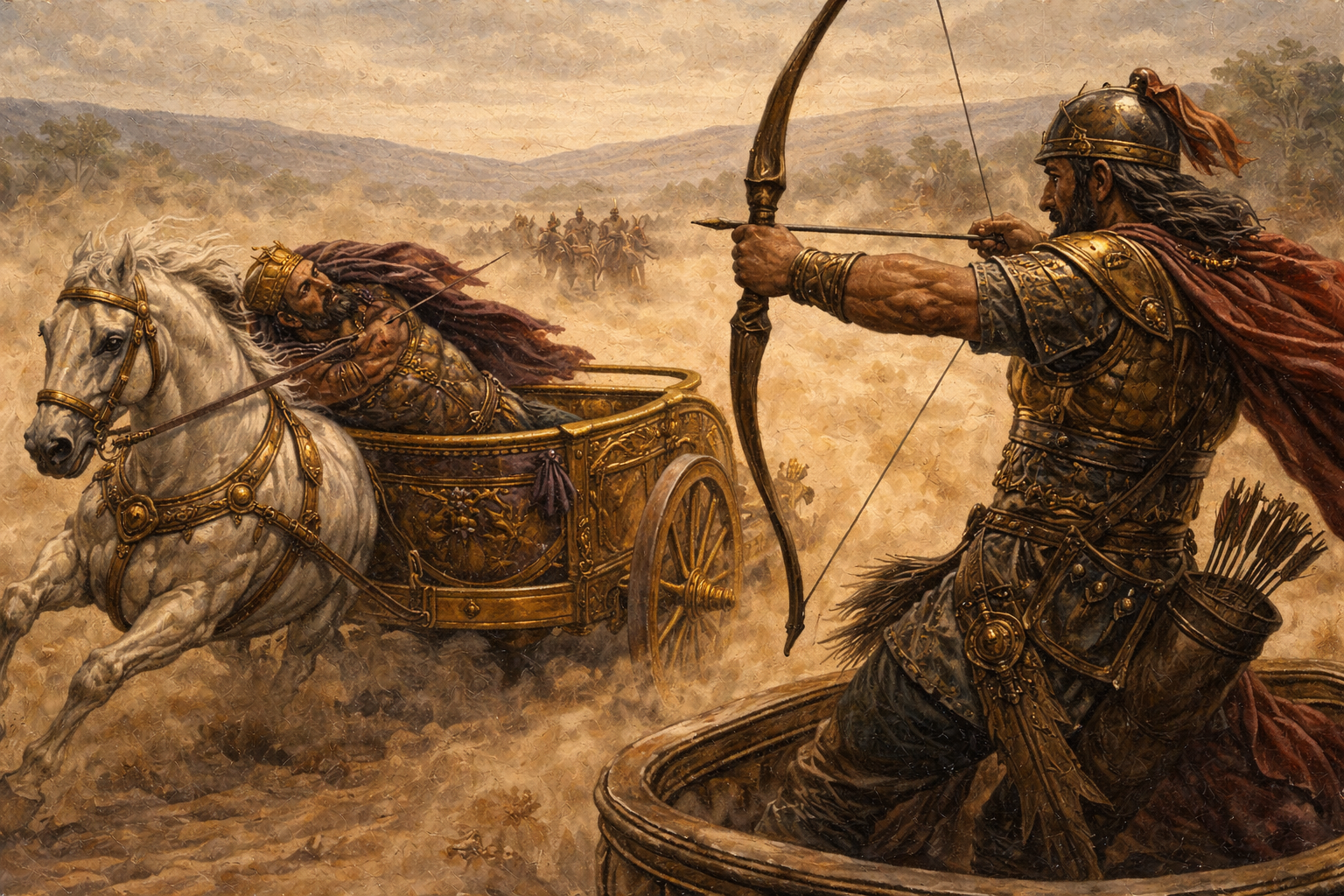
THE ARROW OF JUSTICE
AND DIVINE JUDGMENT
And Jehu drew his bow with his full strength Jehu does not fire impulsively but draws with full strength, signaling he is totally committed to following through on the mission Yahweh gave him in 2Ki 9:6-7. Jehu is not carrying out personal vengeance but the commissioned action of the LORD.
Donald Wiseman on drew his bow with full strength: God’s word that Ahab’s house would be destroyed was brought about through the brash actions of his agent Jehu. The experienced warrior deliberately aimed to shoot Joram. A technical archery term is used: ‘filled his hand with the bow’ (mt; cf. Akkad. qašta mullû), that is, stretched the bow ‘with his full strength’ (rsv after Rashi). Sidkar was Jehu’s, or, less probably, Ahaziah’s third man in the chariot (Heb. šālîš, i.e. not the driver, or just an officer, but the royal aide-de-camp; cf. 2 Kgs 7:2). It is possible that Bidkar was driving his own chariot alongside. (1 and 2 Kings: An Introduction and Commentary)
Trapp is surely correct when he points out that "Jehu was an excellent marksman; but it was God that guided his hand, strengthened his arm (Ezekiel 30:24), and ordered his arrow (Jeremiah 1:9).”
And shot Joram between his arms - We are not told Jehu was an expert marksman, but that made no difference because this arrow was divinely directed at the physical heart of Joram, whose spiritual heart was already dead in his trespasses and sins (Eph 2:1). Notice the irony of a king who rode out in confidence but was struck down while fleeing. His human power could not protect his heart exposed to God's judgment.
And the arrow went through his heart - Biblically, the heart is the center of one's will and allegiance and this arrow’s path underscores that divine judgment was directed at the root of Joram’s rebellion. Joram's heart which had long aligned with Ahab and Jezebel’s idolatry now met its end. The heart of Joram’s problem was the problem of his heart, and Yahweh made His "point" by striking the heart itself.
And he sank in his chariot (rekeb) - There was no second chance for repentance as Joram collapsed from the throne to a corpse! And again we see the divine, providential irony that the almighty chariot, the ancient symbol of power and speed, had become his bier (not a coffin, but a platform used to carry a dead body).
It is poetic (divine) justice that Ahab's son King Joram spilt his life blood in the stolen field of Naboth which recalls the words of Elijah's prophecy ‘Thus says the LORD, “Have you (AHAB) murdered and also taken possession?”’ And you shall speak to him, saying, ‘Thus says the LORD, “In the place where the dogs licked up the blood of Naboth the dogs will lick up your blood, even yours.”’ (1Ki 21:19) Notice Elijah's prophecy to Ahab ends with "even yours" and I submit we could complete that passage paraphrasing it "even your sons!"
This is a short but poignant passage for in it we see that a single arrow under divine direction signals beginning of the end of Ahab's dynasty. Like a speeding arrow from Jehu's bow (flying at roughly 100–130 miles per hour) God’s judgment reflects long patience finally giving way to perfect justice. Judgment delayed for years (22 years for Ahab and 12 years for Joram) is brought to completion in a fraction of a second!
It should be noted that because Ahab had repented, the judgment upon his family occurred after his death.
1 Kings 21:27-29 It came about when Ahab heard these words, that he tore his clothes and put on sackcloth and fasted, and he lay in sackcloth and went about despondently. 28 Then the word of the LORD came to Elijah the Tishbite, saying, 29 “Do you see how Ahab has humbled himself before Me? Because he has humbled himself before Me, I will not bring the evil in his days, but I will bring the evil upon his house in his son’s days.”
2 Kings 9:25 Then Jehu said to Bidkar his officer, “Take him up and cast him into the property of the field of Naboth the Jezreelite, for I remember when you and I were riding together after Ahab his father, that the LORD laid this oracle against him:
- the LORD laid this oracle : 1Ki 21:19,24-29 Isa 13:1 Jer 23:33-38 Na 1:1 Mal 1:1 Mt 11:30
1 Kings 21:19 (YAHWEH TO ELIJAH) “You shall speak to him, saying, ‘Thus says the LORD, “Have you murdered and also taken possession?”’ And you shall speak to him, saying, ‘Thus says the LORD, “In the place where the dogs licked up the blood of Naboth the dogs will lick up your blood, even yours.”’
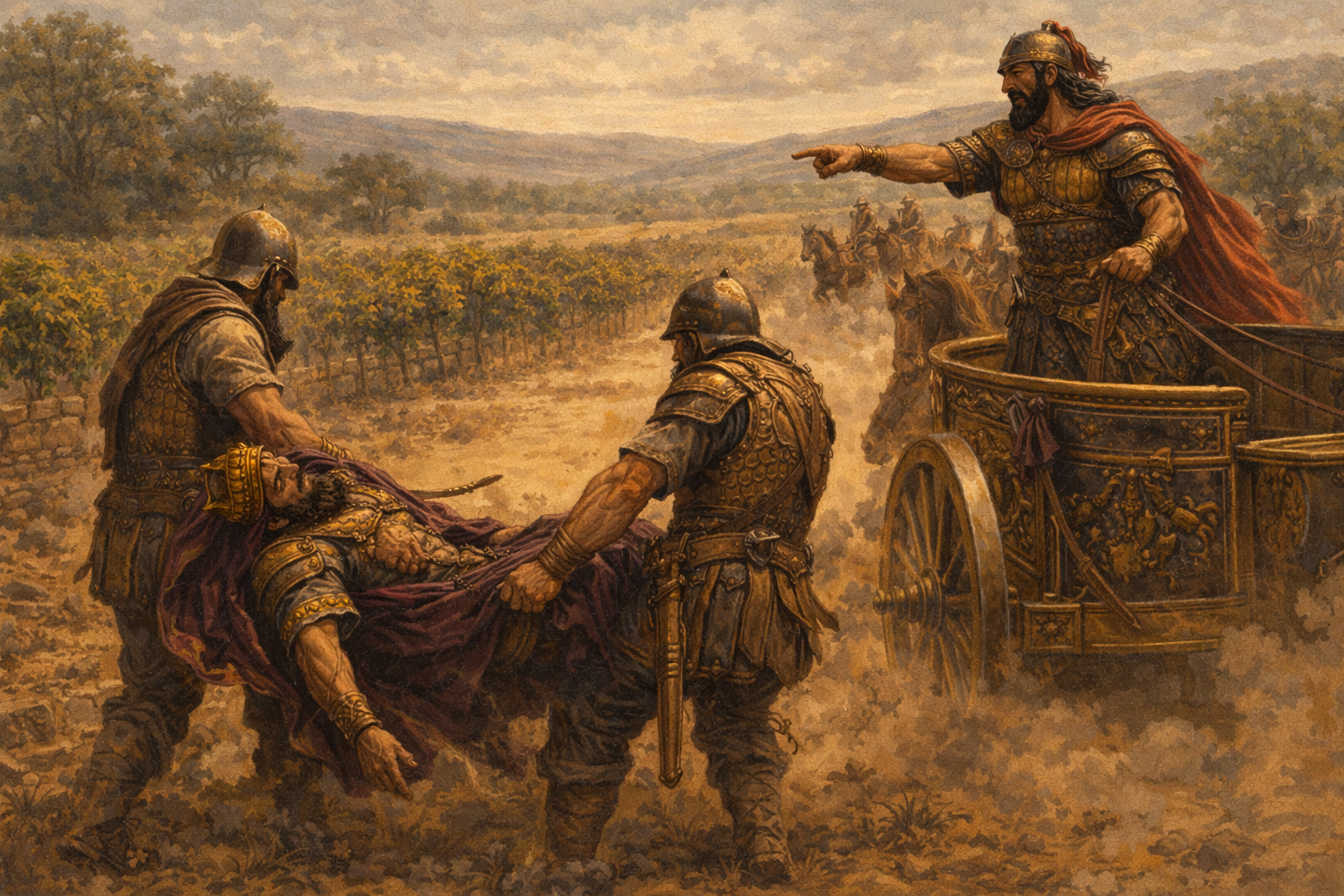
SENTENCE OF JUDGMENT
FULFILLS DIVINE ORACLE
Then Jehu said to Bidkar his officer - King Jehu now deliberately delegates his royal authority to Bidkar, commissioning him to carry out a specific task that will publicly confirm God’s judgment and underscore the certainty of Jehu’s divinely appointed rule.
The same vineyard that once witnessed innocent blood
now witnessed divine vindication.
Take him up and cast him into the property of the field of Naboth the Jezreelite - The first commands of the new king - in effect, let's take care of unfinished business! If King Jehoram of Judah received a dishonorable death and burial (see 2Ch 21:19,20), King Joram's fate is even more dishonorable, for he is granted no funeral, no tomb and no dignity, justly reflecting the wages his sins warranted (cf Ro 6:23). In effect, the very plot of land that cried out for justice now received it, Naboth's vineyard becoming God's verdict against Ahab's son.
Bob Utley "take him up and cast him into the property of the field of Naboth the Jezreelite" To see the full prophetic impact of this statement, read 1 Kings 21. The son apparently had to pay the price for the father's curse. Ahab himself repented and humbled himself in 1 Kgs. 21:27-29.
For I remember when you and I were riding together after Ahab his father, that the LORD laid this oracle against him - Jehu reveals that this moment had been stored in his memory for years. We may forget injustice—but God remembers and undoubtedly brought this Jehu's remembrance. So in this passage Jehu reminds Bidkar that they had once rode together behind Ahab and heard Elijahs' prophecy to Ahab. We don't know how many years prior this event had occurred (certainly more than 12 the length of Joram's reign) showing us that God’s word had been waiting and had not fallen (cf Joshua's description of God's unfailing Word to Israel Joshua 23:14, 15)
What was gained by blood was
eventually surrendered to blood.
The LORD laid this oracle against him - Jehu emphasizes that Joram's death was of divine origin, and not related to his ambition, anger or desire to carry out a military coup. The source was the oracle of Jehovah! It is notable that the Hebrew idea of laid suggests a burden placed upon Ahab, a sentence that rested on his house until the appointed time.
Naboth Vindicated - Ligonier.org: Waiting for the Lord to bring judgment on all His and our enemies is surely one of the most difficult things to do as a believer. We long for the day when everything will be set right, when God’s people no longer have to suffer mocking and even worse forms of persecution. Scripture recognizes the difficulty we have in waiting for the judgment of the Lord. Several psalms, including Psalm 13, feature the psalmist crying out to our Creator, asking Him with urgency how long it will be until he is avenged. Perhaps even the saints in heaven find it hard to wait for the Lord to judge our enemies. After all, Revelation 6:9–11 depicts the souls of the martyrs asking the Lord how long it will be before He avenges their blood shed in bearing witness to Christ.
Naboth’s family may have wondered when the line of Ahab would finally suffer the Lord’s judgment. After Ahab stole Naboth’s vineyard and had Naboth killed, God promised to bring an end to Ahab’s line, but not until the reign of Ahab’s son (1 Kings 21). Moreover, Ahab’s wife persecuted and killed many of the prophets of the Lord (18:13). This would have made the faithful remnant in Israel long for the day when their deaths would be avenged. And all these individuals had to wait for many years for the Lord to act. Ahab’s first son to sit on the throne of Israel, Ahaziah, reigned for two years (22:51–53). Then, Ahab’s other son, Ahaziah’s brother Jehoram of Israel, became king and ruled for twelve years (2 Kings 1:17–18; 3:1). God did not act immediately to end Ahab’s line; His people had to wait.
Today’s passage reveals the instrument that the Lord would finally use to fulfill His promise of judgment on the house of Ahab. God had told Elijah to anoint Jehu king over Israel many years earlier (1 Kings 19:16), and it fell to Elisha to carry out this command. Sending one of the sons of the prophets to Ramoth-gilead, Elisha had him anoint as king over Israel Jehu the son of Jehoshaphat, son of Nimshi (not the same Jehoshaphat who was one of the kings of Judah; 2 Kings 9:1–3). In so doing, the young man whom Elisha sent proclaimed that Jehu would be the one to cut off the house of Ahab, to bring an end to Ahab’s line (vv. 4–10). Jehu was a commander in the army, and at least a good portion of the army celebrated his anointing (vv. 11–13). God’s people had to wait no longer. Their enemies were finally about to be eliminated.
2 Kings 9:26 ‘Surely I have seen yesterday the blood of Naboth and the blood of his sons,’ says the LORD, ‘and I will repay you in this property,’ says the LORD. Now then, take and cast him into the property, according to the word of the LORD.”
- of his sons: De 24:16 2Ch 24:25 25:4
- I will repay: Ex 20:5 De 5:9 Eze 18:19
DELAYED JUSTICE NOT DENIED
JUSTICE WHEN GOD IS JUDGE
Surely I have seen yesterday the blood of Naboth and the blood of his sons,’ says the LORD - This is a divine witness and this omniscient Witness is trustworthy! This echoes covenant courtroom language. Though Jezebel orchestrated Naboth’s death in secrecy, nothing escaped God’s sight. Human courts were manipulated, but the divine court was fully informed.
Naboth and his sons were silenced on earth
but remembered in heaven.
And the blood of his sons The inclusion of Naboth’s sons reveals the full scope of the crime because the sons were likely murdered to eliminate all legal heirs. In effect Ahab’s house secured the land by erasing an entire family line and now we see that "divine turnaround" is fair (just) play! By naming both father and sons, God shows that no victim is forgotten, even when Scripture earlier records the event briefly.
Dale Ralph Davis adds - we learn something in verse 26 that 1 Kings 21 had not told us: Jezebel had Naboth’s sons liquidated as well. Of course this was necessary in order to ‘free up’ Naboth’s inheritance. But Jehu picks up the watch-word of the God of the exodus when he quotes Yahweh: ‘I have seen the shedding of Naboth’s blood and that of his sons,’ which conjures up Exodus 3:7: ‘I have surely seen the affliction of my people who are in Egypt’ (cf. Ps. 10:11, 14). The exodus God always sees when, where, and by whom his servants are crushed and prepares the ‘pay back’ (cf. 2 Thess. 1:6–8). Naboth may be dirt to Ahab and Jezebel but Yahweh knows his name.
And I will repay you in this property,’ says the LORD - This is divine poetic justice! Blood was shed to seize the vineyard. Blood would be repaid on that same ground. Note that to underscore the certainty of the verdict and the Authority behind the action we see a repetition of the phrase says the LORD. It also underscores the impossibility of appeal.
Now then, take and cast him into the property, according to the word of the LORD - This is Jehu speaking and his command makes one thing unmistakable, that this act fulfills Elijah’s oracle (see above). To reiterate, the killing of Joram is not a coup but it is compliance with the command of the Lord. Jehu has acted as God's agent under divine orders, not an assassin acting on ambitious impulse.
🙏 THOUGHT - God sees injustice others ignore, remembers crimes others forget, and repays precisely where sin once triumphed. Dearly beloved follower of Christ, have you been unfairly, unjustly treated because of your faith? Then you can rest assured that our Father has seen and our Father will repay the guilty parties, either in this life or the life to come. Paul instructs us "Never pay back evil for evil to anyone. Respect what is right in the sight of all men. 18 If possible, so far as it depends on you, be at peace with all men. 19 Never take your own revenge, beloved, but leave room (aorist imperative see our need to depend on the Holy Spirit to obey) for the wrath of God, for it is written, “VENGEANCE IS MINE, I WILL REPAY,” says the Lord." (Ro 12:17-19)
Jesus gave similar promises in His Sermon on the Mount declaring "Blessed (makarios) are those who have been persecuted for the sake of righteousness, for theirs is the kingdom of heaven. 11 Blessed (makarios) are you when people insult you and persecute you, and falsely say all kinds of evil against you because of Me. 12 “Rejoice and be glad (both verbs present imperative see our need to depend on the Holy Spirit to obey), for your reward in heaven is great; for in the same way they persecuted the prophets who were before you. (Mt 5:10-12)
PAYDAY SOMEDAY - Robert G Lee's famous sermon at its core is a sermon on the certainty of divine judgment, on King Ahab (especially 1 Kings 21–22) for killing Naboth to secure his vineyard outside of Jezreel. Dr Lee points out that sin may not be punished immediately, but it will be punished eventually. God always settles His accounts.
While Dr Lee focused primarily on the accounts being settled with King Ahab who was killed in battle, 2 Kings 9 adds another DAY to the "PAYDAY" with Ahab's son's blood being spilt in Naboth's Vineyard and then Jezebel's blood being splattered on the walls and horses in Jezreel which is near Naboth's vineyard. What Dr Lee proclaimed eloquently and rhetorically, Jehu enacted historically and completely in 2 Kings 9 and 2 Kings 10. If you have never listened to Dr Lee's sermon, this study of Jehu's eradication of Ahab's dynasty would be a good time to listen and watch on youtube. This sermon was preached by Dr Lee over 1000 times..
2 Kings 9:27 When Ahaziah the king of Judah saw this, he fled by the way of the garden house. And Jehu pursued him and said, “Shoot him too, in the chariot.” So they shot him at the ascent of Gur, which is at Ibleam. But he fled to Megiddo and died there.
- Ahaziah: 2Ki 8:29 Nu 16:26 2Ch 22:7-9 Pr 13:20 2Co 6:17
- garden house: 1Ki 21:2
- Ibleam: Jos 17:11 Jdg 1:27
- Megiddo: "In the kingdom of Samaria." 2Ki 23:29,30 Jdg 1:27 5:19 1Ki 4:12 2Ch 22:9
Related Passages:
2 Chronicles 22:3-4 (AHAZIAH) He also walked in the ways of the house of Ahab, for his mother was his counselor to do wickedly. 4 He did evil in the sight of the LORD like the house of Ahab, for they were his counselors after the death of his father, to his destruction.
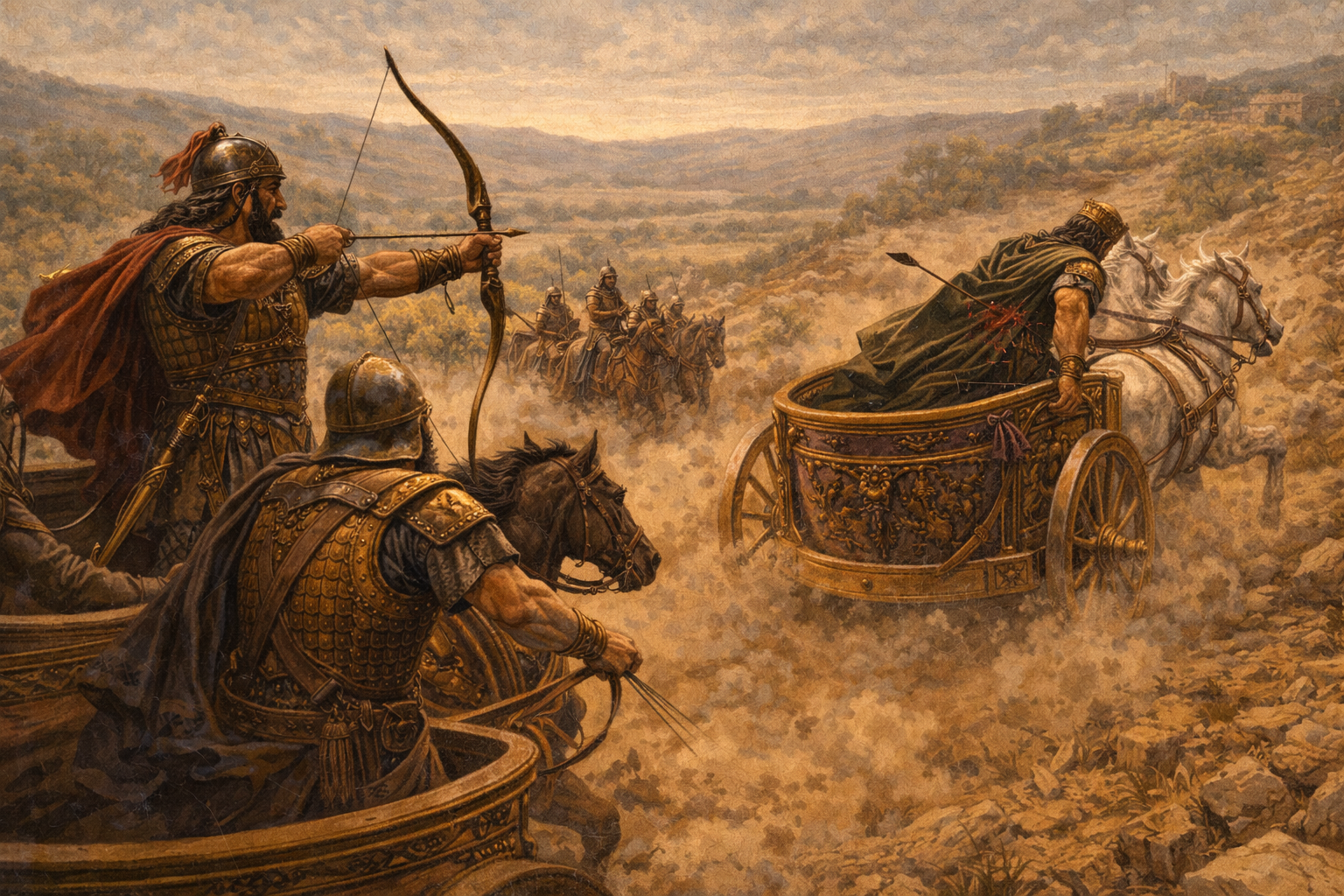
AHAZIAH PURSUED AND
PUNISHED WITH DEATH
When Ahaziah the king of Judah saw this, he fled by the way of the garden house - When Ahaziah witnesses Joram struck down, he instantly understands this is not a minor disagreement or skirmish. Like Joram before him, Ahaziah responds not with repentance but with flight. Seeing truth unmasked produces fear in an unprepared heart. The way of the garden house suggest Ahaziah knew of a possible escape route, but he would soon find out that he could not outrun the long arm (and arrow) of the LORD!
And Jehu pursued him and said, “Shoot him too, in the chariot.” (rekeb) - It is interesting that Jehu had no direct instruction to kill the king of Judah, but he did so anyway. And remember that Ahaziah's mother was Athaliah, Ahab's daughter (thus Ahab was Ahaziah's grandfather), so there was clearly connection to Ahab's dynasty. Jehu recognizes Ahaziah is connected to the evil king Joram and thus warrants God's judgment. Ahaziah's alliance cost him his life. As we have stated before spiritual compromise always has consequences.
See the Cutout at top of map for Route from Jezreel to Ilbeam
So they shot him at the ascent of Gur, which is at Ibleam - The ascent of Gur suggests a narrow, uphill pass, terrain which would slow a fleeing chariot, thus exposing Ahaziah to the arrow of divine judgment.
But he fled to Megiddo and died there - (See ----> in cut out above for Ahaziah fleeing from Ibleam to Megiddo) Ahaziah's death was delayed but not avoided. It is interesting that Megiddo, a city long associated with decisive battles and deaths of kings. Ahaziah was not condemned for Naboth’s murder, but for walking in Ahab’s ways (2Ch 22:3-4). Ahaziah of Judah adopted the idolatrous, Baal-influenced policies of Ahab’s dynasty. His walk was not accidental but counseled and cultivated, especially through Athaliah.
David Guzik points out that " 2 Chronicles 22:1-9 also records the reign of Ahaziah and his inglorious end at the hands of Jehu. The reconciliation of the details of the death of Ahaziah between 2 Chronicles 22 and 2 Kings 9 is complicated, but definitely possible.
John Walton - Beth Haggan-Gur/Ibleam-Megiddo. Ahaziah takes the road south from Jezreel. This is the direction of home (Judah) but is also the direction toward the northern capital city, Samaria, where he could expect to find protection. The road south skirts the eastern edge of the Jezreel Valley along the foot of the Gilboa mountains. Beth Haggan is where the road climbs out of the valley to the plain of Dothan and then into the hills of Samaria. Ibleam is at the top of the rise at the northern end of the plain. It is nearly ten miles from Jezreel. In full flight in a chariot this distance could have been covered in less than half an hour. But he is still fifteen miles from Samaria. When the decision is made to head for Megiddo, he must turn to the northwest, but it is only twelve miles away and could likewise offer sanctuary to the wounded king. It is also an easier road on level ground as it travels along the southwestern edge of the Valley of Jezreel. (SEE PAGE 397 The IVP Bible Background Commentary OT)
Here is the record of Ahaziah's death in Chronicles...
2 Chronicles 22:7-9 Now the destruction of Ahaziah was from God, in that he went to Joram. For when he came, he went out with Jehoram against Jehu the son of Nimshi, whom the LORD had anointed to cut off the house of Ahab. 8It came about when Jehu was executing judgment on the house of Ahab, he found the princes of Judah and the sons of Ahaziah’s brothers ministering to Ahaziah, and slew them. 9 He also sought Ahaziah, and they caught him while he was hiding in Samaria; they brought him to Jehu, put him to death and buried him. For they said, “He is the son of Jehoshaphat, who sought the LORD with all his heart.” So there was no one of the house of Ahaziah to retain the power of the kingdom.
Warren Wiersbe - The reports of Ahaziah’s death in 2 Kings 9:27–29 and 2 Chronicles 22:7–9 aren’t easy to harmonize, but we suggest a scenario. Ahaziah was wounded as he fled from Jezreel (v. 27). He made it to Beth-haggan and then turned northwest at the Ascent of Gur and headed for Megiddo where he tried to hide from Jehu. But Jehu’s men tracked him down and killed him at Megiddo. Ahaziah’s servants carried his body from Megiddo to Jerusalem where he was buried with the kings, for he was a descendant of David. Had he not compromised with Joram, worshipped Baal, and followed his mother, Athaliah’s, counsel, he would have been spared all this shame and defeat.
Paul House addresses this difficult passage 2Ki 9:27 - Here the account differs somewhat from that of 2 Chr 22:9. The Chronicler does not mention the wounding of Ahaziah, his fleeing to Megiddo, or the location of his death. He does add that at some point Ahaziah hid in Samaria, was “captured,” and was “brought to Jehu and put to death.” As Patterson and Austel explain (ED: see quote below), however, there is nothing in either passage that directly contradicts the other. Jehu apparently was in Megiddo, where Ahaziah was brought before he died. No reason is given why Jehu kills him. Hobbs suggests that his marriage to Ahab’s daughter, Athaliah, is enough motivation in Jehu’s mind to commit the deed. (Hobbs, 2 Kings, 117–18) Gray thinks Jehu views Ahaziah as Joram’s avenger, which means he could be a future threat if he is not eliminated.(Gray, 1 and 2 Kings, 494) Ahaziah only rules during 841 B.C., then, which is Joram’s twelfth year by the northern method of counting years (2 Kgs 8:25) and the eleventh year of Joram’s rule by the southern means of counting regnal years. (Thiele, The Mysterious Numbers of the Hebrew Kings, 101.) (SEE 1, 2 Kings - Volume 8 - Page 290)
Patterson and Austel - The circumstances of Ahaziah’s flight, capture, death, and burial have been much discussed. Taken at face value, the Kings account seems to say that Ahaziah was wounded on the ascent to Gur and died in Megiddo, from which his body was taken to Jerusalem for burial. 2 Chron 22:8–9 seems to indicate that Ahaziah was overtaken in Samaria where he had sought refuge with relatives and was brought to Jehu and executed, his body being interred with honor by Jehu’s men. One possibility of reconciling the problem is to suggest that although Ahaziah was wounded at the ascent to Gur, he was apprehended by Jehu’s men in Samaria (where he lay recovering from his wounds) and then taken to Megiddo where he was put to death, his body being given to his servants who took him to Jerusalem for burial in the royal tomb (v.28; cf. 2 Chronicles 22:9). Whereas the author of Kings emphasized Ahaziah’s flight and eventual execution in Megiddo, the Chronicler laid stress on his arrest. The accounts, therefore, are supplementary, not contradictory. (SEE 1 and 2 Kings)
QUESTION - What is the significance of Megiddo in the Bible? | GotQuestions.org
ANSWER - Megiddo is an ancient city in Israel and the site of a number of military conflicts. Today it is the site of a kibbutz and some rich archeological digs (Tel Megiddo).
Megiddo is first mentioned in Joshua 12:21 as one of the cities of the “Hittites, Amorites, Canaanites, Perizzites, Hivites and Jebusites” whose kings were defeated by Joshua. Megiddo was in the territory of Manasseh (Joshua 17:11; 1 Chronicles 7:29), and, although they were not able to completely drive out the residents, the Manassehites were eventually able to subjugate them (Judges 1:27).
egiddo is also mentioned in conjunction with the battle between Sisera and Barak (with Deborah the judge) in Judges 5:19. Megiddo was later included in the territory of Baana son of Ahilud, one of Solomon’s twelve district governors (1 Kings 4:12). Megiddo was one of the cities that was rebuilt or fortified by Solomon (1 Kings 9:15).
Ahaziah, king of Judah, was wounded in battle against Jehu, who was attempting to overthrow Joram, the king of the northern kingdom of Israel. Ahaziah fled to Megiddo where he died from his wounds (2 Kings 9:27).
King Josiah of Judah, contrary to God’s will, fought against Pharaoh Necho at Megiddo and was killed there (2 Kings 23:29–30 and 2 Chronicles 35:22).
Zechariah 12:10–12 says, “And I will pour out on the house of David and the inhabitants of Jerusalem a spirit of grace and supplication. They will look on me, the one they have pierced, and they will mourn for him as one mourns for an only child, and grieve bitterly for him as one grieves for a firstborn son. On that day the weeping in Jerusalem will be as great as the weeping of Hadad Rimmon in the plain of Megiddo. The land will mourn, each clan by itself, with their wives by themselves: the clan of the house of David and their wives, the clan of the house of Nathan and their wives.” What happened at Hadad Rimmon is not explicitly mentioned in Scripture. This passage is the only time that place name in used in Scripture. Many Jewish and Christian scholars view this to be a reference to the “ultimate grief” of the Jewish people at the death of King Josiah. Zechariah 12 looks forward to a time when the nation will morn for the Messiah as they mourned for Josiah.
The New Testament does not mention Megiddo, but the term Armegeddon (Har Megiddo, or “Mount Megiddo”) is mentioned in Revelation 16:16 as a place of judgment against the enemies of God, which would seem to correlate with the imagery in Zechariah 12.
In popular culture the term Armageddon, usually separated from the biblical teaching, has become synonymous with “the end of the world involving a great military conflict.” When Christians hear the term Armageddon, they should not respond with fear but with confidence that Christ is the ultimate victor over all His enemies.
2 Kings 9:28 Then his servants carried him in a chariot to Jerusalem and buried him in his grave with his fathers in the city of David.
- 2Ki 12:21 14:19,20 23:20 2Ch 25:28 35:24
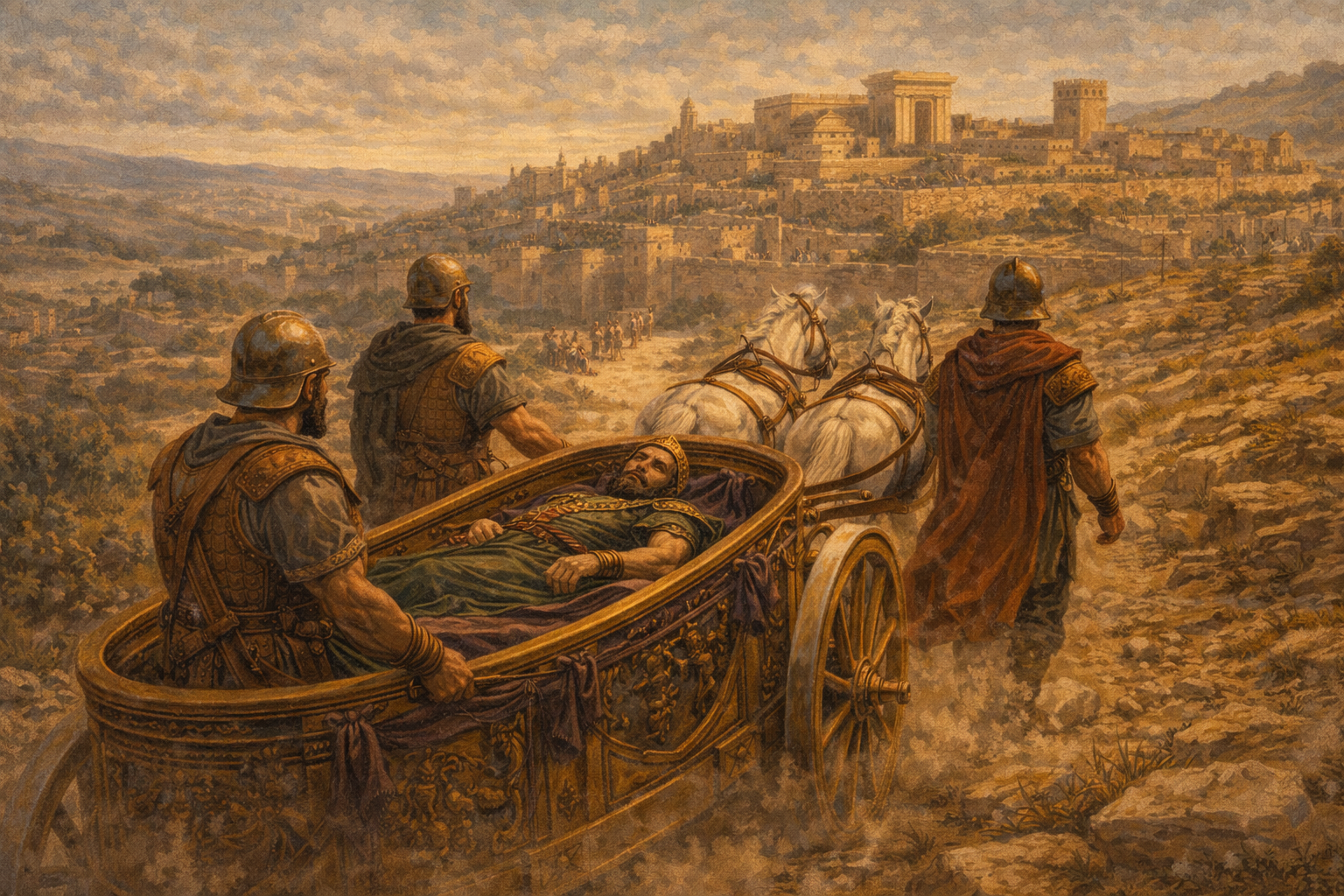
KING AHAZIAH BURIED
IN CITY OF DAVID
Then his servants carried him in a chariot (rekeb) to Jerusalem and buried him in his grave with his fathers in the city of David - At least Ahaziah gets a grave in contrast to Joram of Israel and he does not seem to be dishonored as was his father Jehoram/Joram of Judah (2Chr 21:18,19, 20)
2 Kings 9:29 Now in the eleventh year of Joram, the son of Ahab, Ahaziah became king over Judah.
- in the eleventh: 2Ki 8:16,24 2Ch 21:18,19 22:1,2
- Ahaziah: 2Ch 21:18,19 "But in Joram's twelfth year, he began to reign alone. 2Ki 8:25."
Related Passages:
2 Kings 8:25-26 In the twelfth year of Joram the son of Ahab king of Israel, Ahaziah the son of Jehoram king of Judah began to reign. 26 Ahaziah was twenty-two years old when he became king, and he reigned one year in Jerusalem. And his mother’s name was Athaliah the granddaughter of Omri king of Israel.
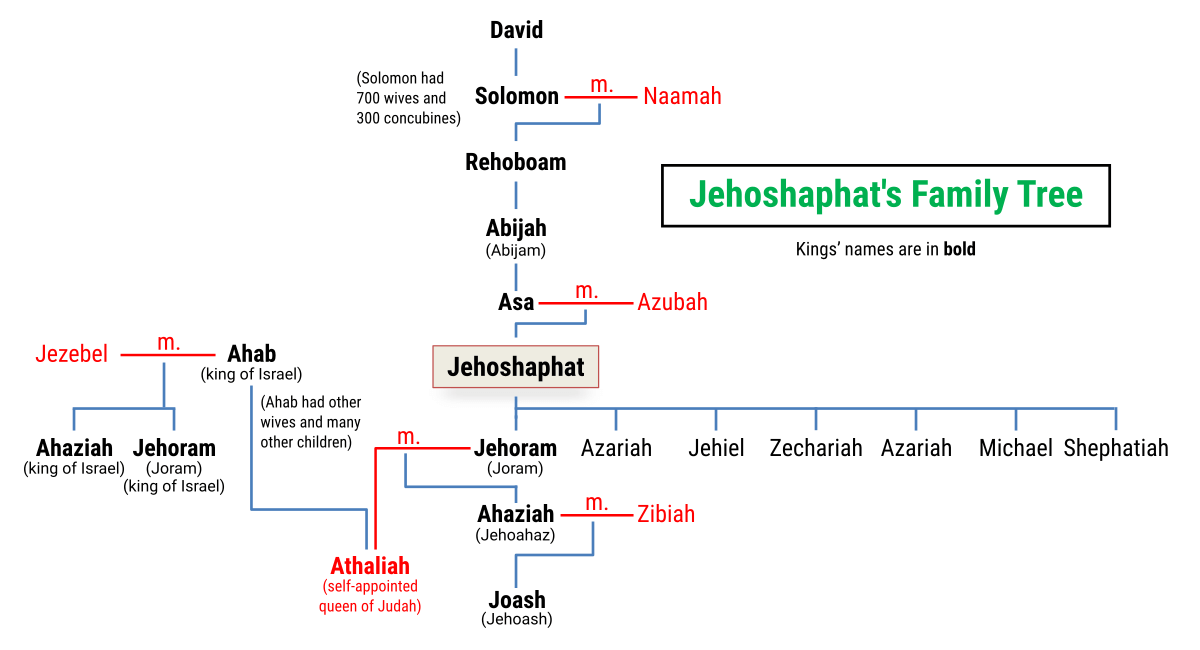
Jehosphaphat's Family Tree - Names in Bold are KINGS
Source: Mark Morgan at bibletales.org
AHAZIAH'S ASCENSION
AS KING OF JUDAH
Now in the eleventh year of Joram, the son of Ahab, Ahaziah became king over Judah - This is a strange verse. For one thing Ahaziah has just been killed in 2Ki 9:27, so clearly 2Ki 9:29 is not saying he became king after he died! Also do not be confused by the fact that Ahaziah’s accession is dated more than once in Kings/Chronicles (twelfth year in 2Ki 8:25-26). See notes below on what seems at first glance to be a contradiction. Also don't be confused by the name Joram! Ahaziah of Judah (contrast Ahaziah of Israel - on left side of family tree above) becomes king during the reign of Joram of Israel, not his (Ahaziah's) father Jehoram of Judah (2Ki 8:25–26). The Holy Spirit wants us to see that Ahaziah rises to power while Ahab’s dynasty is still ruling Israel and therefore while its influence is strongest.
How do you reconcile the two dates of Ahaziah's accession in 2Ki 8:25-26 (twelfth year of Joram) and 2Ki 9:29 (eleventh year of Joram)?
Here is one proposed solution.
Ahaziah appears to have begun his reign as co-regent with his father Jehoram of Judah near the end of Jehoram’s life. 2 Kings 9:29 (11th year of Joram of Israel) refers to Ahaziah’s initial accession, when he began ruling alongside his father. 2 Kings 8:25–26 (12th year of Joram of Israel) refers to Ahaziah’s sole reign, after Jehoram of Judah died. This kind of dual dating is common in the Kings–Chronicles narratives and reflects standard ancient Near Eastern royal record-keeping. To substantiate this presumed chronology recall that Jehoram of Judah was gravely ill for the last two years of his reign (2 Chr 21:18–19), making a co-regency with his son Ahaziah both practical and likely.
Summary:
11th year of Joram (Israel) → Ahaziah begins co-regency
12th year of Joram (Israel) → Ahaziah begins sole reign
Ahaziah reigns one year total (841 BC), counting both phases
John MacArthur offers a different explanation for eleventh year - Ca. 841 b.c. Cf. 2Ki 8:25, "twelfth year." In 2Ki 8:25, the non-accession-year system of dating was used, so that Joram's accession year was counted as the first year of his reign (see 2Ki 12:6 [note]). Here, the accession-year dating system was used, where Joram's accession year and his second year were counted as the first year of his reign.
Harry Shields (p534) - The summary of the reign of Ahaziah says he became king in Judah in the eleventh year of Joram, king of Israel (v. 29), but elsewhere it says that he became king in the “twelfth year of Joram” (cf. 8:25). The discrepancy is best resolved by understanding that ancient records handled partial years of a king’s ascension in different ways
Bob Utley on eleventh year - This is different from 2 Kgs. 8:25. The dates for the reign of kings in Judah and Israel are complicated by (1) co-reigns with their fathers, (2)two different systems of counting the coronation year of the king and (3) different sources (written or oral)
Now are you really confused? I have to confess that I am a bit confused! I will accept it on faith and move on!
If you have time and want to dig deeper see 52 page article on E R Thiele The Chronology of the Kings of Judah and Israel. E R Thiele also has a book you can borrow The mysterious numbers of the Hebrew kings.
Gleason Archer - When did Ahaziah ben Jehoram become king? (See page 206 NIEBD)
2 Kings 8:25 says that Ahaziah son of Jehoram of Judah became king in the twelfth year of Jehoram son of Ahab of Israel. Yet in 2 Kings 9:29 it is stated that it was in his eleventh year. Which is right? Is there not a discrepancy of one year?
The answer is that Ahaziah ben Jehoram became king in 841 B.C., which according to the nonaccession-year system came out to Jehoram ben Ahab’s twelfth year, but according to the accession-year system was his eleventh year. In 2 Kings 8:25 the nonaccession-year system was used, but in 2 Kings 9:29 it was the accession-year system that was followed. Confusing?
The fact of the matter is, however, that the Northern Kingdom followed the nonaccession-year system from 930 B.C. until 798 B.C., but from 798 (the beginning of the reign of Jehoash ben Jehoahaz) till the Fall of Samaria in 722 B.C., it switched to the accession-year system. The southern kingdom, on the other hand, used the accession-year system from 930 until the beginning of the reign of Jehoram ben Jehoshaphat (848–841), or possibly a couple of years earlier, in 850 B.C., before Jehoshaphat died. Around 850 the southern kingdom of Judah switched to the nonaccession-year system and stayed on it until the end of the reign of Joash ben Ahaziah (835–796)—when it finally reverted to the accession-year system (i.e., the first official regnal year did not begin until New Year’s Day of the year following the year when the new king came to the throne). Therefore, by the accession-year system, what was the eleventh year of Jehoram was the twelfth year by the nonaccession-year system, i.e., 841 B.C. No discrepancy!
2 Kings 9:30 When Jehu came to Jezreel, Jezebel heard of it, and she painted her eyes and adorned her head and looked out the window.
- Jezebel: 1Ki 19:1,2
- painted her face: , Jer 4:30 Eze 23:40
- adorned: Isa 3:18-24 Eze 24:17 1Ti 2:9,10 1Pe 3:3
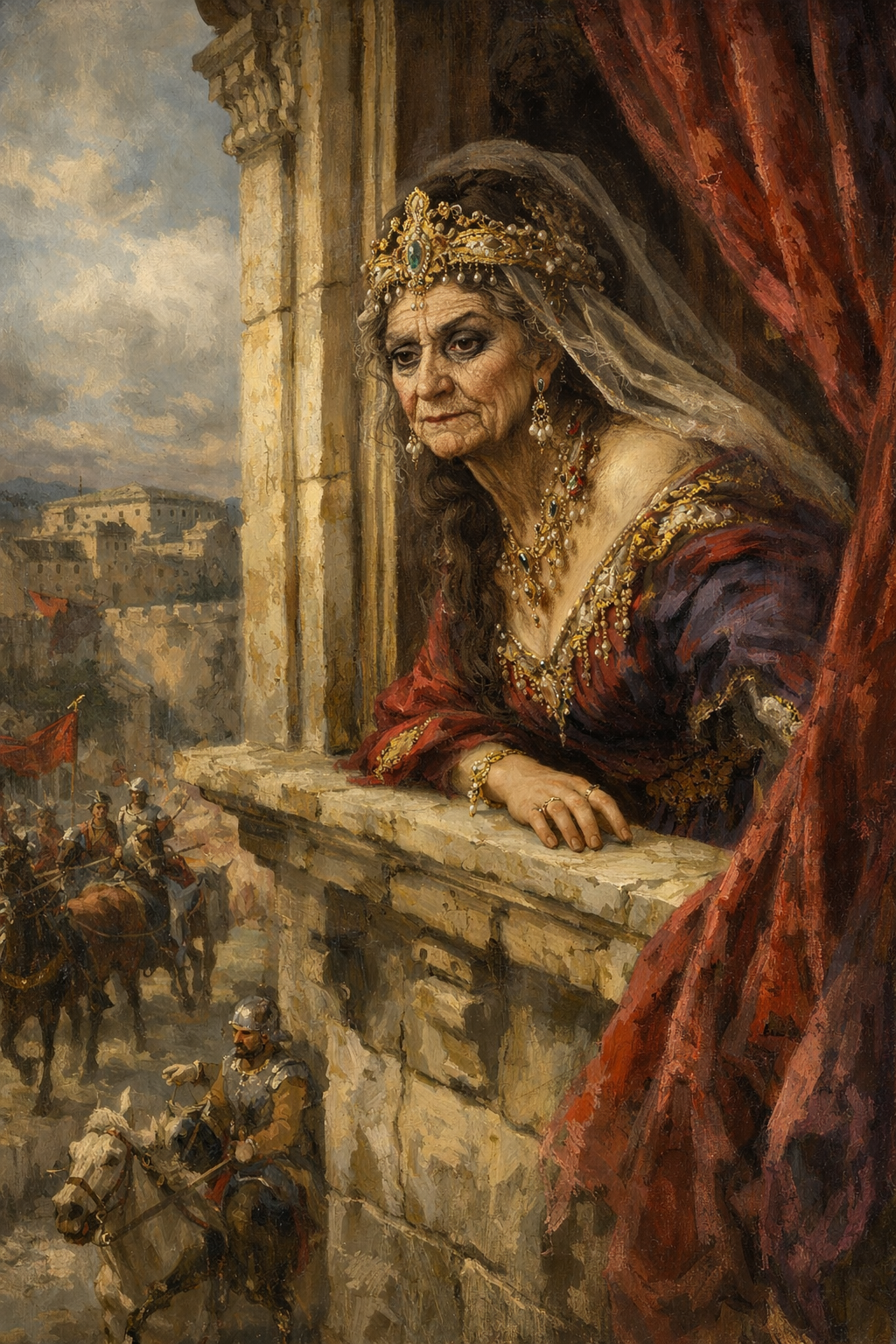
JEZ, HERE COME
DA' JUDGE, JEHU
When Jehu came to Jezreel - Jehu the God appointed judge arrives at Jezreel where there was a royal residence of Ahab's house and it was the city nearest Naboth's vineyard. So in the providence of God guess who was getting ready to be dinner for the dogs? She could have been in Samaria (she was probably there because her wounded son Joram was there) but God had her strategically situated so Jehu would complete the "trifecta" (Jerom, Ahaziah, Jezebel).
Jezebel heard of it - What had she heard? Undoubtedly she knew her son Joram was dead, that Ahaziah, the king of Judah was dead, and that there was a "new sheriff in town" (so to speak), the newly anointed king of Israel, king Jehu.
You can dress for confrontation—or bow for mercy.
Jezebel chose confrontation.
and she painted her eyes (Heb. put her eyes in painting) and adorned her head - This woman, probably the most evil woman in the entire Bible, was intractable, showing no repentance, not mourning, no appeal to Jehovah Who she clearly hated. She is expressing her defiance, choosing to confront Jehu as a queen (not a penitent sinner). Her head adornment (likely a royal headdress or styled hair) reinforced her defiant message that she was still queen, that she would not be humiliated and that she would not concede legitimacy to Jehu. She faces God’s judgment the same way she lived—with pride, manipulation, and contempt.
John Kitto: “Painted her eyes” is the correct reading, as given in the margin and read in the Septuagint and Vulgate. This custom, which our translators do not to have comprehended, is universal among the women the East, and sometimes is also adopted by the men. They eyelid is tinged with a metallic black powder, which is called surmeh the Turks and Persians, and kohol by the Egyptians. It is rather a delicate operation, which is thus performed: The eye is closed, and a small ebony rod smeared with composition is squeezed between the lids, so as to tinge their edges with the colour. This is considered to add greatly to the brilliancy and power of the eye, and to deepen the effect of the long black eye-lashes of which the Orientals are proud. The same drug is employed on the eyebrows -- used thus, it is intended to elongate, not to elevate, the arc, so that the inner extremities are usually represented as meeting between the eyes. To a European the effect produced is seldom, at first, pleasing; but it soon becomes so. The Egyptian monuments confirm the intimation which the present text affords of the antiquity of the custom.
John Walton - Jezebel’s actions. In the ancient world powdered kohl (either galena [lead sulfide] or stibnite [antimony trisulfide]) mixed with oil or water was used as makeup to outline the eye and accentuate its almond shape. Hair dressing may have included scenting, coloring or plaiting. Jezebel’s purpose was to be seen as attractive in every way: physically, socially and politically. There is a familiar motif of a woman looking out the window that is represented beautifully in ivory carvings found at Nimrud, Samaria and Arslan Tash (in which she is adorned with an Egyptian wig). In literature the woman is gazing into the distance awaiting news of a husband or son who has gone off to war (see comment on Judg 5:28). In contrast, the ivories are often thought to represent a prostitute, perhaps connected to the worship of Astarte. This could then be a subtle reminder of Astarte and the foreign worship sponsored by Jezebel (note the accusation Jehu made against her in v. 22). (SEE PAGE 397 The IVP Bible Background Commentary OT)
Bob Utley Why did Jezebel dress up? (1) trying to seduce Jehu (but she was old by this time and v. 31 does not fit) (2)preparing herself for a court visit or burial, (3) typical makeup of a prostitute, (4) an alliance to consolidate his power
NET NOTE Heb “she fixed her eyes with antimony.” Antimony (פּוּךְ, pukh) was used as a cosmetic. The narrator portrays her as a prostitute (see Jer 4:30), a role she has played in the spiritual realm (see the note at v. 22).
and looked out the window - Here we have a crucial detail. A woman at a window could symbolize distance and detachment or even superiority. In effect, she does not come out to face Jehu on level ground, but positions herself above, still playing the role of an untouchable ruler. Ironically, the window that frames her defiance will soon become the means of her downfall (2 Ki 9:33).
Ryrie thinks she did this because "Jezebel wanted to die like a Phoenician queen, all made up." I would add "made up on the outside" but also in effect "made up on the inside!" (Her heart remained hardened).
2 Kings 9:31 As Jehu entered the gate, she said, “Is it well, Zimri, your master’s murderer?”
- Zimri: 1Ki 16:9-20
- peace: 2Ki 9:18-22
DEFIANCE AT THE WINDOW
THE WINDOW OF JUDGMENT
As Jehu entered the gate - When Jehu enters the gate of Jezreel, he symbolically takes control of the city. Jezebel’s power is already broken—she speaks from above, but authority now belongs at the gate.
She said Jezebel does not plead, hide, or weep. She speaks first, choosing confrontation over submission. Her words are calculated, not impulsive.
“Is it well (shalom), Zimri, your master’s murderer - NLT = "Have you come in peace, you murderer? You're just like Zimri, who murdered his master!" Her opening question IS IT WELL which echoes Joram’s words to Jehu (“Is it peace?”). This is not a sincere inquiry but is irony sharpened into mockery. By calling Jehu Zimri, Jezebel reaches back to Israel’s shameful past, making a bitter, sarcastic, deliberate insult. She likens Jehu to Zimri, who, about 45-50 years before, assassinated his master and wiped out the house of Baasha, was universally regarded as a traitor and failure and who ruled only 7 days and died by suicide when the people rejected him (1Ki 16:18,19). Jezebel is sending a clear message saying in essence "You are just another short-lived rebel. Your days are numbered. Your end will be disgrace like Zimri." She had clearly been a master at psychological warfare, and here vainly attempts to use Scripture’s own history as a weapon against Jehu.
David Guzik on Zimri - Jezebel called Jehu Zimri after the man who assassinated King Elah of Israel (1 Kings 16:8-12), when Zimri was also the servant of Elah, a commander in his army. It was her way of calling Jehu a despicable rebel. It was also an implied threat, because the brief reign of Zimri was ended by Omri, who was the father of Ahab and the father-in-law of this same Jezebel. By implication Jezebel said, “The dynasty of Omri will defeat you just like it defeated Zimri.”
NET NOTE Jezebel associates Jehu with another assassin, Zimri, who approximately 44 years before had murdered King Elah, only to meet a violent death just a few days later (1 Kgs 16:9–20). On the surface Jezebel’s actions seem contradictory. On the one hand, she beautifies herself as if to seduce Jehu, but on the other hand, she insults and indirectly threatens him with this comparison to Zimri. Upon further reflection, however, her actions reveal a clear underlying motive. She wants to retain her power, not to mention her life. By beautifying herself, she appeals to Jehu’s sexual impulses; by threatening him, she reminds him that he is in the same precarious position as Zimri. But, if he makes Jezebel his queen, he can consolidate his power. In other words through her actions and words Jezebel is saying to Jehu, “You desire me, don’t you? And you need me!”
Scoffing is often the final refuge
of a hardened heart.
Your master’s murderer - Jezebel labels Jehu not as God’s anointed instrument (a concept she would hardly be able to comprehend), but as a personal assassin. It is interesting that Jezebel deliberately redefined divine judgment as political treachery, the same tactic Joram used earlier (“There is treachery!”). And it is fitting to Jezebel's evil character that her last words were not a prayer, but a derogatory sneer.
QUESTION - Who was King Zimri in the Bible? | GotQuestions.org
ANSWER - Two people named Zimri are mentioned in the Bible. Numbers 25:14 mentions Zimri, son of Salu, a Simeonite prince. Nothing more is revealed of this Zimri. The second Zimri, of whom we know more, became the fifth king in the northern kingdom of Israel, ruling while Asa was king over Judah. First Kings 16 details the treasonous way Zimri became king, his brief reign of seven days, and his suicide before he could be assassinated by the next king.
First, some background to Zimri’s history. While King Baasha reigned in Israel, a prophet delivered a message from the Lord. The Lord was angry with Baasha for the way he had led Israel into sin. God told him, “So now I will destroy you and your family, just as I destroyed the descendants of Jeroboam son of Nebat. The members of Baasha’s family who die in the city will be eaten by dogs, and those who die in the field will be eaten by vultures” (1 Kings 16:3–4).
When Baasha died, his son Elah became king and continued the evil of his father. He reigned for two years until one of his own military officials, Zimri, decided to assassinate him. While Elah was drinking with his palace administrator, Azra, Zimri crashed the party and murdered the drunken Elah (1 Kings 16:9). He immediately sought out and murdered every member of Elah’s family to protect his claim to the throne. Without realizing it, Zimri was the fulfillment of God’s judgment on Elah’s father, Baasha (verse 11). With all of Baasha’s family dead, Zimri took the throne of Israel, believing himself invincible. That fantasy lasted seven days.
While Zimri gloated over his coup, ruling from a city called Tisrah, members of Israel’s army learned what he had done. Infuriated, they chose a new commander, Omri, and marched against Zimri. Receiving word that the army was coming against him, Zimri locked himself inside the citadel of his palace and burned it down around him. His treason thus led to his early death.
Later, Queen Jezebel used Zimri’s name as a taunt against Jehu when she learned that he had been anointed the next king over Israel in place of her husband, Ahab (2 Kings 9:31). She falsely compared Jehu’s rightful claim to the throne to treasonous Zimri’s seizure of it. However, God was not deterred by her protestations and brought her to an unsavory demise. Jehu ordered her servants to throw her out of a window, and they did. She died in the fall, and the dogs ate her body (verses 32–37).
King Zimri had the reputation in Israel of being a traitor, much in the same way that Americans think of Benedict Arnold. Even though Baasha and his son Elah were wicked kings and led Israel into sin, Zimri was equally wicked and took matters into his own hands rather than waiting on God. Daniel 2:21 says that God removes kings and sets up kings. God Himself chose the first king of Israel, Saul (1 Samuel 10:1). And it was God who chose his successors (1 Samuel 16:1; 1 Kings 11:29–31).
We learn from King Zimri that God will not honor our attempts to promote our own greatness. He will not bless selfish plans. In contrast to Zimri’s demand for the throne was David’s patient waiting on the Lord. David had been anointed as Israel’s next king but refused to lift his hand against the reigning King Saul (1 Samuel 26:9). David righteously refused to harm “the Lord’s anointed” (verse 11), but Zimri had no such scruples. David refused to take the throne until God handed it to him; Zimri usurped the throne in a mad grab for power. When we, like David, determine to wait on the Lord, He will exalt us in His time (Psalm 37:34; Isaiah 40:31).
2 Kings 9:32 Then he lifted up his face to the window and said, “Who is on my side? Who?” And two or three officials looked down at him.
- Who is on my side: Ex 32:26 1Ch 12:18 2Ch 11:12 Ps 118:6 124:1,2
- two or three officials looked down at him, Es 1:10 2:15,21 Ac 12:20
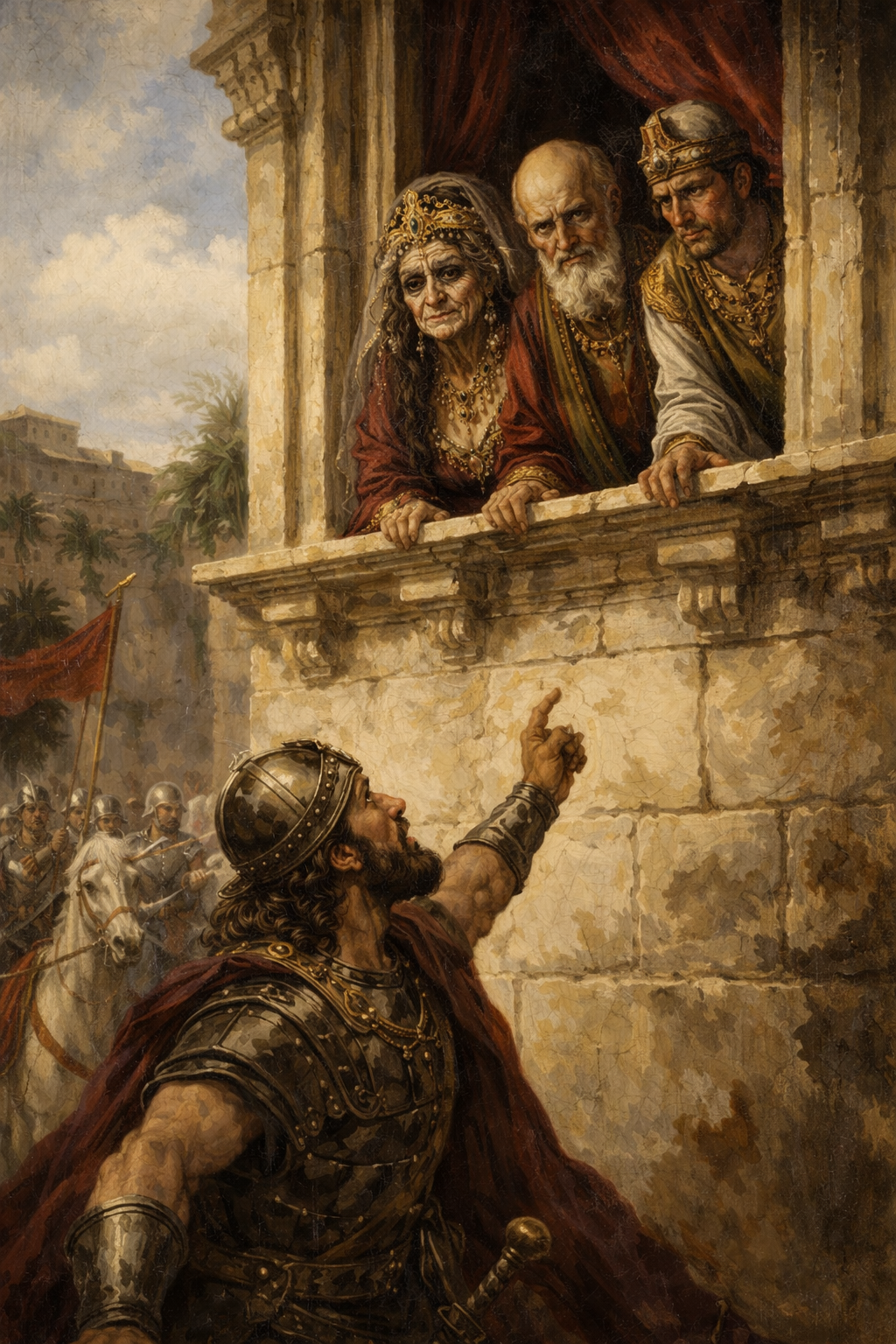
"Who is on my side? Who?'
A CALL FOR ALLEGIANCE
NEUTRALITY NOT AN OPTION
Then he lifted up his face to the window Jehu looks up not in fear, but as the one who is in command. Jezebel has positioned herself above him, looking down in defiance. While Jezebel tries to postures herself as queen, Jehu is showing he is king and will soon follow through on his authority.
and said, “Who is on my side? Who?” - Jehu does not attempt to negotiate or bargin but sharply, abruptly asks in effect are you for me or against me? It is his call for evidence of loyalty. There was no middle ground. Neutrality was no longer possible. Notice Jehu does not say “Who supports Jezebel?” but “Who is on my side?” Jehu's question is about allegiance.
And two or three officials looked down at him - Nothing is said. They certainly do not come to Jezebel's defense. The implication is clearly that they are with Jehu not Jezebel, and this is affirmed by their response to Jehu's command. Note what I would call "righteous irony," for this evil woman was guilt of silencing prophets, intimidating servants and manipulating loyalty through fear. Now as her end draws nigh, no one speaks for her, no one defends her and those who once served her now abandon her without a word!
2 Kings 9:33 He said, “Throw her down.” So they threw her down, and some of her blood was sprinkled on the wall and on the horses, and he trampled her under foot.
- Throw her down: 1Ki 21:11
- he trampled her under foot.: 2Ki 9:26 7:20 Isa 25:10 La 1:15 Mic 7:10 Mal 4:3 Mt 5:13 Heb 10:29
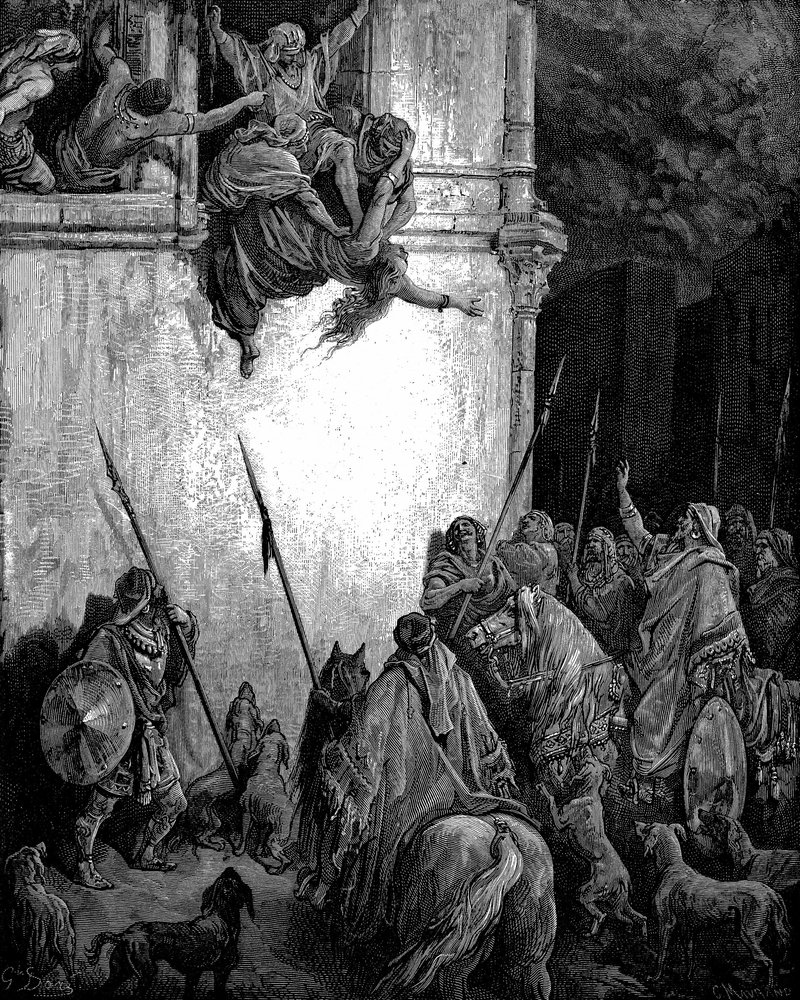
Dore Woodcut
JEZ THROWN DOWN
TRAMPLED DOWN
He said, “Throw her down.” - No trial. No debate. No delay. In the Septuagint the verb for throw is in the aorist imperative which means JUST DO IT! The trial had concluded and the Lord's verdict was guilty as charged.
So they threw her down - The evil Jezebel had manipulated others all her life and now other decide her fate.
Bob Utley Some of Jezebel's close servants cast her out the window. Verses 33 and 35 are eyewitness details.
And some of her blood was sprinkled on the wall and on the horses - The imagery is deliberate, for the was was the seat of royal power but it is stained. Similarly the horses were instruments of state authority and they too are stained with her blood. The blood spattered in visible places declares that her rule has ended in judgment, not honor.
This fulfills Elijah’s prophecy that Jezebel’s end would be public and humiliating, not quiet or dignified (1 Ki 21:23).
Those who refuse to bow to God will eventually
be brought low before Him.
And he trampled her under foot - In the ancient world, trampling signified absolute conquest and disgrace. The woman who exalted herself against the LORD is now brought lower than the ground.
TAKEAWAY - This is lex talionis (measured justice), not excess. The punishment fits the crime in scope, symbolism, and severity.
2 Kings 9:34 When he came in, he ate and drank; and he said, “See now to this cursed woman and bury her, for she is a king’s daughter.”
- he ate and drank: 1Ki 18:41 Es 3:15 Am 6:4
- this cursed woman: 1Ki 21:25 Pr 10:7 Isa 65:15 Mt 25:41
- she is a king's: 1Ki 16:31
Related Passages:
1 Kings 16:31 It came about, as though it had been a trivial thing for him to walk in the sins of Jeroboam the son of Nebat, that he married Jezebel the daughter of Ethbaal king of the Sidonians, and went to serve Baal and worshiped him.
WHILE THE KING FEASTS
THE DOGS FEAST ON THE QUEEN
When he came in, he ate and drank - Jehu is something else. He still has an apetite after seeing Jezebel's blood splattered on the wall and horses. Again we see the providential timing of God. So while Jehu ate, so did the dogs unbeknownst to him! God so orchestrated these events that His prophecy through Elijah would be perfectly fulfilled.
and he said, “See now to this cursed woman and bury her, for she is a king’s daughter - Jehu felt that as a king's daughter (1 Kings 16:31), Jezebel deserved to be buried
2 Kings 9:35 They went to bury her, but they found nothing more of her than the skull and the feet and the palms of her hands.
- but they found: Job 31:3 Ec 6:3 Isa 14:18-20 Jer 22:19 36:30 Ac 12:23
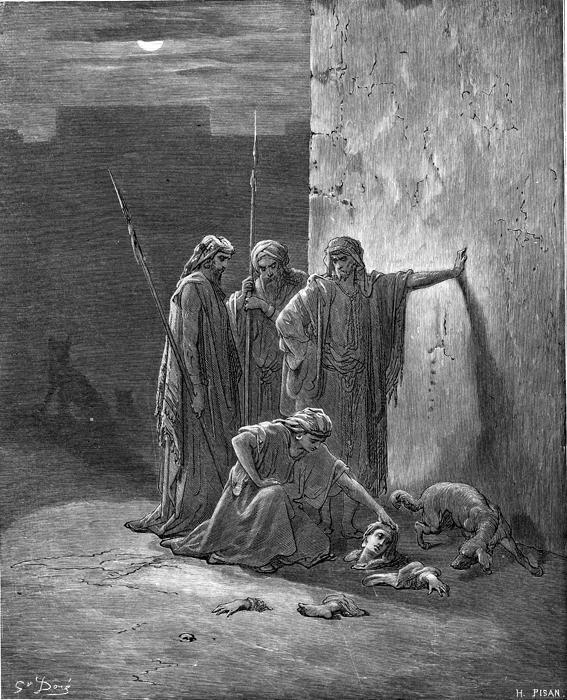
Remains of Jezebel
JEZEBEL NOTHING
LEFT BUT SCRAPS
They went to bury her - After Jezebel’s violent death, there is a delayed attempt at burial (because of taking time to eat and drink). As they say it was "too little, too late."
But they found nothing more of her than the skull and the feet and the palms of her hands - There was no corpse to honor, only leftovers even the dogs did not want! The irony is cutting for all they found was her skull (head), a skull once crowned, once scheming, now reduced to bone. The seat of pride and plotting is stripped of honor. The feet that walked in defiance and persecution are left exposed—immobile and powerless. The hands that signed death warrants, manipulated courts, and enforced idolatry are emptied of all authority. Nothing remains of her beauty, power, or intimidation—only fragments that testify to what she once used against God and His people. That only parts remain shows that the prophecy was not poetic—it was literal and complete.
2 Kings 9:36 Therefore they returned and told him. And he said, “This is the word of the LORD, which He spoke by His servant Elijah the Tishbite, saying, ‘In the property of Jezreel the dogs shall eat the flesh of Jezebel;
- This is the word of the LORD: 1Ki 21:23
- by His servant Elijah the Tishbite 2Ki 14:25 Lev 8:36 2Sa 12:25
Related Passages:
1 Kings 21:23 (THIS FULFILLS ELIJAH'S PROPHECY) “Of Jezebel also has the LORD spoken, saying, ‘The dogs will eat Jezebel in the district of Jezreel.’
REPORT TO JEHU OF
JEZEBEL'S FATE
God's Word never fails. Isaish 55:10-11 says "For as the rain and the snow come down from heaven, and do not return there without watering the earth and making it bear and sprout, and furnishing seed to the sower and bread to the eater; so will My word be which goes forth from My mouth; It will not return to Me empty, without accomplishing what I desire, and without succeeding in the matter for which I sent it." A
Therefore they returned and told him. And he said, “This is the word of the LORD, which He spoke by His servant Elijah the Tishbite, saying, ‘In the property of Jezreel the dogs shall eat the flesh of Jezebel - Jehu had heard Elijah's prophecy and now he repeats it emphasizing that it is the Word of the LORD. Not only to God pick the place of her destruction, He orchestrated the fulfillment. Jezebel was denied what even common people hoped for which was a remembered grave. Dogs in the ancient world were scavengers, symbols of utter disgrace and public shame.
A life spent opposing God may end
without even a grave to mark it.
John Walton - devoured by dogs. Assyrian practices (especially Ashurbanipal) include leaving corpses in the street for dogs to devour (as well as pigs, jackals and birds). On one occasion the corpses were chopped up and fed to dogs. Treaty curses also included invoking this doom on rebels. The intention of this atrocity was typically to eliminate any possibility of proper burial and thus to doom the individual’s spirit to wander restlessly rather than enjoy a peaceful afterlife. Perhaps most interesting is the Akkadian text in the Maqlu collection of incantations that places a curse on a sorceress (see 2Ki 9:22) that dogs would tear her to pieces. For more information see comment on 1 Kings 16:4(SEE PAGE 397 The IVP Bible Background Commentary OT)
2 Kings 9:37 and the corpse of Jezebel will be as dung on the face of the field in the property of Jezreel, so they cannot say, “This is Jezebel.”’”
- the corpse: Ps 83:10 Ec 6:3 Isa 14:18-20 Jer 8:2 16:4 22:19 36:20 Eze 32:23-30
A FITTING END TO JEZEBEL
UTTER HUMILIATION
and the corpse of Jezebel will be as dung on the face of the field in the property of Jezreel - Jehu finishes quoting Elijah's entire prophecy. The comparison of her corpse to dung is intentionally offensive. Dung in Scripture represents worthlessness, uncleanness and what is discarded and forgotten. To say that Jezebel would become “as dung” means she died with no honor, no dignity and no residual value. The woman who exalted herself above prophets and kings is reduced to what people instinctively avoid and remove. This is reversal theology in its starkest form.
On the face of the field in the property of Jezreel - No tomb. No private burial. Her remains are left on the surface, visible and vulnerable. God’s judgment is not merely corrective—it is demonstrative. What Jezebel did in public wickedness is answered with public disgrace. How fitting for God's justice to be tied to this location, for Jezreel is where Naboth was murdered as conspired by Jezebel, where Ahab seized land by blood and where Elijah pronounced judgment! Now Jezebel’s end occurs on that same soil. The land once polluted by injustice becomes the stage for justice.
So they cannot say, “This is Jezebel - What does this mean? The phrase is chilling! Her identity is erased. There was no body, no grave, no monument. Not only was her life judge but so was her legacy. She wanted to be remembered as queen. God ensures she is remembered only as a warning.
David Guzik points out that despite this "good start" - Yet as the house of Jehu became corrupt, it also would face judgment. Hosea 1:4 speaks of judgment to come upon the house of Jehu: I will avenge the bloodshed of Jezreel on the house of Jehu, and bring an end to the kingdom of the house of Israel.