Jeremiah 28:2
Jeremiah 28:3
Jeremiah 28:4
Jeremiah 28:5
Jeremiah 28:6
Jeremiah 28:7
Jeremiah 28:8
Jeremiah 28:9
Jeremiah 28:10
Jeremiah 28:11
Jeremiah 28:12
Jeremiah 28:13
Jeremiah 28:14
Jeremiah 28:15
Jeremiah 28:16
Jeremiah 28:17
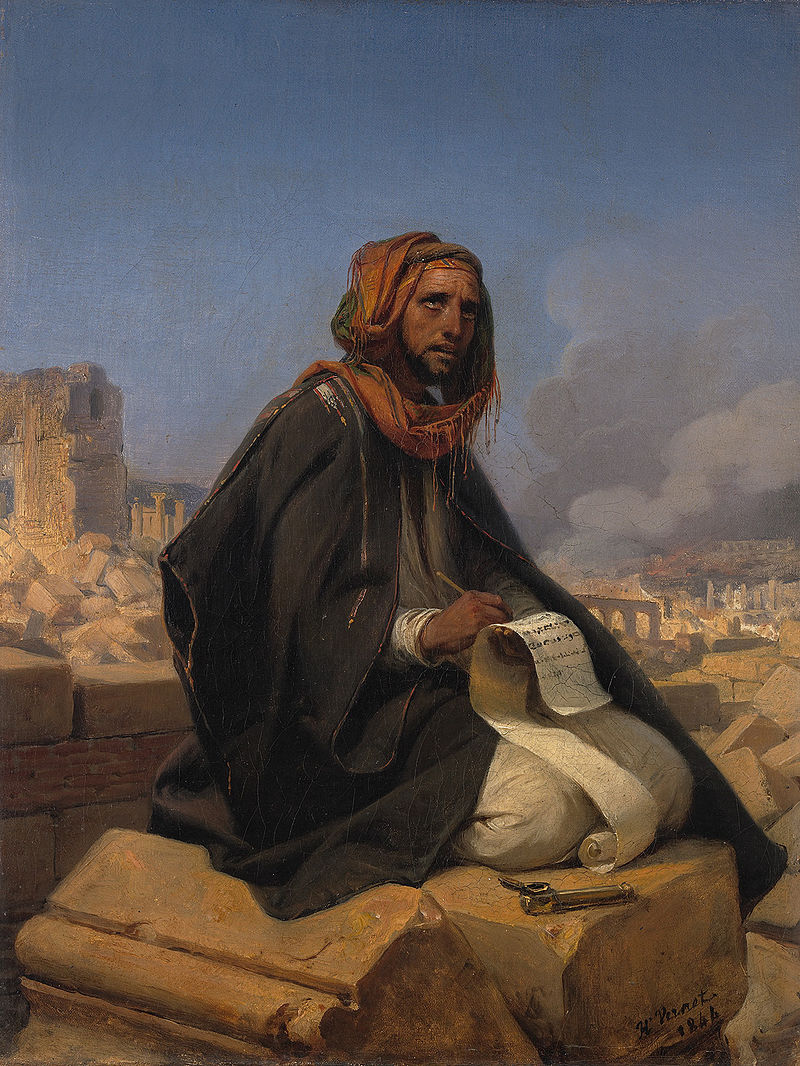
"Jeremiah on the Ruins of Jerusalem"
(Horace Vernet, 1844)
'For I know the plans that I have for you,' declares the LORD,
'plans for welfare and not for calamity to give you a future and a hope.
-- Jeremiah 29:11
(Play beautiful related song by Marty Goetz and Misha)
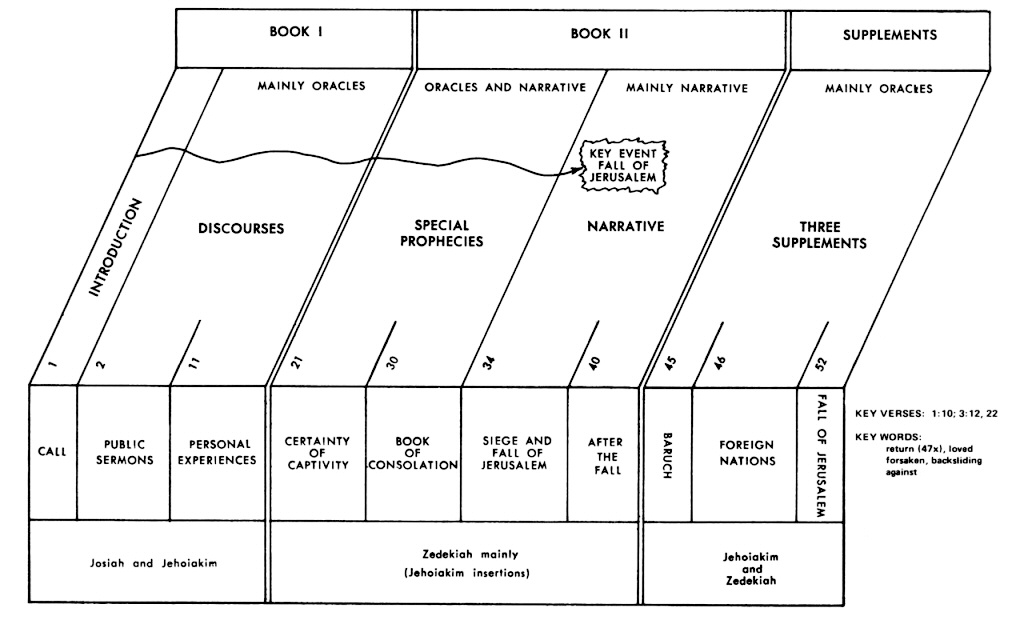
Click chart to enlarge
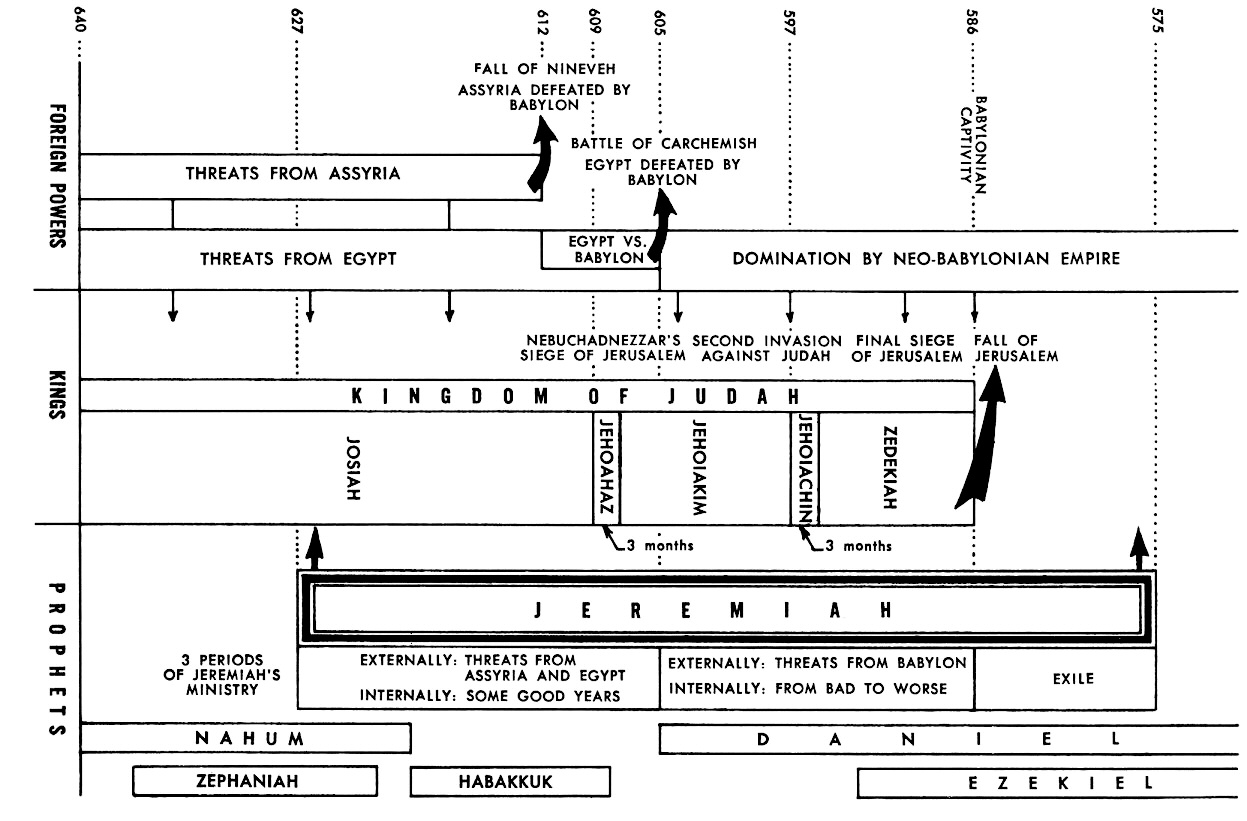
Click chart to enlarge
Chart from recommended resource Jensen's Survey of the OT - used by permission
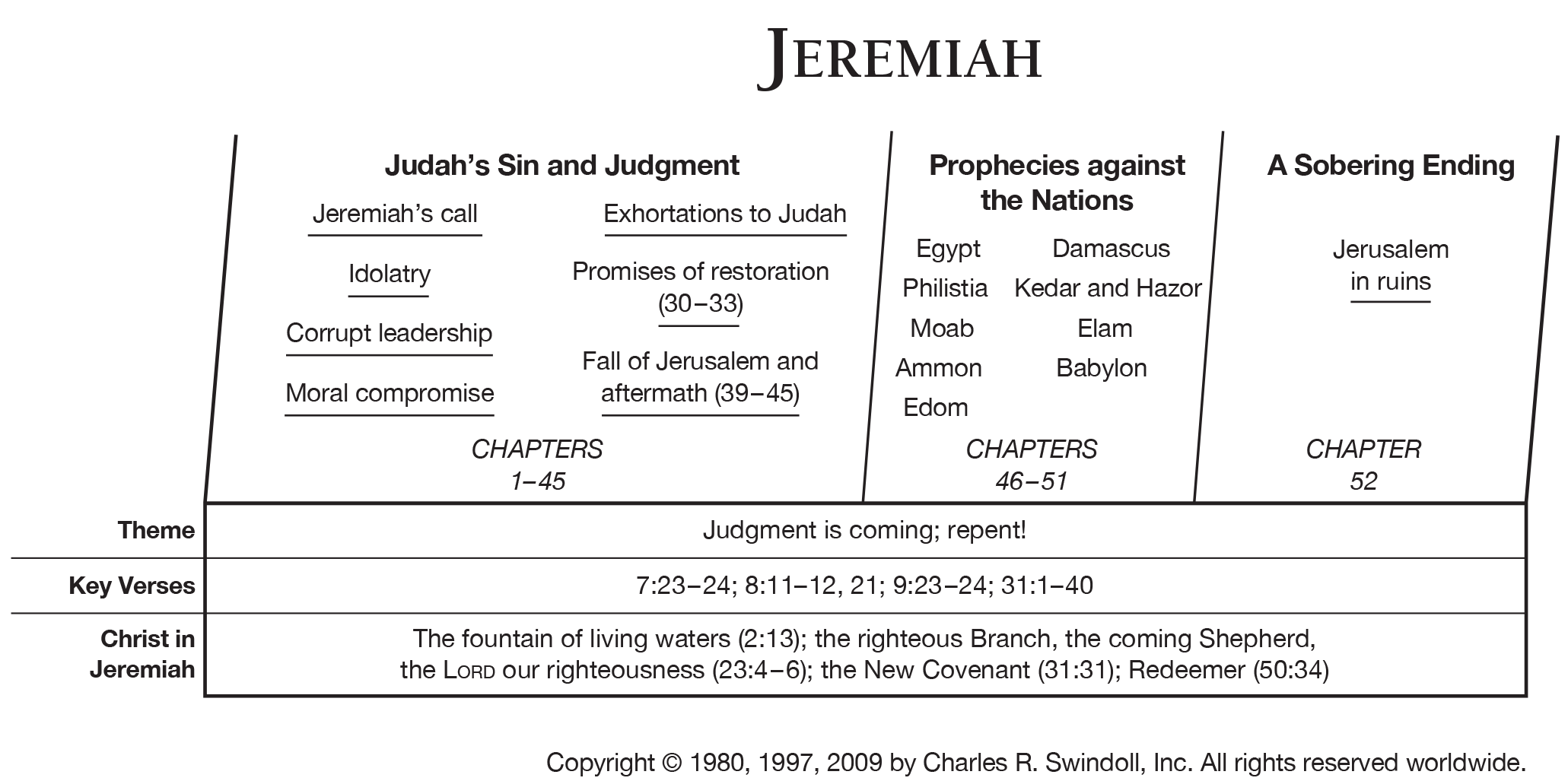
Jeremiah Chart from Charles Swindoll
| JEREMIAH: "PROPHET TO THE NATIONS" Sin - "I Will Punish" (Jer 9:25) Hope - "I Will Restore" (Jer 30:17) Judah & Jerusalem |
||||||
|
Prophet |
Prophecies to Judah Jer 2:1-45:5 |
Prophecies to the Gentiles Jer 46:1-51:64 |
Prophet's Appendix Jer 52:1-52:34 |
|||
| Prophet's Commission Jer 1:1-19 |
Judah Condemned Jer 2:1-25:38 |
Jeremiah's Conflicts Jer 26:1-29:32 |
Jerusalem's Future Jer 30:1-33:26 |
Jerusalem's Fall Jer 34:1-45:5 |
Nations Condemned Jer 46:1-51:64 |
Historic Conclusion Jer 52:1-52:34 |
| Before The Fall Of Jerusalem Jer 1:1-38:28 |
The Fall Jer 39:1-18 |
After The Fall |
||||
| Call | Ministry | Retrospect | ||||
| Nation of Judah |
Surrounding Nations |
Future of Babylon |
||||
| 627-582 BC Ministered 40+ Years! |
||||||
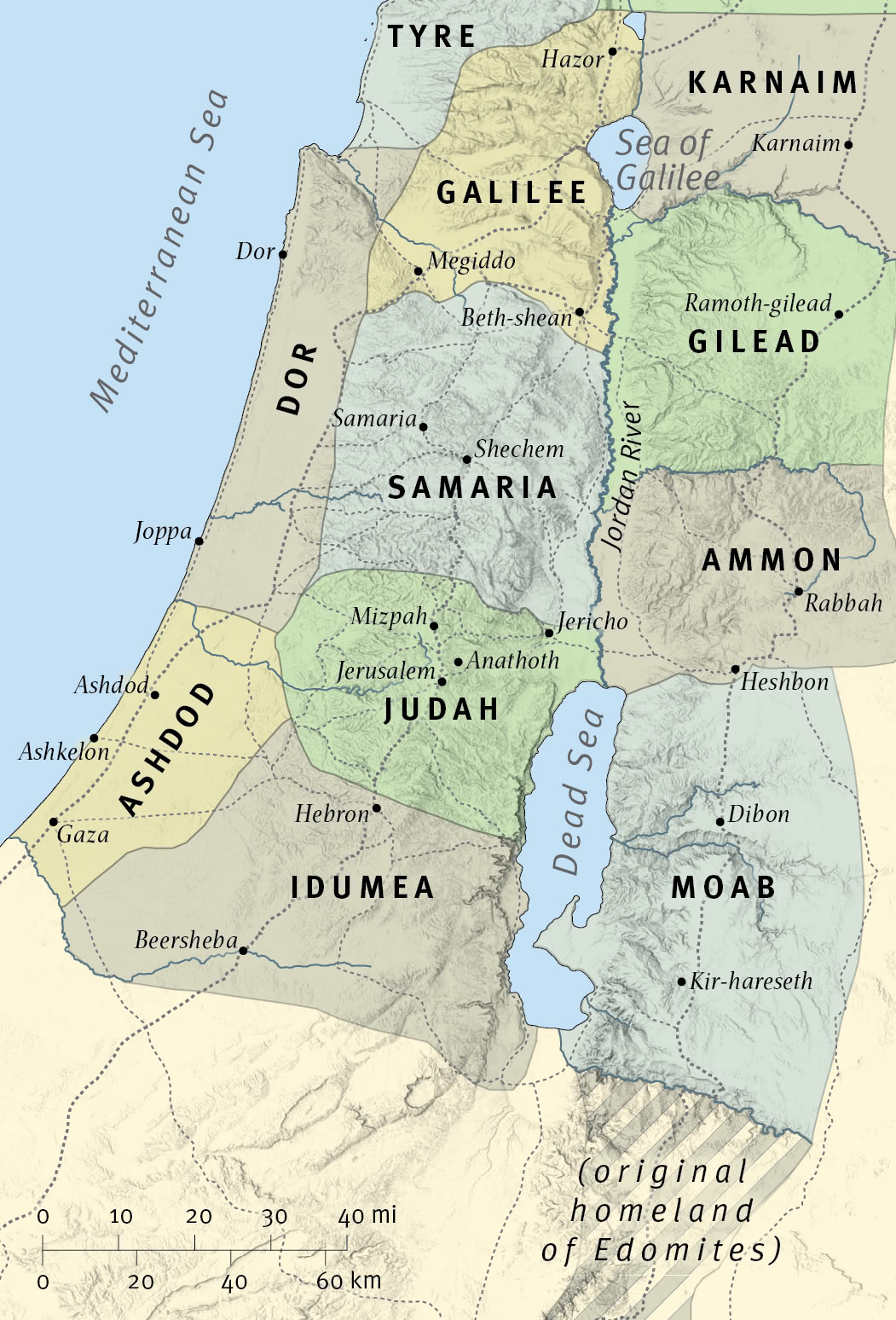
Map of Israel at Time of Jeremiah
Source: ESV Global Study Bible

Source: ESV Global Study Bible
Jeremiah 28:1 Now in the same year, in the beginning of the reign of Zedekiah king of Judah, in the fourth year, in the fifth month, Hananiah the son of Azzur, the prophet, who was from Gibeon, spoke to me in the house of the LORD in the presence of the priests and all the people, saying,
NET The following events occurred in that same year, early in the reign of King Zedekiah of Judah. To be more precise, it was the fifth month of the fourth year of his reign. The prophet Hananiah son of Azzur, who was from Gibeon, spoke to Jeremiah in the LORD's temple in the presence of the priests and all the people.
NLT Jeremiah 28:1 One day in late summer of that same year-- the fourth year of the reign of Zedekiah, king of Judah-- Hananiah son of Azzur, a prophet from Gibeon, addressed me publicly in the Temple while all the priests and people listened. He said,
- the same: Jer 27:1
- Hananiah: Jer 28:11 36:12 37:13
- the prophet: Jer 23:28 Isa 9:15 Zec 13:2-4
PUBLIC CONFRONTATION
IN THE TEMPLE
Now in the same year - There are two time sensitive words "now" and "same year," begging the question what year? In context this is the same year that Jeremiah addressed the three groups in chapter 27, the foreign messengers or envoys (Jer 27:1-11), King Zedekiah (Jer 27:12-15) and the priests and the people (Jer 27:16-22). He warned them about the deception and false promises of the false prophets. Now, he will have a face to face encounter with one named false prophet.
In the beginning (cf Jer 27:1) of the reign of Zedekiah king of Judah, in the fourth year, in the fifth month - This phrase helps nail down the date as Aug.-Sept. 593 B.C. Zedekiah had been placed on the throne by Nebuchadnezzar in 597 BC after Jeconiah was taken captive to Babylon. Remember that the last King that was in the line of David, the line of Messiah, was Jeconiah. Zedekiah was the last king of Judah but was not in the line of the Messiah.
Hananiah the son of Azzur, the prophet, who was from Gibeon - The NAS reading might suggest that Hananiah's father Azzur was a prophet, but other versions clarify that it was Hananiah who was the prophet. Thus the NET reads "The prophet Hananiah son of Azzur." Gibeon was in the tribe of Benjamin and lay about 6 miles northwest of Jerusalem. Recall that it was the original Gibeonites who had deceived Joshua into making a treaty with them (Josh 9:1-15) and it was at Gibeon that Joab killed Amasa (2Sa 20:8-10). Perhaps there was something in the water at Gibeon that led Hananiah to become a deceiver of the people of Judah! (Just jesting).
It is interesting tha the Septuagint translate prophet with pseudoprophetes, the Greek noun for false prophet.
Spoke to me in the house of the LORD in the presence of the priests and all the people, saying - Place yourself in the "bleacher seats" for this spiritual fight of the ages, in one corner was Jeremiah who spoke truth and in the other corner was Hananiah, who spoke lies. So while Azzur was Hananiah's earthly father, his spiritual father was the devil, for Jesus taught the unbelieving Jews "You are of your father the devil, and you want to do the desires of your father. He was a murderer from the beginning, and does not stand in the truth because there is no truth in him. Whenever he speaks a lie, he speaks from his own nature, for he is a liar and the father of lies." (Jn 8:44) Like father, like son! So we have a classic battle of truth versus lies, light versus darkness.
Bob Utley - Gibeon" This was a Levite city (Josh. 21:17). Both of these "prophets" have the same credentials. Jeremiah was from a city of priests and both are called "the prophet" (cf. Jer. 28:5). Both use the same introductory formula, "Thus says the Lord of hosts, the God of Israel" (Jer. 28:2; 27:4,21).
How does the hearer know which to believe? This is a relevant question for believers in every age. I have several suggestions.
- my exegetical notes on
- Deut. 13:3 (second item)
- Deut. 18:20-22
- SPECIAL TOPIC: FALSE TEACHERS
Parunak: Every old-time western, at some point or another, shows two gunslingers facing one another on the main street of town as they are about to “shoot it out” to settle some question or disagreement. The duel is an ancient form of trial, leaving the decision in the hands of God. This chapter in Jer reports such a duel, not between cowboys, but between two men who claim to be prophets: Jer and Hananiah. The question is, which of them actually represents the Lord? How can God’s people know which to believe? There is a tremendous temptation for spiritual messengers to proclaim a message of peace and safety when the reality is that God’s judgment is coming. The Apostle Paul pointed to his commitment to proclaiming the whole counsel of God as one of the verifiable signs of his legitimate apostleship. We can never sugar-coat God’s message to try to make it more palatable or appealing. We must faithfully communicate what God has revealed.
Jeremiah 28:2 “Thus says the LORD of hosts, the God of Israel, ‘I have broken the yoke of the king of Babylon.
- I: Jer 27:2-12 Eze 13:5-16 Mic 3:11
HANANIAH'S
FIRST LIE
Thus says the LORD of hosts, the God of Israel, ‘I have broken the yoke ('ol; LXX - zugos or zygos) of the king of Babylon - Notice first that Hananiah was guilty of blasphemy for using Yahweh's great Name Jehovah Sabaoth, LORD of hosts or of armies to authenticate his false prophecy. This ruse is quite clever for undoubtedly Hananiah had heard Jeremiah prophesy and noted that Jeremiah very frequently introduced his prophecies with this specific name of Yahweh. And so Hananiah seeks to deceive the priests and the people by claiming the same Name is the Source of what he was predicting.
Bob Utley - "I have broken the yoke" The TENSE in Hebrew (Qal PERFECT) speaks of the act as already accomplished. (ED: TALK ABOUT DECEPTION! I AM REMINDED OF 2Ti 3:13 But evil men and impostors will proceed from bad to worse, deceiving [AS HANANIAH WAS DOING] and being deceived [AS WAS LIKELY HAPPENING TO HANANIAH BELEIVING HIS OWN LIE!]).
While we cannot be absolutely certain, Jeremiah appears to be standing before Hananiah with the yoke still on his neck (but Hananiah's action in Jer 28:10 supports that Jeremiah was wearing the yoke). If so, this becomes a direct and public assault on Jeremiah’s credibility and truthfulness. Rather than merely attacking him with words, Hananiah targets the very symbol of Jeremiah’s message, the yoke itself, striking at the heart of his prophetic authority. In effect, instead of "going for the jugular" in a verbal confrontation, Hananiah goes for the yoke on Jeremiah’s neck, attempting to visibly discredit both the prophet and the word he proclaimed.
Jehovah Sabaoth, LORD of hosts or of armies (angelic and earthly) is used more in the book of Jeremiah then in any other book of the Bible and most of the uses were by the prophet himself beginning his prophecy with "Thus says the LORD of hosts..." Approximate count for Jeremiah is ~80+ times (depending on translation and counting method) which is far more than any other single book. The next closest are also by major prophets - Book of Isaiah ~60+ times and Book of Zechariah ~50+ times
Jeremiah’s heavy use of this great Name is surely not accidental because it fits his message. Judah is facing military invasion (Babylon) and Yahweh repeatedly reminds them that He is not a local deity but is in fact the Commander of all heavenly and earthly armies, thus emphasizing His absolute sovereignty over the nations, His sovereign right to judge and to restore and His control over even the great king Nebuchadnezzar!
USES IN JEREMIAH - Jer. 6:6; Jer. 6:9; Jer. 7:3; Jer. 7:21; Jer. 8:3; Jer. 9:7; Jer. 9:15; Jer. 9:17; Jer. 10:16; Jer. 11:17; Jer. 11:20; Jer. 11:22; Jer. 16:9; Jer. 19:3; Jer. 19:11; Jer. 19:15; Jer. 20:12; Jer. 23:15; Jer. 23:16; Jer. 23:36; Jer. 25:8; Jer. 25:27; Jer. 25:28; Jer. 25:29; Jer. 25:32; Jer. 26:18; Jer. 27:4; Jer. 27:18; Jer. 27:19; Jer. 27:21; Jer. 28:2; Jer. 28:14; Jer. 29:4; Jer. 29:8; Jer. 29:17; Jer. 29:21; Jer. 29:25; Jer. 30:8; Jer. 31:23; Jer. 31:35; Jer. 32:14; Jer. 32:15; Jer. 32:18; Jer. 33:11; Jer. 33:12; Jer. 35:13; Jer. 35:18; Jer. 35:19; Jer. 39:16; Jer. 42:15; Jer. 42:18; Jer. 43:10; Jer. 44:2; Jer. 44:11; Jer. 44:25; Jer. 46:18; Jer. 46:25; Jer. 48:1; Jer. 48:15; Jer. 49:7; Jer. 49:26; Jer. 49:35; Jer. 50:18; Jer. 50:33; Jer. 50:34; Jer. 51:5; Jer. 51:14; Jer. 51:19; Jer. 51:33; Jer. 51:57; Jer. 51:58
I have broken the yoke ('ol) of the king of Babylon - Hananiah was falsely claiming to speak for God, announcing that the Lord had ended Babylon’s domination over Judah. The phrase “the yoke of the king of Babylon” symbolized the political and military control that Babylon, under King Nebuchadnezzar, exercised over Judah and other nations.
Notice how Hananiah, like all false prophets, coats his lie with a thin layer of truth. He invokes the Name “LORD of hosts,” which is indeed Yahweh’s true title, and he rightly describes Nebuchadnezzar’s dominance over Judah as a “yoke.” Yet this mixture of truth and error is the classic strategy of false teachers. They understand, as Satan did in the garden, that a measure of truth gains a hearing and lowers discernment, creating an opening to introduce deception. Even Satan’s words contained an element of truth “your eyes will be opened” (Genesis 3:5) but the overall message led to ruin.
Like father, like son, so here Hananiah, sprinkles truth as bait to deliver deadly error (deadly because of what Jeremiah had warned - Jer 27:10, 15). Peter warns his NT readers of this danger the Jews had experienced in the Old Testament....
But false prophets (LIKE HANANIAH) also arose among the people, just as there will also be false teachers among you, who will secretly introduce (see definition of pareisago) destructive heresies, even denying the Master who bought them, bringing swift destruction upon themselves. 2 Many will follow their sensuality, and because of them the way of the truth will be maligned; 3 and in their greed they will exploit you with false (see definition of plastos) words; their judgment from long ago is not idle, and their destruction is not asleep. (2Pe 2:1-3)
John Mackay: Who was really relaying the message of the Lord? How could the people tell? Indeed, a first glance at the two protagonists might well seem to favour Hananiah as the more creditable party. He was a respectable figure with the support of the most influential circles in the land, whereas Jeremiah was an outsider, an eccentric, and dressed with a yoke around his neck so that it was difficult not to question his sanity as well as his orthodoxy. It was not easy for the people to determine where the truth of the matter lay in this classic confrontation of prophet against prophet. In the end the Lord intervened directly to provide conclusive verification of Jeremiah’s status and to punish the impostor Hananiah; but even then the people were not prepared to listen. (Jeremiah: Chapters 21-52)
Tremper Longman: Jeremiah knows that prophets are typically not in the business of bringing exclusively good news. After all, they are covenant lawyers, that is, they are the ones God sends to his people when they have broken their covenantal obligations and run the risk of bringing the \curses of the covenant on themselves. It is true that prophets do speak words of hope. Even Jeremiah himself has words of restoration (see chapters 30- 33). However, the difference is that this hope follows judgment and repentance. (See Jeremiah, Lamentations - Understanding the Bible Commentary)
Yoke (05923) 'ol is a masculine noun which literally describes a wooden frame or a bar placed on the neck of work animals to harness them for labor (Nu 19:2, Dt 28:48, 1Sa 6:7). As used in this passage, 'ol was frequently used as a symbol for slavery or enslavement. It also conveyed the picture of something that oppressed or was a burden. For example, in Lamentations 1:14 transgressions were described as the "yoke" that enslaved! Woe! Is this not what the old sin nature does to all of us (even believers if we fail to walk in the light and the power of the Spirit!)! Note that the majority of the OT uses are in the book of Jeremiah.
NET Note - The yoke is a common biblical symbol of political servitude (see, e.g., Dt 28:48; 1Kgs 12:4, 9, 10). From the context of 1Kgs 12:1-33 it is clear that it applied to taxation and the provision of conscript labor. In international political contexts it involved the payment of heavy tribute which was often conscripted from the citizens (see, e.g., 2Ki 15:19–20; 23:34–35) and the furnishing of military contingents for the sovereign’s armies (see, e.g., 2Ki 24:2). Jeremiah’s message here combines both a symbolic action (the wearing of a yoke) and words of explanation as in Jer 19:1–13. (See Isa 20:1–6 for an example outside of Jeremiah.) The casting off of the yoke has been used earlier in Jer 2:20, 5:5 to refer to Israel’s failure to remain spiritually “subject” or faithful to God.
Jeremiah 28:3 ‘Within two years I am going to bring back to this place all the vessels of the LORD’S house, which Nebuchadnezzar king of Babylon took away from this place and carried to Babylon.
- two years: Heb. two years of days, Ge 47:9,28 Ps 90:10
- all the: Jer 27:16-22
- that: 2Ki 24:13 2Ch 36:10 Da 1:2
Related Passage:
Jeremiah 27:16-22 (JEREMIAH'S PROPHECY) Then I spoke to the priests and to all this people, saying, “Thus says the LORD: Do not listen to the words of your prophets who prophesy to you, saying, ‘Behold, the vessels of the LORD’S house will now shortly be brought again from Babylon’; for they are prophesying a lie to you. 17“Do not listen to them; serve the king of Babylon, and live! Why should this city become a ruin? 18“But if they are prophets, and if the word of the LORD is with them, let them now entreat the LORD of hosts that the vessels which are left in the house of the LORD, in the house of the king of Judah and in Jerusalem may not go to Babylon. 19 “For thus says the LORD of hosts concerning the pillars, concerning the sea, concerning the stands and concerning the rest of the vessels that are left in this city, 20 which Nebuchadnezzar king of Babylon did not take when he carried into exile Jeconiah the son of Jehoiakim, king of Judah, from Jerusalem to Babylon, and all the nobles of Judah and Jerusalem. 21“ Yes, thus says the LORD of hosts, the God of Israel, concerning the vessels that are left in the house of the LORD and in the house of the king of Judah and in Jerusalem, 22 ‘They will be carried to Babylon and they will be there until the day I visit them,’ declares the LORD. ‘Then I will bring them back and restore them to this place.’”
Jeremiah 25:11-12 ‘This whole land will be a desolation and a horror, and these nations will serve the king of Babylon seventy years. 12 ‘Then it will be when seventy years are completed I will punish the king of Babylon and that nation,’ declares the LORD, ‘for their iniquity, and the land of the Chaldeans; and I will make it an everlasting desolation.
Jeremiah 29:10 “For thus says the LORD, ‘When seventy years have been completed for Babylon, I will visit you and fulfill My good word to you, to bring you back to this place.
THE SPECIFICS
OF HIS LIE
Within two years I am going to bring back to this place all the vessels of the LORD’S house, which Nebuchadnezzar king of Babylon took away from this place and carried to Babylon - Hananiah’s message sounded hopeful and patriotic, but it directly contradicted Jeremiah’s earlier prophecy (Jer 27:16–22). Both prophets appealed to Yahweh as their source, yet only one could be speaking the truth. Jeremiah had clearly declared that Judah’s exile in Babylon would last seventy years, not two (Jer 25:11–12). While Jeremiah did indeed foretell that the vessels of the Temple would one day be restored, that restoration would come only after the full seventy years had been completed, not within a short two-year span. Moreover, Hananiah’s phrase “to this place” subtly suggested that Jerusalem and the Temple would remain intact, but this too would prove false, for the Temple itself would be destroyed by Babylon in 586 BC.
In summary, Hananiah’s prophecy was therefore a deliberate deception, designed to give the people false comfort while undermining Jeremiah’s call for repentance and submission to God’s discipline. The vessels of the LORD’s house symbolized His presence and favor, and their removal signified divine judgment on Judah for its persistent sin and idolatry. By promising their swift return, Hananiah was effectively denying both the seriousness of Judah’s sin and the justice of God’s judgment.
Bob Utley - 28:3-4 "vessels. . .Jeconiah. . .exiles of Judah. . .in two years" This prophecy was very specific and detailed. It spoke to the nationalistic prejudice of the Judean people. It was a repudiation of Jeremiah's sermon in Jeremiah 17. The people of Judah's reaction to this sermon is recorded in Jer. 26.
Jeremiah 28:4 ‘I am also going to bring back to this place Jeconiah the son of Jehoiakim, king of Judah, and all the exiles of Judah who went to Babylon,’ declares the LORD, ‘for I will break the yoke of the king of Babylon.’”
- Jeconiah: Jer 22:24,28, Coniah, Jer 24:1 52:31-34 2Ki 25:27-30, Jehoiachin
- and all the exiles of Judah Jer 24:5
- I will break: Jer 28:2,10 2:20 30:8 Ge 27:40 Isa 9:4 Na 1:13
ANOTHER ADDS
MORE LIES
I am also going to bring back to this place Jeconiah the son of Jehoiakim, king of Judah - There are 3 more lies in this passage. Lie #1 is I am also going to bring back Jeconiah which was, without question, welcome news to the people, who regarded Zedekiah as little more than Nebuchadnezzar’s deputy. Hananiah appears to have been motivated more by a desire for popular approval than for royal favor, since such a prediction would hardly have pleased Zedekiah. Yet Zedekiah himself was both weak and wicked, and consequently was widely despised.
Hananiah refutes Jeremiah’s prophecy that Jeconiah would die in Babylon (Jer 22:24-27; cf. Jer 52:31-34).
and all the exiles of Judah who went to Babylon,’ declares the LORD - Lie #2 is that God would bring back all the exiles. Even when the exiles did return after 70 years, the majority of the exiles remained in Babylon.
For I will break the yoke ('ol; LXX - zugos or zygos) of the king of Babylon - Lie #3 is the that Yahweh would destroy the power of Nebuchadnezzar. This was true but it would not occur until the end of the 70 years of exile. The “yoke of the king of Babylon” symbolized God’s judgment upon Judah for its rebellion and idolatry. Jeremiah had even worn a wooden yoke as a prophetic sign to show that Judah must submit to Babylon as part of God’s discipline (Jeremiah 27:2–8). By claiming that God would “break the yoke,” Hananiah was rejecting God’s plan and encouraging the people to resist His will.
In summary, Hananiah's message on the surface sounded very encouraging for it held out the promise of freedom, restoration, and a swift end to Babylonian oppression. To a people weary of subjugation and longing for relief, such words would have resonated with powerful emotional appeal (false prophets typically appeal to people's emotions), stirring hopes of immediate deliverance and a return to former glory. Yet this apparent encouragement was clearly misleading, for it offered comfort without repentance and hope without submission to God’s revealed will, thereby lulling the people into a false sense of security rather than leading them to the path of genuine restoration.
Jeremiah 28:5 Then the prophet Jeremiah spoke to the prophet Hananiah in the presence of the priests and in the presence of all the people who were standing in the house of the LORD,
- the house: Jer 28:1 7:2 19:14 26:2
JEREMIAH'S
REBUTTAL
Then - When? After Hananiah had spoken lies and given false hope to the hearers.
The prophet Jeremiah spoke to the prophet Hananiah in the presence of the priests and in the presence of all the people who were standing in the house of the LORD - This confrontation unfolds publicly on the Temple grounds, not in private, underscoring the seriousness of the issue and the need for truth to be declared openly before God’s people. Jeremiah directly addresses Hananiah, the false prophet, setting the true word of the LORD against a deceptive message in the very place that symbolized God’s presence. The setting heightens the tension, for what is at stake is not merely a difference of opinion, but the authority of God’s word versus a lie that threatens to mislead an entire nation.
Jeremiah 28:6 and the prophet Jeremiah said, “Amen! May the LORD do so; may the LORD confirm your words which you have prophesied to bring back the vessels of the LORD’S house and all the exiles, from Babylon to this place.
- Amen: Nu 5:22 De 27:15-26 1Ki 1:36 1Ch 16:36 Ps 41:13 72:19 89:52 Ps 106:48 Mt 6:13 28:20 1Co 14:16 2Co 1:20 Rev 1:18 3:14 5:14 Rev 19:4 22:20,21
- may the LORD confirm your words Jer 28:3 11:5 17:16 18:20
JEREMIAH SAYS
"AMEN"
and the prophet Jeremiah said, “Amen! (amen) - Jeremiah’s Amen was not an affirmation of Hananiah’s prophecy, but an expression of longing, as if to say, “If only that were true.”
Bob Utley - "Amen" Jeremiah wished Hananiah's message was true, but it was not!
Parunak: Once again the compassion of Jer is an example for us. He longs for the wellbeing of his people even as he predicts their suffering. He would personally prefer the outcome presented by the false prophet; his message come, not from his own personal desires, but from the Lord. It is important for us to communicate this to those with whom we deal. It can help us to emphasize that we do not speak of our own initiative.
May the LORD do so; may the LORD confirm your words which you have prophesied to bring back the vessels of the LORD’S house and all the exiles, from Babylon to this place. - At first glance, Jeremiah’s response may sound like agreement, but in reality it is a deeply ironic and carefully measured reply. He is not endorsing Hananiah’s message; rather, he is expressing a genuine wish that such a restoration might occur, even while knowing it would not, because the LORD had already revealed otherwise. Jeremiah’s wish that Hananiah’s words might come true reveals the compassion of a prophet who genuinely loved his nation, yet his unwavering commitment to God’s revealed truth demonstrates his integrity as a faithful servant of the LORD.
In summary, when Jeremiah said, “Amen! May the LORD do so,” he was not agreeing with Hananiah’s false prophecy, but expressing a heartfelt desire for peace while remaining firmly anchored in God’s revealed truth. His response shows that genuine faith does not deny reality, but trusts God’s word even when it brings hardship. Jeremiah’s example calls believers to hold truth and love together—longing for mercy, yet never compromising the message God has spoken.
Philip Ryken: Sometimes when people hear Christians peak about divine judgment they get the wrong idea. We Christians do speak about divine judgment – Hell and all the rest of it. We explain that every sin deserves the wrath and curse of God. We teach that sin leads to death. We testify that God has reserved a place of endless torment for everyone who refuses to repent of his sins. But Christians do not talk about God’s judgment because they enjoy it. The only reason we teach these things is because the Lord Jesus Christ himself teaches them in the Bible. (See Jeremiah and Lamentations: From Sorrow to Hope)
F B Meyer - Jeremiah 28:6–7
Amen: the Lord do so: the Lord perform thy words.… Nevertheless.
The prophecy of Hananiah of the speedy return of the exiles and the break-up of the power of the king of Babylon was evidently dictated by a desire to win popularity with the people. He spoke in the name of Jehovah, and may even have supposed that his message was divinely given; but his soul was filled with human voices and reasonings, which made him unable to distinguish the still small voice of inspiration. Jeremiah was quite as anxious as he was that his country should be spared further suffering. He uttered a fervent Amen to Hananiah’s predictions. Nothing could have given him deeper pleasure than their realization; but standing as he did in the counsels of God, he knew it could not be.
So is it still. Men who follow simply their own thoughts, or are deeply dyed with the spirit of society around, are apt to prophesy smooth things to such as live selfish and worldly lives “There is no such place as the outer darkness; no such experience as the second death.” So they speak. But we know it cannot be. Earnestly as we might wish for it, and say Amen, we know, nevertheless, that it cannot be immaterial how men live, and that wickedness must bring infinite anguish and pain. How terrible will their position be at last, who cried Peace, Peace, when there was none, and encouraged rebellion against the Lord.
There are false prophets still who encourage men in their evil ways, as they paint roseate views of the future, and encourage them to believe that though they sin, the future will not be so dark as they have been led to fear. Hard as it will be for all who perish out of Christ, for these there will be an additional anguish. See Matthew 5:19.
Jeremiah 28:7 “Yet hear now this word which I am about to speak in your hearing and in the hearing of all the people!
- 1Ki 22:28
JEREMIAH NOW SPEAKS
THE WORD OF THE LORD
Yet hear now this word which I am about to speak in your hearing and in the hearing of all the people - Jeremiah is calling for the people to listen carefully to the true message from God, not the comforting but deceptive words of Hananiah. In essence, Jeremiah was saying, “Listen carefully, because what I am about to say is from the LORD, and all of you are witnesses.” His words carry the weight of solemn testimony, calling the priests and the people alike to attentive hearing and accountability. This is not casual speech or personal opinion, but a declaration of divine authority, delivered in a public setting where it can be examined, remembered, and ultimately verified. By invoking their role as witnesses, Jeremiah underscores that they will be responsible for how they respond to the word of the LORD, whether in belief and obedience or in rejection and unbelief.
Jeremiah 28:8 “The prophets who were before me and before you from ancient times prophesied against many lands and against great kingdoms, of war and of calamity and of pestilence.
- prophesied: Lev 26:14-46 De 4:26,27 28:15-68 29:18-28 31:16,17 32:15-44 1Sa 2:27-32 3:11-14 1Ki 14:7-15 17:1 21:18-24 22:8 Isa 5:1-8 Isa 6:9-12 13:18 24:1-23 Joe 1:2-20 3:1-11 Mic 3:8-12 Na 1:1-3:19 Am 1:2
UNBROKEN VOICE OF TRUE PROPHETS
WARNING OF NO PEACE WITHOUT REPENTANCE
The prophets who were before me and before you from ancient times prophesied against many lands and against great kingdoms, of war and of calamity and of pestilence - Jeremiah is appealing to the consistent testimony of the earlier prophets, such as Hosea, Joel, Amos, Isaiah, Micah, Nahum, Habakkuk, and Zephaniah, all of whom confronted a corrupt people by denouncing sin and warning of coming judgment. Their unified message established a clear prophetic pattern that when a nation persists in rebellion, God sends His prophets not to promise immediate deliverance, but to call for repentance and to announce discipline if the call is ignored.
It follows that those prophets (like Hananiah) who opposed Jeremiah were not merely rejecting one man, but were standing against the entire stream of prophetic revelation that preceded him. His message was not new or isolated, but in full continuity with what God had consistently spoken through His servants the prophets. In this light, Hananiah’s prophecy stands out as both irregular and suspect, for it was wholly unprecedented for a true prophet to promise peace and deliverance to a guilty nation without first calling them to repentance. By invoking the witness of the former prophets, Jeremiah exposes the falsehood of any message that offers hope apart from holiness and restoration without a return to the LORD.
Bob Utley - This shows that the prophets read/knew the prophets before them. Previous revelation is a great blessing. Much of the biblical imagery and idioms is used again and again. The theological message of Jer. 28:8-9 is that the context of the message (i.e. war or peace) cannot be used to determine if the message is from a true prophet. Only accurate fulfillment (or repentance and God changing His mind) can do that!
On the subject of God changing His mind, let me take a moment to clarify.
- There are biblical texts that emphatically state God's character and purposes do not change.
- Gen. 6:6-7 (see full note there)
- Num. 23:19
- 1 Sam. 15:29
- Isa. 31:2
- Mal. 3:6 (see full note there)
- James 1:17
- There are biblical texts that clearly affirm that repentance and prayer affect God and His actions.
- Exod. 32:12
- Ps. 106:45
- Jer. 18:8; 26:3,13,19
- Amos 7:3,6
- Jonah 3:9,10; 4:2
Jeremiah 28:9 “The prophet who prophesies of peace, when the word of the prophet comes to pass, then that prophet will be known as one whom the LORD has truly sent.”
- when the word : Jer 4:10 6:14 8:11 14:13 Eze 13:10,16
- then: Dt 18:22 Eze 13:10-16
Related Passages:
Deuteronomy 18:22 “When a prophet speaks in the name of the LORD, if the thing does not come about or come true, that is the thing which the LORD has not spoken. The prophet has spoken it presumptuously; you shall not be afraid of him.
JEREMIAH'S TEST
OF A TRUE PROPHET
The prophet who prophesies of peace, when the word of the prophet comes to pass, then that prophet will be known as one whom the LORD has truly sent - Jeremiah establishes a clear and objective test for discerning true prophecy: fulfillment. He reminds his hearers that claims of divine revelation must ultimately be verified by reality, for God’s word never fails to come to pass.
“I will believe it when I see it”
This principle is especially significant in the case of a prophet who promises peace and restoration, because such messages are naturally appealing and easily embraced by gullible hearers who want to hear good news, not bad news. Yet precisely because the messages of such prophets are so desirable, they must be tested with greater care. Jeremiah is essentially placing Hananiah’s prophecy under divine scrutiny, declaring that if his words are truly from the LORD, they will be fulfilled in due time and if not, they will be exposed as false.
Parunak: Speaking as a prophet of the Lord, he delivers a one-two punch. 1) 8, Precedent indicates that messages of judgment have a good prophetic pedigree. Human sin being what it is, most of the prophetic air-time is dedicated to warning of judgment. Even the good news, the gospel, only makes sense once we understand the bad news. 2) 9, The rules of Deut. 13, 18 permit Jer to adopt a “wait-and-see” attitude. He need not argue this through theoretically; Han’s prophecy is sufficiently precise that Jer is content to rest on the Lord’s decision.
Charles Feinberg - The scope of the prophetic activity was comprehensive, reaching to many lands and many kingdoms, small and great. In the contest between Hananiah and Jeremiah, antecedent probability was in favor of a prophet who spoke in agreement with the true prophets of the past. The trouble with the false prophets was that they always predicted prosperity unconditionally and without need of repentance. It is always less popular to predict calamity rather than prosperity; so the presumption of truth rests with the prophet of calamity. At this time Jeremiah evidently had no specific message from God against Hananiah. (The Expositor's Bible Commentary - Abridged Edition)
Jeremiah 28:10 Then Hananiah the prophet took the yoke from the neck of Jeremiah the prophet and broke it.
- took: Jer 28:2,4 27:2 36:23,24 1Ki 22:11,24,25 Mal 3:13
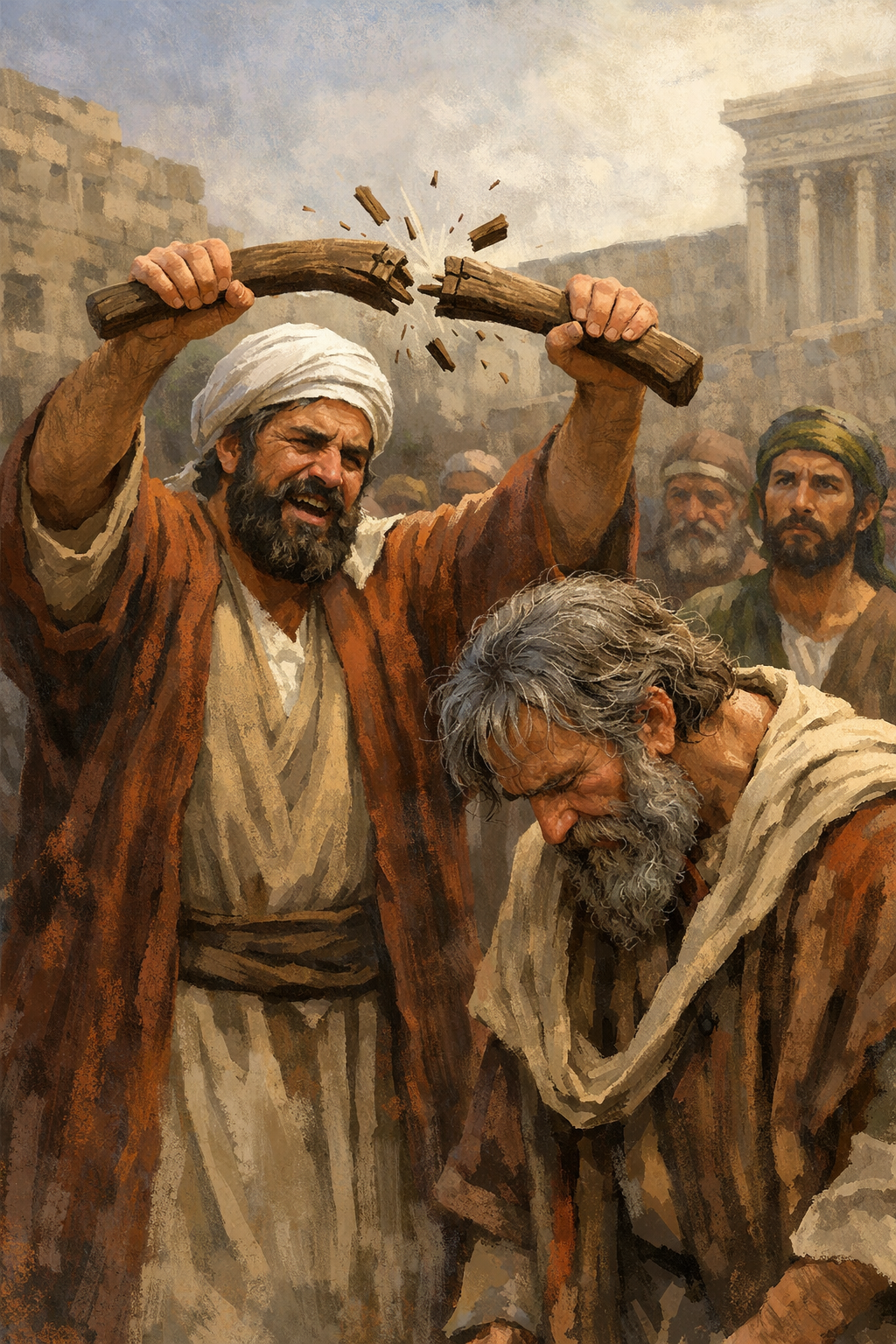
BREAKING THE YOKE
A FALSE SIGN OF FREEDOM
Then - This is a marker of progression in the narrative, and in this case the confrontation of truth and falsehood! Hananiah knew a visual prophecy like the yoke made a great impression on people, so he moves to turn the symbol to his advantage!
Hananiah the prophet took the yoke (motah) from the neck of Jeremiah the prophet and broke it - By breaking Jeremiah’s yoke, Hananiah attempting a dramatic move before the priests and people to emphasize the truth of his prophecy that Judah would soon be liberated from Babylon within two years. The symbolic act was intended to make his message visible and convincing, a gesture meant to inspire confidence in his prophecy of a swift end to oppression. Yet the symbolism was profoundly misleading, for it portrayed a freedom that God had not promised. Hananiah’s action, though outwardly dramatic, only served to deepen the deception, replacing God’s true word with a false hope and turning a temporary discipline into an even more severe judgment.
Herbert Lockyer - Hananiah’s self-inspired action in taking Jeremiah’s yoke from his neck and breaking it was impious audacity and a demonstration that God would not fulfil His solemn word. Because Hananiah, who professed to be a prophet of peace, had broken the symbol of servitude, he declared that same would be the pledge of the destruction of the hateful bondage the yoke represented. (BORROW All the Parables of the Bible)
Yoke (04133) motah is a feminine noun that denotes a bar, pole, or yoke, and fundamentally conveys the idea of something placed upon another for the purpose of bearing, binding, or controlling. In its most literal sense, the word refers to a wooden bar or carrying pole, such as those used to transport the Ark of God, where the Levites “carried the ark of God on their shoulders with the poles (môtāh) thereon” (1 Chr 15:15). In this usage, the term reflects not oppression but sacred burden-bearing, a privileged responsibility assigned by God.
MOTAH - 10V - Lev. 26:13; 1 Chr. 15:15; Isa. 58:6; Isa. 58:9; Jer. 27:2; Jer. 28:10; Jer. 28:12; Jer. 28:13; Ezek. 30:18; Ezek. 34:27
However, môtāh is more frequently employed figuratively, where it becomes a powerful symbol of bondage, oppression, and imposed authority. In covenantal context, God reminds Israel, “I am the LORD your God…who broke the bars (môtōth) of your yoke and made you walk erect” (Lev 26:13), portraying Egypt as a crushing yoke from which He alone could liberate them. Thus, the word vividly expresses the weight of subjugation, whether political, social, or spiritual.
The prophets, especially Jeremiah, develop this imagery with striking force. God commands Jeremiah to fashion and wear a literal yoke as a prophetic sign of Judah’s coming submission to Babylon (Jer 27:2). When the false prophet Hananiah dramatically breaks Jeremiah’s wooden yoke, he symbolically denies God’s decree. Yet the LORD responds by declaring, “You have broken the yokes of wood, but you have made instead of them yokes of iron” (Jer 28:13), intensifying the image from temporary discipline to inescapable domination, followed by Hananiah’s swift judgment (Jer 28:16–17). Here môtāh becomes a theological symbol of divine sovereignty over nations, showing that resistance to God’s appointed authority only results in heavier bondage.
Similarly, the word is used to describe oppressive forces that God calls His people to break: “to break every yoke (môtāh)” (Isa 58:6), emphasizing that true righteousness involves liberating others from unjust burdens. In prophetic judgment contexts, it again signifies political domination: “I will break the yoke of Egypt” (Ezek 30:18), and “they will no longer be slaves to the nations…when I have broken the bars (môtōth) of their yoke” (Ezek 34:27), pointing ultimately to God’s redemptive intervention.
Theologically, môtāh presents a profound dual reality: it can signify either a burden imposed by oppression or a burden assigned by God. The same object that enslaves in one context becomes a means of service in another. Thus, Scripture reveals that the decisive issue is not the presence of a yoke, but whose yoke it is. As later clarified by the Lord Jesus Christ, the only yoke that truly liberates is His own: “My yoke is easy and My burden is light” (Mt 11:30).
In summary, môtāh portrays the weight that rests upon a person—whether crushing bondage under sin and worldly powers or sacred responsibility under God. It reminds us that apart from divine deliverance, every yoke enslaves, but under God’s gracious rule, even a burden becomes a means of life and freedom.
Dictionary of Biblical Imagery - YOKE
The more then fifty references to the yoke in the Bible speak of the wooden bar or frame used to join animals to enable them to pull a load. Two aspects of a yoke are important in these references: the yoke is an image of subjection, service or bondage (just as a yoked donkey or ox is in service to its owner) or an image of joining (just as two animals are joined together by means of a yoke).
Literal references to yokes are relatively rare in the Bible. Some of them occur in the ceremonial laws, where (for example) we read about using a previously unyoked heifer as a sacrifice (Num 19:2) or in a ritual of innocence (Deut 21:1–9) and about not yoking an ox and donkey together (Deut 22:10). Yoking here assumes a ceremonial aura, as something with religious meaning. This was also the case when Saul cut a yoke of oxen in pieces and sent the pieces throughout the land of Israel as a symbolic statement (1 Sam 11:7). Other literal images of yoked animals simply reinforce the down-to-earth realism of the Bible. We have a picture of yoking two cows to pull the cart carrying the ark of the Lord and shutting up their calves at home (1 Sam 6:10), or the spectacle of the most impressive farmer in the neighborhood-Elisha-plowing with twelve yoke of oxen (1 Kings 19:19). In Jesus’ parable of the banquet, one of the everyday excuses an invited guest uses is that he has bought five yoke of oxen and wants to try them out (Lk 14:19).
Most biblical references are figurative, and the largest category is the yoke as a symbol of political slavery to a foreign king (Deut 28:48; Jer 27:8–12) or oppressive subservience to one’s own king (1 Kings 12:4–14). Correspondingly, an evocative image of freedom is breaking loose from the yoke of servitude (e.g., Gen 27:40; Is 9:4; 10:27; Jer 28:2, 4; Ezek 34:27). As a demonstration that Judah and surrounding nations should submit to Nebuchadnezzar, God instructed Jeremiah to wear a yoke around his neck (Jer 27).
Other meanings also inhere in the yoke as an image of bondage. Sin is a yoke around a person’s neck (Lam 1:14), and to require Gentile Christians to submit to the Jewish ceremonial code would be an unwelcome yoke (Acts 15:10), as it is for Christians who return to the law (Gal 5:1).
Because yoking joins two animals together, it also becomes a symbol of close alliance or union. Israel’s dabbling in pagan practices is pictured as a yoking of itself to Baal (Num 25:3, 5). Paul’s warning against a Christian’s marrying an unbeliever is expressed in the command “Do not be yoked together with unbelievers” (2 Cor 6:14 NIV), perhaps an allusion to the prohibition against yoking an ox and donkey together (Deut 22:10).
In most of the references noted thus far, the yoke is a negative image—something a person would do virtually anything to avoid. But the image can also have positive meanings. As a symbol of legitimate discipline in a person’s life, bearing the yoke in one’s youth “is good,” on a par with waiting quietly for the salvation of the Lord (Lam 3:26–27). The supreme example is Jesus’ turning his paradoxical rhetoric to the yoke as a form of good subjection to him: “Take my yoke upon you and learn from me, … and you will find rest for your souls. For my yoke is easy and my burden is light” (Mt 11:29–30 NIV).
See also BONDAGE AND FREEDOM; DONKEY, ASS; OX, OXEN.
Jeremiah 28:11 Hananiah spoke in the presence of all the people, saying, “Thus says the LORD, ‘Even so will I break within two full years the yoke of Nebuchadnezzar king of Babylon from the neck of all the nations.’” Then the prophet Jeremiah went his way.
- Thus: Jer 23:17 29:9 1Ki 13:18 22:6,11,12 2Ch 18:10,22,23 Pr 14:7 Eze 13:7
- Even: Jer 28:2-4 27:2-12
HANINIAH REPEATS THE LIE
DENYING GOD'S WORD
Hananiah spoke in the presence of all the people, saying, “Thus says the LORD, ‘Even so will I break within two full years the yoke ('ol; LXX - zugos or zygos) of Nebuchadnezzar king of Babylon from the neck of all the nations.’” - Hananiah is clever for in declaring thus says the LORD, he used the introductory formula of true prophets. Hananiah proceeds to proclaim a message to tickle the people's ears (cf modern counterpart = 2Ti 4:3-4). Hananiah interprets his dramatic act of breaking Jeremiah’s yoke, presenting it as a divinely sanctioned sign of imminent liberation. The public setting lends weight to his words, as he boldly claims the authority of the LORD (Thus says the LORD) before a receptive audience. In effect, Hananiah is simply repeating and reinforcing his earlier false prediction of a swift restoration for the exiles. By attaching a specific timeframe of “two full years,” he gives his message an air of certainty and precision, making it even more persuasive. Yet this confidence is misplaced, for his proclamation directly contradicts the word God had already spoken through Jeremiah. What appears to be a message of hope is, in reality, a dangerous deception that promises peace where judgment has been decreed, and restoration without repentance.
Then the prophet Jeremiah went his way - Exactly why Jeremiah departed is not completely clear. One thought is that rather than engaging in further public confrontation with Hananiah, Jeremiah quietly withdrew, and as the context reveals, he entrusted the matter to the LORD. Jeremiah's quiet departure does not signal defeat but reflect his restraint and confidence, for he does not need to defend God’s Word by arguing with Hananiah. Having spoken the truth, he leaves the outcome in Yahweh’s hands, knowing that in due time his prophecy will come to pass and will ultimately expose what is false and vindicate what is true.
John MacKay - This is the action of a man who on meeting with implacable opposition realizes the futility of speaking further. Having made his case, Jeremiah was content to let events prove who was in reality the prophet of the Lord. (Jeremiah: Chapters 21-52)
Charles Feinberg - Some expositors are at a loss to state whether Jeremiah concluded his remarks and the confrontation out of cowardice (because Hananiah’s message would be preferable to his, since it was more pleasing to the hearers) or disgust (because the false prophet had lowered the high office of prophet to the level of pleasing people). It was for neither of those reasons. He left because (1) he knew his own message was truly from God, and (2) he was convinced that God would vindicate his own message by verification by future events (Deut 18:22; also Jer 28:9). (The Expositor's Bible Commentary - Abridged Edition)
Put yourself in Jeremiah's sandals for a moment. Your adversary has just broken a yoke you were wearing and then used that symbolically to deliver a lie. Many of us would have punched him before he would even spout off the lie! Jeremiah's response reminds me of Paul's advice in Ro 12:19 "Never take your own revenge, beloved, but leave room for the wrath of God, for it is written, “VENGEANCE IS MINE, I WILL REPAY,” says the Lord."
Jeremiah's response reminds me of the line in Kenny Rogers famous song "The Gambler,"
“You’ve got to know when to hold ’em,
know when to fold ’em…”
Jeremiah 28:12 The word of the LORD came to Jeremiah after Hananiah the prophet had broken the yoke from off the neck of the prophet Jeremiah, saying,
- Jer 1:2 29:30 2Ki 20:4 1Ch 17:3 Da 9:2
A HEAVENLY WORD
TO AN EARTHLY DECEPTION
The word of the LORD came to Jeremiah after Hananiah the prophet had broken the yoke (motah) from off the neck of the prophet Jeremiah, saying - The timing is striking. Yahweh did not intervene immediately during the public confrontation, but allowed Hananiah’s dramatic act to stand for a moment. Yet this delay does not imply indifference or uncertainty, for the LORD’s timing is always perfect. At the appointed moment, He speaks with clarity and authority to His servant Jeremiah.
This sequence highlights an important principle: God is never rushed by human actions, nor does He feel compelled to answer error on our timetable. Instead, He waits until the moment that will most clearly expose falsehood and vindicate His truth. Now, after Hananiah’s symbolic breaking of the yoke, the true word of the LORD comes, not through spectacle, but through revelation, reminding all who hear that it is ultimately God’s voice, not human drama, that determines reality.
Bob Utley - has an interesting thought on "Jeremiah. . .Jeremiah" The use of the personal name of the prophet seems to confirm that this section of chapters was penned by Baruch.
Jeremiah 28:13 “Go and speak to Hananiah, saying, ‘Thus says the LORD, “You have broken the yokes of wood, but you have made instead of them yokes of iron.”
- but you have made instead : Jer 27:15 Ps 149:8 La 2:14
FROM WOODEN YOKES
TO IRON BONDS
Go and speak to Hananiah, saying, ‘Thus says the LORD, “You have broken the yokes (motah)of wood, but you have made instead of them yokes (motah) of iron - Yahweh commands Jeremiah to directly confront Hananiah’s deceptive act and words and tell him what is the true consequence. The wooden yoke that Jeremiah had worn symbolized a real but temporary submission to Babylon, a discipline that, if accepted, would have been bearable. But by rejecting that word and encouraging resistance, Hananiah has not removed the burden, he has intensified it. By urging the people toward resistance to Nebuchadnezzar, Hananiah was, in effect, leading them into a far harsher judgment. What might have remained a lighter yoke of submission would now become an unbreakable yoke of iron, representing a more severe and inescapable bondage.
🙏 THOUGHT - Are you being disciplined by the LORD? This sobering exchange between Jeremiah and Hananiah reveals the critical truth that resisting God’s revealed will does not eliminate His discipline, but in fact may accentuate it. It may turn what could have been endured with humility into something far more painful and severe. As Derek Kidner wisely says...
We only add to God’s chastening when we resist it
– exchanging wood for iron.
Jeremiah 28:14 ‘For thus says the LORD of hosts, the God of Israel, “I have put a yoke of iron on the neck of all these nations, that they may serve Nebuchadnezzar king of Babylon; and they will serve him. And I have also given him the beasts of the field.”’”
- I have put: Jer 27:4,7 40:4 De 4:20 28:48 Isa 14:4-6
- that they: Jer 25:9-26 Rev 17:12,13
- and I: Jer 27:6,7 Da 2:38
THE IRON YOKE DECREED BY GOD
NATIONS GIVEN TO BABYLON
For thus says the LORD of hosts, the God of Israel, “I have put a yoke ('ol; LXX - zugos or zygos) of iron on the neck of all these nations - God tells Jeremiah to proclaim that the yoke of wood Hananiah had broken symbolically would be replaced by a yoke of iron, representing an unbreakable and divinely ordained submission to Babylon.
That - Term of purpose/result. Read on for the purpose of the yoke of iron.
They may serve Nebuchadnezzar king of Babylon - This is God’s sovereign decree that the nations, including Judah, are to submit to Babylon’s rule as an act of divine judgment. The verb serve carries the idea of enforced subjection, not voluntary allegiance. Submission, though difficult, would align the people with God’s purpose and spare them greater destruction, while rebellion would only intensify their suffering. This phrase therefore underscores a profound theological truth repeated in Jeremiah that even a pagan rules can be raised up and used by God to accomplish His righteous purposes (Jer 27:6; cf Ro 13:1).
And they will serve him - Yahweh's point is whether they do so willingly or unwillingly, the nations will serve Nebuchadnezzar that that is God's sovereign, irrestible decree! In other words, when God judges, there is no way of escape!
And I have also given him the beasts of the field - Even the animals of the field are given into Nebuchadnezzar’s hand emphasizing the totality of God’s control over creation and history.
Tremper Longman - The reference to wild animals is best to be understood as prophetic hyperbole. Wild animals, after all, are wild and thus virtually impossible to subjugate. If he can control the wild animals, he will easily control the inhabitants of these nations, including Judah. (Jeremiah, Lamentations - Understanding the Bible Commentary)
Charles Feinberg - Whereas for Hezekiah to resist Assyria in 701 B.C. was an act of faith, for Judah to rebel against Babylon in Jeremiah’s time was an act of disobedience. (The Expositor's Bible Commentary - Abridged Edition)
Herbert Lockyer- The substitution of “yokes of iron” (see Deuteronomy 28:48) for “yokes of wood,” indicate and illustrate the truth that when light affliction is not freely accepted, heavier affliction is permitted (Jeremiah 28:13, 14) False prophets urged the Jews to rebel and throw off the comparatively easy yoke of Babylon. In doing so, they only brought upon themselves the more severe yoke imposed by Nebuchadnezzar. “It is better to take up a light cross in our way, than to pull a heavier one on our heads. We may escape destroying providences by submitting to humbling providences. Spiritually, we contrast the easy yoke of Christ with the yoke of bondage of the law” (Matthew 11:28–30; Acts 15:10; Galatians 5:1). Ac-cepting God’s righteous judgment on our sin, affliction becomes beneficial and salutary. More extreme judgment overtakes us if, after condemnation, we continue in sin (1 Corinthians 11:31). Had the Jews submitted to their deserved captivity it would have cured them of their idolatry. Resisting their bondage killed them. (BORROW All the Parables of the Bible)
Jeremiah 28:15 Then Jeremiah the prophet said to Hananiah the prophet, “Listen now, Hananiah, the LORD has not sent you, and you have made this people trust in a lie.
Related Passages:
Jeremiah 27:14 “So do not listen to the words of the prophets who speak to you, saying, ‘You will not serve the king of Babylon,’ for they prophesy a lie to you;
JEREMIAH EXPOSES HANANIAH
SPEAKING LIES IN GOD'S NAME
Then Jeremiah the prophet said to Hananiah the prophet, “Listen now, Hananiah, the LORD has not sent you, and you have made this people trust in a lie. - Jeremiah’s command (Listen) to Hananiah comes after Hananiah falsely promised a swift end to Babylonian domination, offering a message that sounded hopeful but did not come from God and instead led the people into dangerous deception. By declaring, “the LORD has not sent you,” Jeremiah exposes the core issue, true authority comes only from God, and Hananiah had none, making his message not only false but spiritually destructive as it caused the people to trust in a lie rather than submit to God’s revealed will. This passage underscores the serious danger of false teaching, which distorts truth and leads others away from obedience, a warning echoed throughout Scripture (Dt 13:1–3; 2Pet 2:1).
Adam Clarke - This was a bold speech, in the presence of those priests and people who were prejudiced in favour of the false prophets, who prophesied to them smooth things. Jer 28:11 14:14,15 23:21 27:15 29:23,31,32 1Ki 22:23 Eze 13:2,3,22 Eze 22:28 La 2:14 Zec 13:3
Ultimately, it reminds us that trusting comforting lies brings ruin, while only God’s Word is truth and life (Jn 17:17, cf Jn 6:63), calling believers to test every message (1Jn 4:1, Acts 17:11) and remain firmly anchored in what God has truly spoken (Heb 5:14).
G Campbell Morgan - The Lord hath not sent thee; but thou makest this people to trust in a lie.—Jer. 28:15.
In this chapter we have a page of history graphically illustrating one of the chief difficulties with which Jeremiah had to contend in the exercise of his ministry. It is the story of Hananiah, one of the false prophets, probably the chief of them. His message is recorded, and serves to show how it might easily deceive the people. Its introductory formula was that of the true prophets, "Thus speaketh Jehovah of Hosts, the God of Israel." It was characterized by the element of clear and definite prediction, as it declared that in two years the yoke of the King of Babylon would be broken. That prediction harmonized with the desires of the people, and the findings of the politicians. Of course this was an intended contradiction of Jeremiah's message, which foretold a period of seventy years of captivity. The sin of such prophesying is revealed in these words of Jeremiah to Hananiah, "Thou makest this people to trust in a lie." How much of human prophesying is covered by that word! All those philosophies which attempt to interpret life without the light of revelation—all so-called theologies, which result from speculations which invalidate the revelation; make men trust in lies, and that because they are the utterances of men not sent by Jehovah. We may say dogmatically that no message to men, on any subject, is of any value, save as it is uttered by the messengers of Jehovah, for He alone knows the ultimate truth, and therefore He alone is able to direct the ways of men. Whether in theology, sociology, or economics, the speculations of men are lies, trusting in which men insure their own undoing. We should earnestly heed the words of Jesus, "Beware of false prophets."
Jeremiah 28:16 “Therefore thus says the LORD, ‘Behold, I am about to remove you from the face of the earth. This year you are going to die, because you have counseled rebellion against the LORD.’”
- I will: Ge 7:4 Ex 32:12 De 6:15 1Ki 13:34 Am 9:8
- this year: Jer 28:3 20:6 Nu 14:37 16:28-35 29:32 De 13:5-11
- because: Eze 13:11,12 Ac 13:8-11
- rebellion: Heb. revolt, Jer 29:32 De 13:5
Related Passages:
Deuteronomy 13:5 “But that prophet or that dreamer of dreams shall be put to death, because he has counseled rebellion against the LORD your God who brought you from the land of Egypt and redeemed you from the house of slavery, to seduce you from the way in which the LORD your God commanded you to walk. So you shall purge the evil from among you.
Deuteronomy 18:20-22 ‘But the prophet who speaks a word presumptuously in My name which I have not commanded him to speak, or which he speaks in the name of other gods, that prophet shall die.’ 21 “You may say in your heart, ‘How will we know the word which the LORD has not spoken?’ 22 “When a prophet speaks in the name of the LORD, if the thing does not come about or come true, that is the thing which the LORD has not spoken. The prophet has spoken it presumptuously; you shall not be afraid of him.
DIVINE SENTENCE PRONOUNCED
REMOVED FROM THE EARTH!
Therefore thus says the LORD, ‘Behold, I am about to remove you from the face of the earth. This year you are going to die, because you have counseled rebellion against the LORD - This verse is in accord with the LORD's instruction "So you shall purge the evil from among you." (Dt 13:5) This solemn pronouncement is God’s direct judgment on Hananiah for falsely speaking in His name. The phrase “remove you from the face of the earth” signifies more than physical death; it is a decisive act of divine justice, cutting off a man who has misled the people and opposed God’s revealed word.
So you shall purge the evil from among you.
The charge is especially serious. Hananiah had “counseled rebellion against the LORD.” By proclaiming a false message of peace and urging resistance to Babylon, he was not merely mistaken, he was actively encouraging the people to reject God’s ordained discipline. In doing so, he turned hearts away from submission to the LORD and toward defiance of His will.
The sentence “this year you are going to die” underscores both the certainty and the immediacy of the judgment. It serves as a public vindication of Jeremiah’s prophetic authority and a warning to all who would presume to speak for God without being sent. The passage reveals that false teaching is not a trivial matter in God’s sight, for it distorts truth, leads others into sin, and invites swift and serious judgment.
🙏 THOUGHT - This verse stands as a sobering warning that God’s Word must never be altered or contradicted for personal gain or popularity. It calls all who speak or teach in His name to do so with reverence, humility, and fidelity to Scripture, knowing that God holds His messengers accountable for every word they proclaim. James 3:1 says "Let not many of you become teachers, my brethren, knowing that as such we will incur a stricter judgment."
Jeremiah 28:17 So Hananiah the prophet died in the same year in the seventh month.
- Hananiah: Isa 44:25,26 Zec 1:6
THE DEATH THAT VINDICATED
GOD'S WORD AND HIS PROPHET
So - God said it. That settles it. Hananiah had his "moment in the sun" but will burn forever.
Hananiah the prophet died in the same year in the seventh month - The prophecy was delivered in the fifth month (Jer 28:1), and Hananiah died in the seventh month, exactly two months after proclaiming his false message, which he had confidently declared would be fulfilled within two years. As an aside Hananiah had 2 months to repent but obviously did not! This swift fulfillment of Jeremiah’s word provided a clear and undeniable validation of the true prophet and exposed the false one. Hananiah’s sudden death was not merely an isolated event, but God’s decisive seal upon the authenticity of Jeremiah’s message, lending powerful credibility to all his other prophecies in the eyes of the people! Yet, despite such a striking confirmation, the response of the nation reveals the stubbornness of the human heart, for even this dramatic demonstration of divine truth did not lead them to forsake their sins or return in genuine repentance to the God of Israel.
One wonders if the priests and people were waiting hopefully in the months after Hananiah's prophecy, but the news of Hananiah's death as Jeremiah had predicted but demolish those hopes. Unfortunately their hearts remained heart and resistant to repentance.
Parunak: This illustrates a common biblical principle, that those who plot evil against others will eventually be trapped by their own devices. In ch. 26, it was the priests and prophets who insisted, “This man is worthy to die” (26:11). Now one of their own number falls instead, at Jer’s word.
Proverbs 26:27 He who digs a pit will fall into it, And he who rolls a stone, it will come back on him.
Psalm 7:15 He has dug a pit and hollowed it out, And has fallen into the hole which he made.
Psalm 9:15 The nations have sunk down in the pit which they have made; In the net which they hid, their own foot has been caught.
Psalm 35:7-8 For without cause they hid their net for me; Without cause they dug a pit for my soul. 8Let destruction come upon him unawares, And let the net which he hid catch himself; Into that very destruction let him fall.
Psalm 57:6 They have prepared a net for my steps; My soul is bowed down; They dug a pit before me; They themselves have fallen into the midst of it. Selah.