

2 CORINTHIANS - PAUL'S MINISTRY IN THE LIGHT OF THE INDESCRIBABLE GIFT
Click chart to enlarge
Charts from Jensen's Survey of the NT - used by permission
Another Chart from Charles Swindoll
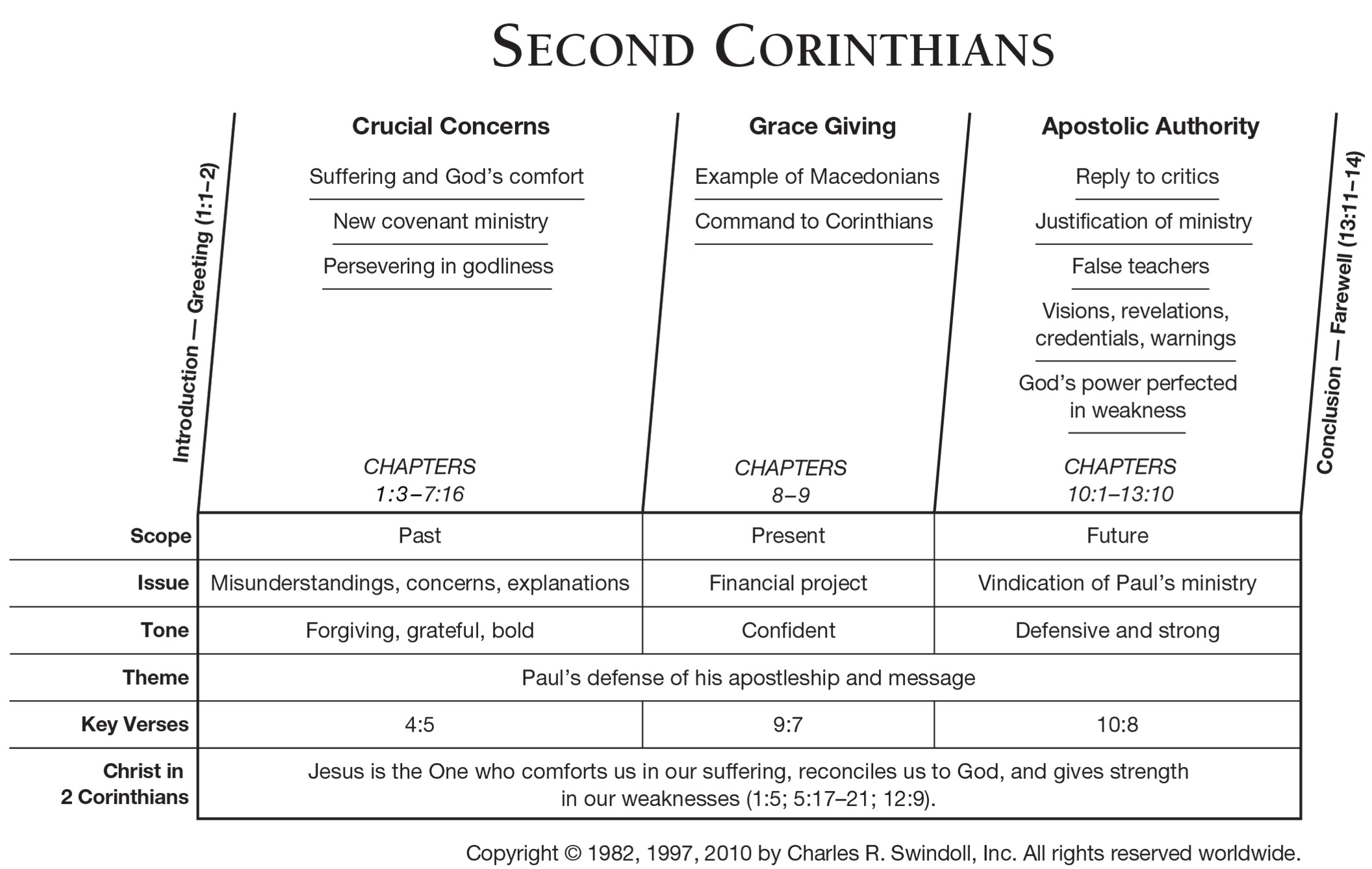
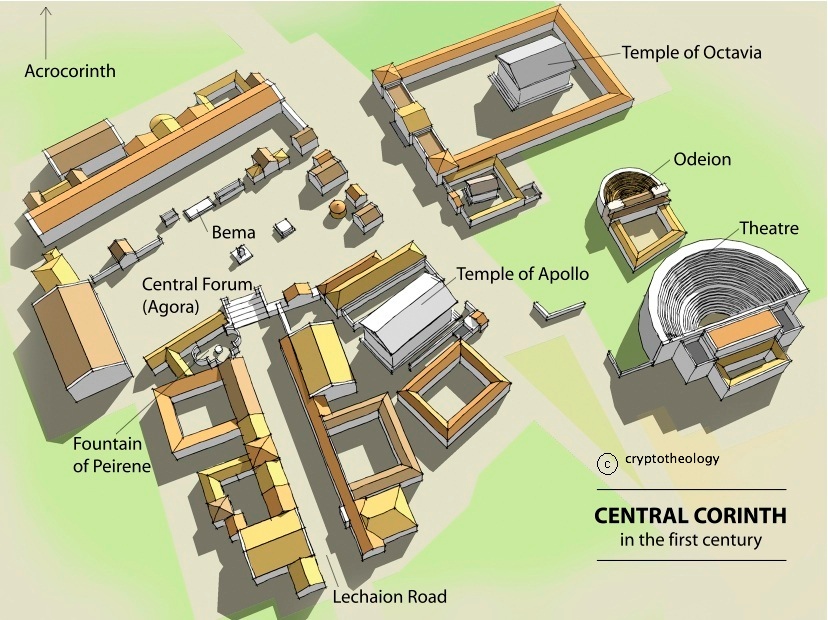
Click to Enlarge
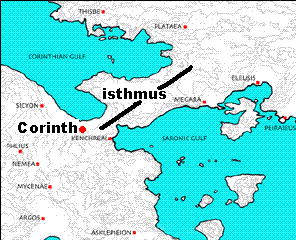
Click to enlarge
Overview of
|
||
| 2Co 1:1-7:16 Character of Paul |
2Co 8:1-9:15 Collection for the Saints |
2Co 10:1-12:21 Credentials of Paul |
| Testimonial & Didactic | Practical | Apologetic |
| Past: Misunderstanding & Explanation |
Present: Practical Project |
Future: Anxieties |
| Apostle's Conciliation, Ministry & Exhortations | Apostle's Solicitation for Judean Saints | Apostle's Vindication of Himself |
| Forgiveness, Reconciliation Gratitude |
Confidence | Vindication |
|
Ephesus to Macedonia: |
Macedonia: Preparation for Visit to Corinth |
To Corinth: |
|
2Co 1:1-7:16 |
2Co 8:1-9:15 |
2Co 10:1-12:21 |
|
2Corinthians written ~ 56-57AD - see Chronological Table of Paul's Life and Ministry |
||
|
Adapted & modified from Jensen's Survey of the New Testament (Highly Recommended Resource) & Wilkinson's Talk Thru the Bible |
||
2 Corinthians 5:11 Therefore, knowing the fear of the Lord, we persuade men, but we are made manifest to God; and I hope that we are made manifest also in your consciences. (NASB: Lockman)
Greek: Eidotes (RAPMPN) oun ton phobon tou kuriou anthropous peithomen, (1PPAI) theo de pephanerometha; (1PRPI) elpizo (1SPAI) de kai en tais suneidesesin humon pephanerosthai. (RPN)
Amplified: Therefore, being conscious of fearing the Lord with respect and reverence, we seek to win people over [to persuade them]. (Lockman)
Barclay: So then, it is because we know the fear of the Lord that we keep on trying to persuade men, but to God we are already known through and through, and I hope that in your conscience, too, we will come to be as completely known. (Westminster Press)
ESV: Therefore, knowing the fear of the Lord, we persuade others. But what we are is known to God, and I hope it is known also to your conscience. (ESV)
HCSB: Knowing, then, the fear of the Lord, we persuade people. We are completely open before God, and I hope we are completely open to your consciences as well. (Holman Christian Standard Bible - Study notes available online free)
KJV: Knowing therefore the terror of the Lord, we persuade men; but we are made manifest unto God; and I trust also are made manifest in your consciences.
NEB: WITH THIS FEAR of the Lord before our eyes we address our appeal to men. To God our lives lie open, as I hope they also lie open to you in your heart of hearts. (New English Bible - Oxford Press)
NET: Therefore, because we know the fear of the Lord, we try to persuade people, but we are well known to God, and I hope we are well known to your consciences too. (NET Bible)
MH: We are fully aware, then, of our accountability to the Lord as our judge, and so we regard him with reverential awe. So we endeavor to persuade everyone of the truth of the gospel and of our integrity as messengers of the gospel. What we are and what our motives are have always been open to God’s scrutiny; and I hope these things are abundantly clear to your consciences as well. (Murray Harris' expanded paraphrase of 2Corinthians).
NLT: Because we understand our fearful responsibility to the Lord, we work hard to persuade others. God knows we are sincere, and I hope you know this, too. (NLT - Tyndale House)
Phillips: All our persuading of men, then, is with this solemn fear of God in our minds. What we are is utterly plain to God - and I hope to your consciences as well. (Phillips: Touchstone)
Weymouth: Therefore, because we realize how greatly the Lord is to be feared, we are endeavouring to win men over, and God recognizes what our motives are, and I hope that you, in your hearts, recognize them too.
Wuest: Knowing therefore the fear of the Lord, we are persuading men [of our sincerity and integrity], but to God we have been openly shown [as to our character], and I am hoping that we have been openly shown to be what we are in your consciences. (Eerdmans Publishing - used by permission)
Young's Literal: having known, therefore, the fear of the Lord, we persuade men, and to God we are manifested, and I hope also in your consciences to have been manifested;
THEREFORE, KNOWING THE FEAR OF THE LORD WE PERSUADE MEN: Eidotes (RAPMPN) oun ton phobon tou kuriou anthropous peithomen, (1PPAI) theo de pephanerometha (1PRPI):
- The fear: Ge 35:5 Job 6:4 18:11 31:23 Ps 73:19 76:7 88:15,16 90:11 Isa 33:14 Na 1:6 Mt 10:28 25:46 Mk 8:35, 36, 37, 38 9:43-50 Lk 12:5 Heb 10:31 Jude 1:23 Rev 20:15
- We persuade: 2Co 5:20 6:1 Lk 16:31 Ac 13:43 18:4,13 19:26 20:18-27 26:26 28:23 Ga 1:10 Col 1:28,29 2Ti 2:24, 25, 26
- 2 Corinthians 5 Resources - Multiple Sermons and Commentaries
- See also "shorter version" of commentary on 2 Corinthians 5:11
Therefore (oun) is a term of conclusion - based on the personal accountability of his future appointment at the Judgment Seat of Christ. Based on a wholesome, healthy reverential awe of Christ as Paul's Judge, as the divine Sifter of his every thought, motive, word and deed. Based on this truth, Paul sought to appeal, persuade or convince men.
PAUL'S MINISTRY
OF INTEGRITY
John MacArthur emphasizes that in 2Co 5:11-15 Paul is defending the integrity of his ministry writing that...
If the false teachers who had come to the city of Corinth were going to get a hearing for their false gospel...they had to destroy the integrity of Paul. They had to get the people to lose confidence in him because he was their teacher (Ed: for 18 months! See Acts 18:11)....They were bringing in error...contrary to what Paul taught. And in order to be heard they had to...destroy his integrity....They were so effective that they had convinced many of the people in the Corinthian congregation that Paul was not a man of honesty, sincerity, genuineness and integrity. And once they had destroyed Paul's integrity, they could replace him..... And so it was very important to Paul to maintain his integrity, not for his sake, but for God's sake and the sake of the church and the sake of the witness of the church to the lost....He himself says in this letter later on, "I am a nobody." We've already heard him say he is nothing but a clay pot (2Co 4:7-+). But at the same time that that is true and he is not seeking self-glory, he desperately wants them to trust his integrity for the sake of the truth and the God of truth. (A Ministry of Integrity)
The false teachers accused Paul of ministering in the power of his flesh and insincerity to which he responded...
We can say with confidence and a clear conscience that we have been honest and sincere in all our dealings. We have depended on God's grace, not on our own earthly wisdom. (2Co 1:12NLT+)
They accused him of having a secret agenda to which he responded...
My letters have been straightforward, and there is nothing written between the lines and nothing you can't understand. (2Co 1:13 NLT+)
They accused him in essence of being a liar (of changing his mind) to which he responded...
You may be asking why I changed my plan (Ed: To come to see the Corinthians). Hadn't I made up my mind yet? Or am I like people of the world who say yes when they really mean no? As surely as God is true, I am not that sort of person. My yes means yes (2Co 1:17, 18NLT+)
They accused him of being a deceiver, a perverter of Scripture, to which he responded...
We reject all shameful and underhanded methods. We do not try to trick anyone, and we do not distort the word of God. We tell the truth before God, and all who are honest know that. (2Cor 4:2NLT+)
They accused him of seeking personal glory to which he responded...
We don't go around preaching about ourselves; we preach Christ Jesus, the Lord. (2Co 4:5NLT+)
They said he did not even deserve to be listed among the apostles, to which he responded...
I consider myself not in the least inferior to the most eminent apostles...no respect was I inferior to the most eminent apostles, even though I am a nobody. The signs of a true apostle were performed among you with all perseverance, by signs and wonders and miracles. (2Co 11:5+, 2Co 12:11, 12+)
In summary, throughout the Second Epistle to the Corinthians Paul, with great humility, defends the repeated assaults which his adversaries made against the integrity of his person (character) and his ministry (authenticity). And so the time to defend ourselves and our ministry is when we are being falsely challenged and are doing what we are doing for the sake of the Lord and for His reputation. If the Corinthians believed the accusations and began to think of Paul's ministry as lacking integrity, what might they begin to think of the One Paul sought to proclaim and what would they think of the "integrity" of his message, the Gospel? Compare this line of reasoning with Paul's statement to the unbelieving Jews, that because of the way they lived, the name of God was blasphemed among the Gentiles (see Ro 2:24+).
This raises an important point of application - Is my life "preaching" what my lips are "preaching"? Do people look at my life and say "If that's the way a Christian behaves, then I don't want anything to do with their Christ or His Gospel!"
Knowing the fear of the Lord - The absolute certainty that he would one day stand before the Judgment Seat of Christ stimulated a holy fear of the Lord, a fear which in turn served as a motivation to minister with integrity.
Knowing (1492)(eido - only in perfect tense) means in general to know by perception, i.e., by sight (perceive, see) as used by Matthew's record of the words of the magi from the east
Where is He who has been born King of the Jews? For we saw (eido) His star in the east, and have come to worship Him. (Mt 2:2)
Eido/oida is distinguished from ginosko (epiginosko, epignosis) the other common Greek verb for "to know" because ginosko generally refers to knowledge obtained by experience ("experiential knowledge"). On the other hand, eido/oida generally refers to more of an intuitive type knowledge (although distinctions are not clear cut in all NT uses). Stated another way eido/oida is not so much that which is known by experience as by an intuitive insight that is bestowed in one's heart. Eido/oida thus represents a perception, a being aware of, an understanding, an intuitive knowledge which in the case of believers is bestowed by the Holy Spirit. In short, eido/oida suggests fullness of knowledge, absolute knowledge (that which is without a doubt), rather than a progress in knowledge (cp ginosko)
THE FEAR OF
THE LORD
Fear (reverence) (5401)(phobos from verb phébomai = to flee from or be startled) refers first to flight, to alarm, to fright or to terror (of the shaking type) (cf. Mt 14:26; Lk 21:26). This type of fear is connected with fear of the unknown, fear of the future, and fear of authorities. It speaks of the terror which seizes one when danger appears. In the present passage Paul is not using phobos to describe a negative emotion but more of a positive attitude. Abraham described the importance of a proper holy fear of God (see Ge 20:11). It is fascinating to note that Jacob came to know God by this very name "Fear", referring to Him as the "fear of Isaac" (God of Isaac - Ge 31:41)
Lightfoot explains phobos as that fear which should be in every believer as "a nervous and trembling anxiety to do right." (cp 2Co 5:9) Because of Christ's victory on the Cross, Christians are not to fear people (Pr 29:25) or persecution or even Satan. However, they are called to show proper reverence and awe toward God. Indeed, one of the most common commands of Jesus to His little flock was "fear not" (see Mt 10:28KJV, Lk 12:4,5).
The idea of fear in this passage is a deep awe and reverential sense of the coming day of reckoning and accountability before the Lord Jesus Christ at His Seat of Judgment. Believers are not to be terrified at the thought of standing before Christ. On the other hand unbelievers should feel a terror of having to stand before Him at the Great White Throne to be sentenced to eternal separation from His presence for all eternity (Rev 20:11, 12, 13, 14, 15-notes). And so clearly it is not the latter type of fear which Paul is referring to in the present passage.
Plummer gives the fear of the Lord a slightly different emphasis writing that it is "The fear excited by the thought of standing before the Judgment Seat of Christ and having one’s whole life exposed and estimated.(2 Corinthians 5 A Critical and Exegetical Commentary)
Phobos - 6x in Corinthians - 1Co 2:3; 2Co 5:11; 2Co 7:1, 5, 11, 15;
William Barclay notes that phobos "is not the fear and trembling of the slave cringing before his master; nor fear and trembling at the prospect of punishment. It comes from two things. It comes, first, from a sense of our own creatureliness and our own powerlessness to deal with life triumphantly. That is to say, it is not the fear and trembling which drives us to hide from God, but rather the fear and trembling which drives us to seek God, in the certainty that without His help we cannot effectively face life. It comes, second, from a horror of grieving God. When we really love a person (God), we are not afraid of what He may do to us; we are afraid of what we may do to Him! (cp Jn 14:15) (Barclay, W: The Daily Study Bible Series. The Westminster Press)
Fear of the Lord therefore is a healthy spiritual attitude which on one hand is an awe of God's greatness and glory and on the other hand is a deep and reverential sense of accountability to Christ and even somewhat of a dread of the discipline we will reap for violating His holy nature. Such fear involves self-distrust, a sensitive conscience, and being on guard against temptation.
Fear of the Lord - 25x in 25v in NAS - The following passages make a great study of this basic, seldom studied Biblical doctrine (Note: These 25v are just a sampling of over 200 passages that speak of godly fear) - 2Chr 19:7, 9; Job 28:28; Ps 19:9; 34:11; 111:10; Pr 1:7, 29; 2:5; 8:13; 9:10; 10:27; 14:26, 27; 15:16, 33; 16:6; 19:23; 22:4; 23:17; Isa 11:2, 3; 33:6; Acts 9:31; 2Cor 5:11.
Brian Bell asked a thorny question - What’s your motivation for ministry? You might be surprised by the answer given here. Some would say my love for Christ. Others might say rewards. Others might say duty. But what about…“Fear?” How can the Christian prepare for the Judgment Seat of Christ? Maintain a clear conscience. Terror = fear. - It is not the sense of being afraid of being clubbed to death or whipped by an angry God. It is an awesome reverence, a fear that grows out of respect. The fear excited by the thought of standing before the judgment seat of Christ and having one’s whole life exposed and estimated (evaluated). How can such opposite emotions as fear and love (2Co 5:14) dwell in the same heart? Certainly they are found in the hearts of children who love their parents and yet respect them and their authority. “Serve the Lord with fear, and rejoice with trembling” (Ps 2:11-+). (2 Corinthians 5:11-21)
John MacArthur adds that."To fear God is to have reverence, awe, and respect for Him resulting in worship, adoration, and service (cf. 2Co 7:1-+; Job 28:28; Ps 19:9-+; Ps 22:23-+; Ps 111:10-+; Pr 1:7; 8:13; 9:10). Acts 9:31 records that “the church throughout all Judea and Galilee and Samaria enjoyed peace, being built up; and going on in the fear of the Lord and in the comfort of the Holy Spirit, it continued to increase.” Thus, the “fear of the Lord” does not refer to dread or terror, since that type of fear would not result in “peace” and “comfort.” (MacArthur, J: 2Corinthians. Chicago: Moody Press)
Jerry Bridges has some insightful comments on the fear of the Lord noting that...
The late professor John Murray said
The fear of God
is the soul of godliness.Yet the fear of God is a concept that seems old-fashioned and antiquated to many modern-day Christians. There was a time when an earnest believer might have been known as a “God-fearing man.” Today we would probably be embarrassed by such language. Some seem to think the fear of God is strictly an Old Testament concept that passed away with the revelation of God’s love in Christ. After all, doesn’t perfect love drive out fear, as John declares in 1Jn 4:18? Although it is true that the concept of the fear of God is treated more extensively in the Old Testament, it would be a mistake to assume that it is not important in the New Testament. One of the blessings of the New Covenant is the implanting in believers’ hearts of the fear of the Lord. In Jer 32:40 God said,
And I will make an everlasting covenant with them that I will not turn away from them (Ed: Note the divine keeping power of covenant - a strong argument against the spurious [in my opinion] teaching that one can lose their eternal security! cp Jn 10:28, 29), to do them good; and I will put the fear of Me in their hearts (Ed: not just head knowledge, but heart knowledge, knowledge that transforms one's will and desire) so that (term of explanation = explains the vital association of proper fear and proper conduct! cp Job 1:1) they will not turn away from Me.
Murray wrote that "Nothing could be more significant than that the fear of the Lord should be coupled with the comfort of the Holy Spirit as the characteristics of the New Testament church:
So the church throughout all Judea and Galilee and Samaria enjoyed peace, being built up; and, going on in the fear of the Lord and in the comfort of the Holy Spirit, it continued to increase. (Acts 9:31).
Paul (2Co 7:1+) and Peter (1Pe 1:17-+) both use the fear of the Lord as a motive to holy and righteous living. The example of the Lord Jesus Himself, of whom Isaiah said, “and he will delight in the fear of the LORD” (Isaiah 11:3), should put the question beyond all doubt. If Jesus in His humanity delighted in the fear of God, surely we need to give serious thought to cultivating this attitude in our lives (1Pe 2:21-+). (The Practice of Godliness)
Puritan John Flavel said that...
By the fear of the Lord men depart from evil (Pr 8:17, Job 1:1b); but by the fear of man they run themselves into evil.
Puritan William Gurnall wrote that God is the Conqueror of all fear explaining that...
Our help is in the name of the Lord (Ps 124:8), but our fears are in the name of man.
F. B. Meyer wrote that
God incarnate is the end of fear, and the heart that realizes that He is in the midst, that takes heed to the assurance of His loving presence, will be quiet in the midst of alarm (cp 1Jn 4:18).
John Calvin in describing the fear of the Lord related to contemplation of the Bema Seat of Christ as a motivating influence writes that "the man who seriously considers this (Standing one day before Jesus) must of necessity be touched with fear, and shake off all negligence (All contempt and all carelessness) (Paul) declares, therefore, that he discharges his apostleship faithfully and with a pure conscience, (2Ti 1:3) as one that walks in the fear of the Lord, (Acts 9:31) thinking of the account to be rendered by him (at the Bema seat).
Disciple's Study Bible on the fear of God- Knowledge that we must face God in judgment brings reverence and awe into our lives. The fear of the Lord is an important motive in seeking to persuade others to become Christians.
Paul Apple - Fear of God Makes Us Urgent Transparent Persuaders...Nothing worse than persuasion that is crafty manipulation and exploitation (2 Corinthians)
James Denney explains that...
THE Christian hope of immortality is elevated and solemnized by the thought of the judgment-seat of Christ. This is no strange thought to Paul; many a time he has set himself in imagination in that great presence, and let the awe of it descend upon his heart. This is what he means when he writes, “Knowing the fear of the Lord.” Like the pastors addressed in the Epistle to the Hebrews, he exercises his office as one who must render an account (Heb 13:17-+ Ed comment: All of us in ministry need to keep this future accounting continually in the forefront of our mind - Are we feeding His sheep? [Jn 21:15KJV, Jn 21:16KJV, Jn 21:17KJV] We will be held accountable if we preach ourselves and not Christ! See 2Co 4:5-+, 2Co 4:7-+). In this spirit, he says, he persuades men. A motive (Ed: The eschatological motive = Our Future Bema Seat Appearance!) so high, and so stern in its purifying power, no minister of Christ can afford to dispense with.
We need something to suppress self-seeking, to keep conscience vigorous, to preserve the message of reconciliation itself from degenerating into good-natured indifference, to prohibit immoral compromises and superficial healing of the soul’s hurts (cp Jer 6:14, 8:11, 14:14, Lam 2:14, Ezek 22:26, 44:23). Let us familiarize our minds, by meditation, with the fear due to Christ the Judge (2Ti 4:1-+, 2Ti 4:8-+), and a new element of power will enter into our service, making it at once more urgent and more wholesome than it could otherwise be. (AMEN!)
The meaning of the words “we persuade men” is not at once clear. Interpreters generally find in them a combination of two ideas — we try to win men for the Gospel, and we try to convince them of our own purity of motive in our evangelistic work. The word is suitable enough to express either idea; and though it is straining it to make it carry both, the first is suggested by the general tenor of the passage, and the second seems to be demanded by what follows. “We try to convince men of our disinterestedness, but we do not need to try to convince God; we have been manifested to Him already; and we trust also that we have been manifested in your consciences.”
Paul was well aware of the hostility with which he was regarded by some of the Corinthians, but he is confident that, when his appeal is tried in the proper court, decision must be given in his favor, and he hopes that this has really been done at Corinth. Often we
do not give people in his position the benefit of a fair trial. It is not in our consciences they are arraigned — i.e., in God’s sight, and according to God’s law — but at the bar of our prejudices, our likes and dislikes, sometimes even our whims and caprices. It is not their character which is taken into account, but something quite irrelevant to character. Paul did not care for such estimates as these. It was nothing to him whether his appearance made a favorable impression on those who heard him—whether they liked his voice, his gestures, his manners, or even his message (Ed: May we all continually obey the present imperative in 1Co 11:1!). What he did care for was to be able to appeal to their consciences, as he could appeal to God, to Whom all things were naked and opened, that in the discharge of his functions as an evangelist he had been absolutely simple and sincere. In speaking thus, he has no intention of again recommending himself. (Expositor's Bible: The Measure of Christ's Love)
JESUS IS
LORD
Lord (master, owner)(2962)(kurios from kuros = might or power) primarily describes one who is supreme (highest in degree or quality), one who is sovereign (supreme in power, possessing supreme dominion), one who possesses absolute authority, absolute ownership and unchallengeable power. Kurios describes the owner, the one to whom a person or thing belongs. Kurios is the one who rightly possesses the power to control or use a person or thing as he wishes. Synonyms include master, superior, supreme (one), sovereign (one). (Mk 7:28)
Kurios is used 99x in the epistles to the Corinthians - Clearly Paul placed significant emphasis on the Lordship of Jesus Christ in his letters to the Corinthians.
1Corinthians 1:2, 3, 7, 8, 9, 31; 2:8, 16; 3:5, 20; 4:4, 5, 17, 19; 5:4, 5; 6:11, 13, 14, 17; 7:10, 12, 17, 22, 25, 32, 34, 35, 39; 8:5, 6; 9:1, 2, 5, 14; 10:21, 22, 26; 11:11, 23, 26, 27, 32; 12:3, 5; 14:21, 37; 15:31, 57, 58; 16:7, 10, 19, 22, 23
2Corinthians 1:2, 3, 14; 2:12; 3:16, 17, 18; 4:5, 14; 5:6, 8, 11; 6:17, 18; 8:5, 9, 19, 21; 10:8, 17, 18; 11:17, 31; 12:1, 8; 13:10, 14. (+ how Lord or Kurios and grace or charis are coupled in the closing words of both letters! [1Co 16:23, 2Co 13:14] Aren't we thankful He is Lord, the One Who is supremely able to dispense His all sufficient, multi-colored grace [1Pe 4:10-+ where "manifold" = multi-colored = poikilos] to undeserving saints).
Lord is not merely a title, but a name which signifies a call to action so that every saint should willingly, reverently bow down to Jesus Christ. If Christ is our Lord, we should seek to live under His rule, consciously, continually submitting our wills to Him as His loyal, loving bondservants, seeking first His Kingdom and His righteousness (Mt 6:33-+). According to this simple albeit practical "working definition" of kurios, we all need to ask ourselves "Is Jesus Christ my Lord?". "Do I arise each morning, acknowledging that this is the day the Lord hath made and that I am His ambassador in all I do?" (Ps 118:24-+) "Do I surrender my will to His will as I begin each day and throughout the day as choices are presented?" (cp Ro 12:1-+, Ro 12:2-+) Beloved, don't misunderstand. None of us have "arrived" in this area of Jesus as Lord of our lives. And it is precisely for that reason that Peter commands us to continually
grow (present imperative) in the grace (unmerited favor, divine enabling power to live the supernatural, abundant life in Christ) and knowledge (not just intellectual but knowledge that transforms, cp 2Co 3:18+) of our Lord and Savior Jesus Christ. To Him be the glory, both now and to the day of eternity. Amen. (2Pe 3:18+)
So do not be discouraged. Don't "throw in the towel" as they say. Keep on keeping on, pressing (continually = present tense) "on toward the goal for the prize of the upward call of God in Christ Jesus." (Php 3:14+) Throughout eternity you will rejoice that you made the choice on earth to surrender to Jesus as your Lord.
Boice informs us that the first century readers would have fully understood Paul's emphasis on Jesus as Lord writing that the "Citizens of the (Roman) empire were required to burn a pinch of incense to the reigning Caesar and utter the words "Kyrios [kurios] Kaisar" (“Caesar is Lord!”). It is this that the early Christians refused to do and for which they were themselves thrown to the wild lions or crucified. It was not that Christians were forbidden to worship God. They were free to worship any god they chose so long as they also acknowledged Caesar. Romans were tolerant. But when Christians denied to Caesar the allegiance that they believed belonged to the true God only (Ed: In obedience to Ex 20:3, 4, 5), they were executed. (Daniel- An Expositional Commentary)
William Barclay (not always thoroughly conservative and orthodox - see critique) says kurios...
is the key word of early Christianity. It has four stages of meaning.
(a) It is the normal title of respect like the English sir, the French monsieur, the German herr.
(b) It is the normal title of the Roman Emperors.
(c) It is the normal title of the Greek gods, prefaced before the god’s name. Kurios Serapis is Lord Serapis.
(d) In the Greek translation of the Hebrew scriptures it is the regular translation of the divine name, Jahveh or Jehovah.
So, then, if a man called Jesus kurios he was ranking Him with the Emperor and with God; he was giving Him the supreme place in his life; he was pledging him implicit obedience and reverent worship. To call Jesus kurios was to count him unique. First, then, a man to be a Christian must have a sense of the utter uniqueness of Jesus Christ.
It (kurios) was the official title of the Roman Emperor. The demand of the persecutors always was, “Say, ‘Caesar is Lord (kurios).’” It was the word by which the sacred name Jehovah was rendered in the Greek translation of the Old Testament scriptures. When a man could say, “Jesus is Lord,” it meant that he gave to Jesus the supreme loyalty of his life and the supreme worship of his heart. It is to be noted that Paul believed that a man could say, “Jesus is Lord,” only when the Spirit enabled him to say it (1Co 12:3). The Lordship of Jesus was not so much something which he discovered for himself as something which God, in his grace, revealed to him.
The phrase for Lord and God (in Re 4:11-+) is kurios kai theos and that was the official title of Domitian, the Roman Emperor. It was, indeed, because the Christians would not acknowledge that claim that they were persecuted and killed. Simply to call God Lord and God was a triumphant confession of faith, an assertion that he holds first place in all the universe. (The New Daily Study Bible: New Testament)
PERSUADE MEN
OF WHAT?
We persuade men - Some commentators feel Paul is saying persuade them or convince them to come to saving knowledge of the Lord Jesus Christ. If one takes this passage out of the overall context of this letter, this would not be an unreasonable interpretation; i.e., "To win men to Christ." Such an interpretation would also be supported by comparing some of the other NT uses of the verb "persuade" (peitho), in which the context clearly calls for this "evangelistic" interpretation (Acts 17:4, 18:4, 19:8, 26:28, 28:23, 24). For example in
Acts 13:43+ Now when the meeting of the synagogue had broken up, many of the Jews and of the God-fearing proselytes followed Paul and Barnabas, who, speaking to them, were urging (were persuading in imperfect tense = over and over again) them to continue in the grace of God.
Henry Alford on the other hand writes that a better Interpretation in context (context is "king" of accurate interpretation) is that Paul sought to convince men "of our own integrity."
Wuest paraphrases it as saying that Paul (writing using the plural pronoun "our") was seeking to convince men "of our sincerity and integrity." (Eerdmans Publishing - used by permission)
Murray Harris seems to merge these two interpretations writing that Paul was trying to convince men
Of the truth of the gospel, and the truth concerning himself; viz., that his motives were pure and sincere (cf. 2Co1:12) and that his apostolic credentials and conduct were sound (cf. 2Co 3:1, 2, 3, 4, 5, 6-notes; 2Co 4:1, 2, 3, 4, 5, 6-notes). (Gaebelein, F, Editor: Expositor's Bible Commentary 6-Volume New Testament. Zondervan Publishing)
Kent Hughes echoes Murray adding that...
This fear of the Lord drove Paul to “persuade others”—that is, to persuade the Corinthians of his gospel (Ed: And his evangelizing activities in which he sought to persuade men of the truth of the Gospel - eg, Acts 17:4, 18:4, 19:8, 26, 28:23) and the integrity of his person as an apostle. In theological terms, eschatological fear motivated Paul to carry out his calling. (Hughes, R. K. 2 Corinthians : Power in Weakness. Preaching the Word. Wheaton, Ill.: Crossway Books)
Brian Bell cautions all of us in ministry (and we are ALL in ministry!)...
We must take care not to depend on the praise of men. Paul referred to the “letters of commendation” that the Judaizers prized so highly. If we live only for the praise of men, we will not win the praise of God at the Judgment Seat of Christ.
Persuade (3982)(peitho - Thayer says peitho is from root meaning `to bind'; allied with pistis, fides, foedus, etc; see also the study of the antonym = apeitheo) means literally to persuade or induce by words to believe (Mt 27:20, Lk 16:31, Lk 18:9 = "trusted", Lk 20:6 = "convinced", Acts 17:4, 19:26, Ro 8:38-+, Ro 14:14-+ = "convinced"). Peitho - 4 times in 2 Corinthians - 2Co 1:9; 2:3; 5:11; 10:7.
It is notable that in the first letter, Paul used the related adjective peithos (persuasive, winning) to counter as Hughes describes it "the persuasive techniques of Greco-Roman rhetorical tradition" writing...
I was with you in weakness and in fear and in much trembling, and my message and my preaching were not in persuasive (peithos) words of wisdom, but in demonstration of the Spirit and of power, so that your faith would not rest on the wisdom of men, but on the power of God. (1Co 2:3, 4, 5).
Comment: So where earlier Paul rejected the philosophers persuasive rhetorical techniques, here shows that he does not reject the need to persuade men of the integrity of his evangelistic ("persuading") ministry.
Peitho is a strong verb, carrying the components of confidence, reliance, and hope. The idea is to cause one to come to a settled persuasion concerning something. The idea is to cause them to be so convinced that one puts confidence in something or someone.
Paul uses peitho in Galatians 1:10 in a context that yields a similar sense its use in 2Co 5:11...
For am I now seeking the favor (peitho) of men or of God (More literally = "For am I now persuading men or God?")? Or am I striving to please men? If I were still trying to please men, I would not be a bond-servant (surrenders his will to the will of the Master) of Christ.
Comment: Many commentators consider that Paul is addressing a charge from his opponents that he sought to curry the favor of his hearers to gain converts. Seeking the favor of men was in fact Paul's previous motivation for promoting Judaism.
Martin Luther's Comment: Do I preach a man’s doctrine, or God’s? Is it not clear to you whether I serve man or serve God? I have not only stirred up persecution against me in every place, but have also procured the hatred of my own nation, and of all other men. I show plainly enough by this, that I seek not the favor or praise of men, but I strive to set forth the benefit and glory of God. We seek not the favor of men by our doctrine, for we teach that all men are wicked by nature, and the children of wrath. We condemn man’s free will, his strength, wisdom, and righteousness, and all religion of man’s own devising, and, to be short, that there is nothing in us to deserve grace, and the forgiveness of sins; but we preach that we obtain this grace by the free mercy of God only, for Christ’s sake. This is not to preach for the favor of men, and of the world; for the world does not like to have its wisdom, righteousness, religion, and power condemned. For if we speak against men, or anything that pertains to their glory, cruel hatred, persecutions, excommunications, murders and condemnations inevitably follow. If then (says Paul) they see other matters, why do they not see this also, that I teach the things that are of God, and not of men? I seek no man’s favor by my doctrine, but I set out God’s mercy unto us in Christ. If I sought the favor of men, I would not condemn their works. It is because I condemn men’s works—how that men are sinners, unrighteous, wicked, children of wrath, bondslaves of the devil, and that they are not made righteous by works, or by circumcision, but by grace only, and faith in Christ—that I procure for myself the deadly hatred of men. (Martin Luther's Commentary on Galatians)
Plummer commenting on 2Cor 5:11 writes that...
Here also (Paul) may be replying to criticism, such as, ‘You know how to talk men over, but you will not be able to talk God over.’ ‘Certainly,’ he says, ‘I try to induce men to believe in me; the fear of a judgment to come makes me do so; but to God I am perfectly transparent. The conviction that He sees me and that I must one day give account compels me to be sincere....Others interpret, ‘We persuade men that we strive to please Christ who is to be our Judge.’ This is not very different from ‘we persuade men that we are sincere.’ Chrysostom points out that it is a duty to remove unjust suspicions from ourselves. A minister is hindered in his work by being credited with misdeeds of which he is innocent. It is not likely that anthropous peithomen means ‘we persuade men to become Christians,’ (Beza). Such an interpretation is foreign to the context, and it makes the contrast between persuading men and being fully known to God pointless. (2 Corinthians 5 A Critical and Exegetical Commentary)
Hughes adds that...
Paul tried to persuade his listeners, but not for their applause. Although people were the targets of his persuasion, God alone remained the singular evaluator and gauge of his success. As Paul neared the delivery of a very cutting exhortation, he could only hope that the Corinthians’ consciences would confirm his proved and loving character. (Hughes, R. B. Second Corinthians. Chicago, IL: Moody Press)
BUT WE ARE MADE MANIFEST TO GOD AND I HOPE THAT WE ARE MADE MANIFEST ALSO IN YOUR CONSCIENCES: elpizo (1SPAI) de kai en tais suneidesesin humon pephanerosthai. (RPN) theo de pephanerometha (1PRPI):
- but: 2Co 1:12-14 2:17 4:1,2 1Co 4:4,5 1Th 2:3-12
- 2 Corinthians 5 Resources - Multiple Sermons and Commentaries
- See also "shorter version" of commentary on 2 Corinthians 5:11
MEN'S ALLEGATIONS
GOD'S FULL KNOWLEDGE
But (contrast) - What is being contrasted? In the previous clause Paul alludes to the mistrust of men (who don't really know Paul or his motives). By way of contrast Paul makes his appeal to the all seeing eyes of the omniscient God who sees Paul "through and through." (Ps 139:1, 2, 3, 4-+)
Made manifest to God - The idea is that God knows all about Paul. God's knows thoroughly, through and through. No matter what the adversaries are saying about Paul, he knew that he could be confident that God knew the sincerity and integrity of his heart, his motives and his methods. On the other hand, as he has just stated, he had to persuade men regarding his sincerity and integrity, but even if he was unable to persuade them, he know that God still knew what was true of his ministry.
Application - If you are being unfairly criticized for His ministry through you, first, don't be surprised that you are attacked, for you are in excellent company (Jesus and Paul), and, second, you can rest assured that God knows the truth and that should comfort your soul.
The NEB paraphrases this section nicely...
To God our lives lie open, as I hope they also lie open to you in your heart of hearts.
Disciple's Study Bible...
Paul had to defend his leadership position for the Corinthians. His evidence: God knew his intentions. God, in His infinite wisdom, knows us better than we know ourselves. We may even deceive ourselves as to what we really are, but not God. (Disciple's Study Bible)
Made manifest (5319) (phaneroo from phanerós = manifest, visible, conspicuous in turn from phaino = give light; become visible in turn from phos = light) is literally "to bring to light" and primarily means "to make visible" or to cause to become visible. The basic meaning of phaneroo is to make known, to clearly reveal, to manifest, to cause to be seen or to make clear or known.
Paul uses the perfect tense which pictures Paul as fully known to God at a point in time in the past and still fully known to Him. In other words Paul is saying in essence "all along we have been open to God's view." There was no point when they had not had "full disclosure" of their ministry motives and methods before God. As Plummer says the perfect tense shows that Paul's "character has been, and still is, laid bare." God saw no hidden motives, no deception, no personal agenda in Paul's ministry of the Gospel.
THOUGHT- Beloved follower of Christ can you say the same with a clear conscience before the one Who sees all? When we constantly keep the image of the Judgment Seat of Christ in our mind (aka "knowing the fear of the Lord"), we will continually seek to minister in a way that brings God the glory. Our motive for service to God should be not because we feel "obligated" but because we are in awe of the Lord and desire to do all you do for His glory (1Co 10:31+)!
Related Resource: Study the passages that speak of the all seeing eyes of Jehovah - Ge 16:13 Dt 11:12 21:9 2Chr 6:20 Ps 33:18-+ Ps 34:15-+, Ps 113:6-+, Ps 139:2,3-+, Job 34:21,31:4, Pr 5:21-+ Pr 15:3 Jer 16:17, Jer 23:24, Jer 32:19 Zec 4:10 Heb 4:13-+ 1Pe 3:12-+ Ge 6:8 2Chr 16:9
Vine amplifies this thought adding that "A person may “appear” in a false guise or without a disclosure of what he truly is (but) to be manifested (as Paul says they were before God) is to be revealed in one’s true character. (Vine adds that) this is especially the meaning of phaneroo in Jn 3:21; 1Co 4:5; 2Co 5:10, 11; Ep 5:13-+. (Vine, W E: Vine's Complete Expository Dictionary of Old and New Testament Words. 1996. Nelson) (Bolding added)
Phaneroo - 9x in Corinthians - 1Cor 4:5; 2Cor 2:14; 3:3; 4:10, 11; 5:10, 11; 7:12; 11:6
I hope we are made manifest - Paul desires that the integrity and sincerity of his character be known not only to God (as it clearly was) but that it would also be known to the saints at Corinth. Keep in mind that Paul's adversaries were attempting to impugn the integrity of his apostleship, his message, and his ministry (+).
Hope (1679) (elpizo from noun elpis [word study] = hope, absolute assurance of future good) means to look forward with confidence to that which is good and beneficial. To express desire for some good with the expectation of obtaining it.
Elpizo - 8x in Corinthians - 1Co 13:7; 15:19; 16:7; 2Co 1:10, 13; 5:11; 8:5; 13:6
To hope usually signifies the expression of absolute certainty of future good. In this passage however Paul uses hope to express his wish or desire not with the idea of absolute certainty but of a desire that his readers would recognize that the goal of his ministry was not to misrepresent the Lord but to glorify the Lord.
The 1828 Webster's Dictionary explains that hope as used in the secular sense...
differs from wish and desire in this, that it implies some expectation of obtaining the good desired, or the possibility of possessing it. Hope therefore always gives pleasure or joy; whereas wish and desire may produce or be accompanied with pain and anxiety.
Elpizo means a firm conviction based on the Jesus' resurrection, that we too can have confidence as we face the future (Ro 8:24, 25-+, 1Co 15:18). We can have confident expectation (He 11:1-+).
Made manifest (5319) (phaneroo see above) again is the idea of "full disclosure."
Made manifest to your consciences - Paul desired to be clearly revealed to the Corinthian's sense of moral goodness, the place where every man assesses what is right or good versus wrong or bad. Paul wanted to be brought to the light in their consciences, so that they might commend him from their heart of hearts not as bad but as good in regard to his ministry.
Plummer writes that Paul appealed to "Their consciences, rather than their intellects, on which they prided themselves...; "conscience goes deeper than criticism" (Calvin).(2 Corinthians 5 A Critical and Exegetical Commentary)
R. Kent Hughes adds that "Deep down, the Corinthians were aware of the character of Paul’s ministry from when he was with them and how he proclaimed not himself but Christ as Lord and himself their servant (cf. 4:5), calling them to “be reconciled to God” (5:20) with sincerity and integrity (cf. 2Co 1:12, 13, 14; 2:17; 4:2). He hoped, therefore, that the moral faculties of their consciences would connect the dots and that he would become known and remain known to them as the man of integrity that he truly was. (2 Corinthians: Power in Weakness. Preaching the Word)
Paul's conscience was clear (for he was "manifest to God"), but he also wanted the Corinthians to know the truth about the integrity of his ministry. And so he appealed to their conscience, to their "heart of hearts". It is as if he asked them are they going to listen to their consciences or to his critics? We know that the Corinthians should have known about his life and the integrity of his ministry because Luke recorded that...
he (Paul) settled there (in Corinth - Acts 18:1) a year and six months, teaching the word of God among them. (Acts 18:11+)
Comment: Note Paul's primary objective - teaching. Note that it was not Paul's words but God's Word. Pastors, this should be our primary objective, for God's Spirit will only bless His Word, not our words! (cp 2Co 4:5+, 2Ti 4:2+, Pr 30:5 Dt 4:2+, Dt 12:32+ Rev 22:18+, Rev 22:19+) And so we see that the Corinthians had 18 months to closely scrutinize Paul's ministry which should have been sufficient time for any significant flaws to surface. Paul was confident that his ministry was free from deceitfulness and felt that they would come to the same conclusion if they allowed their conscience to guide their judgment.
Consciences (4893) (suneidesis [See word study] is derived from sun/syn = with + eido = know) literally means a "knowing with", a co-knowledge with oneself or a being of one's own witness in the sense that one's own conscience "takes the stand" as the chief witness, testifying either to one's innocence or guilt. It describes the witness borne to one's conduct by that faculty by which we apprehend the will of God. Conscience is like a window that let's in the light. When the window becomes soiled, the light gradually becomes darkness. Once conscience is defiled (Titus 1:15-+), it gradually gets worse, and eventually it may be so "seared" that it has no sensitivity at all (1Ti 4:2). Then it becomes an "evil conscience" (He 10:22-+), one that functions just the opposite of a good conscience (1Pe 3:16-+).
Suneidesis is that process of thought which distinguishes what it considers morally good or bad, commending the good, condemning the bad, and so prompting to do the former and avoid the latter.
Suneidesis - 7x in Corinthians - 1Co 8:7, 10, 12; 10:25, 27, 28; 2Co 1:12; 4:2; 5:11;
The Greek noun Suneidesis is the exact counterpart of the Latin con-science, “a knowing with,” a shared or joint knowledge. It is our awareness of ourselves in all the relationships of life, especially ethical relationships. We have ideas of right and wrong; and when we perceive their truth and claims on us, and will not obey, our souls are at war with themselves and with the law of God
Related Resources:
- Conscience R A Torrey (topic)
- Click for more notes on conscience
- Devotional on conscience by F B Meyer
- Diverse Kinds of Conscience
- Conscience by William Arnot in his discussion of Proverbs 28:1
- Conscience: The Voice of God Within by Timothy Lin, Phd
2 Corinthians 5:12 We are not again commending ourselves to you but are giving you an occasion to be proud of us, so that you will have an answer for those who take pride in appearance and not in heart. (NASB: Lockman)
Greek: ou palin \heautous sunistanomen (1PPAI) humin, alla aphormen didontes (PAPMPN) humin kauchematos huper hemon, hina echete (2PPAS) pros tous en prosopo kauchomenous (PMPMPA) kai me en kardia.
Amplified: We are not commending ourselves to you again, but we are providing you with an occasion and incentive to be [rightfully] proud of us, so that you may have a reply for those who pride themselves on surface appearances [on the virtues they only appear to have], although their heart is devoid of them. (Lockman)
Barclay: We are not trying to give ourselves another testimonial, but we are giving you an opportunity to express your pride in us, so that you may be able to answer those who pride themselves on outward appearances but not in the things of the heart. (Westminster Press)
ESV: We are not commending ourselves to you again but giving you cause to boast about us, so that you may be able to answer those who boast about outward appearance and not about what is in the heart. (ESV)
HCSB: We are not commending ourselves to you again, but giving you an opportunity to be proud of us, so that you may have a reply for those who take pride in the outward appearance rather than in the heart. (Holman Christian Standard Bible - Study notes available online free)
KJV: For we commend not ourselves again unto you, but give you occasion to glory on our behalf, that ye may have somewhat to answer them which glory in appearance, and not in heart.
NEB: This is not another attempt to recommend ourselves to you: we are rather giving you a chance to show yourselves proud of us; then you will have something to say to those whose pride is all in outward show and not in inward worth. (New English Bible - Oxford Press)
NET: We are not trying to commend ourselves to you again, but are giving you an opportunity to be proud of us, so that you may be able to answer those who take pride in outward appearance and not in what is in the heart. (NET Bible)
MH: No, it is not the case that we are trying, all over again, to commend ourselves to you and to justify ourselves before you. On the contrary, we are affording you with a solid and suitable basis for taking real pride in us and championing our cause, so that you may have ample ammunition against our opponents who constantly pride themselves on position and privilege rather than on the state of the heart. (Murray Harris' expanded paraphrase of 2Corinthians).
NLT: Are we commending ourselves to you again? No, we are giving you a reason to be proud of us, so you can answer those who brag about having a spectacular ministry rather than having a sincere heart. (NLT - Tyndale House)
Phillips: (No, we are not recommending ourselves to you again, but we can give you grounds for legitimate pride in us - if that is what you need to meet those who are so proud of the outward rather than the inward qualification). (Phillips: Touchstone)
Weymouth: We are not again commending ourselves to your favour, but are furnishing you with a ground of boasting on our behalf, so that you may have a reply ready for those with whom superficial appearances are everything and sincerity of heart counts for nothing.
Wuest: We are not again commending ourselves to you, but [are writing these things] as giving you a base of operations from which to glory about us, in order that you may be having this matter of glorying with which to answer those who are glorying in outward appearance and not in the heart [the inner man]. (Eerdmans Publishing - used by permission)
Young's Literal: for not again ourselves do we recommend to you, but we are giving occasion to you of glorifying in our behalf, that ye may have something in reference to those glorifying in face and not in heart;
WE ARE NOT AGAIN COMMENDING OURSELVES TO YOU, BUT ARE GIVING YOU AN OCCASION TO BE PROUD OF US: ou palin eautous sunistanomen (1PPAI) humin, alla aphormen didontes (PAPMPN) humin kauchematos huper hemon:
- we: 2Co 3:1 6:4 10:8,12,18 12:11 Pr 27:2
- giving: 2Co 1:14 11:12-16 12:1-9
- 2 Corinthians 5 Resources - Multiple Sermons and Commentaries
- See also "shorter version" of commentary on 2 Corinthians 5:12
Earlier Paul had asked...
Are we beginning to commend ourselves again? Or do we need, as some, letters of commendation to you or from you? You are our letter, written in our hearts, known and read by all men; being manifested that you are a letter of Christ, cared for by us, written not with ink, but with the Spirit of the living God, not on tablets of stone, but on tablets of human hearts. (2Co 3:1, 2, 3)
Comment: The supernatural, internal (heart) change wrought by the Spirit in the Corinthians themselves as manifested by their transformed lives was all the recommendation necessary to authenticate the integrity of Paul's ministry. The supernatural internal work in the saints contrasted radically with the external "for show" work of Paul's adversaries.
We are not again commending ourselves to you - The New Living paraphrase gives us a good sense of what Paul is saying "Are we trying to pat ourselves on the back again?" to which he answers an emphatic, absolute "No" (Greek for "not" = ou = signifies absolute negation). Every time Paul sought to defend himself, he ran the risk of being misunderstood (they might think he was "patting himself on the back"). And every time you seek to defend your ministry, you too will run the risk of being misunderstood as bragging or arrogance. And given the fact that virtually the entire second epistle to the Corinthians was written to defend his ministry, it could easily be misconstrued that he was a "self-promoter." And so he says that he is not commending himself again, but in fact was giving the Corinthians "ammunition" so to speak to counter the false allegations.
Plummer - The remark has the same relation to 2Co 5:11 as 2Co 3:1 to 2Co 2:17. He sees that what he has just stated gives a handle to those who said that he was always praising himself, and he hastens to show that he has no such aim. He is not commending himself to them; if the hope just expressed is correct, there is no need for him to do that; he is helping them to answer the cavils of his opponents. The accusations against him, sometimes very plausible, were a great hindrance to his work, and he constantly takes opportunity to answer them. (2 Corinthians 5 A Critical and Exegetical Commentary)
Kenneth Chafin writes that "it continues to amaze me that so magnificent a passage of the Bible was written by the apostle Paul in answer to his critics and in defense of his ministry....it is difficult for us to imagine that there was a time when he was accused of being a crazy, self-appointed peddler of the gospel. Enough people took the criticism seriously that Paul felt it necessary to defend himself. (Vol. 30: The Preacher's Commentary Series, 1, 2 Corinthians)
Commending (4921) (sunistemi/sunistao from from sún = together with + hístemi = set, place, stand) means literally to set, place or put together and so to set in the same place, a literal meaning found in Luke 9:32. Sunistemi can also mean to put together by way of combination and to make known by action. When one brings together a person with another person, it is a way of presenting or introducing them. Paul uses sunistemi with the meaning of commend, which means to recommend as worthy of confidence or to present to one’s acquaintance for favorable notice. The present tense speaks of continuing action, but in this context is modified by an absolute denial that such an action has been engaged in by Paul.
Sunistemi - 8x in Second Corinthians - 2Cor 3:1; 4:2; 5:12; 6:4; 7:11; 10:12, 18; 12:11
Later in this same letter Paul addresses the commendation we should all long for and seek explaining that "When people boast about themselves, it doesn't count for much. But when the Lord commends someone, that's different!" (2Co 10:18NLT)
James Denney notes that Paul has been transparent as an evangelist and is not again commending himself "Rather, as he says with a touch of irony, it is for their convenience he writes. He is giving them occasion to boast on his behalf (2Co 5:12, 13), that when they encounter people who boast "in face" ("appearance") and not in heart, they may not be speechless (unable to comment or rebut), but may have something to say for themselves and for Paul. It is easy to read between the lines here. The Corinthians had persons among them — Jewish and Judaizing teachers evidently (see note above) — who boasted “in face” or, in other words, those who prided themselves on outward and visible distinctions, but as Paul asserts, they had nothing within to be proud of. (Expositor's Bible Commentary)
But (contrast) - What is being contrasted? Paul is not commending himself but is giving the Corinthians "ammunition" with which they might refute the false allegations against his ministry. Ultimately Paul wanted the saints at Corinth to be able to explain why he was a true apostle and why his Gospel was the true Gospel and to stand firm in that truth.
Can you understand why this was so critical? If the Corinthians began to question the apostolic ministry of Paul and the authenticity of his Gospel, and turned to follow false apostles with a false message, the church at Corinth would eventually cease to exist. This is true of any church, any where, any time. When the message and the messenger of any local church become perverted, the foundation of that local church will erode until all that remains is a shell or until it is completely destroyed. Beloved, if we are attending a local church where the Word of God is being faithfully and powerfully preached, we can be certain that attacks are coming against the faithful messenger and the trustworthy message. Thus, it behooves us to make sure that the pastor is surrounded by godly elders, men who know "the fear of the Lord" and who understand the awesome responsibility for which they will one day give an account at Judgment Seat of Christ. And we as members of that body should pray without ceasing for the leadership! Am I regularly, fervently praying for my pastor (and the elders who support him) who rightly divides the Word of truth? If not, why not? I need to remember that I too will be held accountable at the Judgment Seat and this holy fear should motivate holy actions, including prayer for my spiritual leaders. (cp 1Th 5:12, 13-+; Heb 13:17-+)
Giving (1325) (didomi in present tense = continually giving opportunity) means in this context Paul is granting the Corinthian saints the opportunity or occasion to speak positively about their personal experiences with him, speaking truths which would rebut and refute the lies, slander and false allegations of Paul's adversaries. Have you ever "stood up" for your pastor who was being maligned, falsely represented or falsely accused? If your pastor is preaching the Word of God in truth and in the power of the Holy Spirit, you can rest assured that he is either currently being "attacked" or will soon be "attacked", and that very likely the attack will not come from the pagans outside but will be an "inside" job. (cp "among you...among your" Acts 20:29, 30). Most pastors and teachers of the pure milk of the Word have learned from experience to preach/teach the Word and duck! And this is another reason why they must continually strive to "be above reproach" (1Ti 3:2, cp 1Ti 3:7)
Occasion (874)(aphorme from apó = from + horme = denotes the start of a rapid movement, rushing on, setting into rapid motion) means to make a start from a place. It describes a starting point, an occasion, an opportunity or a circumstance from which another action becomes possible. Aphorme is a place from which a movement or an attack can be made and was frequently used to denote a “base of operations” in war.
Vincent has an example of the use of aphorme in secular Greek writing...
The Lacedaemonians agreed that Peloponnesus would be aphormen hikanen or a good base of operations (Thucydides, i., 90). Thus (aphorme means), the origin, cause, occasion, or pretext of a thing; the means with which one begins. Generally, resources, as means of war, capital in business. (In Romans 7:11) the law is represented as furnishing sin with the material or ground of assault, “the fulcrum for the energy of the evil principle.” Sin took the law as a base of operations.
Aphorme - A "Pauline" word used 7x in 6v in NAS - Ro 7:8, 11; 2Cor 5:12; 11:12; Gal 5:13; 1Ti 5:14
Proud (2745)(kauchema akin to aucheo = boast + euchomai = pray to God <> auchen = neck which vain persons are apt to carry in proud manner) strictly speaking describes either a boast (the act) or the ground or the matter of glorying or boasting (the object). The boast can be either proper or improper (sinful, as in 1Co 5:6), and whether it is a good or bad sense is determined by the context.
Webster's 1828 definition of "boast" nicely summarizes the good and bad sense of boast...
(Bad sense) To brag, or vaunt one’s self; to make an ostentatious display, in speech, of one’s own worth, property, or actions. (Good sense) To glory; to speak with laudable pride and ostentation of meritorious persons or things....Usually, it is followed by of; sometimes by in.
Kauchema - 6x = 1Cor 5:6; 9:15 16; 2 Cor 1:14; 5:12; 9:3
1 Corinthians 5:6 Your boasting is not good. Do you not know that a little leaven leavens the whole lump of dough?
1 Corinthians 9:15 But I have used none of these things. And I am not writing these things so that it will be done so in my case; for it would be better for me to die than have any man make my boast an empty one. 16 For if I preach the gospel, I have nothing to boast of, for I am under compulsion; for woe is me if I do not preach the gospel.
2 Corinthians 1:14 just as you also partially did understand us, that we are your reason to be proud as you also are ours, in the day of our Lord Jesus.
2 Corinthians 9:3 But I have sent the brethren, in order that our boasting about you may not be made empty in this case, so that, as I was saying, you may be prepared;
SO THAT YOU WILL HAVE AN ANSWER FOR THOSE WHO TAKE PRIDE IN APPEARANCE AND NOT IN HEART: hina echete (2PPAS) pros tous en prosopo kauchomenous (PMPMPA) kai me en kardia:
- Appearance: Ga 6:12-14
- 2 Corinthians 5 Resources - Multiple Sermons and Commentaries
- See also "shorter version" of commentary on 2 Corinthians 5:12
An answer - These words are not in the original Greek but are added by the NAS to help us understand the meaning. Indeed Paul wanted the Corinthians to be able to defend God's ministry through him as authentic and did not want factions and divisions, some following him, some following the false apostles. He knew that a divided church in any era is a poor testimony to the lost world (cp Jesus' desire - Jn 17:20, 21, cp Jn 13:35)
The Amplified version renders this clause as follows...
So that you may have a reply for those who pride themselves on surface appearances [on the virtues they only appear to have], although their heart is devoid of them.
So that (hina) is a term of conclusion which introduces a purpose clause and should always prompt us to pause and ponder "For what purpose?" (Or to ask some other 5W/H question that would be appropriate to the context.)
Will have (2192) (echo) in the present tense indicates that Paul wants the Corinthian saints to continually possess "ammunition" (truth) to counter the false charges of his adversaries.
Earlier Paul had alluded to acceptable "boasting" ("future boasting" analogous to "future grace" at Christ's return - see 1Pe 1:13-+) both he and the saints at Corinth would participate in when the Lord Jesus Christ returns writing...
...that we are your reason to be proud as you also are ours, in the day of our Lord Jesus. (2Co 1:14) (cp parallel teaching in 1Th 2:19)
MacDonald writes that: The day of our Lord Jesus looks forward particularly to the Judgment Seat of Christ when the service of the redeemed will be evaluated and rewarded. When Paul looked forward to that tribunal, he invariably saw the faces of those who had been saved through his ministry. They would be his joy and crown of rejoicing (boasting), and they, in turn, would rejoice (boast) that he had been God’s instrument to lead them to Christ.
Morris: "A crown of rejoicing" awaits those who will be greeted by people won to Christ, in part through their witness, in the day when Christ returns (compare 1Thessalonians 2:19 "For who is our hope or joy or crown of exultation? Is it not even you [Thessalonian believers\, in the presence of our Lord Jesus at His coming [cp "day of our Lord Jesus" in 2Co 1:14]?").
Take pride (2744)(kauchaomai akin to aucheo = boast + euchomai = pray to God <> auchen = neck which vain persons are apt to carry in proud manner) means to boast over a privilege or possession. The idea is to take pride in something (in a bad sense - Ro 2:23-+, in a good or legitimate sense - Ro 5:2-+, Ro 5:3-+; Ro 5:11-+)
Kauchaomai - Boasting is a key word in the Corinthian letters - 27 of 37 uses of kauchaomai are in these two epistles! = 1Corinthians 1:29, 31; 3:21; 4:7; 2Corinthians 5:12; 7:14; 9:2; 10:8, 13, 15 16 17; 11:12, 16, 18, 30; 12:1, 5 6, 9
1 Corinthians 1:29 so that no man may boast before God....31 so that, just as it is written, "LET HIM WHO BOASTS, BOAST IN THE LORD."
1 Corinthians 3:21 So then let no one boast in men. For all things belong to you,
1 Corinthians 4:7 For who regards you as superior? What do you have that you did not receive? And if you did receive it, why do you boast as if you had not received it?
1 Corinthians 13:3 If I give away everything I own, and if I give over my body in order to boast, but do not have love, I receive no benefit.
2 Corinthians 7:14 For if in anything I have boasted to him about you, I was not put to shame; but as we spoke all things to you in truth, so also our boasting before Titus proved to be the truth.
2 Corinthians 9:2 for I know your readiness, of which I boast about you to the Macedonians, namely, that Achaia has been prepared since last year, and your zeal has stirred up most of them.
2 Corinthians 10:8 For even if I boast somewhat further about our authority, which the Lord gave for building you up and not for destroying you, I will not be put to shame
2 Corinthians 10:13 But we will not boast beyond our measure, but within the measure of the sphere which God apportioned to us as a measure, to reach even as far as you....15 not boasting beyond our measure, that is, in other men's labors, but with the hope that as your faith grows, we will be, within our sphere, enlarged even more by you, 16 so as to preach the gospel even to the regions beyond you, and not to boast in what has been accomplished in the sphere of another. 17 But HE WHO BOASTS IS TO BOAST IN THE LORD.
2 Corinthians 11:12 But what I am doing I will continue to do, so that I may cut off opportunity from those who desire an opportunity to be regarded just as we are in the matter about which they are boasting.
2 Corinthians 11:16 Again I say, let no one think me foolish; but if you do, receive me even as foolish, so that I also may boast a little.
2 Corinthians 11:18 Since many boast according to the flesh, I will boast also.
2 Corinthians 11:30 If I have to boast, I will boast of what pertains to my weakness.
2 Corinthians 12:1 Boasting is necessary, though it is not profitable; but I will go on to visions and revelations of the Lord....5 On behalf of such a man I will boast; but on my own behalf I will not boast, except in regard to my weaknesses.6 For if I do wish to boast I will not be foolish, for I will be speaking the truth; but I refrain from this, so that no one will credit me with more than he sees in me or hears from me....9 And He has said to me, "My grace is sufficient for you, for power is perfected in weakness." Most gladly, therefore, I will rather boast about my weaknesses, so that the power of Christ may dwell in me.
Fallen men have no grounds for boasting in the presence of God (1Co 1:29, James 4:16) but instead should boast in God (1Co 1:31, from Jer 9:23, 24, cp 2Co 10:17). And so Paul writes that...
that no man should boast before God, but by His doing you are in Christ Jesus, who became to us wisdom from God, and righteousness and sanctification, and redemption, that, just as it is written, "LET HIM WHO BOASTS, BOAST (present imperative = command to continually boast) IN THE LORD." (1Cor 1:29, 30, 31)
Paul however did want the Corinthians to boast in the work of God in and through him (2Co 5:12). Paul himself boasted about the readiness (readiness of mind, eagerness) of the saints at Corinth to contribute to the fiscal needs of the saints at Jerusalem (2Cor 9:2 - his boasting in them here had as its object the calling of the Corinthians back to their original readiness to participate in the offering project.) As noted in the list of NT uses below, kauchaomai is frequent in the letters to the Corinthians. Notice that Paul emphasizes what it is we as saints should genuinely boast about in regard to ourselves...
2Co 10:30 If I have to boast, I will boast of what pertains to my weakness.
2Co 12:1 Boasting is necessary, though it is not profitable; but I will go on to visions and revelations of the Lord...5 On behalf of such a man will I boast; but on my own behalf I will not boast, except in regard to my weaknesses. 6 For if I do wish to boast I shall not be foolish, for I shall be speaking the truth; but I refrain from this, so that no one may credit me with more than he sees in me or hears from me. 7 And because of the surpassing greatness of the revelations, for this reason, to keep me from exalting myself, there was given me a thorn in the flesh, a messenger of Satan to buffet me-- to keep me from exalting myself!8 Concerning this I entreated the Lord three times that it might depart from me. 9 And He has said to me, "My grace is sufficient for you, for power is perfected in weakness." Most gladly, therefore, I will rather boast about my weaknesses, that the power of Christ may dwell in me.
Appearance (4383)(prosopon from prós = implies motion, direction = toward, to, at + ops = the eye or face) is literally the eye toward, the front part of one's head, the countenance (Latin ~ con = with + teneo = to hold, literally the contents of a body and then the outline which constitutes the whole figure, the face as expressing a person's character or mood). Paul's adversaries focused on the externals, but as he goes on to say, it is the internals that is important (the heart of the matter that matters!). When God takes the measure of a man or woman, He doesn't put a tape around their head to see how much they know (1Co 8:1b), but around their heart to see how much they love and obey (cp Jn 14:15, 14:21, 23, 24, 15:10, 1Jn 2:5, 5:3, Jude 1:21)! God is more interested in our character (heart) than our reputation (appearance)!
Pride in appearance and not in heart - Paul denounced his accusers as hypocrites whose external "religiosity" did not match their internal depravity. They prided themselves on the outward, "showy" things, those things which would impress others, but lacked a genuine heart for God and His glory. It was all "about them". And they undoubtedly knew that the Corinthians like all men look "at the outward appearance" but Paul reminds them that these men had a "heart deficiency", the very place where God looks for integrity and character (1Sa 16:7b). Paul does not state specifically in this passage what the "showy" things were but he does give us some insights in chapter 11 and 12...
But even if I am unskilled (Greek = idiotes = plain in speech, common man as opposed a man of education) in speech, yet I am not so in knowledge; in fact, in every way we have made this evident to you in all things. (2Co 11:6)
Comment: Compared to most of us, Paul undoubtedly a good speaker. However compared to the erudite, polished presentations of his adversaries, he may have appeared as "unskilled in speech" and he certainly was accused of being unimpressive (cp 2Co 10:10). Paul's point is that he might not be a refined rhetorician or a polished orators like his well-trained adversaries, but in contrast to them, he had a genuine knowledge of the Gospel. Furthermore he states that his ministry had been one of transparency which all could see and know, which was something his opponents could not claim. In short one of their "pride in appearance" attributes was that they were eloquent speakers with oratorical skills, which would have been very "impressive" to lay folk. Such men still exist - mighty in speech but minimal in sound doctrine! Beware (cp Acts 20:30)!
Are they Hebrews? So am I. Are they Israelites? So am I. Are they descendants of Abraham? So am I. (2Cor 11:22)
Comment: Paul's adversaries attempted to claim that they were true Hebrews (Jews), true Israelites, true descendants of Abraham in order to impress the laity with their spiritual "credentials". Paul counters with "So am I."
Boasting is necessary, though it is not profitable (Ed: It is never easy or comfortable to have to defend one's self to others, but in the present case it is necessary to refute the false apostles); but I will go on to visions and revelations of the Lord. (2Co 12:1)
Comment: Paul's adversaries undoubtedly claimed great visions and revelations (taking "pride in appearance") in order to impress the Corinthians. This "forced" Paul to defend himself with a genuine vision/revelation which he had heretofore kept to himself for 14 years! Now he found it necessary to bring out this spiritual "ammunition" in order to defend his ministry and equip the saints at Corinth to be able to refute the false teachers.
The signs of a true apostle were performed among you with all perseverance, by signs and wonders and miracles. (2Cor 12:12)
Comment: Apparently the false teachers came with signs and wonders and miracles, but Paul counters their emphasis on externals with the truth that he was a true apostle and came with true signs and wonders and miracles (cp Acts 5:12, 14:3, 8, 9, 10, 15:12, 16:18, 19, 19:11, 12).
Jesus strongly denounced the religious Pharisees whose external proud appearance did not match their internal "putrid" heart...
Woe to you, scribes and Pharisees, hypocrites! For you are like whitewashed tombs which on the outside appear beautiful (Ed: They looked religious), but inside they are full of dead men’s bones and all uncleanness. So you, too, outwardly appear righteous to men, but inwardly you are full of hypocrisy and lawlessness. (Mt 23:27, 28).
Paul issued a similar castigation against his adversaries in Galatians writing...
Those who desire to make a good showing in the flesh try to compel you to be circumcised, simply so that they will not be persecuted for the cross of Christ. For those who are circumcised do not even keep the Law themselves, but they desire to have you circumcised so that they may boast (kauchaomai) in your flesh. (Ga 6:12, 13)
Heart (2588)(kardia) does not refer to the physical organ but is always used figuratively in Scripture to refer to the seat and center of human life, the center of the personality which controls the intellect, emotions, and will. No outward obedience is of the slightest value unless the heart turns to God. While kardia does represent the inner person, the seat of motives and attitudes, the center of personality, in Scripture it also includes thinking process. For example, Jesus asked a group of scribes, “Why are you thinking evil in your hearts?” (Mt 9:4). In short, the heart is the control center of the mind and will as well as the emotions.
MacArthur commenting on kardia writes that...
While we often relate heart to the emotions (e.g., “He has a broken heart”), the Bible relates it primarily to the intellect (e.g., “Out of the heart come evil thoughts, murders, adulteries, fornications, thefts, false witness, slanders,” Matt 15:19). That’s why you must “watch over your heart with all diligence” (Proverbs 4:23-+). In a secondary way, however, heart relates to the will and emotions because they are influenced by the intellect. If you are committed to something, it will affect your will, which in turn will affect your emotions." (Drawing Near. Crossway Books) MacArthur adds that "In most modern cultures, the heart is thought of as the seat of emotions and feelings. But most ancients—Hebrews, Greeks, and many others—considered the heart to be the center of knowledge, understanding, thinking, and wisdom. The New Testament also uses it in that way. The heart was considered to be the seat of the mind and will, and it could be taught what the brain could never know. Emotions and feelings were associated with the intestines, or bowels." (MacArthur, J: Ephesians. 1986. Chicago: Moody Press)
The great Puritan writer John Flavel wrote that...
THE heart of man is his worst part before it is regenerated, and the best afterward; it is the seat of principles, and the fountain of actions. The eye of God is, and the eye of the Christian ought to be, principally fixed upon it. The greatest difficulty in conversion, is to win the heart to God; and the greatest difficulty after conversion, is to keep the heart with God. Here lies the very force and stress of religion; here is that which makes the way to life a narrow way, and the gate of heaven a strait gate. (from Proverbs 4:23 Keeping The Heart which has been called "one of greatest Christian books of all time" - Recommended Reading!)
The Scottish writer John Eadie says that...
The “heart” belongs to the “inner man,” is the organ of perception as well as of emotion; the centre of spiritual as it is physically of animal life.
Vine writes that kardia...
came to denote man’s entire mental and moral activities, and to stand figuratively for the hidden springs of the personal life, and so here signifies the seat of thought and feeling. (Vine, W. Collected writings of W. E. Vine. Nashville: Thomas Nelson )
Kardia - 15x in Corinthians - 1Cor 2:9; 4:5; 7:37; 14:25; 2 Cor 1:22; 2:4; 3:2f, 15; 4:6; 5:12; 6:11; 7:3; 8:16; 9:7
2 Corinthians 5:13 For if we are beside ourselves, it is for God; if we are of sound mind, it is for you. (NASB: Lockman)
Greek: eite gar exestemen, (1PAAI), theo, eite sophronoumen, (1PPAI) humin.
Amplified: For if we are beside ourselves [mad, as some say], it is for God and concerns Him; if we are in our right mind, it is for your benefit, (Lockman)
Barclay: For, if we have behaved like a madman, it is for the sake of God’s work. If we behave like a sensible person, it is for your sake. (Westminster Press)
Beet: If, as our enemies say, we are mad, we have become so in order to serve God and do His work. And, therefore, our very madness claims respect. If we are men of sound sense we use our sense, not, as most others do, to enrich ourselves, but to do you good
ESV: For if we are beside ourselves, it is for God; if we are in our right mind, it is for you. (ESV)
HCSB: For if we are out of our mind, it is for God; if we have a sound mind, it is for you. (Holman Christian Standard Bible - Study notes available online free)
KJV: For whether we be beside ourselves, it is to God: or whether we be sober, it is for your cause.
NEB: It may be we are beside ourselves, but it is for God; if we are in our right mind, it is for you. (New English Bible - Oxford Press)
NET: For if we are out of our minds, it is for God; if we are of sound mind, it is for you. (NET Bible)
MH: If, to some people, we have seemed insane, it was for God’s glory. If, on the other hand, we are in full control of our senses, it is always for your good. Either way, selfishness is excluded, (Murray Harris' expanded paraphrase of 2Corinthians).
NLT: If it seems we are crazy, it is to bring glory to God. And if we are in our right minds, it is for your benefit. (NLT - Tyndale House)
Phillips: If we have been "mad" it was for God's glory; if we are perfectly sane it is for your benefit. At any rate there has been no selfish motive. (Phillips: Touchstone)
Plummer: (‘I do not commend myself; indeed I do nothing on my own account) for when I was beside myself, it was on God’s account, and when I am sane, it is on yours.’
Weymouth: For if we have been beside ourselves, it has been for God’s glory; or if we are now in our right senses, it is in order to be of service to you.
Wuest: For, whether we were out of our mind, it was with respect to God; whether we are of sober mind, it is with respect to you. (Eerdmans Publishing - used by permission)
Young's Literal: for whether we were beside ourselves, it was to God; whether we be of sound mind -- it is to you,
FOR IF WE ARE BESIDE OURSELVES, IT IS FOR GOD; IF WE ARE OF SOUND MIND, IT IS FOR YOU: eite gar exestemen, (1PAAI) eite sophronoumen, (1PPAI) humin:
- We are beside: 2Co 11:1,16,17 12:6,11 Ac 26:24,25 1Co 4:10, 11, 12, 13 1Th 2:3-11
- it is to God: 2Sa 6:21,22
- Sober: Ac 26:25 Ro 12:3
- for you: 2Co 7:12 Col 1:24 1Th 1:5 2Ti 2:10
- 2 Corinthians 5 Resources - Multiple Sermons and Commentaries
- See also "shorter version" of commentary on 2 Corinthians 5:13
"CRAZY" FOR
GOD!
If we are beside ourselves - "whether we were out of our mind" (Wuest), "If it seems we are crazy" (NLT), "If we have been mad" (Phillips), "if we are beside ourselves [mad, as some say]" (Amp), "if we are out of our minds" (NET), "If, to some people, we have seemed insane" (Murray Harris).
Paul's passionate devotion and "fanaticism" for Jesus and His Gospel resulted in him being labeled as a "mentally imbalanced religious nut!" Amazing! In one sense Paul's adversaries were correct. Paul was without question a full fledged fanatic for Jesus Christ. What kind of a man would risk his life to preach a sermon to a riotous crowd seeking his life? (Acts 21:31, 32, 33, 34, 35, 36, 37, 38, 39, 40, 22:1-21, 22, 23, 24) What kind of man would go back into the same town where he had been stoned and left for dead? (cp Acts 14:8, 19 with Acts 14:21) But they were wrong in accusing him of being mentally unstable, insane or out of his mind, for he was completely stable, sane and of sound mind! Why did he do all that he did? Why did he do so many things that make sense to most people?...
IT IS FOR
GOD!
Don't miss this powerful principle - Paul was willing to be considered to be an insane fool for Christ! And he issued a clear command to all who would follow to "Be imitators" of him! (1Co 11:1+) Would it be that all of us would be labeled by the unregenerate world as men and woman who are "crazy for God" instead of "apathetic for God" or "indifferent for God".
Are you willing to obey Paul's command and risk being accused of having gone mad for Christ? Take some time an read a few excerpts from Fox's Book of Martyrs (e.g., see the story of William Tyndale) which describe the lives of men and women willing to risk it all for the cause of Christ. Are you willing to be called a fool for Christ? Beloved, if so, it will be the wisest decision you will ever make in time and eternity!
Lord please send a Word Centered, Spirit driven, God glorifying, Christ exalting revival to all of us who are genuine believers in America so that we might become radical, even "crazy" and beside ourselves , for Jesus, in a way that brings great glory and honor to Thy holy Name. Amen.
As a corollary application - If you are living radically (not bizarre behavior) for Christ and are being criticized for your conduct and lifestyle, you can take courage from this section of Scripture that you are not alone and are in good company with Jesus and Paul. It may also be that your "being beside yourself" for Jesus is what God's Spirit uses wins them into the Kingdom as they watch your life and see that it matches your lips and the Gospel you preach.
Holman Christian Study Bible comments that Paul "was "insane" in that Christ's love compelled him into vigorous apostolic ministry. On the other hand, his ministry among the Corinthians had never been that of a madman (1Co 2:1-5). Indeed, he had kept his "third heaven" vision private for 14 years until he mentioned it later in this letter (2Cor 12:1-10).
Paul had been accused of being crazy or out of his mind...
And while Paul was saying this in his defense, Festus said in a loud voice, "Paul, you are out of your mind (Greek = mania meaning insanity, madness)! Your great learning is driving you mad." But Paul said, "I am not out of my mind (mainomai = to be mad, to rave), most excellent Festus, but I utter words of sober truth." (Acts 26:25, 26)
James Denney writes that "The connection of 2Co 5:13 with what precedes is very obscure. Perhaps as fair a paraphrase as any would run thus: "And well may you boast of our complete sincerity for whether we are beside ourselves, it is to God; or whether we are of sober mind; it is unto you; that is, in no case is self-interest the motive or rule of our conduct" (Expositor's Bible Commentary)
For God...for you - These phrases indicate that regardless of the state of Paul’s mind or his disposition, he does nothing for himself but does all for God and for the saints in Corinthians.
MacArthur explains it this way "Paul says, "Look, if I acted like an insane man it's because I'm dealing with divine truth. It's for God because God has put this truth in me to proclaim." And the world will always render this assessment that the person who preaches with power and boldness and courage and conviction is out of his mind as an egomaniac, as a fool. Then on the other hand, he says, "If we're of sound mind it's for you." What does he mean? Sophroneo, be of sound mind, means to be sober minded, to be in complete control, to be moderate. This is cool communication as opposed to hot communication. If we are calm, cool, collected, meek, humble, dispassionate, restrained, it's for you....When I am restrained and humble and selfless, it's to come down to your level and be patient and kind and gentle in moving you along the path. There are times when I have to be sober minded and moderate and come to you with cool communication....I think Paul is just taking both sides. He's saying, "Look, if I...if I appear to be a man insane, do you understand that I am dealing with a stewardship from God? And if you see me as a cool and calm and patient and gentle man, it's because I'm trying to deal with you. But in the end the matter that is at stake here is the truth. So, I'll defend myself because I want to be able to continue to propagate the truth." (A Ministry of Integrity, Part 2)
Beside (1839) (existemi from ek = out + hístemi = to stand) literally means to stand out from or to stand outside oneself (and thus to be beside oneself). To put out of position, to displace or to change. To remove from its place. For example Aristotle writes "you won't budge (existemi) me from my position on these matters." The NT uses of existemi are all related in some way to the human mind. Richards adds that existemi "suggests astonishment mixed with anxiety, stimulated by extraordinary events that cannot be explained." Existemi means to be amazed, astonished or astounded describing "the feeling of astonishment mingled with fear, caused by events which are miraculous, extraordinary, or difficult to understand." (BDAG) It can describe one who is so astonished almost to the point of failing to comprehend what one has experienced. Existemi can also mean to not be able to reason normally, to become insane, to be out of one's senses, to be beside oneself.
Mounce notes that "existemi carries two distinct but related meanings. It can mean confusing, astounding, or terrifying. Its secondary meaning is to be out of one’s senses. (Mounce's Complete Expository Dictionary of Old & New Testament Words. Grand Rapids, MI: Zondervan)
BDAG adds that existemi means "to cause to be in a state in which things seem to make little or no sense = confuse, amaze, astound....Out of the sense ‘to become separated from something or lose something’ emerges the psychological sense (the only sense of the intransitive in our literature; for physical disturbance = be out of one’s normal state of mind. (Arndt, W., Danker, F. W., & Bauer, W. A Greek-English Lexicon of the New Testament and Other Early Christian Literature)
Wuest notes that the word "trance" is "the translation of the Greek word ekstasis . This word comes from the verb existemi. The simple verb histemi means “to stand,” the prefixed preposition, “out,” thus, the compound word means “to stand out.” The noun ekstasis thus means “a standing out.” A person in a trance is one who in a sense is standing out of himself. He is actually in his physical body, but his attention has been so engaged by something or someone else that his mind does not register the impressions given him by his senses. He might as well be out of his body so far as recognized sense sensations are concerned. (Wuest Word Studies - Eerdman Publishing Company Volume 1, Volume 2, Volume 3 - used by permission)
TDNT writes that existemi "occurs in the LXX for many Hebrew words to denote the human reaction to God’s self-revelation (cf. Ex. 18:9; 19:8; Hab. 3:2). (Kittel, G., Friedrich, G., & Bromiley, G. W. Theological Dictionary of the New Testament. Eerdmans)
Existemi - 74x in the non-apocryphal Septuagint (Lxx) -Ge 27:33; 42:28; 43:33; 45:26; Exod 18:9; 19:18; 23:27; Lev 9:24; Josh 2:11; 10:10; Judg 4:15, 21; 8:12; Ruth 3:8; 1Sam 4:13; 13:7; 14:15; 16:4; 17:11; 21:1; 28:5; 2 Sam 17:2; 22:15; 1 Kgs 1:49; 9:8; 2 Kgs 4:13; 2 Chr 7:21; 15:6; Job 5:13; 12:17; 26:11; 36:28; Isa 7:2; 10:31; 13:8; 16:3; 28:7; 29:9; 32:11; 33:3; 41:2; 42:14; 52:14; 60:5; Jer 2:12; 4:9; 9:10; 18:16; 49:23; Ezek 2:6; 21:14; 26:16; 27:35; 32:10; Dan 2:1, 3; Hos 3:5; 5:8; 11:10f; Mic 7:17; Hab 3:2; Matt 12:23; Mark 2:12; 3:21; 5:42; 6:51; Luke 2:47; 8:56; 24:22; Acts 2:7, 12; 8:9, 11, 13; 9:21; 10:45; 12:16; 2 Cor 5:13
Existemi - 17x in 17v in NAS - amazed(10), amazement(1), astonished(2), astonishing(1), astounded(1), beside ourselves(1), lost His senses(1).
Matthew 12:23 All the crowds were amazed, and were saying, "This man cannot be the Son of David, can he?"
MacArthur: Existemi (to be amazed) means to be totally astounded, beside oneself with amazement and wonder. One writer suggests that “it means to be literally knocked out of your senses,” and another that “it means to be out of your mind with amazement.” In ways that we may not fully see from the narrative, this particular miracle was unusually overwhelming, as if Jesus meant to intensify its demonstration of supernaturalness. (Matthew 8-15, Matthew 16-23, Matthew 24-28)
Mark 2:12 And he got up and immediately picked up the pallet and went out in the sight of everyone, so that they were all amazed and were glorifying God, saying, "We have never seen anything like this."
JESUS ACCUSED OF
BEING OUT OF HIS MINDMark 3:21 When His own people heard of this (Mk 3:20), they went out to take custody of Him; for they were saying, "He has lost His senses."
Comment: Paul being spiritually out of his mind or beside himself is in "good company" according to Mark where Jesus Himself is accused of being out of His mind by His own family! (As an aside, it is often your family members who will accuse you have lost your marbles when you fall radically in love with Jesus!) Anyone who has made a radical commitment to Christ will at one time or another be accused of being "out of their mind". Others will question your behavior. Even some in church will question your "irrational behavior". D L Moody was known as "Crazy Moody" because of his zeal to see lost souls come to a saving knowledge of Jesus Christ. Lord, may his tribe increase! Amen
Mark 5:42 Immediately the girl got up and began to walk, for she was twelve years old. And immediately they were completely astounded. (Literally = out of their minds with great amazement)
Mark 6:51 Then He got into the boat with them, and the wind stopped; and they were utterly astonished, (astonishment because of amazement or fear)
Luke 2:47 And all who heard Him were amazed at His understanding and His answers.
Luke 8:56 Her parents were amazed; but He instructed them to tell no one what had happened.
Luke 24:22 "But also some women among us amazed us. When they were at the tomb early in the morning,
Acts 2:7 They were amazed and astonished (thaumazo), saying, "Why, are not all these who are speaking Galileans?
12 And they all continued in amazement and great perplexity, saying to one another, "What does this mean?"
Acts 8:9 Now there was a man named Simon, who formerly was practicing magic in the city and astonishing the people of Samaria, claiming to be someone great...11 And they were giving him attention because he had for a long time astonished them with his magic arts....13 Even Simon himself believed; and after being baptized, he continued on with Philip, and as he observed signs and great miracles taking place, he was constantly amazed.
Acts 9:21 All those hearing him continued to be amazed, and were saying, "Is this not he who in Jerusalem destroyed those who called on this name, and who had come here for the purpose of bringing them bound before the chief priests?"
Acts 10:45 All the circumcised believers who came with Peter were amazed, because the gift of the Holy Spirit had been poured out on the Gentiles also.
Acts 12:16 But Peter continued knocking; and when they had opened the door, they saw him and were amazed.
2 Corinthians 5:13 For if we are beside ourselves, it is for God; if we are of sound mind, it is for you.
Plummer highlights the difficulty of interpreting this verse writing that a "reasonable suggestion is that existemi refers to his self-commendation, which his critics said amounted to a mania. Cf. "To glory out of season is to sound the same note as madness” (Pind. Ol. ix. 39)...Other suggestions are: (1) Existemi refers to the vigour with which the Apostle followed his own advice of being ‘instant in season and out of season’ (2Ti 4:2) in proclaiming the word. ...(2) He is referring to the comments made on the letter which he sent between 1Corinthians and this Epistle—the severe letter, about the effects of which he was so anxious. If 10–13. formed part of that letter, some Corinthians might easily say, “The man must be mad”; and he himself foresaw the possibility (2Co 11:1, 16, 12:6). Herveius seems to agree with Augustine in restricting the reference to ecstasy.... All that is certain is that existemi refers to exceptional, and sophroneo to ordinary conditions, and that these two cover the whole of his behaviour, which, therefore, is never self-seeking.
Constable summarizes the difficulties as follows - What Paul meant by the charge of being beside himself, and its opposite, being of sound mind, could and probably does include all the following possibilities. Some critics apparently attacked him for his teaching that differed from mainstream Judaism, his ecstatic experiences, and his ceaseless service. To this his response was, “That is for God to judge” (cf. 2Co 5:9–11). Other critics may have thought him crazy for speaking in tongues and having visions (cf. Acts 22:17- 21). For Paul, that was a matter between him and God (cf. 1Co 14:2). Occasionally Paul may have appeared carried away with his emotions, but that conduct only resulted in God’s glory. His self-commendation may have looked like lunacy to some in Corinth, but Paul was only defending God’s cause. To the Jews the apostle’s conversion marked him as a madman, but that change of mind was a totally rational decision. Jesus’ critics had misjudged Him too. (2 Corinthians Expository Notes)
Jamieson feels that "The glorifying of his office was not for his own, but for God’s glory. The abasing of himself was in adaptation to their infirmity, to gain them to Christ (1Co 9:22). (2Corinthians 5 Commentary)
Charles Hodge - The apostle means to say that whether he was extravagant or moderate, whether he exceeded the bounds of discretion, as his enemies asserted, or whether he was sober and discreet, it was not for himself. He had in view only the glory of God and the good of his church, and therefore the Corinthians might safely vindicate him from the aspersions of the false teachers. Whether the extravagance or insanity referred to here consisted in his self-commendation or in his zeal and devotion is a matter of dispute. The former is the more probable, both because in the immediate context he had been speaking about that subject and because in chapters 11 and 12 he speaks so much about his commending himself, although it was forced upon him, as a kind of folly or insanity. In those chapters the madness he accuses himself of was self-praise; and the sanity or soberness that he wanted to display was moderation in speaking about himself and his labors. Paul, therefore, in this passage is most naturally understood to mean that whether he praised himself or not, he spoke not for himself but for God and his people. (2 Corinthians 5 Commentary)
Adam Clarke - It is to God - If we do appear, in speaking of the glories of the eternal world, to be transported beyond ourselves, it is through the good hand of our God upon us, and we do it to promote his honour. Whether we be sober - Speak of Divine things in a more cool and dispassionate manner, it is that we may the better instruct and encourage you. (2 Corinthians 5 Commentary)
Joseph Beet
Gone-out-of-our-mind: become mad. These strange words can be accounted for only as being actually spoken by his enemies. The relatives of Christ said (Mk 3:21) the same of Him. We can well conceive that Paul’s ecstatic visions, (2Co 12:2ff, ) his transcendental teaching, which to many would seem absurd, his reckless daring in face of peril, and his complete rejection of all the motives which rule common men, would lead some to say and even to believe that he was not in full possession of his senses. The same has been said in all ages about similar men.
For God: to work out His purposes.
Of sound mind: exact opposite of madness. Same contrast in Mk 5:15; Ac 26:25.
For you: to do you good.
If, as our enemies say, we are mad, we have become so in order to serve God and do His work. And, therefore, our very madness claims respect. If we are men of sound sense we use our sense, not, as most others do, to enrich ourselves, but to do you good
Paul thus appeals to his readers’ observation of his conduct. They knew that where human prudence might condemn his recklessness his purpose was to serve God; and that whatever mental power he possessed was used for the good of others. (2 Corinthians 5 Commentary)
If we are of sound mind, it is for you - This most likely describes times when Paul was simply teaching in a calm manner. His goal was to edify and equip the saints at Corinth. In sum, if things I do look insane to some, I am doing them for God. If other things I do look sane and sober minded, I am doing those things for your sake.
Paul is showing that there is a place for defending yourself in ministry --
If it is done for God's glory and if it is done for the benefit of the saints.
Sound mind (4993)(sophroneo from sozo = to save {from sos = sound} + phren = mind, which would then literally describe a "saved mind"!) (Click studies on related words sophron and sophronismos) means literally to be of sound mind. The idea is to to keep one’s mind safe and sound or to be in one's right mind. To think of one's self soberly. To put a moderate estimate on one's self. To curb one's passions. It means to be able to reason and think properly and in a sane manner. It means to have understanding about practical matters and thus be able to act sensibly and implies reasonableness, moderation, good judgment, self-control.
Wuest adds that sophroneo means "to be of sound mind, to exercise self-control, to curb one’s passions. This last meaning was in classical Greek, as it is in New Testament Greek, the predominating usage of the word. Trench speaks of the word as habitual self-government with its constant rein on all the passions and desires. Not only is sanity returned to the demoniac, but self-control (in Mk 5:15). A wild man became the docile, quiet, self-possessed individual whom the people were viewing with a critical eye." (Wuest Word Studies - Eerdman Publishing Company Volume 1, Volume 2, Volume 3 - used by permission)
William Barclay commenting on the related noun says "The man who is sophron has every part of his nature under perfect control, which is to say that the man who is sophron is the man in whose heart Christ reigns supreme." (Barclay, W: The Daily Study Bible Series. The Westminster Press)
Sophroneo - 6x in 6v - Mk 5:15; Lk 8:35; Ro 12:3; 2Cor 5:13; Titus 2:6; 1Pe 4:7