
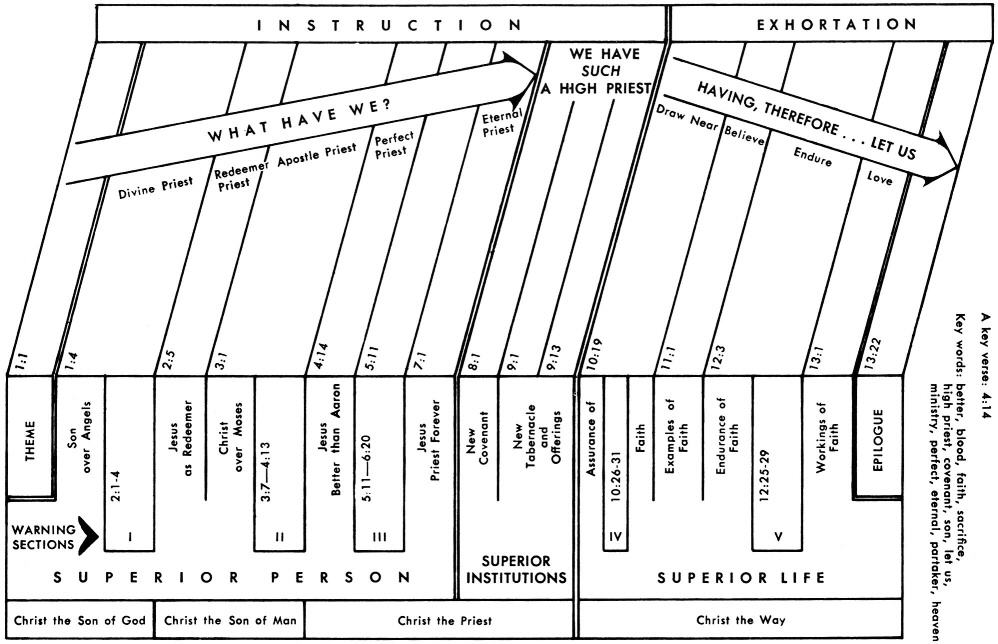
CONSIDER JESUS OUR GREAT HIGH PRIEST
Click chart to enlarge
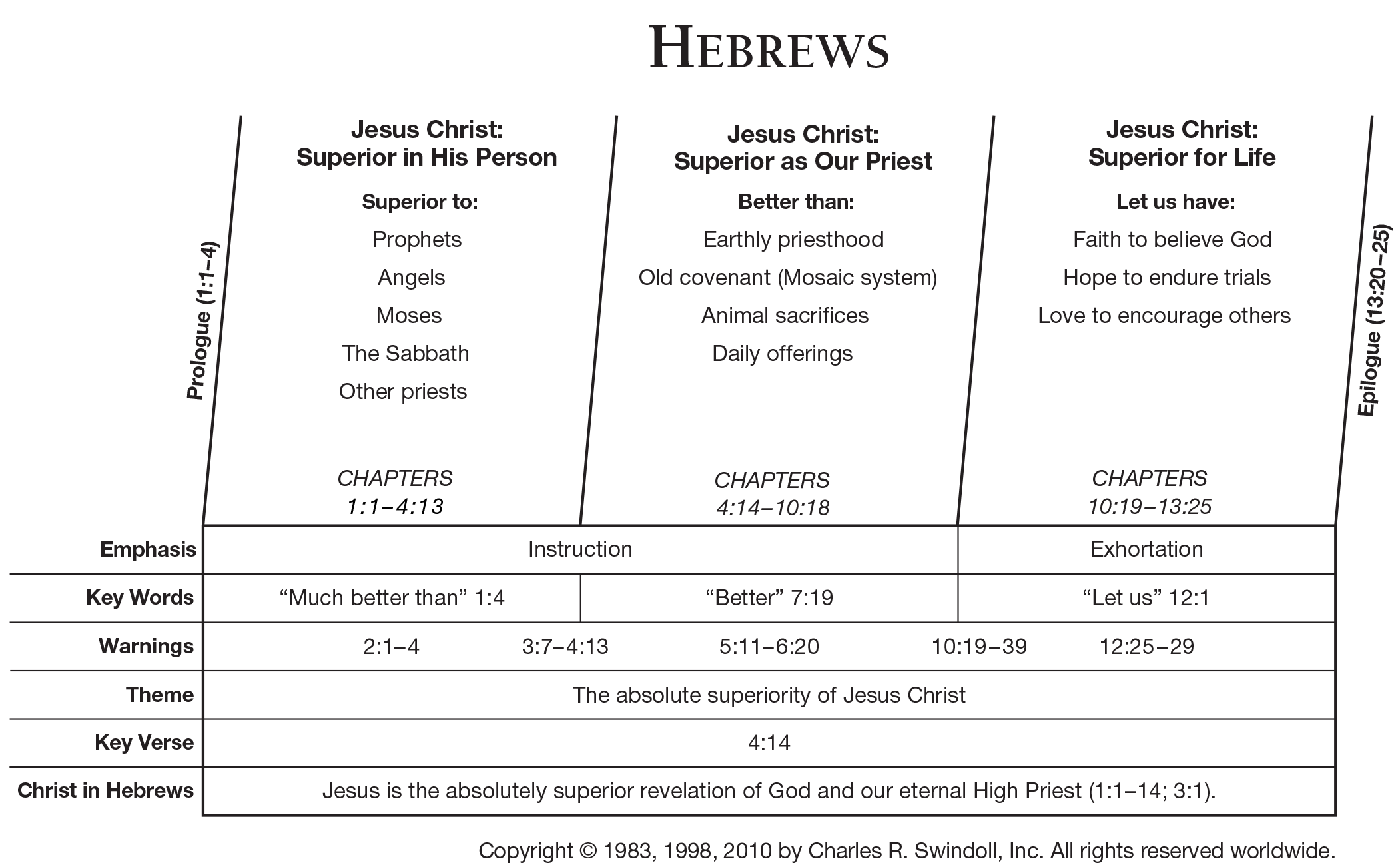
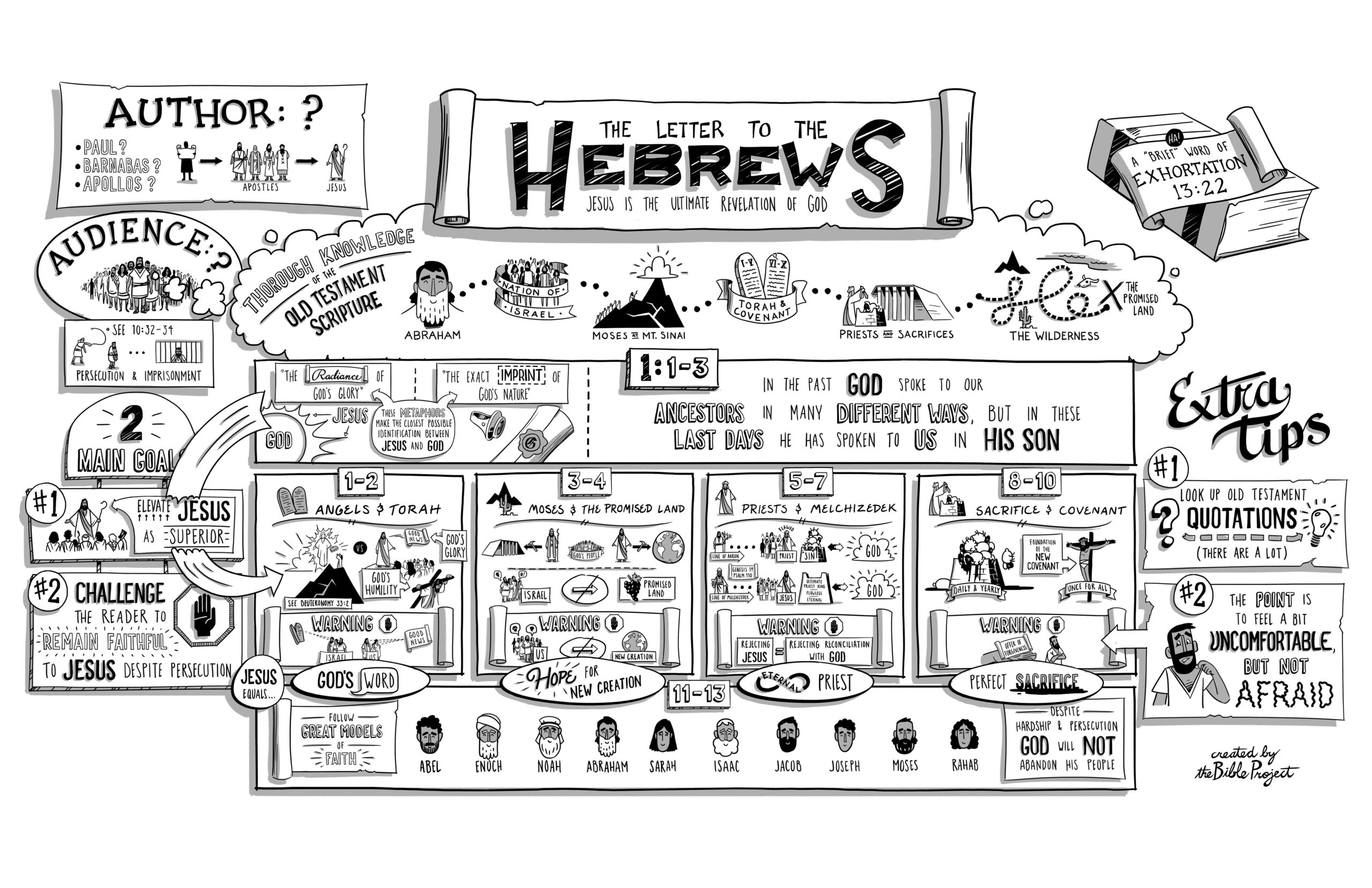
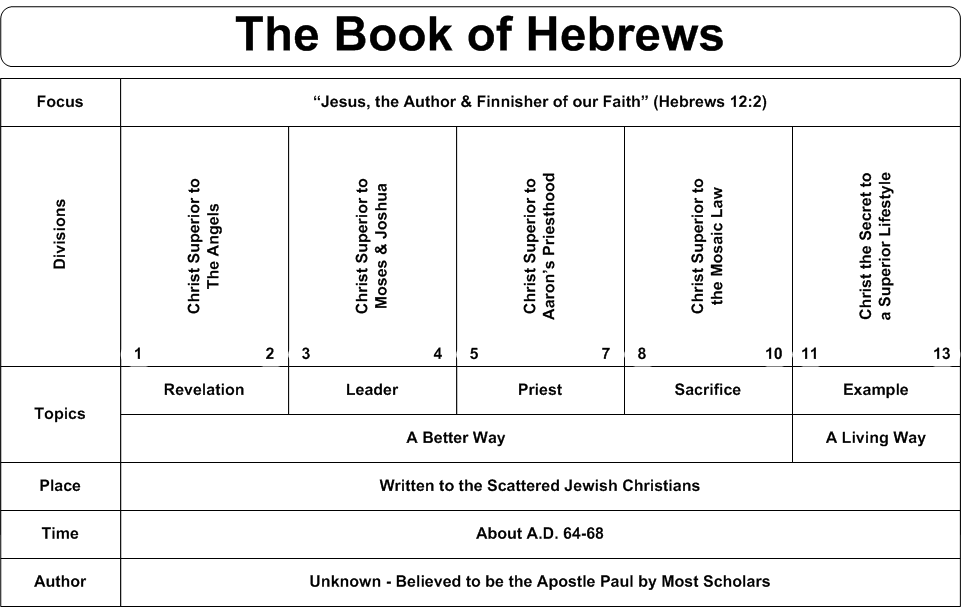
Charts from Jensen's Survey of the NT - used by permission
Swindoll's Chart, Interesting Pictorial Chart of Hebrews, Another Chart
|
The Epistle |
||||
| INSTRUCTION Hebrews 1-10:18 |
EXHORTATION Hebrews 10:19-13:25 |
|||
| Superior Person of Christ Hebrews 1:1-4:13 |
Superior Priest in Christ Hebrews 4:14-10:18 |
Superior Life In Christ Hebrews 10:19-13:25 |
||
| BETTER THAN PERSON Hebrews 1:1-4:13 |
BETTER PRIESTHOOD Heb 4:14-7:28 |
BETTER COVENANT Heb 8:1-13 |
BETTER SACRIFICE Heb 9:1-10:18 |
BETTER LIFE |
| MAJESTY OF CHRIST |
MINISTRY OF CHRIST |
MINISTERS FOR CHRIST |
||
|
DOCTRINE |
DUTY |
|||
|
DATE WRITTEN: |
||||

See ESV Study Bible "Introduction to Hebrews"
(See also MacArthur's Introduction to Hebrews)

Borrow Ryrie Study Bible
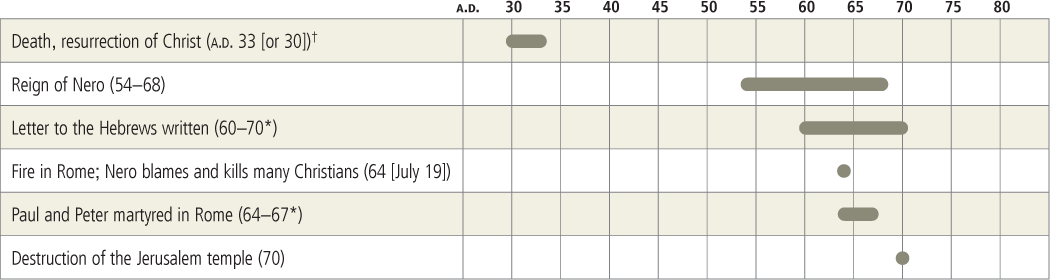
Timeline of Hebrews - ESV Study Bible
See HEBREWS OVERVIEW AND INTRODUCTION
Key Words -- See importance of key words - learn how to mark key words and the associated discipline of how to interrogate them with 5W/H questions. Practice "interrogating" key words as well as term of conclusion (therefore), term of explanation (for), terms of purpose or result (so that, in order that, that, as a result), terms of contrast (but, yet), expressions of time (including then; until, after) and terms of comparison (like, as). You will be amazed at how your Teacher, the Holy Spirit, will illuminate your understanding, a spiritual blessing that will grow the more you practice! Be diligent! Consider the "5P's" - Pause to Ponder the Passage then Practice it in the Power of the Spirit. See also inductive Bible study - observation (Observe With a Purpose), Interpretation (Keep Context King, Read Literally, Compare Scripture with Scripture, Consult Conservative Commentaries), and then be a doer of the Word with Application. Do not overlook "doing the word" for if you do you are deluding yourself, and are just a "smarter sinner," but not more like the Savior! As Jesus said "blessed are those who hear the word of God, and observe it." (Lk 11:28, cf James 1:22),
Key Words/Phrases: (Click for complete listing of Key Words in Hebrews)
Better, Blood, Faith, Eternal, Once, Sacrifice, High Priest, Jesus, Covenant, Perfect, Eternal, Partaker, Ministry.
My personal favorite phrase in Hebrews is "He is able" - Meditate on Hebrews 2:18 and Hebrews 7:25 to see what Your Great High Priest is able to accomplish for you, dear child of God!
Key Verses: Hebrews 4:14, Hebrews 4:12, Hebrews 10:19-22
Type of literature: Letter or epistle - a "word of exhortation" (Heb 13:22). Exhortations introduced by "Let us" (Hebrews 4:1, 11, 14, 16, 6:1, 10:22, 23, 24, 12:1, 28, 13:13, 15).
Author: Much ink has been used in an attempt to answer this question. Suffice it to say the author is unknown. Paul is often mentioned but by no means proven. Therefore it is a bit presumptuous to state dogmatically (like a number of commentators do) that Paul was the writer. Ultimately only God knows. As an aside it is notable that ALL 13 of Paul’s epistles begin with “PAUL…” What might that suggest about who wrote Hebrews? Clearly, it does not support Paul (although I am not saying it completely excludes him as the writer). Ultimately, we can know for certain that the Holy Spirit was the Author and He used a Spirit filled/controlled man to write this great epistle and choose not to tell us the writer's name (2Pe 1:21). Secondly, we can rest on Paul's promise in 1Cor 13:12 that "now we see in a mirror dimly, but then face to face; now I know in part, but then I will know fully just as I also have been fully known."
Recipients: Hebrew Christians-genuine and professing (specifically those tempted to lapse into Judaism)
Old Testament Quotations (or Allusions): click for OT passages in Hebrews
OVERVIEWS AND INTRODUCTIONS:
- Hebrews: All About Faith - Ray Stedman - "The Bible without the Spirit leads to a dead, institutional Christianity. The Spirit without the Bible leads to groundless fanaticism. We need both the Spirit and the Word to effectively Adventure through the Bible."
- Hebrews Introduction - John MacArthur
- Hebrews - Charles Swindoll
- Hebrews Introduction - James Van Dine
- Jude: Introduction, Argument, and Outline -Daniel Wallace
- Hebrews Notes and Outline - J Vernon McGee
- Hebrews Theology - Leonard S. Walmark
- Hebrews Introduction - NIV Study Bible
- Synthetic Bible Studies - Hebrews - James Gray
- Hebrews - Argument of the Book - nice summary - Hampton Keathley
- Hebrews Introduction, Argument, and Outline - Daniel Wallace
DICTIONARY ARTICLES:
- Hebrews: International Standard Bible Encyclopedia - lengthy article
- Hebrews - American Tract Society Bible Dictionary
- Hebrews, Theology of - Baker's Evangelical Dictionary of Biblical Theology
- Hebrews, Epistle to the - International Standard Bible Encyclopedia
- Hebrews - Holman Bible Dictionary
- Hebrews - Fausset Bible Dictionary
- Hebrews Epistle to the - Hastings' Dictionary of the New Testament
- Hebrews epistle to the - Kitto's Popular Cyclopedia of Biblical Literature
- Hebrews, the Epistle to The - Cyclopedia of Biblical, Theological and Ecclesiastical Literature
- Epistle to the Hebrews - 1911 Encyclopedia Britannica
- The Nuttall Encyclopedia Hebrews, Epistle to the
- The Jewish Encyclopedia Hebrews, Epistle to
Henrietta Mears writes...
We as Christians have that which is better—better in every way. The key word to the book of Hebrews is "better." It occurs thirteen times (in the KJV)....
How often when you take a trip for the first time over a new road, you drive straight along anticipating where it will lead, and what difficulties you may encounter. It seems to be the thing to do. Coming back over the same road, you look around and notice things. Do this in studying the book of Hebrews. Read it through, and do not be overanxious about the things you cannot understand. Then you can go back over the road in your reading and take notice of the many things along the way. You could spend months in Hebrews. It presents so many wonderful truths. At the first reading, you will be impressed by one fact above all others: that Jesus Christ is prominent on every page...
This book was written to strengthen the faith of wavering believers. Paul's great argument is the superiority of Christ over all others.
Do we know the real difference between having Christ as a Savior and as a Priest? Well, this book answers the question.
The book of Hebrews proves that we can never understand the Old Testament without the New, or the New without the Old....
Consider Jesus -This is our weakness. We look at ourselves and our own weakness. Consider Him (Hebrews 3:1). This is the astronomer's word. Set your telescope to the heavens and gaze upon Him....
Joshua could not lead the children of Israel into this perfect rest and trust in God, but Jesus did. Cease from self-effort and yield yourself to Christ (Hebrews 4:10). Trust Jesus as your Joshua and "enter in" to His land of promise. Cease struggling and place all in His hand. (Read Psalm 37:5.)
BORROW What the Bible is all about- recommended
J Sidlow Baxter writes...
I shall not forget my first sight of Mont Blanc towering up beyond the Chamonix Valley, king among Alpine giants, crowned with a sun-transfigured majesty. One may well feel a similar, reverential wonder with this transcendent "Epistle to the Hebrews" opening up to view. It is one of the greatest two theological treatises in the New Testament. (Ed: Romans being the other)
Here is Baxter's Outline entitled:
CHRIST THE "NEW AND LIVING WAY"
1. JESUS - THE NEW AND "BETTER "DELIVERER (Heb 1-7).
Jesus the God-Man - better than angels (Heb 1:1-2:18).
Jesus the new Apostle - better than Moses (Heb 3:1-19)
Jesus the new Leader - better than Joshua (Heb 4:1-13).
Jesus the new priest - better than Aaron (Heb 4:14-7).
2. CALVARY - THE NEW AND "BETTER" COVENANT (Heb 8:1-10:18)
New covenant has better promises (Heb 8:6-13).
And it opens up a better sanctuary (Heb 9:1-14).
And is sealed by a better sacrifice (Heb 9:15-28).
And it achieves far better results (Heb 10:1-18).
3. FAITH - THE TRUE AND "BETTER" PRINCIPLE (Heb 10:19-13).
Faith the true response to these "better" things (Heb 10:19-39)
It has always been vindicated as such: examples (Heb 11:1-40).
Is now to endure, patiently looking to Jesus (Heb 12:1-13).
Is to express itself in practical sanctity (Heb 12:14-13:21).
Parting words Heb 13:22-25.
From Baxter's Explore the Book - online - Recommended Resource - excellent overview of the Bible
A M Hodgkin (Christ in All the Scriptures) writes: The glories of our Savior are exhibited in this Epistle; it is one of the most precious books in the Bible. It has been called “The Fifth Gospel.” Four describe Christ’s ministry on earth, this describes His ministry in heaven. It was written to Hebrew disciples, probably of Jerusalem, to avert the danger of their drifting back into Judaism. They are exhorted to let go everything else, in order to hold fast the faith and hope of the Gospel. The Epistle is attributed to Paul, and though many question this, there is abundance of evidence in its favor. To give one example only, the concluding salutation, “Grace be with you all,” is Paul’s “sign-manual” in every Epistle.
The Key-note is the High-Priesthood of the Lord Jesus...Throughout this Epistle we note that whatever Christ touches He makes eternal. Trace the word “eternal” throughout (Hebrews 5:9, 6:2, 9:12, 14, 15, 13:20). (Ed: There is another "time word", once, which speaks of finality in Hebrews - see Hebrews 6:4, 7:27, 9:7, 12, 26, 27, 28, 10:2, 10, 12:26, 27)
Hebrews 1-2. Christ better than the angels both in His deity and His humanity.
As our great High Priest, Christ is able to understand all our need, because He is perfect Man. He is able to meet all our need, because He is perfect God. The central point is Christ’s eternal Priesthood and all-availing sacrifice for sin. The Epistle dwells upon the supreme importance and power of the blood of Christ in obtaining eternal redemption for us, in purging the conscience, in opening to us the heavenly sanctuary.
Hebrews 3. Christ better than Moses.
Hebrews 4. Christ better than Joshua.
Hebrews 5, 6, 7. Christ better than Aaron.
Hebrews 8. A better Covenant.
Hebrews 9. A better Tabernacle.
Hebrews 10. A better Sacrifice.
Hebrews 11. Examples of Faith’s better choice.
Hebrews 12. Call to follow this glorious company and the great Captain Himself in the path of outward loss for eternal gain.
Hebrews 13. Call to go forth unto Him without the camp bearing His reproach.
Daniel Wallace in his introduction writes "Philip Edgcumbe Hughes opens the introduction to his commentary on Hebrews with some insights into this very enigmatic book:
If there is a widespread unfamiliarity with the Epistle to the Hebrews and its teaching, it is because so many adherents of the church have settled for an understanding and superficial association with the Christian faith. Yet it was to arouse just such persons from the lethargic state of compromise and complacency into which they had sunk, and to incite them to persevere wholeheartedly in the Christian conflict, that this letter was originally written. It is a tonic for the spiritually debilitated.… We neglect such a book to our own impoverishment. (Hebrews Introduction)
Leonard S. Walmark writes that...
The theological epicenter of the Epistle to the Hebrews may be summed up in one word: Christology. No biblical document outside of the four Gospels focuses as totally and forcefully on the Person and redemptive achievement of Jesus...For purposes of analysis the epistle may be divided into two major sections. In Hebrews 1:1-10:18, the primary theme is the superiority of Christ as eternal High Priest. He is declared ultimately superior to the most cherished institutions of the ancient Hebrew faith. He is superior to the word of God spoken through the prophets since He Himself is God's ultimate redemptive Word. He is superior to the angelic hosts because no angel can boast of being the Son of God, fully Divine (Heb 1:4-14), and yet fully Human (Heb 2:5-18). These two factors qualify Him uniquely to be the faithful and perpetual sin-bearer of His people. On the basis of that same uniqueness of being, He is as superior to Moses the great lawgiver of Israel (Heb 3:1-6), as Creator is to the created. The spiritual rest from dead works offered by Jesus is superior to that temporal one represented in Moses and Joshua through the occupation of the promised land (Heb 4:1-11; esp. Heb 4:9-10). Beginning with Hebrews 5:1 the central theological concern of the epistle emerges: the eternal spiritual priesthood assumed by Jesus through offering up Himself as the once-for-all sacrifice for sins. It is infinitely superior to the temporal earthly ministry exercised by Aaron and his descendants (Heb 4:14-5:11; 7:1-10:18). (Hebrews Theology)
- Hebrews - Pt 1 - Chapters 1-4 -11 lessons - download lesson 1 as a sample
- Hebrews - Pt 2 - Chapters 5-13 - 19 lessons - download lesson 1 as a sample
Onsite - Literal, conservative, millennial, evangelical perspective. Completely revised 2025
See also HEBREWS OVERVIEW AND INTRODUCTION
Hebrews 1:2
Hebrews 1:3
Hebrews 1:4
Hebrews 1:5
Hebrews 1:6
Hebrews 1:7
Hebrews 1:8
Hebrews 1:9
Hebrews 1:10
Hebrews 1:11
Hebrews 1:12
Hebrews 1:13
Hebrews 1:14
Hebrews 2:2
Hebrews 2:3
Hebrews 2:4
Hebrews 2:5
Hebrews 2:6
Hebrews 2:7
Hebrews 2:8
Hebrews 2:9
Hebrews 2:10
Hebrews 2:11
Hebrews 2:12
Hebrews 2:13
Hebrews 2:14
Hebrews 2:15
Hebrews 2:16
Hebrews 2:17
Hebrews 2:18
Hebrews 3:2
Hebrews 3:3
Hebrews 3:4
Hebrews 3:5
Hebrews 3:6
Hebrews 3:7
Hebrews 3:8
Hebrews 3:9
Hebrews 3:10
Hebrews 3:11
Hebrews 3:12
Hebrews 3:13
Hebrews 3:14
Hebrews 3:15
Hebrews 3:16
Hebrews 3:17
Hebrews 3:18
Hebrews 3:19
Hebrews 4:2
Hebrews 4:3
Hebrews 4:4
Hebrews 4:5
Hebrews 4:6
Hebrews 4:7
Hebrews 4:8
Hebrews 4:9
Hebrews 4:10
Hebrews 4:11
Hebrews 4:12
Hebrews 4:13
Hebrews 4:14
Hebrews 4:15
Hebrews 4:16
Hebrews 5:2
Hebrews 5:3
Hebrews 5:4
Hebrews 5:5
Hebrews 5:6
Hebrews 5:7
Hebrews 5:8
Hebrews 5:9
Hebrews 5:10
Hebrews 5:11
Hebrews 5:12
Hebrews 5:13
Hebrews 5:14
Hebrews 6:1
Hebrews 6:2
Hebrews 6:3
Hebrews 6:4
Hebrews 6:5
Hebrews 6:6
Hebrews 6:7
Hebrews 6:8
Hebrews 6:9
Hebrews 6:10
Hebrews 6:11
Hebrews 6:12
Hebrews 6:13
Hebrews 6:14
Hebrews 6:15
Hebrews 6:16
Hebrews 6:17
Hebrews 6:18
Hebrews 6:19
Hebrews 6:20
Hebrews 7:1
Hebrews 7:2
Hebrews 7:3
Hebrews 7:4
Hebrews 7:5
Hebrews 7:6
Hebrews 7:7
Hebrews 7:8
Hebrews 7:9
Hebrews 7:10
Hebrews 7:11
Hebrews 7:12
Hebrews 7:13
Hebrews 7:14
Hebrews 7:15
Hebrews 7:16
Hebrews 7:17
Hebrews 7:18
Hebrews 7:19
Hebrews 7:20
Hebrews 7:21
Hebrews 7:22
Hebrews 7:23
Hebrews 7:24
Hebrews 7:25
Hebrews 7:26
Hebrews 7:27
Hebrews 7:28
Hebrews 8:1
Hebrews 8:2
Hebrews 8:3
Hebrews 8:4
Hebrews 8:5
Hebrews 8:6
Hebrews 8:7
Hebrews 8:8
Hebrews 8:9
Hebrews 8:10
Hebrews 8:11
Hebrews 8:12
Hebrews 8:13
Hebrews 9:1
Hebrews 9:2
Hebrews 9:3
Hebrews 9:4
Hebrews 9:5
Hebrews 9:6
Hebrews 9:7
Hebrews 9:8
Hebrews 9:9
Hebrews 9:10
Hebrews 9:11
Hebrews 9:12
Hebrews 9:13
Hebrews 9:14
Hebrews 9:15
Hebrews 9:16
Hebrews 9:17
Hebrews 9:18
Hebrews 9:19
Hebrews 9:20
Hebrews 9:21
Hebrews 9:22
Hebrews 9:23
Hebrews 9:24
Hebrews 9:25
Hebrews 9:26
Hebrews 9:27
Hebrews 9:28
Hebrews 10:1
Hebrews 10:2
Hebrews 10:3
Hebrews 10:4
Hebrews 10:5
Hebrews 10:6
Hebrews 10:7
Hebrews 10:8
Hebrews 10:9
Hebrews 10:10
Hebrews 10:11
Hebrews 10:12
Hebrews 10:13
Hebrews 10:14
Hebrews 10:15
Hebrews 10:16
Hebrews 10:17
Hebrews 10:18
Hebrews 10:19
Hebrews 10:20
Hebrews 10:21
Hebrews 10:22
Hebrews 10:23
Hebrews 10:24
Hebrews 10:25
Hebrews 10:26
Hebrews 10:27
Hebrews 10:28
Hebrews 10:29
Hebrews 10:30
Hebrews 10:31
Hebrews 10:32
Hebrews 10:33
Hebrews 10:34
Hebrews 10:35
Hebrews 10:36
Hebrews 10:37
Hebrews 10:38
Hebrews 10:39
Hebrews 11:1
Hebrews 11:2
Hebrews 11:3
Hebrews 11:4
Hebrews 11:5
Hebrews 11:6
Hebrews 11:7
Hebrews 11:8
Hebrews 11:9
Hebrews 11:10
Hebrews 11:11
Hebrews 11:12
Hebrews 11:13
Hebrews 11:14
Hebrews 11:15
Hebrews 11:16
Hebrews 11:17
Hebrews 11:18
Hebrews 11:19
Hebrews 11:20
Hebrews 11:21
Hebrews 11:22
Hebrews 11:23
Hebrews 11:24
Hebrews 11:25
Hebrews 11:26
Hebrews 11:27
Hebrews 11:28
Hebrews 11:29
Hebrews 11:30
Hebrews 11:31
Hebrews 11:32
Hebrews 11:33
Hebrews 11:34
Hebrews 11:35
Hebrews 11:36
Hebrews 11:37
Hebrews 11:38
Hebrews 11:39
Hebrews 11:40
Hebrews 12:1
Hebrews 12:2
Hebrews 12:3
Hebrews 12:4
Hebrews 12:5
Hebrews 12:6
Hebrews 12:7
Hebrews 12:8
Hebrews 12:9
Hebrews 12:10
Hebrews 12:11
Hebrews 12:12
Hebrews 12:13
Hebrews 12:14
Hebrews 12:15
Hebrews 12:16
Hebrews 12:17
Hebrews 12:18
Hebrews 12:19
Hebrews 12:20
Hebrews 12:21
Hebrews 12:22
Hebrews 12:23
Hebrews 12:24
Hebrews 12:25
Hebrews 12:26
Hebrews 12:27
Hebrews 12:28
Hebrews 12:29
Hebrews 13:1
Hebrews 13:2
Hebrews 13:3
Hebrews 13:4
Hebrews 13:5
Hebrews 13:6
Hebrews 13:7
Hebrews 13:8
Hebrews 13:9
Hebrews 13:10
Hebrews 13:11
Hebrews 13:12
Hebrews 13:13
Hebrews 13:14
Hebrews 13:15
Hebrews 13:16
Hebrews 13:17
Hebrews 13:18
Hebrews 13:19
Hebrews 13:20
Hebrews 13:21
Hebrews 13:22
Hebrews 13:23
Hebrews 13:24
Hebrews 13:25
Explanation - The following list includes not only commentaries but other Christian works by well known evangelical writers. Most of the resources below are newer works (written after 1970) which previously were available only for purchase in book form or in a Bible computer program. The resources are made freely available by archive.org but have several caveats - (1) they do not allow copy and paste, (2) they can only be checked out for one hour (but can be checked out immediately when your hour expires giving you time to read or take notes on a lengthy section) and (3) they require creating an account which allows you to check out the books free of charge. To set up an account click archive.org and then click the picture of the person in right upper corner and enter email and a password. That's all you have to do. Then you can read these more modern resources free of charge! I have read or used many of these resources but not all of them so ultimately you will need to be a Berean (Acts 17:11) as you use them. I have also selected works that are conservative and Biblically sound. If you find one that you think does not meet those criteria please send an email at https://www.preceptaustin.org/
COMMENTARIES ON HEBREWS
Be confident (Hebrews) by Wiersbe, Warren
Cyril Barber - A challenging and insightful book that should be used extensively by adult Bible study groups. Recommended.
The Bible Exposition Commentary - Ephesians through Revelation - Warren Wiersbe (Or Bible Exposition Commentary)
Rosscup - One of America’s most appreciated staunchly evangelical Bible conference teachers gives diligent, refreshing expositions. These are all of his 23 separate, earlier books in the “Be” series on the New Testament. He strikes a particular appeal with lay people as he crystallizes sections, deals with some of the verses, handles certain problems and backgrounds and applies principles. He is premillennial.
Wiersbe's Expository Outlines on the New Testament by Wiersbe, Warren W
Cyril Barber - This is a book of exceptional merit. Pastors, missionaries, and Christian workers will profit from its use. Wiersbe introduces each book of the NT, provides an outline, and then furnishes his readers with a chapter-by-chapter discussion of the contents. The homiletic style is a “plus.” Recommended.
With the Word - Devotional Commentary - Warren Wiersbe -Chapter by chapter. Helpful insights.
The Preacher's outline & sermon Bible : New Testament, King James Version 1 Thessalonians, 2 Thessalonians, 1 Timothy, 2 Timothy, Titus, Philemon, Hebrews, James, 1 Peter, 2 Peter, 1 John, 2 John, 3 John, Jude, Revelation.
Exposition of the Epistle to the Hebrews by Kistemaker, Simon J., 1930-
James Rosscup - The author has been going on with commentaries in the series William Hendriksen began. He writes from an evangelical, reformed perspective, providing diligently studied comments competent in aspects of the Greek, giving views and reasons, writing clearly, explaining most matters well.
Exploring Hebrews by Phillips, John, 1927-
Cyril Barber - A clear exposition of the theme of this epistle. First published in 1977. Recommended.
The Interpretation of the Epistle to the Hebrews and the Epistle of James R.C. H. Lenski
The Epistle to the Hebrews : a commentary by Kent, Homer Austin
James Rosscup - A helpful evangelical commentary especially from the standpoint of clarity on the Greek where this is crucial to the interpretation, without being technical. It is also often helpful in discussing different main views and their support on problem passages (6:4–6, those who fall away; chapter 8, the new covenant, etc.). Dr. Kent served as Dean of the Seminary and also Professor of New Testament and Greek at Grace Theological Seminary.
Hebrews (Vol. 33) - Communicator's Commentary. Evans, L. H., Jr, & Ogilvie, L. J. (1985)
A handbook on the Letter to the Hebrews Ellingworth, P.
The message of Hebrews : Christ above all by Brown, Raymond, 1928
Cyril Barber - Treats this epistle as a letter of encouragement to those enduring persecution, and turns the eyes of its readers from their problems to the One who fulfills all that the law and the prophets predicted.
James Rosscup - A principal of Spurgeon’s College, London (not the Catholic R. E. Brown who wrote on the Gospel of John) did this in the refreshing Bible Speaks Today series, drawing on such greats as Bruce, Hughes and Westcott but keeping the exposition very readable and practical. Possibly Apollos wrote Hebrews in the early eighties. “Rest” in chapter 4 is a future reality on which we need to concentrate, yet is not attained by works but is God’s gift (p. 90). Hebrews 6:4–6 and 10:26–31 are taken to refer to those who once had outward signs of being Christians but never were “genuinely born again by God’s Spirit” (114). The penitent offender and weak backslider are not in view (cf. 189), yet Brown speaks confusingly of the ones described as if once they really trusted in Christ. This is a stimulating, inviting exposition for laymen or Christian workers who want a book competent but easy to read.
The Epistle to the Hebrews; from ritual to reality by MacDonald, William (1971) 264 pages.
James Rosscup - A conservative exposition by a recent president of Emmaus Bible School (Plymouth Brethren). MacDonald gives fine-point outlines and explains verse by verse, understanding that the epistle is aimed at true Christians and professing Christians mingled among them. Hebrews 6:4–6 refers to professors who had not really been born again. Comments are brief.
Hebrews : an introduction and commentary by Guthrie, Donald, Tyndale New Testament Commentaries.
Cyril Barber - Replaces Hewitt's earlier contribution to the series (see below). Believes the recipients were Jews in danger of apostasizing back into Judaism. This is a good treatment but too general when dealing with the problem portions of this letter.
James Rosscup - This volume replaces Hewitt’s in the series to meet new needs. Though vague, Guthrie apparently favors a date shortly before or after A. D. 70, leaving authorship open. The “rest” in chapter 4 is both present after conversion and future. The discussions of 6:4–6 and 10:26–31 do not appear to arrive at an unequivocal explanation of whether the really saved can actually lose salvation. A clearer taking of some stand would help. However, on many verses Guthrie is clear enough, though this is a concise commentary. I would not rate it near the top but about in the middle.
Hebrews by George H. Guthrie (NIV Application Commentary) Zondervan, 1998.
James Rosscup - One finds a work sensitively informed in Greek and theology, one that rather often explains matters with perception. Guthrie believes that the genuinely saved will persevere, not fall away. Some vagueness attaches to his effort on what “rest” means as his words go all around it yet fall short of clarifying just what it is as “something” and “the whole soteriological process” and “the process of entry into God’s presence” (152), whatever that means. Frequent illustrations and application material are a big concern, for example on drawing near to God (4:14–16). The work offers fairly good light on main pertinent issues, usually, and gives remarks to stimulate vital practical living.
The Epistle to the Hebrews : an introduction and commentary by Hewitt, Thomas
Hebrews : a call to commitment by Lane, William (NOT SAME AS WORD BIBLICAL COMMENTARY)
Cyril Barber - In clear, nontechnical language, Lane explains that Hebrews is more a sermon than a letter. It also addresses the same concerns that face the church today: the absence of God, the climate of uncertainty and insecurity, the tension between secular conformity and spiritual maturity, the threat of societal perversion, and the pressure of materialism. This is a challenging book, one that Christians will want to study carefully
Gospel Coalition - Lane’s short commentary makes use of all the insights of his more technical edition (see below), but in a way that is readable and much more user-friendly.
James Rosscup - Lane, known among other things for his excellent work on Mark (NICNT), has written a fairly good briefer commentary on Hebrews, informed by scholarly awareness of the literature, views and arguments and skill in the Greek text and background. The work uses the NIV and is evangelical.
Word biblical commentary Hebrews 1-8 William Lane
Cyril Barber - An erudite work. The “Introduction” of 120 pages is very full and complete, exploring all aspects of authorship, date, recipients, etc. In his exposition, Lane makes use of a variety of information to enliven his presentation. He places within a pastor’s hands a wealth of usable data. No exegetical stone is left unturned. This is a valuable volume.
James Rosscup - A work that has much to offer in details of the Greek text, exegesis, setting and bibliography. It will help readers be aware of a wealth of scholarly opinion and especially be helpful to teachers, preachers who study deeply, and Bible class leaders who are serious about their preparation. In bibliography it is of a high rating, in commentary not as good as the work by Bruce.
Hebrews Word Biblical Commentary - Hebrews 9-13 by Lane, William L.,
Cyril Barber - Completes Lane’s studies on Hebrews. The bibliographies are massive; the comments on the text are precise and admit no ambiguity; and the overall theme of this letter is painstakingly followed. Here is a work for the scholar and/or pastor who incorporates exegesis in the preparation of his expository messages.
The Epistle to the Hebrews : a commentary on the Greek text New International Greek Testament Commentary by Ellingworth, Paul
Cyril Barber - Provides an excellent treatment of the book’s authorship, date, setting, theology, literary structure, and genre. Discusses the 13 individuals to whom authorship has been attributed. Provides an extensive bibliography. Believes the destination of the letter was Rome. Treats difficult passages fairly, but on occasion bypasses crucial issues (e.g., the identity and significance of Melchizedek) with only passing comment. Abounds in technical data. Ideal for the scholar.
James Rosscup - For scholars and advanced students, he packs much into this 764-pp. work of complex, almost encyclopedic detail verse by verse. Many pastors and students will become frustrated trying to plod through a maze of comments on verses where Ellingworth leaps into laborious detail without giving a prior adequate synthesis to show the overall progression. One must search to locate where he discusses some verses, and can be bogged down by the hodge-podge piling of comments without clarity to orientate things. Even on problems, the author often seems generalized, not coming right to clear grips with meaning in such texts as 6:4–6, and obscures rather than shining light. For the extremely patient, the work often has a mass of discussion from which many benefits can be sifted, and in listing scholars’ sources for studying Hebrews this prolific book rates with Altridge and Lane. It is unfortunate here that so fine a mind has not been too widely user friendly, as works that get more to the point along the way, doing this even with their much detail (Bruce, P. Hughes, etc.).
A handbook on the Letter to the Hebrews by Ellingworth, Paul
The epistle to the Hebrews by Archer, Gleason
James Rosscup - Archer aims to provide a well-organized, “handy guide” (p. 1) as a systematic exposition to help a pastor, Bible teacher or English Bible instructor in a college. Taking the central theme, Christ’s superiority and its implications for victorious living, Archer follows the progression of the developing theme. He gives a 5-pp. outline at the outset, then writes the book in the form of his detailed outline, filling in verse by verse with key word meanings, related Old Testament passages, and brief help on problem passages such as 6:4–6 and 10:26–39 (he holds that those in view are professors though never genuinely saved). This is a very good brief survey compactly arranged.
The Epistle to the Hebrews by Pfeiffer, Charles F
Commentary on the E̲pistle to the Hebrews : the English text with introduction, exposition, and notes by Bruce, F. F.
Cyril Barber - This revised edition of Bruce's widely used work (which has been in continuous use since 1964) helps the reader appreciate the genius of the biblical writer. While not reflecting any radical changes in Bruce's thinking, this new edition does give evidence of a quarter of a century of additional study on the part of the author. It also takes full advantage of the numerous new works on Hebrews that have been published in the intervening period of time.
1 and 2 Timothy, Titus, Philemon, Hebrews, James by Morris, Leon,
James Rosscup - A well-organized, lucid survey that gives synopses of sections and usually broad comment but dips into many of the verses for serious explanation, views on problems, and reasons. It is primarily of help to lay persons and pastors needing a concise but competent study. Longer, more detailed works ought to be used with it.
The Expositor's Bible Commentary : abridged edition
James Rosscup - note these comments apply to the unabridged edition - This is a substantial work (pp. 1–158) by a highly competent and prolific New Testament scholar in the evangelical realm. He is brief, aware of issues and arguments, sums things up well in several cases, and clear. For a shorter commentary this is a worthy effort which will be of service to teachers, preachers, Sunday School teachers and serious lay persons.
Hebrews; a Devotional Commentary by Thomas, W. H. Griffith
James Rosscup - Expositional in nature, this book is often helpful to a degree on the English text. It is devotional in nature.
Hebrews by Hagner, Donald Alfred
James Rosscup - This work was originally in the Good News Commentary (San Francisco: Harper and Row, 1983). It is by a professor at Fuller Theological Seminary, evangelical, and fairly helpful at times, but not nearly in the range of Bruce, Ellingworth, Lane, Morris, etc. for explanatory detail.
Experiencing the presence of God : teachings from the book of Hebrews by Tozer, A. W
Types in Hebrews by Anderson, Robert,
Cyril Barber - A rewarding study that evangelical Christians can ill afford to neglect.
The Epistle to the Hebrews by Davidson, A. B.
The Epistle to the Hebrews; an exposition by Erdman, Charles R.
A commentary on the Epistle to the Hebrews Montefiore, Hugh (1964)
God's last word to man; studies in Hebrews by Morgan, G. Campbell
James Rosscup - Preached expositions with good practical applications running through Hebrews 11. Some errors can agitate readers, e. g. having Moses’ birth 64 years after Joseph’s death, and the rejection of total depravity (p. 151). However, there is much to edify and to stimulate Christians, even to be suggestive for messages in a great chapter.
Commentary on the epistle to the Hebrews by Delitzsch, Franz
Cyril Barber - An extremely fine exposition that uses Talmudic source material to highlight the meaning of the text. A valuable acquisition.
James Rosscup - Though somewhat technical, this work grapples seriously with the Greek text and stimulates thinking on the problems of the epistle. It is good on the Greek.
The preeminent person of Christ : a study of Hebrews 1-10 by Swindoll, Charles
The practical life of faith : a study of Hebrews 11-13 by Swindoll, Charles
KJV Bible Commentary - NO RESTRICTIONS Hindson, Edward E; Kroll, Woodrow Michael. Over 3000 pages of the entire OT/NT. Well done conservative commentary that interprets Scripture from a literal perspective. Pre-millennial.
Very well done conservative commentary that interprets Scripture from a literal perspective user reviews
The King James Version Bible Commentary is a complete verse-by-verse commentary. It is comprehensive in scope, reliable in scholarship, and easy to use. Its authors are leading evangelical theologians who provide practical truths and biblical principles. Any Bible student will gain new insights through this one-volume commentary based on the timeless King James Version of the Bible.
NKJV Study Bible: New King James Version Study Bible NO RESTRICTIONS (formerly "The Nelson Study Bible - NKJV") by Earl D Radmacher; Ronald Barclay Allen; Wayne H House. 2345 pages. (1997, 2007). Very helpful notes. Conservative. Pre-millennial.
The Wycliffe Bible Commentary - only the New Testament NO RESTRICTIONS (for OT see below to borrow) - 1126 pages. (1971) Everett F Harrison - Editor of New Testament. Uses the KJV. Strictly speaking not a study Bible, but short notes are similar. KJV text in left column, commentary notes in right column. The comments are generally verse by verse, short, conservative and to the point. Pre-millennial.
The King James Study Bible Second Edition 2240 pages (2013) (Thomas Nelson) General Editor - Edward Hindson with multiple contributing editors. . 3,194 ratings. Pre-millennial. See introduction on How to Use this Study Bible.
The MacArthur Study Bible - John MacArthur. Brief but well done notes for conservative, literal perspective.
ESV Study Bible - Excellent resource but not always literal in eschatology and the nation of Israel
The David Jeremiah Study Bible - (2013) 2208 pages. Logos.com - "Drawing on more than 40 years of study, Dr. David Jeremiah has compiled a legacy resource that will make an eternal impact on generations to come. 8,000 study notes. Hundreds of enriching word studies"50+ Essentials of the Christian Faith" articles."
Believer's Bible Commentary - OT and NT - MacDonald, William (1995) 2480 pages. Conservative. Literal. Often has very insightful comments. John MacArthur, says "Concise yet comprehensive - the most complete single-volume commentary I have seen." Warren Wiersbe adds "For the student who is serious about seeing Christ in the Word."
Rosscup - This work, originally issued in 1983, is conservative and premillennial, written to help teachers, preachers and people in every walk of life with different views, explanation and application. The 2-column format runs verse by verse for the most part, usually in a helpfully knowledgeable manner, and there are several special sections such as “Prayer” in Acts and “Legalism” in Galatians. The premillennial view is evident on Acts 1:6, 3:20, Romans 11:26, Galatians 6:16, Revelation 20, etc.
HCSB Study Bible : Holman Christian Standard Bible - General Editor Jeremy Royal Howard (2010) 2360 pages. Conservative. Good notes. Include Holmans excellent maps. One hour limit
Life Application Study Bible: Old Testament and New Testament: New Living Translation. Has some very helpful notes especially with application of texts.
The Defender's Study Bible : King James Version by Morris, Henry M. Excellent notes by well known creationist.
Dictionary of Biblical Imagery - free for use online with no restrictions (i.e., you do not need to borrow this book). Editors Leland Ryken, J C Wilhoit, Tremper Longman III - This is a potential treasure chest to aid your preaching and teaching as it analyzes the meaning of a host of Biblical figures of speech. Clue - use the "One-page view" which then allows you to copy and paste text. One downside is there is no index, so you need to search 3291 pages for entries which are alphabetical.
Dictionary of New Testament background - Craig Evans, Stanley Porter (No restrictions)
Dictionary of deities and demons in the Bible (DDD) - 950 pages (1995) Read some of the 65 ratings (4.8/5 Stars). A definitive in depth resource on this subject. Very expensive to purchase.
Dictionary of the later New Testament & its developments IVP Series
The third of IVP's critically acclaimed series of dictionaries of the New Testament provides focused study on the often-neglected portions of the New Testament: Acts, Hebrews, the General Epistles, and Revelation. Furthermore, its scope goes beyond the life of the New Testament church to include the work of the apostolic fathers and early Christianity up through the middle of the second century.
Zondervan NIV Study Bible - (2011) 2570 pages - Use this one if available as it has more notes than edition below. One hour limit
The Experiencing God Study Bible: the Bible for knowing and doing the will of God - Blackaby, Henry (1996) 1968 pages - CHECK THIS ONE! Each chapter begins with several questions under the title "PREPARE TO MEET GOD." Then you will interesting symbols before many of the passages. The chapter ends with a "DID YOU NOTICE?" question. This might make a "dry chapter" jump off the page! Read some of the 48 ratings
NLT Study Bible (Illustration Version)
Disciple's Study Bible: New international version 54 ratings Not that helpful for verse by verse study. Focuses on application of Christian doctrines. 10,000 annotations; doctrinal summaries, "Life Helps" section relate doctrine to everyday discipleship.
The Living Insights Study Bible : New International Version - Charles Swindoll. Notes are good but somewhat sparse and not verse by verse.
Ryrie Study Bible Expanded Edition (1994) 2232 pages
The Apologetics Study Bible Understand Why You Believe by Norman Geisler
Evangelical Commentary on the Bible - Judges by Andrew Boling (20 pages); editor Walter Elwell (1989) 1239 pages. User reviews.
NIV Archaeological Study Bible (2005) 2360 pages 950 ratings (See also Archaeology and the Bible - OT and NT)
NIV Cultural Backgrounds Study Bible. Bringing to Life the Ancient World of Scripture Keener, Craig and Walton, John. Editors (2017)
The Holman Illustrated Study Bible 120 ratings Includes the excellent Holman maps but otherwise of little help in serious study.
Halley's Bible Handbook Henry H. Halley - (2000) 2720 pages (much larger than original edition in 1965 and no time limit on use). (Halley's Bible handbook : an abbreviated Bible commentary - one hour limit 1965 872 pages)
Rosscup - A much-used older evangelical handbook bringing together a brief commentary on Bible books, some key archaeological findings, historical background, maps, quotes, etc. It is helpful to a lay Bible teacher, Sunday School leader, or pastor looking for quick, pertinent information on a Bible book. This is the 72nd printing somewhat revised. Halley packed in much information. Unger’s is better overall, but that is not to say that Halley’s will not provide much help on basic information.
The Shaw Pocket Bible Handbook - Editor - Walter Elwell (1984) 408 pages.
"This hardback is small in size but packed full of content: Brief summaries of every book of the bible, cultural, archaeological and historical info, word definitions, pictures, maps and charts." Worth checking!
The Complete Word Study Dictionary: New Testament by Zodhiates, Spiros - This is my "go to" resource for Greek word studies. One on the best lexicons for laymen. Highly Recommended for Greek Word Studies to aid your interpretation of a passage.
The New International Dictionary of New Testament Theology (NIDNTT) - Colin Brown, general editor - all three volumes (total 3351 pages) are available and allow copy and paste and all 3 of the volumes below are available at the same link. See this page for a few instructions on how to most efficiently utilize this incredible resource.
- The New International Dictionary of New Testament Theology (NIDNTT) - Colin Brown, general editor - A-F
- The New International Dictionary of New Testament Theology (NIDNTT) - Colin Brown, general editor - G-P
- The New International Dictionary of New Testament Theology (NIDNTT) - Colin Brown, general editor - Pri-Z
Analytical Lexicon of the Greek New Testament by Friberg, Timothy. Shorter definitions than Zodhiates but does an excellent job in summarizing the various nuances of a specific Greek word. One of my favorites for short accurate definitions with at least one representative Scripture use. .
Shorter Lexicon of the Greek New Testament by Gingrich, F. Wilbur. Similar to Friberg but shorter definitions. Gingrich however gives more Scriptures for each nuance, whereas Friberg generally gives only one representative Scripture.
The New Linguistic and Exegetical Key to the Greek New Testament by Rogers, Cleon - This book is a gold mine of little gems on individual Greek words in any NT passage you are studying. If you have time it is always worth checking out! I use it in my Greek word studies all the time.
Word meanings in the New Testament - Matthew-Revelation by Ralph Earle. Strictly speaking this is not a lexicon, but it offers insights on select words in a verse by verse format (but not every verse is included in the analysis). This resource is worth checking if you have time as it can occasionally give some wonderful insights on a specific Greek word.
New Testament Words - William Barclay - 59 ratings very interesting resource - covers about 70 NT Greek words in Barclay's unique style. On page 289 there is a helpful index of English words with the corresponding Greek word, in turn followed by the places Barclay described them in New Testament Words and in his Daily Study Bible series (see list of DSB commentaries here). E.g., take the Greek word for "Covetousness" which is pleonexia and is found in New Testament Words on page 61 and pp 233-235 and is also described in the Daily Study Bible entries for : Mark 7:14-23; Ro 1:28-32; Eph. 4:17-24; Col. 3:5. So you can click the DSB commentary on Mark 7 and scroll down to Mark 7:14 to see Barclay's entry for pleonexia which concludes "Pleonexia ( G4124) is that lust for having which is in the heart of the man who sees happiness in things instead of in God." Interesting!
Greek-English lexicon of the New Testament : based on semantic domains - Louw Nida. Brief but nice definitions. Not easy to use - you need to know some Greek. Classifies Greek words into 93 "semantic domains" (see list on page XXV) and if you can categorize the word you are looking for in one of the domains, it can help find the specific word you are interested in.
Kittel's Theological Dictionary of the New Testament : abridged in one volume (TDNT) - Classic ("Little Kittel") work summarizing the 10 volume set by Kittel. For most of us the abridged definition is "more than enough!"
A Greek-English lexicon of the New Testament, and other early Christian literature (BDAG); by Bauer, Walter, More detailed definitions but need to know Greek. Zodhiates and Friberg are much easier to use.
Liddell and Scott's Greek-English lexicon, abridged : the little Liddell by Liddell, Henry George. The abridged version. You need to know Greek to use.
Exegetical Dictionary of the New Testament (Volume 1 - A thru E); Exegetical Dictionary of the New Testament (Volume 3- P thru ...) Volume 2 not available. I do not find this adds much to the easier to use resources like Zodhiates and Friberg.
A Pocket Lexicon to the Greek New Testament by Souter, Alexander. Brief definitions. Need to know some Greek. Not that helpful.
Vine's Expository Dictionary of Old Testament and New Testament Words - NO RESTRICTIONS The old standby.
New Testament Words in Today's Language by Detzler, Wayne A - Wonderful resource to supplement word studies. THIS IS A SLEEPER!
- God: Is Jesus Your Final Answer? – Hebrews 1:1-4
- Jesus Christ: God’s Very Best – Hebrews 1:1-4
- Hebrews – Hebrews 1:1
- A Study of the Epistle to the Hebrews – Hebrews 1:1-13:25
- A Study of the Epistle to the Hebrews
- Looking Unto Jesus – Hebrews 12:1-3
- Let’s Run In God’s Race – Hebrews 12:1-3
- God’s Chariot of Fire: The Life of Missionary Eric Liddell and the Race He Ran – Hebrews 12:1-3
- Marks Of A Healthy Community Of Faith – Hebrews 13
- Marks of a Healthy Community of Faith (Spring Convocation 2010) – Hebrews 13:1-25
Click the link below to open 344 page Pdf and Enter the Page Number to go to the Chapter of Interest
Introduction………………………………………………........…………….4
Hebrews 1:1-4 The Doctrine of God……………………………………...6
Hebrews 1:5-14 His Superiority Should Inspire Us…………………….16
Hebrews 2:1-4 His Superiority Should Warn Us…………………….....28
Hebrews 2:5-9 A Lesson on Angels Should Challenge Us…………...42
Hebrews 2:10-13 Who We Are Because of Who He Is………………..57
Hebrews 2:14-18 Christ the Partaker…………………….……………...75
Hebrews 3:1-6 Whom Should We Consider……………………...........89
Hebrews 3:7-19 Do Not Be Hindered by Unbelief ……………………104
Hebrews 4:1-10 Rest……………………………………………….........119
Hebrews 4:11-16 Cure for Unbelief…………………………………....134
Hebrews 5:1-5 A Further Look at the Great High Priest…………….148
Hebrews 5:6-10 The Order of Melchisedec…………………………..162
Hebrews 5:10-14 When Truth is Neglected………………………….176
Hebrews 6:1-6 Let Us Go On…………………………………………..189
Hebrews 6:7-20 The Rain, the Seed, and the Anchor……………...205
Hebrews 7:1-28 Let Melchisedec Show You Jesus…………...........223
Hebrews 8:1-13 Good Math……………………………......................241
Hebrews 9:1-10 The Earthly, the Eternal, and the Enduring Priesthood Pt 1.....256
Hebrews 9:11-28 The Earthly, the Eternal, and the Enduring Priesthood Pt 2...269
Hebrews 10:1-18 No Pleasure……………………………......…….....279
Hebrews 10:19-39 Let Us Draw Near With a True Heart…………..288
Hebrews 11:1-40 Faith’s Hall of Fame………………………………..298
Hebrews 12:1-17 Looking Unto Jesus………………………………..310
Hebrews 12:18-29 The Two Mountains………………….......….......321
Hebrews 13:1-25 A Final Challenge To Holy Living…………………335
James Rosscup writes that Alford's series on the New Testament "contains much that is valuable in the Greek New Testament...though all of the Greek New Testament words have been changed to English throughout." (Commentaries for Biblical Expositors: An Annotated Bibliography of Selected Works or Logos)
John Piper writes ""When I’m stumped with a...grammatical or syntactical or logical [question] in Paul, I go to Henry Alford. Henry Alford...comes closer more consistently than any other human commentator to asking my kinds of questions."
Charles Haddon Spurgeon writes that this text "is an invaluable aid to the critical study of the text of the New Testament. You will find in it the ripened results of a matured scholarship, the harvesting of a judgment, generally highly impartial, always worthy of respect, which has gleaned from the most important fields of Biblical research, both modern and ancient, at home and abroad. You will not look here for any spirituality of thought or tenderness of feeling; you will find the learned Dean does not forget to do full justice to his own views, and is quite able to express himself vigorously against his opponents; but for what it professes to be, it is an exceedingly able and successful work. The later issues are by far the most desirable, as the author has considerably revised the work in the fourth edition. What I have said of his Greek Testament applies equally to Alford’s New Testament for English Readers,* which is also a standard work." (Spurgeon, C. H. Lectures to my Students, Vol. 4: Commenting and Commentaries; Lectures Addressed to the students of the Pastors' College, Metropolitan Tabernacle)
Lectures on Hebrews - Click here for list of all 24 lectures
Teacher Notes
- Hebrews Study 1
- Hebrews Study 2
- Hebrews Study 3
- Hebrews Study 4
- Hebrews Study 5
- Hebrews Study 6
- Hebrews study 7
- Hebrews study 8
- Hebrews study 9
- Hebrews study 10
- Hebrews study 11
- Hebrews study 12
- Hebrews study 13
- Hebrews study 14
- Hebrews study 15
- Hebrews study 16
- Hebrews study 17
- Hebrews study 18
- Hebrews study 19
- Hebrews study 20
- Hebrews study 21
- Hebrews study 22
- Hebrews study 23
- Hebrews study 24
Hebrews Study Notes - Over 1000 pages of material!
- Hebrews study 1
- Hebrews study 2
- Hebrews study 3
- Hebrews study 4
- Hebrews study 5
- Hebrews study 6
- Hebrews study 7
- Hebrews study 8
- Hebrews study 9
- Hebrews study 10
- Hebrews study 11
- Hebrews study 12
- Hebrews study 13
- Hebrews study 14
- Hebrews study 15
- Hebrews study 16
- Hebrews study 17
- Hebrews study 18
- Hebrews study 19
- Hebrews study 20
- Hebrews study 21
- Hebrews study 22
- Hebrews study 23
- Hebrews study 24
What a Way to Go! - "When I go to heaven..." were Jack Arnold's last words before dying instantly in the pulpit from a heart attack. The extraordinary event made international headlines. and was picked up by the AP wire, CNN, and even Paul Harvey." (Click for more detail) (Watch memorial service - Pt 1, Pt 2, Pt 3, Pt 4, Pt 5).
Over 280 pages of material.
- Introduction
- The Superiority of Christ over the Prophets Hebrews 1:1-3
- The Superiority of Christ to Angels Hebrews 1:4-14
- The Danger of Drifting Hebrews 2:1-4
- Christs Rule Is Superior to Angels Hebrews 2:5-9
- Christs Salvation Work Makes Him Superior to Angels Hebrews 2:10-13
- Jesus Christs Identification with Man in Death Makes Him Superior to Angels Hebrews 2:14-15
- Jesus Christs Identification with Man in Suffering Makes Him Superior to Angels Hebrews 2:16-18
- Jesus Christ Is Superior to Moses Hebrews 3:1-6
- The Warning Against Unbelief Hebrews 3:6-12
- The Danger of Apostasy Hebrews 3:12-19
- Mixing the Promises with Faith Hebrews 4:1-3a
- The Rest of God Hebrews 4:3b-10
- Laboring To Rest Hebrews 4:11-13
- Christs Positional Superiority to Aaron Hebrews 4:14-16
- Christ Qualifies to Be the High Priest Hebrews 5:1-10
- Stagnation in the Christian Life Hebrews 5:11-6:2
- The Danger of Falling Away Hebrews 6:3-6a
- The Awful Possibility of Apostasy Hebrews 6:6-9
- The Certainty of Salvation Hebrews 6:9-20
- Melchizedek and Christ Hebrews 7:1-19
- The Unfinished and Finished Work of Christ Hebrews 7:20-28
- Christ Is Better than the Levitical Priesthood Hebrews 8:1-13
- The Tabernacle Furniture Hebrews 9:1-5
- Christ Cleanses the Conscience Hebrews 9:6-14
- The Blood in Christs Sacrifice Hebrews 9:15-28
- The Supreme Sacrifice of Christ Hebrews 10:1-18
- Full Assurance of Faith Hebrews 10:19-25
- The False and the True Hebrews 10:26-39
- What Is Faith? Hebrews 11:1-3
- Real Faith Hebrews 11:4-7
- Living Faith Hebrews 11:8-10
- The Awakening of Faith Hebrews 11:11-12
- Persevering Faith Hebrews 11:13-16
- The Testing of Faith Hebrews 11:17-19
- The Confidence of Faith Hebrews 11:20-22
- The Courage of Faith Hebrews 11:23
- The Sacrifice of Faith Hebrews 11:24-27
- The Obedience of Faith Hebrews 11:28
- The Patience of Faith Hebrews 11:29
- The Triumph of Faith Hebrews 11:30
- The Simplicity of Faith Hebrews 11:31
- The Weakness of Faith Hebrews 11:32
- The Dynamic of Faith Hebrews 11:32
- The Challenge of Faith Hebrews 11:32
- The Toughness of Faith Hebrews 11:32
- The Achievements of Faith Hebrews 11:32-40
- Running the Race Hebrews 12:1-4
- God's Loving Discipline Hebrews 12:5-11
- The Warning Against Indifference Hebrews 12:12-17
- Fear in the Old Covenant Hebrews 12:18-24
- Fear in the New Covenant Hebrews 12:25-29
- Social Responsibilities in Christ Hebrews 13:1-6
- Christian Responsibilities Hebrews 13:7-14
- Christian Obligations Hebrews 13:15-17
- Personal Responsibilities in Christ Hebrews 13:18-25
D Edmond Hiebert - Prints the author's own translation. Barclay defends Petrine authorship of 1 Peter but not of 2 Peter. Valuable for its numerous helpful word studies and background material. Barclay holds that Christ's descent into Hades gave those who there heard Him a second chance.
Comment: I appreciate Barclay's unique insights on Greek words and culture, but clearly his teaching about a "second chance" is NOT sound doctrine! Be an Acts 17:11 Berean with Barclay. Barclay is not always orthodox. See discussion of his orthodoxy especially the article "The Enigmatic William Barclay".
- Hebrews 1 Commentary
- Hebrews 2 Commentary
- Hebrews 3 Commentary
- Hebrews 4 Commentary
- Hebrews 5 Commentary
- Hebrews 6 Commentary
- Hebrews 7 Commentary
- Hebrews 8 Commentary
- Hebrews 9 Commentary
- Hebrews 10 Commentary
- Hebrews 11 Commentary
- Hebrews 12 Commentary
- Hebrews 13 Commentary
James Rosscup writes that Barnes "includes 16 volumes on the Old Testament, 11 on the New Testament. The New Testament part of this old work was first published in 1832–1851. Various authors contributed. It is evangelical and amillennial...Often the explanations of verses are very worthwhile." (Commentaries for Biblical Expositors: An Annotated Bibliography of Selected Works)
C H Spurgeon "Albert Barnes is a learned and able divine, but his productions are unequal in value, the gospels are of comparatively little worth, but his other comments are extremely useful for Sunday-school teachers and persons with a narrow range of reading, endowed with enough good sense to discriminate between good and evil....Placed by the side of the great masters, Barnes is a lesser light, but taking his work for what it is and professes to be, no minister can afford to be without it, and this is no small praise for works which were only intended for Sunday-school teachers." (Spurgeon, C. H. Lectures to my Students, Vol. 4: Commenting and Commentaries; Lectures Addressed to the students of the Pastors' College, Metropolitan Tabernacle)
John Cereghin - Valuable commentary that had a wide sale when first published by this Presbyterian pastor.
Calvary Chapel, Murrieta
- Hebrews 1:1-3 Jesus is Better
- Hebrews 1:4-14 Jesus Better Than Angels
- Hebrews 2 Adrift
- Hebrews 3 Consider Jesus
- Hebrews 4:1-13 Divine Rest
- Hebrews 4:14-16 Our Great High Priest
- Hebrews 5:1-11 Munis Triplex
- Hebrews 5:11-6:3 Stop Being a Big Baby
- Hebrews 6:4-12 Ersatz Christians
- Hebrews 6:13-20 Soul Anchor
- Hebrews 7:1-10 Mystery Man
- Hebrews 7:11-28 A Better Priest
- Hebrews 8 God's Justice was Swallowed by His Love
- Hebrews 9:16-28 Where There's a Will There's a Way
- Hebrews 10:1-18 When He came into the world...
- Hebrews 10:19-25 Doin Church
- Hebrews 10:26-39 Falling into the Hands of the Living God
- Hebrews 11:1-7 Authentic Faith
- Hebrews 11:8-22 Faith’s Role Models
- Hebrews 11:23-29 Moses’ Life of Faith
- Hebrews 12:1-3 The Race Set Before ME
- Hebrews 12:4-11 The Teleological Woodshed
- Hebrews 12:12-17 Finish Well
- Hebrews 12:18-29 Twin Peaks (Sinai & Zion)
- Hebrews 13:1-6 A Community of Mutual Love
- Hebrews 13:7-16 Jesus, Eternally the Same, Eternally Contemporary
- Hebrews 13:17-25 The Great Shepherd & His Under-Shepherds
Same resource in different format
| Hebrews 1 | Hebrews 2 | Hebrews 3 | Hebrews 4 |
| Hebrews 5 | Hebrews 6 | Hebrews 7 | Hebrews 8 |
| Hebrews 9 | Hebrews 10 | Hebrews 11 | Hebrews 12 |
| Hebrews 13 |
C H Spurgeon wrote that Bengel's NT commentary "is the Scholar's delight! Bengel condensed more matter into a line than can be extracted from pages of other writers."
John Wesley said of Bengel "I know of no commentator on the Bible equal to Bengel" and referred to him as "The great light of the Christian world."
James Rosscup writes "This work (Gnomon), originally issued in 1742, has considerable comment on the Greek, flavoring the effort with judicious details about the spiritual life. It has much that helps, but has been surpassed by many other commentaries since its day." (Commentaries for Biblical Expositors: An Annotated Bibliography of Selected Works)1 Peter 1 Commentary
Spurgeon comments on the goal to make Bengel's Gnomon -- "Such is the professed aim of this commentary, and the compilers have very fairly carried out their intentions. The whole of Bengel’s Gnomon is bodily transferred into the work, and as 120 years have elapsed since the first issue of that book, it may be supposed that much has since been added to the wealth of Scripture exposition; the substance of this has been incorporated in brackets, so as to bring it down to the present advanced state of knowledge. We strongly advise the purchase of this book, as it...will well repay an attentive perusal. Tischendorf and Alford have contributed largely...to make this one of the most lucid and concise commentaries on the text and teachings of the New Testament" (Spurgeon, C. H. Lectures to my Students, Vol. 4: Commenting and Commentaries; Lectures Addressed to the students of the Pastors' College, Metropolitan Tabernacle)
Spurgeon - Adopted by the Wesleyan Conference as a standard work, and characterized by that body as marked by “solid learning, soundness of theological opinion, and an edifying attention to experimental and practical religion. Necessary to Methodist Students.
Spurgeon on Calvin - Of priceless value....Calvin is a tree whose “leaf also shall not wither;” whatever he has written lives on, and is never out of date, because he expounded the word without bias or partiality.
James Rosscup - Calvin was not only a great theologian but also a great expositor, and his insight into Scripture contributed to his grasp of doctrinal truth. His commentaries are deep in spiritual understanding, usually helpful on problem passages, and refreshing in a devotional sense to the really interested reader. He usually offers good help on a passage. The present work skips Judges, Ruth, Samuel, Kings, Chronicles, Ezra, Nehemiah, Esther, Job, Ecclesiastes, Song of Solomon, II and III John and Revelation. Calvin is amillennial on long-range prophecy, but in other respects usually has very contributive perception on passages and doctrinal values edifying to the believer. He also can be very wordy, but the serious and patient glean much.
D Edmond Hiebert - Valuable for insights into Reformation day views.
These function like a 500+ Page Commentary! Highly Recommended. Very well done.
- Hebrews - The Glory of Christ in Hebrews
- Hebrews 1:1-2a God Has Spoken
- Hebrews 1:2b-3 The Supremacy of the Son
- Hebrews 1:4-14 The Son's Superiority over Angels
- Hebrews 2:1-4 The Danger of Drifting Spiritually
- Hebrews 2:5-9 Our Glorious Destiny in Christ
- Hebrews 2:10 Why Jesus' Death Was Fitting
- Hebrews 2:11-15 Jesus Our Brother and Savior
- Hebrews 2:16-18 Why Jesus Became a Man
- Hebrews 3:1-6 To Endure, Consider Jesus
- Hebrews 3:7-11 A Warning Against Hardness of Heart
- Hebrews 3:12-19 Persevering in Faith
- Hebrews 4:1-11 Cultural Christianity Versus Saving Faith
- Hebrews 4:12-13 God's Powerful Word
- Hebrews 4:14-16 The Throne of Grace
- Hebrews 5:1-10 The Kind of Priest You Need
- Hebrews 5:11-6:3 Grow Up!
- Hebrews 6:4-8 When Repentance Becomes Impossible
- Hebrews 6:9-12 Things That Accompany Salvation
- Hebrews 6:13-20 An Anchor for Your Soul
- Hebrews 7:1-10 Why You Need to Know About Melchizedek
- Hebrews 7:11-19 A Better Hope: Drawing Near to God
- Hebrews 7:20-28 Salvation Guaranteed!
- Hebrews 8:1-13 A Better Priest for a Better Covenant
- Hebrews 8:7-12 The Better Covenant
- Hebrews 9:1-14 God's Remedy for Guilt
- Hebrews 9:15-22 Forgiveness Through Christ's Blood
- Hebrews 9:23-28 Judgment or Salvation?
- Hebrews 10:1-18 Total Forgiveness
- Hebrews 10:19-25 Putting Your Position into Practice
- Hebrews 10:26-31 The Only Options: Christ or Judgment?
- Hebrews 10:32-39 Enduring Faith
- Hebrews 11:1-3 By Faith
- Hebrews 11:4 A Dead Man Speaks
- Hebrews 11:5-6 Pleasing God
- Hebrews 11:7 Faith that Escapes the Coming Judgment
- Hebrews 11:8-12 The Nitty-gritty of Faith
- Hebrews 11:13-16 Desiring a Better Country
- Hebrews 11:17-19 The Summit of Faith
- Hebrews 11:20-22 Dying Faith
- Hebrews 11:23-26 Faith's Choice
- Hebrews 11:27-29 Overcoming Faith
- Hebrews 11:30-31 Faith to Conquer and Convert
- Hebrews 11:32-40 Faith's Reward
- Hebrews 12:1-3 Faith to Run the Christian Marathon
- Hebrews 12:4-6 God's Loving Discipline
- Hebrews 12:7-11 Responding to God's Discipline
- Hebrews 12:12-14 Perseverance, Peace, and Purity
- Hebrews 12:15-17 Finishing the Race Together
- Hebrews 12:18-24 Are You Living in Sinai or Zion?
- Hebrews 12:25-29 Great Privileges, Great God, Great Responsibilities
- Hebrews 13:1-3 Let Love Continue
- Hebrews 13:4 The Right and Wrong Place for Sex
- Hebrews 13:5-6 Cultivating Contentment
- Hebrews 13:7-14 The Antidote for False Teaching
- Hebrews 13:15-16 True Christian Sacrifices
- Hebrews 13:17-19, 22-25 Your Duties Toward Church Leaders
- Hebrews 13:7, 17-19, 22-2The Responsibilities of Church Leaders
- Hebrews 13:20-21 God Our Provider
It is surprising that Criswell preached no messages related to the warning passages in Hebrews 6.
- Hebrews 1:1-9 The Letter to the Hebrews
- Hebrews 1:1-2 The Prophets and the Son
- Hebrews 1:1-2 How God Speaks to Us
- Hebrews 1:2-14 The Angels and the Son
- Hebrews 1:12 Self Revelation of God
- Hebrews 1:14 The Angels of God
- Hebrews 1:1-14 The Glory of Christ
- Hebrews 1:14 The World Of Angels ((Another)
- Hebrews 1:14 God's Guardian Angels
- Hebrews 1:14 Angels, God's Guardians
- Hebrews 2:1-14 Drifting
- Hebrews 2:5-9 The God-Man
- Hebrews 2:9 Looking Unto Jesus
- Hebrews 2:9-15 Christ Perfected Through Suffering
- Hebrews 2:16-18 Our All-Sufficient Saviour
- Hebrews 2:9-18 The Purpose of the Incarnation
- Hebrews 2:9-18 The Purpose of the Incarnation
- Hebrews 2:3 The Unanswerable Question (Another)
- Hebrews 2:9-18 Our Lord's Entrance Into Suffering
- Hebrews 2:14-15 How the Death of Christ Saves Us
- Hebrews 2:9 Our Lord's Entrance Into the Grave
- Hebrews 2:17-18 Our Sympathetic High Priest
- Hebrews 2:3 The Unanswerable Question
- Hebrews 3:7-13 While It Is Called Today
- Hebrews 3:7-18 They That Fall in the Wilderness
- Hebrews 3 The Entreaty of the Holy Spirit
- Hebrews 4:1-11 Rest for the People of God
- Hebrews 4:12 The Living Word
- Hebrews 4:12 Two-Edged Sword
- Hebrews 4:14-16 Our Compassionate High Priest
- Hebrews 5:1-6 Our Great High Priest
- Hebrews 5:7-8 In the Days of His Flesh
- Hebrews 5:7-8 The Agony in the Garden
- Hebrews 5:7-8 The Agony of Gethsemane
- Hebrews 5:9 The Author of Eternal Salvation
- Hebrews 7:1-8 Gambling Is Sin
- Hebrews 7:1-10 Tithing and the Blessing of God
- Hebrews 7:2 This Melchizedek
- Hebrews 7:4 How Great This Man
- Hebrews 7:8 My Tithe - My Testimony
- Hebrews 7:8 Stewardship Dedication
- Hebrews 7:25 Able to Save to the Uttermost
- Hebrews 8:1-5 The True Tabernacle
- Hebrews 8:6-13 The Two Covenants
- Hebrews 9:1-14 There Was a Tabernacle Made
- Hebrews 9: The Tabernacle in the Wilderness
- Hebrews 9:1-11 The Door to the Tabernacle
- Hebrews 9: The Laver for Washing
- Hebrews 9: The Brazen Altar
- Hebrews 9: The Veil Between
- Hebrews 9: The Ark of the Covenant
- Hebrews 9: The Mercy-Seat
- Hebrews 9: The Cherubim
- Hebrews 9: The Altar Sacrifices
- Hebrews 9:1-25 Our Lord's Entrance Beyond the Veil
- Hebrews 9: The Day Of Atonement
- Hebrews 9:2 The Type of the Tabernacle
- Hebrews 9:7-14 Blood of the New Testament
- Hebrews 9:11-22 The Blood of Christ
- Hebrews 9:11-14 The Five Levitical Sacrifices
- Hebrews 9:13 The Ashes of the Red Heifer
- Hebrews 9:13-22 How Can the Blood of Christ Wash Away Sin?
- Hebrews 9:18-22 The Blood of Jesus
- Hebrews 9:22 The Theory of Atonement
- Hebrews 9:22 Redemptive Meaning of the Cross
- Hebrews 9:22 The Blood of the Cross
- Hebrews 9:22 The Day of Atonement
- Hebrews 9:22-28 The Blood of the Cross
- Hebrews 9:22-28 How the Blood of Christ Saves Us
- Hebrews 9:24-28 Our All-Sufficient Savior
- Hebrews 9:24-28 The Awesome Mystery of the Atonement
- Hebrews 9:25 The Seven-Branch Lampstand
- Hebrews 9:26-28 Once For All
- Hebrews 9:27 The Three Appointments of God
- Hebrews 9:27 What Shall I Do in the Hour of My Death?
- Hebrews 9:27 Moving Me To My Lord
- Hebrews 9:27 The Door to Death
- Hebrews 9:27-28 The Open Door Into Heaven
- Hebrews 9:28 Unto Them That Look for Him
- Hebrews 10:1-18 The Mediator of the New Covenant
- Hebrews 10:4-10 The Purpose of Mission of Christ
- Hebrews 10:10-14 Angels, God's Guardians
- Hebrews 10:19-20 The World Beyond the Veil
- Hebrews 10:19-39 The Great Appeal
- Hebrews 10:20 The World Beyond the Veil
- Hebrews 10:26-31 The Great Warning
- Hebrews 11:1-6 Great Words of Salvation: Faith
- Hebrews 11:1-6 He that Cometh to God
- Hebrews 11:3 Through Faith We Understand
- Hebrews 11:3 The Materialist and the End of the World
- Hebrews 11:3 Where Can I Find God?
- Hebrews 11:4 He Being Dead Yet Speaketh
- Hebrews 11:4 Witnessing with Our Work
- Hebrews 11:4 They Rule the World From Their Graves
- Hebrews 11:4 A Minchah for the Lord
- Hebrews 11:6 Why Be a Christian?
- Hebrews 11:6 We Believe In God
- Hebrews 11:7 Moved With Fear (another)
- Hebrews 11:8-17 The Christian Faith: Our Hope of Heaven
- Hebrews 11:23 The Roll-Call of Faith
- Hebrews 11:23-27 The Choices of Life
- Hebrews 11:40 That Better Thing That God Hath Prepared for Us
- Hebrews 11:40 In Memory Of Those We Have Loved and Lost
- Hebrews 12:1 The Cloud of Witnesses
- Hebrews 12:1-2 Stripping for the Race
- Hebrews 12:1-3 The Price to Pay
- Hebrews 12:5-11 The Chastening of the Lord
- Hebrews 12:18 Mt.Sinai and Mt.Zion
- Hebrews 12:16-17 The Exceeding Bitter Cry
- Hebrews 12:18-24 The Christian Era
- Hebrews 12:29 Our God A Consuming Fire
- Hebrews 12:26-27 Things that Cannot Be Shaken
- Hebrews 13:7-8 The Unchanging Christ
- Hebrews 13:8 The Eternal Christ through the Ages
- Hebrews 13:13 Suffering Outside the Camp
- Hebrews 13:7-8 The Unchanging Christ
Each lesson on this study of Hebrews is designed fit into the whole of the book. The attached Powerpoint and audio were given during the teaching of these lessons. The attached word document (study guides) are questions for the congregation, handed out the week prior to the lesson. They are intended for reflection and self study before reading/listening to the lesson.
- Why Study Hebrews?
- Hebrews 1:1-2:4 The Uniqueness and Authority of Jesus Christ
- Hebrews 1:4-14 Higher Than the Angels
- Hebrews 2:1-4 A Word of Warning and Exhortation
- Hebrews 2:5-9 The Necessity of the Incarnation: Why God Drew Near to Mankind – Part I
- Hebrews 2:10-18 The Necessity of the Incarnation: Why the Son Drew Near to Man – Part II
- Hebrews 3:1-6 Greater than Moses
- Hebrews 3:7-19 Resisting A Rest
- Hebrews 4:1-10 Defining Rest
- Hebrews 4:11-16 Striving to Rest
- Hebrews 5:1-10 High Priests and Our Great High Priest
- Hebrews 5:11-6:3 Melchizedek and Maturity
- Hebrews 6:4-8 Dairy Queen or Steak and Ale
- Hebrews 6:1-12 Who are Those Who Fall Away
- Hebrews 6:13-20 Standing on the Promises
- Hebrews 7:1-10 Abraham, Melchizedek, and Messiah
- Hebrews 7:11-25 From Good to Great: A Better Priest and a Better Covenant
- Hebrews 7:26-8:5 From Shadows to Substance
- Hebrews 8:6-13 What's New About the New Covenant
- Hebrews 9:15-28 Dealing with Death or The World's Greatest Bailout
- Hebrews 10:1-18 The Perfect Sacrifice- The Sacrifice that Perfects
- Hebrews 10:26-39 Should There Be Second-Class Saints?
- Hebrews 11:1-6 Is Chapter 11 Right For You?
- Hebrews 11:7-12 Faith and Failure or What Happened to the Skeletons in the Patriarchal Closet?
- Hebrews 11:13-22 Faith’s Magnum Opus
- Hebrews 11:23-31 Making the Most of Moses
- Hebrews 11:32-40 The Rest of the Story
- Hebrews 12:1-3 Losing Weight
- Hebrews 12:4-17 The Problem of Pain
- Hebrews 12:18-29 An Unshakable Kingdom
- Hebrews 13:1-6 Keeping The Faith
- Hebrews 13:17-25 Final Words of Encouragement
- Hebrews 13:7-9 Give Me That Old Time Religion
- Hebrews 13:9-16 Outside the Camp
Devotionals on Hebrews by Chapter and Verse. These make excellent sermon illustrations. Most of this first group are from Our Daily Bread devotionals which always begin with an illustration.
- Hebrews 1-4 Sermon Illustrations
- Hebrews 5-8 Sermon Illustrations
- Hebrews 9-10 Sermon Illustrations
- Hebrews 11 Sermon Illustrations
- Hebrews 12 Sermon Illustrations
- Hebrews 13 Sermon Illustrations
Here are a few examples of the type of illustrations that can be found on these pages of devotionals...
- Hebrews 2:9-18 At the southern tip of Africa, a cape jutting out into the ocean once caused sailors great anxiety. Many who attempted to sail around it were lost in the swirling seas. Because adverse weather conditions so often prevailed there, the region was named the Cape of Storms. A Portuguese captain determined to find a safe route through those treacherous waters so his countrymen could reach Cathay and the riches of the East Indies in safety. He succeeded, and the area was renamed the Cape of Good Hope.We all face a great storm called death. But our Lord has already traveled through it safely and has provided a way for us to do the same. By His crucifixion and resurrection, Christ abolished eternal death for every believer and has permanently established our fellowship with Him in heaven. Although this "last enemy," physical death, can touch us temporarily, its brief control over our earthly body will end at the resurrection. The sting of death has been removed!
-
Hebrews 4:15 A man put up a sign in his yard that read: “Puppies for Sale.” Among those who came to inquire was a young boy. “Please, Mister,” he said, “I’d like to buy one of your puppies if they don’t cost too much.” “Well, son, they’re $25.” The boy looked crushed. “I’ve only got two dollars and five cents. Could I see them anyway?” “Of course. Maybe we can work something out,” said the man. The lad’s eyes danced at the sight of those five little balls of fur. “I heard that one has a bad leg,” he said. “Yes, I’m afraid she’ll be crippled for life.” “Well, that’s the puppy I want. Could I pay for her a little at a time?” The man responded, “But she’ll always have a limp.” Smiling bravely, the boy pulled up one pant leg, revealing a brace. “I don’t walk good either.” Then, looking at the puppy sympathetically, he continued, “I guess she’ll need a lot of love and help. I sure did. It’s not so easy being crippled.” “Here, take her,” said the man. “I know you’ll give her a good home. And just forget the money.”
- Hebrews 4:16 - A preacher was delivering a sermon before a large congregation. He pointed out that believers aren't exempt from trouble. In fact, some Christians are surrounded by trouble—trouble to the right, trouble to the left, trouble in front, and trouble behind. At this, a man who had served the Lord for many years, shouted, "Glory to God, it's always open at the top!"
-
Hebrews 10:36 Scottish physician A. J. Cronin (1896-1981) was forced by illness to take a leave of absence from his medical practice. He then decided to write a novel. But when half done, he became disheartened and threw his manuscript into a garbage can. Totally discouraged, Cronin was walking the Scottish Highlands and saw a man digging in a bog, trying to drain it for use as a pasture. As Cronin talked with him, the man said, "My father dug at this bog and never made a pasture. But my father knew and I know that it's only by digging you can make a pasture. So I keep on digging." Rebuked and remotivated, Cronin went home, picked his manuscript out of the garbage can, and finished it. That novel, Hatter's Castle, sold three million copies. Cronin left his medical practice and became a world-famous writer. At times, you and I may feel trapped by circumstances that demand patience and persistence. Are we willing to keep digging away at whatever "bog" God has assigned to us?
-
Hebrews 12:1-2 In The Complete Disciple, Paul W. Powell describes a picture of a rugged wagon train painted by a famous artist of the American West. It is night, and the wagons have been drawn into a circle for protection. The men are gathered around the campfire, and the wagon master has a map spread out before him. On the map a heavy black line traces the zigzag course they have followed. They had swung north a little, then south, but always toward the west. An argument seems to have erupted about which way to go next. But the leader, with weary determination, has placed one finger on the end of the black line. With his other arm he is pointing toward the shadowy mountains. He seems to be saying, "We may have to go south around a mountain, or north across a river, but our direction will always be west." Every Christian should have a similar resolve. Running the Christian race is not always easy. High mountains may stand in our way as we continue on the course God has marked out. Difficult circumstances and temptations may cause us to veer in one direction or another. But if we keep our eyes on the goal by "looking unto Jesus," we will not stray from the path He has outlined. As we stay true to the Lord, we will keep heading toward our goal.
-
Hebrews 12:1-2 Keep on Swimming Florence Chadwick was the first woman to swim the English Channel in both directions. On the Fourth of July in 1951, she attempted to swim from Catalina Island to the California coast. The challenge was not so much the distance, but the bone-chilling waters of the Pacific. To complicate matters, a dense fog lay over the entire area, making it impossible for her to see land. After about 15 hours in the water, and within a half mile of her goal, Chadwick gave up. Later she told a reporter, "Look, I'm not excusing myself. But if I could have seen land, I might have made it." Not long afterward she attempted the feat again. Once more a misty veil obscured the coastline and she couldn't see the shore. But this time she made it because she kept reminding herself that land was there. With that confidence she bravely swam on and achieved her goal. In fact, she broke the men's record by 2 hours!
Our Daily Bread Devotionals On Site: Some duplication of above listing
- Hebrews 1:1-2: Our Mysterious God
- Hebrews 1:1-9: A Jesus Nut
- Hebrews 1:1-9: A Message From God
- Hebrews 1:1-2: Who Is God?
- Hebrews 1:1-2: May Day
- Hebrews 1:3: A Jesus Nut
- Hebrews 1:3: Unlimited Power
- Hebrews 1:3.What Is God Like?
- Hebrews 1:3: Found: The Missing Piece
- Hebrews 1:14: Guardian Angels
- Hebrews 1:14: Our Unseen Helpers
- Hebrews 2:1-9 Drift
- Hebrews 2:1. No Drifting
- Hebrews 2:10 Like Him
- Hebrews 2:3: A Born Atheist?
- Hebrews 2:4: Demonstrating For God
- Hebrews 2:6-7: Of Crabs And Dogs And Men
- Hebrews 2:9 Dedicated to Love
- Hebrews 2:9-18 Jesus Understands
- Hebrews 2:9-18 The Humanity of Jesus
- Hebrews 2:9-18 The Fight Against Fear
- Hebrews 2:9–18 One of Us
- Hebrews 2:10-18 Sin Hurts
- Hebrews 2:11 Carried Along
- Hebrews 2:14-18 Feeling Our Sorrow
- Hebrews 2:14-15 The Cape of Good Hope
- Hebrews 2:14–18 The Power of Empathy
- Hebrews 2:17: What's The Incarnation?
- Hebrews 2:17: Tale Of Two Goats
- Hebrews 2:17: Human Like Us
- Hebrews 2:18 Irresistible Lures
- Hebrews 2:18 Jesus at the Crossroad (Stowell)
- Hebrews 2:18 He Was Tempted
- Hebrews 2:18: Tunnels And Bridges
- Hebrews 2:18: A Tender And Mighty God
- Hebrews 2:18. He Walked in Our Shoes
- Hebrews 3: Look Back
- Hebrews 3 Take Another Look at Jesus!
- Hebrews 3:1-13 Warning Sign
- Hebrews 3:7-13 Do It Now!
- Hebrews 3:7-8 - Are You Listening?
- Hebrews 3:7-8 God Is Talking
- Hebrews 3:8 - A Gnat Lesson
- Hebrews 3:7-15 - A Clear Conscience
- Hebrews 3:13: Booster Words
- Hebrews 3:13 Seize the Day
- Hebrews 3:13: Harmless Little Sins?
- Hebrews 3:13. Keep Climbing!
- Hebrews 3:15 Let Go
- Hebrews 4: The War is Over
- Hebrews 4:1-11 Too Late
- Hebrews 4:2: The Chemistry of Change
- Hebrews 4:2: Desert Pete
- Hebrews 4:2: Recipe For Victory
- Hebrews 4:2 The Neglected Word Of God
- Hebrews 4:2 Surviving the Wilderness
- Hebrews 4:7 Are you Ready
- Hebrews 4:9-16 The New Normal
- Hebrews 4:9-16 Help Needed
- Hebrews 4:9-16 The New Normal
- Hebrews 4:11-16 No Simple Recipe
- Hebrews 4:12: Changed By The Book
- Hebrews 4:12: One Verse
- Hebrews 4:12: Undiscovered Country
- Hebrews 4:12: Excuses
- Hebrews 4:12: Exploratory Procedure (Stowell)
- Hebrews 4:12: The Big Questions
- Hebrews 4:12: The Robber
- Hebrews 4:12: Exploratory Procedure
- Hebrews 4:12: A Question Of Motive
- Hebrews 4:12 A "Dangerous" Weapon
- Hebrews 4:12: Sigmund Freud
- Hebrews 4:12: A Powerful Word
- Hebrews 4:12 Hiding Our Hurts
- Hebrews 4:13: He's Watching
- Hebrews 4:14-16 Open at the Top
- Hebrews 4:14-16 The Empathy Factor
- Hebrews 4:14-16 A Bold Entrance
- Hebrews 4:14-16 What Jesus Didn't Do
- Hebrews 4:14–16 Approaching God
- Hebrews 4:14-16 Struggling With Addiction
- Hebrews 4:14 The Ascended Christ
- Hebrews 4:14 When God Feels Pain
- Hebrews 4:15: The Puppy
- Hebrews 4:15 My Personal Space
- Hebrews 4:15 Jesus Understands
- Hebrews 4:16 When the Bottom Drops Out
- Hebrews 4:16: Equal Access
- Hebrews 4:16: Help For The Helpless
- Hebrews 4:16 Access To God
- Hebrews 4:16 What's in the Bank?
- Hebrews 4:16 Wake Him Up! (Stowell)
- Hebrews 4:16: Open Invitation
- Hebrews 4:16: Praying With Boldness
- Hebrews 4:16: Confident Access
- Hebrews 5 Desiring Growth
- Hebrews 5:8: The Upside Of Sorrow
- Hebrews 5:8 Growing Pains
- Hebrews 5:9: Not Even Close!
- Hebrews 5:5-14 Spectator Risks
- Hebrews 5:5-14 Oranges Or Milk?
- Hebrews 5:12-6:3 Aim High
- Hebrews 5:12-6:2 Feeding Ourselves
- Hebrews 5:12-6:2 Baby Food
- Hebrews 5:12 A Constant Companion
- Hebrews 5:13: Babies Need Weaning
- Hebrews 5:14: How Old Are You?
- Hebrews 5:14: Grow Up!
- Hebrews 5:5-14: Pupil Or Teacher?
- Hebrews 5:5-14: A Rusty Mind
- Hebrews 5:14 Are You Sensitive to the Little Things?
- Hebrews 6:1: Better-Looking Every Day
- Hebrews 6:4: Trampling Underfoot
- Hebrews 6:10 The Best Retirement Plan
- Hebrews 6:10 You Are Not Forgotten
- Hebrews 6:9-20 The Forgotten Worker
- Hebrews 6:12: Remembering Heroes
- Hebrews 6:12: Instant Nothing
- Hebrews 6:12: The Treasure Chest
- Hebrews 6:13-20 Absolutely Trustworthy
- Hebrews 6:13-20 The Anchor Of Our Hope
- Hebrews 6:16 No Co-Signer Required
- Hebrews 6:19: The Unseen Keel
- Hebrews 6:19 The Son Will Shine Again
- Hebrews 6:19 Such A Hope
- Hebrews 6:19 Where’s Your Anchor?
- Hebrews 6:19 Our Anchor
- Hebrews 7:11-21: Indestructible!
- Hebrews 7:25: Our Full-time Intercessor
- Hebrews 7:25: Praying for Us
- Hebrews 7:25: Christ's Unfinished Work
- Hebrews 7:25: When Friends Fail You
- Hebrews 7:25: Why The Ascension?
- Hebrews 8:1: A Better Way
- Hebrews 8:12: Does God Forget?
- Hebrews 8:12:Breaking The Grip Of Guilt
- Hebrews 9 Lifeblood
- Hebrews 9:11 Stories in a Cabin
- Hebrews 9:11-22 There When You Need It
- Hebrews 9:11-22 Just The Right Time
- Hebrews 9:11-28 "Blood Red"
- Hebrews 9:12 "Tired Blood"
- Hebrews 9:16 His Will Is Valid
- Hebrews 9:16 A Good Will
- Hebrews 9:16 No Lost Legacy
- Hebrews 9:22: There When You Need It
- Hebrews 9:22: House Of Symbols
- Hebrews 9:24-28 Winchester’s Widow
- Hebrews 9:24-28 Dead Is Dead
- Hebrews 9:24-28 Finished!
- Hebrews 9:23-28 Love Gives Value
- Hebrews 9:27 Taking Risks
- Hebrews 9:27 Never Wait for the Storm
- Hebrews 9:27: Consider The Landing
- Hebrews 9:27: An Inevitable Appointment
- Hebrews 9:27: On The Edge Of Eternity
- Hebrews 9:27: Final Appointment
- Hebrews 9:27: A Sure Thing
- Hebrews 9:27: An Eternal Future
- Hebrews 9:27: Are You Ready?
- Hebrews 9:27.A Storm Is Coming!
- Hebrews 9:27: 'Looking For Loopholes'
- Hebrews 9:27: 'Life's Final Deadline
- Hebrews 9:27-10:18 The Ultimate Tragedy
- Hebrews 9:27-28 From Sunset To Sunrise
- Hebrews 9:28: The Perfect Sacrifice
- Hebrews 9:28: Finished!
- Hebrews 10:1-18: Completely Clean
- Hebrews 10:5-10: Who's Winning?
- Hebrews 10:5–7 Great Sacrifice
- Hebrews 10:10: One Sacrifice
- Hebrews 10:10 The Via Dolorosa
- Hebrews 10:11-18 Easter Every Day
- Hebrews 10:12-22 Unable To Sleep
- Hebrews 10:14: Forever Perfect
- Hebrews 10:14. In Progress or Completed?
- Hebrews 10:14. How to Be Perfect
- Hebrews 10:12: A Unique Sacrifice
- Hebrews 10:19-23 Instant Access
- Hebrews 10:19-25 Wait for the Promises
- Hebrews 10:19-25 Stopping At Nothing
- Hebrews 10:19-25 Lookin’ Good!
- Hebrews 10:19-25 Johnny’s Race
- Hebrews 10:19-25 Why God to Church?
- Hebrews 10:19-25 We Need One Another
- Hebrews 10:19-25 More Than Socializing
- Hebrews 10:19-25 Hope Is For …
- Hebrews 10:19-25 Bolt On Blake
- Hebrews 10:19–23 Our Best Friend
- Hebrews 10:19–23 Our Best Friend
- Hebrews 10:19-39 Contained But Not Extinguished
- Hebrews 10:22 - Are You Washed?
- Hebrews 10:22: A Cleansed Conscience
- Hebrews 10:22: A Good Conscience
- Hebrews 10:22: How Healthy Is Your Heart?
- Hebrews 10:22: Bad Idea?
- Hebrews 10:22. Please Come In
- Hebrews 10:23 Fresh Faith
- Hebrews 10:23 God’s Promises are Dated
- Hebrews 10:23: As Good As His Word
- Hebrews 10:23: Promise Keepers
- Hebrews 10:23 Absolutely Trustworthy
- Hebrews 10:24: Getting Fit
- Hebrews 10:24 Pulling Together
- Hebrews 10:24: Don't Go It Alone
- Hebrews 10:24: Cheering Each Other On
- Hebrews 10:24: The Good Sense Of The Grasshopper
- Hebrews 10:24 Bound to Encourage
- Hebrews 10:24 Let Us
- Hebrews 10:24 The Lonely Life
- Hebrews 10:24 Grasshopper Sense
- Hebrews 10:24-25: The Right Place
- Hebrews 10:24-25: Grouped For Strength
- Hebrews 10:24-25: Why Go to Church?
- Hebrews 10:24-25: Encouraging Words
- Hebrews 10:24-25: Church Tourists
- Hebrews 10:24-25 Power of Encouragement
- Hebrews 10:24-25 Church Attendance
- Hebrews 10:24-25: Why Go?
- Hebrews 10:24-25: Why Bother With Church?
- Hebrews 10:24-25: A Churchless Christian
- Hebrews 10:24-25: Silent Sermon
- Hebrews 10:24-25: Be A Spark
- Hebrews 10:25: June Freeze
- Hebrews 10:25 Man Who Refused to Attend Church
- Should You Be "Court Martialed?"
- Hebrews 10:26 Willful, Determined Renunciation
- Hebrews 10:28-39 Run To The Cross
- Hebrews 10:31: The Ultimate Tragedy
- Hebrews 10:32–11:6 Keeping Faith
- Hebrews 10:32-39 Trudging the Trail
- Hebrews 10:32-39 A Word For The Struggler
- Hebrews 11:32-40 Expect Great Things
- Hebrews 10:34 Where Is My Focus?
- Hebrews 10:36 Let's Keep Digging
- Hebrews 11:1 - Closed Gates
- Hebrews 11 Strangers and Foreigners
- Hebrews 11:1 When Morning Comes
- Hebrews 11:1 All Safe! All Well!
- Hebrews 11:1-6 God-ograply
- Hebrews 11:1-10 God Incidents
- Hebrews 11:1-10 Magic Eye
- Hebrews 11:1-10 The Journey Home
- Hebrews 11:1-7 Crooked And Straight
- Hebrews 11:1-7 How To Know There’s a God
- Hebrews 11:1: Mailbox Faith
- Hebrews 11:1: Childlike Faith
- Hebrews 11:1: Unlikely Heroes
- Hebrews 11:1-6: The Cure For Futility
- Hebrews 11:1: What Faith Is And Does
- Hebrews 11:1-6: Pleasing God
- Hebrews 11:1-6: Jailed To Free Others
- Hebrews 11:1-6: Walking With Him
- Hebrews 11:3: The God Of The Cosmos
- Hebrews 11:3: Is Evolution A Fact?
- Hebrews 11:3: Ten Words You'll Never Forget
- Hebrews 11:4: Beyond The Grave
- Hebrews 11:4. Getting Away with It
- Hebrews 11:4-7, 32-40: Something Better
- Hebrews 11:6 Leap of Faith (Stowell)
- Hebrews 11:6: The Search For God
- Hebrews 11:6: Looking For Proof
- Hebrews 11:6: Protocol
- Hebrews 11:6 God-ography
- Hebrews 11:6: Finding God
- Hebrews 11:6 Keeping Faith
- Hebrews 11:6: The Most Basic Belief
- Hebrews 11:6: What God Do We Believe In?
- Hebrews 11:8-16: Between The Eternities
- Hebrews 11:8-16: A Lifelong Journey
- Hebrews 11:8-16: It Will Be Worth It Ally
- Hebrews 11:8-19: Serving With Limitations
- Hebrews 11:8-12: Plodders For God
- Hebrews 11:8-12: Our Home is Ahead
- Hebrews 11:8: Fear Of The Unknown
- Hebrews 11:8: Shenandoah
- Hebrews 11:8: Our Dwelling Place
- Hebrews 11:8-16 Heavenly Country
- Hebrews 11:8-16 Into The Unknown
- Hebrews 11:8-16 Occupied With Heaven
- Hebrews 11:8-16 Building A City
- Hebrews 11:8-16 Spiritual Barrenness
- Hebrews 11:8 Called To Bless Others
- Hebrews 11:8 The Leap
- Hebrews 11:8–1 Gazing at the Horizon
- Hebrews 11:8-16 To Be Continued
- Hebrews 11:13: Tramps And Pilgrims
- Hebrews 11:13 Stay Awhile
- Hebrews 11:13: By Faith
- Hebrews 11:13-16, 23-27 Seeing Backward
- Hebrews 11:13-16,39-40 The Ultimate Pilgrim
- Hebrews 11:16 Don’t Get Stuck (Stowell)
- Hebrews 11:16 Don’t Look Back (Stowell)
- Hebrews 11:16 Longing for Home
- Hebrews 11:17-32: Second-Chance Champions
- Hebrews 11:17-40: A Good Testimony
- Hebrews 11:21: My Staff
- Hebrews 11:23-31 Looking Ahead
- Hebrews 11:24: What Are The Odds?
- Hebrews 11:24-25: The Cost
- Hebrews 11:24-34: Defining Failure
- Hebrews 11:25: Pleasure versus Joy
- Hebrews 11:25: I Was Deceived
- Hebrews 11:23–28 What Are You Known For?
- Hebrews 11:27: Relationship Not Religion
- Hebrews 11:27.How Is Your Vision?
- Hebrews 11:29: The Race
- Hebrews 11:30 Fleeting Opportunity
- Hebrews 11:30 Believing God
- Hebrews 11:34: Strength Out Of Weakness
- Hebrews 11:30-40: God’s Diverse Ways
- Hebrews 11:30: The Bible Stands!
- Hebrews 11:31: Three Tenses Of Trust
- Hebrews 11:32-40: The Others
- Hebrews 11:32-40: Life Is Like Riding A Bicycle
- Hebrews 11:32-40: Is Faith An Escape?
- Hebrews 11:32-40: Remembered
- Hebrews 11:32-40: Register Rock
- Hebrews 11:32-12:4: A Sacrifice Remembered
- Hebrews 11:32: Unlikely Heroes
- Hebrews 11:32-12:3 Board of Directors
- Hebrews 11:32-40 Expect Great Things
- Hebrews 11:34: Weaknesses And Strengths
- Hebrews 11:34: The Secret of Strength
- Hebrews 11:35: In Memory
- Hebrews 11:35: God Is God
- Hebrews 11:35-40: Triumph In Tragedy
- Hebrews 11:35-40 Unsung Heroes
- Hebrews 11:37-38: True Heroes
- Hebrews 11:37-38: Spiritual Prosperity
- Hebrews 11:39: A Good Testimony
- Hebrews 11:40: In Light of Eternity
- Hebrews 11:32-12:3 How To Treat Halloween
- Hebrews 12:1 Run with Endurance
- Hebrews 12:1. Unloading the Baggage (Stowell)
- Hebrews 12:1 The Twelfth Man
- Hebrews 12:1.Don't Run Alone
- Hebrews 12:1 Weighted Down by Plunder
- Hebrews 12:1-2: Looking To Jesus
- Hebrews 12:1-2 Winning The Race
- Hebrews 12:1-4: The Wonder Of The Cross
- Hebrews 12:1: Foolish Baggage
- Hebrews 12:1. Too Soon To Quit
- Hebrews 12:1–2 Watch the Conductor
- Hebrews 12:1: Shark Tonic
- Hebrews 12:1: Weighed Down
- Hebrews 12:1: Weight Loss
- Hebrews 12:1-2: Where To Look
- Hebrews 12:1-2: Fix Your Eyes
- Hebrews 12:1-4 Faithful To The Finish
- Hebrews 12:1-16: The Great Overcomer
- Hebrews 12:1-11: The Next Chapter
- Hebrews 12:1-11: A Boost Of Courage
- Hebrews 12:1-11: Tough Love
- Hebrews 12:1-11: Roughed Up To Grow Up
- Hebrews 12:1-11: Are You Struggling? - 2
- Hebrews 12:1-7: Are You Struggling?
- Hebrews 12:1: Winning, Not Sinning
- Hebrews 12:1: Weighed Down Or Way Up?
- Hebrews 12:1: Running Well
- Hebrews 12:1: Still Climbing
- Hebrews 12:1: The Power Of Sin
- Hebrews 12:1-2 Don't Quit!
- Hebrews 12:1–2 Press On
- Hebrews 12:1-3: Keep Running
- Hebrews 12:1-3: Proper Perspective
- Hebrews 12:1-29: Blue-ribbon Christians
- Hebrews 12:1: How Are You Running?
- Hebrews 12:1-2 The Race
- Hebrews 12:1-2 Always Pointing West
- Hebrews 12:1-2 Easily Distracted
- Hebrews 12:2 Reproductions in Miniature
- Hebrews 12:2 New Bodies
- Hebrews 12:2 Invisible Man
- Hebrews 12:2: Shame
- Hebrews 12:2 A Boost Of Courage
- Hebrews 12:2 A Boost of Courage (Stowell)
- Hebrews 12:2. Guard Your Focus
- Hebrews 12:2: The Wonder Of The Cross
- Hebrews 12:3 A Hole in the Head
- Hebrews 12:3: A Sacrifice Remembered
- Hebrews 12:3-15: Good Dads
- Hebrews 12:3-11: Why Love Gets Tough
- Hebrews 12:3-11: Lesson From A Toothache
- Hebrews 12:3-11: School Of Hard Knocks
- Hebrews 12:3-11: A Picture Of Him
- Hebrews 12:4-11 Chastening
- Hebrews 12:4–6 Another Side of Comfort
- Hebrews 12:5: Life Without Regret
- Hebrews 12:5-11: Our Father's Anguish
- Hebrews 12:5-11 Bad Weather
- Hebrews 12:6 Winds Of Love
- Hebrews 12:6, The Making Of Us
- Hebrews 12:7-11 Out of the Thorns
- Hebrews 12:7 Why? Why? Oh, Why?
- Hebrews 12:7-11 Growth Persuasion
- Hebrews 12:7-11 Pain's Purpose
- Hebrews 12:9-11 Ripples On The Pond
- Hebrews 12:11: Pain Is Not Pointless
- Hebrews 12:11: Pain and Gain
- Hebrews 12:11: Real Wholeness
- Hebrews 12:11: No Pain, No Gain
- Hebrews 12:11: Failure To Discipline
- Hebrews 12:7-11: The Gain of Loss
- Hebrews 12:13. Road Builders
- Hebrews 12:16: What's Worth Keeping
- Hebrews 12:18-25 Worship Service
- Hebrews 12:12-17 Are We Selling Out?
- Hebrews 12:18-24 Invisible Companions
- Hebrews 12:14-25 Don't Let It Grow
- Hebrews 12:14 Happiness And Holiness
- Hebrews 12:14 Pursuing Holiness
- Hebrews 12:15 Purge Out The Poison
- Hebrews 12:22-23 Born Here!
- Hebrews 12:22 Thoughts Of Heaven
- Hebrews 12:22–23 Privileged Access
- Hebrews 12:24 Just The Right Time
- Hebrews 12:25-29:He Is A Fire
- Hebrews 12:25,29: Revelation & Response
- Hebrews 12:25,29 Revelation And Response
- Hebrews 12:25-29: Earthquake Power
- Hebrews 12:28: Frozen Snowball
- Hebrews 12:28. The Ease of Ingratitude
- Hebrews 12:28-29: Fear And Love
- Hebrews 12:29: I'm Afraid Of God
- Hebrews 12:29: Living In The Fire
- Hebrews 13:1-6 Loneliness
- Hebrews 13:1–3 A Warm Welcome for All
- Hebrews 13:1-6 Who Holds The Rope?
- Hebrews 13:1-6 Good Neighbors
- Hebrews 13:1-8 Tomorrow's Terrors
- Hebrews 13:1-8 Never Alone
- Hebrews 13:1-8 Abide With Me
- Hebrews 13:1-9 Spiritual Junk Food
- Hebrews 13:1-16 God's Love On A Plate
- Hebrews 13:2: Spare Beds
- Hebrews 13:2: The Kindness Of Strangers
- Hebrews 13:2: The Hospitality Manager
- Hebrews 13:2.The Gift of Welcome
- Hebrews 13:5: Souls And Wallets
- Hebrews 13:5: Contented
- Hebrews 13:5: God's Answer To Loneliness
- Hebrews 13:5: What Do You Fear?
- Hebrews 13:5: God's Astonishing Promise
- Hebrews 13:5 His Loving Presence
- Hebrews 13:5: A Friend To The End
- Hebrews 13:5.Forsaken for Our Sake
- Hebrews 13:5 The Good, the Bad, the Ugly
- Hebrews 13:5: For The Sake Of His Name
- Hebrews 13:5-16 For The Birds:
- Hebrews 13:5: For This I Have Jesus
- Hebrews 13:5: A Difficult Place
- Hebrews 13:5 All Is Well
- Hebrews 13:5-8 Where Was God?
- Hebrews 13:5: You're Not Alone
- Hebrews 13:5: Never Alone
- Hebrews 13:5: Patience In Prison
- Hebrews 13:5: A Little Concern
- Hebrews 13:5: Yesterday And Tomorrow
- Hebrews 13:5-6: I Can't Change Jesus
- Hebrews 13:5-6 Jell-O Knees (Stowell)
- Hebrews 13:5: He's There For Me
- Hebrews 13:5: Who Holds The Rope?
- Hebrews 13:5: Almost Content?
- Booklet: Lonely But Never Alone
- Hebrews 13:5-6: Lifetime Guarantee
- Hebrews 13:7-21: Newspaper Honesty
- Hebrews 13:7: The Life That Matters
- Hebrews 13:8: Our Changing World
- Hebrews 13:8:Whoppers Or Adventures?
- Hebrews 13:8-9 Jesus in the Spin Zone (Stowell)
- Hebrews 13:9: Don't Be Fooled
- Hebrews 13:14 Glad to Get Home
- Hebrews 13:14 Gazing at the Horizon
- Hebrews 13:15: Say So
- Hebrews 13:15: Be Filled With Thankfulness
- Hebrews 13:15 Praise in the Dark
- Hebrews 13:15-25: Rooted Love
- Hebrews 13:16: Give Thanks And Remember
- Hebrews 13:16: Don’t Forget
- Hebrews 13:16 Sharing A Burger
- Hebrews 13:16.Not Enough?
- Hebrews 13:16: When Somebody Forgets
- Hebrews 13:17: Roast Preacher
- Hebrews 13:17: Getting Rid Of The Pastor
- Hebrews 13:17: Always On Duty
- Hebrews 13:17-19 Why Cause Grief?
- Hebrews 13:9 Strengthening the Heart
- Hebrews 13:20 God at Work
Today in the Word Devotional Illustrations from Moody Bible Institute
- Hebrews 1 Devotionals
- Hebrews 2 Devotionals
- Hebrews 3 Devotionals
- Hebrews 4 Devotionals
- Hebrews 5 Devotionals
- Hebrews 6 Devotionals
- Hebrews 7 Devotionals
- Hebrews 8 Devotionals
- Hebrews 9 Devotionals
- Hebrews 10 Devotionals
- Hebrews 11 Devotionals
- Hebrews 12 Devotionals
- Hebrews 13 Devotionals
DEVOTIONALS FROM BIBLEGATEWAY -
- Hebrews 11:1 The Church: The Gloomy Voice of Unbelief - A W Tozer
- Hebrews 11:39-40 Trials and Pain: We Forget - A W Tozer
- Hebrews 11:1 - Looking Back The NIV 365 Day Devotional
- Hebrews 11:1–2 The NIV 365 Day Devotional
- Sarah, Sarai, Sara - All the Women of the Bible
- Hebrews 11:1-12:3 Conquering Fears in Marriage (scroll down)
- Hebrews 11:1-40 It Takes Faith - God’s Story… For My Life
- Hebrews 11:1 What is faith like- Quest Bible
- Rahab - All the Women of the Bible
- Rahab - Women of the Bible
- Hebrews 11:1 Believing is NOT Seeing - Woodrow Kroll
- Hebrews 11:1 Firm in Faith - Woodrow Kroll
- Hebrews 11:6 - Leap of Faith - Joe Stowell
- Hebrews 11:6 Faith - My Utmost For His Highest - Oswald Chambers
- Hebrews 11:8 - The Way Of Abraham In Faith - Oswald Chambers
- Hebrews 11:8 - Will You Go Out Without Knowing? - Oswald Chambers
- Hebrews 11:8 - Fear Of The Unknown - Joe Stowell
- Hebrews 11:13 - Fatal Flaws - Joe Stowell
- Hebrews 11:13 - Evening Devotional - C H Spurgeon
- Hebrews 11:16 - Don’t Look Back - Joe Stowell
- Hebrews 11:16 - Don’t Get Stuck - Joe Stowell
- Hebrews 11:17-19 Trusting in Spite of Circumstances - Theodore Epp
HEBREWS 12
- Hebrews 12:1-13
- Hebrews 12:2 A Boost of Courage - Joe Stowell
- Hebrews 12:1 Unloading the Baggage - Joe Stowell
- Hebrews 12:5 Chastening - Oswald Chambers
- Hebrews 12:1 Pastoral Ministry: Faith Must Be Demonstrate - A W Tozer
- Hebrews 12 Worse than Death - Warren Wiersbe
- Hebrews 12 Citizens of Zion - Warren Wiersbe
- Hebrews 12:1 Born To Be Wild Part 1
- Hebrews 11:1-12:3 Conquering Fears in Marriage
- Hebrews 12:1-2 Spiritual Warfare and Sin: Throw Off Hindrances- A W Tozer
- Hebrews 12:1-4 Becoming Spiritually Aggressive - Theodore Epp
- Hebrews 12:1, Joshua 23:9-13 The Way to Victory - Theodore Epp
- Hebrews 12:1-2 Spiritual Warfare and Sin- Throw Off Hindrances
- Hebrews 12:2 Jesus’ Pursuit of Joy - scroll down
- Hebrews 12:3-4 Spiritual Warfare and Sin: The Cost of Quitting- A W Tozer
- Hebrews 12:2-3 Fix Your Eyes On Jesus
- Hebrews 12:2 - Charles Spurgeon's Morning and Evening
- Hebrews 12:5 God the Father
- Hebrews 12:6 Discipline Is Good
- Hebrews 12:7-11 Endure Hardship As Discipline
- Hebrews 12:11 Trials and Pain: Piles of Ashes- A W Tozer
- Hebrews 12:11 Personal Life: The Call of God- A W Tozer
- Hebrews 12:15 Spiritual Warfare and Sin: Resentment- A W Tozer
- Hebrews 12:15 The Root of Bitterness
- Hebrews 12:28-29 Our Majestic God
- Hebrews 1:14 Failure and Success: Just a Small Church Upcountry
- Hebrews 4:15-16 Trials and Pain: He Knows
- Hebrews 4:15-16 Trials and Pain: He Knows
- Hebrews 4:16 Prayer: Confidence in Him
- Hebrews 5:11-12 Preaching: Use Your Head!
- Hebrews 5:12 Personal Life: The Knowledge of God
- Hebrews 9:27 Personal Life: Accountability to God
- Hebrews 10:22 Spiritual Warfare and Sin: The Cleansed Conscience - scroll down
- Hebrews 10:36 Trials and Pain: Few Lovers of His Cross
- Hebrews 11:1 The Church: The Gloomy Voice of Unbelief - A W Tozer
- Hebrews 11:39-40 Trials and Pain: We Forget - A W Tozer
- Hebrews 12:1 Pastoral Ministry: Faith Must Be Demonstrate - A W Tozer
- Hebrews 12:1-2 Spiritual Warfare and Sin: Throw Off Hindrances- A W Tozer
- Hebrews 12:3-4 Spiritual Warfare and Sin: The Cost of Quitting- A W Tozer
- Hebrews 12:11 Trials and Pain: Piles of Ashes- A W Tozer
- Hebrews 12:11 Personal Life: The Call of God- A W Tozer
- Hebrews 12:15 Spiritual Warfare and Sin: Resentment- A W Tozer
- Hebrews 13:17 Pastoral Ministry: Spiritual Leadership of Anointed Men
James Rosscup - Though this work is generally helpful on historical background, it is often not of great assistance on the original text or problem passages. It skips over these many times. It is generally conservative, but not always. The value is greater on some books because the authors have done an excellent work: Kellogg on Leviticus; Blaikie on Joshua and I, II Samuel; Plummer on the pastorals, James and Jude. Some sections are by radical liberals, for example George A. Smith on Isaiah and the Minor Prophets. By and large, the student will do better to use a detailed set like The Expositor’s Bible Commentary plus individual best works on the different Bible books or sections of Scripture.
- Hebrews Introduction
- Hebrews 1:1-3 The Revelation in a Son
- Hebrews 1:4-2:18 The Son and the Angels
- Hebrews 3:1-4:13 Fundamental Oneness of the Dispensations
- Hebrews 3:1-4:13 Fundamental Oneness of the Dispensations
- Hebrews 4:14-5:10 The Great High Priest
- Hebrews 4:14-5:10 The Great High Priest
- Hebrews 5:11-6:8 The Impossibility of Renewal
- Hebrews 5:11-6:8 The Impossibility of Renewal
- Hebrews 6:9-20 The Impossibility of Failure
- Hebrews 7:1-28 The Allegory of Melchizedek
- Hebrews 8:1-6 The New Covenant
- Hebrews 9:1-14 A New Covenant Symbolized in the Tabernacle
- Hebrews 9:15-10:18 The New Covenant Ratified in the Death of Christ
- Hebrews 9:15-10:18 The New Covenant Ratified in the Death of Christ
- Hebrews 10:19-39 An Advance in the Exhortation
- Hebrews 11:1-3 Faith and Assurance and A Proof
- Hebrews 11:8-19 The Faith of Abraham
- Hebrews 11:23-28 The Faith of Moses
- Hebrews 12:1 A Cloud of Witnesses
- Hebrews 12:1-17 Conflict
- Hebrews 12:18-29 Mount Zion
- Hebrews 13:1-22 Sundry Exhortations
- Hebrews 1:1-3 Jesus: The Great Revelation of God - Part 1
- Hebrews 1:1-4 Jesus: The Great Revelation of God - Part 2
- Hebrews 1:1-4 I'd Rather Have Jesus than Angels
- Hebrews 1:2-4 Jesus: The Great Revelation of God - Part 3
- Hebrews 1:4-14 More Excellent than Angels
- Hebrews 1:4-14 Jesus: Better than the Angels - Part 1
- Hebrews 1:5-14 Jesus: Better than the Angels - Part 2
- Hebrews 1:6-14 Jesus: Better Than Angels - Part 3
- Hebrews 2:1-4 An Exhortation Against Drifting
- Hebrews 2:1-4 Neglecting so Great a Salvation
- Hebrews 2:5-9 By The Grace of God He Tasted Death
- Hebrews 2:5-9 The Humility of the Second Adam
- Hebrews 2:9-18 Jesus: Better and Lower Than The Angels - Part 1
- Hebrews 2:10-18 Jesus: Better and Lower Than The Angels - Part 2
- Hebrews 2:10-13 Surprised by Suffering?
- Hebrews 2:14-16 Like His Brethren in All Things
- Hebrews 2:14-18 Jesus: Better and Lower Than The Angels - Part 3
- Hebrews 3:1-6 Moses the Servant and Jesus
- Hebrews 3:1-6 More Glory Than Moses
- Hebrews 3:7-19 Don't Stop Believing
- Hebrews 3:7-19 The Danger of Unbelief
- Hebrews 4:1-10 Joshua, Jesus and the Believer's Rest
- Hebrews 4:1-13 The Rest that Remains
- Hebrews 4:11-13 The Urgency of Entering the Rest
- Hebrews 4:14-16 Jesus: The Greater High Priest
- Hebrews 4:14-16 Mercy and Grace in Time of Need
- Hebrews 5:1-10 Heard Because of His Reverence
- Hebrews 5:1-10 Jesus: Better than the Sons of Levi
- Hebrews 5:11-6:3 First Warning: The Consequences of being "Dull of Hearing"
- Hebrews 5:11-6:3 It's Hard to Explain
- Hebrews 6:4-12 Falling Away?
- Hebrews 6:4-12 A Warning About Falling Away - Part 2
- Hebrews 6:4-12 A Warning About Falling Away
- Hebrews 6:13-20 Promise + Oath = Hope
- Hebrews 6:13-20 Promise Oath and Hope
- Hebrews 7:1-10 The Great Melchizedek
- Hebrews 7:1-10 Jesus and Melchizedek
- Hebrews 7:11-28 The Guarantee of a Better Covenant
- Hebrews 7:11-28 A High Priest of Judah - Part 1
- Hebrews 7:18-28 A High Priest of Judah - Part 2
- Hebrews 8:1-13 The Mediator of a Better Covenant
- Hebrews 8:1-13 The Superiority of the New Covenant
- Hebrews 9:1-14 The Holy Spirit is Signifying This
- Hebrews 9:1-14 Shadow and Reality
- Hebrews 9:15-28 The Work of the Mediator
- Hebrews 9:15-28 For This Reason He Is the Mediator of the New Covenant
- Hebrews 10:1-18 Once for All
- Hebrews 10:1-18 Cleansed Once for All
- Hebrews 10:19-25 Draw Near, Hold Fast, Consider How
- Hebrews 10:19-25 Let Us Draw Near to God
- Hebrews 10:19-25; 1 Timothy 3:15 What It Means to Be a Member of FPC
- Hebrews 10:26-39 If We Go on Sinning Wilfully
- Hebrews 10:26-39 The Peril of Deliberate Sin
- Hebrews 11:1-7 The Faith of Abel, Enoch and Noah
- Hebrews 11:1-7 Faith is...?
- Hebrews 11:8-19 By Faith, Abraham and Sarah...
- Hebrews 11:8-19 The Faith of Abraham
- Hebrews 11:20-29 By Faith, Isaac, Jacob, Joseph, and Moses...
- Hebrews 11:20-29 The Faith of Isaac, Jacob, Joseph and Moses
- Hebrews 11:30-40 The World was Not Worthy of Them
- Hebrews 11:30-40 The World Was Not Worthy of Them (1998)
- Hebrews 12:1-11 A Call to Spiritual Discipline
- Hebrews 12:1-3 He Disciplines Us for Our Good
- Hebrews 12:1-11 The Good of Discipline
- Hebrews 12:12-17 Preparation for God's Presence
- Hebrews 12:12-17 A Call to Holiness
- Hebrews 12:18-29 Mt. Zion
- Hebrews 12:18-29 The Glories and Responsibilities of Mt. Zion
- Hebrews 13:1-14 Exhortations for Christian Living
- Hebrews 13:1-3 Love The Brethren
- Hebrews 13:4 Honor Marriage
- Hebrews 13:5-6 Don't Fall in Love with Money
- Hebrews 13:7 Those Who Led You
- Hebrews 13:7 Biblical Church Leadership
- Hebrews 13:8-14 Let Us Go to Jesus
- Hebrews 13:15-16 Live Life as a Sacrifice of Praise
- Hebrews 13:15-25 Final Exhortations
- Hebrews 13:17, Matthew 28:19-20 Biblical Priorities For the Life of the Church
- Hebrews 13:18-19 Pray for Preachers
- Hebrews 13:20-25 The Great Shepherd of the Sheep
- Hebrews 13:17 Obey Your Leaders
James Rosscup - This dispensationally oriented work is not verse-by-verse, but deals with the exposition on a broader scale, treating blocks of thought within the chapters. Cf. also Arno C. Gaebelein, Gaebelein’s Concise Commentary on the Whole Bible (I Volume, Neptune, NJ: Loizeaux, 1985), the Annotated Bible revised. The author was a popular evangelical Bible teacher of the first part of the century, much like H. A. Ironside in his diligent but broad, practical expositions of Bible books. Gaebelein was premillennial and dispensational, and editor for many years of Our Hope Magazine.
- Book of Hebrews - Bible Survey
- Who wrote the Book of Hebrews? Who was the author of Hebrews?
- Who are the Hebrews?
- Questions about Hebrews
- Hebrews 2:7 What does it mean that Jesus was a little lower than the angels (Psalm 8:5)?
- What is the supremacy of Christ and what are its implications?
- Hebrews 4 - How can we enter into God’s rest?
- Hebrews 4:12 What is the living Word?
- Hebrews 4:14 What does it mean that Jesus is our High Priest?
- Does Hebrews 6:4-6 mean we can lose our salvation?
- Hebrews 7 How is Jesus our Sabbath Rest? Who was Melchizedek?
- Does Hebrews 10:26 mean that a believer can lose salvation? What does Hebrews 10:26 mean?
- Hebrews 9 What is the meaning of the blood of Christ?
- Hebrews 9:15 What does it mean that Jesus is our mediator?
- Why did God require animal sacrifices in the Old Testament?
- Will there be animal sacrifices during the millennial kingdom?
- If God hates human sacrifice, how could Jesus' sacrifice be the payment for our sins?
- If the Jewish people do not offer animal sacrifices, how do they believe they can receive forgiveness from God?
- What were the various sacrifices in the Old Testament?
- What does the Bible have to say that would apply to animal testing?
- Why would the aroma of a sacrifice be important to God?
- Why did the sacrificial system require a blood sacrifice?
- How do we bring blemished offerings to God (Malachi 1:8)?
- Hebrews 12:1 What does it mean to ‘run the race set before us’?
- Who are "the cloud of witnesses" mentioned in Hebrews 12:1?
- Can people in heaven look down and see us?
- Hebrews 12:2 What does it mean that Jesus is the author and perfecter of our faith
- Hebrews 12:15 What is a root of bitterness?
- Hebrews 13:15 What does it mean to give a sacrifice of praise?
Note that each of these messages are in depth studies.
- Hebrews 1:1-2 Progressive Revelation
- Hebrews 2:8-9 The Crowned Christ
- Hebrews 2:10 Perfect Through Sufferings
- Hebrews 4:9-10 The Sabbath Rest
- Hebrews 4:16 The Throne of Grace
- Hebrews 7:25 Salvation to the Uttermost
- Hebrews 9:13-14 The Cleansing of the Conscience
- Hebrews 10:19-22 The Way of Access
- Hebrews 11:1 Faith
- Hebrews 11:24-26 The Choice of Moses
- Hebrews 11:27 Seeing the Invisible
- Hebrews 12:1-2 The Race Set Before Us
- Hebrews 13:8 The Unchanging Christ
Frequent use of sermon illustrations.
- Hebrews 1:14 Angels
- Hebrews 1:14 Calling All Angels
- Hebrews 3:7-10 Hardshells and Soft Hearts
- Hebrews 4:1-11 The Sabbath
- Hebrews 4:13-16 Jesus Knows Your Pain
- Hebrews 4:14-16 Go To The Throne
- Hebrews 4:14-16 The Real Temptation of Jesus
- Hebrews 6:4-9 Can Salvation Be Lost?
- Hebrews 8:8-12 We Are One in the Spirit
- Hebrews 9:11-15 Substitutionary Atonement
- Hebrews 9:12-15 Why So Much Blood?
- Hebrews 10:1-7 How To Cope With Guilt
- Hebrews 10:22-25 Who Needs Church?
- Hebrews 10:23-25 Facebook Or Fellowship?
- Hebrews 10:26-31 A Dreadful Thing
- Hebrews 11:1-6 Believing in Faith
- Hebrews 11:1-6 Yielding to the Higher Power
- Hebrews 11:8-10 Home for the Holidays
- Hebrews 11:13-16 Home, Sweet Home
- Hebrews 11:32-36 Gideon Crawls Out of His Hole
- Hebrews 12:1-3 Fix Your Eyes on Jesus
- Hebrews 12:1-3 Cut the Clutter
- Hebrews 12:1-3 For the Joy Set Before Us
- Hebrews 12:2-4 Believing in the Dark
- Hebrews 12:5-11 Correcting Corruption
- Hebrews 12:25-29 Holiness in Church and Life
- Hebrews 13:4 Does Marriage Matter?
- Hebrews 13:8 Is the Church Keeping Up?
- An Outlined Commentary - Pdf
- Hebrews Commentary - Title, Contents, and Introduction
- Hebrews 1:1-4 Commentary - Introduction to the Minister of the New Covenant
- Hebrews 1:5-2:18 Commentary - The Superiority of Christ over the Angels
- Hebrews 3:1-4:16 Commentary - The Superiority of Christ’s Priesthood over Moses
- Hebrews 5:1-7:28 Commentary - The Superiority of Christ’s Priesthood over Melchizedek
- Hebrews 8:1-13:19 Commentary - The Superiority of the New Covenant over the Old Covenant
- Hebrews 13:20-25 Commentary - Benediction and Conclusion
Very well done sermons on Hebrews.
- Hebrews 1:1-4 The Finality and Superiority of the Son of God
- Hebrews 1:4-6 Angels Worship the Son!
- Hebrews 1:7-9 The Majesty of the King
- Hebrews 1:10-12 Jehovah in Manifested Glory
- Hebrews 1:13-14 The Royal Priest and His Exalted Servants
- Hebrews 2:1-4 The Danger of Drifting
- Hebrews 2:5-9 The Glorious Destiny
- Hebrews 2:10 Populating Heaven
- Hebrews 2:11-16 The Defeat of the Devil, or Old Nick Wiped Out
- Hebrews 2:17-18 Jesus - Wholly Sufficient of Life's Trials
- Hebrews 3:1-6 Holy Brethren, Consider Jesus
- Hebrews 3:7-9 The Evil Heart of Unbelief
- Hebrews 4:1-13 God's Rest and Man's Rest
- Hebrews 4:14-16 Our High Priest's Throne of Grace
- Hebrews 5:1-10 Our High Priest, Called and Compassionate
- Hebrews 5:11 - 6:3 The Disaster of Dullness
- Hebrews 6:1-12 The Thing God Cannot Permit
- Hebrews 6:1-12 The Peril of Apostasy, or Renouncing the Crucified Savior
- Hebrews 6:13-20 The Immutable God and Two Immutable Things
- Hebrews 7:1-3 Melchizedek and Jesus Christ (1)
- Genesis 14:17-20 Melchizedek and Jesus Christ (2)
- Hebrews 7:1-10 Melchizedek and Jesus Christ (3)
- Hebrews 7:11-19 Melchizedek and Jesus Christ (4)
- Hebrews 7:20-28 The Exalted Status of Our High Priest
- Hebrews 8:1-13 Hebrews and the New Covenant
- Hebrews 9:1-10 The Sanctuary and the Services
- Hebrews 9:11-14 Eternal Redemption
- Hebrews 9:15-22 The Mediation of the New Covenant
- Hebrews 9:23-28 The Last Legitimate Sacrifice for Sin
- Hebrews 10:1-10 The Shadow and the Reality
- Hebrews 10:11-18 The Conclusion of the Theological Argument
- Hebrews 10:19-25 Entering the Heavenly Sanctuary
- Hebrews 10:26-31 Willful Sin
- Hebrews 10:32-39 The Peril of Drawing Back
- Hebrews 11:1-4 The Honor Roll of the Old Testament Saints
- Hebrews 11:5-6 A Man Who Walked With God
- Hebrews 11:7 Noah and the Work of Faith
- Hebrews 11:8-19 A Life Shaped by Hope
- Hebrews 11:20-22 The Faith of the Patriarchs
- Hebrews 11:23-28 Moses, the Faith of Renunciation
- Hebrews 11:31 Rahab and the Power of Earth
- Hebrews 11:32-40 The Remnant of the Faithful
- Hebrews 12:1-3 The Christian Race
- Hebrews 12:4-11 The Discipline of Life
- Hebrews 12:12-17 The Horrors of the Careless Professor
- Hebrews 12:18-24 Mount Sinai and Mount Zion
- Hebrews 13:1-6 Some Imperatives and the Great Indicative
- Hebrews 13:7-9 Jesus Christ, Unchanged and Unchangeable
- Hebrews 13:10-19 The Christian Altar
- Hebrews 13:20-25 The Great Shepherd and His Everlasting Covenant
- Hebrews 1:1-3 Oh What A Savior!
- Hebrews 1:4-14 Jesus: Better Than Angels
- Hebrews 2:1- 4 The Tragedy of Neglect
- Hebrews 2:5-18 Jesus Christ: Just the Kind of Savior We Need
- Hebrews 3:1- 6 Where On Earth Does God Live?
- Hebrews 3:7-4:11 Heart Trouble
- Hebrews 4:12-13 The Amazing Word of God
- Hebrews 4:14-5:10 Jesus: Our Great High Priest
- Hebrews 5:11-6:20 Pilgrims Should Make Progress
- Hebrews 7 Mysterious Melchizedek
- Hebrews 8:1-13 God's New Covenant
- Hebrews 9:1-28 The Blood Covenant
- Hebrews 10:1-25 God's Invitation to Believers
- Hebrews 10:26-39 Can a Christian Sin and Get By With It?
- Hebrews 11:1- 7 Living By Faith
- Hebrews 11:1-3,6 Welcome to God's Hall of Fame of Faith
- Hebrews 11:1-2,4, Ge 4:1-12 Abel: Faith Worshiping
- Hebrews 11:5, Genesis 5:21-24 Enoch: The Walk of Faith
- Hebrews 11:8-10; Genesis 12:1-4 Abraham: Waiting Faith
- Hebrews 11:7 Noah: Unsinkable Faith
- Hebrews 11:8-10, Genesis 12:1-4 Abraham: Waiting Faith
- Hebrews 11:11-12 Sarah: The Patience of Faith
- Hebrews 11:13-16 Why We Keep Believing
- Hebrews 11:17-19 Abraham's Supreme Act of Faith
- Hebrews 11:20 Isaac: Faith for the Future
- Hebrews 11:21 Jacob: A Worm Who Became a Prince
- Hebrews 11:22 Joseph: Faith for Trials and Triumphs
- Hebrews 11:24-28 Moses: The Greatest Refusal
- Hebrews 11:29, Exodus 14:1-10, 13-14 Faith To Cross The Red Sea
- Hebrews 11:30 By Faith, Joshua Fit the Battle of Jericho
- Hebrews 11:31 Rahab: From the House of Shame to the Hall of Fame
- Hebrews 11:32-40 Encouraged to Live by Faith
- Hebrews 12:1- 3 Go For the Gold
- Hebrews 12:4-17 The Blessing of the Belt
- Hebrews 12:12-17 A Call to Commitment
- Hebrews 12:18-29 Mount Sinai and Mount Zion
- Hebrews 13:1- 6 Living the Life of Faith
- Hebrews 13:7-19, 24 How to Treat a Spiritual Leader
- Hebrews 13:18-25 A Heartfelt Farewell
- Hebrews 1:1-4
- Hebrews 1:5-14
- Hebrews 2:1-4
- Hebrews 2:5-9
- Hebrews 2:9-18
- Hebrews 2:9-18
- Hebrews 3:1-6
- Hebrews 3:7-4:13
- Hebrews 4:14-16
- Hebrews 5:11-6:3
- Hebrews 6:4-12
- Hebrews 6:13-21
- Hebrews 7:1-25
- Hebrews 7:26-8:13
- Hebrews 9:1-14
- Hebrews 9:15-22
- Hebrews 9:23-10:18
- Hebrews 10:19-25
- Hebrews 10:26-39
- Hebrews 11:1-16
- Hebrews 11:17-40
- Hebrews 12:1-4
- Hebrews 12:5-11
- Hebrews 12:12-17
- Hebrews 12:18-29
- Hebrews 13:1-6
- Hebrews 13:7-19
These well done sermons function much like a verse by verse commentary
- Hebrews - Examine Yourself, Pt 2
- Hebrews 1:1-2 Introduction to Hebrews
- Hebrews 1:1-2 The Nature of the Incarnation, Part 1
- Hebrews 1:1-3 The Supremacy of God's Final Revelation
- Hebrews 1:2-3 The Preeminence of Christ
- Hebrews 1:2-4 The Nature of the Incarnation, Part 2
- Hebrews 1:1-3: The Glory of the Lord
- Hebrews 1:1-2 Introduction to Hebrews
- Hebrews 1:2-3 The Preeminence of Christ
- Hebrews 1:4-6 Jesus Superior to Angels 1
- Hebrews 1:4-14 The Nature of the Incarnation, Part 3
- Re-examining The Eternal Sonship of Christ
- Hebrews 1:7-14 Jesus Superior to Angels 2
- Hebrews 2:1-4 Tragedy of Neglecting Salvation
- Hebrews 2:5-9 Recovery of Man's Lost Destiny
- Hebrews 2:9-18 Why Was Jesus Born?
- Hebrews 2:9-18 Why God Became a Man
- Hebrews 2:9-18 Our Perfect Savior
- Sermons
- Hebrews 3:1-6 Jesus, Greater Than Moses
- Hebrews 3:7-19 Harden Not Your Hearts
- Hebrews 4:1-13 Entering Into God's Rest
- Genesis 2:1-3 The Rest of Creation
- Hebrews 4:14-16 Our Great High Priest
- Hebrews 4:14-16 The Benefits of Knowing Christ
- Hebrews 5-6 the Danger of Being Close
- Hebrews 5:1-9 Jesus Christ, the Perfect Priest
- Hebrews 5:10-14 Tragedy of Rejecting Full Revelation 1
- Sermons
- Hebrews 5:10-6:12 If They Fall Away
- Hebrews 5:11-6:8 A Warning to Pretenders
- Hebrews 6:1-8 Tragedy of Rejecting Full Revelation-2
- Hebrews 6:9-12 Tragedy of Rejecting Full Revelation-3
- Hebrews 6:13-20 The Securities of God's Promise
- Hebrews 7:1-10 Melchizedek: A Type of Christ
- Hebrews 7:11-19 Jesus: The Superior Priest
- Hebrews 7:20-28 Jesus: The Guarantee of a Better Covenant
- Hebrews 8:1-13 The New Covenant, Part 1
- Hebrews 8:6-13 Written on the Heart
- Hebrews 9:1-14 The New Covenant, Part 2
- Hebrews 9:15-28 The New Covenant, Part 3
- Hebrews 10:1-18 Christ: The Living Sacrifice
- Hebrews 10:5-18 The Sufficiency of Christ's Sacrifice
- Hebrews 10:19-25 Responding to the New Covenant
- Hebrews 10:19-39 The Danger of Defection
- Hebrews 10:26-27 Apostasy: The Negative Response to the New Covenant 1
- Hebrews 10:28-39 Apostasy: The Negative Response to the New Covenant 2
- Hebrews 11 The Reality of Supernatural Faith
- Hebrews 11 Saving Faith
- Hebrews 11:1-3 What Is Faith?
- Hebrews 11:1-3 The Substance of Faith
- Hebrews 11:4 Abel and the Life of Faith
- Hebrews 11:4 Abel- A Primitive Faith
- Hebrews 11:5-6 Enoch and the Walk of Faith
- Hebrews 11:5-6 Enoch and the Life of Faith
- Hebrews 11:7 Noah and the Obedience of Faith
- Hebrews 11:8-19 Abraham: An Exemplary Faith
- Hebrews 11:20-22 Faith in the Face of Death
- Hebrews 11:20-22 The Patriarchs- An Enduring Faith
- Hebrews 11:23-25 Moses- The Decisions of Faith
- Hebrews 11:23-25 Things Faith Accepts and Rejects, Part 1
- Hebrews 11:26-29 Things Faith Accepts and Rejects, Part 2
- Hebrews 11:24-29 The Crisis of Decision
- Hebrews 11:30-40 The Pinnacle of Faith
- Hebrews 11:30-31 Conquering, Courageous Faith, Part 1
- Hebrews 11:32-40 Conquering, Courageous Faith, Part 2
- Hebrews 12:1 Dealing with Habitual Sins
- Hebrews 12:1-4 Run for Your Life
- Hebrews 12:1-3 The Race of Faith
- Hebrews 12:1-4 Running the Race That Is Set Before Us
- Hebrews 12:4-11 God’s Faithful Discipline
- Hebrews 12:5-11 The Discipline of God
- Hebrews 12:5-11 The Discipline of God
- Hebrews 12:5-11 God's Loving Discipline 1
- Hebrews 12:5-11 God's Loving Discipline 2
- Hebrews 12:12-17 Falling Short of the Grace of God
- Hebrews 12:18-29 Mount Sinai or Mount Zion?
- Sermons
- Hebrews 13:1-4 Love, Sex, and Marriage
- Hebrews 13:5-6 The Principles of Contentment
- Hebrews 13:7-8, 17-19 Submission and Supplication
- Hebrews 13:7-14 Steadfastness, Separation, Sacrifice
- Hebrews 13:20-21 Christ- The Head of the Church
- Hebrews 2:1 - Drifting
- Hebrews 2:8, 9 Manhood Crowned in Jesus
- Hebrews 2:10 Christ's Perfecting by Suffering
- Hebrews 2:11-13 The Brotherhood of Christ
- Hebrews 2:17 What Behooved Christ
- Hebrews 3:1 Consider Jesus
- Hebrews 3:6 Confidence and Rejoicing of Hope
- Hebrews 3:7, 8 Hear His Voice
- Hebrews 3:13 The Lies of the Temptress
- Hebrews 3:14 A Momentous 'If'
- Hebrews 4:3 The Rest of Faith
- Hebrews 4:9, 10 Entrance Into God's Rest
- Hebrews 4:11 Man's Share in God's Rest
- Hebrews 4:16 The Throne of Grace
- Hebrews 5:7 Gethsemane
- Hebrews 6:7 A Field Which The Lord Hath Blessed
- Hebrews 6:9 The Queen and the Virgins that Follow Her
- Hebrews 6:11 Sure and Certain Hope
- Hebrews 6:12 Slothfulness and Its Cure
- Hebrews 6:18 Fleeing and Clinging
- Hebrews 6:19 The Anchor of the Soul
- Hebrews 7:2. Righteousness First, Peace Second
- Hebrews 7:26 The Priest Whom We Need
- Hebrews 8:1, 2 The Enthroned Servant Christ
- Hebrews 8:5 The True Ideal
- Hebrews 8:10 The Articles of the New Covenant: God's Welting on the Heart
- Hebrews 8:11 - III. 'All Shall Know Me'
- Hebrews 8:12 - IV. Forgiveness the Fundamental Blessing
- Hebrews 8:18 - II. Their God, My People
- Hebrews 9:11-14, 24-28 - The Priest in the Holy Place
- Hebrews 10:12 The Enthroned Christ
- Hebrews 10:14 Perfected and Being Sanctified
- Hebrews 10:30 How to Own Ourselves
- Hebrews 10:34 A Better and an Enduring Substance
- Hebrews 11:6 Seeking God
- Hebrews 11:7 - Noah's Faith and Ours
- Hebrews 11:9, 10 The City and the Tent
- Hebrews 11:13 The Attachments and Detachments of Faith
- Hebrews 11:14 Seeking The Fatherland
- Hebrews 11:16 The Future Which Vindicates God
- Hebrews 11:24-27 The Faith of Moses
- Hebrews 12:1, 2 The Cloud of Witnesses and Their Leader
- Hebrews 12:1 The Christian Life a Race
- Hebrews 12:1 Weights and Sins
- Hebrews 12:2 The Perfecter of Faith
- Hebrews 12:4 Resisting Unto Blood
- Hebrews 12:10 A Father's Discipline
- Hebrews 12:17 Esau's Vain Tears
- Hebrews 12:22, 23 With Whom Faith Lives
- Hebrews 12:23 Faith's Access to the Judge, and His Attendants
- Hebrews 12:24 The Messenger of the Covenant and its Seat
- Hebrews 12:25 Refusing God's Voice
- Hebrews 13:5, 6 God's Voice and Man's Echo
- Hebrews 13:8 The Unchanging Christ
- Hebrews 13:9 An Established Heart
- Hebrews 13:10, 15 Our Altar
- Hebrews 13:13, 14 Without the Camp
- Hebrews 13:15, 16 Christian Sacrifice
- Hebrews 13:20 Great Hopes a Great Duty
- Hebrews 13:21 Great Prayer Based on Great Pleas
- BORROW HIS WRITTEN COMMENTARY ON Hebrews 1-7 - 160 pages
- BORROW HIS WRITTEN COMMENTARY ON Hebrews 8-13 - 172 pages
Mp3's - Click on the links below for multiple Mp3's on each chapter.Introduction
Frederick Brotherton Meyer (April 8, 1847 – March 28, 1929), a contemporary and friend of D. L. Moody was a Baptist pastor and evangelist in England involved in ministry and inner city mission work on both sides of the Atlantic. Author of numerous religious books and articles, many of which remain in print today, he has been described as The Archbishop of the Free Churches.
- PREFACE.
- Hebrews 1:1-2: The Word of God
- Hebrews 1:3-4: The Dignity of Christ
- Hebrews 1:4: The Glory of Christ's Office
- Hebrews 2:1: DRIFTING
- Hebrews 2:5-9: WHAT IS MAN?
- Hebrews 2:10: PERFECT THROUGH SUFFERINGS
- Hebrews 2:14-15: THE DEATH OF DEATH
- Hebrews 2:17: CHRIST'S MERCIFUL AND FAITHFUL HELP
- Hebrews 3:12: A WARNING AGAINST UNBELIEF
- Hebrews 4:9 The Gospel of Rest
- Hebrews 4:12: The Word of God and Its Edge
- Hebrews 4:16:Timely and Needed Help
- Hebrews 5:7-8: GETHSEMANE
- Hebrews 6:4-6: IMPOSSIBLE TO RENEW TO REPENTANCE
- Hebrews 6:12:THE ANCHORAGE OF THE SOUL
- Hebrews 7:17: THE PRIESTHOOD OF CHRIST
- Hebrews 7:25: THE SUPERLATIVE GREATNESS OF CHRIST
- Hebrews 8:5: THE TRUE TABERNACLE
- Hebrews 8:10: THE TWO COVENANTS
- Hebrews 9:2: THE HEAVENLY THINGS THEMSELVES
- Hebrews 9:14: TEACHING BY CONTRAST
- Hebrews 9:22: THE BLOOD OF CHRIST
- Hebrews 9:26: ONCE
- Hebrews 10:5: AN ANCIENT HEBREW CUSTOM
- Hebrews 10:38: DRAWING BACK
- Hebrews 11:1: FAITH AND ITS EXPLOITS
- Hebrews 12:1-2: STRIPPING FOR THE RACE
- Hebrews 12:6: CHASTISEMENT
- Hebrews 12:13-14: THE IDEAL LIFE
- Hebrews 12:22-24: SINAI AND ZION
- Hebrews 12:27: THINGS THAT CANNOT BE SHAKEN
- Hebrews 12:29: GOD A CONSUMING FIRE
- Hebrews 13:8: THE UNCHANGING SAVIOUR
- Hebrews 13:9: THE ESTABLISHED HEART
- Hebrews 13:20-21: THE CLOSING PRAYER
- Hebrews 1:1-2 In the Manger: The Maker of the Milky Way
- Hebrews 1:8-9
- Hebrews 7; Hebrews 8 The Mysterious Melchizedek
- Hebrews 10:19-22 Sure Thing: How to be Certain of Heaven
- Hebrews 10:25
- Hebrews 10:19-25 What’s Right with the Church?
- Hebrews 10-11 - Living by Unseen Realities
- Hebrews 11:4 Abel to Serve: Leading us to Great Opportunities
- Hebrews 11:6
- Hebrews 12:15; Ephesians 4:32 Forgiving Others
Rosscup writes - The student will find this a helpful volume on the English text much like Newell’s valuable works on Romans and Revelation. Newell was premillennial and dispensational. On Hebrew 6, Newell takes the stance that professors are in view. (Commentaries for Biblical Expositors)
Cyril Barber - Presents the superiority of Christ by deftly and ably showing how the OT types and prophecies were fulfilled in His life, death, and resurrection. The Bible student will find this a helpful volume on the English text. (The Minister's Library)
Hiebert - An independent, popular, heartwarming, verse-by-verse exposition by a competent, conservative Bible teacher. Contains a clear premillennial emphasis. A variety of rich summaries and comments in the footnotes.
- Hebrews 1 Commentary
- Hebrews 2 Commentary
- Hebrews 3 Commentary
- Hebrews 4 Commentary
- Hebrews 5 Commentary
- Hebrews 6 Commentary
- Hebrews 7 Commentary
- Hebrews 8 Commentary
- Hebrews 9 Commentary
- Hebrews 10 Commentary
- Hebrews 11 Commentary
- Hebrews 12 Commentary
- Hebrews 13 Commentary
- Appendices
- A - Why to "Hebrews?"
- B - The Teachings of Baptisms (Hebrews 6:2)
- C - The Nature of the Church
- D - Three Greek Words for "Place"
- E - Three Elements of Divine Forgiveness
- F - Delayers of Our Lord's Coming (Hebrews 10:37)
- G - Authorship of Hebrews
- H - The Books Which Follow Hebrews
Well Done Expositional Sermons
- Hebrews 1:1-2 God Has Spoken
- Hebrews 1:3 The Majesty of Christ
- Hebrews 1:4-14 Greater Than the Angels (1)
- Hebrews 1:4-14 Greater Than the Angels (2)
- Hebrews 2:1-4 Anchored in the Truth
- Hebrews 2:5-9 The Taste of Death
- Hebrews 2:10-13 Many Sons to Glory
- Hebrews 2:14-16 God Becomes Man
- Hebrews 2:17-18 God Is Satisfied
- Hebrews 3:1-6 Consider Jesus
- Hebrews 3:7-19 Finishing Well
- Hebrews 4:1-12 The Rest of Faith
- Hebrews 4:12-13 The Sharp, Two-Edged Sword
- Hebrews 4:14-16 Our Great High Priest
- Hebrews 5:1-10 Jesus Christ: Qualified as High Priest
- Hebrews 5:11-14 Leaving Milk for Meat
- Hebrews 6:1-8 Can a Believer Lose His Salvation? (1)
- Hebrews 6:1-8 Can a Believer Lose His Salvation? (2)
- Hebrews 6:9-12 Things That Accompany Salvation
- Hebrews 6:13-20 An Anchor for the Soul
- Hebrews 7:1-10 A Greater Priest
- Hebrews 7:11-22 A Better Hope
- Hebrews 7:23-25 He Continues Forever
- Hebrews 7:26-28 Once For All
- Hebrews 8:1-13 Mediator of a Better Covenant
- Hebrews 9:1-14 A Cleansed Conscience (1)
- Hebrews 9:13-14 A Cleansed Conscience (2)
- Hebrews 9:15-22 A New Covenant that Reaches Forever
- Hebrews 9:23-28 What Did the Blood of Christ Accomplish?
- Hebrews 10:1-18 What Can Wash Away My Sins? (1)
- Hebrews 10:1-18 What Can Wash Away My Sins? (2)
- Hebrews 10:19-25 Motivation to Action (1)
- Hebrews 10:19-25 Motivation to Action (2)
- Hebrews 10:26-31 The Peril of Playing Christian
- Hebrews 10:32-39 No Shrinking Back
- Hebrews 11:1-3 What Is Faith?
- Hebrews 11:4-7 Faith Before the Flood
- Hebrews 11:8-16 By Faith, Step Forth
- Hebrews 11:17-22 The Test of Faith
- Hebrews 11:23-29 The Maturity of Faith
- Hebrews 11:30-31 A Harlot Believes
- Hebrews 11:32-40 The Triumph of Faith
- Hebrews 12:1-3 Consider Christ
- Hebrews 12:4-11 The Discipline of Sonship
- Hebrews 12:12-17 Why Tears Are Not Enough
- Hebrews 12:18-24 Zion, Not Sinai
- Hebrews 12:25-29 A Kingdom That Cannot Be Shaken
- Hebrews 13:1-6 Public and Private Ethics
- Hebrews 13:4 Honoring Marriage
- Hebrews 13:7-14 A Few Things for Christians to Remember
- Hebrews 13:15-16 Sacrifices That Please God
- Hebrews 13:17-19 The Church and Her Leaders
- Hebrews 13:20-25 A Benediction for the New Year
- Hebrews - Introduction
- Hebrews 1:1 Divers Manners-
- Hebrews 6:4-6, 1Co 11:27, 29 Conditions of Renewal
- Hebrews 6:9 Things That Accompany Salvation
- Hebrews 11:3 Types of the Unseen
- Hebrews 12:1 The Euperistatos
- Hebrews 12:3 Sinners Against Themselves
- Hebrews 12:16 The Price of Birthrights
- Hebrews 12:17 Forfeited Blessings
- We Need Endurance Hebrews Franklin L. Kirksey
- The Real Meaning of Christmas Hebrews 1:1-3 Kenneth Hendricks
- The Central Figure in the Spiritual Battle Hebrews 1:1-3 11 William F. Harrell
- Above Thy Fellows (Outline) Hebrews 1:4-14 William F. Harrell
- Warning About Drifting Hebrews 2:1-4 Jerry N. Watts
- The Crossroad of Faith Hebrews 2:1-4 William F. Harrell
- Question That Cannot Be Answered Hebrews 2:3
- Perfect for the Task Hebrews 2:5-14 11 William F. Harrell
- You Are Called To Belong Hebrews 2:10 Mark Adams
- Life At Its Best - A Faithful Life Hebrews 2:14-18 David E. Owen
- Devastating Affect of Unbelief Hebrews 3:1-19 William F. Harrell
- How To Hold Fast Hebrews 3:1-19 Mark Adams
- Why Believe The Bible Hebrews 3:12-13 Alan Morris
- Warning About Unbelief Hebrews 3:7-19 Jerry N. Watts
- Opening the Windows of Heaven through Faith Hebrews 3:19 J. Mike Minnix
- The Bible is My Guidebook Hebrews 4:12 Jerry N. Watts
- Believer It Or Not! Hebrews 4:12 Jerry N. Watts
- The Eyes of God Hebrews 4:13 J. Mike Minnix
- Boldly to the Throne of Grace Hebrews 4:9-16 William F. Harrell
- The Meeting Place Hebrews 4:16 William R. Shively
- Refuge From The Storm Hebrews 4:14-16 William R. Shively
- Pilgrims Should Make Progress Hebrews 5 Mark Adams
- A Healthy Diet - Milk Shakes or Beef Steaks (Outline) Hebrews 5:11-14 William F. Harrell
- Warning About Immaturity Hebrews 5:11-14 Jerry N. Watts
- Warning About Salvation Hebrews 6:1-12 Jerry N. Watts
- Keep Moving! Hebrews 6:1-2 J. Mike Minnix
- Go On To Perfection Hebrews 6:1-6 William F. Harrell
- Too Late To Mend Hebrews 6:4-6 Jesse M. Hendley
- The Anchor Holds Hebrews 6:18-20 Jackie Kay
- We Must Bleed To Bless Hebrews 9:22 Johnny L. Sanders
- Death in Paris Hebrews 9:27-28 J. Mike Minnix
- Are you Ready For Your Date? Hebrews 9:27 Frank Cox
- Warning About Deliberate Sin Hebrews 10:19-31 Jerry N. Watts
- Church Attendance and the Modern Day Christian Hebrews 10:25 Donald Cantrell
- The Song of Incarnation Hebrews 10:5-7 Franklin L. Kirksey
- A Salute To Our Military Hebrews 11 Paul E. Brown
- By Faith Hebrews 11:1-3 Franklin L. Kirksey
- The Adventure of Faith Hebrews 11:1-19 Frank Page
- Facing the New Year with Faith Hebrews Franklin L. Kirksey
- How To Please God Hebrews 11:4-6 William F. Harrell
- Enoch - A Faith that Sustains Hebrews 11:5 Steve Wagers
- The Storms Are Coming - Are You Safe? Hebrews 11:7 Alan Stewart
- Faith + Spiritual Action = Spiritual Traction! Hebrews 11:8-10 Ron Hale
- A Faith that Sustains Hebrews 11:5 Steve Wagers
- The Facts About Faith Hebrews 11:1-6 Steve Wagers
- How To Live By Faith Hebrews 11:4-6 William F. Harrell
- We'll Work Till Jesus Comes Hebrews 11:7 J. Mike Minnix
- Jacob - A Faith That Strengthens Hebrews 11:21 Steve Wagers
- Joseph - A Faith That Surpasses Hebrews 11:22 Steve Wagers
- The Testimony of a Mother Named Rahab Hebrews 11:30-31 David E. Owen
- The Fearful Man Named Gideon Hebrews 11:32 David E. Owen
- The Feeble Man Named Barak Hebrews 11:32 David E. Owen
- The Fleshly Man Named Samson Hebrews 11:32 David E. Owen
- The Forgotten Man Named Jephthah Hebrews 11:32 David E. Owen
- The Fighting Man Named David Hebrews 11:32 David E. Owen
- The Famous Man Named Samuel Hebrews 11:32 David E. Owen
- Searching For Significance (from life of Jephthah) Hebrews 11:32-33 David E. Owen
- And Others Hebrews 11:36 Alan Stewart
- The Believer's Marathon Hebrews 12:1-29 Franklin L. Kirksey
- Keep Your Eyes On Jesus Hebrews 12:1-3 J. Mike Minnix
- Running The Christian Race Hebrews 12:1-3 David Cook
- Keeping on in Hard Times Hebrews 12:1-4 Paul E. Brown
- Focus on the Finish Hebrews 12:1-2 James Merritt
- The Challenge Before Us As Believers Hebrews 12:1-11 Johnny Hunt
- Keeping on in Hard Times Hebrews 12:1-4 Paul E. Brown
- Looking Unto Jesus Hebrews 12:2 Tom Hayes
- The Purpose of God's Chastisement (Outline) Hebrews 12:3-11 William F. Harrell
- Welcome To God's Gym Hebrews 12:5-15 David Cook
- The Giant of Bitterness Hebrews 12:12-17 Denis Lyle
- Unspoken: Bitterness - What One Values Hebrews 12:12-17 Johnny Hunt
- Esau, Esau Hebrews 12:12-17 Franklin L. Kirksey
- Getting Better When You're Bitter Hebrews 12:14-15 Blake Carroll
- Warning About Rejecting God's Grace Hebrews 12:14-17 Jerry N. Watts
- Warning About Refusing to Hear God Hebrews 12:25-29 Jerry N. Watts
- The Unshakeable Kingdom Hebrews 12:25-29 William F. Harrell
- Attitude of Gratitude Hebrews 13:10-16 David Cook
- The Fear of Loneliness Hebrews 13:1-6 Ernest L. Easley
- Blessed Wishes! Hebrews 13:20-21 Franklin L. Kirksey
- Hebrews 1:1-4 In these last days, God has spoken by a Son
- Hebrews 1:1-4 He made purification for sins
- Hebrews 1:1-4 He sat down at the right hand of majesty
- Hebrews 1 Danger of Dull Hearing
- Hebrews 1 Jesus Christ- infinitely greater than angels
- Hebrews 2:1-4 The danger of drifting from the word
- Hebrews 2:1-4 Spoken, confirmed, witnessed- a great salvation
- Hebrews 2:1-9 Who will rule the world to come?
- Hebrews 2:5-13 Such a Great Salvation
- Hebrews 2:9 For whom did Jesus taste death?
- Hebrews 2:9-13 Our captain made perfect through suffering
- Hebrews 2:14-18 Jesus is able to help those who are tempted
- Hebrews 3:1-6 Jesus : worthy of more glory than Moses
- Hebrews 3:12-14 We Need Each Other
- Hebrews 3:12-13 The Value of Relationships
- Hebrews 3:12-14 Battling Unbelief Together
- Hebrews 3:7-19 Do not harden your heart in the day of trial
- Hebrews 3:12-15 Eternal security is a community project
- Hebrews 3:12-19 Eternal security is a community project
- Hebrews 4:1-11 Be diligent to enter God's rest
- Hebrews 4:12,13 The word of God : living, active, sharp
- Hebrews 4:14-15 Draw near to the throne of grace w confidence
- Hebrews 4:14-16 Thanksgiving in Suffering
- Hebrews 4:14-18 A Well-Timed Help
- Hebrews 4:14-5:3 Draw Near to the Throne of Grace with Confidence
- Hebrews 5:4-10 He is Source of eternal salvation for all who obey
- Hebrews 5:11-14 By this time you ought to be teachers
- Hebrews 5:11-12 The Doctrine of Perseverance
- Hebrews 5:11-6:12 The Doctrine of Perseverance: The Future of a Fruitless Field
- Hebrews 6:1-3 Let us press on to maturity
- Hebrews 6:1-12 What is Hope?
- Hebrews 6:4-8 When is saving repentance impossible?
- Hebrews 6:9-12 The full assurance of hope to the end
- Hebrews 6:13-18 When does God swear?
- Hebrews 6:19-20 Having your soul anchored in heaven
- Hebrews 7:1-25 Jesus: from Melchizedek to eternal Saviour
- Hebrews 7:26-8:5 Our high priest-the Son of God perfect forever
- Hebrews 8:6-13 Jesus : mediator of a better covenant- pt 1
- Hebrews 8:6-13 Jesus : mediator of a better covenant- pt 2
- Hebrews 9:1-14 Purified to serve the living God
- Hebrews 9:15-22 How the called receive an eternal inheritance
- Hebrews 9:23-26 What Christ did at the end of the age
- Hebrews 9:27,28 What Christ will do at the second coming
- Hebrews 10:1-18 Perfected for all time by a single offering
- Hebrews 10:19-22 Let us draw near to God
- Hebrews 10:23-25 Consider each other how to stir up love
- Hebrews 10:19-25 Encouraging One Another at the End of the Age
- Hebrews 10:19-25 The Fullness of Hope and the Fellowship of Love
- Hebrews 10:26-31 Woe to those who trample the Son of God
- Hebrews 10:32-36 You Joyfully Accepted the Plundering of Your Property
- Hebrews 10:32-39 The present power of a future possession
- Hebrews 10:32-36 The Plundering of Your Property and the Power of Hope
- Hebrews 11:1-3 What faith knows and hopes for
- Hebrews 11:4-6 Without faith it is impossible to please God
- Hebrews 11:6 How the Supremacy of Christ Creates Radical Christian Sacrifice
- Hebrews 11:7-12 The faith of Noah, Abraham and Sarah
- Hebrews 11:13-22 The Hope of Exiles on the Earth
- Hebrews 11:23-28 Liberated for love by looking to the reward
- Hebrews 11:29-38 Faith to be strong and faith to be weak
- Hebrews 11:39-12:2 Running with the witnesses
- Hebrews 11:39-12:2 Looking Back to Witnesses, Up to Jesus, and Forward to Joy
- Hebrews 12:1-2 Sorrowful Love Springs from Serious Joy
- Hebrews 12:3-11 The painful discipline of our heavenly Father
- Hebrews 12:12-17 Fail not to obtain the grace of God
- Hebrews 12:18-29 You have come to Mount Zion
- li>Hebrews 12:25-29 A Kingdom that Cannot be Shaken
- Hebrews 13:1-6 Let Marriage Be Held in Honor Among All - Same Sex Marriage
- Hebrews 13:1-6 Let Marriage Be Held in Honor Among All
- Hebrews 13:1-6 Small group life in the power of God's promise
- Hebrews 13:7-16 Be strengthened by grace
- Hebrews 13:12-16 Let us go with Jesus, bearing reproach
- Hebrews 13:14-16 Treasuring Christ Together, Part 3
- Hebrews 13:14-16 Treasuring Christ Together, Part 4
- Hebrews 13:17-19 Obey your joyful leaders- part one
- Hebrews 13:17 Obey your joyful leaders- part two
- Hebrews 13:17 The Pastor, the People and the Pursuit of Joy
- Hebrews 13:20-21 God Raised Your Great Shepherd from the Dead
- Hebrews 13:20-25 It's all the work of God
Always very practical exposition
- Who is That Baby? (Hebrews 1:1-3)
- Looking for a Second Chance: What About Purgatory and Postmortem Salvation? (Hebrews 1:3)
- Does Jesus Know My Name? (Hebrews 2:10-18)
- Christ and the Problem of Death (Hebrews 2:14-15)
- A Friend in High Places (Hebrews 4:14-16)
- A Friend in High Places (Hebrews 4:14-16)
- Christmas Hope (Hebrews 6:18-20)
- Four Ways God Guarantees Your Salvation (Hebrews 6:13-20)
- The Day God Died: “Crucified, Died” (Hebrews 9-10)
- What Happens When We Die? (Hebrews 9:27)
- ’Twas the Night Before Christmas (Hebrews 10:5-7)
- A Sit-Down Salvation (Hebrews 10:11-12)
- You've Been Chosen to Clap and Cheer (Hebrews 10:24-25)
- You've Been Chosen to Clap and Cheer (Hebrews 10:24-25)
- Nitty-Gritty Faith (Hebrews 11)
- The Fifth Law: Active Faith Releases God's Power (Hebrews 11)
- By Faith (Hebrews 11:1-2)
- It’s the Faith, Brother (Hebrews 11:3-7)
- The Greatest Risk You’ll Ever Take: “I Believe in God” (Hebrews 11:6)
- The Incredible Journey (Hebrews 11:8-10)
- Living by Faith in an Uncertain World (Hebrews 11:8-10)
- The Blessing of a Believing Spouse (Hebrews 11:11-12)
- Why We Keep Believing (Hebrews 11:13-16)
- What Is Your Isaac? (Hebrews 11:17-19)
- Level Three Faith and How to Get There (Hebrews 11:13-16)
- If I Should Die Before I Wake (Hebrews 11:20-22)
- At Home with the Lord: What is the Christian View of Death? (Hebrews 11:20-22)
- Shall We Kill Our Children Today? (Hebrews 11:23)
- The Great Refusal (Hebrews 11:24-28)
- The Final Difference Between the Church and the World (Hebrews 11:29)
- Why Jericho Fell (Hebrews 11:30)
- From Rahab to Jesus (Hebrews 11:31)
- Four Cracked Pots (Hebrews 11:32)
- Miracles Come in Many Varieties (Hebrews 11:33-38)
- The Next Hero (Hebrews 11:39-40)
- All One Body We: “The Communion of Saints” (Hebrews 12:1)
- Let Us Fix Our Eyes on Jesus (Hebrews 12:2)
- The Rod of God: When Love Says No (Hebrews 12:5-11; Proverbs 13:34)
- Behind Closed Doors (Hebrews 13:4)
- God Will Do What Needs to Be Done (Hebrews 13:20-21)
Hint - Scroll down each of the pages on "Exposition" for multiple Homilies.
Note: Allusions marked with asterisk (*)
Note also that many of the OT quotes are from the Septuagint (Lxx)
which is why the wording may appear somewhat different.
NAS identifies OT quotes in the NT with Small Caps. NET Bible uses bold italics. NKJV uses italics
- He 1:3 <> Ps 110:1*
- He 1:5 <> Ps 2:7, 2Sa 7:14, 1Chr 17:13
- He 1:6 <> Deut 32:43 and Ps 97:7
- He 1:7 <> Ps 104:4
- He 1:8 <> Ps 45:6
- He 1:9 <> Ps 45:7
- He 1:10 <> Ps 102: 25, 26, 27
- He 1:11 <> Ps 102: 26a
- He 1:12 <> Ps 102:26b, 27
- He 1:13 <> Ps 110:1
- He 2:6 <> Ps 8:4
- He 2:7 <> Ps 8:5
- He 2:8 <> Ps Ps 8:6
- He 2:12 <> Ps 22:22
- He 2:13 <> Is 8:17, 18
- He 3:5 <> Nu 12:7
- He 3:7 <> Ps 95:7
- He 3:8 <> Ps 95:8
- He 3:9 <> Ps 95:9, 10a
- He 3:10 <> Ps 95:10
- He 3:11 <> Ps 95:11
- He 3:15 <> Ps 95:7, 8
- He 3:17 <> Nu 14:29, 32*
- He 4:3 <> Ps 95:11
- He 4:4 <> Ge 2:2
- He 4:5 <> Ps 95:11
- He 4:7 <> Ps 95:7, 8
- He 5:5 <> Ps 2:7
- He 5:6 <> Ps 110:4
- He 5:10 <> Ps 110:4
- He 6:14 <> Ge 22:17
- He 6:20 <> Ps 110:4
- He 7:1 <> Ge 14:17, 18, 19
- He 7:2 <> Ge 14:20, 14:18
- He 7:17 <> Ps 110:4
- He 7:21 <> Ps 110:4
- He 8:1 <> Ps 110:1*
- He 8:5 <> Ex 25:40
- He 8:8 <> Je 31:31
- He 8:9 <> Je 31:32
- He 8:10 <> Je 31:33
- He 8:11 <> Je 31:34a
- He 8:12 <> Je 31:34b
- He 9:20 <> Ex 24:8
- He 9:28 <> Is 53:12b*
- He 10:5 <> Ps 40:6
- He 10:6 <> Ps 40:6b
- He 10:7 <> Ps 40:7, 8
- He 10:8 <> Ps 40:6
- He 10:9 <> Ps 40:8
- He 10:16 <> Je 31:33
- He 10:17 <> Je 31:34
- He 10:30 <> Dt 32:35, 36
- He 10:37 <> Is 26:20, Hab 2:3
- He 10:38 <> Hab 2:4
- He 11:12 <> Ge 22:17, 15:5*
- He 11:18 <> Ge 21:12
- He 11:21 <> Ge 47:31
- He 12:2 <> Ps 110:1*
- He 12:5 <> Pr 3:11
- He 12:12 <> Is 35:3*
- He 12:13 <> Pr 4:26
- He 12:16 <> Ge 27:37-41*
- He 12:20 <> Ex 19:12, 13
- He 12:21 <> Dt 9:19
- He 12:26, 27 <> Hag 2:6
- He 12:29 <> Dt 4:24, 9:3
- He 13:5 <> Dt 31:6, 8
- He 13:6 <> Ps 118:6
Click here to access the 94 titles listed below - the Pdf has 1092 pages of sermons. Rogers is conservative, pithy and practical! He is one of the stellar expositors of the twentieth century. Highly recommended to aid your sermon and teaching preparation. Illustrations in green font.
- Our Superlative Savior—Hebrews 1:1–4
- A Name Above All Names—Hebrews 1:1–8
- A Name Above All Names—Hebrews 1:1–8
- Who Is Jesus Christ?—Hebrews 1:1–8
- Setting Sail in a New Year—Hebrews 2:1
- In Times Like These You Need an Anchor—Hebrews 2:1–4; 6:16–20
- Why Christmas?—Hebrews 2:5–18
- What Is Man?—Hebrews 2:6–8
- Our Sympathizing Savior—Hebrews 2:6–18
- The Word of God—Hebrews 4:12
- The Word of God—Hebrews 4:12
- Your Great High Priest—Hebrews 5:5–6
- Going on to Perfection—Hebrews 5:11–6:1
- How to Be a Growing Christian—Hebrews 5:11–6:1
- A Clean Conscience—Hebrews 9:11–15
- Nothing but the Blood—Hebrews 9:22
- Nothing but the Blood—Hebrews 9:22
- Why Attend Church?—Hebrews 10:19–25
- Church Attendance—Hebrews 10:19–27
- Patience—Hebrews 10:32–37
- When Bad Things Happen to Good People—Hebrews 10:32–39
- How to Wait on God—Hebrews 10:36
- The Only Way to Live—Hebrews 10:38
- Believing Is Seeing—Hebrews 11
- Understanding Faith—Hebrews 11:1
- The Wings of Faith—Hebrews 11:1–2
- Faith Makes the Difference—Hebrews 11:1–4
- Understanding Faith—Hebrews 11:1–6
- Making Your Dream Come True by Faith—Hebrews 11:1–6; 12:1
- Seeing the Invisible—Hebrews 11:1, 3
- The Blood Makes a Difference—Hebrews 11:4
- Faith to Walk with God—Hebrews 11:5–6
- Learning to Walk with God—Hebrews 11:5–6
- Learning to Walk with God—Hebrews 11:5–6
- How to Please God—Hebrews 11:6
- Captain Noah and His Unsinkable Faith—Hebrews 11:7
- Family Faith, Part 2—Hebrews 11:7
- Noah’s Ark and the Titanic—Hebrews 11:7
- The Ark of Safety—Hebrews 11:7
- The Captain and His Kids—Hebrews 11:7
- Unsinkable Faith—Hebrews 11:7
- Six Principles to Fortify Faith—Hebrews 11:8–13
- Dress Rehearsal for Calvary—Hebrews 11:17–19
- The Testing of Your Faith—Hebrews 11:17–19
- Faith to Face the Future—Hebrews 11:20
- Lessons from a Dysfunctional Family—Hebrews 11:20
- Lessons from a Dysfunctional Family—Hebrews 11:20
- Learning to Lean—Hebrews 11:21
- Learning to Lean—Hebrews 11:21
- The Blessing in a Box of Bones—Hebrews 11:22
- The Blessing in a Box of Bones—Hebrews 11:22
- The Bones of Belief—Hebrews 11:22
- Faith for the Family—Hebrews 11:23
- Beware the Kidnapper—Hebrews 11:23–27
- Faith for the Family—Hebrews 11:23–27
- Faith for the Family—Hebrews 11:23–27
- Family Faith, Part 1—Hebrews 11:23–27
- Family Faith, Part 1—Hebrews 11:23–27
- The Victory of a Mother’s Faith—Hebrews 11:23–27
- The Victory of a Mother’s Faith—Hebrews 11:23–27
- The Moses Principle—Hebrews 11:24–25
- How to Live in Victory in an X-Rated World—Hebrews 11:24–26
- Christ in the Passover—Hebrews 11:24–29
- Vision: A Bridge to the Future—Hebrews 11:24–30
- The Victory of Faith—Hebrews 11:27–28
- Redeeming Faith—Hebrews 11:28
- Overcoming Obstacles by Faith—Hebrews 11:30
- Tough Faith for Troubled Times—Hebrews 11:30–40
- From the House of Shame to the Hall of Fame—Hebrews 11:31
- Transforming Power of Faith—Hebrews 11:31
- Transforming Power of Faith—Hebrews 11:31
- Facing Failure with Faith—Hebrews 11:32
- Star Wars—Hebrews 11:32
- Star Wars—Hebrews 11:32
- Star Wars—Hebrews 11:32
- When Faith Seems to Fail—Hebrews 11:32
- People God Uses—Hebrews 11:32–34
- People God Uses—Hebrews 11:32–34
- The Good Fight of Faith—Hebrews 11:32–34
- When Faith Seems to Fail—Hebrews 11:32–40
- How to Run Like a Champion—Hebrews 12:1–2
- How to Run Like a Champion—Hebrews 12:1–2
- Looking unto Jesus—Hebrews 12:1–2
- Looking unto Jesus—Hebrews 12:1–2
- Running Your Race—Hebrews 12:1–2
- Running to Win—Hebrews 12:1–4
- The Loving Chastening of God—Hebrews 12:5–15
- Bitterness—Hebrews 12:14–15
- The Blight of Bitterness—Hebrews 12:14–15
- The Blight of Bitterness—Hebrews 12:14–15
- Rooting Out Bitterness—Hebrews 12:14–15
- A New Year Without Fear—Hebrews 13:5–6
- A New Year Without Fear—Hebrews 13:5–6
- The Power of His Presence—Hebrews 13:5–6
- Hebrews 1:1-2a Introduction
- Hebrews 1:2b, 3 Christ Is Appointed Heir Of All Things
- Hebrews 1:4-14 Jesus Christ Is Superior To Angels
- Hebrews 2:1-4 So Great A Salvation
- Hebrews 2:5-9 Believers Will Rule Over Angels
- Hebrews 2:10-18 A Perfect Savior
- Hebrews 3:1-6 Jesus Is Superior To Moses
- Hebrews 3:7-19 Do Not Harden Your Hearts
- Hebrews 4:1-13 A Perfect Future Rest
- Hebrews 4:14-16 A High and Perfect Priest
- Hebrews 5:1-10 The High Priestly Ministry of Aaron
- Hebrews 5:11-14 Become Spiritually Mature
- Hebrews 6:1-3 Press on to Maturity
- Hebrews 6:4-8 Once Enlightened
- Hebrews 6:9-12 Gods Promises are Sure
- Hebrews 6:13-20 Believers Will Experience Fulfillment
- Hebrews 7:1-10 The Melchizedekian Priesthood
- Hebrews 7:11-19 A Superior Priesthood
- Hebrews 7:20-28 Christ- The Eternal High Priest
- Hebrews 8:1-6 A New Covenant - Part I
- Hebrews 8:7-13 A New Covenant - Part II
- Hebrews 9:1-14 A New Covenant - Part III
- Hebrews 9:15-28 A New Covenant - Part IV
- Hebrews 10:1-18 A Perfect Sacrifice
- Hebrews 10:19-25 Hold Fast Your Confession
- Hebrews 10:26-31 The Character and Consequences of Sin
- Hebrews 10:32-39 Endurance Through Conflict
- Hebrews 11:1-2 Believing In Faith
- Hebrews 11:3 Understanding Through Faith
- Hebrews 11:4 OT Examples of Faith
- Hebrews 11:5-6 A Walk by Faith
- Hebrews 11:7 Results of Noah's Faith
- Hebrews 11:8-16 By Faith Abraham
- Hebrews 11:17-19 Incredible Faith
- Hebrews 11:20-22 Faith of Isaac, Jacob and Joseph
- Hebrews 12:1-17 Disciplines & Direction Of Life
- Hebrews 12:18-24 Mt. Sinai and Mt. Zion, Part 1
- Hebrews 12:25-29 Mt. Sinai And Mt. Zion, Part 2
- Hebrews 13:7-14 Spiritual Duties
- Hebrews 13:17 Leadership in the Church
- Hebrews 13:18, 19 Effective Prayer
- Hebrews 1:1-2 God Has Spoken
- Hebrews 1:1-3 Portraits of Christ
- Hebrews 1:4-14 Superiority of Christ Over the Angels
- Hebrews 1:1-3 Portraits of Christ, Part 2
- Hebrews 2:1 Drifting
- Hebrews 2:1-4 Neglecting our Salvation
- Hebrews 2:14 The Perfect Minister
- Hebrews 2:5-18 The Recovery of Man's Last Destiny
- Hebrews 3:1 Consider Jesus
- Hebrews 3:1-19 The Sin of Unbelief
- Hebrews 4:1-11 Enjoying His Rest
- Hebrews 4:16 The Throne of Grace
- Hebrews 5:1 Jesus Our Kingly High Priest
- Hebrews 5:1 Jesus High Priest Qualifications
- Hebrews 5:11 Are You Becoming Spiritually Mature
- Hebrews 6:1 Moving Toward Maturity
- Hebrews 6:9 A Pledge And A Promise
- Hebrews 6:10 A Labor of Love
- Hebrews 6:11 Waiting For The Promise
- Hebrews 6:19 The Anchor Of Hope
- Hebrews 7:1 A Whole New Thing
- Hebrews 7:20 Jesus The Ultimate High Priest
- Hebrews 7:25 Saved To The Uttermost
- Hebrews 8:1 We Have Such A High Priest
- Hebrews 8:6 A New Covenant Part 1: A New Heart
- Hebrews 8:10 The New Covenant Part 2
- Hebrews 8:10 The New Covenant Part 3: Justification
- Hebrews 8:10 The New Covenant Part 4: The Holy Spirit
- Hebrews 9:1 The Power Of The Blood
- Hebrews 10:1 The One Sacrifice Of The New Covenant
- Hebrews 10:19 As You See The Day Approaching
- Hebrews 11:1 It Can Be Done
- Hebrews 11:1 The Worship, Walk, Work, Witness Of Faith
- Hebrews 11:3 The Faith Of The Patriarch
- Hebrews 11:13 The Life Of Faith
- Hebrews 11:23 Parental Faith
- Hebrews 11:24 The Faith Of Moses
- Hebrews 11:30 The Faith Of Joshua
- Hebrews 11:31 Something Better For You
- Hebrews 12:1 The Race Set Before Us
- Hebrews 12:5 Spiritual Training
- Hebrews 12:12 The Glory Of His Grace
- Hebrews 12:14 Watch Out For Bitterness
- Hebrews 13:1 Growing In Love
- Hebrews 13:15 Five Wonders Of Worship
- Hebrews 13:20 Making You Complete
Literally hundreds of messages. Older works but still worth examining.
- Hebrews 1 Sermons and Illustrations
- Hebrews 2 Sermons and Illustrations
- Hebrews 3 Sermons and Illustrations
- Hebrews 4 Sermons and Illustrations
- Hebrews 5 Sermons and Illustrations
- Hebrews 6 Sermons and Illustrations
- Hebrews 7 Sermons and Illustrations
- Hebrews 8 Sermons and Illustrations
- Hebrews 9 Sermons and Illustrations
- Hebrews 10 Sermons and Illustrations
- Hebrews 11 Sermons and Illustrations
- Hebrews 12 Sermons and Illustrations
- Hebrews 13 Sermons and Illustrations
- Hebrews 1:3 Christ's Ascension to Glory
- Hebrews 1:6 Christ's Incarnation
- Hebrews 1:8 Excellency of Christ's Person and Government
- Hebrews 1:10 Christ's Superiority to Angels
- Hebrews 1:14 The Ministry of Angels
- Hebrews 2:3 Greatness of the Gospel Salvation
- Hebrews 2:6-8 Christ's Superiority to Angels
- Hebrews 2:10 Sufferings of the Messiah Necessary
- Hebrews 2:14, 15 The Ends of Christ's Carnation
- Hebrews 2:18 Christ's Power to Succour the Tempted
- Hebrews 3:1 Names and Offices of Christ
- Hebrews 3:5-6 Christ's Superiority to Moses
- Hebrews 3:12-14 Against Departing from God
- Hebrews 4:1 Canaan Typical of he Believer's Spiritual and Eternal Rest
- Hebrews 4:2 The Reason Why Men are So Little Profited by the Gospel
- Hebrews 4:9 The Rest that Remains for God's People
- Hebrews 4:12 The Word of God Quick and Powerful
- Hebrews 4:13 God Sees Our Inmost Thoughts
- Hebrews 4:15, 16 Encouragement Derived From the Character of Christ
- Hebrews 5:7-9 Christ Benefited by His Own Sufferings
- Hebrews 5:11-14 The Slow Progress of Many Reproved
- Hebrews 6:1-3 Going on to Perfection
- Hebrews 6:4-6 The Danger of Apostasy
- Hebrews 6:7,8 The Difference Between Fruitful and Barren Professors
- Hebrews 6:9-11 The Things that Accompany Salvation
- Hebrews 6:12 Exhortation to Diligence
- Hebrews 6:17-18 The City of Refuge
- Hebrews 6:19, 20 The Christian's Anchor
- Hebrews 7:1-3 Melchizedec A Type of Christ
- Hebrews 7:19 The Superiority of the Christian Above the Mosaic Dispensation
- Hebrews 7:25 Christ's Priesthood, and Ability to Save
- Hebrews 7:26 Christ, A Suitable High-Priest
- Hebrews 8:6 Christ the Mediator of the New Covenant
- Hebrews 9:11, 12 Christ Above the Levitical Priests
- Hebrews 9:13, 14 The Jewish Sacrifices Typical of Christ's
- Hebrews 9:22 No Remission Without Blood
- Hebrews 9:23 Use of Typical Purifications
- Hebrews 9:24 The Holy of Holies a Type
- Hebrews 9:26 Christ's Appearance to Take Away Sin
- Hebrews 9:27, 28 Christ's Second Coming
- Hebrews 10:3 Seasons of Penitence Recommended
- Hebrews 10:5-10 Christ Superseding the Legal Sacrifices
- Hebrews 10:14-17 The Perfection of Christ's Sacrifice
- Hebrews 10:19-22 The Way of Access to God Through the Veil
- Hebrews 10:23-25 Steadfastness and Activity in God's Service Inculcated
- Hebrews 10:26-31 The Evil and Danger of Apostasy
- Hebrews 10:32 The Benefit of Past Experience
- Hebrews 10:35,36 Patient fortitude Required
- Hebrews 10:38, 39 The True Means of Persevering to the End
- Hebrews 11:1 The Nature of Faith
- Hebrews 11:4 Abel's Offering Instructive to Us
- Hebrews 11:5 Enoch's Translation
- Hebrews 11:6 The Necessity of Faith
- Hebrews 11:7 Noah's Faith
- Hebrews 11:8-10 Abraham's Life A Pattern For Ours
- Hebrews 11:13 The Practical Efficacy of Faith
- Hebrews 11:16 The Christian's Desire
- Hebrews 11:17-19 Abraham Offering Up Isaac
- Hebrews 11:24-26 Moses' Choice
- Hebrews 11:28 Moses' Faith in Relation to the Passover
- Hebrews 11:30 The Walls of Jericho Thrown Down by Faith
- Hebrews 11:31 Rahab Concealing the Spies
- Hebrews 11:32-35 Power of Faith
- Hebrews 11:38 God's Estimate of His People
- Hebrews 11:39, 40 The Advantages Enjoyed Under the Christian Dispensation
- Hebrews 12:1, 2 Christ's Persevering Diligence
- Hebrews 12:3 Christ's Patience Under Suffering
- Hebrews 12:4-13 Afflictions the Fruit of God's Love
- Hebrews 12:14 The Necessity of Holiness
- Hebrews 12:15-17 The Danger of Despising or Dishonoring the Gospel
- Hebrews 12:18-25 The Transcendent Excellence of the Christian Dispensation
- Hebrews 12:22, 24 Abel's Sacrifice and Christ's Compared
- Hebrews 12:28, 29 God to Be Served With Reverential Fear
- Hebrews 13:3 Compassion to the Distressed Inculcated
- Hebrews 13:5, 6 God's Promised Presence An Encouragement to Duty
- Hebrews 13:8 The Glory of Christ
- Hebrews 13:9 Caution Against False Doctrines
- Hebrews 13:10 The Christian's Altar
- Hebrews 13:11:13 The Burnt Sacrifices Typical of Christ
- Hebrews 13:14 The Christian's Portion
- Hebrews 13:15, 16 The Sacrifices to Be Offered by Christians
- Hebrews 13:17 The Duty of People, and the Responsibility of Ministers
- Hebrews 13:20, 21 Christian Principles Improved in Prayer
- Hebrews 1 Exposition
- Hebrews 2 Exposition
- Hebrews 3 Exposition
- Hebrews 4 Exposition
- Hebrews 5 Exposition
- Hebrews 6 Exposition
- Hebrews 7 Exposition
- Hebrews 8 Exposition
- Hebrews 9 Exposition
- Hebrews 10 Exposition
- Hebrews 11 Exposition
- Hebrews 12 Exposition
- Hebrews 13 Exposition
- Sermon Notes for Hebrews 1:1 Hebrews 1:1 Death A Time of Questioning
- Sermon Notes for Hebrews 1:1,2 Hebrews 1:1 God Hath Spoken
- Sermon Notes for Hebrews 1:1-3 Hebrews 1:2 Christ's Relation to God
- Sermon Notes for Hebrews 1:2,3
- Sermon Notes for Hebrews 2:1, 2 Hebrews 2:1 Drifting Away from Christ
- Sermon Notes for Hebrews 2:1-3 Hebrews 2:1-3 Staying the Course
- Sermon Notes for Hebrews 2:1-4 Hebrews 2:1 The Sin of Neglect
- Sermon Notes for Hebrews 2:3 Hebrews 2:3 No Escape
- Sermon Notes for Hebrews 2:3 Hebrews 2:3 So Great a Salvation
- Sermon Notes for Hebrews 3:7, 8 Hebrews 3:7,8 The Perils of Procrastination
- Sermon Notes for Hebrews 3:7, 8 Hebrews 3:7, 8 Danger of Delay
- Sermon Notes for Hebrews 3:7-19 Hebrews 3:7-19 The Rest
- Sermon Notes for Hebrews 3:13 Hebrews 3:13 The Deceptive Nature of Sin
- Sermon Notes for Hebrews 4:9 Hebrews 4:9 God's Rest
- Sermon Notes for Hebrews 4:9-11 Hebrews 4:9-11 Perils of Unbelief
- Sermon Notes for Hebrews 4:12 Hebrews 4:12 The Word of God
- Sermon Notes for Hebrews 4:12 Hebrews 4:12b The Word of God
- Sermon Notes for Hebrews 5:8 Hebrews 5:8 Learning Through Suffering
- Sermon Notes for Hebrews 6:17-19 Hebrews 6:17-19 The Anchor of our Soul
- Sermon Notes for Hebrews 7 Hebrews 7 Melchizedek
- Sermon Notes for Hebrews 7:23-25 Hebrews 7:23-25 Salvation to All
- Sermon Notes for Hebrews 7:25 Hebrews 7:25 Seeing He Ever Liveth
- Sermon Notes for Hebrews 7:25; 1 John 1:7 Hebrews 7:25 Christ Able to Save to the Uttermost
- Sermon Notes for Hebrews 8:6 Hebrews 8:6 The Better Covenant
- Sermon Notes for Hebrews 8:6-12 Hebrews 8:6 God's New Covenant
- Sermon Notes for Hebrews 8:10 Hebrews 8:10 The New Covenant
- Sermon Notes for Hebrews 9:27 Hebrews 9:27 Looking Into the Future
- Sermon Notes for Hebrews 9:28 Hebrews 9:28 The Purpose of His Coming
- Sermon Notes for Hebrews 9:28 Hebrews 9:28 The Purpose of His Coming - 2
- Sermon Notes for Hebrews 9:28 Hebrews 9:28c Our Hearts Turn With Gladness
- Sermon Notes for Hebrews 10:12 Hebrews 10:12 Once For All
- Sermon Notes for Hebrews 10:18-24 Hebrews 10:18-24 Access to God
- Sermon Notes for Hebrews 10:19-25 Hebrews 10:19-25 Our Approach to God
- Sermon Notes for Hebrews 11:4 Hebrews 11:4 By Faith Abel
- Sermon Notes for Hebrews 11:5, 6 Hebrews 11:5,6 Pleasing God
- Sermon Notes for Hebrews 11:5, 6 Hebrews 11:5,6 Coming to God
- Sermon Notes for Hebrews 11:5, 6 Hebrews 11:5, 6 Faith
- Sermon Notes for Hebrews 11:17-19 Hebrews 11:17-19 The Testing of Faith
- Sermon Notes for Hebrews 11:23-27 Hebrews 11:23-27 By Faith
- Sermon Notes for Hebrews 11:23-29 Hebrews 11:23-29
- Sermon Notes for Hebrews 11:24-27 Hebrews 11:24-27 The Wise Choice
- Sermon Notes for Hebrews 12:1 Hebrews 12:1 The Christian Race
- Sermon Notes for Hebrews 12:1-3 Hebrews 12:1-3 Looking Unto Jesus
- Sermon Notes for Hebrews 12:2 Hebrews 12:2 Looking Unto Jesus
- Sermon Notes for Hebrews 12:2 Hebrews 12:2 Our Proper Attitude toward Suffering
- Sermon Notes for Hebrews 12:25-28 Hebrews 12:25 The Unshakeables
- Sermon Notes for Hebrews 13:5,6 Hebrews 13:5,6 Contentment
- Sermon Notes for Hebrews 13:5,6 Hebrews 13:5,6 Content With What I Have
- Sermon Notes for Hebrews 13:8 Hebrews 13:8 Healing and Miracles
- Sermon Notes for Hebrews 13:15 Hebrews 13:15 The Sacrifice of Praise
- Hebrews 1:1-3 Depths and Heights
- Hebrews 2:9 The Best of All Sights
- Hebrews 2:9 Seeing Jesus
- Hebrews 2:10 The Captain of Our Salvation
- Hebrews 2:10 Christ--Perfect Through Sufferings
- Hebrews 2:11-13 All of One
- Hebrews 2:14 The Destroyer Destroyed
- Hebrews 2:15 Fear of Death (3125)
- Hebrews 2:14,15 The Fear of Death
- Hebrews 2:16 Men Chosen--Fallen Angels Rejected
- Hebrews 2:18 A Tempted Saviour-Our Best Succour
- Hebrews 2:18 Christ's Sympathy with His People
- Hebrews 2:18 The Suffering Saviour's Sympathy
- Hebrews 3:7 The Call of Today
- Hebrews 3:7 The Entreaty of the Holy Ghost
- Hebrews 3:12 Take Heed, Brethren
- Hebrews 3:13 The Deceitfulness of Sin
- Hebrews 3:13 A Warning Against Hardness of Heart
- Hebrews 3:14 A Persuasive to Steadfastness
- Hebrews 3:18, 19 An Earnest Warning Against Unbelief
- Hebrews 4:1,2 Fearful of Coming Short
- Hebrews 4:2 Profitable Mixture
- Hebrews 4:3 The Believer's Present Rest
- Hebrews 4:3 A Delicious Experience
- Hebrews 4:3 Rest
- Hebrews 4:9 Heavenly Rest
- Hebrews 4:12 The Word a Sword
- Hebrews 4:12. The Sword of the Lord - Sermon Notes
- Hebrews 4:15 The Tenderness of Jesus
- Hebrews 4:16 Boldness at the Throne
- Hebrews 4:16 Boldness at the Throne - Sermon Notes
- Hebrews 4:16 The Throne of Grace
- Hebrews 5:2 Compassion on the Ignorant (2529)
- Hebrews 5:2 Compassion on the Ignorant (1407)
- Hebrews 5:2 Compassion on the Ignorant - Sermon Notes
- Hebrews 5:2 Our Compassionate High Priest
- Hebrews 5:7-10 Our Sympathizing High Priest
- Hebrews 5:8 The Education of Sons of God
- Hebrews 5:8 The Education of Sons of God - Sermon Notes
- Hebrews 5:9 The Saviour You Need
- Hebrews 5:14 Strong Meat
- Hebrews 6:4-6 Final Perseverance (Perseverance of the Saints)
- Hebrews 6:9 Things that Accompany Salvation
- Hebrews 6:17,18 Strong Consolation
- Hebrews 6:17-20 The Anchor
- Hebrews 6:18 Strong Consolation for the Lord's Refugees
- Hebrews 6:20 The Forerunner
- Hebrews 7:2 First King of Righteousness and After That King of Peace
- Hebrews 7:4 The Man Christ Jesus
- Hebrews 7:20 -22 The Priest Ordained by the Oath of God
- Hebrews 7:23-25 The Ever Living Priest
- Hebrews 7:25 Salvation to the Uttermost
- Hebrews 7:27 Priest and Victim
- Hebrews 8:10 God's Law in Man's Heart
- Hebrews 8:10 The Wondrous Covenant
- Hebrews 9:12 Our Lord's Entrance Within the Veil
- Hebrews 9:13,14 The Purging of the Conscience
- Hebrews 9:13,14 The Red Heifer
- Hebrews 9:19-20 The Blood of the Testament (3293)
- Hebrews 9:20 The Blood of the Testament (1567)
- Hebrews 9:22 An Unalterable Law
- Hebrews 9:22 The Blood-Shedding
- Hebrews 9:22 With or Without Blood Shedding
- Hebrews 9:26 Christ's One Sacrifice for Sin
- Hebrews 9:26 Jesus Putting Away Sin
- Hebrews 9:26 A Personal Application
- Hebrews 9:26 The Putting Away of Sin
- Hebrews 9:26-28 Between the Two Appearings
- Hebrews 9:27,28 The Two Advents of Christ
- Hebrews 10:9 The First and the Second
- Hebrews 10:9. The First and The Second - Sermon Notes
- Hebrews 10:10 Perfect Sanctification
- Hebrews 10:11-14 The Only Atoning Priest
- Hebrews 10:12-13 Christ Exalted
- Hebrews 10:14 Perfection by Faith
- Hebrews 10:15-18 A Saviour Such as You Need
- Hebrews 10:19-20 The Rent Veil
- Hebrews 10:23 Holding Fast our Profession
- Hebrews 10:31 Future Punishment A Fearful Thing
- Hebrews 10:35 Hold Fast Your Shield
- Hebrews 10:38 The Vital Force
- Hebrews 11:6 Faith
- Hebrews 11:6 Faith Essential to Pleasing God
- Hebrews 11:6 How to Please God
- Hebrews 11:6 What is Essential in Coming to God?
- Hebrews 11:7 Noah's Faith, Fear, Obedience & Salvation
- Hebrews 11:8 The Call of Abraham
- Hebrews 11:8 The Obedience of Faith
- Hebrews 11:8 Abraham's Prompt Obedience to Call of God
- Hebrews 11:9,10 Abraham, A Pattern to Believers
- Hebrews 11:13,14 An Inscription for the Mausoleum of the Saints
- Hebrews 11:15-16 Go Back? Never!
- Hebrews 11:15-16 The Pilgrim's Longings
- Hebrews 11:16 The Two Pivots
- Hebrews 11:21 Jacob Worshipping on His Staff
- Hebrews 11:22 Joseph's Bones
- Hebrews 11:23 The Hiding of Moses by Faith
- Hebrews 11:24-26 Moses: His Faith and Decision
- Hebrews 11:24-26 Moses' Decision
- Hebrews 11:31 Rahab's Faith
- Hebrews 11:31 Rahab
- Hebrews 11:33 Obtaining Promises
- Hebrews 11:34 God's Cure For Man's Weakness
- Hebrews 11:34 The Best Strengthening Medicine
- Hebrews 11:37 They Were Tempted
- Hebrews 12:1,2 The Rule of the Race
- Hebrews 12:2 The Shameful Sufferer
- Hebrews 12:3 A Honeycomb
- Hebrews 12:3 Our Lord's Historic Endurance
- Hebrews 12:5 Chastisement
- Hebrews 12:11 Chastisement - Now and Afterwards
- Hebrews 12:13 Lame Sheep
- Hebrews 12:13 Lame Sheep - Sermon Notes
- Hebrews 12:14 Holiness Demanded
- Hebrews 12:14,15 The Winnowing Fan
- Hebrews 12:22-24 The General Convocation Around Mount Zion
- Hebrews 12:23 The Church of the Firstborn
- Hebrews 12:24 The Voice of the Blood of Christ
- Hebrews 12:24-25 The Blood of Sprinkling--Part 1
- Hebrews 12:24-25 The Blood of Sprinkling--Part 2
- Hebrews 12:25 God's Word Not to be Refused
- Hebrews 12:25 Hear! Hear! - Sermon Notes
- Hebrews 12:27 A Lesson from the Great Panic
- Hebrews 12:28,29 Acceptable Service
- Hebrews 13:5 A New Year's Benediction
- Hebrews 13:5 A Lesson and a Fortune for Christian Men of Business -
- Hebrews 13:5 Never! Never! Never! Never! Never!
- Hebrews 13:5, 6 Never, No Never, No Never
- Hebrews 13:5 Never, No Never, No Never - Sermon Notes
- Hebrews 13:5 A Lesson and a Fortune for Christian Men of Business -
- Hebrews 13:5,6 A Vile Weed and a Fair Flower
- Hebrews 13:8 The Unchangeable Christ
- Hebrews 13:8 Jesus Christ Immutable
- Hebrews 13:8 The Immutability of Christ
- Hebrews 13:12 Suffering Without (Outside) the Camp
- Hebrews 13:13 Let Us Go Forth
- Hebrews 13:15 A Lifelong Occupation
- Hebrews 13:20 The Blood of the Everlasting Covenant
- Hebrews 13:20-21 The Blood of the Covenant
- Hebrews 13:20,21 The God of Peace and Our Sanctification
Morning & Evening Faith's Checkbook
- Hebrews 1:14
- Hebrews 2:14
- Hebrews 2:18
- Hebrews 4:9
- Hebrews 4:9 Work is Done-Rest in Him
- Hebrews 5:7
- Hebrews 5:8
- Hebrews 9:20
- Hebrews 9:22
- Hebrews 9:28
- Hebrews 10:17
- Hebrews 10:34
- Hebrews 11:13
- Hebrews 12:2
- Hebrews 12:11
- Hebrews 12:23
- Hebrews 12:24
- Hebrews 12:27
- Hebrews 13:5
- Hebrews 13:5
- Hebrews 13:5
- Hebrews 13:6
- Hebrews 13:13
Cyril Barber - Stedman’s commentary leans toward identifying Apollos as the author of this letter, and Jewish Christians as the recipients. A date in the late 60s is believed to be the time of its composition. As expected, the comments are brief, pertinent, and pastoral in tone. The problem passages (e.g., Hebrews 6:4-9) are handled from a Calvinistic perspective. Many readers will question Stedman’s identification of the tabernacle as a type of each human being’s three-part nature. However, such issues aside, this is a useful commentary from which lay people will profit. Preachers, too, will derive some unique insights for the application of the text to the lives of their hearers. All things considered, this is a work from which believers can derive great benefit. (The Minister's Library)
- ANOTHER RELATED BOOK BY STEDMAN - How To Live What You Believe - A Life Related Study in Hebrews
- General Preface
- Introduction
- Outline of Hebrews
- Appendix: Some Further Reflections on Hebrews 6
- Bibliography
- Hebrews 1:1-3 Greater Than the Prophets
- Hebrews 1:4-2:18 Greater Than the Angels
- Hebrews 1:4-5 His Superior Name of Son
- Hebrews 1:6 The Angels Commanded to Worship
- Hebrews 1:7-14 The Nature of Angels vs. the Nature of the Son
- Hebrews 2:1-4 The Great Danger in Ignoring the Son
- Hebrews 2:5-9 Jesus' Glory As Risen and Enthroned Man
- Hebrews 2:10-13 Jesus' Work As Author of Salvation
- Hebrews 2:14-18 Jesus' Unique Ability to Help
- Hebrews 3:1-l9 Greater Than Moses
- Hebrews 3:1-6 What Is God's House?
- Hebrews 3:7-11 When Israel Failed to Enter Rest
- Hebrews 3:12-19 Don't Miss Your Opportunity
- Hebrews 4:1-13 Greater Than Joshua
- Hebrews 4:1-2 A Promise Requires a Response
- Hebrews 4:3-7 The Tim of the for Response Is Today
- Hebrews 4:8-11 The Rest Obtained Is New-Creation Rest
- Hebrews 4:12-13 God's Word Will Revelationeal the Problem
- Hebrews 4:14 - Hebrews 5:14 Greater Than Aaron
- Hebrews 4:14-16 The Priest Who Can Truly Help
- Hebrews 5:1-4 The Qualifications of a Priest
- Hebrews 5:5-10 The Credentials of Jesus
- Hebrews 5:11-14 The Spiritual State of the Readers
- Hebrews 6:1-20 Repentance Can Be Impossible!
- Hebrews 6:1-3 Leave These Elementary Teachings
- Hebrews 6:4-8 The Danger of Knowledge Without Faith
- Hebrews 6:9-12 Good Works Proves Faith Is Real
- Hebrews 6:13-15 The Promise and Oath of God
- Hebrews 6:16-20 The Anchor of the Soul
- Hebrews 7:1-28 Our Melchizedek
- Hebrews 7:1-3 Who Was Melchizedek?
- Hebrews 7:4-10 Melchizedek Priesthood Superior to Levitical
- Hebrews 7:11-19 The Aaronic Priesthood and Law Replaced
- Hebrews 7:20-28 The Guarantee of a New Covenant
- Hebrews 8:1-13 The New Covenant
- Hebrews 8:1-6 The Royal High Priest
- Hebrews 8:7-13 The Better Covenant
- Hebrews 9:1-28 The True Tabernacle
- Hebrews 9:1-5 The Furniture of the Tabernacle Described
- Hebrews 9:6-10 The Meaning of the Ritual
- Hebrews 9:11-14 The Application to Christians
- Hebrews 9:15-28 Jesus' Last Will and Testament
- Hebrews 10:1-39 Let Us Go On!
- Hebrews 10:1-10 A Willing Sacrifice
- Hebrews 10:11-18 A Complete Sacrifice
- Hebrews 10:19-25 The Privileges of Faith
- Hebrews 10:26-31 A Fourth Warning Against Apostasy
- Hebrews 10:32-39 Encouragement to Persevere
- Hebrews 11:1-40 Faith Made Visible
- Hebrews 11:1-3 The Nature of Faith
- Hebrews 11:4-7 The Qualities of Faith
- Hebrews 11:8-38 The Activities of Faith
- Hebrews 11:8-19 The Faith of Abraham and Sarah
- Hebrews 11:20-22 The Faith of Isaac, Jacob and Joseph
- Hebrews 11:23-29 The Faith of Moses and the Israelites
- Hebrews 11:30-31 Faith Exhibited at Jericho
- Hebrews 11:32-38 A Summary of the Faithful
- Hebrews 11:39-40 Something Better for Us
- Hebrews 12:1-29 Faith Trained and Tested
- Hebrews 12:1-3 The Race of Life
- Hebrews 12:4-13 How God Trains Us
- Hebrews 12:14-17 The Dangers to Watch For
- Hebrews 12:18-24 The Blessings Now Possible
- Hebrews 12:25-29 The Fifth and Final Warning
- Hebrews 13:1-25. Faith At Work
- Hebrews 13:1-6 Keep Love and Purity Central
- Hebrews 13:7-19 Life in the Church
- Hebrews 13:20-21 A Gathered-Together Prayer
- Hebrews 13:22-25 Closing Words
- Hebrews 1:1 - 2:4 The Final Word
- Hebrews 2:5-18 The True Man
- Hebrews 3:1- 4:13 Living out of Rest
- Hebrews 4:14 - 5:10 Strength at Wits End
- Hebrews 5:11 - 6:12 Let's Get On with It
- Hebrews 6:13 - 7:26 Dealing with Doubt
- Hebrews 7:27 - 8:13 The New Constitution
- Hebrews 9:1-23 A Clear Conscience
- Hebrews 9:24 - 10:18 The Unfolding Pattern
- Hebrews 10:19-39 Triumph or Tragedy
- Hebrews 11:1-7 What Faith Is
- Hebrews 11:8 - 12:2 How Faith Works
- Hebrews 12:3-29 Never Give Up
- Hebrews 13:1-21 The Intended Life
- Introduction to Hebrews Sermon
- Hebrews 1:1-4 Sermon
- Hebrews 1:5-14 Sermon
- Hebrews 2:1-4 Sermon
- Hebrews 2:5-18 Sermon
- Hebrews 3:1-19 Sermon
- Hebrews 4:1-11 Sermon
- Hebrews 4:12-16 Sermon
- Hebrews 5:1-10 Sermon
- Hebrews 5:11-6:3 Sermon
- Hebrews 6:4-8 Sermon
- Hebrews 6:9-20 Sermon
- Hebrews 7:1-10 Sermon
- Hebrews 7:11-28 Sermon
- Hebrews 8:1-13 Sermon
- Hebrews 9:1-10 Sermon
- Hebrews 9:11-14 Sermon
- Hebrews 9:15-22 Sermon
- Hebrews 9:23-28 Sermon
- Hebrews 10:1-10 Sermon
- Hebrews 10:11-18 Sermon
- Hebrews 10:19-25 Sermon
- Hebrews 10:26-39 Sermon
- Hebrews 11:1-3 Sermon
- Hebrews 11:4-6 Sermon
- Hebrews 11:7 Sermon
- Hebrews 11:8-16 Sermon
- Hebrews 11:17-22 Sermon
- Hebrews 11:23-29 Sermon
- Hebrews 11:30-31 Sermon
- Hebrews 11:32-40 Sermon
- Hebrews 12:1-3 Sermon
- Hebrews 12:4-11 Sermon
- Hebrews 12:12-17 Sermon
- Hebrews 12:18-24 Sermon
- Hebrews 12:25-29 Sermon
- Hebrews 13:1-6 Sermon
- Hebrews 13:7-9 Sermon
- Hebrews 13:10-14 Sermon
- Hebrews 13:15-19 Sermon
- Hebrews 13:20-25 Sermon
The Theological Journal Library on galaxie.com
An annual $50 or monthly $5 subscription (click here) is required to view the entire article but will give you access to literally thousands of conservative articles. Click the following links to search by topic, author, or bible reference.
Theological Journal Articles on "Rest"
- Walter Kaiser - The Promise Theme and the Theology of Rest - Bib Sac 130:518, 1973
- T K Oberholtzer The Warning Passages in Hebrews -Pt 2- The Kingdom Rest in Hebrews 3:1-4:13 - Bib Sac 145:578 (April, 1988)
- Paul House - The God Who Gives Rest in the Land: Joshua - SBJT 2:3 (Fall 1998)
- David A deSilva - Entering God’s Rest: Eschatology And The Socio-Rhetorical Strategy Of Hebrews - TrinJ 21:1 (Spring 2000)
- Robert Owens - A Consideration of Work and Rest from the Perspectives of Justification, Creation, and Eschatology - FM 17:3 (Summer 2000)
- Randall C. Gleason - The Old Testament Background of Rest in Hebrews 3:7-4:11 - Bib Sac 157:627 (Jul 2000)
Journal Articles - The articles below allow view of full article without fee
- Hebrews 1 - The Psalm Quotations of Hebrews 1: A Hermeneutic-Free Zone?- Stephen Motyer
- Hebrews 1:6 - Hebrews 1:6:Source and Significance - Gareth L Cockerill
- Hebrews 1:8-9 - The Translation and Significance of "O Theos" in Hebrews 1:8-9 - Murray J Harris
- Hebrews 2 - Hermeneutical Issues and Principles in Hebrews as Exemplified in the Second Chapter - Lanier Burns
- Hebrews 2:5-18 - Christ and His People - An Exegetical and Theological Study of Hebrews 2:5-18 - Geoffrey W Grogan
- Hebrews 2:10 - Archegos in the Salvation History of the Epistle to the Hebrews - J Julius Scott
- Hebrews 3:1-6 - Scott, Brett R. "Jesus' Superiority over Moses in Hebrews 3:1-6 Bibliotheca Sacra 155 (1998) 201-10.
- Hebrews 3:1-6 - Hebrews 3:1-6 Jesus' Superiority Over Moses in Hebrews 3:1-6 - Brett R Scott
- Hebrews 4 - John Laansma - I Will Give You Rest’- The Background And Significance Of The Rest Motif In The New Testament - Tyndale Bulletin 46:2 (NA 1995)
- Hebrews 4:1-11 - God's Rest in Hebrews 4:1-11 - Andrew S Kulikovsky
- Hebrews 4:1-13 - Hebrews 4:11-13 God's Lethal Weapon - Andrew T Lincoln
- Hebrews 5:11-6:20 - Christology and the Concept of Faith in Hebrews 5:11-6:20 - Victor Rhee
- Hebrews 6 - Toussaint Stanley D. “The Eschatology of the Warning Passages in the Book of Hebrews,” Grace Theological Journal 3.1 (Spring, 1982) 67-80
- Hebrews 6:4-6 - Hebrews 6:4-6 Persevering and Falling Away: A Reexamination of Hebrews 6:4-6 - Bruce Compton
- Hebrews 6:4-6 - Reading Heb 6-4-6 in light of the OT- Dave Mathewson
- Hebrews 6:4-6 - Hebrews 6:4-6 From an Oral Critical Perspective - Casey W Davis
- Hebrews 6:4-6 - Hebrews 6:4-8: A Socio-Rhetorical Investigation (Part 1) - David A deSilva
- Hebrews 6:4-6 - Hebrews 6:4-8: A Socio-Rhetorical Investigation (Part 2) - David A deSilva
- Hebrews 6:4-6 - Exegesis 15: Falling Away - Hebrews 6:4-6 - Michael Plant
- Hebrews 6:19 - Hebrews 6:19: Analysis of Some Assumptions Concerning Katapetasma - George Rice
- Hebrews 6:19-20 - Inauguration or Day of Atonement?...Hebrews 6:19-20 Revisited - Richard M Davidson
- Hebrews 6:19-20 - Christ's Entry "Within the Veil" in Hebrews 6:19-20: The Old Testament Background - Richard M Davidson
- Hebrews 6:20 - Where Jesus Has Gone as a Forerunner on our Behalf (Hebrews 6:20) - Norman H Young
- Hebrews 7 - Melchizedek or "King of Righteousness" - Gareth L Cockerill
- Hebrews 7 - Melchizedek - G H Lang
- Hebrews 7:3 - Hebrews 7:3 A Crux Interpretum Historically Considered - Bruce A Demarest
- Hebrews 9:15-17 - Hebrews 9:15-17 A Lawyer Looks at Hebrews 9:15-17
- Hebrews 9:15-22 - Covenant, Cult and the Curse of Death diatheke in Hebrews 9:15-22 - Scott W Hahn
- Hebrews 9:16-17 - THE ALTAR OF INCENSE IN HEBREWS 9-3-4 - Harold Camacho
- Hebrews 9:16-17 - Covenant or Testament? Hebrews 9:16-17 Reconsidered - K M Campbell
- The Angels, Sonship and Birthright in the Letter to the Hebrews - J D Charles
- Hebrews 10:1-18 - Christ's Sacrifice as Apologetic: An Application of Hebrews 10:1-18 - William D Spencer
- Hebrews 10:26-31 - The Eschatology of the Warning in Hebrews 10:26-31 - Randall Gleason
- Hebrews 10:26-31 - No Sacrifice Remains: A Study of Hebrews 10:26-31 - Graham Buck
- Hebrews 10:26-31 - Total Depravity - Gordon Girod
- Hebrews 10:30 - Judgement or Vindication? Deuteronomy 32 in Hebrews 10:30 - John Proctor
- Hebrews 11:40 -"Not Apart from Us" (Hebrews 11:40): Physical Community in the Letter of Hebrews - Stephen Motyer
- Hebrews 11 - The Cloud of Witnesses in Hebrews 11 - S M Baugh
- Hebrews 12:25 - The One Who is Speaking in Hebrews 12:25 - Gene Smillie
- Hebrews 13:9-14 - Jerusalem in Hebrew 13:9-14 and the Dating of the Epistle - Peter Walker
- Hebrews 13:20 - Hebrews 13:20: Covenant of Grace or New Covenant? An Exegetical Note-Richard Mayhue
- Hebrews 13:23 - Our Brother Timothy (Author of Hebrews?) - John D Legg
- Hebrews 2:9, 3:6, 4:2, 6:2, 9:11, 19, 10:1, 38, 11:11, 37, 12:1, 3 - Textual Problems in the Epistle to the Hebrews - F F Bruce
- The Vocabulary of the Epistle to the Hebrews
- The Vocabulary of the Epistle to the Hebrews - Part 2
- The Atonement in the Epistle to the Hebrews - Stephen S Smalley
- Hughes, Philip E. "The Blood of Jesus and His Heavenly Priesthood in Hebrews: Part I: The Significance of the Blood of Jesus," Bibliotheca Sacra 130 (April, 1973)
- Hughes, Philip E. "The Blood of Jesus and His Heavenly Priesthood in Hebrews: Part II: The Significance of the Blood of Jesus," Bibliotheca Sacra 130 (July, 1973) (or Pdf)
- Hughes, Philip E. The Blood of Jesus and His Heavenly Priesthood in Hebrews Part III- The Meaning of “The True Tent” and “The Greater and More Perfect Tent”
- Hughes, Philip E. "The Blood of Jesus and His Heavenly Priesthood in Hebrews: Part IV: The Present Work of Christ in Heaven," Bibliotheca Sacra 131 (Jan. 1974) 26-33. (or Pdf)
- MacLeod, David J. "The Doctrinal Center of the Book of Hebrews," Bibliotheca Sacra 146 (July 1989) 291-300
- Miller, Merland, R. “Seven Theological Themes in Hebrews,” Grace Theological Journal 8.1 (1987) 131-140
- Jesus as Priest - John W Baigent
- Recent Literature on the Epistle to the Hebrews - F F Bruce
- Hebrews 6:4-6 Irretrievable Apostasy (Problem Texts) - F F Bruce
- The First Readers of Hebrews - John V Dahms
- Reading Through Hebrews 1-7 Listening Especially for the Theme of Jesus as High Priest - Paul Ellingworth
- Hebrews and the Anticipation of Completion - Paul Ellingworth
- Jesus and the Universe in Hebrews - Paul Ellingworth
- Hellenistic Influence in the Epistle to the Hebrews - Alan M Fairhurst
- The Writer of Hebrews as a Biblical Expositor - R T France
- The Function of the Warning Passages in the Structure and Argument of Hebrews - Lee Gatiss
- Riddles Around the Letter to the Hebrews - Rob Van Houwelingen
- The Epistle to the Hebrews: Faith Means Perseverance - Rob Van Houwelingen-
- Obeying and Worship a Holy, Living God - Kent Hughes
- Issues in the Interpretation of Hebrews - William G Johnsson
- The Christology of Hebrews 8-10- by Julian Kinkaid
- An Examination of the Historical-Jesus Motif in the Epistle to the Hebrews - Bertram Melbourne
- The Melchizedek Citations in the Letter to the Hebrews - A R Millard
- Seven Theological Themes in Hebrews - Merland Ray Miller
- The Heavenly Priestly Activity of Christ- by Professor John Murray
- The Christ of Hebrews and Other Religions - Grant R Osborne
- Son and High Priest: A Study in the Christology of Hebrews - Mikeal C Parsons
- A New Covenant Hermeneutic: The Use of Scripture in Hebrews 8-10 - Steven K Stanley
- The Structure of Hebrews From Three Perspectives - Steve Stanley
- The Concept of Apostasy in the Epistle to the Hebrews - D H Tongue
- Philo and the Epistle to the Hebrews - Robert W Thurston
- Preaching Advice from the Sermon to the Hebrews - Anthony T Selvaggio
- Hebrews 1 Study (Another Study - newer)
- Hebrews 2 Study (Another Study - newer)
- Hebrews 3 Study (Another Study - newer)
- Hebrews 4 Study (Another Study - newer)
- Hebrews 5 Study (Another Study - newer)
- Hebrews 6 Study (Another Study - newer)
- Hebrews 7 Study (Another Study - newer)
- Hebrews 8 Study (Another Study - newer)
- Hebrews 9 Study (Another Study - newer)
- Hebrews 10 Study (Another Study - newer)
- Hebrews 11 Study (Another Study - newer)
- Hebrews 12 Study (Another Study - newer)
- Hebrews 13 Study
MATTHEW Z CAPPS - Knowing the Bible: Hebrews
- Week 1: Overview
- Week 2: Introduction: The Supremacy of Jesus Christ (Heb. 1:1–4)
- Week 3: Jesus Is Superior to Angelic Beings (Heb. 1:5–2:18)
- Week 4: Jesus Is Superior to Moses (Heb. 3:1–4:13)
- Week 5: Jesus Is the Superior High Priest, Part 1 (Heb. 4:14–5:10)
- Week 6: A Warning against Apostasy (Heb. 5:11–6:20)
- Week 7: Jesus Is the Superior High Priest, Part 2 (Heb. 7:1–8:13)
- Week 8: Jesus Is the Superior Sacrifice (Heb. 9:1–10:18)
- Week 9: The Call to Faith (Heb. 10:19–11:40)
- Week 10: The Call to Endurance (Heb. 12:1–29)
- Week 11: Final Exhortations (Heb. 13:1–25)
- Week 12: Summary and Conclusion
ESV STUDY BIBLE - introduction
- Hebrews Sermons - over 100 Sermons
- Hebrews 8:1-5 The Main Point
- Hebrews 8:1-6 Christ Mediator of the New Covenant
- Hebrews 8:7-13 The New Covenant
- Hebrews 8:13 He Hath Made The First Old
- Hebrews Sermons - over 58 Sermon Outlines
DENNIS JOHNSON
- Invitation to Hebrews
- Who Wrote Hebrews?
- What Do We Know about Hebrews’ Original Audience?
- What Kind of Book Is Hebrews, and How Is It Structured?
- What Are Hebrews’ Main Themes?
- Purpose
- Key Verses
- Outline
- Prologue: The Son, God’s Superior “Last Days” Speech (1:1–4)
- The Son Surpasses Old Covenant Messengers (1:5–4:13)
- The Son Reigns, the Angels Serve (1:5–2:4)
- The Son Became Lower Than Angels, Sharing Our Humiliation and Death, to Rescue Us from Death and the Devil (2:5–18)
- Faithful Like Moses, the Son Surpasses Moses (3:1–6)
- Unlike Israel’s Wilderness Generation, Who Did Not Believe God’s Voice through Moses, We Must Trust God’s Word, Spoken in the Son (3:7–4:13)
- The Eternal Priest Surpasses Old Covenant Priests, Sanctuary, and Sacrifices (4:14–10:35)
- Christ’s Priesthood Surpasses Levi’s and Aaron’s (4:14–7:28)
- Christ Mediates the New Covenant That Surpasses Sinai (8:1–13)
- Christ’s Heavenly Sanctuary Surpasses Israel’s Earthly Replica (9:1–10)
- Christ’s Once-for-All Sacrifice Surpasses Animal Victims’ Blood, Cleansing Our Consciences and Drawing Us Near to God (9:11–10:35)
- Our Heavenly Homeland Surpasses Israel’s Temporary Inheritance (10:36–12:29)
- Enduring Faith Pleases God (10:36–39)
- Ancient Believers Received Foretastes of Promised Blessings as They Endured Suffering in Hope (11:1–40)
- Looking to Jesus Fortifies Our Faith to Endure (12:1–11)
- Our Heavenly, Joyful Worship Surpasses Sinai’s Fiery Terrors (12:12–29)
- Respond to God’s Gifts of Grace with Worship, in Loving Service and Grateful Praise (13:1–25)
- Bibliography
- Endnotes & Permissions
Hebrews Sermons -117 messages all Mp3 - although these are only available in mp3 format (no transcripts), they are generally excellent. Following sermons are available
- Intro And Christ, Greater Than The Prophets (Pt 1) - Hebrews 1:1-2
- Remembering the Greatness of Christ - Hebrews 1:3
- Christ, Greater Than The Prophets (Part 2) - Hebrews 1:3
- Christ, Greater Than The Angels - Hebrews 1:4-14
- Christ Greater Than the Angels - Hebrews 1:4-14
- The Neglect Of Salvation - Hebrews 2:1-4
- Neglecting Such a Great Salvation - Hebrews 2:1-4
- The Rule Of Man - Hebrews 2:5-9
- The Suffering Man - Hebrews 2:10-18
- The Conquest of Death - Hebrews 2:14-15
- Christ's Death and the Fear of Death - Hebrews 2:14-15
- Christ, Greater Than Moses - Hebrews 3:1-6
- The Hardened Heart - Hebrews 3:7-19
- The Danger of a Hardened Heart - Hebrews 3:7-19
- God's Rest - Hebrews 4:1-13Download
- Holding Firm to Christ - Hebrews 4:14-16
- Holding Fast Our Confession (Of Faith) - Hebrews 4:14-16
- The Greater High Priest (Part 1) - Hebrews 5:1-6
- The Greater High Priest (Part 2) - Hebrews 5:7-10
- Immature Unbelievers - Hebrews 5:11-14
- Marks of an Unsaved Church Attender - Hebrews 5:11-14
- If They Fall Away (Part 1) - Hebrews 6:1-3
- The Peril of Falling Away (Part 1) - Hebrews 6:1-3
- If They Fall Away (Part 2) - Hebrews 6:4-8
- The Peril of Falling Away (Part 2) - Hebrews 6:4-8
- Assurance Of Real Faith - Hebrews 6:9-12
- Full Assurance Of Hope (Part 1) - Hebrews 6:11-20
- Full Assurance Of Hope (Part 2) - Hebrews 6:16-20
- Melchizedek And Christ -Hebrews 7:1-3
- The Greatness Of Melchizedek - Hebrews 7:4-10
- Christ, Greater Than The Levitical Priesthood (1) - Hebrews 7:11-19
- Christ, Greater Than The Levitical Priesthood (2) - Hebrews 7:20-28
- Christ, The Greater High Priest (3) - Hebrews 8:1-6
- The Lord's Supper (A Better Covenant) - Hebrews 8:7-13
- The Superiority Of The New Covenant - Hebrews 8:7-13
- The Superior New Covenant - Hebrews 9:1-14
- The Necessity Of Christ's Death - Hebrews 9:15-22
- The Perfect Sacrifice - Hebrews 9:23-28
- A Better Sacrifice - Hebrews 10:1-18
- Christ's Perfect Sacrifice - Hebrews 10:1-18
- The Sacrifice of Christ - Hebrews 10:10-14
- How to Persevere - Hebrews 10:19-25
- Persevering In The Christian Life - Hebrews 10:19-25
- Apostasy, The Final Rejection - Hebrews 10:26-31
- The Perseverence Of Faith - Hebrews 10:32-39
- Foundational Truths About Faith -Hebrews 11:1-3
- What is Faith? - Hebrews 11:1-3
- Faith Described - Hebrews 11:1-3
- Heroes Of Faith (Part 1) - 1933 Hebrews 11:4-7
- Heroes Of Faith (Part 2) Abraham - Hebrews 11:8-10
- The Faith of Abraham (Part 2) - Hebrews 11:11-12
- Heroes Of Faith (Part 3) Abraham - Hebrews 11:11-19
- Heroes Of Faith (Part 4) Abraham - Hebrews 11:13-19
- The Faith of Abraham (Part 3) - Hebrews 11:13-19
- Heroes Of Faith (Part 5) - Hebrews 11:20-22
- Heroes Of Faith (Part 6) - Hebrews 11:22-26
- Heroes Of Faith (Part 7) - Hebrews 11:27-29
- Heroes Of Faith (Part 8) - Hebrews 11:30-31
- The Fall of Jericho & the Faith of Rahab -Hebrews 11:30-31
- Heroes Of Faith (Part 9) - Hebrews 11:32-35a
- Heroes Of Faith (Part 10) - Hebrews 11:35b-40
- The Spiritual Marathon - Hebrews 12:1-3
- Running with Endurance - Hebrews 12:1-3
- Discipline and Suffering - Hebrews 12:4-11
- Making Sense Out Of Suffering - Hebrews 12:4-11
- Responding To God's Discipline - Hebrews 12:12-17
- Mt. Sinai And Mt. Zion - Hebrews 12:18-29
- Loving The Brethren - Hebrews 13:1-4
- Loving the Brethren - Hebrews 13:1-4
- Content With What We Have - Hebrews 13:5-6
- Key to Being Content -Hebrews 13:5-6
- How to Maintain Doctrinal Stability - Hebrews 13:7-9
- Doctrinal Stability - Hebrews 13:7-9
- Biblical Separation - Hebrews 13:10-16
- We Have a Temple -Hebrews 13:10
- Submission To Church Leaders - Hebrews 13:17
- Submission to Elders - Hebrews 13:17
- Final Words About The Final Word -Hebrews 13:18-25
- Hebrews 1:1-4 The Preeminence of the Son
- Hebrews 1:4-14 Christ is Better Than the Angels
- Hebrews 2:1-4 Pay Closer Attention to Christ
- Hebrews 2:5-9 What is Man?
- Hebrews 2:10-13 The Captain of Our Salvation
- Hebrews 2:14-18 Reasons for the (Incarnation) Season
- Hebrews 3:1-6 Jesus is greater than Moses (and Santa)
- Hebrews 3:7-19 Don’t Harden Your Hearts
- Hebrews 4:1-11 Strive to Enter God’s Rest
- Hebrews 4:12-13 The Awesome Word of God
- Hebrews 4:14-16 Our Great High Priest
- Hebrews 5:1-10 Our Perfect High Priest
- Hebrews 5:11-6:3 Grow up!
- Hebrews 6:4-12 The Peril of Falling Away
- Hebrews 6:13-20 An Anchor for the Soul
- Hebrews 7:1-10 Melchizedek and Jesus
- Hebrews 7:11-28 Christ’s Perfect Priesthood
- Hebrews 8:1-6 Jesus’ More Excellent Priestly Ministry
- Hebrews 8:7-13 The New Covenant
- Hebrews 9:1-10 The Inadequacy of the Old Covenant Worship
- Hebrews 9:11-14 Consciences Cleansed by Christ’s Blood
- Hebrews 9:15-26 The Power of Christ’s Blood
- Hebrews 9:27-28 Death, Judgment and Salvation
- Hebrews 10:1-10 The Finality and Efficacy of Christ’s Sacrifice
- Hebrews 10:11-18 Perfected and Forgiven by our Enthroned High Priest
- Hebrews 10:19-23 Draw Near and Hold Fast
- Hebrews 10:24-25 Inciting One Another to Love
- Hebrews 10:26-31 Trampling the Son of God
- Hebrews 10:32-39 The Antidote to Apostasy
- Hebrews 11:1-2 The Certainty of Faith
- Hebrews 11:3 Faith and Creation
- Hebrews 11:4 Abel’s Faith Speaks
- Hebrews 11:5-6 Enoch And The Faith That Pleases God
- Hebrews 11:7 Noah: Faith That Works (Hard!)
- Hebrews 11:8-10, 13-16 Abraham’s Pilgrimage of Faith
- Hebrews 11:11-12 The Miraculous Birth of the Promised Son
- Hebrews 11:17-19 The Death and Resurrection of the Son of Promise
- Hebrews 11:20-22 Faith Which Overcomes Death
- Hebrews 11:23-26 Moses’ Decision of Faith
- Hebrews 11:27-29 Faith Which Delivers
- Hebrews 11:30-31 Rahab’s Saving Faith
- Hebrews 11:32-35a The Triumph of Faith
- Hebrews 11:35b-40 The Trials of Faith
- Hebrews 12:1-3 Run for Your Life
- Hebrews 12:4-13 Divine Discipline
- Hebrews 12:14a Pursue Peace With All Men
- Hebrews 12:14b Pursue Holiness
- Hebrews 12:15-17 Watch Out!
- Hebrews 12:18-24 Two Mountains
- Hebrews 12:25-29 The Great Quake
- Hebrews 13:1-3 Love One Another
- Hebrews 13:4 Sexual Purity
- Hebrews 13:5-6 Trust God, Not Money
- Hebrews 13:7,17-19 Follow Your Leaders
- Hebrews 13:8-14 Strengthened By The Unchanging Jesus
- Hebrews 13:13-16 New Covenant Sacrifices
- Hebrews 13:20-25 Benediction
- Hebrews 5:11-14 Moral and Spiritual Discernment
- Why Christians Remain Babies
- Introduction to Hebrews: A Great High Priest
- Hebrews 1:1 God has Spoken through the Prophets
- Hebrews 1:1-4 God Spoke to Us in His Son Jesus Christ
- Hebrews 1:4-14 Angels who Worship Jesus Christ the Son
- Hebrews 2:1-4 Warning Against Drifting
- Hebrews 2:5-18 Jesus Christ is the Author of Salvation
- Hebrews 3:1-6 Christ is Superior to Moses
- Hebrews 3:7-19 Don't Harden Your Hearts
- Hebrews 4:1-13 Enter into God's Rest
- Hebrews 4:12-13 The Power of God's Word
- Hebrews 4:14-16 Jesus Christ Our Great High Priest
- Hebrews 5:1-10 Christ's Priesthood Superior to Aaron
- Hebrews 5:11-14 Danger of Spiritual Immaturity
- Hebrews 6:1-3 Go on to Spiritual Maturity
- Hebrews 6:4-6 Warnings against Crucifying Christ Again
- Hebrews 6:7-20 A Word of Encouragement
- Hebrews 7:1-20 The Greatness of the Melchizedek Priesthood
- Hebrews 7:11-28 Jesus Christ the Eternal Priest King
- Hebrews 7:25-28 Jesus Christ the Perfect Priest
- Hebrews 8:1-13 Christ is the Mediator of a Better Ministry
- with a Better Covenant
- Hebrews 9:1-28 Eternal Redemption through Jesus
- Hebrews 9:11-28 Jesus' Sacrificial Blood
- Hebrews 10:1-18 Jesus the Only True Sacrifice for Sin
- Hebrews 10:19-25 Jesus Christ is the New and Living Way
- Hebrews 10:26-31 Christ or Judgment
- Hebrews 10:32-39 Remember Who You are in Christ
- Hebrews 11:1-3 What is Biblical Saving Faith?
- Hebrews 11:4-7 Examples of the Faith of Abel, Enoch and Noah
- Hebrews 11:8-22 Examples of Faith: Abraham, Isaac, Jacob and Joseph
- Hebrews 11:23-40 The Triumph of Faith
- Hebrews 12:1-29 Run the Christian Race with Endurance
- Hebrews 12:1-3 Looking unto Jesus in the Race of Life
- Hebrews 12:3-17 When God Disciplines in Love
- Hebrews 13:8 The Unchanging Christ is the Same Forever
- Hebrews Resources - to narrow down search by chapter or chapter and verse -
- For example a search "Hebrews 4:12" gives 10 results
- Hebrews 1:1-14
- Hebrews 2:1-4
- Hebrews 2:5-9
- Hebrews 2:10-18
- Hebrews 2:14-18
- Hebrews 3:1-19
- Hebrews 4:1-13
- Hebrews 4:14-16
- Hebrews 4:14-5:10
- Hebrews 5:11-6:12
- Hebrews 6:13-20
- Hebrews 7:1-17
- Hebrews 7:18-28
- Hebrews 8:1-13
- Hebrews 9:1-15
- Hebrews 9:16-28
- Hebrews 10:1-18
- Hebrews 10:19-39
- Hebrews 11:1-7
- Hebrews 11:8-40
- Hebrews 12:1-13
- Hebrews 12:14-29
- Hebrews 13:1-6
- Hebrews 13:7-16
- Hebrews 13:17-25
- Hebrews 1:1–4
- Hebrews 1:1
- Hebrews 1:2
- Hebrews 1:3
- Hebrews 1:4
- Hebrews 1:5–6
- Hebrews 1:5
- Hebrews 1:6
- Hebrews 1:7
- Hebrews 1:8–9
- Hebrews 1:9
- Hebrews 1:10
- Hebrews 1:11
- Hebrews 1:13–14
- Hebrews 2:1
- Hebrews 2:2–3
- Hebrews 2:2
- Hebrews 2:3
- Hebrews 2:4
- Hebrews 2:5–9
- Hebrews 2:6
- Hebrews 2:8
- Hebrews 2:9
- Hebrews 2:10–18
- Hebrews 2:10
- Hebrews 2:11
- Hebrews 2:12
- Hebrews 2:13
- Hebrews 2:14–18
- Hebrews 2:14
- Hebrews 2:16
- Hebrews 2:17
- Hebrews 2:18
- Hebrews 3:1
- Hebrews 3:2–6
- Hebrews 3:3
- Hebrews 3:5
- Hebrews 3:6
- Hebrews 3:7–4:13
- Hebrews 3:8
- Hebrews 3:11
- Hebrews 3:12–13
- Hebrews 3:12
- Hebrews 3:13
- Hebrews 3:14
- Hebrews 3:16–19
- Hebrews 4:1
- Hebrews 4:2
- Hebrews 4:3–5
- Hebrews 4:7
- Hebrews 4:8
- Hebrews 4:9
- Hebrews 4:10
- Hebrews 4:12–13
- Hebrews 4:12
- Hebrews 4:14–16
- Hebrews 4:14
- Hebrews 4:15
- Hebrews 4:16
- Hebrews 5:1–10
- Hebrews 5:1
- Hebrews 5:2
- Hebrews 5:3
- Hebrews 5:4
- Hebrews 5:5
- Hebrews 5:6
- Hebrews 5:7
- Hebrews 5:8
- Hebrews 5:9
- Hebrews 5:10
- Hebrews 5:11–6:12
- Hebrews 5:11
- Hebrews 5:12
- Hebrews 5:13
- Hebrews 5:14
- Hebrews 6:1
- Hebrews 6:2
- Hebrews 6:3
- Hebrews 6:4–12
- Hebrews 6:4
- Hebrews 6:5
- Hebrews 6:6
- Hebrews 6:7–8
- Hebrews 6:9–12
- Hebrews 6:10
- Hebrews 6:11
- Hebrews 6:12
- Hebrews 6:13–20
- Hebrews 6:13
- Hebrews 6:15
- Hebrews 6:17
- Hebrews 6:18
- Hebrews 6:19
- Hebrews 6:20
- Hebrews 7
- Hebrews 7:1
- Hebrews 7:2
- Hebrews 7:3
- Hebrews 7:4–10
- Hebrews 7:5
- Hebrews 7:7
- Hebrews 7:8
- Hebrews 7:9
- Hebrews 7:11
- Hebrews 7:13–28
- Hebrews 7:16
- Hebrews 7:19
- Hebrews 7:21
- Hebrews 7:22
- Hebrews 7:23
- Hebrews 7:25
- Hebrews 7:26
- Hebrews 7:27
- Hebrews 7:28
- Hebrews 8:1–6
- Hebrews 8:1
- Hebrews 8:2
- Hebrews 8:3
- Hebrews 8:4
- Hebrews 8:5
- Hebrews 8:6
- Hebrews 8:7–13
- Hebrews 8:7
- Hebrews 8:8
- Hebrews 8:10
- Hebrews 8:11
- Hebrews 8:12
- Hebrews 8:13
- Hebrews 9:1
- Hebrews 9:3
- Hebrews 9:4
- Hebrews 9:5
- Hebrews 9:6
- Hebrews 9:7–8
- Hebrews 9:7
- Hebrews 9:9
- Hebrews 9:11
- Hebrews 9:12
- Hebrews 9:13
- Hebrews 9:14
- Hebrews 9:15
- Hebrews 9:16
- Hebrews 9:19
- Hebrews 9:20
- Hebrews 9:21–24
- Hebrews 9:22
- Hebrews 9:23
- Hebrews 9:24
- Hebrews 9:25
- Hebrews 9:26
- Hebrews 9:27
- Hebrews 9:28
- Hebrews 10:1
- Hebrews 10:2
- Hebrews 10:3
- Hebrews 10:4
- Hebrews 10:5–10
- Hebrews 10:5
- Hebrews 10:7
- Hebrews 10:8
- Hebrews 10:9
- Hebrews 10:10
- Hebrews 10:11
- Hebrews 10:12
- Hebrews 10:15
- Hebrews 10:16–17
- Hebrews 10:19
- Hebrews 10:20
- Hebrews 10:21
- Hebrews 10:22
- Hebrews 10:23
- Hebrews 10:24
- Hebrews 10:25
- Hebrews 10:26
- Hebrews 10:28
- Hebrews 10:29
- Hebrews 10:30
- Hebrews 10:31
- Hebrews 10:32–39
- Hebrews 10:32
- Hebrews 10:33
- Hebrews 10:34
- Hebrews 10:35
- Hebrews 10:36
- Hebrews 10:37–38
- Hebrews 10:39
- Hebrews 11
- Hebrews 11:1
- Hebrews 11:2
- Hebrews 11:3
- Hebrews 11:4
- Hebrews 11:5
- Hebrews 11:6
- Hebrews 11:7
- Hebrews 11:8–10
- Hebrews 11:11–12
- Hebrews 11:13–16
- Hebrews 11:13
- Hebrews 11:16
- Hebrews 11:17–19
- Hebrews 11:20
- Hebrews 11:21
- Hebrews 11:22
- Hebrews 11:23–28
- Hebrews 11:23
- Hebrews 11:25–26
- Hebrews 11:27
- Hebrews 11:28
- Hebrews 11:30
- Hebrews 11:31
- Hebrews 11:32
- Hebrews 11:32–38
- Hebrews 11:33
- Hebrews 11:35
- Hebrews 11:37
- Hebrews 11:39
- Hebrews 11:40
- Hebrews 12:1
- Hebrews 12:2
- Hebrews 12:3
- Hebrews 12:4
- Hebrews 12:5
- Hebrews 12:8
- Hebrews 12:9
- Hebrews 12:10
- Hebrews 12:11
- Hebrews 12:12–13
- Hebrews 12:14
- Hebrews 12:15
- Hebrews 12:16
- Hebrews 12:17
- Hebrews 12:18–24
- Hebrews 12:18
- Hebrews 12:19
- Hebrews 12:21
- Hebrews 12:22
- Hebrews 12:23
- Hebrews 12:24
- Hebrews 12:25–27
- Hebrews 12:25
- Hebrews 12:27
- Hebrews 12:28
- Hebrews 12:29
- Hebrews 13:1–3
- Hebrews 13:2
- Hebrews 13:3
- Hebrews 13:4
- Hebrews 13:5–6
- Hebrews 13:7
- Hebrews 13:8
- Hebrews 13:9
- Hebrews 13:10
- Hebrews 13:11–12
- Hebrews 13:13
- Hebrews 13:15
- Hebrews 13:16
- Hebrews 13:17
- Hebrews 13:18
- Hebrews 13:19
- Hebrews 13:20–21
- Hebrews 13:20
- Hebrews 13:21
- Hebrews 13:22
- Hebrews 13:24
- Hebrews 8:1–6
- Hebrews 8:1
- Hebrews 8:2
- Hebrews 8:3
- Hebrews 8:4
- Hebrews 8:5
- Hebrews 8:6
- Hebrews 8:7–13
- Hebrews 8:7
- Hebrews 8:8
- Hebrews 8:10
- Hebrews 8:11
- Hebrews 8:12
- Hebrews 8:13
- Hebrews 9:1
- Hebrews 9:3
- Hebrews 9:4
- Hebrews 9:5
- Hebrews 9:6
- Hebrews 9:7–8
- Hebrews 9:7
- Hebrews 9:9
- Hebrews 9:11
- Hebrews 9:12
- Hebrews 9:13
- Hebrews 9:14
- Hebrews 9:15
- Hebrews 9:16
- Hebrews 9:19
- Hebrews 9:20
- Hebrews 9:21–24
- Hebrews 9:22
- Hebrews 9:23
- Hebrews 9:24
- Hebrews 9:25
- Hebrews 9:26
- Hebrews 9:27
- Hebrews 9:28
- Hebrews 10:1
- Hebrews 10:2
- Hebrews 10:3
- Hebrews 10:4
- Hebrews 10:5–10
- Hebrews 10:5
- Hebrews 10:7
- Hebrews 10:8
- Hebrews 10:9
- Hebrews 10:10
- Hebrews 10:11
- Hebrews 10:12
- Hebrews 10:15
- Hebrews 10:16–17
- Hebrews 10:19
- Hebrews 10:20
- Hebrews 10:21
- Hebrews 10:22
- Hebrews 10:23
- Hebrews 10:24
- Hebrews 10:25
- Hebrews 10:26
- Hebrews 10:28
- Hebrews 10:29
- Hebrews 10:30
- Hebrews 10:31
- Hebrews 10:32–39
- Hebrews 10:32
- Hebrews 10:33
- Hebrews 10:34
- Hebrews 10:35
- Hebrews 10:36
- Hebrews 10:37–38
- Hebrews 10:39
- Hebrews 11
- Hebrews 11:1
- Hebrews 11:2
- Hebrews 11:3
- Hebrews 11:4
- Hebrews 11:5
- Hebrews 11:6
- Hebrews 11:7
- Hebrews 11:8–10
- Hebrews 11:11–12
- Hebrews 11:13–16
- Hebrews 11:13
- Hebrews 11:16
- Hebrews 11:17–19
- Hebrews 11:20
- Hebrews 11:21
- Hebrews 11:22
- Hebrews 11:23–28
- Hebrews 11:23
- Hebrews 11:25–26
- Hebrews 11:27
- Hebrews 11:28
- Hebrews 11:30
- Hebrews 11:31
- Hebrews 11:32
- Hebrews 11:32–38
- Hebrews 11:33
- Hebrews 11:35
- Hebrews 11:37
- Hebrews 11:39
- Hebrews 11:40
- Hebrews 12:1
- Hebrews 12:2
- Hebrews 12:3
- Hebrews 12:4
- Hebrews 12:5
- Hebrews 12:8
- Hebrews 12:9
- Hebrews 12:10
- Hebrews 12:11
- Hebrews 12:12–13
- Hebrews 12:14
- Hebrews 12:15
- Hebrews 12:16
- Hebrews 12:17
- Hebrews 12:18–24
- Hebrews 12:18
- Hebrews 12:19
- Hebrews 12:21
- Hebrews 12:22
- Hebrews 12:23
- Hebrews 12:24
- Hebrews 12:25–27
- Hebrews 12:25
- Hebrews 12:27
- Hebrews 12:28
- Hebrews 12:29
- Hebrews 13:1–3
- Hebrews 13:2
- Hebrews 13:3
- Hebrews 13:4
- Hebrews 13:5–6
- Hebrews 13:7
- Hebrews 13:8
- Hebrews 13:9
- Hebrews 13:10
- Hebrews 13:11–12
- Hebrews 13:13
- Hebrews 13:15
- Hebrews 13:16
- Hebrews 13:17
- Hebrews 13:18
- Hebrews 13:19
- Hebrews 13:20–21
- Hebrews 13:20
- Hebrews 13:21
- Hebrews 13:22
- Hebrews 13:24
- Hebrews - Chuck Smith Bible Commentary
- Hebrews Sermons Calvary Chapel - Multiple messages in helpful outline format - select "Chuck Smith Sermon Notes" and then "Hebrews"
Note: In the links below click arrow to go to next set of sermons on the next verse
- Hebrews 1
- Hebrews 2
- Hebrews 3
- Hebrews 4
- Hebrews 5
- Hebrews 6
- Hebrews 7
- Hebrews 8
- Hebrews 9
- Hebrews 10
- Hebrews 11
- Hebrews 12
- Hebrews 13
BETTER. Hebrews
This may be taken as the keynote of the Epistle. The Jewish Christians, to whom this Epistle was specifically addressed, owing to the taunts and jeers of their persecutors, were beginning to undervalue their Christian possessions. Therefore the writer rings the changes on the word "better," conceding they had certain things under the Law, but under Grace far "better."
1. Blessings (Hebrews 11:40).
2. Sacrifice (Hebrews 9:23).
3. Blood that Speaks of Better Things (Hebrews 12:24).
4. Hope (Hebrews 7:19).
5. Covenant (Hebrews 8:6; 7:22).
6. Promises (Hebrews 8:6).
7. Substance (Hebrews 10:34).
8. Country (Hebrews 11:16).
9. Resurrection (Hebrews 11:35).
"WE HAVE." Hebrews
The Jewish Christians were being taunted by their unconverted countrymen that through espousing the cause of Christ they had lost everything. The Apostle proves to them that they have only lost the shadow for the substance. The "We have's" of the Apostle must have greatly impressed them. "We have"
1. A Great High Priest (Hebrews 4:14).
2. Such a High Priest (Hebrews 8:1).
3. A Strong Consolation (Hebrews 6:18).
4. A Cheering Hope (Hebrews 6:19).
5. Boldness (Hebrews 10:19).
6. A Better Substance (Hebrews 10:34).
7. An Altar—Christ (Hebrews 13:10).
SALVATION. Hebrews
1. Our Name: Heirs. "Heirs of salvation" (Hebrews 1:14).
2. Our Salvation: Great. "So great salvation" (Hebrews 2:3).
3. Our Peril: How? "How shall we escape? " (Hebrews 2:3). The unanswerable question. What must I do to be lost? Just nothing. No need to reject salvation or treat it with contempt—just neglect it.
4. Our Benefactor: Author. "Captain of their salvation (Hebrews 2:10). Captain means author or originator.
5. Our Destiny: Eternity. "Eternal salvation" (Hebrews 5:9).
6. Our Blessings: Things. "Things that accompany salvation" (Hebrews 6:9).
7. Our Goal: Uttermost. "Saved to the uttermost" (Hebrews 7:25).
8. Our Hope: Without Sin. "Without sin unto salvation" (Hebrews 9:28).
HOW TO PRESENT THE GOSPEL TO JEWS.
Those who are called to evangelize Jews declare that there is no better statement of the Gospel to present to Jews than this Epistle. Let us trace the method of presentation, as seen in this Epistle. We notice first, that the Author here proves to the Jews that the Jesus of Nazareth they put to death on the hated Cross is none other than CHRIST their messiah, the son of God, the Second Person in the blessed Trinity. This is an important point. We cannot but admire the courage and faithfulness of the Apostle, for the Jews then, as now, were prepared to admire much in Jesus', but would not listen to His claim to Deity. Observe how slowly and methodically he declares and proves this.
I. Greater than Prophets. The prophets whom all Jews value, were great, but Jesus was greater than any or all of them (Hebrews 1:1 -3). Why? Jesus is the
1. Origin of all things: "By whom also He made the worlds" (2).
2. Sustainer of all things: "Upholding all things" (3).
3. Glory of all things: "Brightness of His glory" (3).
4. Unique amidst all. Here the writer points out the absolute uniqueness of Jesus. However great were the prophets, none shared Deity, none were the "express image of" God.
II. Greater than Angels. Angels are great beings, but Jesus is greater than any or all of them put together (Hebrews 1:4-14), because:
1. Divine Names are given to Him (Hebrews 1:2, 5, 8, 10).
2. Divine Worship was offered Him (Hebrews 1:6).
3. Divine Nature is announced as His (Hebrews 1:8).
4. Divine Majesty is ascribed to Him (Hebrews 1:8).
5. Divine Anointing bestowed upon Him (Hebrews 1:9).
6. Divine Works are assigned to Him (Hebrews 1:10).
7. Divine Attribute of Immutability (or Permanence, of constant continuity) residing in Him (Hebrews 1:11, 12).
8. Divine Companionship was His—companion of the Most High (Hebrews 1:13).
9. Divine Rule committed to Him (Hebrews 2:5-8).
10. Divine Redemption worked out by Him (Hebrews 2:9-18).
III. Greater than Moses. Moses was very great, but Jesus was, and is, greater. This must have staggered the Jews. But the writer proves this point thus:
1. Moses was only a servant, whereas Jesus was Son of God, and a son is greater than a mere servant (Hebrews 3:5,6).
2. Moses was "in God's House" (Hebrews 3:5), but Jesus "over" God's House'.
3. Yes, more, Moses was only in God's House, but Jesus "over His Own House" (Hebrews 3:5,6).
IV. Greater than Joshua. Joshua was a great leader, but Jesus far greater (Hebrews 4:1-13). Because Jesus renders a more conspicuous service in the bestowal of a Rest far better than the one Joshua (R.V., verse 8) led Israel into. Study verses 5 and 8 in contrast to verse 9.
V. Greater than Aaron. Aaron, the first high priest of Israel, was great, but Jesus greater (Hebrews 5:4-8; compare Hebrews 7:10-28). How can this be?
1. His Title. Aaron was High Priest, but Jesus called "Great High Priest" (Hebrews 4:14).
2. His Sonship. No high priest ever was called "The Son of God" (Hebrews 4:14). Note, not "a" Son, but "The Son."
3. His Perfect Sympathy. "Touched with the feeling of our infirmities" in a more perfect fashion than any earthly priest (Hebrews 4:15).
4. His Sinlessness. All priests, or high priests, are only sinful men, but even the bitterest enemies of Christ have had to acknowledge His sinlessness (Hebrews 7:26).
5. His Kingship. Jesus is King and Priest, a combination not permitted to any king of Israel or Judah (Hebrews 7:1). (Study Numbers 16:40; 18:7; 2 Chronicles 26:18). He was made Priest after the order of Melchizedek, and Abraham acknowledged Melchizedek to be his superior (Hebrews 7:4-10).
6. His Sphere. Jesus ministers in a far better sanctuary than Aaron or any of his successors (Hebrews 8:1-4; 9:1-15).
WHY JESUS CHRIST CAME DOWN TO THIS WORLD OF OURS. Hebrews 1:3
Much confusion exists in the minds of many men and women as to our Lord's chief errand in coming here to this world of ours. Was He sent into the world
I. To be the Prophet of God? He did come with a message from the Most High, and such a message! It was entirely original and unique. He was and is the (not a) prophet of God, yet that was not His primary mission.
II. To be the Revealer of God? "Show us the Father and it suffices us," said the disciples to our Savior, thus articulating man's agelong hunger and passionate desire. Now Jesus did reveal the Unseen. He declared "He who has seen Me has seen the Father"—marvelous statement. Yet that was not His supreme mission.
III. To be the Ruler of God? He was not only born of the tribe of Judah, but of the family of David, thus of the Davidic line. He entered Jerusalem as King after three and a-half years' ministry. He claimed the Throne of David. But He was rejected. Yet He must ascend that throne by and by. The next king of united Israel must present and prove his descent from David. Only one Person can do this—the Man Christ Jesus. For all genealogical registers were burned at the destruction of Jerusalem and the burning of the Temple, A.D. 60, and the only descendant of David who can present his genealogy is Jesus, for that has been preserved in perpetuity in the Gospels of Matthew and Luke. Yet He came to do something very important, before He could reign.
IV. To be the Lamb of God? Yes. Hebrews 1:3 declares the primary work He came to do. This was the work for which He came. He came to be a man and die. Seeing He came to purge our sins, why spend so much time in these early chapters of Hebrews to prove His Deity and His Majesty? Ah, the importance of the work performed is proved by the greatness of the Agent. The more important work of the State is entrusted to the most important servants. When the King entrusts a duty to his own firstborn Prince, all are conscious of the importance of the task.
THE ETERNAL COMPLETENESS AND EFFICACY OF CHRIST'S DEATH. Hebrews 8:12
This is brought out and emphasized many times in this Epistle (Hebrews 7:27; 9:25, 26; 10:1-3), but particularly in association with Hebrews 8:12. The late James Neill, M. A., has so well pointed out that the New Covenant referred to in Hebrews 8:6-13, begins at a point to which the Old Covenant never for a moment reached. For there was no sacrifice to atone for willful sin under the Old Covenant, with four exceptions only:
1. Willful concealment of knowledge as a witness (Leviticus 5:1).
2. A willful lie (Leviticus 6:2).
3. Perjury (Leviticus 6:2).
4. A sin of impurity (Leviticus 19:20, 22).
As to all else, it is said: "The soul that acts presumptuously... that soul shall be cut off" (Numbers 15:30). That shows the force of David's petition, "You desire not sacrifice, else would I give it" (Psalm 51:16). He is referring to his willful sin, for which no provision had been made. But of this New Covenant, well, it begins at a point where the Old Covenant never reached—the full, free, forgiveness of all sin. Praise the Lord! Hence the force of "The Blood of Jesus Christ, His Son, cleanses us from all sin" (1 John 1:7).
SAVED TO THE VERY END. Hebrews 7:25
This verse has been called "The Gospel for Saints." But why saints? Sinners need the Gospel, that is universally admitted. But do saints need a Gospel message? Yes; and when the message of "uttermost" is understood, the force of this word is seen. The meaning of the word in the Greek rendered "uttermost" is really "to the very end." "The end"—not end in time but end in place. It is true His salvation is good for both. But we are endeavoring to penetrate into the meaning of this word before us.
Israel was saved from death in Egypt by the sprinkling of the blood, and saved from the power of their enemy when the waters of the Red Sea drowned the pursuing army. But they were not saved "to the uttermost," that is, "to the very end" (as Rotherham renders it) until, after the forty years' wanderings expired, they crossed the Jordan and took possession of the Promised Land. This is a great word. If a redeemed soul has not yet fully entered into his possessions in Christ, and in consequence is not living the life of victory and communion of Beulah land, he has not yet been saved "to the uttermost?"
1. His Ability to Save. "He is able."
2. Whom He Saves. "Them that come."
3. Extent of His Salvation. "To the uttermost," right up to Canaan, that is, the life of fellowship and victory.
4. Period of His Salvation. "To the very end" (r.).
5. Ground of this Salvation. "He ever lives."
6. Character of His Salvation. "Completely" (J.N.D.).
THE ETERNAL FRESHNESS OF CHRIST'S SACRIFICE. Hebrews 10:20
Dr. Chadwick draws attention to the Greek word rendered "New," stating that it is unknown elsewhere in Scripture, and means "newly slain." Thus is declared the perpetual freshness of the offering of Christ. This is further taught in that pregnant sentence in the Revelation, "A Lamb as it had been slain," as if freshly slain. Luther saw this point, and remarked, "It seems but yesterday that Jesus died on the Cross." A modern poet also saw this truth and crystallized it in that line of poetry:
"Dear dying Lamb, Your precious Blood
Shall never lose its power."DWELLING AT COURT. Hebrews 10:19-22
The Doctrinal part of the Epistle is now ended, and the important application begins. Here we reach the goal. Here we see the child of God at home. That Home is the Holy Place, the very presence of God. "Christianity is a religion of access."
I. The Privilege. "Having therefore liberty" (19, A.V., marg.). The privilege of dwelling in the Secret Place is the fruit of Christ's death. And this privilege is for today, and all our days, for time as well as eternity.
II. The Enablement. "Let us draw near." Observe: "Boldness," associated with "the Blood of Jesus."
III. The Conditions.
1. A True Heart. Heart right with God.
2. "Full Assurance." Faith in full, vigorous, healthy exercise.
3. Good Conscience. Through His Blood we find release from the haunting sense of guilt.
4. Purified Bodies. A dedicated and purified body and a life cleansed from all outward degrading and ignoble habits and practices.
FAITH IN OPERATION. Hebrews 11
This chapter has been called the Westminster Abbey of the Bible. Herein are preserved word-portraits of some members of the family of God in relation to the life of faith.
Have you ever wondered why mention should be made of their faith and not their sins? Why? Obviously because every believer is seen here in the light of chapter 10. They stand in the Covenant of Grace, and are seen as those who have fully accepted the great sacrificial work of the Redeemer, and that means the pardon and blotting out of their sins, never to be remembered again forever. Praise the Lord!
Let us summarize this chapter:
In verse 1 we have the Nature of Faith—that it is not a guess, nor an airy nebulous sort of thing, but "substance," "evidence." In the rest of the chapter we have demonstrated the Possibility of Faith to all classes and grades of individuals, women and men, servants and master, the weak and the strong, the educated and the illiterate.
FAITH. Hebrews 11
Faith's:
1. Description, Substance and Evidence (Hebrews 11:1).
2. Report, Elders (Hebrews 11:2).
3. Credence, Creation (Hebrews 11:3).
4. Worship, Abel (Hebrews 11:4).
5. Witness, Enoch (Hebrews 11:5,6).
6. Work, Noah (Hebrews 11:7).
7. Walk, Abraham (Hebrews 11:8).
8. Patience, Abraham (Hebrews 11:9, 10).
9. Willingness, Sarah (Hebrews 11:11,12).
10. Welcome, Unknown Heroes (Hebrews 11:13-16).
11. Sacrifice, Abraham (Hebrews 11:17-19).
12. Triumph, Isaac (Hebrews 11:20-22).
13. Preservation, Parents of Moses (Hebrews 11:23).
14. Renunciation, Moses (Hebrews 11:24-26).
15. Flight, Moses (Hebrews 11:27).
16. Contagion, "He" then "Them" (Hebrews 11:28, 29).
17. Exploit, Israel (Hebrews 11:30).
18. Salvation, Rahab (Hebrews 11:31).
19. Manifold Activities, Many Saints (Hebrews 11:32-40).
THE RACE. Hebrews 12:1,2
In the Bible there are various views of life. Here is an athletic one, that of a race. This simile is suggestive.
I. The Race. Speaking of
1. Strenuous effort.
2. Run, not loiter.
3. Changeful life implied, with fresh views.
4. A Progressive life, calling for
5. Concentration.
II. The Appointment. "Set before us."
III. The Incentive. A cloud of witnesses. We are being watched, at any rate by our Blessed Lord.
IV. The Preparation. "Let us lay aside."
"The Weight"—lawful things, yet things not helpful.
"The Sin"—besetting sin.
V. The Speed. "Let us run," not loiter.
VI. The Spirit. "Run with patience."
VII. The Inspiration. Looking unto Jesus.
VIII. The Goal. The Glory.
- Hebrews 1 God’s Supreme Revelation
- Hebrews 2 God's Great Saviour
- Hebrews 3 One Greater Than Moses
- Hebrews 4 God's Highest Priest Offers Rest
- Hebrews 5 God's Perfected High Priest
- Hebrews 6 God's Perfecting High Priest
- Hebrews 7 God's High Priest of a Better Covenant
- Hebrews 8 God's Heavenly New Covenant Provider
- Hebrews 9 God's Highest Priest Provision
- Hebrews 10 God's confident way to enter His presence
- Hebrews 11 God's promise worth trusting
- Hebrews 12 God's Author and Finisher of our Faith
- Hebrews 13 The One Who will never forsake you
- Introduction: Introduction to the Epistle of Hebrews:
- Hebrews 1:1-3 When God Spoke.
- Hebrews 1:4-14 Jesus is Better than the Angels.
- Hebrews 2:1-4 Warning Against Drifting Away
- Hebrews 2:5-10 When God became Man.
- Hebrews 2:11-18 Jesus the Kinsman Redeemer
- Hebrews 3:1-6 Jesus and Moses.
- Hebrews 3:7-19 The Danger of Unbelief.
- Hebrews 4:1-13 The Sabbath Rest of God.
- Hebrews 4:14-16 Jesus the Great High Priest.
- Hebrews 5:1-10 Jesus - The People's Priest.
- Hebrews 5:11 - 6:12 The Danger of Not Going on to Maturity.
- Hebrews 6:13-20 The Oath of God.
- Hebrews 7:1-28 The Melchizedek Priest.
- Hebrews 8:1-13 High Priest of a New Covenant.
- Hebrews 9:1-14 A Priest, a Sacrifice & a Tabernacle.
- Hebrews 9:15-28 Signed, Sealed & Delivered.
- Hebrews 10:1-18 Forgiven and Forgotten.
- Hebrews 10:19-25 A Call to Encouragement
- Hebrews 11:1-40 The Hall of Faith
- Hebrews 12:1-11 Disciplined Endurance
- Hebrews 12:2 (Isaiah 9:6) Holding Out for a Hero
- Hebrews 11:13 (Lk 12:40) See Ya in Heaven
- Hebrews 4:12 Exploratory Procedure
- Hebrews 13:5 (Php 4:11) The Hot Shot Café
- Hebrews 13:8-9 Jesus in the Spin Zone
- Hebrews 11:8-19 (Joshua 1:9) Our Distinct Advantage
- Hebrews 13:5-6 Jell-O Knees
- Hebrews 4:16 Somebody Cares
- General - Braggin' Rights
- Hebrews 4:15-16 (Php 2:7) Save the Paper
- Hebrews 1:3 (2 Cor 4:6) On the Road Again
- Hebrews 6:4-6 The House of Interpreter
- Hebrews 12:1-2 Will I Still Love Him When His Hair Falls Out?
- Hebrews 12:1-3 Encouragement for the Weary: It's All about Jesus
- Hebrews 12:5-13 Discipline
- Hebrews Outline and Overview
- Hebrews 1 Commentary
- Hebrews 2:1-4 Commentary
- Hebrews 2:5-18 Commentary
- Hebrews 3:1-4:13 Commentary
- Hebrews 4:14-6:12 Commentary
- Hebrews 6:13-7:10 Commentary
- Hebrews 7:11-28 Commentary
- Hebrews 8:1-9:10 Commentary
- Hebrews 9:11-10:18 Commentary
- Hebrews 10:19-39 Commentary
- Hebrews 11:1-40 Commentary
- Hebrews 12:1-29 Commentary
- Hebrews 13:1-25 Commentary
- Best Commentaries - Hebrews
- Top 5 Commentaries on the Book of Hebrews by Keith Mathison (Ligonier Ministries)
- Best Commentaries on Hebrews - Tim Challies
- Hiebert - Bruce, F. F. The Epistle to the Hebrews. New International Commentary on the New Testament. Grand Rapids: Eerdmans, 1964.
A monumental tome of reverent scholarship, the work of an internationally known evangelical British teacher and author. The numerous footnotes give evidence of the author's vast learning.
Charles Spurgeon - "goodly volume," recommended "attentive perusal" We liked Burkitt better when we were younger. He is, however, a homely and spiritual writer, and his work is good reading for the many. Burkitt is somewhat pithy, and for a modern rather rich and racy, but he is far from deep, and is frequently common-place. I liked him well enough till I had read abler works and grown older. Some books grow upon us as we read and re-read them, but Burkitt does not. Yet so far from depreciating the good man, I should be sorry to have missed his acquaintance, and would bespeak for him your attentive perusal.
- Introduction
- Hebrews 1 Commentary
- Hebrews 2 Commentary
- Hebrews 3 Commentary
- Hebrews 4 Commentary
- Hebrews 5 Commentary
- Hebrews 6 Commentary
- Hebrews 7 Commentary
- Hebrews 8 Commentary
- Hebrews 9 Commentary
- Hebrews 10 Commentary
- Hebrews 11 Commentary
- Hebrews 12 Commentary
- Hebrews 13 Commentary
James Rosscup - This old, conservative Wesleyan Methodist work is good devotionally and aggressive for righteous living. Laypeople can find it still valuable today. It is Arminian in viewpoint and thus helpful, for example, in showing the reader how this approach deals with texts involving the eternal security question. The work contains much background material from many sources on all books of the Bible.
Spurgeon - Adam Clarke is the great annotator of our Wesleyan friends; and they have no reason to be ashamed of him, for he takes rank among the chief of expositors. His mind was evidently fascinated by the singularities of learning, and hence his commentary is rather too much of an old curiosity shop, but it is filled with valuable rarities, such as none but a great man could have collected....If you have a copy of Adam Clarke, and exercise discretion in reading it, you will derive immense advantage from it, for frequently by a sort of side-light he brings out the meaning of the text in an astonishingly novel manner. I do not wonder that Adam Clarke still stands, notwithstanding his peculiarities, a prince among commentators. I do not find him so helpful as Gill, but still, from his side of the question, with which I have personally no sympathy, he is an important writer, and deserves to be studied by every reader of the Scriptures.
- Introduction
- Hebrews 1 Commentary
- Hebrews 2 Commentary
- Hebrews 3 Commentary
- Hebrews 4 Commentary
- Hebrews 5 Commentary
- Hebrews 6 Commentary
- Hebrews 7 Commentary
- Hebrews 8 Commentary
- Hebrews 9 Commentary
- Hebrews 10 Commentary
- Hebrews 11 Commentary
- Hebrews 12 Commentary
- Hebrews 13 Commentary
Spurgeon writes - "Dr. David Smith says of this work: “There is not a single instance of carelessness in investigating the true meaning of a text, or of timidity in stating the conclusion at which the author had arrived.” What more could be said in praise of any exposition?" (Note Brown calls this "The epistle of the apostle Paul" but the authorship is by no means certain.
D Edmond Hiebert - Greek text. The introductions provide a satisfactory study of the problems connected with the Pastorals from a conservative viewpoint. The exegetical notes on the text of the epistles are thorough, thoughtful, and scholarly.
Cyril Barber - This....1886 commentary from the Cambridge Greek Testament series readily interacts with critical issues raised by the publication of the NT texts of Tischendorf and Tregelles. Plummer then treats these letters in a most commendable way, providing some unique insights into the thought of the apostle and the nuances of the original text. (The Minister's Library, Volume 2)
James Rosscup writes "Though old, this is a good study from the Greek text which will be helpful in any more advanced study of the epistles. There are other works more highly recommended, however." (Commentaries for Biblical Expositors: An Annotated Bibliography of Selected Works)
- Introduction
- Hebrews 1 Commentary
- Hebrews 2 Commentary
- Hebrews 3 Commentary
- Hebrews 4 Commentary
- Hebrews 5 Commentary
- Hebrews 6 Commentary
- Hebrews 7 Commentary
- Hebrews 8 Commentary
- Hebrews 9 Commentary
- Hebrews 10 Commentary
- Hebrews 11 Commentary
- Hebrews 12 Commentary
- Hebrews 13 Commentary
- A Study in the Book of Hebrews
- Background
- Author
- Analysis
- Hebrews 1
- Hebrews 2:1-4
- Hebrews 2:5-8
- Hebrews 3:1-6
- Hebrews 3:12-19
- Hebrews 4:1-13
- Hebrews 4:14-16
- Hebrews 5:1-10
- Hebrews 5:11-6:20
- Hebrews 7
- Hebrews 8:1-7
- Hebrews 8:8-13
- Hebrews 9:1-10
- Hebrews 9:11-22
- Hebrews 9:23-28
- Hebrews 10:1-18
- Hebrews 10:19-31
- Hebrews 11
- Hebrews 12
- Hebrews 13
Hiebert - This compact volume, the work of a noted Hebrew scholar, contains much valuable material. A number of extended notes on the Son, the two covenants, the Day of Atonement, etc, are most helpful.
Sample excerpt from Hebrews 6:12 - Be not slothful or, become not sluggish (dull, Heb 5:11). But followers - patience or imitators (Heb 13:7; 1 Cor. 4:16) . patient waiting (cp patiently endured or waited, Heb 6:15). The word "patience" is often rendered long-suffering, lit. length of mind, whether as opposed to shortness of temper or anger, or to despondency. It is here patient waiting for that which is long deferred, and is allied to hope. There is another patience (Heb 10:36, 12:1, and the verb, Heb 10:32, 12:2, 3, 7) which means patient bearing up under afflictions, and is akin to faith. The subject of the present passage to the end of the chapter is hope. To inherit the promises is to enter into possession of the things promised, not merely to receive the verbal assurances. By them who inherit the promises is not meant those now inheriting them in heaven, but the class of persons, whether alive or belonging to the past, whose characteristic it is that (owing to their conduct) they are inheritors of the promises. The virtues characteristic of such persons and securing the promises are faith and patient waiting, and in these virtues the Hebrews are exhorted to imitate them, that they may take rank among them.
Note: The words and phrase are from the KJV
- Hebrews 1:1KJV divers manners by the prophets
- Hebrews 1:2KJV by his Son heir of all things made the worlds
- Hebrews 1:3KJV brightness of his glory word of his power by himself right hand
- Hebrews 1:4KJV Being made
- Hebrews 1:5KJV said he
- Hebrews 1:6KJV And again he saith
- Hebrews 1:7KJV he saith
- Hebrews 1:8KJV unto the Son he saith
- Hebrews 1:9KJV God, even thy God
- Hebrews 1:10KJV in the beginning
- Hebrews 1:11KJV wax old
- Hebrews 1:12KJV thou art the same
- Hebrews 1:13KJV Sit on my right hand
- Hebrews 1:14KJV ministering spirits
- Hebrews 2:3KJV so great salvation that heard him
- Hebrews 2:4KJV divers miracles
- Hebrews 2:5KJV world to come
- Hebrews 2:6KJV in a certain place
- Hebrews 2:7KJV lower than the angels glory and honour
- Hebrews 2:8KJV under his feet all in subjection
- Hebrews 2:9KJV for every man
- Hebrews 2:10KJV all things captain of their salvation perfect through sufferings
- Hebrews 2:11KJV sanctified of one
- Hebrews 2:12KJV Saying midst of the church
- Hebrews 2:13KJV again
- Hebrews 2:14KJV the devil
- Hebrews 2:15KJV deliver them fear of death to bondage
- Hebrews 2:16KJV seed of Abraham
- Hebrews 2:17KJV like unto his brethren high priest
- Hebrews 2:18KJV tempted
- Hebrews 3:1KJV Apostle High Priest
- Hebrews 3:4KJV For every house built all things
- Hebrews 3:6KJV if we hold fast
- Hebrews 3:7KJV Holy Ghost saith
- Hebrews 3:9KJV forty years
- Hebrews 3:11KJV So I sware
- Hebrews 3:12KJV evil heart
- Hebrews 3:13KJV one another
- Hebrews 3:14KJV partakers
- Hebrews 3:15KJV To day provocation
- Hebrews 3:17KJV carcases
- Hebrews 4:2KJV the gospel mixed with faith
- Hebrews 4:3KJV if they shall works were finished
- Hebrews 4:4KJV rest the seventh day
- Hebrews 4:7KJV saying in David
- Hebrews 4:8KJV Jesus
- Hebrews 4:9KJV a rest
- Hebrews 4:10KJV God did from his
- Hebrews 4:11KJV labour
- Hebrews 4:12KJV word of God two-edged sword soul and spirit
- Hebrews 4:15KJV tempted like as we are
- Hebrews 4:18KJV find grace
- Hebrews 5:1KJV high priest gifts and sacrifices
- Hebrews 5:5KJV said unto him
- Hebrews 5:6KJV in another place Melchisedec
- Hebrews 5:8KJV learned he obedience
- Hebrews 5:9KJV eternal salvation
- Hebrews 5:10KJV order of Melchisedec
- Hebrews 5:12KJV ought oracles of God
- Hebrews 5:13KJV useth milk
- Hebrews 5:14KJV of full age senses
- Hebrews 6:1KJV principles doctrine perfection foundation
- Hebrews 6:4KJV impossible
- Hebrews 6:5KJV world to come
- Hebrews 6:6KJV If they shall fall away
- Hebrews 6:9KJV things that accompany salvation
- Hebrews 6:13KJV sware by himself
- Hebrews 6:14KJV Saying
- Hebrews 6:18KJV Saying
- Hebrews 6:19KJV within the veil
- Hebrews 7:1KJV Melchisedec
- Hebrews 7:2KJV King of Salem
- Hebrews 7:3KJV end of life like unto the Son of God
- Hebrews 7:8KJV witnessed
- Hebrews 7:14KJV sprang
- Hebrews 7:15KJV similitude
- Hebrews 7:19KJV a better hope
- Hebrews 7:20KJV Melchisedec
- Hebrews 7:25KJV he is able
- Hebrews 7:26KJV higher than the heavens
- Hebrews 8:1KJV the sum set
- Hebrews 8:2KJV true tabernacle
- Hebrews 8:3KJV somewhat also to offer
- Hebrews 8:4KJV example saith he
- Hebrews 8:6KJV mediator
- Hebrews 8:8KJV new covenant
- Hebrews 8:13KJV vanish away
- Hebrews 9:2KJV tabernacle
- Hebrews 9:3KJV Holiest of all
- Hebrews 9:4KJV golden censer golden pot rod that budded tables of the covenant
- Hebrews 9:5KJV cherubims of glory mercyseat
- Hebrews 9:9KJV igure
- Hebrews 9:14KJV through the eternal Spirit
- Hebrews 9:15KJV new testament
- Hebrews 9:16KJV death testator
- Hebrews 9:20KJV Saying
- Hebrews 9:22KJV without shedding of blood is no remission
- Hebrews 9:24KJV figures of the true now to appear
- Hebrews 9:27KJV once to die
- Hebrews 9:28KJV bear look for him
- Hebrews 10:5KJV he saith a body prepared me
- Hebrews 10:6KJV sacrifices for sin
- Hebrews 10:7KJV the book thy will
- Hebrews 10:12KJV sat down
- Hebrews 10:13KJV footstool
- Hebrews 10:16KJV saith the Lord
- Hebrews 10:17KJV remember no more
- Hebrews 10:19KJV boldness to enter into the holiest
- Hebrews 10:25KJV assembling of ourselves together the day approaching
- Hebrews 10:26KJV sin wilfully
- Hebrews 10:28KJV two or three witnesses
- Hebrews 10:29KJV despite unto the Spirit
- Hebrews 10:30KJV hath said
- Hebrews 10:31KJV living God
- Hebrews 10:36KJV promise
- Hebrews 10:38KJV live by faith
- Hebrews 10:39KJV believe
- Hebrews 11:1KJV substance evidence
- Hebrews 11:2KJV elders
- Hebrews 11:3KJV faith worlds things which do appear
- Hebrews 11:4KJV Abel he was righteous being dead yet speaketh
- Hebrews 11:5KJV translated him
- Hebrews 11:6KJV believe that he without faith seek him
- Hebrews 11:7KJV Noah not seen as yet fear righteousness which is by faith
- Hebrews 11:10KJV looked for a city
- Hebrews 11:17KJV only begotten son
- Hebrews 11:18KJV it was said
- Hebrews 11:19KJV able to raise him up
- Hebrews 11:23KJV proper
- Hebrews 11:26KJV reproach of Christ treasures in Egypt
- Hebrews 11:33KJV obtained promises
- Hebrews 11:35KJV not accepting deliverance
- Hebrews 11:37KJV sawn asunder
- Hebrews 11:39KJV a good report
- Hebrews 12:1KJV cloud of witnesses
- Hebrews 12:2KJV Looking unto Jesus
- Hebrews 12:3KJV sinners against himself
- Hebrews 12:5KJV speaketh unto you
- Hebrews 12:9KJV Father of spirits
- Hebrews 12:12KJV lift up the hands
- Hebrews 12:14KJV holiness
- Hebrews 12:15KJV root of bitterness
- Hebrews 12:16KJV Esau
- Hebrews 12:18KJV ye are not come
- Hebrews 12:22KJV mount Sion innumerable company of angels
- Hebrews 12:23KJV church of the firstborn
- Hebrews 12:24KJV than that of Abel
- Hebrews 12:26KJV saying Hag
- Hebrews 12:27KJV things which cannot be shaken
- Hebrews 12:29KJV consuming fire
- Hebrews 13:1KJV entertained angels unawares
- Hebrews 13:4KJV Marriage is honourable
- Hebrews 13:5KJV conversation he hath said
- Hebrews 13:6KJV The Lord is my helper
- Hebrews 13:7KJV rule over you
- Hebrews 13:8KJV Jesus Christ the same
- Hebrews 13:13KJV without the camp
- Hebrews 13:14KJV no continuing city
- Hebrews 13:15KJV sacrifice of praise
- Hebrews 13:16KJV do good communicate
- Hebrews 13:18KJV live honestly
- Hebrews 13:20KJV God of peace brought again that great shepherd blood of the everlasting covenant
- Hebrews 13:21KJV every good work wellpleasing
- Hebrews 13:24KJV Italy
Hiebert - Greek text. An exhaustive treatment, dealing with many of the critical problems in Hebrews. Draws heavily upon the literature of his day.
Spurgeon: "Thoroughly learned, but wants unction. Not adapted for common readers, but scholars will prize it greatly."
Cyril Barber - An extremely fine exposition that uses Talmudic source material to highlight the meaning of the text. A valuable acquisition (The Minister's Library)
Spurgeon: "This is generally to be found in connection with the author’s “Brief Exposition on Matthew.” (No. 1035.) We need say no more than—get it, and you will find abundance of suggestions for profitable trains of thought."
- Hebrews 1 Commentary
- Hebrews 2 Commentary
- Hebrews 3 Commentary
- Hebrews 4 Commentary
- Hebrews 5 Commentary
- Hebrews 6 Commentary
- Hebrews 7 Commentary
- Hebrews 8 Commentary
- Hebrews 9 Commentary
- Hebrews 10 Commentary
- Hebrews 11 Commentary
- Hebrews 12 Commentary
- Hebrews 13 Commentary
Cyril Barber - A masterful explanation of the purpose of this epistle. Serves to give laypeople as well as those looking for a theological development of a central theme exactly what they need. (The Minister's Library)
- The Epistle to the Hebrews - print on this copy is difficult to read
James Rosscup - Though concise in its statements, this old commentary reveals a thorough knowledge of the Greek and is very helpful in matters of grammar and word meanings.
- Introduction
- Hebrews 1 Commentary
- Hebrews 2 Commentary
- Hebrews 3 Commentary
- Hebrews 4 Commentary
- Hebrews 5 Commentary
- Hebrews 6 Commentary
- Hebrews 7 Commentary
- Hebrews 8 Commentary
- Hebrews 9 Commentary
- Hebrews 10 Commentary
- Hebrews 11 Commentary
- Hebrews 12 Commentary
- Hebrews 13 Commentary
OLDER SERIES
- Hebrews 1:1-8,14; 2:1-4 Pay Attention
- Hebrews 2:5-18 Have Faith
- Hebrews 3:1-15 Remain True
- Hebrews 3:16-19; 4:1-7,9-13 Be Obedient
- Hebrews 4:14-16; 5:1-10 Seek Forgiveness
- Hebrews 5:11-14; 6:1-12 Determine to Mature
- Hebrews 6:18b-20; 7:15-28 Live in Hope
- Hebrews 8:1-2,6-10; 9:22-28 Tell the Truth
- Hebrews 10:1-4,8-18 Show Gratitude
- Hebrews 10:19-36,39 Exercise Confidence
- Hebrews 11:1-3,6-8,13-19,24-26 Exhibit Your Faith
- Hebrews 12:1-29 Persevere amid Difficulty
- Hebrews 13:1-8,12-19 Love One Another
NEWER SERIES
- HEBREWS 2:14-18 The Necessity of Humanity
- HEBREWS 3:7-15 A Warning Against
- HEBREWS 4:14-5:6 Secured With Confidence
- HEBREWS 6:1-8 “This We Will Do, if God Permits”
- HEBREWS 7 No Other Will Do
- HEBREWS 8:1-13 Only Jesus Transforms
- HEBREWS 9:11-15 The Perfect Offering
- HEBREWS 11:1-6 Victorious Faith
- HEBREWS 11:1-7 Faith Defined
- HEBREWS 12:1-7 The Discipline of Suffering
- HEBREWS 12:18-24 A New Kind of Community
- HEBREWS 13:1-7 Live Out the Faith
- Hebrews 1 Commentary
- Hebrews 2 Commentary
- Hebrews 3 Commentary
- Hebrews 4 Commentary
- Hebrews 5 Commentary
- Hebrews 6 Commentary
- Hebrews 7 Commentary
- Hebrews 8 Commentary
- Hebrews 9 Commentary
- Hebrews 10 Commentary
- Hebrews 11 Commentary
- Hebrews 12 Commentary
- Hebrews 13 Commentary
- Hebrews Commentary (Cambridge 1891)
- Hebrews 1 Commentary
- Hebrews 2 Commentary
- Hebrews 3 Commentary
- Hebrews 4 Commentary
- Hebrews 5 Commentary
- Hebrews 6 Commentary
- Hebrews 7 Commentary
- Hebrews 8 Commentary
- Hebrews 9 Commentary
- Hebrews 10 Commentary
- Hebrews 11 Commentary
- Hebrews 12 Commentary
- Hebrews 13 Commentary
- Hebrews Commentary - Discovering Christ in Hebrews - 641 pages!
- Hebrews 1:1-4 The Unrivalled Excellence of Christ
- Hebrews 1:3 Sat Down
- Hebrews 1:4-14 Christ Better Than Angels
- Hebrews 1:1-4 The Unrivalled Excellence of Our Lord Jesus Christ
Spurgeon's critique: We greatly prize Gouge. Many will think his system of observations cumbrous, and so, perhaps, it is; but upon any topic which he touches he gives outlines which may supply sermons for months.
Cyril Barber - This is a monumental work and should find its way into all college and seminary libraries. Goudge was a Puritan divine who ministered at Blackfriar's in London for forty-five years. He was also a member of the Westminster Assembly of Divines who drew up the Westminster Confession. The contents of this volume represent his weekly Bible readings over a period of thirty years. Spurgeon esteemed this work "a great prize:'
- Hebrews Commentary
- Another source: Heb 1-5; Heb 6-8; Heb 9-13
James Rosscup - Gill (1697–1771), a pastor of England, wrote these which are two-column pages, ca. 900–1,000 pages per volume, Originally they were 9 volumes, folio. He also wrote Body of Divinity, 3 volumes, and several other volumes. His commentary is evangelical, wrestles with texts, is often wordy and not to the point but with worthy things for the patient who follow the ponderous detail and fish out slowly what his interpretation of a text is. He feels the thousand years in Revelation 20 cannot begin until after the conversion of the Jews and the bringing in of the fullness of the Gentiles and destruction of all antiChristian powers (volume 6, p. 1063) but in an amillennial sense of new heavens and new earth coming right after Christ’s second advent (1064–65), and the literal thousand years of binding at the same time. He feels the group that gathers against the holy city at the end of the thousand years is the resurrected wicked dead from the four quarters of the earth (i.e. from all the earth, etc. (1067).
Spurgeon - Beyond all controversy, Gill was one of the most able Hebraists of his day, and in other matters no mean proficient...His ultraism is discarded, but his learning is respected: the world and the church take leave to question his dogmatism, but they both bow before his erudition. Probably no man since Gill’s days has at all equalled him in the matter of Rabbinical learning.
He preached in the same church as C. H. Spurgeon over one hundred years earlier. Yet most people today have never heard of John Gill. This is unfortunate, since his works contain priceless gems of information that are found nowhere except in the ancient writings of the Jews.
- Introduction
- Hebrews 1 Commentary
- Hebrews 2 Commentary
- Hebrews 3 Commentary
- Hebrews 4 Commentary
- Hebrews 5 Commentary
- Hebrews 6 Commentary
- Hebrews 7 Commentary
- Hebrews 8 Commentary
- Hebrews 9 Commentary
- Hebrews 10 Commentary
- Hebrews 11 Commentary
- Hebrews 12 Commentary
- Hebrews 13 Commentary
- Spurgeon: "A posthumous work, and issued, not as a finished exposition, but as “Notes of an intended Exposition.” Very valuable for all that."
| Hebrews 1 | Hebrews 2 | Hebrews 3 | Hebrews 4 |
| Hebrews 5 | Hebrews 6 | Hebrews 7 | Hebrews 8 |
| Hebrews 9 | Hebrews 10 | Hebrews 11 | Hebrews 12 |
| Hebrews 13 |
- Introduction
- Hebrews 1 Commentary
- Hebrews 2 Commentary
- Hebrews 3 Commentary
- Hebrews 4 Commentary
- Hebrews 5 Commentary
- Hebrews 6 Commentary
- Hebrews 7 Commentary
- Hebrews 8 Commentary
- Hebrews 9 Commentary
- Hebrews 10 Commentary
- Hebrews 11 Commentary
- Hebrews 12 Commentary
- Hebrews 13 Commentary
UNABRIDGED
Spurgeon - A Christian man wishing for the cream of expository writers could not make a better purchase. Ministers, as a rule, should not buy condensations, but get the works themselves.
James Rosscup - This evangelical work, devotional in character, has been in constant demand for about 280 years. Its insight into human problems is great, but it often does not deal adequately with problems in the text. The one-volume form eliminates the Biblical text and is thus less bulky. It has sold very well. The late Wilbur M. Smith, internationally noted Bible teacher, seminary professor and lover of books, tabbed this “The greatest devotional commentary ever written”. Henry was born in a Welch farmhouse, studied law, and became a Presbyterian minister near London. He wrote this commentary in the last 13 years before he died at 52 in 1714. The first of six volumes was published in 1708. He completed through Acts, and the rest of the New Testament was done by 14 clergymen. (Ed: Thus 1 Peter are not the comments of Matthew Henry).
- Introduction
- Hebrews 1 Commentary
- Hebrews 2 Commentary
- Hebrews 3 Commentary
- Hebrews 4 Commentary
- Hebrews 5 Commentary
- Hebrews 6 Commentary
- Hebrews 7 Commentary
- Hebrews 8 Commentary
- Hebrews 9 Commentary
- Hebrews 10 Commentary
- Hebrews 11 Commentary
- Hebrews 12 Commentary
- Hebrews 13 Commentary
- Introduction
- Hebrews 1 Commentary
- Hebrews 2 Commentary
- Hebrews 3 Commentary
- Hebrews 4 Commentary
- Hebrews 5 Commentary
- Hebrews 6 Commentary
- Hebrews 7 Commentary
- Hebrews 8 Commentary
- Hebrews 9 Commentary
- Hebrews 10 Commentary
- Hebrews 11 Commentary
- Hebrews 12 Commentary
- Hebrews 13 Commentary
- Introduction to Hebrews
- Hebrews 1:1-4 Jesus is Supreme!
- Hebrews 1:5-14 The Sonship of Christ!
- Hebrews 2:1-4 Listen to Christ!
- Hebrews 2:5-11 Jesus Founds our Salvation!
- Hebrews 2:12-18 Jesus our Compassionate God!
- Hebrews 3:1-6 Jesus is Greater than Moses!
- Hebrews 3:7-19 Learning from Failure!
- Hebrews 4:1-11 A Rest for the God's People!
- Hebrews 4:12-13 The Piercing Power of God's Word!
- Hebrews 4:14-16 Jesus our High Priest!
- Hebrews 5:1-10 Jesus the One Who we Go To!
- Hebrews 5:11-14 Our Call to Christian Maturity!
- Hebrews 6:1-12 Beware of Apostasy!
- Hebrews 6:13-20 We have Hope in God!
- Hebrews 7:1-10 Melchizedek the Forerunner!
- Hebrews 7:11-28 Melchizedek: the Christ Archetype!
- Hebrews 8:1-13 Christ our High Priest!
- Hebrews 9:1-10 Jesus is our Perfect Sanctuary!
- Hebrews 9:11-28 The Blood of Christ!
- Hebrews 10:1-18 Christ's Sufficient Sacrifice!
- Hebrews 10:19-25 The Full Assurance of Faith!
- Hebrews 10:26-39 The Danger of Apostasy!
- Hebrews 11:1-16 What is Faith?
- Hebrews 11:17-31 The Hall of Fame of Faith!
- Hebrews 11:31-40 Examples of Faith!
- Hebrews 12:1-3 Jesus; the Perfecter of our Faith!
- Hebrews 12:4-13 Jesus Helps in our Struggle of Faith!
- Hebrews 12:14-29 Strive for Jesus!
- Hebrews 13:1-8 True Love with Jesus!
- Hebrews 13:9-25 Concluding Exhortations!!
Cyril Barber - Continuously in print for 50 years, having made its debut in 1947. Ironside always has something good to say. He is easy to read, evangelical, and provides deft applications of the truth to life. One limitation of this revision is the use of the KJV when some other modern translation (e.g., NKJV) would have better served the needs of modern readers. Otherwise, this exposition is lucid and ideal for lay Bible study.
James Rosscup - He is staunchly evangelical, showing good broad surveys based on diligent study, practical turns, even choice illustrations. In prophecy he is premillennial dispensational....Many preachers have found that Ironside works, read along with heavier books on details of exegesis, help them see the sweep of the message and prime their spirits for practical relevance.
John Cereghin - Ironside, Harry A., Expository Notes on the Epistles of James and Peter, 1947, 41 pages. Brief devotional exposition. He attacks hyper-Calvinism (68); denounces the error of “soul sleep” (73); suggests that angels may refer to Genesis 6 (82-83); teaches the Premillennial coming of Christ (98). A practical and devotional exposition. Reprinted from the 1904 edition.
- Introduction
- Hebrews 1 Commentary
- Hebrews 2 Commentary
- Hebrews 3 Commentary
- Hebrews 4 Commentary
- Hebrews 5 Commentary
- Hebrews 6 Commentary
- Hebrews 7 Commentary
- Hebrews 8 Commentary
- Hebrews 9 Commentary
- Hebrews 10 Commentary
- Hebrews 11 Commentary
- Hebrews 12 Commentary
- Hebrews 13 Commentary
Published 1871 - Probably best older commentary on prophetic passages as it tends to interpret more literally.
James Rosscup - This is a helpful old set of 1863 for laypeople and pastors to have because it usually comments at least to some degree on problems. Though terse, it provides something good on almost any passage, phrase by phrase and is to some degree critical in nature. It is evangelical....Especially in its multi-volume form this is one of the old evangelical works that offers fairly solid though brief help on many verses. Spurgeon said, “It contains so great a variety of information that if a man had no other exposition he would find himself at no great loss if he possessed this and used it diligently” (Commenting and Commentaries, p. 3). Things have changed greatly since this assessment! It is primarily of help to pastors and lay people looking for quick, though usually somewhat knowledgeable treatments on verses.
Spurgeon - A really standard work. We consult it continually, and with growing interest. Mr. Fausset’s portion strikes us as being of the highest order.
John Cereghin - A conservative exposition. He defends Petrine authorship (xlixff); argues for the deity of Christ (619); holds that assurance in Scripture is doubly sure (622); identifies the elements as “the world’s component materials” (627); holds that Paul’s Epistles were already known as “Scripture” (628).
- Introduction
- Hebrews 1 Commentary
- Hebrews 2 Commentary
- Hebrews 3 Commentary
- Hebrews 4 Commentary
- Hebrews 5 Commentary
- Hebrews 6 Commentary
- Hebrews 7 Commentary
- Hebrews 8 Commentary
- Hebrews 9 Commentary
- Hebrews 10 Commentary
- Hebrews 11 Commentary
- Hebrews 12 Commentary
- Hebrews 13 Commentary
Unabridged Version
- Hebrews 1 Commentary
- Hebrews 2 Commentary
- Hebrews 3 Commentary
- Hebrews 4 Commentary
- Hebrews 5 Commentary
- Hebrews 6 Commentary
- Hebrews 7 Commentary
- Hebrews 8 Commentary
- Hebrews 9 Commentary
- Hebrews 10 Commentary
- Hebrews 11 Commentary
- Hebrews 12 Commentary
- Hebrews 13 Commentary
HEBREWS COMMENTARY - Dennis Johnson
- Invitation to Hebrews
- Who Wrote Hebrews?
- What Do We Know about Hebrews’ Original Audience?
- What Kind of Book Is Hebrews, and How Is It Structured?
- What Are Hebrews’ Main Themes?
- Purpose
- Key Verses
- Outline
- Prologue: The Son, God’s Superior “Last Days” Speech (1:1–4)
- The Son Surpasses Old Covenant Messengers (1:5–4:13)
- The Son Reigns, the Angels Serve (1:5–2:4)
- The Son Became Lower Than Angels, Sharing Our Humiliation and Death, to Rescue Us from Death and the Devil (2:5–18)
- Faithful Like Moses, the Son Surpasses Moses (3:1–6)
- Unlike Israel’s Wilderness Generation, Who Did Not Believe God’s Voice through Moses, We Must Trust God’s Word, Spoken in the Son (3:7–4:13)
- The Eternal Priest Surpasses Old Covenant Priests, Sanctuary, and Sacrifices (4:14–10:35)
- Christ’s Priesthood Surpasses Levi’s and Aaron’s (4:14–7:28)
- Christ Mediates the New Covenant That Surpasses Sinai (8:1–13)
- Christ’s Heavenly Sanctuary Surpasses Israel’s Earthly Replica (9:1–10)
- Christ’s Once-for-All Sacrifice Surpasses Animal Victims’ Blood, Cleansing Our Consciences and Drawing Us Near to God (9:11–10:35)
- Our Heavenly Homeland Surpasses Israel’s Temporary Inheritance (10:36–12:29)
- Enduring Faith Pleases God (10:36–39)
- Ancient Believers Received Foretastes of Promised Blessings as They Endured Suffering in Hope (11:1–40)
- Looking to Jesus Fortifies Our Faith to Endure (12:1–11)
- Our Heavenly, Joyful Worship Surpasses Sinai’s Fiery Terrors (12:12–29)
- Respond to God’s Gifts of Grace with Worship, in Loving Service and Grateful Praise (13:1–25)
- Bibliography
D Edmond Hiebert - The wordy exposition of a leading Plymouth Brethren scholar of the past century. Contains clear reflections of the doctrinal and ecclesiastical views of his circle. The difficulties of these epistles are dealt with in a clear and conservative manner. The author's death terminated the exposition of the second epistle at 3:7.(An Introduction to the New Testament)
- Hebrews 1 Commentary
- Hebrews 2 Commentary
- Hebrews 3 Commentary
- Hebrews 4 Commentary
- Hebrews 5 Commentary
- Hebrews 6 Commentary
- Hebrews 7 Commentary
- Hebrews 8 Commentary
- Hebrews 9 Commentary
- Hebrews 10 Commentary
- Hebrews 11 Commentary
- Hebrews 12 Commentary
- Hebrews 13 Commentary
Hiebert - Brief discussion of introductory problems. A thorough exposition of the epistle, with a new translation of Hebrews by the author.
D Edmond Hiebert on Fronmuller - Prints author's own translation. An exhaustive exposition by a conservative interpreter which has stood the test of time. Important for the expositor of 1 Peter. A careful interpretation of these epistles with a mass of material of a practical and homiletical nature.(An Introduction to the New Testament)
James Rosscup - The treatments of books within this evangelical set (Lange's Commentary) vary in importance. Generally, one finds a wealth of detailed commentary, background, and some critical and exegetical notes. Often, however, there is much excess verbiage that does not help particularly. On the other hand, it usually has something to assist the expositor on problems and is a good general set for pastors and serious lay people though it is old.
- Hebrews 1 Commentary
- Hebrews 2 Commentary
- Hebrews 3 Commentary
- Hebrews 4 Commentary
- Hebrews 5 Commentary
- Hebrews 6 Commentary
- Hebrews 7 Commentary
- Hebrews 8 Commentary
- Hebrews 9 Commentary
- Hebrews 10 Commentary
- Hebrews 11 Commentary
- Hebrews 12 Commentary
- Hebrews 13 Commentary
Spurgeon: "One of those great expository works with which the Scotch ministry has so frequently enriched the Church. We wonder if any one ever read this excellent exposition through; we should not like to be sentenced to do so."
- Introduction
- Hebrews 1 Commentary
- Hebrews 2 Commentary
- Hebrews 3 Commentary
- Hebrews 4 Commentary
- Hebrews 5 Commentary
- Hebrews 6 Commentary
- Hebrews 7 Commentary
- Hebrews 8 Commentary
- Hebrews 9 Commentary
- Hebrews 10 Commentary
- Hebrews 11 Commentary
- Hebrews 12 Commentary
- Hebrews 13 Commentary
Spurgeon: "One of the most judicious and solid expositions ever written."
Spurgeon - A very learned Commentary, of which Bp. Ellicott speaks in the highest terms. Meyer must be placed in the first class of scholars, though somewhat lower down in the class than his admirers have held. Apart from scholarship we do not commend him. Alford was certainly no very rigid adherent of orthodoxy, yet he says of Meyer that he is not trusted where there is any room for the introduction of rationalistic opinions. Whatever credit may be due to him for accurate interpretation, this is a terribly serious drawback. It is well to be warned.
- Introduction
- Hebrews 1 Commentary
- Hebrews 2 Commentary
- Hebrews 3 Commentary
- Hebrews 4 Commentary
- Hebrews 5 Commentary
- Hebrews 6 Commentary
- Hebrews 7 Commentary
- Hebrews 8 Commentary
- Hebrews 9 Commentary
- Hebrews 10 Commentary
- Hebrews 11 Commentary
- Hebrews 12 Commentary
- Hebrews 13 Commentary
GEORGE MILLIGAN, 1860-1934
Cyril Barber - First published in 1899, this is one of the most significant works to be reprinted in recent years. It treats concisely matters of introduction and then systematizes the theology of the epistle in light of God's covenants with Israel. (The Minister's Library)
James Rosscup - "Some regard this work rather highly for its exegetical excellence at times in the Greek."
Hiebert - Greek text. A work of massive scholarship by a famous liberal scholar which espouses a non-Jewish background for the recipients of this letter. Valuable introduction and interpretative notes for the advanced student. Has a helpful section on the rhythmic cadences of the epistle.
- Introduction
- Hebrews 1 Commentary
- Hebrews 2 Commentary
- Hebrews 3 Commentary
- Hebrews 4 Commentary
- Hebrews 5 Commentary
- Hebrews 6 Commentary
- Hebrews 7 Commentary
- Hebrews 8 Commentary
- Hebrews 9 Commentary
- Hebrews 10 Commentary
- Hebrews 11 Commentary
- Hebrews 12 Commentary
- Hebrews 13 Commentary
D A Carson writes "the book remains a collection of marvelously pious and spiritually-minded gems strung out on a string of abysmal exegesis."
- Hebrews 1
- Hebrews 2
- Hebrews 3
- Hebrews 4
- Hebrews 5
- Hebrews 6
- Hebrews 7
- Hebrews 8
- Hebrews 9
- Hebrews 10
- Hebrews 11
- Hebrews 12
- Hebrews 13
- Introduction
- Hebrews 1 Commentary
- Hebrews 2 Commentary
- Hebrews 3 Commentary
- Hebrews 4 Commentary
- Hebrews 5 Commentary
- Hebrews 6 Commentary
- Hebrews 7 Commentary
- Hebrews 8 Commentary
- Hebrews 9 Commentary
- Hebrews 10 Commentary
- Hebrews 11 Commentary
- Hebrews 12 Commentary
- Hebrews 13 Commentary
- Hebrews 1 Commentary
- Hebrews 4 Commentary
- Hebrews 7 Commentary
- Hebrews 8 Commentary
- Hebrews 11 Commentary
- Hebrews 12 Commentary
Rosscup writes - Kregel in Grand Rapids has a 1-volume abridgement that makes the comments more manageable. Owen, a Puritan scholar, was voluminous on just about everything he wrote, and he did many masterful works. Here, the patient will meet with ponderous discussion of connections between New Testament fulfillments in Christ and Old Testament preparation for Him. Much is rich and worthwhile if one has time to sort through the laborious discussions to follow through to what he can use. Theologically Owen has a lot to contribute. He has many points and sees things from various sides, reasons through views and arguments, and often is very helpful to the person who begins his study early enough to devote the time it takes. In Hebrews 6 and 10, Owen decides reference is to mere professors who fall away or shrink back, never having been actually born again.(Commentaries for Biblical Expositors)
Spurgeon: "Out of scores of commendations of this colossal work we select but one. Dr. Chalmers pronounced it “a work of gigantic strength as well as gigantic size; and he who hath mastered it is very little short, both in respect to the doctrinal and practical of Christianity, of being an erudite and accomplished theologian.”
Hiebert - A condensation of the eight-volume work on Hebrews (links below are unabridged work) on which Owens spent sixteen years of his life. A valuable guide for the study of Hebrews under this noted Puritan theologian and preacher.
- Introduction
- Hebrews 1 Commentary
- Hebrews 2 Commentary
- Hebrews 3 Commentary
- Hebrews 4 Commentary
- Hebrews 5 Commentary
- Hebrews 6 Commentary
- Hebrews 7 Commentary
- Hebrews 8 Commentary
- Hebrews 9 Commentary
- Hebrews 10 Commentary
- Hebrews 11 Commentary
- Hebrews 12 Commentary
- Hebrews 13 Commentary
- J I Packer's Introduction to An Abridgement of John Owen's Hebrews Commentary
- Hebrews Commentary by John Owen - Another Source
- Introduction
- Hebrews 1 Commentary
- Hebrews 2 Commentary
- Hebrews 3 Commentary
- Hebrews 4 Commentary
- Hebrews 5 Commentary
- Hebrews 6 Commentary
- Hebrews 7 Commentary
- Hebrews 8 Commentary
- Hebrews 9 Commentary
- Hebrews 10 Commentary
- Hebrews 11 Commentary
- Hebrews 12 Commentary
- Hebrews 13 Commentary
Rosscup writes - This is a rich study of the English text with many suggestive channels of thought which help the student in preparing messages or lessons. Though Pink’s earlier writings reveal a dispensational belief, his later works such as this and An Exposition of the Sermon on the Mount show a switchover to an amillennial system. (Commentaries for Biblical Expositors)
Hiebert - An exhaustive exposition by a noted Calvinistic writer with a ready pen. A reprint of a series of expositions published over a number of years in the late author's magazine, Studies in the Scriptures.
- Introduction
- Hebrews 1:1-3 The Superiority of Christ over the Prophets.
- Hebrews 1:1-3 The Superiority of Christ over the Prophets.
- Hebrews 1:4-14 Christ Superior to Angels
- Hebrews 1:7-9 Christ Superior to Angels 4
- Hebrews 1:10-13 Christ Superior to Angels 5
- Hebrews 2:1-4 Christ Superior to Angels 6
- Hebrews 2:9-11 Christ Superior to Angels 7
- Hebrews 2:11-13 Christ Superior to Angels
- Hebrews 2:14-16 Christ Superior to Angels
- Hebrews 3:1-6 Christ Superior to Moses
- Hebrews 3:7-12 Christ Superior to Moses
- Hebrews 3:13-19 Christ Superior to Moses
- Hebrews 4:1-3 Christ Superior to Joshua
- Hebrews 4:11-16 Christ Superior to Joshua
- Hebrews 5:1-4 Christ Superior to Aaron
- Hebrews 5:5-7 Christ Superior to Aaron
- Hebrews 5:8-10 Christ Superior to Aaron
- Hebrews 5:11-14 Christ Superior to Aaron
- Hebrews 6:1-3 Infancy and Maturity
- Hebrews 6:4-6 Apostasy
- Hebrews 6:4-6 The Twofold Working of the Spirit
- Hebrews 6:7,8 The Two Classes of Professors
- Hebrews 6:9-11 Two Christians Described
- Hebrews 6:12-15 Christian Perseverance
- Hebrews 6:16-20 The Anchor of the Soul
- Hebrews 7:1-3 Melchizedek
- Hebrews 7:4-10 Melchizedek, Continued
- Hebrews 7:11-16 The Priesthood Changed
- Hebrews 7:17-19 Judaism Set Aside
- Hebrews 7:20-24 Judaism Set Aside
- Hebrews 7:25-28 The Perfect Priest
- Hebrews 8:1-5 The Perfect Priest
- Hebrews 8:6-9 The Two Covenants
- Hebrews 8:10-13 The Two Covenants
- Hebrews 9:1-5 The Typical Tabernacle
- Hebrews 9:6-10 The Contrasted Priests
- Hebrews 9:11-14 Eternal Redemption
- Hebrews 9:15 The Mediator
- Hebrews 9:16-22 The New Testament
- Hebrews 9:23-28 The Great Sacrifice
- Hebrews 10:1-4 The Typical Sacrifice
- Hebrews 10:5-7 The Divine Incarnation
- Hebrews 10:7-10 Christ's Dedication
- Hebrews 10:11-14 The Perfecting of the Church
- Hebrews 10:15-18 Sanctification
- Hebrews 10:19-23 Access to God
- Hebrews 10:23, 24 Christian Perseverance
- Hebrews 10:25-27 Apostasy
- Hebrews 10:28-31 The Apostates' Doom
- Hebrews 10:32-34 The Path of Tribulation
- Hebrews 10:35-39 The Saving of the Soul
- Hebrews 11:1-3 The Excellency of Faith
- Hebrews 11:4 The Faith of Abel
- Hebrews 11:5, 6 The Faith of Enoch
- Hebrews 11:6, 7 The Faith of Noah
- Hebrews 11:8 The Call of Abraham
- Hebrews 11:9, 10 The Life of Abraham
- Hebrews 11:11, 12 The Faith of Sarah
- Hebrews 11:17-19 The Faith of Abraham
- Hebrews 11:20 The Faith of Isaac
- Hebrews 11:21 The Faith of Jacob
- Hebrews 11:22 The Faith of Joseph
- Hebrews 11:23 The Faith of Moses' Parents
- Hebrews 11:24-25 The Faith of Moses
- Hebrews 11:25-26 The Faith of Moses
- Hebrews 11:26-27 The Faith of Moses
- Hebrews 11:28 The Faith of Moses
- Hebrews 11:29 The Faith of Israel
- Hebrews 11:30 The Faith of Israel
- Hebrews 11:31 The Faith of Rahab
- Hebrews 11:32 The Faith of the Judges
- Hebrews 11:33-34 The Achievements of Faith
- Hebrews 11:35-36 The Pinnacle of Faith
- Hebrews 11:37-38 The Pinnacle of Faith
- Hebrews 11:39-40 The Family of Faith
- Hebrews 12:1 The Demands of Faith
- Hebrews 12:2 The Object of Faith
- Hebrews 12:3-4 A Call to Steadfastness
- Hebrews 12:5 Divine Chastisement
- Hebrews 12:5 Divine Chastisement
- Hebrews 12:6 Divine Chastisement
- Hebrews 12:7-8 Divine Chastisement
- Hebrews 12:9 Divine Chastisement
- Hebrews 12:10 Divine Chastisement
- Hebrews 12:11 Divine Chastisement
- Hebrews 12:12-13 A Call to Steadfastness
- Hebrews 12:14 A Call to Diligence
- Hebrews 12:15 A Call to Examination
- Hebrews 12:16-17 A Warning Against Apostasy
- Hebrews 12:18-19 The Inferiority of Judaism
- Hebrews 12:20-21 The Inferiority of Judaism
- Hebrews 12:22-24 The Superiority of Christianity
- Hebrews 12:22-24 The Superiority of Christianity
- Hebrews 12:25-26 The Call to Hear
- Hebrews 12:26-27 The Passing of Judaism
- Hebrews 12:27 The Establishing of Christianity
- Hebrews 12:28 The Kingdom of Christ
- Hebrews 12:28-29 The Final Warning
- Hebrews 13:1 Brotherly Love
- Hebrews 13:1-3 Brotherly Love
- Hebrews 13:4 Marriage
- Hebrews 13:5 Covetousness
- Hebrews 13:5-6 Contentment
- Hebrews 13:7-8 Motives to Fidelity
- Hebrews 13:8-9 The Heart Established
- Hebrews 13:10 The Christian's Altar
- Hebrews 13:11-12 Christ Our Sin Offering
- Hebrews 13:12-13 Outside the Camp
- Hebrews 13:13-14 Outside the Camp
- Hebrews 13:15-16 The Christian's Sacrifices
- Hebrews 13:15-16 The Christian's Sacrifices
- Hebrews 13:17 Christian Rulers
- Hebrews 13:17 Christian Rulers
- Hebrews 13:18-19 A Good Conscience
- Hebrews 13:18-19 Praying for Ministers
- Hebrews 13:20-21 The Prayer
- Hebrews 13:20-21 The Apostle's Prayer
- Hebrews 13:22 Divine Exhortations
- Hebrews 13:23 Spiritual Freedom
- Hebrews 13:24-25 Conclusion
- Introduction
- Hebrews 1 Commentary
- Hebrews 2 Commentary
- Hebrews 3 Commentary
- Hebrews 4 Commentary
- Hebrews 5 Commentary
- Hebrews 6 Commentary
- Hebrews 7 Commentary
- Hebrews 8 Commentary
- Hebrews 9 Commentary
- Hebrews 10 Commentary
- Hebrews 11 Commentary
- Hebrews 12 Commentary
- Hebrews 13 Commentary
JAMES QUIGGLE
- Hebrews Commentary - Christ Superior in Life and Superior in Death - Verse by Verse Study - 137 pages - Pdf
- Hebrews Outline - 11 pages
James Rosscup writes that this work exhibits "Careful insight into the text and fine articulation of the meaning by a Hebrew Christian."
Spurgeon: Mr. Saphir has always something to say worthy of the attention of spiritual minds. His mind finds a track of its own, but he is never speculative. We always enjoy his remarks, though he is not specially terse or brilliant.
Hiebert - Warm, expository studies by an accomplished Jewish Christian Bible teacher. Originally published in 1874-76.
- Comparison and Contrast between the Old and New Covenant; the Perfect and Ultimate Revelation in the Son
- Hebrews 1:1-4 The Glory of the Son
- Hebrews 1:3-6 Christ Above the Angels
- Hebrews 1:5-2:4 Christ Above the Angels
- Hebrews 2:5-10 Jesus the Son of Man Made Lower than the Angels...
- Hebrews 2:11-18 Jesus in All Things Like Unto His Brethren...
- Hebrews 3:1-6 Christ the Lord and Moses the Servant
- Hebrews 3:7-19 Unbelief in the Wilderness
- Hebrews 4:1-11 Fear and Rest.
- Hebrews 4:12-16 The Word of God, Judging the Christian Below...
- Hebrews 5:1-10 Christ As Son of Man, Called & Perfected to be our High Priest
- Hebrews 5:2-6:3 Growth in Grace and Knowledge
- Hebrews 6:4-20 The Danger of Apostasy, Patience of Faith, Anchor of Hope
- Hebrews 7:1-5 Melchizedek...
- Hebrews 7:1-17 Melchizedek A Type
- Hebrews 7:15-28 The Word of the Oath & the Son Perfected
- Hebrews - Review of Hebrews 1-7
- Hebrews 8:1 The Crowning Point; Christ the High Priest in Heaven
- Hebrews 8:1-2 The True Tabernacle
- Hebrews 8:6-13 The Blessings of the New Covenant
- Hebrews 9:1-5 (Intro) Worship in Spirit and Truth
- Hebrews 9:1-5 The First Tabernacle
- Hebrews 9:7-14 Christ Entered in by His Own Blood
- Hebrews 9:15-28 The Mediator of the New Testament
- Hebrews 10:1-7 Lo, I Come
- Hebrews 10:7-10 According to the Good Pleasure of His Will
- Hebrews 10:5-18 Our Perfection
- Hebrews 10:19-25 Faith, Hope and Love
- Hebrews 10:26-39 Warning Against Apostasy
- Hebrews 11:1 Faith and Things Hoped for and Unseen
- Hebrews 11:3 Faith in God the Creator
- Hebrews 11:4-7 Abel, Enoch, Noah
- Hebrews 11:8-22 The Patriarchs
- Hebrews 11:23-29 Moses
- Hebrews 11:30-40 From the Judges to the Maccabees
- Hebrews 12:1-2 The Exemplar of Faith
- Hebrews 12:3-13 Whom the Lord Loveth He Chasteneth
- Hebrews 12:14-18 Peace and Holiness
- Hebrews 12:18-29 Mount Sinai and Mount Zion
- Hebrews 13:1-16 Exhortations and Benedictions
- Hebrews 13:17-25 Exhortations and Benedictions
- Introduction
- Hebrews 1 Commentary
- Hebrews 2 Commentary
- Hebrews 3 Commentary
- Hebrews 4 Commentary
- Hebrews 5 Commentary
- Hebrews 6 Commentary
- Hebrews 7 Commentary
- Hebrews 8 Commentary
- Hebrews 9 Commentary
- Hebrews 10 Commentary
- Hebrews 11 Commentary
- Hebrews 12 Commentary
- Hebrews 13 Commentary
- Introduction
- Hebrews 1 Commentary
- Hebrews 2 Commentary
- Hebrews 3 Commentary
- Hebrews 4 Commentary
- Hebrews 5 Commentary
- Hebrews 6 Commentary
- Hebrews 7 Commentary
- Hebrews 8 Commentary
- Hebrews 9 Commentary
- Hebrews 10 Commentary
- Hebrews 11 Commentary
- Hebrews 12 Commentary
- Hebrews 13 Commentary
- Introduction
- Hebrews 1:1-3
- Hebrews 1:4-14
- Hebrews 2:1-4
- Hebrews 2:5-9
- Hebrews 2:10-18
- Hebrews 3:1-6
- Hebrews 3:7-4:11
- Hebrews 4:12-13
- Hebrews 4:14-16
- Hebrews 5:1-10
- Hebrews 5:11-6:12
- Hebrews 6:13-20a
- Hebrews 6:20b-7:28
- Hebrews 8:1-6a
- Hebrews 8:6b-13
- Hebrews 9:1-14
- Hebrews 9:15-20
- Hebrews 9:21-28
- Hebrews 10:1-18
- Hebrews 10:19-23
- Hebrews 10:24-25
- Hebrews 10:26-31
- Hebrews 10:32-39
- Hebrews 11:1-12:1
- Hebrews 12:2-3
- Hebrews 12:4-11
- Hebrews 12:12-17
- Hebrews 12:18-24
- Hebrews 12:25
- Hebrews 12:26-29
- Hebrews 13:1-17
- Hebrews 13:18-21
- Hebrews 13:22-25
- Old Testament and Second Temple Messianic Expectation
- Herodian Temple
- Hebrews Commentary - Introduction
- Hebrews 1 Commentary
- Hebrews 2 Commentary
- Hebrews 3 Commentary
- Hebrews 4 Commentary
- Hebrews 5 Commentary
- Hebrews 6 Commentary
- Hebrews 7 Commentary
- Hebrews 8 Commentary
- Hebrews 9 Commentary
- Hebrews 10 Commentary
- Hebrews 11 Commentary
- Hebrews 12 Commentary
- Hebrews 13 Commentary
- The Supremacy of Christ Hebrews 1
- The Final Word Hebrews 1:1–2
- The Threefold Office of Christ Hebrews 1:1–4
- God’s Powerful Sustaining Word Hebrews 1:3
- Our Sovereign Sustainer Hebrews 1:1-4
- The Name Above All Names Hebrews 1:3–4
- Superior to Angels Hebrews 1:5–6
- He Shall Reign Forever Hebrews 1:7–9
- The Lord of Creation Hebrews 1:10–12
- Servants of the Saints Hebrews 1:13–14
- So Great a Salvation Hebrews 2:1–3a
- The Witness of God Hebrews 2:3b–4
- Lower Than the Angels Hebrews 2:5–8a
- All Things Under Christ Hebrews 2:8b–9
- The Founder of Salvation Hebrews 2:10
- Unity of the Sanctified Hebrews 2:11–13
- Our Deliverer Hebrews 2:14–15
- A True Man Hebrews 2:14–18
- Abraham’s Offspring Hebrews 2:16
- Our Merciful, Faithful High Priest Hebrews 2:16–18
- Made Like His Brothers Hebrews 2:17
- Helping the Tempted Hebrews 2:18
- Faithful Like Moses Hebrews 3:1–2
- The Son Versus the Servant Hebrews 3:1–6
- Greater than Moses Hebrews 3:3–4
- The Faithful Son Hebrews 3:5–6
- Harden Not Your Hearts Hebrews 3:7–10a
- An Insolent Generation Hebrews 3:10b–11
- Guard Your Hearts Hebrews 3:12
- Exhort One Another Hebrews 3:13
- Sharing in Christ Hebrews 3:14–15
- Covenant Breakers Hebrews 3:16–17
- Promised Land Denied Hebrews 3:18–19
- Holy Fear Hebrews 4:1
- United By Faith Hebrews 4:2
- We Who Have Believed Hebrews 4:3
- Sabbath Rest for God Hebrews 4:4–5
- Today is the Day Hebrews 4:6–7
- Another Day Later On Hebrews 4:8
- Rest for God’s People Hebrews 4:9–10
- Fulfilling the Sabbath Hebrews 4:9–11
- Striving Toward God’s Rest Hebrews 4:11
- The Writer of Hebrews Hebrews 4:11–13
- The Active Word of God Hebrews 4:12
- God’s Living and Active Word Hebrews 4:12–13
- Exposed to God Hebrews 4:13
- Confidence in Christ Hebrews 4:14
- Sympathetic to Weakness Hebrews 4:15
- Draw Near in Confidence Hebrews 4:16
- The High Priest’s Purpose Hebrews 5:1–2
- Called By God Hebrews 5:3–4
- God Appointed Christ Hebrews 5:5–6
- Suffering and Obedience Hebrews 5:7–8
- Source of Salvation Hebrews 5:9–10
- Dull of Hearing Hebrews 5:11–12
- Unskilled in the Word Hebrews 5:13
- Solid Food Hebrews 5:14
- If God Permits Hebrews 6:2–3
- Impossible to Restore Hebrews 6:4a
- The Covenant Community Hebrews 6:4b–5
- What About Hebrews 6? Hebrews 6
- Those Who Fall Away Hebrews 6:6
- A Good Crop Hebrews 6:7–8
- Sure of Better Things Hebrews 6:9
- God Remembers Us Hebrews 6:10
- Patterns of Growth Hebrews 6:11–12
- Is Faith Blind? Hebrews 6:13-20
- The Purpose of Sacraments Hebrews 6:13-20
- Abraham’s Perseverance Hebrews 6:13–15
- The Oaths of Men Hebrews 6:16
- God Swore an Oath Hebrews 6:17
- Unchangeable Things Hebrews 6:18
- Jesus our Forerunner Hebrews 6:19–20
- This Melchizedek Hebrews 7:1
- Resembling the Son Hebrews 7:2–3
- Tithes from Abraham Hebrews 7:4–6
- Blessed by the Superior Hebrews 7:7–8
- Inferior to Melchizedek Hebrews 7:9–10
- A Change in the Law Hebrews 7:11–12
- A Priest from Judah Hebrews 7:13–14
- A Priest Forever Hebrews 7:15–17
- A Better Hope Hebrews 7:18–19
- Not Without an Oath Hebrews 7:20–21
- A Better Covenant Hebrews 7:22
- A Permanent Priesthood Hebrews 7:23–24
- Saved to the Uttermost Hebrews 7:25
- An Unstained Priest Hebrews 7:26
- Made Perfect Forever Hebrews 7:27–28
- Minister in the True Tent Hebrews 8:1–2
- Something to Offer Hebrews 8:3
- The Priests on Earth Hebrews 8:4–5
- Better Promises Hebrews 8:6
- A Faultless Covenant Hebrews 8:7
- The New Covenant Hebrews 8:8–9
- Written on the Heart Hebrews 8:10
- Final Redemption Hebrews 8:11-12
- Becoming Obsolete Hebrews 8:13
- Regulations for Worship Hebrews 9:1–5
- But Once a Year Hebrews 9:6–7
- Imperfect Sacrifices Hebrews 9:8–10
- His Own Blood Hebrews 9:11–12
- The Blood of Christ Hebrews 9:13–14
- New Covenant Mediator Hebrews 9:15
- The Will Takes Effect Hebrews 9:16–17
- A Covenant in Blood Hebrews 9:18–20
- Without Blood Hebrews 9:21–22
- Once for All Hebrews 9:23–28
- Into Holy Places Hebrews 9:23–24
- Not Repeatedly Hebrews 9:25–26
- When Christ Appears Hebrews 9:27–28
- The Heavenly Tabernacle Hebrews 9:11–28
- The Sacrifices of the Law Hebrews 10:1–2
- Ineffectual Blood Hebrews 10:3–4
- Unwanted Sacrifices Hebrews 10:5–7
- We Have Been Sanctified Hebrews 10:8–10
- For All Time Hebrews 10:11–14
- No More Offering for Sin Hebrews 10:15–18
- The New and Living Way Hebrews 10:19–20
- Our Way into the Most Holy Place Hebrews 10:19–25
- Draw Near Hebrews 10:21–22
- Hold Fast Hebrews 10:23
- Encourage One Another Hebrews 10:24–25
- Gathering Together Hebrews 10:24–25
- Sinning Deliberately Hebrews 10:26–27
- Profaning the Blood Hebrews 10:28-29
- Hands of the Living God Hebrews 10:30–31
- The Former Days Hebrews 10:32–33
- An Abiding Possession Hebrews 10:34
- Endure With Confidence Hebrews 10:35–36
- We Do Not Shrink Back Hebrews 10:37–39
- Things Hoped For Hebrews 11:1–2
- A Hopeful Vision Hebrews 11:1–2
- What is True Faith? Hebrews 11:1–3
- Being Trustworthy Hebrews 11:1-13
- Trusting God Hebrews 11:1-6
- The Universe Created Hebrews 11:3
- Truth and Its Contrary Hebrews 11:3
- Faith and Evidence Hebrews 11:3–7
- Acceptable Sacrifice Hebrews 11:4
- Taken Up by God Hebrews 11:5
- Without Faith Hebrews 11:6
- Faith and the Law Hebrews 11:6
- Noah Built an Ark Hebrews 11:7
- Examples of Faith, Part I Hebrews 11:8–23
- Abraham Went Out Hebrews 11:8–10
- Sarah Conceived Hebrews 11:11–12
- Strangers and Exiles Hebrews 11:13
- Dying in Faith Hebrews 11:13–16
- Dying in Faith Hebrews 11:13–16
- Suffering and Death Hebrews 11:13–16
- A Heavenly Country Hebrews 11:14–16
- The Offering of Isaac Hebrews 11:17–19
- Isaac Blesses His Sons Hebrews 11:20
- Blessings from Jacob Hebrews 11:21
- he Bones of Joseph Hebrews 11:22
- Moses Was Hidden Hebrews 11:23
- Examples of Faith, Part II Hebrews 11:24–12:2
- Fleeting Pleasures of Sin Hebrews 11:24–25
- The Reproach of Christ Hebrews 11:26
- The Passover Hebrews 11:27–28
- The Red Sea Hebrews 11:29
- The Walls of Jericho Hebrews 11:30
- Rahab and the Spies Hebrews 11:31
- Countless Examples Hebrews 11:32–34
- Faithful Suffering Hebrews 11:35
- Old Covenant Martyrs Hebrews 11:36–37a
- An Unworthy World Hebrews 11:37b–38
- Receiving the Promise Hebrews 11:39–40
- Run With Endurance Hebrews 12:1
- Jesus Alone Hebrews 12:2
- Looking to Jesus Hebrews 12:2
- Consider Jesus Hebrews 12:3
- The Struggle Against Sin Hebrews 12:4
- The Father’s Discipline Hebrews 12:5–6
- Treated As Sons Hebrews 12:7
- Illegitimate Children Hebrews 12:8
- For Our Good Hebrews 12:9–10
- The Fruit of Discipline Hebrews 12:11
- Make Straight Paths Hebrews 12:12–13
- No Root of Bitterness Hebrews 12:15
- Not Like Esau Hebrews 12:16
- No Chance to Repent Hebrews 12:17
- What May Be Touched Hebrews 12:18–19
- They Could Not Endure Hebrews 12:20–21
- To Mount Zion Hebrews 12:22–23
- The Church Universal Hebrews 12:18–24
- The Church Universal Hebrews 12:18-24
- A Better Word Hebrews 12:24
- Refuse Him Not Hebrews 12:25
- His Voice Hebrews 12:26–27
- That Which Cannot Be Touched Hebrews 12:18–29
- An Unshakable Kingdom Hebrews 12:28–29
- Let Love Continue Hebrews 13:1–2
- Those in Prison Hebrews 13:3
- Honorable Marriage Hebrews 13:4
- Be Content Hebrews 13:5–6
- Remember Your Leaders Hebrews 13:7
- Forever the Same Hebrews 13:8–9
- We Have an Altar Hebrews 13:10–11
- Outside the Camp Hebrews 13:12–14
- A Sacrifice of Praise Hebrews 13:15
- Share What You Have Hebrews 13:16
- Obey Your Leaders Hebrews 13:17
- Pray for Us Hebrews 13:18–19
- May He Equip You Hebrews 13:21
- Farewell Greetings Hebrews 13:22–25
Spurgeon: We are constantly differing from Moses Stuart, but are bound to consult him. He is one of the greatest of American scholars, and this is one of his best comments.
- Introduction to Hebrews
- Hebrews 1 Commentary
- Hebrews 2 Commentary
- Hebrews 3 Commentary
- Hebrews 4 Commentary
- Hebrews 5 Commentary
- Hebrews 6 Commentary
- Hebrews 7 Commentary
- Hebrews 8 Commentary
- Hebrews 9 Commentary
- Hebrews 10 Commentary
- Hebrews 11 Commentary
- Hebrews 12 Commentary
- Hebrews 13 Commentary
Rosccup - This famous work discusses the Greek text and presents valuable studies on subjects related to it. Many have rated it as the best older commentary from the standpoint of dealing seriously with the Greek, so it offers substantial help.
Hiebert - Greek text. The standard, older commentary on this epistle, still valued for its wise comments. The additional notes offer much helpful material to the serious Bible student.
- Introduction to Hebrews
- Hebrews 1 Commentary
- Hebrews 2 Commentary
- Hebrews 3 Commentary
- Hebrews 4 Commentary
- Hebrews 5 Commentary
- Hebrews 6 Commentary
- Hebrews 7 Commentary
- Hebrews 8 Commentary
- Hebrews 9 Commentary
- Hebrews 10 Commentary
- Hebrews 11 Commentary
- Hebrews 12 Commentary
- Hebrews 13 Commentary
From "Wayback machine" - non-revised version
NOTE: Pages may load slowly since all links below are from Wayback machine.
Outline & References
Chapter 1
- Christ Is Superior: To the Angels - Hebrews 1:1-2:18
- Spoken By the Son - Hebrews 1:1-4
- God spoke and speaks - Hebrews 1:1
- God's Son - Hebrews 1:2
- Radiance of God's glory - Hebrews 1:3
- Superior to the angels - Hebrews 1:4
- The Son's Greater Honor - Hebrews 1:5-14
- You are my Son . . . I have become your Father - Hebrews 1:5
- Brings . . . into the world - Hebrews 1:6
- He makes . . . flames of fire - Hebrews 1:7
- Your throne . . . oil of joy - Hebrews 1:8-9
- Loved righteousness - Hebrews 1:9
- In the beginning . . . never end - Hebrews 1:10-12
- To which of the angels . . . ? - Hebrews 1:13
- Serve those who will inherit salvation - Hebrews 1:14
Chapter 2
- Reverence, Assent, and Readiness to Obey the Son - Hebrews 2:1-4
- We must pay more careful attention - Hebrews 2:1
- Spoken by angels - Hebrews 2:2
- If the message . . . if we ignore - Hebrews 2:3-4
- How shall we escape - Hebrews 2:3
- Signs, wonders, and various miracles - Hebrews 2:4
- The Children of God - Hebrews 2:5-18
- Not to angels . . . under his feet - Hebrews 2:5-8
- Someone has testified - Hebrews 2:5
- Yet at present - Hebrews 2:6-8
- But we see Jesus - Hebrews 2:9
- Christ had to die - Hebrews 2:10-18
- Make . . . perfect - Hebrews 2:10
- Of the same family - Hebrews 2:11
- My brothers - Hebrews 2:12
- I will put my trust in him - Hebrews 2:13
- Flesh and blood - Hebrews 2:14-15
- Not angels - Hebrews 2:16
- He had to be made like his brothers - Hebrews 2:17-18
Chapter 3
- Christ Is Superior: To Moses - Hebrews 3:1-4:13
- Faithful Servant and Son - Hebrews 3:1-6
- Holy Brothers - Hebrews 3:1
- Faithful . . . faithful . . . faithful - Hebrews 3:2-6
- The builder of a house - Hebrews 3:3-4
- Faithful . . . in all God's house - Hebrews 3:5
- Over God's house - Hebrews 3:6
- Warning Against Unbelief - Hebrews 3:7-4:13
- Time of testing - Hebrews 3:7-11
- On oath - Hebrews 3:11
- Brothers - Hebrews 3:12
- Sin's deceitfulness - Hebrews 3:13
- Share in Christ - Hebrews 3:14
- Rebelled . . . sinned . . . disobeyed . . . unbelief - Hebrews 3:15-19
Chapter 4
- Let us be careful - Hebrews 4:1-2
- Rest . . . rest . . . rest - Hebrews 4:3-5
- Who formerly had the gospel preached to them - Hebrews 4:6-9
- A long time later - Hebrews 4:7
- If Joshua - Hebrews 4:8
- There remains . . . a sabbath-rest - Hebrews 4:9
- Rests from his own work - Hebrews 4:10
- Make every effort - Hebrews 4:11
- The word of God - Hebrews 4:12
- Everything is uncovered . . . we must give account - Hebrews 4:13
- Christ Is Superior: To Aaron - Hebrews 4:14-7:28
- Christ, a Great Eternal High Priest - Hebrews 4:14-5:10
- Therefore . . . in our time of need - Hebrews 4:14-16
- Gone through the heavens - Hebrews 4:14
- Tempted in every way - Hebrews 4:15
- The Sinlessness of Jesus: Did Jesus Have to Be Without Sin?
- Let us then approach . . . with confidence - Hebrews 4:16
Chapter 5
- Every high priest . . . in the order of Melchizedek - Hebrews 5:1-10
- Offer gifts and sacrifices for sins - Hebrews 5:1
- Able to deal gently - Hebrews 5:2
- For his own sins - Hebrews 5:3
- Called by God, just as Aaron was - Hebrews 5:4
- You are my Son - Hebrews 5:5
- In the order of Melchizedek - Hebrews 5:6
- Loud cries and tears - Hebrews 5:7
- He learned obedience - Hebrews 5:8
- Made perfect - Hebrews 5:9-10
- Go on to Maturity - Hebrews 5:11-6:12
- Slow to learn - Hebrews 5:11
- Elementary truths of God's word - Hebrews 5:12-14
Chapter 6
- The elementary teachings about Christ - Hebrews 6:1
- Baptisms - Hebrews 6:2
- God permitting - Hebrews 6:3
- It is impossible - Hebrews 6:4-12
- Enlightened - Hebrews 6:4
- The powers of the coming age - Hebrews 6:5
- If they fall away, to be brought back to repentance - Hebrews 6:6
- Land . . . burned - Hebrews 6:7-8
- Better things . . . inherit - Hebrews 6:9-12
- God is not unjust - Hebrews 6:9-10
- To the very end - Hebrews 6:11
- Imitate those who through faith and patience - Hebrews 6:12
- The Eternity of the Divine Oath - Hebrews 6:13-20
- Honesty, Oaths, and Vows: Should I Swear?
- Promise - Hebrews 6:13-14
- After waiting patiently, Abraham received - Hebrews 6:15
- His purpose - Hebrews 6:16-17
- Two unchangeable things - Hebrews 6:18
- The inner sanctuary behind the curtain - Hebrews 6:19
- Where Jesus . . . has entered - Hebrews 6:20
Chapter 7
- A Priest Forever - Hebrews 7:1-28
- King of Salem - Hebrews 7:1
- King of righteousness - Hebrews 7:2
- Without father or mother . . . beginning of days or end of life - Hebrews 7:3
- How great he was . . . Levi was still - Hebrews 7:4-10
- The descendants of Levi - Hebrews 7:4-6
- The greater - Hebrews 7:7
- Men who die . . . him who is declared to be living - Hebrews 7:8
- Paid the tenth through Abraham - Hebrews 7:9-10
- If perfection could have been attained . . . - Hebrews 7:11-12
- Jesus and the Levites - Hebrews 7:13-28
- Power of an indestructible life - Hebrews 7:13-17
- A better hope - Hebrews 7:18-19
- With an oath - Hebrews 7:20-21
- Guarantee - Hebrews 7:22
- Many of those priests - Hebrews 7:23
- Able to save completely - Hebrews 7:24-25
- Holy, blameless, pure, set apart from sinners - Hebrews 7:26
- Once for all - Hebrews 7:27
- The law . . . but the oath - Hebrews 7:28
Chapter 8
- Christ is Superior: To Priestly Ministry - Hebrews 8:1-10:18
- The Superior Administrator- Hebrews 8:1-13
- Such a high priest - Hebrews 8:1
- The true tabernacle - Hebrews 8:2
- Something to offer - Hebrews 8:3
- He would not be a priest - Hebrews 8:4
- Pattern - Hebrews 8:5
- Mediator - Hebrews 8:6
- Nothing wrong - Hebrews 8:7
- Found fault with the people - Hebrews 8:8
- Put my laws in their minds . . . hearts - Hebrews 8:9-10
- They will all know me - Hebrews 8:11
- I will . . . remember their sins no more - Hebrews 8:12
- What is obsolete . . . will soon disappear - Hebrews 8:13
Chapter 9
- The Superior Tabernacle - Hebrews 9:1-10
- Worship . . . sanctuary - Hebrews 9:1
- Second Curtain - Hebrews 9:2-3
- Golden altar of incense - Hebrews 9:4
- Cherubim of the Glory - Hebrews 9:5
- The priests entered regularly - Hebrews 9:6
- Only the high priest . . . The Holy Spirit was showing - Hebrews 9:7-8
- For himself - Hebrews 9:7
- Illustration for the present time - Hebrews 9:9-10
- The Superior Sacrifice - Hebrews 9:11-28
- Good things that are already here - Hebrews 9:11
- Blood of goats and calves - Hebrews 9:12
- Ashes of a heifer - Hebrews 9:13
- How much more - Hebrews 9:14
- A ransom - Hebrews 9:15
- In the case of a will - Hebrews 9:16-18
- Moses . . . took the blood - Hebrews 9:19
- This is the blood - Hebrews 9:20
- The sanctuary - Hebrews 9:21-24
- Nearly everything - Hebrews 9:22
- The heavenly things themselves with better sacrifices - Hebrews 9:23
- To appear for us in God's presence - Hebrews 9:24
- Again and again - Hebrews 9:25
- Creation of the world . . . end of the ages - Hebrews 9:26
- To die once, and after that to face judgment - Hebrews 9:27
- The Final Judgment: Will I Be Judged?
- To take away the sins of many people - Hebrews 9:28
Chapter 10
- The Final Sacrifice - Hebrews 10:1-18
- Shadow - Hebrews 10:1-2
- Reminder of sins - Hebrews 10:3
- It is impossible - Hebrews 10:4
- Sacrifice . . . your will, O God - Hebrews 10:5-10
- A body you prepared for me - Hebrews 10:5-6
- The scroll - Hebrews 10:7
- Sacrifices and offerings, burnt offerings and sin offerings - Hebrews 10:8
- To do your will - Hebrews 10:9
- By that will - Hebrews 10:10
- Day after day every priest stands - Hebrews 10:11
- Sat down - Hebrews 10:12-14
- The Holy Spirit also testifies - Hebrews 10:15
- This is the covenant - Hebrews 10:16-18
- Perseverance in Faith - Hebrews 10:19-12:29
- A Greater Responsibility - Hebrews 10:19-39
- Therefore, brothers, since we - Hebrews 10:19
- A new and living way . . . through the curtain, that is, his body - Hebrews 10:20
- Draw near - Hebrews 10:21-22
- Hold unswervingly to the hope we profess - Hebrews 10:23
- How we may spur one another on - Hebrews 10:24
- Not give up meeting together - Hebrews 10:25
- Deliberately keep on sinning - Hebrews 10:26
- Enemies of God - Hebrews 10:27
- How much more severely - Hebrews 10:28-29
- The Lord will judge his people - Hebrews 10:30-31
- Remember . . . we are no - Hebrews 10:32-39
- Stood your ground - Hebrews 10:32-33
- You sympathized . . . joyfully accepted - Hebrews 10:34
- Richly rewarded - Hebrews 10:35-36
- He who is coming - Hebrews 10:37-38
- We are not - Hebrews 10:39
Chapter 11
- An Old Testament Record of Faith - Hebrews 11:1-40
- What we hope for . . . what we do not see - Hebrews 11:1
- Commended - Hebrews 11:2
- By faith we understand - Hebrews 11:3
- Better sacrifice - Hebrews 11:4
- Did not experience death - Hebrews 11:5
- Impossible to please God - Hebrews 11:6
- Things not yet seen - Hebrews 11:7
- By faith Abraham - Hebrews 11:8-10
- Past age . . . as good as dead - Hebrews 11:11-12
- All these people . . . a city for them - Hebrews 11:13-16
- Saw them and welcomed them from a distance - Hebrews 11:13
- For a better country - Hebrews 11:16
- God tested him . . . he did receive Isaac - Hebrews 11:17-19
- By faith Isaac blessed Jacob and Esau - Hebrews 11:20
- Joseph's sons - Hebrews 11:21
- Spoke about the exodus - Hebrews 11:22
- By faith . . . Moses - Hebrews 11:23-28
- No ordinary child - Hebrews 11:23
- Pleasures of sin . . . treasures of Egypt - Hebrews 11:25-26
- He left Egypt, not fearing - Hebrews 11:27
- Sprinkling of blood - Hebrews 11:28
- Passed through the Red Sea - Hebrews 11:29
- Walls of Jericho - Hebrews 11:30
- A prostitute - Hebrews 11:31
- Accomplishments and sufferings of some of the faithful - Hebrews 11:32-38
- And what more shall I say? - Hebrews 11:32
- Gained what was promised - Hebrews 11:33-34
- Women received back their dead - Hebrews 11:35-36
- Sawed in two - Hebrews 11:37-38
- These were all commended for their faith - Hebrews 11:39
- Something better . . . together - Hebrews 11:40
Chapter 12
- Discipline of the True Children of God - Hebrews 12:1-17
- Cloud of witnesses - Hebrews 12:1
- Fix our eyes on Jesus - Hebrews 12:2
- Consider him who endured such opposition - Hebrews 12:3
- Shedding your blood - Hebrews 12:4
- Old Testament reflection - Hebrews 12:5-6
- Sons - Hebrews 12:5
- Hardship as discipline - Hebrews 12:7
- Illegitimate children - Hebrews 12:8
- Human fathers - Hebrews 12:9-10
- Righteousness and peace - Hebrews 12:11
- Strengthen . . . not be disabled - Hebrews 12:12-13
- Make every effort to live in peace with all men - Hebrews 12:14
- No one misses - Hebrews 12:15
- Godless Esau - Hebrews 12:16
- Afterward, as you know - Hebrews 12:17
- The Heavenly Jerusalem - Hebrews 12:18-29
- That can be touched - Hebrews 12:18
- Begged that no further word be spoken to them - Hebrews 12:19
- Terrifying . . . with fear - Hebrews 12:20-21
- You have come - Hebrews 12:22
- Church of the firstborn - Hebrews 12:23
- To Jesus the mediator - Hebrews 12:24
- Give greater attention - Hebrews 12:25-27
- On earth . . . from heaven - Hebrews 12:25
- The removing of what can be shaken - Hebrews 12:26-27
- Worship God acceptably - Hebrews 12:28
- A consuming fire - Hebrews 12:29
Chapter 13
- Exhortations, Benediction, and Greetings - Hebrews 13:1-25
- Exhortations - Hebrews 13:1-19
- Keep on loving - Hebrews 13:1
- Do not forget - Hebrews 13:2
- Remember those in prison - Hebrews 13:3
- Marriage should be honored - Hebrews 13:4
- Love of money - Hebrews 13:5-6
- Your leaders, who spoke the word of God - Hebrews 13:7
- The same yesterday and today and forever - Hebrews 13:8
- Strange teachings - Hebrews 13:9
- Right to eat - Hebrews 13:10
- Blood . . . outside - Hebrews 13:11-12
- Go to him outside the camp - Hebrews 13:13
- Continually offer - Hebrews 13:14-15
- Do not forget - Hebrews 13:16
- Obey . . . submit - Hebrews 13:17
- Pray for us - Hebrews 13:18
- Restored to you soon - Hebrews 13:19
- Benediction and Greetings - Hebrews 13:20-25
- Through the blood of the eternal covenant - Hebrews 13:20
- Doing his will - Hebrews 13:21
- Word of exhortation - Hebrews 13:22
- Greet all your leaders - Hebrews 13:23-25
DREW WORTHEN - sermons
- Hebrews 1:1-2 Introduction - "Jesus, God Of Power And The One On Whom We Depend"
- Hebrews 1:3 - "My Redeemer is God!"
- Hebrews 1:4-8 - "Jesus Christ: King, Lord, Savior"
- Hebrews 1:9-14 - "Jesus Who Created All Things Has The Power To Save Eternally"
- Hebrews 2:1-4 - "Wake Up! Don't Take Your Salvation For Granted"
- Hebrews 2:5-9 - "If We Endure, We Shall Also Reign With Him..."
- Hebrews 2:10-15 - "He Assumed Our Flesh That We Might Assume His Life"
- Hebrews 2:16-18 - "Jesus Christ: Faithful High Priest and Perfect Sacrifice"
- Hebrews 3:1-6 - "Partakers Of The Heavenly Calling"
- Hebrews 3:6 - "The House That Christ Built"
- Hebrews 3:7-19 - "He Who Stands Firm To The End Will Be Saved."
- Hebrews 4:1-10 - "Cease From Your Rest And Enter His"
- Hebrews 4:11-16 - "In His Rest May We Actively Seek Him"
- Hebrews 5:1-5 - "So, Why Do We Need A Priest?"
- Hebrews 5:5-7 - "Christ As Priest After The Order Of Melchizedek"
- Hebrews 5:8-14 - "Be Doers Of The Word, Not Just Hearers"
- Hebrews 6:1 - "Let Us Press On To Maturity In Christ"
- Hebrews 6:2-3 - "We Are New Creatures In Christ, May We Walk As Such"
- Hebrews 6:4-6 - "Are We Really Secure In Christ?"
- Hebrews 6:7-12 - "Christ's Flock Will Persevere To The End In His Strength"
- Hebrews 6:13-20 - "Don't Give Up Hope, God Is With Us"
- Hebrews 7:1-9 The Tithe - "To Tithe Or Not To Tithe"
- Hebrews 7:1-3 - "The Son Of God Remains A Priest Forever"
- Hebrews 7:4-10 - "Who Stands As Your Federal Head?"
- Hebrews 7:11-28 - "Jesus Christ, High Priest And Sacrifice"
- Hebrews 8:1-13 - "I Will Forgive Their Wickedness And Will Remember Their Sins No More."
- Hebrews 9:1-10 - "We Have Come To Worship Him"
- Hebrews 9:11-22 - "Our Life Is In His Blood"
- Hebrews 9:23 - 10:1-21 - "Draw Near To God And He Will Draw Near To You"
- Hebrews 10:22-24 - "Encourage, And Build Each Other Up In Christ"
- Hebrews 10:25-31 - "Fall Into The Hands Of The LORD, For His Mercy Is Great..."
- Hebrews 10:32-39 - "My Righteous One Will Live By Faith"
- Hebrews 11:1-3 - "Ex Nihilo; We Believe God Did It!"
- Hebrews 11:4-6 - "The Faith Of Abel And Enoch"
- Hebrews 11:7 - "The Faith Of Noah... Rest In The Ark, Jesus Christ"
- Hebrews 11:8-10 - "Abraham's Eyes Of Faith"
- Hebrews 11:11-19 - "In Christ, God Is Not Ashamed To Be Called Our God"
- Hebrews 11:20-22 - "Persevere To The End, As God Preserves You To The End"
- Hebrews 11:23-28 - "The Faith Of Moses"
- Hebrews 11:29-34 - "The Faith Of Israel"
- Hebrews 11:35-40 - "God Has Provided Something Better For Us"
- Hebrews 12:1-2 - "Let Us Run With Perseverance The Race Marked Out For Us"
- Hebrews 12:3-4 - "Consider Christ Who Endured Such Hostility For You"
- Hebrews 12:5-13 - "My Son, Do Not Regard Lightly The Discipline Of The Lord"
- Hebrews 12:14 - "Make Every Effort To Live At Peace With All Men And To Be Holy"
- Hebrews 12:15-17 - "Don't Fall Short Of The Grace Of God"
- Hebrews 12:18-24 - Which Mountain Do You Live On?
- Hebrews 12:25-29 - An Unshakable Kingdom Not Of This World
- Hebrews 13:1-3 "Keep On Loving Each Other As Brothers"
- Hebrews 13:4-6 "God Is Our Provider In This Life And The Next"
- Hebrews 13:7-9 "Do Not Be Carried Away By All Kinds Of Strange Teachings"
- Hebrews 13:10-14 "We Are Looking For The City That Is To Come."
- Hebrews 13:15-16 Offer a Sacrifice of Praise to God"
- Hebrews 13:17 "Leaders; Offer To God A Sacrifice Of Praise In Your Ministry"
- Hebrews 13:18-25 "O God, You Are My God; My Soul Thirsts For You"
Hiebert - A commentary on Hebrews, largely in the form of Greek word studies and an expanded translation. Designed to put the English reader into possession of the riches of the Greek text.
STEVE ZEISLER - and others from Peninsula Bible Church (CLICK "SERMON TEXT")
| 18 Jan 2015 | The Shepherd Priest | Hebrews 4:4-16 | Zeisler, Steve | Immortal. Invisible. |
| 11 Jan 2015 | Renewing Our Passports | Hebrews 11:8-16 | Zeisler, Steve | Immortal. Invisible. |
| 04 Jan 2015 | The Eyes of Faith | Hebrews 11:1 | Zeisler, Steve | Immortal. Invisible. |
| 28 Oct 2007 | Fixing Our Eyes on Jesus | Hebrews 12:1-3 | Zeisler, Steve | Learning to Live by Faith |
| 21 Oct 2007 | The God of History | Hebrews 11:39-40 | Zeisler, Steve | Learning to Live by Faith |
| 14 Oct 2007 | The Suffering of the Saints | Hebrews 11:35-38 | Zeisler, Steve | Learning to Live by Faith |
| 07 Oct 2007 | Surprising Faith | Hebrews 11:30-35 | Zeisler, Steve | Learning to Live by Faith |
| 30 Sep 2007 | Seeing the Unseen | Hebrews 11:27-31 | Zeisler, Steve | Learning to Live by Faith |
| 26 Aug 2007 | Turning Away From the World | Hebrews 11:23-26 | Zeisler, Steve | Learning to Live by Faith |
| 19 Aug 2007 | Death is Swallowed Up in Victory | Hebrews 11:17-22 | Zeisler, Steve | Learning to Live by Faith |
| 12 Aug 2007 | The City of God | Hebrews 11:13-16 | Zeisler, Steve | Learning to Live by Faith |
| 05 Aug 2007 | Trust & Obey | Hebrews 11:8-12 | Zeisler, Steve | Learning to Live by Faith |
| 29 Jul 2007 | Drawing Near to God | Hebrews 11:4-7 | Zeisler, Steve | Learning to Live by Faith |
| 22 Jul 2007 | We Believe in God | Hebrews 11:1-3 | Zeisler, Steve | Learning to Live by Faith |
| 15 Jul 2007 | You Have Need of Endurance | Hebrews 10:32-39 | Zeisler, Steve | Learning to Live by Faith |
| 07 May 1989 | Awakened from Resentment | Hebrews 12:12-15 | Zeisler, Steve | God's dealings... |
| 22 Nov 1986 | Equipped For Every Good Thing | Hebrews 13:1-25 | Zeisler, Steve | The Supremacy of the Son |
| 15 Nov 1986 | Serious About Sanctification | Hebrews 12:14-29 | Zeisler, Steve | The Supremacy of the Son |
| 08 Nov 1986 | The Great Race | Hebrews 12:1-13 | Zeisler, Steve | The Supremacy of the Son |
| 01 Nov 1986 | Faith Under Fire | Hebrews 11:17-40 | Zeisler, Steve | The Supremacy of the Son |
| 26 Oct 1986 | Faith That Pleases God | Hebrews 11:1-12 | Zeisler, Steve | The Supremacy of the Son |
| 19 Oct 1986 | You Have Need Of Endurance | Hebrews 10:19-39 | Zeisler, Steve | The Supremacy of the Son |
| 12 Oct 1986 | Once For All | Hebrews 9:1-28, 10:1-18 | Zeisler, Steve | The Supremacy of the Son |
| 05 Oct 1986 | Religion Versus Reality | Hebrews 7:1-28, 8:1-13 | Zeisler, Steve | The Supremacy of the Son |
| 28 Sep 1986 | High Stakes | Hebrews 5:11-14, 6:1-20 | Zeisler, Steve | The Supremacy of the Son |
| 21 Sep 1986 | Mercy In Need, Strength In Weakness | Hebrews 4:14-16, 5:1-10 | Zeisler, Steve | The Supremacy of the Son |
| 14 Sep 1986 | Warning From The Wilderness | Hebrews 3:1-19, 4:1-13 | Zeisler, Steve | The Supremacy of the Son |
| 07 Sep 1986 | The Demise Of Death | Hebrews 2:14-18 | Zeisler, Steve | The Supremacy of the Son |
| 31 Aug 1986 | Humanity At Its Highest | Hebrews 2:5-13 | Zeisler, Steve | The Supremacy of the Son |
| 24 Aug 1986 | The Name Above Every Name | Hebrews 1:4-14, 2:1-4 | Zeisler, Steve | The Supremacy of the Son |
| 17 Aug 1986 | The Great Communicator | Hebrews 1:1-3 | Zeisler, Steve | The Supremacy of the Son |
| 29 Mar 1986 | The First Day of a New Creation | Hebrews 11:13-19 | Zeisler, Steve | Genesis 11-50 |
| Date | Sermon | Scripture References | Speaker | Sermon Series |
|---|---|---|---|---|
| 08 Aug 2021 | What Do You See When You Look to Jesus? | Hebrews 12:1-2 | Taylor, Paul | Stories of Faith |
| 01 Aug 2021 | Honest Faith | Hebrews 11:32-40 | Westman, Dan | Stories of Faith |
| 25 Jul 2021 | Faith One Step at a Time | Hebrews 11:23-31 | Kaestner, Ray | Stories of Faith |
| 18 Jul 2021 | Faith\'s Ripple Effect | Hebrews 11:17-22 | Lopez, Paco | Stories of Faith |
| 04 Jul 2021 | BY FAITH: Reorient, Refocus, Receive | Hebrews 11:8-11 | Shiu, Brian | Stories of Faith |
| 27 Jun 2021 | Their Story. Your Story. | Hebrews 11:4-7 | Lopez, Paco | Stories of Faith |
| 16 Mar 2008 | A Rest Reserved | Hebrews 3:7-19, 4:1-16 | Taylor, Paul | Sabbath: Remember to Rest. Rest to Remember. |
| 02 Jul 2000 | The Perseverence of Faith | Hebrews 10:32-39 | Hall, Danny | The Just Shall Live By Faith |
| 17 Oct 1999 | The Qualifications for Worship | Hebrews 10:19-25 | Goins, Doug | The Now of Worship |
| 31 Dec 1991 | Appendix: Some Further Reflections on Hebrews 6 | Hebrews 6:1-20 | Stedman, Ray | IVP Commentary |
| 31 Dec 1991 | Commentary Part I | Hebrews 1:1-14, 2:1-18, 3:1-19, 4:1-16, 5:1-14, 6:1-20, 7:1-28, 8:1-13, 9:1-28 | Stedman, Ray | IVP Commentary |
| 31 Dec 1991 | Commentary Part II | Hebrews 10:1-39, 11:1-40, 12:1-29, 13:1-25 (CLICK "SERMON TEXT") |
Stedman, Ray | IVP Commentary |
| 31 Dec 1991 | Text of Hebrews (NIV) | Hebrews (CLICK "SERMON TEXT") | Stedman, Ray | IVP Commentary |
- Analytical Outline of Hebrews
- Hebrews - Part 1 - (See also pdf transcript)
- Hebrews - Part 2 - (See also pdf transcript)
- Hebrews - Part 3 - (See also pdf transcript)
- Hebrews - Part 4 - (See also pdf transcript)
NORMAN ANDERSON
- Hebrews 2:5-9 Faded Glory: What Christ Had to Come - scroll down
The devil and his cohorts were devising plans to get people to reject the Gospel. “Let’s go to them and say there is no God,” proposed one. Silence prevailed. Every devil knew that most people believe in a supreme being. “Let’s tell them there is no hell, no future punishment for the wicked.” offered another. That was turned down, because men obviously have consciences which tell them that sin must be punished. The concave was going to end in failure when there came a voice from the rear: “Tell them there is a God, there is a hell and that the Bible is the Word of God. But tell them there is plenty of time to decide the question. Let them ‘neglect’ the Gospel, until it is too late.” All hell erupted with ghoulish glee, for they knew that if a person procrastinated on Christ, they usually never accept Him. (10000 Sermon Illustrations)
An incident from the American Revolution illustrates what tragedy can result from neglect. Colonel Rahl, commander of the British troops in Trenton, New Jersey, was playing cards when a courier brought an urgent message stating that General George Washington was crossing the Delaware River. Rahl put the letter in his pocket and didn't bother to read it until the game was finished. Then, realizing the seriousness of the situation, he hurriedly tried to rally his men to meet the coming attack, but his neglect was his undoing. He and many of his men were killed and the rest of the regiment were capture. Nolbert Quayle said, "Only a few minutes' delay cost him his life, his honor, and the liberty of his soldiers." Earth's history is strewn with the wrecks of half-finished plans and unexecuted resolutions. 'Tomorrow' is the excuse of the lazy and refuge of the incompetent. (Adapted from Our Daily Bread)
The Cost of Not Putting a Finger in the Dike - For most of the last decade, Chicagoans who worked in the Loop, the booming downtown business district, could easily ignore the city's budget crisis; Washington's cutback of aid to cities didn't seem to hurt business. Last week, they learned one price of neglecting the underpinnings of all that economic growth. A quarter billion gallons of murky Chicago River water gushed into a 60-mile network of turn-of-the-century freight tunnels under the Loop and brought nearly all businesses to a soggy halt. It turned out that a top city official had known about the leak, but, acting for a cash-strapped government, had delayed repairs costing only about $50,000. The final cost of the damage caused by this neglect was estimated to be more than $1 billion. (From U.S. News & World Report, April 27, 1992.)
We often fail to consider the gradual, cumulative effect of sin in our lives. In Saint Louis in 1984, an unemployed cleaning woman noticed a few bees buzzing around the attic of her home. Since there were only a few, she made no effort to deal with them. Over the summer the bees continued to fly in and out the attic vent while the woman remained unconcerned, unaware of the growing city of bees. The whole attic became a hive, and the ceiling of the second- floor bedroom finally caved in under the weight of hundreds of pounds of honey and thousands of angry bees. While the woman escaped serious injury, she was unable to repair the damage of her accumulated neglect. (Robert T Wenz)
A 64-year-old woman, whose decomposed body was found in her dilapidated Houston home recently, was discovered frozen to death for five months. She was forgotten (neglected) all winter and spring by neighbors and family members. Neighbors described her as someone who "didn't have anything to do with anybody, and nobody had anything to do with her." This occurred after her children had grown up and moved away, and then her husband's death. She had two children, one of whom lived about 10 miles from his mother's house.
"The tragedy of life is not that it ends so soon, but that we wait so long to begin it."
Here is a poem that originally was written by Gloria Pitzer (neglect has been substituted for procrastination)…
Neglect is my sin
It brings me naught but sorrow.
I know that I should stop it
In fact, I will… tomorrow!
JAMES SMITH
- Hebrews 2:9 We See Jesus!
- Hebrews 2:15 The Fear of Death (1865)
- Hebrews 2:3 A Solemn Question! (1855)
-
These are the words of Jesus quoted by the apostle from a prophetical psalm concerning Him. We have considered Him as teaching us by His example to pray; it may promote our personal holiness by considering Him as teaching us to PRAISE. Praise is an element of the gospel. It entered essentially, if not prominently, into our Lord's personal life. "A man of sorrow," though He was--oftener seen to weep than to smile--yet there were moments when gleams of joy shone upon His soul, and strains of praise breathed from His lips.
Our Lord was of a THANKFUL spirit, and a thankful spirit is a praiseful spirit. How often the words were on His lips, "I thank You, O Father." He thanked God for the sovereignty of His grace for manifesting Himself to His disciples, for the food He was about to distribute, and over the grave of the friend He was about to raise from the dead. In all things Jesus was of a thankful, and therefore of a praiseful spirit.
And so, my soul, should you be! You have everything to praise God for. For the GLORIOUS GOSPEL of the blessed God; which, in the blessed announcements it makes of full pardon, of free justification, of gracious adoption, of present grace and future glory--is praise, all praise, eternal praise. There is not one announcement in the gospel to dishearten or repel a poor, penitent sinner. To such it is a 'joyful sound' without one jarring note, a salvation without a condition, a righteousness without a work, a pardon without money, a heaven without human merit or purchase--all the free gift of God's most free and unmerited grace. Is not this sufficient to awaken the deepest gratitude and the loudest praise in your soul?
And, O my soul! what shall be said of the praise due from you for the GIFT OF JESUS? Can you think of Him for a moment, and not feel your whole soul thrilling with thanksgiving and tremulous with praise? Oh, praise God for Jesus--for such a divine yet such a human Savior--for such a life, for such a death, for such a righteousness, and for such an Atonement as His. Is there no deep response of your heart to the thankful, praiseful words of the apostle--"Thanks be unto God, for His unspeakable gift?" Oh, praise Him for such a lovely and loving, for such a gracious and precious Savior, but for whom, you had been lost forever!
And have you not reason to praise God for YOUR CONVERSION? Oh, what a wonder of sovereign grace that ever you were brought out of nature's darkness into God's marvelous light! That, ever divine power drew you, and divine love chose you, and divine blood cleansed you, and a divine righteousness was imputed to you! That, ever you did hear the voice of Jesus, when lying in your blood, cast out to the loathing of yourself, saying to you, "Live!" And that then He washed you, and clothed you, and decked you with ornaments, and put a fair chain on your neck, a crown and a mitre on your head, and you became lovely through His loveliness put upon you--a king and a priest unto God! Praise, oh, praise Him loudly for that happy day when, having betrothed you in eternity, He savingly drew you to Himself, and you became His. Can you recall the memory of that blissful hour, and not make the desert ring with your loudest, sweetest praise?
"Oh! to grace, how great a debtor!"
My soul! seek from God the spirit of thankfulness, and cultivate habitually the grace of praise. It is a soul-purifying and a God-glorifying grace. It keeps the heart in perpetual bloom, and converts the life into a daily psalm! Praise God for all--praise Him for the blessings--of His providence, for the barrel of meal and for the cruse of oil that have not failed, for the providence that brightens, for the sorrow that shades, for the mercy that smiles, and for the judgment that frowns--for God's love breathing through all. Thus shall you be learning to sing the 'new song,' and to unite in the never ending music of heaven, where–
"Praise shall employ our noblest powers,
While immortality endures."
"The deceitfulness of sin!" Hebrews 3:13
I would soon fall into gross sins! (The following in an excerpt from the diary of James Smith) September, 1850.I have been the subject of very powerful temptations, and have reason to mourn, that though kept from outward sin — I have felt my heart going out after secret evil. I as much need keeping now — as at any former period of my life! The flesh is so powerful, that if God were to withdraw His hand — I would soon fall into gross sins! How difficult it is to reconcile what I feel, with a 'growth in grace,' or with anything like a deep work of inward sanctification. Sin seems to lose all its deformity at such times, and appears to be a mere trifling act. O the self-deluding power of sin! If any of God's people ought to be humble — I ought to; and to lie lower before God than any of them. Still, pride works mightily in me. I strive to do good, my heart is set upon it — and yet at present, I seem to make very little progress. "Hold me up — and I shall be safe!" Psalm 119:117
- Hebrews 3:2 How the Character of Moses Grew (from book Moses: Servant of the Lord) ( Index of F B Meyer's book -28 chapters))
- Exodus 33:14 God's Presence Our Rest - F B Meyer
- Hebrews: Looking Unto Jesus - goto p119 - Max Alderman
- Hebrews 3:7-19 Resisting A Rest - Bob Deffinbaugh
- Hebrews 4:1-10 Defining Rest - Bob Deffinbaugh
- Hebrews 4:11-16 Striving to Rest - Bob Deffinbaugh
- The Faith-Rest Life -J. Hampton Keathley, III
- Hebrews 4:1-13 God's Rest and Man's Rest - S Lewis Johnson
- Hebrews 4:1-13 Entering Into God's Rest - John MacArthur
- Hebrews 4 Entering Into God's Rest - Study Guide - Click Drop down for individual study
- Genesis 2:1-3 The Rest of Creation - John MacArthur (or here)
- Hebrews 4:3 The Rest of Faith - Alexander Maclaren
- Hebrews 4:9, 10 Entrance Into God's Rest - Alexander Maclaren
- Hebrews 4:11 Man's Share in God's Rest - Alexander Maclaren
- Hebrews 4:9 The Gospel of Rest - F B Meyer
- Hebrews 4:1-12 The Rest of Faith - Phil Newton
- Hebrews 4:1-11 Be diligent to enter God's rest - John Piper
- Hebrews 4:1-13 A Perfect Future Rest - Gil Rugh
- Hebrews 4:1 Canaan Typical of he Believer's Spiritual and Eternal Rest
- Hebrews 4:9 The Rest that Remains for God's People
- Hebrews 3:7-19 The Rest - Chuck Smith
- Hebrews 4:9 God's Rest - Chuck Smith
- Rest - Miles Stanford
- Hebrews 4 Rest - Henry Suso
- Rest in Six Aspects
- The Rest of Faith - Andrew Murray
- God's Rest in Hebrews 4:1-11 - Andrew S Kulikovsky
- I Will Give you Rest-Background and Significance of the Rest Motif in the New Testament - John Laansma
MIKE ANDRUS
J C RYLE
ALAN CARR
- Hebrews 9:14 Purity by the Cross
- Hebrews 9:28 The Purpose of the Advent: To Prepare for a 2nd Advent
- Faith of Abraham
- Hebrews 11:1 The Optimism of Faith
- Hebrews 11:6 The Conditions of Coming to God
- Hebrews 11:10 Christian Citizenship: The Building of the City
- Hebrews 11:1-4 - 17 Sermons - (~300 pages)
- Hebrews 11:4-28 - 24 Sermons (500 pages)
- Hebrews 11:29-31 - 3 Sermons
- Hebrews 11:13 - The entire book written while imprisoned for 12 years!
- Children's version Below is also a three part audio dramatization
- Pilgrim's Progress, part 1
- Pilgrim's Progress, part 2
- Pilgrim's Progress, part 3
- Hebrews 11:27 - If you saw Christ standing beside you all the time
Scripture says of Moses, that "he endured as seeing Him who is invisible!" Hebrews 11:27. That is, Moses always remembered that God was right beside him, his friend to help him — and this made him strong. He did not actually see God — but it was as if he saw Him. That is, he realized the divine presence in all of his life. If you saw Christ standing beside you all the time — it would not be hard for you to keep sweet, to keep control of temper and speech. Well, Christ IS beside you — just as really as He was beside Mary when she sat at His feet in Bethany, or beside Peter and the other disciples as they walked together over the hills of Judea and Galilee. What you need, is to realize this fact. We know that Jesus is present with us all the time, at every moment, by day or by night. He is closer than any human friend can be to us. Indeed, we are to practice His presence — that is, we are to live all the time, as if we actually saw Him! You must remember that Christ is always besides you, not only to see you — but to help you, as your truest and best Friend!
- Hebrews 11:25 Was Moses a Wise Man or a Fool? from Moses or The Young Man's Choice
- Hebrews 11:17-18 Abraham's Trial, 1860
- Hebrews 11:4 ABEL; Or, The Young Man's Offering
Home, sweet home! There is no place like home! (James Smith, "Rills from the Rock of Ages", 1860)
"These all died in faith . . . they confessed that they were strangers and pilgrims on the earth" Hebrews 11:13The day of life with them is ended. Its duties are ended. Its responsibilities are past. Its hours are fled away.
What a trying day some of them had! How stormy. How sultry. How often overcast. How gloomy. But it is now past — and past forever! The toils of the wilderness are over! They had much to afflict and pain them . . .
- a difficult and dangerous journey,
- a long wearisome march,
- many a heavy cross to carry,
- many a stubborn foe to face,
- many a painful doubt,
- numerous gloomy fears.
But now the wilderness is all behind them! The afflictions of the pilgrimage are terminated. Those sufferings were sharp, and some of them continued long. Many of them were endured in secret without sympathy, and without relief. They were soul sorrows, agony of mind — as well as sharp pains of body. But however multiplied, however severe, however protracted those sorrows — they are past and gone, never, never to return!
The sweetest repose is now enjoyed. The poor tabernacle has been taken down, and is laid in a quiet resting-place, until the resurrection morning. The soul is gone to be with Jesus. It has traveled through the rough path of life — and is now in God's presence, where there is fullness of joy, and pleasures for evermore!
As Christians, we are going to the same place. The graves will soon be ready for our bodies — and the mansions of glory for our souls. We are going home! Home to our Father's house! Home where our hearts have long been. Home where all our prayers will be answered, and all our best desires will be gratified. "Home, sweet home! There is no place like home!" Especially our home! A paradise without a tempting serpent! A paradise where all are holy, all are safe, all are happy. Those pure and perpetual joys, which are at God's right hand, await us! We taste them now, and are delighted with a sip — but there we shall soon drink full draughts of eternal glory, eternal joy, and eternal blessedness!
Amidst present toils and trials, dangers and distresses — when wearied, way-worn, and tempted to fret — remember that you will soon be HOME! Think, think, O my soul, of an eternity of enjoyment — when the sufferings of time are ended! "Weeping may remain for a night — but rejoicing comes in the morning!" Psalm 30:5 (Please forward this uplifting post to all of your Christian friends who are going through times of affliction.)
- Hebrews 11:32-33 The Roll of Faith
- Hebrews 11:23 His Mother's Faith (from his book Moses: Servant of the Lord)
- Hebrews 11:24 Our Standpoint (from his book Moses: Servant of the Lord)
- Hebrews 11:24 Come to Years (from his book Moses: Servant of the Lord)
- Index of F B Meyer's book Moses: Servant of the Lord (28 chapters)
- Multiple expositions on Hebrews 12 - about 340 messages!
RBC BOOKLET - Discovery House
- Hebrews 12:1-3 The Cure For Discouragement In The Race Of Life
- Hebrews 12:1-3 Steps For Staying In The Race
- Hebrews 12:2 Looking Unto Jesus!
- Hebrews 12:2: Are You Looking?
- Hebrews 12:14: Holiness
- Hebrews 12:1-2 The Christian Race
- Who are "the cloud of witnesses" mentioned in Hebrews 12:1?
- Can people in heaven look down and see us?
- Hebrews 12:5-11 What does it mean to be chastened? How does God chasten us?
- Hebrews 12:1 The Four Looks!
- See also his message "Keep Looking Up!" (1881)
- Hebrews 12:17 Lost Opportunities
- Hebrews 12:22-24 Our Heritage and Our Goal
- Hebrews 12:29 Our God is a Consuming Fire
- Hebrews 13:8 Sermon
- Devotional Below - Anyone but our God would have left us long ago! "I will never leave you, nor ever forsake you." Hebrews 13:5
If the Lord is with us—all will be well. He has promised to be with us always—even unto the end. Anyone but our God would have left us long ago! But He is patient, full of compassion, and of great mercy. He will go through the whole journey with us! He will conduct us through life with safety—and be our God to all eternity!
"Do not be afraid, for I have ransomed you. I have called you by name; you are Mine! When you go through deep waters and great trouble—I will be with you! When you go through rivers of difficulty—you will not drown! When you walk through the fire of oppression—you will not be burned up; the flames will not consume you. For I am the LORD, your God, the Holy One of Israel, your Savior!" Isaiah 43:1-3
He will be with us . . .
- in every trouble—to support us;
- in every trial—to comfort us;
- in every difficulty—to provide for us;
- in every danger—to deliver us;
- and under all circumstances—to bless us.
He will be with us . . .
- as our heavenly Father;
- as our firm and faithful Friend;
- as our omnipotent God!
And we shall be with Him shortly—as His children, His jewels—to be glorified with Him forever! Beloved, let us rejoice in this—that God will never leave us! Troubles may come upon us—but our God will never forsake His people! Having loved His own—He will love them unto the very end!
- Hebrews 13:7 Watching for Souls
- Hebrews 13:8 The Unchanging One
- Hebrews 13:10 Our Altar
- Hebrews 13:13 Christian Citizenship: Co-operation in the Building
- Hebrews 13:14 Christian Citizenship: The Search for the City
- Hebrews 13:14 Christian Citizenship: No Abiding City
- Hebrews 13:5-15 Unchanging Reasons For Thanksgiving
- Hebrews 13:7 How To Treat God's Gift To The Church
- Hebrews 13:8 Jesus Christ: Forever The Same
FRANCIS BOURDILLON, 1881