Hebrews 1:2
Hebrews 1:3
Hebrews 1:4
Hebrews 1:5
Hebrews 1:6
Hebrews 1:7
Hebrews 1:8
Hebrews 1:9
Hebrews 1:10
Hebrews 1:11
Hebrews 1:12
Hebrews 1:13
Hebrews 1:14
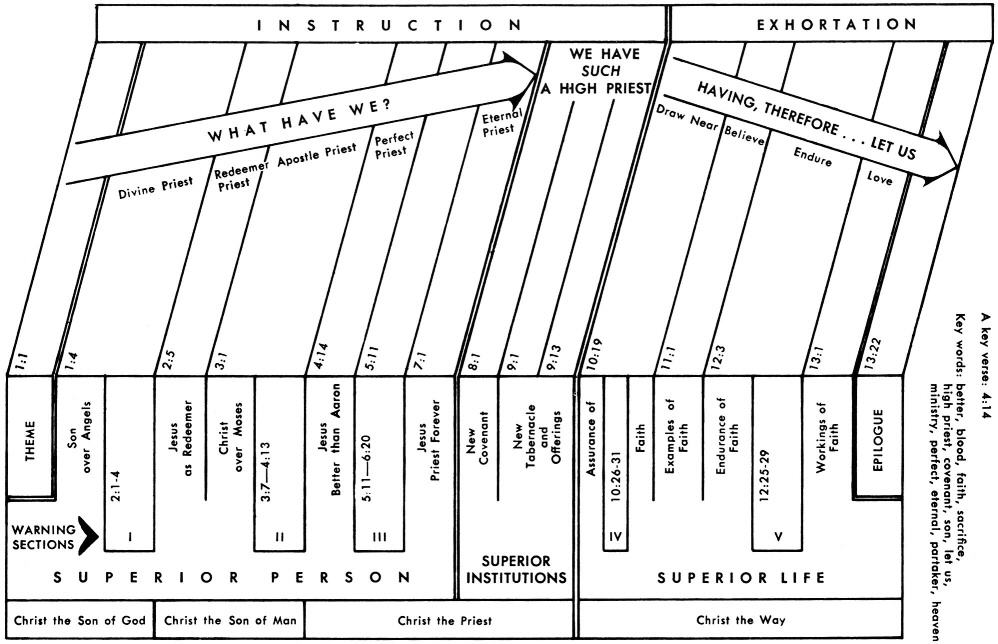
CONSIDER JESUS OUR GREAT HIGH PRIEST
Click chart to enlarge
Charts from Jensen's Survey of the NT - used by permission
Hebrews - Charles Swindoll
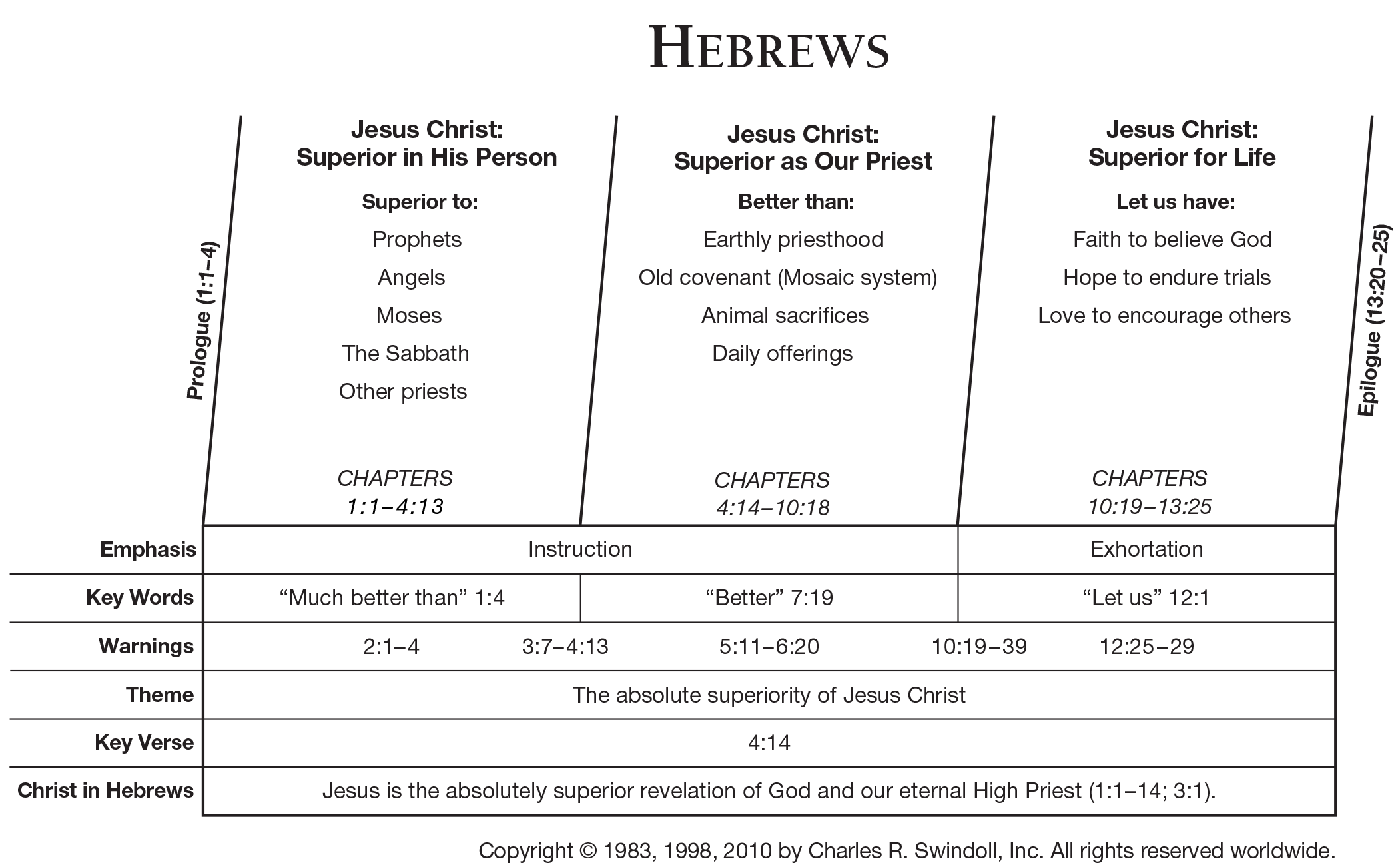
|
The Epistle |
||||
| INSTRUCTION Hebrews 1-10:18 |
EXHORTATION Hebrews 10:19-13:25 |
|||
| Superior Person of Christ Hebrews 1:1-4:13 |
Superior Priest in Christ Hebrews 4:14-10:18 |
Superior Life In Christ Hebrews 10:19-13:25 |
||
| BETTER THAN PERSON Hebrews 1:1-4:13 |
BETTER PRIESTHOOD Heb 4:14-7:28 |
BETTER COVENANT Heb 8:1-13 |
BETTER SACRIFICE Heb 9:1-10:18 |
BETTER LIFE |
| MAJESTY OF CHRIST |
MINISTRY OF CHRIST |
MINISTERS FOR CHRIST |
||
|
DOCTRINE |
DUTY |
|||
|
DATE WRITTEN: |
||||

See ESV Study Bible "Introduction to Hebrews"
(See also MacArthur's Introduction to Hebrews)
Borrow Ryrie Study Bible
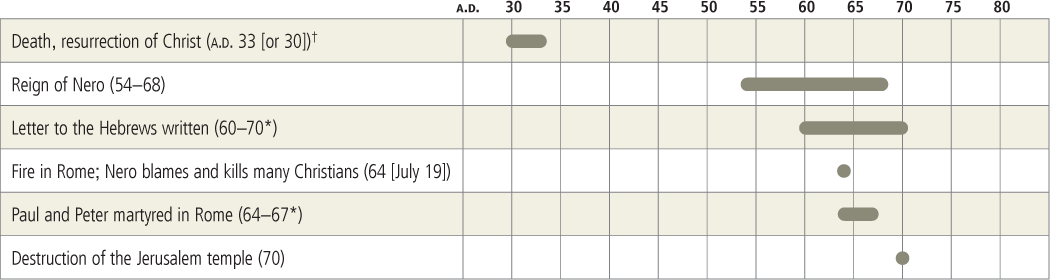
Timeline of Hebrews - ESV Study Bible
Hebrews 1:1 God, after He spoke long ago to the fathers in the prophets in many portions and in many ways, (NASB: Lockman)
Greek: Polumeros kai polutropos palai o theos lalesan tois patrasin en tois prophetais
BGT Πολυμερῶς καὶ πολυτρόπως πάλαι ὁ θεὸς λαλήσας τοῖς πατράσιν ἐν τοῖς προφήταις
ALT: In many parts [or, Bit by bit] and in various ways in time past, God having spoken to the fathers by the prophets, in these last days He spoke to us by [His] Son,
KJV: God, who at sundry times and in divers manners spake in time past unto the fathers by the prophets,
NKJ God, who at various times and in various ways spoke in time past to the fathers by the prophets,
NET After God spoke long ago in various portions and in various ways to our ancestors through the prophets,
CSB Long ago God spoke to the fathers by the prophets at different times and in different ways.
ESV Long ago, at many times and in many ways, God spoke to our fathers by the prophets,
NIV In the past God spoke to our forefathers through the prophets at many times and in various ways,
NLT Long ago God spoke many times and in many ways to our ancestors through the prophets.
MIT Hebrews 1:1 In multiple segments and numerous ways God spoke in ancient times by the prophets to our ancestors.
NRS Long ago God spoke to our ancestors in many and various ways by the prophets,
RSV In many and various ways God spoke of old to our fathers by the prophets;
ASV God, having of old time spoken unto the fathers in the prophets by divers portions and in divers manners,
Young's Literal: In many parts, and many ways, God of old having spoken to the fathers in the prophets,
BBE: In times past the word of God came to our fathers through the prophets, in different parts and in different ways;
GWN In the past God spoke to our ancestors at many different times and in many different ways through the prophets.
ICB: In the past God spoke to our ancestors through the prophets. He spoke to them many times and in many different ways. (Nelson)
Moffatt: Many were the forms and fashions in which God spoke of old to our fathers by the prophets
Phillips: God, who gave our forefathers many different glimpses of the truth in the words of the prophets (Touchstone)
Wuest: In many parts and in different ways God in former times having spoken to the fathers by means of the prophets,
NJB At many moments in the past and by many means, God spoke to our ancestors through the prophets; but
NAB In times past, God spoke in partial and various ways to our ancestors through the prophets;
- God after He spoke long ago - Ge 3:15; 6:3; 6:13-22, 8:15-19; 9:1-17; 12:1-3, 12:2; 12:3, 26:2-5; 28:12, 13, 14, 15; Ge 32:24-30; 46:2, 3, 4; Ex 3:1; Ex 3:2-22 Lk 24:27; Lk 24:44 Acts 28:23; 1Pe 1:10;1Pe 1:11 1Pe 1:12 2Pe 1:20, 21
- The fathers Lk 1:55;Lk 1:72 Jn 7:22; Acts 13:32
- In the prophets - Nu 12:6, 7, 8;12:7, 12:8 Joel 2:28
- Hebrews 1 Resources - Multiple sermons and commentaries
- Study Questions for Hebrews - 5W/H questions for leading lessons
Related Passages:
Isaiah 55:11 So will My word be which goes forth from My mouth; It will not return to Me empty, Without accomplishing what I desire, And without succeeding in the matter for which I sent it.
Genesis 1:1 In the beginning God created the heavens and the earth.
Genesis 1:4 (GOD SPOKE IN THE BEGINNING) Then God said, “Let there be light”; and there was light.
Psalm 33:9 For He spoke, and it was done; He commanded, and it stood fast. (TAKEAWAY - GOD SAID IT THAT SETTLES IT WHETHER WE BELIEVE IT OR NOT!)
John 1:1 In the beginning was the Word, and the Word was with God, and the Word was God.
Luke 24:27 Then beginning with Moses and with all the prophets, He explained to them the things concerning Himself in all the Scriptures.
Luke 24:44 Now He said to them, “These are My words which I spoke to you while I was still with you, that all things which are written about Me in the Law of Moses and the Prophets and the Psalms must be fulfilled.”
Acts 28:23 When they had set a day for Paul, they came to him at his lodging in large numbers; and he was explaining to them by solemnly testifying about the kingdom of God and trying to persuade them concerning Jesus, from both the Law of Moses and from the Prophets, from morning until evening.
2 Samuel 23:2 (DAVID SPEAKING) “The Spirit of the LORD spoke by me, And His word was on my tongue.
Jeremiah 1:9 (IN THE PROPHETS IN MANY WAYS!) Then the LORD stretched out His hand and touched my mouth, and the LORD said to me, “Behold, I have put My words in your mouth.
God Spoke to the Fathers
In the Prophets
THE GOD WHO SPEAKS:
PROGRESSIVE REVELATION
Irving Jensen says that "The main theme of Hebrews may be stated thus: The knowledge and assurance of how great this High Priest Jesus is should lift the drifting believer from spiritual lethargy to vital Christian maturity. Stated another way: The antidote for backsliding is a growing personal knowledge of Jesus." (Jensen's Survey of the New Testament)
R C Sproul once said that "If I were cast into prison and allowed but one book, it would be the Bible. If I were allowed only one book of the Bible, it would be the Epistle to the Hebrews… because it contains our most comprehensive discussion of the redemption wrought for us in the sacrifice of Jesus."
"There is no portion of Scripture whose authorship is more disputed,
nor any of which the inspiration is more indisputable."
The Verse by Verse Notes will take the position that Paul cannot be established as the author and thus the author is treated as unknown to all except God. This is the only New Testament epistle that does not begin like a first-century letter, with a formal salutation and prayer. It does have an epistolatory ending. The Greek translation of the Hebrew OT, the Septuagint (usually abbreviated LXX) is the source of all the OT quotations from the Old Testament, except two (He 10:30; Heb 13:5).
William Barclay has an interesting note on who wrote Hebrews - At no time in the history of the Church did men ever really think that Paul wrote Hebrews. How then did it get attached to his name? It happened very simply. When the New Testament came into its final form there was of course argument about which books were to be included and which were not. To settle it one test was used. Was a book a work of an apostle or at least the work of one who had been in direct contact with the apostles? By this time Hebrews was known and loved throughout the Church. Most people felt like Origen that God alone knew who wrote it, but they wanted it. They felt it must go into the New Testament and the only way to ensure that was to include it with the thirteen letters of Paul. Hebrews won its way into the New Testament on the grounds of its own greatness, but to get in it had to be included with the letters of Paul and come under his name. People knew quite well that it was not Paul's but they included it among his letters because no man knew who wrote it and yet it must go in. (Introduction to Hebrews)
The epistle’s vocabulary, style, and various literary characteristics
do not clearly support any particular claim.John MacArthur on the Author - The author of Hebrews is unknown. Paul, Barnabas, Silas, Apollos, Luke, Philip, Priscilla, Aquila, and Clement of Rome have been suggested by different scholars, but the epistle’s vocabulary, style, and various literary characteristics do not clearly support any particular claim. It is significant that the writer includes himself among those people who had received confirmation of Christ’s message from others (Heb 2:3). That would seem to rule out someone like Paul who claimed that he had received such confirmation directly from God and not from men (Gal. 1:12). Whoever the author was, he preferred citing OT references from the Greek OT (LXX) rather than from the Hebrew text. Even the early church expressed various opinions on authorship, and current scholarship admits the puzzle still has no solution. Therefore, it seems best to accept the epistle’s anonymity. Ultimately, of course, the author was the Holy Spirit (2 Pet. 1:21). (Introduction)
God (theos) - No other NT Epistle comes to the point as quickly as this one. There is not an attempt to prove God’s existence! He exists whether you believe it or not! It is simply a self-evident given. Without benefit of salutation or introduction, the writer plunges into setting forth the superlative glories of the Lord Jesus Christ, in a book that many feel rivals Romans in its great theology. These first four verses comprise one majestic sentence in the Greek text and read like the opening of a formal Greek oration rather than the customary "greetings" of a letter and are among the four most important Christological passages in Scripture (cf. Jn 1:1,7-11; Col 1:15, 16, Col 1:17-20 Php 2:6-7, Php 2:8-11)
"He Is There And He Is Not Silent."
--Francis Schaeffer
Hebrews begins like Genesis and John with God. It is significant that the subject of the first verb is God, for God is constantly before us in this epistle, used 71 times or an average of about once every 73 words throughout the epistle and few NT books speak of God so often. Right at the beginning, then, we are confronted with the reality of God and the fact that he has been active in man's story. How deftly the author unveils the Trinity as active in the revelation of Scripture, here God the Father introduced as having spoken in time past, later noting God the Son (He 2:3) and finally God the Holy Spirit (He 3:7) After this long opening Greek sentence, the author immediately begins quoting Scripture in the remainder of this chapter, which of course is God speaking in the Old Testament (cf Isa 55:11).
GOD IN HEBREWS - 71X/66V - Heb. 1:1; Heb. 1:6; Heb. 1:8; Heb. 1:9; Heb. 2:4; Heb. 2:9; Heb. 2:13; Heb. 2:17; Heb. 3:4; Heb. 3:12; Heb. 4:4; Heb. 4:9; Heb. 4:10; Heb. 4:12; Heb. 4:14; Heb. 5:1; Heb. 5:4; Heb. 5:10; Heb. 5:12; Heb. 6:1; Heb. 6:3; Heb. 6:5; Heb. 6:6; Heb. 6:7; Heb. 6:10; Heb. 6:13; Heb. 6:17; Heb. 6:18; Heb. 7:1; Heb. 7:3; Heb. 7:19; Heb. 7:25; Heb. 8:5; Heb. 8:10; Heb. 9:14; Heb. 9:20; Heb. 9:24; Heb. 10:7; Heb. 10:12; Heb. 10:21; Heb. 10:29; Heb. 10:31; Heb. 10:36; Heb. 11:3; Heb. 11:4; Heb. 11:5; Heb. 11:6; Heb. 11:7; Heb. 11:10; Heb. 11:16; Heb. 11:19; Heb. 11:25; Heb. 11:40; Heb. 12:2; Heb. 12:7; Heb. 12:15; Heb. 12:22; Heb. 12:23; Heb. 12:28; Heb. 12:29; Heb. 13:4; Heb. 13:7; Heb. 13:15; Heb. 13:16; Heb. 13:20;
Steven Cole comments - Somebody may say, “But I’m an agnostic; I’m not sure whether or not God exists.” Or, “I’m an atheist; I don’t believe in God.” To all such persons, the Bible says, “Your doubts or your beliefs do not affect the fact that God is.” The Bible thrusts God in your face as a prime reality. You ignore Him to your own peril and final destruction. Unbelief is not a matter of rationalism. It is a matter of sin. He is not silent! He has chosen to reveal Himself to the human race. In Romans 1:18–23, Paul shows how God reveals Himself generally through His creation. People should be able to look at the amazing complexity and design of creation and conclude that there is an awesome Creator. But because people love their sin, they suppress the truth that God reveals through His creation.(Hebrews 1:1-2a God Has Spoken)
Ray Stedman - The epistle to the Hebrews begins as dramatically as a rocket shot to the moon. In one paragraph, the writer breathtakingly transports his readers from the familiar ground of Old Testament prophetic writings, through the incarnation of the Son (who is at once creator, heir and sustainer of all things and the fullest possible manifestation of deity), past the purifying sacrifice of the cross to the exaltation of Jesus on the ultimate seat of power in the universe. It is a paragraph daring in its claims and clearly designed to arrest the reader's attention and compel a further hearing. (Hebrews 1:1-3 Greater Than the Prophets)
After He spoke (laleo) long ago (palai) to the fathers (pater) - NIV = "In the past God spoke to our forefathers" NLT = "to our ancestors" Fathers refers to the Jewish patriarchs and is the first clue that the intended recipient of this epistle was a Jewish audience. Note the time phrase "after," indicating more information will follow, in fact in context it would be God's final Word! Note the amazing mercy and grace that God committed to speak to those who sinned against Him and hated Him. Long ago (palai) is a time phrase which in context refers to the time prior to Messiah's first coming and contrasts to the last days inaugurated at His first coming, His incarnation. It designates the whole time during which divine communications were made in the former periods until the time of Malachi, when such communications ceased. The OT revelation is thus no novelty but has its roots deep in the past.
🙏 THOUGHT - Regarding God speaking in Hebrews 1:1, Isaiah quotes Jehovah's declaration "So shall My Word be which goes forth from My mouth; It shall not return to Me empty, Without accomplishing what I desire, And without succeeding in the matter for which I sent it." (Isaiah 55:11) Recall that when He created Adam, Jehovah Elohim (our Creator) "breathed into his nostrils the breath of life; and Adam became a living being." (Ge 2:7) God's (breathed) Word was life for Adam and it is life for all of Adam's children! To say it another way God's Word going forth from His mouth is akin to giving His creatures supernatural "mouth to mouth resuscitation.' Another way to say this is that God via His Word and Spirit is our sole Source of spiritual life and spiritual revival. Paul amplifies this truth about the reviving effect of God's Word declaring "All Scripture is God breathed and is useful...." (2Ti 3:16-17NIV). Are you in need of spiritual revival? I love Ps 119:25 (for I am often there in my life) which explains how you (and I) can experience daily spiritual revival. The psalmist writes "My soul cleaves to the dust; Revive (a cry out of desperation) me according to Thy Word (picture God's Word breathed into us, resuscitating us!)." In context of the last days of Hebrews 1:2 God has given His final Word in Christ, the Logos (Jn 1:1), Who is our life (Col 3:4, Gal 2:20). Do you see how important it is for you to stay of "life support" daily by taking in the Word of Life (1Jn 1:1, Mt 4:4)? See Revival.
Spoke (laleo) originally referred to the chattering of birds or prattling of children and evolved in use to the highest form of speech, the thrice holy God choosing language as His primary medium of communication to fallen, sinful mankind. Note that spoke is in the aorist tense, in context indicating past tense, the point being that aorist is used both of God speaking by the prophets and also His speaking by Christ, indicating that He has finished speaking in both cases. Beware of those who teach that God gave them a new revelation, a word of prophecy, etc. God speaks to us today primarily through His completed Word and the ministry of His Spirit (see Illumination) as we read, study and meditate on His Word. (cp Jer 23:16)
Deity is not speechless...
To men He spoke, and still speaks.
A W Pink - Deity is not speechless. The true and living God, unlike the idols of the heathen, is no dumb Being. The God of Scripture, unlike that absolute and impersonal "first Cause" of philosophers and evolutionists, is not silent. At the beginning of earth's history we find Him speaking: "God said, Let there be light: and there was light" (Genesis 1:4). "He spoke and it was done, He commanded and it stood fast" (Psalm 33:9). To men He spoke, and still speaks (ED: Pink is not advocating "new revelation" for the canon is closed, but implies that God still speaks to us through His written Word energized by His Spirit - cf Isa 55:11. See The Secret of Revival - Mouth to Mouth Resuscitation). For this we can never be sufficiently thankful.
Steven Cole - The author of Hebrews, writing to Jews who accepted God as the Creator, focuses rather on God’s special revelation through the written Word of God.
Adrian Rogers - Jesus Is God’s First Word - He was God’s first Word: “In the beginning was the Word” (John 1:1). Jesus Is God’s Full Word -He is God’s full Word: “For in him dwelleth all the fulness of the Godhead bodily” (Colossians 2:9). and Jesus Is God’s Final Word. God “hath in these last days spoken unto us by his Son” (Hebrews 1:2). And friend, when you say, “Jesus,” you’ve said it all. I mean, that’s it—that’s it. God doesn’t have any more to say. Do you want me to tell you what God is saying to this world? “Jesus.” Do you want me to tell you what God is saying to you? “Jesus.” Jesus is the articulate Christ; He is the One who articulates the mind and the will of God, and He does it through His written words. Now, let me tell you something, friend: a man and his word may be different, but God and His Word cannot be different. And, if you believe in the God of the Word, you’re going to have to believe in the Word of that God. You can’t separate these. And, Jesus said that if you’re going to hear Him, you’re going to hear His Word. (Sermon - Reality page 12)
The Old Testament is
no less than the voice of God Himself.
R C H Lenski - The master organist strikes the fundamental chords of his entire composition. Their grandeur falls upon the ears and the heart of the reader and the hearers. This must have had a powerful effect. These former Jews who were now half-inclined to revert to their former Judaism because they were discouraged by persecution and by the difficulties of the Christian life, in the very first solemn clause hear an acknowledgment and a confession of the whole inspired Old Testament, which no Jew could outdo. Every Jewish heart must give unconditional consent: God did speak in content and in a manner so manifold to the Israelite fathers in the person of the prophets in those olden times! The Old Testament is no less than the voice of God Himself. The fathers heard that voice of God, among whom were all the greatest Old Testament saints. The present sons of those fathers still hear that voice in every line that is read to them from the sacred Old Testament scrolls. (Borrow the interpretation of the epistle to the hebrews and the epistle of james)
Pink comments that "Deity is not speechless. The true and living God, unlike the idols of the heathen, is no dumb Being. The God of Scripture, unlike that absolute and impersonal "first Cause" of philosophers and evolutionists, is not silent."
God took the initiative to speak in the past
and at the last!
This "special revelation" contrasts with "natural revelation (or "general revelation")" described by Paul as "that which is known about God is evident within (all men) for God made it evident to them. For since the creation of the world His invisible attributes, His eternal power and divine nature, have been clearly seen, being understood through what has been made, so that they are without excuse." (Ro 1:19, Ro 1:20) David parallels this thought in Psalm 19 writing that "the heavens are telling of the glory of God and their expanse is declaring the work of His hands. Day to day pours forth speech, and night to night reveals knowledge." (Ps 19:1, 2)
Steven Cole - The inspiration of Scripture (note) does not mean that God dictated the very words, although on occasion He did that (e.g. the Ten Commandments). Rather, using the different personalities and styles of the various authors, God superintended the process so that the authors recorded without error God’s message to us in the words of the original autographs. The apostle Peter put it, “no prophecy was ever made by an act of human will, but men moved by the Holy Spirit spoke from God” (2 Pet. 1:21). Charles Hodge defined inspiration as “an influence of the Holy Spirit on the minds of certain select men, which rendered them the organs of God for the infallible communication of his mind and will. They were in such a sense the organs of God, that what they said God said” (Systematic Theology see page 186). It is important to understand that if God had not chosen to reveal Himself, no one could know Him. Men can speculate and philosophize about what they think God is like, but even the most brilliant discourses on the subject would be mere guesses. Furthermore, the Bible is clear that because of the fall, Satan, “the god of this world has blinded the minds of the unbelieving so that they might not see the light of the gospel of the glory of Christ, who is the image of God” (2 Cor. 4:4). The “natural man does not accept the things of the Spirit of God, for they are foolishness to him; and he cannot understand them, because they are spiritually appraised” (1 Cor. 2:14).
David Guzik comments that "Hebrews has 29 quotations and 53 allusions to the Old Testament, for a total of 82 references. Significantly, Hebrews does not refer even once to the books of the Apocrypha." (Hebrews 1)
The writer's emphasis on the Old Testament at the inception of this epistle would be especially meaningful to a Jewish audience trained up in the truths taught by the Law and the prophets.
Paul reminded Timothy to "continue in the things you have learned… from childhood you have known the sacred writings (Old Testament Scriptures) which are able to give you the wisdom that leads to salvation through faith which is in Christ Jesus." (2Ti 3:14-15)
Albert Barnes adds that since "the object of the (author of Hebrews) was to show the superior claims of the gospel, and to lead them from putting confidence in the rites instituted in accordance with the directions of the Old Testament, it was of essential importance that he should admit that their belief of the inspiration of the prophets was well founded."
The fathers (pater) refers to the Old Testament forefathers and is contrast to us in the next verse. The fathers is a strong clue as to the identity of the recipients because fathers would have been a term familiar to Jewish readers. This is well illustrated by Paul's address to the synagogue in Perga where he said "we preach to you the good news of the promise made to the fathers that God has fulfilled this promise to our children in that He raised up Jesus, as it is also written in the second Psalm, 'THOU ART MY SON; TODAY I HAVE BEGOTTEN THEE." (Acts 13:32 33). Later to the Romans Paul writes "Christ has become a servant to the circumcision (Jews) on behalf of the truth of God to confirm the promises given to the fathers" (Ro 15:8) (The 9 other similar uses of the phrase the fathers in the NT - Luke 1:17; John 6:58; 7:22; Acts 13:32; Ro 9:5; 11:28; 15:8; Heb 1:1; 2Pet 3:4)
GOD'S WAYS OF
SPEAKING TO MEN
In (en = locative of sphere) the prophets (prophetes) The prophets received their call or appointment directly from God, and some like Jeremiah (Jer 1:5) or John the Baptist (Jn 1:13-15), were even called before birth. Although not all that God had spoken through the prophets was predictive prophecy, fulfilled prophecy is one of the strongest evidences that the Bible is divinely inspired.
The prophets were the mouthpieces of God and their words were not the production of their own spirit, but were inspired by the Holy Spirit Peter explaining that "no prophecy was ever made by an act of human will, but men moved by the Holy Spirit spoke from God. (1Pe 1:21) The prophet John the Baptist quoting the prophet Isaiah explained that he was but "a voice of One who is crying out in the wilderness, make straight the way of the LORD." (Jn 1:23) The One giving the message was God. John served as God's voice, "a vessel for honor, sanctified, useful to the Master, prepared for every good work. (2Ti 2:21)
John MacArthur on the prophets - "A prophet is one who speaks to men for God; a priest is one who speaks to God for men. The priest takes man’s problems to God; the prophet takes God’s message to men. Both, if they are true, are commissioned by God, but their ministries are quite different. The book of Hebrews has a great deal to say about priests, but its opening verse speaks of prophets. The Holy Spirit establishes the divine authorship of the Old Testament, its accuracy and its authority, through the fact that it was given to and delivered by God’s prophets." For example the "LORD said to Moses, "See, I make you as God to Pharaoh, and your brother Aaron shall be your prophet." (Ex 7:1) (See Hebrews Commentary - Page 5)
William Barclay adds regarding the prophets that "it is no part of the purpose of the writer to the Hebrews to belittle the prophets; it is his aim to establish the supremacy of Jesus Christ. He is not saying that there is a break between the Old Testament revelation and that of the New Testament; he is stressing the fact that there is continuity , but continuity that ends in consummation." (Hebrews 1 Commentary)
In many portions (polumeros) and in many ways (polutropos) - KJV = "by the prophets" (Gk = literally in the prophets) Phillips paraphrase "gave our forefathers many different glimpses of the truth in the words of the prophets" Amplified = "in many separate revelations [each of which set forth a portion of the Truth] and in different ways." These two Greek words are first in the text for emphasis. The upshot is that the previous revelation was not complete, reminding us of the fact that the animal sacrifices were an incomplete statement about the way of redemption which was fully described in Heb 10:1-4. In other words, the Divine revelation given under the Mosaic economy was fragmentary but not faulty (it was always true).
Many portions refers to the 39 books of the Old Testament and also signifies the fragmentary character of the former revelation that came in multiple portions. All of the prophets were Jewish, which supports the premise that the intended audience of the epistle of Hebrews was Jewish readers. In many portions refers to the matter of the communications, and in many ways to the manner of communications. God spoke through dreams (Gen. 37:5), visions (Isa. 1:1), angels (Zech. 1:9), voices (1 Sam. 3:4), writing (Dan 5:5), and even Balaam’s donkey (Num. 22:28)!
🙏 THOUGHT - The fact that the OT came in many portions and in many ways is strong evidence for divine inspiration. Why do I say that? Well, in spite of the fact that fragments of the OT were coming at different times and from different prophets, it continued to remain coherent and "cohesive" presenting a progressive theological narrative from creation, covenant, judgment, redemption, to messianic hope. This coherence across time and medium suggests a single divine Mind behind the many human instruments. (See verbal plenary inspiration)
Steven Cole on in many ways - God spoke “in many ways.” Sometimes He revealed Himself through angels. He spoke to Moses through the burning bush, and later directly on the mountain. He revealed Himself to the Israelites through fire, thunder, earthquake, and clouds. He also revealed Himself through the miracles that He did through Moses. He spoke to Isaiah in the vision of His glory and to Ezekiel in the vision of the wheels and creatures. He sometimes used dreams, object lessons, natural events and other means. All of these things are recorded in His written Word for our instruction. EDITORIAL NOTE on in many ways - God used dreams and visions (Daniel, Ezekiel), direct speech (Moses), symbols and rituals (Levitical law), poetry and lament (Psalms, Lamentations), historical narrative (Genesis–Kings), typology and prophecy (Isaiah, Zechariah)
A T Robertson adds that "The Old Testament revelation came at different times and in various stages, a progressive revelation of God to men....God spoke by dream, by direct voice, by signs, in different ways to different men (Abraham, Jacob, Moses, Elijah, Isaiah, etc.)."
Many portions (polumeros) means that God spoke a word here and there, now and then, some at one time, some at another, to some a few words, to others many. The writer's main point in this section is to emphasize that all OT revelation was God speaking to man, albeit in a manner that was fragmentary and occasional, lacking fullness and finality. The speech of God throughout the ages past was not unbroken chatter but given in episodes of speech punctuating seasons of silence (eg 400 silent years of the inter-testament period)
Marvin Vincent on many portions - in many parts. N.T.o. olxx, but πολυμερής Wisd. 7:22. In the first stage of his revelation, God spake, not at once, giving a complete revelation of his being and will; but in many separate revelations, each of which set forth only a portion of the truth. The truth as a whole never comes to light in the O.T. It appears fragmentarily, in successive acts, as the periods of the Patriarchs, Moses, the Kingdom, etc. One prophet has one, another element of the truth to proclaim.
Many portions (polumeros) is first in the Greek construction for emphasis (emphatic position) and implies the truth was incremental and progressive (Genesis gives some truth, Exodus some more truth, etc) in which God disclosed Himself in portions of truth at different times until the appearance of the Son, Who Himself is the consummation of Truth (Jn 1:17, Jn 14:6), the fulfillment of the Law and Prophets (Mt 5:17). The prophetic revelation was fragmentary, piece by piece in 39 OT books delivered over some 1500 years by forty-plus writers, each contributing "portions" of divine revelation, none in themselves complete. Finally, the revelation is complete in Christ. Hallelujah!
In the past, God spoke in various ways: by walking together with Adam in the Garden of Eden, by visiting over a meal with Abraham, in Jacob’s dream with a ladder reaching to Heaven, by showing Moses the exact pattern for the tabernacle, by speaking to Samuel in a voice that sounded like Eli’s, by symbolic actions to Ezekiel, and through an angel to Daniel. All these ways, and many more, conveyed bits and pieces of God’s Old Testament revelation.
If is as if God had spoken in a spectrum of pure variegated lights in the Old Testament and that the arrival of Jesus was like a "prism" Who collects all these bands of pure light and focuses them into one final, perfect and pure beam.
R C H Lenski has an interesting note - The two adverbs “in many portions and in many ways” have been understood to mean “in many parts” but only in fragments and not in completeness; “in many ways” but all of them inferior. But these adverbs convey the opposite sense: the first refers to quantity—so rich the varied contents; the second to quality—so rich the variety of form....The Old Testament is revelation which makes known the thoughts, plans, and purposes of God. It is prophecy in the narrow sense, promises yet to be fulfilled, judgments yet to come, which unveil the future to the very end of the world. It tells of the Messiah and of his reign of grace and glory in an everlasting kingdom.....As to completeness, this is present at every stage from Adam, to Malachi. God spoke to every generation what each needed to know. First the bud, then the gradual increase step by step with the promise of the coming full flower—no imperfection at any stage save that the stages advanced (ED: AKA PROGRESSIVE REVELATION).....There is no danger of placing the Old Testament on too high a level or of making it seem too grand; for the more it is exalted, the more it itself is made to exalt the Son and all that God spoke in the person of the Son, the whole New Testament. (Borrow the interpretation of the epistle to the hebrews and the epistle of james)
Charles Swindoll - Not only did the messages from God come in various ways, but they also came at various times rather than all at once. Though all the messages were accurate, they were also incomplete. God always has more He can say. This reminds me of my own childhood. I got a lot of information from my parents over the course of many years—fragmentary, partial, incomplete. Sometimes this information would be in the form of instruction or discipline or living examples to follow. Sometimes it would come in conversations over supper, or alone with my father, or over the telephone, or through a handwritten note. Of course, we can all remember profound, wordless messages that came to us from our mothers with “that look.” Those messages came to me continually throughout childhood and into adolescence—all for progressively building me up toward maturity as an adult. This experience of childhood is similar to the ministry of the prophets in the Old Testament. Their messages were accurate and contributed to the growing body of revelation from God to His people. Like an instrument played in the hands of a master musician, the prophet conveyed the notes God wanted to communicate. Together, the individual prophets whose writings were gathered in the Old Testament canon formed a symphonic harmony of revelation building up toward a great crescendo, when the final movement of God’s revelation would be unveiled: the Lord Jesus Christ. (See Insights on Hebrews - Page 15)
A W Pink adds that "The Old Testament revelation was but the refracted rays, not the light unbroken and complete. As illustrations of this we may refer to the gradual making known of the Divine character through His different titles (Click Studies on the Names of God), or to the prophesies concerning the coming Messiah. It was 'here a little and there a little.'"
Jamieson - All was not revealed to each one prophet; but one received one portion of revelation, and another another. To Noah the quarter of the world to which Messiah should belong was revealed; to Abraham, the nation; to Jacob, the tribe; to David and Isaiah, the family; to Micah, the town of nativity; to Daniel, the exact time; to Malachi, the coming of His forerunner, and His second advent; through Jonah, His burial and resurrection; through Isaiah and Hosea, His resurrection. Each only knew in part; but when that which was perfect came in Messiah, that which was in part was done away" (1Cor 13:12).
F B Meyer on many portions...many ways - No one prophet could speak out all the truth. Each was entrusted with one or two syllables in the mighty sentences of God's speech. At the best the view caught of God, and given to men through the prophets, though true, was partial and limited. But in Jesus there is nothing of this piecemeal revelation. "In Him dwells all the fullness of the Godhead bodily." (Col 2:9KJV) He hath revealed the Father. Whosoever hath seen Him hath seen God (Jn 14:9); and to hear His words is to get the full-orbed revelation of the Infinite. (Hebrews 1:3-4: The Dignity of Christ)
Peter alludes to the fragmentary nature of the OT revelation adding that even the "prophets who prophesied of the grace that would come… made careful search and inquiry, seeking to know what person or time the Spirit of Christ within them was indicating as He predicted the sufferings of Christ and the glories to follow." (1 Peter 1:10-11)
The author in this introduction sets his seal upon the
Divine inspiration and authority of the Old Testament Scriptures.
Kenneth Wuest on the phrase in (en) the prophets explains that the preposition en in this context introduces what is known as the locative case. What does that mean? "The writers of the First Testament constituted the sphere within which God spoke. He spoke exclusively through them and through no other men, so far as the written revelation is concerned. This preposition (en) is used also in the instrumental case. Then the writers would be looked upon as the instruments in God’s hands by which the First Testament Scriptures were written down (2Pe 1:21)." (Hebrews Commentary - essentially verse by verse) (Bolding added) For more discussion see locative of sphere
John Calvin writes "That you may, therefore, understand the full import of this passage, the following arrangement shall be given —
GOD SPAKE
Formerly by the Prophets
Now by the Son;
Then to the Fathers
But now to us;
Then at various times
Now as at the end of the times.
A W Pink observes that "we may see here an illustration of the sovereignty of God: He did not act uniformly or confine Himself to any one method of speaking to the fathers. He spake by way of promise and prediction, by types and symbols, by commandments and precepts, by warnings and exhortations." Expositor’s adds that the people of Israel “were like men listening to a clock striking the hour, always getting nearer the truth but obliged to wait till the whole is heard.”
The distinction is not in the validity of the revelation—its rightness or wrongness—
but in the completeness of it and the time of it.
John MacArthur - We must, of course, clearly understand that the Old Testament was not in any way erroneous (2Ti 3:16, 17). But there was in it a development, of spiritual light and of moral standards, until God’s truth was refined and finalized in the New Testament. The distinction is not in the validity of the revelation—its rightness or wrongness—but in the completeness of it and the time of it. Just as children are first taught letters, then words, and then sentences, so God gave His revelation. It began with the “picture book” of types and ceremonies and prophecies and progressed to final completion in Jesus Christ and His New Testament… The Old Testament is only a part of God’s truth, but it is not partially His truth. It is not His complete truth, but it is completely His truth. It is God’s revelation, His progressive revelation preparing His people for the coming of His Son, Jesus Christ. (MacArthur, John: Hebrews. Moody Press)
Westcott states: The contrast between the Old Revelation and the New is marked in three particulars. There is a contrast (a) in the method, and (b) in the time, and (c) in the agents of the two revelations.
(a) The earlier teaching was conveyed in successive portions and in varying fashions according to the needs and capacities of those who received it: on the other hand the revelation in Him who was Son was necessarily complete in itself (comp. John 1:14, 1:18).
(b) The former revelation was given of old time, in the infancy and growth of the world: the Christian revelation at the end of these days, on the very verge of the new order which of necessity it ushered in.
(c) The messengers in whom God spoke before, were the long line of prophets raised up from age to age since the world began (Luke 1:70; Acts 3:21): the Messenger of the new dispensation was God's own Son. (Hebrews 1 Commentary)
Kenneth Wuest comments on Hebrews 1:1 - The revelations of First Testament truth were given “at sundry times” (polumeros). The word is made up of polus “many,” and meros “parts,” the total meaning being “by many portions.” It was given also “in divers manners” (polutropos). The word is made up of polus “many,” and tropos “manner” or “fashion,” thus, “different manners,” or “many ways.” In the giving of the First Testament truth, God did not speak once for all, but in separate revelations, each of which set forth only a part of His will. One writer was given one, and another, another element of truth. God spoke in different ways. This does not refer to different ways in which He imparted His revelations to the writers, but to the difference of the various revelations in contents and form. He spoke to Israel in one way through Moses, in another, through Isaiah, etc. At the beginning of the revelation, the presentation was elementary. Later it appealed to a more developed spiritual sense. Again, the revelation differed according to the faithfulness or the unfaithfulness of Israel. Clement of Alexandria associates this passage with Ephesians 3:10, “the many-tinted (polupoikilos) wisdom of God.” The First Testament revelation was progressive. All could not be revealed at once, and because all could not be understood at once. Thus the revelation was given in many parts. In addition to this, it was given in different modes. It was given in the form of law, prophecy, history, psalm, sign, type, parable. Expositor’s says that the people of Israel “were like men listening to a clock striking the hour, always getting nearer the truth but obliged to wait till the whole is heard.” The words “in times past” are the translation of palai. The Greek has two words meaning “old,” archaios, meaning “old in point of time,” and palaios, meaning “old in point of use, worn out, ready to be displaced by something new.” The close association of our word palai to palaios suggests that the writer had in mind by its use, the fact that while the First Testament revelation was not to be cast aside, yet it was time for a new one to be given, one that would be God’s final word, one that would complete and round out the first one. The translation so far reads “In many parts and in different ways of old.” Now comes the word “God.” It is preceded by the definite article which has several functions here. First of all, it serves notice on the reader, that the God of whom the writer speaks, is the same God whom the Hebrew addressees of the epistle profess to worship. Thus does the writer seek to place himself on common ground with his readers in the very beginning of a treatise which is highly argumentative in character. It is the debater’s technique which concedes all it safely can to an opponent. The other function of the article here is to indicate the particular Person of the Godhead spoken of, God the Father. The next word “spake,” is a participle in the Greek text, and is associated with the word “spoken” of verse two, which is a finite verb. That is, “God, having spoken, spoke.” Thus, we have the two revelations, that of the First Testament and that of the New, joined together. (Hebrews Commentary - online)
|
|
Older Communication |
Newer Communication |
|
Era |
in the past |
in these last days |
|
Recipients |
to our forefathers |
to us |
|
Agents |
through the prophets |
by his Son |
|
Ways |
in various ways |
in one way (implied) |
Spoke (2980) laleo is the Greek verb meaning to make a sound and then to utter words. Laleo originally meant just sounds like the chatter of birds or the the prattling of children..As a result it has a broad range of meaning and import (e.g., “to say, to chatter [especially of animals], to babble, to sound [a musical instrument]” or “to chirp” [of locusts]) In classical Greek the meanings “to babble” (as an infant) and “to croon” (as a nurse) (cf. English lullaby) or “to whisper” were common. Laleo later became significant in philosophical discussions. Most authorities agree that laleō points to the external sound more than to the content of what is said. The Gospels and Acts are responsible for about two-thirds of the occurrences in the New Testament. The emphasis of laleō upon the physical nature of speech is apparent in some texts (e.g., Matthew 15:31; Luke 1:20; 7:15; Acts 2:6,11; cf. above), but the message of what was spoken is more important (e.g., Luke 24:25; Acts 3:24; 9:6). Vincent contrasts laleo with the other Greek word for speak (lego) explaining that laleo "contemplates the fact rather than the substance of speech. Hence it is used of God (Heb 1:1), the point being, not what God said, but the fact that he spoke to men. On the contrary, lego refers to the matter ("content") of speech. The verb lego originally meant to pick out, and hence to use words selected as appropriate expressions of thought, and to put such words together in orderly discourse." Mark 7:37 illustrates the contrast between laleo and lego - "They were utterly astonished, saying (lego), “He (Jesus on healing a mute man) has done all things well; He makes even the deaf to hear and the mute to speak (laleo).” Laleo emphasized the fact that he was able to express himself articulately, but were not interested as much in the content of what he said. Robertson says that laleo contrasts with the other NT word for speak (lego) in that laleo is "rather an onomatopoetic word (laleo > la-la) with some emphasis on the sound and manner of speaking. The word is common in the vernacular papyri examples of social intercourse."
See the New International Dictionary of New Testament Theology for a 30+ page discussion of WORD - logos, word, utterance, meaning; lego, collect, count, say; logikos, intellectual, rational, reasonable, spiritual; logion, saying; logios, eloquent; cultured; alogos, irrational, without speech; laleo, to talk, chat, speak.
LALEO IN HEBREWS - Heb. 1:1; Heb. 1:2; Heb. 2:2; Heb. 2:3; Heb. 2:5; Heb. 3:5; Heb. 4:8; Heb. 5:5; Heb. 6:9; Heb. 7:14; Heb. 9:19; Heb. 11:4; Heb. 11:18; Heb. 12:24; Heb. 12:25; Heb. 13:7;
Long ago (3819) (palai) is an adverb that means in the past, of olden times, long before now or of old, formerly, long before now.
Friberg on palai - an adverb denoting time in the past in antithesis to the present; (1) as indicating the past in relation to the present formerly ( 2Pe 1.9); (2) as indicating past time generally long ago, in time past (Mt 11.21; Heb 1.1; possibly Jude 1:4); (3) as covering a period of time, looking back from the present to a point of time; (a) for a long time, all along, all this time (2Co 12.19; possibly Jude 1:4); (b) denoting a short time some time since, already (Mk 15.44) (Borrow Analytical Lexicon)
Gilbrant - In classical Greek palai usually refers to an event which happened in the past. In addition, it can refer to a past event which continues to the present. Plato, for example, spoke of Socrates’ accusers “who have been speaking for a long time (palai)” (Liddell-Scott). The Septuagint uses palai to translate mē’āz which literally means “from that time.” The term normally refers to an event in the near or distant past (Isaiah 48:5,7). In the New Testament palai is an adverb of time meaning “long ago” or “formerly.” As in the Septuagint, it can refer to an event which happened in the near or distant past. Hebrews 1:1, for example, declares that “in time past (palai)” God spoke to the Jews through the prophets. As in classical Greek, palai can also refer to a past event or action which continues to the present. Paul, for example, in 2 Corinthians 12:19, asked the Corinthians if they had been thinking in an improper way “all along” (NIV [palai]). Theologically the New Testament consistently uses palai to denote the contrast between the old age and the new age which Jesus ushered in. This idea is behind Jesus’ words that no one puts a piece of unshrunk cloth on an old garment or puts new wine into old wineskins (Matthew 9:16,17), for the old cannot contain the new. The same is true of Paul’s understanding of the old man (humanity under the Fall) and the new man (humanity in Christ), e.g., Romans 6:6; 7:6. The writer to the Hebrews expressed this in yet another way when he contrasted the old covenant (which was ready to vanish away, Hebrews 8:13) with the new covenant which 12 times in Hebrews is said to be better (e.g., Hebrews 8:6). (Complete Biblical Library)
PALAI - 6V - all this time(1), former(1), long(1), long ago(3). Mt. 11:21; Lk. 10:13; 2Co 12:19; Heb. 1:1; 2Pe 1:9; Jude 1:4
PALAI IN SEPTUAGINT - Est. 3:13; Isa. 37:26; Isa. 48:5; Isa. 48:7
Prophets (4396) (prophetes from pró = before or forth + phemí = tell) is literally one who speaks forth and as used in Scripture refers to one who is divinely inspired to communicate God’s will to His people and to disclose the future to them (Dt 18:18). Prophetes is primarily a forth-teller or one who speaks out God’s message, primarily to their own generation, usually always calling the people to God's truth for them at that moment, often using the phrase "Thus saith the Lord." The prophet is one who speaks before in the sense of proclaim, or the one who speaks for, i.e., in the Name of (God). "As distinct from the sacral figures of pagan antiquity the biblical prophet is not a magician. He does not force God. On the contrary, he is under divine constraint. It is God Who invites, summons, and impels him--e.g., Jer 20:7" (Lamorte and Hawthorne) Although we commonly think of the prophet as predicting future events (foretelling) generally this was secondary to his work of forth-telling. When they functioned as predictors or prognosticators, the Biblical prophets foretold the future with 100 percent accuracy. And so if they were correct on the first coming of Messiah, they will be correct on His second coming and on the coming of the antichrist. In sum, forth-telling dealt with current events and fore-telling with future events, but in both the goal is the same -- to call us to trust the Lord and submit to His will for our lives, living in conformity with His Word.
Prophetes - 144x in 138v in NAS and always rendered prophet (63) or prophets (81) - Matt 1:22; 2:5, 15, 17, 23; 3:3; 4:14; 5:12, 17; 7:12; 8:17; 10:41; 11:9, 13; 12:17, 39; 13:17, 35, 57; 14:5; 16:14; 21:4, 11, 26, 46; 22:40; 23:29ff, 34, 37; 24:15; 26:56; 27:9; Mark 1:2; 6:4, 15; 8:28; 11:32; Luke 1:70, 76; 3:4; 4:17, 24, 27; 6:23; 7:16, 26, 39; 9:8, 19; 10:24; 11:47, 49f; 13:28, 33f; 16:16, 29, 31; 18:31; 20:6; 24:19, 25, 27, 44; John 1:21, 23, 25, 45; 4:19, 44; 6:14, 45; 7:40, 52; 8:52f; 9:17; 12:38; Acts 2:16, 30; 3:18, 21ff; 7:37, 42, 48, 52; 8:28, 30, 34; 10:43; 11:27; 13:1, 15, 20, 27, 40; 15:15, 32; 21:10; 24:14; 26:22, 27; 28:23, 25; Rom 1:2; 3:21; 11:3; 1 Cor 12:28f; 14:29, 32, 37; Eph 2:20; 3:5; 4:11; 1 Thess 2:15; Titus 1:12; Heb 1:1; 11:32; Jas 5:10; 1 Pet 1:10; 2 Pet 2:16; 3:2; Rev 10:7; 11:10, 18; 16:6; 18:20, 24; 22:6, 9
See also Dictionary of Biblical Imagery discussion of imagery associated with PROPHET.
Many portions (4181) (polumeros from polús = many + méros = part) (only use in the NT) is literally pertaining to that which occurs in many parts, ‘fragmentary", “portions of the whole.” It means part by part, fragmentarily. In reference to time polumerōs indicates “in many periods”; in reference to methods, “in many ways.” The word points to the fragmentary character of former revelation --it came in multiple segments or portions, in many ways, in various manners. Polumeros could refer both to the various geographical locations of the revelation as well as to the various methods of disclosure—direct revelation, dreams, visions, etc.—thus stressing the diversity of God’s Word. In Heb 1:1 polumeros conveys the truth that God has communicated with men on many different occasions through history, using different methods or expressions in accordance to His character and divine purpose.
Many ways (4187) (polutropos from polús = many + trópos = a manner, a way, a turning) points to the different media and modes through which God disclosed His word, including dream, direct voice, signs, angelic visitations and even in different ways to different men. He spoke to Moses in the burning bush (Ex 3:2ff), to Elijah in a still, small voice (1Ki 19:12), to Isaiah in a vision in the temple (Isa 6:1ff), to Hosea in his family circumstances (Hos 1:2), and to Amos in a basket of summer fruit (Am 8:1). Many ways also alludes to the different OT literary types including law, history, poetry, allegory, prophecy, etc.
Gilbrant - In the New Testament the word occurs only in Hebrews 1:1 where it is used to contrast the varied revelations of God through the Old Testament with the complete and final revelation in Jesus Christ. In the Old Testament God revealed himself, His will, and purpose in various forms and by various means, e.g., laws, teachings, and types. They came by the use of various vehicles: angels, prophets, visions, dreams, audible voice, signs, and even by allowing adverse circumstances to happen to mankind—especially His people Israel. (Complete Biblical Library)
More than any other single book, Hebrews serves to demonstrate
the underlying unity of the sixty-six books of the Bible
Gleason Archer observes, “The Church must ever revert to this sublime Epistle in order to bring the two Testaments into focus with each other. More than any other single book, Hebrews serves to demonstrate the underlying unity of the sixty-six books of the Bible as proceeding ultimately from one and the same divine author, the blessed Holy Spirit” (BORROW The Epistle to the Hebrews [Baker], p. 4).
We need Scripture if we are
to interpret natural revelation rightly.
Wayne Grudem on The Necessity for God to Reveal Himself to Us - If we are to know God at all, it is necessary that He reveal Himself to us. Even when discussing the revelation of God that comes through nature, Paul says that what can be known about God is plain to people “because God has shown it to them” (Rom. 1:19). The natural creation reveals God because He chose to have Himself revealed in this way. With regard to the personal knowledge of God that comes in salvation, this idea is even more explicit. Jesus says, “No one knows the Son except the Father, and no one knows the Father except the Son and any one to whom the Son chooses to reveal him” (Matt. 11:27). This kind of knowledge of God is not found through human effort or wisdom: “in the wisdom of God, the world did not know God through wisdom” (1 Cor. 1:21; cf. 1 Cor. 2:14; 2 Cor. 4:3–4; John 1:18). The necessity for God to reveal Himself to us also is seen in the fact that sinful people misinterpret the revelation about God found in nature. Those who “by their wickedness suppress the truth” are those who “became futile in their thinking and their senseless minds were darkened...they exchanged the truth about God for a lie” (Rom. 1:18, 21, 25). Therefore, we need Scripture if we are to interpret natural revelation rightly. Hundreds of false religions in the world are evidence of the way sinful people, without guidance from Scripture, will always misunderstand and distort the revelation about God found in nature. But the Bible alone tells us how to understand the testimony about God from nature. Therefore we depend on God’s active communication to us in Scripture for our true knowledge of God. (Go to page 115 in Systematic Theology - An Introduction to Bible Doctrine (first edition)- Wayne Grudem)
Related Resource:
OVERVIEW OF HEBREWS - Ray Stedman gives us an excellent overview writing that "The author intends to present a series of arguments for the superiority of Jesus over all rival claims to allegiance which his readers were feeling and hearing. Their attention was easily diverted off in other directions, just as our attention is easily distracted today. They, like us, were being tempted, frightened or pressured into following other voices and serving other masters. In Hebrews 1-7, he examines these rival authorities and reveals their inadequacies. None was, in itself, a false or fraudulent voice. Each was ordained by God and proper in its intended place. Each had served the people of God well in the past, and no teaching or expectation was wrong at the time it was given. But now the final word, the ultimate revelation from God toward which all the other voices had pointed, had come. To this supreme voice the author directs his readers' attention, and ours, by contrasting this final word with the past utterances. First, there were the prophets, God's ancient spokesmen (Hebrews 1:1-3); then the angels, Israel's guardians (Hebrews 1:4-2:18); then Israel's great leader, Moses (Hebrews 3:1-4:7); Israel's godly general, Joshua (Hebrews 4:8-13); and finally the founder of Israel's priesthood, Aaron (Hebrews 4:14-7:28). Each was a voice from Israel's past that needed to be heard but that was woefully inadequate if followed alone. It was clearly a case of the good being the enemy of the best. Eclipsing all these, as the rising sun eclipses the light of the stars, is the figure of Jesus, God's Son, creator and heir of all things." (Hebrews 1:1-3 Greater Than the Prophets) (bolding added)
QUESTION - What does it mean that the Bible is inspired? GOTQUESTIONS.ORG SEE VIDEO
ANSWER - When people speak of the Bible as inspired, they are referring to the fact that God divinely influenced the human authors of the Scriptures in such a way that what they wrote was the very Word of God. In the context of the Scriptures, the word “inspiration” simply means “God-breathed.” Inspiration means the Bible truly is the Word of God and makes the Bible unique among all other books.
While there are different views as to the extent to which the Bible is inspired, there can be no doubt that the Bible itself claims that every word in every part of the Bible comes from God (1 Corinthians 2:12-13; 2 Timothy 3:16-17). This view of the Scriptures is often referred to as “verbal plenary inspiration.” That means the inspiration extends to the very words themselves (verbal)—not just concepts or ideas—and that the inspiration extends to all parts of Scripture and all subject matters of Scripture (plenary). Some people believe only parts of the Bible are inspired or only the thoughts or concepts that deal with religion are inspired, but these views of inspiration fall short of the Bible’s claims about itself. Full verbal plenary inspiration is an essential characteristic of the Word of God.
The extent of inspiration can be clearly seen in 2 Timothy 3:16–17, “All Scripture is God-breathed and is useful for teaching, rebuking, correcting and training in righteousness, so that the man of God may be thoroughly equipped for every good work.” This verse tells us that God inspired all Scripture and that it is profitable to us. It is not just the parts of the Bible that deal with religious doctrines that are inspired, but each and every word from Genesis to Revelation. Because it is inspired by God, the Scriptures are therefore authoritative when it comes to establishing doctrine, and sufficient for teaching man how be in a right relationship with God. The Bible claims not only to be inspired by God, but also to have the supernatural ability to change us and make us “complete.” What more can we need?
Another verse that deals with the inspiration of the Scriptures is 2 Peter 1:21. This verse helps us to understand that even though God used men with their distinctive personalities and writing styles, God divinely inspired the very words they wrote. Jesus Himself confirmed the verbal plenary inspiration of the Scriptures when He said, “Do not think that I have come to abolish the Law or the Prophets; I have not come to abolish them but to fulfill them. I tell you the truth, until heaven and earth disappear, not the smallest letter, not the least stroke of a pen, will by any means disappear from the Law...” (Matthew 5:17-18). In these verses, Jesus is reinforcing the accuracy of the Scriptures down to the smallest detail and the slightest punctuation mark, because it is the very Word of God.
Because the Scriptures are the inspired Word of God, we can conclude that they are also inerrant and authoritative. A correct view of God will lead us to a correct view of His Word. Because God is all-powerful, all-knowing, and completely perfect, His Word will by its very nature have the same characteristics. The same verses that establish the inspiration of the Scriptures also establish that it is both inerrant and authoritative. Without a doubt the Bible is what it claims to be—the undeniable, authoritative, Word of God to humanity.
Coleridge said that Romans revealed the necessity of the Christian faith but that Hebrews revealed the superiority of the Christian faith.
OT Scriptures documenting that God spoke long ago…
- God spoke to Adam and told him that the Savior would come from the Seed of the woman (Ge 3:15).
- God spoke to Abraham and told him that the Savior would come from his Seed (Ge 12:3, 18:18, 22:18).
- God spoke to Jacob and told him that the Savior would come through the tribe of Judah (Gen 49:10).
- God spoke to David and told him that the Savior would be born of his house (2Sam 7:16).
- God spoke to Micah and told him that the Savior would be born at Bethlehem (Mic 5:2).
- God spoke to Isaiah and told him that the Savior would be born of a virgin (Isa 7:14).
- Related Resources
John Butler - SPIRITUAL PRIVILEGE Hebrews 1:1 - Sermon Starters
The theme of our text is how God revealed His message to the people. It will contrast with the ministry of Christ which is superior to any past revelation. But the past revelations do show great spiritual privilege.
FIRST—THE MOMENT IN THE REVELATION
“Sundry times … in time past.” The moment of the revelation is twofold.
• Divers times. “Sundry times.” God spoke at different times. It behooves us to remember this and always be where God speaks for if you fail here, you may miss the spiritual privilege.
• Distance times. “In time past” This refers especially to Old Testament times. God has been revealing Himself and His ways to men ever since the Garden of Eden.
SECOND—THE MANIFESTATION IN THE REVELATION
“Spake.” God is not silent. He has manifested Himself and His ways. And as the next verse indicates, He revealed Himself and His ways in Jesus Christ which is His best revelation. Those alive when Christ ministered on earth were given a tremendous spiritual privilege. But, as is often the case, men did not take advantages of this greatest of spiritual privileges. and will abide in the darkness of damnation forever. However we have the record of Christ recorded in the Scripture and though we were not present when He was on earth, we still enjoy tremendous spiritual advantage in reading and studying His ministry from the Word of God.
THIRD—THE MANNER OF THE REVELATION
“Divers manners.” These words speak especially about the prophets declaration. Sometimes they declared the truth in signs and sometimes solely in speech. But either way brought spiritual privilege to those who became acquainted with His message. However most of the signs and speeches were rejected.
FOURTH—THE MULTITUDE FOR THE REVELATION
“Unto the fathers.” This refers to those who lived in the past. It is not limited to male humans. The Israelites had great spiritual privilege, but blew it. That is the root of Israel’s problems today. They rejected Christ, their greatest spiritual privilege and this has brought much trouble to the people. Spiritual privilege can greatly bless if it is received and revered, but if it is rejected, it will bring damnation.
FIFTH—THE MINISTERS IN THE REVELATION
“The prophets.” It was a great privilege for Israel to have all the prophets which they were given. These prophets which for the most part were cruelly rejected brought Israel the message of God which gave Israel great spiritual privilege. It is always a spiritual privilege to have a man of God declaring Divine truth in your midst. But most such men are mistreated which is rejection of spiritual privilege.
Our Mysterious God
God, who at various times and in various ways spoke in time past . . . , has in these last days spoken to us by His Son. —Hebrews 1:1-2
Today's Scripture : Judges 13:15-23
In today’s Scripture, we read that a mysterious and awesome visitor appeared to Manoah and his wife (Samson’s parents). When Manoah asked, “What is Your name?” the visitor didn’t answer the question directly but instead “ascended in the flame of the altar” (Judges 13:17-20). Then Manoah knew he had seen God in human form.
Who can understand such a God—the God who wrote the 3-billion-letter software code in the DNA molecule of every human cell? Who can fully comprehend the God who knows everything, even our inner thoughts? Yet many Old Testament saints knew and loved this God. They experienced the joy of His grace and forgiveness, even though they didn’t completely understand how a holy God could forgive their sins.
As Christians, we too stand in awe before the majesty and mystery of an incomprehensible God. But we have a great advantage because we see Him revealed in Jesus, who said, “He who has seen Me has seen the Father” (John 14:9). And when Jesus hung on the cross, He revealed God’s compassion and love, for He died there for us.
A mystery? Yes. But how wonderful that we can know the love of this incomprehensible God! By: Herbert Vander Lugt (Reprinted by permission from Our Daily Bread Ministries. Please do not repost the full devotional without their permission.)
Immortal, invisible, God only wise,
In light inaccessible hid from our eyes,
Most blessed, most glorious, the Ancient of Days,
Almighty, victorious—Thy great name we praise.
—Smith
To understand God is impossible—
to worship Him is imperative.
ILLUSTRATION - What happens when E. F. Hutton talks? Well, if you’re over fifty and watched TV in the 1970s, you know the answer: “When E. F. Hutton talks, people listen.” That television ad for a once-prominent financial advising firm has stuck with me for decades—long after the company itself stopped talking! I never watched that ad without my mind jumping to another well-known group that thrived thousands of years before anybody heard of E. F. Hutton. They weren’t a financial group peddling products or services. They were Spirit-empowered prophets, and when God’s prophets spoke, God’s people listened. They had clout because when they spoke, it was as if they were speaking with the very breath of God. Their words were God’s words. However, though every prophet’s words were worthy of obedience, not a single prophet of God was worthy of worship. Drawing on the great regard the Hebrew people had for the major means of revelation in the Old Testament, the prophets and angels, the author of Hebrews compares these celebrated earthly and heavenly beings with God’s Final Word and Messenger, Jesus Christ. As powerful and significant as those holy people and holy angels were, they were inferior to the Son of God. He alone is God’s Last Word, superior in His person to God’s previous messengers and ministers—whether human or angelic. Why? Because Jesus is the Word incarnate—fully human and fully divine—who occupies a superior place over all things. (Charles Swindoll - Insights on Hebrews - Page 14)
Isaac Watts expresses the thoughts of verse 1-2 in hymn:
God Who in Various Methods Told
God, Who in various methods told
His mind and will to saints of old,
Sent down His Son, with truth and grace,
To teach us in these latter days.
Our nation reads the written Word,
That book of life, that sure record:
The bright inheritance of heav’n
Is by the sweet conveyance giv’n.
God’s kindest thoughts are here expressed,
Able to make us wise and bless’d;
The doctrines are divinely true,
Fit for reproof and comfort, too.
David Reed - Hebrews 1:1, 2 - Mormons Answered Verse by Verse
God, who at sundry times and in divers manners spake in times past unto the fathers by the prophets, Hath in these last days spoken unto us by his Son, whom he hath appointed heir of all things, by whom also he made the worlds.
Although Mormons are unlikely to bring up these verses for discussion, Christians can turn to them when Mormons attempt to argue that their church has authority by virtue of having a living prophet at its head. These words in Hebrews 1:1, 2 show that this was God’s way of dealing with his people “in times past,” prior to sending his Son. As Jesus himself explained it, “The law and the prophets were until John; since that time the kingdom of God is preached, and every man presseth into it” (Luke 16:16). God ceased to use prophets to lead his people when John the Baptist came and introduced the Son of God as the permanent head of the Christian Church.
See also the discussion of Amos 3:7 and discussion of 1 Corinthians 12:28.
Spurgeon - Heir of all things.” Christ is Lord of all the angels—not a seraph spreads his wings except at his bidding. As for all things here below, God has given the Son power over all flesh. All must willingly, or else unwillingly, submit to his sway, for his Father has appointed him. This is another wondrous encouragement to anyone who is seeking salvation. Christ has everything in his hand that he may save us. If we come and entrust ourselves into his hands, we will never have to look about to find the balm for our wounds.
An old writer says, “God in the types of the last dispensation, was teaching His children their letters. In this dispensation He is teaching them to put these letters together, and they find that the letters, arrange them as we will, spell Christ, and nothing but Christ.”
John MacArthur - PROGRESSIVE REVELATION (Heb. 1:1–2). Drawing Near: Daily Readings for a Deeper Faith - Page 4
The Old Testament is but a sample
of what is revealed in the New Testament.
When Jesus said, “Do not think that I came to abolish the Law or the Prophets [the Old Testament]; I did not come to abolish, but to fulfill” (Matt. 5:17), He was affirming that Scripture progressed from promise to fulfillment, from partial to complete. We call that progressive revelation.
For example, the Old Testament anticipated Christ’s coming; the New Testament records His coming. The Old Testament writers didn’t understand everything they wrote because it didn’t always apply to their day. That’s why Peter said, “As to this salvation, the prophets who prophesied of the grace that would come to you made careful search and inquiry, seeking to know what person or time the Spirit of Christ within them was indicating as He predicted the sufferings of Christ and the glories to follow. It was revealed to them that they were not serving themselves but you in these things which now have been announced to you through those who preached the gospel to you by the Holy Spirit” (1 Peter 1:10–12).
Progressive revelation doesn’t at all imply that the Old Testament is inaccurate. The distinction isn’t in the rightness or wrongness of the revelation but in its completeness. Just as a child progresses from letters to words to sentences, so God’s revelation progressed from types, ceremonies, and prophecies to final completion in Jesus Christ and the New Testament.
Thought incomplete by New Testament standards, the Old Testament is nonetheless fully inspired by God. That’s affirmed often in the New Testament. Peter tells us that no human writer of the Old Testament wrote of his own will but only as he was directed by the Holy Spirit (2 Peter 1:21). Paul added that “all Scripture is inspired by God and profitable for teaching, for reproof, for correction, [and] for training in righteousness” (2 Tim. 3:16, emphasis added).
The Old Testament isn’t all of God’s truth, but all of it is true. And as you progress from the Old to the New, you see God’s character and redemptive plan unfolding in greater detail.
QUESTION - What is progressive revelation as it relates to salvation? GOTQUESTIONS.ORG
ANSWER - The term “progressive revelation” refers to the idea and teaching that God revealed various aspects of His will and overall plan for humanity over different periods of time, which have been referred to as “dispensations” by some theologians. To dispensationalists, a dispensation is a distinguishable economy (i.e., an ordered condition of things) in the outworking of God’s purpose. Whereas dispensationalists debate the number of dispensations that have occurred through history, all believe that God revealed only certain aspects of Himself and His plan of salvation in each dispensation, with each new dispensation building upon the prior one.
While dispensationalists believe in progressive revelation, it is important to note that one does not have to be a dispensationalist to embrace progressive revelation. Nearly all students of the Bible recognize the fact that certain truths contained in Scripture were not fully revealed by God to prior generations. Anyone today who does not bring an animal sacrifice with him when he wishes to approach God or who worships on the first day of the week rather than the last understands that such distinctions in practice and knowledge have been progressively revealed and applied throughout history.
In addition, there are weightier matters concerning the concept of progressive revelation. One example is the birth and composition of the Church, which Paul speaks of: “I, Paul, a prisoner for Christ Jesus on behalf of you Gentiles— assuming that you have heard of the stewardship of God’s grace that was given to me for you, how the mystery was made known to me by revelation, as I have written briefly. When you read this, you can perceive my insight into the mystery of Christ, which was not made known to the sons of men in other generations as it has now been revealed to his holy apostles and prophets by the Spirit. This mystery is that the Gentiles are fellow heirs, members of the same body, and partakers of the promise in Christ Jesus through the gospel” (Ephesians 3:1-6).
Paul states nearly the same thing in Romans: “Now to him who is able to strengthen you according to my gospel and the preaching of Jesus Christ, according to the revelation of the mystery that was kept secret for long ages but has now been disclosed and through the prophetic writings has been made known to all nations, according to the command of the eternal God” (Romans 16:25-26).
In discussions of progressive revelation, one of the first questions people have is how it applies to salvation. Were those living before the first advent of Christ saved in a different way than people are saved today? In the New Testament era, people are told to place their faith in the finished work of Jesus Christ and believe that God raised Him from the dead, and they will be saved (Romans 10:9-10; Acts 16:31). Yet Old Testament expert Allen Ross notes, “It is most improbable that everyone who believed unto salvation [in the Old Testament] consciously believed in the substitutionary death of Jesus Christ, the Son of God.” John Feinberg adds, “The people of the Old Testament era did not know that Jesus was the Messiah, that Jesus would die, and that His death would be the basis of salvation.” If Ross and Feinberg are correct, then what exactly did God reveal to those who lived before Christ, and how were the Old Testament saints saved? What, if anything, changed in the salvation of the Old Testament to the salvation of the New Testament?
Progressive Revelation - Two Ways or One Way of Salvation?
Some charge that those holding to progressive revelation espouse two different methods of salvation—one that was in place before the first coming of Christ, and another that came after His death and resurrection. Such a claim is refuted by L. S. Chafer who writes, “Are there two ways by which one may be saved? In reply to this question it may be stated that salvation of whatever specific character is always the work of God in behalf of man and never a work of man in behalf of God. . . . There is, therefore, but one way to be saved and that is by the power of God made possible through the sacrifice of Christ.”
If this is true, then how can the revelations in the Old and New Testaments concerning salvation be reconciled? Charles Ryrie sums up the matter succinctly in this way: “The basis of salvation in every age is the death of Christ; the requirement for salvation in every age is faith; the object of faith in every age is God; the content of faith changes in the various ages.” In other words, no matter when a person has lived, their salvation is ultimately dependent on the work of Christ and a faith placed in God, but the amount of knowledge a person had concerning the specifics of God’s plan has increased through the ages via God’s progressive revelation.
Regarding the Old Testament saints, Norman Geisler offers the following: “In short, it appears that at most, the normative Old Testament salvific requirements (in terms of explicit belief) were (1) faith in God’s unity, (2) acknowledgment of human sinfulness, (3) acceptance of God’s necessary grace, and possibly (4) understanding that there would be a coming Messiah.”
Is there evidence in Scripture to support Geisler’s claim? Consider this passage, which contains the first three requirements, in Luke’s Gospel:
“Two men went up into the temple to pray, one a Pharisee and the other a tax collector. The Pharisee stood and was praying this to himself: ‘God, I thank You that I am not like other people: swindlers, unjust, adulterers, or even like this tax collector. ‘I fast twice a week; I pay tithes of all that I get.’ But the tax collector, standing some distance away, was even unwilling to lift up his eyes to heaven, but was beating his breast, saying, ‘God, be merciful to me, the sinner!’ I tell you, this man went to his house justified rather than the other; for everyone who exalts himself will be humbled, but he who humbles himself will be exalted” (Luke 18:10-14).
This event took place before the death and resurrection of Christ, so it clearly involves a person who has no knowledge of the New Testament gospel message as it is articulated today. In the tax collector’s simple statement (“God be merciful to me, the sinner!”) we find (1) a faith in God, (2) an acknowledgement of sin, and (3) an acceptance of mercy. Then Jesus makes a very interesting statement: He says the man went home “justified.” This is the exact term used by Paul to describe the position of a New Testament saint who has believed the gospel message and put his trust in Christ:
“Therefore, since we have been justified by faith, we have peace with God through our Lord Jesus Christ” (Romans 5:1).
The fourth on Geisler’s list is missing in Luke’s account—the understanding of a coming Messiah. However, other New Testament passages indicate that this may have been a common teaching. For example, in John’s account of Jesus and the Samaritan woman at the well, the woman says, “I know that Messiah is coming (He who is called Christ); when that One comes, He will declare all things to us” (John 4:25). However, as Geisler himself acknowledged, faith in Messiah was not a “must have” for Old Testament salvation.
Progressive Revelation - More Evidence from Scripture
A quick search of Scripture reveals the following verses in both the Old and New Testaments that support the fact that faith in God has always been the avenue of salvation:
• “Then [Abraham] believed in the Lord; and He reckoned it to him as righteousness” (Genesis 15:6)
• “And it will come about that whoever calls on the name of the Lord will be delivered” (Joel 2:32)
• “For it is impossible for the blood of bulls and goats to take away sins” (Hebrews 10:4).
• “Now faith is the assurance of things hoped for, the conviction of things not seen. For by it the men of old gained approval” (Hebrews 11:1-2).
• And without faith it is impossible to please him, for whoever would draw near to God must believe that he exists and that he rewards those who seek him” (Hebrews 11:6).
Scripture plainly states that faith is the key to salvation for all people down through history, but how could God save people without their knowing of Christ’s sacrifice for them? The answer is that God saved them based on their response to the knowledge that they did have. Their faith looked forward to something that they could not see, whereas today, believers look back on events that they can see. The following graphic depicts this understanding:
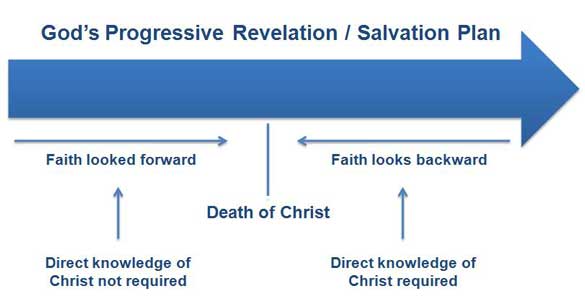
Scripture teaches that God has always given people enough revelation to exercise faith. Now that Christ’s work is accomplished, the requirement has changed; the “times of ignorance” are over:
• “In the generations gone by He permitted all the nations to go their own ways; and yet He did not leave Himself without witness” (Acts 14:16).
• “Therefore having overlooked the times of ignorance, God is now declaring to men that all people everywhere should repent” (Acts 17:30).
• “All have sinned and fall short of the glory of God, and are justified by his grace as a gift through the redemption that is in Christ Jesus whom God displayed publicly as a propitiation in His blood through faith. This was to demonstrate His righteousness, because in the forbearance of God He passed over [literally “let go unpunished”] the sins previously committed” (Romans 3:25).
Prior to Christ’s coming, God was foreshadowing Jesus’ death via the sacrificial system and conditioning His people to understand that sin leads to death. The Law was given to be a tutor to lead people to the understanding that they were sinners in need of God’s grace (Galatians 3:24). But the Law did not revoke the prior Abrahamic Covenant, which was based on faith; it is Abraham’s covenant that is the pattern for salvation today (Romans 4). But as Ryrie stated above, the detailed content of our faith—the amount of revelation given—has increased through the ages so that people today have a more direct understanding of what God requires of them.
Progressive Revelation – Conclusions
Referring to God’s progressive revelation, John Calvin writes, “The Lord held to this orderly plan in administering the covenant of his mercy: as the day of full revelation approached with the passing of time, the more he increased each day the brightness of its manifestation. Accordingly, at the beginning when the first promise of salvation was given to Adam (Gen. 3:15) it glowed like a feeble spark. Then, as it was added to, the light grew in fullness, breaking forth increasingly and shedding its radiance more widely. At last – when all the clouds were dispersed – Christ, the Sun of Righteousness, fully illumined the whole earth” (Institutes, 2.10.20).
Progressive revelation does not mean that God’s people in the Old Testament were without any revelation or understanding. Those living before Christ, says Calvin, were not “without the preaching that contains the hope of salvation and of eternal life, but . . . they only glimpsed from afar and in shadowy outline what we see today in full daylight” (Institutes, 2.7.16; 2.9.1; commentary on Galatians 3:23).
The fact that no one is saved apart from the death and resurrection of Christ is clearly stated in Scripture (John 14:6). The basis of salvation has been, and will always be, the sacrifice of Christ on the cross, and the means of salvation has always been faith in God. However, the content of a person’s faith has always depended on the amount of revelation that God was pleased to give at a certain time.
Hebrews 1:2: in these last days has spoken to us in His Son, whom He appointed heir of all things, through whom also He made the world. (NASB: Lockman)
Greek: ep' eschatou ton hemeron touton elalesen (3SAAI) hemin en huioi, on eqeken (3SAAI) kleronomon panton, di' ou kai epoiesen (3SAAI) tous aionas
BGT ἐπ᾽ ἐσχάτου τῶν ἡμερῶν τούτων ἐλάλησεν ἡμῖν ἐν υἱῷ, ὃν ἔθηκεν κληρονόμον πάντων, δι᾽ οὗ καὶ ἐποίησεν τοὺς αἰῶνας·
Amplified: [But] in the last of these days He has spoken to us in [the person of a] Son, Whom He appointed Heir and lawful Owner of all things, also by and through Whom He created the worlds and the reaches of space and the ages of time [He made, produced, built, operated, and arranged them in order]. (Amplified Bible - Lockman)
Barclay: but in the end of these days he has spoken to us in One who is a Son, a Son whom he destined to enter into possession of all things, a Son by whose agency he made the universe. (Westminster Press)
BBE But now, at the end of these days, it has come to us through his Son, to whom he has given all things for a heritage, and through whom he made the order of the generations;
CSB In these last days, He has spoken to us by His Son. God has appointed Him heir of all things and made the universe through Him.
ESV but in these last days he has spoken to us by his Son, whom he appointed the heir of all things, through whom also he created the world.
GWN In these last days he has spoken to us through his Son. God made his Son responsible for everything. His Son is the one through whom God made the universe.
KJV: Hath in these last days spoken unto us by his Son, whom he hath appointed heir of all things, by whom also he made the worlds;
NKJ has in these last days spoken to us by His Son, whom He has appointed heir of all things, through whom also He made the worlds;
NAB in these last days, he spoke to us through a son, whom he made heir of all things and through whom he created the universe,
NET in these last days he has spoken to us in a son, whom he appointed heir of all things, and through whom he created the world.
NIV but in these last days he has spoken to us by his Son, whom he appointed heir of all things, and through whom he made the universe.
NJB in our time, the final days, he has spoken to us in the person of his Son, whom he appointed heir of all things and through whom he made the ages.
NRS but in these last days he has spoken to us by a Son, whom he appointed heir of all things, through whom he also created the worlds.
RSV but in these last days he has spoken to us by a Son, whom he appointed the heir of all things, through whom also he created the world.
MIT At the culmination of these events, he spoke to us by a son, whom he designated heir of everything. Around him he also formulated the epochs.
NLT: And now in these final days, he has spoken to us through his Son. God promised everything to the Son as an inheritance, and through the Son he created the universe. (NLT - Tyndale House)
Phillips: has now, at the end of the present age, given us the truth in the Son. Through the Son God made the whole universe, and to the Son he has ordained that all creation shall ultimately belong (Phillips: Touchstone)
Wuest: in the last of these days spoke to us in One who by nature is [His] Son, whom He appointed heir of all things, through whom also He constituted the ages;
Young's Literal: in these last days did speak to us in a Son, whom He appointed heir of all things, through whom also He did make the ages;
- Last days - Ge 49:1; Nu 24:14; Dt 4:30; 18:15; 31:29; Isa 2:2; Jer 30:24; 48:47; Ezek 38:16; Da 2:28; 10:14; Hos 3:5; Mic 4:1; Acts 2:17; Gal 4:4; Eph 1:10; 2Pe 3:3; Jude 1:18
- Through Whom also He made the world - Pr 8:22-31; Isa 44:24; 45:12, 18, Jn 1:3; 1Cor 8:6; Eph 3:9; Col 1:16 17
- whom He appointed heir Heb 2:8;2:9 Ps 2:6;2:7, 2:8, 2:9 Isa 9:6, 9:7; 53:10, 11, 12; Mt 21:38; 28:18; Jn 3:25; 13:3; Jn 16:15; 17:2; Acts 10:36; Ro 8:17; 1Cor 8:6; 15:25, 26, 27; Eph 1:20, 21, 22, 23; Php 2:9, 10, 11; Col 1:17; 18
- Hebrews 1 Resources - Multiple sermons and commentaries
Related Passages:
Luke 9:35 Then a voice came out of the cloud, saying, “This is My Son, My Chosen One; listen (akouo - present imperative see our need to depend on the Holy Spirit to obey) to Him!”
Deuteronomy 18:15 “The LORD your God will raise up for you a Prophet like me from among you, from your countrymen, you shall listen to him.
Psalm 2:8+ (HEIR OF ALL THINGS) ‘Ask of Me, and I will surely give the nations as Your inheritance, And the very ends of the earth as Your possession.
In the last (eschatos) days - "at the end of these days" (DNT), "But now in these final days" (NLT), "at the end of the present age" (Phillips), "in the last of these days." (Wuest) Now, “in these last days,” God has revealed himself more directly and clearly than he ever did “in the past”. God’s full, final revelation came directly through his Son. Jesus was the (final) prophet predicted in Deuteronomy 18:15, but he was more than a prophet. He was God’s own Son, the Word (John 1:1, 2), the one who fully disclosed what God is like (John 1:18). All history is thus in its final stage now that Jesus has come, and since Jesus culminates all God’s revelation to humans, we must look at who he is and listen to all he has said.
The meaning of Hebrews 1:2 is that at the very termination of the times in which God is speaking to man, He speaks, not through the prophets, but in His Son, Who is "the Word" (Jn 1:1-2, 1Jn 1:1). So the writer of Hebrews is referring to the incarnation of God's Son at His First Coming. It follows that this is when the last days began. Luke utilizes the same time phrase writing that "in the last days God says that "I will pour forth of My Spirit upon all mankind" (Acts 2:17), a prophecy from Joel 2:28 which was partially fulfilled at Pentecost, at the birth of the Church. Obviously Pentecost is related to the First Coming (and then the ascension) of Christ. We can therefore conclude that the last days were inaugurated by the First Coming of Christ.
Mounce agrees noting that eschatos can refer specifically to Jesus’ return on “the last day” or more generally to the period of time between His (Christ's) first and second coming." (See Mounce's Complete Expository Dictionary- Page 113)
Cleon Rogers on last days - Literally "the last of these days." The rabbinic term indicated the time of the Messiah. (Borrow The new linguistic and exegetical key to the Greek New Testament page 516)
In Christ there is both
continuity and contrast.
Steven Cole writes that "The Greek phrase, “in these last days,” is found in the Septuagint (Nu 24:14; Jer. 23:20; Jer. 49:39; Da 10:14), where it often refers to the day of Messiah. F. F. Bruce (Borrow Hebrews Commentary) says, “His word was not completely uttered until Christ came; but when Christ came, the word spoken in Him was indeed God’s final word….The story of divine revelation is a story of progression up to Christ, but there is no progression beyond Him.” So in Christ there is both continuity and contrast. The continuity is that God spoke through the prophets and God spoke through Christ. But the contrast is, the prophets were many and fragmentary; Christ was one and complete. The prophets were all sinners; Jesus alone was perfectly holy. The prophets were preparatory; Jesus is the final fulfillment. There is also a contrast of being. The prophets were mere men, but Jesus was God’s Son. In the Greek, there is no word “His” and no definite article before “Son.” The construction emphasizes the Son’s essential nature (Morris, ibid.). Jesus is the Son of God in two aspects: eternally, He is the Son, one with the Father (Jn 10:30), the second Person of the Trinity. Temporally, He is God’s Son incarnate, born of the virgin Mary, taking on our human nature so that He could bear our sins (Luke 1:38). It is in this second aspect that He is referred to here. Jesus, Who is eternal God in human flesh, supremely and finally reveals God to us. A W Pink explains the use of Son here this way: “Were a friend to tell you that he had visited a certain church, and that the preacher ‘spoke in Latin,’ you would have no difficulty in understanding what he meant: ‘spoke in Latin’ would intimate that that particular language marked his utterance. Such is the thought here. ‘In Son’ has reference to that which characterised God’s revelation. The thought of the contrast is that God, who of old had spoken prophetwise, now speaks sonwise.” Why did the author mention Jesus’ Sonship without mentioning Him by name (he doesn’t use Jesus’ name until Heb 2:9)? Perhaps these Jewish believers, under pressure, were tempted to deny the Trinity and go back to the strong Jewish unitarianism. He will go on immediately to show that the Son is the eternal Creator and that the Old Testament affirms Him to be God (Heb 1:2, Heb 1:8). To go back to their old way of thinking would be to turn their backs on God’s supreme, complete and final revelation of Himself in His Son. To deny the Trinity is to deny the very being of God!
In his Second Epistle Peter exhorted us to be aware "that in the last days mockers will come with their mocking, following after their own lusts and saying, "Where is the promise of His coming?" (2Pe 3:3,4). In this context the mockers are not referring to the first but the Second Coming of Christ. It follows that the last days began with Christ's first coming and will extend to His Second Coming. This time period overlaps with the so called "church age."
Saving the best for last
is always God’s rule
Spurgeon - Saving the best for last is always God’s rule. “You have kept the good wine until now” (John 2:10). Prophets are a very blessed means of communication, but how much more sure, how much more condescending is it for God to speak to us by His Son! Jesus is God’s own Son. What do I know about that wondrous truth? If I were to try to explain it, and to talk about the eternal filiation, I would only conduct you where I would soon be entirely out of my depth, and very likely I would drown all that I could tell you in floods of words. Deity is not to be explained, but to be adored. The sonship of Christ is to be accepted as a truth of revelation, to be apprehended by faith, though it cannot be comprehended by the understanding. There have been many attempts made by the fathers of the Church to explain the relationship between the two divine persons, the Father and the Son. But the explanations had better never have been given, for the figures used are liable to lead into mistake. Suffice to say that, in the most appropriate language of the Nicene Creed, Christ is “God of God, Light of Light, very God of very God.” He is co-equal with the Father, though how that is, we do not know. He stands in the nearest possible relationship to the Father—a relationship of intense love and delight, so that the Father says of Him, “This is my beloved Son” (Matt 3:17; 17:5; Mark 9:7). Indeed, He is one with the Father, so that there is no separating them, as He Himself said, in reply to Philip’s request, “Show us the Father”; “Believe me that I am in the Father and the Father is in me” (John 14:8, 11). (See sermon Depths and Heights)
THE LAST DAYS |
MESSIANIC KINGDOM |
||
| First Coming of Christ |
Church Age | Second Coming of Christ |
Millennial Reign of Christ |
| Last Days Begin |
Last Days End |
||
| Day of the LORD begins in Tribulation (see discussion below) Includes: Great Tribulation Time of Jacob's Distress Armageddon |
Day of the Lord ends at end of the Millennium |
||
CHRIST THE FINAL
WORD OF GOD!
Has spoken (laleo) to us in His Son (Literally "in One Who is a Son") - Phillips - "given us the truth in the Son" Wuest = "spoke to us in One Who by nature is [His] Son" Spoken (laleo) is in the aorist tense which in context speaks of a past completed action. In other words in reference to God speaking by the prophets and also "in His Son" the aorist tense indicates that God has finished speaking in both cases. As A T Robertson says the first aorist indicative here indicates that God "did speak in a final and full revelation." Son lacks the definite article (the) in the Greek so the idea is that the absence of the article fixes attention upon the nature and not upon the personality of the mediator of a new revelation. God spoke to us in One Who has this character—that He is Son (cp "a Son" in Heb 3:6, Heb 5:8).
How did God speak to us in His Son? One clear example is John 8:28 where Jesus declared "“When you lift up the Son of Man, then you will know that I am He, and I do nothing on My own initiative, but I speak these things as the Father taught Me." Again in John 12:49-50 (His last words of warning to the Jews before He was arrested) "For I did not speak on My own initiative, but the Father Himself who sent Me has given Me a commandment as to what to say and what to speak. “I know that His commandment is eternal life; therefore the things I speak, I speak just as the Father has told Me.”" John also records that "No man has seen God at any time; the only begotten God, who is in the bosom of the Father, He (Jesus the Son) has explained (exegeomai = relate in detail, expound = "exegeted") Him (God the Father)." (Jn 1:18)(See also tabular summary of how God spoke in His Son).
Adrian Rogers on spoken...in His Son - Now friend, when you’ve said, “Jesus,” you’ve said it all—you can’t say any more, and you don’t need to say any more. All of the revelation of God is wrapped up in the Lord Jesus Christ, and He is a fact. He is an eternal fact. He’s the Word that existed before anything else was created. He is the expression—the visible, physical expression—of the invisible spiritual God.
Bob DeWaay adds that "The full and final revelation of Scripture will not be embellished, superseded or antiquated through the entire period of church history until our Lord's bodily return. God has spoken and we will be judged concerning our faith in and obedience to what He has said in Scripture." (Hebrews 1:1-2 God Has Spoken)
God spoke periodically and partially in the Old Testament prophets, but finally and fully by the final "Prophet" His Son -- the OT prophets were but channels while the Son as Prophet is the culmination. The OT prophet Moses in fact foretold of the final Prophet (God's Son), declaring to Israel
The LORD your God will raise up for you a prophet like me from among you, from your countrymen, you shall listen to him." (Deut 18:15)
NET NOTE - in His Son - The Greek puts an emphasis on the quality of God’s final revelation. As such, it is more than an indefinite notion (“a son”) though less than a definite one (“the son”), for this final revelation is not just through any son of God, nor is the emphasis specifically on the person himself. Rather, the focus here is on the nature of the vehicle of God’s revelation: He is no mere spokesman (or prophet) for God, nor is he merely a heavenly messenger (or angel); instead, this final revelation comes through one who is intimately acquainted with the heavenly Father in a way that only a family member could be. There is, however, no exact equivalent in English (“in son” is hardly good English style). The phrase in a son is the fulcrum of Heb 1:1–4. It concludes the contrast of God’s old and new revelation and introduces a series of seven descriptions of the Son. These descriptions show why he is the ultimate revelation of God.
Cleon Rogers onin His Son (Literally "in One Who is a Son") - The absence of the article fixes attention upon the nature and not upon the personality of the Mediator of a new revelation. God spoke to us in One Who has this character—that He is Son (See discussion by Westcott) (Borrow The new linguistic and exegetical key to the Greek New Testament page 516)
In the prophets God had given predictions and foreshadowing but in His Son, He provides the fulfillment and substance. The idea is not merely what Jesus said, but what He is.
Luke records that "beginning with Moses and with all the prophets (Moses and prophets being the Jewish way of designating the entire OT), He (Jesus) explained to (the two on the road to Emmaus) the things concerning Himself in all the Scriptures." (Lk 24:27)
Stated another way, Jesus is the end of all prophecy (Rev 19:10), and of the law of Moses (Jn 1:17).
R C H Lenski - There is no one beyond the incarnate Son whom God might use for his speaking to us. This means that now, having spoken in the person of his Son, we have the ultimate Word and revelation of God. No more and nothing further will God ever say to men. They who look for more and for new revelation will never find it; Heb 2:3 is God’s answer to them; likewise Deut. 18:19. This is certain also because the Old Testament promises of redemption have been fulfilled by the incarnate Son. Only one thing will yet follow, namely the judgment, Rev. 1:7. (Borrow Hebrews)
As Guthrie writes "If men cannot learn about God from the Son, no amount of prophetic voices or actions would convince them." (See The Letter to the Hebrews: An Introduction and Commentary - Page 64)
The Son divides history for everything before pointed toward Him and everything since points back to Him. Or as someone else has said "The Old Testament slopes upward to Christ". The OT revelation is not irrelevant to the New but is continuous with it for the same God has spoken in both. The Old prepares the way for the New, which the author emphasizes again and again in Hebrews, continually substantiating his arguments with quotations from the Old Testament. As someone has well said, the Old is the New concealed and the New is the Old revealed.
A W Pink quoting Adolph Saphir comments on the contrast between Old Testament and New Testament writing that "The new covenant is contrasted with the old covenant, not in the way in which the light of the knowledge of God is contrasted with the darkness and ignorance of heathenism, for the old covenant is also of God, and is therefore possessed of Divine glory. Beautiful is the night in which the moon and the stars of prophecy and types are shining; but when the sun arises then we forget the hours of watchfulness and expectancy, and in the clear and joyous light of day there is revealed to us the reality and substance of the eternal and heavenly sanctuary".
|
In His person |
The visible image of the invisible God (Jn 14:9) |
|
In His words |
Teaching with divine authority (Mt 7:28) |
|
In His works |
Through His miracles, cross, resurrection (Jn 12:48-50, Jn 20:30-31) |
|
In His character |
Revealing God's mercy, justice, holiness |
THE LOT HAS FALLEN
TO THE SON!
Whom He (FATHER) appointed (aorist - past completed action) heir (kleronomos) of all things - AMP - "Whom He appointed Heir and lawful Owner of all things" NLT = "God promised everything to the Son as an inheritance" Phillips = "to the Son he has ordained that all creation shall ultimately belong." All that exists will one day be given to Him. Throughout history humans have amassed fortunes, often only to leave them to others who will likewise die (Ecclesiastes 2:18–21). But Jesus will inherit all things on earth and in Heaven from His Father, and He will never die nor bequeath His inheritance to another. The truth that the Son is appointed heir of all things emphasizes the infinite superiority of the Son to the prophets.
🙏 THOUGHT - The amazing truth is that as God's children we are "heirs also, heirs of God and fellow heirs with Christ" (Ro 8:17). When you couple this truth with the truth in Eph 1:3 that our Father has "has blessed us with every spiritual blessing in the heavenly places in Christ" it is absolutely incomprehensible! Try to wrap your mind around these two truths! If you are downcast today, may the Spirit take these promises of your future and your hope (not hope so but hope sure) and encourage your heart and mind and soul and spirit! Amen.
Cleon Rogers on heir (kleronomos) - The word is derived from the term “lot” and referred to a situation in which lots were drawn to divide property or select a winner; the one who drew the lot was the heir. The word came to be used for dividing the property that a father left to his children when he died. Only one son meant only one heir. Christ is the Heir of all things precisely because God has only one Son, so only one Heir (Borrow The new linguistic and exegetical key to the Greek New Testament page 516)
Jesus "knowing that the Father had given all things into His hands" (Jn 13:3) and that "all things that the Father has are Mine" (Jn 16:15) declared that "All authority has been given to Me in heaven and on earth." (Mt 28:18)
The entire universe belongs to the Son by divine appointment for He is "He is Lord of all" (Acts 10:36) He will reign over all things as "KING OF KINGS AND LORD OF LORDS." (Rev 19:1)
The Son as "Heir of all things" is the fulfillment of OT prophecy. For example Isaiah predicts that "a Child will be born to us, a Son will be given to us; and the government will rest on His shoulders; and His name will be called Wonderful Counselor, Mighty God, Eternal Father, Prince of Peace. There will be no end to the increase of His government or of peace, on the throne of David and over his kingdom, to establish it and to uphold it with justice and righteousness from then on and forevermore. The zeal of the LORD of hosts will accomplish this." (Isa 9:6-7)
The psalmist records God the Father speaking to God the Son declaring "Ask of Me, and I will surely give the nations as Thine inheritance, and the very ends of the earth as Thy possession." (Ps 2:8)
Not only is the Son Heir of all things but "if you belong to Christ, then you are Abraham's offspring, heirs according to promise" (Gal 3:29) "heirs of the promise" (Heb 6:17), heirs "of the righteousness which is according to faith" (Heb 11:7), heirs "of the world" (Ro 4:13), "heirs also, heirs of God and fellow heirs with Christ, if indeed we suffer with Him in order that we may also be glorified with Him" (Ro 8:17) "heirs of the kingdom which He promised to those who love Him" (Jas 2:5) for the Son promises that "He who overcomes shall inherit these things, and I will be his God and he will be My son." (Rev 21:7)
When and how does the Son inherit His possession? Not everyone will agree with this but it is an interesting thought to consider. In Revelation 5 John "saw in the right hand of Him who sat on the throne a book written inside and on the back, sealed up with seven seals" (Rev 5:1) Kay Arthur, who is very respected in the area of interpretation of Bible prophecy and John MacArthur, one of the most respected Biblical expositors of Scripture in the world, both interpret the "book" (scroll) as the title deed to the earth. (See MacArthur's discussion in his comments on Revelation 5) See an excellent discussion by Renald Showers that supports the interpretation that the scroll is the title deed - The Scroll in Revelation 5 - Title Deed to the Earth.
Roman law required that a will had to be sealed seven times, to protect it from tampering and as it was rolled up, every turn was sealed and each of the seven seals could not to be broken until after the person whose will it was had died. John recognizing the significance of the sealed scroll began to "weep greatly, because no one was found worthy to open the book, or to look into it." (Rev 5:4)… One of the elders said" to John "Stop weeping; behold, the Lion that is from the tribe of Judah, the Root of David, has overcome so as to open the book and its seven seals." (Rev 5:5)
Having paid the price of redemption (Rev 5:9) the "Lamb (the Son… Heir of all things) standing, as if slain… came, and He took (the scroll) out of the right hand of Him who sat on the throne." (Rev 5:7).
Then as "the Lamb broke (the first) of the seven seals" (Rev 6:1), He initiates the 7 year period often referred to as the Tribulation although not specifically designated as such in Scripture (the "great tribulation" refers to the last half). The rapidly unfolding events lead to the trumpet judgments culminating in the mid point of the 7 year period when John records that "the second woe is past; behold, the third woe is coming quickly. And the seventh angel sounded (the 7th Trumpet judgment) and there arose loud voices in heaven, saying, "The kingdom of the world has become the kingdom of our Lord, and of His Christ; and He will reign forever and ever." (Rev 11:14, 15)
And so as the Lamb unrolls the seven seals and the seventh trumpet blows John records that the earth belongs to Christ, the appointed legal "Heir of all things". Satan fully understands the truth in the Revelation and armed with that knowledge, approached Jesus in the wilderness to tempt Him to take control of the world by falling down and worshiping Satan (Mt 4:8-9). Since the beginning of time, Satan, the ruler of this world, has known that he was a temporary "squatter" and so he has continually tried to prevent the true Heir from receiving His inheritance but as Hebrews and Revelation record he will not succeed.
- See discussion of The Scroll in Revelation 5 ~ Title Deed to the Earth
Spurgeon - Of which nature of Christ does the apostle speak in this sentence, “whom he appointed heir of all things”? I do not think that Paul here separates the two natures, so as to speak with absolute reference to either one or the other; but he speaks of the person of Christ, and in that person there is God, and in that same person there is most surely and most truly man. But we must take this description of Jesus Christ as appointed “Heir of all things” in his person as man, and as God and man combined; for, as God alone, Christ is necessarily “Heir of all things” without any appointment; but in his complex person as God and man conjoined, the Father has appointed him to be “Heir of all things.” Now, what does this mean but that Christ possesses all things as an heir possesses his inheritance, that Christ is Lord of all things, as an heir becomes lord and ruler among his brethren. This appointment is to be fully carried into effect by-and-by; for, “now we do not yet see all things subjected to him” (Heb 2:8). Christ is Lord of all the angels; no seraph spreads his wing except at the bidding of the “Heir of all things.” There are no bright spirits, unknown to us, that are beyond the control of the God-man, Christ Jesus; and the fallen angels, too, are obliged to bow before His omnipotence. As for all things here below, material substances, people regenerate or unregenerate, God has given Him power over all flesh that he should give eternal life to as many as His Father has given Him. He has put all things under His feet, “and the government shall be upon his shoulder.” He is Heir, or Master, and Possessor of all things;—let me say, of all sorts of blessings, and all forms of grace, “because he was well pleased for all the fullness to dwell in him” (Col 1:19); and as surely as time revolves, and you mark the fleeting minutes upon the dial’s face, the hour is coming when Christ shall be universally acknowledged as King of kings and Lord of lords. Already I seem to hear the shouts go up from every part of the habitable globe, and from all heaven and all space, “Hallelujah! For the Lord God, the All-Powerful, reigns!” (Rev 19:6). All must willingly, or else unwillingly, submit to His sway, for His Father has appointed Him “Heir of all things.” (See sermon Depths and Heights)
Related Passages:
Hebrews 9:26 Otherwise, He would have needed to suffer often since the foundation of the world; but now once at the consummation of the ages (aion) He has been manifested to put away sin by the sacrifice of Himself.
Hebrews 11:3 By faith we understand that the worlds (aion) were prepared by the word of God, so that what is seen was not made out of things which are visible.
John 1:3 All things came into being through Him, and apart from Him nothing came into being that has come into being.
Romans 11:36 For from Him and through Him and to Him are all things. To Him be the glory forever. Amen.
THE FATHER PLANNED
THE SON CREATED SPACE & TIME
Through Whom (SON) also He (FATHER) made (poieo - created - aorist tense - point in time, past completed action - Jesus Spoke and made everything! Heb 11:3) the world (aion) - Amp = "by and through Whom He created the worlds and the reaches of space and the ages of time [He made, produced, built, operated, and arranged them in order]" WUEST = "through Whom also He constituted the ages" Note that world (aion) does not mean the material world but is literally the ages which refers not only to the whole created world but to time. The incomprehensible truth is that Jesus as God's "Agent" created both matter and history.
NET NOTE on the world (aion in the plural) - Literal Greek = "the ages.” The temporal (ages) came to be used of the spatial (what exists in those time periods). See Heb 11:3 for the same usage.
Westcott defines aion in the plural here as "The sum of the 'periods of time' including all that is manifested in and through them...an order which exists through time developed in successive stages."
Cleon Rogers on world (aion) - According to rabbinical use, aion refers not only to the periods of time, but also to the content of the world. (Borrow The new linguistic and exegetical key to the Greek New Testament page 516)
Jesus Christ is not a created being, as Jehovah’s Witnesses and others claim but as Scripture clearly records, He is the Creator of everything, not merely the vast, magnificent, mysterious physical universe, but the times and ages through which the purpose and plan of God are gradually unfolding. (See Contending Earnestly for the Faith with Jehovah’s Witnesses who misinterpret Col 1:15)
Kenneth Wuest notes that "the Son is the Divine Agent not only in the original creation of the physical universe, but also in the operation and management of that universe and all its creatures all down the ages of time. And that makes Him better than the prophets. (Hebrews Commentary - essentially verse by verse)
Every being, to reach existence, must have passed
through the thought and will of the Logos
-- F. Godet
Henry Alford adds that aion includes "God’s revelation of Himself in a sphere whose conditions are Time and Space, and so all things existing under these conditions, plus these conditions themselves which exist not independently of the Creator, but are His work, His appointed conditions of all created existence, so that the universe, as well in its great primeval conditions,—the reaches of Space, and the ages of Time, as in all material objects and all successive events, which furnish out and people Space and Time, God made by Christ.”
The Son is responsible not only for the physical earth but also created time, space, energy, and matter -- whatever has been at any time, is, or shall be. Christ created the whole universe and everything that makes it function and He did it all by speaking "the word (rhema = spoken word) of God, so that what is seen was not made out of things which are visible." (Heb 11:3)
The irony is that the Son, Who is Heir of all things, also created all things. Jesus, then Who is the “last word,” is also the “first word.” The writer is giving clear testimony of the Son’s Deity for only God can create.
James Girdwood - When we read Genesis 1:1—“In the beginning God created the heavens and the earth”—we usually think of God the Father. But Hebrews 1:2 says that God made the universe “through” Jesus. Likewise, John 1:3 says, “Through him [i.e., through Jesus] all things were made; without him nothing was made that has been made.” We could say that the Father did the planning, while Jesus did the hands-on creating. They worked together, with the Holy Spirit also involved (see the reference to the Spirit in Genesis 1:2). (Book of Hebrews - Blueprints for 30 Messages)
Wayne Grudem - When the universe was created God the Father spoke the powerful creative words that brought it into being, God the Son was the divine agent who carried out these words (John 1:3; 1 Cor. 8:6; Col. 1:16; Heb. 1:2), and God the Holy Spirit was active “hovering over the face of the waters” (Gen. 1:2). So it is as we would expect: if all three members of the Trinity are equally and fully divine, then they have all three existed for all eternity, and God has eternally existed as a Trinity (cf. also John 17:5, 24). (See Systematic Theology page 199)
Through (1223) (dia) is a marker whereby something is accomplished or effected. It speaks of the instrumentality, the means or the agency by which something happens (in this case creation). In other words the Son as Heir is also the "Intermediate Agent" accomplishing the work of creation. We see the same truth in John 1:3 "All things came into being through (dia) Him." See survey of uses of the phrase through Him = through Christ.
Spurgeon - I love to think that He who created all things is also our Savior, for then He can create in me a clean heart and renew a right spirit within me. If I need a complete new creation—as I certainly do—He is equal to the task.
John declares that "In the beginning was the Word, and the Word was with God, and the Word was God" and that "all things came into being by (dia = through) Him ("the Word"), and apart from Him nothing came into being that has come into being." (Jn 1:1, 1:3)
Paul in refuting the "Colossian heresy" that Jesus was a created being writes that to the contrary ""by (literally "in" = within the sphere of His personality, resides the Creative will and the creative energy, and in that sphere the creative act takes place = the Agent of creation) Him ("the Son") all things were created (aorist tense speaks of a past, definite historical event or act), both in the heavens and on earth, visible and invisible, whether thrones or dominions or rulers or authorities (various categories of angels whom Christ created and rules over)-- all things have been created (perfect tense = abiding result = “stand or remain created” - permanence of universe rests on Christ more than on gravity = the standing universe is a monument and proof of His creative might) by (dia = through) Him and for (Christ is the goal of creation) Him (all history is moving toward the goal when the whole created universe will glorify Christ)." (Col 1:16)
Paul reminded the Corinthians that "there is but one God, the Father, from whom are all things and we exist for Him; and one Lord, Jesus Christ, by (dia = through) Whom are all things, and we exist through Him." (1Cor 8:6)
Wuest summarizes the first 2 verses - The New Testament is better than and takes the place of the First Testament because its Founder, the Messiah, is better than the prophets, since Messiah is God the Son, heir of all things, and creator of the universe" (Hebrews Commentary - essentially verse by verse)
The writer reminds his readers later that "it is impossible for the blood of bulls and goats to take away sins" (Heb 10:4), He goes on to explain "but when Christ appeared as a High Priest… He entered through the greater and more perfect tabernacle (in contrast to the earthly tabernacle and the Holy of holies that the Levitical priests entered once a year on the Day of Atonement) and not through the blood of goats and calves, but through His own blood… (into) the holy place once for all, having obtained eternal redemption. For if the blood of goats and bulls and the ashes of a heifer sprinkling those who have been defiled, sanctify for the cleansing of the flesh, how much more will the blood of Christ, who through the eternal Spirit offered Himself without blemish to God, cleanse (or "purify" - katharizo) your conscience from dead works to serve the living God? … but now once at the consummation of the ages He has been manifested to put away sin by the sacrifice of Himself." (Heb 9:12; Heb 9:13-14; Heb 9:26).
John MacArthur - This truth must have seemed especially remarkable to those to whom the book of Hebrews was first written. The cross was a stumbling block to Jews, but the writer does not apologize for it. Instead, he shows it to be one of the seven excellent glories of Christ. (See Hebrews MacArthur New Testament Commentary - Page 19)
William MacDonald "The Creator and the Sustainer became the Sin-bearer. In order to create the universe, He only had to speak. In order to maintain and guide the universe, He only has to speak… but in order to put away our sin once for all, He had to die on the cross of Calvary. It is staggering to think that the sovereign Lord would stoop to become the sacrificial Lamb. “Love so amazing, so divine, demands my soul, my life, my all,” as Isaac Watts’ hymn says." (Believer's Bible Commentary: Thomas Nelson )
R Kent Hughes - When Charles Spurgeon opened this text to his congregation on the Lord's Day evening of May 21, 1882, he gloriously announced, "I have nothing to do to-night but to preach Jesus Christ (click this sermon)." From there he went on to show that he was following an august and hallowed train. Luke tells us that the very first Christians "kept right on teaching and preaching Jesus as the Christ" (Acts 5:42, NASB). When Philip went down to Samaria, he "proclaimed the Christ there" (Acts 8:5). And when he climbed into the Ethiopian's chariot "he preached Jesus to him" (Acts 8:35, NASB). Immediately after Paul was converted, "he began to proclaim Jesus in the synagogues" (Acts 9:20, NASB). Regarding his preaching, Paul told the Corinthian church that he had resolved to know nothing "except Jesus Christ and him crucified" (1 Cor. 2:2). So as we take up our study of Hebrews 1:2-3 we joyfully affirm that the best thing we can do is to preach Jesus Christ! (See Hebrews: An Anchor for the Soul)
Heir (2818) (Kleronomos from kleros = lot + nomos = something parceled out, allotted) is literally a sharer by lot. Kleronomos signifies not only one who inherits or obtains a portion but also signifies one who takes into possession of the portion. Kleronomos also conveys the ideas of dominion and authority.
Kleronomos - 15x15v (3x in Hebrews) - Mt 21:38; Mark 12:7; Luke 20:14; Ro 4:13, 14; Ro 8:17; Gal 3:29; 4:1, 7; Titus 3:7; Heb 1:2; Hebrews 6:17; Hebrews 11:7; Jas 2:5
World (165) aion generally means an extended period of time and has various meanings depending on the context. Age, referring to an age or time in contrast to kósmos, referring to people or space. Denotes duration or continuance of time, but with great variety. The term generally expresses an extended span of time, but it additionally assumes a specific meaning according to its various contexts.
Friberg on aion - era, time, age; (1) as a segment of contemporary time lifetime, era, present age (Lk 16.8); (2) of time gone by past, earliest times (Lk 1.70); (3) of prolonged and unlimited time = eternity (1Ti 1.17); (4) of time to come = eternity, age to come (Lk 20.35); idiomatically eis ton aiona literally into the age, i.e. forever, eternally (Jn 6.51); eis tous aionas ton aionas literally into the ages of the ages, i.e. forever and ever, forevermore (Heb 1.8); (5) plural, as a spatial concept, of the creation as having a beginning and moving forward through long but limited time universe, world (Heb 1.2; Heb 9.26; Heb 11.3) (Analytical Lexicon)
AION - 91V - age(20), ages(6), ancient time(1), beginning of time(1), course(1), eternal(2), eternity(1), ever*(2), forever(27), forever and ever(20), forevermore(2), long ago(1), never*(1), old(1), time(1), world(7), worlds(1). Matt. 6:13; Matt. 12:32; Matt. 13:22; Matt. 13:39; Matt. 13:40; Matt. 13:49; Matt. 21:19; Matt. 24:3; Matt. 28:20; Mk. 3:29; Mk. 4:19; Mk. 10:30; Mk. 11:14; Lk. 1:33; Lk. 1:55; Lk. 1:70; Lk. 16:8; Lk. 18:30; Lk. 20:34; Lk. 20:35; Jn. 6:51; Jn. 6:58; Jn. 8:35; Jn. 9:32; Jn. 12:34; Jn. 14:16; Acts 3:21; Acts 15:18; Rom. 1:25; Rom. 9:5; Rom. 11:36; Rom. 12:2; Rom. 16:27; 1 Co. 1:20; 1 Co. 2:6; 1 Co. 2:7; 1 Co. 2:8; 1 Co. 3:18; 1 Co. 10:11; 2 Co. 4:4; 2 Co. 9:9; 2 Co. 11:31; Gal. 1:4; Gal. 1:5; Eph. 1:21; Eph. 2:2; Eph. 2:7; Eph. 3:9; Eph. 3:11; Eph. 3:21; Phil. 4:20; Col. 1:26; 1 Tim. 1:17; 1 Tim. 6:17; 2 Tim. 4:10; 2 Tim. 4:18; Tit. 2:12; Heb. 1:2; Heb. 1:8; Heb. 5:6; Heb. 6:5; Heb. 6:20; Heb. 7:17; Heb. 7:21; Heb. 7:24; Heb. 7:28; Heb. 9:26; Heb. 11:3; Heb. 13:8; Heb. 13:21; 1 Pet. 1:25; 1 Pet. 4:11; 1 Pet. 5:11; 2 Pet. 3:18; 1 Jn. 2:17; 2 Jn. 1:2; Jude 1:13; Jude 1:25; Rev. 1:6; Rev. 1:18; Rev. 4:9; Rev. 4:10; Rev. 5:13; Rev. 7:12; Rev. 10:6; Rev. 11:15; Rev. 14:11; Rev. 15:7; Rev. 19:3; Rev. 20:10; Rev. 22:5
John MacArthur - PENETRATING THE BOX (Heb. 1:1–2). Drawing Near: Daily Readings for a Deeper Faith
Man can’t discover God on his own;
God must reveal Himself to man.
Since the beginning of time, man has deceived himself by thinking he can discover God through various religions. But in reality, man lives in a box enclosed within the walls of time and space. God is outside the box, and man senses He’s there but can’t get to Him. Each new religion is but another futile attempt to penetrate the walls of the box and catch a glimpse of God.
Man’s only hope is for God to enter the box, which Hebrews 1:1–2 declares He did—first by letter (the Old Testament), then in person (in Jesus Christ). Regarding God’s Word David said, “The Spirit of the Lord spoke by me, and His word was on my tongue” (2 Sam. 23:2). Jeremiah added, “The Lord stretched out His hand and touched my mouth, and the Lord said to me, ‘Behold, I have put My words in your mouth’” (Jer. 1:9). Of Christ, the Apostle John said, “The Word became flesh, and dwelt among us, and we beheld His glory, glory as of the only begotten from the Father, full of grace and truth. … No man has seen God at any time; the only begotten God, who is in the bosom of the Father, He has explained Him” (John 1:14, 18).
The irony of people thinking they can discover God on their own is that apart from the Holy Spirit’s leading, no one really wants to find Him. They merely want to add a cosmic good luck charm to their lives or to satiate their guilty consciences. Paul said, “There is none righteous, not even one; there is none who understands, there is none who seeks for God” (Rom. 3:10–11, emphasis added).
God could have left us in our sin and ignorance, but He penetrated the box and revealed everything we need to know in order to have redemption and fellowship with Him. What a privilege we have to study His Word and live by its principles! Be diligent to do so each day.
Adrian Rogers on God has spoken through Jesus Christ - Now, the book of Hebrews does not begin with an argument; it begins with an announcement. God has spoken through Jesus Christ. This is the earth-shaking declaration—please listen—that God has sent His last word to this world, His last word to humanity, and that last word is Jesus Christ. What is God saying? God has spoken to us through His Son. Now up until that time, God had been speaking gradually. Do you see it in verse 1? God, who at sundry times …”—that is, at past times—“… in divers manners spake in times past unto the fathers by the prophets.” In the past, God has been speaking. God speaks through nature. The rocks, the trees, the birds, the bees—they all speak to us of God. The heavens declare the glory of God. And there’s a sense in which God has spoken through nature. God speaks in conscience. The Bible says, Christ is that light that lighteth every man, and the law of God is revealed in every human heart. And every one of us have in our innate conscience that light which the Bible calls conscience. And then, God has spoken through history. As you study history, you can see why some say that history is His-story. You can see the hand of God moving in history. And God has spoken through the law—the Old Testament law and the Old Testament prophets. That’s the Old Testament. God spoke through all of these, and God has been speaking gradually and gradually. But there came a day that Christmas morning, when God brought His Word into the world, and Jesus Christ is called the Word of God. God has spoken unto us through His Son. The Lord Jesus was standing in the wings of history and His shadow is being cast, and all of the Old Testament prophets, and all of the books of the Old Testament, like tributaries, are coming to form one mighty river as they all merge together. And the shadows become substance, and all of the voices become one voice, to say that Jesus Christ is God’s Son and God’s Word. My dear friend, please listen to me. Jesus—Jesus is God’s Word to you today. What is God saying to this world? God is saying to this world: Jesus. Look at it. Jesus is God’s final word. Look in verse 2. “God hath in these last days spoken unto us by His Son.” When you’ve said Jesus, you’ve said it all. God doesn’t have any more to say to us than Jesus. God has spoken to us by His Son. Jesus is God’s final word, and Jesus is God’s full word. (See sermon A Name Above All Names - page 21)
Steven Cole - I conclude with three applications:
First, we should interpret the Bible Christologically. That is to say, we must understand the Old Testament to be looking forward to fulfillment in Jesus Christ. The New Testament shows us how He is the complete and final revelation of God to us. Christ fulfills the Old Testament types. He is God’s final and sufficient sacrifice for our sins. The Old Testament law is our tutor to bring us to Christ (Gal. 3:24). Many Old Testament prophecies point ahead to Him. All of this implies that if you do not read and study the Old Testament, you will miss much that God is saying to you.
Second, we should not look for or expect any new revelation from God after the completion of the New Testament. Anyone who claims to have further revelation is a false prophet. This includes everyone from Mohammed and the Koran to Joseph Smith and the Book of Mormon to Mary Baker Eddy and her teachings. God has spoken definitively and finally in the Old and New Testaments which point to Jesus Christ, His Son.
Finally, if we are not using the Bible to come to know Jesus Christ in a deeper, more personal way, we are not using it correctly. That is not to say that we should not study theology, Bible history, prophecy, and many other biblically related subjects. But it is to say that our study of all these areas should lead us to know Christ better and to submit more completely to Him. As the title of a book by W. H. Griffith Thomas put it, Christianity is Christ [Borrow this book - no restrictions]. After beginning by pointing out that no other world religion rests on the person of its founder, he states (p. 6), “Christianity is nothing less and can be nothing more than relationship to Christ.”
And so the most crucial question in life for every person is the one Jesus asked the disciples, “Who do you say that I am?” (Matt. 16:15). The Book of Hebrews will help us to grow in our understanding of that question as we consider Jesus (Heb 3:1). If you’ve never heard God speak, bow before Him and ask Him to reveal Himself to you through His Son, as revealed in His written Word.
Discussion Questions
- Why is the correct identity of the person of Jesus Christ the most important question in life? How would you answer a critic who said that the gospels are fabrications about Jesus?
- Why is philosophy useless when it comes to knowing God?
- Does God give any extra-biblical revelation in our day? How can we evaluate such claims (“I have a word from God,” etc.)?
- What pressures tempt you to abandon Christ and go back to the world? How (practically) can knowing Him more fully strengthen us to stand firm in the face of trials?
ILLUSTRATION - Ingmar Bergman, the celebrated Swedish filmmaker, recounts that one day while he was listening to Stravinsky, he had a vision of a nineteenth-century cathedral. In the vision Bergman found himself wandering about a great building and finally coming before a picture of Christ. Realizing its importance, Bergman said to the picture, "Speak to me! I will not leave this cathedral until you speak to me!" But of course the picture did not speak. That same year he produced The Silence, a film about characters who despair of ever finding God. Bergman's problem was, he was looking at the wrong picture. Rather, he needed to listen to the massive eloquence of the Christ of Scripture—"in these last days he has spoken to us by his Son." He needs to see the eloquence of Christ's character and speech and actions and, above all, the sublime eloquence of the cross, for there he speaks salvation. (See Hebrews : An Anchor for the Soul)
ILLUSTRATION - Cambridge physicist Stephen Hawking, who has been called "the most brilliant theoretical physicist since Einstein," says in his best-selling A Brief History of Time that our galaxy is an average-sized spiral galaxy that looks to other galaxies like a swirl in a pastry roll and that it is over 100,000 light-years across —about six hundred trillion miles. He says, "We now know that our galaxy is only one of some hundred thousand million that can be seen using modern telescopes, each galaxy itself containing some hundred thousand million stars." It is commonly held that the average distance between these hundred thousand million galaxies (each six hundred trillion miles across and containing one hundred thousand million stars) is three million light-years! On top of that, the work of Edwin Hubble, based on the Doppler effect, has shown that all red-spectrumed galaxies are moving away from us—and that nearly all are red. Thus, the universe is constantly expanding. Some estimates say that the most distant galaxy is eight billion light-years away—and racing away at two hundred million miles an hour. Finally, the fact of the expanding universe demands a beginning, though Hawking now doubts that a Big Bang was its beginning. We have recited all this to emphasize the stupendous creative power of Christ. He created every speck of dust in the hundred thousand million galaxies of the universe. (See Hebrews : An Anchor for the Soul)
In these last days he has spoken to us by his Son, whom he appointed heir of all things. - Hebrews 1:2
TODAY IN THE WORD - Leo the Great, in an ancient sermon entitled, “On the Feast of the Nativity,” explained the Incarnation in these words: “Without detriment therefore to the properties of either substance which then came together in one person, majesty took on humility, strength weakness, eternity mortality: and for the paying off of the debt, belonging to our condition, inviolable nature was united with possible nature, and true God and true man were combined to form one Lord, so that, as suited the needs of our case, one and the same Mediator between God and men, the Man Christ Jesus, could both die with the one and rise again with the other.”
As the writer of Hebrews proclaimed in today's reading, Jesus Christ was and is fully human and fully divine. His Incarnation made possible the fulfillment of God's promises of redemption. In the opening verses, we see the basic contrast of b.c. and a.d.: In the past, God spoke through prophets, but now the “final Word” and best revelation has come in the person of His Son (vv. 1-2). The Son is not some new being but is in fact God Himself, “the exact representation of his being” (v. 3). He did the work of creation and continues to sustain the natural world (vv. 2-3a). He accomplished God's plan of salvation (v. 3b).
Numerous Old Testament references make it impossible to see Him as anything less than God. Only God receives worship as the Son does (v. 6). Only God is eternal. Only God created (vv. 10-12). The Father-Son relationship is qualitatively different from the God-angels relationship; for example, no angel has ever been invited to rule at His right hand (vv. 5, 7-9, 13-14).
The idea that God had a “Son” was a new one for the Jews. Even today, many people struggle to accept the idea that one God could be in three Persons. Though we will never fully comprehend the wonder of the Incarnation and the Trinity while on this earth, we continue to affirm that Jesus Christ is fully man and fully God.
TODAY ALONG THE WAY
Today's Bible passage, and the fact that Christ is fully man and fully God, is both inspiring and challenging. If you desire a deeper understanding of this key truth, you might seek an in-depth study of the book of Hebrews. One of the writer's main purposes was to help us grasp the connections and interrelationships between the Old and New Testaments, and how Christ is God's best and most complete revelation of Himself.
Hebrews 1:1-2 A Message From God
God, who at various times and in various ways spoke in time past to the fathers by the prophets, has in these last days spoken to us by His Son. —Hebrews 1:1-2
Read: Hebrews 1:1-9 | Bible in a Year: 2 John; 3 John; Jude
In 1971, Ray Tomlinson was experimenting with ways people and computers could interact. When he sent a message from his computer through a network to a different unit in his office, he had sent the first e-mail. Now decades later, more than a billion e-mails are sent every day. Many contain important news from family and friends, but others may carry unwanted advertising or a destructive virus. A basic rule governing e-mail use is: “Don’t open it unless you trust the sender.”
God has sent us a message in the Person of His Son, and we can trust the Sender. In the Old Testament, God spoke to His people through the prophets and many rejected God’s Word. But it was all leading to this: “God, who at various times and in various ways spoke in time past to the fathers by the prophets, has in these last days spoken to us by His Son, whom He has appointed heir of all things, through whom also He made the worlds” (Heb. 1:1-2).
We may be awed by the inexplicable mystery of Almighty God entering our world as a baby, yet remain hesitant to embrace Christ fully and place our lives in His hands.
Christmas is the unforgettable message of love, redemption, and hope sent by God. Will you trust the Sender and open His message today? (Reprinted by permission from Our Daily Bread Ministries. Please do not repost the full devotional without their permission.)
Mild He lays His glory by,
Born that man no more may die.
Born to raise the sons of earth,
Born to give them second birth.
—Wesley
God’s timeless message of hope is waiting to be received.
Hebrews 1:1–3
This world has no shortage of discouragement. People all around us insist there is no God or that belief in Jesus Christ is foolishness. Those who stand against us mock us. Sometimes the people we love most break our hearts. Other times life just doesn’t go our way. Because of those disappointments and more, every believer at one time or another has felt the temptation to give up.
The book of Hebrews is the perfect remedy for the person on the verge of losing the will to carry on in the faith. Not only does Hebrews show the superiority and sovereignty of Jesus Christ, it also invites us into the finality of His salvation: His perfect, eternal rest.
Our opening passage in the study introduces several themes that recur throughout the book. First of all, Jesus, the Son of God, is the flawless communication of the identity of God. The concept of a visible earthly person or object representing a heavenly reality plays heavily throughout Hebrews, and Christ is a special example far greater than any other. Secondly, the dual concepts of creation (or birth) and inheritance (which is related to death) frequently arise in the discussion. Jesus is both Creator of all and Inheritor of all.
All of those themes converge into the overarching reality of God’s perfect rest. It is perfect because it is not merely a break from activity or suffering but rather a final stage of existence. The Son of God sat down, a position of rest, and one of honor and sovereignty as well! Jesus completed the work to save us and, unlike the examples from the Old Testament we’ll see over the next several days, Jesus’ journey into a glorious place of rest is final! And it is for us to share.
But the path Jesus traveled to arrive there should clue us in to the nature of our journey as His followers. When He “provided purification,” He did it on the cross. To follow Jesus into the salvation of His holy rest is not a sweet and gentle Sunday afternoon stroll. We are compelled to suffer, to strive, and to serve Him until the day we can meet Him in person.
Apply the Word
Do not be discouraged. If life is hard, if it is painful, if it is more than you can bear, these are not signs that you are out of God’s favor. Those are reasons to pursue His holy rest. Unlike that feeling of fleeting relief when the work week is over and the weekend begins, the rest of Jesus Christ that awaits us as believers is permanent and eternal and glorious. Let your faith be so steadfast as well. Praise God for this assurance through His Word, His Son!
John Bennett - CREATOR
Colossians 1:16–17; Hebrews 1:2; Revelation 3:14
This great passage continues by giving us the reason for the supremacy of the Lord Jesus over all creation. Our text begins with the word ‘for’, which we understand as ‘because’ or ‘the reason for’ the former statement. Four times in these two verses we have the phrase ‘all things’ in reference to the creation.
The first statement is that ‘by (or ‘in’, NEWBERRY) him … all things’ were created. MARVIN VINCENT says, ‘ “In” is not instrumental but local; not denying the instrumentality, but putting the fact of creation with reference to its sphere and centre. In Him, within the sphere of His personality resides the creative will and the creative energy, and in that sphere the creative act takes place’. Our text emphasizes that ‘all things’ take place as a result of His creative act—heaven and earth, visible and invisible—and all centres of authority in every realm. In all creation, He is the source and energy, Rev. 3:14.
The second statement will tell us the Firstborn was the agent through which all things were created. He is the sphere and centre and He is the agent through which all things were created. And thus all things find in Him their consummation. All creation in all its ages is created by Him, Heb. 1:2. In other words, all of history is ‘HIS story’. Thus, the completion of history will be the glorification of the Firstborn over all creation.
The third statement declares that He is before all things, linking Him with the uncreated past eternity. Thus He is not part of or dependent on anything created, for He predates, is outside of, and is the source of all creation.
The fourth statement ascribes to Him the orderly arrangement and control of all things. He is the One who holds all together, bringing about the various forces that are in place so that the creation is orderly and cohesive.
He is not only the centre and sphere on which all creation depends, but the agent of that creation, the goal of, and the controller of all creation in its parts and in its history. There is no man, no religion and no philosophy with which He will share His glory. As Isaiah said, ‘I am the LORD: that is my name: and my glory will I not give to another’,Isaiah 42:8.
John MacArthur - THE CREATOR OF THE WORLD Drawing Near: Daily Readings for a Deeper Faith
“In these last days [God] has spoken to us in His Son … through whom also He made the world” (Heb. 1:2).
Christ is the agent through Whom
God created the world.
John 1:3 testifies, “All things came into being through Him; and apart from Him nothing came into being that has come into being.” Jesus has the ability to create something out of nothing (cf. Rom. 4:17), and that sets Him apart from mere creatures. Only God can create like that; we can’t. If you could create, you’d live in a different house, drive a different car, and probably have a different job—if you had any job at all. You could just sit in your backyard and make money. Fortunately, God didn’t give depraved men and women the right to be creators.
The ability to create ex nihilo (out of nothing) belongs to God alone, and the fact that Jesus creates like that indicates He is God and establishes His absolute superiority over everything. He created everything material and spiritual. Though man has stained His work with sin, Christ originally made it good, and the very creation itself longs to be restored to what it was in the beginning (Rom. 8:19–21).
The common Greek word for “world” is kosmos, but that’s not the one used in Hebrews 1:2. The word here is aionas, which does not refer to the material world but to “the ages,” as it is often translated. Jesus Christ is responsible for creating not only the physical earth, but also time, space, energy, and matter. The writer of Hebrews does not restrict Christ’s creation to this earth; he shows us that Christ is the Creator of the entire universe and of existence itself. And He made it all without effort.
What about you? If you don’t recognize God as the Creator, you’ll have difficulty explaining how this universe came into being. Where did it all come from? Who conceived it? Who made it? It cannot be an accident. Someone made it, and the Bible tells us who He is: Jesus Christ.
Charles Stanley - God’s Immeasurable Riches Into His Presence: An In Touch Devotional - Page 98
SCRIPTURE READING: Colossians 2:1–10
KEY VERSE: Hebrews 1:2
[God] has in these last days spoken to us by His Son, whom He has appointed heir of all things, through whom also He made the worlds.
The word heir evokes thoughts of money or property handed down from generation to generation, with some special person receiving a legacy from a parent or relative. The heir is granted full benefits and ownership privileges and has the gratifying knowledge that he is unique, blessed, chosen for honor in some way.
Not many of us will inherit a vast estate or get a surprise phone call from a wealthy relation. But with Jesus as your Savior, you are already an heir with Him of all God’s immeasurable riches. God the Father gave everything to Jesus, “whom He has appointed heir of all things, through whom also He made the worlds” (Heb. 1:2). He is your fullness and abundant supply for every part of your being.
Do you need strength? God has all power and gives energy for every task. Do you lack wisdom? He provides discernment and insight that cut through even the densest fog of confusion. Are you searching for contentment? Jesus gives you peace beyond human understanding.
A bank account can be depleted; a fortune can dwindle away; houses and property can be taken. But the inheritance you have in Christ is untouchable, unchanging, and inexhaustible.
Thank You, dear Lord, that my inheritance in You is untouchable, unchanging, and inexhaustible. You are all I need!
P G Matthew - In these last days he has spoken to us by his Son.—Hebrews 1:2
The book of Hebrews establishes the finality of the gospel by demonstrating the supremacy of Jesus Christ. He is God’s perfect word to man and man’s perfect representative before God. The entire book is an exhortation to us that we should not give up, but continually press forward along the trail blazed by the pioneer of our faith, Jesus Christ.
In Hebrews 1 we are unequivocally told, “God has spoken.” We do not worship a god who is shrouded in mystery, who does not reveal himself to us, who must be sought by groping in the dark. We do not worship the unknown god of the Athenians. God has revealed himself in his creation and in our consciences. More importantly, he has revealed himself in his Son, as revealed in the Scriptures. God has spoken to us that we may understand, believe, and obey his words. This special, redemptive revelation saves all who receive it with faith. Alternatively, anyone who searches for a way of salvation outside of biblical revelation stands condemned by this Book.
God has spoken to us “by his Son.” Who is Jesus Christ? He is God’s only-begotten Son, “the radiance of God’s glory and the exact representation of his being,” who created and sustains all things by his powerful word. This One provided purification for sins by his death on the cross, and then sat down at the right hand of the Majesty in heaven. He has completed his work and now sits at the most exalted place of honor as King of kings and Lord of lords. Jesus is now interceding on behalf of his children who cry out to him. And he is preparing to judge all of his enemies, who are but a footstool for his feet.
In Jesus Christ, God has spoken the final word, a word that fulfills all of the Old Testament messianic promises. We thus make a fatal error if we become dissatisfied with this revelation and look for another to replace or augment what we have received in the Bible. Anyone who hears the gospel and rejects it rejects God’s final word to man. The wise man combines this word with saving faith and obeys it. God has spoken!
Hebrews 1:1-3; 2:1-4
In these last days [God] has spoken to us by his Son. - Hebrews 1:2
TODAY IN THE WORD
Fans of George F. Handel's Messiah know that during its premiere performance in 1742, King George II of England became so inspired by the exhilarating music of the Hallelujah Chorus that he stood to his feet. The rest of the audience, assuming that the performance was over and the king was leaving, stood up too. The tradition of standing for this great chorus took hold, but as it turned out the Hallelujah Chorus was not the last word in the Messiah.
When it comes to God's last word to His creation, there is no such confusion. God began speaking to His people in the Garden of Eden, and His message continued to come to our spiritual forefathers in a variety of ways.
These people included heroes of the faith such as Abraham and David, amazing people to whom God revealed Himself in incredible ways. But none of them heard His last word on the subject of salvation. That did not come until Jesus presented Himself to the nation of Israel and to the world as God's Messiah and Savior.
The reason for Jesus' superiority to any human figure is obvious. He is much more than human! We are made in God's image, but Jesus alone is the exact representation of God's being (v. 3). This is the language of deity. And only Jesus is qualified to sit at God's right hand in heaven.
Because Jesus Christ is God's final word to the world, those who brought the message of Christ to the Hebrews were worthy of a careful hearing. That was especially important for the readers of this letter to understand, since they were in danger of drifting away from Christ.
As he warned them against this tragic mistake, the writer used his favorite style of argument to prove the point. He argued from the lesser to the greater. If God held people responsible for their obedience to the old covenant, how much more would He hold us accountable for the word of His Son?
This is the salvation we have today. If you're ever feeling a little disconnected, sit down with your Bible and review the ""family history."" You are part of a story that goes back thousands of years and includes the greatest names in history!
TODAY ALONG THE WAY
God the Father gave us His definitive word when He spoke from heaven at Jesus' transfiguration: ""This is my Son, whom I love; with him I am well pleased. Listen to Him!"" (Matt. 17:5).
The command to listen to Jesus has never been canceled, and never will be. As we prepare to begin another month in God's Word together, pray that He will give you a listening ear and an open heart to hear what He wants to say to you. And don't forget to thank the Lord once again for our rich heritage of faith.
Hebrews 1:1-2, Mark 1:1-45
God spoke to our forefathers through the prophets . . . In these last days he has spoken to us by his Son. - Hebrews 1:1-2
TODAY IN THE WORD
Will Durant, one of last century's most able historians, had planned to serve in ministry. His faith foundered, however, when he discovered authors anathema to his Christian faith, like Darwin and Huxley. Later, when writing The Story of Civilization, he rejected the divinity of Christ, found in Him hypocrisy, and attributed to Him “no new moral ideas.” Durant had wandered far from his childhood faith.
A W Tozer - CHRIST MADE THE WORLD Hebrews 1:1–2 Mornings with Tozer: Daily Devotional Readings - Page 12
Think about the world into which our Lord Jesus Christ came—it is actually Christ’s world!
Every section of this earth that we buy and sell and kick around and take by force of arms is a part of Christ’s world. He made it all, and He owns it all.
Jesus Christ, the eternal Word, made the world. He made the very atoms of which Mary was made; the atoms of which His own body was made. He made the straw in the manger upon which He was laid as a newborn baby.
Let me digress here. I hear an occasional devotional exercise on the radio, in which the participants ask: “Mary, mother of God, pray for us!” It is only right that we should express our position based on the Word of God, and the truth is that Mary is dead and she is not the “mother of God.”
Mary was the mother of that tiny babe, for God in His loving and wise plan of redemption used the body of the virgin Mary as the matrix to give the eternal Son a human body. We join in giving her proper honor when we refer to her as Mary, mother of Christ.
A W Tozer - HEIR TO ALL CREATION Hebrews 1:1–2 Mornings with Tozer: Daily Devotional Readings - Page 24
In this life, we are experiencing only unfinished segments of God’s great eternal plan. Certainly we are not able to comprehend fully the glory that will be ours in that future day when leaning on the arm of our heavenly Bridegroom we are led into the presence of the Father in heaven with exceeding joy!
The writer to the Hebrews has tried to help us in the proper exercise of our faith, with the amazing statement that our Lord Jesus Christ is the heir of all things in God’s far-flung creation. All things created have been ordered and laid out so they become the garment of deity and the universal living expression of Himself to this world!
What does “heir of all things” really mean? It includes angels, seraphim, cherubim, ransomed men and women of all ages, matter, mind, law, spirit, value, meaning. It includes life and events on varied levels of being—and God’s great interest embraces them all!
Surely God has left nothing to chance in His creative scheme—whether it be the tiniest blade of grass or the mightiest galaxy in the distant heavens above!
Henry Blackaby - A GLORIOUS REVELATION - Hebrews 1:2 Discovering God's Daily Agenda: 365 Devotions to Live in - Page 15
The covenants with Noah, Abraham, and Moses…The renewal of the covenants through the generations… The giving of the Law at Sinai… The establishment of the Passover and other feasts… The clearly defined sacrificial system and detailed instruction about temple worship… The calling of specific people for particular kingdom tasks… The words of the prophets and the psalmists. . .
Throughout history God has spoken to His people, but His greatest revelation to us has been through His Son. Now Christ is our great High Priest and Advocate who sympathizes with us in our weaknesses and who helps us overcome every trial and temptation.
Jesus is the High Priest who made the perfect, once-and-for-all sacrifice for our sin. Jesus is superior to the Law, the prophets, sacrifices, and any priesthood. All these are deficient in comparison to Christ, the perfect Sacrifice, the holy High Priest, the only Savior, the Word of truth, and the one and only Son of God.
Praise God for revealing Himself in His Son—and praise Him specifically for revealing Himself to you!
A W Tozer - RICHES OF GRACE Hebrews 1:1–2 Mornings with Tozer: Daily Devotional Readings - Page 7
Would it startle you if I dared to say that the living God has never done anything in His universe apart from Jesus Christ?
Christians seem to be woefully unaware of the full meaning and measure of the grace of God. Why should we question God’s provision when the Holy Spirit tells us through the Apostle John that the Word who became flesh is “full of grace and truth”? Brethren, the stars in their courses, the frogs that croak beside the lake, the angels in heaven above and men and women on earth below—all came out of the channel we call the eternal Word!
In the book of Revelation, John bears record of the whole universe joining to give praise to the Lamb that was slain. Under the earth and on the earth and above the earth, John heard creatures praising Jesus Christ, all joining in a great chorus: “Worthy is the Lamb that was slain to receive power, and riches, and wisdom, and strength, and honour, and glory, and blessing” (5:12).
Yes, surely the entire universe is beneficiary of God’s rich grace in Jesus Christ!
Of the Father's love begotten
Ere the worlds began to be,
He is Alpha and Omega,
He the source, the ending, He.
Of the things that are, that have been,
And that future years shall be.
By His word was all created;
He commanded and 'twas done;
Earth and sky and boundless ocean,
Universe of there in one,
All that sees the moon's soft radiance,
All that breathes beneath the sun.
A.W. TOZER
John MacArthur - GOD’S FINAL REVELATION (Heb. 1:1–2). Drawing Near: Daily Readings for a Deeper Faith - Page 5
Jesus not only brought
but in fact was God’s full and final revelation.
A Samaritan woman declared, “I know that Messiah is coming (He who is called Christ); when that One comes, He will declare all things to us” (John 4:25). The expectation of that day, even among the Samaritans, was that Messiah would unfold the full and final revelation of God. The Holy Spirit, through the writer of Hebrews, affirms that to be true: “God … in these last days has spoken to us in His Son” (Heb. 1:1–2).
The Old Testament had given divine revelation in bits and pieces. Every piece was true, yet incomplete. But when Jesus came, the whole picture became clear; and though rejected by His own people, He was, in fact, the fulfillment of the messianic hope they had cherished for so many centuries.
The Old Testament age of promise ended when Jesus arrived. He is God’s final word: “As many as may be the promises of God, in Him they are yes; wherefore also by Him is our Amen to the glory of God through us” (2 Cor. 1:20).
God fully expressed Himself in His Son. That’s why John said, “The Word became flesh, and dwelt among us, and we beheld His glory, glory as of the only begotten from the Father, full of grace and truth. … No man has seen God at any time; the only begotten God, who is in the bosom of the Father, He has explained Him” (John 1:14, 18). Paul added that in Christ “all the fullness of Deity dwells in bodily form” (Col. 2:9).
The practical implications of that truth are staggering. Since Christ is the fullness of divine revelation, you need nothing more. In Him you have been made “complete” (Col. 2:10) and have been granted “everything pertaining to life and godliness” (2 Peter 1:3). His Word is sufficient, needing no additions or amendments.
GOD—who at sundry times and in divers manners spake in time past unto the fathers by the prophets, hath in these last days spoken unto us by his Son." HEBREWS 1:1,2.
GOD. What word could more fittingly stand at the head of the first line of the first paragraph in this noble epistle! Each structure must rest on him as foundation; each tree must spring from him as root; each design and enterprise must originate in him as source. "IN THE BEGINNING-GOD," is a worthy motto to inscribe at the commencement of every treatise, be it the ponderous volume or the ephemeral tract. And with that name we commence our attempt to gather up some of the glowing lessons which were first addressed to the persecuted and wavering Hebrews in the primitive age, but have ever been most highly prized by believing Gentiles throughout the universal Church. The feast was originally spread for the children of the race of Abraham; but who shall challenge our right to the crumbs? In our endeavor to gather them, be thou, God, Alpha and Omega, First and Last. In the original Greek, the word "God" is preceded by two other words, which describe the variety and multitudinousness of his revelation to man. And the whole verse is full of interest as detailing the origin and authority of the Word of God, and as illustrating the great law which appears in so many parts of the works of God, and has been fitly called the law of
VARIETY IN UNITY.
That law operates in Nature. The earliest book of God. No thoughtful man can look around him without being arrested by the infinite variety that meets him on every side. "All flesh is not the same flesh; … there are celestial bodies, and bodies terrestrial: but the glory of the celestial is one; and the glory of the terrestrial is another… One star differeth from another star in glory." You cannot match two faces in a crowd; two leaves in a forest; or two flowers in the woodlands of spring. It would seem as if the molds in which natural products are being shaped are broken up and cast aside as soon as one result has been attained. And it is this which affords such an infinite field for investigation and enjoyment, forbidding all fear of monotony or weariness of soul.
And yet, amid all natural variety, there is a marvelous unity. Every part of the universe interlocks by subtle and delicate links with every other part. You cannot disturb the balance anywhere without sending a shock of disturbance through the whole system. Just as in some majestic Gothic minster (monastery, a cathedral church) the same idea repeats itself in bolder or slighter forms, so do the same great thoughts recur in tree and flower, in molecule and planet, in diatom and man. And all this because, if you penetrate to Nature's heart, you meet God. "Of him, and through him, and to him, are all things." "There are diversities of operations; but it is the same God which worketh all in all." The unity that pervades Nature's temple is the result of its having originated from one mind, and having been effected by one hand, the mind and hand of God.
That law also operates throughout the Scriptures. There is as great variety there as in Nature. They were written in different ages. some in the days of "the fathers"; others at "the end of these days" for us. In the opening chapters, under the guidance of the Spirit of God, Moses has embodied fragments of hallowed tradition, which passed from lip to lip in the tents of the patriarchs; and its later chapters were written when the holy city, Jerusalem, had already been smitten to the ground by the mailed hand of Titus.
They were written in different countries: these in the deserts of Arabia; those under the shadow of the pyramids; and others amid the tides of life that swept through the greatest cities of Greece and Rome. You can detect in some the simple pastoral life of Palestine; in others the magnificence of Nebuchadnezzar's empire. In one there is the murmur of the blue Aegean; and in several the clank of the fetter in the Roman prison-cell.
They were written by men belonging to various ranks, occupations, and methods of thought.. shepherds and fishermen, warriors and kings; the psalmist, the prophet, and the priest; some employing the stately religious Hebrew, others the Chaldaic patois, others the polished Greek-every variety of style, from the friendly letter, or sententious proverb, to the national history, or the carefully prepared treatise, in which thought and expression glow as in the fires--but all contributing their quota to the symmetry and beauty of the whole.
And yet, throughout the Bible, there is an indubitable unity. What else could have led mankind to look upon these sixty-six tractlets as being so unmistakably related to each other that they must be bound up together under a common cover? There has been something so unique in these books that they have always stood and fallen together. To disintegrate one has been to loose them all. Belief in one has led to belief in all. Their hands are linked and locked so tightly that where one goes all must follow. And though wise and clever men have tried their best, they have never been able to produce a single treatise containing that undefinable quality which gives these their mysterious oneness; and to lack which is fatal to the claims of any book to be included with them, or to demand the special veneration and homage of mankind.
The world is full of religious books; but the man who has fed his religious life upon the Bible will tell in a moment the difference between them and the Scriptures of the Old and New Testaments. The eye can instantly detect the absence of life in the artificial flower; the tongue can immediately and certainly detect the absence or presence of a certain flavor submitted to the taste; and the heart of man, his moral sense, is quick to detect the absence in all other religious books of a certain savor which pervades the Bible, from Genesis, the book of beginnings, to the Apocalyptic announcements of the quick coming of the King.
And in the possession of this mysterious attribute, the Old and new Testaments are one. You cannot say there is more of it in the glowing paragraphs of the Apostle Paul than in the splendid prophecies and appeals of the great evangelic prophet, Isaiah. It is certainly in the Gospels; but it is not less in the story of the Exodus. Throughout, there is silence on topics which merely gratify curiosity, but on which other professed revelations have been copiously full. Throughout, there is no attempt to give instruction on science or nature; but to bend all energy in discussing the claims of God on men. Throughout, the crimson cord of sacrifice is clearly manifest, on which the books are strung together as beads upon a thread. And throughout, there is ever the subtle, mysterious, ineffable quality called Inspiration: a term which is explained by the majestic words of this opening verse, "God, having spoken of old to the fathers, hath at the end of these days spoken to us."
Scripture is the speech of God to man. It is this which gives it its unity. "The Lord, the mighty God, hath spoken, and called the earth." The amanuenses may differ; but the inspiring mind is the same. The instruments may vary; but in every case the same theme is being played by the same master-hand. We should read the Bible as those who listen to the very speech of God. Well may it be called "the Word of God."
But the Scripture is God's speech in man. The heavenly treasure is in vessels of earth. "He spake unto the fathers in the prophets… He hath spoken unto us in his Son." It is very remarkable to study the life of Jesus, and to listen to his constant statements as to the source of his marvelous words. So utterly had he emptied himself, that he originated nothing from himself; but lived by the Father, in the same way as we are to live by him. He distinctly declared that the words he spake, he spake not of himself; but that words and works alike were the outcome of the Father, who dwelt within. Through those lips of clay the eternal God was speaking. Well might he also be called "the Word of God"!
And here the words of the prophets in the Old Testament are leveled up to the plane of the words of Jesus in the New. Without staying to make the least distinction, our writer tell us, beneath the teaching of the Spirit, that he who spake in the one spake also in the others. Let us then think with equal reverence of the Old Testament as of the New. It was our Saviour's Bible. It was the food which Jesus loved, and lived upon. He was content to fast from all other food, if only he might have this. It was his one supreme appeal in conflict with the devil, and in the clinching of his arguments and exhortations with men. And here we discover the reason. The voice of God spake in the prophets, whose very name likens them to the up-rush of the geyser from its hidden source.
As God spake in men, it is clear that he left them to express his thoughts in the language, and after the method, most familiar to them. They will speak of Nature just as they have been accustomed to find her. They will use the mode of speech whether poem or prose which is most habitual to their cast of thought. They will make allusions to the events transpiring around them, so as to be easily understood by their fellows. But, whilst thus left to express God's thoughts in their own way, yet most certainly the divine Spirit must have carefully superintended their utterances, so that their words should accurately convey his messages to men.
In many parts of the Bible there is absolute dictation, word for word. In others, there is divine superintendence guarding from error, and guiding in the selection and arrangement of materials: as when Daniel quotes from historic records; and Moses embodies the sacred stories which his mother had taught him beside the flowing Nile. In all, there is the full inspiration of the Spirit of God, by whom all Scripture has been given. Holy men spake as they were moved by the Holy Spirit, … searching what, or what manner of time, the Spirit of Christ which was in them did signify" (2Ti 3:16 ; 2Pe 1:20, 21 ; 1Pe 1:2).
We need not deny that other men have been illuminated; but the difference between illumination and inspiration is as far as the east is from the west. Nor do we say that God has not spoken in other men, or in these men at other times; but we do say that only in the Bible has God given the supreme revelation of his will, and the authoritative rule of our faith and practice. The heart of man bears witness to this. We know that there is a tone in these words which is heard in no other voice. The upper chords of this instrument give it a timbre which none other can rival.
The revelation in the Old Testament was given in fragments (or portions). This is the meaning of the word rendered in the Old Version sundry times, and in the Revised divers portions. It refers, not to the successive ages over which it was spread, but to the numerous "portions" into which it was broken up. No one prophet could speak out all the truth. Each was intrusted with one or two syllables in the mighty sentences of God's speech. At the best the view caught of God, and given to men through the prophets, though true, was partial and limited.
But in Jesus there is nothing of this piecemeal revelation. "In him dwelleth all the fullness of the Godhead bodily." He hath revealed the Father. Whosoever hath seen him hath seen God; and to hear his words is to get the full-orbed revelation of the Infinite.
The earlier revelation was in many forms. The earthquake, the fire, the tempest, and the still small voice-each had its ministry. Symbol and parable, vision and metaphor, type and historic foreshadowing, all in turn served the divine end; like the ray which is broken into many prismatic hues. But in Jesus there is the steady shining of the pure ray of his glory, one uniform and invariable method of revelation.
Oh the matchless and glorious Book, the Word of God to men-to us; revealing not only God, but ourselves; explaining moods for which we had no cipher; touching us as no other book can, and in moments when all voices beside wax faint and still; telling facts which we have not been able to discover, but which we instantly recognize as truth; the bread of the soul; the key of life; disclosing more depths as we climb higher in Christian experience: we have tested thee too long to doubt that thou art what Jesus said thou was, the indispensable and precious gift of God.
QUESTION - Who wrote the Book of Hebrews? Who was the author of Hebrews? GOTQUESTIONS.ORG SEE VIDEO
ANSWER - Theologically speaking, scholars generally regard the book of Hebrews to be second in importance only to Paul’s letter to the Romans in the New Testament. No other book so eloquently defines Christ as high priest of Christianity, superior to the Aaronic priesthood, and the fulfillment of the Law and the Prophets. This book presents Christ as the Author and Perfecter of our faith (Hebrews 12:2). However, both the authorship and audience are in question.
The title “To the Hebrews,” which appears in the earliest known copy of the epistle, is not a part of the original manuscript. There is no salutation; the letter simply begins with the assertion that Jesus, the Son of God, has appeared, atoned for our sins, and is now seated at the right hand of God in heaven (Hebrews 1:1-4).
The letter closes with the words “Grace be with you all” (Hebrews 13:25), which is the same closing found in each of Paul’s known letters (see Romans 16:20; 1 Corinthians 16:23; 2 Corinthians 13:14; Galatians 6:18; Ephesians 6:24; Philippians 4:23; Colossians 4:18; 1 Thessalonians 5:28; 2 Thessalonians 3:18; 1 Timothy 6:21; 2 Timothy 4:22; Titus 3:15; and Philemon 25). However, it should be noted that Peter (1 Peter 5:14; 2 Peter 3:18) used similar—though not identical—closings. It is possible that it was simply customary to close letters like this with the words “Grace be with you all” during this time period.
Church tradition teaches that Paul wrote the book of Hebrews, and until the 1800s that issue was closed. However, though a vast majority of Christians scholar still believe Paul wrote the book, there are some tempting reasons to think otherwise.
First and foremost is the lack of a salutation. Some sort of personal salutation from Paul appears in all of his letters. So it would seem that writing anonymously is not his usual method; therefore, the reasoning goes, Hebrews cannot be one of his letters. Second, the overall composition and style is of a person who is a very sophisticated writer. Even though he was certainly a sophisticated communicator, Paul stated that he purposely did not speak with a commanding vocabulary (1 Corinthians 1:17; 2:1; 2 Corinthians 11:6).
The book of Hebrews quotes extensively from the Old Testament. Paul, as a Pharisee, would have been familiar with the Scripture in its original Hebrew language. In other letters, Paul either quotes the Masoretic Text (the original Hebrew) or paraphrases it. However, all of the quotes in this epistle are taken out of the Septuagint (the Greek Old Testament), which is inconsistent with Paul’s usage. Finally, Paul was an apostle who claimed to receive his revelations directly from the Lord Jesus (1 Corinthians 11:23; Galatians 1:12). The writer of Hebrews specifically says that he was taught by an apostle (Hebrews 2:3).
If Paul didn’t write the letter, who did? The most plausible suggestion is that this was actually a sermon Paul gave and it was transcribed later by Luke, a person who would have had the command of the Greek language that the writer shows. Barnabas is another likely prospect, since he was a Levite and would have been speaking on a subject that he knew much about. Martin Luther suggested Apollos, since he would have had the education the writer of this letter must have had. Priscilla and Clement of Rome have been suggested by other scholars.
However, there is still much evidence that Paul wrote the letter. The most compelling comes from Scripture itself. Remember that Peter wrote to the Hebrews (that is, the Jews; see Galatians 2:7, 9 and 1 Peter 1:1). Peter wrote, “Just as our dear brother Paul also wrote you with the wisdom that God gave him” (2 Peter 3:15). In that last verse, Peter is confirming that Paul had also written a letter to the Hebrews!
The theology presented in Hebrews is consistent with Paul’s. Paul was a proponent of salvation by faith alone (Ephesians 2:8, 9), and that message is strongly communicated in this epistle (Hebrews 4:2, 6:12, 10:19-22, 10:37-39, and Heb 11:1-40), indicating that either Paul wrote the epistle or the writer was trained by Paul. Although it is a small detail, this epistle makes mention of Timothy (Hebrews 13:23), and Paul is the only apostle known to have ever done that in any letter.
So, who actually wrote Hebrews? The letter fills a needed space in Scripture and both outlines our faith and defines faith itself in the same way that Romans defines the tenets of Christian living. It closes the chapters of faith alone and serves as a prelude to the chapters on good works built on a foundation of faith in God. In short, this book belongs in the Bible. Therefore, its human author is unimportant. What is important is to treat the book as inspired Scripture as defined in 2 Timothy 3:16-17. The Holy Spirit was the divine author of Hebrews and of all Scripture, even though we don’t know who put the physical pen to the physical paper and traced the words.
Steven Cole - God Has Spoken - All of the world’s religions and philosophies attempt to answer the fundamental questions of our frail and short human lives: Is there a God? Can we know Him? If so, how? How can we make sense of the trials of this life and the certainty of death? Does it really matter what you believe, as long as you’re sincere?
The Letter to the Hebrews answers all of these basic questions. But I will warn you, its answers cut cross-grain to the popular views of our day. We live in a time when being tolerant and non-judgmental are primary virtues. Truth is viewed as subjective and personal, not absolute and universal. Thus, if Buddhism makes sense to you and gives you fulfillment, who am I to say that you are wrong? If you believe in Islam, Hinduism, Judaism, or any other of the world’s religions (or any combination of them), as long as you’re not hurting others, it would be judgmental of me to say that you are believing a lie. That is the prevailing mindset of our tolerant culture. The only person they will not tolerate is someone who insists that his view is the only true view.
The Letter to the Hebrews cuts across this modern mindset by affirming that God is, that He has spoken, and that His Son, who is the epitome of His revelation, is supreme over all. He demands total allegiance. He is not tolerant of any rivals. To turn away from Him to any other system or way of approaching God is to turn toward certain judgment. He alone will help us make sense of our trials. Thus we must consider Him more fully, submit to Him at all times, and trust Him in all the trials of life.
This is the theme, then, of Hebrews, that the absolute supremacy of Jesus Christ should motivate us to enduring faith in the face of trials.....
DATE OF WRITING - Perhaps because of the lack of agreement about authorship, there is also a divergence of opinion about the date Hebrews was written and the place to which it was written. Clement of Rome seems to quote it in about A.D. 96. Most scholars agree that it had to be written before the destruction of the temple in Jerusalem in A.D. 70. If this cataclysmic event had happened, it would have contributed to the author’s argument about the supremacy of Christianity over Judaism, but there is no mention of this. The recipients of the letter were suffering persecution, but not yet to the point of martyrdom (10:32–34; 12:4). This last fact seems to rule out the church in Jerusalem as the recipients of the letter, since both Stephen and James had been martyred there early on. At the conclusion of the letter (13:24), the author sends greetings from “those from Italy.” This could mean those living in Italy, where the writer is also living, or those from Italy who are living away and sending their greetings back home. If the latter is the case, the letter was probably written to Christians in Rome just before the outbreak of the persecution under Nero in A.D. 64. But we must remain tentative in these matters.....
The author of Hebrews has an unusual way of citing Old Testament scriptures, in that he almost always neglects the human author and instead ascribes the quotes to God (Leon Morris, Borrow Expositor's Bible Commentary, Abridged OR see The Expositor's Bible Commentary - Abridged Edition for comments on chapters 1-3). (See, for example, Heb 1:5, 6, 7, 13; 2:11–12; 10:5 [ascribed to Christ]; Heb 3:7; 10:15 [ascribed to the Holy Spirit].) As Leon Morris (ibid.) puts it, “The effect is to emphasize the divine authorship of the whole OT. For the author, what Scripture says, God says.” (See full sermon Hebrews 1:1-2a God Has Spoken = Cole gives an excellent discussion of background of Hebrews)
Key Words (see notes on key words) in Hebrews: Whenever you are studying a book of the Bible make a conscious effort to observe and note the repeated words, phrases or ideas that the author records. In so doing you will begin to better understand the writer's ultimate purpose for the book. You will also "make the book your own" because you will be much more likely to remember the main ideas as you "prospect" for the gold hidden in the key words. Admittedly I have given you a "cheat sheet" below, but don't let that stop you for observing carefully (and marking distinctively) the words in your Bible.
- Angel - 13x in 12v - Heb 1:4, 5, 6, 7, (2x), He 1:13; 2:2, 5, 7, 9, 16; 12:22; 13:2
- Better - 13x in 12v - Heb 1:4; 6:9; 7:19, 22; 8:6 (2x); He 9:23; 10:34; 11:4, 16, 35, 40; 12:24
- Blood - 23x in 20v - Heb 2:14; 9:7, He 9:12 (2x), He 9:13, 14, 18, 19, 20, 21, 22 (2x), He 9:25; 10:4, 19, 29; 11:28; 12:4, 24 (2x); He 13:11, 12, 20
- Covenant - 21x in 18v - Heb 7:22; 8:6, 7, 8, 9 (2x), He 8:13; 9:1, 4 (2x), He 9:15 (2x), He 9:16, 17, 20; 10:16, 29; 12:24; 13:20
- Eternal - 6x in 6v - Heb 5:9; 6:2; 9:12, 14, 13:20
- Faith - 33x in 31v - Heb 4:2; 6:1, 12; 10:22, 38, 39; 11:1, 3, 4 (2x), He 11:5, 6, 7 (2x), He 11:8, 9, 11, 13, 17, 20, 21, 22, 23, 24, 27, 28, 29, 30, 31, 33, 39; 12:2; 13:7
- Faithful - 6x in 6v - Heb 2:17; 3:2, 5, 6; 10:23; 11:11
- Heaven - 5x in 5v - Heb 9:24; 11:12; 12:23, 25, 26
- Heavenly - 6x n 6v - Heb 3:1; 6:4; 8:5; 9:23; 11:16; 12:22
- God - 71x in 66v - Heb 1:1, 6, 8, 9; 2:4, 9, 13, 17; 3:4, 12; 4:4, 9, 10, 12, 14; 5:1, 4, 10, 12; 6:1, 3, 5, 6, 7, 10, 13, 17, 18; 7:1, 3, 19, 25; 8:5, 10; 9:14, 20, 24; 10:7, 12, 21, 29, 31, 36; 11:3, 4, 5, 10, 16, 19, 25, 40; 12:2, 7, 15, 16, 22, 23, 28, 29; 13:4, 7, 15, 16, 20
- Great - 8x in 8v - Heb 2:3; 4:14; 7:4; 10:21, 32, 35; 12:1; 13:20
- Greater - 6x in 6v - Heb 6:13, 16; 7:7, 23; 9:11; 11:26
- Jesus - 14x in 14v (see also Son) - Heb 2:9; 3:1; 4:14; 6:20; 7:22, 24; 10:10, 19; 12:2, 24; 13:8, 12, 20, 21
- Let us - 13x in 12v - Heb 4:1, 11, 14, 16; 6:1; 10:22, 23, 24; 12:1 (2x), He 12:28; 13:13, 15
- Perfect - 9x in 9v - Heb 2:10; 5:9; 7:19, 28; 9:9, 11; 10:1; 11:40; 12:23
- Priest (High priest, priesthood) - 36x in 33v - Heb 2:17; 3:1; 4:14, 15; 5:1, 5, 6, 10; 6:20; 7:1, 3, 5, 11, (2x), He 7:12, 14, 15, 17, 21 (2x), He 7:23, 24, 26, 27, 28; 8:1, 3, 4; 9:6, 7, 11, 25; 10:11, 21; 13:11
- Sacrifice - 19x in 18v - Heb 5:1, 3; 7:27; 8:3; 9:9, 23, 26; 10:1, 3, 5, 6, 8 (2x), He 10:11, 12, 26; 11:4; 13:15, 16
- Sin (Sinners) - 54x in 49v - Heb 1:3; 2:12, 14, 17, 18; 3:13, 17; 4:6, 14, 15; 5:1, 2, 3, 11; 6:6, 13; 7:25, 26, 27 (2x), He 8:4, 12; 9:7, 10, 15, 26 (2x), He 9:28 (2x); He 10:1, 2, 3, 4, 6, 8, 11, 12, 17, 18, 19, 21, 22, 26 (2x); Heb 11:11, 25; 12:1 (2x), He 12:3, 4, 16, 28; 13:3, 11
- Son - 25x in 22v (not all refer to God's Son) - Heb 1:2, 5 (2x), He 1:8; 2:6, 10; 3:6; 4:14; 5:5, 8; 6:6; 7:3, 5, 28; 10:29; 11:17, 21, 22, 24; 12:5 (2x), He 12:6, 7, (2x), He 12:8
- Therefore - 24x in 24v - Heb 1:9; 2:14, 17; 3:1, 7, 10; 4:1, 6, 11, 14, 16; 6:1; 7:25; 9:18, 23; 10:5, 19, 35; 11:12, 16; 12:1, 12, 28; 13:12
A brief outline of the contents is:
1. Jesus Christ is superior to all in His person (Hebrews 1–4).
A. Jesus Christ is superior to the prophets (Hebrews 1:1–3).
B. Jesus Christ is superior to the angels (Hebrews 1:4–2:18).
C. Jesus Christ is superior to Moses (Hebrews 3:1–19).
D. Jesus Christ is superior to Joshua (Hebrews 4:1–16).
2. Jesus Christ is superior to all in His priesthood (Hebrews 5–10:18).
A. Jesus Christ is superior to Aaron and his priesthood (Hebrews 5:1–7:28).
B. Jesus Christ is superior to the Old Covenant (Hebrews 8:1–10:18).
1). Jesus Christ offers better promises (Hebrews 8:1–13).
2). Jesus Christ offers a better tabernacle (Hebrews 9:1–14).
3). Jesus Christ offers a better sacrifice (Hebrews 9:15–10:18).
3. Christ’s superiority should stimulate us to enduring faith in the face of trials (Hebrews 10:19–23).
A. Enduring faith obeys God when under trials (Hebrews 10:19–39).
B. Enduring faith is illustrated throughout the Scriptures (Hebrews 11:1–40).
C. Enduring faith looks unto Jesus and submits to His discipline (Hebrews 12:1–13).
D. Enduring faith expresses itself in practical holiness with God’s people (Hebrews 12:14–13:25).
|
DEMONSTRATED BY SEVEN OT QUOTATIONS All from the Septuagint - LXX |
||
| HEBREWS | OT QUOTE | PROVES THAT… |
| Hebrews 1:5 | Psalms 2:7 | Jesus is God's only begotten Son |
| Hebrews 1:5 | 2 Samuel 7:14 | God is His Father Jesus is the Son |
| Hebrews 1:6 | Psalms 97:7* | Jesus is to be worshipped by angels |
| Hebrews 1:7 | Psalms 104:4 | Angels are His Ministers |
| Hebrews 1:8, 1:9 | Psalms 45:6-7 | Jesus Christ is God Forever and ever |
| Hebrews 1:10, 11,12 | Psalms 102:25-27 | Jesus is Immutable and Eternal |
| Hebrews 1:13 | Psalms 110:1 | Jesus is Honored as Victor over All |
|
*Psalm 97:7 - Some scholars favor this quotation as from Deut 32:43 which in the Greek (LXX) reads "Rejoice, ye heavens, with him, and let all the angels of God worship him". Either quote substantiates the writer's main premise. |
||
Last (2078) (eschatos from ek = from, primarily as it relates to place) a noun which means last in time or space/place (most remote) (Acts 1:8, Acts 13:47). Eschatos can refer to the lowest status or "last place" (Mt 19:30) Eschatos indicates the meaning “last” in the sense of a final stage in a process. For example, in Rev 15:1 the “last seven” plagues of judgment against the earth are declared to be the completion of God’s wrath against the wickedness of humankind. Eschatos can indicate the final element in a significant series. Note that the noun eschatos is distinguished from the adverb eschatos (2079) which is used once in the NT (Mk 5:23) and means to be very sick, be at the point of death. to be at the last gasp.
THE LAST
|
|||
| First Coming of Christ |
Church Age | Second Coming of Christ |
Millennial Reign of Christ |
| Last Days Begin |
Last Days End |
||
| Day of the LORD begins in Tribulation (see discussion below) Includes: Great Tribulation Time of Jacob's Distress Armageddon |
Day of the Lord ends at end of the Millennium |
||
John Walvoord on Last Days -
THE BIBLE USES THE PHRASES “the last days” and “the last times” with reference to several different time periods. Since the coming of God's promised Messiah is identified with the last days, there is a sense in which they began with the incarnation of Jesus Christ: “In these last days He [God] has spoken [finally, once for all] to us by his Son” (Heb. 1:2-), and “He was chosen before the creation of the world, but was revealed in these last times for your sake” (1 Pet. 1:20).
Broadly speaking, therefore, the last days include the earthly life and ministry of Jesus Christ, the entire history of the church to the present, as well as all events prophesied in the Scriptures that are still unfulfilled. Even near the beginning of the church's history John pointed out that the “many antichrists [who] have come” are evidence that this “is the last hour” (1 John 2:18).
Although these predicted events may point to the last days in a broader sense than just the life of the church, Paul warned Timothy that “there will be terrible times in the last days” (2 Ti 3:1). Then he described the character of people, ending with the clause, “having a form of godliness but denying its power” (2 Ti 3:5). Both Peter and Jude warned that in the last days “scoffers” will come ("the last days" = 2 Pet. 3:3; "the last time" = Jude 1:18). Although such opposers of the Christian faith appeared in the early generations of church history, they apparently will increase and become more active as the church approaches its last days.
In the Old Testament the last days are identified with God's yet-future blessings of restoration and salvation for His chosen people Israel (Deut. 30:1-10 or here). God will pour His Spirit on the people of Israel and save them (Jeremiah 23:3-8; Joel 2:28-32). The people of Israel will return to the Lord (Hosea 3:5), and God will restore them to the Promised Land and Jerusalem will become the capital of all nations (Isa. 2:2-5; Micah 4:1-8). Numerous other prophecies speak of these future blessings for Israel without using the phrase “the last days.”
Before that future time of blessedness will occur, a time of conflict and judgment will come in which God will defeat both His human and His satanic enemies (Joel 2:30-31; Joel 3:9-15). This time of tribulation is called “the Day of the LORD” (Isaiah 13:6, 9-13; Zeph. 1:14-18; Mal. 4:1-3, 5). It in turn will be followed by “the coming of salvation” (1 Pet. 1:5) and the fulfillment of Christ's promise of resurrection “at the last day” (John 6:39-40, 44, 54).
Anticipate the Lord's coming for His own at any moment, since we are already in the last days. (Borrow The Theological Wordbook)
Notice that Dr Walvoord alludes to the Day of the LORD, so the question arises as to how does this "Day" relate to the "last days?" The last days in one sense is the more "all-inclusive" term, which includes the first portion of the time period know as the Day of the LORD (see schematic below). Recall that the last days began with Christ's first coming and end at Christ's Second Coming. We are now in the last days, but we are not in the Day of the LORD. The Day of the LORD begins in the "last" of the last days so to speak. Specifically, the Day of the LORDbegins according to some scholars with the rapture of the church and beginning of the Tribulation (7 year period = Daniel's Seventieth Week), whereas others would place the beginning of the Day of the LORD at the mid-point of the Tribulation when the Anti-Christ reveals his Satanically empowered character and initiates the last 3.5 year Great Tribulation (Mt 24:15, 2 Th 2:3-4). The Great Tribulation will be abruptly terminated by the return of Christ, the King of kings and Lord of lords (Rev 19:16), at which time He defeats the Anti-Christ and all other godless opposition and establishes His 1000 year Kingdom on earth (See Revelation 19:11-21, Revelation 20:4-6). So while the last days includes a "segment" of the Day of the LORD, when Christ returns, strictly speaking the last days ends. The Day of the LORD however does not end at the return of Christ, but at the end of the 1000 year reign. Peter says that "the day of the Lord will come like a thief, in which the heavens will pass away with a roar and the elements will be destroyed with intense heat, and the earth and its works will be burned up." (2 Peter 3:10) When does this event occur? At the end of the Millennium and just prior to the establishment of the New Heavens and New Earth (Rev 21:1ff). There is a "strange" (to me) period of time after the present heavens and earth are destroyed as Peter describes. It is during this unusual "interval" of no earth and no heaven that unbelievers from the beginning of time will be judged (the Great White Throne judgment). John seems at a loss for words in describing this unusual time writing "Then I saw a great white throne and Him who sat upon it, from whose presence earth and heaven fled away, and no place was found for them." (Rev 20:11) Notice John cannot "find" earth or heaven which would correspond to the fact that Peter says they have been "obliterated" in the Day of the LORD. While one cannot be dogmatic the end of the earth and heavens (and possibly including the great white throne judgment) would seem to mark the end of that period known as the Day of the LORD. The last days would have ended 1000 years earlier. Now are you really confused? I realize that in order to explain last days and Day of the LORD one needs to invoke many prophecies from many different books of the Bible, but that is the general nature of prophecy and frankly I think one reason many find it very difficult and/or very confusing. And so in fairness, the Berean reader must understand that much of what is stated above is predicated on a literal interpretation of Scripture regardless whether it is poetic or prophetic, etc. If you are not a literalist, then the preceding analysis probably makes no sense to you. My favorite saying however is if the plain sense of a Biblical text makes good sense in context, than one should not attempt to make some other sense out of it, (such as one is forced to do when spiritualizing a text or using allegorical interpretations) lest it end up being nonsense. (See more on Last Days - onsite in depth discussion)
One of the more notable uses of eschatos is when it is coupled with hemera (day) to give us the well known phrase "last days." See preceding discussion for the "when" of the last days. As noted above eschatos means "last" in time, last in a series, the final stage in a drama. Eschatology then is the study of the "last things", especially the times preceding and culminating in the Second Coming of the King of kings (Rev 17:14, Rev 19:16). Indeed, the return of our Lord Jesus Christ is the final (eschatos) stage of the drama, the consummation of the history ("HIS-story") of the world! The phrase "LAST DAYS" (eschatos hemera) is found in both the NT & the OT (Specifically in the Septuagint, the Greek translation of the Hebrew OT.) See below for discussion of the prophetic significance of the 20 great OT passages that use "eschatos hemera", "last days".
As noted above, ESCHATOS describes the very DAYS in which we are living and which began at the First Coming of Christ, for "in these LAST DAYS (God) has spoken to us in His Son" (Heb 1:2), "in the LAST DAYS God says 'that I will pour forth My Spirit upon all mankind" (Acts 2:17), in the LAST DAYS difficult (dangerous, hard, troublesome) times will come (2 Timothy 3:1), "it is in the LAST DAYS that you have stored up your treasure" (James 5:3) and "in the LAST DAYS mockers will come with their mocking, following after their own lusts and saying 'Where is the promise of HIS COMING?'" (2 Peter 3:3-4). Indeed, HE IS COMING AGAIN, for He Himself promised that we "will see the Son of Man COMING ON THE CLOUDS OF THE SKY with power and great glory" (Mt 24:30), a promise which was repeated by John who declared "BEHOLD, HE IS COMING WITH THE CLOUDS and every eye will see Him, even those who pierced Him; and all the tribes of the earth will mourn over Him. Even so. Amen." (Rev 1:7).
Father, hear our cry
"Maranatha" ("Our Lord Come!"). Amen (1 Corinthians 16:22)
Eschatos is used to describe a number of entities in the New Testament - Money ("last cent" - Mt 5:26, Lk 12:59); the state of one's soul (Mt 12:45, Lk 11:26, 2Pe 2:20), a place "in line" so to speak (Mt 19:30, 20:16, Mk 10:31, Lk 13:30, cp Mt 20:8, 14), the day of resurrection of believers (Jn 6:39, 40, 44, 54, 11:24); judgment day of unbelievers (Jn 12:48); how to be "first" (Mk 9:35, Lk 14:10); Christ (the last Adam - 1Co 15:45); the last trumpet associated with our bodies being changed in the twinkling of an eye (1Co 15:52); the time of the Second Coming (1Pe 1:5); the last plagues which complete the outpouring of God's righteous wrath (Rev 15:1, Rev 21:9) and finally, eschatos describes death as the "last enemy" (1Cor 15:26) who will "at last" be destroyed forever (Hallelujah!)
Eschatos is used three times in a descriptive Name of Jesus (Rev 1:17, Rev 2:8, Rev 22:13).
The Greek word Eschatos "has a variety of meanings depending upon the larger frame of reference: farthest extent in space, final element of time, and last piece of money." (The Anchor Yale Bible Dictionary 2:576)
NIDNTT writes that "The adjective eschatos, attested from Homer onwards, is a superlative form derived from the prep. ek/ex, out of, away from, and originally designated the person or thing that was furthest outside (ex). Spatially it meant the place furthest away (e.g. Hesiod, Theog. 731, the utmost ends of the earth), temporally the last events of a series (e.g. Hdt., 7, 107), materially the extreme, rarely the highest (e.g. Libanius, Orationes 59, 88, greatest wisdom), mostly the lowest place in order of rank (e.g. Plato, Tht. 209b; Diod. Sic. 8, 18, 31, the most miserable of men)… The Gk. language uses the term eschatos to designate the end-point of a continuously conceived succession of circumstances… In qualitative respects eschatos designates an extreme positive or negative intensification (Pindar, Ol. 1, 113, the highest reaches its peak with kings; Plato, Rep. 361a, greatest injustice; Gorgias 511d, extreme danger). (Brown, Colin, Editor. New International Dictionary of NT Theology. 1986. Zondervan)
Eschatos - 52x in 47v - Eschatos is translated in NAS = end(1), last(46), last of all(1), last man(1), last men(1), late(1), remotest part(1).
Matthew 5:26 (For context see Mt 5:23-25) "Truly I say to you, you will not come out of there until you have paid up the last cent (a small Roman coin).
Comment: In the ancient world debtors were jailed till the debts were paid. Reconciliation should be made today. If there is any bitterness, anger, unforgiveness, hatred (or any other sin) that is separating you from someone, you need to "pay up the last cent" so to speak!
John MacArthur: The basic teaching is plain and unmistakable: we are to make every effort, with no delay, to make our relationship right with our brother before our relationship can be right with God and we can avoid chastening. (MacArthur, John. Matthew. Chicago: Moody Press)
Beloved, this verse begs the question, a serious, sobering question - Is that any other individual made in the image of God with to whom you "owe a debt?" Jesus thought this issue was so important to our spiritual life that He included it in the disciple's prayer "forgive us our debts as (just like, in the same manner) we forgive those who trespass against us." (Mt 6:12) And then of all the points in this great prayer, the one to which He gave extra attention was forgiveness (Read His "exposition" in Mt 6:14-15)
Matthew 12:45 "Then it goes and takes along with it seven other spirits more wicked than itself, and they go in and live there; and the last state of that man becomes worse than the first. That is the way it will also be with this evil generation."
Matthew 19:30 "But many who are first will be last; and the last, first.
Matthew 20:8 "When evening came, the owner of the vineyard said to his foreman, 'Call the laborers and pay them their wages, beginning with the last group to the first.'
Matthew 20:12 saying, 'These last men have worked only one hour, and you have made them equal to us who have borne the burden and the scorching heat of the day.'
Matthew 20:14 'Take what is yours and go, but I wish to give to this last man the same as to you.
Matthew 20:16 "So the last shall be first, and the first last."
Matthew 27:64 "Therefore, give orders for the grave to be made secure until the third day, otherwise His disciples may come and steal Him away and say to the people, 'He has risen from the dead,' and the last deception will be worse than the first."
Mark 9:35 Sitting down, He called the twelve and said to them, "If anyone wants to be first, he shall be last of all and servant of all."
Mark 10:31 "But many who are first will be last, and the last, first."
Mark 12:6 "He had one more to send, a beloved son; he sent him last of all to them, saying, 'They will respect my son.'
Mark 12:22 and so all seven left no children. Last of all the woman died also.
Luke 11:26 "Then it goes and takes along seven other spirits more evil than itself, and they go in and live there; and the last state of that man becomes worse than the first."
Luke 12:59 "I say to you, you will not get out of there until you have paid the very last cent."
Luke 13:30 "And behold, some are last who will be first and some are first who will be last."
Luke 14:9 and he who invited you both will come and say to you, 'Give your place to this man,' and then in disgrace you proceed to occupy the last place. 10 "But when you are invited, go and recline at the last place, so that when the one who has invited you comes, he may say to you, 'Friend, move up higher'; then you will have honor in the sight of all who are at the table with you.
John 6:39 "This is the will of Him who sent Me, that of all that He has given Me I lose nothing, but raise it up on the last day. 40 "For this is the will of My Father, that everyone who beholds the Son and believes in Him will have eternal life, and I Myself will raise him up on the last day."
John 6:44 "No one can come to Me unless the Father who sent Me draws him; and I will raise him up on the last day.
John 6:54 "He who eats My flesh and drinks My blood has eternal life, and I will raise him up on the last day.
Comment: In the previous four passages in which Jesus repeats the phrase "on the last day", clearly accentuates the eternal security of every believer's salvation. Glory!
John 7:37 Now on the last day, the great day of the feast, Jesus stood and cried out, saying, "If anyone is thirsty, let him come to Me and drink. (Context tells what believers are to "drink" - Jn 7:38, 39! Not water but the Spirit!)
Comment: At dawn during the Feast of Tabernacles the priests took water from the Pool of Siloam in a golden vessel and brought it to the temple. As they approached the Water Gate the trumpets sounded “a short blast, a long one, then another short one. At the morning offering the water along w. wine was poured on the altar from two silver bowls. Perhaps at this time Jesus stood and cried out w. a loud voice (Edersheim, The Temple, 281f).
John 11:24 Martha said to Him, "I know that he will rise again in the resurrection on the last day."
John 12:48 "He who rejects Me and does not receive My sayings, has one who judges him; the word I spoke is what will judge him at the last day.
Acts 1:8 but you will receive power when the Holy Spirit has come upon you; and you shall be My witnesses both in Jerusalem, and in all Judea and Samaria, and even to the remotest part of the earth."
Acts 2:17 'AND IT SHALL BE IN THE LAST DAYS,' God says, 'THAT I WILL POUR FORTH OF MY SPIRIT ON ALL MANKIND; AND YOUR SONS AND YOUR DAUGHTERS SHALL PROPHESY, AND YOUR YOUNG MEN SHALL SEE VISIONS, AND YOUR OLD MEN SHALL DREAM DREAMS;
Acts 13:47 "For so the Lord has commanded us, 'I HAVE PLACED YOU AS A LIGHT FOR THE GENTILES, THAT YOU MAY BRING SALVATION TO THE END OF THE EARTH.'"
1 Corinthians 4:9 For, I think, God has exhibited us apostles last of all, as men condemned to death; because we have become a spectacle to the world, both to angels and to men.
1 Corinthians 15:8 and last of all, as to one untimely born, He appeared to me also.
Comment: The last in a "series" - The apostles were brought out to make the grand finale
1 Corinthians 15:26 The last enemy that will be abolished is death.
Comment: "By separating it and drawing special attention to it, emphasis is placed on the fact that the reign of Christ is not complete until death is conquered; everything is still in process.” (1 Corinthians. Baker exegetical commentary on the New Testament).
In 1Cor 15:24 at the end of the Millennial Reign, Christ "delivers up the (Millennial) kingdom to the God and Father." Christ "must reign until He has put all His enemies under His feet" (1Cor 15:25) which is accomplished at the end of His Millennial reign which then is followed by the Great White Throne Judgment at which time "death and Hades" are thrown into Gehenna, the Lake of fire (Rev 20:14), so that then the last enemy death is abolished! Hallelujah to the King of kings!
1 Corinthians 15:45 So also it is written, "The first MAN, Adam, BECAME A LIVING SOUL." The last Adam became a life-giving spirit.
1 Corinthians 15:52 in a moment, in the twinkling of an eye, at the last trumpet; for the trumpet will sound, and the dead will be raised imperishable, and we will be changed.
2 Timothy 3:1 But realize this, that in the last days difficult (dangerous, hard, perilous - demon of Mt 8:28 was "dangerous") times will come (literally "will stand", will set in, will be at hand).
Hebrews 1:2 in these last days has spoken to us in His Son, whom He appointed heir of all things, through whom also He made the world.
James 5:3 Your gold and your silver have rusted; and their rust will be a witness against you and will consume your flesh like fire. It is in the last days that you have stored up your treasure!
Comment: Do not a suggestion of irony, for the treasure in mind is not their riches, but the misery that awaits them. What are you storing up for yourself? Treasure on earth or heaven? Where is your heart? (Mt 6:19-21, Mt 6:24)
1 Peter 1:5 who are protected by the power of God through faith for a salvation ready to be revealed in the last time.
Comment: The word "time" is kairos which signifies the fit or appointed time or moment. The idea is that this is the last in an order of time. In this context, this is the appointed time when our inheritance is fully completed by the last episode of redemptive history (Mt 25:34).
MacArthur writes: Christians possess some of the benefits of salvation in this life, but the great fullness of redemption is yet to come. God has promised unfathomable glories in the eternal perfection of heaven that will one day be the conscious experience of every believer. He is the source of the believer’s inheritance; it came because of His mercy and by the gracious means of the new birth; and it remains perfect and eternally secure, a reality all believers can fix their hope on. (MacArthur, J.. 1 Peter. Chicago: Moody Publishers)
1 Peter 1:20 For He was foreknown before the foundation of the world, but has appeared in these last times for the sake of you
Comment: Last times is a synonym for the last days, the time period between the first and second comings.
2 Peter 2:20 For if, after they have escaped the defilements of the world by the knowledge of the Lord and Savior Jesus Christ, they are again entangled in them and are overcome, the last state has become worse for them than the first.
2 Peter 3:3 Know this first of all, that in the last days mockers will come with their mocking, following after their own lusts,
Comment: Little wonder that they scoff! There denial of Jesus return facilitates as it were, their self gratification. As Paul summed it up "There is no fear of God before their eyes!" (Ro 3:18). See Jude's warning where "last time" is synonymous with last days. (Jude 1:18).
1 John 2:18 Children, it is the last hour; and just as you heard that antichrist is coming, even now many antichrists have appeared; from this we know that it is the last hour.
Comment: Last hour is a synonym of last days or latter days.
Jude 1:18 that they were saying to you, "In the last time there will be mockers, following after their own ungodly lusts."
Revelation 1:17 When I saw Him, I fell at His feet like a dead man. And He placed His right hand on me, saying, "Do not be afraid; I am the first and the last,
Revelation 2:8 "And to the angel of the church in Smyrna write: The first and the last, who was dead, and has come to life, says this:
Revelation 2:19 'I know your deeds, and your love and faith and service and perseverance, and that your deeds of late are greater than at first.
Revelation 15:1 Then I saw another sign in heaven, great and marvelous, seven angels who had seven plagues, which are the last, because in them the wrath of God is finished.
Revelation 21:9 Then one of the seven angels who had the seven bowls full of the seven last plagues came and spoke with me, saying, "Come here, I will show you the bride, the wife of the Lamb."
Revelation 22:13 "I am the Alpha and the Omega, the first and the last, the beginning and the end."
Eschatos - 64x in the non-apocryphal Septuagint (most in Jeremiah = 14x) -
Ge 33:2; 49:1; Ex 4:8; Lev 23:16; 27:18; Nu 2:31; 10:25; 24:14; 31:2; Dt 4:30; 8:16; 13:9; 17:7; 24:3; 28:49; 31:27, 29; 32:20; 34:2; Josh 1:4; 10:14; 24:27; Jdg 15:7; Ruth 3:10; 1Sa 29:2; 2Sa 2:26; 13:16; 19:11f; 23:1; 24:25; 1Kgs 9:26; 17:13; 1Chr 23:27; 2Chr 9:29; 12:15; 16:11; 20:34; 25:26; 26:22; 28:26; 35:27; Ezra 8:13; Neh 5:15; 8:18; Job 8:7, 13; 11:7; 18:20; 23:8; 42:12; Ps 73:17; 135:7; 139:4, 9; Pr 5:11; 19:20; 23:32; 25:8; 29:21; 31:25; Eccl 1:11; 4:16; 7:8; 10:13; Isa 2:2; 8:9; 37:24; 41:22, 23; 45:22; 46:10; 47:7; 48:20; 49:6; 62:11; Jer 6:22; 9:2; 10:13; 16:19; 17:11; 23:20; 25:32; 30:24; 31:8; 49:39; 50:12, 41; 51:16, 31; Lam 1:9; Ezek 35:5; 38:6, 8, 15, 16; 39:2; Da 2:28, 29, 45; 8:19, 23; 10:14; 11:20, 29; Hos 3:5; Joel 2:20; Jonah 2:5; Mic 4:1; Hag 2:9; Zech 14:8.
Eschatos is frequently in the Lxx in a phrase "first to last" which summarizes the deeds of kings- 2Chr 9:29 Solomon, 2Chr 12:15 Rehoboam, 2Chr 16:11 Asa, 2Chr 20:34 Jehoshaphat, first to last, 2Chr 25:26 Amaziah, 2Chr 26:22 Uzziah, 2Chr 28:26 (Ahaz) acts; 2Chr 35:27 (Josiah)
ESCHATOS IS THE ORIGIN
OF THE WORD ESCHATOLOGY
Eschatology (eschatos + logos - the "last word") refers to the last things or final events in God’s relationship with history and creation. In short, eschatology is teaching about the "end times" or more literally the doctrine of last things. A modern dictionary definition defines eschatology as "a branch of theology concerned with the final events in the history of the world or of mankind." Another secular dictionary says this term relates to "the end of the world" which is a somewhat "bleak" outlook! Nelson's New Illustrated Bible Dictionary states that eschatology is "the study of what will happen when all things are consummated at the end of history, particularly centering on the event known as the Second Coming of Christ." Unger says that eschatology is a "theological term employed to designate the doctrine of last things, particularly those dealing with the second coming of Christ and the events preceding and following this great event."
The Zondervan Encyclopedia gives us a good perspective regarding the significance of eschatology (or why believers should know prophecy) writing that "
It is hardly possible to overestimate the importance of eschatology to Christian faith: life without faith is empty, and faith without hope is impossible. If the “eschatology” of modern science—death for the individual, death for the species, death for the entire system of wheeling suns that we call the universe—is the only truth by which we can live, then indeed “let us eat, and drink, and be merry, for tomorrow we die.” The Christian, however, does not believe that death is the last word. For him the resurrection of Jesus Christ has robbed death of its victory and brought hope and immortality to light. It is the content of this hope that the Christian doctrine of eschatology sets forth. (Silva, M., & Tenney, M. C. Borrow The Zondervan Encyclopedia of the Bible, Volume 2, D-G. The Zondervan Corporation)
John MacArthur observes that "The last days are days of fulfillment. In the Old Testament the Jew saw the last days as the time when all the promises would be fulfilled. In these days Messiah would come and the Kingdom would come and salvation would come and Israel would no longer be under bondage. In the last days promises would stop and fulfillments begin. That is exactly what Jesus came to do. He came to fulfill the promises. Even though the millennial, earthly aspect of the promised Kingdom is yet future, the age of kingdom fulfillment began when Jesus arrived, and it will not finally be completed until we enter into the eternal heavens. The Old Testament age of promise ended when Jesus arrived." (MacArthur, John: Hebrews. Moody Press)
ESCHATOS IN THE OT:
LAST DAYS IN THE SEPTUAGINT
The Septuagint (LXX) Greek translation of the Hebrew OT repeatedly uses virtually the same Greek words (eschatos = last + hemera = day) to describe the last days, a term that any Jewish reader should have been familiar with. In the OT the term last days most often foretold of the coming "Great Tribulation" (Mt 24:21) and/or the establishment of Messiah's earthly (millennial) kingdom. In all of the following Old Testament passages the Hebrew time phrase is translated by the Greek words eschatos (last) and hemera (day) (The actual Greek phrase = ep eschaton ton hemeron) which is literally "last days." Below is a summary of all the Old Testament passages that use eschatos in an eschatological sense.
Genesis 49:1 Then Jacob summoned his sons and said, "Assemble yourselves that I may tell you what will befall you in the days to come (Lxx = eschatos hemera = last days [ep eschaton ton hemeron]).
Comment: The days to come is more literally "the latter end of the days." While not everyone agrees with this interpretation, Jacob's phrase appears to be very compatible with what will happen to the 12 Tribes of Israel in the last days just before Messiah's Second Coming. Certainly the book of Revelation speaks of events which are related to the 12 Tribes (See Rev 7:4). John MacArthur agrees writing "Throughout the Pentateuch, “the latter days” refers to the time when Messiah will establish His kingdom (see Ge 49:1, 8–12; Nu 24:14–24; Dt 32:39–43)."
Numbers 24:14 "And now, behold, I am going to my people; come, and I will advise you what this people will do to your people in the days to come (Lxx = eschatos hemera [ep eschaton ton hemeron])."
Comment: The Jewish reader should have been familiar with Balaam's last and greatest prophecy regarding Israel and the Messiah as Balaam informed King Balak (Nu 24:14) "what (Israel would) do to (his) people in the days to come (= the last days)" going on to foretell of the Messiah, saying "I see Him, but not now; I behold Him, but not near. A Star shall come forth from Jacob, and a Scepter shall rise from Israel… One from Jacob shall have dominion… " (Nu 24:17, 24:19)
Deuteronomy 4:30 "When you are in distress and all these things have come upon you, in the latter days (Lxx = eschatos hemera [ep eschaton ton hemeron]) you will return to the LORD your God and listen to His voice.
Comment: In the Septuagint the last phrase of Dt 4:29 is "in your affliction" (Lxx = thlipsis = same word used by Jesus to describe the "Great Tribulation" in Mt 24:21) (See Daniel's seventieth week).
Bible Knowledge Commentary comments: “The later days (Dt 4:30) may refer to any time after the initial dispersions, but the ultimate reference is to the time when the Lord Jesus will return to earth to establish His 1,000-year kingdom (Rev. 20:4). At that time a repentant Israel will finally seek the Lord… look for Him with all her heart and… soul and will obey Him (Dt 4:29). (Bolding added)
Deuteronomy 8:16 "In the wilderness He fed you manna which your fathers did not know, that He might humble you and that He might test you, to do good for you in the end (Lxx = eschatos hemera [ep eschaton ton hemeron]).
Comment: The phrase "in the end" in English translation of the Septuagint is literally "in the last days." While it is conceivable that this passage could refer to Israel's future and the good that God will do to them at the termination of the Great Tribulation, it is difficult to be as certain about this passage as some of the others in this list.
J Vernon McGee comments: At the “latter end,” in the future Millennium, God promises to make Israel the leading nation with earthly blessings. God has not promised that to the church, my friend; so don’t appropriate that promise for yourself. The Lord Jesus said, "I go to prepare a place for you. And if I go and prepare a place for you, I will come again, and receive you unto myself; that where I am, there ye may be also” (John 14:2–3). The hope of the child of God today is that Christ is coming to take us out of this world. The hope of Israel is in this world. That distinction is of utmost importance. If you try to mix these promises, it will cause utter confusion. Too many so-called theologians use a blender. They put the whole Bible into a blender, and they really mix it up! If you let the Bible stand as it is, you will see that God is very specific when He makes promises. (McGee, J V: Thru the Bible Commentary: Thomas Nelson or Wordsearch)
Deuteronomy 31:29 "For I know that after my death you will act corruptly and turn from the way which I have commanded you; and evil will befall you in the latter days (literally - "the end of days" Lxx = eschatos hemera [ep eschaton ton hemeron]), for you will do that which is evil in the sight of the LORD, provoking Him to anger with the work of your hands."
MacArthur comments: “The latter days” (lit. “at the end of the days”) referred to the far distant future. This was the time when the king would come from Judah (Ge 49:8–12) to defeat Israel’s enemies (Nu 24:17–19). Here it is revealed that it would also be a time when disaster would fall upon Israel because of evil done, thus bringing the Lord’s wrath. The description of God’s judgment on Israel and the nations in this song can’t be limited to the immediate future of the people as they entered the Land, but extends to issues which are eschatological in time and global in extent, as the song indicates (32:1–43). (Bolding added)
Deuteronomy 32:20 "Then He said, 'I will hide My face from them, I will see what their end shall be; For they are a perverse generation, Sons in whom is no faithfulness.
Comment: The Lxx uses eschatos to translate end so that the English rendering of the Lxx is "will show what shall happen to them (Israel) in the last days (days is not in the Greek text though)."
Isaiah 2:2 Now it will come about that In the last days The mountain of the house of the LORD Will be established as the chief of the mountains (referring to Jerusalem), And will be raised above the hills; And all the nations will stream to it.
Comment: Isaiah (and Micah = Mic 4:1 is virtually identical to Isa 2:2) foretell of Messiah's glorious millennial reign in Jerusalem.
Jeremiah 23:20 The anger of the LORD will not turn back until (expression of time - should always cause you to pause and ask "What time is it?") He has performed and carried out the purposes of His heart. In the last days (Lxx = eschatos hemera [ep eschaton ton hemeron]) you will clearly understand it. (Jer 23:20)
Comment: Jeremiah prophesied of the coming Great Tribulation (so named by Jesus), the "time of Jacob's distress" (Jer 30:7)
Jeremiah 30:24 The fierce anger of the LORD will not turn back, until He has performed, and until He has accomplished the intent of His heart; In the latter days (Lxx = eschatos hemera [ep eschaton ton hemeron]) you will understand this."
Jeremiah 49:39 'But it will come about in the last days (Lxx = eschatos hemera [ep eschaton ton hemeron]) that I will restore the fortunes of Elam,'" Declares the LORD.
Ezekiel 38:8 "After many days you will be summoned; in the latter years (Lxx = eschatos heton [ep eschaton heton]) you will come into the land that is restored from the sword, whose inhabitants have been gathered from many nations to the mountains of Israel which had been a continual waste; but its people were brought out from the nations, and they are living securely, all of them.
Comment: This passage is yet future.
Ezekiel 38:16 and you will come up against My people Israel like a cloud to cover the land. It will come about in the last days (Lxx = eschatos hemera [ep eschaton ton hemeron]) that I shall bring you against My land, in order that the nations may know Me when I shall be sanctified through you before their eyes, O Gog." (Ezekiel 38:16)
Comment: This passage is yet future.
Daniel 2:28 "However, there is a God in heaven who reveals mysteries, and He has made known to King Nebuchadnezzar what will take place in the latter days (Lxx = eschatos hemera [ep eschaton ton hemeron]). This was your dream and the visions in your mind while on your bed.
Comment: Daniel's comments here introduce his following description of King Nebuchadnezzar's dream followed by the interpretation. Note that the prophecy in Daniel 2:28-45 deals especially with what will happen to the major Gentile kingdoms of the world history (specifically the kingdoms that interacted with God's chosen people Israel). In Daniel 7, the eschatological writings deal in more detail with what will happen to Israel. Finally in Daniel 10-12 there is even greater detail of what will happen to the nation of Israel in the last days or the end times. Given the miraculous "rebirth" of Israel in May, 1948 after almost 2000 years of non-existence as a sovereign nation, it is hard to believe that some Christians make the absurd statement that God is finished with Israel and has transferred all His OT promises to the Church. Louis Berkhof was so convinced that God was finished with Israel that in 1947 in his famous book on Systematic Theology he flatly stated that Israel would never again become a nation state, (a belief that fit with his amillennial belief). Beloved, if God had been finished with Israel as a land and as a national entity, it is hardly conceivable that He would have gone to the "trouble" to rebirth the nation in a single day!
Daniel 2:29 "As for you, O king, while on your bed your thoughts turned to what would take place in the future (Lxx = eschatos hemera = last days = [ep eschaton ton hemeron]); and He who reveals mysteries has made known to you what will take place.
Comment: Note that future is rendered last days in the Septuagint, referring to the time preceding and including the Second Coming of Christ (the Stone in Da 2:28).
Daniel 2:45 (one version of Lxx, but not Theodoret) Daniel 2:45 "Inasmuch as you saw that a Stone (Messiah at His Second Coming) was cut out of the mountain without hands (supernatural) and that it crushed the iron, the bronze, the clay, the silver and the gold (Da 2:35- = "all at the same time… not a trace of them was found"!), the great God has made known to the king what will take place in the future (Lxx = eschatos hemera [ep eschaton ton hemeron] = "upon the last days"); so the dream is true and its interpretation is trustworthy."
Comment: Remember that 25% of God's Word was prophetic at the time it was intially penned. Therefore we dare not reduce our study of prophecy to that of a neglected "step child" lest we find ourselves unaware of the "signs of the times." Indeed, God "has made known" (Da 2:28, 29) to His children who have eyes to see and ears to hear "what the Spirit says to the churches" (cp Rev 2:7) regarding "what will take place upon the last days!"
Daniel 8:19 He said, "Behold, I am going to let you know what will occur at the final period of the indignation, for it pertains to the appointed time of the end.
Comment: "Final period of indignation" in Lxx is "ep eschaton tes orges" literally the "time of wrath." This is a difficult passage and it is best not to be dogmatic. Some see this as referring only to Antiochus Epiphanes, while some see this ancient foe to be a "type" of the future antichrist. Finally, some see a double fulfillment, partially fulfilled in Antiochus and finally fulfilled in the Antichrist. The difference between "type" and "double fulfillment" is minimal as both in some way see a prediction of the future Antichrist.
David Guzik comments: Some see this Antiochus and Antichrist connection, and some do not. Martin Luther wrote, "This chapter in Daniel refers both to Antiochus and Antichrist." John Calvin wrote, "Hence Luther, indulging his thoughts too freely, refers this passage to the masks of Antichrist."
Daniel 8:23 "In the latter period of their rule, When the transgressors have run their course, A king will arise, Insolent and skilled in intrigue.
Comment: See interpretation of preceding passage.
MacArthur's comment: The far fulfillment sees Antiochus in Da 8:23–25 as prophetically illustrating the final tribulation period and the Antichrist. In such a view, the king here is also the “little horn,” as in Da 7:7; 8:9 and the willful king in Da 11:36–45.
Daniel 10:14 (The archangel Michael was sent to Daniel to give him ) "Now I have come to give you an understanding of what will happen to your people (Jews = Israel) in the latter days (Lxx = eschatos hemera [ep eschaton ton hemeron]), for the vision pertains to the days yet future.
Comment: Careful observation reveals that the last three chapters of Daniel (Da 10-12) comprise a single "vision" and must be interpreted as a "unit" in order for one to arrive at the correct interpretation. This section unequivocally refers to the yet future time that immediately precedes the return of the Messiah Who will deliver Zion, remove ungodliness from Jacob (Israel) at which time "all Israel will be saved." (i.e., all of those who by grace place their faith in Christ.) (Ro 11:25).
Hosea 3:5 Afterward the sons of Israel will return and seek the LORD their God and David their king and they will come trembling to the LORD and to His goodness in the last days (Lxx = eschatos hemera [ep eschaton ton hemeron]). (Hos 3:5)
Comment: When will Israel come trembling to the LORD? Certainly this awaits a future fulfillment and the best "candidate" is at the end of the Great Tribulation and the inception of the Messianic Age. In a sense the last of Israel's "last days" will mark the beginning their "best days" as they prepare to enter the Messiah's earthly kingdom for 1000 years. David will be raised up to rule (Jer 30:9, Ezekiel 34:23-24, Ezekiel 37:24; cp indirect reference in Amos 9:11) under the greater David, the Son of David, the Messiah, Who will be King of kings (Viz, King over King David). While some theologians interpret the references to the resurrection and rule of David in the Old Testament as fulfilled in Christ, it is notable that Christ is never called "David." In fact Jeremiah prophecies that in days to come (future days, last days), God will raise up FOR David a Righteous Branch and He will reign as King (referring to Messiah Jer 23:5, 33:16 = note "a Righteous Branch OF David."). Furthermore, a normal reading of the plain text (Literal interpretation) is easily and most simply interpreted as literal (albeit resurrected) David! Can God do this? Certainly He can and He promises He will, whether we interpret the passages correctly or not!
Micah 4:1 (See comments above on Isaiah 2:2) And it will come about in the last days That the mountain of the house of the LORD Will be established as the chief of the mountains. It will be raised above the hills, And the peoples will stream to it.
NIDNTT summarizes the sense of eschatos as used in the Septuagint translation - Yahweh will make it possible for his people to turn back (Hos. 3:5). He will destroy his enemies (Jer. 23:20; 30:24). The nations will come to Jerusalem and receive instruction from Israel (Isa. 2:2ff.; Micah 4:1ff.). Salvation will penetrate “to the end of the earth” (Isa. 48:20; 49:6). Here the local significance has a universal eschatological function. In all this Yahweh will reveal himself as holy (Ezek 38:16, 23). However much the individual pictures of salvation presented by the various prophets differ, the expectation of a comprehensive age of salvation “at the end of the days” brought in by Yahweh himself is common to them all. (Brown, Colin, Editor. New International Dictionary of NT Theology. 1986. Zondervan)