Hebrews 13:1
Hebrews 13:2
Hebrews 13:3
Hebrews 13:4
Hebrews 13:5
Hebrews 13:6
Hebrews 13:7
Hebrews 13:8
Hebrews 13:9
Hebrews 13:10
Hebrews 13:11
Hebrews 13:12
Hebrews 13:13
Hebrews 13:14
Hebrews 13:15
Hebrews 13:16
Hebrews 13:17
Hebrews 13:18
Hebrews 13:19
Hebrews 13:20
Hebrews 13:21
Hebrews 13:22
Hebrews 13:23
Hebrews 13:24
Hebrews 13:25
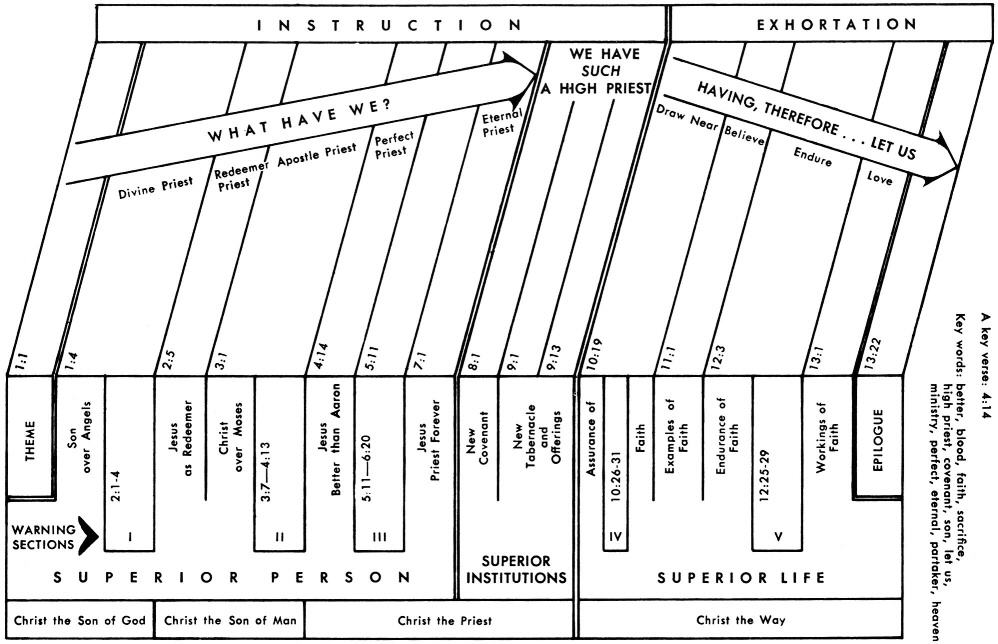
CONSIDER JESUS OUR GREAT HIGH PRIEST
Click chart to enlarge
Charts from Jensen's Survey of the NT - used by permission
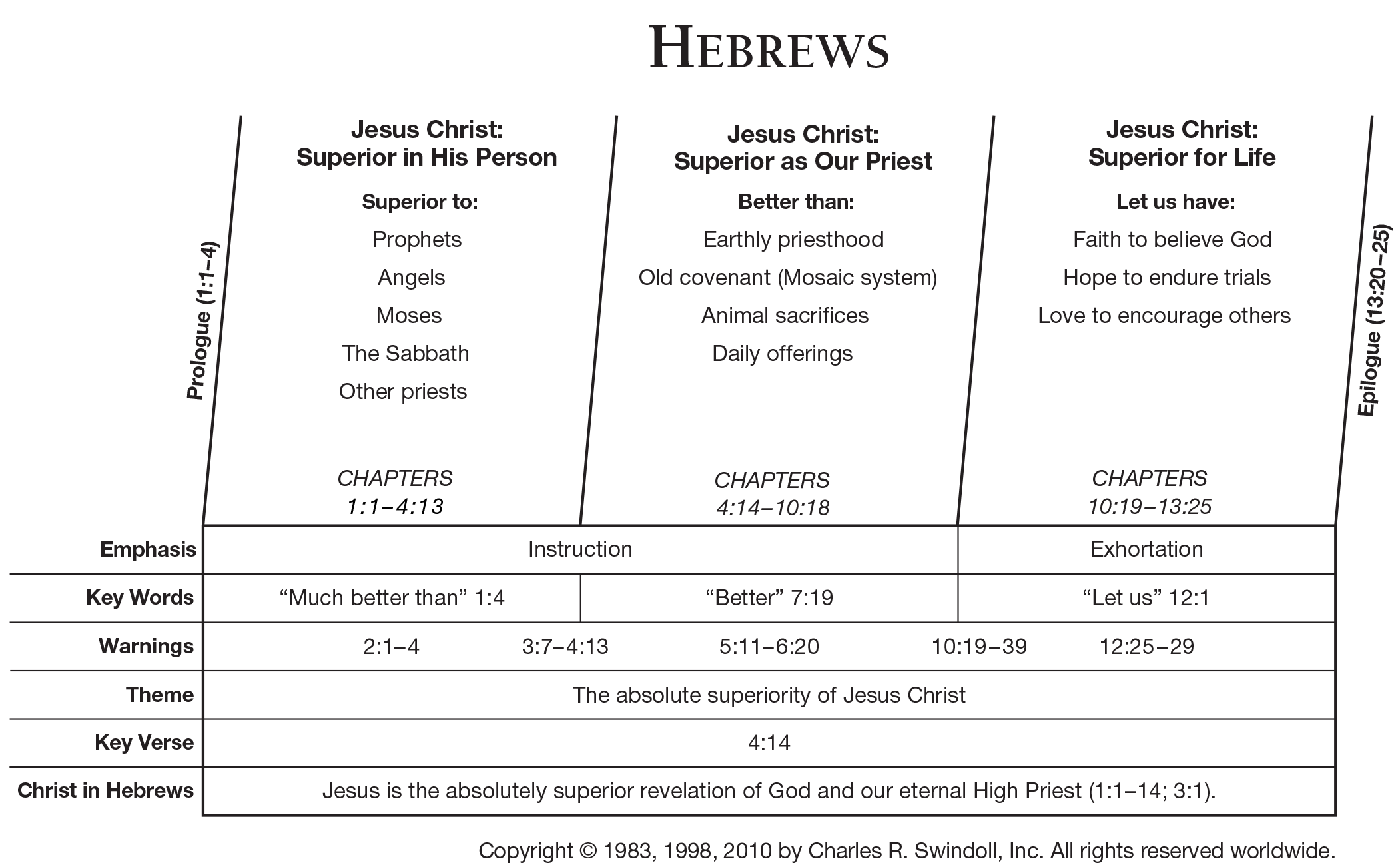
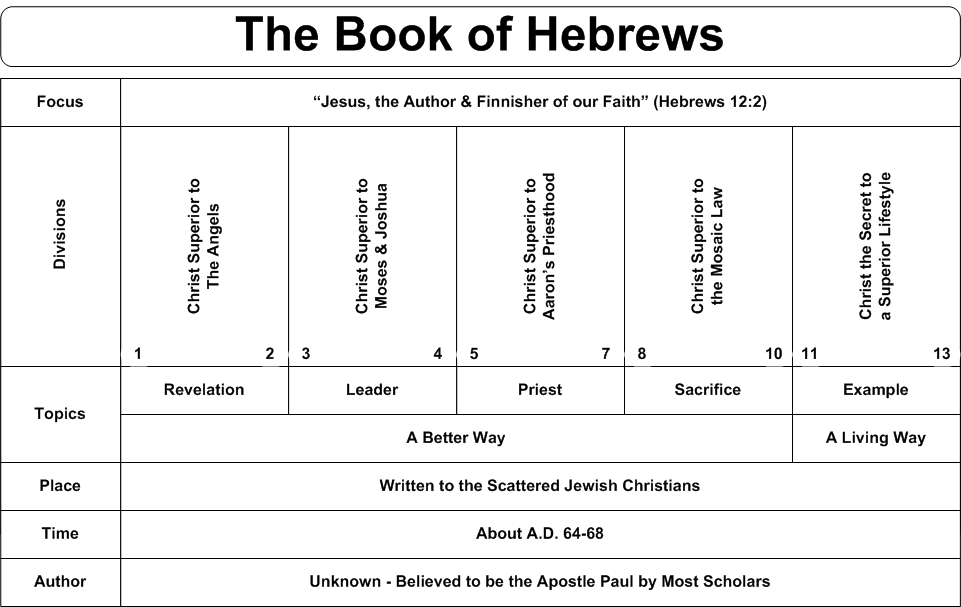
Swindoll's Chart, Interesting Pictorial Chart of Hebrews, Another Chart

|
The Epistle |
||||
| INSTRUCTION Hebrews 1-10:18 |
EXHORTATION Hebrews 10:19-13:25 |
|||
| Superior Person of Christ Hebrews 1:1-4:13 |
Superior Priest in Christ Hebrews 4:14-10:18 |
Superior Life In Christ Hebrews 10:19-13:25 |
||
| BETTER THAN PERSON Hebrews 1:1-4:13 |
BETTER PRIESTHOOD Heb 4:14-7:28 |
BETTER COVENANT Heb 8:1-13 |
BETTER SACRIFICE Heb 9:1-10:18 |
BETTER LIFE |
| MAJESTY OF CHRIST |
MINISTRY OF CHRIST |
MINISTERS FOR CHRIST |
||
|
DOCTRINE |
DUTY |
|||
|
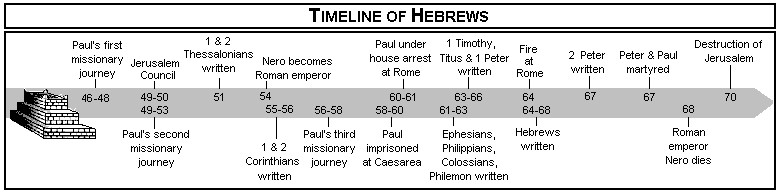
DATE WRITTEN: |
||||

See ESV Study Bible "Introduction to Hebrews"
(See also MacArthur's Introduction to Hebrews)
Borrow Ryrie Study Bible
Hebrews 13:3 Remember the prisoners, as though in prison with them, and those who are ill-treated, since you yourselves also are in the body. (NASB: Lockman)
Greek: mimneskesthe (2PPPM) ton desmion os sundedemenoi, (RPPMPN) ton kakouchoumenon (PPPMPG) os kai autoi ontes (PAPMPN) en somati.
BGT μιμνῄσκεσθε τῶν δεσμίων ὡς συνδεδεμένοι, τῶν κακουχουμένων ὡς καὶ αὐτοὶ ὄντες ἐν σώματι.
Amplified: Remember those who are in prison as if you were their fellow prisoner, and those who are ill-treated, since you also are liable to bodily sufferings. (Amplified Bible - Lockman)
My Amplified Paraphrase: Remember—keep in mind continually and sympathetically—those who are suffering mistreatment, imprisoned, persecuted, or oppressed; do not let them slip from your heart or prayers, but identify with them as though you were chained beside them, sharing their hardship, their fear, and their pain. And remember those who are abused, afflicted, or mistreated in any way, because you too live in a frail human body and are vulnerable to the same trials; therefore let compassion move you to care, to pray, to support, and to stand with them in love.
KJV: Remember them that are in bonds, as bound with them; and them which suffer adversity, as being yourselves also in the body.
NET Remember those in prison as though you were in prison with them, and those ill-treated as though you too felt their torment.
CSB Remember the prisoners, as though you were in prison with them, and the mistreated, as though you yourselves were suffering bodily.
ESV Remember those who are in prison, as though in prison with them, and those who are mistreated, since you also are in the body.
NIV: Remember those in prison as if you were their fellow prisoners, and those who are mistreated as if you yourselves were suffering. (NIV - IBS)
NLT: Don't forget about those in prison. Suffer with them as though you were there yourself. Share the sorrow of those being mistreated, as though you feel their pain in your own bodies.(NLT - Tyndale House)
Phillips: Think constantly of those in prison as if you were prisoners at their side. Think too of all who suffer as if you shared their pain. (Phillips: Touchstone)
Wuest: Be constantly mindful of those in bonds as bound with them, of them who are suffering ill-treatment as also yourselves being in a body.
Young's Literal: be mindful of those in bonds, as having been bound with them, of those maltreated, as also yourselves being in the body;
- Remember the prisoners - Heb 10:32,34, Heb 6:10-11,Heb 11:36 Ge 40:14,15,23; Je 38:7-13; Mt 25:36,43; Acts 16:29-34; 24:23; 27:3; Ep 4:1; Php 4:14-19; Col 4:18; 2Ti 1:16-18
- Hebrews 13 Resources - Multiple Sermons and Commentaries
- Hebrews 13:1-4 Love, Sex, and Marriage - John MacArthur
Related Passages:
Hebrews 10:32-34 But remember the former days, when, after being enlightened, you endured a great conflict of sufferings, 33 partly by being made a public spectacle through reproaches and tribulations, and partly by becoming sharers with those who were so treated. 34 For you showed sympathy to the prisoners (desmios) and accepted joyfully the seizure of your property, knowing that you have for yourselves a better possession and a lasting one.
Hebrews 6:10-11+ For God is not unjust so as to forget your work and the love which you have shown toward His name, in having ministered and in still ministering to the saints. 11 And we desire that each one of you show the same diligence so as to realize the full assurance of hope until the end,
Colossians 4:18+ I, Paul, write this greeting with my own hand. Remember (present imperative) my imprisonment. Grace be with you.
2 Timothy 1:16-18+ The Lord grant mercy to the house of Onesiphorus, for he often refreshed me and was not ashamed of my chains; 17 but when he was in Rome, he eagerly searched for me and found me– 18 the Lord grant to him to find mercy from the Lord on that day–and you know very well what services he rendered at Ephesus.
Galatians 6:2+ Bear one another’s burdens, and thereby fulfill the law of Christ.
Philippians 4:14-19+ Nevertheless, you have done well to share with me in my affliction. 15 You yourselves also know, Philippians, that at the first preaching of the gospel, after I left Macedonia, no church shared with me in the matter of giving and receiving but you alone; 16 for even in Thessalonica you sent a gift more than once for my needs. 17 Not that I seek the gift itself, but I seek for the profit which increases to your account. 18 But I have received everything in full and have an abundance; I am amply supplied, having received from Epaphroditus what you have sent, a fragrant aroma, an acceptable sacrifice, well-pleasing to God. 19 And my God will supply all your needs according to His riches in glory in Christ Jesus.
LET LOVE OF THE BRETHREN CONTINUE BY…
REMEMBERING THE IMPRISONED BRETHREN
Remember the context calls for love of the brethren to continue and here we see a way that such love can be demonstrated to the brethren. Christian love is never theoretical—it is sacrificial, empathetic, and deeply personal. After calling believers to let love of the brethren continue (Heb 13:1) and to show hospitality to strangers (Heb 13:2), the writer presses even further: true love remembers those who suffer, not from a safe distance, but with a heart that enters their pain.
Remember (mimnesko) the prisoners (desmios), as though in prison with (sundeo) them - Remember is in the present imperative calling not for a momentary thought but for the readers to continually keep the prisoners in mind (in context very likely the ones who had been imprisoned for their faith in Messiah). Note also that remember is in the middle voice, which calls for the act of remembering to be not merely a mental exercise, but a deeply personal, empathetic, and participatory act. In other words, the writer is urging believers to actively and personally engage in remembering those who are suffering, as if they themselves were sharing in their affliction (active solidarity with their suffering). Mark it down that brotherly love that forgets is not really love.
This command to continually remember the prisoners would have been very practical because under Roman law persons could be retained in prison until punishment was meted out. Those who were enduring lengthy stays in prison often had to depend on outside sources for daily sustenance. In addition, obedience by the saints to this command carried potentially serious consequences, because those who aided the prisoners ran the risk of also being viewed as those who should be themselves placed in prison! And thus to obey this command could mean one would have to "count the cost" in a big way! We are called to remember the afflicted as though we were actually sitting beside them in the prison cell—sharing the cold bite of their chains, the oppressive weight of their loneliness, and the painful injustice of their mistreatment. The writer of Hebrews urges us to let our hearts enter their suffering, not from a distance, but with deep identification and compassion.
Feel their pain as if it were your own—
because in Christ, it is.
William Barclay - Tertullian in The Apology writes: “If there happen to be any in the mines, or banished to the islands, or shut up in prisons for nothing but their fidelity to the cause of God’s Church, they become the nurslings of their confession.” Aristides the heathen orator said of the Christians: “If they hear that any one of their number is imprisoned or in distress for the sake of their Christ’s name, they all render aid in his necessity and, if he can be redeemed, they set him free.” When Origen was young it was said of him: “Not only was he at the side of the holy martyrs in their imprisonment and until their final condemnation but, when they were led to death, he boldly accompanied them into danger.”....Sometimes Christians were condemned to the mines which was almost like being sent to Siberia. The Apostolic Constitutions lay it down: “If any Christian is condemned for Christ’s sake to the mines by the ungodly, do not overlook him but from the proceeds of your toil and sweat send him something to support himself and to reward the soldier of Christ.” The Christians sought out their fellow Christians even in the wilds. There was actually a little Christian Church in the mines at Phaeno. Sometimes Christians had to be ransomed from robbers and brigands.....They were even prepared to bribe their way into gaol. The Christians became so notorious for their help to those in gaol that at the beginning of the fourth century the Emperor Licinius passed new legislation that “no one was to show kindness to sufferers in prison by supplying them with food and that no one was to show mercy to those starving in prison.” It was added that those who were discovered so doing would be compelled to suffer the same fate as those they tried to help. These instances are taken from Harnack’s Expansion of Christianity (ONLINE) and many others could be added. (Hebrews 13 Commentary)
And those who are ill-treated (kakoucheo - abused, oppressed, harshly mistreated) - See description of ill-treatment above. These are believers not in prison, but who are suffering persecution, oppression, or hardship for their faith in Christ. Ill-treated (kakoucheo) is in the present tense, indicating they were continually being mistreated, afflicted, or harassed (likely unjustly). The writer used this same verb of the Old Testament saints saying they "were stoned, they were sawn in two, they were tempted, they were put to death with the sword; they went about in sheepskins, in goatskins, being destitute, afflicted, ill-treated (kakoucheo)(Heb 11:37). So even before the Cross, there was a price to be paid for faith in Messiah.
Since you yourselves also are in the body (soma) - Body can be interpreted two ways, as the body of individuals or the corporate body, the body of Christ (cf 1Co 12:26). The translations which hold to a strict literal rendering such as NAS, ESV, KJV, Young's Literal add no bias to suggest it refers to the individual's body whereas other versions render it in such a way as to favor interpretation as an individual's bodily (HCSB- "as though you yourselves were suffering bodily" NIV "as if you yourselves were suffering," NLT "as if you felt their pain in your own bodies." Suffice it to say that most writers favor body as referring to the physical body not the body of Christ.
The Handbook on the Letter to the Hebrews summarizes the possibilities…
(1) “Members of the Christian fellowship,” understanding “body” in the figurative sense used by Paul (Jerusalem Bible “since you too are in the one body”), is most unlikely. There is no similar text in Hebrews; there is no definite article for “the” in the Greek, and this explanation does not fit in with verse 3a, which in other ways is parallel to 3b.
(2) Many translators think “in (the) body” means “in this mortal life” (compare 2Cor 5.6 and Ro 7.24); Knox “since you are still in the world”; similarly Phillips.
(3) Other common language translations, and some other translations, suggest either:
(a) that the readers should identify themselves in sympathy with those who are ill-treated: Today's English Version as though you were suffering as they are (similarly German Common Language); Translator's New Testament “as if you too shared their lot”; or
(b) that the readers may suffer in the same way in the future: DuCL “for the same can happen to you”; NAB “for you may yet suffer as they do.” This is not necessarily implied by the text, though it is perhaps included in (a), which also makes a good parallel with verse 3a, as though. (The United Bible Societies' New Testament Handbook Series)
Grant Osborne on you yourselves also are in the body - I believe it is important to retain “in the body” (counter the NIV), and the question is whether it refers to the church body or the physical body. If the former, the stress is on identifying with one another’s suffering in Christ. If the latter, it is on sharing together the bodily suffering that persecution entails. The other instances of sōma in Hebrews feature the physical body (10:5, 10, 22; 13:11), and this is the more likely here. Christ became incarnate and suffered physically on our behalf, and it is our privilege to share both with him and with one another. (See Hebrews Verse by Verse)
Steven Cole - Remembering Christians who suffer persecution requires thinking about their situation and applying the golden rule: How would you want to be treated if it had happened to you? That is the point of, “since you yourselves are in the body.” He means, “It could happen to you, so treat those who are victims of persecution as you would want to be treated.” In that day, prisoners depended on family or friends bringing them food and clothing. The author is saying, “Don’t let out of sight be out of mind. Think about them and meet their needs.” (Let Love Continue)
Donald Guthrie on you yourselves also are in the body - The words since you also are in the body are added to remind the readers that they too could be exposed to the same treatment. The words draw attention to the physical limitations to which all are subject. This is a more likely understanding of the text than to suppose that the body refers to the body of Christ. (BORROW Hebrews Commentary)
Phillip Hughes writes that "Our author encourages his readers to remember also those who are ill-treated, that is, those who are enduring indignities and afflictions other than imprisonment because of their Christian witness, adding the important reminder that they also are in the body—by which he means, not, as Calvin and others suppose, that they are fellow members of the one Body of Christ, so that "if one member suffers, all suffer together" (1 Cor. 12:26), true and appropriate though this consideration is, but rather that, as they themselves are leading a bodily existence, the bodily hardships now being experienced by some of their fellow believers could equally well, and perhaps will, be experienced by them too, as indeed, again in "the former days," they had "endured a hard struggle with sufferings," having at times been "publicly exposed to abuse and affliction" (10:32f.). The impostor and the hypocrite betray themselves by their lack of brotherly love and compassion. (A Commentary on the Epistle to the Hebrews)
John MacArthur gives some interesting background - Tertullian, an early Christian apologist, wrote, “If there happen to be any in the mines, banished to the islands, or shut up in prisons, the Christians become carriers of their confession.” Aristodes, the pagan orator, said of the Christians, “If they hear that any one of their number is in prison or in distress for the sake of their Christ’s name, they all render aid in his necessity, and if they can, they redeem him, to set him free.” In other words, if he was in jail, they would pay his fine or redemption price. The Apostolic Constitutions said, “If any Christian is condemned for Christ’s sake … to the mines by the ungodly, do not overlook him, but from the proceeds of your toil and sweat, send him something to support himself, and to reward the soldiers.” And, “All monies accruing from honest labour do ye appoint and apportion to the redeeming of the saints, ransoming thereby slaves and captives, prisoners, people who are sore abused or condemned by tyrants.”1 Some early Christians sold themselves into slavery to get money to free a fellow believer. (See Hebrews Commentary - Page 428)
While this verse probably is not referring to the corporate body of Christ, it is still worth noting that the NT does give us some examples of this mode of interpretation, as in Paul's reminder to the church at Corinth "if one member suffers, all the members suffer with it; if one member is honored, all the members rejoice with it." (1Co 12:26)
In the Olivet Discourse Jesus made it clear that to minister to a prisoner in the name of Christ was to minister to Christ Himself (Mt 25:36, 40 - see below). When Jesus returns in His glory (Mt 25:31, 32, cp Zech 14:5, Mt 24:30, 31, Mk 13:26, 27, Lk 21:27) as King of kings and Lord of lords (Rev 1:7+, Rev 19:11+, Rev 19:16+) to sit on His throne in Jerusalem (Isa 2:2, 3, 4+) (Millennium or see Millennial Reign of Christ), He will have a time of judgment often referred to as the "judgment of the sheep and the goats" (Judgment of the Gentiles - "nations" in Mt 25:32 = ethnos - often translated "Gentiles" = Gentiles who survive the horrible time of the Great Tribulation). What is fascinating is that the main criteria on which He will judge the Gentiles is whether or not they have exhibited hospitality! Matthew records the somber scene, the King declaring…
'For I was hungry, and you gave Me something to eat; I was thirsty, and you gave Me drink; I was a stranger, and you invited Me in; naked, and you clothed Me; I was sick, and you visited Me; I was in prison, and you came to Me.'
"Then the righteous (not by their works which He is judging, but justified or declared righteous at a moment in time when by grace they exercised personal faith in the Messiah - Ro 3:24+, Ro 3:28+) will answer Him, saying, 'Lord, when did we see You hungry, and feed You, or thirsty, and give You drink? 'And when did we see You a stranger, and invite You in, or naked, and clothe You?
'And when did we see You sick, or in prison, and come to You?'
"And the King will answer and say to them, 'Truly I say to you, to the extent that you did it to one of these brothers of Mine, even the least of them, you did it to Me.' "Then (expression of time = after He has rewarded the righteous!) He will also say to those on His left, 'Depart (present imperative) from Me (cp Mt 7:23+, Lk 13:24-27+ in both Matthew and Luke Jesus is quoting from Ps 6:8a+), accursed ones, into the eternal fire which has been prepared for the devil and his angels (Note that hell was not originally prepared for men! cp 2Th 1:6-10+) (Mt 25:35-41+)
Comment: The principle is that because believers are now in the binding, unbreakable, eternal, new covenant with Christ by grace through faith, they are identified with Christ, in oneness with Him (See related discussions: The Exchange of Armor and Belts; Exchange of Armor and Belts; The Oneness of Covenant). And so when a believer is persecuted for the sake of His Name, this persecution is tantamount to persecution of Jesus Himself. In short, our Lord "takes it personally" when we are mistreated or afflicted or harassed because of Him! Do you believe this? If you do, it will be a great impediment to attempt to "get even." We as believers now need to return persecution with prayer, blessing and kindness, and leave room for the wrath of God (that's why we need to be praying for them! see Ro 12:14+, Ro 12:17+, Ro 12:18-21+)
Dr Luke gives an example of the Christ's sharing in persecutions for His sake in his description of Paul's conversion experience on the Damascus Road writing…
And it came about that as he journeyed, he was approaching Damascus, and suddenly a light from heaven flashed around him; and he fell to the ground, and heard a voice saying to him, "Saul, Saul, why are you persecuting Me?" (cp Paul agreeing with the martyrdom of Stephen in Acts 7:58-8:1+; see also Acts 9:1, 2+, Acts 22:3-5+, Acts 26:9-11+) And he said, "Who art Thou, Lord?" And He said," I am Jesus Whom you are persecuting." (Acts 9:3-5+)
Comment: The point is that Jesus "felt" the persecution that His follower Stephen was experiencing, again reflecting The Oneness of Covenant.
You may be saying "How can I remember the prisoners in America because Christians are imprisoned here?"
In the first century, followers of Christ could be (and were) arrested and imprisoned not for any specific criminal activity but simply for believing in Jesus Christ as Lord (Ro 10:9, 10+).
In America believers are not (yet) arrested for believing in Jesus as the Only Way to the Father (Jn 14:6, Acts 4:12, cp Acts 5:41), but many believers suffer throughout the world and are being called daily to suffer and even die for their faith in Jesus. While there are none imprisoned for their faith in America (yet!), there are fellow members of the Body of Christ in prison and in harm's way in other countries, especially those countries which are fanatically and radically opposed to the proclamation and practice of the Gospel of Jesus Christ. Let me encourage you prayer warriors out there (I am convicted just writing this, for this should be ALL of us!) to go to the following website and to lift up your persecuted, even imprisoned brethren to the throne of grace that they might receive mercy and find grace to help in the "nick of time" (Hebrews 4:16+). Don't procrastinate for God has privileged us with the power of prayer which gives us "the opportunity of a lifetime!" No prison wall is thick enough to stop a praying saint, and prayer allows us to go where our feet cannot.
And lest you think Christian persecution is not relevant to our modern era, it is notable that persecution is taking place in over 70 countries around the world today, according to multiple reliable sources, including the U.S. State Department and Christian advocacy organizations like Open Doors, Voice of the Martyrs, and International Christian Concern. Over 360 million Christians live in places where they experience high levels of persecution and discrimination, according to Open Doors’ 2024 World Watch List. And finally, most sources say that more Christians were martyred in the 20th century than in the previous 19 centuries combined. Persecution includes: Imprisonment, torture, loss of property, social exclusion and murder. Jesus' words have echoed down through the centuries - "“If the world hates you, you know that it has hated Me before it hated you." (Jn 15:18+).
In summary, Hebrews 13:3 calls believers to a costly, compassionate, Christ-like love that does more than feel sympathy — it enters the suffering of persecuted saints with courage, imagination, and solidarity. To “remember” prisoners is a continual command, rooted in the unity of Christ’s body and the simple reality that we are vulnerable too. Early Christians risked their lives to care for those in chains; modern believers are called to do no less. When we remember the persecuted, we reflect the heart of the Savior who entered our prison of sin, bore our chains, and made our sorrow His own.
Related Resource:
Remember (3403) (mimnesko through the idea of fixture in mind or of mental grasp) means to recall information from memory, but without necessarily implying that one has forgotten what is recalled. To recollect. To remind oneself.
MIMNESKO - 23x in 23v - Mt 5:23; 26:75; 27:63; Lk 1:54, 72; 16:25; 23:42; 24:6, 8; Jn 2:17, 22; 12:16; Acts 10:31; 11:16; 1Co 11:2; 2Ti 1:4; Heb 2:6; 8:12; 10:17; 13:3; 2Pe 3:2; Jude 1:17; Rev 16:19. NAS = recall(1), remember(13), remembered(8), remembrance(1).
Prisoners (1198) (desmios from desmeo = to bind as with chains from desmon = band, shackle from deo = to bind) describes one who is bound or captive or imprisoned. Liddell-Scott - metaphorically binding as with a spell.
DESMIOS - 16V - Matt. 27:15; Matt. 27:16; Mk. 15:6; Acts 16:25; Acts 16:27; Acts 23:18; Acts 25:14; Acts 25:27; Acts 28:17; Eph. 3:1; Eph. 4:1; 2 Tim. 1:8; Phlm. 1:1; Phlm. 1:9; Heb. 10:34; Heb. 13:3
Prison with (4887) (sundeo from sun/syn = with, speaks of intimate association + deo = to bind) means to be bound together with or to be a fellow prisoner. Only here in the Bible.
The perfect tense views this as a completed condition and an ongoing state. In other words, they had been imprisoned at a point in time in the past and were still in prison.
Ill-treated (2558) (kakoucheo from kakos = evil, ill + echo = to have) means literally to have affliction or ill treatment. To treat evilly. To ill-treat. In the passive voice it means to suffer ill, to be maltreated, to be tormented, afflicted or harassed.
The present tense indicates they were continually tormented, afflicted or harassed. The passive voice indicates the maltreatment came from an outside source, in context most likely their Jewish brothers (by race, but not by faith).
Kakoucheo = Only Hebrews 11:37, 13:3. In non-apocryphal Septuagint - 1Ki 2:26;11:39.
Hebrews 11:37 They were stoned, they were sawn in two, they were tempted, they were put to death with the sword; they went about in sheepskins, in goatskins, being destitute, afflicted, ill-treated
The writer used kakoucheo to describe the persevering (faithful) suffering of the saints in the "hall of faith" chapter - They were stoned, they were sawn in two, they were tempted, they were put to death with the sword; they went about in sheepskins, in goatskins, being destitute, afflicted, (present tense = continually; passive voice = being) ill-treated (Heb 11:37)
Spurgeon on ill-treated - And being likely therefore to take your own turn of suffering, and to need the sympathy of your fellow Christians. Show sympathy to others while they need it, and they will gratefully remember you when you are in bonds or in adversity.
The Early Church’s Costly Love - In Rome, Christians would sneak food into the prisons at night, knowing they could be recognized and arrested. Many were. Yet they kept coming. This is exactly the spirit of Hebrews 13:3 — love that risks everything.
The Pastor Who Refused to Forget - Richard Wurmbrand, imprisoned for 14 years in Communist Romania, said: “The worst suffering was knowing we might be forgotten.” Christians who smuggled medicine into the prison risked beatings, torture, and death — but they remembered him.
The Ethiopian Prison Cell - Modern believers in Ethiopia rotate sleeping on the cold stone floor so the weakest can rest on the single mat. They truly live Heb 13:3 — “as though in prison with them.”
The Church That Sent Shoes - A persecuted pastor in Southeast Asia had no shoes. A church in the U.S. heard and sent not one pair, but a hundred — for the whole congregation. Love remembers.
International Standard Bible Encyclopedia article on prison and prisoner with most of the details relating to prison in as it was described in the Old Testament
Causes of Imprisonment: It was often necessary to restrict the liberty of individuals who for various causes were a menace to those in authority, without inflicting any corporal punishment, e.g. Joseph's brethren were kept "in ward" three days (Ge 42:19); Shimei was forbidden to pass beyond the boundary of Jerusalem (1Ki 2:36); the person who was caught gathering sticks on the Sabbath was put "in ward" pending his trial (Nu 15:34). In the monarchical period, prophets who criticized the throne were put in prison, e.g. Micaiah by Ahab (1Ki 22:27), Hanani by Asa (2Chr 16:10). Hoshea, after his abortive effort to institute an alliance with So or Seve, king of Egypt, was shut up in prison by Shalmaneser (2Ki 17:4); compare also 2Ki 25:27 (Jehoiachin in Babylon); Jer 52:11 (Zedekiah in Babylon).
Under the Monarchy: The Book of Jeremiah throws considerable light on the prison system of Jerusalem in the later monarchical period. The prophet was put "in the stocks that were in the upper gate of Benjamin, which was in the house of Yahweh" (Jer 20:2). Mere imprisonment was not adequate punishment for the prophet's announcement of Judah's doom; it was necessary to have recourse to the pillory. During the siege of Jerusalem Jeremiah was confined in the "court of the guard, which was in the king of Judah's house" (Jer 32:2, etc.). The "court of the guard" was evidently the quarters of the sentry who guarded the royal palace. According to the narrative of Jeremiah 37, the prophet was arrested on a charge of treachery and put in prison "in the house of Jonathan the scribe" (Jer 37:15). This verse does not necessarily mean that a private house was used as a prison. The words are capable of another interpretation, namely, that a building known as the "house of Jonathan the scribe" had been taken over by the authorities and converted into a jail. We read in the following verse that the house had a "dungeon" (literally, "house of the pit") and "cabins" or "cells."
The Treatment of Prisoners: The data are not sufficient to enable us to give any detailed description of the treatment of prisoners. This treatment varied according to the character of the offense which led to incarceration. Samson during the period of his imprisonment was compelled to do hard labor (Jdg 16:21). Grinding was the occupation of women, and marked the depth of Samson's humiliation. Dangerous persons were subjected to various kinds of physical mutilation, e.g. Samson was deprived of his sight. This was a common practice in Assyria (2 Ki 25:7). The thumbs and great toes of Adonibezek were cut off to render him incapable of further resistance (Jdg 1:6).
Various forms of torture were in vogue. Hanani the seer was put into the pillory by Asa (for "in a prison house" we should render "in the stocks"; see the Revised Version margin). In Jer 29:26 for "prison," we should render "stocks" (so the Revised Version (British and American)) or "pillory," and for "stocks," "collar" (as in the Revised Version margin). the King James Version renders a different Hebrew word by "stocks" in Job (13:27; 33:11). There was a special prison diet (1 Ki 22:27), as well as a prison garb (2 Ki 25:29).
Charles Swindoll - Does Anyone Care? Day by Day with Charles Swindoll - Page 342
Hebrews 13:3
ON THAT ICY JANUARY MORNING, in a twenty-five-cent-a-night flophouse, a shell of a man who looked twice his age staggered to the washbasin and fell. The basin toppled and shattered.
He was found lying in a heap, unclothed and bleeding from a deep gash in his throat. His forehead was badly bruised, and he was semiconscious. A doctor used black sewing thread that somebody had found to suture the wound. All the while the bum begged for a drink. A buddy shared the bottom of a rum bottle to calm his nerves.
He was dumped in a paddy wagon and dropped off at Bellevue Hospital, where he would languish, unable to eat for three days . . . and die. Still unknown.
A friend seeking him was directed to the local morgue. There, among dozens of other colorless, nameless corpses with tags on their toes, he was identified. When they scraped together his belongings, they found a ragged, dirty coat with thirty-eight cents in one pocket and a scrap of paper in the other. Enough coins for another night in the flophouse and five words, “Dear friends and gentle hearts.” Almost like the words of a song. Why would a forgotten drunk carry around a line of lyrics? Maybe that derelict with the body of a bum still had the heart of a genius. For once upon a time, long before his tragic death at age thirty-seven, Stephen Foster had written songs that literally made the whole world sing, such as “Camptown Races” and “Oh! Susanna!”
There are many forgotten lives on the earth. Some are in prison. Some in hospitals. Some in nursing homes. And some silently slip into church on Sunday morning, terribly confused and afraid. Until someone steps in and, in love, rebuilds a life, restores a soul, rekindles a flame that sin snuffed out, and renews a song that once was there. Read carefully God’s penetrating perspective:
Remember those in prison, as if you were there yourself. Remember also those being mistreated, as if you felt their pain in your own bodies.
HEBREWS 13:3
Can you put yourself into the pain of those who suffer? Can you pause long enough to show the love of Christ to them?
Billy Graham - Pray for the Persecuted Hope for Each Day Morning and Evening Devotions - Page 400
Remember those in prison as if you were their fellow prisoners, and those who are mistreated as if you yourselves were suffering. HEBREWS 13:3 NIV
Few things touch my heart more than the news that some of my brothers and sisters in Christ are being persecuted, tortured, and killed for their love of Jesus.
It has been estimated that more Christians have been killed for their faith during the last one hundred years than in all the other centuries since the time of Christ combined. One reason is the great expansion of Christianity in the last few centuries—often into places of great unbelief and hostility. Another reason is the rise of militantly anti-religious political systems.
Even where persecution isn’t an issue, an upsurge in secularism and religious intolerance is apparent, and religion has been scorned and removed from public life. The Crucified One warned us: we who choose to follow Him would do so at the risk of rejection and persecution.
Thank God for whatever measure of religious freedom you enjoy—and pray today for those suffering for their faith in Christ.
Chris Tiegreen - A reflection on SUFFERING 365 Pocket Devotions: Inspiration and Renewal for Each New Day
When I need compassion for those imprisoned by their circumstances
At any given time, many of God’s saints are in prison. The prison may be literal, or it may be any constraining situation such as financial debt, a broken relationship, or a physical ailment. We should never look at our imprisoned brothers and sisters and assume that God has not favored them. God’s prisons are full of His loved ones. In fact, most of those whom He has used in powerful ways —such as Paul, Joseph, or John the disciple —have experienced an imprisonment, captivity, or loneliness ordained directly by Him.
Do your circumstances make you feel as if you are in prison? Don’t despair; it will not last. It is designed either for your current witness or future usefulness. God is refining you and molding you into His image. Do you know someone in prison? Do not condemn. It is never God’s intention for His church to turn on its visibly fallen. Pray for those who suffer and meet their needs however you can.
Remember those in prison, as if you were there yourself. Remember also those being mistreated, as if you felt their pain in your own bodies. HEBREWS 13:3
Andrew Murray - THE SUFFERING
Share the sorrow of those being mistreated, as though you feel their pain in your own bodies. HEBREWS 13:3
We live in a world of suffering! The persecuted believers in Islamic countries, the famine-stricken millions, those in poverty and wretchedness, refugees from armed conflict—and so much more. In our smaller circles, in thousands of homes and hearts, there is great sorrow. In our own neighborhood, how many need help or comfort? Let us have a heart for the suffering. Jesus sacrificed all and identified Himself with our suffering. Let us in our measure do so, too. It will stir us to pray, to work, to hope, to love more. And in a way and time we do not understand, God will hear our prayers.
Pray always without giving up. “Jesus told his disciples a story to illustrate their need for constant prayer and to show them that they must never give up” (Luke 18:1).
Have you begun to feel that prayer is really the help needed for this sinful world? The very greatness of the task makes us despair! What can our ten minutes of intercession accomplish? It is okay that we feel this: It may be the way in which God is calling and preparing us to give more of our time to prayer. Give yourself wholly to God, pour out your heart to others in love, and look to God in dependence and expectation. To a heart thus led by the Holy Spirit, it is possible to pray always and not give up.
CARDINAL CRIMES - Christian History Devotional The Christian History Devotional: 365 Readings & Prayers
Remember those in prison as if you were their fellow prisoners. HEBREWS 13:3
1948: In 1991 the body of a man who died in 1975 was buried—rather, reburied—in the Catholic cathedral of Esztergom, Hungary. At the time he died, he was regarded as a criminal by the Communist government of Hungary. In 1991 a democratic government in Hungary took a different view.
Born in 1892, Jozsef Mindszenty became a priest in 1915 and was arrested by the Communist leader Bela Kun in 1917 for criticizing the government’s takeover of Catholic schools, but he was released after Kun’s fall later that year. He became a bishop in 1944 and the same year was arrested for not letting the government quarter soldiers in his home. He was made head of the Catholic Church in Hungary in 1945 then cardinal in 1946—and on December 26, 1948, was arrested once again, this time for treason and conspiracy against the new Communist regime in Hungary. Mindszenty at his sham trial confessed to all his crimes—but years later stated that he had been given drugs in his food, was deprived of sleep, and had been beaten mercilessly until he agreed to confess. He was given a life sentence—a case of the Communist regime wanting to tag a high-profile church leader as a traitor. The pope, Pius XII, excommunicated everyone involved in Mindszenty’s trial.
During the anti-Communist Hungarian revolt in 1956, the cardinal was released, but only days later the Soviet Union intervened to restore Communist power. The cardinal sought asylum in the U.S. embassy in Budapest, and he remained there for fifteen years, unable to leave the site. (Certainly the embassy was better than a Communist prison cell.) In 1971 Pope Paul VI made a proposal: he would revoke the excommunication of the cardinal’s persecutors if the Communists would allow Mindszenty to leave the country. He resided the rest of his life in Vienna, Austria, but traveled often to speak on behalf of Hungarian Catholics. Today most Hungarians, especially Christians, regard him as a hero of the faith.
Hebrews 13:4 Marriage is to be held in honor among all, and the marriage bed is to be undefiled; for fornicators and adulterers God will judge. (NASB: Lockman)
Greek: Timios o gamos en pasin kai e koite amiantos, pornous gar kai moichous krinei (3SFAI) o theos
BGT Τίμιος ὁ γάμος ἐν πᾶσιν καὶ ἡ κοίτη ἀμίαντος, πόρνους γὰρ καὶ μοιχοὺς κρινεῖ ὁ θεός.
Amplified: Let marriage be held in honor (esteemed worthy, precious, of great price, and especially dear) in all things. And thus let the marriage bed be undefiled (kept undishonored); for God will judge and punish the unchaste [all guilty of sexual vice] and adulterous. (Amplified Bible - Lockman)
My Amplified Paraphrase: Marriage is to be honored, esteemed, and treated as precious by everyone—held in high regard as God’s sacred, lifelong covenant—and the marriage bed is to be kept pure, undefiled, and free from any sexual impurity, betrayal, or intrusion; for God Himself will surely judge, discipline, and hold accountable both the sexually immoral (those who engage in intimacy outside of marriage) and adulterers (those who violate their covenant within marriage), for He takes purity and fidelity with utmost seriousness.
KJV: Marriage is honourable in all, and the bed undefiled: but whoremongers and adulterers God will judge.
NIV: Marriage should be honored by all, and the marriage bed kept pure, for God will judge the adulterer and all the sexually immoral.
NKJ Marriage is honorable among all, and the bed undefiled; but fornicators and adulterers God will judge.
NET Marriage must be honored among all and the marriage bed kept undefiled, for God will judge sexually immoral people and adulterers.
CSB Marriage must be respected by all, and the marriage bed kept undefiled, because God will judge immoral people and adulterers.
ESV Let marriage be held in honor among all, and let the marriage bed be undefiled, for God will judge the sexually immoral and adulterous.
NLT: Give honor to marriage, and remain faithful to one another in marriage. God will surely judge people who are immoral and those who commit adultery.
Wuest: Let your marriage be held in honor in all things, and thus let your marriage-bed be undefiled, for whoremongers and adulterers God will judge.
Young's Literal: honourable is the marriage in all, and the bed undefiled, and whoremongers and adulterers God shall judge.
-
Genesis 1:27,28; 2:21,24; Lev 21:13-15; 2 Ki 22:14; Pr 5:15-23; Is 8:3; 1 Co 7:2-16; 9:5; 1 Ti 3:2,4,12; 5:14; Titus 1:6
- Hebrews 13 Resources - Multiple Sermons and Commentaries
- Hebrews 13:4 The Right and Wrong Place for Sex - Steven Cole
- Hebrews 13:1-4 Love, Sex, and Marriage - John MacArthur
Related Passages
Genesis 2:18+ Then the LORD God said, “It is not good for the man to be alone; I will make him a helper suitable for him.”
Genesis 2:24+ For this reason a man shall leave his father and his mother, and be joined to his wife; and they shall become one flesh.
Ephesians 5:31-32+ FOR THIS REASON A MAN SHALL LEAVE HIS FATHER AND MOTHER AND SHALL BE JOINED TO HIS WIFE, AND THE TWO SHALL BECOME ONE FLESH. 32 This mystery is great; but I am speaking with reference to Christ and the church.
Matthew 19:6+ “So they are no longer two, but one flesh. What therefore God has joined together, let no man separate.”
1 Thessalonians 4:3-5+ For this is the will of God, your sanctification; that is, that you abstain from sexual immorality; 4 that each of you know how to possess his own vessel in sanctification and honor, 5 not in lustful passion, like the Gentiles who do not know God;
1 Corinthians 6:18+ Flee (present imperative see our need to depend on the Holy Spirit to obey) immorality. Every other sin that a man commits is outside the body, but the immoral man sins against his own body.
Proverbs 5:18-19+ Let your fountain be blessed, And rejoice in the wife of your youth. 19 As a loving hind and a graceful doe, Let her breasts satisfy you at all times; Be exhilarated always with her love.
Revelation 21:8+ “But for the cowardly and unbelieving and abominable and murderers and immoral persons (AS ONE'S LIFESTYLE) and sorcerers and idolaters and all liars, their part will be in the lake that burns with fire and brimstone, which is the second death.”
1 Corinthians 7:2-5+ But because of immoralities, each man is to have his own wife, and each woman is to have her own husband.The husband must fulfill his duty to his wife, and likewise also the wife to her husband. 4 The wife does not have authority over her own body, but the husband does; and likewise also the husband does not have authority over his own body, but the wife does. 5 Stop depriving one another, except by agreement for a time, so that you may devote yourselves to prayer, and come together again so that Satan will not tempt you because of your lack of self-control.
Ecclesiastes 2:10+ (SOLOMON WROTE) And all that my eyes desired I did not refuse them. I did not withhold my heart from any pleasure, for my heart was pleased because of all my labor and this was my reward for all my labor. (AND WHAT WAS THE CONSEQUENCE? A DIVIDED KINGDOM!!! see 1Ki 11:1-12, 13,14+)
LET LOVE OF THE
BRETHREN CONTINUE
BY HONORING MARRIAGE
Don't forget the context of this paragraph which begins with let love of the brethren continue. After urging brotherly love (Heb 13:1), hospitality (Heb 13:2), and compassion toward the suffering (Heb 13:3), the writer turns to another sphere where Christian love must be guarded carefully: marriage. The early church lived in a culture polluted by casual divorce, rampant sexual immorality, and religious prostitution, unfortunately similar to our modern culture, making this a very relevant exhortation. Hebrews 13:4 is a bright, uncompromising light in a dark, morally confused world. It lifts marriage to its God-given dignity and warns with sobering clarity that God watches what culture excuses. How better to let love of the brethren continue, then to let it continue in marriage between believers!
Marriage (gamos) is to be held in honor (timios - precious, valuable, esteemed, highly regarded) among all, and the marriage bed (koite) is to be undefiled (amiantos); for fornicators (pornos) and adulterers (moichos) God will judge (krino) The words "is to be held" are added to make the reading more fluid. More literally this reads "honorable the marriage in all". Note also that honor (precious) is the first word in the Greek for emphasis. This tells you the high and holy value God Himself places on His institution of marriage. While the world treats marriage casually as a man-made tradition, God calls believers to treat it reverently as a divine institution.
Marriage (gamos) is not to be treated lightly, and its purity is to be guarded. In doing so, we reflect the holiness of God and the faithfulness of Christ to His bride, the Church
The wedding ring is that small piece of jewelry
placed on the finger that cuts off your circulation.
Among all (married or unmarried) emphasis on universal respect, so that marriage is to be honored by all people, not just by those who are married. This refutes both asceticism (strict self-denial which devalues marriage) and sexual immorality (which defiles it). The verse affirms that marriage is a divine institution, not a cultural invention. It is to be esteemed as holy, reflecting God’s covenantal love. In a time when marriage was often disregarded (then and now), Christianity lifted marriage to a place of honor for the world to behold.
Marriage is honored when the husband is the head (1Co 11:3, Ep 5:23+), the wife submits (1Pe 3:1+, 1Pe 3:6+), there is mutual love and respect (1Pe 3:7+). Marriage vows must not be taken lightly. Marriage means fidelity and commitment to one's spouse. Only as partners honor marriage can sexual union bring its intended fulfillment. (See Pr 5:15-23; 1Co 7:2-7.)
Young's gives us a more literal rendering "honorable is the marriage in all, and the bed undefiled, and whoremongers and adulterers God shall judge."
Regard for marriage and for the physical intimacy of marriage is an essential aspect of the pursuit of holiness he has just discussed in the previous chapter (Heb 12:14+).
You may not want to read this next quote unless you want to be convicted!
The bed—the sexual relationship—is an altar, so to speak,
where a pure offering of a couple’s lives is made to each other and to God.
-- R Kent Hughes
R Kent Hughes - Within marriage, sex is beautiful, fulfilling, creative but outside of marriage, sex is evil, ugly (contrary to the "Hollywood commentaries"), destructive, and in the end can damn your soul!
Hughes goes on to say "When Pliny, the governor of Bithynia, examined the Christians and reported back to Trajan, the Emperor, he had to admit, even although he was looking for a charge on which to condemn them, that at their Lord’s Day meeting: “They bound themselves by an oath not for any criminal end but to avoid theft or robbery or adultery, never to break their word nor repudiate a deposit when called upon to refund it.” In the early days the Christians presented such a purity to the world that not even their critics and their enemies could find a fault in it.” (Barclay's Commentary)) Christian sexual morality was unique in the pagan world and a source of wonder. And it has become increasingly so today in a world that considers adultery irrelevant, purity abnormal, and sex a “right” (however and with whomever one may get it) and that has invented the egregious term “recreational sex.” We Christians are called to be outrageously pure—to be a source of wonder and even derision to this glandular world. (Hebrews: An Anchor for the Soul)
The Wycliffe Bible Commentary - Celibacy is not a safeguard against immorality; but rather honorable marriage is the most wholesome life. Chastity in the bonds of marriage constitutes strong Christian witness. Profligate and licentious people must someday face their sins and practices before God.
Most authorities feel that this exhortation represents a response and a refutation of the practice of asceticism which downgraded the high value God has placed on the institution of marriage. Paul warned against this practice in his letter to Timothy…
But the Spirit explicitly says that in later times some will fall away from (purposeful, deliberate departure from a former position) the faith (pistis), (note the source of their "new spirituality"!) paying attention to deceitful spirits and doctrines of demons, by means of the hypocrisy of liars (pseudologos = False speakers - Expresses the notion of definite false statements) seared (kauteriazo = branded with a hot iron, English cauterize!) in their own consciences as with a branding iron (The demonic teacher's consciences were so branded by evil that they lost all moral sensitivity and were no longer able to distinguish between right and wrong!), men who forbid marriage and advocate abstaining from foods (~asceticism), which God has created to be gratefully shared in by those who believe and know the truth. For everything created by God is good (including marriage), and nothing is to be rejected, if it is received with gratitude; for it is sanctified by means of the word of God and prayer. (1Ti 4:1-5)
Some first-century Christian ascetics practiced strict self-denial (from sexual activity) as a "spiritual discipline" and even considered (to quote one source) “virginity as necessary to Christian perfection.” This later developed in the second century into what became known as the Montanist movement, which spawned celibate monasticism. These individuals falsely concluded that those who choose marriage choose inferior spirituality. Wrong! I have been married for 43 years and the greatest sanctifying "tool" in my life is my wife! I am far more "spiritual" with her than I ever would have been without her. The logic (illogic) of these celibates dishonors the God ordained institution of marriage. The ascetics were bad, but the real assault on the integrity and honor of marriage came from the libertines who saw marriage as irrelevant thus pursued unbridled sexual fulfillment. Also wrong! Very wrong!
(See also P E Hughes on asceticism in A Commentary on the Epistle to the Hebrews - Page 566)
William Barclay adds "There were ascetics who despised marriage. Some even went the length of castrating themselves to secure what they thought was purity. Origen, for instance, took that course. Even a heathen like Galen, the physician, noted of the Christians that “they include men and women who refrain from cohabiting all their lives.” The writer to the Hebrews insists against these ascetics that the marriage bond is to be honoured and not despised." (Hebrews 13 Commentary)
The other dangerous extreme in the early church was libertinism, which describes one who is unrestrained by conventional (Biblical) morality (the Bible is the only true source of what is moral before a Holy God) leading to personal dissolution (utter lack of moral restraint) and decay of a society that engages in such profane practices. (See What is libertinism? What is a libertine? | GotQuestions.org)
Related Resources:
Marriage (1062) (gamos) described a public ceremony in which a man and a woman entered into a marital relationship and so speaks of a wedding or wedding feast (Jn 2:1, Mt 22:2). Here in Hebrews 13:4 gamos describes the actual state of being married. Eschatologically (prophetic, future) gamos refers to the wedding ceremony of the Bridegroom, Christ, with His Bride, the Church, at the outset of the Messianic (Millennial) Kingdom. (Rev 19:7+, Rev 19:9+). By metonymy gamos is used for wedding hall, the place where the wedding takes place (Mt 22:10)
GAMOS = 16x - marriage(3), wedding(5), wedding feast(7).- Mt 22:2-4, 8-12; Mt 25:10; Lk 12:36; 14:8; Jn 2:1, 2; Heb 13:4; Rev 19:7, 9.
GAMOS - 4x in 4v in the non-apocryphal Septuagint (Lxx) - Ge 29:22; Esther 1:5; 2:18; 9:22;
GAMOS - 21x in 20v in the Apocrypha - Tobit 6:13; 8:19, 20; 9:2, 6; 10:7; 11:19; Tbs. 6:13; 9:2, 5f; 10:8; 12:1; 1Macc 9:37, 41; 10:58; 3Macc 4:8; Wis 13:17; 14:24, 26;
Honor (5093) (timios - see study of related verb timao) literally speaks of things which are costly, precious or valuable (Re 17:4+) or of persons who are "precious" and thus are highly regarded, esteemed or honored (Acts 5:34, 17:34). Timios describes that which possesses exceptional value (costly, of great worth). Timios was used to refer to precious metals and stones. Timios describes things of great spiritual worth, such as: The precious blood of Christ (1 Peter 1:19); The precious promises of God (2 Peter 1:4); The precious cornerstone (Christ) in 1 Peter 2:6. Thus when Hebrews 13:4 says “Marriage is to be held in honor”, it means that marriage is to be regarded as something sacred, valuable, and worthy of reverence, not to be treated casually or defiled.
There are 13 uses of timios in the NT - Acts 5:34; 20:24; 1Co 3:12 (referring to works that endure eternally for they are built upon or with "gold, silver and precious stones"); Heb 13:4+; James 5:7; 1Pe 1:19+ (referring to the "precious blood" of Jesus); 2Pe 1:4+ (the "precious and magnificent promises" of God); Re 17:4+; Re 18:12+, Re 18:16+; Re 21:11+, Re 21:19+ - observe the striking contrast between the two "women" in the last part of Revelation). The NAS translates it - dear(1), honor(1), precious(8), respected(1), very costly(2). The KJV translates it - precious 8, most precious 2, more precious 1, dear 1, honourable 1, had in reputation 1
There are 33 uses of timios in the Septuagint - 1Sa 3:1; 2Sa 12:30; 1Ki. 5:17; 7:9, 10, 11; 10:2, 10, 11; 1Chr. 20:2; 29:2; 2Chr. 3:6; 9:1, 9, 10; 32:27; Ezra 4:10; Job 28:16; Ps 19:10; 21:3; 116:15; Pr 3:15; 6:26; 8:11, 19; 12:27; 20:6; 24:4; 31:10; Eccl 10:1; Je 15:19; Lam 4:2; Da 11:38; Ho 11:7
R Kent Hughes - Today radical secular wisdom claims that marriage impedes self-actualization—an unforgivable "sin". The main attacks today are mostly libertine. For many, “marriage” is at best a provisional arrangement between two people (sexual orientation is irrelevant) that can be dissolved whenever one wishes, for any reason. To be sure, not all conventional attitudes toward marriage are as extreme, though there is a growing skepticism regarding love and marriage. As one person sarcastically put it, “Love: temporary insanity curable by marriage.”
But what does this have to do with the survival of the church? Everything! I can think of no more efficient way to sink that ship than through adultery and sexual immorality. The reasons are elementary. Immorality perverts theology. I have seen this time and time again with preachers—famous and unknown. They become involved in a secret affair (perhaps several) and yet keep on preaching. But over time an amazing phenomenon takes place—they unconsciously detach themselves from truth. Like the ancient Averroists, they divide truth, so that there is a truth for them and another truth for others. They may not articulate this, but they become practical relativists, and their relativism so eats away at their belief that many, after the trauma of discovery, leave the faith. Tragic shipwreck!
The damage to the church is immense. Preachers caught in such sins suffer a reduction in spiritual ethos. They increasingly sound like old-time railroad conductors who loudly invite people to embark to destinations they themselves have never visited and to which they are incapable of traveling. Powerlessness becomes the hallmark of their rhetoric.
And, of course, they discredit the Word. I can think of no better way to damn the soul of a junior-higher who is just beginning to experience spiritual stirrings than through the fall of a pastor, Sunday school teacher, or other spiritual leader. There can be no more efficient way to dampen the spiritual aspiration of a young family man than adulterous leaders. Because such sin is a particularly lethal sin against the church, I have at times prayed this with my ministerial colleagues: “Lord, if adultery would lie in the future for any of us should we continue to live—then take us home now.” Better dead than damage the church! (See Hebrews : An Anchor for the Soul)
Charles Swindoll - Strike the Original Match - BONN, Germany -- A German group of psychologists, physicians and insurance companies who cooperated on a research project, designed to find the secret to long life and success, made a surprising discovery. The secret? Kiss your wife each morning when you leave for work! The meticulous German researchers discovered that men who kiss their wives every morning have fewer automobile accidents on their way to work than men who omit the morning kiss. The good-morning kissers miss less work because of sickness and earn 20 to 30 percent more money than non-kissers. How do they explain their findings? According to West Germany's Dr. Arthur Szabo, "A husband who kisses his wife every morning begins the day with a positive attitude."
Illustration: (this has nothing to do with the point, but it's a good story) Maybe you heard about the guy who fell in love with an opera singer. He hardly knew her, since his only view of the singer was through binoculars -- from the third balcony. But he was convinced he could live "happily ever after" married to a voice like that. He scarcely noticed she was considerably older than he. Nor did he care that she walked with a limp. Her mezzo-soprano voice would take them through whatever might come. After a whirlwind romance and a hurry-up ceremony, they were off for their honeymoon together. She began to prepare for their first night together. As he watched, his chin dropped to his chest. She plucked out her glass eye and plopped it into a container on the nightstand. She pulled off her wig, ripped off her false eyelashes, yanked out her dentures, unstrapped her artificial leg, and smiled at him as she slipped off her glasses that hid her hearing aid. Stunned and horrified, he gasped, "For goodness sake, woman, sing, sing, SING!
Ralph Alexander emphasizes the effect of the fall of man on God's institution of marriage…
The fall made human hearts hard toward God and toward each other. The relational aspect of God's image became marred. Rebellion against submission to male leadership was Satan's initial temptation (Ge 3:1, 2, 3, 4, 5, 6, 17; contra Ep 5:33; 1Pe 3:1). Male domination and harshness crept into leadership (cf. Col 3:19; 1Pe 3:7). Sin caused polygamy, concubinage, incest, adultery, rape, prostitution, and all kinds of immorality (cf. Lev. 18, 20; Ro 1:26, 27, 28, 29, 30, 31, 32) to damage or destroy the marriage relationship. Marriage commitments are violated. Divorce, premarital sex, and couples living together out of wedlock would never have occurred had not sin entered the world. The fall severely damaged the marriage relationship.
For marriage to function now according to God's ideal, believers in Christ need to marry only believers. Whenever God directly brought a man and woman together in marriage, both were believers. Although pagan customs encouraged marriage with anyone (cf. Gen 16), Israel was given explicit commands not to marry foreigners who would lead them to worship foreign deities (Dt 7:1, 2, 3, 4; 13:6, 7, 8, 9, 10, 11; 17:1, 2, 3, 4, 5, 6, 7; 20:17; 23:2). New Testament believers are also not to be "unequally yoked" with unbelievers (2Cor 6:14), meaning any action causing the union of believer with nonbeliever, or non-believing ways, must be avoided. (Baker's Evangelical Dictionary - excellent, recommended article on marriage)
Related Resources:
- Covenant: As It Relates to Marriage
- Baker's Evangelical Dictionary - recommended article on marriage
Ray Stedman: Nonconformity to the world must certainly involve these areas. The loose sexual standards of our generation and the intense materialistic spirit of this age constitute a constant peril to our hearts, and we must beware of them. We must realize that God has undertaken to sustain the sacredness of marriage and that He unceasingly, unrelentingly judges violations of it. Therefore, we dare not heed the fine sounding declarations being made today about a "new morality," as though we had passed beyond the ancient standards and they no longer had significance. As this writer reminds us, God judges the immoral and adulterous. He does not mean that God looses lightning bolts from heaven against them, or that he causes terrible diseases to come upon them; these are not the forms of judgment. But we can see the judgment of God in the terrible tempest of mental pressures and crackups which sweep like a plague across this land. They are due to the breakdown of moral standards. The certain deterioration of life is the judgment of God when sex standards are violated. It is the brutalization of humanity, so men become like animals and live on the level of animals. This is so apparent in our day.
Does modern church need this exhortation to honor the marriage bed? Here's a comment from pollster George Barna that speaks to the morality crisis in America and even in the church (from a report in 2003)…
The data trends indicate that the moral perspectives of Americans are likely to continue to deteriorate. Compared to surveys we conducted just two years ago, significantly more adults are depicting such behaviors as morally acceptable. For instance, there have been increases in the percentages that condone sexual activity with someone of the opposite gender other than a spouse, abortion (up by 25%), and a 20% jump in people’s acceptance of ‘gay sex.’… Most of the people we interviewed believe that they are highly moral individuals and identify other people as responsible for the nation’s moral decline.
This is reflective of a nation where morality is generally defined according to one’s feelings. In a postmodern society, where people do not acknowledge any moral absolutes, if a person feels justified in engaging in a specific behavior then they do not make a connection with the immoral nature of that action.
Yet, deep inside, they sense that something is wrong in our society. They simply have not been able to put two and two together to recognize their personal liability regarding the moral condition of our nation. Until people recognize that there are moral absolutes and attempt to live in harmony with them, we are likely to see a continued decay of our moral foundations. The generational data patterns make a compelling case for this on-going slide.
Even most people associated with the Christian faith do not seem to have embraced Biblical moral standards.
Things are likely to get worse before they get better - and they are not likely to get better unless strong and appealing moral leadership emerges to challenge and redirect people’s thoughts and behavior. At the moment, such leadership is absent. (Read The Barna Report = Morality Continues to Decay)
CONCLUSION: The modern church desperately needs to hear and heed Hebrews 13:4!
Study Torrey's Topical collection of Scriptures for an excellent summary of what God says about marriage.
This would make a great Sunday School series or Sermon series -- simply walking through the Scriptures and allowing God to say what He says about the honorable institution of marriage. Is there a desperate need? Did the sun rise this morning! The post-Christian society in American is rapidly and radically jettisoning all Biblical truth related to the divine institution of marriage and in so doing is removing one of the foundational pillars of our society. It is time for the Church of Jesus Christ to take a radical stand for righteousness and holiness!
1. Divinely instituted. Ge 2:24.
2. A covenant relationship. Mal 2:4.
3. Designed for
a. The happiness of man. Ge 2:18.
b. Increasing the human population. Ge 1:28; 9:1.
c. Raising up godly seed. Mal 2:15.
d. Preventing fornication. 1Co 7:2.
4. The expectation of the promised seed of the woman an incentive to, in the early age. Ge 3:15; 4:1.
5. Lawful in all. 1Co 7:2,28; 1Ti 5:14.
6. Honorable for all. Heb 13:4.
7. Should be only in the Lord. 1Co 7:39.
8. Expressed by
a. Joining together. Mt 19:6.
b. Making affinity. 1Ki 3:1.
c. Taking to wife. Ex 2:1.
d. Giving daughters to sons, and sons to daughters. Deut 7:3; Ezr 9:12.
9. Indissoluble during the joint lives of the parties. Mt 19:6; Ro 7:2,3; 1Co 7:39.
10. Early introduction of polygamy. Ge 4:19.
11. Contracted in patriarchal age with near relations. Ge 20:12; 24:24; 28:2.
12. Often contracted by parents for children. Ge 24:49-51; 34:6,8.
13. Should be with consent of parents. Ge 28:8; Jdg14:2,3.
14. Consent of the parties necessary to. Ge 24:57,58; 1Sa 18:20; 25:41.
15. Parents might refuse to give their children in. Ex 22:17; Deut 7:3.
16. The Jews
a. Forbidden to contract, with their near relations. Le 18:6.
b. Forbidden to contract with idolaters. Deut 7:3,4; Jos 23:12; Ezr 9:11,12.
c. Often contracted with foreigners. 1Ki 11:1; Ne 13:23.
d. Sometimes guilty of polygamy. 1Ki 11:1,3.
e. Careful in contracting for their children. Ge 24:2,3; 28:1,2.
f. Betrothed themselves some time before. Deut 20:7; Jdg14:5,7,8; Mt 1:18.
g. Contracted when young. Pr 2:17; Joe 1:8.
h. Often contracted, in their own tribe. Ex 2:1; Nu 36:6-13; Lk 1:5,27.
i. Obliged to contract with a brother’s wife who died without seed. Deut 25:5; Mt 22:24.
j. Considered being debarred from, a reproach. Is 4:1.
k. Considered being debarred from, a cause of grief. Jdg 11:38.
l. Often punished by being debarred from. Jer 7:34; 16:9; 25:10.
m. Were allowed divorce from, because of hardness of their hearts. Deut 24:1; Mt 19:7,8.
n. Exempted from going to war immediately after. Deut 20:7
17. Priest not to contract, with divorced or improper persons. Le 21:7.
18. The high priest not to contract, with a widow or a divorced or profane person. Le 21:14.
19. Contracted at the gate and before witnesses. Ru 4:1,10,11.
20. Modes of demanding women in. Ge 24:3,4; 34:6,8; 1Sa 25:39,40.
21. Elder daughters usually given in, before the younger. Ge 29:26.
22. A dowry given to the woman’s parents before. Ge 29:18; 34:12; 1Sa 18:27,28; Ho 3:2.
23. Celebrated
a. With great rejoicing. Jer 33:11; Jn 3:29.
b. With feasting. Ge 29:22; Jdg 14:10; Mt 22:2,3; Jn 2:1-10.
c. For seven days. Jdg 14:12.
24. A benediction pronounced after. Ge 24:60; Ru 4:11,12.
25. The bride
a. Received presents before. Ge 24:53.
b. Given a handmaid at. Ge 24:59; 29:24,29.
c. Adorned with jewels for. Is 49:18; 61:10.
d. Gorgeously apparelled. Ps 45:13,14.
e. Attended by bridesmaids. Ps 45:9.
f. Stood on the right of bridegroom. Ps 45:9.
g. Called to forget her father’s house. Ps 45:10.
26. The bridegroom
a. Adorned with ornaments. Is 61:10.
b. Attended by many friends. Jdg 14:11; Jn 3:29.
c. Presented with gifts. Ps 45:12.
d. Crowned with garlands. Song 3:11.
e. Rejoiced over the bride. Is 62:5.
f. Returned with the bride to his house at night. Mt 25:1-6.
27. Garments provided for guests at. Mt 22:12.
28. Infidelity of those contracted in, punished as if married. Deut 22:23,24; Mt 1:19.
29. Illustrative of
a. God’s union with the Jewish nation. Is 54:5; Jer 3:14; Ho 2:19,20.
b. Christ’s union with his church. Eph 5:23,24,32.
AND THE MARRIAGE BED BE UNDEFILED : kai e koite amianto:
- Heb 12:16; 1Co 6:9; Ga 5:19,21; Ep 5:5; Col 3:5,6; Re 22:15
THE BATTLE FOR
MARITAL PURITY
and the marriage bed (koite) is to be undefiled (amiantos); for fornicators (pornos) and adulterers (moichos) God will judge (krino) - The word "marriage" is added but literally it simply reads "bed". Similarly the verb "be" is not present in the Greek but added to give flow to the sentence. The “marriage bed (koite)" is a euphemism for sexual relations within marriage. The idea is that our marriage bed should be in perfect condition, free from any spot of moral dirt or ethical pollution, free from any influence that might defile it. We should allow nothing to cheapen the marriage bed in any way. Just as our future inheritance in heaven is pure and free from anything that would deform it or cause it to lose its vigor, so too should the Christian couple's marriage bed be untainted by moral/ethical impurity. Note that this warning is given to the church because believers are not immune to temptation.
Marriage is God’s masterpiece—
handle it with holy care.
Matthew Henry adds that "sin and misery, the two grand defilements that spoil this world, and mar its beauty, have no place there.
The undefiled Christian marriage is in marked contrast to an earthly inheritance, all of which is corrupted and defiled (2Pe1:4+ "the corruption that is in the world by lust.") Corruption cannot touch our inheritance or ever wear out its freshness, brightness, and beauty.
The writer of Hebrews uses amiantos to describe Jesus, writing that "it was fitting that we should have such a high priest, holy, innocent, undefiled (amiantos - free from any moral or spiritual blemish - not even a taint of sin - Not merely ritual purity [Lev 21:10, 11, 12, 13, 14, 15] but real ethical cleanness), separated from sinners and exalted above the heavens. (see Heb 7:26+)
James says real religion is "pure and undefiled (amiantos)… in the sight of our God and Father… (and is shown to be genuine when we) visit orphans and widows in their distress, and… keep oneself unstained by the world. (Jas 1:27+)
Trench aptly remarks that "it is a remarkable testimony to the reign of sin, and therefore of imperfection, of decay, of death throughout this whole fallen world, that as often as we desire to set forth the glory, purity, and perfection of that other, higher world toward which we strive, we are almost inevitably compelled to do this by the aid of negatives; by the denying to that higher order of things the leading features and characteristics of this.” (see Re 21:1+ Re 22:3+)
To keep the marriage bed undefiled was a radical concept in the first century Greco-Roman world, and by such supernaturally enabled behavior, the first century believers proved themselves
to be blameless and innocent, children of God above reproach in the midst of a crooked and perverse generation, among whom you appear as lights in the world" (Php 2:15+, Mt 5:16+)
Sex is sacred,
not casual.
Kent Hughes comments that "Christian sexual morality was unique in the pagan world and a source of wonder. And it has become increasingly so today in a world that considers adultery irrelevant, purity abnormal, and sex a “right” (however and with whomever one may get it) and that has invented the egregious (Ed: conspicuously bad) term “recreational sex.” We Christians are called to be outrageously pure—to be a source of wonder and even derision to this glandular world. From the beginning to the end of Hebrews, the abiding concern of the author has been to so instruct the tiny Hebrew church that it would stay afloat on the increasingly hostile seas of first-century Roman culture. Their ship was a microscopic dot on the massive billows of the official pagan/secular enterprise—and eminently vulnerable. It appeared to outside eyes that the external forces could sink it at will. But the author knew that the internal threat to the church was far more deadly. In fact, he knew that it could ride out any storm if things were right on the inside. He knows that nothing will sink a church faster than moral wavering in respect to sex, materialism, or mental outlook. Here is intimate advice regarding how to keep our ship afloat. It is so essential that any church that ignores it will founder and possibly even sink. (Ibid)
Spurgeon - And terrible will be their doom when God does judge them. They may think that, because they sin in secret, therefore they shall escape punishment; but it shall not be so. Whether men judge them or not, God will judge them.
David Guzik writes that…
Perhaps through a past of sexual sin, many people have a difficult time really believing that the marriage bed is undefiled. Guilt and sexual hang-ups are appropriate to extra-marital sex, but not in marital sex. But this is where the guilt and sexual hang-ups often exist, and where they most frequently cause trouble.
The enemy of our souls wants to do everything he can to encourage sex outside of the marriage bed, and he wants to do everything he can to discourage sex inside the marriage bed. We need to recognize this strategy and not give it a foothold among us.
Though God allows real freedom in the variety of sexual expression in marriage, all must be done with a concern for the other's needs and in love (1Corinthians 7:1, 2, 3, 4, 5 and Eph 5:21, 22, 23, 24, 25, 26, 27, 28, 29, 30, 31, 32, 33). (Commentary)
John Piper has an interesting comment on sex in marriage - In Ephesians 6:16 Paul says we should ward off Satan with the shield of faith. Here he says to married people, “Ward off Satan with sufficient sexual intercourse. Don’t abstain too long, but come together soon, so that Satan will gain no foothold.” Well, which is it? Do we guard ourselves from Satan with the shield of faith or the shield of sex? The answer for married people is that faith makes use of sexual intercourse as a means of grace. For the people God leads into marriage, sexual relations are a God-ordained means of overcoming temptation to sin (the sin of adultery, the sin of sexual fantasizing, the sin of pornographic reading, etc.). Faith humbly accepts such gifts and offers thanks.
Now notice something else in 1 Corinthians 7:3–5. This is very important. In verse 4 Paul says that the man and the woman have rights over each other’s body. When the two become one flesh, their bodies are at each other’s disposal. Each has the right to lay claim to the other’s body for sexual gratification. But what we really need to see is what Paul commands in verses 3 and 5 in view of these mutual rights. He does not say, “Therefore stake your claim! Take your rights!” He says, “Husband, give her her rights! Wife, give him his rights!” (v. 3). And in verse 4, “Do not refuse one another.” In other words, he does not encourage the husband or wife who wants sexual gratification to seize it without concern for the other’s needs. Instead he urges both husband and wife to always be ready to give their body when the other wants it. (Sexual Relations in Marriage)
Bed (2845) (koite) literally refers to a place for lying down and rest and thus refers to a bed or bedroom. Koite was used also of the den of an animal or the nest of a bird as well as of a box or basket. In certain contexts it was used to refer to the marriage bed, a figurative way to refer to the sexual relationship between a husband and his wife. Koite is also used to describe illicit sexual promiscuity,
Barclay writes that koite "literally means a bed and has in it the meaning of the desire for the forbidden bed. This was the typical heathen sin. The word brings to mind the man who sets no value on fidelity and who takes his pleasure when and where he will. (Daily Study Bibles)
Koite - 4x in 4v - Here are the other 3 NT uses…
Luke 11:7 and from inside he answers and says, 'Do not bother me; the door has already been shut and my children and I are in bed; I cannot get up and give you anything.'
Romans 9:10+ And not only this, but there was Rebekah also, when she had conceived twins by one man, our father Isaac;
Romans 13:13+ Let us behave properly as in the day, not in carousing and drunkenness, not in sexual promiscuity and sensuality, not in strife and jealousy.
Undefiled (283) (amiantos from a = negates what follows + miaino = to defile by staining, as with color) means without contamination, unpolluted, untainted, unstained (stainless), unsoiled, without uncleanness or impurity. The idea is free from that by which the nature of a thing is deformed or debased, or its force or vigor is impaired. In secular Greek writings amiantos was used to describe things such as unstained hands, heart, flesh or body. Aeschylus calls the sea simply "the undefiled". Amiantos is used of Christ as our High Priest (Heb 7:26) and the believer’s inheritance (1 Pet 1:4).
Amiantos - 4x in 4v in NT -- Heb 7:26+; Heb 13:4; James 1:27+; 1Pe 1:4+.
James 1:27 Pure and undefiled religion in the sight of our God and Father is this: to visit orphans and widows in their distress, and to keep oneself unstained (aspilos) by the world. (NOTE THE CONTAMINATING POTENTIAL OF THE GODLESS WORLD SYSTEM! DO NOT BE DECEIVED, BUT BE SEPARATE, HOLY!)
FOR FORNICATORS AND ADULTERERS GOD WILL JUDGE: pornous gar kai moichous krinei (3SFAI) o theos:
- Fornicators - 1Co 6:9 Ga 5:19,21 Ep 5:5
- God will judge - Ps 50:16-22; Malachi 3:5; 1Co 5:13; 2Co 5:10
- Hebrews 13 Resources - Multiple Sermons and Commentaries
- Hebrews 13:4 The Right and Wrong Place for Sex - Steven Cole
- Hebrews 13:1-4 Love, Sex, and Marriage - John MacArthur
FIGHT TO KEEP THE
MARRIAGE BED UNDEFILED!
For (gar) is a pithy term of explanation explaining why we must fight the good fight of faith to keep the marriage bed undefiled. Our joy in both time and eternity are at stake as explained below.
The world excuses sexual sin;
God judges it.
Fornicators (pornos) and adulterers (moichos) God will judge (krino) - This is a solemn warning rooted in God’s holiness and justice regarding sexual sin. Fornicators (pornos) is one who engages in sexual immorality and in this context refers to such acts especially outside the covenant of marriage. Adulterers (moichos) is someone who violates the marriage covenant by engaging in sexual relations with someone other than their spouse. God will judge (krino) means what it says. God will pronounce sentence. This judgment can be temporal (discipline in this life for believers) or eternal (condemnation for those outside of Christ). It is noteworthy that of all the exhortations in Hebrews 13, the only one associated with a judgment warning is Hebrews 13:4!
John MacArthur writes that "The world today is obsessed with sex as never before. Sexual activity apart from marriage is considered acceptable and normal by more and more people."
Jon Courson makes a strong statement declaring that "Paul says your heart tells you and your spirit confirms that if you are a whoremonger—if you are delighted by and caught up in pornography—you are not part of the kingdom. You can come to church every time we meet; you can show up every time the doors are open. But if you are involved in this stuff—if this is your idol, if this is what you’re living for—you’re not saved. (See Jon Courson's Application Commentary)
Remember that sexual sin is first of all a sin against a Holy God (Joseph running from sin with Potiphar's wife = Ge 39:9, David after sin with Bathsheba = 2Sa 12:13, Ps 51:4+) Who is obligated by His very nature to judge sin (see Nu 32:23).
Paul explains that sexual sin is also against self in his command to the saints at Corinth to…
Flee (present imperative = Keep on fleeing! We will never reach a point in our life when we can stand in the presence of immorality and be victorious. We must flee now and forevermore! cp 1Co 10:14 - idolatry and sexual immorality are common evil bedfellows) immorality (porneia). Every other sin that a man commits is outside the body, but the immoral (porneuo in the present tense = continually immoral) man sins against his own body (Because sexual intimacy is the deepest uniting of two persons, its misuse corrupts on the deepest human level). Or do you not know that your body is a temple of the Holy Spirit who is in you, whom you have from God, and that you are not your own? For (term of explanation = The reason that the believer can no longer claim free choices is that he is now the personal property of another) you have been bought with a price (1Pe 1:19+): therefore (term of conclusion) glorify (aorist imperative = Do this now! Don't put it off! Just do it!) God in your body. (1Co 6:18+, 1Co 6:19+, 1Co 6:20+)
Comment: Passion is not rational or sensible, and sexually dangerous situations should be avoided or fled, not debated. Sexual immorality is far more destructive than alcohol, far more destructive than drugs, far more destructive than crime. "Sexual immorality" has a peculiar effect upon the body. The sole purpose of this sin is the gratification of the strong desires (lust) inherent in the flesh (Old Man) and, therefore, it is probably the most selfish of all sins. The internal spiritual sensitivities are wrecked by this sin.
J C Ryle: "The violation of the seventh commandment is the sin above all others, that, as Hosea says, "takes away the understanding" (Ho 4:11). It is the sin that leaves deeper scars upon the soul than any other sin that a man can commit. It is a sin that destroys thousands of young men in every age, and has even overthrown a few of the saints of God in the past. Samson and David are fearful proofs. It is the sin that man dares to smile at, and smooths over using the terms:thrills, love, uncontrollable passions, and natural desires. But it is the sin that the devil rejoices over, for he is the "unclean spirit;" and it is the sin that God abhors, and declares He "will judge" (Heb 13:4). Young men, "Flee from sexual immorality" (1Co 6:18+) if you love life. "Let no one deceive you with empty words, for because of such things God's wrath comes on those who are disobedient" (Ep 5:6+). Flee from the opportunity of it--from the company of those who might draw you into it--from the places where you might be tempted to do it. Read what our Lord says about it in (Mt 5:28+). Be like the holy servant Job: (Job 31:1+). Flee from talking about it. It is one of the things that ought not even be hinted about in conversation. You cannot even touch black grease without getting your hands dirty. Flee from the thoughts of it; resist them, destroy them, pray against them--make any sacrifice rather than give way to them. Imagination is the hotbed where this sin is too often hatched. Guard your thoughts (cp Pr 4:23+), and there will be little fear about your actions. (Thoughts for Young Men)
C. T. Studd: I had known about Jesus dying for me, but I never understood that if He died for me, then I didn't belong to myself… If I belong to Him, either I had to be a thief and keep what wasn't mine, or else I had to give up everything to God. When I came to see that Jesus Christ had died for me, it didn't seem hard to give up all for Him.
🙏 THOUGHT - Perhaps this passage in Hebrews 13:4 is difficult to read because you have fallen into the snare of sexual sin via a work or counseling situation (with a person of the opposite sex) or become enticed and ensnared by the internet (pornographic images, lewd videos on youtube, iphones giving internet access anywhere, anytime, chat rooms leading to inappropriate liaisons, social networks like facebook, twitter being abused and misused, etc, etc - when these "tools" which can be used for good become perverted Romans labels those who pervert them as "inventors of evil"! (Ro 1:30+), which is tragically becoming a soul deadening, joy killing, rest and peace stealing "epidemic" even among genuine followers of Christ! These things ought not to be beloved!
Read the warning and the promise of Solomon in Proverbs 28:13…
He who conceals (Hebrew verb is intentional/intensive - It means to intentionally, actively cover over so as to keep secret - contrast Ps 32:1+) his transgressions will not prosper (will not experience victory from the Lord, spiritual prosperity, thrive spiritually, accomplish satisfactorily what God intended), But (contrast) he who confesses and forsakes them (Did you catch that? Not just confession but repentance - a God given desire and power to turn away from the sin that so easily entangles) will find compassion. (Pr 28:13+)
Comment: Hiding sin does not pay off. Solomon’s father David knew this from experience (Ps 32:3, 4+). It is far better to deal with sin by confessing and renouncing it. As David found out, confession results in God’s mercy and forgiveness (Ps 34:5+; Ps 51:1-12+).
Don't sweep sin under the rug.
Instead put it under the blood!
There are two kinds of forgiveness, judicial and parental. When we trust Christ as Lord and Savior, we receive forgiveness from the penalty of sins which is judicial forgiveness. When we now as believers confess our sins, we receive parental forgiveness (1Jn 1:9) which maintains fellowship with God our Father. Anyone who confesses and forsakes his sins has the assurance that God not only forgives but forgets (Heb 10:17+). We too need to forget (Php 3:13+) and press on toward the goal for the prize of the upward call of God in Christ Jesus (Php 3:14+). Amen
The sins that would entangle us
Must never be ignored;
For if we try to cover them
They'll pierce us like a sword.
J Vernon McGee: Pr 28:13 is a great proverb. It seems a common practice today for Christians to try to cover their sins. You will find in the average church that there is a Band-Aid of silence wrapped over the cancer of sin. People don’t like to talk about it; in fact, they don’t admit its existence. They like to think they are very good.
The Lord's purpose for His creation of Adam and Eve was that it was to be a permanent, monogamous marriage (Ge 2:21, 22, 23, 24; Mt 19:4, 5, 6), with children raised in the corresponding family unit. Any other type of sexual relationship is wrong (NO MATTER WHAT SOCIETY SAYS!), whether pre-marital, extra-marital, homosexual, incestuous or anything else. How serious is this issue?
John Piper emphasizes that "God created us in his image, male and female, with personhood and sexual passions so that when he comes to us in this world there would be these powerful words and images to describe the promises and the pleasures of our covenant relationship with him through Christ. God made us powerfully sexual so that he would be more deeply knowable. We were given the power to know each other sexually so that we might have some hint of what it will be like to know Christ supremely. Therefore, all misuses of our sexuality (adultery, fornication, illicit fantasies, masturbation, pornography, homosexual behavior, rape, sexual child abuse, bestiality, exhibitionism, and so on) distort the true knowledge of God. God means for human sexual life to be a pointer and foretaste of our relationship with him. (Read or listen to the full message Sex and the Supremacy of Christ, Part 1 2004 Desiring God National Conference)
Paul warned the church at Thessalonica which had come out of pagan idol worship associated with abominable sexual practices for he knew their culture would be a continual temptation…
For (1Th 4:1, 2+) this is the will of God, your sanctification; that is, that you abstain from sexual immorality (cp 1Pe 2:11+); that each of you know how to possess his own vessel in sanctification and honor, not in lustful passion, like the Gentiles who do not know God (1Th 4:3+, 1Th 4:4, 5+)
Comment: Notice that the will of God is not unclear in the area of sexuality. Note also that followers of Christ are to be radical in the midst of a sexually permissive society. Notice that the problem with the pagans gives us a strong clue to the solution for believers. Dear married believer, if you are having difficulty obeying Hebrews 13:4, note that the solution is first of all to "know God" because not knowing God is the root cause of lust. As John Piper explains…
Paul doesn't mean that mere head knowledge about God overcomes lust. In Mk 1:24 Jesus is about to cast a demon out of a man when the unclean spirit cries out, "I know who you are, the Holy One of God!" In other words, Satan and his hosts have some very accurate knowledge of God and Jesus, but that is not the kind of knowledge Paul has in mind here. The knowledge he has in mind here is knowledge of God described in 2Cor 4:6+ -- the light of the knowledge of the glory of God in the face of Christ (Gal 4:8; 1Co 2:14; 2Pe 1:3, 4+). It's the knowledge of God's greatness and worth and glory and grace and power. It's knowledge that stuns you, and humbles you. It's knowledge wins you and holds you (2Pe 3:11,12+, 2Pe 3:14+, 2Pe 3:17+) It's the kind of knowledge that you don't have when you say ho-hum during the Hallelujah Chorus or grumble on the rim of the Grand Canyon. Hearing they do not hear and seeing they do not see. It's not that kind of knowledge. It comes like it did for Lydia when the Lord opened the eyes of her heart (Acts 16:14). At one moment you think you will burst with its fullness and suddenly there is a chasm of longing for more. It's the knowledge we call faith -- the assurance of things hoped for the conviction of things not seen (Heb 11:1+).
It's a knowledge that is so real, so precious, so satisfying to your soul that any thought any attitude any emotion any addiction which threatens to hinder this knowledge will be attacked with all the spiritual zeal of a threatened life. This is the fight of faith that rages in the godly soul when lust lures the mind away from God. (Battling the Unbelief of Lust - Desiring God)
John MacArthur warns that "God is serious about sexual purity--very serious. You may fool around with illicit sex, you may fool around outside your marriage, and you may get away with it from the judgment of man standpoint, but you’ll never get away with it from the judgment of God. God will judge; somehow and someway chastisement, punishment comes…Some of the more obvious results of such views are the heartbreaking increases in extramarital pregnancies, forcible rapes, illegitimate births (despite birth control measures and abortions), and in venereal diseases of all sorts. Billy Graham has commented that writings coming out of contemporary authors are “like the drippings of a broken sewer.” Judgment already exists in the broken homes, the venereal disease, the psychological and physical breakdowns, and the murder and other violence that is generated when passion is uncontrolled. It is not possible to live and act against the moral grain of the universe established by God and not suffer terrible consequences. When Christians are immoral, the immediate consequences may even be worse, because the testimony of the gospel is polluted. (Love, Sex, and Marriage)
When Christians commit sexual sins (believers are not immune), God will (must) judge us because He is holy, righteous and just and He desires a holy people whose lights are not tarnished and dim and dirty but bright and pure and holy. And thus He will take us out to His "holy woodshed" and "beat the hide off of us" (no sacrilege intended - see note below), the writer of Hebrews explaining this divine judgment on believers…
You have forgotten the exhortation which is addressed to you as sons, "MY SON, DO NOT REGARD LIGHTLY THE DISCIPLINE OF THE LORD, NOR FAINT WHEN YOU ARE REPROVED BY HIM; FOR THOSE WHOM THE LORD LOVES HE DISCIPLINES, AND HE SCOURGES (mastigoo = literally flog Mt 10:17, Jn 19:1, figuratively "whip our hide"!) EVERY SON WHOM HE RECEIVES."…
For they disciplined us for a short time as seemed best to them, but He disciplines us for our good, that we may share His holiness. All discipline for the moment seems not to be joyful, but sorrowful; yet to those who have been trained by it, afterwards it yields the peaceful fruit of righteousness (right living before God and man, clean conscience, pure heart, holy devotion, etc). (Hebrews 12:5, 6+, Heb 12:10+, Heb 12:11+)
Comment: Believers also do well to frequently ponder the judgment seat of Christ and let this future truth motivate our present battle against lust, for Peter warns us that this will be a life long struggle - we will continually battle against the strong desires to gratify self sexually while we are in these fallen, mortal bodies…
Beloved, I urge you as aliens and strangers (It does us good to frequently remind ourselves that this fallen godless, God hating world is not our home. PTL!) to abstain (present tense = continually ~ continual need to hold ourselves away from snares that would tempt us - see James 1:14+) from fleshly lusts (strong desires to gratify needs in an non-God honoring way!), which wage war (present tense = This is a continual war manifest by many battles and will not cease until we see Jesus face to face) against the soul. (1 Peter 2:11+)
Discipline (present imperative = Keep on doing this -- all of your life beloved! see our need to depend on the Holy Spirit to obey) yourself for the purpose of godliness for bodily discipline is only of little profit, but godliness is profitable for all things, since it holds promise for the present life and also for the life to come. (1Timothy 4:7, 8+)
Now if any man builds upon the foundation with gold, silver, precious stones, wood, hay, straw, each man's work will become evident; for the day will show it, because it is to be revealed with fire; and the fire itself will test the quality of each man's work. If any man's work which he has built upon it remains, he shall receive a reward. If any man's work is burned up, he shall suffer loss; but he himself shall be saved, yet so as through fire. (1Co 3:12-15+)
Therefore also we have as our ambition, whether at home or absent, to be pleasing to Him (eg, in the context of the current discussion - Ge 39:9). For we must all (this is for believers only) appear before the judgment seat of Christ, that each one may be recompensed for his deeds in the body, according to what he has done, whether good or bad. (2Co 5:9+, 2Co 5:10+)
God will judge sexual sin in marriage. As alluded to in the previous passages there are eternal consequences for believers but there are also a different eternal consequences for men and women who habitually practice such sins. If sexual sins constitute one's lifestyle, then that person in plain English, is not a genuine believer and is destined for eternal torment. Paul makes this very clear in his warning in first Corinthians writing…
Or do you not know that the unrighteous shall not inherit the kingdom of God? Do not be deceived; (present imperative with a negative = Stop being deceived by your sin - see Heb 3:13+ for the power of sin to deceive.) neither fornicators, nor idolaters, nor adulterers, nor effeminate, nor homosexuals, nor thieves, nor the covetous, nor drunkards, nor revilers, nor swindlers, shall inherit the kingdom of God (cp Jn 3:3 for who inherits this kingdom). (1Cor 6:9, 10+)
Comment: Notice that twice Paul twice states that people who practice such sins will not inherit God’s kingdom! Once should have been enough to get our attention but twice makes this doubly sobering! It is important to note that a Christian may fall into these sins and be forgiven, as was David, but no genuine follower of Christ continuously practices such sins (Read 1Jn 3:1-10+ for description of a true believer).
God will judge sexual sin in marriage as Jesus sternly warned…
You have heard that it was said, 'YOU SHALL NOT COMMIT ADULTERY'; but I say to you, that everyone who looks on a woman to lust for her has committed adultery with her already in his heart. And if your right eye makes you stumble, tear it out, and throw it from you; for it is better for you that one of the parts of your body perish, than for your whole body to be thrown into hell. And if your right hand makes you stumble, cut it off, and throw it from you; for it is better for you that one of the parts of your body perish, than for your whole body to go into hell. (Mt 5:27+, Mt 5:28+, Mt 5:29+, Mt 5:30+)
Comment: Note our Lord's definition of "adultery"! This is serious business! Take a moment and John Piper's discussion of whether a practice such masturbation. is a sin against God and self!
John Piper adds: I have learned again and again from first hand experience that there are many professing Christians who have a view of salvation that disconnects it from real life, and that nullifies the warnings of the Bible and puts the sinning person who claims to be a Christian beyond the reach of Biblical threats. And this doctrine is comforting thousands on the way to hell. Jesus said, if you don't fight lust, you won't go to heaven. The stakes are much higher than whether the world is blown up by a thousand bombs. If you don't fight lust, your won't go to heaven (1Pe 2:11+; Col 3:6+; Gal 5:21+; 1Co 6:10; Heb 12:14+) Are we not then saved by faith -- by believing in Jesus Christ? We are indeed! Those who persevere in Faith shall be saved (Mt 24:13; 10:22; 1Co 15:2+; Col 1:23+).
How do you lay hold on eternal life? Paul gives the answer in 1Ti 6:12 -- "Fight the good fight of faith: lay hold on eternal life. the fight against lust is a battle against unbelief. And the fight for sexual purity is the fight of faith.
The great error that I am trying to explode in these messages is the error that says, faith in God is one thing and the fight for holiness is another thing. Faith gets you to heaven and holiness gets you rewards.
You get your justification by faith, and you get your sanctification by works. You start the Christian life in the power of the Spirit, you press on in the efforts of the flesh. This is the great evangelical error of our day. (ED: HE WROTE THIS IN 1988! AS I REVISE THESE NOTES IT IS 2025 AND SEXUAL SIN IS "OFF THE CHARTS"!) The battle for obedience is optional, they say, because only faith is necessary for salvation (ED: See Obedience of faith and Relationship of faith and obedience). Our response: the battle for obedience is absolutely necessary for salvation because it IS the fight of faith. The battle against lust is absolutely necessary for salvation because it is the battle against unbelief. Faith alone delivers from hell and the faith that delivers from hell delivers from lust. I hope you can see that this is a greater gospel than the other one. It's the gospel of God's victory over sin, not just his tolerance of sin. It is the gospel of Romans 6:14+: "Sin will have no dominion over you, since you are not under law but under grace." Almighty grace! Sovereign grace! (Read the entire message Battling the Unbelief of Lust)
He breaks the power of cancelled sin,
He sets the prisoner free;
His blood can make the foulest clean,
His blood availed for me.
W E Vine speaks of the judgment of God regarding sexual sins noting that…God has appointed retributive effects of these evils in this life. The certainty of divine judgment hereafter is declared in Rev 21:8+; Rev 22:15+. Cp. 1Th 4:6+.
Spurgeon writes…And terrible will be their doom when God does judge them. They may think that, because they sin in secret, therefore they shall escape punishment; but it shall not be so. Whether men judge them or not, God will judge them.
As Ray Stedman reminds us…
Nonconformity to the world must certainly involve these areas. The loose sexual standards of our generation and the intense materialistic spirit of this age constitute a constant peril to our hearts, and we must beware of them. We must realize that God has undertaken to sustain the sacredness of marriage and that He unceasingly, unrelentingly judges violations of it. Therefore, we dare not heed the fine sounding declarations being made today about a "new morality," as though we had passed beyond the ancient standards and they no longer had significance.
As this writer reminds us, God judges the immoral and adulterous. He does not mean that God looses lightning bolts from heaven against them, or that he causes terrible diseases to come upon them; these are not the forms of judgment. But we can see the judgment of God in the terrible tempest of mental pressures and crackups which sweep like a plague across this land. They are due to the breakdown of moral standards. The certain deterioration of life is the judgment of God when sex standards are violated. It is the brutalization of humanity, so men become like animals and live on the level of animals. This is so apparent in our day. (Hebrews 13:1-6: THE INTENDED LIFE)
ESV Study Bible - This warning is addressed to members of the church, and if they are genuine Christian believers, this judgment of God would not mean final condemnation to hell (cf. Rom. 8:1) but would bring disciplinary judgment in this life (cf. Heb. 12:5-11) or loss of reward at the last day, or both. However, in light of the earlier warning passages (Heb 3:12-14; 6:4-8; 10:26-31; 12:14-17), it is possible that such sexual immorality will be an indication that the person committing it is in fact not a true believer and not born again. (BORROW ESV Study Bible)
Those who have taken up adulterous lifestyles (emphasis on lifestyle) and remain unrepentant (exhibit no repentance and no evidence of repentance > cp Mt 3:8, 4:17,11:20-24, 12:41, Mk 1:15, 6:12, Lk 3:3, 8, 5:32, rich man in Sheol = Lk 16:29-31, Lk 24:47, Acts 3:19, 11:18, 13:24, 17:30, 19:4, Acts 20:21 Acts 26:20 Ro 2:4+ Study especially 2Cor 7:9-10+. 2Cor 12:21 2Pe 3:9+ Re 2:21, 22+, Re 9:20+, "of their immorality" = Re 9:21+, Rev 16:9+, Re 16:11+) will suffer the ultimate judgment of God with eternal separation from God. Despite their insistence that they are “Christians,” they are self-deceived (See 1Co 6:9, 10, 1Co 15:33, Gal 6:7+, Ep 5:5, 6+, Ep 5:7+, Titus 3:3, 1Jn 3:7, Mt 7:21+, Mt 7:22, 23+). God’s Word is clear that all who live a life (habitually) of adultery or fornication and are unrepentant are under God’s wrath and ultimate judgment regardless of what they assert about their salvation experience.
God's judgment on sexual immorality in marriage is not just future but is also seen in the present. Physical disease is an ever present threat (herpes, Chlamydia, AIDS). In addition their is mental anguish with guilt, self-hatred and ego disintegration. Couples become alienated, estranged, hateful and occasionally even commit murder. And then there is the toll on society with the problem of a plethora of illegitimate children without fathers and the plight of abortion. Unrepentant adultery and sexual immorality will not go unpunished as all these various aspects of present judgment attest. In addition a terrible judgment awaits for all unrepentant sinners will stand before God, who is a “consuming fire” (cf. Heb 12:29+; Heb 10:27+, Heb 10:31+).
John MacArthur writes "I will never forget a young coed who came to my office, obviously shaken. She said she was a new Christian and that soon after her conversion she started attending a church youth group. The president of the group asked her for a date, and she was flattered and thrilled to be going out with a Christian. “How different it will be from what I’m used to,” she thought. But before the night was over, he had destroyed her purity, shattered her faith, and ruined his own testimony. The last I heard from the girl her life was still a shambles." (See Hebrews Commentary - Page 431)
C H Spurgeon - Old Hugh Latimer preached before Henry VIII. It was the custom of the court preacher to present the king with something on his birthday, and Latimer presented Henry VIII with a pocket handkerchief with this text in the corner: “God will judge sexually immoral people and adulterers” (Heb 13:4)—a very suitable text for bluff Harry. And then he preached a sermon before his most gracious majesty against sins of lust, and he delivered himself with tremendous force, not forgetting or abridging the personal application. And the king said that next time Latimer preached—the next Sunday—he should apologize, and he would make him so mold his sermon as to eat his own words. Latimer thanked the king for letting him off so easily. When the next Sunday came, he stood up in the pulpit and said: “Hugh Latimer, you are this day to preach before the high and mighty prince Henry, King of Great Britain and France. If you say one single word that displeases his Majesty he will take your head off; therefore, mind what you are doing.” But then he said, “Hugh Latimer, you are this day to preach before the Lord God Almighty, who is able to cast both body and soul into hell, and so tell the king the truth outright.” And so he did. His performance was equal to his resolution. However, the king did not take off his head; he respected him all the more. The fear of the Lord gave him strong confidence, as it will any who cleave close to their colors. Drive right straight ahead in the fear of the everlasting God, and whoever comes in your way had better mind what he is doing. It is yours to do what is right, and bear everything they devise that is wrong. God will bless you in it, and therefore you shall praise Him. (Godly Fear and its Goodly Consequence)
To summarize - Hebrews 13:4 lifts marriage to the level God intends — a precious, pure, God-given covenant deserving universal honor. In a culture that trivializes the marriage covenant and normalizes sexual immorality, Scripture commands believers to guard the marriage bed from every form of defilement. Sexual sin is never private; God sees, God cares, and God judges. Purity both before and within marriage is an act of worship and an expression of reverence toward the One who designed marriage as a sacred reflection of Christ’s love for His church. To honor marriage is to honor God Himself.
Fornicators (4205) (pornos from from pernáo = sell in turn from peráō = to pass thru, as a merchant would do, passing thru and then coming to mean to sell) (see also study of related word porneia) means a fornicator, one who is sexually immoral or who commits sexual immorality. Pornos originally meant a "male prostitute" but came to be used in the universal meaning of "fornicator" or one who engages in sexual immorality, whether a man or a woman. A pornos in secular Greece was a person who prostituted themselves for gain.
Fornicate is from Late Latin fornicatus, past participle of fornicare to have intercourse with prostitutes, from Latin fornic-, fornix = arch, vault, brothel. The 1828 Webster's says fornicate means to commit lewdness, as an unmarried man or woman, or as a married man with an unmarried woman.
1828 Webster's defines fornication as "The incontinence or lewdness of unmarried persons, male or female; also, the criminal conversation of a married man with an unmarried woman."
The KJV translates pornos as “whoremonger”, which describes one who consorts with whores (a lecher). One can carry on the life of a "whoremonger" in "private" on the internet's plethora of sleazy porn sites, in filthy magazines at the newsstand (or even at the checkout stand at the grocery store!), or at the movies (unfortunately even PG Rated can be contaminated with pornos). In our local cable listings in Austin, Texas (Summer, 2008) there are some 5-10 channels devoted solely to pornography (I don't subscribe to any of them by the way). America is in very serious trouble beloved. Let us pray for revival (2Chr 7:13,14, 6:37, 38, 39)
PORNOS - 10x/10v -fornicators(2), immoral(2), immoral men(1), immoral people(2), immoral person(1), immoral persons(2). The KJV as noted translates pornos with the word whoremonger (5 times). 1Cor 5:9, 10, 11; 6:9; Eph. 5:5+; 1Ti 1:10; describing Esau = Heb 12:16+; describing those who defile the marriage bed = Heb 13:4+; describing those who will not be in heaven = Rev 21:8+; Re 22:15+. Pornos is not found in the non-apocryphal Septuagint.
NIDNTT has this note on the classical Greek uses of this word group…porneuo from pernemi (to sell) (Hdt. onwards), means trans. to prostitute. It is usually in the pass. of the woman: to prostitute oneself, become a prostitute. But it is also used of the man, to whore, to fornicate. Derivations include (a) porne (Aristot. onwards), a woman who is for sale, a prostitute, courtesan; (b) pornos (likewise Aristot. onwards), the fornicator who has sexual intercourse with prostitutes, but then also an immoral man, i.e. one who allows himself to be misused for immoral purposes for money, a male prostitute; and (c) porneia (Dem. onwards, rare in cl. Gk) harlotry, unchastity (also of a homosexual nature).
According to G. van der Leeuw, “the instincts of sex and hunger are the two great impelling factors whereby the will climbs to power and even rises to heaven; in the face of these the consciousness of impotence collapses. Food and drink on the one hand, and on the other sexual intercourse, are therefore not merely the two outstanding symbols of community with the god, but are also the means wherewith human potency sets to work” (Religion in its Essence and Manifestation, 19642, 230).
For this the most varied religious actions and rites are required. These include cultic prostitution as part of the ancient fertility rites. It was believed that performance of sexual intercourse in the sanctuary (!) would ensure the fertility of everything living in the land and prevent the loss of the procreative and generative faculties. Evidence of cultic prostitution is first found in Babylon. Herodotus recounts that once in her life every Babylonian woman had to “sacrifice” herself to the goddess Mylitta by giving her body to a stranger in the temple precincts (1, 199). Similar customs are attested in other areas, including Cyprus.
In the Greek world cultic prostitution gained acceptance primarily in the great sanctuaries of Corinth, Eryx and Athens. According to the historian Strabo (8, 378), over a thousand courtesans consecrated to Venus lived in Corinth alone… Religious prostitution played a particular role for Israel in the Baal cult. (Brown, Colin, Editor. New International Dictionary of NT Theology. 1986. Zondervan)
Vine in commenting on the use of pornos in the description of Esau in Hebrews 12:16 says that "the word pornos, fornicator, is not to be limited to the idea of spiritual fornication, it includes the actual sin and all such sensual and lustful practices. Esau’s profanity consisted not merely in his satisfying his immediate desires and abandoning his birthright, but in treating the holy privileges of the patriarchal family, the priesthood, and the title to the land, and the ancestorship of the Messiah, as of no value compared with the satisfaction of a natural hunger of the moment (“one mess of meat”). The warning is against renouncing our privileges and duty and “the recompense of the inheritance” in order to enjoy an indulgence of the flesh or the pleasures of the world. That is profanity as here described.
Wuest adds that pornos is "a man who prostitutes his body to another’s lust for hire, a male prostitute, a man who indulges in unlawful sexual intercourse, a fornicator. (Hebrews - Wuest's word studies from the Greek New Testament)
Adulterers (3432)(moichos cp study of related word moichalis = adulteress) describes one who is unfaithful to a spouse. Figuratively, moichos describes one who is faithless toward God.
MOICHOS - 3x in NAS - Lk. 18:11; 1 Co. 6:9; Heb. 13:4. 3x in non-apocryphal Septuagint (Lxx)- Ps 50:18; Pr 6:32; Job 24:15; Isa 57:3
Luke 18:11 The (self-righteous) Pharisee stood and was praying this to himself: 'God, I thank You that I am not like other people: swindlers, unjust, adulterers, or even like this tax collector.
Comment: This Pharisee was self-deceived by his self-righteousness which was like filthy rags in the sight of God to Whom the only acceptable righteousness is the perfect righteousness of His sinless Son Jesus Christ and the only way to obtain that acceptable righteousness is by grace through faith, believing you are a sinner destined for hell but accepting and receiving and believing the "price paid in full" for your eternal redemption in Christ!
1 Corinthians 6:9 Or do you not know that the unrighteous will not inherit the kingdom of God (cp Jn 3:3 = Paul is referring to those who give no evidence of having been born again or regenerated by the Holy Spirit)? Do not be deceived (present imperative with a negative means "Stop being deceived" implying they being deceived - this deception is especially deadly and dangerous because it can deceive the one deceived all the way into the reality of an eternal torment in hell! Woe!); neither fornicators, nor idolaters, nor adulterers, nor effeminate, nor homosexuals,
Related resource:
Will judge (2919)(krino) primarily signifies to distinguish, separate or discriminate; then, to distinguish between good and evil, right and wrong, without necessarily passing an adverse sentence, though this is usually involved.
KRINO - 114x - Only twice in Hebrews - Heb. 10:30; Heb. 13:4
How do we stay pure to our Spouses? Really simple (!) -- by staying pure to the Lord. We need the attitude of Joseph in Genesis 39:9 who declared to Potiphar's wife who was tempting him "There is no one greater in this house than I, and he has withheld nothing from me except you, because you are his wife. How then could I do this great evil and sin against God?” He understood the expulsive power of a new affection!
Perhaps you’re wondering why I would spend an entire message on a single verse that is fairly easy to understand, a verse that most churchgoers would agree with. Let me explain.
Over the past 40 years, our culture has taken a U-turn away from the Christian view of marriage and sexual morality that was prevalent before that time. While divorce and sexual immorality are not new, they used to be frowned upon and marital faithfulness was viewed as desirable. But beginning in the 1960’s, our culture threw off Christian standards and openly embraced “free” sex and easy divorce. Openness toward homosexuality began to make in-roads, so that now it is widely promoted as a way of life that should not only not be condemned, but be accepted as normal.
It would be naïve to think that the church is insulated from these powerful cultural trends. Frances Schaeffer observed,
People drift along from generation to generation, and the morally unthinkable becomes thinkable as the years move on (cited by Erwin Lutzer, The Truth About Same-Sex Marriage [Moody Press], p. 57).
It is a commonly known fact that the divorce rate among evangelical Christians is no different than that of our culture at large.
Also, evangelicals are not doing well in the area of sexual purity. Leadership ([Winter, 1988], pp. 12-13, 24), a journal for pastors, commissioned a poll to determine how common is pastoral indiscretion. They found that since entering local church ministry, 23 percent of pastors had done something with someone other than their spouse that they considered sexually inappropriate. Twelve percent admitted to having extra-marital intercourse. Among those who were not pastors, the figures doubled! Also, 20 percent of pastors admitted to looking at sexually oriented media at least once a month, and that was before the internet! I assume that the numbers have not gotten better in the ensuing years.
Because of the importance of godly marriages as the foundation of our church and society, our text is extremely important.
The connection with the preceding context is that love of the brethren (Heb 13:1+) must start in the home, between Christian couples. To practice biblical love, husbands and wives must guard themselves against sexual infidelity. To restrict sex to marriage was a novel idea to many in the first century. Men often had mistresses or could go to temple prostitutes. To call people to lifelong fidelity to a single spouse was radically counter-cultural. It has become so again in our culture. We have an opportunity, through moral purity and godly marriages, to shine in the darkness around us for Jesus Christ (cp Mt 5:16+, Phil 2:15+).
We can sum up our text:
Since God ordained marriage and sex within marriage, He will judge those who practice sex outside of marriage.
Before we look at the verse, note that Satan tries to get us to go to extremes on one side or the other. If he can’t get us to move towards sexual promiscuity, he tempts us with asceticism. Asceticism is the idea that you attain godliness by denying yourself certain things that are not prohibited in Scripture, whether food, certain comforts, or sexual pleasure in marriage. The apostle Paul strongly condemns asceticism in Colossians 2:16+, Col 2:17-23+) where he concludes (Col 2:23+)
These are matters which have, to be sure, the appearance of wisdom in self-made religion and self-abasement and severe treatment of the body, but are of no value against fleshly indulgence.
In 1Timothy 4:3, he warns against "men who forbid marriage and advocate abstaining from foods which God has created to be gratefully shared in by those who believe and know the truth."
So we need the balance of Scripture to avoid extremes.
1. Marriage, including the sexual relationship in marriage, is to be held in honor among all.
The word honor means precious or valuable. Paul uses it of “precious stones” (1Co 3:12). Peter uses the word to describe the “precious blood” of Christ (1Pe 1:19+) and God’s “precious and magnificent promises” (2Pe 1:4+). Marriage bed is a euphemism for sex in marriage.
A. We should honor marriage because God ordained it at creation.
Marriage is honorable or precious because God instituted it in the Garden, before sin entered this world. Before that, He concluded that it was not good for man to be alone (Ge 2:18), and so He created Eve for Adam (Ge 2:21, 22, 23). Since marriage comes from God and was begun with the first man and woman, it should be held in honor among all. (Ge 2:24)
Note further:
(1) All three persons of the Trinity honor marriage.
God the Father honored marriage by instituting it in the Gar-den. God the Son honored marriage by performing His first miracle at the wedding in Cana of Galilee (John 2:1-11). He also con-fronted the loose divorce practices that had evolved in Jewish society and reaffirmed God’s original intent in marriage (Mt 19:1-9). God the Holy Spirit honored marriage by inspiring the apostle Paul to write that marriage is an earthly picture of Christ and His church (Eph 5:25-33 +; see also Rev 21:9+).
(2) Honorable marriage as ordained by God is a covenant between a man and a woman for life.
God created one woman for Adam, not many women and not a man! While God tolerated polygamy in the Old Testament, you can-not find a single example of a harmonious polygamous marriage. It always created problems. Also, while God tolerates divorce under certain conditions, it always reflects the hardness of the human heart (Mt 19:8) and God states plainly that He hates it (Mal 2:16). As for the idea of homosexual “marriage,” there is no biblical basis for it, in spite of the attempts of some to justify it. Homosexuality is uniformly condemned in the Bible as sin (Lev 18:22; Ro 1:26+; Ro 1:27+; 1Co 6:9; 1Ti 1:10).
It is important to affirm that biblical marriage is a lifelong covenant relationship (Mal. 2:14). The sexual union is to be restricted within the bounds of that covenant relationship. To engage in sex outside of marriage is sin.
I want to mention several ways that we dishonor marriage and then some ways that we can honor marriage.
B. We dishonor marriage…
(1) By viewing celibacy as more spiritual.
Paul makes it clear that celibacy is a special gift from God that enables a person to remain single and control sexual desires so that he or she has more time to be devoted to the Lord. But he readily acknowledges that not all have this gift (1Cor 7:1, 2, 8, 9, 32, 33, 34, 35). As we’ve already seen, he specifically condemns those who forbid marriage (1Ti 4:3).
But in spite of Paul’s warning against those who forbid marriage, the early church developed the view that it is more spiritual to be celibate. Origen, an early church father, had himself castrated so that he could be free of sexual temptation. Augustine, who had a concubine and a son with her, thought that he had to give her up and devote himself to celibacy to follow Christ. I think it’s sad that he did not marry her. He viewed sex in marriage as a necessary evil to procreate children, but not as God’s gift to be enjoyed. The Roman Catholic requirement that priests be celibate furthers the view that celibacy is more spiritual. Martin Luther broke with that unbiblical view when he married a former nun and extolled the blessings of marital love.
(2) By saying that homosexual “marriage” is valid.
I’ve already commented on this, but let me add that we do not hate homosexuals by proclaiming God’s holy standards. Sin of any kind always damages those who engage in it. If I saw someone blindly running toward a cliff, the loving thing to do is to yell, “Stop!” We do not love people if we do not warn about the dangers of all sexual sin. Paul wrote (1Co 6:18),
“Flee immorality. Every other sin that a man commits is outside the body, but the immoral man sins against his own body.”
We dishonor God’s institution of marriage and we do not practice biblical love if we do not proclaim His standards of sexual purity.
(3) By following our culture’s no-fault divorce practices.
I realize that many Christians have been divorced, and that if you could, you would turn back the clock and do many things differently. I do not want to add to your grief and pain. But I must set the biblical standard back where it belongs. As God’s people, we must reverse the trend of the past 40 years. People should be able to look at Christian marriages and marvel that we have stayed together and worked through difficulties because of the covenant that we entered into before God. (see Covenant: As It Relates to Marriage)
(4) By marrying an unbeliever.
Many Christians do not even consider it a sin to marry an unbeliever, and yet God calls it an abomination (Malachi 2:11). Paul makes it clear that we are not to be bound together with unbelievers and that we are only free to marry in the Lord (2Co 6:14; 1Co 7:39). Since marriage is to be a picture of Christ and the church, it destroys that picture to enter into marriage with an unbeliever.
I’ve had professing Christian young women tell me that they’ve prayed about marrying an unbeliever, and “feel a peace” about doing so. But it is never peace from God, because He does not give His peace when we sin. You and your children will suffer the consequences if you enter into such a marriage.
If you are already married to an unbeliever, Paul instructs you to remain in that marriage, if possible (1Co 7:12, 13, 14, 15, 16). Perhaps God will be gracious in converting your mate. But stories of how God worked to convert an unbelieving mate never justify sinning by entering such a mixed marriage in the first place (Ro 6:1, 2).
(5) By having sexual relations outside of the marriage covenant.
This is the main point of our text. Note that the two parts of the second half of the verse correspond to the two parts of the first half of the verse.
“Fornicators” (single people who have sex) dishonor the institution of marriage.
“Adulterers” (married people who have sex with someone other than their spouse) defile the marriage bed. (For some strange reason, the NIV reverses the commands at the end of the verse and adds the word “all” before “sexually immoral.” This confuses the symmetrical structure of the verse.) The Greek text omits the verb, which must be supplied from the context. Some versions take it as indicative (“Marriage is honorable…”). But in light of the commands in the context, it should probably be understood as exhortation, as in the NASB.
We’ve seen that we should honor marriage because God ordained it at creation. We dishonor marriage by saying that celibacy is more spiritual; by saying that homosexual “marriage” is valid; by following our culture’s no-fault divorce practices; by marrying an unbeliever; and, by having sexual relations outside of marriage.
C. We honor marriage:
Here, we could go through the same list as in the previous point and state the opposite. We honor and affirm marriage by viewing it as just as spiritually fulfilling as celibacy, depending on one’s spiritual gift. We honor it by holding firmly to heterosexual marriage as God’s only option. We honor it by staying committed to our mate and working through difficulties, rather than bailing out. We honor marriage by entering into it only with a committed believer, so that we can raise our children in the Lord. And, we honor marriage by abstaining from sexual immorality. But I want to focus on two things:
(1) By guarding ourselves from sexual sin.
No Christian deliberately jumps into sexual sin, but as Leadership ([ibid., p. 12) reported (in 1988), among subscribers of Christianity Today magazine who are not pastors, “45 percent indicated having done something they considered sexually inappropriate, 23 percent said they had had extramarital intercourse, and 28 percent said they had engaged in other forms of extramarital sexual con-tact.” Clearly, this is a major area where Satan hits believers! It is not enough to sit here and agree with God’s standards for sexual purity. We must have a strategy to guard ourselves from falling (cp 1Pe 2:11+).
The major element in this strategy is to maintain a close daily walk with Christ and a close relationship with your mate. If we drift from the Lord and are not spending consistent time in the Word and prayer, we become vulnerable to temptation. If we grow distant from our mate, we are more open to temptation. In the Leadership survey, 78 percent of the pastors who failed morally said that the main factor was physical and emotional attraction. Forty-one per-cent listed marital dissatisfaction.
As I’ve repeatedly emphasized, all sin begins in the mind. This means that to guard ourselves from sexual sin, we must judge it and turn from it the moment it enters our minds. Jesus made this point graphically when He said (Matt. 5:27, 28notes, Mt 5:29, 30+):
You have heard that it was said, ‘YOU SHALL NOT COMMIT ADULTERY’; but I say to you that everyone who looks at a woman with lust for her has already committed adultery with her in his heart. If your right eye makes you stumble, tear it out and throw it from you; for it is better for you to lose one of the parts of your body, than for your whole body to be thrown into hell. If your right hand makes you stumble, cut it off and throw it from you; for it is better for you to lose one of the parts of your body, than for your whole body to go into hell.
Jesus did not mean literally to maim yourself, but He did mean to underscore the serious nature of mental lust. If you do not cut it off, Jesus says that you’re going to hell! To obey Jesus’ words, you need to avoid watching TV programs, movies, or videos that tempt you to lust. Devise ways to block pornography from the internet. Be accountable to another brother in Christ.
Also, to guard yourself from sexual sin, memorize Scripture, which transforms your mind. Psalm 119:9+ Ps 119:11+ states,
“How can a young man keep his way pure? By keeping it according to Your word…. Your word I have treasured in my heart, that I may not sin against You.”
Another piece of the strategy is to put a fence around your marriage. If you go to the Grand Canyon and don’t want to fall over the edge, either stay behind the railing or don’t go near an edge where there is no railing. Putting a fence around your marriage means that you do not enter into a close friendship with a member of the opposite sex. These relationships often start innocently enough. “We are able to talk as brother and sister.” Beware! If you find yourself as a married person attracted to a member of the opposite sex, cut off any contact and avoid any situation that could lead to temptation. Don’t go near the edge!
Let me add one other way to honor marriage that is implied by our text:
(2) By enjoying the totality of the marriage relationship, including the physical relationship.
“Marriage bed” refers to sex in marriage, and it is not dirty.
D. H. Field writes (The New Dictionary of Theology [IVP], ed. by Sinclair Ferguson, David Wright, and J. I. Packer, p. 638), “The history of the church betrays a far less positive attitude to sexuality than the Bible’s.”
He goes on to talk about the early influence of ascetic idealism. Then he says, “With very few exceptions, patristic and medieval writers condemned the sensual pleasure of intercourse as sinful. Their attitude to marriage, too, was at best ambivalent.”
But the Bible affirms the pleasure of the sexual relationship in marriage, both for men and women. Solomon instructs his son to let his wife’s breasts satisfy him at all times, and to be exhilarated with her love (Pr 5:19). The Song of Solomon extols the joys of sex in marriage for both partners. Paul tells both husbands and wives that they do not have authority over their own bodies, but their spouse does, and that they have a responsibility to meet the sexual needs of their mate as a preventative to immorality (1Co 7:2, 3, 4, 5). Sarah refers to sexual relations with her husband as having pleasure with him (Ge 18:12).
Sex in marriage is directly related to the interpersonal relationship. God designed it that way. There must be mutual sensitivity, caring, and respect in the relationship between husband and wife as the foundation for the enjoyment of the sexual aspect. But I am emphasizing what Paul states, that it is a God-given preventative against sexual sin (1Cor 7:2).
I once counseled a couple where the husband had fallen into adultery. He and his wife had not had sexual relations in over ten years and she assumed that everything was just fine! He was really angry about this, but he hadn’t said anything. When a neighbor woman became friendly, he fell. Sadly, the couple eventually divorced. It all could have been avoided if they had followed the clear teaching of Scripture: “Stop depriving one another” (1Co 7:5)
Our text issues a strong warning:
2. God will judge those who practice sexual immorality. Many Scriptures hammer home this warning:
1Cor 6:9, 10: Or do you not know that the unrighteous will not inherit the kingdom of God? Do not be deceived; neither fornicators, nor idolaters, nor adulterers, nor effeminate, nor homosexuals, nor thieves, nor the covetous, nor drunkards, nor revilers, nor swindlers, will inherit the kingdom of God.
Eph. 5:5, 6+: For this you know with certainty, that no immoral or impure person or covetous man, who is an idolater, has an inheritance in the kingdom of Christ and God. Let no one deceive you with empty words, for because of these things the wrath of God comes upon the sons of disobedience.
Rev 21:8+: But for the cowardly and unbelieving and abominable and murderers and immoral persons and sorcerers and idolaters and all liars, their part will be in the lake that burns with fire and brimstone, which is the second death.
Many other Scriptures give the same warning (Mt 5:27-30+; Gal. 5:19-21+; Col. 3:5+; 1Th 4:4+, 1Th 4:6, 7+; Re 22:15+). While believers do not need to fear God’s eternal judgment, Scripture is clear that if you habitually practice sexual immorality, you may not be a genuine Christian (1Jn 3:7-10+ - note that the verbs for "practice" and "sin" are present tense = habitual action). If you are a genuine Christian, God will discipline you severely if you engage in sexual sin (Heb 12:5+, Heb 12:6, 7, 8, 9, 10, Heb 12:11+).
While He forgives us when we repent, He does not necessarily remove the consequences of our sin (see the life of David, 2Sa 12:10-14+). He may forgive your sin, but you contracted a sexual disease that could be untreatable or fatal.
Some will protest, “But we’re under grace!” But the book that was written to explain God’s grace also warns (Gal 6:7+, Gal 6:8+),
“Do not be deceived (present imperative + a negative = stop an action already in process), God is not mocked; for whatever a man sows, this he will also reap. For the one who sows to his own flesh will from the flesh reap corruption, but the one who sows to the Spirit will from the Spirit reap eternal life.”
But I want to end with this good news:
3. God will forgive those who repent of their sin and trust in the blood of Christ.
Immediately following Paul’s warning against God’s judgment on sexual immorality, he adds these wonderful words,
“And such were some of you; but you were washed, but you were sanctified, but you were justified in the name of the Lord Jesus Christ and in the Spirit of our God” (1Co 6:11+).
Neither homosexuality, adultery, nor any kind of sexual perversion are beyond God’s forgiveness. 1John 1:9 graciously promises,
“If we confess our sins, He is faithful and righteous to forgive us our sins and to cleanse us from all unrighteousness.”
Paul calls himself the chief of sinners, and yet he found mercy at the cross (1Ti 1:15, 16). You can experience God’s forgiveness and gift of eternal life if you will turn from your sin and trust in Jesus Christ.
Conclusion - The late comedian, George Burns, used to say that he could remember the time when the air was clean and sex was dirty. Biblically speaking, sex has never been dirty in the context that God ordained for it: in lifelong covenant marriage between a man and a woman. That’s the right place for sex. The wrong place is outside of such covenant marriage, where it incurs God’s judgment.
If God’s Word is true, our culture is in moral darkness. But when the darkness is greatest, the light shines the brightest. If we will maintain God’s standards of moral purity, He will use us to shine in this dark world with the good news of God’s forgiveness and with the news that sex is clean in God-ordained marriages.
Discussion Questions:
How can we demonstrate God’s love for homosexuals and yet His wrath against their sin? Do you start with love or wrath?
What are some other ways (than those in the message) that Christians can plan not to fall into sexual sin?
Can a true believer be “addicted” (enslaved is the biblical word) to sexual sin? (Mt 5:27, 28, 29, 30+; Ro 6:17, 18+; 1John 3:7, 8, 9, 10.)
How would you counsel a single person who wants to be married, but cannot find a suitable mate? (The Right and Wrong Place for Sex )
The Wedding Ring Found in the Rubble - After a house fire, a husband found his wife’s wedding ring melted but intact. He said, “Everything else burned, but our covenant stood.” Marriage is precious — Hebrews 13:4 says, “Treat it that way.”
Guarding the Treasure Chest - A pastor once said, “You don’t put a priceless jewel in an unlocked box.” God places marriage in the “honor” category — and commands us to guard its purity.
The Garden Illustration - A garden thrives only when protected from weeds and intruders. Marriage thrives only when protected from impurity, pornography, flirtation, and secrecy.
The Warning on the Cliff - A sign at a dangerous cliff reads: “Warning: You WILL fall.” Hebrews 13:4 is the same with sexual sin — not “may,” but “will”: “God will judge.”
JUST A LITTLE PORN
References: Job 31:1; Matthew 5:28; Romans 6:16; 1 Corinthians 6:18; Colossians 3:5; Hebrews 13:4; 1 Peter 2:11; 2 Peter 2:19
My friend looked like a good Christian. He was a faithful elder in the church and a devout husband and father. He had a reputation for honesty, courage, and integrity. But he also had an issue with pornography.
He said he wasn’t addicted to porn, and there was no reason not to believe him. He could go weeks without it, he said. Porn didn’t affect his relationship with his wife. It didn’t interfere with his church work or prayer life. It was just a little recreational pleasure that he indulged in now and then, especially after working long hours for his company or the church.
"I’ve justified it in my mind a thousand times," he said, "and I could out-argue anyone who wants to give me all that bull about potential addiction and how it ruins your marriage.
Well, it’s only made my marriage easier, since I don’t pester my wife as often, and yet I don’t do porn so much that I don’t have any ardor for her when she’s ready. Still," he conceded, "I feel so unclean."
At first he thought the guilt was just a leftover from his fundamentalist upbringing. But he noticed he didn’t feel bad about other post-fundamentalist behaviors, such as drinking wine or going to the movies. Just porn. I suggested that this feeling might be the prodding of the Spirit. "Why don’t you just give up porn?"
"I’ve thought about that," he replied. "If God does want me to give it up, I know it’s because that’s ultimately good for me. Yet the thought of giving up porn cold turkey is one of the most frightening things I can imagine right now. And I don’t know why."—Mark Galli, Jesus Mean and Wild (Baker, 2006)
An Undefiled Bed by Dr. Woodrow Kroll
You shall not commit adultery.
A newspaper publisher offered a prize for the best answer to the question, "Why is a newspaper like a good woman?" The winning answer was, "Because every man should have one of his own and not look at his neighbor?s!"
While the publisher?s contest may not have been in the best of taste, the winning answer certainly contains an important truth. As the Israelites moved out into pagan nations that worshiped fertility gods and goddesses, God knew they would face strong temptations to sexual immorality. Therefore He bluntly commanded them, "You shall not commit adultery."
This same command is repeated in a number of ways in the New Testament. The writer of Hebrews says, "Marriage is honorable among all, and the bed undefiled; but fornicators and adulterers God will judge" (Heb. 13:4). The apostle Paul ranks adultery on the same level as idolatry, sorcery, murder, and drunkenness, among other sins of the flesh (Gal. 5:19-21). We must also remember that Jesus expanded the meaning of adultery beyond the physical act to include lusting in our hearts (Matt. 5:27-28). In fact, almost all adultery begins in the heart.
In our own day, when adultery and almost every other form of sexual immorality is accepted as commonplace, Christians need to walk carefully as well. Satan will use everything including the scantily clad person on the beach, the pornographic magazines sold at the local gas station or the suggestive shows on television to cause you to stumble.
If you struggle with sexual temptation, begin to memorize God?s Word, especially verses that talk about purity (such as Matt. 5:8 and 1 Tim. 5:22). If the problem begins in the heart, hide God?s Word there so you can nip temptation at the point of origin (Ps. 119:11). Share your struggle with a trusted friend who can both keep your confidence and keep you accountable. Whatever it might cost in terms of wounded pride and denied desires, it will be worth it all.
When adultery walks in, everything worth having walks out.
Robert Morgan - Hebrews 13:4 - My All in All
The BBC recently told of a couple in England who were married during the London Marathon. The bride's knee-length dress and the groom's top hat and tails were made from lightweight materials, suitable for running. The couple started the race, paused along the way for the brief ceremony, then rejoined the race for the remaining miles. The idea sounded strangely appropriate to me because marriage is, after all, a marathon. It's a lifelong race in which couples find their pace for the long haul.
According to this verse, there are two vital elements to a lasting marriage.
First, marriage must be respected by all. We can't take it (or one another) for granted. Couples who stay in love express their affection every day. They frequently say those three magic words. They are physically affectionate, holding hands, hugging, cuddling. They express their love sexually. They verbalize their appreciation and admiration. They give little gifts. They create time together. They act as though they love each other regardless of the emotions of any given day, knowing that our feelings usually catch up with our thoughts and choices.
Second, the marriage bed must be undefiled. I've made it a habit through the years to avoid even platonic friendships with members of the opposite sex. We can't isolate ourselves, of course, but most affairs begin as "innocent" relationships that, without either partner realizing it, begin to develop a life of their own.
So guard your marriage, love your spouse, and enjoy the race.
Marriage
A minister was conferring with a couple about to be married. "I'm going to give you a life sentence," he said. The young man answered, "I'm sorry to hear you say that. We'd hoped to be together forever, but I guess we'll just have to settle for one lifetime!"
Job 31:1-4 Making a Covenant With My Eyes
I dictated a covenant (an agreement) to my eyes; how then could I look [lustfully] upon a girl? (Amplified)
A glance is unavoidable.
A gaze is avoidable.
- A temptation is seen. A surrender is chosen.
- A thought may arise. A trail it follows is optional.
- A spark appears. A fire is fed.
- A look is momentary. A linger is voluntary.
- A desire knocks. A decision opens.
- A moment tests you. A memory trains you.
- A feeling is felt. A fall is avoidable.
- A lure is real. A leap is not required.
- A whisper comes. A welcome is your choice.
- A tug is natural. A turn is necessary.
- A drift begins small. A direction is chosen.
- A boundary is given. A breach is chosen.
- A vow is made. A victory is daily.
- A covenant is sacred. A compromise is costly.
- A temptation knocks softly. A life collapses loudly.
- A moment of purity is chosen. A lifetime of regret is avoided.
- A marriage is honored. A mind must be guarded.
- A world tempts constantly. A believer fights consciously.
- A flame is beautiful in bounds. A fire destroys beyond them.
- A covenant protects you. A compromise exposes you.
- A marriage is honored; a bed is undefiled.
- A pure bed is guarded; a defiled bed is chosen.
- A sacred bed is protected; a stolen bed is judged.
- A faithful heart keeps the bed clean; a wandering heart stains it.
- A covenant keeps the bed pure; a compromise pollutes it.
- A holy vow preserves the bed; a hidden sin poisons it.
- A pure bed blesses; a polluted bed burns.
- A cherished spouse keeps the bed undefiled; a cherished fantasy does not.
- A guarded mind keeps the bed clean; an unguarded gaze does not.
- A pure bed is a gift; a defiled bed is a grief.
- A faithful night honors God; a secret night dishonors Him.
- A pure bed takes work; a defiled bed takes only a moment.
- A clean bed costs discipline; a dirty bed costs everything.
- A marriage bed is sacred; a wandering step profanes it.
- A pure bed is peace; a defiled bed is torment.
- Adultery is secret for a moment; judgment is certain forever.
- Purity blesses now; faithlessness burns later.
- A hidden sin escapes man; it never escapes God.
- A stolen bed deceives; a holy God judges.
- Adultery whispers pleasure; God declares penalty.
- A wandering eye starts small; a righteous Judge ends it.
- Purity builds peace; sin builds a furnace.
- Adultery takes lightly; God judges heavily.
- A dark room hides adultery; a holy God brings light.
- A secret night breaks a vow; a just God breaks the silence.
- Adultery destroys quietly; judgment arrives loudly.
- Purity is guarded now; shame is guarded later.
- A defiled bed is chosen; a divine judgment is certain.
- A moment of adultery wounds; a moment before God weighs.
- Adultery hides in shadows; judgment stands in fire.
- A lustful choice feels light; its consequence feels heavy.
- Adultery begins in the mind; judgment begins in the throne room.
- A compromised vow invites discipline; a kept vow invites delight.
- Purity may sting now; judgment stings far worse.
- Adultery is a thief of joy; judgment is the debt collector.
- The marriage bed is sacred because the God who designed it is holy.
- Purity is not just protection for marriage; it is worship before God.
- Adultery starts with a wandering heart long before it reaches a wandering step.
- The world makes light of adultery, but God weighs it with eternal seriousness.
- Purity is the gentle guardrail of grace; adultery is the steep cliff of destruction.
- Every choice of purity is a quiet “yes” to God’s wisdom and a firm “no” to the world’s lies.
- A holy God calls His people to holy marriages.
- Adultery breaks more than vows—it breaks fellowship with the God who sees in secret.
- The undefiled bed is a testimony that God’s design is better than the culture’s distortion.
- Purity honors God in private before it blesses a spouse in public.
- The covenant of marriage is a shelter; the sin of adultery is a storm.
- A pure marriage bed shines as a witness in a world darkened by unfaithfulness.
- God defends the purity of marriage because marriage displays His covenant love.
- When purity is protected, peace follows; when purity is neglected, pain follows.
- The fear of the Lord keeps the heart clean when temptations press close.
- Adultery promises a thrill; it delivers a wound.
- Purity is costly, but impurity costs far more.
- The God who saves by grace also judges impurity with holy zeal.
- Honoring the marriage bed is an act of obedience that echoes into eternity.
The Wallpaper Tear - A pastor once visited a couple celebrating fifty years of marriage. As they walked through the home, he noticed a long strip of torn wallpaper behind a dresser. The husband smiled and said, “That tear happened in our first year. We promised each other: fix problems early, or they will spread.” Then he added, “Marriage purity is the same. A small tear not repaired becomes a ruined wall.” Adultery doesn’t start with a fall; it starts with a tear left unattended.
The Poisoned Well - In a farming village, a man secretly poured poison into a community well. At first, nothing changed—the water looked clean. But slowly people became sick, marriages strained, families suffered. The village learned a sober lesson: one hidden act can contaminate an entire community. Adultery is a poisoned well. It may be poured in darkness, but its effects spread far and wide.
The Fire Outside the Fireplace - A father and son warmed themselves near a crackling fire. “Fire is wonderful here,” the father said, “but let it escape this boundary and it destroys everything we own.” He paused and said, “Son, the marriage bed is God’s fireplace. Inside it, fire warms. Outside it, fire burns homes to the ground.” Purity is the boundary. Passion inside God’s design blesses; outside it destroys.
The Cracked Foundation - A homeowner noticed a hairline crack in the foundation of his house. Instead of repairing it, he covered it with paint. Years later the entire side of the home sagged. One small, ignored compromise had quietly weakened everything. Adultery is almost always a foundation crack before it is a collapse. Purity means addressing the crack before the house falls.
The Storm Glass - Ship captains once used a storm glass. It looked like clear water until a storm approached—then crystals appeared and signaled danger (but see wikipedia). The Holy Spirit works like that in the believer’s heart. A compromised thought, a private fantasy, a dangerous friendship—crystals form in the soul long before a storm breaks.
Purity listens and responds.
Adultery ignores the warning until the waves hit.
The Burned Recipe Book - A baker kept her grandmother’s recipe book, but one day laid it too close to the stove. A spark landed on a page and spread quickly, destroying irreplaceable writings in seconds. Marriage is a book written over years. Adultery is a spark. It doesn’t just burn a page; it burns a legacy. (and two lives)!
The Weight of Gold - An Olympic athlete trained for years for the gold medal (see Andreea Raducan, Ben Johnson). One compromise—a prohibited drug—meant disqualification and forfeiture of the prestigious award. Adultery does the same. Are you willing to trade the Savior’s “Well done” for a fleeting moment of pleasure? One impulsive choice can shatter years of trust, stain a testimony, and forfeit the reward God longs to give. A moment’s pleasure isn’t worth a lifetime’s regret.
HOW THEN COULD I GAZE AT A WOMAN: "Gaze" is the Hebrew word biyn (in the hithpolel or reflexive perfect) and signifies to consider carefully, diligently consider, discern, get understanding, look carefully, observe, paid close attention, pay heed. Show oneself attentive, consider diligently:
Do you get the picture that Job is trying to convey? He's not talking about a casual glance (cp Achan's look which turned to lust which ultimately cost him his life in Joshua 7:21ff+) or an accidental viewing of a sensual woman (that would be virtually impossible in America... but it is possible to make certain provisions, enabled by the Spirit Ro 8:13 and such provisions include not going to PG-13 movies or even PG ratings...they have all become too sensual as the moral compass of Americans, especially the media moguls goes due south, heading straight toward the abyss. We can chose not to watch talk shows that bring up "lusty" subjects so commonly these days. So Job is saying don't stare at her because if you do Jesus says you've already committed adultery in your heart! Mt 5:28...Pluck out your eye (do whatever you need to do is the idea) before you do this! That is how enslaving this sin can be...it requires radical surgery and complete extirpation! Don't just biopsy it! Cut it out completely!. (cp Col 3:5, Pr 5:22) The combination of these words, "discern between" is used in 1Ki 3:9, "That I may discern between good and evil." The Hebrew word biyn includes the concept of distinguishing that leads to understanding. The verb refers to knowledge which is superior to the mere gathering of data.
Mark it down dear reader - When the wrong images are allowed in through the eyes, it will not be long until they find their way to the heart. It will not be long from there until you find yourself tempted and falling into sin. That is why we must guard our eyes at all times. Live, therefore, Coram Deo (as before the face of God) and await the benediction of God upon your life and words, “Well done, my good and faithful servant. Enter into your rest.”
Job wisely recognized that the eye is the main avenue for temptation (see Job 31:7, 9, 26, 27).
He who would not fall down
ought not to walk in slippery places.
Job deliberately refused to allow any thoughts of lust to enter his mind when he chanced to see an attractive young woman. Dearly beloved, be careful here. Don't try to do this in your own strength or power! That is tantamount to placing a heavy burden on your back! Another word is legalism. "If I just try harder." "If I do this or do that or don't do this or don't do that!" Notice the little pronoun "I"! Yes, we ultimately have to make the choice to turn our eyes, but we can only do so in the liberty and freedom provided by the enabling power of the Holy Spirit Who indwells every believer (Ro 8:13). The Spirit is in us, continually giving us the "desire" (the will) and the power to walk in a manner pleasing to our Father. See Php 2:12 = our responsibility and Php 2:13 = the Spirit's provision - in Php 2:12 we "work out what God has worked in." It is not just "Let go and let God." That is misleading and will end in failure.
COHABITATION BEFORE MARRIAGE LEADS TO BAD HABIT[ATION] IN MARRIAGE
For years, conventional wisdom has said that a couple has a better chance of staying married if they live together before marriage. Society quickly dismissed the church as being closed minded and backward for even suggesting that marriage is the proper context for sex and that couples should get married before they cohabitate. But now some researches from Pennsylvania State University are saying that cohabitation before marriage is not such a good idea.
Dr. Catherine Cohan and Stacey Kleinbaum interview 92 couples, primarily white, college educated people without children, who were married for less than 2 years. In general, they discovered that those who lived together before marriage were more verbally aggressive, more hostile and less supportive than thoseg who waited until marriage to live together. The problem, according to the authors, could be that those living together without the benefit of marriage have less commitment to one another and so they don’t work at their marriage as much. They summed up their research by saying, “We just know that people who lived together first had poorer communication skills.” They weren’t quick to draw conclusions from the study, but did say, “… there’s nothing in the research that says that living together helps people in the long-run.”—Illustration by Jim L. Wilson
Adrian Rogers writes making his covenant is "One big decision - wholehearted - will make an incredible difference. Do you have such a wholehearted desire for purity? God does business with those that mean business."
Not Greener
Marriage must be respected by all, and the marriage bed kept undefiled, because God will judge immoral people and adulterers. (Heb. 13:4)
Eva finished the dishes and sat down on the sofa—alone. Nick was working late again. Opening her laptop, she saw another e-mail notice about her upcoming class reunion. Clicking on the attachment containing the contact information of former classmates, she wondered if her high school boyfriend’s name would be on the list. It was. She read that Brent had become a veterinarian. Eva remembered the way he had always loved animals. Reading further she saw that he was currently single.
Eva sensed that she and Nick were drifting apart. She longed for the closeness they had experienced early in their marriage, but she knew it wasn’t an excuse to fantasize about a man she had dated more than twenty years ago. She asked the Lord to help her keep her thought life pure.
The ringing phone interrupted Eva’s thoughts. “Alone again?” her sister Beth asked.
Eva said, “Yes. In fact, maybe your call is a divine interruption.”
“What do you mean?” Beth asked.
Eva told her sister about her struggle. “I know the grass is not greener on the other side of the fence, but Nick and I could really use your prayers.”
Proverbs 6:32 says, “The one who commits adultery lacks sense; whoever does so destroys himself.” Those are strong words, but adultery is serious, and the damage it can do is incalculable. It can not only destroy a marriage, but it can harm the children, other family members, and friends as well. If you know someone who is contemplating straying from their marriage, pray for them and ask the Lord to give you discernment about confronting them in love.
1 Corinthians 7:1–5 LET EVERY MAN HAVE HIS OWN WIFE
The disastrous decline in moral and spiritual standards continues in the western world. UK official statistics show that in 1960, a divorce took place every twenty minutes. Since 1980, a divorce has taken place every three minutes or, to put it another way, in the 1950s, a million divorces would have taken thirty years. Since 1980 a million divorces will have occurred every six years. Not only has there been an increase in the divorce rate but there has been a reduction in marriages. Compared to the 1950s, there are now 25% fewer marriages but five times as many divorces every year.
In our reading today the propriety of marriage is dealt with in verses 1–2. Society as a whole would do well to heed the counsel of these verses. Many a heartache and social problem would have been avoided if men and women had remained faithful to their own wives and husbands. The standard of the word of God never changes—God hates divorce, Mal. 2:16, and will judge those who commit adultery, Heb. 13:4.
In verses 3–5 the teaching concerns responsibility within marriage. The husband and wife should show kindness to one another, v. 3. The clear teaching is that in terms of the whole person, property, indeed in every respect, the husband and wife belong to each other. An alternative reading of ‘due benevolence,’ could be rendered ‘due debt’, or ‘that which is owed’, which brings home the responsibility of the partners one to another.
The declining standards of society seem often to creep into the lives of believers. Divorce and remarriage are on the increase amongst Christians as well. Why is this? Is it because we have lost the truth of separation—that is, separation from all that is evil? Instead of a passive acceptance of the standards of this present evil world there should be a rejection of its values and low moral standards. As believers we should be marked out as those who will obey the word of God whatever it costs. May it be true of us that we will endeavour to illustrate in our marriages the love of Christ for His bride the church, and the bride’s love for Him, Eph. 5:25, 33.
Job comes from the dawn of civilization, and yet Job in the world of his day knows that in order to keep clean (holy) before God he has to be careful about what he sees (cp 2Cor 7:1). He makes a covenant with his eyes. In order to properly handle his sexual drives. He has to watch his thought life, and he goes on to tell us he realizes that if he does not, "Calamity will befall the unrighteous, and disaster the workers of iniquity." (Job 31:3)
Kent Hughes - You may not be able to avoid the first look, but you can avoid the second. Develop the discipline of never taking that second look. Women will know if you do. They know where your eyes go. Develop modest eyes.
Jerry Bridges - We need not only a commitment to holiness as a total way of life, but frequently a commitment regarding specific areas of temptation. Job made a personal covenant not to look lustfully at young women (Job 31:1). Daniel resolved not to defile himself with forbidden food, even though from the king’s table (Da 1:8). These two Old Testament saints are commended by God Himself as among the most righteous who ever lived (Ezekiel 14:14); yet both found it necessary to make a commitment regarding some specific area of temptation. Job found his temptation in his own breast; Daniel found his in his particular circumstances. Both responded with a commitment to obey God. They lived up to their convictions. A lustful look quickly becomes an impure thought. If acts of immorality are becoming a problem among Christians, the thoughts of immorality are a much greater problem. Sexual lust lies latent in the heart of every Christian. Even righteous Job found it necessary to deal decisively with this temptation; he made a covenant with his eyes not to look lustfully at a girl (Job 31:1). If Job found it necessary to make this kind of commitment in the day in which he lived, how much more do we need it in today’s society-where sexual lust is exploited even to advertise spark plugs! Job was acknowledged by God Himself as a man who was “blameless and upright, a man who fears God and shuns evil” (Job 1:8). Yet Job found it helpful to single out this specific area of temptation and make a commitment regarding it!
June Hunt - God would never tell you to stop lusting without giving you the power to stop. The starting point for victory is realizing that when a sexual thought flashes into your mind, you must redirect that thought or replace it. Years ago, Martin Luther painted a graphic picture with words to this effect, “You can’t keep the birds from flying over your head, but you can keep them from making a nest in your hair.” You are the only one who controls how long you will entertain a thought-how long you will dwell on it. Make a commitment-a covenant with your eyes-that you will not maintain a gaze that leads to an immoral thought. And make a covenant with your mind that you will not allow an immoral thought to reside in your heart. How many times have you found yourself in a situation where you should have determined ahead of time how you would respond? Yet in the heat of the moment, you acted and later realized with regret that you had made the wrong decision? Many of your decisions need to be made prior to when they are needed. This involves knowing the end result you desire and then committing yourself to a plan to achieve that desire. In the Bible, Job had such a plan in order to maintain his purity. (Biblical Counseling Keys on Sexual Addiction: The Way Out of the Web)
Matthew Poole - So far have I been from wallowing in the mire of uncleanness, or any gross wickedness, wherewith you charge me, that I have abstained even from the least occasions and appearances of evil, having made a solemn resolution within myself, and a solemn covenant and promise to God, that I would not wantonly or lustfully fix mine eyes or gaze upon a maid, lest mine eyes should affect my heart, and stir me up to further filthiness. Hereby we plainly see that that command of Christ. Mat 5:29, was no new command peculiar to the gospel, as some would have it, but the very same which the law of God revealed in his word, and written in men’s hearts by nature, imposed upon men in the times of the Old Testament. See also 2Pe 2:14 1Jo 2:16. Should I think upon, i.e. indulge myself in filthy and lustful thoughts? Seeing I was obliged, and accordingly took care, to guard mine eyes, I was upon the same reason obliged to restrain my imagination. Or, why then should I consider, or contemplate, or look curiously, or thoughtfully, or diligently? Since I had made such a covenant, why should I not keep it? A maid; which is emphatically added, to show that that circumstance which provokes the lust of others had no such power over him, and that he restrained himself from the very thoughts and desires of filthiness with such persons, wherewith the generality of men allowed themselves to commit gross fornication, as deeming it to be either none, or but a very little sin. Withal he insinuates with how much more caution he kept himself from uncleanness with any married person.
The eyes are so powerful that the Job had to pray; pray for power outside himself (the Holy Spirit) to turn his eyes from worthless things (as did the Psalmist - Ps 101:3). Does Job have no eyelids? No muscles in his neck to turn the head? Yet all of us (especially us men) sympathize with this covenant -- Our eyes are so small - yet they can lead the whole person, and this in turn often leads to destruction. Why? Because the eyes lead the heart and the mind, and these in turn lead the whole person. Job vowed to make a covenant prayed this, “Lest looking cause liking and lusting.” (Trapp)
Trapp adds that "When one seemed to pity a one-eyed man, he told him he had lost one of his enemies, a very thief, that would have stolen away his heart.”
J. Simmons - Keep a strict watch over your eyes at all times, especially when you are in duty. The eyes are the portholes that sin and Satan creep in at. It is accounted a great piece of charity to a man’s body to close his eyes when he is dead: I am sure it is more charity to our souls to close our own eyes whilst we are living (Job 31:1).
PILGRIM'S PROGRESS: WHAT FAITHFUL MET WITH IN THE WAY
“CHRISTIAN. Well, neighbour Faithful, tell me now, what have you met with in the way as you came; for I know you have met with some things, or else it may be writ for a wonder.
“FAITHFUL. I escaped the Slough that I perceived you fell into, and got up to the gate without that danger; only I met with one whose name was Wanton, who had like to have done me a mischief.
“CHR. It was well you escaped her net; Joseph was hard put to it by her, and he escaped her as you did; but it had like to have cost him his life. But what did she do to you?
“FAITH. You cannot think, but that you know something, what a flattering tongue she had; she lay at me hard to turn aside with her, promising me all manner of content.
“CHR. Nay, she did not promise you the content of a good conscience.
“FAITH. You know what I mean; all carnal and fleshly content.
“CHR. Thank God you have escaped her: ‘The abhorred of the Lord shall fall into her ditch.’ (Prov. 22:14.)
“FAITH. Nay, I know not whether I did wholly escape her or no.
“CHR. Why, I trow you did not consent to her desires.
“FAITH. No, not to defile myself; for I remembered an old writing that I had seen, which said, ‘Her steps take hold on hell.’ (Prov. 5:5.) So I shut mine eyes, because I would not be bewitched with her looks. (Job 31:1.) Then she railed on me, and I went my way.”
Spurgeon comments: THE first of Faithful’s temptations was very gross. It is, indeed, almost a shame to speak of it; yet the purest and most heavenly-minded, being still in the body, have to confess that this temptation has crossed their path. It matters not how near we live to God, nor how we may have cleansed our way by taking heed thereto according to God’s Word, to us all, and I have sometimes thought especially to the young and to the aged, this temptation will surely come. It is a blessing if, by God’s grace, we use Joseph’s way of conquering it, namely, by running away from it, for there is no other. Fly, for this foe is not to be parleyed with. While you tarry, you are taken prisoner. While you look, the fruit is plucked. While you think how to resist the attack of the serpent, you are caught in its folds. He that hesitates is lost. “Escape for thy life, look not behind thee, neither stay thou in all the plain,” is the only direction to every man who would come out of Sodom. There is no way of escape from this sin save by flight. “Flee youthful lusts,” wrote Paul to Timothy. Observe that, although Faithful did not yield to Wanton’s tempting, he says, “I know not whether I did wholly escape her or no.” The probability is, that the temptations of the flesh, even when resisted, do us an injury. If the coals do not burn us, they blacken us. The very thought of evil, and especially of such evil, is sin. We can hardly read a newspaper report of anything of this kind without having our minds in some degree defiled. There are certain flowers which perfume the air as they bloom, and I may say of these matters that they scatter an ill savour as they are repeated in our ears. So much for Wanton’s assault on Faithful. From her net, and her ditch, may every pilgrim be preserved! (Pictures from Pilgrim's Progress: A Commentary on Portions of John Bunyan's Immortal Allegory)
BILLY GRAHAM'S SECRETARY SAYS - I have always appreciated, from a moral point of view, how the men have been in their attitude toward the secretaries. The doors are always left open. There is a high regard for the lack of any kind of privacy where a boss and his secretary are involved. At times, I thought they were going a little too far, that it wasn't necessary, but I'm glad they did it, especially today. They have kept everything above reproach. When you are working on a long-term basis with the same person, constantly, in hotels, where the wife is not there and the secretary is, that is a highly explosive situation. You have to take precautions. I have always respected the way they have handled that. It has been beautifully done. --- Millie Dienert has worked with the Billy Graham team for forty years. Her comments on the ethics of Mr. Graham, Cliff Barrows, George Beverly Shea, and the rest of the male members of the team make the point.
John Newton - Great reason we have to make David’s prayer (Psalm 119:17) and with Job to make a covenant with our eyes [Job 31:1], for they are the inlet of many temptations. In many countries there are still pleasant trees that bear poisonous fruit.
Joseph Caryl - The eye is apt to make a stand, or fix itself, when we come in view of an ensnaring object; therefore it is our duty to hasten it away, or to pray that God would make it pass off from it.… He that feareth burning must take heed of playing with fire: he that feareth drowning must keep out of deep waters. He that feareth the plague must not go into an infected house. Would they avoid sin who present themselves to the opportunities of it?
Alexander Maclaren: It is far easier to cut off the hand, which after all is not me, than to sacrifice passions and desires which, though they be my worst self, are myself.
Kent Hughes - Of course, this great principle of mortification has universal application to all areas of life, but here Jesus specifically applies it to sensuality. So we will do the same. If the application seems negative, so be it, for the ultimate result is positive. Jesus tells us there must be a mortification of the eyes, that we must control our eyes. This advice may be more needful for men than women because they are more apt to be visually stimulated, but it does apply to both. In simplest terms, this forbids a second look. At the risk of sounding super-pious and goody-goody, I have tried to make this one of the canons of my own life. A godly man (one who is trying to be so) must not take a second look. When talking with the opposite sex, one should always maintain eye contact. Wandering eyes are sensual eyes and ultimately adulterous eyes. Job’s reflections in chapter 31 of his book contain lifesaving wisdom (Job 31:1) A wise man or woman will make a covenant with his or her eyes as to what they will look upon. Certainly this involves television and movies. There is probably no area in which Christians fail more than in what they allow to enter their minds through the media. There are times when we need to walk away from the screen. There are times to turn the dial. We are easily desensitized, and those impure things at which we laugh do not seem so bad the next time, and the last laugh will be on us. Certainly this also applies to books, magazines, and newspapers. We need to make a covenant with our eyes. We need to take extreme measures if necessary. Am I suggesting a new legalism with a list of yeses and nos? In no way! Jesus says, “If your right eye causes you to sin …” Not anyone else’s eye, but your eye. We are all different. We stumble over different things. One thing may arouse one and leave another unmoved. One must cut something out, but another may be under no such obligation....we must recognize the absolute necessity of the ministry of the Holy Spirit. We cannot mortify our flesh alone. Willpower will not do it! Paul is careful to tell us, “but if by the Spirit you put to death the misdeeds of the body, you will live” (Romans 8:13). Likewise, “continue to work out your salvation with fear and trembling, for it is God who works in you” (Philippians 2:12, 13). We can do this only by the power of Jesus. We live in an age of extreme sensuality. Many say (and I think they are right) that never in the history of the western world, since the time of Greek and Roman paganism, has the state of marriage and sexual morality been so low. And even more tragic, immorality has invaded the church at every level, from teenage to mid-life, so that no age group is untouched. Moreover, the havoc this has wrought goes far beyond the relational horrors of divorce, illegitimacy, and abortion to the very perversion of faith. I know of one former church leader and theologian who after continuous adultery and finally dissolution of his marriage began to discard the essentials of his Christian faith. Why? When one’s willful conduct contradicts one’s theology, either the conduct or the theology must change. We must understand that much of the heresy we observe today has roots that are moral rather than intellectual. Therefore we must realize that what people do with their eyes and limbs can affect the eternal destiny of their souls. (See The Sermon on the Mount: The Message of the Kingdom)
John Armstrong - I urge pastors to consider an ‘eye covenant’ (Job 31:1) to protect themselves from sexual impurity. Keep your eyes from wandering to images and even to dwelling on passing women that can entice you with fantasies. As Alcorn notes, ‘A battering ram may hit a fortress a thousand times, and no one time seems to have an effect, yet finally the gate caves in.’ For most men, our thoughts are readily influenced by images, for we are visually oriented. When our thoughts are assailed visually time after time, we are more vulnerable, for ‘immorality is the cumulative product of small mental indulgences and minuscule compromises, the immediate consequences of which were, at the time, indiscernible,’ according to Alcorn. ‘Our thoughts are the fabric with which we weave our character and destiny.’ (The Stain that Stays: The Church's Response to Sexual Misconduct of Its Leaders)
The thoughts of our heart
are the real litmus test
of our character
John MacArthur - Avoid evil attractions. Don’t expose yourself to activities, images, or conversation that provoke evil thoughts. Like Job, make a covenant with your eyes (Job 31:1)-or with your ears, or with whatever sensations lead you into evil thoughts. Refuse to feed any tendencies that draw your imagination into wickedness. An awareness of God’s presence will help you not only flee from sin, but also endure suffering.
Warren Wiersbe on Job 31 - This chapter helps you take inventory of your spiritual life. Do you have eyes that wander lustfully (Job 31:1-4) or feet that move deceitfully (Job 31:5-8)? Has lust been fulfilled in overt sin (Job 31:9-12)? Have you treated others as God wants them treated (Job 31:13-23)? Have you coveted wealth or been proud of what you possess (Job 31:24-28)? How do you respond to the suffering of an enemy (Job 31:29-30) or the needs of a stranger (Job 31:31-34)? Are you a faithful steward of the natural resources God gives (Job 31:38-40)? Job has seen himself and is satisfied, but he has not yet seen God. When he does, he will change his opinion of himself and get started on the road to victory. Lust is the first step toward sin, and sin is the first step toward death (James 1:13-16). It is one thing to see and admire an attractive person, but it is quite something else to look for the purpose of lusting in the heart. Jesus said, “Everyone who is looking at a woman in order to indulge his sexual passion for her, already committed adultery with her in his heart” (Matt. 5:28, WUEST). While sin in the heart is not as destructive as sin actually committed, it is the first step toward the act; and you never know where a polluted imagination will lead you. Furthermore, God above looks down and sees both our actions and “the thoughts and intents of the heart” (Heb. 4:12-13); and He will judge both. “Is it not ruin for the wicked, disaster for those who do wrong?” (Job 31:3, NIV) During more than forty years of ministry, I’ve listened to many sad stories from people who have indulged in sexual sin and suffered greatly; in almost every instance, the people deliberately put themselves into the place of temptation and danger. Unlike Job, they didn’t make “a covenant with [their] eyes not to look lustfully at a girl” (Job 31:1, NIV), nor did they follow the example of Joseph and flee from temptation (Gen. 39:7ff; 2 Tim. 2:22). We can’t help being tempted, but we can certainly help tempting ourselves.
The marriage covenant is not to be broken and the thought or act which breaks it is sexual immorality. (cp Heb 13:4; Job 31:9 =“If my heart has been enticed by a woman, Or I have lurked at my neighbor’s doorway 10 May my wife grind for another, And let others kneel down over her.).
Job openly acknowledged the power of sexual appetites. He catalogued the steps of lust from “looking upon a virgin” (Job 31:1), to allowing one’s heart to follow one’s eyes (Job 31:7), to finally allowing oneself to be enticed by a woman and then scheming to have her (Job 31:9). Some may see this progression as normal, natural, or unavoidable. But Job viewed lust as a serious moral failure (Job 31:11). (Word in life study Bible)
"Great Alexander called the Persian maids" oculorum dolores (eye pain). (John Trapp)
Job focuses on his eyes, because they let in the objects of lust into the heart (Mt 5:28, Joshua 7:21), and because the signs of lust in the heart appear especially in the eyes (Ge 39:7 Pr 6:25).
Steven Cole - To be morally pure, you’ve got to commit yourself to God’s standard and fight to maintain it. To fight for purity, you must guard your thought life and restrict the kinds of media that you expose yourself to. You must be accountable in your use of the computer. Guys, you must make a covenant with your eyes (Job 31:1), so that you stop checking out every attractive girl who walks by. It is a battle and it won’t happen automatically. You must actively fight against it. Cut off your hand! Pluck out your eye if you need to (Matt. 5:27-30)! If you want to obey God and win the war against lust, you must make a prior commitment to guard what you look at. That means that certain magazines, TV shows, and movies must be off limits. It means that when you come across seductive pictures of women, you must turn the page quickly without scrutinizing the details. It means that you must break the habit of checking out the nice looking women. I’m not saying you don’t notice them (that is impossible); I am saying you don’t gaze at their finer points. Thus, there is a difference between temptation and lust. Men are aroused primarily by sight. If you do not flee, you will fall. If you linger, you will lust. The Bible never says that you should stand and fight sexual passion. It never says to stay and pray about it.
If you linger,
You will lust!
Hippolytus wrote "He who looks upon a woman, even though he escape the temptation, does not come away pure of all lust. And why should one have trouble, if he can be chaste and free of trouble? See what Job says: ‘I made a covenant with mine eyes, that I should not think of another’s wife.’ Thus well does he know the power of abuse. And Paul for this reason kept ‘under his body, and brought it into subjection’ 1Co 9:27+”
Some cross references to ponder...
Ge 6:1 Now it came about, when men began to multiply on the face of the land, and daughters were born to them,2 that the sons of God saw that the daughters of men were beautiful; and they took wives for themselves, whomever they chose. 3 THEN the LORD said, "My Spirit shall not strive with man forever, because he also is flesh; nevertheless his days shall be one hundred and twenty years."
2 Sa 11:1 Then it happened in the spring, at the time when kings go out to battle, that David sent Joab and his servants with him and all Israel, and they destroyed the sons of Ammon and besieged Rabbah. But David stayed at Jerusalem (Note: David has no one to whom he is accountable and secondly is not doing what he should be doing which would have kept him out of harm's way!). 2 Now when evening came David arose from his bed and walked around on the roof of the king's house, and from the roof he saw a woman bathing; and the woman was very beautiful in appearance.3 So David sent and inquired about the woman. And one said, "Is this not Bathsheba, the daughter of Eliam, the wife of Uriah the Hittite?"4 And David sent messengers and took her, and when she came to him, he lay with her; and when she had purified herself from her uncleanness, she returned to her house. 5 And the woman conceived; and she sent and told David, and said, "I am pregnant."
Psalm 119:37 Turn away my eyes from looking at vanity, And revive me in Thy ways.
Spurgeon - He had prayed about his heart, and one would have thought that the eyes would so surely have been influenced by the heart that there was no need to make them the objects of a special petition; but our author is resolved to make assurance doubly sure. If the eyes do not see, perhaps the heart may not desire: at any rate, one door of temptation is closed when we do not even look at the painted bauble. Sin first entered man's mind by the eye, and it is still a favourite gate for the incoming of Satan's allurements: hence the need of a double watch upon that portal. The prayer is not so much that the eyes may be shut as "turned away"; for we need to have them open, but directed to right objects. Perhaps we are now gazing upon folly, we need to have our eyes turned away; and if we are beholding heavenly things we shall be wise to beg that our eyes may be kept away from vanity. Why should we look on vanity? - it melts away as a vapour. Why not look upon things eternal? Sin is vanity, unjust gain is vanity, self conceit is vanity, and, indeed, all that is not of God comes under the same head. From all this we must turn away. It is a proof of the sense of weakness felt by the Psalmist and of his entire dependence upon God that he even asks to have his eyes turned for him; he meant not to make himself passive, but he intended to set forth his own utter helplessness apart from the grace of God. For fear he should forget himself and gaze with a lingering longing upon forbidden objects, he entreats the Lord speedily to make him turn away his eyes, hurrying him off from so dangerous a parley with iniquity. If we are kept from looking on vanity we shall be preserved from loving iniquity.
Give me so much life that dead vanity may have no power over me. Enable me to travel so swiftly in the road to heaven that I may not stop long enough within sight of vanity to be fascinated thereby. The prayer indicates our greatest need, - more life in our obedience. It shows the preserving power of increased life to keep us from the evils which are around us, and it, also, tells us where that increased life must come from, namely, from the Lord alone. Vitality is the cure of vanity. When the heart is full of grace the eyes will be cleansed from impurity. On the other hand, if we would be full of life as to the things of God we must keep ourselves apart from sin and folly, or the eyes will soon captivate the mind, and, like Samson, who could slay his thousands, we may ourselves be overcome through the lusts which enter by the eye.
Comment: Did you note the association of prayer and revival and prayer for our eyes!
Pr 4:25 Let your eyes look directly ahead, And let your gaze be fixed straight in front of you.
Pr 6:25 Do not desire her beauty in your heart, Nor let her catch you with her eyelids. James 1:14 But each one is tempted when he is carried away and enticed by his own lust.15 Then when lust has conceived, it gives birth to sin; and when sin is accomplished, it brings forth death.
Eccl 2:10 And all that my eyes desired I did not refuse them. I did not withhold my heart from any pleasure, for my heart was pleased because of all my labor and this was my reward for all my labor.
Matthew Poole comments: Whatsoever mine eyes desired; whatsoever was grateful to my senses, or my heart desired. He ascribes desire to the eyes, because the sight of the eyes is the usual and powerful incentive of desires
Mt 5:28 but I say to you, that everyone who looks on a woman to lust for her has committed adultery with her already in his heart.29 "And if your right eye makes you stumble, tear it out, and throw it from you; for it is better for you that one of the parts of your body perish, than for your whole body to be thrown into hell.30 "And if your right hand makes you stumble, cut it off, and throw it from you; for it is better for you that one of the parts of your body perish, than for your whole body to go into hell.
TASSELS: CORDS OF BLUE
In Jehovah's exhortation regarding tassels in Numbers 15, there is a powerful principle that relates to where we focus our eyes, our attention - The LORD also spoke to Moses, saying, 38 “Speak to the sons of Israel, and tell them that they shall make for themselves tassels on the corners of their garments throughout their generations, and that they shall put on the tassel of each corner a cord of blue. 39 “And it shall be a tassel for you to look at and remember all the commandments of the LORD, so as to do them and not follow after your own heart and your own eyes (Note juxtaposition of our heart and our eyes! Be careful what you look at!), after which you played the harlot (KJV = "go a whoring"! Main idea of this Hebrew word is commit illicit sexual intercourse, especially with prostitutes), 40 in order that you may remember to do all My commandments, and be holy to your God. 41 “I am the LORD your God who brought you out from the land of Egypt to be your God; I am the LORD your God.” (Nu 15:37-41)
COMMENT: The Israelites were to add tassels to their garments as a reminder to obey the commandments of God and to live holy lives before Him, and as a reminder of God's deliverance from the bondage of Egypt. According to Jewish tradition, there were eight threads and five knots in each tassel, suggesting the number thirteen. The numerical value of the Hebrew word for tassels, sisit, is 600. In this way they were reminded of the 613 laws of the Hebrew legal code. This passage is the origin of the Jewish tallit (Heb.) or prayer shawl (cf. Deut. 22:12).
HOW TO TRAP AN ERMINE - The ermine is a little animal that is used to make fur coats, because they have a coat that is snow white. Trappers find the ermine's hole (home) knowing he would run there to hide. The hunters would smear something vile, dirty, defiling around the entrance of his hole. As the dogs drove the ermine to his hole to get away, the snow white animal would see the filth and, realize it would have to defile its coat in order to enter his hole. So rather than defile itself, the ermine refused to enter and instead would turn around and face the dogs, in effect giving its life, rather than suffering defilement! Does holiness and moral purity mean that much to you? If not, you are destined to succumb to moral temptation, because you are half-hearted. Enabled by the Holy Spirit, you must determine to remain morally pure, to be holy as He is holy (1Pe 1:14, 15, 16) And remember, the Spirit of the Living God does business with those that mean business. Don't get trapped!
ADULTERY
I. ITS NATURE. It is a vice opposed to chastity, and may be committed--
1. In the heart (Mat 5:28); and therefore
(1)look not oh yourselves as innocent because not actual idolaters.
(2) Repent of unchaste thoughts.
(3) Labour against them.2. In the act.
II. its greatness as a sin.
1. It is frequently forbidden.
2. It is destructive to self and others.
3. It is the occasion of many sins.
4. It is a punishment as well as a sin (Pro 22:14; Rom 1:24).
5. It consumes a man’s estate (Pro 5:10; Pro 6:26; Job 31:12).
6. The body also (Pro 5:11).
7. It defiles the body (1Co 6:18).
8. It darkens a man’s judgment and understanding Hos 4:11).
9. It destroys the whole soul (Pro 6:32).
10. It brings irreparable is grace (Pro 6:33).
11. Ordinarily it is punished in this life (Num 25:6; 1Co 10:8).
12. Certainly in the life to come (Heb 13:4; 1Co 6:9-10).
III. Its prevention.
1. Avoid the occasions.
(1) Idleness (Eze 16:49; 2Sa 11:2);
(2) Bad company (Pr 7:25);
(3) All other sins (Pr 1:25).2. Make a covenant with thine eyes (Job 31:1).
3. Watch over thy thoughts (Mal 2:16),
4. Keep in with God (Pro 22:14).
5. Delight in the Word of God (Pr 2:10-16).
6. Be much in prayer and meditation (Ps 119:37). (Bishop Beveridge.)
HE SEES US!
In this age of electronics, we have all become aware of bugging devices. A person's office, hotel room, or telephone can be monitored so that every sound is picked up. This is accomplished through highly sensitive microphones that are so small they can easily be hidden. Heads of state, government officials, and business people in strategic positions must be exceedingly careful of what they say, especially when entering a strange setting. The awareness that they might be overheard is sure to make them think twice before they speak. Did you ever stop to think that God sees everything we do and hears everything we say every moment of the day? Heb 4:13 says that "all things are naked and open to the eyes of Him to whom we must give account." This truth is both comforting and sobering-comforting because God stands ready to deliver us when we are in trouble (Ps 33:18-19), and sobering because "the eyes of the Lord are in every place, keeping watch on the evil and the good" (Pr 15:3). What a profound effect this should have on the way we live! The next time you are tempted or in trouble, remember that God is watching and listening. -R W De Haan (Reprinted by permission from Our Daily Bread Ministries. Please do not repost the full devotional without their permission.)
There is no time of day or night,
No place on land or sea
That God, whose eye is never dim,
Does not see you and me.
-DJD
To know that God sees us
brings both conviction and comfort.
A COVENANT WITH MY EYES
Our friend is a computer “techie.” One night when our family was at his house, I noticed a verse taped to his monitor: “I have made a covenant with my eyes” (Job 31:1). Evidently, he understood the potential danger of spending hours alone in front of a computer with easy access to indecent images.
Our friend’s “reminder verse” is a quote from Job, and it continues, “Why then should I look upon a young woman?” Like many of us, Job had promised himself to stay free of lust. Reflecting on that oath, he said, “Does [God] not see my ways, and count all my steps?” (Job 31:4, cp Pr 15:3, 1Pe 1:17e). The Bible assures us that God does (Heb 4:13), and that we are accountable to Him. This is why believers must “abstain from sexual immorality” (1Th. 4:3). While some want to debate the boundaries of morality, the Bible says, “Whoever looks at a woman to lust for her has already committed adultery with her in his heart” (Mt 5:28).
If you have made a covenant with your eyes, consider how Scripture might help you keep this pledge. Post a verse on your computer screen, television, or the dashboard of your car, and remember, “God did not call us to uncleanness” but to holiness (1Th. 4:7). -- February 11, 2012 - by Jennifer Benson Schuldt (Reprinted by permission from Our Daily Bread Ministries. Please do not repost the full devotional without their permission.)
When lustful thoughts assail your mind
To play with immorality,
Remember that God’s will for you
Is holiness and purity.
-Sper
A look that lingers can lead to lust.
(I would add a look that lingers ALREADY IS lust!)
Job 31:1 - The cartoon depicted a frustrated father changing a flat tire in the rain. His two children were peering out the car window. In response to their complaining, he said, "Don't you understand? This is life. This is what's happening. We can't switch to another channel!" Television and reality-does the former distort the latter? After 10 years of research, media analyst Kenneth Curtis measured TV's impact on society. He concluded that the omnipresent, flickering screen constantly tries to tell us what behavior and attitudes are desirable. He described the effect of TV as a subtle process that has become a significant force in defining reality. If this is true, we had better be careful about what we watch. The networks are not committed to portraying Christian values. Many things that are presented as acceptable are in fact dangerous. Furthermore, watching TV makes us passive observers rather than active participants in solving life's problems. The violence, sex, and materialism on TV can make us insensitive to our calling as Christians to be salt and light in a sinful world. Only as we meditate on God's Word (Psalm 1:2) can we have the right perspective. To avoid a distorted view of life, we must allow God's truth to define reality. -MRD II (Reprinted by permission from Our Daily Bread Ministries. Please do not repost the full devotional without their permission.)
Our thoughts are shaped by what we see,
And thoughts affect our soul;
So if we'd profit from TV,
We must be in control.
-DJD
The Bible is the best TV guide.