Isaiah 9:2
Isaiah 9:3
Isaiah 9:4
Isaiah 9:5
Isaiah 9:6
Isaiah 9:7
Isaiah 9:8
Isaiah 9:9
Isaiah 9:10
Isaiah 9:11
Isaiah 9:12
Isaiah 9:13
Isaiah 9:14
Isaiah 9:15
Isaiah 9:16
Isaiah 9:17
Isaiah 9:18
Isaiah 9:19
Isaiah 9:20
Isaiah 9:21
| ISAIAH | ||||||
| Judgment & Character of God |
Comfort & Redemption of God |
|||||
| Uzziah Jotham Ahaz 1-12 |
13-27 |
28-35 |
Hezekiah's Salvation & Blessing 36-39 |
True God
40-48 |
Suffering Messiah 49-57 |
Reigning Lord 58-66 |
| Prophecies Regarding Judah & Jerusalem Is 1:1-12:6 |
Prophecies Against the Nations |
Warnings & Promises |
Historical Section |
Redemption Promised: Israel's Deliverance |
Redemption Provided: Israel's Deliverer |
Redemption Realized: Israel's Glorious Future |
| Prophetic | Historic | Messianic | ||||
| Holiness, Righteousness & Justice of Jehovah | Grace, Compassion & Glory of Jehovah | |||||
| God's Government "A throne" Is 6:6 |
God's Grace "A Lamb" Is 53:7 |
|||||
| Time 740-680BC |
||||||
To help keep this chapter in context observe the preceding table and the following outline adapted from Talk Thru the Bible which summarizes the first section of Isaiah dealing primarily with prophecies concerning the Kingdom of Judah…
Prophecies against Judah
Isaiah 1:1-12:6
A The Judgment of Judah Isa 1:1–31
B The Day of the Lord Isa 2:1–4:6
C The Parable of the Vineyard Isa 5:1–30
D The Commission of Isaiah Isa 6:1–13
E The Destruction of Israel by Assyria Isa 7:1–10:4
1 Sign of Immanuel Isa 7:1–25
2 Sign of Maher-Shalal-Hash-Baz Isa 8:1–22
3 Prophecy of the Messiah’s Birth Isa 9:1–7
4 Judgment on Ephraim Isa 9:8–10:4
F The Destruction of Assyria by God Isa 10:5–12:6
1 Destruction of Assyria Isa 10:5–19
2 Remnant of Israel Isa 10:20–34
3 Restoration of the Messiah’s Kingdom Isa 11:1–16
4 Thanksgiving in the Messiah’s Kingdom Isa 12:1–6
Isaiah 9:1 But there will be no more gloom for her who was in anguish; in earlier times He treated the land of Zebulun and the land of Naphtali with contempt, but later on He shall make it glorious, by the way of the sea, on the other side of Jordan, Galilee of the Gentiles.:
- Gloom: Isa 8:22
- In earlier times: 1Ki 15:19,20 2Ki 15:29 2Ch 16:4
- Later on: Lev 26:24,28 2Ki 17:5,6 1Ch 5:26
- By the way: Mt 4:15
- Isaiah 9 Resources - Multiple Sermons and Commentaries
PRESENT DARKNESS
FUTURE GLORY
Isaiah 9:1,2 is quoted by Matthew who records the fulfillment of Isaiah's prophecy
Now when Jesus heard that John had been taken into custody, He withdrew into Galilee; 13 and leaving Nazareth, He came and settled in Capernaum, which is by the sea, in the region of Zebulun and Naphtali. 14 This was to fulfill what was spoken through Isaiah the prophet: 15 “THE LAND OF ZEBULUN AND THE LAND OF NAPHTALI, BY THE WAY OF THE SEA, BEYOND THE JORDAN, GALILEE OF THE GENTILES (QUOTING Isaiah 9:1)– 16 “THE PEOPLE WHO WERE SITTING IN (SPIRITUAL) DARKNESS SAW A GREAT LIGHT (MESSIAH), AND THOSE WHO WERE SITTING IN THE LAND AND SHADOW OF DEATH, UPON THEM A LIGHT (MESSIAH) DAWNED.” (QUOTING Isaiah 9:2) (Mt 4:12-16)
The last verse of chapter 8 reads…
Then they will look to the earth, and behold, distress and darkness, the gloom of anguish; and they will be driven away into darkness (Isaiah 8:22)
Comment: Clearly the content of Isaiah 9:1 flows from the the previous verse (E.g., notice how Isa 9:1 begins with a contrast which forces one to return to the previous passage to determine what is being contrasted). In fact this is not the best chapter break (remember the chapters and verses are not inspired but determined by men). In the Hebrew Bible Isaiah 9:1 is classified as Isaiah 8:23. In the Hebrew Bible, Isaiah 9:2-21 is 9:1-20. Beginning with Isa 10:1 the verse numbers in the English Bible and the Hebrew Bible are again "synchronized."
Thomas Constable has an interesting introduction to this chapter commenting that "In contrast to Ahaz, who refused to listen to and obey God, the Lord would raise up a faithful King (Ed: Referring to Jesus at His return as King of kings - Rev 19:16-note) Who would be born and reign in the future (the Millennium). This pericope (Ed: technical term for successive passages that together form a unit of coherent thought or deal with a common subject) climaxes the present section (Isaiah 7:1-9:7) dealing with the signs of God’s presence. Again a child (Isa 9:6,7) is the centerpiece of the prophecy and provides a sign and hope for the future. (Isaiah - Expository Notes) (Bolding added)
But… no gloom… anguish - Strong contrast with the gloom and anguish of Isaiah 8:22. The gloom and anguish of Isaiah 8:23 probably refers to the Assyrian conquest of Israel in about 734-733BC, when Tiglath-Pileser III annexed much of Israel’s territory and making Samaria a virtual puppet state. Although this was still prophecy at the time Isaiah recorded it, the prophet's vision projects his thought from the present as if it had already come to pass.
In the days of Pekah king of Israel, Tiglath-pileser king of Assyria came and captured Ijon and Abel-beth-maachah and Janoah and Kedesh and Hazor and Gilead and Galilean, all the land of Naphtali; and he carried them captive to Assyria. (2Ki 15:29).
Comment: Jews were removed from their homelands by the Assyrians (Gentiles) and were replaced with Assyrians and other non-Jews (Gentiles). This set the stage for this area becoming a "melting pot" of Jews and Gentiles and helps understand the name of this area as Galilee of the Gentiles. The large percentage of Gentiles in Galilee explains why when Christ left Jerusalem to minister in Galilee, many questioned His move (Jn 7:41). The Pharisees went so far as to say "no prophet arises out of Galilee" (Jn 7:52). One wonders if these "learned" men had ever read Isaiah 9? More likely they had read Isaiah 9 but their eyes were blinded to the truth of its prophecy concerning the coming of the Messiah to this region! (cp 2 Co 3:12, 13, 3:14-note , 2 Co 3:15, 16-note, 2 Co 4:4-note)
FUTURE
FOCUS
Motyer comments on Isaiah's moving in these opening verses from past anguish to future glory reminding all believers that "The eye of faith looks at all this but affirms that, real though it is, it is not the ‘real’ reality (Ed: Like Paul Harvey used to say this was not "the end of the story!"). As always, the people of God must decide what reading of their experiences they will live by (Ed: In other words, all believers live in the present but have a future hope which can serve as the anchor of our souls in the midst of "stormy times"… we must however receive this truth in humility so that God's Spirit can use it to renew our hearts and minds!) Are they to look at the darkness, the hopelessness, the dreams shattered and conclude that God has forgotten them (Ed: The Assyrian invasion and subsequent defeat would certainly suggest that might be the case, but Isaiah is saying it is not!)? Or are they to recall God's past mercies (Cf. 1Chr 21:13), to remember His present promises (Isaiah 9:1,2) and to make great affirmations of faith? (Cf. Ps 74:2-17; 77:6-16.) Isaiah insists here that hope (Ed: See word study on hope) is a present reality, part of the constitution of the ‘now’. The darkness is true but it is not the whole truth and certainly not the fundamental truth. (The Prophecy of Isaiah An Introduction Commentary 1993)
THOUGHT: Beloved, what is your present reality - unemployment, sickness, wayward children, persecution for your faith, etc? If you are a follower of Christ, then take Paul's advice (actually these are commands in the present imperative, calling for us to make this our "lifestyle", our daily practice, the "general direction" of our lives) to seek and set our minds on the things above (Col 3:1-note, Col 3:2-note). This is not denying that you have present distress or saying that the distress is "fun", but it is choosing (by faith) to look "not at the things which are seen, but at the things which are not seen; for the things which are seen are temporal, but the things which are not seen are eternal." (2Co 4:17-note, 2Co 4:18-note)
In earlier (former) times He treated… He shall make it glorious - In context He refers to Jehovah. The earlier times would obviously include the times of the Assyrian invasion and eventual defeat (722BC) of the Northern Kingdom. God's prophetic promise however was that this land which was now experiencing gloom and anguish would not always be in darkness.
The land of Zebulun (map) - Zebulun was the 10th son of Jacob, the 6th borne to him by Leah in Paddan-aram. Nothing is known of this patriarch's life, save in so far as it coincides with that of his brethren. For additional historical summary see entry for Zebulun
Zebulun - 46v in Scripture -
Ge 30:20; 35:23; 46:14; 49:13; Ex 1:3; Num 1:9, 30f; 2:7; 7:24; 10:16; 13:10; 26:26; 34:25; Deut 27:13; 33:18; Josh 19:10, 16, 27, 34; 21:7, 34; Jdg 1:30; 4:6, 10; 5:14, 18; 6:35; 12:12; 1Chr 2:1; 6:63, 77; 12:33, 40; 27:19; 2Chr 30:10f, 18; Ps 68:27; Isa 9:1; Ezek 48:26f, 33; Matt 4:13, 15; Rev 7:8
Zebulun… Naphtali - These were the two northeastern tribes of the land west of the Jordan and later came to be known as upper (Naphtali) and lower (Zebulun) Galilee.
MacArthur comments that "The region of Galilee originally had been given by the Lord to the tribes of Asher, Zebulun and Naphtali when Israel began to settle in Canaan (see Josh 19:10–39). But, contrary to God’s command, Zebulun and Naphtali failed to expel all of the Canaanites from their territories (Jdg 1:30, 33-note). From the beginning, therefore, these unfaithful Jews suffered the problem of mixed marriages and the inevitable pagan influence which that practice brought. (MacArthur, J: Matthew 1-7 Chicago: Moody Press)
The land of Naphtali - See location of this tribe in an excellent Biblical historical review at The Tribe of Naphtali.
Naphtali - 50v in Scripture -
Gen 30:8; 35:25; 46:24; 49:21; Ex 1:4; Num 1:15, 42f; 2:29; 7:78; 10:27; 13:14; 26:48, 50; 34:28; Deut 27:13; 33:23; 34:2; Josh 19:32, 39; 20:7; 21:6, 32; Jdg 1:33; 4:6, 10; 5:18; 6:35; 7:23; 1Kgs 4:15; 7:14; 15:20; 2Kgs 15:29; 1Chr 2:2; 6:62, 76; 7:13; 12:34, 40; 27:19; 2Chr 16:4; 34:6; Ps 68:27; Isa 9:1; Ezek 48:3f, 34, Mt 4:13, 15, Rev 7:6.
Here is the summary of Naphtali…
The inheritance of Naphtali fell in the region of Galilee. Centered around the shores of the Sea of Galilee, this tribe possessed the most fertile and productive region in all of Canaan. Shepherds and farmers alike found the soil and vegetation of this area extremely fertile, and able to support large flocks and herds. The whole of the land is fed by hidden springs emanating from Mount Herman. This area is well watered by multiple sources; principally the Jordan River, the springs of Mt. Herman, and the Sea of Galilee…
The tribe of Naphtali figures in prominently to the history of Israel. This tribe followed in the footsteps of its founder, the sixth son of Jacob, Naphtali. As he was a godly man, so was his tribe. However, they eventually fell into apostasy, as did the other tribes of the Northern Kingdom. (Ed: Recall that in about 931BC in punishment for Solomon's idolatry [see 1Kings 11:1-43 for one of the sadder chapters in Israel's history] the 12 tribes were divided into 10 northern tribes, which included Naphtali and Zebulun, and 2 southern tribes, Judah and Benjamin.)
Naphtali left an imprint on the Old Testament through their exploits on the battle field. They were praised by Deborah in the Song of Deborah. They provided one of the major workers on the Temple. Naphtali produced officials in both the courts of David and Solomon. Despite their later falling away from God, the tribe of Naphtali was blessed by God.
They are one of nine tribes which appear in all lists of the 12 tribes of Israel. They are mentioned in the only New Testament list of the tribes, found in Revelation 7. In the final days of God's judgment, the tribe of Naphtali will produce 12,000 people sealed on the forehead as servants of God. (Tribe of Naphtali)
Treated… contempt (NET = "humiliated", CSB = "humbled"; lightly esteemed) (07043) (qalal) has the basic sense of something with the quality of slightness. The idea in the present context is to treat lightly and is used this way later in Isaiah…
The Lord of hosts has planned it, to defile the pride of all beauty, to despise all the honored of the earth. (Is 23:9)
But later (NLT = there will be a time in the future) - But marks another contrast with between treating Zebulun and Naphtali with contempt and later making them glorious. While they deserved God's allowing them to be treated with contempt because of their unfaithfulness and their sins, they did not deserve the gracious promise of a Savior Who would minister powerfully where sin had previously abounded greatly. Such is the amazing grace of God! As Jesus said He did not come for the healthy but for the sick (Mt 9:12)!
As Ray Ortlund observed "God came to His people first where they had suffered the most, and from that place He launched salvation for the world.He shall make it glorious - Who is He and When will He make this land glorious? Jesus Christ will shine on the land at His first coming. Zebulun and Naphtali came under the yoke of Tiglath-Pileser III of Assyria (see 2Ki 15:29 above). But because Christ would later live, and minister, in Galilee (the same geographical area), these lands are described as glorious.
John MacArthur comments that "One of the most beautiful metaphors used to describe Jesus’ nature and character is that of light. It conveys the idea of the illuminating, truth-revealing, and sin-exposing ministry of the Son of God. After first presenting Jesus Christ as the creative Word of God, John tells us, “In Him was life, and the life was the light of men. And the light shines in the darkness, and the darkness did not comprehend it” (John 1:4, 5). (MacArthur, J: Matthew 1-7 Chicago: Moody Press)
Her who was in anguish - This refers to the lands that were occupied by the Northern Kingdom of Israel after the split in 931BC. These lands experienced gloom and anguish at the hands of the Assyrian invaders. These were the same geographic areas that fell by lot to the tribes of Zebulun and Naphtali.
In earlier times He treated the land of Zebulun and the land of Naphtali with contempt, but later on He shall make it glorious - This states that these regions in northern Galilee, the tribes of Zebulun and Naphtali which had suffered the most from Assyria, would experience deliverance.
Related Resources:
- Map - Galilee at time of Jesus
- Map - Jesus' Ministry in Galilee
- Map of Israel During the Time of Jesus - Galilee lies north of Samaria.
Galilee of the Gentiles - Galilee means "circuit" (other meanings from various sources include = cylinder, ring, circle, hence a "district, region" [latter definition from New Bible Dictionary], Dictionary of NT Background = "We derive the name Galilee historically from the Hebrew word for "area" or "region" = galil. The Exhaustive Dictionary of Bible names by Cornwall & Smith says Galilee means "Circuit - as enclosed or rolled around; rolling; revolving"). So this phrase might read something like y "the circuit or region or district of the Gentiles" and was called by this name because this northernmost part of ancient Israel was the gateway through which Gentiles entered the land of Israel, either as traders or invaders (in the present context the Gentile invaders were the Assyrians).
Young adds that "The circuit of the nations is the northern boundary of Palestine in which there was a large mixed population… Being most remote from Judah it was nearest to the foreign countries and so subject to heathen influences. Not only the location of the district contributed to its disgrace, but it had been the first to tremble in awe before the might of Assyria. This despised district, despised even in New Testament times, was glorified when God honored it, and the fulfillment of the prophecy occurred when Jesus Christ the Son of God dwelt in Capernaum (Matt. 4:13ff.). (The Book of Isaiah 3 Vol. Edward J. Young)
Regarding Galilee of the Gentiles, Smith's Bible Dictionary writes that "Upper Galilee embraced the whole mountain range lying between the upper Jordan and Phoenicia. To this region the name Galilee of the Gentiles is given in the Old and New Testaments. (Isa 9:1; Mt 4:16) Galilee was the scene of the greater part of our Lord's private life and public acts. It is a remarkable fact that the first three Gospels are chiefly taken up with our Lord's ministrations in this province, while the Gospel of John dwells more upon those in Judea. (Galilee)
By way of the sea - The way of the sea was known in later centuries as the Via Maris (map - purple line = Via Maris) and was a portion of the most important international route through Israel. It ran about 1,770 miles from Ur in Mesopotamia, northwest through Haran, then southwest through Palestine to Thebes in southern Egypt. Parts of the road had names. The way of the sea was the portion that ran from Gaza to Hazor, often coming near the coast, and passing along the shore of the Sea of Galilee.

The NET Bible Note offers another interpretation for the way of the sea "The way of the sea is the province of Dor, (Dor on map) along the Mediterranean coast, the “region beyond the Jordan” is the province of Gilead in Transjordan, and Galilee of the nations (a title that alludes to how the territory had been overrun by foreigners) is the province of Megiddo located west of the Sea of Galilee. (Isaiah 9 Commentary)
Another sources adds that "The Via Maris was an ancient trade route which connected Egypt and Syria, running along the Mediterranean coastline of Palestine. At Dor, the Via Maris cut through the Jezreel Valley en route to Damascus. This cut through the tribe's land (Naphtali and Zebulun), thus opening them up to a number of outside influences and threats. These influences seemingly played a role in the Israelites losing focus of God's call, and mingling with the foreign gods and pagan religious practices and lifestyles of their neighbors.
Gentiles (01471) (goy, plural goyim) means people or nation. Gentile refers to all who are not Jews. While some of the uses of goy refer to nations in general (before Israel became a distinct national entity - Ge 10:5, 25:23), the majority of the uses of goy translated nations refer to Gentiles. Goy is used over 500x in the OT and is translated -- every nation(2), Gentiles(1), Goiim(1), Harosheth-hagoyim*(3), herds(1), nation(120), nations(425), people(4). In a very real sense the Bible can be divided into Jews and non-Jews or Gentiles. Most of the Bible deals with the Jews (even the early church was primarily Jewish!).
The introduction of Gentiles shows how God's heart is for all mankind, both Jew and Gentile. Peter expresses the Father's heart this way…
The Lord is not slow about His promise, as some count slowness, but is patient toward you, not wishing for any to perish but for all to come to repentance (Yes, repentance is an integral, inseparable aspect of genuine salvation contrary to much modern teaching which "jettisons" the need for personal repentance!). (2Pe 3:9-note)
And so here in the midst of a description of wrath that is to be poured out soon on God's chosen people (especially the northern kingdom, but later on the southern kingdom), God remembers mercy and offers hope not only to His chosen people, the Jews, but to the Gentiles. Notice how Jesus phrased it near the end of His earthly ministry…
I have come as light into the world, that everyone (This would include both Jew and Gentile) who believes in Me may not remain in darkness (Ed: Unbelief is spiritual darkness!). (Jn 12:46)
Paul reminds his primarily Gentile converts in the church at Ephesus of their former plight before the great light!…
Therefore remember (present imperative = Continually have this mindset. We Gentiles are so prone to forget how desperate our situation was without the intervention of the great light of the Jewish Messiah. May we continually be great "rememberers" so that we might continually be great "thankers" who are motivated to by our gratefulness to walk worthy of our calling as redeemed Gentiles in Christ our Light and Life - Hallelujah!), that formerly you, the Gentiles in the flesh (in context physical flesh, not the old "flesh" nature irrevocably opposed to God and all that is good), who are called "Uncircumcision" by the so-called "Circumcision," (the ethnic Jews - remembering that not all Jews are really Jews in the sense of being sharers in the divine life of Christ by grace through faith - Ro 2:28, 29) which is performed in the flesh (removal of the foreskin) by human hands--remember that you were at that time (1) separate from Christ, (2) excluded from the commonwealth of Israel, and (3) strangers to the covenants of promise (Abrahamic - Ge 12:1-3, New Covenant - Jer 31:31, 32, 33, Ezekiel 36:24, 25, 26, 27- see Abrahamic vs Old vs New Covenant), (4) having no hope and (5) without God in the world. (Ep 2:11,12-note)
Isaiah 9:2 The people who walk in darkness will see a great light. Those who live in a dark land, the light will shine on them:
- walk: Isa 50:10 60:1-3,19 Mic 7:8,9 Mt 4:16 Lk 1:78,79 2:32 Jn 8:12 Jn 12:35,46 Eph 5:8,13,14 1Pe 2:9 1Jn 1:5-7
- Land: Job 10:21 Ps 23:4 107:10,14 Amos 5:8
- Our Daily Bread devotional - Isaiah 9:1-7 A Great Light
- Isaiah 9 Resources - Multiple Sermons and Commentaries
ESV Isaiah 9:2 The people who walked in darkness have seen a great light; those who dwelt in a land of deep darkness, on them has light shone.
NIV Isaiah 9:2 The people walking in darkness have seen a great light; on those living in the land of the shadow of death a light has dawned.
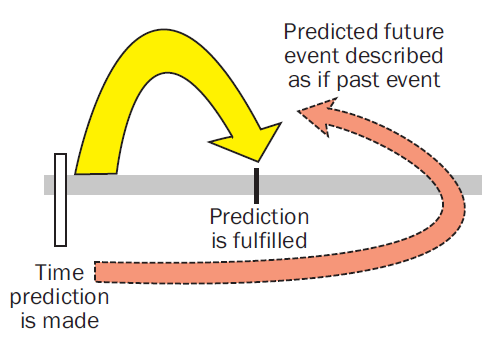
THE PROPHETIC PERFECT ILLUSTRATED
MESSIAH WOULD BE A
LIGHT BRINGER
Notice that the NAS says "will see" and "will shine" but other versions like ESV, KJV, NKJV, CSB, NJB, NAB and NIV translate these future prophetic events as past tense in English. Thus the ESV has "have seen" and "has light shone." In the Hebrew text the verbs have seen and has…shined are both in the perfect tense and in this context are what is referred to as "prophetic perfect" (See illustration above)! The point is that although Isaiah is describing future events, the fulfillment of those events is viewed as so certain that they are translated with past tense (as if they had already transpired). That is how certain God's promises are beloved!
Walk in darkness (cp same Hebrew word choshek in Isa 8:22) - In Scripture the metaphor of walking is repeatedly used to refer to the way one lives their life or how they behave. In the Bible life is viewed as a journey and walking pictures the course of one's life. These people were living their lives in total spiritual darkness!
THOUGHT - Where have you "walked" this past week, dear holy one (saint) of the Most High God?
Darkness (02822) (choshek) means darkness, an absence of light and figurative an absence of moral values. Choshek is first seen in Genesis 1:2 (cf Ge 1:4, 5, 18) describing "darkness… over the surface of the deep." Choshek means “deep shadow” and is poetical for intense darkness. In the present context the darkness is figurative and refers to spiritual darkness (cp Job 12:25, 37:19, Pr 2:13, Ezek 8:12). The Lxx translates choshek with skotos (word study) which can describe physical darkness (eg, Jesus' crucifixion! = Mt 27:45, Mk 15:33, Lk 23:44) but also is used to describe spiritual darkness (And thus skotos is used in the NT quote from Isaiah 9:2 = Mt 4:16, cp similar meaning of skotos in Jn 3:19, Acts 26:18, Ro 2:19, 2Cor 6:14, 1Pe 2:9, 1Jn 1:6). Sins are described as "the deeds of darkness (skotos)" (Ro 13:12).
Baker - A masculine noun meaning darkness. As in English, the word has many symbolic uses. In its first occurrence, it is associated with disorder (Gen. 1:2) and is distinguished and separated from light (Ge 1:4). In subsequent uses, whether used in a physical or a symbolic sense, it describes confusion and uncertainty (Job 12:25; 37:19); evil done in secret (Job 24:16; Prov. 2:13; Ezek. 8:12); obscurity, vanity, things forgotten (Job 3:4; 10:21; Eccl. 6:4); death (1 Sam. 2:9; Ps. 88:12[13]). Although God created darkness (Isa. 45:7) and uses it to judge His enemies (Ex. 10:21, 22; figuratively, Ps. 35:6), He enlightens the darkness of His people (Isa. 9:2[1]); bringing them out of desperate situations (Ps. 107:10, 14; Mic. 7:8); observing secret actions (Job 34:22; Ps. 139:11, 12); and giving insight and freedom (Isa. 29:18; 42:7). (Complete Word Study Dictionary – Old Testament)
Gilbrant on choshek -
When used in reference to a literal darkness, the word may refer to the dark part of the twenty-four hour day, to an act of judgment or to a theophany. In the beginning, God created light and separated it from the darkness over the surface of the watery earth. He called the darkness "night," and He created the moon and stars to govern the darkness cycle of the day (Gen. 1:2, 4f, 18).
In other examples of chōsheKh the city gates were shut at the time of darkness (Josh. 2:5), the animals of the forest crept about (Ps. 104:20) and evil men committed their crimes (Job 24:16).
In the account of the Exodus, darkness came as an act of judgment. It was one of the plagues brought on Egypt (Exo. 10:21f). While Israel crossed the Red Sea, the cloud stood between Israel and the Egyptians, giving light to Israel but keeping the Egyptians in darkness (Exo. 14:20).
Darkness is also a characteristic of several other theophanies recorded in the OT. The presence of the Lord was seen at Mount Sinai in the form of fire and darkness (Deut. 4:11), and Israel heard his voice come from the darkness (Deut. 5:23). In his song of deliverance, David speaks of the Lord as surrounded in darkness (2 Sam. 22:12). This darkness around the Lord speaks of his hiddenness and mystery. His presence is real, but no one knows the fullness of God's nature and ways.
The word is used to refer metaphorically to "trouble," "death," "judgment," "evil," "prison" and "hidden things." Darkness is used as an image for difficult times in life (Job 19:8; 22:11; 23:16f). The preacher exhorts people to enjoy all of life and to remember the many days of darkness they experience (Ecc. 11:8). Isaiah 5:30 connects the word with a word meaning "distress," and Isa. 59:9 associates it with a word meaning "gloom" or "calamity." Forming light is equated with making peace, and creating darkness is equated with creating trouble. Isaiah says that the Lord does both, indicating his sovereignty over all things (Isa. 45:7). David also claimed that the Lord turned his darkness into light, meaning that the Lord helped him in his time of trouble (2 Sam. 22:29; Ps. 139:11f).
The image of darkness is associated with death. In this regard, the word often occurs with a compound word composed of the words "shadow" and "death." This word refers to a death shadow (Job 10:21) or to something hidden in the deep darkness of the earth (Job 28:3). The land of darkness is the place of death (Job 10:21), and it is contrasted with light as the place of the living (Job 18:18). Darkness is not only associated with the place of the dead but also with the day the wicked die (Job 15:22f). Darkness is also associated with the grave, a place of ruin in Sheol, and the land of forgetfulness (Ps. 88:12f).
Darkness is used in the imagery of judgment. Darkness comes upon the wicked even during the day (Job 5:14), which is a sign of the Lord's judgment against them. The Lord guards the feet of his righteous, but He silences the wicked in darkness (1 Sam. 2:9). The Day of the Lord, which is a time of intense judgment, is described as a day of darkness (Joel 2:2).
Evil is another concept that is metaphorically spoken of as darkness. The way of darkness is contrasted to the paths of the upright (Prov. 2:13), and only a fool (which is a person of corrupt moral character in the wisdom literature) walks in darkness (Ecc 2:14).
Darkness is used as a metaphor for a prison or bondage. Those in prison sit in a place of darkness (Isa. 42:7; 49:9). Those in the land of the Babylonian exile walked in darkness and the death shadow; but a light shone in the darkness, indicating their hope of deliverance was coming and that the Lord would break their yoke of bondage (Isa. 9:2ff). This was a bondage compared to a death experience. Those who rebel against the Lord become prisoners in a place of darkness, but when they repent, He sets them free from their chains (Ps. 107:10).
Darkness is also used as a metaphor for "hidden" or "unknown things." Part of God's wisdom and power is demonstrated in his ability to reveal things from the darkness (Job 12:22). Silver, gold, iron and copper are found in the darkness of the earth. When people mine them, they put an end to that darkness (Job 28:3). The word is joined with a word meaning "secret" or "hiding places," indicating the place were treasures are hidden. God knows these places, and He can bring the treasures to light and give them to whomever He chooses. The wicked may attempt to hide in the darkness, thinking they can escape God's observance, but God sees sin even in the darkness (Job 34:22; Ezek. 8:12). (Complete Biblical Library Hebrew-English Dictionary)
Choshek - 77v in the NAS -
Ge 1:2, 4f, 18; Ex 10:21f; 14:20; Dt 4:11; 5:23; Josh 2:5; 1 Sam 2:9; 2 Sam 22:12, 29; Job 3:4f; 5:14; 10:21; 12:22, 25; 15:22f, 30; 17:12f; 18:18; 19:8; 20:26; 22:11; 23:17; 24:16; 26:10; 28:3; 29:3; 34:22; 37:19; 38:19; Ps 18:11, 28; 35:6; 88:12; 104:20; 105:28; 107:10, 14; 112:4; 139:11f; Pr 2:13; 20:20; Eccl 2:13f; 5:17; 6:4; 11:8; Isa 5:20, 30; 9:2; 29:18; 42:7; 45:3, 7, 19; 47:5; 49:9; 58:10; 59:9; 60:2; Lam 3:2; Ezek 8:12; 32:8; Joel 2:2, 31; Amos 5:18, 20; Mic 7:8; Nah 1:8; Zeph 1:15
The people who walk in darkness will see a great light - A future prophetic hope (not a "hope so" but a "hope sure) for a land that in Isaiah's day appeared hopeless and forsaken. And yet God had not forgotten nor forsaken this land!
Vine feels that from this verse "to the end of verse 7 the prophecy stretches across another interval and passes to the overthrow of the Antichrist, the oppressor, and the establishment of the Messiah’s kingdom of peace and righteousness."
Rob Morgan on this great light - In Matthew chapter 4, this passage is quoted word-for-word as applying to Jesus when He moved into the city of Capernaum. When Jesus came to earth there was an explosion of light. I can’t read these words without remembering that when He came, the skies overhead were illumined by a wondrous star (Mt 2:2), and when He began to teach He called Himself the “Light of the World.” (Jn 8:12) And when He rose from the dead, it was at the moment of sunrise. And when we get to heaven, we’ll find no need for a lamp or light, for the Lamb is its light. Jesus brings intellectual light, for He logically explains to us who God is and what God is like, which is the very basis of all knowledge. He brings spiritual light, for His presence banishes the darkness of sin and shame and guilt. He brings emotional light, for His presence cheers His people. He brings everlasting light because He gives eternal life. (Isaiah 9: Jesus Prince of Peace)
ILLUSTRATION - We have read that near the North Pole, the night lasting for months and months, when the people expect the day is about to dawn, some messengers go up to the highest point to watch; and when they see the first streak of day they put on their brightest possible apparel, and embrace each other and cry, "Behold the sun!" and the cry goes around all the land, "Behold the sun!" The world was in darkness. Long centuries had the people lain in ignorance and in sin. The cry of Zacharias was the joyful one: "Behold the Sun! Behold the Sun of righteousness is rising with healing in His wings I The Day-spring from on high hath visited us!" These words well express the purpose of Christ's coming. It was to give light. What the sun is in the material world that Christ is to us in the spiritual world. (Robert Neighbour)
Light - Isaiah makes frequent use of the idea of light (sometimes referring to literal light and other times using light figuratively, sometimes contrasted with darkness as in the present passage) - Isa 2:5; 5:20, 30; 9:2; 10:17; 13:10; 30:26; 42:6, 16; 45:7; 49:6; 50:10, 11; 51:4; 58:8, 10; 59:9; 60:1, 3, 19, 20; Elsewhere God is the light (Ps 27:1) or God’s words are compared to a light (Ps 119:105; Isa 8:20). (Compare the frequent use of darkness in Isaiah - Isa 5:20, 30; 9:2; 29:18; 42:7; 45:3, 7, 19; 47:5; 49:9; 58:10; 59:9; 60:2)
Motyer observes that "The darkness-light motif points to a creative work of God, Who alone can make such a transformation (cf. Isa 4:5-note; Ge 1:2, 3; 2Co 4:6-note)."
Great light - This figure is a prophecy of Jesus Christ. This prophecy was fulfilled, at least in part, when Jesus--the Light of the world--ministered in Galilee, Matthew recording that
(Context - Nothing in God's plan happens by accident!) Now when Jesus heard that John had been taken into custody, He withdrew (often to convey the thought of escaping danger) into Galilee and leaving Nazareth (cp Lk 4:24 - His hometown rejected Him!), He came and settled in Capernaum (map), which is by the sea, in the region of Zebulun and Naphtali. (Mt 4:12-13)
This (Jesus change of ministry venue from Judea to Galilee) was to fulfill what was spoken through Isaiah the prophet, saying, 15 "THE LAND OF ZEBULUN AND THE LAND OF NAPHTALI, BY THE WAY OF THE SEA, BEYOND THE JORDAN, GALILEE OF THE GENTILES--16 "THE PEOPLE WHO WERE SITTING IN DARKNESS SAW A GREAT LIGHT, AND TO THOSE WHO WERE SITTING IN THE LAND AND SHADOW OF DEATH, UPON THEM A LIGHT DAWNED." From that time Jesus began to preach and say, “Repent, for the kingdom of heaven is at hand.”
(Mt 4:14,15, 16, 17 cp Isa 42:6, 7, How the Light shone in Cana of Galilee [map] is recorded in Jn 2:1-11).
Pulpit Commentary: For thirty years he had dwelt at Nazareth, in Zebulon. There he had first come forward to teach in a synagogue (Le 4:16-21); in Galilee he had done his first miracles (Jn 2:11; 4:54); at Capernaum. “upon the sea coast, in the borders of Zebulon and Naphtali.” he commenced his preaching of repentance (Mt. 4:13-17). The “light” first streamed forth in this quarter, glorifying the region on which contempt had long been poured.
Jesus identified Himself as the "great light" Who Isaiah had prophesied of over 700 years before His first coming…
Then Jesus again spoke to them, saying, “I am the Light of the world; he who follows Me will not walk in the darkness, but will have the Light of life.” (Jn 8:12)
Comment: See other allusions to light in reference to Jesus - Jn 1:4, 5, 3:19, 20, 21, 9:5. 12:35, 36, 46 Ps 36:9. 78:14. Is 60:1-3 Lk 1:78, 79. 2:32. Acts 13:47, 48. 26:18, 23 2 Cor 4:6-note 1 Jn 2:8.
According to Jewish tradition, Light was one of the names of the Messiah. (Isa 9:1, 2; 42:6; 49:6; 60:1, 2, 3; Mal 4:2; Lk 2:32). In this passage Isaiah presents an indisputable prophecy of the coming Messiah.
Those who live in the dark - KJV = "they that dwell in the land of the shadow of death", ESV = "those who dwelt in a land of deep darkness"
In the Gospel of Luke Zacharias, the father of John (the Baptist), uttered a beautiful song of praise of God (Lk 1:64) Luke recording that he was "filled with (controlled by) the Holy Spirit and prophesied in Luke 1:68-79 quoting several times from the Old Testament, the last quote being from Isaiah 9:2...
Because of the tender mercy of our God, with which the Sunrise from on high (MESSIAH) will visit us, TO SHINE UPON THOSE WHO SIT IN DARKNESS AND THE SHADOW OF DEATH, To guide our feet into the way of peace.” (Lk 1:78-79+)
MacArthur - Just as Isaiah had predicted eight centuries earlier, the despised, sin-darkened, and rebellious Galileans were the first to glimpse the Messiah, the first to see the dawning of God’s New Covenant (study)! Not mighty and beautiful Jerusalem, the queen city of the Jews, but Galilee of the Gentiles would first hear Messiah’s message. Not the learned, proud, and pure Jews of Jerusalem, but the mongrel, downcast, nontraditional mixed multitude of Samaria and Galilee had that great honor. To those who were neediest, and who were most likely to recognize their need, Jesus went first. The fact that Jesus began His ministry in Samaria and Galilee, rather than in Jerusalem and Judea, emphasizes the fact that His gospel of salvation was for the whole world… It was no coincidence of history that “the light of the world” (John 8:12) first proclaimed Himself in Galilee of the Gentiles. It was in and around Galilee that Jesus had spent all but a small part of His childhood and early manhood, and it was there that His ministry first developed and began to spread. As the new day of the gospel dawned, the first rays of light shined in Galilee. (MacArthur, J: Matthew 1-7 Chicago: Moody Press)
GREAT LIGHT
For those who lie awake, night is a long time in passing. For those who endure tribulation, their night of sorrow seems to be endless; no gleaming of sunrise breaks the gloom and no horizon is lightened. For Israel, before He comes, conditions will be as dark as they ever have been and prospects of glory will seem to be a far off dream. Who can possibly bring light to the darkness, peace to the heart and joy to the soul?
The faithful remnant know the answer and have been watching for His coming, waiting for the light to dawn. What joy and worship will fill their hearts when the Sun of Righteousness arises and spreads the warmth of His light throughout the land. The way of the sea, the western shore of Galilee will feel it; beyond Jordan, the eastern lands on the other side of the river will enjoy the rays, and Galilee of the nations, the most northern parts, will be flooded with this great light. All these have felt the force of Gentile subjection and corruption and to them first He spreads the glorious light of His presence. The places which endured humiliation will be visited with the glory of this light.
But had there not been a glorious foretaste of this? Were these not the areas visited by the Lord Jesus while He was here, Matt. 4:14–16? They saw the miracles, signs and wonders that came from His hands. They heard His teaching and they watched His walk. Yet still He was the rejected Christ.
Today when He comes into our lives in salvation we see the same light of His presence, the same joy when the darkness which wrapped our souls is dispelled as the great light bursts on us.
After the church has been raptured to heaven, there will be a time of tribulation which will be terminated by His return. How the world needs that glorious day and how devoted souls will long for and pray for this. What a world it will be when His light breaks through the gloom and when its warmth and brightness dispels all darkness. There will be no rejection of Him then, no refusal of Him at that time. He comes to reign and all who long for that day will declare, ‘Thy kingdom come’. (John Bennett - Day by Day - Divine Titles)
Christmas Lights
Read: Matthew 5:13-16
The people who sat in darkness have seen a great light, and upon those who sat in the region and shadow of death Light has dawned. —Matthew 4:16
In December each year, a neighborhood of 13 families near where we live sets up a dazzling display of 300,000 Christmas lights. People drive for miles and wait in line for hours to see the flashing, colorful lights and hear the music that is programmed to go with it. The sound-and-light display is so elaborate that it requires a network of 64 computers to keep everything synchronized.
When I think about these holiday lights, I am reminded of the Light that makes Christmas a holiday for many—a single Light so bright that it illuminates the whole world with truth, justice, and love. This Light—Jesus—is everything that the world is longing and looking for (Isa. 9:2,6-7). And He has told His followers to display His light so that others will see and glorify God (Matt. 5:16).
Imagine if Christians worked as hard at shining and synchronizing the light of God’s love as the families of that neighborhood work when they illuminate their street with Christmas lights. Perhaps then the people still living in darkness would make an effort to see this great Light. When Christians work together to display God’s love, the gospel will shine more brightly and attract more people to Jesus—the Light of the world.
O to be filled with His life divine;
O to be clothed with His power and might;
O to reflect my dear Savior sublime—
Always to shine as the saints in light!
—Anon.
Our witness for Christ is a light in a dark world.
By Julie Ackerman Link (Our Daily Bread, Copyright RBC Ministries, Grand Rapids, MI. — Reprinted by permission. All rights reserved)
Light And Shadow
Read: Isaiah 9:1-7
The people who walked in darkness have seen a great light; those who dwelt in the land of the shadow of death, upon them a light has shined. —Isaiah 9:2
Art historian Seymour Slive described the great Dutch artist Rembrandt (1606–1669) as the master of light and shadow, a compelling storyteller on canvas. Rembrandt’s painting The Adoration of the Shepherds portrays the darkened stable in Bethlehem where two shepherds kneel beside the manger while other people stand farther away. One man holds a lantern, but the brightest light shines not from his lantern but from the Christ-child, illuminating those who have gathered close to Him. (See Rembrandt's Painting)
_-_The_Adoration_of_the_Shepherds_(ca._1605%E2%80%9310)_-_Metropolitan_Museum_of_Art.jpg)
Seven centuries before Jesus’ birth, Isaiah used an image of light and shadow to foretell the coming of a Savior for Israel:
“The people who walked in darkness have seen a great light; those who dwelt in the land of the shadow of death, upon them a light has shined. . . . For unto us a Child is born, unto us a Son is given” (Isa. 9:2,6).
Each person may see a different story in Rembrandt’s painting, but perhaps each of us is represented somewhere in that stable. Are we kneeling in worship, standing back in hesitation, or hiding from the light that has penetrated our darkness?
Christmas invites us to step out of the shadows of darkness and to allow the light of Christ to shine into our hearts.
Observing God’s love from afar
Is only a passing delight;
But when we experience Christ’s presence,
Our darkness is turned into light.
—Hess
Faith in Christ is not a leap into the dark; it’s a step into the Light.
By David C. McCasland (Our Daily Bread, Copyright RBC Ministries, Grand Rapids, MI. — Reprinted by permission. All rights reserved)
A Great Light
Read: Isaiah 9:1-7
The people who walked in darkness have seen a great light. —Isaiah 9:2
I was driving through the mountains of western Maryland on a cold December night. As I topped a ridge near Rocky Gap State Park, a brilliant sea of lights caught my attention. What in the world is that? I wondered as the exit road flashed past. It so aroused my curiosity that 5 miles down the interstate I turned around and drove back to see what it was—a local community’s celebration in lights during the Christmas season. At noon, I wouldn’t have noticed anything. But at night, the dazzling display couldn’t be ignored.
Strange, isn’t it, that we complain about the moral and spiritual darkness of our world, yet it is the perfect setting for the radiance of the Lord Jesus Christ. At Christmas, we often read these prophetic words:
“The people who walked in darkness have seen a great light; those who dwelt in the land of the shadow of death, upon them a light has shined” (Isaiah 9:2).
Jesus said of Himself: “I am the light of the world” (John 8:12), and to His disciples, “You are the light of the world. A city that is set on a hill cannot be hidden” (Matthew 5:14). In a dark world, people don’t see a great light without wondering why it’s there and what it means. We get to tell them. - David C. McCasland (Our Daily Bread, Copyright RBC Ministries, Grand Rapids, MI. — Reprinted by permission. All rights reserved)
O Holy One of glorious birth
Who lives within our heart,
May we to all men everywhere
Your wondrous love impart.
—Brandt
To lead others out of the darkness,
let them see your light.
To follow up on the thought of the preceding devotional we do well to hear and heed Jesus' command in the Sermon on the Mount
Let your light shine (aorist imperative = command to do this without delay. It is urgent! The only way to obey this command is by jettisoning self-reliance and relying wholly on the Holy Spirit for His supernatural enabling power to "supernaturally shine" forth! cf Eph 5:18+) before men in such a way (A WAY THAT THEIR ATTENTION IS NOT DRAWN TO YOU BUT DIRECTED TO GOD) that they may see your good works (GOOD WORKS ARE WORKS WITH AN "O" KNOCKED OUT = "GOD WORKS"), and glorify (YOUR VISIBLE SUPERNATURAL WORKS GIVE A PROPER OPINION OF A FATHER NO MAN HAS EVER SEEN!) your Father Who is in heaven. (Matthew 5:16+)
Isaiah 9:3 You shall multiply the nation. You shall increase their gladness. They will be glad in Your presence as with the gladness of harvest, as men rejoice when they divide the spoil:
- multiply: Isa 26:15 49:20-22 Ne 9:23 Ps 107:38 Ho 4:7 Zec 2:11 8:23 10:8
- They will be glad: Isa 12:1 25:9 35:2,10 54:1 55:12 61:7,10 65:18 66:10 Ps 4:7 Ps 126:5,6 Jer 31:7,12-14 Ac 8:8 Php 4:4 1Pe 1:8
- As when: Isa 16:9,10
- as men: Jdg 5:3 1Sa 30:16 2Ch 20:25-28 Ps 119:162 Lk 11:22
- Isaiah 9 Resources - Multiple Sermons and Commentaries
MESSIAH WOULD BE A
JOY BRINGER
You - This has to be Jehovah because of the effects He produces.
Here again the NAS translates this as "you shall multiply the nation," which clearly speaks of a future prophecy. The ESV on the other hand again translates the Hebrew perfect tense of "multiply" as "You have enlarged the nation" a "prophetic perfect" (see schematic) as discussed in Isaiah 9:2.
Multiply the nation - What nation? This may seem obvious but some commentators veer off course and generalize these promises to all nations (e.g., Ray Ortlund fails to interpret these passages as specifically related to Israel in Isaiah: God Saves Sinners - Preaching the Word - Ortlund also refers to the "church" 282 times in his comments on a prophecy that never mentions the church once!). If context is king (and it is!) in assuring accurate Interpretation, the present context leaves no doubt that the nation is Israel. However since the nature of the promises (eg, end of wars Isa 9:5) begs a future fulfillment of the promise to Israel, some who believe that God is finished with Israel are forced to find some other way of trying to explain these great promises. God is not finished with Israel (The miraculous re-birth of Israel as a nation in May, 1948 should be sufficient support that God still has some "unfinished business" with and in Israel! See related study - Israel of God - Is God "Finished" with Israel in His prophetic plan?)
As an aside, dear reader, if one jettisons the literal interpretation of Isaiah's prophecy and tries to explain the prophetic references to Israel as actually speaking of "the church", then many passages in Isaiah become almost impossible to interpret. But if one holds to a literal (I am a literalist, not a dispensationalist!) interpretation of the text and believes firmly that God is not finished with Israel, the prophecies of Isaiah which are not yet fulfilled become exciting and imminently understandable. The reason this point is being emphasized is to alert the Acts 17:11 (note) "Berean" reader that he or she needs to be very careful in reading commentaries on Isaiah (including the one you are reading), because many of the commentaries are geared to be compatible with one's overall theological leaning (eg, reformed theology, dispensational theology, covenant theology, etc) rather than simply allowing the text to speak for itself (See Read the Text Literally).
So what Isaiah is saying here is that God will cause the nation of Israel to grow and will also increase their joy. What has been only a small believing remnant of Jews over the centuries will be increased at the end of this age (As an aside, the number of Jews coming to a saving knowledge of Jesus Christ in recent years [these notes are written in Dec, 2011] is reported to be dramatically increasing! Praise the LORD!) - see Zech 13:8, 9 which teach that 1/3 of Israel will believe in the Messiah (see why they will believe in Zech 12:10 - it is not because they are good but because God is good and keeps His covenant promises forever!), which is far more than at any time in history (See also Is 26:15; 54:1, 2, 3, 4, 5; 66:7-14).
They will be glad in Your presence - This indicates Jehovah will be in their midst (presence).
Gladness… glad… gladness… rejoice - This will be a time of great joy. As alluded to above a number of commentaries on Isaiah seek to explain the promises to Israel in an indirect manner. For example, Ortlund (see note above) comments that "this miraculous joy's (is) breaking upon the world." (Bolding added) That is not what the text teaches. This multiplied joy relates specifically to the nation of Israel. That does not preclude the joy spilling over to all nations, but all nations are not the primary recipient of this prophetic promise! So when will
As with the gladness of harvest - This is a term of comparison for harvest time was well known to be a time of great joy (cp joy at Feast of Weeks - Dt 16:9, 10, 11,12), and a similar joy describes the times when Jehovah is present. Is this not our time of greatest joy today, when we sense His presence in our lives. If you are missing that joy that comes only from fellowship with Jehovah (1Jn 1:3), you might ask God's Spirit to search your heart for any unconfessed sins. In Psalm 51 we see David repeatedly allude to joy in the context of confession of sins and a broken and contrite heart.
As men rejoice when they divide the spoil - A second simile ("as" or "like" identify similes), emphasizing the greatness of the joy in this presence of Jehovah.
W E Vine comments that the events described in this passage have "never been fulfilled in the nation yet. Only a remnant returned from the captivity. The very opposite of these conditions has prevailed under successive Gentile domination. At the close of the coming great tribulation, when the Lord comes in Person to deliver His earthly people, they will joy over blessings granted and destruction averted. The Millennium will see a vast increase in the nation’s population. They will joy before the Lord. That ever should be the character of our joy—not mere exuberance of natural feeling, not merely joy in mercy and prosperity, in deliverance and supply, but joy before the Lord, a joy that exults in Him, His power and presence. (Collected writings of W. E. Vine. Nashville: Thomas Nelson)
Given the fact that this is a prophecy that speaks of a time of great joy and gladness, it begs the question, "Can we know when this will be fulfilled?" or "Has this already been fulfilled?" My interpretation is that it was partially fulfilled when Messiah came the first time (cf Mt 2:10 - His birth was associated with "great joy", Lk 2:10 - angel brought "good news of great joy" at His birth, Mt 28:8, Lk 24:41- His resurrection was associated with joy, the joy in those who believed in Messiah - e.g., Acts 13:52, 15:2, 1 Th 1:6, et al) There will be final fulfillment when the Messiah returns to "ransom captive Israel" as described in a number of many prophetic passages such as the glorious prophecy in Isaiah 35 (commentary) which describes the conditions in the Messianic Age (observe the repetition of descriptions that speak of joy or gladness)...
The wilderness and the desert will be glad, And the Arabah will rejoice and blossom; Like the crocus 2 It will blossom profusely And rejoice with rejoicing and shout of joy. The glory of Lebanon will be given to it, The majesty of Carmel and Sharon. They will see the glory of the LORD, The majesty of our God (MESSIAH WILL REIGN IN JERUSALEM - SEE Zech 14:8-10+). 3 Encourage the exhausted, and strengthen the feeble. 4 Say to those with anxious heart, “Take courage, fear not. Behold, your God will come with vengeance; The recompense of God will come, But He will save you (ISRAEL).” (MESSIAH'S SECOND COMING) 5 Then the eyes of the blind will be opened And the ears of the deaf will be unstopped. 6 Then the lame will leap like a deer, And the tongue of the mute will shout for joy. For waters will break forth in the wilderness And streams in the Arabah. 7 The scorched land will become a pool And the thirsty ground springs of water; In the haunt of jackals, its resting place, Grass becomes reeds and rushes. 8 A highway will be there, a roadway, And it will be called the Highway of Holiness. The unclean will not travel on it, But it will be for him who walks that way, And fools will not wander on it. 9 No lion will be there, Nor will any vicious beast go up on it; These will not be found there. But the redeemed (BELIEVERS IN MESSIAH) will walk there, 10 And the ransomed of the LORD will return And come with joyful shouting to Zion, With everlasting joy upon their heads. They will find gladness and joy, And sorrow and sighing will flee away. (Isaiah 35:1-10+)
Isaiah 9:4 For You shall break the yoke of their burden and the staff on their shoulders, the rod of their oppressor, as at the battle of Midian:
- Break: Isa 14:25 47:6 Ge 27:40 Lev 26:13 Jer 30:8 Na 1:13
- staff: Isa 10:5,27 14:3-5 30:31,32 Ps 125:3
- As at the battle of Midian: Isa 10:26 Jdg 6:1-6 7:22-25 8:10-12 Ps 83:9-11
- Isaiah 9 Resources - Multiple Sermons and Commentaries
REASON FOR PROMISED JOY
For- This term of explanation explains why the Jews will have such an overflowing joy (Isa 9:3). As the subsequent verses show, burdens, staffs and rods will be removed! Notice that the next two passages also begin with for, together giving a threefold explanation for the "four fold joy" in Isa 9:3 (Gladness… glad… gladness… rejoice).
You - This is Jehovah, the "Mighty God" (Isaiah 9:6) the One Who is a Warrior for Israel and Who is supernaturally able to break the yoke… staff… rod!
For You shall break the yoke of their burden and the staff (cp Lev 26:13)- Picture an ox weighed down by a heavy yoke. Using this very picturesque comparison, Isaiah continues his description of Jehovah's hand of blessing on His people. Here he foretells that they will be set free from the yoke of their burden (the Gentile nation's burden).
Break… the staff on their shoulders - NLT = "lift the heavy burden from their shoulders"
NET version translates Isaiah 9:4
For their oppressive yoke and the club that strikes their shoulders, the cudgel the oppressor uses on them, you have shattered, as in the day of Midian's defeat. (Isa 9:4 NET)
NET Note - Hebrew = "for the yoke of his burden, and the staff of his shoulder, the scepter of the oppressor against him." The singular pronouns are collective, referring to the people. The oppressed nation is compared to an ox weighed down by a heavy yoke and an animal that is prodded and beaten. (Midian's defeat) alludes to Gideon's victory over Midian (Judg 7–8), when the Lord delivered Israel from an oppressive foreign invader.
The rod of their oppressor - Oppressor is literally a taskmaster which is the same word used of the Egyptian taskmasters (Ex 1:11, 2:11, 5:4, 5, 6, 6:6,7)
As at the battle of Midian - Isaiah uses another term of comparison which would have been familiar to his readers -- the improbable odds ( = supernatural because God reduced Gideon's army from 32,000 to 300!) against victory over the formidable Midianite forces (Jdg 6:5 "they would come in like locusts for number, both they and their camels were innumerable and they came into the land to devastate it") which God gave to Israel through His instrument (leader) Gideon (Jdg 6:1-40-note, Jdg 7:1-25-note) It is also notable that Gideon was the deliverer of Asher, Zebulun and Naphtali (Jdg. 6:35), which are two of the tribes addressed in Isaiah 9:1.
When will these supernatural effects take place (the yoke, staff, rod removed)? When Messiah returns. It is sad but Scriptural that there will be no peace for Israel until the Prince of peace returns.
O prince of Peace! crowned, yet discrowned,
They say no war nor battle's sound
Was heard the tired world around;
They say the hour that Thou didst come,
The trumpet's voice was stricken dumb,
And no one beat the battle drum...
And when, not yet in God's sunshine,
The smoke drifts from the embattled line
Of warring hearts that would be Thine,
We bid our doubts and passions cease,
Our restless hearts be stilled with these,
Counsellor, Father, Prince of Peace.
Oswalt comments that "It is not necessary to look for some specific liberation which Isaiah has in mind. It is apparent from the whole context that it is final deliverance which is in view. (Ed: The final deliverance of Israel at the end of this age) This is what God holds out to His people and that for which they justly pray and believe. Two extremes are to be avoided here. One extreme is to take the way that the Christian Church has often taken, saying that true bondage is to personal sin from which Christ frees us, and thus turning a blind eye on actual physical oppression (Ed: In other words they spiritualize a passage which can be interpreted literally! Edward Young takes this approach in his highly respected 3 volume commentary on Isaiah). The other extreme is the way of certain forms of liberation theology that seem to suggest that the only sin is the sin of political oppression, and that Christ’s only purpose in coming was to give human beings political freedom. (Bolding added) (The Book of Isaiah, Chapters 1–39)
Rob Morgan comments - All of these prophecies (HE IS REFERRING TO Isaiah 9:3-5) have implications for the future, and as we will see in a moment some of them are pointing toward our Lord’s return in glory at the Second Coming. Isaiah was looking beyond our Lord’s first coming to His second coming and the establishing of His kingdom. Instead of a small number, the Jewish people would be a mighty nation. Instead of oppression, they would have joy. Instead of defeat and exile, the Lord will rule and reign over the earth from Mount Zion. Isaiah is full of this message; it’s one of his great themes. For example, look at Isaiah 11:1-5+
"A shoot will come up from the stump of Jesse; from his roots a Branch will bear fruit." (MORGAN SAYS - This is talking about the Messiah, the Son of David, son of Jesse.) "The Spirit of the Lord will rest on Him—the Spirit of wisdom and of understanding, the Spirit of counsel and of power, the Spirit of knowledge and of the fear of the Lord—and He will delight in the fear of the Lord. He will not judge by what He sees with His eyes or decide by what He hears with His ears; but with righteousness He will judge the needy, with justice He will give decisions for the poor of the earth. He will strike the earth with the rod of His mouth; with the breath of His lips He will slay the wicked. Righteousness will be His belt and faithfulness the sash around His waist."
Now, if we had time, I’d turn over to Revelation 19:11-21+ and read about the moment of Christ’s return and show you how similar these passages are. There are three moments of victory that mean everything to me. One is in the past—when Jesus conquered death and rose victorious from the tomb. One is in the present—for Jesus gives me victory day by day over temptation and sin and sadness. One is in the future—when Jesus will rule and reign as the King of Kings over all of time and eternity. He is our victory-giver. (Sermon)
Isaiah 9:5 For every boot of the booted warrior in the battle tumult, and cloak rolled in blood, will be for burning, fuel for the fire.:
- Tumult: Isa 13:4 1Sa 14:19 Jer 47:3 Joe 2:5 Na 3:2
- Burning: Isa 4:4 10:16,17 30:33 37:36 66:15,16 Ps 46:9 Eze 39:8-10 Mal 3:2,3 Mt 3:11 Ac 2:3,19 2Th 1:8
- fuel: Lev 3:11,16
- Isaiah 9 Resources - Multiple Sermons and Commentaries
UNIVERSAL PEACE
For- The second successive term of explanation - see comment related to "for" under Isaiah 9:4. How will Jehovah put an end to "the yoke of their burden and the staff on their shoulders, the rod of their oppressor"? This verse explains that He will accomplish these ends by putting an end to wars! Another way to describe no wars is "peace on earth." Has this prophecy been fulfilled? Obviously it has not been fulfilled and awaits a future time when war will be brought to an end. This can only transpire with the return of the Prince of peace, Who alone can bring about world peace!
Fuel for fire - Isaiah describes a future day when the weapons of warfare will only be good for burning because there will be a God ordained time of peace.
Some commentators side step trying to explain Isaiah's prophetic promise of global peace and absence of war. Has this utopian dream of world peace ever occurred in human history? Certainly not. Therefore Isaiah is speaking a prophecy that awaits a future fulfillment. And yet Young in his highly respected commentary on Isaiah explains it this way…
They are no longer needed, for a Child will be born, and His birth will bring peace to His people, for He will Himself be the Prince of Peace. “Glory to God in the highest, and on earth peace among men of his good pleasure” (Luke 2:14).
Comment: Beloved, Young's explanation that Christ's first advent brought global peace is simply not true. Yes, Young is correct that the Prince of peace has come (and for believers there is now peace with God Ro 5:1), but literal world peace still alludes us (have you read the newspaper today?). World peace will not be realized until the triumphant Second Coming of Christ when He crushes all His enemies under His feet (Rev 19:15-note). It is worth noting that in all 3 volumes of Young's commentary (some 1000 plus pages), he mentions the Second Coming only two times!
This passage is reminiscent of the description of world peace in Isaiah 2…
And He (Messiah at His Second Coming) will judge between the nations, and will render decisions for many peoples (i.e., Gentiles) and they will hammer their swords into plowshares and their spears into pruning hooks. Nation will not lift up sword against nation, and never again will they learn war (The Millennium will be a time of peace). (Is 2:4).
In the Psalms we read the wonderful prophecy of a future glorious day when…
He (Jehovah) makes wars to cease to the end of the earth; He breaks the bow and cuts the spear in two; He burns the chariots with fire. (Ps 46:9)
J Vernon McGee comments on Psalm 46: The Messiah comes to the earth in judgment. He is the One who will make wars to cease, breaks the bow, cuts the spear, and burns the chariot in the fire. This picture sets before us the last days on earth, when the One who is “the Stone cut out of the mountain without hands" (whom Nebuchadnezzar saw in his vision in Da 2:45-note) will deal an annihilating blow upon this earth.
The prophet Zechariah describes this same glorious time when all war will end…
I will cut off the chariot from Ephraim And the horse from Jerusalem; And the bow of war will be cut off. And He will speak peace to the nations; And His dominion will be from sea to sea, and from the River to the ends of the earth. (Zec 9:10).
MacArthur comments that: Zechariah moves to the Second Advent of Christ and the establishment of His universal kingdom
Comment: If you do not believe in a Millennial kingdom, with Christ reigning on earth, note the passage in Zechariah 9:10 says clearly that "His dominion will be… to the ends of the earth." In short, Messiah's kingdom is predicted to be a worldwide kingdom!
Isaiah 9:6 For a child will be born to us, a son will be given to us; and the government will rest on His shoulders; and His name will be called Wonderful Counselor, Mighty God, Eternal Father, Prince of Peace:
- For a child: Isa 7:14 Lk 1:35 2:11
- a son: Jn 1:14 3:16,17 Ro 8:32 1Jn 4:10-14
- government: Isa 22:21,22 Ps 2:6-12 110:1-4 Jer 23:5,6 Zec 6:12,13 9:9,10 Mt 11:27 28:18 1Co 15:25 Eph 1:21,22 Rev 19:16) (name: Isa 7:14 Jdg 13:18 Jer 31:22 Mt 1:23 1Ti 3:16
- Counselor: Isa 28:29 Zec 6:13 Lk 21:15 Jn 1:16 1Co 1:30 Col 2:3
- mighty God : Isa 45:24,25 Ps 45:3,6 50:1 Jer 23:5,6 Jn 1:1,2 Ac 20:28 Ro 9:5 Tit 2:13 Heb 1:8 1Jn 5:20)
- Father: Isa 8:18 53:10 Pr 8:23 Heb 2:13,14
- Prince of Peace: Isa 11:6-9 53:5 Ps 72:3,7 85:10 Da 9:24,25 Mic 5:4,5 Lk 2:14 Jn 14:27 Ac 10:36 Ro 5:1-10 2Co 5:19 Eph 2:14-18 Col 1:20,21 Heb 7:2,3 13:20)
- Isaiah 9 Resources - Multiple Sermons and Commentaries (see some on this page under the notes for Isaiah 9:7)
- What are the different names and titles of Jesus Christ?
- Is Jesus God? Did Jesus ever claim to be God?
- What are the strongest biblical arguments for the divinity of Christ?
- Is Jesus God in the flesh? Why is it important that Jesus is God in the flesh?
NET Isaiah 9:6 For a child has been born to us, a son has been given to us. He shoulders responsibility and is called: Extraordinary Strategist, Mighty God, Everlasting Father, Prince of Peace.
THE FOUNDATION FOR THE PREVIOUS PROPHECIES:
A PERSON WITH A FOURFOLD DESCRIPTION!
After the "Hallelujah Chorus" the next most well-known aria of Handel's Messiah is based upon this verse. Play and worship as you play For Unto Us a Child is Born from Handel's Messiah. Or this Vocal - Wonderful, Merciful Savior.
Note that some of the translations present this prophecy as if it was fulfilled in Isaiah's day (ESV - "For to us a child is born". Also KJV, NIV). The idea is that the future prophecy was so certain to transpire , that it was presented as if it were an accomplished fact in Isaiah's day. See diagram above illustrating the prophetic perfect.
For- The third successive term of explanation - see comment related to "for" under Isaiah 9:4. This third "for" introduces the reason the accoutrements of war are no longer needed and can be burned (Isa 9:5), why there will be a removal of burden, etc (Isa 9:4) and why there will be overflowing joy (Isa 9:3). In other words, joy comes from divine deliverance from oppression which God brings about by ending war, all of which related to the coming of a Person, a Child, a Son -- The foundation for all the previous prophecies is the ultimate prophecy of the Messiah, in Whom all the promises of God are "yea and in Him amen" (2Cor 1:20KJV)
A child will be born to us (Other versions such as ESV, NIV have "is" instead of "will be") - Us is the Jews - for their benefit. This child will come from the Jews and is the well known prediction of the birth of the Messiah. The fact that He will be born indicates that has human parents and thus speaks of the incarnation of Christ, Who is born of a the virgin Mary (Mt 1:20, 21, 23) so that He might become Immanuel, God with us (Isa 7;14), fully God and fully Man (Jn 1:14; Col 2:9-note)! It should also be emphasized that Jesus remains a man eternally (Acts 7:55, 56, 1Ti 2:5) and did not relinquish His humanity on His ascension. And while He emptied Himself of His divine prerogatives, He never ceased being God (Php 2:5, 6, 7-note, Php 2:8, 9, 10-note).
The Child was not be a created angel but a Man. In order to become our Redeemer, He had to first become our Kinsman, which the writer of Hebrews phrases this way…
Since then the children (Those who have believed in Messiah and are born again) share in flesh and blood, He Himself (Messiah) likewise also partook of the same (humanity), that (Explanation of the purpose) through death (This sums up the purpose of His Coming) He might render powerless him who had the power of death, that is, the devil and might deliver those who through fear of death were subject to slavery all their lives. (Heb 2:14, 15-note).
Comment: For more detailed discussion see study of Goel - Our Kinsman Redeemer - In Shadow (Type) & Substance
Oswalt comments that "Medieval Jewish commentators, combating the prevailing messianic claims of Christians, argued that all this was simply in recognition of the birth of the crown prince, Hezekiah, and was only a simple royal birth hymn. However, this view flies in the face of the chronology of Hezekiah’s birth, and even more seriously, it is evident from the language that no merely human king is being spoken of. This is clearly an eschatological figure, the Messiah. (The Book of Isaiah, Chapters 1–39)
Joseph Alexander says that "The modern Jews, in order to sustain their antichristian exegesis, have devised a new construction of the sentence which applies all these epithets, except the last, to God Himself… The doctrine that this prophecy relates to the Messiah, was not disputed even by the Jews, until the virulence of antichristian controversy drove them from the ground which their own progenitors had steadfastly maintained. (The Prophecies of Isaiah)
A son will be given to us - God is the giver of this good gift! (Jas 1:17-note) This description emphasizes that Messiah is a gift and that He is a male (son). While He was a Son, He was the unique, only begotten Son of God. Israel did not deserve His coming (none of did for that matter), but God gave His begotten only Son as the supreme manifestation of His infinite grace!
By first describing Him as a child and then as a Son, Isaiah is using the Hebrew literary tool of repetition for emphasis.
The apostle John describes this same event in the Revelation emphasizing His humanity and His maleness…
And she (the nation of Israel) gave birth to a son, a male child (Messiah's First Coming, born as a Man - Now notice how the text fast forwards at least 2000 years signifying a prophetic time gap) Who is to rule all the nations with a rod of iron (This describes Messiah's Second Coming to set up His kingdom in which He rules for 1000 years - the Millennium); and her child was caught up to God (The Ascension of Christ after His resurrection) and to His throne (At the right hand of His Father in Heaven). (Rev 12:5-note)
Psalm 2 speaks of Christ's sonship (and future rule over the nations)…
I will surely tell of the decree of the Lord: He said to Me, ‘You are My Son, Today I have begotten You. Ask of Me, and I will surely give the nations as Your inheritance, And the very ends of the earth as Your possession. You shall break them with a rod of iron, You shall shatter them like earthenware.’ .(Ps 2:7, 8, 9 -commentary)
The government will rest on His shoulders - What government? While not everyone will agree with this interpretation (especially if you do not accept a literal millennium), this almost certainly refers to Messiah's rule from Zion on earth during His 1000 year reign (Millennium). In John's passage quoted above we see that the Messiah is to "rule all the nations" which clearly parallels the "government… on His shoulders".
Motyer comments…
Note also how ‘their shoulders’ (Ed: In context referring to Israel) are released from burdens (Isa 9:4) when He (Ed: Messiah, Mighty God) shoulders the burden of rule. (The Prophecy of Isaiah An Introduction Commentary 1993)
Summary of Some of the Political Characteristics during the Millennium (for complete list of a Biblical description of the Millennium see Millennium)…
1. Israel reunited as a nation -Jer 3:18; Ezek 37:15, 16, 17, 18, 19, 20, 21, 22, 23
2. Israel at peace in the land - Deut. 30:1, 2, 3, 4, 5, 6, 7, 8, 9, 10; Is 32:18; Ho 14:5, 7; Am 9:15; Mic 4:4; 5:4, 5a; Zec 3:10; 14:11
3. Abrahamic Covenant land-grant boundaries established - Ge 15:18, 19, 20, 21; Ezek 47:13-48:8, 23, 24, 25, 26, 27
4. Christ in Jerusalem rules over Israel - Isa 40:11; Mic 4:7; 5:2b
5. Davidic Covenant fulfilled with Christ on the throne of David - 2Sa 7:11, 12, 13, 14, 15, 16; Is 9:6, 7; Jer 33:17, 18, 19, 20, 21, 22, 23, 24, 25, 26; Am 9:11,12, Lk 1:32, 33
6. Christ rules over and judges the nations - Is 11:3, 4, 5; Mic 4:2,3a; Zec 14:9; Re 19:15-note
7. Resurrected saints reign with Christ - Mt 19:28; 2Ti 2:12; Re 5:10-note; Re 20:4-note
8. Universal peace prevails - Is 2:4-note; Is 32:17,18; 60:18; Ho 2:18; Mic 4:2, 3, 4; 5:4; Zec 9:10
9. Jerusalem made the world’s capital - Jer 3:17; Ezek 48:30, 31, 32, 33, 34, 35; Joel 3:16, 17; Mic 4:1, 6, 7, 8; Zec 8:2, 3
10. Israel exalted above the Gentiles - Isa 14:1, 2; 49:22, 23; 60:14, 15, 16, 17; 61:5, 6, 7, 8, 9
11. The world blessed through Israel - Mic 5:7
12. Righteousness and justice prevails - Is 9:7; 11:4; 42:1, 2, 3, 4; Jer 23:5
WONDERFUL
In English wonderful means extraordinarily good or great, exciting a feeling of wonder; marvelous, extremely good, exciting or causing marvel, tending to excite wonder; surprising, extraordinary, surprisingly excellent; very admirable, extremely impressive.
THOUGHT - When was the last time the Name of Jesus caused you to marvel? Do you stand in awe of the Name of Jesus Christ? Or have you become cool, apathetic, "hoe-hum," oblivious? Do you not get excited when you think of the Name of Jesus? If not, you have lost the wonder. "You have calluses on your soul." (Rogers) Dearly beloved, Jesus is wonderful. Amen? "Wonderful in His birth. Wonderful in His life. Wonderful in His teaching. Wonderful in His miracles. Wonderful in His death. Wonderful in His resurrection. And oh yes, wonderful in His second coming. His name is wonderful." (Rogers) Play What a Beautiful Name it Is.
His name will be called - In the OT names were a "commentary" on one's character or attributes or essence of one's being and so we are given insights into multi-faceted picture of the Messiah, the glorious Son of God Who will one day reign on earth.
Motyer comments that "God has come to birth, bringing with him the qualities which guarantee his people’s preservation (wisdom) and liberation (warrior strength). Everlasting Father and Prince of Peace describe the conditions the King’s birth will bring. (The Prophecy of Isaiah An Introduction Commentary 1993)
Adrian Rogers says "Jesus is wonderful. Everything about Him is wonderful: His birth is wonderful; His life is wonderful; His works are wonderful; His words are wonderful; His death is wonderful; His resurrection is wonderful; His ascension is wonderful; His intercession for us is wonderful; His coming again is wonderful. I heard of a preacher who was on a train, and he noticed a man looking out the window. And, as they went past the landscape—and it was beautiful landscape—but that man kept saying, “Wonderful—wonderful.” He’d pause and look for a while, wipe the tears from his eyes, and would say, “Wonderful.” The preacher’s curiosity was aroused, and he went over and sat by this man. And, he said, “I’ve never seen someone enjoy a train ride quite so much. Can you tell me why it is so wonderful?” He said, “Sir, you don’t understand.” He said, “I’ve just had surgery,” and he said, “I have been without sight for years and years and years and years; and now, I am seeing things that I’d long since forgotten. I’d forgotten how blue the sky was, how green the grass was, how beautiful the trees, how bright the flowers.” He said, “It’s wonderful—it’s wonderful.” I pray God today that He’ll just open our blinded eyes, that you just might see how wonderful—wonderful—the Lord Jesus is. His name is Wonderful. (The Christmas Story According to Isaiah)...I heard of a man riding on a train one time looking out the window and he was saying, "Wonderful, wonderful, wonderful, wonderful, wonderful". And the man sitting next to him said, "Why do you think everything is wonderful?" He said, "I've been blind and I've just had surgery and I'm seeing things that I had long since forgotten how beautiful they are. And they are wonderful to me." Friend, if Jesus is not wonderful to you, you need something done to your spiritual eyes so you can see just how wonderful Jesus is. There is wonder in His name. (His Name is Wonderful)
Wonderful Counselor (Literally - "Wonder of a Counselor") - Note that some translations see two titles for the Messiah (e.g., Isa 9:6KJV, Isa 9:6ASV - see Vine's comment below). This name means something like "either ‘a supernatural counselor’ or ‘one giving supernatural counsel’" (Motyer). This coming King will be a wise counselor in contrast to King Ahaz who was clever in fleshly terms but was not wise in the sense of godly wisdom. King Ahaz's decision to not ask God for a sign and to seek security in the arm of flesh (alliance with the Assyrian king) resulted in God's hand of judgment against the entire nation. The counsel of a nation's ruler has great impact on the course of that nation. The coming King will rule with the wisdom of God for He is God and the nation will reap the benefits thereof. Even in Christ's first coming, He never sought the counsel of man, and He never asked for the advice of man. He needs no counselor! (cp Ro 11:34-note).
Vine sees Wonderful Counselor as two distinct names writing "For the first of these titles compare Judges 13:18; for the second, see Isaiah 11:2; and for the two together, Is 25:1. These two are not to be combined into one phrase as if the first was an adjective describing the Counselor as wonderful: each is a noun. Contrast Is 28:29, where the phrase is different.
Robert Morgan - We sometimes need a financial counselor, a legal counselor, a career counselor, or perhaps a marriage counselor. Jesus is the Wonderful Counselor, and we can study the Gospels to see how unfailingly He counseled all who came to Him. As He prepared to return to heaven, He told His disciples, “I will ask the Father, and He will give you another Counselor to be with you... the Holy Spirit” (John 14:16, 26).
The Lxx has "great (megas) Counselor (boule - speaks of inner deliberation which results in a plan, a resolution, a decision)"
Wonderful (06382) (pele' see also peliy, pala) means a miracle, a marvel, a marvelous thing or something extraordinary, unusual or astounding which causes a sense of great amazement. This word is always used in a context of God's acts or words, except for La 1:9.
Gilbrant - With only one exception (Lam. 1:9), the noun peleʾ refers to "wonders" performed or spoken by God. David said that the testimonies of the Law were "wonderful," that is, caused men to be filled with amazement and awe (Ps. 119:129). Exodus 15:11 says that God is to be held in fear and reverence for the wonders He performed in Egypt. These miracles are remembered by subsequent generations as they offer praises to the Lord (Ps. 77:11). In a messianic prophecy, Jesus Christ is referred to as Wonderful (Isa. 9:6). Even in the verse considered an exception, the workings of the Lord are evident. In his lament over Jerusalem, which was destroyed by the Babylonians, Jeremiah cries out, "Her fall was astounding; there was none to comfort her" (Lam. 1:9NIV). (Complete Biblical Library Hebrew-English Dictionary)
Pele' - 12v in the OT in the NAS - (KJV adds a use in Isa 29:14). NAS = astonishingly(1), wonderful(2), wonders(9).
Ex 15:11; Ps 77:11, 14; 78:12; 88:10, 12; 89:5; 119:129; Isa 9:6; 25:1; Lam 1:9; Dan 12:6
The TWOT commenting on this word group adds that…
Preponderantly both the verb and substantive refer to the acts of God, designating either cosmic wonders or historical achievements on behalf of Israel. That is, in the Bible the root pl, refers to things that are unusual, beyond human capabilities. As such, it awakens astonishment (pl) in man.
Young - The root (of wonderful) is used to describe the miracles which God performed in Egypt, namely, the dividing of the sea, the safe crossing of the Red Sea, the leading by pillar of cloud and fire, the cleaving of the rocks in the desert and the providing of water. All these mighty miracles are characterized as wonders. (The Book of Isaiah 3 Vol. Edward J. Young)
Guzik- The glory of who He is and what He has done for us should fill us with wonder. You can never really look at Jesus, really know Him, and be bored. He is Wonderful, and will fill your heart and mind with amazement! As well, this is a reference to the deity of Jesus; “The word ‘wonderful’ has overtones of deity” (Grogan) (Cp Jdg 13:18 - the name of Angel of the LORD is wonderful). (Isaiah 9 Commentary)
Comment: The Angel of the Lord replies to Manoah that His name is wonderful and is a clear indication of the deity of the Angel.
God is Wonderful - This is our fourth and final visit to Isaiah 9:6. As we read the titles applied to the child born for us, it becomes apparent they could not refer to King Ahaz's baby or any subsequent earthly child. This prophecy would not be fulfilled, in fact, for over 700 years, when a messenger of the Lord would appear to ordinary shepherds with a startling word: “Don't be afraid, for look, I proclaim to you good news of great joy that will be for all the people: today a Savior, who is Messiah the Lord, was born for you in the city of David” (Luke 2:10–11). The context in Isaiah 9 declared that those in darkness would see a “great light” (verse 2), that their burdensome yoke would be shattered and their joy restored. When Jesus began his ministry in Capernaum, Matthew reiterated this hope. The idea of “great light” flooding the land was a favorite symbol of deliverance and of its accompanying joy and happiness. Jesus is indeed the one to bring about this “wonderful” event! “Wonderful” indicates that Jesus exceeds the limits of human understanding and transcends the boundaries of human existence and power. When God sent an angelic messenger to Manoah to tell him of the impending birth of his son Samson, Manoah wanted to know this angelic one's name so he could honor him. The messenger responded, “Why do you ask My name … since it is wonderful” (Judg. 13:18).
If the name of a messenger is wonderful, how much more the name of the Son? Jesus once told his listeners a parable about an owner of a vineyard whose tenants killed both his messengers and his son. He then concluded the story with a quotation from Psalm 118—“The stone that the builders rejected has become the cornerstone. This came from the Lord and is wonderful in our eyes” (Matt. 21:42). When we come to know him as Savior, this experience will fill every fiber of our being and every event of our daily existence with wonder—for he is Wonderful. (Kenneth Hemphill - God Is)
Herbert Lockyer - Wonderful
This first of the five gathered for us in one garland expresses a marvelous burst of eloquence on the part of Isaiah as, some 700 years before Christ was born, he was able with such accuracy of delineation to pic-ture all that He would be in Himself, and likewise accomplish. The full description tallies to the last letter with the description of the Son of God while here among men. Prophecy, it has been said, is God's finger mark on the leaves of the book, preparing us for miracles—God's footprints on the life of the world. Because of all Christ taught and accomplished—and is accomplishing—He is worthy of the name Wonderful.
Forecast:
- "Who is He that... things too wonderful for me" (Job 42:3).
- "Thy testimonies are wonderful" (Ps. 119:129).
- "Such knowledge is too wonderful for me" (Ps. 139:6).
- "Thou hast done wonderful things" (Isa. 25:1).
- "The LORD of hosts, which is wonderful in counsel" (Isa. 28:29).
- "His name shall be called Wonderful" (Isa. 9:6).
The Hebrew word for "wonderful" is secret. Manoah asked "The Angel of the Lord" His name and He replied, "Why askest thou thus after my name, seeing it is secret?" (Judg. 13:18). The same word secret is given as "wondrously" in the next verse. Did wondrously! This is what we know of Jesus. His wonderful words, works, and witness proved Him to be "the Son given." It would have been more wonderful if Jesus, being all He evidently was, had performed no mighty works.
Fulfillment:
- "The chief priests and scribes saw the wonderful things that he did" (Matt. 21:15).
- "All bare him witness, and wondered at the gracious words" (Luke 4:22).
- "Jesus of Nazareth, a man approved of God... by wonders" (Acts 2:22).
- "Wonders... done by the name of thy holy child Jesus" (Acts 4:30).
How worthy He was of His name Wonderful! Because He was, in Himself, all this name implied, He was wonderful in His teaching, which has never been surpassed by the world's greatest scholars. He was wonderful in His character, the marvel being that while others became repentant and were converted under His influence, He, Himself, never had anything to repent of. He was wonderful in His life, because of its purity and plan—a saving plan He brought about through His death and Resurrection. (All the Messianic Prophecies of the Bible)
O Wonderful! round whose birth-home
Prophetic song, miraculous power
Cluster and turn like star and flower
COUNSELOR
In English counselor describes someone who gives advice about problems, an advocate who pleads one's case in court (cf 1 John 2:1+), someone who looks after children at a summer camp (are we not all "children" of God in a foreign place?).
THOUGHT - Jesus is our counselor is one Who bestows wisdom, because He "became to us wisdom from God" (cf 1 Cor 1:30). There is wisdom in His Name Counselor. Who do you run to for wise counsel in times of difficulty or distress? Run into the Strong Tower of His Name Counselor and be safe, lifted up! (Pr 18:10+) Do you have a problem today and you don't know the way out or what to do and every answer other counselors give seems wrong. Can I recommend to you my Counselor? His name is Jesus. Don't just walk to "His office"! Run to Him!
Counselor (03289) (yaats) means to advise, give counsel, guide, devise, plan (First use Ex 18:18 of Jethro telling Moses "I shall give you counsel"). Most often ya'ats describes giving of good advice. What Jehovah has "planned (ya'ats) so it will stand" (Isa 14:24). What the "LORD of hosts has planned (ya'ats)… who can frustrate?" (Isa 14:27). Isaiah asked "With whom did He (Jehovah) consult (ya'ats)" (Isa 40:14).
Isaiah used ya'ats in recording a prophetic promise that…
Then (see comment below) I (Jehovah) will restore your judges as at the first, and your counselors as at the beginning. After that you (Jerusalem - but used as a picture of the believing, righteous remnant of Israel) will be called the city of righteousness, a faithful city.” (Is 1:26).
Comment: Then (see expressions of time in inductive Bible study) marks sequence and in this case marks the termination of this present age which is brought to a close by the Second Coming of Messiah at the end of Daniel's Seventieth Week, the time period in Israel's future history which Jeremiah referred to as Time of Jacob's Distress (Jeremiah 30:7-note). This period constitutes the last three and one-half years of Daniel's Seventieth Week, the time Jesus referred to as the Great Tribulation =Begins - Mt 24:15-note, named - Mt 24:21-note , cp Da 9:27-note)
Ya'ats - 74verses in the NAS. Notice that Isaiah uses ya'ats in some 17 verses -
Isaiah 1:26; 3:3; 7:5; 9:6; 14:24, 26, 27; 19:11, 12, 17; 23:8, 9; 32:7, 8; 40:14; 41:28; 45:21; Ex 18:19; Num 24:14; 2Sa 15:12; 16:23; 17:7, 11, 15, 21; 1Kgs 1:12; 12:6, 8f, 13, 28; 2Kgs 6:8; 1Chr 13:1; 26:14; 27:32f; 2Chr 10:6, 8f; 20:21; 22:3f; 25:16f; 30:2, 23; 32:3; Ezra 4:5; 7:28; 8:25; Neh 6:7; Job 3:14; 12:17; 26:3; Ps 16:7; 32:8; 62:4; 71:10; 83:3, 5; Pro11:14; 12:20; 13:10; 15:22; 24:6; Jer 38:15; 49:20, 30; 50:45; Ezek 11:2; Mic 4:9; 6:5; Nah 1:11; Hab 2:10
Spurgeon comments on Jesus as Counselor exclaiming "How we need Jesus as our Counselor! “It was by a Counselor that this world was ruined. Did not Satan mask himself in the serpent, and counsel the woman with exceeding craftiness, that she should take unto herself of the fruit of the tree of knowledge of good and evil, in the hope that thereby she should be as God? Was it not that evil counsel which provoked our mother to rebel against her Maker, and did it not as the effect of sin, bring death into this world with all its train of woe? Ah! beloved, it was meet that the world should have a Counselor to restore it, if it had a Counselor to destroy it.
Adrian Rogers says Counselor "means that not only is Jesus worthy of our praise because He’s wonderful, but oh, how we ought to follow Him because He is our Counselor. Jesus is so full of wisdom. We think we’re so smart, but six thousand years of recorded human history have brought us to the very brink of destruction. But, Jesus is “the wisdom of God.” (1 Corinthians 1:24) Still in the book of Isaiah, turn to Isaiah 11:2: Isaiah continues to speak of our Counselor, and he says, “And the spirit of the LORD shall rest upon him, the spirit of wisdom and understanding, the spirit of counsel and might, the spirit of knowledge and of the fear of the LORD.” (Isaiah 11:2) That’s the Spirit that was upon the Lord Jesus. And now, Jesus is in me, and He is “made unto [me] wisdom, and righteousness, and sanctification, and redemption.” (1 Corinthians 1:30) Some of you this Christmas—you’re floundering about like a ship without a sail and a rudder on a dark and stormy night. You don’t know the will of God. Don’t you think it’s about time you let Jesus, the Counselor, take over your life? His name is Counselor.(The Christmas Story According to Isaiah)
GOD IS OUR COUNSELOR
We seem to have plenty of counselors today. We have both the secular and the Christian varieties, the paid and the unpaid, the good and the bad, the invited and the uninvited. It seems like everyone has a solution to our problems … even if they can't solve their own! A good counselor will listen, empathize, and point the way to healing, perfectly balancing grace and truth. And during the dark days in which Isaiah wrote, the people were in great need of one. So he swept back the dark clouds, promising that the gloom of the distressed land would one day be lifted, and those “walking in darkness” would admit to seeing “a great light.” The cause of this celebration would be the birth of a child. But not just any child! The breadth of what is said of him so far exceeds human boundaries, even the most profound skeptic would have trouble arguing that the prophet had an earthly prince in mind. He must have been looking forward to the day of the Messiah, the Anointed One, the rightful King. Isaiah saw the child with the royal symbol of government flowing from his shoulders, yet the child was so glorious that one name proved insufficient to describe him. Therefore we find five descriptive titles, including this one: Counselor. In chapter 11, the prophet identified him as a shoot growing from the stump of Jesse. “The Spirit of the Lord will rest on Him—a Spirit of wisdom and understanding, a Spirit of counsel and strength, a Spirit of knowledge and of the fear of the Lord” (verse 2). This coming one was to be the counselor of his people. Look at Jesus later as he counseled the woman taken in adultery. He offered her grace but confronted her with the truth. Yes, we have a perfect Counselor in Jesus. But to benefit from his counseling, we must be willing to listen to him, meditating on his Word, and taking his prescription for our healing: our total obedience. (God Is - Kenneth Hemphill)
Herbert Lockyer - Counsellor
Often these first two names are linked together and made to read "Wonderful-Counsellor," or "Wonder of a Counsellor." The Bible has the combination "Wonderful in Counsel." The Hebrew for "The Spirit of Counsel" is rendered in the LXX Version as "The Angel of great counsel." If we seek divine counsel we shall never walk in darkness. How grateful we should be for a Guiding Mind to think for all, Guiding Heart to feel for all, Guiding Hand to act for all.
Forecast:
- "His name shall be called... Counsellor" (Isa. 9:6).
- "Who... being his counsellor hath taught him?" (Isa. 40:13).
- "I beheld... and there was no counsellor" (Isa. 41:28).
- "Thy testimonies also are... my counsellors" (Ps. 119:24).
Fulfillment:
- "Who worketh all things after the counsel of his own will" (Ephes. 1:11).
- "The immutability of his counsel" (Heb. 6:17).
- "Whence hath this Man this wisdom?" (Matt. 13:54).
- "Christ... the wisdom of God" (I Cor. 1:24).
The term Isaiah employed embodied the idea of the perfect wisdom the future Messiah would manifest. Having come as the personification of di-vine wisdom, how foolish we are if we ask not "counsel at the mouth of the LORD"? (Josh. 9:14). Problems and perplexities arise that seem to be insoluble, but we have a Counsellor who can explain all the enigmas of life. With His every other grace, guidance can be ours. He offers to lead us into all truth by His Spirit. We are thrice happy if we can say, "Blessed be the Lord, Who hath given me counsel."
J. B. Figgis, in his heart-warming volume on Emmanuel, tells us that "We must steer clear between two opposite dangers: the one, not to ask or to expect counsel; the other, to except it so clearly as to overturn the balanced judgment of older and more experienced Christians. A compass is an excellent thing, and compass and a sail two excellent things; but a ship wants something more than a compass and sail—a ship wants ballast, and this is what some good people utterly and entirely lack. The Word, common sense, and the wishes of others, are, to such people, mere cobwebs, to be brushed aside that the handwriting on the wall may be seen; whereas, it is this notion often that are the cobwebs—the handwriting may be hardly there at all." (All the Messianic Prophecies of the Bible)
O Counsellor! Your thousand years
One question, tremendous with tears,
One awful question vexed our peers
But Thou hast come, and now we know
Each wave hath an eternal flow,
Each leaf a life-time after snow
MIGHTY GOD
Mighty means having or showing great strength, force, or intensity, having might; being powerful or strong, possessing impressive power. Yes, this little Infant is Mighty.
And notice that this One born is not just mighty, not just a baby, not just a Man, but He is God, the God-Man, the mystery of mysteries, God incarnate, God in the flesh, "God con carne" (with flesh)! And He is Mighty for He is the One Who made the world and everything belongs to Him. You may be saying "What's the world coming to?" and the answer is that it is coming to Jesus. It came from Him, it is for Him and in the final act of the divine play of redemption, it all comes back to Him (Rev 19:16+).
Adrian Rogers - I was reading that in one, listen, in one drop of water. If you were to take all of the molecules in one drop of water and turn each molecule into a grain of sand, you would have enough material to build a bridge ½ mile wide, two feet thick from New York to San Francisco. That's the molecules in one drop of water. What a mighty God we do serve. Friend, He is the mighty God. There is wealth in His name Mighty God.
Mighty God - (El Gibbor) - This could be rendered "God is a Warrior" or "God is mighty." Ultimately this name speaks of God's military might for no enemy will be able to prevail against Him. He has the power to deliver which is exactly what He will do to fulfill Isaiah's prophecy in Isaiah 9:4 (where "You" in context is a reference to Messiah, the "Warrior God" Who supernaturally breaks the yoke and the staff and the rod from Israel.)
See Related Resource: Christ Mighty God - El Gibbor
In using this name, Isaiah is clearly teaching that the child/son that was to be born was God an interpretation that is supported by the use of the same phrase in the next chapter…
A remnant will return, the remnant of Jacob, to the mighty (gibbor) God. (Is 10:21).
Clendenen has an interesting comment related to this verse: By itself, this name does not automatically mean that this son is a divine person, because many names include the name of God in them. But the later use of this same name to describe God himself in 10:21 demands that this son be identified with God in a very close manner. No other person ever has God’s name and God is never called Moses, Abram, David, or Jeremiah, so there must be something very special about this son that causes him to have God’s name. (New American Commentary: Isaiah 1-39)
El means God and is the last syllable of Immanuel, testifying to the deity of Christ. El or God is contrasted with men (Dt 10:17, Hos 11:9).
Jeremiah depicts God as a great warrior…
Ah Lord GOD! Behold, Thou hast made the heavens and the earth by Thy great power and by Thine outstretched arm! Nothing is too difficult for Thee, Who showest lovingkindness to thousands, but repayest the iniquity of fathers into the bosom of their children after them, O great and mighty God. The LORD of hosts is His name (Jer 32:16, 17)
Adrian Rogers on Mighty God - This little baby that was upon the straw is the Mighty God of Genesis 1. This little baby who held Mary’s hand as a toddler and learned to walk is the One from whose fingertips suns sprang and oceans dripped. He is the Mighty God. This little boy playing with the shavings in Joseph’s carpenter shop is the One who made every tree, and every hill, and every mountain. He is the Mighty God. We have some people today who’d like to take the deity from the Lord Jesus. I wonder what they’re going to do with Isaiah 9:6, where He is called “The mighty God.” (Isaiah 9:6) (The Christmas Story According to Isaiah)
Mighty (01368) (gibbor cp related verb gabar = be strong, accomplish, excel, prevail) is from a root which is commonly associated with warfare and has to do with the strength and vitality of the successful warrior. And thus this adjective means powerful, strong, brave, mighty. Warrior. Hero. Mighty man (cp "mighty [gibbor] men of David" - 2Sa 23:8).
See discussion of this word group from TWOT - Gibbor Word Group
Jehovah is "the God of gods and Lord of lords, the great, the mighty and the awesome God" (Dt 10:17), the "King of glory, Jehovah strong and mighty, Jehovah mighty in battle" (Ps 24:8), "a victorious warrior (gibbor)" (Zeph 3:17), the "Mighty One (gibbor - in context a prophecy of the Messiah)" (Ps 45:3)
Gilbrant - This noun is derived from the verb gābbôr, "to be strong; to prevail" (HED #1428). This nominal form, with doubled middle consonant, is an intensive form. The implication of this form is that the bearer of the title is the epitome of the action implied.
It occurs 159 times in the Hebrew Bible and has cognates in Aramaic, Syriac and Mandaic. Arabic has a related cognate (jabbar), meaning "omnipotent (God); giant."
The noun can denote "powerful" individuals. For example, Nimrod was a "mighty" hunter (Gen. 10:9). The Nephilim were described as the "mighty ones" of old; men of the Name (Gen. 6:4).
There are a number of contexts where gābbôr occurs in construct with chayil "wealth; power" (HED #2524). Economically powerful men are denoted by this construction (1 Sam. 9:21; 2 Ki. 15:20; Ruth 2:1). Men of superior ability are likewise covered by this construction (e.g., Jeroboam I, 1 Ki. 11:28).
Those proficient at various pursuits are also denoted by the word alone. Those who are "champions" at drinking wine are derided in Isa. 5:22. The economically blessed faithful are noted in Ps. 112:2. Finally, the construction also denotes certain family heads among Exile returnees in Neh. 11:14. It may refer to "vigorous" males, i.e., strong males in their prime.
The most common usage of the word is to denote military warriors. It can refer to troops in general (Hos. 10:13; 2 Ki. 24:16). Frequently it denotes troops who have distinguished themselves in battle. Among these are Goliath (1 Sam. 17:4), Saul and Jonathan (2 Sam. 2:4).
The word is further used to describe groupings of elite troops. The palace guard is called gibbôrîm (Jer. 26:21). David's "mighty ones" are recorded in a number of contexts, in a number of numeric groupings (three, 2 Sam. 23:9; thirty, 1 Chr. 11:15; also, Solomon's sixty, S.S. 3:7). These are best understood as "heroes" or "champions." The king is celebrated as the warrior par excellence in society (Ps. 45:3). This noun generally denotes those who are not mere warriors, but those who are especially proficient (cf. with non-military usages).
The noun is not restricted to humans. Angels are called gibbôrîm in Ps. 103:20. Yahweh is "God of gods, Lord of lords, the great God, the Warrior of warriors" (Deut. 10:17). This imagery is common (Jer. 32:18; Ps. 24:8; Neh. 9:32). The concepts of omnipotence and judgment are conveyed by Yahweh's military prowess. (Complete Biblical Library)
W E Vine - גִּבּוֹר, gibbôr
Usage Notes: "hero." This word appears 159 times in the Old Testament. The first occurrence of gibbôr is in Gen. 6:4: "There were giants in the earth in those days; and also after that, when the sons of God came in unto the daughters of men, and they bare children to them, the same became mighty men which were of old, men of renown."
In the context of battle, the word is better understood to refer to the category of warriors. The gibbôr is the proven warrior; especially is this true when gibbôr is used in combination with ḥayil ("strength"). The kjv gives a literal translation, "mighty men [gibbôr] of valor [ḥayil]," whereas the niv renders the phrase idiomatically, "fighting men" (cf. Josh 1:14+). David, who had proven himself as a warrior, attracted "heroes" to his band while he was being pursued by Saul (2 Sam. 23). When David was enthroned as king, these men became a part of the elite military corps. The phrase gibbôr ḥayil may also refer to a man of a high social class, the landed man who had military responsibilities. Saul came from such a family (1 Sam. 9:1+); so also Jeroboam (1 Kings 11:28). The king symbolized the strength of his kingdom. He had to lead his troops in battle, and as commander he was expected to be a "hero." Early in David's life, he was recognized as a "hero" (1 Sam. 18:7). The king is described as a "hero": "Gird thy sword upon thy thigh, O most Mighty, with thy glory and thy majesty" (Psa. 45:3). The messianic expectation included the hope that the Messiah would be "mighty": "For unto us a child is born, unto us a son is given: and the government shall be upon his shoulder; and his name shall be called Wonderful, Counselor, The mighty God, The everlasting Father, The Prince of Peace" (Isa. 9:6).
Israel's God was a mighty God (Isa. 10:21). He had the power to deliver: "The Lord thy God in the midst of thee is mighty; he will save, he will rejoice over thee with joy; he will rest in his love, he will joy over thee with singing" (Zeph. 3:17). Jeremiah's moving confession (Jer. 32:17ff.) bears out the might of God in creation (Jer. 32:17) and in redemption (Jer. 32:18ff.). The answer to the emphatic question, "Who is this King of glory?" in Psalm 24 is: "The Lord strong and mighty, the Lord mighty in battle" (Psalm 24:8).
The Septuagint gives the following translations: dunatos (“powerful; strong; mighty; able ruler”) and ischuros (related words - ischus and ischuo) (“strong; mighty; powerful”). (Vine's Expository Dictionary of Old Testament and New Testament Words)
Gibbor - 150v in NAS = champion(2), great(1), helpers(1), heroes(3), men(3), men of outstanding(1), Mighty(1), mighty(27), mighty man(15), mighty men(57), Mighty One(1), mighty one(2), mighty ones(3), mighty warrior(1), mighty warriors(2), strong(1), strong man(1), valiant warriors(1), valiant*(1), warrior(14), warrior has over another(1), warrior's(1), warriors(17), who is mighty(1).
Ge 6:4; 10:8f; Dt 10:17; Josh 1:14; 6:2; 8:3; 10:2, 7; Jdg 5:13, 23; 6:12; 11:1; Ruth 2:1; 1 Sam 2:4; 9:1; 14:52; 16:18; 17:51; 2 Sam 1:19, 21f, 25, 27; 10:7; 16:6; 17:8, 10; 20:7; 23:8f, 16f, 22; 1Kgs 1:8, 10; 11:28; 2Kgs 5:1; 15:20; 24:14, 16; 1Chr 1:10; 5:24; 7:2, 5, 7, 9, 11, 40; 8:40; 9:13; 11:10ff, 19, 24, 26; 12:1, 4, 8, 21, 25, 28, 30; 19:8; 26:6, 31; 27:6; 28:1; 29:24; 2Chr 13:3; 14:8; 17:13f, 16f; 25:6; 26:12; 28:7; 32:3, 21; Ezra 7:28; Neh 3:16; 9:32; 11:14; Job 16:14; Ps 19:5; 24:8; 33:16; 45:3; 52:1; 78:65; 89:19; 103:20; 112:2; 120:4; 127:4; Pr 16:32; 21:22; 30:30; Eccl 9:11; Song 3:7; 4:4; Isa 3:2; 5:22; 9:6; 10:21; 13:3; 21:17; 42:13; 49:24f; Jer 5:16; 9:23; 14:9; 20:11; 26:21; 32:18; 46:5f, 9, 12; 48:14, 41; 49:22; 50:9, 36; 51:30, 56f; Ezek 32:12, 21, 27; 39:18, 20; Dan 11:3; Hos 10:13; Joel 2:7; 3:9ff; Amos 2:14, 16; Obad 1:9; Nah 2:3; Zeph 1:14; 3:17; Zech 9:13; 10:5, 7.
Herbert Lockyer - The Mighty God
This remarkable feature of this third name is that the word Isaiah uses for God was not "Elohim," which is used not only of God Himself, but of human agents whom He uses. "The Lord said unto Moses, See, I have made thee a god (elohim) to Pharaoh" (Exod. 7:1), but El, which was never used by any Old Testament writer in any lower sense than that of Absolute Deity. It is the term applied directly to Jehovah, "The mighty God" (Isa. 10:21, etc.). He is the Mightiest among the mighty.
Forecast:
- "A great God, a mighty" (Deut. 10:17; Neh. 9:32).
- "His name shall be called... The mighty God" (Isa. 9:6).
- "Great in counsel, and mighty in work" (Jer. 32:19).
- "Thy name is great in might" (Jer. 10:6).
Fulfillment:
- "He that cometh after me is mightier than I" (Matt. 3:11).
- "His mighty works were done" (Matt. 11:20; Luke 19:37).
- "All power is given unto me" (Matt. 28:18).
- "He that is mighty" (Luke 1:49).
- "In him should all fulness dwell;"... "The fulness of the Godhead bodily" (Col. 1:19; 2:9).
The natural meaning of this third name is Mighty God, and nothing less is the Lord who came mighty with the might of God. His was an uncreated might. Immanuel, the name already considered, is the very same name in compound with with us. The Promised, Predicted One, then, was nothing less than God. All the apostles gave witness to Christ that He was "very God of very God." Thomas echoed their faith when he exclaimed, "My Lord and my God." Peter spoke of Him as "Our God and Saviour, Jesus Christ," while Jude added, "Our only Lord God, even our Lord Jesus Christ." Did Jesus Himself not claim "I and My Father are one"—one in the manifestation of the might of deity? We cannot account for His peerless life, His matchless teaching, His efficacious death and Resurrection, His abiding influence on nations and men apart from the fact that He was the mighty God manifest in flesh. If He was only a man, why were there not more men like Him? He was, as John Milton puts it, "The Son of God, with Godlike force endured." (All the Messianic Prophecies of the Bible)
GOD IS THE MIGHTY GOD
“What a mighty God we serve! / Angels bow before him / Heaven and earth adore him.” So goes a portion of the lyrics from a song that has had a long run of popularity. Perhaps its hand-clapping rhythm is what has made it popular, but the truth of its words is what is most important. We have already looked at two titles that come from this text—Counselor and Everlasting Father. We will look at two others before this book is ended—Prince of Peace and Wonderful. For now, we focus on him as Mighty God. Isaiah wrote to a suffering people whose life had been one of gloom and despair. They needed a word of hope. Yet Isaiah promised that hope was on the way. He saw the dawn of a new light for the people walking in darkness, those who had dwelt in the shadow of death (verse 2). Hope would come through the birth of a child, whose greatness is such that one name will not suffice. The title “Mighty God” speaks of his sovereign might and heroic nature. Like the Israelites of old, we should take comfort in knowing that we serve a God whose power is unlimited. There is nothing you will face today that moves beyond the power of Mighty God. Do you remember the song of praise that Mary sang to God when she visited Elizabeth after learning of the babe in her womb? “Surely, from now on all generations will call me blessed, because the Mighty One has done great things for me” (Luke 1:48–49). She recognized that the miracle in her womb was only possible through the action of sovereign, almighty God. What do you need to surrender to Mighty God? What keeps you from doing so? Is it your lack of conviction that God has all might? Remember Daniel's conclusion: “The people who know their God will be strong and take action” (Daniel 11:32). Those of us who know him by faith can trust in his power and victory. (Kenneth Hemphill - God Is)
Joseph Stowell's devotional Holding Out for a Hero - Isaiah 9:6
THE MIGHTY GOD
The prospect of the coming of the great light is a cause of joy, as is the promise of the child who will be born to the virgin. Already it has been declared that His name will be Immanuel, and now it is announced that He will be Wonderful, Counsellor and the Mighty God. As ‘Wonderful’ He is beyond human understanding, as ‘Counsellor’ He has all knowledge, and as ‘The Mighty God’ He has all power. His enemies will fall before Him and none will be able to rise against Him. It is He who will enter Jerusalem in triumph as the cry goes out, ‘Who is this King of glory?’, Ps. 24:8, with the glorious response from a remnant Israel filling the air, ‘The Lord strong and mighty’. Before Him the gates will lift up their heads! Those who trust Him can rest on the fact that He will prevail over all His foes. Under His wings they can rest secure! But will His might be such that all compassion will be gone? Power can rob the heart of concern for others. However, when Moses speaks of He who is ‘a great God, a mighty’, Deut. 10:17, he adds that ‘He doth execute the judgment of the fatherless and widow, and loveth the stranger’, v. 18. Jeremiah speaks of Him as ‘the Great, the Mighty God’, Jer. 32:18, who not only executes righteous judgement but ‘shewest lovingkindness unto thousands’. Yes, He who is mighty is also caring and compassionate. His power will never be abused and His compassion will never be exhausted. He, before whom winds and waves were hushed to peace and silence; He, who spoke and demons hasted to obey; He, who could command legions of angels; He it was who stood still at the call of a blind man, stretched out His hand to touch a leper and looked with compassion on a multitude that were as sheep without a shepherd. As we face the anxieties of life let us never forget that our God is mighty. As Jeremiah thinks of this Mighty God he declares that ‘there us nothing too hard for Thee’, Jer. 32:17. No enemy too clever, no mountain too high and no barrier too strong. This is our God! We have trusted Him in the day of His rejection; we will enjoy the fullness of His day of triumph. (John Bennett - Day by Day - Divine Titles)
EVERLASTING FATHER
Eternal Father (In Hebrew actually Abi'ad [ab = father and ad = eternal] - which literally means "The Father of Eternity") - Isaiah is not saying the Son is the Father which is the false teaching of modalism. In context the Son Who is the King functions as a father would over his children -- He acts like a father -- he protects them, he, feels affection and compassion for his children, etc (cp to a similar sense in Isa 22:21). Another example of this meaning of father is found in Job where he says…
I was a father to the needy, and I investigated the case which I did not know. (Job 29:16)
The NET Bible Note adds that "This figurative, idiomatic use of “father” is not limited to the Bible. In a Phoenician inscription (ca. 850–800BC) the ruler Kilamuwa declares: “To some I was a father, to others I was a mother.” In another inscription (ca. 800 b.c.) the ruler Azitawadda boasts that the god Baal made him “a father and a mother” to his people. (See ANET 499–500.) (Isaiah 9 Commentary)
Vine writes that the idea of Father is that "He is loving, tender, compassionate, an all-wise Instructor, Trainer and Provider."
Motyer - Probably the leading idea in the name Father here is that his rule follows the pattern of divine fatherhood (The Prophecy of Isaiah An Introduction Commentary 1993)
Adrian Rogers says Everlasting Father "speaks of the love that He has for us. “Like as a father [pitied] his children, so the LORD pitieth them that fear him.” (Psalms 103:13) Jesus is the Everlasting Father. When Jesus Christ was born, He was as old as His Father and older than His mother. How was He as old as His Father? Because He said, “I and my Father are one” (John 10:30)—“he that hath seen me hath seen the Father.” (John 14:9) Jesus, therefore, can rightly be called the Everlasting Father, because you cannot separate God the Son from God the Father, and God the Father from God the Spirit, and God the Sprit from God the Son. And so, Jesus could aptly say and truly say, “I and my Father are one.” (John 10:30) And, notice He’s the Everlasting Father, according to Isaiah 9:6. About sixteen years ago, Life Magazine had on their front page in big bold letters, “God is Dead”—sixteen years ago. Seven years later, Life Magazine was dead. God’s still alive—God’s still alive. He is the Everlasting Father, and because He’s the Everlasting Father, He’s the Father of love today to meet every need that you have. (The Christmas Story According to Isaiah)
Guzik on eternal Father - The idea in these Hebrew words is that Jesus is the source or author of all eternity, that He is the Creator Himself. It does not mean that Jesus Himself is the Person of the Father in the Trinity. (Isaiah 9 Commentary)
Clendenen notes that "Father is a relatively rare way of describing God in the Hebrew Bible (Dt 32:6; Jer 3:4,19; Isa 63:16; 64:7; Mal 2:10) and a rarer way of describing a king (1Sa 24:12), though the Israelites are frequently called God’s sons (Ex 4:22, 23). (New American Commentary: Isaiah 1-39)
Eternal (05703)('ad) is a noun that means forever, always, continual, without end (or beginning),eternity. The first use of ad in the Bible is one of the best - “The LORD shall reign forever and ever.” (Ex 15:18) Isaiah 57:15 calls God "the high and exalted One Who lives forever". Ad can indicate continual joy (Ps. 61:8; Isa. 65:18); or continual anger (Mic. 7:18 ="He does not retain His anger forever"; Amos 1:11). Ad references to mountains that would be shattered (Hab. 3:6 = "the perpetual mountains were shattered"); the sun and the moon (Ps. 148:6) may show that the word sometimes means less than eternity or only an apparent eternity. The word occurs with the word ʿôlām (Ps. 10:16; 45:6; Da. 12:3) and sometimes with the word neṣaḥ (Ps. 9:18; Amos 1:11).
Theological Wordbook of the Old Testament adds that "Frequently the word ʿad is applied to God. His existence is eternal (Isaiah 57:15). While his righteousness endures forever (Ps 111:3; Ps 112:3, 9), his anger does not (Micah 7:18). God is worthy of praise and will be praised forever (Ps 45:17; Ps 52:9; Ps 111:10; Ps 145:1, 2, 21). The throne of God (Ps 10:16; Ps 45:6 [H 7]; Exodus 15:18) and the law of God (Ps 19:9]) will endure forever. This word is also applied to Israel. The Davidic dynasty will continue forever, depending upon their response to the covenant (Ps 89:29; Ps 132:12). Zion is God's dwelling place forever (Ps 48:14; Ps 132:14; 1 Chron. 28:9).A sharp contrast is seen in the use of this word relative to the righteous and wicked. The righteous will not always be forgotten (Ps 9:18-19]) and they will inherit the land forever (Ps 37:29). By contrast the wicked are doomed to destruction forever (Ps 9:6; Ps 92:7).
Gilbrant on ad/adh - With the exceptions of Job 20:4f and Hab. 3:6, ʿadh always refers to the unforeseeable future. The noun ʿadh is often used with reference to persons and things that are not eternal, but temporal. It is desired that the king's reign experience "length of days" (Ps. 21:4). This same intent is voiced for those who live righteously ("may their hearts live forever," Ps. 22:26). David determined to sing praises of the Lord forever (Ps. 61:8). The Davidic dynasty will be established "forever" (Ps. 89:29). Its permanence was contingent upon keeping the Covenant. Then there would always be sons who would sit upon this throne (Ps. 132:12). Those who are truthful will endure forever (Pr 12:19). In a moment of intense poetic expression, Job shared his utter despair that his words would be chiseled in rock forever (Job 19:24). The righteous will inherit the land forever (Ps. 37:29). Most often, however, ʿadh is applied to God and his attributes. He is the high and lofty One Who continues forever (Isa. 57:15). His righteousness endures forever (Ps. 111:3; 112:3, 9). He is worthy of eternal recognition or honor (Ps. 111:8). His precepts were to be reverenced forever (Ps. 19:9). Yahweh will not be angry forever, for He delights to show mercy (Mic. 7:18). (The Complete Biblical Library Hebrew-English Dictionary)
Ad/adh - 49x in 49v - all(1), continually(1), Eternal(1), ever(15), forever(26), forever*(1), forevermore*(2), old(1), perpetual(1).
Exod. 15:18; 1 Chr. 28:9; Job 19:24; Job 20:4; Ps. 9:5; Ps. 9:18; Ps. 10:16; Ps. 19:9; Ps. 21:4; Ps. 21:6; Ps. 22:26; Ps. 37:29; Ps. 45:6; Ps. 45:17; Ps. 48:14; Ps. 52:8; Ps. 61:8; Ps. 66:7; Ps. 83:17; Ps. 89:29; Ps. 92:7; Ps. 104:5; Ps. 111:3; Ps. 111:8; Ps. 111:10; Ps. 112:3; Ps. 112:9; Ps. 119:44; Ps. 132:12; Ps. 132:14; Ps. 145:1; Ps. 145:2; Ps. 145:21; Ps. 148:6; Prov. 12:19; Prov. 29:14; Isa. 9:6; Isa. 9:7; Isa. 26:4; Isa. 45:17; Isa. 47:7; Isa. 57:15; Isa. 64:9; Isa. 65:18; Dan. 12:3; Amos 1:11; Mic. 4:5; Mic. 7:18; Hab. 3:6
Below are some representative uses related to God as Ruler or King as well as some other uses in Isaiah.
“As for you, my son Solomon, know the God of your father, and serve Him with a whole heart and a willing mind; for the LORD searches all hearts, and understands every intent of the thoughts. If you seek Him, He will let you find Him; but if you forsake Him, He will reject you forever. (1 Chr. 28:9)
The Lord is King forever and ever; Nations have perished from His land. (Ps 10:16).
Your throne, O God, is forever and ever; A scepter of uprightness is the scepter of Your kingdom. (Ps 45:6).
For such is God, Our God forever and ever; He will guide us until death. (Ps 48:14)
He rules by His might forever; His eyes keep watch on the nations; Let not the rebellious exalt themselves. Selah. (Ps 66:7).
Splendid and majestic is His work, And His righteousness endures forever. (Ps 111:3)
“If your sons will keep My covenant And My testimony which I will teach them, Their sons also shall sit upon your throne forever.” (Ps. 132:12)
If a king judges the poor with truth, His throne will be established forever. (Pr 29:14)
Trust in the Lord forever, For in God the Lord, we have an everlasting Rock. (Is 26:4)
Israel has been saved by the Lord With an everlasting salvation; You will not be put to shame or humiliated To all eternity. (Is 45:17)
For thus says the high and exalted One Who lives forever, whose name is Holy, “I dwell on a high and holy place, And also with the contrite and lowly of spirit In order to revive the spirit of the lowly And to revive the heart of the contrite. (Is 57:15).
Do not be angry beyond measure, O LORD, Nor remember iniquity forever; Behold, look now, all of us are Your people. ( Isaiah 64:9)
But be glad and rejoice forever in what I create; For behold, I create Jerusalem for rejoicing And her people for gladness. (Isaiah 65:18)
Young commenting on eternal Father writes "He is One who eternally is a Father to His people. Now and forever He guards His people and supplies their needs. “I am the good shepherd,” said our Lord, and thus expressed the very heart of the meaning of this phrase. What tenderness, love, and comfort are here! Eternally—a Father to His people! (The Book of Isaiah 3 Vol. Edward J. Young)
THE EVERLASTING FATHER
There is always sadness to see a home where there are fatherless children. Sometimes due to death and sometimes due to other sad circumstances, a mother has to bring up a family alone. Turning from the titles which have proclaimed the glory and might of the coming One, Isaiah now declares that those who trust in their God will never be without a Father. The One to whom the prophet looks is the everlasting Father. This seems to bring Him nearer and closer to us, speaking of a relationship with us that even eternity will not affect. It does not, however, affect the relationship of the persons in the Godhead as it does not detract from God the Father. He who is revealed as the everlasting Father is God the Son, as the title refers to his relationship to eternity and to all His own who will inhabit it That a father pities his children is known to us, Psalm 103:13. He is able to guide them with His wisdom and shelter them with His love. He cares for them and has compassion on them just as the everlasting Father cares for and has compassion on us. This, then, is the outlook we have for the endless ages, to have a Father whose care we can anticipate with joy, and whose love for us will never diminish. But one way of reading this title adds more to its significance. Some read it as ‘the Father of Eternity’, e.g. JND. If we have briefly considered His compassion, we see now His power and authority. In the realm of eternity, He reigns supreme. As ‘the Father of Eternity’, He is the cause of it, the One who brought it into being, the One who initiated it. Eternity owes its existence to Him and it is His power that sustains it. KEIL and DELITZSCH state that, ‘The title Eternal Father designates Him, however, not only as the possessor of eternity … but as the tender, faithful, and wise trainer, guardian, and provider for His people even in eternity’. Events around us can cause us fear. The storms of life, which come closer, can grip us with anxiety. The uncertainty with which we are beset may cloud our horizons. But He who died on Calvary is the everlasting Father with endless, timeless compassion and control. With that prospect, fear not! (John Bennett - Day by Day - Divine Titles)
GOD IS THE EVERLASTING FATHER
The term “Father” has great meaning to me. My father was my pastor, my friend, my confidant, my counselor. Yes, I was a “preacher's kid,” but I never had even the slightest desire to live in rebellion from the principles my dad taught me. In truth, I wanted to embody his godly teaching because I saw the integrity of his life and I knew of his passionate love for me. The early disciples must have been shell-shocked when Jesus taught them to address the sovereign God of the universe with the intimate term “Father,” translated from the Aramaic abba. This word was certainly one of endearment and intimacy that transcended their expectations. Paul wrote in Romans 8:15, “For you did not receive a spirit of slavery to fall back into fear, but you received the Spirit of adoption, by whom we cry out, ‘Abba, Father! ’” Through Christ, he had become a son—a spiritual reality that seemed to never stop astonishing Paul all the days of his life.
We have already looked at Isaiah 9:6 in our consideration of Christ as our Counselor. We will have occasion to look at it on three other occasions later in this book, but here our focus is on Jesus as the “Eternal” or “Everlasting Father”—the Father of all eternity. This mention of “eternity” indicates a timeless quality. It means his kingdom has no end. Only one who possesses eternity in his own being can give everlasting life, and this is the nature of the God we serve. Yet it not only speaks of eternity; it speaks of intimacy. This great King of ours cares for his children like a loving father. As the eternal or everlasting Father, he is always present and ever caring. In Matthew 7:11, Jesus spoke to this intimate care. If an earthly Father knows how to give good gifts to his children, how much more does God desire to give good things to his? I confess that I miss my earthly dad, but I rejoice that in Christ I have an everlasting Father who always cares for me. (Kenneth Hemphill - God Is)
Ray Pritchard - Devotional - Everlasting Father “He will be called . . . Everlasting Father " (Isaiah 9:6).
In the Hebrew the phrase is literally “the Father of Eternity.” This speaks of the purpose of his coming.
He is before, above, and beyond time. He is the possessor of eternity. He is eternally like a father to his people. This is not a statement about the Trinity but about the character of our Lord. All that a good father is, Jesus is to his people.
Because he is like a father, he cares for his people. Because he owns eternity, he can give us eternal life. That’s important for those who live on this sin-cursed planet. No one lives forever. Sooner or later we will all find our own place in the graveyard. We are not immortal but transitory. We’re here today, gone tomorrow. A dead Christ will do us no good. Dying men need an undying Christ.
Here’s a key phrase: He is a father forever! That’s important to me because I had a father, but not a father forever. I had a father, but he is gone now. I received a message from someone who said her aunt knew my father, Dr. Tyrus Pritchard. That warmed my heart because it’s been 38 years since my father died. He was a very good man, but he was not a father forever. I am a father to Joshua, Mark and Nick, but I am not a father forever. I will someday pass away. All human fathers must go. But Jesus is a father forever! He’s just what we need.
We are glad, O Lord, for your love that never ends. We rejoice in the thought that you are greater than any problem we may face today. Amen.
Wonderful Counselor
“He will be called Wonderful Counselor” (Isaiah 9:6).
Literally this title means “a wonder of a counselor,” speaking of the wisdom of his plan. The word “wonderful” means “astonishing” or “extraordinary.” The writers of the Old Testament used it for acts of God which man cannot understand. The word “counselor” means “advisor” or “ideal ruler.”
This means he is a reliable counselor. Those who come to him will never be led astray. Talk radio is filled with people who make their living giving advice to others. Much of it is good, some not so good. But the Lord goes to no one for advice. And when anyone comes to him, he gives them the counsel they need.
He is therefore the perfect teacher and the ultimate counselor. This gives us insight into his working. His plans are not our plans, his ways not our ways. He will accomplish things beyond human comprehension, and he will do it in ways we cannot fathom. He will do the greatest work ever accomplished, and he will do it successfully. A violent death would not be man’s way to victory, but it was God’s plan and our Lord carried it out perfectly.
As the Wonderful Counselor, he gives wholesome direction to His people. Those who follow him will not walk in darkness but in the blazing light of day.
Lord Jesus, all the treasures of divine wisdom are found in you. You know what we need for today and tomorrow. Grant us a holy desire to do your will. Amen.
Mighty God
“He will be called Mighty God” (Isaiah 9:6).
This speaks of the “Power of Accomplishment.” It is first of all a statement of deity. The baby born in the manger is not just the Son of God, he is also God the Son. All the fullness of God dwells in the Lord Jesus Christ. As the ancient creeds declare, he is “very God of very God.” That can never be said of any mere human baby.
There is something else important in this title. The word translated “mighty” means “strong one” or “powerful, valiant warrior.” Thus the term “mighty God” is actually a military title. He is the God who fights for his people!
At the Incarnation, God took the form of human flesh. That’s why one of his names is Immanuel–God with us.
Now take the first two titles together and what do you have?
As the Wonderful Counselor — He makes the plans. As the Mighty God —He makes the plans work.
All of his wonderful plans will be carried out with all of God’s infinite might. There is in this little baby all the strength of Deity. The power of God is in those tiny fists. He has strength which is divine. His commands rest upon the omnipotence of God. Whatever he desires, he is able to achieve.
When we meet Jesus, we meet God. If he is not the “mighty God,” then we are deceived and it is blasphemy to worship him. There is no middle ground.
If he is not God, we are fools to worship him. If he is God, we are fools not to.
But if he is the Mighty God, then when we rely on him, we are relying on God himself! We need divine aid to help us in our battle. Satan and sin would every day defeat us, but he is the Mighty God, and he has defeated them.
My Lord, you have fought and won every battle. You are the undisputed Victor. When I am tempted to doubt, remind me of your unlimited power. Amen.
Herbert Lockyer - The Everlasting Father
Richard Crashaw, that quaint poet of the sixteenth century who coined that phrase in connection with our Lord's miracle of turning water into wine, "The conscious water saw its God, and blushed," wrote a "Hymn of The Nativity" in which he describes the birth of "the mighty Babe" and concludes with the couplet:
Welcome, all wonders in one sight!
Eternity shut in a span.
When God became man, eternity was indeed shut up in His earthly span of thirty-three years. While it may seem as if we are confounding the Persons of the Trinity when we use the names of the Father and the Son interchangeably, the term Father is often used in a broad sense as the source or originator of a quality or an object (See Job 29:16; Isa. 22:21). In ancient Rome, when a citizen had accomplished some brave and noble deed of infinite value and of willing self-denial, soldiers would raise him on their shields, maidens would throw garlands at his feet, and the populace would hail him in their songs as Pater Patrioe, Father of his country. Such an honorable title illustrates the inner significance of the name before us, "The Everlasting Father," of "The Father of Eternity—the King, Immortal and Invisible."
Forecasts:
- "The name of the LORD, the everlasting God" (Gen. 21:33).
- "From everlasting to everlasting, thou art God" (Ps. 90:2).
- "I am the LORD, I change not" (Mal. 3:6).
- "His name shall be called... The everlasting Father" (Isa. 9:6).
Fulfillments:
- "Out of thee (Bethlehem) shall he come forth... whose goings forth have been from of old, from everlasting" (Mic. 5:2).
- "Before Abraham was, I am" (John 8:58).
- "Christ abideth forever" (John 12:34).
- "Jesus Christ the same yesterday, and today, and forever" (Heb. 13:8).
It is because of His everlastingness that He can make all who believe the recipients of everlasting life (John 6:47). With Christ, they are to become the sharers of the eternity of Jehovah. The LXX version translates The Everlasting Father, as "The Father of the age to come." "The age to come" was how ancient Jews spoke of the future messianic dispensation. As the Father of the Ages, Christ has accomplished far more for succeeding ages than any other noble person.
O everlasting Father, God!
Sun after sun went down, and trod
Race after race the green earth's sod,
Till generations seemed to be
But dead waves of an endless sea,
But dead leaves from a deathless tree.
The Father of Eternity, however, became the Babe of Bethlehem, and brought liberty from bondage and life from the dead. Because He lives and has ever lived, we also can live. Through His grace, by faith, we are the recipients of eternal bliss. (All the Messianic Prophecies of the Bible)
PRINCE OF PEACE
Prince of Peace (Sar-Shalom) - Jesus is the one Whose rule will bring peace (cp Isa 32:17). At His birth (and death) He made possible peace between God and man. At His Second Coming He will establish His kingdom in peace at the onset of the Millennium. Beloved, the world is desperate for peace in the middle east, but it will not transpire until the end of this age when the Prince returns and bring His peace. In Isaiah 11:6, 7, 8, 9-note this peace is discussed in more detail.
How fitting that this is the first of 23 references to PEACE in 20 verses in Isaiah -
Isa. 9:6; Isa. 9:7; Isa. 26:3; Isa. 26:12; Isa. 27:5; Isa. 32:17; Isa. 33:7; Isa. 36:16; Isa. 39:8; Isa. 42:19; Isa. 48:22; Isa. 52:7; Isa. 54:10; Isa. 55:12; Isa. 57:2; Isa. 57:19; Isa. 57:21; Isa. 59:8; Isa. 60:17; Isa. 66:12;
Peace (07965) (shalom - see word study) conveys a range of meanings including safe, well, happy, friendly; welfare, health, prosperity, absence of strife, completeness, harmony, fulfillment.
Peace is the absence of war. Nations have been at war since the fall of man. But when Jesus returns as the Stone "cut out of the mountain without hands" (Da 2:45-note), He "will crush and put an end to all these kingdoms, but it (He, His Kingdom) will itself endure forever." (Da 2:44-note) With the crushing and end of all these world kingdoms, comes the end of war.
Micah prophesies of this future kingdom of world wide peace…
And He (Messiah) will arise and shepherd His flock In the strength of the LORD, In the majesty of the name of the LORD His God. And they will remain, because at that time He will be great To the ends of the earth. And this One will be our peace. When the Assyrian invades our land, When he tramples on our citadels, Then we will raise against him Seven shepherds and eight leaders of men. (Micah 5:4,5-note)
Paul writes…
Therefore having been justified by faith, we have peace (word study) with God through our Lord Jesus Christ (Ro 5:1-note)
Comment - A woman was dying. They said to her, do you know that you're dying. She said, "Yes". Have you made peace with God? She said, "No." Perhaps she didn't understand so they asked her again. Said, "Do you know you're dying?" She said, "Yes." Have you made peace with God? She said, "No." She said, "I am resting in the peace that Jesus made on the cross." Amen. He made peace between God and man.
Prince (08269)(sar) means a leader; commander; captain; chief; prince; ruler, chieftain, etc.This masculine noun is used 381 times in the OT.
J D Watson on Prince - Prince, then, is śar, which appears more than 400 times and refers not only to a prince but also a chief, captain, ruler, governor, or other such official. Its first occurrence, for example, recounts that Pharaoh's "princes" (officials, courtiers) noticed Sarah's beauty and "commended" her to Pharaoh (Gen. 12:15). Phichol, the commander of Abimelech's forces, is referred to as "the chief captain" (21:22), and Potiphar was Pharaoh's "captain of the guard" (Gen. 37:36; 39:1). Tribal leaders and chieftains of various peoples are also called śar (Num. 21:18; 1 Sam. 29:3, 4; Jer. 48:7; Amos 1:15). Does all this not dramatically illustrate the title Prince of Peace? While human officials rule over their insignificant little corners of the earth, our Lord is the Prince, Captain, Chief, Magistrate over the whole realm, the entire kingdom, of peace. As Paul stated it, Christ "is Himself our peace" (Eph. 2:14, literal translation and emphasis added). Paul did not call Christ a "peacemaker" (which would be the Greek eirēnopoios), rather he called Him peace itself. Men have sought peace through the ages, but it is nowhere to be found outside of Christ. (A Hebrew Word for the Day)
Gilbrant on prince - The Hebrew term sar means "prince" or "official." The "leader" spoken of may be political, military or both. Occasionally, a religious leader is referred to. The noun is derived from the verb sārar (HED #8049), "to rule," "to reign," "to act as a prince," (Complete Biblical Library Hebrew-English Dictionary)
Vine writes that "He is a Prince who will in Person completely subdue every opposing foe, banish every disturbing element and thus bring peace to His people and to the nations. This the angels heralded at His Birth (Luke 2:14-note)."
NET Bible Note says that Prince of Peace…
pictures the King as One Who establishes a safe socio-economic environment for His people. It hardly depicts Him as a meek individual, for He establishes peace through military strength (as the preceding context and the first two royal titles indicate). His people experience safety and prosperity because their invincible King destroys their enemies. (Isaiah 9 Commentary)
John Calvin applies these various names of the Messiah…
Whenever, in short, it appears to us that everything is in a ruinous condition, let us recall to our remembrance that Christ is called Wonderful, because he has inconceivable methods of assisting us, and because his power is far beyond what we are able to conceive. When we need counsel, let us remember that he is the Counselor. When we need strength, let us remember that he is Mighty and Strong. When new terrors spring up suddenly every instant, and when many deaths threaten us from various quarters, let us rely on that eternity of which he is with good reason called the Father, and by the same comfort let us learn to soothe all temporal distresses. When we are inwardly tossed by various tempests, and when Satan attempts to disturb our consciences, let us remember that Christ is The Prince of Peace, and that it is easy for Him quickly to allay all our uneasy feelings. This will these titles confirm us more and more in the faith of Christ, and fortify us against Satan and against hell itself.
Another source on Calvin
The titles Isaiah uses for Christ are not foreign to its subject but are adapted to the case in hand, for the prophet describes what Christ will become to believers. Rather than speaking of Christ’s mysterious essence, Isaiah applauds his excellent attributes, which we perceive and experience by faith. This ought to be most carefully considered, because so many people are satisfied with the mere name of Christ and do not see his power and energy, which ought to be chiefly regarded.
By the title Wonderful, Isaiah rouses the minds of the godly to earnest attention that they may expect from Christ something more excellent than what is seen in the ordinary course of God’s works. It is as if the prophet says that in Christ are hidden the invaluable treasures of wonderful things (Col. 2:3). Indeed, the redemption that Christ brings surpasses even the creation of the world. The grace of God that will be exhibited in Christ exceeds all miracles.
Next, Isaiah uses the term Counsellor to show that the Redeemer will come endowed with absolute wisdom. The prophet does not reason here about the hidden essence of Christ but about the power that Christ displays toward us. It is not because Christ Jesus knows all his Father’s secrets that the prophet calls him Counselor, but rather that he proceeds from the bosom of the Father (John 1:18) and is therefore in every respect the highest and most perfect teacher.
Likewise, we are not permitted to get wisdom from any source but from the gospel. Regarding Christ as Counselor contributes to the praise of the gospel, for our Counselor contains the perfect wisdom of God, as Paul frequently shows (1 Cor. 1:24, 30; Eph. 1:17; Col. 1:9). (365 Days With Calvin)
Adrian Rogers - The Prince of Peace - The Lord Jesus is called here “The Prince of Peace”—“The Prince of Peace.” (Isaiah 9:6) He is the secret of peace—of personal peace, domestic peace, international peace. And, world peace waits upon His coming, but friend, you don’t have to wait ’til Jesus to come for you to have peace. For the Bible says that “therefore being justified by faith, we have peace with God through our Lord Jesus Christ.” (Romans 5:1) When Jesus was on the cross, He made a will. Jesus gave His Spirit to God the Father. Jesus gave His body to Joseph of Arimathea. Jesus gave His mother to John the apostle, but Jesus gave His peace to you. Jesus said, “Peace I leave with you, my peace I give unto you: not as the world giveth, give I unto you. Let not your heart be troubled, neither let it be afraid.” (John 14:27) Jesus, my friend, this Christmas, is the Prince of Peace.
God the Son is called the Prince of Peace. He came into the world with a song of peace: “On earth peace....” He went out of the world with a legacy of peace: “Peace I leave with you, My peace I give unto you.” Christ’s earnest prayer was for peace; He prayed that His people might be one. Christ not only prayed for peace, but bled for peace: “Having made peace through the blood of His cross.” He died not only to make peace between God and man, but between man and man. Christ suffered on the cross, that He might cement Christians together with His blood; as He prayed for peace, so He paid for peace. —Thomas Watson, seventeenth-century Puritan
Hail the heav’n born Prince of Peace!
Hail the Son of righteousness!
Light and life to all He brings,
Ris’n with healing in His wings.
—Charles Wesley
THE PRINCE OF PEACE
I grew up in an era marked by the peace symbol, a time when the Vietnam War polarized the nation. I was in college when the draft was enacted, and I still remember the day when I was told that one of my college friends was killed in that conflict. Peace seems even more elusive today than it was when I graduated from college. War came to our shores on September 11, 2001, and our new enemy—the terrorists— are elusive and more difficult to defeat. Will our children and our children's children ever know peace? We return once again to the promise of Isaiah 9:6. All the names mentioned in this verse find their climax in this great affirmation—“Prince of Peace.” Again, these words were written to a people living in deep despair and darkness. Yet one was prohesied who would shatter the burden-some yoke of their oppressors. No promise of peace could be more vivid than verse 5: “For the trampling boot of battle and the bloodied garments of war will be burned as fuel for the fire.” But his peace is not simply a cessation of strife. It is much more! It is a life of personal well-being and hope—of salvation, blessing, happiness, and fullness. Just listen to the implications as spelled out in verse 7: “The dominion will be vast, and its prosperity will never end. He will reign on the throne of David and over his kingdom to establish and sustain it with justice and righteousness from now on and forever. The zeal of the Lord of Hosts will accomplish this.” Ultimately, his peace will envelop all the earth and its peoples. “I will cut off the chariot from Ephraim and the horse from Jerusalem. The bow of war will be removed, and He will proclaim peace to the nations” (Zech. 9:10). Those who know the Prince of Peace will one day join him in extending his reign to the nations. We know the message that will bring peace, and we must declare it to the nations. (Kenneth Hemphill - God Is)
In his book Christmas 1945, Matthew Litt tells about the first peacetime Christmas celebration in the US after World War II. The New York Daily News alerted readers to expect a fleet of warships in New York Harbor: “Christmas Day will find a mighty armada, consisting of 4 battleships, 6 carriers, 7 cruisers, and 24 destroyers.” But instead of waging war, the military ships hosted 1,000 needy children. The children’s measurements had been taken previously so that perfectly fitted navy-blue coats and woolen caps would be gift-wrapped and awaiting them aboard the ships. These vessels of war had been transformed into carriers of compassion. The prophet Isaiah predicted a future day of Christ’s reign of peace on this earth. True peace comes from the Prince of Peace.
The Peace Initiative
Ephesians 2:11-18
It was the night before Christmas in 1870. French and German armies faced each other on the field of battle in the Franco-Prussian War. A French soldier started walking toward the German lines. His comrades watched breathlessly, expecting to hear at any instant the crack of a rifle that would end his life. As he neared the enemy lines, he stopped and began singing, "Noel, noel! Noel, noel! Born is the King of Israel!" No shot rang out.
Slowly the Frenchman returned to his ranks. There was silence! Then from the German side came a lone soldier to that same spot and sang the German version of the same song. After each stanza both armies united in the chorus. For a few minutes Christ brought peace to that battlefield.
God is a peacemaker who always takes the first step. Jesus came as a baby, and when He grew to manhood He preached peace to a warring world. Then, in the greatest peace initiative this world has ever seen, Christ made peace between God and man by dying for our sins (Col. 1:20).
Peacemaking efforts may be rejected, but the alternative is continued hostility. God didn't settle for that, nor should we. Let's take the first step in healing a broken relationship, even at the risk of being "shot down." --D J De Haan (Our Daily Bread, Copyright RBC Ministries, Grand Rapids, MI. — Reprinted by permission. All rights reserved)
O Prince of Peace, keep us, we pray,
From strife and enmity;
Help us to speak with loving words
That quell hostility.
--JDB
What this world needs is
the peace that passes all misunderstanding.
The Eleventh Hour
By Dennis Fisher
Nation shall not lift up sword against nation, neither shall they learn war anymore. —Isaiah 2:4
World War I has been ranked by many as one of the deadliest conflicts in human history. Millions lost their lives in the first global modern war. On November 11, 1918, a ceasefire was observed on the eleventh hour of the eleventh day of the eleventh month. During that historic moment, millions around the world observed moments of silence while they reflected upon the war’s terrible cost—the loss of life and suffering. It was hoped that “the Great War,” as it was called, would truly be “the war that would end all wars.”
Despite the many deadly military conflicts that have followed, the hope for lasting peace has not faded. And the Bible offers a hopeful and realistic promise that someday wars will finally end. When Christ returns, Isaiah’s prophecy will come true: “Nation shall not lift up sword against nation, neither shall they learn war anymore” (Isa. 2:4). Then the eleventh hour will pass and the first hour of lasting peace in a new heaven and new earth will begin.
Until that day comes, those who follow Christ are to be people who represent the Prince of Peace in the way we conduct our lives and in the way we make a difference in our world. (Our Daily Bread, Copyright RBC Ministries, Grand Rapids, MI. — Reprinted by permission. All rights reserved)
Only in Christ can true peace be realized.
Lasting Peace
Read: Ephesians 2:13-19
He Himself is our peace, who has made both one, and has broken down the middle wall of separation. —Ephesians 2:14
On Christmas Eve 1914, during the First World War, the guns fell silent along a 30-mile stretch of the Western Front. Soldiers peered cautiously over the tops of trenches while a few emerged to repair their positions and bury the dead. As darkness fell, some German troops set out lanterns and sang Christmas carols. Men on the British side applauded and shouted greetings.
The next day, German, French, and British troops met in no man’s land to shake hands, share food, and exchange gifts. It was a brief respite from war that soon ended when the artillery and machine guns roared to life again. But no one who experienced “The Christmas Truce,” as it became known, would ever forget how it felt and how it fueled their longing for lasting peace.
In Isaiah’s prophecy of the coming Messiah we read, “His name will be called Wonderful, Counselor, Mighty God, Everlasting Father, Prince of Peace” (Isa. 9:6). By His death on the cross, Jesus removed the “no man’s land” between us and God. “For He Himself is our peace” (Eph. 2:14).
In Jesus we can find lasting peace with God and harmony with each other. This is the life-changing message of Christmas! (Our Daily Bread, Copyright RBC Ministries, Grand Rapids, MI. — Reprinted by permission. All rights reserved)
Hark! The herald angels sing,
“Glory to the newborn King;
Peace on earth, and mercy mild,
God and sinners reconciled!” —Wesley
Only in Christ can true peace be realized.
Peace floods the soul when Christ rules the heart.
Hope For The World
PEACE TALKS FALL APART AGAIN. UNEMPLOYMENT RATE RISES. TORNADO RIPS THROUGH TOWN.
These newspaper headlines selected at random tend to lead us to despair. There just doesn’t seem to be any hope for this world. And yet, according to the Scriptures, the dream of abolishing war is not merely wishful thinking. The idea of prosperity for all is more than a political gimmick. The Bible tells us that the eventual taming of nature is a certainty.
The hope for this world, however, is not to be found in human efforts but in the return of Jesus Christ. He alone can solve the problems that are baffling mankind.
The prophet Isaiah said that someday “nation shall not lift up sword against nation, neither shall they learn war anymore” (Isaiah 2:4). This glorious prospect will become a reality when the Lord Jesus Himself returns as “King of kings and Lord of lords” (1 Timothy 6:15) to set up His kingdom of peace and righteousness. We are to be “looking for the blessed hope and glorious appearing of our great God and Savior Jesus Christ” (Titus 2:13). Because we have this hope, we can be optimistic even in the deepening gloom of this age.By Richard De Haan (Our Daily Bread, Copyright RBC Ministries, Grand Rapids, MI. — Reprinted by permission. All rights reserved)
Keep looking up!
The only hope for world peace is the coming of the Prince of Peace.
Peace
Colossians 1:19-29
You, who once were alienated . . . now He has reconciled. -COLOSSIANS 1:21
In the days of Adam and Eve, peace was lost. As soon as they ate the forbidden fruit and realized their nakedness, they started blaming each other and introduced conflict to God's peaceful planet (Genesis 3:12-13). Sadly, all of their descendants, including us, have followed their bad example. We blame others for our own bad choices and become angry when no one will accept the guilt. Blaming others for our unhappiness breaks apart families, churches, communities, and nations. We can't make peace because we're preoccupied with placing the blame.
Christmas is the season of peace. The Old Testament tells the story of how God set the stage to introduce the Prince of Peace (Isaiah 9:6). Jesus came to break the cycle of sin and blame by making peace for us with God "through the blood of His cross" (Colossians 1:20). Instead of blaming us for all the trouble we cause, He bore the blame for all of us. He is now recruiting followers who, having received His forgiveness, want others to receive it as well.
When we accept forgiveness from God, we lose our desire to with¬hold it from others. And when we live in peace with God, we are eager to wake peace with others. We can both give and receive the gift of peace this Christmas. —JAL (Our Daily Bread, Copyright RBC Ministries, Grand Rapids, MI. — Reprinted by permission. All rights reserved)
At Christmastime we celebrate
The coming of the Prince of Peace;
Though now our world is locked in strife,
One day He'll make all conflict cease.
—Sper
Jesus took our place to give us His peace.
2 Peter 1:2 THE PROMISE OF PEACE –
At Christmastime we love to hear the angelic message of peace on earth. But the message that’s repeated in songs and sermons needs to be heard and heeded every day of the year. We continually hear reports of tragedies around the globe. And we may be troubled by personal problems and crises. We long for and pray for peace.
The Bible provides an answer to that plea for peace. To start with, the apostle Paul assured us in Romans 5:1 that it is possible to have peace with God. Yes, we disobedient and sinful creatures can enter into a state of reconciliation with God through faith in His Son Jesus (v.11).
We can enjoy emotional peace as we cast our cares on the Savior (Philippians 4:6-7; 1 Peter 5:7). There is also the possibility of interpersonal peace. In Romans 12:18, Paul urged believers, “As much as depends on you, live peaceably with all men.” Peace with others can become a reality. Best of all, we can anticipate global peace when our Savior, the Prince of Peace, returns.
By our prayers and by our example, let us be peacemakers who help to fulfill the angelic message: “Glory to God in the highest, and on earth peace, goodwill toward men!” (Luke 2:14). (Our Daily Bread, Copyright RBC Ministries, Grand Rapids, MI. — Reprinted by permission. All rights reserved)
Peace, perfect peace, in this dark world of sin?
The blood of Jesus whispers peace within;
Peace, perfect peace, our future all unknown?
Jesus, we know, and He is on the throne.
—Bickersteth
Only the Prince of Peace can bring lasting peace.
The Name above all Names —Isaiah 9:6
The Guinness Book of Records lists some interesting facts about names. The oldest recorded personal name outside of the Bible is Sekhen—a predynastic king in Upper Egypt about 3,050 B.C. The longest name to appear on a birth certificate is Rhoshandiatellyneshiaunneveshenk Koyaanisquatsiuth Williams who was born September 12, 1984, to Mr. and Mrs. James Williams of Beaumont, Texas. Three weeks later Mr. Williams filed an amendment that expanded his daughter's first name to 1,019 letters and he added thirty-six letters to her middle name.
A. Lindup-Badarou of Truro, England as of March 1995 had a total of 3,530 first names registered as his full name. And Zachary Zzzzzzzzzra wanted to ensure he was the last name in the San Francisco telephone book.
Jesus Christ was given a name that exceeds all other names. He is Wonderful Counselor, Mighty God, Everlasting Father, and Prince of Peace. There is no other name in heaven or on earth that is more wonderful, more beautiful, or mightier than that of Jesus Christ. Today thank Him for His name.
"The name Jesus is the combination of all the Old Testament titles used to designate the Coming one according to his nature and his work."—Keil and Delitzsch (Peter Kennedy)
Prince of Peace Lived in a War Zone
The water in the Jordan River flows so slowly as to appear motionless, unless you watch carefully in the reeds and the bullrushes along the shore. It was in a tranquil curve of the Jordan that the Bible says Jesus was baptized by John. The sites of His birth, His baptism and His burial are still being fought over today. Guarded even at this moment by coils of barbed wire and signs warning of mines and soldiers with machine guns. The Prince of Peace spent His life in a land of war and it still is.
Isaiah 57:21 says, "There is no peace, saith my God, to the wicked."
I Heard the Bells on Christmas Day
by Henry Longfellow (1864)
(Vocal version by Casting Crowns)
I heard the bells on Christmas day
Their old familiar carols play;
In music sweet the tones repeat,
“There’s peace on earth, good will to men.”
I thought how, as the day had come,
The belfries of all Christendom
Had rolled along th’ unbroken song
Of peace on earth, good will to men.
And in despair I bowed my head:
“There is no peace on earth,” I said,
“For hate is strong, and mocks the song
Of peace on earth, good will to men.”
Then pealed the bells more loud and deep:
“God is not dead, nor does He sleep,
For Christ is here; His Spirit near
Brings peace on earth, good will to men.”
When men repent and turn from sin
The Prince of Peace then enters in,
And grace imparts within their hearts
His peace on earth, good will to men.
O souls amid earth’s busy strife,
The Word of God is light and life;
Oh, hear His voice, make Him your choice,
Hail peace on earth, good will to men.
Then happy, singing on your way,
Your world will change from night to day;
Your heart will feel the message real,
Of peace on earth, good will to men.
Herbert Lockyer - The Prince of Peace - All foregleams of the coming Messiah in Old Testament Scriptures are taken up with the idea that peace, not war, is characteristic of His ideal kingdom. This is why "peace" dominates so many messianic prophecies. Such a hope was embodied in the name David gave to his son Absalom, which means "Father of Peace." The name "Solomon" likewise implies "peaceful." Old John Trapp uses the phrase Pacts Omnimodoe, suggesting all kinds of peace—outward, inward, of country or of conscience, temporal or eternal; and Jesus, as prince of all the aspects of peace, has full power to bestow them upon mankind.
Forecasts:
- "His name shall be called... The Prince of Peace" (Isa. 9:6).
- "The mountains shall bring peace to the people" (Ps. 72:3).
- "This man shall be the peace" (Mic. 5:5).
- "He shall speak peace unto the heathen" (Zech. 9:10).
Fulfillment:
- "Born... a Saviour... on earth Peace" (Luke 2:11-14).
- "In me ye might have peace" (John 16:33).
- "Jesus... saith unto them, Peace be unto you" (John 20:19, 21, 26).
- "He is our peace"... He "preached peace" (Ephes. 2:14, 17).
Christ became our peace, that He might reconcile sinners unto God, and in His teaching He re-echoes the voice of prophecy. "Let him take hold of my strength, that he may make peace with me; and he shall make peace with me" (Isa. 27:5). Sometimes sinners are urged to "make their peace with God," but such is as impossible as it is unnecessary. Peace has been made by the blood of the Cross. The Saviour is our peace, and in accepting Him we possess the peace He procured and is! It is only as the hymn puts it, "the blood of Jesus whispers peace within." This is the peace the world cannot give nor take away. Peace with God—Peace from God—Peace in God. (All the Messianic Prophecies of the Bible)
Ray Pritchard - Devotional on Prince of Peace
The phrase literally means “the prince whose coming brings peace.” It is the climax of all that has gone before. The word “prince” means something like “General of the Army.” It speaks of his high position. The word “peace” speaks of his basic nature.
All over globe there are ethnic conflicts and tribal wars. As I write these words there is turmoil in Egypt, Libya, Syria, Yemen, Israel, Turkey and Iran. There are even whispers of trouble in China. We’re almost immune to violence because we live in a violent world.
Isaiah 9:6 tells us that God’s plan for world peace focuses on a baby asleep in a manger in Bethlehem. He is the ultimate Prince of Peace.
*In the past, his coming made peace with God
*In the present, those who trust in him find peace in their hearts when Christ comes in. *In the future, his second coming will usher in a kingdom of peace.
We live in a world marked by strife and bloodshed. He is not a failure. We are.
God’s ultimate plan for peace rests not in treaties or education or material prosperity. God’s plan for peace is the Maker of Peace, Jesus Christ.
To know him is to know blessing and happiness. To live without him means a life that is restless and miserable.
He came to bring peace. He did. He does. He will.
Lord Jesus, you came to bring peace to a world torn by sin and suffering. Make me an instrument of your peace today. Amen.
Prince of Peace.
1 LET saints on earth their anthems raise,
Who taste the Saviour’s grace;
With those above, proclaim His praise,
And crown Him Prince of Peace.
2 Praise Him who laid His glory by
For man’s apostate race,
Praise Him who stoop’d to bleed and die,
And crown Him Prince of Peace.
3 We soon shall reach the heavenly shore,
To view His lovely face,
His name for ever to adore,
And crown Him Prince of Peace.
Jonathan Evans, 1784.
Introduction - Of the four titles given to our Lord Jesus Christ in Isaiah’s prophecy this one is the greatest, for it speaks to the deepest needs of the human heart. Peace was the supreme longing of the true Israelite and was the promised fulfillment of the Messiah’s reign; so they sang and sighed for the coming Prince of Peace. What was true of that prophetic age is equally relevant to our war-ridden generation. Could anything be more welcome in this hour of unrest, conflict, and bloodied than the coming of the Prince of Peace? The fact of the matter is that there will be no peace personally or generally until Christ is welcomed and enthroned. Let us then examine this glorious title and learn what the Holy Spirit has to say to us from this combination of words. Observe that the title “Prince of Peace” represents:
I. The Author of Peace
“… And His name will be called … Prince of Peace” (9:6). There are no less than fifteen different Hebrew words that are translated “prince” in our Authorized Version. Basically, however, the idea behind the word is that of “ruler,” “leader,” and ‘captain”—though its Greek translation adds the further thought of “author” and “pioneer.” It is quite obvious, from the unfolding of divine revelation, that the Lord Jesus came into the world in order that He might make peace, give peace, and preach peace.
1) Jesus Brought Peace at His Birth.
The angelic announcement was “Glory to God in the highest, And on earth peace, good will toward men!” (Luke 2:14). Never was there a time in history when the hour was more propitious for the coming of Christ into the world. The apostle Paul writes, “… when the fullness of the time had come, God sent forth His Son …” (Gal. 4:4). World conditions were ripe for God’s supreme act in His redemptive purpose. Search the pages of history and in all the story of the centuries you will not find any generation in which the Savior could better have come than the one in which He did come.
Illustrate - During the long war years a boy looked frequently at a picture of his daddy on the table. He had left when the boy was a young infant. After several years the boy had forgotten him as a person but he would often look at the picture and say, “If only my father could step out of that picture and be real …” Christmas means that in a sad day of sin, when man had almost forgotten God, He stepped into the world in the form of His Son, and angels announced, “Peace on earth” (Luke 2:10). (Pulpit Helps, published by AMG International, Chattanooga, TN 37422 December 1984, p. 7)
2) Jesus Taught Power in His Life.
He could look into the faces of men and women and say, “These things I hay spoken to you, that in Me you may have peace. In the world you will have tribulation; but be of good cheer, I have overcome the world” (John 16:33); and again: “Peace I leave with you, My peace I give to you; not as the world gives do I give to you. Let not your heart be troubled, neither let it be afraid” (John 14:27). That which attracted men and women to Him was not only His word of peace, but also His way of peace. In His life they could discern a composure, a calm and tranquility which was utterly removed from the worried and harassed looks of the religious teachers of that day. They saw Him silence storms, exorcise demons, heal diseases, and speak peace to those who were beaten by sin. Again and again His message to those who came to Him was “Go in peace” (Mark 5:34; Luke 8:48).
Illustrate - A reporter asked the late President Herbert Hoover, “Mr. President, how do you handle criticism? Do you ever get agitated or tense?” ‘No,” President Hoover said, seemingly surprised at the question, “of course not.” “But,” the reporter went on, “when I was a boy you were one of the most popular men in the world. Then for a while you became one of the most unpopular, with nearly everyone against you. Didn’t any of this meanness and criticism ever get under your skin?” “No, I knew when I went into politics what I might expect, so when it came I wasn’t disappointed or upset,” he said. He lowered his familiar bushy eyebrows and looked directly into the reporter’s eyes. “Besides, I have ‘peace at the center,’ you know,” he added. Inner peace comes from looking to God, our source. Peace is the gift of Jesus Christ. Jesus, before leaving His disciples, said, ‘Peace I leave with you, my peace I give to you” (John 14:27). Sermons Illustrated (Holland, Ohio: 12/85.25).
3) Jesus Bought Peace by His Death
“… having made peace through the blood of His cross” (Col. 1:20); that is to say, He paid the price for man’s reconciliation to God. With the human race alienated from a holy God, Jesus Christ established an honorable peace by His birth, life, and death. He slew the enmity which prevented peace, and by His mighty redemptive work He made a peace available which the world cannot give or take away. Have we entered into this experience of peace with God through our Lord Jesus Christ?
II. The Arbitrator of Peace
“… And the government will be upon His shoulder. And His name will be called … Prince of Peace” (9:6). In his Epistle to the Colossians, the apostle has a very remarkable interpretation of this aspect of truth concerning the Prince of Peace. Exhorting the believers to forebear and forgive one another, Paul climaxes his instruction with the words, “And let the peace of God [more literally, the peace of Christ] rule in your hearts …” (Col. 3:15). Professor F. F. Bruce points out that the word “rule” here is better translated “arbitrate.” The fact of the matter is that wherever the government of Jesus Christ is welcomed and honored peace arbitrates and rules, for “… He Himself is our peace …” (Eph. 2:14). This is true of:
1) The Personal Life of the Christian
“… let the word of Christ [arbitrate] in your hearts …” (Col. 3:15). Undoubtedly, the first application of this exhortation is to the individual believer. It is pointless to talk about peace in the church if there is no peace in the hearts of individual believers. Such peace, of course, comes through receiving and enthroning the Lord Jesus Christ as Prince of Peace within the heart and life. Where He reigns with undisputed authority the Spirit of God and the Word of God extend the peace of God to every area of the life. In other words, the Holy Spirit cannot produce the fruit of peace, nor can the Word of God extend the rule of peace, if there are areas which are not conquered by the indwelling presence of Christ. Only when His government is increased will the peace also be increased.
Illustrate - … When George V was crowned King of Britain, his eldest son went to the old Welsh castle of Carnarvon to be received as the Prince of Wales. Accompanied by David Lloyd George, the great Welsh statesman, he approached the castle door. All within was still. The door was closed and barred. He knocked, but there was no answer. Again he knocked, with no answer. He knocked a third time. The bar was drawn, the door was flung wide open, and, as he entered, the castle was glorious with light, and the hall was vocal with song. “Lift up your heads, O ye gates; and be ye lift up, ye everlasting doors; and the King of glory shall come in” (Ps. 24:7, KJV). Open the door today, and begin rejoicing in the presence of Heaven’s Crown Prince, the Lord Jesus Christ. “Rejoice! The Prince is Born” by T. S. Rendall. The Praise Overcomer, vol. 55, no. 8 (Three Hills, Alberta, Canada: Prairie Bible Institute, December 1982), p. 591.
2) The General Life of the Church
“… let the peace of God [arbitrate] in your hearts, to which also you were called in one body; and be thankful” (Col. 3:15). This is highly significant. The arbitrating peace of God is not only to affect the individual rife of the Christian, but the general life of the church by smoothing out the differences and conflicts that arise in the body. This is what Paul means when he says, “endeavoring to keep the unity of the Spirit in the bond of peace” (Eph. 4:3); and again: “… as much as depends on you, live peaceably with all men” (Rom. 12:18). By allowing Christ to reign supremely as Prince of Peace in our hearts we actually contribute to the elimination of discord within the church and, more essentially, to the harmony and true functioning of the body of Christ on earth. The most outstanding evidence of the presence of the supernatural in the church is that of unity. This was the burden of our Savior before He went to heaven. He prayed “that they all may be one … that the world may believe that You sent Me” (John 17:21). The psalmist reminds us: “… how good and how pleasant it is for brethren to dwell together in unity! … For there the Lord commanded the blessing—Life forevermore” (Ps. 133:1, 3).
Illustrate Have we accepted the government of the Lord Jesus in our lives?’ Remember, the government He wants to establish and exercise in our lives rests upon His shoulder—the shoulder that once carried the cross to Calvary. We will never know peace until we recognize Jesus as the Author and Arbitrator of peace in our hearts and lives.
III. The Anthenficator of Peace
“… His name will be called … Prince of Peace. Of the increase of HIS government and peace There will be no end, Upon the throne of David and over His kingdom, To order it and establish it …” (9:6–7). Now while it is possible to know peace in the personal life of the Christian, and the general life of the church here and now, there is an actual age of peace yet to be established at the coming again of the Prince of Peace. There are two ways in which the Prince of Peace authenticates peace:
1) The Millennial Age of Peace
“Of the increase of His government and peace There will be no end …” (9:7). When the church (consisting of all genuine believers regardless of denominational affiliation), has gone to meet the Lord in the air, certain events will follow which will usher in what is known as the millennium, or one thousand years of peaceful rule.
First, there will be the emergence of the Antichrist who will reign for seven years with tyranny and terror. This period will conclude with the dread conflict of Armageddon when He, who is the King of kings and Lord of lords, will engage the massed armies of the Antichrist and consume the man of sin “… with the breath of His mouth and destroy with the brightness of His coming” (2 Thess. 2:8). The troops gathered in opposition to the Son of God will be scattered and left on the battlefield to be devoured by the birds of prey (see Rev. 19:21). Then Jesus will reign as Prince of Peace. He will establish His kingdom on earth and extend His government and peace to the ends of the world.
The prophets of the Old Testament looked across the centuries and described vividly the glories and excellencies of this kingdom where peace, order, and justice will prevail (see Isa. 9:6–7). They foretold a day when “… Nation shall not lift up sword against nation, Neither shall they learn war any more” (Micah 4:3). They described the hour when “righteousness will leave the scaffold and once more mount the throne” (see Isa. 11:1–9); when “… the earth shall be full of the knowledge of the Lord As the waters cover the sea” (Isa. 11:9), and when prosperity will be the order of the day. What a glorious hope for those who are united by faith to the Prince of Peace! Are you ready for that millennial reign of Christ?
2) The Eternal Age of Peace
“Of the increase of His government and peace There will be no end …” (Isa 9:7). Implicit in the words of this text is something that goes beyond the thousand years of the millennial reign of Christ. Prophetic scripture teaches that at the end of this glorious reign there will be a sad, but brief, interlude, namely, Satan’s final ineffective effort to thwart the purposes of God (see Rev. 20:7–10). But, once again, the enemy of God will be overcome and consigned to the bottomless pit. The Great White Throne will be set up and the doom of all unbelievers will be forever sealed (see Rev. 20:11–15). Then the new heavens and the new earth will replace the old heaven and the old earth by a process of a mighty, fiery convulsion which Peter describes in his second epistle (see 2 Pet. 3:12–13), and God will be all in all. The long, sad record of man’s treachery and rebellion will have come to an end, and peace will be established for ever and for ever. Anticipating that day, Peter says, ‘Therefore, beloved, looking forward to these things, be diligent to be found by Him in peace, without spot and blameless” (2 Pet. 3:14).
Illustrate One evening in the dark war days of 1940 Anthony Eden (Lord Avon, as he became) and Winston Churchill were dining alone. They were sitting debating which period of history they would have preferred to live in, had the choice been theirs. Churchill favored the age of Queen Anne and Marlborough’s wars. Eden preferred that of Pitt and the struggle with Napoleon. They were both attracted by the first Elizabethan Age. After they had been talking in this fashion for awhile, Churchill concluded: “Of course, of all of them this is the greatest! This is the one in which to love!” And he meant it, … Nevertheless, as Browning said, “the best is yet to be.” Earth’s finest age lies not in the past but in the future—the Minennial Age in which Jesus Christ will personally preside over the affairs of this planet. And—wondrous thought!—every trueborn child of God will be alive on earth at that time! Prophetic Witness. vol. 6, no. 9 (Eastbourne, England: Prophetic Witness Publishing House, September 1982), p. 13.
Conclusion - When we sing about the Prince of Peace, in Handel’s oratorio The Messiah, let us remember that that title represents the Author of peace, the Arbitrator of peace, and the Authenticator of peace. If we are to be sharers in all that is implied and involved in this title we must open our whole being to this Prince of Peace who came at Christmastime to make peace, give peace, and preach peace.
The Prince of Peace came down to earth,
To bring “peace and good will”;
The angels sang with joy and mirth,
On Beth’lem’s silent hill
The Prince of Peace died on the cross,
To “make peace through His blood”;
He died to save us from our loss,
And give us “peace with God.”
Prince of Peace rose from the grave,
To “preach peace” to us all,
For in that word is pow’r to save,
When on His name we
The Prince of Peace now reigns above,
To give peace to each soul;
And he who yields to Him in love,
Is instantly made whole.
O, Prince of Peace! descend we Pray,
And in us live and stay:
Cast out our sin, and have full sway,
Until the eternal day.
(Expository Preaching Outlines - Volumes 6)
Without Prince of Peace—Jesus!
With worldly wisdom, skilled in guile,
Earth's diplomats assemble;
Ignoring Christ, they plot the while,
And cunningly dissemble.
Peace, peace! they cry; we'll war no more,
But join the nations fast; To keep the peace and outlaw war,
Secure well be at last.
Without the Prince of Peace, O man,
How shalt thou learn of peace?
While crafty Satan makes the plan,
Sin's wars shall never cease.
Thou Lord of Life and Love and Peace,
I yield my all to Thee;
That wars within my heart shall cease,
Forevermore to be.
—John H. Blakely
Isaiah 9:7 There will be no end to the increase of His government or of peace, on the throne of David and over His kingdom, to establish it and to uphold it with justice and righteousness from then on and forevermore. The zeal of the LORD of hosts will accomplish this:
- increase: 2Sa 7:16 Ps 2:8 72:8-11 89:35-37 Jer 33:15-21 Da 2:35,44 Da 7:14,27 Lk 1:32,33 1Co 15:24-28
- establish it: Isa 11:3-5 32:1,2 Ps 45:4-6 72:1, 2, 3,7 Heb 1:8 Rev 19:11
- zeal: Isa 37:32 59:16,17 63:4, 5, 6 2Ki 19:31 Eze 36:21, 22, 23
- Isaiah 9 Resources - Multiple Sermons and Commentaries (see some but not all are listed below)
THE KING'S REIGN
PERPETUAL & PROGRESSIVE
There will be no end to the increase of His government or of peace - No end means Messiah's reign will be perpetual. Increase means His rule will be progressive until He has universal rule and universal peace. To state it another way, when Messiah's rule spreads, peace spreads. Indeed, no one will be able to successfully oppose Messiah's authority, undermine His government or destroy His peace.
Scientists speak about the how the universe is continually expanding. Perhaps. But when the King and Creator of that universe (Jn 1:3, Col 1:16-note, Heb 1:2-note) returns to rule and reign in power and majesty from Zion, the Holy City of Jerusalem, all God's children will be witnesses to His forever expanding kingdom of grace--forever ascending, forever enlarging, forever accelerating, forever intensifying. Paul alludes to that "growth in grace" in Ephesians writing…
(God) raised us up with Him, and seated us with Him in the heavenly places (He speaks of this as an accomplished fact - in some mystical sense it is true now, but it is so certain to be true in the future that it is spoken of as a completed act!), in Christ Jesus, in order that (Why were were resurrected and seated with Christ?) in the ages (Beloved we are in an "age" now [Jews divided all time into 2 ages - present age = wholly bad and the golden age to come - cp Mt 24:3, 13:39, 40, 49, 28:20, Da 12:13-note] - it will end with return of the King to inaugurate the new age of justice and righteousness in His Millennial Kingdom) to come He might show (demonstrate, put on display) the surpassing riches of His grace in kindness toward us in Christ Jesus. (Ephesians 2:6, 7-note)
Ortlund helps us understand why our future will never be boring (as I often hear skeptics charge) explaining that the truth of Isaiah 9:7 clearly states that…
There will never come one moment when we will say, “This is the limit. He can’t think of anything new. We’ve seen it all.” No. The finite will experience ever more wonderfully the infinite, and every new moment will be better than the last. The zeal of the Lord of hosts will do this. (Hallelujah! Maranatha! Amen!)
Joseph Alexander comments on how it is beyond any doubt that this prophecy speaks of Jesus Christ…
Upon the whole, it may be said with truth, that there is no alleged prophecy of Christ, for which it seems so difficult with any plausibility to find another subject; and until that is done which all the Rabbis and a Grotius could not do, we may repose upon the old evangelical interpretation as undoubtedly the true one.
Notice how Isaiah 9:6 begins with a Child and Isaiah 9:7 describes a King on the throne of David. Young says this kingdom cannot be the Millennium because it begins with a child and a child could not be king over a much later "millennial" kingdom (He would no longer still be a child). What Young discards is the time gap between Jesus' birth (First Coming) and His return (Second Coming), this latter event described in Revelation 19:16-note at which time He presents Himself as King of kings, takes the throne of David and establishes His Messianic Kingdom (See events leading up to the Millennium). Isaiah 9:7 has not been literally fulfilled so that there has been a time gap now of almost 2000 years (See another passage which has a clear time gap). (Related resource: Jesus' Teaching on "Time Gap" in prophecy and Time gaps in interpretation of prophecy)
The throne of David and over His kingdom - Isa 9:6 says a son will be given to us (Israel) and here we see that He must be the "son of David", the rightful heir to David’s throne Who will fulfill all the promises of the Davidic Covenant (2Sa 7:12, 13, 14, 15, 16; cf. Ps 89:1-37; Mt 1:1). This verse refers to a literal throne which Jesus will occupy at His second coming (cp Rev 20:4-note, Rev 5:10-note). These truths in Isaiah's prophecy shed an entirely new light on a familiar Christmas carol which addresses Christ's first coming, but which might be more accurately classified as a Millennial hymn of praise to the King of Glory at His Second Coming…
Joy to the World
by Isaac Watts
Joy to the world, the Lord is come!
Let earth receive her King;
Let every heart prepare Him room,
And Heaven and nature sing,
And Heaven and nature sing,
And Heaven, and Heaven, and nature sing.
Joy to the earth! the Savior reigns;
Let men their songs employ;
While fields and floods, rocks, hills, and plains
Repeat the sounding joy,
Repeat the sounding joy,
Repeat, repeat the sounding joy.
No more let sins and sorrows grow,
Nor thorns infest the ground;
He comes to make His blessings flow
Far as the curse is found,
Far as the curse is found,
Far as, far as the curse is found.
He rules the world with truth and grace,
And makes the nations prove
The glories of His righteousness,
And wonders of His love,
And wonders of His love,
And wonders, and wonders of His love.
Luke describes the throne of David writing…
He (Messiah) will be great and will be called the Son of the Most High; and the Lord God will give Him the throne of His father David (Lk 1:32-commentary).
H A Ironside explains the throne of David - God made a covenant with David that his Son should sit upon his throne and reign in righteousness forever. This has not yet been fulfilled. When the forerunner of our Lord was born, his father, Zacharias, declared that God had raised up an horn of salvation for us in the house of His servant David (Luke 1:69). These prophetic declarations make clear that David’s throne was to be established forever, and that he should never be without a man to sit upon that throne. Our Lord, on His mother’s side, was from the line of David, as we know, and because of her marriage to Joseph, who was heir to the throne, the throne-rights passed to Jesus. But He has never taken His seat upon the throne of David: this awaits His Second Coming. Even as He declared through His servant, John, “To him that overcomes will I grant to sit with Me in My throne, even as I also overcame, and am set down with My Father in His throne (Rev. 3:21-note). He is sitting now at the right hand of the Majesty on high, on the throne of Deity. Soon He will return in glory and will take His own throne, which is really the throne of David, and will reign in righteousness over all the earth. (Isaiah 9 - The Promised Deliverer)
To establish it and to uphold it with justice and righteousness - Earlier Isaiah had declared that Jerusalem had previously been "full of justice! Righteousness once lodged in her, but now murderers" (Isa 1:21-note). In chapter 5 God "looked for justice, but behold, bloodshed; for righteousness, but behold, a cry of distress." (Isa 5:7-note). When Messiah rules He will restore and uphold… justice and righteousness.
I love Peter's encouraging words which are based on our blessed future hope (absolute assurance that God will do good to us in the future!)…
But according to His promise (cp Nu 23:19, Josh 23:14, 2Cor 1:20KJV) we are looking for (present tense = Continually. Daily. As the general habit or direction of our life!) new heavens and a new earth (Rev 21:1-note), in which righteousness dwells. Therefore (term of conclusion), beloved, since you look for (present tense) these things (Are you looking expectantly for them beloved? What you are looking for will determine what you are living for! Twice Peter emphasizes the importance of believers maintaining a future focus of upward looking!), be diligent (aorist imperative - Command to be eager, energetic and zealous! Don't delay! Do your utmost for His highest! What are we to hasten to do?) to be found by Him in peace, spotless (James 1:27-note) and blameless (2Pe 3:13-note, 2Pe 3:14-note)
As Ortlund says King Jesus "will not come back to tweak this problem and that. He will return with a massive correction of all systemic evil forever."
Jeremiah describes Messiah's righteous reign…
Behold, the days are coming," declares the LORD, "When I shall raise up for David (In fulfillment of the promise made to David in 2Sa 7:12, 13, 14, 15, 16) a righteous Branch (Messiah) and He will reign as King and act wisely and do justice and righteousness in the land. (Jer 23:5)
In those days and at that time (at the end of this age, at the end of the Daniel's Seventieth Week) I (God) will cause a righteous Branch of David (Messiah, the "Son of David") to spring forth; and He shall execute justice and righteousness on the earth. In those days Judah will be saved (cp Ro 11:25, 26, 27-note. At the Second Coming) and Jerusalem will dwell in safety (When? In the Millennium, Why? Because the Prince of peace will increase peace); and this is the name by which she (Jerusalem) will be called: the Lord is our righteousness.’ (Jer 33:15, 16).
From then on and forevermore (Ex 15:18 Ps 10:16, 110:4 145:13, 146:10 Da 2:44 4:3, 7:14,18,27 Mic 4:7 Mt 6:13 Lk 1:33 Heb 1:8 2Pe 1:11) - Messiah's kingdom will be forever. Although Paul explains that one day Christ will subject Himself to the Father (1Cor 15:25, 26, 27, 28), it by no means Messiah will cease to reign (Rev 11:15-note).
I like the ESV Study Bible description stating that…
The empire of grace will forever expand, and every moment will be better than the last. (ESV Study Bible)
The zeal of the LORD of hosts (Jehovah Sabaoth) will accomplish this - This prophecy will be literally fulfilled. Why? Because Jehovah is jealous to perform what He has prophesied. Jehovah Sabaoth is an apropos name in this context, for it speaks of the Almighty as the One Who commands armies (a host of angels), leaving no doubt that He has the wherewithal to accomplish what He purposes to perform!
Zeal (07068) (qina from qana = to be zealous) means ardor, jealousy. The picture is that of intense fervor, passion, and emotion. Zeal is an eagerness and ardent interest in pursuit of something and implies energetic and unflagging pursuit of an aim or devotion to a cause.
Qina - 39v in the OT in the NAS translates qina as - anger(1), envy(1), jealousy(24), passion(1), rivalry(1), zeal(14).
Nu 5:14f, 18, 25, 29f; 25:11; Deut 29:20; 2Kgs 10:16; 19:31; Job 5:2; Ps 69:9; 79:5; 119:139; Pr 6:34; 14:30; 27:4; Eccl 4:4; 9:6; Song 8:6; Isa 9:7; 11:13; 26:11; 37:32; 42:13; 59:17; 63:15; Ezek 5:13; 8:3, 5; 16:38, 42; 23:25; 35:11; 36:5f; 38:19; Zeph 1:18; 3:8.
Isaiah describes God's promise to bring forth a believing remnant from Israel…
For out of Jerusalem shall go forth a remnant, and out of Mount Zion survivors. The zeal of the LORD of hosts shall perform this. (Isaiah 37:32)
Comment: While this promise had a literal historical component that spoke of the Jews being delivered from Sennacherib in Hezekiah’s day, it was also a foreshadowing of a future, final restoration of Israel (specifically the remnant who would believe in Messiah at the end of this present age during the time of Jacob's distress). And so in the context of Isaiah 37:32, the LORD’s “zeal” refers to His intense devotion to and love for His chosen people, an ardor which prompts Him to protect and restore them (those who believe).
In Psalm 69 David declares…
For zeal for Your house has consumed me, and the reproaches of those who reproach You have fallen on me.
Comment: John quotes this passage as applied to the Messiah (Jn 2:14).
Spurgeon adds: His burning ardor, like the flame of a candle, fed on his strength and consumed it. His heart, like a sharp sword, cut through the scabbard. Some men are eaten up with lechery, others with covetousness, and a third class with pride, but the master passion with our great leader was the glory of God, jealousy for his name, and love to the divine family. Zeal for God is so little understood by men of the world, that it always draws down opposition upon those who are inspired with it; they are sure to be accused of sinister motives, or of hypocrisy, or of being out of their senses. When zeal eats us up, ungodly men seek to eat us up too, and this was preeminently the case with our Lord, because his holy jealousy was preeminent. With more than a seraph's fire he glowed, and consumed himself with his fervor.
Motyer adds that "Zeal (qina) is that ‘jealousy’ which is a component of all true love and pre-eminently of the Lord’s love. His love will brook no rival and is provoked by disloyalty (Nu. 25:11; Ps 79:5). It is equally, however, the power of love moving the Lord to make his people’s cause his own (Is. 42:13; 59:17; 63:15) and the passionate commitment of his nature to fulfill his purposes for them (37:32). All this zealous determination is that of Yahweh, the exodus-God, whose nature it is to save his people and overthrow his foes. It is backed by divine omnipotence (for Almighty/‘of hosts’ see on 1:9) and pledged to achieve this, the advent and kingdom of the Messiah. (The Prophecy of Isaiah An Introduction Commentary 1993)
F B Meyer - Our Daily Homily - Isaiah 9:7
Of the increase of his government and peace there shall be no end.
Is the government of your life upon his shoulder? In olden times the badge of office was worn there, and in some cases a key (Isaiah 22:22). It was on his shoulder that Aaron bore the names of the tribes. The shoulder is the symbol of strength. It is well when the government of our lives rests on the strong Son of God. It is a blessed day in our experience that witnesses the transference of the rule of life to the Wonderful, the Counsellor, the Mighty God; because all these exalted altitudes of his nature well qualify Him to become the King and Guide of men.
The moment of definitely imposing the government upon the Lord Jesus is generally a marked one in our lives. It stands out as the first of a long series. It is the staple for a chain of successive links, because we are always increasing that government in proportion as we become more familiar with our nature and opportunities, and as new departments of our life open up before us. You were consecrated before marriage, but after you have a home of your own there is a widening of the sphere of Christ’s government.
But just in proportion to the increase of his government will be the increase of your peace. As the one extends, so does the other. And he who has extended the dominion of Jesus to the furthest limits of his being, will know most of the peace that passeth understanding. There is Peace where there is Unity; where the soul has but one object to engross its love and aim; where it is able to count on the illimitable stores of its King.
“Yield to the Lord, with simple heart,
All that thou hast and all thou art!
Renounce all strength but strength divine,
And Peace shall be for ever thine!”
PAUL APPLE
THOMAS CONSTABLE Expository Notes
ROB MORGAN
JAMES HASTINGS
BILLY SUNDAY
BRIAN BELL
CHRIS BENFIELD
BRIAN BILL - illustrations, applications
W A CRISWELL
- Isaiah 9:6 The Wonderful Child
- Isaiah 9:6 The Child of Mary and the Son of God
- Isaiah 9:6 The Prince of Peace
- Isaiah 9:6 His Name is Wonderful
- Isaiah 9:6 The Shoulders of Jesus
- Isaiah 9:6-7 The Two Comings of Christ (2)
- Isaiah 9:6-7 The Redeemer's Return
- Isaiah 9:6-7 Jesus Our Lord - His Shoulders
RON DANIEL
GARY EVERETT
SERMON AUDIO
GOTQUESTIONS
- Isaiah 9:6 What does it mean that Jesus is our Wonderful Counselor
- Isaiah 9:6 What does it mean that Jesus is the Prince of Peace?
- Isaiah 9:6 What is the meaning of “Everlasting Father”?
DAVID GUZIK
DAN FORTNER
- Isaiah 9:1-5 Five Great Blessings of The Gospel
- Isaiah 9:6-7 This Is My Savior
- Isaiah 9:6 His Name Is Wonderful
- Isaiah 9:6 His Name Is Counselor
- Isaiah 9:6 His Name - The Mighty God
- Isaiah 9:6 His Name is The Everlasting Father
- Isaiah 9:6 His Name is The Prince of Peace
- Isaiah 9:8-10:4 What Will It Take To Make You Repent
- Isaiah 9:1-5 Nevertheless - The Blessings of Christ's Coming
- Isaiah 9:1-5 The Blessings of Christ's Coming
- Isaiah 9:1-7 When the Savior Comes
- Isaiah 9:6 Audrey Grace - A Child Is Born
- Isaiah 9:6-7 His Name is Wonderful
- Isaiah 9:6-7 That Name
- Isaiah 9:6-7 The Blessed Character of Our Savior
- Isaiah 9:6-7 The Name We Trust
H A IRONSIDE
S LEWIS JOHNSON
J VERNON MCGEE
NAMES OF JESUS
- Immanuel-Emmanuel
- Rock of Our Salvation
- Jesus Name Above All Names
- He Is
- The Lamb Of GodChrist Our Rock
- Christ Our Rock of Refuge
- Christ Our Rock of Refuge-2
- Christ Our Sanctuary
- Christ The Breaker - Part 1
- Christ the Breaker - Part 2
- Christ the Breaker - Part 3
- Christ the Smitten Rock
- Christ the Stone
- Jehovah-Jireh
- El Elyon - God Most High
- El Gibbor-Mighty God
- El Olam - Everlasting God
- El Roi - God Who Sees
- El Shaddai
- Elohim - Mighty
- God Our Hiding Place
- God's Name - A Strong Tower
- Angel of the LORD
- Jehovah - I Am
- Jehovah Jireh - God our Provider
- Jehovah Nissi
- Jehovah Nissi - LORD our Banner
- Jehovah Rapha-The LORD Your Healer
- Jehovah Roi
- Jehovah Roi (Raah, Rohi)
- Jehovah Sabaoth - LORD of Hosts
- Jehovah Shalom: LORD is Peace
- Jehovah Shammah-The Lord is There
- The LORD My Help-Jehovah Ezer
- The Lord Who Sanctifies
- The Rock of Ages
OUR DAILY BREAD - devotional illustrations - see below
RBC MINISTRY
PASTOR LIFE - sermons
- Isaiah 9:2-7 The Gift That Keeps On Giving J. Mike Minnix
- Isaiah 9:6 God's Greatest Gift Frank Page
- Isaiah 9:6 What's In A Name David E. Owen
- Isaiah 9:6 The Birth That Changed The World fSammy Burgess
- Isaiah 9:6 Prince of Peace J. Mike Minnix
- Isaiah 9:6 Wonderful Counselor J. Mike Minnix
- Isaiah 9:6 Mighty God J. Mike Minnix
- Isaiah 9:6 His Name Shall Be Called Wonderful Donnie L. Martin
- Isaiah 9:6-7 A Christmas Promise Franklin L. Kirksey
- Isaiah 9:6-7 Announcing the Savior Toby Frost
- Isaiah 9:6-7 The Christ of Christmas Franklin L. Kirksey
- Isaiah 9:6-7 Peace J. Mike Minnix
RON RITCHIE
BRUCE GOETTSCHE
- Isaiah 9:6-7: The Humble King
- Isaiah 9;6-7 The Resume of the Messiah
- Isaiah 9:6: Mighty God
- Isaiah 9:6: The Prince of Peace
- Isaiah 9:6: Wonderful Counselor
- Isaiah 9:6: Everlasting Father
C H SPURGEON - sermons
- Isaiah 9:6 His Name--The Everlasting Father,
- Isaiah 9:6 His Name--Wonderful,
- Isaiah 9:6 His Name--Counselor,
- Isaiah 9:6 His Name--Mighty God
DAVID THOMPSON Exposition of Isaiah
SERMON CENTRAL - 497 sermons
- Sermons on Isaiah 9 - audio and some transcripts, variable quality - below are some of more highly rated, all with transcripts
- Isaiah 9:6-7 The Hope of Christmas - David Radcliff
- Isaiah 9:2-7 Unto Us A Son Is Given - Christopher Holdsworth
- Isaiah 9:2-6, John 8:12 The Light Of Christmas Dennis Lee
- Isaiah 9:6-7 Five Facts On Jesus Messiah Jordan Muck
- Isaiah 9:6-7 “a Christian Responsibility” Andy Grossman
- Isaiah 9:2-6 The Light Of Christmas Stephen Sheane
- Isaiah 9:6 The Perfect Gift Tim Strickland
- Isaiah 9:6 Everlasting Father C. Philip Green
SERMONS BY VERSE Isaiah 9 - Multiple Older Expositions
Wonderful!
- Listen to Selah's beautiful Wonderful, Merciful Savior - you won't regret it!
- His Name is Wonderful
Read: Isaiah 9:1-7
His name will be called Wonderful, Counselor, Mighty God, Everlasting Father, Prince of Peace. —Isaiah 9:6
When Jesus rode into Jerusalem on a donkey, the crowds cried out, “Hosanna to the Son of David!” (Mt. 21:9). Later that same week, however, a mob called for His crucifixion (27:22). Few people recognized Him as the one Isaiah described as Wonderful (Isa. 9:6).
If there is anyone who deserves that name, it is Jesus. He is wonderful in His deity and in His selfless love that led Him from the shining glories of heaven into the darkness of this sin-cursed world. He is wonderful in His virgin birth, wonderful in His overcoming, sinless life of service, wonderful in His teachings, wonderful in His vicarious death, wonderful in His astounding resurrection, and wonderful in His ascended glory.
Someone has observed, “In Christ we have a love that can never be fathomed, a life that can never die, a peace that can never be understood, a rest that can never be disturbed, a joy that can never be diminished, a hope that can never be disappointed, a glory that can never be clouded, a light that can never be darkened, and a spiritual resource that can never be exhausted.”
Do you love the Wonderful One? If you do, your life here will be full of wonder, and the life hereafter, bliss! —Henry G. Bosch (ODB Editor 1956-1981)
Ponder the wonder of Jesus.
By Henry G. Bosch (Our Daily Bread, Copyright RBC Ministries, Grand Rapids, MI. — Reprinted by permission. All rights reserved)
Hallelujah!
Read: Isaiah 9:1-7
I know that my Redeemer lives. —Job 19:25
Composer George Frideric Handel was bankrupt when in 1741 a group of Dublin charities offered him a commission to write a musical work. It was for a benefit performance to raise funds to free men from a debtors’ prison. He accepted that commission and gave himself tirelessly to work on it.
In just 24 days, Handel composed the well-known masterpiece Messiah, which contains “The Hallelujah Chorus.” During that time, he never left his home and often went without eating. At one point, a servant found him weeping over his evolving score. Recounting his experience, Handel wrote, “Whether I was in my body or out of my body as I wrote it I know not. God knows.” Afterward he also said, “I did think I did see all heaven before me and the great God Himself.”
“The Hallelujah Chorus” stirs my soul whenever I hear it, as I’m sure it does yours. But let’s be sure we do more than resonate to that magnificent music. Let’s open our hearts in faith and adoration for the Messiah promised in the book of Isaiah (Isa. 9:1-7). He has come to us in the person of Jesus Christ to be our Savior. “Unto us a Child is born, unto us a Son is given; and the government will be upon His shoulder” (v.6).
Beautiful Savior! Lord of the nations!
Son of God and Son of Man!
Glory and honor, praise, adoration
Now and forevermore be Thine!
—Seiss (trans.)
God’s highest Gift awakens our deepest gratitude.
By Vernon Grounds (Our Daily Bread, Copyright RBC Ministries, Grand Rapids, MI. — Reprinted by permission. All rights reserved)
Christmas in Captivity
Read: Isaiah 9:1–7
On those living in the land of deep darkness a light has dawned. Isaiah 9:2
Rev. Martin Niemoller, a prominent German pastor, spent nearly eight years in Nazi concentration camps because he openly opposed Hitler. On Christmas Eve 1944, Niemoller spoke these words of hope to his fellow prisoners in Dachau: “My dear friends, on this Christmas . . . let us seek, in the Babe of Bethlehem, the One who came to us in order to bear with us everything that weighs heavily upon us. . . . God Himself has built a bridge from Himself to us! A dawn from on high has visited us!”
At Christmas we embrace the good news that God, in Christ, has come to us wherever we are and has bridged the gap between us. He invades our prison of darkness with His light and lifts the load of sorrow, guilt, or loneliness that weighs us down.
On those living in the land of deep darkness a light has dawned. Isaiah 9:2
On that bleak Christmas Eve in prison, Niemoller shared this good news: “Out of the brilliance that surrounded the shepherds a shining ray will fall into our darkness.” His words remind us of the prophet Isaiah, who prophetically said, “The people walking in darkness have seen a great light; on those living in the land of deep darkness a light has dawned” (Isa. 9:2).
No matter where today finds us, Jesus has penetrated our dark world with His joy and light!
Lord Jesus, we find hope and strength in knowing that Your light shines in the darkness, and the darkness has not overcome it.
The joy of Christmas is Jesus.
By David C. McCasland (Our Daily Bread, Copyright RBC Ministries, Grand Rapids, MI. — Reprinted by permission. All rights reserved)
“Little Rajah, Little King”
Read: Isaiah 9:1-7
The lofty looks of man shall be humbled, the haughtiness of men shall be bowed down, and the Lord alone shall be exalted in that day. —Isaiah 2:11
In an editorial printed in Reaper magazine, David G. Stewart wrote, “In India we used to chuckle about baby pujah, or baby worship. All the women would gather around the baby in arms, and cluck like broody hens with their approval, and note the supposed likeness to mom or dad, and hold the fingers, touch the cheek, kiss the feet. A favorite term to describe the young baby boy was ‘Little Rajah, Little King.’ Though they do not actually bow down and worship a new baby, those Indians give so much attention to a new infant that it’s no wonder they call it ‘baby worship.’”
When Jesus was an infant, He too received adoration and honor. He was adored by shepherds who left their flocks in the fields to worship a baby in a manger. Why? Because He was the King of kings.
I wonder, as this Christmas season progresses, are you able to focus your attention, even briefly, on the One whose birth we celebrate? Even more, are you willing to bow down in humility and give Him the adoration He rightly deserves? Isaiah prophesied long ago that His name would be called Wonderful Counselor, Mighty God, Everlasting Father, Prince of Peace (9:6). Jesus was no ordinary baby. He truly was the King of all kings!
As you bring your gifts to His cradle
And worship Him now as King,
Do you bow your knees to His power?
Is your life the offering you bring?
—Brill
When we recognize Jesus’ kingship,
we will give Him our worship.
By David C. Egner (Our Daily Bread, Copyright RBC Ministries, Grand Rapids, MI. — Reprinted by permission. All rights reserved)
Isn't He Beautiful!
- Play this beautiful chorus from the past - Isn't He
Read: Isaiah 9:1-7
Unto us a Child is born, unto us a Son is given. —Isaiah 9:6
A group of children from our city were in a worship service, and we started to sing. Ariel, age 7, leaned close to me and softly said, “I love this song; it makes me cry.”
The music and words about Jesus, her Savior, touched her heart: “Isn’t He beautiful? Beautiful, isn’t He? Prince of peace, Son of God, isn’t He?”
Yes, the Lord Jesus is beautiful. We don’t find a specific reference in the Bible describing Him that way, but His personal character is strong yet gentle, holy yet forgiving, majestic yet humble—all combined. Simply beautiful!
In his prophecy, Isaiah described Jesus and His coming in this way: “Unto us a Child is born, unto us a Son is given; and the government will be upon His shoulder. And His name will be called Wonderful Counselor, Mighty God, Everlasting Father, Prince of Peace” (Isaiah 9:6).
Jesus is the Wonderful Counselor—giving us comfort and wisdom. The Mighty God—acting with power and authority. The Everlasting Father—providing for all our needs and protecting us. And the Prince of Peace—offering reconciliation with God and others.
Isn’t Jesus beautiful! Worship Him.
Beautiful Savior! Lord of the nations!
Son of God and Son of Man!
Glory and honor, praise, adoration
Now and forevermore be Thine!
—Seiss
Jesus is the image of the invisible God. —Colossians 1:15
By Anne Cetas (Our Daily Bread, Copyright RBC Ministries, Grand Rapids, MI. — Reprinted by permission. All rights reserved)
Beautiful Savior, King of Creation,
Son of God and Son of Man!
Truly I'd love Thee, Truly I'd serve Thee,
Light of my soul, my Joy, my Crown.
No Other Name
- Play this old Don Moen chorus - No Other Name - It will make you want to pause and worship His glorious Name!
- Robin Mark's - Be Unto Your Name - Beautiful!
Read: Isaiah 9:1-7
There is no other name under heaven given among men by which we must be saved. —Acts 4:12+
The angel announced to Joseph, “You shall call His name Jesus, for He will save His people from their sins” (Mt. 1:21).
The name Jesus is the Greek form of the Hebrew word Joshua, which is a contraction of two words, Jehovah and Hoshea, which means “God the Savior” or “Savior God.”
This is His name. This is the name which is above every name, and the name of the only One who can save us. No one can take His place or approach God without Him.
We respect the names of the patriarchs of the Bible and the godly men and women of more recent history, but everyone will one day bow before Jesus (Phil. 2:9-11). Even His own mother acknowledged her need of a Savior (Lk. 1:47+). Jesus alone is the mediator between God and man (1 Tim. 2:5-6).
Yes, we honor godly men and women of the Bible. And we give due respect to those who throughout history have faithfully lived for Christ and proclaimed the gospel. But we are not to worship them or pray to them. Jesus alone is the One whose name means “Savior.” He is the Son of God, of whom Isaiah proclaimed, “His name will be called Wonderful, Counselor, Mighty God, Everlasting Father, Prince of Peace” (9:6).
My heart is stirred whene'er I think of Jesus,
That blessed Name which sets the captive free;
The only Name through which I find salvation;
No name on earth has meant so much to me.
—Eliason
© 1950 Alfred B. Smith
For time and eternity, Jesus is all we need.
By M.R. DeHaan (Our Daily Bread, Copyright RBC Ministries, Grand Rapids, MI. — Reprinted by permission. All rights reserved)
The Son Is Given
Read: Luke 1:26-33
For unto us a Child is born, unto us a Son is given. —Isaiah 9:6
One of my favorite portions of Handel’s Messiah is the joyous movement “For unto us a Child is born,” from the first part of the oratorio. I especially love how the chorus rises to the phrase, “Unto us a Son is given.” Those words, of course, are taken from Isaiah 9:6, “For unto us a Child is born, unto us a Son is given.” Handel’s majestic music soars with adoration for the Son who came to us in human flesh that first Christmas.
The New Testament clarifies even further who this Son is. In Luke 1, the angelic messenger appeared to Mary and identified the Christ-child in four ways. He would be the son of Mary, making Him fully human (1:31). He would be the Son of the Highest, which made Him fully divine (1:32). He would also be the Son of David, giving Him royal lineage (1:32). And He would bear the title of Son of God (1:35), giving Him equality with the Father in all things. All of the roles the Messiah was called to fill are made possible in these distinct expressions of His Sonship.
As we worship Him this Christmas, may our celebrations be filled with joy and wonder at the fullness of what it means. Our heavenly Father has given us His perfect, sufficient Son. O come, let us adore Him!
Yea, Lord, we greet Thee, born this happy morning,
Jesus, to Thee be all glory given;
Word of the Father, now in flesh appearing;
O come, let us adore Him, Christ the Lord.
—Wade
God’s love became incarnate at Bethlehem.
By Bill Crowder (Our Daily Bread, Copyright RBC Ministries, Grand Rapids, MI. — Reprinted by permission. All rights reserved)
The Big News
Read: Isaiah 9:1-7
For unto us a Child is born, unto us a Son is given. —Isaiah 9:6
In December 1903, after many attempts, the Wright brothers were successful in getting their “flying machine” off the ground. Thrilled, they telegraphed this message to their sister Katherine: “We have actually flown 120 feet. Will be home for Christmas.”
Katherine hurried to the editor of the local newspaper and showed him the message. He glanced at it and said, “How nice. The boys will be home for Christmas.” He totally missed the big news-man had flown!
Many people today make a similar mistake when they hear the word Christmas. They don’t think of Jesus and His miraculous birth. Instead, they think of family gatherings, festive meals, decorations, and gifts. To them, Christmas brings nostalgia and memories of childhood.
Now, all this celebration isn’t wrong. But if that’s all that Christmas means to us, we are missing its true significance. The real meaning of this special day is summed up in the words of the angel to the shepherds on that night long ago: “I bring you good tidings of great joy which will be to all people. For there is born to you this day in the city of David a Savior, who is Christ the Lord” (Luke 2:10-11).
That’s the big news of Christmas!
One day has left its mark in time
For all mankind to see;
It is the day when Christ was born-
That day made history.
-D. De Haan
Don't celebrate Christmas without inviting the Guest of honor.
By Richard DeHaan (Our Daily Bread, Copyright RBC Ministries, Grand Rapids, MI. — Reprinted by permission. All rights reserved)
A Promised Gift
Read: Isaiah 9:1-7
For unto us a Child is born, unto us a Son is given. —Isaiah 9:6
I read several years ago about a woman who hurriedly purchased 50 Christmas cards without looking at the message inside. She quickly signed and addressed all but one, and then dropped them in a mailbox. Just imagine her dismay when later she glanced inside the one unmailed card and read these words:
This card is just to say
A little gift is on the way.
No doubt there were 49 people wondering what happened to their presents.
How different was God’s promise to us! Many years before the Savior was born, the Lord spoke through the prophet Isaiah, saying, “Behold, the virgin shall conceive and bear a Son, and shall call His name Immanuel” (Isaiah 7:14). And in verse 6 of chapter 9 we read, “For unto us a Child is born, unto us a Son is given.” Did God keep His word? Indeed He did! Galatians 4:4 states, “When the fullness of the time had come, God sent forth His Son.”
On this special day, as we commemorate the birth of Christ, let’s thank God that He meant what He said. He not only promised, but He also gave. “Thanks be to God for His indescribable gift!” (2 Corinthians 9:15).
On Christmas morning long ago
Into this world of sin and woe
The blessed Savior came;
God's wondrous gift of love was He,
God's gift to lost humanity—
O glory to His name!
—Staples
No gift is more needed by a dying world than a living Savior.
By Richard DeHaan (Our Daily Bread, Copyright RBC Ministries, Grand Rapids, MI. — Reprinted by permission. All rights reserved)
Pax Romana (Wikipedia)
Read: Isaiah 9:1-7
To us a child is born, to us a son is given, and the government will be on his shoulders. Isaiah 9:6
No one can afford the price of war. One website reports 64 nations are currently involved in armed conflicts. When and how will they end? We want peace, but not at the expense of justice.
Jesus was born during a time of “peace,” but it came at the cost of heavy-handed oppression. The Pax Romana (“Roman Peace”) existed only because Rome squashed all dissent.
Seven centuries before that time of relative peace, hostile armies prepared to invade Jerusalem. From the shadow of war, God made a remarkable pronouncement. “On those living in the land of deep darkness a light has dawned,” the prophet declared (Isa. 9:2). “For to us a child is born, to us a son is given . . . . Of the greatness of his government and peace there will be no end” (vv. 6-7). Matthew tells us that Isaiah’s prophecy found fulfillment in the Christ-child (Matt. 1:22-23; see also Isa. 7:14).
We adore the tiny baby in the manger scene. Yet that helpless babe is also the Lord Almighty, “the Lord of Heaven’s Armies” (Isa. 13:13 nlt). He will one day “reign on David’s throne and over his kingdom, establishing and upholding it with justice and righteousness” (9:7). Such a regime will be no oppressive Pax Romana. It will be the reign of the Prince of Peace.
Father, we can never sufficiently thank You that Your Son came to bring us peace with You through His death and resurrection. Thank You that He will rule in both peace and righteousness.
The Lamb of God is also the Lion of Judah.
By Tim Gustafson
INSIGHT - The encouraging words of the prophet Isaiah about a time of peace are all contingent on one specific event. Isaiah 9:1-5 describes a time not simply of rest from war and conflict but a time when the apparel of battle—clothes stained with blood—will be burned (v. 5). The land will be blessed and at peace because of the birth of the Child described in verses 6-7. Jesus brings real and lasting peace both to our world and to our hearts and minds. (Our Daily Bread, Copyright RBC Ministries, Grand Rapids, MI. — Reprinted by permission. All rights reserved)
HIS NAME IS WONDERFUL
Words and Music by Audrey Mieir, 1916–
For unto us a child is born, unto us a son is given, and the government shall be upon His shoulder; and His name shall be called Wonderful, Counselor, the Mighty God, the Everlasting Father, The Prince of Peace. (Isaiah 9:6 KJV)
More than 2,500 years ago, the prophet Isaiah told of One who would be the hope of mankind, the long awaited Messiah who would establish an eternal kingdom based on justice and righteousness. Isaiah’s important pronouncement told that this one would be a God-man: a child born—His humanity; a son given—His deity. The quintuplet of names ascribed to this One gives further insight into His character and ministry:
• Wonderful—He would be wonderful in what He would accomplish for the fallen human race.
• Counselor—He would be our guide through life, and our advocate before the heavenly Father.
• The Mighty God—He would be the God before whom every knee shall one day bow.
• The Everlasting Father—He would be the God of eternity.
• The Prince of Peace—He would be the one who would ultimately bring a true tranquility among all nations.
Audrey Mieir has been widely known for several decades as the composer and author of many fine gospel songs and choruses. “His Name Is Wonderful,” written in 1959, is one of her finest. She tells in her biography how the inspiration for this song occurred while she watched the annual Christmas program given at her Bethel Union Church in Duarte, California. After the usual procession of angels, shepherds, Mary and Joseph, the singing of “sleep in heavenly peace,” the pastor of the church suddenly exclaimed—“His Name Is Wonderful.” Audrey Mieir tells that she quickly grabbed her Bible, searched the concordance for names given to Jesus in the Scriptures, and soon composed this song, which has since been sung around the world:
His name is Wonderful, His name is Wonderful,
His name is Wonderful, Jesus, my Lord;
He is the mighty King, Master of ev’rything;
His name is Wonderful, Jesus, my Lord;
He’s the great Shepherd, the Rock of all ages,
Almighty God is He;
Bow down before Him, love and adore Him;
His name is Wonderful, Jesus my Lord.
For Today: Psalm 72:19; Proverbs 18:10; 22:1; John 1:12; Acts 4:12; Philippians 2:9,10. The more intimately we know the “child-Son,” the deeper grows our love and devotion for Him. Worship Him even now and throughout the day with the singing of this song— (Kenneth Osbeck - Amazing Grace)
Isaiah 9:8 The Lord sends a message against Jacob, and it falls on Israel.:
- Message: Isa 7:7,8 8:4-8 Mic 1:1-9 Zec 1:6 5:1-4 Mt 24:35
- Isaiah 9 Resources - Multiple Sermons and Commentaries
A MESSAGE TO THE NORTHERN KINGDOM
Isaiah 9:8-10:4
This verse begins a new section addressed to the Northern Kingdom (also known as Jacob, Israel, Ephraim) which continues through the next chapter (Isaiah 10:4) and is divided into 4 subsections (Isa 9:8-12, 13-17, 18-21, 10:1-4) each ending with the same refrain…
In spite of all this His anger does not turn away,
And His hand is still stretched out.
(Isaiah 9:12, 17, 21, 10:4)
Alexander introduces this next section…
Having repeatedly interchanged the three great subjects of this prophecy (1) the deliverance of Judah from the power of Syria and Israel, (2) its subsequent punishment by means of the Assyrians and (3) the reign of the Messiah, for Whose sake the kingdom was to be preserved, the prophet Isaiah passes here abruptly from the last to the first, and again predicts the punishment of Ephraim. He reverts to this event, which had already been repeatedly foretold, for the purpose of declaring that the blows would be repeated as often and as long as might be needed for the absolute fulfillment of God's threatenings. He begins by showing that Israel had already been forewarned. (The Prophecies of Isaiah)
Constable adds that Isaiah 9:8-10:4 is written in the form of a poem which…
consists of four strophes each ending with the refrain, “In spite of all this His anger does not turn away and His hand is still stretched out” (Isa 9:12, 17, 21; 10:4). The progression of thought is from pride (Isa 9:9-12) to flawed leadership (Isa 9:13-17) to selfishness (Isa 9:18-21) to social injustice (Isa 10:1-4). (Isaiah - Expository Notes)
Lord - See study of Adonai - My Lord, My Master. The Lord now shifts from a hope filled description of the time of the Messiah's rule back to the punishment of God's people.
A message (Literally "a word") - This is God's Word through His mouthpiece Isaiah and it is living and active, able to cut like a sword (Heb 4:12-note). Clearly this is a negative message (as emphasized by the words "against" and "falls on"). The Septuagint makes this even clearer for the English translation reads
The Lord has sent death upon Jacob, and it has come upon Israel.
In Isaiah 55 we see the supernatural, energetic aspect of God's Word, God Himself testifying…
So shall My word be which goes forth from My mouth; It shall not return to Me empty, Without accomplishing what I desire, And without succeeding in the matter for which I sent it. (Isaiah 55:11)
Comment: In the present case His Word will accomplish divine judgment on the Northern Kingdom, despite their failure to receive it personally
The prophet Hosea alludes to the cutting power of God's Word writing…
Therefore (see context Hos 6:1, 2, 3, 4) I have hewn (Hebrew = killed; Lxx = mown down, cut off) them in pieces by the prophets; I have slain them by the words of My mouth; and the judgments on you are like the light (NIV says lightning but others consider this a reference to the morning light or dawn - i.e., His judgments are as inescapable as light) that goes forth. (Ho 6:5)
Comment: The Lord had sent messages of judgment and condemnation through His messengers, the prophets, which had the effect of "mowing down" those who were unfaithful to Jehovah. As J Vernon McGee puts it "In other words, God says, “I skinned them alive by the prophets.”
See Related Resource - Power of God's Word
As Young says…
Sometimes God sends plagues; sometimes He sends help; now He sends a word, and this word was sent into Jacob. (Ibid)
Jacob - This refers to the 10 Northern Tribes. Isaiah had primarily addressed the southern kingdom of Judah and Benjamin in chapters 7 and 8, but now turns his attention to the 10 northern tribes with a similar but not identical message.
Israel - The name Israel in this context again refers to the ten tribes which in the next verse are referred to as the kingdom of Ephraim. While a play on words was probably not intended with the phrase a message… falls on Israel, the truth as the subsequent passages demonstrate is that the message has fallen on spiritually deaf, staunchly defiant ears. Irregardless the word spoken would come to pass just as it was predicted.
Isaiah 9:9 And all the people know it, that is , Ephraim and the inhabitants of Samaria, asserting in pride and in arrogance of heart:
- All the people: Isa 26:11 1Ki 22:25 Job 21:19,20 Jer 32:24 44:28,29 Eze 7:9,27 Eze 30:19 33:33
- Ephraim: Isa 7:9 10:9-11
- pride: Isa 46:12 48:4 Pr 16:18 Mal 3:13 4:1 1Pe 5:5
- Isaiah 9 Resources - Multiple Sermons and Commentaries
THE FIRST STANZA:
PRIDE AND ARROGANCE
Isaiah 9:8-12
And all the people know - God's prophetic Word (His divine threatening) had permeated the entire society of Ephraim (even without email!) No one will have an excuse when the Word falls! Everyone would know. This was not a dropped call like we all encounter with our cell phones but a message from the Lord which was "loud and clear." In short, this prophecy of judgment was not cloaked in mystery or doubt but was one that was to be known by everyone in the Northern Kingdom. Why? Because when the prophecy was fulfilled, they would understand that it was clearly from the Lord (for only the Lord can tell the future because only the Lord controls the future.).
Ephraim… Samaria - These names (along with Jacob… Israel in Isa 9:8) signify the northern kingdom (the 10 tribes that joined Jeroboam when God tore the undivided kingdom of Israel from Solomon's son Rehoboam, circa 931BC - for background read 1Ki 12:16-33).
Guzik…
Ephraim was the largest and most influential tribe in the Northern Kingdom of Israel. So, often the Lord refers to the Kingdom of Israel by the name Ephraim. Samaria was the capital of the Northern Kingdom of Israel. There isn’t any doubt whom this prophecy is directed to. (Isaiah 9 Commentary)
Asserting in pride and in arrogance of heart - All the people of Ephraim had heard and understood but they continued to indulge their pride and self-security. This is the condition of the people's heart and it sets the stage for the words they speak in verse 10 (cp Jesus' teaching on heart condition and the words out of our mouth - Mt 12:34, 35).
Pride (01346) (ga'avah from gaa = to be high) is an interesting Hebrew word which in some contexts can describe the violent agitation of a body of water (Ps 46:3), in other contexts can mean "majesty" (loftiness of God) (Ps 68:34), but which usually signifies pride (loftiness of self!), arrogance, conceit as in the present passage.
Ga'avah - 19v in NAS - Deut 33:26, 29; Job 41:15; Ps 10:2; 31:18, 23; 36:11; 46:3; 68:34; 73:6; Pr 14:3; 29:23; Isa 9:9; 13:3, 11; 16:6; 25:11; Jer 48:29; Zeph 3:11. NAS translates as arrogance(2), back(1), haughtiness(1), majesty(3), pride(8), proud(2), proudly(1), swelling pride(1).
Arrogance (01433) (godel) means greatness in terms of size (Ezek 31:7), of divine power (Ps 79:11), of divine dignity (Dt 32:3), of divine majesty (Dt 3:24), of divine mercy (Nu 14:19), of the false greatness or bravado of one’s heart (Isa. 9:9) and was used to describe the extreme arrogance of the heart of the king of Assyria (Isa. 10:12).
Godel - 13v in NAS - Nu 14:19; Dt 3:24; 5:24; 9:26; 11:2; 32:3; Ps 79:11; 150:2; Isa 9:9; 10:12; Ezek 31:2, 7, 18. NAS = arrogance(1), arrogant(1), greatness(11).
Regarding arrogance Motyer comments…
Arrogance (gōdel from gādēl, ‘to be great’) is the spirit of Moab in Isa 16:6 (not godel but 01347 = ga'on), not to be beholden to any, superiority blended with self-sufficiency. The heart is the organ of thought, feeling and response, and is coupled here with pride and arrogance to depict one who stubbornly backs his own judgment, trusts his own responses, depends on his own resources and puts his own policies to work. (The Prophecy of Isaiah An Introduction Commentary 1993)
Beloved, it behooves us all to be on "high alert" for the subtle rise of pride in our hearts because God is always forced to oppose such an attitude. James writes that God
gives a greater grace. Therefore it says, "GOD IS OPPOSED (antitasso = set an army in array against, to arrange in battle order, to line oneself up against and so to resist, oppose or be hostile toward) TO THE PROUD (pictures a sense of superiority, haughtiness, inflated opinion of self), BUT GIVES GRACE TO THE HUMBLE." (Jas 4:6-note)
Comment: This is a verse all believers should memorize and upon which they should frequently meditate. Ponder for a moment being continually opposed (the verb antitasso is present tense = continuous action) by the Omnipotent God! We also do well to notice how pride shuts off the flow of God's grace in view of our continual need for His grace to live the supernatural life (cp 1Co 15:10-note).
Heart (03824) (lebab) (LXX = kardia - see word study) refers not only to his intellect per se only but in Hebrew speaks of that which rules one's very being, the very center of human life -- the seat of affections, emotions, desires. The heart connotes "the totality of man’s inner or immaterial nature." Israel's root problem was the problem with their heart. And beloved when we begin to backslide, you can usually trace the pathogenesis to a "heart condition".
Watch (command) over your heart with all diligence (watching takes spiritual alacrity = a cheerful readiness or promptitude), (Why is guarding one's heart so critical to our spiritual lives?) For from it flow the springs of life. (Pr 4:23-see in depth note on this vitally important topic!)
Isaiah 9:10 The bricks have fallen down, but we will rebuild with smooth stones. The sycamores have been cut down, but we will replace them with cedars.":
- bricks: 1Ki 7:9-12 10:27 Mal 1:4
- Isaiah 9 Resources - Multiple Sermons and Commentaries
Alexander comments…
The very words of the self-confident Ephraimites are now recorded. Instead of being warned and instructed by what they had already suffered, they presumptuously look for greater prosperity than ever!… The oriental bricks are unburnt, so that most of their brick structures are as little durable as mud walls. The sycamore is durable but too light and spongy to be used in solid building. The latter is accordingly contrasted with the cedar and the former with hewn stone, the two most highly valued building materials. (The Prophecies of Isaiah)
The bricks have fallen down - This is Israel's prideful declaration and this portion of their arrogant assessment was accurate - the bricks had fallen down!
But we will rebuild with smooth stones… but we will replace them with cedars - Sin (and pride is the height of sin) is deceitful (Heb 3:13) and so here we see a but, which in context marks a change from an accurate statement to an inaccurate statement! It is as if the Northern Kingdom was saying "Who cares if God judges us, for we will rebuild with something better (smooth stones and cedars surpass bricks and common sycamore) and so we don't fear what God brings against us!” By definition, when someone is deceived, they don't know it. The people of Israel are sorely deceived by their sinful pride and arrogance and they think they can oppose the hand of God which is stretched out against them! They will be proven wrong!
Bultema adds…
What a brief but deeply psychological picture this is of an unfaithful generation that keeps dreaming of better times to come and lightheartedly ignores the severe judgments of God.
Notice the repeated phrase we will… we will which reflect their pride and arrogance of heart. National disaster should have prompted national repentance, but their hearts were hard and their necks were stiff (spiritually speaking). Jehovah's lovingkindnesses indeed never cease and His compassions never fail for they are new every morning even in the midst of wrath He is forced to bring on a people. And in His great mercy, He provides a way of escape, even as He did for King David after he had committed adultery with Bathsheba and killed her husband Uriah. Had Israel repented, He would have relented of His wrath. In Second Chronicles we read God's response to the heart that repents…
If I shut up the heavens so that there is no rain, or if I command the locust to devour the land, or if I send pestilence among My people, and My people who are called by My name humble themselves and pray, and seek My face and turn from their wicked ways, then I will hear from heaven, will forgive their sin, and will heal their land. (2Chr 7:13, 14)
Isaiah 9:11 Therefore the LORD raises against them adversaries from Rezin, and spurs their enemies on,:
- Raises up: Isa 8:4-7 10:9-11 17:1-5 2Ki 15:29 16:9
- Isaiah 9 Resources - Multiple Sermons and Commentaries
Therefore - Whenever you observe a term of conclusion, stop and interrogate with the 5W/H'S. You can always ask "Why is it there for?" Even when God's punishment comes, the people will still arrogantly disregard the clear signs of His hand of discipline and trust in themselves to rebuild the damage. Their hard hearted response forces God to continue His punishment of these prideful people.
Guzik - And thus because they believed they would be able to weather the storm of attack and then rebuild, God would send successive waves of enemies against Israel (The Syrians before and the Philistines behind). The destruction of Israel would be complete, and their proud promise to rebuild would be unfulfilled. (Isaiah 9 Commentary)
Has God allowed some event in your life to bring you to the end of yourself and in brokenness, humility and repentance, to turn to Him, seeking His face, His forgiveness and His will for your life? If so, please hear and heed His call to humble yourself and receive His Word implanted which is able to save your soul (the first time - justification, but every day - sanctification).
The LORD raises against them… spurs their enemies on - God is Sovereign. He is not the source of evil (cp Jas 1:13-note). But in His sovereignty and omnipotence, God is able to use evil nations to accomplish His purposes, using them to chastise His rebellious chosen people. (See examples of God raising up and stirring up peoples and nations for His purposes - 2Sa 12:11, 1Ki 11:14, 23 1Chr 5:26, 2Chr 21:16, 2Ch 33:11, 2Chr 36:22, 23, Ezra 1:1, Isa 10:5, 13:17, Ezek 38:16)
Adversaries from Rezin - Rezin refers to the Arameans (Syrians). Their adversaries refers to the Assyrians.
NET Note - The translation assumes that the prefixed verb with vav (w) consecutive continues the narrative of past judgment. The Hebrew text reads literally, "adversaries of Rezin against him [i.e., them]." The next verse describes how the Syrians (over whom Rezin ruled, see Isa 7:1, 8) and the Philistines encroached on Israel's territory. Since the Syrians and Israelites were allies by 735 B.C. (see 7:1), the hostilities described probably occurred earlier, while Israel was still pro-Assyrian. In this case one might understand the phrase !ycir. yrec' (tsare r®tsin, "adversaries of Rezin") as meaning "adversaries sent from Rezin." However, another option, the one chosen in the translation above, is to emend the phrase to wyr'c' (tsarayv, "his [i.e., their] adversaries"). This creates tighter parallelism with the next line (note "his [i.e., their] enemies"). The phrase in the Hebrew text may be explained as virtually dittographic.
Isaiah 9:12 The Arameans on the east and the Philistines on the west and they devour Israel with gaping jaws. In spite of all this His anger does not turn away, And His hand is still stretched out.:
- Arameans: 2Ki 16:6 2Ch 28:18 Jer 35:11
- devour Israel: Dt 31:17 Ps 79:7 129:3-6 Jer 10:25
- In spite of all this - Isa 9:17,21 5:25 10:4 Jer 4:8
- Isaiah 9 Resources - Multiple Sermons and Commentaries
NET Isaiah 9:12 Syria from the east, and the Philistines from the west, they gobbled up Israelite territory. Despite all this, his anger does not subside, and his hand is ready to strike again.
NLT Isaiah 9:12 The Syrians from the east and the Philistines from the west will bare their fangs and devour Israel. But even then the LORD's anger will not be satisfied. His fist is still poised to strike.
"IN SPITE OF ALL THIS… "
Isaiah 9:12, 17, 21, 10:4
- Arameans on the east - See Map of Aram (note it is northeast of Israel).
- Philistines on the west - See Map of Philistia.
In spite of all this - The crushing (gaping jaws) invasions of the Arameans and Philistines would not be enough to break Israel's pride and arrogance. The upshot? More divine judgment would come. This repeated refrain describing God's anger reminds us of Jonathan Edwards' famous sermon Sinners in the Hands of an Angry God. Here is Edwards' closing exhortation to his congregation, a good word for any congregation...
Therefore let everyone that is out of Christ, now awake and fly from the wrath to come (1 Thes 1:10+). The wrath of almighty God is now undoubtedly hanging over great part of this congregation: let everyone fly out of Sodom. Haste and escape for your lives, look not behind you, escape to the mountain, lest you be consumed [Genesis 19:17, 26, Lk 17:31+].
The heart of godless men has not changed much as evidenced by John Calvin's description of the society in his day…
How many are the distresses with which Europe has been afflicted for thirty or forty years? How many are the chastisements by which she has been called to repentance? And yet it does not appear that those numerous chastisements have done any good. On the contrary, luxury increases every day, lawless passions are inflamed, and men go on in crimes and profligacy more shamelessly than ever. In short, those very calamities appear to have been so many excitements to luxury and splendour. What then should we expect but to be bruised with heavier blows?
His anger does not turn away… His hand is still stretched out (in anger not mercy) - The Arameans and Philistines did not signal the end of their affliction by God.
In this unit (Isaiah 9:8 through Isaiah 10:4) as we have noted there are four identical refrains (Isa 9:12, 17, 21, 10:4, cp Isaiah 5:25) which repeat the description of Jehovah's refusal to turn back from judging Israel (one refrain should have been enough to cause a holy fear and dread!) Men can vainly resist God's righteous anger but cannot cause it to go away.
Ephraim/Israel refused to turn back to God (repent) even in the face of His hand of judgment and thus He would not turn away His anger. This proved to be a spiritual recipe for complete destruction of the nation of Israel (defeated and taken into exile by the Assyrians in 722BC).
PRAY FOR REVIVAL!
Beloved, America is at a historic, spiritual crossroad. God's Name is being slowly, systematically removed by the secularists from every aspect of our society (from removal of public prayer to removal of His name off our coins to removal of His name from the pledge of allegiance! And the list is growing!). If we the people fail to turn back to God as a nation, we can see from Israel's example what will surely come to pass in our great nation which was once truly one nation under God! Pray for revival!
Hand is still stretched out - It is worth nothing that in other contexts the outstretched hand is not God’s judgment but reflects His offer of mercy (Isa 65:2; Ro 10:21). This phrase was also used to describe His redemption of Israel through the exodus (Ex 6:6, Dt 4:34, 5:15).
NET Note - Hebrew = "in all this his anger is not turned, and still his hand is outstretched." One could translate in the past tense here (and in Isa 9:17b and Isa 9:21b), but the appearance of the refrain in Isa 10:4b, where it follows a woe oracle prophesying a future judgment, suggests it is a dramatic portrait of the judge which did not change throughout this period of past judgment and will remain unchanged in the future. The English present tense (SEE NET ABOVE) is chosen to best reflect this dramatic mood. (See also Isa 5:25b, where the refrain appears following a dramatic description of coming judgment.)
Isaiah 9:13 Yet the people do not turn back to Him Who struck them, nor do they seek the LORD of hosts:
- people: Isa 1:5 26:11 57:17 2Ch 28:22 Job 36:13 Jer 5:3 31:18-20 Eze 24:13 Ho 5:15 7:10,16
- Nor: Isa 31:1 Deut 4:29 Jer 29:11 50:4,5 Ho 3:4,5
- Isaiah 9 Resources - Multiple Sermons and Commentaries
THE SECOND STANZA:
FAILED LEADERSHIP
Isaiah 9:13-17
Yet the people - Yet is like "but", marking a contrast. What is being contrasted? Logically, when we burn our hand and feel pain, we instantly retract our hand. Similarly, one would think of Israel as surely being willing to pull their hand back so to speak, and to recognize the hand of the LORD as the source of their retribution. But in this case they did not do so. Repeatedly in the book of Judges, God would send enemies against Israel and in their oppression they would cry out for His deliverance and He would send a deliverer or a judge to set them free from their oppressors. And "yet" not in this case. Why not? What happens when we repeatedly burn our finger? We get a scar with loss of sensation (which is what happens to lepers who get a destructive neuropathy which leaves them insensitive to pain and thus they often injure themselves without being aware because the sense of pain is gone). So too, we see this same dynamic occur with Israel's heart.
NET Note - This verse describes the people's response to the judgment described in Isa 9:11–12. The perfects are understood as indicating simple past.
The people do not turn back - Continued strokes from God are still without effect. In short they do not repent of their wickedness and ungodly behavior.
Sin is departing from God.
Repentance is returning to God.
Motyer observes that "Before repentance wrath melts and mercy triumphs."
To Him Who struck them - God Himself brought this about!
Struck them - (Isa 1:5, 5:25, 9:13, Jer 2:30, 5:3)
Nor do they seek the LORD of hosts - This is a sad statement. Divine discipline had no positive effect on the people of the Northern Kingdom.
Alexander notes that to seek God
in the idiom of Scripture, is to pray to Him (Isa 4:6), to consult Him (Isa 8:19), to resort to Him for help (Isa 31:1), to hold communion with Him (Amos 5:4,5). Hence, it is sometimes descriptive of a godly life in general (Ps 14:2). So here it includes repentance, conversion, and new obedience.
Clendenen writes that…
Seeking God is a purposeful looking for assistance from the Almighty (31:1). It requires people to admit they need help and causes them to rely on someone stronger than themselves. It involves a heart’s desire for God, a willingness to ask for guidance, and by implication includes a commitment to “turn, repent” and follow God’s answer. (New American Commentary: Isaiah 1-39).
The Northern Kingdom was like King Rehoboam of the Southern Kingdom who
did evil because he did not set his heart to seek the LORD. (2Chr 12:14)
Comment: Note the prerequisite for seeking is setting. The root problem of not seeking is not setting -- not setting one's heart on God. The fruit of this rotten root is rebellion (did evil), the antithesis of seeking God (cp 2Chr 15:2).
In King Asa's reign in Judah we see the importance of seeking the LORD for…
whoever would not seek the LORD God of Israel should be put to death, whether small or great, man or woman… 15 And all Judah rejoiced concerning the oath, for they had sworn with their whole heart and had sought Him earnestly, and He let them find Him. So the LORD gave them rest on every side. (2Chr 15:13, 15)
Comment: Clearly not seeking God reflects a serious problem, one that warranted death in the OT. Some fear to seek the Lord diligently because they are afraid that if should they really find God, He would be more of a burden than a blessing. The Chronicler wanted us to know that when we seek God in this radical way and find Him, the reward is rest all around. Had the people of the Northern Kingdom responded with repentance (manifest by seeking Him), He would have relented and given them rest.
Charles Simeon has the following sermon comments related to Isaiah 9:13…
RICH as God is in mercy to repenting sinners, he is full of indignation against the impenitent. Hence his most gracious invitations and promises are often intermixed with the most awful threatenings (Mt 11:20, 21, 28). He had just before declared his intention of sending the Messiah to his chosen people. He now threatens them with utter excision for their impenitence (Compare Isa 9:6, 7. with Isa 9:11, 12, 13, 14, 15). The grounds of his displeasure are no less visible amongst ourselves than amongst the Jews. We are at this time suffering under his chastising hand. But few, if any, of us are suitably affected with his judgments… (Remember) God does not ever afflict his people willingly and without a cause. Sin is the ground of the controversy that he has with us. It is for the removal of this that he sends afflictions, upon individuals -- His most highly favored people are not exempt from chastisement: while they have any sin unmortified (Ed: What sin are you refusing to mortify dear child of God? Be sure His rod of discipline is able to reach you if you persist His loving warning to lay aside the old and put on the new!), God will not leave them altogether unpunished (cp Jer 30:11). Even the upright Job had much dross which was to be purged in the furnace of affliction (Job 23:10-note). David also found much benefit arising from his trials: and acknowledged them to have been tokens of God’s love and faithfulness (Ps 119:72-note). (Isaiah 9:13 Our impenitence Under Divine Chastisement)
Isaiah 9:14 So the LORD cuts off head and tail from Israel, both palm branch and bulrush in a single day:
- cut: Isa 3:2,3 19:15 2Ki 17:6-20 Ho 1:4,6,9 4:5 5:12-14 8:8 9:11-17 Ho 13:3 Am 2:14-16 3:12 5:2,3 6:11 7:8,9,17 9:1-9 Mic 1:6-8
- day: Isa 10:17 30:13 Ho 10:15 Rev 18:8,10,17
- Isaiah 9 Resources - Multiple Sermons and Commentaries
NET Isaiah 9:14 So the LORD cut off Israel's head and tail, both the shoots and stalk in one day.
So - (therefore) - A term of conclusion related to how God shall strike Ephraim and Samaria.
So the LORD cuts off head… from Israel - The head refers to the elder and honorable man, the leaders of the nation. The point is that Jehovah will destroy Israel's leadership. Isaiah described the totality of leadership as the head and tail of this national animal.
So the LORD cuts off… tail from Israel (cp Dt 28:13, Isa 19:15) - The tail refers to the false prophets (see next verse).
Motyer…
As in Isa 3:1, 2, 3, 4, inadequate leadership is one of the signs of divine judgment at work. (Ibid)
Palm branch and Bulrush - The former was highly esteemed for its beauty and utility and it stood over the much smaller bulrush (or reed) which grew in the marshes. And so they picture in general that which is superior and inferior, and stand as symbols for every class in the community. The Lxx supports this idea translating them as megas (great) and mikros (small).
NET Note - The metaphor in this line is that of a reed being cut down.
In a single day - God would cut off Ephraim's leadership abruptly and suddenly.
Isaiah 9:15 The head is the elder and honorable man, and the prophet who teaches falsehood is the tail: (elder: Isa 3:5 5:13 1Sa 9:6)
- prophet: Isa 28:17 29:10 1Ki 13:18 22:22, 23, 24, Jer 5:31 14:14,15 Jer 23:9,14,15,25, 26, 27 27:9,10,14,15 28:15,16 29:21,22 Eze 13:1-16,19,22 Hos 9:8 Mal 2:9 Mt 7:15, 24:24 2Co 11:13, 14, 15 Gal 1:8,9 2Th 2:9, 10, 11, 12 2Ti 4:2,3 2Pe 2:1, 2, 3 1Jn 4:1 Rev 19:20
- Isaiah 9 Resources - Multiple Sermons and Commentaries
The prophet who teaches falsehood - See passages below under leading astray.
NET Note - Heb "the elder and the one lifted up with respect to the face." For another example of the Hebrew idiom, see 2 Kgs 5:1.
Isaiah 9:16 For those who guide this people are leading them astray; and those who are guided by them are brought to confusion.: (
- Those who guide: Isa 3:12 Mt 15:14 23:16-36
- Guided by them: Nu 6:23-26 1Ki 8:55,56 2Ch 30:27 Heb 7:7
For - Explains why the leaders and prophets were specifically singled out to be cut off.
Leading astray - Evil leaders lead to evil deeds (cp Jesus' warning Mt 15:14). Bad company corrupts good morals. A little leaven, leavens the entire loaf. There are many passages that relate to evil leaders leading others astray…
The righteous is a guide to his neighbor, but the way of the wicked leads them astray. (Pr 12:26)
He who leads the upright astray in an evil way Will himself fall into his own pit, But the blameless will inherit good. (Pr 28:10)
O My people! Their oppressors are children, And women rule over them. O My people! Those who guide you lead you astray, And confuse the direction of your paths. (Isa 3:12)
FALSE PROPHETS
EVERYWHERE!
The prophets prophesy falsely, And the priests rule on their own authority; And My people love it so! But what will you do at the end of it? (Jer 5:31)
Then the LORD said to me, "The prophets are prophesying falsehood in My name. I have neither sent them nor commanded them nor spoken to them; they are prophesying to you a false vision, divination, futility and the deception of their own minds. (Jer 14:14)
I have heard what the prophets have said who prophesy falsely in My name, saying, 'I had a dream, I had a dream!' 26 "How long? Is there anything in the hearts of the prophets who prophesy falsehood, even these prophets of the deception of their own heart, 27 who intend to make My people forget My name by their dreams which they relate to one another, just as their fathers forgot My name because of Baal? 28 "The prophet who has a dream may relate his dream, but let him who has My word speak My word in truth. What does straw have in common with grain?" declares the LORD. 29 "Is not My word like fire?" declares the LORD, "and like a hammer which shatters a rock? 30 "Therefore behold, I am against the prophets," declares the LORD, "who steal My words from each other. 31 "Behold, I am against the prophets," declares the LORD, "who use their tongues and declare, 'The Lord declares.' 32 "Behold, I am against those who have prophesied false dreams," declares the LORD, "and related them, and led My people astray by their falsehoods and reckless boasting; yet I did not send them or command them, nor do they furnish this people the slightest benefit," declares the LORD. (Jer 23:25, 26, 27, 28, 29, 30, 31, 32)
Your prophets have seen for you false and foolish visions; and they have not exposed your iniquity so as to restore you from captivity, but they have seen for you false and misleading oracles. (Lam 2:14)
Comment: Iniquity not exposed. The truth in this verse is a loud trumpet call to the modern church to not shy away from exposing iniquity, to not be fearful of calling sin "sin", to not be afraid of "hard" (or vertical) preaching, to not disregard the truth that repentance is related to genuine belief, to not be willing to affirm to the sheep that the Word of God provides everything necessary for life and godliness, etc, etc. American Christianity is being destroyed by "lack of knowledge" (cp Hos 4:6). The consequences of sowing seeds of soft preaching is the rotten fruit of unrighteous behavior which is beginning to be seen all across the land of America. God's offer is the same as it was in the OT… "Return to Me… that I may return to you." (Zech 1:3, cp 2Chr 15:4, 2Chr 30:6, 7, 8, 9, Isa 31:6, Jer 3:12, 13, 14, Jer 4:1, 25:5, 35:15, Lam 3:39 Ezek 33:11 Hos 6:1, 14:1,2, Joel 2:12, 13, Mal 3:7) Father by Thy Spirit please make the prayer of the psalmist be the continual plea on the lips of every blood bought, heaven bound follower of Christ - My soul cleaves to the dust. Revive me (us) according to Thy word. (Psalm 119:25).
Now I urge you, brethren, keep your eye on those who cause dissensions and hindrances contrary to the teaching which you learned, and turn away from them.18 For such men are slaves, not of our Lord Christ but of their own appetites; and by their smooth and flattering speech they deceive the hearts of the unsuspecting. (Ro 16:17, 18)
But I am afraid, lest as the serpent deceived Eve by his craftiness, your minds should be led astray from the simplicity and purity of devotion to Christ.4 For if one comes and preaches another Jesus whom we have not preached, or you receive a different spirit which you have not received, or a different gospel which you have not accepted, you bear this beautifully. (2Cor 11:3,4)
These things (What things? Read chapters 1 and 2 of 1John) I have written to you concerning those who are trying to deceive (lead you astray just like Isaiah describes here in Isa 9:16) you. (1Jn 2:26)
(Jesus to the church at Thyatira) But I have this against you, that you tolerate the woman Jezebel, who calls herself a prophetess, and she teaches and leads My bond-servants astray, so that they commit acts of immorality and eat things sacrificed to idols. (Rev 2:18-note)
Those who are guided by them are brought to confusion - More literally this reads "and the ones being led were swallowed up (or ruined)." The idea is they were being destroyed.
Isaiah 9:17 Therefore the Lord does not take pleasure in their young men, nor does He have pity on their orphans or their widows; for every one of them is godless and an evildoer, and every mouth is speaking foolishness. In spite of all this His anger does not turn away, and His hand is still stretched out.:
- does not take pleasure: Isa 10:2 13:18 27:11 62:5 65:19 Ps 147:10 Jer 18:21 Zec 9:17
- Every one of them: Isa 10:6 Job 15:34 Jer 5:1 Mic 7:2 Mt 16:3
- every mouth: Isa 32:6,7 Mt 12:34
- In spite of all this: Isa 9:12,21 5:25 10:4 Eze 20:33
- Isaiah 9 Resources - Multiple Sermons and Commentaries
Therefore - Because of the foolish leaders which led the people astray and caused confusion. Alexander says "because the people are thus incorrigibly impenitent."
The Lord does not take pleasure - God desired to find pleasure and joy (cp Zeph 3:17) with His chosen people, but he was unable to do so because every one of them is godless.
Nor does He have pity - That the Lord would not have mercy on the needy expresses in the strongest of terms the extent and severity of the threatened judgments.
Orphans or their widows - This is an amazing statement, the Scriptures repeatedly describe orphans and widows as peculiarly the object of God's care. But here we see that the Lord does not take pleasure in or have pity on even the weak and needy of the society, because the decay of the society has spread like a deadly virus infecting the entire society from top to bottom (cp the prophecy in Jer 18:21).
For - Explains why God's judgment which might seem so harsh is fully justified.
Godless (02611) (chaneph) has the root idea of to incline away from what is right (from God) and thus means ungodly, filthy, profane. Job 13:16 says "a godless man may not come before His presence" and thus chaneph separates one from God. Job 8:12 says "the hope of the godless will perish" signifying those who have this trait have no hope after death. Read the 13 uses for a good sense of what characterizes a godless person. Isaiah's verdict is that they are all filthy, profane and ungodly, including the orphans and widows! The Septuagint (Lxx) translates chaneph with anomos which describes those who are lawless, who behave as if they have no law. It is interesting that this term is used by Paul to describe the coming Antichrist (2Th 2:8), which helps us understand why God's anger does not turn away!
Chaneph - 13v in the NAS - Job 8:13; 13:16; 15:34; 17:8; 20:5; 27:8; 34:30; 36:13; Ps 35:16; Pr 11:9; Isa 9:17; 10:6; 33:14
Isaiah 9:18 For wickedness burns like a fire; It consumes briars and thorns; It even sets the thickets of the forest aflame, and they roll upward in a column of smoke.:
- wickedness: Isa 1:31 30:30,33 33:12 34:8-10 66:16,17 Nu 11:1-3 Deut 32:22 Job 31:11,12 Am 7:4 Na 1:6,10 Mal 4:1 Mt 13:49,50 25:41 Mk 9:43-50
- Consume: Isa 10:16-18 27:4 Heb 6:8
- kindle: Eze 20:47,48
- Roll upward: Isa 5:24 Ps 37:20 Ho 13:3 Joe 2:20 Rev 14:11
- Isaiah 9 Resources - Multiple Sermons and Commentaries
THE THIRD STANZA:
SELFISHNESS
Isaiah 9:18-21
For - Explains why God's hand is still stretched out for the destruction of His people (Isa 9:17). Why? Because that destruction is the natural effect (rotten fruit) of their own wickedness (bad seed).
Wickedness (godlessness) burns like fire - What is the figure of speech? "Like fire" is the simile which points out that wickedness like fire is destructive. Wickedness (sin) is like a rampaging wildfire - it spreads rapidly and is all consuming!
"Evil was uncontrollable and destructive, and so can be compared to a forest fire." ( (Net Bible Notes).
Remember that while figures of speech always have literal meaning, we are not to make our imagination become too imaginative! In this verse, the context explains the destructive nature of the phrase "like fire". Wickedness is always inherently self-destructive.
Jameison comments that…
makes consumption, not only spreading rapidly, but also consuming like fire: sin is its own punishment.
Briars and thorns - This is a figurative description of the wicked (Is 27:4, 2Sa 23:6).
John Oswalt sums up this passage…
Here Isaiah lays bare the true nature of sin. It is not a little misguided playfulness as it is so often depicted. It is a rebellion against God’s order for life. As such, it can only be destructive, like a grass fire which works its way through the brush at the edge of the forest deceptively slowly but then increases speed until it bursts into the woods with a roar and an upward rush of smoke. Because sin seeks gratification in denial of the created order, it can find such gratification only in increasingly flagrant denials. The sinful acts themselves cannot satisfy. Soon rebellion for its own sake, a raging fire, is all that is left. (The Book of Isaiah, Chapters 1–39)
Isaiah 9:19 By the fury of the LORD of hosts the land is burned up, and the people are like fuel for the fire. No man spares his brother.:
- the land: Isa 5:30 8:22 24:11,12 60:2 Jer 13:16 Joe 2:2 Am 5:18 Mt 27:45 Ac 2:20
- Fuel: Isa 9:5
- no man (KJV): Isa 13:18 Eze 9:5 Mic 7:2,6 2Pe 2:4
- Isaiah 9 Resources - Multiple Sermons and Commentaries
BETRAYAL OF BROTHERS
By the fury ('ebrah) of the LORD of hosts the land is burned up - Stop and ponder what the fury of the Omnipotent, Holy, Righteous, Just God might look like! The fire of the people's wickedness inevitably brought the fire of God's wrath!
LORD of hosts - Study Jehovah Sabaoth, LORD of hosts (of armies). He is pictured as a Warrior and in this passage as warrior .
People are like fuel for the fire - They are an expendable commodity.
No man spares his brother (Literally - "men were not showing compassion to their brothers." NET = "People had no compassion on one another.") - This is a picture of the dire conditions and desperate state of men during this time. Men become consumed with self. Survival of self becomes all one can contemplate. Tribal and familial relationships lose their meaning when conditions deteriorate to this level. What a dreadful picture this passage paints!
NET Bible Notes - The uncontrollable fire of the people’s wickedness (Isa 9:18) is intensified by the fire of the Lord’s judgment (Isa 9:19). God allows (or causes) their wickedness to become self-destructive as civil strife and civil war break out in the land. (Isaiah 9 Commentary)
Fury (05678) ('ebrah) is from a Hebrew word group that conveys the sense of movement. To be carried away by a strong feeling. Thus 'ebrah describes an "overflowing" (moving) anger, a state of intense displeasure which can imply outbursts as actions of anger. It is used in some contexts to describe the Day of the Lord - Brief Study (Isa 13:9, 13, Zeph 1:15, 18) (See also article by Richard Mayhue - The Prophet's Watchword: Day of the LORD )
ʿEbrāh (עֶבְרָה) — Wrath, Fury, Overflowing Anger - The Hebrew noun ʿebrāh (עֶבְרָה) refers to wrath, fury, or an outburst of intense anger, conveying the idea of anger that overflows beyond restraint. The word derives from the verb ʿābar (עָבַר), meaning “to pass over, overflow, or exceed.” This root suggests anger that passes its normal bounds, surging outward like a flood. Thus the term often describes anger in excess—rage that erupts violently or sweeps over others with destructive force. Because of this imagery, ʿebrāh can denote a powerful emotional outburst or fury that overwhelms restraint, emphasizing both the intensity and the overflowing nature of wrath.
In the Old Testament the word appears over thirty times and can describe either human anger or the wrath of God, though the nuance differs depending on the subject. When applied to human beings, ʿebrāh often portrays sinful, uncontrolled anger driven by pride or wounded arrogance. An early example occurs in Genesis 49:7, where Jacob condemns the violent fury of Simeon and Levi for their brutal revenge against Shechem. In this sense the word highlights cruel, merciless rage motivated by pride or insolence, a trait closely associated with arrogance (Prov. 21:24; Isa. 16:6). Human ʿebrāh therefore reflects a fault of character—anger that erupts destructively because it is rooted in pride and self-exaltation.
When the word is used of God, however, it carries a different emphasis. Rather than uncontrolled passion, it describes the fierce, overwhelming expression of divine justice against sin. God’s wrath is portrayed as burning, overflowing, and sweeping away wickedness, emphasizing its irresistible and comprehensive power (Ps. 78:49; Ezek. 22:21, 31). The prophets frequently associate this term with the Day of the LORD, the climactic time when God’s judgment pours out upon rebellion. That day is described as a “day of wrath” filled with destruction, darkness, and desolation (Zeph. 1:14–18; Isa. 13:9, 13). Wealth and human power cannot avert this judgment (Prov. 11:4; Ezek. 7:19), because it represents the righteous outpouring of God’s holiness against persistent sin. At times God even raises nations such as Assyria as instruments of His wrath (Isa. 10:6), demonstrating that divine fury can operate through historical events.
The word also appears in wisdom literature to illustrate moral consequences and royal authority. For example, Proverbs 14:35 contrasts the king’s favor toward a wise servant with his wrath against one who acts shamefully, reflecting the idea that legitimate authority may express just anger against wrongdoing. Yet even here the concept ultimately points beyond human authority to God’s greater judgment, reminding readers that righteousness—not riches—delivers in the “day of wrath” (Prov. 11:4).
In summary, ʿebrāh conveys the idea of overflowing, intense wrath that bursts beyond restraint. When describing human beings it usually depicts prideful, destructive rage, revealing the moral danger of anger rooted in arrogance. When used of God it emphasizes the fierce and overwhelming manifestation of His righteous judgment, particularly in connection with the Day of the LORD, when divine justice will overflow against all rebellion and bring wickedness to an end.
Ebrah - 33v in the NAS = anger(1), fury(14), overflowings(1), rage(1), wrath(16).Gen 49:7; Job 21:30; 40:11; Ps 7:6; 78:49; 85:3; 90:9, 11; Pr 11:4, 23; 14:35; 22:8; Isa 9:19; 10:6; 13:9, 13; 14:6; 16:6; Jer 7:29; 48:30; Lam 2:2; 3:1; Ezek 7:19; 21:31; 22:21, 31; 38:19; Hos 5:10; 13:11; Amos 1:11; Hab 3:8; Zeph 1:15, 18
Two Key Takeaways from ʿEbrāh (עֶבְרָה):
(1) Uncontrolled human anger often flows from pride and leads to destruction.
When ʿebrāh describes human anger, it typically reflects arrogant, excessive rage that spills over in harmful ways (Gen 49:7; Prov 21:24; Amos 1:11). Scripture repeatedly warns that anger driven by wounded pride or self-exaltation produces violence, division, and sin rather than righteousness (cf. Prov 29:22; James 1:20).
(2) God’s wrath is not uncontrolled rage but the overflowing expression of His justice against sin.
When applied to God, ʿebrāh describes the powerful and irresistible outpouring of His righteous judgment, especially in the “day of wrath” when evil is finally confronted and removed (Prov 11:4; Isa 13:9; Zeph 1:14–18). It reminds us that God’s holiness ultimately overwhelms and judges persistent rebellion.
Isaiah 9:20 And they slice off what is on the right hand but still are hungry, and they eat what is on the left hand but they are not satisfied. Each of them eats the flesh of his own arm.:
- And he: Isa 49:26 Lev 26:26-29 Jer 19:9 La 4:10
- Isaiah 9 Resources - Multiple Sermons and Commentaries
BARRENNESS OF THEIR SELF CENTERED LIFE
And they slice off (Describes Jesus - Is 53:8, cutting of trees - 2Ki 6:4) what is on the right hand - This refers to stealing food. Whether it was literally fulfilled in some cases is difficult to state, but that would be a possibility considering the previous passage ("no man spares his brother") and the overwhelming urges of hunger which accompany severe famine.
Not satisfied - As noted this pictures the severity of the famine. There is not enough to satisfy, even when it is stolen from others!
Each of them eats the flesh of his own arm - Some interpret this figuratively, but there are other passages that suggest a literal reading, while unsavory, is not unreasonable. The Law had given stern, sobering warnings that conditions would be so bad that even such a barbaric act as cannibalism would be practiced.
Further, you shall eat the flesh of your sons and the flesh of your daughters you shall eat. (Lev 26:26)
Then you shall eat the offspring of your own body, the flesh of your sons and of your daughters whom the LORD your God has given you, during the siege and the distress by which your enemy shall oppress you.54 "The man who is refined and very delicate among you shall be hostile toward his brother and toward the wife he cherishes and toward the rest of his children who remain, 55 so that he will not give even one of them any of the flesh of his children which he shall eat, since he has nothing else left, during the siege and the distress by which your enemy shall oppress you in all your towns.56 "The refined and delicate woman among you, who would not venture to set the sole of her foot on the ground for delicateness and refinement, shall be hostile toward the husband she cherishes and toward her son and daughter, 57 and toward her afterbirth which issues from between her legs and toward her children whom she bears; for she shall eat them secretly for lack of anything else, during the siege and the distress by which your enemy shall oppress you in your towns. (Dt 28:55-57)
Comment: OT prophetic warnings in the Law of Moses were literally fulfilled in a later siege of Jerusalem by the Romans in 70AD. Josephus gives a dreadful detail respecting a woman named Mary, who, in the extremity of the famine, during the siege, killed her sucking child, roasted, and had eaten part of it, when discovered by the soldiers!
And the king said to her, "What is the matter with you?" And she answered, "This woman said to me, 'Give your son that we may eat him today, and we will eat my son tomorrow.' "So we boiled my son and ate him; and I said to her on the next day, 'Give your son, that we may eat him'; but she has hidden her son." (2Ki 6:28, 29, cp Jer 19:9, Lam 2:20, 4:10 Ezek 5:10 - [Jeremiah, Lamentations and Ezekiel refer to the Babylonian siege of Jerusalem in the years preceding 586BC)
The NET Bible Note says that…
the metaphor (eating flesh of one's own arm) is that of a desperately hungry man who resorts to an almost unthinkable act to satisfy his appetite. He eats everything he can find to his right, but still being unsatisfied, then turns to his left and eats everything he can find there. Still being desperate for food, he then resorts to eating his own flesh (or offspring, as this phrase is metaphorically understood by some English versions, e.g., NIV, NCV, TEV, NLT). The reality behind the metaphor is the political turmoil of the period… There was civil strife within the northern kingdom; even the descendants of Joseph were at each other’s throats. (Isaiah 9 Commentary)
Isaiah 9:21 Manasseh devours Ephraim, and Ephraim Manasseh, and together they are against Judah. In spite of all this His anger does not turn away, and His hand is still stretched out.:
- Ephraim: Jdg 7:2 1Sa 14:20 2Ki 15:30 2Ch 28:6-8 Mt 24:10 Ga 5:15
- this: Isa 9:12,17 5:25 10:4 Jer 4:8
- Isaiah 9 Resources - Multiple Sermons and Commentaries
DISINTEGRATION OF NATIONAL UNITY
Manasseh devours Ephraim - This passage describes civil war between Manasseh and Ephraim, the two sons of Joseph, the two main tribes of the Northern Kingdom (cp Ge 41:50, 51, 52; 48:5).
It is interesting to observe the parallels between ancient Israel and modern American society where we see a severely split society, with radical liberals adamantly opposed to staunch conservatives and secular humanists continually demeaning and slandering the godly remnant! Are these signs of disintegration of America? This is a sobering chapter! Solomon's words still ring true…
Righteousness exalts a nation,
But sin is a disgrace to any people.
(Pr 14:34)
Alexander observes that Manasseh and Ephraim were chosen…
because the tribes of Ephraim and Manasseh were more nearly related to each other then to any of the rest, and therefore their hostility afforded the most striking illustration of the mutual rancor which the prophet has described as prevalent.
Henry Morris comments on the preceding proverb observing that…
The unique blessings of God on the American nation are primarily attributable to the spiritual convictions and motivation of so many of its founders and pioneers; its present moral decline and religious apathy and apostasy are an ominous portent for the future.
Jameison comments that these two tribes are…
So closely united as to form between them but one tribe; but now about to be rent into factions, thirsting for each other’s blood.
Oswalt adds that…
The particularly devouring power of sin is seen in its capacity to destroy human relations. These connections, upon which humanity is most deeply dependent, cannot survive the fire of self-serving. It is sad when the environment is abused through sin; it is tragic when human relationships are destroyed. Yet, that had been the history of Israel up to and including Isaiah’s own day. (The Book of Isaiah, Chapters 1–39)
His hand is still stretched out - Motyer explains that…
It is the final condemnation of this society that with all the bonds of family relationship, shared experiences and divine blessing commonly enjoyed, the only thing which in the end united them was a common enmity. Even in those anarchic, perilous times, energy and resources were found to go to war with Judah (e.g. 2Ki 15:37). (The Prophecy of Isaiah An Introduction Commentary 1993)
Matthew Henry…
(1.) They do nothing to turn away his anger; they do not repent and reform, do not humble themselves and pray, none stand in the gap, none answer God’s calls nor comply with the designs of his providences, but they are hardened and secure. (2.) His anger therefore continues to burn against them and his hand is stretched out still. The reason why the judgments of God are prolonged is because the point is not gained, sinners are not brought to repentance by them. The people turn not to him that smites them, and therefore he continues to smite them; for when God judges he will overcome, and the proudest stoutest sinner shall either bend or break.
Clendenen writes…
Not only are the main northern tribes unable to get along together, but they also have turned to attack their blood relatives in Judah. This conflict, called the Syro-Ephraimite War, began because Ahaz refused to join the anti-Assyrian coalition supported by Syria and Israel (Is 7:1–4). Consequently, God’s anger has not yet finished its purposes and his hand is still stretched out to bring more judgment on the northern nation of Israel. Up to this point, Isaiah’s audience in Judah would have agreed with everything Isaiah has said. The northern nation of Israel was proud, violent, wicked, and about to fall apart. Judah agreed with the Lord’s judgment of the nations and especially God’s conclusion that they deserve punishment for attacking Judah. Like the prophet Amos in Amos 1:3–2:3, Isaiah convinces his audience of the sinfulness of others first, so that he can apply the theological principles of those situations to similar problems that existed in his present audience. (New American Commentary: Isaiah 1-39)