James 1:2 Commentary
James 1:3 Commentary
James 1:4 Commentary
James 1:5 Commentary
James 1:6 Commentary
James 1:7 Commentary
James 1:8 Commentary
James 1:9 Commentary
James 1:10 Commentary
James 1:11 Commentary
James 1:12 Commentary
James 1:13 Commentary
James 1:14 Commentary
James 1:15 Commentary
James 1:16 Commentary
James 1:17 Commentary
James 1:18 Commentary
James 1:19 Commentary
James 1:20 Commentary
James 1:21 Commentary
James 1:22 Commentary
James 1:23 Commentary
James 1:24 Commentary
James 1:25 Commentary
James 1:26 Commentary
James 1:27 Commentary
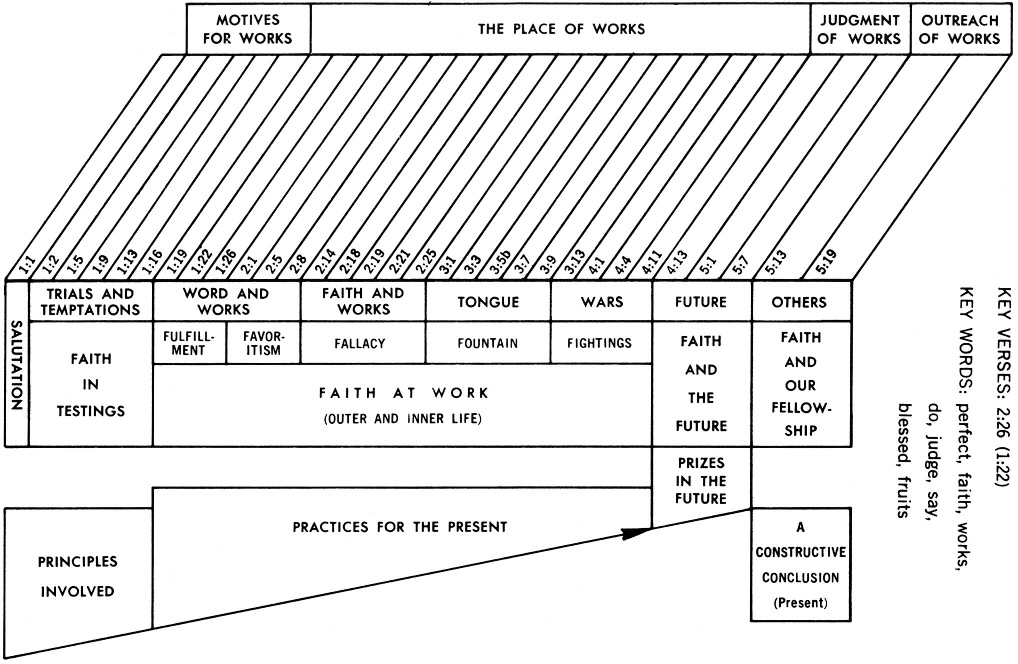
Click chart to enlarge
Chart from recommended resource Jensen's Survey of the NT - used by permission
See also Overview Chart by Charles Swindoll
|
JAMES |
|||||||
| Motives for Works |
The Place of Works: Outward Demonstration of Inner Faith |
Outreach of Works |
|||||
| Jas 1:1-18 | Jas 1:19-2:13 | Jas 2:14-25 | Jas 3:1-12 | Jas 3:13-4:12 | Jas 4:13-5:12 | Jas 5:13-19 | |
| Trials & Temptations |
Word & Works |
Faith & Works |
Tongue | Wars | Future | Others | |
|
Faith |
Fulfill |
Favor |
Fallacy |
Fountain |
Factions |
Faith |
Faith |
|
FAITH AT WORK |
|||||||
The Theme: The Testings of Personal Faith
The trials of the believer (James 1:2–12)
A. The proper attitude toward trials (James 1:2–4)
1. The attitude commanded (James 1:2)
2. The reason indicated (James 1:3)
3. The outcome to be realized (James 1:4)
B. The use of prayer amid trials (James 1:5–8)
1. The need for wisdom (James 1:5a)
2. The request for wisdom (James 1:5b)
3. The bestowal of wisdom (James 1:5c–8)
a. The divine response (James 1:5c)
b. The human obligation (James 1:6–8)
(1) The necessary attitude (James 1:6a)
(2) The rejected character (James 1:6b–8)
C. The correct attitude toward life by the tried (James 1:9–11)
1. The attitude of the lowly brother (James 1:9)
2. The attitude of the rich (James 1:10–11)
a. The reason for the attitude (James 1:10a)
b. The illustration from the flower (James 1:11a)
c. The application to the rich (James 1:11b)
D. The result of enduring trials (James 1:12)
1. The blessedness of endurance (v 12a)
2. The reward of endurance (James 1:12b)
The nature of human temptation (James 1:13–16)
A. The source of human temptation (James 1:13–14)
1. The repudiation of a divine source (James 1:13)
a. The rejection stated (James 1:13a)
b. The rejection vindicated (James 1:13b)
2. The reality of the human source (James 1:14)
B. The consequences of yielding to temptation (James 1:15)
C. The warning against being deceived (James 1:16)
The activity of God in human affairs (James 1:17–18)
A. The Giver of all good gifts (James 1:17)
B. The Author of the believer’s regeneration (James 1:18)
The Test Marks of a Living Faith
Faith tested by its response to the Word of God (James 1:19–27)
A. The reactions to the Word (James 1:19–20)
1. The knowledge possessed (James 1:19a)
2. The reaction demanded (James 1:19b)
3. The reason stated (James 1:20)
B. The reception of the Word (James 1:21)
1. The stripping off of sins (James 1:21a)
2. The appropriation of the Word (James 1:21b)
C. The obedience to the Word (James 1:22–27)
1. The demand for active obedience (James 1:22–25)
a. The statement of the requirement (James 1:22)
b. The illustration of the requirement (James 1:23–25)
(1) The negative portrayal (James 1:23–24)
(2) The positive portrayal (James 1:25)
2. The nature of acceptable obedience (James 1:26–27)
a. The futility of activity without inner control (James 1:26)
b. Acceptable service with inner control (James 1:27) (from Hiebert - James Commentary)
James 1:13 Let no one say when he is tempted, "I am being tempted by God"; for God cannot be tempted by evil, and He Himself does not tempt anyone. (NASB: Lockman)
Greek: medeis peirazomenos (PPPMSN) legeto (3SPAM) hoti apo theou peirazomai; (1SPPI) o gar theos apeirastos estin (3SPAI) kakon, peirazei (3SPAI) de autos oudena.
BGT Μηδεὶς πειραζόμενος λεγέτω ὅτι ἀπὸ θεοῦ πειράζομαι· ὁ γὰρ θεὸς ἀπείραστός ἐστιν κακῶν, πειράζει δὲ αὐτὸς οὐδένα.
Amplified: Let no one say when he is tempted, I am tempted from God; for God is incapable of being tempted by [what is] evil and He Himself tempts no one. (Amplified Bible - Lockman)
KJV: Let no man say when he is tempted, I am tempted of God: for God cannot be tempted with evil, neither tempteth he any man:
NET Let no one say when he is tempted, "I am tempted by God," for God cannot be tempted by evil, and he himself tempts no one.
CSB No one undergoing a trial should say, "I am being tempted by God." For God is not tempted by evil, and He Himself doesn't tempt anyone.
ESV Let no one say when he is tempted, "I am being tempted by God," for God cannot be tempted with evil, and he himself tempts no one.
NIV When tempted, no one should say, "God is tempting me." For God cannot be tempted by evil, nor does he tempt anyone;
NLT: And remember, no one who wants to do wrong should ever say, "God is tempting me." God is never tempted to do wrong, and he never tempts anyone else either. (NLT - Tyndale House)
NLT (revised) And remember, when you are being tempted, do not say, "God is tempting me." God is never tempted to do wrong, and he never tempts anyone else.
Phillips: A man must not say when he is tempted, "God is tempting me." For God has no dealings with evil, and does not himself tempt anyone. (Phillips: Touchstone)
Wuest: Let no man be saying when he is being solicited to sin, By God I am being solicited to sin, for God is incapable of being solicited to sin, the source of the solicitations being evils,, and He himself solicits no one to sin. (Eerdmans)
Young's Literal: Let no one say, being tempted--`From God I am tempted,' for God is not tempted of evil, and Himself doth tempt no one,
- Let no one say...- James 1:2,12; Genesis 3:12; Isaiah 63:17; Habakkuk 2:12,13; Romans 9:19,20
- James 1 Resources - Multiple Sermons and Commentaries
Related Passages:
Habakkuk 1:13 Your eyes are too pure to approve evil, And You can not look on wickedness with favor. Why do You look with favor On those who deal treacherously? Why are You silent when the wicked swallow up Those more righteous than they?
1 John 1:5 This is the message we have heard from Him and announce to you, that God is Light, and in Him there is no darkness at all.
Genesis 3:12 (THE FIRST SINNER ACCUSED GOD OF TEMPTING HIM TO SIN!!!) The man said, “The woman whom You gave to be with me, she gave me from the tree, and I ate.”
Genesis 3:13 (THEN EVE BLAMED SATAN!) Then the LORD God said to the woman, “What is this you have done?” And the woman said, “The serpent deceived me, and I ate.”
1 Samuel 15:15 (ADDRESSING SAMUEL, KING SAUL TRIES TO PUT THE BLAME FOR HIS SIN ON THE PEOPLE) Saul said, “They have brought them from the Amalekites, for the people spared the best of the sheep and oxen, to sacrifice to the LORD your God; but the rest we have utterly destroyed.”
1 Corinthians 10:13 No temptation (peirasmos) has overtaken you but such as is common to man; and God is faithful, Who will not allow you to be tempted (peirazo) beyond what you are able, but with the temptation will provide the way of escape also, so that you will be able to endure it.
DON'T BLAME GOD
WHEN YOU SIN
Warren Wiersbe - Trials may be tests sent by God, or they may be temptations sent by Satan and encouraged by our own fallen nature. It is this second aspect of trials—temptations on the inside—that James dealt with in this section. (Bible Exposition Commentary)
Michael Andrus - Ultimately, if we’re honest, all this blaming goes right back to God. It’s His fault. We would probably never say that in so many words, but that’s exactly where the blame game leads. “If He hadn’t given me such a big mouth or such a hot temper or such a strong sexual drive or such a humongous appetite, I wouldn’t find myself constantly battling temptation and, more often than not, yielding to it.” So universal is the tendency to blame God for temptation that James, the Lord’s brother, opens his discussion of temptation with a warning about just that.
Let no one say means to speak or talk, with the focus falling not merely on the act of speaking but on the content of what is said. Note that this is not a suggestion but a command in the present imperative with a negative, which in Greek carries the force of "Stop doing this!" or "Do not begin!" This suggests some were in fact blaming God for their temptations to sin (We've never done that have we?)! The thrust of the command is therefore arresting "Stop accusing God! Cease saying, when you are being tempted, that it is His fault!" Yes God allows temptation, but He is not the source of it. It is not in God’s nature entice us into sin.
This is a solemn prohibition aimed at a real and recurring sin, the tendency of our fallen human hearts, when under the pressure of trials and temptations, to cast blame elsewhere including at God. We are prone, when suffering the painful pull of temptation, to reason that since God is sovereign over all things (which He is), He must somehow be responsible for and be to blame for our moral struggle. James will have none of it. Yes, God in His sovereign providence allows temptation for He permitted Satan to test Job, He led Israel into the wilderness, and He allowed His own Son to be tempted in all points as we are (Hebrews 4:15, cf Mt 4:1-11, Lk 4:1-13). But allowing temptation is not the same as "authoring" temptation. Permitting temptation is not producing temptation. There is a world of difference between a God who governs trials and a god who generates sin.
The reason this distinction matters is rooted in the very nature of God Himself. It is not in God's nature to entice anyone into sin. He is light, and in Him there is no darkness at all (1 John 1:5). He is holy, utterly separate from evil, incapable of being drawn toward it and equally incapable of drawing others toward it. To accuse God of being the source of our temptations is not merely a theological error but is a slander against His holy, perfect character. James is calling his readers to own their struggles honestly, rather than deflecting responsibility onto the One Who is altogether good.
When he is tempted (peirazo), "I am being tempted peirazo), by God"; for God cannot be tempted (apeirastos), by evil, and He Himself does not tempt peirazo), anyone - Notice he does not say "if" but "when". Temptation is a sure thing! If you feel you are not being tempted then chances are you are already deceived by the temptation and you don't even realize your dire state! Human nature from Adam and Eve (Ge 3:12,13) shows fallen flesh seeks to pass the buck (so to speak). This reminds me of the comedy skit by Flip Wilson who famously said "The devil made me do it!"
Michael Andrus on "when" - Just as sure as you’re breathing you will face temptation, no matter what age, no matter what economic or social status, no matter what level of spiritual maturity. It may come galloping boldly or slithering subtly, but it will come.
A truth we must never forget is that
EVERY trial potentially brings a temptation.
John MacArthur - The same word (in noun or verb form) is used for both ideas because the primary difference is not in the peirasmos itself but in a person’s response to it. If a believer responds in faithful obedience to God’s Word, he successfully endures a trial; if he succumbs to it in the flesh, doubting God and disobeying, he is tempted to sin. Right response leads to spiritual endurance, righteousness, wisdom, and other blessings (Jas 1:2–12). Wrong response leads to sin and death (Jas 1:15)....Just as it is common to man to be tempted, it is also common for him to blame someone or something else, not only for his being tempted but also for his succumbing to it. From the beginning, one of the chief characteristics of sin has been the propensity to pass off blame, and every parent knows that children are born with that very evident propensity. (Ge 3:12 )(See James MacArthur New Testament Commentary - Page 45)
Satan tempts:
God tries.
Spurgeon - Satan tempts: God tries. But the same trial may be both a temptation and a trial; and it may be a trial from God’s side, and a temptation from Satan’s side, just as Job suffered from Satan, and it was a temptation; but he also suffered from God through Satan, and so it was a trial to him.
Warren Wiersbe - What is the relationship between testings without and temptations within?” Simply this: if we are not careful, the testings on the outside may become temptations on the inside. When our circumstances are difficult, we may find ourselves complaining against God, questioning His love, and resisting His will. At this point, Satan provides us with an opportunity to escape the difficulty. This opportunity is a temptation....There are many illustrations of this truth found in the Bible. Abraham arrived in Canaan and discovered a famine there. He was not able to care for his flocks and herds. This trial was an opportunity to prove God; but Abraham turned it into a temptation and went down to Egypt. God had to chasten Abraham to bring him back to the place of obedience and blessing. (Bible Exposition Commentary)
I would add to Wiersbe's comment that when trials come, if we begin to complain or murmur, we have already sinned because we have yielded to the fallen flesh, which stands opposed to God. Grumbling reveals a heart resisting His sovereign purposes rather than trusting His wisdom, goodness, and love. Instead of submitting to what God intends to use for our spiritual growth, the flesh reacts with dissatisfaction, self-pity, anger, or unbelief. Murmuring was one of Israel’s great sins in the wilderness because it ultimately reflected discontent with God Himself and distrust of His provision and purposes (Ex 16:7-8; Nu 14:27; 1Co 10:10).
William Kelly observes "The Epistle then turns from our holy trials to our unholy ones, and shows their source to be, not in God, but in sinful man." (Comment: The former must be endured, the latter resisted.)
David Roper has an interesting thought on temptation - Temptation makes us aware of “the strength of the evil impulse within us” and reveals the fragile stuff of which we’re made. It humbles us. It makes us more reliant on God’s strength, and therefore less likely to yield.
Wuest has an interesting paraphrase adding the word "sin" (not in the Greek) to emphasize that the test is not for good but for evil. God does test men, but He does not tempt men to do evil. There is a substantial difference and that is what Wuest's paraphrase accentuates…
Let no man be saying when he is being solicited to sin, "By God I am being solicited to sin", for God is incapable of being solicited to sin, the source of the solicitations being evils, and He himself solicits no one to sin
Each temptation leaves us better or worse;
neutrality is impossible.
-- Erwin W Lutzer
J C Ryle - Let us beware of making light of temptation because they seem little and insignificant. There is nothing little that concerns our souls.
Patrick Fairbairn - What is temptation? Seduction to evil, solicitation to wrong. It stands distinguished from trial thus: trial tests, seeks to discover the man’s moral qualities or character; but temptation persuades to evil, deludes, that it may ruin. The one means to undeceive, the other to deceive. The one aims at the man’s good, making him conscious of his true moral self; but the other at his evil, leading him more or less unconsciously into sin. God tries; Satan tempts.
Dr. J. Wilbur Chapman -Temptation is the tempter looking through the keyhole into the room where you’re living; sin is your drawing back the bolt and making it possible for him to enter.
Temptation is not sin;
it is the call to battle.
-- F P Wood
The point is that we are in a war, a continual war against our soul, and it is not simply a momentary skirmish. Our flesh, the evil world system and the evil one are resolutely determined to take us down (cp 1Pe 5:8 "devour")! Stop being deceived (James 1:15) regarding this strategic truth, lest you be swept downstream by the strong pull of the temptation that comes from within. Before we were saved, we chased after sin. Now as believers sin chases after us!
Peter warned his readers (who were being tested/tempted - 1Pe 1:6,7)…
Beloved (note his affectionate address [similar to James] before he explains a serious, hard truth), I urge (present tense = continually. parakaleo = I come alongside you. I know the power and pull of temptation first hand. I fell. But God poured out mercy and gave grace to repent and return that I might now strengthen you with this warning. See Luke 22:32, 33, 34, Mt 26:74, 75, Acts 2:14f, cp Acts 3:19, 20+) you as aliens and strangers to abstain from fleshly lusts, which wage war (continually = present tense) against the soul. (1Pe 2:11)
Every temptation is an opportunity
of our getting nearer to God.
-- John Quincy Adams
Martin Luther spoke of what the flesh means for evil God can use for good writing that "My temptations have been my masters in divinity… Temptation and adversity are the two best books in my library."
Progression
- Desire > temptation > lust/sin > habitual sin > death
- Trial > faith > obedience > perseverance > crown of life (from Charles Swindoll)
Spurgeon - God tries men, but the motive of a trial is that which differences it from a temptation. In a temptation we try a man with a view of inducing him to do wrong; but God tries men to best them, that they may, by finding out their weakness, be saved from doing wrong. He never inclines a heart to evil. While he doeth all things, and is in all things, yet not so that he himself doeth evil, or can be charged therewith.
God will test us — but God will not tempt us.
God tests us to make us stand.
Satan tempts us to make us fall.
- Adrian Rogers
Tempt (3985)(peirazo from the noun peira = test from peíro = perforate, pierce through to test durability of things) is a morally neutral word simply meaning “to test”. Whether the test is for a good (as it proved to be in Heb 11:17) or evil (Mt 4:1 "Then Jesus was led up by the Spirit into the wilderness to be tempted by the devil") depends on the intent of the one giving the test and also on the response of the one tested. (See study of similar and yet different word dokimazo)
Temptation is trying to get us to fulfill a legitimate desire
— in an illegitimate way.
-- Rogers
🙏 THOUGHT - On overcoming temptation: If you want to take a bone from a dog — give him a steak, and he'll drop the bone. (Rogers) Corollary: Fix your eyes on Jesus "for the Word of the Cross is foolishness to those who are perishing, but to us who are being saved it is the power (dunamis) of God." (1 Cor 1:18, cf Heb 12:1, Ro 13:14) See also Expulsive Power of a New Affection
Satan tempts to bring out the bad;
God tests to bring out the good.
-- W H Griffith
Or as someone else has said "Satan tempts us to bring out the worst in us but God tests us to bring out the best."
Warren Wiersbe - A temptation is an opportunity to accomplish a good thing in a bad way, out of the will of God. We think of sin as a single act, but God sees it as a process. Adam committed one act of sin, and yet that one act brought sin, death, and judgment on the whole human race (Ro 5:12). James described this process of sin in four stages. (Desire, Deception, Disobedience, Death) (Bible Exposition Commentary)
Note that the verb peirazo here translated as tempted is in the same word group as the noun peirasmos which is translated trial (James 1:2; James 1:12). Peirazo/peirasmos when used of God reflects His testing or trying a believer's faith, but never in the sense of tempting the believer to sin. In Peter's first epistle it is clear that God's purpose is not to cause to sin or to destroy but to refine.
In this you greatly rejoice, even though now for a little while, if necessary (his implication is trials are necessary), you have been distressed by various trials (peirasmos), that the proof of your faith, being more precious than gold which is perishable, even though tested by fire, may be found to result in praise and glory and honor at the revelation of Jesus Christ (1Pe 1:6,7)
Beloved (he is addressing believers), do not be surprised (present imperative + a negative = "Stop being surprised") at the fiery ordeal among you, which comes upon you for your testing (peirasmos), as though some strange thing were happening to you; but to the degree that you share the sufferings of Christ, keep on rejoicing (present imperative = command to make rejoicing your "lifestyle" even in trials - only possible by the manifold grace of God and the inner strengthening by the indwelling Holy Spirit); so that (introduces the purpose of the testing) also at the revelation of His glory, you may rejoice with exultation. If you are reviled for the name of Christ, you are blessed, because the Spirit of glory and of God rests upon you. (1Pe 4:12-14)
Comment: God has never promised that we would miss the storm, but He has promised that we would make the harbor. When God puts His own people into the furnace, He keeps His eye on the clock and His hand on the thermostat. He knows how long and how much. (Warren Wiersbe Bible Exposition Commentary)
Peirazo is used 3 times in this passage each in the present tense ("continually tested"). In the first use, it is clear that this tense indicates that the test is never-ending in this life but it will end in the life to come when we are delivered not only from the presence of sin but the pleasure of sin.
Peirazo can have several nuances depending on the context: (1) trials with a beneficial purpose and effect, (2) divinely permitted or sent, (3) with a good or neutral significance, (4) of a varied character, (5) definitely designed to lead to wrong doing, temptation, (6) of men trying or challenging God.
As alluded to above, the trials may come from God or under His permissive will from Satan (cp Job 1:6,7,8, 9, 10, 11, 12) or may be the result of our own wrong doing (and part of His loving Discipline - Heb 12:5-11). The solicitations to do evil come from the world, the evil nature (the "flesh"), or the Devil. When the Scriptural context clearly indicates the testing is an enticement to evil, the word is most frequently translated by a form of the English tempt, which carries that negative connotation and to reemphasize this NEVER refers to a test from God.
In a sermon titled Faith Tested and Crowned (Genesis 22:1-14) the able expositor Alexander Maclaren distinguished between being tempted and being tried writing that
the former word (tempted) conveys the idea of appealing to the worst part of man, with the wish that he may yield and do the wrong. The latter (tested) means an appeal to the better part of man, with the desire that he should stand." "Temptation says, 'Do this pleasant thing; do not be hindered by the fact that it is wrong.' Trial or proving says, 'Do this right and noble thing; do not be hindered by the fact that it is painful.'
Character is revealed by what you do in secret, when no one else is around to see. If you are not a person of integrity (think of integer - whole, entire) then you will not be a person of character. Maturity is revealed by what you do in your free time. A person of integrity uses their free time wisely.
The testing of one's faith/obedience is not unique to the New Testament but is a basic principle found throughout the Scriptures. For example…
(Moses warning Israel) And you shall remember all the way which the LORD your God has led you in the wilderness these forty years, that He might humble you, testing you, to know what was in your heart, whether you would keep His commandments or not. (Deuteronomy 8:2)
(Speaking of King Hezekiah) And even in the matter of the envoys of the rulers of Babylon, who sent to him to inquire of the wonder that had happened in the land, God left him alone only to test (Lxx = ekpeirazo, same verb used of testing Jesus Mt 4:7, Lk 4:12) him, that He might know all that was in his heart. (2 Chronicles 32:31)
Comment: King Hezekiah acted foolishly and in pride showed the Babylonian envoys his treasures, arousing their desire to possess them, a desire that would soon be fulfilled. See 2Ki 20:12, 13, 14, 15, 16, 17, 18, 19
The refining pot is for silver and the furnace for gold, but the LORD tests hearts. (Proverbs 17:3)
The point that is emphasized in these verses on testing is that with the tests God provides opportunities for His children to demonstrate and grow their faith. In fact it is fair to state that every test the Father allows becomes either a stumbling block (King Hezekiah) or a stepping stone (as in Abraham's case in this passage).
In an interesting passage in 2 Samuel, at first one might conclude that this passage appears to contradict the idea that God does not tempt anyone. However, examination of the best commentary (which is always Scripture) reveals that the parallel passage in 1 Chronicles 21:1 teaches that it was Satan that tempted David, not God. The truth is that God is sovereign Proverbs 17:3 and as the absolute Ruler of the universe, He allowed Satan to tempt David. Below are these parallel passages…
Again the anger of the LORD was aroused against Israel, and He moved David against them to say, ‘Go, number Israel and Judah' (2 Samuel 24:1)
Now Satan stood up against Israel, and moved David to number Israel (1 Chronicles 21:1)
QUESTION: What is the key to victory when struggling with sin? Gotquestions.org
ANSWER - The key to victory in our struggles with sin lies not in ourselves, but in God and His faithfulness to us: “The LORD is near to all who call on Him, to all who call on Him in truth” (Psalm 145:18; see also Psalm 46:1).
There’s no getting around it: we all struggle with sin (Romans 3:23). Even the great apostle Paul lamented over his ongoing struggle with sin in his life: “For I know that nothing good dwells in me, that is, in my flesh. For I have the desire to do what is right, but not the ability to carry it out. For I do not do the good I want, but the evil I do not want is what I keep on doing. Now if I do what I do not want, it is no longer I who do it, but sin that dwells within me” (Romans 7:18-20). Paul’s struggle with sin was real; so much so that he cried out, “What a wretched man I am! Who will rescue me from this body that is subject to death?” (Romans 7:24).
Yet in the next breath, he answers his own question, as well as ours: “Thanks be to God, who delivers me through Jesus Christ our Lord!” (Romans 7:25a). In this passage, Paul not only provides us with the very key to victory when struggling with sin, but explains the never-ending conundrum between our sinful nature and spiritual nature: “So then, I myself serve the law of God with my mind, but with my flesh I serve the law of sin” (Romans 7:25b).
Earlier, Paul said, “For we know that the law is spiritual, but I am of the flesh, sold under sin” (Romans 7:14). Paul is comparing our sinful nature, our flesh, to a slave. Just as a slave obeys his master, so our flesh obeys sin. However, as believers in Christ, we have become spiritual beings under the law of Christ; our inner selves are under the influence and ownership of God’s grace and the life of Christ (Romans 5:21). As long as we are living in this world, our sinful nature and fleshly desire will remain with us. But we also have a new nature in Christ. This leads to a struggle between what we want to do and what we actually do, as sin continues to assault our earthly nature. This struggle is a normal part of living the Christian life.
It’s interesting to note that Paul, the greatest of the apostles, declared that, of all sinners, “I am the worst!” (1 Timothy 1:15). Paul affirms the struggles we all have as we battle with sin and temptation in our lives. The struggles are real, and they’re debilitating. We grow weary from the never-ending temptations and in falling short of God’s glory. Paul, in essence, is telling us that we need not pretend that we’re untouched by our struggles. He’s been there. He understands. Though our efforts to do right seem desperate, we do have hope “through Jesus Christ our Lord” (Romans 7:25; Hebrews 4:15). And He, in fact, is the key to our victory over sin.
A true Christian will war with Satan and his daily efforts to undermine us. The devil is the ruler of this world, and we are living “behind enemy lines” (Ephesians 2:2; Ephesians 6:12; John 12:31). With our focus on Christ, however, we will be able to cultivate a mindset that proclaims we’d rather die than do anything to hurt God. When we give ourselves to Christ totally (Matthew 16:24), Satan will flee from us. When we draw near to God, He, in turn, will draw near to us (James 4:7-8).
Our key to victory in our struggle with sin lies in the very promise of God Himself: “No temptation has overtaken you that is not common to man. God is faithful, and He will not let you be tempted beyond your ability, but with the temptation He will also provide the way of escape, that you may be able to endure it” (1 Corinthians 10:13).
As true believers in Christ, even when we “face trials far beyond our ability to endure” (2 Corinthians 1:8), we can echo the reassuring words of Paul, who declares, “God has delivered us and will continue to deliver us” (2 Corinthians 1:10). Finally, the psalmist gives us these words of encouragement: “Trust in the LORD, and do good; dwell in the land and befriend faithfulness. Delight yourself in the LORD, and He will give you the desires of your heart. Commit your way to the LORD; trust in Him, and He will act” (Psalm 37:3-5).
QUESTION: Why can't I stop sinning? Please help! Gotquestions.org
ANSWER - Every believer has, at one time or another, lamented his or her inability to stop sinning. While we tend to think the problem stems from weakness in ourselves, the inability to stop sinning usually indicates a deficiency in our understanding of God’s strength. When we do not understand His power to save, forgive, and cleanse us from all unrighteousness (1 John 1:9), we can get caught in a destructive cycle of sin, guilt, and fear, which leads to a lack of joy in our salvation, which leads to more sin.
In Psalm 51:12, David pleads with God, “Restore to me the joy of your salvation and grant me a willing spirit, to sustain me.” He wrote this after he had fallen into the grievous sins of adultery and murder. It is interesting to notice that he asks God for a return of the joy of his salvation. Joy is key in our victory over sin. It is also important that we understand that God sustains us “with a willing spirit.” God takes joy in saving us, and we take joy in being saved.
God has saved us willingly, to display His grace, love, and strength. Our salvation does not depend on how much or how little we sin, how much or how little we evangelize or repent or do good works, how loving or unloving we are, or anything else about us. Our salvation is entirely a product of God’s grace, love, and purpose (Ephesians 2:8–9). This is important to understand, because (ironically) believing that we are responsible to keep the law leads inevitably to the inability to stop sinning.
Paul explains this in Romans 7:7–10. When we understand a law, like “do not covet,” our sin nature inevitably rebels against that law, and we covet. This is the plight of man—it is simply how we are. The law aggravates our sin nature. John Bunyan illustrates this truth in The Pilgrim’s Progress. In the Interpreter’s House, Christian sees a very dusty room that had never been swept. First, a man with a broom tries to clean the floor, but the broom’s only effect is to raise choking clouds of dust. The more he sweeps, the more the dust is stirred up; this is a picture of the law, Bunyan says, which cannot clean a sinful heart but only stirs up the sin. However, Christian watches as the broom is set aside and a young girl sprinkles the whole room with water. After that, the room is quickly cleaned; this is a picture of the gospel of grace and its ability to purify the heart. The grace of God can do what the law could never do: cleanse us from sin.
So, the way to stop sinning is not to add more rules. God knew this. In fact, He gave us the law so that we would be aware of our sin and turn to Him (Romans 3:19-20; Galatians 3:23-26). The law is good. It is a reflection of God’s nature and His perfection. But it was not given to us for our salvation. Christ fulfills the law for us (Matthew 5:17).
When we disagree with God and hang onto the idea that we must fulfill the law, we lose our joy in salvation and set ourselves up for failure. We labor under a terrible burden. We feel pressured to do something to secure salvation, but, at the same time, our sin nature renders us unable to obey the law. The more we focus on the law, the more our sin nature rebels. The more our sin nature rebels, the more frightened we become that we are not saved. The more frightened and joyless we become, the more tempting sin’s promise of happiness is.
The only way to break the cycle and stop sinning is to accept the fact that we cannot stop sinning. This may seem contradictory, but if a person does not stop trying to save himself, he will never rest in the knowledge that God has saved him. The joy of salvation comes from accepting the fact that God’s grace covers us, that He will change us and conform us to the image of Christ, and that it is His work, not ours (Romans 8:29; Philippians 1:6; Philippians 2:13; Hebrews 13:20-21). Once this reality is truly grasped, sin loses its power. We no longer feel the impulse to turn to sin as a means of temporary relief from anxiety, because the anxiety and pressure has been relieved once for all by Christ (Hebrews 10:10, 14). Then, the good works we accomplish in faith are done because of love and joy rather than out of fear or duty.
“The sting of death is sin, and the power of sin is the law. But thanks be to God, who gives us the victory through our Lord Jesus Christ. Therefore, my beloved brothers, be steadfast, immovable, always abounding in the work of the Lord, knowing that in the Lord your labor is not in vain” (1 Corinthians 15:56-58ESV).
QUESTION: How can I overcome a habitual sin? Gotquestions.org
ANSWER - The first thing to consider in how to overcome habitual sin is to note the change, or transformation, that takes place when a person is saved. The Bible describes the natural man as “dead in sin and trespasses” (Ephesians 2:1). As a result of Adam’s fall into sin, man is born spiritually dead. In this state of spiritual death, man is unable and unwilling to follow and obey God and habitual sin naturally follows. Natural man sees the things of God as foolishness (1 Corinthians 2:14) and is hostile toward God (Romans 8:7). When a person is saved, a transformation takes place. The apostle Paul refers to this as the new creation (2 Corinthians 5:17). From the moment we place our faith in Christ, we are in the process of sanctification.
The process of sanctification is that by which those who are in Christ are conformed by the Holy Spirit into the image of Christ (Romans 8:29). Sanctification in this life will never be fully complete, which means that believers will always struggle with remaining sin. Paul describes this battle with sin in Romans 7:15–25. In that passage he notes that, even though he desires to do what is good in the eyes of God, he often does what is evil instead. He does the evil he doesn’t want to do and fails to do the good that he wants to do. In this, he is describing every Christian’s struggle with sin.
James says we all sin in many ways (James 3:2). Experience tells us that we struggle differently with sin, perhaps one sin being more of a tripping point for one believer than another. For some it might be anger whereas for others it is gossip or lying. We might refer to a sin that is particularly difficult for us to overcome as a “besetting” sin or a "habitual" sin. These besetting sins are often, but not exclusively, habits that we developed during our lives as unbelievers and require more grace and discipline to overcome.
Part of the process of overcoming these habitual, or besetting, sins is in recognizing the transformation that has indeed taken place within the believer. Paul writes, “So you also must consider yourselves dead to sin and alive to God in Christ Jesus” (Romans 6:11). When Paul says, “Consider yourselves dead to sin,” he is telling us to remember that, in coming to Christ, the power of sin has been broken in our lives. He uses the metaphor of slavery to make this point. We were at one time slaves to sin, but now we are slaves to righteousness (Romans 6:17–18). At the cross the power of sin was broken, and, in becoming Christians, we are set free from sin’s mastery over us. Therefore, when a Christian sins, it is no longer out of the necessity of his nature, but because he has willfully submitted himself to sin’s dominion (Galatians 5:1).
The next part of the process is recognizing our inability to overcome habitual sin and our need to rely on the power of God’s Holy Spirit, who dwells within us. Back to Romans 7. Paul says, “For I know that nothing good dwells in me, that is, in my flesh. For I have the desire to do what is right, but not the ability to carry it out” (Romans 7:18). The Christian’s struggle against sin is one in which our ability does not match our desire. That is why we need the power of the Holy Spirit. Paul later says, “If the Spirit of him who raised Jesus from the dead dwells in you, he who raised Christ Jesus from the dead will also give life to your mortal bodies through his Spirit who dwells in you” (Romans 8:11). The Holy Spirit, through God’s Word (John 17:17), works sanctification in the people of God. Habitual sin is overcome as we submit ourselves to God and refuse the temptations of the flesh (James 4:7–8).
Another part of the process of overcoming habitual sin is to change the habits that facilitate it. We have to adopt the attitude of Joseph who, when tempted by Potiphar’s wife to come to bed with her, left the room so quickly that he left his cloak in her hands (Genesis 39:15). We simply must make every effort to run from the things that tempt us to sin, including access to food if we are given to overeating, and access to pornography if we are tempted to sexual sin. Jesus tells us to cut off our hand or pluck out our eye if they “offend” us (Matthew 5:29–30). This means removing from our lives the things that tempt us to sin even when those are things we enjoy. In short, we have to change the habits that lead to habitual sin.
Finally, we need to immerse ourselves in the truth of the gospel. The gospel is not only the means by which we are saved, but it is also the means by which we are sanctified (Romans 16:25). If we think we are saved by grace, but sanctified by our own efforts, we fall into error (Galatians 3:1–3). Sanctification is as much a work of God as justification. The promise we have from Scripture is that He who began a good work in us will complete it on the last day (Philippians 1:6).
QUESTION - Why is sexual temptation a bigger problem for men than for women? Gotquestions.org
ANSWER - While women are by no means immune from sexual temptation, generally speaking, men struggle with sexual temptation to a much greater degree. Far more men commit adultery than women. In premarital relationships, men are far more likely to seek sex from their partners than women.
Why is this? Why is sexual temptation a bigger problem for men than for women? The Bible does not seek to answer this “why” question. Instead, the Bible makes it abundantly clear that sexual immorality is always a sin (Acts 15:20; 1 Corinthians 5:1; 6:13, 18; 10:8; 2 Corinthians 12:21; Galatians 5:19; Ephesians 5:3; Colossians 3:5; 1 Thessalonians 4:3; Jude 7). The fact that overcoming sexual temptation is often more difficult for men is definitely not an excuse. “It is so hard to resist” is not an explanation God will accept from a man, or from a woman for that matter. Again, sexual immorality is always a sin. Therefore, sexual temptation is to be overcome (1 Corinthians 6:18), whether the temptation is strong or mild, and whether the person tempted is a man or a woman.
Since the Bible does not specifically give an answer as to why sexual temptation is a greater struggle for men than for women, we can look to biology/physiology for insight. Physiologically, men typically have a much stronger sex drive than women. Men naturally think about sex more often and desire sex more frequently than women do. Especially when sexual intercourse has not occurred recently, the male body has a greater desire for the release that sex provides. This is then compounded by the fact that men are far more easily stimulated by sight than women are (which also explains why men are far more prone to look at pornography). Simply the sight of an attractive female is sometimes enough to trigger a male’s sex drive. If a sexual thought is not immediately forsaken (with God’s help), it can become a cascading river of sexual temptation, very difficult to resist.
Again, let it be said, the male sex drive is a fact, not an excuse. If a man gives in to sexual temptation, he has no one to blame but himself. First Corinthians 10:13 declares, “No temptation has overtaken you that is not common to man. God is faithful, and He will not let you be tempted beyond your ability, but with the temptation He will also provide the way of escape, that you may be able to endure it.” If we do not take advantage of the divinely provided “way of escape,” we are without excuse. Sexual temptation can be powerful, and sexual sin is among the most devastating (1 Corinthians 6:18). But, with God’s help, sexual temptation can be defeated. This is equally true for men and women.
QUESTION - How can I overcome temptation? (SEE VIDEO) Gotquestions.org
ANSWER - The Scriptures tell us that we all face temptations. First Corinthians 10:13 says, “No temptation has overtaken you but such as is common to man.” Perhaps this provides a little encouragement as we often feel that the world is bearing in on us alone, and that others are immune to temptations. We are told that Christ was also tempted: “For we do not have a high priest who cannot sympathize with our weaknesses, but One who has been tempted in all things as we are, yet without sin” (Hebrews 4:15).
Where, then, do these temptations come from? First of all, they do not come from God, although He does allow them. James 1:13 says, “For God cannot be tempted by evil, and He Himself does not tempt anyone.” In the first chapter of Job, we see that God allowed Satan to tempt Job, but with restrictions. Satan is roaming on the earth like a lion, seeking people to devour (1 Peter 5:8). Verse 9 tells us to resist him, knowing that other Christians are also experiencing his attacks. By these passages we can know that temptations come from Satan. We see in James 1:14 that temptation originates in us as well. We are tempted when we are “carried away and enticed by our own lust” (verse 14). We allow ourselves to think certain thoughts, allow ourselves to go places we should not go, and make decisions based on our lusts that lead us into the temptation.
How then do we resist the temptations? First of all, we must return to the example of Jesus being tempted in the wilderness by Satan in Matthew 4:1-11. Each of Satan’s temptations was met with the same answer: “It is written,” followed by Scripture. If the Son of God used the Word of God to effectively end the temptations—which we know works because after three failed efforts, “the Devil left him” (v. 11)—how much more do we need to use it to resist our own temptations? All our efforts to resist will be weak and ineffective unless they are powered by the Holy Spirit through the constant reading, studying, and meditating on the Word. In this way, we will be “transformed by the renewing of your mind” (Romans 12:2). There is no other weapon against temptation except the “sword of the Spirit, which is the Word of God” (Ephesians 6:17). Colossians 3:2 says, “Set your mind on the things above, not on the things that are on earth.” If our minds are filled with the latest TV shows, music, and all the rest the culture has to offer, we will be bombarded with messages and images that inevitably lead to sinful lusts. But if our minds are filled with the majesty and holiness of God, the love and compassion of Christ, and the brilliance of both reflected in His perfect Word, we will find that our interest in the lusts of the world diminish and disappear. But without the Word’s influence on our minds, we are open to anything Satan wants to throw at us.
Here, then, is the only means to guard our hearts and minds in order to keep the sources of temptation away from us. Remember the words of Christ to His disciples in the garden on the night of His betrayal: “Keep watching and praying that you may not enter into temptation; the spirit is willing, but the flesh is weak” (Matthew 26:41). Most Christians would not openly want to jump into sin, yet we cannot resist falling into it because our flesh is not strong enough to resist. We place ourselves in situations or fill our minds with lustful passions, and that leads us into sin.
We need to renew our thinking as we are told in Romans 12:1-2. We must no longer think as the world thinks or walk in the same way that the world walks. Proverbs 4:14-15 tells us, “Do not enter the path of the wicked, and do not proceed in the way of evil men. Avoid it, do not pass by; Turn away from it and pass on.” We need to avoid the path of the world that leads us into temptation because our flesh is weak. We are easily carried away by our own lusts.
Matthew 5:29 has some excellent advice. “If your right eye makes you stumble, tear it out and throw if from you; for it is better for you to lose one of the parts of your body, than for your whole body to be thrown into hell.” That sounds severe! Sin is severe! Jesus is not saying that we literally need to remove body parts. Cutting out the eye is a drastic measure, and Jesus is teaching us that if necessary, a drastic measure should be taken to avoid sin.
QUESTION - Why is idol worship such a powerful temptation? GOTQUESTIONS.ORG
ANSWER - Ultimately, the answer to this question is “sin.” It is the sin nature of man that causes us to worship modern idols, all of which are, in reality, forms of self-worship. The temptation to worship ourselves in various ways is a powerful temptation indeed. In fact, it is so powerful that only those who belong to Christ and have the Holy Spirit within them can possibly hope to resist the temptation of modern idolatry. Even then, resisting the worship of idols is a lifelong battle that is part of the Christian life (Ephesians 6:11; 1 Timothy 6:12; 2 Timothy 2:3).
When we hear the word idol, we often think of statues and objects reminiscent of those worshiped by pagans in ancient cultures. However, the idols of the 21st century often bear no resemblance to the artifacts used thousands of years ago. Today, many have replaced the “golden calf” with an insatiable drive for money or prestige or "success" in the eyes of the world. Some pursue the high regard of others as their ultimate goal. Some seek after comfort or a myriad of other passionate, yet empty, pursuits. Sadly, our societies often admire those serving such idols. In the end, however, it doesn’t matter what empty pleasure we chase after or what idol or which false god we bow down to; the result is the same—separation from the one true God.
Understanding contemporary idols can help us to understand why they prove to be such a powerful temptation. An idol can be anything we place ahead of God in our lives, anything that takes God’s place in our hearts, such as possessions, careers, relationships, hobbies, sports, entertainment, goals, greed, addictions to alcohol/drugs/gambling/pornography, etc. Some of the things we idolize are clearly sinful. But many of the things we idolize can be very good, such as relationships or careers. Yet Scripture tells us that, whatever we do, we are to “do it all for the glory of God” (1 Corinthians 10:31) and that we are to serve God only (Deuteronomy 6:13; Luke 16:13). Unfortunately, God is often shoved out of the way as we zealously pursue our idols. Worse yet, the significant amount of time we often spend in these idolatrous pursuits leaves us with little or no time to spend with the Lord.
We sometimes also turn to idols seeking solace from the hardships of life and the turmoil present in our world. Addictive behaviors such as drug or alcohol use, or even something like excessive reading or television viewing, may be used as a means of temporarily “escaping” a difficult situation or the rigors of daily life. The psalmist, however, tells us that those who place their trust in this behavior will, essentially, become spiritually useless (Psalm 115:8). We need to place our trust in the Lord “who will keep [us] from all harm” (Psalm 121:7) and who has promised to supply all of our needs when we trust in Him. We also need to remember the words of Paul, who teaches us not to be anxious about anything, but rather to pray about everything so the peace of God, which surpasses all understanding, can guard our hearts and our minds (Philippians 4:6–7).
There is another form of idolatry prevalent today. Its growth is fostered by cultures that continue to drift away from sound biblical teaching, just as the apostle Paul warned us, “For the time will come when men will not put up with sound doctrine” (2 Timothy 4:3). In these pluralistic, liberal times, many cultures have, to a large degree, redefined God. We have forsaken the God revealed to us in Scripture and have recast Him to comply with our own inclinations and desires—a “kinder and gentler” god who is infinitely more tolerant than the One revealed in Scripture. One who is less demanding and less judgmental and who will tolerate many lifestyles without placing guilt on anyone’s shoulders. As this idolatry is propagated by churches around the world, many congregants believe they are worshiping the one, true God. However, these made-over gods are created by man, and to worship them is to worship idols. worshiping a god of one’s own making is particularly tempting for many whose habits and lifestyles and drives and desires are not in harmony with Scripture.
The things of this world will never fully satisfy the human heart. They were never meant to. The sinful things deceive us and ultimately lead only to death (Romans 6:23). The good things of this world are gifts from God, meant to be enjoyed with a thankful heart, in submission to Him and for His glory. But when the gift replaces the Giver or the created replaces the Creator in our lives, we have fallen into idolatry. And no idol can infuse our lives with meaning or worth or give us eternal hope. As Solomon beautifully conveys in the book of Ecclesiastes, apart from a right relationship with God, life is futile. We were created in God’s image (Genesis 1:27) and designed to worship and glorify Him as He alone is worthy of our worship. God has placed “eternity in man’s heart” (Ecclesiastes 3:11), and a relationship with Jesus Christ is the only way to fulfill this longing for eternal life. All of our idolatrous pursuits will leave us empty, unsatisfied, and, ultimately, on the broad road that most people take, the one that leads to destruction (Matthew 7:13).
QUESTION - Why did Jesus instruct us to pray 'lead us not into temptation' when God states that He does not tempt us? GOTQUESTIONS.ORG
ANSWER - We know from James 1:13 that God does not tempt us to sin. If God did tempt us to sin, He would be acting contrary to His holy nature, against His desire for us to be holy as He is holy (1 Peter 1:16), and against all other commandments in Scripture that tell us to avoid sin and flee temptation. In the Lord’s model prayer (Matthew 6:9–13), Jesus says, “Lead us not into temptation, but deliver us from the evil one” (verse 13). The inclusion of a request for God not to lead us into temptation teaches us that avoiding temptation should be one of the primary concerns of the Christian life.
The idea of God leading His people is a main theme of Scripture. The book of Psalms especially is filled with pleas for God to lead us in His ways (Psalm 5:8; 27:11), by His truth and righteousness, and in “the way everlasting” (Psalm 139:24). Along with leading us toward good, we understand that we are asking God to lead us away from evil. The petition in the Lord’s Prayer not to be led into temptation reflects the believer’s desire to avoid the dangers of sin altogether. This phrase, then, must be understood in the sense of “permitting.” Jesus taught us to pray, “Do not ‘allow’ us, or ‘permit’ us, to be tempted to sin.” This request implies that God has such control over the tempter as to save us from his power if we call upon our Heavenly Father.
There is another sense in which we are to plead with God not to lead us into temptation. The word temptation can also refer to trials. We know from 1 Corinthians 10:13 that God will not test us beyond our ability in Christ to bear it and will always provide a way out. But God sometimes subjects us to trials that may expose us to Satan’s assaults for His own purposes, as in the cases of Job and Peter (Luke 22:31–32). If the temptation in the Lord’s Prayer refers to trials, then the meaning of Matthew 6:13 is, “Do not afflict or try us.” It is not wrong to pray that we may be delivered from trials and suffering, as long as we submit ourselves to the will of God, no matter what it is. The believer can rightly ask to be delivered from testing as well as ask for the strength to endure it if it does come.
We might illustrate Jesus’ words “Lead us not into temptation” like this: a mother takes her young children grocery shopping with her and comes to the candy aisle. She knows that taking her children down that aisle will only stir up greediness in their hearts and lead to bouts of whining and pouting. In wisdom, she takes another route—whatever she may have needed down the candy aisle will have to wait for another day. In this way the mother averts unpleasantness and spares her children a trial. Praying, “Lead us not into temptation,” is like praying, “God, don’t take me down the candy aisle today.” It’s recognizing that we naturally grasp for unprofitable things and that God’s wisdom can avert the unpleasantness of our bellyaching.
Whether we are asking for God to lead us away from sin or from difficult trials, our goal is found in the second part of verse 13: “Deliver us from the evil one.” A petition similar to this is offered by David in Psalm 141:4: “Do not let my heart be drawn to what is evil so that I take part in wicked deeds along with those who are evildoers; do not let me eat their delicacies.” In all things, God is our deliverer, and we are wise to seek His power over sin.
QUESTION - What are the keys to resisting temptation? GOTQUESTIONS.ORG
ANSWER - Nelson’s Bible Dictionary defines temptation as “an enticement or invitation to sin, with the implied promise of greater good to be derived from following the way of disobedience.” Resisting temptation begins with knowing that Satan is the supreme “tempter” (Matthew 4:3; 1 Thessalonians 3:5) who has been tempting mankind since our Creator placed His first two children in the Garden of Eden (Genesis 3; 1 John 3:8). Ultimately, however, we know that Satan’s power over Christians has been effectively destroyed as the war has already been won through our Savior’s death and resurrection which conquered the power of sin and death forever. Nonetheless, Satan still prowls the earth looking to drive a wedge between God and His children, and his temptations are unfortunately a daily part of our lives (1 Peter 5:8). Yet with the power of the Holy Spirit and the truth of God’s Word to help us, we will find ourselves effectively resisting temptations.
The apostle Paul encourages us with these words: “No temptation has seized you except what is common to man” (1 Corinthians 10:13). Indeed, every one of us faces temptations of some kind; even Jesus was not immune as He was “tempted in every way, just as we are” (Hebrews 4:15). Although Satan may be the dark force ultimately behind the tempting, it is our fallen and corrupted human nature that allows these temptations to take root and causes us to act on them, thereby “giving birth to sin” (James 1:15). But it is the power of the Holy Spirit that enables us to free ourselves from the sin and temptations we struggle with in our daily lives. Thus, if we have the Spirit of Christ residing in our hearts, we already have what it takes to resist the flaming arrows the devil sends our way. As Paul told the Galatians, “live by the Spirit, and you will not gratify the desires of the sinful nature” (Galatians 5:16).
The Word of God has always been our best defense against Satan’s temptations, and the better we know His Word, the easier it will be to claim victory over our daily struggles. The psalmist tells us, “I have hidden your word in my heart that I might not sin against you” (Psalm 119:11). When Christ was tempted by Satan in the desert, the first thing He did was to quote Scripture (Matthew 4:4–10), which eventually caused the devil to leave Him. Indeed, Christians need to be diligent in studying God’s Word. “Oh, how I love your law! I meditate on it all day long. Your commands make me wiser than my enemies” (Psalm 119:97–98).
In addition to God’s Word, prayer can help us to resist temptation. The night He was betrayed, Jesus prayed in the Garden of Gethsemane, and He told Peter to pray “so that you will not fall into temptation” (Mark 14:38). Also, in the “Lord’s Prayer,” Jesus taught us to pray that we would not be led into temptation (Matthew 6:13; Luke 11:4). Yet, when we do fall into temptation, we know that “God is faithful; He will not let us be tempted beyond what [we] can bear,” and that He will provide us with a way out (1 Corinthians 10:13). This is a promise from God, and like Abraham, Christians should be “fully persuaded” that God has the power to do what He has promised (Romans 4:21).
Another way to help us resist temptation is to remember what Jesus Christ did for us. Even though He never committed a sin, He willingly endured the torture of the cross for us while we were still sinners (Romans 5:8). Every sin we’ve ever committed, or will commit, played a part in nailing our Savior to the cross. How we respond to Satan’s worldly allurements is a great indicator as to just how much the love of Jesus Christ occupies our hearts.
Now, even though Christians already have the tools necessary for victory, we need to use our common sense and not place ourselves in situations that prey upon, or stimulate, our weaknesses. We are already bombarded every day with images and messages that tantalize our sinful lusts. We don’t need to make it more difficult than it already is. Even though Christ’s Spirit resides in our hearts, our flesh can be very weak at times (Matthew 26:41). When we know something is or can be sinful, Paul warns us to “flee from it.” Remember, the “tempter” is also the master of rationalization, and there is no limit to the arguments the devil can offer us to justify our sinful behavior.
Armed with God’s Spirit and the truth of His Word, we are well equipped to overcome Satan’s assaults (Ephesians 6). No matter what trials and temptations come our way, God’s Word and Spirit are infinitely more powerful than any of Satan’s schemes. When we walk with the Spirit we can look at temptations as opportunities for us to show God that He is indeed the Master of our lives.
QUESTION - What does the Bible say about overcoming lust? GOTQUESTIONS.ORG
ANSWER - Most words in the Bible that are translated “lust” mean “a passionate desire.” Strong desire can be either good or bad, depending upon the object of that desire and the motive behind it. God created the human heart with the capacity for passionate desire so that we would long after Him and His righteousness (Psalm 42:1–2; 73:25). However, the concept of “lust” is now usually associated with a passionate desire for something God has forbidden, and the word is seen as synonymous with sexual or materialistic desire.
James 1:14–15 gives us the natural progression of unrestrained lust: “Each person is tempted when they are dragged away by their own evil desire and enticed. Then, after desire has conceived, it gives birth to sin; and sin, when it is full-grown, gives birth to death.”
According to this passage, sinful lust begins with an evil desire. Being tempted by evil is not the sin. Jesus was tempted (Matthew 4:1). The sin begins when the evil desire “drags us away” from where our hearts need to be. When an evil desire introduces itself, we have a choice. We can reject it as Jesus did and refocus on the path God has set before us (Matthew 4:10). Or we can entertain it. As someone once said, “We cannot stop the birds from flying overhead, but we don’t have to let them make a nest in our hair.” When temptation beckons, we need to remember that we are not helpless. We can choose to give in or to resist.
The reason we are “dragged away” by temptation is that we are “enticed.” That word in the Greek refers to bait, as on a fishing line. When a fish sees the wiggling worm, he is enticed by it and grabs hold. Once the hook is set, he can be “dragged away.” When we encounter temptation, we should immediately reject it as Joseph did when he was tempted by Potiphar’s wife (Genesis 39:11–12). Hesitation opens the door to enticement. Romans 13:14 calls such hesitation “making provision for the flesh.” Like the unwary fish, we grab hold of the tempting thought, believing it will delight and fulfill us. We savor the fantasy, imagine new and sinful scenarios, and entertain the idea that God has not provided all we need for happiness (Genesis 3:2–4). This is foolish. Second Timothy 2:22 says, “Flee youthful lusts.” To “flee” means to take off immediately. Joseph did not stick around to consider his options. He recognized sexual temptation, and he ran. When we hesitate, we make provision for the flesh and give it the opportunity to choose evil. Often, we are overwhelmed by its power. Samson was a physically strong man, yet he was no match for his own lust (Judges 16:1).
The next step in the downward progression of temptation, according to James 1, is that “desire conceives.” Lust begins as a seed, a thought packed with wrong desire. If we allow the seeds of lust to germinate, they will sprout into something bigger, more powerful, more difficult to uproot. Temptation becomes sin when it is allowed to germinate. Desire takes on a life of its own and becomes lust. Jesus made it clear that lust is sin, even if we do not physically act on it (Matthew 5:27–28). Our hearts are God’s domain, and when we allow evil to grow there, we defile His temple (1 Corinthians 3:16; 6:19).
Wrong desires plague every human being. The tenth commandment forbids coveting, which means lusting for something that is not ours (Deuteronomy 5:21; Romans 13:9). The human heart is constantly seeking to please itself, and when it discovers something or someone it believes will satisfy, lust begins.
It is only when our hearts are dedicated to the glory of God that we can overcome intrusive desires and conquer lust. When we surrender to the Lord, we find our needs met in a relationship with Him. We must “take every thought captive to the obedience of Christ” (2 Corinthians 10:5). We must allow the Holy Spirit to keep our thoughts where He wants them to be. It helps to pray daily the words of Psalm 19:14: “Let the words of my mouth and the meditation of my heart be acceptable in your sight, O LORD, my rock and my redeemer.” When our heart’s desire is to please God more than ourselves, we can keep lust at bay.
Related Resources: Tempt/Temptation
- Does God Lead His Children Into Temptation? - Pastor Ray Pritchard
- What does the Bible say about being an overcomer?
- What does it mean to be dead to sin?
- Is temptation a sin? Is it a sin to be tempted?
- From Temptation to Triumph- Pastor Ray Pritchard
- Snake Eyes: The Four Stages of Temptation - Pastor Ray Pritchard
- Introduction to John Owen's Overcoming Sin and Temptation (compilation edited by Kelly Kapic & Justin Taylor - recommended)
- Mortification of Sin - John Owen
- Of Temptation - John Owen
- Indwelling Sin - John Owen
- Triumphing Over Temptation - John MacArthur
- ISBE - Tempt-Temptation
- McClintock and Strong's Bible Encyclopedia - Temptation
- Bridgeway Bible Dictionary - Temptation
- Charles Buck Dictionary - Temptation
- CARM Theological Dictionary - Temptation
- Easton's Bible Dictionary - Temptation
- Spurgeon's Illustration Collection • Temptations (2), Temptation, Temptations, Faith: Overcoming Temptation
- Holman Bible Dictionary - Temptation
- Hastings' Dictionary of the Bible - Temptation
- Hastings' Dictionary of the NT - Temptation • Temptation
- Morrish Bible Dictionary - Tempt, to; Temptation
- Hawker's Poor Man's Dictionary - Temptation
- American Tract Society - Tempt
Jonathan Edwards - The surest way to know our gold is to look upon it and examine it in God’s furnace, where He tries it for that end that we may see what it is. If we have a mind to know whether a building stands strong or no, we must look upon it when the wind blows. If we would know whether that which appears in the form of wheat has the real substance of wheat, or be only chaff, we must observe it when it is winnowed. If we would know whether a staff be strong, or a rotten, broken reed, we must see it when it is leaned on, and weight is borne upon it. If we would weigh ourselves justly, we must weigh ourselves in God’s scales, that He makes use of to weigh us.
Cookies or Radishes? - A study of temptation was conducted at Case Western Reserve University. Some participants were told to skip a meal before being left alone with a plate of radishes and a plate of cookies. The radishes could be eaten; the cookies were forbidden.
Everyone resisted the urge to eat the cookies, but in some cases not without a struggle. Interestingly, the temptation made it difficult for them to perform intellectual tasks immediately after the test.
Dr. Roy Baumeister, who directed the research, drew the conclusion that self-control is "something that gets used up. It needs time to get replenished before you use it again."
Temptation--the urge to do something we know is wrong--troubles all of us. It may be some terrible evil, or it may be something we tend to excuse, like impatience, pride, gossip, or a short temper.
Victory over temptation is not simply a matter of willpower. Self-control is a fruit of the Holy Spirit (Gal. 5:22,23). Our weak human spirit cries out for the Spirit's strength.
There's only one sure way to beat temptation. We must rely on God's help continually. As we trust Him and do what we know is right, He will guide us into His truth and holiness. — Vernon C. Grounds (Our Daily Bread, Copyright RBC Ministries, Grand Rapids, MI. Reprinted by permission. All rights reserved)
HOW TO RESIST TEMPTATION
Use God's Word (Mt. 4:1-11).
Pray for the Holy Spirit's help (Jn. 14:26).
Make a daily commitment to walk with God.Every temptation is an opportunity
to say "yes" to God and "no" to sin.
(Editorial: An important corollary is to remember that the best way to say "no" to temptation is to first say "yes" to God! A morning "Quiet Time" is a good morning with God and thus a good shield against the onslaught of temptations that assail us the rest of that day!)
Yield Not to Temptation - Some people fall into temptation, but a great many make plans for disaster ahead of time. “Son,” ordered a father, “Don’t swim in that canal.” “OK, Dad,” he answered. But he came home carrying a wet bathing suit that evening. “Where have you been?” demanded the father. “Swimming in the canal,” answered the boy. “Didn’t I tell you not to swim there?” asked the father. “Yes, Sir,” answered the boy. “Why did you?” he asked. “Well, Dad,” he explained, “I had my bathing suit with me and I couldn’t resist the temptation.” “Why did you take your bathing suit with you?” he questioned. “So I’d be prepared to swim, in case I was tempted,” he replied. Too many of us expect to sin and thus excite sin. The remedy for such dangerous action is found in Romans 13:14, “But put ye on the Lord Jesus Christ, and make not provision for the flesh, to fulfill the lusts thereof.” Whenever we play with temptation, it is easy to drift into great danger. A woman was bathing in the Gulf of Mexico. She was enjoying the comfort of relaxing on an inflated cushion that kept her afloat. When she realized that she had been swept about a half mile out from the beach, she began to scream, but no one heard her. A coast guard craft found her five miles from the place where she first entered the water. She did not see her danger until she was beyond her own strength and ability. Such is the deceptive nature of sin!
The Forest and the Tree - All of us have been so close to a temptation that we've lost our perspective. It may have involved something as small as a rumor that we knew shouldn't be passed along, but the urge to gossip blocked out our sense of love and good judgment.
Adam and Eve faced a similar problem. They became so preoccupied with one plant in their garden paradise that they couldn't see the forest for the tree.
Just look at what it cost them. The Garden of Eden had been created especially for them. In it they knew no evil, no trials, no sickness, no death. They enjoyed the company of the Creator Himself. Yet they gave up everything they had—just to eat the fruit of that one forbidden tree.
Their mistake still plagues us. How often do we miss the whole forest of God's goodness for a single tree of testing? The moment of temptation seems so overwhelming, the idea so irresistible, our twisted logic so justifiable.
Think about all that Adam and Eve left behind in the Garden. Fill your mind with the truths of God's Word and rely on the Holy Spirit's moment-by-moment guidance and strength. Then you'll experience the lasting joy of God's blessing rather than temporary pleasure.— Mart De Haan
How To Handle Temptation
Seek God with your whole heart (Psalm 119:9-16).
Listen to wisdom (Proverbs 8:1-11).
Resist the devil; draw near to God (James 4:7-8).
Your response to temptation
will make you or break you.
Source: Complete Gathered Gold
TEMPTATION—Avoiding and Resisting
A Christian’s baptism does not drown the flesh.
We have many leaders into temptation, but it is our fault if we follow them.
Thomas Adams
Following the lines of least resistance makes men and rivers crooked.
Anon.
He who avoids the temptation avoids the sin.
Anon.
It takes two to make a successful temptation, and you are one of the two.
Anon.
Most people who fly from temptation usually leave a forwarding address.
Anon.
Never invite trouble—it always accepts.
Anon.
No one can be caught in a place he does not visit.
Anon.
There is no merit in abstaining from what one is not tempted to do.
Anon.
We are never strong enough to risk walking into temptation.
Anon.
If you don’t want the devil to tempt you with forbidden fruit, you had better keep out of his orchard.
Doug Barnett
Better shun the bait than struggle in the snare.
John Dryden
To realize God’s presence is the one sovereign remedy against temptation.
François Fenelon
Unless there is within us that which is above us, we shall soon yield to that which is about us.
P. T. Forsyth
If you don’t want to trade with the devil, stay out of his shops.
Vance Havner
Those that would avoid sin must not parley with temptation.
Matthew Henry
Those that would be kept from harm must keep out of harm’s way.
Matthew Henry
What makes resisting temptation difficult for many people is that they don’t want to discourage it completely.
Franklin Jones
In the line of duty adult Christians are bound to face many temptations, but to expose oneself needlessly to temptation is to tempt God.
R. B. Kuiper
Each temptation leaves us better or worse; neutrality is impossible.
Erwin W. Lutzer
Our response to temptation is an accurate barometer of our love for God.
Erwin W. Lutzer
The more of the divine nature in you, the more you are able to stand against temptations. We are easily carried aside, because we have more of man than God in us.
Thomas Manton
There is a time for holy running.
Al Martin
Christ will not keep us if we carelessly and wantonly put ourselves into the way of temptation.
F. B. Meyer
Temptations are never so dangerous as when they come to us in a religious garb.
D. L. Moody
Temptation is like a knife, that may either cut the meat or the throat of a man; it may be his food or poison.
John Owen
Temptations … put nothing into a man, but only draw out what was in him before.
John Owen
God is better served in resisting a temptation to evil than in many formal prayers.
William Penn
The best defence against the temptation to stray from God is the possession by experience of his rich gifts that meet all desires.
James Philip
Weak doctrines will not be a match for powerful temptations.
William S. Plumer
It is much easier to suppress a first desire than to satisfy those that follow.
Francois Rochefoucauld
To pray against temptation, and yet to rush into occasion, is to thrust your fingers into the fire, and then pray they might not be burnt.
Thomas Secker
If you hold the stirrup, no wonder if Satan gets into the saddle.
William Secker
He cannot smell sweetly who sleeps in a bed of garlic.
C. H. Spurgeon
Learn to say ‘NO’; it will be of more use to you than to be able to read Latin.
C. H. Spurgeon
Of two evils, choose neither.
C. H. Spurgeon
One reason that sin flourishes is that it is treated like a cream-puff instead of a rattle-snake.
Billy Sunday
Things forbidden have a secret charm.
Tacitus
Temptation rarely comes in working hours. It is in their leisure time that men are made or marred.
W. T. Taylor
Temptation can cause us to succumb, sink, sin or stand.
William A. Ward
It is not laying the bait that hurts the fish if the fish do not bite.
Thomas Watson
Temptation is a trial of our sincerity.
Thomas Watson
TEMPTATION—Blessing
Every temptation is an opportunity of our getting nearer to God.
John Quincy Adams
Temptations discover what we are.
Thomas à Kempis
It is good to be without vices, but it is not good to be without temptations.
Walter Bagehot
Find out what your temptations are and you will find out largely what you are yourself.
Henry Ward Beecher
Tempting times are teaching times.
William Bridges
The more you are tempted by Satan, the more you are pitied by God.
William Bridges
Temptation provokes me to look upward to God.
John Bunyan
Temptations are a file which rub off much of the rust of our self-confidence.
François Fenelon
If it takes temptation and sin to show God in his true colours and Satan in his, something has been saved from the wreck.
Michael Green
Temptation has its uses. As we grapple we grow.
E. Stanley Jones
My temptations have been my masters in divinity.
Martin Luther
One Christian who has been tempted is worth a thousand who haven’t.
Martin Luther
Temptation and adversity are the two best books in my library.
Martin Luther
Nothing is so conducive to real humility as temptation. It teaches us how weak we are.
Donald MacDonald
TEMPTATION—Certainty
There is no order so holy, no place so secret, where there will be no temptation.
Thomas à Kempis
God promises a safe landing but not a calm passage.
Anon.
Temptations are everywhere, and so is the grace of God.
Anon.
Temptations, like foul weather, come before we send for them.
Anon.
Temptation is something we must never excite, but always expect.
John Blanchard
How daily, hourly, is the struggle with sin and fear and temptation—it is never over!
J. J. Bonar
Jesus was tempted, not because he was bad, but because he was important.
G. B. Duncan
There is no devil so bad as no devil.
Ralph Erskine
The best of saints may be tempted to the worst of sins.
Matthew Henry
The greatest temptation out of hell is to live without temptation.
Samuel Rutherford
You are not tempted because you are evil; you are tempted because you are human.
Fulton J. Sheen
The man who has never been tempted doesn’t know how dishonest he is.
Josh Billings
The greatest temptations sometimes follow the highest manifestation of God’s love.
William Bridge
Christ is no sooner out of the waters of baptism than he is in the fires of temptation; whence we learn that great manifestations of the love of God are usually followed with great temptations from Satan.
Francis Burkitt
There are as many forms of temptation as there are Christians.
Edward Donnelly
If you have not been through the devil’s sifter, you are probably not worth sifting!
Vance Havner
Sin is seldom, if ever, original.
Maurice Roberts
Some temptations come to the industrious, but all temptations attack the idle.
C. H. Spurgeon
There is no ripe fruit unpecked by the birds.
C. H. Spurgeon
We shall always be in danger as long as we are here.
C. H. Spurgeon
TEMPTATION—and Satan
Satan, like a fisher, baits his hook according to the appetite of the fish.
Thomas Adams
Even on the brink of Jordan I find Satan nibbling at my heels.
Anon.
As Satan can tell how to suit temptations for you in the day of your want, so he has those that can entangle you in the day of your fullness.
John Bunyan
We cannot stand against the wiles of the devil by our wits.
Oswald Chambers
Temptation is the tempter looking through the key-hole into the room where you are living; sin is your drawing back the bolt and making it possible for him to enter.
J. Wibur Chapman
O Lord, help us to hear the serpent’s rattle before we feel its fangs.
Thomas De Witt Talmage
God never tempts any man. That is Satan’s business.
Billy Graham
No player hath so many dresses to come in upon the stage (with) as the devil hath forms of temptation.
William Gurnall
There is a spark of hell in every temptation.
William Gurnall
We must not so much as taste of the devil’s broth, lest at last he brings us to eat of his beef.
Thomas Hall
An empty heart is an invitation to the devil.
Vance Havner
The devil can go no farther than God permits.
Vance Havner
Sometimes we are praying when we should be resisting Satan.
D. Martyn Lloyd-Jones
All Satan’s temptations … are so many ‘welcome’ notices along the broad road that leads to destruction.
J. I. Packer
We must not blame the devil for our choices.
Frank Retief
The devil’s temptations have no need to be original because the old, well-tried snares of the past are usually successful enough in each succeeding generation.
Maurice Roberts
He who will fight the devil with his own weapons must not wonder if he finds him an overmatch.
Robert South
Idle Christians are not tempted of the devil so much as they tempt the devil to tempt them.
C. H. Spurgeon
Temptation is the devil looking through the keyhole; yielding is opening the door and inviting him in.
Billy Sunday
Satan never sets a dish before men that they do not love.
Thomas Watson
It must not be expected that the devil will let those rest who are labouring to destroy his kingdom.
Thomas Wilson
TEMPTATION—and Sin
Temptation always promises more than it produces.
John Blanchard
Temptation is the fire that brings up the sum of the heart.
Thomas Boston
Temptation has its source not in the outer lure but in the inner lust.
D. Edmond Hiebert
Let us beware of making light of temptation because they seem little and insignificant. There is nothing little that concerns our souls.
J. C. Ryle
No degree of temptation justifies any degree of sin.
Nathaniel Parker Willis
Temptation is not sin; it is the call to battle.
Frederick P. Wood
Thomas Watson - It is not laying the bait that hurts the fish if the fish do not bite.
John Dryden gave good advice when he said "Better shun the bait than struggle in the snare!"
J. J. Bonar rightly said "How daily, hourly, is the struggle with sin and fear and temptation—it is never over!"
Oscar Wilde, the well-known British writer (and infidel), summed up the attitude of millions of people when he said "I can resist anything except temptation."
Michael Andrus comments - British playwright Oscar Wilde summed up the attitude of millions when he said, “I can resist anything but temptation.” If you’ve ever read a biography about him, you know he wasn’t kidding, because he essentially sinned himself to death at age 46. But to be honest, resistance is not much in vogue today anywhere in our culture. It is much more popular to succumb, let it all hang out, and then blame someone else. We blame the one who tempts us, like Adam blamed Eve and Eve the serpent. Or we blame the circumstances in which we find ourselves. Or we blame our hormones. Or we blame our parents for the way they reared us.
Unfortunately "resisting temptation" has gone out of style and "doing what comes naturally" has become the "in" thing in post-Christian America.
D L Moody - When Christians find themselves exposed to temptation they should pray to God to uphold them, and when they are tempted they should not be discouraged. It is not a sin to be tempted; the sin is to fall into temptation.
Alexander Maclaren - The temptation once yielded to gains power. The crack in the embankment which lets a drop or two ooze through is soon a hole which lets out a flood. (cp Pr 25:28, 16:32)
William Bridge - The greatest temptations sometimes follow the highest manifestation of God's love.
Vance Havner said of our faithful God that "He does not keep us from temptation, but He can keep us in temptation." Hallelujah! Thank You Jesus!
C H Spurgeon on temptations…
To sin without temptation is to sin like the devil, for the devil was not tempted when he sinned.
Holy Scripture is full of narratives of temptations. Expect, there-fore, Christian, that your life will be as abundantly garnished with them as is a rose with thorns.
Earnest Christian men are not so much afraid of trials as of temptations. The great horror of a Christian is sin.
Keep clear of Lucifer's matches. You have got enough mischief in your heart without going where you will get more. If anybody feels that he is so very gracious and good that he can safely enter into temptation, I am sure that he is laboring under a very great mistake. I would say to him, "Brother, there is devil enough in you without your sending out invitation cards to seven more. Go to him who casts out devils. "
I have known what it is to escape from a strong temptation without falling into it. And I think that I have felt as grateful to God as a man would be who had seen a shark after him, had been almost between its jaws, and had just slipped away as he heard the monster close his mouth with a snap. I remember standing under a building which was in course of erection and seeing a mass of stone fall from a great height just in front of me. What a thud it made! How narrow was my escape! How I started! But what joy filled my heart! So it is when one is delivered from temptation which began to overpower the heart.
You cannot help birds flying over your heads in the air, but do not let them alight and build their nests in your hair. Temptations will come, but do not entertain them. Drive them away.
It is a very serious thing to grow rich! Of all the temptations to which God's children are ex-posed, it is the worst, because it is one that they do not dread. Therefore, it is the more subtle temptation.
Constant droppings of temptation have worn away many stones… Where Satan (Ed: And our own lust) captures one man by force of strong temptation, he captures ten by the gradual process of sapping and undermining the principles which should rule within.
My peculiar temptation has been constant unbelief. I know that God's promise is true. Yet does this temptation incessantly assail me—"Doubt him; distrust him; he will leave you yet." I can assure you when that temptation is aided by a nervous state of mind, it is very hard to stand day by day and say, "No, I cannot doubt my God."
Overcoming Temptation - When a traveler was asked whether he did not admire the admirable structure of some stately building, "No," said he, "for I've been at Rome, where better are to be seen every day." O believer, if the world tempt thee with its rare sights and curious prospects, thou mayst well scorn them, having been, by contemplation, in heaven, and being able, by faith, to see infinitely better delights every hour of the day. "This is the victory which overcomes the world, even our faith."
Talk about deception! Listen to George Bernard Shaw (1856 - 1950) - I never resist temptation because I have found that things that are bad for me do not tempt me. (Wow!)
FOR GOD CANNOT BE TEMPTED BY EVIL AND HE HIMSELF DOES NOT TEMPT ANYONE: o gar theos apeirastos estin (3SPAI) kakon, peirazei (3SPAI) de autos oudena:
- James 1 Resources - Multiple Sermons and Commentaries
Related Passages:
Psalm 5:4 For You are not a God who takes pleasure in wickedness; No evil dwells with You.
Psalm 92:15 To declare that the LORD is upright; He is my rock, and there is no unrighteousness in Him.
Numbers 23:19 “God is not a man, that He should lie, Nor a son of man, that He should repent; Has He said, and will He not do it? Or has He spoken, and will He not make it good?
Deuteronomy 32:4 “The Rock! His work is perfect, For all His ways are just; A God of faithfulness and without injustice, Righteous and upright is He.
Habakkuk 1:13 Your eyes are too pure to approve evil, And You can not look on wickedness with favor. Why do You look with favor On those who deal treacherously? Why are You silent when the wicked swallow up Those more righteous than they?
1 John 1:5 This is the message we have heard from Him and announce to you, that God is Light, and in Him there is no darkness at all.
Titus 1:2 in the hope of eternal life, which God, who cannot lie, promised long ages ago,
Matthew 6:13 - ‘And do not lead us into temptation, but deliver us from evil.
GOD IS UNTOUCHED BY EVIL AND
CAN NEVER BE SOURCE OF TEMPTATION
For (gar) means because and introduces an explanation. Always pause and ponder this term of explanation asking what is the writer explaining? It is always worth taking a moment to pause and ponder (meditate), asking "What is the author explaining?" In this case James is explaining why the claim that God tempts us to do evil is bogus and without merit. First reason - God's character. He is "untemptable" by evil. He is pure and holy in His very essence. Second reason - God does not engage in tempting people to perform evil deeds or to sin. God's character makes this conduct impossible.
God cannot be tempted (apeirastos), by evil (kakos), and He Himself does not tempt (peirazo), anyone - Cannot be tempted combines the adjective apeirastos with eimi (to be) in the present tense (estin). God's is continually untempted by evil. Wuest says "God is incapable of being solicited to sin".
James is saying that God is utterly unassailable by evil! This is not a statement about God's behavior or choices. It is a statement about His nature. Think carefully about what temptation requires in order to work. Temptation must find something inside the one being tempted that responds to it. There must be a desire, a weakness, a crack that evil can get its fingers into. Without that interior vulnerability, temptation has nothing to grab onto. In God there is no such crack. No desire for evil. No weakness. No inner pull toward anything contrary to His holiness. Evil approaches God and finds absolutely nothing to work with. It is like a magnet brought near a material it cannot attract. There is simply no response.
Charles Swindoll on cannot be tempted - To be holy means to be separate from evil, set apart, untainted, and untaintable. Holiness has two sides—the inability to be affected by evil and the inability to cause evil. For God, who is the absolute standard of holiness, both are true. James says God is not able to be tempted, nor does He tempt. He’s holy! (See Insights on James, 1 & 2 Peter - Page 28)
Michael Andrus addresses an objection some might have to this statement - Jesus was God and yet He was certainly tempted. In fact, Hebrews tells us He was tempted in all points as we are. Certainly James is speaking of God as God, not God as incarnate man. Jesus was both God and man, but it is obvious that some of His characteristics reflect His humanness, while others reflect His deity. God can’t get hungry, but Jesus did. God can’t get tired, but Jesus did. I do not believe the statement that God cannot be tempted is contradicted by the observation that Jesus in His humanity was tempted (see Heb 4:15, Heb 2:18).
And He Himself does not tempt (peirazo), anyone - To tempt someone, you must intend to lure them toward evil. But consider what that would require of God. He would have to desire to see someone fall into sin. He would have to use evil as a tool. He would have to have some relationship with evil, some familiarity, some willingness to employ it. But if God is utterly untouched by evil in His own nature and evil finds no foothold in Him whatsoever, then it is impossible for Him to be the source of a lure toward evil in someone else. You cannot traffic in what you have no capacity for. A being of absolute light (1Jn 1:5) cannot be the origin of darkness. A being of absolute holiness cannot be the architect of moral failure. The two are mutually exclusive at the level of God's very nature! The upshot is that it is literally impossible for God to tempt anyone to evil! In other words, James is not saying that God chooses not to tempt people the way a disciplined person chooses not to eat junk food. He is saying God cannot because His nature categorically excludes any relationship with evil as a tool or source.
C H Spurgeon - That is to say, if God permits or sends temptation to any man, it is not an inducement to sin. In that sense, God tempts no man. Those temptations which are said to come from God are trials or tests. In that sense, God does tempt all his people, even as it is written, “God did tempt (or, prove) Abraham.” He tries and tests them, that they may see, and that he may see, whether their faith and their profession be genuine or not, even as the Angel of the Lord said to Abraham, after the trial of his faith, “Now I know that thou fearest God, seeing thou hast not withheld thy son, thine only son from me.” (A Warning to Waverers)
Bob Utley - "He Himself does not tempt anyone" However, the Bible records several of God's tests: Abraham, Gen. 22:1; Israel, Deut, 8:2; Jesus, Matt. 4:1; and believers, Matt. 6:13. This statement seems to be caught up in the differing connotations between the terms "tempt" (peirazō, cf. James 1:13), and "test" (dokimazō, cf. James 1:3,12). God does not tempt so as to destroy, but He does test so as to strengthen.
God is unsusceptible to evil;
evil never has any appeal for Him.
D Edmon Hiebert explains that…"The words of James are an important declaration concerning God's nature. Seesemann notes that it is "a statement about the nature of God which we do not find elsewhere in the Bible."' It is thoroughly in keeping with the biblical presentation of the divine nature as good, perfect, and unchangeably holy. God is unsusceptible to evil; evil never has any appeal for Him. It is repugnant and abhorrent to Him. The fact that God is untemptable of evil is the foundation for the Christian belief in a moral universe. Carpenter well observes: In the stainless purity of His character lies our security. If saints can give thanks at the remembrance of His holiness, struggling men may take courage also, since God's purity is not against us, but for us in our conflict with evil. It is madness to throw away this sheet anchor of faith. This anchor holds.' Johnstone calls attention to the contrast between this picture of God and the character of the gods in pagan mythology: The gods of heathen imagination are always conceived both as liable to temptation to moral evil, and as themselves tempters. The conception of their character comes from man's wicked heart, and the stream cannot rise higher than its source. (Commentary on James)
Tempted (551) (apeirastos from a = negative + peirazo = to test) is an adjective which means literally untempted or untried. It speaks of not being able to be tempted.
Every test is an opportunity
to grow in grace or stumble into sin.
Himself (autos) emphasizes this refers to God and the fact that He Himself never solicits to sin. As stated elsewhere, God does allow "tests" in our life (cf Abraham Ge 22:1, Dt 8:2), but His purpose is never to cause us to sin and stumble, but to humble us and refine us and make us more like His Son. We are the problem when the tests come, not God! Every test is an opportunity to grow in grace or stumble into sin. In the present context however James has shifted from actual tests to true temptations to do evil.
Evil (2556) (kakos) basically denotes a lack of something and so it means bad or not as it ought to be. Kakos is a neuter plural adjective without an article which denotes those things that have the moral quality of being base, bad, degrading, and clearly the very opposite of those things that are ethically and morally good, wholesome and beneficial. In the "Lord's Prayer" we pray “And lead us not into temptation” (Mt 6:13) but this is not implying that God tempts us to do evil. What it means is something like “don’t allow us to come under the sway of temptation that will overpower us and cause us to sin.”
Sin comes from within us,
from our old, evil, fallen, unregenerate nature
William MacDonald - Man is always ready to shift responsibility for his sins. If he cannot blame God, he will adopt an approach of modern psychology by saying that sin is a sickness. In this way he hopes to escape judgment. But sin is not a sickness; it is a moral failure for which man must give account. Some even try to blame inanimate things for sin. But material “things” are not sinful in themselves. Sin does not originate there. James tracks the lion to its den when he says: “Each one is tempted when he is drawn away by his own desires and enticed.” Sin comes from within us, from our old, evil, fallen, unregenerate nature (flesh). Jesus said, “Out of the heart proceed evil thoughts, murders, adulteries, fornications, thefts, false witness, blasphemies” (Mt. 15:19). (Borrow Believer's Bible Commentary)
Matthew Poole explains some objections that might be raised…
“Objection.” God is said to be tempted, Ex 17:2, 7 Deut 6:16 Ps 78:41; and to tempt, Ge 22:1, (KJV "tempt", NAS - "test") Deut 8:2 13:3.
“Answer.” Both are to be understood of temptations of exploration, or for the discovery of something that was before hidden. Men tempt God, that they may know what he will do; God tempts men, that they (not he, for he knows it already) may know what themselves will do, which then appears, when the temptation draws it out; but neither is to be understood of the temptation here spoken of, viz. of seduction, or drawing into sin. God tempts by giving hard commands, Ge 22:1; by afflicting, as in Job’s case; by letting loose Satan or other wicked instruments to tempt, 1 Ki 22:22; by withholding his grace and deserting men, 1Sam 28:15; by presenting occasions which corruption within improves unto sin, and by ordering and governing the evil wills of men, as that a thief should steal out of this flock rather than that, that Nebuchadnezzar should come against Jerusalem rather than Rabbah, Eze 21:21, 22. But God doth not tempt by commanding, suggesting, soliciting, or persuading to sin. (James 1- Matthew Poole's English Annotations on the Holy Bible - Commentaries)
F B Hole - God Himself is above all evil. It is absolutely foreign to His nature. It is as impossible for Him to be tempted with evil as it is impossible for Him to lie. Equally so it is impossible for Him to tempt anyone with evil though He may permit His people to be tempted with evil, knowing well how to overrule even that for their ultimate good. The real root of all temptation lies within ourselves, in our own lusts. We may blame the enticing thing which from without was presented to us, but the trouble really lies in the desires of the flesh within. Let us lay hold of this fact and honestly face it. When we sin the tendency is for us to lay a great deal of the blame on our circumstances, or at all events on things without, when if only we are honest before God we have no one and nothing to blame but ourselves. How important it is that we should thus be honest before God and judge ourselves rightly in His presence, for that is the high road to recovery of soul. Moreover it will help us to judge and refuse the lusts of our hearts, and thus sin will be nipped in the bud. Lust is the mother of sin. If it works it brings forth sin, and sin carried to completion brings forth death. (James Commentary)
A B Simpson - While temptation is not directly from God, yet it is overruled by God, and made one of His instrumentalities of blessing to us. God does not "tempt any man, neither is tempted with evil," yet God permits us to be tempted. God put our first parents into temptation and He made it possible for them either to choose or refuse; gave them a nature subject to temptation, and while it might overcome them, it might also be overcome. God does not tempt any man, yet He does allow this to be one of the classes in the school of faith and holiness. He even led Jesus Christ, His own Son, into the wilderness by the Spirit to be tempted of the devil. Think it not a strange thing then, dear friends, if your life is called to pass through the ordeal of the conflict, evil from within and from without, not merely things that grieve, afflict and distress you, but things that tend to make you do wrong and draw you from the path of righteousness, truth and godliness. They will come. God wants you to be forewarned and forearmed, and to know it is better that they should come to you, if you but take the panoply of God and come through in victory. (See Christ in the Bible - James)
’Tis one thing to be tempted,
Another thing to fall.
-Shakespeare
J H Jowett - THE SUBTLETY OF TEMPTATION - EVIL enticements always come to us in borrowed attire. In the Boer War ammunition was carried out in piano cases, and military advices were transmitted in the skins of melons. And that is the way of the enemy of our souls. He makes us think we are receiving music when he is sending explosives; he promises life, but his gift is laden with the seeds of death. He offers us liberty, and he hides his chains in dazzling flowers. “Things are not what they seem.”
And so our enemy uses mirages, and will-o’-the-wisps and tinselled crowns. He lights friendly fires on perilous coasts to snare us to our ruin. And therefore we need clear, sure eyes. We need a refined moral sense which can discriminate between the true and the false, and which can discern the enemy even when he comes as “an angel of light.” And we may have this wisdom from “the God of all wisdom.” By His grace we may be kept morally sensitive, and we shall know our foe even when he is a long way off.
LITTLE Jeff was trying his best to save enough money to buy his mother a present. It was a terrible struggle because he gave in so easily to the temptation to buy goodies from the ice cream vendor who came through the neighborhood in a brightly colored van.
One night after his mother had tucked him in bed, she over-heard him praying, "Please, dear God, help me to run away when the ice cream truck comes down our street tomorrow." Even at his young age he had learned that one of the best ways to over-come temptation is to avoid what appeals to our weaknesses.
All believers are tempted to sin. Yet we need not give in. The Lord provides the way to be victorious over evil enticements (1Corinthians 10:13), but we must do our part. Sometimes that involves avoiding situations that would contribute to our spiritual defeat.
Writing to his son in the faith, the apostle Paul admonished Timothy to run away from the evil desires of youth. He was to keep his distance from temptations that might, because of their strong appeal, cause him to yield. That's good advice! If possible, we should never let ourselves be in the wrong places or with people who will tempt us to do the things we should be avoiding.—R W DeHaan
I confess, Lord, that I sometimes flirt with temptation rather than run from it. Change my attitude about that which is harmful or that which will keep me from accomplishing Your work. May I think not of the momentary pleasure I can receive by giving in to temptation but of the lasting pleasure I will forfeit if I do so.
James 1:13 No Excuses
Read: 1 Kings 12:1-20
Let no one say when he is tempted, "I am tempted by God"; for God cannot be tempted by evil, nor does He Himself tempt anyone. —James 1:13
King Rehoboam flatly rejected a request from representatives of 10 tribes of Israel to lower the heavy tax burden imposed by his father Solomon. His decision was based on arrogance and pride, and it caused the 10 tribes to break away from Judah.
Some might ask, “But why blame Rehoboam? Hadn’t God announced to Solomon that his kingdom would be divided? (1 Kings 11:11-13). Didn’t the Lord’s pronouncement make King Rehoboam’s choice inevitable?”
James 1:13 clearly refutes such reasoning. God does not tempt anyone to sin and make a prideful choice. His announcement to Solomon years before placed no necessity upon Rehoboam to do what he did. In fact, God said that if a nation confesses its wrong, He would relent from the disaster He had thought to bring upon it (Jeremiah 18:7-8).
As Christians, we must not blame God when we sin. We are responsible for our actions. Yes, it is reassuring to know that God understands our weaknesses and our temptations (Psalm 103:14). But we must avoid rationalizing. The Bible makes no allowance for excuses.
How wonderful that “if we confess our sins, He is faithful and just to forgive us our sins” (1 John 1:9). —HVL (Our Daily Bread, Copyright RBC Ministries, Grand Rapids, MI. — Reprinted by permission. All rights reserved)
God sees our sin before it's done
Yet we that sin must own;
And when we ask to be forgiven,
His grace will then be shown.
—D. De Haan
There are no good excuses for sin.
James 1:13 Blaming God
Read: Exodus 32:15-29
Let no one say when he is tempted, "I am tempted by God." —James 1:13
It’s bad enough to blame our parents, peers, or circumstances for our sins, but it’s much worse to blame God. I read about a person on a weight-loss program who bought some donuts. When asked why, he implied that it was God’s fault, because He had opened up a parking place right in front of the bakery just as he was driving by.
Instead of repenting immediately and taking responsibility
as the leader, Aaron first blamed the people...
In Exodus 32, we read how the high priest, Aaron, supervised the making of a golden image for worship. This resulted in the death of 3,000 Israelites and brought a terrible plague on the nation. Instead of repenting immediately and taking responsibility as the leader, Aaron first blamed the people, saying they had put such pressure on him that he had no choice. Then he went even further and lied. He said that all he did was throw the gold into the melting pot, and the image of a calf mysteriously appeared (Exodus 32:24).
Moses rejected Aaron’s excuse. He confronted his brother with his sin and then prayed for him (Deuteronomy 9:20). We can be sure that the Israelites who acknowledged their guilt were forgiven. But God judged the sin, and many died.
When you do wrong, take the blame. Don’t look for scapegoats. Most important, don’t blame God. By Herbert Vander Lugt (Our Daily Bread, Copyright RBC Ministries, Grand Rapids, MI. — Reprinted by permission. All rights reserved)
My sin, O Lord, defies Your Word,
It shames Your holy name;
I will not make excuse for wrong—
Christ's blood is all I claim.
—D. De Haan
A good test of character:
When you do wrong, do you accept the blame?
Greg Laurie - THE BENEFITS OF TEMPTATION
But each one is tempted when he is drawn away by his own desires and enticed. Then, when desire has conceived, it gives birth to sin; and sin, when it is full-grown, brings forth death. (James 1:14–15)
Did you know that temptation can have a positive effect in your life as a Christian? If you really want to follow God, you will cling to Him all the tighter during temptation. As A. B. Simpson said, “Temptation exercises our faith and teaches us to pray. … Every victory gives us new confidence in our victorious leader and new courage for the next onslaught of the foe.”
Some people are under the impression their sin won’t catch up with them. But the Bible says that not only will it catch up with them, but it will ultimately bring forth death. Sooner or later, it is going to happen. They are not the sole exceptions to the verse that says, “Take note, you have sinned against the Lord; and be sure your sin will find you out” (Num. 32:23). Trust me. The Bible warns us about this. We have seen the ruin that sin has brought in the lives of those who have given in to it.
But let’s look at the other side of the coin. James 1:12 tells us, “Blessed is the man who endures temptation; for when he has been approved, he will receive the crown of life which the Lord has promised to those who love Him.” Another way to translate the word “blessed” is “happy.”
So we see that temptation toughens us up. It makes us stronger. It teaches us to depend totally on Him. It’s not easy at the time. But what a blessing it is to know that you have passed the test. (For Every Season)
CAUGHT IN ITS CURRENT
But each one is tempted when he is drawn away by his own desires and enticed. (James 1:14)
Years ago, I was at the beach with my young son Jonathan, and we decided to go swimming. We weren’t very far from the shore. Suddenly there was one of those drops in the sand, and for a few moments, my feet did not really touch the ground. As I was holding on to Jonathan, a little riptide began to pull us over to the right, just enough to move us along. We were originally lined up with a lifeguard stand, but I noticed that it had moved quite a distance. Obviously it had not moved; we had moved. We were being pulled along. I could not stop myself. I kept reaching for the ground with my feet, but I could not get my footing.
Suddenly the lifeguard came down from his stand and began running toward us with his flotation device. I didn’t mind being saved, but I was only a few feet from the shore. “I’m all right,” I said, trying to wave him off. But you know what? I wasn’t all right. I couldn’t stop myself. As he began swimming out, I thought, “I have got to get my feet on the ground.” Finally, I planted myself.
“I’m OK,” I shouted to him, and he waved and swam back in.
That is what temptation is like. You think you can handle it, but suddenly you are caught in its current.
To pray we won’t be tempted and then place ourselves in a vulnerable situation is like thrusting our fingers into a fire and praying they won’t be burned. We need a healthy respect of the enemy we face and of the temptation that he will utilize in our lives. (See Every Day with Jesus: Forty Years of Favorite Devotions - Page 114)
THE "COOKIE JAR" SYNDROME - A little boy’s mother had just baked a fresh batch of cookies and placed them in the cookie jar, giving instructions that no one touch them until after dinner. But it was not long until she heard the lid of the jar move, and she called out, “My son, what are you doing?” To which a meek voice called back,
“My hand is in the cookie jar
resisting temptation!”
The fact is, no one can resist temptation with his or her hand in the cookie jar. There are open cookie jars all around us. The ubiquitous cookie jar of our culture is the television (Ed: And now the Internet with its deceitful guise of seeming anonymity - "No one will know."), dwelling in the heart of nearly every home in America. Turn it off, and the goodies are present in an open magazine or a billboard. There are living cookie jars everywhere, inviting passersby to taste their wares. It would be so easy … But when these wares are removed from the jar, their sweetness soon turns to rot, and the decay is shared by the hand that plucked them, resulting in gangrene of the soul. Keeping one’s hand out of the cookie jar is a challenge for all of God’s children. (SEE Ephesians: The Mystery of the Body of Christ - Page 153)
Gregg Laurie - TRIALS OF OUR OWN MAKING
Let no one say when he is tempted, “I am tempted by God”; for God cannot be tempted by evil, nor does He Himself tempt anyone. (James 1:13)
Sometimes we walk into trials of our own making, because they are a direct result of our own selfishness or pride or greed or lust. Then when this happens and we reap the results of our sin, we get angry at God.
But James says, “Let no one say when he is tempted, ‘I am tempted by God’; for God cannot be tempted by evil, nor does He Himself tempt anyone. But each one is tempted when he is drawn away by his own desires and enticed. Then, when desire has conceived, it gives birth to sin; and sin, when it is full-grown, brings forth death” (James 1:13–15). We forge the links of small, compromising actions, and before we know it, a mighty chain is wound around us, and we are helpless.
I used to be able to outrun my oldest son Christopher, who is now an adult. But a few years ago, we were at the beach, and I picked a spot and said, “OK, Christopher, I will race you to that spot.” We took off, and much to my surprise, he outran me. I thought, “How is that possible? I held this child in my hands when he was born. I watched him grow.” Well, he grew up. That’s what happened.
That is the way it can be with sin. We think we can handle it. We think it’s so small. But James says that when sin is full-grown, it brings forth death. One of these days that sin will grow up, and it will outrun you. It will overpower you. That’s what happens. (SEE Every Day With Jesus: Forty Years of Favorite Devotions)
BEWARE OF YOUR OWN LUSTS! > Consumed by Their Own Lust
Radio personality Paul Harvey tells the story of how an Eskimo kills a wolf. The account is grisly, yet it offers fresh insight into the consuming, self-destructive nature of sin.
First, the Eskimo coats his knife blade with animal blood and allows it to freeze. Then he adds another layer of blood, and another, until the blade is completely concealed by frozen blood.
Next, the hunter fixes his knife in the ground with the blade up. When a wolf follows his sensitive nose to the source of the scent and discovers the bait, he licks it, tasting the fresh frozen blood. He begins to lick faster, more and more vigorously, lapping the blade until the keen edge is bare. Feverishly now, harder and harder the wolf licks the blade in the arctic night. So great becomes his craving for blood that the wolf does not notice the razor-sharp sting of the naked blade on his own tongue, nor does he recognize the instant at which his insatiable thirst is being satisfied by his OWN warm blood. His carnivorous appetite just craves more—until the dawn finds him dead in the snow!”
Dr. George Sweeting wrote in Special Sermons For Special Days It is a fearful thing that people can be “consumed by their own lusts.” Only God’s grace keeps us from the wolf’s fate. -- Chris T. Zwingelberg
This powerful illustration from Paul Harvey—of a wolf unknowingly killing itself by licking a blood-covered knife—perfectly portrays the deceptive, destructive nature of sin. It highlights how sin, like the frozen blood, disguises itself as harmless or satisfying, yet ultimately leads to self-destruction. The wolf’s inability to recognize that it is consuming its own lifeblood mirrors how sinners become consumed by their own appetites, often without realizing their peril until it’s too late.
Below are Scriptures that beautifully complement this illustration and can be used in teaching, preaching, or devotional writing:
Scriptures That Align with This Illustration
1. James 1:14–15 But each one is tempted when he is carried away and enticed by his own lust. Then when lust has conceived, it gives birth to sin; and when sin is accomplished, it brings forth death.
Key Connection: Just as the wolf is drawn by its appetite and unknowingly seals its doom, so those who are lured by sinful desires will inevitably find that sin leads to spiritual death.
2. Romans 6:23 For the wages of sin is death, but the free gift of God is eternal life in Christ Jesus our Lord.
Key Connection: The wolf’s fatal appetite mirrors the consequence of sin—death. Only God's grace rescues us from this fate through Christ.
3. Proverbs 14:12 There is a way which seems right to a man, but its end is the way of death.
Key Connection: The wolf thinks it is feeding itself, but is destroying itself. Sin often appears satisfying, even harmless, until its deadly end is revealed.
4. Galatians 6:7–8 Do not be deceived, God is not mocked; for whatever a man sows, this he will also reap.
For the one who sows to his own flesh will from the flesh reap corruption, but the one who sows to the Spirit will from the Spirit reap eternal life.Key Connection: The wolf "sows to the flesh" and reaps corruption—death. Habitual sin is self-sabotaging.
5. 2 Peter 2:19 …by what a man is overcome, by this he is enslaved.
Key Connection: The wolf is overcome by its appetite—its own nature—just as sinners can become enslaved by their own desires until it destroys them.
6. Proverbs 5:22 His own iniquities will capture the wicked, and he will be held with the cords of his sin.
Key Connection: Sin is not something merely external—it comes from within and traps us. The wolf is literally consuming and being trapped by its own blood.
7. Jeremiah 17:9 The heart is more deceitful than all else and is desperately sick; who can understand it?
Key Connection: Like the wolf deceived by its own hunger, the human heart deceives itself into thinking sinful desires will satisfy.
8. Hebrews 3:13 But encourage one another day after day… so that none of you will be hardened by the deceitfulness of sin.
Key Connection: Sin deceives—and that deception leads to spiritual death if unchecked, just like the wolf’s fatal ignorance.
9. Isaiah 59:2 But your iniquities have made a separation between you and your God, and your sins have hidden His face from you so that He does not hear.
Key Connection: The wolf’s insatiable appetite leads to separation from life, just as sin separates us from God—unless we repent.

Achilles Dying
🙏 THOUGHT - IS THE STATUE A DEPICTION OF YOU OR ME BELOVED? NOTICE THE ARROW IN ACHILLES' HEEL. WHAT IS YOUR (MY) ACHILLES' HEEL? (WE ALL HAVE ONE OR MANY!)
Nobody is temptation proof. (READ THAT AGAIN!) Even mature Christians have (MANY) weaknesses in their spiritual armour that make them vulnerable to a wounding attack by the enemy of their souls. Our pride can provide the very opening needed for the sharp thrust of a satanic dart (1 Cor 10:12). So can the love of money (Mt 6:24), a quick temper (James 1:19-20), a critical tongue (Eph 4:29) or chronic impatience.
What, after all, is temptation? It’s any enticement to think, say or do anything contrary to God’s holy will as specified in His Holy Word. It may be a weak impulse or a powerful urge. It’s anything that’s against what God approves or desires for us.
The ancient Greeks told a story of a warrior named Achilles. His mother had been warned that he would die of a wound, so she dipped him as an infant in the river Styx. That was supposed to make him invincible. THERE WAS ONE PROBLEM -- she held him by one heel which the protective waters did not touch. It was that "unprotected" heel that he received his fatal wound.
Each of us must ask: What is my Achilles heel? We need to know our weaknesses, where we are easily tempted and then spiritually wounded (1 Pe 2:11, James 1:13-15). Then, as we rely on the Word of the Lord and the Spirit of the Lord to enable us to fight the temptation (see Gal 5:16), His amazing grace will enable us to be protected from the lusts that originate from within, from our fallen flesh and from the external temptations that come from “the flaming arrows of the evil one” (Eph. 6:16).
OUR GREATEST WEAKNESS MAY BE OUR FAILURE TO ASK FOR GOD’S STRENGTH AND TO EACH MORNING PUT ON HIS FULL ARMOR, PUTTING ON THE LORD JESUS CHRIST.
Put on (aorist imperative see our need to depend on the Holy Spirit to obey) the Lord Jesus Christ, and make no provision (present imperative with a negative see our need to depend on the Holy Spirit to obey) for the flesh in regard to its lusts - Romans 13:14 (See expulsive power of a new affection)
Augustine was a famed fourth-century bishop who was one of the great leaders of the early Christian church. His writings have had a strong impact on religious thought throughout the ages. His mother, Saint Monica, was a devout Christian while his father was a pagan. As a young man, Augustine pursued worldly success and pleasure. At the age of thirty-two, after a life steeped in sexual immorality, Augustine repented and devoted his life to the gospel. Soon after his conversion, he was walking down the street in Milan, Italy when he encountered a prostitute whom he had known intimately. She called to him, but he would not answer. He kept right on walking. "Augustine," she called again. "It is I!" Without slowing down and by the grace of God, he exclaimed, "Yes, but it is no longer I." Even though he was a recent convert, he understood that God would bless him if he resisted temptation. His reply, "It is no longer I," proved that he had a supernatural power available to combat the forces of sin and evil which had dominated his life in the past. He was a changed man. Through patient endurance, Augustine was able to "flee the evil desires of youth, and pursue righteousness, faith, love and peace" (2 Timothy 2:22, NIV). So take heart. God will give you power to face temptations, and He has promised to bless you through them, working all things for good in your life.
Anne Ortlund has a helpful "temptation meditation" from her excellent book Fix Your Eyes on Jesus (borrow)… (See Related Resource - Expulsive Power of a New Affection)
Fix your eyes on Jesus when you're tempted
Temptation. A new one comes every day of the week.
Tomorrow is Sunday morning, and I'm here in the house all alone for the weekend -- for long, precious hours to work on this book. The deadline is near.
Ray is at the National Religious Broadcasters' convention in Washington. He won't know if I go to church or not.
Melinda, our secretary, would normally be there, but she and John are out of town for the weekend. She wouldn't know. The children are all involved in ministries in their own churches. They wouldn't know. The church has two morning services; each of my friends would think I'd gone to the other one. And here's the real cruncher: I just got the worst haircut of my entire life. Lord, this once, couldn't I just stay holed up at home and keep writing about everybody's fixing their eyes on You?
Temptation! Words from my own book Up with worship come back to haunt me:
Worship is fundamentally an offering …
Back in Old Testament days it was clear to see that worship involved giving. You came to the tabernacle or temple with your offering in your hand, or in your arms! -- lugging it, or dragging it, maybe. It might have been wheat or oil, but often it was a sheep or goat or young bull …
And this is what worship still means today. Hebrews 13:15 says, "Through Jesus, therefore, let us continually offer to God a sacrifice of praise … "
The praise is to be continuous -- which sometimes means inconvenient. It will take effort …
Sometimes you may be critically busy -- when every minute of the day is precious, to get something done. Well, drag that lamb of two hours' time, and come to God's house… Bring to Him your consistent, sacrificial gift of worship.
Drag that lamb!
I hate it when my own words order me around. (Once Ray was driving on the freeway, feeling depressed. He turned on the radio and his own voice said, "CHEER UP!" Ray scoffed, "Yeah, yeah, but what do you know about it?")
I'm going to church, of course. Would a cover-everything hat help? Well, I mustn't fix my eyes on myself … Late Sunday morning. Between my last words and now, I was hit with another, far more insidious temptation. Last night I got into bed putting together in my head a story for this book which was almost true, but ever-so-slightly embellished -- I could see in my mind's eye it would look just right on paper. And there on television was an exposé of an itinerant preacher/healer who for years has "preached the Word" and cried "Praise Jesus" with the best of them. He's done it all. But now he's finally confessing that he's never even had a leaning toward the Christian religion! So after years of fraud, he's finally getting out of "the business." Saddened and shocked, I vowed to straighten out my story, and I recommitted myself to honesty before the Lord in every part of me.
This morning the choir sang "Panis Angelicus":
And in temptation's hour,
Save through Thy mighty power …
And during the quiet of the prelude, my eyes had fallen on Psalm 119:29-30:
Keep me from deceitful ways …
I have chosen the way of truth.
The sacrificial animals of Leviticus 1:9 were washed in their inner parts, to be "pleasing to the Lord." How much more, then, will the blood of Christ… cleanse our consciences… so that we may serve the living God! (Hebrews 9:14)
Are you tempted right now, and your mind is coaxing you to yield?
Or your emotions are strongly pulling you to yield?
Or your body is screaming at you to yield?
QUICK!
FORCE THOSE EYES OF YOURS
TO BE FIXED ON JESUS!
He was tempted, too, you know. And notice three things:
1. God didn't cause Jesus' temptations, but He did allow them.
"Jesus was led by the Spirit into the desert to be tempted by the devil" (Matthew 4:1).
2. His temptations were truly painful.
"He … suffered when he was tempted" (Hebrews 2:18).
3. But He never once yielded.
"We have [a High Priest] who has been tempted in every way, just as we are -- yet was without sin" (Hebrews 4:15).
And look at the same three things about your own temptations:
1. God doesn't cause them, but He does allow them.
"When tempted, no one should say, 'God is tempting me' … Each one is tempted when, by his own evil desire, he is dragged away and enticed" (James 1:13-14).
Be careful about that old saw, "You can't keep the birds from landing on your head -- just don't let them build a nest in your hair." We use it to say, "It's no big deal if I'm tempted. Jesus was tempted, too."
Listen, you're not Jesus! Flap your arms! When they see your head or mine, they're positively tempted to land on us! These proverbial buzzards see inside of us our "evil desire," as James says, and thy chirp, "Come on, everybody, that sucker's an easy touch. We can settle in there for sure." Then, as James goes on to say, the evil desire leads to sin, and the sin leads to death! And it all began with what we thought was a harmless little temptation. (Ed: Notice it begins with a "thought". Take that thought "captive" - 2Cor 10:3-5. Replace that thought with Php 4:8 thoughts!)
2. Your temptations, like Jesus', are truly painful.
Run from them! Avoid them! Don't hang out where they might be! Jesus says, "Watch and pray so that you will not fall into temptation" (Matthew 26:41).
Over four hundred years ago Francis Sales wrote,
As soon as you perceive yourself tempted, follow the example of children when they see a wolf or a bear in the country, for they immediately run into the arms of their father or mother… Run in spirit to embrace the holy cross, as if you saw our Savior Jesus Christ crucified before you. Protest that you never will consent to the temptation, implore His assistance against it, and refuse to consent as long as the temptation shall continue. But … look not the temptation in the face, but look only to our Lord.
THE DECEIT & DANGER
OF LOOKING!
Why? Because every time you fix your eyes on the temptation, you'll be that much weaker and more apt to yield.
- "When the woman saw … the fruit of the tree … she took … it" (Genesis 3:6).
- "Achan … saw … the plunder … and … took them" (Joshua 7:20-21).
- "David … saw a woman … and took her" (2 Samuel 11:2KJV).
Watch, for instance, what you absorb of the daily news. Dirty people love dirt; that's why so much of the news is about dirt. So you, too, take it into your mind, you picture it, you imagine it … Now your own mind is dirty as well. And from a dirty mind spring dirty acts. The news media are powerful transmitters of moral diseases.
If you're struggling with such a big temptation that you're frightened, rush to a godly older person for counsel. Even the humiliation of confessing the temptation will strengthen you against it.
But it's not usually the big temptations that undo us, it's the lesser ones. It's not usually the wolves and bears that defeat us, it's the flies!
Which is harder for you to resist, murder or anger? Adultery or those exciting but treacherous little flirtations? Stealing or coveting? Vile actions or vile thoughts? Mafia connections or craftiness and scheming?
Oh, the flies, the flies! Eventually they can make you feel as corrupted as if you were a chronic liar or a drunk.
This is all-out war. As long as you live, don't let down your guard. But here's the good news:
3. You don't have to yield.
"God is faithful; He will not let you be tempted beyond what you can bear. But when you are tempted, He will also provide a way out so that you can stand up under it" (1Corinthians 10:13).
"Because [Jesus] Himself suffered when He was tempted, He is able to help (Ed: See word study on this Greek verb boetheo for an incredibly encouraging word picture of Jesus' help for the helpless!) those who are being tempted (Ed: "tempted" is in the present tense = continual action from without [passive voice] - Beloved mark it down = We are continually being tempted! Corollary - We can NEVER let our guard down. cp Pr 4:23)" (Hebrews 2:18).
So what do you do when you're tempted?
YOU FIX YOUR EYES NOT ON THE TEMPTATION, BUT ON JESUS.
Then you'll "find grace to help… in [your] time of need" (Hebrews 4:16 cp 2Cor 12:9)
Dear Herman Wobbema! He knew that grace. Herman was a beautiful older man in our Lake Avenue Church, almost stone deaf, with a million-dollar smile. Once in the middle of an evening service Ray suddenly held a microphone right to Herman's mouth; he was sitting in an aisle seat. Unforewarned, Herman said gently into the mike,
Through many dangers, toils and snares I have already come.
'Tis GRACE hath brought me safe thus far,
And GRACE will lead me home.
(Amazing Grace)
(A variation by Chris Tomlin)
He never heard what followed: the whole congregation's spontaneous applause. (Ed: Corollary = May we too be "stone deaf" to the applause, for when all has been said and done, it belongs solely to the Lover of our soul, Christ Jesus. Amen)
- Borrow Up with worship : how to quit playing church Anne Ortlund Books, pages 47-48.
- Borrow An Introduction To The Devout Life Frances de Sales, Introduction to a Devout Life, pp. 298-299.
Why don't you pray…
O Father, I'd like to end my life like that! You know my dangers, my toils, my snares -- but You promised they'll never be more than I can bear. O Jesus, for courage and victory I call on Your grace. I fix my eyes on You. Amen. (Fix Your Eyes on Jesus)
The only way to overcome
Temptations that we face
Is just to focus on the Lord,
Who strengthens by His grace.
—SperTo master temptation,
keep your eyes on the Master.
James 1:14 But each one is tempted when he is carried away and enticed by his own lust. (NASB: Lockman) (NASB: Lockman)
Greek: hekastos de peirazetai (3SPPI) hupo tes idias epithumias exelkomenos (PPPMSN) kai deleazomenos; (PPPMSN)
BGT ἕκαστος δὲ πειράζεται ὑπὸ τῆς ἰδίας ἐπιθυμίας ἐξελκόμενος καὶ δελεαζόμενος·
Amplified: But every person is tempted when he is drawn away, enticed and baited by his own evil desire (lust, passions). (Amplified Bible - Lockman)
CSB But each person is tempted when he is drawn away and enticed by his own evil desires.
ESV But each person is tempted when he is lured and enticed by his own desire.
KJV: But every man is tempted, when he is drawn away of his own lust, and enticed.
NET But each one is tempted when he is lured and enticed by his own desires.
NIV but each one is tempted when, by his own evil desire, he is dragged away and enticed.
NLT: Temptation comes from the lure of our own evil desires. (NLT - Tyndale House)
NLT Temptation comes from our own desires, which entice us and drag us away. (Revised)
Phillips: No, a man's temptation is due to the pull of his own inward desires, which can be enormously attractive. (Phillips: Touchstone)
Wuest: But each one is being solicited to sin when he is taken in tow and enticed by his own craving. . (Eerdmans)
Young's Literal: and each one is tempted, by his own desires being led away and enticed,
-
James 1 Resources - Multiple Sermons and Commentaries
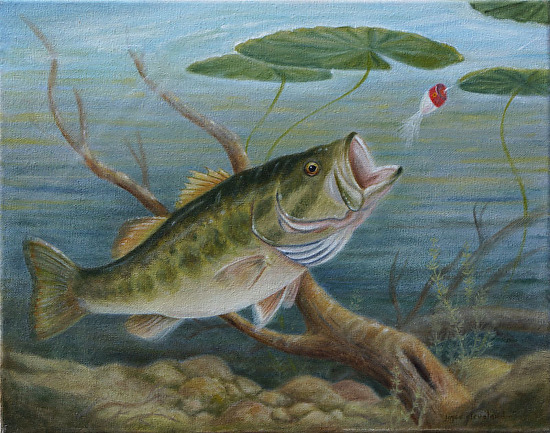
DON'T GET
HOOKED!
But (de) introduces the contrast (see importance of pausing to ponder terms of contrast) with the thought that God could tempt us to sin. James says to the contrary that is not so and explains what is so. God is not the culprit. Lust that dwells within us is the agent of deceit.
Each one (hekastos) is tempted (peirazo - present tense continually tempted) when he is carried away (exelko) and enticed (deleazo) by his own (idios) lust (epithumia) - The idea of each one (hekastos) is every single person! In short, there is not man or woman so "holy" or "pious" that they are beyond temptation. Neither is there anything anyone can do to completely escape this temptation. Even age does not remove the temptation. Like the 78 year old saint who responded to the pastor at his surprise that this elderly saint was still vulnerable to sexual temptation at his age "Son, just because I’m old doesn’t mean the blood doesn’t flow through my veins. The difference between we old men and you young men is this: we know we’re sinners. We’ve had plenty of experience. You kids haven’t figured that out yet." (Leadership, 1992).The saintly pastor Charles Simeon referred to the source of temptation in each one using the metaphor that we are all carrying around highly flammable material within our bodies! His point of course was that we need to be very careful not to light the fuse, lest the powder flare up and explode! Woe!
John Calvin wrote that James’ objective in this section is "to teach us that there is in us the root of our own destruction."
Don't let anyone deceive you into thinking our old Sin nature or the wicked flesh has been eradicated in the believer (1Jn 1:8), for Scripture does not teach this aberration, at least not until we attain glory!
The point is that since temptation never comes from God, we can (should) never blame Him when we are tempted. When God asked Adam if he had eaten from the tree he was commanded not to eat from, he actually did not answer directly instead indirectly blaming God for his predicament…
And the man said, "The woman whom Thou gavest to be with me, she gave me from the tree, and I ate." (Genesis 3:12, see context Ge 3:8, 9, 10, 11, 13)
So don't try to shift the blame onto God when you are tempted and sin! Don't use the lame logic that since God is sovereign over all, He is also sovereign over my sin. So it's not my fault. He could have stopped me! Don't say things like -
"God, You expect too much from me",
"God, You have made things too difficult for me",
"God, You have not given me the same grace and power to resist temptation that you have given others; this is just my temperament; I can't help myself",
"God, You created me this way".
Don't blame God for your temptation to sin!
So as you learn to deal correctly with temptation first recognize that you cannot blame anyone else but yourself. You need to take personal responsibility. There is a tendency in us to find excuses for our sin. There is no place for always saying “The Devil made me do it”. He may have enticed us, but we still made the choice to follow the temptation because we listened to the flesh. And don't blame bad circumstances, "bad" genes or the bad culture.
Fairbairn asked "What is temptation? Seduction to evil, solicitation to wrong. It stands distinguished from trial thus: trial tests, seeks to discover the man’s moral qualities or character; but temptation persuades to evil, deludes, that it may ruin. The one means to undeceive, the other to deceive. The one aims at the man’s good, making him conscious of his true moral self; but the other at his evil, leading him more or less unconsciously into sin. God tries; Satan tempts.
Ropes writes that "Paul in 1Cor 10:13 makes a similar exhortation in curiously different form: “Do not excuse yourselves by thinking that your temptation is greater than man can bear.” (Ropes, J. H. A Critical and Exegetical Commentary on the Epistle of St. James)
Notice that James does not blame parents, spouses, jobs, kids, etc. He doesn't label it as a disease or a dysfunction. He doesn't even blame the devil in this section because he wants to be sure we first acknowledge that we are the primary source for temptation. When you get up tomorrow morning and look at your face in the mirror, you are seeing your greatest problem! D L Moody recognized this basic principle quipping that "I have more trouble with D. L. Moody than with any man I know."
This reminds one of that cartoon strip Pogo where the hero says "We have met the enemy and he is us."
Thomas a Kempis put it this way "There is no order so holy, no place so secret, where there will be no temptation."
Those who think there are capable of attaining to sinlessness in this life are deceived and are in a precarious state for Paul writes…
let him who thinks he stands take heed (present imperative) lest he fall. (1Cor 10:12) (for as Matthew Henry rightly warned "The best of saints may be tempted to the worst of sins.")
Steven Cole has the following illustration on the subtle, persistent nature of temptation…
A man was on a diet and struggling. He had to go downtown and as he started out, he remembered that his route would take him by the doughnut shop. As he got closer, he thought that a cup of coffee would hit the spot. Then he remembered his diet. That’s when he prayed, “Lord, if You want me to stop for a doughnut and coffee, let there be a parking place in front of the shop.” He said, “Sure enough, I found a parking place right in front—on my seventh time around the block!”
As Robert Orben said,
Most people want to be delivered from temptation but would like it to keep in touch (Reader's Digest [8/86], p. 35).
Allow me to state the obvious: You will not make it as a Christian if you do not learn to overcome temptation. In the parable of the sower, Jesus taught that some make a profession of faith and begin to show signs of growth, but the heat of trials or the more subtle thorns of worldly desires cause the plant to die (see Luke 8:11, 12, 13, 14, 15, cp Mark 4:19). As I understand that parable, it is only those plants that endure and produce fruit that represent true believers. Because the enemy is strong and the lusts of the flesh are so powerful, you must learn to recognize and overcome temptation. If you do not, James says, you are on the path that leads to death.
I think that as he wrote this, James probably had in mind the graphic story in Proverbs 7 of the young man lacking sense, who succumbs to the loose woman’s enticement. His first mistake was that he passed near the corner where she lived (Pr 7:8). As “luck” would have it, at that very moment, she happens to come out of her door. As further “luck” would have it, her husband has gone on a long trip. “With her many persuasions she entices him; with her flattering lips she seduces him. Suddenly he follows her as an ox goes to the slaughter, or as one in fetters to the discipline of a fool, until an arrow pierces through his liver; as a bird hastens to the snare, so he does not know that it will cost him his life” (Pr 7:21, 22, 23). Proverbs 7:26, 27 concludes,
For many are the victims she has cast down, and numerous are all her slain. Her house is the way to Sheol, descending to the chambers of death.
James gives us a strategy for overcoming the deadly lure of temptation: To overcome temptation, recognize its source, its force, and its course. (James 1:13-15 The Source, Force and Course of Temptation)
The flesh is evil and still lives in believers and will do so until we go to be with Jesus. Don't try to get rid of it like some tribes of primitive Indians did! In Chicago's Field Museum are skulls from ancient Indians and some are called trepanned skulls because they have holes bored in them. The primitive people used would bore holes in the skulls of living people in a vain attempt to let the demons out.
F B Meyer has an interesting illustration…
Let me illustrate by the use of botany. You know that flowers have their sex, and the bees gathering honey in one flower carry the pollen to another, and the result is flower and fruit. Precisely in the same way the heart of man is always open, and bees of all kinds seem to bring the pollen of unholy thoughts; when these are sown in the desires of our nature, there is at once the result of which St. James speaks. As soon as you allow the evil thought to mingle with your nature, it bringeth forth the act of sin, and sin, when it is finished, bringeth forth death. (from Back to Bethel)
C H Spurgeon rightly reminds us that "We shall always be in danger as long as we are here."
All temptation tests your faith…
All testing of your faith is a temptation
to forsake the faith
- John Piper
John Piper although discussing Satan and not our fallen flesh as the source of temptation (in this specific sermon) has a useful analysis of the relationship of testing (James discusses this in James 1:2ff - see notes) and temptation (James 1:13; 14; 15)…
The word for temptation in Greek (peirasmos - see definition) is the same for both testing and tempting. The reason is that all temptation tests your faith, and all testing of your faith is a temptation to forsake the faith.
So when 1 John 2:14b says, “You are strong, and the word of God abides in you, and you have overcome the evil one,” it includes: You have overcome the temptation to live in sin, and you have passed the test that might have destroyed your faith.
Satan Lies…
"God is bad"
"Sin is better"
How does the word of God help us do that? I will put it in a very few sentences. Satan tempts and tests in only one way: He lies. And in all his lying, it boils down to two lies. In every test, his lie is: God is bad. And in every temptation his lie is: Sin is better. God is bad and sin is better. He has one tune to play, and he plays it in a thousand ways.
The word of God gives you the strength to overcome the evil one because by God’s grace, through the Spirit, it liberates from these lies with the truth. John 8:32, “You will know the truth, and the truth will set you free.” John 17:17, “Sanctify them in the truth; your word is truth.” Your word is truth. There it is. The word of God makes us strong to overcome the evil one because it saturates our mind with truth—truth about Christ, and truth about the cross, and the Spirit, and faith, and who we are in Christ, and the meaning of sin and calamity and sickness, and the sovereignty and goodness of God.
Not a Quick Fix…
A Way of Life
And by this Spirit-ignited, passion-producing truth, we are made strong against the lies of the evil one. We are not deceived. We hold fast to the word of life. We abide in Christ. This is not a quick fix for every problem. It is a way of life. Paul called Timothy to "fight the good fight of faith" (1Ti 6:12) and then said at the end of his life, “I have fought the good fight, I have finished the race, I have kept the faith” (2Ti 4:7). All the way to the end, we fight the evil one. And we fight with the faith-sustaining word and we win. “This is the victory that overcomes the world—our faith” (1 John 5:4). “You are strong and word of God abides in you, and you have overcome the evil one” (1Jn 2:14). (Read the entire message The Word of God Abides in You, and You Have Overcome the Evil One) (It is even better in Mp3)
Each one (1538) (hekastos) means each one of an aggregate. Hekastos stresses the universal experience of temptation individually.
Tempted (3985)(peirazo - click discussion of this verb in verse 13) is in the which once again emphasizes that temptation is a lifelong issue. The Bible does not teach a temptation free nor a sinless state in this life but only in the one to come. Notice the verb is in the present tense indicating that we are continually being (passive voice = another source, in this context the old flesh) tempted.
Dr Warren Wiersbe has some excellent words we all need to keep on the "front burner" of our mind so that we have our loins (minds) girded for action (before) the next time we are tempted to commit some flagrant, presumptive, abominable sin against our Holy, Holy, Holy God. Wiersbe writes...
BEFORE you yield to temptation
(1) look back and recall God’s goodness to you
(2) look ahead and remember “the wages of sin”
(3) look around and think of all the people who may be affected by what you do
(4) look up and ask God for the strength to say no (1 Cor. 10:13, cf 1Ch 16:11). (Borrow With the Word)
SEVEN STAGES OF TEMPTATION
| 1 | THE LOOK | "When he is drawn away" |
| 2 | THE LUST | "By his own desires" |
| 3 | THE LURE | "And Enticed" |
| 4 | THE CONCEPTION | "When desire has conceived" |
| 5 | THE BIRTH | "It gives birth to sin" |
| 6 | THE GROWTH | "And sin, when it is full-grown" |
| 7 | THE DEATH | "Brings forth death." |
Illustration - "Watch and pray (both verbs in present imperative - command for continual vigilance and dependence, because we are all constantly one choice, one decision, one step from the snare of sin!), lest you enter into temptation" (Mark 14:38).
When we recognize the ugliness of temptations, we will be better able to resist them. Someone wrote,
"If only I could see my temptations as I see other people's, they wouldn't be a bit hard to fight. Other people's temptations look so ugly and foolish. But my own temptations come with a rosy light about them so that I don't see how hateful they are until afterward. There are two ways to see temptations in their true colors. One is to pray about them and thus bring them into the clear light of God's presence. The other is to say, `How would this look if someone else yielded to it?"
To the one being tempted, enticement to sin may be appealing. But if we yield, we start down a path of self-destruction.
In Matthew 4, the first temptation Satan presented to Christ seemed harmless. He tempted Jesus to satisfy His hunger (Mt 4:3, 4). Then he posed another concerning God's protection Mt 4:5,6, 7). In the third, he openly requested Christ to worship him (Mt 4:8, 9, 10). But the Savior saw Satan's true intent—to divert Him from going to Calvary and thus prevent Him from paying sin's penalty. Christ met every appeal by quoting the Scriptures. Jesus was saying to Satan,
"I am living under the authority of My Father and His Word."
If we know God's Word, which is the sword of the Spirit (Ep 6:17), and understand how to wield it, we too can be victorious over Satan. To resist temptation, we must be strong in the Lord (Ep 6:10), filled with His Spirit (Ep 5:18), and quick to recognize the ugliness of sin. —R. W. De Haan. Our Daily Bread
If you want to master temptation,
let Christ master you.
Here's a practical reminder - If you fly from temptation remember not to leave a forwarding address. (cp Paul's related exhortation in Ro 13:14)
F B Meyer writes that "Idleness is the devil's opportunity (cp David's slippery slope beginning with sloth - 2Sa 11:1. Remember that an idle person tempts the devil to tempt him.). There are times when we are summoned to do God's bidding against His foes. If we refuse and linger in self-indulgence, we expose ourselves to terrific assaults of our great adversary. The devil tempts all men; but idle men tempt the devil! David had just risen from his mid-day siesta when he was tempted. Temptation entered through the look (2Sa 11:2). So too with Eve (Ge 3:6) and Achan (Josh 7:21). Well may we put our eyes into the Lord's keeping! (cp Pr 4:23) How often temptation enters through them! (cp Ps 101:3) Whatever be our attainments in the Divine life, we are never beyond the peril of falling into sin (1Co 10:12), which will blacken our record, and bring sorrow on all our days (Gal 6:7, 8, Pr 22:8, Job 4:8, Hosea 8:7, 10:12, 13, Pr 5:22). The more intimate you are with God, and honored in His service, the more virulent the devil's hate, and his attempt to cast you down from your excellency (Job 1:6, 7, 8, 9,10, 11, 12).
James 1:14 Lured Away
Read: James 1:5–6, 12–15
Each person is tempted when they are dragged away by their own evil desire and enticed. James 1:14
In the summer of 2016, my niece convinced me to play Pokémon Go—a game played on a smartphone, using the phone’s camera. The object of the game is to capture little creatures called Pokémon. When one appears in the game, a red and white ball also appears on the phone’s screen. To capture a Pokémon, the player has to flick the ball toward it with the movement of a finger. Pokémon are more easily caught, however, by using a lure to attract them.
Pokémon characters aren’t the only ones who can be lured away. In his New Testament letter to believers, James, the brother of Jesus, reminds us that we “are dragged away by [our] own evil desire” (1:14, emphasis added). In other words, our desires work with temptation to lure us down a wrong path. Though we may be tempted to blame God or even Satan for our problems, our real danger lies within.
We can escape the lure of temptation by talking to God about the things that tempt us.
But there is good news. We can escape the lure of temptation by talking to God about the things that tempt us. Though “God cannot be tempted by evil, nor does he tempt anyone,” as James explains in 1:13, He understands our human desire to do what’s wrong. We have only to ask for the wisdom God promised to provide (1:1–6).
Lord, when I’m tempted, show me the door of escape. By Linda Washington
Pray your way past the urge to do wrong.
INSIGHT The word translated “tempted” or “tempting” (used four times in James 1:13) comes from the Greek word peirasmos, which has two basic meanings. The first is to test the genuineness of one’s faith. This is the meaning in verses 2–4 when James encourages believers who are tempted to rejoice because “the testing of your faith” brings maturity. The second meaning, “to entice to sin or to do evil,” is intended in verses 13–15. God will not tempt or entice us to sin. His perfect holiness, purity, and goodness ensure this. Instead, the enticement to sin comes from our own sinful desires. This is the meaning of peirasmos in Matthew 26:38–41. In the garden of Gethsemane, as Christ was struggling with the necessity of going to the cross, He asked His disciples to pray with Him; instead, they slept. Jesus cautioned, “Watch and pray so that you will not fall into temptation” (v. 41). As we turn our temptations over to God in prayer, He will “provide a way out so that [we] can endure it” (1 Cor. 10:13). For further study on this subject, reflect on Psalm 119:9–11. What do these verses say will help us overcome temptation? Sim Kay Tee (Our Daily Bread, Copyright RBC Ministries, Grand Rapids, MI. — Reprinted by permission. All rights reserved)
James 1:14 Unseen Danger
Read: James 1:13-25
Each one is tempted when he is drawn away by his own desires and enticed. —James 1:14
When I was a young child, our family escaped near tragedy. Most of the main appliances in the house, as well as the furnace, were fueled by natural gas, but a small leak in one of the gas lines put our lives at risk. As the gas poured into our little house, our family was overcome by the lethal fumes and we lost consciousness. Had we not been discovered by a neighbor who happened to stop by for a visit, we all could have been killed by this dangerous, unseen enemy.
As followers of Christ, we can also find ourselves surrounded by unseen dangers. The toxic realities of temptation and the weaknesses of our own human frailty can endanger our lives and relationships. Unlike the natural gas in my childhood home, however, these unseen dangers do not come from outside of us—they reside within us. James wrote, “Each one is tempted when he is drawn away by his own desires and enticed” (James 1:14).
Our natural tendency to sin, compounded by blind spots that prevent us from seeing our own weaknesses, can lead to toxic choices that ruin us. It is only by submitting to God as He shows us our hearts in His Word (vv.23-25) that we can live a life that pleases the Master. By Bill Crowder (Our Daily Bread, Copyright RBC Ministries, Grand Rapids, MI. — Reprinted by permission. All rights reserved)
Spirit of God, descend upon my heart;
Wean it from earth, through all its pulses move;
Stoop to my weakness, mighty as Thou art,
And make me love Thee as I ought to love.
—Croly
The unseen Spirit of God is the greatest protection against sin’s unseen dangers.
James 1:14 The Devil Made Me Do It
Read: James 1:12-18
Each one is tempted when he is drawn away by his own desires and enticed. —James 1:14
In March 2009, a 62-year-old woman was charged with stealing more than $73,000 from her church in the state of Washington. When the detectives interrogated her, she told them: “Satan had a big part in the theft.” It sounds like she was saying that the devil made her do it.
Satan may have played a role in her choices, but she has some faulty thinking about temptation and sin. The devil tempts believers, but he doesn’t make us sin. James tells us that God isn’t to blame either: “Let no one say when he is tempted, ‘I am tempted by God’; for God cannot be tempted by evil, nor does He Himself tempt anyone” (James 1:13). He is good and holy.
So who is to blame for our sin? James says, “Each one is tempted when he is drawn away by his own desires and enticed” (v.14). Just as a fisherman uses bait to lure his prey, so our own evil, unchecked desires lead to giving in to temptation and sin.
When we disobey God by sinning, let’s not shift the blame or justify our actions with the faulty “the devil made me do it” theology. Instead, let’s take full responsibility for our actions, confess our sins to a gracious and forgiving Father, and pursue right living again.By Marvin Williams (Our Daily Bread, Copyright RBC Ministries, Grand Rapids, MI. — Reprinted by permission. All rights reserved)
It’s wise to flee when tempted—
A fool is one who’d stay;
For those who toy with evil
Soon learn it doesn’t pay.
—D. De Haan
When we sin, the blame lies within.
James 1:14. The Trojan horse (Thomas Watson, "The Lord's Prayer") "Deliver us from evil." Matthew 6:13 In this petition, we pray to be delivered from the evil of our heart, that it may not entice us to sin. The heart is the poisoned fountain, from whence all actual sins flow. "For from within, out of the heart of man, come evil thoughts, sexual immorality, theft, murder, adultery, coveting, wickedness, deceit, sensuality, envy, slander, pride, and foolishness." Mark 7:21-22. The cause of all evil lies in a man's own bosom—all sin begins at the heart. Lust is first conceived in the heart—and then it is midwifed into the world. Whence comes rash anger? The heart sets the tongue on fire. The heart is the shop where all sin is contrived and hammered out. The heart is the greatest seducer "Each one is tempted when he is carried away and enticed by his own lust." James 1:14. The devil could not hurt us—if our own hearts did not give consent. All that he can do is to lay the bait—but it is our fault to swallow it! How needful, therefore, is this prayer, "Deliver us from the evil of our hearts!" It was Augustine's prayer, "Lord, deliver me from that evil man—myself!" Beware of the bosom traitor—the flesh. The heart of a man is the Trojan horse—out of which comes a whole army of lusts! O let us pray to be delivered from the lusts and deceits of our own heart!
Sow a thought, and you reap an act;
Sow an act, and you reap a habit;
Sow a habit, and you reap a character;
Sow a character, and you reap a destiny.
—Samuel Smiles
W T Taylor - Temptation rarely comes in working hours. It is in their leisure time that men are made or marred.
Erwin Lutzer reminds of the sobering truth that…
Each temptation leaves us better or worse; neutrality is impossible… Our response to temptation is an accurate barometer of our love for God (cp John 14:15).
We need to remember that times of prosperity can easily become times of temptation to do evil if we receive the gifts of God but fail to thank the Giver (Dt 6:10, 11, 12, 13, 14, 15).
The goal of temptation is to sow in our minds and hearts the seed of unbelief/disbelief that God's way is the most satisfying way for us to live and includes the lie that something besides Him can give us full joy! (cp Ps 16:11).
"Tight corners" bring us face to face with trusting versus temptation.
Nobody can deny there is pleasure in sin. If there were no pleasure in sin, nobody would fall into temptation. The Bible speaks about the pleasures of sin for a season. What season? The season of sowing. The pleasure of sin comes when we sow, but the pain comes when we reap.
Never cultivate a temptation with a view to yielding to sin. Meditate on the Word of God, obey it and guard your heart with its truth. Stay in fellowship with the Lord.
A B Simpson writes about…
The source of temptation; whence it comes.
"Every man is tempted when he is drawn away of his own lust."
Temptation comes from your own heart. There are innumerable tempters, men, women and fallen spirits of wickedness. But none have any power unless we have ourselves a traitor in the citadel of the heart (cp Pr 4:23). The enemy cannot get in unless you let him in. You hold the key of the fortress. Therefore it is in your own heart that the crucial battle is fought, the secret foe is hidden, your own lust, your own desire or "coveting," which is the literal translation, the thing in you that wants to do the wrong; your wish for it, even if it is not yet your will. This is the starting place of temptation. It is the blossom of sin. And this is where God wants to bring His sanctifying grace (2Co 12:9, 10, Titus 2:11, Titus 2:12, Titus 2:13) and take away the very desire (cp Gal 5:16). Just as the sea fowl plunging in the miry water comes up undefiled because its wing is oiled and burnished, and the filth around cannot adhere to it, so the Lord Jesus passed through the powers of darkness and the allurements of the world and all the evil that was around Him and was proof against it (He 4:15). He could say "the prince of this world cometh and hath nothing in me." It is in the heart that temptation has its starting point. Ask God to give you a true and holy desire to please Him (cp Php 2:13, He 13:20, 21, Ezek 36:27), and an instinctive repugnance and recoil from evil (cp Job 1:1, 28:28, Pr 8:13, 16:6, 14:16, 27, Ne 5:15 Ps 34:11, 12, 13, 14 Eccl 12:13 2Co 7:1), and so long as you have this, you shall not fall into temptation (cp Mt 26:41).
Then we have the blessedness of resisting and enduring temptation… "Blessed is the man that endureth temptation." (James 1:12) The battle does you good (cp Dt 8:2,3). The conflict educates you, strengthens you, establishes you, and is necessary for you that you may be grounded and settled and finally approved and rewarded.
One of the best results of temptation is that it shows you what is in your own heart. It reveals yourself. Until temptation comes, you feel strong and self-confident, but when the keen edge of the adversary's weapon has pierced your soul, you have more sympathy with others and less confidence in your own self-sufficiency, and you are humiliated and broken at His feet, a poor, helpless thing, and this is the best thing that can happen to you. God wants to disarm you and lay you low, and then He can lift and save you and give you His strength (cp James 4:6, 1Pe 5:5, 2Co 12:9, 10). It makes you humble and doubtful of yourself. You find you must not take the aggressive, but fly to your refuge in Christ (cp Pr 30:5, Pr 18:10). He will "make a (Ed: not just "a" way, but "the" specific way) way of escape that you may be able to bear it." (1Cor 10:13) Like the little conies that hide in the rock and do not face their enemies, but fly for shelter, you will find your only safeguard is Jesus Christ; He is the shield to cover you, and you will be safe not by fighting, but by hiding behind the cross and in the bosom of your Savior.
If you have had much spiritual conflict, it has humbled you, shown you your helplessness, and taught you sympathy for others.
Temptation exercises our faith and teaches us to pray (cp Mt 26:41). It is like military drill and a taste of battle to the young soldier. It puts us under fire and compels us to exercise our weapons and prove their potency. It shows us the resources of Christ and the preciousness of the promises of God (cp 2Pe 1:4). It teaches us the reality of the Holy Spirit and compels us to walk closely with Him and hide continually behind His strength and all-sufficiency (Gal 5:16, 17, 18, 24notes). Every victory gives us new confidence in our victorious Leader, and new courage for the next onset of the foe, so that we become not only victors, but more than conquerors, taking the strength of our conquered foes and gathering precious spoil from each new battle field. So that temptation strengthens what we have received and establishes us in all our spiritual qualities and graces (cp Peter in Lk 22:32).
You will find the forest trees which stand apart, exposed to the double violence of the storm, are always the sturdiest and strike their roots the deepest in the soil.
And so it is true in the spiritual world, as the apostle Peter expressed it; "The God of all grace, who hath called us unto his eternal glory by Christ Jesus, after that ye have suffered a while, make you perfect, stablish, strengthen, settle you." (1Pe 5:10)
At the same time temptation teaches us to watch as well as pray (Mt 26:41), to avoid the things that bring temptation (Ro 13:14), and to keep off the enemy's ground (cp Ep 4:26, 27 where opportunity = space, land, territory, an occasion). It is only the inexperienced Christian that plays lightly with evil.
Luther used to say
He must needs have a long spoon who sups with the devil.
"Pray," says Bishop Hamlin, "from God's side of the fence."
Don't jump over into the devil's garden, and then ask God to help you, but keep on God's side, and watch and pray that ye enter not into temptation. Often our overconfidence betrays us. Like the man who had escaped the bailiff who tried to serve him with a warrant for arrest, and had just got across the State line, where the law protected him, when his pursuer, exchanging guile for force, laughed and said, "You have the best of me. And now let us shake hands and part friends." The foolish fellow reached out his hand, and in a moment the bailiff had pulled him over to his side of the line and clapped the handcuffs on him. So if Satan cannot beat us fairly, he will allure us so near the borders of danger that we shall be caught by his wiles. Some people sail so near the lake of fire that they get their sails scorched and find it impossible to get away. The maturest Christian is always the humblest and most watchful. Let us be not high-minded, but fear, and learn to combine the two blessed safeguards of hope and fear, which God has so wisely blended in these two passages: 1Co 10:12: "Let him that thinketh he standeth take heed lest he fall," and then adds in the thirteenth verse, "God is faithful, who will not suffer you to be tempted above that ye are able." (1Co 10:13) And yet once more, in the fourteenth verse, he returns to the language of warning and caution, "Wherefore, my dearly beloved, flee (present imperative = command to keep on running from it, because our old nature is ever attracted toward it! In this life believers will never get over the continual need to flee - As John Dryden said " Better shun the bait than struggle in the snare.") from idolatry." (1Co 10:14)
Temptation also teaches us patience. "But let patience have (present imperative = command to keep on allowing) her perfect work, that ye may be perfect and entire, wanting nothing." (James 1:4) This implies that patience is the finishing grace of the Christian (race) life. Therefore, God usually puts His children through the school of suffering last. It is the graduation class in the discipline of Christ. Let us not, therefore, be surprised if God puts us through the hottest of all furnaces, namely, that which is fired with the devil's brimstone, before He makes us vessels for His glory.
5. Temptation brings a glorious recompense of reward, for "when he is approved, he shall receive the crown of life, which the Lord hath promised to them that love Him." There is a reward for the soul-winner. There is a reward for the Christian pastor and worker. But there is also a special reward for the man or the woman that has had no great service, and perhaps has won no single soul, but has stood in the hard place, has kept sweet in the midst of wrong, and in the face of temptation, pure amid the allurements of the world, and simply withstood in the evil day, and having done all, stood at last approved. On the field of Waterloo, there was a regiment which stood under fire through all that awful day and was not once suffered to charge upon the foe. It held the key to the position, and as again and again permission to advance was asked, the answer came "Stand firm." When they had nearly all fallen, the message came back for the last time from their commander, "You have saved the day," and the answer was returned, "You will find us all here." Sure enough they lay a heap of slain on that fatal, yet glorious hill. They had simply stood, and history has given them the reward of valor and the imperishable fame of having turned the tide of the greatest battle of the nineteenth century. So God is preparing crowns for quiet lives, for suffering women, for martyred children, for the victims of oppression and wrong, for the silent sufferers and the lonely victors who just endured temptation. Tempted brother, be of good cheer. Some day you will wonder at the brightness of your crown. (See A. B. Simpson's Christ in the Bible - related to James = Simpson has 8 chapters on Christ in James)
WHEN HE IS CARRIED AWAY AND ENTICED BY HIS OWN LUST: hupo tes idias epithumias exelkomenos (PPPMSN) kai deleazomenos (PPPMSN):
- When he is carried away - James 4:1-2; Ge 6:5; 8:21; Josh 7:21-24; 2Sa 11:1-5; 1Ki 21:2-4; Job 31:1, 9; Job 31:27; Pr 4:23; Isa 44:20; Hos 13:9; Mt 5:28; 15:18,20; Mk 7:21-22; Ro 7:11,13; Eph 4:22; Heb 3:13
- James 1 Resources - Multiple Sermons and Commentaries
Related Passages:
James 4:1-2 What is the source of quarrels and conflicts among you? Is not the source your pleasures that wage war in your members? 2 You lust and do not have; so you commit murder. You are envious and cannot obtain; so you fight and quarrel. You do not have because you do not ask.
Matthew 5:28 but I say to you that everyone who looks at a woman with lust for her has already committed adultery with her in his heart.
2 Samuel 11:1-5 Then it happened in the spring, at the time when kings go out to battle, that David sent Joab and his servants with him and all Israel, and they destroyed the sons of Ammon and besieged Rabbah. But David stayed at Jerusalem. 2Now when evening came David arose from his bed and walked around on the roof of the king’s house, and from the roof he saw a woman bathing; and the woman was very beautiful in appearance. 3So David sent and inquired about the woman. And one said, “Is this not Bathsheba, the daughter of Eliam, the wife of Uriah the Hittite?” 4David sent messengers and took her, and when she came to him, he lay with her; and when she had purified herself from her uncleanness, she returned to her house. 5The woman conceived; and she sent and told David, and said, “I am pregnant.”
Mark 7:21-22 (AN "INSIDE" JOB) “For from within, out of the heart of men, proceed the evil thoughts, fornications, thefts, murders, adulteries, 22deeds of coveting and wickedness, as well as deceit, sensuality, envy, slander, pride and foolishness.
Romans 7:11; 13 for sin, taking an opportunity through the commandment, deceived me and through it killed me. (7:13) Therefore did that which is good become a cause of death for me? May it never be! Rather it was sin, in order that it might be shown to be sin by effecting my death through that which is good, so that through the commandment sin would become utterly sinful.

DRAWN OUT FROM
BENEATH THE ROCK
Just as fish don't fall for every type and color of lure, so too our flesh knows not all lures will work on us. But the sinful flesh is very "smart" (it's had a lot of practice with us!) and knows which color and shape of lure is especially proficient in enticing us to continue to look until suddenly capitulate, snap and take "hook, line and sinker!" Sin looks good, but it's end is death! Don't be deceived!
When - He does not say "if" but "When". It is not a possibility but a reality! Beware of thinking otherwise!
He is carried away (exelko) and enticed (deleazo) by his own (idios) lust (epithumia) - Note that both verbs (carried away...enticed) are in the present tense which indicates this is a continual danger, because our unredeemed flesh is ever lurking to catch us off guard with its deceptive lusts.
Carried away… enticed - Brian Bell feels "This speaks of a “2-fold enticing process” that takes place when we are being tempted. First we are drawn out of our place of safety, then we are allured by a specific bait."
In view of the fact that we are continually being carried away and enticed William MacDonald asks "Are we helpless victims then, when we are drawn away by our own desires and enticed? No, we may expel all thoughts of sin from our mind and concentrate on subjects that are pure and holy (Phil 4:8). Also in the moment of fierce temptation, we may call on the Lord, remembering that “The name of the Lord is a strong tower: the righteous run to it, and are safe” (Pr 18:10). (Borrow Believer's Bible Commentary)
David Guzik- Some who like to emphasize the sovereignty of God say that God is responsible for all things. Yet God is never responsible for man’s sin. In his commentary on this text, John Calvin himself wrote, “When Scripture ascribes blindness or hardness of heart to God, it does not assign to him the beginning of the blindness, nor does it make him the author of sin, so as to ascribe to him the blame.” Calvin also wrote, “Scripture asserts that the reprobate are delivered up to depraved lusts; but is it because the Lord depraves or corrupts their hearts? By no means; for their hearts are subjected to depraved lusts, because they are already corrupt and vicious.”
C H Spurgeon on his own lust - This is the essence of an evil temptation, a man’s own lust…This is the wanton harlot that deceives the heart of man: his own desire grown strong and hot till it cometh to be a lusting: this draws a man away; it baits the hook, and man swallows it and is thus entrapped and enticed. (Spurgeon's Bible Commentary)
He is carried away (1828) (exelko from ek = out or away + hélko = draw) means to draw out, drag forth, draw away, like a fish is drawn out from its retreat beneath a rock. So just as in hunting and fishing the game is lured from its hiding place, so too man is allured by temptation allured from the safety of self-control (even Spirit enabled self control - Gal 5:23) to commit acts of sin. It is worth reiterating that this fishing metaphor depicts being dragged out, drawn away from safety by bait. The image is of desire spotting something appealing and beginning to move toward it, being drawn out of a safe position by the attractiveness of the bait.
Johann Albrecht Bengel says that initially "we are drawn away from truth and virtue." Bengel is saying that sin does not usually begin with an outward act. It begins inwardly, when the heart is slowly pulled away from God’s truth and from righteous character. In Genesis 3:6 Eve first looked, then desired, and finally believed the serpent’s distortion before eating. In sum, Bengel is saying that moral failure rarely happens suddenly; the heart is first seduced away from God’s truth and from the practice of virtue.
Matthew Poole on carried (drawn) away - “It is either a metaphor taken from a fish enticed by a bait, and drawn after it, or rather from a harlot drawing a young man out of the right way, and alluring him with the bait of pleasure to commit folly with her.”
Here are a few "proverbial like" thoughts on temptation all from anonymous sources…
Following the lines of least resistance makes men and rivers crooked. He who avoids the temptation avoids the sin. It takes two to make a successful temptation, and you are one of the two. Most people who fly from temptation usually leave a forwarding address. Never invite temptation—it always accepts. No one can be caught in a place he does not visit. There is no merit in abstaining from what one is not tempted to do. We are never strong enough to risk walking into temptation. Temptations, like foul weather, come before we send for them. Temptations are everywhere, but so is the grace of God. If you would master temptation, you must first let Christ master you. Every temptation is an opportunity to get nearer to God. (Most of these are from Complete Gathered Gold )
Steven Cole on drawn away - The fish sees the bait and it lures him toward it, thinking that he will get a meal. Instead, he gets hooked and carried away, where he becomes the meal! The temptation to sin is like that. We think that sin will satisfy us and get us something good that we’re missing (cf Heb 11:25b). But instead, it hooks us and drags us to destruction. There is always that deceptive element to temptation. It is strengthened by the powerful emotions involved. As believers, we are not to live by our feelings, but by faith and obedience (Ed: see the good old hymn Trust & Obey), based on the knowledge of God’s word of truth. We need to follow it, no matter how strongly our feelings pull us in a different direction. One time Marla and I were hiking off trail up on Mount Agassiz. It’s an area where we’ve hiked often, but we’ve often gotten turned around. On this occasion, we came out under some power lines, and I sensed that we needed to go uphill to get back to where we started. But when we had crossed the lines the first time, I had looked at my altimeter. When we crossed the lines again, my altimeter said that we were 500 feet higher. So, I trusted the altimeter, not my feelings, and we went downhill. Sure enough, we came to where we needed to be. God’s Word is like that altimeter. Temptation makes us feel like heading toward sin, but we need to follow God’s Word, no matter what we feel. (James 1:13-15 The Source, Force and Course of Temptation)
Kent Hughes has the following illustration of the process of temptation…
One summer recently my wife, Barbara, and I and our boys spent a week fishing in northern Maine. In the final hour of the final day my boys caught the biggest smallmouth bass I have ever seen—five pounds, one ounce! Those are cosmic dimensions for a smallmouth bass! That old bass, the best I can tell, was over ten years old. For 3,650 days he had resisted every ploy known to man around Grand Lake Stream, Maine—until August 1989. On that fateful afternoon my boys were slowly trolling a salmon-colored, soft plastic, spinner-bladed jig, innocuously named “Little Fishy,” when it passed by the lair of the monster bass. The combination of the speed of the lure, its depth, the slant of the sun, and the refraction of the light ineluctably dragged the old bronze-backed bass away from his lair, just as the Greek words “dragged away” (Ed: "carried away" in NAS) in our text describe. Then he began to follow the lure, “enticed,” as our text has it, by its peculiar wiggle and the delicate fibrillations, so that he opened his mouth wide and in a sudden burst engulfed the jig. My boys’ shouts echoed across the lake, and today that fish’s grand, painted, mummified form graces my sons’ wall. It was a remarkable experience, but not unique, for it is universal among fishermen. The ancient Greek Oppian used these same words to describe drawing a fish from its original retreat under a rock, so that it succumbs to the bait. James, in using these words, has graphically painted a picture of how we are tempted by our own illicit desires (lusts). (SEE James: Faith That Works - Page 47)
Enticed (1185) (deleazo from delear = a bait) means to to beguile, entice by blandishments, entrap, delude, allure, entice. Deleazo was commonly used as fishing term to refer to bait. The idea of deleazo then is to catch by use of bait as does a trapper (bait in a trap or snare) or fisherman who lures prey from their place of hiding. Evil desires act as a bait to "hook" us and get us in trouble. Lust hides the hook so to speak! The point is that no temptation appears as temptation but always seems more alluring and promising than it proves to be. This describes the will following the desire as it moves toward the object. The trap begins to close.
Note again the present tense pictures continual enticement. Temptation continually prods and baits us by appealing to our dark side.
An illustration of enticing words - Knowing how much an acquaintance despises his wife’s parakeet, I was surprised one day to hear him coaxing it to speak. Upon listening more closely, however, I nearly choked holding back my laughter. Now, along with its constant, annoying jabbering, the bird also calls out a suicidal, “Here kitty, kitty, kitty.” (Contributed by Lisa French Reader’s Digest, September 1983, p. 130)
Grant Richison has an interesting thought writing that "Knowledge does not seem to prevent us from yielding to temptation. Temptation is more powerful than our knowledge. (Ed Note: Knowing about God is one thing. Knowing God intimately is quite different and it is this intimate, experiential "knowledge" associated with sweet fellowship, that motivates and empowers the saint's walk of victory over sin, self and Satan. cp 1Th 4:5 which implies that the solution for "lustful passion" is "knowing God" - see , cp knowledge in James 2:19 - see )
Mayor mentions a number of examples where deleazo is used to describe the "drawing of the fish out of its original retreat."
Donald Burdick - James pictures man's "evil desire" first, as attracting his attention and persuading him to approach the forbidden thing and second, as luring him by means of bait to yield to the temptation. Robertson entitles this verse "Snared by One's Own Bait." (SEE The Expositor's Bible Commentary - Abridged Edition- Page 7)
In short, the first effect of lust is to draw man out of his original repose
and the second is to allure him to a definite bait.
Vaughan - The suggestion is that man's lust, like a harlot, entices and seduces him. Man surrenders his will to lust, conception takes place, and lust gives birth to sin. (SEE James: Bible Study Commentary - Page 31)
Warren Wiersbe - Temptation always carries with it some bait that appeals to our natural desires. The bait not only attracts us, but it also hides the fact that yielding to the desire will eventually bring sorrow and punishment. It is the bait that is the exciting thing. Lot would never have moved toward Sodom had he not seen the “well-watered plains of Jordan” (Ge 13:10, 11). When David looked on his neighbor’s wife (1Sa 11:1, 2, 3, 4, 5), he would never have committed adultery had he seen the tragic consequences: the death of a baby (Bathsheba’s son), the murder of a brave soldier (Uriah), the violation of a daughter (Tamar). The bait keeps us from seeing the consequences of sin. (Bible Exposition Commentary)
Entice is an interesting word in terms of derivation Webster writing that it comes from the Latin Latin in- + titio = firebrand. "The sense, in these languages, is to lay the firebrands together, or to stir the fire; to provoke; to incense. The sense in English is a little varied." Entice means to to draw towards oneself (what a picture of temptations originating from our depraved strong inner desires or lusts!) or to attract artfully or adroitly or by arousing hope or desire. Entice is usually used in a bad sense (as entice to evil) and hence, means to seduce; to lead astray; to induce to sin, by promises or persuasions.
There are 3 uses of deleazo, here and two other uses in 2 Peter where we see false teachers “entice unsteady souls” and those who have once escaped from error.
2 Peter 2:14 (note) having eyes full of adultery and that never cease from sin, enticing unstable souls (Asteriktous. Why unstable? 2 Peter 1:12 explains the opposite character using the related verb - sterizo in the perfect tense - Ephesians 6:14 also instructs believers to stand firm. Note carefully in both cases the foundational, stabilizing effect of Truth, the Word of Truth. Why are so many saints seemingly not experiencing the abundant life Christ promised? I fear it is because they are not being stabilized by the regular eating of "every Word that proceeds from the mouth of God"! And don't just read it but memorize it so you will be able to meditate and be blessed and like a tree firmly planted by streams of living water! See notes Psalm 1:1; 1:2; 1:3), having a heart trained in greed, accursed children… 18 (note) For speaking out arrogant words of vanity (false teachers Peter describes would dangle the "baited lure" in front of their unsteady victims causing them to look away from the Lord Jesus and His Word. They offer people a kind of religion that they can embrace and still hold on to their fleshly desires and sensuality.) they entice (present tense = continually) by fleshly desires, by sensuality, those who barely escape from the ones who live in error,
John MacArthur rightly notes that…
Animals and fish are successfully lured to traps and hooks because the bait is too attractive for them to resist. It looks good and smells good, appealing strongly to their senses. Their desire for the bait is so intense that it causes them to lose caution and to overlook or ignore the trap or the hook until it is too late.
In exactly the same way, we succumb to temptation when our own lust draws us toward evil things that are appealing to fleshly desire. Although in contemporary use, lust has long been associated almost exclusively with illicit sexual desire, the Greek term epithumia that it translates refers to a deep, strong desire or longing of any kind, good or bad.
Sin can look attractive and pleasurable, and usually is, at least for a while (cp Heb 11:25, Heb 3:13). Otherwise it would have little power over us. Satan tries to make sin as attractive as possible, as do the evil and seductive men and women just described above by Peter. But there would be no attraction of sin were it not for man’s own sinful lust, which makes evil seem more appealing than righteousness, falsehood more appealing than truth, immorality more appealing than moral purity, the things of the world more appealing than the things of God. We cannot blame Satan, his demons, ungodly people, or the world in general for our own lust. Even more certainly, we cannot blame God. The problem is not a tempter from without, but the traitor within. (SEE James MacArthur New Testament Commentary - Page 49)

THE ENEMY
IS US!
Enticed by his own lust - Lust always promises more than it produces. That is, more than it produces in a positive (beneficial) sense. It's fruit is never ripe and good but ever rotten! James is saying we have met the enemy and the enemy is within us. The enemy is not just out there somewhere but is on the inside. The upshot is that we must not let our guard down but must constantly remain alert for surprise attacks from the lusts of our flesh!
His own lust - Recall that James began with each one emphasizing that temptation attacks every single individual, without exception. If you are breathing, you are going to be tempted! Own is idios meaning one's own, personal, private, peculiar to oneself. Thus it emphasizes exclusive personal ownership and individual accountability. The the desire belongs to each individual and does not belong to someone else. The blame for falling to temptation, then, cannot be shifted to others. To be sure, the devil is real. The world is real. But the decisive factor in temptation is not outside but is inside. The combustible material is already resident in the heart. The enemy merely strikes the match.
The Puritan writer Thomas Watson explains that the "heart of the problem" is our heart writing that in the Lord's (really the "Disciple's) prayer, that when Jesus instructs us to pray…
Deliver us from evil, we pray to be delivered from the evil of our heart, that it may not entice us to sin. The heart is the poisoned fountain, from whence all actual sins flow. "For from within, out of a person's heart, come evil thoughts, sexual immorality, theft, murder, adultery, greed, wickedness, deceit, eagerness for lustful pleasure, envy, slander, pride, and foolishness." Mk 7:21, 22. The cause of all evil lies in a man's own bosom-all sin begins at the heart. Lust is first conceived in the heart, and then it is mid-wifed into the world. Whence comes rash anger? The heart sets the tongue on fire. The heart is a shop or workhouse, where all sin is contrived and hammered out. How needful, therefore, is this prayer, deliver us from the evil of our hearts! The heart is the greatest seducer, therefore the apostle James says, "Each one is tempted when, by his own evil desire, he is dragged away and enticed." Jas 1:14. The devil could not hurt us, if our own hearts did not give consent.
All that he can do is to lay the bait-
but it is our fault to swallow it!
O let us pray to be delivered from the lusts and deceits of our own heart. "Deliver us from evil." Luther feared his heart more than the pope or cardinal; and it was Augustine's prayer, "Lord, deliver me from myself!" It was good advice one gave to his friend, "Beware of yourself!" Beware of the bosom traitor, the flesh. The heart of a man is the Trojan horse, out of which comes a whole army of lusts. (Matthew 6:13 The Sixth Petition in the Lord's Prayer)
James is not teaching that Satan never has a role in tempting us and in fact later alludes to the devil's tactics writing…
Submit therefore to God. Resist the devil and he will flee from you. (James 4:7)
Comment: The devil is left out of the present discussion as a source of temptation for the mention of his role as Tempter would only have provided the sinner with an alternative excuse. James wants us to focus on the heart of the problem which is the problem with our heart! Note the two verbs in red are both aorist imperative, which is a command calling for urgent attention! Don't put this off!
Thomas Kempis has said, "First there comes to the mind a bare thought of evil, then a strong imagination thereof, afterward delight and evil motion, and then consent." His advice was, "Withstand the beginnings." If you apply a magnet to the end of a needle that moves freely on its pivot, the needle affected by a strong attraction approaches as if it loved it Reverse the order, applying the magnet to the other pole, and the needle shrinks away trembling as if it hated it One man rushes into the arms of vice; another recoils from it in horror According as the nature it addresses is holy or unholy, temptation attracts or repels, is loved or hated Our Lord Jesus said, "Watch and pray, that ye enter not into temptation: the spirit indeed is willing, but the flesh is weak" (Matthew 26:41).
Lusts (epithumia) (see more discussion on epithumia below) is a neutral word that describes for example even the normal God given desires of hunger, thirst, etc. Even sexual desire is God given and without it the human race may never have procreated! Sadly, this desire (among many) has been grossly distorted and perverted by our fallen flesh, the godless world system and the devil. Epithymia in James 1:14 is a powerful, intense inner craving, in this context a sinful desire that has fixed itself on a forbidden object. It is not external, it is not from God, it is your own, intrinsic or native to your fallen nature.
In an attempt to control these lusts many have gone to non-biblical extremes, Paul writing that…
These are matters which have, to be sure, the appearance of wisdom in self-made religion and self-abasement and severe treatment of the body, but are of no value against fleshly indulgence (no effect when it comes to conquering a person's evil thoughts and desires). (Col 2:23)
So what James is explaining is that the source of temptation is not actually in external "lure" (like a fishhook) but emanates from the inherent lust in every man.
Where Does This Desire (LUST) Come From? James does not fully explain its origin here, but the rest of Scripture fills in the picture. Before the Fall Adam and Eve had desires, but they were rightly directed. They desired what was good because their nature was oriented toward God. At the Fall, their human nature became "misdirected." The desires themselves became twisted, capable of fixing themselves on objects forbidden by God and doing so with great intensity. This is what theologians call concupiscence (especially as it pertains to sexuality), the inward bent toward sin that remains even in regenerate, born again believers. In the Believer, Paul describes this inner conflict in Romans 7:1-25. The fallen desires of the flesh are continually at war against the Spirit (Galatians 5:17). Praise God that the believer has new desires planted by the Spirit, but the old sinful cravings do not disappear. They must be mortified or put to death progressively through the Spirit's power (Romans 8:13, Colossians 3:5). This "mortification" is a major component of progressive sanctification which will last until we pass on to glory.
Lehman Strauss adds that "Temptation is traced first to our lusts, or desires. Where there is no desire there is no temptation. Not all persons have the same evil desires. An evil which may be desirable to one person may be repulsive to another. We are sometimes critical of others who have evil desires which may not bother us, forgetting that we have evil desires which may not appeal to them."
Donald Robert Perry Marquis wrote a poem based on an imaginary conversation between a rat and a moth. - The rat asked some hard questions: Why did moths fly into candles and other bright lights and risk getting themselves fried to death? The answer, written in the poet's unpunctuated style, is very instructive: we get bored with routine - and crave beauty - and excitement - fire is beautiful - and we know that if we get - too close it will kill us - and what does that matter - it is better to be happy - for a moment - and be burned up with beauty - than to live a long time - and be bored all the while. (Brian Bell)
Although lust is the main fisherman described by James, Thomas Adams adds that…Satan, like a fisher, baits his hook according to the appetite of the fish. We have many leaders into temptation, but it is our fault if we follow them.
Steven Cole has some practical thoughts about how we overcome temptation and sin writing…
To overcome temptation, it is important to realize that although the initial thought to sin stems from my sinful flesh, it is not sin unless I pursue it. For example, if I’m flipping through a magazine and come to a picture of a seductive woman, the thought will probably pop into my mind, “Wow, she’s quite a woman!” Right there, I face a critical decision: Will I go farther, entertaining sinful thoughts of what it might be like to have sex with such a woman, or will I turn from the temptation and “put on the Lord Jesus Christ, and make no provision for the flesh in regard to its lusts” (Ro 13:14 )?
Sin always begins in the mind. No one ever falls into adultery without first entertaining it in his (or her) thought life. If we judge these sinful thoughts the instant they pop into our minds, we will not head down the path toward outwardly sinful behavior. If we do entertain such sinful thoughts, sooner or later Satan will present the outward opportunity to sin, and we will fall. But in such cases, the actual sin has been going on mentally for some time. If we make it our habit to take “every thought captive to the obedience of Christ” (2Cor 10:5), we will not sin in thought or deed. We differ from person to person with regard to the things that tempt us. Men differ from women, but also men differ among men, and women among women. Pride leads us to judge those who yield to sins that have little appeal for us: “How could they do such a thing?” But the same pride lets us excuse our “weakness.” “That’s just the way I am!” Humility says, “Let him who thinks he stands take heed that he does not fall” (1Co 10:12).
Also, when we yield to a particular sin, it becomes a point of vulnerability for future temptation. For example, you could leave me in a room with a bag of cocaine, and it would not tempt me in the least. I’ve never yielded to that sin, and it just doesn’t have any appeal to me. On the other hand, in certain circumstances I am tempted to look at pornography, because as a young man I did yield to that sin. So I now have to be on guard against every form of that temptation.
So James’ first point is that to overcome temptation, we must recognize its source. It does not come from God. It comes from our own sinful desires. (James 1:13-15 The Source, Force and Course of Temptation)
Steven Cole in his sermon series on 1Timothy writes…
moral purity (must be) not just outwardly, but in the thought life. Sexual immorality always begins in the mind. Walking with Christ means taking “every thought captive to the obedience of Christ” (2Cor 10:5). As soon as a wrong thought pops into your mind, you confess it and turn from it (Job 1:1, 1Co 6:18). You “put on the Lord Jesus Christ and make no provision for the flesh in regard to its lusts” (Ro 13:14).
Moral failure among pastors is happening with shocking frequency in the American church. A Leadership survey (Winter, 1988, pp. 12-13) revealed that one out of eight pastors have committed adultery since they’ve been in local church ministry. Almost one out of four admitted to doing something they feel was sexually in-appropriate. One out of five acknowledged fantasizing at least weekly about sex with someone other than their spouse. If you widen the question to monthly, the number grows to over one out of three.
Dietrich Bonhoeffer describes how we are tempted by lusts…
In our members there is a slumbering inclination (Ed: Mine doesn't seem to slumber enough!) towards desire (lust) which is both sudden and fierce. With irresistible power desire (lust) seizes mastery over the flesh. All at once a secret, smoldering fire is kindled. The flesh burns and is in flames. It makes no difference whether it is sexual desire, or ambition, or vanity, or desire for revenge, or love of fame and power, or greed for money, or finally, that strange desire for the beauty of the world, of nature… With irresistible power desire seizes mastery over the flesh… Joy in God is…extinguished in us and we seek all our joy in the creature. At this moment God is quite unreal to us (Ed: We become in essence "practical atheists, Biblical amnesiacs!"), He loses all reality, and only desire (lust) for the creature is real (Ed: Or at least seems to be real at that moment!)…Satan does not here fill us with hatred of God, but with forgetfulness of God…The lust thus aroused envelops the mind and will of man in deepest darkness. The powers of clear discrimination and of decision are taken from us. The questions present themselves: “Is what the flesh desires really sin in this case?” (Ed: Remember that sin at its core is deceitful. See Heb 3:13) “Is it really not permitted to me, yes—expected of me, now, here, in my particular situation, to appease desire?”…It is here that everything within me rises up against the Word of God (Ed: And the God of the Word. This is tantamount to willful rebellion which outside of God's great mercies would call for our death). (Creation and Fall--Temptation)
THE PATHOGENESIS OF SIN
|
STAGE |
WHAT HAPPENS |
METAPHOR |
|
Lust Spots Object |
Desire is aroused |
Bait is seen |
|
Lured and enticed |
Will begins to follow desire |
Hook is set |
|
Desire conceives |
Will & desire unite in a choice |
Conception |
|
Gives birth to sin |
The act is committed |
Birth |
|
Sin fully grown |
Pattern of sin established |
Maturity |
|
Brings forth death |
Eternal Consequence |
Death |
SOME PRACTICAL POINTS
1. Temptation itself is not sin
The arousal of desire — even sinful desire — is not itself sin. Jesus was tempted yet without sin (Hebrews 4:15). The sin occurs at the point of conception — when the will embraces and acts on the desire.
2. The battle must be fought early
The further down the chain you go, the harder it is to stop. The time to fight is at the luring stage, when desire first spots its object, not after conception has occurred! This is why Job made a covenant with his eyes (Job 31:1) and Paul says to "make no provision for the flesh" (Ro 13:14b).
3. Starve the desire
Since epithymia grows stronger when fed and weaker when starved, the practical strategy is not to feed sinful cravings. What you look at, dwell on, spend time with, all of these either feed or starve the inner craving. (focus on Php 4:8,9).
4. Replace with holy desire
The New Testament strategy is never merely to suppress but it is to replace. "Set your minds on things above" (Colossians 3:2). Cultivate strong holy desires, for Christ, for His Word, for the good of others, all of which serve to crowd out and weaken the disordered ones. (See Expulsive Power of a New Affection).
5. Own it
Because it is your own desire (idias epithymia) confession and repentance must be personal and specific. You cannot blame God, circumstances, or others for what originates in your own heart. This is the beginning of genuine change and progressive sanctification.
Expulsive Power of a New Affection - A good preventive to keep us from desiring sinful pleasures to pursue the pleasure of God. Read this classic sermon on how to "root out" a persistent sin.
C. S. Lewis made these insightful observations about temptation: “No man knows how bad he is until he has tried very hard to be good. A silly idea is current that good people do not know what temptation means. That is an obvious lie. Only those who try to resist temptation know how strong it is… Christ, because He was the only Man who never yielded to temptation, is also the only Man who knows to the full what temptation means.”
In his sermon entitled Battling the Unbelief of Lust John Piper defines lust as "a sexual desire that dishonors its object and disregards God. It's the corruption of a good thing by the absence of honorable commitment and by the absence of a supreme regard for God. If your sexual desire is not guided by respect for the honor of others and regard for the holiness of God, it is lust." (As an aside if you are in the grips of "lusts", click here to read John Piper's sobering words on a subject that is too easily avoided from the pulpit lest the "comfortable be afflicted"!)
Fishing with Lures
Some of you fish with lures. A lure is designed to look like the real thing. You throw out the lure and you wiggle it. You want it to move like it's the real thing. Once the fish takes it, he will find that it is a substitute for the real thing, but it will be too late because he will find a hook. Temptation is the same way. It's a lure that Satan throws out. He jiggles it to see if he can get you to hit. He won't make it so obvious that you'll look and say, "That isn't anything." He knows you won't bother it if you know there's nothing to it. He'll make it look real. See: Proverbs 5:6-21; 6:28; Matthew 18:8; Romans 7:5
A Definition of Lust
Lust, I read somewhere, is the craving for salt by a man who is dying of thirst. —Name Withheld, "The War Within," Leadership, Vol. 13, no. 4. See: Proverbs 6:26-28; Mark 4:19; 1 Corinthians 10:8.
Ever-Growing Lust
Lust always points in only one direction. Always you want more. —Name Withheld, "The War Within," Leadership, Vol. 13, no. 4. See: Proverbs 6:24; Matthew 5:28; James 1:14.
The Unforgiving End
Lust in final form spends everything
To purchase headstones.
All passions die in graveyards. —Calvin Miller in A Symphony in Sand. Christianity Today, Vol. 34, no. 13.
See: Job 31:9-12; Proverbs 6:26; 1 Corinthians 10:8.
Lust Kills
The Illinois Department of Natural Resources reports that more than 17,000 deer die each year after being struck by motorists on state highways. According to Paul Shelton, state wildlife director, the peak season for road kills is in late fall.
Why? The bucks are in rut in November. "They're concentrating almost exclusively on reproductive activities," he said, "and are a lot less wary than they normally would be."
Deer aren't the only ones destroyed by preoccupation with sex. —Greg Asimakoupoulos, Naperville, Illinois, Leadership, Vol. 17, no. 1. See: Mark 4:19; James 1:14; 1 John 2:16
Lust Is the Ape
Lust is the ape that gibbers in our loins. Tame him as we will by day, he rages all the wilder in our dreams by night. Just when we think we're safe from him, he raises up his ugly head and smirks, and there's no river in the world flows cold and strong enough to strike him down. Almighty God, why dost thou deck men with such a loathsome toy? —Frederick Buechner, Godric. Leadership, Vol. 3, no. 4. See: Proverbs 6:25; Matthew 5:28; Galatians 5:16-17
Marriage Doesn't Remedy Lust
Marriage does not remedy lust. If anything, it complicates the problem by introducing a new set of difficulties. —Name Withheld, "The War Within," Leadership, Vol. 13, no. 4. See: Exodus 20:17; Job 31:9; Matthew 5:28.
Lust Is Self-Destruction
Unbridled lust:
A cannibal committing suicide
By nibbling on himself.
—Calvin Miller in A Requiem for Love. Christianity Today, Vol. 34, no. 2. See: Proverbs 6:25-26; Matthew 5:28; James 1:15; 1 Peter 2:11.
The True Meaning of Lust
There is a story of two Buddhist monks walking in a drenching thunderstorm. They came to a stream, and it was swollen out of its banks. A beautiful young Japanese woman in a kimono stood there wanting to get to the other side but was afraid of the currents. In characteristic Buddhist compassion, one of the monks said, "Can I help you?"
The woman said, "I need to cross this stream."
The monk picked her up, put her on his shoulder, carried her through the water, and put her down on the other side. He and his companion went on to the monastery.
That night his companion said to him, "I have a bone to pick with you. As Buddhist monks, we have taken vows not to look on a woman, much less touch her body. Back there by the river you did both."
The first monk said, "My brother, I put that woman down on the other side of the river. You're still carrying her in your mind." —John Claypool, "The Future and Forgetting," Preaching Today, Tape No. 109. See: Exodus 20:17; Matthew 5:28; 1 Corinthians 9:27; 1 Peter 2:11.
Destroyed by Lust
The Illinois Department of Natural Resources reports that more than 17,000 deer die each year after being struck by motorists on state highways. According to Paul Shelton, state wildlife director, the peak season for road kills is in late fall.
Why? The bucks are in rut in November. "They're concentrating almost exclusively on reproductive activities," he said, "and are a lot less wary than they normally would be."
Deer aren't the only ones destroyed by preoccupation with sex. —Greg Asimakoupoulos in Fresh Illustrations for Preaching & Teaching (Baker), from the editors of Leadership. See: Proverbs 6:25-26; Matthew 5:28; Colossians 3:5-6.
Humor: Education in the Swedish Tradition
My dad grew up in a Swedish household. Swedish families are not famous for having open, frank discussions in the area of sex. His sexual education from his parents consisted of a single statement from his mom before he went to college. His mom said, "John, there will be some bad girls at college." He said, "Where?" —John Ortberg, "What Did Jesus Say about Sex?" Preaching Today, Tape 180. See: Exodus 20:14; Proverbs 5:3-20; Proverbs 22:6; 1 Corinthians 7:1.
Easier to Stay Out
It is easier to stay out than to get out. See: Genesis 3:1-19; 39:7-12; Matthew 6:13; Luke 21:34
Distractions
If a child is playing with a toy you don't want him to have, how can you get it away from him? Take it by force, and he'll bawl for hours. The better way is to distract his attention by interesting him in something else. Then while his attention is diverted, you can take away the toy. Oddly enough, that's exactly how the devil tempts us. The lure of wealth or fame or pleasure distracts us and lets him take from our hearts our trust in God.See: James 1:13-16
The Temptations of Lust
As far back as sixteen hundred years ago, Jerome wrote:
In the remotest part of a wild and stony desert burnt up with the heat of the scorching sun so that it frightens even the monks that inhabit it, I seemed myself to be in the midst of the delights and crowds of Rome. Many times I imagined myself witnessing the dancing of the Roman maidens as if I had been in the midst of them. I tamed my flesh by fasting whole weeks. I am not ashamed to disclose my temptations. See: Proverbs 6:23-28; Galatians 5:16; Colossians 3:5; 2 Timothy 2:22
Yielding To
Most people want to be delivered from temptation but would like to keep in touch. See: Matthew 6:13
And the Devil Said...."
A woman was married to a miserly man. She had to fight for everything she got. One day, she told him she was going window shopping. He said, "Look, but don't buy."
A few hours later she came home with a new dress. "What is this?" her husband fumed. "I thought I told you to look but not buy."
"Well," she explained, "I saw this lovely dress and thought I'd try it on, and when I did the devil said, 'It sure looks good on you.'"
"Right then you should have told him, 'Get thee behind me, Satan,'" her husband exclaimed.
"I did," she answered, "but when he got behind me he said, 'It sure looks good from the back, too.'" See: Matthew 16:23; Mark 8:33; 1 John 2:16
The Power of Internet Porn
No stimulus like this
ever existed before.
What makes sex online far more compelling than any shrink-wrapped smut [is] instant gratification in endless variety—you never get to the end of the magazine and have to start looking at the same pictures again. With old porn, once you view it, you've consumed it. You've chewed the flavor out of the gum. This can't be done on the Net. The gum never runs out of flavor. A new piece of flesh waits behind every old one, and expectation bids you to go further. Much further. Because as long as there's more to come, you'll keep looking. This is all so new. No stimulus like this ever existed before. —Greg Gutfield, "The Sex Drive," Men's Health (Oct 1999), Leadership, Vol. 21, no. 3. See: Matthew 5:27-30; Romans 1:24-32; 1 Thessalonians 4:3-8
Computerized Child Porn
Federal agents raided 40 locations, including one in Columbus, in the first crackdown on a worldwide computerized child porn ring, the U.S. Customs Service said.
The raids in 15 states from Florida to Washington might also lead to discovery of domestic pornographic "bulletin boards," said William Rosenblatt, chief of the Customs Service in Miami.
"It's not only the largest operation in U.S. history, I want you to know it's the first," he said. "It involves the high-tech exchange of child pornography—basically what we have here is a bunch of computer perverts." That uncovered the existence of a members-only, Denmark-based computer bulletin boards named Bamse, Screwdriver and Vestbjerg. They charge about $80 a year to transmit photos by phone, Rosenblatt said.
The photos "range anywhere from what we call child erotica to explicit sexual activity involving the exploitation of minor children," Rosenblatt said. "Generally pedophiles want children—age of 5 to 12."
"Fifteen to 25 percent of the recipients of pedophile information are also convicted child molesters," Rosenblatt said. "These are human time bombs, ticking, waiting to go off." See: 1 Corinthians 6:18; Colossians 3:5-7; 1 Thessalonians 4:3-4; 1 Peter 2:11
IF YOU ARE STRUGGLING WITH THE LURE OF PORNOGRAPHY, SEE THIS FREE ONLINE 252 PAGE BOOK
Easier to Stay Out - It is easier to stay out than to get out. See: Genesis 3:1-19; 39:7-12; Matthew 6:13; Luke 21:34
Veritable Orgy of Lust
Writer Norman Snider reckons that "Despite herpes and the scare tales about (AIDS), despite 'gay' cancer and tales of tumors mysteriously multiplying like rabbits, America, Canada, the West itself (are) still writhing away in a veritable orgy of lust." See: Romans 13:12-14; 1 Peter 2:11
Lust Can Kill Us
As a kid, I saw a movie in which some shipwrecked men are left drifting aimlessly on the ocean in a lifeboat. As the days pass under the scorching sun, their rations of food and fresh water give out. The men grow deliriously thirsty. One night, while the others are asleep, one man ignores all previous warnings and gulps down some salt water. He quickly dies.
Ocean water contains seven times more salt than the human body can safely ingest. Drinking it, a person dehydrates because the kidneys demand extra water to flush the overload of salt. The more salt water someone drinks, the thirstier he gets. He actually dies of thirst.
When we lust, we become like this man. We thirst desperately for something that looks like what we want. We don't realize, however, that it is precisely the opposite of what we really need. In fact, it can kill us. See: Colossians 3:5; James 1:13-15
Control the Sex Impulse
"There must be firm control of the sex impulse. This God-given instinct has been dragged through the gutter by modern thinking, and we have made a cheap toy out of the most sacred gifts God has ever given to man. Our procreative powers need to be dedicated to Christ." See: Proverbs 6:25; Matthew 5:28; Galatians 5:16; Colossians 3:5; 1 Thessalonians 4:5; 2 Timothy 2:22; James 1:15
It Is Entertaining Television
It is entertaining television. We must reckon with the powerful fact and force of television. It is a comparatively recent force. But it is a fact and a force that is here to stay. But with us as God's people it is a force to be controlled and curbed and combatted and in many cases censored. We must remember and reckon with the fact that TV has brought all the lust and corruption and the pornography of the modern theater right into our living rooms. And many of God's people are only handling this invasion by the theater with kid gloves instead of an axe. If we do not think this is serious listen to the words of warning from Neil Postman of New York University (US News and World Report, Jan. 19, 1981). He says:
"What television does is to bring the whole culture out of the closet, because programs need a constant supply of novel information. In its quest for new and sensational ventures to hold its audience, TV must tap every existing taboo in the culture: Homosexuality, incest, divorce, promiscuity, corruption, adultery, and terrible displays of violence and sadism." See: Titus 2:11-12
Mark 4:19 Cares;… Riches;… Lusts. Meyer, F. B. Our Daily Homily
There is enough nutriment in the land for the thorns alone or for the wheat alone, but not for both; and so there is a brief struggle, for mastery, in which the sturdy weed prevails against the slender wheat, and chokes it. Nourishment which should go to its support is drained away from it; and though it does not actually expire, it leads a struggling existence, and becomes unfruitful. What are these weeds?
For the poor man — Cares. — The Greek word for care is Division. Cares divide our heart, and distract it in many different directions. What shall we eat? What shall we drink? Wherewithal shall we be clothed? How shall we meat our rent and other expenses? It is almost impossible to settle to our prayer, or Bible study, or Christian work, or to the culture of the soul-life, while questions like these intrude. What shall the poor man do to prevent the word becoming unfruitful? He must take his cares to his Father, and by one act deposit them in his safe keeping. And thereafter, as a care tries to break in on the peace of his heart, he must treat it as a positive temptation, handing it over to God.
Far the prosperous man — riches. — They will distract as much as anxiety does. How much they amount to! Oh, the endless figurings in the brain—how to keep, or invest, or increase. The case for him is to look on all be has as a stewardship for God, deducting only a moderate percentage for himself.
For us all — lusts. — Strong and inordinate desires for what may be right in itself, but which we follow with extravagant zest. What is right in itself may become wrong if we put it in God’s place, and allow it to monopolies us unduly. On, Great Husbandman, root up the thorns by thy Holy Spirit!
Ray Pritchard - Our real problems are “in here” on the inside. More than two decades before he died, Michael Jackson sang these lyrics:
I’m starting with the man in the mirror
I’m asking him to change his ways
And no message could have been any clearer
If you wanna make the world a better place
If you wanna make the world a better place
Take a look at yourself, and then make a change.
There is wisdom here, and a lesson we all need to learn. This world is a messed-up place, and the most messed-up part lies inside the human heart. That’s one reason we know the Bible is true. It speaks the truth about the human condition. It doesn’t lie to us about our “unlimited potential” or tell us that we are basically okay the way we are at the moment.
Temptation Has a Price - Ronald Meredith, in his book Hurryin’ Big for Little Reasons, describes one quiet night in early spring: Suddenly out of the night came the sound of wild geese flying. I ran to the house and breathlessly announced the excitement I felt. What is to compare with wild geese across the moon? It might have ended there except for the sight of our tame mallards on the pond. They heard the wild call they had once known. The honking out of the night sent little arrows of prompting deep into their wild yesterdays. Their wings fluttered a feeble response. The urge to fly—to take their place in the sky for which God made them—was sounding in their feathered breasts, but they never raised from the water. The matter had been settled long ago. The corn of the barnyard was too tempting! Now their desire to fly only made them uncomfortable. Temptation is always enjoyed at the price of losing the capacity for flight. - Jim Moss
George Mueller - Satan’s Temptation - It is a common temptation of Satan to make us give up the reading of the Word and prayer when our enjoyment is gone; as if it were of no use to read the Scriptures when we do not enjoy them, and as if it were no use to pray when we have no spirit of prayer. The truth is that in order to enjoy the Word, we ought to continue to read it, and the way to obtain a spirit of prayer is to continue praying. The less we read the Word of God, the less we desire to read it, and the less we pray, the less we desire to pray.
Charles Stanley - Misunderstandings Regarding Temptation
- temptation itself is sin
- We fall into temptation
- God is disappointed and displeased when we are tempted
- To be strongly tempted means we are as guilty as if we had actually committed sin.
- We overcome all temptation by separation from it
- When I am spiritually mature, I will no longer be harassed by temptation
C H Spurgeon - Lead us not into temptation
‘Lead us not into temptation, but deliver us from evil.’ Matthew 6:13
The text does not say, ‘Tempt us not;’ if it did, then there would be a difficulty; it does not say, ‘Lord, tempt us not,’ but it says, ‘Lead us not into temptation;’ and I think I shall very rapidly be able to show you that there is a vast difference between leading into temptation and actually tempting. God tempts no man. For God to tempt in the sense of enticing to sin would be inconsistent with his nature, and altogether contrary to his known character; but for God to lead us into those conflicts with evil which we call temptations, is not only possible, but usual. Full often the great Captain of salvation leads us by his providence to battle fields where we must face the full array of evil, and conquer through the blood of the Lamb; and this leading into temptation is by divine grace overruled for our good, since by being tempted we grow strong in grace and patience. Our God and Father may, for wise ends, which shall ultimately subserve his own glory and our profit, lead us into positions where Satan, the world and the flesh may tempt us; and the prayer is to be understood in that sense of a humble self-distrust which shrinks from the conflict. There is courage here, for the suppliant calmly looks the temptation in the face, and dreads only the evil which it may work in him, but there is also a holy fear, a sacred self-suspicion, a dread of contact with sin in any degree. The sentiment is not inconsistent with ‘all joy’ when the divers temptations do come; it is akin to the Saviour’s ‘If it be possible, let this cup pass from me,’ which did not for a moment prevent his drinking the cup even to its dregs.
FOR MEDITATION: Temptations to sin are bound to come (Luke 17:1), but never from God (James 1:13). It was the Holy Spirit who led the Lord Jesus Christ into the wilderness to be tempted, Satan who did the tempting (Matthew 4:1) and God who provided the means of escape (Matthew 4:4, 7, 10; 1 Corinthians 10:13).
A man in a responsible position, entrusted with large sums of money, was tempted one day to put some of the cash into his own account He knew that it would be a long time before his theft could be discovered He resisted the temptation but felt that he must tell somebody the anguish of mind through which he had passed He went, therefore, to the man who had occupied the position before him, told him all about the temptation, and how he had almost fallen To his surprise, the man did not reprove him but put his hand on his shoulder in a fatherly sort of way "I know exactly how you felt," he said quietly "I went through it all myself when I occupied your position." It was, of course, humiliating for both of these men to admit the temptation of the heart, although it did not result in a crime Realizing that whatever victories we score, we do so merely by the grace of God, how hesitant we should be to criticize others who may have allowed sins of the thought and will to materialize a little more than we have ourselves Let us not, therefore, speak evil of our brethren, even in our minds, even to ourselves.
A Korean Christian showed that he had grasped the meaning of the injury caused by anger when he got up in prayer meeting and said, "I heard the missionary say that every burst of anger pierced the heart of Jesus. So I hung a picture of the Lord Jesus on my wall, and every time I lost my temper, I put a thorn on that picture. The picture was soon covered with thorns. A great love welled up in me that He should suffer because of my temper; now He gives me grace in temptation. I say, 'Not I, but Christ within me,' and His sweetness comes instead of my bad temper."
James 1:14 - “Me First”
Read: James 4:1-10
Put off, concerning your former conduct, the old man which grows corrupt according to the deceitful lusts. —Ephesians 4:22
A man once asked me, “What is your biggest problem?” I replied, “I see my biggest problem every day in the mirror.” I am referring to those “me first” desires that lurk in my heart.
In James 4:1 we read: “Where do wars and fights come from among you? Do they not come from your desires for pleasure that war in your members?” The words “desires for pleasure” refer to our self-serving desires. That’s why in James 1:14 we are told: “Each one is tempted when he is drawn away by his own desires and enticed.” James warns that such “me first” desires will destroy our friendship with God (James 4:4) and cause divisions, wars, and fights (vv.1-2).
Therefore, we are told to put off “me first” thinking. How do we do this? First, “Submit to God” (James 4:7). We need to get our ranking right—God is God and His will must always be first. Second, “Draw near to God” (James 4:8). Deal with those desires that lead to sin by going to God for cleansing. Don’t be double-minded, desiring both evil and good. But rather desire to please God alone. Third, “Humble yourselves in the sight of the Lord” (James 4:10). Then “He will lift you up.”
Remember, “me first” living is not the key to success. Put God first.By Albert Lee (Our Daily Bread, Copyright RBC Ministries, Grand Rapids, MI. — Reprinted by permission. All rights reserved)
I once was full of self, and proud
Just like a Pharisee,
Until one day, quite by surprise,
I caught a glimpse of me. —Hawthorne
When you forget yourself, you usually start doing something others will remember.
It's My Fault - The first step in overcoming sin is to admit that we are the ones who are responsible. To look for someone else to blame is to evade the real issue.
A man in a parking lot backed into another car. He simply didn't look to see if the way was clear, and he was obviously at fault. But he jumped out of his car, yelled furiously at the woman driving the car he hit, and told her it was her fault for getting in his way. I learned later that he continued to blame her when he spoke to his insurance agent. Eventually she was cleared, but only after going through tremendous anguish.
This is similar to what happened in the Garden of Eden. After Adam ate the forbidden fruit, he said he wasn't to blame. It was the fault of the woman God had made.
Sometimes we respond like that. When we do something wrong, we immediately look for someone to blame, even if it's God. But James says we sin because we listen to our own selfish desires.
Troubled by a sin that won't go away? Maybe you're not overcoming it because you are blaming someone else. You might even be blaming God because He didn't stop you from doing it. Nonsense! You'll never conquer your sin until you're willing to say, "It's my fault!" -- David C. Egner (Our Daily Bread, Copyright RBC Ministries, Grand Rapids, MI. — Reprinted by permission. All rights reserved)
God cannot prosper those who try
To cover sin and wrong deny;
But all who humbly will confess,
The Savior with His love will bless. - DJD
You can never conquer sin with an excuse.
John Stott gives a more sane interpretation and application of Jesus' teaching, writing that…
If your eye causes you to sin because temptation comes to you through your eyes (objects you see), then pluck out your eyes. That is, don’t look! Behave as if you had actually plucked out your eyes and flung them away, and were now blind and so could not see the objects which previously caused you to sin. Again, if your hand or foot causes you to sin, because temptation comes to you through your hands (things you do) or your feet (places you visit), then cut them off. That is: don’t do it! Don’t go! Behave as if you had actually cut off your hands and feet, and had flung them away, and were now crippled and so could not do the things or visit the places which previously caused you to sin.” That is the meaning of “mortification.” (SEE Reading the Sermon on the Mount with John Stott)
R Kent Hughes on the "positive aspect" of temptation…
If temptations helped shape the life and ministry of the perfect Christ (cp Heb 2:10) much more do they do so for us! Temptation is necessary for the development of our moral character. (William Barclay wrote that)
“Temptation is not so much the penalty of manhood as it is the glory of manhood. It is that by which a man is made an athlete of God.”
That was the way it was for Martin Luther. No one can doubt that Luther became stronger as he fought off the massive temptations of the world, the flesh, and the devil. Conquered temptation knits the fibers of our souls into muscular cords. The old belief that the strength of a slain enemy passes into the slayer is true in regard to a Christian’s overcoming temptations. That is why the Scriptures urge the long view. “Consider it pure joy, my brothers, whenever you face trials of many kinds, because you know that the testing of your faith develops perseverance” (James 1:2, 3). That is why today we count among the great Christians of our time people like Dietrich Bonhoeffer, Corrie ten Boom, and Alexander Solzhenitsyn. Their great trials (Ed: Which were in a very real sense also temptations, temptations to deny God and His Word and Way) made them into spiritual giants. (SEE The Sermon on the Mount: The Message of the Kingdom)
ILLUSTRATION - Church history records the tragic story of Origen of Alexandria misinterpreted and thus misapplied Jesus' teaching in Mt 5:29-30 and as a result had himself physically emasculated in an attempt to overcome his sensual desires (lusts). It is significant that not long afterward, the Council of Nicea outlawed the practice. Apart from the fact that such mutilation is contrary to Scripture, poor Origen still had his eyes, and even if he had caused them to be removed, he would still have had the "eye" of his mind!
A boy named Bobby asked his mother if he could go play ball with his friends. She consented, but she knew that the boys had to pass their favorite "swimming hole," so she told him not to go swimming. When Bobby left the house, however, he took his bathing suit with him just in case! Well, you know what he did when he saw his friends enjoying themselves in the pond. Bobby had invited temptation by taking his swimsuit with him.
How different the attitude displayed by the youngster who said, "When I go past a watermelon patch, I can't keep my mouth from watering, but I can run!" His action exemplifies what Paul was saying to young Timothy in today's Scripture reading. According to 1Corinthians 10:13, God is faithful and will not allow us to be tempted beyond what we are able, but will with the temptation also make the way of escape, that we may be able to bear it. When temptation comes, God will do His part—He will provide "the way of escape." But it's up to us to run! —R. W De Haan
EVERY TEMPTATION
IS AN OPPORTUNITY TO FLEE TO GOD.
In 1346, during the Hundred Years' War, the English army of King Edward III met a French battalion at Crecy, France. The King's son, Prince Edward, led one vital division of the British force while Edward III stood nearby with a strong band of soldiers, ready to send relief if needed. Soon after the battle started, the prince thought he was in danger, so he sent for help. But the king didn't come. Young Edward sent another message, pleading for immediate assistance. His father responded by telling the courier,
Go tell my son that I am not so inexperienced a commander as not to know when help is needed, nor so careless a father as not to send it.
This story illustrates the heavenly Father's relationship with believers as we battle temptation and sin. Often we cry out for help, but it seems that God sends no relief. Yet at no time does He withdraw His eye from our precarious position. He never allows us to be tempted beyond what we are able to bear, and when He sees that we are about to be overcome He rushes to our aid or provides a way to escape. So we need not get frantic—our Father is aware of our situation. In 1 Corinthians 1:9 the apostle Paul said, "God is faithful." Commenting on this, Ambrose Serle noted,
He is wise to foresee and provide for all my dangers. He is faithful to perfect and perform all His promises.
No matter how hot the conflict, the Lord is ready to intervene at the right moment. He is always standing by. —P. R. Van Gorder. (Reprinted by permission from Our Daily Bread Ministries. Please do not repost the full devotional without their permission.)
Spurgeon (in Feathers for Arrows) made several pronouncements regarding temptation(s)…
Many horses fall at the bottom of a hill because the driver thinks the danger past and the need to hold the reins with firm grip less pressing. So it is often with us when we are not specially tempted to overt sin, we are the more in danger through slothful case. I think it was Ralph Erskine who said," There is no devil so bad as no devil." The worst temptation that ever overtakes us, is, in some respects, preferable to our becoming carnally secure and neglecting to watch and pray.
More the treacherous calm I dread
Than tempests rolling overhead."
---
Notice the invention used by country people to catch wasps. They will put a little sweet liquor into a long and narrow-necked vial. The do-nothing wasp comes by, smells the sweet liquor, plunges in and is drowned. But the bee comes by, and if she does stop for a moment to smell, yet she enters not, because she has honey of her own to make; she is too busy in the work of the commonwealth to indulge herself with the tempting sweets. Master Greenham, a Puritan divine, was once waited upon by a woman who was greatly tempted. Upon making enquiries into her way of life, he found she had little to do, and Greenham said, "That is the secret of your being so much tempted. Sister, if you are very busy, Satan (Ed: And your flesh) may tempt you, but he will not easily prevail, and he will soon give up the attempt." Idle Christians are not tempted of the devil (Ed: Or the lusts of their own fallen flesh) so much as they tempt the devil to tempt them.
---
One of the ancient fathers (Augustine), we are told, had, before his conversion, lived with an ill woman, and some little time after, she accosted him as usual. Knowing how likely he was to fall into sin, he ran away with all his might, and she ran after him, crying, "Wherefore runnest thou away? It is I." He answered, "I run away because I am not I. I am a new man." (cp 1Co 6:18)
---
Dr. Preston tells us of a professor who on one occasion was found drunk, and when much depressed on account of his folly, the devil said to him, by way of temptation, "Do it again, do it again; for," said he, "the grief you feel about it now you will never feel any more if you commit the sin again." Dr. Preston says that the man yielded to the temptation, and from that time he never did feel the slightest regret at his drunkenness, and lived and died a confirmed sot, though formerly he had been a very high professor.
We had everything set .for the first bass fishing expedition of the year. We had exotic new lures that we knew would be irresistible to those big six-pounders lurking beneath the surface of our favorite fishing lake. We would tempt them with Sassy Shads, brightly colored new Hula Poppers, buzz baits, a "killer" red flatfish with a black stripe, and a white double spinner with long bright streamers. And, if all else failed, we had some fresh Canadian crawlers. Out at dawn, we hit all the best spots with our assortment of delectable temptations. But nothing happened. We worked the shore. We cast along the weeds. We tried every lure in the tackle box—even the crawlers. Finally we gave up. Heading back to the cabin, we concluded, "The fish just aren't hungry."
Satan (and our fallen flesh which is still present in believers) has a whole "tackle box" of alluring devices he uses to tempt us. Some are gaudy and exotic, easy to spot—yet oh, so tempting. Others whet our appetites in quiet and subtle ways, appearing harmless until the hook is set. Whatever the temptation, we can best resist if we do not let our thoughts dwell on evil but on things that are true, noble, just, pure, and lovely (Phil. 4:8). With mental discipline and the help of the Holy Spirit, we can keep our hearts full of goodness. Then the temptation will have to say in effect that "They just aren't hungry."—D. C. Egner. (Reprinted by permission from Our Daily Bread Ministries. Please do not repost the full devotional without their permission.)
Concerned about his personal life, Ed went to his pastor for help. After listening to the young man's mild list of supposed sins, the wise preacher felt that he had not been completely honest. "Are you sure that's all?" the preacher asked. "Yes, pastor," Ed said. "Are you positive you haven't been entertaining any impure thoughts lately?" the pastor continued. "Oh, no," Ed replied, "but they've sure been entertaining me."
Temptation may be defined as a desire for sinful pleasure. If it didn't offer pleasure, it would be easy to resist (cp Heb 11:25). Perhaps that's why we understand the truth behind the cartoon in which a man says,
I don't mind fleeing temptation—
as long as I can leave a forwarding address.
And, if we're honest, we admit that sin often takes place first in our mind. For many people, illicit sexual thoughts provide pleasure.
Temptation is not sin. For it to develop into sin, we have to welcome it, dwell on it (Ed: And we don't have to dwell very long!), and enjoy it. For example, the temptation to get back at someone who has hurt us is wrong only when we begin to think about ways to harm that person and get revenge. Paul said that every thought must be brought "into captivity to the obedience of Christ" (2Cor 10:5).
When we allow wrong thoughts into our minds, we must confess them as sin, ask God to help us, and then fill our minds with good and pure thoughts (Phil 4:8). When we submit to God and resist the devil, we can say no to tempting thoughts. —D .C. Egner (Reprinted by permission from Our Daily Bread Ministries. Please do not repost the full devotional without their permission.)
Temptations and trials are two different experiences. Though they often occur at the same time, there is a fine line between them. In the New Testament a single Greek word covers both situations. James 1:2 tells us to rejoice when we fall into various trials, but in Matthew 26:41 Jesus tells His disciples to pray that they enter not into temptation. The first is an occasion for good, the second a danger to avoid.
In a sermon entitled Faith Tested and Crowned, Alexander Maclaren distinguished between being tempted and being tested or tried. He said that "the former word conveys the idea of appealing to the worst part of man, with the wish that he may yield and do the wrong. The latter means an appeal to the better part of man, with the desire that he should stand. Temptation says, `Do this pleasant thing; do not be hindered by the fact that it is wrong.' Trial or proving says, `Do this right and noble thing; do not be hindered by the fact that it is painful.' The one is a sweet, beguiling melody, breathing soft indulgence and relaxation over the soul; the other is a pealing trumpet-call to high achievements."
Every hardship holds the potential to be a temptation and a trial. By resisting all suggestions we know are wrong and accepting all circumstances as opportunities for growth, we cooperate with the Holy Spirit in His sanctifying work in us. We move toward that desired goal of being "perfect and complete, lacking nothing" (James 1:4). —D. J De Haan. (Reprinted by permission from Our Daily Bread Ministries. Please do not repost the full devotional without their permission.)
Rod Mattoon has summarized temptation in outline form…
The Sources of Temptation
1. Satan-Mt 4:1
2. The Flesh-James 1:14; 1Jn 2:16
a. Lust of the Flesh
b. Lust of the Eyes
c. The Pride of Life
3. The Wrong Crowd-Pr 1:10
4. Carnal Christian Friends-Mt 16:22, 23
The Methods of Temptation
1. Through poverty. Pr 30:9
2. Through prosperity. Pr 30:9
3. Through popularity of the world. Nu 22:17
4. Through prostration and discouragement. 1Ki 19:4
The Types of Temptation
1. To paganism and unbelief. Job 2:9; Mt. 4:3
2. To pretended penitence. A false humility which says I'm no good and can't serve God.
3. To presumption. Mt 4:6
4. To possessive pecuniary. This is the lust for money. John 13:21-30]
5. To prayer and praise of Satan. Mt. 4:9
6. To perversion in morality. 2Sa 11:2-4 (David)
7. To pride Da 4:30
8. To possessions. Achan in Joshua 7:1-26, see esp Joshua 7:20-21
9. To pleasures that are sinful. 2Ti 4:10 (Demas)
How to Get Victory Over Temptation
1. By God's Faithfulness. 1Cor 10:13; Rev. 3:10
2. By the Weapon of God's Word. Mt. 4:1-10
3. By Resisting Satan. James 4:7
4. By Running from Sin. 2Ti 2:22; Pr. 4:14, 15
5. By the Power of our Prayers. Mt. 26:41
6. By the Intercession of Christ. Lk 22:31, 32
7. By Using the Way of Escape. 1Co 10:13
Our enemy/enemies
James 1:15 Then when lust has conceived, it gives birth to sin; and when sin is accomplished, it brings forth death. (NASB: Lockman)
Greek: eita e epithumia sullabousa (AAPFSN) tiktei (3SPAI) hamartian, e de hamartia apotelestheisa (APPFSN) apokuei (3SPAI) thanaton.
BGT εἶτα ἡ ἐπιθυμία συλλαβοῦσα τίκτει ἁμαρτίαν, ἡ δὲ ἁμαρτία ἀποτελεσθεῖσα ἀποκύει θάνατον.
Amplified: Then the evil desire, when it has conceived, gives birth to sin, and sin, when it is fully matured, brings forth death. (Amplified Bible - Lockman)
CSB Then after desire has conceived, it gives birth to sin, and when sin is fully grown, it gives birth to death.
ESV Then desire when it has conceived gives birth to sin, and sin when it is fully grown brings forth death.
KJV: Then when lust hath conceived, it bringeth forth sin: and sin, when it is finished, bringeth forth death.
NET Then when desire conceives, it gives birth to sin, and when sin is full grown, it gives birth to death.
NIV Then, after desire has conceived, it gives birth to sin; and sin, when it is full-grown, gives birth to death.
NLT These desires give birth to sinful actions. And when sin is allowed to grow, it gives birth to death (Revised)
NLT: These evil desires lead to evil actions, and evil actions lead to death. (NLT - Tyndale House)
Phillips: His own desire takes hold of him, and that produces sin. And sin in the long run means death (Phillips: Touchstone)
Wuest: Then when the aforementioned craving has conceived, it gives birth to sin, and this sin when it is full grown brings forth death. (Eerdmans)
Young's Literal: afterward the desire having conceived, doth give birth to sin, and the sin having been perfected, doth bring forth death.
- When lust has conceived - Ge 3:6; Ge 4:5-8; Job 15:35; Ps 7:14; Isa 59:4; Mic 2:1, 2, 3; Mt 26:14,48-59; Acts 5:1-3
- James 1 Resources - Multiple Sermons and Commentaries
HOW SIN IS BORN:
LUST'S TERRIBLE CHILDREN
Then (1534) (eita) often serves as a time phrase (be alert for this word especially when reading prophetic passages for it often serves as a distinctive marker of the sequence of events--always stop and ask "When is then?") but in this context James uses it as a marker of transition to a new point in his argument, introducing the result of temptation arising from lust.
When lust (epithumia) has conceived (sullambano), it gives birth (tikto) to sin (hamartia); and when sin (hamartia) is accomplished (apoteleo), it brings forth (apekueo) death (thanatos) -
Again it is not "if" but "when" for the lust that penetrates our mind and heart will take root and will bring about a "new creation" albeit one that does not honor nor please God. So here we see the "life cycle of sin" with lust at the inception, sin as the conception and death as the consequence.
Again, James does not say "if" temptation gains a foothold, but "when." Every believer will experience evil desires seeking entrance into the mind and heart. If those desires are entertained rather than rejected, they take root and begin a deadly process that results in a kind of "new creation" not one that reflects the image of Christ, but one that produces deeds that dishonor and displease our Father and grieve the Holy Spirit.
James vividly portrays the life cycle of sin by using the imagery of conception and birth. Lust (evil desire) is the point of conception. When that desire is embraced and united with the will, it gives birth to sin. Sin, once brought to maturity through continued practice and persistence, gives birth to death. What begins as an inward desire never remains static but grows, develops, and ultimately produces a rotten "offspring." Just as physical conception inevitably results in birth, cherished lust inevitably produces sinful actions unless it is confessed, mortified, and overcome by the power of the Holy Spirit (Ro 8:13). The progression is tragically, painfully clear...
Lust → Sin → Death
James' point is both sobering and practical emphaszing that sin that is committed is never an isolated act but the final product of a process that began long before the outward deed. Therefore, the battle against sin must be fought at its earliest stage, when the sinful desires first present themselves to our eyes, mind and heart. As the Puritan John Owen wisely observed, "Kill sin before it kills you."
Warren Wiersbe writes of lusts (which can be good or bad) that "these fundamental desires of life are the steam in the boiler that makes the machinery go. Turn off the steam and you have no power. Let the steam go its own way and you have destruction. The secret is in constant control (cp Eph 5:18). These desires must be our servants and not our masters; and this we can do through Jesus Christ. (Bible Exposition Commentary)
"Love can wait and worship endlessly;
lust says, "I must have it at once."
-- Oswald Chambers
Spurgeon - There you see the egg, and the larva, and the full-grown fly of sin: “Sin, when it is finished, bringeth forth death.”
Expositor's Greek Testament - With this idea of personification (Ed: Lust is personified as a "parent" of sin), cf. Zech. 5:5-11, where the woman “sitting in the midst of the ephah” is the personification of Wickedness; and for the metaphor see Ps. 7:15 Since epithumia is represented as the parent of hamartia it can hardly be regarded as other than sinful itself; indeed, this seems to be taught in the Targum of Jonathan (a Targum which had received general recognition in Babylonia as early as the third century a.d., and whose elements therefore go back to a much earlier time) in the paraphrase of Isa 62:10, where it says that the imagination of sin is sinful (Reference Online)
Steven Cole points out that "The force of temptation is that it has a life of its own. James pictures lust and sin as having the ability to conceive and give birth. While the Bible is strongly against aborting babies, when lust conceives, we need to abort as soon as we can! We’ve all seen a tree growing out of a concrete sidewalk, where it has split the concrete. It began as a tiny seed, falling into a crack. But that seed had life in it, and the power of that life produced a tree that broke up the sidewalk. Temptation has that kind of destructive life in it. Don’t let it take root in your life! (James 1:13-15 The Source, Force and Course of Temptation)
D Edmond Hiebert - The inner craving demands action. It must either be acted on or be resolutely repulsed (ED: cf 1Pe 2:11, this must be energized by the Spirit). When indulged, a chain of results surely follows… The craving is an inner reaction of the individual's own nature (ED: FALLEN FLESH), but when it is indulged it becomes malignant and is destructive of personal well-being. Our nature may involuntarily and instinctively feel a longing .for a certain object when it is presented, but the craving becomes sinful when it is encouraged (ED: cf Ro 13:14b) and acted upon, the will surrendering to the enticement of the harlot and uniting with it in a guilty union. When the will consents to the illicit union, the lustful feeling becomes impregnated with sin. (James Commentary)
Warren Wiersbe agrees that in this passage describing disobedience "We have moved from the emotions (desire) and the intellect (deception) to the will… Christian living is a matter of the will, not the feelings. I often hear believers say, “I don’t feel like reading the Bible.” Or, “I don’t feel like attending prayer meeting.” Children operate on the basis of feeling, but adults operate on the basis of will. They act because it is right, no matter how they feel. This explains why immature Christians easily fall into temptation: they let their feelings make the decisions. The more you exercise your will in saying a decisive "no" to temptation (ED: because you have already said "yes" to the Spirit of Christ - note the order in Gal 5:16 "Yes" to Spirit, then "no" to lust.), the more God will take control of your life." (Bible Exposition Commentary)
And Paul writes that God even gives us the "want to" to say "no"…
for it is God Who is at work (energeo - in the present tense = He is continually "energizing" us) in you, both to will (present tense = continually giving us the "want to") and to work (again the verb is energeo - present tense = continually working in us) for His good pleasure (His sovereign purpose). (Phil 2:13)
God also provides the grace to say "no" Paul writing that the grace of God is continually (present tense)…
instructing (paideuo - child rearing, disciplining, teaching, educating like a loving school master - present tense) us to deny (say "no" to) ungodliness (living as if He did not exist - "pragmatic atheists" as it were) and worldly (kosmikos anti-God) desires and to live sensibly (sophronos - self-controlled - inward), righteously (right conduct before men - outward) and godly (as in the presence of God - Coram Deo) in the present age (Titus 2:12) (This aspect of "grace" is known as sanctifying grace. It is His divine enablement to carry out His divine commands and instructions. cf Heb 10:29b)
When lust (epithumia) has conceived (sullambano) - James now shifts his metaphors from hunting and fishing to maternity, personifying lust as a mother who gives birth to an evil child named "sin".
James changes metaphors, moving from the imagery of hunting and fishing (James 1:14) to that of pregnancy and childbirth. He vividly personifies lust as a mother. Once sinful desire is welcomed and unites with the will, it conceives and gives birth to an evil child called "sin." James' point is unmistakable: cherished desire never remains dormant. If it is not rejected, it will inevitably mature into sinful behavior.
Hiebert explains that lust or "craving is an inner reaction of the individual's own nature, but when it is indulged it becomes malignant and is destructive of personal well-being. Our nature may involuntarily and instinctively feel a longing for a certain object when it is presented, but the craving becomes sinful when it is encouraged and acted upon, the will surrendering to the enticement of the harlot and uniting with it in a guilty union. When the will consents to the illicit union, the lustful feeling becomes impregnated with sin."
Lust (1939)(epithumia from epi = at, toward {the preposition "epi-" in the compound is directive conveying the picture of "having one’s passion toward"} + thumos = passion. Root verb epithumeo = set heart upon) is a morally and spiritually neutral term which simply denotes the presence of strong desire or impulse, a longing or a passionate craving. The NT uses epithumia to describe legitimate desires (Luke 22:15; Phil 1:23; 1Th 2:17). Whether the desire is good or evil (sinful) is determined from the context which in turn depends in part on the nature of the object being desired and in part on how and for what purpose the object is desired. D Edmond Hiebert has an interesting note that the "degeneration in the meaning of the term epithumia from God given desires to perverted desires is a revealing commentary on human nature. Left to himself, instead of gaining mastery over his base desires and steadfastly adhering to the good, the individual is characteristically overcome by his evil cravings, so that they become the dominating force of his life. (Hiebert, D. Edmond: 1 Peter. Page 94. Moody)
W E Vine writes that lust "describes the inner motions of the soul, the natural tendency of men in their fallen estate toward things evil and toward things forbidden. (Collected writings of W. E. Vine)
Vine summarizes epithumia as follows:
epithumia denotes "strong desire" of any kind, the various kinds being frequently specified by some adjective (see below). The word is used of a good desire only in Lk 22:15; Php 1:23 [note]; 1Thes 2:17 [note]. Everywhere else it has a bad sense.
In Ro 6:12 [note] the injunction against letting sin reign in our mortal body to obey the "lust" thereof, refers to those evil desires which are ready to express themselves in bodily activity.
They are equally the "lusts" of the flesh, Ro 13:14 [note]; Gal 5:16, 24; Eph 2:3 [note]; 2Pe 2:18 [note]; 1Jn 2:16, a phrase which describes the emotions of the soul, the natural tendency towards things evil.
Such "lusts" are not necessarily base and immoral, they may be refined in character, but are evil if inconsistent with the will of God. (Vine's Expository Dictionary)
Lust has an interesting derivation in Webster's 1828 Dictionary which identifies the origin through the Irish, Hiberno-Celtic and Gaelic language, specifically the Irish word lasadh which means "lust or a burning. The primary sense is to extend, reach, expand, to stretch forward."
Lusts occur in one's mind and are not physical actions per se although they may (and often do) lead to physical actions. usts denote the varied cravings of fallen human nature pursued in the interest of self in self-sufficient independence of God.
Initially lust manifests itself as an emotion which comes from within our (inner) being. For unbelievers, the only source of this emotion is the fallen flesh. For believers, the source can also be the fallen flesh since believers still possess an unredeemed flesh (eg, see discussion of this continual warfare in notes on 1Pe 2:11). But by virtue of their position in Christ, believers now possess a new and holy nature, by virtue of the indwelling Holy Spirit. Now, as believers learn to listen to, yield to and be controlled by the Spirit, He gives them the "want to" or the desire to seek to walk in a manner worthy of the Lord, carrying out conduct which pleases Him (Phil 2:13). Fleshly lusts or desires can be stimulated by a number of things, but especially the "data" that enters our body through the five senses, taste, smell, touch, hearing, and especially sight. For men it is too often the "eye gate" that opens the soul to the wrong commercial, the wrong internet site, the wrong bill board, etc, etc, and which begins to produce an intense longing to possess that which has been visualized (cp covetousness equating with idolatry, see Col 3:5). If this fleshly desire is not dealt with quickly (eg, see Romans 8:13), the evil desire germinates in the mind to the point that it eventually consumes and deceives our thinking rightly about the object desired, the cost, the consequences, etc. Think of the fish that sees the attractive worm wiggling on the hook, all the while totally unaware of the danger that lurks ahead when thoughts are translated into actions. Somewhere in this continuum, lust is "fertilized" and sin is conceived and begins to incubate and grow. It is not long before provision is made to gratify the evil desire (Romans 13:14) and this usually leads to a choice of our wills to carry out specific evil actions which are a clear reflection of our willful disobedience to God's law, the consummation of which is overt willful sin.
As you might imagine the earlier we "nip lust in the bud" the better. If lust is ultimately a lure which presents a lie, it follows that the most effective antidote is the Truth of God, the Word of Life (Eph 6:14, scroll down to see Wayne Barber's discussion of "girding your loins with truth"). And so clearly, the chief battleground is the mind, for that is where the lusts are processed and where sin is conceived and brought forth. Enabled by the Spirit we must take captive lying, lustful thoughts raised up against God's Law (2Co 10:3, 4, 5), His holy standard, and allow God's Truth to renew our minds (Ro 12:2) and quicken our conscience so that it functions effectively much like an "anti-viral" software program that monitors for and detects corrupt incoming lustful thoughts, serving as our soul’s warning system. At that point it is up to each individual not to "turn off the anti-viral" software (so to speak) and in effect ignore the warning signals from the conscience. Instead, empowered by the grace of God, we must choose to say "no" ungodliness and worldly desires and and replace those lust filled lies with the truth which is sensible, righteous and godly (Titus 2:11,12 cp continually letting your mind reflect on God's truth - see Phil 4:8, continually setting your mind on the things above - Col 3:2)
In his sermon entitled Battling the Unbelief of Lust (or listen to the Mp3) John Piper defines lust as "a sexual desire that dishonors its object and disregards God. It's the corruption of a good thing by the absence of honorable commitment and by the absence of a supreme regard for God. If your sexual desire is not guided by respect for the honor of others and regard for the holiness of God, it is lust." (As an aside if you are in the grips of "lusts", click here to read John Piper's sobering words on a subject that is too easily avoided from the pulpit lest the "comfortable be afflicted"!)
As Richison rightly observes "There is enormous power in a lustful thought. The Christian must deal (ED: QUICKLY!) with sin at the point of temptation, not at the point where we choose to sin. Once we choose to open ourselves to sin, the overt action of sin is almost inevitable. We most effectively deal with sin at the point of temptation. None of us can avoid temptation. It is not a sin to be tempted but it is a sin to yield to temptation. Evil ideas will birth in our minds until we go to meet the Saviour. The Internet, movies and television today present great temptation to the believer. Lust comes charging into our minds through these vehicles. It comes unexpectedly and quickly. That is why we must guard against temptation by first preparing our minds with the Word of God.
Daniel L. Akin defines lust as "A strong craving or desire, often of a sexual nature. Though used relatively infrequently (twenty-nine times) in Scripture, a common theme can be seen running through its occurrences. The word is never used in a positive context; rather, it is always seen in a negative light, relating primarily either to a strong desire for sexual immorality or idolatrous worship. In secular literature, the word indicates only a strong desire and can carry either good or bad connotations. The Greek word epithumia [Matthew 13:17). In these instances the New International Version does not translate the word as "lust." Rather, it is translated as "desire," "longing, " and the like. The context surrounding the word lends to this translation in such instances. However, in Scripture, as translated in the New International Version, the word is used for a strong desire that is negative and forbidden. Indeed, the unregenerate are governed and controlled by deceitful lusts or desires (Ephesians 2:3 ; 4:22 ;Colossians 3:5 ; Titus 2:12). (Click for the entire article in Baker's Evangelical Dictionary of Biblical Theology)
Conceived (4815)(sullambano from sun/syn = together with + lambáno = to take, to seize) means literally to seize or take together and conveys the picture of clasping. To bring together. To enclose. To seize. To trap or capture. Sullambano has several meanings depending on the context, the most common meaning being to arrest someone (7/16 uses) or take them into custody. To apprehend someone by virtue of a warrant from authority. The next most frequent use is to conceive (become pregnant) (5/16 uses) picking up on the basic meaning of clasping in a sexual sense. James using sullambano in the metaphorical sense (picturing it as childbirth) to describe lust the woman who like a harlot who conceives and gives birth to a horrible child, sin. Luke uses sullambano with a variety of meanings including conceiving (Luke 1:24, 31, 36, 2:21), to help (in sense of take hold of together) or come to the aid of (Luke 5:7) and to catch or capture an animal (Luke 5:9)
SULLAMBANO - 16X/16V - arrest(3), arrested(4), became pregnant(1), conceive(1), conceived(3), help(2), seized(1), taken(1). - Matt. 26:55; Mk. 14:48; Lk. 1:24; Lk. 1:31; Lk. 1:36; Lk. 2:21; Lk. 5:7; Lk. 5:9; Lk. 22:54; Jn. 18:12; Acts 1:16; Acts 12:3; Acts 23:27; Acts 26:21; Phil. 4:3; Jas. 1:15
SULLAMBANO IN THE SEPTUAGINT - Gen. 4:1; Gen. 4:17; Gen. 4:25; Gen. 16:4; Gen. 19:36; Gen. 21:2; Gen. 29:32; Gen. 29:33; Gen. 29:34; Gen. 29:35; Gen. 30:5; Gen. 30:7; Gen. 30:8; Gen. 30:10; Gen. 30:12; Gen. 30:17; Gen. 30:19; Gen. 30:23; Gen. 38:3; Gen. 38:4; Exod. 12:4; Num. 5:13; Deut. 21:19; Jos. 8:23; Jdg. 7:25; Jdg. 8:14; Jdg. 13:3; Jdg. 15:4; 1 Sam. 1:20; 1 Sam. 4:19; 1 Sam. 15:8; 1 Sam. 23:26; 2 Sam. 12:24; 1 Ki. 13:4; 1 Ki. 18:40; 1 Ki. 21:18; 2 Ki. 7:12; 2 Ki. 10:14; 2 Ki. 14:7; 2 Ki. 14:13; 2 Ki. 16:9; 2 Ki. 17:6; 2 Ki. 18:10; 2 Ki. 18:13; 2 Ki. 25:6; Ps. 7:15; Ps. 9:16; Ps. 9:17; Ps. 9:23; Ps. 34:8; Ps. 50:7; Ps. 58:13; Eccl. 7:26; Cant. 3:4; Cant. 8:2; Job 22:16; Job 39:13; Hos. 1:3; Hos. 1:6; Hos. 1:8; Amos 3:5; Jer. 5:26; Jer. 6:11; Jer. 30:10; Jer. 31:7; Jer. 31:41; Jer. 31:44; Jer. 33:8; Jer. 39:24; Jer. 41:2; Jer. 41:3; Jer. 43:26; Jer. 44:8; Jer. 44:13; Jer. 44:14; Jer. 45:3; Jer. 45:23; Jer. 45:28; Jer. 52:9; Lam. 4:20; Ezek. 12:13; Ezek. 19:4; Ezek. 19:8;
J Vernon McGee wrote that sullambano "actually means “to become pregnant.” Conception is the joining or union of two. The desire of this old nature of ours joins with the outward temptation that faces us and thus becomes sin. The Lord Jesus said, “If you are angry with your brother, you are guilty of murder”—because it begins in the heart and moves out into action. He also said, “If you look upon a woman to lust after her, you have already committed adultery with her”—because it begins in your heart. That is where sin always begins. The natural question at this point is: Is temptation sin? Of course it’s not sin; the answer is definitely no. It is when the conception takes place—when the thought in the heart is carried out in action—that temptation becomes sin. Martin Luther expressed it in this novel way: You cannot keep birds from flying over your head, but you can keep them from nesting in your hair. Sin is the consummation of the act inwardly and outwardly. Temptation in and of itself is not sin. We all have an evil nature—there is no use trying to kid ourselves concerning that. We all have been tempted to do evil; everyone has a weakness in the flesh. One person may be a glutton and another may be a gossip. Both sins are absolutely of the flesh; both come from within…There cannot be a stillbirth. Lust is going to bring forth something. When that evil thought in the heart is joined to the outward temptation, there is a birth—a birth of the act, a birth of sin. (See Thru the Bible -- James)
A T Robertson commenting on sullambano in James 1:15 notes that it is a "second aorist active participle, an old word (meaning) to grasp together, in hostile sense (Acts 26:21), in friendly sense of help (Php 4:3), in technical sense of a woman taking a man’s seed in conception (Luke 1:24), here also of lust (as a woman), “having conceived.” The will yields to lust and conception takes place. (Word Pictures in the New Testament)
Gives birth to (5088) (tikto) means to bring forth and so to be born (of children in Mt 1:21 speaking of Mary declaring "she will bear a Son… "). Hebrews 6:7+ uses tikto to describe the earth producing or yielding vegetation.
A T Robertson writes that titko is a "Present active indicative of tiktō to bring forth as a mother or fruit from seed, old verb, often in N.T., here only in James. Sin is the union of the will with lust. See Ps. 7:14 for this same metaphor (see below). (Word Pictures in the New Testament)
Psalm 7:14 Behold, he travails (LXX = odino = feels the pains of childbirth, suffer birth pains) with wickedness, and he conceives mischief, and brings forth falsehood.
Sin (266) (hamartia) originally conveyed the idea of missing mark as when hunting with a bow and arrow then missing or falling short of any goal, standard, or purpose. See this literal use of similar Hebrew word in Judges 20:16 (see note). Sin is missing and falling short of God’s standard of holiness. Sin is missing the true ultimate purpose God has for each individual. It is an offense in relation to God with emphasis on guilt.
Trench observes that hamartia describes "a failing and missing the true end and scope of our lives, which is God."
MacDonald asks "why then do we sin? Here is the answer: Then, when desire has conceived, it gives birth to sin. Instead of expelling the vile thought, we may encourage, nourish, and enjoy it. This act of acquiescence is likened to sexual intercourse. Lust conceives and a hideous baby named SIN is born. Which is another way of saying that if we think about a forbidden act long enough, we will eventually do it. The whole process of lust conceiving and bringing forth sin is vividly illustrated in the incident of David and Bathsheba (2Sa 11:1, 2, 3, 4, 5, 6-27). (Borrow Believer's Bible Commentary)
Hiebert notes that sin speaks of "an actual sin of one kind or another. Its exact identity is immaterial. Each lust gives birth to its own kind of sin… In New Testament usage, the concept conveyed is not merely negative; it is a positive act "in which a person is knowingly disobedient to the perfect will of God, something to which in a measure at least he gives his consent."
John Blanchard has some pithy remarks on sin noting that "Sin keeps us from knowing the true nature of sin (Ed: That is the "definition" of that which deceives)… To understand the deceitfulness of sin, compare its promises and its payments… If sin was not such a pleasure it would not be such a problem… No sin is to be regarded as small, because the God who forbids all sin is so great. (The Complete Gathered Gold)
Related Resources:
- American Tract Society Lust
- Easton's Bible Dictionary Lust
- Spurgeon's Illustration Collection Lust
- Holman Bible Dictionary Lust
- Hastings' Dictionary of the Bible Lust
- Hastings' Dictionary of the NT Lust Lust (2)
- Hawker's Poor Man's Dictionary Lust
- Vines' Expository Dictionary Lust
- Webster Dictionary Lusting, Lust, Lusted
- International Standard Bible Encyclopedia Lust
- McClintock and Strong's Bible Encyclopedia Lust
- The Jewish Encyclopedia Lust
One reason that sin flourishes is that it is treated like a cream-puff instead of a rattle-snake. - Billy Sunday
Temptation is the tempter looking through the keyhole into the room where you are living; sin is your drawing back the bolt and making it possible for him to enter. - James Wilbur Chapman
Lust is like rot in the bones. - Jewish proverb
A little will satisfy nature; less will satisfy grace; nothing will satisfy men's lusts. - Thomas Brooks
Our eyes, when gazing on sinful objects, are out of their calling and God's keeping. - Thomas Fuller
A man may be said to be given to covetousness when he takes more pains for getting earth than for getting heaven. - Thomas Watson
Covetous men, though they have enough to sink them yet have they never enough to satisfy them. - John Trapp
What lust is so sweet or profitable that is worth burning in hell for? - William Gurnall
Beware… of the beginnings of covetousness, for you know not where it will end. - Thomas Manton
Lust is appetite run wild. - F. B. Meyer
Covetousness is not only in getting riches unjustly, but in loving them inordinately, which is a key that opens the door to all sin. - Thomas Watson
Natural desires are at rest when that which is desired is obtained, but corrupt desires are insatiable. Nature is content with little, grace with less, but lust with nothing. - Matthew Henry
Covetousness is commonly a master-sin and has the command of other lusts. - Matthew Henry
There is no better antidote against coveting that which is another's than being content with that which is our own. - Thomas Watson
One can be covetous when he has little, much, or anything between, for covetousness comes from the heart, not from the circumstances of life. - C H Ryrie
Covetousness is spiritual idolatry; it is the giving of that love and regard to worldly wealth which are due to God only. - Matthew Henry (Col 3:5)
ILLUSTRATION - William Barclay has an illustrative note on epithumia as it related to the downfall of one of the great minds of the nineteenth century writing that "The word for desire is epithumia which characteristically means desire for the wrong and the forbidden thing. To succumb to that is inevitably to come to disaster. One of the tragedies of the nineteenth century was the career of Oscar Wilde. He had a brilliant mind, and won the highest academic honours; he was a scintillating writer, and won the highest rewards in literature; he had all the charm in the world and was a man whose instinct it was to be kind; yet he fell to temptation and came to prison and disgrace. When he was suffering for his fall, he wrote his book De Profundis and in it he said: “The gods had given me almost everything. But I let myself be lured into long spells of senseless and sensual ease. … Tired of being on the heights I deliberately went to the depths in search for new sensation. What the paradox was to me in the sphere of thought, perversity became to me in the sphere of passion. I grew careless of the lives of others. I took pleasure where it pleased me, and passed on. I forgot that every little action of the common day makes or unmakes character, and that therefore what one has done in the secret chamber, one has some day to cry aloud from the house-top. I ceased to be lord over myself. I was no longer the captain of my soul, and did not know it (Ed note: he was deceived for the only man who is truly captain of his soul is the man who has surrendered his will to Christ). I allowed pleasure to dominate me. I ended in horrible disgrace.” (Barclay concludes that ) Desire is a bad master, and to be at the mercy of desire is to be a slave. And desire is not simply a fleshly thing; it is the craving for any forbidden thing. (Bolding added) (Daily Study Bible)
ILLUSTRATION - How an Eskimo kills a wolf. He will repeatedly coat the blade in blood, allowing it to freeze, until the blade is covered. Then, he will place the knife in the snow and as the wolf licks the blood, his tongue is numbed, and his hunger is fueled. The wolf will lick the knife, cut his own tongue and eventaully bleed himself to death out of his own lusts. Satan uses the same tactic to defeat God’s children. He knows that he can never have your soul, but he also knows if he can cause us to succumb to temptation, then we will become powerless and useless as Christians.
Alexander Pope wrote that…
Vice is a monster of such frightful mien
As to be hated needs but to be seen;
Yet seen too oft, familiar with her face,
We first endure, then pity, then embrace.
Pet Sins - For 8 years, Sally had been the Romero family pet. She was only 1 foot long when they brought her home. But Sally grew and grew until eventually she reached a length of 11 feet and weighed 80 pounds. Then one day Sally, a Burmese python, turned on 15-year-old Derek, strangling the unsuspecting teenager until he died of suffocation. Police said that the snake was "quite aggressive, hissing, and reacting" when they arrived to investigate the young man's death. Sin is like that snake. When a sin first enters our lives, we think of it as harmless, almost cute. Yet it doesn't stay small. Sin has a way of growing. We think we can handle it, but then it begins to handle us. And it always leads to death—sometimes physical death, and often emotional death. At other times it leads to the death of a relationship. And if sin is not confessed and forsaken, it will bring spiritual death. That's why James warned us that "sin, when it is full-grown, brings forth death" (1:15). His purpose in saying that was not to spoil our fun but to preserve our highest joys. If you are playing with a pet sin in your life, God urges you to beware. It's a life-and-death matter. — Haddon W. Robinson (Our Daily Bread, Copyright RBC Ministries, Grand Rapids, MI. Reprinted by permission. All rights reserved)
Just one little sin, what harm can it do?
But give it free rein and soon there are two,
And then sinful deeds and habits ensue;
So guard well your thoughts or they'll destroy you. —DJD
Toying with sin invites disaster.
AND WHEN SIN IS ACCOMPLISHED, IT BRINGS FORTH DEATH: he de hamartia apotelestheisa (APPFSN) apokuei (3SPAI) thanaton:
- When sin is accomplished - Ge 2:17; Ge 3:17-19; Ps 9:17; Ro 5:12-21; Ro 6:21-23; Rev 20:14,15
- James 1 Resources - Multiple Sermons and Commentaries
THE FATAL OFFSPRING
OF LUST CONCEIVED
James has been building a biological metaphor, giving us the complete "reproductive cycle' of temptation to death. James personifies evil, saying that temptations and desires come together to "conceive" and they "name" the offspring "sin." The first half of verse 15 brought us to the birth of sin now we see sin's maturation and deadly offspring.
And when sin (hamartia) is accomplished (apoteleo), it brings forth (apekueo) death (thanatos) - Here sin has the definite article (the) so that James is now focusing on the specific act of sin that has just been birthed, the very particular sin that was conceived and born from lust's embrace with the will. This sin is personified as a living and maturing organism. At this stage, we can still confess and repent, but if we don't our sin, sin will develop until it is fully grown!
Is accomplished (apoteleo) means to consummate entirely or to bring to its destined goal. The NIV renders it "fully grown." The process is lust gives birth to sin and sin like a child grows into "manhood" so to speak. What does this mean practically? If sin is not repented, it will "mature" and become one's habitual practice! Let's be blunt - If one does not confess and repent of masturbation and pornography this behavior will become one's habitual practice!
Warren Wiersbe points out that "It may take years for the sin to mature, but when it does, the result will be death (cp Nu 32:23, Ps 90:8, Is 3:11). If we will only believe God’s Word and see this final tragedy, it will encourage us not to yield to temptation. God has erected this barrier because He loves us. “Have I any pleasure at all that the wicked should die?” (Ezek 18:23) (Bible Exposition Commentary)
David Guzik- Satan’s great strategy in temptation is to convince us that the pursuit of our corrupt desires will somehow produce life and goodness for us. If we remember that Satan only comes to steal, and to kill, and to destroy (John 10:10), then we can more effectively resist the deceptions of temptation.
What does death mean in regard to believers? Clearly, unconfessed sin in a believer's life results in "death" in regard to the fellowship or communion with God and quenching of His Spirit. There is also a loss of blessing (cp Lk 11:28). This "death" can be restored by genuine confession and repentance. However, if a true believer persists in sin, the "death" they experience may also be physical death.
For example writing to the church at Corinth, Paul warned them of taking the cup of communion in an unholy manner (unclean hands and an impure heart, cp Ps 24:4) declaring that…
For this reason many among you are weak and sick, and a number sleep (have died) (1 Cor 11:30)
Persistent, unconfessed sin by a Christian, especially when hypocritically partaking of the Lord's Supper, risks serious judgment by the Lord, including physical death!
John has a similar warning…
If anyone sees his brother committing a sin not leading to death, he shall ask and God will for him give life to those who commit sin not leading to death. There is a sin leading to death; I do not say that he should make request for this. (1Jn 5:16)
Comment: He is not talking about a believer losing their salvation. J Vernon McGee writes "John is saying that believers can commit a sin for which their heavenly Father will call them home; that is, He will remove them from this life physically, perhaps because they are disgracing Him."
William MacDonald adds these comments about how this verse applies to a believer noting that…
in 1 Timothy 5:6 we read that a believing widow who lives in pleasure (Ed note: Verb for "lives in pleasure" or "self indulgent" [ESV] = spatalao = to live a self indulgent life, a life of wanton pleasure, "live in luxury" [present tense = continuously, as her lifestyle, not just an occasional "splurge"!] and used in the Septuagint (LXX) translation of Ezek 16:49, where God condemns Sodom because "she and her daughters had arrogance, abundant food, careless ease, but did not help the poor and needy") is dead while she lives. This means that she is wasting her life and utterly failing to fulfill the purpose for which God saved her (Ed note: She is insensitive to the things of God and so as regards His purpose for her life is in effect "dead" and all she "accomplishes" is in a sense "dead works" and of no eternal value! How sad for this widow who could have been so productive for the Kingdom of God. She is alive physically but of no value to the King and His eternal work. Are you a believer and living in a self indulgent manner? First, make sure you are a genuine believer [2Cor 13:5] and are not self-deceived! And if you are indeed a true believer in Jesus Christ, then may you hear what the Spirit is saying to the churches in these last days - "Repent! Turn around! Return to the path of righteousness and holiness!" See especially Rev 2:5) To be out of fellowship with God is for a Christian a form of living death. (Borrow Believer's Bible Commentary)
Steven Cole comments on 1Ti 5:6 -- This verse sounds a warning to us American Christians. The spirit of our age is, “I’ve worked hard all my life. I’ve saved up enough to enjoy myself. Now that I’m retired, I don’t want to be bugged. I’m going to block out the world and its problems and live for me.” But a godly person approaching retirement should see it as an opportunity to be freed up so that he or she can devote more time to serving the Lord. Real fulfillment is not found in living for pleasure and self-gratification; that is death. Real fulfillment is found in living for Christ and serving others for His sake.
Death primarily means separation and thus when sin is born in one's life that person's fellowship with God is broken because sin has brought about death and separation. Beloved, you cannot enjoy fellowship with the Holy One while succumbing to temptation, sin and death. John writes that…
If we say that we have fellowship with Him and yet walk [present tense = live continuously, as our lifestyle] in the darkness, we lie and do not practice the truth (1 John 1:6) (Comment: Notice that truth is not only something we should believe and teach, but something we are to practice.)
The Puritan writer John Bunyan rightly said that "One leak will sink a ship; and one sin will destroy a sinner."
Richison writes that "Our will is influenced by our desire. Sin is more than a single action; it is the result of a process. The sequence of lust, deception, choice and disobedience will produce spiritual death. The earlier we address ourselves in this process, the easier it will be to overcome sin. Conversely, the longer we wait in the process the more difficulty we will have in overcoming the sin."
Accomplished (658) (apoteleo from apó = intensifies the meaning + teléo = complete) means to perfect, accomplish or achieve the natural purpose. It conveys the idea of completeness in parts and function accompanying full growth as opposed to a rudimentary or incomplete state. Here in James apoteleo describes personifies sin as "running its course" and of reaching its goal (the final stage).
Apoteleo is a strong word, implying an ultimate and final consummation. As alluded to below, if sin is allowed to continue unabated in one's life without ever exhibiting repentance or experiencing redemption by Christ the result is eternal and irrevocable spiritual death.
A T Robertson explains that apoteleo in this passage "does not mean “full-grown” like teleioō, but rather completeness of parts or functions as opposed to rudimentary state (Hort) like the winged insect in contrast with the chrysalis or grub (Plato). The sin at birth is fully equipped for its career (Ro 6:6; Col 3:5). (Word Pictures in the New Testament)
Apoteleo is used only one other time in the NT, in the gospel of Luke where Jesus is speaking…
Luke 13:32 And He said to them, "Go and tell that fox, 'Behold, I cast out demons and perform (apoteleo in the present tense = continually) cures today and tomorrow, and the third day I reach My goal.' (Comment: Here Jesus uses apoteleo in a literal sense of completing or finishing, in the context of curing).
Brings forth (616) (apekueo from apo = from, used with the sense of "to cease from" + kuéo = swell, be pregnant) means to "cease from" pregnancy and thus literally describes the birthing process. To bring forth from the womb. To begat, to bear, to give birth.
Brings forth is in the present tense which speaks of a this bringing forth as the continual expected result of lust that conceives. There is no "exception clause"! Sin brings death, which speaks of separation.
Death (2288) (thanatos from thnesko = to die) refers literally to physical death and to separation of the soul from the body. Death in all its forms is traceable to sin. Paul described a similar association of sin and death writing that "the wages of sin is death" (Ro 6:23)
Scripture describes (1) physical death, in which there is separation of the soul from the body (2) spiritual death, in which there is separation of the soul from God and which characterizes the state of every man born for all are born into Adam (Ro 5:12) and are “dead in trespasses and sins” (Ephesians 2:1) and lastly (3) eternal death in the Lake of fire (Click this link for references in the Revelation), in which both the body and soul (the self-conscious personality) are separated from God forever and which is the fate of the every person who dies without receiving Christ as Savior by grace through faith. And contrary to some false teaching eternal death is not cessation of existence but rather the loss of a life of fellowship with God, the blessed state which alone making life worth living! (See also Two births, Two Deaths, and Two Resurrections.)
Steven Cole concludes this James' discussion of temptation and sin noting that…
James shows that sin is never stationary. It moves steadily in its course toward its ultimate, hideous end—death. Sin is like a small crack in a dam (cp Pr 25:28). At first, it doesn’t seem threatening. But if it is not repaired quickly, it can lead to the collapse of the entire dam, causing terrible destruction. Death (James 1:15) stands in contrast to the crown of life (James 1:12). They are two totally separate destinies. At first, the two paths may seem like just a small fork in the road. But follow them out to the end and you’re in two very different places: life or death.
At the outset, temptation always promises excitement and fulfillment. It never comes along with the pitch,
“Would you like to destroy yourself and your family? Would you like to disgrace the name of your God?”
Rather, it comes on with the enticement,
“This will be fun! This will meet your needs. This will get you what you have been looking for. What can it hurt to try it?”
If you take that bait, you’re on the course that leads to death. If you do not repent and get back on the path of righteousness, it may indicate that you never were truly saved (as with the seed on the rocky or thorny ground).
Someone has said,
“Watch your thoughts, they become words.
Watch your words, they become actions.
Watch your actions, they become habits.
Watch your habits, they become character.
Watch your character, for it becomes your destiny.”
Conclusion - I close with four practical ways to overcome temptation:
(1) Study and know yourself. Know where you’re vulnerable and devise strategies to protect yourself. Others may be able to handle situations where you will fall. Don’t go with them if it is a source of temptation for you. Develop a deep distrust in yourself that drives you to a desperate clinging to the Lord.
(2) Avoid tempting situations. If you are vulnerable to lust, don’t rent videos that are rated R or even PG-13 because of sex (Ed: Or even PG because of the moral drift!). Don’t go into bookstores where there is pornography. Don’t have unaccountable access to the internet (Ed: Covenant Eyes is strongly recommended as one of the most fool proof because it is not a filter but a monitor of every site you go to). If you do, you’re just pouring gasoline on the fire.
(3) Have a predetermined commitment to follow Christ and to flee temptation. You have to decide this before you get into a tempting situation, because when temptation hits, your emotions and the deception factor kick in. As we saw in our last study, those who receive the crown of life love the Lord (James 1:12, cp 2Ti 4:8, Ed: Knowing God is one of the most powerful impediments to lustful passions - see 1Thes 4:5 - See sermons by John Piper on this vitally important principle - This is the Will of God for you - That you Abstain from Sexual Immorality and Battling the Unbelief of Lust). Keep your love for Christ fresh and the lure of the flesh and the world will not seem so attractive (cp John 3:30, Gal 5:16 - surrender to the Spirit first and your obedience becomes a strong fortress against the attacks of lust of the flesh).
(4) Keep before you the gruesome end of temptation -- death. The world glamorizes sin. Movies and magazines portray beautiful people enjoying illicit sex or living in selfish luxury as the ultimate in pleasure. Skeletons or rotting corpses would be a more accurate picture! I’ve counseled with many that have fallen into adultery, but I’ve yet to find one that is really happy. But even if they professed to be happy now, they won’t be when they stand before God!
This is really serious because, as I said, you won't make it as a Christian if you do not learn to overcome temptation!
Recognize its source. It does not come from God, but from your own lusts.
Recognize its force. It dwells within and it is powerfully deceptive, with a life of its own.
Recognize its course. If you do not abort it, it leads inevitably, not to life, but to death.
The Puritan Thomas Manton (Exposition of the Epistle of James [Sovereign Grace Book Club], p. 86) put it this way, “Either sin must die or the sinner.” (James 1:13-15 The Source, Force and Course of Temptation)
John MacArthur has some very helpful notes on the process that one goes through when confronted with lust…
1. The process of lust
a) Desire
Sin starts with lust (Gk., epithumia, "strong desire"). Desire is related to emotion. It is a desire to be satisfied by acquiring something. It may be something you saw in a jewelry store, a car dealership, a shopping mall, or a real-estate office. You have an emotional longing to possess what you saw.
b) Deception
Temptation next affects your mind through deception. You begin to justify and rationalize your right to possess what you desire. Your mind is deceived into believing that fulfilling your lust will satisfy you and meet your need.
c) Design
Next your will gets involved plotting how you're going to get what you want. The Greek word translated "conceived" (sullambano) means "to grasp together" and refers in a technical sense to a woman's taking hold of a man's seed, and thereby conceiving a child. When lust, so to speak, is seduced by the prostitution of that baited hook, it becomes pregnant in the womb of a person's will.
d) Disobedience
Finally the act of sin occurs. Any child that is born follows a similar process. First there is a desire between husband and wife to have a child. That is followed by the decision to do so and the act of the will in bringing about conception, all of which result in the birth of the child. Temptation follows that sequence until it results in sinful behavior.
The Greek word translated "bringeth forth" (tikto) means "to give birth." Lust gives birth to sin because it influenced the mind to justify sin, and the mind convinced the will to give birth to sinful behavior.
Dealing a Deathblow to Sinful Desires
At what point do we deal with sin? Not at the point of behavior--for that's too late--but at the point of desire. It's the person who is able to control his emotional responses who is able to deal effectively with sin. Or, if the person who is being bombarded by negative emotional responses has a mind that is sanctified, those desires can deactivated before they can be activated by the will. But once they capture the will, their birth is inevitable. You must deal with lustful emotions if you want to effectively deal with sin in your life. If you expose your emotions to the baited hook, you may find yourself getting hooked unless you take immediate action.
2. The prevention of lust
So many things in our evil society attempt to work on your emotions: movies, television, books, music, clothing, advertisments--all the alluring sights and sounds that attract our attention are designed to capture the emotion. For example, advertising executives know that buying is ultimately an emotional decision. Few people know or even care about the mechanics of a car being advertised, yet they are impressed by a car that looks like a race car, or by a pretty girl behind the wheel, or by other kinds of emotional bait that has nothing to do with how the car functions.
We need to guard our minds, emotions, and wills, "bringing into captivity every thought to the obedience of Christ" (2Cor. 10:5see note). We need to seek God's will by meditating on His Word and letting His will become ours. An unprotected, uncontrolled, and unyielded mind is going to be filled with evil desires that will result in evil deeds. So we must control how our emotions and minds respond to the tempting bait they encounter. That's where sin gets started.
In spite of that, emotional responses can be a wonderful blessing if they are expressed in a godly manner. Music elicits primarily an emotional response and Christians have the privilege of receiving and experiencing the emotional enjoyment that comes from hearing and producing music that honors God rather than worldly values. But we cannot continually expose our emotions to that which lures us away from the things of God without paying the price. And because we can't always regulate what our emotions are exposed to, it is necessary for us to have "the mind of Christ" (1Cor 2:16), set "on things above, not on things on the earth" (Col 3:2), saturated with the "word of Christ" (Col 3:16), and renewed and able to transform us rather than conform us to the world (Ro 12:2). We need to love the Lord with all our mind (Mark 12:30). If our minds feed on the Word of God and our emotions are under the Spirit's control, we're going to stop sin before it ever starts. If we fail in those areas, we will conceive sin and carry out unrighteous acts. (See the entire message James 1:13-17: Whose Fault is our Temptation?)
Related Resource:
- Multiple Messages by John Piper on Sexuality
James 1:15 Full-GrownTrouble
Read: Jeremiah 4:1-19
Sin, when it is full-grown, brings forth death. —James 1:15
While it was still young and manageable, a tree planted in the middle of our small backyard provided just enough shade. But then its branches began to spread. Eventually the tree was shutting out the sunlight. The grass started to get thin and the garden became unproductive. By the time I realized that the tree had to come down, I had a backbreaking job on my hands. If only I had dealt with the problem when it was small instead of when it was full-grown!
That’s the way it is with sin. At first, it may seem so harmless, even good. But, like a leafy tree when it is mature, sin shuts out the light.
The children of Israel learned this lesson the hard way. Their own conduct brought judgment on them (Jer. 4:7,18). They found to their pain and regret that sin can start out looking so manageable and so safe—until it gets out of hand. Then it’s a different story. Israel’s predicament caused the prophet Jeremiah to cry out in anguish over his wayward people, “Oh, my soul, my soul! I am pained in my very heart!” (v.19).
See sin for what it is—a spreading menace that always ends in death (Jas. 1:15). Deal with the “little” sin in your life now. Don’t wait till it’s full-grown.By Mart DeHaan (Reprinted by permission from Our Daily Bread Ministries. Please do not repost the full devotional without their permission.)
The little choices we must make
Will chart the course of life we take;
We either choose the path of right
Or wander off without God's light.
—DJD
A little sin never stays little.
James 1:15 My Sin
Read: Genesis 3:1-6
When desire has conceived, it gives birth to sin; and sin, when it is full-grown, brings forth death. —James 1:15
Eve explained the rules to the tempter. She and Adam could eat the fruit of any tree in the Garden of Eden, except for the special one in the middle. Just touching it, she said, would bring death.
I can imagine Satan throwing back his head and with mocking laughter saying, “You will not surely die” (Genesis 3:4). He then suggested that God was holding back something good from her (v.5).
For thousands of years the enemy has repeated that strategy. He doesn’t care if you believe in the authority of the Bible, as long as he can get you to disbelieve that the one thing standing between you and God is sin.
“You will not surely die,” we are told. That is the theme of so many modern novels. The hero and heroine live in disobedience to God but suffer no consequences. In TV shows and movies the characters rebel against the moral laws of God but live happily ever after.
There is even a perfume called “My Sin.” It’s a fragrance “so alluring, so charming, so exciting,” the ads tell us, “we could only call it ‘My Sin.'” You would never guess that sin is a stench in the nostrils of God.
In the temptations you face, will you believe Satan’s lie? Or will you obey God’s warning?By Haddon W. Robinson (Reprinted by permission from Our Daily Bread Ministries. Please do not repost the full devotional without their permission.)
Personal Reflection
How has sin damaged the lives of people I know?
How has disobedience to God harmed me?
Have I experienced God's forgiveness? (1 John 1:9-10).
One bite of sin leaves a bitter aftertaste.