Titus 1:2
Titus 1:3
Titus 1:4
Titus 1:5
Titus 1:6
Titus 1:7
Titus 1:8
Titus 1:9
Titus 1:10
Titus 1:11
Titus 1:12
Titus 1:13
Titus 1:14
Titus 1:15
Titus 1:16
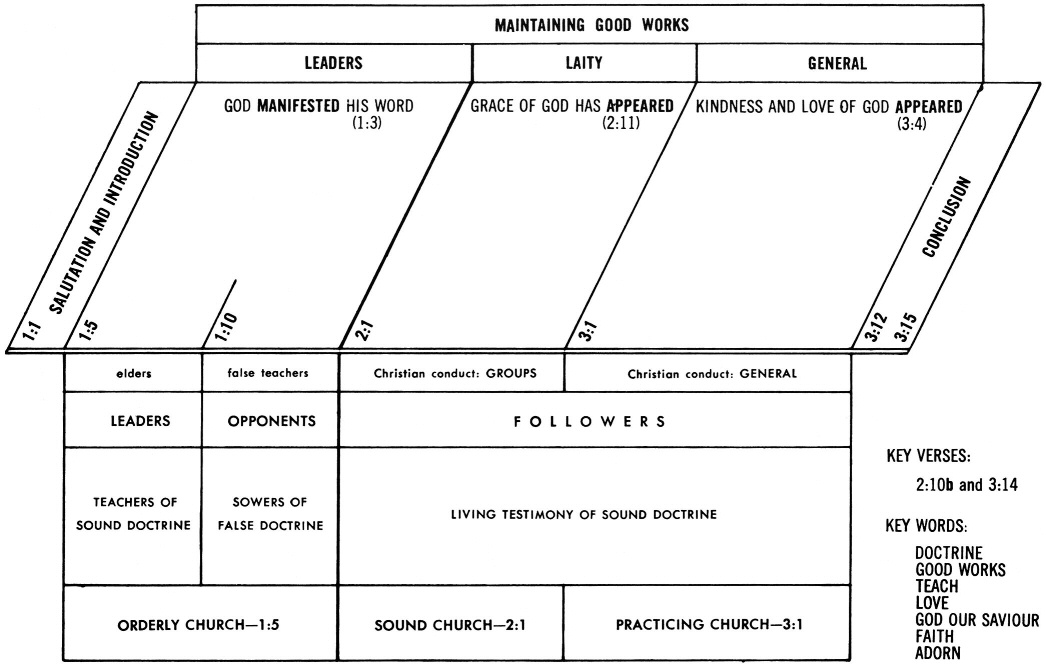
ADORNING THE DOCTRINE OF GOD
Click chart to enlarge
Charts from Jensen's Survey of the NT - used by permission
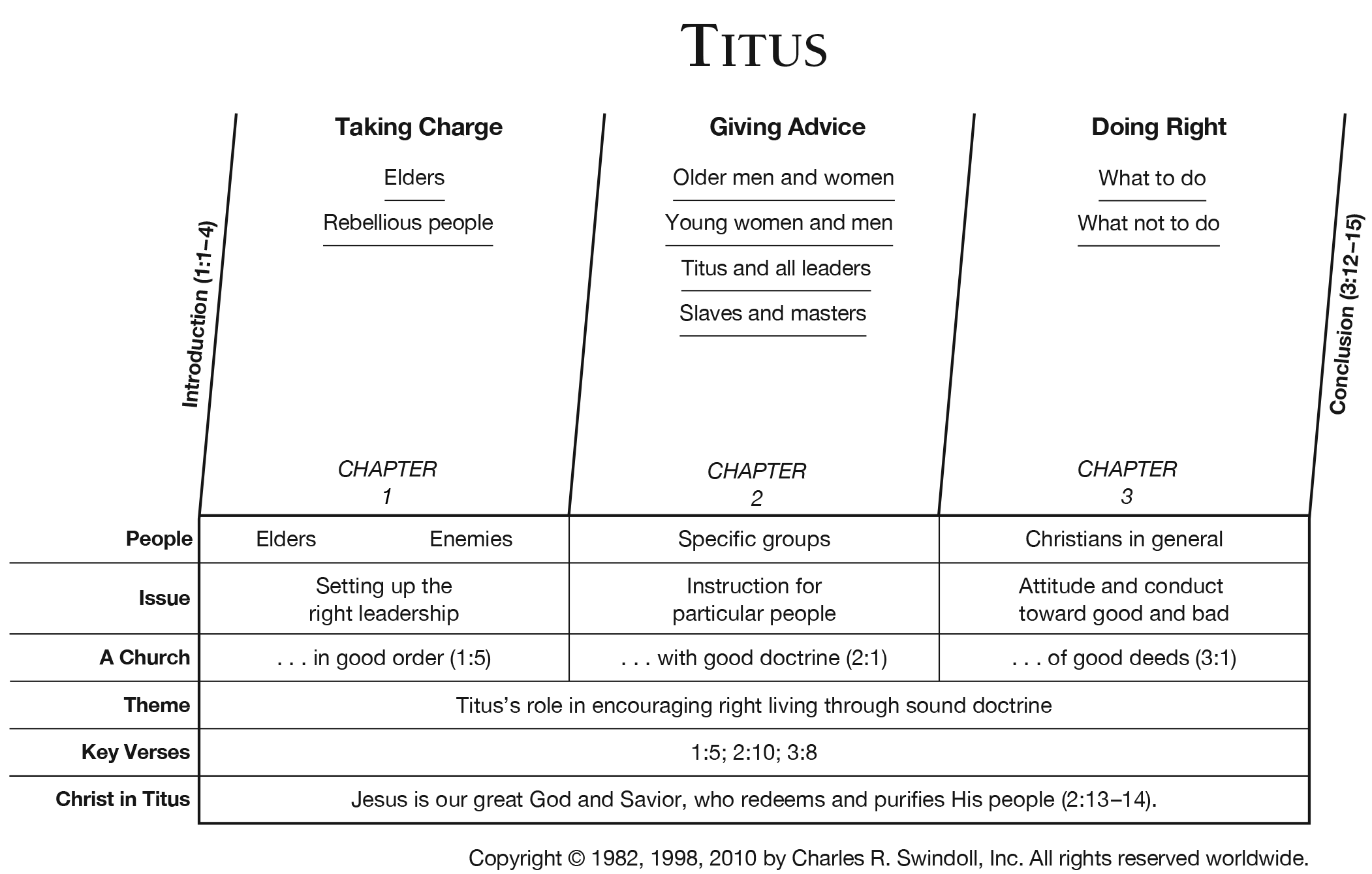
See Summary Chart by Charles Swindoll
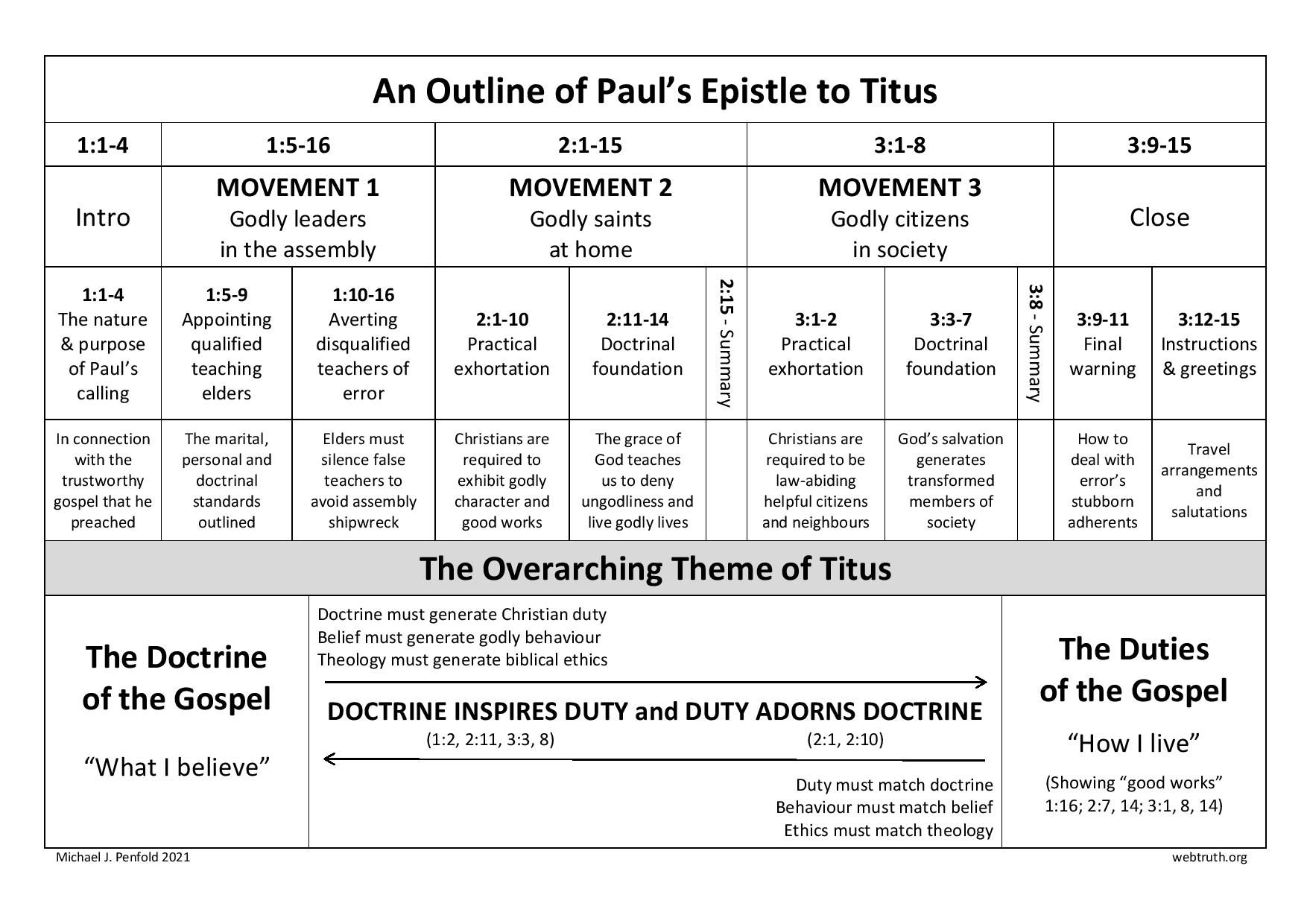
Chart below from Michael J. Penfold
|
Focus |
Appoint Elders |
|||
|
Divisions |
Rebuke |
Maintain |
||
|
Topics |
||||
|
Topics |
Organization |
Offenders |
Operation |
|
|
Place |
Probably Written from either Corinth or Nicopolis (cf. Titus 3:12). |
|||
|
Time |
Circa 63 AD |
|||
|
Modified from Talk Thru the Bible |
||||
Titus 1:7 For the overseer must (3SPAI) be (PAN) above reproach as God's steward, not self-willed, not quick-tempered, not addicted to wine, not pugnacious, not fond of sordid gain, (NASB: Lockman)
Greek: dei (3SPAI) gar ton episkopon anegkleton einai (PAN) os theou oikonomon, me authade, me orgilon, me paroinon, me plekten, me aischrokerde,
Barclay: For he who oversees the Church of God must be beyond reproach, as befits a steward of God. He must not be obstinately self-willed; he must not be an angry man; he must not be given to drunken and outrageous conduct; he must not be a man ready to come to blows; he must not be a seeker of gain in disgraceful ways. (Westminster Press)
KJV: For a bishop must be blameless, as the steward of God; not self-willed, not soon angry, not given to wine, no striker, not given to filthy lucre;
Phillips: To exercise spiritual oversight a man must be of unimpeachable virtue, for he is God's agent in the affairs of his household. He must not be aggressive or hot-tempered or over-fond of wine; nor must he be violent or greedy for financial gain. (Phillips: Touchstone)
Wuest: for it is a necessity in the nature of the case that the overseer be such that no charge can be brought against him as God’s superintendent; not self-willed, not irascible, not addicted to wine, not pugnacious, not fond of dishonest gain
Young's Literal: for it behoveth the overseer to be blameless, as God's steward, not self-pleased, nor irascible, not given to wine, not a striker, not given to filthy lucre;
FOR THE OVERSEER MUST BE ABOVE REPROACH AS GOD'S STEWARD: dei (3SPAI) gar ton episkopon anegkleton einai (PAN) os theou oikonomon :
- Titus 1:5; Php 1:1; 3:1; 3:2; 3:3; 3:4; 3:5; 3:6; 3:7; 3:8; 3:9; 3:10; 3:11; 3:12; 3:13
- Mt 24:45; Lk 12:42; 1Co 4:1,2; 1Pe 4:10)
for it is a necessity in the nature of the case that the overseer be such that no charge can be brought against him as God’s superintendent (Wuest)
it behoveth the overseer to be blameless (Young's Literal)
must be free from all charge against him (Darby)
An elder has the job of taking care of God's work. So he must not be guilty of doing wrong. (ICB)
To exercise spiritual oversight a man must be of unimpeachable virtue, for he is God's agent in the affairs of his household (Phillips)
For since a church leader is in charge of God’s work, he should be without fault (TEV)
For (gar) is an strategic term of explanation. What is Paul explaining?
The following traits are an easily applied practical list to guide selection of elders/overseers beginning with a list of "negatives" then moving on to a list of "positives".
Overseer (1985) (episkopos [word study] from epi = upon + skopos = distant mark or goal looked at & related word sképtomai = to look about = source of English "scope") is literally one who watches upon or over others.
Greeks used episkopos to describe their pagan gods supposedly watching over worshipers and over nations. In Athens epískopoi (plural) were magistrates sent to outlying cities to organize and govern them.
Episkopos was used to describe an overseer in any capacity, with examples in ancient writings describing the official in charge of the repairing of a temple or an officer in an army. Paul had warned the Ephesian elders to "be on guard for yourselves and for all the flock, among which the Holy Spirit has made you overseers (episkopos), to shepherd the church of God which He purchased with His own blood." (Acts 20:28).
Paul's addressed the Philippian epistle "to all the saints in Christ Jesus who are in Philippi, including the overseers (episkopos) and deacons" (Php 1:1-note).
As alluded to earlier Paul equates elders with overseers writing to Timothy to note that "an overseer then must be above reproach (1Ti 3:2).
The last NT use of episkopos describes Jesus as "the Shepherd and Guardian (episkopos) of your souls. (1Pe 2:25-note)
Although the word "overseer" is not used in the following verse, the writer of Hebrews aptly characterizes the critical role of leaders as those who "keep watch over your souls" and that they "will give an account (as all stewards must likewise do to their Master)." (see Hebrews 13:17-note)
The secular and Biblical uses of episkopos both emphasize the idea of men charged with exercising watchful care over others. In the NT the overseer watches over the spiritual life of the "sheep" in his flock. "Elder" (presbuteros) implies the maturity and dignity of the man, while "overseer" (episkopos) indicates his work as the "overseer" of God's flock. Someone has summarized elder and overseer with the statement that elder is the title, oversight is the function.
Spurgeon - Surely a steward must hold his office from the Master. He cannot be a steward merely because he chooses to be so, or is so regarded by others. If any of us should elect ourselves stewards to the Marquis of Westminster and proceed to deal with his property, we would have our mistake very speedily pointed out to us in the most convincing manner. There must evidently be authority before a man can legally become a bishop, “God’s steward.”
Related Resources:
- What are the qualifications of elders and deacons? | GotQuestions.org
- What are the responsibilities of deacons in the church?
Must be (1163) (dei from deo = to bind or tie objects together, put in prison and also root of doulos, bond-servant) refers to what is not optional but needful (binding) out of intrinsic necessity or inevitability. Dei refers to inward constraint which is why it is often translated "must". Dei describes that which is under the necessity of happening or which must necessarily take place, and as stated above, conveys a sense of inevitability. To express the sense of necessity dei is translated "one ought", "one should", "one has to" or "one must".
In English dictionaries must means to be obliged and expresses both physical and moral necessity or insistence. Must speaks of something that should not be overlooked or missed. Must is used to indicate requirement by immediate or future need or purpose.
Dei is used 98x in the NT The NASB translates dei as follows: due(1), had(7), have(2), must(56), necessary(4), needed(1), ought(17), ought to(1), should(9). Mt 16:21; 17:10; 18:33; 23:23; 24:6; 25:27; 26:35, 54; Mk. 8:31; 9:11; 13:7, 10, 14; 14:31; Lk 2:49; 4:43; 9:22; 11:42; 12:12; 13:14, 16, 33; 15:32; 17:25; 18:1; 19:5; 21:9; 22:7, 37; 24:7, 26, 44; Jn. 3:7, 14, 30; 4:4, 20, 24; 9:4; 10:16; 12:34; 20:9; Acts 1:16, 21; 3:21; 4:12; 5:29; 9:6, 16; 14:22; 15:5; 16:30; 17:3; 19:21, 36; 20:35; 23:11; 24:19; 25:10, 24; 26:9; 27:21, 24, 26; Ro 1:27; 8:26; 12:3; 1Co 8:2; 11:19; 15:25, 53; 2Co 2:3; 5:10; 11:30; Ep 6:20; Col. 4:4, 6; 1Th 4:1; 2Th 3:7; 1Ti 3:2, 7, 15; 5:13; 2Ti 2:6, 24; Titus 1:7, 11; Heb 2:1; 9:26; 11:6; 1Pe 1:6; 2Pe 3:11; Re 1:1; 4:1; 10:11; 11:5; 17:10; 20:3; 22:6)
The TDNT comments that dei "expresses the character of necessity or compulsion in an event. The term itself does not denote the authority which imparts this character. It is thus given its precise significance when conjoined with this power. In most cases the word bears a weakened sense derived from everyday processes. It thus denotes that which in a given moment seems to be necessary or inevitable to a man or group of men… In the language of philosophy the term expresses logical and scientific necessities… Ethical or even religious obligations may also be denoted (as used here in Titus 1:7). (Kittel, G., Friedrich, G., & Bromiley, G. W. Theological Dictionary of the New Testament. Eerdmans)
In regard to overseers the verb "must" (dei) expresses the moral fitness (in the 15 or so characteristics that follow) that is absolutely necessary in order for one to qualify to lead the local church. In Paul's first epistle to Timothy, he used dei twice in his description of qualifications for an overseer, writing that
An overseer, then, must be (dei) above reproach, the husband of one wife, temperate, prudent, respectable, hospitable, able to teach, 3 not addicted to wine or pugnacious, but gentle, uncontentious, free from the love of money. 4 He must be one who manages his own household well, keeping his children under control with all dignity 5 (but if a man does not know how to manage his own household, how will he take care of the church of God?); 6 and not a new convert, lest he become conceited and fall into the condemnation incurred by the devil. 7 And he must (dei) have a good reputation with those outside the church, so that he may not fall into reproach and the snare of the devil. (1Ti 3:2-7)
In his second epistle Paul emphasized that "the Lord's bond-servant (of whom elders, overseers and deacons would surely classify) must (dei) not be quarrelsome, but be kind to all, able to teach, patient when wronged… " (see note 2 Timothy 2:24)
Paul uses dei once more in Titus in reference to "rebellious men, empty talkers and deceivers, especially those of the circumcision, who must (dei) be silenced because they are upsetting whole families, teaching things they should not teach, for the sake of sordid gain." (see note Titus 1:10; Titus 1:11)
Paul is clearly instructing Titus that it is a must and not an option that he silence these rebels!
Dei can refer to that which is divinely destined or decreed as illustrated by the following NT passages. Jesus declared that “the gospel must (dei) first be preached to all the nations." (Mk 13:10) Before the end of this age (and prior to the 1000 year reign of Messiah) there must be (because Jesus declared it so) a worldwide proclamation of the gospel which may refer to the supernatural proclamation of the gospel (Revelation 14:6 {note}; Revelation Lectures Pt 2, Pt 3, Pt 4; Resources on Revelation; Summary Charts of Revelation Chapters 4-22) at the mid-point of the last 7 year period of Daniel's Seventieth Week (see Chart of Daniel's 70th Week; Daniel Lectures), just before God pours out His final wrath on the kingdom of the Anti-Christ and rebellious mankind (referring especially to the "bowl judgments" as described in Rev 16).
In another use of dei we read "For as yet they (Jesus' disciples) did not understand the Scripture, that He must (dei) rise again from the dead. (Jn 20:9).
Peter declared "And there is salvation in no one else; for there is no other name under heaven that has been given among men, by which we must (dei) be saved” (Acts 4:12) (Comment: Referring to the only way of salvation which is by faith in Jesus Christ)
For salvation one absolutely MUST enter the small gate and travel the narrow road, for it is the only path that leads to eternal life.
Finally, one more "must" that applies to all believers is found in Paul's declaration that "we (only addressing genuine believers) must (dei) all appear before the judgment seat of Christ, that each one may be recompensed for his deeds in the body, according to what he has done, whether good or bad. (2Cor 5:10-note)
Dei is also used in Scripture to refer to that which is right as prescribed by law, duty or custom. For example when the Jewish council (the "Sanhedrin") rebuked Peter (and the apostles) for teaching in the Name of Jesus, Peter replied "We must (dei) obey God rather than men. (Acts 5:29)
The point is that Christians must obey the government authority but only as long as the rules or decrees of the government are not contrary to God’s Word. Then they must obey God. Peter informs his readers that "In this (the benefits of the salvation, living hope and future inheritance) you greatly rejoice, even though now for a little while, if necessary (dei), you have been distressed by various trials." (1Pe 1:6-note)
The trials of this life are a "must" for they are God's training ground (His "school of affliction") for our life in the future in eternity.
The following passage presents an excellent sense of the "binding" nature of the verb dei and helps one understand how strong Paul feels about the qualifications for overseers! As Jesus' time to be offered as the sacrificial Lamb approached, He "began to show His disciples that He must go to Jerusalem, and suffer many things from the elders and chief priests and scribes, and be killed, and be raised up on the third day" (Mt 16:21)
Dei emphasizes the inevitableness of the Cross, because it was for this very purpose Jesus took the form of man and He was constrained to fulfill His purpose (cf Jn 4:34, 17:4). Dei in fact is often used by Jesus regarding His work and it's inevitable fulfillment on the Cross of Calvary. (eg, Mark 8:31; Luke 4:43; 9:22; 13:33; 24:7, 26; John 3:14; 12:34)
In summary, dei means ‘it is necessary’, ‘one must,’ or ‘one ought,’ and is used…
(a) of a necessity lying in the nature of the case. (Jn 3:30-note; 2Ti 2:6-note) A familiar OT use of dei in this sense (one of 23 uses in the Septuagint) is Boaz's declaration to the nearest kinsman redeemer that
On the day you buy the field from the hand of Naomi, you must (dei) also acquire Ruth the Moabitess, the widow of the deceased, in order to raise up the name of the deceased on his inheritance." (Ru 4:5-note)
Comment: The nearest kinsman knew that was a necessity, not an option, and therefore he gave up his right to Ruth!
(b) of necessity brought about by circumstances, (John 4:4) and regarding Christ speaking of a necessity brought about by reason of the Father’s will (Luke 2:49)
(c) of necessity as to what is required that something may be brought about, (Acts 9:6); In Hebrews we read
And without faith it is impossible to please Him, for he who comes to God must (dei) believe that He is, and that He is a rewarder of those who seek Him." (He 11:6-note)
(d) of a necessity of law, duty, equity, custom (Acts 25:10, Acts 15:5, Ro 12:3 {note}, Lk 22:7)
(e) of necessity arising from the sovereign will of God, (Mt 16:21; Mt 24:6; 1Cor 15:53) One of the most famous illustrations is John record of
The Revelation of Jesus Christ, which God gave Him (Jesus) to show to His bond-servants, the things which must shortly take place; and He sent and communicated it by His angel to His bond-servant John." (see Rev 1:1-note, see also see Re 4:1, 20:6, 22:6 notes Re 4:1, 20:6, 22:6)
Comment: These things (the incredible events in the Revelation of Jesus Christ) must happen because the sovereign God decreed them to happen. (cp God's declaration's that speak of His sovereign control of history in Isaiah - Is 42:9, 46:9, 10, 11, Isa 48:3)
Note that dei conveys a slightly different meaning than does the closely related verb opheilo (3784) which means “to owe, to be a debtor, to be under obligation or bound by duty”.
Opheilo speaks of a moral obligation in contrast to a binding necessity as brought out with dei. For example, Paul uses opheílo writing to the Romans: I am under obligation (noun form of opheílo) both to Greeks and to barbarians, both to the wise and to the foolish." (Ro 1:14-note)
The apostle saw himself as a debtor to those who spoke Greek and to those who did not. The word opheilo refers to a special, personal or moral obligation to do something, in contrast to the basic meaning of dei, which speaks of a necessity, something that must be accomplished.
From this overview of dei and above reproach one can better understand that the candidate for overseer must possesses these traits in the following list and if he does not he must not be appointed an overseer. Spiritual leaders not only must teach truth but also must live out the truth in their life as examples of godliness to their flock. Damage to the leader’s reputation is damage to God’s reputation.
In short, the verb dei speaks of what is necessary, not optional -- once you understand that dei has no "option clauses", Peter's solemn pronouncement is even more sobering:
Since all these things are to be destroyed in this way, what sort of people ought (dei) you to be in holy conduct and godliness, looking for and hastening the coming of the day of God, on account of which the heavens will be destroyed by burning, and the elements will melt with intense heat!" (2Pe 3:11, 12-note)
Peter's exclamation means “How astoundingly excellent you ought to be!” which is a no nonsense, straightforward challenge regarding the necessity for Christians to conform their lives to God’s standards in light of the coming judgment and relative brevity of this world compared that which is to come. If you really understand the NT implications of dei, you will agree that holy conduct and godliness are a necessity not an option!
Above reproach (410)(anegkletos or anenkletos from a = without, negative particle + egkaleo/enkaleo {en = in + kaleo = call} = to call in {as a debt or demand}, to bring to account, to accuse in court, call into account, bring a charge against - in Ro 8:33 [note] "who will bring a charge [egkaleo] against God's elect?… " The answer "no one") means not arraigned (as in a court), that which cannot be called to account, unblamable, blameless, irreproachable, free from accusation or reproach, not accused of having done anything wrong.
Anegkletos - 5x in 5v - 1Co 1:8; Col 1:22; 1Ti 3:10; Titus 1:6, 7. NAS = above reproach(2), beyond reproach(2), blameless(1).
1 Corinthians 1:8 who shall also confirm you to the end, blameless in the day of our Lord Jesus Christ.
Comment: This speaks of our walk of faith, our daily or progressive sanctification, pursuing holiness (Heb 12:14), growing in grace (2Pe 3:18), walking blamelessly (of Noah - Ge 6:9, of Abraham - Ge 17:1, Ps 101:6, Ps 119:1, Pr 11:20, 28:18, Lk 1:6) before our Master and King.
Colossians 1:22-note yet He has now reconciled (apokatallasso) you in His fleshly body through death, in order to present you before Him holy and blameless and beyond reproach–
Comment: Beloved, do we really understand what this means? That forever we might stand in the presence of the Perfect One, the Holy One and be blameless and beyond reproach! I think that most of the time I simply read over these wonderful statements and while they evoke a sense of wonder, it is only passing. May the Father grant us by His Spirit of Truth to deeply ponder the cost that allows us to be forever "blameless and beyond reproach" in Christ Jesus, the Holy One of Israel. Amen What a "so great a salvation" (Heb 2:3-note) He has bestowed upon us (James 1:17-note) formerly in Adam (Ro 5:12-note, 1Cor 15:22), now forever in Christ! Amen
1 Timothy 3:10 And let these also first be tested; then let them serve as deacons if they are beyond reproach.
Using a modern colloquialism such a person has "no skeletons in the closet!"
Too often in American churches the leaders (and elders) are selected because of money, influence or availability, with little regard to whether they have walked blamelessly before the Lord. Better to select a leader above reproach than a popular one!
Anegkletos signifies that which cannot be called to account. It means having no blot on one's life for which one could be accused, arraigned, and disqualified. It means there is nothing laid to one’s charge (as the result of public investigation). It is not simply an acquittal but the absence of even a valid accusation.
Steven Cole - The term “above reproach” is used in Titus 1:6 and Titus 1:7, first to sum up a man’s home life and again to sum up his personal character. The Greek word in Titus is different than the word in 1Ti 3:2, although the meaning is essentially the same. It means that there is nothing in the man’s life for which a charge or accusation could be brought against him (see R. C. Trench, Synonyms of the New Testament [Eerdmans], p. 381). He is a man of integrity. He doesn’t live one way at church and another way at home. His wife and children would affirm that he displays the fruit of the Spirit at home. If he sins, he is quick to confess it and ask forgiveness. (Read the full sermon)
Philip Towner explained it best (IVP NT Commentary Series) - blameless (KJV translation) is more a measure of wholeness and balance than of perfection. The code examines all dimensions of life for evidence of the Spirit’s influence in each part. This kind of balanced “reading” means development toward maturity is under way. And Paul felt that “whole” believers were best suited for church leadership.
Albert Barnes (1798-1870) says that believers must live "In holy conduct and piety. That is, this fact ought to be allowed to exert a deep and abiding influence on us, to induce us to lead holy lives. We should feel that there is nothing permanent on the earth that this is not our abiding home; and that our great interests are in another world. We should be serious, humble, and prayerful; and should make it our great object to be prepared for the solemn scenes through which we are soon to pass. An habitual contemplation of the truth, that all that we see is soon to pass away, would produce a most salutary effect on the mind. It would make us serious. It would repress ambition. It would lead us not to desire to accumulate what must so soon be destroyed. It would prompt us to lay up our treasures in heaven. It would cause us to ask with deep earnestness whether we are prepared for these amazing scenes, should they suddenly burst upon us." (Barnes' Notes on the Bible)
IMPACT OF
A LIFE
ABOVE REPROACH
Illustration of a life that was "above reproach" - The Christian walk of Will Houghton, a preacher who became the president of Moody Bible Institute during the 1940s, played a large role in the conversion of an agnostic who was contemplating suicide. The skeptic was desperate, but he decided that if he could find a minister who lived his faith he would listen to him. So he hired a private detective to watch Houghton. When the investigator’s report came back, it revealed that this preacher’s life was above reproach; he was for real. The agnostic went to Houghton’s church, accepted Christ, and later sent his daughter to Moody Bible Institute.
Adoniram Judson's: Another man who exuded a "Sweet Aroma of Christ" = "The sweet aroma of the knowledge of Him (Jesus) in every place." (2Cor 2:14) Many years ago when the great missionary Adoniram Judson was home on furlough, he passed through the city of Stonington, Connecticut. A young boy playing about the wharves at the time of Judson’s arrival was struck by the man’s appearance. Never before had he seen such a light on any human face. He ran up the street to a minister to ask if he knew who the stranger was. The minister hurried back with him, but became so absorbed in conversation with Judson that he forgot all about the impatient youngster standing near him. Many years afterward that boy—who could never get away from the influence of that wonderful face—became the famous preacher Henry Clay Trumbull (Read The life story of Henry Clay Trumbull, missionary, army chaplain, editor, author - 1905) (See also his fascinating book The Blood Covenant). In a book of memoirs he penned a chapter entitled: "What a Boy Saw in the Face of Adoniram Judson." (As Trumbull listened to his pastor interview Judson he wrote "All the while his [Adoniram's] face glowed with the light of his theme. The sight of that countenance was an inspiration and a blessing to me. I have never forgotten it. I never can forget it.") That lighted countenance had changed his life. Even as flowers thrive when they bend to the light, so shining, radiant faces come to those who constantly turn toward Christ! (Read the original story in context of H C Trumbull's life story)
Steward (3623) (oikonomos from oíkos = house + némo = manage, distribute, dispense) (see study of related word oikonomia) is literally the manager or superintendent of a household or estate. BDAG - one who is entrusted with management in connection with transcendent matters (1 Cor 4:1, Titus 1:7, 1 Pe 4:10)
Vine - "it is used metaphorically, in the wider sense, of a "steward" in general, (a) of preachers of the Gospel and teachers of the Word of God, 1 Cor. 4:1; (b) of elders or bishops in churches, Titus 1:7; (c) of believers generally, 1 Pet. 4:10."
Oikonomos - 10x in 10v - manager(3), managers(1), steward(2), stewards(3), treasurer(1).
Luke 12:42-note And the Lord said, "Who then is the faithful and sensible steward, whom his master will put in charge of his servants, to give them their rations at the proper time?
Comment: An outstanding slave (Lk 12:43) was sometimes left in charge of an estate. The owner was free from the burden of administration and the manager had considerable authority.
Luke 16:1-note Now He was also saying to the disciples, "There was a rich man who had a manager, and this manager was reported to him as squandering his possessions.
Luke 16:3-note "The manager said to himself, 'What shall I do, since my master is taking the management away from me? I am not strong enough to dig; I am ashamed to beg.
Luke 16:8-note "And his master praised the unrighteous manager because he had acted shrewdly; for the sons of this age are more shrewd in relation to their own kind than the sons of light.
Romans 16:23-note Gaius, host to me and to the whole church, greets you. Erastus, the city treasurer greets you, and Quartus, the brother.
1 Corinthians 4:1 Let a man regard us in this manner, as servants of Christ and stewards of the mysteries of God.
1 Corinthians 4:2 In this case, moreover, it is required of stewards that one be found trustworthy.
Galatians 4:2-note but he is under guardians and managers until the date set by the father.
MacArthur - "Guardians" were slaves entrusted with the care of underage boys, while "managers" managed their property for them until they came of age. Along with the tutor (Gal 3:24-note), they had almost complete charge of the child—so that, for all practical purposes, a child under their care did not differ from a slave. (MacArthur Study Bible)
Titus 1:7 For the overseer must be above reproach as God's steward, not self-willed, not quick-tempered, not addicted to wine, not pugnacious, not fond of sordid gain,
1 Peter 4:10-note As each one has received a special gift, employ it in serving one another as good stewards of the manifold grace of God.
Comment: Compare "stewardship of God's grace which was given to" Paul; cp Ephesians 3:2-note).
Oikonomos -12x in 12v in Septuagint (LXX) - 1Ki 4:6; 16:9; 18:3; 2Ki 18:18, 37; 19:2; 1Chr. 29:6; Esther 1:8; 8:9; Is 36:3, 22; 37:2.
Vincent adds that in the Greek culture the steward was the one who "assigns to the members of the household their several duties, and pays to each his wages. The paymaster. He kept the household stores under lock and seal, giving out what was required; and for this purpose received a signet-ring from his master."
Gilbrant - In classical Greek oikonomos is used like oikodespotēs for a “steward.” The word can also mean a “housekeeper” or “housewife.” Oikonomos can be the one in charge of separate branches of a household such as the inspector of goods, chief cook, porter, accountant, etc. In Philo oikonomos is used with politikos, “statesman,” referring to a statesman and a ruler of the house (cf. Bauer). The wise man merits praise because he manages the household well and acts like a statesman outside the house which benefits society (Michel, “oikonomos,” Kittel, 5:151).In the Septuagint Eliakim is the most often mentioned of Old Testament stewards. This manager for King Hezekiah is found in 2 Kings 18:18,37; 19:2; Isaiah 36:3,22; 37:2. Other named stewards are: Ahishar (1 Kings 4:6); Arza, who had his own house (1 Kings 16:9); and Obadiah, a righteous man who “feared the Lord greatly” and who was steward for Ahab (1 Kings 18:3). In 1 Chronicles 29:6 oikonomos is used of the various foremen of King David whom he referred to Solomon for building the temple. The word can also mean officials, nobles or governors, etc., which would entail the same basic job description (Esther 1:8; 8:9; 1 Esdras 4:49). Other uses in 1 Esdras include the stewards of Darius in 4:47 and the treasurers of the king in 8:67. Used only 10 times in the New Testament, oikonomos signifies the manager of a household or of household affairs (i.e., a steward), a position most often held by a slave, though sometimes by a freedman. He would be one who was entrusted with the management of a house, the control of its cash receipts and expenditures (Luke 16:1-8-note), and the administration and appropriate care of servants (Luke 12:42-note). Such managers even assumed responsibility for the children of the household who were not yet come of age (Galatians 4:2). The use of oikonomos in Luke 16:1,3,8 seems to designate an employee. But the parallel use of doulos in Matthew 24:45 with oikonomos in Luke 12:42-note shows that oikonomos in Luke 12:42-note indicates a slave. Since an oikonomos had a great deal of control over the financial matters of the household, the term took on the connotation of “treasurer.” Accordingly, in Romans 16:23, Erastus is called “chamberlain (oikonomos) of the city,” i.e., the city treasurer of Corinth. In 1 Corinthians 4:1,2 Paul used the term (“stewards,” KJV) metaphorically to describe those who have been committed to the preaching of the gospel (“the mysteries of God”), and who, as stewards, are required to be faithful. Likewise, in Titus 1:7 the overseer (“bishop”) must be a man of virtue and integrity, of model deportment, for he is one entrusted with the work of God. In 1 Peter 4:10-note the apostle used the word to speak of believers generally as those who are responsible to use what they have received in the service of others. Believers are stewards of the gifts of the Spirit and salvation which God has provided for them. (Complete Biblical Library Greek-English Dictionary)
Although stewards usually were slaves or freedmen (former slaves), as Vincent notes many had considerable responsibility and authority. In addition to caring for all the needs of family members, they could be responsible and accountable for household finances and for making sure, for example, that crops were properly planted, cultivated, and harvested. They often had oversight of all other household servants, to provide for them and to assign and supervise their work. They would make sure that those who were sick or wounded were cared for and even dispensed discipline when necessary.
The overseer as "God's steward" does not own the church or the people of the church. But he is in charge of their spiritual nourishment, growth and behavior. God's steward must see that the household of God is cared for and looked after and that their energies and lives are directed to the will of the Master. The steward must do the will of the Master, carrying out His Word without any deviation whatsoever.
The steward was appointed by (cf Acts 20:28 = "the Holy Spirit has made you overseers", Acts 13:2 = "for the work to which I have called them") and accountable to the owner, the Owner in Titus 1:7 being God and the "house" being His "sheep", the local body of believers who probably did meet in houses rather than formal church structures. Because the "overseer" is "God's steward", he is directly accountable to Him and thus he must conform to the highest moral and spiritual standards. Other uses of "steward" (or "stewardship") give us a good picture of what God expects from the overseer. Thus, a steward must not squander what has been entrusted to him (Lk 16:1,16:2), which in the Titus 1:7 would refer to the care of God's "sheep". Paul described himself, Apollo and Cephas as "servants of Christ and stewards of the mysteries of God" adding that "moreover it is required of stewards that one be found trustworthy (pistos = dependable, reliable, faithful)." (1 Cor 4:1, 4.2) So one of the most important characteristic of a steward is faithfulness. (cf Mt 24:45) He must use what his master gives him for the good and glory of his master, and not for himself personally. The idea is that he take scrupulous care of that which was entrusted to him, and give it out to others faithfully and as directed by his master Jesus Christ.
Wiersbe - let's examine our own lives to see how faithful we have been as stewards of what God has given to us.
To begin with, we are stewards of the material wealth that we have, whether much or little; and we will one day have to answer to God for the way we have acquired it and used it. Christian stewardship goes beyond paying God a tithe of our income and then using the remainder as we please. True stewardship means that we thank God for all that we have (Dt. 8:11-18) and use it as He directs. Giving God 10 percent of our income is a good way to begin our faithful stewardship, but we must remember that God should control what we do with the remaining 90 percent as well.
We are also stewards of our time (Eph. 5:15-17). The phrase "redeeming the time" (see in depth study of redeeming the time) comes from the business world and means "buying up the opportunity (exagorazo)." Time is eternity, minted into precious minutes and handed to us to use- either wisely or carelessly. The main lesson of this narrative is that the steward (Lk 16:1-note), as dishonest as he was (read Lk 16:1-8), used his opportunity wisely (shrewdly) and prepared for the future. Life ceased to be "enjoyment" and became "investment." (Ed: This was Jesus "take home" message in Luke 16:9-note).
Christians are stewards of the gifts and abilities God has given them (1 Peter 4:10), and we must use those gifts and abilities to serve others. The thief says, "What's yours is mine—I'll take it!" The selfish man says, "What's mine is mine—I'll keep it!" But the Christian must say, "What's mine is a gift from God—I'll share it!" We are stewards and we must use our abilities to win the lost, encourage the saints, and meet the needs of hurting people.
Finally, God's people are stewards of the Gospel (1 Th. 2:4-note). God has committed the treasure of His truth to us (2 Cor. 4:7), and we must guard this treasure (1 Ti 6:20) and invest it in the lives of others (2 Ti 2:2-note). The enemy wants to rob the church of this treasure (Jude 1:3-4), and we must be alert and courageous.
Like this steward (in Luke 16:1), we will one day have to give an account of our stewardship (Ro 14:10-12-note; 2 Cor. 5:10ff-note). If we have been faithful, the Lord will give us His commendation and reward (Matt. 25:21; 1 Cor. 4:5); but if we have not been faithful, we will lose those blessings, even though we will be saved and enter heaven (1 Cor. 3:13-15). Vance Havner often said, "God called us to play the game, not keep the score." If we are faithful stewards, God will reward us generously, and that reward will bring glory to His name.(Wiersbe, W: Bible Exposition Commentary. 1989. Victor)
Bengel - The greater the master is, the greater the virtues required in His servant.
NOT SELF-WILLED: me authade:
- Ge 49:6; 2Pe 2:10
not self-pleased (YLT)
not overbearing (NIV)
not be arrogant (NLT)
not headstrong (Darby)
must not be bossy (CEV)
not pushing himself forward (BBE)
must not be aggressive (Phillips)
must not be obstinately self-willed (Barclay)
not over-fond of having his own way (Weymouth)
not self-willed or arrogant or presumptuous (Amp)
he must not be presumptuous (Moffatt)
Each of the following negative traits is preceded by “not” (Gk = me) and should be considered explanatory of Paul’s fundamental qualification of “above reproach.”
Self willed (829) (authades from autós = self + hedomai = to delight in, take pleasure, English word = "hedonist") is literally delighting one's self and describes a man who has a self loving, self seeking spirit, who is so pleased with himself that nothing else pleases him and he cares to please nobody. He is preoccupation with his own interests. His is so dominated by self–interest and lack of consideration of others, that he arrogantly asserts his own will He is self-satisfied, self-centered, self-complacent, arrogant, proud, haughty, stubborn, willful, inflexible, presumptuous, unaccommodating, harsh, despising others, dictatorial, dogmatic, impatient of contradiction, and unyielding. In his self-loving spirit, he seeks only to gratify self and is regardless of others. (cf 2Ti 3:1; 2-note; 2Ti 3:3; 4; 5-note)
Steven Cole - The word literally means, “self-pleasing.” It refers to a man who obstinately maintains his own opinion or asserts his own rights and does not care about the rights, feelings, and interests of others (Trench, Synonyms, p. 349). The self-willed man often takes the contrary view because he loves to assert himself and wield power over others. He never admits that he was wrong. He is not a team player. If he acts in such self-willed ways in the church or with other elders, you can assume that he runs his family like a drill sergeant. Don’t make him an elder! (Read the full sermon)
Barclay says that authades literally means "pleasing himself" and "The man who is authades has been described as the man who is so pleased with himself that nothing else pleases him and he cares to please nobody… The Greek ethical writers had much to say about this fault of authadeia. Aristotle set on the one extreme the man who pleases everybody (areskos), and on the other extreme the man who pleases nobody (authades), and between them the man who had in his life a proper dignity (semnos). He said of the authades that he was the man who would not converse or associate with any man. Eudemus said that the authades was the man who “regulates his life with no respect to others, but who is contemptuous.” Euripides said of him that he was “harsh to his fellow citizens through want of culture.” Philodemus said that his character was compounded in equal parts of conceit, arrogance and contemptuousness. His conceit made him think too highly of himself; his contemptuousness made him think too meanly of others; and his arrogance made him act on his estimate of himself and others. Clearly the man who is authades is an unpleasant character. He is intolerant, condemning everything that he cannot understand and thinking that there is no way of doing anything except his. Such a quality, as Lock said, “is fatal to the rule of free men.” No man of contemptuous and arrogant intolerance is fit to be an office-bearer of the Church. (Daily Study Bible Series)
R. C. Trench said of such a man that "he obstinately maintains his own opinion, or asserts his own rights, while he is reckless of the rights, opinions and interests of others… (he so far overvalues) any determination at which he has himself (has) once arrived, that he will not be removed from it"… In some sinful men their authadeia (related noun form), the ungracious bearing towards others, the self-pleasing which is best pleased when it displeases others, is the leading feature of their character. (Trench, R. C. Synonyms of the New Testament. Hendrickson Publishers. 2000)
Trench goes on to liken "the selfish man to the hedgehog, which, rolling itself up in a ball, presents only sharp spines to those without, keeping at the same time all the soft and warm wool for itself within."! (Ibid)
The authades man is overbearing (NIV) and always seeking to "have his own way" (Weymouth).
Vine says that authades "denotes one who, dominated by self-interest and inconsiderate of others, arrogantly asserts his own will, one who persists in his own determination. It is the opposite of “gentle”. (Collected writings of W. E. Vine. Nashville: Thomas Nelson )
The overseer should
not to think more highly of himself than he ought to think; but to think so as to have sound judgment (see note Romans 12:3)
Further the overseer should be like Christ Who said
not My will, but Thine be done (Lk 22:42, cf Php 2:3; 4-note; Php 2:5; 6; 7-note ;1Pe 5:1, 2; 3-note; 1Pe 5:4; 5:5 - note)
Overseers are to be benevolent leaders not brutal dictators.
Hiebert says the overseer should not have "a self-loving spirit which seeks to gratify self in arrogant disregard of others."
The overseer should be one who does not insist on having his own way. He should be flexible in his opinions, considerate of other viewpoints and sensitive to use authority in ways that truly promote God’s work and not his selfish, personal agenda.
Self-willed overseers (and pastors) are overbearing, arrogant, and refuse to take people’s suggestions and criticisms, acting more like dictators then spiritually mature leaders, refusing to take other's suggestions and criticisms.
Peter ascribes this trait to false teachers as
"those who indulge the flesh in its corrupt desires and despise authority. Daring, self-willed, they do not tremble when they revile angelic majesties." (2Pe 2:10-note).
Albert Barnes says authades "means, properly, self-complacent; and then, assuming, arrogant, imperious; Robinson, Lexicon - The gist of the offence - the very “head and front” - is that of being self-complacent; a trait of character which, of necessity, makes a man imperious (marked by arrogant assurance), dogmatical, impatient of contradiction, and unyielding. Such a man, evidently, is not fit for the office of a minister of the gospel."
Matthew Henry - A great honour it is to a minister not to be thus affected, to be ready to ask and to take advice, to be ready to defer as much as reasonably may be to the mind and will of others, becoming all things to all men, that they may gain some.
Do your spiritual leaders accept constructive (emphasis on constructive) criticism? Or better yet if you are a leader reading this - How do you receive criticism? Like Christ? (cp 1Pe 2:21 - note)
MacArthur - Authades is an unusually strong adjective denoting an arrogant self-interest that asserts its own will with utter disregard for how others might be affected. Proud self-interest is, in one way or another, the root of all sin, because it not only disregards the interests and welfare of other people but, even more important, disregards God’s will and replaces His purpose and glory with man’s… The world usually looks to the aggressive, self-assertive person for leadership. But those characteristics disqualify a man for leadership in the church, where a self-willed man has no place. Every believer, and certainly every church leader, must continually fight the battle against fleshly self-will, self-fulfillment, and self-glory. (MacArthur. Titus: Moody Press)
MacDonald - If a man is headstrong, obstinately right with no possibility that those who differ might be, if he is unyielding and impatient of contradiction, then he is unsuited to be a spiritual leader. An elder is a moderator, not a dogmatic autocrat. (MacDonald, W., & Farstad, A. Believer's Bible Commentary: Old and New Testaments. Nashville: Thomas Nelson)
Clarke - Not one who is determined to have his own way in every thing; setting up his own judgment to that of all others; expecting all to pay homage to his understanding. Such a governor in the Church of God can do little good, and may do much mischief.
NOT QUICK-TEMPERED: me orgilon:
- Pr 14:17; 15:18; 16:32; Eccl 7:9; Jas 1:19, 20)
irritable (GWT)
not quickly moved to wrath or blows (BBE)
not… hot-tempered (Phillips)
must not be an angry man (Barclay)
not a man of a passionate temper (Weymouth)
not soon angry (KJV)
not "irascible" (marked by hot temper and easily provoked anger) (Vincent)
Quick tempered (3711) (orgilos from orge = anger, wrath) soon angry, prone to anger, easily "inflamed", inclined to anger, hotheaded, irascible (marked by hot temper and easily provoked to anger). This trait describes a man who does not have his passion of anger under control. The idea is not one who is prone to just occasional outbursts, but who has a continual propensity to anger.
Paul is saying that the overseer is one who should not be "touchy". The quick-tempered person is easily provoked because he has a “short fuse”. This trait describes headstrong, obstinate individuals who always want to have their own way regardless of the consequences, and are contemptuous or look down on others.
Orgilos is translated "uncontentious" in (1Ti 3:3) Hotheaded individuals speak and act without thinking and end up hurting others, something the overseer must never do, but is also true for all believers. We must also manifest the fruit of the Spirit, exhibiting self-control, the opposite of quick tempered.
Steven Cole - A quick-tempered man is always a spark away from blowing up. He uses anger to intimidate or control others to get his own way. He is also usually a self-willed man. Jas 1:19, 20 commands, “But let everyone be quick to hear, slow to speak and slow to anger; for the anger of man does not achieve the righteousness of God.” Patience, kindness, and self-control are fruit of the Spirit that should govern a spiritually mature man. (Read the full sermon)
Barclay - "There are two Greek words for anger. There is thumos, which is the anger that quickly blazes up and just as quickly subsides, like a fire in straw. There is orgē, the noun connected with orgilos, and it means inveterate (firmly established by long persistence) anger. It is not the anger of the sudden blaze, but the wrath which a man nurses to keep it warm. A blaze of anger is an unhappy thing; but this long-lived, purposely maintained anger is still worse. The man who nourishes his anger against any man is not fit to be an office-bearer of the Church." (Daily Study Bible Series)
Aristotle wrote that the "orgilos" men are "quick-tempered persons (who) lose no time being angry, and do so with those they ought not, over things they ought not, and far more than they ought."
Someone has aptly said that temper is such a wonderful thing that it’s a shame to lose it. That's Paul's advice for prospective elders and overseers. Do not be easily provoked. Keep your passion under control. Remember that one of the characteristics of love is that it is "not provoked" (see 1Co 13:5-note) but is willing to endure slights and insults. The overseer exhibits this love which is not irritable or touchy, but which absorbs offenses, insults, and inconveniences for the sake of others’ welfare.
The overseer is to be mild, yielding and tender so that "no unwholesome (corrupt, putrefying, disgusting, "rotten") word" proceeds from his mouth but only such a word as is good for edification according to the need of the moment, that it may give grace to those who hear. (Ep 4:29-note)
Matthew Henry - "How unfit are those to govern a church who cannot govern themselves, or their own turbulent and unruly passions! The minister must be meek and gentle, and patient towards all men."
As Paul wrote to Timothy (who was probably overseeing" the Ephesian church) "the Lord's bond-servant must not be quarrelsome. (see 2Ti 2:24 ; 25-note; Ep 4:26-note)
James reminds us all that "the anger of man does not accomplish the righteousness of God" (Jas 1:20-note)
A righteous man ought to get angry when wrongs are done - get angry at the right time! On the other hand, as someone has counseled, “Temper is such a wonderful thing that it’s a shame to lose it.”
The Septuagint (LXX) has two instructive uses of orgilos in the book of Proverbs where we read that we are not to
associate with a man given to anger or go with a hot-tempered man (orgilos)" (Pr 22:24) because "an angry man stirs up strife, and a hot-tempered (orgilos) man abounds in transgression. (Pr 29:22)
If a man otherwise qualified as overseer is prone to a volatile temperament, he has learned to bridle it. If he has a hot temper, he never lets it show. In sum, long-lived, purposely maintained, even nourished anger makes a man unfit to be an overseer. A man who cannot control his emotions will have difficulty leading others and exercising proper judgment over church matters, especially those associated with strong feelings. This qualification does not mean the overseer cannot have strong personal feelings on certain issues but does prohibit an impulsive or divisive reaction that would do more to complicate the problem than to solve it.
The overseer should be "quick to hear, slow to speak and slow to anger" (James 1:19-note) for this shows him to be a man of understanding and fit to teach others, which an angry man is not.
A man's discretion makes him slow to anger, and it is his glory to overlook a transgression (Pr 19:11)
The Jewish Rabbi Hillel taught that "neither one that is ashamed (to ask questions) learns well, nor one that is "angry" teaches well'."
Keathley - This issue here is not the presence of anger for there are times when we ought to be angry (Ep 4:26-note). Rather, this is describing the man who has a “short fuse” and it is a condition that is certainly related to being also self-willed. When is anger sinful? It is sinful when it occurs for the wrong reasons, when it rises too quickly, and when it explodes in uncontrollable behavior. We are not simply to count to ten and then let it fly. A man who is prone to anger is a walking time bomb just waiting to explode.
Solomon adds these words of wisdom concerning anger…
He who is slow to anger has great understanding, but he who is quick-tempered exalts folly." (Pr 14:29)
A hot-tempered man stirs up strife, but the slow to anger pacifies contention." (Pr 15:18)
A man’s discretion makes him slow to anger, and it is his glory to overlook a transgression." (Pr 19:11)
The beginning of strife is like letting out water, so abandon the quarrel before it breaks out." (Pr 17:14).
NOT ADDICTED TO WINE: me paroinon:
- Titus 2:3; Lv 10:9; Pr 31:4,5; Is 28:7; 56:12; Ezek 44:21; Ep 5:18; 1Ti 3:3)
must not drink too much (GWT)
must not be a heavy drinker (NLT)
not… over fond of wine (Phillips)
must not be given to drunken and outrageous conduct (Barclay)
nor a hard drinker (Weymouth)
not present at wine (Hiebert)
Addicted to wine (3943) (paroinos from para = beside, near + oinos = wine) is literally " tarrying at wine" (Vine), one who stays near, continually alongside or in the presence of wine. The picture is of a man who always has a bottle (wineskin) on the table, which is an indication that he is not having a casual drink but that he is addicted.
The only other use in Scripture is in 1Ti 3:3 "not addicted to wine or pugnacious, but gentle, uncontentious, free from the love of money."
Paroinos although literally referring to over-indulgence widened in meaning eventually describing all conduct which was outrageous. It was used to describe the one who tends to be quarrelsome because he habitually drinks too much.
To paraphrase Marvin Vincent, this is the man one who behaves ill at wine or who treats others with drunken violence.
The Jews used it of the conduct of fellow Jews who married Midianite women. It describes the character of the man who, even in his sober moments, acts with the outrageousness of a drunken man!
The Christian leaders’ behavior must not be confused with the drunken worship of Dionysus (Greek mythological god of wine and fruitfulness worshipped with orgiastic rites) which was practiced by Cretans. Those “given to wine” were also often pugnacious, abusive and given to fighting as well.
Barclay - He must not be given to drunken and outrageous conduct. The word is paroinos, which literally means given to over-indulgence in wine. But the word widened its meaning until it came to describe all conduct which is outrageous. The Jews, for instance, used it of the conduct of Jews who married Midianite women; the Christians used it of the conduct of those who crucified Christ. It describes the character of the man who, even in his sober moments, acts with the outrageousness of a drunken man. (Titus 1 Commentary - William Barclay's Daily Study Bible)
Steven Cole - “Wine” includes all alcoholic beverages. The Bible does not prohibit drinking alcoholic beverages, but it does warn about the dangers of wine and strong drink, especially for leaders (Pr 20:1; 23:29, 30, 31, 32, 33, 34, 35; 31:4, 5). Drunkenness and addiction to alcohol are always sinful (Ep 5:18; Ro 13:13; 1Pe 4:3; 1Co 6:12). Church leaders must be especially careful so that they do not cause younger believers to stumble. If a younger believer, who formerly had a problem with drinking, sees me drinking, and my example causes him to fall back into his former ways, I am to some extent responsible. Thus if an elder chooses to drink at all, he must be careful and keep in mind his position as an example to the flock.(Read the full sermon)
MacDonald - While total abstinence is not demanded in the Word, there is one situation in which refraining is called for, namely, when drinking wine would offend a weaker brother or cause him to stumble (see Romans 14:21-note). This is the overriding consideration which causes great numbers of Christians in North American to abstain from alcohol entirely. With the elder, the question is not the total prohibition of wine, but rather the excessive use of wine, which leads to brawling." (MacDonald, W., & Farstad, A. Believer's Bible Commentary: Old and New Testaments. Nashville: Thomas Nelson)
Proverbs adds these wise words for those who would seek to oversee others
It is not for kings… to drink wine or for rulers to desire strong drink, lest they drink and forget what is decreed, and pervert the rights of all the afflicted." (Pr 31:4,5)
Matthew Henry writes that there "is no greater reproach on a minister than to be a wine-bibber, one who loves it, and gives himself undue liberty this way who continues at the wine or strong drink till it inflames him."
The overseer should "not get drunk with wine, for that is dissipation, but be (continually) filled with the Spirit" so that he be able to speak to others "in psalms and hymns and spiritual songs. (Ep 5:18, 19-see notes Ep 5:18; 19)
NOT PUGNACIOUS: me plekten:
be a violent person (GWT)
a striker (YLT)
bullies (CEV)
he must not be a man ready to come to blows (Barclay)
Pugnacious (4131) (plektes from plesso = to strike) is literally a striker (one who hits another with force), a fist fighter and figuratively one who is a violent, contentious and quarrelsome.
http://www.preceptaustin.org/titus_17-8#pugnacious
In the only other Biblical use of plektes Paul says that overseers are not to be " addicted to wine or pugnacious, but gentle, uncontentious, free from the love of money." 1Timothy 3:3
The Greeks widened the meaning to include not only physical violence, but also "violence" in speech so that plektes came to mean one who "browbeats" others -- isn't it true that words often strike harder than fists! It is possible to hurt a person more deeply and permanently with cruel words than with a fist. So true!
The man who abandons love and resorts to violence of action or of speech is not fit to be an overseer. The overseer is to be a man who avoids retaliation, no matter how cruelly provoked, instead seeking to settle all conflicts peacefully, reasonably, and without animosity. Paul's instruction is to be his byword so that “if possible, so far as it depends on" the overseer, he is to "be at peace with all men” (Ro 12:18-note).
One would think that this prohibition to retaliate would be unnecessary but apparently it was not uncommon in NT times for grown men to settle disputes with their fist fights. As Barclay says "He must not be a man ready to come to blows. The word is plektes, which literally means a striker. It would seem that in the early Church there were over-zealous bishops who chastised erring members of their flock with physical violence, for the Apostolic Canons lay it down: "We order that the bishop who strikes an erring believer should be deposed." Pelagius says: "He cannot strike anyone who is the disciple of that Christ who, being struck, returned no answering blow." The Greeks themselves widened the meaning of this word to include, not only violence in action, but also violence in speech. The word came to mean one who browbeats his fellow-men, and it may well be that it should be so translated here. The man who abandons love and resorts to violence of action or of speech is not fit to be an office-bearer of the Christian Church. (Titus 1 Commentary - William Barclay's Daily Study Bible)
Pelagius says: He cannot strike anyone who is the disciple of that Christ who, being struck, returned no answering blow." (Adapted from Barclay)
Christian leaders "must (here is that verb dei again -- this is not an option beloved!) not be quarrelsome, but be kind to all, able to teach, patient when wronged (putting up with evil, forbearing), with gentleness correcting those who are in opposition, if perhaps God may grant them repentance leading to the knowledge of the truth” (2Ti 2:24, 25-note).
Steven Cole - Being pugnacious means physically hitting others. But it may legitimately be expanded to refer to a man who is verbally combative. It should be needless to say that an elder should never strike anyone, especially his wife or children. If he must spank his child, he exercises control and does not abuse the child. I think that it is always wrong to strike a child in the face or to spank when you’re angry. The older the child, the more you use reason and the less you use spanking. The point is, an elder should not be a man who solves conflict by hitting others or being an aggressive bully. (Read the full sermon)
NOT FOND OF SORDID GAIN: me aischrokerde:
- Is 56:10;11 1Ti 3:3, 3:8;1Pe 5:2)
must not use shameful ways to make money (GWT)
not given to filthy lucre (YLT)
not pursuing dishonest gain (NIV)
not greedy for money (NKJV)
not greedy of filthy lucre (KJV)
he must not be a person who always tries to get rich by cheating people (ICB)
dishonest in business (CEV)
he must not be a seeker of gain in disgraceful ways (Barclay)
he must not be grasping and greedy for filthy lucre (financial gain) (Amp)
not eager for shameful gain (Hiebert)
not greedy of shameful gain (Robertson)
Fond of sordid gain (146) (aischrokerdes from aischros = filthy, shameful, indecent, dishonorable + kerdos = gain, profit) is shamelessly greedy, avaricious (excessively acquisitive especially in seeking to hoard riches), a seeker of gain in disgraceful ways. It describes a man who does not care how he makes money so long as he makes it.
Note that the root is used in the following section describing rebellious men, et al "who must be silenced because they are upsetting whole families, teaching things they should not teach, for the sake of sordid (aischrós - shameful, indecent, dishonorable) gain." (Titus 1:11-note)
The overseer is not to be not given to improper gain for selfish purposes and specifically is not to use his office as a means of accumulating unjust gain. To be sure, the laborer is worthy of his hire, but church leadership is never to be used to make money. The overseer is not to be eager for gain, especially gain that degrades his moral character. He is not to be like those who, without honesty or integrity, seek wealth and financial prosperity at any cost.
Barclay - He must not be a seeker of gain in disgraceful ways. The word is aischrokerdes, and it describes a man who does not care how he makes money so long as he makes it. It so happens that this was a fault for which the Cretans were notorious. Polybius said: "They are so given to making gain in disgraceful and acquisitive ways that among the Cretans alone of all men no gain is counted disgraceful." Plutarch said that they stuck to money like bees to honey. The Cretans counted material gain far above honesty and honour. They did not care how much their money cost them; but the Christian knows that there are some things which cost too much. The man whose only aim in life is to amass material things, irrespective of how he does so, is not fit to be an office-bearer of the Christian Church. (Titus 1 Commentary - William Barclay's Daily Study Bible)
Steven Cole - In 1Ti 3:3, Paul states that he “must be free from the love of money.” Money itself is not evil, but it is dangerous. It is like a loaded gun—it can be very useful if you use it properly, but it can hurt others or yourself if you use it carelessly. A greedy man is not qualified to be an elder, because greedy men are not godly. They will be tempted to take advantage of people financially or to embezzle church funds. (Read the full sermon)
Aischrokerdes aptly described many Cretans who did not care how they made money so long as they made it.
Polybius adds that "They are so given to making gain in disgraceful and acquisitive ways that among the Cretans alone of all men no gain is counted disgraceful."
Plutarch said that Cretans stuck to money like bees to honey. The Cretans counted material gain far above honesty and honor. If an overseers main aim in life is to amass material things, irrespective of how he does so, is not fit to be an office-bearer of the Christian Church. (Barclay)
Peter instructs leaders "shepherd the flock of God among you, exercising oversight not under compulsion, but voluntarily, according to the will of God; and not for sordid gain, but with eagerness" (1Pe 5:2-note)
Paul warned Timothy of the arrival in the church of "men of depraved mind and deprived of the truth, who suppose that godliness is a means of gain." (1Ti 6:5)
Peter warned about false teachers who "in their greed… will exploit you with false words (NLT has "will make up clever lies to get hold of your money")" (see 2Pe 2:3-note) and who forsook "the right way… gone astray… (and) followed the way of Balaam, the son of Beor, who loved the wages of unrighteousness." (see 2Pe 2:15-note).
Paul alludes again to this problem in Crete adding that "there are many rebellious men, empty talkers and deceivers, especially those of the circumcision… teaching things they should not teach, for the sake of sordid gain." (Titus 1:10, 11-note)
Ravenous wolves such as these are clearly not to be allowed to watch over God's flock.
Ralph Earle observes that "it is a sad commentary on those times that bishops would have to be warned against such conduct!
Hiebert adds that if a church leader's "mind is simply occupied with amassing of gold he will be too preoccupied to feed the flock.
Good point! This overseer's attitude toward material wealth ought to be one of healthy detachment, although not to the point of irresponsibility.
Samuel Johnson said, that "the lust of gold, unfeeling and remorseless, is the last corruption of degenerate man.
A worthy overseer must be able to say with Paul: I have coveted no one's silver or gold or clothes. (Acts 20:33, 34, 35).
Marching Into A Dead End - Stuart Briscoe writes about a funeral for a war veteran in which the man's military buddies had a role in the memorial service. The friends requested that the minister lead them to the casket for a moment of silence. They would then follow the pastor out a side door.
The plan was carried out with military precision--until the minister marched them into a broom closet. The soldiers had to make a disorganized retreat.
That pastor made an honest mistake, but it illustrates that leaders must know where they are going. As go the leaders, so go the followers.
The apostle Paul left Titus on the island of Crete to establish a witness for Jesus Christ. Titus was to appoint leaders for the growing band of believers. Except for preaching the gospel, nothing Titus did for the Christians on Crete was more important than finding them the right leadership.
Church leaders are to meet the standards set forth in Titus 1:6-9 and to guide others to greater maturity in their relationship with Christ. And followers must lovingly hold their spiritual leaders accountable to those goals.
Whether you're leading or following, know where you're going. Don't march into a dead end. --H W Robinson (Our Daily Bread, Copyright RBC Ministries, Grand Rapids, MI. Reprinted by permission. All rights reserved)
Before you follow a leader,
Check his beliefs, and pray;
Be sure he's following Jesus,
And that he knows the way. --Hess
The only leader worth following
is the leader who is following Christ
Our Daily Bread in a devotional entitled "Marching Into a Closet" writes…
Author and pastor Stuart Briscoe writes about a funeral for a war veteran in which the man's military buddies had a role in the service. The friends requested that the minister lead them to the casket for a moment of silence. They would then follow the pastor out a side door.
The plan was carried out with military precision—until the minister marched them into a broom closet. The soldiers had to make an awkward retreat.
That pastor made an honest mistake, but it illustrates that leaders must know where they are going. As go the leaders, so go the followers.
The apostle Paul left Titus on the island of Crete to establish a witness for Jesus Christ. Titus was to appoint leaders for the growing band of believers. Except for preaching the gospel, nothing Titus did for the Christians on Crete was more important than finding the right leadership for them.
Church leaders are to meet the standards set forth in Titus 1:6, 7, 8, 9 and guide others to greater maturity in their relationship with Christ. And followers must lovingly hold their spiritual leaders accountable to those goals.
Whether you're leading or following, know where you're going—or you may end up in a closet. —Haddon W. Robinson (Our Daily Bread, Copyright RBC Ministries, Grand Rapids, MI. Reprinted by permission. All rights reserved)
Before you follow a leader,
Check his beliefs, and pray;
Be sure he's following Jesus,
And that he knows the way. —HessThe only leader worth following is one who is following Christ.
Titus 1:8 but hospitable, loving what is good, sensible, just, devout, self-controlled, (NASB: Lockman)
Greek: alla philoxenon, philagathon sophorona, dikaion, hosion egkrate,
KJV: But a lover of hospitality, a lover of good men, sober, just, holy, temperate;
Phillips: On the contrary, he must be hospitable, a genuine lover of what is good, a man who is discreet, fair-minded, holy and self-controlled: (Phillips: Touchstone)
Wuest: but fond of showing hospitality, fond of that which is good, sober-minded, just, holy, self-controlled (Eerdmans)
Young's Literal: but a lover of strangers, a lover of good men, sober-minded, righteous, kind, self-controlled, BUT HOSPITABLE: alla philoxenon:(1Ti 3:2) (Torrey's Topic Hospitality)
Hospitable in other translations - a lover of strangers (YLT), He must enjoy having guests in his home (NLT), An elder must be ready to help others by accepting them into his home (ICB), fond of showing hospitality (Wuest), opening his house freely to guests (BBE)
Five negatives in the preceding verse are now followed by six positive qualifications.
Lenski - First, “devoted to or a lover of hospitality” as explained in 1 Tim. 3:2, gladly opening house and home to travelling or to persecuted Christians. This indicates that a man who could do this did not need congregational pay for his office. The companion virtue is: “devoted to or a lover of what is beneficial,” ἀγαθόν, good and helpful to others. This expands the idea contained in generous hospitality. One great motive in the minister’s heart must be this love of doing good to others. Yet both of these “lover” virtues are to be sanely exercised, hence we have the addition “sober-minded” (1 Tim. 3:2), not extravagant and lacking balance in his opinions and judgments like some who want to be too hospitable, too good to others in a morbid way and thus spoil what good they would do and do no little harm. (ISPECTTTP)
Hospitable (5382)(philoxenos from phílos = friend, to be friendly to one or to wish him well, beloved, dear + xenos = stranger, unknown, foreign or foreigner, alien, guest) is literally "stranger loving" or a friend of strangers, showing them care and kindness.
Practically philoxenos means fond of guests and so hospitable or given to (lover of) hospitality. It describes one who is given to generous, welcoming and cordial reception of visitors, guests or strangers. It means to give practical help to anyone who is in need (friend or stranger, believer or unbeliever) Hospitality was a highly valued Greek and Jewish virtue. It was absolutely necessary for the expansion of the gospel and necessary for the maintenance of the fellowship within the church as well as the image of the church from without.
Hospitable is from Medieval Latin hospitāre = to receive as a guest which in turn is from Latin hospes = guest.
The hospitable man gives practical help to anyone who is in need, friend or stranger, believer or unbeliever, freely offers his time, his resources, and his encouragement to meet the needs of others.
Steven Cole - The Greek word means, literally, “a lover of strangers.” Again, this is a quality that every Christian must strive for (Ro 12:13; 1Pe 4:9), but it is especially incumbent on elders. If elders are not friendly and warm towards others, the entire church will reflect that indifference and selfishness. Hospitality means taking a genuine interest in others and making them feel welcomed and at ease. It should be begin here when the church gathers. If you’re talking with someone you know and see a visitor all alone, don’t keep talking to each other. Go to the visitor and make him feel welcome!. (Read the full sermon)
Philoxenos is used 3 times in the NT (no uses in the Septuagint), in this verse and in…
1Timothy 3:2 An overseer, then, must be above reproach, the husband of one wife, temperate, prudent, respectable, hospitable, able to teach,
1Peter 4:9 (see note) Be hospitable to one another without complaint.
Wuest says that philoxenos describes "one who is fond of offering hospitality. But the hospitality referred to here is not of the kind which says, “Come over for dinner and let us have a good time. Some day you will return the favor and I will enjoy your hospitality.” The hospitality spoken of here found its occasion in the fact that in the days of the great Roman persecutions, Christians were banished and persecuted, and rendered homeless. Or, in the case of traveling preachers and teachers, ministering from church to church, these servants of God were to be received and cared for by the bishop. Or, because in the early centuries, the local churches had no church edifice in which to worship, the church met in the home of an individual. The bishop should be glad to thus open his home for this purpose." (Wuest, K. S. Wuest's Word Studies from the Greek New Testament: Studies in the Vocabulary of the Greek New Testament: Grand Rapids: Eerdmans)
Lydia from Thyatira is an excellent example of this virtue, for when Lydia and her household
"had been baptized, she urged (Paul, et al), saying, “If you have judged me to be faithful to the Lord, come into my house and stay.” And she prevailed upon us… And they (Paul and Silas) went out of the prison and entered the house of Lydia, and when they saw the brethren, they encouraged them and departed." (Acts 16:15, 40)
Likewise, the overseer's home should always be open to strangers, to those with personal problems, to the disheartened and the oppressed. An elder should be a person who reaches out to strangers, the unsaved as well as believers, and makes them feel at home in his house. It should be a place of blessed Christian fellowship, where every guest is received as if he were the Lord Himself as in the example of Abraham below.
Abraham (Gen 18:1, 2, 3, 4, 5, 6, 7, 8) and Lot (Gen 19:1, 2, 3) are notable examples of men who opened their homes to entertain strangers, Abraham probably entertaining the Lord Himself in a pre-incarnate Christophany and Lot certainly entertaining angels (see He 13:2- note). (See related studies on Angel of the LORD ><> Jehovah = Jesus)
Matthew Henry makes a good point that this trait is "evidence that he is not given to filthy lucre, but is willing to use what he has to the best purposes, not laying up for himself, so as to hinder charitable laying out for the good of others.
Jesus spoke on hospitality, saying to
the one who had invited Him, "When you give a luncheon or a dinner, do not invite your friends or your brothers or your relatives or rich neighbors, lest they also invite you in return, and repayment come to you. But when you give a reception, invite the poor, the crippled, the lame, the blind, and you will be blessed, since they do not have the means to repay you; for you will be repaid at the resurrection of the righteous. (Lk 14:12, 13, 14)
Jesus as alluded to above was warning against showing hospitality only to those who would return the favor.
Hebrews amplifies this idea instructing believers to
not neglect to show hospitality to strangers, for by this some have entertained angels without knowing it. (He 13:2-note).
In Romans Paul wrote that believers should be
contributing to the needs of the saints, (present tense = continually) practicing (literally "pursuing") hospitality. (Ro 12:13-note)
This was a necessary injunction when so many Christians were banished and persecuted. "Pursuing" indicates not only that hospitality is to be furnished when sought, but that Christians were (and are still) to seek opportunities of exercising it!
Peter exhorts believers to
"be hospitable to one another without complaint." (1Pe 4:9-note)
The Amplified translates it
Practice hospitality to one another (those of the household of faith). [Be hospitable, be a lover of strangers, with brotherly affection for the unknown guests, the foreigners, the poor, and all others who come your way who are of Christ’s body.] And [in each instance] do it ungrudgingly (cordially and graciously, without complaining but as representing Him)."
John commends Gaius' example of
acting faithfully" in what he was accomplishing "for the brethren… even though they are strangers… (3John 1:5).
In view of this NT emphasis on believers exhibiting hospitality, it would be especially important for the overseers and elders to lead by their example of concern for the welfare of others in need.
The conditions in the ancient world made hospitality on the part of Christians very important. Christian and Jewish travelers, normally carried letters of recommendation attesting that they could be trusted.
Hiebert adds that
Believers who were traveling could not resort to the homes of heathen or to the public inns without being exposed to insult and danger. It was important that fellow believers offer them hospitality on their. It was further necessary because Christians were often persecuted and rendered homeless."
Barclay reminds us that "in the ancient world there were always many who were on the move. Inns were notoriously expensive, dirty and immoral; and it was essential that the wayfaring Christian should find an open door within the Christian community. To this day no one needs Christian fellowship more than the stranger in a strange place." Hospitality was essential in NT times because of absence of hotels or motels and the fact that the inns were notoriously evil, often in fact functioning as brothels and as places where travelers were robbed or beaten.
Barclay described the ancient inn as "notoriously bad. In one of Aristophane’s plays Heracles asks his companion where they will lodge for the night; and the answer is: “Where the fleas are fewest.” Plato speaks of the innkeeper being like a pirate who holds his guests to ransom. Inns tended to be dirty and expensive and, above all, immoral. The ancient world had a system of what were called Guest Friendships. Over generations families had arrangements to give each other accommodations and hospitality. Often the members of the families came in the end to be unknown to each other by sight and identified themselves by means of what were called tallies. The stranger seeking accommodation would produce one half of some object; the host would possess the other half of the tally; and when the two halves fitted each other the host knew that he had found his guest, and the guest knew that the host was indeed the ancestral friend of his household. In the Christian church there were wandering teachers and preachers who needed hospitality. There were also many slaves with no homes of their own to whom it was a great privilege to have the right of entry to a Christian home. It was of the greatest blessing that Christians should have Christian homes ever open to them in which they could meet people like-minded to themselves." ( The Daily Study Bible)
Life Application Bible adds this practical note - A Christian leader must be known for entertaining even strangers. In the early days of Christianity, traveling evangelists and teachers were helped by Christians who housed and fed them. We would benefit from inviting people to eat with us—visitors, fellow church members, young people, those in need. Giving hospitality is very important today because there are so many people struggling with loneliness. In our self-centered society, we can show that we care by being hospitable. Christians were not to entertain false teachers (2Jn 1:10), but this prohibition did not apply to non-Christians in general. God wants us to be generous, courteous, and hospitable with non-Christians; through our friendship, some may be won to Christ.(cf 1Cor 9:22) (Barton, B, et al: The NIV Life Application Commentary Series: Tyndale)
Ray Pritchard's sermon related to HOSPITALITY - Confessions of a Xenophiliac
They say that true confession is good for the soul, and in that spirit, I want to begin my sermon with a simple confession. Although I am preaching a series of sermons on spiritual gifts, I am not entirely sure that what I am preaching about this morning actually is a spiritual gift. I think it is, I believe it is, but I’m not totally sure that it is. I know that it’s biblical, but I’m not sure it’s a spiritual gift.
And after you hear this sermon, some of you may wonder why this particular gift wasn’t on the Spiritual Gifts Inventory. Well, it was in one way but it wasn’t in another because we weren’t really sure. It’s biblical—you don’t have to worry about that—but I’m not totally sure it’s a spiritual gift. After you read this sermon, you can make up your own mind.
Is It Or Isn’t It?
With that as a background, let’s take things step by step. We begin by looking at a very special Greek word—philoxenia. The word shows up in one form or another in the New Testament about 10 times. Philoxenia is a compound made up of two other Greek words—philos, which means “kind affection” or “love” and xenos, which means “stranger” or foreigner.” Literally, philoxenia means “one who loves strangers.” It is translated as the English word “hospitality.”
That’s the first step. We’re talking about philoxenia, which is translated “hospitality,” (ED: In NT hospitality is philoxenos) which is the act of showing kindness to strangers. It is clearly biblical (a fact we will get to in a few moments) and is in fact mentioned in many different places in the New Testament. But is it a spiritual gift?
I think the answer is yes, but there is some uncertainty because it is not clearly listed as a spiritual gift in the major passages on the subject—Romans 12, I Corinthians 12 and Ephesians 4. But—and this is the key to the whole sermon—it is mentioned in I Peter 4, the last New Testament passage on spiritual gifts.
Here is how the New International Version translates 1 Peter 4:9-10+:
Offer hospitality (The Greek word is philoxenia - ED: THE WORD IS ACTUALLY philoxenos) to one another without grumbling. Each one should use whatever gift he has received to serve others.
It would appear from this translation that Peter is talking about two different things here—that in verse 9 he is talking about hospitality and then in verse 10 he shifts to spiritual gifts. It appears that there is no connection between these two subjects.
But in the Greek there is a connection which the NIV obscures. Verse 10 actually begins with the word kathos, which means “just as.” It is a connective which joins verse 9 to verse 10. You could very legitimately translate it this way:
Offer hospitality to one another without grumbling just as each one should use whatever gift he has received to serve others.
That is, it appears that Peter is using hospitality as an example of how to use your spiritual gifts to serve others. Verse 9 is the example; verse 10 is the principle. Showing hospitality is one way you can use your spiritual gifts to serve others.
That’s the biblical basis for the spiritual gift of hospitality (as opposed to the general command to hospitality—a command which everyone recognizes). If that seems a slender base on which to build this sermon, I can only mention that such a conservative stalwart as Bill McRae (BORROW Dynamics of Spiritual Gifts, p. 45) agrees that the Apostle Peter probably considered hospitality to be a spiritual gift. Peter Wagner (BORROW Your Spiritual Gifts Can Help Your Church Grow, pp. 69-70) says the same thing as does Kenneth Gangel (BORROW You and your spiritual gifts) (ED: David Hubbard - Unwrap Your Spiritual Gift, p. 100) and Leslie Flynn (BORROW Leslie Flynn, 19 Gifts of the Spirit, pp. 108-115), who devotes an entire chapter to the topic.
Therefore, I feel quite confident in suggesting that we ought to add hospitality to our traditional list of spiritual gifts. It is a specimen gift used by Peter as an example of the ways we can use all our gifts to serve others.
Surveying The Biblical Landscape
What else does the New Testament have to say about hospitality? Let’s answer that question by taking a quick survey of some key passages. The first one is Romans 12:13+. “Share with God’s people who are in need. Practice hospitality.” Some translations say it this way—Pursue hospitality. Not just “practice” hospitality, but diligently “pursue” philoxenia—the love of strangers, which is biblical hospitality.
That is a command of Scripture. It is clearly not talking about spiritual gifts. It is a command given to every man, woman, boy and girl who claims the name of Jesus Christ. If we are Christians, we are to earnestly practice showing love to those who are strangers to us. It is a non-optional command of God.
The second passage is 1 Peter 4:9+. I mention it again because we passed over a crucial phrase earlier: “Offer hospitality to one another without grumbling”. That’s crucial because it is all too easy to open your home only to those who are your close personal friends. Peter isn’t talking about having your pals over for a game night. That’s good and you ought to do it, but Peter isn’t thinking about that. He’s thinking about those times when you show kindness to people you don’t know very well. How easy it is in those cases to mumble and grumble and gripe under your breath. And when you do that, you miss the blessing God wants you to receive.
We’ve all done that. We meet some new people and say, “Drop by anytime.” So one night we’re eating supper and a knock comes at the door. Who can it be? We open the door and it’s those new people—all six of them—standing on the porch with big smiles. So what do we do? We smile right back and say, “Good to see you. Come on in.” But in reality our fingers are crossed when we say it and in our hearts we don’t mean a word of it.
God knows whether we mean it or not. We aren’t fooling him a bit. That’s why he said our hospitality must be done without grumbling.
The third passage offers us a very unusual encouragement to practice hospitality. Hebrews 13:2+ says, “Do not forget to entertain strangers, for by so doing some people have entertained angels without knowing it.” The word translated “angels” simply means “messengers.” It could mean the literal angels of God or it could mean human messengers. In this case, the writer to the Hebrews is thinking about the possibility that the literal angels of God might come to visit us. In the back of his mind is the story in Genesis 18 where Abraham welcomed three strangers who came to visit him. Without knowing their identity, he served them veal and milk and curds and fresh bread. One turned out to be the Lord himself and the other two turned out to be angels.
The writer is suggesting that such a thing might someday happen to us. By definition, philoxenia means showing kindness to people you don’t know very well. Since you don’t know them, you don’t know in advance who they might turn out to be. Some people we help, we will never see again. Others may become good friends. Others may turn out to be greatly-used servants of God. And who knows? Some may turn out to be angels of God. When you show love to those who are not your close friends, sometimes you are going to be blessed in ways you don’t expect. Since you can’t know in advance, make it a practice to show Christian love to as many strangers as possible.
The fourth passage tells us something about the importance of hospitality in the life of the church. 1 Timothy 3:2+ and Titus 1:8+ list hospitality as one of the marks of spiritual maturity required of overseers or elders in the local church. The men who lead the church must be “given to hospitality.” It is not some sideline issue. The ability to show love and affection to strangers is to be a visible mark of those who lead the people of God. Biblical elders know how to welcome new people into their hearts, into their lives, and into their homes. And we are to actively seek out leaders who meet that qualification.
What does this brief biblical survey teach us? It tells us that …
1. Hospitality is a non-optional command of God. Romans 12:13
2. Hospitality must be performed without grumbling. 1 Peter 4:9+
3. Hospitality often brings us unexpected blessings. Hebrews 13:2+
4. Hospitality is a mark of spiritual maturity required of those who lead the people of God. 1 Timothy 3:2+; Titus 1:8+
Hospitality Across The Centuries
If you read the commentaries, it soon becomes clear why there is such a strong emphasis on hospitality in the New Testament. Back then, they didn’t have Holiday Inns, they didn’t have Red Roof Inns, they didn’t have Executive Suites, they didn’t have Ramada Inns. When Paul came to Corinth, he couldn’t check into the Hilton Inn. It hadn’t been built yet.
They didn’t have all these high-rise fancy hotels and motels that we have today. The few inns they did have were ill-kept and dangerous. F. F. Bruce points out that many of the inns in the Roman Empire were little more than brothels and havens for brigands and robbers.
So as Christians traveled from place to place across the Empire, they didn’t have the option of staying in a motel. The only way the Christian message could spread would be for Christians to open their homes to others. The only way an evangelist from Antioch could make it in Ephesus would be for a family in Ephesus to open their home to him. The only way a teacher from Caesarea could visit Cyprus would be for someone from Cyprus to open his home and say, “My Brother, you are welcome to stay with me.”
Gaius And Diotrephes
The little book of III John offers a clear example of how this worked out in the early church. John addresses his friend Gaius with these words:
Dear friend, you are faithful in what you are doing for the brothers, even though they are strangers to you. (The “strangers” are traveling Bible teachers who have come to town. Gaius has shown them hospitality even though he didn’t know them personally.) They have told the church about your love. You will do well to send them on their way in a manner worthy of God. It was for the sake of the Name they were sent out, receiving no help from the pagans. (When God’s servants go out, they can’t depend on the world to pay their way. The world isn’t going to support God’s people in their missionary activity. God’s people must support God’s ser-vants when they go out to spread the gospel. If we don’t, no one else will.) We ought therefore to show hospitality (philoxenia again) to such men so that we may work together for the truth. (3 John 5-8+)
Please take note of this. In the early church, hospitality was one of the key reasons the gospel spread so rapidly. From a tiny beginning in Jerusalem the message reached to the heart of the Roman Empire in just one generation. It happened in large part because of philoxenia. It happened in Philippi and Athens and Sardis and Miletus and Laodicea and Jerusalem because ordinary believers opened their homes and said to their brothers and sisters, “Come on in. You can stay with us while you are spreading the gospel of Jesus Christ.”
Back to III John. The next few verses give us another look at the importance of hospitality.
I wrote to the church, but Diotrephes, who loves to be first, will have nothing to do with us. So if I come, I will call attention to what he is doing, gossiping maliciously about us. Not satisfied with that, he refuses to welcome the brothers. (The same “brothers” mentioned above. They were Christian workers from other cities who had come to spread the gospel.) He also stops those who want to do so (that is, those who want to welcome these brothers from out-of-town.) and puts them out of the church. (3John 9-10+)
“what is evil” means refusing to show Christian hospitality
“what is good” means offering hospitality to those who need it.
It’s very clear what he is saying. Gaius welcomed the brothers, and that’s good. Diotrephes didn’t, and that’s bad. Notice how he puts the matter in 3Jn 1:11+, “Dear friend, do not imitate what is evil but what is good.” In this context, “what is evil” means refusing to show Christian hospitality and “what is good” means offering hospitality to those who need it.
Here’s the capper at the end of verse 11.
“Anyone who does what is good is from God. Anyone who does what is evil has not seen God.”
That is to say, showing hospitality is a mark that you know God. And refusing to open your home and refusing to share your resources is an evidence that you’ve never seen God at all.
You say, “Pastor, is it really that big a deal?” It’s a lot bigger than I’m making it. It’s all the way through the New Testament. The issue of hospitality is no small thing. Opening your home, your heart and your resources to others is a mark that you know God.
Hospitality In Practice
You support God’s work by supporting God’s workers
as they travel from place to place.
Let’s take a look at one final passage to see how hospitality worked out in the earliest days of the Christian church. Acts 21 tells of Paul’s final trip to Jerusalem before he was arrested and sent to Rome. In the first few verses he is traveling by boat from Ephesus to Caesarea, where he will stay briefly before going on to Jerusalem. Listen as Luke tells the story:
We found a ship crossing over to Phoenicia, went on board and set sail. After sighting Cyprus and passing to the south of it, we sailed on to Syria. We landed at Tyre, where our ship was to unload its cargo. Finding the disciples there, we stayed with them seven days. (That’s the first example.) Acts 21:2-3+
We continued our voyage from Tyre and landed at Ptolemais, where we greeted the brothers and stayed with them for a day. (That’s the second example.) Acts 21:7+
Leaving the next day, we reached Caesarea and stayed at the house of Philip the evangelist … . We (were) there a number of days. (That’s the third example.) Acts 21:8, 10+
We got ready and went up to Jerusalem. Some of the disciples from Caesarea accompanied us and brought us to the home of Mnason, where we were to stay. He was a man from Cyprus and one of the early disciples. (That’s the fourth example.) Acts 21:15-16+
This is the secret of Paul’s great ministry.
He didn’t do it alone.
This is the secret of Paul’s great ministry. He didn’t do it alone. Everywhere he went he relied upon the help of God’s people to open their homes to him. In these sixteen verses it happens four times—in Tyre, in Ptolemais, in Caesarea and in Jerusalem. He stayed seven days, one day, a number of days, and then many days in Jerusalem. Thus did the gospel spread in the first century.
The principle is this: You support God’s work by supporting God’s workers as they travel from place to place.
Your Home, A Hospital For The Weary
Leslie Flynn gives us this helpful background on the meaning of the English word “hospitality.”
The main part of the word hospitality is the word hospital. Ancient travelers, whether pilgrims or businessmen, fared poorly when venturing beyond their own country. Thus religious leaders established international guest houses in the fifth century. These havens were called hospices from hospes, Latin for “guest.” With the coming of the crusades, the importance of the hospice increased greatly. Pilgrims, crusaders and other travelers found hospices, by this time run by religious orders, the only reputable guest houses of the era. Soon after the crusades, most of these institutions began to specialize in the care of the poor, the sick, the aged and the crippled. During the 15th century secular interests took over most entertaining of travelers. So the hospital restricted its function to care and treatment of the sick and handicapped. But originally, hospital meant “a haven for guests.” (BORROW Leslie Flynn, 19 Gifts of the Spirit, p. 109.)
Too many of us have lost that concept today. We’ve taken what was meant to be a “haven for guests” and we have turned it into a “haven from guests.” Too often, our homes are places where we can go to get away from people.
In modern urban America, your home is your final line of defense against the world. At the end of a hard day, you rush through the maddening crowds to get home by nightfall. Once inside your castle, you grab the rope and begin pulling up the drawbridge. You push a button and water fills the moat around your house and out come the piranhas. Then we dare our neighbors to try and get close to us.
We build walls and fences and elaborate electronic security systems. It’s not just to scare off the criminals. It’s also to scare off anyone else who might need a meal or a place to stay. Our homes to us are places to get away from other people.
But it was not so in the beginning. Back then, your home was meant to be a hospital for the weary and a haven for the hurting. Oh, how we need to recapture that emphasis today.
What a difference it would make if we viewed our homes not as refuges from the world, but as tools given by God for ministering to the world. What a difference it would make if out from this church there would go hundreds of families determined not to hide in their homes, but who would say, “Oh God, you have given me this home and now I give it back to you. With your help, I’m going to use it to minister to people in Jesus’ name.”
The Church In Your Home
And let’s be honest and admit that sometimes our beautiful church buildings work against this great principle. After all, we spend so much money building enormous sanctuaries and vast educational facilities that it stops us from doing philoxenia, because we think all the ministry takes place here.
But where was the church in the first century? It was in the home. “The church that is in your house.” We need to get back to that, back to the concept of open heart, open home. And back to the concept of philoxenia as a mark of Christian maturity. Back to the idea that hospitality is something that Christian leaders are to demonstrate. Back to the idea that showing kindness to strangers is a non-optional command of Scripture.
A Taste Of Haiti
Does it still work today? Or has hospitality gone out of style? You could make a good argument that it doesn’t work today. But you would really be arguing that it doesn’t work because we don’t make it work. Hospitality works when we break out of our 20th century fortress mentality.
In just a few weeks our young people will be taking a mission trip to Haiti, the poorest country in the western hemisphere. I am going with them along with Bob Boerman and several other leaders. We’re going to one of the most remote places in Haiti, a village called Pignon. It’s a town of 30,000 people tucked away in the north central region of the country. It’s about as far away from Oak Park as you can get. There is no electricity, no running water, no radio, no TV, no air conditioning. There are no paved roads and no newspapers. The unemployment rate hovers around 90%. The annual per capita income in Pignon is approximately $150.
We’re going to visit a church with 1000 people every Sunday. Their annual budget is around $2000. That’s right. Two thousand dollars. And somehow they run an orphanage and a school and they have built an open-air sanctuary.
They have nothing. The poorest person at Calvary is rich compared to the richest person in the church in Pignon. And they are going to take care of the rich kids from Oak Park for two weeks. And let me tell you, we’ll eat better down there than we do up here. (And we eat just fine up here!)
How do they do it? I don’t know. But I do know this. Hospitality is not just a theory with them; it’s a way of life. And believe it or not, they don’t regard our visit as a burden. To them, it’s a blessing for us to come.
Philoxenia In Leningrad
A few days after we get back from Haiti, another group leaves for Leningrad. They will spend two weeks renovating an evangelical church in the heart of that great Russian city. Our people will be staying in the homes of Russian believers. They will work in the church during the day and stay in homes each night.
Have you seen what’s been happening in Russia lately? How they are running out of food and how they have to wait in long lines to get into the grocery stores? How it’s hard to find staples like milk and sugar and butter?
They don’t have much, but they are going to take us in. We have a lot more than they do but they are going to take us in. We’re coming over to help them and while we are there they will open their homes to us. We don’t know them and they don’t know us. Our people don’t speak Russian, they don’t speak much English. But it doesn’t matter. They are going to take us in. They are going to feed us and give us a place to stay, and on Sun-day, they will share their worship service with us. That’s philoxenia, showing kindness to strangers.
Yad Vashem (from Isaiah 56:5) (Means in essence - "A Memorial and a Name" = "Enduring Remembrance")
To them I will give in My house and within My walls a memorial, And a name better than that of sons and daughters; I will give them an everlasting name which will not be cut off.
If you ever visit Jerusalem, your tour guide will probably take you to a museum called Yad Vashem. It’s a museum dedicated to the Holocaust. Inside are unspeakable reminders of how the Nazis systematically killed six million Jews during World War II. You cannot visit the museum and go away unchanged.
But to get there, you have to walk along a sidewalk that goes from the parking area to the front doors of the museum. It is called the “Avenue of the Righteous of the World.” It looks like a garden because there are olive trees everywhere. At the base of the olive trees are little plaques. On each plaque is the name of a Gentile who at great personal risk gave shelter to the Jews during World War II and spared them from the death camps.
If you search long enough, you will find a plaque with the name Corrie Ten Boom. An olive tree grows by the plaque. You remember her, don’t you? She and her family hid seven Jews for several months in their attic in Holland. The Jews escaped but she and her sister were sent to a concentration camp.
They knew when they did it that they might someday be caught. But they did it anyway. That’s philoxenia, love for strangers, love for those so far away from us.
Back To The Spiritual Gift
There is a spiritual gift of hospitality and I don’t doubt that Corrie Ten Boom and her sister had this gift. Here is how I would define it: It is the special ability God gives to certain members of the body of Christ which enables them to provide an open home and a warm welcome to those in need of food and lodging. (As I mentioned earlier, there is no separate category for “Hospitality” on the Spiritual Gifts Inventory. We did, however, put several questions about hospitality in the section on “Service” so if you scored high on “Service” you probably also have the gift of “Hospitality.")
We have several people at Calvary who clearly have this gift. For instance, this weekend two fellows from Paragon Productions are coming in to set up the “Winners” presentation for our Day in the Village celebration. Ron and Brenda Larkin volunteered to give them a place to stay. In fact, Ron and Brenda told us that when they bought their house, they deliberately bought one with an extra bedroom so they could open their home to others.
When we moved to Oak Park last August, we stayed with Fred and Erlene Hartman (and with Anthony and Danny) in their home in River Forest until our home in Oak Park was ready. Like the Larkins, they deliberately bought a house with an extra bedroom so they could use it to show hospitality to those needing a place to stay. (When Bob and Jean Boerman came to Calvary in 1988, they stayed with the Hartmans just like we did.)
Most of you know Glen and Pam Carley. They opened their home for a whole year to Emi Oh Kubo, a foreign exchange student from Japan. She’s going back to Japan in just a few weeks. And during these months the Carleys have taken her in. While she was here, she accepted Jesus Christ as her personal Savior.
I know someone else who is keeping a Concordia student this summer. The funny thing is, the student just put up a notice on the board and my friend called her and said, “You can stay with me for the summer.” My friend didn’t meet the student until the night she moved in. I am happy to say they are getting along just fine.
I’m thinking of another distinguished family at Calvary. They have a wonderful, elegant home here in Oak Park. I’ve been in it—it’s beautifully decorated. For more than 25 years, this couple has been opening their home to people who need a place to stay. And many of the people have stayed for months and some have stayed for years. I think they are keeping somebody right now. That’s philoxenia—love for strangers.
How To Spot A Xenophiliac
What are the characteristics of a person with this gift? People who practice hospitality come in all shapes and sizes and ages and colors and economic backgrounds. But they usually share a few common traits. If you have this gift …
1. You Enjoy Having People In Your Home. You like the sound of many voices around your table and you enjoy the hustle and bustle of many people coming and going. In fact, you are probably happier when your house is full of people than when it is empty. You would rather be with people than be by yourself.
2. You Look For People You Can Help. When you come to church, your radar naturally homes in on new people who look like they need to be taken under someone’s wing. Sometimes it seems like you just stumble into people who need a place to stay. Actually, it’s not a coincidence at all; it’s your gift manifesting itself wherever you go.
3. You Don’t Feel You Have To Apologize For Messy Rooms. This is one of the clearest evidences of the gift. Not that you put a premium on messiness. But if someone needs a place to stay, you are glad to offer it to them even though some parts of your house may not be in perfect shape. The rest of us who don’t have this gift feel like we have to apologize if things aren’t perfect. But the people gifted in philoxenia open their homes, invite strangers in, and do their cleaning right in front of their guests. (Or they give their guests a broom and invite them to join right in!)
4. You Aren’t Shocked When People Show Up On Your Doorstep At Any Hour Of The Day Or Night. You expect it, it doesn’t bother you, and you don’t feel imposed upon.
5. You Have The Knack For Making People Feel At Home. Let me show you how this works. I found the following quote from the May issue of the Calvary Messenger (p. 9):
There are lonely international students at our local colleges and universities who desire American friends. These are immigrants. You can make a difference in their lives … Those involved with “International Friends” are excited about what God is doing in the lives of inter-national students. Here are a few examples:
Xiaochung—a Chinese student—was befriended by Mark and Brenda Thompson. They invited him to their home and on family outings. With him, they prepared a Chinese dinner. Later, Xiaochung was thrilled to attend a retreat where international Christians presented the gospel. (Lord, help Xiaochung to become a Christian and reach his people.)
Chung and Maojium—Taiwanese students—met Don and Joyce Krumsieg in September and by January transferred to other universities. Yet, during the time they were here, a friendship blossomed as they shared their family times and Thanksgiving together. Now they continue their friendship by phone and through letters. For Mother’s Day, Joyce received two lovely cards from Chung and Maojium. (Lord, continue the good work you have begun in the lives of Chung and Maojium.)
What do you need to begin showing hospitality? You need a home or an apartment or a dorm room or a bed or a mat or a cot. And you need a willingness to share what you have with others. That’s all you need to begin—just a place to stay and an open heart.
Roadblocks To Hospitality
I wouldn’t be fair with you if I made it sound like all this is extremely easy. It isn’t, and there are some road-blocks you will have to overcome in order to begin practicing hospitality. Let me list several of the most obvious ones.
Roadblock # 1: Confusing Hospitality With Entertainment.
The two could not be further apart. Hospitality is at one end of the spectrum and entertainment is at the other end. Unfortunately, we think hospitality is what happens when we get all dressed up and invite our friends over for a party. That’s nice, and it’s good, but it’s not hospitality.
The difference is this. Entertainment is what happens when you invite your friends over to amuse them; hospitality is what happens when you invite people into your home in order to minister to them. When you entertain, your focus is on the setting; when you show hospitality, your focus is on the people.
Please understand. Entertainment is not bad. But hospitality is better. Hospitality is broader and deeper. Entertainment is quickly forgotten; hospitality is remembered for a lifetime.
Roadblock # 2: Hospitality Is Inconvenient Because We Are Too Busy.
This is no doubt the main reason we don’t practice hospitality more than we do. At least it’s my main reason. I confess that I use this excuse all the time. But if you are too busy to show hospitality, then you are too busy. If you are too busy to obey the Bible, then your life (and mine) is out of order.
Roadblock # 3: You Have To Be Rich To Show Hospitality.
Fortunately, this is not true. Some of the most hospitable Christians I know live very modestly. Some are middle-income families and some are lower-income families. In fact, I know plenty of wealthy Christians who don’t seem to practice hospitality much at all.
We say, “If I just had a bigger house.” Hey, I say that one myself. But who are we kidding? That’s like the man who says, “If I ever won a million dollars in the lottery, I would give $100,000 to the church.” But that’s not the issue. It’s not what you would do with what you don’t have, it’s what you are doing with what you do have. The same is true with hospitality. Having a larger house won’t change anything without an open heart to go with it. If you aren’t showing hospitality in the two-room apartment you’ve got today, what makes you think you’re going to show hospitality when you have a three million dollar mansion tomorrow?
L’Abri
Many of you recognize the name L’Abri. It means “shelter” in French. L’Abri was the name Francis and Edith Schaeffer chose for the Christian community they established in Switzerland. During the 1950s and 60s students by the hundreds came to L’Abri from all over the world seeking solid answers to their deepest questions. They came and stayed in the chalets which made up the community. Hundreds of those students found Jesus Christ in the process.
In his excellent book The Church at the End of the 20th Century (BORROW BOOK), Francis Schaeffer describes what it cost to practice hospitality at L’Abri. These words are from the chapter entitled “Revolutionary Christianity” (pp. 107-108):
Don’t start a big program. Don’t suddenly think you can add to your church budget and begin. Start personally and start in your homes. I dare you. I dare you in the name of Jesus Christ. Do what I am going to suggest. Begin by opening your home for community.....
L’Abri is costly. If you think what God has done here is easy, you don’t understand. It’s a costly business to have a sense of community. L’Abri cannot be explained merely by the clear doctrine that is preached; it cannot be explained by the fact that God has here been giving intellectual answers to intellectual questions. I think those two things are important, but L’Abri cannot be explained if you remove the third. And that is there has been some community here. And it has been costly.
In about the first three years of L’Abri all our wedding presents were wiped out. Our sheets were torn. Holes were burned in our rugs. Indeed once a whole curtain almost burned up from somebody smoking in our living room. Everybody came to our table. Blacks came to our table. Orientals came to our table. Everybody came to our table. It couldn’t happen any other way. Drugs came to our place. People vomited in the our rooms, in the rooms of Chalet Les Melezes which was our home, and now in the rest of the chalets at L’Abri.
How many times has this happened to you? You see, you don’t need a big program. You don’t have to convince your session or board. All you have to do is open your home and begin. And there is no place in God’s world where there are no people who will come and share a home as long as it is a real home.
First Steps Toward Philoxenia
Where should we begin? I want to give you some simple steps you can do today. Here are four ways you can begin practicing hospitality right now:
1. Go out of your way to meet five new people today.
Every Sunday we have dozens of visitors to our services. Will you take some time to meet them? But it doesn’t have to be just the visitors. You can say hello to people you’ve seen before but haven’t met. That’s a simple step but it is so important. Hospitality begins by being willing to meet people you haven’t met before.
2. Talk to some of our international students.
We have a lot of them here at Calvary. Some are from Cambodia, some from Japan, some from Africa, some are from Europe. They are in the Chicago area studying for a few months or a few years. Eventually they will be going back to their own countries.
But each Sunday they come to Calvary. What a marvelous opportunity to show biblical hospitality. They are truly “strangers” to us. We don’t know them and they don’t know us. But here they are. We pass each other in the hallways like ships passing at night. Will you care enough to get to know someone from the other side of the world?
3. Invite someone to your home.
They don’t have to come today, but why don’t you issue an invitation for someone to come to your home this week or the week after that. Invite them over for ice cream or for hamburgers. After all, it’s biblical for Christians to eat together.
4. Call someone you haven’t talked to in a long, long time.
It could be an old friend you haven’t called in years. It may be someone who used to be a close friend but somehow you’ve lost touch with each other. It might be someone you need to call in order to clear up some past misunderstandings. It could be a mother, a father, a brother or a sister, a hometown friend, or someone else whose name comes to mind.
The Original Xenophiliac
As you know, I entitled this sermon “Confessions of a Xenophiliac.” I began with a confession and now I end with one. There is no such word as xenophiliac. I just made it up by switching around philoxenia, the actual Greek word for hospitality. But I like xenophiliac because it sounds like it ought to be a word even if it’s not.
Just before the first service this morning the pastoral staff was praying in my office. When Bill Miller’s turn came, he said something like this: “O God, we thank you that you are the original xenophiliac.”
At first it sounded odd. And then in a flash it hit me. It’s true. God is the original “lover of strangers.” For while we were yet sinners, Christ died for us. While we were estranged from God, he sent his Son to the earth. And we who were once strangers and aliens on the earth have now been brought near to God by the blood of Jesus Christ.
We are no longer strangers, no longer aliens, no longer orphans, no longer far away from God. We are now as near to God as his own Son is, for through the blood of Jesus we are brought into his family. Because he loved us when we were strangers, we are strangers no more.
Hospitality Pays Off In The End
That same thing happens today when we show hospitality to others. We are only doing for others what God did for us. And in the end we won’t be disappointed. Consider these words of Jesus:
When the Son of Man comes in his glory, and all the angels with him, he will sit on his throne in heavenly glory… . He will put the sheep on his right and the goats on his left… . Then the King will say to those on his right, “Come, you who are blessed by my Father, take your inheritance, the kingdom prepared for you since the foundation of the world. For I was hungry and you gave me something to eat, I was thirsty and you gave me something to drink, I was a stranger and you took me in.”
The righteous will answer him, “Lord, when did we see you hungry and feed you, or thirsty and give you something to drink? When did we see you a stranger and invite you in?”
The King will reply,
“I tell you the truth, whatever you did for one of the least of these brothers of mine, you did it for me.” (Mt 25:31, 33, 34-35, 37-38, 40+)
That’s the bottom line. When you open your home to strangers, you are opening your home to the Lord Jesus. When you welcome them, you welcome him.
No one will ever be sorry they opened their home. No one will ever be sorry they said, “Come on in and have a meal with us.” No one will ever be sorry they put up with the inconvenience. No one will ever say, “I wish I hadn’t helped those people.”
Hospitality has its rewards, both now and in the world to come.
Who’s that knocking at your door?
It might be Jesus.
Rod Mattoon - Examples of Hospitality in Genesis
1. Abraham invites the angels into his tent. 18:5
2. Lot invites the reluctant angels into his home. 19:2
3. Abimelech invites Abraham to dwell in the land. 20:15
4. Laban receives Abraham’s servant. 24:31–33
5. Laban invites Jacob into his house. 29:13
6. Joseph cares for his brothers in his home. 43:24
7. Pharaoh invites Joseph’s family to live in Egypt. 45:18–20
James Freeman - Borrow Manners & customs of the Bible page 25 and page 26 - FEET WASHING - Where the soil is dry and dusty and sandals or similar footwear is worn, frequent washing of the feet is not only a luxury, but a necessity for comfort and health. It is, also, extremely refreshing, as anyone knows who has bathed their feet in cool water when they’re dusty and hot. Under such circumstances, it’s great hospitality and consideration to see that the feet of guests are washed with cool water. Just as important as feeding them when they’re hungry, or giving them a place to rest when they’re tired. Not to do so would be discourteous and even insulting.
In Genesis 24:32, it tells how Rebekah’s family gave Abraham’s servant and the men who were with him water to wash their feet, “So the man went to the house, and the camels were unloaded. Straw and fodder were brought for the camels, and water for him and his men to wash their feet.” In Genesis 43:24 it tells how Joseph’s servant gave water to Joseph’s brothers, “The steward took the men into Joseph’s house, gave them water to wash their feet and provided fodder for their donkeys.”
It is this courtesy of providing water for washing that Jesus refers to when He mildly reproves Simon the Pharisee, at whose house He was a guest, for not giving Him water to wash his feet: “Then he turned toward the woman and said to Simon, “Do you see this woman? I came into your house. You did not give me any water for my feet, but she wet my feet with her tears and wiped them with her hair” (Luke 7:44).
When the apostle Paul wrote to Timothy about the qualifications necessary for a widow be provided for by the Church, he listed foot washing among them: “… and is well known for her good deeds, such as bringing up children, showing hospitality, washing the feet of the saints, helping those in trouble and devoting herself to all kinds of good deeds” (1 Timothy 5:10). All of these were signs that the person had committed her life to serving others. If she had done this, then it was the responsibility of the Church to provide for her.
These signs of a servant give force to the beautiful symbolic action of our Lord, Who washed the feet of His disciples, so that His disciples might see how they were to act toward each other after He was gone. No one was to be master or lord it over another, each was to be a servant of the other. (John 13:4–15)
Genesis 18:1-19:1+ - Angels Unaware - "Old Bill" was hired to sweep streets in a small town. During the hot days of July and August, Mrs. Brown on the corner got into the habit of taking him a glass of lemonade and a slice of cake. He thanked her shyly and that was all. But one evening there came a knock at the back door of her home. Bill was there with a sack of apples in one hand and a handful of roasting ears in the other. He said, "I brought you these, Ma'am, for your kindness." "Oh, you shouldn't have," exclaimed Mrs. Brown. "It was nothing." "Well, no," the street sweeper agreed, "maybe it wasn't much, but it was more than anyone else did."
Abraham was equally aware of the needs of those around him. When three strangers appeared in front of his tent, he was more than eager to extend hospitality to them. He could have thought, Surely someone who is less busy than I am will have compassion on them. But he didn't. Instead, he ran to meet them and begged for an opportunity to show hospitality to these travelers.
Few people ever traveled when the sun was so hot, so Abraham was immediately both curious and courteous. Hospitality is the first law of the East, and Abraham faithfully obeyed it.
The Bible says that hospitality is to characterize the Christian life. In fact, it's so important that it's listed as one of the qualifications for anyone desiring a position of leadership in the church (1Ti 3:2, Titus 1:8+). The writer of Hebrews said, "Do not forget to entertain strangers, for by so doing some have unwittingly entertained angels" (He 13:2+).
Do yourself a favor: when you have opportunity to open your home to a troubled teenager or to host a foreign student while the dorms are closed, do it! You never know when you might come across an angel.
Some may have the gift of hospitality, but we all have the responsibility. Back to the Bible
THOUGHT - The Lord did not come to Abraham's tent and say, 'I am Yahweh. I'm coming in! Open that tent flap--I'm coming in.' He waited for Abraham to show hospitality and Abraham invited Him in. That's how God works. The Lord works by invitation. He will never force Himself on you. He waits for you to invite Him in. Do you feel far from God today? Guess who moved? Invite Him to come fellowship with you again, returning to that joy and excitement you had when you first fell in love with Him (cf Rev 2:4-5+).
The Restaurant Napkin - A pastor sat alone at a small-town café. A homeless man walked in, cold and hesitant. The pastor invited him to sit, handed him the menu, and bought him lunch.The waitress whispered, “You just changed the atmosphere in this place.” Hospitality isn’t just given to a person—it's given to a watching world, which sees the gospel lived out in real time.
The Good Samaritan Today - A man had a flat tire on a deserted road. Dozens of cars passed. Finally, a stranger stopped, changed the tire, refused payment, and said, “Someone once helped me.” The rescued man said later, “I saw Jesus on the side of the road.” Hospitality often looks like inconvenience embraced for Christ’s sake.
The Elderly Man at the Back Pew - A new widow visited a church on a Sunday morning and said she sat “in the back so I wouldn’t be noticed.”
An older couple saw her, invited her to lunch, and befriended her. She later said, “Your kindness saved my life. I had no one.” Hospitality in the pew is often more powerful than hospitality in the home.
The Storm Refuge - During a winter storm, a woman opened her garage to neighbors whose power was out. She handed out blankets, soup, and Scripture cards. A neighbor later said, “I didn’t step into a garage—I stepped into the love of God.” Hospitality turns ordinary spaces into holy spaces.
The Man at the Airport Gate - A Christian overheard a soldier being told he didn’t have the money to fly home for a funeral. Quietly, he stepped forward and said, “I’ll take care of it.” The soldier whispered, “Why would you do that?” The man replied, “Because Christ has been generous to me.”
Hospitality is generosity guided by grace.
The Coffee Shop Conversation - A believer noticed a college student crying in a corner booth. She felt the Spirit’s nudge and ordered a coffee “for a friend I haven’t met yet.” A conversation followed, opening the way for prayer, comfort, and the gospel. Hospitality begins with availability, not ability.
The Motel Lobby Bible - A traveling businessman saw a frightened woman with two children stranded in a motel lobby, abandoned by a broken promise. He quietly paid for their room. The next morning the woman told him, “My son opened the Bible in the room and read, ‘God is our refuge.’ I think God sent you to prove it.” Hospitality opens the door for Scripture to enter wounded hearts.
The Table with an Empty Chair - One missionary family always kept an empty chair at their table “for whoever the Lord brings.” Over the years, that empty chair hosted widows, students far from home, lonely soldiers, and wandering souls. Many came to know Christ simply because someone had space for them. An empty chair can preach the gospel louder than a sermon.
- Hospitality is love in motion toward someone you’ve never met.
- A warm welcome can thaw a cold world.
- Hospitality is the gospel with hands and feet.
- When you serve a stranger, you serve your Savior. (Mt 10:42)
- Make room at your table—God may be sending an angel to dinner.
- Kindness to strangers is often God’s chosen doorway to dispensing His Gospel of grace.
- A stranger’s need is a believer’s invitation from God.
- Your home may be ordinary, but God can make it a sanctuary for a stranger.
- Hospitality turns interruptions into divine appointments.
- Generosity to a stranger is a sermon without words.
- Love for strangers is love for God in its purest form. (Because we too were once "strangers" to Him!)
- You may be the first kindness someone has experienced in years.
- Open doors can open hearts.
- Hospitality is "grace served warm."
The Pastor Who Missed an Angel
A pastor confessed that one Sunday he brushed past a homeless man sitting near the church door because he was “too busy preparing to preach.”
After the service, the man was gone.
But an usher approached with tears:
“Pastor… I think you missed Jesus today.”
Those words cut through him like a sword.
He vowed that from that day on, he would never again hurry past the hurting.
Hospitality begins when we stop seeing interruptions as obstacles and start seeing them as opportunities from God.
The Refugee Family and the Empty Room
A Christian couple heard about a refugee mother and child with nowhere to go.
They had a guest room but had never used it.
That night, the mother and child slept safely under their roof.
Months later, the mother became a believer and said:
“I saw the love of God before I ever heard the message of God.”
Hospitality often preaches the gospel long before a sermon does.
The Stranger at the Funeral
At a funeral for a young believer, a man no one recognized kept weeping.
Later he explained, “I was her Uber driver. On the way to the doctor she prayed for me, bought me lunch, and gave me the only Bible I own. I came today because she was the kindest stranger I ever met.”
Hospitality has a long reach—often far beyond what we ever see.
The Church That Grew Because of One Meal
A tiny rural church began to decline. One woman suggested hosting meals every Sunday—open to anyone in town.
They fed the lonely, the poor, the widowed, and the drifting.
Within two years, the church doubled—not because of programs, but because of tables.
When asked the secret, the pastor said:
“We opened our doors, and God opened hearts.”
The table is one of God’s most powerful evangelistic tools.
TODAY IN THE WORD - The Gift of the Stranger: Faith, Hospitality, and Foreign Language Learning, by David Smith and Barbara Carvill, proposes hospitality as the foundation for our “encounters with strangers,” that is, for cross-cultural relationships. We should view a short-term missions trip, for instance, as an opportunity to receive hospitality, and getting to know an immigrant neighbor as a chance to offer hospitality. Biblical hospitality includes a pattern of showing humility and respect when interacting with others, and Smith and Carvill apply this pattern to foreign language learning in ways that should encourage and convict both students and teachers.
The virtue of hospitality doesn't get much attention today, yet it is in the list of qualifications for eldership. Neither this list nor the one we'll study tomorrow are exhaustive or definitive. Both were written to pastors at relatively new churches— Titus in Crete and Timothy in Ephesus—so they could organize the local congregations and develop godly leadership teams.
One interesting principle that emerges is that marriage, parenting, and home life are seen as proving grounds for church leadership (v. 6). Elders must be faithful and monogamous (if married), not engaging in any form of sexual immorality. They must have obedient, believing children whose characters have been shaped by their parents' godly training and discipline. And they must practice hospitality, which literally means “loving strangers” (cf. Lev. 19:34). Those who do so might even entertain angels unaware (Heb. 13:2).
Another key principle is the importance of character. Most of the other attributes on this list, whether stated positively or negatively, have to do with moral actions and habits (vv. 7-8). This is instructive, given our culture's emphasis on abilities and achievements. Elders should be upright and self-controlled, not proud, angry, hurtful, dishonest, greedy, or self-pleasing. Spiritually speaking, their faith should be strong and they should be able to teach and defend sound doctrine (v. 9).
APPLY THE WORD - Are you aware of the leadership policies and procedures at your church or in your denomination? If not, try to find out how leaders are chosen. Who is eligible? Is there any kind of leadership development program? How are leaders held accountable or disciplined when necessary? What authority, responsibilities, and privileges do leaders have? What is the history of the leadership structure currently in place? What are its strengths and weaknesses? Finally, commit to pray for the leaders in your church, and for their families.
| WHAT THE BIBLE SAYS ABOUT HOSPITALITY | ||
|---|---|---|
|
Biblical Theme |
Description |
Key Verse |
|
Commanded virtue |
Christians are told to practice hospitality |
Romans 12:13 |
|
Reflects God’s nature |
God welcomes us into His family |
John 14:2 |
|
Supports ministry |
Early church used homes for gospel work |
Acts 16:15 |
|
Required for leaders |
Elders must be hospitable |
Titus 1:8 |
|
Expression of love |
Hospitality is a way to love others |
1 Peter 4:9 |
QUESTION - What does the Bible say about hospitality? Gotquestions.org
ANSWER - Hospitality can be defined as “the quality or disposition of receiving and treating guests and strangers in a warm, friendly, generous way.” In the New Testament, the Greek word translated “hospitality” literally means “love of strangers.” Hospitality is a virtue that is both commanded and commended throughout Scripture. In the Old Testament, it was specifically commanded by God: “When an alien lives with you in your land, do not mistreat him. The alien living with you must be treated as one of your native-born. Love him as yourself, for you were aliens in Egypt” (Leviticus 19:33-34, emphasis added).
During His public ministry, Jesus and His disciples depended entirely on the hospitality of others as they ministered from town to town (Matthew 10:9-10). Likewise, the early Christians also depended on and received hospitality from others (Acts 2:44-45; 28:7). In fact, travelers in ancient times depended heavily on the hospitality of strangers as traveling could be dangerous and there were very few inns, and poor Christians could not afford to stay at them, anyway. This generous provision to strangers also included opening one’s home for church services. Hospitality was indeed a highly regarded virtue in ancient times, especially for Christian leaders (Titus 1:8; 1 Timothy 3:2).
The writer of Hebrews reminds us not to forget to “entertain strangers, for by so doing some people have entertained angels without knowing it” (Hebrews 13:2). Indeed, in the book of Genesis we read of Abraham’s humble and generous display of hospitality to three strangers. Wealthy and aged, Abraham could have called on one of his many servants to tend to the three unannounced visitors. Yet the hospitable and righteous Abraham generously gave them the best he had. And, as it turned out, he had entertained the Lord and two angels (Genesis 18:1-8).
Christians are “God’s workmanship, created in Christ Jesus to do good works” (Ephesians 2:10). As followers of Christ, we emulate His love and compassion when we show hospitality, not only to fellow Christians, but even more so to strangers and the less fortunate. In fact, we honor God when we are kind to the needy (Proverbs 14:31; 19:17). As Jesus said, “When you give a banquet, invite the poor, the crippled, the lame, the blind, and you will be blessed” (Luke 14:13). Christ also taught us the second greatest commandment, to “love your neighbor as yourself” (Matthew 22:39), and the Parable of the Good Samaritan teaches us that “neighbor” has nothing to do with geography, citizenship, or race. Wherever and whenever people need us, there we can be neighbors and, like Christ, show mercy. This is the essence of hospitality.
In the Gospel of Matthew, Jesus discusses the hospitable behavior of those who will inherit the kingdom: “For I was hungry and you gave me something to eat, I was thirsty and you gave me something to drink, I was a stranger and you invited me in, I needed clothes and you clothed me, I was sick and you looked after me, I was in prison and you came to visit me” (Matthew 25:34-36). In these days we often don’t think much about entertaining strangers, but hospitality is still an important part of Christian ministry (Romans 12:13; 1 Peter 4:9). By serving others we serve Christ (Matthew 25:40) and we promote the spread of God’s truth (3 John 5-8).
Related Resources:
- Who were the three men who visited Abraham in Genesis 18? gotquestions.org
Illustration - Gordon M. Ferguson tells of meeting a Filipino Methodist bishop on a European-bound ship. The bishop told of his experience when he came to North America as a student years before. The first Sunday his roommate appeared in the doorway, an umbrella under each arm. He offered to show him the way to his place of worship and then planned to go on to his own church. As they started down the street he thought, “If this man has this kind of faith and interest in my spiritual life, surely I should find out what his faith is like.” He asked his friend to take him to his church and he attended it all four years. As a result he entered Drew Theological Seminary, and years later became a bishop in the Methodist church. (Sermons Illustrated)
Ray Pritchard - Somewhere I read about St. Benedict’s first rule for his followers: hospitality. They must always show kindness to strangers because in so doing they are showing kindness to Christ himself. The story is told about an old Benedictine monk who was about to lock the monastery door at the end of a very exhausting weekend. There had been so many guests and some of them had proved quite difficult to handle. He was secretly glad to see them all go so he could have a bit of rest. Just as he was closing the door, a new group of pilgrims walked up the path and asked for admittance. Under his breath, he said to himself, “Lord Jesus Christ, is it you again?”
These words of Jesus offer a liberating perspective because it is easy to feel overwhelmed or perhaps resentful at the intrusion of others into our well-planned agendas. And sometimes, consciously or not, we can give off an air of condescension, of pride and superiority, of smugness because “We’ve found the truth and you haven’t, you poor, benighted pagans.” And don’t think those “poor, benighted pagans” can’t sense it. They’re not stupid. They know when Christians talk down to them. The words of Jesus help us see things in a new light.
We know that when we go “in his name,” he goes with us. We know that we are going “with him” and “for him.” But now we know that we are also going “to him.” He’s on the receiving end of the mercy transaction. He is there in the face of the Afghan refugee. He stands with the homeless at the Harlem Avenue exit. He is there with the single mother struggling with three young children. He has a cell inside every prison in the world. He walks the halls of the cancer unit at the hospital. He hears the cries of abused children. He is there in the assembly of Sudanese believers. (A Cup of Cold Water)
Ray Pritchard - I traveled to Russia not long after the fall of Communism. Upon my return to America, many people wanted to know about the food. I never ate better in my life. It seemed like we had three or four meals every day. Wherever we went, we enjoyed the hospitality of Russian believers. The average Russian family has much less than most Americans have of this world's goods, and yet when you go there, they open the cupboards wide, and they keep bringing it out.
During my visit I was greatly blessed by a particular custom we followed in almost every home. At the beginning of the meal, we all stood and bowed our heads and thanked God for the food. Then we sat down and shared our meal together. At the end of the meal, we stood up again and we prayed, thanking God for what we had just received. That made a powerful impact on my life. That is what Jesus is talking about. That's what it means to say that God has given you daily bread—to be truly thankful and truly content with what he has provided. (Daily Bread Living)
Ray Pritchard in A Tale of Three Men...
Gaius 3Jn 1:1-8 excelled in this gift of hospitality even though these men were strangers to him. That leads me to remark that many of us have underestimated the New Testament command to practice hospitality. The Greek word literally means “love for strangers.” Too many of us think that hospitality means that we buy some chips and hot sauce and invite our friends over to watch Monday Night Football. Now I’m all in favor of watching football with your friends, but that’s not what biblical hospitality is all about. True hospitality involves opening your heart and home to those in need. It means sharing your time and resources with those people whom you may not know very well.
QUESTION - What does it mean to be given to hospitality (Romans 12:13)? GOTQUESTIONS.ORG
ANSWER - If 1 Corinthians 13 is the Bible’s “love chapter,” Romans 12 is its twin sister. In Romans 12:9–13, the apostle Paul focuses on our relationships with others, asserting that genuine love ought to permeate all our interactions: “Don’t just pretend to love others. Really love them . . . with genuine affection, and take delight in honoring each other” (Romans 12:9–10, NLT). If we truly love others, we will show kindness and generosity to people in need, and we will be “given to hospitality” (Romans 12:13, NKJV).
Hospitality, in the biblical sense, goes beyond merely entertaining guests. It refers to having a welcoming, gracious, and generous disposition toward others, particularly strangers and those in need. The Greek phrase for “given to hospitality” (NKJV) in Romans 12:13 is alternately translated as “seek to show hospitality” (ESV), “be eager to practice hospitality” (NLT), and “pursue hospitality” (CSB). Paul used the Greek word philoxenian, translated as “hospitality”; it literally means “love to strangers.” This love is not just a feeling but an action—a deliberate effort to make strangers feel welcome, cared for, and valued.
Even if we don’t possess the spiritual gift of giving (see Romans 12:8), all believers have the responsibility to practice hospitality and meet the needs of others. The Bible uses vivid images and parables about hospitality to paint a picture of salvation (Isaiah 25:6; Psalm 23:5–6; Matthew 22:1–14; John 14:2–3; Revelation 3:20). As God’s redeemed children, we show hospitality in gratitude for the salvation we have received from God (see Isaiah 58:6–7; John 13:12–15).
Paul frequently mentions the importance of showing hospitality to Christian ministers (see Romans 16:1–2; Colossians 4:10; 3 John 5–10). He taught that spiritual overseers should be particularly given to hospitality (see Titus 1:8; 1 Timothy 3:2). The apostle Peter urged, “Cheerfully share your home with those who need a meal or a place to stay” (1 Peter 4:9, NLT). In Hebrews, Christians are reminded “to show hospitality to strangers, for some who have done this have entertained angels without realizing it!” (Hebrews 13:2, NLT).
The concept of being given to hospitality is rooted in the Old Testament (see Exodus 22:21; Isaiah 58:6). Abraham, the great patriarch of faith, is a prime example of one who practiced hospitality. In Genesis 18:1–8, he welcomed three strangers into his home, generously offering them food, water, and rest. This act of hospitality was later revealed to be a divine encounter with God. Similarly, the Law of Moses commanded the Israelites to be hospitable: “When a stranger sojourns with you in your land, you shall not do him wrong. You shall treat the stranger who sojourns with you as the native among you, and you shall love him as yourself, for you were strangers in the land of Egypt” (Leviticus 19:33–34, ESV).
Jesus exemplified what it means to be given to hospitality. He dined with tax collectors and sinners (see Luke 19:1–10), welcomed children (see Matthew 19:14), and healed the sick (see Matthew 14:14). His parable of the Good Samaritan (Luke 10:25–37) is perhaps the most striking illustration of hospitality. In this story, a Samaritan helps a wounded man, providing him with care and shelter despite the societal enmity between Jews and Samaritans. The early Christian church continued in this tradition of hospitality, sharing everything they had and partaking of the Lord’s Supper and eating meals together in their homes with joyful and sincere hearts (see Acts 2:44–46).
It involves a lifestyle
of generosity and openness.
Being given to hospitality means more than offering a pat on the back or hosting an occasional dinner party. It involves a lifestyle of generosity and openness. Here are some practical ways to embody this virtue:
• Opening your home to new neighbors, visitors, or those who need a place to stay.
• Meeting needs such as providing a meal, offering transportation, or simply listening to someone’s troubles.
• Fostering a sense of belonging and community through small group gatherings, community events, or regular, intentional acts of kindness.
• Treat everyone with dignity and love, regardless of background or circumstances.
Romans 12 begins with a call to offer our bodies as “a living sacrifice, holy and pleasing to God” (Romans 12:1). Hospitality is a tangible expression of this sacrifice. It is an act of “true and proper worship” (Romans 12:1), a way to honor God by serving others.
Being given to hospitality reflects the heart of God, who welcomes all to His table. In Matthew 25:35–36, Jesus describes the righteousness of those who will inherit the kingdom by pointing to their hospitality: “For I was hungry, and you fed me. I was thirsty, and you gave me a drink. I was a stranger, and you invited me into your home. I was naked, and you gave me clothing. I was sick, and you cared for me” (Matthew 25:35–36, NLT). By practicing hospitality, we honor Christ Himself. We love others as Jesus loved us and live out the gospel in practical ways.
LOVING WHAT IS GOOD: philagathon:
- Amos 5:15; 1Jn 3:14; 5:1, Phil 4:8)
must love all that is good (NLT)
[he must be] a lover of goodness [of good people and good things] (Amp)
a lover of all good things and all good people (Barclay)
Loving what is good (5358) (philagathos from phílos = friend, loved + agathos [word study] = good, benevolent) means loving and practicing what is intrinsically good (cf Philippians 4:8- note).
Philagathos combines not only the liking to be kind but also the actual doing of good. This trait describes one who is tireless in activities prompted by love. Philagathos frequently appears in inscriptions to people of noble character, specifically as a title of honor in Greek societies. Aristotle uses this word in the sense of unselfish describing a lover of good actions. Aristotle uses philagathos in the sense of unselfish or a lover of good actions.
Steven Cole - Negatively, he doesn’t fill his mind with all of the violent, sensual filth that is on TV or in movies. Positively, as Paul puts it in Philippians 4:8, “whatever is true, whatever is honorable, whatever is right, whatever is pure, whatever is lovely, whatever is of good repute, if there is any excellence and if anything worthy of praise, dwell on these things.” (Read the full sermon)
Spiritual leaders should be known as friends of the godly and virtuous. This man is good because he has a good heart and surrounds himself with good things. Overseers who are lovers of good things and good men give evidence of their piety, and likeness to God and their Master Jesus Christ. The overseer's speech, activities, and associations should reveal that he is separated from all that is disreputable, questionable, or overtly wrong.
Barclay - The Christian office-bearer must be a man whose heart answers to the good in whatever person, in whatever place and in whatever action he finds it. (Titus 1 Commentary - William Barclay's Daily Study Bible)
Paul wrote that "while we have opportunity, let us do good to all men, and especially to those who are of the household of the faith. (Gal 6:10)
SENSIBLE: sophorona:
use good judgment (GWT)
sober minded (YLT)
He must live wisely (NLT)
discreet (DNT)
prudent (NRSV)
a man who is discreet (Phillips)
serious minded (BBE)
sober in deportment (Hiebert)
Sensible (4998) (sophron from sozo = to save + phren = mind) is literally a "saved" mind and so describes the man whose thoughts are saving thoughts. He is sane, sober minded, cool-headed, discreet and always using good judgment, in control of self (curbing his desires and impulses), prudent (showing the ability to govern and discipline oneself by the use of reason), avoiding extremes and giving careful consideration to responsible actions.
The the prudent person is intent on the what, the how, and the when of doing what should be done. He is sensible person and in control of his mind, including what he thinks about and what he does. He is balanced in his opinions and actions. This man follows sound reason, and is not under the control of passion, his desires and passions being well regulated. This man has a sound or healthy mind and thus possesses the ability to curb desires and impulses so as to produce a measured and orderly life.
Steven Cole - For some reason, the NASB translates the same Greek word as prudent (in 1Ti 3:2). It means to be of sound mind, especially in the sense of not being impulsive. The sensible man is not swayed to extremes by his fluctuating emotions. He doesn’t give in to impulses that would be sinful or harmful. He is level-headed. He lives in light of his priorities and commitments. (Read the full sermon)
Sophron is used only in the NT and all 4 uses are in Paul's pastoral epistles: 1Ti 3:2; Titus 1:8; 2:2, 5 and is translated prudent(1), sensible(3).
1 Timothy 3:2 An overseer, then, must be above reproach, the husband of one wife, temperate, prudent, respectable, hospitable, able to teach,
Titus 2:2 (note) Older men are to be temperate, dignified, sensible, sound in faith, in love, in perseverance.
Titus 2:5 (note) to be sensible, pure, workers at home, kind, being subject to their own husbands, that the word of God may not be dishonored.
MacArthur adds that this man "does not allow circumstances or the immorality or foolishness of the world to distract him and gain his attention and interest. He not only does not become involved in things that are outright immoral and unspiritual but also avoids things that are trivial, foolish, and unproductive. He knows his priorities and is devoted to them." (MacArthur. Titus: Moody Press)
Euripides called sophron "the fairest gift the gods have given to men."
Socrates called it "the foundation stone of virtue."
Xenophon said that it was that spirit which shunned evil, not only when evil could be seen but even when no one would ever see it.
Trench defined sophron as "entire command over the passions and desires, so that they receive no further allowance than that which the law and right reason admit and approve. (Trench, R. C. Synonyms of the New Testament. Hendrickson Publishers. 2000)
The Christian office-bearer must be a man who wisely controls every instinct.
Righteous (YLT)
upright (NIV)
He must live right (ICB)
fair minded (Phillips)
Just in all his dealings (Clarke)
upright in his dealings with men (Hiebert)
Steven Cole on just - This word sometimes means righteous, but in this context, it probably refers to a man who is fair and equitable in his dealings with others. He is not partial to the wealthy and he doesn’t ignore or belittle the poor. He is able to weigh the facts of a matter and make impartial decisions based on the evidence.. (Read the full sermon)
John MacArthur writes that since dikaios "could refer to general righteousness, which would make it seem out of place in this list of specifics, it may be best to see it as meaning “fairness,” a commitment to and understanding of that which is just and equitable. That quality is crucial to the credibility of a leader. (See The MacArthur Commentary)
The overseer who is not just, fair minded and upright toward men in all of his dealings can do little good and potentially can accomplish great harm to the body of Christ. The overseer's conduct must conform to the standard of right (dike). He is a man of integrity who sticks by his word and practices what he preaches.
Just (1342) (dikaios from dike = right, just) defines that which is in accordance with high standards of rectitude. It is that which is in right relation to another and so in reference to persons defines the one who is morally and ethically righteous, upright or just. The meaning of the root word dike is based on the assumption that men expect a certain standard of behavior and if this is not attained judgment may result. It follows that the basic meaning of the adjective dikaios describes that which is proper, right, fitting, fair, righteous, just (acting or being in conformity with what is morally upright or good). From a forensic or legal viewpoint dikaios refers to one who is law-abiding (doing all that law or justice requires), honest and good in behavior and from a religious viewpoint one who is rightly related to God. Those who are truly righteous have God’s verdict in their favor; they are acquitted and pronounced just. In simple terms this trait describes being in accordance with what God requires. The righteous man does what he ought. He is the person who conforms to the standard, will or character of God. For example, Luke describes Zacharias and Elizabeth (John the Baptist's parents) as "both righteous (dikaios) in the sight of God, walking blamelessly in all the commandments and requirements of the Lord. (Lk 1:6+, see Luke 2:25+ "Simeon… was righteous") They were rightly related to God and because of that right relationship, they walked accordingly. Again we see righteous character is associated with righteous conduct. That's what Paul is calling for in those men who would lead God's church.
The Greek writers used dikaios in the context of social rule to refer to that which is well-ordered or civilized. Thus one Greek writer describes a "dikaios" citizen - a "good citizen" or a "civilized (dikaios) way of life."
Dikaios pertains to to being in accordance with high standards of rectitude, and so describes one who is upright or fair. In the Greco-Roman a dikaios individual was one who upheld the customs and norms of behavior, including especially public service, and in so doing, created the environment that made for a well-ordered, civilized society. One can readily see how apropos dikaios would be for the overseer.
John gives us a Scriptural "definition" of dikaios writing "Little children, let no one deceive (present imperative with a negative see our need to depend on the Holy Spirit to obey) you; the one who practices (present tense= habitually, as a lifestyle) righteousness is righteous (dikaios), just as He is righteous (dikaios). (1Jn 3:7+)
The one who habitually (not perfectly) does what is right is righteous (dikaios). A righteous character expresses itself in righteous conduct. If a man knows God, he will obey God. A man cannot claim genuine salvation if he is habitually living in sin. On the other hand, a man can only practice genuine righteousness because he possesses the nature of the One Who is righteous. Notice that the practice of righteousness is not what makes the individual “righteous” (dikaios), but reveals the inner nature of the one who is practicing righteousness. One practices righteousness because of his righteous character and as Jesus said "You will know them by their fruits." (Mt 7:16+). The individual’s conduct is certain evidence of his nature. The one who practices righteousness does so because he has been granted the righteousness of God. And ultimately the overseer who is "just" or "righteous" is a man who reflects the just and fair character of God Himself.
Vine comments that "dikaios was first used of persons observant of dikē, custom, rule, right, especially in the fulfillment of duties towards gods and men, and of things that were in accordance with right. The English word “righteous” was formerly spelt ‘rightwise’, i.e., (in a) straight way. In the N.T. it denotes righteous, a state of being right, or right conduct, judged whether by the Divine standard, or according to human standards, of what is right. Said of God, it designates the perfect agreement between His nature and His acts (in which He is the standard for all men). (Vine's Expository Dictionary of NT Words)
Matthew in the first NT use of dikaios gives us a practical illustration of the meaning of this adjective in his description of Mary's husband, Joseph , recording that he was "a righteous (dikaios) man and not wanting to disgrace her, desired to put her away secretly." (Mt 1:19+)
So here we note that being "righteous" is associated doing "right" -- right conduct.
Phillips translates dikaios as "fair minded" which reflects one's commitment to and understanding of that which is just and equitable, at quality which is crucial to the credibility of the leader.
Jesus used dikaios to describe His Father as "O righteous [dikaios] Father” (Jn 17:25)
By analogy then the overseer who is just, upright and fair, is a man who reflects the character of God the Father.
Barclay adds that "The Greeks defined the just (dikaios) man as he who gives both to men and to the gods what is due to them. The Christian office-bearer must be such that he gives to man the respect and to God the reverence, which are their due. (Ibid)
Dikaios is used 79 times in NT is translated as innocent(1), just(6), justice(1), right(6), righteous(45), righteous man(8), righteous Man(1), righteous man's(1), righteous men(2), righteous one(1), Righteous One(3), righteous persons(1), what is right(1), who is righteous(1). Mt. 1:19; 5:45; 9:13; 10:41; 13:17, 43, 49; 20:4; 23:28, 29, 35; 25:37, 46; 27:19; Mk. 2:17; 6:20; Luke 1:6, 17; 2:25; 5:32; 12:57; 14:14; 15:7; 18:9; 20:20; 23:47, 50; Jn 5:30; 7:24; 17:25; Acts 3:14; 4:19; 7:52; 10:22; 22:14; 24:15; Ro 1:17; 2:13; 3:10, 26; 5:7, 19; 7:12; Gal 3:11; Ep 6:1; Phil. 1:7; 4:8; Col 4:1; 2Th 1:5-6; 1Ti 1:9; 2Ti 4:8; Titus 1:8; Heb 10:38; 11:4; 12:23; James 5:6, 16; 1Pe 3:12, 18; 4:18 2Pe 1:13; 2:7, 8; 1Jn 1:9; 2:1, 29; 3:7, 12; Re 15:3; 16:5, 7; 19:2; 22:11.
There are 277 uses of dikaios in the Septuagint (LXX) (Gen. 6:9; 7:1; 18:23, 24, 25, 26, 28; 20:4; Ex 9:27; 18:21; 23:7, 8; Lev 19:36; Nu 23:10; Deut. 4:8; 16:18, 19, 20; 25:1, 15; 32:4; 1Sa 2:2, 9; 24:17; 2Sa 4:11; 1 Ki. 2:32; 8:32; 2Ki. 10:9; 2Chr 6:23; 12:6; Ezr 9:15; Neh 9:8, 33; Esther 1:1; 4:17; 8:12; Job 1:1; 5:5; 6:29; 8:3; 9:2, 15, 20, 23; 10:15; 11:2; 12:4; 13:18; 15:14; 17:8; 22:19; 24:4, 11; 25:4; 27:5, 17; 28:4; 31:6; 32:1, 2; 33:12; 34:5, 10, 17; 35:2, 7; 36:3, 7, 10, 17; 37:23; 40:8; Ps. 1:5, 6; 2:12; 5:12; 7:9, 11; 11:3, 5, 7; 14:5; 31:18; 32:11; 33:1; 34:15, 17, 19, 21; 37:12, 16, 17, 21, 25, 29, 30, 32, 39; 52:6; 55:22; 58:10, 11; 64:10; 68:3; 69:28; 75:10; 92:12; 94:21; 97:11, 12; 112:4, 6; 116:5; 118:15, 20; 119:137; 125:3; 129:4; 140:13; 141:5; 142:7; 145:17; 146:8; Pr 1:11; 2:16; 3:9, 32, 33; 4:18, 25; 6:17; 9:9; 10:3, 6, 7, 11, 16, 17, 18, 20, 21, 22, 24, 25, 28, 30, 31, 32; 11:1, 3, 7, 8, 9, 10, 15, 16, 18, 19, 23, 28, 31; 12:3, 5, 7, 10, 13, 17, 21, 25, 26; 13:5, 9, 11, 21, 22, 23, 25; 14:9, 19, 32; 15:6, 28, 29; 16:7, 11, 13, 33; 17:4, 7, 15, 26; 18:5, 10, 17; 19:22; 20:8; 21:2, 3, 7, 12, 15, 18, 26; 23:24, 31; 24:15, 16, 24; 25:26; 28:1, 12, 21, 28; 29:2, 4, 6, 7, 16, 26, 27; 30:12; Eccl. 3:16, 17; 7:15, 16, 20; 8:14; 9:1, 2; Is 3:10; 5:23; 29:21; 32:1; 41:10; 45:21; 47:3; 51:1; 53:11; 54:17; 57:1; 58:2; 59:4; 60:21; 61:8; 64:5; Je 11:20; 12:1; 20:12; 23:5; 31:23; 42:5; Lam 1:18; 4:13; Ezek 3:20, 21; 13:22; 18:5, 8, 9, 11, 20, 24, 26; 23:45; 33:12, 13, 18; 45:10; Da 9:14; 12:3; Ho 14:9; Joel 3:19; Amos 2:6; 5:12; Jon 1:14; Hab. 1:4, 13; 2:4; Zeph. 3:5; Zech. 7:9; 9:9; Mal. 3:18).
Here are a few representative uses of dikaios from the Septuagint, describing the character of God, the coming Messiah and godly men …
Genesis 6:9 These are the records of the generations of Noah. Noah was a righteous (Lxx = dikaios) man, blameless in his time; Noah walked with God. (Note that righteous conduct {walk} is associated with the one who is truly righteous).
Genesis 7:1 Then the LORD said to Noah, "Enter the ark, you and all your household; for you alone I have seen to be righteous (Lxx = dikaios) before Me in this time.
Genesis 18:23 And Abraham came near and said, "Wilt Thou indeed sweep away the righteous (Lxx = dikaios) with the wicked?
Exodus 9:27 Then Pharaoh sent for Moses and Aaron, and said to them, "I have sinned this time; the LORD is the righteous (Lxx = dikaios) one, and I and my people are the wicked ones.
Deuteronomy 32:4 The Rock! His work is perfect, for all His ways are just. A God of faithfulness and without injustice, righteous (Lxx = dikaios) and upright is He.
Job 1:1 There was a man in the land of Uz, whose name was Job, and that man was blameless, upright (Lxx = dikaios), fearing God, and turning away from evil. (Note that righteous conduct {turning away from evil} is associated with the one who is truly righteous).
Psalm 1:5 Therefore the wicked will not stand in the judgment, Nor sinners in the assembly of the righteous (Lxx = dikaios).
Proverbs 10:3 The LORD will not allow the righteous (Lxx = dikaios) to hunger, But He will thrust aside the craving of the wicked.
Ecclesiastes 7:20 Indeed, there is not a righteous (Lxx = dikaios) man on earth who continually does good and who never sins.
Habakkuk 2:4 "Behold, as for the proud one, His soul is not right within him; But the righteous (Lxx = dikaios) will live by his faith. (Quoted in Ro 1:17; Gal 3:11; Heb 10:38 )
Zechariah 9:9 Rejoice greatly, O daughter of Zion! Shout in triumph, O daughter of Jerusalem! Behold, your King (Messiah) is coming to you; He is just (Lxx = dikaios) and endowed with salvation, humble, and mounted on a donkey, Even on a colt, the foal of a donkey. (Quoted in Mt 21:5)
Related Resources:
- What is righteousness? | GotQuestions.org
- What is the difference between righteousness and holiness? | GotQuestions.org
- What are some Bible verses about righteousness? | GotQuestions.org
- Why does Christ’s righteousness need to be imputed to us? | GotQuestions.org
- What does it mean that the righteous will live by faith (Habakkuk 2:4)? | GotQuestions.org
- Why are all of our righteous acts considered filthy rags? | GotQuestions.org
- What is justification? What does it mean to be justified? | GotQuestions.org
- What does it mean to pursue righteousness? | GotQuestions.org
- What does the Bible say about self-righteousness? | GotQuestions.org
- What does it mean to live for righteousness (1 Peter 2:24)? | GotQuestions.org
DEVOUT: hosion:
moral (GWT)
holy (NIV)
pious (DNT)
saintly (Weymouth)
a devout man and religiously correct (Amp)
Holy in his heart (Clarke)
unstained (Wiersbe)
pure, unpolluted, free from the stain of sin (Hiebert)
Devout (3741) (hósios) pertains to being without fault relative to deity, devout, pious, pleasing to God, holy. It describes a person who lives right before God and so is described as devout, dedicated or holy. It is thus quite fitting that hosios describes Jesus our Messiah as the prophesied Holy One (Acts 2:27, 13:35), the Great High Priest (Hebrews 7:26-note), our soon coming King ( Revelation 15:4-note) and the One Who reigns forever as the Holy One (Revelation 16:5-note) Hosios was used to refer to that which was true to divine direction and purpose, to genuine obedience to God’s will. Hosios describes the man who reverences the fundamental decencies of life, the things which go back beyond any man-made law. The idea in this word includes personal piety, an inner attitude of conforming to what is felt to be pleasing to God and consistent with religious practices. This man keeps himself free of anything which would "stain" him in the eyes of God.
Gilbrant - In classical Greek the adjective hosios is not restricted to a religious connotation but can be used for any moral imperative. It corresponds “to what a man does by disposition in accordance with his inward attitude and the inner acceptance of what is felt to be binding” (Hauck, “hosios,” Kittel, 5:489). Thus a man would be considered “devout” for following an ancient custom or a natural law (cf. Liddell-Scott). As a substantive the sense that hosios takes is often predicated upon its use with two similar terms: dikaios (1335B) and hieros (2388B). When hosios is coupled in antithesis to dikaios (a term which denotes that which is customary or allowed by man, often translated “just” or “righteous”), its meaning reflects that which is sanctioned by God. Thus God’s decrees (hosios) are set over against man’s decrees (dikaios) (Bauer). When hosios is coupled in antithesis to hieros (a term which denotes that which is hallowed or consecrated to God, often translated “holy”), its meaning refers to that which is permitted and right, but not sanctioned by God. Thus the sacred things (hieros) are set over against the permitted (hosios). This term is found over 50 times in the Septuagint, with 26 of these appearing in the Psalms. It is predominately used to translate the Hebrew chās̱îdh, “one who is faithful, devout,” and consistently reflects a religious connotation. God is described as “just and right” (dikaios kai hosios) and “holy” (hosios) in all His works (Deuteronomy 32:4; Psalm 145:17 [LXX 144:17]). The majority of the references to hosios are used substantively to indicate a group of “holy ones” or “saints” (Psalms 79:2 [LXX 78:2]; 149:1ff. [148:1ff.]). Psalm 50:5 (49:5) describes these “saints” (tous hosious) as those who are engaged in a covenant relationship, which therefore includes all of Israel. It was not until the time of the Maccabees that a distinct group of people within Judaism became known as the chās̱idîm (see 1 Maccabees 7:13 and 2 Maccabees 14:6). These were the spiritual ancestors of the New Testament Pharisees (ibid., 5:491). Although hosios developed into a specific title (“pious ones”) in the Old Testament, none of the eight New Testament references use it in this sense. The Christians were referred to as the “chosen ones” (eklektoi [see 1575]) and the “saints” (hagioi [see 39]), but not the “pious ones.” This may be due to the perception that the content of hosios “is more self-righteous than is in keeping with the New Testament community” (ibid., 5:491). Hosios appears three times in the Book of Acts, and each one is an Old Testament quotation applied to Christ. Both Peter (Acts 2:27) and Paul (Acts 13:35) quoted Psalm 16:10 to support Christ’s resurrection from the dead. Jesus is the “Holy One” (ton hosion) who would not “see corruption,” because God raised Him up the third day. Both apostles pointed to David’s own death and burial as a sure sign that he wrote concerning someone else (Acts 2:29; 13:36). Paul added that the promises God made to David have been validated for God’s children by Christ’s resurrection, in fulfillment of Isaiah 55:3 (Acts 13:34). Hebrews 7:26 applies hosios to Christ as the believers’ High Priest: “Here the word is used absolutely in the way in which elsewhere it can be used only of God. As high priest (archiereus), Christ is completely hosios, utterly without sin and utterly pure, so that his offering is sufficient once for all” (Seebass, “Holy,” Colin Brown, 2:238). In Revelation 15:4 God alone is said to be “holy” (monos hosios). He is described as “righteous” (dikaios) and “the Holy One” (ho hosios) in Revelation 16:5, a passage reminiscent of Deuteronomy 32:4. Two references to hosios are found in the Pastoral Epistles and are applied to Christians. Paul desired that men everywhere pray, lifting up “holy” hands (1 Timothy 2:8). These represent freedom from sinful thoughts and deeds and illustrate how a believer is to approach God’s throne. Titus 1:8 lists hosios as one of the qualifications for the office of overseer, placing it beside dikaion, “just.” (Complete Biblical Library)
Steven Cole - Hosios refers to practical holiness, being separate from sin and evil behavior. It does not mean being separate from sinners, because the Lord Jesus was the friend of sinners. But the devout man does not carouse with sinners in their sin. Rather, he seeks to lead them to repentance. The devout man takes God and the Word of God seriously. He doesn’t take the things of God as a joke. He lives in obedience to God’s Word. (Read the full sermon)
Hosios is used 8 times in the NT and is translated devout(1), holy(4), Holy(1), Holy One(3).
Acts 2:27+ Because Thou wilt not abandon my soul to Hades, Nor allow Thy Holy One to undergo decay. (Quoting the Septuagint of Psalm 16:10)
Acts 13:34+ "And as for the fact that He raised Him up from the dead, no more to return to decay, He has spoken in this way: 'I will give you the holy and sure blessings of David.' 35 "Therefore He also says in another Psalm, 'Thou wilt not allow Thy Holy One to undergo decay.'
1 Timothy 2:8+ Therefore I want the men in every place to pray, lifting up holy hands, without wrath and dissension.
Titus 1:8+ but hospitable, loving what is good, sensible, just, devout, self-controlled,
Hebrews 7:26+ For it was fitting that we should have such a high priest, holy, innocent, undefiled, separated from sinners and exalted above the heavens; (Hosios describes the inherent nature of God,)
Revelation 15:4+ "Who will not fear, O Lord, and glorify Thy name? For Thou alone art holy; For all the nations will come and worship before Thee, For Thy righteous acts have been revealed."
Revelation 16:5+ And I heard the angel of the waters saying, "Righteous art Thou, who art and who wast, O Holy One, because Thou didst judge these things;
There are 41 uses of hosios in the Septuagint (LXX) (Deut. 29:19; 32:4; 33:8; 2 Sam. 22:26; Ps. 4:3; 12:1; 16:10; 18:25; 30:4; 31:23; 32:6; 37:28; 43:1; 50:5; 52:9; 79:2; 85:8; 86:2; 89:19; 97:10; 116:15; 132:9, 16; 145:10, 13, 17; 148:14; 149:1, 5, 9; Prov. 2:11, 21; 10:29; 17:26; 18:5; 20:11; 21:15; 22:11; 29:10; Is. 55:3; Amos 5:10)
And in amazing set of uses of hosios in the Septuagint (Lxx), we see that it frequently is used to describe the character of men and women as "godly ones" (Heb = hasid; Lxx = hosios) (Ps 4:3, 12:1, 31:23, 32:6, 37:28, 50:5, 52:9, 79:2; 85:8; 86:2; 89:19; 97:10; 116:15; 132:9, 148:14; 149:1, 5, 9)! Sinners lost in Adam, redeemed in Christ, to live and look like Christ enabled by the Spirit of Christ! Amazing grace indeed! For example - "Precious in the sight of the LORD Is the death of His godly (LXX = hosios) ones." (Ps 116:15)
SELF-CONTROLLED: egkrate :
- Acts 24:25, Gal 5:23, 2Pe 1:6
Disciplined (NIV)
temperate (DNT)
he must be able to control himself (ICB)
They must be… level headed (TLB)
temperate and keeping himself in hand (Amplified)
SPIRIT ENABLED
SELF CONTROL
Self controlled (1468) (egkrates or enkrates from en = in + kratos = power from the stem krat- denoting power or lordship) is literally one in control of strength and thus one having power to "hold oneself in" or to "master self". This virtue describes "lordship" or dominion over self. The self-controlled individual exercises restraint over his own impulses, emotions, appetites and desires. Egkrates is used only here in the Scriptures.
Lenski - the third: “self-controlled,” literally, “in control of strength,” goes with the two: always having strength enough to check anything that would be unjust or would contravene the ordinances (Trench illustrates by the case of Joseph, see 1 Tim. 2:8). (ISPECTTTP)
Barclay comments that the self-control "does not contemplate a situation in which a man is emasculated of all passion; it envisages a situation in which his passions remain, but are under perfect control and so become his servants, not his tyrants. (Daily Study Bible)
Steven Cole…
Paul uses this word (1Co 9:25+) to refer to an athlete who exercises self-control in all things so that he may win the wreath. He doesn’t do anything that would hinder him from his goal. An elder must have control over harmful desires or habits that would interfere with knowing Christ more deeply or with being an effective shepherd of God’s flock. He will be disciplined about spending time alone with God in the Word and prayer. This word is the last of the fruits of the Spirit (Ga 5:23-note), which grow in us as we walk daily by means of the Spirit (Ga 5:16-note). (You may access my message from December 31, 2006, “Learning to Control Yourself,” which deals with this single topic.)
There has been terrible damage to the church of Jesus Christ because unqualified men have been put into leadership. The pastor of the church that I grew up in was a quick-tempered man who tried to control the deacons (that church did not have elders) through intimidation. My dad served on that board and often was the object of the pastor’s anger, because he wouldn’t go along with things that were not in line with Scripture. It all came to a head when it came to light that the pastor was using church facilities for his private counseling practice. He was illegally channeling the income he received through a fund labeled “Youth Camp Fund,” to dodge the IRS. When my dad confronted him privately, he blew up. So, my dad confronted him at a church meeting. When the church would not correct the situation, we left the church. Within a few months, the pastor had left his wife and five children to run off with a counselee.
We then started attending another church. We hadn’t been there very long until it came out that the pastor was carrying on wrongful relationships with several women in the church, including the wife of one of his staff members. That staff member and his wife subsequently divorced. The pastor left the church, but the denomination, rather than removing him from ministry, moved him to a large church in another state! He later moved back to California. A few years ago, I saw in a publication from that denomination that the governor of California had named a day to honor him! Somehow I think that God’s view will be a bit different! Whenever these things happen, many people are wounded. Some, who were shaky in their faith, leave the church and sometimes leave the faith. Unbelievers mock God and the church and find justification to go on in their sins. So it is imperative that we, as a church, only put into leadership men who are spiritually mature, as seen in their home life and in their personal character.
Application Questions
1. If you had to single out one of these qualifications for church leadership, which one would it be? Why?
2. What should a church member do who is aware of an elder who glaringly violates one or more of these qualifications?
3. Often churches choose pastors like Americans choose political leaders: personal charisma, good looks, dynamic vision, etc. How can we avoid this tendency to insure godly leadership?
4. Should a pastor with an unbelieving, rebellious child (or children) leave the ministry? Why/why not? (Read the full sermon)
The self-controlled man is one who masters his emotions rather than himself being mastered by them. It has been well said that fallen...
Man can control almost everything except himself!
The "self-controlled" man is beyond fallen man's capacity and "self effort". The only genuinely "self-controlled" man is the God-controlled man, the Spirit enabled man (Eph 5:18+, Gal 5:23+). To gain self-control, surrender control to Christ's Spirit. And then you will be enabled to exercise watchful discipline which refuses to pander to the appetites of the body at the soul’s expense.
THOUGHT- Considering the plethora of lurid images that come across our televisions and computer screens today, one sage advised that we use self-control with our remote control or our mouse! You exercise self-control when you control your desires rather than letting your desires control you. There is only one way to accomplish this and that is to obey the command to "Walk by the Spirit." (Gal 5:16+) And what is the supernatural result? "You (absolutely) will not fulfil the (strong, seductive, incessant) desires of your fallen flesh!" You have in effect killed sin at the head (strong lusts tempting us to sin) and done so by a choice, but a choice supernaturally enabled by the Holy Spirit. Paul exhorts us "to be killing (present tense) sin by the Spirit and you will live" (a joy filled, God glorifying live)! (see Ro 8:13+).
It is interesting to note that self-control is one virtue that does not apply to God for His perfect holiness possesses perfect control. Christ in His incarnation was the epitome of the self-controlled man. He was never tempted or tricked into doing or saying anything that was not consistent with His Father’s will and His own divine nature. He was tempted but He had surrendered His will to the Spirit Who empowered Him to resist the temptations of the devil (see Lk 4:1+ and Mt 4:1+ for the role of the Holy Spirit and Mt 4:4+ for the role of the Holy Word in fighting off temptations.)
Secular Greek uses self-control of the virtue of an emperor who never lets his private interests influence the government of his people. It is the virtue which makes a man so master of himself that he is fit to be the servant of others.
Self-control was especially vital for the overseer who would lead the church of the first century for many of the early Christian heresies taught that since the body was evil (they claimed) it was not necessary to curb fleshly lusts, only to think correctly. Any teaching which claims that knowledge emancipates one from the obligations of morality is false.
A self controlled man is moderate in the enjoyment of what is lawful and refrains from all that is unlawful and harmful. This trait pictures the athlete who is self-restrained and self-disciplined but the distinction is that the athlete exerts self control in his own power. Synonyms include temperate, moderate, restrained, and an older probably less familiar term, continent (exercising self-restraint). The Greeks, especially the Stoics, placed great emphasis on personal discipline and self control but the Bible teaches that ultimately the only genuine control over and freedom from the bondage to man's selfish sin nature is the Spirit of God as discussed below. It is interesting but tragic that the first two leaders of the Stoic school committed suicide.
Peter teaches that this virtue is to actively sought for as believers we have
escaped (from the power which the moral decay and rottenness in the world has over him through his fallen, sinful nature) the corruption that is in the world by lust." (2Pe 1:4-note)
He goes on to explain that
Now for this very reason also, applying all diligence, in your faith supply moral excellence, and in your moral excellence, knowledge and in your knowledge, self-control, and in your self-control, perseverance, and in your perseverance, godliness and in your godliness, brotherly kindness, and in your brotherly kindness, love." (2Pe 1:5-note, 2Pe 1:6, 7-note)
Note that maturation in the Christian life calls for the strenuous involvement of the believer, not self effort but cooperative effort. Peter's point is that spirituality, which includes self-control, does not come automatically or inevitably but is a choice each of us must make every day.
Louis Barbieri - The Christian life is like power steering on a car. The engine provides the power for the steering, but the driver must actually turn the wheel. So the Lord provides the power to run our lives, but we must ‘turn the wheel.’ To a great extent the Christian determines the course of his life.” (Barbieri, L: First and Second Peter)
Chrysostom says the self-controlled individual is "One having his passions, tongue, hand and eyes, at command”
John Stott - Every time… we take a risk that strains our self-control we are sowing, sowing, sowing, to the flesh (cf Gal 6:8)
Self-control means building the will to say "no" (cf Romans 8:13-note) when a powerful appetite inside you screams "yes". Self-control is a lifelong course (called sanctification) in learning attitudes and responses that do not come naturally and channeling natural appetites toward God’s purposes.
The overseer who exhibits the power to curb his fleshly impulses, passions and appetites does so not by his own ability but by the power of God’s Spirit. As discussed above, self-control was a highly prized virtue for the Greeks but their focus was entirely on self-effort. The problem is that self-effort always fails in the long run because it may control the body but does not affect inward desires. When one surrenders his will to the control of the Holy Spirit, and He is in charge, the overseer will have self-control. The one who walks (click note below) "by the Spirit… will not carry out the desire of the flesh." (Gal 5:16-note) and he or she will bring forth "the fruit of the Spirit" (those traits that characterize heaven, "a foretaste of glory divine") which includes "self-control" (Gal 5:22-note, Ga 5:23-note) When a person is filled with (controlled by) the Spirit, he has divinely empowered "self-control" and glorifies God. Such a person lives an exemplary life on the outside because they submit to the Holy Spirit’s control on the inside. Any man who would serve over others, be he a candidate for overseer or a teacher of children's Sunday School, must first be master of himself or herself.
The short-tempered person speaks and acts impulsively and lacks self-control.
Good Works (from source unknown)…
1. Love what is Good (Titus 1:8 - note)
2. Teach what is Good (Titus 2:3 - note)
3. Do what is Good (see Titus 2:7-note, Titus 2:14-note; Titus 3:8-note; Titus 3:14-;note)
Good Watches -Some people are like good watches. They’re pure gold, open-faced, always on time, dependable, quietly busy, and full of good works. Source unknown
Our Daily Bread describes one "of the early church leaders (who) referred to his body as "Brother Donkey." Like that hardy animal with a reputation for being stubborn, his body served him well as long as he placed it under firm discipline."
Temptation's face is young and soft
And smooth in its appeal;
But when it's through it ruins lives
With velvet fists of steel.
--Gustafson
Solomon who paradoxically seemed not to follow his own wisdom when he took many foreign wives (corollary - knowing the truth is no guarantee we will obey the truth) wrote
He who is slow to anger is better than the mighty and he who rules his spirit, than he who captures a city." (Pr 16:32)
Like a city that is broken into and without walls is a man who has no control over his spirit." (Pr 25:28)
Paul discusses self-control in his letter to the Corinthians writing
Do you not know that those who run in a race all run, but only one receives the prize? Run in such a way that you may win. And everyone who competes in the games exercises self-control in all things. They then do it to receive a perishable wreath, but we an imperishable. Therefore I run in such a way, as not without aim; I box in such a way, as not beating the air; but I buffet my body and make it my slave, lest possibly, after I have preached to others, I myself should be disqualified." (1Co 9:24, 25, 26, 27-Notes = Running to Win)
John MacArthur comments that "Walking in the Spirit is allowing Him to pervade your thoughts. It is saying, when you get up in the morning, “Holy Spirit, it is Your day, not mine. Use it as You see fit.” It is saying throughout the day, “Holy Spirit, continue to keep me from sin, direct my choices and my decisions, use me to glorify Jesus Christ.” It is putting each decision, each opportunity, each temptation, each desire before Him, and asking for His direction and His power. Walking in the Spirit is dynamic and practical. It is not passive resignation but active obedience… the amazing thing about being under control of the Spirit is that you don’t even have to ask questions, you just operate within the will of God. One way to get a practical handle on the Spirit-filled life is to see it as living every single moment in the conscious presence of Jesus Christ. One note of caution, however: To be Christ conscious does not mean walking around muttering, “I know you’re there … I know you’re there … I know you’re there.” That’s the legalistic, fetish approach that was used by the Pharisees. They were sometimes called “the bruised and bleeding Pharisees,” a name they picked up because they thought it was a sin to look upon a woman. Every time a woman came along, they closed their eyes, muttered something about “I can’t look… I can’t look” and walked smack into a wall or a tree! No, being Spirit-filled is a matter of living every day, with your eyes wide open, saturated with the presence of Christ. And how do you get saturated? It’s by studying His Word. The more I focus on Christ in the Word of God, the more the thoughts of God saturate my mind; the more God’s thoughts saturate my mind, the more yielded I am to Him. It is the same as letting “the Word of Christ dwell in you richly” (see Colossians 3:16-note)." (MacArthur, John: How To Get the Most From God's Word.. Dallas, TX: Word Pub)
Our Daily Bread has the following devotional - An old adage says: “Next time you want a cupcake, eat a carrot.” The saying is good advice for dieters, but those who framed it may have had all of us in mind. By disciplining our desires when no moral principle is at stake, we prepare ourselves for those moments when we face a temptation to sin.
This kind of discipline is what Paul referred to when he used the term self-controlled in his list of qualifications for church leadership (Titus 1:8). We need this reminder today. Many people think they can live immorally now and suddenly stop when they want to. Because they do not consider the addictive power of sin, they find that living up to their good intentions is far more difficult than they had anticipated.
Proverbs 25:28 tells us that if we lack self-control we are as defenseless as a city with broken-down walls. Consistent self-discipline will build up our spiritual defense system against the forces of evil.
When we discipline ourselves to keep our ordinary desires under control, we make a habit of virtuous living and practice the reality of Paul’s words in Romans 6:18 (note), “Having been set free from sin, you became slaves of righteousness.” —Herbert Vander Lugt (Our Daily Bread, Copyright RBC Ministries, Grand Rapids, MI. Reprinted by permission. All rights reserved)
For Further Study
Are you facing struggles in your walk with the Lord?
Read How Do You Live The Christian Life?
To gain self-control, give Christ control.