2 Kings 22:2
2 Kings 22:3
2 Kings 22:4
2 Kings 22:5
2 Kings 22:6
2 Kings 22:7
2 Kings 22:8
2 Kings 22:9
2 Kings 22:10
2 Kings 22:11
2 Kings 22:12
2 Kings 22:13
2 Kings 22:14
2 Kings 22:15
2 Kings 22:16
2 Kings 22:17
2 Kings 22:18
2 Kings 22:19
2 Kings 22:20
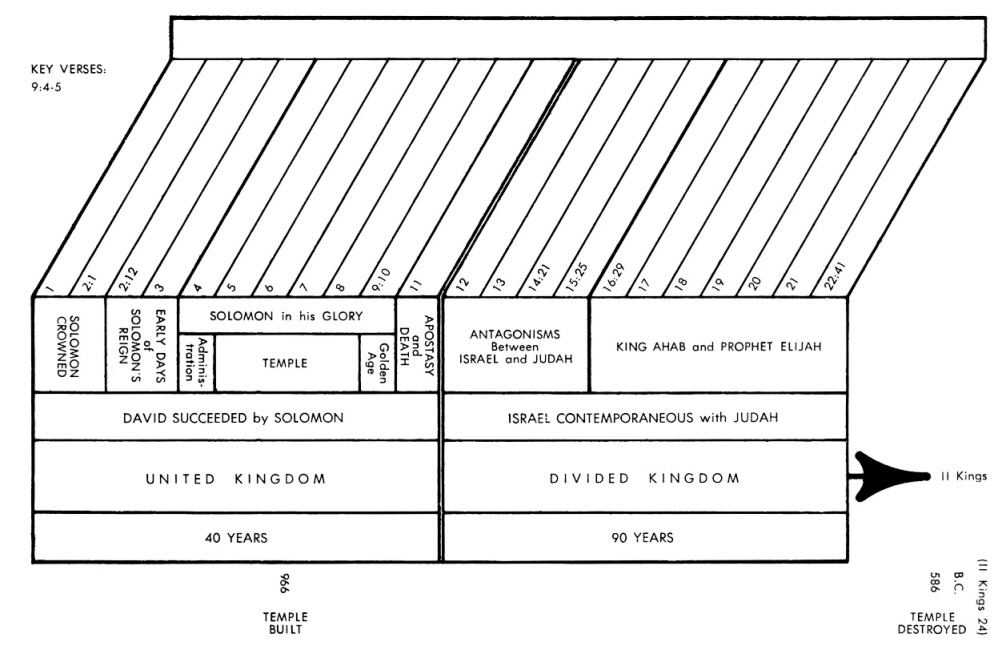
Chart from recommended resource Jensen's Survey of the OT - used by permission
1 Kings Chart from Charles Swindoll

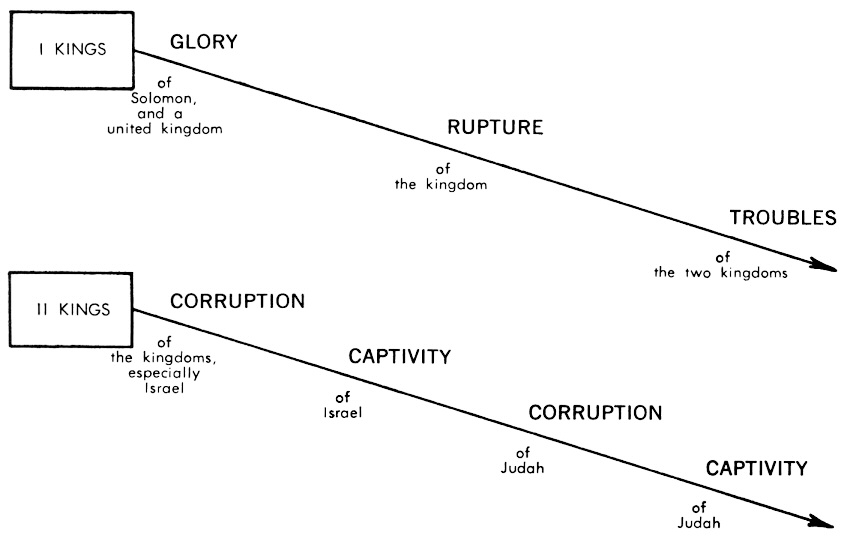
THE DOWNWARD SPIRAL
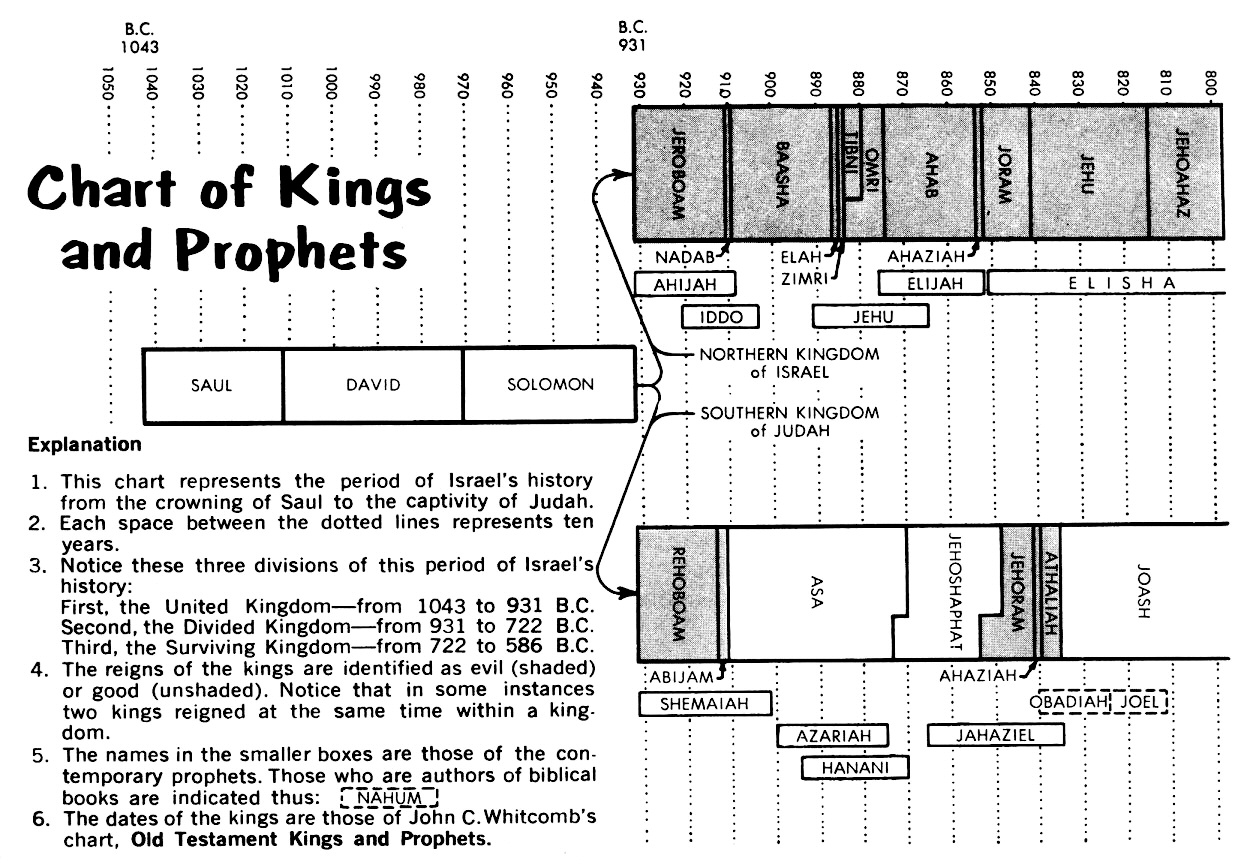
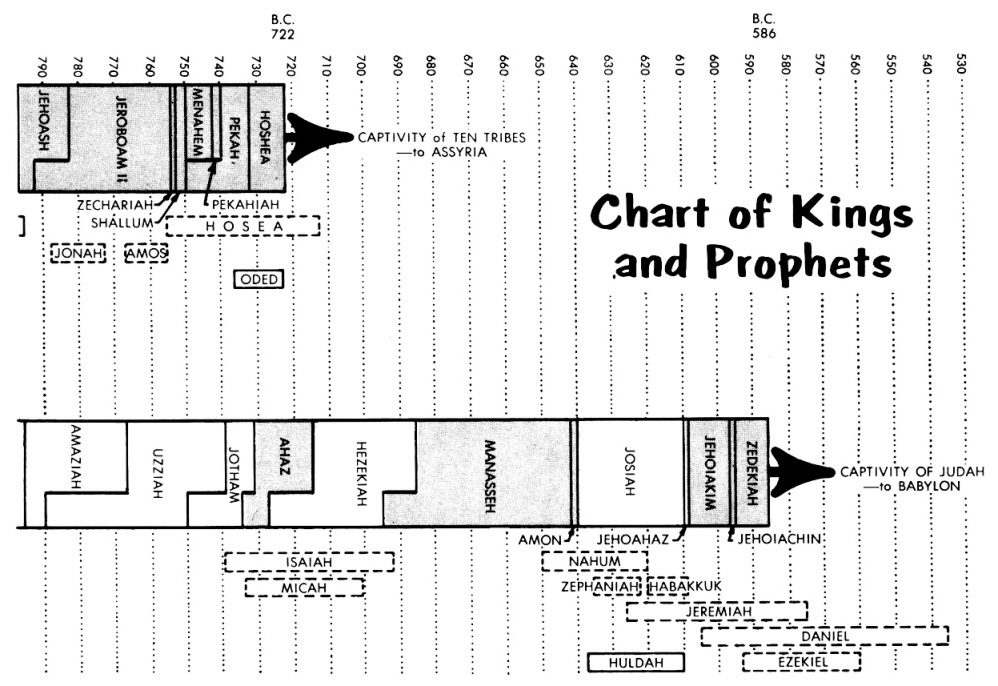
Click to Enlarge
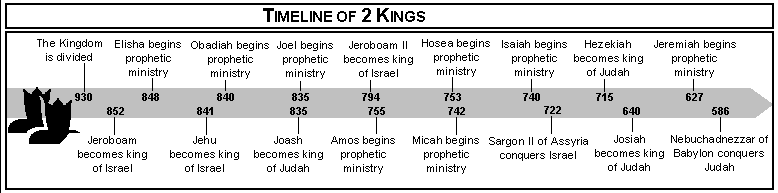
Ryrie Study Bible - Borrow
Click to Enlarge
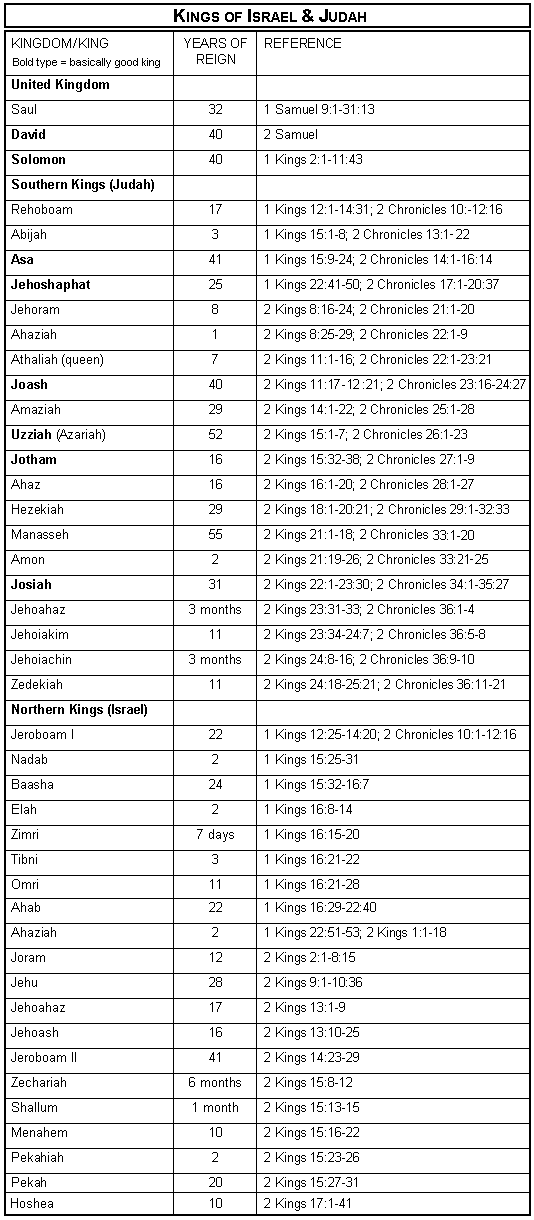
(NOTE: Many consider Amaziah and Hezekiah as "good" kings)
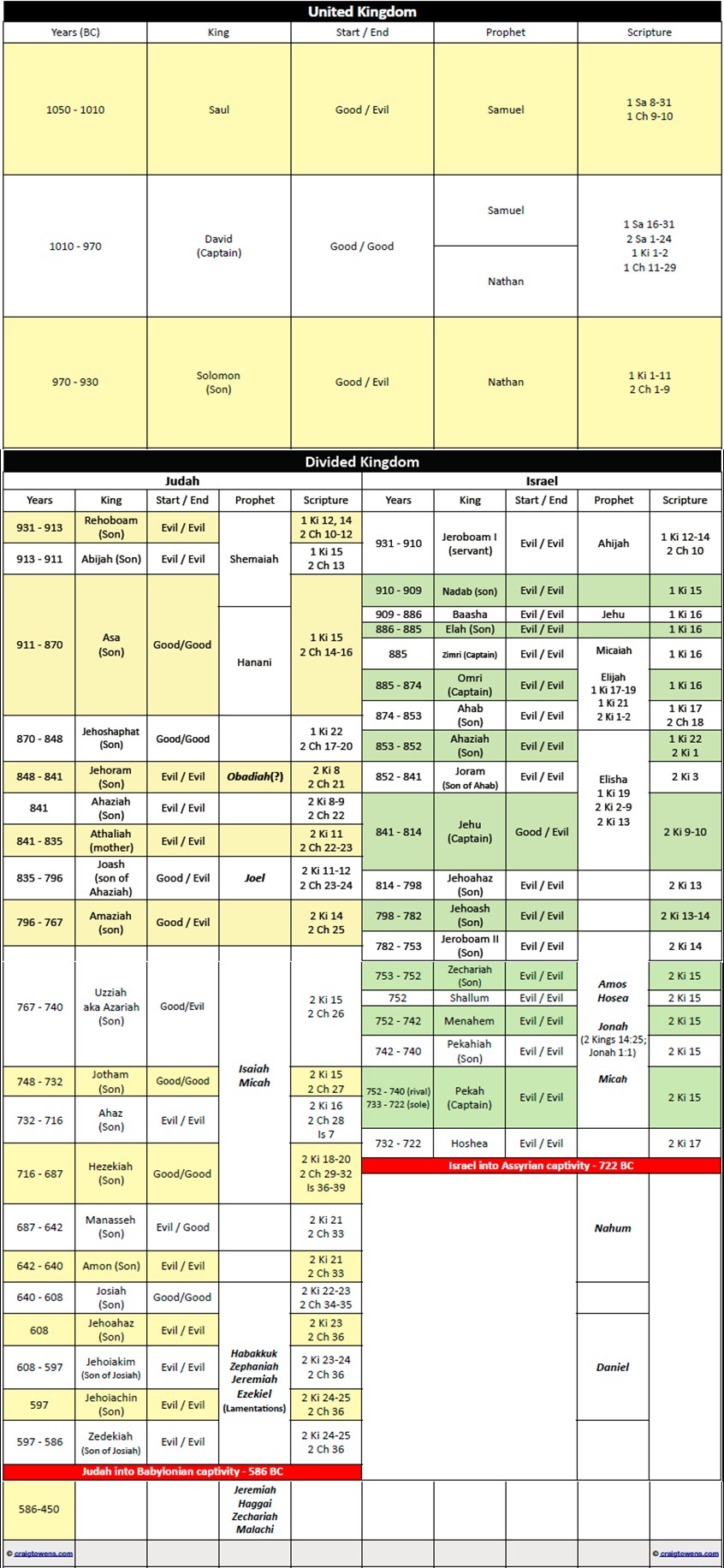
SEE ALSO:
ESV chart - kings of Israel - more information
ESV chart - kings of Judah - more information
Another Chart with Variable Dates for Reigns of King
2 Kings 22:1 Josiah was eight years old when he became king, and he reigned thirty-one years in Jerusalem; and his mother’s name was Jedidah the daughter of Adaiah of Bozkath.
- Josiah: 1Ki 13:2 2Ch 34:1,2-33 Jer 1:2 Zep 1:1 Mt 1:10, Josias
- eight years old: 2Ki 11:21 21:1 Ps 8:2 Ec 10:16 Isa 3:4
- Boscath: This was a city in the plain country of the tribe of Judah; and is mentioned in the parallel passage along with Lachish and Eglon. Jos 15:39, Bozkath
Related Passages:
2 Chronicles 34:1,3+ Josiah was eight years old when he became king, and he reigned thirty-one years in Jerusalem.....3 For in the eighth year of his reign while he was still a youth, he began to seek the God of his father David; and in the twelfth year he began to purge Judah and Jerusalem of the high places, the Asherim, the carved images and the molten images.
THE BEGINNING OF THE
BEST OF THE KINGS
Josiah ("The Lord Supports") was eight years old when he became king Josiah became king at only eight years old, which means he began his reign as a child after the assassination of his father Amon (2Ki 21:23–24). Because of his youth, the early years of his reign were likely guided by counselors, priests, or royal advisors. Yet Scripture later shows that Josiah personally sought the Lord from a young age.
A young unnamed prophet from Judah had predicted Josiah's birth, even his name, roughly 300 years before his birth...
1 Kings 13:1-2+ Now behold, there came a man of God from Judah to Bethel by the word of the LORD, while Jeroboam was standing by the altar to burn incense. 2 He cried against the altar by the word of the LORD, and said, “O altar, altar, thus says the LORD, ‘Behold, a son shall be born to the house of David, Josiah by name; and on you he shall sacrifice the priests of the high places who burn incense on you, and human bones shall be burned on you.’”
and he reigned thirty-one years in Jerusalem Josiah ruled 31 years (640–609 BC) in Jerusalem, the capital of the southern kingdom of Judah.
Here is a simple summary of the chronology of King Josiah:
- 640 BC: Began to reign (age 8) (2Ch 34:1+)
- 632 BC: 8th year (age 16) began to seek God (2Ch 34:3+)
- 628 BC: 12th year (age 20) began reforms to purge Jerusalem even BEFORE he heard the Book of the Law! (2Ch 34:3+)
- 627 BC: 13th year - Word of the LORD came through Jeremiah in the 13th year of his reign (Jer 1:2)
- 622 BC: 18th yr (age 26) discovery of Book of the Law - Covenant Renewal & Passover (2Ki 23:23+ 2Ch 34:8+, 2Ch 35:19+)
- 612 BC: Nineveh falls - Predicted Zeph 2:13–15+
- 609 BC: Nothing recorded age 26 to age 39. Josiah falls asleep. Assyrians defeated at Battle of Carchemish, Babylon rises.
John MacArthur - During Josiah’s reign, power in the ancient Near East passed from Assyria to Babylon. Nineveh, the capital of Assyria, was destroyed by the Babylonians in 612 B.C. and the whole Assyrian empire fell in 609 B.C. Josiah was the last good king of the Davidic line prior to the Babylonian exile. Jeremiah (Jer 1:2), possibly Habakkuk, and (definitely) Zephaniah (Zep 1:1+) were prophets to Judah during the reign of Josiah. (See MacArthur Study Bible)
And his mother’s name was Jedidah the daughter of Adaiah of Bozkath - In the books of Kings it is common to mention the mother of a king of Judah because she often had significant influence in the royal court. Some scholars believe this detail suggests that Josiah may have been influenced toward faithfulness by godly guidance in his early life, especially since his father Amon was a wicked king (2 Kings 21:20–22).
Bob Utley - Next to David, Josiah has more positive treatment than any other king of Judah.
August Konkel: Judgment against Jerusalem is delayed but cannot be averted, not even by one of the noblest kings to reign on the throne of Judah. Josiah is the long-awaited king promised by the prophet of Judah to reverse the cursed idolatry introduced by Jeroboam (1 Kings 13:2). He is described as following in the ways of David (2 Kings 22:2), but he is also described in the same terms as the ideal king of Deuteronomy (Deut. 17:20). Josiah does not turn from the teaching of the covenant to the right or to the left (2 Kings 22:2). There is no king like him; he exceeds even Hezekiah in his devotion to the teaching of Moses, from which he does not deviate (23:25). Josiah is a second Moses to complement King Hezekiah, who had been the ideal second David.
D A Carson - THE LAST SERIOUS ATTEMPT at moral and theological reformation in the kingdom of Judah is reported in 2 Kings 22. After that, there is only the final slide into exile.
King Hezekiah, the effect of whose reign was so largely good, was succeeded by his son Manasseh. He reigned a long time, fifty-five years, but his reign was notorious for its “evil in the eyes of the LORD, following the detestable practices of the nations the LORD had driven out before the Israelites” (21:2). There was no form of current idolatry he did not adopt. According to 2 Chronicles 33, Manasseh repented toward the end of his life, but the religious and institutional damage could not easily be undone. He was succeeded by his wicked son Amon, who lasted only two years before he was assassinated (21:19–26).
Then came Josiah, a boy of eight when he came to the throne (22:1). He reigned thirty-one years—which means, of course, he died a premature death at the age of thirty-nine. Initially he would have been under the guidance and control of others. But in the eighteenth year of his reign, Josiah, then in his mid-twenties, initiated temple cleanup and repair—and the “Book of the Law” was rediscovered. Probably this refers to the book of Deuteronomy. (Nineteenth- and twentieth-century scholars of skeptical bent contend that this was in fact when Deuteronomy and other parts of the Pentateuch were actually written, so that this story of “rediscovering” the law was made up to justify these new developments. This theory is increasingly being dismissed; its foundation is little more than raw speculation.)
The reforms instituted by Josiah were sweeping. On every front, wherever he could effect change, Josiah brought the nation into line with the Law of God. He fully recognized the terrible threat of wrath that hung over the covenant people, and he resolved to do what was right, leaving the outcome with God. If the day of reckoning could not finally be removed, at least it could be delayed.
The church is never more than a generation or two from apostasy and oblivion.
Only grace is a sufficient hedge.
Of the important lessons to be learned here, I shall focus on one. Some people find it difficult to believe that the nation could descend into complete biblical ignorance so quickly. After all, Hezekiah was Josiah’s great-grandfather: the reformation he led was not that long ago. True—but long enough. The intervening three-quarters of a century had begun with the long and wicked reign of Manasseh. The history of the twentieth century testifies to how quickly a people can become ignorant of Scripture—and we live this side of the printing press, not to mention the Internet. The church is never more than a generation or two from apostasy and oblivion. Only grace is a sufficient hedge. (See For the Love of God (Vol. 1): A Daily Companion ... - Page 9)
2 Kings 22:2 He did right in the sight of the LORD and walked in all the way of his father David, nor did he turn aside to the right or to the left.
- right: 2Ki 16:2 18:3 2Ch 17:3 29:2 Pr 20:11
- walked: 1Ki 3:6 11:38 15:5
- turn: De 5:32 Jos 1:7 Pr 4:27 Eze 18:14-17
Related Passages:
Deuteronomy 5:32 “So you shall observe to do just as the LORD your God has commanded you; you shall not turn aside to the right or to the left.
Joshua 1:7 “Only be strong and very courageous; be careful to do according to all the law which Moses My servant commanded you; do not turn from it to the right or to the left, so that you may have success wherever you go.
Proverbs 4:27 Do not turn to the right nor to the left; Turn your foot from evil.
He did right in the sight of the LORD - Josiah lived his life according to God’s standard, not human opinion aligning his walk with the will of the Lord. This is interesting because we later find the book of the Law had been lost, so how did he know what was right?
and walked in all the way of his father David David is presented as the model king of faithfulness. The expression does not mean Josiah was David’s physical son, but that he followed David’s spiritual example of devotion to God. To walk in someone’s way is a Hebrew idiom meaning to pattern one’s life after that person’s conduct.
Bob Utley - "walked in all the way" Godly living was illustrated by a straight, clear, smooth, unobstructed path/road/trail (cf. Ps. 119:105; Prov. 6:23). God's will was very clear. His faithful followers are warned not to deviate to the right or left (cf. Deut. 5:32; 9:12,16; 17:11,20; 28:14; Josh. 1:7; 23:6; 2 Chr. 34:2; Prov. 4:27). Stay on the path! "his father David" This shows the wide semantic field of "father." Here, it denotes ancestor. Note the same phrase used of Jehoshaphat in 2 Chr. 17:3.
nor did he turn aside to the right or to the left. This is a biblical expression of life as a path or road and to remain faithful to God’s law meant he stayed on the path without major deviation. It was specified for kings in Deuteronomy 17:20 which says the king's "heart may not be lifted up above his countrymen and that he may not turn aside from the commandment, to the right or the left, so that he and his sons may continue long in his kingdom in the midst of Israel." Josiah is the only king of whom this description (to the right or to the left) is given, which clearly makes him one of the best, if not the best kings in Israel's history. His life was not one of perfection, but it was one of direction and generally consistent obedience.
2 Kings 22:3 Now in the eighteenth year of King Josiah, the king sent Shaphan, the son of Azaliah the son of Meshullam the scribe, to the house of the LORD saying,
- in the: 2Ch 34:3-8,9-33
Related Passages:
2 Chronicles 34:3-8+ (CLEARLY JOSIAH'S REFORMS PRECEDED DISCOVERY OF BOOK OF THE LAW) For in the eighth year of his reign while he was still a youth, he began to seek the God of his father David; and in the twelfth year he began to purge Judah and Jerusalem of the high places, the Asherim, the carved images and the molten images. 4 They tore down the altars of the Baals in his presence, and the incense altars that were high above them he chopped down; also the Asherim, the carved images and the molten images he broke in pieces and ground to powder and scattered it on the graves of those who had sacrificed to them. 5 Then he burned the bones of the priests on their altars and purged Judah and Jerusalem. 6 In the cities of Manasseh, Ephraim, Simeon, even as far as Naphtali, in their surrounding ruins, 7 he also tore down the altars and beat the Asherim and the carved images into powder, and chopped down all the incense altars throughout the land of Israel. Then he returned to Jerusalem. 8 Now in the eighteenth year of his reign, when he had purged the land and the house, he sent Shaphan the son of Azaliah, and Maaseiah an official of the city, and Joah the son of Joahaz the recorder, to repair the house of the LORD his God.
JOSIAH INITIATES
REPAIR OF TEMPLE
Now in the eighteenth year of King Josiah Josiah began ruling at age eight (2 Kings 22:1). The 18th year of his reign would make him about 26 years old. By this time he had already begun seeking the Lord and purging Judah of idolatry, i.e., even before the discovery of the Book of the Law! Clearly he had received this instruction from someone, but the text is not clear from whom. Josiah's program of Temple rennovation is similar to that carried out by King Joash/Jehoash (835–796 BC) almost 200 years earlier. On that previous occasion the repairs were needed because parts of the temple had been taken over for foreign practices in the reign of Athaliah. Clearly the Temple had again fallen into significant disrepair during those two centuries, especially during in the evil reigns of Manasseh and his son Amon.
Here is a simple summary of the chronology of King Josiah:
- 640 BC: Became king (age 8)
- 632 BC: 8th year (age 16) began to seek God (cf command "Seek" in Zeph 2:1-3+ who prophesied in Josiah's reign)
- 628 BC: 12th year (age 20) began reforms and the first purge Jerusalem
- 622 BC: 18th yr (age 26) discovery of the Book of the Law in the Temple - Covenant Renewal & Passover (2Ki 23:23 2Ch 34:8, 35:19) this leads to the second purge
- 609 BC: 31st yr (age 39) died as result of attacking Neco.
- Scripture silent on Josiah's reign from age 26 to age 39.
In the 18th year of Josiah's reign is mentioned 4 times (first in 2Ki 22:3)...
2 Kings 23:23 But in the eighteenth year of King Josiah, this Passover was observed to the LORD in Jerusalem.
2 Chronicles 34:8 Now in the eighteenth year of his reign, when he had purged the land and the house, he sent Shaphan the son of Azaliah, and Maaseiah an official of the city, and Joah the son of Joahaz the recorder, to repair the house of the LORD his God.
2 Chronicles 35:19 In the eighteenth year of Josiah’s reign this Passover was celebrated.
Bob Utley - "in the eighteenth year" The reform apparently started in the eighth year (cf. 2 Chr. 34:3-8), therefore, it had been ongoing for ten years already.
In other words the discovery of the Book of the Law was not the impetus for many of Josiah's reforms which were already taking place.
Josiah’s reforms were both begun and to a large extent
complete before Hilkiah’s discovery of the Book of the Law
Dale Ralph Davis points out that "The writer of Kings focuses on Josiah’s eighteenth year (2Ki 22:3; 23:23); apparently he highlights one year of Josiah’s reign to give a flavor of the whole. And in his narrative it looks like Josiah’s reforms (2Ki 23:4–20) are the consequence of the discovery of the Book of the Law and the covenant renewal. Note, however, the broad order of 2 Kings compared with that of 2 Chronicles: (1) Law discovery, 2Ki 22:3–20 versus Worship reform, 2Ch 34:3–7
|
2 KINGS |
2 CHRONICLES |
|
Law discovery, 2Ki 22:3–20 |
Worship reform, 2Ch 34:3–7 |
|
Covenant renewal, 2Ki 23:1–3 |
Law discovery, 2Ch 34:8–28 |
|
Worship reform, 2Ki 23:4–20 |
Covenant renewal, 2Ch 34:29–33 |
|
Passover celebration, 2Ki 23:21–23 |
Passover celebration, 2Ch 35:1–19 |
Davis goes on to point out - Here are clues to the interests of the respective writers: Chronicles spends far more time on the Passover than Kings, while Kings gives far more space to the purification of worship, something Chronicles briefly summarizes. However, though not fixated on chronology, the Chronicler does give us more chronological precision on the worship reforms (= 2Ch 34:3–7): (1) In Josiah’s eighth year (632 BC, when he was sixteen years old) he ‘began to seek the God of David his father’ (2Ki 22:3a); (2) in his twelfth year (628 BC, at twenty years old) he ‘began to purge’ Judah and then extended his image/altar-bashing to the former northern kingdom (2Ki 22:3–7); and (3) in his eighteenth year (622 BC, at twenty-six years of age) came the discovery of the Book of the Law and renewal of the covenant (2Ki 22:8ff.). Chronicles is clear: Josiah’s reforms were both begun and to a large extent complete before Hilkiah’s discovery of the Book of the Law. Why does Kings relate them after that discovery, giving the impression that the Book of the Law drove those reforms? Is that not deceptive or misleading? So we need to look at 2 Kings again. First, note that Kings implies that Josiah’s reforms were underway before Hilkiah’s discovery of the Law (2Ki 22:3–7), for it would seem likely that repairing the temple also involved at least some purging of the temple. Secondly, note that the covenant renewal (2Ki 23:1–3) and the Passover celebration (23:21–23) are specifically tied to the book that was found (2Ki 23:2, 3, 21), as are the reforms of 2Ki 22:24, but that nothing in the reforms of 2Ki 23:4–20 is related to that book. Thirdly, anyone in a reflective mood might wonder whether all the reforms (and travel required) in 2Ki 23:4–20 could have been carried out within the confines of one year (the eighteenth year of Josiah’s reign). Hence, I think the writer of Kings has left us clues about what he is doing in 2Ki 23:4–20: he is giving us a topical survey of Josiah’s reforms out of strict chronological order (a perfectly legitimate practice, by the way).13 . (BORROW 2 Kings : the power and the fury - may need to refresh page to view)
The king sent Shaphan, the son of Azaliah the son of Meshullam, the scribe - CSB = "the king sent the court secretary Shaphan." Shaphan served as the royal secretary or recorder. A scribe in this context was an important government official responsible for recording royal decrees, administrative oversight and communication between the king and temple authorities.
Bob Utley - Shaphan - This was the king's faithful servant and fellow reformer. His sons later helped Jeremiah. Elasah (cf. Jer. 29:3) Ahikan (cf. Jer. 26:24)
To the house of the LORD saying - During the reigns of Josiah’s grandfather Manasseh and his father Amon, the temple had fallen into neglect and had even been polluted with idolatry (2 Kings 21). As the story unfolds this action led to the discovery of God’s Law which sparked was followed by renewal of the Mosaic Covenant with the people and celebration of the Passover.
A scribe in the Bible was an educated official skilled in reading, writing, and interpreting documents, especially the Law of God. The Hebrew word can refer to a written message, decree, or official record, and the Greek term grammateus likewise refers to someone trained in writing and legal instruction. In the Old Testament, scribes served in several roles: they acted as government officials and secretaries who recorded royal decisions (e.g., 2 Kings 22:3–13), recorders of historical events, military officers who kept rolls, and sometimes teachers of the Law, as seen with Ezra, who is called “a scribe skilled in the Law of Moses” (Ezra 7:6). In the Ancient Near East, scribes often wrote royal histories designed to preserve and glorify the king’s reign.
By the New Testament period, scribes had become recognized as experts in the Scriptures and Jewish traditions. They studied, copied, interpreted, and applied the Law and the “tradition of the elders,” functioning somewhat like lawyers or teachers of religious law. Many were associated with the Pharisees, and they frequently debated Jesus about His authority, forgiveness of sins, Sabbath practices, and ceremonial traditions. Although highly knowledgeable in Scripture, many failed to recognize Jesus as the Messiah because their adherence to tradition and legalism obscured the true message of the Law. Thus, while scribes were respected scholars and interpreters of Scripture, the Gospels often portray them as opposing Jesus and misunderstanding the deeper spiritual intent of God’s Word.
2 Kings 22:4 “Go up to Hilkiah the high priest that he may count the money brought in to the house of the LORD which the doorkeepers have gathered from the people.
- Hilkiah: 1Ch 6:13 9:11 2Ch 34:9-18
- he may count the money: 2Ki 12:4,8-11 2Ch 24:8-12 Mk 12:41,42
- which the doorkeepers have gathered from the people: 1Ch 9:19 26:13-19 2Ch 8:14 Ne 11:19 Ps 84:10
Related Passages:
2 Chronicles 34:8-9+ Now in the eighteenth year of his reign, when he had purged the land and the house (NOTE REPAIR OF TEMPLE FOLLOWS JOSIAH'S PURGE OF THE LAND AND THE TEMPLE OF IDOLATRY), he sent Shaphan the son of Azaliah, and Maaseiah an official of the city, and Joah the son of Joahaz the recorder, to repair the house of the LORD his God. 9 They came to Hilkiah the high priest and delivered the money that was brought into the house of God, which the Levites, the doorkeepers, had collected from Manasseh and Ephraim, and from all the remnant of Israel (NORTHERN 10 TRIBLES), and from all Judah and Benjamin and the inhabitants of Jerusalem.
CHECKING THE
TEMPLE RECEIPTS
Go up to Hilkiah the high priest that he may count the money brought in to the house of the LORD which the doorkeepers have gathered from the people - King Joash/Jehoash (reigned 835–796 BC) had earlier used a similar procedure for financing repairs to the temple (see 2Ki 12:7–15+). In that case, money brought to the house of the LORD was collected and carefully administered by trustworthy officials for the restoration work. Josiah follows a similar pattern. During Josiah’s reign, funds for repairing the temple were gathered not only from Judah but surprisingly also from the remnant of the northern tribes of Israel who remained in the land after the Assyrian deportations (2Ch 34:8–9+).
The doorkeepers (temple gatekeepers) were Levites who served at the entrances of the temple. Their duties included guarding the temple gates, maintaining order and collecting offerings brought by worshipers. Don't misunderstand. Worshipers were not obligated to pay funds to enter the Temple Complex as if they needed to buy tickets to worship God! The money came from voluntary contributions of the people who supported the restoration of the Lord’s house.
Treasury of Scriptural Knowledge has this note - Ten years seem to have elapsed since the people began to present the accustomed offerings; yet no one had taken an account of them, nor were they applied to the purpose for which they were given.
2 Kings 22:5 “Let them deliver it into the hand of the workmen who have the oversight of the house of the LORD, and let them give it to the workmen who are in the house of the LORD to repair the damages of the house,
- deliver: 2Ki 12:11-14
- to repair: 2Ki 12:5 2Ch 24:7,12,13,27 Ezr 3:7
JOSIAH'S PLAN TO
RESTORE THE TEMPLE
Let them deliver it into the hand of the workmen who have the oversight of the house of the LORD The money collected in the temple was to be placed under the responsibility of supervisors overseeing the repair work. These men acted as foremen or administrators, managing the construction project and distributing the funds to the laborers. This shows that the restoration of the temple was carefully organized, with trusted individuals responsible for handling the funds and directing the work. A similar system of oversight appears in earlier temple repairs during the reign of Joash (2Ki 12:11).
To repair the damages of the house - Sadly the temple built by Solomon had suffered serious neglect and defilement during the reigns of Josiah’s grandfather Manasseh and his father Amon, who promoted idolatry and placed pagan objects in the temple (2Ki 21:3–7). Repairing Yahweh's house was the first step toward restoring proper worship of the LORD. This organized restoration project demonstrates Josiah’s commitment to restoring the house of the LORD and the fruit of his seeking the LORD beginning in the eigth year of his reign (2Ch 34:3).
2 Kings 22:6 to the carpenters and the builders and the masons and for buying timber and hewn stone to repair the house.
- carpenters: Ex 28:11 35:35 38:23
- builders: 2Ki 12:11 Ge 4:17 1Ki 5:18 6:12
- masons: 2Ki 12:12 Isa 58:12 Eze 22:30
to the carpenters and the builders and the masons - The names of these groups emphasize that the repair work required skilled craftsman and this also show the Temple needed much more than a "fresh coat of paint!"
And for buying timber and hewn stone to repair the house - The damage had been so extensive that new construction materials were necessary to carry out the repairs. Timber and stone suggests that there was a major need to restore the Temple's structural integrity. This emphasizes that the workers had already demonstrated such integrity that they were trusted completely.
2 Kings 22:7 “Only no accounting shall be made with them for the money delivered into their hands, for they deal faithfully.”
- Only no accounting shall be made: 2Ki 12:15 2Ch 24:14
- for they deal faithfully.: Ex 36:5,6 Ne 7:2 Pr 28:20 Lu 16:10-12 1Co 4:2 2Co 8:20,21 2Ti 2:2 3Jn 1:5
Related Passages:
2 Kings 12:15+ Moreover, they did not require an accounting from the men into whose hand they gave the money to pay to those who did the work, for they dealt faithfully.
2 Chronicles 34:12 The men did the work faithfully with foremen over them to supervise: Jahath and Obadiah, the Levites of the sons of Merari, Zechariah and Meshullam of the sons of the Kohathites, and the Levites, all who were skillful with musical instruments.
INTEGRITYOF
ADMINISTRATION
Only no accounting shall be made with them for the money delivered into their hands - Normally, large building projects required strict financial accounting to ensure that funds were properly used. However, in this case the supervisors of the temple repairs were so trustworthy that formal financial audits were unnecessary.
For (term of explanation) they deal faithfully (emunah; LXX - pistis - faithfulness, reliability, loyalty, commitment) - The reason for this unusual level of trust was their faithfulness, reliability, honesty, and trustworthiness.
Faithfully (faithfulness) (0530) emunah from aman = to confirm or support) is a noun which means firmness, steadfastness, fidelity, truth, faithfulness, trustworthiness, a condition of being dependable. The root idea is certainty or firmness. It is therefore fitting that emunah is used to describe God…(Deut 32:4) “The Rock! His work is perfect, For all His ways are just; A God of faithfulness and without injustice, Righteous and upright is He. Used initially in Scripture to describe Moses hands held up with the staff of God until sunset (Ex 17:12), of the stability of the times (Is. 33:6); of the trustworthiness of one in office (2Ki 22:7); of an office as a trust (1Chr 9:22, 26); in connection with righteousness (Pr 12:17); and of right conduct in general. Emunah is used later to describe God's total dependability (Dt 32:4) and faithfulness is frequently listed among the attributes of God (1Sa 26:23; Ps 36:5;40:10; La 3:23). Emunah is also used to refer to those whose lives God establishes. He expects to see faithfulness in them (Pr 12:22; 2Chr 19:9). Indeed, such faithfulness or a life of faith is characteristic of those justified;(declared righteous) in God's sight (Hab 2:4).
2 Kings 22:8 Then Hilkiah the high priest said to Shaphan the scribe, “I have found the book of the law in the house of the LORD.” And Hilkiah gave the book to Shaphan who read it.
- I have found: De 31:24-26 2Ch 34:13-14,15-28
Related Passages:
2 Chronicles 34:14 When they were bringing out the money which had been brought into the house of the LORD, Hilkiah the priest found the book of the law of the LORD given by Moses.
THE DISCOVERY OF THE
GREATEST TREASURE
This verse records one of the most significant discoveries in Judah’s history—the rediscovery of the Book of the Law during the temple repairs under Josiah.
Then Hilkiah the high priest said to Shaphan the scribe The discovery is reported by Hilkiah to Shaphan, the king’s official secretary. This shows the proper chain of authority—religious leadership informing the royal administration about an important discovery.
“I have found the book of the law in the house of the LORD” Book of the Law (aka "the book of the covenant" 2Ki 23:2) - This refers to at least the book of Deuteronomy (only book of Torah with phrase "book of the Law"), and possibly the larger Pentateuch (the Law of Moses). During the long reigns of the wicked kings Manasseh and Amon, the temple had been corrupted by idolatry and the Scriptures appear to have been neglected or even hidden. This moment reveals a tragic reality that a nation that once possessed God’s law had drifted so far that the Scriptures had to be rediscovered.
Phrase - Book of the Law - Deut. 29:21; Deut. 30:10; Deut. 31:26; Jos. 1:8; Jos. 8:31; Jos. 8:34; Jos. 23:6; Jos. 24:26; 2 Ki. 14:6; 2 Ki. 22:8; 2 Ki. 22:11; 2 Chr. 17:9; 2 Chr. 34:14; 2 Chr. 34:15; Neh. 8:1; Neh. 8:3; Neh. 8:18; Neh. 9:3; Gal. 3:10
And Hilkiah gave the book to Shaphan who read it - Clearly Shaphan recognized the significance of this finding.
TSK - This certainly was a genuine copy of the divine law, and probably the autograph of Moses, as it is said, in the parallel place of Chronicles, to be the book of the law of the Lord by Moses. It is not probable that this was the only copy of the law in the land, or that Josiah had never before seen the book of Moses; but the fact seems to be, that this was the original of the covenant renewed by Moses in the plains of Moab, and now being unexpectedly found, its antiquity, the occasion of its being made, the present circumstances of the people, the imperfect state in which the reformation was as yet, after all that had been done, would all concur to produce the effect here mentioned on the mind of the pious Josiah.
We also know from Egypt and Mesopotamia that it was common to seal important documents--including theological documents--in the masonry or foundations of a palace or temple in order to inform a future king who might undertake restoration of the building.
John Wesley - I am a creature of a day, passing through life as an arrow through the air. I am a spirit coming from God and returning to God, hovering over the great gulf. A few months hence I am no more seen. I drop into an unchangeable eternity. I want to know one thing - if God Himself has condescended to teach the way. He hath written it down in a book? Oh, give me that book! At any price give me the book of God!
The argument presented is that the “Book of the Law” discovered in the temple during Josiah’s reign (2 Kings 22–23) was likely more than just the book of Deuteronomy, contrary to what is commonly suggested. One key reason is the extraordinary Passover celebration that followed the discovery. The text states that the Passover observed under Josiah surpassed any celebration since the days of the Judges (2 Kings 23:21–23). However, the instructions about Passover in Deuteronomy 16:1–8 are quite brief and lack detailed guidance, suggesting that a more complete set of instructions—like those found elsewhere in the Pentateuch—must have been available. Additional evidence appears in 2 Kings 23:24, which mentions “those who have familiar spirits.” This terminology closely matches the wording in Leviticus 19:31; 20:6, 27, rather than the wording in Deuteronomy 18:11. These factors suggest that the discovered “Book of the Law” likely included a broader portion of the Mosaic Law—possibly much of the Pentateuch—rather than only Deuteronomy.
G Campbell Morgan - I have found the book of the law in the house of the Lord.-2 Kings 22.8
With the accession of Josiah there came the last attempt at reformation before the final sweeping away of Judah into captivity, and the ending of the period of human kingship. His first act of reformation was that of the restoration of the Temple. All that followed resulted from that. In the course of the work came the discovery of the book of the law. The condition of affairs in Judah may be gathered from the fact of such a finding. The nation had become utterly corrupt during the fifty-four years covering the reigns of Manasseh and Amon. The Temple had been neglected and deserted, and it would seem that neither king nor priest knew of the whereabouts of this book. Of its existence there can be no doubt that they were aware; but so far had the people departed from recognition of the Divine government, or response thereto, that the sacred writings had been neglected, and the actual Temple copy lost. The effect of the reading of the book upon the king revealed his ignorance of its contents. Therein he discovered how far the nation had wandered from the Divine ideal, and how terrible were the curses pronounced upon them for such wandering. Having a quick and sensitive conscience, he at once realized both the danger threatening them, and its cause; and he turned for counsel to the prophetess Huldah. Speaking on Divine authority, she recognized the sincerity of the king, and the corruption of the people; and declared that the reformation would be unreal so far as the people were concerned. The suggestive and searching fact of the story is that of the book of the law was lost in the Temple of God. When that is so, nothing can save from ruin.
Whitcomb: In passing, we must comment on one of the most fantastic fables ever foisted upon the Church by “the father of lies.” Nineteenth century A.D. negative critics of the Old Testament, especially a German scholar named Julius Wellhausen, insisted that the book of Deuteronomy was invented by an unknown contemporary of King Josiah. Making the scroll to read like an original production of Moses himself, he planted it in the rubbish heaps of the Temple in order that it might be discovered during the time of cleansing and repair! The true tragedy of this fantastic theory is that the vast majority of Old Testament scholars in Europe and America adopted it, and its influence continues to the present hour, even though the theory has experienced many modifications (see The New Bible Commentary: Revised, 1970, pp. 34-40).
Before the Face of God - Who Wrote Deuteronomy?
Hilkiah the high priest said to Shaphan the secretary, “I have found the Book of the Law in the temple of the LORD.” He gave it to Shaphan, who read it. [2 Kings 22:8]
In the eighteenth year of his reign, King Josiah gave orders that the temple of the Lord be repaired. While it was being repaired, the high priest Hilkiah found a copy of the “Book of the Law.” He gave it to Shaphan to read (in those days not very many people were trained in reading), and Shaphan realized what it was and brought it to Josiah’s attention.
Convicted by its precepts and how far the people were living from them, Josiah promptly reformed the nation.
What was this book? Historically it has been understood to include the Books of Moses. During the eighteenth and nineteenth centuries, however, unbelieving secular critics formulated the notion that Deuteronomy had been written by Hilkiah and Shaphan, and thus the “discovery” was a hoax. Among liberal branches of the church this notion was adopted and became the standard line.
Educated Christians need to know more about this erroneous belief and why it arose. During the eighteenth and nineteenth centuries the idea of biological evolution influenced nearly all areas of thought. In religion it was held that human culture evolved from primitive animism (the worship of rocks and trees), though polytheism (many gods), then to henotheism (one god over all the rest), and finally to monotheism (only one God). There is no evidence that this development pattern has occurred anywhere, and the Bible flatly contradicts it, but evolutionists hold tenaciously to it.
Liberals said the “Books of Moses” were actually crude compilations put together by the priests centuries after Moses. Supposedly they find a J document (using the word Jahweh for God), and E document (using the word Elohim for God), a D document (written by “the deuteronomist”), and a P document (written by priests). They contend Hilkiah and Shaphan wrote Deuteronomy in Josiah’s time, making sure that the priests and Levites came out heroes, in order to bolster the Jerusalem priesthood.
Not one shred of evidence supports this, and it has repeatedly been refuted by conservative scholars. As we study the book of Deuteronomy—written by Moses—we shall look at a coherent literary structure and style.
Coram Deo
Liberal theologians may have reached their conclusions in order to vitiate the authority of the law. As evangelicals, we affirm Mosaic authorship of the Pentateuch. Yet, after fighting to uphold its authority, we often try to escape or ignore obeying it. Give the law the full commitment and study it deserves as the Word of God.
James Smith - JOSIAH AND THE BOOK 2 KINGS 22
“Woe to the man who wastes his wealth of mind,
And leaves no legacy to human-kind.”
—Coleridge.
Manasseh had a godly father, yet for about fifty years he lived a wicked life. Josiah had a wicked father, yet he proved to be one of the choicest of Old Testament saints. The true value of a human life depends on its relationship to God. All lasting virtue comes through our being in touch with the Lord Jesus Christ. Even the hem of His garment is full of power. Let us look at some of those features in this young man’s character which have made his name great in Israel (23–25).
I. Chose a Good Example.
“He walked in the way of David his father” (2Ki 22:2).
“While he was yet young he began to seek after the God of David” (2 Chron. 34:3).
He did not seek after the gods of his father Amon, for what did they do for him? Nor did he seek after the God of Hezekiah, for even the good life of his grandfather was not a perfect model; but, in the truthfulness of his soul, he went back to him who was a “man after God’s own heart.” He desired a God like unto the God of David, and David’s God was found by him; and the works that David did, he did also, in establishing the Kingdom in righteousness. In this Josiah is an example to us. Let us go back, not to our godly forefathers, but to Christ, the (perfect) Man after God’s own heart, and if His God is our God, the works of Christ will be also manifest in our lives. He hath left us an example that we should follow in His steps.
II. Revered the Word of God.
“When the king heard the words of the book of the law, he rent his clothes” 2Ki 22:11).
It was a great discovery Hilkiah, the priest, made while looking after the repairs in the temple. He found the book of the law written by Moses. The Word of God may be burned or buried, but, in some way or other, it will have a resurrection, and, in due time, manifest its authority and power. While the scribe read it to the king, it was to him as a message direct from the Court of Heaven (Deut. 29:25–27). In token of his belief in it, “he rent his clothes.” The Word of God has usually a self-humbling, self-stripping effect before it becomes the inspiring motive of the life. It is most significant that when Josiah began to seek after God, the written Word should be brought and read in his hearing. This is in perfect harmony with the teaching of Jesus Christ (Luke 16:31). Wherever there is faith in the Word of God, there will be a rending of the heart when it is read or preached in the energy of the Holy Spirit.
III. Sought to Know the Mind of God for Himself.
“Go ye, inquire of the Lord for me, and for the people” (2Ki 22:13).
As king of Judah he was anxious to know what God would have him and his people to do. He had learned from the book a lesson which this present generation sadly needs—that the “wrath of the Lord is kindled against those who will not hearken unto the words of this book” (2Ki 22:13). The words of Scripture and the God of the Scriptures are one (2Ki 22:16–17). When Josiah met the book, he felt as really in the presence of God as Saul of Tarsus did when he cried out, “What wilt Thou have me to do?” (Acts 22:10). But it was not enough for him merely to believe the book, the tidings of the book constrained him to seek the God of the book, and to have his own life brought into conformity with His will. It was the complaint of Christ that the scribes and Pharisees of His day searched the Scriptures, but they would not come to Him for life. “They are they which testify of ME” (John 5:39), he said. Nor was the king disappointed; the answer came in a definite promise from the Lord (2Ki 22:20).
IV. Published Abroad the Tidings from God.
“The king gathered unto him … all the men of Judah, … and he read in their ears all the words of the book of the covenant” (2Ki 23:1, 2)
He was not ashamed of his faith in the book. Believing it to be God’s message to all, he read it out in the ears of the nation. The book had moved him as no other book could, and it was able also to move others, and to so move them that their lives would be surrendered to its influence, and the whole nation saved thereby. The best way to defend the Bible is to read it and preach it as God’s present-day message to the people. The best way to defend a caged lion from a pack of yelping dogs is to let it loose, and it will splendidly defend itself. Let the Bible loose in all its native and original majesty, and wonders will certainly be done. If you cannot preach the Word, you can read it. Hearers seldom sleep while the Word is being read. Ezra read out of the book “from morning until mid-day, and the ears of all the people were attentive” (Neh. 8:1–3). Our Lord will be ashamed of us if we are ashamed of Him and of His Word (Mark 8:38).
V. Consecrated Himself to do the Will of God.
“The king stood by a pillar, and made a covenant with the Lord to walk after the Lord, … and with all his heart and soul to perform the words that were written in this book” (2Ki 23:3).
He took a bold stand, and launched out into the deep of God’s revealed will. It is one thing to believe the words; it is quite another to perform them. The faith that does not lead to action is a dead faith. The consecration of ourselves to the will and work of God is surely the logical and legitimate outcome of faith in His Word. It was manifestly so in the Apostolic times, why not now? The measure of the power of God’s Word upon our hearts is seen in the measure of our personal surrender to the doing of that Word. It is not he that sayeth, “Lord, Lord!” but he that doeth His will that enter into that Kingdom where the Christian life becomes a power, a glory, and a blessing. He was not disobedient to the heavenly vision, but fearlessly carried on the work of God. He cleansed the temple of the Lord, put down idolatrous priests (2Ki 23:4, 5), and reinstituted the Passover of the Lord (2Ki 23:21). Ye are the temple of God! Are ye cleansed from all your idols, and has the Passover Lamb got His true place in all your work for Him?
Rediscovering the Bible 2 Kings 22:8–23:2 - Stephen Hooks - Sermon Outlines for Growing Christians
Introduction
In 1947 some Bedouin shepherds accidentally stumbled upon the most important biblical manuscripts to be discovered in modem times—the Dead Sea Scrolls. These priceless copies of Holy Scripture had been hidden, unknown to man for nearly 2000 years. If you can imagine the excitement surrounding this discovery, then you will begin to appreciate the excitement surrounding the incident our text records.
I. A Timely Discovery
A. In 638 B.C. a new man ascended the throne of the kingdom of Judah.
1. Up to this point Judah’s history had been a chronicle of a sorry succession of weak, unscrupulous rulers.
2. A single verse describes their reigns, recurring like a doleful refrain throughout the book of Kings, “and he did what was evil in the sight of the Lord.”
B. But suddenly the rhythm breaks and there comes to the throne one of whom the chronicler can say, “He did what was right in the eyes of the Lord … and did not turn aside to the right hand or the left” (2 Kings 22:20).
1. So begins the reign of Josiah, one of Judah’s noblest kings.
2. On Josiah’s 26th birthday his life took a dramatic turn. He decided to rebuild the temple which had fallen into a state of disrepair. By rebuilding that sacred shrine he hoped to restore the religion that the temple symbolized.
C. However, it was not a rediscovered building that was to bring religious revival to the land, but a rediscovered book.
1. A group of workmen discovered an old scroll that had been hidden beneath the debris.
2. Imagine the excitement of Josiah as the scroll is read to him, the growing awareness that this was no ordinary book, the final realization that this was nothing less than the law of God.
3. There followed the greatest religious revival in Judah’s history.
II. A Timeless Truth
A. This story can be read almost as a parable.
1. Throughout history the Bible has often been a lost book, buried and forgotten beneath the rubble of ignorance, tyranny, and unbelief.
2. It was so before the invention of printing, in pre-reformation Europe, and tragically it is also true today when, in spite of the fact that it remains the world’s most widely distributed book, it is seldom read and is regarded by many as mythical or outdated.
B. But each and every time that the Bible has been rediscovered it has invariably resulted in changed lives and revitalized religion.
1. The renewals, reformations, and revivals in the history of the church can be traced, almost without exception, to one factor—some fresh rediscovery of some essential message of the Bible.
2. When the church has wandered from the Gospel into the paths of its own devising, a new and deep study of Scripture has been the means of recalling it to the truth and purpose of God.
3. The great giants of the faith, whose influence has shaped the course of Christian history, for the most part, have derived their motivation from a renewed contact with the written word.
C. But the greatest power of Scripture is not its ability to start movements; it is its ability to change lives. What can a rediscovery of the Bible mean for us?
1. Ask a man on his death bed who has read of the “resurrection and the life.”
2. Ask a widow at a graveside who is reminded that “the Lord is my shepherd.”
3. Ask a lonely, guilt-ridden sinner who has at last discovered the “God who so loved the world.”
Conclusion
Whittier said it well in a bit of oft-repeated verse: “We search the world for truth, we cull the good, the pure, the beautiful; and weary seekers of the best, we come back, laden from our quest, to find that all the sages said, is in the Book our mothers read.”
2 Kings 22:9 Shaphan the scribe came to the king and brought back word to the king and said, “Your servants have emptied out the money that was found in the house, and have delivered it into the hand of the workmen who have the oversight of the house of the LORD.”
- Shaphan: 2Ki 22:3,12 25:22 Jer 26:24 29:3 36:10-12 39:14 40:11 41:2 Eze 8:11
- the scribe: 2Ki 18:18
SHAPHAN REPORTS
DISCOVERY TO THE KING
Shaphan the scribe came to the king and brought back word to the king and said, “Your servants have emptied out the money that was found in the house, and have delivered it into the hand of the workmen who have the oversight of the house of the LORD - The phrase emptied out means the money had been counted and distributed according to Josiah’s instructions.
2 Kings 22:10 Moreover, Shaphan the scribe told the king saying, “Hilkiah the priest has given me a book.” And Shaphan read it in the presence of the king.
- Shaphan: De 31:9-13 2Ch 34:18 Ne 8:1-7,14,15,18 13:1 Jer 36:6,15,21
- the king: De 17:18-20 Jer 13:18 22:1,2
SHAPHAN'S ANNOUNCEMENT
TO KING OF THE DISCOVERY
Moreover, Shaphan the scribe told the king saying, “Hilkiah the priest has given me a book.” And Shaphan read it in the presence of the king - In the ancient Near East, royal officials often read important documents aloud to the king, since reading was frequently done publicly. When Shaphan read the Law to Josiah, the king immediately realized how far Judah had departed from God’s commands.
Ty Blackburn: After Darkness, Light The motto of the Reformation is inscribed in the midst in huge letters inscribed across this great wall: Post Tenebras Lux, after darkness, light. That's the message of the Reformation and that is the thank you that they were saying: thank you for sending the light into our darkness.
After darkness, light. That's the title of our message this morning. After darkness, light. What we're going to see is that's really the story of the Bible in general and there tend to be these patterns through history and we're going to see an archetype of it in 2 Kings 22 and essentially what we see is that the Reformation, the reason that the light came back, was that the Bible was recovered. For basically a thousand years, the Bible, or almost a thousand years, the Bible had been locked away in a dead language. After the fall of Rome, less and less people spoke Latin. It continued to be the language of the intelligentsia and the universities but the common man did not speak Latin all over Europe, but the Bible was only read in Latin. The Bible was only available in Latin. The Catholic Church forbade the Bible to be translated into any other language. This was one of the evidences of their heretical nature, that they kept the Bible from the people locked away in a mystical language and hidden behind all kinds of traditions that choked out the light of God's word. So what happened when the Reformers came to see the Gospel, they started studying the Scripture like Luther did in the Greek and Hebrew because he was a monk and he was trained in those languages, the word of God set his life ablaze with the light of the Gospel of the glory of God in the face of Christ, and then he wanted to see the Scriptures translated and so he translated the New Testament and the Old Testament into German and that happened all over Europe. William Tyndale did that in England and died for it. . . when the Reformers saw the power of the word of God impact their lives and they translated the Bible into the languages and they started printing Bibles in English, in German, and people for the first time held the word of God in their hands and began to read the word of God and to teach the word of God to one another, families around the Bible, God's word, the light of God's word flooded into an area that had been formerly deep darkness and that's what post tenebras lux means, after darkness, light. And we see in this amazing passage in the Old Testament, the story of Josiah, really almost unbelievable and yet we see in this exactly what I was just talking about, the tendency of the people of God to lose the Bible, to lose the book. (Sermon - After Darkness Light) (For more on the Darkness to Light watch The Indestructible Book The Story of the Bible)
2 Kings 22:11 When the king heard the words of the book of the law, he tore his clothes.
- that he rent: 2Ki 22:19 2Ch 34:19 Jer 36:24 Joe 2:13 Jon 3:6,7
Related Passages:
Joel 2:13+ And rend your heart and not your garments.” Now return to the LORD your God, For He is gracious and compassionate, Slow to anger, abounding in lovingkindness And relenting of evil.
THE PENETRATING POWER OF
THE WORD OF GOD
When the king heard the words of the book of the law, he tore his clothes (note) - For the fifty-five years of Manasseh’s evil reign, the Scriptures were largely ignored and had all but disappeared from public life. Under his rule the nation plunged into gross idolatry, and the temple itself was defiled with abominable pagan practices (2 Kings 21:3–7+). As a result, the Word of God was neglected and virtually forgotten by the people. Yet God’s Word cannot be permanently silenced or rendered powerless. Scripture itself declares that “the word of God is living and active and sharper than any two-edged sword” (Hebrews 4:12+). When the rediscovered Book of the Law was read aloud during the reign of Josiah, its message immediately pierced the king’s heart and exposed personal and national sin. This is the inherent power of Scripture: whenever it is read or heard with a sincere and receptive heart, it convicts, instructs, and transforms. Thus the rediscovery and reading of the Law did not just inform Josiah but supernaturally transformed his heart. The living Word awakened his conscience, revealed Judah’s manifold violations of the Mosaic Covenant, and became the catalyst for one of the greatest spiritual reforms in the nation’s history.
Although Josiah may not have personally seen the Scriptures before this discovery, he had evidently received some instruction in the ways of the Lord from some source, either his mother or faithful priests, which explains why he began seeking God while still young and desired to restore the temple and its worship.
Josiah's rending of his clothes reflects the fact that the Word cut him like a sword as described in Hebrews 4:12-13+ - "For the word of God is living and active and sharper than any two-edged sword, and piercing as far as the division of soul and spirit, of both joints and marrow, and able to judge the thoughts and intentions of the heart. And there is no creature hidden from His sight, but all things are open and laid bare to the eyes of Him with whom we have to do." Josiah's tearing would prove not to be just an external response, but a response of his heart, his "control center." As the prophet Joel commanded "rend your heart and not your garments.” Now return to the LORD your God, For He is gracious and compassionate, Slow to anger, abounding in lovingkindness And relenting of evil." (Joel 2:13+)
Josiah's response was in marked contrast to that of his own son King Jehoiakim who when he heard the Word of God, rejected it, even cutting (cf "cutting" of Heb 4:12+) the and burning the scroll. Jeremiah writes...
When Jehudi had read three or four columns, the king cut it with a scribe’s knife and threw it into the fire that was in the brazier, until all the scroll was consumed in the fire that was in the brazier. Yet the king and all his servants who heard all these words were not afraid, nor did they rend their garments. (Jeremiah 36:23-24)
Jehoiakim did not understand that physical destruction of the scroll could not destroy God's Word, for He Himself declares "Is not My word like fire?...And like a hammer which shatters a rock?." (Jer 23:29)
And here is another immutable principle regarding God's indestructible Word -
The Word of God can either soften the heart in repentance or harden it
in rebellion depending on the hearer's heart response.
Shaphan was reading the Law and as Paul wrote centuries later "by the works of the Law no flesh will be justified in His sight; for through the Law comes the knowledge (epignosis - full, experiential knowledge) of sin." (Ro 3:20+) King Josiah received the knowledge of Judah's sin when he heard Shaphan read the Word of God. In Galatians Paul adds "Therefore the Law has become our tutor to lead us to Christ, so that we may be justified by faith." (Gal 3:24+) Given Josiah's subsequent actions of bringing forth fruit in keeping with repentance (Mt 3:8+), clearly Josiah came to saving faith in the Messiah.
🙏 THOUGHT - The same prinicple applies today that when God’s Word is rediscovered and read for it has the power, enabled by the Spirit (Jn 16:8,9,10,11+), to bring conviction, repentance, and revival. Psalm 119:25+ says "My soul cleaves to the dust; Revive me according to Your word." (See Secret of Revival: Mouth to Mouth Resuscitation) The power was not in the scroll Shaphan held but in the living Word of God he read that penetrated the king’s heart. That same Word has the same penetrating effect on our heart! "Therefore, putting aside all filthiness and all that remains of wickedness, in humility receive the Word implanted, which is able to save your souls." (James 1:21+) Beloved, we all need not only the initial one time salvation of justification, but the daily salvation of progressive sanctification (including daily "revival"), because the spirit is willing but the flesh is weak (Mt 26:41+) and each new day brings a new battle with our fallen flesh, "for the flesh sets its desire against the Spirit, and the Spirit against the flesh; for these are in opposition to one another, so that you may not do the things that you please." (Gal 5:17+). How is the battle going in your heart beloved? May you and I today, yield to the Spirit so that we may "walk by the Spirit, and...not carry out the desire of the (sinful) flesh." (Gal 5:16+). For the glory of the Lamb. Amen.
Addendum: Give the fact that God's Word is indestructible, let me recommend a 3.5 hour video series entitled The Indestructible Book (The Story of the Bible), a video that literally brought me to tears with several of the incredible stories. It is old and does not have AI enhanced graphics, but the truth is still very powerful, very engaging and very encouraging. Let me encourage you to set aside 3.5 hours some evening and watch God's gift of His indestructible Book with your family! You won't be disappointed!
EXCURSUS ON TEARING CLOTHES IN SCRIPTURE - The tearing of garments in Scripture is an ancient and vivid expression of mourning, grief, shock, repentance, or holy outrage. Its earliest appearance occurs when Reuben and Jacob mourn the apparent death of Joseph (Genesis 37:29, 34). Throughout the Old and New Testaments, faithful individuals tore their clothes in response to devastating loss or spiritual crisis: David at the deaths of Saul and Jonathan (2 Samuel 1:11–12), Elisha when Elijah was taken up (2 Kings 2:11–12), Job in overwhelming calamity (Job 1:20), Jephthah upon realizing the cost of his vow (Judges 11:34–35), Mordecai after learning of Haman’s genocidal decree (Esther 4:1), Ahab when confronted with divine judgment (1 Kings 21:27), and Paul and Barnabas when blasphemously worshiped as gods (Acts 14:14). This act was often accompanied by other signs of humility such as sackcloth, dust, or shaved heads (Job 1:20; Job 2:12; 2 Samuel 3:31). Conversely, the refusal to tear garments could signal spiritual hardness, as when King Jehoiakim and his officials showed no fear or repentance while destroying God’s prophetic word (Jeremiah 36:23–24). Notably, the high priest was forbidden to tear his garments, reflecting the sanctity and distinctiveness of his office (Leviticus 21:10). While the practice continues today in the Jewish rite of keriah, Scripture ultimately insists that outward signs must correspond to inward reality: “Rend your heart and not your garments” (Joel 2:13), with the promise that the LORD is gracious, compassionate, and near to the brokenhearted (Joel 2:13; Psalm 34:18).
Dictionary of Biblical Imagery (online) has this note under "Garments" - Another major motif is the tearing of clothes as a ritual gesture of grief or as an act of uncontrollable rage. Indeed, one of the best indices to the emotionalism of the ancient Hebrews is the frequency with which we read about people tearing their garments in a display of strong feeling. To cite just three specimens, Reuben tears his clothes when he returns to the pit and finds Joseph missing (Ge 37:29), Ezra rends his garments when he learns about the Israelites’ intermarriage (Ezra 9:3), and King Hezekiah tears his clothes when he receives the threatening letter from the Assyrian king (Is 37:1). If we trace the three dozen explicit references to people’s tearing their clothing, we find four main categories of crisis-grief or mourning over the loss of something or someone, sorrow for sin in an act of repentance, fear or alarm and anger or frustration.
2 Kings 22:12 Then the king commanded Hilkiah the priest, Ahikam the son of Shaphan, Achbor the son of Micaiah, Shaphan the scribe, and Asaiah the king’s servant saying,
- Then the king commanded Hilkiah the priest: 2Ki 19:2,3 2Ch 34:19-21 Isa 37:1-4
- Ahikam the son of Shaphan: 2Ki 22:9 Jer 26:22,24
- Achbor the son of Micaiah: 2Ch 34:20,
JOSIAH COMMANDS FIVE
GOOD, GODLY MEN
Then - This word usually shows progression in a narrative, in this case the immediate, almost "reflex," response of King Josiah. Josiah does not delay or procrastinate but immediately responds to God's Word he has just heard. What a template Josiah gives us for how quick and responsive we should be when we hear God's Word!
While somewhat conjecture, it is very possible that one portion of Scripture that most deeply affected him was likely the covenant curses recorded in Deuteronomy 28. This would help explain the king’s immediate and intense reaction and his specific actions that followed. And so when Shaphan read the scroll aloud in Josiah’s presence (2Ki 22:10), the warnings of judgment for covenant disobedience would have sounded painfully relevant to Judah’s spiritual condition. Deuteronomy 28 warns that if Israel turned from the LORD to idolatry, God would bring devastating consequences such as famine, defeat by foreign nations, siege, and exile from the land. Recognizing that these very conditions threatened Judah, Josiah tore his clothes in grief and alarm (2Ki 22:11), a sign of deep repentance and distress. The king realized that the nation had long violated the Mosaic covenant and that the judgments written in the Law were fully deserved by the nation. This discovery of Scripture therefore became the catalyst for a profound national awakening, as Josiah sought the LORD, renewed the covenant, and celebrated the Passover. It bears repeating that this episode vividly illustrates a recurring biblical principle: when God’s Word is rediscovered, heard, and taken seriously, it brings conviction, repentance, and spiritual renewal.
The king commanded Hilkiah the priest - Notice Josiah's first response to to command the high priest, who under the Old Covenant was the "go between," the mediator, the one set aside to stand between men and God, the spiritual leader of Judah, and the one directly responsible for the temple and its worship. Josiah's first response was to seek the Lord’s guidance, and it was natural that he would begin by addressing Hilkiah, the man who had discovered the scroll and who held the highest spiritual office in the land. In addition, in 2Ki 23:4 we see that Hilkiah helped Josiah purge the temple of idolatry and restore true worship which supports Josiah’s decision to command Hilkiah first. In other words, Josiah was not merely following protocol but was proceeding spiritually, entrusting the nation’s repentance and renewal to the one most responsible for guiding Judah's worship.
True spiritual reform begins with submission to God’s Word and
the faithful leadership of those He has called to serve.
Ahikam the son of Shaphan, Achbor the son of Micaiah, Shaphan the scribe, and Asaiah the king’s servant saying - Josiah's addressing this critical issue to 5 men reflects the wisdom in Proverbs 11:14 which says "Where there is no guidance the people fall, but in abundance of counselors there is victory (safety, security, success, deliverance)." Josiah's willingness to seek counsel from 5 other men reflects his humility, saying in effect "I do not have all the answers brothers!" Each of the men he selected were men of integrity, which Josiah choose because he knew they would handle the sacred task with reverence, honor and obedience. Furthermore, these men were chosen because they represented both the priestly and governmental leadership of Judah.
Ahikam, the son of Shaphan, came from a family known for faithfulness to God. His father, Shaphan, had read the Book of the Law to Josiah (2 Kings 22:10), and Ahikam himself later protected the prophet Jeremiah from being killed (Jeremiah 26:24). This is the father of Gedaliah, the later governor of Judah under Nebuchadnezzar II (cf. Jer. 39:14; 40:7).
Achbor (also called Abdon in 2 Chronicles 34:20) was likely a royal official or counselor, a man of wisdom and standing in the court.
Shaphan, the scribe, was the royal secretary who had first brought the discovered scroll to the king, showing his reliability and devotion to truth.
Asaiah, described as “the king’s servant,” was a trusted personal aide or adviser, someone close to Josiah’s inner circle.
Frederick Mabie: Josiah’s words and actions reflect an implicit recognition of the divine nature and divine authority vested in the Book of the Law of the Lord, and hence the guilt and culpability of the people with respect to the covenant. As Paul notes, the knowledge of God’s law causes every mouth to be silenced and renders the whole world “guilty before God” (Ro 3:19) [KJV]). (See Commentary)
Andrew Hill: The king perceives that the message of the law scroll has profound implications for both him and his subjects (“the remnant in Israel and Judah” [2Ch 34:21] is another instance of the Chronicler’s emphasis on the unity of Israel). This explains Josiah’s decision to appoint envoys to seek an interpretation of the scroll and to ask for counsel in addressing the disturbing news about God’s anger revealed in the law scroll. The theme of God’s anger incited by the disloyalty of the people of Israel is prominent in 2 Chronicles (e.g., 2Ch 28:9; 29:8; 32:25). The king’s reference to the sins of the “fathers” (2Ch 34:21) implies some knowledge of the potential impact of the retribution principle across successive generations (cf. Ex. 20:5). (See Commentary)
2 Kings 22:13 “Go, inquire of the LORD for me and the people and all Judah concerning the words of this book that has been found, for great is the wrath of the LORD that burns against us, because our fathers have not listened to the words of this book, to do according to all that is written concerning us.”
- inquire: 2Ki 3:11 1Ki 22:7,8 1Ch 10:13,14 Ps 25:14 Pr 3:6 Jer 21:1,2 37:17 Eze 14:3,4 20:1-3 Am 3:7
- great: Ex 20:5 De 4:23-27 29:23-28 31:17,18 Ne 8:8,9 9:3 Ps 76:7 Da 9:5-7 Na 1:6 Ro 3:20 4:15 7:9 Rev 6:17
- because our fathers: 2Ch 29:6 34:21 Ps 106:6 Jer 16:12 44:17 La 5:7 Da 9:8,10 Jas 1:22-25
Related Passages:
Jeremiah 25:8 “Therefore thus says the LORD of hosts, ‘Because you have not obeyed (shama = listened to) My words,
Daniel 9:6+ “Moreover, we have not listened (shama = "obeyed") to Your servants the prophets, who spoke in Your name to our kings, our princes, our fathers and all the people of the land.
Acts 7:51+ “You men who are stiff-necked and uncircumcised in heart and ears are always resisting the Holy Spirit; you are doing just as your fathers did.
JOSIAH SEEKS
PROPHETIC WORD
Go, inquire of the LORD for me and the people and all Judah concerning the words of this book that has been found - NET - "Go, seek an oracle from the LORD for me and the people– for all Judah. Find out about the words of this scroll that has been discovered. For the LORD's fury has been ignited against us, because our ancestors have not obeyed the words of this scroll by doing all that it instructs us to do." Josiah's choice of 5 godly men shows that Josiah wanted a unified response, from spiritual, prophetic, and administrative perspectives, to the conviction brought by God’s Word.
Bob Utley - "inquire of the Lord for me" Very early in the history of Israel this phrase refers to consulting the priest to know God's will by means of the use of the Urim and Thummim. But after the time of David, this phrase refers to inquiry of the prophets concerning God's will. SPECIAL TOPIC: URIM AND THUMMIM
For - Term of explanation. What is Josiah explaining to the five? Clearly in context he is conveying the sense of solemnity and urgency with which they should carry out their inquiry.
Great is the wrath (chemah; LXX - orge) of the LORD that burns against us - Josiah is expressing his deep realization that Judah stood under God’s righteous judgment because of generations of disobedience to His Word. Where is the wrath of God most clearly declared in the Torah? Deuteronomy 28 has the most "concentrated" description of the curses that would fall on a disobedient people, suggesting that this is at least part of what he had heard when Shaphan read from the book.
Because our fathers have not listened to the words of this book - (See Acts 7:51+) Listened does not mean they did not hear the warnings. The verb listen usually conveys the sense of not obeying what was heard and that was the case with most of the nation for most of their OT history! Josiah was confessing that the generations before him had deliberately ignored and disobeyed the commands of God that were written in the Book of the Law. Josiah’s words reveal his understanding that sin has generational consequences. The fathers’ disobedience had led the nation into spiritual decay, and now their children were facing the results.
To do according to all that is written concerning us - In simple terms the fathers did not obey. Even if they heard the Word, which is unlikely under Manasseh and Amon, they did not obey (cf Jas 1:22+). Even though he says "all" Josiah is not speaking of perfection but of general direction of one's "walk." The truth is that the fathers generally walked in the wrong "direction!"
Spurgeon - Oh, that all who read God’s Book now would do as young Josiah did I If there be any difficulty in a book, the short way to get to understand it is to inquire of the author; and, surely, never is there greater wisdom than having read any of the deep mysteries or solemn threatenings in this Volume and feeling ourselves staggered by them, we inquire of the Lord concerning them. I believe that there is many a puzzling passage in the Bible on purpose that we may be driven to inquire of the Lord about it. If the Book were all so easy of understanding that, at the first reading of it, we could comprehend all its meaning, we might, perhaps, keep away from God; but he has purposely given us many dark sentences, and made the sense to be somewhat obscure in order that we may wait upon his enlightening Spirit and so obtain instruction, for the Spirit of God is more useful to us even than the Word itself is. Great as the blessing of the Book is, the blessing of the living Spirit is greater still, and anything is good that drives us to him. That which had influenced the mind of Josiah was the terror of the Book.
Wrath (anger, fury, hot-tempered) (02534) chemah from yacham = to be hot, Delitzsch says it is related to an Arabic word hamiy = to glow) is a noun which can refer to physical heat, but more often is used figuratively to convey the picture of inner, emotional "heat" which rises and is fanned to varying degrees. And thus chemah can mean hot displeasure, indignation, anger, wrath, and even poison (figuratively speaking). This type of anger is anger at its fever pitch so to speak.
The first use of chemah describes Esau's "fury" (Lxx = thumos - describes a tumultuous welling up of the whole spirit; a mighty emotion which seizes and moves the whole inner man. Greeks likened thumos to a fire amongst straw, which quickly blazed and just as quickly burned itself out.) which Rebekah knew would flare up when Esau discovered that Jacob had tricked him out of the inheritance of the first born (Ge 27:44) Chemah describes God's prophetic promise to Israel if she disobeys the covenant, for then He "will act with wrathful hostility!" (Lev 26:28 - God's hostility would be bad enough but for it to be modified by "wrathful" is almost incomprehensible!) When Phinehas speared the unfaithful Israelite man and his Midianite mistress (Nu 25:6-7), the divine plague was checked (Nu 25:8), God testifying that Phinehas had "turned away (His) wrath (Lxx = thumos) from the sons of Israel." (Nu 25:11) Moses "was afraid of the anger and hot displeasure (chemah)" of the LORD, which was to such a degree that He was going to destroy the entire nation (until Moses interceded). (Dt 9:19). Chemah describes Jehovah's wrath which caused Him to overthrow Sodom and Gomorrah (Dt 29:23). It was Jehovah's "fury" which cause Him to uproot Israel from their land and into exile (Dt 29:28). In Dt 32:24, 33 chemah describes the "venom" of serpents. When Josiah heard the book of the Law which had been lost in the house of God (2Kings 22:8-11), he recognized that "great is the wrath of the LORD that" burned against Judah (2Ki 22:13). Because of Judah's idolatry, God said His "wrath" burned (2Ki 22:17). Chemah describes the great fury that kings of the North executed in their utter destruction (Dan. 11:44); a person’s burning anger (2Sa 11:20). A man’s jealousy is the source of his “rage” (Pr 6:34).
2 Kings 22:14 So Hilkiah the priest, Ahikam, Achbor, Shaphan, and Asaiah went to Huldah the prophetess, the wife of Shallum the son of Tikvah, the son of Harhas, keeper of the wardrobe (now she lived in Jerusalem in the Second Quarter); and they spoke to her.
- prophetess: Ex 15:20 Jdg4:4 Mic 6:4 Lu 1:41-56 2:36 Ac 21:9 1Co 11:5
- Tikvah: 2Ch 34:22, Tikvath, Hasrah
- wardrobe: 2Ki 10:22 Ne 7:72
INQUIRY OF THE LORD BY
HULDAH THE PROPHETESS
So Hilkiah the priest, Ahikam, Achbor, Shaphan, and Asaiah went to Huldah the prophetess - The five trusted advisers go to Huldah's house to inquire of the LORD. Huldah was one of the few women in the Old Testament recognized as a prophetess of the LORD. Huldah may have been a relative of the prophet Jeremiah as suggested by mention of Shallum in Jer. 32:7.
It is interesting that for reasons which are not clear, Hilkiah did not consult Jeremiah about this matter, or even the prophet Zephaniah who was ministering at that time in Judah.
The wife of Shallum the son of Tikvah, the son of Harhas, keeper of the wardrobe (now she lived in Jerusalem in the Second Quarter) - This description identifies Huldah by her family and social position, which was customary in ancient Israel. Her husband, Shallum, was the “keeper of the wardrobe,” a title that likely referred to his responsibility for maintaining the either priestly garments or royal court garments. In either case Shallum held a trusted rold. These details help explain why Josiah’s delegation sought her out, for clearly she was a respected prophetess probably living near the temple (as discussed below).
Second Quarter is sometimes translated “the New Quarter” or “the Second District” (called “second” because it comprised the city’s first major expansion) and gives a geographical note about her residence. While we cannot be dogmatic, most authorites agree that the Second Quarter was most likely located in the north-western part of Jerusalem, just north or northwest of the Temple Mount but within the expanded city walls. Archaeologists and historians generally associate it with the area that expanded during the reign of Hezekiah, when Jerusalem grew beyond the original City of David. Zeph 1:10 mentions the Second Quarter after mentioning the Fish Gate which was definitely in the northern section of the city.
And they spoke to her - Josiah had commanded that they inquire of the LORD. Huldah’s prophetic authority was clearly genuine and respected, so that her message was received as the very Word of the LORD, as requested by King Josiah.
Spurgeon - When God selects an instrument for his own service, how well he tunes it for the use to which it is to be put! Here is a woman, a married woman, and she is selected to be the Lord’s prophetess to the king; but never has any man spoken more bravely than she did. Her opening words show a holy courage which is lifted above all fear of men: “Thus saith the Lord God of Israel, Tell ye the man that sent you to me,” for before God kings are only men; and though Huldah was only a subject of Josiah, see with what real dignity God’s ordination had invested her. Josiah was not to succeed in the reformation of Israel. He was true and sincere, but the people were steeped in hypocrisy, and formality, and idolatry, and they did not go with the king in all his root and branch reforms. They still clung in their hearts to their idols, and therefore they must be destroyed, and the nation must be carried away captive. It was, however, a very singular promise that God gave to Josiah “I will gather thee to thy fathers, and thou shalt be gathered to thy grave in peace.” Yet he was mortally wounded in battle, so how could that promise be fulfilled ? You know how it could be. However we may die, — if sword or plague or fire consume the saints among the rest of mankind, their very deaths and graves are blest. There was no fighting about Josiah’s grave; he was buried in peace. Pharaoh-Necho had smitten him, but he did not destroy the land; and Josiah was allowed to be buried amid the great lamentations of a people who only began fully to appreciate him when he was taken away from them.
Other women in the Bible who were called prophetesses or functioned like prophetesses:
- “Miriam the prophetess" (Ex 15:20), who played a leadership role during Israel’s exodus from Egypt. After the crossing of the Red Sea, she led the women of Israel in praise to the Lord.
- Deborah uniquely served both as a prophetess and a judge in Israel. God spoke through her to direct the nation, including instructing Barak regarding Israel’s battle against Sisera (Judges 4–5).
- Isaiah’s wife is called "the prophetess" (Isa. 8:3),
- In the NT Luke records "there was a prophetess, "Anna the daughter of Phanuel, of the tribe of Asher.” (Lk 2:36+). Anna lived in the temple precincts and devoted herself to prayer and worship. When the infant Jesus was brought to the temple, she recognized Him as the Messiah and spoke about Him to those awaiting redemption.
- Philip the Evangelist’s 4 daughters Acts 21:9+ “Now this man had four virgin daughters who were prophetesses.” These daughters were part of the early Christian church and exercised a prophetic gift, though Scripture does not record their specific prophecies.
- Other women who functioned prophetically but were not specifically designated prophetesses include:
Abigail – spoke prophetically about David’s future kingdom
Elizabeth – recognized the Messiah through the Spirit
Mary – proclaimed prophetic praise about God’s redemptionNoadiah is another womand mentioned as a false prophetess who opposed Nehemiah (Neh 6:14) indicating that not everyone who claimed prophetic authority truly spoke for God.
QUESTION - Who was Huldah the prophetess in the Bible?
ANSWER - Huldah the prophetess lived in Jerusalem during the reign of King Josiah, who was one of only a few good, God-fearing kings of Judah. There are not many details about Huldah other than where she lived and the fact that she was “the wife of Shallum son of Tokhath, the son of Hasrah, keeper of the wardrobe” (2 Chronicles 34:22). But Huldah’s prophecy and the events that precipitated it are quite amazing. During what was apparently a routine bookkeeping task being performed for the king, the high priest, Hilkiah, found a copy of the Book of the Law (which had been lost) and brought it to the king to be read. The details of this story make it clear that the Book of the Law had not been seen in many years, perhaps generations. The Book of the Law, given to the people by God through Moses, was the foundation of Israel’s entire religious and political system. The fact that it could have been lost for years is almost inconceivable. The neglect of the Law shows the depth of the apostasy during the reigns of Manasseh and Amon.
When the scroll was read, King Josiah discovered the extent of Judah’s disobedience and saw they were in danger of God’s wrath. The king was devastated, so much so that he tore his clothes in mourning (2 Chronicles 34:19). Imagine Josiah’s shock, considering that this book came from God Himself and warned of severe repercussions for the entire nation that Josiah governed. King Josiah needed guidance on what to do, so he sent his advisers to Huldah the prophetess, asking for a word from the Lord (verse 21).
Huldah the prophetess gave the king’s men a message from God: disaster would strike the nation because they had forgotten God and instead worshiped idols (2 Chronicles 34:23–25). But God had a different message for Josiah. Despite the absence of the Law, King Josiah had honored God by getting rid of idol worship in Judah and Jerusalem (2 Chronicles 34:1–7). As a result of Josiah’s action, the destruction of Judah would not occur during Josiah’s lifetime. Through Huldah the prophetess, God said, “Because your heart was responsive and you humbled yourself before God when you heard what he spoke against this place and its people, and because you humbled yourself before me and tore your robes and wept in my presence, I have heard you, declares the Lord. Now I will gather you to your ancestors, and you will be buried in peace. Your eyes will not see all the disaster I am going to bring on this place and on those who live here” (2 Chronicles 34:27–28).GotQuestions.org
2 Kings 22:15 She said to them, “Thus says the LORD God of Israel, ‘Tell the man who sent you to me,
- 2Ki 1:6,16 Jer 23:28
Related Passages:
2 Chronicles 34:23+ She said to them, “Thus says the LORD, the God of Israel, ‘Tell the man who sent you to Me,
Isaiah 55:11 So will My word be which goes forth from My mouth; It will not return to Me empty, Without accomplishing what I desire, And without succeeding in the matter for which I sent it.
HULDAH PROCLAIMS THE WORD
OF THE LORD GOD OF ISRAEL
She said to them, “Thus says the LORD God of Israel - This phrase emphasizes her claim to divine authority. Huldah was not speaking on her own behalf; she was acting as God’s mouthpiece, delivering His revealed will to the king. The full name the LORD God of Israel reminds the 5 men that the message comes from the covenant God who had chosen Israel as His people and bound them to Himself through His law.
Her declaration assured them that what they were about to hear carried the full weight of God’s truth and judgment. It also demonstrated that God was still speaking to His people, even in a time of national apostasy, showing His mercy in warning them before judgment fell.
Tell the man who sent you to me - Huldah’s command was not her own but were the living Word of the living God of Israel. The NASB should have capitalized "me" because it does not refer to Huldah but Yahweh. It is interesting that it is capitalized in 2 Chronicles 34:23+.
2 Kings 22:16 thus says the LORD, “Behold, I bring evil on this place and on its inhabitants, even all the words of the book which the king of Judah has read.
- Behold: 2Ki 20:17 21:12,13 2Ch 34:24-25
- all the words: 2Ki 25:1-4 Lev 26:15-46 De 28:15-68 29:18-23 30:17,18 31:16-18 De 32:15-26 Jos 23:13,15 Da 9:11-14
Related Passages:
Deuteronomy 28:15-19+ (and through v68) But it shall come about, if you do not obey the LORD your God, to observe to do all His commandments and His statutes with which I charge you today, that all these curses will come upon you and overtake you: 16 “Cursed shall you be in the city, and cursed shall you be in the country. 17 “Cursed shall be your basket and your kneading bowl. 18 “Cursed shall be the offspring of your body and the produce of your ground, the increase of your herd and the young of your flock. 19 “Cursed shall you be when you come in, and cursed shall you be when you go out.
2 Chronicles 34:24-25+ thus says the LORD, “Behold, I am bringing evil on this place and on its inhabitants, even all the curses written in the book which they have read in the presence of the king of Judah. 25“Because they have forsaken Me and have burned incense to other gods, that they might provoke Me to anger with all the works of their hands; therefore My wrath will be poured out on this place and it shall not be quenched.”’
PROPHECY #1:
JUDGMENT ON JUDAH & PEOPLE
Thus says the LORD, “Behold (hinneh - an attention getter!) I bring evil on this place and on its inhabitants - Behold is God's way of saying "Listen up! What follows is very significant to do not miss what I am saying!" Do not misunderstand what Yahweh is saying by using the word evil. Evil in this context does not mean moral wickedness on God’s part but rather “calamity” or “disaster” which was a just and righteous punishment for Judah's sin. (See Did God create evil?) In giving this divine decree Yahweh was affirming that His Word is true, His holiness unchanging, and His justice certain. God’s warnings are not empty threats, but they are expressions of His righteous character, calling His people to turn from sin and return to Him before judgment falls.
Even all the words of the book which the king of Judah has read - In effect Yahweh was announcing that the curses written in the Book of the Law, curses which Josiah had likely just heard, would now come to pass because the people had persistently disobeyed Him. We must understand that Yahweh's wrath is never impulsive but is always just and righteous punishment in response to persistent sin. For generations, Judah had ignored His Word, shed innocent blood, and filled the land with idols. God had sent prophets to call them to repentance, but they refused to listen. Yet even in this declaration of judgment, there is a reminder of God’s mercy. The very fact that He sent Huldah to deliver this message shows that He still desired repentance and humility. Josiah’s tender response delayed the judgment during his lifetime (2 Kings 22:19–20), proving that God’s justice is always tempered by grace toward those who turn to Him. Sin always brings consequences, but repentance can bring mercy.
William Barnes: Yet, great as Josiah was, he could not save his nation from destruction. Manasseh could doom the nation, but Josiah could not save it (Hens-Piazza 2006:389). As Seow (1999:287) concludes: The most important lesson of all that the passage offers is a negative one. It teaches that human acts of righteousness, even those as thorough and as sincere as Josiah’s, are no guarantee of salvation.… Josiah initiated an ancient equivalent of a ‘back to the Bible’ movement, as it were, but the rediscovery of the law does not save. Despite his zealous adherence to ‘the book,’ there is no salvation for Judah. Salvation, if it comes at all, will be by the grace of God alone, through faith (Eph 2:8). Sobering words, I submit, for any generation, including our own, which tries so hard to legislate morality. (SEE 1-2 Kings - Page 372)
2 Kings 22:17 “Because they have forsaken Me and have burned incense to other gods that they might provoke Me to anger with all the work of their hands, therefore My wrath burns against this place, and it shall not be quenched.”’
NET This will happen because they have abandoned me and offered sacrifices to other gods, angering me with all the idols they have made. My anger will ignite against this place and will not be extinguished!'"
BGT ἀνθ᾽ ὧν ἐγκατέλιπόν με καὶ ἐθυμίων θεοῖς ἑτέροις ὅπως παροργίσωσίν με ἐν τοῖς ἔργοις τῶν χειρῶν αὐτῶν καὶ ἐκκαυθήσεται ὁ θυμός μου ἐν τῷ τόπῳ τούτῳ καὶ οὐ σβεσθήσεται
LXE because they have forsaken me, and burnt incense to other gods, that they might provoke me with the works of their hands: therefore my wrath shall burn forth against this place, and shall not be quenched.
CSB because they have abandoned Me and burned incense to other gods in order to provoke Me with all the work of their hands. My wrath will be kindled against this place, and it will not be quenched.
ESV Because they have forsaken me and have made offerings to other gods, that they might provoke me to anger with all the work of their hands, therefore my wrath will be kindled against this place, and it will not be quenched.
NIV Because they have forsaken me and burned incense to other gods and provoked me to anger by all the idols their hands have made, my anger will burn against this place and will not be quenched.'
NLT For my people have abandoned me and offered sacrifices to pagan gods, and I am very angry with them for everything they have done. My anger will burn against this place, and it will not be quenched.'
- Because they have forsaken Me: Ex 32:34 De 29:24-28 32:15-19 Jdg2:12-14 3:7,8 10:6,7,10-14 1Ki 9:6-9 Ne 9:26,27 Ps 106:35-42 Jer 2:11-13,27,28
- with all the work of their hands: Ps 115:4-8 Isa 2:8,9 44:17-20 46:5-8 Mic 5:13
- therefore My wrath burns against this place: 1Th 2:16
- and it shall not be quenched: De 32:22 2Ch 36:16 Isa 33:14 Jer 7:20 17:27 Eze 20:47-48 Zep 1:18
Related Passages:
Jeremiah 44:7-8 Now then thus says the LORD God of hosts, the God of Israel, “Why are you doing great harm to yourselves, so as to cut off from you man and woman, child and infant, from among Judah, leaving yourselves without remnant, 8 provoking Me to anger with the works of your hands, burning sacrifices to other gods in the land of Egypt, where you are entering to reside, so that you might be cut off and become a curse and a reproach among all the nations of the earth?
Ezekiel 20:47-48 and say to the forest of the Negev, ‘Hear the word of the LORD: thus says the Lord GOD, “Behold, I am about to kindle a fire in you, and it will consume every green tree in you, as well as every dry tree; the blazing flame will not be quenched and the whole surface from south to north will be burned by it. 48 “All flesh will see that I, the LORD, have kindled it; it shall not be quenched.”’”
GOD EXPLAINS WHY
HE WILL SEND EVIL
Because - Term of explanation. This one is easy but sad! Yahweh is explaining why He must send evil on Judah, Jerusalem and the people.l
They have forsaken ('azab; LXX - egkataleipo - left behind, abandoned, deserted, separated connection with) Me - To forsake God means to abandon or turn away from Him after having known Him or known about Him. Recall that at Mt Sinai Israel had entered into a binding covenant with Yahweh. One could see that covenant as like a "marriage covenant," because Yahweh later calls Himsel Israel's Husband (Jer 31:32+, Isa 54:5) and therefore Israel is considered His wife (cf Hos 2:19-20). At Mt Sinai, Israel responded in effect with "I do" (not once but twice! Ex 24:3,7+)! To forsake Jehovah would be tantamount to Israel being unfaithful to her husband! (See Israel the Wife of Jehovah)
Deuteronomy 32:21+ ‘They have made Me jealous (REMEMBER YAHWEH IS THEIR HUSBAND!) with what is not God; They have provoked Me to anger with their idols. So I will make them jealous with those who are not a people; I will provoke them to anger with a foolish nation,
And have burned incense to other gods (contra Ex 20:3+) that they might provoke Me to anger with all the work of their hands - Burning incense to other gods was a common act of pagan worship, symbolizing devotion and prayer to idols. By doing this, the people were not merely neglecting God but were actively replacing Him with the work of their hands, meaning man-made idols crafted from wood, stone, or metal. The people had provoked Him to anger by worshiping lifeless objects they themselves had created, a direct insult to the Creator who had given them life.
Therefore (term of conclusion) My wrath (chemah) burns against this place, and it shall not be quenched (kāb̠āh; LXX - sbennumi - extinguished, thwarted, blocked, restrained) - Fire of God’s wrath is a metaphor for His righteous judgment, judgment that would burn until His justice was fully satisfied. Not be quenched describes divine judgment that cannot be stopped or reversed once it has been decreed. This phrase reminds us that God’s patience, though great, is not limitless. When His mercy is continually rejected, His justice must act. Hebrews 10:31+ warns, “It is a terrifying thing to fall into the hands of the living God.” Yet even in this, God’s purpose is not destruction for its own sake but the vindication of His holiness and the call for repentance before it is too late.
🙏 THOUGHT - This verse stands as a timeless warning that turning from God to the “work of our hands”—whether literal idols or modern substitutes—always provokes His righteous judgment, but repentance and faith can still bring restoration and mercy.
Wrath (anger, fury, venom, hot-tempered) (02534) chemah from yacham = to be hot, Delitzsch says it is related to an Arabic word hamiy = to glow) is a noun which can refer to physical heat, but more often is used figuratively to convey the picture of inner, emotional "heat" which rises and is fanned to varying degrees. And thus chemah can mean hot displeasure, indignation, anger, wrath, and even poison (figuratively speaking). This type of anger is anger at its fever pitch so to speak.
Swanson says that chemah describes "a very strong feeling of displeasure, hostility, and antagonism, usually in relation to a wrong, real or imagined, as an extension of the heat and burning feeling one can have when one is emotionally worked up and in strife and turmoil."
Forsaken (leave) (05800) 'azab basically means to depart from something -- to leave, to forsake (48x), to leave (26x; "left" 22x), to loose, to depart, to abandon. Things that can left behind or forsaken include persons (Ge 44:22; Nu 10:30; Ru 1:16; 2Ki4:30), people who should left behind (Ge 2:24); places (2Ki 8:6; Jer 18:14; 25:38) and objects (Ge 39:12,13; 50:8; Ex 9:21). Men can forsake God (apostatize) (Dt 28:20, 31:16, Jer 1:16), can abandon qualities of virtue (1Ki 12:8, 2Chr 10:8, 13), the way (of righteousness) (Pr 15:10), instruction/wisdom (Pr 4:2, 6), reproof (Pr 10:17 - "ignore" = forsake), kindness (lovingkindness, faithfulness) (Pr 3:3). God promises to not forsake His people (Ge 24:27, 28:15, Dt 31:6,7 contrast what God's people will do = Dt 31:16). In a use similar to Pr 28:13, we are instructed to "forsake wrath." (Ps 37:8)
The phrase “they have forsaken Me” uses a strong covenant verb (ʿāzab, Qal perfect), meaning to abandon, desert, or turn away from someone with whom one has a relationship. In the Old Testament this verb often describes Israel abandoning the LORD and violating the covenant relationship. Moses warned that Israel would forsake God (Deut. 28:20; 31:16), and the historical books confirm this tragic pattern (1 Sam. 8:8; 2 Kgs. 21:22; 2 Chr. 12:5; 21:10; 24:20,24; 28:6; 29:6). At times Scripture states that the people forsook the covenant itself, meaning they rejected the obligations and loyalty required by their relationship with God (Deut. 29:25; 1 Kgs. 19:10,14; 2 Chr. 12:1; 24:18). Yet God repeatedly promised that He would never forsake His covenant people in the sense of abandoning His ultimate purposes for them (Deut. 31:6,8; Josh. 1:5; 1 Kgs. 6:13; 8:57). Nevertheless, because of persistent idolatry, the Lord sometimes “forsook” Israel in a disciplinary sense, withdrawing His protection and allowing judgment to come upon them (Deut. 31:17; Josh. 24:16,20; Judg. 2:12–13; 10:6,10,13; 1 Sam. 12:10; 1 Kgs. 9:9; 11:33; 18:18; 2 Kgs. 17:16–17; 2 Chr. 34:25). For this reason the leaders of Israel were repeatedly warned that if they abandoned the Lord, He would withdraw His blessing and presence (1 Chr. 28:9; 2 Chr. 7:19,22; 13:10–11; 15:2). Thus the verb “forsake” captures one of the central themes of the Old Testament: the tragic tendency of God’s people to abandon Him, contrasted with God’s faithful commitment to His covenant.
Quenched (03518) kāb̠āh (כָּבָה) means “to quench,” “to extinguish,” or “to put out,” and it is consistently associated with fire, whether literal or figurative. At its most basic level, it describes the act of removing what sustains a flame so that it goes out. In a literal sense, it is used of actual fire, especially in sacred contexts. For example, the altar fire in the tabernacle was commanded to burn continually and never be quenched: “Fire shall be kept burning continually on the altar; it is not to go out” (Leviticus 6:13). Similarly, “the lamp of God had not yet gone out” (1 Samuel 3:3) indicates the ongoing presence of God in the sanctuary. When such fire was extinguished, as in “they have… put out the lamps” (2 Chronicles 29:7), it symbolized spiritual neglect and failure in worship.
More often, however, kāb̠āh is used figuratively to describe God’s wrath as an unquenchable fire. This is one of its most powerful theological uses. In the historical and prophetic books, God’s judgment is portrayed as a fire that no human being can extinguish: “My wrath… will be poured out on this place and it will not be quenched” (2 Kings 22:17), and “My anger and My wrath will be poured out… and it will burn and not be quenched” (Jeremiah 7:20). The prophets repeatedly warn that unless there is repentance, this fire will break out irresistibly: “My wrath will go forth like fire and burn with none to quench it” (Jeremiah 4:4); “He will break forth like a fire… with none to quench it” (Amos 5:6). In this sense, kāb̠āh underscores the inevitability and irresistibility of divine judgment—once ignited, it cannot be stopped except by God Himself.
This imagery reaches its fullest intensity in descriptions of final judgment, where the fire is not only unquenchable but eternal: “Their worm will not die and their fire will not be quenched” (Isaiah 66:24), a phrase later echoed by Jesus in “where their worm does not die, and the fire is not quenched” (Mark 9:48+). Here, kāb̠āh conveys the sobering reality of ongoing, irreversible judgment. At the same time, the word is also used to describe human life as a flame that can be extinguished. David’s men warn him not to risk battle “so that you may not extinguish the lamp of Israel” (2 Samuel 21:17), and the woman of Tekoa fears losing her last son, saying it would “extinguish my coal which is left” (2 Samuel 14:7). In these cases, life itself is pictured as a fragile fire that can be snuffed out.
In a striking contrast, kāb̠āh is also used to express the indestructible nature of love: “Many waters cannot quench love, nor will rivers overflow it” (Song of Solomon 8:7). Here, instead of fire being extinguished, the emphasis is that true love cannot be put out, no matter how great the opposing force. Finally, one of the most tender uses of the word appears in the prophecy of the Messiah: “A bruised reed He will not break and a dimly burning wick He will not extinguish” (Isaiah 42:3), fulfilled in “a smoldering wick He will not put out” (Matthew 12:20+). In contrast to the unquenchable fire of God’s wrath, the Messiah is portrayed as gentle and compassionate, refusing to extinguish even the faintest flicker of life or faith.
Taken together, kāb̠āh presents a rich and unified biblical picture: fire represents God’s presence, judgment, human life, and love. Some fires must never be quenched (worship and devotion), some cannot be quenched (God’s wrath), and some should not be quenched (weak or struggling faith). Ultimately, the word highlights both the severity of God’s judgment and the tender mercy of His character, especially as revealed in the Messiah.
Kabah - 24x/24v - extinguish(5), go(3), goes(1), gone(1), put(1), quench(4), quenched(8), quenched and extinguished(1). Lev. 6:12; Lev. 6:13; 1 Sam. 3:3; 2 Sam. 14:7; 2 Sam. 21:17; 2 Ki. 22:17; 2 Chr. 29:7; 2 Chr. 34:25; Prov. 26:20; Prov. 31:18; Cant. 8:7; Isa. 1:31; Isa. 34:10; Isa. 42:3; Isa. 43:17; Isa. 66:24; Jer. 4:4; Jer. 7:20; Jer. 17:27; Jer. 21:12; Ezek. 20:47; Ezek. 20:48; Ezek. 32:7; Amos 5:6
2 Kings 22:18 “But to the king of Judah who sent you to inquire of the LORD thus shall you say to him, ‘Thus says the LORD God of Israel, “Regarding the words which you have heard,
- But to the king of Judah: 2Ch 34:26-28
- thus shall you say to him: Isa 3:10 Mal 3:16,17
Related Passage:
Jeremiah 37:7 (SPEAKING TO ZEDEKIAH, LAST KING OF JUDAH) “Thus says the LORD God of Israel, ‘Thus you are to say to the king of Judah, who sent you to Me to inquire of Me: “Behold, Pharaoh’s army which has come out for your assistance is going to return to its own land of Egypt. (Comment - Do not be deceived by Egypt’s appearance of help.)
PROPHECY #2
MERCY TO KING JOSIAH
But - Term of contrast. This is a blessed "change of direction." In the midst of the description of His wrath, God remembers mercy!
To the king of Judah who sent you to inquire of the LORD thus shall you say to him - Unlike many kings before him, he did not rely on his own wisdom or political power but sought divine guidance through God’s prophet. This statement marks a turning point in the narrative, as God shifts from announcing general judgment upon Judah to addressing Josiah directly, acknowledging his humility and faithfulness. King Josiah will receive a direct prophetic reply from Yahweh.
Thus says the LORD God of Israel - Huldah conveys Yahweh's unaltered word to Josiah again using God's full Name as she did in 2Ki 22:15+.
Regarding the words which you (King Josiah) have heard - Yahweh is addressing Josiah directly through the prophetess Huldah, referring to the Word of God that had been read to the king from the rediscovered Book of the Law. It was the hearing of this divine revelation that deeply stirred Josiah’s heart and awakened his conscience. Thus the Word of God became the catalyst that motivated Josiah to inquire of the LORD, demonstrating the transforming power of Scripture when it is heard with a tender and responsive heart.
J.A. Thompson: The promised reward was that God would spare Josiah from witnessing the disaster he would bring on Jerusalem and its people, and Josiah would be buried in peace. Huldah’s prophecy is reminiscent of Jer 18:1-11 where the prophetic promise, whether hope or judgment, is contingent upon human response by either repentance to God or the forsaking of God. Although Josiah’s reign was one marked by religious reform based on the law of Moses, he disobeyed God when he fought Neco of Egypt (2 Chr 35:20-24). Huldah’s prophecy was fulfilled, since Judah did not suffer judgment from God, i.e., exile, until after the death of Josiah. (See An Exegetical and Theological Exposition)
2 Kings 22:19 because your heart was tender and you humbled yourself before the LORD when you heard what I spoke against this place and against its inhabitants that they should become a desolation and a curse, and you have torn your clothes and wept before Me, I truly have heard you,” declares the LORD.
- because your heart was tender: 1Sa 24:5 Ps 51:17 119:120 Isa 46:12 57:15 66:2,5 Jer 36:24 Jer 36:29-32 Eze 9:4 Ro 2:4,5 Jas 4:6-10
- you humbled yourself before the LORD: Ex 10:3 Lev 26:40,41 1Ki 21:29 2Ch 33:12,19,23 Mic 6:8 1Pe 5:5,6
- that they should become a desolation and a curse: Lev 26:31-32 De 29:23 Jer 26:6 44:22
- rent: 2Ki 22:17
- wept: Nu 25:6 Jdg2:4,5 20:26 Ezr 9:3,4 10:1 Ne 1:4 8:9 Ps 119:136 Jer 9:1 13:17 14:17 Lu 19:41 Ro 9:2,3
- I also have: 2Ki 19:20 20:5
Related Passages:
Leviticus 26:31-32+ ‘I will lay waste your cities as well and will make your sanctuaries desolate, and I will not smell your soothing aromas. 32 ‘I will make the land desolate so that your enemies who settle in it will be appalled over it.
Deuteronomy 29:23+ ‘All its land is brimstone and salt, a burning waste, unsown and unproductive, and no grass grows in it, like the overthrow of Sodom and Gomorrah, Admah and Zeboiim, which the LORD overthrew in His anger and in His wrath.’
Psalm 51:17 The sacrifices of God are a broken spirit; A broken and a contrite heart, O God, You will not despise.
Isaiah 66:2 “For My hand made all these things, Thus all these things came into being,” declares the LORD. “But to this one I will look, To him who is humble and contrite of spirit, and who trembles at My word.
FOUR REASONS YAHWEH GIVES
FOR SPARING JOSIAH WITNESSING JUDGMENT
Because - Term of explanation. In this context it introduces the grounds or reason for God’s gracious response to Josiah. In other words, God is explaining why He will spare Josiah from witnessing the coming judgment (which is stated in the next verse). In other words this because introduces the reason for divine mercy and the next verse gives the details of the divine mercy. Instead, his conscience was deeply affected. The expression describes a heart that trembles at God’s Word and recognizes its authority.
The men who stand straightest in the presence of sin,
bow lowest in the presence of God.
F. B. Meyer
(1) Your heart was tender - A tender heart is a heart that reponds rightly to God's holy Word. A tender heart is one that recognizes the seriousness of sin and the holiness of God. A tender heart is open to conviction and quick to repent. Josiah's heart was sensitive, responsive, and receptive to God’s Word. Josiah did not react with pride, denial, or indifference when he heard the Book of the Law read. His tenderness revealed a genuine reverence for God and a willingness to repent. Josiah's tender heart stands in contrast to a hard or stubborn heart that resists conviction and refuses correction.
God was moved by Josiah’s tender heart toward Him. The Word of the Lord pierced Josiah, and he responded in brokenness and awe.
It reminds us the individual that Jehovah describes in Isaiah 66:2 “For My hand made all these things, Thus all these things came into being,” declares the LORD. “But to this one I will look, To him who is humble and contrite of spirit, and who trembles at My word.
(2) and you humbled yourself before the LORD when you heard what I spoke against this place and against its inhabitants that they should become a desolation and a curse - Humbling oneself means recognizing one’s sin and submitting to God’s authority rather than defending oneself. This attitude stands in contrast to many of Judah’s previous kings who ignored God’s warnings.
What I spoke against this place refers to the covenant curses described in the Law, especially passages like Deuteronomy 28:15-68+, which warned that persistent disobedience would bring destruction upon the land and people. When Josiah heard these words, he realized that Judah’s long history of idolatry had placed the nation in the "cross hairs" of Yahweh's judgment.
that they should become a desolation and a curse - Desolation describes a place that has been laid waste, emptied, and ruined. Cities once full of life become deserted; houses are abandoned; fields are uncultivated. In the context of prophetic judgment (especially in books like Jeremiah), it often refers to the aftermath of invasion with cities burned, populations deported, and the land left barren. Becoming a desolation meant the land would be visibly devastated which was the consequences of Yahweh's judgment.
Curse in this context refers to becoming a proverbial expression of misfortune or judgment. People in later generations would use the name of that nation or city as an example when pronouncing judgment (like we see frequently with Sodom and Gomorrah). In other words, instead of being blessed and honored, they would become a byword of disaster, a living illustration of what happens when people rebel against their God. For example, people might say something like, “May you become like them,” using their fate as a warning.
In sum a desolation and a curse describes both the condition of the land (ruined and empty), and the reputation of the people and together means that the people would experience such severe devastation that their fate would become a lasting object lesson of God’s judgment to future generations.
(3) and you have torn your clothes - This act was traditional ancient Near Eastern expression of deep grief, shock, repentance, or distress. In the Old Testament, tearing one’s garments was a visible outward act showing intense emotional anguish before God. Examples include grief or mourning (Ge 37:34), horror or shock at sin or blasphemy (2Ki 18:37) and repentance and humility before God (Joel 2:13). In short this action showed that the person’s heart was broken or at least deeply troubled. Josiah tearing his clothes was an act of deep conviction at God's Word of warning and repentance toward God.
Sometimes men would carry out this outward act of tearing garments but it was a sham as there was no genuine brokenness and no repentance. This led Joel to write "rend your heart and not your garments." (Joel 2:13+)
(4) and wept before Me - Josiah was so convicted and grieved that he openly poured out his sorrow in God’s presence. Josiah’s response to hearing the Book of the Law was not merely outward. When he realized how seriously Judah had sinned and how severe the coming judgment would be, he humbled himself deeply before God. His weeping expressed genuine repentance, grief over sin, and reverence for the Word of the LORD. Before Me emphasizes that Josiah's sorrow was directed toward God Himself, and was not simply regret over consequences (like when a child gets caught and knows a spanking is coming soon!)
I truly have heard you,” declares the LORD - Yahweh personally acknowledged Josiah sincere repentance. Scripture consistently teaches that God gives grace to the humble and He would show grace and mercy to Josiah. In Scripture, when God says He has “heard,” it usually means He will act in response. In Josiah’s case, God promised that the coming judgment on Judah would not occur during his lifetime (2 Kings 22:20). In short, the principle we see here is of God’s gracious assurance that a humble and repentant heart never goes unnoticed by Him.
Pray for a tough hide and a tender heart.
Spurgeon - “For My hand made all these things, Thus all these things came into being,” declares the LORD. “But to this one I will look, To him who is humble and contrite of spirit, and who trembles at My word.
Spurgeon - MANY despise warning, and perish. Happy is he who trembles at the word of the Lord. Josiah did so, and he was spared the sight of the evil which the Lord determined to send upon Judah because of her great sins. Have you this tenderness? Do you practise this self-humiliation? Then you also shall be spared in the evil day. God sets a mark upon the men that sigh and cry because of the sin of the times. The destroying angel is commanded to keep his sword in its sheath till the elect of God are sheltered: these are best known by their godly fear, and their trembling at the word of the Lord. Are the times threatening? Do Popery and Infidelity advance with great strides, and do you dread national chastisement upon this polluted nation? Well you may. Yet rest in this promise, “Thou shalt be gathered into thy grave in peace; and thine eyes shall not see all the evil which I will bring upon this place.” Better still, the Lord himself may come, and then the days of our mourning shall be ended.
J C Philpot - This tenderness of heart was a mark in Josiah, on which the Lord, so to speak, put His finger; it was a special token for good which God selected from all the rest, as a testimony in his favour. The heart is always tender which God has touched with His finger; this tenderness being the fruit of the impression of the Lord’s hand upon the conscience. You may know the difference between a natural conscience and a heart tender in God’s fear by this, that the natural conscience is always superstitious and uncertain; as the Lord says, it “strains out a gnat, and swallows a camel.” It is exceedingly observant of self-inflicted austerities, and very fearful of breaking through self-imposed rules; and whilst it will commit sin which a man who has the fear of God in his heart would not do for the world, it will stumble at mere unimportant trifles at which an enlightened soul would not feel the least srcuple. But here is the mark of a heart tender in God’s fear; it moves as God the Spirit works upon it. It is like the mariner’s compass, which having been once touched by the magnet, always turns toward the north; it may indeed oscillate and tremble backwards and forwards, but still it will return to the pole, and ultimately remain fixed at the point whence it was temporarily disturbed. So when the heart has been touched by the Spirit, and has been made tender in God’s fear, it may for a time waver to the right hand or to the left, but it is always trembling and fluctuating till it points towards God, as the only and eternal centre of its happiness and holiness.
Richard Sibbes - The tender heart
We see that waters of the same colour have not the same nature and effect, for hot waters are of the same colour with plain ordinary waters, yet more effectual; so the words of man coming from a man may seem at first to be the same with others, yet notwithstanding, the words of God coming from the Spirit of God carry a more wonderful excellency in them even to hearts of kings. Therefore Huldah speaks to the king, “Thus saith the Lord,” etc. Josiah in uprightness sends to inquire, and the Lord returns him a full and upright answer. Whence we may learn--
I. THAT GOD DOTH GRACIOUSLY FIT PROPHETS FOR PERSONS, AND HIS WORD TO A PEOPLE THAT ARE UPRIGHT IN THEIR HEARTS. Where there is a true desire to know the will of God, there God will give men sincere prophets that shall answer them exactly. But those that are false-hearted shall have suitable teachers, who shall instruct them according to their lusts. If they be like Ahab, they shall have four hundred false prophets to teach falsehood to please their lusts (1Ki 22:6); but if they be Davids they shall have Nathans. If they be Josiahs they shall have Huldahs and Jeremiahs. God commended Josiah because his heart was tender. A tender heart is--
1. Sensitive.
2. Pliable.
3. Yielding.
II. THAT IT IS A SUPERNATURAL DISPOSITION OF A TRUE CHILD OF GOD TO HAVE A TENDER, SOFT, AND A MELTING HEART. All by nature have stony hearts in respect of spiritual goodness. Say what you will to a hard heart, it will never yield. A hammer will do no good to a stone. It may break it in pieces, but not draw it to any form. So to a stony heart all the threatenings in the world will do no good. You may break it in pieces but never work upon it. It must be the Almighty power of God. All that are gracious must of necessity have soft hearts.
III. Therefore i will show--
1. How a tender heart is wrought. It is made tender by Him who made it (Eze 11:19).
1. God through the use of means softens it by His Word, in producing apprehension of judgment.
2. It is wrought by an apprehension of tenderness and love in Christ. Many say that an adamant cannot be melted with fire, but by blood. I cannot tell whether this be true or no; but I am sure nothing will melt the hard heart of man but the blood of Christ.
3. When the heart is made tender by the Spirit, many things will work tenderness.
(1) The works of God.
(2) His judgments.
(3) The Word and sacraments.
(4) God’s promises.
2. How it may be preserved and maintained.
(1) Keep under the means whereby God’s Spirit will work.
(2) Seek to realise the forlorn state of the Church abroad.
(3) Labour for a legal and evangelical faith.
(4) Associate with those who are tender-hearted.
(5) Take heed of the least sin against conscience. As water, when it begins to freeze, will not endure anything, not so much as the weight of a pin upon it, but after a while will bear the weight of a cart; even so at the beginning, the heart being tender, trembles at the least sin, and will not bear with any one; but when it once gives way to sins against conscience, it becomes so frozen that it can endure any sin, and so becomes more and more hard.
(6) Take heed of spiritual drunkenness; that is, be not drunk with an immoderate use of the creatures (Hos 4:11).
(7) Take heed of hypocrisy.
(8) Take heed of great sins.
(9) Consider the miserable estate of hardness of heart.
8. How it may be discerned from the contrary. By applying of the soul unto objects--
(1) To God. As it is tender from God, so it is tender for God. He that hath a tender heart cannot endure to dishonour God himself, or to hear others dishonour Him.
(2) To His Word. A tender heart is sensitive to--
(a) Its threatening (Isa 66:2; 2Co 5:11; 2Pe 3:11); its promises, its directions (Isa 6:8; Psa 27:8).
(3) To the works of God. A tender heart quakes when it sees the judgments of God upon others.
(4) To our regard of the estate of others, whether they be good or bad (Psa 119:136; Php 3:18; Mat 23:37; Mat 11:25).
Conclusion:
1. What an excellent thing a tender heart is (Isa 57:15).
2. It fits a man for the end for which he was created. The service of God.
3. It is fit for any blessedness. It is capable of any beatitude.
4. Consider the wretched state of a heart that is not tender, and will not yield. (R. Sibbes.)
Alexander Whyte - The truth is, the whole of that immense movement that resulted in the religious regeneration of Jerusalem and Judah in Josiah day, it all sprang originally and immediately out of nothing else but Josiah’s extraordinary tenderness of heart. The Light that lighteth every man that cometh into the world shone with extraordinary clearness in Josiah’s tender heart and open mind. And Josiah walked in that light and obeyed it, till it became within him an overmastering sense of Divine duty and an irresistible direction and drawing of the Divine hand. And till he performed a work for God and for Israel second to no work that has ever been performed under the greatest and the best of the prophets and kings of Israel combined. It is a very noble spectacle.
Steven Cole - We must respond to the Word. Josiah’s response was to tear his clothes in horror. You don’t need to tear your clothes, but sometimes the Word ought to rend your heart. When Josiah heard what God’s Word said, he said, “We’re in a heap of trouble” (paraphrase of 2Chr 34:21). He had deep convictions about the truthfulness of God’s book. He knew that when God says something, He means it. He knew that sin has consequences. So Josiah responded with a tender heart and humbled himself before God (2Chr 34:27). (A Teenager Starts a Revival)
David Olford - The preacher might say in alliterative style that Josiah had torn clothes, tearful eyes, and a tender heart! What a beautiful description of a deeply personal response to God's Word. In short, the king humbled himself. How important to have a receptive and responsive heart to God and His Word.
W G Barrett - The tender heart
I. The circumstances in which such a character may be placed and tried.
1. It may often have to contend with great difficulties. Observe the illustration of this in the history before us.
2. It may sometimes be surrounded by external difficulties.
3. A tender heart may sometimes misunderstand, and therefore misinterpret, the follies and frailties of other Christians. There must be the knowledge of evil as well as of good in the Christian as in the common life. Stumbling-blocks will be found, though deeply to be deplored, in every section of the Christian Church.
II. SOME OF THE INDICATIONS OF A TENDER HEART. All life reveals itself. The tiniest herb or flower that drinks the morning dew reveals itself. Life cannot be hid, and that because it is life. Not always in the same manner, but always in some manner; for as external life is full of variety, from the “cedar of Lebanon to the hyssop that groweth on the wall,” so inward religious life has its manifold phases, full of variety, full of beauty, and all significant of their Divine origin. Let us notice some--
1. There will be thoughtful interest in religious truth. We cannot conceive of the commencement, much less of the continuation, of a religious life in connection with thoughtlessness.
2. There will be practical co-operation in works of religious activity. Religious life has ever holy work to do, as holy words to say. The commencement of this new life starts with the question, “Lord, what wilt thou have me to do?”
3. There will be devout interest in religious assemblies. The object of Christian assemblies is one--the worship of God and the edification of the Church. In proportion as our heart is penetrated with the ideas proper to, and regulated by the principles of, the Christian life, there will not only be the desire but the determination to avail ourselves of seasons of religious worship for purposes of spiritual improvement.
4. There will be also personal determination to secure religious progress. First the blade, but afterwards, if the blade is healthy, there will be the ear: lovely is the blade in all its tenderness and vigour, so in its season is the maturing ear, that gives promise of the fully ripened and perfectly developed corn in the ear.
III. The blessedness of having a tender heart. Because,
1. It is the disposition produced by the influences of God’s Spirit. It is God” who worketh in us both to will and to do.” “Every good and perfect gift cometh down from above”
2. Because it will prevent great irregularity if not sinfulness of life. Religion subtracts nothing from the real enjoyment of life. The happiest transaction of life is the hour of consecration to God.
3. Because a tender heart is the sure sign of a regenerate one. “And whom He did,” etc. (Rom 8:29.) (W. G. Barrett.)
J. Evans - A tender heart
I. Give a general account of a tender heart. It implies--
1. A quick and ready sense and feeling in spiritual things.
(1) Quickness of apprehension.
(2) Ready reflections of conscience.
(3) A disposition to be easily affected.
2. A pliable disposition to yield to Divine influences.
II. Describe the way in which such a temper should express itself.
1. In relation to the Word of God. A man of religious tenderness of spirit will--
(1) Make it his business to acquaint himself with the mind of God.
(2) Pay ready subjection to the authority of God in His Word.
(3) Be afraid to do anything which he doubts to be disagreeable to God’s Word.
(4) Will frequently compare his heart and life with God’s Word.
2. In relation to sin.
3. In relation to providential events.
4. In relation to the honour of God.
III. What foundation is laid for such a temper in Christianity.
1. The rule of our faith and practice is more complete.
2. The recompenses of the life to come are more fully revealed to us.
3. Richer discoveries of grace are made to us.
4. Ceremonials have given way to substantials of religion.
5. The softening spirit is more plentifully communicated.
IV. Inferences.
1. Discern the differences between a truly Christian temper and some things mistaken for it. It is not--
(1) Natural easiness of disposition--
(2) Occasional.
2. Let us all seek after and cultivate this tenderness of spirit.
3. If conscious of its possession, take the comfort of it as good evidence of a renewed and Christian state. (J. Evans, D.D.)
Spurgeon - Self-humbling
‘Because thine heart was tender, and thou didst humble thyself before God, when thou heardest his words against this place, and against the inhabitants thereof, and humbledst thyself before me, and didst rend thy clothes, and weep before me; I have even heard thee also, saith the LORD.’ 2 Chronicles 34:27
Do not mistake sham humility for real humility. There is a cant of humility which is infamous. People will say in prayer, ‘Thy poor dust,’ and use all sorts of depreciating expressions, when they are as proud as Lucifer; they will say before the Lord things concerning themselves which they are very far from believing, for from their manner and bearing it is clear that their estimate of themselves is far from being too low. There are others who think that laziness is humility; they cry, ‘Oh, I could not do this! I could not do the other!’ when they might do it, should do it, ought to do it and could do it, God the Holy Spirit helping them; but they shirk every duty because they have a sense of inability and they cover their idleness with the cloak of supposed humility. Moses was rebuked by God very strongly when he made excuses and would gladly have avoided going into the great work to which the Lord had called him. Let us not raise questions with our God when he calls us to labour but let us say, ‘Here am I; send me.’ Do not fall into that miserable counterfeit humility, but like men use all your strength for Jesus. Again, do not mistake unbelief for humility. ‘I hope I am,’ ‘I trust I am,’ and expressions of that kind savour far more of distrust of God than of humility of spirit, for the best form of humility is compatible with the highest degree of faith. In fact faith which is not humble is not true but spurious; and that is not genuine humility of the loveliest type which is not confident in God. Faith and humility should always walk together. Let the grace in you be real grace, and to that end ask the Spirit of God to work it in you.
Josiah & a Tender Heart
- A tender heart trembles before God and triumphs over sin.
- Revival begins where the heart is broken before the Word.
- One soft heart can change a hard nation.
- God restores what a humble heart receives.
- Tears over sin are the seeds of reform.
Josiah & the Word of God
- When the Book is found, life is changed.
- A rediscovered Bible leads to a revived people.
- The Word read rightly leads to the heart rent deeply.
- Scripture ignored ruins a nation; Scripture obeyed restores it.
- Reform begins when God’s Word regains its voice.
Josiah & Purging Sin
- Seeking God leads to smashing idols.
- True repentance removes what false worship left behind.
- Idols fall when God rises in the heart.
- You cannot keep your idols and keep revival.
- What you destroy for God will not destroy you.
Josiah & Leadership
- Godly leadership restores what ungodly leadership ruins.
- A righteous leader points people back to God, not to himself.
- Reform is not proclaimed—it is practiced.
- Leaders set the spiritual temperature of the people.
- One obedient leader can redirect a generation.
Josiah & Worship
- Cleansed temples lead to restored worship.
- True worship requires both purity and obedience.
- God is honored when worship is done His way.
- Revival rebuilds what sin has neglected.
- Worship flourishes where God’s order is followed.
Josiah & Sacrifice (Passover)
- A great revival centers on a greater sacrifice.
- The lamb slain reminds us we were spared.
- Worship without sacrifice is empty; sacrifice without obedience is vain.
- Provision for worship is a mark of godly leadership.
- The king who gives enables the people to worship.
Josiah & Generosity
- Revival loosens the grip of possessions.
- A heart right with God opens the hand to give.
- Generosity is the overflow of devotion.
- When leaders give, people follow.
- True revival is seen not just in tears, but in giving.
Josiah & Obedience
- It is not enough to hear the Word—you must obey it.
- Partial obedience is disguised disobedience.
- God blesses those who align with His Word, not their preferences.
- Reform that stops short of obedience is not reform at all.
- The safest path is always God’s revealed path.
Josiah & Warning
- Even great reformers must guard against final missteps.
- A strong start does not guarantee a faithful finish.
- Listening to God must continue to the very end.
- Victory yesterday does not excuse disobedience today.
- Finishing well matters more than starting strong.
Legacy of Josiah
- A life devoted to God leaves a legacy beyond its years.
- Though judgment may come, faithfulness is never wasted.
- One life aligned with God can echo through generations.
- Revival may be temporary, but its impact is eternal.
- God measures greatness by devotion, not duration.
A FEW MORE RELATED PITHY SAYINGS:
- A tender heart is the best defense against sin and the best preparation for heaven.
- A soft heart hears God; a hard heart resists Him.
- Holiness is not perfection—it is direction.
- What you tolerate today will master you tomorrow.
- A guarded heart produces a godly life.
- Sin thrives where God is forgotten.
- A dusty Bible leads to a dirty life.
- The Word ignored becomes the soul impoverished.
- God’s voice grows faint where His Word is absent.
- Truth obeyed brings light; truth ignored brings darkness.
- The more you read the Word, the more the Word reads you.
- A soft heart toward God hardens against sin.
- Holiness is not perfection, but direction toward God.
- A guarded heart becomes a guided life.
- What you love most shapes you most.
- The pure heart sees what the proud heart misses.
- A neglected Bible leads to a neglected soul.
- God’s Word will keep you from sin, or sin will keep you from God’s Word.
- Truth ignored becomes light rejected.
- The Word read casually is rarely lived seriously.
- Scripture is not just information—it is transformation.
- Small compromises lead to great collapses.
- The path of least resistance leads farthest from God.
- Delayed obedience is disobedience.
- God’s way is always right—even when it is hard.
- A wise life is built one obedient step at a time.
- Trials reveal what comfort conceals.
- Faith grows best in the soil of difficulty.
- God often does His deepest work in our hardest moments.
- What shakes you shows what anchors you.
- Suffering is not wasted when it drives you to God.
A Tender Heart
But there is forgiveness with thee, that thou mayest be feared. Psalm 130:4
A tender heart is a sign of a pardoned state, when sin discontents you because it displeases God. What showers of tears did Mary Magdalene weep after her pardon! Love to God, like a gentle fire, sets the soul a-melting. Tears that come from love are never without pardoning mercy. God’s compassions first stir our mournings. It is impossible a gracious heart can read a pardon with dry eyes; it is the least it thinks it can do, as it were, like Mary Magdalene, to wash Christ’s feet with its tears, when it has been washed itself with His blood. The soul cannot enough hate that which God has been merciful in the pardon of. Forgiveness is like the warmth of the spring; it draws out the sap of the tree, the tears of the soul, which else would scarcely stir. If God has given you repentance, it is sure enough that He has given you a pardon, for if He did not mean to give you that He would never have given you the other. Whosoever knows the bitterness of sin and the benefit of a pardon, can never confidently rush into it. A pardoned man will never go about to forfeit that which he has newly received. Forgiveness from God produces fear in the creature. It is a sign we have repented and obtained pardon, if we find after that exercise of repentance and prayer, our hatred of sin increases, especially of that sin we were guilty of before.
J J Knapp - The Tender Heart 2Ki. 22:19
In contrast to the hardened heart, that resists the callings of the Lord, we find the heart that is made tender by it, as is shown by King Josiah. This pious king was brought a copy of the Book of the Law, a part of Holy Scripture, that was found in a hidden place during the restoration work of the temple. The king had himself read from this book, came under the impression of God’s Word, tore his garments and humbled himself before God’s countenance, because his fathers had not kept the words of the found Scripture. The prophetess Huldah declared to him that the anger of the Lord, because of the disparaging of the Lord’s commandments, could no longer be averted from land and people. However, the king himself was exempted from the judgement, he received the tiding: “Because thine heart was tender, and thou hast humbled thyself before the LORD, when thou heardest what I spake against this place, and against the inhabitants thereof, that they should become a desolation and a curse, and hast rent thy clothes, and wept before me; I also have heard thee, saith the LORD.”
A tender heart—this does not refer to an easily affected mood, like so many have this already by nature. Many women, and also men of a feminine nature, are soon touched and moved to tears. They cannot behold any suffering, and they are like the women at Jerusalem that followed Jesus to Golgotha and beheld with teary countenances how the honourable appearance of the Messiah almost fainted under the cross. These sensitive natures are more appealing than those that do not even know the gift of tears in the face of the sharpest pain, but this tenderness, that is often accompanied with inward weakness, has nothing in common with the supplicating of King Josiah before the Lord’s countenance.
The tender heart is only then a fruit of grace, if the stubborn mood begins to melt under the breath of God’s Word and under the influence of the Spirit, like the hard ice becomes brittle under the balmy southern wind. A tenderness comes upon the soul, that makes to bow and bend before the high God all that was so stiff and so hard inwardly. The tears that well forth in such a condition, are not the tears of sensitivity, but tears of repentance and of self abhorrence, because we have provoked a merciful and holy God with our sins. A tender heart humbles itself, like Josiah, before the Lord’s countenance. It flees in its needs to that God, who by His grace, has stirred up the sense of guilt. However, it also catches that comforting word: “Because thine heart was tender, I also have heard thee.”
Because your heart was tender, and you humbled yourself before God . . . , I also have heard you. — 2 Chronicles 34:27
Today's Scripture: 2 Chronicles 34:19-33
Josiah became a king when he was 8 years old, a seeker at 16, a reformer at 20, and a humble servant of God at age 26. His dramatic spiritual growth and leadership resulted from listening to God’s Word and then obeying what he heard.
While the temple in Jerusalem was being repaired and purified, the long-neglected Book of the Law was found and read aloud to young King Josiah. When he heard it, he humbled himself, tore his robes, and wept in the presence of God (2 Chronicles 34:19,27). Josiah realized the enormous sin of those who had led the nation before him, and he decided that deep and lasting change had to begin with him. His public renewal of the covenant and His commitment to follow the Lord and keep His commands ignited a revival that swept the entire nation (vv.31-33).
What’s wrong with the nation where you live today? Greed? Violence? Indifference toward God? How long has it been sinking into a moral and spiritual quagmire? Are you feeling too young, or too old, or too powerless to do anything about it?
Josiah—seeker, reformer, servant of God, a 20-something king who wept for his people—has shown us the way.
Lord, send a revival, and let it begin in me. By: David C. McCasland (Reprinted by permission from Our Daily Bread Ministries. Please do not repost the full devotional without their permission.)
O Lord, how we need a revival!
Please let it begin in me.
O God, may I seek You and serve You
With love and humility.
—Fitzhugh
To renew your love for Christ, review Christ's love for you.
2 Kings 22:20 “Therefore, behold, I will gather you to your fathers, and you will be gathered to your grave in peace, and your eyes will not see all the evil which I will bring on this place.”’” So they brought back word to the king.
- Therefore, behold, I will gather you to your fathers: Ge 25:8 De 31:16 1Ch 17:11 2Ch 34:28
- you will be gathered to your grave in peace: 2Ki 23:29,30 Ps 37:37 Isa 57:1,2 Jer 22:10,15,16
Related Passages:
2 Chronicles 35:24-25+ So his servants took him (JOSIAH) out of the chariot and carried him in the second chariot which he had, and brought him to Jerusalem where he died and was buried in the tombs of his fathers. All Judah and Jerusalem mourned for Josiah. 25 Then Jeremiah chanted a lament for Josiah. And all the male and female singers speak about Josiah in their lamentations to this day. And they made them an ordinance in Israel; behold, they are also written in the Lamentations.
2 Kings 23:29-30+ In his days Pharaoh Neco king of Egypt went up to the king of Assyria to the river Euphrates. And King Josiah went to meet him, and when Pharaoh Neco saw him he killed him at Megiddo. 30 His servants drove his body in a chariot from Megiddo, and brought him to Jerusalem and buried him in his own tomb. Then the people of the land took Jehoahaz the son of Josiah and anointed him and made him king in place of his father.
YAHWEH'S PROMISES
TO JOSIAH'S RESPONSE
Therefore, behold (hinneh) I will gather you to your fathers - This phrase was a common Old Testament expression meaning to die and join one’s ancestors. It does not merely refer to burial in the same tomb but to joining the company of previous generations who had died.
R. D. Patterson: “To be gathered to one’s fathers” may also contain an underlying hint of an OT hope for life after death. That the reality of a conscious afterlife existed in OT times may be seen from Gen 22:5; Job 14:14-15; 19:25-27; Pss 16:9-11; 22:22-24; 49:14-15; 73:23-26; Isa 25:8; 26:19; Dan 12:2-3; Hos 13:14.
and you will be gathered to your grave in peace - At first glance this seems contradictory because Josiah later died in battle against Pharaoh Neco at Megiddo (2Ki 23:29–30). So the key is the ask what “in peace” means in the context of the prophecy. And the answer is that peace means Josiah would die before the national disaster occurred. In fact, his death in 609 B.C. was four years before King Nebuchadnezzar's first attack on Jerusalem in 605 B.C. Although Josiah died in battle, his death occurred years before the fall of Jerusalem. The terrible events God predicted—siege, destruction, exile—did not happen during his lifetime. In that sense he “went to his grave in peace” compared to the horrific judgment that later befell Judah. Josiah was laid to rest in his own tomb in Jerusalem (gathered to your grave), honored by his people, and not subjected to the disgrace and turmoil. Several later kings of Judah died under much worse circumstances, including humiliation, exile, or violent judgment. Josiah’s death, though sudden, occurred before the nation collapsed.
and your eyes will not see all the evil which I will bring on this place. God’s promise to King Josiah that, because of his humility and repentance, he would die before the coming national judgment and be spared witnessing the catastrophe that would fall upon Judah. In short, even though judgment on Judah was certain, Josiah would not live long enough to witness it.
Note that in the Old Testament (and in this context) the word evil often means calamity or disaster, not moral evil. Here it refers to the devastating judgment that would later come upon Judah, including the Babylonian invasions, the destruction of Jerusalem and the temple and the exile of the people.
So they brought back word to the king - This ended God's Word to Josiah, so the 5 advisors return to give Josiah the answer to his inquiry of the LORD. In short, they would explain to King Josiah that although national punishment was unavoidable, God would graciously spare the king from seeing that disaster because of his humble and repentant response to His Word.
TSK - During thy life, none of these calamities shall fall upon thee nor thy people; no adversary shall be permitted to disturb the peace of Judea; and thou shalt at last "be gathered into thy grave in peace." Now, though it is stated that Pharaoh-Necho slew him at Megiddo, yet the Assyrians and the Jews were at peace; and though Josiah might feel it his duty to oppose the Egyptian king's going against his friend and ally, and that, in his endeavours to oppose him, he was mortally wounded at Megiddo, yet certainly he was not killed there, but was brought to Jerusalem, where he died in peace.
F B Meyer - 2 Kings 22:20 Thou shalt be gathered into thy grave in peace.
As a matter of fact, Josiah’s death was not a peaceful one. He persisted in going into conflict with Pharaoh-necho, king of Egypt, against the latter’s earnest remonstrance (see 2 Chronicles 35:20–22); and, in consequence of his hardihood, met his death. His servants carried him in a chariot dead from Megiddo (2 Kings 23:30). Is there, then, any real contradiction between the prophet’s prediction and this sad event?
Certainly not! The one tells us what God was prepared to do for His servant; the other what he brought on himself by his own folly. There are many instances of this change of purpose in the Word of God. One of them is known as “His breach of promise,” or “altering of purpose” (Numbers 14:34, marg.). He would have saved His people from the forty years’ wandering in the wilderness, but they made Him to serve with their sins and wearied Him with their iniquities. He would have gathered Jerusalem as a hen gathers her brood, but she would not.
Let us beware lest, a promise being left us, we should seem to come short of it; lest there be in any of us an evil heart of unbelief in departing from the living God, and frustrating some blessed purpose of His heart. “Eye hath not seen, nor ear heard, neither have entered into the heart of man the things which God bath prepared for them that love Him”; but we may limit the Holy One of Israel, and so restrain Him by our unbelief as to stay the mighty works which are in His plan for us. He may desire for us a prosperous life and a peaceful death; but we may close our dying eyes amid disaster and defeat, because we willfully chose our own way.
Alexander Whyte - JOSIAH
JOSIAH was born with a tender heart, says Huldah the prophetess. Josiah’s father and grandfather were the two worst kings that had ever sold Israel into slavery. And Josiah inherited from his father and from his grandfather a name of shame, an undermined throne, a divided and a distracted kingdom, a national religion and a public worship debased, and, indeed, bestialised; and, over all, a fearful looking for of judgment. And all that broke and made tender Josiah’s heart from the day of his birth. We are told nothing of Josiah’s unhappy mother. But may we not be allowed to believe that her heart also was made tender within her by all that she had come through, till she bore and brought up her son Josiah to be the most tender-hearted man in all Israel, till Mary bore and brought up her child to be the most tender-hearted man in all the world?
If a boy has a good mother and a good minister he is all but independent of his father. And with Jedidah for his mother, and with Jeremiah for his minister, both Manasseh his grandfather and Amon his father taken together did not succeed in corrupting and destroying young Josiah. The tender heart of the young prince took all the good out of his so terribly untoward circumstances, and escaped all the evil, till Jeremiah was able to pronounce this noble panegyric over the too early grave of Josiah,—‘That it is good for a man to bear the yoke in his youth; and that it is also good for such a man quietly to hope and to wait for the salvation of the Lord.’ With Jeremiah every Sabbath-day among the ruins of the temple, and with Jedidah every week-day at home, notwithstanding all Josiah’s drawbacks and heart-breaks,—or, rather, because of them,—I do not wonder that Josiah soon became the very best sovereign that had ever sat on the throne of David.
Early in the days of his youth Josiah began to seek after the God of David his father. That is to say,—however well a boy may have been brought up; however good a mother he may have had, and however efficient and faithful a minister, the time soon comes when every young man must seek his own God for himself. Neither David’s God, nor Jedidah’s God, nor Jeremiah’s God will suffice for Josiah. Josiah is an orphan and a prince with a terrible heritage of woe. And a second-hand and a merely educational and hereditary knowledge of God will not suffice for Josiah’s singular and extraordinary case. Josiah cannot rest till he is able to say for himself—‘Thou art my God. Early will I seek thee. O Lord, truly I am Thy servant, the son of Thine handmaid; Thou hast loosed my bonds.’ And, all the time, while Josiah still sought the Lord, and till he found Him, the tenderness of Josiah’s heart kept him safe and unspotted from all the corruptions of the world. A boy will be at a school where all kinds of evil are rampant. He will then enter a workshop or an office where so many young men go astray. But there has always been something about that boy that has kept him through it all both pure and pious. And it has been his tender heart that has done it. Augustine has his finest passage in point. Monica’s son, like Jedidah’s son, had drunk in the name of Jesus Christ with his mother’s milk; and all the folly of philosophy, and all the sweetness of sensuality could never seduce nor satisfy Augustine’s heart. God had made Augustine’s great heart for Himself; and neither true nor false, neither sweet nor bitter, neither good nor bad, could solace or satiate that deep, predestinated heart. Nothing, and no one, but God Himself. So it was with Josiah. And so it was with ourselves. And so it has been, and so it will be, with thousands of the sons of mothers like Jedidah, and with thousands of the scholars and young communicants of ministers like Jeremiah and Zephaniah.
Josiah was only twenty years of age when he set about a national reformation of religion as radical and as complete as anything that Martin Luther or John Calvin or John Knox themselves ever undertook. But with this immense difference. Both Luther and Calvin and Knox had the whole Word of God in their hands both to inspire them and to guide them and to support them in their tremendous task. But Josiah had not one single book or chapter or verse even of the Word of God in his heathen day. The Five Books of Moses were as completely lost out of the whole land long before Josiah’s day as much so as if Moses had never lifted a pen. And thus it was that Josiah’s reformation had a creativeness, an originality, an enterprise, and a boldness about it, such that in all these respects it has completely eclipsed all subsequent reformations and revivals, the greatest and the best. The truth is, the whole of that immense movement that resulted in the religious regeneration of Jerusalem and Judah in Josiah’s day,—it all sprang originally and immediately out of nothing else but Josiah’s extraordinary tenderness of heart. The Light that lighteth every man that cometh into the world shone with extraordinary clearness in Josiah’s tender heart and open mind. And Josiah walked in that Light and obeyed it, till it became within him an overmastering sense of divine duty and an irresistible direction and drawing of the Divine Hand; and till he performed a work for God and for Israel second to no work that has ever been performed under the greatest and the best of the prophets and kings of Israel combined. It is a very noble spectacle. This royal youth of but about twenty years old, and the son and heir of Manasseh and Amon, having the intellectual boldness and the spiritual originality to take all his statesmanship, and all his churchman ship, and all his international politics, and all his righteous wars, as well as all his personal and household religion, all out of his own tender heart. There never was a nobler proof of our Lord’s great New Testament principle that he that doeth the will of God shall know the doctrine. For it was in the progress of that reformation and revival of religion which his own tender heart had alone dictated to him that the long-lost law of Moses was recovered. And recovered in as many divine and commanding and rewarding words, so as to sanction and seal, as if from heaven itself, all the bold and believing task that Josiah had wholly of himself undertaken. We all profess to believe in special providences and in divine interpositions; but, surely, the extraordinary providence that brought to the light of day and put into Josiah’s hands the long-lost law of Moses concerning the worship and morals of Israel was an incomparable miracle of the Divine grace and goodness. Josiah was worthy; and God’s recognition and reward of Josiah’s worth came to Josiah at the very best moment, and in the very best way; for it came to him as the very law of the living God; and that, too, as good as if it had been written on the spot by God’s own living hand. Humanly speaking, we should never have heard of the Five Books of Moses, as we have heard of them, but for Josiah’s tender heart. Humanly speaking, and popularly speaking, our Old Testament would have begun with the Book of Joshua but for Josiah’s tender heart. Had Josiah’s heart not been tender toward the house of God, the temple would have been let lie in its utter ruin, till the buried Books of Moses would have been to this day the possession and the prey of the moles and the bats. Moses, says Matthew Henry, had a narrow turn for his life in Josiah’s day. You do well to tremble at the thought of how near you were to the total loss of Moses and his law. And you are almost angry at Matthew Henry for telling you what you did not know before. But try your own hand on Moses and Josiah, and explain to me how you think you could have had Moses in your Bible but for Josiah; and, again, but for Josiah’s tender heart. I defy you to do it. At any rate,—this is far more to your purpose—be sure of this, that both Moses, and David, and Paul, and John, and Jesus Christ Himself, are all as good as never written; they are as good as completely lost to you; till you take to them a tender heart, and out of that, a reformed and a repaired life. It will only be after your heart is tender and your life repaired that Hilkiah and Shaphan and Huldah the prophetess will be able to discover and to read to you either the law of Moses, or the grace and truth that has come by Jesus Christ. Till then, your Bible also is as good as buried under the ruin and rubbish of your fallen life. But when your heart is made tender by your father’s sins and by your own; as also, by all God’s providences towards you, and by all His grace in you; and when, in addition, your life has been made believing and obedient; then God’s Word will more and more flash out continually upon you, a lamp to your feet and a light to your path.
When the law of the Lord, as it was written in the newly disinterred Books of Moses, was read for the first time to Josiah, and while Shaphan the scribe was still reading it, Josiah rose up and rent to pieces his royal robe. After having looked for it, I do not read that Shaphan the scribe rent his robe, nor Ahikam the son of Shaphan, nor Hilkiah the priest, nor Achbor, nor Asahiah the servant of Josiah, nor Huldah the prophetess. Josiah alone rent his robe as the law was read. Their hearts were not so tender as was Josiah’s heart. They had not come through so much from their youth up. The iron of God had not entered their hearts, and the law of God after it. The finding of the law was, no doubt, a great event in sacred archæology, as well as in sacred letters, to Shaphan and Hilkiah; but it did not come home to their hearts as it all came home to Josiah’s heart. It was Moses speaking to them: but it was God Himself speaking to Josiah. It was an old book to them: but it was the Word of the Living God to him. He felt—such was his tender heart—that all he had attained to, and all he had reformed and done, was just nothing at all while so much remained to be and to do. He felt, as Isaiah felt, that all his righteousnesses were but so much filthy rags. If you have any real Interest in these things; if you care to go to the sources and are not indolently content with my poor paraphrase of these intensely interesting Scriptures: if you are a true student, a true sinner, and a true reformer of yourself and of the ruins that lie all around you—you will read 2 Kings and 2 Chronicles to yourselves, if only to see what a reformer both of himself and of his whole land Josiah was: and all that out of his own tender heart. And, best of all, how unsatisfied, and how tender-hearted he was with all he had done. All which, you must know, was the Holy Ghost in Josiah’s tender heart before the Holy Ghost had yet been given. Has He even yet been given in that way to you? Do you rend your heart every day as you hear and read the Word of God? Or, are your clothes as whole, and your hearts, as were Hilkiah’s and Shaphan’s, and all the rest of the merely official and salaried servants of the palace and the temple? On the other hand, if all you have done only adds itself on to what you have not done: if your best works break your heart even more than your worst: if it is no rhetoric that all your righteousnesses are so much filthy rags: then, I wish much to assure you, that so it always is when the Holy Spirit accompanies the Word of God, either read or heard. Jeremiah—you all know the proverbial penitent, and the contrite heart, that Jeremiah was—but Jeremiah did not think that. He did not feel that. Oh that mine head were waters, and mine eyes a fountain of tears! wept that hard-hearted and dry-eyed prophet. ‘I can sin much,’ cries holy Lancelot Andrewes to God every night, ‘but I cannot repent much. Woe is me for my hard and dry heart. Give me, O God, a molten heart. Give tears. Give the grace of tears. Give me, O Lord, this great grace. None were so welcome to me. Not all the good things of this life are to be coveted by me in comparison with tears. Tears such as Thou didst give to David, and to Jeremiah, and to Josiah, and to Peter, and to her out of whom were cast seven devils. O God, give the chief of sinners some tears for his great sin, and for Thy great salvation.’ And the Word of God has never yet been aright read to you, or aright heard and believed by you, unless you feel like Josiah, and Jeremiah, and Peter, and Andrewes every day. Your religion is not worth one straw, as true religion, unless it is every day breaking and making more tender your hard heart. Woe unto you that laugh now, for ye shall mourn and weep. But blessed are ye that weep now, for ye shall laugh for it all when all tears shall have been wiped from your eyes.
Only, if you will have Josiah’s tender heart in this hard-hearted world, you will have to pay a heavy price for it. Josiah paid a heavy price at the last for his tender heart. Josiah’s tender heart, after it had done him all the good that we have seen, and more, at last it did him this terrible evil, that it lost him his life for this life. Josiah’s tender heart was the cause of his too early death. The narrative is obscure and perplexed, and it lends itself to be read in more ways than one. But as I read Josiah’s end it is something like this,—The king’s tender heart led him out to do battle against the hereditary enemy of Israel and the oppressor and persecutor of the weak; in short, he went out against the Sultan of Turkey of that day. And the Judge of all the earth and the God of battles, for His own deep ends, let that battle go against Josiah, till Josiah said, Have me away, for I am wounded. Being unsuccessful, as we say, Josiah is almost universally blamed for letting his tender heart take up the sword. But I, for one, am quite content to leave Josiah’s tender-hearted statesmanship to the arbitrament of the last day. I, for one, will applaud Josiah till my applause is reversed by Him whose tender heart took Him also to His death. And till Jesus Christ from the great white throne condemns and sentences Josiah for his too tender heart, I shall continue to read this to myself on his tombstone in the valley of Megiddo:—This,
THE REMEMBRANCE OF JOSIAH IS LIKE THE PERFUME OF THE APOTHECARY, AND HIS NAME IS LIKE MUSIC AT A BANQUET OF WINE. FOR HIS PURE AND HOLY YOUTH JEHOVAH WAS HIS SHIELD IN THE HOUR OF TEMPTATION, TILL HE BEHAVED HIMSELF RIGHTLY IN THE CONVERSION OF HIS PEOPLE, AND TILL HE TOOK AWAY ALL THEIR ABOMINATIONS OF INIQUITY. HE DIRECTED HIS HEART TO THE LORD, AND HE ESTABLISHED THE WORSHIP OF GOD: AND ALL BECAUSE HIS HEART WAS SO TENDER. THE REMEMBRANCE OF JOSIAH IN JUDAH AND IN JERUSALEM IS LIKE THE PERFUME OF THE APOTHECARY, AND LIKE MUSIC AT A BANQUET OF WINE.
Jim Cymbala - THE POWER OF TENDERNESS - The Life God Blesses: The Secret of Enjoying God's Favor
During my sophomore year at the University of Rhode Island, I started for the varsity basketball team. We had some talented players and made a strong showing early in our twenty-six-game schedule.
In mid-December we were scheduled to play rare, back-to-back home games on consecutive nights in Keaney Gymnasium on our beautiful campus in Kingston, Rhode Island.
The first night we beat St. John’s University. I was delighted to have two close friends, Wayne and Richard, visiting me from New York City. They cheered wildly for both the team and me as we came out on top in a real dogfight of a game. The next night our opponent was Brown University, an Ivy League school also located in Rhode Island. We expected this game to be much easier than the previous one.
My friends and I left my dormitory early so I would have plenty of time to get taped and dressed for the game. It was snowing lightly as we piled into Richard’s 1963 VW bug and headed up the steep road that bordered my dormitory. The car about one hundred feet in front of us stopped, as expected, at the corner stop sign. Then it suddenly started accelerating toward us in reverse. It was heading straight for us! Even in perfect weather Richard could never have gotten us out of the way. I ducked and braced myself in the backseat when I saw the collision coming.
The out-of-control car’s back end blasted into us with tremendous force. Glass flew everywhere. The force of the impact sent the front seats back against my shins with such force that I still bear a small dent in the shinbone of my left leg.
I was fortunate compared to Wayne, who was sitting on the passenger side. Shattered glass had showered him, and blood was running down his face. All three of us pried ourselves out of the now-totaled VW and struggled toward the car that had collided with us. I got there first and opened the driver’s side door. What I saw didn’t help my already stunned state.
The middle-aged driver was slumped over the wheel, motionless. Next to him, a female student in an obvious state of shock looked straight ahead with a glassy stare. She didn’t respond to me at all, even though I tried to talk with her and find out what we could do for her. Then, without thinking about proper medical procedures, I tried to lift the driver out of the car. As I wrapped my arms around his shoulders and neck, he gurgled and then fell against me. He literally died in my arms.
The student never looked at me or said a word the whole time I was with her. I learned later that the driver was her father and he was taking her home for the Christmas break. He had suffered a heart attack at the stop sign. As he fell forward, he simultaneously knocked the car into reverse and hit the gas pedal with his foot.
Students came running toward the accident and told me they would get the campus police, so I turned my attention to my friends. Wayne had a face full of blood; Richard was doing somewhat better. Someone yelled for us to take Wayne to the campus infirmary, which was less than a hundred yards away. As we hurried through the snow, someone gave Wayne a cloth to wipe his bloodied face. Richard had some lacerations, and I was limping slightly from the bruise I had received at impact. The three of us together must have been quite a sight.
The campus infirmary at URI in the midsixties was not exactly a state-of-the-art emergency room or trauma center. In fact, only a young student nurse was on duty that evening; the regular nurse had left for the day. I will never forget the student nurse’s first reaction when we stumbled through the door. We were all slightly spaced-out from the impact of the accident; Wayne’s blood was everywhere—including on Richard and me. When the student nurse looked up to see what the commotion was all about, she let out a high-pitched scream that let us know we were not exactly dealing with a seasoned, trauma-experienced Florence Nightingale. She looked panicked. For a second I thought she might need some medical care herself. Thank God, she calmed down and took control of the situation. She examined each of us in turn, starting with Wayne, and patched up our cuts. We could hear the sirens blaring as an ambulance whisked the man and his daughter to a nearby hospital.
Emotionally drained and bruised, I answered a police officer’s questions before finally returning to my dormitory to change clothes. I managed to get to the field house just before game time, but I wasn’t much use to the team that night. I did the best I could despite the weird numbness that affected me mentally, emotionally, and physically. I kept thinking about the father and his daughter. Tears almost came to my eyes several times. I kept picturing the man’s face after he died…the girl’s glazed eyes…But I had to focus my thoughts and emotions on basketball.
We won the game, and Richard, Wayne, and I eventually healed and went on with our lives. It was definitely a night to remember or maybe to forget—in Kingston, Rhode Island. I had suddenly been confronted with death…and the opportunity to try to help the badly shaken daughter. The emotional student nurse, too, had been confronted with a situation in which people needed emergency care. Fortunately, she responded professionally to each of us as best she could after the initial shock wore off.
How we respond to people and events, especially during a crisis,
reveals a lot about who we really are.
As this story illustrates, how you and I respond to people and events, especially during a crisis, reveals a lot about who we really are. And nowhere is this more true than in our relationship with God. Although a sensitive heart makes us vulnerable in other aspects of life, it is essential and leads to great blessing when we’re dealing with the Lord. In fact, the cold, mechanical professionalism that is admired in many fields of work will actually lead us into trouble in the realm of spiritual living. The Scriptures are filled with warnings about a callous, insensitive, and hard heart toward the Lord. We are never to stop feeling things as we serve Christ. In fact, our tenderness in response to things like God’s love, our own sin, and the needs of others will become more acute as we grow closer to the Lord. This is one of the signs of a devoted, godly life.
TURNING THE TIDE
If I had my way, next to the word tender in a Bible dictionary there would be a picture of King Josiah. He was only an eight-year-old boy when he ascended to the throne of Judah in place of his wicked father, Amon. During the reigns of Josiah’s father and his grandfather, Manasseh, the nation had experienced more than a half century of nearly unbroken ungodliness from the royal throne. Instead of reigning in righteousness, these two kings followed every detestable practice of the pagan nations God had driven out of the land. The throne of Judah led the people astray. Evidence of idolatry and immorality was everywhere. Baal altars and Asherah poles dotted Jerusalem, and Jehovah’s chosen people made sacrifices to these abominations. Even children were offered in the fire as living sacrifices. Sorcery, divination, and witchcraft were practiced by the kings and common people alike. Not even the temple built by Solomon was untouched. It was profaned by an idolatrous, carved image and all sorts of other blasphemy.
This moral and spiritual swamp was the setting in which Josiah was placed as ruler at the tender age of eight. To human eyes, it probably appeared that there was no hope for spiritual reformation; the nation was only enduring a waiting period before God’s judgment would fall. Scripture, however, reveals that something quite unusual occurred, something totally unexpected:
In the eighth year of his reign, while he [Josiah] was still young, he began to seek the God of his father David. In his twelfth year he began to purge Judah and Jerusalem of high places, Asherah poles, carved idols and cast images. Under his direction the altars of the Baals were torn down; he cut to pieces the incense altars that were above them, and smashed the Asherah poles, the idols and the images. These he broke to pieces and scattered over the graves of those who had sacrificed to them. He burned the bones of the priests on their altars, and so he purged Judah and Jerusalem (2 Chronicles 34:3–5).
What happened? Surrounded by idolatry and a corrupt religious establishment, sixteen-year-old Josiah went against the evil tide swirling around him and the nation—everything he had ever known—and began “to seek the God of his father David.” King David had been dead for hundreds of years, but Josiah somehow yearned for the spiritual paths of the king who had a heart after God’s own heart. Was it Josiah’s conscience that inspired his yearning for God? Was it the still, small voice of the Spirit or the voice of one of the Hebrew prophets that stirred Josiah’s heart? We don’t know for sure, but for some reason the teenage king started on a spiritual pilgrimage that would affect the entire nation of Judah.
After seeking God for four years, twenty-year-old Josiah became sensitive to the abominable idolatry that permeated Judah and took far-reaching action. During the next few years, he ranged far and wide in a search-and-destroy mode. Everything associated with pagan worship was dismantled and destroyed. He had such earnestness of conviction that he even ventured into the northern tribes of Israel, zealously ridding the land of the idolatry that had polluted it for so long.
At age twenty-six Josiah focused his attention on other things that troubled his spiritually sensitive heart. Although much had been done, the temple of Jehovah was still in disrepair. The people had not celebrated proper religious observances there for years. So King Josiah sent a crew to repair the temple and ordered the Levites to collect funds to finance the extensive, much-needed renovation of God’s house.
We can only imagine the bustling activities—laborers moving rocks and rubbish, carpenters sawing timbers that would be used for joists, Levite supervisors calling out orders, supply carts winding their way up the road, scribes taking inventory.
THE DISCOVERY
While the rebuilding was going on, “Hilkiah the priest found the Book of the Law of the LORD that had been given through Moses” (2 Chronicles 34:14). He gave the Scriptures to Shaphan, the secretary, who read them to the king.
This is hard to believe! Josiah, king of Judah, was in his mid-twenties before he even heard anyone read the Book of the Law! The Scriptures probably had been lost in the neglected temple for decades. Up to this point in his life, all of King Josiah’s seeking after God had been done without the benefit of the Holy Scriptures given through Moses.
As we look closer at this story, we discover that Shaphan was so unaware of the significance of the Book of the Law that he didn’t even mention it until after he reported to King Josiah on the progress of the temple’s renovation. Only then did he add, “Hilkiah the priest has given me a book” (v. 18). Notice that he said “a book” as if he were holding some old volume that was extremely overdue at the Jerusalem Library. The king, however, had quite a different response to that old book.
Josiah’s tender heart was cut to the quick when the Law of the Lord was read to him. “When the king heard the words of the Law, he tore his robes…‘Go and inquire of the LORD for me and for the remnant in Israel and Judah about what is written in this book that has been found. Great is the LORD’s anger that is poured out on us because our fathers have not kept the word of the LORD; they have not acted in accordance with all that is written in this book’” (vv. 19, 21).
For the first time Josiah realized all the promises
that had been forfeited because of spiritual infidelity.
Josiah had followed all the limited spiritual light that he had up to this moment. But now, like a tremendous blast of pure sunlight invading a pitch-black room, the truths of God entered his mind and soul. For the first time the king understood the full extent of the evil that had taken place—all the trampling of God’s commands that had gone on for decades. For the first time he realized all the promises that had been forfeited because of spiritual infidelity. For the first time he saw divine judgment hanging like a sword over a people who had turned their backs on Jehovah innumerable times. He now felt that he needed a word from the Lord regarding what he should do at this critical moment.
PROPHETIC WORDS
Immediately obeying the king’s order, the officials sought out a prophetess named Huldah who lived in Jerusalem. Her prophetic response contains a truth that is vital for our own spiritual progress:
Thus says the LORD, the God of Israel, “Tell the man who sent you to Me, …‘Behold, I am bringing evil [disaster] on this place and on its inhabitants…Because they have forsaken Me and have burned incense to other gods, that they might provoke Me to anger with all the works of their hands; therefore My wrath will be poured out on this place, and it shall not be quenched.’ But to the king of Judah who sent you to inquire of the LORD, thus you will say to him, …‘Because your heart was tender and you humbled yourself before God…and wept before Me, I truly have heard you,’ declares the LORD. ‘Behold, I will gather you to your fathers and you shall be gathered to your grave in peace, so your eyes shall not see all the evil which I will bring on this place and on its inhabitants’” (2 Chronicles 34:23–28 NASB).
It was too late for Judah to escape God’s righteous judgment, but it wasn’t too late for Josiah, the man with the spiritually tender heart.
Think about these words: “Because your heart was tender and you humbled yourself before God.” The word translated “tender” means “soft and responsive.” Josiah was so sensitive to the newly discovered Book of the Law that its truths struck his soul like arrows. He humbled himself and shed tears because of the grief his people had caused God for so many decades. He could have justified himself because of his exemplary spiritual leadership. He could have blamed his forefathers and the people for the horrible plight of the nation. But then Josiah wouldn’t have been such a treasure to God.
The king’s tender heart meant so much to God that he postponed judgment until Josiah was lying peacefully in his grave. Josiah’s heartfelt response to the Lord and his Word brought joy to the God of heaven. Judah had suffered much under the rule of hard-hearted leaders, but finally God had found a heart that was tender and sensitive to his touch.
Josiah began his extraordinary reign by seeking the God of his spiritually minded ancestor, David. And it was this same David who gives us great insight into just how much the Lord values a certain kind of heart: “The LORD is close to the brokenhearted and saves those who are crushed in spirit” (Psalm 34:18). And again: “The sacrifices of God are a broken spirit; a broken and contrite heart, O God, you will not despise” (Psalm 51:17).
Josiah offered up a far better sacrifice than anything burnt on the altar in the temple, and he was saved from judgment. His responsiveness—his deep sensitivity—to what God said and felt made him one of the greatest of all who sat on the throne in Jerusalem. Through his leadership, which flowed from his tender heart, he so powerfully impacted his nation that “as long as he lived, they [the people] did not fail to follow the LORD, the God of their fathers” (2 Chronicles 34:33). Just think: because of one man’s responsive heart, not only he but an entire nation received blessing and a temporary stay of judgment. Look at the effect his simple, childlike, and tender heart had on God!
Because of one man’s responsive heart,
both he and an entire nation received blessing and a stay of judgment.
FULL OF RELIGION
Now fast-forward with me through time to a synagogue in Israel more than six hundred years after Josiah’s reign, to the day the Pharisees first plotted to destroy Jesus. In Mark 3:1–6 the story is told of Jesus’ healing of a man with a shriveled hand. The Pharisees were watching closely. The reason for their intense scrutiny reveals much about their hearts. Their interest was not in the man who was suffering with a physical handicap. They cared nothing about him. No, they were watching to see if Jesus would heal a withered hand and in so doing break their rules about “working” on the Sabbath! Having placed so many interpretations and traditions upon the commands of God, the Pharisees ended up setting aside the very Scriptures they quoted. They had hardened their hearts against the Word of God. Before he healed, “Jesus asked them, ‘Which is lawful on the Sabbath: to do good or to do evil, to save life or to kill?’ But they remained silent” (v. 4).
Such a simple question should have an obvious answer, right? Well, no. Not if you are filled with religious tradition up to your eyeballs. Not if you have lips that honor God but a heart that is light-years away from feeling his love and mercy. It is important to remember that the Pharisees who refused to answer Jesus that day were not secular humanists or liberal theologians. In fact, they were the Bible-thumping fundamentalists of their day. The Pharisees believed that all Old Testament Scripture was inspired by God. They were the ultraconservatives who believed in angels, spirits, and the resurrection of the dead. They would have argued until 4:00 A.M. that God literally opened up the Red Sea and that God enabled Elijah to raise the widow’s child from the dead.
The Pharisees could quote the Scriptures by memory, yet didn’t recognize the Son of the living God—the Messiah of Israel—standing ten feet in front of them! They were full of religion, but they knew nothing of God and his heart.
Their stubborn silence drew a strong response from Jesus: “After looking around at them with anger, grieved at their hardness of heart…” (Mark 3:5 NASB). Jesus didn’t get angry often, but this was one time he did. What incensed him was the hardness of heart he saw among the religious leaders of Israel. They made a mockery of serving God and kept people out of his kingdom rather than leading them into it. It was they who were the “shriveled” ones in the synagogue that day. The poor man had a problem with one hand, but the religious leaders were suffering from withered hearts! And Jesus was not only angry, he was also grieved. How sad it is when “religious” folk become callous in their hearts by years of traditionalism and mechanical service.
What does this have to do with you and me? Everything! We had better quickly discover whether we have mere religion or a real experience with Jesus, whether we have outward observance of religious forms or hearts that beat in tune with God. We can go to church every Sunday and quote the Bible but still not have a clue about what is really important to God. We can more easily drift into being a mere Baptist, charismatic, or Presbtyerian evangelical than being a tenderhearted, Spirit-filled follower of the Savior. I meet many people who know more about their denominational traditions than they know about God. This is a danger for all of us.
We must never forget that it was religious folks with hard hearts who put Jesus on the cross. Instead of rejoicing after Jesus healed the man’s hand, “the Pharisees went out and began to plot with the Herodians how they might kill Jesus” (Mark 3:6). They were too busy plotting the murder of Jesus Christ to even think about rejoicing in what God had done. If this doesn’t cause us to search ourselves, I don’t know what will.
How many churches today resemble that synagogue where Jesus taught?
How many churches today resemble that synagogue where Jesus taught—where there is lots of judging and condemning but little manifestation of God’s tender heart, where people know Scripture but have no sensitivity to divine love and compassion, where traditions are followed scrupulously but little attention is given to the hurting among us? The Pharisees of Jesus’ day were upset by the thought of Sabbath violations, but then planned the destruction of Israel’s Messiah on the very same day. How blind tradition can make us! How hard the human heart can be even though it is religious to the core!
Perhaps now we can better understand why Jehovah was delighted by King Josiah’s tender heart and tears. He was already anticipating the terrible days ahead when his Son would be rejected by religious hearts as hard as stone. The Pharisees had the Scriptures given by God through Moses, but the Scriptures didn’t do the religious leaders any good. King Josiah, in contrast, discovered the Word of God and took every word of it to heart.
Let us follow Josiah’s example so we can continually offer God the sacrifice of a broken, contrite, and tender heart. This is what the Lord desires more than any outward observance of religious ritual and tradition. This kind of tender sensitivity to him not only brings joy to his heart, but prepares us to be a great blessing to others who need his love. Even as Josiah turned a whole nation back toward God, we will find that our own tenderness of heart will lead to wonderful, new experiences in God.
“Then I will teach transgressors your ways, and sinners will turn back to you” (Psalm 51:13).
Lord, strip away the layers of hardness and religious traditionalism that have accumulated through the years. Make us like little children who have tender and teachable hearts. Give us a new sensitivity to your Word and an openness to your will concerning our lives. In Christ’s name, amen.