Romans 15:2
Romans 15:3
Romans 15:4
Romans 15:5
Romans 15:6
Romans 15:7
Romans 15:8
Romans 15:9
Romans 15:10
Romans 15:11
Romans 15:12
Romans 15:13
Romans 15:14
Romans 15:15
Romans 15:16
Romans 15:17
Romans 15:18
Romans 15:19
Romans 15:20
Romans 15:21
Romans 15:22
Romans 15:23
Romans 15:24
Romans 15:25
Romans 15:26
Romans 15:27
Romans 15:28
Romans 15:29
Romans 15:30
Romans 15:31
Romans 15:32
Romans 15:33

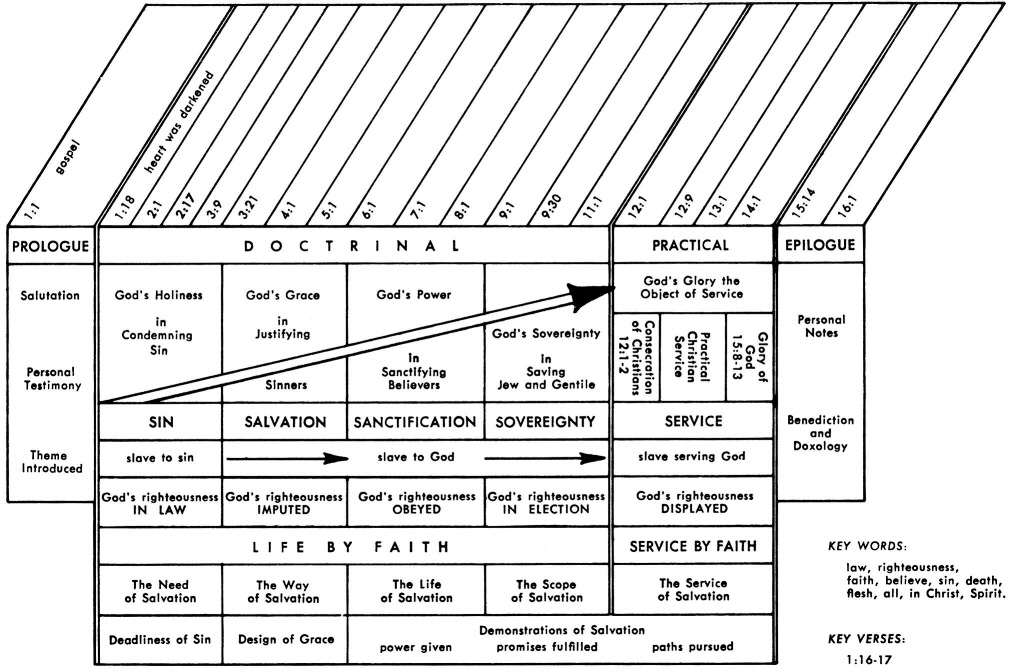
Click chart to enlarge
Chart from recommended resource Jensen's Survey of the NT - used by permission
Romans Overview Chart - Charles Swindoll
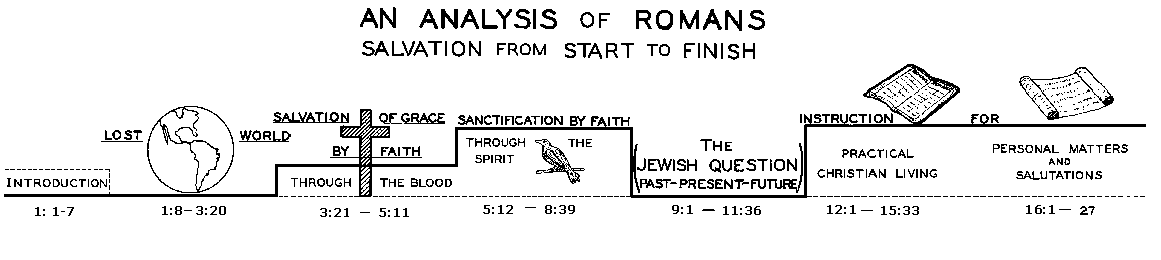
Source: Dr David Cooper
Click to Enlarge
R Ruin (Romans 1:17 – 3:20) – The utter sinfulness of humanity
O Offer (Romans 3:21-31) – God’s offer of justification by grace
M Model (Romans 4:1-25) – Abraham as a model for saving faith
A Access (Romans 5:1-11) – The benefits of justification
N New Adam (Romans 5:12-21) – We are children of two “Adams”
S Struggle w/ Sin (Romans 6-8) Struggle, sanctification, and victory
|
ROMANS ROAD |
||||
| Romans 1:18-3:20 | Romans 3:21-5:21 | Romans 6:1-8:39 | Romans 9:1-11:36 | Romans 12:1-16:27 |
| SIN | SALVATION | SANCTIFICATION | SOVEREIGNTY | SERVICE |
| NEED FOR SALVATION |
WAY OF SALVATION |
LIFE OF SALVATION |
SCOPE OF SALVATION |
SERVICE OF SALVATION |
| God's Holiness In Condemning Sin |
God's Grace In Justifying Sinners |
God's Power In Sanctifying Believers |
God's Sovereignty In Saving Jew and Gentile |
Gods Glory The Object of Service |
| Deadliness of Sin |
Design of Grace |
Demonstration of Salvation | ||
| Power Given | Promises Fulfilled | Paths Pursued | ||
| Righteousness Needed |
Righteousness Credited |
Righteousness Demonstrated |
Righteousness Restored to Israel |
Righteousness Applied |
| God's Righteousness IN LAW |
God's Righteousness IMPUTED |
God's Righteousness OBEYED |
God's Righteousness IN ELECTION |
God's Righteousness DISPLAYED |
| Slaves to Sin | Slaves to God | Slaves Serving God | ||
| Doctrine | Duty | |||
| Life by Faith | Service by Faith | |||
|
Modified from Irving L. Jensen's chart above |
||||
Romans 15:27 Yes, they were pleased to do so, and they are indebted to them. For if the Gentiles have shared in their spiritual things, they are indebted to minister to them also in material things (NASB: Lockman)
Greek: eudokesan (3PAAI) gar kai opheiletai eisin (3PPAI) auton: ei gar tois pneumatikois auton ekoinonesan (3PAAI) ta ethne, opheilousin (3PPAI) kai en tois sarkikois leitourgesai (AAN) autois
Amplified: They were pleased to do it; and surely they are in debt to them, for if these Gentiles have come to share in their [the Jerusalem Jews’] spiritual blessings, then they ought also to be of service to them in material blessings. (Amplified Bible - Lockman)
NLT: They were very glad to do this because they feel they owe a real debt to them. Since the Gentiles received the wonderful spiritual blessings of the Good News from the Jewish Christians, they feel the least they can do in return is help them financially. (NLT - Tyndale House)
Wuest: They were pleased to do it; and surely they are in debt to them, for if these Gentiles have come to share in their [the Jerusalem Jews’] spiritual blessings, then they ought also to be of service to them in material blessings.
Young's Literal: for it pleased well, and their debtors they are, for if in their spiritual things the nations did participate, they ought also, in the fleshly things, to minister to them.
YES, THEY WERE PLEASED TO DO SO AND THEY ARE INDEBTED TO THEM: eudokesan (3PAAI) gar kai opheiletai eisin (3PPAI) auton:
- Romans 15 Resources - Multiple Sermons and Commentaries
Related Passages:
2 Corinthians 9:7 Each one must do just as he has purposed in his heart, not grudgingly or under compulsion, for God loves a cheerful giver.
2 Corinthians 8:9 For you know the grace of our Lord Jesus Christ, that though He was rich, yet for your sake He became poor, so that you through His poverty might become rich.
Galatians 6:6 The one who is taught the word is to share all good things with the one who teaches him.
1 Corinthians 16:1 Now concerning the collection for the saints, as I directed the churches of Galatia, so do you also.
SPIRITUAL BLESSING CREATES
MORAL RESPONSIBILITY
This passage unites joyful willingness with moral obligation, revealing Paul’s theology of giving as both delight and debt rooted in grace.
Yes, they were pleased (eudokeo) to do so, and they are indebted (opheiletes) to them. - "Indeed, they gladly chose to give, recognizing that they owe them a debt. " They refers to the saints at Macedonia and Achaia (Ro 15:26) They were not coerced or reluctant, but freely and gladly offered. Their giving flowed from a transformed heart, reflecting the principle that true generosity springs from joy in God’s grace (2 Corinthians 9:7). This was not mere charity but fellowship (koinonia), a sharing in the needs of others as an expression of unity in Christ (Romans 15:26).
The Gentile believers were pleased to give such a gift to the suffering Jewish believers in Judea. They did it voluntarily. They did it willingly, not out of compulsion. They gave according to the spirit with which Paul encouraged the Corinthians to give…
Let each one do just as he has purposed in his heart; not grudgingly or under compulsion; for God loves a cheerful giver. (2Cor 9:7) (Comment: In fact the charitable giving which Paul is describing here in Romans 15 is the collection that we read about in 1Corinthians 16:1 and 2Corinthians 8 and 9)
And they are indebted (opheiletes) to them. - The Gentiles recognized that they had received immeasurable spiritual riches through Israel—the Scriptures, the covenants, the promises, and ultimately the Messiah Himself (Ro 9:4–5; Jn 4:22). In other words, their material giving was not merely generous; it was fitting, even obligatory. What is received in the realm of grace is to be expressed in the realm of generosity. The Gentiles were not repaying salvation as if grace could be earned, but they were acknowledging a real debt of gratitude by giving tangible support.
The statement also underscores the unity of the body of Christ. Jewish believers had been the channel of redemptive truth, and Gentile believers now become partners in provision, demonstrating that in Christ there is a mutual sharing of blessings (1 Corinthians 12:13). Thus giving becomes a visible expression of the gospel itself—grace received, grace returned in love.
Christian giving is both joyful and fitting, joyful because it flows from a heart transformed by grace, and fitting because it recognizes the real debt owed to those through whom God has bestowed spiritual riches (2 Corinthians 8:9; Galatians 6:6).
Paul makes it clear that the Gentiles had a moral obligation and debt to pay for they had received the gospel from Jewish believers. The heart touched by grace opens its hand. Spiritual riches call for material response.
J Vernon McGee puts it this way…Macedonia and Achaia were obligated to Jerusalem. Now some of the saints in Jerusalem were having financial difficulties, evidently because of persecution. Macedonia and Achaia could now pay a spiritual debt in the coin of the realm. This is foreign missions in reverse! It is the missionary church helping the home church. This very thing may take place in our nation, by the way, in the not too far distant future! (SEE Thru the Bible Vol. 43)
In a similar way, Paul felt a moral obligation or debt to preach the gospel writing
I am under obligation (opheiletes) both to Greeks and to barbarians, both to the wise and to the foolish. (Ro 1:14)
Likewise believers are under a moral obligation to mortify or put to death the deeds of the flesh (kill them or they will kill you) by the Spirit as Paul says in chapter 8 of Romans writing:
So then, brethren, we are under obligation (opheiletes), not to the flesh, to live according to the flesh -- for if you are living according to the flesh, you must die; but if by the Spirit you are putting to death the deeds of the body, you will live. (Ro 8:12, 13)
Pleased (2106) (eudokeo from eú = well, good + dokéo = think. See word study on related word eudokía) means literally to think well of and thus to approve of or take pleasure in. From its usual sense “to take pleasure or delight in,” a further sense evolved meaning “to decide for,” “to select,” “to prefer,” and from this evolved the sense “to want,” “to will,” “to be willing or ready.” This latter meaning is the emphasis in this passage. In reference to the charitable giving, Paul makes it clear that the Gentile's gift was a freewill offering.
Indebted (3781) (opheiletes from opheilo = owe) ("our debtors" - Mt 6:12) describing one who owes anything to another person, especially money but also used metaphorically as here of those bound by some obligation or duty. The idea is to consider something as good and therefore worthy of choice.
Opheiletes - 7x in 7v in the NAS - Mt. 6:12; 18:24; Lk. 13:4; Ro 1:14; 8:12; 15:27; Gal. 5:3 and is rendered in the NAS as culprits(1), debtors(1), indebted(1), owed(1), under obligation(3).
FOR IF THE GENTILES HAVE SHARED IN THEIR SPIRITUAL THINGS THEY ARE INDEBTED TO MINISTER TO THEM ALSO IN MATERIAL THINGS: ei gar tois pneumatikois auton ekoinonesan (3PAAI) ta ethne, opheilousin (3PPAI) kai en tois sarkikois leitourgesai (AAN) autois:
- Ro 11:17; 1Co 9:11; Gal 6:6; Phile 1:19
- Romans 15 Resources - Multiple Sermons and Commentaries
Related Passages:
1 Corinthians 9:11 If we sowed spiritual things in you, is it too much if we reap material things from you?
Galatians 6:6 The one who is taught the word is to share all good things with the one who teaches him.
DIVINE LOGIC OF GIVING
WHY THEY OWE A DEBT
Here we see the principle that participation in spiritual blessing creates a corresponding obligation of material ministry.
For (gar) - Term of explanation. What is Paul explaining? It is explaining the reason Gentiles owe material support to Jewish believers because they have already received something far greater from them, spiritual riches.
If (1487) (ei) introduces a first class conditional statement which implies that the condition had been fulfilled. Thus one could render it "Since the Gentiles have shared".
The Gentiles (ethnos) have shared (koinoneo) in their spiritual (pneumatikos) things - They had become beneficiaries of the rich spiritual heritage that came through Israel (the covenants, the promises, the Scriptures, and the Messiah Himself, all came through the Jewish people (Ro 9:4–5). Salvation is “from the Jews,” (John 4:22) and the Gentiles were graciously grafted into these blessings (Ro 11:17).
They are indebted (opheilo) to minister (leitourgeo) to them also in material things (sarkikos) - Indebted conveys the idea of a moral obligation, not a forced payment, but a fitting and rightful response. The Gentiles had received eternal riches, truths that save the soul and secure everlasting life, and therefore it was entirely appropriate that they give temporal, physical support to the Jewish believers in Jerusalem who were in need (Galatians 6:6; 1 Corinthians 9:11). Paul's use of this specific word (leitourgeo) helps understand the thought he is conveying here (e.g., this word gives us our English word "liturgy"), that is, that the Gentiles are performing a "priestly service" Thus Paul elevates the ministry of almsgiving on the footing of a sacrificial service, in every sense an act of worship to God. In sum service to God's people is service to God. Let us all keep alert to the opportunities we have to minister in this way and do so with hilarity. The logic is simple yet profound: spiritual riches outweigh material wealth, so to give material support in return is not loss but a small, tangible expression of gratitude.
As an aside, it is notable that this was not the first time a collection was taken to the church in Jerusalem. About ten years earlier, Paul and Barnabas brought a collection from the church in Antioch of Syria to help the Jerusalem church during a time of famine (Acts 11:30; Acts 12:25).
Material things (sarkikos) is literally fleshly things which is an interesting thought to ponder!
Grace received should never terminate in us,
but should flow from God to us, and through us to others.
If somebody blesses you spiritually, and the only way you can thank him is with material things, then do it, That is God's program, to give back in material things for the spiritual blessings you have received. Jesus declared that "It is more blessed to give than to receive." ( Acts 20:35)
John MacArthur notes that "It was not that the Gentiles’ being spiritually and materially indebted to the Jews made their generosity any less meaningful or loving. Duty does not exclude willing and joyful compliance. Even the most demanding duty or indebtedness can be fulfilled out of love." (See Romans Commentary)
Middletown Bible Church writes that "Gentiles are debtors to Jews. We owe them so much because "salvation is of the Jews" (John 4:22). We owe them so much because the Bible is from the Jews. Indeed, even the authors of the New Testament were Jewish, with the only exception being Luke. We are debtors to the Jews because their God has become our God. Their Messiah has become our Saviour! Gentiles have been made partakers of their spiritual things! It is only fitting that Gentiles should minister to them in carnal (material) things. Great spiritual blessings have come from them to us. It is appropriate then that great carnal or material blessings should come to them from us. We should help our Jewish brethren in every way we can. In a way we are also debtors to unbelieving Jews because of their godly heritage, even though they are not presently representing that heritage. The believer in Christ should be the best friend the Jew has in this world! (Romans 15)
William Newell writes that in this verse "is announced also the principle which Paul states concerning himself to the Corinthians: "If we sowed unto you spiritual things, is it a great matter if we shall reap your carnal things?" … And although he "did not use this right, " he declares that "the Lord ordained, that they that proclaim the gospel should live of the gospel" (1Cor 9:11,12 = "If we sowed spiritual things in you, is it too much if we should reap material things from you? If others share the right over you, do we not more? Nevertheless, we did not use this right, but we endure all things, that we may cause no hindrance to the gospel of Christ."). To the Levites only, among the tribes, was given no inheritance, Jehovah saying, "I am their inheritance." But others were to minister unto them of their substance, so that, when the Israelites were faithful, the Levites had plenty; and when Israel forgot Jehovah, they forgot the Levites. (Romans 15)
Gentiles (1484) (ethnos) is used principally for peoples not Jewish and thus depending on the context can describe Gentile, heathen, nation, people. From a Jewish perspective the phrase the nations (tá éthne), indicates Gentile nations or the Gentiles in general.
Shared (2841) (koinoneo from koinos = that which is in common, belonging to several or of which several are partakers - the verb koinoneo is related to the noun koinonia translated "contribution" in Ro 15:26) means to to share one's possessions, with the implication of some kind of joint participation and mutual interest. This Greek word is used in a marriage contract where the husband and wife agree to a joint-participation in the necessaries of life. The key idea in the word is that of a partnership, a possessing things in common, a belonging in common to.
Spiritual (4152) (pneumatikos from pneuma = spirit) relates to the human spirit, as the part of man which is akin to God and serves as his instrument or organ. It refers to the nonmaterial rather than the material part of man. It is used predominately of what belongs to the supernatural world as compared to that which belongs to the natural world. Note that the suffix "-ikos" on the end of an adjective means signifies “-like”. Thus pneumatikos means “belonging to the spirit" or "of the nature of the spirit" and so "pertaining to that which is spiritual".
Pneumatikos - 26x in 21v in the NAS - Rom. 1:11; 7:14; 15:27; 1 Co. 2:13, 15; 3:1; 9:11; 10:3f; 12:1; 14:1, 37; 15:44, 46; Gal. 6:1; Eph. 1:3; 5:19; 6:12; Col. 1:9; 3:16; 1 Pet. 2:5
The spiritual things of which the Gentiles partake are the spiritual blessings of salvation, specifically the gospel truths first preached to the Gentile believers by the Jewish apostles, prophets, teachers, and evangelists. Thus the Gentiles are debtors to the Jews for as our Lord taught “Salvation is of the Jews” (Jn 4:22).
Indebted (3784) (opheilo) means to be indebted to someone in a financial sense and thus to owe something to someone. Figuratively as used in this verse it means to be under a moral obligation to meet certain expectations. It can also mean to be to be constrained by circumstance. Gentiles are debtors to the Jews.
Opheilo - 35x in 34v in the NT - Matt. 18:28, 30, 34; 23:16, 18; Lk. 7:41; 11:4; 16:5, 7; 17:10; Jn. 13:14; 19:7; Acts 17:29; Rom. 13:8; 15:1, 27; 1 Co. 5:10; 7:36; 9:10; 11:7, 10; 2 Co. 12:11, 14; Eph. 5:28; 2 Thess. 1:3; 2:13; Philemon 1:18; Heb. 2:17; 5:3, 12; 1 Jn. 2:6; 3:16; 4:11; 3 Jn. 1:8 and is rendered in the NAS as had(1), have(1), indebted(2), must(1), obligated(3), ought(15), owe(4), owed(4),owes(1), responsible(1), should(2).
Minister (3008) (leitourgeo from leitourgos [word study] = public servant from léïtos = of the people [NIDNTT says it from "laos" = people] + érgon = work) means to be a worker of the people or a public servant. In classical Greek the root word leitourgos referred especially to persons performing public duties, or works of public use and so to perform religious or charitable functions (worship, obey, relieve). It meant to render special formal service, and thus leitourgeo can literally describe a priest who officiates or ministers.
As used in this verse leitourgeo describes the performance of religious duties in the sense of a Christian performing services to God through such activities as prayer, teaching, etc.
Leitourgeo is used 2 other times in the NT (Acts 13:2 = "And while they were ministering to the Lord and fasting, the Holy Spirit said, "Set apart for Me Barnabas and Saul for the work to which I have called them." and Heb 10:11 = "And every priest stands daily ministering and offering time after time the same sacrifices, which can never take away sins") and 86 times in the Septuagint (LXX)
Ex 28:35, 43; 29:30; 30:20; 35:19; 39:1, 26, 32; 40:30; Num 1:50; 3:6, 31; 4:3, 9, 12, 14, 23f, 26, 30, 35, 37, 39, 41, 43; 8:22, 26; 16:9; 18:2, 6f, 21, 23; Deut 10:8; 17:12; 18:5, 7; 1 Sam 2:11, 18; 3:1; 2 Sam 19:18; 1 Ki 1:4, 15; 8:11; 19:21; 2 Ki 25:14; 1 Chr 6:32; 15:2; 16:4, 37; 23:13, 28, 32; 26:12; 27:1; 2 Chr 5:14; 8:14; 11:14; 13:10; 15:16; 17:19; 22:8; 23:6; 29:11; 31:2; 35:3; Neh 10:36; Ps 101:6; Jer 52:18; Ezek 40:46; 42:14; 43:19; 44:11f, 15ff, 19, 27; 45:4f; 46:24; Dan 7:10; Joel 1:9, 13; 2:17)
Thayer writes that leitourgeo means "in Attic, especially the orators, "to serve the state at one's own cost; to assume an office which must be administered at one's own expense; to discharge a public office at one's own cost; to render public service to the state… universally, to do service, to perform a work; Vulgate ministro (A. V. to minister); of the priests and Levites who were busied with the sacred rites in the tabernacle or the temple (as in the Septuagint)
Material (4559) (sarkikos from sarx = flesh + ikos = as noted above this suffix means "-like" = “belonging to the sarx" or "of the nature of the sarx") means that which belongs to the nature of the flesh and so that which is from the earthly sphere of existence and which is thus material or physical, the meaning intended in this passage. In other contexts sarkikos, of the nature of the flesh, conveys an entirely different meaning, referring to the behavior which is characteristic of the fallen flesh (sarx - specifically the evil disposition), but that is clearly not the meaning in this verse.
Sarkikos - 7x in 6v in the NAS - Rom. 15:27; 1 Co. 3:3; 9:11; 2 Co. 1:12; 10:4; 1 Pet. 2:11
In a similar manner Paul writes to the saints in Galatia exhorting them to "let the one who is taught the word share all good things with him who teaches." (Gal 6:6) Comment: "share" commonly refers to sharing of material goods. Paul is saying that the responsibility of Christians to provide financial support for those who devote full time to preaching and teaching the Word of God.
John Butler - GIVING Romans 15:27
This is speaking of the giving of the saints in Macedonia and Achaia. Their giving gives us a good example on how and why to give.
FIRST—THE REJOICING IN GIVING
“It hath pleased them verily.” The saints in Macedonia and Achaia were giving with joy. Motivation in giving is what God is interested in more than the size of the gift. Many folk give because they ‘have to’ to appease their conscience. Some give to out do others and to receive earthly recognition. Few give with delight, but unless you give freely and with delight, it doesn’t count with God. The motivation for giving ought to be Calvary. No greater gift was ever given than Christ on the cross. God gave Christ for our salvation because he loved us (John 3:16). That should inspire our giving but seldom does.
SECOND—THE REASON FOR GIVING
There had been a famine in Jerusalem. It had not rained for a long time and food was at a premium. The saints in Jerusalem were hit hard by the famine, for they had given all for the spreading of the Gospel. However, God takes care of such people and Paul gathered many gifts for the people to relieve their need.
THIRD—THE RESPONSIBILITY FOR GIVING
“Debtors they are.” The people in Jerusalem were responsible for the spreading of the Gospel to regions beyond Jerusalem. The Gentiles thus heard the Gospel. Therefore, Paul said the saints in Macedonia and Achaia, who were mostly Gentiles, had an obligation to help those saints in Jerusalem because the saints in Jerusalem were responsible for giving the Gospel to Macedonia and Achaia. This is the same argument used to justify paying preachers. Some folk do not believe in paying preachers and some of those even give for the preacher but are so miserly in their gifts, they practically starve the preacher. If the preacher ministers the Word to them they have an obligation and responsibility to provide just remuneration for them. To expect the pastor to give full time to his work and then to not pay him accordingly is a crime of which many churches are guilty.
FOURTH—THE REGION OF GIVING
“If they have been made partakers of their spiritual things, their duty is also to minister unto them in carnal things.” This tell us who to give to and what to give.
• Whom to give to. “Partakers of their spiritual things.” This refers to those who have helped them spiritually. That leaves out the professional beggars and church tramps who are lazy and loafing and do nothing to deserve any gifts from the church.
• What to give. “Carnal things.” “Carnal” refers here to material things, such as money, food, clothes, etc.
Romans 15:28 Therefore, when I have finished this, and have put my seal on this fruit of theirs, I will go on by way of you to Spain. (NASB: Lockman)
Greek: touto oun epitelesas (AAPMSN) kai sphragisamenos (AMPMSN) autois ton karpon touton, apeleusomai (1SFMI) di humon eis Spanian:
Amplified: When therefore I have completed this mission and have delivered to them [at Jerusalem] what has been raised, I shall go on by way of you to Spain. (Amplified Bible - Lockman)
NLT: As soon as I have delivered this money and completed this good deed of theirs, I will come to see you on my way to Spain. (NLT - Tyndale House)
Wuest: When therefore I have completed this mission and have delivered to them [at Jerusalem] what has been raised, I shall go on by way of you to Spain
Young's Literal: This, then, having finished, and having sealed to them this fruit, I will return through you, to Spain;
THEREFORE, WHEN I HAVE FINISHED THIS, AND HAVE PUT MY SEAL ON THIS FRUIT OF THEIRS: touto oun epitelesas (AAPMSN) kai sphragisamenos (AMPMSN) autois ton karpon touton:
- Philippians 4:17; Colossians 1:6
- Romans 15 Resources - Multiple Sermons and Commentaries
Related Passages:
Philippians 4:17 Not that I seek the gift itself, but I seek for the profit (FRUIT) which increases to your account.
Colossians 1:6 (THE GOSPEL) which has come to you, just as in all the world also it is constantly bearing fruit and increasing, even as it has been doing in you also since the day you heard of it and understood the grace of God in truth;
FAITHFULLY FINISHING THE GOOD WORK
BEFORE PURSUING THE NATIONS
This is a great passage, for it reveals Paul the Apostle’s faithful stewardship, pastoral integrity, and missionary vision all in one sentence. It furnishes us a window into Pauls' heart regarding ministry as something to be completed carefully, confirmed responsibly, and then extended globally.
Therefore, when I have finished (epiteleo) this - The pronoun THIS refers to the collection Paul was delivering to the needy saints in Jerusalem. He saw this task not as optional, but as a divine assignment that must be brought to completion. Paul did not abandon responsibilities midway, but he labored until the work entrusted to him was done, giving us all a wonderful example of faithful stewardship (1Co 4:2) to imitate (1Co 11:1).
🙏 THOUGHT- Paul was anxious to complete this project of the collection of money for the Jerusalem poor. But in this verse Paul gives us all a good practical principle for life: He is not going to quit until he is through. He will wrap it up well and do it right. Do you finish what you begin in the realm of spiritual matters? What about when you tell someone you will pray for them… do you "finish" that good work God has prepared for you in Christ from eternity past (Eph 2:10)?
And have put my seal (sphragizo) on this fruit (karpos) of theirs - Paul's desire was to take the love gift to the needy saints in Jerusalem. The fruit (karpos) of course was the financial gift from the Gentile churches, their tangible expression of their love and gratitude (Php 4:17). To seal their fruit means that Paul would personally ensure the safe delivery, authenticity, and proper presentation of the Gentiles donations (a good rule of thumb for every ministry that receives funds!) In this culture, a seal (sphragizo) guaranteed that something was genuine and had reached its intended destination intact. Spiritually, this underscores that Paul wanted their offering to be recognized as fruit of grace, not merely money, but evidence of their transformed hearts. As he wrote to the saints at Corinth...
For the ministry of this service is not only fully supplying the needs of the saints, but is also overflowing through many thanksgivings to God. 13 Because of the proof given by this ministry, they will glorify God for your obedience to your confession of the gospel of Christ and for the liberality of your contribution to them and to all, (2Co 9:12–13).
I will go on by way of you to Spain - Here we see Paul’s forward-looking missionary ambition to the Gentiles (see Acts 26:16-18). Having fulfilled his ministry in the eastern regions (Romans 15:23), he now sets his sights westward to Spain, representing the farthest reaches of the known world at that time. His plan to pass “by way of you” (Rome) shows that he viewed the Roman church as a strategic partner and sending base for further gospel expansion (Romans 15:24).
C H Spurgeon - He was sure of that, but he did not know how he would go in other respects. He did not know that he would go to Rome as a prisoner; he could not foresee that he would be sent there as an ambassador in bonds; and little, I wean, did he care in what manner he would go, so long as he bad the absolute certainty that he should go “in the fullness of the blessing of the gospel of Christ.”
Finished (2005) (epiteleo from epí = intensive, in the sense of meaning "fully" + teleo = to complete, bring not just to the end but to the destined goal from teleo in turn from télos = end, goal. Note: télos originally meant the turning point, hinge, the culminating point at which one stage ends and another begins; later the goal, the end. Marriage and death are is in this sense both a telos) conveys the intensified meaning to "fully complete" or to fully reach the intended goal, to accomplish fully or to make perfect. The historian Herodotus writes that epiteleo was used of performing of religious services and refers to the act of completing something. Epiteleo was the normal Greek word for fully completing the ritual of any sacrifice.
Epiteleo - 10x/9v - accomplished(1), complete(1), completion(1), erect(1), finish(1), finished(1),perfect(1), perfected(1), perfecting(1), performing(1). - Ro 15:28; 2 Co. 7:1; 8:6, 11; Gal. 3:3; Phil. 1:6; Heb. 8:5; 9:6; 1 Pet. 5:9 and is rendered in the NAS as
Epiteleo is the same verb Paul choose to describe God's work in believers in Philippi writing that he was confident…
"that He who began a good work (may refer to their salvation or their active financial participation in the furtherance of the gospel) in you will perfect (epiteleo) it until the day of Christ Jesus (not the Day of the Lord but the day that looks to the final salvation, reward, and glorification of believers - see summary discussion of The Three Divine Days)." (Php 1:6)
Seal (4972) (sphragizo from sphragis = seal) a seal signifying ownership & guarantee of the correctness of contents. To set to, is to affix. To set to a seal is therefore to attest a document. Paul secured to the Macedonian and Achaian saints the product of the contribution. In other words Paul’s mission to Jerusalem would not be finished (epiteleo) until he had successfully and safely delivered the contribution. The "fruit" (charitable gift) was sealed to them when it was safely delivered and securely in their possession. The gift had already been gathered but it had not yet been delivered.
Sphragizo - 15x in 14v in the NAS - Mt 27:66; Jn. 3:33; 6:27; Ro 15:28; 2Co 1:22; Ep 1:13; 4:30; Re 7:3, 4, 5, 8; 10:4; 20:3; 22:10 and is rendered in the NAS as put a seal(1), seal up(2), sealed(9), set a seal(3).
Leon Morris has an interesting discussion of the meaning of "seal" in this verse noting that when Paul speaks of “having sealed to them this fruit”, the NIV understands it in the sense made sure that they have received it. This may be the way to take it, but the meaning of “sealing” in this context remains doubtful. It is known that produce such as wheat and barley was put in sacks and sealed; this was the last thing done and indicated that everything was in order. It may be that that is the way we should understand it: Paul’s seal meant that the money was there in full amount. A somewhat similar view is that which starts from the seal as a mark of personal authentication; Paul’s seal was his guarantee that all had been done well. It has been held that Paul’s very presence certified the gift and set the seal on his apostleship. Knox holds that when the money has been given and received in the right spirit “Paul will have ended his divinely appointed work in Asia Minor and Greece; the ‘fruit’ of his mission will have been ‘sealed.’ ” There are other views, and at this distance in time we cannot be sure of the precise significance of the sealing. But it is clear that in some way it pointed to official assurance that all was well. (Morris, L. The Epistle to the Romans. W. B. Eerdmans; Inter-Varsity Press)
Fruit (2590) (karpos) refers to literal fruit but metaphorically (as in this context) refers to deeds, works or conduct. Scripture catalogs three kinds of spiritual fruit: (1) spiritual attitudes that characterize a Spirit-led believer (Gal 5:22, 23); (2) righteous actions (Ro 6:22, Hebrews 13:15); and (3) new converts (Romans 16:5)
Karpos - 67x in 57v - benefit(2), crop(5), crops(2), descendants*(1), fruit(43), fruitful(1),fruits(4), grain(1), harvest(1), proceeds(1), produce(4), profit(1). Matt. 3:8, 10; 7:16ff; 12:33; 13:8, 26; 21:19, 34, 41, 43; Mk. 4:7f, 29; 11:14; 12:2; Lk. 1:42; 3:8f; 6:43f; 8:8; 12:17; 13:6f, 9; 20:10; Jn. 4:36; 12:24; 15:2, 4f, 8, 16; Acts 2:30; Rom. 1:13; 6:21f; 15:28; 1 Co. 9:7; Gal. 5:22; Eph. 5:9; Phil. 1:11, 22; 4:17; 2Ti 2:6; 4:13; Heb. 12:11; 13:15; Jas. 3:17f; 5:7, 18; Rev. 22:2
In the present context fruit speaks of the love-gift (a gift of money inspired by Christian love) from the Gentile believers of Macedonia and Achaia, given sacrificially for the poor saints in Judaea. In a real sense the love-gift was “fruit” in that it was the product of gospel seed-sowing.
In Philippians 4:17 Paul uses karpos writing…
Not that I seek the gift itself, but I seek for the profit (fruit - karpos) which increases to your account. (Php 4:17) (Comment: Here karpos is used of fruit that grows like interest in a savings account. The Philippians were in effect storing up for themselves treasure in heaven -- see Mt 6:20. The gifts they gave to Paul were accruing eternal dividends to their spiritual account).
I WILL GO ON BY WAY OF YOU TO SPAIN: apeleusomai (1SFMI) di humon eis Spanian:
- Ro 15:24; Proverbs 19:21; Lamentations 3:37; James 4:13, 14, 15
- Romans 15 Resources - Multiple Sermons and Commentaries
By (dia) means through. It is used in relation to space, for instance, “The road runs through the territory.” Paul was intending to go through Rome on his way to Spain. "I will come through you".
Romans 15:29 I know that when I come to you, I will come in the fullness of the blessing of Christ. (NASB: Lockman)
Greek: oida (1SRAI) de oti erchomenos (PMPMSN) pros humas en pleromati eulogias Christou eleusomai (1SFMI)
Amplified: And I know that when I do come to you, I shall come in the abundant blessing of the Gospel of Christ. (Amplified Bible - Lockman)
NLT: And I am sure that when I come, Christ will give me a great blessing for you. (NLT - Tyndale House)
Wuest: And I know that when I do come to you, I shall come in the abundant blessing of the Gospel of Christ.
Young's Literal: and I have known that coming unto you -- in the fulness of the blessing of the good news of Christ I shall come.
- Ro 1:11,12; Psalm 16:11; Ezekiel 34:26; Ephesians 1:3; 3:8,19; 4:13
- Romans 15 Resources - Multiple Sermons and Commentaries
Related Passages:
Romans 1:11, 12 For I long to see you in order that I may impart some spiritual gift to you, that you may be established, that is, that I may be encouraged together with you while among you, each of us by the other's faith, both yours and mine." ().
I know (eido) that when I come to you, I will come in the fullness (pleroma) of the blessing (eulogia) of Christ - Know (1579) (eido, oída, perfect tense of obsolete eido) speaks of knowledge which comes from one’s state of being or of intuitive knowledge. The idea of oida is that Paul's knowledge is absolute, positive and beyond a peradventure of a doubt. It speaks of his certainty of his coming. Here Paul expresses a measure of confidence that he will finally be able to fulfill his longing to visit Rome, once the Jerusalem task is completed. We know from the book of Acts that he did indeed go to Rome, though not exactly according to his original plan. In any case, he was sure that when he came, it would be with the full blessing of Christ. That is, he knew that Christ’s blessing would be upon him, and he knew that he would be able to bestow the fullness of Christ’s blessing upon them (Ro 1:12).
Morris notes that "Paul closes this part of his letter on a note of quiet certainty (I know); his certainty is one of faith, but none the less certain for that. (Ibid)
Paul was confident in the power of God and persuaded that God, Who had so richly crowned his labors in other places, would ensure that his visit to Rome would be accompanied with abundant blessings. He was engaged in the service of a Christ Who was faithful, one on Whom Paul could place the utmost reliance. So whatever happened, he was sure of the blessing of the Lord. Can you imagine the blessing of hearing of Paul's deliverance from his enemies in Jerusalem & then his incredible sea voyage and shipwreck on Malta. What a blessing it must have been to hear this great saint boasting in what God had accomplished through him.
A. T. Robertson - Paul had already said that he had a charisma pneumatikon (spiritual blessing) for Rome. He did bring that to them."
The Bible Knowledge Commentary agrees saying "with Christ’s blessing to share with them" (See Bible Knowledge Commentary - Page 498).
This (in the fullness of the blessing of Christ ) is a striking comment in view of the manner in which Paul’s aspirations were fulfilled (Acts 28:11-16) because at the time he wrote this letter Paul was unaware that when he finally arrived in Rome, he would be in chains. Even so it was in the fullness of the blessing of the gospel. This is exhibited in the fact that Colossians, Philemon, Ephesians, and Philippians were all written from Rome during his first imprisonment there.
The fullness of the blessing of Christ conveys abundance, completeness, and overflow. Paul expects that his visit will not be partial or empty, but marked by the rich, comprehensive outworking of Christ’s blessing which would include doctrinal strengthening (Ro 1:11), mutual encouragement (Ro 1:12), spiritual fruit (lives transformed and built up - Ro 1:13) and Christ-exalting ministry.
The blessing is “of Christ,” meaning Christ is both the source and substance of the blessing. Paul does not bring only his own resources, but comes as a channel through whom Christ ministers.
Godet - Would a forger of this epistle, in the second century, have drawn a picture of the future so opposite to the way in which things really came to pass? (Commentary on Romans)
These allusions to his future movements are positive proof that this was written before Paul was a prisoner.
R H Mounce observes that "Always in the mind of the apostle was the spiritual potential of every personal contact. His sensitivity to the spiritual needs of others is everywhere evident. What for many would be merely a pleasant contact becomes for the apostle an occasion to share the blessings of Christ. (Romans: The New American Commentary)
John MacArthur - Because he lived continually in obedience to the Lord, his life was always blessed. Obviously, that blessing did not exclude physical hardships and afflictions, as he mentions in (verse 31 and in many of his other letters. But nothing physical could rob him of the fulness of that spiritual blessing… What is often referred to as the “health and wealth gospel” was the furthest thing from Paul’s mind. His obedience to Christ cost him dearly in both of those areas. Because of his service to Christ, he suffered imprisonments, beatings, stonings, dangers from Gentiles as well as Jews, and a host of other hardships (see 2Cor 11:23, 24, 25, 26, 27). But none of those outward problems could rob him of his inner blessing. To the contrary, he wrote, “my circumstances have turned out for the greater progress of the gospel, so that my imprisonment in the cause of Christ has become well known throughout the whole praetorian guard and to everyone else, and… most of the brethren, trusting in the Lord because of my imprisonment, have far more courage to speak the word of God without fear… In every way,… Christ is proclaimed; and in this I rejoice, yes, and I will rejoice” (Php 1:12, 13, 14, 18-see notes Php 1:12-14; 18). Paul’s hardships gave him greater opportunity “to be a minister of Christ Jesus to the Gentiles” and to offer them as an offering to God, “acceptable, sanctified by the Holy Spirit” (Ro 15:16) and thereby receive the blessing that only such selfless service to the Lord can bring. He knew “the peace of God, which surpasses all comprehension”; he knew “how to get along with humble means” and “how to live in prosperity”; and God supplied all his “needs according to His riches in glory in Christ Jesus” (Php 4:7, 12, 19-see notes Php 4:7; 4:12; 4:19). (See The MacArthur Commentary)
Paul does not measure success by circumstances or outcomes, but by this: Will Christ’s blessing be present and active? And he is confident that it will be.
Fulness (4138) (pleroma from pleroo = make full, fill, fill up) means the full measure, the abundance with emphasis upon completeness.
THOUGHT - Would it be that such could be said to be true of all of Christ's disciples - that they would come or go wherever He sends us "in the fulness of the blessing of Christ"!
Pleroma - 17x in 17v in the NAS - Matt. 9:16; Mk. 2:21; 6:43; 8:20; Jn. 1:16; Rom. 11:12, 25; 13:10; 15:29; 1 Co. 10:26; Gal. 4:4; Eph. 1:10, 23; 3:19; 4:13; Col. 1:19; 2:9 and is rendered in the NAS as all it contains(1), fulfillment(2), full(2), fulness(10), patch(2).
Blessing (2129) (eulogia from eu = good, well + lógos = word; See word study on eulogetos) is literally a good word and by metonymy (figure of speech consisting of use of name of one thing for that of another of which it is an attribute or with which it is associated - e.g., "Washington" for the US government), blessing, favor conferred, gift, benefit, bounty
Eulogia - 16x in 14v in the NAS - Rom. 15:29; 16:18; 1 Co. 10:16; 2 Co. 9:5f; Gal. 3:14; Eph. 1:3; Heb. 6:7; 12:17; Jas. 3:10; 1 Pet. 3:9; Rev. 5:12f; 7:12
Romans 15:30 Now I urge you, brethren, by our Lord Jesus Christ and by the love of the Spirit, to strive together with me in your prayers to God for me (NASB: Lockman)
Greek: Parakalo (1SPAI) de humas (adelphoi) dia tou kuriou hemon Iesou Christou kai dia tes agapes tou pneumatos sunagonisasthai (AMN) moi en tais proseuchais huper emou pros ton theon
Amplified: I appeal to you [I entreat you], brethren, for the sake of our Lord Jesus Christ and by the love [given by] the Spirit, to unite with me in earnest wrestling in prayer to God in my behalf. (Amplified Bible - Lockman)
NLT: Dear friends, I urge you in the name of our Lord Jesus Christ to join me in my struggle by praying to God for me. Do this because of your love for me, given to you by the Holy Spirit. (NLT - Tyndale House)
Wuest: I appeal to you [I entreat you], brethren, for the sake of our Lord Jesus Christ and by the love [given by] the Spirit, to unite with me in earnest wrestling in prayer to God in my behalf.
Young's Literal: And I call upon you, brethren, through our Lord Jesus Christ, and through the love of the Spirit, to strive together with me in the prayers for me unto God,
- By the by our Lord Jesus Christ - 2 Corinthians 4:5,11; 12:10; 1Timothy 6:13,14; 2Timothy 4:1
- By love of the Spirit Ps 143:10; Philippians 2:1 Ro 5:5 Gal 5:22
- That you strive together - Ge 32:24, 25, 26, 27, 28, 29; 2Co 1:11; Eph 6:19; Col 2:1; 4:12
- Romans 15 Resources - Multiple Sermons and Commentaries
Related Passages:
Colossians 2:1 For I want you to know how great a struggle I have on your behalf and for those who are at Laodicea, and for all those who have not personally seen my face,
Colossians 4:12 Epaphras, who is one of your number, a bondslave of Jesus Christ, sends you his greetings, always laboring earnestly for you in his prayers, that you may stand perfect and fully assured in all the will of God.
STRIVING TOGETHER
IN PRAYER
Paul shifts from confidence (v.29) to earnest appeal, revealing that even the most fruitful ministry is dependent on the prayers of God’s people. Notice in this verse the occurrence of the three Persons of the Godhead, verses such as this leading to the teaching of the doctrine of the Trinity, despite the fact that the word Trinity does not occur in the Bible.
Now I urge (parakaleo - present tense - continually) you, brethren, by our Lord Jesus Christ and by the love (agape) of the Spirit, to strive together (sunagonizomai - agonizing, contending, or wrestling side by side) with me in your prayers to God for me - Paul introduces his exhortation to the Roman saints to intercede with the Almighty for his protection and ministry.) active spiritual struggle. Though the Roman believers are geographically distant, through prayer they enter the battlefield with Paul, contending for God’s purposes. Before giving that exhortation, Paul declared unequivocally that the overriding purpose for his request was to glorify our Lord Jesus Christ.
🙏 THOUGHT - If we got such a request from Paul, would it not stoke the embers of prayer in our heart to pray without ceasing for him? I think it would. Why then are we so lax and lackadaisical when we receive requests from our missionaries to pray (perhaps you are not, but all to often I am and yet they are God's "Pauls" in these last days and to intercede for them is an incredible privilege. Don't miss the opportunity!
It is not uncommon for Paul to request prayer from his correspondents (2Co 1:11; Ephesians 6:19; Col. 4:3; 1Th 5:25; 2Th 3:1), so this passage is quite in character.
John Piper - “Strive together with me in your prayers to God on my behalf.” Strive together with me. Strive together with me. Are you surrounded by a group of people who do that for you daily? As one of the pastors of this church, I am pleading with, and exhorting you and admonishing you: Put yourself in those kinds of relationships. Between the battles, and even in the battles, there is rest—together. God loves to refresh his people through his people.(Resting and Wrestling for the Cause of Christ—Together)
Ray Stedman - Prayer is born of the Spirit of God within us, awakening a desire to help, a sense of love and compassion. We pray to honor the Lord Jesus. This is what will stir people to pray more than anything else -- not beating them with a whip. I learned that long ago. It is when people begin to see that the honor of Christ is involved, and the love of the Spirit is fulfilled when you pray, that they will really begin to pray. That is what the apostle appeals to here. (An Adequate Ministry)
Paul asks the Roman saints to contend with him in prayer against the opposition of the hosts of wickedness, contending with him as athletes would do with one another, with intensity of purpose and in perfect cooperation. Paul asked that the saints at Rome exercise the ministry of prayer in restraining evil. That is what prayer is so oftentimes -- a way of putting a barrier around someone and protecting them in their ministry.
Paul understood the power of prayer and his continual need for it in his missionary activities. Missionary work and it's need for fervent prayer today is no different than in Paul's day.
Prayer is shared
spiritual warfare
🙏 THOUGHT - Do you regularly strive, and even agonize, in prayer with other believers for your missionaries? It seems that in many churches, the prayer meeting has taken a leave of absence! Do modern day saints attach as great a significance to the value of intercessory prayers as the apostle Paul? I fear not. We have 2000 plus attending our Bible believing church on any given Sunday and less than 20 in the prayer meeting!
In classic Greek parakaleo was also used of one exhorting troops about to go into battle which is an interesting parallel as in the present verse Paul is asking the Roman saints to join him in fighting the "battle" marching forth on their knees in earnest agonizing prayer. It is not uncommon for Paul to request prayer from his correspondents (2Cor 1:11, Eph 6:19, Col 4:3, 1Thes 5:25, 2Thes 3:1), so this passage is quite in character for Paul.
By the love (agape) of the Spirit could mean the love the Spirit enkindles in believers or the love that the Spirit has for them. Since the NT more often refers to the love that the Spirit brings about in believers (cf poured out or shed abroad in our hearts - Ro 5:5, borne as fruit of abiding in His Spirit and His Spirit in us -Gal 5:22) the former meaning would be the more likely understanding. This means their intercession should not be mechanical, but motivated by Spirit-produced affection and unity. The Spirit binds them together so that Paul’s burden becomes their burden.
What a plea this is for unity among the saints and the expenditure of agonizing effort in concert against evil rather than the use of that energy in contention against one another.
The subsequent verses show there were 4 things Paul wanted them to strive together with to achieve:
(1) delivered from disobedient in Judea
(2) service to Jerusalem be acceptable to the saints
(3) might come to them in joy and
(4) might find rest in their company.
In sum, Paul is not imploring the Roman saints to offer up stiff, formal, tepid pious platitudes ("Lord, bless the missionaries") but for a whole hearted involvement implicit in his use sunagonizomai. The little prefix "sun" means "with" but specifically points to an intimate oneness, a vital union of two agonizing together in this case in prayer.
Leon Morris concludes that "There is a very real struggle going on between the forces of good and evil, and a most significant part of that struggle is prayer. Thus E. Stauffer can say, “the form of the battle is prayer. In prayer there is achieved unity between the will of God and that of man, between human struggling and action and effective divine operation. In prayer, too, there is fulfilled the fellowship of conflict and destiny between man and man. In prayer one man becomes the representative of the other, so that there is here opened up the possibility of one standing in the breach for all and all for one” (TDNT, I, p. 139). It is this kind of powerful praying for which the apostle looks." (See The Epistle to the Romans)
William Newell adds that…
Here Paul makes the most solemn appeal for the supplications of the saints to be found in all his epistles. "Prayer changes things!" And many things needed to be wrought by God, if Paul's Divinely-guided journey to Jerusalem was to be successful.
First, there was the inveterate hatred of the Jews toward Paul as the minister of grace to the Gentiles; the Jews were indeed "disobedient." Paul describes them in 1Th 2:15,16. (1)
Second, there was the natural disinclination even on the part of Jewish Christians, through prejudice and pride, to accept for their poor an offering at the hands of Gentiles.
Third, there was the constant willingness on the part of the Roman governors of Judea to "gain favor" with the Jews by yielding as far as possible to their demands in matters of their religion. All these difficulties had to be overcome, -and by what means? By God's appointed way-through prayer. (Romans 15)
Urge (3870) (parakaleo from para = beside, alongside + kaleo = call) conveys the basic idea of calling one alongside to help, give aid, or give strength. Parakaleo was used to describe the defense counsel in a court of law who functioned as the advocate and pled the cause of the accused. The present tense pictures a continual exhortation or imploring.
Love (26) (agape) (for more discussion see notes on 1Cor 13:4) in the NT usually refers to unconditional (as in this verse), sacrificial, supernatural love, that quality of love that God is (1Jn 4:8,16), that love which God shows (Jn 3:16, 1Jn 4:9) and (to praise of the glory of His amazing grace - Ep 1:6) that quality of love that God's Spirit enables us as His children (Jn 1:12, Ro 8:16, 17) to manifest (see fruit of the Spirit - Gal 5:22). Do not "try" to "manufacture" this love, but instead learn daily (even moment by moment) to "die" ("to self", cp Mk 8:34, Lk 9:23, Ro 6:11, Ro 6:12, 13, Ro 6:14 Ro 7:5, 6, Col 3:5, Php 2:12, Php 2:13, Ezekiel 36:27 = a promise associated with the New Covenant) that you might manifest this supernatural Christ-like love (cp Ep 5:1,2) to a lost, dying world (Eph 2:1, 2:2, Ep 2:3) in which even natural love is growing cold (cp "unloving" in 2Ti 3:3, Ro 1:31, cp Jesus' admonition regarding love in the last of the last days = Mt 24:12). (See John Piper's related sermon = The Greatest of These Is Love - Dying As a Means of Loving)
Strive together (4865) (sunagonizomai from sun = together + agonizomai = strive, contend for victory, as in public games - click word study of agonizomai) means to struggle or fight together with another (on your side not against). To struggle in company with. This Greek word group gives us the English word “agonize.” The analogy here is taken from an athletic contest, specifically a wrestling contest, a wrestling in prayer. The idea of the Greek term was that of the concerted action of a group of athletes working in harmony against opposition. It meant “to contend along with, to share in a contest.”
Warren Wiersbe - The words “strive together”… suggest an athlete giving his best in the contest. Perhaps the words “wrestling together” better express the idea. This same term is used of the praying of Epaphras in Colossians 4:12 () This verse does not mean that we must fight with God to get what we need. Rather, it means our praying must not be a casual experience that has no heart or earnestness. We should put as much fervor into our praying as a wrestler does into his wrestling! (Wiersbe, W: Bible Exposition Commentary. 1989. Victor)
The word was originally used of athletic events, especially gymnastics, in which contestants, such as wrestlers or boxers, struggled against each other. Jesus used the word when He told Pilate,
My kingdom is not of this world. If My kingdom were of this world, then My servants would be fighting [agonizomai]) (Jn 18:36).
Comment: You will be richly rewarded by studying the other NT uses of agonizomai to help picture what Paul is urging them to engage in - Lk 13:24, 1Co 9:25,Col 1:29, Col 4:12, 1Ti 4:10, 1Ti 6:12, 2Ti 4:7.
The root word (agon) (73) (translated "race" in Heb 12:1, "fight" in 2Ti 4:7 & 1Ti 6:12, "opposition" in 1Th 2:2, "struggle" in Col 2:1, "conflict" in Php 1:30) comes into our language in the word "agony."
George Muller - UNCHANGEABLE LOVE Romans 15:30NKJV
This evening I was walking in our little garden, meditating on the fact that Jesus Christ is the same yesterday, today, and forever. While meditating on His unchangeable love, power, and wisdom, I turned my meditation, as I went on, into prayer concerning myself. While applying likewise His unchangeable love, power, and wisdom both to my present spiritual and earthly circumstances—all at once the present need of the orphanage was brought to my mind. Immediately I was led to say to myself, “Jesus in His love and power has previously supplied me with what I have needed for the orphans. In the same unchangeable love and power, He will provide me with what I may need for the future.” A flow of joy came into my soul while realizing the unchangeableness of our adorable Lord.
About one minute after, a letter was brought to me, enclosing an amount of money. In it was written: “Will you apply the amount of the enclosed money to the furtherance of the objects of your Scriptural Knowledge Society, or of your Orphan Establishment, or in the work and cause of our Master in any way that He Himself, on your application to Him, may point out to you. It is not a great sum, but it is a sufficient provision for the requirements of today.” This money allowed me to meet the expenses of the orphanages that came upon me four days later.
C H Spurgeon- Pleading for prayer Romans 15:30–32
Never let us imagine that the doctrine of the fixity of events or the supremacy of law, as the philosophers call it, is at all contrary to the truth that prayer is effectual for its own ends and purposes. In olden times a warrior was going forth to battle for his country and a certain preacher of the word said to him, ‘My prayer is made continually for you that you may be victorious.’ The warrior, in his philosophic doubt, replied that he saw no use in the promised prayers, for if God had determined to give him victory, he would have it without prayer, and if fate had decreed that he should be defeated, prayers could not prevent it. To which the godly man very properly replied, ‘Then take off your helmet and your coat of mail, and hang up your sword and buckler. Go not forth to battle at all with your men-at-arms, for, indeed, if the Lord is to conquer your enemies he can do it without your weapons, and if he will not prosper you, it is in vain for you to mount your war-horse.’ The argument, when carried out, answers itself: there is, in truth, no force in it. The net result of such reasoning would be absolute inaction. Commonsense shows us how absurd it is. All means are to be used, notwithstanding the eternal purpose of God, for that purpose includes means and their uses. We declare that among the most potent means in all the world is prayer; and this must not be neglected. There are certain ascertained forces and among those forces, always to be reckoned with and relied upon, is the force of the cry of God’s dear children to their great Father in heaven, in other words, the power of prayer. In prayer we present the sacrifice of God’s own Son to God’s own self, and prevail by its means.
Jon Courson - Romans 15:30–32 - Jon Courson's Application Commentary - Page 996
Paul requested prayer that he might be protected from the unbelievers in Jerusalem who were out to do him in, that he might be accepted by the believers there, and that he might come with joy to Rome.
Was Paul protected?
So severe was the stoning he received at the hands of unbelieving Jews that his life was spared only when he was taken into protective custody by a Roman centurion (Acts 21).
Was he accepted by the believers?
The believers themselves were the underlying reason for the stoning he received (Acts 21:18–25). Furthermore, they never thanked him for the offering he risked his life to deliver to them, nor does Scripture record any of them speaking with him or caring for him during the two years he was in protective custody.
Did he come to Rome with joy?
He traveled to Rome in the galley of a boat, a prisoner of the Roman Empire.
And so we wonder. It looks like the prayers of the Romans weren’t answered—or were they?
Was he protected?
Yes. He didn’t die. Bloodied? You bet—but he didn’t die.
Was he accepted by the believers?
Oh, not initially—but eventually, for Peter himself instructed the believers to listen to what Paul had to say (II Peter 3:15).
Did he make it to Rome?
While he didn’t travel in the way he intended, at least his trip was all-expenses paid!
Gang, like Paul, sometimes we say, ‘Pray for me. I’m going through this struggle, and here are three things I need to see happen...’ And although we pray with fervency, sometimes initially it seems like just the opposite of what we hoped for happens. But wait. I have discovered that usually when I think prayers are not being answered, it’s simply because I have not seen the unique and beautiful way God is working.
This article was in the paper this morning...
Dateline: Vermont. A woman in Alaska recently tried to call her sister in Idaho and mistakenly dialed a house in Vermont. She got through to 89-year-old Mildred Connor, who, at that moment, was suffering a severe heart attack. At that point, the Alaskan woman heard a gasping voice with weak breath saying, ‘Help me, help me. Please, God, help me.’
Alice Witt meant to call Area Code 208, but called 802 instead and reached Rutland, Vermont. She and her husband were able to work with telephone operators and emergency personnel, who rushed to the scene and saved Mildred Connor’s life.
Sometimes when I pray, I think all I get are busy signals or wrong numbers. But God is working in ways that, if I’ll just hang in there, time will prove over and over again His hand throughout. The purpose and the power of prayer is to get the Lord’s blessing on your life, not to get your way for your life. The prayers Paul requested on his behalf were truly answered in the best possible way.
Lives were touched;
Folks were saved;
And we’re encouraged here today—
Because people prayed.
Romans 15:31 that I may be rescued from those who are disobedient in Judea, and that my service for Jerusalem may prove acceptable to the saints; (NASB: Lockman)
Greek: hina rustho (1SAPS) apo ton apeithounton (PAPMPG) en te Ioudaia kai e diakonia mou e eis Ierousalem euprosdektos tois hagiois genetai (3SAMS)
Amplified: [Pray] that I may be delivered (rescued) from the unbelievers in Judea and that my mission of relief to Jerusalem may be acceptable and graciously received by the saints (God’s people there), (Amplified Bible - Lockman)
NLT: Pray that I will be rescued from those in Judea who refuse to obey God. Pray also that the Christians there will be willing to accept the donation I am bringing them. (NLT - Tyndale House)
Wuest: [Pray] that I may be delivered (rescued) from the unbelievers in Judea and that my mission of relief to Jerusalem may be acceptable and graciously received by the saints (God’s people there),
Young's Literal: that I may be delivered from those not believing in Judea, and that my ministration, that is for Jerusalem, may become acceptable to the saints;
- Rescued Acts 21:27-31; 22:24; 23:12-24; 24:1-9; 25:2,24; 1Th 2:15; 2Th 3:1-2
- Disobedient Acts 14:2 19:9 Ro 2:8 Ro 10:21 Ro 11:30, 31
- Romans 15 Resources - Multiple Sermons and Commentaries
Related Passages:
2 Thessalonians 3:1-2 Finally, brethren, pray (present imperative see our need to depend on the Holy Spirit to obey) for us that the word of the Lord will spread rapidly and be glorified, just as it did also with you; 2 and that we will be rescued (rhuomai/rhyomai) from perverse and evil men; for not all have faith.
RESCUE FROM
THE REBELLIOUS
That (hina) I may be rescued (rhuomai/rhyomai) from those who are disobedient (apeitheo) in Judea - NLT = "Pray that I will be rescued." This expresses Paul’s urgent request for divine intervention in the face of hostile, unbelieving opposition, and it hinges on the verb —to snatch out of danger, to rescue decisively from a threatening power. Rescued (rhuomai/rhyomai)implies being snatched out of the grasp of hostile forces, as from a predator or violent mob. This is exactly what unfolded historically when Paul was seized in Jerusalem and nearly killed, only to be rescued by Roman soldiers (Acts 21:31–32)
Paul is asking the Roman believers to pray that God would actively deliver him from people characterized by unbelief and rebellion (“those who are disobedient”), a term that in Paul’s usage often refers not merely to moral failure but to willful rejection of the gospel (cf. Ro 10:21). These are likely unbelieving Jews in Judea who opposed his mission and especially his bringing of the Gentile offering to Jerusalem (cf. Acts 21:27–31). Thus, the danger is not hypothetical. It is real, imminent, and potentially deadly.
Note that obedience to God does not eliminate danger. Instead, faithful service often places the believer directly in the path of opposition, requiring continual reliance on God’s delivering power (2 Corinthians 1:10). 2Ti 3:12 says "Indeed, all who desire to live godly in Christ Jesus will be persecuted."
Spurgeon - For there were some saints in Jerusalem who were very narrow-minded, and who hardly thought it right to accept anything from Gentiles. They had not got clear of their Jewish bonds, and Paul was a little afraid lest what he was taking to them might not be acceptable, so he asked the Romans to pray about that matter. Is there anything about which believers may not pray? If there he, then we have no right to have anything to do with it. Bring everything before God in prayer, for all right thing way lawfully be prayed about. So Paul asked the Christians in Rome to pray about that matter of his journey to Jerusalem, and also to pray for his return,-
That (hina) is used to express purpose, in this case the purpose of the prayer he was calling for. Paul’s request to be delivered was not for the purpose of his being spared further persecution or even death. He unselfishly wanted to be delivered only to the extent necessary for him to complete the ministry the Lord had given him. Long before he arrived in Judea, he knew that trouble awaited him. (Acts 20:22, 23, 24, 21:10, 11). Unbelievers were constantly rejecting, ridiculing, mocking, abusing, threatening, and persecuting him—even while he was sharing the glorious news of eternal life with them.
Rescued (delivered)(4506) (rhuomai/rhyomai or ruomai is derived from rhúo = to draw, drag along the ground) means to draw or snatch to oneself and invariably refers to a snatching from danger, evil or an enemy. This basic idea is that of bringing someone out of severe and acute danger, and so to save, rescue, deliver, preserve. Rhuomai emphasizes greatness of peril from which deliverance is given by a mighty act of power. In the NT rhuomai is always associated with God as the Deliverer and with a person as the object of His deliverance.
Rhuomai was used in a secular writing to describe a soldier going to a wounded comrade on the battlefield and carrying him to safety (he runs to the cry of his comrade to rescue him from the hands of the enemy) (Godet)
Rhuomai is used 17 times in 15v in the NAS - Matt. 6:13; 27:43; Lk. 1:74; Ro. 7:24; 11:26; 15:31; 2 Co. 1:10; Col 1:13; 1Th 1:10; 2Th 3:2; 2Ti 3:11; 4:17f; 2Pe 2:7, 9 and is translated in the NAS as: Deliverer, 1; deliver, 3; delivered, 1; rescue, 3; rescued, 7; rescues, 1; set… free, 1. It is interesting that seven of the 17 NT uses of rhuomai are actually OT quotes or allusions to the OT!
NIDNTT notes that rhuomai is found in "found in classic Greek. from Homer onwards and also in inscriptions and papyri. It is used of deliverance and keeping by both the gods and men. (1) Ajax prayed to “Father Zeus” to save (rhuomai) the Achaians from the dark night (Homer, Il. 17, 645). “Only Zeus and the other gods saved (rhuomai) thee”, cried Achilles to Aeneas (Il. 20, 194). Such deliverance extends not only to individuals in battle, but to various dangers, afflictions and also the protection of property (Il. 15, 257, 290; Hdt. 1, 87 ek tou kakou, “from evil”; 5, 49; 9, 76; 4, 187; 6, 7; 7, 217; other instances in W. Kasch, rhyomai, TDNT VI 1000). (2) On the human level the verb. is applied to the action of princes in delivering cities and countries (Homer, Il. 9, 396), women and children (Il. 17, 224), the outcast (Soph., OC 285). Moreover, rhuomai can be used of inanimate objects. Thus, walls (Il. 18, 515), helmets (Il. 10, 259), and armour (Il. 23, 819) are said to protect. On the other hand, Odysseus cannot save his comrades who have destroyed themselves by sin (Od. 1,6f.), and there are cases where not even the gods can save (Il., 15, 141; Od. 12, 107; Aesch., Sept. 91; cf. W. Kasch, ibid.). (See 4 page discussion of rhuomai/rhymai in New International Dictionary of NT Theology)
Rhuomai means to rescue, deliver, as when we first became believers and the Lord…
delivered (rhuomai) us from the domain (exousia = the right and the might = executive power, jurisdiction) of darkness (skotos = spiritual darkness ruled by Satan, Acts 26:18, Ep 2:2), and transferred (removed us from. one place to another, causing a change in someone's official position) us to the kingdom (denoting sovereignty, royal power, dominion) of His beloved Son" (Col 1:13)
Comment: Since rhuomai means to draw to oneself, here we see the great picture that God drew us out of Satan’s kingdom to Himself. That event was the new birth. We are not gradually, progressively delivered from Satan’s power. When we placed our faith in Christ, we were instantly delivered.
A great example is wading in a rushing river and suddenly being caught in the current utterly helpless. As you cry out someone hears you and holds out their hand as you go rushing by. As you lie their beside the river safe in the presence of the one who pulled you out, you still are in the presence of the dangerous rushing current… you can hear it… you can see it… but you've been delivered from danger you are now safe. How foolish to walk right back into that current and let it sweep you away!
Jesus when ask by his disciples how they should pray gave as part of his answer that they should ask…
And do not lead us into temptation, but deliver (rhuomai - in the form of a command) us from evil. (Mt 6:13)
Zacharias, father of John the Baptist, spoke of the prophecies given by God…
To show mercy toward our fathers, and to remember His holy covenant (overview of covenant), the oath which He swore to Abraham our father, to grant us that we, being delivered (rhuomai) from the hand of our enemies, (not the purpose of this great rescue was so that we) might serve (click study of latreuo) Him without fear in holiness and righteousness before Him all our days. (Luke 1:73, 74, 75)
Paul used rhuomai two times earlier in Romans (Ro 7:24, Ro 11:26)
Writing to to the Corinthians Paul used rhuomai three times describing deliverance, explaining that God…
delivered (past) us from so great a peril of death, and will deliver (future) us, He on whom we have set our hope. And He will yet deliver (more distant future) us, (2Cor 1:10).
Comment: God delivered Paul from this past affliction, would continue to deliver him from the same or similar afflictions in the future, and would always deliver him.
Paul described the Gentile believers in Thessalonica who had turned to God from idols to as those who were waiting…
for His Son from heaven, whom He raised from the dead, that is Jesus, who delivers (rhuomai) us from the wrath (holy revulsion of God’s being against that which is the contradiction of his holiness) to come." (1Th 1:10)
Comment: Rhuomai is in the present tense indicating that is our Savior continually delivers us. The middle voice is reflexive {"He Himself rescues us"} and emphasize His personal involvement in the rescue. He initiates the and participates in the carrying out of the rescue.
Paul asked the Thessalonian saints to pray…
that the word of the Lord (might) spread rapidly and be glorified, just as it did also with (the Thessalonian saints) and that (he, Timothy and Silas might) be delivered (rhuomai) from perverse (“out of place,” = what is unbecoming or inappropriate) and evil (poneros= malignant, aggressively wicked) men; for not all have faith." (2Th 3:1, 2)
Paul used rhuomai three times in some of his last recorded words testifying that even though he had experienced..
persecutions, and sufferings, such as happened to me at Antioch, at Iconium and at Lystra; what persecutions I endured, and out of them all the Lord delivered (rhuomai) me!… At my first defense no one supported me, but all deserted me; may it not be counted against them. But the Lord stood with me, and strengthened me, in order that through me the proclamation might be fully accomplished, and that all the Gentiles might hear; and I was delivered (rhuomai - past tense deliverance) out of the lion's mouth. The Lord will deliver (rhuomai = his assurance of future tense deliverance was under girded by the deliverances the Lord had brought in the past - we too can be fully confident no matter what evil, peril or difficulty He has allowed in our life) me from every evil deed, and will bring me safely to His heavenly kingdom; to Him be the glory forever and ever. Amen." (2Ti 3:11, 4:17, 18-see notes 2Ti 3:11, 4:17, 18)
Peter encourages the saints writing that if God…
rescued righteous Lot, oppressed by the sensual conduct of unprincipled men (for by what he saw and heard that righteous man, while living among them, felt his righteous soul tormented day after day with their lawless deeds), then the Lord knows how to rescue the godly from temptation, and to keep the unrighteous under punishment for the day of judgment." (2Pe 2:7, 8, 9- see notes 2Pe 2:7-8; 2:9)
Kenneth Wuest commenting on the last of Paul's deliverances (2T 4:17), writes that…
The word deliver (rhuomai) is from a very tender word in the Greek text. It means “to draw to one’s self out of harm’s way.” Paul was standing alone before the great tribunal, yet not alone, for the unseen Christ, standing at his side, drew Paul to Himself out of harm’s way." (Wuest, K. S. Wuest's word studies from the Greek New Testament : Grand Rapids: Eerdmans) Will He not do the same for us beloved… drawing us to His side as He snatches us time and again from the "lion's mouth"!
Rhuomai is used 189 times in the Greek translation of the Hebrew OT (Septuagint = LXX). Below are some of the OT uses to help you see the meaning this great verb rhuomai. Remember to read the verses in context for optimal accuracy in interpretation. Take note of who or what is delivered, what the deliverance is from and how often rhuomai is part of a prayer (this truth really expands the meaning of the use in the "Lord's Prayer" Mt 6:13). Finally note how often rhuomai is used in the Psalms (60/189 occurrences in the NASB).
Note also that the Septuagint (LXX) also uses rhuomai to translate "redeem" or "Redeemer".
Ge 48:16 The Angel (in context this person is Angel of the LORD = preincarnate Christ) who has redeemed (Hebrew = goel [first use in Scripture], Lxx = rhuomai) me from all evil, Bless the lads; And may my name live on in them, And the names of my fathers Abraham and Isaac; And may they grow into a multitude in the midst of the earth."
Ex 6:6 "Say, therefore, to the sons of Israel, 'I am the LORD, and I will bring you out from under the burdens of the Egyptians, and I will deliver (rhuomai) you from their bondage. I will also redeem you with an outstretched arm and with great judgments.
Ex 12:27 that you shall say, 'It is a Passover sacrifice to the LORD who passed over the houses of the sons of Israel in Egypt when He smote the Egyptians, but spared (delivered - rhuomai) our homes.'" And the people bowed low and worshiped.
Ex 14:30 Thus the LORD saved (rhuomai) Israel that day from the hand of the Egyptians, and Israel saw the Egyptians dead on the seashore.
Jdg 6:9 'And I delivered (rhuomai) you from the hands of the Egyptians and from the hands of all your oppressors, and dispossessed them before you and gave you their land,
Jdg 8:34 Thus the sons of Israel did not remember the LORD their God, who had delivered (rhuomai) them from the hands of all their enemies on every side;
2Sa 12:7 Nathan then said to David, "You are the man! Thus says the LORD God of Israel, 'It is I who anointed you king over Israel and it is I who delivered (rhuomai) you from the hand of Saul.
2Sa 22:18 "He delivered (rhuomai) me from my strong enemy, From those who hated me, for they were too strong for me.
Neh 9:28 "But as soon as they had rest, they did evil again before Thee; Therefore Thou didst abandon them to the hand of their enemies, so that they ruled over them. When they cried again to Thee, Thou didst hear from heaven, And many times Thou didst rescue (rhuomai) them according to Thy compassion,
Ps 6:4 Return, O LORD, rescue (rhuomai) my soul; Save me because of Thy lovingkindness. (This introduces a new synonym for salvation, connoting an action of drawing off or out
Ps 7:1 Shiggaion of David, which he sang to the LORD concerning Cush, a Benjamite. O Lord my God, in Thee I have taken refuge; Save me from all those who pursue me, and deliver (rhuomai) me,
Ps 17:13 Arise, O LORD, confront him, bring him low; Deliver (rhuomai) my soul from the wicked with Thy sword,
Ps 18:1 For the choir director. A Psalm of David the servant of the Lord, who spoke to the Lord the words of this song in the day that the Lord delivered (rhuomai) him from the hand of all his enemies and from the hand of Saul. And he said, "I Love Thee, O LORD, my strength."
Ps 18:17 He delivered (rhuomai) me from my strong enemy, And from those who hated me, for they were too mighty for me.
Ps 18:19 He brought me forth also into a broad place; He rescued (rhuomai) me, because He delighted in me.
Ps 18:43 Thou hast delivered (rhuomai) me from the contentions of the people; Thou hast placed me as head of the nations; A people whom I have not known serve me.
Ps 18:48 He delivers me from my enemies; Surely Thou dost lift me above those who rise up against me; Thou dost rescue (rhuomai) me from the violent man.
Ps 22:4 In Thee our fathers trusted; They trusted, and Thou didst deliver (rhuomai) them.
Ps 22:20 Deliver my soul from the sword, My only life from the power of the dog.
Ps 25:20 Guard my soul and deliver (rhuomai) me; Do not let me be ashamed, for I take refuge in Thee.
Ps 31:1 For the choir director. A Psalm of David. In Thee, O LORD, I have taken refuge; Let me never be ashamed; In Thy righteousness deliver (rhuomai) me.
Ps 31:15 My times are in Thy hand; Deliver (rhuomai) me from the hand of my enemies, and from those who persecute me.
Ps 34:4 I sought the LORD, and He answered me, And delivered (rhuomai) me from all my fears.
Ps 34:7 The Angel of the LORD (in context this person is Angel of the LORD = Christ) encamps around those who fear Him, and rescues (rhuomai) them.
Ps 34:17 The righteous cry and the LORD hears, And delivers (rhuomai) them out of all their troubles.
Ps 34:19 Many are the afflictions of the righteous; But the LORD delivers (rhuomai) him out of them all.
Ps 39:8 Deliver (rhuomai) me from all my transgressions; Make me not the reproach of the foolish.
Ps 40:13 Be pleased, O LORD, to deliver (rhuomai) me; Make haste, O LORD, to help me.
Ps 41:1 For the choir director. A Psalm of David. How blessed is he who considers the helpless; The LORD will deliver (rhuomai) him in a day of trouble.
Ps 43:1 Vindicate me, O God, and plead my case against an ungodly nation; O deliver (rhuomai) me from the deceitful and unjust man!
Ps 50:22 "Now consider this, you who forget God, Lest I tear you in pieces, and there be none to deliver (rhuomai).
Ps 51:14 Deliver (rhuomai) me from bloodguiltiness, O God, Thou God of my salvation; Then my tongue will joyfully sing of Thy righteousness.
Ps 56:13 For Thou hast delivered (rhuomai) my soul from death, Indeed my feet from stumbling, So that I may walk before God In the light of the living.
Ps 59:2 Deliver (rhuomai) me from those who do iniquity, And save me from men of bloodshed.
Ps 69:14 Deliver (rhuomai) me from the mire, and do not let me sink; May I be delivered from my foes, and from the deep waters.
Ps 69:18 Oh draw near to my soul and redeem it; Ransom (rhuomai) me because of my enemies!
Ps 71:2 In Thy righteousness deliver (rhuomai) me, and rescue (exaireo) me; Incline Thine ear to me, and save me.
Ps 71:4 Rescue (rhuomai) me, O my God, out of the hand of the wicked, Out of the grasp of the wrongdoer and ruthless man,
Ps 72:12 For he will deliver (rhuomai) the needy when he cries for help, The afflicted also, and him who has no helper.
Ps 79:9 Help us, O God of our salvation, for the glory of Thy name; And deliver (rhuomai) us, and forgive our sins, for Thy name's sake.
Ps 81:7 "You called in trouble, and I rescued (rhuomai) you; I answered you in the hiding place of thunder; I proved you at the waters of Meribah. Selah.
Ps 82:4 Rescue the weak and needy; Deliver (rhuomai) them out of the hand of the wicked.
Ps 86:13 For Thy lovingkindness toward me is great, And Thou hast delivered (rhuomai) my soul from the depths of Sheol.
Ps 91:3 For it is He who delivers (rhuomai) you from the snare of the trapper, And from the deadly pestilence.
Ps 97:10 Hate evil, you who love the LORD, Who preserves the souls of His godly ones; He delivers (rhuomai) them from the hand of the wicked.
Ps 106:43 Many times He would deliver (rhuomai) them; They, however, were rebellious in their counsel, And so sank down in their iniquity.
Ps 107:6 Then they cried out to the LORD in their trouble; He delivered (rhuomai) them out of their distresses.
Ps 107:20 He sent His word and healed them, And delivered (rhuomai) them from their destructions.
Ps 109:21 But Thou, O God, the Lord, deal kindly with me for Thy name's sake; Because Thy lovingkindness is good, deliver (rhuomai) me;
Ps 119:170 Let my supplication come before Thee; Deliver (rhuomai) me according to Thy word.
Ps 120:2 Deliver (rhuomai) my soul, O LORD, from lying lips, From a deceitful tongue.
Ps 140:1 For the choir director. A Psalm of David. Rescue me (rhuomai), O LORD, from evil men; Preserve me from violent men,
Ps 142:6 "Give heed to my cry, For I am brought very low; Deliver (rhuomai) me from my persecutors, For they are too strong for me.
Ps 144:7 Stretch forth Thy hand from on high; Rescue (exaireo) me and deliver (rhuomai) me out of great waters, Out of the hand of aliens
Ps 144:11 Rescue (rhuomai) me, and deliver (exaireo) me out of the hand of aliens, Whose mouth speaks deceit, And whose right hand is a right hand of falsehood.
Pr 10:2 Ill-gotten gains do not profit, But righteousness delivers (rhuomai) from death.
Ps 11:6 The righteousness of the upright will deliver them, But the treacherous will be caught by their own greed.
Pr 12:6 The words of the wicked lie in wait for blood, But the mouth of the upright will deliver (rhuomai) them.
Isa 47:4 Our Redeemer (Deliverer = rhuomai), the LORD of hosts is His name, The Holy One of Israel.
Isa 54:5 "For your husband is your Maker, Whose name is the LORD of hosts; And your Redeemer (Deliverer = rhuomai) is the Holy One of Israel, Who is called the God of all the earth.
Compared to "save" (sozo), "rhuomai" is more the idea of rescue or draw to oneself whereas "sozo" (save) is more the idea of preserve from.
Disobedient (KJV = Do not believe - Ro 15:31KJV, cp Ro 15:31ESV) (544) (apeitheo from a = without + peítho = persuade) literally describes one who refuses to be persuaded and who disbelieves willfully and perversely. Apeitheo in the present context means that these individuals possess an attitude of unbelief because they deliberately disobey, consciously resist and rebel against authority and finally manifest an obstinate rejection of the will (truth) of God. The present tense indicates that this is their lifestyle, the way the carry on their life is in continual disobedience against God! To be sure, we all disobey from time to time. That is not what Paul is referring to here. Instead he is describing the individual with an unregenerate heart who habitually, continually disobeys (as a lifestyle) what he or she knows to be the truth.
Apeitheo - 16x in 14v in the NAS - Jn. 3:36; Acts 14:2; 19:9; Rom. 2:8; 10:21; 11:30f; 15:31; Heb. 3:18; 11:31; 1 Pet. 2:8; 3:1, 20; 4:17
Marvin Vincent in discussing apeitheo in John 3:36 writes that "Disbelief is regarded in its active manifestation, disobedience. The verb peitho means to persuade, to cause belief, to induce one to do something by persuading, and so runs into the meaning of to obey, properly as the result of persuasion… Obedience, however, includes faith. (Ed Note: See discussion of phrase obedience of faith Ro 1:5). (Vincent, M. R. Word studies in the New Testament Vol. 2, Page 1-109)"
God answered Paul's request to be delivered from those who are disobedient in His own way and time. In Acts we are told how Paul's nephew "accidentally" overheard a conversation of those men who had determined they would put Paul to death, and carried the word to Paul. Then, after being sent to the centurion over him, Paul was able to thwart that plan and escape out of Jerusalem, and out of the very jaws of death, by means of that "accidental" overhearing of a conversation. That was an answer to prayer as these Roman Christians prayed that he would be "delivered from the unbelievers" in Jerusalem. For example Luke records…
"And as a great dissension was developing, the commander was afraid Paul would be torn to pieces by them and ordered the troops to go down and take him away from them by force, and bring him into the barracks. But on the night immediately following, the Lord stood at his side and said, "Take courage; for as you have solemnly witnessed to My cause at Jerusalem, so you must witness at Rome also." (Acts 23:10,11)
Paul was beaten and imprisoned, but his life was divinely spared because he was a man on a mission and his time (Heb 9:27) had not yet come (2Ti 4:6, 2Ti 4:17,18)
Today in the Word has the following illustration of a rescue which still pales in comparison to the believer's rescue from the dominion of sin and Satan…
Rescue of a Wing Walker: Wing-walker Lee Oman slipped from his perch underneath a Waco biplane and dangled from a safety line 1500 feet over the Hillsboro, Oregon, airport during an air show. At first, everyone in the crowd of 40,000 thought the fall was part of Oman’s daring midair act. But after the plane had circled the airport for 20 minutes, it was obvious something had gone wrong. Oman had fallen and didn’t have the strength to pull himself back up. When they saw what was happening, several men jumped into a pickup truck and sped onto the runway. The pilot of the biplane saw the truck and realized what the would-be rescuers had in mind. He gently lowered his dangling human cargo over the vehicle until Oman was within reach. While one man grabbed Oman and pulled him into the truck bed, another cut the wing-walker’s nylon safety harness. Oman was free of the plane’s deadly grasp.
Vance Havner tells the following story…
Christ is my message. Some years ago, two boats were passing each other on the Mississippi, when an old [gentleman] said to a … passenger as he pointed to the other boat, "Look, yonder's the captain!" When asked for an explanation, he said, "Years ago, we were goin' along like this and I fell overboard and the captain rescued me. And since then, I just loves to point him out!
This study of rescue reminds me of Fanny Crosby hymn
Rescue the perishing, care for the dying,
Snatch them in pity from sin and the grave;
Weep o’er the erring one, lift up the fallen,
Tell them of Jesus, the mighty to save.
In another famous hymn we encounter the idea of rescue…
Come, Thou Fount of Every Blessing
Come, Thou Fount of every blessing,
Tune my heart to sing Thy grace;
Streams of mercy, never ceasing,
Call for songs of loudest praise.
Teach me some melodious sonnet,
Sung by flaming tongues above.
Praise the mount! I’m fixed upon it,
Mount of Thy redeeming love.
Here I raise my Ebenezer;
Here by Thy great help I’ve come;
And I hope, by Thy good pleasure,
Safely to arrive at home.
Jesus sought me when a stranger,
Wandering from the fold of God;
He, to rescue me from danger,
Interposed His precious blood.
AND THAT MY SERVICE FOR JERUSALEM MAY PROVE ACCEPTABLE TO THE SAINTS: kai e diakonia mou e eis Ierousalem euprosdektos tois hagiosis genetai (3SAMS):
- Romans 15 Resources - Multiple Sermons and Commentaries
DESIRE FOR SERVICE TO
BE WARMLY RECEIVED
And that my service (diakonia) for Jerusalem may prove acceptable (euprosdektos) to the saints (hagios) - His “service” refers to the financial gift collected from Gentile churches for the needy believers in Jerusalem In other words, he wanted his ministry to benefit the Lord’s people there, at the birthplace of the church. He was not concerned for what might be called professional success.
Because he and his Gentile companions from Macedonia and Achaia were bringing a financial contribution to the church at Jerusalem, which was still largely Jewish, the service which Paul mentions doubtless referred, at least in part, to that offering. He is aware of potential tension between Jewish and Gentile believers. He wanted the saints in Rome to pray with him that the gift would not offend Jewish believers in Jerusalem but rather would prove acceptable to the saints there. He wanted it to be received with loving gratitude for what it was, a gesture of brotherly love and conciliation.
There was a real danger that the contribution he brought from the Gentile churches might not be graciously accepted, even accepted at all; it might be regarded as a bribe, in return for which Paul’s opposition to the law would be condoned, and the equal standing of his upstart churches in the Kingdom of God acknowledged. It was by no means certain that it would be taken as what it was—a pledge of brotherly love; and God alone could dispose ‘the saints’ to take it as simply as it was offered
Paul wants the Romans to pray that the Jewish saints will favorably accept the relief funds. Strong religious prejudices remained against Gentile believers and against those who preached to the Gentiles. There was then and even in our day the possibility of people being offended at the idea of receiving “charity.” It often takes more grace to be on the receiving end than on the giving end!
God answered this request.
“When we had come to Jerusalem the brethren received us gladly… And after [Paul] had greeted them, he began to relate one by one the things which God had done among the Gentiles through his ministry. And when they heard it they began glorifying God” (Acts 21:17, 19, 20).
Thus, through that intercession, the service that Paul brought to Jerusalem was accepted by the saints there.
Ray Stedman relates a wonderful illustration regarding the need for prayer:
I remember Dr. Ironside telling of visiting up in northern Idaho, years ago, a little group of Christians who didn't believe in prayer. They lived in a remote region around St. Mary's, Idaho, and, in order to get to them, he had to cross a river where there was no bridge or any way to cross except a little boat that was rowed across to pick him up. He used to go up there once or twice a year, ride his horse down to the edge of the river, and then stand on the bank, and yell across, "Le bateau sil vous plait." They spoke mostly French, and this meant, "Bring the boat, please." So they would row the boat over, pick him up, and row him back across the river. Then he would have a ministry there with them for a week or so, and then he would go on. He said that, on one occasion, he had a blessed week with them. At the close of it, he said, as he was leaving, "Now, I do wish you would pray for me. I have a heavy schedule ahead." They said, "We don't pray for anybody." He said, "How is that?" They said, "We don't believe that there is any necessity for prayer." "Well, why is that?" he asked. "Well," they replied, "we believe God meets our needs. God had promised that he would take care of us, so we don't have to pray for ourselves. We believe that this promise applies to every other believer in Jesus Christ, so we don't feel we have to pray for them. Why pray, when God has promised?" "Well," he said, "have you ever noticed that the Apostle Paul asked people to pray for him?" "Yes," they said, "we have noticed that, but perhaps Paul didn't understand all the truth in this matter." (There are some folks who always feel they have a higher theological degree than Paul had.)
Dr. Ironside said, "At any rate, I wish you would pray for me." Then he left and went to Minneapolis, where he contracted a very serious sickness, until he was almost at the point of death. After weeks, he recovered, and, after several months, he visited these people again. When they met him with the boat, and took him across the river, they said, "Oh, when we heard you were sick, do you know what we did? We remembered that you had asked us to pray for you, so we gathered our people together and we had prayer for you." Dr. Ironside said, "Well, thank you, but, you know, if you had prayed for me first, I might never have been sick." Prayer is a mysterious thing that none of us really understands. But we do know that the apostle, with all the marvelous insight and understanding he had into the ways and purposes of God, nevertheless highly valued the prayers of others for him. (Read full message The Minister of Jesus Christ)
Service (1248) (diakonia) means to render assistance or help by performing certain duties, often of a humble or menial nature. In context my service refers to a financial contribution.
Diakonia - 34x/32v - ministries(1), ministry(19), mission(1), preparations(1), relief(1), serve(1),service(7), serving(2), support(1). Lk. 10:40; Acts 1:17, 25; 6:1, 4; 11:29; 12:25; 20:24; 21:19; Rom. 11:13; 12:7; 15:31; 1 Co. 12:5; 16:15; 2 Co. 3:7, 8, 9; 4:1; 5:18; 6:3; 8:4; 9:1, 12f; 11:8; Eph. 4:12; Col. 4:17; 1 Tim. 1:12; 2 Tim. 4:5, 11; Heb. 1:14; Rev. 2:19
Acceptable (2144) (euprosdektos from eú = well + prosdechomai [word study] = receive, accept) means well-accepted and refers to a strong affirmation of acceptability. It means to be favorably received.
Euprosdektos - 5x in 5v in the NAS - Ro 15:16, 31; 2 Co. 6:2; 8:12; 1Pe 2:5
Saints (40) (hagios) are sinners who were once in Adam and have been delivered by God into a new kingdom in Christ and set apart for Christ and the glory of the Father. Sanctified ones. Holy ones. The call (actually the command) on our lives now is to be holy (live out experientially what we have been made by God positionally = this process is called [progressive] sanctification, growth in holiness, conformation to the image of His Son, growth in Christ-likeness) as He is holy (Lv 11:44, 1Pe 1:15, 16).
Romans 15:32 so that I may come to you in joy by the will of God and find refreshing rest in your company. (NASB: Lockman)
Greek: hina en chara elthon (AAPMSN) pros humas dia thelematos theou sunanapausomai (1SAMS) humin
Amplified: So that by God’s will I may subsequently come to you with joy (with a happy heart) and be refreshed [by the interval of rest] in your company. (Amplified Bible - Lockman)
NLT: Then, by the will of God, I will be able to come to you with a happy heart, and we will be an encouragement to each other. (NLT - Tyndale House)
Wuest: So that by God’s will I may subsequently come to you with joy (with a happy heart) and be refreshed [by the interval of rest] in your company.
Young's Literal: that in joy I may come unto you, through the will of God, and may be refreshed with you,
SO THAT I MAY COME TO YOU IN JOY BY THE WILL OF GOD : hina en chara elthon (AAPMSN) pros humas dia thelematos theou:
- I may come - Ro 15:23,24; 1:10, 11, 12, 13; Acts 27:1,41, 42, 43; 28:15,16,30,31; Php 1:12, 13, 14
- By the will of God - Acts 18:21; 1Co 4:19; Jas 4:15
- And find - Pr 25:13; 1Co 16:18; 2Co 7:13; 1Th 3:6, 7, 8, 9, 10; 2Ti 1:16; Phile 1:7,20
- Romans 15 Resources - Multiple Sermons and Commentaries
JOYFUL ARRIVAL AND REST
BY GOD'S WILL
So that (term of purpose/result) - This clause expresses Paul’s hoped-for outcome if the preceding prayer requests are answered
I may come to you in joy (chara) by the will of God and find refreshing rest (sunanapauomai) in your company. - Paul longs not merely to arrive in Rome, but to come with a heart full of joy, not weighed down by conflict, opposition, or discouragement. In joy is locative of sphere meaning in the sphere of or the atmosphere of joy. Joy despite circumstances (supernatural joy, the only genuine true joy that endures difficulties - cp Jas 1:2) is a gift of God (Ro 15:13) and fruit of the Spirit (Gal 5:22). Joy here is the fruit of God’s favorable working—that his mission in Jerusalem succeeds, his dangers are averted, and his service is received.
C. S. Lewis got a bit closer to the Biblical meaning when he called joy an “unsatisfied desire which is itself more desirable than any other satisfaction.” That statement is a bit obtuse but Lewis then goes on to add that joy "must be sharply distinguished both from happiness and from pleasure". Ultimately Lewis' experienced joy when he discovered that Jesus was the wellspring of all joy.
Joy then is the deep-down sense of well-being that abides in the heart of the person who knows all is well between himself and the Lord. It is not an experience that comes from favorable circumstances but even occurs when those circumstances are the most painful and severe as Jesus taught His disciples declaring…
Truly, truly, I say to you, that you will weep and lament, but the world will rejoice; you will be sorrowful, but your sorrow will be turned to joy. 21 "Whenever a woman is in travail she has sorrow, because her hour has come; but when she gives birth to the child, she remembers the anguish no more, for joy that a child has been born into the world. 22 "Therefore you too now have sorrow; but I will see you again, and your heart will rejoice, and no one takes your joy away from you. (John 16:20-22)
Believers have the Resident Source of joy within for as as Paul teaches "the fruit of the Spirit is love, joy, peace, patience, kindness, goodness, faithfulness" (Galatians 5:22)
By the will of God (Ro 1:10) expresses Paul’s desire to be led by the Lord in all things. This is the governing phrase. Paul submits all his plans to God’s sovereign direction. Though he desires to visit them, he recognizes that every step is subject to God’s will (cf. Romans 1:10; James 4:15). His joy is therefore not rooted in getting his way, but in walking in God’s way.
Will of God (concentrated in Pauline epistles) (Observe what this phrase means [Ask the 5W'S & H] = a rewarding simple study) - 23x in 23v in the NAS - Mk. 3:35; Ro 1:10; 8:27; 12:2; 15:32; 1 Co. 1:1; 2 Co. 1:1; 7:9, 10; 8:5; Eph. 1:1; 6:6; Col. 1:1; 4:12; 1Th 4:3; 2 Tim. 1:1; Heb. 10:36; 1 Pet. 2:15; 4:2, 6, 19; 5:2; 1 Jn. 2:17
find refreshing rest (sunanapauomai) in your company - Paul anticipates more than ministry; he anticipates mutual refreshment. The word conveys the idea of being renewed, revived, and strengthened. After seasons of intense labor and conflict, Paul expects that fellowship with these believers will be like spiritual rest for the soul.
John Piper - Between the battles, and even in the battles, there is rest—together. God loves to refresh his people through his people. (Resting and Wrestling for the Cause of Christ—Together)
John Piper - So the basic outline of the verse is simple: there is Paul’s plea for them to join him in prayer. It is a plea not for casual, laid back, easy-going prayer, but for striving or struggling in prayer....How shall we understand this striving? In verse 30 Paul does not say what or whom we are to strive with.
• Is it striving against the sin in our lives that hinders our prayers (Psalm 66:18—“If I regard wickedness in my heart, the Lord will not hear”)?
• Is striving against the unbelief that threatens our faith as we pray (Mark 9:24—“Lord, I believe, help my unbelief”)?
• Is it striving against the terrible distractions—mostly innocent in themselves—that keep us from finding time and focusing in prayer (1 Peter 4:7—“Be of sound judgment and sober for the purpose of prayer”)?
• Is it striving against Satan and his principalities and powers (Ephesians 6:12—“For our struggle is not against flesh and blood, but against the rulers, against the powers”)?
Yes, all those enemies and obstacles must be struggled against. Is it any wonder that we find prayer as hard as we do? There are so many opponents. If the enemy can cut off the power source or the supply line, the whole army languishes, able to do nothing. (Read the entire sermon - Incentives to Strive in Prayer)
Paul requests they pray that the Lord might see fit to make the visit to Rome a joyful one. The words by the will of God express Paul’s desire to be led by the Lord in all things. Paul eventually found the joy and rest he was looking for (Acts 28:15), albeit as a prisoner of Rome.
🙏 Would it be that this could be said of all local bodies of Christ! Refreshing rather than rebutting or rebuking or reacting, etc. Christian fellowship is one of God’s appointed means of renewal. Even the apostle Paul needed encouragement, companionship, and shared joy within the body of Christ.
Joy (5479) (chara [word study]) (and rejoice) is a feeling of inner gladness, delight or rejoicing. Secular dictionaries define joy as the emotion evoked by well-being, success, or good fortune or the emotion evoked by the prospect of possessing what one desires. The world's definition of joy is therefore virtually synonymous with the definition of happiness, for both of these "emotions" are dependent on what "happens".
Certainly there is joy in human life, such as joy when one experiences a victory ("We will sing for joy over your victory, and in the name of our God we will set up our banners. May the LORD fulfill all your petitions." Psalm 20:5) or reaps a bountiful harvest (see Isaiah 9:3), but more often the Bible speaks of joy in a spiritual sense. For example, Nehemiah declared to the down in the mouth (not very filled with joy) Jews that "The joy of the Lord is your strength" (Neh 8:10). Similarly, David pleaded with God to “restore to me the joy of Thy salvation” (Psalm 51:12). It is not surprising that joy and rejoicing are found most frequently in the Psalms.
🙏 THOUGHT - Need a little supernatural joy in your life? Then take 30' or an hour and ponder these passages asking the Spirit to illuminate the passages and renew you mind with the truths about Joy and Rejoicing as you interrogate the passages asking the 5W'S & H questions =
Ps. 5:11; 16:11; 20:5; 27:6; 30:5; 32:11; 33:1, 3; 35:27; 42:4; 43:4; 45:7; 47:1; 48:2; 51:8, 12; 63:7; 65:8, 13; 67:4; 71:23; 81:1; 84:2; 87:7; 89:12; 90:14; 92:4; 95:1; 96:12; 98:4, 8; 105:43; 119:111; 126:6; 132:9, 16; 137:6; 149:5) and the Gospels = Mt. 2:10; 13:44; 25:21, 23; 28:8; Lk. 1:14, 44; 2:10; 6:23; 10:17; 15:7, 10; 24:41, 52; Jn. 3:29; 15:11; 16:20, 21, 22, 24; 17:13.
Rejoice or rejoicing is found some 43 times in the Psalms = Ps 2:11, 9:14,13:4,13:5, 14:7, 16:9,19:5,19:8, 21:1, 30:1, 31:7, 32:11, 33:21, 34:2, 35:9, 35:15, 35:19, 35:24, 35:26, 35:27, 38:16, 40:16, 45:15, 48:11, 51:8, 53:6, 58:10, 63:11, 65:12, 66:6, 68:3, 70:4, 85:6, 89:16, 89:42, 96:11, 97:1, 97:8, 106:5, 118:24, 119:14, 119:162, 149:2.
Find refreshing (4875) (sunanapauomai from sun = together, with + anapauo = refresh or take rest from aná = again + paúo = cease, give rest) means to refresh oneself or be refreshed with someone.
Romans 15:33 Now the God of peace be with you all. Amen. (NASB: Lockman)
Greek: O de theos tes eirenes meta panton humon, amen
Amplified: May [our] peace-giving God be with you all! Amen (so be it). (Amplified Bible - Lockman)
NLT: And now may God, who gives us his peace, be with you all. Amen. (NLT - Tyndale House)
Wuest: May [our] peace-giving God be with you all! Amen (so be it).
Young's Literal: and the God of the peace be with you all. Amen.
- God of peace Ro 16:20, 1Co 14:33, 2Co 5:19,20, 2Cor 13:11, Php 4:9, 1Th 5:23, 2Th 3:16, Heb 13:20, Ro 15:5, 13
- Ro 16:24; Ruth 2:4; Mt 1:23; 28:20; 2Co 13:14; 2Ti 4:22
- Romans 15 Resources - Multiple Sermons and Commentaries
Related Passages:
Romans 16:20 The God of peace will soon crush Satan under your feet. The grace of our Lord Jesus be with you.
1 Corinthians 14:33 for God is not a God of confusion but of peace, as in all the churches of the saints.
Philippians 4:9 The things you have learned and received and heard and seen in me, practice these things, and the God of peace will be with you.
1 Thessalonians 5:23 Now may the God of peace Himself sanctify you entirely; and may your spirit and soul and body be preserved complete, without blame at the coming of our Lord Jesus Christ.
Hebrews 13:20 Now the God of peace, Who brought up from the dead the great Shepherd of the sheep through the blood of the eternal covenant, even Jesus our Lord,
PAUL'S CLOSING CALL FOR
PRESENCE OF THE GOD OF PEACE
This brief benediction is far more than a closing formality; it is a theologically rich prayer-wish that gathers up everything Paul has just expressed and places it under God’s gracious presence.
Now the God of peace (eirene) be with you all. Amen (amen) - Peace is not mere absence of conflict, but shalom—wholeness, harmony, reconciliation, and well-being rooted in God Himself. Thus, calling Him the “God of peace” is fitting at this moment, as Paul has just spoken about unity between believers, acceptance of the offering, protection from conflict and joyful fellowship.
Be with you all — This is the heart of the blessing. Paul is not merely asking for favorable circumstances, but for God’s personal presence. The greatest gift God gives is Himself. His presence brings peace in relationships, peace in circumstances and peace within the heart. Notice the all signifying that this blessing is inclusive, embracing every believer in the Roman church, reinforcing the unity Paul has emphasized throughout the letter.
Amen (amen) is a word of affirmation and certainty, meaning “so be it.” It expresses Paul’s confidence that this prayer aligns with God’s will and can be trusted.
Peace (1515) (eirene from root verb eiro = to join or bind together that which has been separated) literally pictures the binding or joining together again of that which had been separated or divided and thus setting at one again, a meaning convey by the common expression of one “having it all together”. It follows that peace is the opposite of division or dissension. Peace as a state of concord and harmony is the opposite of war. Peace was used as a greeting or farewell corresponding to the Hebrew word shalom - "peace to you".
God is the God of peace (same great Name of God in Ro 15:33 Ro 16:20 Phil 4:9 1Th 5:23 Heb 13:20): peace is of His very nature, and in a sense one of His attributes. If man could make only one request in life, the request should be to receive the God of peace. This is the one request Paul made for the Roman believers. Peace does not come from a genie in a bottle nor from the sorceries and sciences of this world. Peace comes only from the Creator of the world, from the God of peace Himself.
See OT Name equivalent to NT God of peace - Jehovah Shalom -Pt1: The LORD our Peace
God is the source of all true peace, the peace “which surpasses all comprehension” (Php 4:7). In fact, “He (Messiah) Himself is our peace, Who made both groups,” Jews and Gentiles, “into one” (Ep 2:14, Ep 2:11, 12, 13).
On the human level, Paul’s life as an apostle was far from peaceful. As far as outward particulars were concerned, he lived in uncertainty and often turmoil. He was under almost continual threat against his physical safety and life. But he knew intimately the God of peace, and he lived himself in the peace and settled tranquility that God gives to those who faithfully abide in His will
Paul sets the example of intercessory prayer. This is striking: while in the midst of requesting prayer, Paul broke out into prayer for the Roman believers. The prayer was for what every man needs -- peace within and peace without.
In Romans 15 we note several "Names" or descriptions of God…
- God Who gives perseverance and encouragement (Ro 15:5),
- the God of hope (Ro 15:13)
- the God of peace (Ro 15:33)
God is truly the source of everything good and of everything a poor sinner needs now and eternally. The ultimate answer to every need Paul has raised is the presence of the God of peace Himself.
Amen (transliterated from Hebrew) (281) (amen from aman = be firm, steady) was a term of strong, intense affirmation and means firm, trustworthy, surely. Amen acknowledges that which is valid and binding. The OT often used "Amen" at the end of a sentence to confirm the preceding words and invoke their fulfillment. Only the Lord Jesus uses "Amen" at the beginning of a sentence and when He began by saying in essence "I tell you the truth" it was time to be quiet and listen for this is a weighty statement that you need to hear.. "Amen" thus guarantees the truth of His saying and affirms His authority. In the present context Jesus uses "Amen" to confirm the special importance of what He was about to say. Jesus was saying, “I say this to you absolutely, without qualification and with the fullest authority.”
C H Spurgeon - The God of peace Romans 15:33
Let me briefly show you the appropriateness of this prayer. We indeed ought to have peace amongst ourselves. Joseph said to his brethren when they were going home to his father’s house, “See that ye fall not out by the way.” There was something extremely beautiful in that exhortation. You have all one father, you are of one family. Let men of two nations disagree; but you are of the seed of Israel; you are of one tribe and nation; your home is in one heaven. “See that ye fall not out by the way.” The way is rough; there are enemies to stop you. See that if you fall out when you get home, you do not fall out by the way. Keep together; stand by one another, defend each other’s character; manifest continual affection. The world hates you because you are not of the world. Oh! You must take care that you love one another. You are all going to the same house. You may disagree here, and not speak to one another, and be almost ashamed to sit at the same table, even at the sacrament; but you will all have to sit together in heaven. Therefore do not fall out by the way. Consider, again, the great mercies you have all shared together. You are all pardoned, you are all accepted, elected, justified, sanctified, and adopted. See that you fall not out when you have so many mercies. Joseph has filled your sacks, but if he has put some extra thing into Benjamin’s sack, do not quarrel with Benjamin about that, but rather rejoice because your sacks are full. You have all got enough, you are all secure, you have all been dismissed with a blessing.
A W Pink - PRAYER FOR PEACE Romans 15:33
“NOW THE GOD OF PEACE be with you all. Amen.” The “God of peace:” Contrary to the general run of commentators, we regard this divine title as expressing first of all what God is in Himself, that is, as abstracted from relationship with His creatures and apart from His operations and bestowments. He is Himself the Fountain of peace. Perfect tranquillity reigns in His whole Being. He is never ruffled in the smallest measure, never perturbed by anything, either within or without Himself. How could He be? Nothing can possibly take Him by surprise, for “known unto God are all his works from the beginning of the world” (Acts 15:18). Nothing can ever disappoint Him, for “of him, and through him, and to him, are all things” (Rom. 11:36). Nothing can to the slightest degree disturb His perfect equanimity, for He is “the Father of lights, with whom is no variableness, neither shadow of turning” (James 1:17). Consequently perfect security ever fills Him: that is one component element of His essential glory. Ineffable peace is one of the jewels in the diadem of Deity.
The God of Peace
Let us for a season gird up the loins of our minds and endeavor to contemplate someone vastly different, someone infinitely more excellent, namely, the One who is a total stranger to unrest and disquietude, the One who enjoys undisturbed calm, “the God of peace.” It seems strange that this glorious excellency of the divine character is so little dwelt upon by Christian writers. The sovereignty of God, the power of God, the holiness of God, the immutability of God, have frequently been made the theme of devout penmen; but the peace of God Himself has received scarcely any attention. Numerous sermons have been preached upon “the God of love” and “the God of all grace,” but where shall we find any on “the God of peace” except as the reconciled God? Only once in all the Scriptures is He specifically designated “the God of love,” and only once “the God of all grace,” yet five times He is called “the God of peace.” As such, a perpetual calm characterizes His whole being; He is infinitely blessed in Himself.
The names and titles of God make known to us His being and character. By meditating upon each one of them in turn, by mixing faith therewith, by giving all of them a place in our hearts and minds, we are enabled to form a better and fuller concept of who He is and what He is in Himself, His relationship to and His attitude toward us. God is the Fountain of all good, the Sum of all excellency. Every grace and every virtue we perceive in the saints are but scattered rays which have emanated from Him who is Light. We not only do Him a great injustice but we are largely the losers ourselves if we habitually think and speak of God according to only one of His titles, be it “the Most High” on the one hand, or “our Father” on the other. Just as we need to read and ponder every part of the Word if we are to become acquainted with God’s revealed will and be “throughly furnished unto all good works,” so we need to meditate upon and make use of all the divine titles if we are to form a well-rounded and duly balanced concept of His perfections and realize what a God is ours—and what is the extent of His absolute sufficiency for us.
“The God of peace.” According to the usage of this expression in the New Testament and in view of the teaching of Scripture as a whole concerning the triune Jehovah and peace, we believe it will be best opened up to the reader if we make use of the following outline. This title, “the God of peace,” tells us First of all what He is essentially, namely, the Fountain of peace. Second, it announces what He is economically or dispensationally, namely, the Ordainer or Covenanter of peace. Third, it reveals what He is judicially, namely, the Provider of peace—the reconciled God. Fourth, it declares what He is paternally, namely, the Giver of peace to His children. Fifth, it proclaims what He is governmentally, namely, the Orderer of peace in all the churches and in the world. The meaning of these terms will become plainer—and simpler, we trust—as we fill in our outline.
The Triune Jehovah
First, “the God of peace” tells us what He is essentially, that is, what God is in Himself. As pointed out above, peace is one of grand perfections of the divine nature and character. We regard this title as referring not so much to what God is absolutely, nor only to the Father, but to the triune Jehovah. First, because there is nothing in the context or in the remainder of the verse which requires us to limit this prayer to any particular person in the Godhead. Second, because we should ever take the terms of Scripture in their widest latitude and most comprehensive meaning when there is nothing obliging us to restrict their scope. Third, because it is a fact, a divinely revealed truth, that the Father, the Son, and the Holy Spirit are alike “the God of peace.” Nor could there be any force to the objection that since prayer is here made unto “the God of peace,” we are obliged to regard the reference as being to the Father for, in Scripture, prayer is also made to the Son and to the Spirit. True, the reference in Hebrews 13:20 is to the Father, for He is there distinguished from the Lord Jesus, but since no such distinction is here made we decline to make any.
That this title belongs to God the Father scarcely needs any arguing, for the opening words of the salutation found at the beginning of most of the New Testament epistles will readily occur to the reader: “Grace to you and peace from God our Father” (Rom. 1:7; 1 Corinthians 1:2, etc.)—grace from Him as He is “the God of all grace” (1 Pet. 5:10), peace from Him as “the God of peace.” The added words of that salutation, “and the Lord Jesus Christ,” establish the same fact concerning His Son, for grace and peace could not proceed from Him unless He were also the Fountain of both. It will be remembered that in Isaiah 9:6 He is expressly denominated “the Prince of peace,” which—coming immediately after His other titles there (“the mighty God, the everlasting Father”)—shows that He is “the Prince of peace” in His essential person. In 2 Thessalonians 3:16 Christ is designated “the Lord of peace.” Hebrews 7:2 tells us that He is the “King of peace,” typified as such by Melchizedek the priest-king. In Romans 16:20 the apostle announced, “The God of peace shall bruise Satan under your feet shortly,” and in the light of Genesis 3:15 there can be no doubt that the reference is immediately to the incarnate Son.
Less is explicitly revealed in Scripture concerning the person of the Holy Spirit because He is not presented to us objectively like the Father and the Son, inasmuch as He works within and indwells the saints. Nevertheless, clear and full proof is given in the sacred oracles that He is God, co-essential, coequal, and co-glorious with the Father and the Son. As a careful examination of Scripture and a comparison of one passage with another will demonstrate, it is a most serious mistake to conclude from theologians referring to the Holy Spirit as the third person of the Godhead that He is in any wise inferior to the other two. If in Matthew 28:19 and 2 Corinthians 13:14 He is mentioned after the Father and Son, in Revelation 1:4–5 He is named (as “the seven Spirits,” the Spirit in His fullness) before Jesus Christ, while in 1 Corinthians 12:4–6 and Ephesians 4:4–6 He is named before both the Son and the Father—such variation of order manifesting Their co-equality. Thus, as equal with the Father and the Son the Holy Spirit must also be “the God of peace,” which is evidenced by His communicating divine peace to the hearts of the redeemed. When He descended from heaven on our baptized Savior it was in the form of a dove (Matthew 3:16), the bird of peace.
Second, “the God of peace” announces what He is dispensationally, in the economy of redemption, namely, the Ordainer or Covenantor of peace. This is clear from Hebrews 13:20–21, where the apostle prays, “Now the God of peace, that brought again from the dead our Lord Jesus, that great shepherd of the sheep, through the blood of the everlasting covenant, make you perfect in every good work to do His will.” It was specifically as “the God of peace” that the Father delivered our Surety from the tomb, “through the blood of the everlasting covenant,” that is, on the ground of that blood which ratified and sealed the great compact which had been made between Them before the foundation of the world. Reference is made to that compact in Psalm 89:3, which alludes to the antitypical David, the “Beloved,” as verses 27 and 28 conclusively prove. In God’s foreview of the entrance of sin into the world, with the fall of all men in Adam, and the breach that made between Him and them, alienating the One from the other, God graciously purposed to effect a reconciliation and secure a permanent peace on a righteous basis, a basis which paid homage to His authority and honored His law.
The Everlasting Covenant
A covenant is a mutual agreement between two parties wherein a certain work is proposed and a suitable reward promised in return. In the everlasting covenant the two parties were the Father and the Son. The task assigned the Son was that He should become incarnate, render to the law a perfect obedience in thought, word, and deed, and then endure its penalty on behalf of His guilty people, thereby offering to the offended God (considered as Governor and Judge) an adequate atonement, satisfying His justice, magnifying His holiness, and bringing in an everlasting righteousness. The reward promised was that God would raise from the dead the Surety and Shepherd of His people, exalting Him to His own right hand high above all creatures, conforming them to the image of His Son, and having them with Himself in glory forever and ever. The Son’s voluntary compliance with the proposal appears in His “Lo, I come … to do thy will, O God” (Heb. 10:7); and all that He did and suffered was in fulfillment of His covenant agreement. The Father’s fulfillment of His part of the contract, in bestowing the promised reward, is fully revealed in the New Testament. The Holy Spirit was the Witness and Recorder of that covenant.
Now that everlasting compact is expressly designated “the covenant of peace” in Isaiah 54:10; Ezekiel 34:25; 37:26. In that covenant Christ stood as the representative of His people, transacting in their name and on their behalf, holding all their interests dear to His heart. In that covenant, in compliance with the Father’s will and from His wondrous love for them, Christ agreed to enter upon the most exacting engagement and to undergo the most fearful suffering in order that they might be delivered from the judicial wrath of God and have peace with Him, that there might be perfect amity and concord between God and them. That engagement was faithfully discharged by Christ, and the peace which God eternally ordained has been effected. And in due course the Father brings each of His elect into the good of it. It is to that same eternal compact that Zechariah 6:12–13 alludes: “The counsel of peace shall be between them both.” That “counsel of peace” or mutual goodwill was “between them both,” between “the man whose name is The Branch” and Jehovah “the Lord of hosts” (v. 12). The “counsel” concerned Christ’s building of the Church (Eph. 2:21–22) and His exaltation to the throne of glory.
The God of Peace the Reconciled God
Third, “the God of peace” reveals what He is judicially, namely the Provider of peace, the reconciled God. That which here engages our attention is the actual outworking and accomplishment of what has been before us in the last division. Of old, God said concerning His people, “For I know the thoughts that I think toward you … thoughts of peace, and not of evil, to give you an expected end” (Jer. 29:11). Yes, despite the guilt that rested upon them for their legal participation in Adam’s fall, and despite their own multiplied transgressions and apostasy against Him, there had been no change in His everlasting love for them. A real and fearful breach had been made, and as the moral Governor of the universe God would not ignore it; nay, as the Judge of all the earth His condemnation and curse rested upon them. Nevertheless His heart was toward them, and His wisdom found a way whereby the horrible breach might be healed and His banished people restored to Himself, and that not only without compromising His holiness and justice but by glorifying the one and satisfying the other.
“When the fullness of the time was come, God sent forth his Son, made of a woman, made under the law, to redeem them that were under the law” (Gal. 4:4–5). God sent forth His Son in order to carry out what had been agreed upon in the everlasting covenant, and to provide an adequate compensation to His law that God’s Son was made of a woman, that in our nature He should satisfy the requirements of the law, put away our sins, and bring in everlasting righteousness. In order to redeem His people from the curse of the law, the Son lived and died and rose again. In order to make peace with God, to placate His wrath, to secure an equitable and stable peace, Christ obeyed and suffered. In His redemptive work through His Son, God provided peace. At Christ’s birth the heavenly hosts, by anticipation, praised God, saying, “Glory to God in the highest, and on earth peace, good will toward men” (Luke 2:14). And at His death Christ “made peace [between God and His people] through the blood of his cross” (Col. 1:20), reconciling God (as the Judge) to them, establishing perfect and abiding amity and concord between them.
Fourth, “the God of peace” declares what He is paternally, namely, the Giver of peace to His children. This goes beyond what has been pointed out above. Before the foundation of the world God ordained there should be mutual peace between Himself and His people. As the immediate result of Christ’s mediatorial work peace was made with God and provided for His people. Now we are to consider how the God of peace makes them the actual participants of this inestimable blessing. By nature they are utter strangers to it, for “there is no peace, saith my God, to the wicked” (Isa. 57:21). How could there be when they are engaged continually in active hostility against God? They are without peace in their conscience, in their minds, or in their hearts. “The way of peace have they not known” (Rom. 3:17).
The Work of the Holy Spirit
Before the sinner can be reconciled to God and enter into participation of the peace which Christ has made with Him, he must cease his rebellion, throw down the weapons of his warfare, and yield to God’s rightful authority. But, in order to do that, a miracle of grace must be wrought in the sinner by the Holy Spirit. As the Father ordained peace, as the incarnate Son made peace, so the Holy Spirit brings us into the same. He convicts us of our awful sins, and makes us willing to forsake them. He communicates faith to the heart whereby we savingly believe in Christ. Then “being justified by faith, we have peace with God” (Rom. 5:1) objectively. We are brought into His favor. But more, we enjoy peace subjectively. The intolerable burden of guilt is removed from the conscience and we “find rest unto our souls.” Then we know the meaning of that word “The peace of God, which passeth all understanding, shall keep your hearts and minds through Christ Jesus” (Phil. 4:7). By His Spirit, through Christ, the Father has now actually bestowed peace upon His believing child; and, in proportion as his mind is stayed on Him, by trusting in Him, the child of God will be kept in perfect peace (Isa. 26:3).
Fifth, “the God of peace” proclaims what He is governmentally, namely, the Orderer of peace in the churches and in the world. Though each Christian has peace with God, yet he is left in a world which lieth in the wicked one. Though the Christian has peace with God in his heart, yet the flesh remains, causing a continual conflict within and, unless restrained, breaking forth into strife with his brethren. Therefore, if God were not pleased to put forth His restraining power upon that which seeks to disturb and disrupt the believer’s calm, he would enjoy little or no tranquillity within or rest without.
The Blessing of Peace
“Now the God of peace be with you all. Amen.” By that petition the apostle requested that God would in this particular character manifest Himself among them so that His presence should be made known in their midst. Were it not for the overruling providence of the Lord His people would have no rest at any time in this world. But He rules in the midst of His enemies (Ps. 110:1–2) and gives His people a considerable measure of peace from their foes. This shows us that we ought to be constantly looking to God for His peace else assaults are likely to arise from every quarter. Peace is a blessing the churches greatly need. We ought to “pray for the peace of [the spiritual] Jerusalem” as our chief joy.
“Now the God of peace be with you all” implies that the saints must conduct themselves in harmony, that amity and concord must prevail among them, so that there be no grievous failure on their part that would offend God and cause Him to withdraw His manifested presence from them. “Those things, which ye have both learned, and received, and heard, and seen in me, do: and the God of peace shall be with you” (Phil. 4:9). Individuals as well as a corporate company of believers must be in subjection to the divine authority and maintain scriptural discipline if they would enjoy the peace of God (see 2 Corinthians 13:11). Charles Hodge well said, “It is vain for us to pray for the presence of the God of love and peace unless we strive to free our hearts from all evil passions.”