Ephesians 4:2
Ephesians 4:3
Ephesians 4:4
Ephesians 4:5
Ephesians 4:6
Ephesians 4:7
Ephesians 4:8
Ephesians 4:9
Ephesians 4:10
Ephesians 4:11
Ephesians 4:12
Ephesians 4:13
Ephesians 4:14
Ephesians 4:15
Ephesians 4:16
Ephesians 4:17
Ephesians 4:18
Ephesians 4:19
Ephesians 4:20
Ephesians 4:21
Ephesians 4:22
Ephesians 4:23
Ephesians 4:24
Ephesians 4:25
Ephesians 4:26
Ephesians 4:27
Ephesians 4:28
Ephesians 4:29
Ephesians 4:30
Ephesians 4:31
Ephesians 4:32

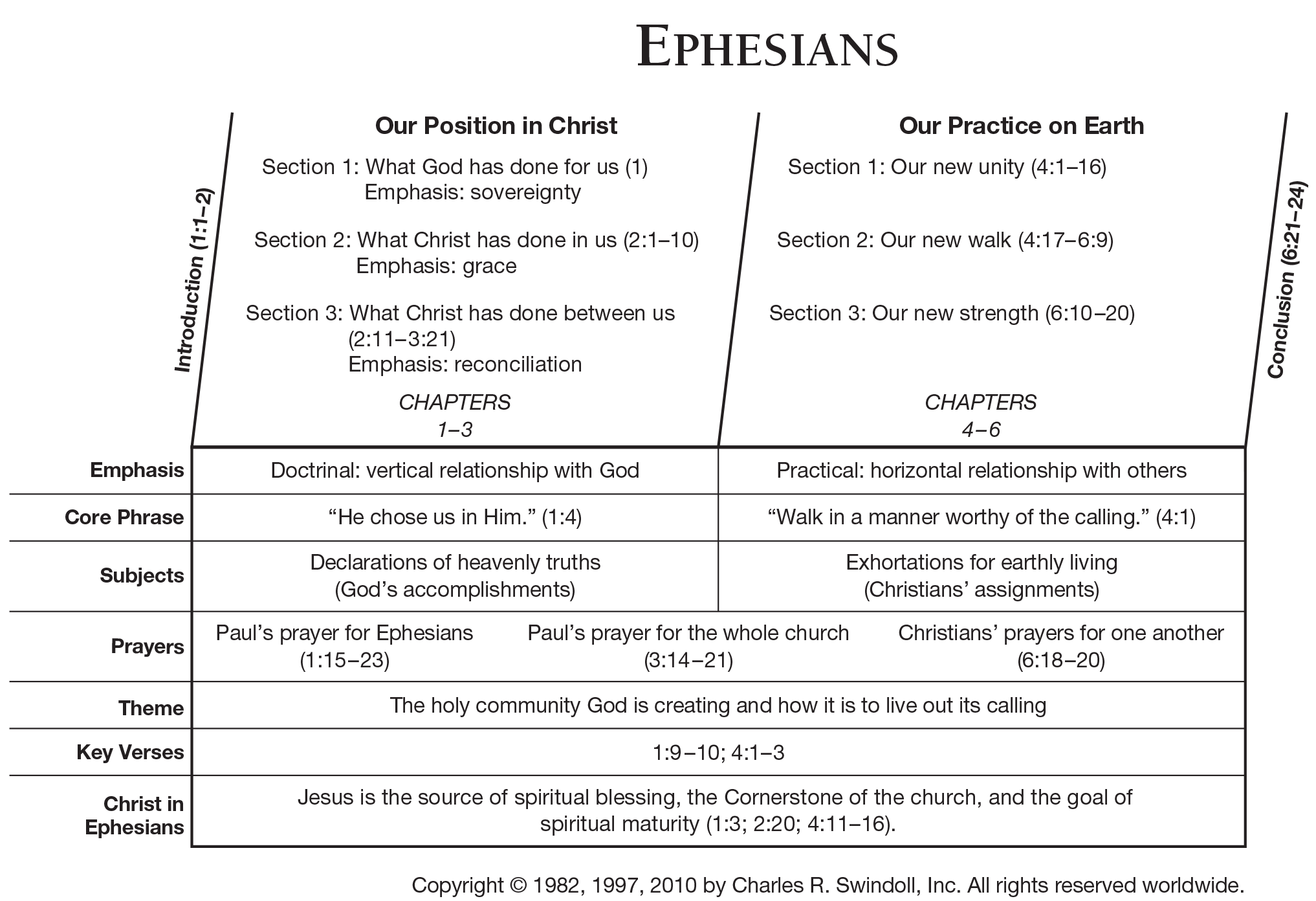
EPHESIANS - CHRIST AND THE CHURCH
Click chart to enlarge
Charts from Jensen's Survey of the NT - used by permission
Click chart by Charles Swindoll -Note "EMPHASIS" --
Ephesians 1-3 = Doctrinal: vertical relationship with God
Ephesians 4-6 = Practical: horizontal relationship with others
Ephesians 4:23 and that you be renewed in the spirit of your mind, (NASB: Lockman)
Greek: ananeousthai (PPN) de to pneumati tou noos humon
Amplified: And be constantly renewed in the spirit of your mind [having a fresh mental and spiritual attitude], (Amplified Bible - Lockman)
BGT ἀνανεοῦσθαι δὲ τῷ πνεύματι τοῦ νοὸς ὑμῶν
ESV and to be renewed in the spirit of your minds,
NET to be renewed in the spirit of your mind,
NIV to be made new in the attitude of your minds;
NLT (revised) Instead, let the Spirit renew your thoughts and attitudes.
NLT: Instead, there must be a spiritual renewal of your thoughts and attitudes. (NLT - Tyndale House)
KJV And be renewed in the spirit of your mind;
NKJV: and be renewed in the spirit of your mind,
Phillips: and, with yourselves mentally and spiritually re-made, (Phillips: Touchstone)
Wuest: moreover, that you are being constantly renewed with reference to the spirit of your mind; (Eerdmans Publishing - used by permission)
Young's Literal: and to get yourselves renewed in the temper of your minds and clothe yourselves
AND THAT YOU BE RENEWED IN THE SPIRIT OF YOUR MIND: ananeousthai (PPN) de to pneumati tou noos humon:
- and that you be renewed Eph 2:10; Ps 51:10; Ezek 11:19; 18:31; 36:26; Ro 12:2; Col 3:10; Titus 3:5
- In the spirit of your mind, Ro 8:6; 1Pe 1:13
- Ephesians 4 Resources - Multiple Sermons and Commentaries
- Ephesians 4:20-24 The Changed Life - Steven Cole
- Ephesians 4:19-24: Off w the Old, On w the New-2 - John MacArthur
- Ephesians 4:17-5:14 Study Guide (see dropdown menu) - John MacArthur
BIBLICAL MIND
RENEWAL
And that you be renewed (ananeoo) in the spirit of your mind (nous) - The revised NLT has an interesting translation "Instead, let the Spirit renew your thoughts and attitudes." Paul exhorts the believers in the church at Ephesus (and you and I in the Body, the Church of Jesus Christ) to the lofty goal of continually allowing the Spirit of God to renew the way they (we) think. This renewal is not only in what one believes (which is vitally important), but is a belief which transforms our feelings, our attitudes and our behavior. Paul desires that we all partake of this miracle of a renewed mind which enables us to have a divine perspective on the passing world (1Jn 2:17) and the spiritually dead (Ep 2:1) who are tragically passing their lives in emptiness and vanity (Eccl 1:2, cp Ec 12:13,1 4). Let us not grow weary and lose heart (Gal 6:9, 2Th 3:13, He 12:3), even though the battle rages fiercely all around us and even within our mind (cp Gal 5:16, Gal 5:17). Beloved, let us press on...pressing ever upward (Php 3:14)
It should also be stated that renewing our minds is closely related to putting on the new self in Eph 4:24.
MacArthur on the spirit of your mind - When a person becomes a Christian, God initially renews his mind, giving it a completely new spiritual and moral capability—a capability that the most brilliant and educated mind apart from Christ can never achieve (cf. 1 Cor. 2:9–16). This renewal continues through the believer’s life as he is obedient to the Word and will of God (cf. Rom. 12:1–2). The process is not a one-time accomplishment but the continual work of the Spirit in the child of God (Titus 3:5). Our resources are God’s Word and prayer. It is through these means that we gain the mind of Christ (cf. Phil. 2:5; Col. 3:16; 2 Tim. 1:7), and it is through that mind that we live the life of Christ.
Physically, you are what you eat, but spiritually, you are what you think
-- Warren Wiersbe
Steven Cole helps understand why this renewal of a believer's mind is so critical writing that "Lloyd-Jones (ibid. p. 123) uses a helpful illustration. When Abraham Lincoln freed the slaves, they were officially free from their many years of servitude, but some of them went on living as if they were still slaves. The President’s proclamation gave them legal standing as free citizens. It was a done deal—they were no longer slaves. But, out of habit and way of thinking, (ED: WHICH IS WHY PAUL'S EXHORTATION IN Eph 4:23 IS SO IMPORTANT! = CALLING FOR A CONTINUAL RENEWING OF OUR MIND - SEE MACARTHUR'S NOTE ABOVE) many of these poor people still lived like slaves. So, they needed to live in accordance with the new facts. When they were tempted to think like a slave, they needed to say, “No, the truth is I am now a free man!” They needed to appropriate that truth into their daily experience. (Ephesians 4:20-24 The Changed Life)
Warren Wiersbe also emphasizes why renewal of our minds is so vitally important to worthy walk (Eph 4:1) writing that "this experience of salvation goes much deeper than this, for it has resulted in a whole new position before God. The old man (the former life) has been put away, and we can now walk in newness of life through Christ. Ephesians 4:22-24 is a summary of Romans 5-8, where Paul explained the believer's identification with Christ in death, burial, and resurrection. He also dealt with this in Ephesians 2:4-6, as well as in Colossians 3. As Christians, we have not simply changed our minds. We have totally changed our citizenship. We belong to God's "new creation" in Christ (2 Cor. 5:17), and therefore, the ideas and desires of the old creation no longer should control our lives. The simplest illustration of this great truth is given in John 11, the resurrection of Lazarus. Our Lord's friend, Lazarus, had been in the grave four days when Jesus and His disciples arrived at Bethany, and even Martha admitted that, by now, the decaying body would smell (John 11:39). But Jesus spoke the word and Lazarus came forth alive, an illustration of John 5:24. Notice our Lord's next words, "Loose him, and let him go" (John 11:44). Take off the grave clothes! Lazarus no longer belonged to the old dominion of death, for he was now alive. Why go about wearing grave clothes? Take off the old and put on the new! This was Paul's argument—you no longer belong to the old corruption of sin; you belong to the new creation in Christ. Take off the grave clothes! How do we do this? "Be renewed in the spirit of your mind" (Eph. 4:23). Conversion is a crisis that leads to a process. Through Christ, once and for all, we have been given a new position in His new creation, but day by day, we must by faith appropriate what He has given us. The Word of God renews the mind as we surrender our all to Him (Rom. 12:1-2). "Sanctify them through Thy truth: Thy Word is truth" (John 17:17). As the mind understands the truth of God's Word, it is gradually transformed by the Spirit, and this renewal leads to a changed life. Physically, you are what you eat, but spiritually, you are what you think. "As he thinketh in his heart, so is he" (Pr 23:7). This is why it is important for us as Christians to spend time daily meditating on the Word, praying, and fellowshipping with Christ. (See Ephesians Through Revelation)
Renewed (365) (ananeoo from aná = again + neóo = renew) means to make new (Robertson says to "make new [young] again), to be renewed, to renovate (active) or "be renovated by inward reformation (passive)." Ananeoo is derived from the root word neos which signifies new in respect to time in contrast to kainos which means new in respect to quality (i.e., a quality that never existed before). Neos describes that which has recently come into existence but for a relatively short time means to cause something to become new and different with the implication of becoming superior. The distinction between neos and is difficult to perceive in our English translations because the same English word is usually used to translate both Greek words. Furthermore, neos and kainos are used several times in the NT to modify the same word (new self, new man, new covenant, new wine), but there is often a difference in the author's intended meaning.
NIDNTT notes that the root word neos is derived "from the Indo-Germanic neuos, derived from the adv. nu, now, has the temporal sense of belonging to the present moment, and so new, not previously existent, just now appearing, in short: new, young. . Secular Greek uses neos as an adj. (attested since Mycenaean Gk.) for things, generally in a temporal sense, new, fresh....neos is most commonly used, chiefly in the comparative, to designate the age-range of youths from 20 to 30 years old as distinct from the presbuteros or gerontes, but also now and again as a noun to denote an inexperienced person, a novice. (Brown, Colin, Editor. New International Dictionary of NT Theology. 1986. Zondervan)
Ananeoo is used frequently in secular writings. For example, Josephus has this use "This desolation happened to the temple in the hundred forty and fifth year, on the twenty-fifth day of the month Apelleus, and on the hundred and fifty-third olympiad: but it was dedicated anew, (Ant 12.321).
Paul in using ananeoo is saying "Be renewed insofar as spiritual vitality is concerned".
TDNT says "so ananeoo can denote a renewing activity which replaces an earlier state, i.e., “to renew what is old,” “to refresh or reinvigorate a tired being.” ananeoo (cf. recentare) is to be distinguished from anakainoo (cf. renovare) as neos is from kainos. It involves a new beginning in time as distinct from qualitative renewal.
Vine - The renewal here mentioned is not that of the mind itself in its natural powers of memory, judgment and perception, but ‘the spirit of the mind,’ which, under the controlling power of the indwelling Holy Spirit, directs its bent and energies Godward in the enjoyment of “fellowship with the Father and with His Son, Jesus Christ,” and of the fulfilment of the will of God. The word is frequent in inscriptions and in the papyri. (Vine's Complete Expository Dictionary of Old and New Testament Words)
The present tense indicates that the spirit of their mind is continually being renewed. The passive voice indicates that the subject (the believer's mind) is acted upon by outside force (cp 2Co 4:16, Col 3:10) and in context this "force" or "source" is the Spirit of God (surely interconnected with the continual intake of the Word of God) not from within ourselves (cp 1Co 2:14, 15, 16). The idea then would be to let oneself be renewed (see TDNT quote above) or voluntarily submit to the idea of continual progress and growth, which is the antithesis of the corrupting just mentioned (Ep 4:22)
This renewal points to a complete about-face in their thinking, a change from mental impurity to holiness. The Spirit of God influences the thought processes of believers so that they begin more and more to reason from God’s viewpoint.
How is your mind renewed? Paul explains in the following passages...
Romans 12:2 And do not be conformed (present imperative + negative = stop doing this!) to this world, but be transformed (metamorphoo in the present imperative = continual action called for) by the renewing (anakainosis) of your mind, that you may prove (dokimazo) what the will of God is, that which is good and acceptable and perfect. (Ro 12:2)
Comment: So the answer to the question is: (1) Stop being poured into the mold of this fallen, godless, and overtly anti-God world system. (2) Continually allow yourself to be changed, transformed like a caterpillar into a butterfly.
Colossians 3:10 and have put on the new self who is being renewed (anakainoo) to a true knowledge according to the image of the One who created him (Col 3:10).
Comment: Here anakainoo is used which refers to a qualitative renewal that is ongoing.)
2Cor 3:18 But we all, with unveiled face beholding as in a mirror the glory of the Lord, are being transformed (metamorphoo) into the same image from glory to glory, just as from the Lord, the Spirit.
2Cor 4:16, 17 Therefore we do not lose heart, but though our outer man is decaying, yet our inner man is being renewed day by day. For momentary, light affliction is producing for us an eternal weight of glory far beyond all comparison,
Comment: Jamieson says that our inner man "is being renewed,” namely, with fresh “grace” (2Co 4:15), and “faith” (2Co 4:13), and hope (2Co 4:17, 18)." Wiersbe adds that Paul "was sure his trials were working for him, not against him...When you live by faith in Christ, you get the right perspective on suffering...Of itself, suffering will not make us holier men and women. Unless we yield to the Lord, turn to His Word, and trust Him to work, our suffering could make us far worse Christians. In my own pastoral ministry, I have seen some of God’s people grow critical and bitter, and go from bad to worse instead of “from glory to glory.” We need that “spirit of faith” that Paul mentioned in 2 Corinthians 4:13."
The renewal is not that of the mind itself in its natural powers of memory, judgment and perception, but the spirit of the mind, which, under the controlling power of the indwelling Holy Spirit, directs its bent and energies Godward in the enjoyment of fellowship with the Father and with His Son, Jesus Christ, and of the fulfillment of the will of God.
How else can man be daily renewed in the spirit of his mind? It seems logical that we must feed the mind sound (healthy, "hygienic") doctrine taught and illuminated by His Spirit (2Ti 1:13-, 2Ti 4:3-, Titus 1:9-, Titus 2:1-, 1Ti 1:10; 6:3;)
Spirit of your mind - The human spirit, not the Holy Spirit. Not all agree however as the revised NLT translates it "Instead, let the Spirit renew your thoughts and attitudes."
Moule writes that "It is the human spirit, as the substratum, so to speak, of every activity of the "inner man," and now specially of the activity which sees and grasps truth ("your mind"). (The Epistle to the Ephesians)
Vincent writes that "The spirit is the human spirit, having its seat in and directing the mind. In the New Testament the Holy Spirit is never designated so as that man appears as the subject of the Spirit. We have Spirit of adoption, of holiness, of God, but never Holy Spirit of man. Furthermore, the apostle’s object is to set forth the moral self-activity of the Christian life. Hence pneuma, spirit, is here the higher life-principle in man by which the human reason, viewed on its moral side — the organ of moral thinking and knowing is informed. The renewal takes place, not in the mind, but in the spirit of it. (Ephesians 4 Word Studies)
John Eadie has a lengthy discourse on what is meant by the phrase "the spirit of the mind" writing that...
Pneuma (spirit) is the highest part of that inner nature, which, in its aspect of thought and emotion, is termed nous. So the apostle speaks of “soul” and “spirit”—psuche (soul) often standing to soma (body) as pneuma (spirit) to nous (mind). It is not merely the inmost principle, or as Chrysostom phrases it, “the spirit which is in the mind,” but it is the governing principle, as Theodoret explains it...The renewal takes place not simply in the mind, but in the spirit of it. The dative points out the special seat of renewal. (Winer, § 31, 6, a; Mt. 11:29; Ac 7:51; 1Co 14:20). The mind remains as before, both in its intellectual and emotional structure—in its memory and judgment, imagination and perception. These powers do not in themselves need renewal, and regeneration brings no new faculties. The organism of the mind survives as it was, but the spirit, its highest part, the possession of which distinguishes man from the inferior animals, and fits him for receiving the Spirit of God, is being renovated.
The memory, for example, still exercises its former functions, but on a very different class of subjects; the judgment still discharging its old office, is occupied among a new set of themes and ideas; and love, retaining all its ardour, attaches itself to objects quite in contrast with those of its earlier preference and pursuit.
The change is not in mind psychologically, either in its essence or in its operation; neither is it in mind, as if it were a superficial change of opinion, either on points of doctrine or of practice; but it is “in the spirit of the mind,” in that which gives mind both its bent and its materials of thought (Ed: I would add the new man's mind is now like the "mind of Christ" 1Co 2;16). It is not simply in the spirit, as if it lay there in dim and mystic quietude; but it is “in the spirit of the mind,” in the power which, when changed itself, radically alters the entire sphere and business of the inner mechanism. (Recommended Resource - You have to dig through Eadie's prodigious comments but the nuggets of gold are priceless! - Ephesians 4 Commentary)
Mind (3663) (nous) refers to reflective intelligence. Nous is the seat of understanding, the thinking faculty. It is the mind as the organ of mental perception and apprehension, the organ of conscious life, and the organ of the consciousness preceding actions or recognizing and judging them. In Scripture the unbelieving mind is disqualified, worthless, rejected and fails the test (Ro 1:28-)
Nous - 24x in 22v - Luke 24:45; Rom 1:28; 7:23, 25; 11:34; 12:2; 14:5; 1Cor 1:10; 2:16; 14:14f, 19; Eph 4:17, 23; Phil 4:7; Col 2:18; 2Th 2:2; 1 Tim 6:5; 2 Tim 3:8; Titus 1:15; Rev 13:18; 17:9. Translated as - composure(1), comprehension(1), mind(20), minds(1), understanding(1).
Why would Satan want to attack the believer's new mind? Because your mind is the part of the image of God where God communicates with you and reveals His will to you. It is unfortunate that some Christians have minimized the significance of the mind, because the Bible emphasizes its importance. God renews our lives by renewing our minds, (Ro 12:2-) and he renews our minds through his truth. This truth is the Word of God. Sanctify them in the truth; Thy word is truth. (John 17:17). If Satan can get you to believe "the lie", then he has established a foothold (cf Ep 4:27-) to begin to work in your life to lead you into greater and greater rebellion against God. This is why the Deceiver attacks our mind, and this is why we must put on the Lord Jesus Christ (Ro 13:14-, Ep 6:11-) (positionally or potentially we have been given the "mind of Christ" -1Cor 2:16) to resist his fiery missiles (Ep 6:11-) and to stand fast against his schemes and so to protect our minds from the attacks of the wicked one. When the lie comes into your eye gate or ear gate, quickly take up the shield of faith and put on the helmet of salvation to protect your mind (In truth you need to have the helmet on BEFORE the attack begins! So get up every morning an yield to Yahweh - Romans 12:1). Assess all that you hear and see by whether or not it is "according to Christ" (Col 2:8-) or whether it meets the criteria of (Php 4:8-).
Remember
Our adversary is relentless,
But we are not defenseless!
Hold fast to the end.
Ephesians 4:24 and put on the new self, which in the likeness of God has been created in righteousness and holiness of the truth. (NASB: Lockman)
Greek: kai endusasthai (AMN) ton kainon anthropon ton kata theon ktisthenta (APPMSA) en dikaiosune kai hosioteti tes aletheias.
BGT καὶ ἐνδύσασθαι τὸν καινὸν ἄνθρωπον τὸν κατὰ θεὸν κτισθέντα ἐν δικαιοσύνῃ καὶ ὁσιότητι τῆς ἀληθείας.
Amplified: And put on the new nature (the regenerate self) created in God’s image, [Godlike] in true righteousness and holiness. (Amplified Bible - Lockman)
ESV and to put on the new self, created after the likeness of God in true righteousness and holiness.
KJV And that ye put on the new man, which after God is created in righteousness and true holiness.
Moffatt putting on the new nature, that divine pattern which has been created in the upright and
pious character of the Truth NET and to put on the new man who has been created in God's image– in righteousness and holiness that comes from truth.
NIV and to put on the new self, created to be like God in true righteousness and holiness.
NLT (revised) Put on your new nature, created to be like God-- truly righteous and holy.
NLT: You must display a new nature because you are a new person, created in God's likeness—righteous, holy, and true. (NLT - Tyndale House)
Phillips: to put on the clean fresh clothes of the new life which was made by God's design for righteousness and the holiness which is no illusion. (Phillips: Touchstone)
REB and
put on the new nature created in God’s likeness, which shows itself in the upright and devout life called for by the truth. The Living Bible Yes, you must be a new and different person, holy and good. Clothe yourself with this new nature.
WNT with that new and better self which has been created to resemble God in the righteousness and holiness which come from the truth.
Wuest: and that you have put on once for all the new self who after God was created in righteousness and holiness of truth. (Eerdmans Publishing - used by permission)
Young's Literal: with that new and better self which has been created to resemble God in the righteousness and holiness which come from the truth.
AND PUT ON THE NEW SELF: kai endusasthai (AMN) ton kainon anthropon:
- and put on Eph 6:11; Job 29:14; Isaiah 52:1; 59:17; Ro 13:12,14; 1Cor 15:53; Gal 3:27; Col 3:10-14
- the new self Ep 2:15; Romans 6:4; 2Co 4:16; 2Co 5:17-; 1Pe 2:2
- Ephesians 4 Resources - Multiple Sermons and Commentaries
- Ephesians 4:20-24 The Changed Life - Steven Cole
- Ephesians 4:19-24: Off w the Old, On w the New-2 - John MacArthur
PUT ON CLEAN CLOTHES
OF THE NEW LIFE IN CHRIST
And put on (enduo) the new (kainos) self - As with "lay aside the old self", there are two approaches to the interpretation of this verse. One sees it as a past completed action (and thus as a "positional" truth), whereas the other sees it as something the believer is to do. These differences are reflected in the translations.
For example, below is a translation that renders "put on" as a past completed act that occurred at the time of salvation...
Wuest: and that you have put on once for all the new self who after God was created in righteousness and holiness of truth. (Eerdmans Publishing - used by permission)
In contrast, the versions below render "put on" as something the believer is to perform...
NASB: and put on the new self, which in the likeness of God has been created in righteousness and holiness of the truth.
Amplified: And put on the new nature (the regenerate self) created in God’s image, [Godlike] in true righteousness and holiness.
The new self - The new man. The new self is a brand new self that did not exist before salvation and which makes possible a new quality of life and service which was heretofore impossible (cp related word kainotes in Ro 6:4- and Ro 7:6-). The old self is the unsaved person still in Adam (1Co 15:22, 45, Ro 5:12-, Ro 5:17-, Ro 5:18, 19-) and dominated by their rebellious, anti-God, totally depraved nature, while the new self refers to the saved person dominated by the divine nature (2Pe 1:4-).
Paul is speaking here of a man who is qualitatively new. The brand "new man" is a truly new creation (2Cor 5:17), a miracle of regeneration performed by the Holy Spirit (cp Jn 3:8, Titus 3:5, Titus 3:6) on a heart and mind which receives Christ (Jn 1:12, 13) by faith (Ep 2:8, 9) as personal Savior and Lord (cp Ro 10:9, 10)
John Eadie says "The “new man” is in contrast with the “old man,” and represents that new assemblage of holy principles and desires which have a unity of origin, and a common result of operation. (Ephesians 4 Commentary)
Kent Hughes explains this passage this way - The fact is, we have this new self if we are Christians. We received the old man at birth, and we were given the new man in our heavenly birth. The new man is not our work — it is God’s creation and gift. Our task is not to weave it, but to wear it. Paul is commanding a daily appropriation of that which we already possess...We have our part to do in dressing ourselves with the divine wardrobe, for here "clothes do make the man" — and the woman! We must daily set aside the rotting garments of the old man. We must formally reject sensuality and selfish pride and materialism and bitterness (Ed: cp Ep 4:31-). We must read the Word (Ed: cp Jn 17:17, Col 3:16-, 1Pe 2:2-, et al) and ask God to to renew our minds through the Spirit (Ed: cp Php 2:13-). We must work out our salvation (Php 2:12-) by doing those things that will develop a Biblical mind (Ed: Josh 1:8-); Ps 119:9, 10-, Ps 119:11-). We must put on our new, shining garments of light (Ed: Ep 5:8, Ep 5:9, Ep 5:13, Ro 13:12, Ro 13:13, 13:14, 1Th 5:4, 5; 1Th 5:8). We must put on what we are!" (See Ephesians: The Mystery of the Body of Christ) (Bolding added)
Steven Cole emphasizes that "The main source of conflicts is our old man (old nature). Some Bible teachers insist that believers do not have an old nature, but just a new nature, and that our propensity toward sin comes from the flesh (John MacArthur, Jr., The MacArthur New Testament Commentary, Ephesians [Moody Press], p. 164). I fail to see any biblical distinction between the old nature and the flesh. Whatever you call it, there is, even in the believer, a strong, indwelling disposition to do what we want rather than what God wants: “All of us like sheep have gone astray, each of us has turned to his own way ...” (Isa 53:6). “What is the source of quarrels and conflicts among you? Is not the source your pleasures that wage war in your members?” (Jas 4:1). That old sin nature (Old Man, flesh--I’m using these terms interchangeably) pits us against one another and results in conflicts. A number of other factors also, when coupled with our sin nature, lead to conflicts: We come from different backgrounds and experiences (type of family, where we’re from, income levels, etc.); we have different habit patterns; different convictions and values; different perspectives and ways of thinking as men and women; different goals; etc. But with all these factors, the underlying reason for conflicts is our “old man” which is self-seeking, living to gratify its own desires. But when you came to faith in Jesus Christ, a radical change took place: You became a new person in Christ. Your bent toward sin was not eradicated, but God made you a new person, created in righteousness and holiness of the truth (Eph 4:24). The power of the old man has been broken (cp Ro 6:6, Ro 6:11). When you were saved, you took it off like dirty clothes (Ep 4:22) and put on the new man like a suit of clean clothes (Ep 4:24). And you are involved in the ongoing process of renewing your mind (Ep 4:23). That process continues as you count as true in your experience and behavior the reality of the change spiritually that took place at salvation. You must believe what God says--that you are a new person in Christ; and you must act upon that truth in your behavior. As you learn to believe what God says about you in Christ and to act upon it daily, you will learn to get along with other people, whether your mate or others, because you are daily dying to the old self. (Ephesians 4:17-32: Solving Conflicts)
Ray Stedman gives the following illustration: "When I get up in the morning I put on my clothes, intending them to be part of me all day, to go where I go and do what I do. They cover me and make me presentable to others. That is the purpose of clothes. In the same way, the apostle is saying to us (Ro 13:12, 13, 14-see notes Ro13:12,13, 14), “Put on Jesus Christ when you get up in the morning. Make Him a part of your life that day. Intend that He go with you everywhere you go, and that He act through you in everything you do. Call upon His resources. Live your life IN CHRIST.” (Stedman, Ray C. From Guilt to Glory.8) (Bolding added)
Related Resource:
Put on (1746) (enduo from en = in + dúo = to sink, go in or under, to put on) means to put on as a garment, to cause to get into a garment, to clothe or to dress. The uses of enduo by Paul all have a figurative meaning, not referring to putting on literal garments but putting on "ethical, moral or spiritual" garments (so to speak) like Christ Himself (Ro 13:14), like the armor of light, like the new self, like the breastplate of faith and love, or like those garments which are imperishable and immortal. What a "wardrobe" God has made available for believers! We're the "best dressed" folks in the world and most of us don't even know it!
In the middle voice as in Eph 4:24 enduo means to clothe oneself. The aorist tense conveys the sense of "Do this now!" (if one interprets this as action the believer is to carry out rather than one which has already occurred in the past at salvation which some commentators favor in Eph 4:24). The aorist tense can also convey the sense that in each new situation we encounter, we are presented with an opportunity to put the new man on ourselves. What does this look like practically? It's a new conduct in accord with righteousness ("right conduct before God and men") and holiness (a conduct set apart from what the fallen world typically pursues resulting in its being continually corrupted by the lust of deceit - cp 2Pe 1:4-).
Thayer, commenting on the use of enduo in Col 3:10- (put on the new man) says it means "to become so possessed of the mind of Christ (1Co 2:16) as in thought, feeling, and action to resemble Him and, as it were, reproduce the life He lived.
Enduo - 27x in 25v - clothed(6), dressed(1), enter(m)(1), put on(21). Mt. 6:25; Mt. 22:11; Mt. 27:31; Mk. 1:6; Mk. 6:9; Mk. 15:20; Lk. 8:27; Lk. 12:22; Lk. 15:22; Lk. 24:49; Acts 12:21; Ro 13:12; Ro 13:14; 1Co. 15:53; 1Co. 15:54; 2Co. 5:3; Gal. 3:27; Ep 4:24; Col. 3:10; Col. 3:12; 1Th. 5:8; 2Ti 3:6; Rev 1:13; Re. 15:6; Rev 19:14
New (2537) (kainos probably from root ken [qen] = freshly come, or begun) is an adjective which refers to that which is new kind (unprecedented, novel, uncommon, unheard of). It relates to being not previously present. Compare the related noun kainotes translated newness (Freiberg defines it as "depicting something not only recent and different but extraordinary"!) in Ro 6:4- and Ro 7:6-. Believers now have a brand new life with a brand new source of power (the Spirit) to live out that life to the full (cp Jesus' desire for all believers - Jn 10:10b)! Beloved in Christ, may this (His) "extraordinary" life be a genuine reality in our day to day experience in Christ. Amen! R. C. Trench distinguishes Neos and Kainos as follows "Contemplate the new under aspects of time, as that which has recently come into existence, and this is neos... . But contemplate the new, not now under aspects of time, but of quality, the new, as set over against that which has seen service, the outworn, the effete or marred through age, and this is kainos. (New - Trench's Synonyms of the New Testament.) Vine adds that kainos "denotes “new,” of that which is unaccustomed or unused, not “new” in time, recent (Greek = "neos"), but “new” as to form or quality, of different nature from what is contrasted as old. As Vincent says in his discussion of kainos "All the elements of festivity in the heavenly kingdom will be of a new and higher quality. The Open Bible notes that kainos "can be used with reference to something that has not been used before (Mt 9:17). Kainos is also used with the connotation of “remarkable” as a designation of something that is “new” and not known previously (Mk 1:27; Jn 13:34). The same word qualifies something as “new” in the sense of a replacement for something that is old and obsolete—as in the “new covenant” (Heb 8:8). Converts are “new persons” (2Co 5:17-; Ep 4:24). Kainos is used in an eschatological sense to describe the “new” heaven and earth (2Pe 3:13; Rev 21:1). (The Open Bible : New King James Version. Nashville: Thomas Nelson Publishers)
In summary Kainos signifies qualitatively new in contrast to neos which indicates temporally new or new with respect to age.
In Mark 1:27 we read the reaction to Jesus' teaching...
And they were all amazed, so that they debated among themselves, saying, "What is this? A new (kainos) teaching with authority! He commands even the unclean spirits, and they obey Him."
Wuest comments that "There are two words for “new,” neos, referring to that which is new as to the matter of time, namely, that which has just come into existence, and kainos, which contemplates the new, not under the aspect of time, but of quality, the new as set over against that which has seen service, the outworn, the effete or marred through age. Compared to the stilted, staid, dry as dust rabbinical droning, this teaching of Jesus (in Mk 1:27) was like the fragrance of a field of clover in the springtime. It was fresh with the dew of heaven upon it.- (Wuest Word Studies - Eerdman Publishing Company Volume 1, Volume 2, Volume 3 - used by permission)
Kainos is used in 55 verses in the Septuagint (LXX) Deut. 20:5; 22:8; 32:17; Jos. 9:13; Jdg. 5:8; 15:13; 16:11f; 1 Sam. 6:7; 2 Sam. 6:3; 1Ki. 11:29f; 12:24; 2 Ki. 2:20; 1 Chr. 13:7; 2 Chr. 20:5; Job 29:20; Ps. 33:3; 40:3; 96:1; 98:1; 144:9; 149:1; Eccl. 1:10; Isa. 8:1; 41:15; 42:9f; 43:19; 48:6; 62:2; 65:15, 17; 66:22; Jer. 26:10; 31:22, 31; 36:10; Ezek. 11:19; 18:31; 36:26
Kainos - 42x in 36v in the NT (Seven times in the Revelation when God will make all things new!) - NAS = fresh(3), new(37), new things(1), things new(1). Mt 9:17; 13:52; 26:29; 27:60; Mk. 1:27; 2:21, 22; 14:25; 16:17; Lk. 5:36, 38; 22:20; Jn. 13:34; 19:41; Acts 17:19, 21; 1Co. 11:25; 2Co. 3:6; 2Co 5:17-; Gal. 6:15; Ep 2:15; 4:24; Heb. 8:8, 13; 9:15; 2Pe 3:13; 1Jn. 2:7, 8; 2Jn. 1:5; Re 2:17; 3:12; 5:9; 14:3; 21:1, 2, 5.
Neos is new simply in point of time and is thought by some (TDNT) to be an Indo-European word that is derived from the adverb nu meaning “now, of the moment.” In other words, neos describes something which has come into existence recently, but there may well have been thousands of the same thing in existence before. A pencil produced in the factory this week is neos, but there already exist millions exactly like it. Kainos on the other hand is new in nature or quality. Continuing the former analogy, while a pencil might be neos, a ballpoint pen would be kainos when it was first invented, because such a unique writing instrument had not previously existed. Kainos then is new in the sense that it brings into the world a new quality of some thing which did not exist before.
Kainos denotes the new and miraculous condition that is emphasized especially in the church age. Thus we see kainos as a key term in eschatological statements -- the new heaven and earth in Rev 21:1-. The new heavens and earth will be far more than merely new in time or chronology, for they will also be new in character -- a realm in which righteousness dwells = 2Pe 3:13-. New Jerusalem = Rev 3:12-; Re 21:2-, new wine = Mk 14:25, the new name = Rev 2:17-; Re 3:12-, the new song = Rev 5:9-, the new creation, unlike anything previously known = Rev 21:5-. The idea of new creation is also used to describe the life of a sinner who has become a saint (a believer) and is now a new creation/creature in Christ (2Co 5:17-). The new age has dawned with Christ's first coming and His provision of salvation, so that in this new age Jews and Gentiles are now one new man in Christ (Ep 2:15-, Ga 6:15). Believers now charged to put on their new nature (Ep 4:24-). God’s saving will is worked out in the promised new covenant that Jesus has established (Lk 22:20; 1Cor 11:25; 2Co 3:6, Heb 8:8-, He 8:13-; He 9:15-). This covenant is new in several ways -- It is a better covenant (He 7:22-), an infallible (faultless) covenant (He 8:7-), an everlasting/eternal covenant (He 13:20-), a covenant grounded on better promises (He 8:6-). The fact that the old and the new cannot be mixed is repeated in all 3 synoptic gospels to emphasize the distinctive, unique nature of the new covenant (Mt 9:17 Mk 2:21, 22, Lk. 5:36, 37, 38). The new commandment of love has its basis in Christ’s own love (Jn 13:34, 1Jn 2:7, 8; 2Jn 1:5).
MacArthur notes that "Everyone who is in Christ becomes a new creature (cf. Ga 6:15). Kainos (new) means new in quality, not just in sequence; believers’ “old self was crucified with Him” (Ro 6:6-); they have therefore laid “aside the old self … and put on the new self” (Ep 4:22-, Ep 4:24-; Col. 3:9-, Col 3:10-). (See 2 Corinthians MacArthur New Testament Commentary)
Self (man) (444) (anthropos) means man and refers to humanity in general. The word is not aner, a male individual, but anthropos, the generic, racial term, speaking of an individual.
The "New Self" is the essence of what believers now are in the new covenant with Christ (See The Oneness of Covenant). This term describes our new position in Christ which gives us new potential to practice daily the putting off of filthy rags of darkness and putting on of righteous deeds of light by the power of the indwelling Holy Spirit. Our practice should also include a continual reckoning that the "Old Self" is dead (Ro 6:11 is a command in the present imperative!) and thus we are dead to the power of Sin and alive to God in Christ Jesus. Before we were saved, Sin was our Master and we had no power to say "No". Now as those who possess a "New Self" in Christ, we have been granted the power of righteous choice and can choose not to commit sin (NB: We are however NOT sinless as some falsely teach - 1Jn 1:8). Now as we practice saying "Yes" to Jesus, it becomes more natural (better stated "supernatural") to say "No" to the flesh (see above discussion) and its strong desires to gratify self (Gal 5:17). To reiterate, because the "Old Self" died in Christ, and the "New Self" lives in Christ, believers must put off remaining sinful deeds and be being continually renewed into the Christlikeness to which they were called.
Old self = "WHO" we were was what was important
New self = "WHOSE" we are is what is important !
Related Resource:
- See chart of 78 put off's and put on's which reflect progressive sanctification or growth in holiness or working out of our salvation in fear and trembling (Php 2:12) which can be accomplished only as we depend on the Spirit to give us the DESIRE and the POWER {Php 2:13NLT).
John MacArthur explains the "New Self" as follows - The word new (kainos) does not mean renovated but entirely new—new in species or character. The NEW SELF is new because it has been created in the likeness of God. The Greek is literally, “according to what God is”—a staggering statement expressing the wondrous reality of salvation. Those who confess Jesus Christ as Lord are made like God! Peter says we become “partakers of the divine nature” (2Pe 1:4). Many rescue missions have a delousing room, where derelicts who have not had a bath in months discard all their old clothes and are thoroughly bathed and disinfected. The unsalvageable old clothes are burned and new clothes are issued. The clean man is provided clean clothes. That is a picture of salvation, except that in salvation the new believer is not simply given a bath but a completely new nature. The continuing need of the Christian life is to keep discarding and burning the remnants of the old sinful clothing. The many therefore's and wherefores in the New Testament usually introduce appeals for believers to live like the new creatures they are in Christ. Because of our new life, our new Lord, our new nature, and our new power, we are therefore called to live a correspondingly new life–style. (See The Believer's Walk with Christ)
Paxson explains the new self is "the new creation in Christ; the saint possessing a new spiritual divine nature, from which a pure river of life flows into every part of his being; the human personality with Christ at its centre, crowned as its Lord, and indwelt as its Life; the "I in you" of John 15:4 ("Abide in Me, and I in you. As the branch cannot bear fruit of itself, unless it abides in the vine, so neither can you, unless you abide in Me."); the "Christ in you" of Colossians 1:27 (see note) ("Christ in you, the hope of glory"). (The Wealth, Walk and Warfare of the Christian)
Wayne Barber explains the laying aside the old man and putting on the new man...
When we received Christ, we got a brand new garment. Once Christ comes in, that garment is present. Christ is the very fabric of that garment. When I choose to let Jesus be Jesus in my life, when I choose against my flesh, when I choose to say "yes" to Him, strengthened in the inner man by the Spirit of God, then I begin to live a brand new way.
When you receive Christ, you have the garment to wear that identifies you wherever you are. It is a brand new lifestyle. But how many Christians are still trying to go back and put on those old clothes, still trying to dress the way they want to dress? What an indictment Paul gives to us. He warns them in Ep 4:17, 18, 19 not to go back and live like they used to live. It says in Ep 4:22:
in reference to your former manner of life, you lay aside the old self, which is being corrupted (present tense = pictures a continuous process. Passive voice = this corruption is the result of an outside "force", in this case the "lusts of deceit") in accordance with the lusts of deceit." (see note) (Ed: See related discussion: The Deceitfulness of Sin)
In other words, the more you choose the old flesh rather than Jesus, choosing what you want, the more you begin to be caught up in that downward spiral which is constantly being corrupted.
That verse talks about the lusts (epithumia [word study]) of deceit (apate [word study]). Did you know that all of the lusts that we have to contend with are deceitful? They make you think that you want something and pull you out of your walk with God. The moment you get whatever you were lusting for, you realize that it is not what you thought it really was! Now you are caught once again in the current of that putrid stream which is continually being corrupted by the deceitful desires!
Point number one: We started off by saying that we must put on the new man. Living the brand new life is like putting on a brand new garment.
Point number two: Before I can put on the new, I have to take off the old. In both of these situations, I have already put on the new man and taken off the old. However, we must appropriate this now and bring positional truth down to experiential truth. The Christian life is a walk. It is us moment by moment continually making the choice to make sure I am "dressed properly" in the garment of the Lord Jesus, by allowing Jesus to be Jesus in my life. And this all describes a brand new way of living.
Point number three: Ephesians 4:23. We have to be, first of all, renewed in our minds. We are not going to put on these new clothes until we start thinking differently. Remember the lost world is darkened in its understanding (Ep 4:18). We have been enlightened in our mind (cp Paul's prayer Ep 1:18). We can now appreciate what is right and what is wrong (Ed: Contrast Isa 5:20, 21, Hos 4:6). We understand now what God requires. The more we get into His Word, the more we allow our minds to be renewed, and the more we are going to "dress properly" and live properly. The world looks at us and sees the witness of Jesus as a living reality in us.
Let’s look at Ep 4:23: "and that you be renewed in the spirit of your mind."
That word "renewed" caught my attention. It is not the same word as Romans 12:1 (note) or Romans 12:2. Certainly your mind goes there. Romans says, Do not be conformed (present imperative = with negative means stop letting this happen!) to this world, but be ye transformed (present imperative = command to make this our continual aim) by the renewing of your mind." ()
There are two words that are used in that little word "renewing": ana, which means again and kainos, which means renew. In other words, it is a qualitatively brand new mind. He is telling the Romans,
"You are going to have to completely change your way of thinking."
Perhaps he is saying something else here to the Ephesians. It’s almost the same thing. The Ephesians are already changing their minds. They are already faithful servants as Ep 1:1 (note) tells us.
Paul uses another word for renew in Ephesians 4:23 which comes from ana and neos. Neos, means new, not so much qualitatively new, but thinking in other ways. In other words, you continually let your mind be changed. It has already started with this qualitative, brand new way of thinking. (cf Ro 12:2) Now you continue to let God rebuild and renovate your mind.
You see, the problem with us is the way we have been trained to think. If we don’t think God’s way, then obviously we are going to live wrong. Proverbs says, "As a man thinks, so is he." Certainly my heart is to be surrendered, but I need to get into God’s Word and let God’s thoughts replace my thoughts, qualitatively and otherwise. I continually grow as the Holy Spirit of God begins to teach me how to wear my new garment (cp 2Co 3:18)
I think there are some steps. First, we have to take off the old. Then we put on the new. Then third, before we are ever going to consistently do that, we have to be renewed in the spirit of our mind. The word "spirit" there tends to refer to the rational part of the mind (See John Eadie's discussion above). So I think what Paul is saying here is that in the area where you decide, in the area where you make decisions, in that area of your mind, you need to be consistently renewed so that you will continually put on the new garment of the brand new behavior. (Ephesians 4:22-27: A Brand New Way of Life - 3)
WHICH IN THE LIKENESS OF GOD HAS BEEN CREATED IN RIGHTEOUSNESS AND HOLINESS OF THE TRUTH: ton kata theon ktisthenta (APPMSA) en dikaiosune kai hosioteti tes aletheias:
- which in the likeness of God Genesis 1:26,27; 2Co 3:18; Colossians 3:10; 1Jn 3:2
- has been created Ep 2:10; Galatians 6:15
- in righteousness and holiness .Ps 45:6,7; Ro 8:29; Titus 2:14; Hebrews 1:8; 12:14; 1Jn 3:3
- of the truth John 17:17
- Ephesians 4 Resources - Multiple Sermons and Commentaries
- Ephesians 4:20-24 The Changed Life - Steven Cole
- Ephesians 4:19-24: Off w the Old, On w the New-2 - John MacArthur
- See comments on Born Again in John 3
NEW CREATIONS
IN CHRIST
Which in the likeness of God has been created (ktizo) - The new man is what a believer has been created to be in Christ. It is the new creation, in which old things have passed away and all things have become new (2Co 5:17). This new kind of man is according to God, that is, created in His likeness. And this new man manifests or shows itself to be a "brand new" man in Christ by living (as it were) in the atmosphere of righteousness (right conduct before God and man) and holiness (this is the state of a proper attitude toward God which is exhibited in action, specifically in a lifestyle set apart from the profane, set apart from the godless, even anti-God world system ruled by Satan [1Jn 5:19, Lk 4:6], and instead oriented toward God, toward what pleases Him [cp Col 1:9, Col 1:10, 2Co 5:9, He 11:6]).
God (2316) (theos) refers to the supreme Divine Being, the true and living personal God.
John Eadie has some interesting thoughts about the phrase in the likeness of God has been created "What the apostle affirms is not that creation is God's work and prerogative and His alone, but that as the first man bore His image, so does the new man, for he is created “according to God,” or in the likeness of God; or, as the apostle writes in Col. 3:10, "according to the image of the One who created him"... The allusion is to Ge 1:27. What God created, man assumes. The newness of this man is no absolute novelty, for it is the recovery of original holiness. As the Creator stamps an image of Himself on all His workmanship, so the first man was made in His similitude, and this new man, the result also of His plastic energy, bears upon him the same test and token of his Divine origin; for the moral image of God reproduces itself in him (cp 2Pe 1:4). It is no part of our present task to inquire what were the features of that Divine image which Adam enjoyed. (Recommended - You have to dig through Eadie's prodigious comments but the nuggets of gold are priceless! - Ephesians 4 Commentary)
Created (2936) (ktizo) means to bring something into existence or to call into being. Ktizo is used in the NT only of God's creativity. The Greeks used ktizo to describe the founding of a place, a city or colony. Ktizo points to saved sinners as new creations in Christ, having formerly been dead and by His Spirit now called into an existence of eternal life (Born Again)! The aorist tense points to a specific act having taken place in the past Ktizo - 15x in 13v - NAS = created(13), Creator(1), make(1).
- Mt 19:4 = creation of man;
- Mk 13:19 = Creation of heavens and earth;
- Ro 1:25 = "the Creator";
- 1Co 11:9 = creation of man;
- Ep 2:10= creation of the new man (with a new "job description") in Christ Jesus,
- Ep 2:15 = creation of one new man = the Body of Christ, the Church, believing Jew and Gentile united as one;
- Ep 3:9 = God's creation of everything;
- Ep 4:24 = creation of the new man in the "atmosphere" of a new, right and holy conduct;
- Col 1:16 = creation of all things by Christ;
- Col 3:10 = creation of the new man in Christ;
- 1Ti 4:3 = creation of all things by God;
- Rev 4:11 = speaks of the Father Who created all things (while the Son carried out the actual act of Creation);
- Rev 10:6 = creation of heavens and earth.
In a parallel passage in Colossians Paul reminded the saints that they "have put on the new self (at the time of salvation) who is being renewed to a true knowledge according to the image of the One Who created (ktizo) him. (Col 3:10)
Comment: "Being renewed” is present tense = “constantly being renewed.” The "crisis" of salvation leads to the "process" of sanctification, daily becoming more like Jesus Christ, Who is to be our life-long goal taking priority over all other goals (cp Ro 8:29, 2Pe 3:18).
KJV Bible Commentary notes that created does not refer to "the reformation or renovation of the old man; this is the product of the new birth and results in a new creation. The new man is created after God and in the family likeness of God. The brand new man is known by the Christlikeness exhibited day by day in living out the new life. Righteousness refers to his new conduct toward his fellowmen. Holiness refers to his new conduct towards God. These two are the essential qualities and the evidence of the new man in Christ. (Dobson, E G, Charles Feinberg, E Hindson, Woodrow Kroll, H L. Wilmington: KJV Bible Commentary: Nelson)
Paxson - If created, then something not already existent. It is not a spark of divine life just waiting to be fanned into a flame. No man is born the possessor of this divine nature. "The new man" is not the product of physical but of spiritual birth. Again, what is created is not evolved. "The new man" is not the product of self-culture, but is an outright creation of God. (The Wealth, Walk and Warfare of the Christian)
In righteousness (dikaiosune) and holiness (hosiotes) of truth (aletheia) - Or "in righteousness and holiness which is based on truth" or "originated from truth." (NET) These are the elements in which the creation of God, the new man manifests himself.
Eadie... "In Col 3:10, as Olshausen remarks, “the intellectual aspect of the Divine image is described, whereas in the passage before us prominence is given to its ethical aspect.”...The two terms (righteousness and holiness) occur in inverted order in Lk 1:75, and the adverbs are found in 1Th 2:10; Titus 1:8. The new man has affinities not only with created beings, but he has a primary relationship to the God who made him, and who surely has the first claim on his affection and duty. Whatever feelings arise out of the relation which a redeemed creature bears to Jehovah, this piety leads him to possess—such as veneration, confidence, and purity. (Ephesians 4 Commentary)
Righteousness (1343) (dikaiosune from dikaios = just, righteous = root idea of conforming to a standard or norm) is derived from a root word that means “straightness.” It refers to a state that conforms to an authoritative standard or norm and so is in keeping with what God is in His holy character. Righteousness is a moral concept. God’s character is the definition and source of all righteousness. God is totally righteous because He is totally as He should be. The righteousness of human beings is defined in terms of God’s. Righteousness in Biblical terms describes the righteousness acceptable to God and thus which is in keeping with what God is in His holy character. Rightness means to be as something or someone should be.
Eadie writes that dikaiosune as used in the present passage by Paul signifies "that moral rectitude which guides the new man (New Self) in all relationships. It is not bare equity or probity (adherence to the highest principles and ideals), but it leads its possessor to be what he ought to be to every other creature in the universe. The vices reprobated by the apostle in the following verses (Ep 4:25, 26, 27, Ep 4:28, Ep 4:29, 30, Ep 4:31), are manifest violations of this righteousness. It follows what is right, and does what is right, in all given circumstances. (Ephesians 4 Commentary)
In short, the righteousness of God is all that God is, all that He commands, all that He demands, all that He approves and all that He provides (through the gospel of Jesus Christ, the perfectly Righteous One.) In the present context righteousness describes right conduct toward others. Truth is the property of being in accord with fact or reality as defined by God. Whatever God says is Truth. Truth is a person, Christ Jesus. Truth counters the lie and deceptions of our fallen flesh, the evil world and the Evil One (Satan, the father of lies, John 8:44)
Holiness (3742) (hosiotes from hosios = sacred, holy) is piety and indicates fulfilling the divine demands which God places upon men. It describes that disposition of a person which acts out of regard for the moral law of God. In other words, it is the state of proper attitude toward God which manifest itself in pious action (devoutness, holiness). Plato, in true Greek fashion, defines hosiotes as a knowledge of right conduct toward the gods, the NT regards it as a consequence of the new birth. The only other NT use of hosiotes is by Luke as John the Baptist's father Zacharias filled with the Holy Spirit (Lk 1:67) prayed (Lk 1:67-79) - "To grant us that we, being delivered from the hand of our enemies, Might serve Him without fear, 75 In holiness (hosiotes) and righteousness before Him all our days. (Luke 1:74-75)
F W Grant says that holiness is “piety towards God, which puts Him in His place.”
Holiness of truth - Young's Literal Translation reads "and to put on the new man, which, according to God, was created in righteousness and kindness of the truth." The NET Bible reads "in righteousness and holiness that comes from truth". Although several other translations invert the literal Greek order (E.g., NIV "true righteousness and holiness"), there is another way this phrase can be translated and one which seems to be a more accurate reflection of the Greek. For example, the Translator's New Testament has "and shown in the righteousness and holiness that comes from the truth". Barclay has "and which shows itself in that justice and holiness, which are the products of the truth". The French Common Language Bible has "and that manifests itself in the righteous and holy life inspired by the truth". As several of authoritative sources (Eadie, Vincent, Nida) emphasize, it seems better to interpret "the truth" as the source or origin of the righteousness and holiness.
The NET Bible note says or “in righteousness and holiness which is based on truth” or “originated from truth.” (NET Bible)
Marvin Vincent a well-known Greek scholar agrees writing that truth is that which is "Opposed to deceit and likewise personified. Righteousness and holiness are attributes of truth. (Ephesians 4 Word Studies)
O'Brien writes that "Finally, the concluding genitival phrase ‘of the truth’ is best understood as denoting source or origin. The graces of holiness and righteousness which are to characterize the new person come from ‘the truth’, which is another way of saying from God himself. He is the truth. These qualities originate in Him, are consistent with His character, and are ultimately real. In this sense it may be said that they are ‘true holiness and righteousness’. In the wider context of Ephesians ‘the truth’ is the truth of the gospel (Ep 1:!3) which the readers learned when they were instructed in Christ Jesus (Ep 4:21). This truth stands over against false teaching and all forms of trickery (Ep 4:14 contrasting with Ep 4:15), while the immediate consequence of showing forth these graces which spring from the truth of the gospel is that each believer should put away falsehood and speak the truth to his neighbour (Ep 4:25). (O'Brien, P. T. The Letter to the Ephesians. W. B. Eerdmans. 1999)
J Vernon McGee explains that created in righteousness and holiness
shows that this is the imputed righteousness of Christ, and that all is to be done consistent with the holy character of God. Since we have been declared righteous and we are in Christ seated in the heavenlies, our walk down here should be commensurate with our position. (McGee, J V: Thru the Bible Commentary: Thomas Nelson)
Paxson - The Christian is patterned after Christ in the perfection of His character in its twofold expression of righteousness in relation to man and in holiness in relation to God. Christ has been made unto us righteousness and sanctification (1Cor. 1:30). We are, therefore, righteous in the righteousness of Christ and holy in the holiness of Christ. Paul's appeal, then, is for us to become what we are: to put on the garments with which we have already been clothed. (The Wealth, Walk and Warfare of the Christian)
Of the truth - How does one manifest a piety towards God when the "strong currents" and "prevailing winds" of this present evil age (Gal 1:4) continually seeks to pull the new man back into his former cesspool of sinful, God-hating ways? Jesus foresaw the "dilemma" (not a dilemma to Him of course) and prayed for us in John 17....
They are not of the world, even as I am not of the world. Sanctify them in the truth; Thy word is truth. (Jn 17:16, 17)
Commenting on the phrase of the truth Eadie says ""Of the truth” (cp Jn 1:17; Ro 1:25, 3:7) (is in the form of the) subjective genitive (which) is not to be resolved into an adjective, after the example of Luther, Calvin, et al... as if the meaning were—true righteousness and holiness; nor can it be regarded as joining to the list a distinct and additional virtue—an opinion advanced by Pelagius.... Those critics referred to who give the genitive the simple sense of an adjective, think the meaning to be “true,” in opposition to what is assumed or counterfeit... Aletheia in connection with the new man, stands opposed to the (lusts of) deceit (apate, see Ep 4:22) in connection with the old man, and is truth in Jesus (Ep 4:21). While this spiritual creation is God's peculiar work—for He who creates can alone re-create—this truth in Jesus has a living influence upon the heart, producing, fostering, and sustaining such rectitude and piety. The question of natural and moral ability does not come fairly within the compass of discussion in this place. The apostle only says, they had been taught the doctrine of a decided and profound spiritual change, which had developed its breadth and power in a corresponding alteration of character. He merely states the fact that the Ephesians had been so taught, but how they had been taught the doctrine, in what connections, and with what appliances and arguments, he says not. Its connection with the doctrine of spiritual influence is not insisted on. “Whatever,” says Dr. Owen, “God worketh in us in a way of grace, He presenteth unto us in a way of duty, and that, because although He do it in us, yet He also doth it by us, so as that the same work is an act of His Spirit, and of our own will as acted thereby.” (On the Holy Spirit, Works, iii. p. 432; Edinburgh, 1852) (Ephesians 4 Commentary)
Truth (225) (aletheia from a = without + lêthô = that which is hidden or concealed, the combination meaning out in open) is the the unconcealed reality lying at the basis of and agreeing with an appearance; the manifested, the veritable essence of matter. TDNT explains the origin of this word this way - Etymologically aletheia means “nonconcealment.” It thus denotes what is seen, indicated, expressed, or disclosed, i.e., a thing as it really is, not as it is concealed or falsified. aletheia is “the real state of affairs,” e.g., the truth in law, or real events in history, or true being in philosophy... aletheia is “that which has certainty and force”... aletheia is “that on which one can rely”...aletheia is “the state of affairs as disclosed”... aletheia is “truth of statement” used with speaking (Lk. 4:25) or teaching (Mk. 12:14).... aletheia is “true teaching or faith” (2Cor. 13:8; 4:2; Gal. 5:7; 1Pe 1:22 [note]) (Kittel, G., Friedrich, G., & Bromiley, G. W. Theological Dictionary of the New Testament. Eerdmans) Truth is the correspondence between reality and declaration which professes to set it forth. To say it another way, words are true when they correspond with objective reality. Persons and things are true when they correspond with their profession. Hence a truth is a declaration which has corresponding reality, or a reality which is correctly set forth. Since God is Himself the great reality, that which correctly sets forth His nature is pre-eminently the Truth. The basic understanding of aletheia is that it is the manifestation of a hidden reality. For example, when you are a witness in a trial, the attendant says "Raise your right hand. Do you swear that you will tell the truth and nothing but the truth so help you God?" And you say, "I do" and you sit down. The question is asking "Are you willing to come into this courtroom and manifest something that is hidden to us that only you know so that you will bear evidence to that?" And when you do speak the truth, you are manifesting a hidden reality.
Aletheia - 109x in 98v - Translated as - certainly(1), most certainly*(1), rightly*(m)(1), truly*(2), truth(104). Matt 22:16; Mark 5:33; 12:14, 32; Luke 4:25; 20:21; 22:59; John 1:14, 17; 3:21; 4:23f; 5:33; 8:32, 40, 44ff; 14:6, 17; 15:26; 16:7, 13; 17:17, 19; 18:37f; Acts 4:27; 10:34; 26:25; Rom 1:18, 25; 2:2, 8, 20; 3:7; 9:1; 15:8; 1 Cor 5:8; 13:6; 2 Cor 4:2; 6:7; 7:14; 11:10; 12:6; 13:8; Gal 2:5, 14; 5:7; Eph 1:13; 4:21, 24f; 5:9; 6:14; Phil 1:18; Col 1:5f; 2 Thess 2:10, 12f; 1 Tim 2:4, 7; 3:15; 4:3; 6:5; 2 Tim 2:15, 18, 25; 3:7f; 4:4; Titus 1:1, 14; Heb 10:26; Jas 1:18; 3:14; 5:19; 1 Pet 1:22; 2 Pet 1:12; 2:2; 1 John 1:6, 8; 2:4, 21; 3:18f; 4:6; 5:6; 2 John 1:1ff; 3 John 1:1, 3f, 8, 12.
I love F B Meyer's description of the accoutrements of the "New Man"...
This is the aggregate of blessed habits that mark the life of the converted - the white robe of purity, the girdle of self-restraint, the silver of humility, the jewels of holy character. All through the Epistles we are bidden to don it. "Put on the armour of light." "Put on, as God's elect, a heart of compassion.'' "Put on the Lord Jesus Christ."
It is the new man, because the habits and character of the children of God are very similar. There is a family likeness common to all. It is after God, because it is created in His likeness. It is the fashion of God in human nature, perfectly exemplified once in Jesus Christ, and now waiting to be imparted by the Holy Ghost. It is righteous toward man. It is holy toward God. It is true, perfectly transparent and sincere. Put on this holy thing! Created in Jesus, and therefore not to be woven by human effort or spun by outward obedience to rites, but to be simply assumed.
Put it on by faith. Do not try to build up Christ-likeness by your repeated endeavours. Just assume it by faith. Believe it is yours. Reckon that it is so. Go out believing that Christ's likeness is on you, and His beauty clothing you as a beautiful robe; and men shall increasingly realize that it is not you but Christ. The beauty of the Lord will be upon you; and the life of Jesus will be manifest in your mortal body, both in life and death. (Devotional Commentary on Ephesians)
Paxson explains God's gift of "Holiness in Character" which is to be worked out in our lives in "Holiness of Conduct", that conduct being described in detail beginning in Ep 4:25...
A Walk in Holiness
One step over the boundary line between the kingdom of Satan and the kingdom of God brings us into a new sphere and begins a walk in newness of life. This walk involves a radical change in character, what we are; in conduct, what we do; in conversation, what we say.
Holiness in Character
Ep 1:4 "He hath chosen us in him...that we should be holy."
Ep 4:24 "Put on the new man...created in true holiness."
Ep 5:27 "That he might present to himself a glorious church, not having spot, or wrinkle, or any such thing; but that it should be holy and without blemish."
In the eternity of the past the Father chose a Bride for His Son; a Church composed of those who would be united with Christ in absolute oneness of life through the eternity to come, and He Himself set the standard for their Christian character:
"that we should be holy."
Despite all the difficulties of a walk in a thoroughly defiled and defiling world, God never lowers this standard. However, He is not unreasonable in demanding of us something which we are utterly incapable of doing by ourselves. He has made ample provision for what He requires in giving to us His Holy Spirit and His Holy Word. The Spirit uses the Word in separating us from all that is unholy and in setting us apart unto all that is holy. The way of holiness is clearly taught. A daily study of the Word under the tutelage of the Spirit, accompanied by implicit obedience to it, ensures continuous growth into holiness of life.
Christ, also, gives us fellowship with other Christians. How often the Christ-life, shining transparently and winsomely through some saint of God, has created within us a hunger and thirst for more Christlikeness for ourselves! How tenderly the Lord has responded to our heart's cry for holiness of character by sending someone who had himself thirsted and been filled to help us into the same blessed experience.
The Lord does not discourage us by demanding perfection of character all at once. But our walk should mean a step-by-step growth into Christlikeness; to keep our hearts set on perfection He keeps our eyes fixed on that day—perhaps not far distant—when He will return and the Church will be presented to Him spotless and holy, even as He is. (The Wealth, Walk and Warfare of the Christian)
A Christian All the Time - My nephew James had completed boot camp and had become one of the few and the proud who could say, "I'm a Marine!" His dad was showing me some graduation pictures and pointed to one of a relaxed James smiling for the camera. "I wasn't supposed to take this one," he said. "James told me he could get in trouble for having his picture taken like that while in uniform."
Apparently the Marine's code of behavior extends beyond formal functions, even to the way he is photographed. A Marine is "a new person," and this should be evident in the way he acts 24 hours a day. Of course, this doesn't mean he can never relax or smile, but there should be something different about his manner because he's a Marine.
So it is in the Christian life. The new guidelines, which apply 24 hours a day, include not lying (Eph. 4:25), not allowing our anger to lead us into sin (Eph. 4:26), not giving the devil a chance to influence us (Eph. 4:27), not stealing (Eph. 4:28), not speaking dishonorably (Eph. 4:29), not grieving the Holy Spirit (Eph. 4:30), avoiding malice (Eph. 4:31), and being kind (Eph. 4:32).
Just as a Marine has a constant responsibility to uphold the image of the Corps, so we must remember that we represent Jesus--all the time. — Dave Branon (Copyright RBC Ministries, Grand Rapids, MI. Reprinted by permission. All rights reserved)
Help me, Lord, to live my life
Free from selfishness and strife
So that others clearly see
Changes You have made in me. --Sper
Christ is not looking for parttime followers.
Spiritual Reupholstering - When we moved into our home 5 years ago, we discovered that the former owner had left us six dining room chairs. They were covered with fabric of beautiful African art—tasteful zebra stripes. We appreciated the unexpected gifts and used them frequently when entertaining guests.
When we recently moved again, those chairs needed a makeover to match our new decor. So I called an upholsterer and asked, "Shouldn't we just put the new material over the existing fabric?" He responded, "No, you'll ruin the shape of the chair if you just put new material over the old."
The work of God in our lives is similar. He's not interested in merely changing our spiritual appearance. Instead, He intends to replace our character with what is called "the new man," made in the image of Christ (Ephesians 4:24). The flesh has a tendency to perform religious activity, but this is not the work of the Holy Spirit. He will completely transform us on the inside.
But the process is a partnership (Php 2:12;Php 2:13- ). As we daily lay aside our old behaviors and replace them with godly ones, the God of grace works in us through the power of the Holy Spirit.
God wants to reupholster us. —Dennis Fisher (Copyright RBC Ministries, Grand Rapids, MI. Reprinted by permission. All rights reserved)
Dear Lord, You've given new life to me—
A great and full salvation;
And may the life that others see
Display the transformation. —Hess
When you receive Christ,
God's work in you has just begun.
Dragon Skin - In the fifth Chronicle of Narnia, The Voyage of the Dawn Treader, Edmund, Lucy, and their spoiled cousin Eustace are summoned to help on a quest in the Eastern Sea. Along the way, Eustace is tempted by enchanted treasure and turned into a dragon. The desperate dragon accepts the help of the great lion Aslan, king of Narnia. But Eustace can only be freed by allowing Aslan’s claws to painfully tear off the dragon’s flesh. Grateful for his deliverance, Eustace chooses to become a better boy.
Receiving God’s gift of salvation through Christ is a one-time event, but to become like Him often requires suffering and struggle. It involves putting off old sinful habits and replacing them with new godly ones. Paul wrote, “Put off, concerning your former conduct, the old man which grows corrupt . . . [and] put on the new man which was created according to God, in true righteousness and holiness” (Ep 4:22, 23, 24).
What is troubling you today? God may be using the kind rebuke of a friend or a painful trial to prompt you to get rid of a sinful habit and to replace it with godly character (Ro 8:29; 1Peter 4:1, 2).
The process of becoming like Christ is sometimes painful, but it’s always worth it.— Dennis Fisher (Copyright RBC Ministries, Grand Rapids, MI. Reprinted by permission. All rights reserved)
To be like Jesus is our goal,
Though it doesn’t happen fast;
We trust the Spirit as our Guide
Till we’re glorified at last. —Branon
The conversion of a soul is the miracle of a moment;
the growth of a saint is the work of a lifetime.
Something Has Changed - When some missionaries took the gospel to Vanino, a town in the far eastern part of Russia, they didn't know what effect their work would have.
A few years later, Gary Anderson, president of Baptist Mid-Missions, visited Vanino. He was met by the vice-mayor, who told him, "We have noticed that when people are associated with your church for a while, it makes a difference. It's as though they are reborn."
Anderson was then asked by the vice-mayor if his church would work with troubled families and directionless young adults in Vanino.
Without knowing it, that city official had correctly described what had happened. People in Vanino had been "reborn"--born again by faith in Jesus, who died for their sins and rose from the grave. Each of them was "a new creation" (2Co 5:17).(See comments on the New Birth in John 3:3)
The question we need to be asking ourselves is whether people notice that we have been reborn. Can anyone tell that there is a positive difference about our lives?
One of the greatest witnesses we can have as Christians is to leave a positive impression on others. The people of Vanino know that something has changed the churchgoers. Is it obvious to others that Someone has changed you? — Dave Branon (Copyright RBC Ministries, Grand Rapids, MI. Reprinted by permission. All rights reserved)
When we're reborn--made new in Christ--
It should be plain for all to see
That God has changed us from within
And placed us in His family.
--Sper
A changed life is the result of a changed heart.
Chambers in a devotional entitled Continuous Conversion writes...
These words of our Lord (Matthew 18:3) refer to our initial conversion, but we should continue to turn to God as children, being continuously converted every day of our lives. If we trust in our own abilities, instead of God’s, we produce consequences for which God will hold us responsible. When God through His sovereignty brings us into new situations, we should immediately make sure that our natural life submits to the spiritual, obeying the orders of the Spirit of God. Just because we have responded properly in the past is no guarantee that we will do so again. The response of the natural to the spiritual should be continuous conversion, but this is where we so often refuse to be obedient. No matter what our situation is, the Spirit of God remains unchanged and His salvation unaltered. But we must "put on the new man . . ." (Ep 4:24). God holds us accountable every time we refuse to convert ourselves, and He sees our refusal as willful disobedience. Our natural life must not rule— God must rule in us.
To refuse to be continuously converted puts a stumbling block in the growth of our spiritual life. There are areas of self-will in our lives where our pride pours contempt on the throne of God and says, "I won’t submit." We deify our independence and self-will and call them by the wrong name. What God sees as stubborn weakness, we call strength. There are whole areas of our lives that have not yet been brought into submission, and this can only be done by this continuous conversion. Slowly but surely we can claim the whole territory for the Spirit of God. (Reference)