Philippians 1:2
Philippians 1:3
Philippians 1:4
Philippians 1:5
Philippians 1:6
Philippians 1:7
Philippians 1:8
Philippians 1:9
Philippians 1:10
Philippians 1:11
Philippians 1:12
Philippians 1:13
Philippians 1:14
Philippians 1:15
Philippians 1:16
Philippians 1:17
Philippians 1:18
Philippians 1:19
Philippians 1:20
Philippians 1:21
Philippians 1:22
Philippians 1:23
Philippians 1:24
Philippians 1:25
Philippians 1:26
Philippians 1:27
Philippians 1:28
Philippians 1:29
Philippians 1:30

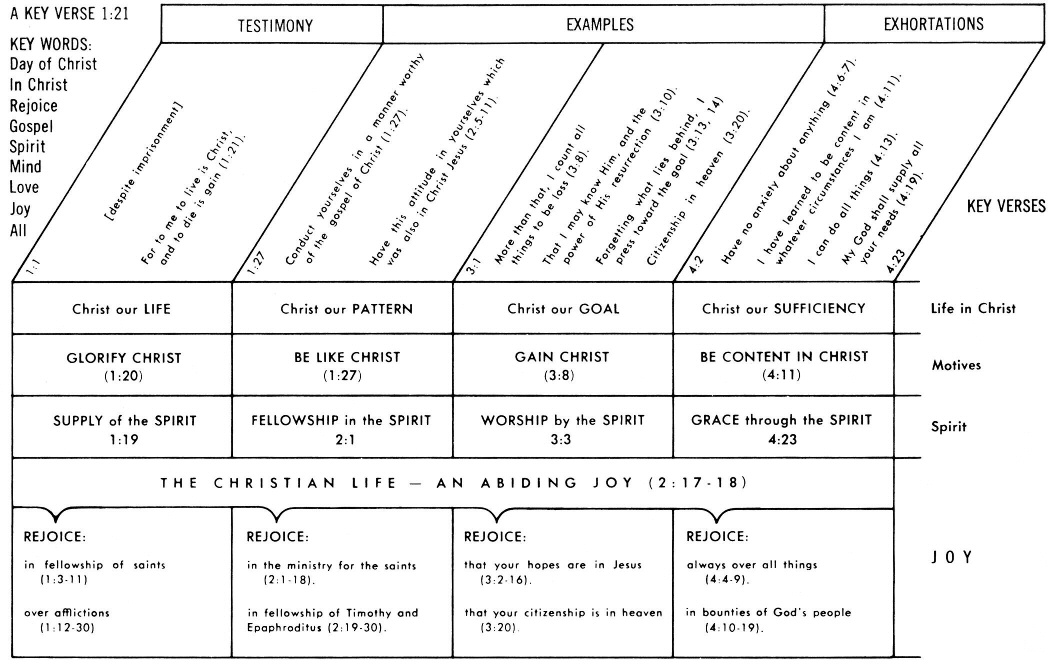
LIFE IN CHRIST
Click chart to enlarge
Charts from Jensen's Survey of the NT - used by permission
Philippians - Charles Swindoll = Chart on right side of page
| Account of Paul's Circumstances Php 1:1-30 |
Have the Mind of Christ Php 2:1-30 |
Have the Knowledge of Christ Php 3:1-21 |
Have |
| Partakers of Christ | People of Christ | Pursuit of Christ | Power of Christ |
| Suffering | Submission | Salvation | Sanctification |
| Experience | Examples | Exhortation | |
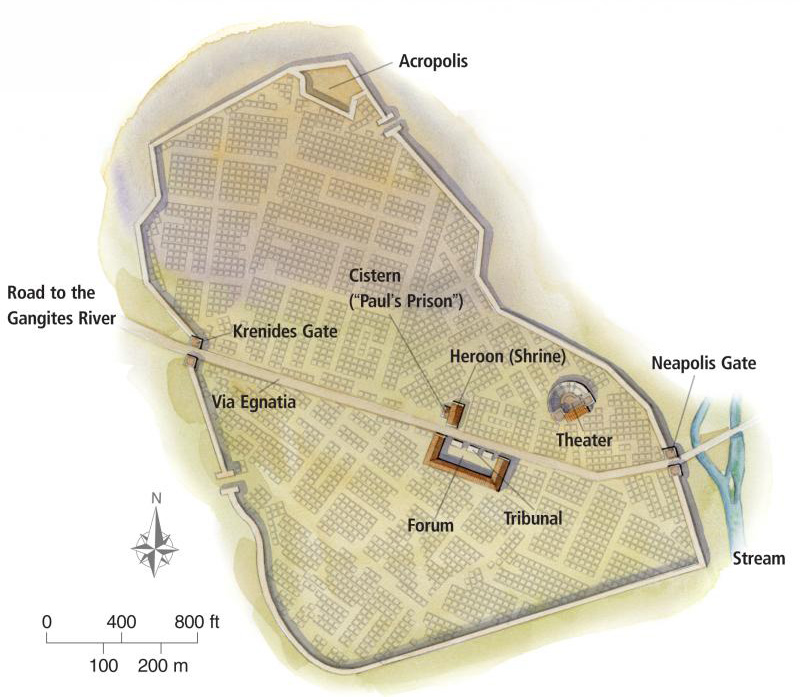
Philippi in the Time of Paul
The city plan above shows those features of the city of Philippi that archaeologists have so far identified as dating from the time of Paul. “Paul’s Prison” is not believed to be an authentic site, but was a cistern later associated with Christian worship. (ESV.org)
Philippians 1:1 Paul and Timothy, bond-servants of Christ Jesus, to all the saints in Christ Jesus who are in Philippi, including the overseers and deacons: (NASB: Lockman)
Greek: Paulos kai Timotheos douloi Christou Iesou pasin tois hagiois en Christo Iesou tois ousin (PAPMPD) en Philippois sun episkopois kai diakonois;
Amplified: PAUL AND Timothy, bond servants of Christ Jesus (the Messiah), to all the saints (God’s consecrated people) in Christ Jesus who are at Philippi, with the bishops (overseers) and deacons (assistants): (Amplified Bible - Lockman)
KJV: Paul and Timotheus, the servants of Jesus Christ, to all the saints in Christ Jesus which are at Philippi, with the bishops and deacons:
NLT: This letter is from Paul and Timothy, slaves of Christ Jesus. It is written to all of God's people in Philippi, who believe in Christ Jesus, and to the elders and deacons (NLT - Tyndale House)
Phillips: Paul and Timothy, true servants of Jesus Christ, to the bishops, deacons and all true Christians at Philippi (Phillips: Touchstone)
Wuest: Paul and Timothy, bondslaves by nature, the property of Christ Jesus, to all the consecrated and separated ones in Christ Jesus who are in Philippi, together with overseers and deacons. (Eerdmans Publishing - used by permission)
Young's Literal: Paul and Timotheus, servants of Jesus Christ, to all the saints in Christ Jesus who are in Philippi, with overseers and ministrants;
PAUL: Paulos:
- Acts 13:9;22:7;26:1,14
- Philippians Introduction - Author, Background, Interpretative Challenges, Outline - John MacArthur
- Ray C. Stedman: Overview of the Book
- Analysis of Philippians - James Van Dine
- Philippians 1 Resources - Multiple Sermons and Commentaries
Paul (3972) is from Latin, Paulos meaning "little, small". Before his Damascus Road experience he was known by his Hebrew name Saul (Greek Saulos) which means "desired" or "ask" (derived from Hebrew word for "ask").
Guy King introduces this letter with these comments…
THE opening of this Epistle is different from that of most in one very interesting particular. It is a difference shared by all three of the Macedonian Epistles - this, and the two to the Thessalonians - and by the little personal note to Philemon. It consists in the somewhat noteworthy absence of the word apostle. In all his other letters, Paul feels it incumbent upon him to remind his readers that he writes with all the weight that his sublime position gives him; he will have occasion to administer rebuke, and, sometimes, rather bluntly, to give directions - and lest, because he was their friend, they might treat his words not too seriously, he takes care to let them understand that he speaks with an authority, and that they must give due and proper heed to what he says.
But his case is otherwise when he writes to his beloved Philippians.
The church at Philippi", says Dr. Graham Scroggie, "was almost quite free from those errors which beset so many of the churches of that day"; and he goes on to quote Professor Findlay as saying, "This is an epistle of the heart, a true love letter, full of friendship, gratitude, and confidence.
There is, we feel, no need to obtrude his apostleship here; and so his opening greetings are not inappropriately described as a "salut d'amour" - his letter will be found to be full of, and his heart to be full of, Love. (King, Guy: Joy Way: An Exposition of the Epistle of Paul to the Philippians, 1952, Christian Literature Crusade)
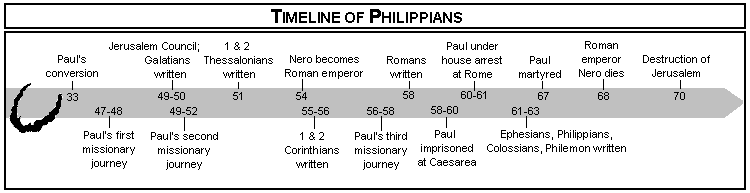
Background: Read Acts 16:1ff, for the birth of the church at Philippi (After you read the chapter yourself see Bob Deffinbaugh's article The Birth of the Church at Philippi - Acts 15:36–16:40), keeping in mind that these events occurred during Paul's Second Missionary Journey after he and Barnabas had gone separate ways. In this fascinating and strategic chapter you will read of Paul's selection of young Timothy to travel with him to Philippi. You will read about the first "European" convert named Lydia, a Gentile Asian from Thyatira in Asia Minor (modern day Turkey) and a proselyte to Judaism. You will read about the Greek soothsayer, out of whom Paul cast a demon and who might have been a convert (although the text does not allow one to be dogmatic). And finally you will read about the first Roman convert in Europe, a jailer who would have had little class and social standing. This was the birth of the church at Philippi, a church that you will see as your read this letter was very special to Paul. Although specific dates are not given, it appears that the church at Philippi had its birth about 51AD. This epistle we know today as "Philippians" was written some 10 years later (about 61AD) by Paul during his first imprisonment in Rome. Keep these thoughts in mind as you read this letter in which he mentions several saints by name, indicating that despite the passage of the years, these saints have remained near and dear to the apostle's heart. What an example for leaders to emulate today!
Related Resources:
- Who was Paul in the Bible? | GotQuestions.org
- Introduction, Background, and Outline to Philippians Robert Herrick
- Philippians: Introduction, Argument, and Outline Daniel Wallace
AND TIMOTHY: kai Timotheos:
- Philippians 1 Resources - Multiple Sermons and Commentaries
Timothy (5095) (Timotheos from Time = worth or merit of some object + theos =God) means literally "honoring God". The Greek word for "honor" has in it the ideas of reverence and veneration. Timothy was son of Eunice, a friend, traveling companion, and co-worker of Paul as well as his disciple (cf "you followed my teaching" - 2 Ti 3:10) See Whyte's article Timothy as a Young Minister and What can we learn from the life of Timothy?
Timotheos - 24x in 24v
Acts 16:1; Acts 17:14; Acts 17:15; Acts 18:5; Acts 19:22; Acts 20:4; Rom. 16:21; 1 Co. 4:17; 1 Co. 16:10; 2 Co. 1:1; 2 Co. 1:19; Phil. 1:1; Phil. 2:19; Col. 1:1; 1 Thess. 1:1; 1 Thess. 3:2; 1 Thess. 3:6; 2 Thess. 1:1; 1 Tim. 1:2; 1 Tim. 1:18; 1 Tim. 6:20; 2 Tim. 1:2; Phlm. 1:1; Heb. 13:23
Related Resources:
- American Tract Society Timothy
- Bridgeway Bible Dictionary Timothy
- Easton's Bible Dictionary Timothy
- Fausset Bible Dictionary Timothy
- Holman Bible Dictionary Timothy
- Hastings' Dictionary of the Bible Timothy
- Hastings' Dictionary of the NT Timothy
- International Standard Bible Encyclopedia Timothy
- Kitto Biblical Cyclopedia Timothy
Bruce comments that "Paul is the sole author of the letter, even if Timothy's name is conjoined with his in the prescript. (Quoted from Apple's Philippians Commentary)
Turner adds that "Timothy, who was not an apostle and did not have Paul's authority, was considered by Paul to be his equal when it came to servanthood. (Quoted from Apple's Philippians Commentary)
Lightfoot notes "The relationship between Timothy and the Philippian church had been constant and intimate.
Paul associates Timothy with himself in the greeting, because he is a co-laborer not because he is a co-author of the epistle, for from Phil 1:3 onward he writes in the first person singular and in Phil 2:19-23 he speaks of Timothy in the third person. Timothy had accompanied him when the church at Philippi was founded (Acts 16:1–12), had revisited it at his request (Acts 19:22), and had again accompanied him on the occasion of a later visit (Acts 20:4). So the Philippians were very familiar with him.
Matthew Henry offers an interesting thought that "Though Paul was alone divinely inspired, he joins Timothy with himself, to express his own humility, and put honour upon Timothy. Those who are aged, and strong, and eminent, should pay respect to, and support the reputation of, those who are younger, and weaker, and of less note.
BOND-SERVANTS: douloi:
- Mk 13:34, Jn 12:26; 13:14, 15, 16; 15:15, 20, 2Cor 4:5; Gal 1:10; Php 1:1; Titus 1:1; James 1:1; 2Peter 1:1; Jude 1:1; Rev 1:1; 22:6,9
- Philippians 1 Resources - Multiple Sermons and Commentaries
DOULOS OF
JESUS
Jack Arnold comments on Paul as a bondservant - It is interesting to note that Paul referred to himself as a servant and not as an apostle as he does in most of his letters. In Philippi, his apostolic authority was not being challenged so he did not pull rank. Actually he subordinates his position as an apostle to that of a servant. He does not say, “St. Paul to the servants” but “Servant Paul to the saints.” Paul led from a position of servanthood. He understood his role not as a power hungry dictator but as a humble servant-leader who never sought to abuse his authority. (Philippians 1:1-8 Participants or Spectators?)
Bondservant (1401) (doulos from deo = to bind) (Click additional notes on doulos) was an individual bound to another in servitude and conveys the idea of the slave's close, binding ties with his master, belonging to him, obligated to and desiring to do his will and in a permanent relation of servitude. In sum, the will of the doulos is consumed in the will of the master.
A bondservant is one who surrendered wholly to another’s will and thus devoted to another to the disregard of his own interest. Paul and Timothy were not their own but had been bought with the price of the blood of Christ. They were now the property of our Lord Jesus Christ and were His slaves exclusively. No man can serve two masters (Mt 6:24). Paul and Timothy had been slaves of Sin (see note on "the Sin") by their birth into Adam's likeness, but now they are slaves of Christ by their new, second birth. They had no will of their own, no business of their own, no time of their own and were acting for their Master, Christ; dependent upon Him and obedient to Him.
Doulos is used 124 times (in 117 verses) in the NT - See all uses below. There are some 294 uses of doulos in the Septuagint (LXX) - See all uses below.
In the Greek culture doulos usually referred to the involuntary, permanent service of a slave, but the use in the epistles of Paul and Peter elevates the meaning of doulos to the Hebrew sense which describes a servant who willingly commits himself to serve a master he loves and respects (cp Ex 21:5, 6 Dt 15:12-16 discussed below). By Roman times, slavery was so extensive that in the early Christian period one out of every two people was a slave! From at least 3000 BC captives in war were the primary source of slaves.
Doulos speaks of submission to one's master The doulos had no life of his own, no will of his own, no purpose of his own and no plan of his own. All was subject to his master. The bondservant's every thought, breath, and effort was subject to the will of his master. In sum, the picture of a bondservant is one who is absolutely surrendered and totally devoted to his master. What a picture of Paul and Timothy's relation to their Lord! What an example for all believers of every age to emulate!
This word provides an incredible word picture of those who bound to their Lord Jesus Christ, Who had bought them with a price to be His own possession (cf 1Cor 6:20, Acts 20:28, Gal 3:13, Heb 9:12, 1Pe 1:18, Re 5:9, Titus 2:14, 1Pe 2:9).
By using doulos Paul is saying "I am a slave to the Lord Jesus Christ. I am absolutely sold out to His will. I am willing to do whatever He tells me to do. I am willing to say whatever He tells me to say. I am willing to go wherever He leads me. I am a man who has made a choice. I am going to serve Him for all eternity."
Matthew Henry adds that "The highest honor of the greatest apostle, and most eminent ministers, is to be the servants of Jesus Christ; not the masters of the churches, but the servants of Christ."
Kenneth Wuest explains that a doulos as
"the most abject, servile term used by the Greeks to denote a slave. The word designated one who was born as a slave, one who was bound to his master in chords so strong that only death could break them, one who served his master to the disregard of his own interests, one whose will was swallowed up in the will of his master. Paul was born a slave of sin at his physical birth, and a bondslave of his Lord through regeneration. (Note: There was another word, andrapodon which was person taken prisoner in war and sold into slavery) The chords that bound him to his old master Satan, were rent asunder in his identification with Christ in the latter’s death (Ro 6). The chords that bind him to his new Master will never be broken since the new Master will never die again, and is Paul’s new life (Php 1:21,Col 3:3,4). He has changed masters because he has a new nature (2Cor 5:17, 2Pe 1:3,4), the divine, and the evil nature which compelled him to serve the Devil has had its power over him broken (Col 1:13, Heb 2:14, 15). Paul’s will, at one time swallowed up in the will of Satan, now is swallowed up in the sweet will of God.
The reader will observe how wonderfully God has watched over the development of the Greek language so that at the time it was needed as the medium through which He would give His New Testament revelation to the human race, its words were fit receptacles and efficient instruments for the conveyance of His message to man. Paul calls himself a bondslave of Christ Jesus… The apostle is proud of the fact that he is a slave belonging to his Lord. There were certain individuals in the Roman empire designated “Slaves of the Emperor.” This was a position of honor. One finds a reflection of this in Paul’s act of designating himself as a slave of the King of kings. He puts this ahead of his apostleship." (Wuest Word Studies - Eerdman Publishing Company Volume 1, Volume 2, Volume 3 - used by permission) (Bolding added)
The function of a doulos is to serve His Master. The great violinist, Niccolo Paganini willed his marvelous violin to city of Genoa on condition that it must never be played. The wood of such an instrument, while used and handled, wears only slightly, but set aside, it begins to decay. Paganini’s lovely violin has today become worm-eaten and useless except as a relic. A Christian’s unwillingness to serve His Master may also destroy his capacity for usefulness.
Bondservant - A Summary - The doulos…
- Was owned by and totally possessed by his master.
- Existed for his master and no other reason.
- Had no personal rights.
- Was at the master’s disposal "24/7".
- Had no will of his own but was completely subservient to the master
Paradoxically a bondservant of the Most High God is one of the most privileged, noblest professions in the world. Little wonder that notable men of God in the have always been called the servants of God. The list of names includes:
- Moses (Dt 34:5 Ps 105:26 Mal 4:4)
- Joshua (Josh 24:29)
- David (2Sa 3:18 Ps 78:70)
- Paul (Ro 1:1; Phil 1:1; Titus 1:1)
- Peter (2Pe 1:1)
- James (James 1:1)
- Jude (Jude 1:1 )
- Prophets (Amos 3:7; Jer 7:25).
- Ideally believers (Acts 2:18; 1Co 7:22; Ep 6:6; Col 4:12; 2Ti 2:24).
Guy King comments on the phrase bondservants of Christ Jesus writing…
Let it be said at once that the word here is the same as bond-slaves - a conception which would be vividly familiar to every reader of this Letter. Quite a number of them were, or had been, slaves themselves - and the word would catch their attention at once. I say "had been" of some, because the law of manumission (process of releasing from slavery) would have operated in their case - a price would have been paid, and the slave set free.
In his fascinating Light from the Ancient East, Dr. Deissmann, pp. 319 ff., has some most interesting paragraphs on this releasing of slaves (see note that follows); and, with his quick and ready mind, the late Archbishop Harrington Lees, in his CHRIST and His Slaves, made use of the learned Doctor's discoveries to point many a moral concerning spiritual servitude and release.
Paul's writings abound in allusions to this last phenomenon. The material and the spiritual are found together in such a passage as 1Corinthians 7:22,
He that is called in the LORD, being a servant, is the Lord's freedman: likewise also he that is called, being free, is Christ's servant.
When a man becomes a Christian, though materially bound as a slave, he is spiritually freed from bondage to Satan and sin; on the other hand, such a man, though materially set at liberty, is, in the spiritual sense, bound hand and foot to CHRIST.
How Paul himself rejoiced - and even gloried - in this New Slavery. In his letters he so constantly uses the word as indicating his relationship to JESUS CHRIST. He would so readily enter into the attitude of the well-satisfied slave of Exodus 21:5, "I love my Master … I will not go out free."
From the bondage of sin, the believer has, by the manumission price of "the precious Blood", (1Pe 1:18, 19-notes), been set free-only to find himself thereby committed to a bondage more binding than ever. Yet, this time the "service is perfect freedom", the bonds are honourable and sweet.
And, for our encouragement, let us remember that
(i) The Master is responsible for His slaves' needs - feeding, housing, clothing, and all else is the slave owner's concern. It is because we are GOD'S servants (slaves) that our Lord says "Therefore … take no thought … ", (Mt 6:24; Mt 6:25), for the ordinary needs of life. Our apostle will say later in this very Epistle, "My GOD shall supply all your need." (see note Philippians 4:19)
Also
(ii) The Master is responsible for His slaves' duties - they will not choose their own task, or their own sphere. Whether ours is to be the more menial, or the more genial, work is in His plan, not ours. It is the Christian's wisdom to stand before Him as those in 2Samuel 15:15, "Thy servants are ready to do whatsoever my Lord the King shall appoint", or as Gabriel in Luke 1:19, "I … stand… and am sent … ".
Then, too
(iii) The Master is responsible for His slaves' supplies - "Who goeth a warfare any time at his own charges?" asks 1Corinthians 9:7: the soldier has all his military equipment provided; and likewise, the slave is supplied with everything needful for the adequate discharge of all his duties. Whatever He tells us to do, we can do - "If … God command thee … thou shalt be able to … " Exodus 18:23 - because all supplies are at our disposal. And as Paul records, in 2 Corinthians 12:9, "My grace is sufficient for thee". (Ibid)
Regarding the setting free of slaves in Paul's day, Deissmann records the following custom which has clear parallels with Paul's teaching on saints as bondslaves of Christ…
Among the various ways in which the manumission of a slave could take place by ancient law we find the solemn rite of fictitious purchase of the slave by some divinity. The owner comes with the slave to the temple, sells him there to the god, and receives the purchase money from the temple treasury, the slave having previously paid it in there out of his savings. The slave is now the property of the god; not, however, a slave of the temple, but a protégé of the god. Against all the world, especially his former master, he is a completely free man; at the utmost a few pious obligations to his old master are imposed upon him. The rite takes place before witnesses; a record is taken, and often perpetuated on stone. (Deissmann, A., & Strachan, L. R. M. Light from the Ancient East the New Testament illustrated by recently discovered texts of the Graeco-Roman world. Pager 326. London: Hodder & Stoughton. 1910).
Dr Wayne Barber has an excellent practical explanation of the significance of a bondservant asking the practical question…
"Why do you serve the Lord Jesus Christ? "Well, I had better. God will kill me if I don’t." You know, I’ve talked to a lot of people who have that mentality. It is as if God has a big club and if you don’t do what He wants you to do, then He will hit you over the head with it. Yet God says, "Wait a minute. I have set you free. You are free now to be what you ought to be. Make up your mind. No man can serve two masters." The person who has any sense at all will say, "Lord, You have overwhelmed me. I am making a choice out of love for You to be Your slave. I know I am no longer Your slave, but I choose to be Your slave." Do you want to be used by the Lord? Come to the place in your life that you are willing to say, "God, it doesn’t matter what You tell me to do, I am willing to be submissive to Your will." When you come to that place, God will do things through you like He did through Paul. One picture of that is beautiful, and it is found in Deut 15:12, 13, 14, 15, 16, 17:
If your kinsman, a Hebrew man or woman, is sold to you, then he shall serve you six years, but in the seventh year you shall set him free. And when you set him free, you shall not send him away empty-handed. You shall furnish him liberally from your flock and from your threshing floor and from your wine vat; you shall give to him as the Lord your God has blessed you. And you shall remember that you were a slave in the land of Egypt, and the Lord your God redeemed you; therefore I command you this today. And it shall come about if he says to you, ‘I will not go out from you,’ because he loves you and your household, since he fares well with you; then you shall take an awl and pierce it through his ear into the door, and he shall be your servant forever. And also you shall do likewise to your maidservant. (Cp Ex 21:2, 3, 4, 5,6) (Related resources - see Spurgeon's sermon - Ears Bored to the Door Post; see Devotional by F B Meyer)
What a gorgeous picture. Slavery in that day and time was nothing like we know today. The slaves had to be treated as if they were your own children in your own family. You had to treat them with dignity and integrity. After they had served you for a period of time, you had to set them free. But the beautiful picture here is of a slave. He served a master for seven years. The master has loved him, provided for him, been kind to him, helped him, all the things that you would look for. Now the day comes that he has been set free. He is given of the flock, given of the threshing floor, given of the wine vat. This servant stands there, and he says, "You know, I have been so cared for during the seven years that I have worked with you, where would I go? I don’t know where I am going to go. Nobody would love me like you have loved me. Nobody would do for me what you have done for me. Why, I am going to choose to be your slave. I know you have set me free, but because of who you are and because of my love for you, I want to continue to be your slave. I want to do for you not because I have to but because I just want to." What a gorgeous picture. They had a public ceremony and they would take that little instrument and put it up by their ear and drive it through the ear into the door, leaving a hole in the ear. What a gorgeous picture when you see this slave walking alongside his master, smiling. You would see that man and you knew he had been with him seven years, maybe it is three years down the road past that seven years and you say, "Isn’t that wonderful! That man was set free and now that man has chosen to serve out of love for his master." Man looks on the outside. God looks at our heart. Why are you serving the Lord Jesus? If you don’t love Him, if you haven’t understood that nobody else will ever treat you like Jesus, then no wonder you are not being used of the Lord in the task He has assigned to His church. A man that God can use is a person who is willing to bow, a person who is willing to say, "God, I just want what You want in my life." … God is waiting on us to love Him and to bow before Him and to make conscious choices. "God, you have given me everything. If I left you, where would I go? Lord, I want to serve you. No man can serve two masters. I want to serve You. I want to be usable in the kingdom of God." That is the Apostle Paul. He was a man who was willing, sold out to the will of God." (Click for additional notes by Dr. Barber on "bondservant)
Harry Ironside wrote that Paul "does not mean however that his was a service of bondage. Rather he served in the whole-hearted obedience of one who realized that he had been "bought with a price," even the precious blood of Christ. There is a story told of an African slave whose master was about to slay him with a spear when a chivalrous British traveler thrust out his arm to ward off the blow, and it was pierced by the cruel weapon. As the blood spurted out he demanded the person of the slave, saying he had bought him by his suffering. To this the former master ruefully agreed. As the latter walked away, the slave threw himself at the feet of his deliverer exclaiming, "The blood-bought is now the slave of the son of pity. He will serve him faithfully." And he insisted on accompanying his generous deliverer, and took delight in waiting upon him in every possible way. Thus had Paul, thus has each redeemed one, become the bondman of Jesus Christ. We have been set free to serve, and may well exclaim with the Psalmist (Ps 116:16).
A businessman once asked his Bible study group, “How can you tell if you have a servant attitude?”
The reply came back “By the way you react when you are treated like one.”
It’s not easy to find an attitude like that. But for a disciple, servant-hood is one of the keys to growing in Christ-likeness.
Describing His own ministry, Jesus said: “For the Son of man also came not to be served but to serve, and to give his life as a ransom for many” (Mark 10:45)
When we give Jesus Christ His rightful place as Lord of our lives, His Lordship will be expressed in the way we serve others. Therefore, one of the best ways we can demonstrate our love for God is by showing love for our fellow man. We demonstrate love for others by helping them, by sharing their problems, and by doing what we can for them. Why should we serve? For Jesus’ sake.
Steven Cole has some pithy remarks on Bondservants or Slaves...
James Boice points out (BORROW Philippians, An Expositional Commentary, p. 21) that in antiquity there were three ways a person could become a slave: by conquest; by birth; or, because of debt. He goes on to observe that we all are slaves of sin by the same three causes. Sin has conquered us, so that we are not free to do what we know is right. We are sinners by birth, being born with a nature that is hostile toward God and oriented toward pleasing self. We are sinners by debt, having run up an unpayable debt toward God who states that the wages of our sin is death.
But--and this is crucial--many people are not even aware of their condition as slaves to sin. Having been born in sin, living all their lives to gratify the selfish desires of their corrupt nature, and being unaware of the huge, unpayable debt they have run up before the holy God, they’re like the Jews who argued with Jesus that they had never been enslaved to anyone (John 8:33). But Jesus replied, “Everyone who commits sin is the slave of sin.... If therefore the Son shall make you free, you shall be free indeed” (John 8:34, 36). Only Jesus Christ, by His substitutionary death, can set us free from bondage to sin. But He only does it when we recognize our need and call out to Him for deliverance. Then, having been freed from sin through faith in Christ, we become enslaved to God and begin to grow in holiness (Rom. 6:22).
You may not like the idea of being enslaved to anyone. But the fact is, you are enslaved to someone or something. As Bob Dylan sang, “You gotta serve somebody.” (PLAY THIS CATCHY, CONVICTING TUNE!) Either you are enslaved to sin or you’re enslaved to Jesus Christ (Ro. 6:16). But, while sin is a terrible master, because it destroys and leads to death, Jesus is a kind, gracious, and loving Master. Serving Him leads to eternal life.
So the question you need to ask yourself is, “Whom am I serving?” Slaves’ lives were consumed with serving their masters. A slave didn’t clock in at 8 in the morning, put in his eight hours, and clock out for the night. He was the property of his master. He didn’t have a life of his own. He was on call 24 hours a day, 7 days a week, always ready to do what his master commanded, even if it was unpleasant or inconvenient. In Paul’s case, his Master’s will when he wrote Philippians was that he be in chains in prison in Rome. He could have chafed under that, complaining, “Is this any way to treat a faithful apostle?” But instead, Paul was content because he was in total submission as the slave of Christ Jesus.
The starting place for experiencing God’s joy
is to yield yourself daily as a slave to Jesus as your Master...Many people call themselves Christians, but the truth is, they live every day for themselves. They do not yield themselves each morning and say, “Master, I’m your slave. I’ll do your bidding at work, at home, or at play.” The starting place for experiencing God’s joy is to yield yourself daily as a slave to Jesus as your Master; and to view yourself as being on duty for Him, listening for His voice, quick to obey His commands. (Philippians 1:1-2 The Foundation for Joy)
ILLUSTRATION OF BONDSERVANT - Mabel Williamson was a missionary to China who powerfully described the sacrifice of her rights to a normal standard of living, ordinary safeguards of health, private affairs, marriage, and even a home life. She was human like you and I and thus just like us she struggled with suffering and self-denial and the fact that she had to give up so many of what she thought were her “rights”. But she finally came to the conclusion that part of serving and becoming like her Master Christ was becoming like one who had not rights, as epitomized by the picture of a bond-servant. In her book Have We No Right? (BORROW) she wrote the following poem He Had No Rights...
He had no rights
No right to a soft bed, and a well-laid table.
No right to a home of His own, a place where His own pleasure might be sought.
No right to choose pleasant, congenial companions, those who could understand Him and sympathize with Him.
No right to shrink away from filth and sin, to pull His garments closer around Him and turn aside to walk in cleaner paths.
No right to be understood and appreciated; no, not by those upon whom He had poured out a double portion of His love.
No right even never to be forsaken by His Father, the One who meant more than all to Him.
His only right was silently to endure shame, spitting, blows; to take His place as a sinner at the dock; to bear my sins in anguish on the cross.
He had no rights. And I?
A right to the “comforts” of life? No, but a right to the love of God for my pillow.
A right to physical safety? No, but a right to the security of being in His will.
A right to love and sympathy from those around me? No, but a right to the friendship of the One who understands me better than I do myself.
A right to be a leader among men? No, but the right to be led by the One to whom I have given my all, led as is a little child, with its hand in the hand of its father.
A right to a home, and dear ones? No, not necessarily, but a right to dwell in the heart of God.
A right to myself? No, but oh, I have a right to Christ.
All that He takes I will give. All that He gives I will take.
He, my only right! He, the one right before which all other rights fade into nothingness.
I have full right to Him.
Oh, may He have full right to me!
QUESTION - What is a bondservant / bond-servant?
ANSWER - A bondservant is a slave. In some Bibles the word bondservant is the translation of the Greek word doulos, which means “one who is subservient to, and entirely at the disposal of, his master; a slave.” Other translations use the word slave or servant.
In Roman times, the term bondservant or slave could refer to someone who voluntarily served others. But it usually referred to one who was held in a permanent position of servitude. Under Roman law, a bondservant was considered the owner’s personal property. Slaves essentially had no rights and could even be killed with impunity by their owners.
The Hebrew word for “bondservant,” ‘ebed, had a similar connotation. However, the Mosaic Law allowed an indentured servant to become a bondservant voluntarily: “If the servant declares, ‘I love my master and my wife and children and do not want to go free,’ then his master must take him before the judges. He shall take him to the door or the doorpost and pierce his ear with an awl. Then he will be his servant for life” (Exodus 21:5-6).
Many prominent men of the Old Testament were referred to as servants. God spoke of Abraham as His servant (Genesis 26:24; Numbers 12:7). Joshua is called the servant of the Lord (Joshua 24:29), as are David (2 Samuel 7:5) and Isaiah (Isaiah 20:3). Even the Messiah is called God’s Servant (Isaiah 53:11). In all of these instances, the term servant carries the idea of humble nobility. Being God’s servant is an honorable position.
During the time of Jesus and the first-century church, as much as one third of the Roman population were slaves, and another third had been slaves earlier in life. It was common for freeborn men and women to work side-by-side with slaves as street sweepers, dockworkers, doctors, teachers, and business managers. Convicted criminals became bondservants of the state and usually died working in the mines or on galleys.
Historical records reveal that it was not unusual for Jews to own slaves during the New Testament period. Because slavery was a familiar part of the culture, Jesus sometimes referred to slaves and owners in His parables (e.g., Matthew 25:14-30 and Luke 12:41-48). Also, Jesus taught that the greatest in God’s kingdom would have to become “the servant of all” (Mark 9:35). Such a concept was unthinkable to a Roman citizen, who prided himself in his freedom and would never identify himself as a bondservant. But Jesus’ kingdom is not of this world (John 18:36), and the selfish values of earth are of no consequence in heaven.
Throughout the New Testament, the word bondservant, slave, or servant is applied metaphorically to someone absolutely devoted to Jesus. Paul, Timothy, James, Peter, and Jude all describe themselves as “bondservants of Christ” (Romans 1:1; Philippians 1:1; James 1:1; 2 Peter 1:1; Jude 1:1, NKJV).
Believers today should still consider themselves bondservants or slaves of Christ (1 Corinthians 7:22; Ephesians 6:6; 2 Timothy 2:24). He is our Lord, and our allegiance is due to Him alone. As bondservants, we renounce other masters (Matthew 6:24) and give ourselves totally to Him (Matthew 16:24).
Being a bondservant of Christ is not drudgery. His “burden is light” (Matthew 11:30). Also, we have this promise: “Now that you have been set free from sin and have become slaves to God, the benefit you reap leads to holiness, and the result is eternal life” (Romans 6:22).GotQuestions.org
QUESTION - What does it mean to be a servant of Christ?
ANSWER - In many places in the New Testament, the apostle Paul refers to himself as “a servant of Jesus Christ” (e.g., Romans 1:1; Colossians 4:12; Philippians 1:1; 1 Timothy 4:6). The Lord’s half-brother Jude refers to himself in the same way (Jude 1:1). Rather than capitalize on his close relationship to Jesus, Jude relegated himself to the status of a servant. Jesus’ family, friends, and chosen apostles refer to themselves as His servants, the plain implication being that Jesus is Lord.
“Servant” is a translation of the Greek word doulos, which means more literally “a slave or bondservant, someone who sets aside all rights of his own to serve another.” Because the word slave carries such a negative connotation to our modern sensitivities, we often choose the word servant instead. However, servant does not quite capture the real meaning of doulos. Paul said he was a “slave” to Christ.
In ancient times, slaves were purchased or born into a slave family and served the master until they died or until the master decided to free them. Some slaves had developed such a close and loving relationship with the master’s family that they wanted to continue serving, even when they could go free. That’s the idea Paul and others were conveying when they referred to themselves as servants of Christ. The Lord has bought us with a high price (1 Corinthians 6:20), and those who come to know Him desire to abandon all rights to Him and choose to serve Him faithfully.
A servant of Christ knows who is the King. A servant of Christ is one who has voluntarily set aside his or her personal rights in order to love, serve, and obey the will of God in Christ Jesus. Servants of Christ die daily to sin and fleshly desires, allowing Christ’s life to flow through them (Galatians 2:20).
To be a servant of Christ is to seek His will in all things. Our primary desire every day, as servants of Christ, is to honor and glorify the One who bought our freedom from sin (1 Corinthians 10:31). This means we must die to ourselves (Luke 9:23), renounce our right to direct our own lives (Luke 6:46), and seek ways to bring our Master pleasure (Psalm 37:23; Proverbs 11:20). Just as a master in ancient times took on the responsibility of caring for his bondservants, so our Lord says that He will provide all we need when we seek first His kingdom and His righteousness (Matthew 6:33; Philippians 4:19).
Our Master, Jesus, has given us instructions in His Word and expects those who profess His name to know them. As we learn more, we do better. Servants of Christ put into practice all they learn about pleasing their Lord. While He has specific jobs for each of us according to the gifts and opportunities He provides, some requirements are universal for anyone called to be a servant of Christ:
• Continue in faith.
• Destroy arguments and every lofty opinion raised against the knowledge of God.
• Take every thought captive to obey Christ (2 Corinthians 10:5).
• Pursue holy living (1 Peter 1:14–16).
• Daily crucify the lusts of the flesh (Romans 6:1–6).
• Love brothers and sisters in the faith (1 John 3:14–15).
• Store up treasure in heaven (Matthew 6:19–20).
• Eagerly await the Master’s return (Revelation 22:20; 2 Timothy 4:8).
Servants of Christ do their work humbly and selflessly, desiring only to please their benevolent Master. There’s no pretension, no self-importance, no compensation-seeking in true servanthood. Jesus reminds us of the lowly place a servant occupies: “You also, when you have done all that you were commanded, say, ‘We are unworthy servants; we have only done what was our duty’” (Luke 17:10, ESV).
Servants of Christ consider their lives on earth as a brief time of preparation for eternity. The hardships and struggles we must face while in the flesh will be far outmatched by the glory and reward awaiting us (2 Corinthians 4:17). Just as a servant who loves his master lives for the master’s approval, so servants of Christ live for the moment He will say, “Well done, good and faithful servant. Enter into the joy of your Master!” (Matthew 25:21, 23) GotQuestions.org
Related Resources:
OF CHRIST JESUS: douloi Christou Iesou:
- Philippians 1 Resources - Multiple Sermons and Commentaries
Christ (5547)(Christos) is a transliteration of the Greek word Christos (from chrio = to anoint, rub with oil, consecrate to an office) which is equivalent to the Hebrew word which is translated " Messiah - Anointed One.
In the Gospels the Christ is not a personal name but an official designation for the expected Messiah (see Matthew 2:4, Luke 3:15). As by faith the human Jesus was recognized and accepted as the personal Messiah, the definite article ("the") was dropped and the designation "Christ" came to be used as a personal name. The name "Christ" speaks of His Messianic dignity and emphasizes that He is the fulfillment of the Old Testament promises concerning the coming Messiah.
As discussed below the name "Jesus," comes from the Greek lesous, the Greek form of the Hebrew name "Joshua," which means "Jehovah saves." It was the name given Him by the angel before He was born (Luke 1:31 ; Matthew 1:21). His human name speaks of the fact of His Incarnation, His taking upon Himself human form to become our Savior.
The order "Jesus Christ" places the emphasis on the historical appearing of the man Jesus Who by faith was recognized and acknowledged as the Messiah. It proclaims the fact that "Jesus is the Christ." It speaks of Him Who came in human form, became obedient unto death,, and was afterward exalted and glorified. This order is, always followed in the epistles of Peter, John, James, and Jude.
The combination of Christós Iesoús emphasizes His deity and His humanity, fully God and fully man! "Christ Jesus" points to the theological fact that the One who was with the Father in eternal glory became incarnate in human form.
Vine adds the following interesting thoughts on the order of "Christ" before or after "Jesus" writing that
Christ Jesus" describes the Exalted One who emptied Himself (Php 2:5), and testifies to His preexistence; "Jesus Christ" describes the despised and rejected One who was afterwards glorified (Php 2:11), and testifies to His resurrection. "Christ Jesus" suggests His grace, "Jesus Christ" suggests His glory.
Wuest - We have therefore in these two names, the Messianic office of our Lord, His deity, and His substitutionary atonement.(Wuest Word Studies - Eerdman Publishing Company Volume 1, Volume 2, Volume 3 - used by permission)
Daniel 9:25 refers to Jesus as "Messiah the Prince" (see Daniel's Seventieth Week) where the Hebrew word for Messiah is Mashiyach (4899) a word which in the OT implied an anointing from God for a special function.
Jesus is derived from Joshua or Jehoshua [yehoshua'] meaning “Yahweh is salvation" or "Jehovah His help" or "Jehovah saves". It is interesting to read the comment by Jesus' contemporary, Josephus, the Jewish historian, explaining Who Jesus was. Josephus writes
"(63) Now, there was about this time Jesus, a wise man, if it be lawful to call him a man, for he was a doer of wonderful works—a teacher of such men as receive the truth with pleasure. He drew over to him both many of the Jews, and many of the Gentiles. He was [the] Christ; (64) and when Pilate, at the suggestion of the principal men amongst us, had condemned him to the cross, those that loved him at the first did not forsake him, for he appeared to them alive again the third day, as the divine prophets had foretold these and ten thousand other wonderful things concerning him; and the tribe of Christians, so named from him, are not extinct at this day." {Note that Josephus acknowledges both Jesus as Man & Messiah as well as substantiating the facts about His crucifixion & resurrection (so in essence Josephus is acknowledging "the gospel") (Antiquities of the Jews, Book 18, chapter 3, paragraph 3)
TO ALL THE SAINTS IN CHRIST JESUS: pasin tois hagiois en Christo Iesou:
- Ro 1:7; 1Co 1:2; 2Co 1:1; Ep 1:1 1:15; 2Th 1:10
- Philippians 1 Resources - Multiple Sermons and Commentaries
"To all (without exception) the holy ones, set apart by the Spirit for God the Father, in covenant and union with Messiah Jesus"
"to everyone who is united with Christ Jesus" (GWT)
"to all God's holy people" (ICB)
"It is written to all of God's people in Philippi" (NLT)
THE RECIPIENTS:
HOLY ONES IN CHRIST
To all the saints not "All Saint's Church but all the saints in the church. Jack Arnold says "Perhaps you think of a saint as some holy, emaciated person, wearing a black robe who is an untouchable, never smiling, like a person with a dill pickle in the mouth. Not so! Saints are not special Christians but Christians just like you and me. Saints are not spiritual giants but plain, ordinary people who love Christ. (Philippians 1:1-8 Participants or Spectators?)
All (3956)(pas) occurs seven times in this first nine verses (and 32 times in only 4 chapters so it is a key word) and conveys the meaning of all without exception.
There are only 2 categories of humans…
sinners and saints (saints are simply saved sinners!)
-- Brian Bell
(Are Christians sinners, saints, or both?)
In this context all… saints refers to "even the meanest (low in rank or birth), the poorest, and those of the least gifts. Christ makes no difference; the rich and the poor meet together in him: and the ministers must not make a difference in their care and tenderness upon these accounts. (Matthew Henry).
James echoes this thought of equality at the "foot of the Cross" writing "My brethren, do not hold your faith in our glorious Lord Jesus Christ with an attitude of personal favoritism. (Jas 2:1)
APPLICATION - How are you doing in regard to your regard for your all your spiritual brothers and sisters in Christ Jesus? Paul sets the bar "high" and only those controlled by the Spirit of Christ (Ep 5:18) can attain to this high Christ like standard (cp Php 2:3).
Jamieson adds that the all "implies comprehensive affection which desired not to forget any one among them "all."
Guy King remarks that Paul begins by addressing his readers …
in terms of their relationship to the LORD JESUS CHRIST: and that must, of course, ever be remembered to be the true starting-point of all Christian experience, and all Christian instruction. We do well, in taking up the study of any of the Epistles, to enquire carefully into that matter of where we stand in reference to Him.
The Epistles are, in a fundamental sense, the property of believers - they have, except incidentally, nothing to say to the people of the world - their message is addressed to the Church, the members of His body - their teaching is to be grasped and enjoyed only by those who have been truly "born again" of the same SPIRIT who inspired the writing of the Epistles. We are, therefore, not wasting time if we pause to ask ourselves about our relationship to CHRIST - have we, indeed, received Him into our hearts and lives, as our own personal SAVIOUR? Only so, have we legitimate entrance to this Treasure House; if so, we have undisputed access to all its Treasure Trove. Our relationship to Him then determines both how we get into it, and what we get out of it.
Note what is said here concerning that relationship, for the terms employed are applicable to all believers - both to Paul and Timothy who send forth the Epistle, and to the original, and all subsequent, readers of it: you and me amongst them…
All GOD'S people are thus designated (saints) - the sense of the word being "set apart", or "consecrated"; and this quite irrespective of personal character. As Lightfoot points out,
Even the irregularities and prolificacies of the Corinthian Church do not forfeit it this title.
Yet, be it said that those who are positionally holy are expected to be practically holy.
I am always intrigued by the way it is put in Ro 1:7, and in 1 Corinthians 1:2, called to be saints - where the "to be" is printed in italics, as indicating that those words are not in the Greek but are introduced by the translators to give what they deem to be the sense. But just "called saints" would be accurate, wouldn't it?
In this very Epistle they are called saints, and in others; it is one of GOD'S names for His own. Yes, but as soon as we are called saints we are called to be saints! To be what we are. There would be something wrong about a prince living like a pauper, about an Englishman masquerading as an alien, about a grown-up person behaving like a child - no. Let's be what we are. If, by GOD'S mercy and grace, we are Christians, let us in all things comport ourselves as such: if we are called saints, we are most assuredly called to be saints: let our conduct, then, be as becometh saints, Ep 5:3 (note), in all respects.
What a tremendous impression would be made upon the world if only we Christians were what we are. It is one of the world's most damaging accusations against us that we do not act up to our profession. A Christian is a "CHRIST'S one": let him, then, be Christly - to use the word that W. Y. Fullerton was so fond of. Come now, how much of this true saintliness is there about us? Never mind about considering, or criticizing, others - what about ourselves, you and me: do Name and Nature coincide? Whether we be "bishops", "presbyters", (Lightfoot), or "deacons", or members of the rank and file, we are all to be saints. Here, then, in these two great words, servants and saints, we have the apostle's description of Christians everywhere. (Philippians 1:1-2 Salut D'Amor)
Saints (40)(hagios = set apart ones, separated ones, sanctified ones, holy ones) is literally a holy one and properly means different, set apart, distinct, holy. It describes one who is set apart for or by God and can be brought near or into God's holy presence. "Its fundamental idea is separation, consecration, devotion to the service of Deity, sharing in God's purity and abstaining from earth's defilement." (Zodhiates - BORROW The Complete Word Study Dictionary: New Testament)
So depending on the context hagios refers to whoever or whatever is set apart (sanctified) for a special purpose.
Friberg summary of hagios -
(1) of things set apart for God's purpose dedicated, sacred, holy (Mt 4.5), opposite koinos (not consecrated, common);
(2) of persons holy, pure, consecrated to God (Lk 1.70);
(3) of supernatural beings, as God (Jn 17.11), Christ (Lk 1.35), the Spirit of God (Mk 12.36), angels (Mk 8.38) holy;
(4) superlative - most holy, very pure or sincere (Jude 1:20);
(5) as a substantive; (a) the Holy One, as a designation for God (1 Jn 2.20) and Christ (Mk 1.24); plural - the holy ones, as a designation for angels (1Th 3.13 ); as human beings belonging to God saints, God's people, believers (Acts 9.13); (b) neuter - what is holy, what is dedicated to God (Mt 7.6); as a place dedicated to God sanctuary, holy place (Heb 9.1); plural - holy place, (outer) sanctuary (Heb 9.2); most sacred place, inner sanctuary, very holy place (Heb 9.3) (BORROW Analytical Lexicon of the Greek New Testament)
W E Vine on hagios
HAGIOS from the same root as hagnos (found in hazō, to venerate), fundamentally signifies separated (among the Greeks, dedicated to the gods), and hence, in Scripture in its moral and spiritual significance, separated from sin and therefore consecrated to God, sacred.
(a) It is predicated of God (as the absolutely Holy One, in His purity, majesty and glory): of the Father, e.g., Luke 1:49; John 17:11; 1 1Pet. 1:15, 16; Rev. 4:8; 6:10; of the Son, e.g., Luke 1:35; Acts 3:14; 4:27, 30; 1 John 2:20; of the Spirit, e.g., Matt. 1:18 and frequently in all the Gospels, Acts, Romans, 1 and 2 Cor., Eph., 1 Thess.; also in 2 Tim. 1:14; Tit. 3:5; 1 Pet. 1:12; 2 Pet. 1:21; Jude 20.
(b) It is used of men and things in so far as they are devoted to God. Indeed the quality, as attributed to God, is often presented in a way which involves Divine demands upon the conduct of believers. These are called hagioi, saints, i.e., ‘sanctified’ or ‘holy ones.’ This sainthood is not an attainment, it is a state into which God in grace calls men; yet believers are called to sanctify themselves (consistently with their calling, 2 Ti 1:9), cleansing themselves from all defilement, forsaking sin, living a holy manner of life, 1 Pet. 1:15; 2 Pet. 3:11, and experiencing fellowship with God in His holiness. The saints are thus figuratively spoken of as “a holy temple,” 1 Cor. 3:17 (a local church); Eph. 2:21 (the whole Church), cp. 5:27; “a holy priesthood,” 1 Pet. 2:5; “a holy nation,” 2:9.“It is evident that hagios and its kindred words … express something more and higher than hieros, sacred, outwardly associated with God; … something more than semnos, worthy, honourable; something more than hagnos, pure, free from defilement. Hagios is … more comprehensive. … It is characteristically godlikeness” (G. B. Stevens, in Hastings’ Bib. Dic.).
The adjective is also used of the outer part of the Tabernacle, Heb. 9:2; of the inner sanctuary, Heb 9:3, 9:24, 25 (plural), of the Presence of God in Heaven, where there are not two compartments as in the Tabernacle, all being “the holy place;” Heb 9:8, 12 (neuter plural); Heb 10:19, “the holy place,”of the city of Jerusalem, Rev. 11:2; its temple, Acts 6:13; of the faith, Jude 20; of the greetings of saints, 1 Cor. 16:20; of angels, e.g., Mark 8:38; of apostles and prophets, Eph. 3:5; of the future heavenly Jerusalem, Rev. 21:2, 10; 22:19. (Vine's Expository Dictionary of Old Testament and New Testament Words)
Saints have been supernaturally set apart (sanctified by the Holy Spirit, 1Pe 1:2; 2Th 2:13, Ro 15:16, Acts 20:32, Acts 26:18, 1 Cor 1:30, 6:11) for a special purpose (cp Ep 2:10 - see also God's Masterpiece, Mt 5:16, Php 2:15), set apart from the world (Gal 6:14, cp Jas 4:4, 1 Jn 2:15, 1 Jn 2:16, 1 Jn 2:17), the power of Sin and the fallen flesh (Ro 6:6, Ro 6:11, Ro 6:12, 13, 6:14) and the dominion of the devil (Col 1:13, Acts 26:18, Heb 2:14, 15) and unto God (Ro 14:7, 8, 9).
Hagios is Paul's favorite description of believers and designates the believer's position in Christ (see discussion of in Christ and in Christ Jesus) as holy or set apart from that which is secular, profane, and evil and dedicated unto God, His worship and His service (note order - worship before service, cp Mary and Martha - Lk 10:38, 39, 40, 41, 42).
Saints are now to live in this present evil age (Gal 1:4) in a manner which reflects what we were redeemed and "re-created" to be (1Pe 2:24, 25+; cp 2Cor 7:1) --- holy ones in character (character is what God knows we are; reputation is who other people think we are) and conduct, set apart by God to be exclusively His possession (1 Cor 6:19, 20, Titus 2:14) manifesting holiness of heart.
Contrary to some religious teachings, the Bible itself never uses the word hagios or saint to refer to a "special class" of believers who are a "notch above" the rest. We are all equal at the foot of His Cross! (cp 2 Cor 3:5,6, saints have "a faith of the same kind" as Peter! - 2Pe 1:1)
To reiterate, those who are holy in position (in Christ) now have the responsibility (and the power) to live holy in their experience (Christ like). Positional holiness is tantamount to justification, while experiential holiness represents progressive sanctification (growth in holiness or Christ likeness). (See related topic - Three Tenses of Salvation)
Hagios - 233x in 221v in the NT NAS - Translated (NAS) Holy(92), holy(62), Holy of Holies(1), holy one(5), holy ones(1), holy place(7), most holy(1), saint(1), saints(59), saints'(1), sanctuary(2).
Mt 1:18, 20; 3:11; 4:5; 7:6; 12:32; 24:15; 27:52, 53; 28:19; Mk. 1:8, 24; 3:29; 6:20; 8:38; 12:36; 13:11; Lk 1:15, 35, 41, 49, 67, 70, 72; 2:23, 25, 26; 3:16, 22; 4:1, 34; 9:26; 10:21; 11:13; 12:10, 12; Jn. 1:33; 6:69; 14:26; 17:11; 20:22; Acts 1:2, 5, 8, 16; 2:4, 33, 38; 3:14, 21; 4:8, 25, 27, 30, 31; 5:3, 32; 6:5, 13; 7:33, 51, 55; 8:15, 17, 19; 9:13, 17, 31, 32, 41; 10:22, 38, 44, 45, 47; 11:15, 16, 24; 13:2, 4, 9, 52; 15:8, 28; 16:6; 19:2, 6; 20:23, 28; 21:11, 28; 26:10; 28:25; Ro 1:2, 7; 5:5; 7:12; 8:27; 9:1; 11:16; 12:1, 13; 14:17; 15:13, 16, 25, 26, 31; 16:2, 15, 16, 1Co 1:2; 3:17; 6:1, 2, 19; 7:14, 34; 12:3; 14:33; 16:1, 15, 20; 2Co. 1:1; 6:6; 8:4; 9:1, 12; 13:12, 13; Ep 1:1, 4, 13, 15, 18; 2:19, 21; 3:5, 8, 18; 4:12, 30; 5:3, 27; 6:18; Php 1:1; 4:21, 22; Col 1:2, 4, 12, 22, 26; 3:12; 1Th 1:5, 6; 3:13; 4:8; 5:26; 2Th 1:10; 1Ti 5:10; 2Ti 1:9, 14; Titus 3:5; Philemon 1:5, 7; He 2:4; 3:1, 7; 6:4, 10; 8:2; 9:1, 2, 3, 8, 12, 24, 25; 10:15, 19; 13:11, 24; 1Pe 1:12, 15, 16; 2:5, 9; 3:5; 2Pe 1:18, 21; 2:21; 3:2, 11; 1Jn 2:20; Jude 1:3, 14, 20; Re 3:7; 4:8; 5:8; 6:10; 8:3, 4; 11:2, 18; 13:7, 10; 14:10, 12; 16:6; 17:6; 18:20, 24; 19:8; 20:6, 9; 21:2, 10; 22:11, 19)
There are some 523 uses of hagios in the Septuagint (LXX)
ILLUSTRATION - Dr. Harry Ironside tells the story about sitting with four nuns on a train. Roman Catholics erroneously believe that Christians become saints if they have lived good enough lives but they are not made saints at salvation as the Bible teaches. Dr. Ironside asked them, “Have you ever seen a saint?” “No,” they replied. Would you like to see one?” Ironside asked. “Oh yes,” the nuns replied. Dr. Ironside pointed at himself and said, “You are looking at one.” He then said, “I am a saint; I am Saint Harry!” He took them to verses in the Bible, such as this one, to show that every Christian is a saint.
Steven Cole adds "You may laugh at the idea of Saint Harry or Saint whatever-your-name-is. But it’s an important New Testament truth that you view yourself as Saint whoever-you-are! As a saint, a person set apart unto God, you are not to withdraw into a monastery, or to withdraw from our culture, as the Amish folks do. You are to live in the culture, but to live distinctly from the culture, as one set apart unto God. Just as it would be odd for a wealthy man to live homeless on the streets, or it would be strange for an adult to spend great amounts of time playing as a child, because such behavior is opposed to their true identity, so it should be odd for a Christian, a saint, to live in the same manner as those who are not set apart unto God. Your attitudes, your values, your speech, your selfless focus, your humility, your love, your commitment to truth, should mark you as a saint in Christ Jesus." (Philippians 1:1-2 The Foundation for Joy)
In the Old Testament many things and people were divinely set apart by God for His own purposes. The Tabernacle and Temple and all their furnishings-supremely the Ark of the Covenant and the holy of holies-were set apart to Him. The tribe of Levi was set apart for His priesthood, and the entire nation of Israel was set apart as His people. The tithes and offerings of the people of Israel consisted of money and other gifts specifically set apart for God. Under the New Covenant, however, such holy things as the Temple, priesthood, Ark, and tithes no longer exist. God’s only truly holy things on earth today are His people, those whom He has sovereignly and graciously set apart for Himself through Jesus Christ. The new temple of God and the new priesthood of God are His church.
Hagios is used throughout the New Testament to speak of anyone or anything that represents God’s holiness: Christ as the Holy One of God, the Holy Spirit, the Holy Father, holy Scriptures, holy angels, holy brethren, and so on. The secular and pagan use pictured a person separated and dedicated to the idolatrous "gods" and carried no idea of moral or spiritual purity. The man made gods were as sinful and degraded as the men who made them and there simply was no need for a word that represented righteousness! The worshipper of the pagan god acquired the character of that pagan god and the religious ceremonies connected with its worship. The Greek temple at Corinth housed a large number of harlots who were connected with the "worship" of the Greek god. Thus, the set-apartness or holiness of the Greek worshipper was in character licentious, totally depraved, and sinful.
The Bible writers could not coin new terms since they would not be understood, and were therefore forced to use those already in use. However, while the technical and root meanings of this pagan religious term was taken over by the writers, yet by the use in the NT, the moral and spiritual character was changed and elevated by the gospel.
Kenneth Wuest - "The believer in the Lord Jesus is set apart for God by the Holy Spirit, out of the First Adam with the latter’s sin and condemnation, into the Last Adam (Christ) with the latter’s righteousness and life. Thus, the worshipper of the God of the Bible partakes of the character of the God for Whom he is set apart. This is positional sanctification, an act of God performed at the moment a sinner puts his faith in the Lord Jesus (1Co 1:2). The work of the Holy Spirit in the yielded saint, in which He sets the believer apart for God in his experience, by eliminating sin from his life and producing His fruit, a process which goes on constantly throughout the believer’s life, is called progressive sanctification (1Th 5:23). When our Lord sanctifies Himself, He sets Himself apart for God as the Sacrifice for sin (Jn 17:19, He 10:7)."(Wuest Word Studies - Eerdman Publishing Company Volume 1, Volume 2, Volume 3 - used by permission)
The idea inherent in hagios is the taking something filthy, washing it and setting it apart as something brand new, useful for a different purpose, which is a picture of salvation for we who were filthy with sin were washed in the blood of Christ, the Lamb of God, and set apart to now be God's own possession.
Saints have been set apart from the world "delivered (rescued)… from the domain of darkness" (Col 1:11-13) "by the sanctifying work of the Spirit" (1 Pet 1:2) unto God Who "transferred us to the kingdom of His beloved Son" (Col 1:13)
The fundamental ideas of a saint include…
- One who is separated from sin (cf Ro 6;11, 12, 13, 14)
- One who then has the responsibility to choose to consecrate themselves daily to God as "living sacrifices" (Ro 12:1)
- One who is devoted to His service
- One who is a partaker of the divine nature (2Pe 1:4)
- One who continually chooses (enabled by the Spirit) to abstain from worldly defilement (1Th 4:3 1Th 5:22, 2Ti 2:19, 1Pe 2:11)
Although the saint lives in the world, he or she must always in one sense be different from the world and continually choose to separate himself or herself from the world. His standards are not the world's standards. (click for expository note on Romans 12:2 regarding not being squeezed into world's mold) He is "in the world" but not "of the world" which in effect is an answer to Jesus' prayer in John 17:14-16.
A saint is like a boat -- the boat's purpose is fulfilled when it is in the water, but it's function and usefulness deteriorates when water gets in the boat. So too for saints when too much of the world gets into them. Saints must keep their "vessels" in the water of the Word but not let the water of the world get into their "vessel"! Paul has a parallel thought writing to young Timothy that "if a man cleanses himself from these (things, people that have an unholy influence), he will be a vessel for honor, sanctified (hagiazo - verb form of saint), useful to the Master, prepared for every good work." (see note 2 Timothy 2:21)
A Chinese proverb speaks to those saints trying to live in the world and of the world "One foot cannot stand on two boats!" (At least not for very long!)
The term saints does not refer to a special group of believers who had died, for these "saints" were very much alive at Philippi. Although you may have been taught that saints are a special, higher order of Christians who accomplished extraordinary good deeds and lived an exemplary life, the Bible teaches that sainthood is not an attainment but a state into which God by grace through faith calls men and women of all stations of life, whether under the Old or New Covenant. So now next time you meet a believer, address then as "Saint so-and-so" and watch the reaction! It goes without saying however that we often do not think or act like saints, in the popular sense. But hagios speaks of our (eternal) identity (our position) in Christ. We are holy ones in our Lord, even when we are unfaithful and act unsaintly. Being a saint has nothing at all to do with one’s degree of spiritual maturity or rank. It refers to any person who is saved, who is set apart by God for Himself in His Son Jesus Christ. God sees us as He sees His Son, as "those who have been sanctified (consecrated, purified, made holy) in Christ Jesus, saints by calling." (1Co 1:2) Like all believers, those at Corinth were not saints because of their spiritual maturity (cf. 1Co 3:1, 2, 3), but because they were “saints by calling,” a reference to their call to salvation.
Wuest - "The word "saint" is the translation of a Greek word meaning "to set apart," in its verb, and "set apart ones," in its noun form. The pagan Greeks set apart buildings as temples, consecrating them for non-secular, and therefore, religious purposes. These became the objects of veneration and reverence. Thus, saints are believing sinners set apart from sin to holiness, set apart from Satan to God, thus being consecrated for Gods’ sacred fellowship and service. The word "saint" as a designation of a Christian, brings at once to our attention the duty of every believer, that of living a separated life. The words, "saint, sanctify, holy," are all translations of this same Greek root. They all speak of the absolute separation from evil and dedication to God, that must always be true of the Christian believer." (Wuest Word Studies - Eerdman Publishing Company Volume 1, Volume 2, Volume 3 - used by permission)
Matthew Henry comments that "Saints are accepted only by virtue of their being in Christ Jesus, or as they are Christians. Out of Christ the best saints (Ed note: are "ain'ts so to speak) will appear sinners, and unable to stand before God.
In other words saint describes every believer's position in Christ now - set apart from the secular, profane and evil and dedicated to worship and service of the Living God.
IN CHRIST JESUS
Jack Arnold says "Saints are set apart in Christ. “In Christ” is the key to understanding our salvation. All Christians have been put into spiritual union with Christ at the moment of salvation. From this new relationship, Christ’s power, peace, love and strength flow to and out of the Christian to others. NOTE: We must learn what it means to be in Christ. In Christ, we are secure and have everything we need. In Christ, the peace of God patrols and guards our hearts, and His riches are laid open to meet our needs. In Christ, we become new people with new feelings. In Christ, we have a new way of looking at life, seeing His sovereign hand in all things. In Christ, we discover our identity as saints in the church and as Christians in the world. Being in Christ, helps us understand who we are in God’s sight. (Philippians 1:1-8 Participants or Spectators?)
In Christ Jesus (see studies on in Christ and in Christ Jesus)- In is locative of sphere meaning that their sainthood was in the sphere of Christ but this "position and privilege" was not due to the fact that someone called them a "saint" (granting them "sainthood"). There location in this new sphere (Christ) marked them as distinct from being in the sphere of a pagan deity as the term was commonly used in the so-called "mystery" religions of Paul's day. Christ is the sphere in which the believer has his new life and all his interests and activities. As a goldfish lives and breathes and moves in the sphere of the aquarium, so too saints live in the sphere and influence of Christ Jesus their Lord. Stated another way, the believer’s new existence is circumscribed by Christ our life (Col 3:4). Click for the fifty occurrences of this phrase "in Christ Jesus" and note who uses this phrase most frequently!
THOUGHT - Dear saint, do you know your exalted position in Christ? I mean do you know it to the point that it affects your daily life? You are no longer in Adam but you have been transferred to a new position and a new power in Christ. Sadly a lot of saints are living "naturally," living like they are "ain'ts" rather than living supernaturally, because they have failed to truly understand their new supernatural position and supernatural power in Christ. Enabled by the Spirit of Christ, may we all practice our position in Christ! Amen.
ILLUSTRATION - The Taft family was evidently good at pushing their children to cut their own swath and to find a specialty of which to be proud. When Martha Taft was in elementary school in Cincinnati she was asked to introduce herself. She said, “My name is Martha Bowers Taft. My great-grandfather was president of the United States. My grandfather was a United States senator. My daddy is Ambassador to Ireland. And I am a Brownie.” When we are in Christ we can see our accomplishments and not become proud or we can see actually what we are and not be embarrassed. We can be “Christian Brownies” and not be ashamed. (Jack Arnold)
William MacDonald makes an interesting observation that "In Christ speaks of their spiritual position. When they were saved, God placed them in Christ, “accepted in the beloved.” (Ep 1:6 - see article "Accepted in the Beloved") Henceforth, they had His life and nature (2Pe 1:4). Henceforth, they would no longer be seen by God as children of Adam (1Co 15:22) or as unregenerate men, but He would now see them in all the acceptability of His own Son. The expression in Christ conveys more of intimacy, acceptance, and security than any human mind can understand. The geographical location of these believers is indicated by the expression who are in Colossae (or Philippi as is the case in this letter). (BORROW Believer's Bible Commentary)
As Paul says later For to me to live is Christ (Php 1:21) emphasizing that the new life Paul has is actually a person, the Person Christ Jesus, and the result is a Christ-centered, Christ-like life, a life the dying world desperately needs to see in Jesus' saints!
Guy King in his exposition of Philippians comments on the phrase in Christ writing that…
Herein lay
(a) Their protection from evil life. The moral condition of a heathen city would be a constant peril to any new converts, especially as they themselves had but just recently come out of that very heathenism. Philippi may not have been so utterly debased as Corinth, or Rome, but its atmosphere must have been a subversive influence threatening any who would live pure and true. Yet, they could be kept safe. Christians must, of course, remain in such hostile surroundings, for CHRIST must have there, as Mt 5:13 (note), Mt 5:14 (note) teaches, the salt, the light, and the testimony.
So He Himself prays "not that Thou shouldest take them out of the world, but that Thou shouldest keep them from the evil", John 17:15.
That keeping, that protection, is ministered to us in the fact of our being, not only "in the world", but more closely, "in Christ."
A shipwrecked man writes a message, and throws it into the sea, in the hope that it may reach some shore. But will not the water damage and destroy it? No; for, while it is cast into the sea, it is first sealed in a bottle - and so it arrives. Yes; in Philippi, with all its destructive influences, but "in Christ" - so they are secure, and so, in spite of all antagonistic forces, they arrive at "the haven where they would be." Herein lay also
(b) Their possibility of holy life. We are called not only to a negative but to a positive life - "eschew (abstain from) evil, and do good", as 1Pe 3:11 (note) says. But how can a holy life be lived in such unholy surroundings?
Mark that little water-spider going down to the bottom of that pond. It doesn't really belong there, even as we believers are: "in the world" … but not of it, John 17:11, 16. The little creature has the queer, and amazing, ability of weaving a bubble of air around itself, and hidden in that it is able to pursue its way even amid such inimical conditions - in the water, but in the bubble!
So we come back to our glorious truth - in Philippi, but "in Christ"; then even in the midst of the most uncongenial surroundings, the Christ-life can be lived. (King, Guy: Joy Way: An Exposition of the Epistle of Paul to the Philippians, 1952, Christian Literature Crusade) (Bolding added)
As Wuest writes "Here again we have separation, for that which surrounds the believer, namely, Christ in Whom he is ensphered, separates him from all else. (Wuest Word Studies - Eerdman Publishing Company Volume 1, Volume 2, Volume 3 - used by permission)
MacArthur notes that "A Buddhist does not speak of himself as in Buddha, nor does a Muslim speak of himself as in Mohammed. A Christian Scientist is not in Mary Baker Eddy or a Mormon in Joseph Smith or Brigham Young. They may faithfully follow the teaching and example of those religious leaders, but they are not in them. Only Christians can claim to be in their Lord, because they have been made spiritually one with Him (cf. Ro 6:1, 2, 3, 4,5, 6, 7, 8, 9, 10, 11). (See Philippians Commentary)
William Barclay adds "that when Paul spoke of the Christian being in Christ, he meant that the Christian lives in Christ as a bird in the air, a fish in the water, the roots of a tree in the soil. What makes the Christian different is that he is always and everywhere conscious of the encircling presence of Jesus Christ. (Daily Study Bible)
Barclay goes on to explain that "A Christian always moves in two spheres. He is in a certain place in this world; but he is also in Christ. He lives in two dimensions. He lives in this world whose duties he does not treat lightly; but above and beyond that he lives in Christ. In this world he may move from place to place; but wherever he is, he is in Christ. That is why outward circumstances make little difference to the Christian; his peace and his joy are not dependent on them. That is why he will do any job with all his heart. It may be menial, unpleasant, painful, it may be far less distinguished than he might expect to have; its rewards may be small and its praise non-existent; nevertheless the Christian will do it diligently, uncomplainingly and cheerfully, for he is in Christ and does all things as to the Lord. We are all in our own Colosse, but we are all in Christ, and it is Christ who sets the tone of our living." Barclay describes an ideal state writing that "There is the life that is dominated by the Spirit of God. As a man lives in the air, he lives in Christ, never separated from him. As he breathes in the air and the air fills him, so Christ fills him. He has no mind of his own; Christ is his mind. He has no desires of his own; the will of Christ is his only law. He is Spirit-controlled, Christ-controlled, God-focused." (Colossians 1 - William Barclay's Daily Study Bible)
Steven Cole on in Christ - To be “in Christ” means that all that is true of Christ is true of you. When Christ died to sin, you died (Ro 6:10, Ro 6:6). When He was raised, you were raised to newness of life in Him (Ro 6:4). Is He presently enthroned at the right hand of the Father, over all rule and authority? Then you are there in Him (Eph 1:20-23, cf Eph 2:6). Just as the branch is organically connected to the vine and draws its life from it, so we are in Christ (John 15:1-6). We are to abide or live in Christ by keeping (ED: enabled by His Spirit) His commandments (John 15:10). After teaching this truth, Jesus said, “These things I have spoken to you, that My joy may be in you, and that your joy may be made full” (John 15:11). To be a saint in Christ Jesus is foundational for true joy. (Philippians 1:1-2 The Foundation for Joy)
James Montgomery Boice (in his commentary on Ephesians) also comments on in Christ noting that "The phrases in Christ, in Him, or the equivalent occur nine times just in Ephesians 1:3-23. They occur 164 times in all Paul’s writings. The phrases mean more than just believing on Christ or being saved by His atonement. They mean being joined to Christ in one spiritual body so that what is true of Him is also true for us… This is a difficult concept, and the Bible uses numerous images to teach it to us: the union of a man and woman in marriage (Ep 5:22-33), the union of the vine and the branches (John 15:1-17), the wholeness of a spiritual temple in which Christ is the foundation and we the individual stones (Ep 2:20-22), the union of the head and other members of the body in one organism (1Co 12:12-27). But whether we understand it or not, union with Christ is in one sense the very essence of salvation. John Murray, an able expositor of this theme, wrote,
"Union with Christ has its source in the election of God the Father before the foundation of the world and it has its fruition in the glorification of the sons of God. The perspective of God’s people is not narrow; it has the expanse of eternity. Its orbit has two foci, one the electing love of God the Father in the counsels of eternity, the other glorification with Christ in the manifestation of His glory. The former has no beginning, the latter has no end. (John Murray, Redemption Accomplished and Applied (Grand Rapids: Eerdmans, 1955)"
Apart from Christ our condition is absolutely hopeless. In Him our condition is glorious to the extreme. (BORROW Ephesians : an expositional commentary) (Bolding added)
WHO ARE IN PHILIPPI: tois ousin (PAPMPD) en Philippois:
- Philippi - Ac 16:12-15 1Th 2:2
- Philippians 1 Resources - Multiple Sermons and Commentaries
THEIR SECOND
"ADDRESS"
First the saints are in Christ, their eternal location. And secondly, they are In Philippi their temporal, passing, geographic location. Later in this letter Paul gives another description of the saints' eternal location writing that "our citizenship is in heaven, from which also we eagerly wait for a Savior, the Lord Jesus Christ Who will transform the body of our humble state into conformity with the body of His glory, by the exertion of the power that He has even to subject all things to Himself." (Php 3:20, 21)
In Christ Jesus (as discussed in detail above) defines the saints' eternal, permanent, spiritual location.
THOUGHT - In Christ Jesus describes their position. In Christ Jesus is the intimate, living union between a believer and his Lord. As a result of being in the New Covenant with Christ we are one with Him, immutably and eternally identified with Him. He is now our life (Gal 2:20, Col 3:4). He is our strength. He is our sufficiency. He is our all in all. Does this describe your experience? It is what the Father desires for you. It is what Jesus meant when He declared " I came that they may have life, and have it abundantly." (Jn 10:10b)
Vine comments that Philippi (click for an excellent pictorial tour) was "a city of Macedonia, the northern province of Greece, the southern being Achaia. From Neapolis (click map), the seaport of the city, nine miles to the southeast, the road ran over a rocky pass. Philippi derived its name from Philip of Macedon, who fortified an ancient village called Crenides (Fountains). In 42 b.c. Caesar Augustus granted it the status and privileges of a Roman colony. Thereupon the inhabitants enjoyed all the rights of Roman citizenship, such as freedom from arbitrary detentions and penalties. They had their own senate and magistrates, and were governed according to Roman law. The officials responsible for order were the strategoi (chief magistrates Acts 16:35) with their attendant "sergeants," or lictors (rhabdouchoi, lit. rodbearers). It was the duty of the latter to scourge criminals with rods of steel at the command of the magistrates. This was the "beating" recorded in Acts 16:22 (note), and to which Paul refers in Php 1:30 (note) and in 1Th 2:2 (see note). The Egnatian Way, the great Roman road stretching across the peninsula (See map, picture of the roadway), lay through Philippi, and enhanced the commercial and military importance of the city. The statement in Acts 16:12 (note) that it was a city of Macedonia, the first of the district, might, indeed, be understood to mean that it was the first in the province to be reached by Paul and his companions, but more probably the reference is to its importance. The number of Jews in Philippi must have been inconsiderable. There is no mention of a synagogue (ISBE Article) there, presumably because there were not the ten men necessary to its constitution. By the riverside, however, the travelers found a proseuche or "place of prayer," where the principal, if not the only, persons present were women. There, and in this modest way, the first gospel campaign in Europe was opened. (Collected writings of W. E. Vine)


A. T. Robertson notes that Philippi was "a colony [kolonia Acts 16:12] with all the privileges of Roman citizenship, such as freedom from scourging, freedom from arrest save in extreme cases, and the right of appeal to the emperor. This Latin word occurs here alone in the NT. Octavius planted here a colony of Roman veterans with farms attached, a military outpost and a miniature of Rome itself. The language was Latin. Here Paul is face to face with the Roman power and empire in a new sense. He was a new Alexander, come from Asia to conquer Europe for Christ, a new Caesar to build the Kingdom of Christ on the work of Alexander and Caesar. One need not think that Paul was conscious of all that was involved in destiny for the world. Philippi was on the Egnatian Way, one of the great Roman roads, that ran from here to Dyrrachium on the shores of the Adriatic, a road that linked the east with the west."
Dwight Pentecost has an interesting description of the history of Philippi explaining that… Rome in its conquest of the Middle East had been engaged in a war against Macedonia. History tells us the Roman army ran out of salt, and it was with salt that Roman soldiers were paid. (From this we get our expression that “a man is not worth his salt.”) The Roman legions threatened to defect and return home from the battle, which meant Macedonia would remain unconquered. The people of Philippi preferred to be ruled by the Romans rather than by the Macedonians, so they collected a great amount of salt and turned it over to the Roman army, and thus the soldiers were paid. They continued in their conquest and defeated the Macedonians, incorporating Macedonia into the Roman Empire. As a reward to the citizens of Philippi, the Roman emperor conferred upon them the status of a colony. This meant they had the same rights and privileges as Roman citizens as did the residents of the city of Rome. They were under the special, protective care of the emperor; they had all the privileges afforded by Roman law. Like residents of Rome, they were given privileges of freedom from taxation. They had been made Romans although they lived in Macedonia. As a consequence, many of the Roman soldiers chose to settle in Philippi instead of returning to Italy after they had completed their military service. Thus Philippi became a little Rome: Roman in its loyalties, Roman in its law, Roman in its philosophy and outlook. It was here the apostle came to begin to penetrate the continent of Europe with the Gospel of salvation by grace through faith. (BORROW The Joy of Living: A study of Philippians)
Rienecker adds that Philippi was "founded by Philip of Macedonia (whose name the city bore) and the scene of the battle between Crasus and Brutus against Octavian and Anthony, was located n the Via Egnatia, the famous road between Rome & the East. It had become a Roman colony (see articles below) with libertas (self-governing), immunitas (freedom from tribute and taxes), lus Italicum (under the laws of Italy) and was the home of many retired Roman soldiers (Acts 16:12)" (BORROW The New Linguistic and Exegetical Key to the Greek New Testament now authored by Cleon Rogers)
Related Resources:
- Easton's Bible Dictionary Colony
- Fausset Bible Dictionary Colony
- Holman Bible Dictionary Colony
- Hastings' Dictionary of the Bible Colony
- Hastings' Dictionary of the NT Colony
- Vines' Expository Dictionary Colony
- International Standard Bible Encyclopedia Colony
- Kitto Biblical Cyclopedia Colony
- McClintock and Strong's Bible Encyclopedia Colony
To summarize, Philippi was a strategic center from which Paul could begin his evangelization of Europe. It was not not in a center of Greek culture like Athens nor in a commercial center like Corinth, but a Roman city, that would facilitate penetration the Roman world (Rome of course being the world power at that time). Philippi lay in a wide and fertile plain marked by a multitude of springs and rivers that flowed through it making the land very productive. The surrounding area had been a center of gold and silver mining for centuries, and King Philip revived the industry so the city became prosperous. Philippi was situated at the base of a cut through the mountains that divided the East from the West, and thus it became the center of the trade route between Europe and the Middle East and was a hub of industry and commerce. In the providence of God, Paul was directed to this city which was ideal city for the first church in Europe. Luke records God's providential hand in this strategic happening (e.g., most believers in America are of European descent and most missionaries to the third world were from European ancestry) writing "And they (Paul and Timothy who was selected by Paul in Acts 16:3) passed through the Phrygian and Galatian region, having been forbidden by the Holy Spirit to speak the word in Asia; and when they had come to Mysia, they were trying to go into Bithynia, and the Spirit of Jesus did not permit them; and passing by Mysia, they came down to Troas. And a vision appeared to Paul in the night: a certain man of Macedonia was standing and appealing to him, and saying, "Come over to Macedonia and help us." (Acts 16:6-9)
Other Resources on Philippi…
- 1911 Encyclopedia Britannica Philippi
- International Standard Bible Encyclopedia Philippi
- Kitto Biblical Cyclopedia Philippi
- McClintock and Strong's Bible Encyclopedia Philippi
- The Nuttall Encyclopedia Philippi
- American Tract Society Philippi
- Bridgeway Bible Dictionary Philippi
- Easton's Bible Dictionary Philippi
- Fausset Bible Dictionary Philippi
- Holman Bible Dictionary Philippi
- Hitchcock Bible Names Philippi
- Hastings' Dictionary of the Bible Philippi
- Hastings' Dictionary of the NT Philippi
- Morrish Bible Dictionary Philippi
- Hawker's Poor Man's Dictionary Philippi
- People's Dictionary of the Bible Philippi
- Watson's Theological Dictionary Philippi
Phrase "in Christ Jesus" - 51x in 50v
Acts 24:24; Rom. 3:24; Rom. 6:11; Rom. 6:23; Rom. 8:1; Rom. 8:2; Rom. 8:39; Rom. 15:17; Rom. 16:3; 1 Co. 1:2; 1 Co. 1:4; 1 Co. 1:30; 1 Co. 4:15; 1 Co. 15:31; 1 Co. 16:24; Gal. 2:4; Gal. 2:16; Gal. 3:14; Gal. 3:26; Gal. 3:28; Gal. 5:6; Eph. 1:1; Eph. 2:6; Eph. 2:7; Eph. 2:10; Eph. 2:13; Eph. 3:6; Eph. 3:11; Eph. 3:21; Phil. 1:1; Phil. 1:26; Phil. 2:5; Phil. 3:3; Phil. 3:14; Phil. 4:7; Phil. 4:19; Phil. 4:21; Col. 1:4; 1 Thess. 2:14; 1 Thess. 5:18; 1 Tim. 1:14; 1 Tim. 3:13; 2 Tim. 1:1; 2 Tim. 1:9; 2 Tim. 1:13; 2 Tim. 2:1; 2 Tim. 2:10; 2 Tim. 3:12; 2 Tim. 3:15; Phlm. 1:23
INCLUDING THE OVERSEERS sun episkopois:
- Overseers - Acts 1:20 1Ti 3:1-2 Titus 1:7 1Pe 2:25 Rev 1:20 Rev 2:1,8,12
- Philippians 1 Resources - Multiple Sermons and Commentaries
Related Passages:
1 Timothy 3:1-2 It is a trustworthy statement: if any man aspires to the office of overseer, it is a fine work he desires to do. An overseer, then, must be above reproach, the husband of one wife, temperate, prudent, respectable, hospitable, able to teach,
THE HEAVY RESPONSIBILITY
OF OVERSEERS
Including (sun) the overseers (episkopos) - Including is the Greek preposition sun which means "with" and implies a close fellowship and cooperation. It speaks of an intimate relationship in the mystical body of Christ, the church, with overseers strategically placed to guard and guide the body. Thomas Oden rightly says that the word overseers (episkopos) "implies vigilance (ED: LIKE SHEPHERDS WATCHED THEIR FLOCKS) far more than hierarchy." (BORROW Pastoral Theology: Essentials of Ministry)
Jack Arnold makes some great points - Notice the saints are greeted before the overseers. We would think leaders should take priority over the average Christian. Notice the words “together with.” Elders are to work with the people not against them. Saints work not “under” but “with” the elders. Leadership is not an imposition upon the fellowship but an extension of it. Elders should not desire to be “over” or “go before” the saints but to use their God given authority to work humbly with the saints. (Participants or Spectators?)
Overseers (bishops, guardians) (1985) (episkopos from epi = over or upon + skopos = goal or end one has in view = English "scope" as in microscope or telescope) is literally one who looks over closely or intently, who views carefully. These are the men who were the guardians of the church at Philippi and were to care for them not as dictators but as spiritual leaders who provided godly examples (1Pe 5:1,2,3, 4-notes). Click for some additional insights on episkopos. The episkopos describes one who superintends, exercises oversight or watches over others, thus an "overseer" (one looking over another). The Latin equivalent is super-visus, someone who “looks over” things, a manager. From super-visus comes the English supervisor.
Episkopos properly means an inspector, overseer, or guardian, and was given to the ministers of the gospel because they exercised this care over the churches or were appointed to oversee their interests. In the NT the overseers had the responsibility of oversight of the body of Christ, serving as the guardians who were to watch over God's "flock" and lead the sheep by their godly example. It is important to note that Paul here uses the term in the plural and that elsewhere this term is used interchangeably with "elder" (presbuteros). (Titus 1:5) God’s people are like sheep (see study of Jehovah Roi for discussion of sheep) and in need of shepherds to watch over them, protect them, and lead them. Pray for your spiritual leaders that they might more and more be what God wants them to be.
Episkopos was originally a secular title, designating commissioners appointed to regulate a newly-acquired territory or a colony. It was also applied to magistrates who regulated the sale of provisions under the Romans. In the Septuagint (Greek translation of the Hebrew OT) episkopos signifies "inspectors, superintendents, taskmasters," (2Ki 11:19; 2Chr 34:12,17) or "captains, presidents," (Neh 11:9,14,22). In the ancient Greek culture episkopos was often used to describe pagan gods, who supposedly watched over worshipers and over their nations.
Wuest adds that "The word (episkopos) came originally from secular life, referring to the foreman of a construction gang, or the supervisor of building construction, for instance. Thayer defines the word; “an overseer, a man charged with the duty of seeing that things to be done by others are done rightly, any curator, guardian, or superintendent.” The word was taken up by the Church, and designated an overseer of any Christian church. The responsibilities of this office have to do with the oversight and direction of the spiritual life of the local church.(Wuest Word Studies - Eerdman Publishing Company Volume 1, Volume 2, Volume 3 - used by permission)
Episkopos is found five times in the NT - Acts 20:28; Php 1:1; 1Ti 3:2; Titus 1:7; 1Pe 2:25 and 13 times the Septuagint (LXX) (Nu 4:16; 31:14; Jdg. 9:28; 2 Ki. 11:15, 18; 12:11; 2 Chr. 34:12, 17; Neh. 11:9, 14, 22; Job 20:29; Isa. 60:17). Here are two representative uses in the Septuagint…
2 Chronicles 34:17 "They have also emptied out the money which was found in the house of the LORD, and have delivered it into the hands of the supervisors (Hebrew = paqad = attend, visit, look after; Lxx = episkopos) and the workmen."
Isaiah 60:17 "Instead of bronze I will bring gold, And instead of iron I will bring silver, And instead of wood, bronze, And instead of stones, iron. And I will make peace your administrators, And righteousness your overseers.
Other resources on Overseer (Bishop)…
- Overseer - Baker's Evangelical Dictionary of Biblical Theology
- Overseer - International Standard Bible Encyclopedia
- Bishop - Hastings' Dictionary of the Bible
- Bishop, Elder, Presbyter - Hastings' Dictionary of the New Testament
- Baker Evangelical Dictionary Overseer
- Holman Bible Dictionary Overseer Overseer
- Hastings' Dictionary of the NT Overseer
- Morrish Bible Dictionary Overseer
- International Standard Bible Encyclopedia Overseer
- McClintock and Strong's Bible Encyclopedia Overseer (2) Overseer
- American Church Dictionary Bishop
- American Tract Society Bishop
- Baker Evangelical Dictionary Bishop
- Charles Buck Dictionary Bishop
- Easton's Bible Dictionary Bishop
- Fausset Bible Dictionary Bishop
- Hastings' Dictionary of the Bible Bishop
- Kitto Biblical Cyclopedia Bishop
SCRIPTURAL DEFINITION OF AN OVERSEER -
An overseer, then, must be above reproach, the husband of one wife, temperate, prudent, respectable, hospitable, able to teach, 3 not addicted to wine or pugnacious, but gentle, uncontentious, free from the love of money. 4 He must be one who manages his own household well, keeping his children under control with all dignity 5 (but if a man does not know how to manage his own household, how will he take care of the church of God?); 6 and not a new convert, lest he become conceited and fall into the condemnation incurred by the devil. 7 And he must have a good reputation with those outside the church, so that he may not fall into reproach and the snare of the devil. (1Ti 3:2-7)
MacArthur - Some have suggested that episkopos derives its sense from the city administrator, inspector, or financial manager of Greek culture. Its New Testament usage, however, more closely parallels that of the Essene Jews of the Qumran community. The overseers among the Essenes preached, taught, presided, exercised care and authority, and enforced discipline. Those functions more closely mirror that of the New Testament overseer than the more narrow use of the term in Greek culture. What are the responsibilities of the overseer? They are to rule (1Ti 5:17), to preach and teach (1Ti 5:17), to pray for the sick (Js 5:14), to care for the church (see notes 1 Peter 5:1; 5:2), to be examples for others to follow (1Pe 5:1,2 ), to set church policy (Acts 15:22ff.), and to ordain other leaders (1Ti 4:14). (See 1 Timothy Commentary)
In 1 Peter 2:25 we see the ultimate "Overseer", where episkopos is used of the Lord Jesus to describe His care over the souls of His sheep 'For you were continually straying like sheep, but now you have returned to the Shepherd and Guardian of your souls.
Overseers were selected by the Holy Spirit in (Acts 20:28) Paul commanding the spiritual leaders of the church at Ephesus to "Be on guard (present imperative see our need to depend on the Holy Spirit to obey) for yourselves and for all the flock, among which the Holy Spirit has made you overseers (episkopos), to shepherd (tend flocks like a shepherd - oversight, protecting, leading, guiding, feeding) the church of God which He purchased (more literally "acquired" as His Own possession) with His own blood.
Paul explained to Titus that it was vital
"For the overseer (episkopos) must be above reproach as God's steward, not self-willed, not quick-tempered, not addicted to wine, not pugnacious, not fond of sordid gain (Titus 1:7)
Having oversight of the church is no trivial or light matter, but rather a sobering responsibility, the writer of Hebrews warning leaders they will he held responsible to God for how faithfully they have led the sheep
"Obey (this command is to the "sheep" = present imperative) your leaders, and submit (again the present imperative commands continuous placing of oneself under the leadership of the spiritual leaders) to them; for they keep watch (literally remain sleepless, picturing the effort necessary to remain on the alert and vigilant) over your souls, as those who will give an account. Let them do this with joy and not with grief, for this would be unprofitable for you. (Hebrews 13:17)
James adds that because they teach they face a stricter judgment
"Let not many of you become (present imperative) teachers, my brethren, knowing that as such we shall incur a stricter judgment. (Jas 3:1).
Barclay on episkopos:
"Episkopos is a word with a great history. In Homer’s Iliad, Hector, the great champion of the Trojans, is called the episkopos who, during his lifetime, guarded the city of Troy and kept safe its noble wives and infants.
Episkopos is used of the gods who are the guardians of the treaties which men make and of the agreements to which men come, and who are the protectors of house and home. Justice, for instance, is the episkopos, who sees to it that a man shall pay the price for the wrong that he has done.
In Plato’s Laws the Guardians of the state are those whose duty it is to oversee the games, the feeding and the education of the children that “they may be sound of hand and foot, and may in no wise, if possible, get their natures warped by their habits.” The people whom Plato calls market-stewards are the episkopoi who “supervise personal conduct, keeping an eye on temperate and outrageous behavior, so as to punish him who needs punishment.”
In Athenian law and administration the episkopoi were governors and administrators and inspectors sent out to subject states to see that law and order and loyalty were observed. In Rhodes the main magistrates were five episkopoi who presided over the good government and the law and order of the state.
Episkopos is, therefore, a many-sided but always a noble word. It means the protector of public safety; the guardian of honor and honesty; the overseer of right education and of public morals; the administrator of public law and order. So, then, to call God the episkopos of our souls is to call him our Guardian, our Protector, our Guide, and our Director." Barclay goes on to state that "The Septuagint, the Greek version of the Hebrew scriptures, uses it to describe those who were the taskmasters, who were over the public works and public building schemes (2Chr 34:17). The Greeks use it to describe the men appointed to go out from the mother city to regulate the affairs of a newly founded colony in some distant place. They use it to describe what we might call commissioners appointed to regulate the affairs of a city. The Romans use it to describe the magistrates appointed to oversee the sale of food within the city of Rome. It is used of the special delegates appointed by a king to see that the laws he had laid down were carried out.
Episkopos always implies two things; first, oversight over some area or sphere of work and second, responsibility to some higher power and authority." (1 Timothy 3 - William Barclay's Daily Study Bible) (1 Peter 2 - William Barclay's Daily Study Bible) (1 Peter 4 - William Barclay's Daily Study Bible)
In summary, episkopos emphasizes the fact that the leadership is charged with overseeing the local church and as such is responsible for the spiritual well-being of those in the church.
The following poem by George Liddell describes what the character of these men should be -- as you read through this poem it is clear only one Man perfectly fulfills these criteria, the Man Christ Jesus. We are commanded to imitate Him (1Co 11:1) and to walk in the same manner as He walked (1 John 2:6). How is that possible? Certainly not naturally! That leaves only one other possibility -- supernaturally! We need to abide in the Vine (John 15:5), yielding to His Spirit (Ephesians 5:18, Galatians 5:16) so that the "sap" of the Spirit of Jesus' power flows to and through us to make of men and women of high (His) character. (See The Holy Spirit-Walking Like Jesus Walked!)
Give me a man of God—one man,
Whose faith is master of his mind,
And I will right all wrongs
And bless the name of all mankind.
Give me a man of God—one man,
Whose tongue is touched with heaven’s fire,
And I will flame the darkest hearts
With high resolve and clean desire.
Give me a man of God—one man,
One mighty prophet of the Lord,
And I will give you peace on earth,
Bought with a prayer and not a sword.
Give me a man of God—one man,
True to the vision that he sees,
And I will build your broken shrines,
And bring the nations to their knees
AND DEACONS: kai diakonois:
- And deacons - Acts 6:1-6 Col 1:7 Col 1:23 Col 1:25 Col 4:7 1Th 3:2 1Ti 3:8, 3:12, 4:6
- Philippians 1 Resources - Multiple Sermons and Commentaries
Related Passages:
1 Timothy 3:8 Deacons (diakonos) likewise must be men of dignity, not double-tongued, or addicted to much wine or fond of sordid gain,
1 Timothy 3:12 Deacons (diakonos) must be husbands of only one wife, and good managers of their children and their own households.
1 Peter 5:1-4 Therefore, I exhort the elders among you, as your fellow elder and witness of the sufferings of Christ, and a partaker also of the glory that is to be revealed, 2 shepherd the flock of God among you, exercising oversight not under compulsion, but voluntarily, according to the will of God; and not for sordid gain, but with eagerness; 3 nor yet as lording it over those allotted to your charge, but proving to be examples to the flock. 4 And when the Chief Shepherd appears, you will receive the unfading crown of glory.
TABLE WAITERS
NEEDED!
Paul appears to use "deacons" here to refer to a distinct class of officers in the apostolic church. The origin of this office is recorded Acts 6:1, 2, 3, 4, 5, 6. It grew out of a complaint of the Hellenistic or Greco-Jewish members of the Church, that their widows were neglected in the daily distribution of food and alms. The Palestinian Jews prided themselves on their pure nationality and looked upon the Greek Jews as their inferiors. Seven men were chosen to superintend this matter, and generally to care for the bodily wants of the poor. Their function was described by the phrase "to serve tables," Acts 6:2, and their appointment left the apostles free to devote themselves to prayer and the ministry of the word.
Luke records these facts in Acts…
Now at this time while the disciples were increasing in number, a complaint arose on the part of the Hellenistic Jews against the native Hebrews, because their widows were being overlooked in the daily (GREEK = diakonia = perform mundane, necessary duties - in context "wait on tables") of food. And the twelve summoned the congregation of the disciples and said,
"It is not desirable for us to neglect the word of God in order to serve tables. But select from among you, brethren, seven men of good reputation, full of the Spirit and of wisdom, whom we may put in charge of this task (NOTE: DEACONS ALSO NEED TO BE SPIRIT FILLED TO SERVE LIKE JESUS SERVED!).. But we will devote ourselves to prayer, and to the ministry of the word."
And the statement found approval with the whole congregation; and they chose Stephen, a man full of faith and of the Holy Spirit, and Philip, Prochorus, Nicanor, Timon, Parmenas and Nicolas, a proselyte from Antioch. And these they brought before the apostles; and after praying, they laid their hands on them. (Acts 6:1-6)
Comment: While some think of deacons as a lesser position in the Church, notice that God's standards are for men full of faith and the Holy Spirit. In His eyes they are highly esteemed and will be rewarded not according to men's estimates but to His assessment of their faithfulness and fruitfulness. And a faith filled, Spirit filled deacon will be wonderfully rewarded at the Bema Seat of Christ. And Spirit filled deacons are absolutely vital for the supernatural functioning of A Spirit Filled Church.
Deacon (1249) (diakonos) is a general term designating a servant, both slaves and hired servants as one who is a waiter (Jn 2:5, 9). Attendant, waiter at table or other menial duties, deacon, minister, servant (both slaves & hired) not in his relation to his master, but in his activity. (See studies of diakonia and diakoneo) Deacons as technical term with elders or overseers [epískopos] in the sense of helping or serving the elders but not possessing any ruling authority.
Barclay - Diakonia means practical Christian service. It is from its kindred word diakonos (Greek #1249) that we get our English word deacon. (Daily Study Bible)
See Trench's article Servant Synonyms of the New Testament comparing Greek words - therapon (2324) Servant; doulos (401) Slave; oiketes (3610); diakonos (1249) Minister, Deacon; hyperetes (5257) Officer. Trench writes "The difference between diakonos on the one hand and doulos and therapon on the other is that diakonos represents the servant in his activity for the work, not in his relation to a person either as a slave (doulos) or as a freeman (therapon). Regardless of their condition as freemen or slaves, for example, the attendants at a feast were diakonoi."
Although most authorities state that the origin is uncertain, the Greek scholar Robertson has an intriguing note that "The etymology (dia, konis) suggests raising a dust by hastening."
A diakonos performed menial and mundane activities, such as waiting on tables or caring for household needs—activities without apparent dignity. Since such service necessarily involved dependence, submission, and constraints of time and freedom, the Greeks regarded this function as degrading and dishonorable. Service for the public good was honored, but voluntary giving of oneself in service of one’s fellow man was alien to Greek thought. To the Greeks, the highest goal before a man was the development of his own personality. This thought is strikingly contemporary, and illustrates how a culture that is focused on self-actualization, achieving one's human potential and self-fulfillment will find little value in servanthood.
THOUGHT - You may not be an overseer or a deacon, but you are still a saint and you are in Christ and you have been given a gift to use for the body of Christ (1Pe 4:10-11). But perhaps you think your gift is not as glamorous as you wish it were. We probably all fall into this mode of lowly thinking from time to time, especially when we see applause and honors heaped on other saints. A good antidote to remind us of what is really important to our Master is tor recall what we might called the practice of "Basin Theology!" Here is a little poem by Ruth Harms Calkin to help remind us to serve like our Master served (Jn 13:13-15, Mk 10:45)
I Wonder
You know, Lord, how I serve You
With great emotional fervor
in the limelight
You know how eagerly I speak for You
at a women’s club.
You know how I shine when I promote
a fellowship group.
You know my genuine enthusiasm
at a Bible study.
But how would I react, I wonder,
If You pointed to a basin of water
And asked me to wash the calloused feet
Of a bent and wrinkled old woman,
Day after day,
Month after month,
In a room where nobody saw
And nobody knew.
THE bond between Paul and the church at Philippi was peculiarly close. It had been founded by himself, as is narrated at unusual length in the book of Acts. It was the first church established in Europe. Ten years had elapsed since then, possibly more. Paul is now a prisoner in Rome, not suffering the extremest rigour of imprisonment, but still a prisoner in his own hired house, accessible to his friends and able to do work for God, but still in the custody of soldiers, chained and waiting till the tardy steps of Roman law should come up to him, or perhaps till the caprice of Nero should deign to hear his cause. In that imprisonment we have his letters to the Philippians, Ephesians, Colossians, and Philemon, which latter three are closely connected in time, the two former in subject, and the two latter in destination. This letter stands apart from those to the great Asiatic churches.
Its tone and general cast are unlike those of most of his letters. It contains no doctrinal discussions and no rebukes of evil, but is an outpouring of happy love and confidence. Like all Paul’s epistles it begins with salutations, and like most of them with prayer, but from the very beginning is a long gush of love. These early verses seem to me very beautiful if we regard them either as a revelation of the personal character of the Apostle, or as a picture of the relation between teacher and taught in its most blessed and undisturbed form, or as a lovely ideal of friendship and love in any relation, hallowed and solemnised by Christian feeling.
Verses one and two contain the apostolic greeting. In it we note the senders. Timothy is associated with Paul, according to his custom in all his letters even when he goes on immediately to speak in the singular. He ever sought to hide his own supremacy and to bring his friends into prominence. He was a great, lowly soul, who had no pride in the dignity of his position but felt the weight of its responsibility and would fain have had it shared. He calls Timothy and himself the slaves of Christ. He regarded it as his highest honour to be Christ’s born servant, bound to absolute submission to the all-worthy Lord who had died to win him. It is to be noted that there is no reference here to apostolic authority, and the contrast is very remarkable in this respect with the Epistle to the Galatians, where with scornful emphasis he asserts it as bestowed ‘not from men, neither through man, but through Jesus Christ and God the Father.’ In this designation of himself, we have already the first trace of the intimate and loving relationship in which Paul stood to the Philippians. There was no need for him to assert what was not denied, and he did not wish to deal with them officially, but rather personally. There is a similar omission in Philemon and a pathetic substitution there of the ‘prisoner of Jesus Christ’ for the ‘slave of Christ Jesus.’
The persons addressed are ‘all the saints in Christ Jesus.’ As he had not called himself an apostle, so he does not call them a church. He will not lose in an abstraction the personal bond which unites them. They are saints, which is not primarily a designation of moral purity, but of consecration to God, from whom indeed purity flows. The primitive meaning of the word is separation; the secondary meaning is holiness, and the connection between these two meanings contains a whole ethical philosophy. They are saints in Christ Jesus; union with Him is the condition both of consecration and of purity.
The Philippian community had an organisation primitive but sufficient. We do not enter on the discussion of its two offices further than to note that the bishops are evidently identical with the elders, in the account in Acts 20 of Paul’s parting with the Ephesian Christians, where the same persons are designated by both titles, as is also the case in Titus 1:5, 7; the one name (eider) coming from the Hebrew and designating the office on the side of dignity, the other (bishop) being of Greek origin and representing it in terms of function. We note that there were several elders then in the Philippian church, and that their place in the salutation negatives the idea of hierarchical supremacy.
The benediction or prayer for grace and peace is couched in the form which it assumes in all Paul’s letters. It blends Eastern and Western forms of greeting, ‘Grace’ being the Greek and ‘Peace’ the Hebrew form of salutation. So Christ fuses and fulfils the world’s desires. The grace which He gives is the self-imparting love of God, the peace which He gives is its consequence, and the salutation is an unmistakable evidence of Paul’s belief in Christ’s divinity.
This salutation is followed by a great burst of thankful love, for the full apprehension of which we must look briefly at the details of these verses. We have first Paul’s thankfulness in all his remembrance of the Philippians, then he further defines the times of his thankfulness as ‘always in every supplication of mind on behalf of you all making my supplication with joy.’ His gratitude for them is expressed in all his prayers which are all thank-offerings. He never thinks of them nor prays for them without thanking God for them. Then comes the reason for his gratitude—their fellowship in furtherance of the gospel, from the first day when Lydia constrained him to come into her house, until this moment when now at the last their care of him had flourished again. The Revised Version’s rendering ‘fellowship in furtherance of’ instead of ‘fellowship in’ conveys the great lesson which the other rendering obscures—that the true fellowship is not in enjoyment but in service, and refers not so much to a common participation in the blessedness as in the toils and trials of Christian work. This is apparent in an immediately following verso where the Philippians’ fellowship with Christ is again spoken of as consisting in sharing both in His bonds and in the double work of defending the gospel from gainsayers and in positively proclaiming it. Very beautifully in this connection does he designate that work and toil as ‘my grace.’
The fellowship which thus is the basis of his thanksgiving leads on to a confidence which he cherishes for them and which helps to make his prayers joyful thanksgivings. And such confidence becomes him because he has them in his heart, and ‘love hopeth all things’ and delights to believe in and anticipate all good concerning its object. He has them in his heart because they faithfully share with him his honourable, blessed burdens. But that is not all, it is ‘in the tender mercies’ of Christ that he loved them. His love is the love of Christ in him; his being is so united to Jesus that his heart beats with the same emotion as throbs in Christ’s, and all that is merely natural and of self in his love is changed into a solemn participation in the great love which Christ has to them. This, then, being the general exposition of the words, let us now dwell for a little while on the broad principles suggested by them.
I. Participation In The Work Of Christ Is The Noblest Basis For Love And Friendship.
Paul had tremendous courage and yet hungered for sympathy. He had no outlets for his love but his fellow Christians. There had, no doubt, been a wrenching of the ties of kindred when he became a Christian, and his love, dammed back and restrained, had to pour itself on his brethren.
The Church is a workshop, not a dormitory, and every Christian man and woman is bound to help in the common cause. These Philippians help Paul by sympathy and gifts, indeed, but by their own direct work as well, and things are not right with us unless leaders can say, ‘Ye all are partakers of my grace.’ There are other real and sweet bonds of love and friendship, but the most real and sweetest is to be found in our common relation to Jesus Christ and in our co-operation in the work which is ours because it is His and we are His.
II. Thankful, Glad Prayer Flows From Such Co-Operation.
The prisoner in his bonds in the alien city had the remembrance of his friends coming into his chamber like fresh, cool air, or fragrance from far-off gardens. A thrill of gladness was in his soul as often as he thought on them. It is blessed if in our experience teacher and taught are knit together thus; without some such bond of union no good will be done. The relation of pastor and people is so delicate and spiritual, the purpose of it so different from that of mere teaching, the laws of it so informal and elastic, the whole power of it, therefore, so dependent on sympathy and mutual kindliness that, unless there be something like the bond which United Paul and the Philippians, there will be no prosperity or blessing. The thinnest film of cloud prevents deposition of dew. If all men in pulpits could say what Paul said of the Philippians, and all men in pews could deserve to have it said of them, the world would feel the power of a quickened Church.
III. Confidence Is Born Of Love And Common Service.
Paul delights to think that God will go on because God has already begun a good work in them, and Paul delights to think of their perfection because he loves them. ‘God is not a man that He should lie, or the son of man that He should repent.’ His past is the guarantee for His future; what He begins He finishes.
IV. Our Love Is Hallowed And Greatened In The Love Of Christ.
Paul lived, yet not he, but Christ lived in him. It is but one illustration of the principle of his being that Christ who was the life of his life, is the heart of his love. He longed after his Philippian friends in the tender mercies of Christ Jesus. This and this only is the true consecration of love when we live and love in the Lord; when we will as Christ does, think as He does, love as He does, when the mind that was in Christ Jesus was in us. It is needful to guard against the intrusion of mere human affection and regard into our sacred relations in the Church; it is needful to guard against it in our own personal love and friendship. Let us see that we ourselves know and believe the love wherewith Christ hath loved us, and then let us see that that love dwells in us informing and hallowing our hearts, making them tender with His great tenderness, and turning all the water of our earthly affections into the new wine of His kingdom. Let the law for our hearts, as well as for our minds and wills, be ‘I live, yet not I but Christ liveth in me.’
Paul and Timotheus, the servants of Jesus Christ, to all the saints in Christ Jesus which are at Philippi, with the bishops and deacons: Grace be unto you, and peace, from God our Father, and from the Lord Jesus Christ.
THIS is the tenderest of all the Epistles. There is no chiding or rebuke. It is suffused throughout with words of good cheer, of joy and peace, though it was written in bonds to which the Apostle makes frequent reference (Phil. 1:7, 13, 14, 16). There is no trace of despondency or gloom, and though sent to a Church which he had not seen for five or six years, there appeared no necessity for those strictures and reproofs with which the other Epistles are filled.
Date and Occasion of the Epistle. If, as is supposed, this Epistle was written at the beginning of Paul's imprisonment in Rome, we must assign to it the date A.D. 62. It is the beginning of the precious prison literature of the Church which is amongst our greatest treasures. It was a persecuted Apostle writing to a persecuted Church, but his soul was unfettered and unchoked by prison damp. Perhaps his hired house in its discomfort would compare favourably with the gaol at Bedford, which Bunyan describes as "a den," but the Apostle was conscious, as Bunyan never was, of the daily clank of the chain which accompanied every movement.
The occasion of the writing of this Epistle is clearly indicated by the references which the Apostle makes. Philippi stood at the head of the AEgean Sea, about nine miles from the coast. Its earliest name was the Fountain City, afterwards it was enlarged by Philip, the King of Macedonia, and called after himself. It was the scene of the great battle between Brutus and Cassius on the one side, and Octavius and Antony on the other. In commemoration of the decisive victory of imperialism over republicanism, Augustus gave it the dignity and privilege of a Roman colony. It was, in fact, a miniature Rome, hence its consuls and lictors (Acts 16:20). The great Egnatian Way passed through it; and as a Roman colony situated on this great thoroughfare, it was flourishing and wealthy, though now it is a desolation, trodden only by the traveller and shepherd.
The Apostle had been brought there in answer to the vision of the man of Macedonia, but had met with a poor response. His first sermon was preached to a few devout Jews, especially women, who, unable to erect a synagogue, were wont to gather by the riverside on the Sabbath day. The story of the opening of Lydia's heart, and the subsequent formation of a Christian Church, which was favoured with two visits on the part of the Apostle, is too well-known to need detailed retelling.
Epaphroditus, whom the Philippians had sent with their greeting and pecuniary assistance, had fallen ill during his stay at Rome, and as the tidings of this misfortune caused great anxiety to his fellow-disciples, on his recovery the Apostle hastened his return and entrusted to his care messages of gratitude and affection; hurrying him back, that by his presence he might dissipate the anxiety which had cast a gloom over the entire Christian community.
It is sufficient to say that this Epistle has received unmistakable testimony as to its authenticity and genuineness. It is referred to by Ignatius and Polycarp, quoted by Clement, Irenaeus, and Tertullian, and bears in its texture abundant evidence of having issued from the heart and mind of the great Apostle to the Gentiles.
"Paul and Timothy, bond-servants of Christ Jesus." Years before, when quite a youth, Timothy had been brought to Christ on Paul's first visit to Lystra. Having been well instructed by his mother, Eunice, and his grandmother, Lois, when Christ was presented as the fulfilment of the Old Testament by Paul, he received Him with all the ardour of young manhood. The Apostle ever after considered him as "his own son in the faith." During the seven following years he grew in knowledge and love, and on Paul's second visit he was judged capable of accompanying him, and sharing his hardships and labours on behalf of the Gospel.
The two names are associated in 2 Corinthians, Colossians, Philippians, and 1 and 2 Thessalonians, and we can never forget the touching last letter which the Apostle dictated to him from the Mamertine Prison in Rome (picture of one of the dungeons - talk about claustrophobia!) on the eve of martyrdom. It is worthy of notice that the Apostle, who will presently refer to the saints at Philippi, classes himself with Timothy as the "bond-slaves of Christ Jesus." There is no assumption, no priestly prerogative, no pretentiousness in this simple designation. Though the Apostle had much in which he might glory, when he reviewed the work of his crowded life, he had so great an estimate of his Master, Christ, that in His presence he took the lowliest place;--the bought chattel of Him who had purchased him, not with corruptible things, but with His precious Blood. Men would have little fault to find with the ministers of the Churches, if they breathed the same spirit of simplicity, humility, and abandonment to the will of the great master.
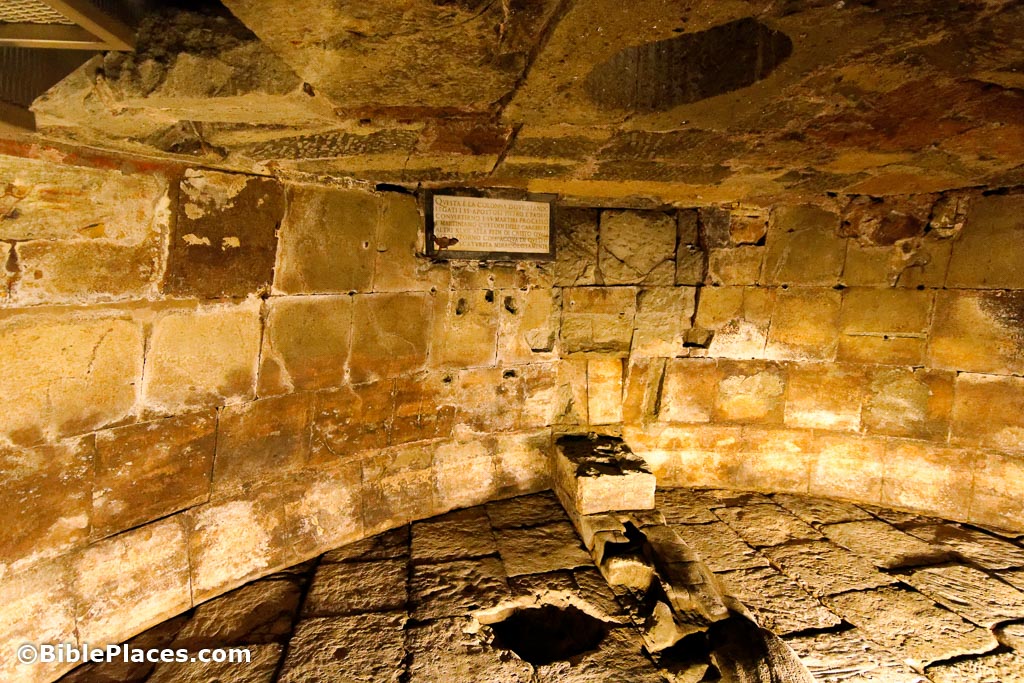
Saints and Saintship. "To all the saints in Christ Jesus which are at Philippi, with the bishops (R.V. marg. overseers) and deacons." The word "saint" is frequently used by the Apostle, in the opening words of the Epistles. In that to the Romans, he describes believers as "called to be saints." So in 1 Cor. 1:2, see also Eph. 1:1; Col. 1:2. We are not to infer from this that they were perfect in character, but that they were set apart from the world, by the cross of Christ and the anointing of the Holy Spirit, for high and holy service in the world. Men use this term of the departed, and canonise their fellow-believers only after many years have elapsed since they passed to the service of the eternal world. But the Apostle did not hesitate to describe very imperfect men and women, who needed a large amount of tuition and admonition, as saints; thus imputing to them God's great ideal, as perhaps the likeliest means of inspiring them to deserve the title.
Is not this a true way of dealing with men? Do not be content with rebuking them when they do wrong, but lay your hand upon their shoulder, and tell them that you are sure that they are capable of better things, that the angel lies hidden in the marble, that the possibility of saintship is deep down in the soul, in virtue of the regenerating grace of the Spirit, who is forming Christ within. Thus you will inspire hope, resolve, high purpose, and the resolute intention that the character and walk shall not fall beneath this great word with which God does not hesitate to designate all who are incorporated in a living union with His Son.
Would you be a saint indeed? Then live "in Christ Jesus" as your King (Christ), and in Jesus in all the human relationship of daily life (Jesus). Let Him be your atmosphere and environment, your protection from the assaults of evil from without, and the sweet fragrance which will exhale through the inner sanctuary of your nature, in speech and act.
Bishops and Deacons. As to the "bishops and deacons": "There is now no question," and this is endorsed by Bishop Ellicott, "that in the Holy Scriptures, the two titles of 'bishop' and 'presbyter' are applied to the same person." For this see Acts 20:17-28. Bishop Lightfoot affirms, "It is a fact now generally recognised by theologians of all shades of opinion, that in the language of the New Testament the same officer in the Church is called indifferently 'bishop,' or 'elder,' or 'presbyter.'" He goes on to say: "The opinion hazarded by Theodoret, and adopted by many later writers, that the same officers in the Church who were first called apostles came afterwards to be designated bishops, is baseless." According to this dictum "a New Testament bishop is a New Testament presbyter, and New Testament bishops and presbyters are simply ministers of Jesus Christ and pastors of churches."
Dr. Moule in his valuable book, Philippian Studies (Philippians Commentary), says: "It is important to remember that our word bishop cannot properly translate the Greek word as it is used in the New Testament, for it is not used there as the special title of a superintendent pastor set over other pastors." For the office of deacon we have simply to refer to Acts 6. In the early Church there were evident ranks of gift, but not of grace. As believers gathered at the Lord's Table, or Love Feast, there was no distinction but that of humility and service. All were redeemed by the same Blood, stood on the same level; and each strove to be the lowliest and humblest of all.
The Combined Salutation. "Grace to you and peace from God our Father and the Lord Jesus Christ." Grace was the western, and Peace the eastern salutation. The Apostle combines them. He desired that his absent friends might know more and more of the free favour of God, of forgiveness and acceptance, and of the enjoyment of help and comfort. He would also have them know that peace which filled his own heart, amid trials of no ordinary description, and which was bequeathed by the Master,--"My peace I leave with you, My peace I give unto you."
Notice how closely he conjoins the Father and the Redeemer. He did not think that he was robbing God of His unity or supremacy when he included our Lord in the same sentence. Though all his early training had recognised the Oneness of the Divine Nature, he had no scruple in adding to God the Father the Lord Jesus Christ.
It is remarkable to notice also the number of times in which he mentions the Saviour's name. It occurs forty times in this Epistle, that is, on an average, in every two or three verses, but this is characteristic of the New Testament, and especially of the writings of this Apostle. He was a slave of Jesus Christ; he viewed all saints as living, with himself, in Christ; his life was full of Christ; Christ was his life; to die was to depart to be with Him; his rejoicing was in Christ Jesus; and steadfastness was only possible, as he and his converts stood fast "in the Lord." The Lord was always at hand to him, and because all believers were in Christ, they could count on God to supply all their need.
Let us rejoice to know that "grace and peace" are not exhausted, but that they flow down to us still in this remote century, and amid the altered circumstances of modern life. Christ was, and is, and is to come. In Him the Church still exists, through Him she is still supplied with grace upon grace, and unto Him she will be gathered without spot, or wrinkle, or any such thing. (F. B. Meyer. The Epistle to the Philippians - A Devotional Commentary)
Doulos 124x in 117v in NAS - Usage: bond-servant(11), bond-servants(12), bondslave(3), bondslaves(8), both men and women(8), servants(1), slave(58), slave's(1), slaves(39).
Matthew 8:9 "For I also am a man under authority, with soldiers under me; and I say to this one, 'Go!' and he goes, and to another, 'Come!' and he comes, and to my slave, 'Do this!' and he does it."
Matthew 10:24 "A disciple is not above his teacher, nor a slave above his master.
25 "It is enough for the disciple that he become like his teacher, and the slave like his master. If they have called the head of the house Beelzebul, how much more will they malign the members of his household!
Matthew 13:27 "The slaves of the landowner came and said to him, 'Sir, did you not sow good seed in your field? How then does it have tares?'
28 "And he said to them, 'An enemy has done this!' The slaves said to him, 'Do you want us, then, to go and gather them up?'
Matthew 18:23 "For this reason the kingdom of heaven may be compared to a king who wished to settle accounts with his slaves.
26 "So the slave fell to the ground and prostrated himself before him, saying, 'Have patience with me and I will repay you everything.'
27 "And the lord of that slave felt compassion and released him and forgave him the debt.
28 "But that slave went out and found one of his fellow slaves who owed him a hundred denarii; and he seized him and began to choke him, saying, 'Pay back what you owe.'
32 "Then summoning him, his lord said to him, 'You wicked slave, I forgave you all that debt because you pleaded with me.
Matthew 20:27 and whoever wishes to be first among you shall be your slave;
Matthew 21:34 "When the harvest time approached, he sent his slaves to the vine-growers to receive his produce.
35 "The vine-growers took his slaves and beat one, and killed another, and stoned a third.
36 "Again he sent another group of slaves larger than the first; and they did the same thing to them.
Matthew 22:3 "And he sent out his slaves to call those who had been invited to the wedding feast, and they were unwilling to come.
4 "Again he sent out other slaves saying, 'Tell those who have been invited, "Behold, I have prepared my dinner; my oxen and my fattened livestock are all butchered and everything is ready; come to the wedding feast."'
6 and the rest seized his slaves and mistreated them and killed them.
8 "Then he said to his slaves, 'The wedding is ready, but those who were invited were not worthy.
10 "Those slaves went out into the streets and gathered together all they found, both evil and good; and the wedding hall was filled with dinner guests.
Matthew 24:45 "Who then is the faithful and sensible slave whom his master put in charge of his household to give them their food at the proper time?
46 "Blessed is that slave whom his master finds so doing when he comes.
48 "But if that evil slave says in his heart, 'My master is not coming for a long time,'
50 the master of that slave will come on a day when he does not expect him and at an hour which he does not know,
Matthew 25:14 "For it is just like a man about to go on a journey, who called his own slaves and entrusted his possessions to them.
19 "Now after a long time the master of those slaves came and settled accounts with them.
21 "His master said to him, 'Well done, good and faithful slave. You were faithful with a few things, I will put you in charge of many things; enter into the joy of your master.'
23 "His master said to him, 'Well done, good and faithful slave. You were faithful with a few things, I will put you in charge of many things; enter into the joy of your master.'
26 "But his master answered and said to him, 'You wicked, lazy slave, you knew that I reap where I did not sow and gather where I scattered no seed.
30 "Throw out the worthless slave into the outer darkness; in that place there will be weeping and gnashing of teeth.
Matthew 26:51 And behold, one of those who were with Jesus reached and drew out his sword, and struck the slave of the high priest and cut off his ear.
Mark 10:44 and whoever wishes to be first among you shall be slave of all.
Mark 12:2 "At the harvest time he sent a slave to the vine-growers, in order to receive some of the produce of the vineyard from the vine-growers.
4 "Again he sent them another slave, and they wounded him in the head, and treated him shamefully.
Mark 13:34 "It is like a man away on a journey, who upon leaving his house and putting his slaves in charge, assigning to each one his task, also commanded the doorkeeper to stay on the alert.
Mark 14:47 But one of those who stood by drew his sword, and struck the slave of the high priest and cut off his ear.
Luke 2:29 "Now Lord, You are releasing Your bond-servant to depart in peace, According to Your word;
Luke 7:2 And a centurion's slave, who was highly regarded by him, was sick and about to die.
3 When he heard about Jesus, he sent some Jewish elders asking Him to come and save the life of his slave.
8 "For I also am a man placed under authority, with soldiers under me; and I say to this one, 'Go!' and he goes, and to another, 'Come!' and he comes, and to my slave, 'Do this!' and he does it."
10 When those who had been sent returned to the house, they found the slave in good health.
Luke 12:37 "Blessed are those slaves whom the master will find on the alert when he comes; truly I say to you, that he will gird himself to serve, and have them recline at the table, and will come up and wait on them.
43 "Blessed is that slave whom his master finds so doing when he comes.
45 "But if that slave says in his heart, 'My master will be a long time in coming,' and begins to beat the slaves, both men and women, and to eat and drink and get drunk;
46 the master of that slave will come on a day when he does not expect him and at an hour he does not know, and will cut him in pieces, and assign him a place with the unbelievers.
47 "And that slave who knew his master's will and did not get ready or act in accord with his will, will receive many lashes,
Luke 14:17 and at the dinner hour he sent his slave to say to those who had been invited, 'Come; for everything is ready now.'
21 "And the slave came back and reported this to his master. Then the head of the household became angry and said to his slave, 'Go out at once into the streets and lanes of the city and bring in here the poor and crippled and blind and lame.'
22 "And the slave said, 'Master, what you commanded has been done, and still there is room.'
23 "And the master said to the slave, 'Go out into the highways and along the hedges, and compel them to come in, so that my house may be filled.
Luke 15:22 "But the father said to his slaves, 'Quickly bring out the best robe and put it on him, and put a ring on his hand and sandals on his feet;
Luke 17:7 "Which of you, having a slave plowing or tending sheep, will say to him when he has come in from the field, 'Come immediately and sit down to eat'?
9 "He does not thank the slave because he did the things which were commanded, does he?
10 "So you too, when you do all the things which are commanded you, say, 'We are unworthy slaves; we have done only that which we ought to have done.'"
Luke 19:13 "And he called ten of his slaves, and gave them ten minas and said to them, 'Do business with this until I come back.'
15 "When he returned, after receiving the kingdom, he ordered that these slaves, to whom he had given the money, be called to him so that he might know what business they had done.
17 "And he said to him, 'Well done, good slave, because you have been faithful in a very little thing, you are to be in authority over ten cities.'
22 "He said to him, 'By your own words I will judge you, you worthless slave. Did you know that I am an exacting man, taking up what I did not lay down and reaping what I did not sow?
Luke 20:10 "At the harvest time he sent a slave to the vine-growers, so that they would give him some of the produce of the vineyard; but the vine-growers beat him and sent him away empty-handed.
11 "And he proceeded to send another slave; and they beat him also and treated him shamefully and sent him away empty-handed.
Luke 22:50 And one of them struck the slave of the high priest and cut off his right ear.
John 4:51 As he was now going down, his slaves met him, saying that his son was living.
John 8:34 Jesus answered them, "Truly, truly, I say to you, everyone who commits sin is the slave of sin.
35 "The slave does not remain in the house forever; the son does remain forever.
John 13:16 "Truly, truly, I say to you, a slave is not greater than his master, nor is one who is sent greater than the one who sent him.
John 15:15 "No longer do I call you slaves, for the slave does not know what his master is doing; but I have called you friends, for all things that I have heard from My Father I have made known to you.
20 "Remember the word that I said to you, 'A slave is not greater than his master.' If they persecuted Me, they will also persecute you; if they kept My word, they will keep yours also.
John 18:10 Simon Peter then, having a sword, drew it and struck the high priest's slave, and cut off his right ear; and the slave's name was Malchus.
18 Now the slaves and the officers were standing there, having made a charcoal fire, for it was cold and they were warming themselves; and Peter was also with them, standing and warming himself.
26 One of the slaves of the high priest, being a relative of the one whose ear Peter cut off, said, "Did I not see you in the garden with Him?"
Acts 2:18 EVEN ON MY BONDSLAVES, BOTH MEN AND WOMEN, I WILL IN THOSE DAYS POUR FORTH OF MY SPIRIT And they shall prophesy.
Acts 4:29 "And now, Lord, take note of their threats, and grant that Your bond-servants may speak Your word with all confidence,
Acts 16:17 Following after Paul and us, she kept crying out, saying, "These men are bond-servants of the Most High God, who are proclaiming to you the way of salvation."
Romans 1:1 Paul, a bond-servant of Christ Jesus, called as an apostle, set apart for the gospel of God,
Romans 6:16 Do you not know that when you present yourselves to someone as slaves for obedience, you are slaves of the one whom you obey, either of sin resulting in death, or of obedience resulting in righteousness?
17 But thanks be to God that though you were slaves of sin, you became obedient from the heart to that form of teaching to which you were committed,
20 For when you were slaves of sin, you were free in regard to righteousness.
1 Corinthians 7:21 Were you called while a slave? Do not worry about it; but if you are able also to become free, rather do that.
22 For he who was called in the Lord while a slave, is the Lord's freedman; likewise he who was called while free, is Christ's slave.
23 You were bought with a price; do not become slaves of men.
1 Corinthians 12:13 For by one Spirit we were all baptized into one body, whether Jews or Greeks, whether slaves or free, and we were all made to drink of one Spirit.
2 Corinthians 4:5 For we do not preach ourselves but Christ Jesus as Lord, and ourselves as your bond-servants for Jesus' sake.
Galatians 1:10 For am I now seeking the favor of men, or of God? Or am I striving to please men? If I were still trying to please men, I would not be a bond-servant of Christ.
Galatians 3:28 There is neither Jew nor Greek, there is neither slave nor free man, there is neither male nor female; for you are all one in Christ Jesus.
Galatians 4:1 Now I say, as long as the heir is a child, he does not differ at all from a slave although he is owner of everything,
7 Therefore you are no longer a slave, but a son; and if a son, then an heir through God.
Ephesians 6:5 Slaves, be obedient to those who are your masters according to the flesh, with fear and trembling, in the sincerity of your heart, as to Christ;
6 not by way of eyeservice, as men-pleasers, but as slaves of Christ, doing the will of God from the heart.
8 knowing that whatever good thing each one does, this he will receive back from the Lord, whether slave or free.
Philippians 1:1 Paul and Timothy, bond-servants of Christ Jesus, To all the saints in Christ Jesus who are in Philippi, including the overseers and deacons:
Philippians 2:7 but emptied Himself, taking the form of a bond-servant, and being made in the likeness of men.
Colossians 3:11 a renewal in which there is no distinction between Greek and Jew, circumcised and uncircumcised, barbarian, Scythian, slave and freeman, but Christ is all, and in all.
22 Slaves, in all things obey those who are your masters on earth, not with external service, as those who merely please men, but with sincerity of heart, fearing the Lord.
Colossians 4:1 Masters, grant to your slaves justice and fairness, knowing that you too have a Master in heaven.
12 Epaphras, who is one of your number, a bondslave of Jesus Christ, sends you his greetings, always laboring earnestly for you in his prayers, that you may stand perfect and fully assured in all the will of God.
1 Timothy 6:1 All who are under the yoke as slaves are to regard their own masters as worthy of all honor so that the name of God and our doctrine will not be spoken against.
2 Timothy 2:24 The Lord's bond-servant must not be quarrelsome, but be kind to all, able to teach, patient when wronged,
Titus 1:1 Paul, a bond-servant of God and an apostle of Jesus Christ, for the faith of those chosen of God and the knowledge of the truth which is according to godliness,
Titus 2:9 Urge bondslaves to be subject to their own masters in everything, to be well-pleasing, not argumentative,
Philemon 1:16 no longer as a slave, but more than a slave, a beloved brother, especially to me, but how much more to you, both in the flesh and in the Lord.
James 1:1 James, a bond-servant of God and of the Lord Jesus Christ, To the twelve tribes who are dispersed abroad: Greetings.
1 Peter 2:16 Act as free men, and do not use your freedom as a covering for evil, but use it as bondslaves of God.
2 Peter 1:1 Simon Peter, a bond-servant and apostle of Jesus Christ, To those who have received a faith of the same kind as ours, by the righteousness of our God and Savior, Jesus Christ:
2 Peter 2:19 promising them freedom while they themselves are slaves of corruption; for by what a man is overcome, by this he is enslaved.
Jude 1:1 Jude, a bond-servant of Jesus Christ, and brother of James, To those who are the called, beloved in God the Father, and kept for Jesus Christ:
Revelation 1:1 The Revelation of Jesus Christ, which God gave Him to show to His bond-servants, the things which must soon take place; and He sent and communicated it by His angel to His bond-servant John,
Revelation 2:20 'But I have this against you, that you tolerate the woman Jezebel, who calls herself a prophetess, and she teaches and leads My bond-servants astray so that they commit acts of immorality and eat things sacrificed to idols.
Revelation 6:15 Then the kings of the earth and the great men and the commanders and the rich and the strong and every slave and free man hid themselves in the caves and among the rocks of the mountains;
Revelation 7:3 saying, "Do not harm the earth or the sea or the trees until we have sealed the bond-servants of our God on their foreheads."
Revelation 10:7 but in the days of the voice of the seventh angel, when he is about to sound, then the mystery of God is finished, as He preached to His servants the prophets.
Revelation 11:18 "And the nations were enraged, and Your wrath came, and the time came for the dead to be judged, and the time to reward Your bond-servants the prophets and the saints and those who fear Your name, the small and the great, and to destroy those who destroy the earth."
Revelation 13:16 And he causes all, the small and the great, and the rich and the poor, and the free men and the slaves, to be given a mark on their right hand or on their forehead,
Revelation 15:3 And they sang the song of Moses, the bond-servant of God, and the song of the Lamb, saying, "Great and marvelous are Your works, O Lord God, the Almighty; Righteous and true are Your ways, King of the nations!
Revelation 19:2 BECAUSE HIS JUDGMENTS ARE TRUE AND RIGHTEOUS; for He has judged the great harlot who was corrupting the earth with her immorality, and HE HAS AVENGED THE BLOOD OF HIS BOND-SERVANTS ON HER."
5 And a voice came from the throne, saying, "Give praise to our God, all you His bond-servants, you who fear Him, the small and the great."
18 so that you may eat the flesh of kings and the flesh of commanders and the flesh of mighty men and the flesh of horses and of those who sit on them and the flesh of all men, both free men and slaves, and small and great."
Revelation 22:3 There will no longer be any curse; and the throne of God and of the Lamb will be in it, and His bond-servants will serve Him;
6 And he said to me, "These words are faithful and true"; and the Lord, the God of the spirits of the prophets, sent His angel to show to His bond-servants the things which must soon take place.
DOULOS
ALL USES IN SEPTUAGINT (Lxx)
Doulos 377x in 350v in NAS - Notice in Psalms who is referred to as a servant! Would God call you (or me) one of His servants?
Leviticus 25:44 'As for your male and female slaves whom you may have-- you may acquire male and female slaves from the pagan nations that are around you.
Leviticus 26:13 'I am the LORD your God, who brought you out of the land of Egypt so that you would not be their slaves, and I broke the bars of your yoke and made you walk erect.
Deuteronomy 32:36 "For the LORD will vindicate His people, And will have compassion on His servants, When He sees that their strength is gone, And there is none remaining, bond or free.
Joshua 9:23 "Now therefore, you are cursed, and you shall never cease being slaves, both hewers of wood and drawers of water for the house of my God."
Joshua 24:29 It came about after these things that Joshua the son of Nun, the servant of the LORD, died, being one hundred and ten years old.
Judges 2:8 Then Joshua the son of Nun, the servant of the LORD, died at the age of one hundred and ten.
Judges 6:27 Then Gideon took ten men of his servants and did as the LORD had spoken to him; and because he was too afraid of his father's household and the men of the city to do it by day, he did it by night.
Judges 9:28 Then Gaal the son of Ebed said, "Who is Abimelech, and who is Shechem, that we should serve him? Is he not the son of Jerubbaal, and is Zebul not his lieutenant? Serve the men of Hamor the father of Shechem; but why should we serve him?
Judges 15:18 Then he became very thirsty, and he called to the LORD and said, "You have given this great deliverance by the hand of Your servant, and now shall I die of thirst and fall into the hands of the uncircumcised?"
1 Samuel 2:27 Then a man of God came to Eli and said to him, "Thus says the LORD, 'Did I not indeed reveal Myself to the house of your father when they were in Egypt in bondage to Pharaoh's house?
1 Samuel 3:9 And Eli said to Samuel, "Go lie down, and it shall be if He calls you, that you shall say, 'Speak, LORD, for Your servant is listening.'" So Samuel went and lay down in his place.
10 Then the LORD came and stood and called as at other times, "Samuel! Samuel!" And Samuel said, "Speak, for Your servant is listening."
1 Samuel 8:14 "He will take the best of your fields and your vineyards and your olive groves and give them to his servants.
15 "He will take a tenth of your seed and of your vineyards and give to his officers and to his servants.
16 "He will also take your male servants and your female servants and your best young men and your donkeys and use them for his work.
17 "He will take a tenth of your flocks, and you yourselves will become his servants.
1 Samuel 12:19 Then all the people said to Samuel, "Pray for your servants to the LORD your God, so that we may not die, for we have added to all our sins this evil by asking for ourselves a king."
1 Samuel 13:3 Jonathan smote the garrison of the Philistines that was in Geba, and the Philistines heard of it. Then Saul blew the trumpet throughout the land, saying, "Let the Hebrews hear."
1 Samuel 14:21 Now the Hebrews who were with the Philistines previously, who went up with them all around in the camp, even they also turned to be with the Israelites who were with Saul and Jonathan.
41 Therefore, Saul said to the LORD, the God of Israel, "Give a perfect lot." And Jonathan and Saul were taken, but the people escaped.
1 Samuel 16:16 "Let our lord now command your servants who are before you. Let them seek a man who is a skillful player on the harp; and it shall come about when the evil spirit from God is on you, that he shall play the harp with his hand, and you will be well."
1 Samuel 17:9 "If he is able to fight with me and kill me, then we will become your servants; but if I prevail against him and kill him, then you shall become our servants and serve us."
32 David said to Saul, "Let no man's heart fail on account of him; your servant will go and fight with this Philistine."
34 But David said to Saul, "Your servant was tending his father's sheep. When a lion or a bear came and took a lamb from the flock,
36 "Your servant has killed both the lion and the bear; and this uncircumcised Philistine will be like one of them, since he has taunted the armies of the living God."
1 Samuel 19:4 Then Jonathan spoke well of David to Saul his father and said to him, "Do not let the king sin against his servant David, since he has not sinned against you, and since his deeds have been very beneficial to you.
1 Samuel 20:7 "If he says, 'It is good,' your servant will be safe; but if he is very angry, know that he has decided on evil.
8 "Therefore deal kindly with your servant, for you have brought your servant into a covenant of the LORD with you. But if there is iniquity in me, put me to death yourself; for why then should you bring me to your father?"
1 Samuel 22:8 "For all of you have conspired against me so that there is no one who discloses to me when my son makes a covenant with the son of Jesse, and there is none of you who is sorry for me or discloses to me that my son has stirred up my servant against me to lie in ambush, as it is this day."
14 Then Ahimelech answered the king and said, "And who among all your servants is as faithful as David, even the king's son-in-law, who is captain over your guard, and is honored in your house?
15 "Did I just begin to inquire of God for him today? Far be it from me! Do not let the king impute anything to his servant or to any of the household of my father, for your servant knows nothing at all of this whole affair."
1 Samuel 23:10 Then David said, "O LORD God of Israel, Your servant has heard for certain that Saul is seeking to come to Keilah to destroy the city on my account.
11 "Will the men of Keilah surrender me into his hand? Will Saul come down just as Your servant has heard? O LORD God of Israel, I pray, tell Your servant." And the LORD said, "He will come down."
1 Samuel 25:10 But Nabal answered David's servants and said, "Who is David? And who is the son of Jesse? There are many servants today who are each breaking away from his master.
39 When David heard that Nabal was dead, he said, "Blessed be the LORD, who has pleaded the cause of my reproach from the hand of Nabal and has kept back His servant from evil. The LORD has also returned the evildoing of Nabal on his own head." Then David sent a proposal to Abigail, to take her as his wife.
1 Samuel 26:17 Then Saul recognized David's voice and said, "Is this your voice, my son David?" And David said, "It is my voice, my lord the king."
18 He also said, "Why then is my lord pursuing his servant? For what have I done? Or what evil is in my hand?
19 "Now therefore, please let my lord the king listen to the words of his servant. If the LORD has stirred you up against me, let Him accept an offering; but if it is men, cursed are they before the LORD, for they have driven me out today so that I would have no attachment with the inheritance of the LORD, saying, 'Go, serve other gods.'
1 Samuel 27:5 Then David said to Achish, "If now I have found favor in your sight, let them give me a place in one of the cities in the country, that I may live there; for why should your servant live in the royal city with you?"
12 So Achish believed David, saying, "He has surely made himself odious among his people Israel; therefore he will become my servant forever."
1 Samuel 28:2 David said to Achish, "Very well, you shall know what your servant can do." So Achish said to David, "Very well, I will make you my bodyguard for life."
1 Samuel 29:3 Then the commanders of the Philistines said, "What are these Hebrews doing here?" And Achish said to the commanders of the Philistines, "Is this not David, the servant of Saul the king of Israel, who has been with me these days, or rather these years, and I have found no fault in him from the day he deserted to me to this day?"
8 David said to Achish, "But what have I done? And what have you found in your servant from the day when I came before you to this day, that I may not go and fight against the enemies of my lord the king?"
1 Samuel 30:13 David said to him, "To whom do you belong? And where are you from?" And he said, "I am a young man of Egypt, a servant of an Amalekite; and my master left me behind when I fell sick three days ago.
2 Samuel 3:18 "Now then, do it! For the LORD has spoken of David, saying, 'By the hand of My servant David I will save My people Israel from the hand of the Philistines and from the hand of all their enemies.'"
2 Samuel 6:20 But when David returned to bless his household, Michal the daughter of Saul came out to meet David and said, "How the king of Israel distinguished himself today! He uncovered himself today in the eyes of his servants' maids as one of the foolish ones shamelessly uncovers himself!"
2 Samuel 7:5 "Go and say to My servant David, 'Thus says the LORD, "Are you the one who should build Me a house to dwell in?
8 "Now therefore, thus you shall say to My servant David, 'Thus says the LORD of hosts, "I took you from the pasture, from following the sheep, to be ruler over My people Israel.
19 "And yet this was insignificant in Your eyes, O Lord GOD, for You have spoken also of the house of Your servant concerning the distant future. And this is the custom of man, O Lord GOD.
20 "Again what more can David say to You? For You know Your servant, O Lord GOD!
21 "For the sake of Your word, and according to Your own heart, You have done all this greatness to let Your servant know.
25 "Now therefore, O LORD God, the word that You have spoken concerning Your servant and his house, confirm it forever, and do as You have spoken,
27 "For You, O LORD of hosts, the God of Israel, have made a revelation to Your servant, saying, 'I will build you a house'; therefore Your servant has found courage to pray this prayer to You.
28 "Now, O Lord GOD, You are God, and Your words are truth, and You have promised this good thing to Your servant.
29 "Now therefore, may it please You to bless the house of Your servant, that it may continue forever before You. For You, O Lord GOD, have spoken; and with Your blessing may the house of Your servant be blessed forever."
2 Samuel 8:2 He defeated Moab, and measured them with the line, making them lie down on the ground; and he measured two lines to put to death and one full line to keep alive. And the Moabites became servants to David, bringing tribute.
6 Then David put garrisons among the Arameans of Damascus, and the Arameans became servants to David, bringing tribute. And the LORD helped David wherever he went.
14 He put garrisons in Edom. In all Edom he put garrisons, and all the Edomites became servants to David. And the LORD helped David wherever he went.
2 Samuel 9:2 Now there was a servant of the house of Saul whose name was Ziba, and they called him to David; and the king said to him, "Are you Ziba?" And he said, "I am your servant."
6 Mephibosheth, the son of Jonathan the son of Saul, came to David and fell on his face and prostrated himself. And David said, "Mephibosheth." And he said, "Here is your servant!"
8 Again he prostrated himself and said, "What is your servant, that you should regard a dead dog like me?"
10 "You and your sons and your servants shall cultivate the land for him, and you shall bring in the produce so that your master's grandson may have food; nevertheless Mephibosheth your master's grandson shall eat at my table regularly." Now Ziba had fifteen sons and twenty servants.
11 Then Ziba said to the king, "According to all that my lord the king commands his servant so your servant will do." So Mephibosheth ate at David's table as one of the king's sons.
12 Mephibosheth had a young son whose name was Mica. And all who lived in the house of Ziba were servants to Mephibosheth.
2 Samuel 10:2 Then David said, "I will show kindness to Hanun the son of Nahash, just as his father showed kindness to me." So David sent some of his servants to console him concerning his father. But when David's servants came to the land of the Ammonites,
19 When all the kings, servants of Hadadezer, saw that they were defeated by Israel, they made peace with Israel and served them. So the Arameans feared to help the sons of Ammon anymore.
2 Samuel 11:9 But Uriah slept at the door of the king's house with all the servants of his lord, and did not go down to his house.
11 Uriah said to David, "The ark and Israel and Judah are staying in temporary shelters, and my lord Joab and the servants of my lord are camping in the open field. Shall I then go to my house to eat and to drink and to lie with my wife? By your life and the life of your soul, I will not do this thing."
13 Now David called him, and he ate and drank before him, and he made him drunk; and in the evening he went out to lie on his bed with his lord's servants, but he did not go down to his house.
17 The men of the city went out and fought against Joab, and some of the people among David's servants fell; and Uriah the Hittite also died.
21 'Who struck down Abimelech the son of Jerubbesheth? Did not a woman throw an upper millstone on him from the wall so that he died at Thebez? Why did you go so near the wall?'-- then you shall say, 'Your servant Uriah the Hittite is dead also.'"
24 "Moreover, the archers shot at your servants from the wall; so some of the king's servants are dead, and your servant Uriah the Hittite is also dead."
2 Samuel 12:18 Then it happened on the seventh day that the child died. And the servants of David were afraid to tell him that the child was dead, for they said, "Behold, while the child was still alive, we spoke to him and he did not listen to our voice. How then can we tell him that the child is dead, since he might do himself harm!"
2 Samuel 13:24 Absalom came to the king and said, "Behold now, your servant has sheepshearers; please let the king and his servants go with your servant."
35 Jonadab said to the king, "Behold, the king's sons have come; according to your servant's word, so it happened."
2 Samuel 14:19 So the king said, "Is the hand of Joab with you in all this?" And the woman replied, "As your soul lives, my lord the king, no one can turn to the right or to the left from anything that my lord the king has spoken. Indeed, it was your servant Joab who commanded me, and it was he who put all these words in the mouth of your maidservant;
20 in order to change the appearance of things your servant Joab has done this thing. But my lord is wise, like the wisdom of the angel of God, to know all that is in the earth."
22 Joab fell on his face to the ground, prostrated himself and blessed the king; then Joab said, "Today your servant knows that I have found favor in your sight, O my lord, the king, in that the king has performed the request of his servant."
30 Therefore he said to his servants, "See, Joab's field is next to mine, and he has barley there; go and set it on fire." So Absalom's servants set the field on fire.
2 Samuel 15:2 Absalom used to rise early and stand beside the way to the gate; and when any man had a suit to come to the king for judgment, Absalom would call to him and say, "From what city are you?" And he would say, "Your servant is from one of the tribes of Israel."
8 "For your servant vowed a vow while I was living at Geshur in Aram, saying, 'If the LORD shall indeed bring me back to Jerusalem, then I will serve the LORD.'"
21 But Ittai answered the king and said, "As the LORD lives, and as my lord the king lives, surely wherever my lord the king may be, whether for death or for life, there also your servant will be."
34 "But if you return to the city, and say to Absalom, 'I will be your servant, O king; as I have been your father's servant in time past, so I will now be your servant,' then you can thwart the counsel of Ahithophel for me.
2 Samuel 18:29 The king said, "Is it well with the young man Absalom?" And Ahimaaz answered, "When Joab sent the king's servant, and your servant, I saw a great tumult, but I did not know what it was."
2 Samuel 19:5 Then Joab came into the house to the king and said, "Today you have covered with shame the faces of all your servants, who today have saved your life and the lives of your sons and daughters, the lives of your wives, and the lives of your concubines,
7 "Now therefore arise, go out and speak kindly to your servants, for I swear by the LORD, if you do not go out, surely not a man will pass the night with you, and this will be worse for you than all the evil that has come upon you from your youth until now."
14 Thus he turned the hearts of all the men of Judah as one man, so that they sent word to the king, saying, "Return, you and all your servants."
17 There were a thousand men of Benjamin with him, with Ziba the servant of the house of Saul, and his fifteen sons and his twenty servants with him; and they rushed to the Jordan before the king.
20 "For your servant knows that I have sinned; therefore behold, I have come today, the first of all the house of Joseph to go down to meet my lord the king."
26 So he answered, "O my lord, the king, my servant deceived me; for your servant said, 'I will saddle a donkey for myself that I may ride on it and go with the king,' because your servant is lame.
27 "Moreover, he has slandered your servant to my lord the king; but my lord the king is like the angel of God, therefore do what is good in your sight.
28 "For all my father's household was nothing but dead men before my lord the king; yet you set your servant among those who ate at your own table. What right do I have yet that I should complain anymore to the king?"
35 "I am now eighty years old. Can I distinguish between good and bad? Or can your servant taste what I eat or what I drink? Or can I hear anymore the voice of singing men and women? Why then should your servant be an added burden to my lord the king?
36 "Your servant would merely cross over the Jordan with the king. Why should the king compensate me with this reward?
37 "Please let your servant return, that I may die in my own city near the grave of my father and my mother. However, here is your servant Chimham, let him cross over with my lord the king, and do for him what is good in your sight."
2 Samuel 21:22 These four were born to the giant in Gath, and they fell by the hand of David and by the hand of his servants.
2 Samuel 24:10 Now David's heart troubled him after he had numbered the people. So David said to the LORD, "I have sinned greatly in what I have done. But now, O LORD, please take away the iniquity of Your servant, for I have acted very foolishly."
21 Then Araunah said, "Why has my lord the king come to his servant?" And David said, "To buy the threshing floor from you, in order to build an altar to the LORD, that the plague may be held back from the people."
1 Kings 1:19 "He has sacrificed oxen and fatlings and sheep in abundance, and has invited all the sons of the king and Abiathar the priest and Joab the commander of the army, but he has not invited Solomon your servant.
26 "But me, even me your servant, and Zadok the priest and Benaiah the son of Jehoiada and your servant Solomon, he has not invited.
27 "Has this thing been done by my lord the king, and you have not shown to your servants who should sit on the throne of my lord the king after him?"
33 The king said to them, "Take with you the servants of your lord, and have my son Solomon ride on my own mule, and bring him down to Gihon.
47 "Moreover, the king's servants came to bless our lord King David, saying, 'May your God make the name of Solomon better than your name and his throne greater than your throne!' And the king bowed himself on the bed.
51 Now it was told Solomon, saying, "Behold, Adonijah is afraid of King Solomon, for behold, he has taken hold of the horns of the altar, saying, 'Let King Solomon swear to me today that he will not put his servant to death with the sword.'"
1 Kings 2:38 Shimei then said to the king, "The word is good. As my lord the king has said, so your servant will do." So Shimei lived in Jerusalem many days.
39 But it came about at the end of three years, that two of the servants of Shimei ran away to Achish son of Maacah, king of Gath. And they told Shimei, saying, "Behold, your servants are in Gath."
40 Then Shimei arose and saddled his donkey, and went to Gath to Achish to look for his servants. And Shimei went and brought his servants from Gath.
41 It was told Solomon that Shimei had gone from Jerusalem to Gath, and had returned.
1 Kings 3:6 Then Solomon said, "You have shown great lovingkindness to Your servant David my father, according as he walked before You in truth and righteousness and uprightness of heart toward You; and You have reserved for him this great lovingkindness, that You have given him a son to sit on his throne, as it is this day.
7 "Now, O LORD my God, You have made Your servant king in place of my father David, yet I am but a little child; I do not know how to go out or come in.
8 "Your servant is in the midst of Your people which You have chosen, a great people who are too many to be numbered or counted.
9 "So give Your servant an understanding heart to judge Your people to discern between good and evil. For who is able to judge this great people of Yours?"
1 Kings 5:6 "Now therefore, command that they cut for me cedars from Lebanon, and my servants will be with your servants; and I will give you wages for your servants according to all that you say, for you know that there is no one among us who knows how to cut timber like the Sidonians."
9 "My servants will bring them down from Lebanon to the sea; and I will make them into rafts to go by sea to the place where you direct me, and I will have them broken up there, and you shall carry them away. Then you shall accomplish my desire by giving food to my household."
1 Kings 8:12 Then Solomon said, "The LORD has said that He would dwell in the thick cloud.
23 He said, "O LORD, the God of Israel, there is no God like You in heaven above or on earth beneath, keeping covenant and showing lovingkindness to Your servants who walk before You with all their heart,
24 who have kept with Your servant, my father David, that which You have promised him; indeed, You have spoken with Your mouth and have fulfilled it with Your hand as it is this day.
25 "Now therefore, O LORD, the God of Israel, keep with Your servant David my father that which You have promised him, saying, 'You shall not lack a man to sit on the throne of Israel, if only your sons take heed to their way to walk before Me as you have walked.'
28 "Yet have regard to the prayer of Your servant and to his supplication, O LORD my God, to listen to the cry and to the prayer which Your servant prays before You today;
29 that Your eyes may be open toward this house night and day, toward the place of which You have said, 'My name shall be there,' to listen to the prayer which Your servant shall pray toward this place.
30 "Listen to the supplication of Your servant and of Your people Israel, when they pray toward this place; hear in heaven Your dwelling place; hear and forgive.
36 then hear in heaven and forgive the sin of Your servants and of Your people Israel, indeed, teach them the good way in which they should walk. And send rain on Your land, which You have given Your people for an inheritance.
52 that Your eyes may be open to the supplication of Your servant and to the supplication of Your people Israel, to listen to them whenever they call to You.
56 "Blessed be the LORD, who has given rest to His people Israel, according to all that He promised; not one word has failed of all His good promise, which He promised through Moses His servant.
59 "And may these words of mine, with which I have made supplication before the LORD, be near to the LORD our God day and night, that He may maintain the cause of His servant and the cause of His people Israel, as each day requires,
66 On the eighth day he sent the people away and they blessed the king. Then they went to their tents joyful and glad of heart for all the goodness that the LORD had shown to David His servant and to Israel His people.
1 Kings 11:11 So the LORD said to Solomon, "Because you have done this, and you have not kept My covenant and My statutes, which I have commanded you, I will surely tear the kingdom from you, and will give it to your servant.
13 "However, I will not tear away all the kingdom, but I will give one tribe to your son for the sake of My servant David and for the sake of Jerusalem which I have chosen."
26 Then Jeroboam the son of Nebat, an Ephraimite of Zeredah, Solomon's servant, whose mother's name was Zeruah, a widow, also rebelled against the king.
32 (but he will have one tribe, for the sake of My servant David and for the sake of Jerusalem, the city which I have chosen from all the tribes of Israel),
34 'Nevertheless I will not take the whole kingdom out of his hand, but I will make him ruler all the days of his life, for the sake of My servant David whom I chose, who observed My commandments and My statutes;
36 'But to his son I will give one tribe, that My servant David may have a lamp always before Me in Jerusalem, the city where I have chosen for Myself to put My name.
38 'Then it will be, that if you listen to all that I command you and walk in My ways, and do what is right in My sight by observing My statutes and My commandments, as My servant David did, then I will be with you and build you an enduring house as I built for David, and I will give Israel to you.
1 Kings 12:7 Then they spoke to him, saying, "If you will be a servant to this people today, and will serve them and grant them their petition, and speak good words to them, then they will be your servants forever."
24 'Thus says the LORD, "You must not go up and fight against your relatives the sons of Israel; return every man to his house, for this thing has come from Me."'" So they listened to the word of the LORD, and returned and went their way according to the word of the LORD.
1 Kings 15:29 It came about as soon as he was king, he struck down all the household of Jeroboam. He did not leave to Jeroboam any persons alive, until he had destroyed them, according to the word of the LORD, which He spoke by His servant Ahijah the Shilonite,
1 Kings 18:9 He said, "What sin have I committed, that you are giving your servant into the hand of Ahab to put me to death?
12 "It will come about when I leave you that the Spirit of the LORD will carry you where I do not know; so when I come and tell Ahab and he cannot find you, he will kill me, although I your servant have feared the LORD from my youth.
36 At the time of the offering of the evening sacrifice, Elijah the prophet came near and said, "O LORD, the God of Abraham, Isaac and Israel, today let it be known that You are God in Israel and that I am Your servant and I have done all these things at Your word.
1 Kings 20:9 So he said to the messengers of Ben-hadad, "Tell my lord the king, 'All that you sent for to your servant at the first I will do, but this thing I cannot do.'" And the messengers departed and brought him word again.
32 So they girded sackcloth on their loins and put ropes on their heads, and came to the king of Israel and said, "Your servant Ben-hadad says, 'Please let me live.'" And he said, "Is he still alive? He is my brother."
39 As the king passed by, he cried to the king and said, "Your servant went out into the midst of the battle; and behold, a man turned aside and brought a man to me and said, 'Guard this man; if for any reason he is missing, then your life shall be for his life, or else you shall pay a talent of silver.'
40 "While your servant was busy here and there, he was gone." And the king of Israel said to him, "So shall your judgment be; you yourself have decided it."
1 Kings 21:28 Then the word of the LORD came to Elijah the Tishbite, saying,
2 Kings 1:13 So he again sent the captain of a third fifty with his fifty. When the third captain of fifty went up, he came and bowed down on his knees before Elijah, and begged him and said to him, "O man of God, please let my life and the lives of these fifty servants of yours be precious in your sight.
14 "Behold fire came down from heaven and consumed the first two captains of fifty with their fifties; but now let my life be precious in your sight."
2 Kings 4:1 Now a certain woman of the wives of the sons of the prophets cried out to Elisha, "Your servant my husband is dead, and you know that your servant feared the LORD; and the creditor has come to take my two children to be his slaves."
2 Kings 5:6 He brought the letter to the king of Israel, saying, "And now as this letter comes to you, behold, I have sent Naaman my servant to you, that you may cure him of his leprosy."
15 When he returned to the man of God with all his company, and came and stood before him, he said, "Behold now, I know that there is no God in all the earth, but in Israel; so please take a present from your servant now."
17 Naaman said, "If not, please let your servant at least be given two mules' load of earth; for your servant will no longer offer burnt offering nor will he sacrifice to other gods, but to the LORD.
18 "In this matter may the LORD pardon your servant: when my master goes into the house of Rimmon to worship there, and he leans on my hand and I bow myself in the house of Rimmon, when I bow myself in the house of Rimmon, the LORD pardon your servant in this matter."
25 But he went in and stood before his master. And Elisha said to him, "Where have you been, Gehazi?" And he said, "Your servant went nowhere."
2 Kings 6:3 Then one said, "Please be willing to go with your servants." And he answered, "I shall go."
2 Kings 8:13 Then Hazael said, "But what is your servant, who is but a dog, that he should do this great thing?" And Elisha answered, "The LORD has shown me that you will be king over Aram."
19 However, the LORD was not willing to destroy Judah, for the sake of David His servant, since He had promised him to give a lamp to him through his sons always.
2 Kings 9:7 'You shall strike the house of Ahab your master, that I may avenge the blood of My servants the prophets, and the blood of all the servants of the LORD, at the hand of Jezebel.
36 Therefore they returned and told him. And he said, "This is the word of the LORD, which He spoke by His servant Elijah the Tishbite, saying, 'In the property of Jezreel the dogs shall eat the flesh of Jezebel;
2 Kings 10:10 "Know then that there shall fall to the earth nothing of the word of the LORD, which the LORD spoke concerning the house of Ahab, for the LORD has done what He spoke through His servant Elijah."
19 "Now, summon all the prophets of Baal, all his worshipers and all his priests; let no one be missing, for I have a great sacrifice for Baal; whoever is missing shall not live." But Jehu did it in cunning, so that he might destroy the worshipers of Baal.
21 Then Jehu sent throughout Israel and all the worshipers of Baal came, so that there was not a man left who did not come. And when they went into the house of Baal, the house of Baal was filled from one end to the other.
22 He said to the one who was in charge of the wardrobe, "Bring out garments for all the worshipers of Baal." So he brought out garments for them.
23 Jehu went into the house of Baal with Jehonadab the son of Rechab; and he said to the worshipers of Baal, "Search and see that there is here with you none of the servants of the LORD, but only the worshipers of Baal."
2 Kings 12:20 His servants arose and made a conspiracy and struck down Joash at the house of Millo as he was going down to Silla.
21 For Jozacar the son of Shimeath and Jehozabad the son of Shomer, his servants, struck him and he died; and they buried him with his fathers in the city of David, and Amaziah his son became king in his place.
2 Kings 14:5 Now it came about, as soon as the kingdom was firmly in his hand, that he killed his servants who had slain the king his father.
25 He restored the border of Israel from the entrance of Hamath as far as the Sea of the Arabah, according to the word of the LORD, the God of Israel, which He spoke through His servant Jonah the son of Amittai, the prophet, who was of Gath-hepher.
2 Kings 16:7 So Ahaz sent messengers to Tiglath-pileser king of Assyria, saying, "I am your servant and your son; come up and deliver me from the hand of the king of Aram and from the hand of the king of Israel, who are rising up against me."
2 Kings 17:3 Shalmaneser king of Assyria came up against him, and Hoshea became his servant and paid him tribute.
13 Yet the LORD warned Israel and Judah through all His prophets and every seer, saying, "Turn from your evil ways and keep My commandments, My statutes according to all the law which I commanded your fathers, and which I sent to you through My servants the prophets."
23 until the LORD removed Israel from His sight, as He spoke through all His servants the prophets. So Israel was carried away into exile from their own land to Assyria until this day.
2 Kings 18:12 because they did not obey the voice of the LORD their God, but transgressed His covenant, even all that Moses the servant of the LORD commanded; they would neither listen nor do it.
24 "How then can you repulse one official of the least of my master's servants, and rely on Egypt for chariots and for horsemen?
2 Kings 19:34 'For I will defend this city to save it for My own sake and for My servant David's sake.'"
2 Kings 20:6 "I will add fifteen years to your life, and I will deliver you and this city from the hand of the king of Assyria; and I will defend this city for My own sake and for My servant David's sake."'"
2 Kings 21:8 "And I will not make the feet of Israel wander anymore from the land which I gave their fathers, if only they will observe to do according to all that I have commanded them, and according to all the law that My servant Moses commanded them."
10 Now the LORD spoke through His servants the prophets, saying,
2 Kings 22:9 Shaphan the scribe came to the king and brought back word to the king and said, "Your servants have emptied out the money that was found in the house, and have delivered it into the hand of the workmen who have the oversight of the house of the LORD."
12 Then the king commanded Hilkiah the priest, Ahikam the son of Shaphan, Achbor the son of Micaiah, Shaphan the scribe, and Asaiah the king's servant saying,
2 Kings 24:1 In his days Nebuchadnezzar king of Babylon came up, and Jehoiakim became his servant for three years; then he turned and rebelled against him.
2 The LORD sent against him bands of Chaldeans, bands of Arameans, bands of Moabites, and bands of Ammonites. So He sent them against Judah to destroy it, according to the word of the LORD which He had spoken through His servants the prophets.
1 Chronicles 17:7 "Now, therefore, thus shall you say to My servant David, 'Thus says the LORD of hosts, "I took you from the pasture, from following the sheep, to be leader over My people Israel.
18 "What more can David still say to You concerning the honor bestowed on Your servant? For You know Your servant.
26 "Now, O LORD, You are God, and have promised this good thing to Your servant.
2 Chronicles 2:8 "Send me also cedar, cypress and algum timber from Lebanon, for I know that your servants know how to cut timber of Lebanon; and indeed my servants will work with your servants,
2 Chronicles 6:23 then hear from heaven and act and judge Your servants, punishing the wicked by bringing his way on his own head and justifying the righteous by giving him according to his righteousness.
42 "O LORD God, do not turn away the face of Your anointed; remember Your lovingkindness to Your servant David."
2 Chronicles 28:10 "Now you are proposing to subjugate for yourselves the people of Judah and Jerusalem for male and female slaves. Surely, do you not have transgressions of your own against the LORD your God?
2 Chronicles 36:20 Those who had escaped from the sword he carried away to Babylon; and they were servants to him and to his sons until the rule of the kingdom of Persia,
Ezra 2:65 besides their male and female servants who numbered 7,337; and they had 200 singing men and women.
Ezra 4:15 so that a search may be made in the record books of your fathers. And you will discover in the record books and learn that that city is a rebellious city and damaging to kings and provinces, and that they have incited revolt within it in past days; therefore that city was laid waste.
Ezra 5:11 "Thus they answered us, saying, 'We are the servants of the God of heaven and earth and are rebuilding the temple that was built many years ago, which a great king of Israel built and finished.
Ezra 9:9 "For we are slaves; yet in our bondage our God has not forsaken us, but has extended lovingkindness to us in the sight of the kings of Persia, to give us reviving to raise up the house of our God, to restore its ruins and to give us a wall in Judah and Jerusalem.
11 which You have commanded by Your servants the prophets, saying, 'The land which you are entering to possess is an unclean land with the uncleanness of the peoples of the lands, with their abominations which have filled it from end to end and with their impurity.
Nehemiah 1:6 let Your ear now be attentive and Your eyes open to hear the prayer of Your servant which I am praying before You now, day and night, on behalf of the sons of Israel Your servants, confessing the sins of the sons of Israel which we have sinned against You; I and my father's house have sinned.
11 "O Lord, I beseech You, may Your ear be attentive to the prayer of Your servant and the prayer of Your servants who delight to revere Your name, and make Your servant successful today and grant him compassion before this man." Now I was the cupbearer to the king.
Nehemiah 2:10 When Sanballat the Horonite and Tobiah the Ammonite official heard about it, it was very displeasing to them that someone had come to seek the welfare of the sons of Israel.
19 But when Sanballat the Horonite and Tobiah the Ammonite official, and Geshem the Arab heard it, they mocked us and despised us and said, "What is this thing you are doing? Are you rebelling against the king?"
20 So I answered them and said to them, "The God of heaven will give us success; therefore we His servants will arise and build, but you have no portion, right or memorial in Jerusalem."
Nehemiah 5:5 "Now our flesh is like the flesh of our brothers, our children like their children. Yet behold, we are forcing our sons and our daughters to be slaves, and some of our daughters are forced into bondage already, and we are helpless because our fields and vineyards belong to others."
Nehemiah 7:57 The sons of Solomon's servants: the sons of Sotai, the sons of Sophereth, the sons of Perida,
60 All the temple servants and the sons of Solomon's servants were 392.
67 besides their male and their female servants, of whom there were 7,337; and they had 245 male and female singers.
Nehemiah 9:14 "So You made known to them Your holy sabbath, And laid down for them commandments, statutes and law, Through Your servant Moses.
36 "Behold, we are slaves today, And as to the land which You gave to our fathers to eat of its fruit and its bounty, Behold, we are slaves in it.
Nehemiah 10:29 are joining with their kinsmen, their nobles, and are taking on themselves a curse and an oath to walk in God's law, which was given through Moses, God's servant, and to keep and to observe all the commandments of GOD our Lord, and His ordinances and His statutes;
Nehemiah 11:3 Now these are the heads of the provinces who lived in Jerusalem, but in the cities of Judah each lived on his own property in their cities-- the Israelites, the priests, the Levites, the temple servants and the descendants of Solomon's servants.
Job 41:4 "Will he make a covenant with you? Will you take him for a servant forever?
Psalm 19:11 Moreover, by them Your servant is warned; In keeping them there is great reward.
13 Also keep back Your servant from presumptuous sins; Let them not rule over me; Then I will be blameless, And I shall be acquitted of great transgression.
Psalm 27:9 Do not hide Your face from me, Do not turn Your servant away in anger; You have been my help; Do not abandon me nor forsake me, O God of my salvation!
Psalm 31:16 Make Your face to shine upon Your servant; Save me in Your lovingkindness.
Psalm 34:22 The LORD redeems the soul of His servants, And none of those who take refuge in Him will be condemned.
Psalm 35:27 Let them shout for joy and rejoice, who favor my vindication; And let them say continually, "The LORD be magnified, Who delights in the prosperity of His servant."
Psalm 36:1 For the choir director. A Psalm of David the servant of the LORD. Transgression speaks to the ungodly within his heart; There is no fear of God before his eyes.
Psalm 69:36 The descendants of His servants will inherit it, And those who love His name will dwell in it.
Psalm 78:70 He also chose David His servant And took him from the sheepfolds;
Psalm 79:2 They have given the dead bodies of Your servants for food to the birds of the heavens, The flesh of Your godly ones to the beasts of the earth.
10 Why should the nations say, "Where is their God?" Let there be known among the nations in our sight, Vengeance for the blood of Your servants which has been shed.
Psalm 80:4 O LORD God of hosts, How long will You be angry with the prayer of Your people?
Psalm 86:2 Preserve my soul, for I am a godly man; O You my God, save Your servant who trusts in You.
4 Make glad the soul of Your servant, For to You, O Lord, I lift up my soul.
Psalm 89:3 "I have made a covenant with My chosen; I have sworn to David My servant,
20 "I have found David My servant; With My holy oil I have anointed him,
39 You have spurned the covenant of Your servant; You have profaned his crown in the dust.
50 Remember, O Lord, the reproach of Your servants; How I bear in my bosom the reproach of all the many peoples,
Psalm 90:13 Do return, O LORD; how long will it be? And be sorry for Your servants.
16 Let Your work appear to Your servants And Your majesty to their children.
Psalm 102:14 Surely Your servants find pleasure in her stones And feel pity for her dust.
28 "The children of Your servants will continue, And their descendants will be established before You."
Psalm 105:6 O seed of Abraham, His servant, O sons of Jacob, His chosen ones!
17 He sent a man before them, Joseph, who was sold as a slave.
25 He turned their heart to hate His people, To deal craftily with His servants.
26 He sent Moses His servant, And Aaron, whom He had chosen.
42 For He remembered His holy word With Abraham His servant;
Psalm 109:28 Let them curse, but You bless; When they arise, they shall be ashamed, But Your servant shall be glad.
Psalm 116:16 O LORD, surely I am Your servant, I am Your servant, the son of Your handmaid, You have loosed my bonds.
Psalm 119:17 Deal bountifully with Your servant, That I may live and keep Your word.
23 Even though princes sit and talk against me, Your servant meditates on Your statutes.
38 Establish Your word to Your servant, As that which produces reverence for You.
49 Remember the word to Your servant, In which You have made me hope.
65 You have dealt well with Your servant, O LORD, according to Your word.
76 O may Your lovingkindness comfort me, According to Your word to Your servant.
84 How many are the days of Your servant? When will You execute judgment on those who persecute me?
91 They stand this day according to Your ordinances, For all things are Your servants.
122 Be surety for Your servant for good; Do not let the arrogant oppress me.
124 Deal with Your servant according to Your lovingkindness And teach me Your statutes.
125 I am Your servant; give me understanding, That I may know Your testimonies.
135 Make Your face shine upon Your servant, And teach me Your statutes.
140 Your word is very pure, Therefore Your servant loves it.
176 I have gone astray like a lost sheep; seek Your servant, For I do not forget Your commandments.
Psalm 123:2 Behold, as the eyes of servants look to the hand of their master, As the eyes of a maid to the hand of her mistress, So our eyes look to the LORD our God, Until He is gracious to us.
Psalm 132:10 For the sake of David Your servant, Do not turn away the face of Your anointed.
Psalm 134:1 A Song of Ascents. Behold, bless the LORD, all servants of the LORD, Who serve by night in the house of the LORD!
Psalm 135:1 Praise the LORD! Praise the name of the LORD; Praise Him, O servants of the LORD,
9 He sent signs and wonders into your midst, O Egypt, Upon Pharaoh and all his servants.
14 For the LORD will judge His people And will have compassion on His servants.
Psalm 136:22 Even a heritage to Israel His servant, For His lovingkindness is everlasting.
Psalm 143:2 And do not enter into judgment with Your servant, For in Your sight no man living is righteous.
12 And in Your lovingkindness, cut off my enemies And destroy all those who afflict my soul, For I am Your servant.
Psalm 144:10 Who gives salvation to kings, Who rescues David His servant from the evil sword.
Proverbs 9:3 She has sent out her maidens, she calls From the tops of the heights of the city:
Ecclesiastes 2:7 I bought male and female slaves and I had homeborn slaves. Also I possessed flocks and herds larger than all who preceded me in Jerusalem.
Ecclesiastes 5:12 The sleep of the working man is pleasant, whether he eats little or much; but the full stomach of the rich man does not allow him to sleep.
Ecclesiastes 7:21 Also, do not take seriously all words which are spoken, so that you will not hear your servant cursing you.
Ecclesiastes 10:7 I have seen slaves riding on horses and princes walking like slaves on the land.
Isaiah 14:2 The peoples will take them along and bring them to their place, and the house of Israel will possess them as an inheritance in the land of the LORD as male servants and female servants; and they will take their captors captive and will rule over their oppressors.
Isaiah 42:19 Who is blind but My servant, Or so deaf as My messenger whom I send? Who is so blind as he that is at peace with Me, Or so blind as the servant of the LORD?
Isaiah 45:14 Thus says the LORD, "The products of Egypt and the merchandise of Cush And the Sabeans, men of stature, Will come over to you and will be yours; They will walk behind you, they will come over in chains And will bow down to you; They will make supplication to you: 'Surely, God is with you, and there is none else, No other God.'"
Isaiah 48:20 Go forth from Babylon! Flee from the Chaldeans! Declare with the sound of joyful shouting, proclaim this, Send it out to the end of the earth; Say, "The LORD has redeemed His servant Jacob."
Isaiah 49:3 He said to Me, "You are My Servant, Israel, In Whom I will show My glory."
5 And now says the LORD, who formed Me from the womb to be His Servant, To bring Jacob back to Him, so that Israel might be gathered to Him (For I am honored in the sight of the LORD, And My God is My strength),
7 Thus says the LORD, the Redeemer of Israel and its Holy One, To the despised One, To the One abhorred by the nation, To the Servant of rulers, "Kings will see and arise, Princes will also bow down, Because of the LORD who is faithful, the Holy One of Israel who has chosen You."
Isaiah 56:6 "Also the foreigners who join themselves to the LORD, To minister to Him, and to love the name of the LORD, To be His servants, every one who keeps from profaning the sabbath And holds fast My covenant;
Isaiah 63:17 Why, O LORD, do You cause us to stray from Your ways And harden our heart from fearing You? Return for the sake of Your servants, the tribes of Your heritage.
Isaiah 65:9 "I will bring forth offspring from Jacob, And an heir of My mountains from Judah; Even My chosen ones shall inherit it, And My servants will dwell there.
Jeremiah 2:14 "Is Israel a slave? Or is he a homeborn servant? Why has he become a prey?
Jeremiah 3:22 "Return, O faithless sons, I will heal your faithlessness." "Behold, we come to You; For You are the LORD our God.
Jeremiah 7:25 "Since the day that your fathers came out of the land of Egypt until this day, I have sent you all My servants the prophets, daily rising early and sending them.
Jeremiah 25:4 "And the LORD has sent to you all His servants the prophets again and again, but you have not listened nor inclined your ear to hear,
Jeremiah 46:27 "But as for you, O Jacob My servant, do not fear, Nor be dismayed, O Israel! For, see, I am going to save you from afar, And your descendants from the land of their captivity; And Jacob will return and be undisturbed And secure, with no one making him tremble.
Lamentations 5:8 Slaves rule over us; There is no one to deliver us from their hand.
Ezekiel 28:25 'Thus says the Lord GOD, "When I gather the house of Israel from the peoples among whom they are scattered, and will manifest My holiness in them in the sight of the nations, then they will live in their land which I gave to My servant Jacob.
Ezekiel 34:23 "Then I will set over them one shepherd, My servant David, and he will feed them; he will feed them himself and be their shepherd.
Ezekiel 37:24 "My servant David will be king over them, and they will all have one shepherd; and they will walk in My ordinances and keep My statutes and observe them.
25 "They will live on the land that I gave to Jacob My servant, in which your fathers lived; and they will live on it, they, and their sons and their sons' sons, forever; and David My servant will be their prince forever.
Ezekiel 38:17 'Thus says the Lord GOD, "Are you the one of whom I spoke in former days through My servants the prophets of Israel, who prophesied in those days for many years that I would bring you against them?
Daniel 3:26 Then Nebuchadnezzar came near to the door of the furnace of blazing fire; he responded and said, "Shadrach, Meshach and Abed-nego, come out, you servants of the Most High God, and come here!" Then Shadrach, Meshach and Abed-nego came out of the midst of the fire.
Daniel 6:20 When he had come near the den to Daniel, he cried out with a troubled voice. The king spoke and said to Daniel, "Daniel, servant of the living God, has your God, whom you constantly serve, been able to deliver you from the lions?"
Daniel 9:6 "Moreover, we have not listened to Your servants the prophets, who spoke in Your name to our kings, our princes, our fathers and all the people of the land.
10 nor have we obeyed the voice of the LORD our God, to walk in His teachings which He set before us through His servants the prophets.
11 "Indeed all Israel has transgressed Your law and turned aside, not obeying Your voice; so the curse has been poured out on us, along with the oath which is written in the law of Moses the servant of God, for we have sinned against Him.
17 "So now, our God, listen to the prayer of Your servant and to his supplications, and for Your sake, O Lord, let Your face shine on Your desolate sanctuary.
Joel 2:29 "Even on the male and female servants I will pour out My Spirit in those days.
Amos 3:7 Surely the Lord GOD does nothing Unless He reveals His secret counsel To His servants the prophets.
Jonah 1:9 He said to them, "I am a Hebrew, and I fear the LORD God of heaven who made the sea and the dry land."
Haggai 2:23 'On that day,' declares the LORD of hosts, 'I will take you, Zerubbabel, son of Shealtiel, My servant,' declares the LORD, 'and I will make you like a signet ring, for I have chosen you,'" declares the LORD of hosts.
Zechariah 1:6 "But did not My words and My statutes, which I commanded My servants the prophets, overtake your fathers? Then they repented and said, 'As the LORD of hosts purposed to do to us in accordance with our ways and our deeds, so He has dealt with us.'"'"
Zechariah 3:8 'Now listen, Joshua the high priest, you and your friends who are sitting in front of you-- indeed they are men who are a symbol, for behold, I am going to bring in My servant the Branch.
Malachi 1:6 "'A son honors his father, and a servant his master. Then if I am a father, where is My honor? And if I am a master, where is My respect?' says the LORD of hosts to you, O priests who despise My name. But you say, 'How have we despised Your name?'
Malachi 4:4 "Remember the law of Moses My servant, even the statutes and ordinances which I commanded him in Horeb for all Israel.