2 Kings 15:2
2 Kings 15:3
2 Kings 15:4
2 Kings 15:5
2 Kings 15:6
2 Kings 15:7
2 Kings 15:8
2 Kings 15:9
2 Kings 15:10
2 Kings 15:11
2 Kings 15:12
2 Kings 15:13
2 Kings 15:14
2 Kings 15:15
2 Kings 15:16
2 Kings 15:17
2 Kings 15:18
2 Kings 15:19
2 Kings 15:20
2 Kings 15:21
2 Kings 15:22
2 Kings 15:23
2 Kings 15:24
2 Kings 15:25
2 Kings 15:26
2 Kings 15:27
2 Kings 15:28
2 Kings 15:29
2 Kings 15:30
2 Kings 15:31
2 Kings 15:32
2 Kings 15:33
2 Kings 15:34
2 Kings 15:35
2 Kings 15:36
2 Kings 15:37
2 Kings 15:38
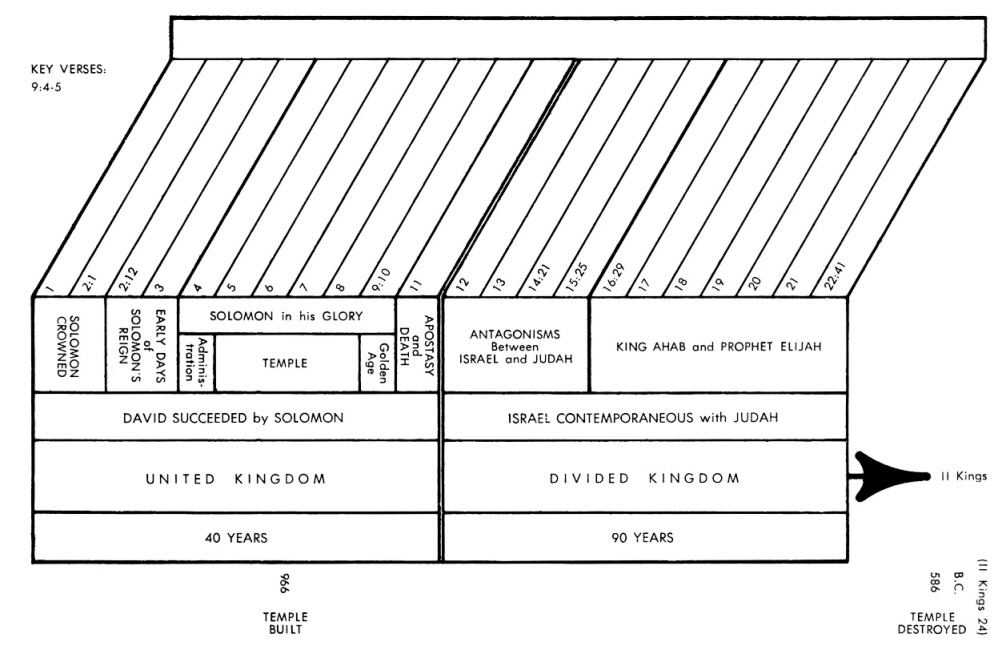
Chart from recommended resource Jensen's Survey of the OT - used by permission
1 Kings Chart from Charles Swindoll

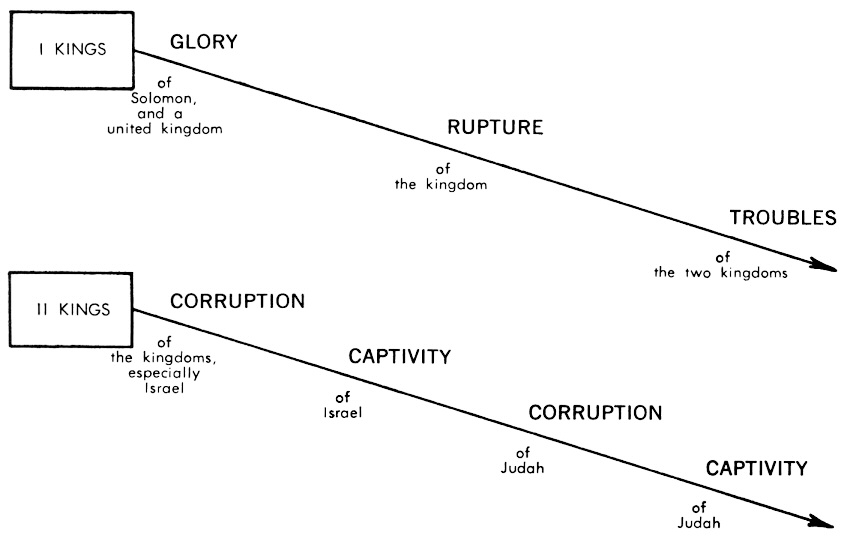
THE DOWNWARD SPIRAL
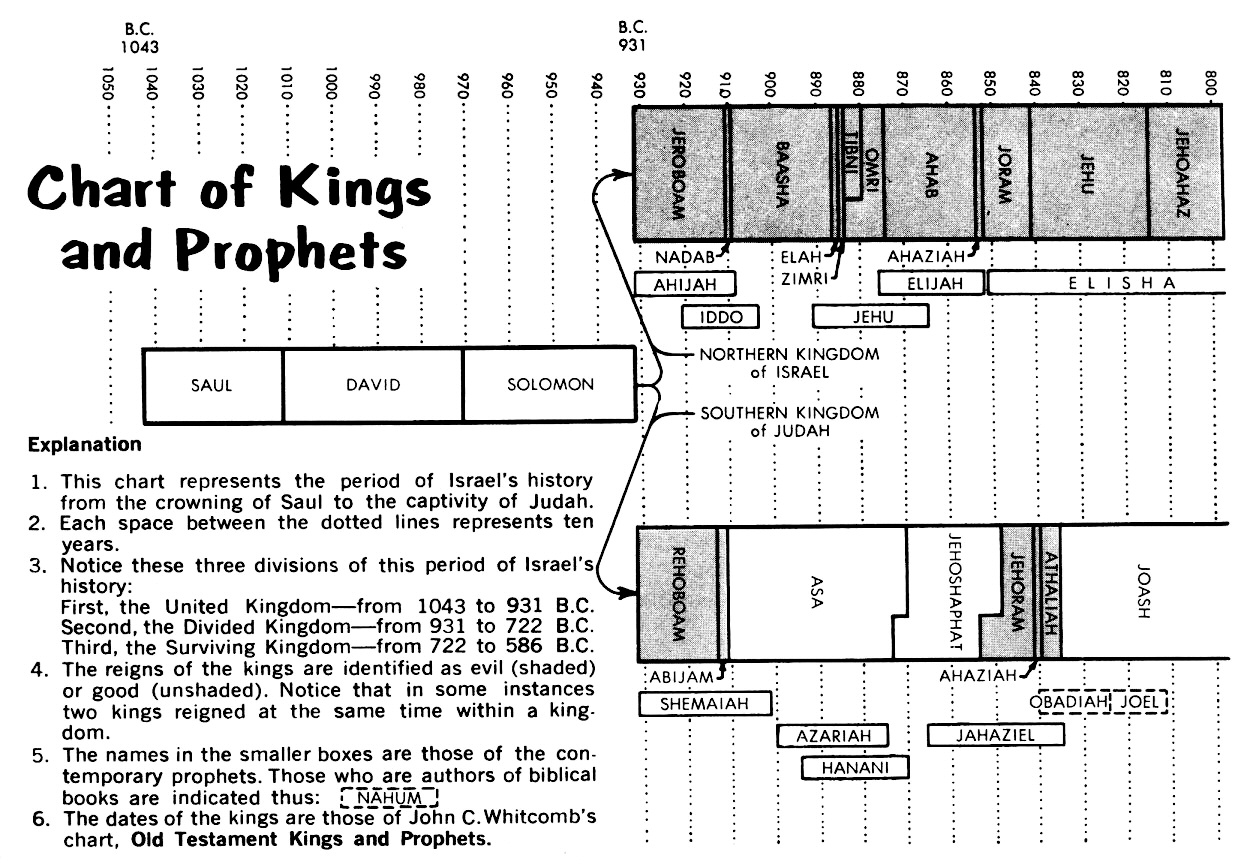
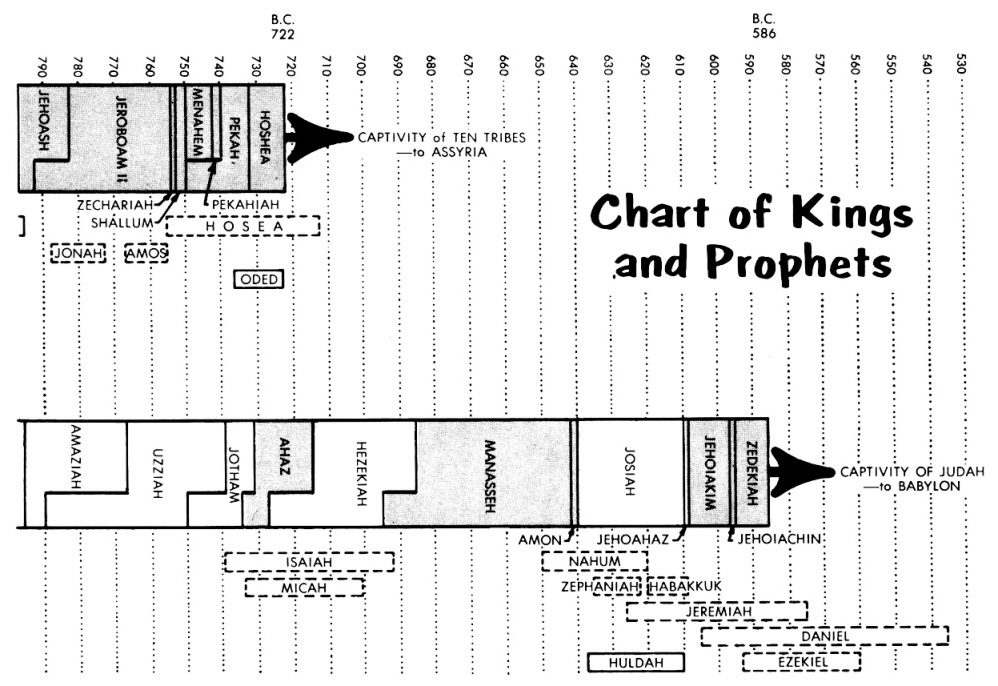
Click to Enlarge
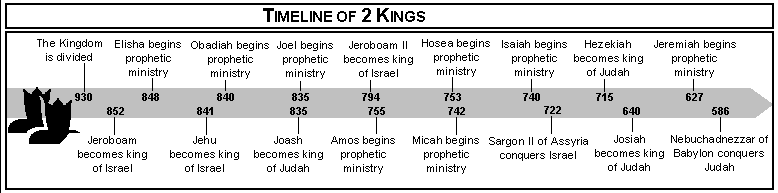
Ryrie Study Bible - Borrow
Click to Enlarge
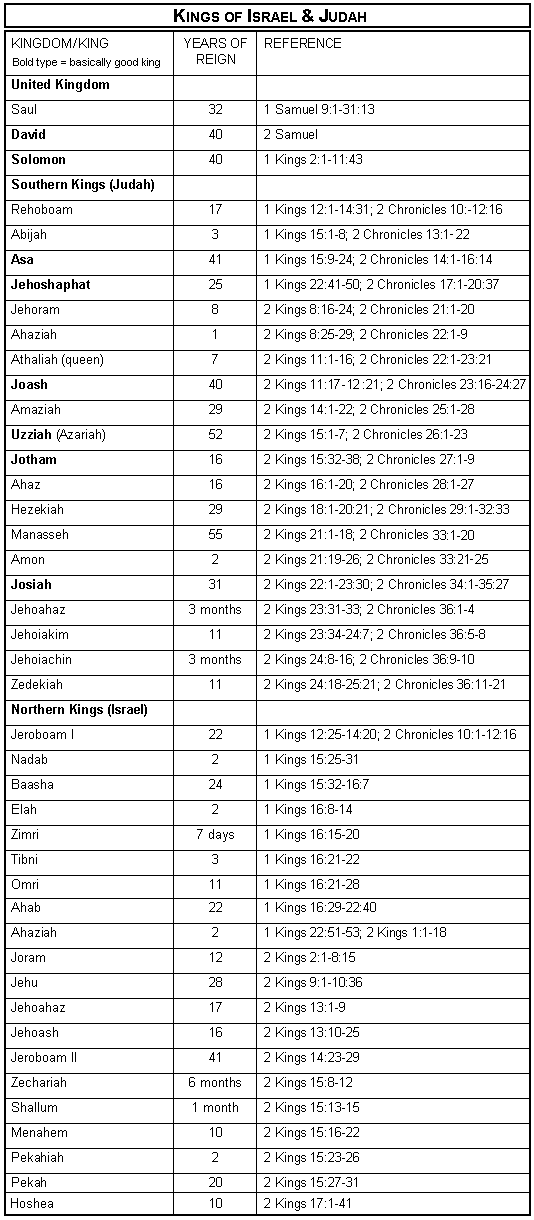
(NOTE: Many consider Amaziah and Hezekiah as "good" kings)
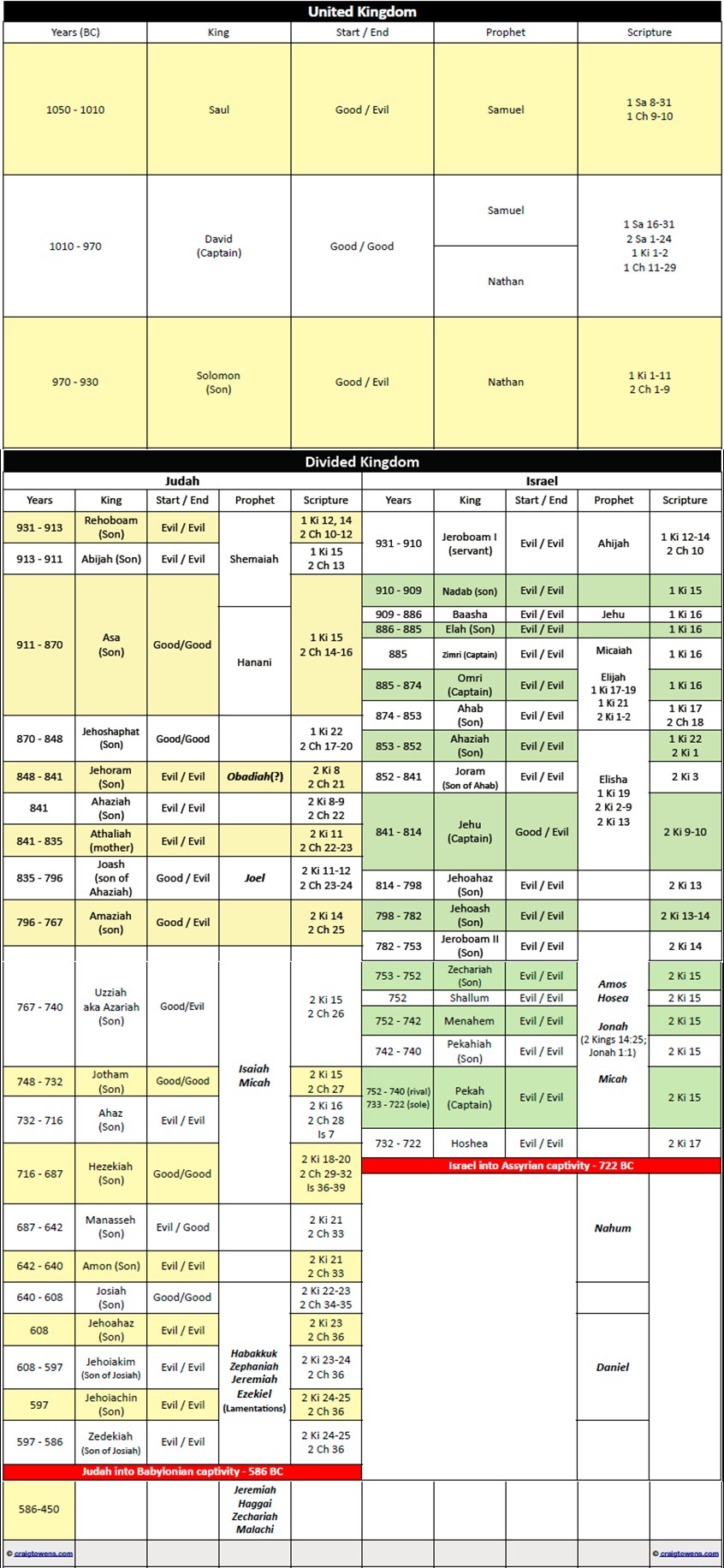
SEE ALSO:
ESV chart - kings of Israel - more information
ESV chart - kings of Judah - more information
Another Chart with Variable Dates for Reigns of King
2 Kings 15:1 In the twenty-seventh year of Jeroboam king of Israel, Azariah son of Amaziah king of Judah became king.
- In the: 2Ki 15:8 14:16,17
- Azariah: 2Ki 15:13,30-38 14:21 2Ch 26:1,3,4, Uzziah
- 2 Kings 15 Resources
Related Passages:
2 Kings 14:21 All the people of Judah took Azariah, who was sixteen years old, and made him king in the place of his father Amaziah.
Parallel Passages:
2 Chronicles 26:1 And all the people of Judah took Uzziah, who was sixteen years old, and made him king in the place of his father Amaziah.
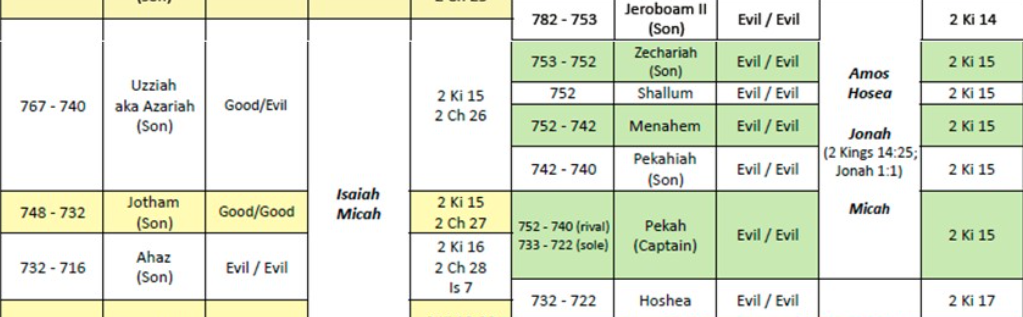
KING UZZIAH = KING AZARIAH
2 Kings 15 should be studied in conjunction with 2 Chronicles 26.
Paul Apple makes an interesting introductory observation on chapter 15 - Here you have a kingdom sandwich = 5 wicked kings of Israel sandwiched between 2 somewhat righteous reigns in Judah. As both kingdoms continue to decline, there is less of a moral distinction between God’s covenant people and the surrounding pagan nations. The transfer of power becomes the focus of much intrigue and treachery. Pride and selfish ambition fuel the lust for power as both Israel and Judah are viewed as justifiably headed for God’s judgment.
In the twenty-seventh year of Jeroboam king of Israel, Azariah son of Amaziah king of Judah became king - Azariah means “Yahweh has helped” and Uzziah means “Yahweh is my strength”. In the ancient Near East it was normal for a person, especially royalty, to have a birth name and a throne name. We cannot be dogmatic regarding which name is which - you will find comments favoring Azariah as birth name but others saying Azariah as "throne name." One suggestion is that the Chronicler uses Uzziah because of the possible confusion with the name of the High Priest, Azariah (cf. 2 Chr. 26:17,20; so named only in Chronicles). Almost everything we know about Uzziah (BDB 739) is from Chronicles.
Azariah (also known as Uzziah) enjoyed the longest reign of any king up to that time in either Judah or Israel, a remarkable distinction in an era often marked by instability and assassination. His unusually long rule reflects a period of relative continuity and strength for the kingdom of Judah.
Azariah was likely installed as coregent with his father, Amaziah, around 792 B.C. (cf. 2 Kings 14:21). This arrangement probably followed Amaziah’s capture by Jehoash of Israel and served to stabilize Judah during a time of political weakness and uncertainty. Through this coregency, Azariah gained experience in leadership while continuity on the throne was preserved.
He became sole ruler in approximately 767 B.C., corresponding to the twenty-seventh year of Jeroboam II of Israel (2 Kings 15:1). From that point forward, Azariah ruled independently, overseeing a lengthy reign that spanned decades and coincided with Judah’s military expansion, economic growth, and increased regional influence.
Guzik - Azariah came to the throne in a difficult era: “Following the tragic events that brought King Amaziah’s reign to an end, Jerusalem was in disarray, a major section of its protective wall destroyed, its temple and palace emptied of their treasures, and some of its inhabitants taken away to Israel as hostages.” (Dilday)
Gotquestions - Azariah was a common man’s name in Bible times. The name Azariah means "Yahweh has helped." Names were often given for spiritual reasons. For example, an "ah" added to a name was significant because it was part of Yahweh’s name. When God changed Abram’s name to Abraham and Sarai’s name to Sarah, He was giving them His name as part of His covenant with them (Genesis 17: 4-5, 15-16).
Wiersbe: In this section of 2 Kings, we meet with five kings of Israel who were notorious for their godless character and evil deeds. Four of them were assassinated! Shallum reigned only one month, Zechariah six months, and Pekahiah for two years. Menahem, the cruelest of them all, reigned for ten years, and Pekah for twenty years. As the Northern Kingdom stumbled toward destruction, their rulers hastened the coming of the judgment of God....His given name was Azariah, which means “Jehovah has helped,” but when the became king of Judah at age sixteen, he took the “throne name” Uzziah which means “Jehovah is strength.” The people made him king when his father Amaziah was taken to Samaria after his foolish war against Jehoash, king of Israel (2 Kings 14:13). (Bible Exposition Commentary - Old Testament)
Dale Ralph Davis: Israel is in a race to ruin, running pell-mell to extinction. If civil stability is a divine gift (cf. 1 Tim. 2:1–2), it has been withdrawn from Israel. Her own chaos is a sign that God is in the process of destroying her. (BORROW 2 Kings : the power and the fury)
2 Kings 15:2 He was sixteen years old when he became king, and he reigned fifty-two years in Jerusalem; and his mother’s name was Jecoliah of Jerusalem.
Parallel Passage:
2 Chronicles 26:3 Uzziah was sixteen years old when he became king, and he reigned fifty-two years in Jerusalem; and his mother’s name was Jechiliah of Jerusalem.
KING AZARIAH/UZZIAH'S
LONG REIGN IN JUDAH
He was sixteen years old when he became king, and he reigned fifty-two years in Jerusalem (2Ch 26:1-23); and his mother’s name was Jecoliah of Jerusalem - Azariah's reign of 52 years (includes co-regencies) is surpassed only by one other Judean king Manasseh. Azariah was coregent beginning around 792/791 BC, and began his solo reign around 768/767 BC, continuing until about 740 BC. That long reign helps explain Judah’s unusual stability and prosperity during much of his rule—until pride brought decline (2 Chronicles 26:16–21).
Chapter 10.
Concerning Jeroboam, King of Israel, and Jonah the Prophet; and how, after the death of Jeroboam, his son Zechariah took the government. How Uzziah, King of Jerusalem, subdued the nations that were round about him: and what befel him when he attempted to offer incense to God.
1. [An. 826.] In the fifteenth year of the reign of Amaziah, Jeroboam, the son of Joash reigned over Israel, in Samaria forty years.19 This King was guilty of contumely against God, (19) and became very wicked in worshipping of idols, and in many undertakings that were absurd and foreign. He was also the cause of ten thousand misfortunes to the people of Israel. Now one Jonah, a Prophet, foretold to him, that he should make war with the Syrians, and conquer their army, and enlarge the bounds of his Kingdom on the northern parts, to the city Hamath; and on the southern, to the lake Asphaltitis: for the bounds of the Canaanites originally were these; as Joshua their General had determined them. So Jeroboam made an expedition against the Syrians, and overran all their countrey; as Jonah had foretold.
2. Now I cannot but think it necessary for me, who have promised to give an accurate account of our affairs, to describe the actions of this Prophet, so far as I have found them written down in the Hebrew books. Jonah had been commanded by God to go to the Kingdom of Nineve: and when he was there, to publish it in that city, how it should lose the dominion it had over the nations. But he went not, out of fear: nay he ran away from God to the city of Joppa: and finding a ship there, he went into it, and sailed to Tarsus, in Cilicia. (20). And upon the rise of a most terrible storm, which was so great that the ship was in danger of sinking, the mariners, the master, and the pilot himself made prayers and vows, in case they escaped the sea. But Jonah lay still and covered [in the ship;] without imitating any thing which the others did. But as the waves grew greater, and the sea became more violent by the winds, they suspected, as is usual in such cases, that some one of the persons that sailed with them was the occasion of this storm: and agreed to discover by lot which of them it was. When they had cast lots, (21) the lot fell upon the Prophet. And when they asked him, Whence he came? and what he had done? He replied, that he was an Hebrew by nation, and a Prophet of Almighty God: and he persuaded them to cast him into the sea, if they would escape the danger they were in: for that he was the occasion of the storm which was upon them. Now at the first they durst not do so: as esteeming it a wicked thing to cast a man, who was a stranger, and who had committed his life to them, into such manifest perdition. But at last, when their misfortune overbore them, and the ship was just going to be drowned; and when they were animated to do it by the Prophet himself, and by the fear concerning their own safety, they cast him into the sea. Upon which the sea became calm. It is also related that Jonah was swallowed down by a whale: and that when he had been there three days, and as many nights, he was vomited out upon the Euxine Sea; and this alive, and without any hurt upon his body. And there, on his prayer to God, he obtained pardon for his sins, and went to the city Nineveh: where he stood so as to be heard; and preached, that “In a very little time they should lose the dominion of Asia.” And when he had published this, he returned. Now I have given this account about him, as I found it written [in our books.]
3. [About An. 785.] When Jeroboam the King had passed his life in great happiness, and had ruled forty years, he died, and was buried in Samaria, and his son Zechariah took the Kingdom. After the same manner did Uzziah, the son of Amaziah, begin to reign over the two tribes in Jerusalem in the fourteenth year of the reign of Jeroboam. He was born of Jecoliah his mother, who was a citizen of Jerusalem. He was a good man, and by nature righteous, and magnanimous; and very laborious in taking care of the affairs of his Kingdom. He made an expedition also against the Philistines, and overcame them in battel, and took the cities of Gath and Jabneh,20 and brake down their walls. After which expedition he assaulted those Arabs, that adjoined to Egypt. He also built a city upon the red sea, and put a garrison into it. He after this overthrew the Ammonites; and appointed that they should pay tribute. He also overcame all the countries as far as the bounds of Egypt; and then began to take care of Jerusalem it self, for the rest of his life. For he rebuilt and repair’d all those parts of the wall which had either fallen down by length of time, or by the carelessness of the Kings his predecessors; as well as all that part which had been thrown down by the King of Israel, when he took his father Amaziah prisoner, and entred with him into the city. Moreover he built a great many towers, of one hundred and fifty cubits high; and built walled towns in desert places, and put garrisons into them; and dug many channels for conveyance of water. He had also many beasts for labour; and an immense number of cattel; for his countrey was fit for pasturage. He was also given to husbandry; and took care to cultivate the ground; and planted it with all sorts of plants, and sowed it with all sorts of seeds. He had also about him an army composed of chosen men, in number three hundred and seventy thousand:21 who were governed by general officers, and captains of thousands, who were men of valour, and of unconquerable strength; in number two thousand. He also divided his whole army into bands, and armed them: giving every one a sword, with brazen bucklers, and breastplates, with bows, and slings; and besides these he made for them many engines of war, for besieging of cities; such as cast stones and darts; with grapplers, and other instruments of that sort.
4. [About An. 766.] While Uzziah was in this state, and making preparation [for futurity,] he was corrupted in his mind by pride, and became insolent; and this on account of that abundance which he had of things that will soon perish; and despised that power which is of eternal duration: (which consisted in piety towards God, and in the observation of the laws:) so he fell by occasion of the good success of his affairs; and was carried headlong into those sins of his fathers, which the splendour of that prosperity he enjoyed, and the glorious actions he had done, led him into: while he was not able to govern himself well about them. Accordingly when a remarkable day was come, and a general festival was to be celebrated, he put on the holy garment, and went into the temple to offer incense to God upon the golden altar; which he was prohibited to do by Azariah the High Priest, who had fourscore Priests with him, and who told him, that it was not lawful for him to offer sacrifice: and that “None besides the posterity of Aaron were permitted so to do.” And when they cried out, that he must go out of the temple, and not transgress against God, he was wroth at them, and threatened to kill them, unless they would hold their peace. In the mean time a great earthquake shook the ground, and a rent was made in the temple, and the bright rays of the sun shone through it; (22) and fell upon the King’s face; insomuch that the leprosy seized upon him immediately. And before the city, at a place called Eroge, half the mountain broke off from the rest on the west, and rolled it self four furlongs, and stood still at the east mountain; till the roads, as well as the King’s gardens, were spoiled by the obstruction. Now as soon as the Priests saw that the King’s face was infected with the leprosy, they told him of the calamity he was under, and commanded that he should go out of the city, as a polluted person. Hereupon he was so confounded at the sad distemper, and sensible that he was not at liberty to contradict; that he did as he was commanded; and underwent this miserable and terrible punishment for an intention beyond what befited a man to have, and for that impiety against God which was implied therein. So he abode out of the city for some time, and lived a private life: while his son Jotham took the government. After which he died with grief and anxiety at what had happened to him; when he had lived sixty eight years, and reigned of them fifty-two.22 And was buried by himself in his own gardens.
Chapter 11.
How Zachariah, Shallum, Menahem, Pekahiah, and Pekah took the government over the Israelites ; and how Pul, and Tiglath-Pileser made an expedition against the Israelites. How Jotham, the son of Uzziah, reigned over the tribe of Judah: and what things Nahum prophesied against the Assyrians.
1. [An. 773.] Now when Zachariah, the son of Jeroboam, had reigned six months over Israel, he was slain by the treachery of a certain friend of his, whose name was Shallum, the son of Jabesh: who took the Kingdom afterward; but kept it no longer than thirty days. For Menahem, the General of his army, who was at that time in the city Tirzah, and heard of what had befallen Zachariah, removed thereupon with all his forces to Samaria; and joining battel with Shallum, slew him: and when he had made himself King, he went thence, and came to the city Tiphsah. But the citizens that were in it shut their gates, and barred them against the King; and would not admit him. But in order to be avenged on them, he burnt the countrey round about it, and took the city by force, upon a siege; and being very much displeased at what the inhabitants of Tiphsah had done, he slew them all, and spared not so much as the infants; without omitting the utmost instances of cruelty and barbarity. For he used such severity upon his own countreymen, as would not be pardonable with regard to strangers, who had been conquered by him. And after this manner it was that this Menahem continued to reign with cruelty and barbarity for ten years.23 But when Pul, King of Assyria, had made an expedition against him, he did not think meet to fight or engage in battel with the Assyrians: but he persuaded him to accept of a thousand talents of silver, and to go away, and so put an end to the war. This sum the multitude collected for Menahem, by exacting 50 drachmæ, as poll-money for every head. (23) After which he died, and was buried in Samaria; and left his son Pekahiah his successor in the Kingdom. Who followed the barbarity of his father, and so ruled but two years only: after which he was slain with his friends at a feast, by the treachery of one Pekah, the General of his horse, and the son of Remaliah, who laid snares for him. Now this Pekah held the government twenty years;24 and proved a wicked man, and a transgressor. But the King of Assyria, whose name was Tiglath-Pileser, when he had made an expedition against the Israelites, and had over-run all the land of Gilead, and the region beyond Jordan, and the adjoining countrey, which is called Galilee, and Kadesh, and Hazor, he made the inhabitants prisoners, and transplanted them into his own Kingdom. And so much shall suffice to have related here concerning the King of Assyria.
2. [An. 759.] Now Jotham, the son of Uzziah, reigned over the tribe of Judah in Jerusalem: being a citizen thereof by his mother, whose name was Jerusha. This King was not defective in any virtue; but was religious towards God, and righteous towards men, and careful of the good of the city: (for what parts soever wanted to be repaired or adorned, he magnificently repaired and adorned them:) He also took care of the foundations of the cloisters in the temple; and repaired the walls that were fallen down: and built very great towers, and such as were almost impregnable: and if any thing else in his Kingdom had been neglected, he took great care of it. He also made an expedition against the Ammonites, and overcame them in battel; and ordered them to pay tribute; an hundred talents, and ten thousand cori of wheat, and as many of barley every year: and so augmented his Kingdom, that his enemies could not despise it, and his own people lived happily.
3. Now there was at that time a Prophet, whose name was Nahum; who spake after this manner concerning the overthrow of the Assyrians, and of Nineveh: “Nineveh shall be a pool of water in motion: (24) so shall all her people be troubled, and tossed, and go away by flight: while they say one to another, stand, stand still; seize their gold and silver; for there shall be no one to wish them well. For they will rather save their lives than their money. For a terrible contention shall possess them one with another, and lamentation, and loosing of the members; and their countenances shall be perfectly black with fear. And where will be the den of the lions; and the mother of the young lions? God says to thee, Nineveh, that they shall deface thee, and the lion shall no longer go out from thee, to give laws to the world.” And indeed this Prophet prophesied many other things besides these concerning Nineveh; which I do not think necessary to repeat: and I here omit them, that I may not appear troublesome to my readers. All which things happened about Nineveh an hundred and fifteen years afterward. [About An. 611.] So this may suffice to have spoken of these matters.
Chapter 12.
How, upon the death of Jotham, Ahaz reigned in his stead: against whom, Rezin King of Syria, and Pekah King of Israel made war: and how Tiglath-Pileser, King of Assyria came to the assistance of Ahaz, and laid Syria waste; and removing the Damascens into Media, placed other nations in their room.
1. [An. 744.] Now Jotham died, when he had lived forty one years, and of them reigned sixteen;25 and was buried in the sepulchres of the Kings. And the Kingdom came to his son Ahaz: who proved most impious towards God, and a transgressor of the laws of his countrey. (25) He imitated the Kings of Israel, and reared altars in Jerusalem, and offered sacrifices upon them to idols; to which also he offered his own son as a burnt offering; according to the practices of the Canaanites. His other actions were also of the same sort. Now as he was going on in this mad course, Rezin the King of Syria, and Damascus; and Pekah the King of Israel, who were now at amity one with another, made war with him. And when they had driven him into Jerusalem, they besieged that city a long while: making but a small progress, on account of the strength of its walls. And when the King of Syria had taken the city Elath, upon the red sea, and had slain the inhabitants, he peopled it with Syrians: and when he had slain those in the [other] garisons, and the Jews in their neighbourhood, and had driven away much prey, he returned with his army back to Damascus. Now when the King of Jerusalem knew that the Syrians were returned home, he supposing himself a match for the King of Israel, drew out his army against him; and joining battel with him was beaten. And this happened because God was angry with him, on account of his many and great enormities. Accordingly there were slain by the Israelites one hundred and twenty thousand of his men that day: whose general, Amaziah by name, slew Zachariah the King’s son in his conflict with Ahaz; as well as the Governor of the Kingdom, whose name was Azricam. He also carried Elkanah, the General of the troops of the tribe of Judah, into captivity. They also carried the women and children of the tribe of Benjamin captives.26 And when they had gotten a great deal of prey, they returned to Samaria.
2. [An. 742.] Now there was one Obed who was a Prophet at that time in Samaria: he met the army before the city walls; and with a loud voice told them, that “They had got the victory, not by their own strength, but by reason of the anger God had against King Ahaz.” And he complained, that “They were not satisfied with the good success they had had against him; but were so bold as to make captives out of their kinsmen, the tribes of Judah and Benjamin. He also gave them counsel to let them go home, without doing them any harm: for that if they did not obey God herein, they should be punished.” So the people of Israel came together to their assembly, and considered of these matters: when a man whose name was Berechiah, and who was one of chief reputation in the government, stood up, and three others with him, and said, “We will not suffer the citizens to bring these prisoners into the city, lest we be all destroyed by God. We have sins enow of our own, that we have committed against him, as the Prophets assure us. Nor ought we therefore to introduce the practice of new crimes.” When the soldiers heard that, they permitted them to do what they thought best. So the forenamed men took the captives, and let them go, and took care of them, and gave them provisions, and sent them to their own countrey, without doing them any harm. However, these four went along with them, and conducted them as far as Jericho: which is not far from Jerusalem: and returned to Samaria.
3. Hereupon King Ahaz having been so thoroughly beaten by the Israelites, sent to Tiglath-Pileser King of the Assyrians, and sued for assistance from him, in his war against the Israelites, and Syrians, and Damascens: with a promise to send him much money. He sent him also great presents at the same time. Now this King, upon the reception of those Ambassadors, came to assist Ahaz, and made war upon the Syrians, and laid their country waste, and took Damascus by force, and slew Rezin their King, and transplanted the people of Damascus into the upper Media; and brought a colony of Assyrians, and planted them in Damascus. He also afflicted the land of Israel, and took many captives out of it; while he was doing thus with the Syrians, King Ahaz took all the gold that was in the King’s treasures, and the silver, and what was in the temple of God, and what precious gifts were there, and he carried them with him, and came to Damascus, and gave it to the King of Assyria, according to his agreement. So he confessed that he owed him thanks for all that he had done for him: and returned to Jerusalem. Now this King was so sottish, and thoughtless of what was for his own good, that he would not leave off worshipping the Syrian Gods, when he was beaten by them: but he went on in worshipping them, as though they would procure him the victory. And when he was beaten again, he began to honour the Gods of the Assyrians; and he seemed more desirous to honour any other Gods than his own paternal and true God; whose anger was the cause of his defeat. Nay he proceeded to such a degree of despight and contempt, [of God’s worship,] that he shut up the temple intirely; and forbad them to bring in the appointed sacrifices; and took away the gifts that had been given to it. And when he had offered these indignities to God, he died: having lived thirty six years, (26) and of them reigned sixteen:27 and he left his son Hezekiah for his successor.
How Pekah died by the treachery of Hoshea; who was a little after subdued by Shalmaneser. And how Hezekiah reigned instead of Ahaz; and what actions of piety and justice he did.
1. [An. 731.] About the same time Pekah, the King of Israel died, by the treachery of a friend of his, whose name was Hoshea, who retained the Kingdom nine years time:28 but was a wicked man, and a despiser of the divine worship. And Shalmaneser the King of Assyria made an expedition against him, and overcame him: (which must have been because he had not God favourable nor assistant to him:) and brought him to submission, and ordered him to pay an appointed tribute. Now in the fourth year of the reign of Hoshea, Hezekiah, the son of Ahaz, began to reign in Jerusalem: and his mother’s name was Abijah, a citizen of Jerusalem. His nature was good, and righteous, and religious. For when he came to the Kingdom he thought that nothing was prior, or more necessary, or more advantagious to himself, and to his subjects, than to worship God. Accordingly he called the people together, and the Priests, and the Levites; and made a speech to them, and said: “You are not ignorant how by the sins of my father, who transgressed that sacred honour which was due to God, you have had experience of many and great miseries: while you were corrupted in your mind by him: and were induced to worship those which he supposed to be gods. I exhort you therefore, who have learned by sad experience how dangerous a thing impiety is, to put that immediately out of your memory; and to purify your selves from your former pollutions; and to open the temple to these Priests and Levites who are here convened; and to cleanse it with the accustomed sacrifices, and to recover all to the ancient honour which our fathers payed to it. For by this means we may render God favourable; and he will remit the anger he hath had to us.”
2 Kings 15:3 He did right in the sight of the LORD, according to all that his father Amaziah had done.
- 2Ki 12:2,3 14:3,4 2Ch 26:4
- 2 Kings 15 Resources
Parallel Passage:
2 Chronicles 26:4-5 He did right in the sight of the LORD according to all that his father Amaziah had done. 5 He continued to seek God in the days of Zechariah, who had understanding through the vision of God; and as long as he sought the LORD, God prospered him.
2 Chronicles 27:1 Jotham was twenty-five years old when he became king, and he reigned sixteen years in Jerusalem. And his mother’s name was Jerushah the daughter of Zadok.
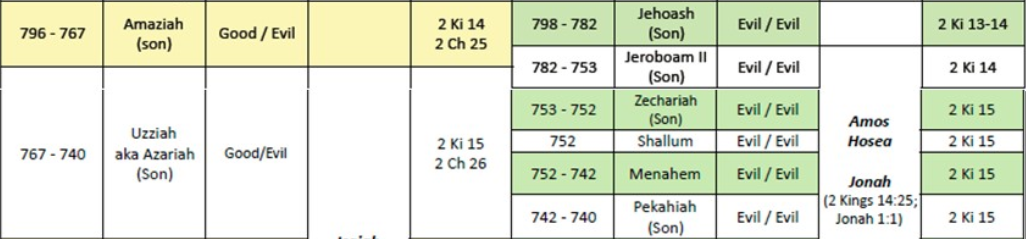
He did right (yashar) in the sight of the LORD, according to all that his father Amaziah had done - From the chart above note Amaziah began well but ended poorly. Recall from 2Ch 25:14-16 King Amaziah eorshiped Edomite gods. rejected prophetic rebuke, provoked disastrous war with Israel (2Ch 25:17-22) and ended by being assassinated (2 Ki 14:19). Therefore according to all that his father Amaziah had done clearly refers to the early obedience of Amaziah. It is interesting that Jotham in doing right is not compared David, but Amaziah, definitely a lower "benchmark." The one thing that might be held against Jotham is that he did not remove the high places (2Ki 15:35).
Doing right in the sight of the LORD means living under divine oversight, knowing that God sees every act and every motive. It is a life of reverent accountability before a holy God. As we might say today it is living Coram Deo-Before the Face of God. Sadly, as the rest of Amaziah's story shows, a good beginning does not guarantee a good finish.
🙏 THOUGHT - Are you living Coram Deo-Before the Face of God, remembering that our life will ultimately be evaluated at the Bema Seat of Christ, not by what men see, but what the LORD sees. When God takes the measure of a man or woman, He doesn't but a "tape measure" around your head to see how much you know, but He puts it around your heart to see how much you obey! (cf Pr 4:23)
Bob Utley - This is a strange verse to me. Not because of the phrase "he did right in the sight of the Lord" (cf. 1 Ki 11:33,38; 14:8; 15:5,11; 22:43; 2 Kgs. 10:30; 12:3; 14:3; 15:3,34; 16:2; 18:3; 22:2) but the second phrase, "according to all that his father Amaziah had done" (cf. 2 Kgs. 14:3; 2 Chr. 25:2 and especially 2 Chr. 25:14-16). Josephus (Antiq. 9.10.3 - see note) says of him, "He was a good man, and by nature righteous and magnanimous, and very laborious in taking care of the affairs of his kingdom." Also note Antiq. 9.11.2.
Right (03477) yashar from the verb yashar = to be smooth, straight or right) is an adjective that means straight; reliable, level, pleasing; upright; righteous. Yashar only rarely is used literally of that which is straight (Ezek 1:7). Yashar can refer to something physical like a path, but even in those uses is often a metaphorical description of one's conduct or behavior (Ps 107:7). Most uses refer to that which is right in an ethical or an emotional sense, as agreeable or pleasing. It is fitting that God is the standard of yashar (what is "straight") (Ps 92:15, called the "Upright One" - Isa 26:7). God's Word is described as upright (right) (Ps 19:7) as are His judgments (Ps 119:137) and His way (Ps 107:7). "God made men upright (Ge 1:27), but they have sought out many devices." (Eccl 7:29)
Yashar is frequently used to describe our moral/ethical heart as "upright in heart" (Ps 7:10, 11:2, 32:11, 36:10, 64:10, 94:15, 97:11, 111:1, 125:4) (See all uses in Psalms and Proverbs below). Indeed, the upright "will behold His face" (Ps 11:7), will experience gladness (Ps 97:11), will be gathered together in the assembly (Ps 111:1), will be blessed (Ps 112:2), will be given light in times of darkness (Ps 112:4), will dwell in God's presence (Ps 140:13, cp Pr 2:21), have access to God's sound wisdom (Pr 2:7), will experience intimacy with the Most High God (Pr 3:32), will be guided by their integrity (Pr 11:3), will be delivered by their righteousness (Pr 11:6), will be delivered by their words (Pr 12:6), will see their tents flourish (Pr 14:11). "The highway of the upright is to depart from evil." (Pr 16:17)
YASHAR IN KINGS AND CHRONICLES - 1 Ki. 11:33; 1 Ki. 11:38; 1 Ki. 14:8; 1 Ki. 15:5; 1 Ki. 15:11; 1 Ki. 22:43; 2 Ki. 10:3; 2 Ki. 10:15; 2 Ki. 10:30; 2 Ki. 12:2; 2 Ki. 14:3; 2 Ki. 15:3; 2 Ki. 15:34; 2 Ki. 16:2; 2 Ki. 18:3; 2 Ki. 22:2; 2 Chr. 14:2; 2 Chr. 20:32; 2 Chr. 24:2; 2 Chr. 25:2; 2 Chr. 26:4; 2 Chr. 27:2; 2 Chr. 28:1; 2 Chr. 29:2; 2 Chr. 29:34; 2 Chr. 31:20; 2 Chr. 34:2
2 Kings 15:4 Only the high places were not taken away; the people still sacrificed and burned incense on the high places.
- the high places: 2Ki 15:35 14:4 18:4 1Ki 15:14 22:43 2Ch 17:6 32:12 34:3
- 2 Kings 15 Resources
Related Passages:
2 Chronicles 26:5-15 He continued to seek God in the days of Zechariah, who had understanding through the vision of God; and as long as he sought the LORD, God prospered him. 6Now he went out and warred against the Philistines, and broke down the wall of Gath and the wall of Jabneh and the wall of Ashdod; and he built cities in the area of Ashdod and among the Philistines. 7God helped him against the Philistines, and against the Arabians who lived in Gur-baal, and the Meunites. 8The Ammonites also gave tribute to Uzziah, and his fame extended to the border of Egypt, for he became very strong. 9Moreover, Uzziah built towers in Jerusalem at the Corner Gate and at the Valley Gate and at the corner buttress and fortified them. 10He built towers in the wilderness and hewed many cisterns, for he had much livestock, both in the lowland and in the plain. He also had plowmen and vinedressers in the hill country and the fertile fields, for he loved the soil. 11Moreover, Uzziah had an army ready for battle, which entered combat by divisions according to the number of their muster, prepared by Jeiel the scribe and Maaseiah the official, under the direction of Hananiah, one of the king’s officers. 12The total number of the heads of the households, of valiant warriors, was 2,600. 13Under their direction was an elite army of 307,500, who could wage war with great power, to help the king against the enemy. 14Moreover, Uzziah prepared for all the army shields, spears, helmets, body armor, bows and sling stones. 15In Jerusalem he made engines of war invented by skillful men to be on the towers and on the corners for the purpose of shooting arrows and great stones. Hence his fame spread afar, for he was marvelously helped until he was strong.
Deuteronomy 12:1-7 (YAHWEH GIVES INSTRUCTIONS ABOUT WHERE TO WORSHIP HIM) 1“These are the statutes and the judgments which you shall carefully observe in the land which the LORD, the God of your fathers, has given you to possess as long as you live on the earth. 2 “You shall utterly destroy all the places where the nations whom you shall dispossess serve their gods, on the high mountains and on the hills and under every green tree. 3 “You shall tear down their altars and smash their sacred pillars and burn their Asherim with fire, and you shall cut down the engraved images of their gods and obliterate their name from that place. 4 “You shall not act like this toward the LORD your God.5 “But you shall seek the LORD at the place which the LORD your God will choose from all your tribes, to establish His name there for His dwelling, and there you shall come. 6 “There you shall bring your burnt offerings, your sacrifices, your tithes, the contribution of your hand, your votive offerings, your freewill offerings, and the firstborn of your herd and of your flock. 7 “There also you and your households shall eat before the LORD your God, and rejoice in all your undertakings in which the LORD your God has blessed you.
AZARIAH'S LENIENCY
ALLOWING HIGH PLACES
Only the high places (bamah) were not taken away; the people still sacrificed and burned incense on the high places. God is not honored by disobedience. Here a "godly" activity was carried out in direct disobedience to God's will!
A sad phrase that is repeated again and again (speaking of Israel and Judah) is "the high places were not taken away" (1Ki 15:14, 2Chr 15:17 = King Asa but notice he did remove some of them - 2Chr 14:3, 5, 1Ki 22:43, 2Chr 20:33 = King Jehoshaphat, 2Ki 12:3 = King Jehoash, 2Ki 14:4 = King Amaziah, 2Ki 15:4 = King Azariah, 2Ki 15:35 = King Jotham son of Uzziah and look what his son did in 2Ki 16:1-4!, 2Chr 20:33). In many of these passages the context was of a king doing "spiritual house cleaning" so to speak and yet still failing to remove the high places. Isn't sin that way? We confess one or two sins but we have a little pet sin (better a "venomous viper") that we just don't have the heart to kill! God grant us spiritual eyes and hearts to learn from Israel's mistakes. Amen! Some kings like Hezekiah (1Ki 18:4, 2Chr 31:1, Isa 36:7) and Josiah (2Ki 23:4,8, 13, 15, 19-20, 2Chr 34:3 cp prophecy about Josiah 300 years earlier = 1Ki 13:2) did destroy the high places, but in Hezekiah's case his own son Manasseh rebuilt them (2Ki 21:1-2, 3, 2Chr 33:3) and in Josiah's case the people rebuilt them!
🙏 THOUGHT - Do you (I) have any persistent "high places" in our life, things that are preventing us from experiencing what Jesus desires for each of us - to have life and have it abundantly (Jn 10:10b+)?
NOT TAKEN AWAY - 6V - 1 Ki. 15:14; 1 Ki. 22:43; 2 Ki. 12:3; 2 Ki. 14:4; 2 Ki. 15:4; 2 Ki. 15:35
Warren Wiersbe on high places - The only thing Joash and Jehoiada didn’t do was remove the high places in Judah, the local shrines where the people worshipped the Lord. They were supposed to go to the temple to worship (Deut. 12:5-7), but during the dark days of Athaliah’s reign, the temple had been ignored and even allowed to decay.
During the period of Judges, (high places) were sanctioned by YHWH and yet
over the period of time, they came to be worship centers for Ba'al.
Bob Utley - "the high places" These were the local worship sites. They were originally used for the worship of Canaanite fertility deities, but after the conquest of Canaan by Israel, they became YHWHistic shrines. They were used quite extensively and condoned during the period of the Judges and used, even by Solomon (cf. 1 Kgs. 3:3-4), but at this period they had become amalgamated again with the fertility cults. These were local places of worship were not condemned but with the rise of a mandated central shrine in Jerusalem, they became identified with Ba'al worship. Not until Hezekiah (2 Kgs. 18:4) were the high places destroyed (cf. 1 Kgs. 15:14; 22:43; 2 Kgs. 12:3; 14:4; 15:4,35). It was not until the time of Hezekiah (cf. 2 Kgs. 18:4) that these local shrines were obliterated and outlawed. The reason that they were so difficult to deal with is because during the period of Judges, they were sanctioned by YHWH and yet over the period of time, they came to be worship centers for Ba'al. SPECIAL TOPIC: FERTILITY WORSHIP OF THE ANE "the high places"
High places (01116) bamah meaning heights or elevated platforms. These were hilltop sanctuaries or raised altars, often built on mountains or hills (hence “high place”). Originally, before the construction of the Temple in Jerusalem, such places were sometimes used for legitimate worship of Yahweh (for example, by Samuel in 1 Samuel 9:12–14). But over time, high places became associated primarily with idolatry and syncretism—mixing the worship of the true God with pagan practices. Before Solomon built the Temple, Israelites offered sacrifices at various places. God tolerated this temporarily (see 1Ki 3:2-4). Solomon himself sacrificed at Gibeon, which was considered a high place originally devoted to the Lord. Yet later, his heart turned away from the LORD when he allowed idolatrous shrines for his foreign wives (1Ki 11:7-8).
Even though Judah had the Temple in Jerusalem, many kings tolerated or even participated in worship at the high places. Some key examples: Asa and Jehoshaphat did what was right, but failed to remove all the high places (1 Kings 15:14; 22:43). Hezekiah was one of the few who destroyed them completely: “He removed the high places, shattered the pillars, and cut down the Asherah poles.” — 2 Kings 18:4 But after Hezekiah, Manasseh rebuilt them and led Judah into grave sin (2 Kings 21:3). Finally, Josiah again tore them down comprehensively during his reforms (2 Kings 23:8–15).
Six activities seem to be related to high places -- burning of incense, sacrificing, eating of sacrificial meals, praying, prostitution, child sacrifice (cf. bama in the valley, Je 7:31). The first use in Lev 26:30 is God's declaration to Israel "I will destroy your high places." In Dt 32:13 speaking of Jacob (Israel) He declared "He made him ride on the high places of the earth," so clearly some uses of bamah are not negative. In a similar use God says Israel "you will tread upon their (Israel's enemies') high places." Another positive use is Psalm 18:33 where David declared Jehovah "makes my feet like hinds' feet, And sets me upon my high places." (cp Hab 3:19 - NET Note = David "compares his agility in battle to the ability of a deer to negotiate rugged, high terrain without falling or being injured.", cp Isa 58:14) We see he effect of Israel's high places on Jehovah in Ps 78:58 = "For they provoked Him with their high places and aroused His jealousy with their graven images."
The high places serve as a vivid reminder that idolatry begins in the heart, not only on hills. Human beings often prefer convenient, self-defined worship rather than the obedience God requires. God demands exclusive worship “in spirit and in truth” (John 4:23–24). The high places represent humanity’s attempt to worship God our way, instead of His way. God’s response through the prophets was clear — He alone chooses how He is to be worshiped, and any compromise is idolatry.
BAMAH - 91V - Lev. 26:30; Num. 22:41; Num. 33:52; Deut. 32:13; Deut. 33:29; 1 Sam. 9:12; 1 Sam. 9:13; 1 Sam. 9:14; 1 Sam. 9:19; 1 Sam. 9:25; 1 Sam. 10:5; 1 Sam. 10:13; 2 Sam. 1:19; 2 Sam. 1:25; 2 Sam. 22:34; 1 Ki. 3:2; 1 Ki. 3:3; 1 Ki. 3:4; 1 Ki. 11:7; 1 Ki. 12:31; 1 Ki. 12:32; 1 Ki. 13:2; 1 Ki. 13:32; 1 Ki. 13:33; 1 Ki. 14:23; 1 Ki. 15:14; 1 Ki. 22:43; 2 Ki. 12:3; 2 Ki. 14:4; 2 Ki. 15:4; 2 Ki. 15:35; 2 Ki. 16:4; 2 Ki. 17:9; 2 Ki. 17:11; 2 Ki. 17:29; 2 Ki. 17:32; 2 Ki. 18:4; 2 Ki. 18:22; 2 Ki. 21:3; 2 Ki. 23:5; 2 Ki. 23:8; 2 Ki. 23:9; 2 Ki. 23:13; 2 Ki. 23:15; 2 Ki. 23:19; 2 Ki. 23:20; 1 Chr. 16:39; 1 Chr. 21:29; 2 Chr. 1:3; 2 Chr. 1:13; 2 Chr. 11:15; 2 Chr. 14:3; 2 Chr. 14:5; 2 Chr. 15:17; 2 Chr. 17:6; 2 Chr. 20:33; 2 Chr. 21:11; 2 Chr. 28:4; 2 Chr. 28:25; 2 Chr. 31:1; 2 Chr. 32:12; 2 Chr. 33:3; 2 Chr. 33:17; 2 Chr. 33:19; 2 Chr. 34:3; Job 9:8; Ps. 18:33; Ps. 78:58; Isa. 14:14; Isa. 15:2; Isa. 16:12; Isa. 36:7; Isa. 58:14; Jer. 7:31; Jer. 17:3; Jer. 19:5; Jer. 26:18; Jer. 32:35; Jer. 48:35; Ezek. 6:3; Ezek. 6:6; Ezek. 16:16; Ezek. 20:29; Ezek. 36:2; Hos. 10:8; Amos 4:13; Amos 7:9; Mic. 1:3; Mic. 1:5; Mic. 3:12; Hab. 3:19
2 Kings 15:5 The LORD struck the king, so that he was a leper to the day of his death. And he lived in a separate house, while Jotham the king’s son was over the household, judging the people of the land.
- The LORD struck the king, 2Sa 3:29 2Ch 26:16-20 Job 34:19
- so that: 2Ki 5:27 Nu 12:10
- And he lived in a separate house: 2Ki 7:3 Lev 13:46 Nu 12:14 De 24:8
- Jotham: 2Ch 26:21,23
- judging: 2Sa 8:15 15:2-4 1Ki 3:9,28 Ps 72:1
- 2 Kings 15 Resources
Related Passages:
2 Chronicles 26:16-20 (AZARIAH'S ROOT PROBLEM - PRIDE) But when he became strong, his heart was so proud that he acted corruptly, and he was unfaithful to the LORD his God, for (term of explanation) he entered the temple of the LORD to burn incense on the altar of incense (IN THE HOLY PLACE WHERE ONLY PRIESTS WERE ALLOWED). 17 Then Azariah the priest entered after him and with him eighty priests of the LORD, valiant men. 18 They opposed Uzziah the king and said to him, “It is not for you, Uzziah, to burn incense to the LORD, but for the priests, the sons of Aaron who are consecrated to burn incense. Get out of the sanctuary, for you have been unfaithful and will have no honor from the LORD God.” 19 But Uzziah, with a censer in his hand for burning incense, was enraged; and while he was enraged with the priests, the leprosy broke out on his forehead before the priests in the house of the LORD, beside the altar of incense. 20 Azariah the chief priest and all the priests looked at him, and behold, he was leprous on his forehead; and they hurried him out of there, and he himself also hastened to get out because the LORD had smitten him. 21 King Uzziah was a leper to the day of his death; and he lived in a separate house, being a leper, for he was cut off from the house of the LORD. And Jotham his son was over the king’s house judging the people of the land.
Parallel Passage:
2 Chronicles 26:21 King Uzziah was a leper to the day of his death; and he lived in a separate house, being a leper, for he was cut off from the house of the LORD. And Jotham his son was over the king’s house judging the people of the land.
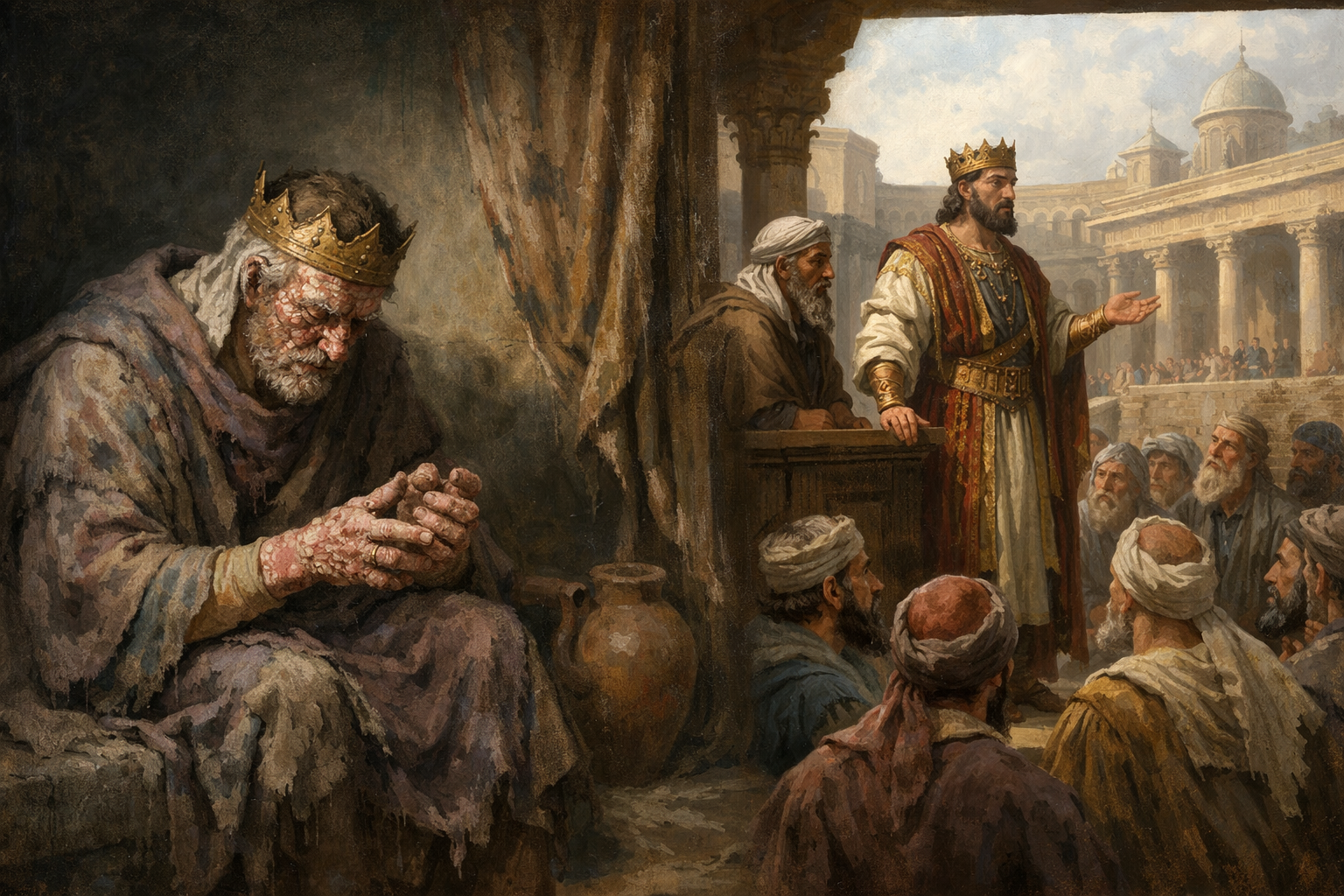
Azariah's Plight, Jotham's Rule in Light
LEPROSY - PRICE OF PRIDE &
AND DISOBEDIENCE
The LORD struck the king - Saul offered a sacrifice which was a privilege of priests (1Sa 15:10+) and Azariah/Uzziah offered incense which means he entered the holy place of the Temple, the place where only priests were allowed to enter!
2Ch 25:19 But Uzziah, with a censer in his hand for burning incense, was enraged; and while he was enraged with the priests, the leprosy broke out on his forehead before the priests in the house of the LORD, beside the altar of incense.
Azariah entered the temple as an arrogant king, convinced that his strength and success granted him priestly privilege. He exited as a humbled leper, bearing in his own body the rebuke of God. The very place meant for worship became the scene of judgment, proving that prosperity without humility leads to ruin and that no achievement can excuse disobedience to the Word of the LORD.
So that (term of purpose/result) he was a leper to the day of his death. The phrase “so that” introduces a result that also carries divine purpose. It is not merely reporting what happened next, but why the LORD acted as He did and what that action accomplished. The judgment of lifelong leprosy meant that the king’s punishment was a permanent, visible sign of Azariah's disobedience and Yahweh's disfavor. This was not a momentary affliction or a private consequence but was a lasting condition that followed him “to the day of his death.” The permanence underscores the seriousness of his sin and the finality of the LORD’s disciplinary verdict.
Presumptive sin quietly says, “I can manage the fallout.”
Faith says, “I cannot afford the cost.”
🙏 THOUGHT - Momentary sin can have lifelong consequences. If we (I) really believed and internalized this immutable truth, might it have some prohibitive effect the next time I conside a presumptive sin against God? That is a semi-rhetorical question. A single act, conceived and carried out in presumption, can set in motion effects that outlive the sinful moment, the passing pleasure of the sin (cf Heb 11:25), and even the repentance that may follow. Even David, a man after God's own heart, learned this painful lesson! Scripture repeatedly shows that divine forgiveness does not always erase temporal consequences. If I truly believed this—not merely as a doctrine, but as a settled, internalized conviction—would it not place a holy restraint on my impulses? Would it not slow my steps when I am tempted to act first and pray later, to assume upon grace rather than tremble before holiness?
And so the question lingers—intentionally unanswered: If I really believed that momentary sin can echo through a lifetime, might that belief, by God’s grace and Spirit, become a guardrail before the next temptation? Lord, let it be so in all of our lives, for Your glory and honor in Christ. Amen.
Leprosy rendered the king ritually unclean, barring him from the temple and public life. Thus, the judgment effectively removed him from active rule while allowing the dynasty to continue through a co-regent, Jotham. The LORD’s action disciplined the offender but it protected the nation from further contamination by a proud and disobedient ruler! In this way, the leprosy served several divine purposes at once: (1) Judicial — a fitting punishment corresponding to the king’s presumption. (2) Public — a visible reminder that even kings are accountable to God. (3) Preventive — limiting further damage to worship and leadership. (4) Didactic — instructing future generations that privilege does not excuse rebellion. "Now these things happened to them as an example, and they were written for our instruction, upon whom the ends of the ages have come." (1Co 10:11).
Christopher Knapp - “It was a fearful stroke from God. Death was the actual penalty enjoined by the law for his crime (Numbers 18:7), and leprosy was really that – a living death, prolonged and intensified.” (Uzziah)
And he lived in a separate house - This describes Azariah's enforced isolation and not a voluntary retreat! The tragedy is that while Azariah retained the title of king, he lost the right to exercise kingship. Their is an irony in Azariah's presumptive proximity, in which he forced his way into sacred space God had forbidden him. Here is the irony - He wanted more access to God’s house. He ended with no access at all
While Jotham the king’s son was over the household, judging the people of the land - Jotham became co-regent (see 2Ch 26:16-21). The phrase over the household refers to the royal administration, not merely palace duties. Jotham exercised oversight of the court, managed state affairs and coordinatied officials and resources, exercising day-to-day governance while honoring his father’s kingship. Judging the people of the land indicates Jotham had full civil authority to hear disputes, enforce the law and render decisions in the king’s name
Bob Utley - "lived in a separate house" Uzziah, because he was a leper, was excommunicated from any social contact with the people, therefore, his son, Jotham, was co-regent during the last several years of his reign. The FEMININE NOUN (BDB 345) occurs only here and in the parallel in 2 Chr. 26:21. Its basic meaning is "freedom," but that does not fit this context. The meaning of "separate" is simply an assumption from the context and Lev. 13:46. Some (AB, p. 166) think "freedom" relates to Uzziah being freed from his regal responsibilities as royal judge (NIDOTTE, vol. 3, pp. 238, 241). The NEB has "he lived confined to his room" Peshitta has "a house in seclusion." Josephus (Antiq. 9.10.4) says "so he abode out of the city for some time and lived a private life."
David Guzik: 2 Chronicles 26 tells us much more about the successful reign of Uzziah (Azariah):
- He began his reign when he was only 16 years old (2 Chronicles 26:3).
- He reigned during the ministry of Zechariah the prophet (2 Chronicles 26:5).
- He defeated the Philistines and took many of their cities, and also kept the Ammonites in tribute (2 Chronicles 26:6-8).
- He was internationally famous as a strong king (2 Chronicles 26:8).
- He was an ambitious builder and skilled in agriculture (2 Chronicles 26:9-10). “He probably gave special attention to the tillage of the soil because of the prophecies of Hosea and Amos concerning the scarcity about to come. (See Hosea 2:9; 4:3; 9:2; Amos 1:2; 4:6-9; 5:16-19).” (Knapp)
- He built up and organized the army, introducing several new items of military technology (2 Chronicles 26:11-15).
Leper, leprous (06879) tsara (from tsaraath = leprosy)means to be struck with leprosy, to be leprous
TSARA - 20X/18V - being a leper(1), leper(12), lepers(1), leprous(6). Exod. 4:6; Lev. 13:44; Lev. 13:45; Lev. 14:2; Lev. 14:3; Lev. 22:4; Num. 5:2; Num. 12:10; 2 Sam. 3:29; 2 Ki. 5:1; 2 Ki. 5:11; 2 Ki. 5:27; 2 Ki. 7:3; 2 Ki. 7:8; 2 Ki. 15:5; 2 Chr. 26:20; 2 Chr. 26:21; 2 Chr. 26:23
Elmer Martens (TWOT online) - While usually rendered leper or leprous, the term "leper" is not correct medically, since ṣāraʿat refers to a wider range of skin diseases (cf. "malignant skin disease," NEB). For convenience, however, the term "leper" can be retained.
A person with leprosy, apart from the telltale malignant raw flesh and white hair, was to be otherwise identified by torn clothes, announcement of "unclean" when in the streets and was to live isolated from the community. Four persons are named in the OT as becoming leprous. Not counting Moses (Exodus 4:6; cf. also 2 Kings 7:3), there were Miriam (Numbers 12:10), Uzziah (2 Kings 15:5), Gehazi (2 Kings 5:27) and Naaman, the Syrian (2 Kings 5:1).
God may inflict the disease of ṣāraʿat as punishment for sins such as jealousy (cf. Miriam), anger, and lack of full compliance with God's commands (cf. Uzziah), and covetousness (cf. Gehazi). One must not conclude, however, that all sickness is a result of an individual's sin (cf. Job; Luke 13:1-5; John 9:1-7).
ṣāraʿat was not necessarily incurable (cf. 2 Kings 5:7). Leprosy by contrast, was likely incurable (Leviticus 13). In any event, healing of Sdra at could serve as a sign of divine power (Exodus 4:6; 2 Kings 5:8).
The isolation of a leprous person was doubtless a sanitary measure in order to avoid further contagion. That a priest in Israel's theocracy was to diagnose the illness does not mean that today's clergy should become health officers. But the principle of God's concern for the health of bodies is not only self-evident but remains an enduring principle (cf. Jesus, Matthew 8:2-3).
Diseases with eruptions affecting the skin are sometimes mild, sometimes, as in smallpox, scarlet fever, etc., both dangerous and highly contagious. The only effective control in antiquity would have been isolation. Only the Hebrew laws had this very valuable provision.
ṣaraʿat is found primarily (twenty times) in the two chapters that govern the diagnoses and the cleaning measures for one who had become unclean (tāmēʾ, Leviticus 13, 14). In the nature of a contagion, ṣāraʿat refers not only to eruptions on the skin but to mildew or mold in clothing (Leviticus 13:47-52) or in houses (Leviticus 14:34-53); therefore obviously the word is not specific for leprosy. The determination by the priest of an individual as unclean meant separation from the community, and ceremonial unfitness to enter the temple (cf. 2 Chron. 26:21). The cleansing measures to be performed upon recovery involved a ritual with two birds, which ritual according to KD was necessary for restoration to the community (Leviticus 14:2-9). An additional set of offerings followed, notably the guilt offering, perhaps because disease is ultimately to be linked with sin (Leviticus 14:10-20). Bibliography: Harris, R. Laird, Man-God's Eternal Creation, Moody, 1971, pp. 142-43. Browne, S. G., "Leper, Leprosy," in WBE, II, pp. 1026-27. (Theological Wordbook of the Old Testament - TWOT)
2 Kings 15:6 Now the rest of the acts of Azariah and all that he did, are they not written in the Book of the Chronicles of the Kings of Judah?
- they not written: 2Ki 14:18 2Ch 26:5-15
- 2 Kings 15 Resources
Related Passages:
2 Chronicles 26:22 Now the rest of the acts of Uzziah, first to last, the prophet Isaiah, the son of Amoz, has written.
Isaiah 1:1 The vision of Isaiah the son of Amoz concerning Judah and Jerusalem, which he saw during the reigns of Uzziah, Jotham, Ahaz and Hezekiah, kings of Judah.
AZARIAH'S
EPITAPH
Now the rest of the acts of Azariah and all that he did, are they not written in the Book of the Chronicles of the Kings of Judah (see note) The Book of the Chronicles appears to have been a court chronicle or state annals kept by royal scribes in the northern kingdom of Israel. These records functioned much like a king’s archive, preserving administrative and historical data such as accessions, lengths of reign, major events, military campaigns, building projects, political decisions, and notable acts of each king. Think of it as the king’s archive—records of reigns, events, wars, policies, and notable acts. When the biblical writer of Kings refers to this source, he is signaling that far more historical detail existed than what is recorded in Scripture. The inspired narrative was never intended to be exhaustive. Instead, it is selective and theological, highlighting only those events necessary to explain Israel’s covenant faithfulness or unfaithfulness before the LORD.
In effect, the formula means “The rest of the details are available elsewhere—in the official records—but they are not required for the theological purpose of this inspired account.” This distinction is crucial. The canonical books of Kings are not deficient summaries, nor are they abridged annals. They are divinely guided interpretations of history, whereas the royal chronicles were comprehensive but uninspired administrative records.
BOOK OF THE CHRONICLES OF THE KINGS - A phrase repeated 33x in Kings - 1 Ki. 14:19; 1 Ki. 14:29; 1 Ki. 15:7; 1 Ki. 15:23; 1 Ki. 15:31; 1 Ki. 16:5; 1 Ki. 16:14; 1 Ki. 16:20; 1 Ki. 16:27; 1 Ki. 22:39; 1 Ki. 22:45; 2 Ki. 1:18; 2 Ki. 8:23; 2 Ki. 10:34; 2 Ki. 12:19; 2 Ki. 13:8; 2 Ki. 13:12; 2 Ki. 14:15; 2 Ki. 14:18; 2 Ki. 14:28; 2 Ki. 15:6; 2 Ki. 15:11; 2 Ki. 15:15; 2 Ki. 15:21; 2 Ki. 15:26; 2 Ki. 15:31; 2 Ki. 15:36; 2 Ki. 16:19; 2 Ki. 20:20; 2 Ki. 21:17; 2 Ki. 21:25; 2 Ki. 23:28; 2 Ki. 24:5
2 Kings 15:7 And Azariah slept with his fathers, and they buried him with his fathers in the city of David, and Jotham his son became king in his place.
- A.M. 3246, B.C. 758, 2Ch 26:23 Isa 6:1, Uzziah
- 2 Kings 15 Resources
Parallel Passsage:
2 Chronicles 26:23 So Uzziah slept with his fathers, and they buried him with his fathers in the field of the grave which belonged to the kings, for they said, “He is a leper.” And Jotham his son became king in his place.
Related Passages:
Isaiah 6:1 In the year of King Uzziah’s death I saw the Lord sitting on a throne, lofty and exalted, with the train of His robe filling the temple.

KING JOTHAM
AZARIAH'S
BURIAL
And Azariah slept with his fathers, and they buried him with his fathers in the city of David, and Jotham his son became king in his place - As discussed below "slept" is not a reference or support for the false teaching of soul sleep (as with Seventh-day Adventists, Jehovah’s Witnesses, Christadelphians)
Wiersbe: A good beginning is no guarantee of a successful ending, and the sin of unholy ambition has ruined more than one servant of the Lord. Uzziah the soldier was defeated by his pride; Uzziah the builder destroyed his own ministry and testimony; and Uzziah the farmer reaped the painful harvest of what he had sown. He is a warning to all who nurture unholy ambitions to intrude into that which God hasn’t appointed for them. (Bible Exposition Commentary - Old Testament)
Bob Utley - In 2 Chr. 26:23 Uzziah is buried in a field or garden, not in the royal tombs. Josephus (Antiq. 9.10.4) says this was because he was a leper. Some suppose that this is the same garden in which Manasseh was also buried (cf. 2 Kgs. 21:18,26).
Paul House: Judah could not have realized it at this time, but the nation has enjoyed one of its last peaceful periods. Except for a few years in Josiah’s reign (640–609 B.C.), the people will now always be at the mercy of some other nation, or at least under constant pressure from some external force. It will indeed take longer for Judah to fall, but fall it will. Again the respite is over. Events now move swiftly, and none of them are kind to Israel. At just the moment that Assyria becomes a belligerent, conquering nation, Israel suffers through a succession of weak kings who come to power usually through intrigue and assassination. Of course, the author does not view these events as simply bad luck and poor timing. God is at work, punishing the sins of a stubborn people. Two hundred years of rebellion will soon be judged.
Norman Geisler - 2 KINGS 14:29—Are the dead asleep or conscious? When Critics Ask
PROBLEM: As in this passage, the Bible often speaks of death as the time when one “sleeps with his fathers” (e.g., 1 Kings 2:10; 11:21, 43; 14:20, KJV). Jesus said, “Lazarus sleeps” (John 11:11) when he was “dead” (John 11:14). Paul speaks of believers who have “fallen asleep” in the Lord (1 Thes. 4:13; cf. 1 Cor. 15:51). Yet, in other places, the Bible speaks of persons being conscious in the presence of God after they die (cf. 2 Cor. 5:8; Phil. 1:23; Rev. 6:9).
SOLUTION: The first set of verses refers to the body, and the second set to the soul. “Sleep” is an appropriate figure of speech for the death of the body since death is only temporary, awaiting the resurrection when the body will be awakened from its sleep. Further, both sleep and death have the same posture, lying down.
The Bible is very clear about the fact that the believer’s soul (spirit) survives death (Luke 12:4), is consciously present with the Lord (2 Cor. 5:8) in a better place (Phil. 1:23) where other souls are talking (Matt. 17:3) and even praying (Rev. 6:9–10). Likewise, the unbeliever’s soul is in a place of conscious torment (Matt. 25:41; Luke 16:22–26; Rev. 19:20–20:15).
QUESTION - What does the Bible say about soul sleep? | GotQuestions.org
ANSWER - “Soul sleep” is a belief that after a person dies his or her soul “sleeps” until the resurrection and final judgment. The concept of soul sleep is not biblical.
It’s true that, in some places, the Bible speaks of those who have died as being asleep. Daniel 12:2 describes the resurrection as the time when “multitudes who sleep in the dust of the earth will awake.” The New Testament speaks of believers who are “asleep” in Jesus. In 1 Corinthians 15:6, Paul speaks of those who are “still living,” in contrast to those who have “fallen asleep” (see also verses 18 and 20). Luke relates the death of Stephen with the words, “He fell asleep” (Acts 7:60), much the same as how Jesus describes Lazarus in John 11:11 and Jairus’s daughter in Luke 8:52. So, for those who expect a resurrection, sleep is a metaphor for death.
Death is a “sleep” for the believer because it is temporary; the resurrection is the “awakening.” But what exactly is it that sleeps, and what is awakened? It is the body, not the soul. A body, when dead, appears to be resting in sleep, and that gives rise to the metaphorical usage of sleep. But the soul does not sleep. The moment we experience physical death, our souls are transferred to a different place. For believers, to be absent from the body is to be present with the Lord (2 Corinthians 5:6–8; Philippians 1:23). For unbelievers, death means everlasting punishment in hell (Luke 16:22–23).
Until the final resurrection, there is a temporary heaven—paradise (Luke 23:43; 2 Corinthians 12:4)—and a temporary hell—Hades (Revelation 1:18; 20:13–14). According to Jesus’ account in Luke 16:19–31, neither in paradise nor in Hades are people sleeping. The three individuals in Jesus’ story—Lazarus, Abraham, and the rich man—are quite conscious and active in the afterlife, prior to the resurrection.
Moses and Elijah were not “sleeping” when they appeared with Jesus on the mount of transfiguration. Far from it. They were “talking with Jesus” (Matthew 17:3). Luke gives some additional detail, relating the subject of their conversation: “They spoke about his departure, which he was about to bring to fulfillment at Jerusalem” (Luke 9:31).
In Revelation 6, John sees “the souls of those who had been slain” in heaven (verse 9). These souls are not sleeping; rather, they are crying out “in a loud voice, ‘How long, Sovereign Lord, holy and true, until you judge the inhabitants of the earth and avenge our blood?’” (verse 10). They are given white robes and “told to wait a little longer” (verse 11). Nothing in this heavenly scene hints at a state of unconsciousness, oblivion, or sleep prior to the resurrection. The souls in heaven are wide awake.
Still, it can be said that a person’s body is “sleeping” while his soul is in paradise or Hades. And that is just how the Bible pictures it. At the resurrection, the body is “awakened” and transformed into the everlasting body a person will possess forever, whether in heaven or hell. The redeemed, made righteous by the blood of Christ, will inhabit the new heaven and new earth (Revelation 21:1). The unredeemed, who remain in their sin, will be thrown into the lake of fire (Revelation 20:11–15).
Present-day advocates of the doctrine of soul sleep include Seventh-day Adventists, Jehovah’s Witnesses, Christadelphians, and some others.
Related Resources:
- Do believers immediately go to heaven when they die?
- Will we sleep in heaven? | GotQuestions.org
- What does it mean to be absent from the body (2 Corinthians 5:8)?
- Who are the dead in Christ in 1 Thessalonians 4:16? - Got Questions
- What happens after death? | GotQuestions.org
2 Kings 15:8 In the thirty-eighth year of Azariah king of Judah, Zechariah the son of Jeroboam became king over Israel in Samaria for six months.
- In the thirty-eighth year of Azariah 2Ki 15:1 14:16,17,21
- Zechariah: 2Ki 14:29
- 2 Kings 15 Resources
KING ZECHARIAH
JEHU'S PROMISED FOURTH
GENERATION = ZECHAIAH
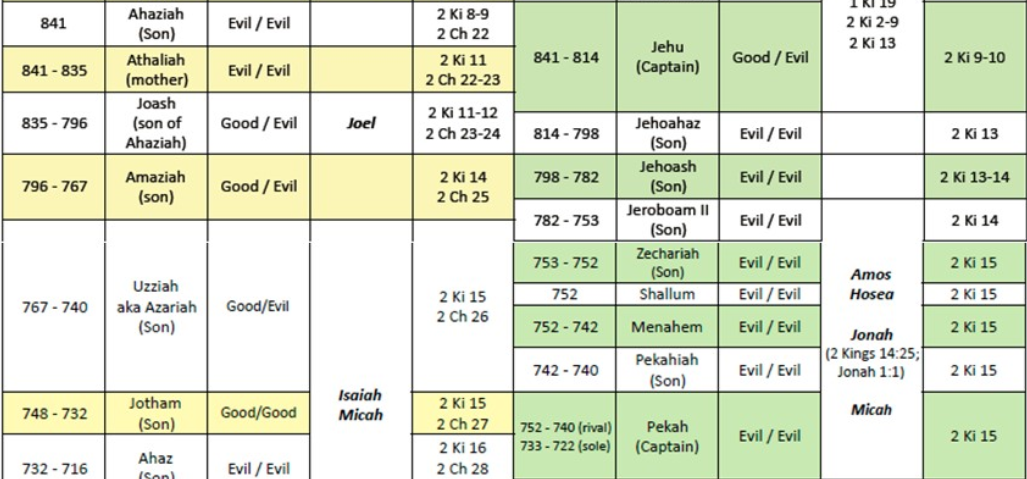
In the thirty-eighth year of Azariah king of Judah, Zechariah the son of Jeroboam became king over Israel in Samaria for six months - Look at the chart above and locate Jehu (right top green). He was promised four generations on the throne of Israel and Zechariah is generation #4. (2Ki 10:30, 2Ki 15:12).
Paul House - Zechariah's reign also is noteworthy in that it begins an era of intrigue. Shallum becomes the first person of this current era to come to power through conspiracy and assassination."
Donald Wiseman - "The apparent discrepancy with 2Ki 14:23 and 2Ki 15:1 can be explained if (1) a co-regency of Azariah with his father is allowed and (2) Zechariah's six months spanned two separate years (753-752 B.C.), cf 1 Kgs. 22:51)" (1 and 2 Kings: An Introduction and Commentary)
Roland deVaux has a good caution about "co-regency" in Ancient Israel, p. 101. "Solomon was anointed king during the lifetime of his father (1 K 1:32-40), who did not die until some time later (1 K 2:1-10). Similarly Yotham assumed power when his father Ozias became a leper (2 K 15:5), but we are not told that he was at once anointed. These are the only two co-regencies mentioned in the Bible, though there may have been others not mentioned. Some modern historians list a whole series of them: Josaphat, Ozias and Manasseh in Judah, and Jeroboam II in Israel, are all said to have reigned at the sane time as their fathers. But these are only hypotheses whose main purpose is to harmonize the discordant date of Biblical chronology. In the two certain cases, Solomon and Yothem assumed power because their fathers were too old or too ill to rule; the term co-regency is therefore somewhat inaccurate, and the situation is not quite the same as in Egypt or Assyria."
QUESTION - Who was King Zechariah in the Bible? | GotQuestions.org
ANSWER - Not much is known about King Zechariah, as he only reigned in Israel for six months in 753 BC. He was the son of Jeroboam and the contemporary of King Azariah in Judah, who was in the 38th year of his reign when Zechariah took the throne in Israel (2 Kings 15:8).
Sadly, in the little information the Bible provides about this king, we find that he was simply another evil ruler in a line of wicked kings. When God’s people first asked for an earthly king, rejecting Him as their King, God had warned them that earthly kings would bring them trouble (1 Samuel 8:10–18). This was indeed the case in King Zechariah and his predecessors. The sin the evil kings brought into Israel would eventually result in God’s judgment.
King Zechariah’s short reign came to an end when he was assassinated by Shallum son of Jabesh right in front of the people (2 Kings 15:10). It is possible that Zechariah had been such a poor king that his assassination was a welcome one—which would explain why no one arrested Shallum for regicide. In any case, Shallum took over as king. His rule turned out to be even shorter than Zechariah’s, however, as he was himself assassinated just one month later (verses 13–14).
One final thing to note about Zechariah is that he was the final king in the dynasty of King Jehu. Because Jehu had obeyed the Lord and destroyed the wicked King Ahab’s family (2 Kings 9–10), God had promised Jehu that his descendants would rule in Israel for four generations (2 Kings 10:30; 15:12). King Zechariah was the last of the line.
Walter Kaiser - Do the Dates of the Old Testament Kings Fit Secular History? - See Hard Sayings page 37
IF CHRONOLOGY, AS THEY SAY, is the backbone of history, it would seem that a major attempt ought to be made to reconcile the plethora of chronological notations about the kings of Israel and Judah in the Bible. The astonishing fact is that the book of Kings is filled with chronological material concerning the Hebrew kings: when their reigns began, when a king came to the throne in the parallel kingdom of Israel or Judah, the total number of years that each king reigned and an occasional correlation of events in biblical history with those in the other nations of the ancient Near East.
But the tangle of dates and systems is so complex that the remark attributed to Jerome in the fourth century appears correct:
Read all the books of the Old Testament, and you will find such discord as to the number of the years of the kings of Judah and Israel, that to attempt to clear up this question will appear rather the occupation of a man of leisure than of a scholar.1
Modern scholars are even more vehement in their denunciations of unwieldy material. But one such scholar who gave most of his life to untangle this Gordian knot was Edwin R. Thiele. He was finally able to make sense out of all the data and to show it all was accurate, as a part of his doctoral program at the University of Chicago. Despite the fact that neither Thiele’s system nor anyone else’s has achieved anything approaching universal acceptance, the evidence Thiele has amassed has never been completely refuted. The main complaint is only that he has taken the biblical data too seriously and has harmonized it perfectly. However, the word harmonized is not seen as a positive concept, but a negative one. Nevertheless, I think his case has stood now for well over forty years and will follow here, though there are numerous other efforts to supply other solutions that do not take all the biblical data as seriously as did Thiele.
Thiele began by first establishing some basic dates. Most important in accomplishing this first step was the archaeological find of the Assyrian eponym list that covered every year in order from 892 to 648 B.C. These lists named a “man of the year” as the eponym, but they often noted principle events that took place as well.
For the year of Bur-Sagale, governor of Guzana, it noted that there was a “revolt in the city of Assur.” In the month of Simanu an eclipse of the sun took place. Now this event we can locate on our Julian calendar as June 15, 763 B.C. by astronomical computation. Since we can establish every year with an absolute date on either side of this solar eclipse on June 15, 763 B.C., in the eponym list, it is significant that in the eponymy of Daian-Assur, 853 B.C., the sixth year of Shalmaneser II, the battle of Qarqar was fought, in which the Israelite king Ahab opposed him. Twelve years later, in the eponymy of Adad-rimani, 841 B.C., Shalmaneser received tribute from a king “Ia-a-u,” a ruler of Israel. This could be none other than King Jehu.
Now it so happens that there were twelve years between the death of King Ahab and the accession of King Jehu (two official years, but one actual for King Ahaziah, 1 Kings 22:51) and twelve official, but eleven actual, years for Joram, 2 Kings 3:1). Thus 853 is the year of Ahab’s death and 841 is the year for Jehu’s accession. This gives us a toehold on linking Israel’s and Judah’s history with absolute time and world events.
Another such linkage is to be found in the Assyrian chronology that puts the third campaign of Sennacherib in 701 B.C., when he came against Hezekiah. The Assyrian sources put 152 years from the sixth year of Shalmaneser III’s battle against Ahab at Qarqar in 853 B.C. But according to the reconstructed history of the Hebrews, it was also 152 years from the death of Ahab to the fourteenth year of Hezekiah, 701 B.C. Thus there is a second main tie-in with world history and chronology.
As Thiele worked with these two main linkages with world history, he noted three important chronological procedures in ancient Israel and Judah. The first involved the distinctions in the calendar years of Judah and Israel: Israel began its year from the month of Nisan in the spring, while Judah reckoned its year as beginning in Tishri in the fall. This meant that in terms of an absolute January calendar year, a Nisan year began in the spring and extended into the next spring, thus bridging parts of two of our calendar years. The same would be true of a Tishri year lapsing over into two falls. But even more complicated is the fact that a regnal year in Israel would also overlap two regnal years in Judah.
A second feature was the use of accession year and nonaccession year reckoning. Ever since the division of the country after Solomon’s day, the northern and southern kingdoms mostly used the opposite method of counting up regnal years that their neighbor was using. Thus, on the nonaccession year principle, the first year counted as year number one, while the accession year principle did not count regnal year one until the month starting the calendar (Nisan or Tishri) was passed and one year after that was completed. Judah used the accession year principle from Rehoboam until Jehoshaphat, while Israel used the nonaccession year principle from Jeroboam to Ahab. However, the relations between the two nations thawed during the days of Ahab and Jehoshaphat, as it was sealed with the marriage of Athaliah, daughter of Ahab and Jezebel, to prince Jehoram, son of Jehoshaphat. Clearly, as 2 Kings 8:18 notices, Jehoram “walked in the way of the kings of Israel, as the house of Ahab had done, for he married a daughter of Ahab.” Jehoram and Athaliah introduced the nonaccession year system into Judah, which remained until the snub of King Jehoash of Israel to King Amaziah of Judah over the proposal of marriage of the royal daughter to Amaziah’s son (2 Kings 14:8–10). However, prior to this rupture in diplomatic relations, both nations had already resorted to the accession year principle, which for some reason they continued to maintain to the end of their respective histories.
A third principle Thiele sets forth was that each nation used its own system in reckoning the years of a ruler in the other nation. Thus Rehoboam of Judah had a seventeen-year reign according to Judah’s accession year system, but according to Israel’s nonaccession year principle it was eighteen years. These three basic principles of chronological reckoning in the two nations of Israel and Judah are foundational to grasping the meaning of the numbers used to describe the reigns of the kings.
The date Thiele projected for the division of the kingdom after the death of Solomon was 931/930 B.C. This date, however, is generally rejected by the larger academic community. The fashion had been (until just a decade or two ago) to accept William Foxwell Albright’s date of 922 B.C., but his date involved an almost outright rejection of some of the biblical data. Albright argued that in view of the data found in 2 Chronicles 15:19 and 2 Chronicles 16:1, it was necessary to “reduce the reign of Rehoboam by at least eight, probably nine years”2 from that required by the biblical text. Such a reduction is not necessary when the details are correctly understood, as Thiele sorted them out. More recently, the figure of 927/926 B.C. has been proposed as the first regnal year of Rehoboam in Judah and Jeroboam I in the northern ten tribes of Israel by John Hayes and Paul Hooker.3 This date is arrived at by denying all three principles of Thiele and readjusting the biblical dates when they are not felt to be accurate for one reason or another.
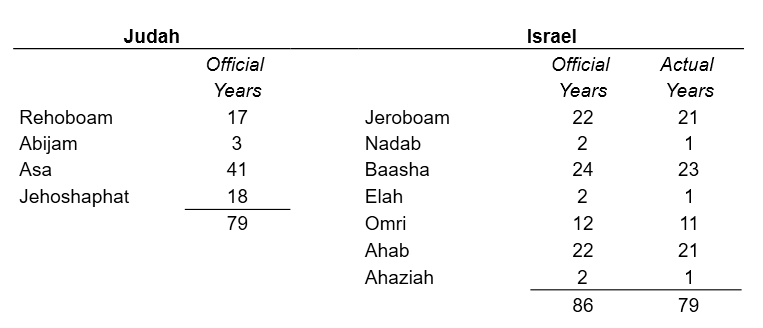
But Thiele’s date of 931/930 B.C. can be demonstrated to be accurate. One need only consult the following diagram to demonstrate this claim.
BORROW The mysterious numbers of the Hebrew kings - Thiele, Edwin Richard
This chart from Thiele demonstrates two important points: (1) the eighty-six years of Israel on the nonaccession year reckoning is only seventy-nine actual calendar years, fully in accord with Judah’s accession year system; and (2) from Ahab’s death in 853 B.C., as established from the astronomical observations in the eponym lists and the twelve years separating Jehu from Ahab, to the beginning of the divided monarchy was 78 years. Therefore, 78 plus 853 equals 931/930 B.C. for the division of the kingdom.
During the time of the Hebrew kingdoms there were nine overlapping reigns or coregencies. This fact makes the fourth important principle that must be recognized and factored in when using the numbers of the reigns and coregencies of the kings of Israel and Judah. The first overlapping reign was that of Tibni and Omri in Israel. First Kings 16:21 reads, “Then the people of Israel were split into two factions [or, parts]; half supported Tibni son of Ginath for [or, to make him] king, and the other half supported Omri.” Accordingly, there were three kingdoms at this time: two in the north under Tibni and Omri and one in the south, Judah.
The same three-kingdom phenomenon happened later on, for Menahem ruled one kingdom in the north and Pekah ruled the other, probably from Gilead. Hosea 5:5 witnessed to this fact as it warned, “Therefore Israel and Ephraim [they] will stumble [or, fall] in their iniquity, Judah also will stumble [or, fall] with them” (my own translation, emphasis added). Note the three Hebrew plurals, for again there were two kingdoms in the north.
A third overlapping involved a coregency of twelve years between Jehoash and Jeroboam II in Israel according to 2 Kings 13:10 and 2 Kings 14:23. Thus the sixteen years of Jehoash and the forty-one years of Jeroboam II would add up to fifty-seven, but with the coregency, it was actually only forty-five years.
In another coregency, twenty-four years of Azariah’s fifty-two years overlapped with the twenty-nine years of Amaziah. Again, this reduced the total from eighty-one years to fifty-seven actual years.
A fifth overlapping reign came in the coregency of Jotham and Azariah, as mentioned in 2 Kings 15:5. Azariah became a leper, so his son governed the land in his stead. Likewise a sixth overlap took place between Ahaz and Jotham in Judah, for the attack of Pekah and Rezin were not solely against Ahaz (2 Kings 16:5–9), but it is also against Jotham as well (2 Kings 15:37).
King Jehoram was coregent with his father Jehoshaphat, as alluded to in 2 Kings 8:16: “In the fifth year of Joram son of Ahab king of Israel, when Jehoshaphat was king of Judah, Jehoram son of Jehoshaphat began his reign as king of Judah.” Further confirmation comes from the synchronism given in 2 Kings 3:1, where Joram began in “the eighteenth year of Jehoshaphat king of Judah,” but according to 2 Kings 1:17, he began “in the second year of Jehoram son of Jehoshaphat.” Thus, the eighteenth year of Jehoshaphat was the second year of Jehoram’s coregency. That would mean that Jehoram became coregent with his father in the seventeenth year of his father’s reign, the year in which, it turns out, Judah joined forces with Israel against Syria. Prudence dictated that Jehoshaphat place Jehoram on the throne prior to his undertaking this joint venture—a venture in which Ahab of Israel lost his life (1 Kings 22:29–37), and Jehoshaphat narrowly escaped losing his own life.
The eighth coregency was between Jehoshaphat and his elderly father Asa. In the thirty-ninth year of Asa’s reign, he became seriously ill with a disease in his feet. This led him, at the close of his forty-one-year reign, to make Jehoshaphat regent with him to help govern the people (2 Chron 16:12).
The final coregency was between Manasseh and Hezekiah. Here again illness was the factor (2 Kings 20:1, 6). Knowing that he, Hezekiah, had only fifteen years to live, it is only to be expected that he would place his son Manasseh on the throne early enough to train him in the ways of government.
Such is the nature of dual dating in reckoning the reigns, coregencies and synchronisms of the kings of Israel and Judah.
2 Kings 15:9 He did evil in the sight of the LORD, as his fathers had done; he did not depart from the sins of Jeroboam the son of Nebat, which he made Israel sin.
- as his: 2Ki 10:29,31 13:2,11 14:24
- 2 Kings 15 Resources
ZECHARIAH WAS
AN EVIL KING
He did evil in the sight of the LORD, as his fathers had done; he did not depart from the sins of Jeroboam the son of Nebat, which he made Israel sin - See discussion of this sad refrain which occurs 4 times in this chapter - 2 Ki 15:9, 2 Ki 15:18, 2 Ki 15:24, 2 Ki 15:28
Bob Utley - The Jeroboam of v. 8 is Jeroboam II, while the Jeroboam of v. 9 is Jeroboam I, who set up the two golden calves at Bethel and Dan as alternate worship sites for YHWH (i.e., 1 Kgs. 16:19,26; 22:52; 2 Kgs. 3:3; 9:9; 10:29,31; 13:2,6,11; 14:24; 15:9,18,24). However, they quickly became idolatrous, especially under the influence of Ahab and Jezebel.
2 Kings 15:10 Then Shallum the son of Jabesh conspired against him and struck him before the people and killed him, and reigned in his place.
- struck him: Am 7:9
- killed him: 2Ki 15:14,25,30 9:24,31 1Ki 15:28 16:9,10 Ho 1:4,5
- 2 Kings 15 Resources
SHALLUM'S PUBLIC ASSASSINATION
WITHOUT REPRISAL
Then Shallum the son of Jabesh conspired against him and struck him before the people and killed him, and reigned in his place - NIV = attacked him in front of the people." NLT = "assasinated him in public" Zechariah had become so despised and discredited by his own people that Shallum was able to assassinate him in broad daylight (before the people) without meaningful resistance. The king stood isolated, stripped of loyalty and respect—a tragic testimony to how far the nation had drifted from the LORD. With his violent death, the dynasty of Jehu came to its appointed end. What had begun with such promise—Jehu’s zeal in destroying the house of Ahab and eradicating Baal worship—closed in spiritual ruin, exactly as God had foretold. Four generations had been granted to Jehu’s line (2 Kings 10:30), yet persistent idolatry and compromise turned opportunity into judgment, and the once-hopeful house dissolved into darkness and chaos.
MacArthur: Assyrian records call Shallum “the son of nobody,” indicating that he was not from the royal family.
The assassination of Zechariah by Shallum was in keeping with a prediction in Amos 7:9 that “The high places of Isaac will be desolated And the sanctuaries of Israel laid waste. Then I will rise up against the house of Jeroboam with the sword.”
QUESTION - Who was King Shallum in the Bible? | GotQuestions.org
ANSWER - Shallum was a king of Israel for one brief month in 752 BC. He rose to the throne wickedly, and he filled his one month on the throne with wickedness.
Shallum became king of the northern kingdom of Israel after he assassinated the reigning king, Zechariah, and took his throne (2 Kings 15:8–10). All we know of Shallum’s personal history is that he was “the son of Jabesh” (2 Kings 15:10).
Shallum assassinated King Zechariah in public: “Shallum . . . conspired against Zechariah. He attacked him in front of the people, assassinated him and succeeded him as king” (2 Kings 15:10). By killing the king “in front of the people,” Shallum must have possessed a great deal of confidence that his action would be rewarded, not punished.
King Zechariah, whom Shallum assassinated, had only reigned six months himself. Zechariah had done evil in God’s sight as many other kings had done. Shallum’s murder of Zechariah was a fulfillment of God’s prophecy spoken to Jehu: “Your descendants will sit on the throne of Israel to the fourth generation” (2 Kings 15:12; cf. 10:30). That blessing of God had been a reward for Jehu’s wiping out the house of Ahab and killing the prophets of Baal in Israel. With the death of Zechariah, God’s promise was completed. The last of Jehu’s descendants had had his time on the throne. Shallum’s actions brought an end to Jehu’s dynasty and remind us that God can use the evil actions of evil people to accomplish what He has planned (see Isaiah 46:9–11; Genesis 50:20).
As Jesus said, “All who draw the sword will die by the sword” (Matthew 26:52), and Shallum’s fate came quickly. After one month as king, Shallum was also assassinated. A man named Menahem killed Shallum and ruled Israel for the next ten years (2 Kings 15:14). The story of Shallum ends with a historical footnote: “The other events of Shallum’s reign, and the conspiracy he led, are written in the book of the annals of the kings of Israel” (2 Kings 15:15).
2 Kings 15:11 Now the rest of the acts of Zechariah, behold they are written in the Book of the Chronicles of the Kings of Israel.
- 2Ki 14:28
- 2 Kings 15 Resources
Now the rest of the acts of Zechariah, behold (hinneh; LXX - idou) they are written in the Book of the Chronicles of the Kings of Israel - See note on the Book of the Chronicles, (see another note) a record which has been lost.
Behold (02009) hinneh is an interjection meaning behold, look, now; if. "It is used often and expresses strong feelings, surprise, hope, expectation, certainty, thus giving vividness depending on its surrounding context." (Baker) Hinneh generally directs our mind to the text, imploring the reader to give it special attention. In short, the Spirit is trying to arrest our attention! And so hinneh is used as an exclamation of vivid immediacy (e.g., read Ge 6:13)! Hinneh is a marker used to enliven a narrative, to express a change a scene, to emphasize an idea, to call attention to a detail or an important fact or action that follows (Isa 65:17, Ge 17:20, 41:17). The first use of hinneh in Ge 1:29 and second in Ge 1:31 - "And God saw all that He had made, and behold, it was very good. And there was evening and there was morning, the sixth day." Hinneh is oftn used in the idiom "Here I am" in Ge 22:1, 7,11 Ge 27:1,18, Ge 31:11, Ge 46:2 Ex 3:4 1Sa 3:4, 3:16, 12:3, 2Sa 1:7, Isa 52:6, Isa 58:9. Hinneh is used most often to point out people but also to point out things (Ge 31:41, 17:4). God uses hinneh to grab man's attention before He brings destruction (Ge 6:13, 17). God uses hinneh when He establishes covenants (Ge 9:9, 15:12, 17 [when Jehovah cut the Abrahamic covenant], Ge 17:4, cp Ge 28:13, 15), when He provided a sacrificial substitute for Isaac (foreshadowing His giving us His only Son!) (Ge 22:13).
Hinneh marks the "chance (The Providence of God)" arrival of Boaz at the field where Ruth was gleaning (Ru 2:4-read about this "chance romance" - Indeed, "Behold!").
Hinneh is used to announce the Lord’s sending of a child as a sign and a prophecy of Immanuel-Emmanuel, the Messiah (Isa. 7:14). In fact W E Vine says that it is notable that when behold (hinneh) is used in Isaiah, it always introduces something relating to future circumstances!
Spurgeon reminds us that "Behold is a word of wonder; it is intended to excite admiration. Wherever you see it hung out in Scripture, it is like an ancient sign-board, signifying that there are rich wares within, or like the hands which solid readers have observed in the margin of the older Puritanic books, drawing attention to something particularly worthy of observation." I would add, behold is like a divine highlighter, a divine underlining of an especially striking or important text. It says in effect "Listen up, all ye who would be wise in the ways of Jehovah!"
Hinneh is translated in the Septuagint with the interjection idou (strictly speaking a command in the second person aorist imperative, middle voice) a demonstrative particle (used 1377 times in the Septuagint and NT) which is found especially in the Gospels of Matthew and Luke "and giving a peculiar vivacity to the style by bidding the reader or hearer to attend to what is said: "Behold! See! Lo!" (Thayer) The command is calling for urgent attention. Do this now! Don't delay! It could be loosely paraphrased "Pay attention!" or "Listen up!" to arouse attention and introduce a new and extraordinary fact of considerable importance.
BOOK OF THE CHRONICLES OF THE KINGS - A phrase repeated 33x in Kings - 1 Ki. 14:19; 1 Ki. 14:29; 1 Ki. 15:7; 1 Ki. 15:23; 1 Ki. 15:31; 1 Ki. 16:5; 1 Ki. 16:14; 1 Ki. 16:20; 1 Ki. 16:27; 1 Ki. 22:39; 1 Ki. 22:45; 2 Ki. 1:18; 2 Ki. 8:23; 2 Ki. 10:34; 2 Ki. 12:19; 2 Ki. 13:8; 2 Ki. 13:12; 2 Ki. 14:15; 2 Ki. 14:18; 2 Ki. 14:28; 2 Ki. 15:6; 2 Ki. 15:11; 2 Ki. 15:15; 2 Ki. 15:21; 2 Ki. 15:26; 2 Ki. 15:31; 2 Ki. 15:36; 2 Ki. 16:19; 2 Ki. 20:20; 2 Ki. 21:17; 2 Ki. 21:25; 2 Ki. 23:28; 2 Ki. 24:5
2 Kings 15:12 This is the word of the LORD which He spoke to Jehu, saying, “Your sons to the fourth generation shall sit on the throne of Israel.” And so it was.
- the word: 2Ki 10:30
- Thy sons: 2Ki 13:1,10,13 14:29
- And so: 2Ki 9:25,26,36,37 10:10 Nu 23:19 Zec 1:6 Mk 13:31 Joh 10:35 Joh 19:24,36,37 Ac 1:16
- 2 Kings 15 Resources
Related Passages:
2 Kings 10:30 The LORD said to Jehu, “Because you have done well in executing what is right in My eyes, and have done to the house of Ahab according to all that was in My heart, your sons of the fourth generation shall sit on the throne of Israel.”
YAHWEH'S PROPHECY
IS FULFILLED
This is the word of the LORD which He spoke to Jehu (His prophecy), saying, “Your sons to the fourth generation shall sit on the throne of Israel.” And so it was - Just as God had promised Jehu for eradicating Baalism, there were 4 generations of kings from his line.
Donald Wiseman on Zechariah's death "The death of this last king of the dynasty of Jehu (v. 12) saw the end of the Northern Kingdom proper. In the last twenty years six rulers were to follow each other, but only one was to die naturally. Anarchy, rivalry and regicide led to terminal bloodshed which fulfilled Hosea's prophecies (Hosea 1:4)." (1 and 2 Kings: An Introduction and Commentary)
2 Kings 15:13 Shallum son of Jabesh became king in the thirty-ninth year of Uzziah king of Judah, and he reigned one month in Samaria.
- Uzziah: 2Ki 15:1, Azariah, Mt 1:8,9
- month: Heb. a month of days, 1Ki 16:15 Job 20:15 Ps 55:23 Pr 28:2,17
- 2 Kings 15 Resources
KING SHALLUM
OF ISRAEL
Shallum son of Jabesh became king in the thirty-ninth year of Uzziah king of Judah, and he reigned one month in Samaria - Menahem assassinated Shallum. His reign was so brief there was not even a "good" or "evil" verdict rendered!
Morgan - “Israel was now practically under a military despotism, downtrodden and oppressed, and yet sinning still with a high hand against God.”
Dilday - Having stepped on the slippery slope of apostasy and disobedience, Israel was careening with accelerating speed toward an inevitable destiny of destruction and captivity. Within the next forty-three years half a dozen “pseudo-kings” would reign in rapid succession, one murderer replacing another on the throne, as the nation tottered on the brink of anarchy. Only one king, Menahem, died a natural death and was succeeded by his son on the throne of Samaria. The other five were violently dethroned by rebels. Most of the rulers were not so much kings as robbers and tyrants, unworthy of the august name of “king.” It did not require special insight for Hosea to conclude that such political bedlam signified the approaching doom of Israel. Sadly he declared to his countrymen the word of the Lord: “I will avenge the bloodshed of Jezreel on the house of Jehu, and bring an end to the kingdom of the house of Israel” (Hos. 1:4). In a few short years, the Northern Kingdom would be no more. (See The Preacher's Commentary)
Christopher Knapp - “The great prosperity and expansion under Jeroboam II appears to have corrupted the people and caused them to give free reign to their evil desires and violence. Those in authority, instead of checking this spirit of lawlessness, found pleasure in it. ‘They make the king glad with their wickedness, and the princes with their lies’ (Hosea 7:3).”
2 Kings 15:14 Then Menahem son of Gadi went up from Tirzah and came to Samaria, and struck Shallum son of Jabesh in Samaria, and killed him and became king in his place.
- Tirzah: 1Ki 14:17 15:21,33 16:8,9,15,17
- and smote: 2Ki 15:10
- 2 Kings 15 Resources
KING MENAHEM
OF ISRAEL
Then Menahem son of Gadi went up from Tirzah and came to Samaria, and struck Shallum son of Jabesh in Samaria, and killed him and became king in his place - Menahem was Shallum's military general from Josephus (Antiq. 9.11.1).
It is poetic justice that Shallum's name means "retribution" for he who came into power by assassination was himself assassinated!
John Schultz: The rapid successions on the throne of Israel and the violence that accompanied them indicate in what state of anarchy the nation had fallen. All this was the result of the fact that they had abandoned the true worship of YHWH. The Book of Proverbs states: “Where there is no revelation, the people cast off restraint; but blessed is he who keeps the law.” (See commentary on Pr 29:18)
Bob Utley - "Tirzah" This was Jeroboam I's royal residence (cf. 1 Kgs. 14:17). It was made a second capital by Baasha. Omri built and made Samaria the main capital of Israel (cf. 1 Kgs. 16:23-24).
2 Kings 15:15 Now the rest of the acts of Shallum and his conspiracy which he made, behold they are written in the Book of the Chronicles of the Kings of Israel.
- 2Ki 15:11 1Ki 14:19,29 22:39
- 2 Kings 15 Resources
SHALLUM'S SHALLOW
OBITUARY!
Now the rest of the acts of Shallum and his conspiracy (qesher) which he made - His conspiracy (qesher) was against King Zechariah (2Ki 15:
Behold (hinneh; LXX - idou) they are written in the Book of the Chronicles of the Kings of Israel - See note on the Book of the Chronicles, which is not the inspired book of 1-2 Chronicles, but an official secular record which has been lost.
Conspiracy (treason)(07195) qesher from qashar = to bind, league together, conspire) means conspiracy a secret plan by a group to do something unlawful or harmful. Absalom's conspiracy to take the kingdom from his father, David (2Sa 15:12); the conspiracy of the servants of Joash (2Ki. 12:20) and others (2Ki. 14:19; 15:15; 2Ch 25:27). The Israelites had made a conspiracy to sin against the Lord (Jer. 11:9), and the prophets were part of it as well (Ezek 22:25). Qesher refers to the treason of Zimri against Elah (1Ki 16:20). The treason of Jehoiada the priest that overthrew evil Athaliah (2Ki 11:14; 2Ch 23:13). Isa. 8:12, refers to "a conspiracy with treasonable intent". Qesher is translated in 2Sa 15:12 with sustremma in the Septuagint, a noun which means anything twisted up together, a body of men, a crowd, a band, a conspiracy.
Qesher - conspiracy(10), treason(4) 2 Sam. 15:12; 1 Ki. 16:20; 2 Ki. 11:14; 2 Ki. 12:20; 2 Ki. 15:15; 2 Ki. 15:30; 2 Ki. 17:4; 2 Chr. 23:13; Isa. 8:12; Jer. 11:9; Ezek. 22:25
QUESTION - What is the book of the annals of the kings of Israel? GOTQUESTIONS.ORG
ANSWER - As the authors of the books of Kings and Chronicles were writing their histories, they referenced one or more external documents that they used as source material. They refer to this source as “the book of the annals of the kings of Israel,” “the book of the chronicles” (NKJV, ESV, CSB), or “The Book of the History” (NLT).
This historical source is usually cited by means of a rhetorical question that begins, “Are they not written?” For example, in 1 Kings 16:5, the historian writes this: “As for the other events of Baasha’s reign, what he did and his achievements, are they not written in the book of the annals of the kings of Israel?” That formulaic construction appears 33 times in the books of 1 and 2 Kings (ED: NOTE). Similar wording is found another two times in 2 Chronicles.
All ancient countries kept records of their own histories. A king’s exploits and what happened in his land were recorded in official annals. Esther 10:2, for example, speaks of “the book of the chronicles of the kings of Media and Persia.” When a plot to assassinate King Xerxes was uncovered and the conspirators were hanged, the event “was written in the book of the chronicles” (Esther 2:23). The kingdom of Israel also had official records, called “the book of the annals of the kings of Israel.” Judah had similar books, one kept by the prophet Iddo (2 Chronicles 13:22), and one simply called “the Scroll of the Kings” (2 Chronicles 24:27, NET).
The biblical books of Kings and Chronicles give a non-comprehensive overview of the kings of Israel and Judah. The author of Kings often refers his readers to the fuller account by mentioning “the book of the annals of the kings of Israel.” We could consider those references as an ancient form of footnoting or an example of an in-text bibliography.
First and Second Kings focus on the northern kingdom of Israel, and 1 and 2 Chronicles on the southern kingdom of Judah. Chronicles contains a much more thorough commentary on the reigns of the kings of Judah than Kings provides on the kings of Israel. This makes sense, because God’s covenant regarding the coming Messiah was to be fulfilled through the line of David, of the tribe of Judah. David’s line went through Solomon and his descendants, all of whom reigned in the southern kingdom of Judah. The detailed records of the kings of Israel contained in the book of the annals of the kings of Israel were not included in the canon of Scripture. The official documents referred to as “the book of the annals of the kings of Israel” are no longer extant or have yet to be discovered. Thus, God did not deem those volumes of civil records and daily happenings to be useful for our instruction (see 1 Corinthians 10:11), and the non-canonical annals were not preserved along with the Old Testament Scriptures.
Book of the Chronicles of the Kings - 34 VERSES - 1 Ki. 14:19; 1 Ki. 14:29; 1 Ki. 15:7; 1 Ki. 15:23; 1 Ki. 15:31; 1 Ki. 16:5; 1 Ki. 16:14; 1 Ki. 16:20; 1 Ki. 16:27; 1 Ki. 22:39; 1 Ki. 22:45; 2 Ki. 1:18; 2 Ki. 8:23; 2 Ki. 10:34; 2 Ki. 12:19; 2 Ki. 13:8; 2 Ki. 13:12; 2 Ki. 14:15; 2 Ki. 14:18; 2 Ki. 14:28; 2 Ki. 15:6; 2 Ki. 15:11; 2 Ki. 15:15; 2 Ki. 15:21; 2 Ki. 15:26; 2 Ki. 15:31; 2 Ki. 15:36; 2 Ki. 16:19; 2 Ki. 20:20; 2 Ki. 21:17; 2 Ki. 21:25; 2 Ki. 23:28; 2 Ki. 24:5; Est. 10:2
2 Kings 15:16 Then Menahem struck Tiphsah and all who were in it and its borders from Tirzah, because they did not open to him; therefore he struck it and ripped up all its women who were with child.
- Tiphsah: 1Ki 4:24
- all the women: 2Ki 8:12 Am 1:13
- 2 Kings 15 Resources
Related Passages:
2 Kings 8:12 Hazael said, “Why does my lord weep?” Then he answered, “Because I know the evil that you will do to the sons of Israel: their strongholds you will set on fire, and their young men you will kill with the sword, and their little ones you will dash in pieces, and their women with child you will rip up.”
Amos 1:13 Thus says the LORD, “For three transgressions of the sons of Ammon and for four I will not revoke its punishment, Because they ripped open the pregnant women of Gilead In order to enlarge their borders.

MENAHEM'S MASSACRE
OF ISRAELITES
Then Menahem struck Tiphsah and all who were in it and its borders from Tirzah - The writer records a sobering calculated act of domestic terror by an illegitimate king. Launching violence from the seat of royal authority, Menahem annihilated an Israelite city that resisted his rule, extending devastation to its surrounding regions (the meaning of and its borders). This act reveals the complete collapse of kingship in Israel, where the ruler became a source of fear rather than protection, foreshadowing the nation’s coming judgment at the hands of foreign powers. The irony is that the Assryians were well known for similar brutality and bararous behavior against their conquered foes.
Because (term of explanation) they did not open to him - NET - "Because they would not surrender" NIV - "Because they refused to open their gates." This was common practice in the ancient near east, if a city opened its gates and surrended, it was spared and made a vassal city but if not, it was depopulated and repopulated. In context this was an Israelite city that resisted Menahem's rule.
Therefore (term of conclusion) he struck it and ripped up all its women who were with child The message was unmistakable that “This is what happens to cities that hesitate.”
Donald Wiseman - “The action by Menahem against the inhabitants of Tiphsah is unparalleled for brutality by any Israelite. Here it may mark the increasing influence of the surrounding nations. It was a foreign practice inflicted on the Israelites themselves by Aram (2 Kings 8:12), Ammon (Amos 1:13) and Assyria (Hosea 13:8).” (1 and 2 Kings: An Introduction and Commentary)
Peter Pett: It would appear that Tiphsach was Shallum’s power base. Thus when Shallum took the throne after assassinating Zechariah without popular support, not only was he killed by Menahem in his turn but Tiphsach, which refused to yield and surrender to Menahem, was put to the sword, and every man, woman and child killed. Menhem is thus revealed as a man without mercy. The reference to the resistance of Tiphsach may suggest that that was where Shallum’s sons had holed up. But the fact that Menahem received the kingship suggests either that he was acting with the support of the people of the land, or that he was a powerful military commander with great influence in the army, or indeed both. Shallum clearly had little support. He was simply an opportunist. Apart from this we know nothing of either man.
Bob Utley - "he. . .ripped up all its women who were with child" This was also a common practice (cf. 2 Kgs. 8:12; Hos. 13:16; Amos 1:13). In a way, this shows how much Israel (YHWH's covenant people) had been influenced by the pagan military practices of the surrounding peoples. This terrible practice was first mentioned in a hymn to Tiglath-pileser I (1118-1078 B.C.). This is not an example of "holy war" (Joshua) but anger and personality on Menahem's part. Josephus (Antiq. 9.11.1) says "continued to reign with cruelty and barbarity for ten years."
2 Kings 15:17 In the thirty-ninth year of Azariah king of Judah, Menahem son of Gadi became king over Israel and reigned ten years in Samaria.
- In the thirty-ninth year of Azariah: 2Ki 15:13
- 2 Kings 15 Resources
MENAHEM
KING OF ISRAEL
In the thirty-ninth year of Azariah king of Judah, Menahem son of Gadi (no regal pedigree) became king (by assassination - 2Ki 15:14) over Israel and reigned ten years in Samaria (the capital and center of apostasy) - This is a bare-bones introduction of Menahem, underscoring his lack of legitimacy. He is a king by force, not by covenant. Notice also the intentional notation of the length of Azariah's rule in the south and Menahem's rule in the north. The southern kingdom while not perfect was aging while the northern kingdom was unraveling rapidly and only about 20 years away from total collapse in 722 BC.
The bitter irony is that Menahem's name means "comforter," but he was not much comfort to Shallum (assassination) or Tipshach (massacre) or to the people of Israel!
2 Kings 15:18 He did evil in the sight of the LORD; he did not depart all his days from the sins of Jeroboam the son of Nebat, which he made Israel sin.
- 2Ki 15:9
- 2 Kings 15 Resources
THE THIRD VERDICT
AGAINST AN ISRAELITE KING
He did evil in the sight of the LORD; he did not depart all his days from the sins of Jeroboam the son of Nebat, which he made Israel sin. This is a recurrent phrase describing YHWH's displeasure of the golden calf worship at Bethel and Dan. It is like a refrain in a dark, evil hymn, echoed four times in this single chapter - 2 Ki 15:9, 2 Ki 15:18, 2 Ki 15:24, 2 Ki 15:28. Each repetition marks the accession of yet another king who “did evil in the sight of the LORD”, underscoring the monotonous, unbroken pattern of apostasy in the Northern Kingdom. Rather than signaling new beginnings, each reign simply restates the same moral verdict. The repetition is deliberate and devastating: different kings, different lengths of reign, but the same sinful legacy. See more discussion.
2 Kings 15:19 Pul, king of Assyria, came against the land, and Menahem gave Pul a thousand talents of silver so that his hand might be with him to strengthen the kingdom under his rule.
- Pul: 1Ch 5:25,26 Isa 9:1
- Menahem: 2Ki 12:18 16:8 17:3,4 18:16 Ho 5:13 8:9,10 10:6
- to strengthen the kingdom: 2Ki 14:5 Jer 17:5
- 2 Kings 15 Resources
Related Passages:
1 Chronicles 5:25-26 But they (NORTHERN KINGDOM OF ISRAEL) acted treacherously against the God of their fathers and played the harlot after the gods of the peoples of the land, whom God had destroyed before them. (5:26) So the God of Israel stirred up the spirit of Pul, king of Assyria, even the spirit of Tilgath-pilneser king of Assyria, and he carried them away into exile, namely the Reubenites, the Gadites and the half-tribe of Manasseh, and brought them to Halah, Habor, Hara and to the river of Gozan, to this day.
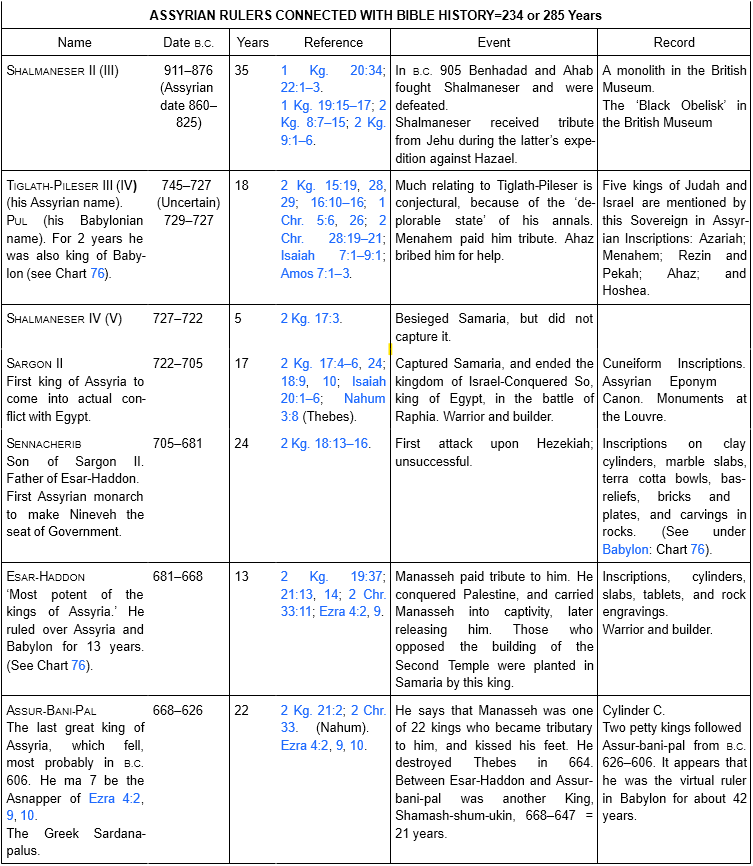
PUL KING OF ASSYRIA
AKA TIGLATH-PILESER
Pul, king of Assyria, came against the land - See chart above. The other name for Pul is Tiglath-Pileser who came against the land of Israel. This was not a friendly visit!
Bob Utley - "Pul, king of Assyria" This is the ruler of the Assyrian empire also known as Tiglath-pileser III (cf. 1 Chr. 5:26; NIDOTTE, vo. 4, pp. 1250-1251). When he ascended the Babylonian throne by assassinating Ashur-nirari V, he took the name Pul or Pulu in 729 B.C.. came against the land" In 743 B.C. Pul received tribute from Rezin of Damascus. In 739 he received tribute from Menahem, king of Israel. In 734 he moved even further south through the kingdoms of Phoenicia and Philistia.
And Menahem gave Pul a thousand talents of silver so that his hand might be with him to strengthen the kingdom under his rule - Except for Jonah’s mission to Nineveh, this passage marks the first recorded political contact between Israel and the great Assyrian Empire. What had once been a distant imperial power now entered Israel’s history directly—not as a missionary concern, but as a looming military and political threat.
2 Kings 15:19–20 introduce Pul, identified with Tiglath‑Pileser III (reigned 745–727 BC; cf. 1 Chronicles 5:26). Originally a powerful general, Tiglath-Pileser seized control of Assyria and transformed its army into a highly disciplined, efficient military machine, laying the groundwork for Assyria’s rapid expansion and eventual domination of the Near East.
Menahem’s response to this new imperial reality was not resistance but submission through tribute. He paid one thousand talents of silver, equivalent to three million shekels. To raise this enormous sum, Menahem levied a tax on Israel’s wealthy elite. Since each man was assessed fifty shekels, approximately 60,000 men were forced to contribute to this payment.
This tribute temporarily secured Assyrian support for Menahem’s throne, but it came at a high cost. It drained Israel’s resources, legitimized Assyrian interference in Israel’s affairs, and marked the beginning of a pattern of dependence that would ultimately end in exile. What began as a political compromise would soon become a national catastrophe.
Source: A Christian's Guide to Evidence for the Bible: 101 Proofs - Page 27 (Excellent resource)
The Scripture References
- In the days of King Pekah of Israel, King Tiglath-pileser of Assyria came and captured … Hazor, Gilead, and Galilee—all the land of Naphtali—and deported the people to Assyria. (2 Kings 15:29, 2Ki 15:19)
- King Shalmaneser of Assyria attacked him, and Hoshea became his vassal and paid him tribute. (2 Kings 17:3)
- In the year that the chief commander, sent by King Sargon of Assyria, came to Ashdod and attacked and captured it. (Isa. 20:1)
- In the fourteenth year of King Hezekiah, Assyria’s King Sennacherib attacked all the fortified cities of Judah and captured them. (2 Kings 18:13)
- So King Sennacherib of Assyria … returned home and lived in Nineveh. One day … his sons … struck him down with the sword.… Then his son Esar-haddon became king in his place. (2 Kings 19:36–37)
From approximately 744 BC (the rise of Tiglath-pileser III) until 605 BC (the defeat of Assyria by the Babylonians at Carchemish), the Assyrians played a dominant role in the ancient Near East. The five Assyrian kings—Tiglath-pileser III, Shalmaneser V, Sargon II, Sennacherib, and Esar-haddon—are some of the most documented people in all of ancient history. Archaeologists have excavated the palaces of these kings at Nineveh, Calah, and Khorsabad, and have discovered thousands of written texts inscribed on tablets, building blocks, stone floor slabs, statues, palace wall panels, stelae, and other monuments, both in their palaces and wherever they ruled throughout the ancient Near East. The major monuments and inscriptions for each king include the following:
- Tiglath-pileser III, the Iran Stela and Summary Inscriptions 4, 8, and 13;
- Shalmaneser V, Assyrian lion weights, clay cones, the Bānītu Inscriptions, and Chronicle 1 in the Neo-Babylonian Chronicle Series;
- Sargon II, Khorsabad Summary Inscription, Calah Summary Inscription, Khorsabad Annals, the Ashur Charter, Cylinder Inscription No. 1, Cyprus Stela, Nineveh Annal Prism, and Ashur Annal Prism;
- Sennacherib, Prism of Sennacherib, Rassam Cylinder, Lachish Relief Inscriptions, and Bull Colossi; and
- Esar-haddon, Prism Nineveh A, Zenjirli Stela of Esarhaddon, Nahr El-kelb Inscription, and Chronicle 14 in the Esarhaddon Chronicle (Cogan, Raging Torrent, 46–147; Grayson, Assyrian and Babylonian Chronicles, 125–27).
See also KINGS OF ASSYRIA
Assyria (אַשּׁוּר [ʾaššûr]). - NIDOTTE V4, page 417
OT 1. Summary of Assyrian history. During the second millennium BC Assyria grew from a city-state enjoying wide trade connections, notably with Anatolia (the “Cappadocian colonies” such as Kultepe-Kanesh), to become a major power corresponding on equal terms with Egypt and the Hittites in the fourteenth century BC. Taking advantage of the weakening kingdom of Mitanni in Upper Mesopotamia, Assyria extended her rule as far as the Euphrates ca. 1300 BC. The energetic king Tukulti-Ninurta I (ca. 1244–1208 BC) campaigned both in the west and in the south, conquering Babylon and ruling it for seven years. By frequent military actions, successive kings maintained control over much of this area, Babylon excepted, but had to face a new foe, the Arameans. Their increasing threat led Tiglath-Pileser I (ca. 1115–1077 BC) to march west repeatedly, reaching Palmyra, Lebanon, and Arvad. The Arameans were only repulsed temporarily and advanced eastward during the eleventh century BC, all but overwhelming Assyria. From about 1050 BC a “dark age” ensued, only ending with the reign of Ashur-dan (ca. 934–912 BC), whose inscriptions tell of attacks on Arameans who had been occupying Assyrian lands. His two successors continued to reestablish Assyria’s hegemony in the north and the west, and under Ashurnasirpal II (ca. 889–858 BC) this reached the Euphrates once again.
States farther west were reluctant to submit, leading that king and his son Shalmaneser III (ca. 858–824 BC) to campaign to the Mediterranean and Damascus. At the same time, these kings were securing Assyria’s rule in the mountains to the east. After a period of quiescence, Assyria reached her apogee under Tiglath-Pileser III (ca. 745–727 BC), Sargon II, and his descendants Sennacherib (→), Esarhaddon, and Ashurbanipal, extending her rule into Iran, Anatolia, and Egypt, and incorporating many formerly independent kingdoms into a provincial organization. Wealth flowed to Assyria through tribute, booty, and trade, enabling the construction of the famous palaces at Nineveh and Nimrud, whose rooms were paneled with carved stone slabs and furnished with carved ivorywork. Ashurbanipal attempted to collect copies of all Babylonian literature in his library, and the recovery of much of his collection provided the basis for modern knowledge of Assyria. His later years are undocumented (640 BC onwards), but weaknesses appeared, which opened the way for the Medes and Babylonians to bring Assyria to an end in 612 BC.
2. Assyrian contacts with Israel and Judah. In 853 BC Shalmaneser III fought Levantine forces at Qarqar in Syria, naming Ahab the Israelite among his opponents. A few years later, Shalmaneser reported that he received tribute from “Jehu son of Omri” (ca. 841 BC), which his artists depicted on the famous “Black Obelisk” (ANET, 231–279; ANEP, 351–55). The Assyrian texts give precise dates for each episode, an invaluable contribution to biblical chronology. Joash of Israel paid tribute to Adadnirari III about 796 BC. Assyrian records are silent regarding Israel until Menahem became tributary ca. 738 BC, when Tiglath-Pileser III was beginning to establish control in southern Syria (see 2 Kgs 15:19–20; ANET, 283). Pekah, who assassinated Menahem’s son, did not win Assyrian approval, and Tiglath-Pileser supported Hoshea, who displaced him (see 2 Kgs 15:29–30; ANET, 283). Hoshea’s classic rebellion—alliance with Egypt, cessation of tribute payment—brought the Assyrian army to Samaria under Shalmaneser V. After the final capture of Samaria by Sargon II in 720 BC, the city became an Assyrian provincial center, and Israel disappeared as a national state.
In Judah Ahaz had traded independence for Assyrian intervention against the threats of Samaria (Pekah) and Damascus (ca. 732 BC; see 2 Kgs 16:5–20; ANET, 282). His son Hezekiah attempted to escape Assyria’s yoke, encouraged by Merodach-Baladan, the Chaldean nationalist in Babylonia, making alliance with other local rulers and Egypt. Sennacherib’s punitive campaign is well described both from the Hebrew and the Assyrian perspectives. He overran all of Judah except Jerusalem, and the capital was only saved by the Assyrian’s hasty retreat in the face of a disaster (2 Kgs 18–19; ANET, 287–88). Still on his throne, Hezekiah submitted, renewing the tribute, and his son Manasseh continued it, according to Esarhaddon and Ashurbanipal (ANET, 291, 294).
Assyrian control in Samaria was marked by an inscribed stele set up by Sargon and by the presence of Assyrian officials resident there. Archaeological evidence of Assyrian styles in palace building and pottery has been found in Israel. How far the influence spread is uncertain. Claims for extensive imposition of Assyrian religion on vassal states are now rejected; there seems to have been little interference in their local affairs. When Assyrians were settled in a conquered region, they obviously brought their own beliefs and customs with them. That also happened when others were settled in conquered states (see 2 Kgs 17:24–34). Further disruption sometimes followed the quelling of rebellions. Then deportation was used to break patriotism, a normal policy. Thus Israelites were carried to Assyria after the fall of Samaria, and Sennacherib’s sculptures show Judeans from Lachish likewise led away.
3. The biblical attitude to Assyria. Biblical authors pay no attention to Assyria’s relations with Israel until the two states became permanently entangled when Menahem submitted to Tiglath-Pileser III. King Ahaz of Judah saw Assyria as a great power able to relieve him, while Isaiah warned him that he would be writing his nation’s doom (Isa 7). Ahaz’s attitude was a natural one, paralleled closely in the north Syrian state of Sam’al a century earlier and probably in many other small kingdoms. Isaiah describes graphically how Assyria would indeed come, not to save but to conquer Judah, as God’s hired razor, as his flood (Isa 7:17–25; 8:4–8; cf. Hos 10:6; 11:5). Repeatedly the prophets characterize Assyria politically as a false refuge, whose initial promise would turn sour, just as Egypt’s had done (Jer 2:18, 36; Lam 5:6; Hos 5:13; 7:11; 12:1 [2]; 14:3 [4]), and morally as an unclean, polluting partner (Ezek 16:28; 23; Hos 8:9; 9:3). Repeatedly, too, God’s control of Assyria is stressed. The historian proclaims clearly that the conquest of Samaria was God’s punishment for Israel’s apostasy (2 Kgs 17:7–23).
Whereas Israel was wholly obliterated, Judah was due a milder, although still severe, punishment. Perhaps as Sennacherib advanced, Isaiah gave the famous oracle “Woe to the Assyrian, the rod of my anger” (Isa 10:5–34), exposing Assyria’s actions as excessive for “putting an end to many nations” (v. 7)—among them Babylon (Isa 23:13)—and for exalting himself arrogantly. (Others were condemned earlier for such actions, see Amos 1:6, 9, 11, 13.) Consequently, the mighty oak would be felled (Isa 14:24–27; 30:27–33; 31:8, 9; Zeph 2:13; Zech 10:11; Nahum). The Jews exiled in Assyria would return from their places of oppression (Isa 11:11, 16; 27:13; Hos 11:11; Zech 10:10), just as they had escaped from Egypt (Isa 52:4). Historians and prophets saw Assyria’s fall as the fulfillment of God’s word, the punishment of the punisher (Jer 50:18; Ezek 31:2–17; 32:22). Yet from another angle, prophets foretell the coming of Egypt and Assyria together with Israel to receive God’s blessing as all acknowledge him (Isa 19:23–25; Mic 7:12). In many of these aspects, Assyria is like Babylon (Jer 50:17), a tool in God’s hands that thought it could take control. Both nations were, therefore, representatives of all powers opposed to the rule of God (see Isa 14:12; Luke 10:18).
BIBLIOGRAPHY
M. Cogan, Imperialism and Religion: Assyria, Judah and Israel in the Eighth and Seventh Centuries B.C.E., 1974; A. R. Millard, “Sennacherib’s Attack on Hezekiah,” TynBul 36, 1985, 61–77; idem, “Israelite and Aramean History in the Light of Inscriptions,” TynBul, 41, 1990, 261–75 (Appendix 1 lists Assyrian inscriptions naming kings of Israel and Judah); B. Oded, Mass Deportations and Deportees in the Neo-Assyrian Empire, 1979; H. W. F. Saggs, The Might That Was Assyria, 1984.
A. R. Millard
2 Kings 15:20 Then Menahem exacted the money from Israel, even from all the mighty men of wealth, from each man fifty shekels of silver to pay the king of Assyria. So the king of Assyria returned and did not remain there in the land.
- Menahem: 2Ki 23:35
- the mighty: Ru 2:1 2Sa 19:32 Job 1:3
- did not remain: 2Ki 15:29 17:3,4 18:14-17
- 2 Kings 15 Resources
PUL PAID OFF
WITH SILVER
Then - Marks progression in the narrative.
Menahem exacted the money from Israel, even from all the mighty (gibbor) men of wealth, from each man fifty shekels of silver to pay the king of Assyria - Israel paid tribute money to Pul, which indicates they had submitted politically to Assyria thus acknowledging Assyria's supremacy. In effect by paying tribute to Pul, Israel now functioned as a vassal state to Assyria. Menahem remained on the throne, but only by Assyrian permission, and at the cost of Israel’s independence. Israel had purchased short-term security at the price of long-term subjugation.
Donald Wiseman - “The Assyrian policy was initially to leave a state on its borders independent, though requiring a substantial annual payment for this privilege. Thereafter the state might be made a vassal, which entailed having an Assyrian official at court as a watchdog on the ruler’s attitudes.”
Christopher Knapp - The burden of the levy fell upon the rich, which needs not excite much sympathy when we learn from the prophets Amos and Micah how their riches were obtained. See Amos 4:1; 5:11,12; 8:4-6; Micah 2:2; 6:10-12.
So the king of Assyria returned and did not remain there in the land - This temporary reprieve is not reassuring but ominous. Keep in mind Menahem ruled from about 752-742 BC, which is 20-30 years prior to Israel being taken into exile. But at this time Assyria withdrew. This makes me think of Israel as now "treading water," waiting for the "hammer to drop" and buying more time with silver. The absence of Assyrian troops did not mean freedom; it meant Israel was now firmly within Assyria’s grasp, merely awaiting the next stage of judgment.
NET NOTE - Hebrew = "and Menahem brought out the silver over Israel, over the prominent men of means, to give to the king of Assyria, fifty shekels of silver for each man."
Bob Utley - "mighty men of wealth" This designation originally referred to brave and successful warriors but it came to be used of wealthy people (NIDOTTE, vol. 1, pp. 810-811 and vol. 2, p. 119, #5). Roland deVaux used this verse to estimate the total population of Israel at this period as about 800,000 (Ancient Israel, pp. 65-66). "to pay the king of Assyria" Israel became a vassal when (1) Jehu paid tribute to Shalmaneser III in 841 BC and (2) Menahem paid tribute to Tiglath-pileser III in 738 B.C.
2 Kings 15:21 Now the rest of the acts of Menahem and all that he did, are they not written in the Book of the Chronicles of the Kings of Israel?
- 2Ki 15:15
- 2 Kings 15 Resources
MENAHEM'S OTHER
ACTS
Now the rest of the acts of Menahem and all that he did, are they not written in the Book of the Chronicles of the Kings of Israel? See note on the Book of the Chronicles, which is not the inspired book of 1-2 Chronicles, but an official secular record which has been lost.
2 Kings 15:22 And Menahem slept with his fathers, and Pekahiah his son became king in his place.
MENAHEM'S STANDARD
ROYAL OBITUARY
And Menahem slept with his fathers, and Pekahiah his son became king in his place - As discussed above slept with his fathers does not mean soul sleep. His death and peaceful succession by his son Pekahiah is somewhat unusual; most Israelite kings of that era were assassinated. Every time the writer of Kings states “And he slept with his fathers,” the message repeats that no king escapes accountability. Hebrews 9:27 declares "And inasmuch as it is appointed for men to die once and after this comes judgment." The takeaway is that royal lineage does not shield anyone from divine scrutiny. The narrator offers no summary verdict, because Menahem’s life has already rendered it. His reign requires no commentary because the facts condemn him.
Though Menahem died a natural death and secured a dynastic succession, his reign—marked by cruelty and foreign submission—left no enduring legacy. The calm obituary formula contrasts sharply with the violence of his rule, underscoring that political continuity without covenant faithfulness is ultimately empty and short-lived. The fact that his heir came to power suggests he ruled well enough that assassination was not necessary.
2 Kings 15:23 In the fiftieth year of Azariah king of Judah, Pekahiah son of Menahem became king over Israel in Samaria, and reigned two years.
- reigned two years: 2Ki 21:19 1Ki 15:25 16:8 22:51 Job 20:5
- 2 Kings 15 Resources
PEKAHIAH
KING OF ISRAEL
In the fiftieth year of Azariah king of Judah, Pekahiah son of Menahem became king over Israel in Samaria, and reigned two years. See his reign above from 742-740 BC.
2 Kings 15:24 He did evil in the sight of the LORD; he did not depart from the sins of Jeroboam son of Nebat, which he made Israel sin.
- 2Ki 15:9,18
- 2 Kings 15 Resources
PEKAHIAH'S
EVIL REIGN
He did evil in the sight of the LORD; he did not depart from the sins of Jeroboam son of Nebat, which he made Israel sin - See discussion of this sad refrain which occurs 4 times in this chapter - 2 Ki 15:9, 2 Ki 15:18, 2 Ki 15:24, 2 Ki 15:28
F B Meyer has an interesting thought - Why should Jeroboam so frequently be called ‘the son of Nebat’? Why should the father be for ever pilloried with the son, except that he was in some way responsible for, and implicated in, his sins? There was a time when perhaps Nebat might have restrained the growing boy, or led him to the true worship of God; or perhaps his parental influence and example were deadly in their effect. (ED: WHILE THIS MAY BE TRUE ANOTHER REASON FOR "SON OF NEBAT" WOULD BE TO DISTINGUISH HIM FROM JEROBOAM II).
SON OF NEBAT - 25V - 1 Ki. 11:26; 1 Ki. 12:2; 1 Ki. 12:15; 1 Ki. 15:1; 1 Ki. 16:3; 1 Ki. 16:26; 1 Ki. 16:31; 1 Ki. 21:22; 1 Ki. 22:52; 2 Ki. 3:3; 2 Ki. 9:9; 2 Ki. 10:29; 2 Ki. 13:2; 2 Ki. 13:11; 2 Ki. 14:24; 2 Ki. 15:9; 2 Ki. 15:18; 2 Ki. 15:24; 2 Ki. 15:28; 2 Ki. 17:21; 2 Ki. 23:15; 2 Chr. 9:29; 2 Chr. 10:2; 2 Chr. 10:15; 2 Chr. 13:6
2 Kings 15:25 Then Pekah son of Remaliah, his officer, conspired against him and struck him in Samaria, in the castle of the king’s house with Argob and Arieh; and with him were fifty men of the Gileadites, and he killed him and became king in his place.
- Pekah: 2Ki 15:27 2Ch 28:6
- officer: 2Ki 9:5 1Ki 16:9
- conspired: 2Ki 15:10 9:14
- 2 Kings 15 Resources
ANOTHER ASSASSINATION
PEKAH'S COUP D'ETAT
Then Pekah son of Remaliah, his officer, conspired against him and struck him in Samaria, in the castle of the king’s house with Argob and Arieh - This is the 3rd of 4 assassinations in the Northern Kingdom. 2 Kings 15 reads like a chain of political murders, showing a kingdom in free fall. Assassination replaces succession, and violence becomes the normal means of regime change which is clear evidence that Israel is unraveling from within even before Assyria finishes the job from without.
Note that the writer first records Pekah’s assassination of Pekahiah (v. 25), then closes Pekahiah’s reign with the standard obituary formula (v. 26). Verse 27 subsequently introduces Pekah’s reign officially, following the typical Kings pattern of reporting the coup before the formal regnal summary.
Bob Utley - Argob and Arieh" It is uncertain if these two names were
- part of the attackers
- part of the king's court (UBS Text Project, p. 360)
- names for gateway figures (i.e., eagle and lion) which would parallel "the castle of the king's house" (NIDOTTE, vol. 1, p. 518)
NET NOTE - The precise identity of Argob and Arieh, as well as their relationship to the king, are uncertain. The usual assumption is that they were officials assassinated along with Pekahiah, or that they were two of the more prominent Gileadites involved in the revolt. For discussion see M. Cogan and H. Tadmor, II Kings (AB), 173.
and with him were fifty men of the Gileadites, and he killed him and became king in his place. The fact that Pekah had a band of Gileadites with him when he killed Pekahiah in Samaria suggests that Pekah ruled over Gilead across the Jordan River under the vague authority of Pekahiah. Supporting this conclusion is the fact that Pekah had established (probably while he ruled in Gilead) a friendly relationship with Rezin, king of Damascus (Isa. 7:1ff.).
2 Kings 15:26 Now the rest of the acts of Pekahiah and all that he did, behold they are written in the Book of the Chronicles of the Kings of Israel.
- 2Ki 15:15
- 2 Kings 15 Resources
Related Passages:
Hosea 8:4 They have set up kings, but not by Me; They have appointed princes, but I did not know it. With their silver and gold they have made idols for themselves, That they might be cut off.
A SHORT REIGN NOTED
NOT NOTEWORTHY
Now the rest of the acts of Pekahiah and all that he did, behold (hinneh; LXX - idou) they are written in the Book of the Chronicles of the Kings of Israel. See note on the Book of the Chronicles, which is not the inspired book of 1-2 Chronicles, but an official secular record which has been lost.
2 Kings 15:27 In the fifty-second year of Azariah king of Judah, Pekah son of Remaliah became king over Israel in Samaria, and reigned twenty years.
- In the fifty-second year of Azariah: 2Ki 15:2,8,13,23
- Pekah: 2Ki 15:25,37 Isa 7:1,4,9
- 2 Kings 15 Resources
Related Passages:
Isaiah 7:1-4; 7-9 Now it came about in the days of Ahaz, the son of Jotham, the son of Uzziah, king of Judah, that Rezin the king of Aram and Pekah the son of Remaliah, king of Israel, went up to Jerusalem to wage war against it, but could not conquer it. 2 When it was reported to the house of David, saying, “The Arameans have camped in Ephraim,” his heart and the hearts of his people shook as the trees of the forest shake with the wind. 3 Then the LORD said to Isaiah, “Go out now to meet Ahaz, you and your son Shear-jashub, at the end of the conduit of the upper pool, on the highway to the fuller’s field 4 and say to him, ‘Take care and be calm, have no fear and do not be fainthearted because of these two stubs of smoldering firebrands, on account of the fierce anger of Rezin and Aram and the son of Remaliah.....(Isa 7:7-9) thus says the Lord GOD: “It shall not stand nor shall it come to pass. 8 “For the head of Aram is Damascus and the head of Damascus is Rezin (now within another 65 years Ephraim will be shattered, so that it is no longer a people), 9 and the head of Ephraim is Samaria and the head of Samaria is the son of Remaliah. If you will not believe, you surely shall not last.”’”

PEKAH
KING OF ISRAEL
In the fifty-second year of Azariah king of Judah, Pekah son of Remaliah became king over Israel in Samaria, and reigned twenty years. About a year after Pekah began to reign over Israel, Azariah (Uzziah), king of Judah, died as a leper, having spent his final years isolated from public life because of his transgression against the LORD. In that same year of national transition and uncertainty, Isaiah received the majestic vision recorded in Isaiah 6:1-8, in which he saw the LORD enthroned in holiness, an event that would shape his prophetic ministry for decades to come.
During this period, Judah faced intense international pressure. Because Judah refused to join the anti-Assyrian coalition formed by Israel and Aram (Syria), she became the target of retaliation. As a result, Judah was successfully invaded by Israel, suffering heavy losses and mass deportations, though the captives were later returned through prophetic intervention (2Ch 28:5–15).
A second invasion followed only months later, but this time Judah was spared but not because of her own strength, but because international events intervened. Tiglath-Pileser III launched a major campaign against northern Israel around 733 BC (2Ki 15:29; cf. Isa 7:1-4; 7-9), capturing key regions and carrying "all the land of Naphtali" into exile. This Assyrian assault decisively altered the political balance of the region and marked the beginning of the end for the Northern Kingdom of Israel. In the aftermath, Hoshea came to the throne as a puppet king under Assyrian authority. Hoping to escape Assyria’s grip, Hoshea later attempted to secure an alliance with Egypt. This act of rebellion provoked swift retaliation. Hoshea was arrested and imprisoned by the Assyrians, who then besieged Samaria, Israel’s capital. In 722 BC, the city fell, bringing about the final collapse of the Northern Kingdom of Israel and the end of its national history.
What unfolds in this sequence is not merely political tragedy but theological judgment because of repeated refusals to trust the LORD, their unfaithfulness led Israel from compromise, to captivity, and finally to extinction as a kingdom in 722 BC.
QUESTION - Who was King Pekah in the Bible? | GotQuestions.org
ANSWER - During the time of the divided kingdom in Israel, there was a string of wicked kings who ruled in the northern and southern kingdoms. This should not be surprising; when the people of Israel first became dissatisfied with God as their king and clamored for an earthly king, God warned them that human kings would make them unhappy (1 Samuel 8:6–18). But the people insisted, and so God gave them over to their desire. While there were several righteous kings who ruled over God’s people in Judah, the number of poor rulers who led the people into idolatry would eventually bring the nation to ruin and captivity in a foreign land.
Pekah was one such evil king. He began his rule in the kingdom of Israel by assassinating the former king, Pekahiah, for whom Pekah served as a chief officer, and taking over his throne (2 Kings 15:25). Pekah reigned for 20 years before he himself was assassinated by Hoshea son of Elah. Before Pekah was killed, however, some events took place that had a big impact on the nation of Israel and also on the whole world.
Late in his reign, Pekah entered an alliance with the king of Syria and attacked the southern kingdom of Judah, besieging Jerusalem. In response, King Ahaz of Judah sought help from the Assyrians, and Assyria invaded and “took Ijon, Abel Beth Maakah, Janoah, Kedesh and Hazor. He took Gilead and Galilee, including all the land of Naphtali and deported the people to Assyria” (2 Kings 15:29). This was the beginning of the destruction of the kingdom of Israel, which was God’s judgment for the sin and idolatry of the kings and their people (2 Kings 17:7–23). Pekah’s assassin, Hoshea, would reign for nine years after Pekah’s death, but King Shalmaneser of Assyria would discover Hoshea’s treachery in refusing to pay tribute and attempting to ally with Egypt against Assyria (2 Kings 17:4) and imprison Hoshea. Shalmaneser would then conquer the rest of the kingdom of Israel and deport its people, completing God’s judgment on the northern kingdom of Israel.
Another major event happened during Pekah’s rule that brought hope to God’s people. When King Pekah and King Rezin of Aram marched against Ahaz, king of Judah, the Lord sent the prophet Isaiah to comfort Ahaz and the people. He said, “It will not take place, / it will not happen, / for the head of Aram is Damascus, / and the head of Damascus is only Rezin. / Within sixty-five years / Ephraim will be too shattered to be a people. / The head of Ephraim is Samaria, / and the head of Samaria is only Remaliah’s son. / If you do not stand firm in your faith, / you will not stand at all” (Isaiah 7:7–9). In this prophecy, Pekah is referred to as “Remaliah’s son.”
The Lord also offered Ahaz a sign, and, even though Ahaz refused on the grounds that he did not want to test the Lord, God moved Isaiah to give this famous prophecy: “Therefore the Lord himself will give you a sign: The virgin will conceive and give birth to a son, and will call him Immanuel. He will be eating curds and honey when he knows enough to reject the wrong and choose the right, for before the boy knows enough to reject the wrong and choose the right, the land of the two kings you dread will be laid waste.”
Not only did God promise that King Pekah and King Rezin would not prevail, but He also spoke about how His Son, Jesus, the Messiah Israel had long awaited, would come. Ahaz saw the sign of a child’s birth, but the ultimate fulfillment of the prophecy awaited the birth of Jesus Christ, who was born to a virgin, grew up, died on a cross, and rose again, all to save His people from the reign of sin and death.
2 Kings 15:28 He did evil in the sight of the LORD; he did not depart from the sins of Jeroboam son of Nebat, which he made Israel sin.
- evil: 2Ki 15:9,18 13:2,6 21:2
- 2 Kings 15 Resources
A SOBERING SUMMARY
OF PEKAN'S REIGN
He did evil in the sight of the LORD - God, who sees all, judged the king’s actions as morally and spiritually corrupt. It emphasizes that God’s standard is what determines whether something is good or evil. Proverbs 21:2 says "Every man’s way is right in his own eyes, But the LORD weighs the hearts."
He did not depart from the sins of Jeroboam son of Nebat This phrase refers to Jeroboam I, the first ruler of the northern kingdom after the split under Rehoboam (Solomon’s son). His story is found in 1Ki 12:25-33. When Solomon fell into idolatry, God promised Jeroboam a kingdom — on the condition that he would obey God’s commands (1Ki 11:38). But once Jeroboam became king over the northern tribes, he feared losing power if his people traveled to Jerusalem (in Judah) to worship. So he devised a religiously political solution: he created an alternative system of worship to keep his people in the north. (1Ki 12:28,29). Jeroboam also ordained non-Levitical priests (1Ki 12:31), built “houses of worship” on high places (1Ki 12:31) and instituted a new festival (1Ki 12:32).
Which he made Israel sin - This phrase highlights Jeroboam's responsibility and leadership accountability before God. Jeroboam’s sin was not his alone. As king, he led the entire nation astray. His example became a pattern for every northern king who followed him. This is God’s repeated evaluation of the kings of the northern kingdom of Israel, and often a few in Judah, showing that outward success or political stability did not equal righteousness before the LORD. What began as Jeroboam’s fear of losing power ended centuries later in national destruction and exile (Assyria, 722 BC). It was the "gift that keeps on giving" so to speak!
Though Pekah’s name means “opening of the eyes” or “watchfulness,” he was spiritually blind, following the same sinful path as every king of Israel before him—alert to political danger, yet blind to divine truth.
2 Kings 15:29 In the days of Pekah king of Israel, Tiglath-pileser king of Assyria came and captured Ijon and Abel-beth-maacah and Janoah and Kedesh and Hazor and Gilead and Galilee, all the land of Naphtali; and he carried them captive to Assyria.
- Tiglathpileser: 2Ki 16:7 1Ch 5:6,26 2Ch 28:20,21, Tiglath-pilneser, Isa 9:1
- Ijon: 1Ki 15:20 2Ch 16:4, Abel-beth-maachah, 2Sa 20:14,15
- Janoah: Jos 16:6, Janohah
- Kedesh: Jos 19:37 20:7
- Hazor: Jos 11:1,10,13 12:19 Judges 4:2
- Gilead: Nu 32:1,40 De 3:15 Am 1:3,13
- Galilee: Jos 20:7 1Ki 9:11 Isa 9:1,2 Mt 4:15,16
- carried them: 2Ki 17:6,23 Lev 26:32,38,39 De 4:26,27 28:25,64,65 Isa 1:7 7:20
- 2 Kings 15 Resources
Related Passages:
1 Chronicles 5:26 So the God of Israel stirred up the spirit of Pul, king of Assyria, even the spirit of Tilgath-pilneser king of Assyria, and he carried them away into exile, namely the Reubenites, the Gadites and the half-tribe of Manasseh, (SEE COLORED MAP BELOW) and brought them to Halah, Habor, Hara and to the river of Gozan, to this day.
Note - The eastern tribes—Reuben, Gad, and half of Manasseh—were deported by the Assyrians before the other Israelite tribes experienced similar captivity. The date was approximately 732 BC or 10 years before all of Israel was taken into exile (cf 2 Kings 17)
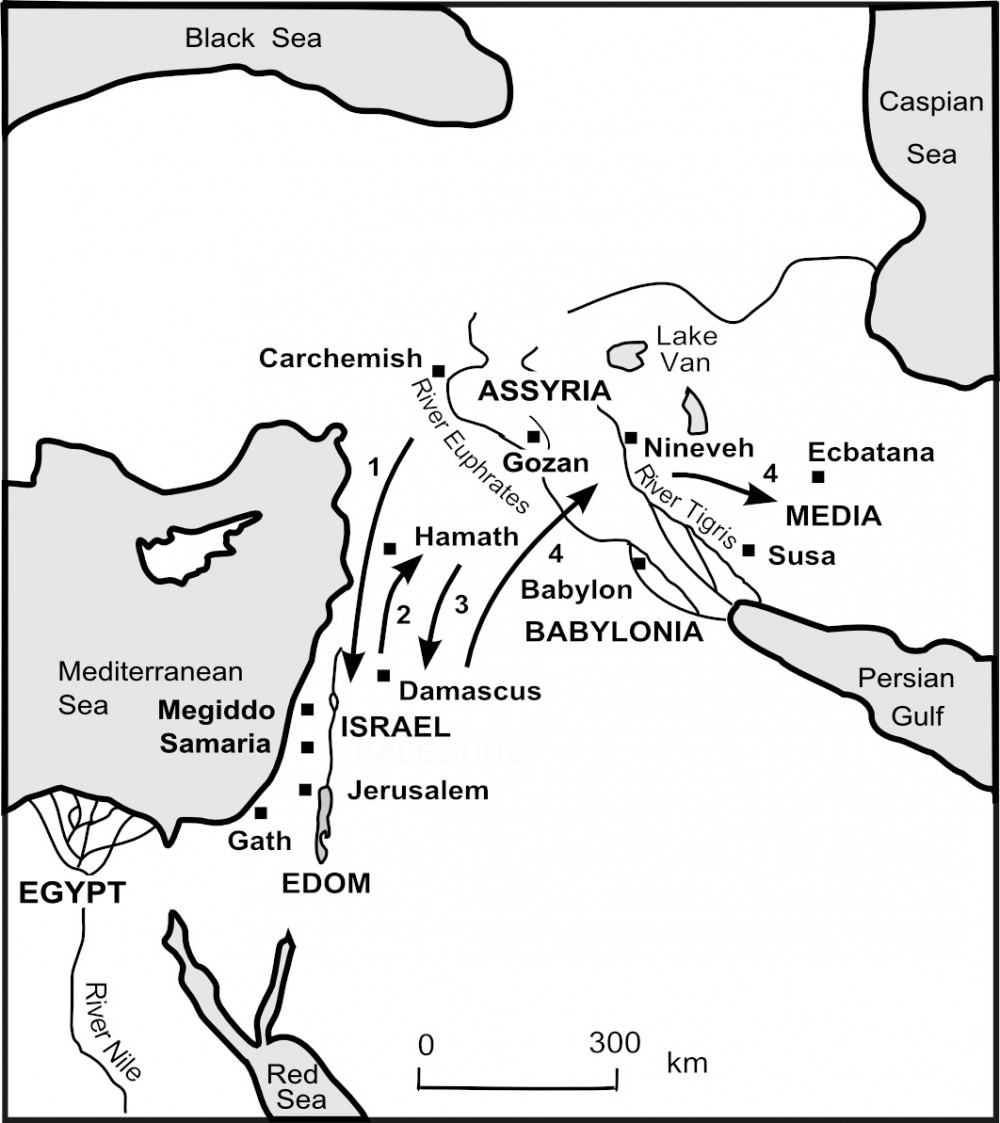
TIGLATH-PILESER
BEGINS TO CONQUER
EXPLANATION OF MAP - Map of Tiglath-Pileser's invasions is not all inclusive (i.e., does not address all sites mentioned in 2Ki 15:29) but gives a sense of Assyria's invasions. The meaning of numbers 1-4 - (1) Initial Assyrian advance. This marks the first western thrust of Assyrian power along the Euphrates corridor, bringing key cities like Carchemish and Hamath under Assyrian control. This secured the main invasion highway into Syria–Palestine. (2) Subjugation of Israel and Philistia. This arrow shows Assyrian pressure moving south toward Israel, including Samaria, and into Philistine territory (e.g., Gath). Israel becomes a vassal state, paying tribute (cf. Menahem, 2Ki 15:19–20). (3) Conquest of Damascus. This route highlights the defeat of Damascus (Aram).Historically tied to Tiglath-Pileser III’s destruction of Damascus (732 BC) and the end of Aramean independence (2Ki 16:9). (4) Deportation routes - These arrows show forced population transfers: From Israel and Syria to Assyrian core regions such as Gozan, Nineveh, Media, and Babylon. This corresponds to 2Ki 15:29 (initial deportations, e.g., Naphtali, under Tiglath-Pileser III) and 2 Kings 17:6 (final exile under Shalmaneser V/Sargon II. Assyria deliberately scattered conquered peoples to break national identity and prevent rebellion.
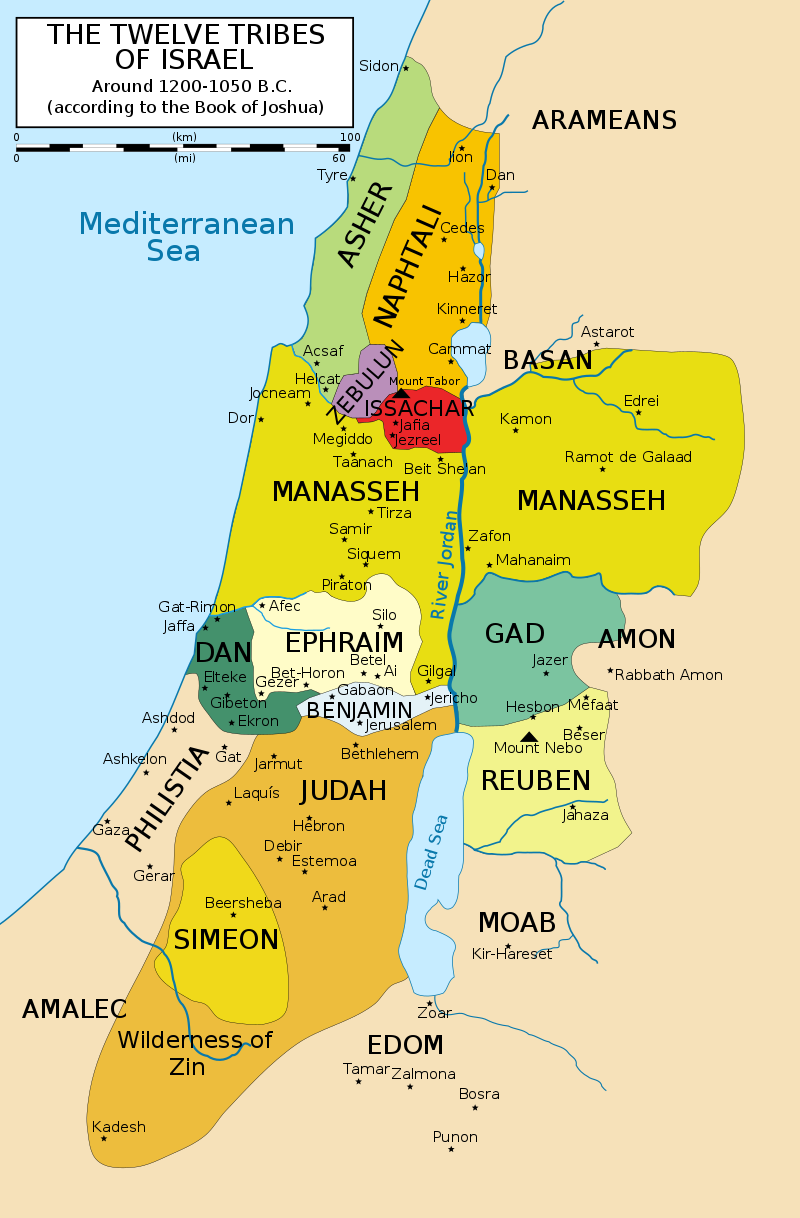
In the days of Pekah king of Israel, Tiglath-pileser king of Assyria came and captured Ijon and Abel-beth-maacah and Janoah and Kedesh and Hazor and Gilead and Galilee, all the land of Naphtali; and he carried them captive to Assyria - Ijon (meaning = "a ruin"!) is a city belonging to the tribe of Naphtali, situated a few miles northwest of the site of Dan, in a fertile and beautiful little plain, and was captured and plundered by Ben-hadad of Syria (in the reign of Baasha) at the instance of Asa (1Ki 15:20, 2Ch 16:4), and afterwards by Tiglath-pileser of Assyria (2Ki 15:29) in the reign of Pekah.
From the map above you can see that Naphtali was "easy pickings" for Tiglath-Pileser, as it was the tribe nearest Assyria (Assyria not shown on map but to right of Arameans).
Bob Utley - "he carried them captive to Assyria" This was the beginning of the northern kingdom's exile (NIDOTTE, vol. 4, "Exile," pp. 595-605)!
The Bible speaks of two major deportations of Israel by Assyria.
- here by Tiglath-pileser III in 734 B.C.
- later at the fall of Samaria in 722 B.C.
- siege started by Shalmaneser V
- siege was victorious under Sargon II (cf. 2 Kgs. 17:1-6; 18:9-12)
The cursings of Leviticus 26:14-46 and Deuteronomy 28:15-68 had come to fruition (cf. 2 KI 17:19-23)!
For a good brief discussion BORROW R. K. Harrison, Old Testament Times, "The Decline of Israel," pp. 228-229, and "The Last Days of Israel," pp. 229-231.
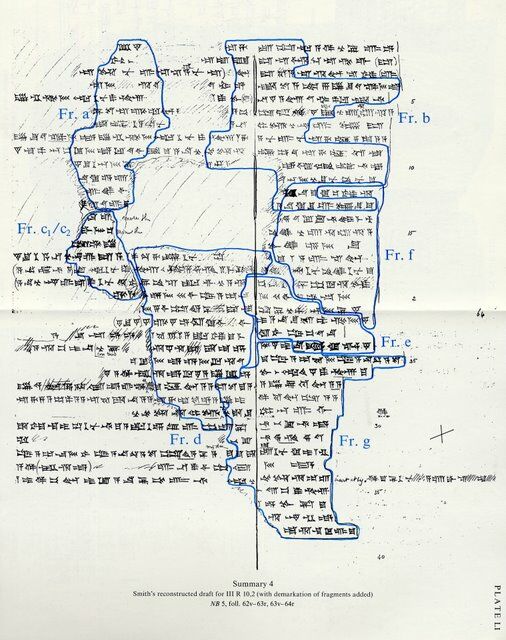
Smith’s reconstruction of Tiglath-Pileser III’s
Summary Inscription Four
Theo-sophical Ruminations/WordPress
ARCHAEOLOGICAL VERIFICATION - Armstrong Institue of Biblical Archaeology has the following note related to 2 Kings 15:29,30:
Another artifact, Summary Inscription Four (SEE ABOVE) (circa 730 b.c.e.), confirms Tiglath-Pileser’s conquest of the northern kingdom of Israel. Since its discovery, the clay inscription has been lost; however, Layard made a papier-mache imprint, known as a squeeze, before its disappearance. The inscription reads:
Israel … All its inhabitants (and) their possessions I led to Assyria. They overthrew their King Pekah and I placed Hoshea as king over them. I received from them 10 talents of gold, 1,000 talents of silver as their [tri]bute, and brought them to Assyria.
This inscription confirms several details in the biblical account. “In the days of Pekah king of Israel came Tiglath-pileser king of Assyria, and took [numerous Israelites cities], and he carried them captive to Assyria. 30And Hoshea the son of Elah made a conspiracy against Pekah the son of Remaliah, and smote him, and slew him, and reigned in his stead” (2 Kings 15:29-30). It is possible that Hoshea colluded with Tiglath-Pileser to replace King Pekah.
These Summary Inscriptions add to the expanding fund of discoveries that help confirm the historical accuracy of the Bible. The biblical kings Ahaz, Pekah, Hoshea, Rezin and Tiglath-Pileser all really lived, Ahaz really did send tribute to the Assyrian king, and Tiglath-Pileser really did attack and conquer much of Israel and subdued the surrounding regions."
🙏THOUGHT - The Bible is TRUE! Believe it or not! If you believe it and believe in Jesus, you get HEAVEN and eternal joy. If you believe it NOT, you get HELL and eternal separation from God's glorious presence! Choose wisely. Choose humbly! And choose while God still gives you breath to choose!
2 Kings 15:30 And Hoshea the son of Elah made a conspiracy against Pekah the son of Remaliah, and struck him and put him to death and became king in his place, in the twentieth year of Jotham the son of Uzziah.
- made a conspiracy: 2Ki 15:10,25
- and struck him: Ho 10:3,7,15
- in the twentieth: 2Ki 15:32,33 16:1 17:1 2Ch 28:4-6,16 Isa 7:1-9 8:6
- 2 Kings 15 Resources
ANOTHER ASSASSINATION
HOSHEA STRIKES PEKAH
And Hoshea the son of Elah made a conspiracy against Pekah the son of Remaliah, and struck him and put him to death and became king in his place, in the twentieth year of Jotham the son of Uzziah - See notes by Jewish historian Josephus.Tiglath-Pileser III did not personally execute Pekah because the task had already been accomplished on his behalf by Hoshea. Acting as a pro-Assyrian conspirator, Hoshea assassinated Pekah and seized the throne, effectively doing Assyria’s work from within Israel itself. This arrangement suited Tiglath-Pileser III perfectly. Rather than removing Pekah by direct execution, which could provoke rebellion or require prolonged military occupation, Assyria achieved its objective through internal regime change. Hoshea’s coup eliminated a hostile king and replaced him with a compliant vassal, allowing Assyria to maintain control with minimal cost. Thus, Pekah’s death illustrates a recurring Assyrian tactic of domination through political manipulation rather than immediate annihilation. Israel was not spared but it was merely subdued more efficiently. Hoshea ruled only because Assyria permitted it, and his kingship marked the final stage of Israel’s decline, one last, fragile pause before total collapse in 722 BC. In short, Assyria did not need to kill Pekah directly; by orchestrating events so that Hoshea did it for them, Assyria tightened its grip on Israel while keeping its own hands outwardly clean.
Bob Utley - "Hoshea" We learn from the annals of Tiglath-pileser III that he helped/encouraged Hoshea assassinate Pekah. Hoshea was a pro-Assyrian king.
QUESTION - Who was King Hoshea in the Bible? | GotQuestions.org
ANSWER - Hoshea son of Elah became king of the northern kingdom of Israel in 732 BC after assassinating King Pekah, son of Remaliah. Hoshea reigned 9 years. He was a wicked king, but not as wicked as previous kings of Israel (2 Kings 17:2). Hoshea was the last king of Israel before the nation’s destruction by Assyria.
King Pekah had fought with the Assyrians but lost territory to Tiglath-Pileser, king of Assyria. So when Hoshea took the throne from Pekah, he was a vassal to Shalmaneser king of Assyria and was required to pay heavy tribute (2 Kings 17:3). In a bid for freedom and independence, Hoshea rebelled against Assyria and stopped paying the tribute, appealing to Egypt for help. This move was a failure. When Shalmaneser discovered King Hoshea’s treachery, he threw Hoshea into prison (verse 4). The Assyrian army then invaded all of Hoshea’s land. The capital, Samaria, was besieged for three years and eventually captured. The Israelites were then deported to Assyria and settled in Halah, Gozen on the Harbor River, and in the towns of the Medes. As most of the northern kingdom of Israel had already been conquered, this deportation effectively destroyed the entire kingdom. Israel’s destruction partly fulfilled the prophecy of Isaiah 7:16.
On the surface this may sound like the usual intrigues of kings, but the Bible makes it clear that the Assyrians’ takeover of Israel and the Israelites’ subsequent exile was God’s judgment on His people for their great sin. In spite of all the Lord had done for them, the Israelites had turned from God and worshiped false gods, setting up high places and burning incense to idols (2 Kings 17:7–11). God had sent prophets, including Elijah and Elisha, to warn the Israelites, but the people persisted in their idolatry. God had meant for Israel to be set apart as a holy people (Leviticus 20:26; 2 Kings 17:15), but instead they had assimilated the idolatrous practices of the societies they had conquered. God had given them many chances to turn back to Him, but they ignored all the prophets who warned them to turn from their evil ways. Because of their rebelliousness, “the LORD removed them from His presence” (2 Kings 17:23) in fulfillment of Moses’ warning in Deuteronomy 30:17–18.
Several years after the capture of King Hoshea and the destruction of the northern kingdom, the southern kingdom of Judah fell to Nebuchadnezzar, king of Babylon (2 Kings 25:1–4). The capital city of Jerusalem was destroyed, including its walls and the temple of the Lord (verses 8–10). Judah was taken into captivity and exiled for 70 years, just as the Lord had promised as judgment for sin. However, in His mercy, God promised to preserve His people and eventually bring them back to the land He had promised them (Ezekiel 11:14–17).
2 Kings 15:31 Now the rest of the acts of Pekah and all that he did, behold, they are written in the Book of the Chronicles of the Kings of Israel.
PEKAH'S
OBITUARY
Now the rest of the acts of Pekah and all that he did, behold (hinneh; LXX - idou) , they are written in the Book of the Chronicles of the Kings of Israel. See note on the Book of the Chronicles, which is not the inspired book of 1-2 Chronicles, but an official secular record which has been lost.
Christopher Knapp - “He slew in his ‘fierce anger’ one hundred thousand Jews in one day (2 Chronicles 28:6); and God requited him in kind; for as he had so treacherously shed man’s blood, by man was his blood also treacherously shed.”
2 Kings 15:32 In the second year of Pekah the son of Remaliah king of Israel, Jotham the son of Uzziah king of Judah became king.
- Jotham: 2Ki 15:7 1Ch 3:12 2Ch 27:1-9 Mt 1:9
- Jotham: 2Ki 15:1,7,13,17,23,27 14:21 1Ch 3:12
- 2 Kings 15 Resources
Related Passages:
2 Chronicles 27:1-9 Jotham was twenty-five years old when he became king, and he reigned sixteen years in Jerusalem. And his mother’s name was Jerushah the daughter of Zadok. 2 He did right in the sight of the LORD, according to all that his father Uzziah had done; however he did not enter the temple of the LORD. But the people continued acting corruptly. 3 He built the upper gate of the house of the LORD, and he built extensively the wall of Ophel. 4 Moreover, he built cities in the hill country of Judah, and he built fortresses and towers on the wooded hills. 5 He fought also with the king of the Ammonites and prevailed over them so that the Ammonites gave him during that year one hundred talents of silver, ten thousand kors of wheat and ten thousand of barley. The Ammonites also paid him this amount in the second and in the third year. 6 So Jotham became mighty because he ordered his ways before the LORD his God. 7 Now the rest of the acts of Jotham, even all his wars and his acts, behold, they are written in the Book of the Kings of Israel and Judah. 8 He was twenty-five years old when he became king, and he reigned sixteen years in Jerusalem. 9 And Jotham slept with his fathers, and they buried him in the city of David; and Ahaz his son became king in his place.
Matthew 1:9 (IN LINE OF MESSIAH) Uzziah was the father of Jotham, Jotham the father of Ahaz, and Ahaz the father of Hezekiah.
JOTHAM REIGNS
AS KING OF JUDAH
In the second year of Pekah the son of Remaliah king of Israel, Jotham the son of Uzziah king of Judah became king - The ascension of Jotham apparently takes place without any political instability as was frequently seen in the Northern Kingdom.
QUESTION - Who was King Jotham in the Bible? | GotQuestions.org
ANSWER - Jotham became king of Judah at age twenty-five and reigned for sixteen years, from 750 to 735 BC (2 Kings 15:33; 2 Chronicles 27:1). “He did what was right in the eyes of the Lord, just as his father Uzziah had done, but unlike him he did not enter the temple of the Lord. The people, however, continued their corrupt practices” (2 Chronicles 27:2; see also 2 Kings 15:34–35). King Uzziah had been faithful to the Lord but then became prideful and attempted to burn incense on the altar of the Lord, something only priests were permitted to do (2 Chronicles 26:16–20). As a result, God afflicted Uzziah with leprosy. Uzziah lived out the rest of his days in a separate house, while his son Jotham oversaw the palace and governed the people (2 Chronicles 26:21). Jotham did not repeat his father’s mistake of presumptuously entering the temple.
“Jotham grew powerful because he walked steadfastly before the Lord his God” (2 Chronicles 27:6). He rebuilt the Upper Gate of the temple and also did work on the wall at the hill of Ophel and built towns, forts, and towers (2 Chronicles 27:3–4). However, King Jotham failed to remove the high places so the people continued to make sacrifices there (2 Kings 15:35). Jotham waged a successful war against the Ammonites, resulting in their paying him tribute for three years (2 Chronicles 27:5). During Jotham’s reign “the Lord began to send Rezin king of Aram and Pekah son of Remaliah against Judah” (2 Kings 15:37). During the reign of Jotham’s son Ahaz, the Arameans would march against Judah, resulting in defeat and heavy casualties for Judah (2 Chronicles 28:5). Initial defeat was followed by Ahaz seeking help from the Assyrians and ultimately looting and shutting up God’s temple and creating more high places (2 Kings 16:5–18; 2 Chronicles 28:5–25).
Isaiah, Hosea, and Micah all prophesied during Jotham’s reign (Isaiah 1:1; Hosea 1:1; Micah 1:1). Also, the genealogies in 1 Chronicles 1–5 were recorded during Jotham’s reign (1 Chronicles 5:17).
Despite Jotham’s godly example, his son Ahaz proved to be a wicked king. Even so, both Jotham and Ahaz are ancestors of Jesus Christ (Matthew 1:9). God is able to use all people to accomplish His good purposes.
2 Kings 15:33 He was twenty-five years old when he became king, and he reigned sixteen years in Jerusalem; and his mother’s name was Jerusha the daughter of Zadok.
- Jerusha: 2Ch 27:1, Jerushah
- 2 Kings 15 Resources
Parallel Passages:
2 Chronicles 27:1 Jotham was twenty-five years old when he became king, and he reigned sixteen years in Jerusalem. And his mother’s name was Jerushah the daughter of Zadok.
2 Chronicles 27:8 He was twenty-five years old when he became king, and he reigned sixteen years in Jerusalem.
JOTHAM ASCENDS TO
THRONE OF JUDAH
He was twenty-five years old when he became king, and he reigned sixteen years in Jerusalem; and his mother’s name was Jerusha the daughter of Zadok - He reigned from 748 to 732 BC.
2 Kings 15:34 He did what was right in the sight of the LORD; he did according to all that his father Uzziah had done.
- according: 2Ki 15:3,4 2Ch 26:4,5 27:2
- 2 Kings 15 Resources
Parallel Passages:
2 Chronicles 27:2-3 He did right in the sight of the LORD, according to all that his father Uzziah had done; however he did not enter the temple of the LORD. But the people continued acting corruptly. 3 He built the upper gate of the house of the LORD, and he built extensively the wall of Ophel.
JOTHAM LEARNED
FROM FATHER'S MISTAKE
He did what was right (yashar) in the sight of the LORD - Here we find a strong contrast with the laundry list of evil kings of Israel the writer has just reviewed. This declaration indicates his reign was generally faithful and he ruled as if Yahweh was watching (which He was). King Jotham of Judah contrasts with the degradation of the northern kingdom with its political instability, assassinations and idolatry.
He did according to all that his father Uzziah had done - In context this statement refers to the first half of Uzziah's reign in which he was generally faithful and not to Uzziah's later prideful presumptous entrance into the holy place to offer incense. The writer of Chronicles says Jotham "did not enter the temple of the LORD." (2Ch 27:2) He learned from his father's mistake!
2 Kings 15:35 Only the high places were not taken away; the people still sacrificed and burned incense on the high places. He built the upper gate of the house of the LORD.
- Only the high places: 2Ki 15:4 18:4 2Ch 32:12
- the upper gate: 2Ch 27:3-9
- 2 Kings 15 Resources
Related Passages:
2 Chronicles 27:3-9 Jotham was twenty-five years old when he became king, and he reigned sixteen years in Jerusalem. And his mother’s name was Jerushah the daughter of Zadok. 2 He did right in the sight of the LORD, according to all that his father Uzziah had done; however he did not enter the temple of the LORD. But the people continued acting corruptly. 3 He built the upper gate of the house of the LORD, and he built extensively the wall of Ophel. 4 Moreover, he built cities in the hill country of Judah, and he built fortresses and towers on the wooded hills. 5 He fought also with the king of the Ammonites and prevailed over them so that the Ammonites gave him during that year one hundred talents of silver, ten thousand kors of wheat and ten thousand of barley. The Ammonites also paid him this amount in the second and in the third year. 6 So Jotham became mighty because he ordered his ways before the LORD his God. 7Now the rest of the acts of Jotham, even all his wars and his acts, behold, they are written in the Book of the Kings of Israel and Judah.
LIKE FATHER LIKE SON
NEITHER REMOVE HIGH PLACES
Only the high places (bamah) were not taken away; the people still sacrificed and burned incense on the high places - See discussion of high places which also persisted under his father Azariah/Uzziah's reign (2Ki 15:4).
Knapp on Jotham (despite mentioning the high places) he writes "“Jotham is the only one of all the Hebrew kings, from Saul down, against whom God has nothing to record. In this his character is in beautiful accord with his name, Jehovah-perfect.”
He built the upper gate of the house of the LORD - This gate is also called the “high gate of Benjamin” (Jer. 20:2), and some sources locate this gate in the northern part of the temple complex, facing the territory of Benjamin. Other sources locate the gate on the south side of the Temple complex.
Guzik - In particular, it seems that Jotham rebuilt the link between the temple and the palace. “He wished free access from his own house to that of the Lord. He would strengthen the link between the two houses – keep his line of communication open (to use a military figure) with the source of his supplies of strength and wisdom. This is one of the secrets of his prosperity and power.” (Knapp on Jotham) His father Azariah (Uzziah) misunderstood the link between the royal house and the house God, demanding priestly authority (2 Chronicles 26:16-21). Many kings before him wanted no link between the royal house and the house of God. Jotham understood that he was a king and not a priest, yet he wanted a good, open link between the palace and the temple. 2 Chronicles 27:6 says, So Jotham became mighty, because he prepared his ways before the LORD his God. The building of this link between the palace and the temple was one of the chief ways that he prepared his way before the LORD. “That high gate between the palace and the temple was better than a Chinese wall around his kingdom. It is in communion with God that real prosperity and power is found.” (Knapp)
2 Kings 15:36 Now the rest of the acts of Jotham and all that he did, are they not written in the Book of the Chronicles of the Kings of Judah?
- the rest: 2Ki 15:6,7 2Ch 27:4-9
- 2 Kings 15 Resources
Related Passages:
2 Chronicles 27:4-6 Moreover, he built cities in the hill country of Judah, and he built fortresses and towers on the wooded hills. 5He fought also with the king of the Ammonites and prevailed over them so that the Ammonites gave him during that year one hundred talents of silver, ten thousand kors of wheat and ten thousand of barley. The Ammonites also paid him this amount in the second and in the third year. 6So Jotham became mighty because he ordered his ways before the LORD his God.
Parallel Passage:
2 Chronicles 27:7 Now the rest of the acts of Jotham, even all his wars and his acts, behold, they are written in the Book of the Kings of Israel and Judah.
SUMMARY OF
JOTHAM
Now the rest of the acts of Jotham and all that he did, are they not written in the Book of the Chronicles of the Kings of Judah? See note on the Book of the Chronicles, which is not the inspired book of 1-2 Chronicles, but an official secular record which has been lost. The reference to “the Book of the Chronicles of the Kings of Judah” (see note) signals that Jotham’s reign was fuller than Kings records, yet intentionally summarized. Kings omits political and military detail in order to focus on covenant evaluation. Though Jotham ruled faithfully and effectively, his reign produced no lasting spiritual reform, and the nation remained unchanged at the popular level. The formula thus closes his reign with quiet respect—but without enduring commendation.
Wiersbe: Like his father, Uzziah, Jotham was both a builder and a warrior. He repaired the walls of Jerusalem and the Upper Gate of the temple. He also built cities in the Judean mountains and fortresses and towers in the wooded areas. His army confronted the armies of Israel and Syria, and he won a great victory over the Ammonites and put them under a very heavy annual tribute. (Bible Exposition Commentary - Old Testament)
2 Kings 15:37 In those days the LORD began to send Rezin king of Aram and Pekah the son of Remaliah against Judah.
- In those days: Isa 38:1-22
- began: 2Ki 10:32 1Sa 3:12 Jer 25:29 Lu 21:28
- to send: De 28:48 Ps 78:49 Isa 10:5-7 Jer 16:16 43:10
- Rezin: 2Ki 16:5 2Ch 28:6 Isa 7:1,8 Ho 5:12,13
- Pekah: 2Ki 15:27
- 2 Kings 15 Resources
Related Passages:
Deuteronomy 28:48 (CURSING PROMISES FOR DISOBEDIENCE) therefore you shall serve your enemies whom the LORD will send against you, in hunger, in thirst, in nakedness, and in the lack of all things; and He will put an iron yoke on your neck until He has destroyed you.
2 Kings 16:5 Then Rezin king of Aram and Pekah son of Remaliah, king of Israel, came up to Jerusalem to wage war; and they besieged Ahaz, but could not overcome him.
2 Chronicles 28:6 For Pekah the son of Remaliah slew in Judah 120,000 in one day, all valiant men, because they had forsaken the LORD God of their fathers.
BEGINNING OF ATTACKS
AGAINST JUDAH
In those days is a time phrase that marks end of Jotham's reign and a decisive shift in Judah’s history as Yahweh began to raise up external adversaries against Judah. Up to this point, Judah under Jotham had enjoyed relative stability and prosperity, largely inherited from the earlier successes of Uzziah. Now, however, the political climate changes. External pressure replaces internal peace. 2 Kings 16 shows that the external pressure fully breaks out under Ahaz (the Syro-Ephraimite crisis). One might say the threat begins under Jotham, but the storm breaks forth under Ahaz.
the LORD began to send - This is the opposite of the "good hand of the LORD" which obedience produced! The attacks against were not accidental, not merely geopolitical but were divinely permitted and directed. One is reminded of Pr 21:1 that "The king’s heart is like channels of water in the hand of the LORD; He turns it wherever He wishes." Notice the time sensitive word began which marking the opening stages of divine discipline against Judah.
Guzik - This was the beginning. If Judah and her kings responded to these chastening events in the right way, God would take note. If they hardened their hearts and rejected the correction of God, He would take note of that as well.
Rezin king of Aram - Rezin controlled Syria with its capital at Damascus. Since Rezin felt threatened by the expanding power of Assyria, he sought regional alliance with Pekah to resist Assyrian domination.
And Pekah the son of Remaliah against Judah - Pekah ruled the Northern Kingdom of Israel, and Rezin ruled Aram (Syria). Together they formed a military coalition to pressure Judah.
Assyrian expansion under Tiglath‑Pileser III threatened smaller nations. Pekah (of Israel) and Rezin (of Syria) formed an anti‑Assyrian alliance and demanded that Judah join them. When King Ahaz and the Judahites refused, Pekah and Rezin decided to attack Judah to depose its king and install a puppet who would cooperate with them. These foreign threats against Judah served as warning judgments, intended to drive Judah to renewed faithfulness in Yahweh.
Bob Utley - This is the beginning of Syria and Israel trying to force Judah to join a military alliance to repulse the king of Assyria. This is later called the "Syro-Ephraimite Alliance". (ED: IT IS CALLED EPHRAIMITE BECAUSE THE OTHER NAME OF THE NORTHERN KINGDOM WAS EPHRAIM.)
- P. J. M. Southwell = NIDOTTE, vol. 4, pp. 1244-1245
1. History. The primary sources for this episode are 2 Kgs 15:37; 16:5–9; 2 Chron 28:5–21; Isa 7:1–8:8, and the Assyr. annals (ANET, 284). Pekah, king of Israel, was minded to create a coalition against Assyria, the dominant power in the area. He and the king of Syria, Rezin, sought to recruit Jotham, king of Judah, to their cause, but he seems to have declined. The allies therefore attacked Judah, but it fell to the new king, Ahaz, to respond to their assault (735 BC). He was heavily defeated in the north (see especially the account in 2 Chron), his own son and some high officers of state having perished in battle. The aim of the allies appears to have been to place a Syrian sympathizer to their cause (a certain ben Tabeel, Isa 7:6) on the throne of David in Jerusalem.
Nor was this the only defeat inflicted upon King Ahaz. At the same time the garrison of Elath in the south was attacked and destroyed either by Syria (MT, 2 Kgs 16:6) or by Edom (RSV), from whom it had been taken in the reign of Azariah (14:22). Certainly Edom joined in the attacks on Judah, according to 2 Chron 28:17. The Philistines too saw their opportunity to seize territory from Judah (28:18) and took some important towns and villages.
Politically, the natural place to which Ahaz might turn for help was, of course, Assyria, with its huge military resources and suzerainty over the area. Ahaz sent to the emperor Tiglath-Pileser III (given his Babylonian name Pul in 2 Kgs 15:19), who needed no encouragement to come to restore order in his western dominions. In 734 he came from the north down the sea coast and subdued the Philistines as far as the Egyptian border, and a few months later attacked Israel, taking much territory. All of Israel’s lands across the Jordan were conquered, as was Galilee, the huge fortified cities of Hazor and Megiddo being destroyed. Large numbers were deported (15:29), and Pekah himself was murdered in a conspiracy, to be succeeded by his murderer, Hoshea ben Elah, who promptly sued for peace. Tiglath-Pileser claims to have had a hand in this (“They overthrew their king Pekah and I placed Hoshea as king over them”). Tribute was paid, and the following year Damascus was attacked and conquered, and Rezin was slain. The population was deported, after the Assyrian custom, and taken to Kir, whence some of their ancestors had once migrated (Amos 9:7). Judah was now safe, though this had been achieved at the price both of a considerable payment (2 Kgs 16:8) from temple funds and of her political freedom.
2. Theology. This last point weighed heavily with the prophet Isaiah, who had opposed Ahaz’s appeal to Assyria for help (Isa 7:1–8:8), believing that it represented a failure to trust God’s promise to the house of David and that it would lead to excessive Assyrian dominance in both religious and political life. In the event Isaiah was proved right, for Ahaz was obliged “in deference to the king of Assyria” (2 Kgs 16:18) to modify the cult and cult vessels of Yahweh in the temple in Jerusalem so as to incorporate an Assyrian altar, which became the main place of burnt offering, and to remove a variety of traditional features of worship in Jerusalem, including his own private entrance to the temple, thus symbolizing the supremacy of Assyria over the cult of Yahweh (vv. 10–18).
Furthermore, the new regime saw a period of increasingly pagan morality in Judah, to which the prophecies of Isaiah and Micah bear ample witness. Isaiah’s prediction of poverty was doubtless partly fulfilled in the serious loss of revenues that must have ensued with the loss of so much territory to Philistia, Edom, Israel, and Syria (Isa 7:23–25), although the rich remained rich, largely by oppressing the poor and paying lip service only to the religion of Yahweh (1:4–17). Both the deut. historian (2 Kgs 15:37) and the Chronicler (2 Chron 28:19) see in all this the marks of divine judgment on a faithless people whose practice of pagan religion alongside their ancestral faith included human sacrifice and idolatry. (See Deuteronomic/istic: Theology)
It is against this background that Isaiah pronounced one of the Bible’s most famous oracles, telling King Ahaz that God would act to save Judah despite the king’s weakness, and that the sign would be the birth of a boy called Immanuel (= God is with us) to a young woman who may have been unmarried (for it is she who names the child: Isa 7:14). This would happen soon, for she was already pregnant (for RSV “shall conceive,” read with the note “is with child”); thus, the king would soon know God was about to act on Judah’s behalf. Israel and Syria would cease to be a threat, though Ahaz’s ally Assyria would bring trouble in its wake. Though we do not know to which of Judah’s newer leaders this oracle refers (Ahaz’s own son Hezekiah had been born in ca. 738), this prophecy is used by the NT (Matt 1:23) to illustrate how God could bring to a world oppressed by sin a miraculously born deliverer of David’s line. The right theological response to the Syro-Israelite alliance was to “be careful, keep calm and don’t be afraid,” for “if you do not stand firm in your faith, you will not stand at all” Isa 7:4, 9), rather than to abandon faith for a dangerous liaison. (See Isaiah: Theology)
BIBLIOGRAPHY
J. Bright, A History of Israel3, 1981; J.This brief succession notice is far more than a chronological footnote. It marks a decisive turning point in Judah’s history. H. Hayes and J. M. Miller, BORROW Israelite and Judaean History, 1977, 421–34; S. Herrmann, A History of Israel in Old Testament Times (SPANISH VERSION), 1975, 246–49; B. Oded, “The Historical Background of the Syro-Ephraimite War Reconsidered,” CBQ 34, 1972, 153–65.
2 Kings 15:38 And Jotham slept with his fathers, and he was buried with his fathers in the city of David his father; and Ahaz his son became king in his place.
- Jotham: 2Sa 7:12 1Ki 1:2 14:20,31
- Ahaz: 2Ki 16:1 1Ch 3:13 2Ch 28:1 Mt 1:9, Achaz
- 2 Kings 15 Resources
Parallel Passage:
2 Chronicles 27:9 And Jotham slept with his fathers, and they buried him in the city of David; and Ahaz his son became king in his place.
JOTHAM DESCENDS
AHAZ ASCENDS
And Jotham slept with his fathers, and he was buried with his fathers in the city of David his father As discussed above slept with his fathers does not mean soul sleep.
The end of a faithful reign and
the beginning of systemic apostasy.
And Ahaz his son became king in his place - This brief succession notice is far more than a chronological footnote for it marks a decisive turning point in Judah’s history. On the surface, the phrase indicates orderly continuity since there is no assassination, no coup and no civil unrest. Yet spiritually and politically, this transition to the reign of evil King Ahaz represents a sharp decline, not stability. A good king Jotham (2Ki 15:34) fathers an evil king Ahaz (2Ki 16:2-4).
There is irony in the name Ahaz means which means “he has grasped/held fast," for Ahaz refuses to grasp God’s promises and clings instead to Assyria. Ahaz was explicitly offered God’s promises and protection during the Syro-Ephraimite crisis, yet he deliberately rejected them and chose to rely on Assyria instead. Ahaz was invited to ask for a sign to confirm God’s word (Isa 7:10–11) but instead replied “I will not ask, nor will I test the LORD.” Ahaz' reply sounds pious but was, in context, unbelief disguised as piety. Isaiah’s rebuke makes this explicit to Ahaz that “If you will not believe, you surely shall not last.” (Isa 7:9)
Bob Utley - "Ahaz" His full name was possibly Jeho-ahaz. This is what he is called in the Assyrian records.