2 Kings 16:2
2 Kings 16:3
2 Kings 16:4
2 Kings 16:5
2 Kings 16:6
2 Kings 16:7
2 Kings 16:8
2 Kings 16:9
2 Kings 16:10
2 Kings 16:11
2 Kings 16:12
2 Kings 16:13
2 Kings 16:14
2 Kings 16:15
2 Kings 16:16
2 Kings 16:17
2 Kings 16:18
2 Kings 16:19
2 Kings 16:20
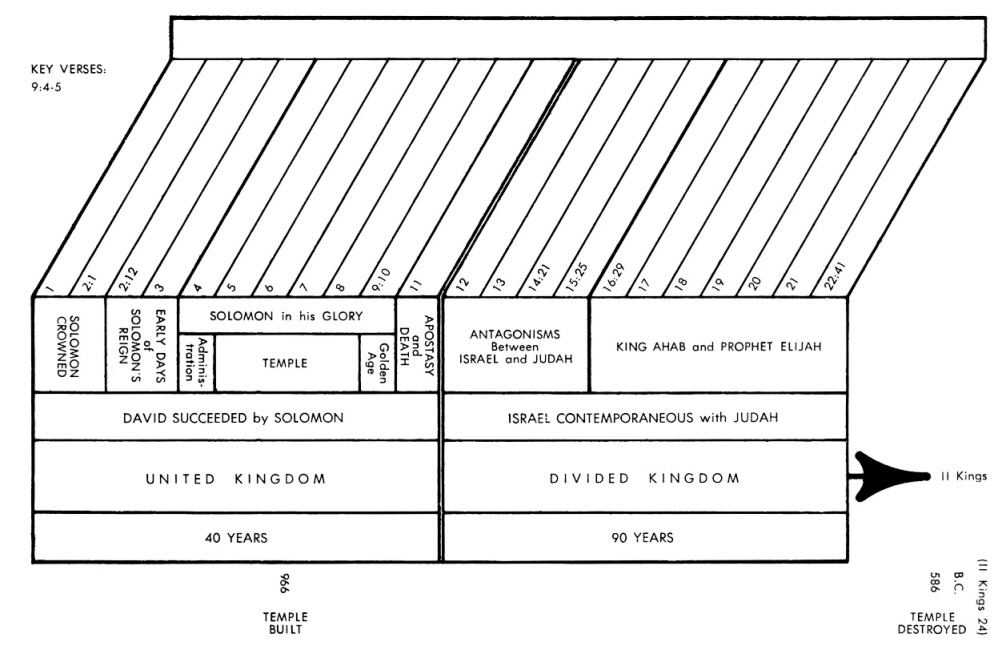
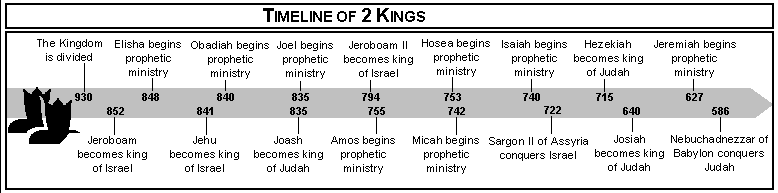
Chart from recommended resource Jensen's Survey of the OT - used by permission
1 Kings Chart from Charles Swindoll

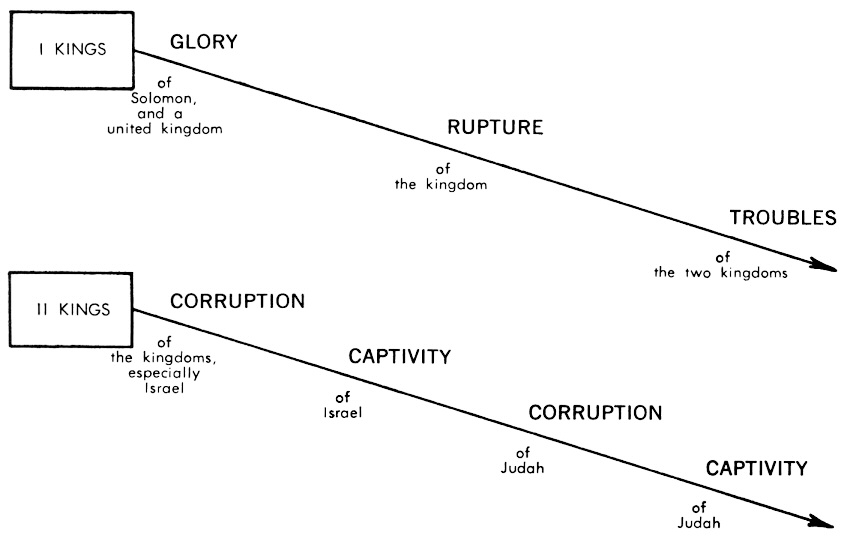
THE DOWNWARD SPIRAL
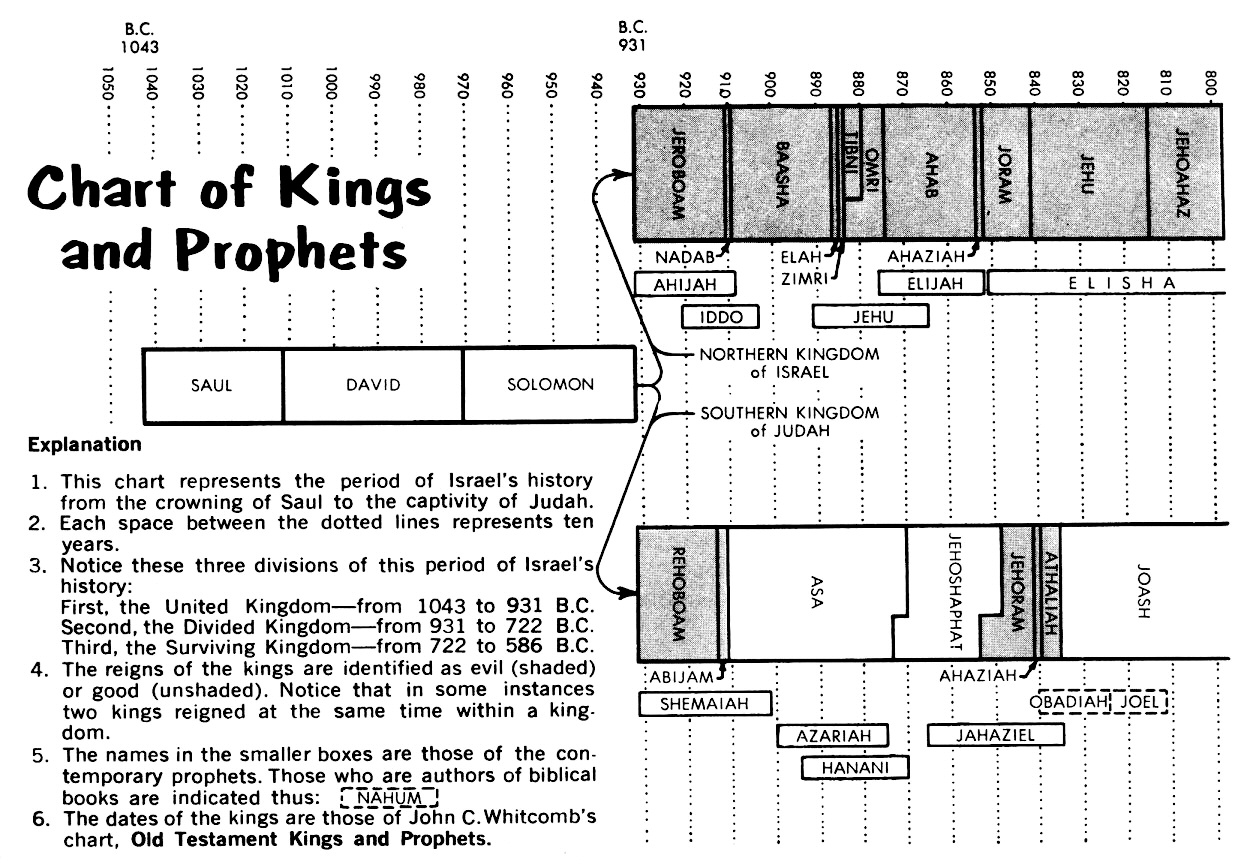
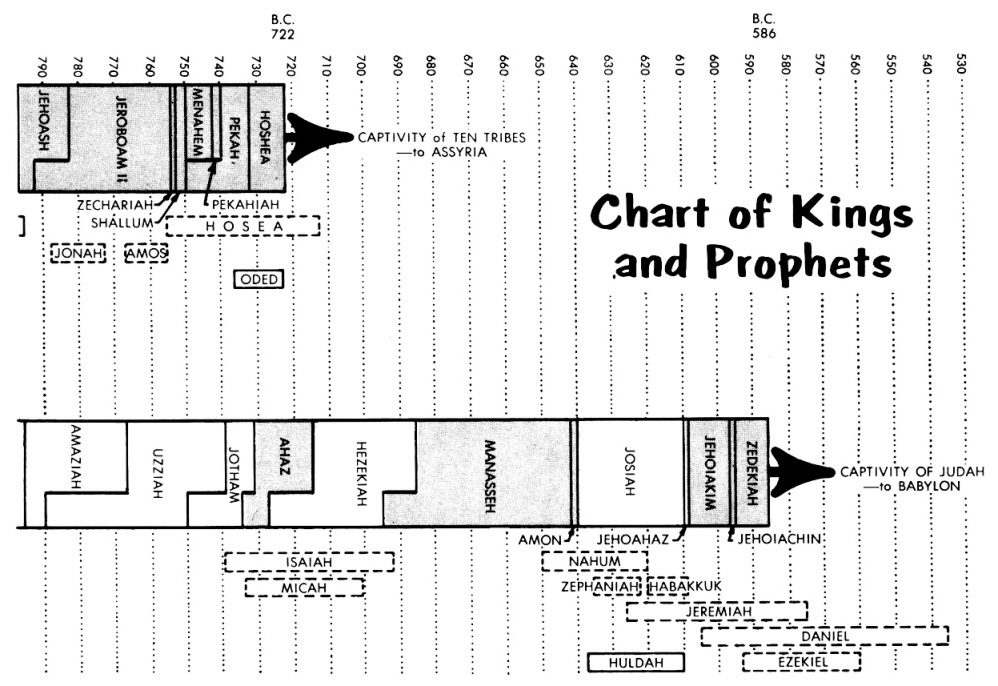
Click to Enlarge
Ryrie Study Bible - Borrow
Click to Enlarge
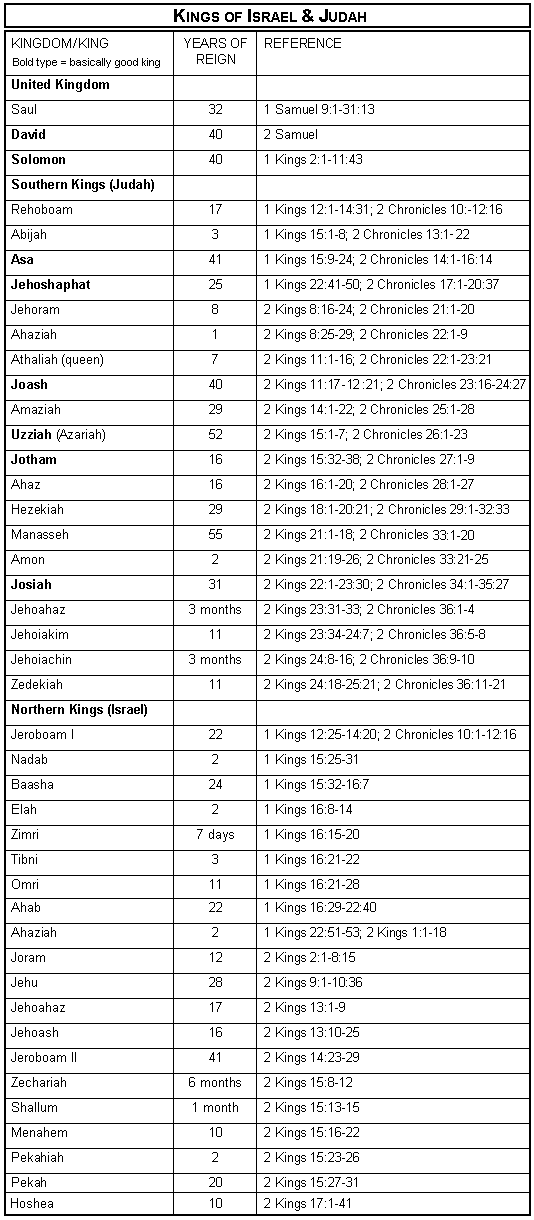
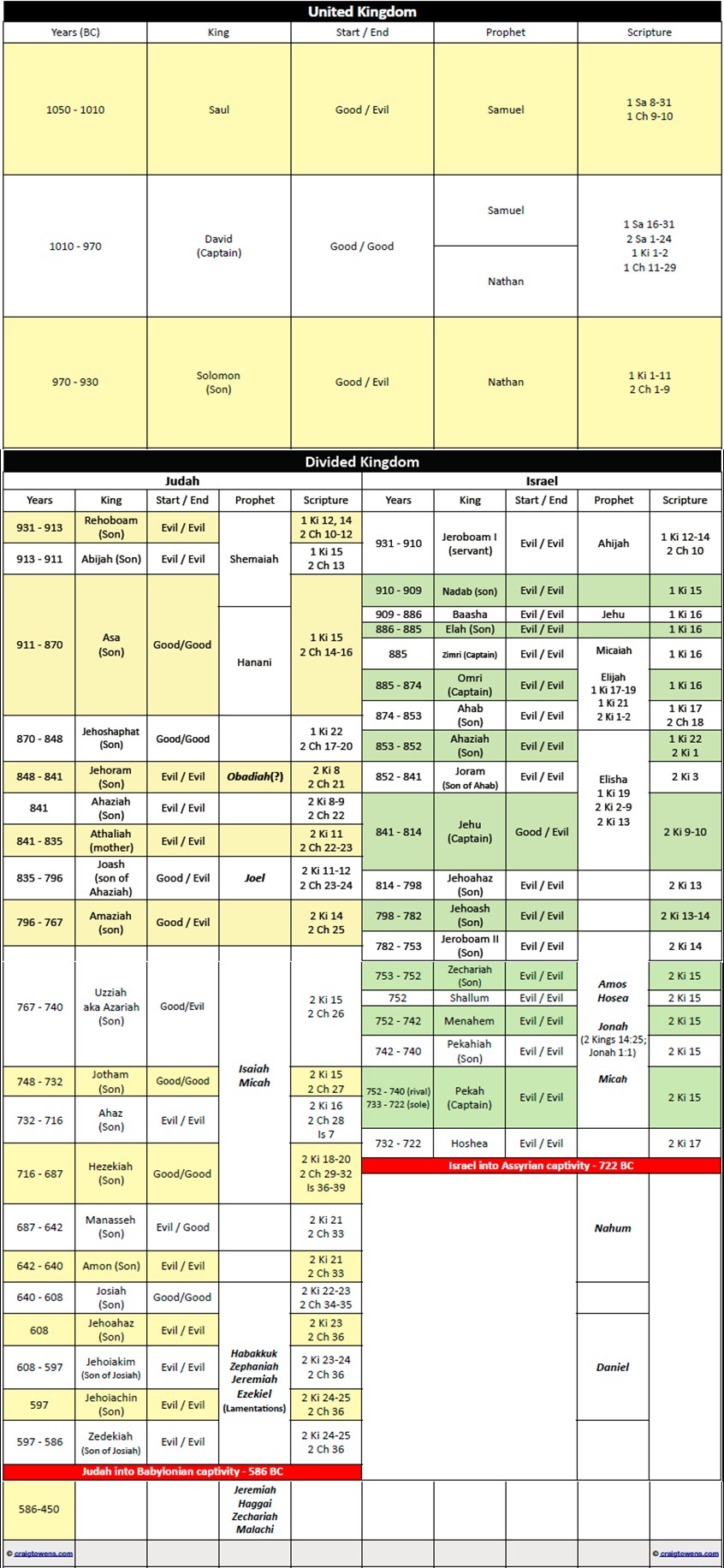
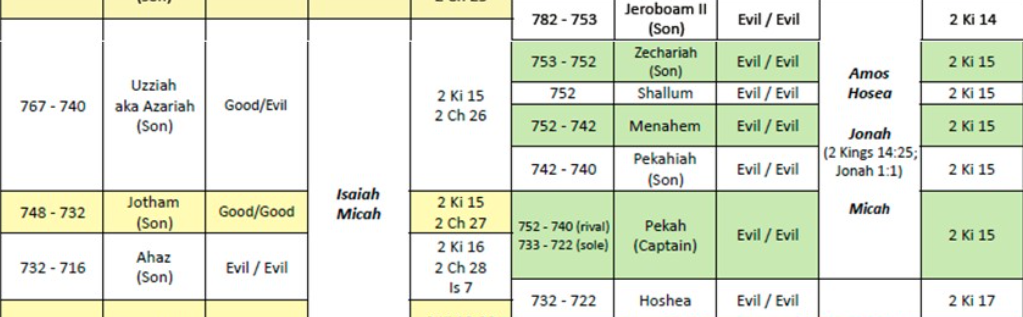
(NOTE: Many consider Amaziah and Hezekiah as "good" kings)
SEE ALSO:
ESV chart - kings of Israel - more information
ESV chart - kings of Judah - more information
Another Chart with Variable Dates for Reigns of King
2 Kings 16:1 In the seventeenth year of Pekah the son of Remaliah, Ahaz the son of Jotham, king of Judah, became king.
- seventeenth: 2Ki 15:27-30,32,33
- Ahaz: 2Ki 15:38 2Ch 28:1-4 Isa 1:1 7:1 Ho 1:1 Mic 1:1
- 2 Kings 16 Resources
Related Passages:
2 Kings 15:37-38 In those days the LORD began to send Rezin king of Aram and Pekah the son of Remaliah against Judah. 38 And Jotham slept with his fathers, and he was buried with his fathers in the city of David his father; and Ahaz his son became king in his place.
KING AHAZ
AHAZ ASCENDS TO
THRONE OF JUDAH
In the seventeenth year of Pekah (king in Israel) the son of Remaliah, Ahaz ("possessor" "he has grasped") the son of Jotham, king of Judah, became king - Ahaz is the 12th king of Judah out of a total of 20. This verse anchors the beginning of Ahaz’s reign within the larger timeline of Israel and Judah. By dating his accession to the seventeenth year of Pekah of Israel, the writer shows how closely the histories of the two kingdoms were intertwined. Ahaz inherited the throne from his godly father Jotham at a time of mounting political tension, as the northern kingdom of Israel and the rising power of Aram (Syria) were pressuring Judah to join their anti-Assyrian alliance. Ahaz's enthronement marks the start of one of Judah’s most troubled periods, a reign that sadly would be shaped by fear, compromise, and dependence on Assyria rather than on the LORD. What appears to be a routine chronological statement unfortunately introduces a dramatic turning point in Judah’s spiritual and national life.
The lights are going
out in Judah
Dale Ralph Davis - A whole chapter devoted to a southern king is unusual for 1–2 Kings so far. But the news is not good...the lights are going out in Judah.(Borrow 2 Kings : the power and the fury page 228)
Warren Wiersbe - An English proverb says, “Consider well who you are, where you came from, what you do and where you are going.” The first two considerations were easily answered in both Israel and Judah, for both nations would have said, “We are God’s chosen people, descendants of our father Abraham.” As for the third question, both kings would have had to admit, “We do what our wicked predecessors did.” King Ahaz of Judah didn’t follow the godly example of his ancestor David, and Hoshea, king of Israel, imitated the wicked kings that ruled before him. They were free to make these decisions, but they were not free to change the consequences of their decisions, which brings us to the fourth question, “Where are you going?” For both rulers, God’s answer was clear: “You and your people are plunging rapidly toward judgment and ruin.” Solomon’s words were about to be proved in both kingdoms: “Righteousness exalts a nation, but sin is a reproach to any people” (Pr 14:34).
David Guzik writes - Micah 7:2-7 is a good description of the depravity of the times of Ahaz and the reaction of the godly remnant to it.
Micah 7:2-7 (MICAH BEGAN HIS PROPHETIC MINISTRY TO JUDAH ca. 742 BC OR ABOUT 10 YEARS PRIOR TO AHAZ BECOMING KING IN JUDAH cf Micah 1:1) - The godly person has perished from the land, And there is no upright person among men. All of them lie in wait for bloodshed; Each of them hunts the other with a net. 3 Concerning evil, both hands do it well. The prince asks, also the judge, for a bribe, And a great man speaks the desire of his soul; So they weave it together. 4 The best of them is like a briar, The most upright like a thorn hedge. The day when you post your watchmen, Your punishment will come. Then their confusion will occur. 5 Do not trust in a neighbor; Do not have confidence in a friend. From her who lies in your bosom Guard your lips. 6 For son treats father contemptuously, Daughter rises up against her mother, Daughter-in-law against her mother-in-law; A man’s enemies are the men of his own household. 7 But as for me, I will watch expectantly for the LORD; I will wait for the God of my salvation. My God will hear me.
QUESTION - Who was King Ahaz in the Bible? | GotQuestions.org
ANSWER - Ahaz was an evil king of Judah who became king at the age of 20 and reigned for 4 years with his father, Jotham, from 735 to 731 BC, and 16 years on his own, from 731 to 715 BC (ED: OR 732-716 BC). 2 Kings 16 and 2 Chronicles 28 record King Ahaz’s destructive practices, such as idol worship and sacrilege against the temple of the Lord. The actions of Ahaz contributed to the downfall of the kingdom of Judah, which the Lord brought about in 586 BC. Isaiah 7–10 speaks of the results and consequences of King Ahaz’s wicked ways.
it is unclear why King Ahaz departed
so completely from the teachings of the Lord
Ahaz’s father, King Jotham, was one of the good kings of Judah (2 Chronicles 27:2), so it is unclear why King Ahaz departed so completely from the teachings of the Lord. His repugnant deeds included sacrificing his own children, which was a great evil the kingdom of Israel had already been practicing (2Ki 16:3; 2Ch 28:3). King Ahaz also desecrated the temple as a result of his alliance with the king of Assyria, which came about in response to punishment God sent on Ahaz in the form of attacks on Ahaz’s land.
King Rezin of Aram and King Pekah of Israel had besieged King Ahaz’s lands, and, although they were not strong enough to defeat Ahaz, they did “inflict heavy casualties on him” (2 Chronicles 28:5). Not only were Ahaz’s son Maaseiah and his second-in-command, Elkanah, killed, but over 100,000 soldiers were killed, and Judah’s cities were plundered. Many Israelites who were living in Judah were taken captive (verses 6–8). Because of all this, Ahaz appealed to the king of Assyria, Tiglath-Pileser, for help in defeating Aram and Israel. Tiglath-Pileser complied and attacked Damascus, capturing the city and killing King Rezin.
When King Ahaz met the victorious king of Assyria in Damascus, he saw a pagan altar there he wanted to copy for his own use in Jerusalem. So he sent plans to his priest Uriah, who finished the altar before Ahaz came back from Damascus (2 Kings 16:11). Upon his return, King Ahaz made sacrifices on the altar to the gods of Damascus. He moved the altar of the Lord, and, although he still planned to use it for “guidance” (verse 15), Ahaz offered all the sacrifices on the new altar.
Ahaz’s sacrilege did not end there. To impress the king of Assyria, he removed the royal entryway of the temple as well as the Sabbath canopy, and cut the temple furnishings into pieces (2 Kings 16:17–18; 2 Chronicles 28:24). After shutting the doors to the temple, he placed altars at all the street corners in Jerusalem and high places for worshiping false gods in every city in Judah (2 Chronicles 28:24–25).
The Bible is not clear on how Ahaz died, but it does say that, although he was buried with his ancestors in Jerusalem, he did not earn a place in the tombs of the kings of Israel (2 Kings 16:20; 2 Chronicles 28:27). His son Hezekiah reigned after him, and, fortunately, King Hezekiah “did what was right in the eyes of the LORD” (2 Chronicles 29:2). He reversed what his father had done to the temple, purifying it and again consecrating it for worship of the Lord (verses 3–36).
QUESTION - Who was King Pekah in the Bible? | GotQuestions.org
ANSWER - During the time of the divided kingdom in Israel, there was a string of wicked kings who ruled in the northern and southern kingdoms. This should not be surprising; when the people of Israel first became dissatisfied with God as their king and clamored for an earthly king, God warned them that human kings would make them unhappy (1 Samuel 8:6–18). But the people insisted, and so God gave them over to their desire. While there were several righteous kings who ruled over God’s people in Judah, the number of poor rulers who led the people into idolatry would eventually bring the nation to ruin and captivity in a foreign land.
Pekah was one such evil king. He began his rule in the kingdom of Israel by assassinating the former king, Pekahiah, for whom Pekah served as a chief officer, and taking over his throne (2 Kings 15:25). Pekah reigned for 20 years before he himself was assassinated by Hoshea son of Elah. Before Pekah was killed, however, some events took place that had a big impact on the nation of Israel and also on the whole world.
Late in his reign, Pekah entered an alliance with the king of Syria and attacked the southern kingdom of Judah, besieging Jerusalem. In response, King Ahaz of Judah sought help from the Assyrians, and Assyria invaded and “took Ijon, Abel Beth Maakah, Janoah, Kedesh and Hazor. He took Gilead and Galilee, including all the land of Naphtali and deported the people to Assyria” (2 Kings 15:29). This was the beginning of the destruction of the kingdom of Israel, which was God’s judgment for the sin and idolatry of the kings and their people (2 Kings 17:7–23). Pekah’s assassin, Hoshea, would reign for nine years after Pekah’s death, but King Shalmaneser of Assyria would discover Hoshea’s treachery in refusing to pay tribute and attempting to ally with Egypt against Assyria (2 Kings 17:4) and imprison Hoshea. Shalmaneser would then conquer the rest of the kingdom of Israel and deport its people, completing God’s judgment on the northern kingdom of Israel.
Another major event happened during Pekah’s rule that brought hope to God’s people. When King Pekah and King Rezin of Aram marched against Ahaz, king of Judah, the Lord sent the prophet Isaiah to comfort Ahaz and the people. He said, “It will not take place, / it will not happen, / for the head of Aram is Damascus, / and the head of Damascus is only Rezin. / Within sixty-five years / Ephraim will be too shattered to be a people. / The head of Ephraim is Samaria, / and the head of Samaria is only Remaliah’s son. / If you do not stand firm in your faith, / you will not stand at all” (Isaiah 7:7–9). In this prophecy, Pekah is referred to as “Remaliah’s son.”
Isaiah 7:7-9 thus says the Lord GOD: “It shall not stand nor shall it come to pass. 8 “For the head of Aram is Damascus and the head of Damascus is Rezin (now within another 65 years Ephraim will be shattered, so that it is no longer a people), 9 and the head of Ephraim is Samaria and the head of Samaria is the son of Remaliah. If you will not believe, you surely shall not last.”’”
The Lord also offered Ahaz a sign, and, even though Ahaz refused on the grounds that he did not want to test the Lord, God moved Isaiah to give this famous prophecy Isaiah 7:14
“Therefore the Lord himself will give you a sign: The virgin will conceive and give birth to a son, and will call him Immanuel. He will be eating curds and honey when he knows enough to reject the wrong and choose the right, for before the boy knows enough to reject the wrong and choose the right, the land of the two kings you dread will be laid waste.”
Not only did God promise that King Pekah and King Rezin would not prevail, but He also spoke about how His Son, Jesus, the Messiah Israel had long awaited, would come. Ahaz saw the sign of a child’s birth, but the ultimate fulfillment of the prophecy awaited the birth of Jesus Christ, who was born to a virgin, grew up, died on a cross, and rose again, all to save His people from the reign of sin and death.
2 Kings 16:2 Ahaz was twenty years old when he became king, and he reigned sixteen years in Jerusalem; and he did not do what was right in the sight of the LORD his God, as his father David had done.
- did not: 2Ki 14:3 15:3,34 18:3 22:2 1Ki 3:14 9:4 11:4-8 15:3 2Ch 17:3 2Ch 29:2 34:2,3
- 2 Kings 16 Resources
Parallel Passage:
2 Chronicles 28:1 Ahaz was twenty years old when he became king, and he reigned sixteen years in Jerusalem; and he did not do right in the sight of the LORD as David his father had done.
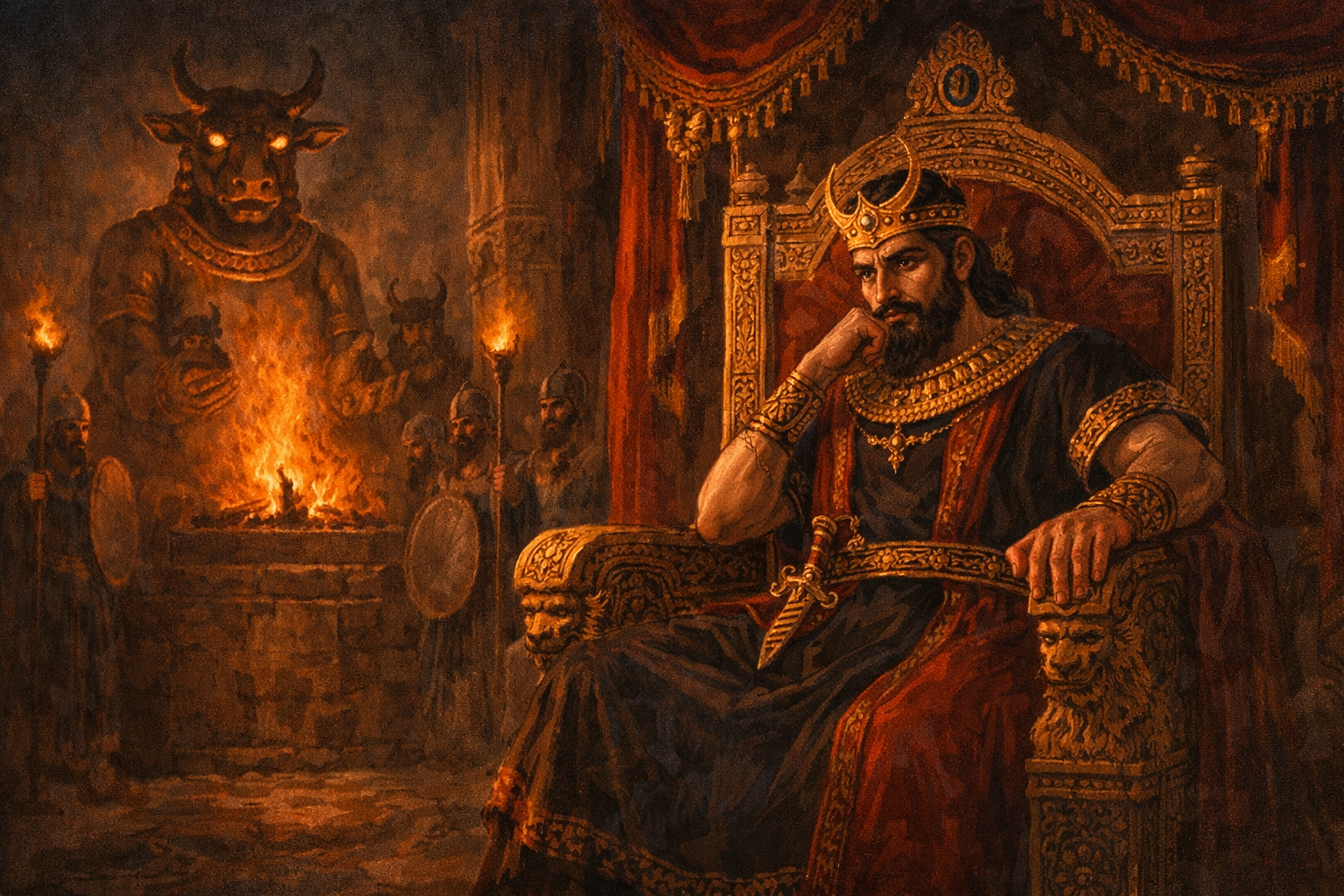
HORRIBLE WORDS:
"DID NOT DO WHAT WAS RIGHT"
Ahaz was twenty years old when he became king, and he reigned sixteen years in Jerusalem - This introduces a reign that stands as a warning for Ahaz was a king with every advantage of godly heritage (godly father Jotham) and opportunity but who rejected the faith and God of his father, defiled worship of Yahweh, and trusted pagan nations instead of the perfect God. At age 20 he chose the path of rebellion rather than the highway of holiness (Isa 35:8) and sadly he never backtracked (repented). Ahaz's life proves there is no such thing as "inherited faith," for he was nothing like his father Jotham. Having godly lineage does not make anyone godly!
Peter Pett makes an interesting comment on the name Ahaz - The full name of Ahaz was Jeho-ahaz. It may be that his behaviour was seen as so abominable that the name of YHWH was dropped from his name. In an Assyrian list of kings who paid tribute to Assyria he was named as Ya-u-ha-zi of Ya-u-da-aia. But it may even be that Ahaz chose to drop the name of YHWH from his name himself when he became an apostate. The discovery of a seal bearing the inscription, ‘Ashan, official of Ahaz’ would appear to confirm the use of the shorter name officially.
R. D. Patterson: The account of Ahaz’s wicked reign . . . centers around three main subjects: (1) his character (vv. 1-4), (2) his war with Rezin and Pekah (vv. 5-9), and (3) his further apostasy as consequence of his reliance on Tiglath-pileser III (vv. 10-18). God was superintending the whole complex undertaking. He would deal with an apostate Israel (cf. 2Ki 17:5-18; 2Ki 18:11-12), thwart the satanically inspired plans against the house of Israel by bringing defeat to Rezin and Pekah (Isa 7:5-16), and bring chastisement to a spiritually bankrupt Ahaz (2Ch 28:5, 19). (See 1 and 2 Kings)
Bob Utley - The dates do not fit well with 2 Chr. 29:1. There are some LXX and Syrian MSS that have "25 years at his accession" not "20 years old." this discrepancy can be explained as a co-reign with his father, Jotham; see Hard Sayings of the Bible in the Article - Do the Dates of the Old Testament Kings Fit Secular History?)
Ahaz was wicked
as his father Jotham was righteous.
--Christopher Knapp
And he did not do what was right (yāshār) - In other words stated more bluntly Ahaz did evil. Sadly Ahaz is the only king of Judah to receive this specific description. Usually we see "did right" often with a qualifier (e.g. Joash 2Ki 14:3; Uzziah/Azariah - 2Ki 15:3,4). The Hebrew word translated right is yāshār, meaning straight, upright, level, or in alignment with a true standard. The picture is vivid for it is as if Yahweh placed a ruler, a divine “straight-edge,” alongside Ahaz’s life to assess whether his steps were straight or crooked! Instead of conforming to the divine line, his conduct continually veered off course. Nothing in his walk matched God’s holy standard. Where most of the earlier kings of Judah had walked the path of obedience for at least part of their life (usually the first portion), Ahaz’s life continued on a crooked path of compromise, idolatry, and self-will to the very end of his journey! SAD!
Bob Utley - "he did not do what was right (yāshār) in the sight of the Lord" Four items are listed of his evil. (1) He did not follow in the footsteps of his father, David. (2) He walked in the way of the kings of Israel. (3) He made his sons pass through the fire. (4) He sacrificed and burned incense on the high places.
In the sight (literally eyes) of the LORD (Jehovah - Yahweh) his God (Elohim) - This phrase describes Coram Deo living. To be right in the sight of the LORD is to live in moral alignment with His revealed will but Ahaz consistently chose his own bent and twisted way, proving that his heart was not governed by God’s perfect plumbline of His Word of Truth (cf Pr 14:12, 16:25). It is interesting that the text does say his God, which implies personal possession, although the habitual practice of his life would not seem to support that conclusion.
EXPLANATORY NOTE ON "HIS GOD." - At first glance, that possessive pronoun HIS (IN "HIS GOD") suggests a personal relationship. However, its meaning must be understood in the covenantal context of Israel’s history rather than referring to his personal relationship with God. In other words, the language “the LORD his God” could reflect Israel’s corporate covenant relationship with Yahweh. God had chosen Israel as His people and bound Himself to them through covenant promises to Abraham, Isaac, and Jacob (Ge 17:7; Ex 6:7). Thus, even unfaithful kings like Ahaz were still born into a nation that stood in covenant with “their God.” “I will take you as My people, and I will be your God. Then you will know that I am the LORD your God” (Ex 6:7) So, “his God” in this sense is covenantal, not necessarily experiential. Ahaz, though wicked, was still an heir of that national relationship, even if he rejected its spiritual reality. In addition the phrase "his God" underlines Ahaz's covenantal accountability to the God of Israel. This is similar to phrases like: “Israel sinned against the LORD THEIR God” (2 Ki 17:7), where the possessive heightens the betrayal of Israel! So Ahaz belonged to God’s covenant people, but refused the personal fellowship and faithfulness that make that relationship life-giving. We learn from Paul that "not all who are descended from Israel are Israel," that is, are truly born again children of God (Ro 9:6-8). In other words, while Ahaz belonged to God's covenant people, God was not his personal God, for there is no evidence Ahaz ever entered into a personal relationship with God as we see with Abram in Ge 15:6. It is also notable that the Chronicler deliberately omits "his God" in the parallel passage 2Ch 28:1. The possessive “his” might therefore function as ironic distance, a formal acknowledgment of what should be true while the narrative demonstrates its hollow reality. The phrase could also preserve historical accuracy of the original text while the chronicler’s omission signals theological judgment: by removing “his God,” the later writer makes explicit what the original phrasing left implicit, that Ahaz’s wickedness severed any meaningful claim to divine relationship, regardless of what institutional formulas suggested. See also Isaiah initially described Ahaz - "LORD your God" (Isa 7:11+) but then switches to "my God" in Isaiah 7:13.
Matthew Poole adds “God was his God, though not by covenant and grace, and special relation, which Ahaz had renounced, yet by his sovereign dominion over him; for God did not forfeit his right by Ahaz’s denying of it.”
As his father David had done - AS (or LIKE) is a term of comparison, specifically a simile. The Spirit places the life of Ahaz next to the human "straight edge" of the life of David, an imperfect man, but a man after God's own heart (Acts 13:22). Jotham was Ahaz's biological father and a good king with Scripture recording nothing negative about him personally. But as we have seen frequently with this powerful men, it is not always like father like son for Ahaz was nothing like his father. Sadly, spiritual heritage does not guarantee spiritual fidelity!
As a father of 4 children, two of whom are sons, passages like this are painful for me to read, for I have one very godly son and one son who like Ahaz has (to date - 2026) wasted the short time God has allotted him of this earth. The mention of his father David clearly identifies David as the founder of the Davidic dynasty and links Ahaz with the covenant God made with David (2Sa 7:12-16), showing that he belonged to the David's royal house and, despite his extreme wickedness, he stands directly in the royal genealogy that leads to the Messiah, Jesus Christ. This is one of the most striking features of the Bible’s story that the Messiah’s family tree includes idolaters, compromisers, and moral failures and Ahaz is among the worst. Yet God’s promise to David was “I will establish the throne of his kingdom forever” (2 Sam 7:13). The line depended on God’s faithfulness, not the king’s goodness. In sum, Ahaz was a son of David by lineage, but not a son of David in character.
Bob Utley - "as his father David" Notice Jotham is not mentioned. The purpose of this phrase is to re-enforce Ahaz's Davidic origin. Ahaz was one of the most wicked kings of Judah (Manasseh being the worst). However, he was still part of YHWHistic promise to David in 2 Samuel 7 and 1 Chronicles 17. YHWH had a purpose for Judah!
Charles Swindoll: We usually expect that godly parents are going to bring up godly children. But that isn't always the case. Jotham, for the most part, followed the Lord. But when his son Ahaz came into power, he did the exact opposite. There is no formula for parenting. We can't explain why godly parents sometimes have prodigals and ungodly parents sometimes have mature Christian children. Each of us is dependent on God for His grace. Where we think we are strong, we may actually be weak. Where we know we are weak, we may be laying the groundwork for our children's excellence. The one constant is that God is in control. He is the One we must turn to for wisdom, guidance, and strength. (See The Swindoll Study Bible NLT - Page 472)
August Konkel: The choices of Ahaz are typical of the values of the wealthy seeking security for their possessions. He chooses to trust political and economic forces rather than God. In so doing he is willing to not only desecrate the temple by robbing it of its valuable metals, but to set up in its precincts foreign altars. In all of this, God is still with Ahaz. During his reign the kingdom of Israel disappears entirely, the nation that he so fears, but his own people come under the domination of the same Assyrians. Wealth is important to life in this world, but not as an end in itself. Pursued as a goal, it brings judgment and is lost. Wealth used in dependence on God and in furthering the kingdom of God enables his presence and blessing. But Ahaz chooses to make the security of his wealth through temporal forces his god, and in so doing he loses the blessing of the sign of Immanuel. Christians, who have experienced the blessing of the fulfillment of Immanuel, must beware of falling into the same condemnation. (See 1 and 2 Kings - Page 571)
Right (03477) yashar from the verb yashar = to be smooth, straight or right) is an adjective that means straight; reliable, level, pleasing; upright; righteous. Yashar only rarely is used literally of that which is straight (Ezek 1:7). Yashar can refer to something physical like a path, but even in those uses is often a metaphorical description of one's conduct or behavior (Ps 107:7). Most uses refer to that which is right in an ethical or an emotional sense, as agreeable or pleasing. It is fitting that God is the standard of yashar (what is "straight") (Ps 92:15, called the "Upright One" - Isa 26:7). God's Word is described as upright (right) (Ps 19:7) as are His judgments (Ps 119:137) and His way (Ps 107:7). "God made men upright (Ge 1:27), but they have sought out many devices." (Eccl 7:29)
Yashar is frequently used to describe our moral/ethical heart as "upright in heart" (Ps 7:10, 11:2, 32:11, 36:10, 64:10, 94:15, 97:11, 111:1, 125:4) (See all uses in Psalms and Proverbs below). Indeed, the upright "will behold His face" (Ps 11:7), will experience gladness (Ps 97:11), will be gathered together in the assembly (Ps 111:1), will be blessed (Ps 112:2), will be given light in times of darkness (Ps 112:4), will dwell in God's presence (Ps 140:13, cp Pr 2:21), have access to God's sound wisdom (Pr 2:7), will experience intimacy with the Most High God (Pr 3:32), will be guided by their integrity (Pr 11:3), will be delivered by their righteousness (Pr 11:6), will be delivered by their words (Pr 12:6), will see their tents flourish (Pr 14:11). "The highway of the upright is to depart from evil." (Pr 16:17)
YASHAR IN KINGS AND CHRONICLES - 1 Ki. 11:33; 1 Ki. 11:38; 1 Ki. 14:8; 1 Ki. 15:5; 1 Ki. 15:11; 1 Ki. 22:43; 2 Ki. 10:3; 2 Ki. 10:15; 2 Ki. 10:30; 2 Ki. 12:2; 2 Ki. 14:3; 2 Ki. 15:3; 2 Ki. 15:34; 2 Ki. 16:2; 2 Ki. 18:3; 2 Ki. 22:2; 2 Chr. 14:2; 2 Chr. 20:32; 2 Chr. 24:2; 2 Chr. 25:2; 2 Chr. 26:4; 2 Chr. 27:2; 2 Chr. 28:1; 2 Chr. 29:2; 2 Chr. 29:34; 2 Chr. 31:20; 2 Chr. 34:2
From Expositor's Bible Commentary...
"For when we in our wickedness grow hard,
Oh the misery on’t! the wise gods seal our eyes;
In our own filth drop our clear judgments; make us
Adore our errors; laugh at us while we strut
To our confusion."
2 Kings 16:3 But he walked in the way of the kings of Israel, and even made his son pass through the fire, according to the abominations of the nations whom the LORD had driven out from before the sons of Israel.
- he walked: 2Ki 8:18 1Ki 12:28-30 16:31-33 21:25,26 22:52,53 2Ch 22:3 28:2-4
- made his son: 2Ki 17:17 2Ki 23:10 Lev 18:21 20:2 De 12:31 18:10 2Ch 33:6 Ps 106:37 Ps 106:38 Jer 32:35 Eze 16:21 20:26,31
- according: 2Ki 21:2,11 De 12:31 1Ki 14:24 2Ch 33:2 Ps 106:35 Eze 16:47
- 2 Kings 16 Resources
Parallel Passage:
2 Chronicles 28:2-3 But he walked in the ways of the kings of Israel; he also made molten images for the Baals. 3Moreover, he burned incense in the valley of Ben-hinnom and burned his sons in fire, according to the abominations of the nations whom the LORD had driven out before the sons of Israel.
Related Passages:
Leviticus 18:21 ‘You shall not give any of your offspring to offer them to Molech (see also MOLECH), nor shall you profane the name of your God; I am the LORD.
Leviticus 20:2 You shall also say to the sons of Israel: ‘Any man from the sons of Israel or from the aliens sojourning in Israel who gives any of his offspring to Molech, shall surely be put to death; the people of the land shall stone him with stones.
Deuteronomy 12:29-31 (GOD'S CLEAR WARNING AGAINST PAGAN PRACTICES) “When the LORD your God cuts off before you the nations which you are going in to dispossess, and you dispossess them and dwell in their land, 30 beware that you are not ensnared to follow them, after they are destroyed before you, and that you do not inquire after their gods, saying, ‘How do these nations serve their gods, that I also may do likewise?’ 31 “You shall not behave thus toward the LORD your God, for every abominable act which the LORD hates they have done for their gods; for they even burn their sons and daughters in the fire to their gods.
2 Kings 3:27 (MOABITE KING) Then he took his oldest son who was to reign in his place, and offered him as a burnt offering on the wall. And there came great wrath against Israel, and they departed from him and returned to their own land.
2 Kings 23:10 (KING JOSIAH) He also defiled Topheth, which is in the valley of the son of Hinnom, that no man might make his son or his daughter pass through the fire for Molech. (see also MOLECH)
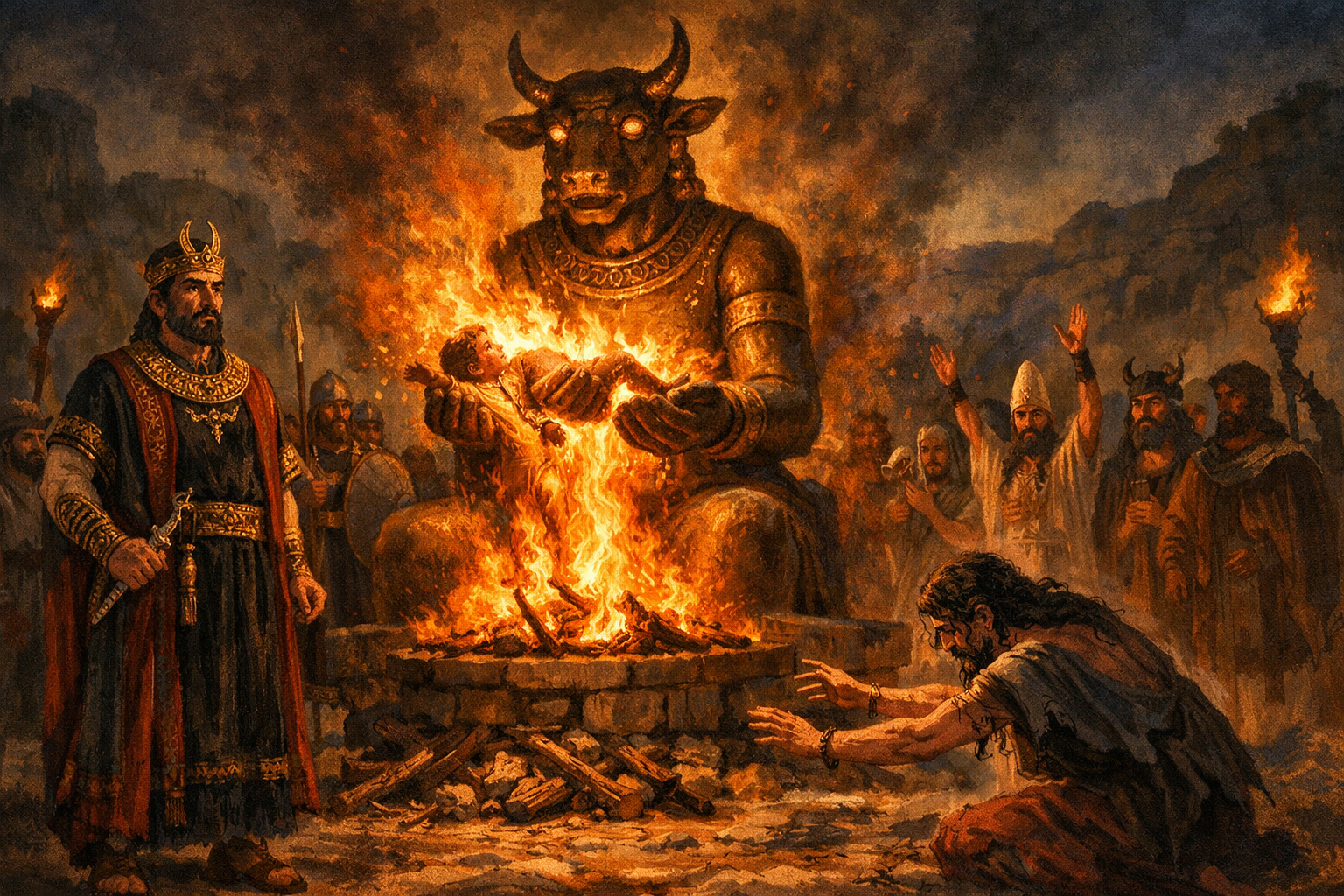
AHAZ IMITATES
EVIL KINGS OF ISRAEL
But - Term of contrast. What's the writer contrasting? Who had he just mentioned? "His father David." (2Ki 16:2)
He walked in the way of the kings of Israel (northern kingdom) - The Hebrew idiom walked points to Ahaz’s habitual way of living, revealing the settled direction of his conduct and the true bent of his character.Ahaz did not merely stumble into isolated sins but volitionally, intentionally, rebelliously, presumptively adopted a lifestyle patterned after evil kings of the northern kingdom, kings who were notorious for idolatry and covenant rebellion. The NET Bible captures the sense well: “he followed the footsteps,” and the NLT similarly renders, “he followed the example.”
SIDENOTE: Only a few kings of the southern kingdom were described as walking "in the way of the kings of Israel." - Jehoram (Joram) (2Ki 8:18) (married the daughter of Ahab); (2) Ahaziah the son of Jehoram whose mother was Athaliah (2Ki 8:27) and (3) Ahaz. Although the exact phrase is not used (walking like kings of Israel), some include Manasseh (2Ki 21:2–9), and Amon (2Ki 21:20–22). The Bible reminds us that “there is a way which seems right to a man, but its end is the way of death” (Pr 14:12). These kings left "leave the paths of uprightness, To walk in the ways of darkness." (Pr 2:13) When Judah’s kings walked in the way of the kings of Israel, they followed human wisdom and self-made religion rather than humbly obeying the LORD.
To reiterate, to “walk in the way” speaks of a deliberate choice and sustained effort. The “way of the kings of Israel” recalls the Jeroboam tradition—golden calves, rival altars, political religion, and rejection of the exclusive worship of Yahweh in the Temple in Jerusalem. Like a deadly contagious virus, what had characterized Samaria for generations had now infected the Davidic dynasty. Instead of learning from Israel’s decline (assassination of kings, political instability, etc), Ahaz chose to copy it, proving that bad examples are contagious when one's heart is not anchored in the fear of the LORD and the Word of the LORD.
Examples shape us
long before decisions reveal us
🙏 THOUGHT - Make no mistake. Everyone follows a “way.” We all, whether we realize it or not, walk in someone’s footsteps—either along the path of the faithful or after the pattern of the faithless. No life is lived in a vacuum; examples shape us long before decisions reveal us. The voices we listen to, the heroes we admire, and the habits we tolerate gradually become the road beneath our feet. Like Ahaz, we may think we are simply making practical choices, yet we are choosing the direction of our heart. Blessed is the person who follows those who fear the LORD (Dt 10:12,13), for their steps lead to life (cf Ps 1:1-3). But tragic is the one who mimics the world, for that road drifts steadily away from God and ultimately to eternal death (Ps 1:4-6). Every day we are becoming more like the people we choose to follow. Whose footsteps are you following? Whose life are you seeking to imitate? Paul commanded believers to "Be (present imperative see our need to depend on the Holy Spirit to obey) imitators of me, just as I also am of Christ." (1Co 11:1)
And EVEN made his son pass through the fire - The Hebrew adverb translated EVEN or (KJV = indeed) signals the addition of a particularly shocking detail. The practice of child sacrifice was strictly and explicitly forbidden in Dt 12:31 and Dt 18:10. That Ahaz went so far as to violate this command and adopt the pagan custom of burning children reveals the depth of his depravity and how completely he had abandoned the fear of the LORD and the Word of the LORD.
Ron Daniel - The statues of Molech were big, hollow, bronze statues of a man with an ox's head. Inside, a fire would be kindled and fed until the outstretched arms of it were red-hot. Worshippers of Molech would put their babies on the heated arms, killing them as a sacrifice. (cf Lev 20:2) The punishment for putting children to death was to put the parent responsible to death. Thank goodness we live in a day that children are no longer sacrificed to the God of pleasure. Or do we? Sixty-one percent of the countries in the world allow parents to kill their children before they leave the womb. That has led to abortions totalling between 36 and 53 million children per year. The vast majority of those pregnancies were brought about by people pursuing pleasure, but who were unwilling to accept the consequences of their actions.
Pass through the fire refers to the horrific act of Ahaz sacrifing his son, a practice associated with the worship of Molech (Lev 18:21). The NLT renders it plainly, Ahaz “even sacrificed his son,” and the ESV is equally direct, “even burned his son as an offering.” This was not a symbolic ritual but the literal burning of children as an "act of devotion" meant to secure favor, protection, or political success from pagan gods. This recalls Paul's description of the Gentiles in Romans 1
For even though they knew God, they did not honor Him as God or give thanks, but they became futile in their speculations, and their foolish heart was darkened. 22 Professing to be wise, they became fools, 23 and exchanged the glory of the incorruptible God for an image in the form of corruptible man and of birds and four-footed animals and crawling creatures. (Romans 1:21-23).
That a king of David’s line could commit such an act reveals how far Judah had fallen. The Law of Moses had explicitly condemned this practice as an abomination that defiled both the land and the people (Lev 20:2–4, 5). What God viewed as murder, Ahaz foolishly regarded as worship! In seeking the help of false gods, Ahaz was willing to destroy the very gift God had given him, his own son, a son in the line of the Messiah! You can mark it down that idolatry always enslaves and demands a price which may be very high!
David Guzik - Molech was worshipped by heating a metal statue representing the god until it was red hot, then placing a living infant on the outstretched hands of the statue, while beating drums drowned out the screams of the child until it burned to death. Sadly, even a man as great as Solomon at least sanctioned the worship of Molech and built a temple to this idol (1 Kings 11:7). One of the great crimes of the northern tribes of Israel was their worship of Molech, leading to the Assyrian captivity (2 Kings 17:17). King Manasseh of Judah gave his son to Molech (2 Kings 21:6). Up to the days of King Josiah of Judah, Molech worship continued, until he destroyed a place of worship to that idol (2 Kings 23:10). The Canaanite nations that occupied Canaan before the time of Joshua also practiced this terrible form of human and child sacrifice. God would bring judgment upon Judah for their continued practice of these sins. This reminds us that the war against the Canaanites in the Book of Joshua – as terrible and complete as it was – was not a racial war. God’s judgment did not come upon the Canaanites through the armies of Israel because of their race, but because of their sin. If Israel insisted on walking in the same sins, God would bring similar judgment upon them.
Warren Wiersbe - Each Jewish son was to be redeemed by a sacrifice and therefore belonged to the Lord (Ex. 13; Nu 18:14–16). How could a son who belonged to God be sacrificed to an idol? But Ahaz was a compromiser both in his religious practices and his political leadership.
John MacArthur - As a part of the ritual worship of Molech (see also MOLECH), the god of the Moabites, children were sacrificed by fire (cf. 2Ki 3:27). This horrific practice was continually condemned in the OT (Lev 18:21; 20:2-5; Dt 18:10; Jer 7:31; 19:5; 32:35). (Borrow MacArthur Study Bible)
Pass through the fire exposes the spiritual illogic of apostasy. The practice of making children pass through the fire reveals how irrational and self-destructive apostasy really is. When people abandon the living God, their thinking becomes morally twisted and they end up embracing beliefs and practices that contradict reason, conscience, and even natural human affection. To sacrifice one’s own child in the name of religion shows how far the heart can fall once it departs from the Living God’s truth. Apostasy does not lead to freedom or enlightenment, but to spiritual blindness in which evil is called good and cruelty is mistaken for devotion. Once a person abandons the fear of the LORD (cf Ro 3:18, cf "depraved mind" Ro 1:28NETff), there is no moral boundary left. The same heart that rejects God’s Word can then justify the unthinkable. Ahaz’s act was not merely a private failure but a public endorsement of evil that influenced an entire nation. What the Canaanites had done before Israel entered the land, a king of Judah was now repeating within the holy city of Jerusalem! In sum, the atrocity of passing through the fire exposes the utter irrationality of apostasy, for once people forsake God, even the most unnatural evils can appear religiously reasonable!
🙏 THOUGHT - This is a sobering lesson: Sin promises gain but requires sacrifice and ultimately this may sacrifice of what we love most. When worship is turned away from the true God and redirected toward idols, compassion withers and cruelty takes its place. In stark contrast, the Gospel reveals a God Who does not demand the sacrifice of our sons, but who sacrificed His own Son to provide atonement for our sins. (John 3:16).
Not even Assyria
practiced child sacrifices!
Bob Utley - walked in the way of - The Mosaic life of faith is described as a well worn, straight, smooth, clear path or road (Ps. 1:1; 139:24). "made his sons pass through the fire" This refers to the worship of the Phoenician and later Canaanite fire god, Molech (see also MOLECH). This deity is highly condemned in the OT (cf. Lev. 18:21; Deut. 12:31; 18:9-10). It seems that children were sacrificed alive to this fire god (cf. 2 Chr. 28:3). Not even Assyria practiced child sacrifices! Modern scholarship thinks molech is a type of sacrifice and not the name of a deity. The path of Ba'al worship was unintentionally encouraged by Jeroboam I's building of two rival worship sites (i.e., Dan and Bethel). These turned into fertility worship sites, especially during Ahab and Jezebel's reign. FERTILITY WORSHIP OF THE ANE
According to the abominations (toebah; LXX - bdelugma - destestalb things) of the nations (aka "Canaanites") whom the LORD had driven out from before the sons of Israel - The tragedy is that under the evil leadership of Ahaz, the people redeemed from Egypt and entrusted with God’s covenant, were now imitating the very cultures (and evil practices) God had judged and expelled from the land centuries earlier (cf. Lev 18:24–30, 28 = "spewed out"; Dt 9:4–5). The LORD had driven out the Canaanite nations precisely because their religion was saturated with cruelty and moral corruption, including the burning of children to Molech and the worship of fertility deities like Ba'al and Asherah. Yet Ahaz adopted these same practices, effectively reversing the conquest of the Promised Land and inviting the curses Moses had warned about (Dt 12:29–31).
When God’s people conform to the world’s values (cf Ro 12:2), they repeat the sins that brought divine judgment on the pagan nations. Instead of being a light to the nations, Judah became indistinguishable from them (cf church in America). What God had removed from the land through Joshua’s conquest (cf Joshua's warning Josh 24:15,16) was now being reintroduced by a Davidic king, an act of covenant treachery that would reap the wrath of God in a little over 100 years.
Bob Utley - "the nations whom the Lord had driven out" This is "holy war" vocabulary. It was part of YHWH's promise to Abraham about a homeland in Canaan (cf. Ge 12:1-3; 15:12-21). The exodus under Moses and the conquest under Joshua fulfilled this promise. Israel was to destroy the Canaanites lest they corrupt their covenant relationship with Abraham's seed (i.e., Dt. 20:17-18). ISRAEL'S MANDATED RESPONSE TO CANAANITE FERTILITY WORSHIP
Henry Morris - Among all "the abominations of the heathen," the worst was probably child sacrifice, and it might seem incredible that even the chosen people of God, led by a Davidic king, could descend into such depths of pagan pantheism. Yet, all these practices: the high places, the tree worship, even child sacrifice, are reportedly being practiced again in certain New Age cults.
Believer's Study Bible - Ahaz did evil in the sight of the Lord. He made images of Baal, fell into many heathen abominations, and even made his son pass through the fire in sacrifice (cf. 2 Chr. 28:3). This worship of Molech, an Ammonite deity to whom parents sacrificed their children, was a practice strictly forbidden in the Mosaic Law (Lev. 20:2ff.).
Abominations (detestable, loathsome) (08441) toebah refers to an abominable custom or thing. Abomination. Loathsome. Detestable thing. Something or someone who is loathsome and abhorrent. Toebah denotes things, persons or practices that are not merely improper but ritually or morally offensive offensive to the very character of God—idolatry, ritual prostitution, child sacrifice, occultism, and every form of pagan worship that denied Yahweh’s holiness. The Septuagint often translates toebah with bdelugma, a word that conveys something disgusting and repugnant, emphasizing how these acts appear to Holy Eyes! WOE!
Baker notes that toebah "is primarily understood in the context of the Law. It identifies unclean food (Dt. 14:3); the activity of the idolater (Isa. 41:24); the practice of child sacrifice (Dt. 12:31); intermarriage by the Israelites (Mal. 2:11); the religious activities of the wicked (Pr 21:27); and homosexual behavior (Lev. 18:22). In a broader sense, the word is used to identify anything offensive (Pr 8:7)." (The Complete Word Study Dictionary: OT)
Sometimes toebah is used as a synonym for idol, a repulsive thing, a worship object, with a focus that it is an item to be rejected (Dt 32:16; 2Ch 34:33; Isa 44:19, Jer 16:18; Eze 5:9; 7:20; 11:18, 21; 16:36). Toebah is even used for a specific pagan deity, as in 2Ki 23:13 where Milcom is called "the abomination of the Ammonites." And even prayer is an abomination when offered by one who refuses to obey God's Word (Pr 28:9).
Ronald Youngblood - TWOT - As with the verb, so also with the noun (toebah) the abomination may be of a physical, ritual or ethical nature and may be abhorred by God or man. Sharing a meal with a Hebrew was ritually offensive to an Egyptian (Gen 43:32), as was offering certain kinds of sacrifices (Ex 8:22). homosexuality and other perversions are repugnant to God and fall under his judgment (Lev 18:22–30; 20:13). Idolatry (Deut 7:25), human sacrifice (Deut 12:31), eating ritually unclean animals (Deut 14:3–8), sacrificing defective animals (Deut 17:1), conducting one’s business dishonestly (Deut 25:13–16), practicing ritual prostitution (I Kgs 14:23f.), and similar acts of disobedience (for seven more abominations, see the list in Pr 6:16–19) were sure to bring God’s wrath on those who perpetrated them. Twelve times the book of Proverbs uses the phrase, “is an abomination to the Lord.” In Ps 88, a prayer for help written by a man close to death, the physically repulsive appearance of a tô˓ēbâ is stressed; the man’s former friends avoid him because they consider him to be a thing of horror (Ps 88:8 [H 9]). (TWOT Theological Wordbook of the Old Testament)
TOEBAH IN KINGS AND CHRONICLES - 1 Ki. 14:24; 2 Ki. 16:3; 2 Ki. 21:2; 2 Ki. 21:11; 2 Ki. 23:13; 2 Chr. 28:3; 2 Chr. 33:2; 2 Chr. 34:33; 2 Chr. 36:8; 2 Chr. 36:14
M. R. Vincent on the Septuagint term "abomination" "The cognate verb, bdelussomai, (bdelusso) means to feel a nausea or loathing for food, hence used of disgust generally. In a moral sense it denotes an object of moral or religious repugnance (cf. 2 Chr. 15:8; Jer. 13:27; Ezek. 11:21; Dan. 9:27; 11:31). It is used as equivalent to idolatry in 1 Kings 11:17; Deut. 7:26; 2 Kings 23:13. It denotes anything in which estrangement from God manifests itself; as the eating of unclean beasts, Lev. 11:11; Deut. 14:3; and, generally, all forms of heathenism. This moral sense must be emphasized in the New Testament use of the word (i.e., compare Luke 16:15; Rev. 17:4,5; 21:27). It does not denote mere physical or esthetic disgust. The reference here is probably to the occupation of the temple precincts by the idolatrous Romans under Titus, with their standards and ensigns. Josephus says that after the burning of the temple the Romans brought their ensigns and set them over against the eastern gate, and there they offered sacrifices to them, and declared Titus, with acclamations, to be emperor" (Word Studies in the New Testament, pp. 74-75).
2 Kings 16:4 He sacrificed and burned incense on the high places and on the hills and under every green tree.
- on the hills: De 12:2 1Ki 14:23 Isa 57:5-7 65:4 66:17 Jer 17:2 Eze 20:28,29
- 2 Kings 16 Resources
Parallel Passage:
2 Chronicles 28:4 He sacrificed and burned incense on the high places, on the hills and under every green tree.
Deuteronomy 12:2 “You shall utterly destroy all the places where the nations whom you shall dispossess serve their gods, on the high mountains and on the hills and under every green tree.
Psalm 141:2 May my prayer be counted as incense before You; The lifting up of my hands as the evening offering.
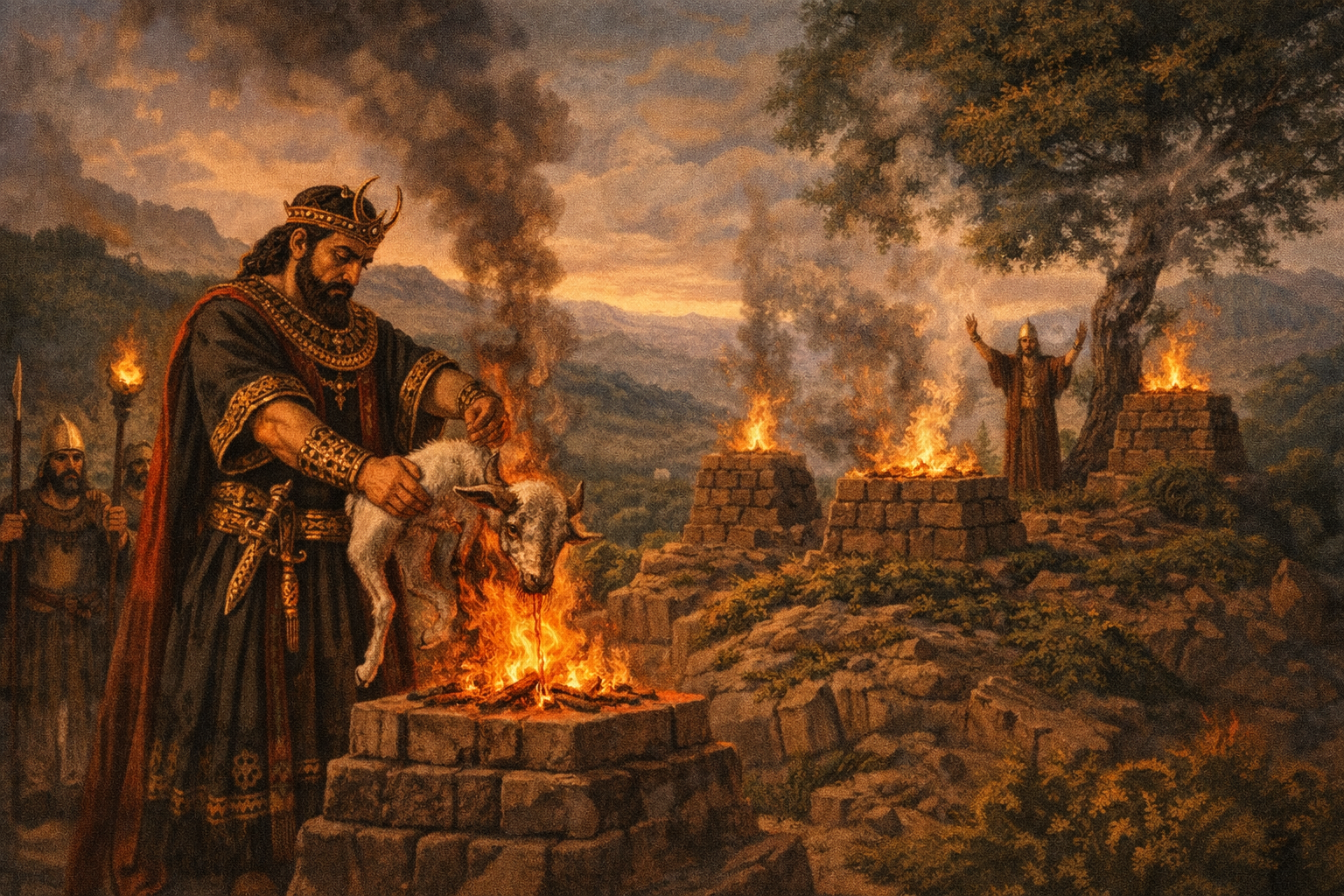
TWO ACTS OF WORSHIP
DIRECTED TO WRONG "GODS"
He sacrificed (zabach) and burned incense (qāṭar) - Sacrificed refers to a priestly act associated with atonement and devotion to Yahweh. Burned incense is a Biblical symbol of prayer and fellowship (cf. Ps 141:2). Ahaz took actions meant for the LORD and redirected them to idols. Religious zeal without revealed truth becomes spiritual adultery. See discussion of this adultery in Israel the Wife of Jehovah.
When worship is everywhere except where God said,
it is nowhere God accepts.
On the high places (bamah) and on the hills and under every green tree - Notice how the Holy Spirit uses three locations to show how thoroughly Ahaz abandoned the worship of Yahweh. Ahaz replaced God’s appointed worship with a veritable smorgasbord of pagan devotion, turning the hills and every green tree into a rival altar to the LORD. Behind the geography stands a profound theology. The verse portrays a king who multiplied venues of false worship, rejecting the one place God had chosen, His holy Temple in Jerusalem (Dt 12:5–14).
Expositor's - He not only continued the high places, as the best of his predecessors had done, but he increased their popularity and importance by personally offering sacrifices and burning incense "on the hills and under every green tree."
Ahaz was the nation's "cheerleader"leading the people by his example further and further away from Yahweh!
C H Spurgeon comments that King Ahaz "could not do enough of it; so many trees, so many altars. There are some men who use every opportunity for sin, with a diligence which should bring the blush into the face of Christians, who are not as diligent in obeying as these men are in sinning. According to the command of God, there was to be but one altar, and that one was to be at Jerusalem; but these people multiplied their altars; there could not be a high place but they must have an idol shrine set up upon it."
John MacArthur - Ahaz was the first king in the line of David since Solomon who was said to have personally worshiped at the high places. While all the other kings of Judah had tolerated the high places, Ahaz actively participated in the immoral Canaanite practices that were performed at the “high places” on hilltops under large trees (cf. Hos 4:13). (Borrow MacArthur Study Bible)
Bob Utley - 16:4 "on the high places and on the hills under every green tree" This reflects outlawed Canaanite fertility worship (cf. Deut. 12:2; 1 Kgs. 14:23,24; Jer. 2:20; 3:2,6; 17:2; Isa. 57:5,7; Ezek. 6:13; 20:28; Hosea 4:13). The fertility gods were worshiped in many localities (i.e., natural hills or man made platforms). Trees were often viewed as sacred (esp. in arid places) because they showed underground water was present. SPECIAL TOPIC: TREES
Sacrificed (slaughtered, offer sacrifice)(02076) zabach to slaughter or kill an animal for sacrifice. The Hebrew verb zābacḥ is a common Semitic term for sacrificial slaughter in general. It is used of offerings such as the firstborn (Ex. 13:15), peace and burnt offerings (Ex. 20:24), and animals from the flock and herd (Num. 22:40). Moses cited this need when asking Pharaoh to let Israel go to “sacrifice to the LORD our God” (Ex. 3:18; 5:3). The word can also refer to slaughter for food (Deut. 12:21; 1 Sam. 28:24) and to the sealing of a covenant (Gen. 31:54). Though most often used of sacrifices to the true God (Gen. 46:1), it also describes pagan offerings, such as to Dagon (Jdg. 16:23) and the gods of Damascus (2 Chr. 28:23).
ZABACH IN SAMUEL-CHRONICLES 1 Sam. 1:3; 1 Sam. 1:4; 1 Sam. 1:21; 1 Sam. 2:13; 1 Sam. 2:15; 1 Sam. 2:19; 1 Sam. 6:15; 1 Sam. 10:8; 1 Sam. 11:15; 1 Sam. 15:15; 1 Sam. 15:21; 1 Sam. 16:2; 1 Sam. 16:5; 1 Sam. 28:24; 2 Sam. 6:13; 2 Sam. 15:12; 1 Ki. 1:9; 1 Ki. 1:19; 1 Ki. 1:25; 1 Ki. 3:2; 1 Ki. 3:3; 1 Ki. 3:4; 1 Ki. 8:5; 1 Ki. 8:62; 1 Ki. 8:63; 1 Ki. 11:8; 1 Ki. 12:32; 1 Ki. 13:2; 1 Ki. 19:21; 1 Ki. 22:43; 2 Ki. 12:3; 2 Ki. 14:4; 2 Ki. 15:4; 2 Ki. 15:35; 2 Ki. 16:4; 2 Ki. 17:35; 2 Ki. 17:36; 2 Ki. 23:20; 1 Chr. 15:26; 1 Chr. 21:28; 1 Chr. 29:21; 2 Chr. 5:6; 2 Chr. 7:4; 2 Chr. 7:5; 2 Chr. 11:16; 2 Chr. 15:11; 2 Chr. 18:2; 2 Chr. 28:4; 2 Chr. 28:23; 2 Chr. 30:22; 2 Chr. 33:16; 2 Chr. 33:17; 2 Chr. 33:22; 2 Chr. 34:4
Burned incense (offer up in smoke) (06999) qāṭar (from qetōreth, “smoke” or “fragrant incense”) means to cause smoke to rise, especially as an act of worship, and is used of burning incense or turning a sacrifice into fragrance by fire. While most often associated with incense, the term can describe the smoke of any major offering on the altar (Ex 30:7; Lev 1–7). It is closely linked with priestly ministry and dominates Leviticus, where sacrifices were “offered up in smoke” before the LORD. Tragically, the same word also marks Israel’s descent into idolatry: Solomon, though loving the LORD, “burned incense on the high places” (1Ki 3:3), and later even to the gods of his foreign wives (1Ki 11:8). This pattern spread through the nation so that burning incense became a symbol of covenant betrayal, provoking God’s wrath (2Ki 22:17; Jer 7:9; Hos 11:2). Yet in mercy the LORD promised a day when true worship would be restored, when from every nation incense would again be offered to His great name (Jer 33:18; Mal 1:11).
High places (01116) bamah -- Scripture associates the high places (bāmôt) with at least six recurring activities—burning incense, offering sacrifices, eating sacrificial meals, praying, ritual prostitution, and even child sacrifice (Jer 7:31)—revealing how these sites became centers of corrupt worship. God’s first reference to them is a warning: “I will destroy your high places” (Lev 26:30). Yet the term can occasionally carry a positive sense, as when the LORD made Israel “ride on the high places of the earth” (Dt 32:13) or when David rejoiced that God set him upon “my high places” like a sure-footed deer (Ps 18:33; Hab 3:19; Isa 58:14). Tragically, Israel’s misuse of these sites provoked the LORD’s jealousy (Ps 78:58), and a sorrowful refrain echoes through Kings and Chronicles: “the high places were not taken away” (1Ki 15:14; 22:43; 2Ki 12:3; 14:4; 15:4, 35; 2Chr 15:17; 20:33). Even reforming kings who cleansed much of the land left this root of compromise intact, reminding us how sin often survives partial repentance—we put away obvious evils yet cling to a favored “pet sin,” which is really a venomous viper. May God give us grace to finish the work Israel left undone and to tear down every rival altar of the heart.
2 Kings 16:5 Then Rezin king of Aram and Pekah son of Remaliah, king of Israel, came up to Jerusalem to wage war; and they besieged Ahaz, but could not overcome him.
- Rezin: 2Ki 15:37 2Ch 28:5-15 Isa 7:1-9
- but could not: 1Ki 11:36 15:4 Isa 7:4-6,14 8:6,9,10 9:6,7
- 2 Kings 16 Resources
Parallel Passage:
2 Chronicles 28:5 Wherefore, the LORD his God delivered him into the hand of the king of Aram (REZIN OF SYRIA); and they defeated him and carried away from him a great number of captives and brought them to Damascus. And he was also delivered into the hand of the king of Israel, who inflicted him with heavy casualties.
Isaiah 7:1-9 (ISAIAH'S PROPHECY TO AHAZ) Now it came about in the days of Ahaz, the son of Jotham, the son of Uzziah, king of Judah, that Rezin the king of Aram and Pekah the son of Remaliah, king of Israel, went up to Jerusalem to wage war against it, but could not conquer it. 2 When it was reported to the house of David, saying, “The Arameans have camped in Ephraim,” his heart and the hearts of his people shook as the trees of the forest shake with the wind. 3 Then the LORD said to Isaiah, “Go out now to meet Ahaz, you and your son Shear-jashub, (MEANS "the remnant shall return") at the end of the conduit of the upper pool, on the highway to the fuller’s field, 4 and say to him, ‘Take care and be calm, have no fear and do not be fainthearted because of these two stubs of smoldering firebrands, on account of the fierce anger of Rezin and Aram and the son of Remaliah. 5 ‘Because Aram, with Ephraim an2d the son of Remaliah, has planned evil against you, saying, 6 “Let us go up against Judah and terrorize it, and make for ourselves a breach in its walls and set up the son of Tabeel as king in the midst of it,” 7 thus says the Lord GOD: “It shall not stand nor shall it come to pass. 8 “For the head of Aram is Damascus and the head of Damascus is Rezin (now within another 65 years Ephraim will be shattered, so that it is no longer a people), 9 and the head of Ephraim is Samaria and the head of Samaria is the son of Remaliah. If you will not believe, you surely shall not last.”’
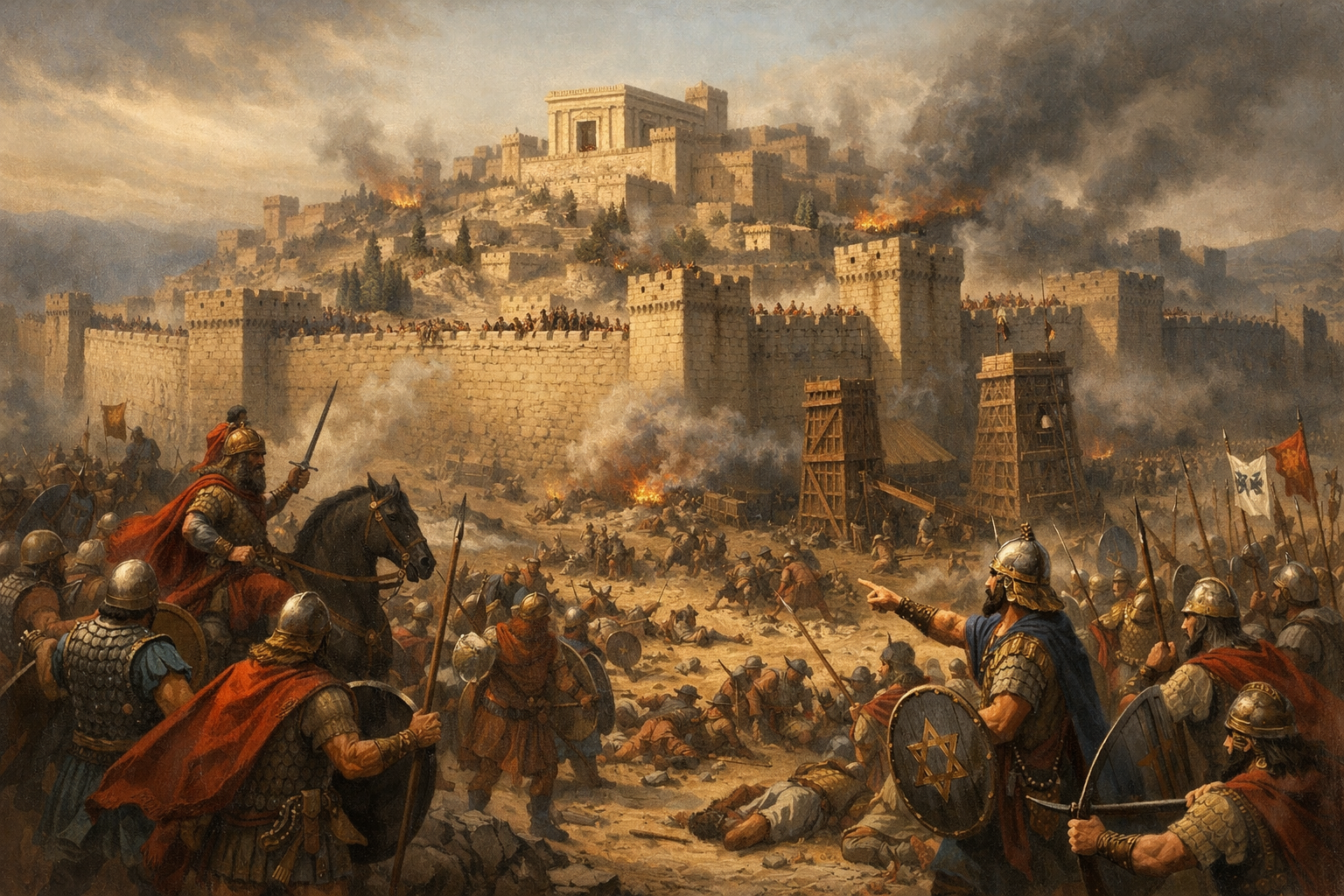
ARAMEAN & ISRAELITE COALITION
COMES AGAINS JUDAH
Then - This word typically marks progression in a narrative. In the present context THEN is not just a "timestamp" but also marks a consequence. First the sin, THEN the divine disicipline through foreign powers. In the present case, this THEN will mark the turning point in Ahaz's story for the subsequent invasions fully expose Ahaz's heart. What should have motivated Ahaz to repent and turn to the LORD, resulted in his turning from the LORD and to the foreign power Assyria.
Rezin king of Aram and Pekah son of Remaliah, king of Israel, came up to Jerusalem to wage war; and they besieged Ahaz, but could not overcome him - This siege of Jerusalem was their attempt to dethrone Ahaz and, as described in Isaiah 7:6, to set up the son of Tabeel as king of Judah. Chronicles gives the theological reason in 2Ch 28:5 “The LORD his God delivered him into the hand of the king of Aram.” 2 Chronicles 28:6-15 gives additional details, describing Pekah's overcoming Ahaz, slaying 120,000 (2Ch 28:6) and carrying away "200,000 women, sons and daughters of their brethren" to Samaria. (2Ch 28:8) It was a military disaster for Judah, but not the fall of Jerusalem.
The phrase could not overcome signifies that Aram and Pekah were not able to capture Jerusalem nor overthrow the Davidic throne. In other words Rezin and Pekah failed to achieve their main objective which was to remove Ahaz and terminate the Davidic dynasty.
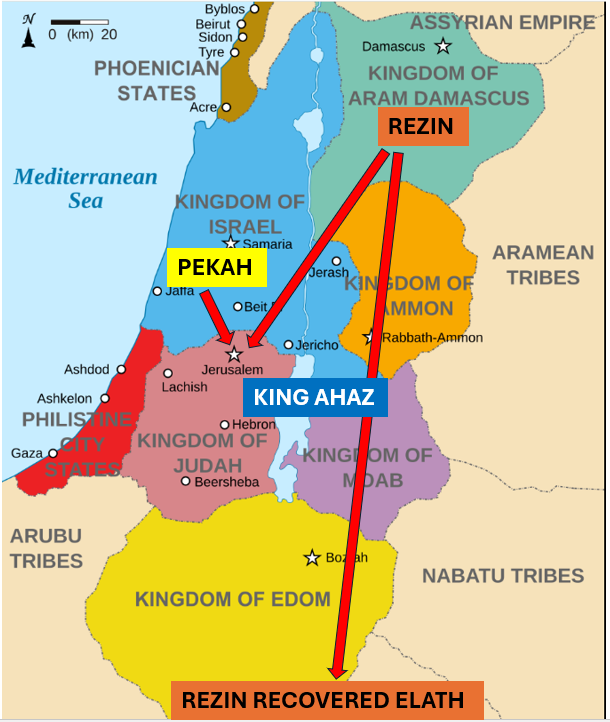
Judah lost because Ahaz had embraced idolatry (2Ch 28:2–4), the nation had followed his corruption, forciing Yahweh to use Rezin and Pekah as rods of discipline. But God set a limit for this discipline. Isaiah 7 shows God said Jerusalem would not fall and the Davidic line would continue. God was faithful to keep His covenant promise to David (2Sa 7:12-16) Isaiah adds that Rezin and Pekah were “smoldering stubs (almost burned out, smoke but little flame, no real power to ignite anything) of firebrands (burning stick pulled from a fire)” (Isa 7:4) God was saying that while Rezin and Pekah might look frightening, they were already burnt-out pieces of wood. They were dying powers and thus fading enemies of Judsah.
John MacArthur explains why Aram and Israel attacked Ahaz in Judah - The kings of Syria and Israel wanted to overthrow Ahaz in order to force Judah into their anti-Assyrian coalition. The two kings with their armies besieged Jerusalem, seeking to replace Ahaz with their own king (cf. Is 7:1-6). The Lord delivered Judah and Ahaz from the threat because of His promise to David (cf. Is 7:7- 16). (Borrow MacArthur Study Bible)
Bob Utley - Syria and Israel tried to force Judah to join their rebellion against Assyria (NIDOTTE, vol. 4, pp. 1244-1245) but their siege could not cause Jerusalem to surrender (735 B.C.) (aka could not overcome).
Believer's Study Bible - Pekah of Israel and Rezin of Syria entered into an alliance. This alliance had a threefold purpose: (1) to force Judah to support a revolt against the rising power of Assyria; (2) to drive the house of David from the throne with a division of territory between Israel and Syria; and (3) to serve as punishment from Yahweh upon Judah for her sins (2 Chr. 28:5).
REZIN (ISBE) - re'-zin (retsin; Rhaasson): The last of the kings of Syria who reigned in Damascus (2 Ki 15:37; 16:5-10; Isa 7:1; 8:4-7). Along with Pekah, the son of Remaliah, who reigned 20 years over Israel in Samaria, he joined in the Syro-Ephraimitic war aaainst Ahaz, the king of Judah. Together they laid siege to Jerusalem, but were unsuccessful in the effort to take it (2 Ki 16:5; Isa 7:1). It was to calm the fears, and to restore the fainting spirits of the men of Judah, that Isaiah was commissioned by the Lord to assure them that the schemes of "these two tails of smoking firebrands" (Isa 7:4) were destined to miscarry. It was then, too, that the sign was aiven of the vigin who should conceive, and bear a son, and should call his name Immanuel. Rezin had to content himself on this campaign to the South with the capture of Elath from the men of Judah and its restoration to the men of Edom, from whom it had been taken and made a seaport by Solomon (2 Ki 16:6, where it is agareed that "Syria" and "Syrians" should be read "Edom" and "Edomites," which in the Hebrew script are easy to be mistaken for one another, and are in fact often mistaken). Rezin, however, had a more formidable enemy to encounter on his return to Damascus. Ahaz, like kings of Judah before and after him, placed his reliance more on the arm of flesh than on the true King of his people, and appealed to Tiglath-pileser III, of Assyria, for help. Ahaz deliberately sacrificed the independence of his country in the terms of his offer of submission to the Assyrian: "I am thy servant and thy son" (2 Ki 16:7). Tiglath-pileser had already carried his arms to the West and ravaged the northern border of Israel; and now he crossed the Euphrates and hastened to Damascus, slaying Rezin and carrying his people captive to Kir (2 Ki 16:9). In the copious Annals of Tialath-pileser, Rezin figures with the designation Racunu(ni), but the tablet recording his death, found and read by Sir Henry Rawlinson, has been irrecoverably lost, and only the fact of its existence and loss remains (Schrader, COT, I, 252, 257). With the death of Rezin the kingdom of Damascus and Syria came to an end.
2 Kings 16:6 At that time Rezin king of Aram recovered Elath for Aram, and cleared the Judeans out of Elath entirely; and the Arameans came to Elath and have lived there to this day.
- recovered: 2Ki 14:22 De 2:8
- Elath: Heb. Eloth, 1Ki 9:26 2Ch 26:1-2
- 2 Kings 16 Resources
Related Passages:
2 Chronicles 26:1-2 And all the people of Judah took Uzziah, who was sixteen years old, and made him king in the place of his father Amaziah. 2 He built Eloth and restored it to Judah after the king slept with his fathers.
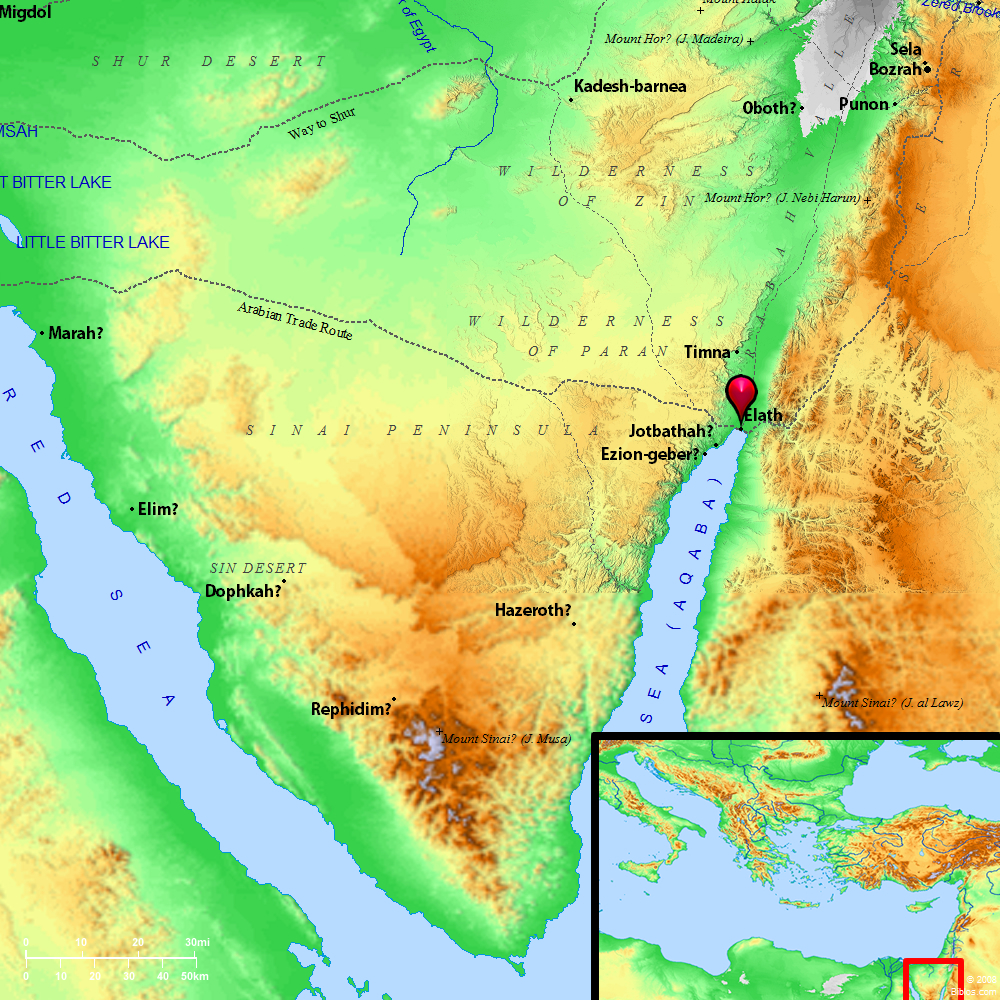
Eloth (Elath)
Elath Port on Red Sea
At that time - What time? The phrase links this event to the Syro-Ephraimite war just described (2Ki 16:5, with more detail in 2Ch 28:5-15). While Ahaz feared the siege of Jerusalem, another major wound to the nation came in the south at the valuable port city of Elath.
Elath fell because Judah
had already fallen spiritually!
Rezin king of Aram recovered Elath for Aram - Recall that King Uzziah had restored Elath to Judah (2Ki 14:22; 2Ch 26:1-2). On the map above, Elath (also spelled Eloth) is a Red Sea port at the northern tip of the Gulf of Aqaba, and was the gateway to international trade and a symbol of Solomon’s former glory (1Ki 9:26). Whoever held Elath controlled trade routes to Arabia and Africa and had access to copper mines and maritime commerce. Thus this was a major financial loss to King Ahaz.
Dale Ralph Davis explains Ahaz received "bad economic news: Rezin recovered the port of Elath (restored to Judah by Azariah, 14:22), cleared out the Judeans there, and, apparently left it for Edomites to resettle (2Ki 16:6). Elath (on the Gulf of Aqaba on the Red Sea) sat at the terminus of two important land routes (one of which was the King’s Highway running through Transjordan all the way north to Damascus) and as a port offered links to Arabia, Africa, and even India. (Borrow 2 Kings : the power and the fury page 232)
And cleared the Judeans out of Elath entirely - This suggests either forced deportation or military expulsion but either way, it show that Judah was dispossessed and lost customs revenue, a strategic military outpost and national prestige! Elath fell because Judah had already fallen spiritually!
And the Arameans came to Elath and have lived there to this day - The time phrase to this day indicates the Judah's loss of Elath was long lasting reflecting the consequences of Ahaz's sin.
Bob Utley - "Elath" This city is located on the northern end of the Gulf of Aqaba. It is very close to Ezion-geber. They both were ports. The one who controlled this port controlled the lucrative trade route north to Jerusalem and Damascus. Solomon first developed this area for Israel (cf. 1 Kgs. 9:26-28). It was restored by Uzziah (cf. 2 Kgs. 14:22; 2 Chr. 26:2). It was an Idumean city which shows Syria's influence far to the south (i.e., Josephus Antiq. 9.12.1; R. K. Harrison, Old Testament Times, p. 229) and was restored to Edom and this continued "to this day" (cf. 2 Chr. 28:17)
2 Kings 16:7 So Ahaz sent messengers to Tiglath-pileser king of Assyria, saying, “I am your servant and your son; come up and deliver me from the hand of the king of Aram and from the hand of the king of Israel, who are rising up against me.”
- Tiglath-pileser: 2Ki 15:29 1Ch 5:26 2Ch 28:20, Tilgath-pilneser
- I am thy servant: 1Ki 20:4,32,33
- and deliver: Ps 146:3-5 Jer 17:5 La 4:17 Ho 14:3
- 2 Kings 16 Resources
Parallel Passage:
2 Chronicles 28:16 At that time King Ahaz sent to the kings of Assyria for help.
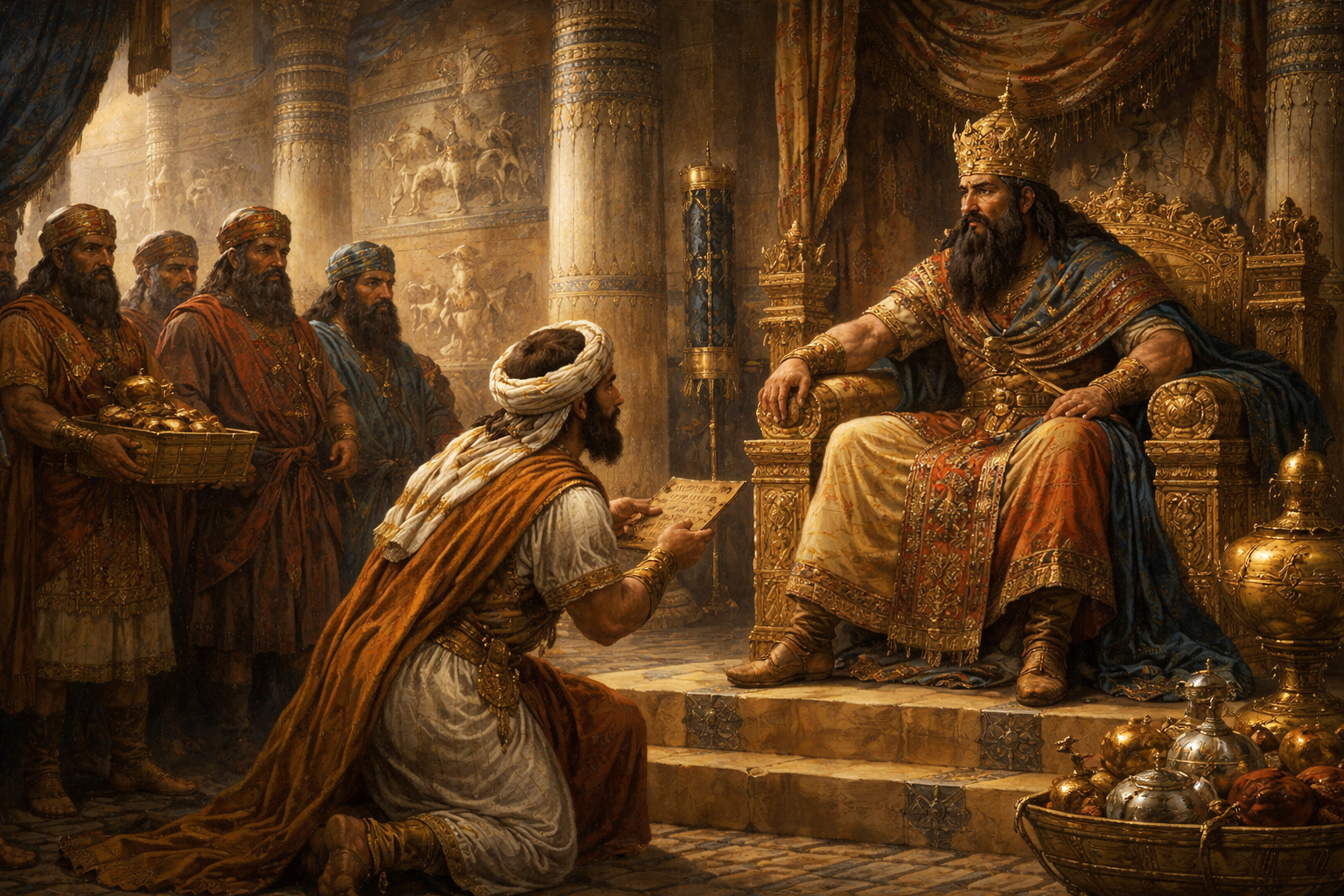
AHAZ PLEADS FOR SALVATION
BUT NOT FROM GOD!
So - (term of conclusion) - Ahaz has a crisis in 2Ki 16:5-6. Rezin and Pekah besiege Jerusalem. Ahaz is terrified (cf. Isa 7:2 – “his heart shook like trees in the wind”). In addition Judah loses territory (v.6) because Elath is taken, thus Judah is weakening. Now comes the "so" (or "therefore") Now Ahaz arrives at a conclusion. This is a crucial "hinge" point in the reign of Ahaz. Isaiah 7 shows that God had already offered Ahaz deliverance: “Ask a sign” (Isa 7:11) “It shall not stand” (Isa 7:7) But instead of trusting Yahweh, he chose Assyria. Ahaz's "conclusion" marks his spiritual compromise, chosing to rely on man than on Yahweh. This "SO" introduces a chain of events - submission to Assyria, temple plundering (v.8), pagan altar imitation (vv.10–16). Little words like "SO" can have big consequences!
The principle of Judah (or Israel) for not seeking aid from pagan nations was clearly stated in God's word, with Egypt as the prototype nation. See Deut 17:16 and Isa 30:1–3.
“SO” in our lives frequently reveals whom we trust—
Pressure will always produce a therefore,
either the therefore of faith or the therefore of compromise.
Ahaz sent messengers to Tiglath-pileser king of Assyria, saying, 2 Chronicles 28:17–19 reveals that Ahaz’s troubles extended beyond the Syro-Ephraimite coalition of Rezin and Pekah. Judah not only lost the vital port of Elath but was further humbled by renewed assaults from the Edomites and the Philistines, clear signs of the LORD’s discipline upon the nation. As Thompson says almost as an understatement "Ahaz was in dire straits."
Ahaz surrendered to one enemy
in order to defeat another.
-- David Guzik
I am your servant and your son; come up and deliver (yasha; LXX - sozo - save, rescue) me from the hand of the king of Aram and from the hand of the king of Israel, who are rising up against me - With this appeal Ahaz effectively surrendered Judah’s independence and, far more seriously, Judah’s trust in the LORD. The phrases your servant and your son were the formal language of vassal loyalty, words that confessed absolute dependence on a foreign king. Ahaz's plea for salvation should have been spoken to Yahweh, the Rock of our salvation, but instead was spoken to the godless pagan king Tiglath-pileser of Assyria. Ahaz's fear had replaced what little faith he must have had at this time. The irony his an heir of the coming Messiah was seeking salvation from a pagan empire.
Expediency is man’s wisdom;
doing right is God’s.
- George Meredith
Warren Wiersbe - Ahaz sent word to the king of Assyria to come and help him. His message was that of a flattering flunky, what we today would call a “bootlicker.” He called himself Tiglath-pileser’s “servant” and “son,” a strange posture for a descendant of David to take before a pagan ruler.
Wiseman “The address ‘I am your servant and your son’ clearly places Ahaz as the petitioning vassal and shows he was trusting in Assyria rather than in the LORD, against the advice of Isaiah (Isaiah 7:10-16; cf. Exodus 23:22).” (1 and 2 Kings: An Introduction and Commentary)
Ahaz’s plea also reveals how desperate he felt under the pressure of the Syro-Ephraimite threat. Rezin of Aram and Pekah of Israel were “rising up” against him, yet God had already promised through Isaiah that their plan would not stand (Isa 7:4-6, 7, 8, 9). Rather than cling to the prophet Isaiah's word and Yahweh's assurance, Ahaz chose the visible power of Assyria over the power of the invisible LORD (cf walking by sight, not faith! Contrast 2Co 5:7). Ahaz's request for deliverance sounded practical and even politically expedient, but at its core manifest his spiritual betrayal of God. It was tantamount to an admission that he trusted Tiglath-pileser more than Yahweh Who had delivered Judah so many times in the past!
Ahaz asked Assyria to be the father and deliverer
that only the LORD was meant to be.
Ahaz's foolish decision would bring temporary relief (like Tums for the tummy do when you have indigestion - they give only temporary relief!), but it would also place Judah under Assyrian domination and open the door to idolatrous influence of the Assyrians within Jerusalem. By calling the Assyrian king “father,” Ahaz symbolically displaced the true Father of Israel. The verse captures a tragic exchange of covenant confidence traded for political expediency, of divine help rejected for human might.
J.A. Thompson: Ahaz was in dire straits. His predecessors who had been faithful to the Lord had seen God subdue such enemies many times. But Ahaz did not trust in the Lord (cf. Isa 7:10-16). With Philistines and Edomites in the south and the SyroEphraimite invasion in the north (2Ch 28:5-8), he faced a two-front war. (SEE 1, 2 Chronicles: An Exegetical and Theological Exposition)
August Konkel: The historian portrays Ahaz as voluntarily submitting to the Assyrian yoke, a grievous misdeed in addition to his promoting idolatry in the high places.
Christopher Knapp - “How different was his great ancestor David! ‘In my distress,’ he says, ‘I called upon the Lord, and cried unto my God’ (Psalm 18:6). Even his wicked grandson Manasseh sought the Lord his God ‘when he was in affliction.’ But Ahaz seemed determined to fill up the measure of his sins.”
Peter Pett - Ahaz recognised that he was in desperate straits, and as the Book of Isaiah reveals, he was torn three ways. Some called on him to join the anti-Assyrian alliance with Aram and Israel, others called on him to submit to the king of Assyria as his vassal thus obtaining his aid, and still others, no doubt partly influenced by Isaiah, called on him to look to YHWH alone for help. The full story can be found in Isaiah 7 onwards. But Ahaz, in spite of an unprecedented offer from YHWH, would choose to submit himself to the king of Assyria and therefore sent messengers offering his submission, promising tribute, and calling for his assistance.
Spurgeon - The king of Assyria was the greatest potentate in that region, and all the little kings were afraid of him, and therefore sent to him for help when they were in trouble. Ahaz made no appeal to God, for the assistance he required, but he turned to the arm of flesh.
Bob Utley - This is diplomatic language of a vassal to his overlord (i.e., "servant" and "son"). Ahaz went to meet Tiglath-pileser III in v. 10.
Deliver (save, help) (03467) yasha' (See also yeshua from which we get our word "Jesus") is an important Hebrew verb which means to help, to save, to deliver. The root in Arabic is "make wide" which underscores the main thought of yasha' as to bring to a place of safety or broad pasture in contrast to a narrow strait which symbolizes distress or danger.
TWOT adds that the concept of "wide" "connotes freedom from distress and the ability to pursue one’s own objectives. To move from distress to safety requires deliverance. Generally the deliverance must come from somewhere outside the party oppressed. In the OT the kinds of distress, both national and individual, include enemies, natural catastrophies, such as plague or famine, and sickness. The one who brings deliverance is known as the “savior.”
Thus yasha' connotes protection that produces freedom from a present danger (2Sa 22:3, Job 5:4), salvation or deliverance in a religious sense (Ps 51:12), a title of God (Savior - 2Sa 22:47; 1Chr 16:35; Ps 18:46; Ps 24:5; Ps 25:5; Ps 27:9; Ps 65:5; Ps 79:9; Ps 85:4; Isa 17:10; 62:11; Mic 7:7 Hab 3:18), victory as an act or a result of conquering (2Sa 22:36; Ps 18:35) It is notable that almost 20% of the uses of yasha' are found during the dark days of Judges (dominated by the heart attitude of Jdg 21:25), which surely speaks of the undeserved lovingkindness of God!
YASHA IN SAMUEL-CHRONICLES - 1 Sam. 4:3; 1 Sam. 7:8; 1 Sam. 9:16; 1 Sam. 10:19; 1 Sam. 10:27; 1 Sam. 11:3; 1 Sam. 14:6; 1 Sam. 14:23; 1 Sam. 14:39; 1 Sam. 17:47; 1 Sam. 23:2; 1 Sam. 23:5; 1 Sam. 25:26; 1 Sam. 25:31; 1 Sam. 25:33; 2 Sam. 3:18; 2 Sam. 8:6; 2 Sam. 8:14; 2 Sam. 10:11; 2 Sam. 10:19; 2 Sam. 14:4; 2 Sam. 22:3; 2 Sam. 22:4; 2 Sam. 22:28; 2 Sam. 22:42; 2 Ki. 6:26; 2 Ki. 6:27; 2 Ki. 13:5; 2 Ki. 14:27; 2 Ki. 16:7; 2 Ki. 19:19; 2 Ki. 19:34; 1 Chr. 11:14; 1 Chr. 16:35; 1 Chr. 18:6; 1 Chr. 18:13; 1 Chr. 19:12; 1 Chr. 19:19; 2 Chr. 20:9; 2 Chr. 32:22
2 Kings 16:8 Ahaz took the silver and gold that was found in the house of the LORD and in the treasuries of the king’s house, and sent a present to the king of Assyria.
- the silver: 2Ki 16:17,18 12:17,18 18:15,16 2Ch 16:2 28:20,21
- to the king: Ps 7:15,16 Isa 7:17 8:7,8
- 2 Kings 16 Resources
Parallel Passage:
2 Chronicles 28:21 Although Ahaz took a portion out of the house of the LORD and out of the palace of the king and of the princes, and gave it to the king of Assyria, it did not help him.
Related Passages:
2 Chronicles 28:22 Now in the time of his distress this same King Ahaz became yet more unfaithful to the LORD
2 Chronicles 28:24 Moreover, when Ahaz gathered together the utensils of the house of God, he cut the utensils of the house of God in pieces; and he closed the doors of the house of the LORD and made altars for himself in every corner of Jerusalem..
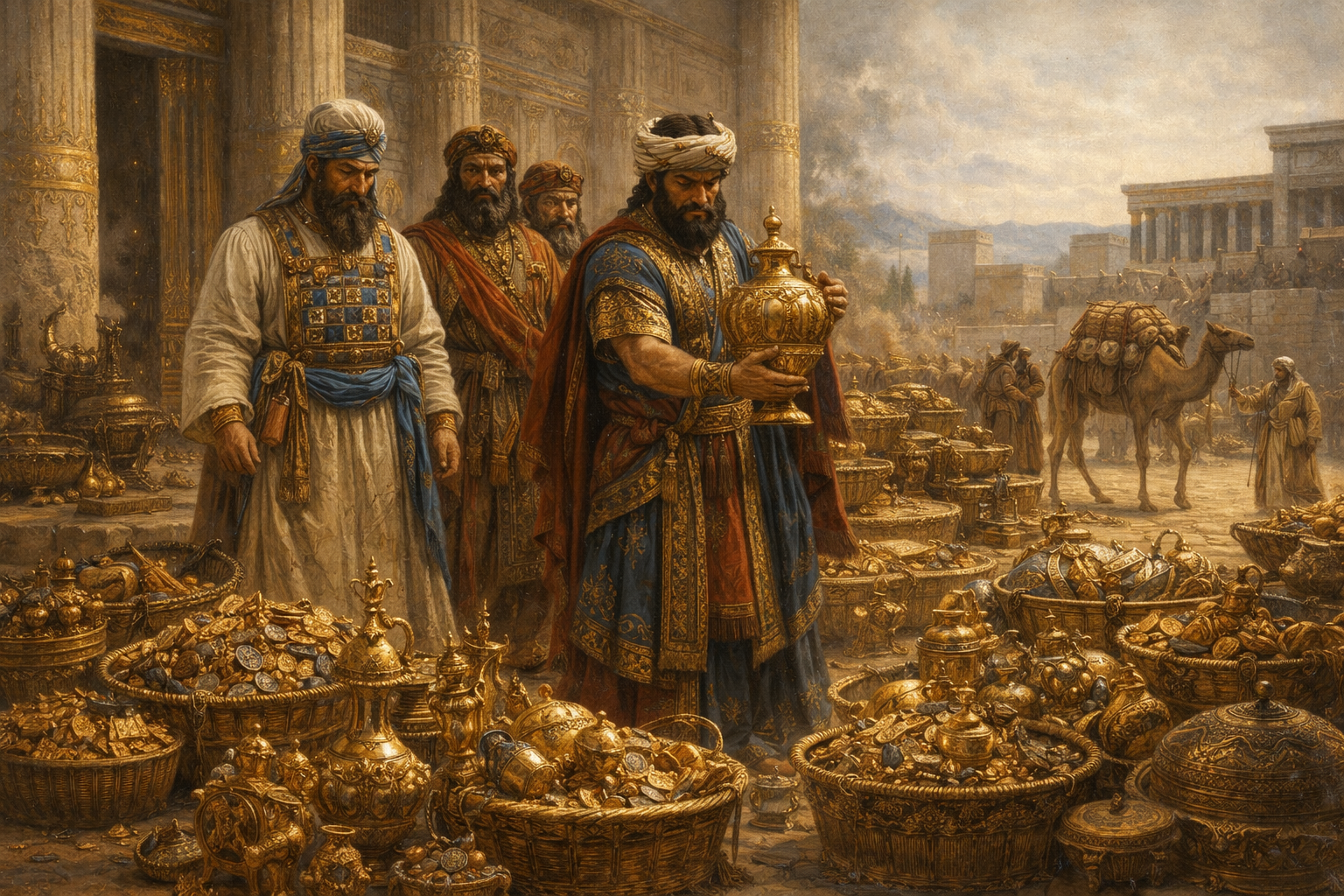
AHAZ "LOOTS" GOD'S HOUSE AS
"PRESENT" TO ASSYRIAN KING
Ahaz took the silver and gold that was found in the house of the LORD and in the treasuries of the king’s house This action reveals how far Ahaz had fallen from the faith of his fathers. The silver and gold treasures stored in the temple were not merely national wealth but were symbols of God’s covenant presence and provision. By stripping the House of the LORD to purchase Assyrian help, Ahaz treated sacred gifts as "bargaining chips," placing his confidence in political power rather than in the God Who dwelt among His people. What earlier kings had guarded as holy, Ahaz surrendered in fear.
Ron Daniel - Ahaz thought that turning to the world and throwing money at the problem was the only solution. To make matters worse, much of that money he used was from the house of the Lord. It is unfortunate, but even among Christians I see that strategy being used. When difficulties arise, the solution is money rather than prayer. It is about finances rather than faith. And to make matters worse, the first money that is used to purchase the way out of problems is very often the Lord's money. God has commanded that the firstfruits belong to Him.
Ex 23:19 "You shall bring the choice first fruits of your soil into the house of the LORD your God...
Ezek. 44:30 "And the first of all the first fruits of every kind and every contribution of every kind, from all your contributions, shall be for the priests; you shall also give to the priest the first of your dough to cause a blessing to rest on your house.
Too many have taken their "dough" and contributions from the house of the Lord and thought, "I'm not going to make it this month if I tithe. I won't be able to afford the new car payment unless I cut down on my giving." May we never be guilty of taking the Lord's money instead of trusting in the Lord when trouble comes.
And sent a present to the king of Assyria -Tiglath-Pileser III, whose own security was menaced by the Israel-Syria coalition, accepted the treasures from the temple and royal palace that Ahaz had sent by way of tribute. The payment was called a “present,” but in reality it was tribute, an admission that Judah was becoming a vassal state of Assyria. Ahaz emptied both the royal treasury and the temple treasury to secure temporary deliverance, yet this act only deepened Judah’s bondage. Instead of seeking the LORD as his Protector, he financed his own dependence on a pagan empire. The gold meant for worship was converted into the price of unbelief, and the sanctuary that testified to God’s sufficiency was plundered to support his foolhardy strategy!
This verse marks a tragic turning point. Ironically, earlier, the treasures of the temple had represented thanksgiving for God’s victories but were now being used to buy protection from a godless king. Yes, Ahaz gained a short-lived rescue from Rezin and Pekah, but he lost something far greater, the spiritual independence and integrity of Judah. The king who should have been steward of the LORD’s house became its despoiler. His actions show that misplaced trust always carries a costly price.
Bob Utley - Ahaz paid tribute to Assyria to save Judah from the Syro-Ephraimatic coalition (cf. vv. 17-18 and possibly v. 15). (ED: WHAT IS INEXPLICABLY FOOLISH IS THAT ISAIAH HAD PROPHESIED THESE ENEMIES WOULD NOT DEFEAT JUDAH! HE REFUSED TO BELIEVE THE PROPHET'S WORDS -- THIS IS ALWAYS A BAD IDEA!)
Spurgeon on King Ahaz - A black mark is put against his name, to show how greatly guilty he was. Those who rebel against divine checks, and will not be held in by the providence of God, are to be written down in capital letters as great sinners. They sin with emphasis who sin against the chastising rod.
Ahaz repudiates the Davidic covenant
as he licks Tiglath-pileser’s boots.
Dale Ralph Davis (Borrow 2 Kings : the power and the fury page 232) - Ahaz is in deep trouble and appeals for help—to Assyria (2Ki 16:7–8). He acts not as a covenant believer but as a shrewd politician. Ahaz sells his birthright at the very first: ‘I am your servant and your son’ (2Ki 16:7a). I’ve a note here in my old study Bible to 2 Samuel 7:14, which says that the Davidic king will be Yahweh’s ‘son.’ Ahaz repudiates the Davidic covenant as he licks Tiglath-pileser’s boots. He wants to accept the Assyrians as his personal savior—‘Come up and save me from the grip of the king of Syria and from the grip of the king of Israel who are attacking me’ (2Ki 16:7b). And, as usual in politics, a handsome bribe (2Ki 16:8) buys salvation (2Ki 16:9). It may have been blatant unbelief but it was successful policy; he may repudiate the Davidic covenant but he saves his own skin. Ahaz could have put his attitude in verse (sung to the tune Gordon/Caritas = ‘My Jesus, I Love Thee’):
My Tig, I bribe thee, you know I’m your man;
for thee Yahweh’s promises I view as mere sand.
You mighty oppressor, my savior art thou,
if ever I needed you, dear Tiglath, ’tis now.
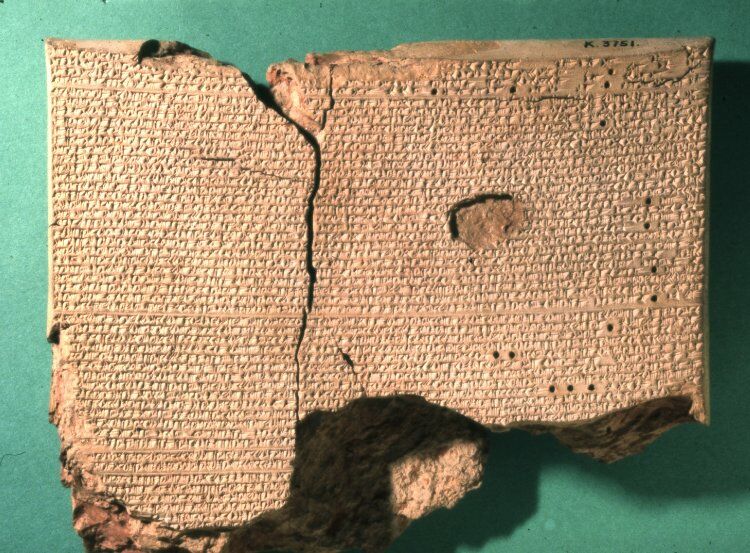
Tiglath-Pileser III’s Summary Inscription Seven
Trustees at the British Museum
ARCHAEOLOGICAL VERIFICATION - FROM Armstrong Institue of Biblical Archaeology note on 2 Kings 16:8 - "This tribute that Ahaz took from the temple is confirmed by the discovery of Summary Inscription Seven (SEE PICTURE ABOVE) from Tiglath-Pileser’s palace. Part of the inscription reads:
From these I received tribute … Sanipu of Ammon, Salamanu of Moab, … Mitinti of Ashkelon, Jehoahaz [Ahaz] of Judah, Kaush-malaku of Edom, … Hanno of Gaza … including gold, silver, iron, fine cloth and many garments made from wool that was dyed in purple … as well as all kinds of lavish gifts from many nations and from the kings that rule over them.
The inscription uses Ahaz’s full name, Jehoahaz, whereas the Bible uses the short form, Ahaz. The text parallels the biblical account, in both tribute and specific materials that Ahaz sent to Tiglath-Pileser. It also describes the Assyrian king receiving tribute from many kings who were in the confederation against Israel—this indicates that after receiving Ahaz’s request for help, Tiglath-Pileser led a military campaign to conquer these different peoples attacking Judah. The Bible states that Tiglath-Pileser attacked King Rezin of Syria and took away many captives (2Ki 16:9). The Annals of Tiglath-Pileser mention the Assyrian king receiving tribute from Rezin.
- See also Nimrud Tablet K.3751
2 Kings 16:9 So the king of Assyria listened to him; and the king of Assyria went up against Damascus and captured it, and carried the people of it away into exile to Kir, and put Rezin to death.
- went up against Damascus: 2Ch 28:5, Foretold, Am 1:3-5
- Kir: Isa 22:6 Am 9:7
- put Rezin to death Isa 7:16 9:11
- 2 Kings 16 Resources
Parallel Passage:
2 Chronicles 28:20 So Tilgath-pilneser king of Assyria came against him and afflicted him instead of strengthening him.
Related Passages:
Source: ESV Global Study BibleAmos 1:3-5 (AMOS BEGAN PROPHETIC MINISTRY ABOUT 755 20 YEARS BEFORE AHAZ CAME TO POWER & PREDICTED FALL OF ARAM TO ASSYRIA - SEE MAP ABOVE) Thus says the LORD, “For three transgressions of Damascus and for four I will not revoke its punishment, Because they threshed Gilead with implements of sharp iron. 4 “So I will send fire upon the house of Hazael (IN FORM OF ASSYRIAN TILGATH-PILNESER) And it will consume the citadels of Ben-hadad. 5 “I will also break the gate bar of Damascus, And cut off the inhabitant from the valley of Aven, And him who holds the scepter, from Beth-eden; So the people of Aram will go exiled to Kir (FULFILLED HERE IN 2KI 16:9 CIRCA 732 BC)” Says the LORD.
Isaiah 8:4 (ANOTHER PROPHECY AGAINST ARAM/SYRIA) for before the boy knows how to cry out ‘My father’ or ‘My mother,’ the wealth of Damascus and the spoil of Samaria will be carried away before the king of Assyria.”
Isaiah 17:1 (ANOTHER PROPHECY AGAINST ARAM/SYRIA) The oracle concerning Damascus. “Behold, Damascus is about to be removed from being a city And will become a fallen ruin.
2 Kings 15:29 In the days of Pekah king of Israel, Tiglath-pileser king of Assyria came and captured Ijon and Abel-beth-maacah and Janoah and Kedesh and Hazor and Gilead and Galilee, all the land of Naphtali; and he carried them captive to Assyria.
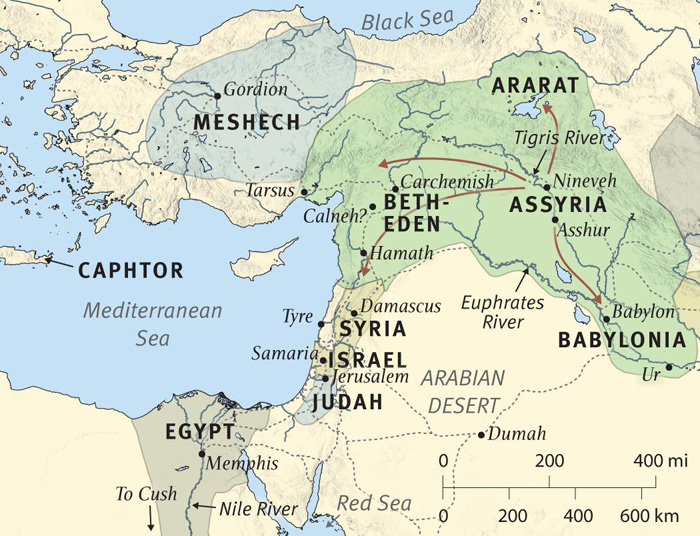
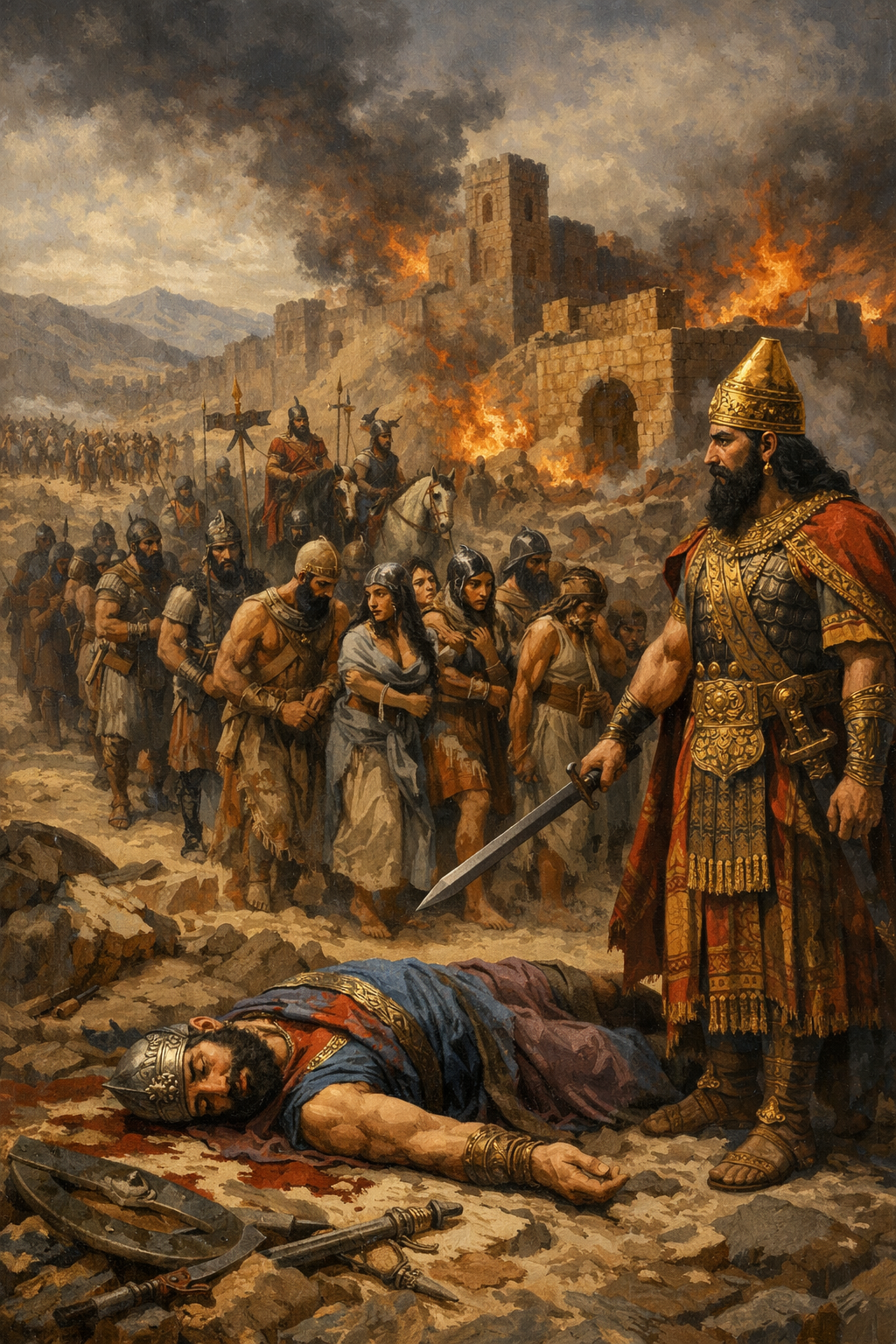
Rezin Slain, Arameans Exiled to Kir
ASSYRIAN KING ACCEDES TO
AHAZ'S BRIBE & DESTROYS ARAM
So the king of Assyria listened to him; and the king of Assyria went up against Damascus and captured it, and carried the people of it away into exile to Kir (see Amos prophecy above), and put Rezin to death. The king of Assyria marched against Israel and Syria. After a protracted siege of Damascus, he killed Rezin, the king of Syria, and accomplished the destruction predicted by the prophets (Isa. 8:4; Isa 17:1; Amos 1:4). Tiglath-Pileser III then turned against Pekan of Israel and took captive most of Reuben, Gad, and the half-tribe of Manasseh, transporting them to Mesopotamia in the first captivity of Israel (2Ki 15:29). With the death of Rezin, the Syrian dynasty of Damascus collapsed, leaving Assyria as the only dominant power in the Near East.
So the king of Assyria listened to him – Ahaz’s desperate appeal to Tiglath-pileser III "succeeded," but it was a tragic success. Instead of listening to the LORD’s promise through Isaiah (Isa 7:7–9), Ahaz placed his trust in a pagan superpower. The word listened implies favorable response, yet it was an answer that would ultimately enslave Judah. God sometimes allows our misplaced trusts to “work” so that we may later taste their bitter fruit.
And the king of Assyria went up against Damascus and captured it – This fulfilled Amos' and Isaiah’s prophecy that the Aram-Israel coalition would not stand (Amos 1:3-5, Isa 7:16). Assyria crushed Syria’s capital in 732 BC, ending centuries of Aramean power.
And carried the people of it away into exile to Kir – Deportation was Assyria’s signature policy. By uprooting populations, they broke national identity and resistance. Kir (probably in Mesopotamia or Elam) is ironically the very region from which the Arameans had originally migrated (Amos 9:7). History came full circle under God’s sovereign hand, for what Aram had sown, it now reaped.
And put Rezin to death – The coalition’s leader met a swift end. Humanly speaking, Ahaz must have felt vindicated, for his Syrian enemy was gone. Yet Scripture views this not as triumph but as tragedy, for Judah had purchased relief at the cost of dependence on Assyria and compromise of worship (2Ki 16:10–18). The death of Rezin removed a threat but opened the door to a much greater one.
What looks like rescue can become ruin when it is sought apart from the LORD. Ahaz exchanged a temporary enemy for a permanent master, proving that security purchased without faith is never true safety.
Bob Utley - Kir - This is omitted by the LXX. In Amos 1:5 it is also identified as the place where the Syrians were exiled in 732 B.C. It possibly refers to "Ashur" or a region of Assyria (cf. Isa. 22:6; ABD, vol. 4, p. 83). Josephus (Antiq. 9.12.3) identifies the place of exile as "Upper Media." He also notes that a colony of Assyrians occupied Damascus.
2 Kings 16:10 Now King Ahaz went to Damascus to meet Tiglath-pileser king of Assyria, and saw the altar which was at Damascus; and King Ahaz sent to Urijah the priest the pattern of the altar and its model, according to all its workmanship.
- saw an altar: De 12:30 2Ch 28:23-25 Jer 10:2 Eze 23:16,17 Ro 12:2 1Pe 1:18
- the pattern: Ex 24:4 39:43 1Ch 28:11,12,19 Ps 106:39 Eze 43:8,11 Mt 15:6,9
- 2 Kings 16 Resources
Related Passages:
Deuteronomy 12:30 beware that you are not ensnared to follow them, after they are destroyed before you, and that you do not inquire after their gods, saying, ‘How do these nations serve their gods, that I also may do likewise?’
Exodus 25:40 “See that you make them after the pattern for them, which was shown to you on the mountain.
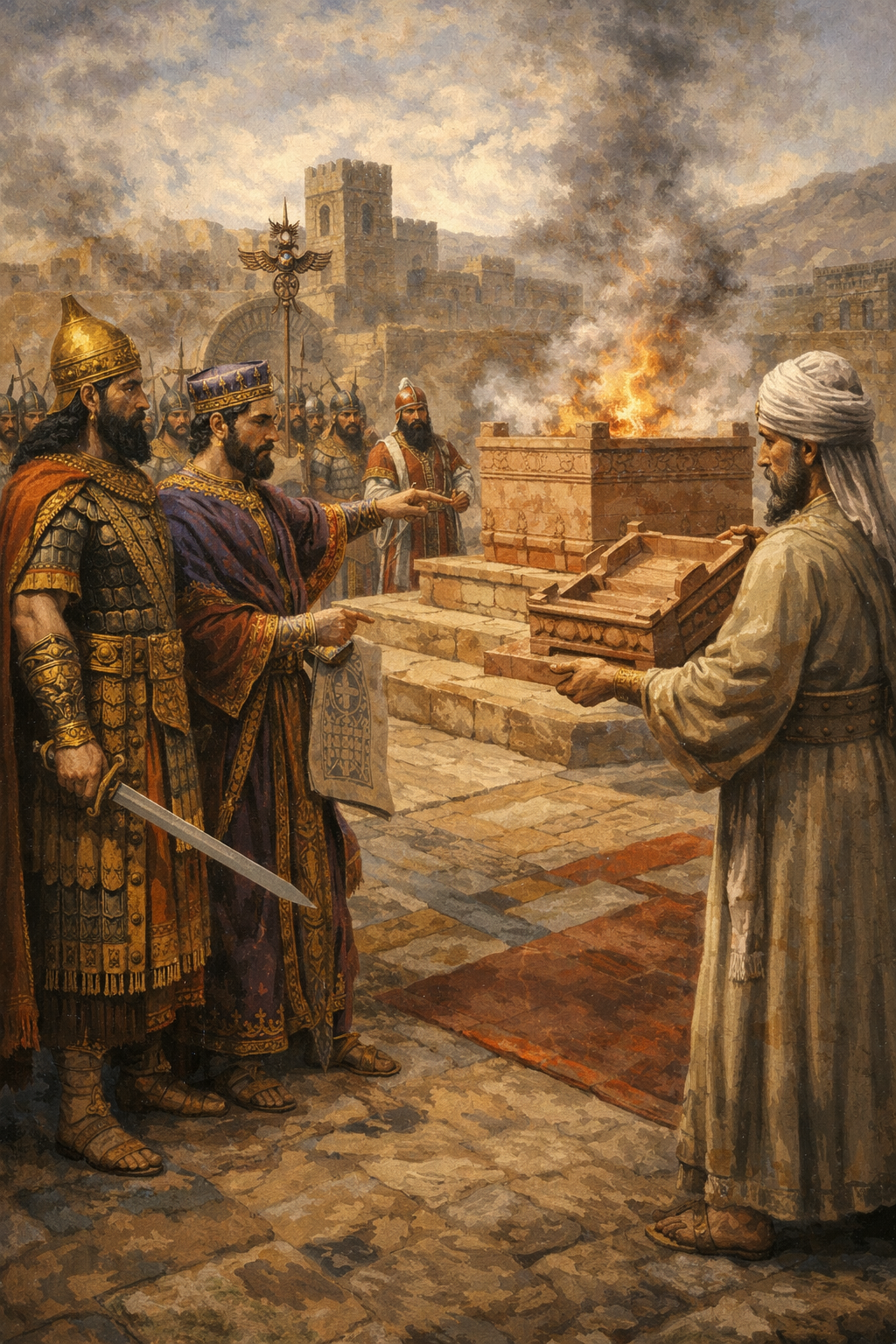
AHAZ'S AFFECTION
FOR ASSYRIAN ALTAR
Now King Ahaz went to Damascus to meet Tiglath-pileser king of Assyria, and saw the altar (mizbeah; LXX - thusiasterion) which was at Damascus; King Ahaz made the fateful journey to Damascus, not as a victorious monarch but as a trembling vassal coming to pay homage to Tiglath-pileser, the rising superpower of the ancient Near East. His trip was meant to secure political protection, yet it exposed the deeper condition of his heart. Ahaz’s visit to Damascus showed that his heart was already leaning toward Assyria’s religion, for he admired a pagan altar more than the holy worship established by the LORD. Instead of regarding it as an abomination, he was captivated.
and King Ahaz sent to Urijah ("light of Jehovah") the priest the pattern of the altar (mizbeah; LXX - thusiasterion) and its model, according to all its workmanship From Damascus, captivated by what he had seen, King Ahaz dispatched a message to Urijah the priest whose name, “light of Jehovah,” stood in painful contrast to the darkness of the deed he was about to perform! Urijah, the priest, cooperated instead of resisting, which demonstrated how deeply corruption had entered Judah’s worship.
Ahaz sent to Urijah the precise pattern, blueprint, and model of the pagan altar, specifying every detail of its design and workmanship. This was a deliberate act of imitation, treating a heathen shrine as though it were superior to the altar that God Himself had prescribed for His Temple. The king’s command placed Urijah in a position of compromise, so that instead of guarding the sanctity of the LORD’s house, the priest became an instrument for importing foreign worship into Jerusalem. By transmitting these plans according to all its workmanship, Ahaz showed meticulous zeal for copying what was false, while displaying indifference to the revealed standards of the Law! It was a calculated exchange (cf Ro 1:23), the pattern of the bronze altar prescribed in the Mosaic Law given at Sinai for a pattern of a pagan altar borrowed from Damascus.
This verse shows where idolatry begins—not always in open rebellion, but in admiration of what the world offers instead of fidelity to God. Ahaz symbolizes a heart that trusts human power and aesthetics rather than the living LORD and His Word. Ahaz’s imitation of the Damascus altar was not just a political act; it was a spiritual betrayal. His actions foreshadow the eventual downfall of Judah, showing the cost of abandoning covenant faith in favor of worldly alliances.
Note the progression of spiritual decline - new altar: vv. 10–11; new arrangements: vv. 12–14; new regulations: vv. 15–16; new rationale: vv. 17–18. And one can hardly miss the striking parallel between Jeroboam of Israel and Ahaz of Judah. Jeroboam had been the original architect of state-sponsored idolatry, establishing alternative shrines and reshaping worship to secure his political power. Centuries later Ahaz followed the same tragic path, not merely tolerating pagan practices but normalizing them at a national level. Like Jeroboam, he clothed religious compromise in the language of royal policy, making polytheism appear respectable and even patriotic. Both kings treated worship as a political tool rather than an act of covenant faithfulness, and both left a legacy that drew God’s people away from the simplicity and exclusiveness of devotion to the LORD.
CHRONOLOGICAL NOTE - Most commentators interpret the faithless description of Uriah in 2 Kings 16:10ff as following God's call on him to be a faithful witness to Isaiah's prophecy in Isaiah 8:1-2. Clearly, something happened in Uriah's heart between to cause him to go from a faithful witness to a compromising priest! Beloved, let us be so, so careful! "Therefore let him who thinks he stands take heed (command to continually TAKE HEED for we are ALL continually in danger of falling! = present imperative see our need to depend on the Holy Spirit to obey) that he does not fall." (1Co 10:14)
John MacArthur - The serious iniquity in this was meddling with and changing, according to personal taste, the furnishings of the temple, the design for which had been given by God (Ex 25:40; 26:30; 27:1-8; 1 Ch 28:19). This was like building an idol in the temple, done to please the pagan Assyrian king, whom Ahaz served instead of God.
John Walton - Ahaz and Tiglath-Pileser at Damascus. This meeting took place after Damascus fell in 732. Ahaz, as a loyal vassal, was expected to be present to reaffirm his submission and join the celebration over the king’s victory. (See page 402 The IVP Bible Background Commentary-Old Testament)
John Walton - Damascus altar. The reproduction of this altar appears to result from Ahaz being impressed with it rather than from Assyrian compulsion. Judging from what is known of Assyrian practice of this time, it appears that they did not force their vassals to adopt the worship of their chief god, Assur. Thus it should be considered artistic innovation rather than ritual syncretism (ED: I MIGHT ARGUE THAT LAST POINT!). Currently no archaeological or textual information exists to provide for an informed delineation of the features.
Bob Utley - "the altar" This worship altar was probably built by the king of Syria but the Assyrian victors kept it. Ahaz's building a copy of it was a way to acknowledge and honor Tiglath-pileser III (NIDOTTE, vol. 4, pp. 1250-1251). Its construction and placement in the temple in Jerusalem shows how quickly true YHWHism was corrupted.
Bob Utley - "Urijah" (SEE NOTES BELOW) This priest was called a "faithful witness" by Isaiah (cf. Isa. 8:2, "Uriah") and was probably the "high priest," but not listed in 1 Chr. 5:27-41 nor in Josephus (Antiq. 10) (Isaiah 8:2 “And I will take to Myself faithful witnesses for testimony, Uriah the priest and Zechariah the son of Jeberechiah.”)
NAVE'S AGREES THAT URIAH IS " A priest. Witness to one of Isaiah's prophecies, Isa. 8:2. Probably identical with Urijah, 2 Kin. 16:10)
ISBE note on URIAH adds "A priest under Ahaz, who carried into effect the latter's commands to introduce an Assyrian altar into the Temple and to use it for the sacrifices (2 Ki 16:10-16; see ALTAR). The same Uriah appears in Isa 8:2 as one of the two "faithful witnesses" taken by Isaiah in the matter of Maher-shalal-hash-baz. This description has seemed to many to conflict with Uriah's compliancy in obeying Ahaz, but it must be remembered that (a) "faithful witness" means simply "one whom the people will believe," and (b) the articles in the sanctuary were not held as immutably sacred in the time of Ahaz as they were in later days. The omission of Uriah's name from the list in 1 Ch 6:10-14 is probably without significance, as Chronicles records only nine names from Solomon to the exile, showing that there must be many omissions. The corresponding list in Josephus, Ant, X, viii, 6, contains 18 names, including Uriah's."
Altar (04196) mizbeah from zabach (“to slaughter for sacrifice or for food”) is the root of a masculine noun occurring frequently in the Old Testament (338×). It denotes the altar, the designated place where offerings were presented to a deity. The first biblical use appears in Genesis 8:20, where Noah built an altar as his initial act of worship after surviving the flood. Abraham is likewise closely associated with altars in Genesis 12:7–8; 13:4, 18; and 22:9. As expected, the term occurs most often in sacrificial contexts, especially in Leviticus (88× in 72 verses) and Exodus (61× in 53 verses). Notably, the earliest recorded offerings by Cain and Abel (Genesis 4:3) make no mention of a specific altar.
The Septuagint (Lxx) often translates mizbeach with the word thusiasterion ("a place of sacrifice") which is derived from thusia meaning that which is offered as the sacrifice.
THE WESTERN CAMPAIGNS OF TIGLATH-PILESER III, 734-732 From early in his reign (starting about 743) Tiglath-Pileser was active in Syria attempting to control the trade routes through this economically strategic region. By 738 he had collected tribute from most of the major parties in the area (including Damascus, the port cities and Samaria). During the next few years he was occupied in Urartu (in the Lake Van area to the north), and by 735 he had brought control to that region. In 734 he began what is known as the second western campaign. His initial objective was to march through the region as a show of power to reiterate his control (especially of the trade route) and collect tribute. His route took him down the Great Trunk Road to Gaza. No opposition is noted in any of the sources. In 733 the Assyrian armies returned, with Damascus as the main target. Though the Arameans suffered serious losses, Damascus successfully withstood a forty-five-day siege by the Assyrians. In this campaign Tiglath-Pileser ranged down into the region of Israel. Large sections of Israel were annexed and made into Assyrian provinces, and fortified cities such as Hazor and Megiddo were destroyed. Over thirteen thousand Israelites were deported, but no replacement inhabitants were shipped in, thus depleting the population of Lower Galilee for several generations. The final stage of the campaign came in 732, when Damascus fell and was annexed. In Israel Pekah was executed in favor of the pro-Assyrian Hoshea.
2 Kings 16:11 So Urijah the priest built an altar; according to all that King Ahaz had sent from Damascus, thus Urijah the priest made it, before the coming of King Ahaz from Damascus.
- built an altar: 1Ki 21:11-13 2Ch 26:17,18 Jer 23:11 Eze 22:26 Da 3:7 Ho 4:6 Ho 5:11 Mal 2:7-9 Ga 1:10
- Urijah: Isa 8:2
- 2 Kings 16 Resources
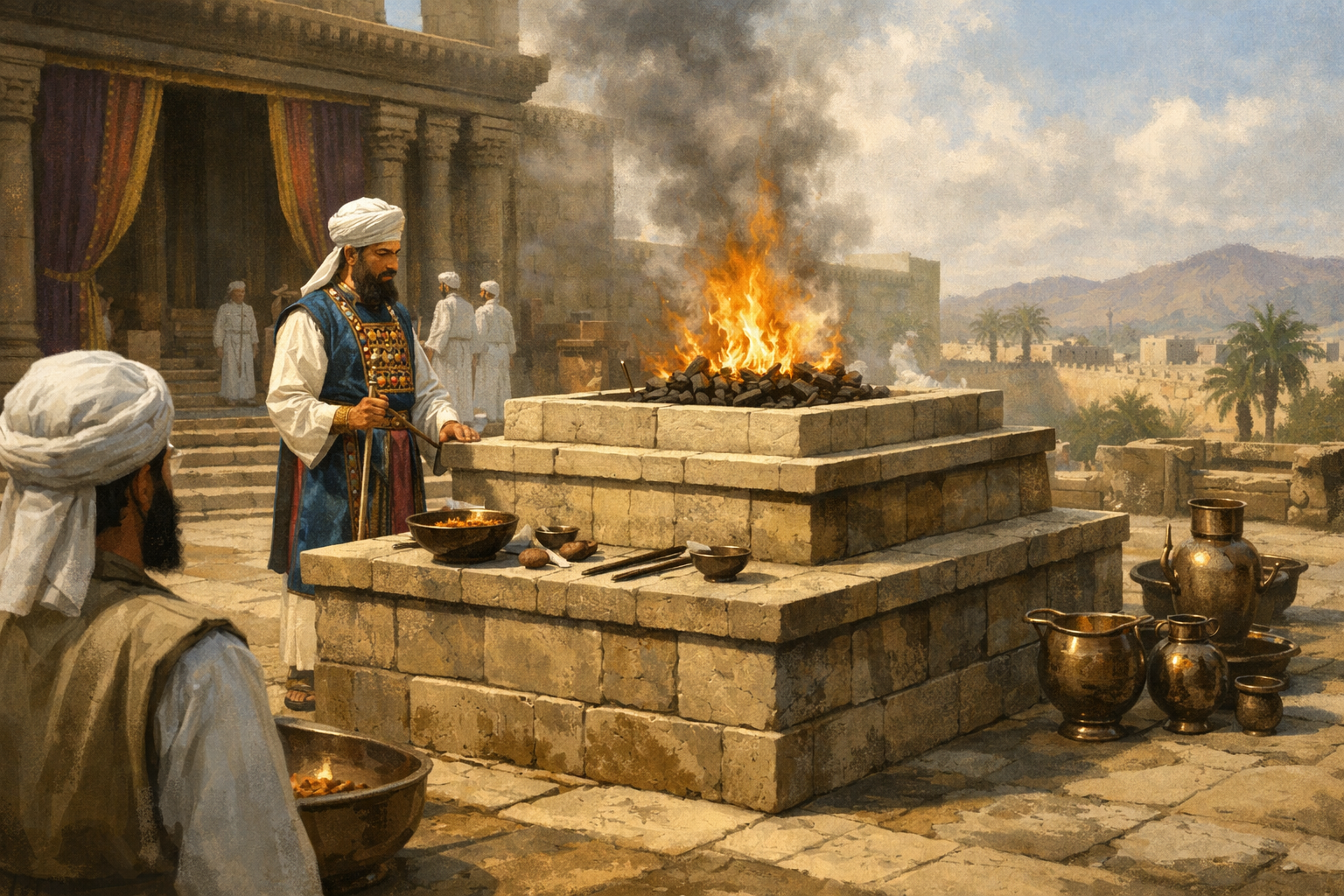
SPIRITUAL COMPROMISE
BY PRIEST URIJAH
So Urijah the priest built an altar (mizbeah; LXX - thusiasterion) ; according to all that King Ahaz had sent from Damascus, thus Urijah the priest made it, before the coming of King Ahaz from Damascus - This is a sad verse indicating that even Urijah the priest, instead of guarding the purity of the LORD’s worship, quickly complied with Ahaz’s request and built an altar patterned after the pagan shrine the king had seen in Damascus. The wording emphasizes that he followed the design exactly, showing that royal command had replaced God’s revealed standard as Urijah's authority.
The altar was finished before Ahaz returned, indicating eager and unhesitating cooperation rather than prayerful resistance or consultation with the prophets. What seemed like a simple architectural project was actually a major spiritual compromise, as the worship of Judah was reshaped according to foreign models rather than the pattern God had given through Moses. T
Dale Ralph Davis comments on Urijah - evil is helped by weakness as much as by wickedness (vv. 10–11, 15–16). This implication depends on a particular view of Uriah (or Urijah) the priest as our writer portrays him. ‘Uriah the priest’ is mentioned five times (vv. 10, 11 [twice], 15, 16), and he does whatever King Ahaz tells him to do (vv. 11, 16). He raises no protests, he takes no stand. Whatever Ahaz commands, Uriah does. (Borrow 2 Kings : the power and the fury)
Bob Utley - 16:11 Urijah the priest built an altar in accordance with Ahaz's instructions and model. He did this before Ahaz returned from Damascus. This rapid building implies the altar was of wood, not stone or metal. Most metal had been stripped from the temple and palace and sent as tribute to Tiglath-pileser III.
Peter Pett - What followed was unquestionably a bastardization of the Temple. The ‘true’ altar of YHWH was replaced with one based on a foreign pattern, and the offerings made on that altar would partly be to the gods of Assyria and partly to YHWH (possibly often both at the same time in the eyes of different worshippers). The Temple had thus become similar to the syncretistic sanctuaries at Dan and Bethel. This was further confirmed by the fact that the Temple ceased to be the royal chapel, with the special passageway leading from the palace to the Temple being closed, in recognition of the new situation whereby the Temple was now under the sovereignty of Assyria. Furthermore, the altar of YHWH became Ahaz’s own altar for the purposes of divination, and all signs of the special relationship of YHWH with Judah, indicating His rule over the twelve tribes, such as the twelve oxen under the molten sea, and the lions, oxen and cherubim on the plates covering the laver stands, were removed. Judah was now to be seen as wholly subservient to Assyria in both its worship and its rule. It was not that the Assyrians sought to interfere with the local gods of their vassals, they simply required that the gods of Assyria be acknowledged as well, and that Assyria be pre-eminent. But Ahaz took it further than required.
Warren Wiersbe: King Uzziah had tried to meddle with the ministry in the temple and the Lord gave him leprosy, but Urijah the high priest did anything the king commanded, even if it meant disobeying the law of Moses. We aren’t sure whether copying the pagan altar was wholly the idea of Ahaz or whether the king of Assyria commanded it. Perhaps Tiglath-pileser wanted this altar in the Jewish temple to remind the king and people of Judah that they were now under the authority of Assyria. Ahaz was not devoted to the faithful worship of Jehovah, so it’s likely that this altar was copied simply to satisfy his pride. He would have a royal altar like the one in Damascus! Consequently, the God-designed altar of the Lord was shoved to one side.
All of this is a picture of what often
happens in Christian ministries today
All of this is a picture of what often happens in Christian ministries today: somebody sees something out in the world that would “fit” into the Lord’s work, and the church starts to imitate the world. Moses was commanded to make the tabernacle according to what God showed him on the mount (Ex. 25:40; 26:30; Heb. 8:5), and likewise the temple was constructed according to the plans God gave to David (1 Chron. 28:11, 12, 19). The Jews didn’t appoint a building committee and vote on the design. But today, the church is becoming so like the world that it’s getting difficult to tell them apart. A. W. Tozer wrote,
Aside from a few of the grosser sins, the sins of the unregenerated world are now approved by a shocking number of professedly “born-again” Christians, and copied eagerly. Young Christians take as their models the rankest kind of worldlings and try to be as much like them as possible. Religious leaders have adopted the techniques of the advertisers: boasting, baiting, and shameless exaggeration are now carried on as a normal procedure in church work. The moral climate is not that of the New Testament but that of Hollywood and Broadway.
Ahaz thought that the Lord would be pleased with sacrifices offered on this magnificent new altar, but he was wrong. The Lord doesn’t want sacrifice; He wants obedience (1Sa 15:22–23); and Ahaz worshipped the gods of the heathen nations (2Ch. 28:23). No fire from heaven ignited the sacrifices placed on that pagan altar (Lev. 9:24), because the Lord had rejected it. The religious novelties in churches today may excite and entertain the people, but they don’t edify the church or exalt the Lord. The sanctuary becomes a theater, worship becomes entertainment, ministry becomes performance, and a congregation becomes an audience. The measure of all this is not the glory of God but the applause of the people.
2 Kings 16:12 When the king came from Damascus, the king saw the altar; then the king approached the altar and went up to it,
- approached the altar: 1Ki 13:1 2Ch 26:16-19 28:23,25
- went up to it, Nu 18:4-7
- 2 Kings 16 Resources
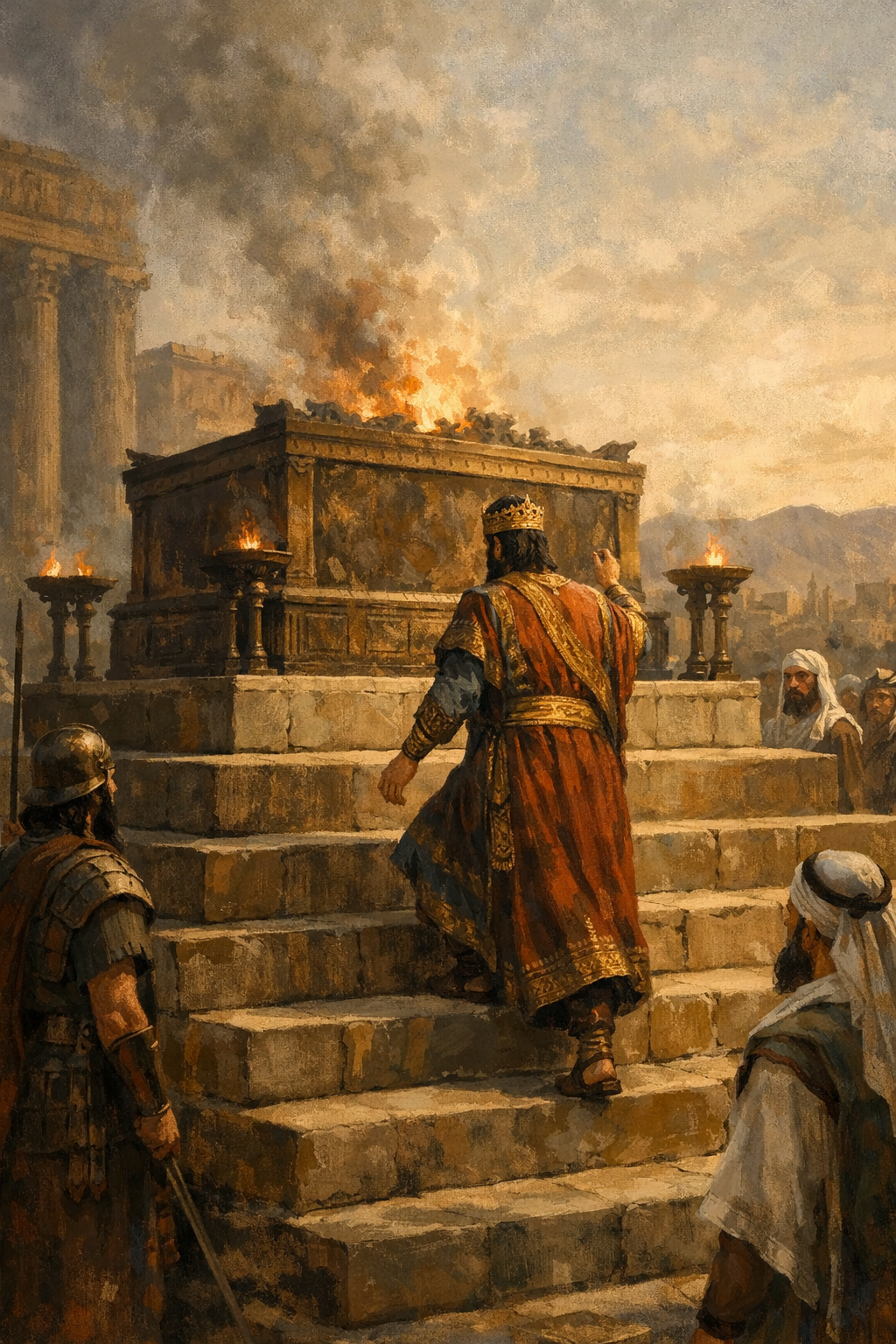
AHAZ APPROVES
ALIEN ALTAR
When the king came from Damascus, the king saw the altar; then the king approached the altar and went up to it - Note the verbs - saw, approached, went up. Ahaz is fully compliant with this compromise. His action signaled public approval of the foreign design.
Bob Utley - 16:12-13 Ahaz used his role as king to inaugurate this new sacrificial altar (cf. 2 Sam. 6:17-18; 1 Kgs. 8:63; 12:32). He (1) drew near to it, (2) ascended to it, (3) offered a burnt offering, (4) poured out a drink offering and (5) offered a peace offering. The difference between this and Uzziah's act was that this altar was not in the central shrine, but before it.
2 Kings 16:13 and burned his burnt offering and his meal offering, and poured his drink offering and sprinkled the blood of his peace offerings on the altar.
- he burnt: Lev 1:1-3:16
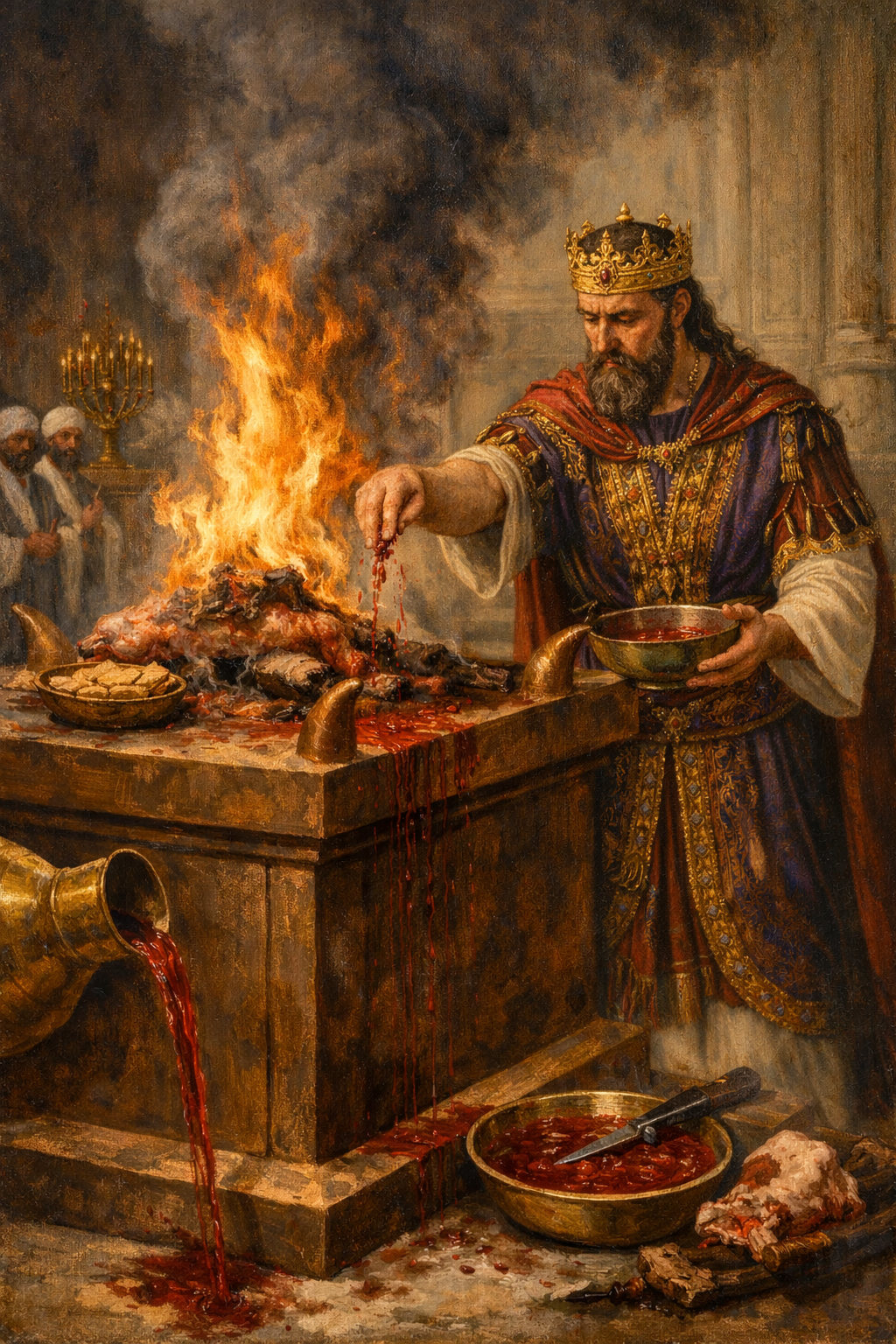
AHAZ'S COUNTERFEIT WORSHIP
PERFORMING DUTIES OF A PRIEST
and burned his burnt offering and his meal offering, and poured his drink offering and sprinkled the blood of his peace offerings on the altar - This passage seems to indicate that the king was now functioning as a priest, as the "mediator"! Ahaz personally performed the full round of sacrifices on the new altar, publicly confirming that the foreign-patterned shrine had replaced God’s ordained altar as the center of Judah’s worship.
Expositor's Commentary - When Ahaz returned (FROM DAMASCUS), he was so much pleased with his new plaything that he at once acted as priest at his own new altar. Without the least opposition from the priests-who had so sternly resisted Uzziah-he offered burnt-offerings, and meat-offerings, and drink-offerings, and sprinkled the blood of peace-offerings on his altar.
2 Kings 16:14 The bronze altar, which was before the LORD, he brought from the front of the house, from between his altar and the house of the LORD, and he put it on the north side of his altar.
- the brazen: Ex 40:6,29 2Ch 1:5 4:1 Mt 23:35
- the altar: 2Ki 16:10-12
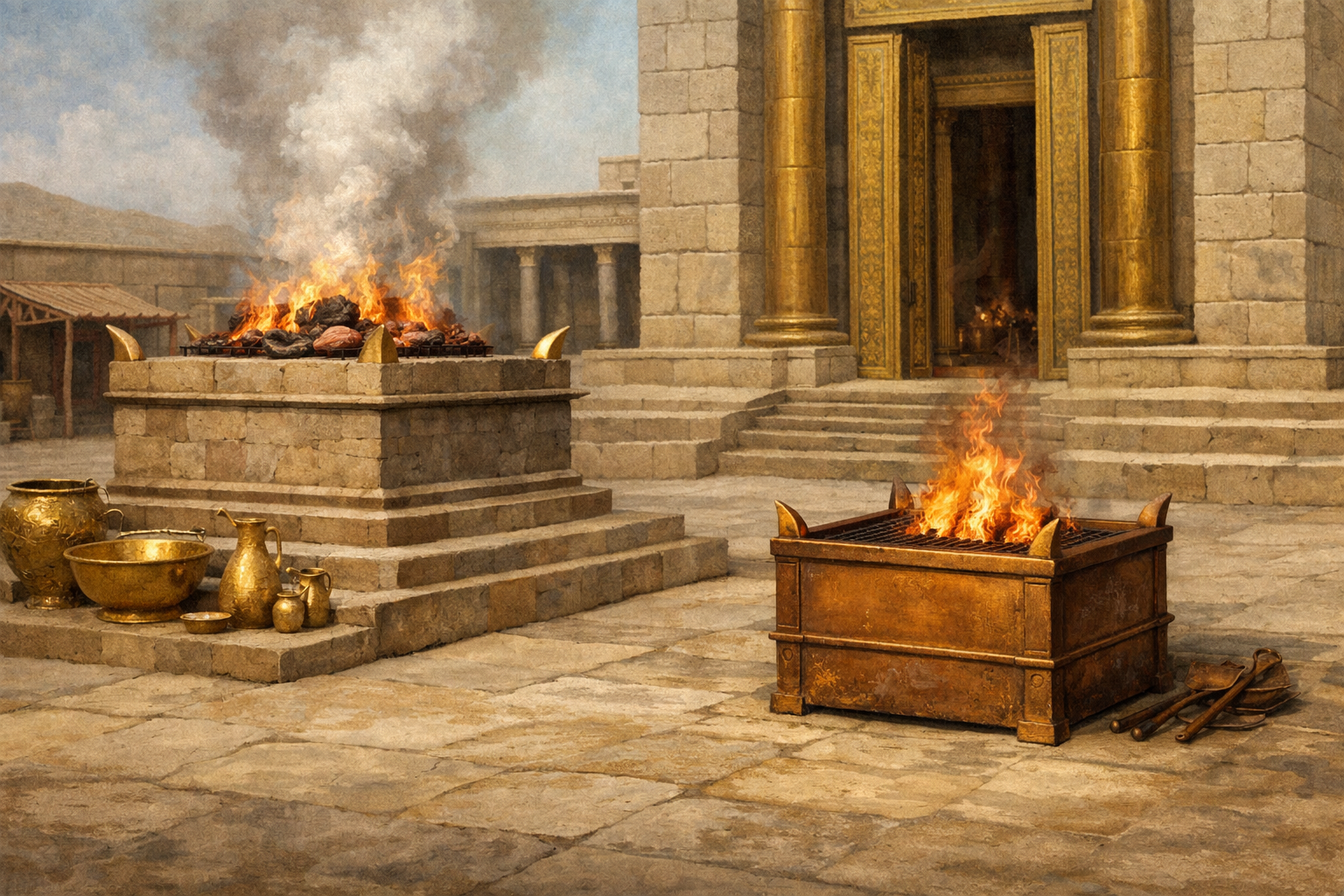
AHAZ DEMOTES GOD'S ALTAR
& PRIORITIZES THE PAGAN ALTAR
The bronze altar, which was before the LORD, he brought from the front of the house, from between his altar and the house of the LORD, and he put it on the north side of his altar - Ahaz took the LORD’s original bronze altar from its central, honored position in front of the Temple and moved it to the side, making room for his new Assyrian-styled altar to occupy the primary place of worship. This relocation symbolized a deliberate "demotion" of God’s ordained way in favor of a system shaped by pagan influence and royal preference.
Bob Utley - the bronze altar - Ahaz moved this to the side and replaced it with the new one. It is possible that all the bronze had been removed and given to Tiglath-pileser III as tribute (cf. vv. 17-18). THE ALTAR OF SACRIFICE
John Walton - rearrangement of altars. The bronze altar had been positioned directly east of the temple, that is, in front of the entrance. Ahaz’s new altar had originally been placed between the entrance to the courtyard and the bronze altar, but now became the central focus as the bronze altar was moved out of the east-west axis to a side location north of the new altar. The new altar thus effectively replaced the bronze altar. (See page 402 The IVP Bible Background Commentary-Old Testament)
2 Kings 16:15 Then King Ahaz commanded Urijah the priest, saying, “Upon the great altar burn the morning burnt offering and the evening meal offering and the king’s burnt offering and his meal offering, with the burnt offering of all the people of the land and their meal offering and their drink offerings; and sprinkle on it all the blood of the burnt offering and all the blood of the sacrifice. But the bronze altar shall be for me to inquire by.”
- the morning: 2Ki 3:20 Ex 29:39-41 Nu 28:2-10 Da 9:21,27 11:31 12:11
- the king's burnt: Lev 4:13-26 2Sa 6:17,18 1Ki 3:4 8:64 2Ch 7:4,5 29:21-24,32,35 Eze 46:4-7,12-14
- for me to inquire by: 2Ki 18:4 Ge 44:5 2Ch 33:6 Isa 2:6 Ho 4:12
- 2 Kings 16 Resources
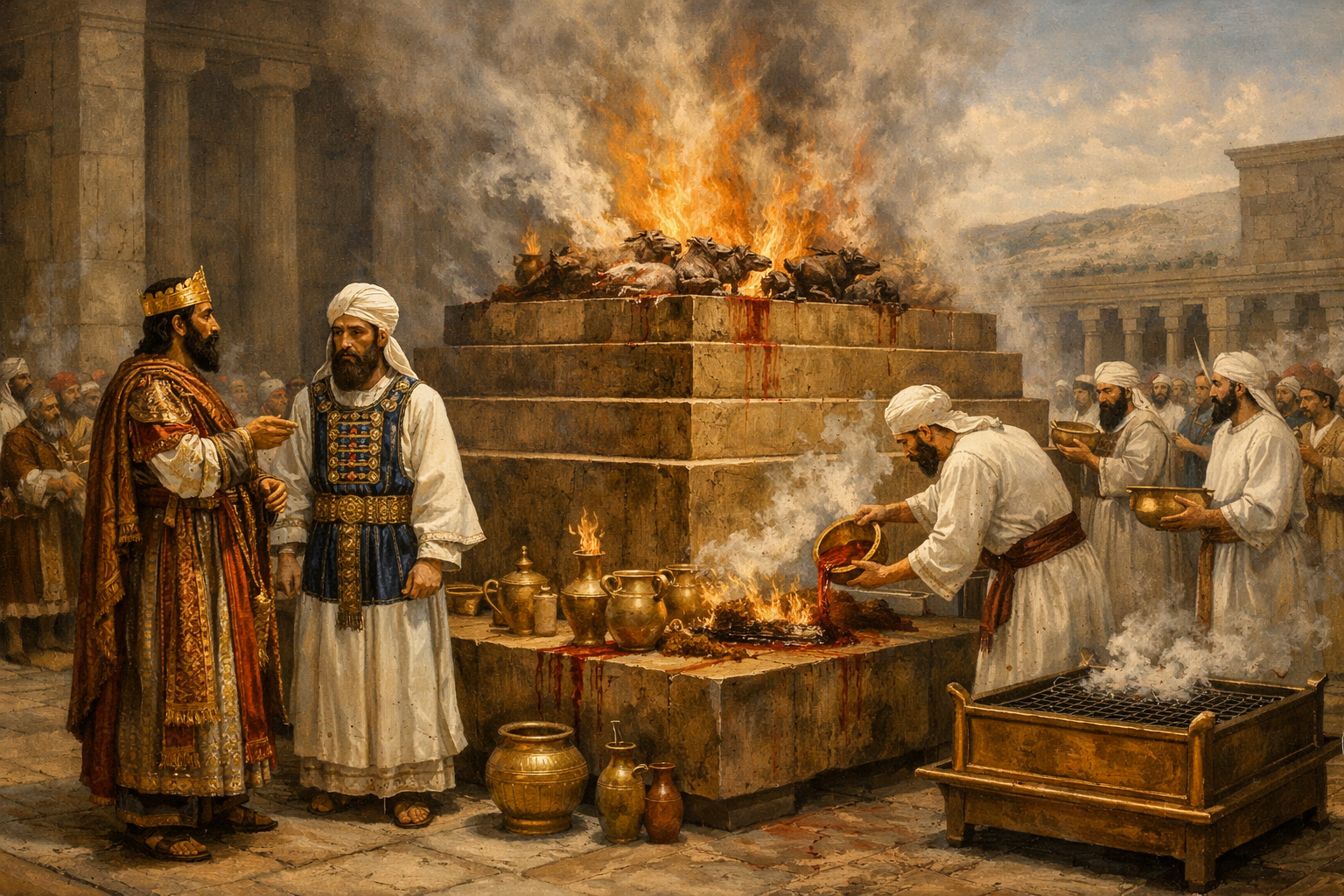
AHAZ EXTREME MAKEOVER OF
THE "LORD'S FURNITURE!"
Then - Marks progression in the narrative and a bad progression at that!
King Ahaz commanded Urijah the priest, saying, “Upon the great altar burn the morning burnt offering and the evening meal offering and the king’s burnt offering and his meal offering, with the burnt offering of all the people of the land and their meal offering and their drink offerings; and sprinkle on it all the blood of the burnt offering and all the blood of the sacrifice - What blasphemy calling the altar modelled after a pagan altar "the great altar." It was the great impostor! Note Ahaz did not ask or suggest but commanded God's priest instead of submitting to God's priest! In effect, Ahaz transferred the entire sacrificial system from God’s ordained altar to a foreign-style altar, placing royal authority above divine command.
Bob Utley - the morning burnt offering - This morning and evening daily offering was called "the continual" (cf. Ex 29:38-42; Num. 28:2-8). It seems that in this period only the morning offering was a burnt offering and the evening offering was a grain offering (cf. Ezek. 46:13-15).
But the bronze altar shall be for me to inquire (baqar; LXX - ) by - The bronze altar, designed by God and sanctified for the offering of sacrifices was now pushed aside from its central role. Ahaz did not destroy it, but he reassigned it to a vague and self-determined purpose—“for me to inquire by.” Worship was no longer governed by divine revelation but by the king’s preferences. This chilling phrase shows that Ahaz wanted access to God without accountability to God, keeping the altar nearby, yet stripping it of the meaning and authority the LORD had given it.
Some writers think Ahaz was using the bronze altar for divination, but we cannot be dogmatic. Ahaz had backslidden far away from Yahweh's instructions in Dt 12:32 "“Whatever I command you, you shall be careful to do; you shall not add to nor take away from it." Clearly Ahaz had added a pagan altar and perverted the use of the true altar. This exposes the heart of idolatry, of taking what belongs to God and making it serve self.
Reformation Study Bible - Ahaz perverted the old altar from its normal use and instead employed it for divination, a foreign practice in which priests tried to tell the future by examining the entrails of sacrificial animals. Divination was rigorously outlawed in Israel (Lev. 19:26; Deut. 18:10).
John Mackay - Basically, according to verse 15, all offerings will now be made on the Damascene altar, and the original, divinely commissioned bronze altar is reduced to the realm of the king’s personal divination, as it “shall be for me to inquire by.” There is no question of Uriah’s questioning (let alone defying) the king. (ESV Commentary 1Sa-2Ch)
John Walton - divided functions. The rituals performed on the new altar are characteristically Israelite. There is no cultic innovation here, nor are foreign rituals being incorporated into Israelite practice. The new altar picks up all of the prescribed functions of the sacrificial system. The one function that is left to the bronze altar is one that is not described in Israel’s ritual literature. The verb that is used (NIV: “seeking guidance”) means to examine or inspect, and may suggest sacrifices in which the entrails of sacrificed animals were examined for omens. It is unclear why Ahaz should reserve that function for the traditional altar. (See page 402 The IVP Bible Background Commentary-Old Testament)
Bob Utley - But the bronze altar shall be for me to inquire by This is unusual! The VERB "inquire" (BDB 133, KB 151, Piel INFINITIVE CONSTRUCT) could mean (1) decide later what to do with it (cf. v. 14) ‒ JPSOA or (2) a place for Ahaz to seek spiritual information - (a) from YHWH (but note 2 Chr. 28:24-28) or (b) probably divination (cf. 2 Chr. 28:23; NIDOTTE, vol. 1, p. 707, #1) See DIVINATION
Inquire (01239) baqar to seek, to look for, to consider, to investigate. The verb describes a careful process of examination, particularly the procedure by which a priest determines whether a person is ceremonially unclean (Lev 13:36). It can also refer more broadly to religious inquiry, such as seeking direction at the bronze altar (2 Ki 16:15). At times it conveys general concern or investigation about a matter (Lev 27:33). The highest and most personal use of the word appears in the psalmist’s longing his supreme desire was to meditate in His Temple (Ps 27:4). Conversely, Scripture also portrays the LORD Himself as the One who seeks, searching and tenderly caring for His sheep, His covenant people (Ezek 34:11–12).
Elmer Martens - TWOT - it is suggested, from the Arabic cognate, originally meant "split," "divide" and hence "discern." Its biblical use is largely in worship contexts, e.g. "checking" for ritual purity (Leviticus 13:36; cf. Leviticus 27:33) or "inquiry," in the sense of meditation, possibly self-searching (Psalm 27:4; cf. 2 Kings 16:15). Only in Ezekiel does bāqar refer to search of animals (Ezekiel 34:11-12).In the Aramaic, beqar, found only in Ezra, refers to "investigation," chiefly of records.
Gilbrant - each time in the Piel. Every context this verb appears in is in a cultic or theological sense. First, the verb is used to mean “to investigate,” in the case of ritual cleansing from skin disease in Lev. 13:36. There is no need to look for a yellow hair if the “itching” has spread, in reference to some scalp disease. Further, Yahweh will look for his scattered sheep (Eze. 34:11f). Ahaz commands Uriah concerning the usage of the temple precinct and ritual practice, that the king should have the bronze altar in order to “inquire by” (2 Ki. 16:15). Likewise, David sought that he might be able “to inquire” in the temple of Yahweh (Ps. 27:4). Finally, one is cautioned against “inspecting” the tenth member of one’s flock (the animal to be tithed), as it is Yahweh’s (Lev. 27:33). Likewise, one is cautioned against rashly vowing without “reflecting” (Pr. 20:25). (Complete Biblical Library)
BAQAR - 7V -
Leviticus 13:36 then the priest shall look at him, and if the scale has spread in the skin, the priest need not seek for the yellowish hair; he is unclean.
Leviticus 27:33 ‘He is not to be concerned whether it is good or bad, nor shall he exchange it; or if he does exchange it, then both it and its substitute shall become holy. It shall not be redeemed.’”
2 Kings 16:15 Then King Ahaz commanded Urijah the priest, saying, “Upon the great altar burn the morning burnt offering and the evening meal offering and the king’s burnt offering and his meal offering, with the burnt offering of all the people of the land and their meal offering and their drink offerings; and sprinkle on it all the blood of the burnt offering and all the blood of the sacrifice. But the bronze altar shall be for me to inquire by.”
Psalm 27:4 One thing I have asked from the LORD, that I shall seek: That I may dwell in the house of the LORD all the days of my life, To behold the beauty of the LORD And to meditate in His temple.
Proverbs 20:25 It is a trap for a man to say rashly, “It is holy!” And after the vows to make inquiry.
Ezekiel 34:11 For thus says the Lord GOD, “Behold, I Myself will search for My sheep and seek them out.
Ezekiel 34:12 “As a shepherd cares for his herd in the day when he is among his scattered sheep, so I will care for My sheep and will deliver them from all the places to which they were scattered on a cloudy and gloomy day.
Norman Geisler - When Critics Ask - 2 CHRONICLES 28:24—Did Ahaz encourage or oppose worship in the Jerusalem temple?
PROBLEM: In 2 Kings 16:15, Ahaz encouraged the worship of the Lord in the temple. But, in 2 Chronicles 28 he is said to have “shut up the doors of the house of the Lord, and made for himself altars in every corner of Jerusalem” (v. 24).
SOLUTION: First of all, even in 2 Kings, during his earlier reign, Ahaz was said to be an evil king who “did not do what was right in the sight of the Lord his God” (16:2). He even “took the silver and gold that was found in the house of the Lord … and sent it as a present to the king of Assyria” (v. 8). During this period, he encouraged only a corrupt form of worship in the pilfered Jerusalem temple (v. 15).
Furthermore, the 2 Chronicles passages refers to a later, even more corrupt, part of his reign. During this period of apostasy, he shut up the house of the Lord completely and set up his own centers of worship
QUESTION - What was the significance of the altar King Ahaz built? - Got Questions
ANSWER - 2 Kings 16 describes the reign of King Ahaz in Judah. During his reign, he went to Damascus to meet Tiglath-pileser, king of Assyria (verse 10). While there Ahaz saw the altar the Assyrians used and sent a model of it to Uriah the priest in Jerusalem with orders for Uriah to construct a life-size, working replica.
Uriah did as the king commanded and had the altar built for the king’s return. Ahaz then commanded that the daily offerings of worship to the Lord take place on this new altar. Ahaz said he would decide what to do with the original altar of the Lord (2Ki 16:15–16).
Ahaz’s desecration of the temple continued: “And King Ahaz cut off the frames of the stands and removed the basin from them, and he took down the sea from off the bronze oxen that were under it and put it on a stone pedestal. And the covered way for the Sabbath that had been built inside the house and the outer entrance for the king he caused to go around the house of the LORD, because of the king of Assyria” (2Ki 16:17–18).
Other evils of Ahaz are summarized in 2 Chronicles 28:1–4,
“And he did not do what was right in the eyes of the LORD, as his father David had done, but he walked in the ways of the kings of Israel. He even made metal images for the Baals, and he made offerings in the Valley of the Son of Hinnom and burned his sons as an offering, according to the abominations of the nations whom the LORD drove out before the people of Israel. And he sacrificed and made offerings on the high places and on the hills and under every green tree.”
This same chapter notes that, as a result of Ahaz’s wickedness, the Lord allowed Judah to be defeated by Syria and Israel. In one day, 120,000 men died, and 200,000 were taken as servants to Samaria. (2Ch 28:6-8) Instead of turning to the Lord, Ahaz requested help from Assyria, but they afflicted him instead (2Ch 28:20). In his distress Ahaz sacrificed to the gods of Damascus that had defeated him (2Ch 28:22).
In the end, Scripture records, “Ahaz gathered together the vessels of the house of God and cut in pieces the vessels of the house of God, and he shut up the doors of the house of the LORD, and he made himself altars in every corner of Jerusalem. In every city of Judah he made high places to make offerings to other gods, provoking to anger the LORD, the God of his fathers” (2 Chronicles 28:24–25). King Ahaz was so despised that, when he died, he was not buried in the tombs of the kings in Jerusalem (verse 27).
Ahaz is frequently mentioned by Isaiah as well as by Hosea and Micah. Ahaz’s reputation was one of evil and disobedience to the Lord, leading to judgment upon Judah’s land and people.
2 Kings 16:16 So Urijah the priest did according to all that King Ahaz commanded.
- 2Ki 16:11 Ac 4:19 5:29 1Th 2:4 Jude 1:11
- 2 Kings 16 Resources
Related Passage:
Isaiah 8:1-2 Then the LORD said to me, “Take for yourself a large tablet and write on it in ordinary letters: Swift is the booty, speedy is the prey. “And I will take to Myself faithful witnesses for testimony, Uriah the priest and Zechariah the son of Jeberechiah.”
URIJAH THE COMMANDED
AND COMPROMISED PRIEST
So Urijah the priest did according to all that King Ahaz commanded - One wonders what happened to the courage and boldness of the priests who confronted Uzziah's attempt to burn incense? Urijah completely capitulates to the command. Some commentaries suggest that Isaiah 8:2 occurred before the events here in 2 Kings 16. If that is so, it is still sad and also a sobering reminder that ANYONE can backslide if we fail to rely on the Spirit and the Word to keep us spiritually stable and secure! (See also what happened to Ephesus - Beware of Slowly Drifting From Your First Love of Jesus)
2 Kings 16:17 Then King Ahaz cut off the borders of the stands, and removed the laver from them; he also took down the sea from the bronze oxen which were under it and put it on a pavement of stone.
- cut off: 2Ch 28:24 29:19
- borders: 1Ki 7:23,27-39 2Ch 4:14
- sea: 2Ki 25:13-16 1Ki 7:23-26 2Ch 4:15 Jer 52:20
- 2 Kings 16 Resources
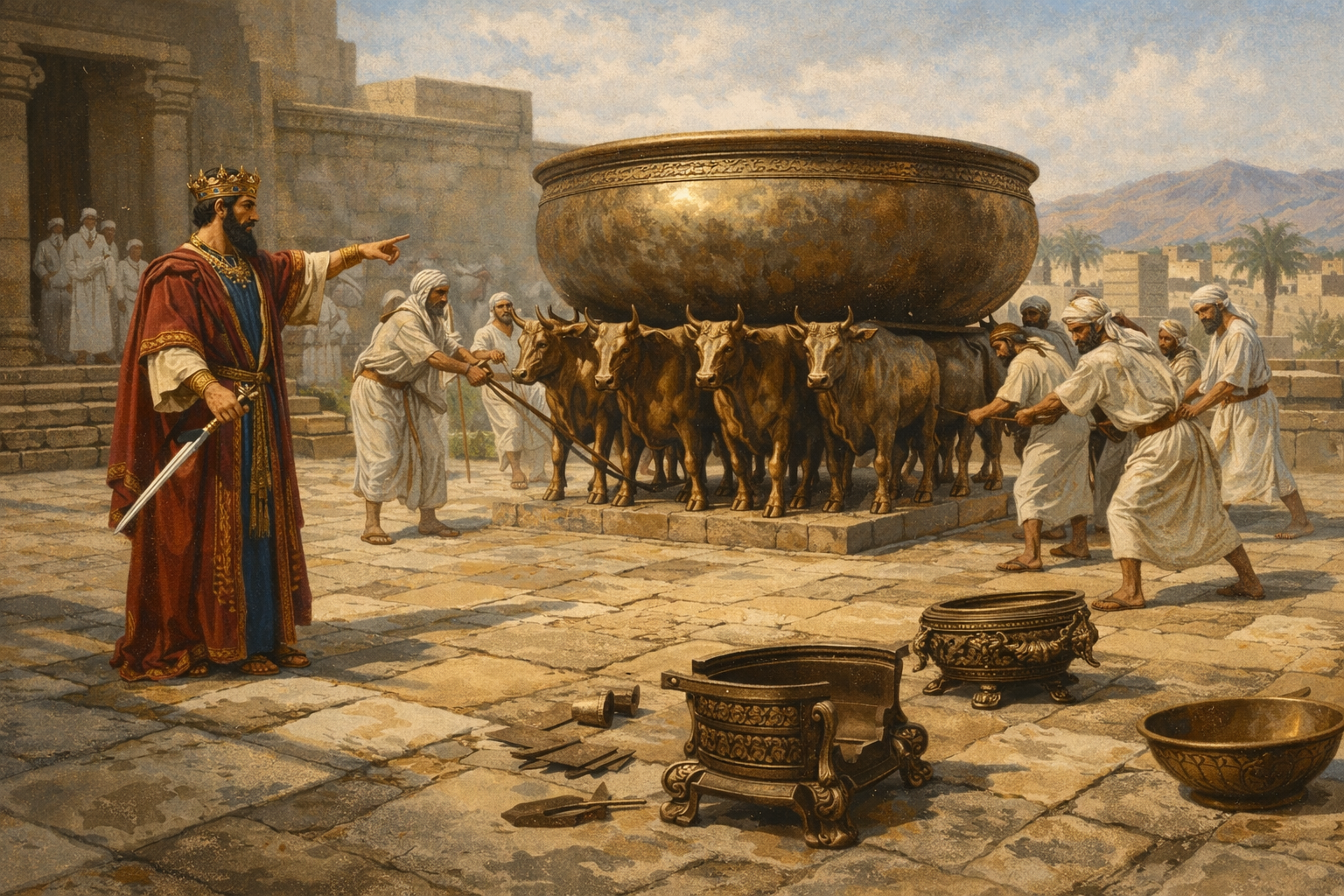
AHAZ GUTS TEMPLE
TO GET TRIBUTE
Then King Ahaz cut off the borders of the stands, and removed the laver from them; he also took down the sea from the bronze oxen which were under it and put it on a pavement of stone - The writer describes a deliberate dismantling of the sacred furnishings that Solomon had crafted according to God’s design (Ex 25:9, 40; 1Ki 7:23-40; 1Ch 28:11-19; 2Ch 4:1-22 = Description of the bronze sea, lavers, and oxen that Ahaz later dismantled, items in God’s original blueprint.).
The movable stands and lavers were not mere decorations; they were part of the carefully ordered system for cleansing the priests and preparing the sacrifices. By cutting away the ornamental borders and removing the basins from their supports, Ahaz was stripping the Temple of both its beauty and its theological meaning.
Even more striking was his treatment of the great bronze “sea,” which had rested upon twelve sculpted oxen symbolizing strength and the tribes of Israel. Taking it down from those divinely appointed supports and setting it on a plain stone pavement reduced a holy vessel to something ordinary and utilitarian. These alterations were not neutral renovations but acts of symbolic rebellion, showing that Ahaz no longer respected the patterns the LORD had established. Step by step he reshaped the temple to fit his political alliances and pagan tastes, replacing reverent tradition with expedient innovation and further distancing Judah from the worship that marked them as God’s covenant people.
Expositor's Commentary - Ahaz is charged with the additional crime of removing the ornamental festoons of bronze pomegranates from the layers, and the brazen oxen from under the molten sea, which henceforth lay dishonored, without its proper and splendid supports, on the pavement of the court. {1 Kings 7:23-39} He also took away the balustrade of the royal "ascent" from the palace to the Temple, and made a new entrance of a less gorgeous character than that which, in the days of Solomon, the Queen of Sheba had admired.
Bob Utley - Ahaz stripped Solomon's temple to pay tribute. (1) the borders of the stands (cf. 1 Kgs. 7:27-39) (2) the laver of its stand of oxen and THE LAVER (3)"the covered way" - The MT has "the covered way (Qere) for the sabbath" (BDB 697 CONSTRUCT BDB 992). The exact reference is uncertain.
John Walton - tribute. The activity described here is part of the process of tribute gathering. Basins for transporting water from the main laver stood on carts featuring side panels and wheels. Similar objects have been found in Cyprus dating to about the time of Solomon. The bronze bulls that supported the laver (see 2 Chron 4:2-5 for description) would have gone far to make up the quota of bronze that was wanted for the tribute payment. In the ninth century Assyrian king Ashurnasirpal received bronze bulls as part of a tribute payment. (See page 402 The IVP Bible Background Commentary-Old Testament)
Once compromise begins,
it continues to grow
Warren Wiersbe - the king (AHAZ) could never have made all these changes without the cooperation of Urijah, the high priest (2Kin 16:10, 11, 15, 16). When King Uzziah tried to rebel against the Word of the Lord and enter the temple, the high priest Azariah with eighty other priests successfully withstood him (2Ch 26:16ff.); but Urijah and his priests compromised, disobeyed the law of Moses and gave in to their king. Once compromise begins, it continues to grow; and all that it takes for evil to triumph is for weak people like Urijah to let leaders have their way. Ahaz not only replaced the altar and removed metal from the furnishings, but he finally took all the vessels for himself, closed the doors of the temple, and set up altars in the streets of Jerusalem (2Ch 28:24–25). “Do you not know that a little leaven leavens the whole lump of dough?” (1 Cor. 5:6; see Gal. 5:9). Once we allow worldliness to get into the church fellowship, it will quietly grow, pollute the fellowship, and eventually take over. It was not until the reign of his son Hezekiah that the temple Ahaz defiled was reopened and sanctified for ministry (2Ch 29:1–29).
2 Kings 16:18 The covered way for the sabbath which they had built in the house, and the outer entry of the king, he removed from the house of the LORD because of the king of Assyria.
- The covered way 2Ki 11:5 1Ki 10:5 Eze 46:2
- 2 Kings 16 Resources
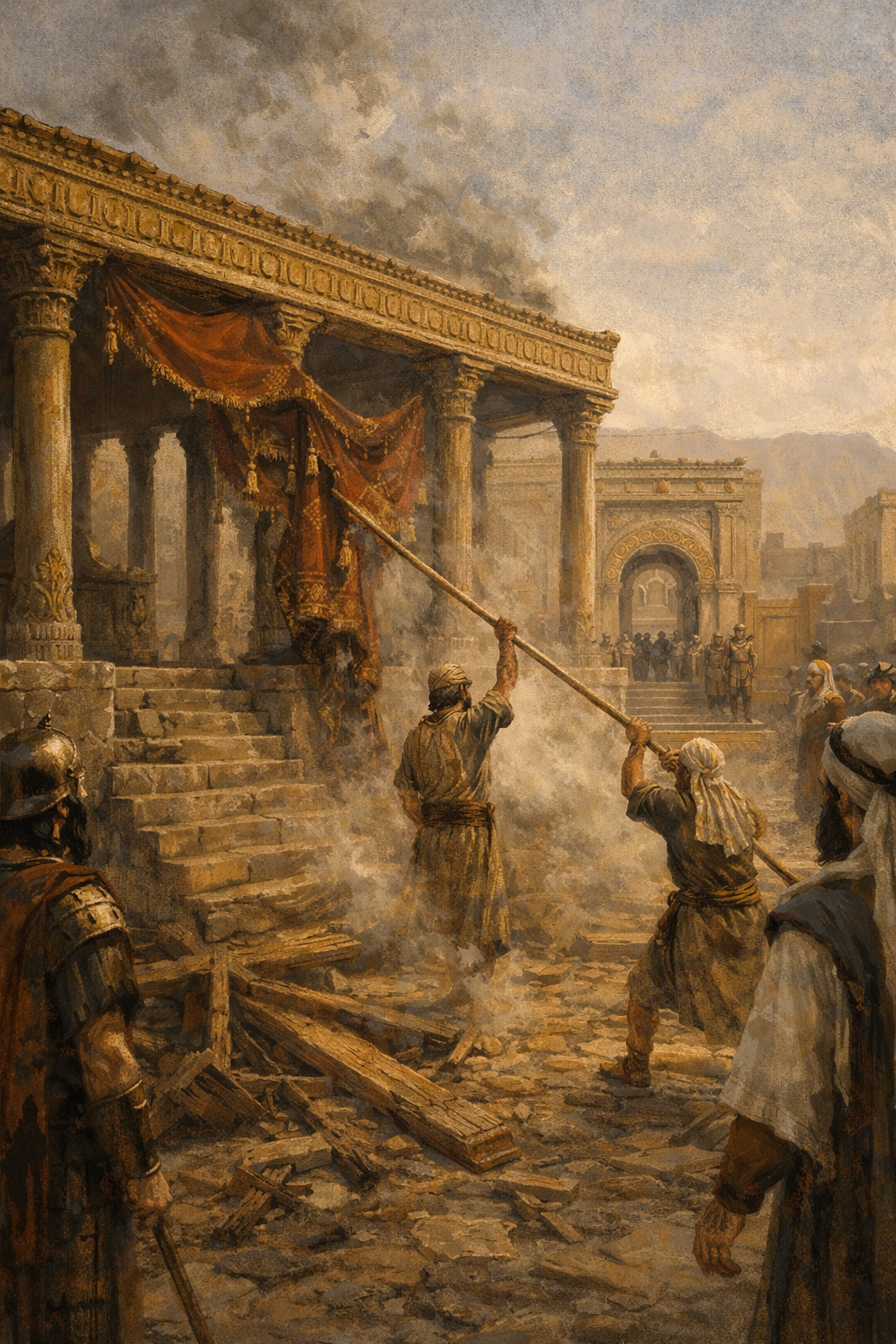
TEMPLE ALTERED
BECAUSE OF ASSYRIA
The covered way for the Sabbath which they had built in the house, and the outer entry of the king, he removed from the house of the LORD because of the king of Assyria This final alteration shows how deeply political pressure reshaped the very architecture of Judah’s worship. The “covered way for the Sabbath” was likely a sheltered passage that allowed the king and worshipers to move reverently and securely within the temple precincts on holy days. The “outer entry of the king” was a royal access route that symbolized the Davidic king’s proper, covenantal relationship to the LORD, approaching God as a servant under divine authority. Ahaz dismantled both, not for spiritual reasons but “because of the king of Assyria.” Ahaz closed the doors of the temple, thus forcing the people to worship at pagan shrines.
Tiglath-pileser was now
in charge, not King Ahaz
Whether to please his new overlord, to pay tribute with salvaged materials, or to avoid anything that might offend Assyrian sensibilities, the motivation was fear of man rather than fear of God. Sacred spaces designed to honor the LORD and facilitate faithful worship were sacrificed to accommodate a pagan empire.
Philip Ryken on because of the king of Assyria - The little phrase “because of the king of Assyria” speaks volumes. Ahaz had come under the unholy spiritual influence of Tiglath-pileser. In all likelihood, the altar that the Syrians had built was patterned after the worship of the Assyrians. This in turn had influenced Ahaz, and because he was the king, his way of being “of the world” and not just “in the world” would come to have a dramatic influence on Judah as well. Ahaz’s misuse of the great altar spoke just as many volumes. In effect, he was becoming another Jeroboam, for that wicked king had also introduced newfangled liturgy to replace what he saw as old-fashioned spirituality. He had done it for the same reason, too: to curry political favor. Under the leadership of Ahaz, what had happened in Israel was happening in Judah as well. Jeroboam I had sinned specifically by presuming to make priestly sacrifices on a strange altar (see 1 Kings 12:32–33). With Ahaz following in Jeroboam’s footsteps, says Dale Ralph Davis, a “pioneer of a deviant worship is now in Judah.” (2 Kings - Reformation Expository Commentary)
John Walton - 16:18. adjustments for the king of Assyria. It is difficult to be certain whether the described actions are undertaken in order to gather additional tribute for the Assyrians or whether they reflect changes that will underline and confirm Ahaz’ submission to Assyrian suzerainty. The reference is to obscure architectural terms.(See page 402 The IVP Bible Background Commentary-Old Testament)
Ron Daniel - Ahaz also began to arrange the various objects of the temple to make the temple more like that which he saw in Damascus. He was turning the house of God into an imitation of something he'd seen in the world.
People in church leadership have unfortunately done the same thing at times. They have seen people in the world flock to psychiatrists, watched organizations raise millions of dollars, and seen the success of valuable marketing techniques. And, thinking that the world's methods were superior to God's, the church has introduced the psychology of the world's counselors, the fundraising of the world's non-profits, the marketing of the world's corporations.
Now, in addition to the obvious sin he had committed, a major problem with what Ahaz had done was that he had corrupted the picture God had painted. You see, everything about the temple was a portrayal of heaven. God had given Moses a vision of heaven, and the tabernacle was the earthly model of it. The writer of Hebrews said that the priests...
Heb 8:5 ...serve a copy and shadow of the heavenly things, just as Moses was warned by God when he was about to erect the tabernacle; for, "SEE," He says, "THAT YOU MAKE all things ACCORDING TO THE PATTERN WHICH WAS SHOWN YOU ON THE MOUNTAIN."
So the tabernacle, and later the temple, was supposed to be the best representation of heaven that you could have on earth. But Ahaz is moving things around, distorting the picture God had given. The image was being lost.
So too today, we see that the church has distorted the image. By introducing unbiblical practices and doctrines, many have distorted people's view of God and heaven. The church's constant mission should be to represent God rightly, in the pattern that He has set, with the model that He has given.
2 Kings 16:19 Now the rest of the acts of Ahaz which he did, are they not written in the Book of the Chronicles of the Kings of Judah?
- 2Ki 15:6,7,36,38 20:20,21 1Ki 14:29
- 2 Kings 16 Resources
Parallel Passage:
2 Chronicles 28:26 Now the rest of his acts and all his ways, from first to last, behold, they are written in the Book of the Kings of Judah and Israel.
SECULAR RECORDS OF AHAZ
THAT NO LONGER EXIST
Now the rest of the acts of Ahaz which he did, are they not written in the Book of the Chronicles of the Kings of Judah - The rest of the acts of Ahaz means there is more to his evil reign. One can hardly imagine how spiritually dark that secular description would be.
The Book of the Chronicles of the Kings of Judah - The book of the chronicles of the kings of Israel and the book of the chronicles of the kings of Judah are not the same, though they served very similar purposes in their respective kingdoms. According to Scripture, each kingdom, Israel in the north and Judah in the south, kept its own official royal records. These were civil and historical documents, functioning somewhat like court records or national archives rather than inspired Scripture. For example, 1 Kings 14:19 states, “Now the rest of the acts of Jeroboam, how he warred and how he reigned, are they not written in the Book of the Chronicles of the Kings of Israel?” Similarly, 1 Kings 14:29 records, “Now the rest of the acts of Rehoboam and all that he did, are they not written in the Book of the Chronicles of the Kings of Judah?” These references appear frequently in the biblical books of Kings and Chronicles as a type of “ancient footnote” pointing readers to more complete governmental records that were never meant to be canonical Scripture. These lost documents are not part of the Bible because, in God’s providence, He did not preserve them for our instruction. As 1 Corinthians 10:11 teaches, the Scriptures preserved for us were chosen because they serve to teach and warn believers spiritually, not merely to record political history. Moreover, the biblical emphasis favors Judah because God’s covenant promises, including the coming of the Messiah, were to be fulfilled through David’s line (2 Samuel 7:12–16; Genesis 49:10). Thus, the Books of Chronicles focus more deeply on Judah to highlight God’s redemptive plan through David’s descendants.
2 Kings 16:20 So Ahaz slept with his fathers, and was buried with his fathers in the city of David; and his son Hezekiah reigned in his place.
- buried: 2Ki 21:18,26 2Ch 28:27
- Hezekiah: 2Ki 18:1 1Ch 3:13 2Ch 29:1 Isa 1:1 Ho 1:1 Mic 1:1 Mt 1:9
- 2 Kings 16 Resources
Parallel Passage:
2 Chronicles 28:27 So Ahaz slept with his fathers, and they buried him in the city, in Jerusalem, for they did not bring him into the tombs of the kings of Israel; and Hezekiah his son reigned in his place.
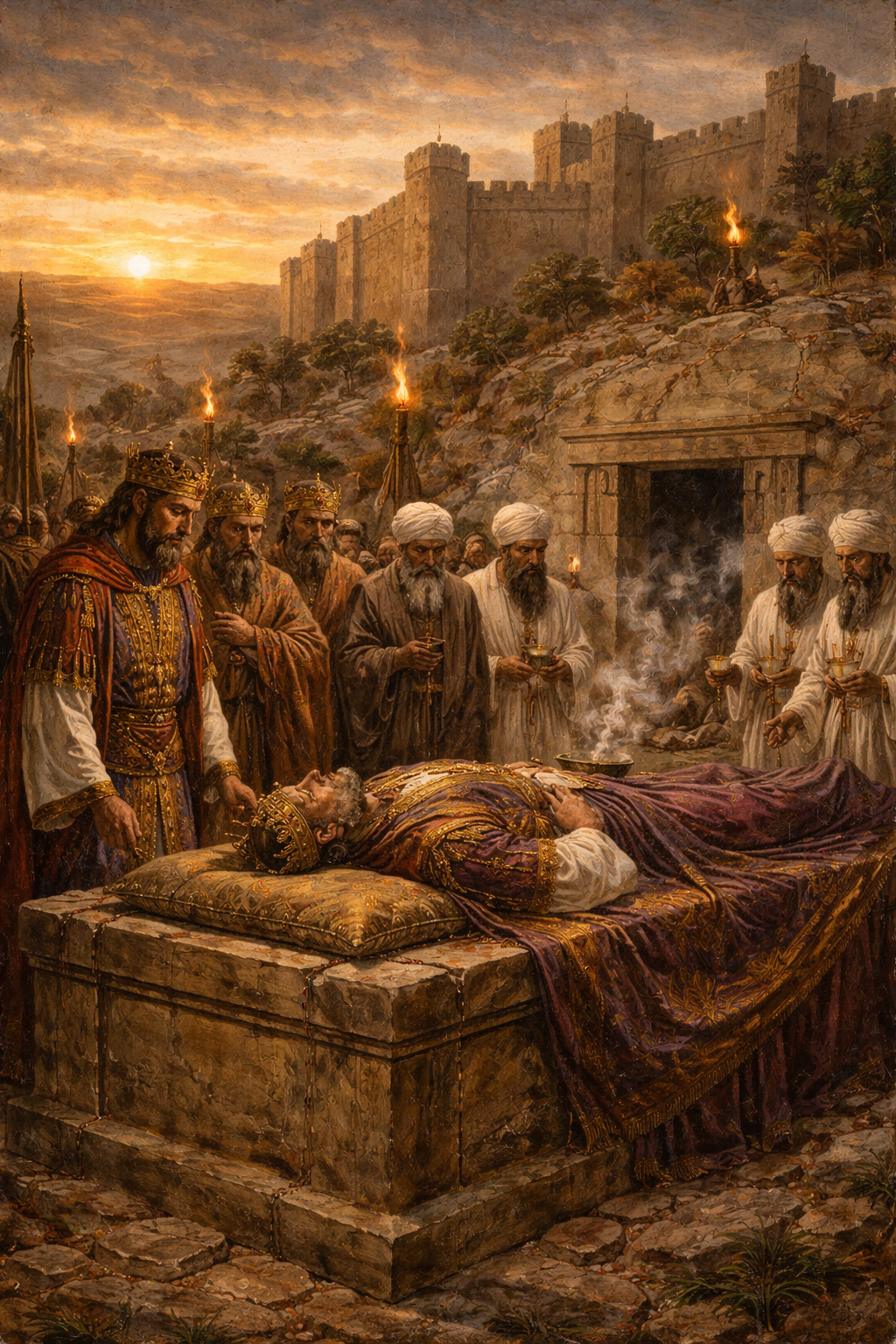
AHAZ'S DISHONORABLE
"DISCHARGE"
So Ahaz slept with his fathers, and was buried with his fathers in the city of David - As discussed elsewhere, Ahaz slept is not soul sleep but is a biblical way of saying that King Ahaz died and was laid to rest with his ancestors. The parallel passage elaborates on buried with his father describing a less than honorable burial for King Ahaz who while being buried in the city of Jerusalem was not buried in "the tombs of the kings of Israel."
And his son Hezekiah his son reigned in his place - Finally, a breath of fresh (spiritual) air!
Warren Wiersbe - When Ahaz died, he was buried in Jerusalem but not in the royal tombs (2Ki 16:19–20; 2Ki 28:26–27). In this, he joined Jehoram (2Ch 21:20), Joash (2Ch 24:25), and Uzziah (2Ch 26:23), and Manasseh would join them (2Ch 33:20). The unbelief and unfaithfulness of Ahaz did great damage to the kingdom of Judah, some of which his son Hezekiah would be able to repair.
Paul House: When Ahaz dies about 715 B.C., he is succeeded by Hezekiah, his son. He leaves a legacy of appeasement and syncretism unmatched to this time. Assyria can count on him for money, loyalty, and zealous acceptance of their gods. Judah's king seems genuinely pleased to serve a powerful master who can deliver him from regional foes. No doubt he feels safe, but the historian duly notes the ways in which he has exceeded Jeroboam's wickedness. If Jeroboam's practices are worth condemning, what will happen to a nation who rejects the Lord even more clearly? (See 1, 2 Kings - Volume 8 - Page 338)
DEVOTIONAL QUESTIONS: 1) What types of moral compromises do we see church leaders make today? 2) What types of political compromises do we see church leaders make today? 3) What types of religious compromises do we see church leaders make today? 4) When is innovation in worship a dangerous thing?
- Christopher Knapp
- 2 Kings 16; 2 Chron. 28
- Contemporary Prophets: Isaiah; Micah; Hosea; Oded.
“It is an abomination to kings to commit wickedness:
for the throne is established by righteousness.”
—Proverbs 16:12
Ahaz was wicked as his father Jotham was righteous. “Ahaz was twenty years old when he began to reign, and he reigned sixteen years in Jerusalem: but he did not that which was right in the sight of the Lord, like David his father: for he walked in the ways of the kings of Israel, and made also molten images for Baalim. Moreover he burnt incense in the valley of the son of Hinnom, and burnt his children in the fire, after the abominations of the heathen whom the Lord had cast out before the children of Israel. He sacrificed also and burnt incense in the high places” (not removed in Jotham’s day, 2 Kings 15:35), “and on the hills, and under every green tree.” It seems strange that the best of men frequently have the worst of sons. Ahaz’ mother is not mentioned, and it is possible that his father was unfortunate in his choice of a wife. A king with the heavy responsibilities of government pressing constantly upon him can have little time to give to the training of his chil- dren: that important duty must fall largely on the mother. It was not every king of Judah that was blessed with such a mother as king Lemuel’s (Prov. 31). But whoever, or whatever, Ahaz’ mother may have been, he was himself responsible for his idolatrous deeds, and God punished him accordingly. “Wherefore the Lord his God delivered him into the hand of the king of Syria; and they smote him, and carried away a great multitude of them captives, and brought them to Damascus. And he was also delivered into the hand of the king of Israel, who smote him with a great slaughter.” These statements in no way clash with what is recorded in 2 Kings 16:5—that these confederate kings “could not overcome him.” They could not get into the city, nor reach the king personally, though they entered the land. “God delivered him,” and “they smote him,” means his people and kingdom. Elath was also lost to Judah at this time (2 Kings 16:5). It was the purpose of “the two tails of these smoking firebrands” to dethrone king Ahaz, and set up in his stead “the son of Tabeal” (a Syrian, probably; it is not a Hebrew name). It was doubtless Satan’s plot, if not man’s, to destroy the Davidic dynasty; and God, for this reason, did not deliver Jerusalem into their hands. But the slaughter and slavery of the people at large throughout the kingdom was something almost unparalleled. See 2 Chron. 28:6. This is why Isaiah took with him his son Shear-jashub (the remnant shall return), when he went forth to meet king Ahaz. There should be a remnant left to return to the land; and the virgin should bear a son, so there should not fail a king upon the throne of David. The dynasty could never be destroyed, for of Immanuel’s kingdom there shall be no end. See Isa. 7.
“Pekah the son of Remaliah slew in Judah a hundred and twenty thousand in one day, which were all valiant men”—the flower of Ahaz’ army—”because they had forsaken the Lord God of their fathers.” And though the king himself escaped, God’s rod reached him through his son: “And Zichri, a mighty man of Ephraim, slew Maaseiah the king’s son.” He also slew the “governor of the house,” and “Elkanah that was next to the king.” How, or where, we know not. God can find the guilty where and when He will.
“And the children of Israel carried away captive of their brethren two hundred thousand, women, sons and daughters, and took away also much spoil from them, and brought the spoil to Samaria. But a prophet of the Lord was there, whose name was Oded: and he went out before the host that came to Samaria, and said unto them, Behold, because the Lord God of your fathers was wroth with Judah, He hath delivered them into your hand, and ye have slain them in a rage that reacheth up unto heaven. And now ye purpose to keep under the children of Judah and Jerusalem for bondmen and bondwomen unto you: but are there not with you, even with you, sins against the Lord your God?”—alas, how many and how great were Israel’s sins! “Now hear me therefore, and deliver the captives again, which ye have taken captive of your brethren: for the fierce wrath of the Lord is upon you”—and they were themselves, in a few short years, carried captive beyond Babylon. “Then certain of the heads of the children of Ephraim, Azariah the son of Johanan, Berechiah the son of Meshillemoth, and Jehizkiah the son of Shallum, and Amasa the son of Hadlai, stood up against them that came from the war, and said unto them, Ye shall not bring in the captives hither: for whereas we have offended against the Lord already, ye intend to add more to our sins and to our trespass: for our trespass is great, and there is fierce wrath against Israel.”
Here is faithfulness and denunciation of sin where one might least expect it—in the city of Samaria, and from leaders, heads of the people. There were not ten righteous men in Sodom; and Samaria, one might think, was not much better. But all there had not bowed the knee to Baal, and they speak for truth and right with boldness in the very face of a returning, victorious army. And their words have the desired effect; for the wicked will sometimes give heed to the words of the righteous in a most wonderful way. “So the armed men left the captives and the spoil before the princes and all the congregation. And the men which were expressed by name rose up, and took the captives, and with the spoil clothed all that were naked among them, and arrayed them, and shod them, and gave them to eat and to drink, and anointed them, and carried all the feeble of them upon asses, and brought them to Jericho, the city of palm trees, to their brethren: then they returned to Samaria.” Their conduct was morally beautiful, especially when looked at upon the dark background of the evil times and kingdom in which they lived. And the righteous Lord who loveth righteousness has seen to it that these men of tender heart and upright conscience should be “expressed by name.” The incident is like a little gleam of light shining out of the rapidly deepening darkness, and the God of Israel has placed it on eternal record, and published it abroad, that men might know that He never forgets a kindness done to His people, even when they suffer, under His government, the just punishment of their sins.
“At that time did king Ahaz send unto the kings of Assyria to help him.” Yes, it was “ at that time,” when Israel, the last, was first, and Ahaz, on the throne of David, frantically invoking the aid of the Assyrian, became last. The Edomites, emboldened, doubtless, by the success of Rezin and Pekah, invaded the land and “carried away captives.” The Philistines also invaded “the low country, and the south of Judah,” and settled themselves in the captured cities. “For the Lord brought Judah low because of Ahaz king of Israel; for he made Judah naked [lawless, N. Tr.], and transgressed sore against the Lord.”
The days were indeed dark: a cloud of gloom had settled over the once fair land and kingdom of David. Stroke succeeded stroke, and humiliation followed humiliation. But there was no national repentance, and the king (the responsible cause of it all) only hardened himself in rebellion and folly. The king of Assyria came, but, instead of really helping him, “distressed him.” He took the treasure Ahaz “stripped” for him from the house of the Lord, and from his own house, and the houses of the princes. It was just as the prophet Isaiah had forewarned him: “The Lord shall bring upon thee, and upon thy people, and upon thy father’s house, days that have not come, from the days that Ephraim departed from Judah; even the king of Assyria” (Isa. 7:17). He trusted in man, made flesh his arm, his heart departing from the Lord, and brought upon himself and kingdom the consequent curse and barrenness (Jer. 17:5). “And in the time of his distress did he trespass yet more against the Lord.” How different was his great ancestor David ! “In my distress,” he says, “I called upon the Lord, and cried unto my God” (Ps. 18:6). Even his wicked grandson Manasseh sought the Lord his God “when he was in affliction.” But Ahaz seemed determined to fill up the measure of his sins, and, like the apostates of Christendom during the outpouring of “the vials of the wrath of God upon the earth,” who, though “they gnawed their tongues for pain,” still “blasphemed the God of heaven,” and repented not of their deeds to give Him glory (Rev. 16). Each humiliating disaster, instead of turning Ahaz to God, drove him further into sin. It is plainly seen therefore why the inspired chronicler should despisingly write, “This is that king Ahaz!”
Oh, the blind delusion of demon-worship!—”He sacrificed unto the gods of Damascus, which smote him: and he said, Because the gods of the kings of Syria help them, therefore will I sacrifice to them, that they may help me. But they were the ruin of him, and of all Israel.” He says, in effect, “Jehovah does not help me as the deities of the Syrian kings help them; so it is better for me to forsake Him and worship gods that will do me some good.” So he “gathered together the vessels of the house of God, and cut in pieces the vessels of the house of God, and shut up the doors of the house of the Lord.” His apostasy was now complete. “And he made him altars [for false gods] in every corner of Jerusalem. And in every several city of Judah he made high places to burn incense unto other gods, and provoked to anger the Lord God of his fathers.” How far can they fall who, instead of being obedient to the word of God, are moved and governed by everything which has some present, apparent success!
How shameful is his obsequious appeal to the king of Assyria—”I am thy servant and thy son: come up, and save me out of the hand of the king of Syria”—and that greedy monarch, for the silver and gold sent him, went to Damascus and slew Rezin, its king. “And king Ahaz went to Damascus to meet Tiglath-pileser king of Assyria”—at his command perhaps, to do him honor personally—”and saw an altar that was at Damascus: and king Ahaz sent to Urijah the priest the fashion of the altar, and the pattern of it, according to all the workmanship thereof. And Urijah the priest built an altar according to all that king Ahaz had sent from Damascus: so Urijah the priest made it against king Ahaz came from Damascus. And when the king was come from Damascus, the king saw the altar: and the king approached to the altar, and offered thereon. And he burnt his burnt-offering and his meat-offering, and poured his drink-offering, and sprinkled the blood of his peace-offerings, upon the altar.” The pattern of the altar caught his ritualistic eye, and he must needs imitate it—not unlike a class to-day who go to Rome for elties, and then set up at home cheap imitations in churches that were once called Protestant. The real Rome awes men (for Babylon is “the Great”), but her little imitators move us only to pity. King Ahaz finds in Urijah the high priest a willing tool to his idolatrous designs. Untrue to his name (light of Jehovah), he yields unscrupulous obedience to his sovereign’s orders, instead of rebuking him for his abominable act. For his degrading subserviency, probably, his name is omitted from the sacerdotal list in 1 Chron. 6:4-15, Better have lost life than honor—when it is that true and eternal honor “which comes from God.”
On this altar of new design Ahaz offers every kind of offering excepting that which he needed most for himself—the sin-offering. The plain brazen altar (“which was before the house of the Lord”) seems to have offended his esthetic eye; so it was relegated to a place of comparative obscurity on the north side of his own foreign substitute. He arrogantly commanded the high priest as to what, and how, and when, to offer on his altar. And the unworthy successor of Jehoiada and Zechariah slavishly obeyed to the letter. “Thus did Urijah the priest, according to all that king Ahaz commanded.” He reversed the apostles’ maxim, that we “ought to obey God rather than men.”
He was of another mind: his eye was on the honor that comes from man; theirs was on that which comes from God.
“And king Ahaz cut off the borders [Heb., panels] of the bases, and removed the laver from off them; and took down the sea from off the brazen oxen that were under it, and put it upon a pavement of stones.” Probably to obtain the precious metals of which they were made, these sacrilegious innovations were introduced. “And the covert for the sabbath”—(covered way) to be used on the sabbath by the royal worshipers— “that they had built in the house [of God], and the king’s entry without, turned he from the house of the Lord for the king of Assyria.” It was the high-gate that his father Jotham had so significantly rebuilt. Ahaz appears to have profaned it to the use of Tiglath-pileser when worshiping his false gods (at Ahaz’ altar perhaps) on his visit to Jerusalem. “And the brazen altar,” he said, “shall be for me to inquire by,” or “consider.” He either meant that he should use it for purposes of divination,—linking Jehovah’s great name with his base idolatries,—or he would “consider” what should ultimately be done with it. And we Christians “have an altar,” even Christ, our Creator-Redeemer, whom profane unitarian Higher Critics and others dare to debase and degrade before their deceived disciples, removing Him from His place of absolute preeminence, (like Ahaz with God’s altar,) putting Him beside others, like Zoroaster and Confucius, for “odious” comparison! And already they “consider” what they shall finally do with Him—relegate Him to a place even of inferiority to some of their heathen Asiatic reformers! And what shall the end be? We know: “Another shall come in his own name,” and him they “will receive” (John 5:43). The “man of sin—the son of perdition”—is to arise; and “because they received not the love of the truth, that they might be saved,…God shall send them strong delusion, that they should believe a lie,” etc. (2 Thess. 2:10, 11.)
“Now the rest of his acts and of all his ways, first and last, behold, they are written in the book of the kings of Judah and Israel.” “His acts,” and “his ways”! God too has “ways” and “acts.” “He made known His ways unto Moses, His acts unto the children of Israel” (Ps. 103:7). His ways were the manifestations of His nature; His acts more the displays of His power. “All his ways,” it is said of Ahaz. And what manifestations of his heart’s wickedness did his life of thirty-six years bring out! It is little wonder that the inspiring Spirit led the chronicler to call him “king of Israel” (2 Chron. 28:19)—so like was he to the nineteen idolatrous rulers of the northern kingdom. Even his people who shared in his wickedness are called “Israel,” instead of Judah (2 Chron. 28:23). But there must have been some sense of righteousness (or shame) left in them; for we read, “They buried him in the city, even in Jerusalem: but they brought him not into the sepulchres of the kings of Israel.” Corrupt as they themselves were, they felt that their late king had so exceeded in wickedness that it was not meet to lay his body among those of his royal ancestors.
The Philistines, who had good cause to fear the kings of Judah, had a special prophecy written for them by Isaiah at this time, bidding them not to rejoice at king Ahaz’ death: “In the year that king Ahaz died was this burden.” See Isa. 14:28-32, paragraphed as in N. Tr. He appears to have been little influenced by the faithful ministry of the evangelist-prophet. He was apparently a man of esthetic tastes (as even the ungodliest of men may be), from his admiration of the Damascus altar; he was also interested in the sciences, it would seem, from his introduction into Jerusalem of the Chaldean sun-dial (2 Kings 20:11). Nor was he of a persecuting spirit, apparently, for he did not, like his grandson Manasseh, shed innocent blood, nor put to death the prophets. He was possessed (Ahaz—possessor) of much that men admire and magnify to-day; but all this, without godliness, is of absolutely no worth. Impenitent to the last, apparently, he died as he had lived: “and Hezekiah his son reigned in his stead.”