2 Kings 21:2
2 Kings 21:3
2 Kings 21:4
2 Kings 21:5
2 Kings 21:6
2 Kings 21:7
2 Kings 21:8
2 Kings 21:9
2 Kings 21:10
2 Kings 21:11
2 Kings 21:12
2 Kings 21:13
2 Kings 21:14
2 Kings 21:15
2 Kings 21:16
2 Kings 21:17
2 Kings 21:18
2 Kings 21:19
2 Kings 21:20
2 Kings 21:21
2 Kings 21:22
2 Kings 21:23
2 Kings 21:24
2 Kings 21:25
2 Kings 21:26
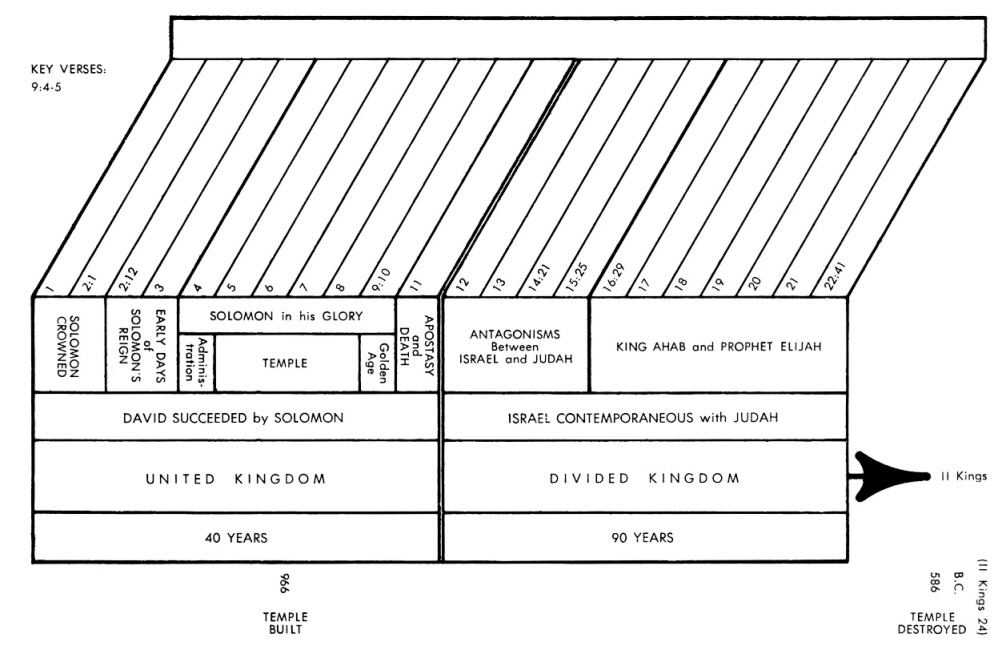
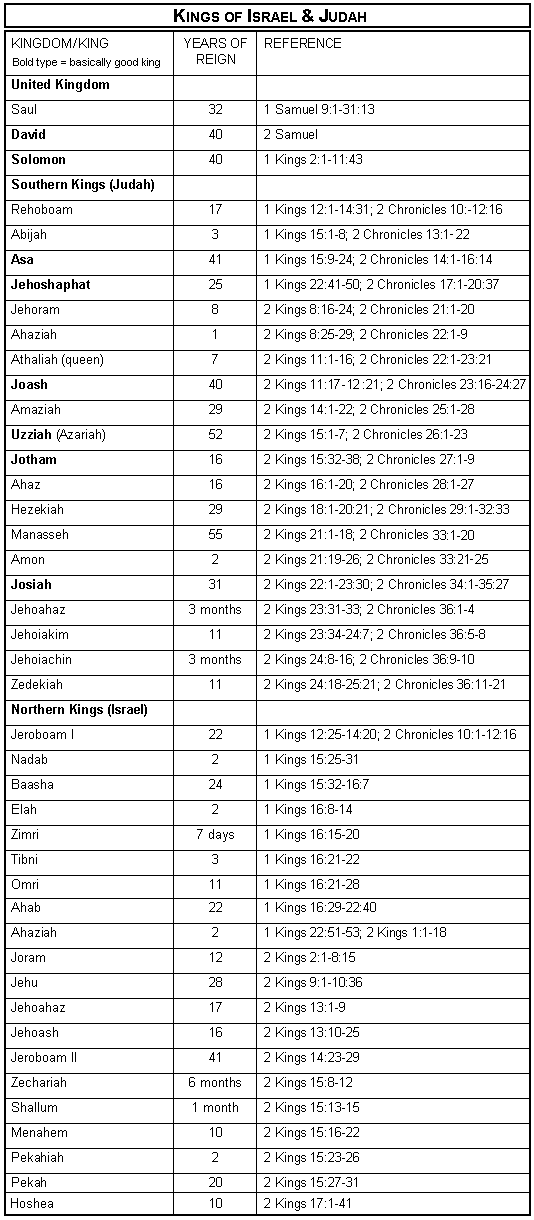
Chart from recommended resource Jensen's Survey of the OT - used by permission
1 Kings Chart from Charles Swindoll

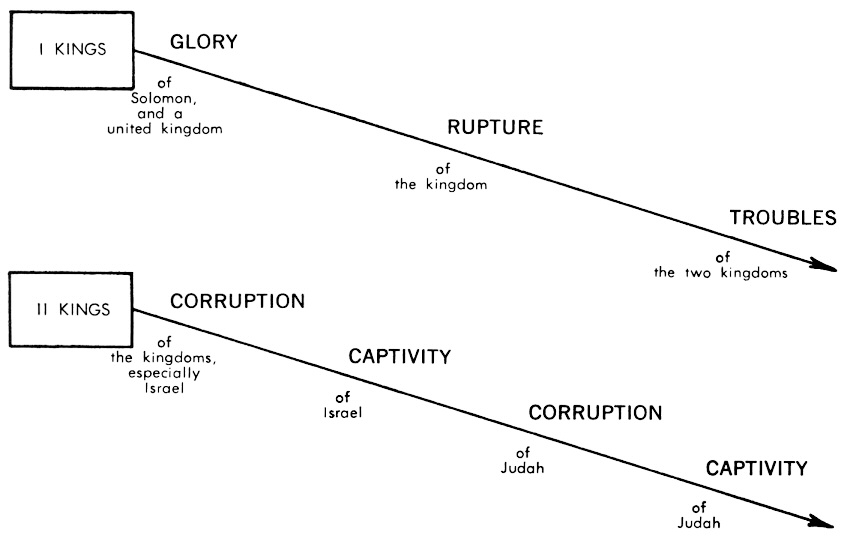
THE DOWNWARD SPIRAL
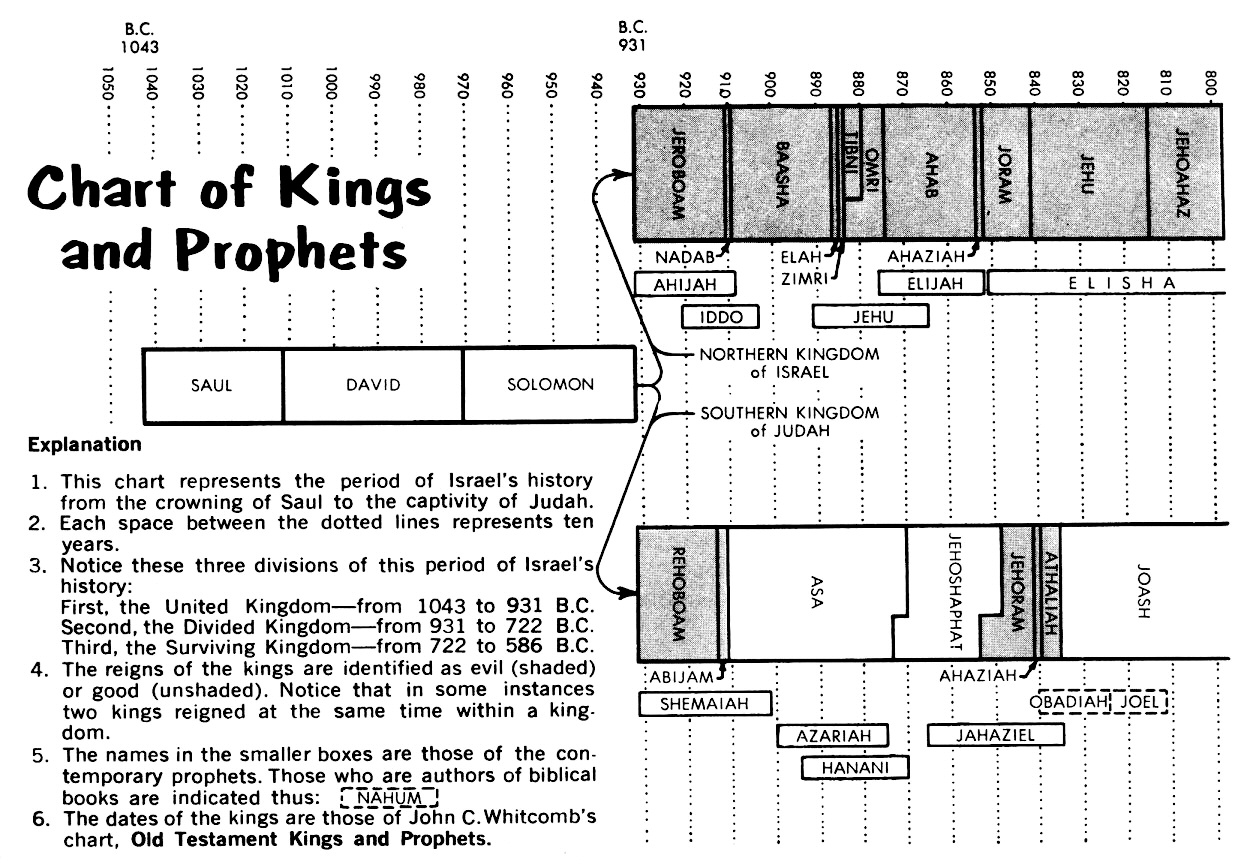
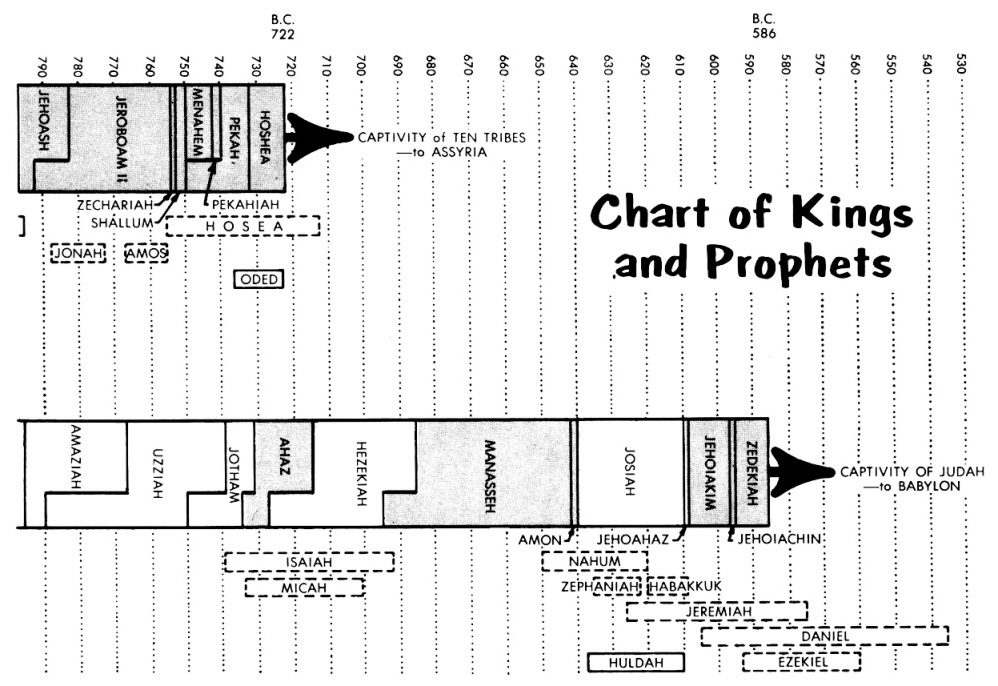
Click to Enlarge
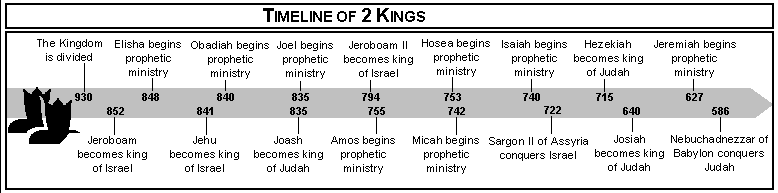
Ryrie Study Bible - Borrow
Click to Enlarge
(NOTE: Many consider Amaziah and Hezekiah as "good" kings)
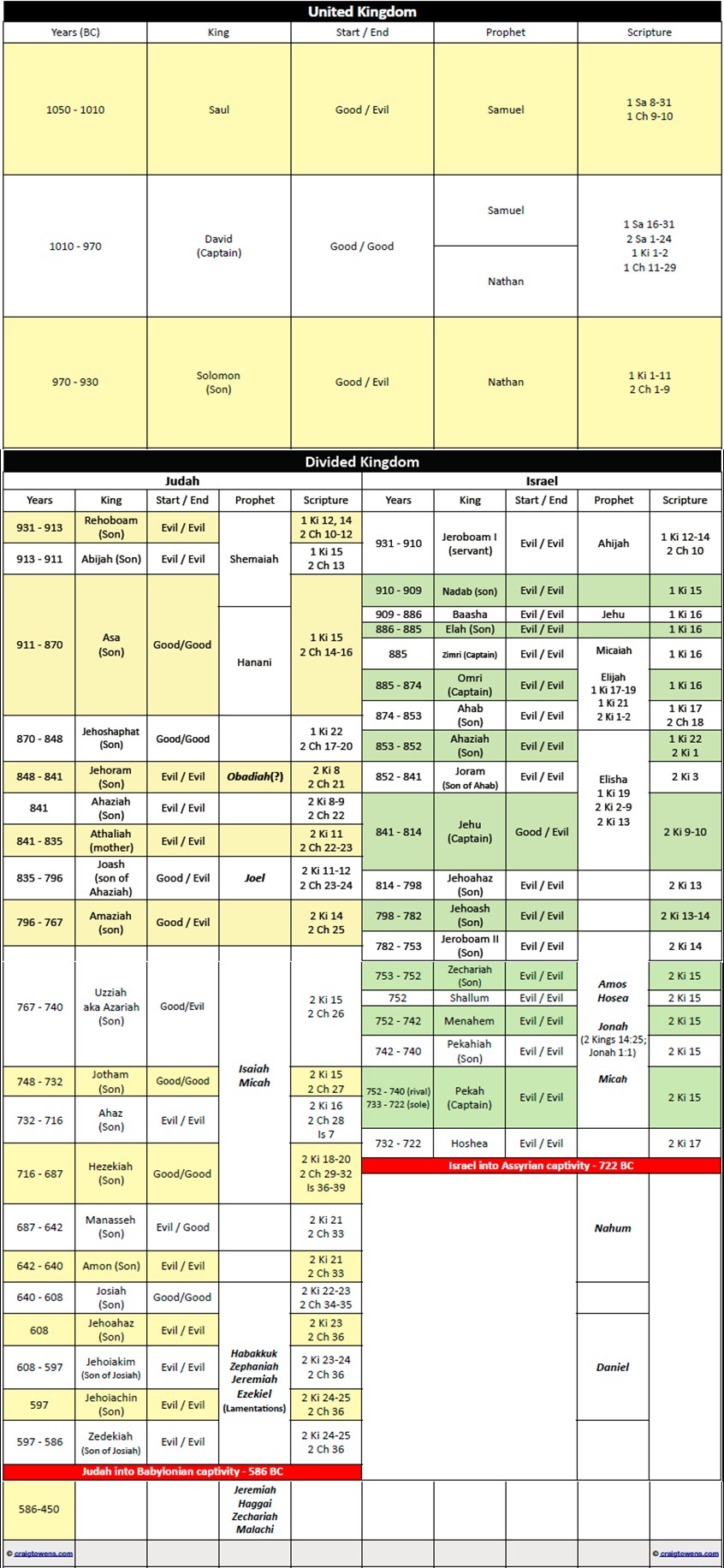
SEE ALSO:
ESV chart - kings of Israel - more information
ESV chart - kings of Judah - more information
Another Chart with Variable Dates for Reigns of King
2 Kings 21:1 Manasseh was twelve years old when he became king, and he reigned fifty-five years in Jerusalem; and his mother’s name was Hephzibah.
- twelve: 2Ki 20:21 1Ch 3:13 2Ch 32:33 33:1-9 Mt 1:10, Manasses
- Hephzibah: Pr 5:19 Isa 62:4
- 2 Kings 21 Resources
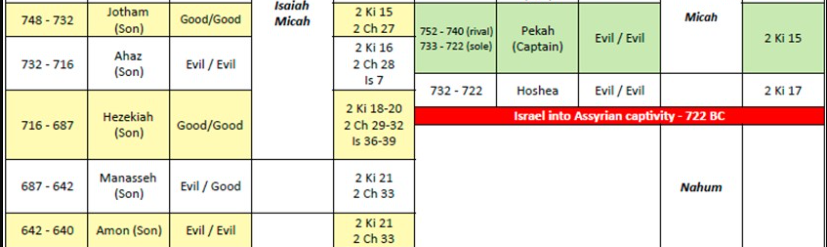
OUT WITH THE GOOD
IN WITH THE BAD
Manasseh was twelve years old when he became king, and he reigned fifty-five years in Jerusalem; and his mother’s name was Hephzibah - Here is another example of a wicked son of a righteous father (cf.Eli: 1 Sam. 2:12; 8:5). Manasseh, who was born late in Hezekiah’s life after God extended his years (2 Kings 20:6), grew up to undo nearly all of his father’s godly work. This shows how quickly a nation can turn from righteousness to rebellion when its leaders abandon God’s Word. Proverbs 29:2 teaches, “When the righteous increase, the people rejoice, but when the wicked rule, the people groan.” Manasseh is born in the 42nd year of Hezekiah (who lived a total of 54 years). Josephus wrote that Hezekiah's prayer for recovery was only in order that there would be an heir (Manasseh) (Josephus Antiquities 10.25-27).
Manasseh's name is interesting meaning "forgetting," "causing to forget" or "making forgetful."
“A degenerate plantof so noble a vine.”
-- Trapp
Konkel - The reign of Manasseh must have begun in 596 B.C., giving him a ten-year coregency with Hezekiah.3 Manasseh reigns the longest of all the Judean kings. (see 1 and 2 Kings - Page 623)
The length of his reign was the longest of any king in Judah’s history. This long rule demonstrates both the patience and the justice of God. On one hand, God allowed Manasseh to reign for decades, showing His long-suffering nature and giving opportunity for repentance. On the other hand, the extended period of Manasseh’s wickedness deeply corrupted Judah, leading to the nation’s eventual downfall. See 2 Kings 21:11–12
If you add his son Amon's 2 years of evil rule, you have a period of about 57 years of evil (not counting Manasseh's time of repentance) about which Guzik remarks "In some way, it could be said that the people of Judah had these wicked kings for more than 50 years because that is what they wanted. God gave them the leaders they wanted and deserved. Now, as the people of the kingdom turned towards godliness, God will give them a better king."
Spurgeon - Yet who could have had a better father than Manasseh had? He was given to Hezekiah during those fifteen years which God graciously added to that good king’s life. Manasseh was, therefore, doubtless carefully trained, and looked upon as being one who would maintain God’s worship, and the honour of his father’s name. But grace does not run in the blood; and the best of parents may have the worst of children. Thus Manasseh, though he was the son of Hezekiah, “did that which was evil in the sight of the Lord,” —It often happens that, when the sons of good men become bad, they are among the worst of men. They who pervert a good example generally run headlong to destruction.
Spurgeon - 12 years old - He was, therefore, born after the time when Hezekiah was raised up from the bed of sickness. That prolongation of life was not all mercy: I am not sure that we should be so eager for such an extension of earthly existence either for ourselves or for others. Had Hezekiah been able to foresee what would be the abominations of the first part of Manasseh’s reign, should he come to the throne of Judah, methinks that the godly king might have been content to die at once rather than live any longer to become the father of such a sinner, and one who would prove to be such an enemy of the true faith. “Manasseh was twelve years old when he began to reign.” It was too early for a youth to reign over any nation. It is a great temptation, and a serious peril, when an individual has too much power before he reaches his manhood. It would have been far better for Manasseh if his accession to the throne had been postponed for a good while. You who are very young, and are entrusted with wealth and position, may God keep you from going wrong! It will need great grace to preserve you in the right path.
Spurgeon - Manasseh’s was a long reign, a varied reign, and at first a wicked reign of the very worst kind. Sometimes men are spared notwithstanding their sin. Manasseh’s was one of the longest reigns on record: “He reigned fifty and five years in Jerusalem.”
Raymond Dillard: Manasseh ruled longer than any other king of Judah. Many find in this fact the key to the Chronicler’s treatment of this king. In light of his theology of immediate retribution, Manasseh would have represented something of a problem: how is it that this king who represented the pinnacle of evil also enjoyed the divine blessing of long life? The Chronicler’s account of Manasseh’s punishment, repentance, and reform removes the narrative from being a problem and makes it instead a dramatic confirmation of the validity of retribution theology and the efficacy of repentance. (SEE 2 Chronicles, Volume 15 - Page 267)
Henry Morris - Manasseh was evidently born three years after Hezekiah's supernatural healing and God's promise of a fifteen year extension of his life (2 Kings 20:6). Without this miracle, the Davidic line of kings in Israel would have been stopped, and God's promise to David (2 Samuel 7:12-16) would have failed. But God's promises are sure, even if miracles are necessary to keep them!
Donald Wiseman - Manasseh was born after Hezekiah’s illness (20:6) and lived during the height of Assyrian power which, under Esarhaddon (681–669 bc) and Ashurbanipal (669–627 bc) controlled as far west as Upper Egypt, and from 671 onwards Judah was a steady and stable vassal of the Assyrians, allowing them free passage on the coastal route. (1 and 2 Kings: An Introduction and Commentary )
Christopher Knapp - “Had this good king been able to foresee the wickedness of his unworthy son, he would doubtless have no desire to recover from his sickness. Better by far die childless than beget a son such as Manasseh proved to be.” (COMMENT - BUT THAT WAS IMPOSSIBLE FOR IT WOULD HAVE BROKEN GOD'S WORD TO THE LINE OF DAVID LEADING TO THE MESSIAH!)
David Guzik - Manasseh was twelve years old when he became king: This means that he was born in the last fifteen years of Hezekiah’s life, the additional fifteen years that Hezekiah prayed for. Those additional fifteen years brought Judah one of its worst kings.
Bob Utley "twelve years old" This means that this evil king was born in the fifteen year period of YHWH's grace to Hezekiah.
Warren Wiersbe does not agree with the writers above writing that "If Manasseh was born in 709, then he was seven years old when his father was healed and the miracle of the shadow occurred. He was eight years old when the 185,000 Assyrian soldiers were slain. Apparently these miracles made little impression on his heart. Many scholars think that Manasseh was coregent with his father for perhaps ten years (697–687), from ages twelve to twenty-two, and the son lived in close relationship with a godly father."
COMMENT - I have read a number of commentaries on the timing of Manasseh's birth with some saying this is why God gave Hezekiah 15 extra years so that he could provide an heir to the Davidic line. Frankly, I cannot come to any definitive conclusion from the multiple sources, and therefore I would recommend one not be too dogmatice about the timing.
John Olley: Kings and Chronicles were written for different audiences, and their authors selected their material accordingly. In the Chronicler’s Manasseh account, hearers are encouraged to find a foretaste of their own situation, as they have been in exile because of rejection of God’s words through the prophets (2Ch 33:10–11a; 36:15–17). Even in the darkest situation, as people “humble themselves” and cry to God in repentance, hope of full restoration (even including kingship; 2Ch 33:13) is still possible; building and security go together with “serv[ing] the Lord the God of Israel” (2Ch 33:16).
Manasseh is an example of how the consequences
of sin are not confined to the sinner.
August Konkel: Manasseh is an example of how the consequences of sin are not confined to the sinner. The consequences of his sin results in the eventual exile of the entire nation; God decides “to remove [Judah] from his presence because of the sins of Manasseh and all he had done, including the shedding of innocent blood … the Lord was not willing to forgive” (24:3b–4). The effects of Manasseh’s deeds are irreversible; the announcement of exile made to Hezekiah becomes a pronouncement of irreversible judgment against the nation (21:10–15). Manasseh, uniformly and unambiguously, is the worst king of Judah in the valuation of the Deuteronomistic Historians.....The reign of Manasseh must have begun in 696 B.C., giving him a ten-year coregency with Hezekiah. Manasseh reigns the longest of all the Judean kings.(See 1 and 2 Kings - Page 623)
QUESTION - Who was King Manasseh in the Bible?
ANSWER - The story of King Manasseh is told in 2 Kings 21:1–18 and 2 Chronicles 32:33–33:20, and he is also mentioned briefly in Jeremiah 15:4. Manasseh was king of the southern kingdom of Judah and the son of the godly king Hezekiah. Hezekiah had undertaken reforms in Judah to rid the land of idolatry. Manasseh, a wicked king, reversed these reforms and did much worse. The first five verses of 2 Kings 21 are a frank and stunning account of Manasseh’s apostasy:
“Manasseh was twelve years old when he became king, and he reigned in Jerusalem fifty-five years. . . . He did evil in the eyes of the Lord, following the detestable practices of the nations the Lord had driven out before the Israelites. He rebuilt the high places his father Hezekiah had destroyed; he also erected altars to Baal and made an Asherah pole, as Ahab king of Israel had done. He bowed down to all the starry hosts and worshiped them. He built altars in the temple of the Lord, of which the Lord had said, ‘In Jerusalem I will put my Name.’ In the two courts of the temple of the Lord, he built altars to all the starry hosts. He sacrificed his own son in the fire, practiced divination, sought omens, and consulted mediums and spiritists. He did much evil in the eyes of the Lord, arousing his anger.” Although we are not given the specifics, Manasseh was also a treacherous king, killing innocent people: “Manasseh also shed so much innocent blood that he filled Jerusalem from end to end” (2 Kings 21:16). He was pronounced by God to be more wicked than the Amorites who had lived in Canaan before they were displaced by Israel in an act of God’s judgment (2 Kings 21:11; see also 2 Chronicles 33:9).
Not only did Manasseh sin personally, but as king he led Judah in forsaking the LORD and worshiping idols. Such was the extent of their sin that God declared He would wipe out Jerusalem as He had the northern kingdom of Israel (2 Kings 21:13–15). Jeremiah 15:4 notes that it was the sin of Judah, initiated by Manasseh, that brought the judgment that Jeremiah proclaimed (the destruction of Jerusalem and the temple and the exile of the people). According to Jewish tradition, it was King Manasseh who murdered the prophet Isaiah.
Second Chronicles 33 adds more information not recorded in 2 Kings. God reached out to Manasseh and the people (presumably through prophets), but they would not listen. So God sent the Assyrians who captured Manasseh and took him away to exile (2 Chronicles 33:11). While in exile, “In his distress he sought the favor of the Lord his God and humbled himself greatly before the God of his ancestors. And when he prayed to him, the Lord was moved by his entreaty and listened to his plea; so he brought him back to Jerusalem and to his kingdom. Then Manasseh knew that the Lord is God” (2 Chronicles 33:12–13). The apocryphal book the “Prayer of Manasseh” claims to record Manasseh’s prayer of repentance, but it is highly unlikely that the contents of the Prayer of Manasseh accurately represent Manasseh’s prayer.
The repentant Manasseh was restored to his kingdom and started to rebuild Judah militarily (2 Chronicles 33:14), and he also began to institute religious reforms. “He got rid of the foreign gods and removed the image from the temple of the Lord, as well as all the altars he had built on the temple hill and in Jerusalem; and he threw them out of the city. Then he restored the altar of the Lord and sacrificed fellowship offerings and thank offerings on it, and told Judah to serve the Lord, the God of Israel” (2 Chronicles 33:15–16).
Even though Manasseh had a personal conversion, he was never able to lead Judah out of the sin that he had previously led them into. They did not follow him in his reforms. The people continued in their idolatry (2 Chronicles 33:17), and, when Manasseh died, his son Amon “did evil in the eyes of the Lord, as his father Manasseh had done. Amon worshiped and offered sacrifices to all the idols Manasseh had made. But unlike his father Manasseh, he did not humble himself before the Lord” (2 Chronicles 33:22–23).
Manasseh is a tragic figure in Scripture. Although he repented of his sin, he was unable to undo the damage he had done to the nation or to his own son who followed him. Manasseh demonstrates that, while any sin may be forgiven when we repent, forgiveness does not necessarily remove the natural consequences that flow from disobedience.GotQuestions.org
F B Meyer - And his mother’s name was Hephzi-bah.
Hephzi-bah means, “My delight is in her” (Isaiah 62:4). How strange, supposing that her name was any indication of her character, that such a woman should have borne such a son; for “Manasseh did wickedly above all the Amorites did which were before him.” A godly ancestry, however, does not guarantee a holy seed. Hezekiahs and Hephzi-bahs may be the parents of Manassehs. That this may not be so:—
Let us guard against the inconsistencies of our private life.— The child of religious parents becomes habituated to their use of expressions in public which betoken the highest degree of holiness, and is therefore quicker to notice any inconsistency in temper or walk. Is there not a subtle temptation also for those who work much for God in public to feel that a certain laxity is permissible in the home? Will not late after-meetings at night compensate for indolence in the morning, and will not protracted services be the equivalent for private prayer? May not irritability to servants or children be accounted for by the overstrain of our great work? Hence, inconsistency and failure to realize our lofty aims, which are quickly noticed, beget distaste for our religion.
Let us guard against absorption in public religious duty to the neglect of the home.— Does it never happen that the children of religious parents are put to bed by nurses who are heedless of their prayers, because their mothers have undertaken a mission? Do not boys sometimes grow up without the correcting influence of the father’s character, because he, good man, is so taken up with committees?
Let us guard against an austerity of manner, which prevents us being the companions, play-fellows, and associates of our children.
Adam → Cain.
Adam was created innocent in the image of God and enjoyed direct fellowship with the LORD before the Fall (Gen 1:27; 2:7). Yet his firstborn son Cain became a murderer and a rebel against God, offering unacceptable worship and ultimately killing his righteous brother Abel (Gen 4:3–8). The New Testament explicitly identifies Cain as one who “was of the evil one” (1 Jn 3:12). The very first family in Scripture thus establishes a foundational biblical truth: sin is not prevented, nor righteousness transmitted, merely by godly origin or example.
Noah → Ham.
Noah is described as “a righteous man, blameless in his time,” who walked with God and obeyed Him fully (Gen 6:9; 7:1). Nevertheless, his son Ham acted with shocking disrespect and moral corruption when he dishonored his father’s nakedness and treated it lightly, in contrast to his brothers’ reverence (Gen 9:22–25). This account demonstrates that even a godly, obedient father can raise a son who disregards holiness and authority.
Abraham → Ishmael.
Abraham was a man of faith who believed God, and it was credited to him as righteousness (Gen 15:6). Yet his son Ishmael, born according to the flesh rather than the promise, is described prophetically as “a wild donkey of a man,” marked by hostility and conflict (Gen 16:12). Ishmael later mocked Isaac, revealing a heart opposed to God’s covenant purposes (Gen 21:9). Abraham’s faith did not automatically produce covenant faithfulness in his son.
Isaac → Esau.
Isaac walked in obedience to the LORD and kept His commandments, statutes, and laws (Gen 26:5). Nevertheless, his son Esau proved to be godless and immoral, despising his birthright for a single meal (Gen 25:34). The New Testament labels Esau as “immoral” and “godless,” holding him up as a warning against despising spiritual privilege (Heb 12:16).
Jacob → Reuben.
Jacob, the covenant patriarch through whom the promises of Abraham continued, nevertheless suffered deep moral failure within his family. His firstborn son Reuben committed sexual immorality by sleeping with his father’s concubine (Gen 35:22). As a result, Reuben forfeited the privileges of the firstborn, and Jacob pronounced judgment upon him for his instability and defilement (Gen 49:3–4).
Aaron → Nadab and Abihu.
Aaron was divinely appointed as Israel’s first high priest, entrusted with sacred responsibility and proximity to God’s presence. Yet his sons Nadab and Abihu offered “strange fire” before the LORD—unauthorized, irreverent worship that violated God’s explicit commands. As a result, fire came out from the presence of the LORD and consumed them (Lev 10:1–2), demonstrating that holy office and godly lineage do not excuse disobedience.
Eli → Hophni and Phinehas.
Eli served as both priest and judge in Israel, yet his sons Hophni and Phinehas are explicitly called “worthless men” who did not know the LORD (1 Sam 2:12). They abused their priestly office, stole sacrificial portions, and committed sexual immorality at the entrance of the tent of meeting (1 Sam 2:12–17, 22). Their wickedness culminated in divine judgment, as both sons died on the same day when the ark was captured (1 Sam 4:11).
Samuel → Joel and Abijah.
Samuel was a faithful prophet and servant of Yahweh from his youth to old age. However, his sons Joel and Abijah, whom he appointed as judges, “did not walk in his ways,” but instead turned aside after dishonest gain, took bribes, and perverted justice (1 Sam 8:1–3). Their corruption directly contributed to Israel’s demand for a king, showing again that spiritual leadership is not inherited.
David → Absalom, Amnon, and Adonijah.
David, though flawed, was described as a man after God’s own heart (1 Sam 13:14). Yet several of his sons embodied profound moral failure. Amnon committed sexual violence against his half-sister Tamar (2 Sam 13:1–14); Absalom murdered Amnon and later led a full-scale rebellion against his father (2 Sam 13:28–29; ch. 15); and Adonijah attempted to seize the throne in defiance of God’s will (1 Kgs 1:5–10). David’s life powerfully illustrates that a godly heart does not guarantee godly children.
Solomon → Rehoboam.
Solomon, the builder of the temple and recipient of unparalleled divine wisdom (1 Kgs 3:12), fathered Rehoboam, whose pride and harshness fractured the kingdom. Rejecting wise counsel, Rehoboam ruled foolishly and arrogantly, causing ten tribes to revolt and divide the nation (1 Kgs 12:13–19). Wisdom possessed by a father does not ensure wisdom embraced by a son.
Jehoshaphat → Jehoram.
Jehoshaphat sought the LORD and walked in His commandments, strengthening Judah spiritually and morally (2 Chr 17:3–6). Yet his son Jehoram murdered his brothers, embraced idolatry, and led Judah into great wickedness (2 Chr 21:4–6). His reign stands in stark contrast to his father’s faithfulness.
Jotham → Ahaz.
Jotham, the father of Ahaz, is explicitly presented as a righteous king who “did what was right in the sight of the LORD,” walking faithfully before God and strengthening Judah, including important building projects at the temple and the defenses of Jerusalem (2 Kings 15:34–35; 2 Chronicles 27:1–6). Scripture summarizes his life with the clear theological evaluation: “So Jotham became mighty because he ordered his ways before the LORD his God” (2 Chr 27:6). In stark contrast, his son Ahaz “did not do what was right in the sight of the LORD his God,” but instead walked in the ways of the kings of Israel, practiced idolatry, sacrificed his sons in the fire, shut the doors of the temple, and led Judah into deep apostasy (2 Kings 16:2–4; 2 Chronicles 28:1–4, 24–25).
Hezekiah → Manasseh.
Hezekiah was one of Judah’s most righteous kings, trusting the LORD completely and removing idolatry from the land (2 Kgs 18:3–6). Nevertheless, his son Manasseh became one of Judah’s most wicked rulers, rebuilding high places, practicing occultism, shedding innocent blood, and leading the nation into grave apostasy (2 Kgs 21:1–9). Though Manasseh later repented in captivity (2 Chr 33:12–13), the damage of his reign was profound and lasting.
CONCLUSION - From the opening chapters of Genesis through the final kings of Judah, Scripture consistently testifies that personal righteousness is not hereditary, nor is covenant faithfulness transmitted automatically from father to son. Together these narratives establish a unified theological truth repeatedly affirmed in Scripture: each soul stands individually accountable before God (Ezek 18:20), salvation and obedience arise from personal response to divine grace rather than lineage (Deut 30:19; John 1:12–13), and godly parenting, though commanded and precious, cannot substitute for a heart that personally fears the LORD and receives the gift of salvation in Jesus Christ!
"The conclusion, when all has been heard, is: FEAR GOD and KEEP His commandments, because this applies to every person.14 For God will bring every act to judgment, everything which is hidden, whether it is good or evil." (Ecclesiastes 12:13-14)
2 Kings 21:2 He did evil in the sight of the LORD, according to the abominations of the nations whom the LORD dispossessed before the sons of Israel.
NLT - He did what was evil in the Lord's sight, imitating the detestable practices of the pagan nations whom the LORD had driven from the land ahead of the Israelites.
NET He did evil in the sight of the LORD and committed the same horrible sins practiced by the nations whom the LORD drove out from before the Israelites.
CSB He did what was evil in the LORD's sight, imitating the detestable practices of the nations that the LORD had dispossessed before the Israelites.
NJB He did what is displeasing to Yahweh, copying the disgusting practices of the nations whom Yahweh had dispossessed for the Israelites.
- And he did: 2Ki 21:7,16 16:2-4 22:17 2Ch 33:2-4
- the abominations: Lev 18:25-29 De 12:31 2Ch 36:14 Eze 16:51
- 2 Kings 21 Resources
Related Passages:
2 Chronicles 33:2 He did evil in the sight of the LORD according to the abominations of the nations whom the LORD dispossessed before the sons of Israel.
Deuteronomy 12:29-31 “When the LORD your God cuts off before you the nations which you are going in to dispossess, and you dispossess them and dwell in their land, 30 beware that you are not ensnared to follow them, after they are destroyed before you, and that you do not inquire after their gods, saying, ‘How do these nations serve their gods, that I also may do likewise?’ 31 “You shall not behave thus toward the LORD your God, for every abominable act which the LORD hates they have done for their gods; for they even burn their sons and daughters in the fire to their gods.
Deuteronomy 18:9-12 “When you enter the land which the LORD your God gives you, you shall not learn to imitate the detestable things of those nations. 10 “There shall not be found among you anyone who makes his son or his daughter pass through the fire, one who uses divination, one who practices witchcraft, or one who interprets omens, or a sorcerer, 11 or one who casts a spell, or a medium, or a spiritist, or one who calls up the dead. 12 “For whoever does these things is detestable (toebah; LXX - bdelugma - that which is extremely abhorred, detestable, anything connected with idolatry) to the LORD; and because of these detestable things the LORD your God will drive them out before you.
THE SURPASSING EVIL
OF MANASSEH
He did evil in the sight of (Lit - "in the eyes of") the LORD - Evil in the sight of the people of Judah was bad enough for it led them into commission of gross idolatry. But far worse is evil before "holy eyes!" His deeds were offensive to the holy and righteous character of God, Who sees all things. Proverbs 15:3 says "The eyes of the LORD are in every place, Watching the evil and the good." The writer will now unleash a veritable avalanche of negative comments about the evil deeds in Manasseh's reign.
David Guzik - This shows us that repentance, reform, and revival are not permanent standing conditions. What is accomplished at one time can be opposed and turned back at another time.
Konkel - MANASSEH BECOMES THE “Jeroboam I”of Judah, the figure who personified all the sins of the subsequent kings of Israel (1 Kings 16:6, 19, 26, 31, etc.). Manasseh’s fifty-five year reign of apostasy between good kings Hezekiah and Josiah makes his evil worse by contrast. (see 1 and 2 Kings - Page 623)
Konkel goes on to make a very interesting point "Assur (ED: AKA "ASSYRIA") is at the height of its power after the conquest of Egypt (671 B.C.); any attempt to break away, as Hezekiah did, is out of the question. Though Manasseh is loyal to Assur, there is no evidence that Assyria ever demanded adherence to its own religious practices or interfered in any way with the native practices of conquered countries.4 No Assyrian vassal treaty contains clauses that relate to practice of religion; it is not even certain that a loyalty oath, such as the one imposed by Esarhaddon on his eastern vassals, is ever imposed on Manasseh.5 In other words, the abominable foreign practices of Manasseh are apparently totally voluntary. There is nothing to suggest this facilitates favor with his Assyrian masters."...Manasseh reverses the policies of his father, both in the practice of faith and in the submission to Assyria.
According to the abominations (toebah; LXX - bdelugma - Hebrew literally = “like the abominable practices of the nations.” that which is extremely abhorred, detestable, anything connected with idolatry) of the nations whom the LORD dispossessed (yarash) before the sons of Israel - This is an amazing statement for it connects the depth of Manasseh’s sin to the very evils that had brought God’s judgment upon the Canaanite nations.The abominations refer to the detestable religious and moral practices of the Canaanites and other peoples who lived in the land before Israel’s conquest. These included idolatry, child sacrifice, sexual immorality, witchcraft, and the worship of false gods. God had commanded Israel to drive out those nations precisely because of these abominations.
In Leviticus 18:24-25 Moses gave Israel clear warnings...
‘Do not defile yourselves by any of these things; for by all these the nations which I am casting out before you have become defiled. 25 ‘For (term of explanation) the land has become defiled, therefore I have brought its punishment upon it, so the land has spewed out its inhabitants.
Warren Wiersbe on the incredible depth of Manasseh's depravity - "It was as though the Lord took His hand off the nation and allowed all the filth to pour out of people’s hearts. In character and conduct, he was even worse than the Amorites whom Joshua defeated in Canaan, a nation with a reputation for brutality and wickedness (2Ki 21:11; Ge 15:16)"
Manasseh's sins defiled the Promised Land and would result in God spewing out Judah in 586 BC (SEE NOTE BELOW). Manasseh’s sin was not only private but public and consequences would impact the entire nation. This is a tragic reversal of Israel’s calling. God had chosen His people to be holy and distinct, a light to the nations (Deuteronomy 7:6), but under Manasseh’s leadership, they became indistinguishable from the very nations God had judged. Beloved, I fear a similar think could be said of much of the church in America today, so that there is little distinction of church goers and the general public! It is a sobering reminder that God’s people are called to holiness, and when they abandon that calling, they invite the same judgment that falls on the unbelieving world.
Once Manasseh and Judah had attained a level of iniquity like the Canaanites who had been cast out of the land, Yahweh really had no choice but to carry out His covenant curses on His own people as recorded by Moses....
“The LORD will bring you and your king, whom you set over you, to a nation which neither you nor your fathers have known, and there you shall serve other gods, wood and stone. 37“You shall become a horror, a proverb, and a taunt among all the people where the LORD drives you. (Dt 28:36-37)
Spurgeon -The Lord drove out the Canaanites for the very sins that Manasseh committed. If we follow in the sins of others, we must not wonder if we share in their doom. It is a sad thing, however, when the child of such a father as Hezekiah does evil in the sight of the Lord, “like unto the abominations of the heathen, whom Jehovah had cast out before the children of Israel.”
Abominations (detestable, loathsome) (08441) toebah refers to an abominable custom or thing. Abomination. Loathsome. Detestable thing. Something or someone who is loathsome and abhorrent.
Abomination (Hebrew tôʿēbâ) in Scripture denotes far more than something merely distasteful or socially offensive; it refers to anything—object, act, or disposition—that fundamentally violates God’s holiness, sovereignty, and covenantal order, thereby provoking His righteous rejection and judgment. Rooted primarily in the Law, tôʿēbâ marks what is ritually, morally, or ethically incompatible with life before a holy God: unclean foods (Deut. 14:3), defective sacrifices (Deut. 17:1), dishonest business practices (Deut. 25:13–16), and especially idolatry and its attendant practices, including child sacrifice (Deut. 12:31), ritual prostitution (1 Kgs. 14:23–24), and the worship of false gods—so much so that pagan deities themselves are labeled “abominations,” as when Milcom is called “the abomination of the Ammonites” (2 Kgs. 23:13; cf. Deut. 32:16; Isa. 44:19; Ezek. 7:20). At the moral level, tôʿēbâ identifies behaviors that corrupt God’s design for human life and community, including sexual perversions such as homosexuality (Lev. 18:22; 20:13), violence, deceit, arrogance, and the catalog of sins God “hates” in Proverbs 6:16–19, all of which reflect a willful disregard for His revealed standards. Strikingly, Scripture emphasizes the irony of abomination: those who commit it often perceive their actions as acceptable or even religiously virtuous, yet God declares even the sacrifice and prayer of the wicked to be abominable when offered in disobedience and hypocrisy (Prov. 15:8; 21:27; 28:9).
Beyond legal categories, tôʿēbâ also carries a deeply relational and experiential dimension, reflecting the Ancient Near Eastern understanding of shame, horror, and repulsion that reaches the core of one’s being (Ps. 69:20; 88:8). What offends God may also be experienced as repulsive within human cultures—Egyptians considered eating with Hebrews or the occupation of shepherding abominable (Gen. 43:32; 46:34), while certain sacrifices were abhorrent from an Egyptian perspective (Exod. 8:26)—yet Scripture consistently re-centers the definition around God’s values rather than human sensibilities. Because abominations threaten the spiritual purity of God’s people, the prophets repeatedly indicted Israel for covenant violations in these areas, especially idolatry, corrupt worship, sexual immorality, injustice, and intermarriage that blurred the boundary between holiness and paganism (Isa. 1:13; 41:24; Jer. 2:7; 7:9–10; Ezek. 16:36; 22:11; Mal. 2:11; Ezra 9:1). The penalties attached to abominations are severe—being cut off, death, exile, destruction, and the withdrawal of God’s favor (Lev. 18:29; 20:13; Deut. 13:14; Ezek. 5:11)—underscoring that abomination is ultimately an assault on God’s rightful rule as Creator and Redeemer. This trajectory culminates in the biblical imagery of supreme abomination, where sacrilegious powers usurp divine worship and desecrate what belongs to God alone (Dan. 9:27; 11:31; 12:11), a pattern later echoed in New Testament eschatological warnings (Matt. 24:15; 2 Thess. 2:3–4; Rev. 17:4–5), reinforcing that tôʿēbâ represents not merely cultural disgust but active rebellion against God’s holiness that inevitably summons His judgment.
ALL THE OCCURRENCES OF THE PHRASE "DID EVIL IN THE SIGHT OF THE LORD" JJdg. 2:11; Jdg. 3:7; Jdg. 3:12; Jdg. 4:1; Jdg. 6:1; Jdg. 10:6; Jdg. 13:1; 1 Ki. 11:6; 1 Ki. 14:22; 1 Ki. 15:26; 1 Ki. 15:34; 1 Ki. 16:30; 1 Ki. 22:52; 2 Ki. 3:2; 2 Ki. 8:18; 2 Ki. 8:27; 2 Ki. 13:2; 2 Ki. 13:11; 2 Ki. 14:24; 2 Ki. 15:9; 2 Ki. 15:18; 2 Ki. 15:24; 2 Ki. 15:28; 2 Ki. 17:2; 2 Ki. 21:2; 2 Ki. 21:20; 2 Ki. 23:32; 2 Ki. 23:37; 2 Ki. 24:9; 2 Ki. 24:19; 2 Chr. 21:6; 2 Chr. 22:4; 2 Chr. 33:2; 2 Chr. 33:22; 2 Chr. 36:5; 2 Chr. 36:9; 2 Chr. 36:12; Jer. 52:2
Dispossessed (03423) yarash to take possession of, inherit, dispossess, to drive out. Possession of the land was directly connected to a person's relationship with the Lord; breaking the covenantal relationship led to dispossession. But even in exile, Israelites awaited the day when they would repossess the land (Jer. 30:3).
Complete Biblical Library - The verb yārash is an especially important word in contexts dealing with Israel's conquest of and possession of the land of Canaan. Cognates include Aramaic, Ugaritic, Old South Arabian, and Akkadian. The Moabite stone inscription uses wyrs: "And Omri took possession of all the land of Mahdeba." Yārash means "to take possession of" or "to possess." Another meaning is "to inherit," "to be an heir."
The first meaning, "to take possession of," is most commonly used in connection with possessing land, specifically, the Promised Land. Yahweh first announced "possession" of the land in the context of the Abrahamic covenant (Gen. 15:7f). Although similar usage continues in Leviticus (20:24) and Numbers (13:30; 14:24; 21:24f), yārash in the sense of covenant land possession is a key theme in Deuteronomy. "Go in and possess the land," the Lord commanded (Deut. 1:8, 21, 39; 11:31; 17:14). The phrase, "where you are going to possess it," with reference to the land, recurs in Deuteronomy and Joshua (Deut. 4:5, 14, 26; Josh. 1:11, 15; 12:1; 13:1; 21:43; 23:5). Emphasis on the idea of "possessing" the land continues in Judges (11:21-24; 18:9).
Likewise, the prophets and post-exilic Books allude to Israel's covenant right of possession. Jeremiah predicted a coming repossession of the land (Jer. 30:3), as did Isaiah (Isa. 61:7; 65:9), while Ezekiel (Ezek. 33:24ff) and Amos (Amos 2:10) looked to past land inheritance. Habakkuk described the coming invasion of Babylonian armies to "possess" the land (Hab. 1:6). After the Babylonian exile, Nehemiah's prayer alluded to God's earlier covenant promises of land possession (Neh. 9:15, 22ff).
Yārash also refers to possessing fields (1 Ki. 21:15f, 18f), cities (Josh 19:47; Judg. 3:13) and houses (Ezek. 7:24; Neh. 9:25). The only occurrence of yārash in the Piel theme speaks of the locust or cricket "possessing" (devouring) Israel's produce as a consequence of the people's disobedience (Deut. 28:42).
The idea of "possessing" implies "dispossessing" someone else. In conquest, one nation succeeds another; thus, capturing territory divests another nation of its possession of the land. This usage is common in both the Qal (Deut. 2:12, 21f; 9:1; 11:23; 12:2, 29; Num. 21:32; Ezek. 36:12; Amos 9:12; Obad. 17) and Hiphil (Josh. 13:13; 14:12; 16:10; 17:13; Judg. 1:29-33). Kings notes that the Lord drove out nations for Israel, only to see his people adopt the idolatrous practices of those nations (1 Ki. 14:24; 21:26; 2 Ki. 16:3; 17:8; 21:2; see also Exo. 34:24; Deut. 4:38). In the Niphal stem, to "be dispossessed" is to become poor: "do not love sleep, lest you become poor" (Prov. 20:13; Gen. 45:11; Judg. 14:15; cf. Prov. 23:21; 30:9).
In a legal sense, the right of possession passed from one generation to the next and so constituted "inheritance." Because they were without a son, Abraham and Sarah looked to Eliezer, a servant, as an "heir" (Gen. 15:3f). Jeremiah spoke of Israel's lack of national heirs (49:1; cf. Lev. 25:46; 2 Sam. 14:7). The Lord cautioned his people not to intermarry with idolatrous nations in order to leave the good land as an inheritance for their children (Ezra 9:12).
QUESTION - Why is idol worship such a powerful temptation?
ANSWER - Ultimately, the answer to this question is “sin.” It is the sin nature of man that causes us to worship modern idols, all of which are, in reality, forms of self-worship. The temptation to worship ourselves in various ways is a powerful temptation indeed. In fact, it is so powerful that only those who belong to Christ and have the Holy Spirit within them can possibly hope to resist the temptation of modern idolatry. Even then, resisting the worship of idols is a lifelong battle that is part of the Christian life (Ephesians 6:11; 1 Timothy 6:12; 2 Timothy 2:3).
When we hear the word idol, we often think of statues and objects reminiscent of those worshiped by pagans in ancient cultures. However, the idols of the 21st century often bear no resemblance to the artifacts used thousands of years ago. Today, many have replaced the “golden calf” with an insatiable drive for money or prestige or "success" in the eyes of the world. Some pursue the high regard of others as their ultimate goal. Some seek after comfort or a myriad of other passionate, yet empty, pursuits. Sadly, our societies often admire those serving such idols. In the end, however, it doesn’t matter what empty pleasure we chase after or what idol or which false god we bow down to; the result is the same—separation from the one true God.
Understanding contemporary idols can help us to understand why they prove to be such a powerful temptation. An idol can be anything we place ahead of God in our lives, anything that takes God’s place in our hearts, such as possessions, careers, relationships, hobbies, sports, entertainment, goals, greed, addictions to alcohol/drugs/gambling/pornography, etc. Some of the things we idolize are clearly sinful. But many of the things we idolize can be very good, such as relationships or careers. Yet Scripture tells us that, whatever we do, we are to “do it all for the glory of God” (1 Corinthians 10:31) and that we are to serve God only (Deuteronomy 6:13; Luke 16:13). Unfortunately, God is often shoved out of the way as we zealously pursue our idols. Worse yet, the significant amount of time we often spend in these idolatrous pursuits leaves us with little or no time to spend with the Lord.
We sometimes also turn to idols seeking solace from the hardships of life and the turmoil present in our world. Addictive behaviors such as drug or alcohol use, or even something like excessive reading or television viewing, may be used as a means of temporarily “escaping” a difficult situation or the rigors of daily life. The psalmist, however, tells us that those who place their trust in this behavior will, essentially, become spiritually useless (Psalm 115:8). We need to place our trust in the Lord “who will keep [us] from all harm” (Psalm 121:7) and who has promised to supply all of our needs when we trust in Him. We also need to remember the words of Paul, who teaches us not to be anxious about anything, but rather to pray about everything so the peace of God, which surpasses all understanding, can guard our hearts and our minds (Philippians 4:6–7).
There is another form of idolatry prevalent today. Its growth is fostered by cultures that continue to drift away from sound biblical teaching, just as the apostle Paul warned us, “For the time will come when men will not put up with sound doctrine” (2 Timothy 4:3). In these pluralistic, liberal times, many cultures have, to a large degree, redefined God. We have forsaken the God revealed to us in Scripture and have recast Him to comply with our own inclinations and desires—a “kinder and gentler” god who is infinitely more tolerant than the One revealed in Scripture. One who is less demanding and less judgmental and who will tolerate many lifestyles without placing guilt on anyone’s shoulders. As this idolatry is propagated by churches around the world, many congregants believe they are worshiping the one, true God. However, these made-over gods are created by man, and to worship them is to worship idols. worshiping a god of one’s own making is particularly tempting for many whose habits and lifestyles and drives and desires are not in harmony with Scripture.
The things of this world will never fully satisfy the human heart. They were never meant to. The sinful things deceive us and ultimately lead only to death (Romans 6:23). The good things of this world are gifts from God, meant to be enjoyed with a thankful heart, in submission to Him and for His glory. But when the gift replaces the Giver or the created replaces the Creator in our lives, we have fallen into idolatry. And no idol can infuse our lives with meaning or worth or give us eternal hope. As Solomon beautifully conveys in the book of Ecclesiastes, apart from a right relationship with God, life is futile. We were created in God’s image (Genesis 1:27) and designed to worship and glorify Him as He alone is worthy of our worship. God has placed “eternity in man’s heart” (Ecclesiastes 3:11), and a relationship with Jesus Christ is the only way to fulfill this longing for eternal life. All of our idolatrous pursuits will leave us empty, unsatisfied, and, ultimately, on the broad road that most people take, the one that leads to destruction (Matthew 7:13). GotQuestions.org
because of his unusually long reign, he was on the throne during the entire reign of Esarhaddon and about half the reign of Ashurbanipal, two of the strongest kings of Assyria. Manasseh is mentioned by each of these two kings. Manasseh was among 22 kings who were obliged to provide building materials for Esarhaddon's royal palace at Nineveh:
I called up the kings of the country Hatti and (of the region) of the other side of the river (Euphrates)...Manasseh, king of Judah...[along with 21 other kings], together 22 kings of Hatti, the seashore and the islands; all these I sent out and made them transport under terrible difficulties, to Nineveh, the town (where I exercise) my rulership, as building material for my palace; big logs, long beams (and) thin boards from cedar and pine trees… (ANET 291).
Ashurbanipal was intent on subjugating Egypt. In order to accomplish his goal, he conscripted troops from his western provinces, including Judah:
(Then) I called up my mighty armed forces which Ashur and Ishtar have entrusted to me and took the shortest road to Egypt and Nubia. During my march (to Egypt) 22 kings from the seashore, the islands, and the mainland [including] Manesseh, king of Judah…servants who belong to me, brought heavy gifts to me and kissed my feet. I made these kings accompany my army over the land-as well as (over) the sea-route with their armed forces and their ships (ANET 294).
Paul House: During this time Assyria’s Sennacherib dies in about 681 B.C. and is followed first by Esarhaddon (ca. 681–669 B.C.), then by Ashurbanipal (ca. 669–627 B.C.). None of these men allows Assyria to lose its position as the world’s dominant power. Bright states that though Manasseh rebels against Assyria at least once (cf. 2 Chr 33:10–13), he is “a loyal vassal of Assyria throughout his long reign. Esarhaddon lists him among twenty-two kings required to forward building materials for his building projects, while Ashurbanipal names him as one of a number of vassals who assisted his campaign against Egypt.” Judah’s anti-Assyrian days are over. Manasseh adopts what he no doubt believes is a prudent policy. (See 1, 2 Kings - Volume 8 - Page 377)
2 Kings 21:3 For he rebuilt the high places which Hezekiah his father had destroyed; and he erected altars for Baal and made an Asherah, as Ahab king of Israel had done, and worshiped all the host of heaven and served them.
- the high places: 2Ki 18:4,22 2Ch 32:12 34:3
- he erected: 2Ki 10:18-20 1Ki 16:31-33 18:21,26
- Ahab: 2Ki 8:18,27 Mic 6:16
- and worshipped: 2Ki 17:16 23:4 De 4:19 17:3 2Ch 33:3-5 Job 31:26
- 2 Kings 21 Resources
Related Passages:
2 Chronicles 33:3 For he rebuilt the high places which Hezekiah his father had broken down; he also erected altars for the Baals and made Asherim, and worshiped all the host of heaven and served them.

FROM HIGH PLACES TO HIGH
WORSHIP OF HOSTS OF HEAVEN
For - This is a strategic term of explanation, which is easy to observe, as the writer explains the incredible evil acts of Manasseh.
He rebuilt the high places (bamah; LXX - hupselos) which Hezekiah his father had destroyed (abad; LXX - kataspao [not used in NT]- pulled down as in 2Ki 10:27, 11:18, 23:12) - Oh those high places again. We thought they were gone finally after Hezekiah had destroyed them! Well, here they come again with the help of his son Manasseh! The resistance of the high places to permanent removal reminds me of the phrase in Hebrews 12:1 "the sin which so easily entangles." Here Israel is entangled and ensnared again!
🙏 THOUGHT - What are we to learn from Manasseh's rebuilding of high places? We have all had "high places" in our lives, certainly before we became believers, but even after we came to Christ. Have we torn them down in the past, only to see them rear their ugly head years later? Flesh is flesh (fallen, depraved) and is uncompromising and ever seeking to sneak to insert a repented sinful behavior back into our life! Therefore we must take the "Hezekiah approach" and tear them down, eschewing the "Manasseh approach" to rebuild them in our heart and mind (cf 2Co 10:3-5). As you read this beloved, do you have any "high places" you have rebuilt or are considering rebuilding? The the only solution is to kill those sins, lest they be killing you, remembering the only way you can truly tear down those "high places" is as you are supernaturally enabled by the Holy Spirit (Ro 8:13). Lord we desperately need Your Spirit in Christ. Amen
And he erected altars (mizbeah; LXX - thusiasterion - structure on which cultic observances are carried out) for Baal (ba'al ~ husband, lord, master, owner, possessor) and made an Asherah (Asherah), as Ahab king of Israel had done - Once again we see the king leading the people who were to be the possession of Yahweh into worship and bondage of "no gods". And yet because of the depravity of our fallen flesh, these inanimate objects exerted great attraction to the people. Notice that in a sense they even became "married" to them for the name Baal (ba'al) is also translated as husband, owner, possessor. Given this understanding, it is easy to see why idolatry provokes Israel's "Husband" Yahweh to jealousy (See Israel the Wife of Jehovah)! In looking for freedom, the people were drawn into deep bondage to these idols which in turn made them carry out abominable acts (often associated with immorality) in order to "please" their inanimate masters. Of course from the New Testament we learn that which the idols although inanimate, serve as "front men" so to speak for the demons! Paul explains "that the things which the Gentiles sacrifice, they sacrifice to demons and not to God; and I do not want you to become sharers in demons." (1Co 10:20)
David Guzik - Manasseh did not want to imitate his godly father. Instead, he imitated one of the very worst kings of Israel: Ahab.
And worshiped (shachah; LXX - proskuneo - fall down and worship, prostrate oneself in reverence to) all the host (tsaba; LXX - dunamis - power) of heaven and served (abad ; LXX - douleuo - became enslaved to) them - See comments on 2Ki 21:5. What you worship, you become a slave to! Idols are not neutral objects but are like powerful magnet which strongly attract and hold tight iron filings. Think of your heart as like those "iron filings."
All the host (tsaba; LXX - dunamis) of heaven - One might ask who/what are the "host?" In 2 Kings 21:5, the immediate context points to Manasseh’s worship of the creation, the sun, moon, and stars, which were often associated with pagan deities. You might also be asking how could Manasseh have fallen so far from the example set by Hezekiah? Paul answers this for us in his description of the Gentiles (which is apropos for Manasseh is effectively acting like a Gentile!) explaining...
the wrath of God is revealed from heaven against all ungodliness and unrighteousness of men who suppress the truth (actively willfully do this which describes Manasseh) in unrighteousness, 19 that which is known about God is evident within them (Manasseh had in contrast to the Gentiles heard teaching of the true God); for God made it evident to them. 20 For since the creation of the world His invisible attributes, His eternal power and divine nature, have been clearly seen, being understood through what has been made, so that they are without excuse. 21 For even though they knew God (Manasseh knew God), they did not honor Him as God or give thanks, but they became futile in their speculations, and their foolish heart was darkened. 22 Professing to be wise, they became fools, 23 and exchanged the glory of the incorruptible God for an image in the form of corruptible man and of birds and four-footed animals and crawling creatures. (Manasseh did this "in spades!") 24 Therefore God gave them over (Manasseh became a prisoner) in the lusts of their hearts to impurity, so that their bodies would be dishonored among them. 25 For they exchanged the truth of God for a lie, and worshiped and served the creature rather than the Creator (As Manasseh did in worshiping the hosts of heaven!), who is blessed forever. Amen. (Romans 1:18-25)
One other point, as alluded to above, behind such idolatry, Scripture reveals a deeper spiritual reality that demonic powers often operate through false worship. Deuteronomy 32:17 explains that Israel “sacrificed to demons that were no gods, to gods they had never known,” showing that idolatry is not merely misguided devotion but communion with demonic forces! It is interesting that the Septuagint translates "host" in this verse with the word dunamis suggesting a possible allusion spiritual powers, as in Ro 8:38 ("neither angels or principalities nor powers - dunamis; cf 1Pe 3:22). And just to clarify this allusion to demonic powers, the use of dunamis never denotes demonic power as self-existent, equal to God or sovereign. To the contrary, demonic dunamis is derivative (permitted by God), limited (by God), and defeated by God for all who are in Christ (Col. 2:15, 1Jn 4:4)
That these hosts could in some way represent demonic hiearchies should not surprise us for the Bible consistently teaches that there are spiritual beings in the heavenly realms, some loyal to God and others in rebellion against Him. Ephesians 6:12 reminds us of our invisible enemies "For our struggle is not against flesh and blood, but against the rulers, against the powers, against the world forces of this darkness, against the spiritual forces of wickedness in the heavenly places."
David Guzik - Manasseh did not only bring back old forms of idolatry; he also brought new forms of idolatry to Judah.
NET NOTE (ON 2Ki 17:16) - The phrase כָל צְבָא הַשָּׁמַיִם (khol tséva’ hashamayim), traditionally translated “all the host of heaven,” refers to the heavenly lights, including stars and planets. In 1 Kgs 22:19 these heavenly bodies are pictured as members of the Lord’s royal court or assembly, but many other texts view them as the illegitimate objects of pagan and Israelite worship.
New Manners and Customs on Astral Worship - Astral worship was common in the Middle East at that time, and was forbidden by God. In the last part of our text-verse, God clearly tells His people that He created the stars for the benefit of all the earth, and not as a means to determine a person’s destiny or as a power controlling that destiny. Astral worship is the most ancient and widely spread form of idolatry, and frequent allusions are made to it in the Scriptures. Some believe that many of the precepts in the Mosaic law were directed against astral worship in its various corrupt forms. Our text-verse is an illustration of this. Besides direct reference to this superstition in this and in other passages, occasional allusion to it may be found elsewhere. The expression “host of heaven” refers to the sun, moon, and stars, as so designated in Genesis 2:1—“Thus the heavens and the earth were finished, and all the host of them”. When the Jews fell into idolatry they worshiped these, and in conjunction often worshiped Baal: “And they left all the commandments of the LORD their God, and made them molten images, even two calves, and made a grove, and worshipped all the host of heaven, and served Baal” (2 Kings 17:16, KJV—see also verse 21:3).
John Walton - astral worship in the ancient Near East. The celestial gods (sun god, moon god and Venus particularly; in Babylonia, Shamash, Sin and Ishtar respectively) were primary in most ancient religions. Controlling calendar and time, seasons and weather, they were viewed as the most powerful of the gods. They provided signs by which omens were read, and they looked down on all. Yahweh has now warned the Israelites against fertility worship (Deut. 4:3), magic and manipulation (idolatry, Deut. 4:16–18), and omens and linking deities to cosmic phenomena (Deut. 4:19), all the major characteristics of the pagan polytheism of the ancient world. (Note on Dt 4)
The worship of the celestial bodies (sun, moon, planets, stars) was common throughout the ancient Near East. One of the principal gods of Assyria and Babylonia was a sun god (Shamash), and a moon god (Thoth in Egypt; Sin in Mesopotamia; Yarah in Canaanite religion) was widely worshiped. During most of their history the Israelites would have been familiar with and heavily influenced by Assyrian culture and religion (see Deut. 4:19; 2 Kings 21:1–7; 2 Kings 23:4–5). These forbidden practices continued to be a source of condemnation during the Neo-Babylonian period, as Israelites burned incense on altars placed on the roofs of their houses to the “starry hosts” (Jeremiah 19:13). Because worship of the elements of nature diminished Yahweh’s position as the sole power in creation, they were outlawed. However, the popular nature of this type of worship continues to appear in prophetic literature and in Job (see Job 31:26–28; Job 38:7). For additional information see comment on •Deut. 4. (Note on Dt 17:3)
High places (01116) bamah Six activities seem to be related to high places -- burning of incense, sacrificing, eating of sacrificial meals, praying, prostitution, child sacrifice (cf. bama in the valley, Je7:31). The first use in Lev 26:30 is God's declaration to Israel "I will destroy your high places." In Dt 32:13 speaking of Jacob (Israel) He declared "He made him ride on the high places of the earth," so clearly some uses of bamah are not negative. In a similar use God says Israel "you will tread upon their (Israel's enemies') high places." Another positive use is Psalm 18:33 where David declared Jehovah "makes my feet like hinds' feet, And sets me upon my high places." (cp Hab 3:19 - NET Note = David "compares his agility in battle to the ability of a deer to negotiate rugged, high terrain without falling or being injured.", cp Isa 58:14) We see he effect of Israel's high places on Jehovah in Ps 78:58 = "For they provoked Him with their high places and aroused His jealousy with their graven images."
High places in Kings and Chronicles - 1 Ki. 14:24; 2 Ki. 16:3; 2 Ki. 21:2; 2 Ki. 21:11; 2 Ki. 23:13; 2 Chr. 28:3; 2 Chr. 33:2; 2 Chr. 34:33; 2 Chr. 36:8; 2 Chr. 36:14
Altars (04196) mizbeah from zabach = to slaughter for sacrifice or for food) is a masculine noun that is frequent in the OT (338x) and describes the place of sacrifice where offerings were made to a deity. The first use in Ge 8:20 describes the altar built by Noah as his first act after he survived the flood. Abraham is associated with an altar in Ge 12:7,8; 13:4, 18; Ge 22:9. Not surprisingly the majority of OT occurrences are in Leviticus (88x in 72v and Exodus is not far behind - 61x in 53v). The first offering by Cain and Abel does not mention a specific altar (Ge 4:3).
From the earliest pages of Scripture, sacrifice stands at the center of humanity’s approach to God, expressing worship, covenant loyalty, atonement, and substitution: after the flood, Noah built an altar and offered clean animals in thankful worship (Gen. 8:20), Abraham marked God’s covenant promises by building altars at Shechem and elsewhere in the land (Gen. 12:7–8), and Isaac and Jacob likewise erected altars at Beersheba and Bethel to commemorate divine blessing and faithfulness (Gen. 26:25; 35:7). The near-sacrifice of Isaac on Mount Moriah, where a ram was provided in his place, vividly established the principle of substitutionary sacrifice (Gen. 22:9–13), a truth reinforced by the Passover lamb, whose death spared Israel’s firstborn (Exod. 12:27), and by covenant meals such as Jacob’s sacrifice when sealing his agreement with Laban (Gen. 31:54). When Israel formally entered covenant with the LORD at Mount Sinai, Moses built an altar and offered burnt and peace offerings, confirming that covenant relationship was ratified “by sacrifice” (Exod. 24:4–5; Ps. 50:5), and God then regulated sacrificial worship through the bronze altar of burnt offering in the tabernacle courtyard and the gold altar of incense in the holy place (Exod. 30:1–6; 38:1–2; 40:7), where blood, fire, and fragrance symbolized atonement, purification, and acceptable prayer (Lev. 4:7; 16:20–33). The altar’s consecration and cleansing were essential to Israel’s worship (Exod. 29:44; Lev. 8:11), a pattern continued and expanded in Solomon’s temple, described as “the house of sacrifice” (2 Chr. 7:12), though later kings either honored or dishonored God by their treatment of the altar—faithful rulers like Asa and Hezekiah restored and cleansed it (2 Chr. 15:8; 29:18), while Ahaz corrupted it with pagan imitation (2 Kgs. 16:14–15) and Uzziah violated its sanctity by usurping priestly authority (2 Chr. 26:16)—demonstrating throughout biblical history that sacrifice was not incidental but foundational to covenant faith, proper worship, and obedience before a holy God.
"In the developed temple ritual, the same word is used for both the altar of holocausts and the altar of incense. Thus, an altar is a place where sacrifice is offered, even if it is not an event involving slaughter." (Thomas W Davis)
The Septuagint (Lxx) often translates mizbeach with the word thusiasterion ("a place of sacrifice") which is derived from thusia meaning that which is offered as the sacrifice.
Worshiped (bowed down, prostrate) (07812) shachah fundamentally means to bow down or prostrate oneself, expressing submission, reverence, and worship by assuming a low posture before one of superior authority, whether human or divine. The idea is to assume a prostrate position as would in paying homage to royalty (Ge 43:28) or to God (Ge 24:26, Ps 95:6).
Shachah first appears when Abraham “bowed himself toward the ground” before the heavenly visitors (Gen. 18:2), a gesture also used for homage to royalty or superiors (Gen. 43:28; Ruth 2:10), yet it becomes the primary biblical term for worship when directed toward God, as in Abraham’s declaration that he would go to “worship” on Mount Moriah (Gen. 22:5), Joshua’s prostration before the “Captain of the host of the LORD” (Josh. 5:14), and Israel’s call to bow before the LORD their Maker (Ps. 95:6). This posture vividly portrays humility and dependence—lying prone before the one who holds power—and Scripture draws a sharp contrast by condemning such bowing when misdirected to idols or false gods (Exod. 20:5; Judg. 2:12), showing that shachah is not merely a physical act but a theological declaration of allegiance, revealing whom one truly honors as sovereign.
SHACHAH IN SAMUEL, KINGS AND CHRONICLES - 1 Sam. 1:3; 1 Sam. 1:19; 1 Sam. 1:28; 1 Sam. 2:36; 1 Sam. 15:25; 1 Sam. 15:30; 1 Sam. 15:31; 1 Sam. 20:41; 1 Sam. 24:8; 1 Sam. 25:23; 1 Sam. 25:41; 1 Sam. 28:14; 2 Sam. 1:2; 2 Sam. 9:6; 2 Sam. 9:8; 2 Sam. 12:20; 2 Sam. 14:4; 2 Sam. 14:22; 2 Sam. 14:33; 2 Sam. 15:5; 2 Sam. 15:32; 2 Sam. 16:4; 2 Sam. 18:21; 2 Sam. 18:28; 2 Sam. 24:20; 1 Ki. 1:16; 1 Ki. 1:23; 1 Ki. 1:31; 1 Ki. 1:47; 1 Ki. 1:53; 1 Ki. 2:19; 1 Ki. 9:6; 1 Ki. 9:9; 1 Ki. 11:33; 1 Ki. 16:31; 1 Ki. 22:53; 2 Ki. 2:15; 2 Ki. 4:37; 2 Ki. 5:18; 2 Ki. 17:16; 2 Ki. 17:35; 2 Ki. 17:36; 2 Ki. 18:22; 2 Ki. 19:37; 2 Ki. 21:3; 2 Ki. 21:21; 1 Chr. 16:29; 1 Chr. 21:21; 1 Chr. 29:20; 2 Chr. 7:3; 2 Chr. 7:19; 2 Chr. 7:22; 2 Chr. 20:18; 2 Chr. 24:17; 2 Chr. 25:14; 2 Chr. 29:28; 2 Chr. 29:29; 2 Chr. 29:30; 2 Chr. 32:12; 2 Chr. 33:3
Served (became enslaved to) (05647) abad means to work (to cultivate, till - Ge 2:5, 15 - Lxx = ergazomai before the fall! Ge 3:23 after the fall, Lxx = ergazomai), to serve (be enslaved or hold in bondage - Ex 6:6 - Lxx = katadouloo = make a slave; Lev 25:38, 39 Lxx = douleuo)(Ge 14:4, 15:13, 14 - Lxx = douleuo), worship. Labor (as when Israel was in Egyptian bondage - Ex 1:13,14 but same word abad translated worship after redemption Ex 3:12, 7:16, 8:1, 8:20, 9:1, et al where Lxx = latreuo).
Scripture frames human existence not as a question
of whether one will serve, but whom one will serve (Josh. 24:15).
The Hebrew verb ʿabad fundamentally means to work, serve, or be enslaved, and Scripture uses it broadly to describe humanity’s orientation in life—whether toward creation, other people, or God—beginning with humanity’s original calling to work and keep the ground (Gen. 2:5, 15; 3:23) and extending to social and political service, such as vassalage or forced labor (Gen. 14:4; Exod. 1:14). Applied to human relationships, abad can describe voluntary service (Gen. 29:15), economic bondage (Exod. 21:2), or subjection to kings and empires (Judg. 3:8; 1 Sam. 11:1), often as divine judgment (Deut. 28:36; Jer. 5:19). Yet when ʿabad is directed toward the LORD, its meaning is transformed: what elsewhere denotes toil or bondage becomes worshipful service marked by obedience, joy, and freedom, as when Israel is redeemed from Egypt so that they may “serve God” (Exod. 3:12; 4:23), called to love and serve Him with all their heart and soul (Deut. 6:13; 11:13), and exhorted to “serve the LORD with gladness” (Ps. 100:2). This same verb abad exposes Israel’s tragedy when that service is misdirected to false gods (Deut. 7:16; 2 Kgs. 10:18–23), yet it also anticipates hope, for ultimately all nations will serve the Messiah (Ps. 72:11), showing that Scripture frames human existence not as a question of whether one will serve, but whom one will serve (Josh. 24:15).
Hosts (army/armies, war, service) (06635) tsaba from tsaba = to go forth to war, to wage war, to serve) is a masculine noun meaning troops or army (2Ki 5:1) and so has to do with war or warfare in many of the OT passages. The TWOT says the root verb tsaba "has to do with fighting, e.g. Israel warring against Midian (Nu 31:7). It has also a wider use in the sense of rendering service." And so in a group of uses in Numbers (Nu 4:3, 23, 30, 35, 39, 43, 8:24-25) tsaba has to do with service related to the Tent of Meeting (or Tabernacle). So one might say tsaba is used in contexts of warfare or worship!
The meaning of the first use of tsaba in Genesis 2:1 is (in my opinion) controversial (and similar uses - Ps 33:6; Isa 40:26; Neh 9:6), some (probably most like the TWOT) favoring reference to the celestial bodies but others favoring angelic armies - "Thus the heavens and the earth were completed, and all their hosts." The Lxx translates tsaba with the Greek word kosmos which I do not think is never used of angelic beings. Regardless, it is fair to say that one cannot make a dogmatic distinction. The next 3 uses in Genesis are very clearly speaking of military units or armies of men (Ge 21:22, 32, 26:26). In Dt 17:3 tsaba refers to the worship of creation, presumably the stars (Dt 17:3NIV = stars; Dt 17:3NET = "heavenly bodies").
2 Kings 21:4 He built altars in the house of the LORD, of which the LORD had said, “In Jerusalem I will put My name.”
- he built: 2Ki 16:10-16 Jer 32:34
- In Jerusalem: Ex 20:24 De 12:5 2Sa 7:13 1Ki 8:29 9:3 Ps 78:68,69 132:13,14
- 2 Kings 21 Resources
Related Passages:
2 Chronicles 33:4 He built altars in the house of the LORD of which the LORD had said, “My name shall be in Jerusalem forever.”
1 Kings 9:3 The LORD said to him, “I have heard your prayer and your supplication, which you have made before Me; I have consecrated this house which you have built by putting My name there forever, and My eyes and My heart will be there perpetually.
Jeremiah 32:34 “But they put their detestable things in the house which is called by My name, to defile it.
Psalms 135:15-18 The idols of the nations are but silver and gold, The work of man’s hands. 16They have mouths, but they do not speak; They have eyes, but they do not see; 17 They have ears, but they do not hear, Nor is there any breath at all in their mouths. 18 Those who make them will be like them, Yes, everyone who trusts in them.
IDOL ALTARS IN THE HOUSE
BEARING NAME OF YAHWEH!
He built altars (mizbeah; LXX - thusiasterion - structure on which cultic observances are carried out) in the house of the LORD, of which the LORD had said, “In Jerusalem I will put My name" - The house of the LORD did not need any additional altars for it had the Bronze Altar (Altar of Burnt Offering) located in the courtyard (Ex 27:1-2, 2Ch 4:1, Ezra 3:2,3) symbolizing atonement through sacrifice (pointing to Christ's death on the Cross), Golden Altar (Altar of Incense), located inside the Holy Place, before the veil (Ex 30:1,6, 1Ki 7:48, Lk 1:9-11), symbolizing prayer and communion with Yahweh (Ps 141:2). There was no need for more altars. Manasseh's altars were pagan altars and in context were set up to worship the host of heaven (2Ki 21:5). It is interesting that the text does not state he tore down the true altars, so in effect we have a Temple that is now syncretistic.
Manasseh defiled the temple which was the earthly symbol of God’s covenant relationship with His people, the place where sacrifices were offered for atonement and where Israel could commune with the living God. In short, Manasseh brazenly introduced pagan worship into the very sanctuary that was dedicated to Yahweh alone. This act symbolized not just syncretism, but overt spiritual adultery (see Israel the Wife of God), as they turned from the worship of the one true God to the worship of created things.
Wiersbe: There was to be but one altar in the temple court, but Manasseh added altars dedicated to various gods (see 16:10-16) and thus made Jehovah one “god” among many. Yet the Lord had put His name in only one place – the temple in Jerusalem (21:4, 7; Deut. 12:11; 1 Kings 8:20, 29; 9:3); and now a multitude of false gods shared that honor with Him.
Bob Utley - "I will put My name" In Deuteronomy YHWH chooses Jerusalem as the site of His temple. This was to be the only sacrificial altar in the land (i.e., 2 Kgs. 21:7; Deut. 12:5,11,14,18,21,26; 14:23-25; 15:20; 16:2,11,15; 17:8,10; 18:6; 26:2; 31:11; 1 Kgs. 8:16,29; 9:3). One altar for the one true God"!
Spurgeon - Manasseh was worse than an ordinary idolater, for he polluted the very place which was dedicated to the service of the only living and true God.
Spurgeon - There was plenty of room elsewhere for them if Manasseh wanted them; but; nothing would do for him but that in the house of God itself must be built altars for the worship of the sun and all the host of stars.
In Jerusalem I will put My name - First don't miss this is a prophecy and the parallel passage 2 Chronicles 33:4 adds "forever." The readers (even readers of Kings which was written after the destuction of Jerusalem and the Temple probably about 550 B.C.) would be encouraged the fact that whatever happened to Jerusalem over the centuries, God's Word assured it would endure because it would forever be the city of His Name.
This also expresses God’s sovereign choice to make Jerusalem the center of His worship and the visible symbol of His covenant presence among His people. In the ancient world, to “put one’s name” somewhere meant to claim ownership, authority, and presence. When God said He would put His name in Jerusalem, He was declaring that this city—and specifically the temple within it—would be the place where His glory would dwell and where His people would come to worship Him according to His commands.
God’s name represents His character, authority, and presence. To have His name in Jerusalem meant that His presence would dwell there in a special way, not because He is confined to a location, but because He chose to reveal Himself there for the sake of His covenant people. Psalm 132:13–14 affirms this: “For the LORD has chosen Zion; he has desired it for his dwelling place: ‘This is my resting place forever; here I will dwell, for I have desired it.’”
When Manasseh built altars to idols in the temple, as described in 2 Kings 21:4–5, he defiled the very place where God had placed His name. This was not merely a political or cultural offense but was a spiritual betrayal. The temple was meant to be a testimony to the nations that the LORD alone is God, but Manasseh’s actions turned it into a center of idolatry. In sum, God’s Name signifies His holy presence, and it must be honored, not profaned.
The Lord had made it clear that His Name being placed in Jerusalem was a sign of His chosen relationship with His people. Deuteronomy 12:5 says, “But you shall seek the place that the LORD your God will choose out of all your tribes to put his name and make his habitation there.” This was meant to centralize worship and preserve its purity. Manasseh’s actions directly contradicted this command, showing his contempt for God’s authority and the Mosaic covenant.
Psalm 135:15–18 warns that those who make idols become like them, spiritually lifeless and blind to truth. Manasseh’s desecration of the temple was therefore not only a national tragedy but also a spiritual warning that when God’s people abandon His name for other gods, they forfeit His blessing and invite His judgment.
SPIRITUAL ADULTERY - Spiritual adultery in Scripture describes covenant unfaithfulness to God—an undue affection for the world that rivals exclusive devotion to the LORD—and is repeatedly portrayed through the vivid metaphor of marital infidelity. God declares to Israel, “But like a woman faithless to her lover, even so have you been faithless to Me” (Jer 3:20; cf. Isa 1:21; 57:8; Ezek 16:30), exposing how His people pursued other “lovers” with passion and persistence. James applies this same charge to believers, warning, “You adulteresses, do you not know that friendship with the world is hostility toward God?” (Jas 4:4–5), defining the “world” as the fallen system opposed to God under Satan’s sway (Jn 12:31; Eph 2:2; 1 Jn 5:19). Thus, spiritual adultery is the forsaking of God’s love for the world’s desires—“the lust of the flesh and the lust of the eyes and the boastful pride of life” (1 Jn 2:15–17), a conflict that cannot be harmonized (Rom 8:7–8; Matt 6:24). In the Old Testament, Israel’s idolatry is likened to shameless adultery, often practiced openly and without blush (Jer 9:2; Ezek 16:32), frequently at pagan high places “under every green tree,” where sexual rites accompanied idol worship (Jdg 3:7; 1 Kgs 16:31–33). The horror of this infidelity is epitomized in the worship of Molech, to whom children were sacrificed (Jer 19:5), revealing the tragic irony that those unwilling to obey the LORD would destroy their own offspring for false gods. Hosea’s marriage to Gomer powerfully dramatizes this theme, portraying Israel’s unfaithfulness and God’s patient, pursuing love (Hos 2:2–5; 3:1–5; 9:1). The New Testament presses the same call to undivided loyalty, urging holiness rather than compromise (1 Pet 1:14–16) and warning against lukewarm devotion (Rev 3:15–16). The cure for spiritual adultery is not mere renunciation but redirected affection: “Set your minds on things above, not on the things that are on earth” (Col 3:2), for only a greater love can displace a lesser one. (See Expulsive Power of a New Affection)
APPLICATION - Spiritual adultery and physical adultery are strikingly alike in both their nature and their danger, and Scripture treats them with equal seriousness. Just as Gomer’s unfaithfulness wounded Hosea, God was deeply grieved that His people committed spiritual adultery against Him, forsaking a covenant relationship they fully understood. Both forms of adultery violate God’s law, and when His law is broken with full awareness, the heart becomes progressively hardened, resulting in a fractured relationship with Him. In each case, the descent begins with disappointment or dissatisfaction—real or imagined—with an existing relationship; when such feelings are nursed rather than endured, they can quietly pull the heart away from faithfulness. This dissatisfaction leads to a diversion of affection from the rightful object of devotion to another, marking the first blinding step toward sin. Neither spiritual nor physical adultery is usually an impulsive act; instead, both involve a gradual process of moral and relational deterioration that often goes unnoticed until the damage is done. Along the way, the heart constructs a fantasy about what a new object of love (aka an "idol") can provide, creating unrealistic expectations that inevitably lead to deeper disappointment, not only in the new attachment, but in all present and future relationships as well. God's advice? "Therefore, my beloved, flee (present imperative see our need to depend on the Holy Spirit to obey) from idolatry." (1Co 10:14)
2 Kings 21:5 For he built altars for all the host of heaven in the two courts of the house of the LORD.
- in the two courts: 2Ki 23:4,6 1Ki 6:36 7:12 2Ch 33:5,15 Eze 40:28,32,37,47 42:3 43:5 Eze 44:19
- 2 Kings 21 Resources
Related Passages:
2 Chronicles 33:5 For he built altars for all the host of heaven in the two courts of the house of the LORD.
Acts 7:43 ‘YOU ALSO TOOK ALONG THE TABERNACLE OF MOLOCH AND THE STAR OF THE GOD ROMPHA, THE IMAGES WHICH YOU MADE TO WORSHIP. I ALSO WILL REMOVE YOU BEYOND BABYLON.’
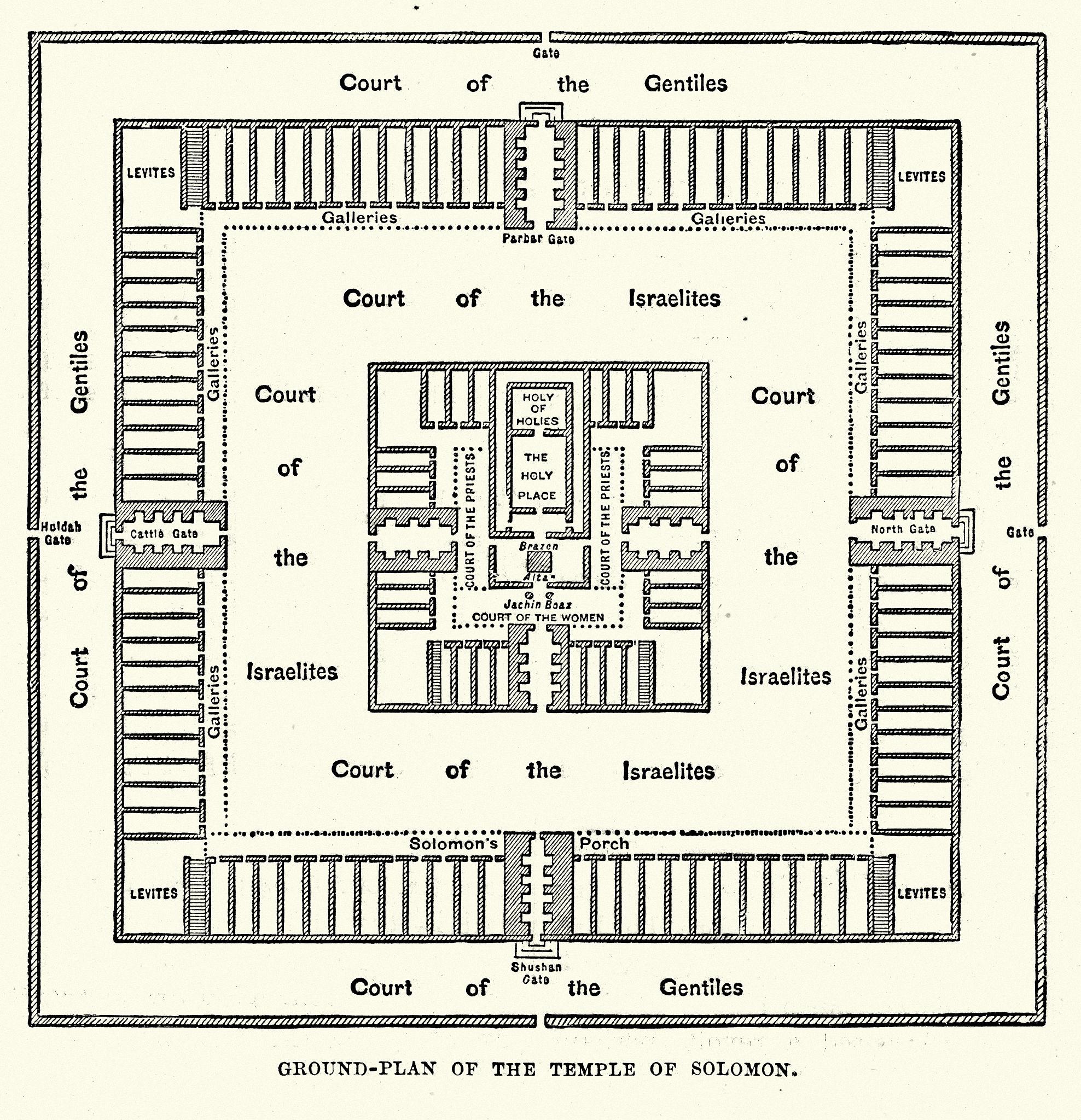
LIFTING EYES TO HEAVENS
FOR THE WRONG REASON!
For he built altars (mizbeah; LXX - thusiasterion - structure on which cultic observances are carried out) for all the host (tsaba; LXX - dunamis - power) of heaven in the two courts of the house of the LORD - There are actually 3 courts in the diagram above. Presumably the altars were in the two inner courts. Manasseh’s sin was that he brazenly, foolishly brought idolatry into the Temple of the Lord. Unholy objects profaned the Holy God. Multiple altars in effect made Jehovah just one "god" among many others! So much for Manasseh's monotheism!
Spurgeon - One form of idolatry was not enough for him; he must have all forms of it, even rearing altars to Baal, and making the stars also to be his gods. These high places were at first built for the worship of God, the true God; but then the law of Jehovah was that there should be only one altar, namely, that at Jerusalem. This was not Popery, but Ritualism; it was adding something to the simple worship of God, and therefore it was wrong. He who goes a little way in sin will soon go a long way. It is always a mercy to stop where you ought to stop, and not begin going down. Hezekiah had broken down the high places, and his son Manasseh rebuilt them. He not only worshipped them, but he served them; he threw his whole strength into the propagation of this form of idolatry. They who build altars to God, contrary to the Lord’s law, will soon have false gods. First, men set up images to remind them of the true God; and then they go off to the worship of the idols, or false gods. Oh, that we may have grace to make no similitude of the Lord, and to set up nothing contrary to the simple teaching of the Word of God!
All the host (tsaba; LXX - dunamis - power) of heaven is not simple "star gazing" but refers to "idol gazing" at the celestial bodies, the sun, moon, stars, and planets, that many ancient peoples worshiped as gods or spiritual beings. In the ancient Near Eastern context, these hosts were often associated with pagan deities or spiritual powers believed to control the heavens. However, in biblical theology, these heavenly bodies are not divine; they are part of God’s creation, meant to declare His glory, not to receive worship. Psalm 19:1 affirms, “The heavens declare the glory of God, and the sky above proclaims his handiwork.”
Manasseh’s sin turned from worshiping the Creator to worshiping created things. This was a direct violation of the first and second commandments, which forbid having other gods and making idols (Ex 20:3–4). Dt 4:19 warned Israel not to “lift up your eyes to heaven, and when you see the sun and the moon and the stars, all the host of heaven, be drawn away and bow down to them and serve them.” Clearly Manasseh failed to read and/or keep the instructions written specifically to the kings in Dt 17:18-20. By building altars to the host of heaven within the temple courts, Manasseh desecrated the very place God had chosen for His name to dwell.
Manasseh and Judah lifted their eyes to the heavens for the wrong reason. Isaiah (a prophet in Manasseh's day) explained the proper way to "LOOK UP" writing “Lift up your eyes on high and see: who created these? He who brings out their host by number, calling them all by name.” (Isaiah 40:26) The stars and heavenly bodies are not dead gods to be worshiped but creations that testify to the power and majesty of the one true Living God.
One should also be aware that while the host of heaven in 2 Kings 21:5 primarily refers to the celestial bodies worshiped as gods, Scripture reveals that such worship is not spiritually neutral, but it is energized by demonic deception. The Septuagint’s use of dunamis (“powers”) opens a deeper theological dimension. In Greek, dunamis can refer not only to physical forces but also to spiritual beings, angelic or demonic powers. This aligns with the broader biblical worldview that behind idolatry there are real spiritual entities at work. Dt 32:17 clarifies that when Israel sacrificed to idols, they were in fact sacrificing “to demons that were no gods.” (cf 1Co 10:20). This understanding harmonizes with Ephesians 6:12+, which describes our struggle as being “not against flesh and blood, but against the rulers, against the powers, against the world forces of this darkness, against the spiritual forces of wickedness in the heavenly places." It follows that instead of worshiping the one, true, living God, Manasseh in effect introduced worship of demons!
Related Resources:
- Wikipedia article Worship of heavenly bodies - Excerpt - The worship of heavenly bodies is the veneration of stars (individually or together as the night sky), the planets, or other astronomical objects as deities, or the association of deities with heavenly bodies. In anthropological literature these systems of practice may be referred to as astral cults. The most notable instances of this are sun gods and moon gods in polytheistic systems worldwide. Also notable are the associations of the planets with deities in Sumerian religion, and hence in Babylonian, Greek and Roman religion, viz. Mercury, Venus, Mars, Jupiter, and Saturn. Gods, goddesses, and demons may also be considered personifications of astronomical phenomena such as lunar eclipses, planetary alignments, and apparent interactions of planetary bodies with stars. The Sabians of Harran, a poorly understood pagan religion that existed in Harran during the early Islamic period (7th–10th century), were known for their astral cult.
2 Kings 21:6 He made his son pass through the fire, practiced witchcraft and used divination, and dealt with mediums and spiritists. He did much evil in the sight of the LORD provoking Him to anger.
- he made: 2Ki 16:3 17:17 Lev 18:21 20:2,3 2Ch 28:3 33:6 Mic 6:7
- practiced witchcraft : Lev 19:26,31 De 18:10-14
- familiar: 1Ch 10:13 Isa 8:19 19:3 Ac 16:16
- wrought: 2Ki 24:3,4 Ge 13:13
- 2 Kings 21 Resources
Related Passages:
2 Chronicles 33:6 He made his sons pass through the fire in the valley of Ben-hinnom; and he practiced witchcraft, used divination, practiced sorcery and dealt with mediums and spiritists. He did much evil in the sight of the LORD, provoking Him to anger.
Leviticus 18:21 ‘You shall not give any of your offspring to offer them to Molech, nor shall you profane the name of your God; I am the LORD.
Leviticus 20:2 “You shall also say to the sons of Israel: ‘Any man from the sons of Israel or from the aliens sojourning in Israel who gives any of his offspring to Molech, shall surely be put to death; the people of the land shall stone him with stones.
2 Kings 16:3 But he walked in the way of the kings of Israel, and even made his son pass through the fire, according to the abominations of the nations whom the LORD had driven out from before the sons of Israel.
2 Kings 17:17 Then they made their sons and their daughters pass through the fire, and practiced divination and enchantments, and sold themselves to do evil in the sight of the LORD, provoking Him.
1 Chronicles 10:13 So Saul died for his trespass which he committed against the LORD, because of the word of the LORD which he did not keep; and also because he asked counsel of a medium, making inquiry of it,
Isaiah 8:19 When they say to you, “Consult the mediums and the spiritists who whisper and mutter,” should not a people consult their God? Should they consult the dead on behalf of the living?
Isaiah 19:3 “Then the spirit of the Egyptians will be demoralized within them; And I will confound their strategy, So that they will resort to idols and ghosts of the dead And to mediums and spiritists.
Leviticus 19:26 ‘You shall not eat anything with the blood, nor practice divination or soothsaying.
Deuteronomy 18:10 “There shall not be found among you anyone who makes his son or his daughter pass through the fire, one who uses divination, one who practices witchcraft, or one who interprets omens, or a sorcerer, 11 or one who casts a spell, or a medium, or a spiritist, or one who calls up the dead.
MANASSEH'S HORRID LIST OF
EVILS PROVOKING GOD'S ANGER
He made his son pass through the fire (Lv18:21; 20:2; 2Ki16:3; 17:17) - Note the LXX has plural "his sons"! Manasseh, despite his godly father, Hezekiah, soon took up the abominable practices of his grandfather Ahaz and the kings of Israel (2Ki16:3; 17:17). His father died when he was only 12 years old (2Ki 22:1) and may have devoted little time to Manasseh's religious instruction (although that is speculation). Nothing is known about his mother except her name, which means "My delight is in her."
Psalm 106:37-38 They even sacrificed their sons and their daughters to the demons, 38 And shed innocent blood, The blood of their sons and their daughters, Whom they sacrificed to the idols of Canaan; And the land was polluted with the blood.
Manasseh shed much "innocent blood" (2Ki 21:16) and according to Jewish tradition, this may even have included the prophet Isaiah, who was may have been "sawn in two" (Heb 11:37).
Bob Utley - He made his son pass through the fire" This was the worship of the fertility god Molech (cf. Lev. 18:21; 2 Kgs. 16:3; 17:17). This was a Phoenician fire god that the Canaanites adopted. The oldest son was burned to this god (the LXX has "sons"). This was done in the valley outside of Jerusalem to insure the fertility of crops, herds, and humans. It is the place Jesus called Gehenna. It became the garbage dump for Jerusalem. See MOLECH; GEHENNA
Practiced witchcraft (ʿānan) and used divination (nachash), and dealt with mediums (ob/ov) and spiritists (yiddeoni) - When Manasseh practiced witchcraft, divination, and consulted mediums and spiritists, he was not merely engaging in forbidden rituals—he was aligning himself and his nation with demonic powers in direct defiance of God’s revealed will. This passage reveals the depth of his rebellion against God and his complete embrace of occult practices that God had explicitly forbidden. Each of these terms—witchcraft, divination, mediums, and spiritists—refers to attempts to access supernatural knowledge or power apart from God, often by invoking demonic forces.
David Guzik - Manasseh invited direct Satanic influence by his approval and introduction of these occult arts.
In the Law of Moses, such practices were strictly prohibited because they represented a direct rejection of God’s authority and a turning toward the powers of darkness. Deuteronomy 18:10–12 states,
There shall not be found among you anyone who makes his son or his daughter pass through the fire, one who uses divination, one who practices witchcraft, or one who interprets omens, or a sorcerer, 11 or one who casts a spell, or a medium, or a spiritist, or one who calls up the dead. 12 “For whoever does these things is detestable to the LORD; and because of these detestable things the LORD your God will drive them out before you.
These practices were not merely superstitious; they were spiritual acts of rebellion that sought guidance and power from sources other than the living God. As noted earlier, Manasseh failed to read and/or obey Dt 17:18-20.
Now it shall come about when he sits on the throne of his kingdom, he shall write for himself a copy of this law on a scroll in the presence of the Levitical priests. 19 “It shall be with him and he shall read it all the days of his life, that he may learn to fear the LORD his God, by carefully observing all the words of this law and these statutes, 20 that his heart may not be lifted up above his countrymen and that he may not turn aside from the commandment, to the right or the left, so that he and his sons may continue long in his kingdom in the midst of Israel.
To practice witchcraft refers to using spells, charms, or rituals to manipulate spiritual forces. Divination involves attempting to predict the future or uncover hidden knowledge through omens, objects, or supernatural means. Mediums and spiritists were individuals who claimed to communicate with the dead or with spirits to gain insight or power. In reality, these practices opened people to demonic influence, as seen in the story of Saul consulting the medium at Endor in 1 Samuel 28:7-21, which led to his downfall.
NET translation - He passed his son through the fire and practiced divination and omen reading. He set up a ritual pit to conjure up underworld spirits, and appointed magicians to supervise it. He did a great amount of evil in the sight of the LORD, provoking him to anger. (2Ki 21:6NET)
NET NOTE - Heb “and he set up a ritual pit, along with conjurers.” The Hebrew אוֹב (’ov), “ritual pit,” refers to a pit used by a magician to conjure up underworld spirits. In 1 Sam 28:7 the witch of Endor is called a בַעֲלַת אוֹב (ba’alat ’ov), “owner of a ritual pit.” See H. Hoffner, “Second millennium Antecedents to the Hebrew ’ÔB̲,” JBL 86 (1967), 385–401.
He did much evil in the sight of the LORD provoking Him to anger (kāas; LXX - parorgizo) - What a way to summarize the moral and spiritual depravity of King Manasseh’s reign. Not just did he do evil which would have been bad enough, but the writer says he did MUCH evil and he did this cornucopia of evil in FULL VIEW of God's holy vision! Manasseh's evil actions were not merely wrong by human standards but were offensive to the holy and righteous character of God, Who sees all things. Proverbs 15:3 reminds us "The eyes of the LORD are in every place, Watching the EVIL and the good."
Manasseh’s MUCH EVIL was of course personal sin but personal sin especially by a king had public consequences. Sin never stays private, which is a good reminder to ALL of us! (Nu 32:23). Manasseh's MUCH EVIL was not accidental, isolated, or momentary, but instead organized, and intentionally carried out over time. His MUCH EVIL was carried out willfully, knowingly, and with evil purpose and persistence, underscoring the culpability and gravity of his deeds. His evil acts were not only violations of God’s law but also direct rejections of His covenant love and faithfulness.
Andrew Hill: The specific catalog of abominations promoted by Manasseh as “alternative religion” for the kingdom of Judah invites comparison with the Mosaic prohibitions against false worship (Deut. 16:21 – 17:7; 18:9-13). Among the taboos borrowed wholesale form Canaanite culture are idolatry associated with the fertility cult deities Asherah and Baal, astral worship, infanticide, and the occult (2 Chron. 33:3-6). According to 2 Kings 17:7-13, 16-20, these are the very sins that incited God’s wrath against the northern kingdom of Israel and brought about the Assyrian exile. Note too how centuries earlier the theocratic kingdom of Israel under Joshua’s leadership waged war against the indigenous populations of Canaan as divine judgment for the same list of abominations (Lev. 18:24-28). The narrative in 2 Kings 24:3-4 ascribes blame directly to King Manasseh for the Babylonian exile of the southern kingdom. Like matter reaching an irreversible energy state of critical mass in the science of physics, the course charted by the political and religious policies of Manasseh lead irrevocably to the Exile. (See 1 and 2 Chronicles - Page 18)
The phrase provoking Him to anger (kāas; LXX - parorgizo) does not mean that God’s anger is impulsive or uncontrolled like human anger. Rather, it expresses His righteous and holy indignation and response to sin and rebellion, and in this case to MUCH EVIL. God’s anger is the expression of His justice and His deep opposition to all that destroys His creation and defiles His holy Name. Psalm 7:11 declares, “God is a righteous judge, and a God who feels indignation every day.”
Witchcraft (06049) ʿānan A verb meaning to practice soothsaying, fortune-telling, divining, magic. While it is clear from the contexts and the versions that this term is used for some type of magic or witchcraft, its etymology is unclear. Therefore, the specifics of the practice it connotes are equally unclear. However, it is clear that it was strictly forbidden, and the one who practiced this act was detestable to God (Deut. 18:10, 12). Isaiah appears to use the term figuratively to demean the idolatrous Israelites (Isa. 57:3). (Word Study OT) Swanson adds "practice sorcery, practice divination, i.e., the foretelling of future events by means of magic or casting spells, with possibly a focus of conjuring dead human or supernatural spirits to appear before the living." The remaining nine occurrences describe an act of magic or the performers of the act. They are found in passages of warning (Lev. 19:26; Deut. 18:10) and judgment (Isa. 2:6; 57:3). Yahweh warned his people to separate themselves from the practices of the nations around them because sorcerers and sorcery would lead his people to disobey Him (Jer. 27:9). Indeed, Manasseh is described as doing "much evil in the sight of the Lord, provoking him to anger" (2 Ki. 21:6, NRSV) because of his reliance on soothsaying. Micah prophecied about a day when no more sorcerers could trouble God's people. On that day, God will destroy the heathen and the heathen practices (Mic. 5:11-15). (Complete Biblical Library)
Guzik -- There is a modern revival of witchcraft, or Wicca, and many people claim that “white” witchcraft (as opposed to “black” witchcraft) is a use of spiritual powers for good, as well as being a more feminist, ecology-friendly understanding of god and spirituality. But whether a witch claims to be “white” or “black,” they are still using occultic powers.
Some claim that white, or “right hand path” witches are in the majority today. They worship elements and nature deities, the “Mother Goddess,” Gaia, Ashtarte, Isis, Osiris, and a host of other names for the Goddess. Characteristically they are active in “Saving the earth” activities, due to the fact that they are pantheists (those who believe the divine life force is in everything: ever see the bumper sticker picturing a globe bearing the legend “Love Your Mother”?). They deny the existence of Satan, calling him an invention of the Christian Church. They claim to use their powers (and they do have powers) for good: sending healing energies to the sick, affirmations which bring prosperity, and loudly proclaiming their creed, “As it harm none, do as thou wilt.” It’s ironic how their creed sounds so similar to that of a man who referred to himself as “The Beast, 666”—Satanist Aleister Crowley, who wrote, “Do as thou wilt shall be the whole of the Law.”
Of course, there are black, or “left hand path,” witches. These are witches who originally were into white witchcraft, and got hungry for more power. As their teachers noticed this power lust, they were taken aside and told, “You are now ready to go after the higher power, and there is only one way to achieve this power. Satan is its source.” Thus comes the white witch’s abrupt surprise: either give up your witchly ambitions, or go for the higher power. The bottom line is that the power behind all kinds of witchcraft is Satan. He is the author of all deception, and all rebellion. To practice or approve of witchcraft is to serve Satan.
And this Satanic power kills. Ronald Baker was a 21 year old student at UCLA, and was found stabbed to death at the mouth of a railroad tunnel in the rocky hills above Chatsworth Park. Police first thought the mangled body was of a transient hit by a train; but they then found an occult connection in Baker’s death. The killing took place on the night of the summer solstice, and the tunnel near the park is known to police as a gathering place for devotees of the occult. Baker was involved with Wicca (described as “benevolent witchcraft”), often wore a pentagram pendant, and belonged to a UCLA metaphysical group known as Mystic Circle (from a July 1990 news article).
Some who call themselves Christians are buying into this deception. Take the case of a woman who calls herself Starhawk, who is a practitioner of Wicca—a witch. She first learned about Wicca at an anthropology course at UCLA when she was 17, and she took the name Starhawk in 1975 when it came to her in a dream. After a master’s degree in psychology, she began teaching at universities. She is a licensed minister of the Covenant of the Goddess and performs marriages and other ceremonies. She views the earth as a sensitive, living organism which she calls “the Goddess.” Mary Elizabeth Moore of the Claremont School of Theology said of Starhawk: “Many Christians, especially women and others who are trying to reclaim creation-centered theology, find her work to be compatible with, or at least adaptable to, Christian teaching.” Starhawk was scheduled to speak at the First Christian Church in Santa Monica on a Friday evening (from a June, 1993 news article). (Enduring Word Commentary)
What does the Bible say about witchcraft / witches? - GotQuestions.org WATCH VIDEO
ANSWER - The Bible has a lot to say about witchcraft. Witchcraft and its many cousins, such as fortune-telling and necromancy, are Satan’s counterfeits to holy spirituality. The Bible expressly condemns all forms of witchcraft.
Since early times, people have sought supernatural experiences God did not endorse. The nations that surrounded the Promised Land were saturated with such practices, and God had stern words for His people concerning any involvement with them. Deuteronomy 18:9–12 says, “When you enter the land the Lord your God is giving you, do not learn to imitate the detestable ways of the nations there. Let no one be found among you who sacrifices their son or daughter in the fire, who practices divination or sorcery, interprets omens, engages in witchcraft, or casts spells, or who is a medium or spiritist or who consults the dead. Anyone who does these things is detestable to the Lord.”
God takes witchcraft very seriously. The penalty for practicing witchcraft under the Mosaic Law was death (Exodus 22:18; Leviticus 20:27). First Chronicles 10:13 tells us that “Saul died because he was unfaithful to the Lord; he did not keep the word of the Lord and even consulted a medium for guidance.” In the New Testament, “sorcery” is translated from the Greek word pharmakeia, from which we get our word pharmacy (Galatians 5:20; Revelation 18:23). Witchcraft and spiritism often involve the ritualistic use of magic potions and mind-controlling drugs. Using illicit drugs can open ourselves up to the invasion of demonic spirits. Engaging in a practice or taking a substance to achieve an altered state of consciousness is a form of witchcraft.
There are only two sources of spiritual power: God and Satan. Satan has only the power that God allows him to have, but it is considerable (Job 1:12; 2 Corinthians 4:4; Revelation 20:2). To seek spirituality, knowledge, or power apart from God is idolatry, closely related to witchcraft. First Samuel 15:23 says, “For rebellion is as the sin of witchcraft, and stubbornness is as iniquity and idolatry.” Witchcraft is Satan’s realm, and he excels in counterfeiting what God does. When Moses performed miracles before Pharaoh, the magicians did the same things through demonic power (Exodus 8:7). At the heart of witchcraft is the desire to know the future and control events that are not ours to control. Those abilities belong only to the Lord. This desire has its roots in Satan’s first temptation to Eve: “You can be like God” (Genesis 3:5).
Since the Garden of Eden, Satan’s major focus has been to divert human hearts away from worship of the true God (Genesis 3:1). He entices humans with the suggestions of power, self-realization, and spiritual enlightenment apart from submission to the Lord God. Witchcraft is merely another branch of that enticement. To become involved in witchcraft in any way is to enter Satan’s realm. Seemingly “harmless” modern entanglements with witchcraft can include horoscopes, Ouija boards, Eastern meditation rituals, and some video and role-playing games. Any practice that dabbles in a power source other than the Lord Jesus Christ is witchcraft. Revelation 22:15 includes witches in a list of those who will not inherit eternal life: “Outside are the dogs, those who practice magic arts, the sexually immoral, the murderers, the idolaters and everyone who loves and practices falsehood.”
We don’t need to fear Satan’s power, but we should acknowledge it and stay away from it. First John 4:4 says, “Greater is He who is in you, than he who is in the world.” Satan can create much havoc, harm, and destruction, even in the lives of believers (1 Thessalonians 2:18; Job 1:12–18; 1 Corinthians 5:5). However, if we belong to the Lord Jesus Christ, there is no power that can ultimately defeat us (Isaiah 54:17). We are overcomers (1 John 5:4) as we “put on the whole armor of God so that you can take your stand against the devil’s schemes” (Ephesians 6:11). When we give our lives to Christ, we must repent. This repentance should include renouncing any involvement with witchcraft, following the example of the early believers in Acts 19:19.
Isaiah 8:19 says, “When someone tells you to consult mediums and spiritists, who whisper and mutter, should not a people inquire of their God? Why consult the dead on behalf of the living?” When we follow those words to their logical conclusion, we could also ask, “Why seek any power apart from the source of all real power? Why seek spirits who are not the Holy Spirit?” Witchcraft and its many counterparts promise spirituality but lead only to emptiness and death (Micah 5:12; Galatians 5:19–21). Only Jesus has the words of life (John 6:68).
Divination (05172) nachash not to be confused with Hebrew word for serpent nachash = "Because of the similarity of nacḥash to nācḥāsh meaning "snake," some make a connection to snake charming. More contend that there is a similarity of hissing sounds between enchanters and serpents and hence the similarity of words." - TWOT) means to practice divination, observe signs and is only in the Piel intensive stem. First use of Laban to Jacob " I have divined that the LORD has blessed me on your account.” (Ge 30:27). "Both in Genesis 44:5, 15 the doubly intensive form (infinitive absolute plus finite verb) occurs. There we learn that Joseph claimed for his brothers' benefit that he could "divine" with a special cup and so knew secret things such as that his brothers, still unaware of who he was, had his cup in their possession. But divination is outlawed in Leviticus 19:26 and is spoken of with condemnation in 2 Kings 17:17 and 2 Kings 21:6 (cf. 2 Chron. 33:6). It is in the list of forbidden occult practices of Deut. 18:10. (TWOT)
Gilbrant - The practice of divination was widespread throughout the ancient Near East. Omens were taken before attempting a wide variety of significant events, such as engaging in warfare or building projects. Further, omens were used at Mari as a check against individuals who made claims that a god was communicating through them. Omens stem from observation of the natural world with the assumption that anything which deviates from the natural order does so under the influence of the divine realm as a means of communication. Unusual events in the political order could be tied to unusual events in the natural order, the subject of omens. An unusual sheep liver, discovered in the course of ritual sacrifice, was understood by the peoples surrounding the Israelites as the announcement of a coming event. There existed long lists of the significance of particular omens in Akkadian literature, and a number of liver models (for learning divination) have been discovered throughout Mesopotamia and Syria-Palestine. Though an integral part of other ancient societies, the practice was banned among the ancient Israelites, who were to communicate legitimately with God through prayer and prophetic utterances (Lev. 19:26; Deut. 18:10). One of the causes for the captivity of the northern tribes was the practice of divination (2 Ki. 17:17). Among his many other occultic practices, King Manasseh likewise was guilty of practicing divination (2 Ki. 21:6; 2 Chr. 33:6). Laban divined that the Lord had blessed him because of Jacob (Gen. 30:27). Joseph gave the impression that he practiced divination with the cup he had hid in Benjamin's saddlebag (Gen. 44:5, 15). When king Ahab defeated the Syrian army, the officers of Ben-Hadad, the king of Syria, carefully watched Ahab for an omen of mercy (1 Ki. 20:33) and interpreted Ahab's use of the term "brother" as a good sign; on the basis of this sign, they negotiated a favorable peace treaty with Ahab. (Complete Biblical Library)
What does the Bible say about divination? - GotQuestions.org - The word divination comes from the Latin divinare, meaning “to foresee” or “to be inspired by a god.” To practice divination is to uncover hidden knowledge by supernatural means. It is associated with the occult and involves fortune-telling or soothsaying, as it used to be called.
From ancient times, people have used divination to gain knowledge of the future or as a way to make money. The practice continues as those who claim supernatural insight read palms, tea leaves, tarot cards, star charts, and more.
God tells us His view of divination in Deuteronomy 18:10: “There shall not be found among you . . . anyone who practices divination or tells fortunes or interprets omens” (ESV). First Samuel 15:23 compares rebellion to the “sin of divination.”
Practicing divination is listed as one of the reasons for Israel’s exile (2 Kings 17:17). Jeremiah 14:14 spoke of the false prophets of the time, saying, “They are prophesying to you a lying vision, worthless divination, and the deceit of their own minds” (ESV). So, compared to God’s truth, divination is false, deceitful, and worthless.
As Luke traveled with Paul and Silas in the city of Philippi, he recorded an encounter with a diviner: “We were met by a slave girl who had a spirit of divination and brought her owners much gain by fortune-telling” (Acts 16:16, ESV). The girl’s ability to penetrate mysteries was due to a demon that controlled her. Her masters received “much gain” from their slave. Paul eventually exorcised the demon (verse 18), freeing the girl from her spiritual bondage and angering the slave owners (verse 19).
Divination in any form is sin. It is not harmless entertainment or an alternate source of wisdom. Christians should avoid any practice related to divination, including fortune-telling, astrology, witchcraft, tarot cards, necromancy, and spell-casting. The spirit world is real, but it is not innocent. According to Scripture, those spirits that are not the Holy Spirit or angels are evil spirits.
Christians need not fear the spirits involved in divination; neither are Christians to seek wisdom from them. The Christian’s wisdom comes from God (James 1:5).
DIVINATION SUMMARY FROM BIBLE DICTIONARIES - Divination in Scripture is the deliberate attempt to obtain hidden knowledge—especially concerning the future or secret matters—through means God has expressly forbidden, and it is consistently associated with false religion, idolatry, and rebellion against divine authority. Moses warned Israel that divination, sorcery, necromancy, and consultation with spirits were practices of the pagan nations and therefore “detestable to the LORD” (Deuteronomy 18:9–12). Throughout the Old Testament, divination appears among false prophets (Deuteronomy 18:10, 14; Micah 3:6–7, 11), necromancers (1 Samuel 28:8), Philistine diviners (1 Samuel 6:2), and figures such as Balaam, whose divinatory vocation is explicitly named even while God sovereignly overruled his intentions (Joshua 13:22). Ezekiel catalogues specific techniques—divining by arrows, consulting teraphim, and examining animal entrails—showing how widespread and systematized these practices were in the ancient world (Ezekiel 21:21). Israel’s later history reveals how deeply these superstitions infiltrated the nation, especially through foreign influence from Egypt, Canaan, Chaldea, and Arabia (Isaiah 2:6; 8:19; 2 Kings 21:6; 2 Chronicles 33:6), culminating in a culture where occult practitioners multiplied and deception flourished (Acts 19:13; 2 Timothy 3:13).
The fundamental assumption behind divination is theological: that supernatural knowledge can be accessed apart from submission to the living God. Scripture exposes this as both spiritually deceptive and morally corrosive. Moses forbade every form of divination because it fostered superstition, undermined trust in God, and functioned as an incentive to idolatry (Deuteronomy 18:10–11). This is why rebellion itself is likened to divination—both assert human autonomy over divine rule (1 Samuel 15:23). False divination often masquerades as wisdom or enlightenment, yet the prophets condemn it as empty fraud: “Your prophets have seen for you false and deceptive visions” (Lamentations 2:14; cf. Jeremiah 23:16, 32). By the time of the apostles, divination had become a lucrative enterprise amid widespread skepticism, producing figures such as Simon Magus (Acts 8:9), Bar-Jesus (Acts 13:6–8), and the slave girl with a spirit of divination (Acts 16:16), all of whom exemplify how occult power enslaves rather than enlightens. Scripture is unambiguous: those who persist in such practices place themselves under divine judgment (Galatians 5:19–21; Revelation 19:20).
Yet the Bible carefully distinguishes illicit divination from God’s own sovereign revelation. When God chose to disclose His will, He did so by means He Himself appointed, never as techniques to be manipulated. At times this included casting lots in solemn dependence upon Him (Joshua 7:16–19; Numbers 26:55–56; Acts 1:26), revelatory dreams given by divine initiative (Genesis 41:25–32; Judges 7:13–15; Daniel 2:27; Matthew 2:12), priestly inquiry through the Urim and Thummim (Numbers 27:21), and direct communication from the Lord’s presence (Exodus 25:22; Deuteronomy 34:10). Supremely, God revealed His will through His prophets, who spoke not for profit or manipulation, but under divine commission, often at great personal cost (2 Kings 13:17; Jeremiah 51:63–64).
The contrast is decisive: divination seeks knowledge without obedience, power without submission, and certainty without faith, whereas biblical revelation calls God’s people to trust the Lord alone, receive His word on His terms, and walk humbly before Him as the sole source of truth and life.
Mediums (0178) ob/ov means a bottle (made from animal skin), a necromancer. "masculine noun meaning a conjured spirit, a medium or necromancer; or a leather bottle. The primary use of the word is connected to the occult practice of necromancy or consulting the dead. It is used to signify a conjurer who professes to call up the dead by means of magic, especially to give revelation about future uncertainties (1 Sam. 28:7; Isa. 8:19); a man or woman who has a familiar spirit (Lev. 20:27; 1 Chr. 10:13; Isa. 29:4); the conjured spirit itself, particularly when speaking through the medium (1 Sam. 28:8; 2 Kgs 21:6; 2 Chr. 33:6). The Israelites were strictly forbidden from engaging in such practices or consulting mediums (Lev. 19:31; Deut. 18:10-12). Interestingly, the word is used once to signify a leather bottle that may burst under pressure (Job 32:19). There is no convincing evidence that this particular reference has any occult connotations. Rather, the connection between the two divergent meanings of this Hebrew word is probably that a medium was seen as a "container" for a conjured spirit." (Baker)
Gilbrant - This word is translated "spirit of the dead" or "necromancer." It occurs 17 times in the Hebrew Bible. Eleven of these times it occurs in conjunction with the noun yiddeʾōnî, and is commonly translated as "wizard" or "soothsayer." The precise meaning and function of the latter term is not certain. Since the former is feminine and the latter is masculine, many assume that the two are gender determined labels for the same role. In the OT, ʾôv can refer to the spirit of a dead person (1 Sam. 28:8; Isa. 29:4; 1 Sam. 28:8). A medium can possess a spirit (Lev. 20:27; 1 Sam. 28:7). Generally, an ʾôv is simply a medium (e.g., Lev. 19:31; 20:6; 1 Sam. 28:3). The practice of necromancy is prohibited by Mosaic Law, subject to the death penalty (Lev. 20:27; Deut. 18:11). Saul prohibits necromancy under the penalty of death, though he employs it himself in hopes of uncovering what the future holds (1 Samuel 28). To the surprise of the medium, Saul does encounter the ʾôv of Samuel, who brings a curse from Yahweh. (Complete Biblical Library)
OB/OV - 15V - Lev. 19:31; Lev. 20:6; Lev. 20:27; Deut. 18:11; 1 Sam. 28:3; 1 Sam. 28:7; 1 Sam. 28:9; 2 Ki. 21:6; 2 Ki. 23:24; 1 Chr. 10:13; 2 Chr. 33:6; Job 32:19; Isa. 8:19; Isa. 19:3; Isa. 29:4
What is a medium? - GotQuestions.org In both modern and ancient times, a medium is a person who communicates with spirits, usually apart from the use of witchcraft. A medium is, literally, an “intermediary” between the spirit world and ours. The Bible condemns the practice of mediumship, and attempting to speak to the dead, through séances or other means, is expressly forbidden.
Sometimes mediums are called “channelers,” as they allegedly “channel” communication from the dead to the living. A medium might only communicate with one or more specific spirits (called “familiars” or “familiar spirits”), or the communication may be spread across many different spirits. The messages may come audibly, visually, or through physical sensations. Modern mediums distinguish themselves from psychics, who only read the “energies” of a person or place and do not communicate with actual spirits. (The term “psychic medium” can confuse the issue.) Also, a medium is not necessarily a witch, wizard, sorcerer, or necromancer, since mediums believe that their communication with the spirit world is an inherent ability. The fictional character Cole Sear in the movie The Sixth Sense would be considered a medium.
Mediums are referenced in several passages of the Old Testament. In Leviticus 20:27 mediums are condemned along with “spiritists.” Deuteronomy 18:10–11 echoes Leviticus and expands it, including diviners, sorcerers, witches/wizards, anyone who casts spells, and anyone who practices child sacrifice.
King Saul’s sinful use of a medium is recorded in 1 Samuel 28. The prophet Samuel was dead, and King Saul was frustrated that God had ceased telling him what to do through prophets or dreams. So the king, in direct violation of God’s Law and his own previous command, told his men to find a medium who could communicate with Samuel (1 Samuel 28:3). This medium conjured Samuel, and Saul communicated with the dead prophet. Theologians discuss whether this conjuring was a physical reappearance of Samuel or merely an image of him. There is also some question whether or not the medium actually meant to conjure Samuel, as she seems to have been the most surprised at his appearance—“When the woman saw Samuel, she cried out at the top of her voice” (verse 12). Perhaps she was a fraud who did not expect to actually see a spirit, or perhaps she was expecting to communicate with her “familiar” and not with Samuel directly. Either way, God seems to have allowed Samuel’s conjuring in order to drive home His point to Saul. The prophet’s message to Saul was one of doom (verses 17–19), and he died the next day. First Chronicles 10:13–14 reveals that Saul’s interaction with the medium was an important part of why he was dethroned and his dynasty cut short.
In the New Testament, sorcery and other associated practices are considered inappropriate, sinful activities for any Christian (Acts 8:9ff and 19:19). Since the primary purpose of these activities is to communicate with spirits, it is correct to include mediumship in these New Testament warnings.
It should be noted that the spirit a medium conjures is not the spirit of a deceased person (the case of Samuel speaking to Saul was a rare exception). Jesus’ story of the rich man and Lazarus in Luke 16:18–31 gives strong evidence that, once a person is dead, his soul remains in either heaven or hell. Thus, the spirits who communicate with mediums are lying spirits (see 1 Kings 22:23) who deceive people into believing their lost loved ones are communicating to them. When grieving parents seek out a medium to put them in touch with their dead child, they don’t realize the spirit who speaks to them is actually a demon pretending to be their child. Any involvement with such practices, including asking mediums for guidance, is strongly warned against in the Bible.
Related Resources from Gotquestions.org
- What are Ouija boards? Should a Christian play with Ouija boards?
- What is a séance?
- What does the Bible say about an out of body experience / astral projection?
- What does the Bible say about channeling?
- What are familiar spirits? - GotQuestions.org
- What does the Bible say about palm reading?
- What is the Christian view of psychics / fortune tellers?
Spiritists (03049)(yiddeoni from yada = to know) is noun which refers to one who knows and communicates with the unseen world. "A masculine noun meaning a familiar spirit, a conjurer, and a wizard. In Levitical Law, this type of person was considered an abomination to the Lord (Deut. 18:11). King Saul consulted such a medium when he desired to know the outcome of his war against the Philistines (1 Sam. 28:9). King Manasseh's evil deeds included the practice of consulting mediums and wizards (2 Ki. 21:6). Isaiah condemned the people of Israel for turning to the way of the Canaanites, who sought out mediums and wizards in order to hear from their dead (Isa. 8:19)." (Baker)
TWOT - yidde‘ōnî. Since the root of yidde‘ōnî is the verb yādaʿ "to know," implied in the title, therefore, is esoteric knowledge not available to the ordinary person. yidde‘ōnî always occurs parallel to ʾôb (witch, q.v.). It may be a description of an ʾôb or it may be the masculine counterpart. (Similarly, "witch" and "wizard" are a feminine and masculine pair in English.) As the Hebrew word yidde‘ōnî is related to knowledge, so the English word "wizard" is related to wisdom. God forbad his people to consult the yidde‘ōnī (Leviticus 19:31; Leviticus 20:6, 27; Deut. 18:11) as well as other diviners. Despite the fact that Saul outlawed them, he still consulted an ʾôb "spirit" according to 1 Samuel 28. How the Israelite kings dealt with these spiritists was a significant factor in characterizing the king as good or evil (2 Kings 21:6; 2 Kings 23:24; 2 Chron. 33:6). Isaiah spoke of them with utter scorn (Isaiah 8:19; Isaiah 19:3). (Theological Wordbook of the Old Testament - TWOT ONLINE)
2 Kings 21:7 Then he set the carved image of Asherah that he had made, in the house of which the LORD said to David and to his son Solomon, “In this house and in Jerusalem, which I have chosen from all the tribes of Israel, I will put My name forever.
- Then he set the carved image of Asherah 2Ki 23:6 2Ch 33:7,15
- In this house: 2Ki 21:4 23:27 2Sa 7:13 1Ki 8:29,44 9:3,7 2Ch 7:12,16,20 Ne 1:9 Ps 74:2 78:68,69 132:13,14 Jer 32:34
- 2 Kings 21 Resources
Related Passages:
2 Chronicles 33:7 Then he put the carved image of the idol which he had made in the house of God, of which God had said to David and to Solomon his son, “In this house and in Jerusalem, which I have chosen from all the tribes of Israel, I will put My name forever;
Exodus 20:3-4 “You shall have no other gods before Me. 4“You shall not make for yourself an idol, or any likeness of what is in heaven above or on the earth beneath or in the water under the earth.
Deuteronomy 12:5 But you shall seek the LORD at the place which the LORD your God will choose from all your tribes, to establish His name there for His dwelling, and there you shall come.
AN UNIVITED GUEST
IN GOD'S HOUSE!
Then - This word normally marks progression in a narrative, but in this case it marks continuation of a spiritual downward spiral as Manasseh breaks the first commandment in this passage!
He set the carved image of Asherah (Asherah - female consort of Baal) that he had made - 2Ch 33:7 has "idol" in place of "Asherah" but both are abominable and defiling. Did Manasseh carve this abominable image himself? That's what the text suggests. In any event, it is an idol and overtly defiled the house of God. Asherah was a Canaanite fertility goddess often associated with idolatrous worship and grossly licentious, immoral practices, and by setting her image in the temple, Manasseh led the people into deep spiritual corruption. Manasseh, as Bishop Patrick observes, seems to have studied to find out what God had forbidden in his law, that he might practice it: a most prodigious change from the height of piety in his father's time, into the sink of impiety in this!
Peter Pett on Asherah - The sexual extravagances associated with Asherah are here set in stark contrast to the purity of the Name of YHWH.
David Guzik - Asherah was the Canaanite goddess of fertility, and worshipped through ritual prostitution. This means that Manasseh made the temple into an idolatrous brothel, dedicated to Asherah.
It is interesting to note that this idol survived Manasseh's post-humbling purge and ended up in the hands of his son who sacrificed to it (2Ch 33:22).
Andrew Hill: The king leads the people astray by breaking the first commandment (2Ch 33:7; cf. Ex. 20:3-4). The carved image he erects in God’s temple symbolizes his rejection of God’s rule at both the personal and the national level. King Manasseh’s arrogance breeds the evil of idolatry and poisons his subjects with the sin of idolatry (1 Sam. 15:23; cf. Ex. 20:3-4). (See 1 and 2 Chronicles - Page 18)
Spurgeon - You see, dear friends, that he was not only a monster in iniquity himself, but he led a whole nation astray. Some people who, under the gracious rule of his father Hezekiah, had kept the passover in so joyous a manner, now, under this false son of so good a father, turned aside.
In the house - Is this image actually in the holy place or just in surrounding court of the Temple?
Of which the LORD said to David and to his son Solomon, “In this house and in Jerusalem, which I have chosen from all the tribes of Israel, I will put My name forever - This refers to God’s covenant promise concerning the temple in Jerusalem. God had chosen both the city of Jerusalem and the temple built by Solomon as the unique place where His presence would dwell among His people. This verse emphasizes God’s desire to dwell among His people and to be worshiped in holiness and truth. However, when Manasseh placed idols in that very temple, he desecrated what God had declared sacred, showing how sin corrupts what is meant for God’s glory.
In 1Ki 9:3 (cf 2Ch 7:20), the Lord told Solomon, “The LORD said to him, “I have heard your prayer and your supplication, which you have made before Me; I have consecrated this house which you have built by putting My name there forever, and My eyes and My heart will be there perpetually.”
Dale Ralph Davis: The presence (v. 7) and promise (v. 8) of Yahweh are his people’s infinite treasure and highest privilege. And Manasseh despised them.
Asherah (0842) Asherah refers to "poles" representing and/or associated with the goddess Asherah - these poles could be cut down and burned (Jdg. 6:25-26). They were made (1Ki 14:15) and set up (1Ki 14:23) after being carved (2Ki 21:7). In many cases, Asherah clearly refers to the deity and not to an image or symbol (Judg. 3:7, 1 Ki. 18:19 and 2 Ki. 23:4).
NIDOTTE - (a) wooden cult-object; pole (Asherah pole); (b) goddess (direct reference not accepted by NIV). Derivation unknown. Ancient Near Eastern - Asherah (Aṯiratu/Ašratu/Ašertu) in the second millennium was worshiped from Asia Minor to Mesopotamia. In Ugar. myths she (ʾṯrt) was wife of El and “mother of the gods.” She was the goddess (Elat) of Tyre and Sidon. She is ʾṯirat ym: Asherah of the sea. Cf. Akk. ašratum, consort of Amurru (see Lipiński). In the first millennium references to her are found only on the fringes of the culture area, especially in Arabia. It is generally held that the Kuntillet ‘Ajrud and Khirbet el-Qôm inscriptions refer to some cultic object associated with Yahweh, and not exclusively—as some still maintain—his consort. Outside of the possible references in the Bible, she is not well attested in the Syria/Palestine region. OT Most scholars accept that the word is used as the name of the goddess in 1 Kgs 15:13 (= 2 Chron 15:16); 1 Kgs 18:19; 2 Kgs 21:7; 23:4 (perhaps 7); and the textually doubtful Judg 3:7 (possibly Astarte). All references in the OT, whether to goddess or to the cult object, are uniformly antagonistic. The אֲשֵׁרָה (pole, Asherah) is also said to be used within the worship of Yahweh, but is never approved. The אֲשֵׁרָה was also at times described as being in the temple, either as a symbol in the worship or as the image of a “guest goddess” (2 Kgs 21:7; 23:6). If an image, she could only be the consort of Yahweh, even if Baal was also a “guest god” there. There is apparently no part of the Bible that accepts the poles (אֲשֵׁרִים) as legitimate cult objects, even though the pillars, מַצֵּבָה, are sometimes accepted (Gen 28:18; perhaps Hos 3:4). LXX translates this word as ἄλσος, sacred grove, which is also the meaning as understood in Jewish literature (cf. Abodah Zarah). This association was unchallenged (cf. AV) until the Babylonian evidence was studied (cf. RV, BDB).
Paul House gives a summary of at least seven separate religious offenses Manasseh commits.
First, he reverts to worshiping idols in the same manner as the nations Israel expelled from the land. By doing so the covenant people prove as unworthy of the promised land as their predecessors.
Second, Manasseh allows high places to flourish again. Now his standards are no higher than those of Jeroboam I.
Third, he sinks to Ahab’s religious level, reintroducing the worship of Baal and his consort Asherah (cf. 1 Kgs 30–33; Deut 16:21). Polytheism reenters Judahite society with royal approval.
Fourth, Manasseh also bows down “to all the starry hosts.” Astral deities were popular throughout the ancient world before, during, and after this time. J. McKay believes “there can be no question that the Sun, the Moon and perhaps Venus were worshiped in Judah” and that “it can hardly be doubted that in this age of vassaldom Assyrian influence must have contributed much to the upsurge of the astral cults in Palestine.”
Fifth, Manasseh builds altars to these gods in the temple of the Lord, as Ahaz his grandfather does in 2 Kgs 16:10–16. If these are Assyrian deities, he probably hopes to please the gods he thinks can make him as powerful as his masters, or at least he hopes to please his masters.
Sixth, he also imitates Ahaz’s practice of child sacrifice (cf. 2 Kgs 16:3), and,
Seventh, he consults “mediums and spiritists,” both in direct violation of Moses’ law (cf. Lev 18:21; Deut 18:9–13)
Given this summary, it is clear that Manasseh follows all the wrong role models. He imitates the detestable Canaanites, Jeroboam I the builder of high places, Ahab the advocate of Baal worship, Ahaz the proponent of child sacrifice, and Saul the visitor of mediums. It is hard to imagine a more damning critique (cp. vv. 3, 6 with 17:16–17). 21:7–9 Stated simply, Manasseh, the representative of the royal house, violates three fundamental tenets of Old Testament life.
First, he certainly fails to follow David’s example, thus breaking the Davidic Covenant (cf. 2 Sam 7:7–17).
Second, he defiles with idolatry the central sanctuary chosen by the Lord (cf. Deut 12:1–32; 1 Kgs 9:1–9), a sin that will lead to destruction and exile (cf. 1 Kgs 9:6–9).
Third, he rejects Moses’ covenant, which means the promised land will be forfeited (cf. Deut 28:49– 63). Thus, Manasseh not only acts opposite of Hezekiah, but he also scorns the examples of Moses, Joshua, David, and Solomon as well. . . 1, 2 Kings - Volume 8 - Page 377
2 Kings 21:8 “And I will not make the feet of Israel wander anymore from the land which I gave their fathers, if only they will observe to do according to all that I have commanded them, and according to all the law that My servant Moses commanded them.”
NLT - If the Israelites will obey my commands--the whole law that was given through my servant Moses--I will not send them into exile from this land that I gave their ancestors."
NET I will not make Israel again leave the land I gave to their ancestors, provided that they carefully obey all I commanded them, the whole law my servant Moses ordered them to obey."
- will I make: 2Ki 18:11 2Sa 7:10 1Ch 17:9 2Ch 33:8
- if they: Lev 26:3-13 De 5:28,29 28:1-14 Jos 23:11-13 Ps 37:3 81:11-16 Isa 1:19 Jer 7:3-7,23 17:20-27 Eze 22:2-16 33:25-29
- 2 Kings 21 Resources
Related Passages:
2 Chronicles 33:8 and I will not again remove the foot of Israel from the land which I have appointed for your fathers, if only they will observe to do all that I have commanded them according to all the law, the statutes and the ordinances given through Moses.”
GOD'S CONDITIONAL PROMISE OF
PRESERVATION IN PROMISED LAND
And I will not make the feet of Israel wander anymore from the land which I gave their fathers if only they will observe to do according to all that I have commanded them, and according to all the law that My servant Moses commanded them - This is a straightforward conditional promise, if Israel obeyed, God would preserve them in the land. This is a reiteration of the conditional promises of God’s to His people under the Mosaic Covenant. The phrase I will not make the feet of Israel wander anymore recalls the forty years of wandering in the wilderness, symbolizing that obedience would bring rest and permanence, while disobedience would lead to exile and loss.
In Dt 28:9-10 Moses records God's conditional promise to Israel...
“The LORD will establish you as a holy people to Himself, as He swore to you, IF you keep the commandments of the LORD your God and walk in His ways. 10 “So all the peoples of the earth will see that you are called by the name of the LORD, and they will be afraid of you.
In Joshua 23:15-16, aged Joshua passes on this warning to the generation that had just entered the Promised Land...
“It shall come about that just as all the good words which the LORD your God spoke to you have come upon you, so the LORD will bring upon you all the threats, until He has destroyed you from off this good land which the LORD your God has given you. 16 “WHEN you transgress the covenant of the LORD your God, which He commanded you, and go and serve other gods and bow down to them, THEN the anger of the LORD will burn against you, and you will perish quickly from off the good land which He has given you.”
Note that Josh 23:16 does not begin with "IF" but "WHEN" indicating in a sense a prophecy that they would go and serve other gods!
Israel’s repeated failure to keep the law demonstrated humanity’s need for a Savior who could perfectly fulfill God’s commands. Jesus Christ accomplished this on our behalf, as Matthew 5:17 says, “Do not think that I have come to abolish the Law or the Prophets; I have not come to abolish them but to fulfill them.” Through faith in Him, believers are no longer bound by the conditional covenant of the law but are secured in the New Covenant of grace, where God’s promise of eternal rest and inheritance can never be taken away (Hebrews 8:10–12).
2 Kings 21:9 But they did not listen, and Manasseh seduced them to do evil more than the nations whom the LORD destroyed before the sons of Israel.
NLT - But the people refused to listen, and Manasseh led them to do even more evil than the pagan nations whom the LORD had destroyed when the Israelites entered the land.
- They did not listen: 2Ch 36:16 Ezr 9:10,11 Ne 9:26,29,30 Ps 81:10 Da 9:6,10,11 Lu 13:34 Joh 15:22 Jas 4:17
- Manasseh seduced: 1Ki 14:16 2Ch 33:9 Ps 12:8 Pr 29:12 Ho 5:11 Rev 2:20
- to do evil more: Eze 16:47,51,52
- 2 Kings 21 Resources
Related Passages:
2 Chronicles 33:9-10 Thus Manasseh misled Judah and the inhabitants of Jerusalem to do more evil than the nations whom the LORD destroyed before the sons of Israel. The LORD spoke to Manasseh and his people, but they paid no attention.
Isaiah 3:12 O My people! Their oppressors are children, And women rule over them. O My people! Those who guide you lead you astray And confuse the direction of your paths.
Jeremiah 50:6 “My people have become lost sheep; Their shepherds have led them astray. They have made them turn aside on the mountains; They have gone along from mountain to hill And have forgotten their resting place.
"HEARING LOSS" ALLOWS
PEOPLE TO BE LED ASTRAY
But - This is a sad term of contrast. Israel turned, but they did not turn to God but away from God.
They did not listen (shama Dt 6:4; LXX - akouo) - Physical hearing loss is bad, but spiritual hearing loss can be deadly! In the Septuagint the word for "not" ( ou) signifies absolute, total negation. Israel stopped up their ears and closed off their hearts. Listen does not just mean to hear sound waves (so to speak), but to heed, to hearken, to obey. They heard words but the words had no affect on their hearts. In short they did not obey! ("But they did not obey," 2Ki 21:9NET)
David Guzik - They paid no attention to the generous promises of God, promising protection to His obedient people. In addition, they were willingly seduced by Manasseh’s wickedness and were attracted to do more evil.
And Manasseh seduced (ta'ah; LXX - planao - led astray, caused to wander, deceived) them to do evil more than the nations whom the LORD destroyed before the sons of Israel - This verse is even sadder. When Israel turned from God's covenant warnings, they left themselves wide open to seductive words and actions of Manasseh! Seduced in the LXX is the verb planao which is in the active voice indicating that Mannasseh willfully, volitionally deceived his subjects, leading them astray into spiritual darkness! Amazing! And worst of all, Israel became worse sinners than the pagan nations God spewed out of the Promised Land.
David Guzik: This was a transformation of the culture from something generally Godhonoring to a culture that glorified idolatry and immorality. In general, we can say this happened because the people wanted it to happen. They didn’t care about the direction of their culture. This was a transformation of the culture from something generally God-honoring to a culture that glorified idolatry and immorality. In general, we can say this happened because the people wanted it to happen. They didn’t care about the direction of their culture. (ED: DOES THIS REMIND YOU OF ANY MODERN CULTURE? RHETORICAL QUESTION!)
Patterson and Austel - “How superficial had been the nation’s compliance with Hezekiah’s reforms! Without a strong spiritual leader, the sinful people quickly turned to their own evil machinations. The judgment of God could not be far away.” (See The Expositor's Bible Commentary - Abridged Edition- Page 50)
Dale Ralph Davis: Now step back from this pile of paganism and note the common virus that infects it all. It’s all about control. In fertility worship I use my practice of sex to manipulate or encourage the heavenly powers to act in the same way and grant fertility. In astral worship I seek out omens that are indicators of future events; likewise in spiritism I want the secret knowledge that will enlighten me on how to act or react in view of what is coming. By sacrificing my child I show how dead earnest I am, what an extreme price I am willing to pay, and so should be able to ‘purchase’ the favor I desire. Paganism is the way I manage my life over against the various ‘powers’ that may determine it. Paganism is light years away from biblical religion with its sovereign God Who walks before and beside me in both green pastures and dark valleys all the way to my final residence. (BORROW 2 Kings : the power and the fury page 248)
Seduced (08582) ta'ah means to err, wander, stray, or go astray, conveying the basic idea of leaving the proper path and becoming lost. Used about fifty times in the Old Testament, it appears primarily in the Qal stem but also occurs in the Niphal and Hiphil, the latter often emphasizing the causative idea of leading someone else astray. The term can describe literal wandering, such as Hagar roaming in the wilderness of Beer-sheba (Genesis 21:14), Joseph searching for his brothers near Dothan (Genesis 37:15), or a lost animal straying from its path (Exodus 23:4). It can also depict physical staggering, especially from intoxication (Isaiah 28:7). In these cases the word preserves its concrete sense of losing direction or stability.
More frequently, however, ta'ah carries a moral and spiritual meaning, referring to people who depart from God’s truth and righteousness. Just as a traveler can wander off a path, so a person may spiritually drift away from God’s ways (Psalm 95:10; Proverbs 21:16). Scripture uses the term to describe individuals and entire nations who are misled into error, often through corrupt leaders or false prophets who “lead astray” those under their influence (Isaiah 3:12; Jeremiah 50:6; Ezekiel 44:10). The word can even portray humanity’s universal condition of spiritual lostness: “All of us like sheep have gone astray” (Isaiah 53:6, NASB). Yet the biblical narrative also holds out hope, for God promises a future restoration in which His redeemed people will walk a secure path where “fools will not wander” (Isaiah 35:8). Thus tāʿâ vividly expresses the tragedy of spiritual wandering from God and the need for divine guidance to bring the lost back to the right way.
TA'AH - 45V - deceived(1), deceiving(1), err(2), go astray(3), goes astray(1), gone astray(3), lead my astray(1), lead you astray(1), leading them astray(1), leads them astray(1), leads to ruin(1), led my astray(2), led them astray(3), led...astray(2), misled(1), reels(1), seduced(1), stagger(3), staggers(1), stray(3), wander(5), wandered(4), wandering(1), wandering away(1), wanders(1), went astray(5).Gen. 20:13; Gen. 21:14; Gen. 37:15; Exod. 23:4; 2 Ki. 21:9; 2 Chr. 33:9; Job 12:24; Job 12:25; Job 15:31; Job 38:41; Ps. 58:3; Ps. 95:10; Ps. 107:4; Ps. 107:40; Ps. 119:110; Ps. 119:176; Prov. 7:25; Prov. 10:17; Prov. 12:26; Prov. 14:22; Prov. 21:16; Isa. 3:12; Isa. 9:16; Isa. 16:8; Isa. 19:13; Isa. 19:14; Isa. 21:4; Isa. 28:7; Isa. 29:24; Isa. 30:28; Isa. 35:8; Isa. 47:15; Isa. 53:6; Isa. 63:17; Jer. 23:13; Jer. 23:32; Jer. 42:20; Jer. 50:6; Ezek. 14:11; Ezek. 44:10; Ezek. 44:15; Ezek. 48:11; Hos. 4:12; Amos 2:4; Mic. 3:5
G Campbell Morgan - nations whom the Lord destroyed before the children of Israel. -2 Kings 21.9
In this chapter we have the story of reaction. It manifested itself in two reigns, both utterly evil. That of this man Manasseh lasted for fifty-two years and that of his son Anion, for two. Amon merely continued in the evil courses of his father, until his servants conspired against him, and slew him in his own house. The sin of Manasseh was not only that of personal wrongdoing; it was also that of deliberate undoing of what his father had been at such pains to accomplish. That which we have noted more than one as resulting from such failure, is here declared in so many words. Manasseh seduced the people of God to do that which was evil more than did the nations which Jehovah destroyed before them. Nothing can be clearer as a vindication of the absolute righteousness of the judgment which fell upon them, when presently they also were driven out from the land. The depravity of the people is marked in the fact that, when the servants of Amon slew him, so completely were they in sympathy with the evil ways of these evil kings, that they slew the men who had slain Amon. What a commentary all this is on the failure of human kingship! All that Hezekiah had done was on the surface of things only, in spite of his personal devotion to his God. Directly the opportunity was given, the corrupt heart of the people returned to all the evil courses which were bringing about their ruin. The Kingdom of God is the only kingdom in which man can be guarded from the things that destroy him, and enabled to come to the realization of his own possibilities.
2 Kings 21:10 Now the LORD spoke through His servants the prophets, saying,
- 2Ch 33:10 2Ch 36:15 Ne 9:26,30 Mt 23:34-37
- 2 Kings 21 Resources
Related Passages:
2 Chronicles 33:10 The LORD spoke to Manasseh and his people, but they paid no attention
2 Chronicles 36:15-16 The LORD, the God of their fathers, sent word to them again and again by His messengers, because He had compassion on His people and on His dwelling place; but they continually mocked the messengers of God, despised His words and scoffed at His prophets, until the wrath of the LORD arose against His people, until there was no remedy.
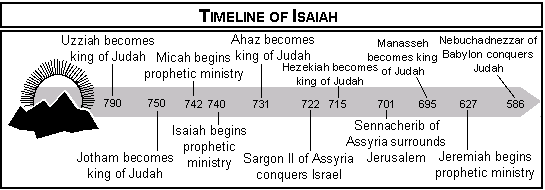
Possible Prophets During Hezekiah's Reign
YAWHEH SPEAKS DOOM
THROUGH PROPHETS
Now the LORD spoke through His servants ('ebed; LXX - doulos) the prophets (nabiy;LXX - prophetes), saying - Now we see God's response to Israel's disobedience. God did not remain silent in the face of their great evil, but in His great mercy (and patience) He sent prophets who spoke His words with authority, urging the nation to return to covenant faithfulness.
Who were some of the prophets who were active in Manasseh's 55 year reign, ca. 697–642 BC? (Note dates are approximations) There are probably only three named prophets as shown below.
- Joel began prophesying about 835 BC so he is definitely not active during Manasseh’s reign.
- Amos began prophesying about 755 BC so he is not likely active during Manasseh’s reign.
- Hosea began prophesying about 753 BC so he is not likely active during Manasseh’s reign.
- Micah began prophesying about 742 BC so he is not likely active during Manasseh’s reign.
- Isaiah began prophesying about 740 BC so he is could have been active early in Manasseh’s reign (but not mentioned in Isa 1:1)
- Nahum foretold the fall of Nineveh in 612 BC (Nahum 1:1) so he could have been active early in Manasseh's reign.
- Habakkuk began prophesying about 607 BC so he is could have been active during Manasseh’s reign
- Jeremiah began prophesying about 627 BC so he could have been active during Manasseh's reign.
- Zephaniah began prophesying about 625 BC during Josiah's reign so he is was not active during Manasseh’s reign
In Amos 3:7 we read "Surely the Lord GOD does nothing Unless He reveals His secret counsel To His servants the prophets. " God’s warnings to Judah were expressions of His covenant love and great patience.
God desired Judah's repentance, not their destruction. 2Peter 3:9 affirms God's heart writing "The Lord is not slow about His promise, as some count slowness, but is patient toward you, not wishing for any to perish but for all to come to repentance." Manasseh did "come to repentance."
2 Kings 21:11 “Because Manasseh king of Judah has done these abominations, having done wickedly more than all the Amorites did who were before him, and has also made Judah sin with his idols;
- Because: 2Ki 23:26-27 24:3,4 Jer 15:4
- more than all the Amorites 2Ki 21:9 1Ki 21:26 Eze 16:3,45
- made Judah sin 2Ki 21:9 1Ki 14:16 15:30 16:19
- 2 Kings 21 Resources
MANASSEH'S SINS
SURPASS THE AMORITES
Because - This term of explanation introduces the reason for the judgment that God announces in 2Ki 21:12. It explains why God is about to bring calamity on Jerusalem and Judah. Manasseh did not merely sin personally but he corrupted the spiritual life of Judah, which ultimately led to national judgment. (See verses below)
Manasseh king of Judah has done these abominations (toebah; LXX - bdelugma - that which is extremely abhorred, detestable, anything connected with idolatry) - Because (term of explanation) explains why God's judgment would soon fall on Manasseh (see note below). It is interesting that does not say "these sins" but these abominations! Manasseh's sins were indeed abominations. Don't let anyone tell you that some sins are not worse than other sins! Even though Manasseh later repented (2 Chr 33:12–13), the national corruption he introduced had already spread deeply.
having done wickedly more than all the Amorites did who were before him, and has also made Judah sin with his idols (gillul/gillulim; LXX - eidolon = strictly form, copy, figure; hence an object resembling a person or animal and worshiped as a god) - Note the personal possessive pronoun "His"! Manasseh surpassed the Amorites, who until then had been regarded as the very epitome of pagan corruption and idolatry in the land.
The statement that Manasseh was “more wicked than the Amorites” is one of the strongest condemnations in the Old Testament, because the Amorites represented the extreme moral corruption of Canaanite society that originally led God to destroy them and give their land to Israel.
The tragic irony is that the people who had inherited the land because
of the Amorites’ wickedness now exceeded the very sins
for which those nations had been judged
The reference to the Amorites may serve as a deliberate reminder of the principle first stated in Genesis 15:16, where God told Abraham, “the iniquity of the Amorite is not yet complete (shalem; LXX- anapleroo - filled up completely).” In that passage God revealed that judgment on the Amorites would come only when their sin had reached its full measure. When Scripture later compares Judah’s behavior to that of the Amorites, the implication is sobering: Judah had not merely matched their wickedness but had surpassed it. In effect, the nation whose land Israel once inherited because of the Amorites’ sin had now become just as corrupt.
God shows no partiality
in judgment.The comparison underscores an important theological principle: God shows no partiality in judgment. The Amorites were judged when their sin reached its limit, and Judah, despite its incredible covenant privileges, would face the same kind of judgment when it followed the same path of rebellion. The warning is clear that covenant status does not protect a people who persist in sin. The same righteous God Who removed the Amorites from the land could just as justifiably remove Judah when their “cup” of iniquity overflowed.
Peter Leithart adds - The link with Gen. 15:16 explains why Ahab and Manasseh are the last straws for their respective kingdoms: in their reigns, the “sins of the Amorites” come to maturity, and it is time to reverse the conquest and bring in Gentile “Joshuas” to purge the land of Israelito-Canaanites and their abominations. (See 1 & 2 Kings Brazos Theological Commentary on the Bible - Page 96)
Bob Utley - "the Amorites" This is a collective term for all Canaanite tribes (cf. Gen. 15:16), as is "Canaanite." "Amorite" often refers to those tribes that dwelled in the hill country as opposed to the coastal plain. PRE-ISRAELITE INHABITANTS OF PALESTINE
Idols (01544) gillul/gillulim - latter is the plural form = all OT uses are plural) means logs, blocks, shapeless things. This word describes "an object (not necessarily three dimensional) which has been formed to resemble a person, god, animal." (Louw-Nida). Notably, the root galal also produced the Hebrew noun גֵּל (gel) or גֶּלֶל (gelel), meaning “dung” or excrement.
NET NOTE - The word used here, גִלּוּלִים [gillulim], is always used as a disdainful reference to idols. It is generally thought to have originally referred to “dung pellets” (cf. KBL 183 s.v. גִלּוּלִים). It is only one of several terms used in this way, such as “worthless things” (אֱלִילִים, ’elilim), “vanities” or “empty winds” (הֲבָלִים, havalim).
Complete Biblical Library Hebrew-English Dictionary -Of the main words for idol, this term always occurs in the plural form. Of the forty-seven occurrences, thirty-eight are in Ezekiel. The basic meaning of this word is "logs," "blocks" or "shapeless things." It is used to mock the pagan gods, and it always views idols as contemptuous things (1 Ki. 15:12; Deut. 29:17; Ezek. 6:4). Idols are always an abomination, and they pollute the people and the land. The word is often used by Ezekiel parallel to the noun tāmfi', "to be unclean," "to defile oneself", thus strengthening the etymological argument to associate the noun with dung. The prime indictment of Judah communicated by Ezekiel was idolatry (see ch. 16). This defilement forced the Spirit of Yahweh to depart from the Temple (Ezek 9-11), as the Temple itself was defiled by idolatry (Ezek 8:9f). Idolatry was a serious offense for the individual, as Yahweh promises those who fall down before idols in worship will fall down before them dead (Ezek 6:4). The usages of the noun outside of Ezekiel also point out that idols defile the individual and society causing judgment to fall. Animal and human feces often form round lumps, so ancient Hebrews used the same “round” root to describe droppings. The term gillulim seems to deliberately echo this word for dung (gel/gelal) by sound – essentially a pun. Medieval commentators like Ibn Ezra (12th century) already noticed that gillulim sounds like gelal (dung) and considered the term an “outrageous and denigrating” nickname for idols as “dung pellets” Modern scholars likewise conclude that gillulim stems from a single root gll with two related meanings – “round, roll” and by extension “dung” – and that the biblical writers intentionally exploited the vulgar sense to mock idols
HCSB Study Bible - Ezekiel's favorite word for idol (Hb gillulim) is based on the root gll, which means "to roll." Many believe the term is associated with round dung pellets, which would graphically express Ezekiel's disposition toward useless idols.
GILLULIM - 45V - MOST OFTEN IN EZEKIEL - Lev. 26:30; Deut. 29:17; 1 Ki. 15:12; 1 Ki. 21:26; 2 Ki. 17:12; 2 Ki. 21:11; 2 Ki. 21:21; 2 Ki. 23:24; Jer. 50:2; Ezek. 6:4; Ezek. 6:5; Ezek. 6:6; Ezek. 6:9; Ezek. 6:13; Ezek. 8:10; Ezek. 14:3; Ezek. 14:4; Ezek. 14:5; Ezek. 14:6; Ezek. 14:7; Ezek. 16:36; Ezek. 18:6; Ezek. 18:12; Ezek. 18:15; Ezek. 20:7; Ezek. 20:8; Ezek. 20:16; Ezek. 20:18; Ezek. 20:24; Ezek. 20:31; Ezek. 20:39; Ezek. 22:3; Ezek. 22:4; Ezek. 23:7; Ezek. 23:30; Ezek. 23:37; Ezek. 23:39; Ezek. 23:49; Ezek. 30:13; Ezek. 33:25; Ezek. 36:18; Ezek. 36:25; Ezek. 37:23; Ezek. 44:10; Ezek. 44:12
EXCURSUS ON AMORITES - The Amorites were one of the major peoples descended from Canaan, the son of Ham (Gen 10:15–16; 1 Chr 1:13–14). Their name likely means “highlanders” or “hill people,” reflecting the fact that they often lived in the mountainous regions of Canaan (Num 13:29). In ancient Near Eastern records they were called Amurru, and for a time the Babylonians even referred to the whole region of Syria and Palestine as “the land of the Amorites.”
In the Old Testament the name is used in several ways: sometimes for a specific people group, sometimes for the inhabitants of the hill country, and at times more broadly for the Canaanite population in general (Gen 14:7; Deut 1:7; Josh 10:5–6). Their territory stretched widely—from the hills west of the Dead Sea to Hebron and Shechem, and eastward into Gilead and Bashan, where the powerful Amorite kings Sihon and Og ruled (Num 21:21–30; Deut 3:8–11; Josh 2:10). Scripture portrays them as formidable warriors and even people of great stature (Amos 2:9; Deut 3:11). During Israel’s entrance into the Promised Land, the Amorite kings and their allies were defeated by Joshua in decisive battles (Josh 10:10–26; 11:8), and much of their land east of the Jordan was later allotted to the tribes of Reuben, Gad, and half of Manasseh (Num 32:33–42; Josh 13:15–21).
Spiritually, the Amorites became a symbol of the deep moral corruption that characterized the Canaanite nations. God had foretold that Abraham’s descendants would one day inherit their land, but “the iniquity of the Amorite is not yet complete” (Gen 15:16), indicating that divine judgment would come only after their wickedness reached its full measure. Their practices included idolatry and other abominations that led God to command Israel not to imitate their ways (Exod 23:24; Deut 20:17–18; Judg 6:10; 1 Kgs 21:26). Tragically, although many Amorites were defeated, they were not entirely driven out of the land (Judg 1:34–36; 3:5–8), and their continued presence became a spiritual snare, eventually influencing Israel toward idolatry and intermarriage (Ezra 9:1–2). Thus the Amorites occupy an important place in biblical history: historically as a powerful people of ancient Canaan, and theologically as an example of nations judged for persistent rebellion against God while also illustrating the danger of God’s people adopting the sinful practices of surrounding cultures.
2 Kings 21:12 therefore thus says the LORD, the God of Israel, ‘Behold, I am bringing such calamity on Jerusalem and Judah, that whoever hears of it, both his ears will tingle.
NLT - So this is what the LORD, the God of Israel, says: I will bring such disaster on Jerusalem and Judah that the ears of those who hear about it will tingle with horror.
- I am bringing: 2Ki 22:16 Da 9:12 Mic 3:12
- whoever: 1Sa 3:11 Isa 28:16 Jer 19:3 Am 3:2 Mt 24:21,22 Lu 23:28,29 Rev 6:15-17
- 2 Kings 21 Resources
Related Passages:
1 Samuel 3:11 The LORD said to Samuel, “Behold, I am about to do a thing in Israel at which both ears of everyone who hears it will tingle (tsalal; LXX - echeo - roar, ringing out).
Jeremiah 19:3 and say, ‘Hear the word of the LORD, O kings of Judah and inhabitants of Jerusalem: thus says the LORD of hosts, the God of Israel, “Behold I am about to bring a calamity upon this place, at which the ears of everyone that hears of it will tingle (tsalal; LXX - echeo - roar, ringing out)..
Habakkuk 3:16 I heard and my inward parts trembled, At the sound my lips quivered (tsalal). Decay enters my bones, And in my place I tremble. Because I must wait quietly for the day of distress, For the people to arise who will invade us.
JEHOVAH PROPHESIES
GREAT CALAMITY
Therefore - A fitting term of conclusion to Manasseh's evil regime, reaching backward and gathering up a long list of deliberate violations of the Mosaic covenant by Manasseh. Therefore introduces God’s judicial conclusion ("bringing...calamity on Jerusalem") based on the reasons stated in the previous verse. It signals that the coming judgment is the logical and inevitable result of Manasseh’s sins described in 2 Kings 21:11.
🙏 THOUGHT - That single word “therefore” teaches a sobering truth: Persistent sin + rejected warning = inevitable discipline. Woe! Are you trapped in some sin, not listening to God's prophetic warning through Scripture and/or sermons you have heard? If so you need to repent immediately. Hebrews 12:5-11 makes it clear that God disciplines those He loves proving them to be His sons and daughters, but discipline is never "fun." Repentance is much preferred! I know from experience!
Manasseh's evil made divine judgment a moral necessity. Manasseh's wickedness was so great that he was blamed for the fall of the Southern Kingdom! 2Ki 21:11 begins with "because" which introduces the reason for God's "calamity" judgment in the next verse 2Ki 21:12. There are at least 3 other verses that also demonstrate that the "calamity on Jerusalem" was directly related to Manasseh's sins despite the fact that he himself experienced personal repentance and revival! Tragically, the spiritual damage to the nation had been done and could not be undone! Note each passage has the explanatory hinge word "BECAUSE OF..." (cf to "BECAUSE" in 2Ki 21:11)
Jeremiah 15:1-4 Then the LORD said to me, “Even though Moses and Samuel were to stand before Me, My heart would not be with this people; send them away from My presence and let them go! 2 “And it shall be that when they say to you, ‘Where should we go?’ then you are to tell them, ‘Thus says the LORD: “Those destined for death, to death; And those destined for the sword, to the sword; And those destined for famine, to famine; And those destined for captivity, to captivity.”’ 3 “I will appoint over them four kinds of doom,” declares the LORD: “the sword to slay, the dogs to drag off, and the birds of the sky and the beasts of the earth to devour and destroy. 4 “I will make them an object of horror among all the kingdoms of the earth BECAUSE OF Manasseh, the son of Hezekiah, the king of Judah, for what he did in Jerusalem.
2 Kings 23:26-27 However, the LORD did not turn from the fierceness of His great wrath with which His anger burned against Judah, BECAUSE OF all the provocations with which Manasseh had provoked Him. 27 The LORD said, “I will remove Judah also from My sight, as I have removed Israel. And I will cast off Jerusalem, this city which I have chosen, and the temple of which I said, ‘My name shall be there.’”
2 Kings 24:3-4 Surely at the command of the LORD it came upon Judah, to remove them from His sight BECAUSE OF the sins of Manasseh, according to all that he had done, 4 and also for the innocent blood which he shed, for he filled Jerusalem with innocent blood; and the LORD would not forgive.
One leader can shape the spiritual direction
of an entire nation for generations.
Thus says the LORD, the God of Israel, ‘Behold, I am bringing such calamity on Jerusalem and Judah, that whoever hears of it, both his ears will tingle (tsalal; LXX - echeo - roar, ringing out) - This is a solemn declaration of divine judgment. Note God is the One bringing the calamity. Note also, He does not state the timing of the calamity, simply the certainty of it! Either way Yahweh promises it will cause "divine tinnitus" (ringing in the ears).
Presumably this message was spoken through God's servants, the prophets. The cup of Judah's sin had reached the top edge so to speak so that divine judgment was inevitable. The expression both his ears will tingle is a Hebrew idiom meaning that the news of the coming disaster would be so shocking and horrifying that it would cause those who heard it to tremble in fear and disbelief. The Hebrew verb is צָלַל (tsālal), meaning to quiver, vibrate, or ring sharply. It describes a physical shock reaction to overwhelming news. It is used only in contexts of catastrophic judgment:1 Samuel 3:11 for Judgment on Eli’s house, Jeremiah 19:3 for Judgment on Jerusalem and here in 2 Kings 21:12 — Judgment under ManassehSo this is not mild surprise but describes horrified astonishment. Think of sudden deafening thunder, a shocking explosion or news so dreadful your ears ring. Ears will tingle in sum conveys a paralyzing shock at the severity of coming judgment and serves as fitting auditory imagery for trauma to the nation of Judah.
God’s patience is exhausted,
His justice is swift and severe.
The calamity foretold here ultimately came to pass when Babylon invaded Jerusalem, destroyed the temple, and carried the people into exile (2Ki 25:8-11). The tingling ears of judgment is meant to awaken sinners to the reality of their condition and lead them to seek forgiveness through repentance and faith in Him.
Wiersbe on tingle - When they heard the news of the approaching Babylonian army, it would be like hearing a sudden clash of cymbals! Wake up! Wake up! But it would be too late.
Konkel - The fate of Samaria, within the living memory of many of the citizens of Judah under the reign of Manasseh, should have caused ringing in the ears of those who heard the warning. (See 1 and 2 Kings - Page 622)
Tingle (06750) tsalal Tingle (06750) tsalal means to tingle, quiver, shake, then to be stunned and even confused. All 4 uses are in the context of prophecies in which God will bring calamity on His Chosen People! The Hebrew verb צָלַל, meaning quiver, shake, is used only in Hab 3:16 of lips quivering and in 1 Sam 3:11; 2 Kgs 21:12; Jer 19:3 of ears tingling, in all cases describing involuntary physiological response to bad news! The Septuagint translates tsalal in 1Sa 3:11 with the verb echeo which described something as sounding or ringing out; (1) of brass gonglike instruments that boom out, resound and used metaphorically in 1Co 13.1 resounding cymbal, clanging brass or of the sea roar (Lk 21.25)
THE LASTING IMPACT OF MANASSEH'S EVIL REIGN (Why Scripture Blames Judah’s Exile Primarily on Manasseh) Manasseh’s reign became the decisive turning point that ultimately led to Judah’s exile because he did not merely commit personal sin but institutionalized national apostasy. During his long reign he systematically reversed the spiritual reforms of his father Hezekiah, rebuilding high places, erecting altars to Baal, worshiping the host of heaven, practicing witchcraft and divination, and even sacrificing his son in the fire (2 Ki 21:3–6). Scripture emphasizes that he “seduced” Judah to do evil, leading the nation into corruption even worse than the pagan nations God had originally driven out of the land (2 Ki 21:9). In addition, he shed enormous amounts of innocent blood, filling Jerusalem “from one end to another” (2 Ki 21:16), likely including persecution of the righteous and the prophets. Although Manasseh later humbled himself and repented personally (2 Chr 33:12–13), the spiritual damage he had inflicted on the nation was already deeply entrenched, and the people continued in corrupted worship even after his reforms (2 Chr 33:17). Later efforts at revival under Josiah could not fully reverse the trajectory, for “the LORD did not turn from the fierceness of His great wrath… because of all the provocations with which Manasseh had provoked Him” (2 Ki 23:26). Consequently, Scripture explicitly connects Judah’s exile to the sins introduced during Manasseh’s reign: “Surely at the command of the LORD it came upon Judah… because of the sins of Manasseh” (2 Ki 24:3–4; Jer 15:4, 2Ki 23:26-27, cf 2Ki 21:11 = "because Manasseh king of Judah has done these abominations" and 2Ki 21:12 = "therefore...I am bringing such calamity on Jerusalem"). His fifty-five-year rule reshaped the nation’s religious life so profoundly that it set Judah on a path of judgment from which it would not recover, illustrating the sobering biblical principle that when a leader entrenches evil in a nation, the consequences can endure long after that leader is gone.
2 Kings 21:13 ‘I will stretch over Jerusalem the line of Samaria and the plummet of the house of Ahab, and I will wipe Jerusalem as one wipes a dish, wiping it and turning it upside down.
NLT - I will judge Jerusalem by the same standard I used for Samaria and by the same measure I used for the family of Ahab. I will wipe away the people of Jerusalem as one wipes a dish and turns it upside down.
- I will stretch: 2Ki 17:6 Isa 10:22 28:17 34:11 La 2:8 Eze 23:31-34 Am 7:7,8 Zec 1:16
- the plummet: 2Ki 10:11 1Ki 21:21-24
- I will wipe: 1Ki 14:10 Isa 14:23 Jer 25:9 Eze 24:10,11 Rev 18:21-23
- 2 Kings 21 Resources
Related Passages:
Isaiah 34:11 But pelican and hedgehog will possess it, And owl and raven will dwell in it; And He will stretch over it the line of desolation And the plumb line of emptiness.
Lamentations 2:8 The LORD determined to destroy The wall of the daughter of Zion. He has stretched out a line, He has not restrained His hand from destroying, And He has caused rampart and wall to lament; They have languished together.
Amos 7:7-8 Thus He showed me, and behold, the Lord was standing by a vertical wall with a plumb line in His hand. 8The LORD said to me, “What do you see, Amos?” And I said, “A plumb line.” Then the Lord said, “Behold I am about to put a plumb line In the midst of My people Israel. I will spare them no longer.

JEHOVAH MEASURES JERUSALEM
AND WIPES IT LIKE A DISH
I will stretch over Jerusalem the line (qav) of Samaria - The point of the line and plummet are to emphasize that God's measure of justice is meted out with absolute precision and perfection. God’s reasoning is clear. If Judah chose to follow the sinful path of the Northern Kingdom, they would also share in its judgment.
Wiersbe - God used a second image to awaken them. Like a careful builder, He would measure the nation with His plumbline, but it would be a measuring for tearing down and not for building up. Everyone was familiar with bricklayers using plumblines to keep the walls straight as they built, but nobody measures a building in order to destroy it. (See Isa. 34:11 and Amos 7:7–9, 17.) God’s judgments are just and He will give them what they deserve, just as He gave Israel (Samaria) what she deserved.
NET NOTE - Heb “I will stretch out over Jerusalem the measuring line of Samaria, and the plumb line of the house of Ahab.” The measuring line and plumb line are normally used in building a structure, not tearing it down. But here they are used ironically as metaphors of judgment, emphasizing that he will give careful attention to the task of judgment.
Yahweh uses the metaphor of a measuring line to describe His measured, deliberate judgment as was carried out against Samaria. In the ancient world, a measuring line could be used either for construction or for demolition, and here it is clearly the latter as a measuring line for judgment. God is not measuring Jerusalem to build it up, but to assess it for destruction, doing so carefully, intentionally, and justly. Yahweh's benchmark is Samaria which had already been judged. God is saying Jerusalem would be judged by the same standard used to judge Samaria. The NET Bible has "I will destroy Jerusalem the same way I did Samaria." The image conveys that God’s judgment would not be arbitrary or impulsive, but deliberate, proportionate, and consistent with His past actions, as Jerusalem is weighed against the known precedent (judgment of Samaria).
TSK on I will stretch: This metaphor is taken from the custom of using a line in measuring land, and in dividing portions of it among several persons. Samaria was taken, pillaged, and ruined, and its inhabitants carried into captivity: Jerusalem shall have the same measure.
And the plummet of the house of Ahab, Plummet (only other use Isa 28:17) was the skewed plumb line of the house of Ahab was placed over a wicked Jerusalem to judge her. Yahweh is saying that Jerusalem will be tested by the same exact standard that condemned Ahab’s dynasty and, being found equally corrupt, will face decisive and unavoidable judgment. God's judgment would not be arbitrary but based on Jerusalem's past acts. The fact that Judah had the privilege of the Davidic lineage and the holy Temple would not negate her accountability. Like Ahab’s house, the divine verdict had moved beyond correction to complete removal.
MacArthur: These were weighted lines dropped from walls to see whether they were structurally straight (cf. Is 28:17; Am 7:7, 8). Walls out of line were torn down. The Lord had measured Jerusalem by the standard of His Word and had determined that the fate of Samaria (Israel) was also to befall Jerusalem. (See MacArthur Study Bible- Page 555)
PICTURE OF HOW THOROUGHLY
JERUSALEM WILL BE JUDGED
And I will wipe Jerusalem as one wipes a dish, wiping it and turning it upside down - This is a dramatic metaphor as if Jerusalem were a dirty bowl that needed to be cleansed. The verbs wiping and turning emphasize how thorough will be the LORD's punishment on the Holy City. No "spiritual crumbs" will be left in the bowl when God wipes it clean!
Jeremiah 51:34 “Nebuchadnezzar king of Babylon has devoured me and crushed me, He has set me down like an empty vessel; He has swallowed me like a monster, He has filled his stomach with my delicacies; He has washed me away.
Mordechai Cogan has an interesting comment on the dish metaphor - The turning over of a dish at the completion of a meal indicates satiation—i.e. no further consumption of the table’s spread. Vividly conveyed by this image are two statements: not only are a city and its people wiped out, but yhwh as well, has had his fill of Judah’s sinning and can take no more.
Wiersbe - The third picture comes from the kitchen: God would empty the kingdom of Judah of its people just as a person wipes all the water out of a dish after washing it. It’s the image of depopulating a land by death or deportation and leaving it empty (Jer. 51:34).
🙏 THOUGHT - When God drops His righteous plumbline on our lives and shows us through His Word, our friends, sermons or our conscience what is not straight, do we repent and turn back to Him (1Jn 1:9, Pr 28:13) do we ignore Him and stiffen our neck and harden our heart (Heb 3:13)? Ignoring God’s merciful warnings does not change His perfect standard, but only brings us closer to discipline (2Ki 21:13; Pr 29:1, Heb 12:5-11). Dear believer in Yesuah, where is God correcting you today and what would it look like to turn (repent) and obey Him without procrastination, while there is still time for His mercy?
Line (measuring line, circumference)(06957) qav. is a masculine noun which refers to a line for measuring and was literally a cord used in construction work (1 Ki 7:23). In the figurative sense qav refers to a measuring "line" or standard of justice (as applied to Jerusalem in 2 Ki 21:13). In David's psalm 19, qav refers to the "architectural plan" or line of the heavens reflecting the Master Craftman's handiwork (Ps 19:4). Qav can also refer to a word of instruction in prophetic or legal settings (Isa 28:10, 13). Finally, as in the present context qav can refer to God's judgments (Isa 34:11) and His sovereign distribution of power (Isa 34:17).
NIDOTT says "Stretching a measuring line over the land means that as an ownerless plot of ground, the land is to be resurveyed and reassigned, the threat of judgment against Jerusalem is that the measuring line of Samaria will be cast over it (2 Kgs 21:13), meaning that it will be taken over by foreigners.The same sense in variant wording is found in Mic 2:4; the inheritance of the people will be surveyed with a measuring line. However, in the case of Edom the force of the picture has been escalated. The land can no longer be redivided because of the total destruction. The measuring line is one of תֹּהוּ, i.e., one useful only for absolute wasteland."
Plummet (04949) mishqeleth/mishqoleth The Hebrew noun מִשְׁקֹלֶת (mishqōleth) is a feminine term referring to a plumb line or mason’s level, an instrument used to determine accuracy and ensure that a structure is straight. The word is derived from שָׁקַל (shāqal), “to weigh,” reflecting the weighted stone (ʾeven; cf. Isa. 34:11) suspended from a cord to form a true line. Cognates of the term appear in Akkadian, Jewish Aramaic, the Dead Sea Scrolls, and Middle Hebrew. In Scripture it is used figuratively to describe God’s righteous standard of evaluation and judgment. In Isaiah 28:17, the Lord declares, “I will make justice the measuring line and righteousness the level,” portraying righteousness as His objective standard by which Zion is assessed. Similarly, in 2 Kings 21:13, God warns Jerusalem, “I will stretch over Jerusalem the line of Samaria and the plummet of the house of Ahab,” meaning that the same standard of judgment applied to the wicked northern kingdom and Ahab’s dynasty would now be applied to Judah. In both passages, mishqōleth parallels qāw, “measuring line,” reinforcing the imagery of divine measurement: God does not judge arbitrarily but according to His perfectly straight and righteous standard.
John Walton - The measuring line and plummet were ordinary tools used for the construction of mud-brick buildings throughout the Near East. A site was surveyed with a measuring line (usually a rope, cord or thread). The chief builder used a plumb line, weighted with tin or a stone, to test the integrity of the structure.
QUESTION - What is a plumb line in the Bible? GOTQUESTIONS.ORB
ANSWER - A plumb line, also called a plummet, is a cord with a non-magnetic weight attached to one end. When the cord is held in such a way that the weight can dangle freely, an exact vertical can be determined. Painters and carpenters use plumb lines to keep their work straight. It is difficult, while in the middle of a project, to determine a true horizontal or vertical line without an objective measuring tool, so a plumb line is employed. A plumb line applies the law of gravity to find right angles, to indicate the most direct route from top to bottom, and to keep things plumb. A plumb line doesn’t change or move with the whims of the carpenter. It remains true, and all work must line up with it or risk being crooked.
The term plumb line is used in Scripture in several contexts. The Lord pictures Himself as a builder in Isaiah 28: “See, I lay a stone in Zion, a tested stone, a precious cornerstone for a sure foundation” (Isaiah 28:16). This is a promise of an unshakeable kingdom, with the Messiah in charge. Jesus Christ is the “precious cornerstone” (see Mark 12:10; Acts 4:11; Romans 9:33; 1 Peter 2:6). As the Lord builds His kingdom, He will ensure it is perfect in every way: “I will make justice the measuring line and righteousness the plumb line” (Isaiah 28:17). There will be no crookedness/sin in the kingdom of Christ.
When the Jews returned from captivity in Babylon, they began to rebuild the temple in Jerusalem. For a time, the work languished, and God sent the prophets Zechariah and Haggai to spur the people on to finish the rebuilding. The message was encouraging: do not despair over the small beginnings; God will see to it that the temple is completed, and Zerubbabel the governor will oversee the project. “Whoever has despised the day of small things shall rejoice, and shall see the plumb line in the hand of Zerubbabel” (Zechariah 4:10, ESV).
Amos 7:7–8 says, “This is what he showed me: The Lord was standing by a wall that had been built true to plumb, with a plumb line in his hand. And the Lord asked me, ‘What do you see, Amos?’ ‘A plumb line,’ I replied. Then the Lord said, ‘Look, I am setting a plumb line among my people Israel; I will spare them no longer.’” When God said He was setting a plumb line among His people, He was declaring an end to their attempts to justify their crooked ways. The Lord was setting the standard. God does not negotiate His laws. He does not change with the whims of culture (Numbers 23:19). God’s moral law is the plumb line against which we determine right and wrong (John 17:17). Just as a carpenter’s plumb line is not subject to the opinions or the frustration of the worker, so God’s moral standards are not subject to the opinions of man. Wise people are those who line up their lives according to God’s plumb line rather than trying to move it to satisfy their own agendas/
2 Kings 21:14 ‘I will abandon the remnant of My inheritance and deliver them into the hand of their enemies, and they will become as plunder and spoil to all their enemies;
NLT - Then I will reject even those few of my people who are left, and I will hand them over as plunder for their enemies.
KJV And I will forsake the remnant of mine inheritance, and deliver them into the hand of their enemies; and they shall become a prey and a spoil to all their enemies;
NET I will abandon this last remaining tribe among my people and hand them over to their enemies; they will be plundered and robbed by all their enemies,
BGT καὶ ἀπώσομαι τὸ ὑπόλειμμα τῆς κληρονομίας μου καὶ παραδώσω αὐτοὺς εἰς χεῖρας ἐχθρῶν αὐτῶν καὶ ἔσονται εἰς διαρπαγὴν καὶ εἰς προνομὴν πᾶσιν τοῖς ἐχθροῖς αὐτῶν
LXE And I will reject the remnant of my inheritance, and will deliver them into the hands of their enemies; and they shall be for a plunder and for a spoil to all their enemies:
- I will abandon the remnant De 31:17 2Ch 15:2 Ps 37:28 89:38-45 Jer 12:7 23:33 La 5:20 Am 5:2
- the remnant: 2Ki 19:4,30,31 24:2 2Ch 36:16,17 Jer 23:33
- deliver: Lev 26:17,36-38 De 4:26,27 28:25,31-33,48 Jud 2:14,15 Ne 9:27-37 Ps 71:1-7 106:40-43 Isa 10:6 La 1:5,10
- 2 Kings 21 Resources
Related Passages:
Leviticus 26:17 ‘I will set My face against you so that you will be struck down before your enemies; and those who hate you will rule over you, and you will flee when no one is pursuing you.
Deuteronomy 28:25 “The LORD shall cause you to be defeated before your enemies; you will go out one way against them, but you will flee seven ways before them, and you will be an example of terror to all the kingdoms of the earth.
YAHWEH ABANDONS AND
DELIVER JUDAH TO ENEMIES
I will abandon (natash/natas; LXX - apotheo - push aside, thrust off oneself, reject) the remnant (sheerith; LXX - hupoleimma) of My inheritance - In this context the word abandon means Yahweh prophetically promises to give the remnant to judgment. One part (the ten tribes) was already abandoned, and carried into captivity by Assyria in 722 BC. The remnant (tribes of Judah and Benjamin) was now about to be abandoned to Babyon in 586 BC. Note the emphasis in this prophecy is not on the power of the enemies but on the LORD’s withdrawal of protection, allowing the adversaries to prevail.
Bob Utley - "the remnant" Here, this refers to Judah and Benjamin. The curses of Leviticus 26 and Deuteronomy 28 are now in effect.
NET NOTE - Heb “the remnant of my inheritance.” In this context the Lord’s remnant is the tribe of Judah, which had been preserved when the Assyrians conquered and deported the northern tribes. See 2Ki 17:18 and M. Cogan and H. Tadmor, II Kings (AB), 269.
Paul Apple reminds us that "It must be understood that God’s covenant promises were to the nation of Israel. That did not mean that every individual Israelite would enjoy the benefits of those promises; instead, if they were unfaithful and apostate and unbelieving, they would personally be subject to judgment rather than blessing. As well, there was corporate discipline upon the nation as a whole, but never abandonment of the promises of the covenants
And deliver them into the hand of their enemies - Notice who makes the "delivery!" God Himself sovereignly supervises the deliverance of Israel into the hand (yad = power of) their enemies. The Gentile nation of Babylon is His active agent in this divine deliverance. In Jeremiah 27:6 God even calls Nebuchanezzar His servant. How does God "deliver?" actively withdraws His protection and sovereignly hands His people over to hostile powers as the consequence of covenant rebellion.
and they will become as plunder (baz) and spoil to all their enemies - These metaphors emphasize the totality of Judah's defeat. The people themselves are pictured as plunder and spoil which emphasizes their total vulnerability as plunder and spoil are what the enemy easily and freely takes away. In other words, to become plunder and spoil stresses the devastating reversal that occurs when God removes His protection, so that His people are reduced from covenant heirs to helpless captives, openly exposed to judgment at the hands of their enemies.
Konkel - The consequences of his sin results in the eventual exile of the entire nation; God decides “to remove [Judah] from his presence because of the sins of Manasseh and all he had done, including the shedding of innocent blood … the LORD was not willing to forgive” (2Kings 24:3b–4). The effects of Manasseh’s deeds are irreversible; the announcement of exile made to Hezekiah becomes a pronouncement of irreversible judgment against the nation (2Ki 21:10–15). Manasseh, uniformly and unambiguously, is the worst king of Judah (See 1 and 2 Kings - Page 623)
The word “remnant” in the Bible generally means a small portion that remains after the majority has been removed, destroyed, or turned away, but Scripture uses the term in several related ways depending on the context. The Hebrew word most often used is שְׁאָר (sheʾar) or שְׁאֵרִית (sheʾerith), meaning what is left, the survivors, or the remainder. The concept appears throughout both the Old and New Testaments.
1. A physical group that survives judgment - Often remnant refers to survivors left after a disaster, war, or judgment. God may allow a catastrophe, yet preserve a small number who remain alive. (Isaiah 10:22)
2. A spiritually faithful group within a larger unfaithful nation - Sometimes remnant describes those who remain faithful to God when most people are rebellious. These people trust and obey the Lord even when the majority do not. This idea appears in Elijah’s day when God preserved 7,000 who had not bowed to Baal (1 Kgs 19:18).
3. The Remnant in the New Testament is the True Church. In the New Testament, the concept of the remnant continues but now it refers to those who believe in Jesus Christ. (Mt 7:13, 14 = "there are few" who enter the small gate and walk the narrow way )
4. An end-time remnant - Prophetic passages also point to a remnant of Israel that will be preserved and saved in the last days. “They will look on Me whom they have pierced; and they will mourn for Him.” — Zechariah 12:10, also Zech 13:8,9. This describes a future turning of a remnant of Israel to the Messiah.
Across all these meanings, the central idea is the same: God always preserves a faithful portion of His people even in times of widespread rebellion or judgment.
- See also REMNANT
Abandon (forsake, left, spread)(05203) natash/natas means to abandon, to forsake, to leave alone. About 50% of the 40 uses convey the idea to forsake, reject leave alone. The idea is to cause a relationship or association to cease until there is the possibility of renewal. Things abandoned or forsaken - Of land that should be "forsaken" in the seventh year (Ex. 23:11), of Israel who abandoned God (Dt. 32:15), of Saul's father who forgot about the donkeys (1 Sa 10:2), of David who left his flock (1 Sa 17:20), of the psalmist who pleaded with God not abandon him (Ps. 27:9), of God abandoning His dwelling place at Shiloh (Ps 78:60), of abandoning a quarrel (Pr 17:14), of a mother's teaching which should not be forsaken (Pr 6:20). Natash means to not permit when Laban was not allowed to kiss his grandchildren good-bye (Ge 31:28). Abandon or forsake is a strong, forceful word used to describe the skinning of an animal (very rare use).
Remnant (rest) (07611) sheerith conveys root idea of sha'ar/sa'ar as that which is left over or has survived after a previous elimination = the remainder, the residue. Sheerith basically refers to the rest or to what is left over of anything. For example sheerith refers to wood left over after making a fire, this "remnant" being used to carve idols (Isa 44:17). Sheerith refers to undesignated territory (Isa 15:9) or to any group of people that remained (Jer 15:9; Am 1:8). Sheerith was used by the prophets to denote the few among Israel or Judah that remained faithful to God (Isa 37:32; Mic. 5:7, 8) or those who survived the calamity of the exile (Zech. 8:11).
2 Kings 21:15 because they have done evil in My sight, and have been provoking Me to anger since the day their fathers came from Egypt, even to this day.’”
NLT - For they have done great evil in my sight and have angered me ever since their ancestors came out of Egypt."
- since the day: De 9:21 Dt 31:27,29 Jdg 2:11-13 Ps 106:34-40 Eze 16:15-22 Eze 20:4,13,21,30 23:3,8-21 Da 9:5-11
- 2 Kings 21 Resources
Related Passages:
Deuteronomy 9:21 “I took your sinful thing, the calf which you had made, and burned it with fire and crushed it, grinding it very small until it was as fine as dust; and I threw its dust into the brook that came down from the mountain.
Deuteronomy 31:27 “For I know your rebellion and your stubbornness; behold, while I am still alive with you today, you have been rebellious against the LORD; how much more, then, after my death?
Amos 5:25-26 “Did you present Me with sacrifices and grain offerings in the wilderness for forty years, O house of Israel? 26 “You also carried along Sikkuth your king and Kiyyun, your images, the star of your gods which you made for yourselves.
COMMENT - The Lord asked if Israel really presented their sacrifices to Him sincerely when they were in the wilderness for forty years. Hypocritical worship marked them from the beginning (e.g., Ex 32). In the wilderness Israel had carried shrines of Sikkuth your king (Am 5:26; Sakkut, the Assyrian war god), perhaps unauthorized shrines honoring Yahweh or other deities (cf. Ac 7:42-43). Kiyyun, your images, refers to the Assyrian astral deity also known as Kaiwan (Saturn). Amos ridiculed these gods by substituting the vowels of the Hebrew word for "abomination" (shiqqus) into their names. The Lord was to be Israel's King (cf. Dt 33:5; Ps 10:16). Now, heading into exile, they must bear the burden of the idol they have created (since Sikkuth could not "bear" them up). The star of your gods [or god] refers to the planet Saturn, represented by Kiyyun. (Moody Bible Commentary) The Septuagint (Greek Old Testament) translated the Hebrew for “Sikkuth your king” as “tabernacle of Moloch” (the Hebrew letters are similar), a reading quoted by Stephen in Acts 7:43. (Reformation Study Bible)
Acts 7:43 ‘YOU ALSO TOOK ALONG THE TABERNACLE OF MOLOCH AND THE STAR OF THE GOD ROMPHA, THE IMAGES WHICH YOU MADE TO WORSHIP. I ALSO WILL REMOVE YOU BEYOND BABYLON.’
YAHWEH'S EXPLANATION
FOR THE EXILE
Because - Another term of explanation which is easy to understand, in this case explaining why Judah would be given over to her enemies.
They have done evil in My sight (Lit "in my eyes") - This is a key thought in this section, where doing evil is mentioned 6x (2 Ki 21:2, 6, 9, 15, 16, 20). Manasseh was the leader in doing evil (2Ki 21:2, 6) and sadly seduced the people to do evil (2Ki 21:9, 16). How important it is for a nation to have godly leaders!
And have been provoking Me to anger (kāas; LXX - parorgizo) - Provoking Me to anger conveys the idea of vexing, grieving, or deeply offending, often with the nuance of repeated or habitual irritation, not a single flare-up. It is frequently used of Israel’s idolatry and stubborn disobedience (e.g., Deut 4:25; 9:18; 1 Kgs 14:9). The point is that God says His anger is not sudden or capricious but is aroused by sustained, willful provocation.
since the day their fathers came from Egypt, even to this day - This phrase deliberately reaches back to the very birth of the nation of Israel, beginning with the Exodus from Egypt. Recall that even at the outset of her redemption Israel grumbled (Ex 15:24; 16:2), tested the LORD (Ex 17:2, 7) and almost immediately turned to idolatry (Ex 32:1–10). The irony is so sad because Israel's deliverance from Egyptian enslavement was met immediately with defiance at Mt Sinai. And from Sinai onward, her rebellion became a pattern, not an exception. The phrase even to this day seals Yahweh's indictment in that is asserts continued, essentially unbroken repetition of sins against Him.
One is reminded of the 300+ year period of Israel's history (over 30% of Israel's OT history!) during the time of the Judges, when their "motto" was "In those days there was no king in Israel; everyone did what was right in his own eyes." (Jdg 21:25). And here under Manasseh they were still continuing to do what was right in their own eyes!
In short Israel's rebellion against Yahweh that began at the Exodus never truly ceased, and judgment comes only after extraordinary patience has been exhausted.
Dale Ralph Davis makes a sobering comment - This is a solemn matter: that iniquity can pass a point that places a nation, or an individual, beyond hope of recovery and makes judgment irreversible. The fact that we don’t know where that point is should sober us. . . That’s how it is with idolatry and depravity. There’s a line we can cross and we don’t know where it is. This ought to scare us into repenting. A broken and crushed heart (Ps. 51:17) doesn’t look all that bad when one considers the alternative. (borrow 2 Kings : the power and the fury page 316)
Provoking to anger (03707) kāas is a verb meaning to vex, agitate, stir up, provoke the heart to a "heated" condition which results in actions. To be angry, vexed, be incensed, to be in a state of strong displeasure, to provoke to anger. The causative sense of the verb occurs ost often and frequently signifies idolatry provoking God to anger (cf. 1 Kgs. 14:9; Ps. 106:29; Ezek. 8:17). The result of provocation may be expressed as ʾap̱, anger (639) (Deut. 9:18; 2 Kgs. 23:26; Jer. 7:20). In a noncausative sense, the verb means to be angry; people were warned not to become angry hastily (Eccl. 7:9); God says that after He punishes, He will not be angry (Ezek. 16:42). Three times it refers to the people’s anger directed toward righteousness (2 Chr. 16:10; Neh. 4:1[3:33]; Ps. 112:10).
2 Kings 21:16 Moreover, Manasseh shed very much innocent blood until he had filled Jerusalem from one end to another; besides his sin with which he made Judah sin, in doing evil in the sight of the LORD.
NLT - Manasseh also murdered many innocent people until Jerusalem was filled from one end to the other with innocent blood. This was in addition to the sin that he caused the people of Judah to commit, leading them to do evil in the Lord's sight.
- Manasseh: 2Ki 24:3,4 Nu 35:33 De 21:8,9 Jer 2:34 7:6 15:4 19:4 Mt 23:30,31 Mt 27:6 Lu 13:34 Heb 11:37
- beside his sin: 2Ki 21:7,11 Ex 32:21 1Ki 14:15,16 2Ch 33:9
- 2 Kings 21 Resources
Related Passages:
2 Kings 21:9, 11 But they did not listen, and Manasseh seduced them to do evil more than the nations whom the LORD destroyed before the sons of Israel......11 “Because Manasseh king of Judah has done these abominations, having done wickedly more than all the Amorites did who were before him, and has also made Judah sin with his idols;
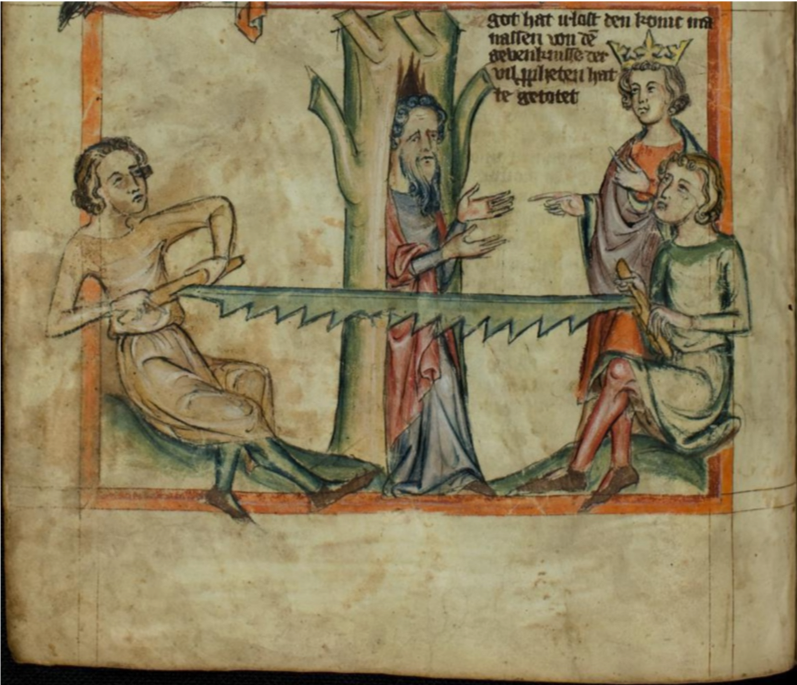
Depiction of Isaiah Sawn in Log
MANASSEH:
MASS MURDERER
Moreover - This word signals an additional, climactic charge. Beyond Manasseh's idolatry, occult practices, and leading Judah astray, etc, Scripture will now add systematic bloodshed as the culminating evidence of guilt.
Manasseh shed very much innocent blood until he had filled Jerusalem from one end to another - Literal Hebrew - "and also Manasseh shed very much innocent blood, until he filled Jerusalem from mouth to mouth." Innocent blood (cf. Dt 19:10; Ps 106:38) denotes the unjust death of those who had committed no capital offense, likely including prophets and anyone who dared confront his evil designs. One is reminded of the faithful witnesses in Hebrews 11, specifically those who "were stoned...sawn...put to death with the sword." (Heb 11:37)
John MacArthur: The reference here is ambiguous and several interpretations have been offered: 1) child sacrifice (cf. v. 6); 2) oppression and persecution of the weak (Jer 7:6; 22:3, 17; Eze 22:6-31); or 3) the martyrdom of God’s prophets (cf. v. 10) A combination of all 3 is most likely. Jewish and Christian tradition alike report that Manasseh had Isaiah sawn in two inside a hollow log (cf. Heb 11:37). (See MacArthur Study Bible)
King Manasseh’s soldiers came and Isaiah fled from them. He fled to a cedar tree and it swallowed him, but his tzitzit (ritual fringes) hung out.… They went to Manasseh and told him, and Manasseh said: “Cut down the tree.” They cut down the tree until the blood flowed out.—JERUSALEM TALMUD, SANHEDRIN 51B
Filled Jerusalem from one end to another is clearly hyperbolic language, but it does serve to emphasize that bloodshed of innocent people became a defining characteristic of Manasseh's reign. How tragic that Jerusalem the city called to be faithful had become full of injustice and murderers (Isa 1:21).
WHEN SIN OUTLIVES
THE SINNER
This sin of shedding innocent blood is specifically mentioned in 2 Kings 24:3–4 as one of the reasons for Judah’s exile.
Surely at the command of the LORD it came upon Judah, to remove them from His sight because of the sins of Manasseh, according to all that he had done, 4 and also for the innocent blood which he shed, for he filled Jerusalem with innocent blood; and the LORD would not forgive.
Jeremiah 15:4 also blames Judah's exile on Manasseh...
“I will make them an object of horror among all the kingdoms of the earth because of Manasseh, the son of Hezekiah, the king of Judah, for what he did in Jerusalem.
🙏 THOUGHT - The life of Manasseh teaches a sobering spiritual lesson that while God graciously forgives those who truly repent, the consequences of sin, especially its influence on others, may continue long after repentance. God may forgive the repentant sinner personally, yet the ripple effects of sin—especially when it shapes a family, community, or nation—can endure long afterward. Manasseh’s story therefore warns that sin’s influence can outlive the sinner, while at the same time offering hope that no one is beyond God’s mercy if they humble themselves before Him.
From one end to another stresses totality, so that no district was untouched and no social stratum was spared. The violence was public, pervasive, and normalized!
Konkel - His reign is oppressive and violent (v. 16); Josephus reports that prophets are slaughtered daily until Jerusalem overflows with blood (Ant. 10.38). According to tradition, Isaiah is among them (Martyrdom and Ascension of Isaiah, 5.1).1(see 1 and 2 Kings - Page 623)
Josephus - For in his contempt for God, (Greek: εἰς τὸν θεὸν καταφρόνησις. Josephus supplies this characterization of Manasseh, employing a phrase used earlier by him for Nimrud Ant. 1.113) and similar to the one employed of Saul in Ant. 6.264.) he hastened to kill all those who were just among the Hebrews; he did not even have mercy on the prophets, but butchered some of them every day, (Neither 2 Kings 21 nor 2 Chronicles 33 mentions Manasseh’s killing the prophets in particular. Conceivably, Josephus’ statement represents a generalization of the tradition, attested, e.g., by Mart. Ascen. Isa. 5.1 (cf. Heb 11:37) that Manasseh had the prophet Isaiah sawn in half. See Begg 2000: 444, n. 21. -- Both Justin Martyr and Tertullian repeat the tradition that Isaiah was sawed in half, probably the same tradition alluded to by the author of Hebrews - Heb. 11:37) so that Hierosolyma ran with blood. (Judean Antiquities book 10.38)
Besides his sin with which he made Judah sin, in doing evil in the sight of the LORD - Hebrew = “apart from his sin which he caused Judah to commit, by doing what is evil in the eyes of the LORD.” NLT = "This was in addition to the sin that he caused the people of Judah to commit" Manesseh's sins are "adding up." Manasseh's idolatry corrupted the worship, while his violence corrupted the society.
It is important to note that this verse explains why later repentance (2Ki 23:26–27) could not avert judgment. Innocent blood defiles the land and cries out for justice (Ge 4:10; Nu 35:33). Manasseh’s reign had crossed a point where God's patience was exhausted by centuries of injustice.
David Guzik: We see the tragic progression in Manasseh’s sin.
- First, idolatry is tolerated among God’s people.
- Then idolatry is promoted.
- Then idolatry is supported and funded.
- Then the worship of the true God is undermined.
- Then the worshippers of the true God are persecuted and murdered.
- Then the judgment of God soon comes.
27 SHEVAT
The Cedar That Hid Isaiah
Manasseh put so many innocent persons to death that he filled Jerusalem [with blood] from end to end. —2 KINGS 21:16
King Manasseh’s soldiers came and Isaiah fled from them. He fled to a cedar tree and it swallowed him, but his tzitzit (ritual fringes) hung out.… They went to Manasseh and told him, and Manasseh said: “Cut down the tree.” They cut down the tree until the blood flowed out.—JERUSALEM TALMUD, SANHEDRIN 51B
In Shevat we remember our duty to preserve human life is woven together with our duty to preserve the earth. This story of the prophet Isaiah’s death makes the point. Manasseh, a descendant of David, is a corrupt king of Judah. Isaiah, a prophet, criticizes Manasseh, and Manasseh sends soldiers to kill him. Isaiah runs to a forest and asks a cedar tree to hide him. The cedar tree complies, but the ritual fringes on Isaiah’s garments stick out, and the soldiers see him. Manasseh orders the tree cut down, and the tree and Isaiah perish together. It is as if the sap of the tree and the blood of the prophet were indistinguishable. Isaiah himself is a kind of tree, giving comfort and sustenance to the people until the moment of his death.
Isaiah, the most joyous of the prophets, sings often of the glory of trees, mountains, and vineyards, and it is a tree that shelters him in his time of need. So too trees shelter us, giving us fruit, paper, housing, even the air we breathe. Our lives and theirs are wound together. Isaiah teaches us of the need to resist tyrants who decimate life and invites us to ally with all life as we do so.
2 Kings 21:17 Now the rest of the acts of Manasseh and all that he did and his sin which he committed, are they not written in the Book of the Chronicles of the Kings of Judah?
NLT - The rest of the events in Manasseh's reign and all his deeds, including the sins he committed, are recorded in The Book of the History of the Kings of Judah.
- the rest: 2Ki 20:20,21 2Ch 33:1-20
- 2 Kings 21 Resources
MANASSEH'S ACTS AND
SIN RECORDED IN THE BOOK
Now the rest of the acts of Manasseh and all that he did and his sin which he committed, are they not written in the Book of the Chronicles of the Kings of Judah - Manasseh had the longest reign of any king and Scripture implies that acts were done, but little was worthy of remembrance. And his sin which he committed is a striking description for in it the writer singles out his sin as if it were Manasseh's defining achievement. In fact he is the only king to have his sins noted in the concluding formula! This treats Manasseh’s sin not as a momentary lapse but as a career-long pattern! What an incredible epitaph that among all his acts, sin is what demands final mention!
For some reason, the writer of Kings does not record Manasseh's removal with hooks to Babylon and his subsequent repentance and fruit of reformation Manasseh brought forth as a result of his repentance. (2Ch 33:12-18).
2 Kings 21:18 And Manasseh slept with his fathers and was buried in the garden of his own house, in the garden of Uzza, and Amon his son became king in his place.
- and was buried: 2Ch 21:20 24:16,25 28:27 32:33 33:20 Jer 22:19
- 2 Kings 21 Resources
MANASSEH "SLEEPS" AND
RECEIVES A LOWLY BURIAL
And Manasseh slept with his fathers and was buried in the garden of his own house, in the garden of Uzza, and Amon his son became king in his place This familiar royal formula indicates death, but in Kings it carries a sober tone. For most Judean kings it implies burial among predecessors in the royal tombs; here, the phrase is immediately qualified by what follows. The wording signals continuity of lineage, not approval of legacy. Manasseh’s long reign ends quietly—without honor, without commendation.
was buried in the garden of his own house, in the garden of Uzza - This is an unusual comment for Judean kings were typically buried in the tombs of the kings in the City of David. Manasseh’s burial on private property suggesting either disgrace or disqualification from royal burial honors.
The transition is abrupt and ominous. Amon inherits the throne but not repentance. The narrative moves swiftly to the next reign to show that Manasseh’s influence endured beyond his death. His sins did not die with him; they shaped the next generation (2 Kgs 21:20–22).
2 Kings 21:19 Amon was twenty-two years old when he became king, and he reigned two years in Jerusalem; and his mother’s name was Meshullemeth the daughter of Haruz of Jotbah.
- Amon: 1Ch 3:14 2Ch 33:21-23 Mt 1:10
- two years: 2Ki 15:23 1Ki 15:25 16:8 22:51
- 2 Kings 21 Resources
AMON SUCCEEDS MANASSEH
WITH SHORT REIGN
Amon was twenty-two years old when he became king, and he reigned two years in Jerusalem; and his mother’s name was Meshullemeth (means friend) the daughter of Haruz (means zealous, eager) of Jotbah - Amon likely was exposed to a period when idolatry dominated Judah, but he also saw his father repent.The nation had already been deeply corrupted by decades of pagan worship. Amon therefore inherited a kingdom spiritually shaped by his father’s earlier rebellion.
2 Kings 21:20 He did evil in the sight of the LORD, as Manasseh his father had done.
- as his father: 2Ki 21:2-7 Nu 32:14 2Ch 33:22,23 Mt 23:32 Ac 7:51
- 2 Kings 21 Resources
LIKE FATHER
LIKE SON!
He did evil in the sight of the LORD (Lit - “in the eyes of.”) as Manasseh his father had done - Unfortunately Amon did not relent from the evil of his father, despite the fact that his father repented of his evil. Amon's trajectory toward evil had been set by Manesseh's evil years. Since Amon was already 22 years old when Manasseh died, he must have been born well before Manasseh’s later repentance. Manasseh’s repentance occurs late in his reign, after his capture by Assyria (2Ch 33:11-13). After this repentance did Manasseh attempt reforms (2Ch 33:15–16), but was unable to "reform" his own son Amon. Sadly godly repentance in one generation does not automatically produce godliness in the next.
2 Kings 21:21 For he walked in all the way that his father had walked, and served the idols that his father had served and worshiped them.
AMON'S EVIL
EXPLAINED
For he walked in all the way that his father had walked - Hebrew = “walked in all the way which his father walked.” As we have noted, walked is a biblical metaphor for a settled pattern of life and conduct. The sad phrase all the way indicates with Amon there was no deviation, no correction, no repentance. Amon consciously chose to replicate the course of Manasseh, not merely inherit it.
Caleb Nelson: And, in case 55 years wasn’t enough, Manasseh left behind a clone of himself. Three times in vv. 20-21 we are told that Amon imitated his father. The son was just like his daddy, only he did not die in peace. He was murdered after only two years of his carrying-on in the palace.
And served the idols (gillul/gillulim; LXX - eidolon = strictly form, copy, figure; hence an object resembling a person or animal and worshiped as a god) that his father had served (abad ; LXX - latreuo - carrying out religious duties in a spirit of worship) and worshiped (shachah; LXX - proskuneo = fall down, prostrate oneself before, do reverence to) them - Hebrew - “and he served the disgusting idols which his father served and he bowed down to them.” Served indicates Amon's active allegiance and participation, not simply passive tolerance. Amon personally upheld and promoted idolatry. The repetition that his father had served underscores the continuity of the evil so that the very practices that provoked divine judgment were deliberately resumed. This heightens, rather than lessens, Amon’s guilt, for he sinned in full awareness of the historical warning—his father Manasseh’s removal in chains and hooks—yet chose the same path of rebellion.
2 Kings 21:22 So he forsook the LORD, the God of his fathers, and did not walk in the way of the LORD.
NLT - He abandoned the LORD, the God of his ancestors, and he refused to follow the Lord's ways.
- 2Ki 22:17 De 32:15 1Ki 11:33 1Ch 28:9 Jer 2:13 Jon 2:8
- 2 Kings 21 Resources
AMON'S DEPARTURE FROM
HOLY ONE OF ISRAEL
So he forsook ('azab; LXX - egkataleipo - left behind, abandoned, deserted, separated connection with) the LORD, the God of his fathers, and did not walk in the way of the LORD - Note the clear spiritual progression that when a person forsakes or abandons their relationship with the living LORD (describing a deliberate turning away from covenant loyalty to God), their conduct soon follows the same direction. What you believe determines how you will behave! This pattern appears throughout Scripture. When Israel abandoned God, they quickly drifted into sinful paths (Judges 2:12–17). Conversely, Scripture teaches that walking in God’s ways flows from remaining in relationship with Him as Moses had taught them (AND US!)...
“Now, Israel, what does the LORD your God require from you, but to fear the LORD your God, to walk in all His ways and love Him (Jn 14:15), and to serve the LORD your God with all your heart and with all your soul, 13 and to keep the LORD’S commandments and His statutes which I am commanding you today FOR YOUR GOOD? (Deuteronomy 10:12–13)
When the heart leaves God,
the feet soon follow.
And so this describes Amon's deliberate apostasy from the covenants, not mere moral failure (although it was that also). To forsake the LORD means a conscious abandonment of exclusive loyalty to YHWH—the God who had bound Himself to Israel through covenant and who had faithfully guided “his fathers” (Abrahamic, Mosaic, and Davidic heritage; cf. Deut. 29:25; Judg. 10:13). Not walking in the LORD’s way denotes a settled pattern of life that rejects God’s revealed will, and commandments and serves as the explanation of how he forsook Yahweh. Together, the phrases emphasize willful rebellion with full historical ligh, turning away from the faithful God and refusing the path of obedience to His will and word, with the result that he was outside the sphere of divine blessing and under divine judgment
Qal Impf: Basically means to depart from something, or Some One! To abandon them, to leave them entirely-- conveying a note of finality or completeness. In Akkadian, this word carries a technical sense of "completely and permanently abandoned" or "divorced."
Bob Utley - "did not walk in the way" "Walk" refers to lifestyle faith. "The way" refers to God's guidance and was the early name of the church in Acts.
2 Kings 21:23 The servants of Amon conspired against him and killed the king in his own house.
NLT - Then Amon's own servants plotted against him and assassinated him in his palace.
- 2Ki 12:20 14:19 15:25,30 1Ki 15:27 16:9 2Ch 33:24,25
- 2 Kings 21 Resources
CONSPIRACY KILLED
AMON
The servants of Amon conspired against him and killed the king in his own house - This verse highlights a violent, internal collapse of royal authority brought about by moral and spiritual failure. The word “conspired” indicates a deliberate, organized plot rather than a spontaneous act, showing that Amon’s rule had so alienated his own officials that loyalty dissolved into treachery (cf. 2 Kings 12:20; 14:19). That the assassins were his servants underscores how thoroughly his leadership had eroded trust and legitimacy, while the location—“in his own house”—intensifies the irony and judgment: the place meant to symbolize security, power, and continuity becomes the scene of his downfall. Theologically, the verse portrays Amon’s death not as random political violence but as a form of retributive judgment, fitting for a king who forsook the LORD and walked in deliberate rebellion; the instability and bloodshed within his palace mirror the disorder he introduced into Judah’s covenant life (cf. Prov. 29:2; Hos. 8:4).
2 Kings 21:24 Then the people of the land killed all those who had conspired against King Amon, and the people of the land made Josiah his son king in his place.
- the people of the land slew: 2Ki 14:5
- made Josiah: 2Ki 11:17 14:21 1Sa 11:15 2Sa 5:3 1Ki 12:1,20 2Ch 22:1 26:1 33:25
- 2 Kings 21 Resources
CONSPIRATORS KILLED
JOSIAH MADE KING
Then the people of the land killed all those who had conspired against King Amon, and the people of the land made Josiah his son king in his place. - This describes a popular intervention to restore order, justice, and legitimate succession after royal assassination. By executing the conspirators, the people of the land act as guardians of justice, rejecting assassination as a legitimate means of succession and affirming that kingship is not seized by intrigue but maintained by covenantal order (cf. Deut. 17:14–20). Their action also protects the Davidic line, immediately enthroning Josiah, Amon’s son, thereby preventing further instability and signaling broad support for a rightful heir.
2 Kings 21:25 Now the rest of the acts of Amon which he did, are they not written in the Book of the Chronicles of the Kings of Judah?
- 2Ki 21:17 20:20
- 2 Kings 21 Resources
JUDGMENT ON A WICKED KING
PRESERVATION OF DAVIDIC LINE
Now the rest of the acts of Amon which he did, are they not written in the Book of the Chronicles of the Kings of Judah - By executing the conspirators, the people of the land act as guardians of justice, rejecting assassination as a legitimate means of succession and affirming that kingship is not seized by intrigue but maintained by covenantal order (cf. Deut. 17:14–20). Their action also protects the Davidic line, immediately enthroning Josiah, Amon’s son, thereby preventing further instability and signaling broad support for a rightful heir.
2 Kings 21:26 He was buried in his grave in the garden of Uzza, and Josiah his son became king in his place.
- in the garden: 2Ki 21:18
- Josiah: 1Ki 13:5 Mt 1:10
- 2 Kings 21 Resources
AMON DESCENDS
JOSIAH ASCENDS
He was buried in his grave in the garden of Uzza, and Josiah his son became king in his place - This quietly underscores both the dishonor of Amon’s end and the preservation of God’s covenant purposes.
Unlike many kings who were buried with honor in the City of David, Amon’s burial outside the royal tombs, in the private garden of Uzza, suggests diminished status and an uncelebrated death, fitting for a reign marked by apostasy and violence (cf. Jer. 22:18–19 for the significance of burial as honor or disgrace).
Josiah’s accession signals divine faithfulness to the Davidic covenant, ensuring continuity of the royal line despite the failures of individual kings (cf. 2 Sam. 7:12–16).