Intro- These are given to help lead a discussion of James or to do your own personal study.
INDEX TO QUESTIONS:
- James 1:1-12
- James 1:12-27
- James 2:1-13
- James 2:14-26
- James 3:1-18
- James 4:1-5
- James 4:6-17
- James 5:1-12
- James 5:13-20
CLICK HERE FOR VERSE BY VERSE COMMENTS ON JAMES 1-5. Note that any Scripture that is followed by a "+" indicates a link to comments on that verse.

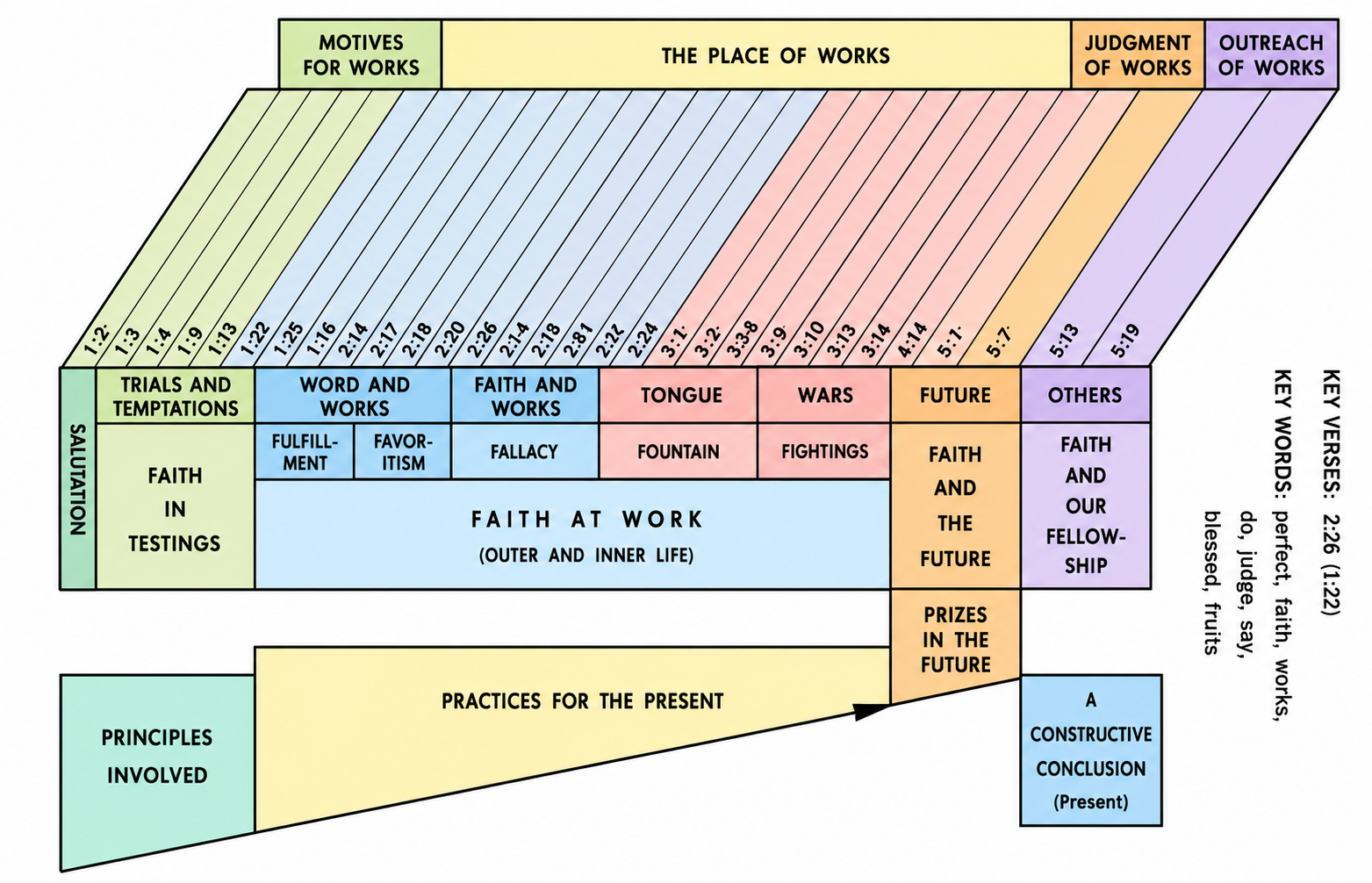
Jas 1:1 James, a bond-servant (doulos) of God and of the Lord Jesus Christ, To the twelve tribes who are dispersed (diaspora) abroad: Greetings (chairo).
WHO IS THE AUTHOR?
HOW DOES HE IDENTIFY HIMSELF? WHAT IS A BONDSERVANT? No rights of his own, exists to do his Master's will, etc
WHAT IS THE IDEA OF A BONDSERVANT (doulos)? “No rights” One’s will subsumed in will of his master, etc
WHAT IS UNSUAL ABOUT JAMES’ SELF IDENTIFICATION? (CLUE: Who is he related to?)
Most writers think he was the half-brother of Jesus
WHO ARE THE RECIPIENTS? 12 tribes
WHO IS THAT REFERRING TO? Jews
WHAT IS UNUSUAL ABOUT THAT DESIGNATION? Includes the 10 “lost” tribes exiled into Assyria in 722 BC! None of them are lost to God! (See also "a great persecution" Acts 8:1).
WHAT IS THEIR CONDITION? Dispersed abroad
WHAT DOES THAT MEAN? Scattered among the Gentiles.
WHY WERE THEY DISPERSED? God dispersed them (and some went voluntarily).
WHAT IS JAMES’ SALUTATION? Greetings
WHAT IS THE GREEK WORD? chairo = rejoice
WHAT MIGHT THAT HAVE TO DO WITH THE FOLLOWING SUBJECT? “consider it all joy (chara)”
Jas 1:2 Consider (hegeomai - aorist imperative) it all joy (chara), my brethren (adelphos), when you encounter (peripipto) various (poikilos) trials (peirasmos),
WHAT IS THE COMMAND? Command (aorist imperative = "Just Do It!") – the idea is every time a new trial comes, they were to obey this command.
HOW MUCH JOY? All joy (WHAT IS IMPLICATION? Every trial is an opportunity to express joy!)
HOW DOES JAMES ADDRESS THEM AND WHAT IS IMPLIED? My brethren ~ believing Jews (cf Jas 1:9)
WHAT IS THE “TIME SENSITIVE WORD” IN THIS VERSE? “When” – in other words not say “IF” but “WHEN” implying trials were guaranteed to come!
WHAT IS THE GREEK WORD FOR “TRIALS”? peirasmos from peirazo – means to test, prove, examine. It is a "neutral word" with no negative connotation by itself. Think of a coin - temptations and trials are two sides of the same coin as in Jas 1:2 and Jas 1:13 (peirazo). Source of trial – TRIALS from God are to build us up. TRIALS from our flesh or Satan are tear us down.
- Satan tempts us to bring out the worst in us
- God tests us to bring out the best, always seeking to make us more like His Son.
WHAT IS THE IDEA OF “VARIOUS (poikilos) TRIALS”? Variegated. “Many colored.” All shapes, sizes, etc, little, big, etc. (cf use in 1Pe 1:6 - "various trials" and 1Pe 4:10 - "manifold grace" - upshot every trial has just the right amount of grace to endure the trial.)
Jas 1:3 knowing (ginosko) that the testing (dokimion) of your faith (pistis) produces (katergazomai - present tense) endurance (hupomone).
BETTER TRANSLATED - NIV “Because you know…” indicating this is an explanation (ESV is similar)
WHAT IS THE REASON (explanation) FOR THE COMMAND TO BE JOYFUL IN TRIALS? You know it has a spiritual benefit specifically producing endurance. Trials test (dokimion) our faith, not to break us, but to make us (strengthen our faith, give endurance).
(SIMILAR QUESTION) WHAT IS THE VALUE OF TESTS OF YOUR FAITH? endurance
WHAT IS THE GREEK WORD FOR ENDURANCE? hupomone = Literally means “remain (meno) under (hupo).” Not a grim resignation or a passive “grin and bear it” acceptance but a triumphant facing of difficult circumstances knowing that even out of the test God promises good.
Morris on hupomone: "It is the attitude of the soldier who in the thick of battle is not dismayed but fights on stoutly whatever the difficulties."
Ray Pritchard - The word “testing” refers to the process by which gold ore was purified. In order to separate the gold from the dross, the ore was placed in a furnace and heated until it melted. The dross rose to the surface and was skimmed off, leaving only pure gold. That’s a picture of what God is up to in our “fiery trials.” We all have to undergo some “furnace time” sooner or later. And some of us will spend an extended time in the furnace of affliction. But the result is the pure gold of Christlike character. Job spoke of this experience when he declared of the Lord, “He knows the way that I take; when he has tested me, I will come forth as gold” (Job 23:10). What is God trying to do when he allows his children to go through hard trials and deep suffering? There are several answers to that question.
First, God wants to purge us of sin and to purify us of iniquity.
Second, God uses suffering to test our faith. Will you still obey God in the darkness? Will you serve God when things aren’t going your way? Will you hold on to the truth when you feel like giving up?
Third, God uses times of difficulty to humble us. When things are going well, we tend to get puffed up about our accomplishments. But let the darkness fall and we are on our knees crying out to God.
Fourth, God definitely uses hard times to prepare us to minister to others. He comforts us so that we may comfort others. I know many Christians whose greatest ministry has come from sharing with others how God helped them through a time of crisis.
Fifth, I believe God uses hard times to prepare us for a new understanding of his character. In the furnace we discover God’s goodness in a way we had never experienced it before.
Until your faith is put to the test, it remains theoretical. You never know what you believe until hard times come. Then you find out, for better or for worse. (Full sermon)
Jas 1:4 And let endurance (hupomone) have (present imperative) its perfect (teleios) result (ergon), so that (hina - term of purpose/result) you may be perfect (teleios) and complete (holokleros), lacking (leipo - present tense) in nothing.
AMPLIFIED - let endurance and steadfastness and patience have full play and do a thorough work, SO THAT (introduces result) you may be [people] perfectly and fully developed [in your faith], lacking in nothing.
WHAT IS THE RESULT OF BEARING UP UNDER THE TRIAL TRUSTING GOD IS IN CONTROL?
(1) You may be perfect (Greek – teleios from telos – goal) - This is NOT sinless perfection but speaks of growth in spiritual maturity.
(2) Complete (Gk – holokleros = complete in all parts, all Christian virtues or graces). One writer says “That which retains all that was initially allotted to it and wanting nothing for its wholeness. It expresses the perfection of man before the fall”Barclay writes that holokleros means "entire, perfect in every part. It is used of the animal which is fit to be offered to God and of the priest who is fit to serve him. It means that the animal or the person has no disfiguring and disqualifying blemishes. Gradually this unswerving constancy removes the weaknesses and the imperfections from a man’s character. Daily it enables him to conquer old sins, to shed old blemishes and to gain new virtues, until in the end he becomes entirely fit for the service of God and of his fellow-men. (James 1)
(3) lacking in nothing (SPIRITUALLY SPEAKING)
WHAT IS THE IDEA OF THE RESULT THAT YOU MAY BE PERFECT (teleios) IN JAMES 1:4? It does not mean sinless! Perfect is best understood as “mature.”
Compare the following uses of teleios:
Ephesians 4:13 until we all attain to the unity of the faith, and of the knowledge of the Son of God, to a mature (teleios) man, to the measure of the stature which belongs to the fullness of Christ.
Phil 3:12 Not that I have already obtained it or have already become perfect (VERB – teleioo), but I press on so that I may lay hold of that for which also I was laid hold of by Christ Jesus.
IN CONTEXT WHAT ARE SOME THINGS A BELIEVER MIGHT BE DEFICIENT IN?
- Wisdom (Jas 1:5),
- Faith (that wavers, is tossed about) (Jas 1:6-8);
- Proper view of the value of humility and riches (Jas 1:9-11).
GREAT TRUTH ABOUT GOD TO RECALL NEXT TIME WE ARE IN A TRIAL - When God puts us in the furnace, He always keeps His eye on the clock and His hand on the thermostat.--Warren Wiersbe
CROSS REFERENCES RELATED TO JAMES 1:2-4
Romans 5:1-5 Therefore, having been justified by faith, we have peace with God through our Lord Jesus Christ, 2 through whom also we have obtained our introduction by faith into this grace in which we stand; and we exult in hope of the glory of God. 3 And not only this, but we also exult (NIV, NLT = “REJOICE”) in our tribulations (thlipsis - literally pressure = difficult circumstances), knowing (cf “know that the testing of your faith…” Jas 1:3) that tribulation brings about perseverance (hupomone as in James); 4 and perseverance, proven character (dokime cf "perfect, complete, lacking nothing"); and proven character (dokime), hope; 5 and hope does not disappoint, because the love of God has been poured out within our hearts through the Holy Spirit Who was given to us.
WHAT SIMILARITIES (at least 5) DO YOU SEE IN RO 5:3-5 AND JAMES 1:2-4? See yellow highlights – (1) rejoice, (2) pressuring circumstances, (3) knowing something good will result (4) perseverance (hupomone) and (5) proven character (cf perfect, complete, lacking nothing)
1 Peter 1:6-9 In this you greatly rejoice (agalliao = “JUMP FOR JOY”), even though now for a little while, if necessary, you have been distressed by various (poikilos) trials (peirasmos), 7 so that the proof (dokimon) of your faith (pistis), being more precious than gold which is perishable, even though tested (dokimazo) by fire, may be found to result in praise and glory and honor at the revelation of Jesus Christ; (Second Coming) 8 and though you have not seen Him, you love Him, and though you do not see Him now, but believe in Him, you greatly rejoice with joy inexpressible and full of glory, 9 obtaining as the outcome of your faith the salvation of your souls.
WHAT SIMILARITIES DO YOU SEE IN 1 PETER 1:6-9 AND JAMES 1:2-3?
Note “in this” refers to the preceding (v3 born again, v4 an imperishable inheritance, v5 protected until glorification) Some will think this refers to trials but John MacArthur says “In this refers back to the preceding passage (1:3–5) (AS DO MOST COMMENTARIES).
(1) Trials are necessary
(2) They have a time limit (“a little while”) (This should encourage us to persevere).
(3) Cause real distress
(4) Are various (like Jas 1:2) – same Greek word “poikilos”
(5) Of inestimable value - Suffering refines our faith = fire tested (removes the impurities) (2) Such a tested faith will be rewarded by praise, glory and honor
1 Peter 4:12-13 Beloved, do not be surprised (present imperative with a negative) at the fiery ordeal among you, which comes upon you for your testing (peirasmos) , as though some strange thing were happening to you; 13 but to the degree that you share the sufferings of Christ (Ro 8:17, Php 3:10, Mt 5:11), keep on rejoicing (chairo), so that also at the revelation of His glory (Second Coming) you may rejoice (chairo) with exultation (agalliao).
WHAT SIMILARITIES DO YOU SEE IN 1 PETER 4:12-13 AND JAMES 1:2-3?
(1) Do not be caught off guard -- Fiery ordeal is guaranteed like Jas 1:2-3
(2) It is for testing (peirasmos) like Jas 1:2-3
(3) Keep rejoicing (chairo) now – you are participating in the sufferings of Christ
(4) You will rejoice in future when His glory is revealed
Other parallel passages - Ro 8:17,18, Mt 5:10-12, 2Ti 3:12, Php 1:29, Acts 14:22, Acts 5:41, 2Co 4:17, 18
Jas 1:5 But if (1st Class condition = this is true ~ “Since”) any of you lacks (leipo - present tense) wisdom (sophia), let him ask (aiteo) of God, Who gives to all generously (haplos) and without reproach (oneidizo), and it will be given to him.
WHEN WE ARE ENVELOPED BY THE TRIAL, WHAT IS OFTEN OUR RESPONSE AND WHAT DO WE NEED? “Why me Lord?” “Why now?” etc. We need Wisdom from above, not earthly wisdom (Jas 3:15-17).
(SIMILAR) WHAT ARE WE TO DO WHEN IN A TRIAL & CONFUSED, WEAK, UNCERTAIN AS TO HOW TO RESPOND? Ask our Father
WHAT CHARACTERIZES GOD’S GIVING WHEN WE ASK IN FAITH?
(1) generously, liberally
(2) without reproach (He won’t rebuke us for asking!)
HOW CERTAIN CAN WE BE THAT GOD WILL ANSWER? It will be given
CROSS REFERENCES RELATED TO JAMES 1:5
Romans 11:33-36 Oh, the depth of the riches both of the wisdom and knowledge of God! How unsearchable are His judgments and unfathomable His ways! 34 For WHO HAS KNOWN THE MIND OF THE LORD, OR WHO BECAME HIS COUNSELOR? 35 Or WHO HAS FIRST GIVEN TO HIM THAT IT MIGHT BE PAID BACK TO HIM AGAIN? 36 For from Him and through Him and to Him are all things. To Him be the glory forever. Amen.
Daniel 2:20-23 Daniel said, “Let the name of God be blessed forever and ever, For wisdom and power belong to Him. 21 “It is He Who changes the times and the epochs; He removes kings and establishes kings; He gives wisdom to wise men And knowledge to men of understanding. 22 “It is He who reveals the profound and hidden things; He knows what is in the darkness, And the light dwells with Him. 23 “To You, O God of my fathers, I give thanks and praise, For You have given me wisdom and power; Even now You have made known to me what we requested of You, For You have made known to us the king’s matter.”
Job 12:13, 16 With Him are wisdom and might; To Him belong counsel and understanding. 16 “With Him are strength and sound wisdom, The misled and the misleader belong to Him.
All of these passages emphasize that God is the source of wisdom (even to deep to comprehend) and he gives to men when requested in faith (cf Da 2:17,18).
Jas 1:6 But he must ask (aiteo) in faith (pistis) without any doubting (diakrino), for (gar - term of explanation) the one who doubts (diakrino - present tense) is like the surf of the sea (thalassa), driven and tossed by the wind.
WHAT CONDITION(S) MUST WE FULFILL FOR GOD TO ANSWER OUR PRAYER FOR WISDOM IN THE TRIAL? Ask in faith without any doubting
WHAT DOES IT MEAN TO ASK IN FAITH? Trust that He is good, He is sovereign (in control), His purposes for us in the trial are good
WHY IS IT MANDATORY THAT WE ASK GOD FOR WISDOM IN FAITH ACCORDING TO HEBREWS 11:6?
And without faith it is impossible to please Him, for he who comes to God must believe that He is and that He is a rewarder of those who seek Him.
(1) It is impossible to please God
(2) He will not reward the doubting person, in this case with divine wisdom.
WHAT IS THE IDEA OF DOUBTING? Not a momentary doubt we can all have, but the picture of one who continually doubts God ("one who doubts" is in present tense = the habit of their life).
Doubt - diakrino (from diá = separation, "thoroughly back and forth" + kríno = distinguish, decide, judge) in the context of James means being undecided within oneself - hesitate, waver, to be uncertain
WHAT IS THE PICTURE (SIMILE) OF A PERSON WHO DOUBTS GOD? Like surf driven, tossed by wind.
WHAT DOES SURF DRIVEN, TOSSED BY WIND DEPICT REGARDING THE PERSON’S FAITH? It wavers, vacillates, a divided heart, a wavering between trusting God and relying on one’s own understanding or the world’s wisdom.
Jas 1:7 For that man ought not to expect (hoiomai) that he will receive (lambano) anything from the Lord,
HOW DOES JAMES EXPLAIN THE “DANGER” OF DOUBTING FAITH? They won’t receive anything, and “anything” in this context refers to divine wisdom.
Jas 1:8 being a double-minded (dipsuchos) man, unstable (akatastatos) in all his ways.
NLT paraphrase - Their loyalty is divided between God and the world, and they are unstable in everything they do.
HOW DOES JAMES DESCRIBE A MAN DOUBTING IN PRAYER?
(1) double minded (dipsuchos -“literally two souls”) – WHAT DOES THAT PICTURE? Divided allegiance —torn between trusting God and trusting self. He attempts to serve God while trying to enjoy the world. He is drawn one direction for a while and then the other.
(2) Unstable (akatastatos) in all his ways
WHAT IS THE EFFECT OF UNSTABLE ON HIS SPIRITUAL LIFE? “All his ways” describes one who cannot trust God wholeheartedly so that their instability spills into every area of their life -- relationships, moral choices, priorities, etc.
Jas 1:9 But the brother (adelphos) of humble (tapeinos) circumstances is to glory (kauchaomai) in his high position (hupsos/hypsos);
TECHNICAL NOTE: NASB begins with a "but" that usually would introduce a contrast with the previous passages. Almost every modern version does not have a "but."
WHO IS CONTRASTED IN Jas 1:9-11 AND WHAT ARE 3 CONTRASTS? (This is unrelated to the "but" at the beginning of Jas 1:9)
(1) Poor (humble circumstances) // rich
(2) Brother (probably believer) // man (not specified but in context probably a rich believer)
(3) high position // will fade away
NOW KEEPING THE CONTEXT IN MIND TRIALS, WHAT WOULD YOU SAY IS THE “TRIAL” IN V9-11? Riches, money, wealth
WHAT IS THE HIGH POSITION OF THE BROTHER? He is a believer and is possessor of spiritual riches that more than counter his material poverty.
WHAT DOES 1 Corinthians 1:26-31 SAY THAT RELATES TO A BROTHER OF HUMBLE CIRCUMSTANCES?
1 Corinthians 1:26-31 For consider your calling, brethren, that there were not many wise according to the flesh, not many mighty, not many noble; 27 but God has chosen the foolish things of the world to shame the wise, and God has chosen the weak things of the world to shame the things which are strong, 28 and the base things of the world and the despised God has chosen, the things that are not, so that He may nullify the things that are, 29 so that no man may boast before God. 30 But by His doing you are in Christ Jesus, who became to us wisdom from God, and righteousness and sanctification, and redemption, 31 so that, just as it is written, “LET HIM WHO BOASTS, BOAST IN THE LORD.”
The brethren of humble circumstances were chosen by God to nullify the things that are so that no one may boast because they are in Christ Jesus (believers, saved) by God's work and it is in Him they are to boast.
CROSS REFERENCES
Acts 2:44-45 And all those who had believed were together and had all things in common; 45and they began selling their property and possessions and were sharing them with all, as anyone might have need.
Acts 4:32-35 And the congregation of those who believed were of one heart and soul; and not one of them claimed that anything belonging to him was his own, but all things were common property to them. 33 And with great power the apostles were giving testimony to the resurrection of the Lord Jesus, and abundant grace was upon them all. 34 For there was not a needy person among them, for all who were owners of land or houses would sell them and bring the proceeds of the sales 35and lay them at the apostles’ feet, and they would be distributed to each as any had need.
The upshot is that the first church in Jerusalem was composed of rich and poor brethren.
Jas 1:10 and the rich man (plousios) is to glory in his humiliation (tapeinos), because (term of explanation) like flowering grass he will pass away (parerchomai).
WHY SHOULD RICH BOAST IN HIS HUMILIATION? Because like flowering grass he will pass away (which he goes on to explain)
Jas 1:11 For the sun rises with a scorching wind and withers the grass; and its flower falls off and the beauty of its appearance is destroyed; so too the rich man in the midst of his pursuits will fade away.
HOW DOES HE EXPLAIN “FLOWERING GRASS?” (1) Sun – scorching wind (2) withers grass (3) flower falls (4) beauty is destroyed
HOW DOES JAMES APPLY THIS PICTURE TO THE RICH MAN? “SO TOO” - in the midst of his pursuits will fade away.
WHAT CAN WE DEDUCE AS THE TRUTH ABOUT TEMPORAL RICHES? WILL FADE AWAY
Jas 1:12 Blessed (makarios) is a man who perseveres (hupomeno = present tense = as one's lifestyle) under trial (peirasmos); for once he has been approved (dokimos), he will receive the crown (stephanos) of life (zoe) which the Lord has promised (epaggello) to those who love (agapao) Him.
WHAT IS THE REWARD FOR THE MAN (RICH OR POOR) WHO PERSEVERES UNDER TRIAL? He will be blessed
HOW DOES HE EXPLAIN THE BLESSING?
WHO RECEIVES IT? The one who has been approved = Greek means passed the test
WHAT IS IT? Crown of life
WHAT DID THEIR PERSEVERANCE IN TRIALS SHOW REGARDING THEIR ATTITUDE TOWARD GOD? Their love for Him – they obeyed the command to consider it all joy – and as Jesus taught in Jn 14:15 “If you love Me, you will keep My commandments.”
HOW WOULD JAMES 1:2-12 ENCOURAGE/MOTIVATE HIS JEWISH READERS?
James 1:12-27
ADDITIONAL QUESTIONS (SOME REPETITION):
WHAT MAN IS BLESSED?
WHAT IS ONE BLESSING HE WILL RECEIVE IN CONTEXT? WHEN WILL HE RECEIVE IT?
WHAT MOTIVATION IS THERE FOR A MAN TO PERSEVERE UNDER TRIAL?
QUESTIONS ON MATTHEW 5 PARALLEL PASSAGES
Matthew 5:10 “Blessed are those who have been persecuted for the sake of righteousness, for theirs is the kingdom of heaven. 11 “Blessed are you when people insult you and persecute you, and falsely say all kinds of evil against you because of Me. 12“Rejoice and be glad, for your reward in heaven is great; for in the same way they persecuted the prophets who were before you.
WHO IS BLESSING FOR? persecuted, insulted, recipients of evil slander
WHY ARE THEY PERSECUTED? for sake of righteousness, because of Christ in them
WHAT COMMANDS IN LIGHT OF THESE AFFLICTIONS? Rejoice and be glad (WHAT DOES THAT SOUND LIKE? Jas 1:2-4)
WHAT IS THE REWARD MENTIONED? Kingdom of heaven, reward in heaven
QUESTIONS ON CROWN - all use the Greek stephanos (not diadema = for a king - Rev 19:12) = prize for victory in public games as symbol of honor. Woven of oak, ivy, myrtle, olive leaves or flowers. In this life it may be that the Christian's loyalty to Christ will bring him a crown of thorns, but in the life to come it will surely bring him the crown of glory. The cross before the crown!
WHAT CROWN AND WHY GIVEN IN EACH OF FOLLOWING PASSAGES?
1 Cor 9:24-27 Do you not know that those who run in a race all run, but only one receives the prize? Run in such a way that you may win. 25 Everyone who competes in the games exercises self-control in all things. They then do it to receive a perishable wreath (stephanos), but we an imperishable. 26 Therefore I run in such a way, as not without aim; I box in such a way, as not beating the air; 27 but I discipline my body and make it my slave, so that, after I have preached to others, I myself will not be disqualified (adokimos = not passing the text).
1 Th 2:19-20 For who is our hope or joy or crown (stephanos) of exultation? Is it not even you, in the presence of our Lord Jesus at His coming? (SECOND COMING) 20 For you are our glory and joy. (Same as "crown" in Php 4:1)
2 Ti 4:8 in the future there is laid up for me the crown (stephanos) of righteousness, which the Lord, the righteous Judge, will award to me on that day (SECOND COMING); and not only to me, but also to all who have loved His appearing.
1 Pe 5:1-4 Therefore, I exhort the elders among you, as your fellow elder and witness of the sufferings of Christ, and a partaker also of the glory that is to be revealed, 2 shepherd the flock of God among you, exercising oversight not under compulsion, but voluntarily, according to the will of God; and not for sordid gain, but with eagerness; 3 nor yet as lording it over those allotted to your charge, but proving to be examples to the flock. 4 And when the Chief Shepherd appears (SECOND COMING), you will receive the unfading crown (stephanos) of glory.
Rev 2:10 ‘Do not fear what you are about to suffer. Behold, the devil is about to cast some of you into prison, so that you will be tested, and you will have tribulation for ten days. Be faithful until death, and I will give you the crown (stephanos) of life.
Rev 3:11 ‘I am coming quickly (SECOND COMING); hold fast what you have, so that no one will take your crown (stephanos).
Rev 4:10-11 the twenty-four elders will fall down before Him who sits on the throne, and will worship Him who lives forever and ever, and will cast their crowns (stephanos) before the throne, saying, “Worthy are You, our Lord and our God, to receive glory and honor and power; for You created all things, and because of Your will they existed, and were created.”
D L Moody - Five crowns for believers:—
1. A crown of life, for endurance. James 1:12; Rev. 2:10.
2. A crown of righteousness, for the good fight of faith. 2 Tim. 4:8.
3. A crown of rejoicing, for winning souls. 1 Thess. 2:19.
4. A crown of glory, for those who edify the church, and for feeding souls. 1 Pet. 5:4.
5. A crown of reward, for those who successfully run the race. 1 Cor. 9:25.
Jas 1:13 Let no one say when he is tempted, “I am being tempted by God”; for God cannot be tempted by evil, and He Himself does not tempt anyone.
FIRST, WHAT IS THE "KEY WORD" IN THIS PASSAGE? "tempt/tempted"
WHAT IS JAMES GIVING HERE - A SUGGESTION OR A COMMAND?
It is a command in present imperative with a negative which can mean either stop an action already in progress or do not begin to say this about God!
WHAT DO YOU DEDUCE FROM THE "TIME SENSITIVE" WORD "WHEN" IN THE PHRASE "WHEN HE IS TEMPTED"?
It is not "IF" BUT "WHEN" so rest assured temptation is an absolute certainty.
1 Peter 2:11 says "Beloved, I urge you as aliens and strangers to abstain from fleshly lusts which wage war against the soul." The verb wage war is in the present tense indicating that "fleshly lusts" are always crouching at the door of our heart (cf Ge 4:7) ready to leap on us, especially if we are unprepared (HOW IS BEST WAY TO BE PREPARED? Begin your day in the Word of Truth and then walk by that truth empowered by the Spirit Who will continually enable you to put "to death the deeds of the body" (Ro 8:13).
WHAT CAN HAPPEN TO US IF WE DO NOT SEE THE TRIAL AS FROM OR ALLOWED BY GOD?
It may become a temptation to sin, but clearly that was not God's purpose for the trial. Also we may seek to blame, murmur or grumble against God and that is sin (Nu 14:27), and so the trial sent for our good results in us committing sin instead of growing in Christlikeness! A truth we must never forget is that EVERY trial potentially brings a temptation.
SPURGEON - God tries men, but the motive of a trial is that which differences it from a temptation. In a temptation we try a man with a view of inducing him to do wrong; but God tries men to best them, that they may, by finding out their weakness, be saved from doing wrong. He never inclines a heart to evil.
Satan tempts to bring out the bad;
God tests to bring out the good.
-- W H Griffith
WHY IS THE STATEMENT "I AM BEING TEMPTED BY GOD" IMPOSSIBLE? (two reasons identified by the hinge word "FOR" [gar] marking a "term of explanation")
(1) God cannot be tempted (apeirastos) by evil — His very nature is that evil has absolutely no attraction, appeal, or influence upon Him because He is perfectly holy. Think of evil as "iron filings." God's nature has no "magnet" to attract the "iron filings."
(2) He Himself does not tempt anyone — because His nature is holy (set apart), utterly pure, He never solicits or entices people to sin.
Jas 1:14 But each one is tempted when he is carried away and enticed by his own lust.

WHO IS RESPONSIBLE WHEN IT COMES TO TEMPTATION? (might draw attention to the pronouns at the beginning and end of the sentence = "each one" and "his own" lusts). So the one to "blamee" is each of us individually, our own lust = this lust is belongs uniquely to each person. This is important to understand because WHAT DOES THIS TRUTH EXCLUDE (e.g., regarding circumstances, etc)? It excludes our external circumstances, other people's influence, Satan's activity, the world's attractions, etc. Those things may "catalyze" this process leading to sin but they are not the root cause.
WHAT IS LUST IN THIS CONTEXT? strong desires coming from our fallen flesh (our "own lust") which is directed toward something, which can be either positive or negative. In the context on James 1:14, lust is a powerful inner craving directed toward something evil, something God has forbideen.
Amplified - But every person is tempted when he is drawn away, enticed and baited by his own evil desire (lust, passions).
ESV - But each person is tempted when he is lured and enticed by his own desire.
WHAT ARE THE TWO WAYS TEMPTATION CAN WORK ON OUR LUST? (1) Carry us away and (2) entice us.

WHAT IS THE PICTURE OF THESE TWO GREEK WORDS?
(1) Carried away - (exelko from ek = out or away + hélko = draw) means to draw out, drag forth, draw away. It pictures a fish being drawn out of safe water by bait, or an animal being lured out of its den into a trap.
(2) Enticed (deleazo from delear = a bait) means to to beguile, entice by blandishments, a fishing/hunting term — to be caught by bait, to be trapped. The idea is to catch by use of bait as does a trapper (bait in a trap or snare) or fisherman who lures prey from their place of hiding. Evil desires act as a bait to "hook" us and get us in trouble. Lust hides the hook so to speak! The point is that no temptation appears as temptation but always seems more alluring and promising than it proves to be.
Summary: Your inner craving (lust) spots an object → begins moving toward it → gets hooked
Jas 1:15 Then when lust has conceived, it gives birth to sin; and when sin is accomplished, it brings forth death.
Note "Then" marks progression and "when" is a time sensitive word.
WHAT IS THE METAPHOR JAMES USES HERE? WHAT HAPPENS TO LUST ONCE IT HAS BEEN HOOKED BY THE BAIT? It conceives. "Lust gets pregnant, and has a baby: sin!" (Msg)
TAKEAWAY - The further down the chain you go, the harder it is to stop. The time to fight is at the luring stage, when desire first spots its object, not after conception has occurred!
WHAT DOES THIS PICTURE SAY ABOUT OUR ABILITY TO WITHDRAW FROM THE BAIT AT THIS STAGE? It is too late! The baby cannot be "unconceived!"
WHAT IS THE PROCESS JAMES DESCRIBES BEGINNING WITH TEMPTATION? tempted >carried away/enticed >lust conceives > births sin > brings death not life. Or see the table below.
| STAGE | WHAT HAPPENS | METAPHOR |
|
Lust Spots Object |
Desire is aroused |
Bait is seen |
|
Lured and enticed |
Will begins to follow desire |
Hook is set |
|
Desire conceives |
Will & desire unite in a choice |
Conception |
|
Gives birth to sin |
The act is committed |
Birth |
|
Sin fully grown |
Pattern of sin established |
Maturity |
|
Brings forth death |
Eternal Consequence |
Death |
Jas 1:16 Do not be deceived (planao), my beloved (agapetos) brethren.
NOTE: The reason for this command at this point is not easy to discern and there is some difference in the commentaries.
WHAT IS THE COMMAND? Do not be deceived (planao - present imperative with a negative = Stop action in progress or Do not begin to be led astray or to wander from the truth)
WHAT MIGHT THE READERS BE DECEIVED BY? Thinking that God is source of temptation (but see NOTE below).
WHY IS THE COMMAND IN PRESENT TENSE (CALLS FOR CONTINUOUS ATTENTION)? We need to be continually be alert for danger of falling into this trap of deception about temptations and blaming God.
HOW DOES JAMES SOFTEN THE COMMAND? Calls them (1) beloved and (2) his brethren (members of God's family)
NOTE: Some consider this command to function as a hinge between the preceding section (do not be deceived about the source and consequences of sin) and the following section speaking of the goodness of God and His good gifts ("beware of casting suspicion on God and His beneficent activities. The verse has a transitional function and, like a bridge, provides connections in both directions, but what has gone before seems primarily in view" - Hiebert)
Jas 1:17 Every good thing given and every perfect gift is from above, coming down from the Father of lights, with whom there is no variation or shifting shadow.
HOW WOULD YOU CHARACTERIZE GOD'S GIFTS? (1) good (2) perfect -- Scripture is unambiguous that there is no genuinely good thing that does not ultimately originate from God.
HOW MIGHT THIS EXPLAIN WHY GOD COULD NOT BE RESPONSIBLE FOR TEMPTATIONS? He is the source of good, not evil, perfect gifts not temptations to sin.
A trial may be God's
good gift in disguise.
WHAT DOES THE TITLE "FATHER OF LIGHTS" INDICATE ABOUT GOD? It was a common Jewish description for God as the Creator of all the lights-the sun, moon and stars. He is our Father and an earthly fathers do not give bad gifts to their children.
HOW DOES GOD DIFFER FROM THE LIGHTS HE CREATED? (1) no variation (2) no shifting shadow. - created lights vary and cause shadows. (The sun has its spots, the moon wanes, the stars fall)
WHAT DIVINE ATTRIBUTE DOES JAMES DESCRIBE? Immutability (See Immutable)
WHAT WOULD REMEMBERING THIS TRUTH ABOUT GOD BE AN ANTIDOTE FOR (cf Preceding Passages)? deception in v16
JAMES 1:17 IS AN ANTIDOTE FOR...
- Deception about God in trials -- He is unchangeably good; trials are gifts in disguise
- Blaming God -- He gives only good gifts; evil traces to our own lusts
- Ingratitude -- Every blessing without exception comes from Him
- Doubting God's consistency -- No variation, no shifting shadow — ever
- Complaining and murmuring -- Every needful thing for holiness and happiness comes from Him
- Fear and anxiety -- His character and purposes toward you have not changed
Jas 1:18 In the exercise of His will He brought us forth by the word of truth, so that (term of purpose/result) we would be a kind of first fruits among His creatures.
WHAT IS JAMES DESCRIBING? born agaiin, regeneration, new birth
WHERE HAVE WE JUST SEEN THIS IDEA OF "BROUGHT FORTH" (in a contrast)? Jas 1:15 "brings forth death" - same verb apokueo in both passages giving a dramatic contrast between LIFE and DEATH.
WHY WERE WE BROUGHT FORTH? It was God's will - He was the Initiator, man was the beneficiary.
WHAT AGENT/VEHICLE DID GOD USE TO BRING US FORTH? His word of truth (WHAT IS THAT? = the Gospel)
WHAT IS THE PURPOSE OF HIS BRINGING US FORTH? that we would be first fruits
WHAT IS THE UNDERLYING IDEA OF FIRST FRUITS? In ancient Israel it was first portion of offering was set aside specifically for Lord. Hence first fruits is used of persons consecrated to God. We Belong to God, Totally and Permanently. Firstfruits also symbolized a pledge or down payment and promise of the future entire harvest, all the saved in future ages.
NOTE: The primary meaning of firstfruits in the OT was that it was holy to the LORD, set apart, belonging to God alone. The term aparchē was used of persons consecrated to God for all time. When God brings us forth by the word of truth and calls us first fruits, He is declaring: You are Mine. You have been consecrated. You are not your own.
Jas 1:19 This you know, my beloved brethren. But everyone must be (present imperative) quick to hear, slow to speak and slow to anger;
TECHNICAL NOTE: "This you know" is better rendered as a command - ESV = "Know this", NLT = "take note of this." NET = "Understand this." Also, most of the other modern versions omit the conjunction "but" (in NASB) so that this is not likely to be a contrast.
HOW DOES JAMES ADDRESS THE READERS AGAIN? my beloved brethren (WHY? Soften the effect of the following command).
WHAT IS THE IMPLICATION OF "MY BELOVED BRETHREN?" THAT IS, WHO ARE THEY? believers, those brought forth by word of truth
WHAT IS THE COMMAND (actually 3 commands) JAMES WANTS HIS BRETHREN TO UNDERSTAND? BE (present imperative = calling for this to be their lifestyle) quick to hear, slow to speak, slow to anger
IN CONTEXT (don't yank it out of context), TO WHAT DOES "QUICK TO HEAR" REFER, i.e., TO HEAR WHAT? In context to hear the Word of truth. The Word that gave birth to the new life must continue to nourish and govern the new life. You cannot hear that word if you are speaking or if you are angry.
Jas 1:20 for (term of explanation) the anger (orge) of man does not achieve (ergazomai) the righteousness (dikaiosune) of God.
WHY DOES JAMES GIVE THE COMMAND ABOUT ANGER (orge)? (Remember "for" introduces an explanation) it does achieve righteousness of God
Jas 1:21 Therefore (term of conclusion), putting aside (apotithemi) all filthiness (rhuparia) and all that remains of wickedness (kakia), in humility receive (dechomai - aorist imperative) the word implanted (emphutos), which is able (dunamai - present tense) to save (sozo) your souls (psuche).
WHO IS JAMES ADDRESSING, BELIEVERS OR NON-BELIEVERS? context of "my beloved brethren" supports he is addressing believers.
WHAT ARE JAMES' INSTRUCTIONS REGARDING HOW ONE SHOULD RECEIVE THE WORD? (1) putting aside all filthiness (2) all wickedness (3) humbly receive the Word
WHAT IS THE EFFECT OF THE WORD SO RECEIVED? It has the intrinsic power to "save your souls."
WHAT DOES THIS REFER TO PRIMARILY IN CONTEXT, TO PAST TENSE SALVATION (JUSTIFICATION) OR PRESENT TENSE SALVATION (SANCTIFICATION)? If we accept James is addressing them as "my beloved brethren" implying they were believers, this would refer to sanctification. Additional support for this interpretation is the fact that an unsaved, unregenerate man would not even have the power to cast off filthiness and wickedness.
However, given the probability that some of the readers were not saved, for those hearers the salvation would refer to justification.
Jas 1:22 But prove (present imperative) yourselves doers (poietes) of the word (logos), and not merely hearers (akroates) who delude (paralogizomai - present tense) themselves.
WHAT IS JAMES COMMAND AND CAUTION? Prove yourself to be doers, not just hearers of the Word.
WHAT IS THE IMPLICATION OF THE FACT THAT PROVE IS IN THE PRESENT IMPERATIVE? calls for this to be a believer's habitual practice.
IN ESSENCE WHAT IS HE CALLING FOR THE READERS TO MANIFEST? Obedience or "works" -- he will dive more deeply into faith and works in chapter 2.
WHY IS THIS IMPORTANT TO OBEY? if you talk and do not walk the truth you are deluding yourself.
WHAT DOES IT MEAN TO DELUDE YOURSELF? The verb means to mislead your own mind with false reasoning, so thoroughly that you obscure the truth.
Warren Wiersbe quote - "Many people have the mistaken idea that hearing a good sermon or Bible study is what makes them grow and get God’s blessing. It is not the hearing but the doing that brings the blessing. Too many Christians mark their Bibles, but their Bibles never mark them! If you think you are spiritual because you hear the Word, then you are only kidding yourself."
Jas 1:23 For (hoti - term of explanation) if anyone is a hearer (akroates) of the word (logos) and not a doer (poietes), he is like a man who looks (katanoeo - present tense - intensive/attentive scrutiny) at his natural face in a mirror;
HOW DOES JAMES ILLUSTRATE A HEARER WHO IS NOT A DOER? describes a man looking at himself in a mirror
Jas 1:24 for once he has looked (katanoeo) at himself and gone away, he has immediately (eutheos) forgotten (epilanthanomai) what kind of person he was.
HOW DOES JAMES MIRROR ILLUSTRATION DEPICT A HEARER OF THE WORD WHO IS NOT A DOER? when he goes away from the "mirror" of the word he becomes forgetful of what he saw about himself in the mirror. The Greek verb for "forgotten" means COMPLETELY forgotten!
When we read the Bible, we need to let it read us!
HOW QUICKLY DOES A HEARER WHO IS NOT A "DOER" FORGET THE WORD HE HAS JUST HEARD (OR READ)? Immediately!!! Like our sayiing "in one ear and out the other!"
WHAT'S THE BIG IDEA? Looking at the Word is not enough!
The Word seen (or heard) MUST be put into practice
to exert it's sanctifying effect on our soul!
Jas 1:25 But one who looks intently (parakupto) at the perfect (teleios) law, the law of liberty (eleutheria - set free) , and abides (parameno) by it, not having become a forgetful hearer (akroates) but an effectual (ergon) doer (poietes), this man will be blessed (makarios) in what he does.
WHAT IS THE "MIRROR" (so to speak) IN THIS VERSE? perfect law, law of liberty (Word of God)
Cf 2Co 3:18 But we all, with unveiled face, beholding as in a mirror the glory of the Lord, are being transformed into the same image from glory to glory (progressive sanctification by the Spirit using the Word implanted!), just as from the Lord, the Spirit.
Paul shifts the metaphor from self-examination to transformation.
WHY DOES HE CALL IT PERFECT? (Ps 19:7) It is inerrant and sufficient -- giving us everything we need for life and godliness
HOW IS THIS A PARADOXICAL STATEMENT - IN OTHER WORDS WHAT DO WE NORMALLY THINK OF LAW DOING TO OUR FREEDOM?
WHY DOES HE CALL IT "LAW OF LIBERTY"? when we obey we experience true freedom in Christ. We now have the power to obey (Ezek 36:27)
John MacArthur on "liberty" - "James focused on its redemptive power in freeing believers from the bondage of sin and then freeing them to righteous obedience (John 8:34–36 Ro 6:16–18)"
WHAT ACTIONS DOES JAMES CALL FOR? (1) look intently, (2) abide by the law (See it and obey it, like hearers who are doers).
WHAT CONTRAST DOES JAMES USE TO SHOW THE IMPORTANCE OF DOING? not a forgetful hearer, an effectual doer
WHAT IS THE REWARD FOR ABIDING BY THE LAW OF LIBERTY AND DOING IT? blessed in what he does (Also he experiences true liberty or freedom. True freedom is living as we should, not as we please. Freedom from dominion of sinful appetites and passions. Freedom in Christ is not the right to do as one pleases but the power to please God by doing what is right!)
Jas 1:26 If anyone thinks (dokeo) himself to be religious (threskos), and yet does not bridle his tongue but deceives (apatao - present tense) his own heart (kardia), this man’s religion (threskeia) is worthless (mataios).
WHAT IS THE DANGER JAMES DESCRIBES? For someone to think they are being religious
HOW CAN YOU SPOT SOMEONE WHO THINKS HE IS RELIGIOUS? does not bridle his tongue
WHAT IS THIS MAN ACTUALLY DOING TO HIMSELF? deceiving his own heart
WHAT HAVE WE SEEN EARLIER ABOUT WHAT CAN DECEIVE OR DELUDE SOMEONE? hearer, not doer
WHAT VALUE IS HIS SO-CALLED RELIGION? worthless
Jas 1:27 Pure and undefiled religion in the sight of our God and Father is this: to visit orphans and widows in their distress, and to keep oneself unstained by the world.
WHAT IS THE CONTRAST IN THIS PASSAGE? pure and undefiled religion versus sham, worthless religion
WHO IS THE FINAL ARBITER OF THE VALUE OF ONE'S RELIGIOUS BEHAVIOR? our God and Father Who is watching
WHAT DOES PURE, UNDEFILED RELIGION LOOK LIKE? (1) visit orphans and widows in distress (2) keep from being stained by the world
HOW WOULD THE WORLD STAIN US? godless talk, ungodly entertainment, etc (Social Media is largely ungodly and stains many people including believers!)
Jas 2:1 My brethren, do not hold your faith in our glorious Lord Jesus Christ with an attitude of personal favoritism.
The epistle of James is one of the most practical books in the New Testament. Written by James, the half-brother of Jesus and leader of the Jerusalem church, it addresses Jewish believers of the Diaspora (James 1:1). James has a singular passion: authentic, living faith must produce visible, tangible fruit. His letter relentlessly presses the question — does your faith actually work?
HOW DOES JAMES ADDRESS HIS READERS? WHAT IS THE IMPLICATION? believers (WHY DO YOU SAY THAT FROM PREVIOUS CONTEXT? - He had called them "my beloved brethren" - Jas 1:2, 16, 19)
NOTE - Greek for brethren is adelphos = literally from same womb - here same Spirit births and same Father - the point is that James is addressing a "family issue," one occurring in the household of God. Remarkably, this exact phrase “my brethren” appears only 22 times in all of Scripture, and 8 of those occurrences are in James alone. This is a family issue — and James addresses it with a pastor’s heart, not a judge’s bench.
HOW DO YOU KNOW FOR CERTAIN THEY ARE BELIEVERS? he says they have faith in our (shared) glorious Lord Jesus Christ
WHAT IS JAMES DOING, GIVING A SUGGESTION OR A COMMAND? present imperative with a negative
WHAT DOES HIS INDICATE ABOUT WHERE FAVORITISM WAS ALREADY A PRACTICED HABIT AMONG BELIEVERS? Command to stop an action in progress (or not to begin this action). To profess faith in Jesus while practicing partiality is a direct contradiction of everything Jesus embodied.
WHAT IS THE ATTITUDE JAMES IS PROHIBITING? personal favoritism
WHAT IS THE GREEK WORD FOR FAVORITISM (IF YOU LOOKED IT UP)? prosopolepsia from prósopon = face + lambáno = receive. Literally it meant to “receive a face” or "face taker" "accept a face" ~ respecter of persons. This compound noun does not appear in secular Greek.
Note - Although favoritism is at end of English sentence, it is near the beginning in Greek - WHAT DOES THAT PLACEMENT SIGNIFY? it is the way a word or term was emphasized in Greek. James signals that this is the controlling concern of the entire passage. The term derives from the LXX rendering of the Hebrew idiom panim nasa ("to lift up the face"), used of an Oriental judge who, when he favorably received someone, would literally allow that person to lift their face from the bowed-down greeting position.
NOW BACK TO THE TITLE JAMES GIVES JESUS --
FIRST Note the possessive pronoun "our"! WHAT DOES THAT TEACH? He is their possession further indicated James is speaking to them as believers.
HOW DOES THE TITLE "Lord of glory" SERVE AS A REBUKE TO ALL IMPARTIALITY? Since all humans pale equally before His majesty? (cf. Psalm 24:7–10; John 1:14; Hebrews 1:3) Paul Apple says "Once we truly see how 'glorious' Christ is, there will be no room for distinctions on the human plane because we all pale in comparison to the glory of Christ." When Christ's surpassing glory is seen rightly, all human distinctions of wealth, class, and status shrink to nothing.
HOW DOES THE TITLE "THE LORD OF GLORY" (ESV = "Lord Jesus Christ, the Lord of glory") REINFORCE JAMES' COMMAND AGAINST PARTIALITY? IN OTHER WORDS, WHEN WE TRULY SEE HOW GLORIOUS CHRIST IS, WHEN HIS GLORY IS SEEN RIGHTELY, WHAT DOES THE DO TO ALL HUMAN DISTINCTIONS OF WEALTH, CLASS AND SOCIAL STANDING? Simply put the fade into insignificance before His majesty!
Looking up to Jesus prevents us
from looking down on others.
Paul Apple writes, "Proper View of Christ Leads to a Proper View of Others.....Once we truly see how 'glorious' Christ is, there will be no room for distinctions on the human plane because we all pale in comparison to the glory of Christ."
Turn your eyes upon Jesus
Look full in His wonderful face
And the things of earth will grow strangely dim
In the light of His glory and grace
EXCURSUS ON RICHES
Ecc 5:19 riches - gift of God (Riches are a gift, not a goal)
Lk 12:15-21 beware of greed; life not = possessions; fool stores up treasure but not rich toward God
Lk 16:13-14 cannot serve God and wealth
Mt 19:24 - It is extremely difficult for a rich person to enter God’s kingdom.
Pr 11:4 - Riches cannot save in judgment; trust in wealth fails, but righteousness delivers and prospers.
Pr 11:28- Trust in riches fails; righteous will flourish
Pr 23:4-5- Do not toil obsessively for wealth; it is fleeting like an eagle in flight. (Wealth is fleeting).
Ecc 5:10- Love of money leads to dissatisfaction; it is vanity.
Mk 4:18-19- Wealth can choke the Word and prevent spiritual growth (or salvation). (Material desire can block God’s Word)
1Ti 6:9-10- Love of money = danger – Leads to temptations, ruin, and wandering from faith.
1Ti 6:17-19- Instruct the rich not to be arrogant or rely on uncertain wealth; instead, they should be rich in good deeds, generous, and ready to share, storing up treasures in heaven. (Be rich in good works – Generosity and God-centered living store eternal treasure)
SUMMARY - Riches themselves aren’t evil, but attachment to them can lead to spiritual danger. There is a balance of enjoying God’s gifts versus being enslaved by them. Receive wealth as a gift, don't pursue it as a god; don't trust it, don't love it, don't serve it; use it generously for God's purposes, because it is temporary, spiritually dangerous, and cannot save.
Jas 2:2 For if a man comes into your assembly with a gold ring and dressed in fine clothes, and there also comes in a poor man in dirty clothes,
James begins with a "hinge word," FOR which always signifies WHAT? he is explaining a previous thought.
HOW DOES JAMES BEGIN TO EXPLAIN ATTITUDE OF PERSONAL FAVORITISM? he gives a hypothetical illustration
RECALL THESE WERE JEWISH BELIEVERS -- SO THEY SHOULD HAVE BEEN FAMILIAR WITH THE OT. WHAT DID THE OT TEACH ABOUT FAVORITISM?
Leviticus 19:15 ‘You shall do no injustice in judgment; you shall not be partial to the poor nor defer to the great, but you are to judge your neighbor fairly.
Deuteronomy 1:17 (Moses speaking) ‘You shall not show partiality in judgment; you shall hear the small and the great alike. You shall not fear man, for the judgment is God’s. The case that is too hard for you, you shall bring to me, and I will hear it.
Deuteronomy 16:18-20 You shall appoint for yourself judges and officers in all your towns which the LORD your God is giving you, according to your tribes, and they shall judge the people with righteous judgment. 19 “You shall not distort justice; you shall not be partial, and you shall not take a bribe, for a bribe blinds the eyes of the wise and perverts the words of the righteous. 20 “Justice, and only justice, you shall pursue, that you may live and possess the land which the LORD your God is giving you.
Jewish readers who prided themselves on knowing the Torah would have recognized immediately that what James was prohibiting in the church was precisely what God had prohibited in Israel for over a thousand years.
WHAT DO THE FOLLOWING TEACH ABOUT PARTIALITY WITH GOD? Clearly God shows no partiality!
Acts 10:34 Opening his mouth, Peter said: “I most certainly understand now that God is not one to show partiality,
Romans 2:11 For there is no partiality with God.
WHAT IS THE IMPLICATION/APPLICAITON?
IF GOD SHOWS NO PARTIALITY WHAT ATTITUDE SHOULD HIS CHILDREN HAVE?
WHERE IS THIS FAVORITISM OCCURING? the assembly (WHAT'S THAT? Greek is synagoge = place of assembly in this case Christian assembly (Only place in NT the "church" is called by the name synagogue).
WHAT IS THE CONTRAST? Man with gold ring, finely dressed, rich man VERSUS poor man in dirty clothes
CULTURAL NOTE: In the first-century Roman world, wealthy individuals often wore multiple gold rings on their fingers as conspicuous displays of social status — some would rent rings for public occasions to appear wealthier than they were and some historical sources describe individuals wearing as many as six rings per hand, with jewels on multiple fingers.
Fine is lampros (from lampō = to shine) means literally shining, bright, brilliant, resplendent. James presents a striking contrast with dirty, clothing stained with the grime of hard physical labor. One man's clothing radiates, the other's man's clothing is soiled.
. . . many people go to church,
As everyone knows;
Some go to close their eyes,
And some to eye their clothes.
WHAT IS JAMES FOCUSING ON, THE EXTERNAL OR THE INTERNAL? clothes, rings - external accoutrements
(SIMILAR QUESTION) WHAT IS THE INSTINCTIVE HUMAN TENDENCY IN JUDGING OTHERS? outward appearance = to assess value based on visible wealth.
FOR THOSE WHO STUDIED LIFE OF DAVID, HOW DID WE SEE GOD TELLING SAMUEL TO SELECT A KING FROM JESSE'S SONS? 1Sa 16:7
But the LORD said to Samuel, “Do not look at his appearance or at the height of his stature, because I have rejected him; for God sees not as man sees, for man looks at the outward appearance, but the LORD looks at the heart.”
WHAT IS THE DIFFERENCE OF BELIEVERS AT THE FOOT OF THE CROSS? At the foot of the cross, all believers stand on exactly the same ground. There is no difference in our guilt before God. There is no difference in the way of salvation. There is no difference in our standing before God (all are equally justified and accepted). There is no difference in our access to God. Every believer has direct access to the Father through Jesus Christ. No Christian has a more privileged position before God than another. There is no difference in our value to Christ for the same blood purchased every believer. Bruce Barton notes that in the early church "masters sat beside their slaves during worship; sometimes a slave was the leader of the assembly."
"Nothing in my hand I bring,
Simply to Thy cross I cling."
Jas 2:3 and you pay special attention to the one who is wearing the fine clothes, and say, “You sit here in a good place,” and you say to the poor man, “You stand over there, or sit down by my footstool,”
HOW DID THEY SHOW FAVORITISM IN THIS VERSE? (1) pay special attention (rare verb epiblepo = to pay close attention to, show special respect for) (2) preferential seating = good place (e.g., near pulpit or in an elevated, conspicuous seat) (3) stand or sit by (literally under) my footstool which means he was not even offered a seat
EXTRA X-REF - Matthew 23:6 “They (PHARISEES) love the place of honor at banquets and the chief seats in the synagogues,
WHAT IS THE PICTURE OF STAND OR SIT DOWN BY MY FOOTSOOL? The poor man is either forced to stand while others sit, or allowed to sit only on the floor beside someone's footstool, being assigned the lowest, most humiliating place in the assembly. It symbolizes treating him as socially inferior, unworthy of honor (Jas 2:6), and less valuable than the rich man. The contrast is striking! They were assigning value to people based on their economic condition rather than their equality before God.
EXTRA - ILLUSTRATION OF FAVORITISM - In his autobiography, Mahatma Gandhi wrote that during his student days he read the Gospels seriously and considered converting to Christianity. He believed that in the teachings of Jesus he could find the solution to the caste system that was dividing the people of India. So one Sunday he decided to attend services at a nearby church and talk to the minister about becoming a Christian. When he entered the sanctuary, however, the usher refused to give him a seat and suggested that he go worship with his own people. Gandhi left the church and never returned. “If Christians have caste differences also,” he said, “I might as well remain a Hindu.”
Jas 2:4 have you not made distinctions among yourselves, and become judges with evil motives?
WHAT ARE JAMES' ACCUSATIONS IN THE FORM OF RHETORICAL QUESTIONS (2)? (1) made distinctions among yourselves, (2) become judges with evil motives -- James is charging them with both discrimination and wrong judgment.
WHAT ANSWER IS EXPECTED TO BOTH QUESTIONS? an affirmative reply
WHAT DOES IT MEAN "MADE DISTINCTIONS"? (THIS DESCRIBES THEIR ACTION) - divided people into categories of worth based on external factors such as wealth, appearance, and social status rather than viewing them as God does.
WHAT ABOUT JUDGES WITH EVIL MOTIVES? (THIS DESRIBES THEIR HEART ATTITUDE BEHIND THE ACTION) -- conveys the idea of judges whose reasoning is corrupted by evil thoughts. In showing favoritism they in effect were like a judge who "rendered verdicts" based on worldly standards ("The rich man can help us." "The wealthy man is more important." "The poor man has little to offer.") rather than being led by love or God's standards.
James 4:11-12 AGAIN DEALS WITH JUDGES - Do not speak against one another, brethren. He who speaks against a brother or judges his brother, speaks against the law and judges the law; but if you judge the law, you are not a doer of the law but a judge of it. 12There is only one Lawgiver and Judge, the One who is able to save and to destroy; but who are you who judge your neighbor?
The seating arrangement was merely the visible symptom
but their evil reasoning behind it was the real problem.
Jas 2:5 Listen, my beloved brethren: did not God choose the poor of this world to be rich in faith and heirs of the kingdom which He promised to those who love Him?
HOW DOES JAMES BALANCE HIS SHARP COMMAND TO LISTEN WITH PASTORAL WARMTH? my beloved brethren (James corrects them as family members objects of divine and brotherly love. James is signaling that what follows is loving correction from a fellow believer, not angry condemnation from an outsider.)
NOTE: Listen is in the aorist imperative calling for their immediate attention "Hear this! Give ear right now!" He immediately cushions it by calling them "beloved."
WHAT DOCTRINE OF SALVATION DOES THIS VERSE TEACH? Unconditional Election = choosing based solely on God's grace, not on the poverty or merit of those chosen.
NOTE: James does not say God chose all the poor, or only the poor. He says God chose from among the poor.
WHO DID GOD CHOOSE? the poor of this world
NOTE: God's sovereign election has frequently fallen upon those the world scorns. This is not a theology of poverty earning favor with God, but a rebuke that the congregation was honoring those God had not chosen while dishonoring those He may well have. James is not teaching that poverty saves. Rather, God frequently chooses those whom the world overlooks.
WHAT WAS THEIR DESTINY?
(1) to be rich in faith (NOW) - James is not saying that poverty earns faith or that faith is a reward for being poor. Rather, God's electing grace results in a richness of faith.
(2) heirs of the kingdom (NOW AND IN FUTURE) - This describes the believer's present legal standing and future inheritance. Thus the poor they are mistreating are heirs of God's kingdom!
WHO WAS THE KINGDOM PROMISED TO? to those who love Him
WHERE HAVE WE SEEN THIS BEFORE (Jas 1:12)? "Blessed is a man who perseveres under trial; for once he has been approved, he will receive the crown of life which the Lord has promised to those who love Him."
WHAT IS THEIR LOVE EVIDENCE OF? their genuine saving faith. Genuine love for God and men is inseparable from saving faith. Love does not earn the kingdom or secure salvation; rather, it is evidence of a living faith and a transformed heart.
NOTE: This is consistent with James' overall emphasis that genuine faith produces visible evidence. This fits perfectly with James' later argument "I will show you my faith by my works." (James 2:18)
SUMMARY QUESTION - WHY DOES JAMES BRING UP GOD'S CHOICE OF THE POOR HERE? To expose the inconsistency of honoring the rich and dishonoring the poor when God Himself has often chosen the poor to be rich in faith and heirs of His kingdom.
NOTE: In James, love is one of the visible evidences of genuine faith, just as perseverance under trials (James 1:12), obedience to the Word (James 1:22), and mercy toward others (James 2:13) are evidences of genuine faith.
Jas 2:6 But you have dishonored the poor man. Is it not the rich who (present tense - continually) oppress you and personally (present tense - continually) drag you into court?
SUGGESTION - Would read Jas 2:6-7 as a unit because there are 3 related rhetorical questions.
WHAT IS THE CONTRAST JAMES IS HIGHLIGHTING? The contrast is God chose the poor BUT you dishonored the poor! The point is clear that when a believer dishonors the poor, he is treating them essentially exactly the opposite of the way God treats them!
WHAT ARE JAMES' RHETORICAL QUESTIONS? include the third question in next verse
NOTE: In the ancient world there was a custom of summary arrest. If a creditor met a debtor on the street, he could seize him by the neck of his robe, nearly throttling him and literally drag him to the law courts. That is what the rich did to the poor!
WHAT ANSWER IS EXPECTED TO ALL THREE QUESTIONS? Affirmative replies to all the questions
WHAT DO JAMES' RHETORICAL QUESTIONS REVEAL ABOUT THE RATIONALE OF SHOWING FAVORITISM TO THE RICH? IS IT RATIONAL? The questions show the absurdity of favoritism of the rich man! It is not even rational or logical because the very ones the believers honored in the assembly were the ones who mistreated believers!
WHAT IS THE IRONY OF THE WAY THEY TREATED THE POOR (Clue - how did God treat the poor in Jas 2:5)? The irony is God made the poor rich and heirs to a kingdom!
Jas 2:7 Do they not blaspheme the fair name by which you have been called?
WHAT IS JAMES' THIRD RHETORICAL QUESTION TO THE BELIEVERS SHOWING FAVORITISM? don't the rich blaspheme the fair name.
WHAT IS THE FAIR NAME? the glorious Lord Jesus Christ
NLT paraphrases it - "Aren't they the ones who slander Jesus Christ, whose noble Name you bear?"
WHAT IS THE STATUS OF THE RICH HE IS DESCRIBING HERE - SPECIFICALLY REGARDING WHETHER THEY ARE BELIEVERS OR NOT? They are most likely unbelievers, they are blaspheming the Name by which a man is saved.
WHAT IS THE NAME BY WHICH THEY HAD BEEN CALLED? Christian Greek word is Christianos from Christos (Christ) = "Anointed One," the Messiah and -ianos = a suffix meaning "belonging to" or "adherent of." Thus a Christianos was literally:"a person belonging to Christ", "a follower of Christ" "one identified with Christ"
Jas 2:8 If, however, you are fulfilling the royal law according to the Scripture, “YOU SHALL LOVE YOUR NEIGHBOR AS YOURSELF,” you are doing well.
NOTE: THIS VERSE IS EASY TO MISINTERPRET, BECAUSE IT WAS NOT SOMETHING THE BELIEVERS WERE FULFILLING!
THE AMPLIFIED VERSION MIGHT HELP - If, however, you are [really] fulfilling the royal law according to the Scripture, “You shall love your neighbor as yourself [that is, if you have an unselfish concern for others and do things for their benefit]” you are doing well.
WHAT WEREN'T THEY DOING WELL? loving their neighbor as yourself
WHO WOULD THEIR "NEIGHBOR" BE IN Jas 2:1? The poor man!
HOW WERE THEY NOT LOVING THEIR NEIGHBOR? by showing partiality
Therefore in this verse James is not praising them but he is exposing them because they were favoring the rich (Jas 2:1ff), dishonoring the poor (Jas 2:6) and being partial in judgment (Jas 2:4) This is the absolute antithesis of loving your neighbor as yourself! You cannot simultaneously honor one person and despise another based on wealth and claim to be fulfilling the royal law.
WHAT IS THE ROYAL LAW FROM THE CONTEXT? The direct answer is “YOU SHALL LOVE YOUR NEIGHBOR AS YOURSELF," Jesus taught it Mk 12:28-31 quoting Lev 19:18, so it should have been very familiar to the Jewish readers.
READ: (if you have time)
Mark 12:28-31 (Mt 22:37-40) One of the scribes came and heard them arguing, and recognizing that He had answered them well, asked Him, “What commandment is the foremost of all?” 29 Jesus answered, “The foremost is, ‘HEAR, O ISRAEL! THE LORD OUR GOD IS ONE LORD; 30 AND YOU SHALL LOVE THE LORD YOUR GOD WITH ALL YOUR HEART, AND WITH ALL YOUR SOUL, AND WITH ALL YOUR MIND, AND WITH ALL YOUR STRENGTH.’ 31 “The second is this, ‘YOU SHALL LOVE YOUR NEIGHBOR AS YOURSELF.’ There is no other commandment greater than these.”
Leviticus 19:18 ‘You shall not take vengeance, nor bear any grudge against the sons of your people, but you shall love your neighbor as yourself; I am the LORD.
When we love others as we naturally love ourselves,
we fulfill the royal law.
WHY IT IS CALLED THE "ROYAL LAW" IS DEBATED BUT WITH THIS CAVEAT WHAT DO YOU THINK? Some considerations they may mention - It is royal because (1) it comes from the King, (2) it is supreme and governs all other relational duties, (3) it summarizes the entire second table of the Law
In sum "If your treatment of others really reflects the royal law of love, then fine, you are doing well. But does your favoritism actually fulfill that law?" The implied answer is No.
CROSS REFERENCES
HOW IMPORTANT WAS THE ROYAL LAW IN COMPARISON TO THE 10 COMMANDMENTS (Ex 20:1-17)? READ Ro 13:8-10
Romans 13:8-10 Owe nothing to anyone except to love one another; for he who loves his neighbor has fulfilled the law. 9 For this, “YOU SHALL NOT COMMIT ADULTERY, YOU SHALL NOT MURDER, YOU SHALL NOT STEAL, YOU SHALL NOT COVET,” and if there is any other commandment, it is summed up (ED: literally "gathered under one head") in this saying, “YOU SHALL LOVE YOUR NEIGHBOR AS YOURSELF.” 10 Love does no wrong to a neighbor; therefore love is the fulfillment of the law.
WHAT IS PAUL MENTIONING IN V9? 4 of the 10 commandments and adds "if there is any other."
WHAT DO ALL THE COMMANDS LISTED HAVE IN COMMON - WHO DO THEY DEAL WITH? interpersonal relations
WHAT IS PAUL TEACHING ABOUT THE LAW - HOW IS IT SUMMED UP? All summed up in the call to love you neighbor as yourself (note all these are personal interactions). So if I truly love my neighbor like I love myself, what will I not do? Not commit adultery, murder, steal, covet what your neighbor has.
In James 2 the issue is favoritism toward the rich and mistreatment of the poor. James says that if they are truly obeying the royal law, they will treat both rich and poor with genuine love. Partiality violates the royal law because it fails to love one's neighbor as oneself.
EXCURSUS ON RELATIONSHIP OF
JEWISH BELIEVERS TO THE LAW
WHAT DOES PAUL TEACH ABOUT THE RELATIONSHIP OF THE BELIEVERS TO THE LAW? dead to the law (v4)
Romans 7:4-6 Therefore, my brethren, you also were made to die to the Law through the body of Christ, so that you might be joined to another, to Him who was raised from the dead, in order that we might bear fruit for God. 5 For while we were in the flesh, the sinful passions, which were aroused by the Law, were at work in the members of our body to bear fruit for death. 6 But now we have been released from the Law, having died to that by which we were bound, so that we serve in newness of the Spirit and not in oldness of the letter.
SO WHY WAS JAMES TALKING TO THEM ABOUT THE LAW IF THEY WERE DEAD TO THE LAW? HOW SHOULD BELIEVERS LIVE IF THEY ARE DEAD TO THE LAW? CAN THEY NOW BE LAWLESS? the answer of course is "no" but if you have time, you might want to work through the following Scriptures (I have added a couple)
Mt 5:17-20 “Do not think that I came to abolish the Law or the Prophets; I did not come to abolish but to fulfill. 18“For truly I say to you, until heaven and earth pass away, not the smallest letter or stroke shall pass from the Law until all is accomplished. 19“Whoever then annuls one of the least of these commandments, and teaches others to do the same, shall be called least in the kingdom of heaven; but whoever keeps and teaches them, he shall be called great in the kingdom of heaven. 20“For I say to you that unless your righteousness surpasses that of the scribes and Pharisees, you will not enter the kingdom of heaven.
Ro 6:1-2 What shall we say then? Are we to continue in sin so that grace may increase? 2 May it never be! How shall we who died to sin still live in it?
Grace is never a license to sin.
Ro 6:12-14 Therefore do not let sin reign in your mortal body so that you obey its lusts, 13 and do not go on presenting the members of your body to sin as instruments of unrighteousness; but present yourselves to God as those alive from the dead, and your members as instruments of righteousness to God. 14 (EXTRA) For sin shall not be master over you, for you are not under (THE DOMINION OF THE) law but under grace.
Being dead to the law does not mean freedom from righteousness BUT actually means freedom for righteousness, now enabled by the Spirit rather than compelled keeping a set of laws.
Paul's rhetorical "May it never be!" (μὴ γένοιτο) is the strongest Greek negative available. Those who died to sin cannot logically continue living in it. The imperative is clear: do not let sin reign... present yourselves to God as instruments of righteousness. Being "not under the dominion of law but under grace" (v.14) means sin no longer has legal claim over you — not that behavior no longer matters.
Ro 8:3-4 For what the Law (Mosaic Law) could not do, weak as it was through the flesh, God did: sending His own Son in the likeness of sinful flesh and as an offering for sin, He condemned sin in the flesh, 4 so that the requirement of the Law might be fulfilled in us, who do not walk according to the flesh but according to the Spirit.
The Holy Spirit enables us to fulfill what the Law could not produce. The Mosaic Law was unable to produce righteousness because of the weakness of the flesh. The moral demand of the Law is not erased; it is now written on the heart and empowered by the Spirit (cf. Jer 31:33; Ezek 36:27).
IN SUM - Believers are dead to the law but never lawless. The believer is freed from the Law as a condemning, sin-provoking, external code (Ro 7:5, 8). The believer now fulfills the Law's requirement from the inside out, by walking in the Spirit, Who gives us the desire and the power to walk in a way that pleases the Lord (cf Php 2:13NLT)
Jas 2:9 But if you show partiality, you are committing sin and are convicted by the law as transgressors.
HOW DOES JAMES SHOW THE SERIOUSNESS OF FAVORITISM? (1) committing sin and (2) transgressing the law. Thus favoritism is not merely a failure to do good; it is an actual violation of God's law.
WHAT DOES CONVICTED BY THE LAW MEAN? The law acts like a prosecuting attorney (and jury) and renders its verdict. Instead of being acquitted, the person showing favoritism is found guilty.
Jas 2:10 For whoever keeps the whole law and yet stumbles in one point, he has become guilty of all.
HOW DOES HE ELABORATE ON WHY SHOWING PARTIALITY IS SO SERIOUS? basically James is showing that God's law is a unified whole.
EXPLANATION - His point is not that every sin is equally heinous in its consequences, but that every sin constitutes an act of disobedience against the same God who gave the entire Law. A helpful illustration is a windowpane. If a person breaks only one corner of the pane, he has not shattered every part of the glass, but he has nevertheless broken the entire window. The same analogy applies to the breaking of a single link on a chain.
D L Moody - THE ten commandments are not ten different laws; they are one law. If I am being held up in the air by a chain with ten links and I break one of them, down I come, just as surely as if I break the whole ten.
Or consider your situation if you had fallen over the edge of a very high cliff and were clinging to a chain for dear life. How many links of that chain must break before you would plummet to your death?
Jas 2:11 For He who said, “DO NOT COMMIT ADULTERY,” also said, “DO NOT COMMIT MURDER.” Now if you do not commit adultery, but do commit murder, you have become a transgressor of the law.
WHAT DOES HE USE TO ILLUSTRATE HIS POINT? 2 of 10 commandments (6th and 7th) in the second table of the Law, and both deal with personal relationships.
WHAT DO WE NORMALLY THINK OF THESE TWO SINS COMPARED TO FAVORITISM? we think of them as more serious or heinous sins. Most people would not put favoritism in the same moral category as adultery or murder.
WHAT HAPPENS IF YOU ONLY COMMIT ONE OF THESE? Still a transgressor of the law. To keep one while breaking the other does not make you “half a transgressor." You are a transgressor, full stop!
WHAT IS HIS POINT ABOUT THE SIN OF FAVORITISM? Sin is sin and you do not get to rank them or excuse "lesser" sins because the Law is a unified whole. Even if a believer is exemplary in a dozen other areas, the practice of favoritism constitutes a real sin against God’s law.
Jas 2:12 So speak and so act as those who are to be judged by the law of liberty.
WHAT COMMANDS DOES HE GIVE? speak and act. In other words let your lips match your life (your actions). Both commands are in the present tense calling for continual action. Faith that is genuine must express itself in both speech and behavior.
WHAT DOES THIS REMIND YOU OF IN CHAPTER 1? James 1:22 - Be doers and not merely hearers. James again joins words and actions together. True religion is not merely hearing God's Word but obeying it.
WHAT IS THE MOTIVE FOR OBEYING THESE COMMANDS? you will be judged! The certainty of future evaluation should motivate present obedience. This is an allusion to the Bema or Judgment Seat of Christ, not for condemnation but for reward (2Co 5:10).
Burdick - Since he is speaking to believers, the judgment to which he refers must be the judgment of believers at the judgment seat of Christ (2 Cor 5:10).
WHAT WILL THEY BE JUDGED BY? the law of liberty
Charles Swindoll - Speak not and act not out of natural, superficial, cultural conditioning. To speak and act that way makes believers into lawbreakers, subjecting them to God’s discipline. Believers will never fall under condemnation by God (Ro 8:1), but they will be judged and rewarded on how they conduct themselves in this life. James reveals the standard by which all believers will be judged: “by the law of liberty” (Jas. 2:12). In the context of 2:8–11, we know the law James had in mind—the liberating, royal law that excludes all prejudice and puts away all partiality—“You shall love your neighbor as yourself.” (Insights on James, 1 & 2 Peter - Page 52)
WHY DOES THIS NAME "LAW OF LIBERTY" APPEAR TO BE A CONTRADICTION? Law is something that usually restricts freedom.
THE LAW OF LIBERTY (eleutheria)? (clue ask them why is it called "law" and why is it called "liberty"?) It is called a law because it contains God's authoritative commands. It is called liberty believers now have the Spirit and can obey the Law resulting in true freedom rather than bondage. The law is freedom in that by submitting to Christ a person is set free from the law of sin and death (Rom 8:2) and transformed to a life of service and love.
Do this and live, the law commands,
but gives me neither feet nor hands.
A better word the Gospel brings.
It bids me fly and gives me wings.
John MacArthur feels "The Gospel is the law of liberty because it frees those who place their faith in Jesus Christ from the bondage, judgment, and punishment of sin and brings them ultimately to eternal freedom and glory."
Brian Bell - Law of liberty is "Not freedom from the obligations of moral law; it is freedom to fulfill the just requirements of the law."
Freedom is not the right to do as we please.
Freedom is the power to do as we should.
CROSS REFERENCES
James 1:25 But one who looks intently at the perfect law, the law of liberty (eleutheria), and abides by it, not having become a forgetful hearer but an effectual doer, this man will be blessed in what he does.
John 8:31-32 So Jesus was saying to those Jews who had believed Him, “If you continue in My word, then you are truly disciples of Mine; 32 and you will know the truth, and the truth will make you free (eleutheroo).”
John 12:47-48 If anyone hears My sayings and does not keep them, I do not judge him; for I did not come to judge the world, but to save the world. 48 “He who rejects Me and does not receive My sayings, has one who judges him; the word I spoke is what will judge him at the last day.
The very words of Jesus that could have saved the rejector become the instrument of his condemnation.
THE LAW OF MOSES
THE LAW OF CHRIST
Brings bondage
Brings liberty
Weak through the flesh
Powerful by the Spirit
Written on stone
Written on the heart
Jas 2:13 For judgment will be merciless to one who has shown no mercy; mercy triumphs over judgment.
NOTE: Remember the context is James is addressing believers "My brethren" in James 2:1. The question is not eternal punishment but judgment at the Bema Seat where believers will be judged and rewarded, or rewards will be lost.
HOW DOES HE EXPLAIN THE JUDGMENT ON THOSE WHO SHOW NO MERCY? their judgment will be merciless
HOW DOES THIS FIT WITH THE TOPIC HE HAS BEEN EXPLAINING? Favoritism is fundamentally unmerciful - those believers who showed partiality to some and discriminated against others, in effect were showing no mercy to the poor.
WHAT DOES "MERCY TRIUMPHS OVER JUDGMENT" MEAN? The believer who has received God's mercy and extends that mercy to others need not fear a merciless judgment. So if we show mercy to the downtrodden, that will be used in our defense at the Judgment Seat of Christ. Instead of being judged we will be rewarded.
GOTQUESTIONS - “Mercy triumphs over judgment.” The idea is that mercy “glories” or “boasts” against judgment, knowing that, where mercy and judgment seem to conflict, mercy wins. The good news for every child of God in Christ is that God’s mercy toward us will triumph over His judgment of us (see Romans 8:1). Our sins may argue against us, but Christ is our loving Advocate who argues for us and prevents us from receiving the judgment we deserve. We, in turn, display God’s type of mercy toward others.
If you are a person who habitually, repeatedly fails to show compassion/mercy to your fellow man, then, simply, soberly stated, you are utterly destitute of Christian character. You are lost and will receive no mercy at the Great White Throne Judgment. On the other hand the children of God will imitate their Father and are energized by His Spirit to show mercy and shun partiality (Of course none of us will ever be perfect in not showing partiality -- it is not about perfection but about direction). We are never more like our Lord than when show mercy (and love). And to reiterate, because we have the indwelling Holy Spirit of God, it is impossible for a believer not to show mercy/compassion to some degree. As stated, we will never do it perfectly, but to NEVER do it signifies that such a person has never been born again!
Jas 2:14 What use is it, my brethren, if someone says he has faith but he has no works? Can that faith save him?
BEFORE WE BEGIN THIS SECTION JAMES 2:14-26, WHAT KEY WORDS DID YOU OBSERVE? faith, works, justified (use, useless/show)
WHERE HAS JAMES TALKED ABOUT FAITH? Jas 1:3, Jas 1:6, Jas 2:1, Jas 2:5.
WHERE HAS JAMES TALKED ABOUT WORKS? Jas 1:22-25 ("doers", "effectual doer"), Jas 1:27 ("visit ophans and widows in their distress and to keep oneself unstained by the world.), Jas 2:1-14 (not showing personal favoritism)
One technical note - The KJV has "can faith save him?" That is very misleading because James is not speaking of whether faith can save a sinner, but is specifically addressing the quality of one's faith. Thus the other versions translate it "that faith" (NASB, ESV, NJB), "this kind of faith" (NET), "such faith," (NIV).
WHO IS JAMES ADDRESSING? "My brethren" — What does this reveal about James' audience?
James is addressing professing believers within the Christian community. Throughout the epistle he repeatedly uses terms such as "my brethren," "beloved brethren," and "brothers," indicating that his primary audience consists of those who identify with Christ. However, as in many congregations, not every professing believer necessarily possesses genuine saving faith.
WHAT DOES THE PERSON CLAIM TO HAVE? What does he profess to possess, and what is conspicuously absent from his life?
James deliberately writes that a man SAYS he has faith to spotlight the gap between their claim and the reality. He does not affirm that the claim is true. In other words the issue is verbal PROFESSION unbacked by WORKS.
The emphasis falls on the profession rather than the possession of faith. James is examining whether the claim is genuine.
WHAT IS IMPLIED BY THE PHRASE "IF SOMEONE SAYS HE HAS FAITH?" (focus on the verb "says") The person claims to have faith. James does not say that this person actually has saving faith, but that he claims to have it.
WHAT KIND OF FAITH -- IS JAMES CONDEMNING FAITH ITSELF OR A KIND OF FAITH? James is not condemning genuine saving faith. He is exposing a barren, inactive, and merely professed faith that produces no evidence of spiritual life. Throughout Scripture, salvation is by faith alone ("sola fide") in Christ Alone, but the faith that saves is never alone but always produces spiritual fruit.
WHAT VITAL SPIRITUAL ISSUE IS JAMES ADDRESSING? James is addressing the relationship between one's profession of faith and the evidence that backs up that claim to faith. A profession without evidence raises serious questions about the reality of that profession.
WHAT IS JAMES ASKING ABOUT THE VALUE OF FAITH WITHOUT WORKS? What benefit is there in a faith that produces no observable fruit? James' implied answer is: none. A profession of faith that never expresses itself in action is of no spiritual value. Such a faith cannot save.
WHAT TEST OF GENUINE FAITH IS JAMES INTRODUCING? How do works reveal whether a profession of faith is genuine or merely empty? works = visible evidence of invisible faith
John MacArthur points out that "Some of the righteous and godly works James has already mentioned are endurance (1:3), perseverance under trial (1:12), purity of life (1:21), obedience to Scripture (1:22–23), compassion for the needy (1:27), and impartiality (2:1–9). Later he mentions such things as acts of compassion (2:15), control of the tongue (3:2–12), humility (4:6, 10), truthfulness (4:11), and patience (5:8)."
HOW DOES THIS VERSE CONNECT WITH "DOERS OF THE WORD" IN JAMES 1:22? James 1:22 commands believers to be doers of the Word and not merely hearers. James 2:14-26 expands that principle. A faith that hears truth but never acts upon it is self-deceived.
WHAT IS THE CENTRAL QUESTION OF THIS ENTIRE SECTION (Jas 2:14-26)? How can genuine faith be distinguished from a profession of faith? The central issue is not how a person is justified before God (Paul deals with that), but how genuine faith can be recognized. James argues that true faith inevitably manifests itself in works. Therefore, the distinguishing mark of genuine faith is not merely what one says, but how one lives. Living faith produces works; dead faith does not. James is not contrasting faith versus works. He is contrasting living faith versus dead faith, genuine faith versus empty profession, and a faith that works versus a faith that merely talks. His burden is that Christian behavior should validate Christian belief. As someone has aptly said: We are saved by faith alone, but the faith that saves is never alone.
NOTE: This excursus is fairly long and you have to be careful to monitor your time to be certain you save time to discuss all the verses in James 2:14-26.
Romans 3:9-18 What then? Are we better than they? Not at all; for we have already charged that both Jews and Greeks are all under sin; 10 as it is written, “THERE IS NONE RIGHTEOUS, NOT EVEN ONE; 11 THERE IS NONE WHO UNDERSTANDS, THERE IS NONE WHO SEEKS FOR GOD; 12 ALL HAVE TURNED ASIDE, TOGETHER THEY HAVE BECOME USELESS; THERE IS NONE WHO DOES GOOD, THERE IS NOT EVEN ONE.” 13 “THEIR THROAT IS AN OPEN GRAVE, WITH THEIR TONGUES THEY KEEP DECEIVING,” “THE POISON OF ASPS IS UNDER THEIR LIPS”; 14 “WHOSE MOUTH IS FULL OF CURSING AND BITTERNESS”; 15 “THEIR FEET ARE SWIFT TO SHED BLOOD, 16 DESTRUCTION AND MISERY ARE IN THEIR PATHS, 17 AND THE PATH OF PEACE HAVE THEY NOT KNOWN.” 18 “THERE IS NO FEAR OF GOD BEFORE THEIR EYES.”
WHAT IS THE REPEATED PHRASE (NEGATIVE) IN Ro 3:9-18? THERE IS NONE...
WHAT IS THE BEGINNING OF KNOWLEDGE THAT ALL MEN LACK? THERE IS NO FEAR OF GOD
Ro 3:23 for all have sinned and fall short of the glory of God.
HOW IS ALL THE PREVIOUS TRUTH SUMMED UP? all sinned...all fall short
Ro 5:6-8 For while we were still helpless, at the right time Christ died for the ungodly. 7 For one will hardly die for a righteous man; though perhaps for the good man someone would dare even to die. 8 But God (present tense - continually) demonstrates His own love toward us, in that while we were yet sinners, Christ died for us.
WHAT WAS THE SPIRITUAL STATUS OF ALL MEN WHO FALL SHORT OF THE GLORY OF GOD? helpless...ungodly...sinners
WHAT IS THE DRAMATIC CONTRAST? "BUT GOD" -- demonstrates His own love toward us. Christ died for us.
Eph 2:8-10 For by grace you have been saved through faith; and that (or this - Gk touto - neuter) not of yourselves, [it is] the gift of God; 9 not as a result of works, that no one should boast. 10 For we are His workmanship, created in Christ Jesus for good works, which God prepared beforehand, that we should walk in them.
HOW DID GOD EXPLAIN THAT WHEN WE WERE DEAD IN OUR TRANSGRESSIONS, HE MADE US ALIVE TOGETHER WITH CHRIST (Eph 2: 6ff)? by grace you have been saved through faith
WHAT DOES "THAT NOT OF YOURSELVES...THE GIFT OF GOD" REFER TO (3 VIEWS)? Some say "that" refers to (1) grace, some to (2) faith, and others to the (3) entire phrase of salvation (Grace + faith + the entire act of being saved). Why is latter most widely held view? "that" is neuter, and both grace and faith are feminine, so grammatically since both nouns do not match the third view is most widely held view. All of it sourced in God, so that boasting is completely excluded. Faith is not the human contribution that earns grace, for even the capacity to receive it is part of the gift.
WHAT PART DID OUR WORKS PLAY IN OUR SALVATION? nothing - not by works (or we would boast about it) (Might want to compare "work of God" in Jn 6:29)
HOW DOES PAUL EXPLAIN THE PURPOSE OF OUR SALVATION? "for" = term of explanation > created for good works!
Ro 6:4 Therefore we have been buried with Him through baptism into death, in order that as Christ was raised from the dead through the glory of the Father, so we too might walk in newness of life.
WHAT HAPPENED TO US WHEN WE FIRST BELIEVED IN CHRIST? we were buried with Christ into death
HOW DO SOME DENOMINATIONS DISTORT THE MEANING OF BAPTISM IN THIS VERSE? They say we must be baptized in water and that act conveys some aspect of salvation. (WHAT THEN WOULD BAPTISM BE? a work!) There is no water in this verse. Baptism has the basic meaning of identification with. So we were "identified" with Christ in His death, burial and resurrection.
WHAT IS IMPLIED THAT HAPPENED TO US THAT ENABLED TO WALK IN NEWNESS (new quality) OF LIFE? Christ was raised to life and we were raised with Him
2Co 5:17 Therefore if any man is in Christ, he is a new (kainos = qualitatively brand new, never existed before) creature; the old things passed away; behold, new things have come.
WHEN DID GOD TRANSFER US FROM IN ADAM (all humanity is born in Adam) AND PLACE US IN CHRIST? moment we placed our faith in Christ
WHAT ARE THE OLD THINGS THAT PASSED AWAY WHEN WE WERE BORN AGAIN, PLACED IN CHRIST? the guilt of all our sins past, present and future. Our old man/self died and sin's power was broken. Read Ro 6:6 "knowing this, that our old self (man) was crucified with Him, that our body of sin might be done away with, that we should no longer be slaves to sin"
1Co 6:9-11 Or do you not know that the unrighteous shall not inherit the kingdom of God? Do not be deceived; neither fornicators, nor idolaters, nor adulterers, nor effeminate, nor homosexuals, 10 nor thieves, nor the covetous, nor drunkards, nor revilers, nor swindlers, shall inherit the kingdom of God. 11 And such were some of you; but you were washed, but you were sanctified, but you were justified in the name of the Lord Jesus Christ, and in the Spirit of our God.
WHAT DOES PHRASE "INHERIT THE KINGDOM OF GOD" REFER TO? salvation
WHAT IS THE WARNING IN THE PRESENT TENSE IMPERATIVE? Stop being deceived as some were, presumably because of false teaching.
WHAT WAS THE DECEPTION? you can live habitually in the sins listed and still be saved and expect to go to heaven
HOW DID THE SINNERS BECOME NEW CREATURES IN CHRIST? washed (Titus 3:5 - "washing of regeneration")...sanctified...justitifed (declare righteous NOT "make righteous" = justification is a once for all act, not a process)
The Council of Trent (1545–1563) — convened directly to counter the Reformation — declared: Canon 11: "If anyone says that men are justified either by the sole imputation of the righteousness of Christ or by the sole remission of sins... let him be anathema."
FYI - Catholic theology teaches: Justification is a process, not a one-time declaration. Grace is infused (poured in) through the sacraments beginning with baptism, which is said to remove original sin and make the person righteous before God. Mortal sin can lose justification. Penance restores justification. The believer must cooperate with infused grace through good works and obedience to remain justified. Final justification is not certain until death/judgment because one could fall from grace through mortal sin.
Mt 7:13-14 “Enter by the narrow gate; for the gate is wide, and the way is broad that leads to destruction, and many are those who enter by it. 14 “For the gate is small, and the way is narrow that leads to life, and few are those who find it.
WHAT ARE THE TWO CRITICAL ADJECTIVES REGARDING WHO WILL BE SAVED? "many" (lost) and "few" (saved)!
Mt 7:15 “Beware of the false prophets, who come to you in sheep’s clothing, but inwardly are ravenous wolves. 16“You will know them by their fruits. Grapes are not gathered from thorn bushes, nor figs from thistles, are they? 17 “Even so, every good tree bears good fruit; but the bad tree bears bad fruit. 18 “A good tree cannot produce bad fruit, nor can a bad tree produce good fruit. 19 “Every tree that does not bear good fruit is cut down and thrown into the fire.20 “So then, you will know them by their fruits.
HOW DO YOU DISCERN A FALSE PROPHET? fruits
Mt 7:21 “Not everyone who says to Me, ‘Lord, Lord,’ will enter the kingdom of heaven; but he who does the will of My Father who is in heaven. 22 “Many will say to Me on that day, ‘Lord, Lord, did we not prophesy in Your name, and in Your name cast out demons, and in Your name perform many miracles?’ 23 “And then I will declare to them, ‘I never knew you; DEPART FROM ME, YOU WHO PRACTICE LAWLESSNESS.’
HOW JESUS SAY ONE IS GUARANTEED TO ENTER THE KINGDOM OF HEAVEN (SALVATION)? does the will of the Father - note "does" is in the present tense indicating not perfection but direction of one's conduct.
WHAT WILL THESE INDIVIDUALS CLAIM? they had "works" = prophesied, cast out demons, performed many miracles
WHAT IS THE VERDICT OF THE JUDGE JESUS? Depart (to eternal punishment)
WHY THIS VERDICT? (1) He never knew them (intimacy, relationship) (2) They actually practice (ergazomai = work at it!!!) and in the present tense indicates this was not a sporadic sin but their lifestyle of sin. (Lawlessness = sin according to 1Jn 3:4 - "sin is lawlessness")
Mt 7:24 “Therefore everyone who hears these words of Mine, and acts upon them, may be compared to a wise man, who built his house upon the rock. 25 “And the rain descended, and the floods came, and the winds blew, and burst against that house; and yet it did not fall, for it had been founded upon the rock. 26 “And everyone who hears these words of Mine, and does not act upon them, will be like a foolish man, who built his house upon the sand. 27 “And the rain descended, and the floods came, and the winds blew, and burst against that house; and it fell, and great was its fall.” 28 The result was that when Jesus had finished these words, the multitudes were amazed at His teaching; 29 for He was teaching them as one having authority, and not as their scribes.
Jas 2:15 If a brother or sister is without clothing and in need of daily food,
HOW DOES JAMES BEGIN TO ILLUSTRATE WORKS? WHO IS THE PERSON IN NEED? brother or sister (professing believers) a member of the church family.
It is easier to ignore a stranger. To ignore a fellow believer in visible need — someone you worship with, pray with, call family — makes the failure of dead faith inexcusable
WHAT ARE THEIR SPECIFIC NEEDS? without clothing, daily food. This is not about luxury but survival!
HOW EASY IS IT TO SEE THIS NEED? both needs are visible -- You can see someone is poorly clothed and you can generally see someone who is starving.
Jas 2:16 and one of you says to them, “Go in peace, be warmed and be filled,” and yet you do not give them what is necessary for their body, what use is that?
WHAT IS THE PRACTICAL VALUE OF WORDS ALONE TO A PERSON IN SURVIVAL LEVEL NEED? The answer is obvious which is exactly James' rhetorical point. Words without works in this example are useless!
WHAT'S THE PERSON'S RESPONSE TO THE PERSON IN NEED? useless
WHAT IS MISSING THAT MAKES IT USELESS? works
WHAT DO THE SPEAKER'S TWO COMMANDS CLEARLY DEMONSTRATE THAT HE IS FULLY AWARE OF? these specific commands (dealing with food and clothing) make it crystal clear he knows the man's needs!
Jas 2:17 Even so faith, if it has no works, is dead, being by itself.
NLT: So you see, it isn't enough just to have faith. Faith that doesn't show itself by good deeds is no faith at all—it is dead and useless.
WHAT CONDITION CAUSES JAMES TO DECLARE THEIR FAITH TO BE DEAD? faith w/o works = dead faith
WHY NOT DESCRIBE THE FAITH AS "WEAK" BUT AS DEAD? dead means lifeless like a corpse that has the form of a person but no animating life. Similarly dead faith fails to demonstrate genuine spiritual life. Faith that never produces anything is not the living kind.
WHAT DOES JAMES MEAN BY THE PHRASE "BEING BY ITSELF?" faith in isolation from works is the problem. It is faith that exists only as mental assent or verbal profession isolated from any life change or observable spiritual fruit.
LOOKING AT VV14-17 AS A UNIT, WHAT IS THE ONE THING JAMES SAYS THIS KIND OF FAITH CANNOT DO AND WHY? cannot save, WHY? because it lacks works to show it is genuine saving faith.
HOW DOES THIS PARALLEL "PURE AND UNDEFILED RELIGION" IN Jas 1:27? WHAT WERE THE "WORKS" IN Jas 1:27? so they were not just hearing the word but doing the word demonstrating their faith was genuine. In short real religion had visible expression ("works") - visit orphans and widows.
HOW DOES Jas 2:1-13 RELATE TO JAMES' DESCRIPTION OF FAITH AND WORKS? WHAT DID HE SAY ABOUT FAITH THAT RELATES TO THEIR WORKS (Read Jas 2:1)? faith should be impartial
EXTRA VERSE - John gives a similar test of one's faith in 1 John 3:17-18 "But whoever has the world’s goods, and beholds his brother in need and closes his heart against him, how does the love of God abide in him? 18 Little children, let us not love with word or with tongue, but in deed and truth."
Jas 2:18 But someone may well say, “You have faith and I have works; show me your faith without the works, and I will show you my faith by my works.”
NOTE: James 2:18 is one of the most grammatically and interpretively difficult verses in the entire epistle. The core problem is where does the objector's quote end? Where does James' response begin? The NAS version strings the clauses together making no attempt to resolve this issue. Most other versions (ESV, CSB, NIV, NLT) have the objector's statement in quotes followed by James' response. Here is the ESV...
ESV But someone will say, "You have faith and I have works." Show me your faith apart from your works, and I will show you my faith by my works. (Jam 2:18 ESV)
WHO IS THE "SOMEONE" SPEAKING IN V18? An imaginary objector James constructs to strengthen his argument.
The device is called a diatribe which is a Greco-Roman rhetorical technique where the writer invents an opponent, states their objection, then demolishes it. Paul uses the same device in Romans 9:19.
WHAT FALSE ASSUMPTION UNDERLIES THE OBJECTOR'S ARGUMENT THAT SOME HAVE FAITH AND OTHERS HAVE WORKS? His assumption is that faith and works are separable gifts as if one believer can legitimately have faith without works and another works without faith. This treats them as independent categories rather than what James insists they are --- inseparable realities in genuine salvation.
WHAT CHALLENGE (actually a command) DOES JAMES ISSUE? "Show me your faith without works."
WHY IT IS IMPOSSIBLE TO MEET THIS CHALLENGE? (might need to ask them something like "Can a person's faith be seen by itself.") It is impossible because faith is invisible and unverifiable (without works). Faith exists internally and cannot be observed directly. Works are the only external, verifiable evidence that faith exists. Asking for faith without works is like asking someone to show you wind without any movement. You cannot photograph the wind but you can see what the wind moves. (and of course you can feel it).
WHY DOES JAMES SHIFT TO THE FIRST PERSON ("I WILL SHOW...") AND WHAT DOES THIS ADD? It makes the argument personal and not abstract or theoretical. James is not discussing someone else but is putting himself forward as the example. The force is: "Don't argue with me abstractly but watch my life. My works are my proof." It turns the argument from debate into personal challenge and accountability.
Jas 2:19 You believe that God is one. You do well; the demons also believe, and shudder.
WHAT DOES JAMES ACKNOWLEDGE IS TRUE OF THE PERSON ARGUING (or objecting) IN Jas 2:18? he believes God is one
WHAT DOCTRINE DO BOTH THE PERSON WITHOUT WORKS AND THE DEMONS BELIEVE? (remember he is addressing a primarily Jewish audience) monotheism which Jews believe (Traditionally, orthodox observant Jews would recite the Shema at least twice daily - Dt 6:4 “Hear, O Israel! The LORD is our God, the LORD is one!").
WHAT IS THE SENSE OF JAMES' STATEMENT "YOU DO WELL" (NLT = "Good for you!")? he affirms their belief is correct and some feel he is adding a touch of sarcasm.
WHAT DOES IT MEAN THE DEMONS SHUDDER? this is their emotional response (shiver from fear or dread, be extremely afraid - used of hair standing up on end!) This is not mild discomfort but is visceral, involuntary terror. Demons do not merely acknowledge God intellectually but they are seized with dread. Demons know God is real, is one, is holy and their judgment is certain. They are in a sense better theologians than people who hold dead faith casually.
WHAT IS THEIR STATE OF SALVATION? unsaved
WHAT DO WE LEARN FROM THE RESPONSE OF DEMONS ABOUT WHETHER CORRECT DOCTRINE AND EMOTION SAVE? just as is the case with demons who are unsaved, humans are not saved by correct doctrine plus emotion.
WHAT IS MISSING FROM THE BELIEF OF DEMONS WHO ARE FLAWLESS MONOTHEISTS? While they may fall down before Jesus, they do not surrender to God or show Him loyalty but are in active opposition and rebellion to Him.
The demons do indeed recognize Christ's authority, confess His identity, and at times fall before Him (Mark 3:11). However, their recognition of Christ is not saving faith. It is compelled acknowledgment, not loving submission. They do not trust Him, obey Him, worship Him from the heart, or seek His glory. Rather, they remain in persistent rebellion against God and His purposes.
Mk 1:23-24 And just then there was in their synagogue a man with an unclean spirit; and he cried out, 24 saying, “What do we have to do with You, Jesus of Nazareth? Have You come to destroy us? I know who You are–the Holy One of God!”
Mt 8:28-29 And when He had come to the other side into the country of the Gadarenes, two men who were demon-possessed met Him as they were coming out of the tombs; they were so exceedingly violent that no one could pass by that road. 29 And behold, they cried out, saying, “What do we have to do with You, Son of God? Have You come here to torment us before the time?”
(EXTRA - THEY BOW BEFORE JESUS) Mark 3:11 And whenever the unclean spirits beheld Him, they would fall down before Him and cry out, saying, “You are the Son of God!”
WHAT DO THE DEMONS BELIEVE ABOUT JESUS? He is the Holy One of God, the Son of God (which in effect shows they are not just "monotheisitic"!). They know Jesus will judge them ("torment us before the time").
Jas 2:20 But are you willing to recognize, you foolish fellow, that faith without works is useless?
ESV - Do you want to be shown, you foolish person, that faith apart from works is useless?
CSB - Foolish man! Are you willing to learn that faith without works is useless?
WHAT DOES HIS STATEMENT "ARE YOU WILLING TO RECOGNIZE" (ESV - "Do you want to be shown"; CSB - "Are you willing to learn") IMPLY ABOUT WHY THIS PERSON DOES NOT ALREADY SEE THIS TRUTH? It implies his willful refusal to see truth. In other words it is not a problem of the objector's intellect but a problem of his will.
This question anticipates the evidence of Abraham and Rahab he will present in Jas 2:21-25 -- It is as if James is saying: "If you are genuinely willing to look at the evidence here it comes"
HOW DOES JAMES ADDRESS THE OBJECTOR? foolish fellow
WHY DOES HE CALL HIM A "FOOLISH FELLOW" (literally "empty fellow")? Foolish fellow is literally "empty man". His logic and spiritual understanding are empty. He is an empty man with an "empty" faith!
HOW DOES HE PRESS HOME THE NECESSITY OF WORKS? WHAT TRUTH DOES JAMES WANT HIS READER TO RECOGNIZE? it is useless (argos = a = without + ergon= work) which means inactive, not working, unprofitable and unable to effect genuine salvation. Argos conveys the sense of fruitlessness or lack of productivity as illustrated by a fruit tree that fails to bear fruit.
The grace that does not change my life
will not save my soul.
-- C H Spurgeon
Jas 2:21 Was not Abraham our father justified by works when he offered up Isaac his son on the altar?
WHAT IS IMPORTANT ABOUT THE WAY HE DESIGNATES ABRAHAM? (WHO IS HE ADDRESSING? Jew = Jas 1:1 - 12 tribes scattered) our father -- By calling Abraham our father, James is essentially saying "This is your own heritage and you cannot dismiss this." James is using the objector's own hero against them, like saying "your own champion proves my point"
WHAT IS THE EXPECTED ANSWER TO THE RHETORICAL QUESTION? Affirmative - forcing the objector to concede the point from their own hero.
WHEN WAS ABRAHAM JUSTIFIED BY WORKS? Ge 22:1-14 when he obeyed God's instruction to sacrifice his son of promise
WHAT WORK IS JAMES DESCRIBING? Obedience to take him to Mt Moriah, willingness to place him on the altar and willingness to lift the knife to sacrifice him. All of these were visible evidence of Abraham's faith expressed almost 50 years earlier in Ge 15:6.
WHEN WAS ABRAHAM JUSTIFIED BY FAITH ACCORDING TO GENESIS 15:6?
"James will quote Genesis 15:6 in v.23 — how does the offering of Isaac in Genesis 22 relate to Abraham's faith in Genesis 15?"
How many years after Abraham was declared righteous in Genesis 15 did the offering of Isaac occur and why does this timing matter?" estimate is about 40 years later
"What does the word 'when' tell us about the relationship between Abraham's faith and his works — which came first?" justification by faith preceded justification by faith by some 40 years.
Why does James include the specific detail of the altar — what does it add to the picture of Abraham's obedience?" The altar detail shows the act was completed in intention. In other words, Abraham did not merely agree to obey, he went all the way to the point of sacrifice. In God's eyes he completed the "work" and God approved of him in Ge 22:12.
HOW WAS ABRAHAM JUSTIFIED BY WORKS IF PAUL SAYS WE ARE JUSTIFIED BY FAITH? James uses the verb "justified" (dikaioo) in the demontrative sense (to show something) while Paul uses it in a declarative sense (declare someone righteous).
This use by James is not a rarity and is used even by Pau with this sense. For example, Paul uses dikaioo of Christ in 1 Timothy 3:16 stated Christ was "vindicated (dikaioo) in the spirit". The demonstrative use of dikaioo is also found outside Paul too: Jesus says wisdom is "vindicated (dikaioo) by her deeds" (Mt 11:19) and "vindicated (dikaioo) by her children" (Lk 7:35). Jesus also declared and "by your words you shall be justified (dikaioo)" (Mt 12:37), all of these uses clearly in the demonstrative sense. So when James puts dikaioo to work in the "shown righteous" sense, he's using a well-attested meaning. In summary, Abraham's work showed him to be righteous.
HOW DOES THE REVISED NLT HELP UNDERSTAND THIS "STRAWY" VERSE?
"Don't you remember that our ancestor Abraham was shown to be right with God by his actions when he offered his son Isaac on the altar?: (James 2:21NLT - Revised)
Faith is not believing in spite of evidence.
Faith is obeying in spite of consequence
Ro 3:24 being justified as a gift by His grace through the redemption which is in Christ Jesus
Ro 3:28 For we maintain that a man is justified by faith apart from works of the Law.
Ro 4:2-5 For if Abraham was justified by works, he has something to boast about; but not before God. 3 For what does the Scripture say? “AND ABRAHAM BELIEVED GOD, AND IT WAS RECKONED TO HIM AS RIGHTEOUSNESS.” 4 Now to the one who works, his wage is not reckoned as a favor, but as what is due. 5But to the one who does not work, but believes in Him who justifies the ungodly, his faith is reckoned as righteousness,
Gal 3:5-7 Does He then, who provides you with the Spirit and works miracles among you, do it by the works of the Law, or by hearing with faith? 6 Even so Abraham BELIEVED GOD, AND IT WAS RECKONED TO HIM AS RIGHTEOUSNESS. 7 Therefore, be sure that it is those who are of faith who are sons of Abraham.
HOW DOES PAUL SAY A SINNER IS SAVED (JUSTIFIED)? by faith, not works.
RELATION OF
WORKS AND FAITH
Eph 2:10 For we are His workmanship, created in Christ Jesus for good works, which God prepared beforehand, that we should walk in them.
Gal 5:6 For in Christ Jesus neither circumcision nor uncircumcision means anything, but faith working through love.
Titus 2:14 who gave Himself for us, that He might redeem us from every lawless deed and purify for Himself a people for His own possession, zealous for good deeds.
Titus 3:8 This is a trustworthy statement; and concerning these things I want you to speak confidently, so that those who have believed God may be careful to engage in good deeds. These things are good and profitable for men.
Justification by faith pertains to a person’s standing before God.
Justification by works pertains to a person’s standing before men.
HOW DO THESE VERSES SHOW PAUL AND JAMES ARE IN AGREEMENT? They all show that works are associated with faith.
2Cor 13:5 Test (peirazo in the present imperative) yourselves to see if you are in the faith; examine (dokimazo in the present imperative) yourselves! Or do you not recognize this about yourselves, that Jesus Christ is in you–unless indeed you fail the test (adokimos)?
HOW COULD ONE "FAIL THE TEST"? profess Christ but bring forth no fruit. Faith without works. Faith without obedience.
JAMES AND HEBREWS
Heb 11:17-19 By faith Abraham, when he was tested (peirazo - Ge 22:1), offered up Isaac; and he who had received the promises was offering up his only begotten son; 18 it was he to whom it was said, “IN ISAAC YOUR DESCENDANTS SHALL BE CALLED.” 19 He considered (logizomai = took into account, reasoned) that God is able to raise men even from the dead; from which he also received him back as a type.
WHAT WAS GOD'S REQUEST OF ABRAHAM CALLED? a test (cf "testing [peirasmos] of your faith in Jas 1:3)
WHAT DID WE LEARN ABOUT THE PURPOSE OF A TEST IN Jas 1:2-4? testing of your faith produces endurance. 4 And let endurance have its perfect result, that you may be perfect and complete, lacking in nothing.
WHAT TRUTH DID ABRAHAM KNOW THAT ENABLED HIM TO "PASS THE TEST?" God was able to resurrect his son Isaac
Jas 2:22 You see that faith was working with his works, and as a result of the works, faith was perfected;
NLT - You see, his faith and his actions worked together. His actions made his faith complete. (Jas 2:22NLT)
WE HAVE TALKED ABOUT FAITH IS BY ITSELF INVISIBLE, BUT JAMES SAYS "YOU SEE THAT FAITH WAS WORKING WITH HIS WORKS." WHAT IS HE REFERRING TO THAT THE OBJECTOR SHOULD NOW CLEARLY "SEE"? Abraham's example made his faith visible ("YOU SEE" - blepo means to look at something). In other words, his work made his faith visible.
HOW DOES JAMES EXPLAIN ABRAHAM'S FAITH? working with his works = identifies the cooperative relationship between faith and works
WHAT DOES THE GREEK WORD FOR WORKING (sunergeo = work together. Eng = "synergy") TELL US ABOUT THE RELATIONSHIP BETWEEN FAITH AND WORKS-- ARE THEY COMPETING OR COOPERATING? faith and works are like two oars rowing a boat
WHAT WAS THE CONCLUSION REGARDING ABRAHAM'S FAITH? it was perfected, reached its goal. Verb made perfect (teleioo - related derived from teleios = "perfect" which is used twice in Jas 1:4) means brought to completion or maturity, not "made flawless." The picture is that Abraham's faith and works operated together, reflecting the fulfillment of his faith. Synergy was like the seed (faith) coming to fruit (work).
Jas 2:23 and the Scripture was fulfilled which says, “AND ABRAHAM BELIEVED GOD, AND IT WAS RECKONED TO HIM AS RIGHTEOUSNESS,” and he was called the friend of God.
WHAT SCRIPTURE WAS FULFILLED THROUGH ABRAHAM'S OBDIENCE? WHAT DOES HE QUOTE? Genesis 15:6
WHAT DOES THAT SCRIPTURE TEACH ABOUT ABRAHAM'S FAITH? it was reckoned (accounted) as righteousness
WHAT IS ANOTHER WAY TO DESCRIBE RECKONED AS RIGHTEOUSNNESS? Abraham was Justified or declared righteous
WHAT DOES JAMES MEAN THAT "THE SCRIPTURE WAS FULFILLED?" FIRST, WHAT SCRIPTURE IS HE REFERRING TO? Genesis 15:6. WHEN WAS IT FULFILLED? Genesis 22. Thus Abraham's later act of obedience fulfilled or verified the earlier declaration of his faith.
Genesis 15:6 (Abraham believed) was the declaration and Genesis 22 (Isaac offered) was the demonstration that brought Abraham's faith to its intended expression decades later. Fulfilled here means brought to its complete realization. The timeline shows James' whole point that real faith confirmed at the start was confirmed by works years later.
WHAT DID ABRAHAM'S FAITH RESULT IN REGARD TO HIS RELATIONSHIP TO GOD? The friend of God
WHY WAS HE CALLED A FRIEND OF GOD? The title "Friend of God" marks the relational reality that genuine faith produces. Friendship speaks of closeness, communion, and shared confidence, not merely position.
While Abraham bears the special biblical title "the friend of God," the New Testament teaches that all obedient believers may enjoy a genuine friendship with God through Jesus Christ. The title is unique; the privilege is not.
(AS AN ASIDE) WHAT ARE ALL UNSAVED MEN (Ro 5:10)? enemies of God
A simple timeline helps understand the meaning of "fulfilled" (Abraham's ages are estimates)...
Genesis 15:6 (Abraham about 85 years old)
- Abraham believes God's promise.
- God credits righteousness to him.
- Justification by faith.
Genesis 22 (Abraham about 115-125 years old)
- Abraham offers Isaac.
- His faith is demonstrated by his obedience.
James 2:23
- The later act of obedience fulfills or verifies the earlier declaration of faith.
Jas 2:24 You see that a man is justified by works and not by faith alone.
JAMES AGAIN USES "YOU SEE" (cf v22)- WHAT IS THE EFFECT OF THE REPETITION? The repetition emphasizes that the truth James is teaching is observable and evident. In Jas 2:22 we see the process is visible and here the conclusion is visible.
In verse 22, the readers could see the process by which Abraham's faith was working together with his works and being brought to maturity. In verse 24, they can see the conclusion drawn from that process: genuine faith is demonstrated and vindicated by works. Thus, in verse 22 the visible evidence is the working of faith, while in verse 24 the visible evidence is the result of that faith. James' point is that true faith is not hidden or merely claimed; it manifests itself in observable actions that reveal its reality.
WHAT IS JAMES' CONCLUSION FROM THE EXAMPLE OF ABRAHAM ABOUT THE ROLE OF WORKS? the works "justify" in the sense that they show/demonstrate his faith is genuine. Faith alone justifies, but the faith that justifies is never alone.
Jas 2:25 In the same way, was not Rahab the harlot also justified by works when she received the messengers and sent them out by another way?
WHO IS RAHAB, JEW OR GENTILE? WHAT WAS HER REPUTATION? The pairing is deliberately jarring: the revered patriarch and a Gentile prostitute, the insider and the ultimate outsider.
WHY MIGHT JAMES HAVE CHOSEN RAHAB? It communicates that living faith isn't limited by background, status, or past but that anyone can have it. Rahab's faith-work was costly and risky (she endangered her life to shelter the spies and act on what she believed about Israel's God), which is exactly the point that faith that acts, even at great cost, is the real deal.
HOW WAS RAHAB JUSTIFIED, BY WHAT WORKS? WHAT ACTIONS DID SHE TAKE TO DEMONSTRATE HER FAITH? see above
HOW IS RAHAB'S EXAMPLE SIMILAR TO ABRAHAM'S? they both did something very costly, for Abraham it was offering his promised son, for Rahab it was willingness to hide the spies knowing if she was caught she would probably die.
Jas 2:26 For just as the body without the spirit is dead, so also faith without works is dead.
For - term of explanation.
HOW DOES JAMES EXPLAIN DEAD FAITH - WHAT PHYSICAL ANALOGY DOES HE USE? body without spirit is dead. He is making a natural/physical analogy to explain a spiritual reality.
The analogy says works are to faith what the spirit is to the body, so it is the animating presence that proves there is actually life. A body without the spirit is a corpse. And faith without works is dead, like a corpse, thus lifeless. The comparison makes works the visible sign of an animated, living, saving faith.
HOW CRITICAL IS IT FOR THE MODERN EVANGELICAL CHURCHTO HAVE A FIRM GRASP OF JAMES 2:14-26? (That's rhetorical!) Let me quote a highly respected Biblical scholar, George Guthrie.
Large portions of the church (are) tragically
illustrating a vapid, inadequate faith!George Guthrie: This emphasis on the relationship between faith and righteous living is one greatly needed in the modern church. In America especially, the important emphasis on grace (inherited from the Reformation) , and in some quarters the focus particularly on one dimension of salvation (i.e., conversion) apart from ongoing transformation and righteous living, has resulted in large portions of the church tragically illustrating a vapid, inadequate faith. In response to James, we must again emphasize that one part of what it means to follow Christ faithfully is to live for him righteously in this world. This righteous living does not earn entrance to the covenant but rather manifests that the new covenant life is present. Those who simply give mental assent, failing especially to take up the tasks of practical ministry in the body (e.g., meeting the needs of the poor), must be called into question as to the validity of their faith. May God grant us the grace to understand and live out the true relationship between faith and works in the years to come. (SEE Hebrews, James)
SUMMARY OF FAITH THAT
SAVES A SINNER'S SOUL:
- Faith is not mere intellectual assent.
- Faith is not simply an emotional response
- Faith involves willful obedience
James 3:1 Let not many of you become (present imperative with a negative) teachers, my brethren, knowing that as such we shall incur a stricter judgment.
INTRO - WHAT ARE THE MAIN SUBJECTS IN CHAPTER 1? trials, tempations, firstfruits (believers), doers not just hearers
CHAPTER 2? don't show partiality; a faith that works has works

READ JAMES 3:1-12. WHAT IS THE MAIN SUBJECT? the tongue, speech
WHAT IS THE COMMAND JAMES GIVES HIS JEWISH READERS? The command is a present imperative with a negative, calling for believers to stop pursuing or aspiring to the role of teacher
IS JAMES FORBIDDING TEACHING? - JAMES does not say "LET NOT ANY..."James is not forbidding teaching but warning against a rush into teaching.
WHAT DOES THIS SUGGEST ABOUT "MANY"? that many among James' readers desired to become teachers.
WHY MIGHT SOME HAVE DESIRED TO BECOME TEACHERS? Teaching was a respected and influential position
HOW DOES HE SOFTEN THE COMMAND? James addresses them affectionately as my brethren fellow believers. Even while issuing a warning, he speaks pastorally and lovingly.
HOW DOES HE EXPLAIN THE PROHIBITING COMMAND USING THE WORD KNOWING (NIV paraphrases it as "because")? The reason for the command is stricter judgment - aka greater accountability
WHY THIS WARNING? WHAT IS THE POTENTIAL IMPACT OF A TEACHER? Teachers influence others and therefore face a higher standard of evaluation.
WHAT EFFECT MIGHT THIS WARNING HAVE ON THOSE WHO DESIRED TO BECOME TEACHERS? "think twice" before you leap!
WHAT DOES THE PRONOUN "WE" INDICATE? James includes himself among the teachers, acknowledging he too was accountable
WHERE WILL THIS JUDGMENT TAKE PLACE? Bema Seat or Judgment Seat of Christ.
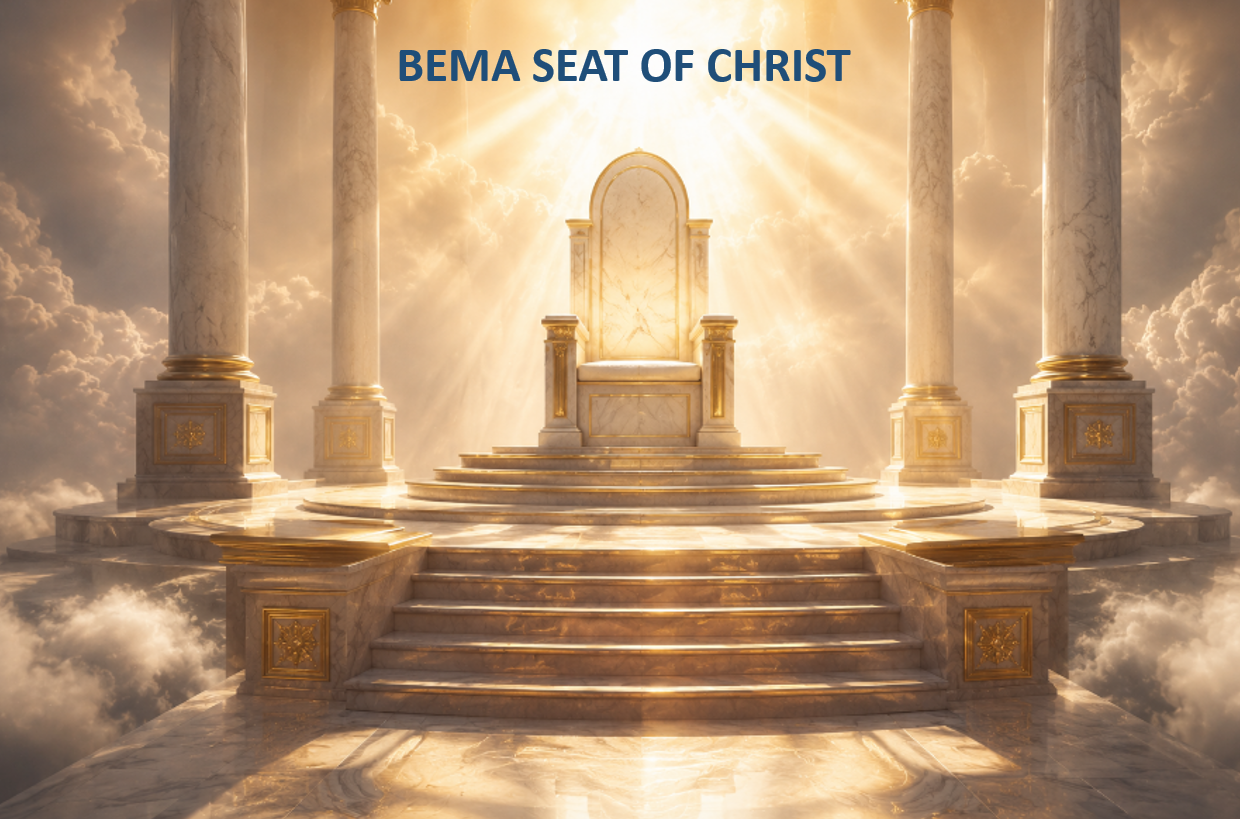
READ - 2 Corinthians 5:9-10 Therefore also we have as our ambition, whether at home or absent, to be pleasing to Him. 10 For we must all appear before the judgment seat of Christ, that each one may be recompensed for his deeds in the body, according to what he has done, whether good or bad (not "kakos" as in KJV but "phaulos" = can mean "evil" but in this context [no condemnation] more accurately deeds that are worthless, in a worthless way, unhelpfully).
HOW WILL TEACHERS BE JUDGED?
READ - 1 Corinthians 3:10-17 According to the grace of God which was given to me, as a wise master builder I laid a foundation, and another is building upon it. But let each man be careful how he builds upon it. 11 For no man can lay a foundation other than the one which is laid, which is Jesus Christ. 12 Now if any man builds upon the foundation with gold, silver, precious stones, wood, hay, straw, 13 each man’s work will become evident; for the day will show it, because it is to be revealed with fire; and the fire itself will test the quality of each man’s work. 14 If any man’s work which he has built upon it remains, he shall receive a reward. 15 If any man’s work is burned up, he shall suffer loss; but he himself shall be saved, yet so as through fire.
- The building materials represent the quality of their teaching and ministry (Which can withstand fire?)
- Gold, silver, precious stones = Sound doctrine, Spirit-led ministry
- Wood, hay, straw = Superficial, man-centered, or corrupt teaching
- The fire tests the work of ministry — doctrine taught, disciples made
“I like to put it like this: there are going to be some people in heaven who will be there because their foundation is Christ but who will smell as if they had been bought at a fire sale! Everything they ever did will have gone up in smoke. They will not receive a reward for their works.” -- J Vernon McGee
WHO IS THIS JUDGMENT SEAT FOR AND WHAT IS IT FOR? for believers to assess faithfulness, service, rewards
WHAT IS IT SPECIFICALLY NOT FOR? our sins (Jn 19:30) - WHAT does Ro 8:1 add? no condemnation for those who are in Christ Jesus (He has been judged for our sins).
WHAT REWARD HAS JAMES ALREADY MENTIONED IN CHAPTER 1? WHO IS THIS REWARD FOR? James 1:13 crown of life - It is promised to those who persevere under trial and who love God.
WHY IS THE JUDGMENT STRICTER FOR TEACHERS? to whom much is given...Because teachers have greater responsibility and greater influence. They handle God's Word. They influence many lives. Their errors can mislead others. Their example carries greater weight.
Luke 12:48 is a helpful parallel: "From everyone who has been given much, much will be required."
THERE WERE NO CHAPTER BREAKS - WHAT HAS JAMES JUST EXPLAINED - Faith that "works" has works. HOW DOES THAT SEQUE INTO THIS WARNING TO TEACHERS? Now he seems to "jump into" a discussion of the tongue, but context is always important for the most accurate interpretation. The point is that the demonstration of a genuine, living faith will be seen in the words that come from our mouth because ultimately they come from our heart. If our faith has resulted in a changed heart, a new heart (Ezek 36:26,27), then the words we say will reflect our new birth showing that we are a new creation in Christ. And so James begins with teachers, who major in use of words to carry out their art.
CROSS REFERENCES ON TEACHERS/TEACHING GIFT - These passage help explain why James warns prospective teachers. You will need to watch your time to be sure you have enough time to finish the entire chapter in 2 hours. You may need to omit some of these cross references.
1Pe 4:10-11 As each one (WHO RECEIVES SPIRITUAL GIFTS? 1Co 12:7) has received a special gift (charisma - sovereignly given gift of grace), employ it in serving (WHAT EXHORTATION? present tense) one another, as good stewards of the manifold grace of God (WHAT DOES A STEWARD DO? WHAT DOES THIS SAY ABOUT EXERCISE OF GIFTS?). 11 Whoever speaks, let him speak, as it were, the utterances of God (WHAT? Stick close to the Scriptures!); whoever serves, let him do so as by the strength which God supplies; so that (WHAT IS THE PUPROSE?) in all things God may be glorified through Jesus Christ, to Whom belongs the glory and dominion forever and ever. Amen.
SUMMARIZE - Connection to James 3:1 especially stricter judgment - Peter gives us reasons teachers receive stricter judgment: Teachers have received a stewardship from God. They are to speak God's utterances, not their own opinions. They influence others through their words. Their ministry must be carried out in God's strength. (prayed up and filled up - with the Spirit)Their ultimate goal must be God's glory.
2 Timothy 2:24-26 And the Lord’s bond-servant must not be quarrelsome, but be kind to all, able to teach, patient when wronged, 25 with gentleness correcting those who are in opposition, if perhaps God may grant them repentance leading to the knowledge of the truth, 26 and they may come to their senses and escape from the snare of the devil, having been held captive by him to do his will.
Eph 4:11-13 (for sake of time read vv11-13) And He (WHO IS HE? ascended Christ Eph 4:7-10) gave (WHAT DOES GAVE SIGNIFY? GRACE GIFTS) some as apostles, and some as prophets, and some as evangelists, and some as pastors and teachers, 12 (WHAT PURPOSE? HOW IMPORTANT IS A TEACHER? for equipping, building up, unity, maturity) for the equipping of the saints for the work of service, to the building up of the body of Christ; 13 until we all attain to the unity of the faith, and of the knowledge of the Son of God, to a mature man, to the measure of the stature which belongs to the fulness of Christ (GOAL? CHRISTLIKENESS).
Evangelists are much like obstetricians, helping to bring new Christians into the world. Teaching pastors are like pediatricians, seeing that these Christians have a healthy spiritual "diet," that their "diseases" receive proper attention, and that they get plenty of spiritual "fresh air" and "exercise."
Ro 12:6-7 And since we have gifts that differ according to the grace given to us, (WHAT IS SOURCE OF GIFTS?) let each exercise them accordingly: if prophecy, according to the proportion of his faith; 7 if service, in his serving; or he who teaches, in his teaching (WHAT DOES THAT MEAN? NLT - "If you are a teacher, teach well" = devote yourself to this task, make use of this gift WHAT DOES PAUL EXPECT THE PERSON WHO HAS THE GIFT OF TEACHING TO DO?);
SUMMARIZE - Connection to James 3:1 - James is not discouraging gifted teachers; he is discouraging unqualified or presumptuous aspirants. Paul, on the other hand, encourages those who genuinely possess the gift to devote themselves to its exercise.
1Co 12:27-29 Now you are Christ’s body, and individually members of it. 28 And God has appointed in the church, first apostles, second prophets, third teachers, then miracles, then gifts of healings, helps, administrations, various kinds of tongues. (TEACHER'S THIRD PLACE - IS THIS ABOUT PRIORITY IN THE CHURCH BODY OR SUPERIORITY?) 29 All are not apostles, are they? All are not prophets, are they? All are not teachers, are they? All are not workers of miracles, are they?
James 3:2 For we all stumble in many ways. If anyone does not stumble in what he says, he is a perfect (teleios Jas 1:4, 17, 25) man, able to bridle the whole body as well.

VERSE 2 BEGINS WITH A HINGE WORD? WHAT IS IT? WHENEVER YOU SEE A "FOR" WHAT QUESTION SHOULD POP INTO YOUR MIND? What is the author explaining, supporting, or proving? why teachers have stricter judgment
WHO IS "WE"? James includes himself
HOW DO WE KNOW THIS IS NOT JUST APPLICABLE TO TEACHERS? all stumble...if anyone does not stumble
WHAT DOES STUMBLE MEAN? sin, fall short
Eccl 7:20 Indeed, there is not a righteous man on earth who continually does good and who never sins.
1Ki 8:46 When they sin against Thee (for there is no man who does not sin) and Thou art angry with them and dost deliver them to an enemy, so that they take them away captive to the land of the enemy, far off or near;
1Jn 1:8 If we say that we have no sin, we are deceiving ourselves, and the truth is not in us.

WHAT "STUMBLING" DOES JAMES FOCUS ON? Speech "what he says," our tongue
Dr James says stick out your tongue and say "Ahhhh." The tongue was used by doctors for years to evaluate health of the entire body.
"Watch your tongue.
It's in a wet place where it's easy to slip!"
WHAT HAS JAMES SAID PREVIOUSLY ABOUT THE TONGUE TO THOSE WHO WERE "the first fruits among His creatures"? Jas 1:19 "let everyone be quick to hear, slow to speak and slow to anger"
WHY WOULD THE TONGUE BE A PARTICULAR CONCERN FOR TEACHERS? Teaching is primarily done through words. James moves from the accountability of teachers (v.1) to the universal problem of the tongue (v.2ff).
WHAT DOES JAMES MEAN BY A "PERFECT" (teleios) MAN? (Read Jas 1:4 - let endurance have its perfect result, that you may be perfect and complete, lacking in nothing.) - spiritually mature
WHAT IS AN EXCELLENT TEST OF SPIRITUAL MATURITY ACCORING TO JAMES? control of one's speech (tongue)

MAN WITH BRIDLE
WHAT DOES CONTROL OF THE TONGUE REVEAL ABOUT THE REST OF THE PERSON? He is "able to bridle the whole body as well."
WHAT DOES THE IDEA OF A "BRIDLE" CONVEY? WHAT DOES THE BRIDLE DO TO A HORSE? controls the horse's entire body, so says the mature person can control his tongue, the little member of our body, which reflects mastery of the whole person. Controlled speech demonstrates control over all the other members of his body as well
WHERE HAVE WE SEEN "BRIDLE" BEFORE (the only other use in the NT)? Jas 1:26 If anyone thinks himself to be religious, and yet does not bridle his tongue but deceives his own heart, this man’s religion is worthless.
WHAT HAPPENS IF YOU DO NOT BRIDLE YOUR TONGUE? heart deceive your own heart, your religion is worthless)
WHY DOES JAMES MOVE FROM THE TONGUE TO THE WHOLE BODY? In other words, what relationship exists between control of speech and control of the rest of life? If we can control the tongue we can generally control the other members of our body.
James 3:3 Now if we put the bits into the horses’ mouths so that they may obey us, we direct their entire body as well.
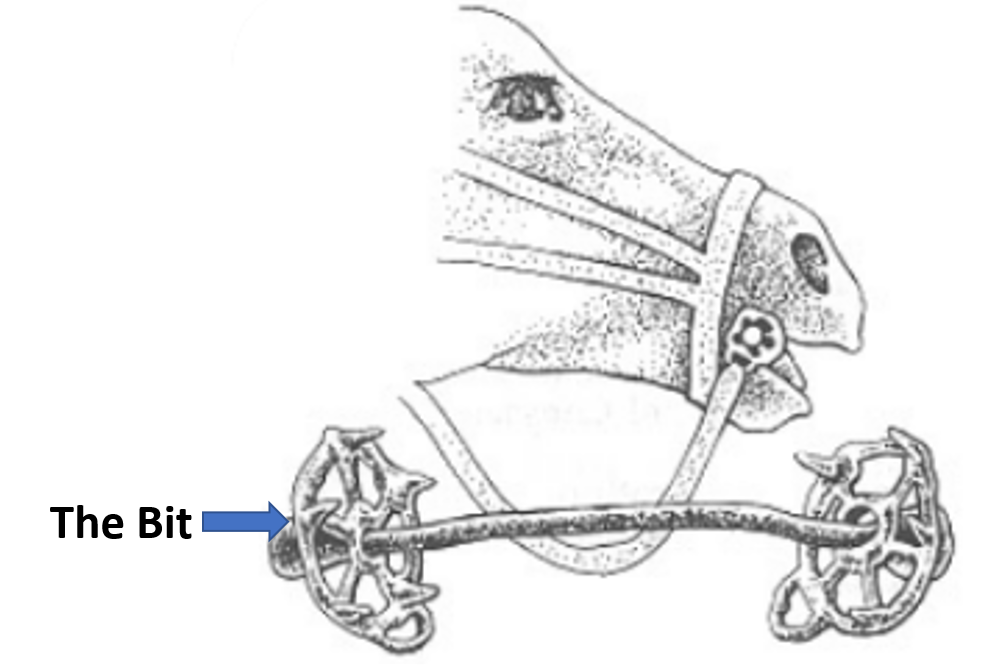
KEEPING THE CONTEXT IN MIND THAT HE IS SPEAKING ABOUT THE TONGUE, WHAT IS JAMES' ILLUSTRATION ON THE POWER OF THE TONGUE? bits into the horses’ mouths
WHAT DOES THE BIT IN HORSE'S MOUTH ALLOW THE RIDER TO DO? cause them to obey and go the direction we desire.
WHAT IS JAMES ILLUSTRATING ABOUT A VERY SMALL THING LIKE A BIT? WHAT EFFECT CAN IT EXERT ON A VERY LARGE HORSE?
James 3:4 Behold the ships also, though they are so great and are driven by strong winds, are still directed by a very small rudder, wherever the inclination of the pilot desires.
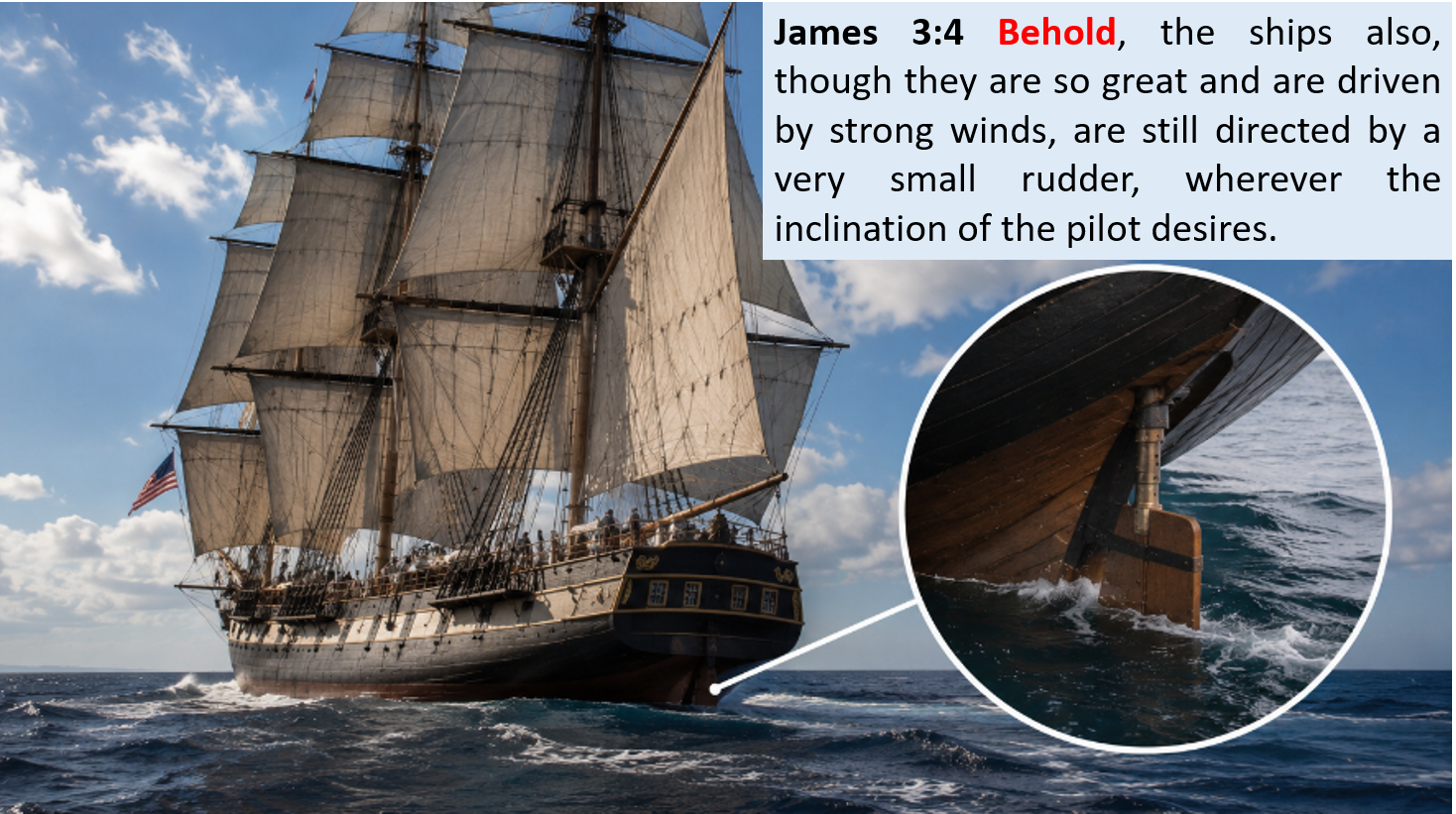
WHAT IS JAMES' SECOND ILLUSTRATION OF THE POWER OF A SMALL THING? (WHAT IS THE CONTRAST?) A great ship directed by a very small rudder. (Note he does not say "rudder" but very small rudder which makes the contrast even more dramatic)
WHO CONTROLS THE SHIP? the pilot.
WHAT DOES THE PHRASE "wherever the inclination of the pilot desires" emphasize? The rudder determines the ship's direction or course according to the pilot's will.
WHAT DO BOTH ILLUSTRATIONS (BIT, RUDDER) HAVE IN COMMON REGARDING THEIR FUNCTION? Something small controls the direction and destiny of something much larger.
WE HAVE A SMALL BIT AND A SMALL RUDDER - WHAT HAPPENS IF EITHER FAILS TO CARRY OUT ITS FUNCTION? horse and ship are both out of control
SMALL THINGS CONTROL BIG THINGS
BY ANALOGY WHAT CAN THE SMALL TONGUE DO? control the whole body, our direction and destiny.
James 3:5 So also (IN THE SAME WAY) the tongue is a small part of the body, and yet it boasts of great things. Behold, how great a forest is set aflame by such a small fire!

WHAT DOES "SO ALSO" SIGNIFY? other versions render it "IN THE SAME WAY - James is adding another comparison from the illustrations of the bit and rudder.
WHAT SINFUL CHARACTERISTIC OF THE TONGUE DOES JAMES INTRODUCE HERE? arrogant speech, boasting of great things -- It speaks proudly, arrogantly, and presumptuously beyond its proper limits.
WHAT IS THE STRIKING CONTRAST? small tongue, small fire, great forest
WHAT IS JAMES' ILLUSTRATION OF THE DANGER OF BOASTING OF GREAT THINGS? a great a forest is set aflame by such a small fire
WHY IS A FOREST FIRE AN ESPECIALLY FITTING PICTURE OF THE TONGUE? (How start?) just a small fire/spark (How fast spreads?) Fire spreads rapidly. (How easy to control?) Great forest fire is difficult to control. (How damaging?) Fire can destroy far more than its initial spark would suggest.
WHAT ARE SOME EXAMPLES OF SPEECH THAT "BURNS AND DESTROYS"? gossip, slander, lies, (WHAT PRODUCE? broken relationships including divorce, church splits, and spiritual harm.)
James 3:6 And the tongue is a fire, the very world of iniquity; the tongue is set among our members as that which defiles the entire body, and sets on fire the course of our life, and is set on fire by hell.

WHAT ARE THE FIVE CHARACTERISTICS OF THE TONGUE? (1) a fire (METAPHOR), (2) world of inquity, (3) defiles entire body, (4) sets on fire the course of our life and (5) is set on fire by hell
WHAT IS REPEATED IN vv5-6 THAT IS A KEY IDEA JAMES SEEKS TO CONVEY? aflame, fire
WHY IS FIRE AN APPROPRIATE PICTURE OF THE TONGUE? (BEARS REPEATING - may have alluded to this under setting fire to a forest) Destroys
WHAT DOES JAMES MEAN WHEN HE CALLS THE TONGUE "THE VERY WORLD OF INIQUITY"? What kinds of sin is it capable of expressing or initiating? every kind of sin!

DEFILE, POLLUTE
Mt 15:18-20 But the things that proceed out of the mouth come from the heart, and those defile the man. 19 “For out of the heart come evil thoughts, murders, adulteries, fornications, thefts, false witness, slanders. 20 “These are the things which defile the man; but to eat with unwashed hands does not defile the man.”
WHAT EFFECT DOES THE TONGUE HAVE ON THE ENTIRE BODY? It defiles (pollutes, stains) the entire body.
HOW SO? Sinful words affect one's entire character, testimony, and conduct.
WHAT DOES JAMES MEAN BY "SETS ON FIRE THE COURSE OF OUR LIFE"? The tongue can influence and damage the entire course of a person's life. One sinful word may produce consequences that extend for a lifetime. This reads literally "the wheel of existence" or "the cycle of nature" which suggests the tongue's fire spreads to every dimension of life.
WHAT IS THE SOURCE OF THE TONGUE'S DESTRUCTIVE POWER? It is "set on fire by hell" (Gehenna = Lake of fire in Rev 20:14).
WHAT DOES THAT PHRASE CONVEY? Behind Gehenna stands the devil himself diabolos = slanderer. He is deceiver in Rev 12:9, accuser in Rev 12:10; the father of lies in John 8:44. He used his tongue to destroy Eden! (Ge 3:6 "When the woman saw that the tree was good for food, and that it was a delight to the eyes, and that the tree was desirable to make one wise, she took from its fruit and ate; and she gave also to her husband with her, and he ate.")
James 3:7 For every species of beasts and birds, of reptiles and creatures of the sea, is tamed, and has been tamed by the human race.

FOR IS ANOTHER HINGE WORD, A TERM OF EXPLANATION - WHAT IS JAMES EXPLAINING? Why the tongue is such a dangerous and difficult problem (vv. 5-6).
WHAT EXAMPLE DOES JAMES PRESENT TO PREPARE FOR HIS TEACHING ON THE DIFFICULTY OF TAMING THE TONGUE? Humanity's ability to tame all kinds of animals.
WHY DOES JAMES LIST ALL OF THESE CATEGORIES? really goes with next verse - man can tame all the animals (but no human being has ever tamed the tongue)
James 3:8 But no one can tame the tongue; it is a restless evil and full of deadly poison.

WHAT SHARP CONTRAST DOES JAMES DRAW? Man has tamed wild animals but cannot tame his own tongue
HOW ELSE DOES JAMES DESCRIBE THE TONGUE? A restless evil. Full of deadly poison.
WHY DOES JAMES CALL THE TONGUE A "RESTLESS EVIL"? Volatile!!! It continually seeks opportunities to express sin through speech. Like a wild animal that refuses to stay under control. (Second use - Jas 1:8) ("a pest that will not keep still" - New Jerusalem Bible)
WHAT PICTURE IS CREATED BY THE PHRASE "FULL OF DEADLY POISON"? WHAT IS IT LIKENED TO? WHAT CAN THIS DO TO RELATIONSHIPS? The tongue is likened to a venomous serpent (Ro 3:13 "THE POISON OF ASPS IS UNDER THEIR LIPS”;).
Poison spreads invisibly, small amounts can kill and damage may be delayed (Case of arsenic poisoning I saw in medical school occurred over a long period of time by the man's wife!)
WHO CAN TAME THE TONGUE? absolutely no human being has the ability in his own strength to perfectly control the tongue. This is important because James is not denying the Spirit's sanctifying work. He is emphasizing human inability.
CROSS REFERENCES ON THE HEART OF THE PROBLEM
& SOLUTION OF THE HEART
FIRST - IS THE TONGUE THE REAL PROBLEM?
Matthew 12:34-37 “You brood of vipers, how can you, being evil, speak what is good? For the mouth speaks out of that which fills the heart. 35 “The good man out of his good treasure brings forth what is good; and the evil man out of his evil treasure brings forth what is evil. 36 “And I say to you, that every careless word that men shall speak, they shall render account for it in the day of judgment. 37 “For by your words you shall be (shown to be) justified, and by your words you shall be condemned.”
WHERE DOES EVIL SPEECH COME FROM? heart - that which, abounding in the heart, comes to expression in words. It's like it simply is the overflow of the evil in our heart!
WHAT DOES JESUS MEAN "by your words you shall be justified, and by your words you shall be condemned.?" The words are the fruit - good words come from a regenerated heart, one that had been declared righteous. Words do not earn justification but demonstrate one to be righteous (or not).
SECOND - HOW THEN CAN THE TONGUE BE TAMED? the Holy Spirit
Ezekiel 36:26-27 Moreover, I will give you a new heart and put a new spirit within you; and I will remove the heart of stone from your flesh and give you a heart of flesh. 27 “And I will put My Spirit within you and cause you to walk in My statutes, and you will be careful to observe My ordinances.
Eph 5:18-19 - And do not get drunk with wine (HOW CAN USUALLY DISCERN? slurred speech), for that is dissipation, but be filled with the Spirit, 19 (WHAT IS THE FIRST "FRUIT" OF A PERSON UNDER CONTROL OF THE HOLY SPIRIT?) speaking to one another in psalms and hymns and spiritual songs, singing and making melody with your heart to the Lord;
Jeremiah 31:33 “But this is the covenant which I will make with the house of Israel after those days,” declares the LORD, “I will put My law within them, and on their heart I will write it; and I will be their God, and they shall be My people.
Jeremiah 32:39-40 and I will give them one heart and one way, that they may fear Me always, for their own good, and for the good of their children after them. 40 “And I will make an everlasting covenant with them that I will not turn away from them, to do them good; and I will put the fear of Me in their hearts so that they will not turn away from Me.
SUMMARY - As we yield to His control, He restrains our speech, guides our words, and directs our steps. Just as a small bit controls a powerful horse and a small rudder steers a great ship, so the Holy Spirit can govern the tongue and influence the direction of the entire person. When we walk by the Spirit, our speech increasingly reflects His wisdom, grace, and righteousness. (Gal 5:16, 22-23; Eph 4:29)
To bridle your tongue, give the Spirit the reins of your heart.
James 3:9 With it we bless our Lord and Father; and with it we curse men, who have been made in the likeness of God;
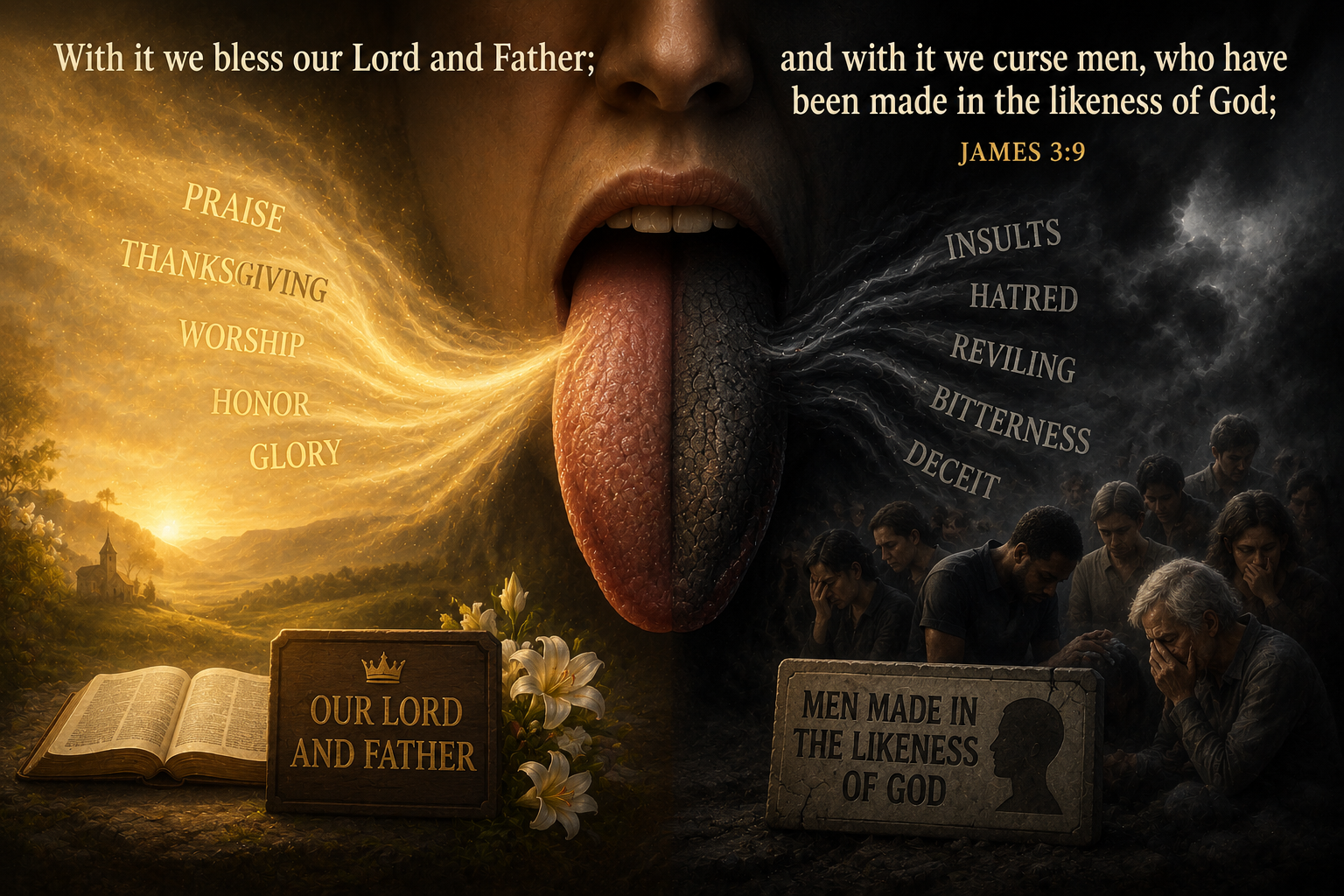
WHAT IS THE CONTRAST? With the same tongue we bless God and curse men.
WHO IS HE ADDRESSING? believers - how do you know from this verse - "our Lord and Father"
WHAT IS THE PRONOUN REPEATED? "we"!
WHAT SHOCKING INCONSISTENCY DOES HE EXPOSE? The same tongue used for worship is used for cursing
WHY IS CURSING MEN SO EVIL? Because human beings have been made in the likeness of God. To curse a person is to insult one who bears God's image. Such speech dishonors the Creator whose image that person reflects. This gives profound significance to how we speak about others.
James 3:10 from the same mouth come both blessing and cursing. My brethren, these things ought not to be this way.
WHAT IS JAMES' VERDICT ON BLESSING GOD AND CURSING MEN? "These things ought not to be this way."
WHO IS HE ADDRESSING SPECIFICALLY? My brethren - believers
WHAT DOES JAMES SAY IS WRONG WITH THIS KIND OF SPEECH (FOR BELEIVERS)? It is inconsistent with the character of a believer.
WHAT IS JAMES' MAIN POINT IN VERSE 10? It is spiritually inconsistent and morally wrong for the same mouth to be used both for praising God and for cursing people made in His image. He will make this point in the next two verses in which things produce according to their nature.
James 3:11 Does a fountain send out from the same opening both fresh and bitter water?
James asks two sets of rhetorical questions (James 3:11-12) as a means of explaining and illustrating how unnatural it is for cursing and blessing to come out of the same mouth of a born again believer (James 3:9-10). As new creations in Christ (2 Cor 5:17) believers have a new source of supernatural power to replace natural negative speech with positive God glorifying speech.
WHAT ILLUSTRATION DOES JAMES GIVE US? fountain
WHAT IS THE EXPECTED ANSWER TO THE RHETORICAL QUESTION? no
WHAT CONTRAST DOES JAMES PRESENT? Fresh water versus bitter water.
WHAT DO THE TWO TYPES OF WATER SYMBOLIZE FROM THE PRECEDING CONTEXT? TO SHOW THAT BLESSING AND CURSING SHOULD NOT PROCEED FROM THE SAME MOUTH.
WHAT IS HIS POINT? Just as a spring consistently produces one kind of water, a believer's speech should be consistent rather than producing both blessing and cursing.
WHAT DOES THE FOUNTAIN REPRESENT? the source of the words, which is the heart
WHAT DOES THE WATER REPRESENT? The character (or quality) of the words that flow from the mouth.
WHY DOES JAMES MOVE FROM THE MOUTH (v.10) TO THE FOUNTAIN (v.11)? Because the real issue is not merely the tongue but the source behind the tongue—the heart. James is beginning to move his readers from the symptom (sinful speech) to the source (an inconsistent heart).
James 3:12 Can a fig tree, my brethren, produce olives, or a vine produce figs? Neither can salt water produce fresh.
ONCE AGAIN WHO IS HE ADDRESSING? my brethren - believers
WHAT ANSWER DOES JAMES EXPECT FROM THIS RHETORICAL QUESTION? no
WHAT THREE IMPOSSIBILITIES DOES JAMES PRESENT? A fig tree producing olives. A vine producing figs. Salt water producing fresh water.
WHAT IS THE RELATIONSHIP BETWEEN THE SOURCE AND THE FRUIT? The fruit always corresponds to the nature of the source.
HOW DOES THIS ILLUSTRATION BUILD UPON VERSE 11? Verse 11 uses a spring. Verse 12 uses trees and vines. Both teach that the source determines the output.
WHAT IS JAMES SAYING ABOUT THE TONGUE THROUGH THESE ILLUSTRATIONS? Inconsistent speech should not be seen in a genuine believer. Think of the believer as a fig tree. He should bear figs, not something else. The fruit of his tongue should be in keeping with his new heart and new spirit and new power source the Holy Spirit.
Spurgeon - It would be a monstrosity, a thing to be wondered at, and stared at as unnatural and absurd if a fig tree started bearing olive berries and it is just as unnatural for a Christian to live in sin (ED: HABITUAL). Can he so live as to bear the fruits of iniquity instead of the fruits of righteousness? God forbid that it should be so!
WHAT DOES JESUS SAY ABOUT OUR "FOUNTAIN"?
John 7:37-39 Now on the last day, the great day of the feast, Jesus stood and cried out, saying, “If any man is thirsty, let him come to Me and drink. 38 “He who believes in Me, as the Scripture said, ‘From his innermost being shall flow rivers of living water.’” 39 But this He spoke of the Spirit, whom those who believed in Him were to receive; for the Spirit was not yet given, because Jesus was not yet glorified.
WHAT SHOULD FLOW FORTH FROM OUR MOUTHS? godly speech - rivers (Plural not rivulets or streams) of water that gives life and sustains life wherever it flows.
APPLICATION - WHEN GODLY SPEECH DOES NOT FLOW FROM OUR MOUTHS WHAT DO WE KNOW ABOUT OUR RELATIONSHIP WITH THE HOLY SPIRIT? - quenched, grieved, not filled/controlled by
Apply - Here are two prayers you might consider pray adding to your morning prayers...
Psalm 19:14
Let the words of my MOUTH and the meditation of my HEART
Be acceptable in Thy sight, O LORD, my rock and my Redeemer.Psalm 141:3
Set a guard, O LORD, over my mouth;
Keep watch over the door of my lips.
James 3:13 Who among you is wise and understanding? Let him show by his good behavior his deeds in the gentleness of wisdom.
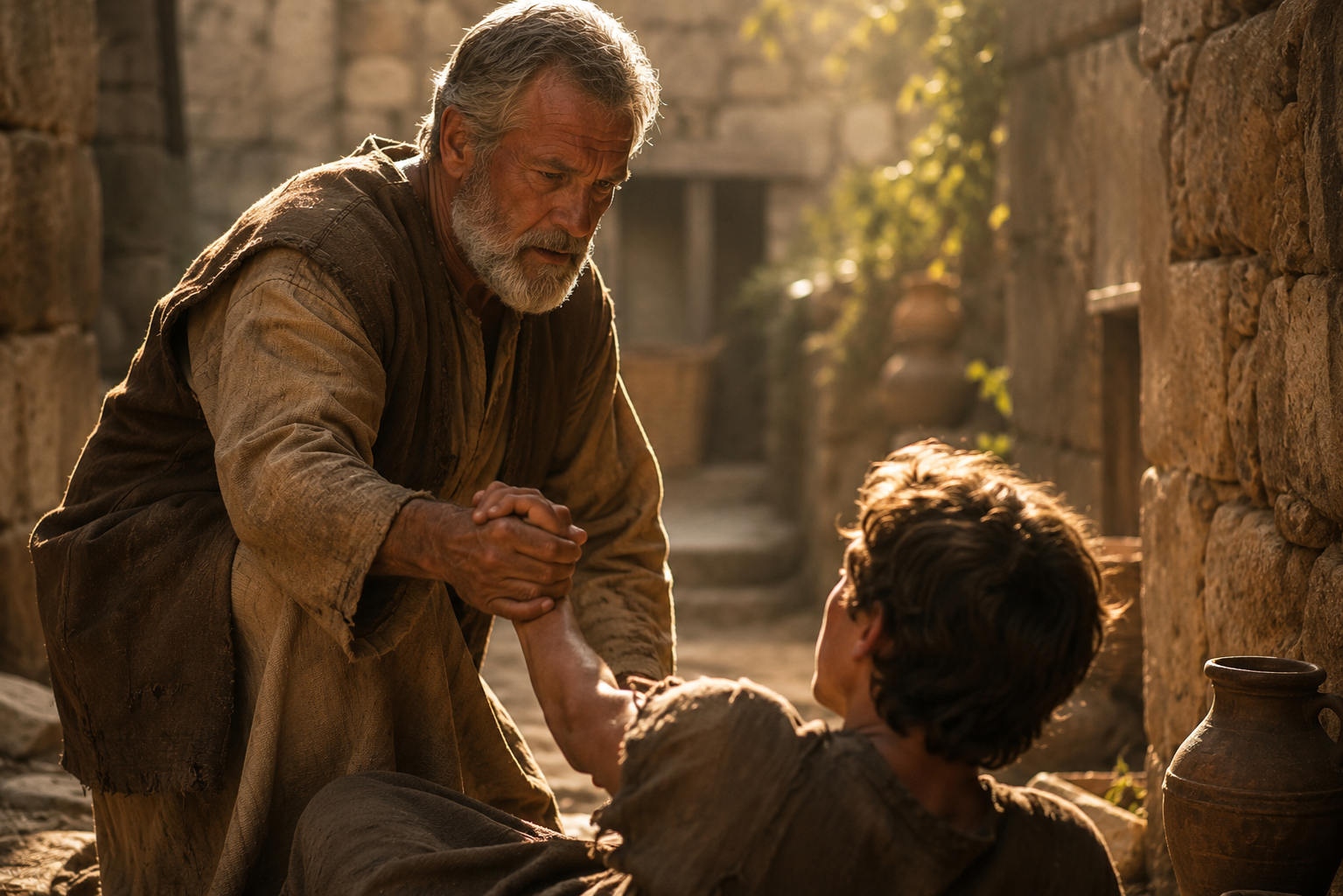
FIRST READ James 3:13-18 AND ASK WHAT IS THE KEY WORD WHICH GIVES US THE THEME OF THIS PARAGRAPH? wise/wisdom. Then begin verse by verse questions.
NLT If you are wise and understand God's ways, prove it by living an honorable life, doing good works with the humility that comes from wisdom. (James 3:13NLT)
Understanding = It is both the knowledge and practice of it
HOW DOES JAMES BEGIN HIS DISCUSSION OF WISDOM? WHO IS HE ADDRESSING? He is speaking to believers (context = "my brethren" in v10) and not just teachers (I mention this because a number of commentaries say Jas 3:13-18 is directed to teachers) and begins with a question. Although the NLT does not frame it as a question, you might read the NLT which helps answer some of the 5W/H questions.
JAMES HAS JUST DESCRIBED SPEECH, SO HOW DOES WISDOM RELATE TO SPEECH? A key to right talk is right thought.
WHAT IS JAMES' COMMAND TO HIS BRETHREN WHO CLAIM TO BE WISE? "show by his good behavior his deeds" OR NLT = "prove it by living an honorable life, doing good works with the humility that comes from wisdom."
LET ME ASK YOU - CAN YOU LOOK AT SOMEONE AND TELL THEY HAVE WISDOM? HOW IS THIS LIKE FAITH? just looking at the person you cannot tell wisdom or faith
HOW CAN ONE WHO CLAIMS TO BE WISE PROVE IT? by his behavior. Real wisdom and understanding are demonstrated, not declared
WHAT IS THE DESCRIPTIVE DEFINITION OF WISDOM? It is how one behaves. It is not just shown by head knowledge but by heart actions.
So even as James instructed us in how to discern whether one has genuine faith (by his works), in this section he tells us how to discern whether a person is truly wise and understanding by listing (and thereby contrasting) the traits one would expect to see associated with heavenly wisdom versus with earthly wisdom.
WHAT IS "THE GENTLENESS OF WISDOM"? (Read NLT paraphrase is accurate to the text = "the humility that comes from wisdom" - This same Gk word prautes is used in Jas 1:21 translated "humility" - prautes is the quality of not being overly impressed by a sense of one’s self-importance) - It describes the gentleness or humility that comes from wisdom.
SO WHAT ARE THE 2 CHARACTERISTICS OF GODLY WISDOM ("wisdom from above" as it is later called)? (1) good deeds and (2) gentleness/humility
WHAT SHOULD WE DO IF WE DO NOT HAVE GOOD BEHAVIOR AND A GENTLE/HUMBLE SPIRIT? (Give them a clue - Remember James discussed godly wisdom in James 1:5) We should (1) ask God as instructed in James 1:5-8, (2) asking Him in faith.
NOW LET'S COME BACK AND ADDRESS WHY DOES JAMES SEEM TO MAKE AN ABRUPT SWITCH FROM WORDS TO WISDOM? WHERE DO OUR WORDS COME FROM ACCORDING TO JESUS (Mt 12:34 - our heart - For the mouth speaks out of that which fills the heart.)? WHAT WILL OUR WORDS BE LIKE WHEN GODLY WISDOM RULES OUR HEART? James moves from the tongue to wisdom because our words are the fruit of our inner wisdom. If our hearts are ruled by worldly wisdom, our tongues will produce conflict and harm. Tongues ruled by godly wisdom produce peace.
James 3:14 But if you have bitter jealousy and selfish ambition in your heart, do not be arrogant and so lie against the truth.

WITH THIS TERM OF CONTRAST (BUT), WHAT IS JAMES CONTRASTING? godly wisdom (good behavior and gentleness/humility) versus ungodly wisdom - "good behavior" versus "bad behavior"
HOW DOES JAMES DESCRIBE THIS UNGODLY WISDOM? bitter jealousy and selfish ambition -- DON'T MISS that he is describing ungodly wisdom (v15 says "this wisdom").
WHAT IS THE SOURCE IN THIS VERSE? your heart
WHAT IS HIS COMMAND? (present imperative with a negative = stop this action already in process!) Stop boasting and lying against the truth.
WHAT TRUTH HAS HE JUST DESCRIBED IN Jas 3:13? the truly wise person shows it by their good behavior.
WHY COMMAND THEM NOT TO BE ARROGANT (expressing a feeling of one's comparative superiority)? (MIGHT NEED TO ADD) IN CONTEXT WHAT WOULD THEY BE BOASTING ABOUT? boasting that they had true wisdom
WHAT DOES JAMES MEAN "LIE AGAINST THE TRUTH"? HOW DID THEY "LIE AGAINST THE TRUTH"? they were boasting they had true wisdom but they were demonstrating bad behavior. Their behavior was like a lie against the truth that true wisdom is shown by good behavior that is carried out not with arrogance or boastiing but in the atmosphere of gentleness/meekness/humility that comes from true wisdom.
James 3:15 This wisdom is not that which comes down from above, but is earthly, natural, demonic.

WHAT DOES "THIS WISDOM" REFER TO? Jas 3:14 - "bitter jealousy, selfish ambition which is arrogant and lies against the truth'
WHERE IS THIS SELF-CENTERED WISDOM NOT FROM? Not from above WHERE IS "FROM ABOVE"? from God
WHAT CONTRAST? WHAT IS THE SOURCE OF THIS SELF-CENTERED WISDOM? earthly, natural, demonic.
WHAT IS "EARTHLY WISDOM"? In simple terms, wisdom that originates from the godless, God hating world system. It is man-centered thinking. It is wisdom focused on self and not on God.
WHAT DOES NATURAL (psuchikos from psuche - soul) MEAN? WHAT IS IT THE OPPOSITE OF? fleshly (life lived apart from the Holy Spirit), wisdom derived from our fallen flesh. Natural is opposite = supernatural (heavenly) "God made foolish the wisdom of the world. (1 Cor 1:20)
WHAT DOES DEMONIC MEAN? HOW CAN DEMONS INFLUENCE HUMANS? (see also answer in Jas 3:6) Hold to and propagate the godless agenda of demons. This speaks of demonic fiery missiles to the mind (Eph 6:16) This goes back to the Garden of Eden - Eve was deceived by Satan and to her the tree "was desirable to make one wise." (Ge 3:6) Deceitful is a key word describing demonic doctrines. (Rev 12:9 Satan "deceives the whole world.")
WHERE HAVE WE JUST SEEN A SIMILAR TRUTH ABOUT THE TONGUE? Jas 3:6 > Ungodly wisdom has the same "hellish" source as an ungodly tongue "which is set on fire from hell."
1Ti 4:1 But the Spirit explicitly says that in later times some will fall away from the faith, paying attention to deceitful spirits and doctrines of demons
To help them think about these 3 sources of godless wisom you might consider asking....
WHAT IS THE ANTITHESIS, THE EXACT OPPOSITE OF "EARTHLY, NATURAL, DEMONIC?" heavenly, supernatural, godly
WHAT ARE THE CLASSIC 3 ENEMIES OF BELIEVERS? the world, the flesh and the devil which fits with the sources of ungodly wisdom in this verse.
James 3:16 For where jealousy and selfish ambition exist, there is disorder and every evil thing.

FOR (TERM OF EXPLANATION) - WHAT IS JAMES EXPLAINING? Why earthly, natural, and demonic wisdom is so dangerous or what kind of rotten fruit they produce.
WHAT IS FRUIT OF THIS GODLESS WISDOM (What does he repeat as key? v14 "jealousy and selfish ambition")?
WHAT ARE THE RESULTS OF BITTER JEALOUSY AND SELFISH AMBITION? disorder and every evil thing.
WHAT DOES "DISORDER" MEAN? The Greek word (akatastasia) means (1) instability with political unrest (2) turmoil and insurrection and (3) social unrest with rioting, tumult, disturbances due to mob action, all 3 sad but apt descriptions of America in 2026.
LOOK AT WORD DISORDER - Disorder (akatastasia) (1) instability with political unrest (2) turmoil & insurrection (3) social unrest with rioting, tumult, disturbances due to mob action
HOW ALL INCLUSIVE ARE THE EFFECTS OF EARTHLY, NATURAL, DEMONIC WISDOM? produce "every evil thing."
Where envy and selfish ambition reign, they open the door to every kind of sinful attitude, action, and disorder. Such wisdom does not merely produce a few isolated problems; it creates an environment in which all kinds of evil flourish and spread.
APPLICATION QUESTION: WHEN CONFLICT, CHAOS, AND DIVISION ARISE IN A CHURCH, FAMILY, OR MINISTRY, WHAT HEART ATTITUDES SHOULD WE EXAMINE FIRST ACCORDING TO THIS VERSE? Jealousy and selfish ambition rooted in worldly wisdom. The fruit reveals the true nature of the wisdom that produced it.
James 3:17 But the wisdom from above is first (1) pure, then (2) peaceable, (3) gentle, (4) reasonable, (5) full of mercy and (6) good fruits, (7) unwavering, (8) without hypocrisy.
NLT But the wisdom from above is first of all pure. It is also peace loving, gentle at all times, and willing to yield to others. (ESV = open to reason). It is full of mercy and good deeds. It shows no favoritism and is always sincere.
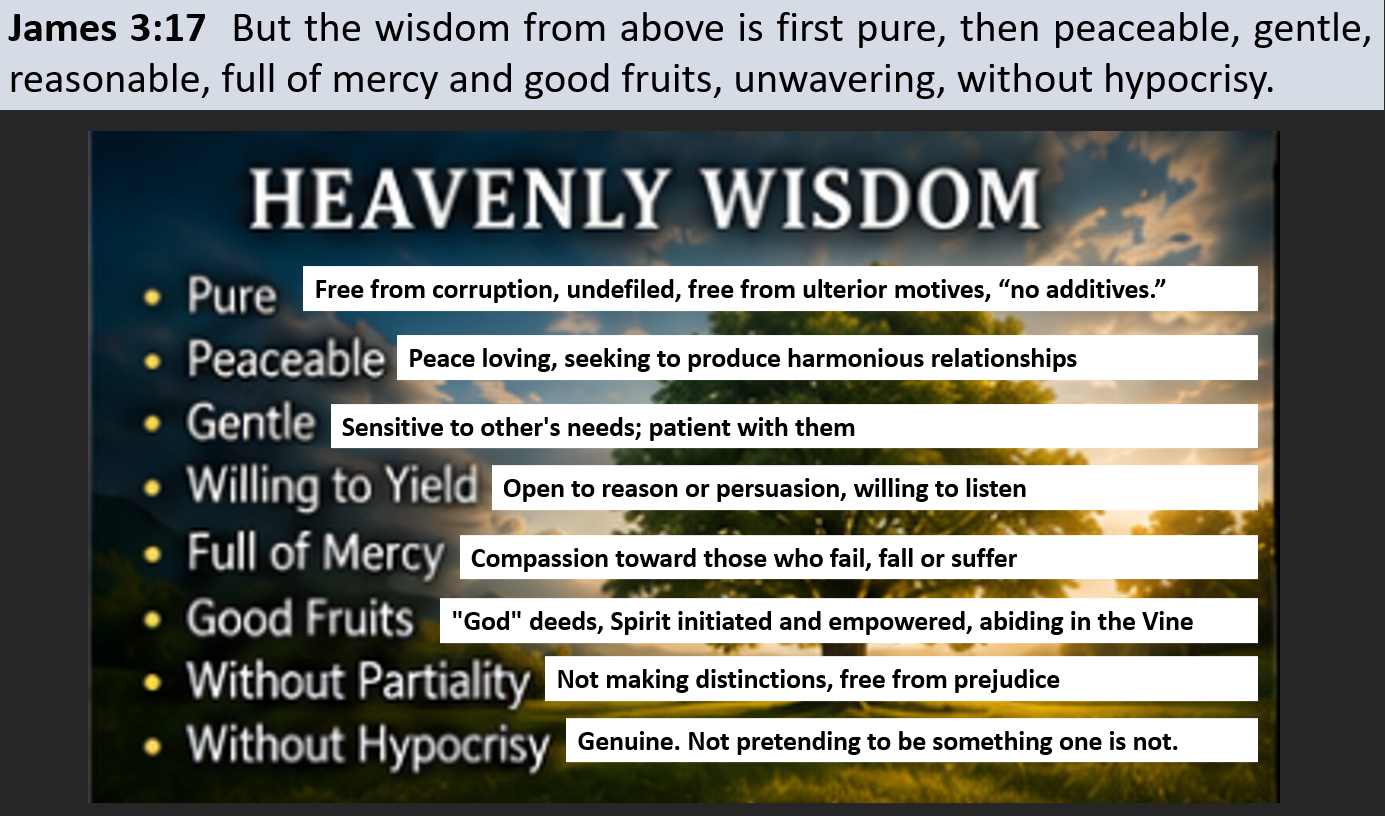
WHAT IS THE FORCE OF "BUT"? strong contrast with fruit of godless wisdom
WHERE IS GODLY WISDOM FROM AND WHAT IS ITS SOURCE? from above - God
WHAT DID JAMES SAY ABOUT THE THINGS COMING DOWN FROM ABOVE? Jas 1:17 "Every good thing bestowed and every perfect gift is from above, coming down from the Father of lights, with Whom there is no variation, or shifting shadow.")
HOW WOULD YOU DEFINE GODLY WISDOM? 8 characteristics - pure, etc.... (I call this "Vertical Wisdom"!)
WHAT CLEAR CONTRAST DO YOU SEE WITH THE PREVIOUS VERSES BETWEEN UNGODLY WISDOM AND GODLY WISDOM? ungodly wisdom > disorder; godly wisdom > peace
1) Pure (hagnos) - free from corruption, no "additives," without intent to do wrong in a matter
2) Peacable - promoting harmony and reconciliation
3) Gentle - not insisting on every right of letter of law or custom, yielding, forbearing
4) Reasonable - open to reason or persuasion, willing to listen
5) Mercy - compassion toward those who fail, fall or suffer - attitude/emotion roused by affliction of another, kindness expressed for someone in need
6) Good deeds - "God" deeds, Spirit initiated and empowered - cf (Jas 2:14-26? Works that show genuine faith)
7) Unwavering - without making distinctions, impartial, free from prejudice (WHAT DOES THAT REMIND YOU OF? Jas 2:1-12)
8) Without hypocrisy - genuine, sincere, Not pretending to be something one is not. "what you see is what you get"
(FROM THIS DESCRIPTION OF GODLY WISDOM) SOMETIMES WE SAY A PERSON IS WISE BECAUSE OF ALL HE KNOWS (including Scripture), BUT WHAT DOES JAMES EMPHASIZE ABOUT GODLY WISDOM? IN OTHER WORDS IS IT WHAT HE KNOWS OR HOW HE LIVES? Godly wisdom is shown not primarily what a person knows but how a person lives. True wisdom reveals itself through transformed character (the 8 characteristics listed above).
WHO DO THESE 8 TRAITS REMIND YOU OF? Jesus - the more we grow in the grace and knowledge of Christ, the more we will manifest these traits.
James 3:18 And the seed whose fruit is righteousness is sown in peace by those who make peace.
NLT And those who are peacemakers will plant seeds of peace and reap a harvest of righteousness.

WHAT IS THE METAPHORICAL PICTURE? OR WHAT AGRICULTURAL PICTURE DOES JAMES USE? Sowing and harvesting.
WHAT IS THE ATMOSPHERE IN WHICH THE SEED IS SOWN? In an atmosphere of peace.
FROM THE CONTEXT, WHAT IS THE SEED? wisdom as outlined in previous verse.
WHO SOWS THE SEED? those who make peace (peacemakers cf Mt 5:8)
WHAT FRUIT DOES HEAVENLY WISDOM ULTIMATELY PRODUCE? A harvest of righteousness - righteous living, righteous relationships, and conduct pleasing to God.
HOW DOES THIS HARVEST CONTRAST WITH THE HARVEST OF UNGODLY WISDOM IN Jas 3:16? "there is disorder and every evil thing"
Takeaway: Control of the tongue is evidence of wisdom, and wisdom from above produces a harvest of righteousness and peace.
Both need a supernatural Source, the empowerment of the Holy Spirit.
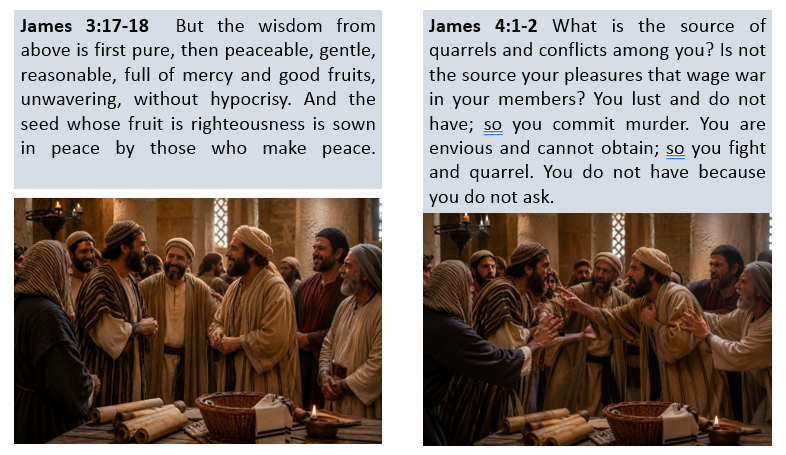
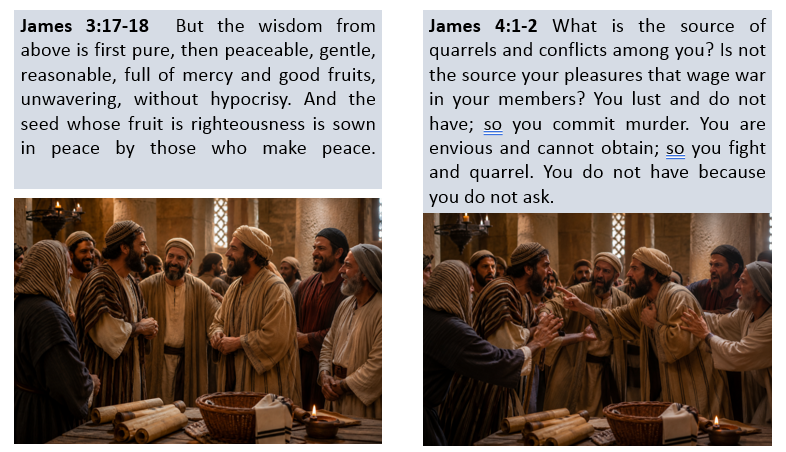
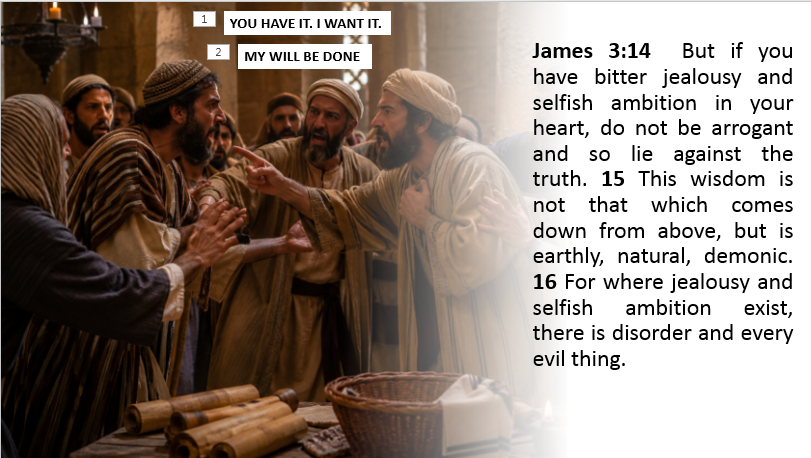
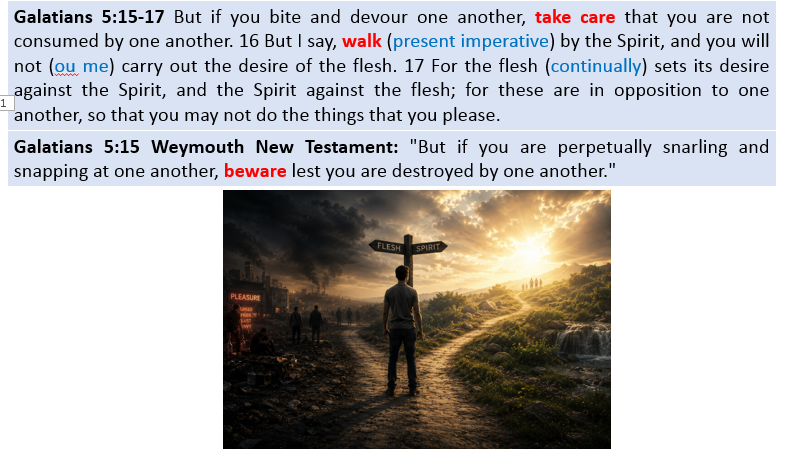
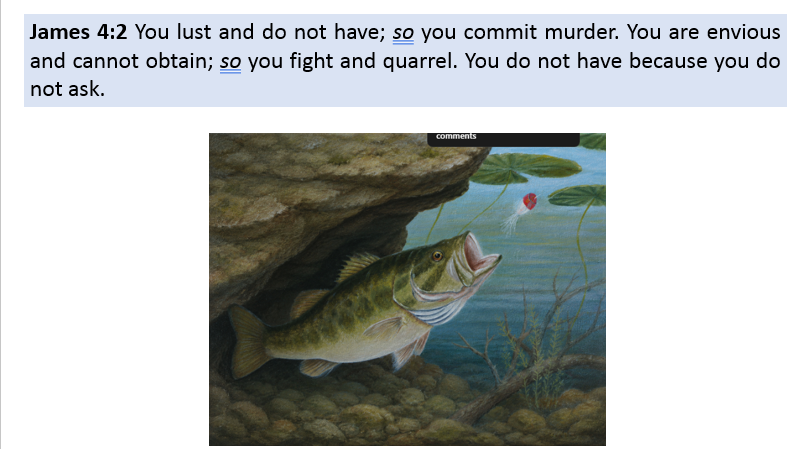
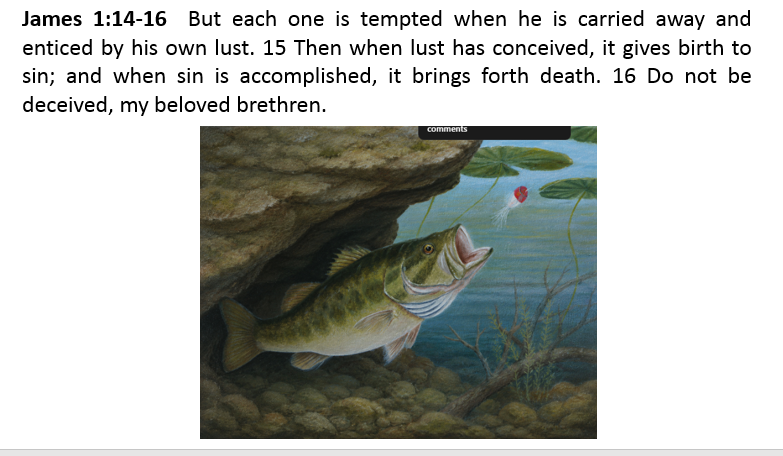
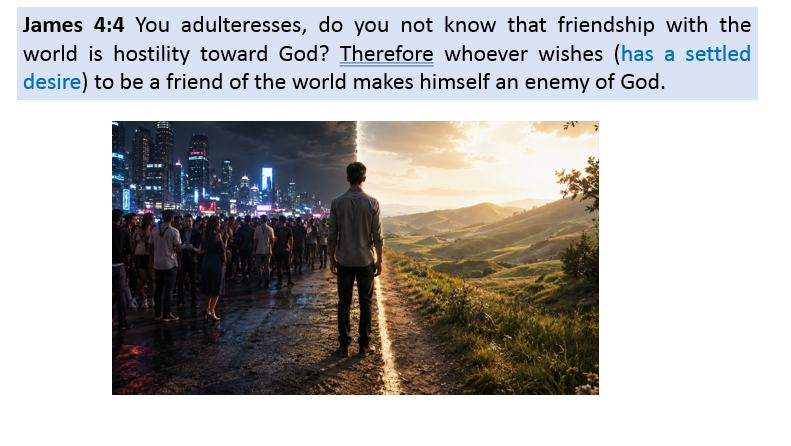
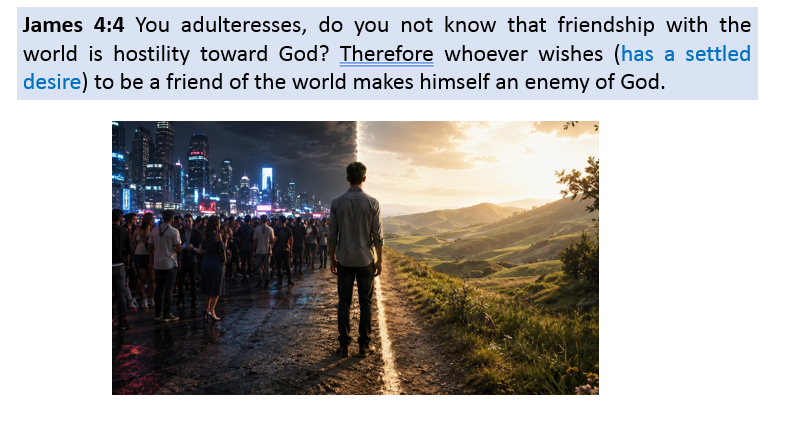
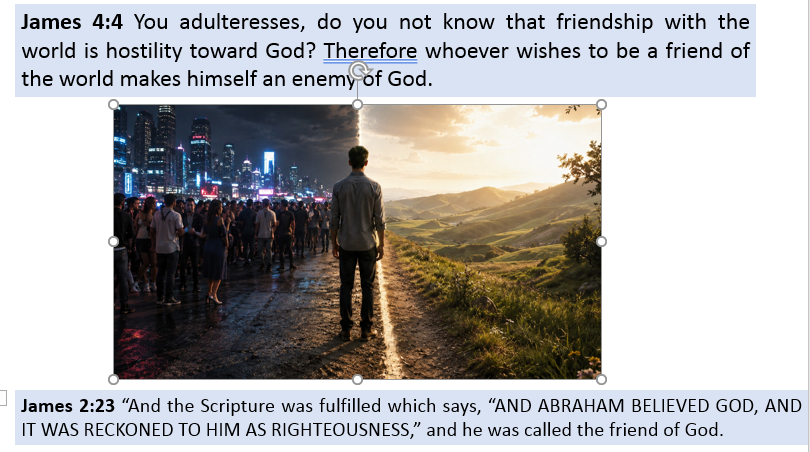
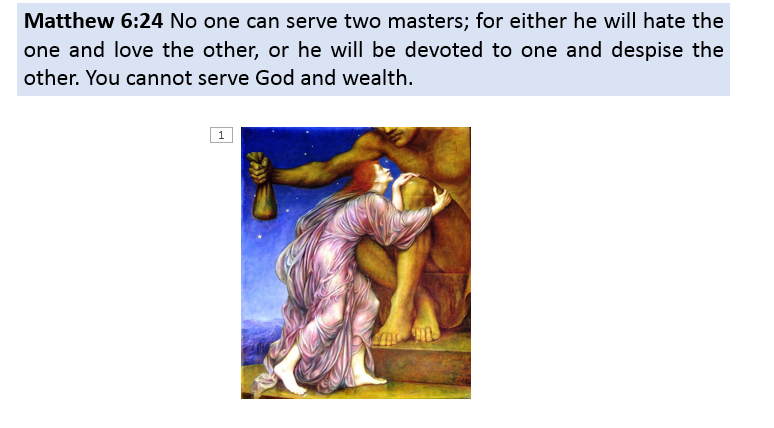
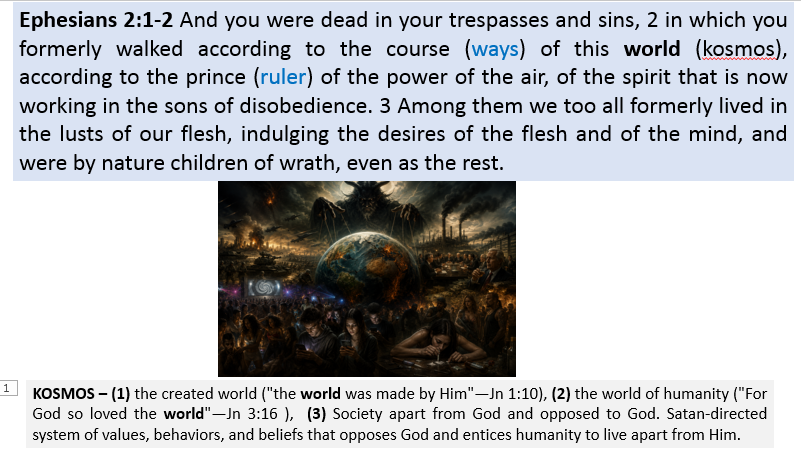
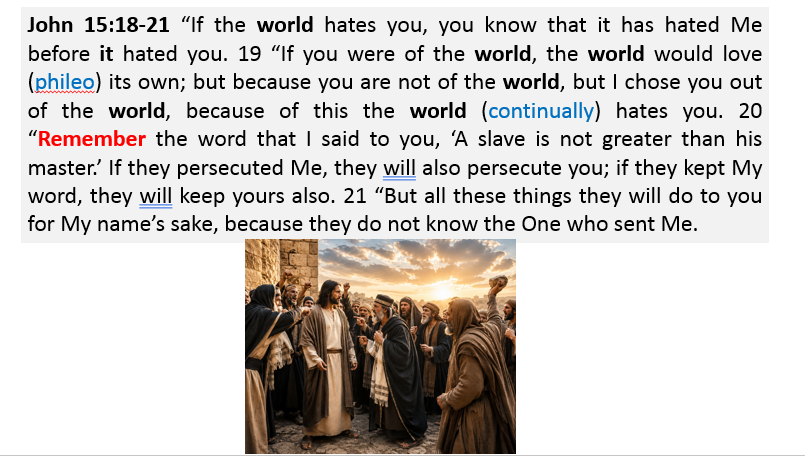
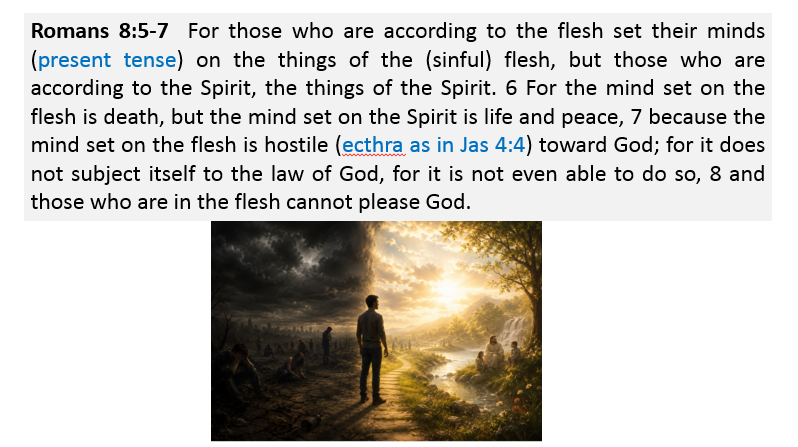
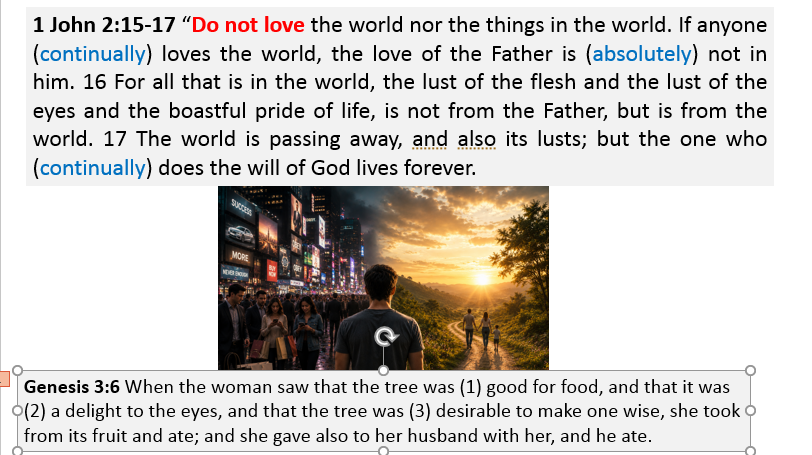
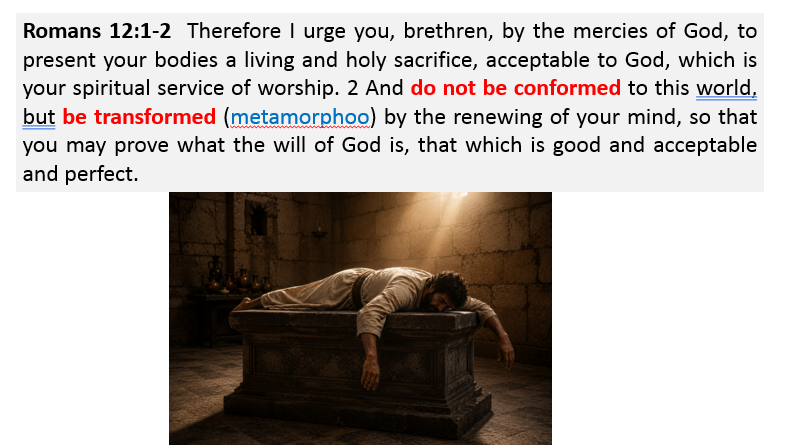

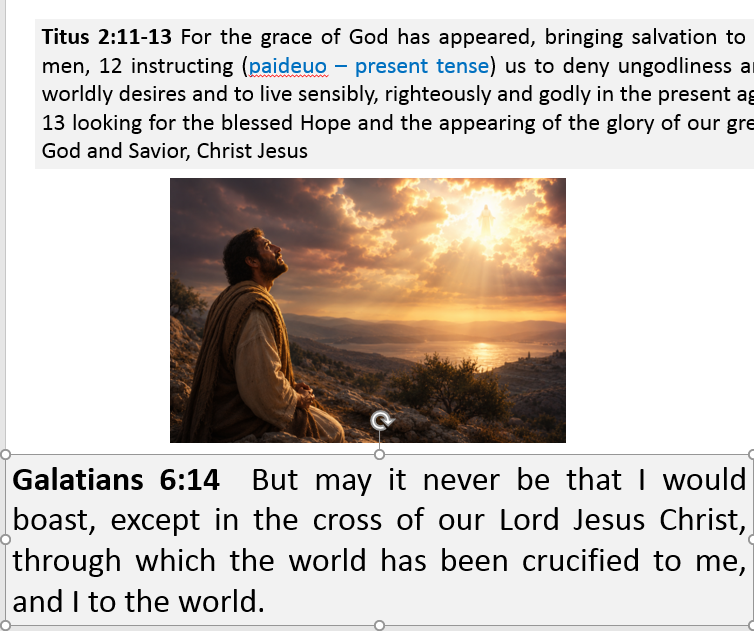
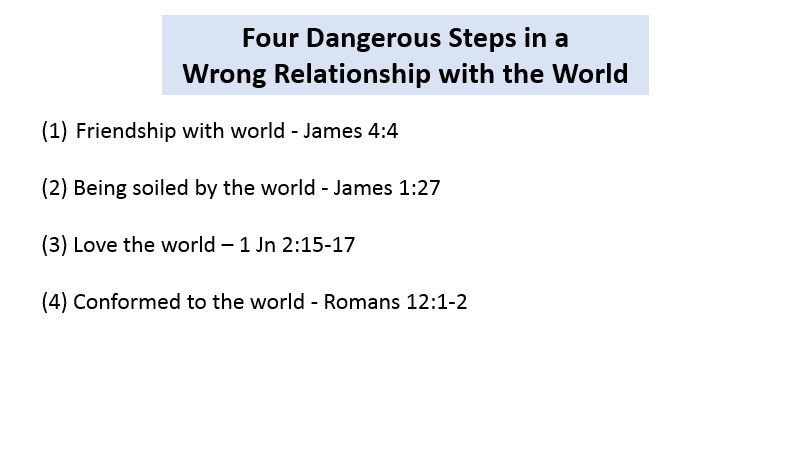
James 4:1 What is the source of quarrels and conflicts among you? Is not the source your pleasures that wage war in your members?
NLT What is causing the quarrels and fights among you? Don't they come from the evil desires at war within you?
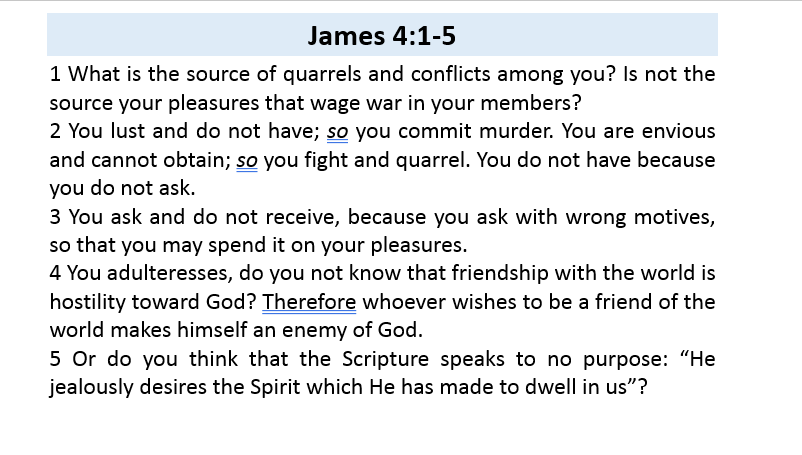
WHO IS JAMES ADDRESSING? believers (James 3:12 "my brethren") in local bodies that have been dispersed abroad (Jas 1:1).
WHAT IS THE FIRST QUESTION (WHAT IS HAPPENING IN THE CHURCHES)?)
WHAT IS THE ASSUMPTION OF THE QUESTION? James doesn't ask whether there are fights and quarrels among us–he assumes it.
WHAT IS THE SIGNIFICANCE OF THE WORD "AMONG"? (WHERE ARE THE FIGHTS/QUARRELS?) inside the congregations
HOW DOES THE BEGINNING OF CHAPTER 4 RELATE TO THE END OF CHAPTER 3? WHAT CONTRAST? Peace in Jas 3:18 versus War in Jas 4:1 == "fruit is righteousness is sown in peace by those who make peace" <> "quarrels and conflicts"! A veritable antithesis!
WHERE WOULD THESE QUARRELS AND CONFLICTS COME FROM - WHAT KIND OF WISDOM? But if you have bitter jealousy and selfish ambition in your heart, do not be arrogant and so lie against the truth. 15 This wisdom is not that which comes down from above, but is earthly, natural, demonic. 16 For where jealousy and selfish ambition exist, there is disorder and every evil thing.
- Ultimate source - earthly, natural, demonic.
- Fruit of this wisdom - bitter jealousy and selfish ambition
TECHNICAL NOTE - Stephen Langton, Archbishop of Canterbury, added chapter divisions to the Latin Vulgate Bible around 1227 AD. His chapter divisions are essentially the same ones used in all modern Bibles today. Robert Estienne (also known as Robert Stephanus), a French printer, Added verse numbers to the New Testament in 1551 AD. According to his son he did much of this work while riding on horseback between Paris and Lyon. His verse divisions were first used in his Greek New Testament edition. The first complete Bible with both chapter and verse divisions was the Geneva Bible of 1560.
WHAT IS THE ANSWER TO THE FIRST QUESTION? IN OTHER WORDS, WHAT IS THE SOURCE OF THEIR QUARRELS AND CONFLICTS? His second question states the SOURCE! Your pleasures (desires, passions, evil desires, selfish desires) where "wage war" is in the present tense - this marks a continual war. The pleasures were already being indulged, not merely desired. The plural — hedonon — multiple pleasures, an entire army of gratified appetites.
WHAT IS WAGING WAR AGAINST THEM? pleasures
WHAT IS THE MEANING OF GREEK WORD FOR "PLEASURES" (hedone)? Sensual gratification already being experienced rather than merely desired. The gratification of natural appetites. Lk. 8:14; Titus 3:3; Jas. 4:1; Jas. 4:3; 2 Pet. 2:13.
You only go around once. Grab for all the gusto you can!"
WHAT DOES MEMBERS MEAN? the people in church (James 3:6 "the tongue is set among our members as that which defiles the entire body, and sets on fire the course of our life, and is set on fire by hell.")
WHAT ELSE COULD IT MEAN? Your physical members, your body, but it could be a double entendre and therefore could refer to members of the church.
WHAT ARE THE TWO WARS THAT ARE HAPPENING SIMULTANEOUSLY? (COMPARE "AMONG" AND "IN") James traces every external conflict to this internal source
Internal War - The flesh wages constant war against the spirit and the new nature within the believer. The internal source feeds the external strife.
External War - the internal war produces the external conflict. Outward conflict comes from inward conflict.
GALATIANS 5:15-18
KEEP IN MIND JEALOUSY AND ENVY ARE BOTH IN THE LIST OF THE ROTTEN FRUIT OF THE FALLEN FLESH DESCRIBED IN GALATIANS 5 -- LET'S LOOK BRIEFLY AT THIS INTERNAL WAR TO HELP UNDERSTAND WHAT JAMES IS SAYING AND HOW IT PARALLELS WHAT PAUL TEACHES -
Galatians 5:15-17 But if you bite and devour one another, take care that you are not consumed by one another. 16 But I say, walk by the Spirit, and you will not (ou me) carry out the desire of the flesh. 17 For the flesh sets its desire against the Spirit, and the Spirit against the flesh; for these are in opposition to one another, so that you may not do the things that you please.
Paul and James are describing the same battlefield from different angles.
- James focuses on the external conflict it produces among believers.
- Paul focuses on the internal conflict.
James 4:2 You lust and do not have; so you commit murder. And you are envious and cannot obtain; so you fight and quarrel. You do not have because you do not ask.
NLT You want what you don't have, so you scheme and kill to get it. You are jealous of what others have, but you can't get it, so you fight and wage war to take it away from them. Yet you don't have what you want because you don't ask God for it.
WHAT ARE SOME OF THE TYPES OF DESIRES THAT LED TO THE CONFLICT AMONG THE BELIEVERS? Lust and envy
WHAT DOES IT MEAN TO LUST strong desire for something good or bad (context determines)
HAS JAMES SPOKEN ABOUT THIS BEFORE? Jas 1:14-151 explaing it is cause of temptation which leads to sin which leads to death! (cf MURDER)
Lust is the verb epithumeo which means a strong desire for something and can be good (Mt 13:17, Lk 22:15) or bad (as here (in the present tense = their passionate craving is habitual), so that the meaning is determined by the context (this is a good rule for study of all Greek words which may have more than one meaning).
WHAT HAPPENS WHEN THEY DON'T GET THEIR WAY (Remember he is speaking to believers)?
- You murder - notice the end of lust in Jas 1:15
- You quarrel and fight
WHAT DOES JAMES MEAN BY THIS STARTLING ACCUSATION OF "COMMIT MURDER"? WAS SOMEONE ACTUALLY MURDERED?
It is possible (some commentaries favor this is literal murder) but more likely it means hatred which Jesus and John equated with murder (Mt 5:21-22, 1Jn 3:15). "If looks could kill!"
WHAT IS JAMES IN ESSENCE SAYING WITH THESE QUESTIONS AND STATEMENTS? WHAT WISDOM ARE THEY MANIFESTING?
Clearly the world's wisdom - envious, selfish resulting in disorder and every evil thing (e.g., "murder")
14 But if you have bitter jealousy and selfish ambition in your heart, do not be arrogant and so lie against the truth. 15 This wisdom is not that which comes down from above, but is earthly, natural, demonic. 16 For where jealousy and selfish ambition exist, there is disorder and every evil thing.
WHAT ARE SOME THINGS ESPECIALLY IN CHURCH THAT PEOPLE DESIRE BUT MAY NOT RECEIVE?
Color of the carpet, sing solo but never asked, teach a Bible study but not asked, be in on the decision making
WHAT DOES HE TURN TO AFTER DESCRIBING LUST AND ENVY, MURDER, FIGHTS AND QUARRELS? prayer
WHAT DOES JAMES MEAN BY "You do not have because you do not ask." WHY DON'T THEY ASK?
REMEMBER THE CONTEXT IS DESIRES.
HOW ARE THEY TRYING TO FULFILL THEIR DESIRES? by themselves apart from God.
SO AGAIN WHY MIGHT THEY NOT ASK? (1) quenched the Spirit (2) know to pray for they things they wanted for their pleasure would be contrary to what God wants.
IF THEY ARE QUARRELING AND FIGHTING, THEY HAVE A WISDOM PROBLEM! WHAT DO THEY NEED TO PRAY?
Ask God for wisdom, James 1:5 without any doubting for "wisdom from above is first pure, then peaceable, gentle, reasonable, full of mercy and good fruits, unwavering, without hypocrisy."
James 4:3 You ask and do not receive, because you ask with wrong motives, so that you may spend it on your pleasures.
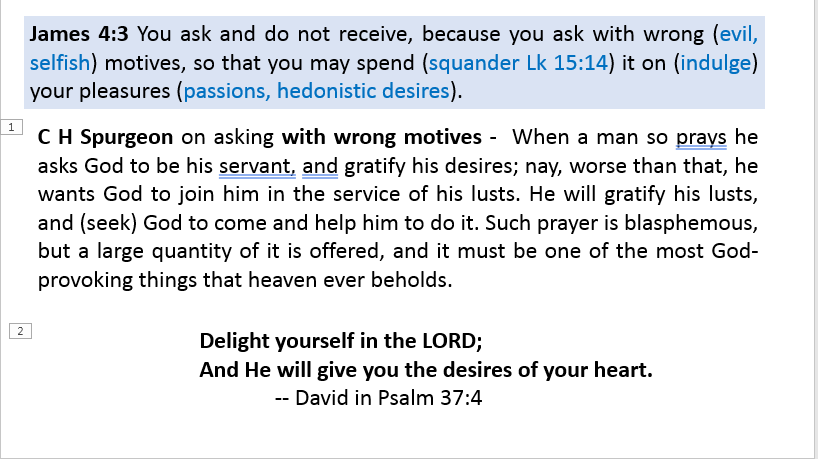
WHAT ABOUT THOSE WHO DO ASK- WHAT WAS THE RESULT? Did not receive
WHY NOT? Asking with wrong (EVIL) motives
WHAT WAS THE DRIVING FORCE FOR THEIR PRAYERS (CF VERSE 1)? Their pleasures waging war
(SO THAT) WHAT WAS THEIR PURPOSE FOR ASKING? They have brought hedone into their prayer life — asking God to fund their pleasure-seeking. Desire to spend (squander, spend wastefully) it on their pleasures (Jas 4:1 hedone).
WHAT DOES THIS KIND OF PRAYER TREAT GOD AS? A "genie" or a "divine vending machine."
C H Spurgeon on asking with wrong motives - When a man so prays he asks God to be his servant, and gratify his desires; nay, worse than that, he wants God to join him in the service of his lusts. He will gratify his lusts, and (seek) God to come and help him to do it. Such prayer is blasphemous, but a large quantity of it is offered, and it must be one of the most God-provoking things that heaven ever beholds.
DAVID WAS A MAN WHOSE LIFE WAS MARRED BY LUST AND PLEASURES - WHEN HE CAME TO HIS SENSES WHAT DID HE ADVISE US TO DO?
Psalm 37:4 Delight yourself in the LORD; And He will give you the desires of your heart.
James 4:4 You adulteresses, do you not know that friendship with the world is hostility toward God? Therefore whoever wishes to be a friend of the world makes himself an enemy of God.
WHAT DOES HE CALL HIS READERS? adulteresses
WHAT IS HIS QUESTION? WHAT ANSWER DOES HE EXPECT? an emphatic "Yes"
HOW IS HE USING THIS TERM "ADULTERESSES", LITERAL OR FIGURATIVE? WHAT IS THE ESSENCE OF THIS ADULTERY?
- FIGURATIVE
- UNFAITHFULNESS
- Spiritual adultery - loyalty to someone/something other than God!
WHY DOES JAMES USE THE FEMININE TERM "ADULTERESSES" WITH THESE JEWISH READERS? CLUE: WHAT WOULD THIS BRING TO THEIR MINDS FROM THE OLD TESTAMENT? OT background where Israel is repeatedly portrayed as God's wife who committed spiritual adultery by pursuing other so called idols. That background gives James' rebuke much of its force.
Jeremiah 3:1,8 Thou hast played the harlot with many lovers; yet return again to Me, saith the LORD…. And I saw that for all the adulteries of faithless Israel, I had sent her away and given her a writ of divorce,
WHO WERE THESE NT BELIEVERS MARRIED TO? Christ was their bridegroom
WHAT IS THE ESSENCE OF SPIRITUAL ADULTERY? unfaithfulness, disloyal, giving affection to one not your spouse,
HOW WERE THEY COMMITING SPIRITUAL ADULTERY? becoming friends (philia) with the world
WHAT IS THE SENSE OF "FRIENDSHIP"-- IS IT MERELY CASUAL ACQUAINTENCE? Friend describes Affection, Fondness, Loyal attachment, Shared interests, Common values. Friendship with the world is loving what the world loves and pursuing what the world pursues instead of loving and pursuing God. Philia is a settled disposition of the heart, a deep fondness that shapes how you think, what you pursue, where you find your satisfaction.
Aristotle described true friendship "A friend is another self."
WHAT WAS THE RESULT OF THEIR FRIENDSHIP WITH WORLD? Hostility toward God
WHO BRINGS ON THIS HOSTILITY - MAN OR GOD?
WHAT IS JAMES' CONCLUSION FOR THOSE WHO MAKE THE CHOICE TO BECOME FRIENDS WITH THE WORLD? makes himself an enemy of God. If you are a friend of the world, you are an enemy of God.
WHY WOULD THIS BE ESPECIALLY PIERCING TO CHILDREN OF ABRAHAM? WHAT DID WE LEARN IN Jas 2:23? Abraham was called the friend (philos) of God
HOW WERE THEY MAKING THEMSELVES AN ENEMY FROM THE PRECEDING CONTEXT? WHAT WERE THEY SEEKING? They were seeking their own pleasures and lusts, their will, not God's will
WHAT IS THE ANTIDOTE FOR SEEKING HEDONISTIC PLEASURES? seeking God (Mt 6:33 Seek first His kingdom and His righteousness and all these things will be added to you.")
John Piper's described in his 1986 classic "Desiring God" talks about Christian Hedonism as "The chief end of man is to glorify God BY enjoying Him forever." (He changed "and enjoy Him forever" to "by enjoying Him forever.")
WHAT DOES JESUS SAY THAT RELATES TO SPIRITUAL ADULTERY IN Mt 6:24?
HOW WOULD YOU EXPLAIN JAMES 4:4 TO ANOTHER PERSON?
WHAT HAD JAMES ABOUT THE BELIEVER'S RELATIONSHIP TO THE WORLD EARLIER THAT SHOULD HAVE WARNED THEM?
James 1:27 Pure and undefiled religion in the sight of our God and Father is this: to visit orphans and widows in their distress, and to keep (GUARD) oneself unstained by the world.
WHAT IS THE EFFECT OF THE WORLD ON BELIEVERS? will corrupt us, pollute us - not calling for isolation but separation. To be in the world (to visit orphans and widows) but not of the world.
A boat in water is by design,
but water in the boat is disaster.
Ephesians 2:1-2 And you were dead in your trespasses and sins, 2 in which you formerly walked (LIVED) according to (in conformity to) the course (WAYS) of this world, according to the prince of the power of the air, of the spirit that is now working in the sons of disobedience.3Among them we too all formerly lived in the lusts of our flesh, indulging the desires of the flesh and of the mind, and were by nature children of wrath, even as the rest.
WHAT IS PAUL DESCRIBING? Gentiles when they were lost spirituly = their life before Christ
WHAT WAS THEIR SPIRITUAL CONDITION BEFORE SALVATION? WHAT DOES "DEAD" MEAN?
WHAT IS THE WORLD IN Ephesians 2:2? (CLICK TO DEFINE KOSMOS - 151x)
HOW DID WE LIVE OR WALK? UNDER WHOSE AUTHORITY?
WHO IS THE "PRINCE OF THE POWER OF THE AIR"? WHAT DOES HE CONTROL? the world system
John 15:18-21 “If the world (kosmos) hates you, you know that it has hated Me before it hated you. 19 “If you were of the world, the world would love (PHILEO) its own (THE WORLD RECEIVES THEM AS ITS OWN); but because you are not of the world, but I chose you out of the world, because of this the world hates you. 20 “Remember the word that I said to you, ‘A slave is not greater than his master.’ If they persecuted Me, they will also persecute you; if they kept My word, they will keep yours also. 21 “But all these things they will do to you for My name’s sake, because they do not know the One who sent Me.
WHAT IS THE WORLD'S ATTITUDE TOWARD DISCIPLES OF JESUS? hatred
(verse 19) WHY DOES THE WORLD CONTINUALLY HATE DISCIPLES? we are not of this world, THEY HATE JESUS
WHAT WILL THE HATRED PRODUCE FOR DISCIPLES? persecution for Name of Jesus (why would we want to be friends?)
WHY IS THE ULTIMATE CAUSE OF WHY THE WORLD HATES US (VERSE 21)? they do not know God
WHY WOULD ANY BELIEVER WANT TO BE FRIENDS WITH THE WORLD WHICH HATES HIM?
PRINCIPLE - The closer we identify with Christ, the more we can expect hatred and persecution
John 16:33 “These things I have spoken to you, so that in Me you may have peace. In the world you have tribulation, but take courage; I have overcome the world.”
Romans 8:5-7 For those who are according to the flesh set their minds on the things of the flesh, but those who are according to the Spirit, the things of the Spirit. 6 For the mind set on the flesh is death, but the mind set on the Spirit is life and peace, 7 because the mind set on the flesh is hostile (ecthra - same word in Jas 4:4) toward God; FOR (HOW DOES PAUL EXPLAIN THEIR HOSTILITY?) it does not subject itself to the law of God, for it is not even able to do so, 8 and those who are in the flesh cannot please God.
Romans 8:5-7 - WHO ARE THE TWO GROUPS? according to the flesh and according to the Spirit,
WHAT IS THE END OF EACH? former yields (spiritual) death, the latter "life and peace"
HOW DOES PAUL DESCRIBE THOSE ACCORDING TO FLESH AND THEIR REACTION TO GOD? hostile to God (WHY?
NOW THINK OF JAMES 4:4? WHAT WOULD BE TRUE OF THOSE WHO HAVE BECOME FRIENDS WITH THE WORLD? WHO ARE THEY LIKE IN ROMANS 8?
ROMAN 8:14 WHO ARE THEY NOT BEING LED BY? the Spirit of God AND what is in question "sons of God"
1 John 2:15-17 Do not love the world nor the things in the world. If anyone loves (present tense) the world, the love of the Father is not in him. 16 FOR all that is in the world, the lust of the flesh and the lust of the eyes and the boastful pride of life, is not from the Father, but is from the world. 17 The world is passing away, and also its lusts; but the one who does (present tense = "direction" not perfection) the will of God lives forever.
WHAT IS THE COMMAND?
WHAT IS THE IF THEN CLAUSE SAYING? If anyone loves (present tense) the world, the love of the Father is not in him.
WHAT IMPLICATION AND HOW RELATE TO JAMES 4:4?
So we have Spirit does not lead one hostile to God and here the Father is not in one who habitually loves the world.
HOW DOES HE EXPLAIN LOVE OF THE WORLD? WHERE DO WE SEE A SIMILAR PATTERN IN SCRIPTURE?
Genesis 3:6 When the woman saw that the tree was good for food, and that it was a delight to the eyes, and that the tree was desirable to make one wise, she took from its fruit and ate; and she gave also to her husband with her, and he ate.
WHAT DOES HE TELL US THAT SHOULD MOTIVATE US TO NOT LOVE THE WORLD? passing away,
WHAT DOES THIS VERSE IMPLY ABOUT A PERSON'S SALVATION? It brings it into question for sure.
WHAT IS JOHN SAYING - CAN A TRUE BELIEVER NEVER STRUGGLE WITH WORLDLINESS? John is not saying that a true believer never struggles with worldliness. Rather, he is saying that a settled love for the world is incompatible with genuine love for the Father and may reveal that a person does not truly belong to God.
A man caught up with this world is not ready for the next one.
- John Blanchard
Romans 12:1-2 Therefore I urge you, brethren, by the mercies of God, to present your bodies a living and holy sacrifice, acceptable to God, which is your spiritual service of worship. 2 And do not be conformed to this world, but be transformed by the renewing of your mind, SO THAT (PURPOSE) you may prove what the will of God is, that which is good and acceptable and perfect.
WHAT ARE BELIEVERS TO DO IN LIGHT OF THE INCREDIBLE MERCIES SHOWN IN ROMANS 1-11?
WHAT IS ASSOCIATED WITH OUR PRESENTATION AS AN ACT OF WORSHIP? WHAT ARE THE COMMANDS?
- CONFORM = refers to an outward expression that does not reflect what is within.
- TRANSFORM = inward change that is reflected by outward appearance
HOW DOES THIS RELATE TO NOT BEING A FRIEND OF THE WORLD?
WHAT IS THE RESULT/PURPOSE OF BEING CONTINUALLY TRANSFORMED? discern God's will
WHAT DOES GOD USE TO TRANSFORM US? His Word and His Spirit - if time show this patter in 2Co 3:18 which uses same rare verb.
2Cor 3:18 But we all, with unveiled face, beholding as in a mirror the glory of the Lord, are being transformed into the same image from glory to glory, just as from the Lord, the Spirit.
Titus 2:11-13 For the grace of God has appeared, bringing salvation to all men, 12 instructing us to deny ungodliness and worldly desires and to live sensibly, righteously and godly in the present age, 13 looking for the blessed hope and the appearing of the glory of our great God and Savior, Christ Jesus,
ADD ANOTHER REASON WE CAN AND SHOULD RESIST THE SEDUCTIVE CALLS OF THE WORLD SYSTEM
Galatians 6:14 But may it never be that I would boast, except in the cross of our Lord Jesus Christ, through which the world has been crucified to me, and I to the world.
WHAT HAS GOD PROVIDED TO HELP BELIEVERS FIGHT THE SEDUCTIVE PULL OF THE WORLD?

CROSS REFERENCES ON THE BRIDE OF CHRIST
SPIRITUAL ADULTERY IN JAMES 4:4 RELATES TO ISRAEL'S HARLOTRY IN THE OT
2 Corinthians 11:2-3 For I am jealous (zeloo - Jas 4:2) for you with a godly jealousy; for I betrothed you to one husband, so that to Christ I might present you as a pure virgin. 3 But I am afraid that, as the serpent deceived Eve by his craftiness, your minds will be led astray from the simplicity and purity of devotion to Christ.
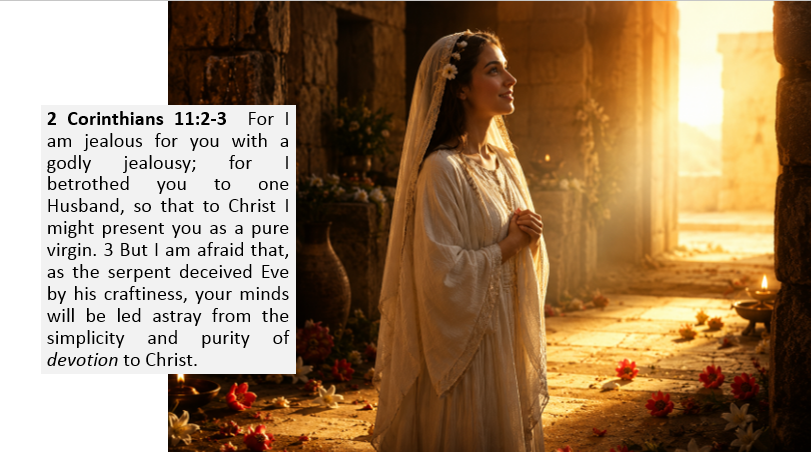
WHO ARE YOU MARRIED TO?
WHAT WAS PAUL'S ATTITUDE TOWARD THE SAINTS AT CORINTH? jealous...godly jealousy
WHY? he betrothed them to one Husband, Christ
WHEN WERE THEY BETROTHED? when he preached the gospel to them and they responded in faith
WHAT WAS HIS DANGER? serpent would lead their minds astray from sincere and pure devotion to their Bridegroom
MAY NOT HAVE ENOUGH
TIME FOR THIS SLIDE
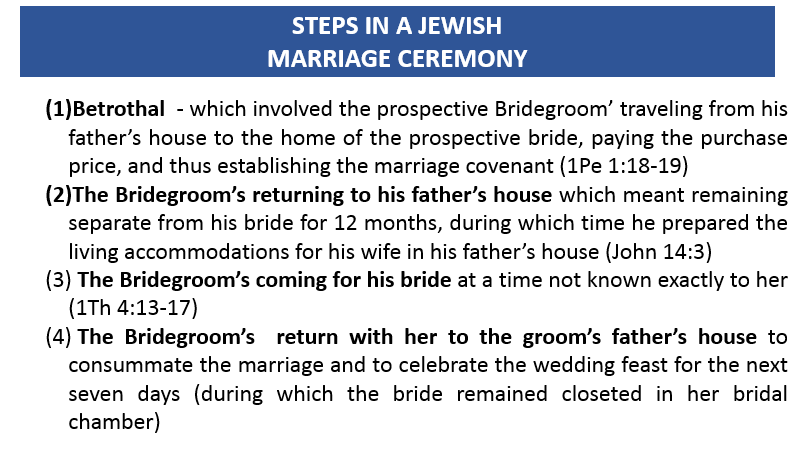
Jewish marriage steps:
- betrothal (which involved the prospective groom’s traveling from his father’s house to the home of the prospective bride, paying the purchase price, and thus establishing the marriage covenant);
- the groom’s returning to his father’s house (which meant remaining separate from his bride for 12 months, during which time he prepared the living accommodations for his wife in his father’s house);
- the groom’s coming for his bride at a time not known exactly to her;
- his return with her to the groom’s father’s house to consummate the marriage and to celebrate the wedding feast for the next seven days (during which the bride remained closeted in her bridal chamber)
Ephesians 5:23-32 For the husband is the head of the wife, as Christ also is the head of the church, He Himself being the Savior of the body. 24 But as the church is subject to Christ, so also the wives ought to be to their husbands in everything. 25 Husbands, love your wives, just as Christ also loved the church and gave Himself up for her, 26 so that He might sanctify her, having cleansed her by the washing of water with the word, 27 that He might present to Himself the church in all her glory, having no spot or wrinkle or any such thing; but that she would be holy and blameless. 28 So husbands ought also to love their own wives as their own bodies. He who loves his own wife loves himself; 29 for no one ever hated his own flesh, but nourishes and cherishes it, just as Christ also does the church, 30 because we are members of His body. 31 FOR THIS REASON A MAN SHALL LEAVE HIS FATHER AND MOTHER AND SHALL BE JOINED TO HIS WIFE, AND THE TWO SHALL BECOME ONE FLESH. 32 This mystery is great; but I am speaking with reference to Christ and the church. (cf Ro 7:4 so that you might be joined to another, to Him who was raised from the dead, in order that we might bear fruit for God.)
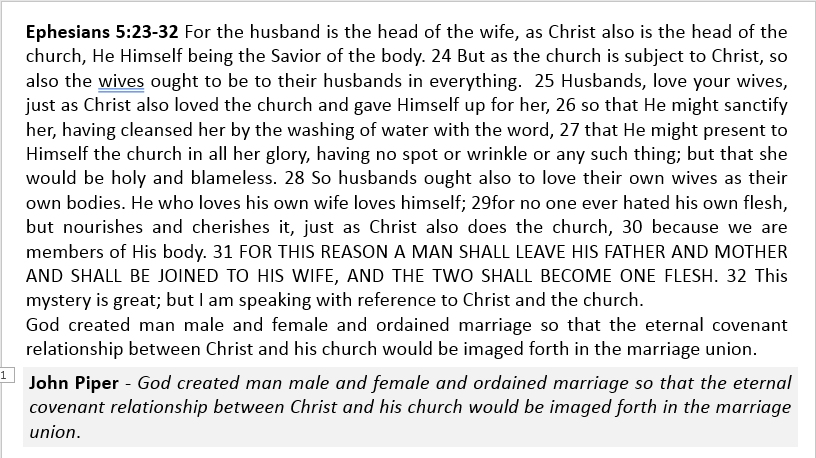
WHAT IS THE KEY WORD? church (body, her, she)
WHAT IS THE MYSTERY? Marriage is the earthly picture of Christ and the church are the greater spiritual reality.
John Piper - God created man male and female and ordained marriage so that the eternal covenant relationship between Christ and his church would be imaged forth in the marriage union.
Revelation 19:7-8 “Let us rejoice and be glad and give the glory to Him, for the marriage of the Lamb has come and His bride has made herself ready.” 8 It was given to her to clothe herself in fine linen, bright and clean; for the fine linen is the righteous acts of the saints. 14 And the armies which are in heaven, clothed in fine linen, white and clean, were following Him on white horses.
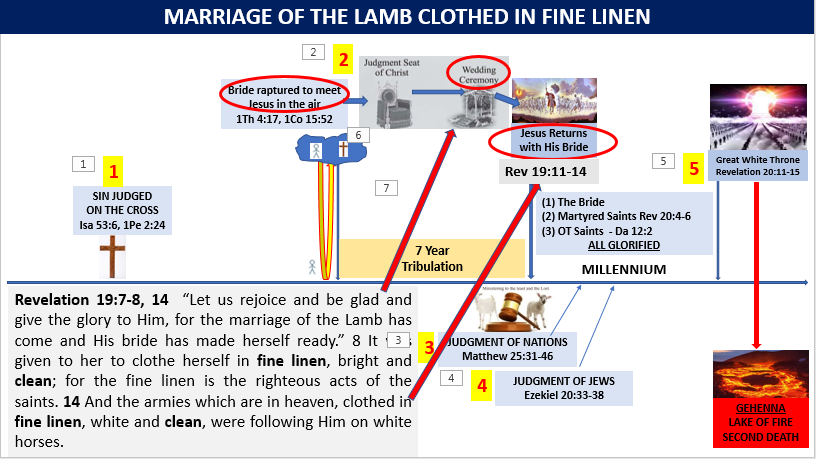
WHAT IS THIS EVENT? WHAT WILL BE THE ATMOSPHERE?
WHO IS THE BRIDE? Matthew Henry - "Some think this refers to the conversion of the Jews"
WHEN THE BRIDEGROOM COME AND RETRIEVE HIS BRIDE?
WHEN DOES THIS EVENT OCCUR IN THE REVELATION (WHAT EVENTS FOLLOW IT?)
WHAT DOES MARRIAGE BRING ABOUT BETWEEN A MAN AND A WOMAN? the closest intimacy known!
HOW WOULD YOU DESCRIBE THE BRIDE'S WEDDING DRESS? WHAT IS FINE LINEN?
James 4:5 Or do you think that the Scripture speaks to no purpose: “He jealously desires the Spirit which He has made to dwell in us”?
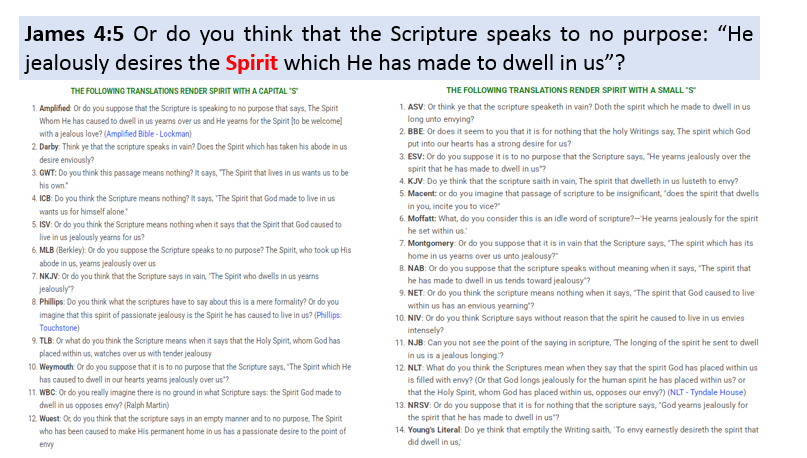
WHAT IS PERSONIFIED? WHAT DOES IT REFER TO IN NT?
WHO IS "HE"?
WHY WOULD HE JEALOUSLY DESIRE THE SPIRIT? Ro 8:14 For all who are being led by the Spirit of God, these are sons of God.
WHY WOULD GOD BE JEALOUS? adulteresses
HOW DOES JAMES 4:5 RELATE TO JAMES 4:4?
Jesus is the Bridegroom and desires a faithful Bride so has given us His Spirit to enable us to remain faithful.
James 4:6 But He gives a greater grace. Therefore it says, “GOD IS OPPOSED TO THE PROUD, BUT GIVES GRACE TO THE HUMBLE.”
(TWO HINGE WORDS) WHAT DOES THE FIRST HINGE WORD BUT (TERM OF CONTRAST) HIGHLIGHT?
The preceding verses (Jas 4:1-5) emphasize man's sinful condition. But now shifts to God's gracious provision.
TO WHOM IS GOD OPPOSED?
The proud - a person is consumed with worldly lusts, desires, ambitions, pride has no claim on this greater grace
WHAT DOES THE WORD GREATER IMPLY ABOUT GOD'S GRACE?
"Greater" points to grace that is sufficient for every need James has just exposed—worldliness, pride, and the call to repentance.
James is essentially saying:
You have sinned greatly... BUT God gives greater grace.
The world exerts a powerful pull... BUT God supplies greater power.
Your flesh is strong... BUT God's grace is stronger.
The greater the believer's need, the greater God's grace. James has just exposed the depths of our sin (James 4:1–5); now he reveals the sufficiency of God's grace (James 4:6).
UNDER WHAT CONDITIONS DOES HE SUPPLY GREATER GRACE?
To one who is humble
NOW THINK WITH ME. WHAT IS JAMES GIVING IN THE NEXT 4 VERSES, SUGGESTIONS OR COMMANDS? NOW, WHAT WOULD BE THE PURPOSE OF THE GREATER GRACE?
The God who says, 'Here is My grace to receive' says in the same breath, 'here are My commands to obey'"
TAKEAWAY - GOD'S COMMANDMENTS ALWAYS INCLUDE HIS ENABLEMENTS!
The "gravity of grace" = it flows down! As we bow or are brought low at the foot of the Cross of Christ, His amazing grace flows into our lives, cp 2Cor 8:9).
Grace, grace, God’s grace,
Grace that will pardon and cleanse within,
Grace, grace, God’s grace,
Grace that is greater than all our sin.
—Julia H. Johnston
James 4:7 Submit therefore to God. Resist the devil and he will flee from you.
WHAT IS THEREFORE? (term of conclusion) WHAT IS JAMES CONCLUDING?
Since God opposes the proud but gives greater grace to the humble, believers must humble themselves by submitting to God and obeying the commands that follow (James 4:7–10). Note the progression...
grace → humility → submission → obedience.
WHAT IS THE FIRST COMMAND? WHY IS IT FIRST? WHAT DOES "SUBMIT" IMPLY?
Submission to God is the foundation of every other command that follows (James 4:7–10) for until a believer willingly places himself under God's authority, he cannot obey the commands (He won't receive the necessary grace and the necessary empowerment from an "unquenched" Spirit)!
SINCE ALL 10 IMPERATIVES ARE AORIST IMPERATIVES IT IS IMPORTANT TO UNDERSTAND THAT SENSE...
WHAT IS A SIMPLE DESCRIPTION OF AORIST IMPERATIVE? "Just do it" - I call it the "Nike Commercial Command." It is like a call from a commanding general to his soldiers expressing the urgency of the situation.
WHY IS THE ORDER OF THE COMMANDS IMPORTANT? (In other words) WHAT IS THE MISTAKE OR DANGER ONE COULD MAKE IF ORDER IS INVERTED?
God first, then we are empowered by grace to resist the devil - to try to resist the devil in our own strength is utter foolishness and sure failure!
WHAT WOULD THE OPPOSITE OF THIS COMMAND LOOK LIKE? resist God and submit to the devil!!!
WHAT IS THE PROMISE?
Devil will flee from you (exemplified by Devil leaving Jesus in Luke 4:13, Mt 4:11)
Emphasize the sequence: Grace → Submit → Resist → Devil flees.
James 4:8 Draw near to God and He will draw near to you. Cleanse your hands, you sinners; and purify your hearts, you double-minded.
HOW MANY COMMANDS ARE IN THIS VERSE? 3
WHAT'S THE PROMISE?
God will draw near to those who draw near to Him. (Remember the context is God is still willing to draw near to adulteresses who confess and repent and draw near to Him, reminescent of the picture of God's willingness to draw near to unfaithful Israel in the story of Hosea and Gomer!) God is not holding our sin against us or withdrawing from us because of our past sins! This is good news for all of us because we all from time to time fall prey to the siren call of the world and thus temporarily become unfaithful brides.
WHY DOES JAMES SAY "DRAW NEAR TO GOD" BEFORE "CLEANSE YOUR HANDS"?
James begins with drawing near because God is the source of cleansing. We do not cleanse ourselves in order to earn access to God; rather, we draw near to Him in humble repentance, and His grace enables the cleansing of both our outward conduct ("hands") and inward motives ("heart"). The order underscores that grace precedes and empowers repentance, not the other way around.
James is not preaching "clean up, then come." He is preaching "come, because God gives greater grace—and that grace produces cleansing."
WHAT DO HANDS REPRESENT IN CONTEXT?
Hands = One's outward conduct or behavior—the actions of daily life that need to be cleansed from sin.
Hands symbolize what we do.
WHAT DO THEY NEED TO CLEANSE THEIR HANDS OF?
Sin
WHY DO THEY NEED TO PURIFY THEIR HEARTS? (WHAT IS THE HEART? the "control center" of our being - The inner person—our thoughts, motives, desires, and affections.)
Double-minded WHAT DOES THAT PICTURE? (dipsuchos = two-spirited, vacillating) (E.g. in context as believers they are sometimes in the world, other times not)
WHAT DO HEART AND HANDS TOGETHER REPRESENT? (this might be somewhat redundant since you have asked about hands and heart)
The whole person, both our outward conduct ("hands") and our inward thoughts, motives, and affections ("heart") must be cleansed and brought into submission to God. "you sinners" = outward conduct and "you double-minded" = inward divided loyalty.
TAKEAWAY - God desires both outward purity and inward holiness. Genuine repentance (which is the essence of what James is calling for in James 4:6-10) involves the whole person, not merely external behavior.
WHERE HAS JAMES USED THIS SAME TERM AND WHAT CONTEXT? WHAT'S THE CONTEXT IN JAMES 4?
James 1:8 speaking of faith that is vacillating and describes one who doubts God will give wisdom if we ask Him
Here the wavering is between friendship with the world and a friend of God.
James 4:9 Be miserable and mourn and weep; let your laughter be turned into mourning, and your joy to gloom.
HOW MANY COMMANDS?
WHAT ARE THE COMMANDS AND WHY ARE THEY GIVEN (REMEMBER THE CONTEXT! MAY NEED TO REMIND THEM IT IS SIN)?
James is calling for sorrow for sin and all refer to the evidences of repentance
HOW URGENT IS JAMES' CALL? recall aorist imperative = "Just do it!"
WHO IS CAPABLE OF BRINGING ABOUT THIS CHANGE?
God's Spirit - E.G. see Ro 2:4 Or do you think lightly of the riches of His kindness and tolerance and patience, not knowing that the kindness of God leads you to repentance?
WHAT'S THE CONTRAST IN THIS VERSE?
laughter to mourning and joy to gloom. -- their laughter shows their insensitivity to their sin and same for joy
EXTRA VERSE - HOW WOULD JAMES' TEACHING IN THIS VERSE PARALLEL PAUL'S TEACHING IN 2Co 7:10?
For the sorrow that is according to the will of God produces a repentance without regret, leading to salvation, but the sorrow of the world produces death.
James 4:10 Humble yourselves in the presence of the Lord, and He will exalt you.
WHAT IS THE COMMAND?
HOW IS THIS ACCOMPLISHED? CAN GENUINE HUMILITY BE PRODUCED BY HUMAN PRIDE (fallen flesh)?
No!
The flesh is not able to humble the flesh! But you do have the Spirit of Christ indwelling your body and He is able to energize within your "new man" a desire to humble yourself and along with the desire, He provides the supernatural power enabling you to obey the command. You still have to make the personal decision to allow yourself to be humbled (i.e., it's not just "Let go and let God." but "Let God and let's go!"), but now you can do so with a supernaturally enabled desire and power.
WHAT'S THE PROMISE?
Will be exalted
WHY IS IT IMPORTANT THAT WE HUMBLE OURSELVES "BEFORE THE LORD" RATHER THAN BEFORE MEN?
Because people see only outward appearances, but the Lord sees the heart (1Sa 16:7). He alone can rightly evaluate genuine humility and is the One who promises to exalt the humble.
HOW DOES VERSE 10 COMPLETE VERSES 6–9?
Verse 10 brings James' call to repentance to its climax. God gives grace to the humble (v. 6), believers respond by submitting to God (v. 7), drawing near to Him (v. 8), and mourning over their sin (v. 9). The result is genuine humility before the Lord, whom God promises to exalt.
HOW DOES THIS PARALLEL Jas 4:6?
God is opposed to the proud but gives grace to the humble.
James 4:11 Do not speak against one another, brethren. He who speaks against a brother, or judges his brother, speaks against the law, and judges the law; but if you judge the law, you are not a doer of the law, but a judge of it.
Amplified - [My] brethren, do not speak evil about or accuse one another. He that maligns a brother or judges his brother is maligning and criticizing the Law and judging the Law. But if you judge the Law, you are not a practicer of the Law but a censor and judge [of it].
WHAT'S THE COMMAND? WHO IS IT GIVEN TO?
Do not speak against one another (speak against is katalaleo = slander, defame)
Brethren - believers
present imperative with a negative = stop an action already occuring (or do not begin it).
WHAT DOES IT MEAN TO SPEAK AGAINST A BROTHER?
Slander, defame, belittle (HCSB = "don't criticize one another" ESV = "Do not speak evil against one another.")
Criticism to build up a brother is fine, but most criticism is to tear them down and by default to elevate yourself which is the essence of pride. Thus Jas 3:5 ("So also the tongue is a small part of the body, and yet it boasts of great things. See how great a forest is set aflame by such a small fire!") is a great parallel to Jas 4:11 because there we see the tongue "boasts" while Jas 4:11 is the outworking of such a boastful (prideful) action.
WHAT LAW WOULD HE SPEAKING AGAINST? WHAT DID THE LAW COMMAND REGARDING OUR RELATIONSHIP TO OTHERS?
Leviticus 19:18 You shall not take vengeance, nor bear any grudge against the sons of your people, but you shall love your neighbor as yourself; I am the LORD.
Mark 12:31 The second is this, ‘YOU SHALL LOVE YOUR NEIGHBOR AS YOURSELF.’ There is no other commandment greater than these.”
Romans 13:8-10 Owe nothing to anyone except to love one another; for he who loves his neighbor has fulfilled the law. 9For this, “YOU SHALL NOT COMMIT ADULTERY, YOU SHALL NOT MURDER, YOU SHALL NOT STEAL, YOU SHALL NOT COVET,” and if there is any other commandment, it is summed up in this saying, “YOU SHALL LOVE YOUR NEIGHBOR AS YOURSELF.” 10Love does no wrong to a neighbor; therefore love is the fulfillment of the law.
HOW DOES THIS COMMAND RELATE TO JAMES 4:1-10?
All were addressed to the proud, worldly, quarreling readers described in James 4:1–6 and Jas 4:7-10 was in effect a call to a humble attitude and to repentance.
Now Jas 4:11 is the first test to see whether they had true humility and repentance. (This recalls John the Baptist's famous command "bring forth fruit in keeping with repentance" Mt 3:8)
(This question is probably redundant) HOW DOES THE SPECIFIC COMMAND IN Jas 4:11 FIT WITH THE CONTEXT (See Jas 4:1ff)?
They were having quarrels and conflicts amongst themselves
WHERE HAVE WE ALREADY SEEN THIS, AT LEAST AN ACTION THAT WAS SIMILAR TO JUDGING A BROTHER?
Jas 2:4 have you not made distinctions among yourselves, and become judges with evil motives?
WHY IS IT WRONG TO SPEAK AGAINST A BROTHER? 3 consequences
(1) Judges brother, (2) speaks against the law, (3) judges the law
The one who judges another attempts to take God's authority - He Alone is the righteous Judge because He Alone can see their heart.
James has already told us in Jas 2:8 (MIGHT HAVE SOMEONE READ THIS ONE) what "the law" specifically means here: "If, however, you are fulfilling the royal law according to the Scripture, “YOU SHALL LOVE YOUR NEIGHBOR AS YOURSELF,” you are doing well." So when someone slanders or sits in judgment on a brother, they're violating that specific command to love (they are NOT doing well!).
Speaks against the law as if "love your neighbor" doesn't really apply to the speaker - so when you slander your neighbor you are saying the law is wrong
And to do that is to judge the law - instead of the law judging your conduct, you're now judging the law's validity.
WHAT HAPPENS IF YOU JUDGE THE LAW?
You are not a doer of the law
Explanation - Someone who slanders a brother probably still thinks of themselves as a "law-keeper" generally — they'd say "I know I should love my neighbor, and mostly I do." James is saying: no, in that very act you've left the category of "doer" altogether, because doing requires submission, and judging requires the opposite of submission.
HOW DOES THIS PASSAGE CONNECT BACK TO JAMES 1:22?
Such a person (not a doer of the law) has deluded himself
WHAT PARALLELS WITH GALATIANS 5:13-16 AND JAMES 4:1-12?
For you were called to freedom, brethren; only do not turn your freedom into an opportunity for the flesh, but through love serve one another. 14 For the whole Law is fulfilled in one word, in the statement, “YOU SHALL LOVE YOUR NEIGHBOR AS YOURSELF.” 15 But if you bite and devour one another, take care that you are not consumed by one another. 16 But I say, walk by the Spirit, and you will not carry out the desire of the flesh.
James 2:4 (krites, diakrino) have you not made distinctions (diakrino) among yourselves, and become judges (krites) with evil motives?
HOW WERE THEY MAKING DISTINCTIONS AND BECOMING JUDGES?
James 2:6 (kriterion - court) But you have dishonored the poor man. Is it not the rich who oppress you and personally drag you into court?
James 2:12 (krino) So speak and so act as those who are to be judged (krino) by the law of liberty.
James 2:13 (krisis) For judgment (krisis) will be merciless to one who has shown no mercy; mercy triumphs over judgment (krisis).
James 4:11 (krino and krites) Do not speak against one another, brethren. He who speaks against a brother or judges his brother, speaks against the law and judges (krino) the law; but if you judge (krino) the law, you are not a doer of the law but a judge (krites) of it.
James 4:12 (krites, krino) There is only one Lawgiver and Judge (krites), the One who is able to save and to destroy; but who are you who judge (krino) your neighbor?
James 5:9 (krino, krites) Do not complain, brethren, against one another, so that you yourselves may not be judged (krino); behold, the Judge (krites) is standing right at the door.
James 1:6 (diakrino) But he must ask in faith without any doubting (diakrino), for the one who doubts (diakrino) is like the surf of the sea, driven and tossed by the wind.
James 4:12 There is only one Lawgiver and Judge, the One who is able to save and to destroy; but who are you who judge your neighbor?
WHY IS IT WRONG TO JUDGE THE LAW? WHAT WORD EMPHASIZES GOD'S EXCLUSIVE AUTHORITY ("only")?
only one Lawgiver and Judge, the One who is able to save and to destroy;
WHAT WERE THEY TO DO INSTEAD OF JUDGING THEIR NEIGHBOR?
Instead of criticizing, slandering, and judging their neighbor, they were to love their neighbor by obeying the royal law (James 2:8),
WHAT PROOF DOES JAMES GIVE THAT GOD ALONE HAS THE RIGHT TO JUDGE?
He is the only One Who can save and Who can destroy
WHAT CONTRAST IS INTRODUCED BY THE HINGE WORD "BUT"? WHAT KIND OF QUESTION IS "WHO ARE YOU" = rhetorical
James contrasts man presumptuously assuming or subverting God's role as judge (v. 11) with the reality that God Alone is the Lawgiver and Judge (v. 12). The "but" shifts the focus from man's illegitimate authority to God's exclusive authority.
WHAT IS THE MAIN PROBLEM (may have answered this above) WHEN WE JUDGE OUR NEIGHBOR? WHOSE AUTHORITY ARE WE USURPING?
God's Authority
Good Cross References -
Isaiah 33:22 For the LORD is our judge, The LORD is our lawgiver, The LORD is our king; He will save us–
Romans 14:4, 10-11 Who are you to judge the servant of another? To his own master he stands or falls; and he will stand, for the Lord is able to make him stand....10 But you, why do you judge your brother? Or you again, why do you regard your brother with contempt? For we will all stand before the judgment seat of God. 11 For it is written, “AS I LIVE, SAYS THE LORD, EVERY KNEE SHALL BOW TO ME, AND EVERY TONGUE SHALL GIVE PRAISE TO GOD.” 12 So then each one of us will give an account of himself to God.
James 4:13 Come now, you who say, “Today or tomorrow, we shall go to such and such a city, and spend a year there and engage in business and make a profit.”
WHAT'S THE COMMAND? WHO IS HE ADDRESSING?
Come now, in the present imperative (give continual attention to what follows
WHAT'S THE SENSE OF "COME NOW YOU WHO SAY?"
Interjection indicating strong disapproval (a rebuke).
WHAT DON'T THEY KNOW?
They do not know what will happen tomorrow.
They assume they control the future, but the future is known only to God (cf. Pr 27:1: "Do not boast about tomorrow, for you do not know what a day may bring forth.").
WHAT TWO ARGUMENTS DOES JAMES USE?
(1) The uncertainty of tomorrow – "You do not know what your life will be like tomorrow."
- Their plans are presumptuous because the future is completely uncertain from a human perspective.
- No one has the ability to guarantee even one more day of life.
(2) The brevity of life – "You are just a vapor that appears for a little while and then vanishes away."
- Even if tomorrow comes, life itself is exceedingly short and fragile.
- Like morning mist, steam, or a puff of breath, it is visible only briefly before disappearing.
WHAT ARE THE 4 "PLANS" THE READERS WERE MAKING?
Go...spend a year...engage in business...make a profit
WHAT DOES THIS SOUND LIKE THEY WERE IN LOVE WITH OR AT LEAST SEEKING TO MIMIC?
The world that is opposed to God and headed up be the Devil (See Jas 4:4)
WHAT IS THEIR FOCUS REGARDING TIME?
This present life (temporal) not eternal
WHAT DO THEIR PLANS SAY ABOUT HOW THEY VIEWED CONTROL OVER THE FUTURE?
WHAT PLANS HAVE YOU MADE WITH A SIMILAR AIR OF CONFIDENCE?
James 4:14 Yet you do not know what your life will be like tomorrow. You are just a vapor that appears for a little while and then vanishes away.
WHAT DOES THE HINGE WORD "YET" DO IN THIS VERSE?
Introduces contrast
WHAT CONTRAST?
Their presumptuous, self-confident certainty about the future is contrasted with the uncertainty and unpredictability of life.
(Related question - time phrases) HOW DOES JAMES DEMOLISH THEIR CONFIDENCE ABOUT LIVING IN A CITY A YEAR (Jas 4:13)?
Do not know what your life will be like tomorrow
Their plans presume a future over which they have no control.
WHAT IS THE STRIKING METAPHOR/IMAGE JAMES USES OF HUMAN LIFE?
Vapor (mist)
HOW HAD JAMES DESCRIBED ONE'S LIFESPAN EARLIER (specifically the rich man)? like flowering grass
James 1:10 and the rich man is to glory in his humiliation, because like flowering grass he will pass away.
EXCURSUS ON WHO DETERMINES OUR LIFESPAN
Ps 31:15 My times are in Your hand; Deliver me from the hand of my enemies and from those who persecute me.
Job 12:9-10 Who among all these does not know That the hand of the LORD has done this, 10 In whose hand is the life of every living thing, And the breath of all mankind?
Job 14:5 Since his days are determined, The number of his months is with You; And his limits You have set so that he cannot pass.
Ps 139:16 Your eyes have seen my unformed substance; And in Your book were all written The days that were ordained for me, When as yet there was not one of them.
WHAT SHOULD OUR ATTITUDE BE?
Pr 27:1 Do not boast about tomorrow, For you do not know what a day may bring forth.
Ps 31:14-15 But as for me, I trust in You, O LORD, I say, “You are my God.” 15 My times are in Your hand; Deliver me from the hand of my enemies and from those who persecute me.
Ps 39:4-5 LORD, make me to know my end And what is the extent of my days; Let me know how transient I am. 5 “Behold, You have made my days as handbreadths, And my lifetime as nothing in Your sight; Surely every man at his best is a mere breath. Selah.
HOW DOES THIS PARALLEL JAMES 4:14?
ADDED VERSE - Ps 90:12 So teach us to number our days, That we may present to You a heart of wisdom.
WHAT IS THE POINT OF THE METAPHOR?
Human life is brief, fragile, and transient—it appears for a little while and then quickly vanishes. Our lives are not only short but also uncertain.
Application - WHEN WAS THE LAST TIME YOU WERE CONFRONTED WITH THE BREVITY OR UNPREDICTABILITY OF LIFE? (A serious illness, the sudden death of a loved one, an unexpected accident, a canceled plan, or a major life change.)?
WHAT EFFECT/IMPACT SHOULD LIFE'S BREVITY PRODUCE IN BELIEVERS?
A sense of urgency, a strong desire to redeem the time, greater dependence on God's will, renewed focus on eternal priorities rather than temporary pursuits (cf Col 3:1-2) (aka "Vertical Vision")
Life is too brief to live independently of God's will and
too uncertain to presume upon tomorrow.
James 4:15 Instead, you ought to say, “If the Lord wills, we shall live and also do this or that.”
WHAT KIND OF HINGE WORD IS "INSTEAD"?
It introduces a contrast between self-confident planning (vv. 13–14) and God-dependent planning (v. 15).
WHAT DOES IF THE LORD WILLS REVEAL?
It reveals humble submission to God's sovereign will, recognizing that God—not we—is in control of our lives, our future, and even whether we will continue to live. It is an acknowledgment of our dependence on Him for every plan and every day of life.
IN CONTEXT - It reveals humble submission to God's sovereign will and complete dependence upon Him for both life and future plans.
SOME SIMILAR CROSS REFERENCES -
- Proverbs 16:9 – "The mind of man plans his way, but the LORD directs his steps."
- Proverbs 19:21 – "Many plans are in a man's heart, but the counsel of the LORD will stand."
- Acts 18:21 – Paul said, "I will return to you again if God wills."
- 1 Corinthians 4:19 – "But I will come to you soon,
WHAT IS JAMES ADVICE REGARDING USE OF OUR TIME AND OUR PRIORITIES?
If the Lord wills - Plan and live in humble dependence upon God's will, recognizing that every day and every opportunity comes from Him.
WHAT DOES THE PHRASE "WE SHALL LIVE" REMIND US?
Even our next breath depends entirely upon God's sustaining grace.
WHAT DOES "DO THIS OR THAT" TEACH ABOUT OUR PLANS?
We should include all of our plans so that even the ordinary activities of daily life are subject to God's sovereign direction and providence.
James 4:16 But as it is, you boast in your arrogance; all such boasting is evil.
WHAT IS JAMES CONTRASTING WITH THE PHRASE "BUT AS IT IS"?
It introduces a sharp contrast between what they ought to do (v. 15: humbly submit their plans to God's will) and what they are actually doing (v. 16: boasting arrogantly about their plans). Instead of saying, "If the Lord wills," they were boasting in their self-confident plans.
James is exposing the difference between God's standard and their practice. It marks James' transition from instruction to rebuke.
WHAT IS THE KEY WORD IN THIS VERSE? WHAT ARE THEY ALL RELATED TO?
Boast...boasting >>> Pride/proud
WHAT IS THE NATURE OR ROOT OF THEIR BOASTING? OR MIGHT ASK WHAT IS THE DIFFERENCE BETWEEN ARROGANCE AND BOASTING?
Root of their boasting is their arrogance (a proud self-confidence that leaves God out of their plans and presumes upon the future)
Arrogance is the inner attitude of pride and self-confidence.
Boasting is the outward expression of an arrogant heart.
WHAT DOES THIS SAY ABOUT WHERE THEIR CONFIDENCE RESTED?
In themselves rather than God
HOW DOES THIS RELATE TO WHAT JAMES STATED EARIER ABOUT PRIDE IN JAMES 4:6?
God is opposed - Their arrogant boasting is simply another expression of the pride that God actively opposes.
WHAT'S HIS ULTIMATE ASSESSMENT OF THEIR BOASTING?
Evil because it excluded God from their plans (Jas 4:15), assumed control of an uncertain future that only God knows (James 4:14) and ignored the brevity and frailty of life, treating tomorrow as if it were guaranteed. Also it substituted their human will for God's will, so that they were acting as though they were sovereign over their own lives.
WHAT IS GOOD BOASTING? couple of examples Jer 9:23-24, Gal 6:14
WHAT DOES THIS TEACH US ABOUT PLANNING FOR THE FUTURE?
Believers should make plans with humility, always recognizing that every plan is subject to God's sovereign will and dependent upon His gracious providence.
James 4:17 Therefore, to one who knows the right thing to do, and does not do it, to him it is sin.
WHAT KIND OF HINGE WORD IS THEREFORE?
WHAT IS JAMES CONCLUDING?
Since life is uncertain, God's will is supreme, and arrogant self-confidence is evil, believers are accountable to live according to the truth they know. It is not enough merely to know God's will—they must do it.
WHAT DOES THE VERB "KNOWS" EMPHASIZE?
It emphasizes conscious knowledge of God's will that carries personal responsibility.
To know what is right and deliberately fail to do it makes one accountable before God.
WHAT TWO THINGS ARE CONTRASTED?
Knowing vs. Doing
WHAT KIND OF SIN DOES JAMES DESCRIBE IN THIS VERSE?
The sin of omission—failing to do what one knows God requires.
WHO IS HELD ACCOUNTABLE?
The one who knows the right thing to do. Greater knowledge brings greater responsibility.
WHAT IS "THE RIGHT THING TO DO" IN THE CONTEXT?
To humbly submit every plan to God's will
Some Cross References to consider:
John 13:17 “If you know these things, you are blessed if you do them.
Romans 2:13 ( for it is not the hearers of the Law who are just before God, but the doers of the Law will be justified.
HOW DOES THIS VERSE SUMMARIZE JAMES' ENTIRE ARGUMENT (Jas 4:13–17)?
James concludes that the real issue is not merely making plans but ignoring God in those plans. To know we should depend on God and then fail to do so is sin.
HOW DOES JAMES 4:17 PARALLEL JAMES 1:22-25?
Both passages teach that hearing or knowing God's Word is not enough. God holds us accountable to obey what we know. Knowledge without obedience results in self-deception (James 1:22–25) and sin (James 4:17).
HOW DOES THIS VERSE COMPARE TO James 2:9?
But if you show partiality, you are committing sin and are convicted by the law as transgressors.
APPLICATION: WHAT GOOD DO YOU KNOW GOD WANTS YOU TO DO THAT YOU HAVE BEEN NEGLECTING?
James 1:22–25 condemns hearing without doing. James 4:17 condemns knowing without doing. Both teach that God measures obedience, not merely knowledge.
James 5:1 Come now, you rich, weep and howl for your miseries which are coming upon you.
WHO DOES JAMES ADDRESS IN JAMES 5:1-11? rich
WHERE HAS HE DEALT WITH THE RICH BEFORE?
James 1:10-11
James 2:1-7 (recall this was followed by the section on faith validated by one's works).
FROM THE CONTEXT, WHO ARE THE RICH, BELIEVERS OR NON-BELIEVERS? Note - This been debated by commentators for centuries.
Most favor non-believers - oppressors of James's poor, absence of "brothers," the prophetic judgment-oracle style, and the description of them murdering "the righteous one"
WHAT IS THE SENSE OF JAMES' COMMAND COME NOW?
Attention grabber - what follows is solemn, sharp warning ("Now listen")
WHAT ARE JAMES' 3 COMMANDS? WHAT EFFECT SHOULD ONE EXPECT FROM THESE SOBERING COMMANDS?
Weep used of wailing for the dead. Weeping that comes from shame, regret. Strong emotional outburst. (Used in Jas 4:9)
WHY THE COMMANDS? WHAT IS JAMES EXPLAINING USING THE "HINGE WORD" FOR?
The rich are promised a "pay day" "some day!" It is guaranteed!
James 5:2 Your riches have rotted and your garments have become moth-eaten.
HOW DOES JAMES BEGIN TO HELP THE RICH VISUALIZE WHAT IS COMING?
Riches rotted, garments moth-eaten. (Garments were a visual symbol of rich in the ancient world - refer to Jas 2:3).
WHAT TENSE DOES JAMES USE FOR THESE VERBS?
Past tense - technically referred to a proleptic aorist or "prophetic aorist" (SEE NOTE).
WHY DOES JAMES BEGIN WITH THEIR POSSESSIONS RATHER THAN THEIR SINS?
He first attacks what they trusted.
James 5:3 Your gold and your silver have rusted; and their rust will be a witness against you and will consume your flesh like fire. It is in the last days that you have stored up your treasure!
James 5:3 Your gold and silver have rusted and their rust will be a witness against you. It will consume your flesh like fire. It is in the last days that you have hoarded treasure!
NLT James 5:3 Your gold and silver have become worthless. The very wealth you were counting on will eat away your flesh like fire. This treasure you have accumulated will stand as evidence against you on the day of judgment.
WHAT THREE FORMS OF WEALTH DOES JAMES MENTION? WHERE DOES JAMES FOCUS HIS "WARNING" TO THE RICH? WHAT TENSE?
Their Gold and silver - "have rusted" - again he uses proleptic aorist or "prophetic aorist" - speaks of it as if it had already happened because it was so certain to happen in the future.
SINCE NEITHER GOLD OR SILVER RUST, WHAT IS JAMES FIGURATIVELY SAYING TO THE RICH?
Gold and silver will be worthless when they stand before God! (How interesting that when someone suggests the stock market might crash, folks begin to buy precious metals - sadly they go to GOLD when they should go to GOD! Note only one letter difference between GOLD and GOD, but it can make all the difference in eternity!!!)
HOW DOES HE PERSONIFY THEIR WEALTH?
Will be a witness against them
Will consume their flesh like fire - WHAT IS THIS SIMILE ("LIKE") REFERRING TO?
Personified as the "executioner"!
WHAT DO THESE THREE THINGS (riches v2, garments v2, gold/silver) HAVE IN COMMON?
Everything they trusted will ultimately perish.
WHAT IS THE CRITICAL TIME PHRASE IN THIS CONTEXT? Last days
WHAT DOES LAST DAYS REFER TO IN THIS CONTEXT? WHAT IS ONE THING THAT WILL HAPPEN TO THE RICH IN THE LAST DAYS?
Judgment (cf their gold and silver will be "witnesses" and in a sense even "executioners!")
WHAT SIN DOES JAMES EXPOSE BY SAYING THEY STORED UP TREASURE IN THE LAST DAYS?
Covetousness.
Living for earth instead of eternity.
MANY BELIEVERS ARE OFTEN NOT WEALTHY AND IN FACT ARE EVEN POOR - WHAT EFFECT SHOULD THESE WARNINGS HAVE WHEN WE BEGIN TO ENVY THE RICH?
EXCURSUS ON LAST DAYS IN NEW TESTAMENT
Hebrews 1:2 in these last days has spoken to us in His Son, whom He appointed heir of all things, through whom also He made the world.
Acts 2:17-18 AND IT SHALL BE IN THE LAST DAYS,’ God says, ‘THAT I WILL POUR FORTH OF MY SPIRIT ON ALL MANKIND; AND YOUR SONS AND YOUR DAUGHTERS SHALL PROPHESY, AND YOUR YOUNG MEN SHALL SEE VISIONS, AND YOUR OLD MEN SHALL DREAM DREAMS; 18EVEN ON MY BONDSLAVES, BOTH MEN AND WOMEN, I WILL IN THOSE DAYS POUR FORTH OF MY SPIRIT And they shall prophesy.
2 Peter 3:3-4 Know this first of all, that in the last days mockers will come with their mocking, following after their own lusts, 4and saying, “Where is the promise of His coming? For ever since the fathers fell asleep, all continues just as it was from the beginning of creation.”
Jude 1:18 that they were saying to you, “In the last time there will be mockers, following after their own ungodly lusts.”
1 John 2:18 Children, it is the last hour; and just as you heard that antichrist is coming, even now many antichrists have appeared; from this we know that it is the last hour.
Last days = time from Christ appearing to His second coming. They hoarded their wealth during redemptive history.
ONE ADDITIONAL VERSE
2 Timothy 3:1+ But realize (understand - present imperative) this, that in the last days difficult (perilous, hard to deal with, violent, troublesome) times will come.
James 5:4 Behold, the pay of the laborers who mowed your fields, and which has been withheld by you, cries out against you; and the outcry of those who did the harvesting has reached the ears of the Lord of Sabaoth.
WHAT DOES BEHOLD SIGNAL (compare "come now" v1)? It is actually a command = Look! (As an aside "Behold" used 1172x in OT/NT)
James is calling attention to powerful evidence.
WHO IS THE WITNESS (plural) AGAINST THE RICH IN THIS VERSE? WHAT/WHO IS CRYING OUT?
unpaid wages = personified as screaming out like demons caused to leave their subjects
laborers' - cries of the people
WHO IS THE JUDGE BEFORE WHOM THE WITNESS CRIES OUT? Lord of Sabaoth.
WHAT DOES "THE LORD OF SABAOTH" MEAN? WHY IS "THE LORD OF SABAOTH" A FITTING TITLE HERE?
God commands the armies of heaven.
The rich may seem powerful.
God is infinitely more powerful.
James 5:5 You have lived luxuriously on the earth and led a life of wanton pleasure; you have fattened your hearts in a day of slaughter.
NET You have lived indulgently and luxuriously on the earth. You have fattened your hearts in a day of slaughter.
NLT You have spent your years on earth in luxury, satisfying your every desire. You have fattened yourselves for the day of slaughter.
WHAT ARE THE 3 ACCUSATIONS AGAINST THE RICH? (1) lived luxuriously (2) life of wanton pleasure (3) fattened your hearts
WHAT IS THE PRODUCT/RESULT OF THESE 3 PRACTICES OF THE RICH?
Day of slaughter is promised
(Alternative question) WHAT IS THE CONTRAST BETWEEN THEIR PRESENT LUXURY AND THEIR FUTURE DESTINY?
Luxury now.
Judgment later.
WHAT DOES STRONG METAPHOR "DAY OF SLAUGHTER" PICTURE?
Animals being fattened for the kill...rich thinking they are prospering...the fact is they are actually approaching slaughter.
WHAT WAS THE "HEART" OF THEIR SELFISH, EVIL ACTIONS?
James 5:6 You have condemned and put to death the righteous man; he does not resist you.
WHAT FURTHER ACCUSATION DOES JAMES BRING AGAINST THE RICH?
Served as judge of the righteous man. Murdered him. HOW INTERPRET - LITERAL/FIGURATIVE?
Sure sound like unbelieving rich to me.
Note "put to death" is the standard word for murder - third time in James - Jas 2:11, Jas 4:2, Jas 5:6 (only 10x in entire NT!)
Some link this to Jesus' warning in Mt 5:21-22
Some argue the rich in effect "murdered" them by exploitation (starving to death).
WHO IS THE SUBJECT OF THE VERBS "CONDEMNED" AND "PUT TO DEATH"? rich
WHO IS A RIGHTEOUS MAN?
believers
WHAT IS THE RESPONSE OF THE RIGHTEOUS MAN WHEN MISTREATED/CONDEMNED?
WHY MIGHT A RIGHTEOUS MAN NOT RESIST? WHAT TRUTH WOULD HE CLING TO IN ORDER TO RESIST "RESISTING"?
WHERE HAVE WE SEEN A SIMILAR ACCUSATION OF THE RICH IN JAMES?
James 2:6 "But you have dishonored the poor man. Is it not the rich who oppress you and personally drag you into court?"
James 5:7 Therefore be patient, brethren, until the coming of the Lord. The farmer waits for the precious produce of the soil, being patient about it, until it gets the early and late rains.
SET THE CONTEXT OF JAMES 5:7-11: THE BELIEVERS WERE FACING TRIALS (Jas 1:2-4) AND THEY NEEDED TO PERSEVERE (Jas 1:12).
WHO IS NOW BEING ADDRESSED? WHAT IS THE COMMAND (aorist imperative)?
What is the switch of ones addressed? rich to brethren
Be patient is makrothumeo which means literally "long tempered" (have a long fuse) -- this has to do with bearing up with people in contrast to hupomone in James 1:4, 4 which deals with circumstances.
HOW DOES JAMES 5:7-11 RELATE TO JAMES 5:1-6? (QUESTION IN HOMEWORK)
Begins with term of conclusion clearly linking it to previous text.
The command to be patient is given because of unfair treatment of believers in this present evil age
James is tying the exhortation to patience back to everything James just said in 5:1-6.
"The rich who exploit you are doomed to judgment (5:1-6) — therefore (5:7) don't retaliate, don't grumble against each other (5:9), don't take matters into your own hands. Wait, the way a farmer waits for the harvest, because the Judge is coming and He will set things right."
Summary - therefore functions as a pivot from description of injustice and its coming judgment to prescription for how the oppressed community should respond in the meantime: not with despair, retaliation, or self-administered justice, but a patient endurance modeled on both the farmer and, as James goes on to say, the prophets and Job (Jas 5:10-11).
HOW CAN BELIEVERS FULFILL THIS COMMAND? WHO MUST THEY RELY UPON? the enabling power of the Spirit
WHAT SHOULD MOTIVATE PATIENCE? (What's the time word? until)
Until the coming of the LORD WHAT DOES THIS REFER TO? Second Coming
Vertical Vision should motivate transformed living
MacArthur says 1 in 13 verses refers to Second Coming, but others say 1 in 20-25.
WHAT'S THE METAPHOR TO MOTIVATE THEM TO BE PATIENT? WHY A FARMER? (note NASB leaves out the translation of the Greek word for "Behold")
patience (makrothumeo) isn't passive resignation, but confident expectation that the harvest (justice) is coming, even if it takes time.
We anticipate precious fruit (produce = karpos = fruit).
WHAT ARE THE EARLY AND LATE RAINS? plant in fall rain, the early rain in Oct-Nov, Latter rain March-April. This requires patience.
WHAT MAJOR CHANGE TAKES PLACE BETWEEN VERSES 6 AND 7?
James moves from pronouncing judgment upon the wicked rich to encouraging suffering believers. The tone changes from denunciation to consolation, from warning to encouragement, and from judgment to hope.
WHAT DID ASAPH ENVY? WHAT DO YOU AND I SOMETIMES ENVY?
Ps 73:1-28 A Psalm of Asaph. Surely God is good to Israel, To those who are pure in heart! 2 But as for me, my feet came close to stumbling, My steps had almost slipped. 3 For I was envious of the arrogant As I saw the prosperity of the wicked. 4 For there are no pains in their death, And their body is fat. 5 They are not in trouble as other men, Nor are they plagued like mankind. 6 Therefore pride is their necklace; The garment of violence covers them. 7 Their eye bulges from fatness; The imaginations of their heart run riot. 8 They mock and wickedly speak of oppression; They speak from on high. 9 They have set their mouth against the heavens, And their tongue parades through the earth. 10 Therefore his people return to this place, And waters of abundance are drunk by them. 11 They say, “How does God know? And is there knowledge with the Most High?” 12 Behold, these are the wicked; And always at ease, they have increased in wealth. 13 Surely in vain I have kept my heart pure And washed my hands in innocence; 14 For I have been stricken all day long And chastened every morning. 15 If I had said, “I will speak thus,” Behold, I would have betrayed the generation of Your children. 16 When I pondered to understand this, It was troublesome in my sight
WHAT IS THE CRITICAL TIME PHRASE THAT ADDRESSES ASAPH'S DISTRESS REGARDING THE WICKED? UNTIL
WHAT COMFORT DID ASAPH RECEIVE REGARDING HIS ENVY OF THE RICH? Their end (v17-22) which was a striking contrast to Asaph's end! (v23-28)
17 Until I came into the sanctuary of God; Then I perceived their end. 18 Surely You set them in slippery places; You cast them down to destruction. 19 How they are destroyed in a moment! They are utterly swept away by sudden terrors! 20 Like a dream when one awakes, O Lord, when aroused, You will despise their form. 21 When my heart was embittered And I was pierced within, 22 Then I was senseless and ignorant; I was like a beast before You.
23 Nevertheless I am continually with You; You have taken hold of my right hand. 24 With Your counsel You will guide me, And afterward receive me to glory. 25 Whom have I in heaven but You? And besides You, I desire nothing on earth. 26 My flesh and my heart may fail, But God is the strength of my heart and my portion forever. 27 For, behold, those who are far from You will perish; You have destroyed all those who are unfaithful to You. 28 But as for me, the nearness of God is my good; I have made the Lord GOD my refuge, That I may tell of all Your works.
James 5:8 You too be patient; strengthen your hearts, for the coming of the Lord is near.
WHAT ARE THE TWO COMMANDS?
WHY DOES JAMES SAY "STRENGTHEN YOUR HEARTS"? "strengthen your hearts" targets the root: keep your inner resolve, and steadiness. In effect "prop yourself up" in light of the Second Coming. Only possible as we depend in the Lord's empowering (via His indwelling Spirit - cf Eph 3:16 "strengthened with power through His Spirit in the inner man"). (1Th 3:13, 1Pe 5:10)
WHAT TRUTH IS GIVEN TO MOTIVATE BOTH COMMANDS? coming of the Lord - Second Coming
WHAT DOES COMING OF LORD REFER TO? Second Coming
If you are pre-trib rapture fan, that might be your answer (i.e., that nothing else prophetically needs to happen for Jesus to return. It could be any moment.)
Either way we can be certain of His return and this future certainty should motivate present practice!
HOW CAN YOU EXPLAIN/UNDERSTAND HIS COMING IS "NEAR" (near at hand)? perfect tense - right on the edge - about to happen. Doctrine of imminency.
James 5:9 Do not complain, brethren, against one another, so that you yourselves may not be judged; behold, the Judge is standing right at the door.
WHAT IS THE COMMAND AND HOW IS IT SIMILAR TO PREVIOUS DISCUSSIONS?
Do not complain (grumble) against fellow believers (present imperative with a negative = stop an action they were already doing).
COMPARE TO James 4:11 Do not speak against one another, brethren. He who speaks against a brother or judges his brother, speaks against the law and judges the law; but if you judge the law, you are not a doer of the law but a judge of it.
WHY MIGHT THEY COMPLAIN AGAINST ONE ANOTHER? trials and troubles often cause us to lose our patience, so we complain
WHAT IS THE PURPOSE ("SO THAT = PURPOSE OR RESULT) OF OBEYING THE COMMAND? may not be judged
WHO IS STANDING AT THE DOOR? Christ will be the Judge
WHY IS THIS A STRONG MOTIVATION FOR STOPPING THEIR COMPLAINING/GRUMBLING? The Bema Seat judgment is coming
WHAT IS THE URGENCY IN OBEYING THIS COMMAND? imminency of His return = the belief that Christ's return, and the judgment associated with it, could happen at any moment
NOTE: The verb translated "is standing" (Greek hestēken) is a perfect tense verb — literally "has taken his stand" and continues to stand. It conveys a settled, present nearness rather than a vague future hope. The Judge isn't approaching from a distance; He's already at the threshold. "Right at the door" is vivid, immediate language — the imagery is of someone who could walk in at any second, not someone still journeying.
WHAT HAS JAMES JUST SAID THAT IS SIMILAR? "COMING IS NEAR" = James 5:7 and James 5:8 -
WHAT SIGNIFICANCE IS THIS TRUTH? "Vertical vision transforms (OR SHOULD TRANSFORM) horizontal living!"
James 5:10 As an example, brethren, of suffering and patience (makrothumia), take the prophets who spoke in the name of the Lord.
WHAT DOES JAMES TELL THE JEWISH BELIEVERS TO HELP MOTIVATE THEM TO BE PATIENT?
James actually commands (aorist imperative) them to remember the example of the prophets
Note - The Greek word for "example" is hupodeigma which means a model of behavior as example to be imitated or avoided,
WHY DOES JAMES CHOOSE THE PROPHETS AS HIS EXAMPLE? WHAT HAPPENED TO THE OT PROPHETS WHO SPOKE IN THE NAME OF THE LORD?
Suffered and endured
WHAT DOES JAMES STATEMENT IMPLY THE BELIEVERS WERE EXPERIENCING?
suffering
James 5:11 We count those blessed who endured. You have heard of the endurance of Job and have seen the outcome of the Lord’s dealings, that the Lord is full of compassion and is merciful.
HOW DID THE JEWS THINK ABOUT THOSE IN THE OT WHO ENDURED SUFFERING?
Count or regard them as blessed - Honored them (NLT = "We give great honor to those who endure under suffering."
The greater suffering, the greater the reward! Now and in the future!
TO REITERATE FOR EMPHASIS -- WHAT IS A MAJOR THEME (discerned by key words) IN JAMES 5:7-11?
Perseverance, patience, patient endurance
BESIDES THE PROPHETS WHAT OTHER EXAMPLE OF ENDURANCE DOES JAMES GIVE? (What is "you have heard"? Jews were familiar with the story of Job).
WHY SHOULD JOB'S EXAMPLE ENCOURAGE/MOTIVATE THEM TO ENDURE? WHAT WAS THE END OF JOB'S ENDURANCE?
WHAT DID GOD'S DEALINGS WITH JOB ULTIMATELY REVEAL ABOUT GOD THAT SHOULD ALSO MOTIVATE OUR ENDURANCE WHEN SUFFERING HARDSHIP? Job was an example of one who was blessed after enduring. Job 42:10-16 (cf value of suffering in Php 3:10-11)
EXCURSUS ON PROPHETS AND JOB
Matthew 5:12 Rejoice and be glad, for your reward in heaven is great; for in the same way they persecuted the prophets who were before you.
Matthew 23:29-37 “Woe to you, scribes and Pharisees, hypocrites! For you build the tombs of the prophets and adorn the monuments of the righteous, 30 and say, ‘If we had been living in the days of our fathers, we would not have been partners with them in shedding the blood of the prophets.’ 31 “So you testify against yourselves, that you are sons of those who murdered the prophets. 32 “Fill up, then, the measure of the guilt of your fathers. 33 “You serpents, you brood of vipers, how will you escape the sentence of hell? 34 “Therefore, behold, I am sending you prophets and wise men and scribes; some of them you will kill and crucify, and some of them you will scourge in your synagogues, and persecute from city to city, 35 so that upon you may fall the guilt of all the righteous blood shed on earth, from the blood of righteous Abel to the blood of Zechariah, the son of Berechiah, whom you murdered between the temple and the altar. 36 “Truly I say to you, all these things will come upon this generation. 37 “Jerusalem, Jerusalem, who kills the prophets and stones those who are sent to her! How often I wanted to gather your children together, the way a hen gathers her chicks under her wings, and you were unwilling.
1 Thessalonians 2:14-15 For you, brethren, became imitators of the churches of God in Christ Jesus that are in Judea, for you also endured the same sufferings at the hands of your own countrymen, even as they did from the Jews, 15 who both killed the Lord Jesus and the prophets, and drove us out. They are not pleasing to God, but hostile to all men,Matthew 23:33-41
Job 1, Job 2
Job 1:21 He said, “Naked I came from my mother’s womb, And naked I shall return there. The LORD gave and the LORD has taken away. Blessed be the name of the LORD.” 22 Through all this Job did not sin nor did he blame God.
Job 42:5-6 “I have heard of You by the hearing of the ear; But now my eye sees You; 6 Therefore I retract, And I repent in dust and ashes.”
Job 42:10 The LORD restored the fortunes of Job when he prayed for his friends, and the LORD increased all that Job had twofold. 11 Then all his brothers and all his sisters and all who had known him before came to him, and they ate bread with him in his house; and they consoled him and comforted him for all the adversities that the LORD had brought on him. And each one gave him one piece of money, and each a ring of gold. 12The LORD blessed the latter days of Job more than his beginning; and he had 14,000 sheep and 6,000 camels and 1,000 yoke of oxen and 1,000 female donkeys. 13He had seven sons and three daughters. 14He named the first Jemimah, and the second Keziah, and the third Keren-happuch. 15In all the land no women were found so fair as Job’s daughters; and their father gave them inheritance among their brothers. 16 After this, Job lived 140 years, and saw his sons and his grandsons, four generations. 17 And Job died, an old man and full of days.
BELIEVERS ARE CALLED TO BE IMITATORS OF PAUL (1Co 11:1) - WHAT ARE WE TO IMITATE IN THE FOLLOWING PASSAGES?
2 Cor 4:7-11 But we have this treasure in earthen vessels, so that the surpassing greatness of the power will be of God and not from ourselves; 8 we are afflicted in every way, but not crushed; perplexed, but not despairing; 9persecuted, but not forsaken; struck down, but not destroyed; 10 always carrying about in the body the dying of Jesus, so that (WHAT PURPOSE/RESULT OF ALL THE SUFFERING?) the life of Jesus also may be manifested in our body. 11 For we who live are constantly being delivered over to death for Jesus’ sake, so that (WHAT PURPOSE?) the life of Jesus also may be manifested in our mortal flesh.
2 Cor 4:16-18 Therefore we do not lose heart, but though our outer man is decaying, yet our inner man is being renewed day by day. 17 For momentary, light affliction is producing for us an eternal weight of glory far beyond all comparison, 18while we look not at the things which are seen, but at the things which are not seen; for the things which are seen are temporal, but the things which are not seen are eternal.
HOW SHOULD BELIEVERS VIEW PRESENT AFFLICTION (2Co 4:16-18)?
(1) our inner man is being renewed daily
(2) present affliction is passing (momentary) compared to the coming weight of glory which is lasting (eternal)
(3) present affliction is light compared to weight of eternal glory far beyond all comparison
(4) we look not at the temporal (afflictions) we see now but the eternal things with eyes of faith.
John MacArthur sums it up why we should have patience...
So patience in any trial (1) comes when we anticipate the Lord’s coming, and live in the light of it; (2) comes when we recognize the Lord’s judgment, and live in the fear of it; (3) comes when we follow the Lord’s servants, and live in the pattern of that; (4) comes when we understand the Lord’s blessing, that He wants to bless us; and we can be counted happy if we endure. (5) And fifthly, patience comes when we realize the Lord’s purpose. He’s doing something to us: He’s perfecting us, He’s getting ready to do greater things for us. (6) And sixthly and finally, patience comes when we understand the Lord’s character, or consider the Lord’s character.
James 5:12 But above all, my brethren, do not swear, either by heaven or by earth or with any other oath; but your yes is to be yes, and your no, no, so that you may not fall under judgment.
REMEMBER - WHO IS JAMES ADDRESSING? Brethren, believers
WHAT WEIGHT DOES JAMES ASCRIBE TO THIS COMMAND?
He has given a number of commands but here says "above all"
Others think it is less a ranking of commandments and more James saying something like "Whatever else you do, get this right — let your word be enough."
WHAT IS THE COMMAND?
Do not swear - present imperative with a negative = stop this practice!
WHAT TEACHING OF JESUS DOES IT ECHO? (SEE BELOW) Matthew 5:33-37
Summary - By saying "above all... let your yes be yes," James is pushing his readers toward the highest standard: speech so consistently truthful that oaths become unnecessary. In that sense, "above all" may mean this is the capstone application of everything he's said about controlling the tongue — the most concrete, testable evideence of a transformed life.
WHAT HAS JAMES SAID ABOUT SPEECH BEFORE?
bridling the tongue, Jas 1:26, Jas 3:1-12
WHAT WAS THE CONTRAST WITH SWEARING? WHAT DOES A SIMPLE "YES" OR "NO" REVEAL ABOUT A PERSON?
Speak the truth (whether you say "yes" or "no") and you do not need to swear an oath. Integrity. Truthfulness.
The upshot is that a Christian's plain word should be trustworthy enough that it doesn't need reinforcement. Oaths (if permitted at all) shouldn't be necessary to make someone believe you.
WHAT IS THE ULTIMATE PURPOSE OF GUARDING WHAT YOU SAY AND BEING TRUTHFUL?
So that you will not be judged (ESV = "condemnation", NIV = "condemned")
Mt 5:33-37 Again, you have heard that the ancients were told, ‘YOU SHALL NOT MAKE FALSE VOWS, BUT SHALL FULFILL YOUR VOWS TO THE LORD.’ 34 “But I say to you, make no oath at all, either by heaven, for it is the throne of God, 35 or by the earth, for it is the footstool of His feet, or by Jerusalem, for it is THE CITY OF THE GREAT KING. 36 “Nor shall you make an oath by your head, for you cannot make one hair white or black. 37 “But let your statement be, ‘Yes, yes’ or ‘No, no’; anything beyond these is of evil.
Leviticus 19:12 ‘You shall not swear falsely by My name, so as to profane the name of your God; I am the LORD.
Dt 23:21-23 When you make a vow to the LORD your God, you shall not delay to pay it, for it would be sin in you, and the LORD your God will surely require it of you. 22 “However, if you refrain from vowing, it would not be sin in you. 23 “You shall be careful to perform what goes out from your lips, just as you have voluntarily vowed to the LORD your God, what you have promised.
James 5:13 Is anyone among you suffering? Then he must pray. Is anyone cheerful? He is to sing praises.
As background for this section Pastor Lehmann Strauss wrote "Please do not look for an exhaustive explanation in this treatise. Others before me have tried and come short. The wide disagreement and varied ideas of many commentators suggest that there is hidden truth here, some of which might never be clearly understood until we get to heaven."
WHAT IS THE THEME OF JAMES 5:13-18 (WHAT IS THE REPEATED WORD)? pray, prayer (in every verse Jas 5:13-18)
WHAT SHOULD THEY DO INSTEAD OF BREAK INTO OATHS? pray!
EXTRA-BIBLICAL - WHY MIGHT JAMES HAVE SOME GRAVITAS WHEN IT COMES TO SPEAKING ABOUT PRAYER? WHAT WAS HE KNOWN AS? "Ol' camel knees." "
Just like a laborer’s hands testify to his occupation, or a runners feet to his training, James callused knees testified to a life of serious prayer." (R Kent Hughes) Eusebius quoted an ancient tradition saying that James spent so much time on his knees in the Temple praying for the people that his knees "became as hard as a camel's."
WHAT IS THE STYLE OF QUESTIONS IN V13-14? rhetorical questions
WHY ARE THEY TO PRAY? suffering - kakopatheo - meant to suffer physical pain, hardship, troubles, problems, difficulties, evils or distress. In secular Greek kakopatheo was frequently used to describe the hardships inherent in military service.
WHAT SHOULD BE OUR FIRST RESPONSE WHEN SUFFERING? he must pray
STATED ANOTHER WAY, WHAT IS THE BENEFIT TO BELIEVERS OF SUFFERING? forces us to go heavenward
WHAT IS THE FORM OF THE VERB "PRAY"? present imperative calling for this to be our habitual practice when we are suffering. Every affliction is a call to prayer.
HOW CAN A BELIEVER OBEY? he must rely on the Spirit (cf Eph 6:18 Paul exhorts us to "pray in the Spirit") see our need to depend on the Holy Spirit to obey
WHAT KINDS OF SUFFERING DOES THIS INCLUDE? mental, physical, afflictions, trials
WHAT ELSE HAS JAMES SAID EARLIER THAT WE SHOULD DO WHEN SUFFERING? consider it all joy (Jas 1:2-3)
AND WHAT IF WE DON'T KNOW WHY WE ARE SUFFERING? ask God for wisdom
WHAT ARE SOME OF THE REACTIONS OF SAINTS WHEN THEY ENCOUNTER SUFFERING? grumble, complain, blame God, seeking counsel from men rather than from God
WHERE HAVE WE JUST SEEN SUFFERING? Jas 5:10 suffering of the prophets
WHAT ARE THEY DO IF CHEERFUL? sing praises
HOW DOES "SING PRAISES" IN Jas 5:13 FIT WITH PRAYER? Both are forms of communion with God. One might say that praise is simply prayer set to music. The point is prayer/praise show our dependence on God regardless of our circumstances.
WHAT IS JAMES IN EFFECT SAYING ABOUT COMMUNION WITH GOD BY COVERING THE SPECTRUM FROM SUFFERING TO CHEERFUL? pray about the extremes of human experience/emotion and everything in between.
APPLICATION - WHAT ARE YOU TO DO FROM NOW ON (AFTER UNDERSTANDING JAS 5:13) WHEN YOU ARE SUFFERING?
James 5:14 Is anyone among you sick? Then he must call for the elders of the church and they are to pray over him, anointing him with oil in the name of the Lord;
NOTE - James 5:13-15, especially verses 14-15 are difficult (perhaps even impossible) to interpret dogmatically and there are widely divergent interpretations by highly qualified expositors and much controversy regarding the application of the variegated interpretations.
FIRST WE NEED TO ASK WHAT DOES JAMES MEAN BY "SICK" -- THE WORD FOR "SICK" IS USED IN THE NT TO REFER TO PHYSICAL SICKNESS (Mt 25:36 "heal the sick") OR SPIRITUAL "SICKNESS" (Ro 4:19 "weak in faith")? there is considerable disagreement among conservative commentators as to which is intended. (See balanced discussion by Steven Cole)
SICK = astheneo 33X/32V RENDERED AS - am weak(1), becoming weak(1), fell sick(1), sick(18), weak(12). (19X - SICK; 14X - WEAK)
WHO IS TO TAKE INITIATIVE IN PRAYER? WHY IS PRAYER TO BE INITIATED? James commands the sick person to inititate the process.
Note this is not an invitation to call the elders if you have a runny nose, etc! If your illness or injury is something that affects your entire life (life-threatening, or chronic pain or weakness, or it prevents you from working or fulfilling other duties, or one that is overwhelming you spiritually), then you should probably call for the elders.
WHO DOES THE PRAYING? elders
WHAT DOES THE FACT THAT THE SICK PERSON IS TO CALL THE ELDERS RATHER THAN GO TO THE ELDERS SUGGEST? they are truly sick, confined to the bed.
WHAT FUNCTIONS MUST ELDERS CARRY OUT? (1) pray over (2) anoint
WHAT DID ANOINTING REFER TO IN JAMES' DAY? Some say it had a medicinal effect. Others say it was symbolic of consecrtion. Some even say the oil was representative of the Holy Spirit.
WHATEVER WE INTERPRET THE ANOINTING MEANS, WHAT IS CLEARLY THE MOST IMPORTANT ACTION? prayers!
WHAT IS THE IDEA OF "IN THE NAME OF THE LORD"? In all that His Name represents -- the full authority that exists in the person being named. The idea is God is behind the entire situation and guiding the process -- doing it in His Name is tantamount to doing what the Lord Himself would have done. (cf Acts 3:6 - "But Peter said, “I do not possess silver and gold, but what I do have I give to you: In the name of Jesus Christ the Nazarene–walk!”, cf Acts 3:16, Acts 4:10)
James 5:15 and the prayer offered in faith will restore the one who is sick (kamno - weary - Heb 12:3), and the Lord will raise him up, and if he has committed sins, they will be forgiven him.
WHAT IS THE QUALIFICATION FOR THE PRAYER? in faith WHERE HAVE WE SEEN THIS BEFORE? asking for wisdom Jas 1:5-6.
"But if any of you lacks wisdom, let him ask of God, who gives to all generously and without reproach, and it will be given to him. 6But he must ask in faith without any doubting, for the one who doubts is like the surf of the sea, driven and tossed by the wind."
WHAT ARE THE 3 RESULTS OF SUCH PRAYER? (1) restore (sozo); (2) raise up (egeiro) as raised up from the sick bed; (3) forgive (aphiemi) sins if he has committed sins
IF SIN IS INVOLVED, WHAT SHOULD THE SICK PERSON DO AS THEIR PART IN THE FORGIVENESS? search their heart and confess any known sin . He should be prepared for the elders to ask, “Are you aware of any unconfessed sins in your life?”
WHAT IS THE POSSIBLE RELATIONSHP OF SIN WITH THE SICKNESS? sin may have contributed to the sickness
WHAT CAN WE SAY ABOUT SICKNESS AND SIN -- IS ALL SICKNESS A RESULT OF SIN? no (man born blind in Jn 9:1-3 - "Jesus answered, “It was neither that this man sinned, nor his parents; but it was so that the works of God might be displayed in him.")
FINALLY, WHAT IS THE PROMISE IN THESE PASSAGES -- IS JAMES GUARANTEEING HEALING IN EVERY CASE?
- Some say the gift of miraculous healing was limited to the apostolic age, and so this doesn’t apply anymore
- Some say that it is always God’s will to heal. If you aren’t healed, you must not have prayed in faith
- Some argue that the prayer of faith is a special subjective assurance that is given to the elders that God will heal in this situation.
I like Pastor Steven Cole's approach - if you are seriously sick or have an injury that is debilitating, call the elders for prayer. We will come and talk to you about your situation. We may ask if you are aware of any sins that you need to confess. We will anoint you with oil as a symbol of the Holy Spirit, Who is mighty to heal. We will pray with you, believing that God can and does heal. But, we must submit to His sovereign will, which we seldom can know in advance. If He chooses to heal you, give Him the glory, because it wasn’t the oil, it wasn’t our prayers or faith that healed you. It was God!
James 5:16 Therefore, confess your sins to one another, and pray for one another so that you may be healed. The effective prayer of a righteous man can accomplish much.
WHAT ARE THE COMMANDS? confess and pray both present imperative calling for these to be our habitual practice, our lifestyle!
WHAT DOES CONFESS MEAN? see below
WHO ARE WE TO CONFESS TO? one another
WHEN WAS THE LAST TIME YOU CONFESSED SIN TO A BROTHER?
WORD STUDIES
Confess - exomologeo means to speak the same thing that another speaks, to fully agree with someone else, to profess or acknowledge openly. fully agree, and acknowledging that agreement openly (whole-heartedly) for a particular outcome: confessing ("openly declaring") without reservation (no holding back)… Agreeing with God is everything!
Effective...can accomplish - energeo (from en = in + érgon = work. English = energetic) means to work effectively to cause something to happen. To energize, to operate, to work effectually in.
Righteous - dikaios defines that which is in accordance with high standards of rectitude. It is that which is in right in relation to another and so in reference to persons defines the one who is morally and ethically righteous, upright or just.
REVIEW - HOW DOES A MAN BECOME "RIGHTEOUS"ACCORDING TO JAMES 2:14-26? by a faith that works (Jas 2:24)
WHAT IS THE RESULT OF OBEDIENCE TO THE COMMANDS? you may be healed
WHOSE PRAYERS ARE ANSWERED? righteous man or woman
WHAT DOES THIS SAY ABOUT THE EFFICACY - DO WE NEED TO CALL A BIG GROUP OF SAINTS TOGETHER TO PRAY? James says one righteous man's prayers are effective (see example in James 5:17,18)
HOW ARE HIS PRAYERS CHARACTERIZED? effective (energeo ~ "energized")
Bishop Hall: “It is not the arithmetic of our prayers, how many they are; nor the rhetoric of our prayers, how eloquent they be; nor the geometry of our prayers, how long they be; nor the music of our prayers, how sweet our voice may be; nor the method of our prayers, how orderly they may be; nor even the theology of our prayers, how good the doctrine may be - which God cares for. Fervency of spirit is that which availeth much.”
WHAT CAN SUCH PRAYERS ACCOMPLISH? much!!! The present tense speaks of these prayers continually having "power!"
WHY do we not avail ourselves of this incredible divine provision and promise more often? A rhetorical question!
OF WHAT ARE THEY HEALED? Greek = iaomai (SEE BELOW)
WHAT ARE SOME GUIDELINES ABOUT CONFESSING YOUR SINS TO ONE ANOTHER?
(1) First, confession should generally be made to an individual.
(2) Second, if the sin has been against a fellow Christian, it is to that person that we must make confession.
(3) Third, if the sin is not against a person, and if it is such that we need to confess it and gain spiritual counsel and support, we must go to a mature Christian.
(4) Fourth, the confession must be concrete, not amorphous. This is not to suggest, however, that all the lurid details be shared. One sins in confession if his recounting becomes voyeurism!
(5) Fifth, confessing sins to one another is not a law (ED: ALTHOUGH IT IS A COMMAND!), but a divinely given help and is to be practiced only as God directs.
SOURCE: Pastor R Kent Hughes
We must never confess sin beyond the circle of that sin's influence.
Private sin requires private confession; public sin requires public confession.
HEALED CROSS REFERENCES
Healed - iaomai means to cure, to heal, to restore. Iaomai is used literally of deliverance from physical diseases and afflictions and so to make whole, restore to bodily health or heal. Can refer to spiritual healing. 26X - curing(1), heal(4), healed(16), healing(2), heals(1), perform healing(2).
Mt 13:15 (SPIRITUAL) FOR THE HEART OF THIS PEOPLE HAS BECOME DULL, WITH THEIR EARS THEY SCARCELY HEAR, AND THEY HAVE CLOSED THEIR EYES, OTHERWISE THEY WOULD SEE WITH THEIR EYES, HEAR WITH THEIR EARS, AND UNDERSTAND WITH THEIR HEART AND RETURN, AND I WOULD HEAL THEM.’
Lk 6:17-19 (PHYSICAL) Jesus came down with them and stood on a level place; and there was a large crowd of His disciples, and a great throng of people from all Judea and Jerusalem and the coastal region of Tyre and Sidon, 18 who had come to hear Him and to be healed of their diseases; and those who were troubled with unclean spirits were being cured. 19 And all the people were trying to touch Him, for power was coming from Him and healing them all.
Lk 22:51 (PHYSICAL) But Jesus answered and said, “Stop! No more of this.” And He touched his ear and healed him.
Heb 12:13 (SPIRITUAL) and make straight paths for your feet, so that the limb which is lame may not be put out of joint, but rather be healed.
1 Peter 2:24 (SPIRITUAL) and He Himself bore our sins in His body on the cross, so that we might die to sin and live to righteousness; for by His wounds you were healed.
CROSS REFERENCES -
HOW DO THEY RELATE TO JAMES 5:16-17?
Luke 11:5-8 Then He said to them, “Suppose one of you has a friend, and goes to him at midnight and says to him, ‘Friend, lend me three loaves; 6for a friend of mine has come to me from a journey, and I have nothing to set before him’; 7 and from inside he answers and says, ‘Do not bother me; the door has already been shut and my children and I are in bed; I cannot get up and give you anything.’ 8“I tell you, even though he will not get up and give him anything because he is his friend, yet because of his persistence he will get up and give him as much as he needs.
Luke 18:1-8 Now He was telling them a parable to show that at all times they ought to pray and not to lose heart, 2saying, “In a certain city there was a judge who did not fear God and did not respect man. 3 “There was a widow in that city, and she kept coming to him, saying, ‘Give me legal protection from my opponent.’ 4 “For a while he was unwilling; but afterward he said to himself, ‘Even though I do not fear God nor respect man, 5 yet because this widow bothers me, I will give her legal protection, otherwise by continually coming she will wear me out.’” 6 And the Lord said, “Hear what the unrighteous judge *said; 7 now, will not God bring about justice for His elect who cry to Him day and night, and will He delay long over them? 8 “I tell you that He will bring about justice for them quickly. However, when the Son of Man comes, will He find faith on the earth?”
Mt 15:21-28 Jesus went away from there, and withdrew into the district of Tyre and Sidon. 22 And a Canaanite woman from that region came out and began to cry out, saying, “Have mercy on me, Lord, Son of David; my daughter is cruelly demon-possessed.” 23 But He did not answer her a word. And His disciples came and implored Him, saying, “Send her away, because she keeps shouting at us.” 24 But He answered and said, “I was sent only to the lost sheep of the house of Israel.” 25 But she came and began to bow down before Him, saying, “Lord, help me!” 26 And He answered and said, “It is not good to take the children’s bread and throw it to the dogs.” 27But she said, “Yes, Lord; but even the dogs feed on the crumbs which fall from their masters’ table.” 28 Then Jesus said to her, “O woman, your faith is great; it shall be done for you as you wish.” And her daughter was healed at once.
James 5:17 Elijah was a man with a nature like ours, and he prayed earnestly that it would not rain, and it did not rain on the earth for three years and six months.
WHAT IS JAMES' EXAMPLE OF EFFECTIVE PRAYER OF RIGHTEOUS MAN? Elijah
TEST YOUR MEMORY - WHAT OTHER OT CHARACTERS HAS JAMES REFERENCED? Abraham, James 2:21-24; Rahab, James 2:25; Job, James 5:11
WHAT PHRASE MAKES THIS EXAMPLE APPLICABLE TO ALL OF US? a nature like ours
WHAT DO YOU REMEMBER ABOUT ELIJAH THAT CLEARLY SHOWS HE HAD A NATURE JUST LIKE OURS? WHAT HAPPENED WHEN JEZEBEL THREATENED TO KILL HIM? ran, became depressed, wanted to die
WHAT WAS ELIJAH'S PRAYER (HOW SPECIFIC WAS IT)? specific
HOW DID GOD ANSWER? specific
CROSS REFERENCES ON ELIJAH
1Ki 17:5-7 So he went and did according to the word of the LORD, for he went and lived by the brook Cherith, which is east of the Jordan. 6The ravens brought him bread and meat in the morning and bread and meat in the evening, and he would drink from the brook. 7It happened after a while that the brook dried up, because there was no rain in the land.
1Ki 19:1-3 Now Ahab told Jezebel all that Elijah had done, and how he had killed all the prophets with the sword. 2Then Jezebel sent a messenger to Elijah, saying, “So may the gods do to me and even more, if I do not make your life as the life of one of them by tomorrow about this time.” 3And he was afraid and arose and ran for his life and came to Beersheba, which belongs to Judah, and left his servant there.
1Ki 19:4 But he himself went a day’s journey into the wilderness, and came and sat down under a juniper tree; and he requested for himself that he might die, and said, “It is enough; now, O LORD, take my life, for I am not better than my fathers.”
1Ki 19:10 He said, “I have been very zealous for the LORD, the God of hosts; for the sons of Israel have forsaken Your covenant, torn down Your altars and killed Your prophets with the sword. And I alone am left; and they seek my life, to take it away.”
1 Ki 17:1 Now Elijah the Tishbite, who was of the settlers of Gilead, said to Ahab, “As the LORD, the God of Israel lives, before whom I stand, surely there shall be neither dew nor rain these years, except by my word.”
1Ki 16:34 In his days Hiel the Bethelite built Jericho; he laid its foundations with the loss of Abiram his firstborn, and set up its gates with the loss of his youngest son Segub, according to the word of the LORD, which He spoke by Joshua the son of Nun.
Joshua 6:26 Then Joshua made them take an oath at that time, saying, “Cursed before the LORD is the man who rises up and builds this city Jericho; with the loss of his firstborn he shall lay its foundation, and with the loss of his youngest son he shall set up its gates.”
Dt 11:13-17 It shall come about, if you listen obediently to my commandments which I am commanding you today, to love the LORD your God and to serve Him with all your heart and all your soul, 14that He will give the rain for your land in its season, the early and late rain, that you may gather in your grain and your new wine and your oil. 15“He will give grass in your fields for your cattle, and you will eat and be satisfied. 16“Beware that your hearts are not deceived, and that you do not turn away and serve other gods and worship them. 17“Or the anger of the LORD will be kindled against you, and He will shut up the heavens so that there will be no rain and the ground will not yield its fruit; and you will perish quickly from the good land which the LORD is giving you.
Dt 28:15, 23,24 “But it shall come about, if you do not obey the LORD your God, to observe to do all His commandments and His statutes with which I charge you today, that all these curses will come upon you and overtake you: (28:23-24) “The heaven which is over your head shall be bronze, and the earth which is under you, iron. 24 “The LORD will make the rain of your land powder and dust; from heaven it shall come down on you until you are destroyed.
CROSS REFERENCES ON EFFECT
OF SIN ON PRAYER LIFE
John 9:31 “We know that God does not hear sinners; but if anyone is God-fearing and does His will, He hears him.
Isaiah 59:1-2 Behold, the LORD’S hand is not so short That it cannot save; Nor is His ear so dull That it cannot hear. 2But your iniquities have made a separation between you and your God, And your sins have hidden His face from you so that He does not hear.
Psalm 66:18 If I regard wickedness in my heart, The Lord will not hear;
Proverbs 28:9 He who turns away his ear from listening to the law, Even his prayer is an abomination.
Proverbs 28:13 He who conceals his transgressions will not prosper, But he who confesses and forsakes them will find compassion.
1 John 1:9 If we confess our sins, He is faithful and righteous to forgive us our sins and to cleanse us from all unrighteousness.
AM I MY BROTHER'S KEEP (Ge 4:9)
Eccl 4:9-12 Two are better than one because they have a good return for their labor. 10For if either of them falls, the one will lift up his companion. But woe to the one who falls when there is not another to lift him up. 11Furthermore, if two lie down together they keep warm, but how can one be warm alone? 12And if one can overpower him who is alone, two can resist him. A cord of three strands is not quickly torn apart.
APPLICATION
HOW DO YOU THINK IT WOULD HELP YOU IF YOU CONFESSED AND PRAYED WITH OTHER BELIEVERS?
WHAT WOULD BE NECESSARY ON YOUR PART FOR THIS TO COME ABOUT?
WHAT STEPS ARE YOU GOING TO TAKE TO BRING IT ABOUT?
James 5:18 Then he prayed again, and the sky poured rain and the earth produced its fruit.
WHAT DID GOD DO IN ANSWER TO ELIJAH'S PRAYER? poured rain, produced fruit
James 5:19 My brethren, if any among you strays from the truth and one turns him back,
HOW DOES JAMES 5:19-20 RELATE TO JAMES 5:13-18? sin
WHO IS JAMES ADDRESSING? brethren = believers
WHAT'S THE POSSIBLE PROBLEM THAT CAN OCCUR AMONG THE BRETHREN? one straying from the truth
WHAT DOES "STRAYS FROM THE TRUTH" MEAN? sins
WHERE HAD JAMES USED "TRUTH" BEFORE? "word of truth" in James 1:18 "In the exercise of His will He brought us forth by the word of truth, so that we would be a kind of first fruits among His creatures." (cf also "lie against the truth." Jas 3:14
WHAT IS OUR OBLIGATION TO OUR STRAYING BROTHER? turn him back to the truth
FROM THE PRECEDING CONTEXT HOW MIGHT WE HELP A BROTHER TURN BACK? encourage them to confess their sin and pray for them
James 5:20 let him know that he who turns a sinner from the error of his way will save his soul from death and will cover a multitude of sins.
WHAT'S THE MOTIVATION TO RESCUE A SINNER FROM THE ERROR OF HIS WAY? save his soul from death
IN THIS PASSAGE, WHAT IS A SIMILAR DESCRIPTION OF STRAYING FROM THE TRUTH? "error of his way" (error = plane = wandering, deception)
IF THEY ARE STRAYING, WHAT ARE WE TO DO? see below
HOW DO YOU DISCERN THEY ARE STRAYING? have not seen them in church for an extended period, etc
WHAT HAD JAMES EARLIER WARNED WAS THE RESULT OF FALLING PREY TO TEMPTATION? Jas 1:14-15 "But each one is tempted when he is carried away and enticed by his own lust. Then when lust has conceived, it gives birth to sin; and when sin is accomplished, it brings forth death."
WHAT DOES IT MEAN "SAVE HIS SOUL FROM DEATH?" Remembering that the word "death" depicts SEPARATION, there are 2 possible meanings - (1) separation from God in daily communion or fellowship - which is the result of sin (2) physical death (taking communion in an unholy way - 1Co 11:30, 1Jn 5:16 - God sometimes disciplines His children with premature physical death.) - WHAT HAD JAMES ASSOCIATED SIN WITH EARLIER? sickness and some sickness can lead to death.
NOTE: Some feel the fact that he is called "anyone" (in the local body) and a "sinner" and not a "brother," this would indicate this person was never truly saved or born again.
"Have you ever rescued someone from drowning? Often victims will fight their rescuers in the hysteria of that terrifying moment. 1. This often happens to those floundering spiritually also!" (Brian Bell)
"Searching is required because professing believers who fall into sin seldom stay with the flock. We must go after them. If you know of someone who made a profession of faith, but who has dropped out of the church, you need to go looking for him to find out what’s wrong. Rescue is required because it is seldom that such straying persons find their way back on their own, without someone to guide them. The enemy confuses their sense of direction.' (Steven Cole God's Search & Rescue Ministry)
WHAT CAN COVER A MULTITUDE OF SINS? turning a sinner from the error of his way (cf Pr 10:12 = "love covers all transgressions. ", 1Pe 4:8 = "love covers a multitude of sins.")
WHAT IS THE IDEA OF COVER A MULTITUDE OF SINS? WHAT DOES ONE SIN NORMALLY RESULT IN? when one sins, this usually leads to a "cascade" of sins, so turning one back from one sin breaks the chain of sinful behavior, preventing countless further sins!
Steven Cole gives guidelines for you to carry out a search and rescue mission for a professing and a possessing believer:
You’re on God’s search and rescue team. Here are your specific instructions:
(1) Who should go? If you have knowledge of the sin and you have a relationship with the person, you’re it! Truth is most often received through loving relationships.
(2) Get the facts. Do not go on hearsay or gossip. If someone tells you of someone else in sin, you should ask, “Have you personally checked out the facts?” Then, direct the one telling you not to talk to anyone else, but to go to the sinning person. If you are the one to go, don’t begin with accusations. First, ask questions to determine the truth. Does the issue involve a major doctrine or opinion on a minor issue? Is it a matter of immaturity or spiritual weakness, where you need to help him grow, or of defiantly walking away from God (1 Thess. 5:14)?
(3) Check your own heart. There is no room for being judgmental. “Let him who thinks he stands take heed that he does not fall” (1 Cor. 10:12). Your motive should be to restore the straying one, not to put him in his place or to prove that you’re right and he’s wrong. Make sure that you are under the control of the Holy Spirit and displaying the fruit of the Spirit (Gal. 5:16, 22-23; Gal 6:1). The word “restore” (Gal. 6:1) was used of mending torn nets and of setting broken bones so that they would heal. Think of how gently you would want a doctor to do that with you, and be that gentle in dealing with a person caught in some sin.
(4) Pray. Do not attempt to restore a straying person before you pray for him (James 5:16-18). Prayer puts you in the right place before God, dependent on His grace. Only then are you able to minister to the straying. You can’t properly talk to men about God until you’ve talked to God about men. Especially, pray for the right time and opening.
(5) Make sure that love for God and love for your brother are your motives for going. You should desire to please God and you should show genuine concern for your erring brother. Generally, if a man is in sin, another man should go to him. If a woman is in sin, another woman should go. It is not wise for a man to go alone to a woman (other than his wife or a family member), or for a woman to go alone to talk to a man.
(6) Go directly to the person. Do not go behind his back and try to campaign for your point of view or to try to convince others to do what God is calling you to do. Go alone at first. If he listens, you’ve won your brother. If he refuses to listen, take two or three others. Eventually, it may need to be told to the church (Matt. 18:15-17).
(7) Think through in advance the proper approach and wording. Study how Nathan confronted David for starters (2 Sam. 12:1-14). Dr. Howard Hendricks tells of how the wife of a workaholic pastor, who was neglecting his family, asked him to speak with her husband. Hendricks waited until they were alone and casually asked, “Do you smoke?” The pastor was shocked by the question and replied, “Of course not!” Hendricks persisted, “Why not?” He got what he expected: “Because my body is the temple of the Holy Spirit.” Then Hendricks sprang the trap: “Then why are you abusing the temple and neglecting your family by overworking?” Pow! Be prepared for the one in sin to accuse you of some shortcoming, and do not get into a verbal war. Just stick to the issue.
If you’re sitting in your easy chair by the fire and you know of a brother or sister who is lost in the storm, God asks you to inconvenience yourself. Get up, put on your coat, and go out into the storm to try to rescue your brother. It may not be fun, but it is an expression of genuine love and faith in action. That’s what James is all about!