Hebrews 1:2
Hebrews 1:3
Hebrews 1:4
Hebrews 1:5
Hebrews 1:6
Hebrews 1:7
Hebrews 1:8
Hebrews 1:9
Hebrews 1:10
Hebrews 1:11
Hebrews 1:12
Hebrews 1:13
Hebrews 1:14
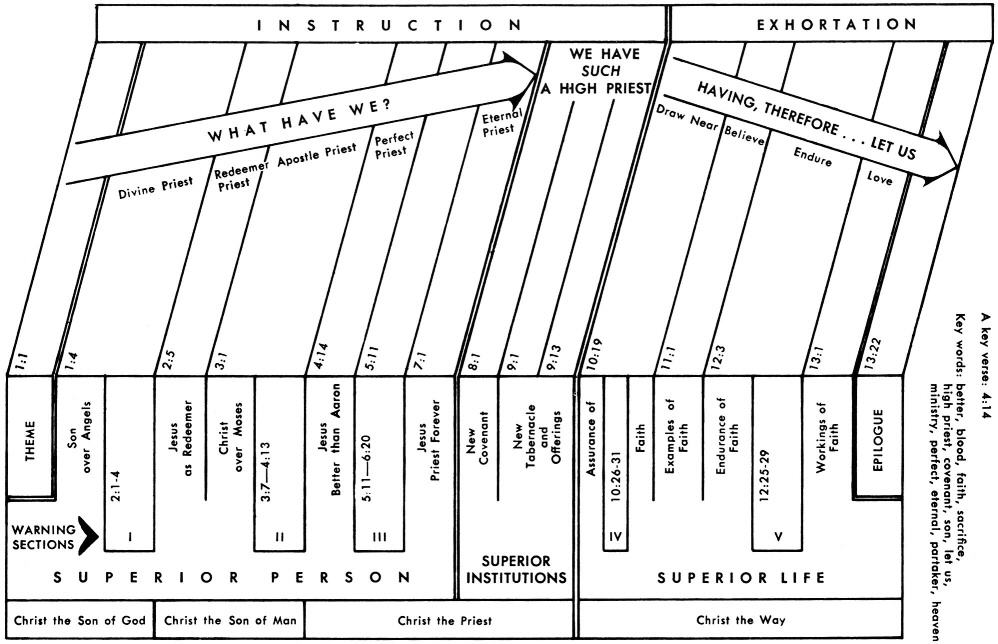
CONSIDER JESUS OUR GREAT HIGH PRIEST
Click chart to enlarge
Charts from Jensen's Survey of the NT - used by permission
Swindoll's Chart, Interesting Pictorial Chart of Hebrews, Another Chart
|
The Epistle |
||||
| INSTRUCTION Hebrews 1-10:18 |
EXHORTATION Hebrews 10:19-13:25 |
|||
| Superior Person of Christ Hebrews 1:1-4:13 |
Superior Priest in Christ Hebrews 4:14-10:18 |
Superior Life In Christ Hebrews 10:19-13:25 |
||
| BETTER THAN PERSON Hebrews 1:1-4:13 |
BETTER PRIESTHOOD Heb 4:14-7:28 |
BETTER COVENANT Heb 8:1-13 |
BETTER SACRIFICE Heb 9:1-10:18 |
BETTER LIFE |
| MAJESTY OF CHRIST |
MINISTRY OF CHRIST |
MINISTERS FOR CHRIST |
||
|
DOCTRINE |
DUTY |
|||
|
DATE WRITTEN: |
||||

See ESV Study Bible "Introduction to Hebrews"
(See also MacArthur's Introduction to Hebrews)
Borrow Ryrie Study Bible
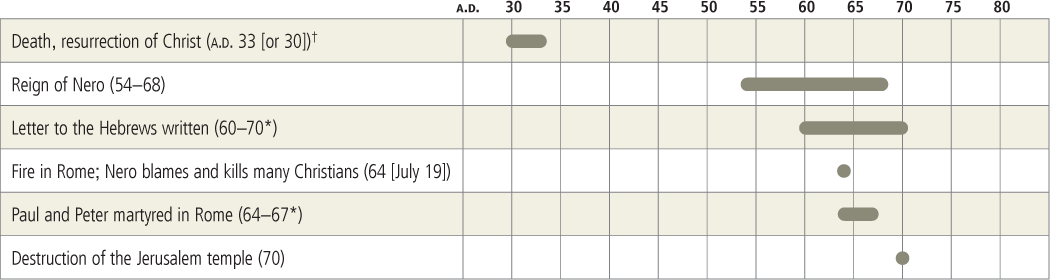
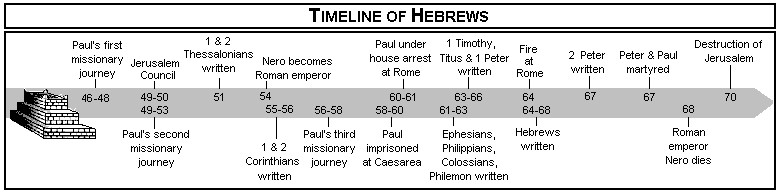
Timeline of Hebrews - ESV Study Bible
Hebrews 1:8: But of the Son He says, "YOUR THRONE, O GOD, IS FOREVER AND EVER, AND THE RIGHTEOUS SCEPTER IS THE SCEPTER OF HIS KINGDOM (NASB: Lockman)
Greek: pros de ton Huion, O thronos sou, o theos, eis ton aiona tou aionos, kai e rhabdos tes euthutetos rhabdos tes basileias sou.
BGT πρὸς δὲ τὸν υἱόν· ὁ θρόνος σου ὁ θεὸς εἰς τὸν αἰῶνα τοῦ αἰῶνος, καὶ ἡ ῥάβδος τῆς εὐθύτητος ῥάβδος τῆς βασιλείας σου.
KJV: But unto the Son he saith, Thy throne, O God, is for ever and ever: a sceptre of righteousness is the sceptre of thy kingdom.
NKJ But to the Son He says: "Your throne, O God, is forever and ever; A scepter of righteousness is the scepter of Your Kingdom.
Phillips: But when he speaks of the Son, he says: 'Your throne, O God, is forever and ever; a sceptre of righteousness is the sceptre of your kingdom. (Phillips: Touchstone)
Wuest: But with reference to the Son He says, Your throne, O God, is forever and ever. And the scepter of equity is the scepter of His kingdom.
Young's Literal: and unto the Son: 'Thy throne, O God, is to the age of the age; a sceptre of righteousness is the sceptre of thy reign;
NET but of the Son he says, "Your throne, O God, is forever and ever, and a righteous scepter is the scepter of your kingdom.
CSB but to the Son: Your throne, God, is forever and ever, and the scepter of Your kingdom is a scepter of justice.
ESV But of the Son he says, "Your throne, O God, is forever and ever, the scepter of uprightness is the scepter of your kingdom.
NIV But about the Son he says, "Your throne, O God, will last for ever and ever, and righteousness will be the scepter of your kingdom.
NLT But to the Son he says, "Your throne, O God, endures forever and ever. You rule with a scepter of justice.
MIT On the other hand, in reference to his son, he says, Your throne is that (established) by God, onward into the ages. Your royal scepter represents integrity.
NJB but to the Son he says: Your throne, God, is for ever and ever; and: the sceptre of his kingdom is a sceptre of justice;
NRS But of the Son he says, "Your throne, O God, is forever and ever, and the righteous scepter is the scepter of your kingdom.
RSV But of the Son he says, "Thy throne, O God, is for ever and ever, the righteous scepter is the scepter of thy kingdom.
NAB but of the Son: "Your throne, O God, stands forever and ever; and a righteous scepter is the scepter of your kingdom.
GWN But God said about his Son, "Your throne, O God, is forever and ever. The scepter in your kingdom is a scepter for justice.
BBE But of the Son he says, Your seat of power, O God, is for ever and ever; and the rod of your kingdom is a rod of righteousness.
ASV but of the Son he saith, Thy throne, O God, is for ever and ever; And the sceptre of uprightness is the sceptre of thy kingdom.
- YOUR THRONE Ps 45:6-7
- O GOD Heb 3:3+; He 3:4+ Isa 7:14; 45:21;45:22, 45:25 Jer 23:6; Hos 1:7; Zech 13:9; Mal 3:1; Mt 1:23; Lk 1:16 17; Jn 10:30 33; 20:28; Ro 9:5+; 1Ti 3:16; Titus 2:13-14+; 1Jn 5:20
- FOREVER AND EVER Ps 145:13; Isa 9:7; 1Cor 15:25; 2Pe 1:11+
- Study Questions for Hebrews - 5W/H questions for leading lessons
- Hebrews 1 Resources - Multiple Sermons and Commentaries
Related Passages:
Psalm 45:6-7 Your throne, O God, is forever and ever; A scepter of uprightness is the scepter of Your kingdom. 7 You have loved righteousness and hated wickedness; Therefore God, Your God, has anointed You With the oil of joy above Your fellows.
COMMENT - This quotation is the fifth in this chapter and again is from the Septuagint (LXX) translation of Ps 45:6,7. This psalm was most likely a marriage ode written to celebrate a royal wedding, but later came to be understood by the Jewish rabbis as a Messianic hymn, being so classified because Ps 45:6-7 referred to David's throne as eternal (cf 2Sa 7:16+ = "your throne shall be established forever"), which of course was impossible for David died.
Daniel 7:13,14+ “I kept looking in the night visions, And behold, with the clouds of heaven One like a Son of Man was coming, And He came up to the Ancient of Days And was presented before Him. 14 “And to Him (MESSIAH) was given dominion, Glory and a kingdom, That all the peoples, nations and men of every language Might serve Him. His (MESSIAH'S) dominion is an everlasting dominion Which will not pass away; And His kingdom is one Which will not be destroyed.
Revelation 11:15+ Then the seventh angel sounded; and there were loud voices in heaven, saying, “The kingdom of the world has become the kingdom of our Lord and of His Christ; and He will reign forever and ever.”
Isaiah 9:6-7+ (MESSIANIC PROPHECY) For a child will be born to us, a son will be given to us; And the government will rest on His shoulders; And His name will be called Wonderful Counselor, Mighty God, Eternal Father, Prince of Peace. 7 There will be no end to the increase of His government or of peace, On the throne of David and over his kingdom, To establish it and to uphold it with justice and righteousness From then on and forevermore. The zeal of the LORD of hosts will accomplish this.
Luke 1:32-33+ “He (MESSIAH) will be great and will be called the Son of the Most High; and the Lord God will give Him the throne of His father David; and He will reign over the house of Jacob forever, and His kingdom will have no end.”
Isaiah 11:4-5+ (MESSIANIC PROPHECY) But with righteousness He will judge the poor, And decide with fairness for the afflicted of the earth; And He will strike the earth with the rod of His mouth, And with the breath of His lips He will slay the wicked. 5 Also righteousness will be the belt about His loins, And faithfulness the belt about His waist.
Jeremiah 23:5-6 “Behold, the days are coming,” declares the LORD, “When I will raise up for David a righteous Branch; (MESSIAH) And He will reign as king and act wisely And do justice and righteousness in the land. 6 “In His days Judah will be saved, And Israel will dwell securely (IN THE MILLENNIUM); And this is His name by which He will be called, ‘The LORD our righteousness.’
Revelation 19:11+ And I saw heaven opened, and behold, a white horse, and He who sat on it is called Faithful and True, and in righteousness He judges and wages war.
Revelation 19:16+ And on His robe and on His thigh He has a name written, “KING OF KINGS, AND LORD OF LORDS.”
Genesis 49:10 “The scepter shall not depart from Judah, Nor the ruler’s staff from between his feet, Until Shiloh comes, And to him shall be the obedience of the peoples.
Psalm 2:9 ‘You shall break them with a rod of iron, You shall shatter them like earthenware.’”
Romans 9:5+ whose are the fathers, and from whom is the Christ according to the flesh, who is over all, God blessed forever. Amen.
Titus 2:13+ looking for the blessed hope and the appearing of the glory of our great God and Savior, Christ Jesus,

THE RIGHTEOUS RULE
OF THE SON OF GOD
But - (de) is a term of contrast. But is the Greek particle de which is a hinge word that serves to connect one clause to another, most frequently serving to introduce another topic and in the present case drawing a striking contrast with the angels with the Son. As A W Pink comments "How sharp is the antithesis! How immeasurable the gulf which separates between creature and Creator! The angels are but "spirits," the Son is "God." They are but "ministers," His is the "throne." They are but "a flame of fire," the executioners of judgment, He the One who commands and commissions them."
Such sound doctrine regarding the Son was greatly needed in the first century church for in his letter to Colossae Paul warned the saints "Let no one keep defrauding (present imperative with a negative implies they were already being defrauded!) you of your prize by delighting in self-abasement and the worship of the angels, taking his stand on visions he has seen, inflated without cause by his fleshly mind. (Col 2:18+)
Angels minister before the throne;
they do not sit on the throne
--Warren Wiersbe
Of the Son (huios) He says, "YOUR THRONE (thronos), O GOD (theos), IS FOREVER AND EVER ("eis ton aiona tou aionos" Lit - "to the age of the age") - First note that He says is added by the translators but it is warranted as it speaks of the Father Who is describing His Son, the Messiah. Let me repeat - "Your throne, O God” is vocative. The Father directly addresses the Son as God. It is notable that this verse is one of only a few places in the NT where Christ is directly referred to as God. (cf Jn 1:1+, Jn 20:28+, Ro 9:5+) Jews would have (or should have) been familiar with these psalms the writer uses to create a firm foundation for his premise that the non-created, preexistent, eternal Jesus is far superior to all finite, created beings such as angels. Second, note the possessive pronoun "Your" modifying "throne" indicated this throne belonged to Jesus and clearly speaks of His authority and His reign as king (which speaks of His sovereignty). The only association of angels with a throne was that they were in the throne room of God (e.g., Rev 5:2+) but never seated on the throne! Third, notice that the Son (huios) is clearly designated as God. Fourth, note that the Son possesses the attribute of eternality (forever and ever) because the twofold use of aiōn emphasizes the concept of eternity ("eis ton aiona tou aionos" Hebrews 1:8; Lxx of Psalm 45:6).
🙏 THOUGHT - Has any other king reigned forever? (Rhetorical of course!) Then yield, surrender to His sweet will which is good and acceptable and perfect (Ro 12:2+), for He is the Lover of your soul, your sovereign (in control) King in this life and forever throughout eternity. Thank You King Jesus! Amen!
A key point in the writer's argument is the fact that in this verse Christ is explicitly addressed as “God.” It is not just that the Son has a superior status and more important functions in redeeming and ruling. He is a different category of person. He is a different kind of being. No angel can be addressed as “O God.” He can, because of His divine nature.
John MacArthur on "O GOD" - I believe this verse gives the clearest, most powerful, emphatic, and irrefutable proof of the deity of Christ in the Bible—from the Father Himself. (See Hebrews MacArthur New Testament Commentary - Page 33)
Jonathan Edwards on forever and ever rightly reminds us that "Earthly monarchies that ever have been, those that have ruled over the bigger part of the known world, as particularly the Grecian and Roman monarchies, they have come to an end, but Christ's is an everlasting Kingdom, His throne is forever and ever.
The Son is God. Worship Him in reverence.
Let your theology shape your doxology.
Be aware that some cults purposely mistranslate Psalm 45:6-7 as "Thy divine throne," because they dislike this strong affirmation inherent in the phrase "Your throne O God" which clearly states that Jesus Christ is God.
The NEW WORLD TRANSLATION of Hebrews 1:8 from the Jehovah's Witnesses renders it "But about the Son, he says: “God is your throne forever and ever". Do you see how this cult has altered the meaning of the Greek text with their translation? The literal reading is "Thy throne, O God." The Jehovah's Witnesses' mistranslation implies "God" is Jesus' throne, not that Jesus is God! WOE to the JW's and all who buy in to their Scripture twisting! The words of the writer of Proverbs 30 ring true. "Do not add to His words Lest He reprove you, and you be proved a liar." (Pr 30:6) (If you are a JW or thinking about joining read I am a Jehovah’s Witness. Why should I consider becoming a Christian?) (Or consider BORROWING Jehovah's Witnesses : answered verse by verse, Answering Jehovah's Witnesses : subject by subject)
Robert Bowman has a comment that relates to Jehovah's Witnesses' mistranslation of Hebrews 1:8 - "The second way in which the New World Translation (NWT) has systematically abused the Divine Names or titles is its handling of texts in which Jesus is called God. In nine Bible texts Jesus is definitely called God (Isa 9:6, Jn 1:1, 18, Jn 20:28, Ro 9:5, Titus 2:13, Hebrews 1:8, 2Pe 1:1, I Jn 5:20, possibly also Acts 20:28). Of these, the New World Translation translates four so that Jesus is NOT CALLED GOD AT ALL (Ro 9:5, Titus 2:13, Hebrews 1:8, 2 Peter 1:1) and two so that He is "a god" or "god" (little "g") (John 1:1, 18). The remaining 3 texts are not mistranslated, but are interpreted so that either Jesus is not called God at all or He is called God only in some lesser sense. In short, the NWT translates texts that call Jesus God in such a way as to keep the text from making that identification." (BORROW Understanding Jehovah's Witnesses : why they read the Bible the way they do)
A righteous scepter is the scepter of Your kingdom.
You reign in justice, You rule in light,
And forever we will worship the King of might.
As William MacDonald so beautifully phrases it "Now follows a galaxy of glories in which the Son is seen to be incomparable. (Believer's Bible Commentary: Thomas Nelson)
"Let him be crowned with majesty
Who bowed His head to death,
And be His honours sounded high
By all things that have breath."
-C H Spurgeon
C H Spurgeon - Psalm 45:6–7. Angels are servants and not kings. They fly upon the divine errands like flames of fire, but they do not sway a scepter, and neither do they have a throne existing forever and ever.
That Christ is God is a clear statement of His deity and is substantiated by the Old Testament quote from Psalm 45 (note that the writer uses at least one OT quote in every chapter in Hebrews!). Furthermore, He is forever and ever which speaks of His eternal sovereignty. Indeed, in one of my favorite hymns by Isaac Watts we joyfully concur that…
Jesus Shall Reign
(play hymn and sing to Him, the King)
Jesus shall reign where’er the sun
Does his successive journeys run;
His kingdom stretch from shore to shore,
Till moons shall wax and wane no more.
Indeed the glorious kingdom of the King of kings shall “stretch from shore to shore, till moons shall wax and wane no more.” And all God's people shout "Praise to Jehovah now and forevermore!" Regarding this great hymn by Isaac Watts, G J Stevenson records an interesting note…
Perhaps one of the most interesting occasions on which this hymn was used was that on which King George, the sable, of the South Sea Islands, but of blessed memory, gave a new constitution to his people, exchanging a heathen for a Christian form of government. Under the spreading branches of the banyan trees sat some thousand natives from Tonga, Fiji, and Samoa, on Whitsunday, 1862, assembled for Divine worship. Foremost amongst them all sat King George himself. Around him were seated old chiefs and warriors who had shared with him the dangers and fortunes of many a battle—men whose eyes were dim, and whose powerful frames were bowed down with the weight of years. But old and young alike rejoiced together in the joys of that day, their faces most of them radiant with Christian joy, love, and hope. It would be impossible to describe the deep feeling manifested when the solemn service began, by the entire audience singing Dr. Watts’ hymn…Who so much as they could realize the full meaning of the poet’s words? For they had been rescued from the darkness of heathenism and cannibalism and they were that day met for the first time under a Christian constitution, under a Christian king, and with Christ Himself reigning in the hearts of most of those present. That was indeed Christ’s kingdom set up in the earth. (Notes on the Methodist Hymn Book)
As discussed below this verse provides us with one of the most emphatic, unequivocal proofs of the Deity of Christ in the Scriptures because the Witness is no less that the Father Himself testifying to the Godhead of the Messiah, Who was despised and rejected by men. A W Pink adds
"how fittingly is this quotation from Psalm 45 introduced at the point it is in Hebrews 1. In verse 6 we are told that all the angels of God have received command to "worship" the Mediator, now we are shown the propriety of them so doing—He is "God!" They must render Divine honors to Him because of His very nature. Thus we may admire, once more, the perfect order of Scripture."
AND THE RIGHTEOUS (euthutes) SCEPTER (rhabdos) IS THE SCEPTER (rhabdos) OF HIS KINGDOM (basileia) - Scepter means rod, staff or stick, but in the present context rhabdos is a ruler's staff and as such is the badge of royalty and the emblem of authority as is well illustrated in the book of Esther. When King Ahasuerus desired to show evidence of his authoritative favor to Esther, he held out his scepter to her (Esther 5:2; 8:4+ where the Lxx in both verses has rhabdos). Therefore the scepter is the emblem or badge of royal authority and power. The Messiah's scepter of is not merely one of power, arbitrarily exercised, but (praise God) is a righteous (euthutes) scepter which assures us of it's fair and just use, in contrast to the capriciousness and cruelty often manifest by earthly monarchs. In other words the Messiah rules in absolute honesty and integrity and is opposed to wickedness, unevenness and injustice. Messiah's government will be right, upright, just, equal, and impartial. Dear believer, does this glorious truth not make you yearn for His soon return or as Paul puts it to love "His appearing" (2Ti 4:8+)?
ALL HAIL THE POWER OF JESUS’ NAME
by Edward PerronetAll hail the power of Jesus’ Name! Let angels prostrate fall;
Bring forth the royal diadem, and crown Him Lord of all.
Bring forth the royal diadem, and crown Him Lord of all.
C H Spurgeon commentary on on Psalm 45:6-7…
Thy throne, O God, is for ever and ever. To whom can this be spoken but our Lord? The psalmist cannot restrain his adoration. His enlightened eye sees in the royal Husband of the church, God, God to be adored, God reigning, God reigning everlastingly. Blessed sight! Blind are the eyes that cannot see God in Christ Jesus! We never appreciate the tender condescension of our King in becoming one flesh with His church, and placing her at His right hand, until we have fully rejoiced in His essential glory and deity.
What a mercy for us that our Saviour is God, for who but a God could execute the work of salvation? What a glad thing it is that He reigns on a throne which will never pass away, for we need both sovereign grace and eternal love to secure our happiness. Could Jesus cease to reign we should cease to be blessed, and were He not God, and therefore eternal, this must be the case. No throne can endure for ever, but that on which God Himself sitteth.
The sceptre of thy kingdom is a right sceptre. He is the lawful monarch of all things that be. His rule is founded in right, its law is right, its result is right. Our King is no usurper and no oppressor. Even when He shall break His enemies with a rod of iron, He will do no man wrong; His vengeance and His grace are both in conformity with justice. Hence we trust Him without suspicion; He cannot err; no affliction is too severe, for He sends it; no judgment too harsh, for He ordains it. O blessed hands of Jesus! the reigning power is safe with you. All the just rejoice in the government of the King Who reigns in righteousness.
Ray Stedman comments that "The contrast between a royal personage and his servant-companions is the point of the quotation. This king is addressed twice as God ("O God" in this verse and "God, Your God" in the next); possesses a throne, a scepter and a kingdom; loves righteousness and hates wickedness; has a special anointing of joy; and continues as king forever and ever. No angel could claim these attributes. The cause of the king's joy is traced to his love of righteousness and hatred of wickedness. Here, by contrast, may be a hint of the moral defection of the host of angels who fell with Satan. Angels could and did sin, but the Son's love of righteousness kept him safe through the most severe temptations. Even those unfallen angels who also, presumably, love righteousness do so on the basis of choice, while the Son's love of righteousness is inherent in his very nature. For this reason (therefore) God has set him above his companions." (Hebrews Commentary)
Ps 145:13 Thy kingdom is an everlasting kingdom, and Thy dominion endures throughout all generations.
Spurgeon comments that…The point upon which the Psalmist's mind rests is the eternity of the divine throne, -- "thy reign is a reign of all eternities." The Lord's kingdom is without beginning, without break, without bound, and without end. He never abdicates His throne, neither does He call in a second to share His empire. None can overthrow His power, or break away from His rule. Neither this age, nor the age to come, nor ages of ages shall cause His sovereignty to fail. Herein is rest for faith. "The Lord sitteth King for ever."
And Thy dominion endureth throughout all generations. Men come and go like shadows on the wall, but God reigneth eternally. We distinguish kings as they succeed each other by calling them first and second; but this King is Jehovah (Jehovah/Jesus), the First and the Last. Adam in his generation knew His Creator to be King, and the last of his race shall know the same. All hail, Great God I Thou art ever Lord of lords!
Son (5207) huios means "a son," primarily signifying the relation of offspring to parent, is used of the "foal" of an ass in Matt. 21:5.
Vine- primarily signifies the relation of offspring to parent (see John 9:18-20; Gal. 4:30. It is often used metaphorically of prominent moral characteristics (see below). "It is used in the NT of (a) male offspring, Gal. 4:30; (b) legitimate, as opposed to illegitimate offspring, Heb. 12:8; (c) descendants, without reference to sex, Rom. 9:27; (d) friends attending a wedding, Matt. 9:15; (e) those who enjoy certain privileges, Acts 3:25; (f) those who act in a certain way, whether evil, Matt. 23:31, or good, Gal. 3:7; (g) those who manifest a certain character, whether evil, Acts 13:10; Eph. 2:2, or good, Luke 6:35; Acts 4:36; Rom. 8:14; (h) the destiny that corresponds with the character, whether evil, Matt. 23:15; John 17:12; 2 Thess. 2:3, or good, Luke 20:36; (i) the dignity of the relationship with God whereinto men are brought by the Holy Spirit when they believe on the Lord Jesus Christ, Rom. 8:19; Gal. 3:26.
HUIOS IN HEBREWS - Heb. 1:2; Heb. 1:5; Heb. 1:8; Heb. 2:6; Heb. 2:10; Heb. 3:6; Heb. 4:14; Heb. 5:5; Heb. 5:8; Heb. 6:6; Heb. 7:3; Heb. 7:5; Heb. 7:28; Heb. 10:29; Heb. 11:21; Heb. 11:22; Heb. 11:24; Heb. 12:5; Heb. 12:6; Heb. 12:7; Heb. 12:8
Throne (2362) thronos describes a seat of authority as with the throne of God (Heb. 4:16, "the throne of grace," Heb 8:1; Heb 12:2; Rev 1:4; Rev 3:21; Rev. 4:2; Rev. 5:1 Rev. 20:12; Lxx - Ps 47:8, Ps 103:19), the throne of Jesus Christ (Heb. 1:8; Rev. 3:21; Rev. 22:3; in the Millennium = Mt 19:28), by metonymy (or figuratively) used for angelic powers (Col. 1:16), of the apostles (Mt 19:28, Lk 22:30), elders in heaven (Rev 4:4), of the throne of David (Lk 1:32, Acts 2:30), of the throne of Satan (Rev 2:13), of the throne of the beast, the antichrist (Rev 13:2, Rev 16:10).
Gilbrant - Thronos originally denoted a chair with a footstool and later a chair with a high back and arms. Initially thronos held no special symbolic value; however, gradually it came to symbolize “authority.” In time it became the “seat of honor” reserved for the master of a household. As a special gesture of respect and honor, certain guests were invited to sit upon the thronos of a household.
THRONOS IN HEBREWS - Heb. 1:8; Heb. 4:16; Heb. 8:1; Heb. 12:2;
Forever (eis aion) (165) aion generally means an extended period of time and has various meanings depending on the context. Age, referring to an age or time in contrast to kósmos, referring to people or space. Denotes duration or continuance of time, but with great variety.
Friberg on aion - era, time, age; (1) as a segment of contemporary time lifetime, era, present age (Lk 16.8); (2) of time gone by past, earliest times (Lk 1.70); (3) of prolonged and unlimited time = eternity (1Ti 1.17); (4) of time to come = eternity, age to come (Lk 20.35); idiomatically eis ton aiona literally into the age, i.e. forever, eternally (Jn 6.51); eis tous aionas ton aionas literally into the ages of the ages, i.e. forever and ever, forevermore (Heb 1.8); (5) plural, as a spatial concept, of the creation as having a beginning and moving forward through long but limited time universe, world (Heb 1.2; 9.26; 11.3) (Borrow Analytical lexicon of the Greek New Testament)
Gilbrant - Forever and Ever - The twofold use of aiōn in a phrase emphasizes the concept of eternity even more (eis ton aiōna tou aiōnos - This phrase is found 24 times, once in the NT [Heb 1:8] and the remainder occurring in the Septuagint = Ps. 9:5; Ps. 10:16; Ps. 45:6; Ps. 45:17; Ps. 48:14; Ps. 52:8; Ps. 61:8; Ps. 72:19; Ps. 83:17; Ps. 89:29; Ps. 92:7; Ps. 104:5; Ps. 111:3; Ps. 111:8; Ps. 111:10; Ps. 112:3; Ps. 112:9; Ps. 119:44; Ps. 145:1; Ps. 145:2; Ps. 145:21; Ps. 148:6; Dan. 12:3; Heb. 1:8). The distinctive formula of the double use joined with the plural (thus, literally, “into the ages of the ages”) occurs regularly in Paul and in Revelation (but cf. Hebrews 13:21; 1 Peter 4:11; 5:11). This device of using repetition is a Hebrew idiom indicating a superlative (e.g., Holy of Holies = the most Holy Place); thus “into the ages of the ages” = “into the farthest age,” and hence, “forever and ever.” These constructions stress most emphatically the concept of eternality. In the Epistles the double form falls only in contexts of praise to God or Christ (Galatians 1:5; Ephesians 3:21; Philippians 4:20; 1 Timothy 1:17; 2 Timothy 4:18; Hebrews 1:8; 13:21; 1 Peter 4:11; 5:11). In Hebrews 1:8 it actually refers to the eternal throne of God. In Revelation the reinforced double form appears in praise texts directed to God and the Lamb (Revelation 1:6; 5:13; 7:12). God lives “forever and ever” (Revelation 4:9,10; 10:6; 15:7), and He is king forever and ever (Revelation 11:15; cf. 1 Timothy 1:17). Christ, who was dead, now lives forevermore (Revelation 1:18). The same expression characterizing the eternality of Christ and God depicts the eternal torment of the ungodly (Revelation 14:11; 19:3; 20:10), which stands in sharp contrast to the eternal glory awaiting believers (Revelation 22:5). (Complete Biblical Library Greek-English Dictionary)
Scepter (4464) (rhabdos probably related to rhapis = a rod or stick ) is literally a relatively narrow piece of wood of variable length. Depending on the context, rhabdos can describe a rod (including that with which one is beaten or used as an instrument of punishment - see 1 Cor 4:21 below), a staff (as used by shepherd [cp Lxx use in Mic 7:14] and figuratively speaking of such authority in Re 2:27+, Rev 12:5+, Rev 19:15+, a stick (including a walking stick - cp Mt 10:10, Mk 6:8, Lk 9:3) or a measuring stick (Rev 11:1+)
RHABDOS - 12X/11V rod(5), scepter(2), staff(5). Matt. 10:10; Mk. 6:8; Lk. 9:3; 1 Co. 4:21; Heb. 1:8; Heb. 9:4; Heb. 11:21; Rev. 2:27; Rev. 11:1; Rev. 12:5; Rev. 19:15
Here are some uses from the Revelation...
Revelation 2:27 (note) and he shall rule them with a rod of iron, as the vessels of the potter are broken to pieces, as I also have received authority from My Father;
Revelation 11:1 (note) And there was given me a measuring rod like a staff; and someone said, "Rise and measure the temple of God, and the altar, and those who worship in it.
Revelation 12:5 (note) And she (speaking of Messiah's origin from Israel, His Jewish lineage, His Davidic ancestry) gave birth to a son, a male child (Messiah), Who is to rule all the nations with a rod of iron; and her child was caught up to God (Messiah ascended after His crucifixion and resurrection, cp Acts 1:8-11) and to His throne (where He now sits as our Mediator and Intercessor, cp Hebrews 1:3 -note).
Revelation 19:15 (note) And from His mouth comes a sharp sword, so that with it He may smite the nations; and He will rule them with a rod of iron; and He treads the wine press of the fierce wrath of God, the Almighty.
RHABDOS - 93X IN Septuagint (LXX) Gen. 30:37ff, 41; 32:10; 38:18, 25; 47:31; Exod. 4:2, 4, 17, 20; 7:9f, 12, 15, 17, 19f; 8:5, 16f; 10:13; 14:16; 17:5, 9; 21:19f; Lev. 27:32; Num. 17:2f, 5ff; 20:8f, 11; 22:23, 27; Jdg. 5:14; 6:21; 1 Sam. 17:43; 2 Sam. 7:14; 23:21; 2 Ki. 18:21; 1 Chr. 11:23; Est. 4:11; 5:2; 8:4; Job 9:34; Ps. 2:9; 23:4; 45:6; 74:2; 89:32; 110:2; 125:3; Prov. 10:13; 22:15; 23:13f; 26:3; Isa. 9:4; 10:5, 15, 24; 11:1; 28:27; 36:6; Jer. 48:17; Lam. 3:1; Ezek. 7:5; 19:11f, 14; 20:37; 21:21; 29:6; 37:16f, 19f; 39:9; Hos. 4:12; Mic. 5:1; 7:14; Nah. 1:13; Zech. 8:4; 11:7, 10, 14
Righteousness will reign when the King of kings reigns…
2Sa 23:3 — "The God of Israel said, The Rock of Israel spoke to me, 'He who rules over men righteously, Who rules in the fear of God,
Ps 72:1-4 — Give the king Thy judgments, O God, And Thy righteousness to the king's son. 2 May he judge Thy people with righteousness, And Thine afflicted with justice. 3 Let the mountains bring peace to the people, And the hills in righteousness. 4 May he vindicate the afflicted of the people, Save the children of the needy, And crush the oppressor.
Ps 72:7 — In his days may the righteous flourish, And abundance of peace till the moon is no more.
Ps 72:11-14 — And let all kings bow down before him, All nations serve him. 12 For he will deliver the needy when he cries for help, The afflicted also, and him who has no helper. 13 He will have compassion on the poor and needy, And the lives of the needy he will save. 14 He will rescue their life from oppression and violence; And their blood will be precious in his sight;
Psalm 99:4 And the strength of the King loves justice; Thou hast established (or prepared) equity (mesar = evenness, uprightness; Lxx = euthutes); Thou hast executed justice and righteousness in Jacob. (Spurgeon's note)
Jer 23:5 — "Behold, the days are coming," (to be completely fulfilled in the Millennium) declares the LORD, "When I shall raise up for David (Messiah comes from the lineage of David) a righteous Branch (the Messiah Himself); and He will reign as king and act wisely and do justice and righteousness in the land.
Righteous (2118)(euthutes from euthus = straight, immediate) is only here in NT and which means rectitude (the quality or state of being straight, moral integrity or righteousness, the quality or state of being correct in judgment or procedure), straightness, uprightness, evenness.
Although this is the only NT use of euthutes, this noun is found some 20 times in the in the non-apocryphal Septuagint (LXX) Jos. 24:14; 1 Ki. 3:6; 9:4; Ps. 9:8; 11:7; 17:2; 26:12; 37:37; 45:6; 67:4; 75:1; 96:10; 98:9; 99:4; 111:8; 119:7; Eccl. 12:10; Cant. 1:4; 7:9; Dan. 6:22). Here are some examples of uses of euthutes…
Joshua 24:14 "Now, therefore, fear the LORD and serve Him in sincerity (Hebrew = tamiym = speaks of integrity; Lxx = euthutes) and truth (what does such fear and service look like? It is very practical - read on); and put away the gods which your fathers served beyond the River and in Egypt, and serve the LORD.
1 Kings 3:6 Then Solomon said, "Thou hast shown great lovingkindness to Thy servant David my father, according as he walked before Thee in truth and righteousness and uprightness (Heb = yishrah from yasar = to be straight, upright, pleasing, ethically blameless; Lxx = euthutes) of heart toward Thee; and Thou hast reserved for him this great lovingkindness, that Thou hast given him a son to sit on his throne, as it is this day.
Psalm 9:8 And He (Jehovah/Jesus) will judge the world in righteousness; He will execute judgment for the peoples with equity (Heb = meyshar also related to yasar [see above] = uprightness; Lxx = euthutes). (Spurgeon's note)
Psalm 11:7 For the LORD (Jehovah/Jesus) is righteous; He loves righteousness (Heb = tsedaqah = blameless conduct, right attitudes and actions; Lxx = euthutes); The upright will behold His face. (Spurgeon's note)
Psalm 17:2 Let my judgment come forth from Thy presence; Let Thine eyes look with equity (Heb = meyshar also related to yasar [see above] = uprightness; Lxx = euthutes). (Spurgeon's note)
Psalm 26:12 My foot stands on a level (Heb = miysor = speaks of evenness, straight as opposed to crooked; Lxx = euthutes - so here is used literally which helps us understand the predominantly figurative uses) place; In the congregations I shall bless the LORD. (Spurgeon's note)
Psalm 37:37 Mark the blameless man, and behold the upright (yasar = straight, just, right; Lxx = euthutes); For the man of peace will have a posterity. (Spurgeon's note)
Psalm 67:4 Let the nations be glad and sing for joy; For Thou wilt judge the peoples with uprightness (mishor = a level place; uprightness; Lxx = euthutes), And guide the nations on the earth. Selah. (Spurgeon's note)
Psalm 96:10 Say among the nations, "The LORD reigns; Indeed, the world is firmly established, it will not be moved; He will judge the peoples with equity (mesar = evenness, uprightness; Lxx = euthutes)." (Spurgeon's note)
Psalm 98:9 Before the LORD; for He is coming to judge the earth; He will judge the world with righteousness, And the peoples with equity (mesar = evenness, uprightness; Lxx = euthutes). (Spurgeon's note)
Psalm 99:4 And the strength of the King loves justice; Thou hast established (or prepared) equity (mesar = evenness, uprightness; Lxx = euthutes); Thou hast executed justice and righteousness in Jacob. (Spurgeon's note)
Psalm 111:8 They (The works of His hands are truth and justice; All His precepts are sure) are upheld forever and ever; They are performed in truth and uprightness (yasar = straight, just, right; Lxx = euthutes). (Spurgeon's note)
Psalm 119:7 I shall give thanks to Thee with uprightness (Heb = yosher = straightness often speaks of 2 paths of life and warns to stay on the "straight" path, Pr 2:13; Lxx = euthutes) of heart, when I learn Thy righteous judgments. (Spurgeon's note)
Kingdom (932) (basileia from basileus = a sovereign, king, monarch) denotes sovereignty, royal power, dominion and refers therefore to the territory or people over whom a king rules. The Kingdom of Heaven/God is the sphere in which God is acknowledged as King (In hearts giving Him obedience). In this sense the Kingdom has a spiritual aspect, a present physical aspect, and a future eternal aspect (beginning with the millennium, cf Mt 25:31,34+ - see Dr Walvoord's article The Future Work of Christ — Part IV: The Millennial Kingdom and the Eternal State), all of course depending on the context of the passage in which basileia is found. Paul is careful to remind us that the Kingdom of Heaven/God is not in observance of ordinances, external and material, but in the deeper matters of the heart, which are spiritual and essential "for the kingdom of God is not eating and drinking, but righteousness and peace and joy in the Holy Spirit. (Romans 14:17+) See related discussion Kingdom of Heaven
BASILEIA IN HEBREWS - Heb. 1:8; Heb. 11:33 = "who by faith conquered kingdoms"; Heb. 12:28 = "we receive a kingdom which cannot be shaken"
QUESTION - What is the throne of God? Does God literally have a throne?
ANSWER - There are several references to the throne of God in the Bible. Jesus calls heaven “God’s throne” in Matthew 5:34, recalling God’s statement in Isaiah 66:1, “Heaven is my throne, and the earth is my footstool.” Other references to God’s throne are found in 2 Chronicles 18:18; Psalm 11:4; Hebrews 8:1; 12:2; Revelation 1:4; 3:21; 4:2; and many other verses.
A throne is a special seat reserved for a monarch. When the Bible speaks of God’s “throne,” the emphasis is on God’s transcendence, dignity, and sovereign rule. The fact that His throne is in heaven further underscores the transcendent nature of God’s existence.
The throne of God need not be thought of as a literal throne. God the Father is incorporeal (John 4:24). Not having a physical body, God does not literally “sit.” References to a divine throne are akin to biblical allusions to God’s “hand” or “mouth” or “eyes”—they are anthropomorphisms, descriptions of God couched in human terms out of deference to our limited knowledge. God has to describe Himself in ways we can understand.
Isaiah sees the Lord “high and exalted, seated on a throne; and the train of his robe filled the temple” (Isaiah 6:1). At that time, the prophet was having an inspired vision. God’s throne (and His robe) are not to be taken as literal, physical objects. Rather, God was communicating to Isaiah the magnificence, splendor, and exaltation of His Being. Other descriptions of the throne of God are found in other prophetic visions, e.g., in those of Ezekiel and John.
God’s throne is a place of power and authority. In 2 Chronicles 18:18, the prophet Micaiah relates his vision of God’s throne room, in which spirit beings stand in attendance. Compare this to Job 1:6, where God demands answers from the angelic beings summoned there.
God’s throne is a place of majesty and honor. The Bible says that, when Jesus ascended to heaven, He “sat down at the right hand of the throne of God” (Hebrews 12:2). There is no higher place than heaven. God is the King of heaven, and Jesus holds the place of honor at God’s right hand.
God’s throne is a place of perfect justice. “He has prepared His throne for judgment” (Psalm 9:7; cf. 89:14). The final judgment, described in Revelation 20, is held before “a great white throne” (verse 11).
God’s throne is a place of sovereignty and holiness. “God reigns over the nations; God is seated on his holy throne” (Psalm 47:8; cf. 103:19). He does whatever He pleases, and all He does is good.
God’s throne is a place of praise. John’s vision of heaven includes a scene in which a “new song” is sung in praise to the One who occupies the throne (Revelation 14:3). Around the throne, the praise of God is surely “glorious” (Psalm 66:2).
God’s throne is a place of purity. Only the redeemed, those who have been granted the righteousness of Christ, will have the right to stand before His throne (Revelation 14:5).
God’s throne is a place of eternal life. God is the Source of life. In heaven, John sees “the river of the water of life, as clear as crystal, flowing from the throne of God and of the Lamb” (Revelation 22:1).
God’s throne is a place of grace. Not only does the throne of God represent judgment for the unbeliever, but it also represents mercy and grace for His children. “Let us then approach God’s throne of grace with confidence, so that we may receive mercy and find grace to help us in our time of need” (Hebrews 4:16). Inside the Jewish temple was the Ark of the Covenant, which was a “copy of the true” (Hebrews 9:24), and it had a “mercy seat” where God’s presence would appear (Leviticus 16:2ESV).
One day, all creation will bow to the majesty of God’s throne (Philippians 2:9–11). The regal beings surrounding the throne of God will “lay their crowns before the throne and say: ‘You are worthy, our Lord and God, to receive glory and honor and power’” (Revelation 4:10–11). GotQuestions.org
THRONE from Dictionary of Biblical Imagery (online) - The image of a throne is one of the most glorious and evocative in the entire Bible. It denotes authority, power, majesty and splendor. In the vast majority of cases, the Bible’s references to thrones are positive, referring to the benevolent power and splendor attendant upon the human throne or—to an infinitely greater degree—the divine throne. The throne imagery conveys one of the most fundamental biblical motifs, that of God’s reign as King (see KING, KINGSHIP). Many scholars have seen the kingdom of God as the one central, unifying motif in the Bible, and the imagery of the throne is fundamental to that motif. The term occurs about 135 times in the OT and about 61 times in the NT.
Physical Thrones. In a small number of cases, references to thrones are to the actual physical seat on which a king sat. Several of these have to do with Solomon’s throne (1 Kings 2:19; 10:18, 18; 2 Chron 9:17, 18); one reference is to a throne that Solomon had brought out for his mother, placed next to his own (1 Kings 2:19). Solomon’s throne was very impressive, inlaid with ivory and overlaid with fine gold; six steps led up to it, and its back had a rounded top. A lion—a universal symbol in the ancient Near East of royal power and authority—stood beside each armrest.
Numerous ancient reliefs show kings seated on their thrones (see ANEP), sometimes flanked by lions, as Solomon was (e.g., ANEP, nos. 332, 458). Solomon’s throne was housed in the great Hall of Justice, which was paneled with cedar from floor to ceiling. Other scriptural references to physical thrones include Joash’s (2 Chron 23:20), Ahasuerus’s (Esther 5:1), the Ninevite king’s (Jon 3:6) and Herod’s (Acts 12:21).
Symbols of Authority and Majesty. More commonly, biblical imagery of a throne is evocative of authority, power, majesty or splendor.
Human thrones. Biblical references to human thrones most commonly refer to the kingly authority and power inherent in them. Thus reference to a king’s throne or to his sitting on the throne signifies power and authority to rule. Such references include the thrones of the Egyptian pharaoh (Gen 41:40; Ex 11:5; 12:29); Israelite or Judahite kings such as Elah (1 Kings 16:11), Ahab (2 Kings 10:3), Jehu (10:30), Joash (11:19) or Jeroboam (11:19); the Babylonian kings Nebuchadnezzar (Jer 43:10) and Belshazzar (Dan 5:20); and the Persian Ahasuerus (Esther 1:2). Human thrones are to be places of righteousness and justice (e.g., Prov 16:12; 20:8; 25:5; 29:14).
The Davidic throne. The most common reference to human thrones, however, is to the throne of David (about 30 percent of all references to thrones). This has its basis in the great promise of what has come to be known as the Davidic covenant, in which God promised David that his descendants would rule in perpetuity on the throne in Israel. This promise was first given to David by Nathan the prophet (2 Sam 7) and is referred to many times after that: in 1-2 Kings and 1-2 Chronicles, the book of Psalms (see especially Ps 89; 132), Isaiah and Jeremiah (see Is 9:7; 16:5; Jer 13; 13; 17:5; 22:4, 30; 29:16; 33:17; 21; 36:30) and the NT (Lk 1:32; Acts 2:30). This promise came to its ultimate fulfillment in Jesus, the son of David par excellence (Mt 1:1; Lk 1:32).
God’s throne. By far the most common biblical reference to a throne, however, is to God’s throne (close to 60 percent). God’s kingship is affirmed many times in Scripture, and his throne is a visible proof of his sovereign rule. The Lord presides from his throne, surrounded variously by all the host of heaven (1 Kings 22:19; 2 Chron 18:18), a rainbow like emeralds (Rev 4:3), twenty-four other thrones (Rev 4:4), a crystal-clear sea of glass (Rev 4:6) and countless numbers of angels (Rev 5:11). His is a holy throne (Ps 47:8), glorious in its appearance (Is 63:15; Jer 14:21; 17:12; Mt 19:28; 25:31) and eternal in its duration (Ps 9:7; 45:6; 93:2; Lam 5:19; Ezek 43:7; Heb 1:8; Rev 1:8; 5:13).
It is a spectacular throne, variously described as flaming with fire (Dan 7:9), glittering with sapphires (Ezek 1:26; 10:1), flashing and crashing with lightning and thunder (Rev 4:5), dazzlingly white (Rev 20:11), from which flows a river of living water (Rev 22:1).
Some thrones in Scripture are set up in opposition to God, such as the corrupt throne in Psalm 94:20, the royal thrones of Babylon (Is 14:13; cf. Is 47:1) and Tyre (Ezek 28:2), and even Satan’s throne (Rev 2:13; 16:10). Yet these thrones represent no power or appeal when compared to the power and splendor of God’s throne.
References to God’s throne are found most often in the book of Revelation, appropriately enough, since this book describes God’s final victory over Satan and the forces of evil. The royal motifs found throughout Scripture find their climax at the end of history in this image—laden book in the Bible.
See also AUTHORITY, DIVINE AND ANGELIC; KING, KINGSHIP; ROYAL COURT; SEAT.
Absolute Rule - David Baker
ONLY CHRIST CAN RULE with absolute authority and exact absolute obedience, without once violating his subjects. The rule of Christ is utterly “other” than any rulership we know. The closest analogy we have is the rulership of love over a man’s and a woman’s hearts, causing them to subsume all else to love’s demands. It is a flawed analogy but a good one, nonetheless.
FOUR EMBLEMS.—The Cross; the Crown; the Staff; the Sceptre.
I. The humbling cross.
It is death to sin (2 Corinthians 5:21).
It is death to self (Romans 6:1).
It is death to flesh (Galatians 5:24).
II. The glorious crown.
It means holiness to the Lord (Exodus 29:6).
It means righteousness before the world (Proverbs 16:31).
It means glory and honor by and by (Psalm 8:5).
III. The staff of strength. This teaches—
Comfort in the world (Psalm 23:4).
Pilgrimage through the world (Mark 6:8).
IV. The sceptre of blessing.
Glorious power in the future (Numbers 24:17).
Present strength for His people (Hebrews 1:8).
Mercy to everyone (Esther 8:4).
SCEPTER - Stewart Custer - Wonderful Words
“The sceptre shall not depart from Judah, nor a lawgiver from between his feet, until Shiloh come; and unto him shall the gathering of the people be” (Gen. 40:10). “There shall come a Star out of Jacob, and a Sceptre shall rise out of Israel, and shall smite the corners of Moab, and destroy all the children of Sheth [tumult]” (Num. 24:17b). “Thy throne, O God, is for ever and ever: the sceptre of thy kingdom is a right scepter” (Ps. 45:6). “The Lord hath broken the staff of the wicked, and the sceptre of the rulers” (Isa. 14:5). “But unto the Son he saith, Thy throne, O God, is for ever and ever: a sceptre of righteousness is the sceptre of thy kingdom” (Heb. 1:8).
GOLDEN THOUGHT The scepter of Your kingdom is a right scepter.
GOD by T. C. Horton and Charles E. Hurlburt
“But unto the Son he saith, ‘Thy throne, O God, is for ever and ever.’ “ HEBREWS 1:8
Here we have the Alpine height in titles for our Lord, “Thy throne, O God!” All other names and titles are inferior to this. When He was born in a manger, God was there. When He worked at the carpenter’s trade, God was there at work. When He associated with the fishermen, it was God who was their companion. When He spoke, God spoke. When He died on the cross, it was God Himself who poured out His life. When He comes “with a shout,” it will be the voice of God that calls us to be with Him forever. It is God the Son who holds the sceptre and rules the worlds, and we will rule and reign with Him. Oh, God our Savior and coming King, hasten Thy coming, and help us to help Thee hasten that day, for Thine own name’s sake. Amen.
THRONE - Stewart Custer - Wonderful Words
“Thy throne, O God, is for ever and ever: the sceptre of thy kingdom is a right sceptre” (Ps. 45:6). “The Lord hath prepared his throne in the heavens; and his kingdom ruleth over all” (Ps. 103:19). “In the year that king Uzziah died I saw also the Lord sitting upon a throne, high and lifted up, and his train filled the temple” (Isa. 6:1). “But unto the Son he saith, Thy throne, O God, is for ever and ever: a sceptre of righteousness is the sceptre of thy kingdom” (Heb. 1:8). “And immediately I was in the spirit: and, behold, a throne was set in heaven, and one sat on the throne” (Rev. 4:2). “And there shall be no more curse: but the throne of God and of the Lamb shall be in it; and his servants shall serve him” (Rev. 22:3).
GOLDEN THOUGHT Behold, a throne was set in heaven.
Son of God A Title of Jesus
This is a title of Jesus. It implies His deity (John 5:18) because the title is one of equality with God. In the O.T. it was figuratively applied to Israel (Ex. 4:22). In the N.T. it is applied to Christ (Luke 1:35). It has many facets, for example: It shows that He is to be honored equally with the Father (John 5:22–23). That He is to be worshipped (Matt. 2:2, 11; 14:33; 28; 9; John 9:35–38; Heb. 1:6); called God (John 20:28; Heb. 1:8); prayed to (Acts 7:55–60; 1 Cor. 1:1–2).
JESUS Is CALLED GOD - Approaching God (Enns) - Page 11 - Paul Enns
Of the Son He says, "Thy throne, 0 God, is forever and ever, and the righteous scepter is the scepter of His kingdom. " (Hebrews 1:8)
My doorbell rang on a Saturday morning, presenting me with a clean-cut teenager, briefcase in hand. I became suspicious, and my suspicion proved correct-he was a member of the Watchtower Society, peddling the doctrine that Jesus is not God. We had a lengthy discussion at my front door centered on the Person of Christ.
Is Jesus God? An important testimony to Christ's deity is found in the words of the writer of Hebrews as he contrasts Jesus to the angels. Whereas the angels are servants, the Son has a more significant status. In Hebrews 1:8 the writer prefaces his Old Testament quotations with the statement "But of the Son He says ... " Everything that follows refers to the Son. He quotes Psalm 45:6, stating, "Thy throne, 0 God, is forever and ever." The Son is called the eternal God. In verse 9 he states, "Therefore God, Thy God, hath anointed Thee." The first reference to "God" refers to the Son whereas the second refers to the Father. God the Father has anointed God the Son as King, as Messiah. In verse 10 the writer comments, "Thou, Lord, in the be-ginning didst lay the foundation of the earth." Here Jesus is called Lord (Yahweh), Creator of the universe who alone is eternal (v. 11). The state-ments "0 God," "therefore God," and, "Thou Lord" refer to the Son men-tioned in verse 8. Three times the Son is explicitly addressed as God in Hebrews 1:8-10. That Jesus is God could not be clearer.
In the Upper Room, following the resurrection, Thomas recognized Jesus as the risen Lord and exclaimed, "My Lord and my God!" (John 20:28). Having been convinced that Jesus had risen from the dead, Thomas was also convinced that Jesus was Lord and God. If Jesus were not God He should have rebuked Thomas-but He didn't; He accepted the accolade. The Jehovah's Witnesses suggest that Thomas was simply swearing!
Thomas wasn't swearing. God gave him spiritual insight to see that Jesus was indeed all He claimed to be. Jesus is God. To those who do not believe He says, "Be not unbelieving, but believing" (John 20:27b).
LESSON: Jesus is called God.
O God, our help in ages past,
our hope for years to come
-- ISAAC WATTS
WORSHIP AT THE THRONE Discovering God: 365 Daily Devotions - Page 245 - David Jeremiah
Your throne, O God, is forever and ever; a scepter of righteousness is the scepter of Your kingdom. HEBREWS 1:8
When you think of the center of command and control for the United States of America, the White House quickly comes to mind. When you think of the focus of all authority and power in heaven, you think of the throne of God.
Just as the White House is a busy hub of constant activity, there is much that takes place at the throne of God. From His throne, God lovingly rules over the affairs of the earth. He exercises His authority over all people, and He asserts His control over time —past, present, and future. God’s throne is also the seat of His judgment. He discerns between good and evil, and He administers reward and punishment alike.
The best thing that happens at the throne of God, however, is worship! All the saints, elders, angels, and creatures surround Him, singing praises and exalting Him in all His glory.
Will you be there, worshiping with all the others at the throne of God? Our occupation for all eternity will be to exalt and adore Jesus Christ. Knowing that, doesn’t it seem worthwhile to worship the Lord now?
James Girdwood - Jesus will reign over all creation, including his people (Hebrews 1:8, 9; Psalm 45:6, 7). Jesus currently sits on his throne (Acts 2:32, 33), waiting for his Father to subdue all his enemies (Hebrews 1:13, quoting Psalm 110:1). Then Jesus and his people will reign over all things (Ephesians 2:4–7). Angels will not enjoy this privilege.
Daily Light on the Daily Path - “The man who stands next to me,” declares the Lord of hosts.
In him the whole fullness of deity dwells bodily.—“I have granted help to one who is mighty; I have exalted one chosen from the people.”—“I have trodden the winepress alone, and from the peoples no one was with me.”
Great indeed, we confess, is the mystery of godliness: He was manifested in the flesh.—To us a child is born, to us a son is given; and the government shall be upon his shoulder, and his name shall be called Wonderful Counselor, Mighty God, Everlasting Father, Prince of Peace.
He is the radiance of the glory of God and the exact imprint of his nature, and he upholds the universe by the word of his power. After making purification for sins, he sat down at the right hand of the Majesty on high. . . . But of the Son he says, “Your throne, O God, is forever and ever.” . . . “Let all God’s angels worship him.”
King of kings and Lord of lords.
Zech. 13:7; Col. 2:9; Ps. 89:19; Isa. 63:3; 1 Tim. 3:16; Isa. 9:6; Heb. 1:3, 8, 6; Rev. 19:16
Psalm 45:1–11 FAIRER THAN THE CHILDREN OF MEN - Day by Day by John Bennett
It should not surprise us that the psalmist’s heart is ‘inditing’ or ‘bubbling up’. He speaks unreservedly of the theme of the King and His beauty.
C. H. SPURGEON wrote, ‘It is a sad thing when the heart is cold with a good matter, and worse when it is warm with a bad matter, but incomparably well when a warm heart and good matter meet together’.
This psalm is an expression of the heart. It reminds us of the words of another; ‘yea, he is altogether lovely’, S. of S. 5:16. Or yet another; ‘For how great is his goodness, and how great is his beauty!’, Zech. 9:17. And still another; ‘the Word was made flesh, and dwelt among us, (and we beheld his glory, the glory as of the only begotten of the Father,) full of grace and truth’, John 1:14.
There can be no doubt that the King spoken of is our Lord Jesus Christ. The writer of Hebrews explicitly states so by quoting verses 6 and 7 in Hebrews 1:8, 9.
Our relationship to Him is one of love and praise, not merely legal or abstract. While we rest on sound doctrine concerning His person and work, our knowledge of Him should reach our hearts as well as our heads.
It has been observed by many that the primary application of this Psalm is that of Israel’s joyful reunion with her Messiah in a coming day. These will be the words of a happy and grateful nation returning to the One who has loved them like no other. But as A. G. CLARKE has written,
‘Meditation upon the relationship between Christ and His New Testament Bride should stir in our hearts emotions not inferior to those of the psalmist. This great theme generates glad thoughts’.
The One who is ‘fairer than the children of men’ or ‘more beautiful’ surpasses any measurement of beauty. And it should move us that our Saviour speaks in grace to sinners who are void of beauty. Furthermore, He lifts us from our absolute unattractiveness and promises that ‘when he shall appear, we shall be like him; for we shall see him as he is’, 1 John 3:2. How our hearts should be bubbling over at the One ‘fairer than the children of men’.
Wayne Grudem - THE DEITY OF CHRIST - See page 469 Systematic Theology
To complete the biblical teaching about Jesus Christ, we must affirm not only that he was fully human but also that he was fully divine. Although the word does not explicitly occur in Scripture, the church has used the term incarnation to refer to the fact that Jesus was God in human flesh. The incarnation was the act of God the Son whereby he took to himself a human nature.18 The scriptural proof for the deity of Christ is very extensive in the New Testament. We shall examine it under several categories.19
1. Direct Scriptural Claims
In this section we examine direct statements of Scripture that Jesus is God or that he is divine.20
a. The Word God (Theos) Used of Christ. Although the word theos, meaning “God,” is usually reserved in the New Testament for God the Father, there are several passages where it is also used to refer to Jesus Christ. In all of these passages the word God is used in the strong sense to refer to the one who is the Creator of heaven and earth, the ruler over all. These passages include John 1:1; 1:18 (in older and better manuscripts); 20:28; Romans 9:5; Titus 2:13; Hebrews 1:8 (quoting Ps. 45:6); and 2 Peter 1:1.21 I have already discussed these passages in chapter 14, where I argued that each person in the Trinity is fully God, and readers may wish to review those pages briefly at this point.22 It is enough to note that there are at least these seven passages in the New Testament that clearly and explicitly refer to Jesus as God.
One Old Testament example of the name God applied to Christ is seen in a familiar messianic passage: “For to us a child is born, to us a son is given; and the government shall be upon his shoulder, and his name shall be called, ‘Wonderful Counselor, Mighty God’ ” (Isa. 9:6).
(For remainder of this discussion on the Deity of Christ See page 469 Systematic Theology)
Wayne Grudem page 184 in Systematic Theology has a discussion of THE DOCTRINE OF THE TRINITY IS PROGRESSIVELY REVEALED IN SCRIPTURE 1. Partial Revelation in the Old Testament....
Moreover, there are passages where one person is called “God” or “the Lord” and is distinguished from another person who is also said to be God. In Psalm 45:6–7, the psalmist says,
Your throne, O God, is forever and ever.…
You have loved righteousness and hated wickedness.
Therefore God, your God, has anointed you
with the oil of gladness beyond your companions.
Here the psalm passes beyond describing anything that could be true of an earthly king and calls the king “God” (v. 6), whose throne will last “forever and ever.” But then, still speaking to the person called “God,” the author says that “God, your God, has anointed you with the oil of gladness” (v. 7). So two separate persons are called “God” (Heb. ’Elōhîm). In the New Testament, the author of Hebrews quotes this passage and applies it to Christ: “Your throne, O God, is forever and ever” (Heb. 1:8). (See page 184 in Systematic Theology)
Wayne Grudem - page 194 in Systematic Theology - Other passages speaking of Jesus as fully divine include Hebrews 1:3, where the author says that Christ is the “exact imprint” (Gk. charaktēr, “exact duplicate”) of the nature or being (Gk. hypostasis) of God—meaning that God the Son exactly duplicates the being or nature of God the Father in every way: whatever attributes or power God the Father has, God the Son has them as well. The author goes on to refer to the Son as “God” in verse 8 (“But of the Son he says, ‘Your throne, O God, is forever and ever’ ”), and he attributes the creation of the heavens to Christ when he says of him, “You, Lord, laid the foundation of the earth in the beginning, and the heavens are the work of your hands” (Heb. 1:10, quoting Ps. 102:25). Titus 2:13 refers to “our great God and Savior Jesus Christ,” and 2 Peter 1:1 speaks of “the righteousness of our God and Savior Jesus Christ.”13 Romans 9:5, speaking of the Jewish people, says, “To them belong the patriarchs, and from their race, according to the flesh, is the Christ, who is God over all, blessed forever. Amen.”14
Halley's Bible Handbook (Free online see page 774) - Messianic Psalms - Many psalms, written 1000 years before Christ, contain statements that are wholly inapplicable to any person in history other than Christ. These are called messianic psalms. (The Greek word Christ is the same as the Hebrew Messiah.) Some references to David seem to point forward to the coming great King in David’s family. Besides passages that are clearly messianic, there are many expressions that seem to be veiled foreshadowings of the Messiah. (See Messianic Prophecies; See also Holman quicksource Bible atlas : with charts and biblical reconstructions - BORROW)
The most clearly messianic psalms are
Psalm 2: The deity and universal reign of the Messiah
Psalm 8: Through the Messiah, humanity is to rule creation
Psalm 16: His resurrection from the dead
Psalm 22: His suffering
Psalm 45: His royal bride (the church) and his eternal throne
Psalm 69: His suffering
Psalm 72: The glory and eternity of His reign
Psalm 89: God’s oath that Messiah’s throne will be without end
Psalm 110: Eternal King and Priest
Psalm 118: His rejection by His nation’s leaders
Psalm 132: Eternal heir to David’s throne
Statements in the Psalms that in the New Testament are explicitly said to refer to Christ
• “You are my Son; today I have become your Father” (Ps 2:7; Acts 13:33).
• “You put everything under his feet” (Ps 8:6; Hebrews 2:6–10).
• “Because you will not abandon me to the grave, nor will you let your Holy One see decay” (Ps 16:10; Acts 2:27).
• “My God, my God, why have you forsaken me?” (Ps 22:1; Matthew 27:46).
• “He trusts in the LORD; let the LORD rescue him.” (Ps 22:8; Matthew 27:43).
• “They have pierced my hands and feet” (Ps 22:16; John 20:25).
• “They divide my garments among them and cast lots for my clothing” (Ps 22:18; John 19:24).
• “Here I am, I have come … to do your will, O my God” (Ps 40:7–8; Hebrews 10:7).
• “Even my close friend, whom I trusted, he who shared my bread, has lifted up his heel against me” (Ps 41:9; John 3:18).
• “Your throne, O God, will last for ever and ever” (Ps 45:6; Hebrews 1:8).
• “Zeal for your house consumes me” (Ps 69:9; John 2:17).
• “They put gall in my food and gave me vinegar for my thirst” (Ps 69:21; Matthew 27:34, 48).
• “May another take his place of leadership” (Ps 109:8; Acts 1:20).
• “the LORD says to my Lord: ‘Sit at my right hand until I make your enemies a footstool for your feet’ ” (Ps 110:1; Matthew 22:44).
• “The LORD has sworn and will not change his mind: ‘You are a priest forever, in the order of Melchizedek’ ” (Ps 110:4; Hebrews 7:17).
• “The stone the builders rejected has become the capstone” (Ps 118:22; Matthew 21:42).
• “Blessed is he who comes in the name of the LORD” (Ps 118:26; Matthew 21:9).
H A Ironsides —Heb. 1:8, 9.
It is the Father who is addressing the Son and owns Him as eternally One with Himself in reigning over the universe. Here, as elsewhere in Scripture, we hear one Person of the Holy Trinity addressing another—yet both alike over all blessed forever. The quotation is from Psalm 45:6. In the seventh verse of the same Psalm, it is His Manhood that is in view. He who is God became Man without ceasing to be God, and as Man He has companions. But He must ever be supreme; His the special anointing that marks Him out as the sinless Christ (anointed) of God.
“Glory be to God on high,
And peace on earth descend:
God comes down, He bows the sky,
And shows Himself our Friend:
God the invisible appears:
God, the blest, the great I AM,
Sojourns in this vale of tears,
And Jesus in His name.
We, the sons of men, rejoice,
The Prince of Peace proclaim;
With heaven’s host lift up our voice,
And shout Immanuel’s name:
Knees and hearts to Him we bow;
Of our flesh and of our bone,
Jesus is our Saviour now,
And God is all our own.
—Charles Wesley.
A W TOZER - JESUS SAID HE WAS GOD Mornings with Tozer: Daily Devotional Readings - Page 4
But unto the Son he saith, Thy throne, O God, is for ever and ever. Hebrews 1:8
The more we study the words of our Lord Jesus Christ when He lived on earth among us, the more certain we are about who He is.
Some critics have scoffed: “Jesus did not claim to be God. He only said He was the Son of Man.”
It is true that Jesus used the term “Son of Man” frequently. But He testified boldly, even among those who were His sworn enemies, that He was God. He said with great forcefulness that He had come from the Father in heaven and that He was equal with the Father.
Bible-believing Christians stand together on this. They may differ about the mode of baptism, church polity or the return of the Lord. But they agree on the deity of the eternal Son. Jesus Christ is of one substance with the Father—begotten, not created (Nicene Creed).
In our defense of this truth, we must be very careful and bold—belligerent, if need be!
Christ is the brightness of God’s glory and the express image of God’s Person!
Andrew Murray writes…
Christ is God: to many Christians this has been a dead article of faith, held fast and proved out of Scripture, but without any living influence on the soul. To the true believer it is one of the deepest and most precious truths for the nourishment of the inner life.
Christ is God: the soul worships Him as the Almighty One, able to do a divine work in the power of divine omnipotence.
Christ is God: even as God works in all nature from within, and in secret, so the soul trusts Christ as the everywhere present and the Indwelling One, doing His saving work in the hidden depths of its being.
Christ is God: in Him we come into living contact with the person and life of God Himself The truth lies at the foundation of our Epistle, and the Christian life it would build up: Christ is God. (Andrew Murray. The Holiest of All)
A W Tozer - Jesus, Standard of Righteousness - BORROW Jesus Our Man in Glory page 58.
The message to first-century Hebrew Christians was precise and direct: Let Jesus Christ be your motivation to love righteousness and to hate iniquity. In our present century our spiritual obligations and responsibilities are no different. The character and attributes of Jesus, the eternal Son, have not changed and will not change.
But unto the Son he saith, Thy throne, O God, is for ever and ever: a sceptre of righteousness is the sceptre of thy kingdom. Thou hast loved righteousness, and hated iniquity; therefore God, even thy God, hath anointed thee with the oil of gladness above thy fellows. (Hebrews 1:8-9)
Without excuse
There is a tendency for people to relegate everything in the realm of righteousness or iniquity to deity, whatever their concept of deity may be. For the true Christian, however, our risen Lord made a promise to us before His death and resurrection. That promise effectively removes our excuses and makes us responsible:
Howbeit when he, the Spirit of truth, is come, he will guide you into all truth: for he shall not speak of himself; but whatsoever he shall hear, that shall he speak: and he will shew you things to come. He shall glorify me: for he shall receive of mine, and shall shew it unto you. All things that the Father hath are mine: therefore said I, that he shall take of mine, and shall shew it unto you. (John 16:13-15+)
I will readily admit that we are not God. We cannot do in ourselves what God can do. But God created us as human beings, and if we have the anointing of the Holy Spirit and His presence in our lives, we should be able to do what Jesus, the Son of Man, was able to do in His earthly ministry.
Please do not close this book and turn away when I tell you of my persuasion. I am persuaded that our Lord Jesus, while He was on earth, did not accomplish His powerful deeds in the strength of His deity. I believe He did them in the strength and authority of His Spirit-anointed humanity. My reasoning is this: If Jesus had come to earth and performed His ministry in the power of His deity, what He did would have been accepted as a matter of course. Cannot God do anything He wants to do? No one would have questioned His works as the works of deity. But Jesus veiled His deity and ministered as a man. It is noteworthy, however, that He did not begin His ministry—His deeds of authority and power—until He had been anointed with the Holy Spirit.
I know there are erudite scholars and theological experts who will dispute my conclusion. Nevertheless, I hold it true. Jesus Christ, in the power and authority of His Spirit-anointed humanity, stilled the waves, quieted the winds, healed the sick, gave sight to the blind, exercised complete authority over demons and raised the dead. He did all the miraculous things He was moved to do among men not as God, which would not have been miraculous at all, but as a Spirit-anointed man. Remarkable!
This is why I say that Jesus Christ has taken away our human excuses forever. He limited Himself to the same power available to any one of us, the power of the Holy Spirit. Review with me the message of the apostle Peter to Cornelius and his Gentile household:
How God anointed Jesus of Nazareth with the Holy Ghost and with power: who went about doing good, and healing all that were oppressed of the devil; for God was with him. (Acts 10:38+)
The letter to the Hebrews says the anointing God placed upon Jesus was an anointing above His fellows. It is my feeling that the “anointing above His fellows” was not given because God chose to so anoint Him, but because He was willing. He could be anointed to that extent!
What did the anointing signify?
Going back into the Levitical priesthood, we discover a ritual of an anointing with a specially prepared holy oil. Certain pungent herbs were beaten into the oil, making it fragrant and aromatic. It was unique; Israel might not use that formula for any other oil. When a priest was set apart and anointed, the oil was a vivid type of the New Testament anointing of the Holy Spirit. The holy anointing oil could only be used for the anointing of men with special ministries—priests, as I have indicated, and kings and prophets. It was not intended for the carnal, sinful person.
In Leviticus we read of the consecration of Aaron as the first high priest. The anointing oil and the blood from the altar are mentioned together:
“And Moses took of the anointing oil, and of the blood which was upon the altar, and sprinkled it upon Aaron, and upon his garments … and sanctified Aaron, and his garments” (Lev 8:30+).
The fragrance of the anointing oil was unique. If someone went near an Old Testament priest, he could say immediately, “I smell an anointed man. I smell the holy oil!” The aroma, the pungency, the fragrance were there. Such an anointing could not be kept a secret.
In the New Testament, when the Holy Spirit came, His presence fulfilled that whole list of fragrances found in the holy anointing oil. When New Testament believers were anointed, that anointing was evident. Read it in the book of Acts. “And they were all filled with the Holy Ghost” (Acts 2:4+). “They were all filled with the Holy Ghost, and they spake the word of God with boldness” (Acts 4:31+). “But he [Stephen], being full of the Holy Ghost, looked up steadfastly into heaven” (Acts 7:55+). “While Peter yet spake these words, the Holy Ghost fell on all them which heard the word” (Acts 10:44+). The list goes on. (ED: COMPARE ANOINTING IN 1 John 2:20+, 1 John 2:27+, 2Co 1:21+. See Our Anointing - The Holy Spirit; Spirit-Filled Believers Are Like Artesian Wells)
The Holy Spirit has not changed. His power and authority have not changed. He is still the third Person of the eternal Godhead. He is among us to teach us all we need to know about Jesus Christ, the eternal Son of God.
I am suggesting—indeed, I am stating—that no one among us, man or woman, can be genuinely anointed with the Holy Spirit and hope to keep it a secret. His or her anointing will be evident.
The anointing is no secret
A Christian brother once confided in me how he had tried to keep the fullness of the Spirit a secret within his own life. He had made a commitment of his life to God in faith. In answer to prayer, God had filled him with the Spirit. Within himself he said, “I cannot tell anyone about this!” (ED: ONE POINT THAT I WOULD ADD IS THAT BEING FILLED WITH THE SPIRIT IS TO BE EVERY SAINT'S CONTINUAL STATE, OUR LIFESTYLE! IF GOD COMMANDED US TO BE CONTINUALLY FILLED, THEN CLEARLY THAT IS HIS WILL FOR US AND HE WILL ENABLE IT! See Eph 5:18+).
Three days passed. On the third day his wife touched him on the arm and asked, “Everett, what has happened to you? Something has happened to you!” And like a pent-up stream his testimony flowed out. He had received an anointing of the Holy Spirit. The fragrance could not be hidden. His wife knew it in the home. His life was changed. The spiritual graces and fruits of the consecrated life cannot be hidden. It is an anointing with the oil of gladness and joy.
I am happy to tell everyone that the power of the Spirit is glad power! Our Savior, Jesus Christ, lived His beautiful, holy life on earth and did His healing, saving deeds of power in the strength of this oil of gladness.
We must admit that there was more of the holy oil of God on the head of Jesus than on your head or mine—or on the head of anyone else who has ever lived. That is not to say that God will withhold His best from anyone. But the Spirit of God can only anoint in proportion to the willingness He finds in our lives. In the case of Jesus, we are told that He had a special anointing because He loved righteousness and hated iniquity. That surely gives us the clue we need concerning the kind of persons we must be in order to receive the full anointing and blessing from Almighty God.
When Jesus was on earth, He was not the passive, colorless, spineless person He is sometimes made out to be in paintings and literature. He was a strong man, a man of iron will. He was able to love with an intensity of love that burned Him up. He was able to hate with the strongest degree of hatred against everything that was wrong and evil and selfish and sinful.
Invariably someone will object when I make a statement like that. “I cannot believe such things about Jesus. I always thought it was a sin to hate!”
Study long and well the record and the teachings of Jesus while He was on earth. In them lies the answer. It is a sin for the children of God not to hate what ought to be hated. Our Lord Jesus loved righteousness, but He hated iniquity. I think we can say He hated sin and wrong and evil perfectly!
We must hate some things
If we are committed, consecrated Christians, truly disciples of the crucified and risen Christ, there are some things we must face.
We cannot love honesty without hating dishonesty.
We cannot love purity without hating impurity.
We cannot love truth without hating lying and deceitfulness.
If we belong to Jesus Christ, we must hate evil even as He hated evil in every form. The ability of Jesus Christ to hate that which was against God and to love that which was full of God was the force that made Him able to receive the anointing—the oil of gladness—in complete measure. On our human side, it is our imperfection in loving the good and hating the evil that prevents us from receiving the Holy Spirit in complete measure. God withholds from us because we are unwilling to follow Jesus in His great poured-out love for what is right and His pure and holy hatred of what is evil.
Hate sin but love the sinner
This question always arises: “Did our Lord Jesus Christ hate sinners?” We already know the answer. He loved the world. We know better than to think that Jesus hated any sinner.
Jesus never hated a sinner, but He hated the evil and depravity that controlled the sinner. He did not hate the proud Pharisee, but He detested the pride and self-righteousness of the Pharisee. He did not hate the woman taken in adultery. But he acted against the harlotry that made her what she was.
Jesus hated the devil and He hated those evil spirits that He challenged and drove out. We present-day Christians have been misled and brainwashed, at least in a general way, by a generation of soft, pussycat preachers. They would have us believe that to be good Christians we must be able to purr softly and accept everything that comes along with Christian tolerance and understanding. Such ministers never mention words like zeal and conviction and commitment. They avoid phrases like “standing for the truth.”
I am convinced that a committed Christian will show a zealous concern for the cause of Christ. He or she will live daily with a set of spiritual convictions taken from the Bible. He or she will be one of the toughest to move—along with a God-given humility—in his or her stand for Christ. Why, then, have Christian ministers so largely departed from exhortations to love righteousness with a great, overwhelming love, and to hate iniquity with a deep, compelling revulsion?
Why no persecution?
People remark how favored the church is in this country. It does not have to face persecution and rejection. If the truth were known, our freedom from persecution is because we have taken the easy, the popular way. If we would love righteousness until it became an overpowering passion, if we would renounce everything that is evil, our day of popularity and pleasantness would quickly end. The world would soon turn on us.
We are too nice! We are too tolerant! We are too anxious to be popular! We are too quick to make excuses for sin in its many forms! If I could stir Christians around me to love God and hate sin, even to the point of being a bit of a nuisance, I would rejoice. If some Christian were to call me for counsel saying he or she is being persecuted for Jesus’ sake, I would say with feeling, “Thank God!”
Vance Havner used to remark that too many are running for something when they ought to be standing for something. God’s people should be willing to stand! We have become so brainwashed in so many ways that Christians are afraid to speak out against uncleanness in any form. The enemy of our souls has persuaded us that Christianity should be a rather casual thing—certainly not something to get excited about.
Fellow Christian, we have only a little time. We are not going to be here very long. Our triune God demands that we engage in those things that will remain when the world is on fire, for fire determines the value and quality of every person’s work.
I have shared these things with you because I am of the opinion that the glad oil, the blessed anointing of the Holy Spirit, is not having opportunity to flow freely among church members of our day. We can hardly expect any such spiritual movement among those who proudly class themselves as liberals. They reject the deity of Christ, the inspiration of the Bible and the divine ministries of the Holy Spirit. How can the oil of God flow among and bless those who do not believe in such an oil of gladness?
But what about us of the evangelical persuasion with our biblical approach to fundamental New Testament truth and teaching? We must ask ourselves why the oil of God is not flowing very noticeably around us. We have the truth. We believe in the anointing and the unction. Why is the oil not flowing?
We are tolerant of evil
I think the reason is that we are tolerant of evil. We allow what God hates because we want to be known to the world as good-natured, agreeable Christians. Our stance indicates that the last thing we would want anyone to say about us is that we are narrow-minded.
The way to spiritual power and favor with God is to be willing to put away the weak compromises and the tempting evils to which we are prone to cling. There is no Christian victory or blessing if we refuse to turn away from the things that God hates.
Even if your wife loves it, turn away from it.
Even if your husband loves it, turn away from it.
Even if it is accepted in the whole social class and system of which you are a part, turn away from it.
Even if it is something that has come to be accepted by our whole generation, turn away from it if it is evil and wrong and an offense to our holy and righteous Savior.
I am being as frank and as searching as I can possibly be. I know that we lack the courage and the gladness that should mark the committed people of God. And that concerns me. Deep within the human will with which God has endowed us, every Christian holds the key to his or her own spiritual attainment. If he or she will not pay the price of being joyfully led by the Holy Spirit of God, if he or she refuses to hate sin and evil and wrong, our churches might as well be turned into lodges or clubs.
O brother, sister! God has not given up loving us. The Holy Spirit still is God’s faithful Spirit. Our Lord Jesus Christ is at the right hand of the Majesty in heaven, representing us there, interceding for us. God is asking us to stand in love and devotion to Him. The day is coming when judgment fire tries every person’s work. The hay, wood and stubble of worldly achievement will be consumed. God wants us to know the reward of gold and silver and precious stones.
Following Jesus Christ is serious business. Let us quit being casual about heaven and hell and the judgment to come!
BORROW Jesus Our Man in Glory page 58-69.
🙏 THOUGHT - Tozer's message is a powerful wake up call to the modern evangelical church which is in desperate need of a "power surge" from the Holy Spirit (and I AM NOT a charismatic)! I have written an article which has a theme similar to Tozer's sermon. I believe that if you can grasp this truth and began to live it out in the power of the Spirit, your spiritual life will never be the same! Nor will your eternity! Here is a link to my article The Holy Spirit-Walking Like Jesus Walked!
TODAY IN THE WORD- Hebrews 1:8
When George Vanderbilt opened his new home for a family dinner on Christmas Eve, 1895, it was more than just a family get-together. The home, though still not completed, was the fulfillment of Vanderbilt's dream: a 250-room mansion majestically nestled in the mountains of Asheville, North Carolina. (ED: This place looks like "heaven on earth" but truly Heaven will put it to shame!!!) Young Vanderbilt felt he had a name and a family reputation to uphold. His grandfather, Cornelius Vanderbilt, had been the most powerful and successful business baron in America in his day.
Jesus Christ also has a name to uphold, but that's where the comparison ends. Jesus is the Son of God--eternal and exalted far above any other name, title, or created being in heaven or on earth.
The author of Hebrews wanted to be sure his readers understood the superiority of Christ over everything they had ever known. The writer had a good reason for demonstrating Christ's greatness. The evidence from the book suggests that the Hebrews were a group of Christians who had come to faith out of Judaism.
As we will see later, these believers had undergone persecution for their faith and may have been facing trials again. Such persecution seems to have caused them to waver in their commitment to Christ. They may have even thought about returning to Judaism.
Yet the writer wanted them to see that they had no reason to go back, for, in Christ, they had Someone who was superior--even to the angels.
Why the comparison of Christ to angels? There is evidence that first-century Judaism gave extra prominence to the ministry of angels. So the Hebrews author begins his case for Christ's superiority by demonstrating how much higher He is than angels.
While angels are ""ministering spirits"" (Heb 1:14), Jesus bears the exalted title of ""Son of God."" The Father has bestowed this title on Jesus in much the same way God declared the Davidic king as His Son (see Ps. 2:7, which the writer quotes in Heb 1:5).
But Jesus did not just become the Son of God one day. He is the Son, the eternal Second Person of the Trinity. The following verses clearly demonstrate His eternal nature as God. Jesus was active in creation (Heb 1:10), and He will never change (Heb 1:12), being ""the same yesterday and today and forever"" (Heb. 13:8)
TODAY ALONG THE WAY There are lots of famous family names in history, but no one bears a higher name than Jesus.
We also bear His name, because we are His children. Part of our calling as believers is to bring Jesus Christ honor by the way we conduct our lives. Today, let's pray that the people who are watching our lives will get a favorable picture of what Jesus is like.
Fix your eyes on Jesus for consistency - from devotional Fix Your Eyes On Jesus by Ann Ortlund
Fixing your eyes on Jesus doesn't mean concentrating on Him so diligently that you eventually collapse from exhaustion.
Even when a person's job demands momentary total absorption, he can still love his marriage partner with great steadiness and consistence. And your relationship with the Lord is the same: The continuity of your life will be a matter first of heart, of unchanging purpose, of unswerving direction.
Continuity is essential for anything: any good work of art, any good project, any good life. Once you've fixed your eyes on Jesus, let there start to be about you a sense of consistency, reliability, unbrokenness.
My eyes are ever on the Lord (Psalm 25:15). (My eyes are continually toward the LORD, [WHY?] For He will pluck my feet out of the net. )
It's the way Jesus is -- "the same yesterday and today and forever" (Hebrews 13:8). And He continually has His eye fixed on you.
- His eyes continually saw your past: "You created my inmost being: you knit me together in my mother's womb. Your eyes saw my unformed body" (Psalm 139:13, 16).
- His eyes continually see your present: "The eyes of the Lord are on the righteous, and his ears are attentive to their cry" (Psalm 34:15).
- His eyes continually see your future: "He does not take his eyes off the righteous; he enthrones them with kings and exalts them forever" (Job 36:7).
Oh, how steady, how consistent, how reliable is your Lord Jesus!
His love is unchanging (Jeremiah 31:3).
His Word is unchanging (1 Peter 1:24-25).
His throne is unchanging (Hebrews 1:8).
His salvation is unchanging (Hebrews 7:24-25).
His gifts to you are unchanging (James 1:17).
He Himself is unchanging (Malachi 3:6).
And you want to be like Jesus.
Do you sense that your life has a steadiness to it, a continuity, a consistency? Or do you want it to?
What is it about your life that's up-and-down?
Your weight? Join Weight Watchers or some other group to hold you accountable.
Your affection for your marriage partner, roommate, someone else close? Ask a steady, older, godly person to disciple you. Meet with that one regularly, confess your problem, solicit prayer, and report each time how you're doing.
Your emotions? Get a physical checkup, telling your doctor your specific symptoms.
Your Bible reading and prayer life? Join a small group (four to eight people) to whom you can answer. Ask to be checked up on.
Wherever in yourself you sense a tendency to instability, quickly reach to an outside source and deliberately build in consistency.
The point is, begin to mold your life to His; start to reflect Him. "Seek his face always" (Psalm 105:4).
Soon -- sooner than you expect -- you, too, will begin to project His kind of wonderful reliability, flow, steadiness, dependability, continuity.
- "Continue in the grace of God"! (Acts 13:43)
- "Continue in his kindness"! (Romans 11:22)
- "Continue in your faith"! (Colossians 1:23)
- "Continue to live in him"! (Colossians 2:6)
- "Continue in faith, love and holiness"! (1 Timothy 2:15)
- "Continue in what you have learned"! (2 Timothy 3:14)
- "Continue in him"! (1 John 2:28)
Hymns and Choruses that that thematically align with Hebrews 1:8
- “Jesus Shall Reign Where’er the Sun” – Isaac Watts, 1719 “Jesus shall reign where’er the sun / Does its successive journeys run...”
- “Rejoice, the Lord Is King” – Charles Wesley, 1746 “Your Lord and King adore! / Rejoice, give thanks and sing, and triumph evermore.”
- “The King of Love My Shepherd Is” – Henry W. Baker, 1868 Though a shepherd hymn, it reflects righteous kingship through love and justice.
The following songs celebrate Jesus’ reign and divine righteousness:
- “You Are My King (Amazing Love)” – Billy James Foote “You are my King, Jesus You are my King...”
- “King of Kings” – Hillsong Worship “Praise the Father, praise the Son, praise the Spirit three in one... The God of glory, majesty...”
- “Is He Worthy?” – Andrew Peterson “Does the Father truly love us? He does... Is anyone worthy? He is!”
- “Forever Reign” – Reuben Morgan and Jason Ingram “You are good... You are King, You are King.”
- “Jesus, We Enthrone You” – Paul Kyle “Jesus, we enthrone You / We proclaim You are King...”
CROWN HIM WITH MANY CROWNS
by Matthew Bridges
Crown Him with many crowns, the Lamb upon His throne.
Hark! How the heavenly anthem drowns all music but its own.
Awake, my soul, and sing of Him who died for thee,
And hail Him as thy matchless King through all eternity
Crown Him the virgin’s Son, the God incarnate born,
Whose arm those crimson trophies won which now His brow adorn;
Fruit of the mystic rose, as of that rose the stem;
The root whence mercy ever flows, the Babe of Bethlehem.
Crown Him the Son of God, before the worlds began,
And ye who tread where He hath trod, crown Him the Son of Man;
Who every grief hath known that wrings the human breast,
And takes and bears them for His own, that all in Him may rest.
Crown Him the Lord of life, who triumphed over the grave,
And rose victorious in the strife for those He came to save.
His glories now we sing, who died, and rose on high,
Who died eternal life to bring, and lives that death may die.
Crown Him the Lord of peace, whose power a scepter sways
From pole to pole, that wars may cease, and all be prayer and praise.
His reign shall know no end, and round His piercèd feet
Fair flowers of paradise extend their fragrance ever sweet.
Crown Him the Lord of love, behold His hands and side,
Those wounds, yet visible above, in beauty glorified.
No angel in the sky can fully bear that sight,
But downward bends his burning eye at mysteries so bright.
Crown Him the Lord of Heaven, enthroned in worlds above,
Crown Him the King to Whom is given the wondrous name of Love.
Crown Him with many crowns, as thrones before Him fall;
Crown Him, ye kings, with many crowns, for He is King of all.
Crown Him the Lord of lords, who over all doth reign,
Who once on earth, the incarnate Word, for ransomed sinners slain,
Now lives in realms of light, where saints with angels sing
Their songs before Him day and night, their God, Redeemer, King.
Crown Him the Lord of years, the Potentate of time,
Creator of the rolling spheres, ineffably sublime.
All hail, Redeemer, hail! For Thou has died for me;
Thy praise and glory shall not fail throughout eternity.
Jesus Shall Reign
(play hymn and sing to Him, the King)
Jesus shall reign where’er the sun
Does his successive journeys run;
His kingdom stretch from shore to shore,
Till moons shall wax and wane no more.
Behold the islands with their kings,
And Europe her best tribute brings;
From north to south the princes meet,
To pay their homage at His feet.
There Persia, glorious to behold,
There India shines in eastern gold;
And barb’rous nations at His word
Submit, and bow, and own their Lord.
To Him shall endless prayer be made,
And praises throng to crown His head;
His Name like sweet perfume shall rise
With every morning sacrifice.
People and realms of every tongue
Dwell on His love with sweetest song;
And infant voices shall proclaim
Their early blessings on His Name.
Blessings abound wherever He reigns;
The prisoner leaps to lose his chains;
The weary find eternal rest,
And all the sons of want are blessed.
Where He displays His healing power,
Death and the curse are known no more:
In Him the tribes of Adam boast
More blessings than their father lost.
Let every creature rise and bring
Peculiar honors to our King;
Angels descend with songs again,
And earth repeat the loud amen!
Great God, whose universal sway
The known and unknown worlds obey,
Now give the kingdom to Thy Son,
Extend His power, exalt His throne.
The scepter well becomes His hands;
All Heav’n submits to His commands;
His justice shall avenge the poor,
And pride and rage prevail no more.
With power He vindicates the just,
And treads th’oppressor in the dust:
His worship and His fear shall last
Till hours, and years, and time be past.
As rain on meadows newly mown,
So shall He send his influence down:
His grace on fainting souls distills,
Like heav’nly dew on thirsty hills.
The heathen lands, that lie beneath
The shades of overspreading death,
Revive at His first dawning light;
And deserts blossom at the sight.
The saints shall flourish in His days,
Dressed in the robes of joy and praise;
Peace, like a river, from His throne
Shall flow to nations yet unknown.
Hebrews 1:9 "YOU HAVE LOVED RIGHTEOUSNESS AND HATED LAWLESSNESS; THEREFORE GOD, YOUR GOD, HAS ANOINTED YOU WITH THE OIL OF GLADNESS ABOVE YOUR COMPANIONS." (NASB: Lockman)
Greek: egaphesas (2SAAI) dikaiosunen kai emisesas (2SAAI) anomian; dia touto echrisen (3SAAI) se o theos sou, elaion agalliaseos para tous metochous sou;
BGT ἠγάπησας δικαιοσύνην καὶ ἐμίσησας ἀνομίαν· διὰ τοῦτο ἔχρισέν σε ὁ θεὸς ὁ θεός σου ἔλαιον ἀγαλλιάσεως παρὰ τοὺς μετόχους σου.
Amplified: You have loved righteousness [You have delighted in integrity, virtue, and uprightness in purpose, thought, and action] and You have hated lawlessness (injustice and iniquity). Therefore God, [even] Your God (Godhead), has anointed You with the oil of exultant joy and gladness above and beyond Your companions (Amplified Bible - Lockman)
KJV: Thou hast loved righteousness, and hated iniquity; therefore God, even thy God, hath anointed thee with the oil of gladness above thy fellows.
NKJ You have loved righteousness and hated lawlessness; Therefore God, Your God, has anointed You With the oil of gladness more than Your companions."
Phillips: You have loved righteousness and hated lawlessness; therefore God, your God, has anointed you with the oil of gladness more than your companions' . (Phillips: Touchstone)
Wuest: You loved righteousness and hated lawlessness. On this account there has anointed you, God, your God, with the oil of exultant joy above your associates.
Young's Literal: thou didst love righteousness, and didst hate lawlessness; because of this did He anoint thee -- God, thy God -- with oil of gladness above thy partners;'
NET You have loved righteousness and hated lawlessness. So God, your God, has anointed you over your companions with the oil of rejoicing."
CSB You have loved righteousness and hated lawlessness; this is why God, Your God, has anointed You with the oil of joy rather than Your companions.
ESV You have loved righteousness and hated wickedness; therefore God, your God, has anointed you with the oil of gladness beyond your companions."
NIV You have loved righteousness and hated wickedness; therefore God, your God, has set you above your companions by anointing you with the oil of joy."
NLT You love justice and hate evil. Therefore, O God, your God has anointed you, pouring out the oil of joy on you more than on anyone else."
MIT You loved righteousness and abhorred lawlessness; For this reason God, your God, anointed you, distinguishing you from your companions—with a joyous anointing.
NJB you love uprightness and detest evil. This is why God, your God, has anointed you with the oil of gladness, as none of your rivals.
NRS You have loved righteousness and hated wickedness; therefore God, your God, has anointed you with the oil of gladness beyond your companions."
RSV Thou hast loved righteousness and hated lawlessness; therefore God, thy God, has anointed thee with the oil of gladness beyond thy comrades."
NAB You loved justice and hated wickedness; therefore God, your God, anointed you with the oil of gladness above your companions";
GWN You have loved what is right and hated what is wrong. That is why God, your God, anointed you, rather than your companions, with the oil of joy."
BBE You have been a lover of righteousness and a hater of evil; and so God, your God, has put the oil of joy on your head more than on the heads of those who are with you.
ASV Thou hast loved righteousness, and hated iniquity; Therefore God, thy God, hath anointed thee With the oil of gladness above thy fellows.
- YOU HAVE LOVED Heb 7:26; Ps 11:5; 33:5; 37:28; 40:8; 45:7; Isa 61:8
- HATED LAWLESSNESS: Ps 119:104,128 Pr 8:13 Am 5:15 Zec 8:17 Ro 12:9 Rev 2:6,7,15
- GOD: Ps 89:26 Joh 20:17 2Co 11:31 Eph 1:3 1Pe 1:3
- HAS ANOINTED YOU Ps 2:2,6 Ps 89:20 Isa 61:1 Lu 4:18 Joh 1:41 3:34 Ac 4:27 10:38
- WITH THE OIL OF GLADNESS: Ps 23:5 Isa 61:3 Ro 15:13 Ga 5:22
- ABOVE YOUR COMPANIONS Heb 2:11; 1Cor 1:9; 1Jn 1:3
- Hebrews 1 Resources - Multiple Sermons and Commentaries
Related Passages:
Psalms 89:14+ Righteousness and justice are the foundation of Thy throne; Lovingkindness and truth go before Thee.
Spurgeon: They are the basis of the divine government, the sphere within which His sovereignty moves. God as a sovereign is never unjust or unwise. He is too holy to be unrighteous, too wise to be mistaken; this is constant matter for joy to the upright in heart.
Matthew 21:12-13+ (LOVED RIGHTEOUSNESS) And Jesus entered the temple and drove out all those who were buying and selling in the temple, and overturned the tables of the money changers and the seats of those who were selling doves. 13 And He *said to them, “It is written, ‘MY HOUSE SHALL BE CALLED A HOUSE OF PRAYER’; but you are making it a ROBBERS’ DEN.”
Hebrews 7:26+ For it was fitting for us to have such a high priest (CHRIST), holy, innocent, undefiled, separated from sinners and exalted above the heavens;
Psalm 2:2, 6+ The kings of the earth take their stand And the rulers take counsel together Against the LORD and against His Anointed (THIS PROPHECY WILL BE FULFILLED IN Rev 19:19+) , saying,....6 “But as for Me, I have installed My King Upon Zion, My holy mountain.”
2 Peter 3:13+ But according to His promise we are looking for new heavens and a new earth, in which righteousness dwells.
THE SON LOVES RIGHTEOUSNESS
AND HATES EVIL
YOU HAVE LOVED (agapao - aorist tense) RIGHTEOUSNESS (dikaiosune) AND HATED (miseo - aorist tense) LAWLESSNESS (anomia) - First, note that again the writer uses the Septuagint, quoting from the same Messianic Psalm as in Hebrews 1:8, but now quoting the next verse, Psalm 45:7 (See Spurgeon's comments below). YOU in context refers to the Son of God. Note that both HAVE LOVED…AND HATED are in the past tense. Why would the writer use the past tense? Clearly Hebrews is written after the Son has accomplished His work of redemption. It follows that the Father is commending His Son for the righteous, sinless life He had manifested upon earth in the days of His humiliation.
If you love God's right standards,
you will hate wrong standards.
-- John MacArthur
During his earthly ministry, Jesus clearly demonstrated that He loved righteousness and hated lawlessness. (Mt 21:12-13; Mt 23:27-28, 33; Joh 2:13-17; Heb 7:26; 1Pe 2:22). His love for righteousness was demonstrated by His righteous behavior. The Scriptures often show that love of what is right in God’s eyes is inseparably connected with hatred for what is wrong.—Ps 97:10; 119:113, 163; Isa 61:8; Am 5:15.
THOUGHT - One is reminded of how Jesus' love/hate relationship applies to His disciples, for Jesus declared "If you love Me (THE RIGHTEOUS ONE!), you will keep (OBEY) My commandment." (Jn 14:15+) In other words, we cannot say we love Jesus and at the same time love lawlessness or sin! Our love for righteousness sadly will never be perfect in this life, but the general direction of our life should always be toward increasing degrees of righteousness and holiness (enabled by the indwelling Holy Spirit) progressive sanctification).
The fact that He lived among us as a Man, not as an angel,
should encourage us to look again at the qualities of His rich exemplary life,
as well as at the virtues of His sacrificial death.
Raymond Brown has an interesting explanation regarding how this passage fits with the writer's goal to show Jesus superior to the angels - Whatever the precise moral quality of the angels, good or bad, Jesus far transcends them all. The good angels were not exposed to the grim hazards of human temptation. They knew nothing of the sinister voice of the evil one expressed not only directly in the lonely solitude of the wilderness, but also in the warm companionship of a well-meaning friend. (Mt. 4:1–11; Mt 16:23) Christ lived valiantly among people and for people and exemplified in His spotless life the qualities of righteousness, for He loved it; and obedience, for He hated lawlessness (Heb 1:9); and joy, for He determined to honour the Father (Heb 5:8); and found true gladness (Heb 1:9) in humble submission, even to death on a cross (Heb 12:2). Therefore, says our author, the fact that He lived among us as a Man, not as an angel, should encourage us to look again at the qualities of His rich exemplary life, as well as at the virtues of His sacrificial death. (BORROW The message of Hebrews : Christ Above All page 42)
Jesus not only acted in righteousness (His conduct) but He also loved righteousness (His character). Because Christ loved (loves) righteousness (dikaiosune), it follows that He hated (hates) lawlessness (anomia).
🙏 THOUGHT - Is this basic spiritual dynamic true in your life? Is it not true that where there is true love for God and His righteousness, there is a resultant hatred and abhorrence of sin? I absolutely hate my sin(s)! Yes, we as believers still sin, but we hate it because sin is a direct affront to the grace and mercy of our loving Master and King (cf Ge 39:9). When we love God’s righteous standards (all of His standards are right!), we will hate lawlessness in every shape, form or fashion (cf 1Th 5:22+). We will be like the men described in Ezekiel who "sigh and groan over all the abominations which are being committed." (Ezekiel 9:4+) But let us read the full passage in Ezekiel 9:4 (the context being the imminent and final destruction of the Temple and the Holy City of Zion or Jerusalem by King Nebuchadnezzar of Babylon in 586BC, his third and final attack on the city)
And the LORD said to him (Ezekiel), "Go through the midst of the city, even through the midst of Jerusalem, and put a mark (literally in Hebrew = taw) on the foreheads of the men who sigh and groan over all the abominations which are being committed in its midst."
Comment: Taw (or Tav) is the last letter of the Hebrew alphabet, written at that time like a cross and in context marking those persons who would be spared. The Septuagint translates Taw with the Greek word semeion which means sign by which the character and truth of any person or thing is known. In ancient Mesopotamia, a cross-shaped mark on the forehead was called ishpalurtum in Akkadian, written sometimes with the Sumerian logograph BAR which looks exactly like the older forms of the taw. A somewhat similar procedure is described also in Gen 4:15+, although a different Hebrew word is used there and the forehead is not mentioned. Since God’s departure (and Shekinah - see studies - Glory of God: Past, Present and Future; The Glory of God) from the Holy of holies removed all protection and gave the nation of Judah over to destruction, it was necessary for the angelic scribe to mark for God’s preservation of the righteous who had been faithful to Him. Those left unmarked were subject to death in Babylon’s siege (Ezekiel 9:5+). Here was a respite of grace for the remnant of believing Jews. The rest were to be killed (Ezekiel 9:5-7+).
🙏 THOUGHT - Righteousness and lawlessness are like oil and water! Don't think you can mix them! Dear believer don't think you can practice lawlessness and then expect righteousness to emanate from you because you have a quiet time each morning! You can mark it down -- Oil and water do not mix beloved! There is a secular saying that "opposites attract" but not in the spiritual sphere! A love of righteousness cannot exist without a hatred of lawlessness. Don't be deceived by saying or hearing others say say, “I love righteousness, but I also like sin.” These two entities are as far apart as are the two poles of a magnet and when there is true love for God, there will be a true love of righteousness and true hatred of sin. And so the writer of Hebrews says that our Lord hated sin just as surely as He loved righteousness. Father, enabled by Your Spirit, let right love and hate be true of all Your children for the glory of Your Name. In Jesus' Name. Amen.
Andrew Murray - Christ is a righteous King: He is Melchizedek, the King of Righteousness. In His kingdom all is righteousness and holiness. There "grace reigns through righteousness." It is the kingdom of heaven: in it the will of God is done on earth as in heaven. And when it is farther said, Thou hast loved righteousness and hated iniquity, we are reminded that the righteousness is not only His as a divine attribute, but His too as the fruit of His life on earth. There He was tested, and tried, and perfected, and found worthy as man to sit upon the throne of God. The throne which belonged to Him, as Son of God and heir of all things, He had as Son of Man to win. And now He reigns over His people, teaching them by His own example, enabling them by His own Spirit to fulfil all righteousness. As the King of Righteousness He rules over a righteous people. (Ibid)
Simon Kistemaker - The divine kingship could not be assumed by any Israelite monarch; only the Son of David, Jesus Christ, fulfilled the words of the psalm. He has loved righteousness and hated wickedness, as he demonstrated during his earthly ministry. The question, however, is whether the words of the quotation can be applied to a particular event or period in Jesus' ministry. We ought not limit the verse to designating any particular moment in the life of Christ, but rather understand it as a description of His nature. Jesus loves righteousness and desires that the people in his kingdom also love righteousness and hate wickedness. Righteousness is the foundation of His kingdom. Thus He exhorts his followers to seek first the kingdom of God and His righteousness (Matt. 6:33+). (BORROW Exposition of the Epistle to the Hebrews)
Jonathan Edwards writes that love of righteousness in this context "refers to that unparalleled instance of the love of moral Rectitude which Christ has given in becoming a Sacrifice for sins by his atonement doing more than ever hath been done, by any rational agent towards displaying his love of Righteousness and Hatred of Iniquity."
A W Pink writes that "The same Lord Jesus that loved with boundless consuming love also hated with terrible consuming fire and will continue to do so while the ages roll. The goodness of God requires that God cannot love sin." (Attributes of God)
🙏 THOUGHT - And as we grow in the grace and knowledge of our Lord and Savior Jesus Christ (2Pe 3:18+), we too will find that that the joy of fellowship with Him (Php 3:10+) and progressive conformation to His image (Ro 8:29+), will bring forth an increasing love of the things He loves (righteousness) and the hatred of the things He hates (lawlessness). You can mark it down - By one's attitude toward righteousness on one hand and sin on the other, believers can tell how close they are walking with the Lord. It is good for us all to do a "David-like inventory" (since he was man after God's own heart - Acts 13:22b+) pleading with our Heavenly Father "Search (command in Hebrew and LXX! David came boldly to the throne of grace! Heb 4:16+) me, O God, and know (command - See discussion on men "commanding" God!) my heart; Try (command) me and know (command) my anxious thoughts and see (command) if there be any hurtful way in me, and lead (command) me in the everlasting way. (Ps 139:23-24+)
THE ANOINTING OF
THE SON
THEREFORE GOD (theos), YOUR GOD (theos), HAS ANOINTED (chrio) YOU WITH THE OIL (elaion) OF GLADNESS (agalliasis) ABOVE YOUR COMPANIONS (metochos) - Why does he begin with therefore (dia touto) (term of conclusion)? Always pause to query these hinge words, even when the answer is easy as in this case. Hinge words reveal important truths in the text. Just as a hinge allows a door to swing open, these words (therefore, for, because, so that, in order that, etc) open up the text, revealing deeper meanings and connecting different concepts. Try opening a door with rusty hinges! Apply this to your Bible reading! (See How to Study Your Bible - "Hinge Words" Part 1) As you discipline yourself for the purpose of godliness (1Ti 4:7+), you will find that this practice of pausing to ponder will soon become a habit which will be like a key that helps open the meaning of the text. The answer to "why therefore" in this context, is because Jesus loved righteousness and hated lawlessness. Notice that God is twice mentioned and refers to the Father while the pronoun You in context refers to the Son. Your God signifies the Father is the Son's God.
Christ was anointed
rather than appointed
Has anointed (chrio) You - The Father anointed the Son. What does the act of anointing convey? In the Old Testament, prophets, priests and kings were anointed by pouring oil on their heads to signify that their lives were consecrated to their office (See Lev 8:12; Nu 3:3; 1Sa 10:1; 2Sa 2:7; Ps 2:2; Isa 61:1; Acts 4:27; Acts 10:38+). To anoint therefore meant to set apart for their public or liturgical work. It is interesting to note that the verb anointed (chrio) is used only 5 times in the NT, 4 referring to the anointing of God's Son, and one great use by Paul describing the anointing of all believers (2Co 1:21+).
🙏 THOUGHT - Beloved, do you understand your anointing from the Father? The takeaway is that even as Jesus began and continued His 3+ year ministry in the power of the Holy Spirit's anointing, so we too can only carry out the "good works" God has foreordained for each of us (Eph 2:10+) by learning to continually rely on the power of the Spirit! In your Christian life, are you frustrated by attempting to do good works? Do you feel defeated? Are you even attempting good works? Perhaps you are attempting to do supernatural good works with your natural power! Solomon would say "Vanity of vanities! All is vanity" (Ecc 1:2+), your natural efforts are like "striving after the wind" (Ecc 1:14, 17+). My prayer is that you will come to understand your anointing (which is once for all time and eternity) with the Holy Spirit (cf "forever" = Jn 14:16+) and, enabled by Him, begin to accomplish the good works which God has prepared for you, for your good and His glory in Christ. Amen (See The Holy Spirit-Walking Like Jesus Walked!, Filled with His Spirit/Richly Indwelt with His Word, A Spirit Filled Church)
Given that has anointed is past tense, it begs the question of when did the Father anoint His Son? Peter answers this in Acts 10:37-38+ declaring
"you yourselves know the thing which took place throughout all Judea, starting from Galilee, after the baptism which John proclaimed. You know of Jesus of Nazareth, how God anointed (chrio) Him with the Holy Spirit and with power, and how He went about doing good and healing all who were oppressed by the devil, for God was with Him."
Warren Wiersbe - When Christ ascended and entered the heavenly glory, He was anointed for His heavenly ministry with “the oil of gladness” (Heb. 1:9). This probably refers to Psalm 16:11, which Peter referred to at Pentecost: “Thou shalt make me full of joy with thy countenance” (Acts 2:28). What a joyful scene that must have been! Psalm 45 is a wedding psalm, and our Lord today is the heavenly Bridegroom who experiences “the joy that was set before him” (Heb. 12:2). Angels praise Him, but they cannot share that position or that joy. Our Lord’s throne is forever, which means He is eternal God. (Bible Exposition Commentary page 807)
Our Lord was anointed with the Holy Spirit for His three-fold office of prophet, priest, and king at His baptism in the Jordan (read Mt 3:13-16+, Mk 1:9-10+, Lk 3:21-22+, Jn 1:32-34+). Jesus Himself alluded to His anointing at the inauguration of His ministry, declaring in His first public sermon in Nazareth by quoting from the Messianic passage in Isaiah 61.
The Spirit of the Lord God is upon me, because the Lord has anointed (chrio) me to bring good news to the afflicted. He has sent me to bind up the brokenhearted, to proclaim liberty to captives, and freedom to prisoners, to proclaim the favorable year of the Lord, (notice that Jesus stopped in the middle of the verse - the first part was fulfilled in His First Coming and the last part - the "day of vengeance" - will one day be fulfilled at His Second Coming in glory to judge and wage war) and the day of vengeance of our God, to comfort all who mourn.(When Christ returns it will be a day of judgment for all who have rejected His gracious offer of salvation, but a day of comfort for all who have gladly, willingly received Him as Lord and Savior!) (Isaiah 61:1-2+)
Comment - The first part of Isaiah's prophecy was fulfilled at Jesus' first coming. The last part of the prophecy will not be fulfilled until His Second Coming. And one is "forced" to invoke a GAP of TIME in the middle of Isaiah 61:2--the time between the first coming ("favorable year" in diagram above) and second coming ("day of vengeance"). We are in the middle of that time as I write this note. TIME GAPS (see discussion) are not uncommon in the OT prophetic passages and failure to recognize them or accept them makes some of the passages almost impossible to read and interpret Literally!)
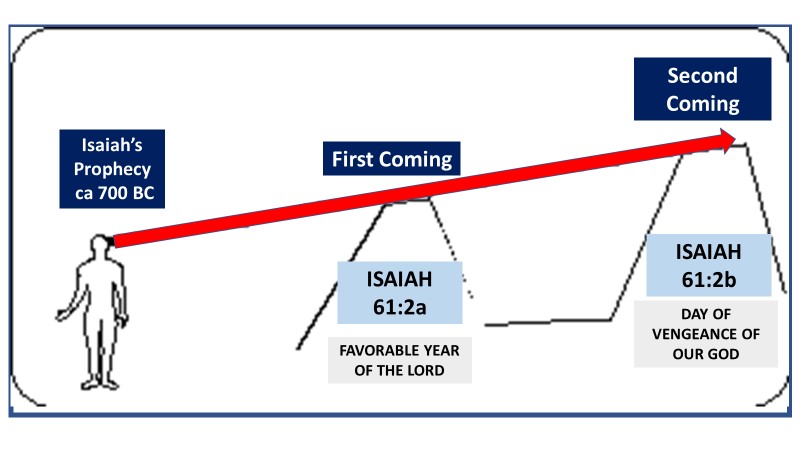
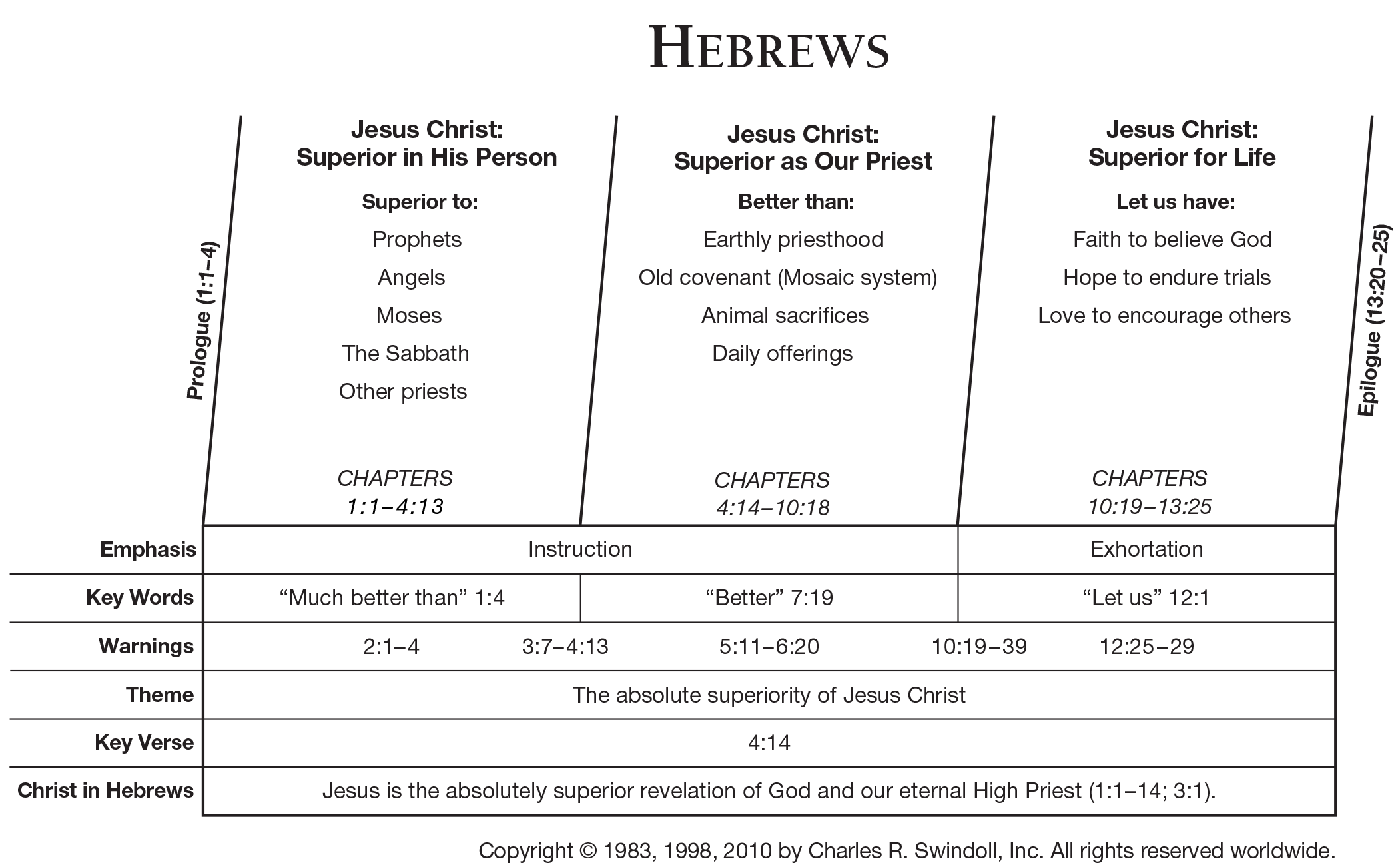
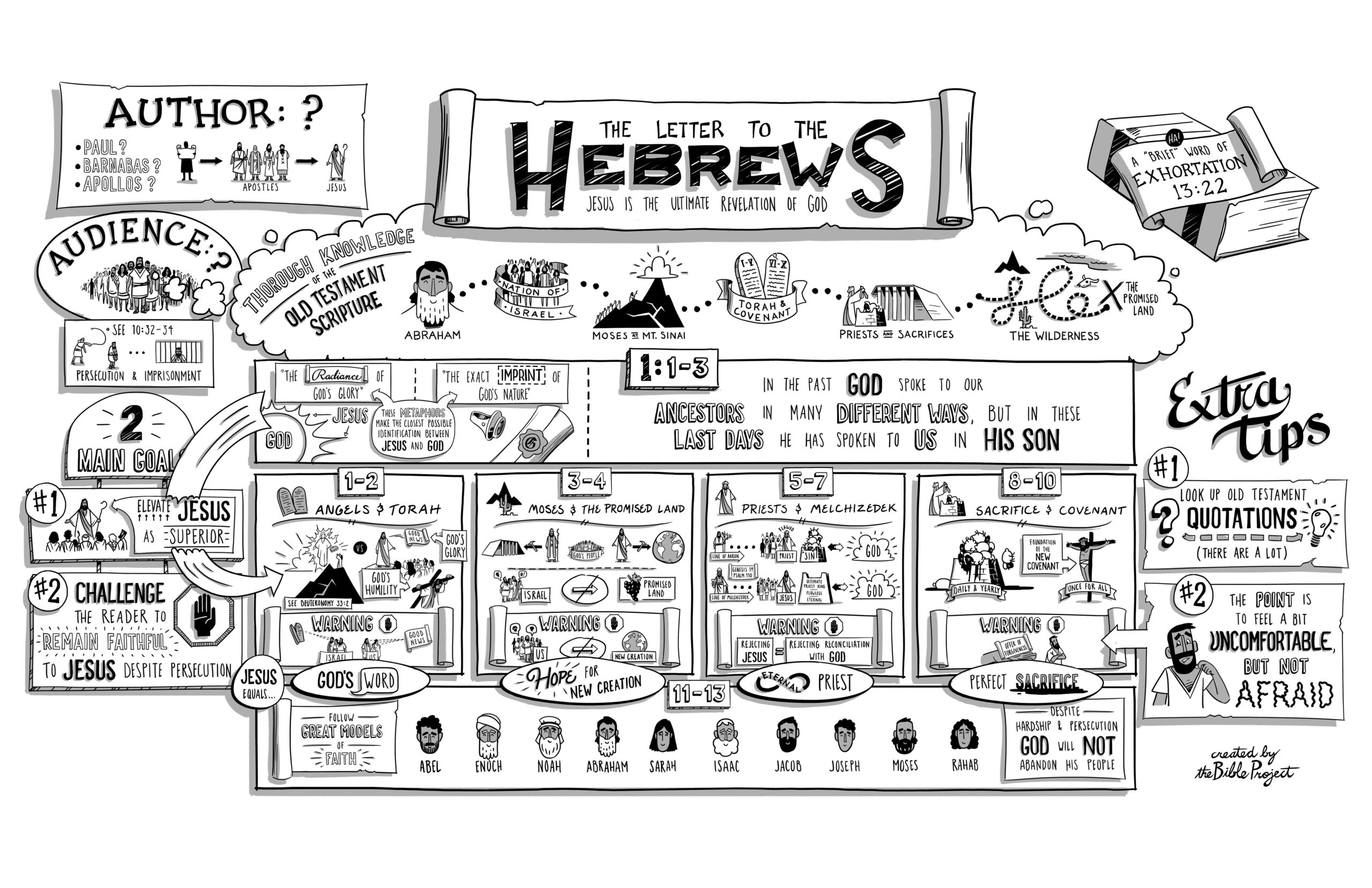
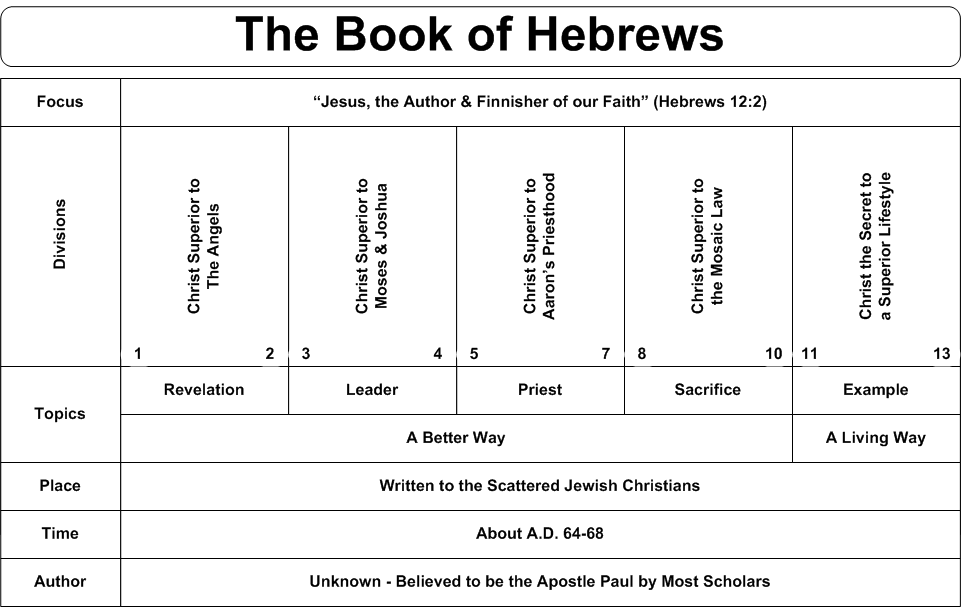
Luke records the words of Jesus' first sermon...
"And He came to Nazareth, where He had been brought up; and as was His custom, He entered the synagogue on the Sabbath, and stood up to read. 17 And the book of the prophet Isaiah was handed to Him. And He opened the book, and found the place where it was written, 18 "THE SPIRIT OF THE LORD IS UPON ME (Mt 3:13-16+, Mk 1:9-10+, Lk 3:21-22+, Jn 1:32-34+), BECAUSE HE ANOINTED (chrio) ME TO PREACH THE GOSPEL TO THE POOR. HE HAS SENT ME TO PROCLAIM RELEASE TO THE CAPTIVES, AND RECOVERY OF SIGHT TO THE BLIND, TO SET FREE THOSE WHO ARE DOWNTRODDEN, 19 TO PROCLAIM THE FAVORABLE YEAR OF THE LORD." 20 And He closed the book, and gave it back to the attendant, and sat down; and the eyes of all in the synagogue were fixed upon Him. 21 And He began to say to them, "Today this Scripture (OT MESSIANIC PROPHECY) has been fulfilled in your hearing." (Luke 4:16-21+)
We also see the truth of the Son's anointing in His Names. And so the title Messiah in Hebrew (mashiach/masiyah) means “anointed one." For example in one of the greatest Messianic prophecies in the Old Testament Daniel 9:24-27+, Daniel records the specific timing of first coming of the Messiah"So you are to know and discern that from the issuing of a decree to restore and rebuild Jerusalem until Messiah (mashiach/masiyah; Lxx = Christos) the Prince there will be seven weeks and sixty-two weeks (69 Weeks); it will be built again, with plaza and moat, even in times of distress."
And we see the New Testament "definition" of Messiah in John's gospel
He (Andrew) found first his own brother Simon, and said to him, "We have found the Messiah (messias)" (which translated means Christ [Christos]). (Jn 1:41+)
So both Messiah (messias) and Christ (Christos) speak of anointing thus emphasizing the importance of the Son's anointing. It should not surprise us then to see that the name Christos is derived from this verb chrio meaning to anoint!
Barnes - "The oil of gladness." This probably means the perfumed oil that was poured on the head, attended with many expressions of joy and rejoicing. The inauguration of the Messiah as king would be an occasion of rejoicing and triumph. Thousands would exult at it as in the coronation of a king; and thousands would be made glad by such a consecration to the office of Messiah.
In Psalm 89 we read of David's anointing which pictured the anointing of the greater David "I have found David My servant; With My holy oil I have anointed him (Ps 89:20)
Spurgeon: By the hand of Samuel, David was anointed to be king long before he ascended the throne. The verse must also be expounded of the Prince Emmanuel; He became the servant of the Lord for our sakes, the Father having found for us in His person a mighty Deliverer, therefore upon Him rested the Spirit without measure, to qualify Him for all the offices of love to which He was set apart. We have not a Saviour self appointed and unqualified, but one sent of God and divinely endowed for his work. Our Saviour Jesus is also the Lord's Christ, or anointed. The oil with which He is anointed is God's own oil, and holy oil; He is divinely endowed with the Spirit of holiness.
Spurgeon comments that "Jesus is the anointed king, and though we share in the anointing yet is He far above us. Christ is infinitely greater than Christians. We are right glad to have it so.
John MacArthur feels that "Jesus was officially anointed as king (ED: WHILE I AGREE WITH MACARTHUR, IT IS IMPORTANT TO NOTE THAT CLEARLY HE WAS ANOINTED IN Acts 10:37-38+, BUT HIS SUBSEQUENT THREE YEARS WERE SERVING AS A PROPHET AND NOT AS A KING - THAT WILL COME WHEN HE RETURNS - SEE Rev 19:16+ = "KING OF KINGS.") when He went to heaven after His resurrection. At that time the Father exalted Him and gave Him a name above every name (Eph 1:20-22+). He assumed His kingship at His ascension. Although He has not yet brought all of His kingdom together, someday soon He will. Jesus’ nature (that is, His deity), like His title and His being worshiped, show His superiority to angels. (See Hebrews Commentary - Page 35)
A GOODLY THEME IS MINE
Thy throne is ever sure,
Establishèd of God;
Its scepter is of righteousness,
Of equity its rod.
Thou lovest perfect right,
Hatest iniquity;
Therefore with oil of festive joy
The Lord anointed Thee.
Spurgeon - Jesus as Mediator owned God as His God, to whom, being found in fashion as a man, He became obedient. On account of our Lord’s perfect life He is now rewarded with superior joy. Others there are to whom grace has given a sacred fellowship with Him, but by their universal consent and His own merit, He is prince among them—the gladdest of all because the cause of all their gladness. At ancient Near Eastern feasts, oil was poured on the heads of distinguished and very welcome guests; God Himself anoints the man Christ Jesus, as He sits at the heavenly feasts—anoints Him as a reward for His work, with higher and fuller joy than any else can know. Thus the Son of Man is honored and rewarded for all His pains. As man, Christ claims all people as His companions; but as God, He counts it no robbery to be thought equal to God. As man, He is most truly man and only superior to man by reason of the purity of His birth, the perfection of His nature, and the exaltation of his manhood by God. As God, He is nothing less than God, though He took upon Himself the nature of men. Jesus is the anointed king, and though we share in the anointing, yet is He far above us. Christ is infinitely greater than Christians. We are right glad to have it so.
Above Thy companions (metochos) - This is the key phrase regarding the superiority of Jesus. The question one must address is "Who are the 'companions' (metochos)"? Are they men or angels? Multiple suggestions have been made - kings, men in general (Bengel), Christians (Calvin), angels (Alford) (As an aside most of the older commentators misinterpret "companions!") To be sure, Jesus is over all groups but recall that context is the key to accurate interpretation (I fear some of these interpreters forgot that basic principle). What is the context of Hebrews 1? Who has the writer been discussing especially in Hebrews 1:4-14? Clearly the context the favors companions (metochos) as the angels. Otherwise we would have to accuse the writer of taking a brief "rabbit trail" stating that Jesus is superior to men. Can you see how applying the simple rule of examining the context can help you make the correct interpretation. After you have done your own study, you can go to the commentaries (e.g., Calvin) and be confident in the interpretation you have arrived at. The commentaries are NOT always correct! Vincent is correct writing "In the Psalm it (companions) is applied to other kings: here to angels."
Kenneth Wuest on companions - The word “fellows” is the translation of metochos, which word refers to one who is a co-participant with someone else in a common undertaking. Here the angels are viewed as co-participants with Messiah in His work of salvation and future sovereignty over the redeemed creation. The emphasis of the passage is upon the fact that Messiah’s future kingdom is an eternal one, and that He as the anointed King will rule in righteousness. Isaiah XI speaks of His millennial reign and of the fact that He will be the King anointed with the Spirit. As such, the angels will be associated with Him in that reign, but He will be their sovereign Lord, they His servants. All of which again means that Messiah is better than angels. (Commentary)
John MacArthur on companions (metochos) - Some commentators believe companions refers to men. But angels, not men, are being discussed in the passage. The Greek word simply connotes an association, nothing more. The point being made here is that Jesus Christ is greater than angels, who are His associates, His heavenly companions. But they are only messengers of God. Christ, too, is a messenger of God, but much more than a messenger and therefore much greater than they. He is exalted, anointed, above all others. (See Hebrews Commentary - Page 34)
Simon Kistemaker comments on scepter of righteousness and oil of gladness explaining "We do well to understand the phrases scepter of righteousness and oil of joy as Hebraic idioms that were translated literally into Greek.
a. Thus, the phrase scepter of righteousness actually means that the king holds in his hand a scepter, which symbolizes royal authority. The king can hold out the scepter to invite someone to approach his throne, or he can sway his scepter to demand silence. By means of this instrument the king rules. How does the king execute his rule? Justly!
b. Likewise, the phrase oil of joy is not a symbolic description of either the baptism of Jesus in the Jordan River or his ascension and session at the right hand of God; rather, it describes the constant administration of his just rule. The application of his justice fills him with joy and happiness, and constitutes his anointing. It is the anointed Son who, set above his companions, shares his happiness with them (Isa. 61:3).
A sixteenth-century catechism asks the penetrating question, “But why are you called a Christian?” and gives the revealing answer:
Because by faith I am a member of Christ 1
and so I share in His anointing.2
I am anointed
to confess His name,3
to present myself to Him as a living sacrifice of thanks,4
to strive with a free conscience against sin and the devil in this life,5
and afterward to reign with Christ over all creation for all eternity.6
References -
1 1 Cor. 12:12-27
2 Acts 2:17 (Joel 2:28); 1 John 2:27
3 Matt. 10:32; Rom. 10:9-10; Heb. 13:15
4 Rom. 12:1; 1 Pet. 2:5, 9
5 Gal. 5:16-17; Eph. 6:11; 1 Tim. 1:18-19
6 Matt. 25:34; 2 Tim. 2:12
(Heidelberg Catechism, question and answer 32.)
C H Spurgeon (Treasury of David) writes the following comments on Psalm 45:7…
Thy throne, O God, is for ever and ever. To whom can this be spoken but our Lord? The psalmist cannot restrain his adoration. His enlightened eye sees in the royal Husband of the church, God, God to be adored, God reigning, God reigning everlastingly. Blessed sight! Blind are the eyes that cannot see God in Christ Jesus! We never appreciate the tender condescension of our King in becoming one flesh with His church, and placing her at His right hand, until we have fully rejoiced in His essential glory and deity. What a mercy for us that our Saviour is God, for who but a God could execute the work of salvation? What a glad thing it is that He reigns on a throne which will never pass away, for we need both sovereign grace and eternal love to secure our happiness. Could Jesus cease to reign we should cease to be blessed, and were He not God, and therefore eternal, this must be the case. No throne can endure for ever, but that on which God Himself sitteth.
The sceptre of thy kingdom is a right sceptre. He is the lawful monarch of all things that be. His rule is founded in right, its law is right, its result is right. Our King is no usurper and no oppressor. Even when He shall break His enemies with a rod of iron, He will do no man wrong; His vengeance and His grace are both in conformity with justice. Hence we trust Him without suspicion; He cannot err; no affliction is too severe, for He sends it; no judgment too harsh, for He ordains it. O blessed hands of Jesus! the reigning power is safe with you. All the just rejoice in the government of the King Who reigns in righteousness.
Thou lovest righteousness, and hatest wickedness. Christ Jesus is not neutral in the great contest between right and wrong: as warmly as He loves the one He abhors the other. What qualifications for a sovereign! what grounds of confidence for a people! The whole of our Lord's life on earth proved the truth of these words; His death to put away sin and bring in the reign of righteousness, sealed the fact beyond all question; His providence by which He rules from His mediatorial throne, when rightly understood, reveals the same; and His final assize will proclaim it before all worlds. We should imitate Him both in His love and hate; they are both needful to complete a righteous character.
Therefore God, thy God, hath anointed thee with the oil of gladness above thy fellows. Jesus as Mediator owned God as His God, to Whom, being found in fashion as a man, He became obedient. On account of our Lord's perfect life He is now rewarded with superior joy. Others there are to whom grace has given a sacred fellowship with Him, but by their universal consent and His own merit, He is prince among them, the gladdest of all because the cause of all their gladness. At Oriental feasts oil was poured on the heads of distinguished and very welcome guests; God Himself anoints the man Christ Jesus, as He sits at the heavenly feasts, anoints Him as a reward for His work, with higher and fuller joy than any else can know; thus is the Son of man honoured and rewarded for all His pains. Observe the indisputable testimony to Messiah's Deity in verse six, and to His manhood in the present verse. Of Whom could this be written but of Jesus of Nazareth? Our Christ is our Elohim. Jesus is God with us.
Along the same line David writes that God "dost prepare a table before me in the presence of my enemies. Thou hast anointed my head with oil; My cup overflows. (Ps 23:5+)
Spurgeon comments: May we live in the daily enjoyment of this blessing, receiving a fresh anointing for every day's duties. Every Christian is a priest, but he cannot execute the priestly office without unction, and hence we must go day by day to God the Holy Ghost, that we may have our heads anointed with oil. A priest without oil misses the chief qualification for his office, and the Christian priest lacks his chief fitness for service when he is devoid of new grace from on high.
In the East the people frequently anoint their visitors with some very fragrant perfume; and give them a cup or glass of some choice wine, which they are careful to fill till it runs over. The first was designed to show their love and respect; the latter to imply that while they remained there, they should have an abundance of everything. To something of this kind the psalmist probably alludes in this passage. Samuel Burder
Anointing the head with oil is a great refreshment. There are three qualities of oil -- laevor, nitor, odor, a smoothness to the touch, brightness to the sight, fragrancy to the smell, and so, gratifying the senses, it must needs cause delight to those anointed with it. To this Solomon alludes when persuading to a cheerful life, he saith, "Let thy head lack no ointment." How fully doth this represent the Spirit's unction which alone rejoices and exhilarates the soul! It is called the "oil of gladness", and the "joy of the Holy Ghost." Nathanael Hardy
It is an act of great respect to pour perfumed oil on the head of a distinguished guest; the woman in the gospel thus manifested her respect for the Saviour by pouring "precious ointment" on his head. An English lady went on board an Arabian ship which touched at Trincomalee, for the purpose of seeing the equipment of the vessel, and to make some little purchases. After she had been seated some time in the cabin, an Arabian female came and poured perfumed oil on her head. Joseph Roberts.
In the East no entertainment could be without this, and it served, as elsewhere a bath does, for (bodily) refreshment. Here, however, it is naturally to be understood of the spiritual oil of gladness. T. C. Barth.
Thou hast not confined thy bounty merely to the necessaries of life, but thou hast supplied me also with its luxuries. In "A plain Explanation of Difficult Passages in the Psalms", 1831.
The unguents of Egypt may preserve our bodies from corruption, ensuring them a long duration in the dreary shades of the sepulchre, but, O Lord, the precious perfumed oil of thy grace which thou dost mysteriously pour upon our souls, purifies them, adorns them, strengthens them, sows in them the germs of immortality, and thus it not only secures them from a transitory corruption, but uplifts them from this house of bondage into eternal blessedness in thy bosom. Jean Baptiste Massillon, 1663-1742.
F B Meyer has the following devotional thoughts on Psalm 45 that relate to this section of Hebrews…
The inscription of this exquisite Psalm, To the chief musician, indicates that it was intended to be employed in God's service. Therefore, though it was probably suggested by Solomon's marriage with the daughter of Pharaoh, we must pass beyond the mere outward interpretation to consider these glowing words in their relation to Christ and his Church. The Psalm is distinctly applied to Him (Heb 1:8). The union between Him and his people is often described in such imagery (2 Cor. 11:2; Eph. 5:23). Let us pray for the time when the universe shall ring with this marriage-ode: when the hour of the marriage of the Lamb shall have come and heathen nations partake the joy (Rev. 19:7). (Gems From the Psalms)
(Meyer in Our Daily Walk writes) IT IS difficult to decide the occasion of this Psalm, which was written to celebrate a royal marriage. But there is much which goes far beyond the immediate circumstances out of which it sprang. We recognize its prophetic character, as well as its historic basis, and that it points onward to Christ the King. It is so quoted in Hebrews 1:8-9, and we may therefore certainly appropriate the Psalm as directly addressed to our Lord, who is our rightful King.
Christ's claim rests on these grounds: The Righteousness of His Rule. His sceptre is not a rod of iron, but of "uprightness." Our King loves righteousness and hates wickedness. Therefore His throne stands firm, and He claims the allegiance of all pure and upright souls. Would that all rulers and leaders realized that right makes might!
The Gladness of His Reign. The righteous heart is the joyful one; and our King teaches us that so far from holiness meaning gloom and depression, it is the root and fountain of true and abiding joy. Jesus was "the Man of Sorrows, and acquainted with grief," but underneath was an abiding and eternal joy, like the spring flowers that nestle under the warm coverlet of snow. There is a blessed attractiveness in Christian joy and gladness, which is characteristic of our King, and should mark all His subjects.
Andrew Murray comments…
Therefore, because He loved righteousness and hated iniquity, therefore God anointed Him. When He ascended to heaven, and sat down on the right hand of the throne, He received from the Father anew and in fullest measure, as the Son of Man, the gift of the Holy Ghost to bestow on His people (Acts 2:33). That Spirit was to Him the oil of joy, the joy that had been set before him, the joy of His crowning day when He saw of the travail of His soul. An anointing above His fellows (but see MacArthur), for there was none like Him; God gave Him the Spirit without measure. And yet for His fellows, His redeemed, whom, as Head, He had made members of His body. They become, partakers of His anointing and His joy. As He said,
"The Lord hath anointed Me to give the oil of joy."
Christ, our King, our God, is anointed with the oil of joy, anointed, too, to give the oil of joy: His kingdom is one of everlasting gladness, of joy unspeakable and full of glory.
O ye souls, redeemed by Christ, behold your God! the Son in whom the Father speaks. Let this be the chief thing you live for--to know, to honour, to serve your God and King. This is the Son in whom God speaks to you in all the divine mystery, but also in all the divine power and blessing, which marks all God's speaking. Let our hearts open wide to receive the King God hath given us.
And as often as we are tempted with the Hebrews to sloth or fear or unbelief, let this be our watchword and our strength:
My Redeemer is God! In this faith let me worship Him.
My Redeemer is God! let my whole heart be opened to Him, to receive, as a flower does the light of the sun, His secret, mighty, divine working in me.
My Redeemer is God! let me trust this omnipotent Lord to work out in me His every promise, and to set up His throne of righteousness in my soul in a power that is above all we ask or think.
My Redeemer is God! let me wait for Him, let me count upon Him, to reveal Himself in the love that passeth knowledge. Blessed be the name of God for ever and ever: My Redeemer is God!
1. Who is God? And what is God to us? "He in whom me live and move end have our being." He is the life of the universe. And how wonderfully perfect all that life is in nature. When we know this God as our Redeemer, "in whom we live and move and have our being" in a higher sense, what an assurance that He will make His new life in us as wonderful and perfect.
2. "Thou hast loved righteousness and hated iniquity, therefore." . . This was His way to the throne; this is the only way for us, living and doing right, and hating everything that is sin. (Andrew Murray. The Holiest of All)
Loved (25) (agapao - see related study of noun agape) means to love unconditionally and sacrificially and by its verbal nature calls for action. This quality of love is not so much an emotion as it is an action initiated by a volitional choice. Agapao expresses the purest, noblest form of love, not motivated by superficial appearance, emotional attraction, or sentimental relationship. It pictures a love awakened by a sense of value in an object which causes one to prize it and thus this love springs from an apprehension of the preciousness of the object. It is the love of esteem and approbation.
AGAPAO IN HEBREWS - Heb. 1:10; Heb. 2:3; Heb. 7:14; Heb. 7:21; Heb. 8:2; Heb. 8:8; Heb. 8:9; Heb. 8:10; Heb. 8:11; Heb. 10:16; Heb. 10:30; Heb. 12:5; Heb. 12:6; Heb. 12:14; Heb. 13:6; Heb. 13:20;
Righteousness (1343) (dikaiosune from dikaios = just, righteous = root idea of conforming to a standard or norm) is derived from a root word that means “straightness.” It refers to a state that conforms to an authoritative standard or norm and so is in keeping with what God is in His holy character. Righteousness is a moral concept. God’s character is righteous (see notes on this attribute) and as such is the definition and source of all righteousness. Thus God is totally righteous because He is totally as He should be. The righteousness of human beings is defined in terms of God’s perfect standard of righteousness. Righteousness in Biblical terms describes the righteousness acceptable to God and thus which is in keeping with what God is in His holy character. Rightness (a way of expressing the idea of righteousness) means to be as something or someone should be. In short, the righteousness of God is all that God is, all that He commands, all that He demands, all that He approves and all that He provides (through faith in the gospel of Jesus Christ, the perfectly Righteous One).
In the OT God's character is described as righteous. The Mesopotamian term comes from a river reed which was used as a construction tool to judge the horizontal straightness of walls and fences. God uses this term to be used metaphorically of His own nature. He is the straight edge (ruler) by which all things are evaluated. This concept asserts God's righteousness as well as His right to judge.
Rightness describes right as opposed to wrong, good as opposed to evil, sinless as opposed to sinful. Righteousness is the opposite of "lawlessness" here (and also in 2Cor 6:14)
Righteousness is being right and doing what is right, based upon the unerring standard as the revealed will of God. From that standard the incarnate Son never deviated because He truly loved righteousness. The psalmist writes "He loves righteousness and justice. The earth is full of the lovingkindness of the LORD. (Psalms 33:5)
Spurgeon Comments on Jesus' love of righteousness - "The theory and practice of right He intensely loves. He doth not only approve the true and the just, but His inmost soul delights therein. The character of God is a sea, every drop of which should become a wellhead of praise for His people. The righteousness of Jesus is peculiarly dear to the Father, and for its sake He takes pleasure in those to whom it is imputed. Sin, on the other hand, is infinitely abhorrent to the Lord, and woe unto those who die in it; if He sees no righteousness in them, He will deal righteously with them, and judgment stern and final will be the result."
DIKAIOSUNE IN HEBREWS - Heb. 1:9; Heb. 5:13; Heb. 7:2; Heb. 11:7; Heb. 11:33; Heb. 12:11
Lawlessness (458) (anomia) signifies everything that is contrary to the will and law of God. Friberg - Anomia = what is contrary to law; (1) as a general state of wrong -- lawlessness, wickedness, iniquity (1Jn 3.4); (2) as an individual violation of law sin, wrong(doing), (practice of) lawlessness ( Mt 7.23)"
Lawlessness is living as though your own ideas are superior to God's.
Lawlessness says, "God may demand it but I don't prefer it."
Lawlessness says, "God may promise it but I don't want it."
Lawlessness replaces God's law with my contrary desires. I become a law to myself.
Lawlessness is rebellion against the right of God to make laws and govern His creatures. All these things the Son hated in the days of His flesh (and still hates).
ANOMIA - 15X/13V - lawless deed(1), lawless deeds(2), lawlessness(12). Matt. 7:23; Matt. 13:41; Matt. 23:28; Matt. 24:12; Rom. 4:7; Rom. 6:19; 2 Co. 6:14; 2 Thess. 2:3; 2 Thess. 2:7; Tit. 2:14; Heb. 1:9; Heb. 10:17; 1 Jn. 3:4
Anointed (5548) (chrio see derivative word Christos = Christ) means literally to daub, smear, anoint with oil or ointment, to rub oneself with oil. The figurative use means to consecrate or set apart for sacred work. It means to assign a person to a task, and in the present context conveys the implication of supernatural sanctions. See What is the anointing? GOTQUESTIONS.ORG
Friberg on chrio - anoint; figuratively in the NT, of God’s activity in appointing someone to an office, function, or privilege; appoint, assign, give a task; (1) of Jesus, the Christ (Lk 4.18); (2) of Christian workers (2Cor 1.21) (Borrow Analytical Lexicon)
Thayer on chrio - Properly ‘to touch with the hand’, ‘to besmear’; from Homer down; Sept. for מָשַׁח; (masah/maschah); to anoint (on the persons who received anointing among the Hebrews, see chrisma); in the NT only trop. of God (a) Consecrating Jesus to the Messianic office, and furnishing him with powers necessary for its administration (see chrisma): Lk. 4:18 (after Isaiah 61:1); contrary to common usage with an aec. of the thing, elaion (olive oil) (like verbs of clothing, putting on, etc, Heb 1:9 (from Ps. 45:7; Acts 10:38; Acts 4:27. (b) enduing Christians with the gifts of the Holy Spirit [cf. 1Jn. 2:20, 1Jn 2:17]: 2Cor 1:21. (Thayer Unabridged)
Liddell-Scott-Jones on chrio (summarized) -Touch the surface of a body slightly, especially of the human body, graze, hence, (I) rub, anoint with scented unguents or oil, as was done after bathing, frequently in Homer, (Odyssey quote "I alone recognized him in this disguise, and questioned him, but he in his cunning sought to avoid me. Howbeit when I was bathing him and anointing him with oil, and had put on him raiment, and sworn a mighty oath not to make him known among the Trojans as Odysseus"); of a dead body, ("day alike and by night, and with oil anointed she him, rose-sweet" from The Illiad); To anoint a suppliant (one who begs or makes a humble entreaty); To rub or infect with poison: metaphorically: — Medium, anoint oneself, ("bathed and anointed themselves richly with oil" Odyssey 6.96); anoint (i.e. poison) one's arrows (Odyssey 1.262) In Septuagint, anoint in token of consecration, 2Ki 9:3 = king = 1Sa 10:1; 1Ki 19:16 = prophet; also Jdg 9:15 (II) wash with color, coat, smear their bodies, Herodotus 4.191 ("they paint their bodies with vermilion"). (III) wound on the surface, puncture, prick, sting, of the gadfly (Liddell-Scott-Jones)
W E Vine compares the two NT verbs for anoint - Aleipho and Chrio - (1) Aleipho is "a general term used for "an anointing" of any kind, whether of physical refreshment after washing, e.g., in the Septuagint of Ru 3:3; 2Sa 12:20; Da 10:3; Mic 6:15; in the NT, Mt 6:17; Lk 7:38,46; Jn 11:2; 12:3; or of the sick, Mk 6:13; Jas 5:14; or a dead body, Mk 16:1. The material used was either oil, or ointment, as in Lk 7:38,46 . In the Sept. it is also used of "anointing" a pillar, Ge 31:13 or captives, 2Chr 28:15 or of daubing a wall with mortar, Ezek 13:10-12,14-15 and in the sacred sense, of "anointing" priests, in Ex 40:15 (twice), and Nu 3:3. (2) Chrio "is more limited in its use than Aleipho; it is confined to "sacred and symbolical anointings;" of Christ as the "Anointed" of God, Lk 4:18; Acts 4:27; 10:38 , and Heb 1:9 , where it is used metaphorically in connection with "the oil of gladness." The title Christ signifies "The Anointed One," The word (Christos) is rendered "His Anointed" in Acts 4:26RSV. Once it is said of believers, 2Cor 1:21. Chrio is very frequent in the Septuagint and is used of kings (1Sa 10:1) and priests (Ex 28:41) and prophets (1Ki 19:16). Among the Greeks chrio was used in other senses than the ceremonial, but in the Scriptures it is not found in connection with secular matters. Note: The distinction referred to by Trench (Synonyms), that aleipho is the mundane and profane, chrio, the sacred and religious word, is not borne out by evidence. In a papyrus document chrisis is used of "a lotion for a sick horse" (Moulton and Milligan). (Vine's Expository Dictionary)
TDNT on secular use of chrio - 1. chrio, found in Homer and then in the tragic dramatists, means “to rub,” “to stroke,” or, with oils etc., “to smear,” “to anoint.” Use varies, so that we find the oiling of weapons, their smearing with poison, the rubbing of birds’ wings with pitch, whitewashing or painting, and rubbing with a garment, as well as anointing after bathing, or the anointing of the sick or the dead. 2. Christos means “smeared on,” “anointed,” and as a noun (tó christón) “ointment.” It never relates to persons in the nonbiblical sphere. 3. chrisma (also chríma) means “what is rubbed on,” i.e., “ointment,” “whitewash.” Medically it denotes a “healing ointment.” The OT. General Data. Anointing, the rubbing of the body with grease or oil, is meant to promote physical well-being. Legal anointing by pouring oil over the head supposedly confers strength or majesty. The Hittites anoint their kings, in Egypt the king anoints high officials, the vassal princes of Syria and Canaan are anointed, and priesthood is at times associated with anointing.
Gilbrant on chrio - In classical Greek the verb chriō has a broad semantic range (cf. the related noun chrisma [5380]). It means “to smear something on something else” and could thus designate to “anoint with oil, apply paints or glazes,” etc. Even when an author of the Homeric school used chriō for the “anointing” of a person by a god by smearing ambrosia on him (Hymn to Demeter 237), the word chriō itself carried no special religious significance. Septuagint Usage - The range of meaning of chriō in the Septuagint is more limited. It is used for the ritual anointing with oil to consecrate and appoint someone to a special office such as priest or king. Only once (1Ki 19:16) is it used for a literal anointing with oil to appoint someone to the office of prophet. Phrases such as “to anoint to the kingship/for the purpose of ruling” are found frequently in the Septuagint. As a result of this ceremonial anointing, a person received the abilities or rights needed for the execution of the office. This effect led to the figurative use of the verb to indicate any endowment of spiritual gifts or even the very Spirit of God. It is with this figurative meaning that chrio most often appears with reference to the prophets. They would describe themselves as “anointed” when they had received the Spirit of God and thereby been “appointed” to the office of prophet (see Isa 61:1). These symbolic uses of chrio caused it to be distinguished from aleipho, “to anoint,” which designated the physical act of anointing. (Complete Biblical Library)
CHRIO - 5x in 5v - Always translated anointed in NAS.
Acts 4:27+ "For truly in this city there were gathered together against Your holy servant Jesus, Whom You (God the Father) anointed (Mt 3:14-17, Lk 3:21-23), both Herod and Pontius Pilate, along with the Gentiles and the peoples of Israel, (28) to do whatever Thy hand and Thy purpose predestined to occur.
Acts 10:38+ "You know of Jesus of Nazareth, how God anointed Him with the Holy Spirit and with power (Mt 3:14-17, Lk 3:21-23), and how He went about doing good and healing all who were oppressed by the devil, for God was with Him.
Comment: For context read Acts 10:37 "you yourselves know the thing which took place throughout all Judea, starting from Galilee, after the baptism which John proclaimed."
2 Corinthians 1:21 Now He who establishes us with you in Christ and anointed us is God,
Comment: Compare 1Jn 2:20-+, 1Jn 2:27-+
Hebrews 1:9-+ "YOU HAVE LOVED RIGHTEOUSNESS AND HATED LAWLESSNESS; THEREFORE GOD, YOUR GOD, HAS ANOINTED YOU WITH THE OIL OF GLADNESS ABOVE YOUR COMPANIONS."
Girdlestone says four of the five NT uses refer "to the anointing of Christ by His Father, namely: Luke 4:18, which is quoted from Isa. 61:1; Heb. 1:9, quoted from Ps. 45:7; Acts 4:27, where it is used with special reference to the quotation from the second Psalm, which immediately precedes it; and Acts 10:38, where we are told that God anointed Jesus with the Spirit. What, then, is the idea which we ought to connect with the name Christ or Messiah? It points to One who is King by Divine authority, and signifies that God would set His mark upon Him by giving Him the Holy Spirit without measure. Perhaps also it teaches that the ministrations of the prophet, priest, altar, and tabernacle with all its vessels, were foreshadowings of the work which He was to accomplish."
Jesus applied Isaiah 61:1-2 to Himself in Nazareth (see Luke 4:16-21) at the beginning of his ministry, reading in the synagogue on the Sabbath.
The Spirit of the Lord God is upon me, because the Lord has anointed me to bring good news to the afflicted. He has sent me to bind up the brokenhearted, to proclaim liberty to captives, and freedom to prisoners, to proclaim the favorable year of the Lord, (notice below that Jesus stopped in the middle of the verse - the first part was fulfilled in His First Coming and the last part - the "day of vengeance" - will one day be fulfilled at His Second Coming in glory to judge and wage war) and the day of vengeance of our God, to comfort all who mourn. (Isaiah 61:1-2)
Chrio - 65v in the Septuagint - Ex 28:41; 29:2, 7, 29, 36; 30:26, 30, 32; 40:9-10, 13; Lev 4:3; 6:20; 7:36; 8:10, 12; 16:32; Nu 6:15; 7:1, 10, 84, 88; 35:25; Dt 28:40; Jdg 9:8, 15; 1Sa 9:16; 10:1; 11:15; 15:1, 17; 16:3, 12-13; 2Sa 1:21; 2:4, 7; 5:3, 17; 12:7; 19:10; 1Ki 1:34, 39, 45; 5:1; 19:15-16; 2Ki 9:3, 6, 12; 11:12; 23:30; 1Chr 11:3; 14:8; 29:22; 2Chr 23:11; 36:1; Ps 27:1; 45:7; 89:20; Isa 25:6; 61:1; Jer 22:14; Ezek 16:9; 43:3; Da 9:24; Hos 8:10; Amos 6:6
In Psalm 89 we read of David's anointing which pictured the anoint of the greater David - "I have found David My servant; With My holy oil I have anointed (Hebrew - masah/maschah; ) him (Ps 89:20-+)
Spurgeon: By the hand of Samuel, David was anointed to be king long before he ascended the throne. The verse must also be expounded of the Prince Emmanuel; He became the servant of the Lord for our sakes, the Father having found for us in His person a mighty Deliverer, therefore upon Him rested the Spirit without measure, to qualify Him for all the offices of love to which He was set apart. We have not a Saviour self appointed and unqualified, but one sent of God and divinely endowed for his work (Ed: Not self appointed but Spirit anointed!). Our Savior Jesus is also the Lord's Christ, or anointed. The oil with which He is anointed is God's own oil, and holy oil; He is divinely endowed with the Spirit of holiness (cf Ro 1:4-+).
Chrio is used in the Septuagint for 3 Hebrew words…מָשַׁח masah/maschah, Qal: spread with oil (Ex 29:2); anoint (1Sa 15:1, Isa 61:1); niphal: be anointed (Nu 7:10,84, 1Chr 14:8). מָשִׁיחַ mashiach/masiyah (5081), Something covered with oil (2Sa 1:21). סוּךְ suk Anoint (Dt 28:40); hophal: be poured out (Ex 30:32).
Louis Goldberg on Anoint - To smear or rub with oil or perfume for either private or religious purposes. The Hebrew term for "anoint, " masah [ Isaiah 21:5 ), smearing paint on a house (Jeremiah 22:14 ), or anointing the body with oil (Amos 6:6 ). The theological meaning of masah [ 1 Chronicles 29:22 ); this anointing made him both responsible for and accountable to the people. Anointed kings sometimes failed in their tasks, and were reminded of their accountability (1 Samuel 15:17; 2 Samuel 12:7 ). Second, when people were anointed, God empowered them to accomplish his tasks (1 Samuel 10:6; 16:13 ). Third, no one was allowed to harm God's anointed (1 Samuel 24:10; 26:9 ). Finally, the term mashiyach [ Psalm 84:9; 89:38,51 ). In the New Testament, Christ is portrayed as the Messiah. Jesus is the promised deliverer (John 1:41; 4:25 ), anointed with the Holy Spirit and with power (Acts 10:38 ). (Anoint - Baker's Evangelical Dictionary of Biblical Theology)
A R S Kennedy on Anointing, Anointed - 1 . The Hebrews distinguished between anointing with oil in the sense of its application to the body in ordinary life ( suk ), and anointing by pouring sacred oil on the head as a rite of consecration ( mâshach ). As regards the former, olive oil, alone or mixed with perfumes, was largely used in the everyday toilet of the Hebrews, although among the poor its use would be reserved for special occasions ( Ruth 3:8 ). To abstain from anointing in this sense was one of the tokens of mourning ( 2 Samuel 14:2 ), its resumption a sign that mourning was at an end ( 2 Samuel 12:20 ). Honour was shown to a guest by anointing his head with oil ( Psalms 23:5 , Luke 7:46 ), and still more by anointing his feet ( Luke 7:38 ). For medicinal anointing see Oil. 2 . Anointing as a religious rite was applied to both persons and things. Kings in particular were consecrated for their high office by having oil poured upon their heads, a practice which seems to have originated in Egypt. Though first met with in OT in the case of Saul ( 1 Samuel 10:1 , cf. David, 2 Samuel 2:4; 2 Samuel 5:3 , Solomon, 1 Kings 1:39 etc.), the rite was practised in Canaan long before the Hebrew conquest. By the pouring of the consecrated oil upon the head (see 2 Kings 9:3 ), there was effected a transference to the person anointed of part of the essential holiness and virtue of the deity in whose name and by whose representative the rite was performed. By the Hebrews the rite was also believed to impart a special endowment of the spirit of J″ [Note: Jahweh.] ( 1 Samuel 16:13 , cf. Isaiah 61:1 ). Hence the sacrosanct character of the king as ‘the Lord’s anointed’ (Heb. meshiach [ Jahweh ], which became in Greek messias or, translated, christos both ‘Messiah’ and ‘Christ,’ therefore, signifying ‘the anointed’). The application of this honorific title to kings alone in the oldest literature makes it probable that the similar consecration of the priesthood ( Exodus 29:7; Exodus 40:13-15 , Leviticus 8:1-12 ) was a later extension of the rite. Only one exceptional instance is recorded of the anointing of a prophet ( 1 Kings 19:16 Isaiah 61:1 is metaphorical). In the case of inanimate objects, we find early mention of the primitive and wide-spread custom of anointing sacred stones (Genesis 28:18 etc., see Pillar), and in the Priests’ Code the tabernacle and its furniture were similarly consecrated ( Exodus 30:29 ff; Exodus 40:9 ). For 2 Samuel 1:21 see War. (Hastings' Dictionary of the Bible) (See also Anointing Part 1 - Hastings' Dictionary of the New Testament)
RELATED RESOURCES:
- Baker Evangelical Dictionary Anointed One Anoint
- Easton's Bible Dictionary Anoint
- Fausset Bible Dictionary Anoint
- Holman Bible Dictionary Anoint
- Hastings' Dictionary of the Bible Anointing, Anointed
- Hastings' Dictionary of the NT Anointing Anointing (2)
- Kitto Biblical Cyclopedia Anointing
- McClintock and Strong's Bible Encyclopedia Sick, Anointing Of. Anoint
- The Jewish Encyclopedia Anointed of the Lord, the Anointing
ISBE Article on Anointing : A distinction was made by the ancient Hebrews between anointing with oil in private use, as in making one's toilet (סוּך , ṣūkh ), and anointing as a religious rite (משׁח , māshaḥ ).
1. Ordinary Use
(1) As regards its secular or ordinary use, the native olive oil, alone or mixed with perfumes, was commonly used for toilet purposes, the very poor naturally reserving it for special occasions only (Rth 3:3). The fierce protracted heat and biting lime dust of Palestine made the oil very soothing to the skin, and it was applied freely to exposed parts of the body, especially to the face (Psalm 104:15 ).
(2) The practice was in vogue before David's time, and traces of it may be found throughout the Old Testament (see Deuteronomy 28:40; Rth 3:3; 2 Samuel 12:20; 2 Samuel 14:2; 2 Chronicles 28:15; Ezekiel 16:9; Micah 6:15; Daniel 10:3 ) and in the New Testament (Matthew 6:17 , etc.). Indeed it seems to have been a part of the daily toilet throughout the East.
(3) To abstain from it was one token of mourning (2 Samuel 14:2; compare Matthew 6:17 ), and to resume it a sign that the mourning was ended (2 Samuel 12:20; 2 Samuel 14:2; Daniel 10:3; Judith 10:3). It often accompanied the bath (Rth 3:3; 2 Samuel 12:20; Ezekiel 16:9; Susanna 17), and was a customary part of the preparation for a feast (Ecclesiastes 9:8; Psalm 23:5 ). One way of showing honor to a guest was to anoint his head with oil (Psalm 23:5; Luke 7:46 ); a rarer and more striking way was to anoint his feet (Luke 7:38 ). In James 5:14 , we have an instance of anointing with oil for medicinal purposes, for which see OIL .
2. Religious Use
Anointing as a religious rite was practiced throughout the ancient East in application both to persons and to things.
(1) It was observed in Canaan long before the Hebrew conquest, and, accordingly, Weinel (Stade's Zeitschrift , XVIII , 50ff) holds that, as the use of oil for general purposes in Israel was an agricultural custom borrowed from the Canaanites, so the anointing with sacred oil was an outgrowth from its regular use for toilet purposes. It seems more in accordance with the known facts of the case and the terms used in description to accept the view set forth by Robertson Smith (Religion of the Semites , 2nd ed., 233, 383ff; compare Wellhausen, Reste des arabischen Heidenthums , 2nd ed., 125ff) and to believe that the ṣūkh or use of oil for toilet purposes, was of agricultural and secular origin, and that the use of oil for sacred purposes, māshaḥ , was in origin nomadic and sacrificial. Robertson Smith finds the origin of the sacred anointing in the very ancient custom of smearing the sacred fat on the altar (maccēbhāh ), and claims, rightly it would seem, that from the first there was a distinct and consistent usage, distinguishing the two terms as above.
(2) The primary meaning of māshaḥ in Hebrew, which is borne out by the Arabic, seems to have been "to daub" or "smear." It is used of painting a ceiling in Jeremiah 22:14 , of anointing a shield in Isaiah 21:5 , and is, accordingly, consistently applied to sacred furniture, like the altar, in Exodus 29:36 and Daniel 9:24 , and to the sacred pillar in Genesis 31:13 : "where thou anointedst a pillar."
(3) The most significant uses of māshaḥ , however, are found in its application, not to sacred things , but to certain sacred persons . The oldest and most sacred of these, it would seem, was the anointing of the king , by pouring oil upon his head at his coronation, a ceremony regarded as sacred from the earliest times, and observed religiously not in Israel only, but in Egypt and elsewhere (see Judges 9:8 , Judges 9:15; 1 Samuel 9:16; 1 Samuel 10:1; 2 Samuel 19:10; 1 Kings 1:39 , 1 Kings 1:45; 2 Kings 9:3 , 2 Kings 9:6; 2 Kings 11:12 ). Indeed such anointing appears to have been reserved exclusively for the king in the earliest times, which accounts for the fact that "the Lord's anointed" became a synonym for "king" (see 1 Samuel 12:3 , 1 Samuel 12:5; 1 Samuel 26:11; 2 Samuel 1:14; Psalm 20:6 ). It is thought by some that the practice originated in Egypt, and it is known to have been observed as a rite in Canaan at a very early day. Tell el-Amarna Letters 37 records the anointing of a king.
(4) Among the Hebrews it was believed not only that it effected a transference to the anointed one of something of the holiness and virtue of the deity in whose name and by whose representative the rite was performed, but also that it imparted a special endowment of the spirit of Yahweh (compare 1 Samuel 16:13; Isaiah 61:1 ). Hence the profound reverence for the king as a sacred personage, "the anointed" (Hebrew, meshı̄aḥ YHWH ), which passed over into our language through the Greek Christos , and appears as "Christ".
(5) In what is known today as the Priestly Code, the high priest is spoken of as "anointed" (Exodus 29:7; Leviticus 4:3; Leviticus 8:12 ), and, in passages regarded by some as later additions to the Priestly Code, other priests also are thus spoken of (Exodus 30:30; Exodus 40:13-15 ). Elijah was told to anoint Elisha as a prophet (1 Kings 19:16 ), but seems never to have done so. 1 Kings 19:16 gives us the only recorded instance of such a thing as the anointing of a prophet. Isaiah 61:1 is purely metaphorical (compare Dillmann on Leviticus 8:12-14 with ICC on Numbers 3:3; see also Nowack, Lehrbuch der hebraischen Archaologie , II, 124). (Anointing - International Standard Bible Encyclopedia)
Zodhiates on anointing in the OT - It was a mark of luxury to use specially scented oils (Amos 6:6) such as those Hezekiah kept in his treasure house (2Ki 20:13). The use of ointment was a sign of joy (Pr 27:9), and was discontinued during times of mourning (Da 10:3 = different Hebrew word chamad; Lxx = aleimma = anything used for anointing); thus Joab instructed the woman of Tekoa to appear unanointed before David (2Sa 14:2). On the death of Bathsheba’s child, David anointed himself to show that his mourning had ended (2Sa 12:20). The cessation of anointing was to be a mark of God’s displeasure if Israel proved rebellious (Dt. 28:40; Mic. 6:15), and the restoration of the custom was to be a sign of God’s returning favor (Is. 61:3). Anointing is used as a symbol of prosperity in Ps. 92:10; Eccl. 9:8. Before paying visits of ceremony, the head was anointed. So Naomi told Ruth to anoint herself before visiting Boaz (Ru 3:3). Oil of myrrh was used for this purpose in the harem of Ahasuerus (Esth. 2:12). This must have been a custom in Palestine as Simon’s failure to show hospitality in this respect is commented upon by our Lord in Luke 7:46. Mary’s anointing of our Lord was according to this custom.
Rubbing with oil was practiced among the Jews in pre–Christian times as well as by the Apostles (Mark 6:13), recommended by James (James 5:14), mentioned in the parable of the Good Samaritan (Luke 10:34), and used as a type of God’s forgiving grace when healing the sin–sick soul (Is. 1:6; Ezek. 16:9). In Egypt and Palestine the application of ointment and spices to the dead body was customary (Mark 16:1; Luke 23:56; John 19:40). They were externally applied and did not prevent decomposition (John 11:39).
Anointing had the significance of dedication to God. Jacob consecrated the stones at Bethel by pouring oil upon them (Gen. 28:18; 35:14), and God recognized the action (Gen. 31:13). The tabernacle and its furniture were thus consecrated (Ex. 30:26; 40:10; Lev. 8:11), and the altar of burnt offering was reconsecrated after the sin offering (Ex. 29:36). Other offerings, however, were anointed with oil (Lev. 2:1ff.), but no oil was to be poured on the sin offering (Lev. 5:11; Nu 5:15).
Priests were set apart by anointing. In the case of Aaron and probably all high priests, this was done twice, first by pouring the holy oil on his head after his robing, but before the sacrifice of consecration (Lev. 8:12; Ps. 133:2), and next by sprinkling after the sacrifice (Lev. 8:30). The ordinary priests were only sprinkled with oil after the application of the blood of the sacrifice. Hence the high priest is called the anointed priest (Lev. 4:3, 5).
Kings were designated by anointing, such as Saul (1Sa 10:1) and David (1Sa 16:13). This act was accompanied by the gift of the Spirit. So when David was anointed, the Spirit descended on him and departed from Saul. Also Hazael was anointed over Syria by God’s command (1Kgs. 19:15). Kings thus designated were called the Lord’s anointed. David thus speaks of Saul (1Sa 26:11) and of himself (Ps. 2:2). This passage is used by the apostles as prophetic of Christ (Acts 4:26). By anointing, kings were installed into office. David was anointed when made king of Judah and a third time when made king of united Israel (2Sa 2:4; 5:3).
Anointing also was used metaphorically to mean setting apart for the prophetic office. Elijah was told to anoint Elisha although the actual event is left unrecorded in Scripture (1Kg. 19:16). In Ps. 105:15 the words “anointed” and “prophets” are used as syn. The servant of the Lord says that he is anointed to preach (Is. 61:1), and Christ tells the people of Nazareth that this prophecy is fulfilled in Him (Lk 4:18).
Similarly in a metaphorical sense someone chosen of God is called an anointed one. Thus Israel as a nation is called God’s anointed (Ps. 84:9; 89:38, 51; Hab. 3:13) being promised deliverance on this account (1 Sam. 2:10). The name Christ comes from chríō, to anoint, equivalent to Messiah. The anointing of Ps. 45:7 is taken in Heb. 1:9 as prophetic of the Savior’s anointing.
Before battle, shields were oiled so that their surfaces might be slippery and shining (Is. 21:5), as was done to the shield of Saul (2 Sam. 1:21). (Complete Word Study Dictionary- New Testament - Five Stars!)
Oil (1637) elaion "olive oil," is mentioned over 200 times in the Bible. Elaion is the common distinction for the oil of the olive, the most common form of oil in the ancient Mediterranean. Oil served as a dietary supplement and a cosmetic, as well as a fuel for lamps. Oil was also used for medicinal purposes and was a major trade item. The kinds and quality of olive oil varied greatly. “Pure” oil was made from olives that were pressed cold. The finest oil (now known as virgin oil) came from fresh, green olives that were beaten in a mortar (cf. Exodus 29:40, Ex 27:20; Lev 24:2; Nu 28:5), extracted by pressure, without heat, and is called "golden" in Zech. 4:12. In the NT oil was used (a) for lamps, and the "oil" is a symbol of the Holy Spirit, Mt. 25:3, 4, 8; (b) as a medicinal agent, for healing, Luke 10:34; (c) for anointing at feasts, Lk 7:46; (d) on festive occasions, Heb. 1:9, where the reference is probably to the consecration of kings; (e) as an accompaniment of miraculous power, Mark 6:13, or of the prayer of faith, Jas. 5:14. For its general use in commerce, see Luke 16:6; Rev. 6:6; Rev. 18:13. (Vine's Expository Dictionary)
ELAION - 11V - oil(10), olive oil(1). Matt. 25:3; Matt. 25:4; Matt. 25:8; Mk. 6:13; Lk. 7:46; Lk. 10:34; Lk. 16:6; Heb. 1:9; Jas. 5:14; Rev. 6:6; Rev. 18:13
Gladness (20) agalliasis See related verb - agalliao) means rejoicing, exultation, gladness or extreme joy, often accompanied by words and/or bodily movements, such as jumping, smiling, etc. See discussion of the verb agalliao in 1Pe 1:6+. "Literally, “with exultation” as of those who leap for joy." (Jamieson)
AGALLIASIS - 5v - gladness(3), great joy(1), joy(1). Lk. 1:14; Lk. 1:44; Acts 2:46; Heb. 1:9; Jude 1:24
Barclay on use in Jude 1:24 - He can bring us into his presence exultant. Surely the natural way to think of entry into the presence of God is in fear and in shame. But by the work of Jesus Christ and in the grace of God, we know that we can go to God with joy and with all fear banished. Through Jesus Christ, God the stern Judge has become known to us as God the loving Father. (Jude)
Agalliasis - 18v in non-apocryphal Septuagint (Mostly in Psalms which is not surprising where we often see the expression of joy - This would make a good study if your "joy quotient" is low! Be sure to Keep Context King and to query the text - interrogate with the 5W/H questions) and remember to apply the truth to your own situation, for example keeping in mind that some are prayers which you might consider praying) Ps 30:5; 42:4; 45:7, 15; 47:1; 51:8, 12; 63:5; 65:12; 100:2; 105:43; 107:22; 118:15; 126:2, 5-6; 132:16; Isa 51:11
Companions (3353) (metochos from metecho = have with, describing participation with another in common blessings) describes one who shares with someone else as an associate in an enterprise or undertaking. It speaks of one who is a co-participant, companion or sharer with someone else in a common undertaking - a business partner, a companion, an accomplice, a comrade.
Metochos was used in classical Greek to refer to a wife, a business partner, a member of a board of officials, and a joint owner of a house. (Liddell and Scott) In Koiné Greek usage outside the New Testament, the word metochos was commonly used in the sense of a “sharer” or “partner.” It was used of the “associate collectors of public clothing for the guards,” of payment “to Sotas and associates, collector of money-taxes,” of “colleagues,” and a “joint-owner of a holding whose price is under discussion.” (Moulton and Milligan).
METOCHOS - 6X/6V - companions(1), partakers(4), partners(1). Luke 5:7; Heb 1:9; He 3:1, Heb 3:14, Heb 6:4, Heb 12:8
QUESTION - What does the Bible say about anointing oil? | GotQuestions.org SEE VIDEO
ANSWER - Anointing oil, mentioned 20 times in Scripture, was used in the Old Testament for pouring on the head of the high priest and his descendants and sprinkling the tabernacle and its furnishings to mark them as holy and set apart to the Lord (Exodus 25:6; Leviticus 8:30; Numbers 4:16). Three times it is called the "holy, anointing oil," and the Jews were strictly forbidden from reproducing it for personal use (Exodus 30:32-33). The recipe for anointing oil is found in Exodus 30:23-24; it contained myrrh, cinnamon and other natural ingredients. There is no indication that the oil or the ingredients had any supernatural power. Rather, the strictness of the guidelines for creating the oil was a test of the obedience of the Israelites and a demonstration of the absolute holiness of God.
A few New Testament passages refer to the practice of anointing with oil, and none of them offer an explanation for its use. We can draw our conclusions from context. In Matthew 6:17 Jesus mentions the everyday practice of anointing oneself with oil. In Mark 6:13 the disciples anoint the sick and heal them. In all four Gospels, a woman anoints Jesus as a sacrificial act of worship (Matthew 26:6–13; Mark 14:3–9; Luke 7:36–50; John 12:1–8). In James 5:14 the church elders anoint the sick with oil for healing. In Hebrews 1:8–9 God says to Christ as He returns triumphantly to heaven, “Your throne, O God, will last for ever and ever,” and God anoints Jesus “with the oil of gladness.”
Should Christians use anointing oil today? There is nothing in Scripture that commands or even suggests that we should use similar oil today, but neither is there anything to forbid it. Oil is often used as a symbol for the Holy Spirit in the Bible as in the Parable of the Wise and Foolish Virgins (Matthew 25:1-13). Christians have the Spirit who leads us into all truth and “anoints” us continually with His grace and comfort. “But you have an anointing from the Holy One, and all of you know the truth” (1 John 2:20).
QUESTION - What is the anointing? GOTQUESTIONS.ORG WATCH VIDEO
ANSWER - In the Bible, anointing with oil is performed in religious ceremonies and used for grooming (Ruth 3:3; Matthew 6:17), refreshment (Luke 7:46), medicinal treatments (Luke 10:34), and burial traditions (Mark 16:1).
Ceremonial anointing in the Old Testament was a physical act involving the smearing, rubbing, or pouring of sacred oil on someone’s head (or on an object) as an outward symbol that God had chosen and set apart the person (or object) for a specific holy purpose.
The Hebrew term mashach meant “to anoint or smear with oil.” The oil used for religious anointing was carefully blended with fine spices according to a specific formula prescribed by the Lord (Exodus 30:22–32). Using this oil for any other purpose was a serious offense carrying the penalty of being “cut off” from the community (Exodus 30:33).
Kings, priests, and prophets were anointed outwardly with oil to symbolize a more profound spiritual reality—that God’s presence was with them and His favor was upon them (Psalm 20:6; 28:8). While David was still a young shepherd, God told Samuel to anoint him to become king over Israel (1 Samuel 16:3). From that day forward, the Spirit of the Lord rested powerfully upon David’s life (1 Samuel 16:13; Psalm 89:20).
Centuries before David’s time, the Lord had instructed Moses to consecrate Aaron and his sons to serve as priests (Exodus 28:41; 30:30; Leviticus 8:30; 10:7). God authenticated their priestly ministry with the fiery glory of His presence that consumed their offerings. Holy items, including the tabernacle itself, were also set apart or consecrated by anointing for use in worship and sacrificial ceremonies (Genesis 28:18; Exodus 30:26–29; 40:9–11).
The Bible contains a literal reference to a prophet’s anointing when the Lord commanded Elijah to anoint Elisha as the prophet to succeed him (1 Kings 19:16). It also includes metaphorical references to anointing to indicate that prophets were empowered and protected by the Spirit of the Lord to perform their calling (1 Chronicles 16:22; Psalm 105:15).
Anointing the head with oil was also an ancient custom of hospitality shown to honored guests. In Psalm 23:5, King David pictures himself as an esteemed guest at the Lord’s table. This practice of anointing a dinner guest with oil reappears in the Gospels (Luke 7:46; Mark 14:3–9; John 12:3).
In the New Testament, Jesus Christ reveals Himself as our anointed King, Priest, and Prophet (ED: I WOULD SLIGHTLY DISAGREE. DURING HIS LIFE JESUS DID NOT FULLY REVEAL HIMSELF AS KING OR PRIEST. THOSE FUNCTIONS WERE FULLY REVEALED AFTER THE RESURRECTION).. He is God’s Holy and chosen Son, the Messiah. In fact, Messiah, which literally means “anointed one,” is derived from the Hebrew word for “anointed.” Christ (Gr. Christos) means “the anointed one.”
Jesus declared at the launch of His ministry, “The Spirit of the Lord is on me, because he has anointed me to proclaim good news to the poor . . . to proclaim freedom for the prisoners and recovery of sight for the blind, to set the oppressed free” (Luke 4:18; cf. Isaiah 61:1). Jesus Christ fulfilled Old Testament prophecy as the Anointed One, the chosen Messiah (Luke 4:21). He proved His anointing through the miracles He performed and the life He sacrificed as Savior of the world (Acts 10:38).
There is also a sense in which Christians today are anointed. Through Jesus Christ, believers receive “an anointing from the Holy One” (1 John 2:20). This anointing is not expressed in an outward ceremony but through sharing in the gift of the Holy Spirit (Romans 8:11). At the moment of salvation, believers are indwelt by the Holy Spirit and joined to Christ, the Anointed One. As a result, we partake of His anointing (2 Corinthians 1:21–22). According to one scholar, this anointing “expresses the sanctifying influences of the Holy Spirit upon Christians who are priests and kings unto God” (Smith, W., “Anointing,” Smith’s Bible Dictionary, revised ed., Thomas Nelson, 2004).
The New Testament also associates anointing oil with healing and prayer. When Jesus sent out the disciples to preach the gospel, “they cast out many demons and healed many sick people, anointing them with olive oil” (Mark 6:13, NLT). James instructs believers to “call the elders of the church to pray over them” when they are sick “and anoint them with oil in the name of the Lord” for healing (James 5:14).
Those in Charismatic religious circles speak of “the anointing” as something Christians can and should be seeking. It is common for them to speak of “anointed” preachers, sermons, ministries, songs, etc., and to advise others to “unlock their anointing” or “walk in the anointing.” The idea is that the anointing is an outpouring of God’s power to accomplish a task through the anointed one. Charismatics claim there are corporate anointings as well as various types of individual anointings: the five-fold anointing; the apostolic anointing; and, for women, the Ruth anointing, the Deborah anointing, the Anna anointing, etc. Some even speak of a “Davidic anointing” upon musical instruments—“anointed” instruments are played by God Himself to drive away demons and take worship to a higher level than ever before. Special anointings are said to allow a person to use his spiritual gift to a “higher degree.” Charismatics say that special anointings are received by “releasing one’s faith.”
Much of the Charismatic teaching on the anointing
goes beyond what Scripture says
Much of the Charismatic teaching on the anointing goes beyond what Scripture says. In their hunger for signs and wonders, many Charismatics seek new and ever more titillating experiences, and that requires more outpourings, more spiritual baptisms, and more anointings. But the Bible points to one anointing of the Spirit, just as it points to one baptism: “As for you, the anointing you received from him remains in you” (1 John 2:27; see also 2 Timothy 1:14). This same passage also refutes another misconception, viz., that Satan can somehow “steal” a believer’s anointing. We don’t need to worry about losing the anointing we received because Scripture says it remains.
Another aberrant teaching concerning the anointing of the Spirit is the “Mimshach anointing.” Mimshach is a Hebrew word related to mashach (“anoint”) and found only in Ezekiel 28:14, where the anointing is said to “cover” (NKJV) or “cover and protect” (AMP). According to some, the Mimshach anointing (which was bestowed on Lucifer before his fall) is available now to believers. Receiving this anointing will cause everything one touches to increase or expand, and the anointed one will experience greater levels of success, material gain, health, and power.
Rather than chase after a new anointing, believers should remember they already have the gift of the Holy Spirit. The Spirit is not given in part, He does not come in portions or doses, and He is not taken away. We have the promise that “his divine power has given us everything we need for a godly life through our knowledge of him who called us by his own glory and goodness” (2 Peter 1:3).
With Oil - Psalm 92:10
With ointment - John 11:2
WAS USED FOR
Decorating the person - Ruth 3:3
Refreshing the body - 2Chronicles 28:15
Purifying the body - Esther 2:12; Isaiah 57:9
Curing the sick - Mark 6:13; James 5:14
Healing wounds - Isaiah 1:6; Luke 10:34
Preparing weapons for war - Isaiah 21:5
Preparing the dead for burial - Mt 26:12; Mk 16:1; Lk 23:56
The Jews were very fond of - Pr 27:9; Amos 6:6
WAS APPLIED TO
The head - Ps 23:5; Ecclesiastes 9:8
The face - Ps 104:15
The feet - Lk 7:38,39; Jn 12:3
The eyes - Rev 3:18
OINTMENT FOR
Richly perfumed - Song 4:10; John 12:3
Most expensive - 2Kings 20:13; Amos 6:6; Jn 12:3,5
Prepared by the apothecary - Ecclesiastes 10:1
An article of commerce - Ezekiel 27:17; Revelation 18:13
Neglected in times of affliction - 2Sa12:20; 14:2; Da 10:3
Neglect of, to guests, a mark of disrespect - Luke 7:46
A token of joy - Eccl 9:7,8
Deprivation of, threatened as a punishment - Dt 28:40; Micah 6:15
Why recommended by Christ in times of Fasting - Mt 6:17,18
Girdlestone on Anointing -
In considering the ceremonial anointing of the OT, we have only to do with one word, viz. mashiach/masiyah (משׁח), from which the name Messiah is derived, and which is almost always rendered chrio in the LXX. Other words, indeed, are used, but not in a ceremonial sense. Among passages where such occur, two may be noted: the first is Isa 10:27, ‘The yoke shall be destroyed because of the anointing,’ or literally, ‘from the face of the oil;’ the other is Zech. 4:14, ‘These are the two anointed ones (literally, sons of oil or brightness) that stand by the Lord of the whole earth.’
Mashiach/masiyah is first used of the anointing of the pillar at Bethel (Ge 28:18, 31:13), and it does not occur again till Ex 25:6, where ‘the anointing oil’ is spoken of. We next meet with it in connection with the consecration and sanctification of Aaron (Exod. 28:41). The anointing came after the offering of atoning victims in Aaron’s case, as in the case of the altar (Exod. 29:36). The tabernacle, the ark, the table, and various vessels were to be anointed (Exod. 30:26–28). They were then regarded as sanctified or set apart, and whatever touched them had this sanctification communicated to it. The unleavened wafers and some other meat offerings were to be anointed (Lev. 2:4). In all these cases the unction was the mode of setting apart or sanctifying.
The anointing of a king is first mentioned in the parable of Jotham (Jdg 9:8, 15). It next occurs in the inspired hymn of Hannah (1Sa 2:10), ‘He shall give strength unto his king, and exalt the horn of his anointed.’ Saul was anointed captain over God’s people, that he might save them out of the hand of the Philistines (1Sa 9:16). Various references are found to the Lord’s anointed, that is to say, the king, both in the historical and poetical books. The following are the most important: Ps 2:2, ‘The rulers take counsel together against the Lord and against his anointed;’ Ps. 18:50, ‘He sheweth mercy to his anointed, to David, and to his seed for evermore;’ 20:6, ‘Now know I that the Lord saveth his anointed;’ Ps 45:7, ‘God hath anointed thee with the oil of gladness above thy fellows;’ 92:10, ‘I shall be anointed with fresh oil.’
The reference in Ps. 105:15, ‘Touch not mine anointed (ones), and do my prophets no harm,’ is thought to be to the priests (compare Hab 3:13). The meaning of the phrase ‘Anoint the shield’ (Isa. 21:5) is doubtful In Isa. 45:1, Cyrus is called the Lord’s anointed, because he was appointed king for a special purpose. In Isa. 61:1, the word receives a larger meaning, and teaches that the holy oil wherewith the priest and king and the vessels of the tabernacle were anointed was a symbol of the Holy Spirit. For we read, ‘The Spirit of the Lord God is upon me, because be hath anointed me to preach good tidings unto the meek.’
In Ezek. 28:14, the king of Tyrus is described as ‘the anointed cherub.’ Some here translate the word ‘extended’ instead of anointed; but compare Isa. 45:1. In Dan. 9:24, we are told that seventy weeks were determined ‘… to anoint the Most Holy,’ i.e. either the Most Holy Being or the Most Holy Place. In Amos 6:6, the word appears to be used of personal decoration with oil, and not of the ceremonial anointing. If this be the case, it is the only place in the whole O.T. in which the word is so used. Possibly there is a reference here to the abuse of holy things, a view which would be most in accordance with the accusations implied in the two previous verses.
The verb chrio is used five times in the NT. In four of these passages it refers to the anointing of Christ by His Father, namely: Luke 4:18, which is quoted from Isa. 61:1; Heb. 1:9, quoted from Ps. 45:7; Acts 4:27, where it is used with special reference to the quotation from the second Psalm, which immediately precedes it; and Acts 10:38, where we are told that God anointed Jesus with the Spirit. What, then, is the idea which we ought to connect with the name Christ or Messiah? It points to One who is King by Divine authority, and signifies that God would set His mark upon Him by giving Him the Holy Ghost without measure. Perhaps also it teaches that the ministrations of the prophet, priest, altar, and tabernacle with all its vessels, were foreshadowings of the work which He was to accomplish.
The anointing of Christians is spoken of in 2Cor. 1:21, where we are told that ‘He who hath anointed us is God;’ and in accordance with this fact, St. John three times in his First Epistle reminds those to whom he writes that they have a chrism or unction from the Holy One (1Jn 2:20-+, 1Jn 2:27-+). This chrism includes not only the special temporary gifts of the Spirit, but also the indwelling and working presence of the Holy Ghost which the Christian receives from the Father through the Son.
The anointing of the sick is described by a different Greek word, namely, aleipho. It was a medical rather than a ceremonial act, and was performed by friction or rubbing, not by pouring. So far from St. James’s words (James 5:14) discouraging the use of medical help, they order it. The same word is used of the anointing of the head and of the body for purposes of decoration or preservation. (Anointing - Girdlestone's Synonyms of the Old Testament)
Hebrews 1:10 And, "THOU, LORD, IN THE BEGINNING LAID THE FOUNDATION OF THE EARTH, AND THE HEAVENS ARE THE WORKS OF THY HANDS; (NASB: Lockman)
Greek: kai, Su kat' archas, kurie, ten gen ethemeliosas, (2SAAI) kai erga ton cheiron sou eisin (3PPAI) oi ouranoi;
BGT καί· σὺ κατ᾽ ἀρχάς, κύριε, τὴν γῆν ἐθεμελίωσας, καὶ ἔργα τῶν χειρῶν σού εἰσιν οἱ οὐρανοί·
KJV: And, Thou, Lord, in the beginning hast laid the foundation of the earth; and the heavens are the works of thine hands:
NKJ And: "You, LORD, in the beginning laid the foundation of the earth, And the heavens are the work of Your hands.
Phillips: He also says: 'You, Lord, in the beginning laid the foundation of the earth, and the heavens are the work of your hands; (Phillips: Touchstone)
Wuest: And as for you, in the beginning, O Lord, you laid the foundation of the earth. And the works of your hands are the heavens.
Young's Literal: and, 'Thou, at the beginning, Lord, the earth didst found, and a work of thy hands are the heavens;
NET And, "You founded the earth in the beginning, Lord, and the heavens are the works of your hands.
CSB And: In the beginning, Lord, You established the earth, and the heavens are the works of Your hands;
ESV And, "You, Lord, laid the foundation of the earth in the beginning, and the heavens are the work of your hands;
NIV He also says, "In the beginning, O Lord, you laid the foundations of the earth, and the heavens are the work of your hands.
NLT He also says to the Son, "In the beginning, Lord, you laid the foundation of the earth and made the heavens with your hands.
MIT Moreover: You, right at the beginning, Yahveh, established the earth. The heavens are constructions of your hands.
NJB And again: Long ago, Lord, you laid earth's foundations, the heavens are the work of your hands.
NRS And, "In the beginning, Lord, you founded the earth, and the heavens are the work of your hands;
RSV And, "Thou, Lord, didst found the earth in the beginning, and the heavens are the work of thy hands;
NAB and: "At the beginning, O Lord, you established the earth, and the heavens are the works of your hands.
GWN God also said, "Lord, in the beginning you laid the foundation of the earth. With your own hands you made the heavens.
BBE You, Lord, at the first did put the earth on its base, and the heavens are the works of your hands:
ASV And, Thou, Lord, in the beginning didst lay the foundation of the earth, And the heavens are the works of thy hands:
- You, LORD - Ps 102:25, 26, 27
- In the beginning - Ge 1:1; Jn 1:1-3; Rev 3:14
- Laid the foundation - Pr 8:29; Isa 42:5; Isa 48:13; Isa 51:13; Jer 32:17; Zech 12:1
- The works of Your hands Dt 4:19; Ps 8:3-4, Ps 19:1; Isa 64:8
- Hebrews 1 Resources - Multiple Sermons and Commentaries
Related Passages:
Proverbs 8:29 When He (JESUS) set for the sea its boundary So that the water would not transgress His command, When He marked out the foundations of the earth;
Isaiah 42:5 Thus says God the LORD, Who (JESUS CHRIST) created the heavens and stretched them out, Who spread out the earth and its offspring, Who gives breath to the people on it And spirit to those who walk in it,
Isaiah 48:13 (JESUS SPEAKING) “Surely My hand founded the earth, And My right hand spread out the heavens; When I call to them, they stand together.
Jeremiah 32:17 ‘Ah Lord GOD! (ADDRESSING JESUS) Behold, You have made the heavens and the earth by Your great power and by Your outstretched arm! Nothing is too difficult for You,
Zechariah 12:1 The burden of the word of the LORD concerning Israel. Thus declares the LORD (JESUS) Who stretches out the heavens, lays the foundation of the earth, and forms the spirit of man within him,
Psalm 8:3-4 When I consider Your heavens, the work of Your (JESUS) fingers, The moon and the stars, which You have ordained; 4 What is man that You take thought of him, And the son of man that You care for him?
THE SON IS THE
ETERNAL ARCHITECT
Note that Hebrews 1:10–12 is a long quotation from Psalm 102:25–27.
Of old You founded the earth, And the heavens are the work of Your hands. 26 “Even they will perish, but You endure; And all of them will wear out like a garment; Like clothing You will change them and they will be changed. 27 “But You are the same, And Your years will not come to an end.
And - Note the AND, clearly connecting this verse with the previous statement where Jesus was anointed over His companions the angels. Specifically the connecting word AND indicates that the quotation signifies that God is still speaking to the Messiah in the following declaration.
"YOU, LORD (kurios), IN THE BEGINNING (arche - i.e., Genesis 1:1+) LAID THE FOUNDATION (themelioo) OF THE EARTH (ge), AND THE HEAVENS (ouranos) ARE THE WORKS (ergon) OF THY HANDS - YOU refers to the Son and additionally now for first the first time in Hebrews He is acknowledged as LORD (kurios), which speaks of His sovereignty and authority. It is interesting that the Holy Spirit added Lord (kurios) to the Septuagint translation which is what the writer quotes.
Psalm 102:25 (English translation of the HEBREW) "Of old You founded the earth, And the heavens are the work of Your hands.
Psalm 102:25 (English translation of the GREEK - LXX) In the beginning thou, O Lord (kurios), didst lay the foundation of the earth; and the heavens are the works of thine hands.
Comment - Psalm 102 was originally addressed to God but the writer of Hebrews (inspired by the Spirit) interprets it as addressed to the Son, the Messiah.
What does the time phrase in the beginning (arche) signify? First, recall the same phrase is found in Ge 1:1+ "In the beginning God (JESUS) created the heavens and the earth." In context (especially the word "foundation") this in the beginning clearly refers to the creation of the universe, the earth and the heavens. Laid the foundation (themelioo) speaks of Jesus' omnipotence, the power to create. His creation of the earth and the heavens repeats the fact found in Heb 1:2+ that "through Whom (JESUS) also He made the world." In Hebrews 11:3+ we see Jesus the Word (Jn 1:1+) created everything with His spoken word, for "By faith we understand that the worlds were prepared by the word (rhema) of God (JESUS), so that what is seen was not made out of things which are visible." John confirms this writing "All things came into being through Him (JESUS), and apart from Him nothing came into being that has come into being." (Jn 1:3+) Paul adds "For by Him (JESUS) all things were created, both in the heavens and on earth, visible and invisible, whether thrones or dominions or rulers or authorities–all things have been created through Him (JESUS) and for Him (JESUS)." (Col 1:16+) In summary, here we find multiple Spirit inspired "witnesses" who confirm that Jesus Christ, the Son of God, is the Creator. If He created all things, He created the angels, so clearly He is superior to the angels, as the Creator is superior to His creation!
The writer of Hebrews quotes Ps 102:25-27+ (specifically verse 25 in Hebrews 1:10) and clearly identifies it as a Messianic psalm (although not so recognized by the rabbinic interpreters) addressed to the Lord (kurios), clearly identifying this as the Lord Jesus Christ Who is Creator of heaven and earth. This also would support the premise that the first 11 verses of Psalm 102 are applicable to the humiliation and suffering of the Messiah.
Psalm 102 is a psalm of an individual lamenting the victory of his enemies. The psalmist was overwhelmed by his enemies (Ps 102:1-11), but then he finds consolation in the fact that the Lord will not abandon those who love Him but will deliver them (Ps 102:12-22 ). The universe, seemingly so permanent and established, will be rolled up, changed, and replaced by new heavens and a new earth. The writer to the Hebrews quoted Psalm 102:25-27 to show that the Son is eternal and is Lord over the created order
Steven Cole adds that "This sixth quotation is taken from Psalm 102:25-27, which begins, “A prayer of the afflicted when he is faint and pours out his complaint before the Lord.” The psalmist has gone through some difficult trials, which he describes in strong poetic language in the first part of the psalm. He feels as if he is about to be taken away in the midst of his days. But in his weakness and desperation, he considers the eternality, power, and unchangeableness of the Lord as Creator. He says that even though heaven and earth will perish, God remains. Like a man throws away old clothes, God will throw away the universe (ED: Ps 102:26 QUOTED IN Heb 1:11), but He remains the same, and His years will never come to an end (ED: Ps 102:27 QUOTED IN Heb 1:12). The remarkable thing about the quote is that in the psalm, these verses clearly describe Almighty God, and yet the author of Hebrews applies them directly to Jesus. Oscar Cullman observed, “We should generally give much more consideration to the by no means self-evident fact that after the death of Jesus the first Christians without hesitation transferred to Him what the Old Testament says about God” (See P. Hughes, A Commentary on the Epistle to the Hebrews - Page 68). To this Jewish church, these words were not just a theological statement about Jesus’ superiority to the angels. They were also meant to be a source of great comfort in the midst of trials. The same eternal Creator who sustained the psalmist in the midst of his calamity would sustain them in the midst of their troubles. And that eternal Creator is none other than their Lord and Savior, Jesus Christ! He is the same yesterday, today, and forever (Heb 13:8+). Even if you are taken away in the midst of your days, you have a lasting refuge in the eternal, unchanging Lord Jesus Christ! (Hebrews 1:4-14 The Son's Superiority over Angels)
In the beginning - What does this time phrase indicate? Clearly one must conclude that if Jesus was present in the beginning of creation, He is better than the creation which would include the angels. In other words, Jesus was was preexistent before they even came into existence (cf Jesus' preexistence before Abraham - Jn 8:58–59+) As alluded to earlier, John records the same truth this way "In the beginning was the Word, and the Word was with God, and the Word was God. He was in the beginning with God. All things came into being by Him, and apart from Him nothing came into being that has come into being (Ed: Including angels). (John 1:1-3+)
David is overwhelmed by God's creative power writing " When I consider Thy heavens, the work of Thy fingers, the moon and the stars, which Thou hast ordained. What is man, that Thou dost take thought of him? And the son of man, that Thou dost care for him?" (Ps 8:3-4)
Contrasting the superiority of Jesus with Moses, the author makes a similar appeal to Jesus' creative power arguing that He "has been counted worthy of more glory than Moses, by just so much as the builder of the house has more honor than the house. For every house is built by someone, but the Builder of all things is God." (Heb 3:3-4+)
Lord (2962) (kurios/kyrios from kuros = might or power, related to kuroo = to give authority) primarily means the possessor, owner, master, the supreme one, one who is sovereign (e.g., Roman emperors - Acts 25:26+) and possesses absolute authority, absolute ownership rights and uncontested power. Kurios is used of the one to whom a person or thing belonged, over which he has the power of deciding, the one who is the master or disposer of a thing (Mk 7:28)
Colin Brown (editor) - Classic Greek- kyrios (attested from Pindar on) adj. having power, authoritative, from to kyros, power, might; as a noun, lord, ruler, one who has control (over people things, himself). kyrios always contains the idea of legality and authority. kyrios is often used beside despotés which means especially an owner (with overtones of high-handedness). Later anyone occupying a superior position was referred to quite generally as kyrios and addressed as kyrie (fem. kyria). From here it penetrated as a loan-word into the Heb. of the Talmud and Midrash, and also into Aram. (cf. e.g. Tg. Job 5:2; Tg. Ps. 53:1) to denote God. (NOTE -- CLICK HERE FOR 10 PAGE IN DEPTH TREATMENT OF KYRIOS IN THE The New International Dictionary of New Testament Theology NIDNTT - page 590)
KURIOS IN HEBREWS - Heb. 1:10; Heb. 2:3; Heb. 7:14; Heb. 7:21; Heb. 8:2; Heb. 8:8; Heb. 8:9; Heb. 8:10; Heb. 8:11; Heb. 10:16; Heb. 10:30; Heb. 12:5; Heb. 12:6; Heb. 12:14; Heb. 13:6; Heb. 13:20;
Beginning (746) arche refers to the commencement of something as an action, process, or state of being. Here arché refers to first in relation to time (priority in time, the beginning of anything, the origin and by far the most common use in the NT) Arche has three main nuances - (1) beginning, origin Mt 19:4; 24:8; Mk 1:1; 13:8; Lk 1:2; Jm 1:1 ; 15:27; Acts 11:15. Heb 2:3. (2). ruler, authority, official Lk 12:11; 20:20; Titus 3:1. Of angels and demons Ro 8:38; 1 Cor 15:24; Col 2:10, 15.(3) Rule, domain, sphere of influence Jude 1:6.
ARCHE IN HEBREWS - Heb. 1:10; Heb. 2:3; Heb. 3:14; Heb. 5:12; Heb. 6:1; Heb. 7:3
Lay the foundation (2311) (themelioo from themélios = foundational, fundamental, describing that which lies beneath, foundation [stone], base and reference is always to something secure and permanent in itself) means to lay a foundation or provide with a foundation and so to place on a firm, secure foundation. The radical notion of themelioo is to ground something securely. Figuratively, it refers to providing a firm basis for belief or practice establish, strengthen, settle (place so as to stay, establish or secure permanently), cause to be firm and unwavering.
THEMELIOO - 5V - establish(1), firmly established(1), founded(1), grounded(1), laid the foundation(1). Matt. 7:25; Eph. 3:17; Col. 1:23; Heb. 1:10; 1 Pet. 5:10
QUESTION - Does the Bible support the pre-existence of Jesus? | GotQuestions.org
ANSWER - The biblical argument for the pre-existence of Jesus is certainly multi-faceted. Pre-existence is defined as “existence in a former state or previous to something else.” In the case of Jesus Christ, His pre-existence means that, before He became a man and walked upon the earth, He was already in existence as the second Person of the triune God. The Bible not only explicitly teaches this doctrine but also implies this fact at various points throughout the Gospels and Epistles. In addition, Jesus’ own actions reveal His divine identity and, as a consequence, His pre-existence.
Several places in the New Testament explicitly teach Jesus’ pre-existence.
Jesus said, “And now, Father, glorify me in your presence with the glory I had with you before the world began” (John 17:5). This passage alone is sufficient to show that the Scripture supports Jesus’ pre-existence, but it is just one of many such passages.
Jesus Himself explicitly taught His own pre-existence (John 3:13; 6:33, 38, 62; 8:23; 16:28).
Christ even said that He existed prior to Abraham’s birth (John 8:58–59) even though Abraham’s birth preceded Jesus’ own birth by many centuries!
Several texts present Jesus as pre-existing with His Father (Romans 8:3; 1 John 1:2; Galatians 4:4). Several passages even identify Jesus as the Creator (John 1:2–3; Colossians 1:16–17; Hebrews 1:2).
Probably the most powerful evidence for the pre-existence of Christ was the very behavior of Jesus Himself. He was often doing and saying things that only the God of Israel had the right or power to do. Jesus’ healing of the paralytic in Mark 2 was done to demonstrate His authority and His ability to forgive sins (Mark 2:3–12). Jesus’ Jewish audience was well aware that such actions were reserved only for Yahweh. Jesus’ actions in Luke 7 drew a similar reaction (Luke 7:48–50).
That Jesus pre-existed in His divinity is further proven by His being the object of worship repeatedly in the Gospels (Matthew 28:9, 17; Luke 24:52; John 9:38; 20:28). Never did Jesus reject such adoration. He saw such worship as entirely appropriate.
Jesus implied that He had authority over the Sabbath (Mark 2:28) as well as the authority to abolish the Law (Ephesians 2:14–15). Such behavior is sheer blasphemy coming from anyone short of a divine (and therefore pre-existent) Person.
In addition, Jesus identified Himself as the divine Son of Man (Mark 14:61–64) and claimed to be able to raise Himself from the dead (John 10:17–18)! This turned out to be the very miracle that He claimed would authenticate His radical claims and ministry (Matthew 12:38–40;16:1–4). Jesus accomplished this grand miracle and gave convincing proof of it (Luke 24:36–43; John 20:26; 21:1-14; Acts 1:3–6). This miracle established Jesus’ claim to deity and thus provides further confirmation of His pre-existence.