2 Chronicles 26:2
2 Chronicles 26:3
2 Chronicles 26:4
2 Chronicles 26:5
2 Chronicles 26:6
2 Chronicles 26:7
2 Chronicles 26:8
2 Chronicles 26:9
2 Chronicles 26:10
2 Chronicles 26:11
2 Chronicles 26:12
2 Chronicles 26:13
2 Chronicles 26:14
2 Chronicles 26:15
2 Chronicles 26:16
2 Chronicles 26:17
2 Chronicles 26:18
2 Chronicles 26:19
2 Chronicles 26:20
2 Chronicles 26:21
2 Chronicles 26:22
2 Chronicles 26:23
| SECOND CHRONICLES The Kingdom of Israel From Splendor to Disaster |
|||||
| Splendor | Disaster | ||||
| King Solomon of Judah 2 Chronicles 1-9 |
Successive Kings of Judah 2Chr 10-36 |
||||
| Kingdom United |
Kingdom Divided 2Chr 10:1-19 |
Rulers of the Southern Kingdom of Judah After the Split |
The Exile of Judah 2Chr 36:17-23 |
||
| Inaugural
2Chr 1:1-17 |
Solomon's Temple 2Chr 2:1-7:22 |
Solomon's Glory 2Chr 8:1-9:31 |
|||
| Building of the Temple |
Decline & Destruction of the Temple |
Temple Destroyed |
|||
| ~40 Years | ~393 Years | ||||
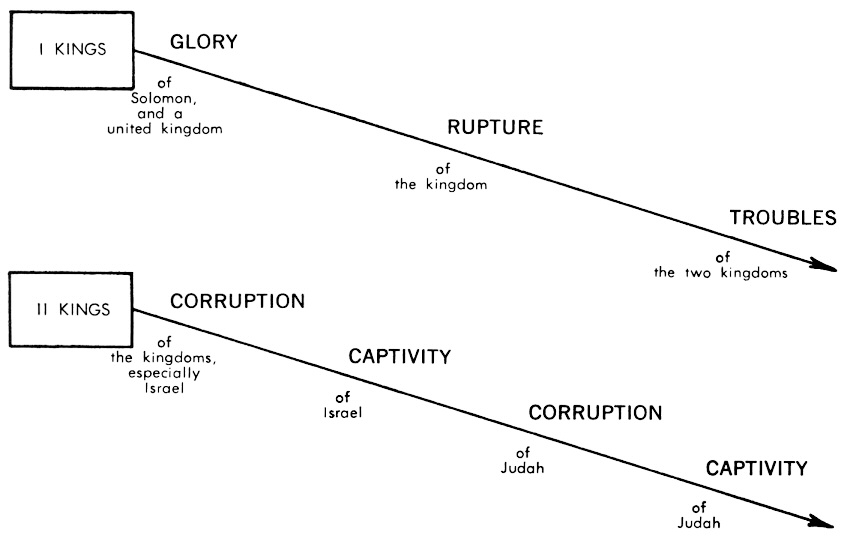
THE DOWNWARD SPIRAL
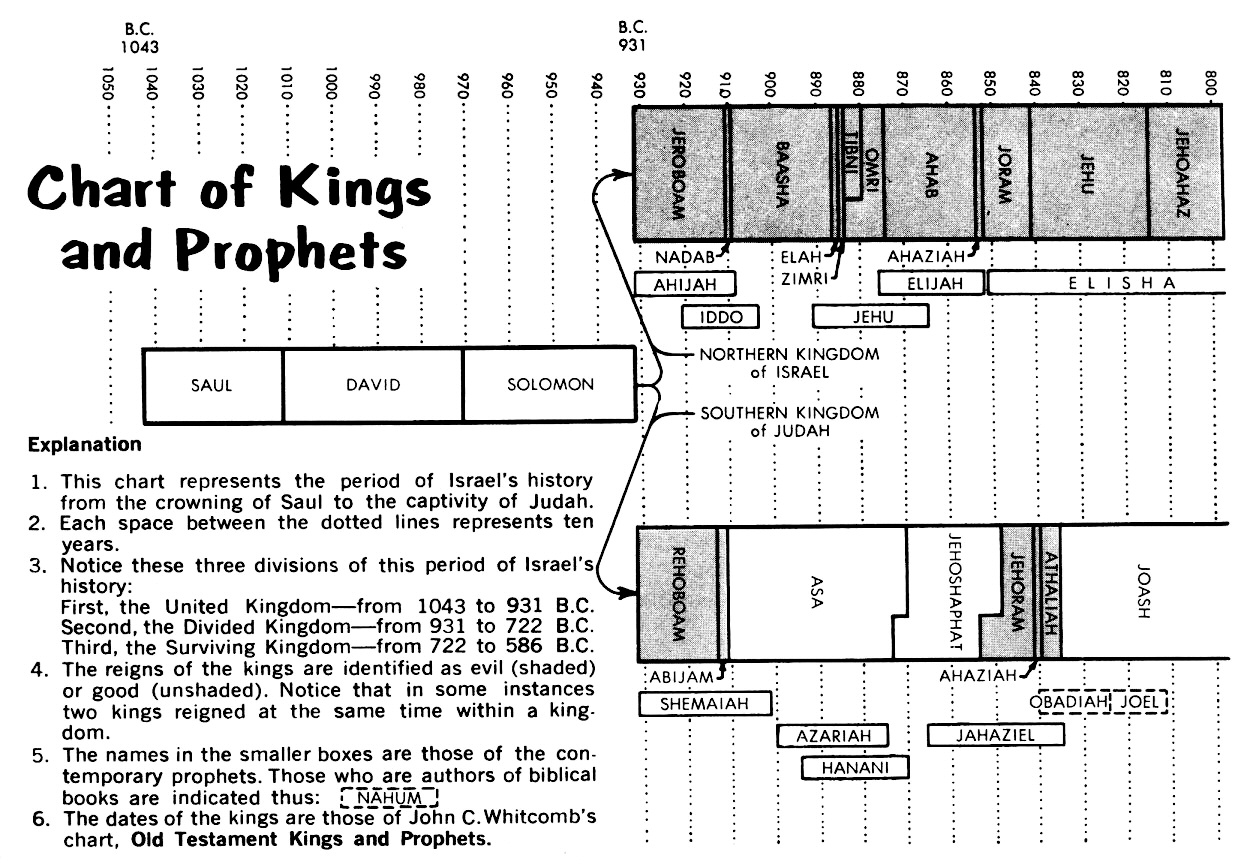
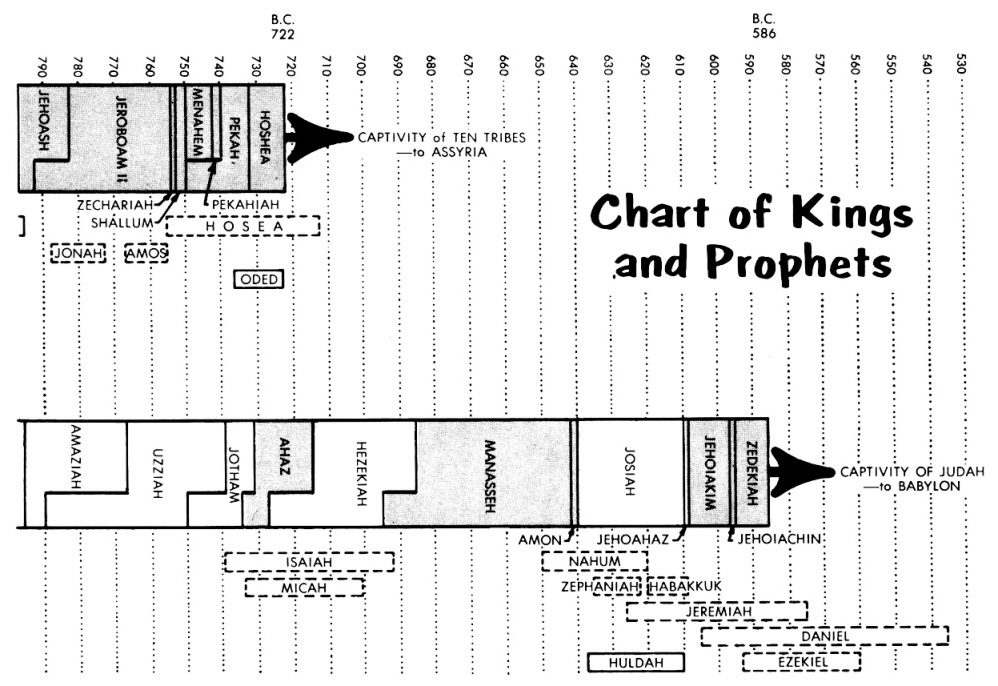

Click chart to enlarge
Chart from Jensen's Survey of the OT - used by permission
Click Chart from Charles Swindoll
|
1107 |
1011 |
971 |
931 |
853 |
722 |
586 |
||||
| 1Samuel | 2 Samuel | 1Kings | 1Kings | 2 Kings | ||||||
|
31 |
1-4 | 5-10 | 11-20 | 21-24 | 1-11 | 12-22 | 1-17 | 18-25 | ||
|
1 Chronicles 10
|
1Chr 11-19 |
1Chr 20-29 |
2 Chronicles |
2 Chronicles |
2 Chronicles |
|||||
|
Legend: B.C. dates at top of timeline are approximate. Note that 931BC marks the division of the Kingdom into Southern Tribes (Judah and Benjamin) and Ten Northern Tribes. To avoid confusion be aware that after the division of the Kingdom in 931BC, the Southern Kingdom is most often designated in Scripture as "Judah" and the Northern Kingdom as "Israel." Finally, note that 1 Chronicles 1-9 is not identified on the timeline because these chapters are records of genealogy. |
||||||||||
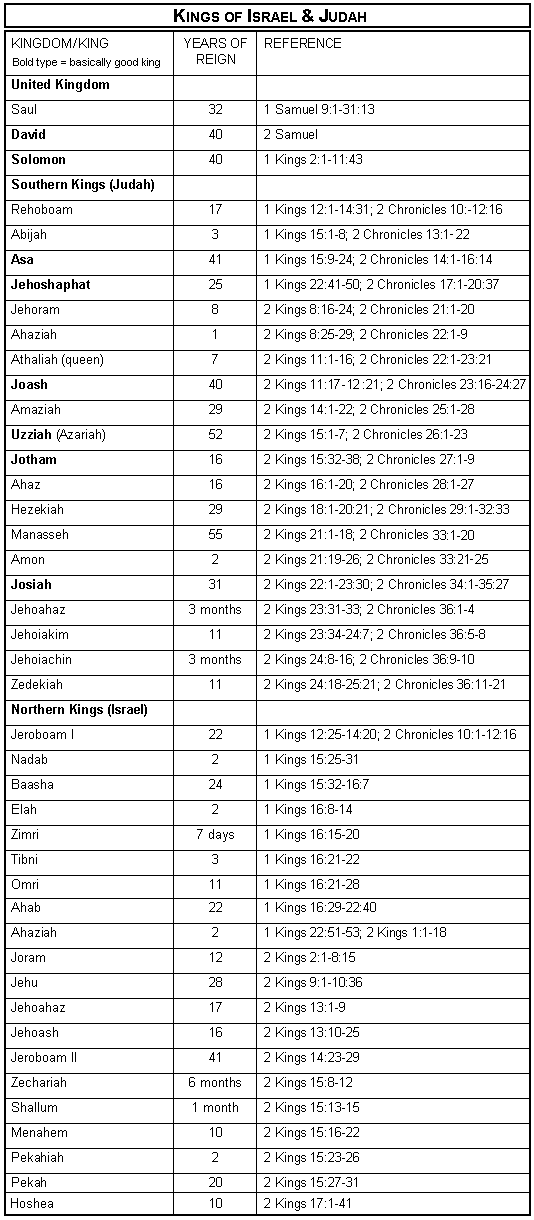
KINGS IN BOLD = GOOD KINGS
SEE ALSO:
ESV chart - kings of Israel - more information
ESV chart - kings of Judah - more information
Another Chart with Variable Dates for Reigns of Kings
2 Chronicles 26:1 And all the people of Judah took Uzziah, who was sixteen years old, and made him king in the place of his father Amaziah.
- all the: 2Ch 22:1 33:25
- Uzziah: 2Ki 14:21 15:1-7 1Ch 3:12, Azariah, Mt 1:8,9, Ozias
- CLICK 2 CHRONICLES COMMENTARIES FOR MULTIPLE SERMONS AND COMMENTARIES
- See BELOW FOR BIBLIOGRAPHY FOR 1-2 CHRONICLES - adapted from Paul Apple's Bible Outlines
Related Passages:
2 Kings 14:21 All the people of Judah took Azariah, who was sixteen years old, and made him king in the place of his father Amaziah.
2 Kings 15:1-7 In the twenty-seventh year of Jeroboam king of Israel, Azariah son of Amaziah king of Judah became king. 2 He was sixteen years old when he became king, and he reigned fifty-two years in Jerusalem; and his mother’s name was Jecoliah of Jerusalem. 3 He did right in the sight of the LORD, according to all that his father Amaziah had done. 4 Only the high places were not taken away; the people still sacrificed and burned incense on the high places. 5 The LORD struck the king, so that he was a leper to the day of his death. And he lived in a separate house, while Jotham the king’s son was over the household, judging the people of the land. 6 Now the rest of the acts of Azariah and all that he did, are they not written in the Book of the Chronicles of the Kings of Judah? 7 And Azariah slept with his fathers, and they buried him with his fathers in the city of David, and Jotham his son became king in his place.
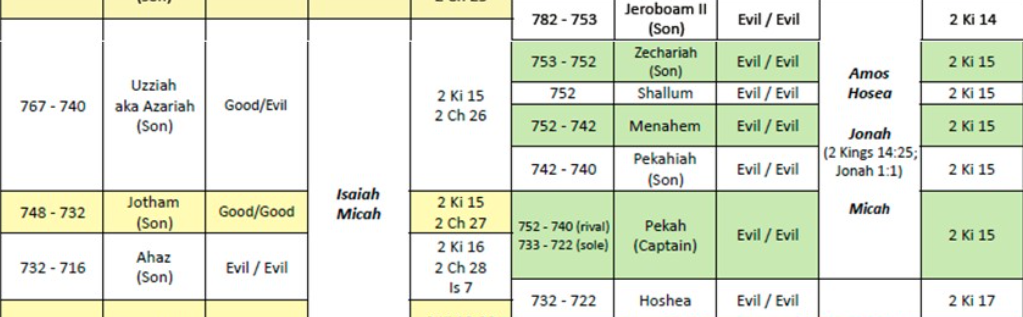
KING UZZIAH = "JEHOVAH IS MY STRENGTH"
KING AZARIAH - "JEHOVAH HAS HELPED"
One cannot imagine a better pair of names than King Uzziah also known as King Azariah! Yahweh is his strength and his help! This man had everything going for him and for a while he ran well. Would this be true of all of God's children! Amen!
Let me encourage you to not get caught up the numbers of the king's reigns because the actual times of co-regencies are not clear cut and there is quite a bit of variation in the commentaries. For example, Warren Wiersbe thinks Uzziah co-reigned with his father Amaziah for 15 years while John W Olley feels he was co-regent for around 25 years and Old Testament scholar Eugene Merrill feels the co-regency lasted 23 years (see Merrill's note)! In sum, don't stumble over the numbers, but focus on the great spiritual lessons in the lives of these kings!
And all the people of Judah took Uzziah, who was sixteen years old, and made him king in the place of his father Amaziah - Uzziah is the 10th king of Judah and is considered one of 7 kings of Judah who were generally good. Here are the other 6 - Asa, Jehoshaphat, Joash (early reign), Jotham, Hezekiah and Josiah. Some add Uzziah's father Amaziah who had a good beginning. All the rest were bad! The saying proved true for most of the kings "Power tends to corrupt; absolute power corrupts absolutely." A person's sense of morality lessens as their power increases. Uzziah is also called Azariah (1 Chr. 3:12) and it may be that the Chronicler uses Uzziah in this chapter because of the possible confusion with the name of the High Priest, Azariah (cf. 2 Chr. 26:17,20). It should be noted that in Uzziah's time Joel, Amos, and Hosea were prophesying, and in the year of his death Isaiah began to minister (Amos 1:1; Hosea 1:1; Isaiah 6:1).
Dilday - “Following the tragic events that brought King Amaziah’s reign to an end, Jerusalem was in disarray, a major section of its protective wall destroyed, its temple and palace emptied of their treasures, and some of its inhabitants taken away to Israel as hostages.”
August Konkel: Uzziah (2 Chron 26:1, etc.) is also known as Azariah. The names seem to be interchangeable. . . The difference may not have had significance, because both words from which the names are derived (‘zr and ‘zz) can mean “victory” or “strength.” The short form of Yahweh at the end of his name indicates it is the strength of God. . . The name of his mother (Jekoliah) similarly means the Lord (Yah) is able (ykl). (Believers Church Bible Commentary – 1 & 2 Chronicles)
Martin Selman on all the people of Judah took Uzziah - Some difficulty is usually implied when the people (2Ch 26:1) are involved in putting a new king on the throne (cf. 2Ch 22:11; 33:25; 36:1), perhaps connected here with Amaziah’s defeat (cf. 2Ch 25:21-24). However, the idea that the king could be chosen by the will of the people was never entirely lost in Judah. (Borrow Tyndale Old Testament Commentaries – 2 Chronicles.)
Christopher Knapp adds "“He seems to have come by the throne, not in the way of ordinary succession, but by the direct choice of the people. The princes had been destroyed by the Syrians toward the close of his grandfather Joash’s reign (2 Chronicles 24:23), leaving the people a free hand."
Henry Morris - Uzziah is the same as Azariah (2 Kings 14:21; 15:1). His name is mentioned by Tiglath-Pilezer on one of the Assyrian inscriptions. (2 Chronicles 26 - Defender's Study Bible)
Believer's Study Bible - This event occurred in 792 B.C. when Amaziah was taken captive in Israel (25:23). The unusual expression "took Uzziah ... and made him king" implies an extraordinary measure in a critical situation.
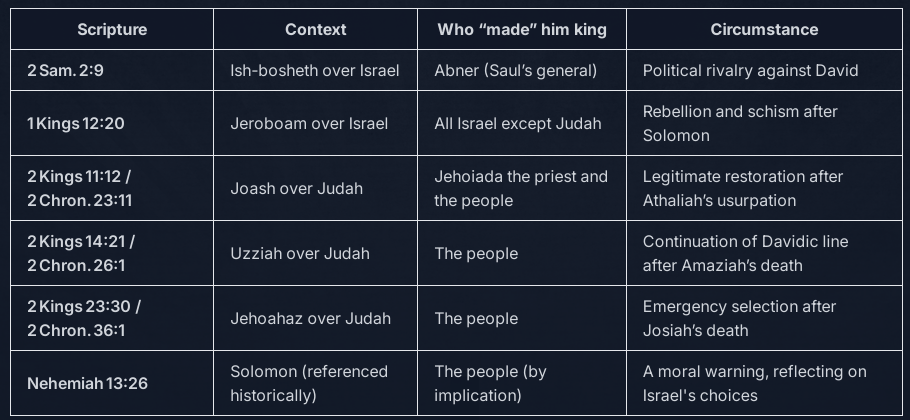
The unusual phrase here is made him king -(9x in OT - see below) It is not merely saying “he became king,” but that someone actively installed, acclaimed, or caused him to be king. This is why the phrase appears in moments of public action, crisis, or legitimacy, not in routine accessions. The phrase often appears when the throne was contested or interrupted (2Sa 2:9 - Abner installs Ish-bosheth after Saul’s death; 1Ki 12:20 - Northern tribes make Jeroboam king in rebellion; 2Ki 23:30 - People install Jehoahaz after Josiah’s death; 2Ch 36:1 - People enthrone Jehoahaz instead of Egyptian choice). The phrase signals this kingship required human ratification because the line was not automatic. The phrase carries a quiet theology eimphasizing that God is the true King-maker. Even when people “make” a king, Scripture shows Human action ≠ divine approval. Example contrast: People made Jeroboam king → disaster. Priests made Joash king → covenant restoration. In short, “Made him king” is a formal enthronement formula signaling public legitimation—used especially after crisis or contested succession—to show that kingship was a covenantal trust conferred by the people under God, not merely automatic inheritance.
Raymond Dillard: The earlier history [2 Kings] had reported that Uzziah did “right” and enjoyed one of the longest reigns of the Judean kings. The Chronicler elaborates by demonstrating the tokens of divine blessing that Uzziah enjoyed; divine help, victory in warfare, a large army, wealth, fame, and building programs (2Ch 26:5–15) are all items in the author’s usual repertoire for portraying the blessings that accrue to fidelity. For the Chronicler, however, such a righteous king should not have suffered a debilitating and disgraceful disease. Where the earlier history had reported Uzziah’s leprosy without comment (2 Kgs 15:5), the Chronicler explains the anomaly by reporting Uzziah’s pride and his cultic sin as the inciting reason for his disease. (Borrow 2 Chronicles)
John Olley: Military successes, agricultural development, and defense buildup flowed from Uzziah’s decision to “seek God” (using darash; 2Ch 26:5 [2x]), following instruction “in the fear of God” from an otherwise unknown Zechariah (2Ch 26:5–15). At that time, “God helped him” (2Ch 26:7, 15), matching his alternative name, Azariah (“the Lord helped”), so he became “strong” (2Ch 26:8, 15). The contrast is blunt: “But when he was strong, he grew proud, to his destruction. For he was unfaithful to the Lord his God” (2Ch 26:16). His actions denied his name, Uzziah (“the Lord is my strength”). Then follows an occasion in which “the Lord struck him,” leading to a skin disease (2Ch 26:16–21; cf. 2 Kings 15:5, which gives no reason). When he was rebuked for usurping a priestly function in the temple, he was “angry” (zaʻap, “rage”; 2Ch 26:19). As with his father and grandfather, past faithfulness and success did not guarantee continuing humility before God. God’s word was rejected. (ESV Expository Commentary)
Frederick Mabie: The forty-year overlap between the reigns of Uzziah in Judah and Jeroboam II in Israel indicate a time of significant peace and prosperity for both kingdoms, aided by geopolitical realities such as weakness in Aram and regional distractions in Assyria. In addition to the prosperity of this period, the geographical extent of both Israel and Judah expanded considerably during the long reigns of these kings. In the northern kingdom, Jeroboam II extended the northern border of Israel to Lebo Hamath (including taking Damascus) and recaptured previously lost territory in Transjordan (cf. 2Ki 14:25, 28). In the southern kingdom, Uzziah was able to prevail over several Philistine cities in the west (including Gath and Ashdod), the Ammonites in the east, and Arabians and Meunites in the south. The Chronicler notes that these victories caused Uzziah’s fame to spread “as far as the border of Egypt” (2Ch 26:8). Uzziah also rebuilt the Judean maritime port at Elath (2Ch 26:2; cf. 2Ki 14:22) and fortified the southern Negev and wilderness regions (2Ch 26:10). As a result of these territorial gains by Israel and Judah, the combined geographical extent of the northern and southern kingdoms approximated the extent seen at the height of the united monarchy under David and Solomon. Moreover, the resulting control of trade routes enhanced the prosperity of both Israel and Judah. (The Expositor’s Bible Commentary Revised Edition – 1 & 2 Chronicles)
Martin Selman: This is the last of three successive reigns which concludes with a period of disobedience and disaster, and it seems that nothing is able to prevent Judah and their kings sliding into sin and judgment. Idolatry, rejection of the prophets, violence, and pride repeat themselves with devastating regularity.
Matthew Henry Notes: Chapter: 2Ch 26
This chapter gives us an account of the reign of Uzziah (Azariah he was called in the Kings) more fully than we had it before, though it was long, and in some respects illustrious, yet it was very briefly related, 2 Ki. 14:21; 15:1, etc. Here is,
I. His good character in general (2Ch 26:1-5)
II. His great prosperity in his wars, his buildings, and all the affairs of his kingdom (2Ch 26:6-15).
III. His presumption in invading the priests' office, for which he was struck with a leprosy, and confined by it (2Ch 26:16-21) even to his death (2Ch 26:22, 23).
2Ch 26:1-15
We have here an account of two things concerning Uzziah:-
I. His piety.
In this he was not very eminent or zealous; yet he did that which was right in the sight of the Lord. He kept up the pure worship of the true God as his father did, and was better than his father, inasmuch as we have no reason to think he ever worshipped idols as his father did, no, not in his latter days, when his heart was lifted up. It is said (2Ch 26:5), He sought God in the days of Zechariah, who, some think, was the son of the Zechariah whom his grandfather Joash slew. This Zechariah was one that had understanding in the visions of God, either the visions which he himself was favoured with or the visions of the preceding prophets. He was well versed in prophecy, and conversed much with the upper world, was an intelligent, devout, good man; and, it seems, had great influence with Uzziah. Happy are the great men who have such about them and are willing to be advised by them; but unhappy those who seek God only while they have such with them and have not a principle in themselves to bear them out to the end.
II. His prosperity.
1. In general, as long as he sought the Lord, and minded religion, God made him to prosper. Note,
(1.) Those only prosper whom God makes to prosper; for prosperity is his gift.
(2.) Religion and piety are very friendly to outward prosperity. Many have found and owned this, that as long as they sought the Lord and kept close to their duty they prospered; but since they forsook God every thing has gone cross.
2. Here are several particular instances of his prosperity:-
(1.) His success in his wars: God helped him (2Ch 26:7), and then he triumphed over the Philistines (those old enemies of God's people), demolished the fortifications of their cities, and put garrisons of his own among them, 2Ch 26:6. He obliged the Ammonites to pay him tribute, 2Ch 26:8. He made all quiet about him, and kept them in awe.
(2.) The greatness of his fame and reputation. His name was celebrated throughout all the neighbouring countries (2Ch 26:8) and it was a good name, a name for good things with God and good people. This is true fame, and makes a man truly honourable.
(3.) His buildings. While he acted offensively abroad, he did not neglect the defence of his kingdom at home, but built towers in Jerusalem and fortified them, 2Ch 26:9. Much of the wall of Jerusalem was in his father's time broken down, particularly at the corner gate. But his best fortification of Jerusalem was his close adherence to the worship of God: if his father had not forsaken this the wall of Jerusalem would not have been broken down. While he fortified the city, he did not forget the country, but built towers in the desert too (2Ch 26:10), to protect the country people from the inroads of the plunderers, bands of whom sometimes alarmed them and plundered them, as 2Ch 21:16.
(4.) His husbandry. He dealt much in cattle and corn, employed many hands, and got much wealth by his dealing; for he took a pleasure in it: he loved husbandry (2Ch 26:10), and probably did himself inspect his affairs in the country, which was no disparagement to him, but an advantage, as it encouraged industry among his subjects. It is an honour to the husbandman's calling that one of the most illustrious princes of the house of David followed it and loved it. He was not one of those that delight in war, nor did he addict himself to sport and pleasure, but delighted in the innocent and quiet employments of the husbandman.
(5.) His standing armies. He had, as it should seem, two military establishments.
{1.} A host of fighting men that were to make excursions abroad. These went out to war by bands, 2Ch 26:11. They fetched in spoil from the neighbouring countries by way of reprisal for the depredations they had so often made upon Judah,
{2.} Another army for guards and garrisons, that were ready to defend the country in case it should be invaded, 2Ch 26:12, 13. So great were their number and valour that they made war with mighty power; no enemy durst face them, or, at least, could stand before them. Men unarmed can do little in war. Uzziah therefore furnished himself with a great armoury, whence his soldiers were supplied with arms offensive and defensive (2Ch 26:14), spears, bows, and slings, shields, helmets, and habergeons: swords are not mentioned, because it is probable that every man had a sword of his own, which he wore constantly. Engines were invented, in his time, for annoying besiegers with darts and stones shot from the towers and bulwarks, v. 15. What a pity it is that the wars and fightings which come from men's lusts have made it necessary for cunning men to employ their skill in inventing instruments of death.
QUESTION - Who was King Uzziah in the Bible?'
ANSWER - King Uzziah in the Bible was one of the good kings of Judah. His father was King Amaziah, and his mother was a woman named Jecoliah, from Jerusalem. Uzziah was the father of King Jotham. Ministering during Uzziah’s reign were the prophets Hosea, Isaiah, Amos, and Jonah. The kings in the northern kingdom of Israel during his time were Jeroboam II, Zechariah, Shallum, Menahem, Pekahiah, Pekah, and Hoshea. Uzziah is also called Azariah in 2 Kings 14:21.
King Uzziah was sixteen years old when he began to reign, and he reigned for 52 years in Judah from approximately 790 to 739 BC. He “did what was right in the eyes of the Lord” as his father Amaziah had done (2 Chronicles 26:4). King Uzziah sought the Lord “during the days of Zechariah, who instructed him in the fear of God.” This Zechariah is most likely a godly prophet to whom Uzziah listened. As long as Uzziah made a point to seek God, God made him prosperous (2 Chronicles 26:5). Unfortunately, after Zechariah died, Uzziah made some mistakes later in his life.
King Uzziah in the Bible is shown as a wonderfully intelligent and innovative king, under whom the state of Judah prospered (2 Chronicles 26:6–15). He was used by God to defeat the Philistines and Arabs (verse 7), he built fortified towers and strengthened the armies of Judah (verses 9 and 14), and he commissioned skilled men to create devices that could shoot arrows and large stones at enemies from the city walls (verse 15). He also built up the land, and the Bible says he “loved the soil” (verse 10). The Ammonites paid tribute to King Uzziah, and his fame spread all over the ancient world, as far as the border of Egypt (verses 8 and 15).
Unfortunately, King Uzziah’s fame and strength led him to become proud, and this led to his downfall (2 Chronicles 26:16). He committed an unfaithful act by entering the temple of God to burn incense on the altar. Burning incense on the altar was something only the priests could do. By attempting to do this himself, Uzziah was basically saying he was above following the Law. It was not a humble thing to do. Eighty courageous priests, led by a high priest named Azariah, tried to stop the king: “It is not right for you, Uzziah, to burn incense to the Lord. That is for the priests, the descendants of Aaron, who have been consecrated to burn incense. Leave the sanctuary, for you have been unfaithful; and you will not be honored by the Lord God” (2 Chronicles 26:18). Uzziah became angry with the priests who dared confront him. But, “while he was raging at the priests in their presence before the incense altar in the Lord’s temple, leprosy broke out on his forehead” (verse 19). Uzziah ran from the temple in fear, because God had struck him (verse 20). From that day to the day of his death, King Uzziah was a leper. He lived in a separate palace and was not allowed to enter the temple of the Lord. His son, Jotham, governed the people in his place.
King Uzziah is also mentioned in the book of Matthew as one of the ancestors of Joseph, Jesus’ legal father (Matthew 1:8–9).GotQuestions.org
QUESTION - WHO IS AZARIAH? GOTQUESTIONS.ORG?
ANSWER - Azariah was a common man’s name in Bible times. The name Azariah means "Yahweh has helped." Names were often given for spiritual reasons. For example, an "ah" added to a name was significant because it was part of Yahweh’s name. When God changed Abram’s name to Abraham and Sarai’s name to Sarah, He was giving them His name as part of His covenant with them (Genesis 17: 4-5, 15-16).....
Another Azariah, also called Uzziah, was a king of Judah (2 Chronicles 26). Historians speculate that he reigned from 783-742 B. C., much of that time as co-regent along with his father, Amaziah. He was 16 years old when he began to reign. He was a good king and helped return the people to the worship of Yahweh alone. For that reason, God allowed him to reign as king for 52 years, significantly longer than most kings ruled. Second Chronicles 26:5 says, "And as long as he sought the LORD, God gave him success." However, in verses 14-16, things changed: "But when Uzziah grew powerful, his arrogance led to his own destruction. He was unfaithful to the LORD his God, for he entered the temple of the LORD to burn incense on the altar of incense." Despite his name and despite his earlier adherence to the laws of God, his heart grew proud. He couldn’t handle the success God gave him and began to believe that he was responsible for the good things in his life.
We can learn from Azariah’s name that simply beginning well does not ensure a lifetime of obedience to God. Even having the name of the Lord as part of our heritage does not free us from the responsibility to live up to that name. We may be born into a Christian home, learn about Jesus from nursery school, and walk faithfully for a time, but God places a high value on faithfulness. Enduring to the end is important (Matthew 24:13; James 5:11; 2 Timothy 2:12). When the Lord is part of our identity, we must live out our days in a way that continues to honor His name.
James Smith - UZZIAH; or, FAILURE THROUGH PRIDE. 2 Chronicles 26.
"The fall thou darest to despise—
May be the angel's slackened hand
Has suffered it, that he may rise
And take a firmer, surer stand;
Or, trusting less to earthly things,
May henceforth learn to use his wings."
—Procter.
Uzziah was but a lad of sixteen when he was crowned king of Judah. His reign was a long one, extending over fifty-two years. It was good for him that he came under the godly influence of the clear-visioned Zechariah, the burden of whose message was, "If ye forsake the Lord ye cannot prosper" (chap. 24:20). Who can reckon up the full value of that life, which has been illumined with a definite message from God. Zechariah's word had burned its way into the heart of young Uzziah, for in his days he sought God (2Ch 26:5). The story of his life reveals to us—
I. An Encouraging Testimony.
The writer of the Chronicles tells us that, "As long as he sought the Lord, God made him to prosper" (2Ch 26:5). As long as God got His true place in the life and work of Uzziah, there were no interruptions to the steady march of his rising prosperity. All true and abiding prosperity is "God-made," and the condition of it is seeking to know and how to do His will. Mark that it was "as long as he sought the Lord," and no longer that the divine benediction rested on him and his work. It is ours to go on trusting; it is His to go on blessing.
II. An Assuring Confirmation.
"He was marvellously helped till he was strong" (2Ch 26:15). God helped him against the Philistines, and against the Arabians (2Ch 26:7), to build towers, and to dig many wells (v. 10). He also gave him a great host "that made war with mighty power to help him against the enemy" (2Ch 26:13). The help of God is intensely practical. They are always marvellously helped that are helped of God. It is surely God's purpose to make those strong who seek Him, that His will may be done in them. God will still bear them witness, both with signs and wonders, and with divers miracles and gifts (distributions) of the Holy Ghost (Heb. 2:4). "Be ye strong in the Lord, and in the power of His might."
III. A Terrible Fall.
"But when he was strong, his heart was lifted up to his destruction" (2Ch 26:16). It is a great privilege to be helped of God and made strong, but every privilege has its corresponding temptation and danger. Peter was made strong to walk on the sea, but even then he began to sink. Elijah was made strong to overcome the wicked works of Ahab, yet afterwards he fled before the wrath of Jezebel. Yes, Uzziah fell.
1. THE CAUSE. "His heart was lifted up." Lifted up through pride and self-confidence. As long as he sought the honour of the Lord, God lifted him up, but now that he seeks to honour himself by assuming the priestly office he falls from the grace of God (2Ch 26:18). His position as king gave him no right as priest. A man's worldly position gives him no authority or fitness for the holy ministry. Uzziah, in his presumption, was setting aside the revealed will of God. He must have known that the Levites had been chosen of God from among the children of Israel to do the service of the tabernacle. A solemn warning had also been given: "The stranger that cometh nigh shall be put to death" (Num. 18:6, 7). But, in his own name, and in his own strength, he would go, so his pride led to his fall. It is of the nature of self-righteousness to despise the work and office of the Priestly Saviour.
2. THE EFFECT. "He was a leper unto the day of his death" (2Ch 26:21). He was wroth, and would not go back when Azariah the priest remonstrated with him, but when the Lord smote him with leprosy "he hasted to go out" (2Ch 26:20). Instead of his work being accepted of God, he was smitten with a curse, and driven out from His presence with a lifelong brand of sin upon him. Like many other lepers, the plague was in his head. Having been smitten with a sense of his presumption and sin, God did not need to cast him out of His holy place, for he himself hasted to go out. The holy presence of God is no place of comfort and rest for the unforgiven sinner. Heaven is no home for those who ignore the work of Christ, who is our Great High Priest. He is the One Mediator between God and man; the Way, the Truth, and the Life; no man can come unto the Father but by Him. It was Uzziah's own sin that "cut him off from the house of the Lord" (2Ch 26:21). It is the sin of putting proud self in the place of the Lord's Anointed that kindles the wrath of God, and cuts that soul off from fellowship with Him. The man who sets aside God's appointed way of life does it to his own destruction. "There is none other name under Heaven given among men whereby we must be saved."
John Butler - 2 Chronicles 26—Reign of Uzziah. He was called Azariah in the account of his reign given in Second Kings. This account of his 52 year reign is much fuller than the report in Second Kings. •Faith: he sought the Lord. •Freedom: he freed Israel of many enemies. •Fortifying: he built up defenses in many cities. •Fear: other nations feared him and gave gifts to him. •Farming: Uzziah “loved husbandry [farming]” (v. 10) and did much in this area. •Forces: his armed forces were many and mighty and had the latest equipment. •Fame: “his name was spread far abroad” (v. 15). •Failure: this was the great blot on his life. It includes the place of his sin (he intruded into the priests’ office); the pride for his sin (he was puffed up by his successes and this helped cause his sin); the protest of his sin (Azariah and other priests protested Uzziah’s sinful act); the punishment for his sin (he was made a leper the rest of his life and had to dwell in a separate place because of it).
2 Chronicles 26:2 He built Eloth and restored it to Judah after the king slept with his fathers.
- Eloth: 2Ch 8:17 2Ki 14:22 2Ki 16:6, Elath
- restored: 2Ch 25:23,28
Parallel Passage:
2 Kings 14:22 He built Elath and restored it to Judah after the king slept with his fathers.
2 Kings 16:6 At that time Rezin king of Aram recovered Elath for Aram, and cleared the Judeans out of Elath entirely; and the Arameans came to Elath and have lived there to this day.
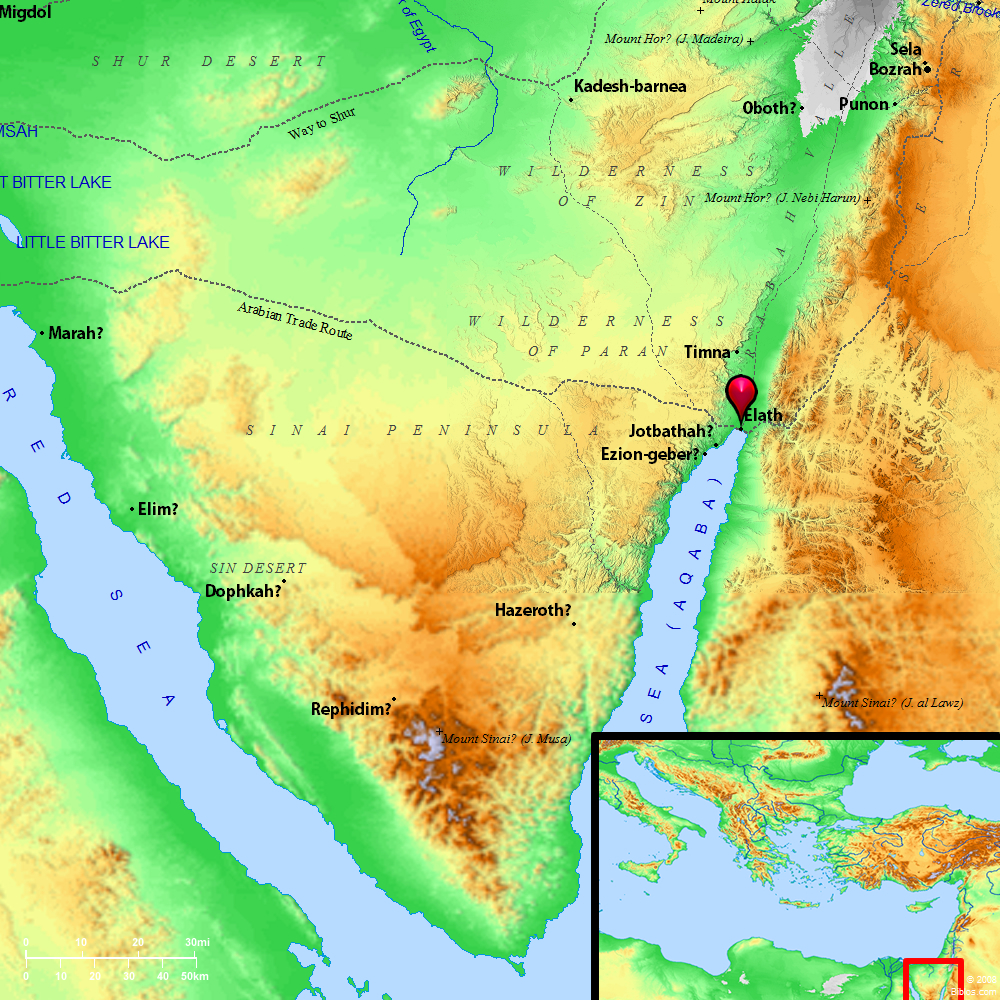
Eloth (Elath)
KING UZZIAH
A GREAT BEGINNING
He built Eloth and restored it to Judah after the king slept with his fathers - This move signaled that Judah was once again a force to be reckoned with.
Uzziah's early obedience and seeking the LORD brought divine blessing. His father Amaziah’s defeat of the Edomites (2Ki 14:7-10, 2Ch 25:5-14) allowed his son Uzziah/Azariah to build up Eloth as a strong Judean port which it had been in the days of Solomon (2Ch 8:17; 2Ch 26:2) Solomon had even built a naval fleet there (1Ki 9:26-28).
Uzziah’s rebuilding of Eloth is both a symbol of godly beginnings and a warning of how easily blessing can be lost when a heart turns from humble trust in the LORD. Eloth (Elath) was a valuable port on the Gulf of Aqaba (map). It was a strategic commercial link to Edom, Arabia, and even to Africa and India via the sea.

During earlier years, Edom had rebelled against Judah’s authority (2Ki 8:20-22), and Eloth had likely fallen out of Judah’s control. By rebuilding and reclaiming it, young Uzziah re‑established Judah’s southern trade gateway and extended its prosperity and influence. This action symbolized stability returning to the kingdom after a time of political turmoil and Amaziah’s tragic downfall.
Bob Utley - "Eloth" This is an alternate name for Elath, a city at the northern end of the Gulf of Aqaba, close to Ezion-geber. Solomon had started a commercial fleet in this area (1 Kgs. 9:26-28) and Jehoshaphat tried to restart it, but failed (2 Chr. 20:35-37). Apparently Uzziah was also attempting to restart these lucrative trade routes. Edom had earlier captured this area but Amaziah defeated Edom and his son recaptured the area.
Walton on Eloth - Elath (or Eloth) was the seaport constructed by Solomon at the head of the Gulf of Aqaba (see comment on 2 Chron 8:17). It was closely associated with the nearby port of Ezion Geber. It opened trade for Judah with Arabia, Africa and India. Uzziah apparently attempted to revive the Red Sea trade instituted by Solomon. (IVP Bible Background Commentary on the OT- page 447)
(Eloth) symbolized the beginning of a prosperity
unparalleled in Judah since the days of Solomon
Martin Selman: “Eloth” was an important port at the northern end of the Gulf of Aqaba, very close to Ezion-Geber where Solomon and Jehoshaphat had kept ships (2 Chr. 8:17-18; 20:35-37). Uzziah’s reclaiming it for Judah signified two things. - It brought Amaziah’s unfinished Edomite business to an end (2 Chr. 21:8-10; 25:11-12), and - symbolized the beginning of a prosperity unparalleled in Judah since the days of Solomon (BORROW Tyndale Old Testament Commentaries – 2 Chronicles.)
J Vernon McGee - The denominational seminary from which I graduated was quite liberal, but it did have a Bible course, although it was very fragmentary. One of the questions that had been asked from time immemorial was to name the kings of Israel and Judah and briefly describe the reign of each. Some ingenious freshman of days gone by had discovered that if you would write after each one of them, "A bad king," you couldn't make less than ninety five percent -- and what freshman wants to make more than that? So what we all did was memorize the kings and write after each one of them, "A bad king." Now when we wrote, "Bad king" after Uzziah's name, we were wrong; Uzziah was not exceptional, but he was a good king.
ISBE - ELATH; ELOTH - e'-lath, or e'-loth ('eloth, 'elath; Ailon (Dt 2:8), Ailath (2 Ki 16:6)): A seaport on the Red Sea in the territory of Edom. It is named along with Ezion-geber in the account of Israel's journey round the land of Edom (Dt 2:8). It appears as Ailath, and Alion in the Septuagint, and in Josephus as Ilanis (Ant., VIII, vi, 4), while Eusebius (Onomasticon) has Aila. From this we may gather that the Aramaic Ilan or Ilana was in use as well as the Hebrew 'elath or 'eloth. The name, "grove," was doubtless derived from the presence of certain sacred trees. It may be identical with El-paran of Gen 14:6, and Elah of Gen 36:41. When David conquered Edom, Elath passed into the hands of Israel (2 Sam 8:14). It was a position of great importance in connection with the trade with South Arabia. Here the merchant fleets of Solomon and Jehoshaphat were fitted out, and hence, they sailed (1 Ki 9:26; 2 Ch 8:17; 1 Ki 22:48). In the reign of Jehoram, son of Jehoshaphat, Edom shook off the hand of Judah (2 Ki 8:20), but under Amaziah and Uzziah it was again subdued (2 Ki 14:7,10,22). Finally it was taken from Ahaz by Rezin, king of Syria. The Jews were driven out and the Syrians (Edomites?) took permanent possession (2 Ki 16:6). It is identical with the modern `Aqaba, at the head of the gulf of that name. - W. Ewing
2 Chronicles 26:3 Uzziah was sixteen years old when he became king, and he reigned fifty-two years in Jerusalem; and his mother’s name was Jechiliah of Jerusalem.
- Uzziah: Isa 1:1, 6:1 Ho 1:1 Am 1:1 Zec 14:5
- Jecoliah: 2Ki 15:2,3, Jecholiah
Related Passage:
1 Chronicles 3:10-12 Now Solomon’s son was Rehoboam, Abijah was his son, Asa his son, Jehoshaphat his son, 11 Joram his son, Ahaziah his son, Joash his son, 12 Amaziah his son, Azariah his son, Jotham his son,
2 Kings 14:19-21 They conspired against him in Jerusalem, and he fled to Lachish; but they sent after him to Lachish and killed him there. 20 Then they brought him on horses and he was buried at Jerusalem with his fathers in the city of David. 21 All the people of Judah took Azariah, who was sixteen years old, and made him king in the place of his father Amaziah.
Isaiah 1:1 The vision of Isaiah the son of Amoz concerning Judah and Jerusalem, which he saw during the reigns of Uzziah, Jotham, Ahaz and Hezekiah, kings of Judah.
Isaiah 6:1 In the year of King Uzziah’s death I saw the Lord sitting on a throne, lofty and exalted, with the train of His robe filling the temple.
Hosea 1:1 The word of the LORD which came to Hosea the son of Beeri, during the days of Uzziah, Jotham, Ahaz and Hezekiah, kings of Judah, and during the days of Jeroboam the son of Joash, king of Israel.
Amos 1:1 The words of Amos, who was among the sheepherders from Tekoa, which he envisioned in visions concerning Israel in the days of Uzziah king of Judah, and in the days of Jeroboam son of Joash, king of Israel, two years before the earthquake.
Matthew 1:8-9 (MESSIANIC LINE) Asa was the father of Jehoshaphat, Jehoshaphat the father of Joram, and Joram the father of Uzziah. 9 Uzziah was the father of Jotham, Jotham the father of Ahaz, and Ahaz the father of Hezekiah.
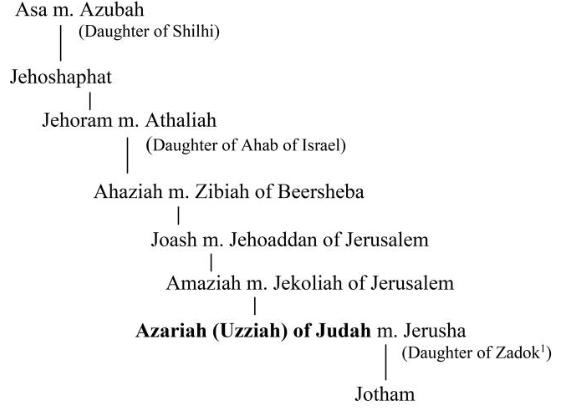
Source: All the Genealogies of the Bible
UZZIAH'S YOUNG BEGINNING
AND LONG REIGN
Uzziah was sixteen years old when he became king, and he reigned fifty-two years in Jerusalem - This lengthy reign includes co-reign with his father Amaziah and co-reign with his son, Jotham. Azariah (Uzziah) likely began ruling alongside Amaziah after the crisis recorded in 2 Kings 14:19–21, when Amaziah’s authority was weakened and the people placed the young Azariah on the throne to ensure stability in Judah. This early co-reign allowed Azariah to gain experience in governance while his father was still living. Decades later, after Uzziah was struck with leprosy for his presumptuous act in the temple (2 Chr 26:16–21), the pattern was repeated in reverse: his son Jotham governed “over the household, judging the people of the land” (2 Ki 15:5). Thus, the fifty-two years attributed to Azariah were not years of solitary rule but of shared authority on both ends—first as junior partner under Amaziah, and finally as a sidelined monarch while Jotham exercised effective kingship. This explains how Judah could experience remarkable continuity despite the personal failure and discipline of its long-reigning king.
This lengthy reign includes both a co-regency with his father Amaziah and later a co-regency with his son Jotham. Azariah (Uzziah) likely began ruling alongside Amaziah around 792 BC, after the crisis recorded in 2 Kings 14:19–21, when Amaziah’s authority was weakened and the people placed the young Azariah on the throne to ensure stability in Judah. This early co-reign (c. 792–767 BC) allowed Azariah to gain experience in governance while his father was still living.
Decades later, after Uzziah was struck with leprosy for his presumptuous act in the temple (2 Chr 26:16–21), the pattern was repeated in reverse: his son Jotham governed “over the household, judging the people of the land” (2 Ki 15:5). This second co-regency likely began about 750/749 BC and continued until Uzziah’s death in 740 BC. Thus, the fifty-two years attributed to Azariah were not years of solitary rule but of shared authority on both ends—first as junior partner under Amaziah, and finally as a sidelined monarch while Jotham exercised effective kingship. This explains how Judah could experience remarkable continuity despite the personal failure and discipline of its long-reigning king.
And his mother’s name was Jechiliah of Jerusalem Jechiliah was a native of the holy city and the wife of King Amaziah (2 Kings 14:21). Jechiliah means “Jehovah is able.” Beautifully, that meaning fits the story of her son, mirroring the spiritual truth he would later need, strength is from Yahweh alone. While we have no recorded acts or speech from Jecoliah, the biblical pattern indicates that this mother’s spiritual influence affected her son’s early reign. Christian mothers, are you listening? (cf Pr 31:28)
Eugene Merrill on the complicated Chronological Problem - Only 16 years old at the time, Uzziah reigned for the extraordinarily long period of 52 years (cf. 2 Chron. 26:3; 790-739 b.c.). A serious chronological problem emerges here. Amaziah reigned from 796 to 767, so if Uzziah commenced his reign in 790 he co-reigned with his father for 23 years. Yet the chronicler (and the author of 2 Kings as well) seemed to indicate that Uzziah's tenure followed that of Amaziah and that Uzziah was only 16 years old at the time. How then could his coregency be for 23 years?
The chronological data for both kings are very well established on grounds too complicated to be considered here. (For a full discussion see Edwin R. Thiele, The Mysterious Numbers of the Hebrew Kings [BORROW]. Rev. ed. Grand Rapids: Wm. B. Eerdmans Publishing Co., 1983, pp. 113-23.) The narratives can be viewed in a way that legitimately comports with the dates mentioned earlier. The best solution appears to be that the leadership of Judah, fearing early in Amaziah's reign that he was unstable and incompetent, made his young son Uzziah vice-regent. In other words after Amaziah had reigned only six years (796-790) Uzziah, then (in 790) 16 years old, was appointed second to the king. From then until Amaziah's death (767) they reigned together for 23 years (790-767). Then Uzziah reigned alone for 29 years until his own death. (ED: THIS IS NOT COMPLETELY ACCURATE - UZZIAH'S LEPROSY LED TO HIS SON JOTHAM BEGINNIG TO CO-REIGN - 2Ch 26:21. YES UZZIAH STILL HAD THE TITLE OF "KING" BUT HE CO-REIGNED WITH HIS SON FOR ABOUT THE LAST 10 YEARS AND THEN JOTHAM RULED ANOTHER 4-5 YEARS ON HIS OWN.)
This would require, of course, that the chronicler meant that the people of Judah had made Uzziah vice-regent at the age of 16 (2 Chron. 26:1). In support of this reconstruction is the fact that Uzziah received religious instruction from Zechariah (v. 5). Zechariah, however, was stoned to death by some Judeans before the death of Amaziah's predecessor Joash (24:21-22), who died in 796. Uzziah, then, obviously was of a teachable age before 796 (by 796 he would have been 10 years old). His major independent accomplishments could not have come about until his sole regency began in 767 so these are the ones with which the historian is particularly concerned. (1-2 Chronicles - Bible Knowledge Commentary BORROW)
2 Chronicles 26:4 He did right in the sight of the LORD according to all that his father Amaziah had done.
- according to all: 2Ch 25:2
UZZIAH'S EARLY WALK
WAS CORAM DEO
He did right (yashar) in the sight of the LORD - The next verse gives us a major part of the secret of his spiritual success. At this time in King Uzziah's life it appears that his heart was wholly God's. It follows that he is a glorious illustration of the truth of 2Ch 16:9 which promises that "the eyes of the LORD move to and fro throughout the earth that He may strongly support those whose heart is completely His."
Doing right in the sight of the LORD means living under divine oversight, knowing that God sees every act and every motive (Pr 15:3, Heb 4:13). It is a life of reverent accountability before a holy God. As we might say today it is living Coram Deo-Before the Face of God. Sadly, as the rest of Amaziah's story shows, a good beginning does not guarantee a good finish.
🙏 THOUGHT - Are you living Coram Deo-Before the Face of God, remembering that our life will ultimately be evaluated at the Bema Seat of Christ, not by what men see, but what the LORD sees. When God takes the measure of a man or woman, He doesn't but a "tape measure" around your head to see how much you know, but He puts it around your heart to see how much you obey! (cf Pr 4:23)
Henry Morris - It is striking that many of Judah's kings, beginning with Solomon and including such stalwarts as Asa, Joash and Amaziah, started their reigns doing "right in the sight of the LORD," then later descended into compromise with paganism or into outright rebellion against God's Word. This same phenomenon is often noted among modern Christian leaders--not only among political leaders--but among religious and educational leaders as well. (2 Chronicles 26 - Defender's Study Bible)
According to all that his father Amaziah had done - This is at first glance a somewhat enigmatic description. Why? Amaziah began well but ended poorly. After defeating the Edomites King Amaziah foolishly worshiped the Edomite gods he had just defeated (2Ch 25:14-16). Amaziah also rejected prophetic rebuke, provoked a disastrous war with Israel (2Ch 25:17-22) and ended by being assassinated (2 Ki 14:19). Therefore according to all that his father Amaziah had done clearly refers to the early obedience of Amaziah. On the other hand, there is some resemblance to Amaziah, iin that Uzziah began well but did not end well for he committed a sin that resulted in leprosy removal from the official king's house.
Right (03477) yashar from the verb yashar = to be smooth, straight or right) is an adjective that means straight; reliable, level, pleasing; upright; righteous. Yashar only rarely is used literally of that which is straight (Ezek 1:7). Yashar can refer to something physical like a path, but even in those uses is often a metaphorical description of one's conduct or behavior (Ps 107:7). Most uses refer to that which is right in an ethical or an emotional sense, as agreeable or pleasing. It is fitting that God is the standard of yashar (what is "straight") (Ps 92:15, called the "Upright One" - Isa 26:7). God's Word is described as upright (right) (Ps 19:7) as are His judgments (Ps 119:137) and His way (Ps 107:7). "God made men upright (Ge 1:27), but they have sought out many devices." (Eccl 7:29)
Yashar is frequently used to describe our moral/ethical heart as "upright in heart" (Ps 7:10, 11:2, 32:11, 36:10, 64:10, 94:15, 97:11, 111:1, 125:4) (See all uses in Psalms and Proverbs below). Indeed, the upright "will behold His face" (Ps 11:7), will experience gladness (Ps 97:11), will be gathered together in the assembly (Ps 111:1), will be blessed (Ps 112:2), will be given light in times of darkness (Ps 112:4), will dwell in God's presence (Ps 140:13, cp Pr 2:21), have access to God's sound wisdom (Pr 2:7), will experience intimacy with the Most High God (Pr 3:32), will be guided by their integrity (Pr 11:3), will be delivered by their righteousness (Pr 11:6), will be delivered by their words (Pr 12:6), will see their tents flourish (Pr 14:11). "The highway of the upright is to depart from evil." (Pr 16:17)
YASHAR IN KINGS AND CHRONICLES - 1 Ki. 11:33; 1 Ki. 11:38; 1 Ki. 14:8; 1 Ki. 15:5; 1 Ki. 15:11; 1 Ki. 22:43; 2 Ki. 10:3; 2 Ki. 10:15; 2 Ki. 10:30; 2 Ki. 12:2; 2 Ki. 14:3; 2 Ki. 15:3; 2 Ki. 15:34; 2 Ki. 16:2; 2 Ki. 18:3; 2 Ki. 22:2; 2 Chr. 14:2; 2 Chr. 20:32; 2 Chr. 24:2; 2 Chr. 25:2; 2 Chr. 26:4; 2 Chr. 27:2; 2 Chr. 28:1; 2 Chr. 29:2; 2 Chr. 29:34; 2 Chr. 31:20; 2 Chr. 34:2
Right in the sight - 25x - Deut. 12:25; Deut. 12:28; Deut. 13:18; 1 Ki. 15:5; 1 Ki. 15:11; 1 Ki. 22:43; 2 Ki. 12:2; 2 Ki. 14:3; 2 Ki. 15:3; 2 Ki. 15:34; 2 Ki. 16:2; 2 Ki. 18:3; 2 Ki. 22:2; 2 Chr. 14:2; 2 Chr. 20:32; 2 Chr. 24:2; 2 Chr. 25:2; 2 Chr. 26:4; 2 Chr. 27:2; 2 Chr. 28:1; 2 Chr. 29:2; 2 Chr. 30:4; 2 Chr. 34:2; Acts 4:19; Rom. 12:17
2 Chronicles 26:5 He continued to seek God in the days of Zechariah, who had understanding through the vision of God; and as long as he sought the LORD, God prospered him.
- He continued to seek God: 2Ch 24:2 Jdg 2:7 Ho 6:4 Mk 4:16,17 Ac 20:30
- Zechariah, who had understanding : Ge 41:15,38 Da 1:17 2:19 5:16 10:1
- and as long: 2Ch 15:2 25:8 1Ch 22:11,13 Ps 1:3
Related Passages:
Hosea 6:3 “So let us know, let us press on to know the LORD. His going forth is as certain as the dawn; And He will come to us like the rain, Like the spring rain watering the earth.”
2 Chronicles 15:1-2 (KING ASA A GENERALLY GOOD KING DID NOT LISTEN!) Now the Spirit of God came on Azariah (A DIFFERENT "AZARIAH" OF COURSE) the son of Oded,and he went out to meet Asa and said to him, “Listen to me, Asa, and all Judah and Benjamin: the LORD is with you when you are with Him. And if you seek Him, He will let you find Him; but if you forsake Him, He will forsake you.
Joshua 1:8 (A PATTERN FOR PROSPERITY, ESPECIALLY SPIRITUAL!) “This book of the law shall not depart from your mouth, but you shall meditate on it day and night, so that you may be careful to do according to all that is written in it; for then you will make your way prosperous (tsalach; LXX - euodoo = literally lead along on a good path) , and then you will have success.
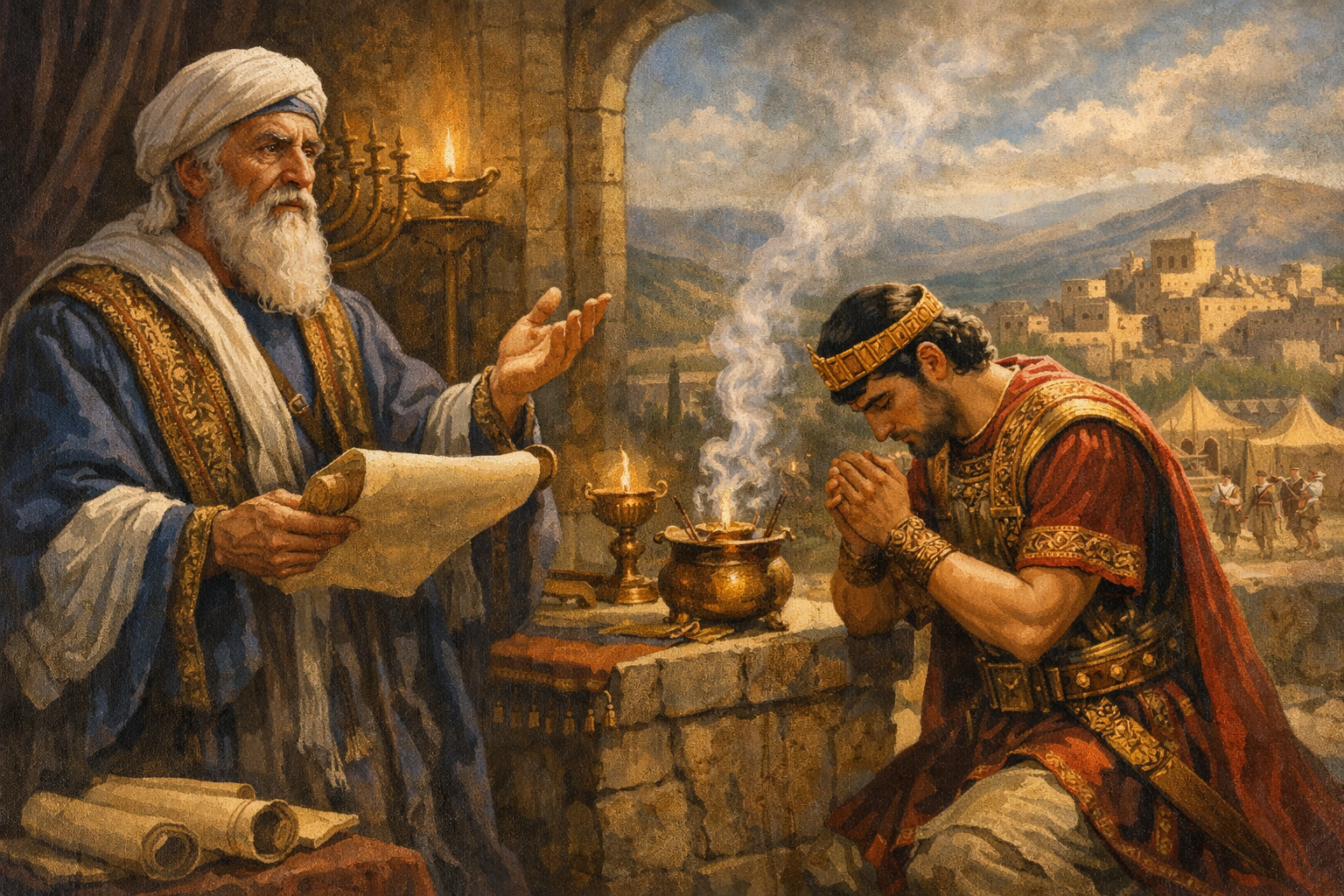
UZZIAH SEEKS GOD
GOD PROSPERS UZZIAH
He continued to seek (baqas; LXX - ekzēteō) God in the days of Zechariah - This verse is the KEY to Uzziah's success. His strength, victories, and prosperity were not rooted in military genius or economic policy, but in a deliberate, ongoing pursuit of the LORD. The Hebrew verb baqas speaks of an earnest, intentional seeking, which is more than casual interest. It describes a heart that inquires, pursues, and depends upon God. The Septuagint’s ekzēteō intensifies the idea for it means to seek out diligently, and to crave direction from God as a continual habit of life.
To seek the Lord means going to Him for His wisdom and help
so often that you wear a path to God
Steven Cole adds that "The Hebrew word “seek” is the same word we have met in earlier studies which meant, literally, “to trample under foot.” The idea was that when you frequent a place, you beat a path underfoot. To seek the Lord means going to Him for His wisdom and help so often that you wear a path to God."
True greatness is not built on talent, technology, or troops,
but on a persistent pursuit of God’s presence and will.
Notice the connection between spiritual mentorship and royal blessing. Uzziah sought the LORD in the days of Zechariah, a man who had understanding through the vision of God. As long as the king walked under godly counsel and kept his eyes fixed on the LORD, God caused him to prosper (2Chr 26:5b). Success flowed from submission and national prosperity followed personal piety. The moment Uzziah later stopped seeking and began trusting in his own strength, his story turned tragically (2Chr 26:16). Uzziah’s reign teaches that true greatness is not built on talent, technology, or troops, but on a persistent pursuit of God’s presence and will. When a leader seeks the LORD, the LORD orders his steps. When he ceases to seek, even a crown cannot shield him from collapse!
This passage reminds us of King Joash who was mentored by Jehoiada the priest - "Jehoash did right in the sight of the LORD all his days in which Jehoiada the priest instructed him." (2Ki 12:2) Under Jehoiada, Joash repaired the temple and restored proper worship. In a similar way, Zechariah served as a spiritual tutor who kept Uzziah focused on the LORD. The difference between King Joash and King Uzziah is that almost immediately after Jehoiada’s death, Joash listened to ungodly counselors (2 Chr 24:17), abandoned the house of the LORD (which he had just restored!) and allowed idolatry (2 Chr 24:18), even shockingly ordering the murder of Zechariah the son of Jehoiada (2Ch 24:20–22) and ended his life in failure and assassination (2Ch 24:25). In contrast, Uzziah did not immediately collapse when Zechariah passed from the scene, but experienced decades of blessing, military success, and national stability (2Ch 26:6–15), until it went to his head!
Zechariah, who had understanding (bin/biyn; LXX - suniemi) through the vision of God - The expression describes Zechariah’s spiritual discernment, his ability to understand God’s will because he was instructed by divine revelation. Zechariah was a man taught by God, able to interpret God’s word and will for the king. Zechariah was not simply a political adviser, but he was a spiritual mentor shaped by the Word of God. Prosperity followed Uzziah not because of strategy, but because he listened to a man who saw life through God’s eyes.
This is not the famous the post-exilic prophet Zechariah who wrote the prophetic book. Some think this could be Zechariah, the son of Jehoiada. However we cannot be dogmatic about the identity of this Zechariah, but what is clear is that his man did have a signicant impact on Uzziah, much like the priest Jehoiada did on the life of King Joash of Judah.
🙏 THOUGHT - While believers today do not have personal prophets or priests to keep us on the straight and narrow highway of holiness (Isaiah 35:8), walking worthy of the calling with which we have been called (Eph 4:1), we do have the entire "prophetic" Word of God to guide us daily in the way of righteousness and holiness and truth! And unlike Jehoiada and Zechariah, this "prophet" never dies, but will follow us all the days of our life, the "hound of Heaven," continually speaking to us and guiding us by his Spirit and Word. Oh, how grateful we should be that God has left us with His eternal, immutable, powerful Word which is now our life! (Dt 32:47, cf Mt 4:4, Lk 4:4).
Bob Utley - YHWH spoke to Uzziah, both by prophet and by priest (cf. 2 Chr. 26:17). Initially he listened to Zechariah but later rejected the message of Azariah, the High Priest (v. 19).
and as long as he sought (baqas; LXX - ekzeteo) the LORD, God prospered (tsalach; LXX - euodoo = literally lead along on a good path, guide well) him - This is a conditional statement. The critical time phrase is as long as! This passage is an illustration of the truth in Psalm 1:1-3. Because Uzziah sought the LORD, "his delight (was) in the law of the LORD, and in His law he (meditated) day and night. He (was) like a tree firmly planted by streams of water, Which yields its fruit in its season And its leaf does not wither; And in whatever he (did), he (prospered)." Indeed he was one of few kings who prospered in whatever he did.
🙏 THOUGHT - Beloved, is this not a principle we too can practice? That's rhetorical of course! We must (enabled by His Spirit) daily practice this principle of seeking God in His Word and in prayer. The chronicler advocates "double seeking" (just as in 2Ch 26:5!) "Seek the LORD and His strength; Seek His face continually." (1Ch 6:11) If you practice seeking (not perfection, but direction, you will experience the good hand of the LORD on your life and He will prosper you, spiritually for sure and possibly also materially (but this is less important than being spiritually rich). Jesus commanded disciples "But seek (present imperative see our need to depend on the Holy Spirit to obey) first His kingdom and His righteousness, and all these things will be added to you." (Mt 6:33)
Bob Utley - This is a central theme of Chronicles. It expresses the performance-based Mosaic covenant (i.e., the two ways, cf. Leviticus 26; Deuteronomy 28; 30:15,19; Psalm 1). Notice the "blessings" are conditional through time (cf. 2 Chr. 15:2).
Henry Morris on sought the LORD - Uzziah’s rebellion, after a particularly long and successful reign, was halted by the sudden judgment of lifelong leprosy (II Chronicles 26:21). The principle that material prosperity accompanies faithfulness to God, and vice versa, was apparently applicable to the kings of Judah and Israel in most cases. This principle may possibly apply to modern heads of state as well, in many cases, but certainly cannot be applied to Christians in general (witness all the martyrs listed in Hebrews 11). God’s true rewards for his faithful servants await the future life. (ED: YES THAT IS TRUE, BUT WE CAN EXPERIENCE SPIRITUAL PROSPERITY EVEN NOW AND THAT SHOULD BE OUR DESIRE AND GOAL IN THIS SHORT LIFE!) (2 Chronicles 26 - Defender's Study Bible)
Raymond Dillard: Uzziah, like Joash before him (2Ch 24:2), had one particular adviser who helped him to remain faithful to Yahweh. Nothing more is known of this individual, unless he is identified with the Zechariah who served as a witness for Isaiah (Isa 8:2); however, the statement that Uzziah sought Yahweh “during the days” of Zechariah is best understood as implying that he had died during the reign of Uzziah. (Borrow 2 Chronicles)
Martin Selman: We read that, under Zechariah’s influence, the Lord gave Uzziah success. The Hebrew text reads literally: “the Lord God made him prosper.” The Hebrew verb used is tsalach, which literally means “to break out.” In some contexts the verb is related to the working of the Holy Spirit in a person’s life, as in the case of Samson, about whom we read: “The Spirit of the Lord came upon him in power.” (Tyndale Old Testament Commentaries – 2 Chronicles. BORROW)
Seek (search) (01245) baqas expresses a person's earnest seeking of something or someone which exists or is thought to exist with the intention that it will be found or acquired. It pictures one searching earnestly until the object of the search is located. The Septuagint (LXX) translates baqas with the verb ekzeteo which implies giving attention and priority to and deliberately pursuing after. Webster says that to seek means to go in search or quest of, to look for, to try to discover, to search for by going from place to place. Zeteo in classical Greek is often used as a technical term for philosophical investigation, something “examined, considered” or “deliberated.” For example, baqas describes seeking for Moses' life (Ex 4:19 Lxx = zeteo), Absalom seeking to kill David (2Sa 16:11), those seeking to kill Pharaoh and Zedekiah (Jer 44:30)
Baqas describes an earnest search until the object of the search is located. Thus peace is to be searched for earnestly (Ps 34:14-see note). The Lord’s face (His presence) must especially be sought (Ps 27:4, 8-see note) On the other hand, we are not to seek the occult (Lev 19:31). Naomi sought for security for her daughter-in-law Ruth (Ru 3:1-note). Jehovah "sought out for Himself a man after His own heart." (1Sa 13:14) God promises if we seek for Him we will find Him (Dt 4:29).
Prospered (6743)(tsalach) to prosper, succeed, be successful (Ge 24:21, 40). It conveys the root idea of accomplishing satisfactorily what is intended. This Hebrew word generally expresses idea of a successful venture, as contrasted with failure.To be a successful person (Ge 39:2). means generally expresses the idea of a successful venture, as contrasted with failure and most of the OT passages show that the Source of the prosperity is God (see 2Ch 26:5). Of course to be sure sometimes the wicked seem to prosper (Jer 12:1). What the righteous person does will eventually prosper (Ps. 1:3); but the seeming prosperousness of the wicked will fail (Ps. 37:7). Although the wicked prosper temporarily, they will be destroyed as the righteous prosper eternally (Ps 37:7; Jer 5:28; Da 11:27). Concealed sins keep one from prospering (Prov. 28:13). God allows the Antichrist to prosper but only until a limit is reached (Da 11:36).
🙏 THOUGHT - It is fascinating to observe the positive and negative aspects of this verb in Ps 1:3 and Joshua 1:8 to convey the idea of prospering and in Pr 28:13 of not prospering. What's the determining factor whether one experiences spiritual prosperity or poverty? In the context of these verses, meditation (Joshua 1:8, Ps 1:2) is clearly associated with prosperity and failure to confess and repent of our sins is just as clearly associated with failure to prosper (Pr 28:13) And you might ask, well this is OT, but does the NT say anything similar? And the answer is yes, for Paul commands Timothy to DISCIPLINE (present imperative) himself for godliness and clearly one of the disciplines that "feeds and fertilizes" godliness is meditation on the Word of God! (1Ti 4:7) Paul goes on to explain the spiritual prosperity that accrues from disciplining ourselves, writing that "bodily discipline is only of little profit, but godliness is profitable for all things, since it holds promise for the present life and also for the life to come." (1Ti 4:8) While meditation, like all spiritual disciplines, calls for us to exert some effort (enabled by the Spirit - e.g., we need to die to our selfish interests and our right to "our time" and give some of "our time" to God's interests), Paul says the "benefits" are literally "out of this world!" While I don't know exactly what this eternal profit/prosperity entails, rest assure it is going to be good and perfect for that is the character of our Great Father of lights (James 1:17) and it is going to be eternal (Jn 15:16 cf "remain")
Nancy Dawson on the identity of the person named Zechariah who tutored Uzziah - Several chronological considerations are necessary to determine whether Zechariah the son of Jehoiada is the same person as the Zechariah figure mentioned in 2 Chronicles 26:5, who provided tutelage to the young king: Azariah/Uzziah “sought God during the days of Zechariah, who instructed him in the fear of God. As long as he sought the Lord, God gave him success.” Since Azariah/Uzziah became king at the age of sixteen, then served as co-regent with his father Amaziah from 792–767 B.C., and later held an official 52-year reign from 792–740 B.C., this means that Azariah/Uzziah was born in 808 B.C. and that he was a young man in training from 808–792 B.C. before he assumed the throne in 792 B.C. The text of 2 Chronicles 24:15–25 suggests that Zechariah (Jehoiada’s son) died in the window of time shortly AFTER his father Jehoiada died (in 796 B.C.) and yet before King Joash died that same year. The chronology permits the interpretation that Zechariah the priest (the son of Jehoiada) was the same person as the Zechariah in 2 Chronicles 26:5 who provided instruction to Azariah/Uzziah IF it is referring to the years of 808–792 B.C. (i.e., from the time Azariah/Uzziah was born to the time he was approximately age twelve), BUT NOT IF it refers to Azariah/Uzziah as the king, for Zechariah (son of Jehoiada) died in 796 B.C., and Azariah/Uzziah did not come to the throne until 792 B.C. (i.e., four years after Zechariah died). In the latter case, the Zechariah of 2 Chronicles 26:5 would be a different person than Zechariah the son of Jehoiada (cf. 2 Chronicles 24:20, 22). (All the Genealogies of the Bible - an incredible resource for genealogies!)
Till He Became Strong
His fame spread far and wide, for he was marvelously helped till he became strong. —2 Chronicles 26:15
In George MacDonald’s fairy tale Lilith, giants live among normal people. These giants must conduct their daily affairs very carefully. When they sleep, their snoring is disruptive. When they turn over, houses may be crushed under their weight.
In the Bible, Uzziah became a “giant” of a man after becoming king at age 16. The keys to his success are recorded in 2 Chronicles 26. His father Amaziah set a good example for him (2 Chronicles 26:4). The prophet Zechariah instructed him (2 Chronicles 26:5). He had an army of fighting men and capable generals who helped him (2 Chronicles 26:11-15). And God prospered him (2 Chronicles 26:5).
Clearly, King Uzziah became a “giant” through the Lord’s blessing. But after attaining success, he grew careless and stumbled badly. The clue to his demise is found in the phrase “he was marvelously helped till he became strong” (2 Chronicles 26:15).
Those last four words serve as a dire warning to us all. Uzziah’s “heart was lifted up, to his destruction” (2 Chronicles 26:16). He usurped the priestly duties and became leprous (2 Chronicles 26:16-21).
We have all been marvelously helped—by our Lord God, by those He has given to set an example for us, and by those who serve alongside us. When we become strong, we must take heed, or we too will stumble. (Reprinted by permission from Our Daily Bread Ministries. Please do not repost the full devotional without their permission.)
When all goes well and I feel strong,
Oh, help me, Lord, to see
That I must place my confidence
In You and not in me.
—Anon.
I have never met a man who has given me as much trouble as myself.
—D. L. Moody
When victories line the path I tread
And skies are bright and clear,
Keep me from trusting self—
For strength is not found there.
When blessings grow on every side
And fears have turned to dust,
Teach me, O Lord, with grateful heart
In You Alone to trust.
When hands are full and hopes are high
And life seems firm and sure,
Remind my soul my truest strength
Is only found in Yours.
When I am praised for what is done
And pride would claim the place,
Turn back my eyes to Calvary
And ground me in Your grace.
Let not success become my snare
Nor comfort dim my view;
In every gain, in every joy,
Guide all my trust to You.
2 Chronicles 26:6 Now he went out and warred against the Philistines, and broke down the wall of Gath and the wall of Jabneh and the wall of Ashdod; and he built cities in the area of Ashdod and among the Philistines.
- the wall of Gath: 2Sa 8:1 1Ch 18:1
- about: or, in the country of, 1Sa 5:1,6
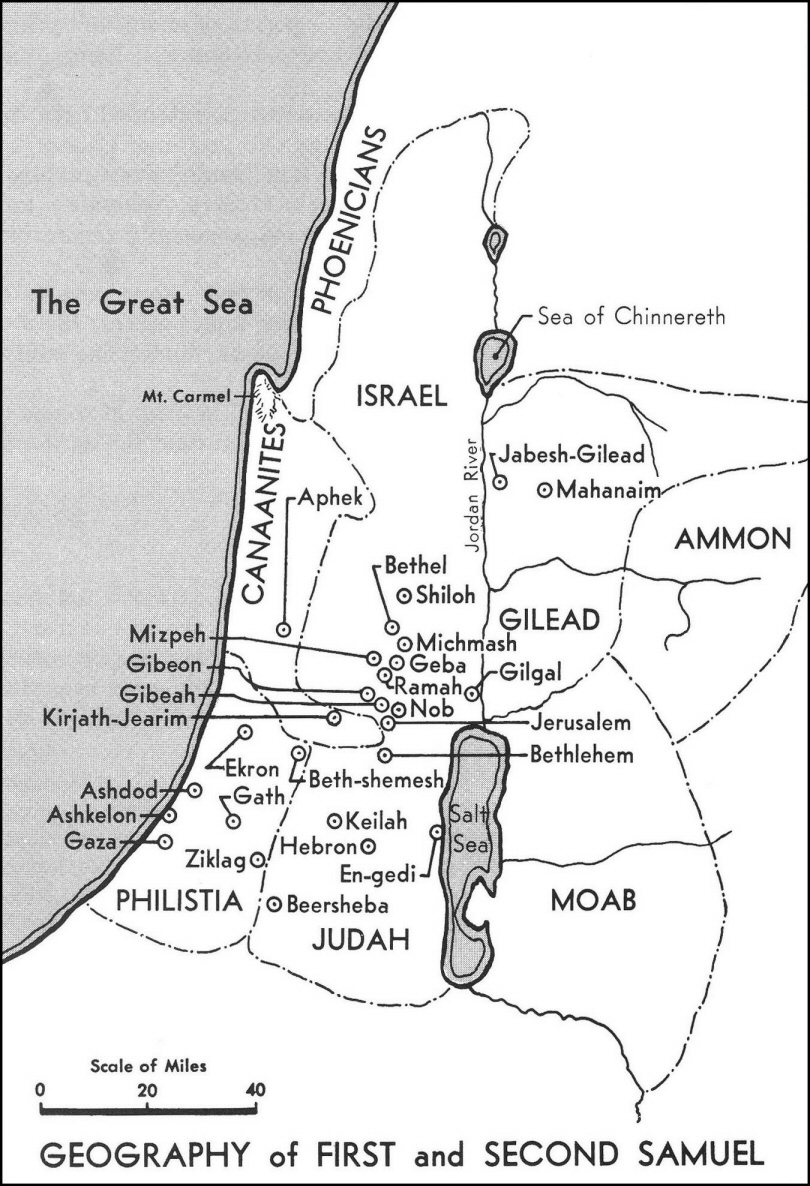
See GATH & ASHDOD
Jensen's Survey of the OT (Click to enlarge)
BEGINNING OF A LIST OF
UZZIAH'S SUCCESSES
Now he went out and warred against the Philistines, and broke down the wall of Gath (in Philistia SE of Jerusalem on map) and the wall of Jabneh and the wall of Ashdod (in Philistia SE of Jerusalem on map); and he built cities in the area of Ashdod and among the Philistines. The list of Uzziah's successes demonstrates YHWH's blessings.
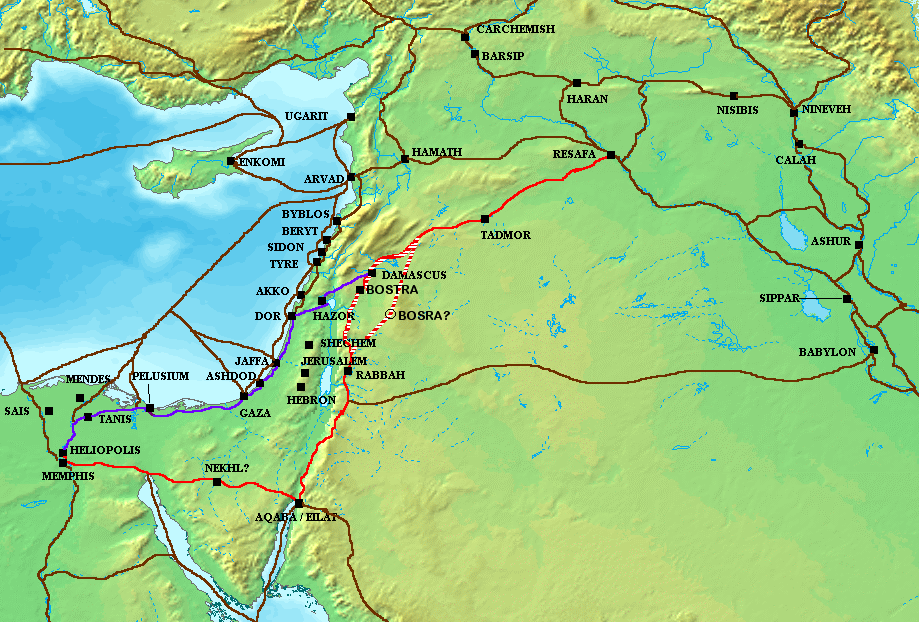
Click to Enlarge - Identify Ashdod
on the Via Maris - see Purple Line
Don't miss what the writer is saying here, for building cities in enemy lands reveals how far Uzziah’s authority and influence extended beyond Judah’s borders. Building cities in Philistine territory was not normal defensive activity but signaled regional dominance. This shows King Uzziah's military supremacy. Ashdod was one of the five major Philistine city-states (Gaza, Ashkelon, Ashdod, Gath, Ekron). So for a Judean king to defeat Ashdod, tear down its walls (2Chr 26:6), and build Judean cities “among the Philistines,” means the Philistines were no longer an equal rival but a subdued power under Uzziah’s control. King Uzziah was not merely defending Judea's borders, but was projecting power into enemy heartland. This incursion also implied economic exploitation of Philistine trade routes. Ashdod lay on the Via Maris, the main coastal highway connecting Northern Egypt with Damascus, Syria.
By building cities in Philistia, Uzziah was effectively controlling commerce, taxing trade, and securing access to the Mediterranean world. This puts Uzziah alongside David and Solomon as one of Judah’s most expansionist kings. The former oppressors are hosting Judean garrisons and settlements. This is a picture of Uzziah's obedience and thus God's covenant blessing giving Judah mastery over historic enemies. (see Dt 28:7).
Martin Selman - “The Philistines lost two of their major cities, Gath and Ashdod as well as Jabneh. The latter was formerly Jabneel of Judah (Joshua 15:11) and later became Jamnia where the Sanhedrin was re-formed after Jerusalem’s destruction in a. D. 70.” (Borrow 2 Chronicles)
John Olley This section’s (2Ch 26:6-15) key theme is seen in the repetition of words from 2Ch 26:7– 8 in 2Ch 26:15b: - “fame” (Hb. shem, “name”), - God’s “help” (ʻazar), and - “strong” (khazaq). (ESV Expository Commentary)
Andrew Hill: The report of Uzziah’s prosperity (2Ch 26::6–15) has no parallel in 2 Kings. The litany of achievements attesting divine favor include military victory over Judah’s archenemies (2Ch 26:6–8), extensive building activity and agricultural bounty (2Ch 26:9–10), and the marshalling of a large, well-trained, and well-equipped army (2Ch 26:11–15). The unit is framed by a formula of prosperity that highlights Uzziah’s “fame” and “power” (2Ch 26:8, 15). In combination these two epithets are a recipe for pride and eventual selfdestruction, since a proud heart tends to “forget the LORD” (Deut. 8:14). (The NIV Application Commentary – 1 & 2 Chronicles.)
John Walton - military successes. Although there are no other literary sources which describe Uzziah’s victories over the Philistines, Arabs and Meunites, there is archaeological evidence of destruction at the Philistine city of Ashdod, which may have been done during the time of Uzziah. There is also evidence that Uzziah constructed fortresses in these newly conquered territories. Gath (Tell es-Safi; see comment on 1 Sam 5:8), Ashdod and Jabneh form a triangle about ten or fifteen miles on each side that dominates the northern section of the Philistine plain directly west of Jerusalem. Tell Mor near the Philistine city of Ashdod provides one example of such a fortress. Since Uzziah was not able to expand north because of the power of Israel under Jeroboam II, he turned his attention to the west and south, subduing people groups that had taken advantage of previously unstable conditions in Judah (IVP Bible Background Commentary on the OT- page 447)
Jabneh (building of God) - A town in the north boundary of Judah (Josh. 15:11), called afterwards by the Greeks Jamnia, the modern Yebna, 11 miles south of Jaffa. After the fall of Jerusalem (A.D. 70), it became one of the most populous cities of Judea, and the seat of a celebrated school. One of the points on the northern boundary of Judah, not quite at the sea, though near it. (Joshua 15:11) There is no sign, however, of its ever having been occupied by Judah. Josephus attributes it to the Danites. There was a constant struggle going on between that tribe and the Philistines for the possession of all the places in the lowland plains, and it is not surprising that the next time we meet with Jabneel it should be in the hands of the latter. (2Chronicles 26:6) Uzziah dispossessed them of it and demolished its fortifications. Called also JABNEH. At the time of the fall of Jerusalem, Jabneh was one of the most populous places of Judea. The modern village of Yebna , more accurately Ibna , stands about two miles from the sea, on a slight eminence just south of the Nahr Rubin .
2 Chronicles 26:7 God helped him against the Philistines, and against the Arabians who lived in Gur-baal, and the Meunites.
- God helped: 2Ch 14:11 1Ch 5:20 12:18 Ps 18:29,34,35 Isa 14:29 Ac 26:22
- the Arabians: 2Ch 17:11 21:16
Philistia East of Judah
Jensen's Survey of the OT (Click to enlarge)
JEHOVAH EZER
UZZIAH'S HELPER
God helped ('azar; LXX - katischuo) him - One of the great names of God is Jehovah Ezer: The LORD our Helper. Uzziah would have loved the line in Come Thou Fount of Every Blessing, "Here I raise my Ebenezer; hither by Thy help I’m come." Ebenezer means "stone of help" (cf 1Sa 7:12). At this time in Uzziah's life, Yahweh was His "Rock of Salvation." (Ps 62:2).
Against the Philistines and against the Arabians who lived in Gur-baal, and the Meunites -That God helped ('azar) him against these perennial foes (cf 2Ch 26:15) is clear evidence that the good hand of the LORD was on Uzziah (see why it was on Ezra! = Ezra 7:9,10), which in turn indicates that at this time in his reign he had not become prideful and was still relying on the LORD, for His help.
Note that helped ('azar) is a key word in the description of King Uzziah and is found three times (2Ch 26:7, 13, 15). It is interesting to note that the Septuagint renders helped with the verb katischuo which means to make strong, giving one the strength or capability to obtain and advantage, in this case over Judah's foes! In short, Yahweh enabled King Uzziah to prevail and literally to overpower Judah's perennial enemies, the Philistines...the Arabians...and the Meunites!
🙏 THOUGHT - Uzziah's success over opposition makes me think of Paul's words in Romans 8:31 "What then shall we say to these things (the things God has done for us in Ro 8:1-30)? If (first class condition ~ "Since") God is for us (His unwavering commitment), who is against us (No one can prevail against God’s purpose)?" As Sinclair Ferguson explained our confidence that “God is for us” does not rest on how well life is going, but on this unshakable truth “He did not spare His own Son, but delivered Him over for us all” (Romans 8:32). That is how we know God is for us, because He gave His greatest gift, His Son. No one and nothing can successfully stand against us, because the Almighty God Who rules the universe has set His saving love upon us in Christ. Our security rests not in ourselves, but in what God has done and Who God is. We face trials with hope, knowing He is working them for our good (Romans 8:28). We rest in assurance, since nothing can separate us from His love (Romans 8:39).
Raymond Dillard: These verses (2Ch 26:6-8) summarize Uzziah’s foreign policy. His conquests were oriented to the west, south, and southeast, a fact that fits well with the rule of a powerful Jeroboam II to the north. Uzziah’s conquest of Jabneh suggests that he regained control of the area through which Jehoash of Israel had attacked his father Amaziah (2Ch 25:21). Jabneh is probably to be equated with Jabneel (Josh 15:11); the site would later be called “Jamnia” and would become a leading center of Jewish learning and religious life after the destruction of Jerusalem in A.D. 70. Uzziah’s campaigns against the Philistines not only represented the on-going conflict of traditional enemies; no doubt Uzziah had the important strategic purpose of reasserting some control over the international coastal highway (“Via Maris”). A similar strategic goal to control a major artery of international commerce influenced the campaign against Elat (2Ch 26:1–2). (Borrow 2 Chronicles)
Andrew Hill: It appears that economic concerns motivate King Uzziah’s imperialistic agenda. Wresting control of the coastal highway (“Via Maris”) from the Philistines and the recapture of Elath (2Ch 26:1–2) have significant implications for Judah’s role in international commerce. (The NIV Application Commentary – 1 & 2 Chronicles)
J.A. Thompson: Significant conquests of Uzziah directed against Philistines and Arabs on his southwestern borders are not taken up. His conquests in these areas were strengthened by the construction of fortresses in conquered territory. The whole paragraph was intended to demonstrate how Uzziah prospered in foreign affairs. Military activity to the north was not possible because Jeroboam II was too strong for Uzziah. (The New American Commentary – 1, 2 Chronicles)
Helped (05826) 'azar means to protect, aid, help, succor, support, give material or nonmaterial encouragement. Azar often refers to aid in the form of military assistance and in many instances refers to help from Jehovah as illustrated by the uses below. Webster says to help means to aid, to assist, to succour (see below), to lend strength or means towards effecting a purpose. To relieve; to cure, or to mitigate pain or disease. To remedy; to change for the better. The Septuagint translates 'azar most often with the word group that includes boáo, boetheo, boethos, all conveying the general idea of running to the aid of one who cries out for help (e.g., see He 2:18 which uses boetheo) which is similar to the English word succour (from Latin succurrere = to run up, run to help) means literally to run to and so to run to to support, to go to the aid of, to help or relieve when in difficulty, want or distress; to assist and deliver front suffering; as, to succor a besieged city; to succor prisoners.
The Theological Lexicon of the OT notes that…Connotations can vary from “to support” (Ezra 10:15), “to help out” (Josh 1:14; cf. Ge 2:18), “to assist” (Ge 49:25) to “to stand with to deliver” (Da 10:13; cf. Lam 4:17) and “to come to aid” (2Sa 21:17; cf. Ps 60:13 = Ps 108:13). To this extent, the Hebrew terms coincide with the English terms “to help” and “help.” (Jenni, E., & Westermann, C. Theological Lexicon of the Old Testament (872). Peabody, Mass.: Hendrickson Publishers)
Azar -76v- ally(1), furthered(1), granted(1), help(38), helped(19), helper(6), helpers(2), helping(1), helps(8), protect(1), restrains(1), supporting(1). Gen. 49:25; Deut. 32:38; Jos. 1:14; Jos. 10:4; Jos. 10:6; Jos. 10:33; 1 Sam. 7:12; 2 Sam. 8:5; 2 Sam. 18:3; 2 Sam. 21:17; 1 Ki. 1:7; 1 Ki. 20:16; 2 Ki. 14:26; 1 Chr. 5:20; 1 Chr. 12:1; 1 Chr. 12:17; 1 Chr. 12:18; 1 Chr. 12:19; 1 Chr. 12:21; 1 Chr. 12:22; 1 Chr. 15:26; 1 Chr. 18:5; 1 Chr. 22:17; 2 Chr. 14:11; 2 Chr. 18:31; 2 Chr. 19:2; 2 Chr. 20:23; 2 Chr. 25:8; 2 Chr. 26:7; 2 Chr. 26:13; 2 Chr. 26:15; 2 Chr. 28:16; 2 Chr. 28:23; 2 Chr. 32:3; 2 Chr. 32:8; Ezr. 8:22; Ezr. 10:15; Job 9:13; Job 26:2; Job 29:12; Job 30:13; Ps. 10:14; Ps. 22:11; Ps. 28:7; Ps. 30:10; Ps. 37:40; Ps. 46:5; Ps. 54:4; Ps. 72:12; Ps. 79:9; Ps. 86:17; Ps. 107:12; Ps. 109:26; Ps. 118:7; Ps. 118:13; Ps. 119:86; Ps. 119:173; Ps. 119:175; Isa. 30:7; Isa. 31:3; Isa. 41:6; Isa. 41:10; Isa. 41:13; Isa. 41:14; Isa. 44:2; Isa. 49:8; Isa. 50:7; Isa. 50:9; Isa. 63:5; Jer. 47:4; Lam. 1:7; Ezek. 30:8; Dan. 10:13; Dan. 11:34; Dan. 11:45; Zech. 1:15
Meunim, Meunite. People living in Edom (Mt Seir, 1 Chr 4:42) who were dispossessed of their rich pasturelands by the Simeonites (v 41). Later, Meunites from Edom attacked Judah’s King Jehoshaphat (2 Chr 20:1); later still, King Uzziah of Judah defeated them (26:7, KJV Mehunims). Their original land possession, association with Arabs and Ammonites, and prolonged hostility recall Judges 10:11, 12, where “Maonites” are named oppressors of Israel. This word, by Hebrew rules of vocalization, could well become “Meunites,” suggesting Maon (Ma‘in, Maan) in the Edomite area south of the Dead Sea as their home.
The Meunim are listed among the families of temple servants returning to Jerusalem following the exile (Ezr 2:50, KJV Mehunim; Neh 7:52). However, because ancient enemies seem unlikely temple servants, some suggest that these Meunim were descendants of the Caleb clan within Judah to whom another town named Maon, west of the Dead Sea and south of Hebron, was allotted (Jos 15:20, 55; cf. 1 Sm 30:14). First Chronicles 2:45 suggests the city’s name became eponymous; “Meunite,” like the modern Khirbet Ma‘in, could derive from it. This Maon gave David refuge and another wife (1 Sm 23:24–28; 25).
This reconstruction involving two groups, two Maons, and temple servants with very foreign names, is tentative. An alternate view holds that hostile foreigners, formerly captured to become temple slaves (cf. Jos 9:7; Ez 44:6–8), attained freedom during exile and temple-guild status on returning. (BORROW Baker encyclopedia of the Bible Volume: 3)
2 Chronicles 26:8 The Ammonites also gave tribute to Uzziah, and his fame extended to the border of Egypt, for he became very strong.
- the Ammonites: 2Ch 20:1 Ge 19:38 De 2:19 Jud 11:15-18 1Sa 11:1 2Sa 8:2
- his fame: Ge 12:2 2Sa 8:13 1Ki 4:31 Mt 4:24
Related Passages:
1 Chronicles 14:17 (UZZIAH'S FAME LIKE DAVID) Then the fame of David went out into all the lands; and the LORD brought the fear of him on all the nations.
1 Chronicles 17:8 (UZZIAH'S NAME LIKE DAVID)“I have been with you wherever you have gone, and have cut off all your enemies from before you; and I will make you a name like the name of the great ones who are in the earth.
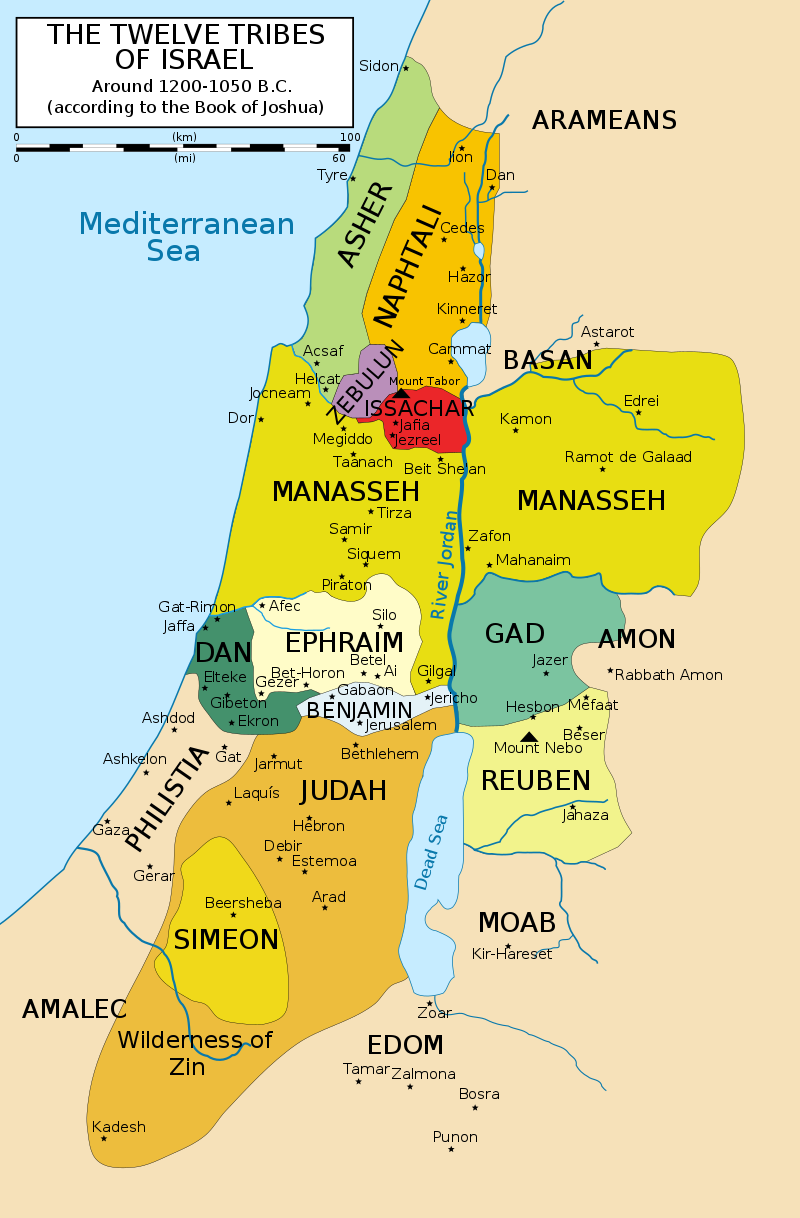
See Ammon East of Jordan (and Gad)
UZZIAH RECEIVED TRIBUTE
AND FAME SPREAD
The Ammonites also gave tribute (minchah; LXX - doron) to Uzziah - Remember that a tribute in the ancient near east was not a gift but was a sign of submission to another country. The Ammonites were a Semitic people, closely related to the Israelites. Despite that relationship, they were more often counted enemies than friends. And so to pay tribute meant that under King Uzziah Judah had established military dominance east of the Jordan. This also gve King Uzziah control key trade routes. The nations Judah clearly recognized King Uzziah's authority.
And his fame (shem; LXX - onoma = name) extended to the border of Egypt - The Chronicler is saying Uzziah's life had become a testimony recognized across the region. There is an echo of the Davidic covenant here for God had promised David "I have been with you wherever you have gone and have cut off all your enemies from before you; and I will make you a great name, like the names of the great men who are on the earth." (2Sa 7:9) Ammon’s submission shows that, for a season, Uzziah was walking in the Davidic pattern of blessing, Yahweh giving him victory over these historic foes Philistia, Arabia and Ammon.
For - Term of explanation. What's the writer explaining? He is explaining why Uzziah's fame/name was known far and wide in the Ancient Near East. Uzziah was not self-made but God helped (2Ch 26:7). Ultimately his fame was God-generated renown. God helped him. His strength increased. Thus his name spread.
He became very strong (chazaq; LXX - katischuo - be dominant, prevail) - Note not just "strong," but "very (exceedingly) strong!" And as the story of Uzziah unfolds we see that what began as God-given strength slowly evolved into self-trust. Note that STRONG (chazaq) is a key word in the description of King Uzziah and is used 4 times - 2Ch 26:8, 2Ch 26:9, 2Ch 26:15, 2Ch 26:16.
🙏 THOUGHT - We all need to pay close attention to Uzziah’s pattern of progressive spiritual decline, remembering that personal prosperity can so easily give birth to personal pride—the root of all sin and the very attitude God hates (cf Pr 6:16-17 where "haughty eyes" is the picture of a proud, lifted-up spirit and is placed first on the list of what God hates!) A wise antidote is to memorize and live in the warning of Proverbs 16:18: “Pride goes before destruction, and a haughty spirit before stumbling.”
Martin Selman: Two benefits accrue to Uzziah. The first is fame (2Ch 26:8, 15), which associates him especially with David (cf. 1Chr. 14:17; 17:8), and the second is that he became very powerful (2Ch 26:8, 15). The latter often characterized the first part of a reign (cf. 2 Chr. 12:1; 17:1; 27:6), and may be a play here on Uzziah’s name (it means, “Yahweh is strong”). (Tyndale Old Testament Commentaries – 2 Chronicles. BORROW)
Became strong (02388) chazaq conveys the basic meaning of to be or become strong, to make strong or strengthen, in the Hiphil to take hold of or seize. Taking hold of something with determination. To overpower. Chazaq can describe physical strength, inner resolve or courage, political power, spiritual steadfastness and God strengthening a person.
Chazaq describes strength of humans to overpower (David and Goliath 1 Sa 17:50, cf 1 Sa 17:35 = seized;, Amnon and Tamar = 2 Sa 13:14), in a battle, to capture (2 Chr 8:3), Samson's last demonstration of supernatural strength he prays "please strengthen me" (Jdg 16:28).
2 Chronicles 26:8 “And his fame spread as far as the border of Egypt, for he became very strong (חָזַק מְאֹד – chāzaq me’od).”
2 Chronicles 26:9 Moreover, Uzziah built towers in Jerusalem at the Corner Gate and at the Valley Gate and at the corner buttress and fortified (chazaq) them.
2 Chronicles 26:15 “Hence his fame spread afar, for he was marvelously helped until he was strong (עַד־כִּי חָזַק).”
His strength was not self-generated but was the result of God’s help
2 Chronicles 26:16 The Turning Point “But when he became strong (וּכְחֶזְקָתוֹ – ukhechezqato), his heart was lifted up to his destruction…”
This verse shows the tragic irony God caused Uzziah to chāzaq (become strong) but Uzziah interpreted that strength as his own
Strength that begins as God’s gift can become
man’s downfall when gratitude turns into pride.CHAZAQ IN SAMUEL, KINGS AND CHRONICLES - 1 Sam. 4:9; 1 Sam. 15:27; 1 Sam. 17:35; 1 Sam. 17:50; 1 Sam. 23:16; 1 Sam. 30:6; 2 Sam. 1:11; 2 Sam. 2:7; 2 Sam. 2:16; 2 Sam. 3:1; 2 Sam. 3:6; 2 Sam. 3:29; 2 Sam. 10:11; 2 Sam. 10:12; 2 Sam. 11:25; 2 Sam. 13:11; 2 Sam. 13:14; 2 Sam. 13:28; 2 Sam. 15:5; 2 Sam. 16:21; 2 Sam. 18:9; 2 Sam. 24:4; 1 Ki. 1:50; 1 Ki. 2:2; 1 Ki. 2:28; 1 Ki. 9:9; 1 Ki. 16:22; 1 Ki. 20:22; 1 Ki. 20:23; 1 Ki. 20:25; 2 Ki. 2:12; 2 Ki. 3:26; 2 Ki. 4:8; 2 Ki. 4:27; 2 Ki. 12:5; 2 Ki. 12:6; 2 Ki. 12:7; 2 Ki. 12:8; 2 Ki. 12:12; 2 Ki. 12:14; 2 Ki. 14:5; 2 Ki. 15:19; 2 Ki. 22:5; 2 Ki. 22:6; 2 Ki. 25:3; 1 Chr. 11:10; 1 Chr. 19:12; 1 Chr. 19:13; 1 Chr. 21:4; 1 Chr. 22:13; 1 Chr. 26:27; 1 Chr. 28:7; 1 Chr. 28:10; 1 Chr. 28:20; 1 Chr. 29:12; 2 Chr. 1:1; 2 Chr. 7:22; 2 Chr. 8:3; 2 Chr. 11:11; 2 Chr. 11:12; 2 Chr. 11:17; 2 Chr. 12:13; 2 Chr. 13:7; 2 Chr. 13:8; 2 Chr. 13:21; 2 Chr. 15:7; 2 Chr. 15:8; 2 Chr. 16:9; 2 Chr. 17:1; 2 Chr. 19:11; 2 Chr. 21:4; 2 Chr. 23:1; 2 Chr. 24:5; 2 Chr. 24:12; 2 Chr. 25:3; 2 Chr. 25:8; 2 Chr. 25:11; 2 Chr. 26:8; 2 Chr. 26:9; 2 Chr. 26:15; 2 Chr. 26:16; 2 Chr. 27:5; 2 Chr. 27:6; 2 Chr. 28:15; 2 Chr. 28:20; 2 Chr. 29:3; 2 Chr. 29:34; 2 Chr. 31:4; 2 Chr. 32:5; 2 Chr. 32:7; 2 Chr. 34:8; 2 Chr. 34:10; 2 Chr. 35:2;
Tribute (offering) (04503) minchah means a gift (given to another without compensation = Ge 32:13, 2Ki 8:8), tribute ( payment by one ruler or nation to another in acknowledgment of submission or as the price of protection = Jdg 3:14, 2Sa 8:2; Hos 10:6) or offering (as a gift offered to God). The most common sense by far in the OT is as an offering (usually "grain offering" in the NAS but it could refer to animal offerings Ge 4:3-5 or "sacrifices" in general Isa 19:21).
Minchah is translated in the Septuagint (Lxx) with the noun doron which means a gift or present, to show honor and respect (as in Mt 2:11), as a gift offered to God (Mt 8:4)
Fame (08034) shem is a masculine noun occurring over 864x in the OT (90x in plural) and describes the word or combination of words by which something or someone is called and by means of which it or they can be distinguished or identified. It is a word or term by which a person, place or thing is commonly and distinctively known. Name is a designation that sets a person, place or thing apart from another. In Bible times a person’s name stood for the person. The name stood for the character and characteristics or "attributes", if you will, of that person.
The Hebrew does not merely mean “reputation” in a casual sense—it touches the biblical concept of identity, renown, and legacy before God and the nations. God promised to make David’s name great (2Sa 7:9). The builders of Babel sought to “make a name for ourselves” (Ge 11:4). A good name is better than riches (Pr 22:1).
2 Chronicles 26:9 Moreover, Uzziah built towers in Jerusalem at the Corner Gate and at the Valley Gate and at the corner buttress and fortified them.
- the Corner Gate: 2Ch 25:23 2Ki 14:13 Jer 31:38 Zec 14:10
- the Valley Gate: Ne 3:13,19,32
- corner buttress: Ne 3:20,24
Related Passages:
2 Chronicles 25:23 Then Joash king of Israel captured Amaziah king of Judah, the son of Joash the son of Jehoahaz, at Beth-shemesh, and brought him to Jerusalem and tore down the wall of Jerusalem from the Gate of Ephraim to the Corner Gate, 400 cubits.
2 Kings 14:13 Then Jehoash king of Israel captured Amaziah king of Judah, the son of Jehoash the son of Ahaziah, at Beth-shemesh, and came to Jerusalem and tore down the wall of Jerusalem from the Gate of Ephraim to the Corner Gate, 400 cubits.
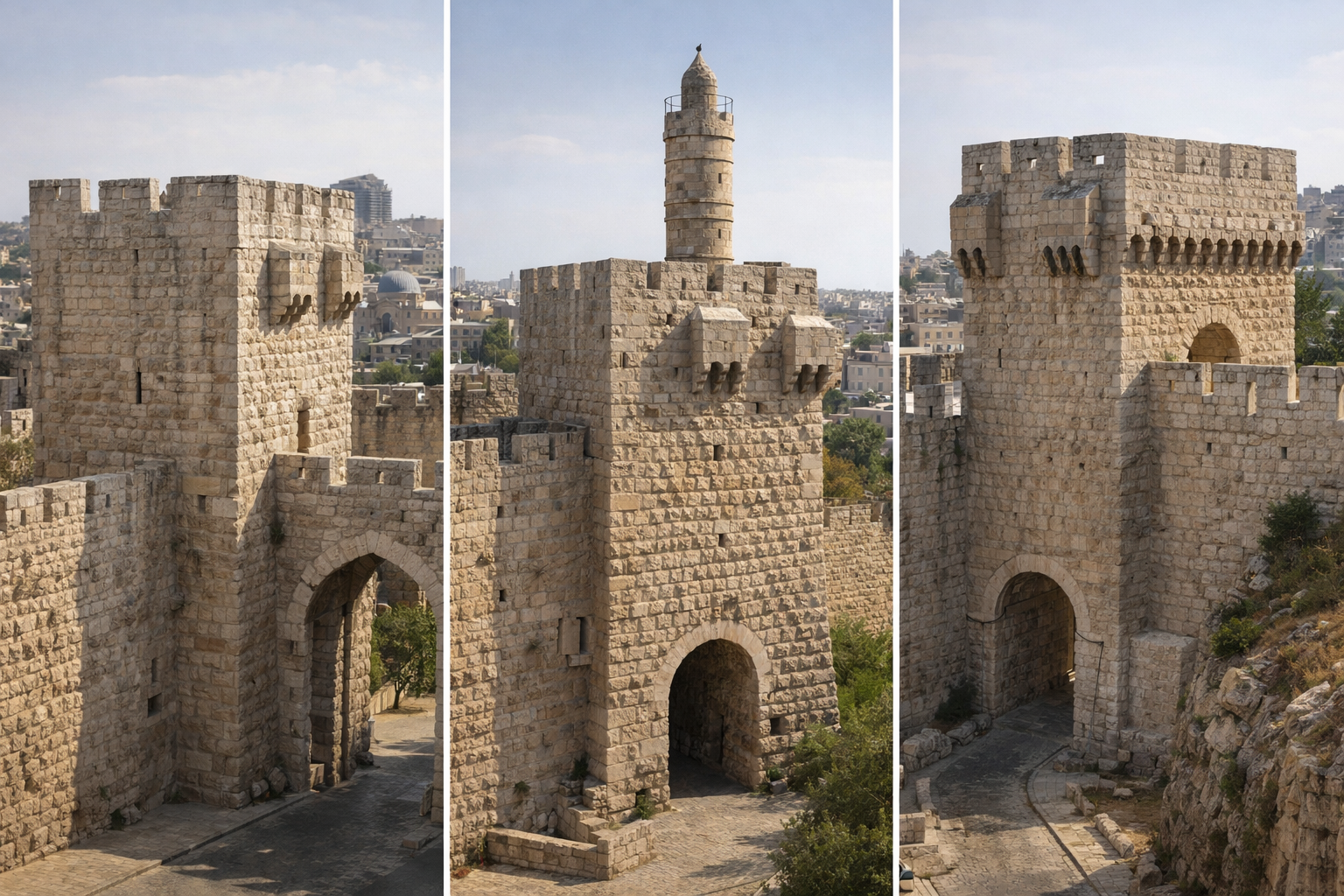
UZZIAH FORTIFIED
THE "FORT"
Moreover, Uzziah built towers (migdal) in Jerusalem at the Corner Gate (NW corner of city) and at the Valley Gate (SW area) and at the corner buttress and fortified (chazaq; LXX - katischuo - made dominantl) them - Recall that under his father Amaziah's reign, King Joash of Israel had destroyed the fortified wall between the Corner Gate and the Gate of Ephraim (2Ki 14:13; 2Ch 25:23) Undoubtedly Uzziah sought to repair the damage that resulted from his father Amaziah’s willful decision to fight King Joash of Israel. Amaziah’s reckless war had left Jerusalem humiliated, its walls broken, and the nation weakened both politically and economically. When Uzziah came to the throne, one of his first tasks was to restore what his father’s pride had ruined—rebuilding defenses, strengthening the army, and reestablishing Judah’s stability. His early reign reflects a deliberate effort to reverse the consequences of Amaziah’s folly and to lead the kingdom back to security and order. Sadly, Uzziah failed to see that the seed of pride which destroyed his father’s reign would eventually take root in his own heart.
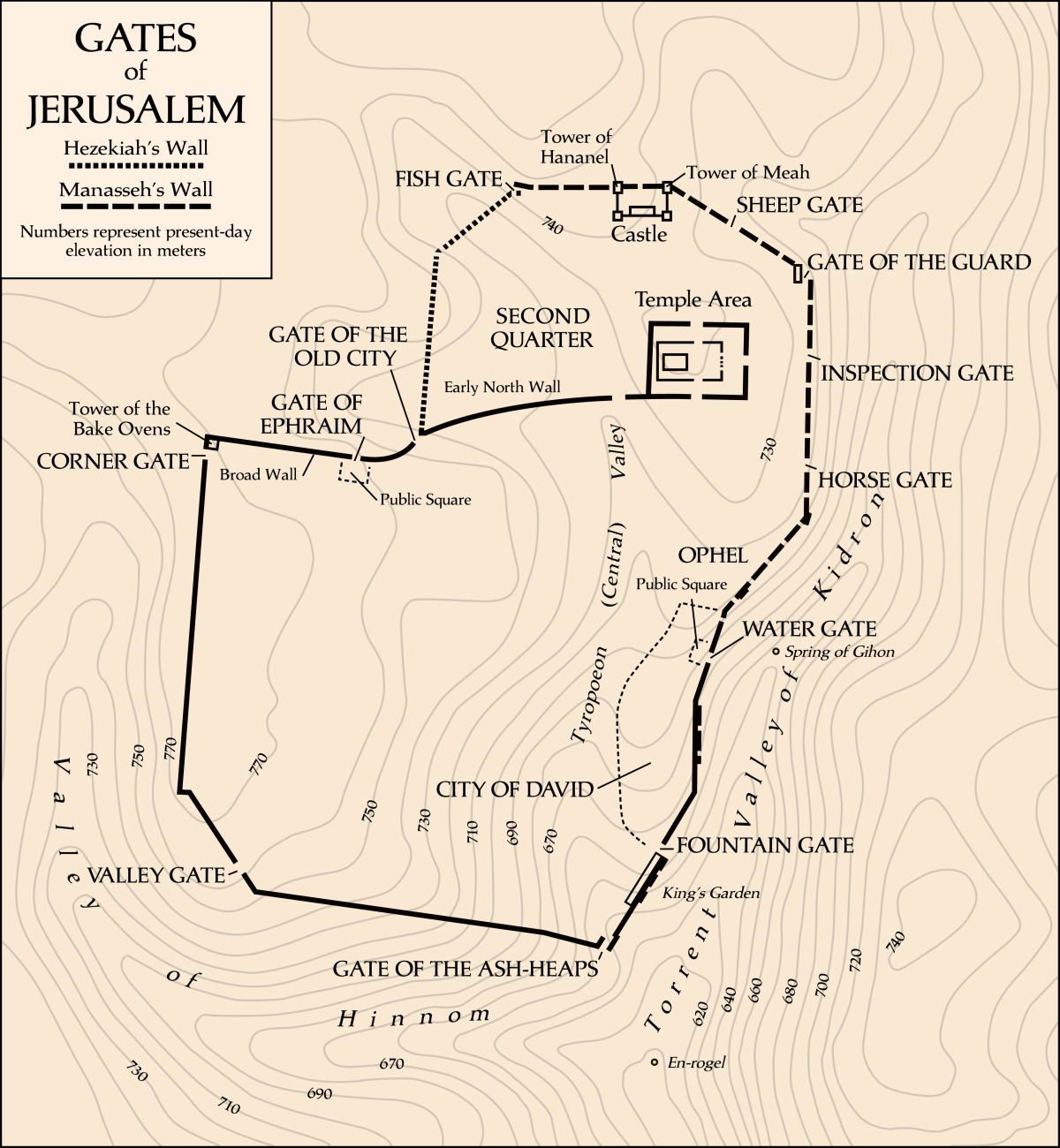
Corner Gate and Valley Gate
on left side of diagrm of Jerusalem
Regarding the towers Uzziah built it is notable that God often uses migdal imagery to contrast the arrogance of human self‑reliance (cf first use of midgal of "tower of Babel" Ge 11:4!) with the security of divine reliance. Just as Uzziah built towers for defense (2 Chronicles 26:9‑10), true security for believers is not in stone or strength, but in the Lord our Strong Tower and the righteous run into it and are safe (Pr 18:10).
Andrew Hill has an interesting thought on Uzziah's building and restoration - It also seems likely that some of the building activity is related to the restoration of destruction caused by the well-known earthquake during Uzziah’s reign (cf. Amos 1:1; Zech. 14:5). (The NIV Application Commentary – 1 & 2 Chronicles.)
Corner Gate. (SEE DIAGRAM) Gate presumably located in the northwest corner of the Jerusalem wall. After King Jehoash of Israel captured King Amaziah of Judah, he tore down a section of the Jerusalem wall from the Corner Gate to the Ephraim Gate (2 Kgs 14:13; 2 Chr 25:23); later King Uzziah of Judah built towers at this gate (2 Chr 26:9). Jeremiah (31:38) foretells a time when the Jerusalem wall will be rebuilt from the tower of Hananel to the Corner Gate; Zechariah (2Ch 14:10) also envisions a period of security and prosperity epitomized by the presence of the Jerusalem wall, including the Corner Gate. (BORROW Baker encyclopedia of the Bible Volume: 1)
Valley Gate. (SEE DIAGRAM) Gate from which Nehemiah went out to inspect the walls of Jerusalem and by which he reentered (Neh 2:13, 14). It was on the west side of the city facing the Tyropean Valley. King Uzziah is said to have built and fortified a tower at this gate (2 Chr 26:9). (BORROW Baker encyclopedia of the Bible Volume: 4)
Towers (04026) migdal is a masculine noun that refers to a tower such as watchtower (as in a vineyard = Isa 5:2) or a strong place ("Tower of Babel" = Ge 11:4, tower for defense = Jdg 9:51), a wooden podium or rostrum (Neh 8:4), mound of perfume (Song 5:13ESV), breasts (figuratively = Song 8:10). Migdal was a symbol of safety, strength, and God’s protection as in Ps 61:3 "For You have been a refuge for me, A tower of strength against the enemy."
MIGDAL - 44V - banks(1), podium(1), Tower(8), tower(23), towers(14), watchtower(2). Gen. 11:4; Gen. 11:5; Jdg. 8:9; Jdg. 8:17; Jdg. 9:46; Jdg. 9:47; Jdg. 9:49; Jdg. 9:51; Jdg. 9:52; 2 Ki. 9:17; 2 Ki. 17:9; 2 Ki. 18:8; 1 Chr. 27:25; 2 Chr. 14:7; 2 Chr. 26:9; 2 Chr. 26:10; 2 Chr. 26:15; 2 Chr. 27:4; 2 Chr. 32:5; Neh. 3:1; Neh. 3:11; Neh. 3:25; Neh. 3:26; Neh. 3:27; Neh. 8:4; Neh. 12:38; Neh. 12:39; Ps. 48:12; Ps. 61:3; Prov. 18:10; Cant. 4:4; Cant. 5:13; Cant. 7:4; Cant. 8:10; Isa. 2:15; Isa. 5:2; Isa. 30:25; Isa. 33:18; Jer. 31:38; Ezek. 26:4; Ezek. 26:9; Ezek. 27:11; Mic. 4:8; Zech. 14:10
2 Chronicles 26:10 He built towers in the wilderness and hewed many cisterns, for he had much livestock, both in the lowland and in the plain. He also had plowmen and vinedressers in the hill country and the fertile fields, for he loved the soil.
- digged many wells: or, cut out many cisterns, Ge 26:18-21
- he had much: 2Ki 3:4 1Ch 27:26-31
- fertile fields, 2Ki 19:23 Isa 29:17
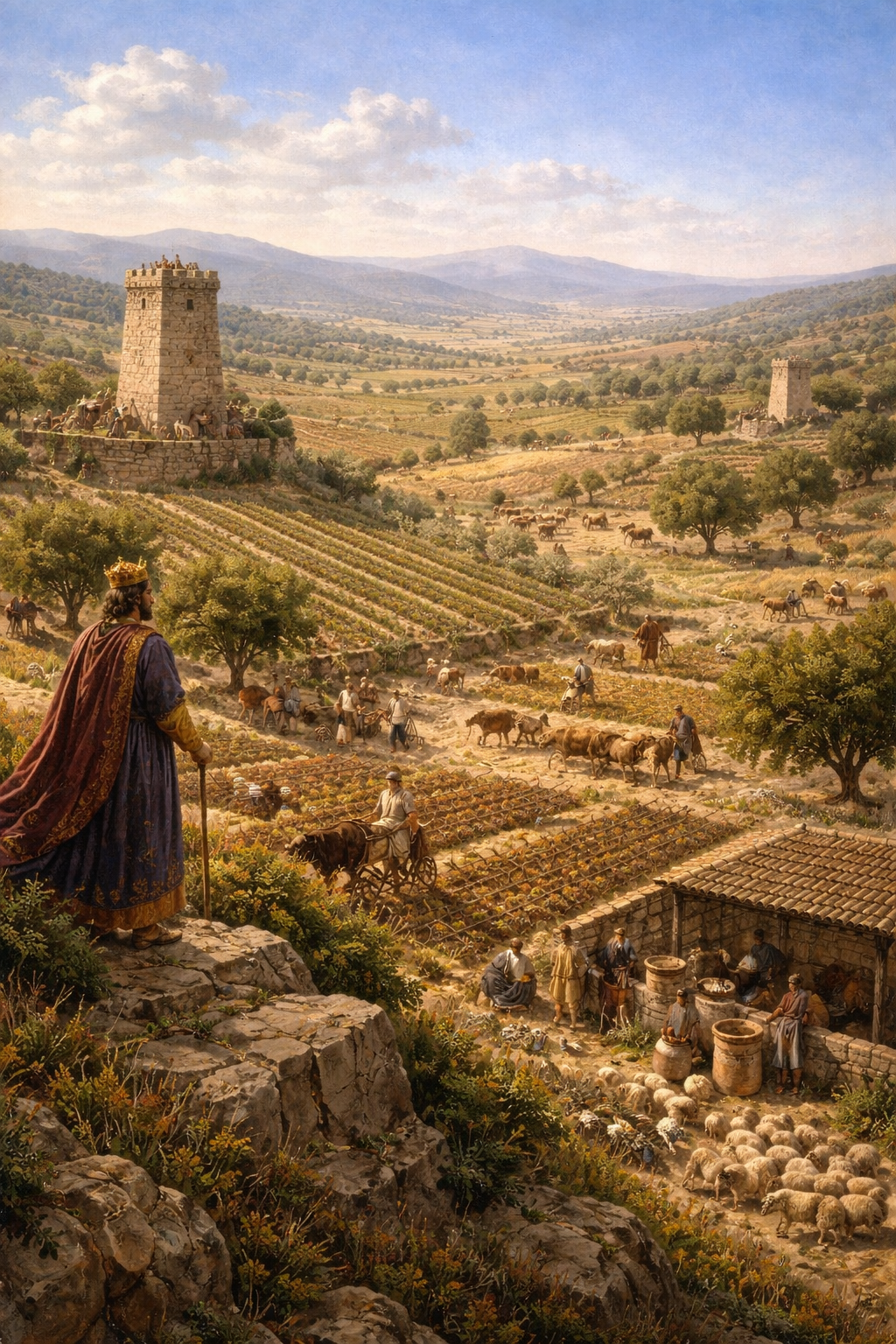
GOD GIVES UZZIAH
AGRICULTURAL SUCCESS
He built towers (migdal) in the wilderness (Southern Judah) and hewed many cisterns (bor), for he had much livestock, both in the lowland (Shephelah, the foothills) and in the plain (tableland E Jordan R). He also had plowmen and vinedressers in the hill country and the fertile fields, for he loved the soil - What an interesting description of a king that he loved the soil. Scripture does not usually highlight the hobbies of monarchs, yet the chronicler pauses to tell us that Uzziah delighted in the ordinary work of fields and vineyards. Though he commanded armies and governed a nation, his heart was drawn to the quiet, patient labor of cultivating the ground. This detail reveals something refreshing about his character: he was not merely a man of war and politics, but one who valued growth, fruitfulness, and the rhythms of God’s creation. The same hands that held a scepter also took pleasure in the plow.
Raymond Dillard: The towers provided defensive positions, but may also have served as storehouses and as refuge for workers tending fields or livestock (1 Chr 27:25–31). Because of his love of the soil (v 10), Uzziah could with justice be considered the patron saint of farming. After the rise of the monarchy in Israel, in addition to the landed property of free Israelites, there developed extensive crown lands through purchase, take over, or other means (1 Sam 8:12–14; 22:7; 1 Kgs 21; 2 Kgs 8:3–6; 1 Chr 27:25–31). These crown lands would have provided a source of supplies and trade commodities for the court, employment for those without other means, and could be granted as fiefs in reward for faithful service. Ordinarily only the poorest of the land served as vinedressers and laborers on royal estates (2 Kgs 24:14; 25:12; Jer 52:16; Jer 40:9–10; see Graham, BA 47 [1985] 55–58; and Rainey, BASOR 245 [1982]) 55–58). (Borrow 2 Chronicles)
J.A. Thompson: Many cisterns have been discovered that were in use in Uzziah’s time, judging from the debris found in them. A cistern was dug into the limestone and sealed with lime plaster to provide a continuing supply of water (Jer 2:13; 38:6) caught during rainstorms. There evidently was a sizeable group of workers tending Uzziah’s fields and pastures. The “fertile lands” (karmel) may be a place, Carmel (not to be confused with Mount Carmel in the north) south of Hebron (cf. 1 Sam 25). This verse gives an excellent summary of the agricultural zones and the agricultural activities in Judah, whose royal property (1 Sam 8:12-14; 22:7; 1 Kgs 21; 2 Kgs 8:3-6; 1 Chr 27:25-31) supported the king and provided rewards for faithful service. (The New American Commentary – 1, 2 Chronicles)
Cisterns (0953)(bor from baar = to make distinct or plain) a pit, cistern, well. The term can refer to rock-hewn reservoirs or man-made wells. When empty, such cisterns served as perfect prisons (i.e., Joseph [Ge. 37:20, 22, 24, 28, 29] and Jeremiah [Jer. 38:6, 7, 9-11, 13]). Figuratively, the image of bor conveys both positive and negative connotations. Positively, it can signify the blessing of a man’s wife as a source of life and refreshment (Pr 5:15), and Sarah is portrayed as the “cistern” from which Israel was hewn, a symbol of covenant origin and nurture (Isa 51:1–2). Negatively, the same imagery can depict the realm of death (Pr 28:17), descent to Sheol (Ps 30:3), or the pit of exile and bondage (Zech 9:11). Thus the metaphor may represent either life-giving security or, in darker contexts, confinement, judgment, and separation.
Gilbrant - This noun is used 63 times in the Bible. This spelling of the word is an abbreviation of "cistern," "well" or "pit", although the latter is used less often in the Bible. It is used of a cistern, a deep pit dug in the ground or bedrock for the storage of water (Lev. 11:36; Dt. 6:11; 1Sa 19:22; 2Ki 18:31; 2Ch 26:10; Neh. 9:25; Pr 5:15; Isa 36:16). In some instances the word is used of a well (2 Sam. 23:15, 16; 1 Chr. 11:17, 18; Ecc. 12:6). It is used of a pit, which may be a cistern, empty of water during the dry season, or of a hole used for other purposes in which an animal may accidentally fall (Exo. 21:33, 34), in which a person may hide (2 Sam. 23:20; 2 Ki. 10:14; 1 Chr. 11:22), in which a person may be thrown for spite (i.e., Joseph; Gen. 37:20, 22, 24, 28, 29), or in which to dispose of dead bodies (Jer. 41:7, 9). The concept of pit is used figuratively of the consequence of wickedness (Ps. 7:15), of Sarah as the mother of Israel (Isa. 51:1), and of calamity in general (Ps. 40:2; 88:6). The word is used of a pit that serves as a dungeon (Gen. 40:15; 41:14; Isa. 24:22; Jer. 38:6; Zech. 9:11) or with the word bayith (house) of a prison, literally house of the pit (Exo. 12:29; Jer. 37:16). In this sense, the word is used figuratively of Israel's captivity (Lam. 3:53, 55; Zech. 9:11). In poetry, the word is used figuratively of the grave (Ps. 30:3; Prov. 28:17; Isa. 14:9) and hell (Isa. 14:15). (Complete Biblical Library)
BOR - 61V - Gen. 37:20; Gen. 37:22; Gen. 37:24; Gen. 37:28; Gen. 37:29; Gen. 40:15; Gen. 41:14; Exod. 12:29; Exod. 21:33; Exod. 21:34; Lev. 11:36; Deut. 6:11; 1 Sam. 13:6; 1 Sam. 19:22; 2 Sam. 3:26; 2 Ki. 10:14; 2 Ki. 18:31; 1 Chr. 11:17; 1 Chr. 11:18; 1 Chr. 11:22; 2 Chr. 26:10; Neh. 9:25; Ps. 7:15; Ps. 28:1; Ps. 30:3; Ps. 40:2; Ps. 88:4; Ps. 88:6; Ps. 143:7; Prov. 1:12; Prov. 5:15; Prov. 28:17; Eccl. 12:6; Isa. 14:15; Isa. 14:19; Isa. 24:22; Isa. 36:16; Isa. 38:18; Isa. 51:1; Jer. 6:7; Jer. 37:16; Jer. 38:6; Jer. 38:7; Jer. 38:9; Jer. 38:10; Jer. 38:11; Jer. 38:13; Jer. 41:7; Jer. 41:9; Lam. 3:53; Lam. 3:55; Ezek. 26:20; Ezek. 31:14; Ezek. 31:16; Ezek. 32:18; Ezek. 32:23; Ezek. 32:24; Ezek. 32:25; Ezek. 32:29; Ezek. 32:30; Zech. 9:11
2 Chronicles 26:11 Moreover, Uzziah had an army ready for battle, which entered combat by divisions according to the number of their muster, prepared by Jeiel the scribe and Maaseiah the official, under the direction of Hananiah, one of the king’s officers.
- went out: 2Ki 5:2
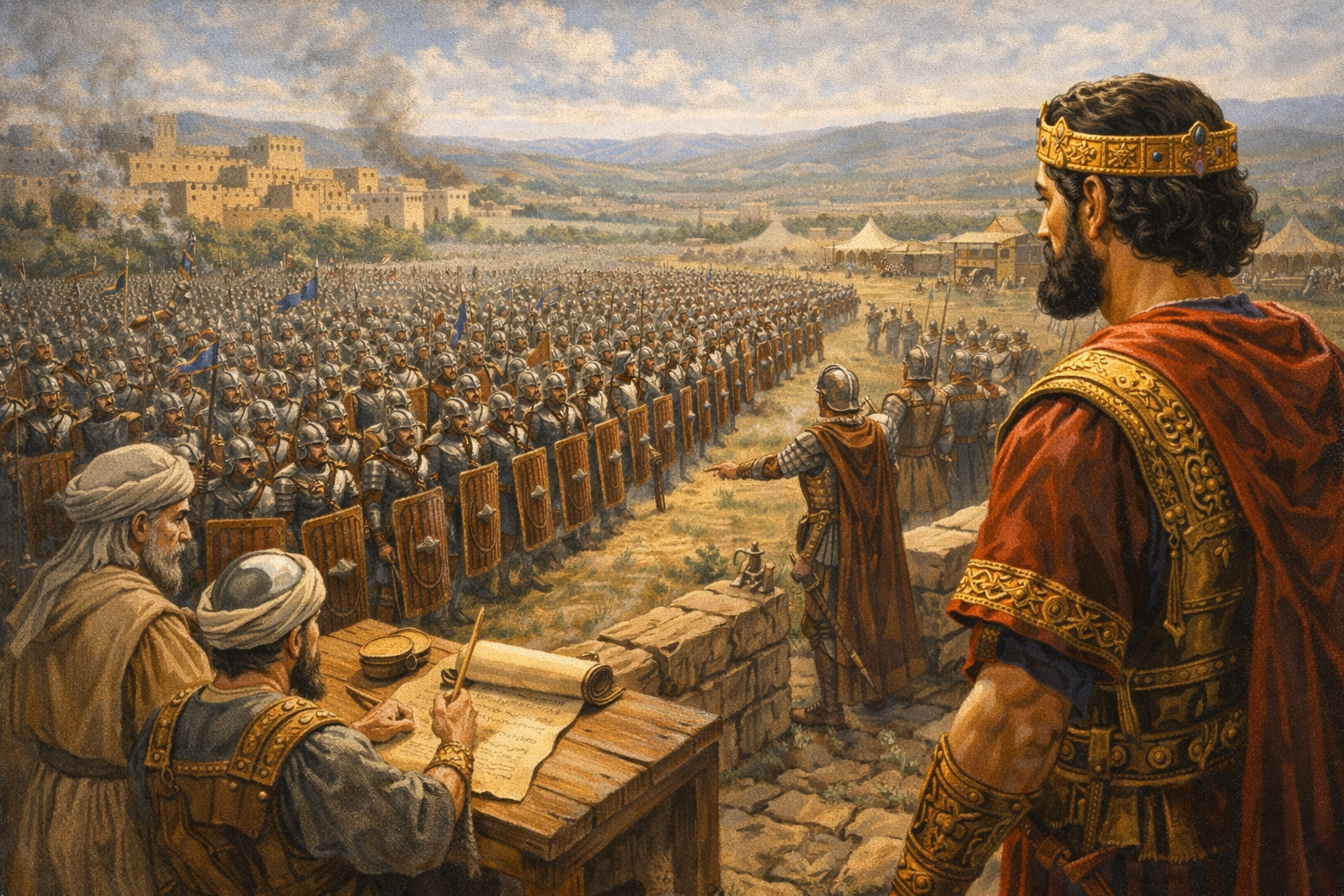
UZZIAH'S IMPRESSIVE MILITARY
COURTESY OF YAHWEH
Moreover, Uzziah had an army ready for battle, which entered combat by divisions according to the number of their muster, prepared by Jeiel the scribe and Maaseiah the official, under the direction of Hananiah, one of the king’s officers. Uzziah must have held the view that the best defense is a good offense. Uzziah maintained a well-organized, carefully counted army, prepared for battle under capable leadership.
Andrew Hill: The Chronicler regards the maintenance of a large army by the king of Judah as a sign of God’s blessing. In addition to the militia levied by tribe and led by tribal chieftain or clan elder, Uzziah’s army includes another layer of leadership in the royal officials who function like chiefs of staff in today’s military parlance (2 Chron. 26:11). The organization of the militia into “divisions” (2Ch 26:11) represents a new development in Israel’s military structure. The same is true for the armaments provided for the soldiers (2Ch 26:14), since in earlier times the conscript was required to provide his own weapons (cf. Jdg. 20:16-17; 1 Chron. 12:2, 8, 24). Thus, the reign of Uzziah witnesses the increasing sophistication of warfare as practiced by the Israelites. (The NIV Application Commentary – 1 & 2 Chronicles.)
John Walton on military successes. Although there are no other literary sources which describe Uzziah’s victories over the Philistines, Arabs and Meunites, there is archaeological evidence of destruction at the Philistine city of Ashdod, which may have been done during the time of Uzziah. There is also evidence that Uzziah constructed fortresses in these newly conquered territories. Gath (Tell es-Safi; see comment on 1 Sam 5:8), Ashdod and Jabneh form a triangle about ten or fifteen miles on each side that dominates the northern section of the Philistine plain directly west of Jerusalem. Tell Mor near the Philistine city of Ashdod provides one example of such a fortress. Since Uzziah was not able to expand north because of the power of Israel under Jeroboam II, he turned his attention to the west and south, subduing people groups that had taken advantage of previously unstable conditions in Judah. (IVP Bible Background Commentary on the OT- page 447)
2 Chronicles 26:12 The total number of the heads of the households, of valiant warriors, was 2,600.
FAMILY LEADERS
OF MILITARY
The total number of the heads of the households, of valiant (chayil - strong, courageous, mighty) warriors (gibbor), was 2,600 - NET - "The total number of family leaders who led warriors" NLT paraphrases it " These regiments of mighty warriors were commanded by 2,600 clan leaders."
Heads of the households means clan or family leaders. These were officers responsible for organizing and commanding their family-based military units.
Valiant warriors (chayil gibbor) carries the idea of courageous, skillful, and capable men of strength and influence. The Hebrew word chayil can also refer to wealth, power, and military might. So these leaders weren’t just physically brave, but they were strong men of ability, possibly men of means who helped equip their forces.
Valiant (wealth, strength, riches, army) (02428) chayil (from verb chul meaning “to be strong, firm, or able.”) strength, wealth, army. This word has the basic idea of strength and influence. To summarize it means capable, productive strength—expressed as valor in battle, wealth in resources, or excellence in character. This word has the basic idea of strength and influence. It can be used to speak of the strength of people (1 Sam. 2:4; 9:1; 2 Sam. 22:40); of horses (Ps. 33:17); or of nations (Esth. 1:3). God is often seen as the supplier of this strength (2 Sam. 22:33; Hab. 3:19). When describing men, it can speak of those who are strong for war (Deut. 3:18; 2 Ki. 24:16; Jer. 48:14); able to judge (Ex. 18:21, 25); or are righteous in behavior (1 Ki. 1:52).
Chayil denotes strength that is effective and productive, not merely physical force. It describes military valor and bravery, material wealth and resources, moral strength and capability, and overall competence in a task. Chayil is used in three major spheres - (1) Military sense – a valiant warrior, a man proven in battle. (2) Economic sense – wealth, substance, property, the capacity to produce. (3 Ethical sense – excellence of character (e.g., eshet chayil, Pr 31:10).
CHAYIL IN KINGS AND CHRONICLES - 1 Ki. 1:42; 1 Ki. 1:52; 1 Ki. 10:2; 1 Ki. 11:28; 1 Ki. 15:20; 1 Ki. 20:1; 1 Ki. 20:19; 1 Ki. 20:25; 2 Ki. 2:16; 2 Ki. 5:1; 2 Ki. 6:14; 2 Ki. 6:15; 2 Ki. 7:6; 2 Ki. 9:5; 2 Ki. 11:15; 2 Ki. 15:20; 2 Ki. 18:17; 2 Ki. 24:14; 2 Ki. 24:16; 2 Ki. 25:1; 2 Ki. 25:5; 2 Ki. 25:10; 2 Ki. 25:23; 2 Ki. 25:26; 1 Chr. 5:18; 1 Chr. 5:24; 1 Chr. 7:2; 1 Chr. 7:5; 1 Chr. 7:7; 1 Chr. 7:9; 1 Chr. 7:11; 1 Chr. 7:40; 1 Chr. 8:40; 1 Chr. 9:13; 1 Chr. 10:12; 1 Chr. 11:22; 1 Chr. 11:26; 1 Chr. 12:8; 1 Chr. 12:21; 1 Chr. 12:25; 1 Chr. 12:28; 1 Chr. 12:30; 1 Chr. 18:9; 1 Chr. 20:1; 1 Chr. 26:6; 1 Chr. 26:7; 1 Chr. 26:8; 1 Chr. 26:9; 1 Chr. 26:30; 1 Chr. 26:31; 1 Chr. 26:32; 1 Chr. 28:1; 2 Chr. 9:1; 2 Chr. 13:3; 2 Chr. 14:8; 2 Chr. 14:9; 2 Chr. 16:4; 2 Chr. 16:7; 2 Chr. 16:8; 2 Chr. 17:2; 2 Chr. 17:13; 2 Chr. 17:14; 2 Chr. 17:16; 2 Chr. 17:17; 2 Chr. 23:14; 2 Chr. 24:23; 2 Chr. 24:24; 2 Chr. 25:6; 2 Chr. 26:11; 2 Chr. 26:12; 2 Chr. 26:13; 2 Chr. 26:17; 2 Chr. 28:6; 2 Chr. 33:14
Warriors (mighty) (01368) gibbor cp related verb gabar = be strong, accomplish, excel, prevail) is from a root which is commonly associated with warfare and has to do with the strength and vitality of the successful warrior. And thus this adjective means powerful, strong, brave, mighty. The idea is one who prevails, a mighty man, a warrior-hero, sometimes simply a powerful person. Warrior. Hero. Mighty man (cp "mighty [gibbor] men of David" - 2Sa 23:8). Gibbôr describes a person who possesses superior strength and proven courage. It is most often used of a heroic warrior, but can also describe: a mighty leader, a person of great ability, or even God Himself as the supreme Warrior. Frequently paired with chayil → gibbôr chayil = “a mighty man of valor” (strength + capability). Can describe soldiers (2 Sa 23 – David’s mighty men), tyrants or oppressors (Gen 6:4), or Yahweh as the Divine Warrior. To summarize GIBBOR is a person of proven, prevailing strength—especially a warrior-hero whose power has been demonstrated in victory. See also discussion of this word group from TWOT - Gibbor Word Group
GIBBOR IN SAMUEL - CHRONICLES - 1 Sam. 2:4; 1 Sam. 9:1; 1 Sam. 14:52; 1 Sam. 16:18; 1 Sam. 17:51; 2 Sam. 1:19; 2 Sam. 1:21; 2 Sam. 1:22; 2 Sam. 1:25; 2 Sam. 1:27; 2 Sam. 10:7; 2 Sam. 16:6; 2 Sam. 17:8; 2 Sam. 17:10; 2 Sam. 20:7; 2 Sam. 22:26; 2 Sam. 23:8; 2 Sam. 23:9; 2 Sam. 23:16; 2 Sam. 23:17; 2 Sam. 23:22; 1 Ki. 1:8; 1 Ki. 1:10; 1 Ki. 11:28; 2 Ki. 5:1; 2 Ki. 15:20; 2 Ki. 24:14; 2 Ki. 24:16; 1 Chr. 1:10; 1 Chr. 5:24; 1 Chr. 7:2; 1 Chr. 7:5; 1 Chr. 7:7; 1 Chr. 7:9; 1 Chr. 7:11; 1 Chr. 7:40; 1 Chr. 8:40; 1 Chr. 9:13; 1 Chr. 9:26; 1 Chr. 11:10; 1 Chr. 11:11; 1 Chr. 11:12; 1 Chr. 11:19; 1 Chr. 11:24; 1 Chr. 11:26; 1 Chr. 12:1; 1 Chr. 12:4; 1 Chr. 12:8; 1 Chr. 12:21; 1 Chr. 12:25; 1 Chr. 12:28; 1 Chr. 12:30; 1 Chr. 19:8; 1 Chr. 26:6; 1 Chr. 26:31; 1 Chr. 27:6; 1 Chr. 28:1; 1 Chr. 29:24; 2 Chr. 13:3; 2 Chr. 14:8; 2 Chr. 17:13; 2 Chr. 17:14; 2 Chr. 17:16; 2 Chr. 17:17; 2 Chr. 25:6; 2 Chr. 26:12; 2 Chr. 28:7; 2 Chr. 32:3; 2 Chr. 32:21
2 Chronicles 26:13 Under their direction was an elite army of 307,500, who could wage war with great power, to help the king against the enemy.
- three hundred: 2Ch 11:1 13:3 14:8 17:14-19
ARMY ABLE TO
HELP UZZIAH
Under their direction was an elite army of 307,500, who could wage war with great power, to help (azar; Lxx = boetheo) the king against the enemy. So, the 2,600 commanders (2Ch 26:12) each led a portion of the 307,500‑man army — a highly organized and disciplined military system. This mirrors the organization seen in earlier Israelite armies (see Numbers 1 and 2 Samuel 18:1). Uzziah’s era (8th century B.C.) was one of Judah’s strongest and most prosperous. God blessed him because he sought the LORD (2 Chronicles 26:5).
Martin Selman: The expression “to help the king” (2Ch 26:13, NRSV, RSV) is a deliberate echo of God’s help (2Ch 26:7, 15), and is paralleled by similar assistance for David (1 Chr. 12:1, 18, 21-22), Solomon (1 Chr. 22:17), and Hezekiah (2 Chr. 32:3). (Tyndale Old Testament Commentaries – 2 Chronicles. BORROW)
2 Chronicles 26:14 Moreover, Uzziah prepared for all the army shields, spears, helmets, body armor, bows and sling stones.
- sling stones: Heb. stones of slings, Judges 20:16 1Sa 17:49
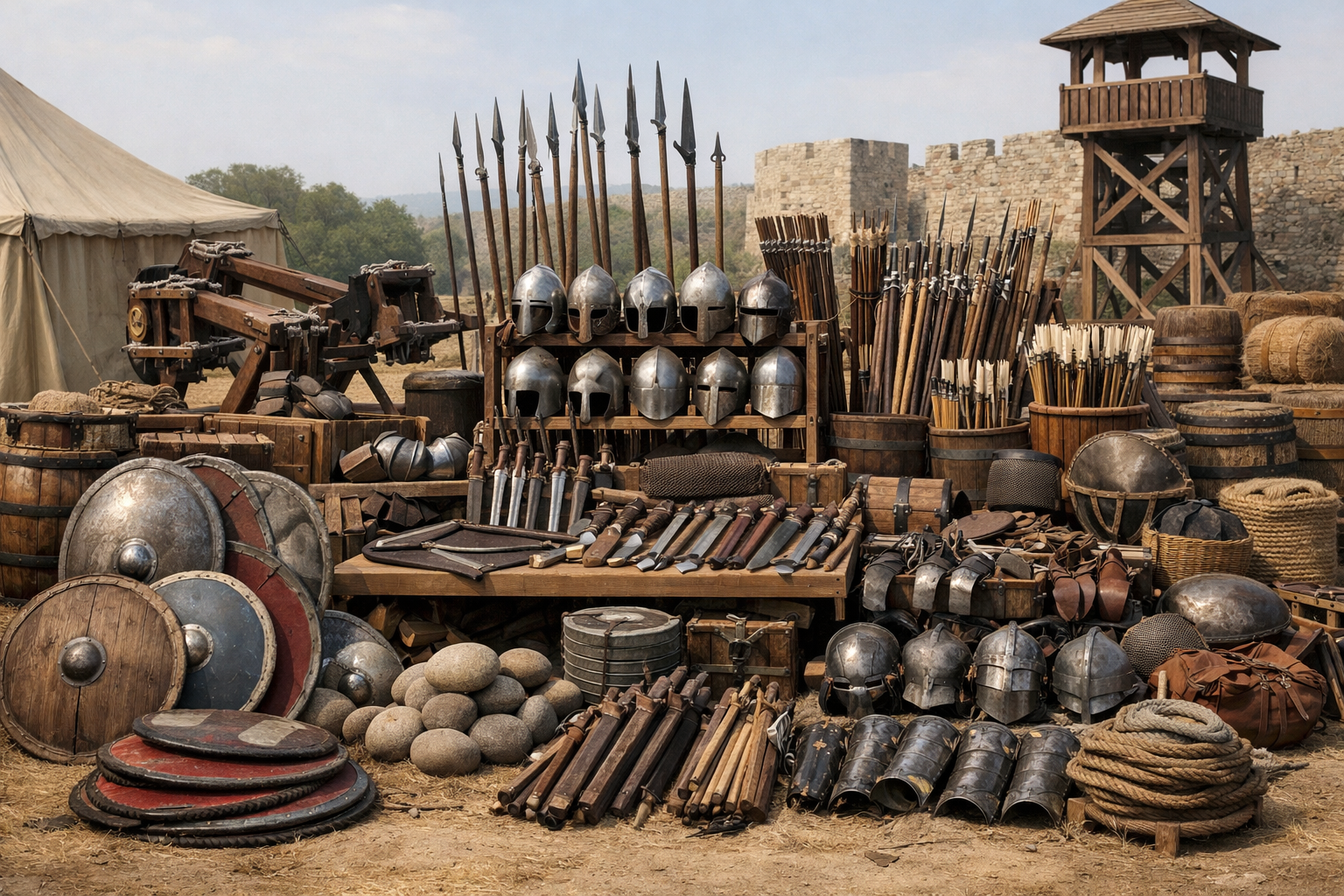
UZZIAH'S
WELL ARMED ARMY
Moreover, Uzziah prepared for all the army shields, spears, helmets, body armor, bows and sling stones.
John Walton on arms. The wealth of Uzziah afforded him the opportunity to arm his soldiers with the traditional weaponry in the Near East in the Iron Age. The weapons mentioned here were also those listed as ones used by the Assyrian army. The Assyrians describe their weaponry in detail in their annals, and they are often depicted in wall reliefs at the king’s palace. It can be presumed that Uzziah began to build up his army because of the threat of Assyria and of neighboring Israel.(IVP Bible Background Commentary on the OT- page 448)
2 Chronicles 26:15 In Jerusalem he made engines of war invented by skillful men to be on the towers and on the corners for the purpose of shooting arrows and great stones. Hence his fame spread afar, for he was marvelously helped until he was strong.
- invented by skillful men: 2Ch 2:7,14 Ex 31:4
- his fame spread afar, Mt 4:24
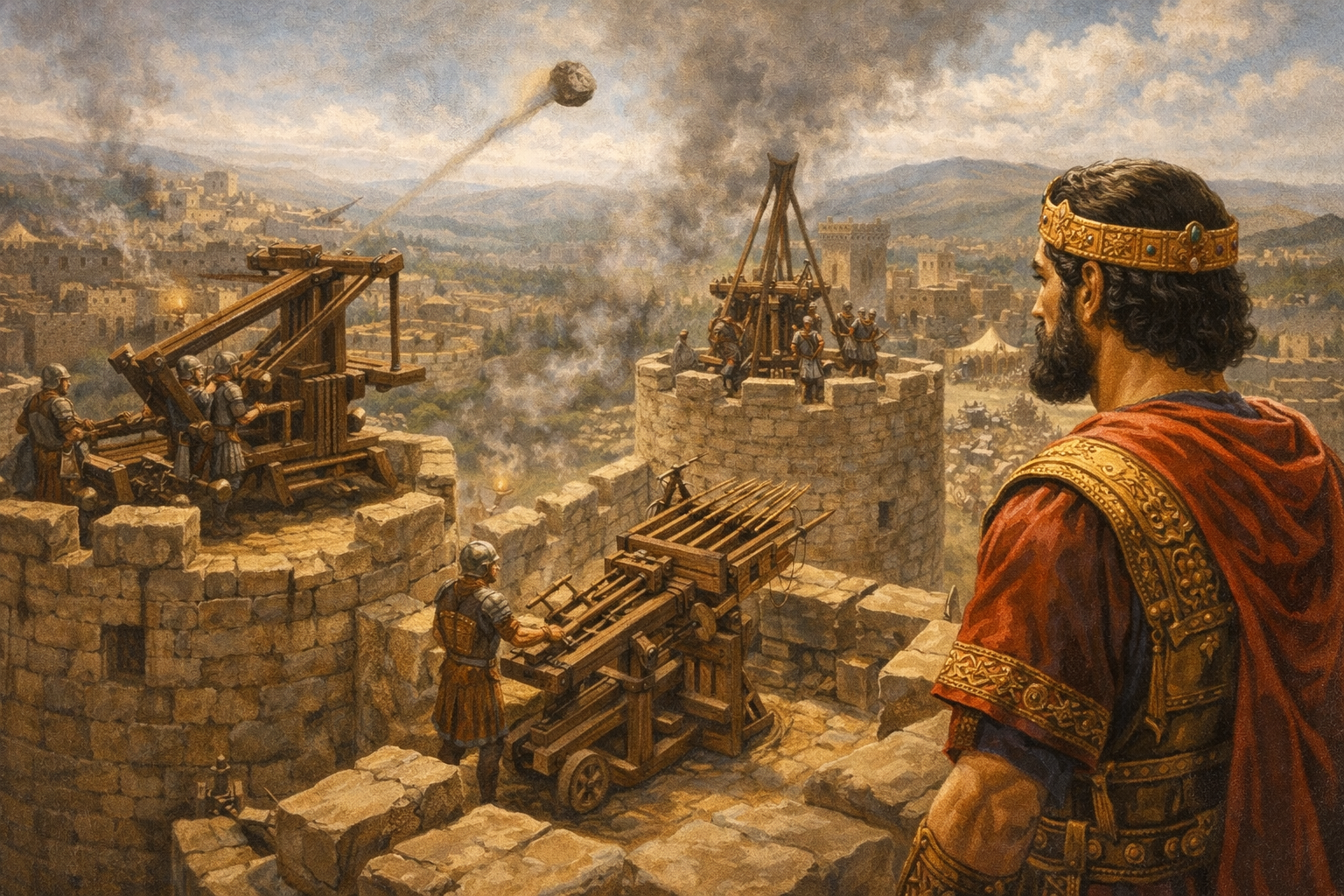
UZZIAH AN INVENTOR OF SORTS
AND HIS FAME SPREAD
In Jerusalem he made engines of war invented by skillful men to be on the towers and on the corners for the purpose of shooting arrows and great stones - Since catapults were not invented until 300 years later, this may refer to defensive structures that protected those shooting arrows and throwing stones
John Walton - The “machines” made by Uzziah were probably protective shielding devices mounted on the walls providing protection for defenders to throw stones and shoot arrows at the enemy. The material remains from the Judahite fortress at Lachish attest to the nature of Uzziah’s constructions. Additionally, they are represented in the Assyrian wall reliefs at Sennacherib’s palace at Nineveh. In the past some interpreters had suggested that these were catapults, but there is no evidence of the use of catapults this early. (IVP Bible Background Commentary on the OT- page 448)
J Vernon McGee - In ancient warfare they had certain kinds of machines that would hurl rocks. Also they could fix bows that would shoot arrows without being pulled by human power. And they were able to build bows of tremendous size that would shoot arrows a great distance. It is interesting to note that this man Uzziah was responsible for this new method of warfare.
Hence his fame (shem) spread afar - Literally “And his name went out far.”
Beware of Fame—
It Often Tests Character More Than Failure
🙏 THOUGHT - Fame has a subtle way of feeding the very things Christ calls us to crucify—pride, self-reliance, and the craving for applause, in short SELF! Failure tends to drive us to our knees, but fame tempts us to stand taller than we should. Many have handled adversity with grace yet were ruined by success. The heart that once sought God in obscurity can slowly begin to seek the mirror when the crowd starts cheering. When a person becomes known, honest friends grow quiet and flatterers grow loud. Applause can drown out conscience. Fame invites new counselors—often the kind who tell us what we want to hear rather than what we need to hear. The danger is not being known; the danger is believing your own press. Fame whispers, “You are the reason this happened.” Scripture answers, “What do you have that you did not receive?” (1 Cor 4:7). The more gifted a person becomes, the easier it is to confuse God’s kindness with personal greatness. Crowds demand time, image demands energy, and soon the hidden life with God becomes optional. Yet every public fall begins with a private drift. The soul was not designed to live on applause; it was designed to live on communion with God. Fame does not change who we are—it reveals who we already were. If humility is present, fame can widen service; if pride is present, fame will widen ruin. Character is the foundation; fame is only the spotlight. Remember that Christ emptied Himself of reputation (Phil 2:7), so let us imitate Him (1Jn 2:6). Keep a circle of truth-telling friends. And stay close to the Word of God and the God of the Word and you will be kept safe from the subtle snare or fame.
For (important term of explanation) - What is the writer explaining? He is telling us why Uzziah's name went out far and wide. It was not just Uzziah's doing but the LORD's providing.
he was marvelously helped ('azar; LXX - boetheo) until he was strong (chazaq; LXX - katischuo - became dominant, prevailed) - Who marvelously helped with all the preceding successes? Clearly this is a reference to Yahweh's good hand of blessing on Uzziah while he sought the Lord. Oh, how we need to remember this principle - primarily for the prospering of our spirituality!
🙏 THOUGHT - While I do not want to push this too far, the use of the Greek verb boetheo means to coming running on hearing a cry for help. Did Uzziah cry out to Yahweh for help? Possibly. It is interesting that his sin was offering incense, which is a picture of prayer! Applying this to our life, Hebrews 2:18 says "For since He Himself was tempted in that which He has suffered, He is able to come to the aid (boetheo) of those who are tempted." In other words, the writer of Hebrews is saying when His brethren cry out in times of temptation and suffering, Jesus hears and runs to our aid to render help. He many not remove the temptation or suffering, but His Spirit is able to give us the spiritual power to endure through the temptation or suffering. If you are being tempted or suffering, consider listening to the old Maranathan chorus CRY OUT.
Andrew Hill: The Chronicler suggests that Uzziah is an inventor of sorts, designing “machines” (26:15; or “inventions,” from the Heb. hsb, “to think”) for use in combat. The immediate context suggests that this new offensive weapon is a type of catapult. (The NIV Application Commentary – 1 & 2 Chronicles.)
Martin Selman: Verse 15 forms an inclusion with verses 7-8 by repeating the three key terms, fame, helped, and powerful/strong (v. 15), which characterize the section. The adverb “marvelously” (NRSV, RSV) or “wonderfully” (REB, NEB) always implies that God is the subject, cf. GNB, “the help he received from God” (cf. Isa. 28:29; 29:14; Joel 2:26; Ps. 31:21)....The chief reason for Uzziah’s success is God’s help. This is a special word in Chronicles (cf.e.g. 1 Chronicles 12:19; 2 Chronicles 14:11; 25:8) whose meaning is equivalent in the New Testament to the enabling work of the Holy Spirit (cf. Romans 8:26; 2 Timothy 1:14; cf. Acts 26:22; 1 Thessalonians 2:2). (Tyndale Old Testament Commentaries – 2 Chronicles. BORROW)
G Campbell Morgan - -2 Chr 26.15-16
Uzziah was one of the most remarkable of the kings of Judah. He was a man of strong character, and the early period of his reign was characterized by true prosperity. He was victorious in his campaigns against the enemies of his people, and eminently successful in his development of the internal resources of the nation. At once a man of war and a lover of husbandry, he was an ideal ruler for those troublous times. During the first years of his reign he went quietly forward in dependence upon God. Then there came a change over the man, and the story of it is told by the chronicler in these words. How significant they are! The history of men affords persistent witness to the subtle perils which are created by prosperity. More men are blasted by it than by adversity. Man, dependent upon God, is independent of all else. In the moment when the heart begins to feel independent of God, because of personal strength, that very strength becomes weakness; and unless there be repentance and return, ruin is inevitable. Prosperity always puts the soul in danger of pride, of the heart lifted up; and pride ever goeth before destruction, and a haughty spirit before a fall. The pride of Uzziah led him to an act of sacrilege. He entered into the sacred courts, and violated the ordinances of God concerning the offering of sacrifices. He was smitten with leprosy, and the last years of his life were spent as a prisoner, isolated from his fellowmen.
Baker encyclopedia of the Bible Volume: 1 - Although the divided kingdoms of Judah and Israel were not noted for technical advancements in offensive warfare, a number of their kings worked at improving fortifications and means of defense. Uzziah was especially remembered for his accomplishments in defensive warfare. Along with other measures, “in Jerusalem he made engines, invented by skilful men, to be on the towers and the corners, to shoot arrows and great stone” (2 Chr 26:15). Those “engines” were special protective structures built to facilitate the task of the archers and to permit huge stones to be dropped on the heads of assaulting troops. A depiction of Uzziah’s devices appears on the reliefs of Sennacherib commemorating the siege of Lachish. On the towers, corners, and crenelated battlements, defenders have erected structures made of wooden frames that hold their shields. The high screen formed by the shields permits the defenders to stand rather than crouch, and to use both hands freely to discharge their weapons.
G Campbell Morgan - Uzziah was one of the most remarkable of the kings of Judah. He was a man of strong character, and the early period of his reign was characterized by true prosperity. He was victorious in his campaigns against the enemies of his people, and eminently successful in his development of the internal resources of the nation. At once a man of war and a lover of husbandry, he was an ideal ruler for those troublous times. During the first years of his reign he went quietly forward in dependence upon God. Then there came a change over the man, and the story of it is told by the chronicler in these words. How significant they are! The history of men affords persistent witness to the subtle perils which are created by prosperity. More men are blasted by it than by adversity. Man, dependent upon God, is independent of all else. In the moment when the heart begins to feel independent of God, because of personal strength, that very strength becomes weakness; and unless there be repentance and return, ruin is inevitable. Prosperity always puts the soul in danger of pride, of the heart lifted up; and pride ever goeth before destruction, and a haughty spirit before a fall. The pride of Uzziah led him to an act of sacrilege. He entered into the sacred courts, and violated the ordinances of God concerning the offering of sacrifices. He was smitten with leprosy, and the last years of his life were spent as a prisoner, isolated from his fellowmen. (Borrow Lift Applications from Every Chapter of the Bible)
F B Meyer - He was marvellously helped, till he was strong.
Great and marvellous are Thy works, O God; that our soul knoweth quite well. Thou hast showed marvellous loving-kindness. We must sing to Thee; for Thou hast done marvellous things. It is marvellous that Thou shouldst have set Thy love upon us; that Thou shouldst have watched over our interests with unwearied care; that our sins, or unbelief, or declensions, have never diverted Thy love from us. “Marvellous” is the only word we can use, as we think of the condescension of the well-beloved Son to the manger-bed; of the agony and bloody-sweat; of the cross and passion— and all for us who were His enemies. But it is most marvellous of all that Thou hast made us children, heirs, and joint-heirs with Christ. To think that we shall shine as the sun of Thy kingdom, that we are to sit upon His throne, and be included in that circle of love and life of which the throne of God and the Lamb is the center! Surely the marvels of Thy grace will only seem the greater when eternity with its boundless ages gives us time to explore them.
The danger, however, is that we should become strong in our own conceit, and credit ourselves with the position which is due to the grace of God alone. Oh for the truly humble spirit of the little child, that we may never vaunt our selves! The laden ship sinks in the water; the fruit-burdened bough stoops to the ground; the truest scientist is the humblest disciple. Oh to be submerged and abashed for the marvellous help of God!
God cannot trust some of us with prosperity and success, because our nature could not stand them. We must tug at the oar, instead of spreading the sail, because we have not enough ballast.
2 Chronicles 26:16 But when he became strong, his heart was so proud that he acted corruptly, and he was unfaithful to the LORD his God, for he entered the temple of the LORD to burn incense on the altar of incense.
KJV But when he was strong, his heart was lifted up to his destruction: for he transgressed against the LORD his God, and went into the temple of the LORD to burn incense upon the altar of incense.
NKJ But when he was strong his heart was lifted up, to his destruction, for he transgressed against the LORD his God by entering the temple of the LORD to burn incense on the altar of incense.
NET But once he became powerful, his pride destroyed him. He disobeyed the LORD his God. He entered the LORD's temple to offer incense on the incense altar.
BGT 2 Chronicles 26:16 καὶ ὡς κατίσχυσεν ὑψώθη ἡ καρδία αὐτοῦ τοῦ καταφθεῖραι καὶ ἠδίκησεν ἐν κυρίῳ θεῷ αὐτοῦ καὶ εἰσῆλθεν εἰς τὸν ναὸν κυρίου θυμιάσαι ἐπὶ τὸ θυσιαστήριον τῶν θυμιαμάτων
LXE 2 Chronicles 26:16 And when he was strong, his heart was lifted up to his destruction; and he transgressed against the Lord his God, and went into the temple of the Lord to turn incense on the altar of incense.
CSB 2 Chronicles 26:16 But when he became strong, he grew arrogant and it led to his own destruction. He acted unfaithfully against the LORD his God by going into the LORD's sanctuary to burn incense on the incense altar.
ESV 2 Chronicles 26:16 But when he was strong, he grew proud, to his destruction. For he was unfaithful to the LORD his God and entered the temple of the LORD to burn incense on the altar of incense.
NIV 2 Chronicles 26:16 But after Uzziah became powerful, his pride led to his downfall. He was unfaithful to the LORD his God, and entered the temple of the LORD to burn incense on the altar of incense.
NLT 2 Chronicles 26:16 But when he had become powerful, he also became proud, which led to his downfall. He sinned against the LORD his God by entering the sanctuary of the LORD's Temple and personally burning incense on the incense altar.
- when he became strong: 2Ch 25:19 32:25 De 8:14,17 32:13-15 Pr 16:18 Hab 2:4 Col 2:18
- for he entered the temple of the LORD: 2Ki 16:12,13
- to burn: Nu 16:1,7,18,35 1Ki 12:33 13:1-4
Related Passages:
2 Chronicles 25:19-20 (PRIDE TOOK DOWN UZZIAH'S FATHER KING AMAZIAH WHO WAS CALLED OUT BY A PAGAN KING!) “You said, ‘Behold, you have defeated Edom.’ And your heart has become proud in boasting. Now stay at home; for why should you provoke trouble so that you, even you, would fall and Judah with you?” 20 But Amaziah would not listen, for it was from God, that He might deliver them into the hand of Joash because they had sought the gods of Edom.
Luke 18:14 “I tell you, this man went to his house justified rather than the other; for everyone who exalts himself will be humbled, but he who humbles himself will be exalted.”
Ezekiel 28:17 (PRIDE OF SATAN) “Your heart was lifted up because of your beauty; You corrupted your wisdom by reason of your splendor. I cast you to the ground; I put you before kings, That they may see you.
"ABOUT FACE!"
PRIDE - THE ACHILLES
HEEL OF MANY A MAN
But - Oh, if this term of contrast had not been present in Uzziah's life, for BUT always marks a "change of direction" and in this context, a change in Uzziah's heart from one that was humble and sought God to one that was prideful and sinned against God! (See discussion of "How Understanding One Word Can Change the Way You Read the Bible")
Success without humility can undo decades of faithfulness,
exposing the Achilles’ heel of a life once thought secure.
Achilles' Heel
When he became strong (chazaq), his heart (leb; LXX - kardia) was so proud (gabah; LXX - hupsoo - exalted) that (term of result) he acted corruptly (shachath)(2Ch 26:16-23) - NET = "But once he became powerful, his pride destroyed him." Note the important progression HE became strong (he thought it was because of his doing!) which led to his heart literally being lifted up or prouc which led to his overt sin and unfaithfulness.
It is fascinating to compare the same verb (chazaq), used here of Uzziah and then of his son in 2Ch 27:6. The father stood tall and became proud, while the son in effect "bowed!" There is also a repeat use of the verb acted corruptly (shachath) here and in 2Ch 27:2, translated in both places in the Septuagint with the verb kataphtheiro which literally means to destroy (in Lev 26:39 = "will rot away because of their iniquity") or to ruin. In Uzziah's case his pride led to his ruin! In the case of Jotham, it was the people who were ruined by their actions!
Affliction is bad; but for every person that can handle prosperity,
there are a hundred that can handle adversity.
-- Carlyle
This decline (cf backsliding) did not happen in a moment but as this verse shows was progressive - success > pride > acted corruptly > unfaithful > presumptuous in performing duty only for priests (cf Ex 30:1-10)!
Selman - “Uzziah is unfaithful (2 Chronicles 26:16, 18). This is the most important expression for sin in Chronicles, and it can bring down a dynasty (1 Chronicles 10:13) or take a nation into exile (1 Chronicles 5:25; 9:1; 2 Chronicles 33:19; 36:14). The term has not appeared since Rehoboam’s time (2 Chronicles 12:2) but now will become a regular theme to the end of the book.”....“Uzziah’s problem was that he was not content with the authority God had given him and wanted to add more priestly functions to his royal power. Absolute power, however, has no place in God’s kingdom.” (BORROW 2 Chronicles)
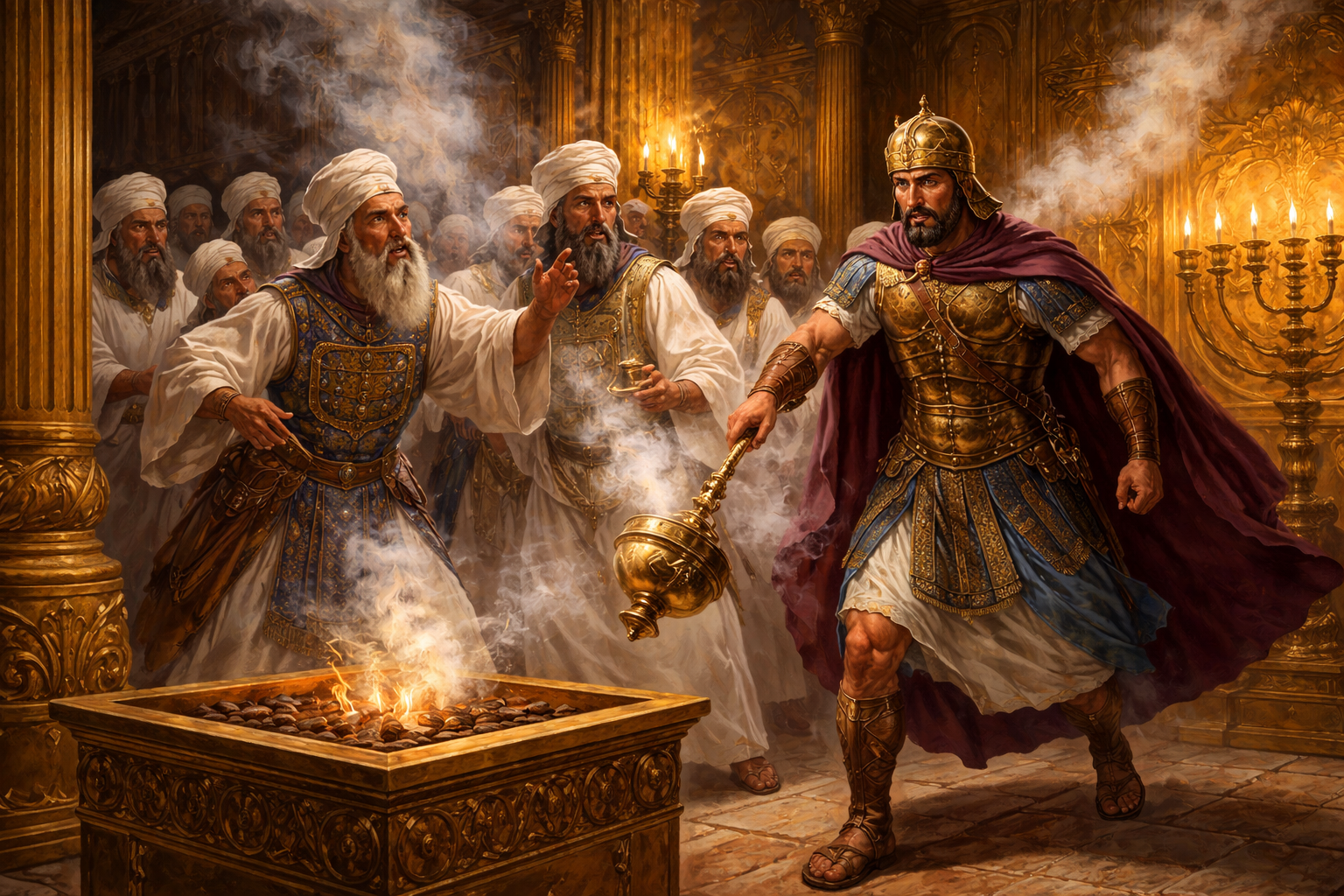
He acted corruptly (chazaq), by attempting offer incense at the incense altar. What irony, as incense is a picture of prayers, something he could have done without taking this sinful action! The altar of incense was in the Holy Place, just outside the Holy of holies and was off limits to all except the priests. But that's what pride (and power) will do to your opinion of yourself! His pride would soon take him down as it always does!
🙏 THOUGHT - If God has given you wealth, influence, popularity, and power, be thankful, BUT be careful. Remember Who it comes from and use it to glorify and honor His Name!
Altar of Incense
And he was unfaithful (maal; LXX - adikeo - violate the law, do wrong) to the LORD his God - KJV = "he transgressed against the LORD his God" NET = "He disobeyed the LORD his God." Note his sin was against the LORD his God! The Chronicler chooses a weighty word maal, a term often used for treachery, breach of trust, or sacrilege (cf. Lev 5:15; Josh 7:1). It is not merely a mistake or lapse in judgment; it describes a betrayal of covenant loyalty, the kind of offense committed by one who knows the LORD yet acts as though the relationship were of no consequence. The Septuagint renders it with adikeo, meaning to act unjustly, to violate what is right, to break the law. The Greek nuance stresses the moral injustice of the act so that Uzziah’s behavior was not only ritual error but ethical rebellion.
Against whom did Uzziah sin? The text pointedly adds, to the LORD his God (cf David Ps 51:4, Joseph Ge 39:9b). His offense was not primarily against the priests he opposed, the temple he invaded, or the law he disregarded, but against a Person, Yahweh, the covenant God Who, the very One Who had been strength and his help and brought him such great prosperity.
For (term of explanation) - This little word opens the window to the cause behind the tragedy. The writer is now explaining where Uzziah’s backsliding began and why his once-bright reign unraveled. Everything that follows flows out of this hinge point in his heart. The Chronicler is not merely describing an event but is tracing a spiritual trajectory. Prosperity had increased, fame had spread, and strength had grown. The “for” tells us Uzziah's intrusion into the temple was only the outward symptom of an inward drift. Here is the turning point. Here is where a God-helped man became a self-directed man.
He entered the temple (hekal; LXX - naos) of the LORD to burn incense on the altar of incense (see study) - He entered the temple of the LORD indicates not just the Temple complex but literally into the Temple proper. The Law was clear and even came with a warning of what happened in the rebellion of Korah "as a reminder to the sons of Israel that no layman who is not of the descendants of Aaron should come near to burn incense before the LORD; so that he will not become like Korah and his company–just as the LORD had spoken to him through Moses." (Nu 16:40)
Why did Uzziah do this? He had everything going for him. The obvious answer is his PRIDE led him to believe he had unbridled authority in Judah. One of the major "attributes" of SIN is that it is deceptive (Heb 3:13), and since pride is a SIN, probably the chief SIN, Uzziah was deceived and did not even know it! There is another consideration that he may have felt he could claim the same office as Melchizedek for Ge 14:18 said "Melchizedek king of Salem brought out bread and wine; now he was a priest of God Most High."
Deuteronomy has several passages that help explain the danger of properity, recalling that King Uzziah experienced incredible success and prosperity:
Deuteronomy 8:10 “When you have eaten and are satisfied, you shall bless the LORD your God for the good land which He has given you. 11 “Beware that you do not forget the LORD your God by not keeping His commandments and His ordinances and His statutes which I am commanding you today (UZZIAH FORGOT THE LORD HIS GOD AND THUS DID NOT KEEP HIS COMMANDMENTS) ; 12 otherwise, when you have eaten and are satisfied, and have built good houses and lived in them, 13and when your herds and your flocks multiply, and your silver and gold multiply, and all that you have multiplies, 14 (NOTE WHAT CAN HAPPEN WITH PROSPERITY) then your heart will become proud and you will forget the LORD your God who brought you out from the land of Egypt, out of the house of slavery. 15“He led you through the great and terrible wilderness, with its fiery serpents and scorpions and thirsty ground where there was no water; He brought water for you out of the rock of flint. 16“In the wilderness He fed you manna which your fathers did not know, that He might humble you and that He might test you, to do good for you in the end. 17 (THINK OF UZZIAH AS YOU READ THIS NEXT VERSE) “Otherwise, you may say in your heart, ‘My power and the strength of my hand made me this wealth.’ 18 “But you shall remember the LORD your God, for it is He who is giving you power to make wealth, that He may confirm His covenant which He swore to your fathers, as it is this day.
Paul Apple - SUCCESS FOSTERS PRIDE WHICH OFTEN LEADS TO SELF-EXALTATION WHICH THEN RESULTS IN JUDGMENT
Prosperity always puts
the soul in danger of pride
G. Campbell Morgan: The history of men affords persistent witness to the subtle perils which are created by prosperity. More men are blasted by it than by adversity…. Prosperity always puts the soul in danger of pride, of the heart lifted up; and pride ever goeth before destruction, and a haughty spirit before a fall.
F B Meyer - “God cannot trust some of us with prosperity and success, because our nature could not stand them. We must tug at the oar, instead of spreading the sail, because we have not enough ballast.”
Thomas Constable: Unfortunately, Uzziah took personal credit for what God had given him (2Ch 26:16). The writer noted several times that Uzziah was strong (2Ch 26:8, 15, 16). His pride led to self-exaltation; he put himself above God.
John Olley: Unlike Hezekiah, who subsequently “humbled himself” (2Ch 32:25, 26), or Jehoshaphat, whose “heart was courageous in the ways of the Lord” (2Ch 17:6), Uzziah demonstrated an arrogant angry disregard for God’s requirements in worship, and there is no mention of any repentance despite his “destruction” (a form of shakhat, “spoil, mar, ruin”). (ESV Expository Commentary)
August Konkel: Incense was widely used in ancient worship. In the temple, incense symbolized the appeasement of divine wrath; it expressed the presence of the holy within the common and protected the worshiper from the divine presence. Offering incense was one of the daily rituals of temple confession. (Believers Church Bible Commentary – 1 & 2 Chronicles)
J.A. Thompson: The word translated “became powerful” provides the link to the previous section. It also gives an insight regarding the character of Uzziah and of all strong leaders. He had always been a strong leader, and this had enabled him to do great works. He had not been one of the weak kings of Judah who was easily swayed by others (like Jehoshaphat) or too open and accommodating with the leaders in the north. But as is often the case with strong leaders, this virtue gave way to a headstrong, I-can-do-no-wrong attitude. It was precisely his strength that blinded him to the effrontery of his action. Uzziah’s pride was expressed in usurping the role of the priest. The verb translated “was unfaithful” (ma’al) is used frequently in Chronicles (1 Chr 2:7; 5:25; 28:19-25; 29:6; 36:14) for various serious violations of covenant loyalty and responsibilities. Only the priests were to burn incense (Exod 30:1-10; Num 16:40; 18:1-7). (The New American Commentary – 1, 2 Chronicles)
Frederick Mabie: Although potentially risking their lives, a group of eighty priests confront Uzziah with the covenantal requirements concerning incense and declare that his unfaithfulness will jeopardize God’s blessing on his rule. Uzziah’s lack of a godly response to the rebuke from the priests will lead to his inability to discharge fully his regnal responsibilities (cf. 2Ch 26:9-21). (The Expositor’s Bible Commentary Revised Edition – 1 & 2 Chronicles)
Martin Selman: Uzziah’s problem was that he was not content with the authority God had given him and wanted to add more priestly functions to his royal power. Absolute power, however, has no place in God’s kingdom, for at least two reasons. Effective biblical leadership is always aware that it is a gift rather than a possession, and it always involves some kind of partnership or team dimension. For these and other reason, Jesus’ own leadership was chiefly characterized by obedient servanthood. Unfortunately, Uzziah’s prosperity made him blind as to how generous God had been, and, when he tried to take a leadership gift that was not his, even what he had was taken away (cf. Luke 19:25). (Tyndale Old Testament Commentaries – 2 Chronicles. BORROW)
🙏 THOUGHT- The greatest lesson for us to learn is our continual need to be humble and meek of heart. True humility does not come through self-effort, but through daily submission to the Holy Spirit, allowing Him to put to death our carnal desires and self-centered ambitions. Only as the old nature is crucified can a gentle and teachable spirit grow in its place. Jesus Christ stands as the only perfect model of humility, inviting us to follow His example and learn from Him who was “meek and lowly in heart.” (Mt 11:29KJV) As we walk in surrender to Him, pride loses its grip and Christlike humility begins to shape our character.
Became strong (02388)(chazaq) conveys the basic meaning of to be or become strong, to make strong or strengthen, in the Hiphil to take hold of or seize ("retain His anger" - Mic 7:18+), in the Hithpael to strengthen oneself (to take courage 1 Sa 30:6). To be courageous. To overpower. Chazaq describes strength - severity of a famine (a "strong" famine) (2 Ki 25:3, Jer 52:6), strength of humans to overpower (David and Goliath 1 Sa 17:50, cf 1 Sa 17:35 = seized;, Amnon and Tamar = 2 Sa 13:14), in a battle, to capture (2 Chr 8:3), Samson's last demonstration of supernatural strength he prays "please strengthen me" (Jdg 16:28). Used in the charge "Be strong and courageous" (Josh 1:6, 7, 9,18, Josh 10:25, "be firm" = Josh 23:6; "Be strong and courageous" = Dt 31:6-7, 23). Chazaq used 12 times in Ex 4-14 of hardening Pharaoh's heart (cf similar use in Josh 11:20). In a great passage in Da 11:32+ we read "“By smooth words he will turn to godlessness those who act wickedly toward the covenant, but the people who know their God will display strength (chazaq) and take action.""
Chazaq is commonly used in Kings and Chronicles - 1 Ki. 1:50; 1 Ki. 2:2; 1 Ki. 2:28; 1 Ki. 9:9; 1 Ki. 16:22; 1 Ki. 20:22; 1 Ki. 20:23; 1 Ki. 20:25; 2 Ki. 2:12; 2 Ki. 3:26; 2 Ki. 4:8; 2 Ki. 4:27; 2 Ki. 12:5; 2 Ki. 12:6; 2 Ki. 12:7; 2 Ki. 12:8; 2 Ki. 12:12; 2 Ki. 12:14; 2 Ki. 14:5; 2 Ki. 15:19; 2 Ki. 22:5; 2 Ki. 22:6; 2 Ki. 25:3; 1 Chr. 11:10; 1 Chr. 19:12; 1 Chr. 19:13; 1 Chr. 21:4; 1 Chr. 22:13; 1 Chr. 26:27; 1 Chr. 28:7; 1 Chr. 28:10; 1 Chr. 28:20; 1 Chr. 29:12; 2 Chr. 1:1; 2 Chr. 7:22; 2 Chr. 8:3; 2 Chr. 11:11; 2 Chr. 11:12; 2 Chr. 11:17; 2 Chr. 12:13; 2 Chr. 13:7; 2 Chr. 13:8; 2 Chr. 13:21; 2 Chr. 15:7; 2 Chr. 15:8; 2 Chr. 16:9; 2 Chr. 17:1; 2 Chr. 19:11; 2 Chr. 21:4; 2 Chr. 23:1; 2 Chr. 24:5; 2 Chr. 24:12; 2 Chr. 25:3; 2 Chr. 25:8; 2 Chr. 25:11; 2 Chr. 26:8; 2 Chr. 26:9; 2 Chr. 26:15; 2 Chr. 26:16; 2 Chr. 27:5; 2 Chr. 27:6; 2 Chr. 28:15; 2 Chr. 28:20; 2 Chr. 29:3; 2 Chr. 29:34; 2 Chr. 31:4; 2 Chr. 32:5; 2 Chr. 32:7; 2 Chr. 34:8; 2 Chr. 34:10; 2 Chr. 35:2
Proud (01361) gabah means to be high, exalted, lofty. Used of trees (Ezek. 19:11), the heavens (Job 35:5), and a man (1Sa 10:23). It may mean to be exalted in dignity and honor (Job. 36:7). Or it may simply mean to be lofty in the positive sense of "being encouraged" (2Ch 17:6) or in the negative sense of "being haughty or proud" (2Ch 26:16).
Gilbrant - GABAH is a verb that occurs thirty-four times in the OT. Its basic meaning is "to be high." The word gāvahh and its derived forms are found throughout the Hebrew Bible—the Law, the Prophets and the Writings. Throughout these passages, gāvahh is used in the simple form twenty-four times and in the causative ten times. The general meaning of the word and its related forms is something that is "high," "lifted up" or "prominent." Sometimes this word is used to describe the physical height of an object or a person (e.g., the growth of a tree: Ezek. 17:24; 31:5).
When it is used in conjunction with certain prepositions, GABAH usually describes a contrast of heights or great distances of separation (Ezek. 31:5; Isa. 55:9; Ps. 103:11). GABAH is used figuratively many times in the OT, and it carries with it various theological implications. When used figuratively, it often means "to be proud" or "haughty."
GABAH is used in conjunction with words such as "heart," "nose," "eyes" and "spirit" (e.g., "proud heart"; Ezek. 28:2, 5; Ps. 131:1). Many times it is used to describe an exalted state over other nations (Ezek. 21:26); loftiness (2 Chr. 17:6); haughtiness, pride and presumptuousness (Isa. 3:16; Jer. 13:15). Isaiah uses gāvahh to describe the Lord's judgment, underscoring God's position concerning his relationship with humans.
Sometimes GABAH is used to describe the sinful nature of individuals as well as whole groups of people. In Ezek. 16:50 the writer includes this word at the end of his list of sins committed by Sodom and Jerusalem. This summed up the list by stating that both of the cities did abomination before God. Ezekiel 28:2, 5, 17 describes the sinful attitude of the king of Tyre when he considered himself a god-like king, and 2 Chr. 32:25 makes known the sinful nature of King Hezekiah when he was unthankful for his miraculous healing.
One special use is found in Isa. 52:13. Here, Isaiah uses this word in a context which indicates a "lifting up," emphasizing that the Servant of God, Christ, will be lifted up in stature before the world.
Victor Hamilton in TWOT - The root gābah and its derivatives are used ninety-four times in the OT. The verb appears in the Qal twenty-four times, meaning basically "to be high or lofty" and in the Hiphil ten times, meaning "to make high, to exalt." gābōah appears forty-one times, the noun gōbah seventeen times, and the noun gabhût twice. The root is used only three times in the Pentateuch (Genesis 7:19; Deut. 3:5; Deut. 28:52); but by contrast in the prophets cf. Isaiah, fourteen times; Jeremiah, seven times; Ezekiel, twenty-two times.
As the root is used in its basic sense it describes the height of persons, objects, places, and natural phenomena. Thus, the verb gābah signifies the growing of a tree (Ezekiel 17:24; Ezekiel 31:5, 10, 14); the stem of a vine (Ezekiel 19:11); the heavens in respect to the earth (Psalm 103:11; Job 35:5). Saul is described as being "taller" than any of his people (1 Samuel 10:23). It describes the high wall Manasseh built around Jerusalem (2 Chron. 33:14). It may mean "to fly high" as an eagle (Jeremiah 49:16; Obadiah 4).
Similarly the adjective gābōah describes a high mountain(s) (Genesis 7:19; Isaiah 30:25; Isaiah 40:9; Isaiah 57:7; Jeremiah 3:6; Ezekiel 17:22; Ezekiel 40:2; Psalm 104:18); high hills (1 Kings 14:23; 2 Kings 17:10; Jeremiah 2:20; Jeremiah 17:2); the high gates of Babylon (Jeremiah 51:58); high battlements (Zeph. 1:16); high towers (Isaiah 2:15); the high gallows intended for Mordecai (Esther 5:14; Esther 7:9), the horns in Daniel's vision (Daniel 8:3). Similar documentation could be made for the use of the noun gōbah.
In several places the word is used in a very positive sense both with respect to man as a quality of life worthy of possession and as descriptive of God himself. In the former category compare God's word to Job, "Deck yourself with majesty (gāʾôn) and dignity (gōbah) (Job 40:10; cf. Job 36:7) and 2 Chron. 17:6, "Jehoshaphat's heart was lifted up ("encouraged") in the ways of the Lord." Secondly, God's position is said to be "on high" (Psalm 113:5; Job 22:12) and his ways are "higher" than those of mankind (Isaiah 55:9).
The usual nuance behind the words under discussion is pride or haughtiness. Of interest is the negative usage of this word in connection with some part of the human body. For example, pride is linked with the heart in: Ezekiel 28:2, 5, 17; Psalm 131:1; Proverbs 18:12; 2 Chron. 26:16; Jeremiah 32:25 (all with the verb); Proverbs 16:5; 2 Chron. 32:26 (with adjective and noun). Isaiah 2:11; Isaiah 5:15 and Psalm 101:5 connect pride with the eyes. Proverbs 16:18 and Eccles. 7:8 tie pride with man's spirit, and Psalm 10:4 with man's "nose"/countenance. On a few occasions individuals are said to be guilty specifically of this sin of pride: Uzziah (2 Chron. 26:16); Hezekiah (2 Chron. 32:25-26); the prince of Tyre (Ezekiel 28:2, 17). Conversely, Isaiah speaks of the suffering servant who will be exalted (rûm), lifted up (nāśaʾ) and be very high (gābah) (Isaiah 52:13). In the LXX the word is translated as hupsos or hupsēlos, but never as hubris. (Complete Biblical Library)
GABAH - 33V - build high(1), exalt(2), exalted(4), haughty(4), high(4), higher(3), lifted(3), loftier(1), made it high(1), make your as high(1), mounts(1), pride*(1), proud(4), raised(1), raises(1), taller(1), took great(1), upward(1). 1 Sam. 10:23; 2 Chr. 17:6; 2 Chr. 26:16; 2 Chr. 32:25; 2 Chr. 33:14; Job 5:7; Job 35:5; Job 36:7; Job 39:27; Ps. 103:11; Ps. 113:5; Ps. 131:1; Prov. 17:19; Prov. 18:12; Isa. 3:16; Isa. 5:16; Isa. 7:11; Isa. 52:13; Isa. 55:9; Jer. 13:15; Jer. 49:16; Ezek. 16:50; Ezek. 17:24; Ezek. 19:11; Ezek. 21:26; Ezek. 28:2; Ezek. 28:5; Ezek. 28:17; Ezek. 31:5; Ezek. 31:10; Ezek. 31:14; Obad. 1:4; Zeph. 3:11
Acted corruptly (07843) shachath means to decay, to go to ruin, to corrupt, to destroy (Sodom and Gomorrah = Ge 13:10, Ge 18:28, 31-32), to lay waste (Egypt from swarms of flies -Ex 8:24). Shachath is used of Israelites who worshiped the golden calf (Ex 32:7; Dt 9:12; 32:5, Hos 9:9). God warned He would destroy Israel if they were turned away from following Him (Nu 32:15). Shachath describes Israel's behavior as more corrupt after a judge died (Jdg 2:19).
Shachath in Kings and Chronicles - 2 Ki. 8:19; 2 Ki. 13:23; 2 Ki. 18:25; 2 Ki. 19:12; 1 Chr. 20:1; 1 Chr. 21:12; 1 Chr. 21:15; 2 Chr. 12:7; 2 Chr. 12:12; 2 Chr. 21:7; 2 Chr. 24:23; 2 Chr. 25:16; 2 Chr. 26:16; 2 Chr. 27:2; 2 Chr. 34:11; 2 Chr. 35:21; 2 Chr. 36:19
James Smith - UZZIAH; or, FAILURE THROUGH PRIDE - 2 CHRONICLES 26
“The fall thou darest to despise—
May be the angel’s slackened hand
Has suffered it, that he may rise
And take a firmer, surer stand;
Or, trusting less to earthly things,
May henceforth learn to use his wings.”
—Procter.
Uzziah was but a lad of sixteen when he was crowned king of Judah. His reign was a long one, extending over fifty-two years. It was good for him that he came under the godly influence of the clear-visioned Zechariah, the burden of whose message was, “If ye forsake the Lord ye cannot prosper” (chap. 24:20). Who can reckon up the full value of that life, which has been illumined with a definite message from God. Zechariah’s word had burned its way into the heart of young Uzziah, for in his days he sought God (v. 5). The story of his life reveals to us—
I. An Encouraging Testimony.
The writer of the Chronicles tells us that, “As long as he sought the Lord, God made him to prosper” (2Ch 26:5). As long as God got His true place in the life and work of Uzziah, there were no interruptions to the steady march of his rising prosperity. All true and abiding prosperity is “God-made,” and the condition of it is seeking to know and how to do His will. Mark that it was “as long as he sought the Lord,” and no longer that the divine benediction rested on him and his work. It is ours to go on trusting; it is His to go on blessing.
II. An Assuring Confirmation.“He was marvellously helped till he was strong” (2Ch 26:15).
God helped him against the Philistines, and against the Arabians (2Ch 26:7), to build towers, and to dig many wells (2Ch 26:10). He also gave him a great host “that made war with mighty power to help him against the enemy” (2Ch 26:13). The help of God is intensely practical. They are always marvellously helped that are helped of God. It is surely God’s purpose to make those strong who seek Him, that His will may be done in them. God will still bear them witness, both with signs and wonders, and with divers miracles and gifts (distributions) of the Holy Ghost (Heb. 2:4). “Be ye strong in the Lord, and in the power of His might.”
III. A Terrible Fall. “But when he was strong, his heart was lifted up to his destruction” (2Ch 26:16).
It is a great privilege to be helped of God and made strong, but every privilege has its corresponding temptation and danger. Peter was made strong to walk on the sea, but even then he began to sink. Elijah was made strong to overcome the wicked works of Ahab, yet afterwards he fled before the wrath of Jezebel. Yes, Uzziah fell.
1. THE CAUSE. “His heart was lifted up.”
Lifted up through pride and self-confidence. As long as he sought the honour of the Lord, God lifted him up, but now that he seeks to honour himself by assuming the priestly office he falls from the grace of God (2Ch 26:18). His position as king gave him no right as priest. A man’s worldly position gives him no authority or fitness for the holy ministry. Uzziah, in his presumption, was setting aside the revealed will of God. He must have known that the Levites had been chosen of God from among the children of Israel to do the service of the tabernacle. A solemn warning had also been given: “The stranger that cometh nigh shall be put to death” (Num. 18:6, 7). But, in his own name, and in his own strength, he would go, so his pride led to his fall. It is of the nature of self-righteousness to despise the work and office of the Priestly Saviour.
2. THE EFFECT. “He was a leper unto the day of his death” (2Ch 26:21).
He was wroth, and would not go back when Azariah the priest remonstrated with him, but when the Lord smote him with leprosy “he hasted to go out” (2Ch 26:20). Instead of his work being accepted of God, he was smitten with a curse, and driven out from His presence with a lifelong brand of sin upon him. Like many other lepers, the plague was in his head. Having been smitten with a sense of his presumption and sin, God did not need to cast him out of His holy place, for he himself hasted to go out. The holy presence of God is no place of comfort and rest for the unforgiven sinner. Heaven is no home for those who ignore the work of Christ, who is our Great High Priest. He is the One Mediator between God and man; the Way, the Truth, and the Life; no man can come unto the Father but by Him. It was Uzziah’s own sin that “cut him off from the house of the Lord” (v. 21). It is the sin of putting proud self in the place of the Lord’s Anointed that kindles the wrath of God, and cuts that soul off from fellowship with Him. The man who sets aside God’s appointed way of life does it to his own destruction. “There is none other name under Heaven given among men whereby we must be saved.”
John Barry - The Danger of Success Connect the Testaments: A 365-Day Devotional with Bible ...
Western culture is obsessed with success. Society places successful people on a pedestal, as if they’re somehow smarter or better than everyone else. Christians certainly aren’t immune to this trend, as is demonstrated by the growing celebrity-pastor following. The need to succeed can tilt a church out of balance when the leader or the donors with the deepest pockets become the focus, and ultimate authority, instead of Christ.
Uzziah’s story demonstrates the danger of success. Most of the kings of Judah prior to Uzziah—who was appointed king at the age of 16—failed God and His people. They achieved success in their own eyes, but biblical history paints them as men who were spiritually weak and sought their own gain at the sacrifice of others. Success achieved through force may look like strength, but it’s actually weakness. The distinction of great leaders is their ability to rise alongside those they lead, not over them.
At the beginning of his reign, Uzziah showed every sign of becoming a great leader: “And he did what was right in the eyes of Yahweh, according to all that Amaziah his father had done. And he began to seek God in the days of Zechariah who was teaching in visions of God. And whenever he sought Yahweh God made him have success” (2 Chr 26:4–5). Uzziah rose with his people, and he was willing to be taught by those he respected.
But then King Uzziah became proud: “But on account of his strength his heart grew proud unto destruction. And he acted unfaithfully against Yahweh his God” (2 Chr 26:16). Uzziah went so far as to place himself in the role of the priests; as a result, God afflicted him with leprosy. Instead of following God’s will as he always had, Uzziah let success—and the desire for ultimate authority—become his guide (2 Chr 26:16–21).
We should not judge success according to societal norms, but on our submission to God’s will and reign over our lives. We should question whether we are living up to our God-given potential and using our God-given gifts for His glory. And we should be cautious of pride—both in ourselves and others—so that we can discern whether confidence comes from self or from God, as it should.
What do you feel proud of? How can you be better at helping others rise with you?
Matthew Henry Notes: 2Ch 26:16-23
Here is the only blot we find on the name of king Uzziah, and it is such a one as lies not on any other of the kings. Whoredom, murder, oppression, persecution, and especially idolatry, gave characters to the bad kings and some of them blemishes to the good ones, David himself not excepted, witness the matter of Uriah. But we find not Uzziah charged with any of these; and yet he transgressed against the Lord his God, and fell under the marks of his displeasure in consequence, not, as other kings, in vexatious wars or rebellions, but an incurable disease.
I. His sin was invading the priest's office. The good way is one; by-paths are many. The transgression of his predecessors was forsaking the temple of the Lord, flying off from it (2Ch 24:18), and burning incense upon idolatrous altars, 2Ch 25:14. His was intruding into the temple of the Lord further than was allowed him, and attempting him to burn incense upon the altar of God, for which, it is likely, he pretended an extraordinary zeal and affection. See how hard it is to avoid one extreme and not run into another.
1. That which was at the bottom of his sin was pride of heart, a lust that ruins more than any other whatsoever (2Ch 26:16): When he was strong (and he was marvellously helped by the good providence of God till he was so, 2Ch 26:15), when he had grown very great and considerable in wealth, interest, and power, instead of lifting up the name of God in gratitude to him who had done so much for him, his heart was lifted up to his destruction. Thus the prosperity of fools, by puffing them up with pride, destroys them. Now that he had done so much business, and won so much honour, he began to think no business, no honour, too great or too good for him, no, not that of the priesthood Men's pretending to forbidden knowledge, and exercising themselves in things too high for them, are owing to the pride of their heart, and the fleshly mind they are vainly puffed up with.
2. His sin was going into the temple of the Lord to burn incense, probably on some solemn feast day, or when he himself had some special occasion for supplicating the divine favour. What could move him to this piece of presumption, or put it into his head, I cannot conjecture. None of all his predecessors, not the best, not the worst, attempted it. The law, he knew, was express against him, and there was no usage or precedent for him. He could not pretend any necessity, as there was for David's eating the show-bread.
(1.) Perhaps he fancied the priests did not do their office so dexterously, decently, and devoutly, as they ought, and he could do it better. Or,
(2.) He observed that the idolatrous kings did themselves burn incense at the altars of their gods; his father did so, and Jeroboam (1 Ki. 13:1), an ambition of which honour was perhaps one thing that tempted them from the house of God, where it was not permitted them; and he, being resolved to cleave to God's altar, would try to break through this restraint and come as near it as the idolatrous kings did to their altars. But it is called a transgression against the Lord his God. He was not content with the honours God had put upon him, but would usurp those that were forbidden him, like our first parents.
3. He was opposed in this attempt by the chief priest and other priests that attended and assisted him, 2Ch 26:17, 18. They were ready to burn incense for the king, according to the duty of their place; but, when he offered to do it himself, they plainly let him know that he meddled with that which did not belong to him, and that it was at his peril. They did not resist him by laying violent hands on him, though they were valiant men, but by reasoning with him and showing him,
(1.) That it was not lawful for him to burn incense: "It appertaineth not to thee, O Uzziah! but to the priests, whose birthright it is, as sons of Aaron, and who are consecrated to the service.'' Aaron and his sons were appointed by the law to burn incense, Ex. 30:7. See Deu. 33:10; 1 Chr. 23:13. David had blessed the people and Solomon and Jehoshaphat had prayed with them and preached to them. Uzziah might have done this, and it would have been to his praise; but as for burning incense, that service was to be performed by the priests only. The kingly and priestly offices were separated by the law of Moses, not to be united again but in the person of the Messiah. If Uzziah did intend to honour God, and gain acceptance with him, in what he did, he was quite out in his aim; for, being a service purely of divine institution, he could not expect it should be accepted unless it were done in the way and by the hands that God had appointed.
(2.) That it was not safe. It shall not be for thy honour from the Lord God. More is implied: "It will be thy disgrace, and it is at thy peril.'' The law runs expressly against all strangers that came nigh (Nu 3:10, 18:7), that is, all that were not priests. Korah and his accomplices, though Levites, paid dearly for offering to burn incense, which was the work of the priests only, Num. 16:35. The incense of our prayers must be by faith put into the hands of our Lord Jesus, the great high priest of our profession, else we cannot expect it should be accepted by God, Rev. 8:3.
4. He fell into a passion with the priests that reproved him, and would push forward to do what he intended notwithstanding (2Ch 26:19): Uzziah was wroth, and would not part with the censer out of his hand. He took it ill to be checked, and would not bear interference. Nitimur in vetitum-We are prone to do what is forbidden.
II. His punishment was an incurable leprosy, which rose up in his forehead while he was contending with the priests. If he had submitted to the priests' admonition, acknowledged his error, and gone back, all would have been well; but when he was wroth with the priests, and fell foul upon them, then God was wroth with him and smote him with a plague of leprosy. Josephus says that he threatened the priests with death if they opposed him, and that then the earth shook, the roof of the temple opened, and through the cleft a beam of the sun darted directly upon the king's face, wherein immediately the leprosy appeared. And some conjecture that that was the earthquake in the days of Uzziah which we read of Amos 1:1 and Zec. 14:5. Now this sudden stroke,
1. Ended the controversy between him and the priests; for, when the leprosy appeared, they were emboldened to thrust him out of the temple; nay, he himself hasted to go out, because the Lord had smitten him with a disease which was in a particular manner a token of his displeasure, and which he knew secluded him from common converse with men, much more from the altar of God. He would not be convinced by what the priests said, but God took an effectual course to convince him. If presumptuous men will not be made to see their error by the judgments of God's mouth, they shall be made to see it by the judgments of his hand. It evinced some religious fear of God in the heart of this king, even in the midst of his transgression, that, as soon as he found God was angry with him, he not only let fall his attempt, but retired with the utmost precipitation. Though he strove with the priests, he would not strive with his Maker.
2. It remained a lasting punishment of his transgression; for he continued a leper to the day of his death, shut up in confinement, and shut out from society, and forced to leave it to his son to manage all his business, 2Ch 26:21. Thus God gave an instance of his resisting the proud and of his jealousy for the purity and honour of his own institutions; thus he gave fair warning even to great and good men to know and keep their distance, and not to intrude into those things which they have not seen; and thus he gave Uzziah a loud and constant call to repentance, and a long space to repent, which we have reason to hope he improved. He had been a man of much business in the world; but being taken off from that, and confined to a separate house, he had leisure to think of another world and prepare for it. By this judgment upon the king God intended to possess the people with a great veneration for the temple, the priesthood, and other sacred things, which they had been apt to think meanly of. While the king was a leper, he was as good as dead, dead while he lived, and buried alive; and so the law was, in effect, answered, that the stranger who cometh nigh shall be put to death. The disgrace survived him; for, when he was dead, they would not bury him in the sepulchres of the kings because he was a leper, which stained all his other glory.
3. It was a punishment that answered the sin as face does face in a glass.
(1.) Pride was at the bottom of his transgression, and thus God humbled him and put dishonour upon him.
(2.) He invaded the office of the priests in contempt of them, and God struck him with a disease which in a particular manner made him subject to the inspection and sentence of the priests; for to them pertained the judgment of the leprosy, Deu. 24:8.
(3.) He thrust himself into the temple of God, whither the priests only had admission, and for that was thrust out of the very courts of the temple, into which the meanest of his subjects that was ceremonially clean had free access.
(4.) He confronted the priests that faced him and opposed his presumption, and for that the leprosy rose in his forehead, which, in Miriam's case, is compared to her father's spitting in her face, Num. 12:14. (
(5.) He invaded the dignity of the priesthood, which he had no right to, and for that he was deprived even of his royal dignity, which he had a right to. Those that covet forbidden honours forfeit allowed ones. Adam, by catching at the tree of knowledge of which he might not eat, debarred himself from the tree of life, of which he might have eaten. Let all that read it say, The Lord is righteous.
As long as he sought the Lord, God made him prosper. —2 Chronicles 26:5
It’s tragic to witness someone starting out well in life and then finishing poorly. That’s the life story of Uzziah. He had been appointed king at the tender age of 16. Despite being so young, we read that “he did what was right in the sight of the Lord . . . . He sought God in the days of Zechariah, who had understanding in the visions of God; and as long as he sought the Lord, God made him prosper” (2 Chronicles 26:4-5).
Uzziah’s fame spread and his army grew stronger (v.8). He had 2,600 chief officers and 307,500 soldiers who helped him defeat his enemies (vv.12-13).
Sadly, we then read, “When he was strong his heart was lifted up, to his destruction” (v.16). Uzziah had failed to remember the One who had given him success and those who had given godly counsel. He sinned against the Lord when he burned incense in the temple, and God struck him with leprosy (vv.16-19). He remained “a leper until the day of his death” (v.21).
To finish well, we need to avoid having a heart that is “lifted up.” Let’s remind ourselves often of the warning in Proverbs 16:18, “Pride goes before destruction, and a haughty spirit before a fall.” And let’s keep seeking the Lord, obeying Him, and thanking Him for all He has done. by Albert Lee (Reprinted by permission from Our Daily Bread Ministries. Please do not repost the full devotional without their permission.)
Blessed Savior, make me humble,
Take away my sinful pride;
In myself I'm sure to stumble,
Help me stay close by Your side.
—D. De Haan
You won't get indigestion by swallowing your pride.
Heaven Helps the Humble
Christ sends none away empty but those who are full of themselves. —Donald Gray Barnhouse in Revelation. Leadership, Vol. 1, no. 2. See: Psalms 73:6; Proverbs 11:2; 2 Kings 5:11; Daniel 5:23; Daniel 4:30; 2 Chronicles 26:16
Headed for a Fall
When a man thinks he has got a good deal of strength, and is self-confident, you may look for his downfall. It may be years before it comes to light, but it is already commenced. —D.L. Moody, Christian History, no. 25. See: Proverbs 11:2; Proverbs 16:18; Exodus 5:2; 2 Chronicles 26:16
Beware Ambition
They that soar too high often fall hard; which makes a low and level dwelling preferable. The tallest trees are most in the power of the winds, and ambitious men the blasts of fortune. —William Penn in Some Fruits of Solitude. Christianity Today, Vol. 34, no. 1. See: 2 Chronicles 26:16; Proverbs 11:2; Proverbs 16:18; Luke 22:26.
Life Application Study Bible - After God gave Uzziah great prosperity and power, he became proud and corrupt. It is true that "pride goes before destruction" (Proverbs 16:18). If God has given you wealth, influence, popularity, and power, be thankful, but be careful. God hates pride. While it is normal to feel elation when we accomplish something, it is wrong to be disdainful of God or to look down on others. Check your attitudes and remember to give God the credit for what you have. Use your gifts in ways that please him.
James Smith - We have much need to beware of the dangers of success. When Uzziah was strong his heart was lifted up to his destruction (2 Chron. 26:16). The seed of pride and self-confidence is often sown in the joyful but unguarded hour of victory, or amidst the dangerous applause of men.
Proud people become resistant to reproof or counsel. Pride closes the ear to correction.
• A proud heart has no room for counsel.
• Pride builds walls where wisdom knocks.
• The prouder the heart, the deafer the ear.
• Arrogance resists the very help it needs.
• Pride turns reproof into offense.
• The proud refuse the medicine of rebuke.
• A haughty spirit cannot be taught.
• Pride makes a man unteachable and unreachable.
• The moment we stop receiving counsel, pride has won.
• Humility listens; pride argues.
Herbert Lockyer - Confidence in the flesh
A self-directed life ever lacks the glow of the Spirit. No flesh can glory in His presence. Uzziah learned this in a harsh way (2 Chr. 26:15, 16). The Holy Spirit is always frustrated in His work when we rely upon our gifts, abilities, organizations, and schemes. Fleshly energy will never be able to substitute the might of the Spirit.
John MacArthur - It was pride that led to Satan being expelled from heaven and Adam and Eve being banished from the garden of Eden. Pride moved Amaziah of Judah to challenge Jehoash, the king of Israel, to a battle in which Amaziah was defeated (2 Kings 14:8-14). Pride caused Uzziah to attempt to usurp the role of the priests by burning incense on the altar of incense in the temple (2 Chron. 26:16)—an act for which God struck him with leprosy (v. 19). Pride motivated Hezekiah to show envoys from Babylon all the treasures of his kingdom (2 Chron. 32:25-26; cf. v. 31; 2 Kings 20:12-13). The daughters of Zion (Isa. 3:16), Ephraim and Samaria (Isa. 9:9-10; 28:1, 3), Babylon (Isa. 13:19) and its king (Dan. 5:18-20), Moab (Isa. 16:6), Judah and Jerusalem (Jer. 13:9), the Philistines (Zech. 9:6), Assyria (Zech. 10:11), and false teachers (1 Tim. 6:3-4) are further examples of the pride that marks the fallen world (1 John 2:16).
God resists the proud, but gives grace to the humble. --James 4:6
Long-distance runners know the importance of a strong finish. They know that many races are won or lost in the final steps.
Uzziah made a splendid start when he became king at age 16. Through his faithfulness to God, he restored his nation to honor and glory. Then he became proud and believed that the rules no longer applied to him.
Uzziah entered the temple to burn incense--a privilege restricted to the priests. Even when confronted about his sin, he arrogantly refused to listen--until leprosy broke out on his forehead. God had gotten his attention.
Uzziah stumbled before the finish line. He was disqualified. Instead of a record of great victories, he left his throne in disgrace.
King Uzziah doesn't stand alone in history. Many men and women who once walked humbly with God become proud and walk away from Him. They persist in disobedience and refuse to hear the voice of God or the rebuke of friends. The way they finish spoils their race. (See The Tragic Tale of Charles Templeton)
Have you wandered off course because you stopped following the Lord? You can get back on track and by God's grace get your "second wind." Humble yourself before God and you can still finish strong. --H W Robinson (Reprinted by permission from Our Daily Bread Ministries. Please do not repost the full devotional without their permission.)
O Lord, it's true, I've wandered far
From what I know is right;
But now I want to come back home
And please You day and night.
--K. De Haan
People who think they don't need God are in a no-win situation.
Who Is Great?
Not unto us, O Lord, . . . but to Your name give glory, because of Your mercy, because of Your truth. —Psalm 115:1
During World War II, Harry Truman became President of the United States when Franklin Delano Roosevelt died. Truman said he felt as if a great weight had been dropped on him, and he asked people to pray for him. It is said that his old colleague Sam Rayburn tried to help him be humble when he said,
"They'll tell you what a great man you are, Harry, but you and I both know you ain't."
In 2 Chronicles 26 we read about Uzziah, who was a remarkable king. He took office when he was 16 and ruled over the nation of Judah for 52 years (2Ch 26:1-3). He was God-fearing and led the nation into a long era of prosperity. His fame spread far and wide, but he apparently listened to people tell him how great he was. In his pride he assumed the role of the priest, a role God had clearly reserved for the descendants of Aaron. For this act of disobedience God afflicted him with leprosy (2Ch 26:19).
There are no truly great men or women,
only a great God
There are no truly great men or women, only a great God Who enables some to be effective leaders and outstanding benefactors of mankind. Realizing this will help us to overcome envy when others are highly praised, and it will keep us from becoming proud if someone tells us how great we are. Only God is truly great and worthy of praise. —H V Lugt (Reprinted by permission from Our Daily Bread Ministries. Please do not repost the full devotional without their permission.)
Not I, but Christ, be honored, loved, exalted;
Not I, but Christ, be seen, be known, be heard;
Not I, but Christ, in every look and action;
Not I, but Christ, in every thought and word.
—Whiddington
We think too much of ourselves when we think too little of God.
2 Chronicles 26:17 Then Azariah the priest entered after him and with him eighty priests of the LORD, valiant men.
- Azariah: 1Ch 6:10
- valiant men: 1Ch 12:28 26:6
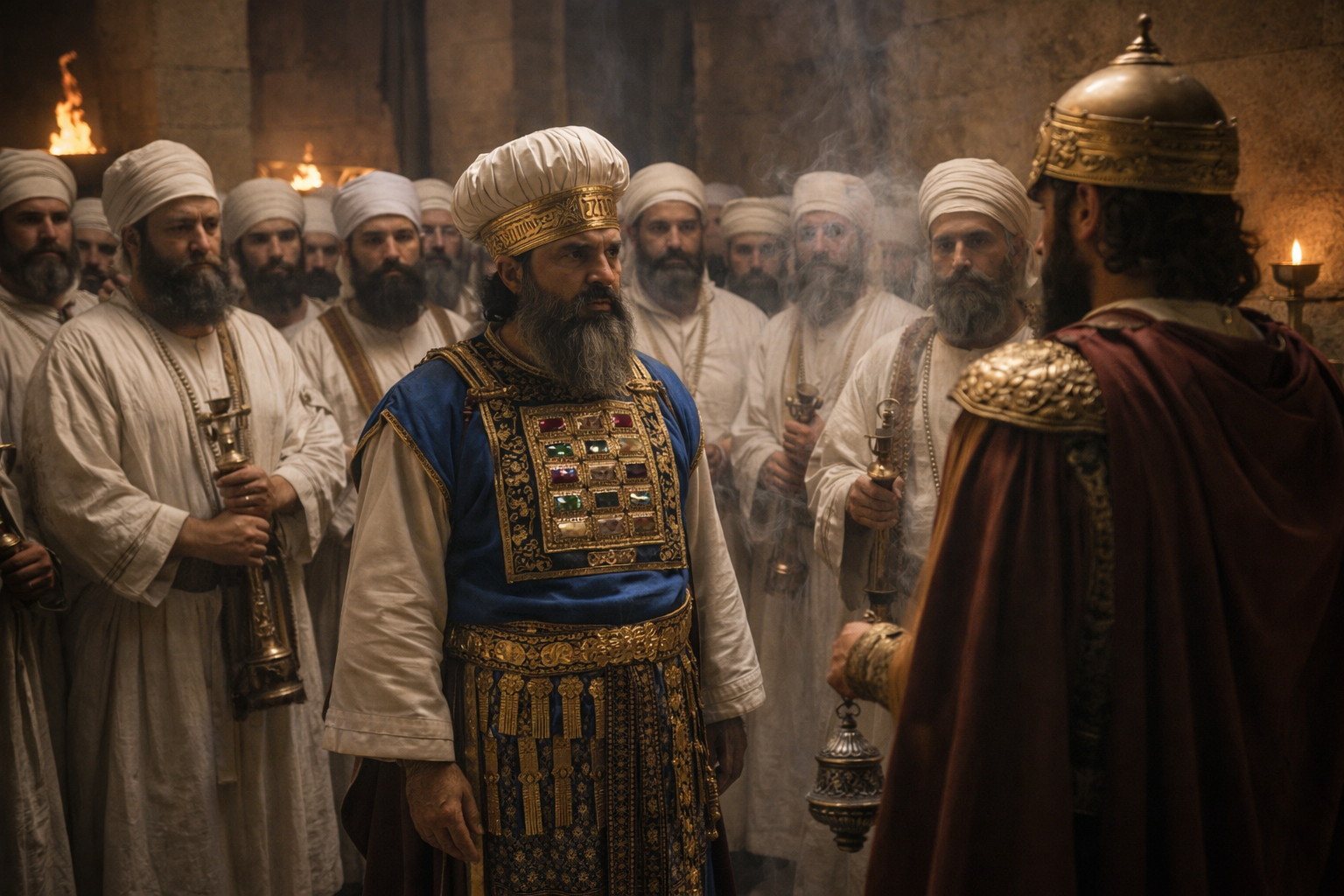
PRIESTS FOLLOW KING
INTO HOLY PLACE
Then Azariah the priest entered after him and with him eighty priests of the LORD, valiant (chayil) men (literally "sons of strength") - It is a bit ironic that the priests used valiant (chayil) men for Uzziah himself had valiant (chayil) warriors (gibbor) (2Ch 26:11). And it would take valiant priests to confront and rebuke the king who held the power of life and death in the land! Pride corrupted Azariah's thinking, deceiving him into thinking that since he had power and had experienced such success on all fronts, he himself was in a sense "above the law"! No one is "above the law," except the Law Giver, the Most High God!
Bob Utley on valiant (chayil) men - They were willing to confront an arrogant king with unlimited power. They were to support Azariah the High Priest, protect the sacred precincts and try to keep Uzziah from sinning
2 Chronicles 26:18 They opposed Uzziah the king and said to him, “It is not for you, Uzziah, to burn incense to the LORD, but for the priests, the sons of Aaron who are consecrated to burn incense. Get out of the sanctuary, for you have been unfaithful and will have no honor from the LORD God.”
- opposed Uzziah the king: 2Ch 16:7-9 19:2 Jer 13:18 Mt 10:18,28 14:4 2Co 5:16 Ga 2:11
- It is not for you: Nu 16:40,46-48 18:7
- the priests: Ex 30:7,8 Heb 5:4
- Get out: 1Co 5:5
- will have no honor: 1Sa 2:30 Da 4:37 Joh 5:44 Jas 2:1
Related Passages:
2 Chronicles 16:7-10 (COUNT THE COST OF OPPOSING A KING - HANANI OPPOSED KING ASA & ASA IMPRISONED HIM!) - At that time Hanani the seer came to Asa king of Judah and said to him, “Because you have relied on the king of Aram and have not relied on the LORD your God, therefore the army of the king of Aram has escaped out of your hand. 8 Were not the Ethiopians and the Lubim an immense army with very many chariots and horsemen? Yet because you relied on the LORD, He delivered them into your hand. 9 “For the eyes of the LORD move to and fro throughout the earth that He may strongly support those whose heart is completely His. You have acted foolishly in this. Indeed, from now on you will surely have wars.” 10 Then Asa was angry with the seer and put him in prison, for he was enraged at him for this. And Asa oppressed some of the people at the same time.
Numbers 3:10 “So you shall appoint Aaron and his sons that they may keep their priesthood, but the layman who comes near shall be put to death.”
Numbers 16:39-40 So Eleazar the priest took the bronze censers which the men who were burned had offered, and they hammered them out as a plating for the altar, 40 as a reminder to the sons of Israel that no layman who is not of the descendants of Aaron should come near to burn incense before the LORD; so that he will not become like Korah and his company–just as the LORD had spoken to him through Moses. (SEE significance of the rebellion of Korah)
Altar of Incense
HOLY PRIESTS INCENSED AT
UZZIAH'S UNHOLY INCENSE
They (the priests) opposed Uzziah the king and said to him, “It is not for you, Uzziah, to burn incense to the LORD, but for the priests, the sons of Aaron who are consecrated to burn incense. Get out (command to the king!) of the sanctuary - Uzziah must not have read or remembered Nu 3:10 and Nu 16:40 which restricted any lay person from burning incense before the LORD on penalty of death! Uzziah would get off with a relatively "light sentence!"
For - Term of explanation. Explains the opposition of the priests and their command.
You have been unfaithful (maal; LXX - aphistemi) - Unfaithful (maal) is translated in the LXX with aphistemi which means to depart, desert, fall or draw away, withdraw go away, which is what Uzziah did. Or better stated, this is what pride caused Uzziah to do! Watch out for pride as it will cause you to stumble!
And will have no honor (kabod ; LXX - doxa) from the LORD God - This declaration by the priests was in effect a prophecy, one that would be fulfilled immediately! It was a sobering declaration that true honor comes only from God’s approval, not from position, power, or human applause. A person may wear a crown, hold an office, or command respect from men, yet still stand empty-handed before the LORD. Divine honor is granted only to those who walk in humble obedience to His revealed will.
The word honor (kabod ; LXX - doxa) in Scripture often carries the idea of weight, glory, and recognition from God Himself. This is the tragic exchange seen in Uzziah’s life who sought honor for himself by grasping a role God had not given him, and in doing so he forfeited the very honor he desired. King Uzziah ended his life in dishonor! Like Saul before him (1Sa 15:22, 23), he learned that presumption cancels praise and pride closes the door to God’s commendation.
Jesus taught the same principle “How can you believe, when you receive glory (doxa) from one another and do not seek the glory (doxa) that is from the one and only God?” (Jn 5:44)
Honor from men is temporary; honor from God is eternal. When a heart refuses correction and clings to self-exaltation as Uzziah did, heaven withholds its applause. The "silence" of God’s approval is "louder" than any human ovation.
Better to humble ourselves in repentance today than to forfeit
God's honor and eternal reward by clinging to pride.
🙏 THOUGHT - When confronted, Uzziah should have acknowledged his sin, torn his clothes and cried out in repentance. The lesson is piercing that it is better to lose face before men than to lose honor before God. Paul reminds us how searching this reality is: "If any man’s work is burned up, he will suffer loss; but he himself will be saved, yet so as through fire." (1Co 3:15) Therefore the believer’s aim must rise higher than human approval. "We also have as our ambition, whether at home or absent, to be pleasing to Him. For we must all appear before the judgment seat of Christ, so that each one may be recompensed for his deeds in the body, according to what he has done, whether good or bad." (2Co 5:9-10) And John warned "Watch (blepo present imperative see our need to depend on the Holy Spirit to obey) yourselves, that you do not lose what we have accomplished, but that you may receive a full reward." (2Jn 1:8) Better the pain of present humility than the loss of eternal reward. God measures honor not by applause on earth, but by faithfulness before His throne.
Believer's Study Bible - The account of Uzziah's violation of and intrusion into the holy place demonstrates several important truths: (1) even rulers are subject to the laws of God; (2) those who violate God's laws suffer His judgment; (3) the strength and courage of Azariah and the priests in withstanding the king are exemplary for spiritual people in every age. Uzziah spent the remainder of his life with the loathsome disease of leprosy.
Bob Utley - Azariah the High Priest had a stern message for arrogant Uzziah."Get out" (Qal IMPERATIVE) "for you have been unfaithful" a term also used of (1) Moses ‒ Deut. 32:51, (2) trans-Jordan tribes ‒ 1 Chr. 5:25, (3) Rehoboam ‒ 2 Chr. 12:2, (4) Ahaz of Judah ‒ 2 Chr. 28:22 (5) Hezekiah, in a warning ‒ 2 Chr. 30:7. All involved disobedience to YHWH or His law.
Unfaithful (verb) (be or act unfaithful) (04603) maal means to act unfaithfully, to trespass, to violate one's duty, to break faith, to commit a violation, to act. in a manner which is untrustworthy or unreliable in relation to an agreement or relationship. It is often used in Hebrew together with the noun maal (04604 - described below), so literally it could be translated "trepasses a trespass." (NIV = "commits a violation") (following use both verb and noun forms of maal - Lev 5:15, 6:2, Nu 5:6, 27, Josh 22:20, 22:31) The idea of maal is that of a conscious act of treachery or unfaithfulness against the Lord. In fact in Ezek 39:23 and Da 9:7 maal describes the sin which resulted in Judah's exile to Babylon! They were unfaithful to their covenant with Yahweh. Maal describes the horrid sin of Achan (Josh 7:1) in which he took "the things that were under the ban." (Josh 6:18) Maal describes King Uzziah's prideful usurping of priestly authority and offering incense in the Temple in 2Chr 26:16-18. Maal is also used to refer to adultery (Nu 5:12, 27) and worshipping pagan deities (Nu 31:16; Ezek 20:27).
Maal - 32v - act(1), acted(2), acted treacherously(2), acting(1), acting treacherously(1), acting unfaithfully(1), acts(2), became...unfaithful(1), been(1), been unfaithful(5), broke faith(1), committed(6), committing unfaithfulness(1), err(1), perpetrated(1), unfaithful(3), unfaithfulness they committed(1), violated(1). Lev. 5:15; Lev. 6:2; Lev. 26:40; Num. 5:6; Num. 5:27; Deut. 32:51; Jos. 7:1; Jos. 22:16; Jos. 22:20; Jos. 22:31; 1 Chr. 2:7; 1 Chr. 5:25; 1 Chr. 10:13; 2 Chr. 12:2; 2 Chr. 26:16; 2 Chr. 26:18; 2 Chr. 28:22; 2 Chr. 29:6; 2 Chr. 30:7; Ezr. 10:2; Ezr. 10:10; Neh. 1:8; Neh. 13:27; Prov. 16:10; Ezek. 14:13; Ezek. 15:8; Ezek. 17:20; Ezek. 18:24; Ezek. 20:27; Ezek. 39:23; Ezek. 39:26; Dan. 9:7
Honor (glory) (03519) kabod from root kabad = to be heavy or weighty) conveys the central meaning of weight in most OT occurrences and most of the applications carry this figurative sense (cp "heavy with sin"). This sense gives rise to the idea of a "weighty" person in society or one who is honorable, impressive, worthy of respect.
2 Chronicles 26:19 But Uzziah, with a censer in his hand for burning incense, was enraged; and while he was enraged with the priests, the leprosy broke out on his forehead before the priests in the house of the LORD, beside the altar of incense.
- he: 2Ch 16:10 25:16
- even: Nu 12:10 2Ki 5:27
Related Passage:
2 Chronicles 16:10 Then Asa was angry with the seer and put him in prison, for he was enraged at him for this. And Asa oppressed some of the people at the same time.
Exodus 30:7-8 Aaron shall burn fragrant incense on it; he shall burn it every morning when he trims the lamps. 8 “When Aaron trims the lamps at twilight, he shall burn incense. There shall be perpetual incense before the LORD throughout your generations.
Proverbs 19:3 (UZZIAH IS REALLY ANGRY AGAINST JEHOVAH!!!) The foolishness of man ruins his way, And his heart rages against the LORD. (ED: AND THAT IS EXACTLY WHEN THE LEPROSY BROKE OUT!)
Numbers 18:7 (UZZIAH SHOULD HAVE BEEN KILLED) “But you and your sons with you shall attend to your priesthood for everything concerning the altar and inside the veil, and you are to perform service. I am giving you the priesthood as a bestowed service, but the outsider who comes near shall be put to death.”
2 Samuel 6:6-7 (THE LEVITE UZZAH WAS KILLED FOR TOUCHING THE ARK) But when they came to the threshing floor of Nacon, Uzzah reached out toward the ark of God and took hold of it, for the oxen nearly upset it. 7 And the anger of the LORD burned against Uzzah, and God struck him down there for his irreverence; and he died there by the ark of God.
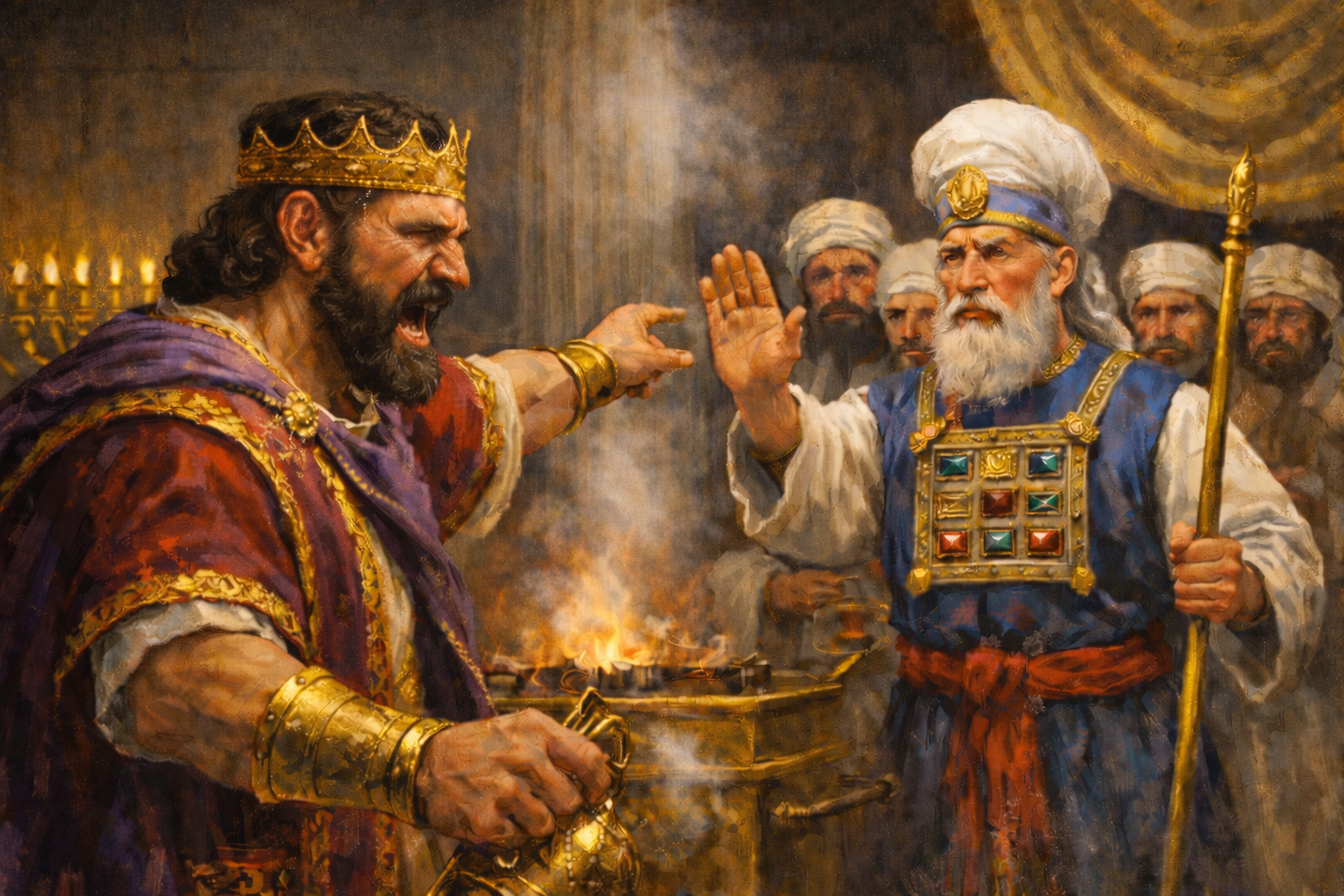
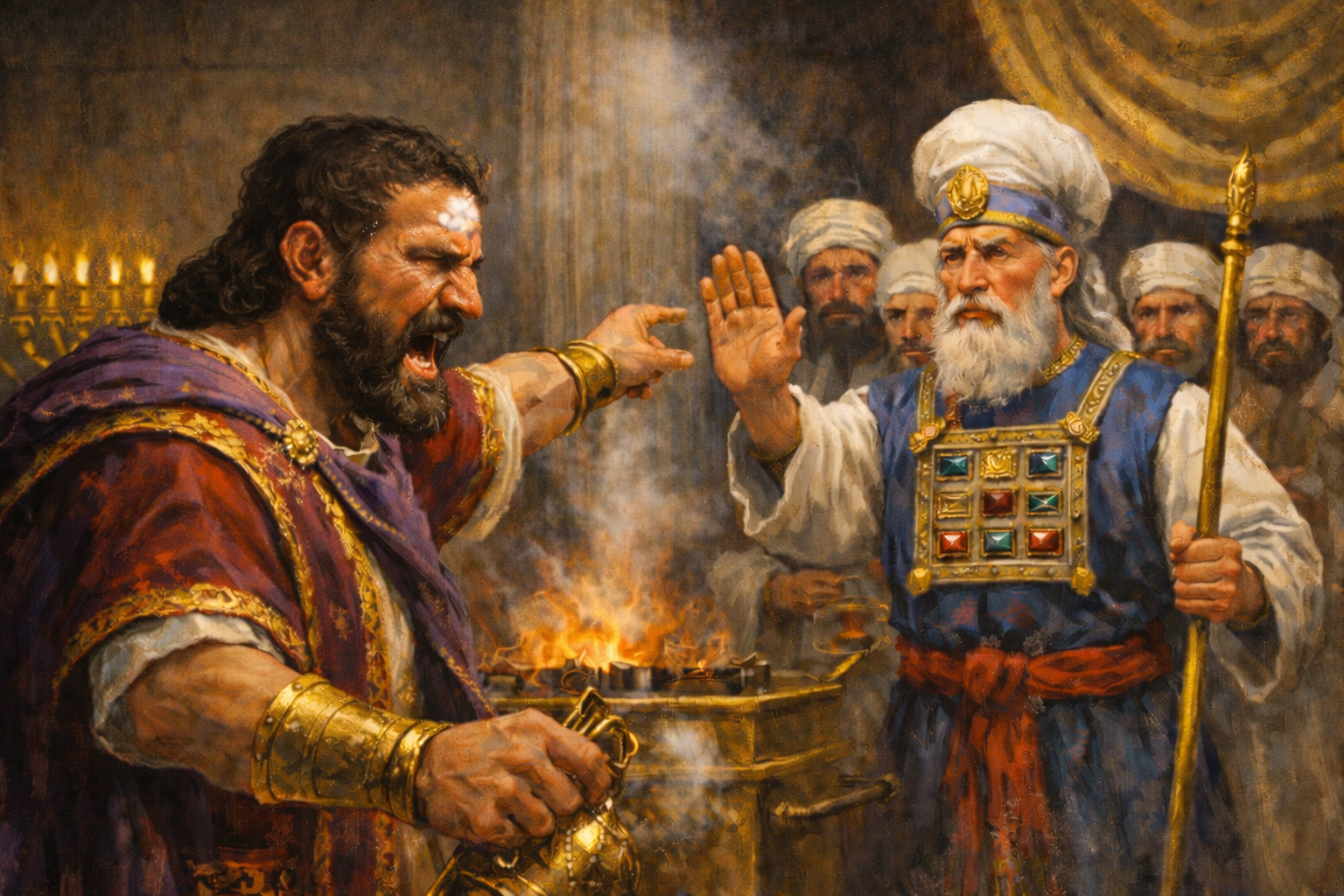
Uzziah's Anger Yahweh's Anger (Leprous spot)
INCENSE BURNER
"BURNED" WITH LEPROSY!
But - Term of contrast. This should have been an "about face" (aka repentance) from committing sin to confessing sin. It turned out to be an "about face" as Uzziah raged at the rebuke from Azariah the priest! And then it became "about Uzziah's face!" This is a standoff -- Azariah confronting Azariah! And God wins!
This moment should have been an “about-face”, a true turning of the heart from presumption to repentance, from committing sin to confessing sin. God graciously placed a faithful priest in Uzziah’s path to stop him before judgment fell. The rebuke was not rejection but was an invitation to repentance, humility and restoration. But instead of turning toward God, Uzziah turned against God’s messenger Azariah the priest! What could have been holy repentance became unholy rage. The “about-face” became literally about Uzziah’s face—for while anger still burned on his features, leprosy broke out on his forehead, the very place marked for priestly holiness (Ex 28:36,37,38+) and a place where he could not hide his shame!
This was a dramatic standoff: Azariah the priest confronting Uzziah the king. Authority of throne versus authority of truth. Pride versus obedience. Human power versus divine holiness. And in that confrontation, God made the verdict unmistakably clear—the LORD wins. Uzziah learned in a moment what every generation must learn that God will not share His glory, and no crown grants permission to trespass on His commands. What began as ambition ended in affliction; what started with incense ended with isolation.
It was not leprosy per se that caused Uzziah to be separated from the people of Judah, but it was pride, the great separator! It as pride that led to Satan being expelled from heaven. It was pride that caused Adam and Eve to be cast out of the garden of Eden. Leprosy was just the badge Uzziah would wear the rest of his life as a consequence of his pride.
A single step of repentance could have changed the story, BUT pride turned the king away from mercy and straight into judgment. Oh my! The hinge word BUT, which could have opened the door to God’s grace had he repented, instead marked the tragic closing of that door to restoration and usefulness. (See One Word that Changed the trajectory of a man's life)
A guarded heart preserves a reputation;
an unguarded moment can bury it.
-- See Proverbs 4:23
🙏 THOUGHT - One moment of sin can destroy a reputation built over a lifetime. Uzziah’s story warns us how quickly years of faithfulness can be eclipsed by a single act of pride. For decades he sought the LORD, strengthened the nation, and became a model of godly leadership—yet one presumptuous moment in the temple marked his name forever. Scripture remembers both his achievements and the day he overstepped God’s boundary. Reputation is like fine glass: formed slowly, shattered suddenly. Beloved, sin is notoriously deceitful (Heb 3:13) and rarely announces its full cost in advance. What appears to be a small compromise can leave a permanent scar on a legacy, a family, and a testimony. Our takeaway should not be despair (althought we are sad for Uzziah), but vigilance! Character is built by a thousand choices, yet it can be destroyed by one unguarded hour. Let Uzziah's life teach us to fear self-confidence, welcome divien correction, and guard the boundaries which God has clearly set in His Word. It is far better to bow in repentance today than to grieve over a lost reputation tomorrow!
Uzziah's angry reaction against the priests is in contrast to King David when he was confronted by the prophet Nathan (2Sa 12:1-6). At first King David had a Uzziah type reaction and his anger burned (2Sa 12:5-6). However when Nathan told him "You are the man." (2Sa 12:7-12), David confessed "I have sinned against the LORD (2Sa 12:13). And Nathan said to David ""The LORD also has taken away your sin; you shall not die." (2Sa 12:13) David acknowledged his sin and was forgiven but of course there were still consequences. Uzziah did react with he was smitten with leprosy by Yahweh as he fled the Temple.
Uzziah, with a censer in his hand for burning incense, was enraged - Uzziah, standing in the holy place with a censer in his hand for burning incense, was not humbled by the priests’ rebuke but was enraged. The very object meant for sacred worship became an emblem of his rebellion as anger flared in his heart. Instead of trembling before the Word of God, he bristled with wounded pride, convinced that his royal authority placed him above priestly restraint. The king who had once sought the LORD now stood defiant in the temple, clutching the censer as though power could override obedience.
And while he was enraged with the priests, the leprosy (tsaraath) broke out on his forehead before the priests in the house of the LORD, beside the altar of incense - The timing is striking for divine judgment fell in the very moment of his rage. Unfortunately, Uzziah was not trembling in repentance but trembling with rage at the priests who dared to oppose him. And yet the priests had confronted him with God’s clear lawful boundary, yet pride deafened his ears to their command to GET OUT! Before Uzziah could finish defending his presumptive sin, God Himself answered.
The leprosy appeared on his forehead, the most visible place of the body—the very spot where the high priest wore the golden plate engraved “Holy to the LORD” (Ex 28:36–38)! What should have been the mark of holiness became the mark of defilement -- Unholy to the LORD! God turned Uzziah’s attempted priesthood into a public sign that he was unfit for the office he tried to seize.
Notice also where this occurred, in the house of the LORD, actually in the Holy Place, beside the altar of incense. The altar represented intercession and worship rising acceptably before God. Instead of sweet incense, there rose the stench of rebellion. The sanctuary that should have been a place of blessing became a courtroom, and the Judge of heaven rendered His immediate verdict.
This scene is filled with holy irony. (1) Uzziah grasped for priestly privilege but he received priestly exclusion. (2) He sought honor in God’s presence but now he was expelled from that presence. (3) He entered healthy but he left unclean. God did not strike him in the palace or on the battlefield, but at the very altar he profaned, making it clear that this was not disease but divine discipline. The priests became eyewitnesses to the fact that the LORD alone guards His worship and will not share sacred offices with human pride. This moment stands as a living sermon declaring that anger at God’s correction invites God’s correction.
Matthew Poole - “The leprosy even rose up in his forehead; so as he could not hide his shame; though it is probable it was also in the rest of his body.”
Jamieson - At the moment the king lifted the censer, He struck him with leprosy. The earthquake mentioned (Am 1:1) is said to have been felt at the moment [JOSEPHUS].
Martin Selman - Despite the seriousness of what Uzziah had done, God still does not act until Uzziah becomes ‘enraged’, an emphatic word occurring twice in verse 19. God’s righteous anger only breaks out against human rebellious anger.” (Tyndale Old Testament Commentaries – 2 Chronicles. BORROW)
David Guzik - Uzziah came into the temple as an arrogant king, and he left as a humbled leper and stayed that way for the remainder of his life. He could not even go into the outer courts of the temple which were once open to him as to other worshippers (he was cut off from the house of the LORD). In overstepping this boundary, he found his freedom more restricted than ever before.
Christopher Knapp - . “It was a fearful stroke from God. Death was the actual penalty enjoined by the law for his crime (Numbers 18:7), and leprosy was really that – a living death, prolonged and intensified.”
Bob Utley - Uzziah was warned but still intended to follow his own thoughts/plans. But YHWH steps in (cf. 2 Chr. 26:20)! Uzziah became a leper. From this historical account, later Judaism saw leprosy (cf. Leviticus 13-14) as a divinely given disease (cf. Num. 12:10).
Josephus, Antiq. 9.10.4., adds an interesting note:
"Accordingly, when a remarkable day was come, and a general festival was to be celebrated, he put on the holy garment, and went into the temple to offer incense to God upon the golden altar, which he was prohibited to do by Azariah the high priest, who had fourscore priests with him, and who told him that it was not lawful for him to offer sacrifice, and that 'none besides the posterity of Aaron were permitted so to do.' And when they cried out, that he must go out of the temple, and not transgress against God, he was wroth at them, and threatened to kill them, unless they would hold their peace. In the meantime, a great earthquake shook the ground, and a rent was made in the temple, and the bright rays of the sun shone through it, and fell upon the king's face, insomuch that the leprosy seized upon him immediately; and before the city, at a place called Eroge, half the mountain broke off from the rest on the west, and rolled itself four furlongs, and stood still at the east mountain, till the roads, as well as the king's gardens, were spoiled by the obstruction. Now, as soon as the priests saw that the king's face was infected with the leprosy, they told him of the calamity he was under, and commanded that he should go out of the city as a polluted person."
Bob Utley comments - It is based on (1)both Amos (i.e., Amos 1:1) and Zechariah (i.e., Zech 14:5) mention an earthquake at this time (2) the term "leprosy" (BDB 280) can also refer to the sun shining; this is how Josephus took the word
Raymond Dillard: Uzziah’s sin was a cultic transgression and brings immediate retribution in the appearance of a skin disease; Uzziah’s pride brought him to usurp the honor or glory of the priest’s role, but he would receive no honor (2Ch 26:18) from the Lord. Just as a cultic sin produced a plague in the wilderness (Num 16:46–50), so also Uzziah was punished with a disease. It was the offering of incense that formed the climax of the condemnation of Jeroboam (1 Kgs 12:33; Williamson, 339). The Chronicler has similarly shown disease as a consequence of transgression in the cases of Asa and Jehoram (16:12–13; 21:12–19). (Borrow 2 Chronicles)
Walton on leprosy - Mari king Yahdun-Lim calls down a curse of leprosy on whoever desecrated the temple that he was dedicating, so it is clear that this is a common connection. Those studying the ancient Near Eastern languages have concluded that the term often translated “leprosy” is more accurately rendered “lesion,” or, less technical, “scaly skin.” Such patches could be swelled or weeping, as well as flaking. Similar broad terminology also exists in Akkadian, where the Babylonians likewise considered it an unclean condition and the punishment of the gods. Clinical leprosy (Hansen’s Disease) has not been attested in the ancient Near East prior to the time of Alexander the Great. None of the most prominent characteristics of Hansen’s disease are listed in the text, and the symptoms that are listed argue against a relationship to Hansen’s disease. The condition discussed in the text is not presented as contagious. Descriptions would suggest that modern diagnoses would include psoriasis, eczema, favus and seborrheic dermatitis, as well as a number of fungal-type infections. Because of this, it is not clear exactly what type of skin disease Uzziah had. Comparison to “snow” most likely concerns the flakiness rather than the color (“white” is added in the translations that contain it). The great cultural aversion to skin diseases may be that in appearance and sometimes odor they resemble the rotting skin of the corpse and are therefore associated with death. This natural revulsion adds considerably to the victim’s outcast status when combined with the quarantine that is ritually rather than medically motivated. It is not certain whether Uzziah was quarantined because of the disease or because of his cultic offenses. Naaman had a similar disease and was able to continue his duties as commander in chief. It is presumed that Jotham, son of Uzziah, took over official duties as coregent after Uzziah’s cultic offense. (IVP Bible Background Commentary on the OT- page 448)
2 Chronicles 26:20 Azariah the chief priest and all the priests looked at him, and behold, he was leprous on his forehead; and they hurried him out of there, and he himself also hastened to get out because the LORD had smitten him.
- hasted also: Es 6:12
- the Lord: Lev 14:34 De 28:22,35
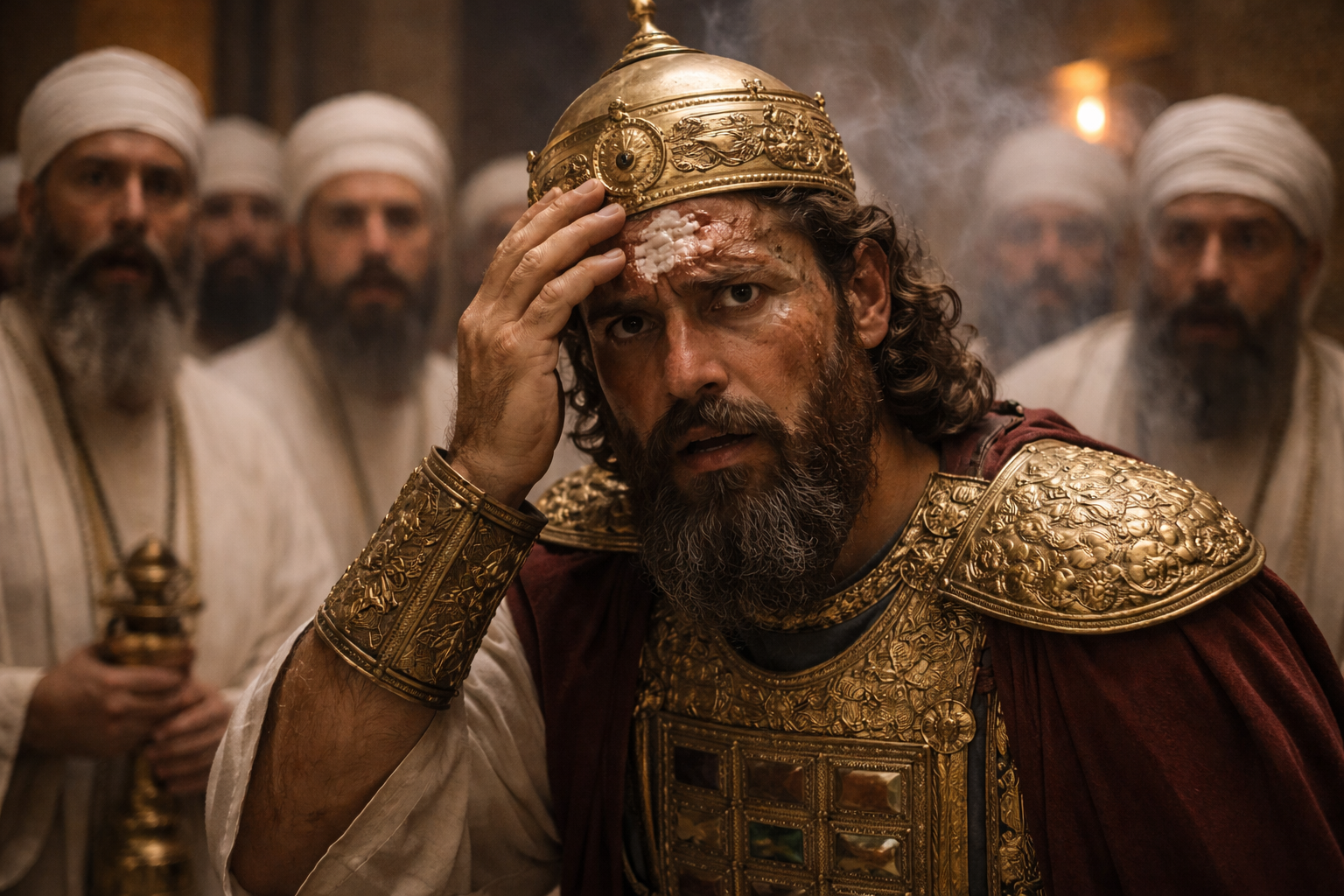
UZZIAH'S SPOT
A "SCARLET LETTER"
The scarlet letter was an "A" was not on the forehead like Uzziah's mark but was worn over the adulteress's clothing over her heart, as a punitive mark of adultery, which is apropos for King Uzziah has in a sense committed an unfaithful act, akin to spiritual adultery if you will.
Azariah the chief priest and all the priests looked at him, and behold, he was leprous (tsara) on his forehead - Note the location of the leprosy is near his mind, a mind which had become prideful and presumptuous. Is the location of the leprous mark mere coincidence? I doubt it because God never does anything without purpose and meaning!
John Olley: his forehead revealed an infectious skin disease that made him unclean, necessitating his rapid removal from the temple. It seems Uzziah himself was terrified as “he himself hurried to go out,” realizing the dangers of his breaking first the “holyprofane” and now “clean-unclean” distinctions (cf. Lev. 10:10–11). He lived the rest of his life quarantined “in a separate house,” relieved of royal duties. In his royal “pride” he sought to take on the special access of a priestly role, but instead he was now “excluded from the house of the Lord.” (ESV Expository Commentary)
And they hurried him out of there, and he himself also hastened to get out because the LORD had smitten him - Holy God incensed and smites unholy incense burner! The scene shifts instantly from royal defiance to royal panic. Only moments earlier Uzziah had stood in the temple enraged, censer in hand, refusing the priests’ rebuke. But when the white mark of leprosy suddenly broke out on his forehead, the visible stroke of God’s judgment, the mood of all in the holy place changed. The priests hurried him out, not in cruelty but in obedience to the Law, which required that a leper be removed from the temple comples (cf Lev 13:46, Nu 5:2,3). The holy place could not be defiled, even by a king.
The proud monarch who had resisted
correction now fled in fear.
What is striking is the next phrase he himself also hastened to get out. The proud monarch who had resisted correction now fled in fear. The moment he realized that the LORD had smitten him, his arrogance collapsed. He no longer argued about his rights or his authority as king. He recognized that he was standing under divine judgment of the true King. The same man who had rushed into the temple to exalt himself now rushed out to escape the presence of the Holy One.
The king who stormed into the temple in pride was driven out
in terror the moment God’s judgment touched him.
This verse captures the sudden reversal of Uzziah's pride. Human power dissolved in an instant before the touch of God (as it always does!) Uzziah learned too late that no crown can shield a sinner from the holiness of the LORD. And the crown that covered part of his forehead could not hide the leprous mark of Yahweh! The temple he had entered with presumption became the place from which he was expelled in shame.
Frederick Mabie: points out the irony in the fact that "while Uzziah refuses to leave the temple when confronted by the priests, he becomes “eager to leave” in the light of God’s judgment through a skin disease. (SEE 1 and 2 Chronicles)
Leper, leprous (06879) tsara (from tsaraath = leprosy) means to be struck with leprosy, to be leprous
TSARA - 20X/18V - being a leper(1), leper(12), lepers(1), leprous(6). Exod. 4:6; Lev. 13:44; Lev. 13:45; Lev. 14:2; Lev. 14:3; Lev. 22:4; Num. 5:2; Num. 12:10; 2 Sam. 3:29; 2 Ki. 5:1; 2 Ki. 5:11; 2 Ki. 5:27; 2 Ki. 7:3; 2 Ki. 7:8; 2 Ki. 15:5; 2 Chr. 26:20; 2 Chr. 26:21; 2 Chr. 26:23
Elmer Martens (TWOT online) - While usually rendered leper or leprous, the term "leper" is not correct medically, since ṣāraʿat refers to a wider range of skin diseases (cf. "malignant skin disease," NEB). For convenience, however, the term "leper" can be retained.
A person with leprosy, apart from the telltale malignant raw flesh and white hair, was to be otherwise identified by torn clothes, announcement of "unclean" when in the streets and was to live isolated from the community. Four persons are named in the OT as becoming leprous. Not counting Moses (Exodus 4:6; cf. also 2 Kings 7:3), there were Miriam (Numbers 12:10), Uzziah (2 Kings 15:5), Gehazi (2 Kings 5:27) and Naaman, the Syrian (2 Kings 5:1).
God may inflict the disease of ṣāraʿat as punishment for sins such as jealousy (cf. Miriam), anger, and lack of full compliance with God's commands (cf. Uzziah), and covetousness (cf. Gehazi). One must not conclude, however, that all sickness is a result of an individual's sin (cf. Job; Luke 13:1-5; John 9:1-7).
ṣāraʿat was not necessarily incurable (cf. 2 Kings 5:7). Leprosy by contrast, was likely incurable (Leviticus 13). In any event, healing of Sdra at could serve as a sign of divine power (Exodus 4:6; 2 Kings 5:8).
The isolation of a leprous person was doubtless a sanitary measure in order to avoid further contagion. That a priest in Israel's theocracy was to diagnose the illness does not mean that today's clergy should become health officers. But the principle of God's concern for the health of bodies is not only self-evident but remains an enduring principle (cf. Jesus, Matthew 8:2-3).
Diseases with eruptions affecting the skin are sometimes mild, sometimes, as in smallpox, scarlet fever, etc., both dangerous and highly contagious. The only effective control in antiquity would have been isolation. Only the Hebrew laws had this very valuable provision.
ṣaraʿat is found primarily (twenty times) in the two chapters that govern the diagnoses and the cleaning measures for one who had become unclean (tāmēʾ, Leviticus 13, 14). In the nature of a contagion, ṣāraʿat refers not only to eruptions on the skin but to mildew or mold in clothing (Leviticus 13:47-52) or in houses (Leviticus 14:34-53); therefore obviously the word is not specific for leprosy. The determination by the priest of an individual as unclean meant separation from the community, and ceremonial unfitness to enter the temple (cf. 2 Chron. 26:21). The cleansing measures to be performed upon recovery involved a ritual with two birds, which ritual according to KD was necessary for restoration to the community (Leviticus 14:2-9). An additional set of offerings followed, notably the guilt offering, perhaps because disease is ultimately to be linked with sin (Leviticus 14:10-20). Bibliography: Harris, R. Laird, Man-God's Eternal Creation, Moody, 1971, pp. 142-43. Browne, S. G., "Leper, Leprosy," in WBE, II, pp. 1026-27. (Theological Wordbook of the Old Testament - TWOT)
2 Chronicles 26:21 King Uzziah was a leper to the day of his death; and he lived in a separate house, being a leper, for he was cut off from the house of the LORD. And Jotham his son was over the king’s house judging the people of the land.
- Uzziah: 2Ki 15:5
- he lived in a separate house: Lev 13:46 Nu 5:2,3 12:15 2Ki 7:3
Related Passage:
Numbers 5:2 “Command the sons of Israel that they send away from the camp every leper and everyone having a discharge and everyone who is unclean because of a dead person.
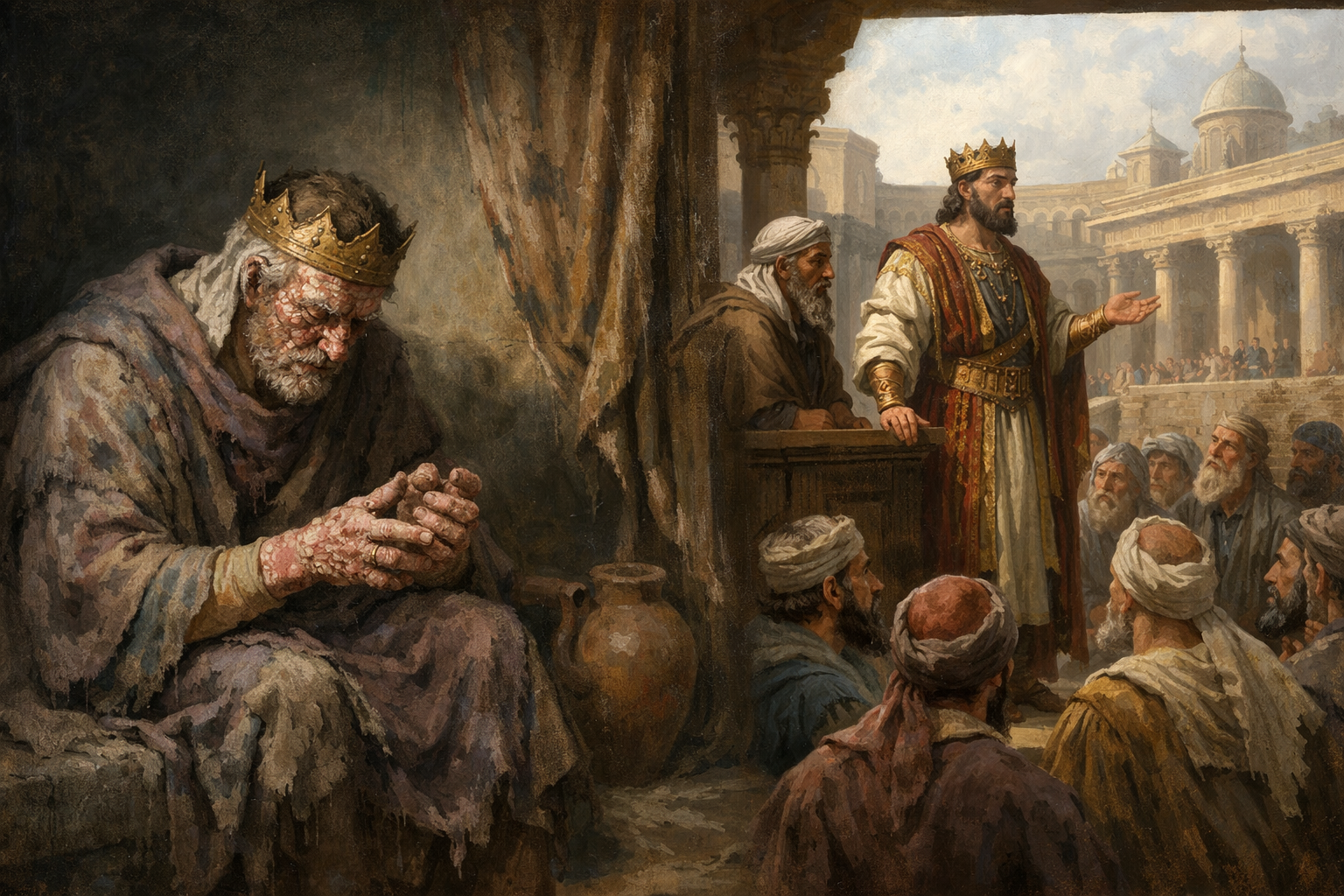
Azariah's Plight, Jotham's Rule in Light
SOWING PRIDE
REAPING ISOLATION
King Uzziah was a leper (tsara) to the day of his death; an he lived in a separate house (literally "a house set apart"), being a leper (tsara) - Uzziah's sin caused him to in effect be "evicted" from the king's palace! Uzziah’s leprosy was not just a disease but was a divine judgment that severed his access to worship.
For - Term of explanation. The for explains that Uzziah’s separate residence was required because his judgment cut him off from temple fellowship, making him unable to function as an active king. His isolation was not merely medical but was also ceremonial and ultimately spiritual.
He was cut off from the house of the LORD - Note the sad, solemn irony. Uzziah entered the temple in pride, assuming that royal power could override divine order, but his disobedience barred him from the very place he had profaned. The LORD turned his act of self-exaltation into lasting humiliation: the king who would not accept God’s boundaries was made to live permanently outside them. His exclusion testified that access to God is never seized by position but granted only through humble obedience.
And Jotham his son was over the king’s house judging the people of the land - Uzziah no longer judged the people, but that authority had been conveyed to his son Jotham.
Believer's Study Bible - Jotham, his son, was probably made coregent at this time, about 10 years before Uzziah's death in 740 B.C. Thus Jotham's rule effectually began c. 750 B.C., in the second year of Pekah (2 Kin. 15:32).
QUESTION - Who was King Jotham in the Bible?
ANSWER - Jotham became king of Judah at age twenty-five and reigned for sixteen years, from 750 to 735 BC (2 Kings 15:33; 2 Chronicles 27:1). “He did what was right in the eyes of the Lord, just as his father Uzziah had done, but unlike him he did not enter the temple of the Lord. The people, however, continued their corrupt practices” (2 Chronicles 27:2; see also 2 Kings 15:34–35). King Uzziah had been faithful to the Lord but then became prideful and attempted to burn incense on the altar of the Lord, something only priests were permitted to do (2 Chronicles 26:16–20). As a result, God afflicted Uzziah with leprosy. Uzziah lived out the rest of his days in a separate house, while his son Jotham oversaw the palace and governed the people (2 Chronicles 26:21). Jotham did not repeat his father’s mistake of presumptuously entering the temple.
“Jotham grew powerful because he walked steadfastly before the Lord his God” (2 Chronicles 27:6). He rebuilt the Upper Gate of the temple and also did work on the wall at the hill of Ophel and built towns, forts, and towers (2 Chronicles 27:3–4). However, King Jotham failed to remove the high places so the people continued to make sacrifices there (2 Kings 15:35). Jotham waged a successful war against the Ammonites, resulting in their paying him tribute for three years (2 Chronicles 27:5). During Jotham’s reign “the Lord began to send Rezin king of Aram and Pekah son of Remaliah against Judah” (2 Kings 15:37). During the reign of Jotham’s son Ahaz, the Arameans would march against Judah, resulting in defeat and heavy casualties for Judah (2 Chronicles 28:5). Initial defeat was followed by Ahaz seeking help from the Assyrians and ultimately looting and shutting up God’s temple and creating more high places (2 Kings 16:5–18; 2 Chronicles 28:5–25).
Isaiah, Hosea, and Micah all prophesied during Jotham’s reign (Isaiah 1:1; Hosea 1:1; Micah 1:1). Also, the genealogies in 1 Chronicles 1–5 were recorded during Jotham’s reign (1 Chronicles 5:17).
Despite Jotham’s godly example, his son Ahaz proved to be a wicked king. Even so, both Jotham and Ahaz are ancestors of Jesus Christ (Matthew 1:9). God is able to use all people to accomplish His good purposes. GotQuestions.org
2 Chronicles 26:22 Now the rest of the acts of Uzziah, first to last, the prophet Isaiah, the son of Amoz, has written.
- first to last, 2Ch 9:29 12:15
- Isaiah: Isa 1:1, 6:1
Related Passages:
Isaiah 1:1 The vision of Isaiah the son of Amoz concerning Judah and Jerusalem, which he saw during the reigns of Uzziah, Jotham, Ahaz and Hezekiah, kings of Judah.
Isaiah 6:1 In the year of King Uzziah’s death I saw the Lord sitting on a throne, lofty and exalted, with the train of His robe filling the temple.
UZZIAH'S STORY
WRITTEN BY A PROPHET
Now the rest of the acts of Uzziah, first to last, the prophet Isaiah, the son of Amoz, has written. The phrase first to last suggests a comprehensive narrative covering the entire arc of the king’s career. This brief statement opens a remarkable window into the spiritual history of Judah. The Chronicler tells us that a fuller, detailed account of Uzziah’s reign was recorded by Isaiah himself—the same prophet who later saw the vision of the LORD “in the year of King Uzziah’s death” (Isa 6:1). Uzziah’s life was significant enough that God entrusted its record not merely to court scribes, but to one of Scripture’s greatest prophets.
2 Chronicles 26:23 So Uzziah slept with his fathers, and they buried him with his fathers in the field of the grave which belonged to the kings, for they said, “He is a leper.” And Jotham his son became king in his place.
- slept: 2Ki 15:6,7
- they buried him: 2Ch 26:18 21:20 28:27 33:20
UZZIAH'S SAD EPITAPH
"HE IS A LEPER"
So Uzziah slept with his fathers, and they buried him with his fathers in the field of the grave which belonged to the kings, for (term of explanation - What is writer explaining?) they said, “He is a leper (tsara).” And Jotham his son became king in his place. He is buried “with his fathers,” acknowledging his place in the Davidic line and the many years in which God had prospered his reign. Yet the Chronicler carefully adds that he was laid in the field of the royal tombs, not inside the sepulchers of the kings themselves. The reason is stated with painful simplicity: “for they said, ‘He is a leper.’” Even in death he experienced separation or exclusion, so that the consequence of his presumption remained. The man who once entered the temple uninvited was now excluded even from the inner resting place of the kings. His burial location became a silent testimony that God’s holiness sets boundaries no crown can cross. His sin followed him all the way to his grave! Oh my!
Martin Selman - “Reference to a separate burial place may be confirmed by an ossuary inscription of the Hasmonean period: ‘Here were brought the bones of Uzziah, king of Judah, and not to be moved.’” (Tyndale Old Testament Commentaries – 2 Chronicles. BORROW)
The great cost of not finishing well...
John Olley: The Chronicler still mentions that Uzziah was “buried with his fathers” but adds that it was in a “burial field,” probably adjacent to the royal tombs themselves. His final description expresses isolation: “He is a leper.” The proverb that summarizes Uzziah’s reign is succinct: “Pride goes before destruction, and a haughty spirit before a fall” (Pr 16:18). (ESV Expository Commentary)
Even in his death,
he was quarantined!
John Walton - There is an epitaph now preserved in the Israel Museum marking the burial place of Uzziah, king of Judah. It represented a secondary burial of his bones. (IVP Bible Background Commentary on the OT- page 448)
Compare a similar fates of the other two preceding GOOD/EVIL KINGS...
King Joash's burial described in 2Ch 24:25 "When they had departed from him (for they left him very sick), his own servants conspired against him because of the blood of the son of Jehoiada the priest, and murdered him on his bed. So he died, and they buried him in the city of David, but they did not bury him in the tombs of the kings."
King Amaziah's burial described in 2 Chronicles 25:27-28 "From the time that Amaziah turned away from following the LORD they conspired against him in Jerusalem, and he fled to Lachish; but they sent after him to Lachish and killed him there. 28 Then they brought him on horses and buried him with his fathers in the city of Judah." There is no mention of the tombs of the kings. Some favor he had a dishonorable burial and others an honorable burial, so we cannot be as dogmatic as with Joash
If you are a follower of Christ, God has qualified you to enter His presence. You are invited because you are His priest. You can go further than Uzziah. You are able to go where a king could not.
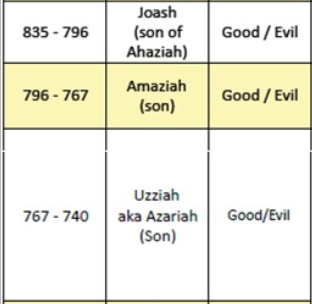
GOOD/EVIL - UZZIAH marks the last of three successive, and partially successful reigns (Joash, Amaziah, Uzziah) that began with promise yet ended in disobedience and disaster. Despite moments of reform and flashes of spiritual renewal, nothing seemed able to halt Judah’s steady slide toward sin and judgment. The same destructive patterns surfaced again and again—idolatry replacing true worship, the voices of God’s prophets being ignored or rejected, violence corrupting the land, and pride hardening the hearts of both kings and people. History became a tragic cycle in which each generation repeated the failures of the one before, proving that outward prosperity cannot preserve a nation whose inner devotion to the Lord has grown cold. Oh, America do not ignore the lessons of history!
Together Joash, Amaziah, and Uzziah illustrate how faith can erode in three ways:
- Dependence on others rather than on God (Joash).
- Divided devotion — half obedience (Amaziah).
- Self‑exaltation after prosperity (Uzziah).
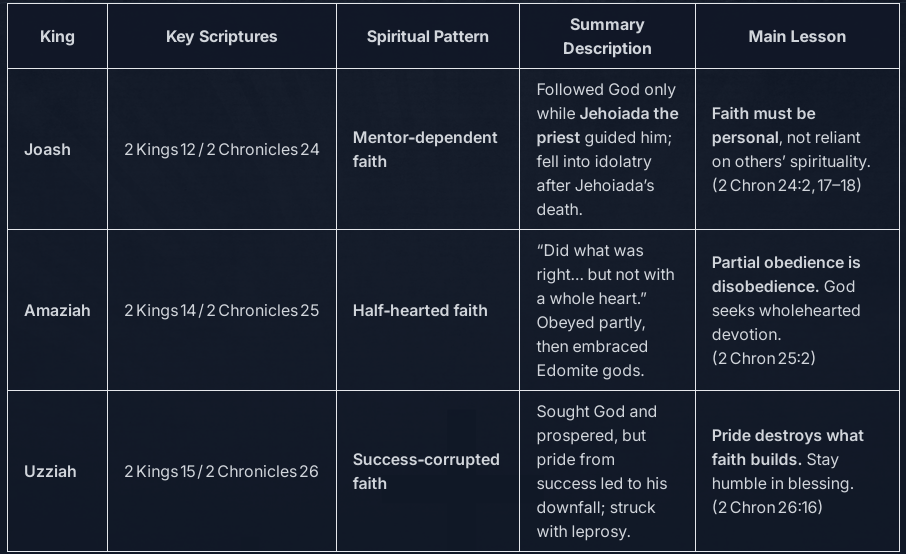
C H Spurgeon makes a frightening statement (as I am in my 80th year) --- “I have lived long enough to observe that the greatest faults that are ever committed by professedly Christian men are not committed by young people. Most painful is it, to me to remember that the worst cases of backsliding and apostasy that I have ever seen, in this church, have been by old men and middle-aged men, – not by young people; for, somehow or other, the young people, if they are truly taught of God, know their weakness, and so they cry to God for help; but it often happens that more experienced people begin to think that they are not likely to fall into the faults and follies of the young; and I care not how old a man may be – even if seven centuries had passed over his head – if he began to trust in himself, he would be a fool, and soon he would have a grievous fall.”
PAUL APPLE - DEVOTIONAL QUESTIONS:
1) What is the essence of biblical humility?
2) Why does extreme power lead to a lust for more power and self-exaltation?
3) How do we receive God’s word of correction and rebuke?
4) How much courage did it take for the company of priests to confront the king?
QUOTES FOR REFLECTION: PAGE 578
Raymond Dillard: Uzziah was a great king: during his reign Judah reclaimed in the South much of the territorial extent of the Solomonic empire; the kingdom prospered through conquest, the control of strategic trade routes, and the receipt of tribute. Yet isn’t it ironic that Uzziah is now largely remembered only because of his disease and the fact that it was the year of his death in which Isaiah received his call? In spite of the wealth, success, power, and conquests of Uzziah, Isaiah could see that the day was not far off when cities would lie deserted, uninhabited, ruined, and ravaged (Isa 6:11–12). Uzziah for the Chronicler was one more example of how even legitimate power could be corrupted; with Rehoboam, Amaziah, and Joash before him, Uzziah too would succumb to wrongdoing and suffer the immediate consequence of divine retribution. (Borrow 2 Chronicles)
Andrew Hill: Azariah identifies the key issue in the conflict with Uzziah by appealing to the special divine anointing or consecration of the priesthood for the specific task of offering such sacrifices (26:18; cf. Ps. 133). Even as the Davidic king is anointed to shepherd the Israelite nation, so the Aaronic priest is anointed to serve God and the people through the ministry of ritual sacrifice. This divinely ordained division of labor and service is also designed to separate political power from religious authority in Israelite society in order to prevent abuse of one office by the other. Azariah’s threat to Uzziah is cast generally as a censure of divine honor for the king (2 Chron. 26:18). The king does not have to wait long before the priestly threat becomes a divine curse. Enraged at the priests for intercepting him in the temple and thwarting his attempt to burn incense on the altar, Uzziah is afflicted by God (2Ch 26:20). It is important to notice that God’s anger breaks out against Uzziah only after he has vented his anger against the priests (26:19). The king was warned to leave, but he ignored that warning. His disregard for the Lord’s priests and the Lord’s sanctuary implicitly signals a disregard for God himself. God will not stand idly by when his holiness has been violated by ritual impropriety (cf. Aaron’s sons, Lev. 10:1-2; the men of Korah, Num. 16:35). (The NIV Application Commentary – 1 & 2 Chronicles.)
Mark Boda: The fear of God is an important motif in the Old Testament and represents the human covenantal response to the awesome presence of the holy God. The initial reaction of the people to the presence of God on Sinai is one of abject fear (Deut 5:5), a reaction that leads to the people’s commissioning Moses as their mediator (Deut 5:22- 27). God’s response is his desire that they would indeed “fear” him, which means to keep all his commands (Deut 5:29). Such a “fear” is listed alongside instructions to keep his statutes, to listen, to obey, and even to love the Lord with one’s whole being and keep God’s commands on one’s heart (Deut 6:1-6). The fear of the Lord is, thus, the human covenantal response to Yahweh’s gracious initiative and will be considered as foundational to a life of wisdom (Prov 1:7). (Cornerstone Biblical Commentary – 1-2 Chronicles.)
Richard Rohlin: The Rise and Fall of Uzziah
I. The Rise of Uzziah God blessed Uzziah in a number of ways:
- Spiritually – Uzziah did what was right in the eyes of the Lord… As his father had done.
- Militarily – Uzziah defeated all of his enemies, built up his cities, and increased the size of his army. Most importantly, he built up the walls of Jerusalem that had been broken down in his grandfather’s time. Uzziah’s might was such that under him Judah became a major world power, and his fame spread all the way to Pharaoh's court.
- Economically – Uzziah “loved the soil.” He was gifted with an understanding of farming and husbandry, and the land flourished under his reign.
- Creatively – Uzziah was a true “renaissance man”, and devised and built all manner of “machines… to shoot arrows and great stones.”
All of the blessings in Uzziah’s life came for this simple reason: That the Lord helped him.
- He set himself to seek God in the days of Zechariah, who instructed him in the fear of God, and as long as he sought the LORD, God made him prosper. (2Ch 26:5)
- And his fame spread far, for he was marvelously helped, till he was strong. (2Ch 26:15)
II. The Fall of Uzziah = Pride
1) The cause of pride
- Uzziah’s pride is innate within himself. Pride is the essence of the Sin Nature. Success does not cause pride, but both success and failure can provide the environment in which pride can grow.
- Many people make the mistake of thinking that because success/wealth can make way for pride, that success in and of itself is somehow wrong.
2) The claims of pride
- Uzziah’s pride asserts itself over things for which he could take no credit:
– Victory in battle (Proverbs 21:31) – Inventive genius (Exodus 35:31-32)
– Economic growth and success (Deuteronomy 8:18)
– Spiritual fervor (Ephesians 2:8-10)
3) The crimes of pride
- But when he was strong, he grew proud, to his destruction. For he was unfaithful to the LORD his God and entered the temple of the LORD to burn incense on the altar of incense. (2Ch 26:16)
- Uzziah was unfaithful– to the God who had proved to be so faithful to him.
- If God made Uzziah to prosper so long as he sought Him, the moment Uzziah became unfaithful, God’s hand of blessing was removed.
- This is not to say that God’s hand of love – toward David or toward David’s house – was removed.
- God had made an eternal covenant with the house of David, and even though Uzziah might be unfaithful, God is never so.
- But one of the most loving things that God can do for us sometimes is to remove his hand of blessing (Heb 12:6-8)
- Although Uzziah’s unfaithfulness to the Lord was a matter of the heart, it manifested in a very specific sin: Uzziah entered the temple of the Lord in order to burn incense on the altar of incense.
- The Altar of Incense was the altar located in the Holy Place.
- Only the priests were allowed to offer incense on the Altar of Incense.
- The incense had to be of a specific formula, only accessible to the priests.
- When the sons of Aaron, Nadab and Abihu, attempted to offer “strange” or “common” incense, the Lord struck them dead (Leviticus 10). In many ways, Uzziah’s sin is similar to that of Saul (1 Samuel 13).
- God ordained three positions of authority in ancient Israel: Those of prophet, priest, and king.
- Each of these roles would be eventually fulfilled in Jesus Christ, who is our Prophet, our Priest, and our King.
- Both Saul and Uzziah sought to enhance their authority, their prestige, or their military prowess by usurping the God-given roles of those around them.
- This is one of the ways in which pride often rears its head in the church.
- This was a sin for two reasons:
1) Uzziah sought to take upon himself a role that God did not intend for him to have. This is one of the many ways that pride manifests itself in our lives – we seek a position, whether of authority, ministry, or influence that God did not intend for us to have, but we seek it because of the prideful way in which we view ourselves.
2) Uzziah’s worship was not acceptable worship – i.e., his incense was not the right incense and it was not offered in the right way. – This is one of the defining characteristics of pride – it prevents us from being able to worship God with a whole heart
4) The conclusion of pride
- It is worth noting how Azariah the priest chooses to withstand Uzziah.
- The temple was Azariah’s jurisdiction – not Uzziah’s, and this episode is merely the latest in the conflict between the palace and the temple that stretches back to Joash’s time.
- Though confronting him with the force necessary to back up his words, Azariah does not resort to personal recriminations.
- Uzziah’s anger leads to destruction – Then Uzziah was angry. Now he had a censer in his hand to burn incense, and when he became angry with the priests, leprosy broke out on his forehead in the presence of the priests in the house of the LORD, by the altar of incense. (2Ch 26:19)
- Up until now, the judgment of God had not fallen. But now, Uzziah was about to follow in the generational sin of his father and grandfather. Joash, when confronted with the reproving words of Zechariah the priest, his own foster-brother, has him executed. Amaziah, when confronted with the rebuke of a prophet, threatens to strike the prophet down.
- In each instance, it is the rejection of the man of God that marks the downfall of the king.
- Now, Uzziah is experiencing his own anger with the Priests of God and repeating their folly.
- Anger and pride are generational sins – they are attitudes, dispositions, and predispositions that can be passed on from one generation to the next.
- Uzziah is struck down with leprosy – with tzaraat – at the very moment he becomes angry with Azariah and the priests of God.
- This form of leprosy was an extremely painful, often fatal, and highlycontagious fungus, that would literally eat away at the victim’s skin.
- In Jewish culture, to have leprosy was considered to be one of the “walking dead.” Leprosy made you ceremonially unclean and unfit for worship.
- But contemporary historical accounts give us an additional perspective on what happened that day:
- In the mean time a great earthquake shook the ground and a rent was made in the temple, and the bright rays of the sun shone through it, and fell upon the king's face, insomuch that the leprosy seized upon him immediately. (Josephus Flavius, Antiquities IX 10:4)
- This earthquake is the same one referenced in the beginning of the book of Amos 1:1
- Uzziah’s pride thus had two results:|
First, it made him unfit to worship God.
Second, it eventually destroyed everything he had built. – Joash destroyed the only family he had ever had. – Amaziah was conquered by the very things he sought to conquer. – Uzziah destroyed the very things that had become his source of pride.What attitude do you bring into the House of God?
I will not boast in anything No gifts, no power, no wisdom
But I will boast in Jesus Christ His death and resurrection
Why should I gain from His reward?
I cannot give an answer
But this I know with all my heart
His wounds have paid my ransom.
-- Play HOW DEEP THE FATHER'S LOVE FOR US
STEVEN COLE - The Seduction Of Success (2 Chronicles 26)
Which would you choose if you could: Success, mediocrity, or failure? That’s a dumb question, isn’t it? Who wants to be mediocre or to fail? We all want to succeed in our family and personal lives.
The irony is that the success
we all seek can easily destroy us.
But the irony is that the success we all seek can easily destroy us. We’ve all heard of successful people--athletes, musicians, movie stars, or businessmen--whose success opened them up to temptations that ruined or even killed them.
The poet Emily Dickinson wrote,
“Success is counted sweetest by those who ne’er succeed.”
The Scottish essayist Carlyle wrote,
“Affliction is bad; but for every person that can handle prosperity, there are a hundred that can handle adversity.”
his pride led to a sin that in a few moments
nullified years of achievements
The life of King Uzziah illustrates Carlyle’s point. Uzziah succeeded admirably, but his success seduced him into pride; his pride led to a sin that in a few moments nullified years of achievements. Though he reigned for 52 years and had many outstanding accomplishments, he was remembered by the sad epitaph, “He is a leper” (2Ch 26:23). Uzziah’s life teaches us that ...
The seductive danger
of success is pride.
Uzziah’s success is described in 2Ch 26:1-15; his downfall in 2Ch 26:16-23. We’ll follow that outline to glean some lessons from each section.
1. Success is a great good if it comes FROM the Lord and is used FOR the Lord and His purposes (2Ch 26:1-15).
A. SUCCESS (IN THE TRUE SENSE) COMES ONLY FROM THE LORD.
Uzziah was a hard-working, visionary king. But 2Ch 26:5 makes it clear that the source of his success was not his effort or genius, but the Lord:
“And he continued to seek God in the days of Zechariah, who had understanding through the vision of God; and as long as he sought the Lord, God prospered him.”
Uzziah’s success was due to seeking God and His Word. The Hebrew word “seek” is the same word we have met in earlier studies which meant, literally, “to trample under foot.” The idea was that when you frequent a place, you beat a path underfoot. To seek the Lord means going to Him for His wisdom and help so often that you wear a path to God.
Uzziah did that. He followed Solomon’s counsel,
“Trust in the Lord with all your heart, and do not lean on your own understanding. In all your ways acknowledge Him, and He will make your paths straight” (Pr 3:5-6).
Isaiah, whose calling to ministry began in the year King Uzziah died (Isa. 6:1), chided the people for consulting mediums and spiritists and said, rather, “should not a people consult their God?” (Isa. 8:19). Uzziah consulted God.
The source of God’s wisdom is His Word. In Uzziah’s day, of course, the Bible was not completed. He no doubt at least had the Law of Moses, and perhaps Job, the Psalms, and a few other portions of the Old Testament. But he also had a godly counselor, Zechariah (known only here) who had understanding in the visions (some mss. read “fear”) of God. Uzziah listened to the counsel of this prophet who understood God’s Word. So through God’s Word and prayer, Uzziah sought God and God prospered him.
That’s the only kind of success or prosperity that matters--when you live by seeking God and His wisdom through His Word and prayer. As Psalm 1:1-3 puts it:
How blessed is the man who does not walk in the counsel of the wicked, nor stand in the path of sinners, nor sit in the seat of scoffers! But his delight is in the law of the Lord, and in His law he meditates day and night. And he will be like a tree firmly planted by streams of water, which yields its fruit in its season, and its leaf does not wither; and in whatever he does, he prospers.
We must be careful to seek after true success that comes from seeking
God through His Word and through prayer.
I might add that some are successful in the eyes of the world--even the Christian world--but God does not share the same opinion. Others may be considered failures or nobodies by the world--even by the Christian world--but God considers them eminently successful. So we must be careful to seek after true success that comes from seeking God through His Word and through prayer. Then, if God grants a measure of success, realize that ...
B. SUCCESS CAN BE USED FOR THE BENEFIT OF THE LORD AND OTHERS.
Uzziah was a leader of far-reaching vision, whose accomplishments included both domestic and foreign projects. 2Ch 26:2 notes that he built Eloth and restored it to Judah. Eloth (modern Eilat) was the port city at the southern tip of Israel on what is today called the Gulf of Aqaba. Furthermore he subdued a number of Philistine cities to the west of Jerusalem and built Israeli cities in their region (2Ch 26:6). He conquered the Arabians and Meunites to the south, and the Ammonites to the east paid him tribute (2Ch 26:7-8). Uzziah also fortified Jerusalem, thus restoring the defense against the Northern Kingdom which his father had lost (2Ch 26:9). Furthermore he built towers for the defense of his vast agricultural and livestock holdings in the outlying countryside (2Ch 26:10). Uzziah “loved the soil” (2Ch 26:10--an early ecologist!), and the land prospered under him.
Also, Uzziah developed a strong army which “could wage war with great power” (2Ch 26:13). In addition to the traditional weapons (2Ch 26:14), Uzziah installed the latest military hardware in Jerusalem--great catapults and arrow-shooting devices (2Ch 26:15). As a result, we read twice (2Ch 26:8, 15) of his widespread fame.
Fame is simply an opportunity to tell more people of the
greatness of God, so that His name is exalted.
Whenever God grants that kind of success and fame to a person, it should be used for the Lord and His purpose. Fame is simply an opportunity to tell more people of the greatness of God, so that His name is exalted. It also provides the opening to do more for the Lord’s work and for His people, to see them established in His ways. George Washington Carver said that the only advantage of fame is that it gives you a platform for service. And, although viewed on a secular level, Erma Bombeck cuts to the heart of it when she says, “Don’t confuse fame with success. Madonna is one; Helen Keller is the other.” So we ought to view any measure of success God gives us as a trust to be managed for His glory and kingdom.
The hinge of the story is at the end of 2Ch 26:15: “... for he was marvelously helped until he was strong.” Uzziah’s problem was precisely that--he became strong. Uzziah’s success and strength led to his downfall.
2. Success is a great danger if we don’t guard against pride (2Ch 26:16-23).
Someone has said that the human being is the only animal that you can pat on the back and his head swells up. Uzziah started believing his own press clippings and his pride led to a fall. In one hour he ruined a prosperous lifetime as a successful king. When Uzziah became strong, his heart was lifted up, and that led him to enter the holy place in the temple to offer incense to the Lord. But the Law of Moses restricted that duty to the priests, and Uzziah was not a priest (Nu 18:1-7). Only the Messiah Jesus would combine the offices of Priest and King. (ED: BUT IN THE MILLENNIUM BELIEVERS WILL BE MADE BOTH KINGS AND PRIESTS TO REIGN UPON THE EARTH - Rev 5:10KJV).
Perhaps Uzziah rationalized, “Yes, I know the Law of Moses, but let’s not be legalistic! I’ve done well leading my people politically, but they also need strong religious leadership. Not being able to offer incense weakens my ability to lead and damages my public image. Besides, it’s for a spiritual cause, to enhance our worship. And, all the foreign kings do it that way.”
It wasn’t gross immorality or idolatry. The only problem was, God had forbidden it. Like another man in the Bible with a similar name, Uzzah (2 Sam. 6:6-7), who was struck dead for touching the ark of the covenant, Uzziah presumed on the holiness of God. Taking upon himself a task that required holiness, Uzziah was rendered ceremonially unclean for the rest of his life by being struck with leprosy. We should learn ...
A. PRIDE IS AT THE HEART OF ALL SIN.
In Isaiah 14:13-14, the prophet is speaking of the king of Babylon, but most Bible scholars agree that he goes beyond the human king and speaks of Satan’s fall:
But you said in your heart, “I will ascend to heaven; I will raise my throne above the stars of God, and I will sit on the mount of assembly, in the recesses of the north. I will ascend above the heights of the clouds; I will make myself like the Most High.”
Satan’s original sin was pride that led him to exalt himself against God. He dangled the same temptation in front of Eve: “If you eat this fruit, you will be like God, knowing good and evil” (see Gen. 3:5). That was the beginning of the self-esteem movement, which invariably pulls God down and lifts man up. Satan was implying that God was keeping Eve from realizing her full potential. But if she would only eat this fruit, she would be fulfilled. Ever since the human race fell into sin, all sin at its core consists of the arrogance of saying, “I know better than God and His ways. I don’t need to submit to God’s authority. I am an authority unto myself. I can be like God.”
But Scripture is clear: “Pride goes before destruction, and a haughty spirit before stumbling” (Prov. 16:18). “God is opposed to the proud, but gives grace to the humble” (1 Pet. 5:5). If we want to avoid being opposed by God and if we want His grace in our lives, we must judge every proud thought and grow in humility. John Calvin wrote (Institutes of the Christian Religion [Westminster Press], ed. by John T. McNeill, II:II:11):
A saying of Chrysostom’s has always pleased me very much, that the foundation of our philosophy is humility. But that of Augustine pleases me even more: “When a certain rhetorician was asked what was the chief rule in eloquence, he replied, ‘Delivery’; what was the second rule, ‘Delivery’; what was the third rule, ‘Delivery’; so if you ask me concerning the precepts of the Christian religion, first, second, third, and always I would answer, ‘Humility.’”
He quotes further from Augustine:
“Why do we presume so much on ability of human nature? It is wounded, battered, troubled, lost. What we need is true confession, not false defense.” Again: “When anyone realizes that in himself he is nothing and from himself he has no help, the weapons within him are broken, the wars are over. But all the weapons of impiety must be shattered, broken, and burned; you must remain unarmed, you must have no help in yourself. The weaker you are in yourself, the more readily the Lord will receive you.”
Calvin concludes this section:
But I require only that, laying aside the disease of self-love and ambition, by which he is blinded and thinks more highly of himself than he ought [cf. Gal. 6:3], he rightly recognize himself in the faithful mirror of Scripture [cf. James 1:22-25].
The closer you draw to God through His Word, the more it confronts your proud, self-reliant nature and drives you to find your all in all in Christ. Even the Apostle Paul had to be given a thorn in the flesh to keep him from exalting himself (2 Cor. 12:7). He wrote, “And what do you have that you did not receive? But if you did receive it, why do you boast as if you had not received it?” (1 Cor. 4:7). “Let him who thinks he stands take heed lest he fall” (1 Cor. 10:12). “For if anyone thinks he is something when he is nothing, he deceives himself” (Gal. 6:3).
How is it that the American church has widely embraced a teaching for which there is absolutely no support in the Bible, that our emotional problems stem from low self-esteem? Pride is the root sin, at the heart of all sin.
When Uzziah arrogantly went in to offer incense, Azariah and 80 other priests courageously confronted this powerful king (26:17-18). We learn a second lesson about pride:
B. PRIDE IS REVEALED BY AN ANGRY RESPONSE TO GODLY CORRECTION.
There are other marks of pride, of course. But invariably, if you’re filled with pride, you react with indignation when a godly person tries to warn or correct you. When you become as powerful and successful as Uzziah, you can start thinking that you’re accountable to no one. Your hard work and intelligence got you this far. You stop listening to those who challenge you and gather “yes men” around you. Earlier in his career, Uzziah accepted the counsel of the godly Zechariah. But now he angrily rejects the counsel of 81 godly priests: “I’m the king! These priests can’t tell me what to do!” Ironically, Uzziah sought honor for himself, but these priests tell him plainly, “You have been unfaithful, and you will have no honor from the Lord God” (2Ch 26:18). So Uzziah was enraged.
That’s a good test of humility--how do you respond to correction? Do you examine your heart before God and admit it if you’re wrong? Or, are you angry and defensive?
C. UNJUDGED PRIDE RESULTS IN GOD’S DISCIPLINE.
If Uzziah would have repented on the spot, God probably would have been gracious in restoring him. But Uzziah didn’t repent until he realized that he had been struck with leprosy. Then he realized that God had struck him, so he hastened to get out of the temple, probably so he wouldn’t get struck dead (2Ch 26:20). The Lord never healed Uzziah--he remained a leper until he died. His spent his final years living in separate quarters. He never again worshipped in the house of the Lord (2Ch 26:21). His son had to carry on the daily affairs of the household and kingdom. When Uzziah died, they didn’t put him in the same tomb with the other kings, but buried him in the field near there so that they wouldn’t defile the tomb. The final comment on his life was not, “What a great king!” but rather, “He is a leper.”
You may think that God was a bit harsh with Uzziah. There’s no question that His discipline was severe. But the Law prescribed death for anyone who was not a priest who entered the holy place. Uzziah could have been struck dead on the spot. We must treat God as holy.
We’ve lost sight of the awesome holiness of God in our day. We would dare to judge God for striking this proud man with leprosy! The promoters of self-esteem encourage us to get all our rage out toward God for the trials He has allowed into our lives! We’re even being told that we need to forgive God, as if He somehow had no just cause to bring suffering into our lives! We flippantly bounce into God’s presence and forget that we can only draw near through the shed blood of Jesus Christ.
God will not share His glory with proud man. If a man honors the Lord, the Lord will honor that man (1 Sam. 2:30). But if a man thinks that he is free to disregard God’s Word and begins exalting himself, he will come under God’s discipline (if he is a believer) or God’s judgment (if he dies not trusting in Christ for salvation). The more successful we become, the more it ought to drive us to our knees with the awareness of our own weakness and sin, so that we cling to God alone as our strength and salvation.
Conclusion
One evening the great conductor Arturo Toscanini brilliantly conducted Beethoven’s Ninth Symphony. The audience went mad; people clapped, whistled, and stomped their feet. Toscanini bowed and bowed. He signaled to the orchestra, and its members stood to acknowledge the wild applause. Eventually the applause began to subside. Toscanini turned, looked intently at his musicians, and almost uncontrollably exclaimed, “Gentlemen! Gentlemen!” The men in the orchestra leaned forward to listen. Why was the maestro so disturbed? Was he angry? Had somebody missed a cue? Had the orchestra flawed the performance?
No. Toscanini was not angry. Toscanini was stirred to the very depths of his being by the sheer magnificence of Beethoven’s music. Scarcely able to talk, he whispered fiercely, “Gentlemen, I am nothing.” That was an extraordinary admission, since Toscanini was not known for his humility. “Gentlemen,” he added, “you are nothing.” That was hardly news. The members of the orchestra had often heard the same message in rehearsal. “But Beethoven,” said Toscanini in a tone of adoration, “is everything, everything, everything!” (Told by Vernon Grounds, Christianity Today, 12/9/77, p. 13.)
That’s the attitude we need toward ourselves and toward Jesus Christ. We are nothing; He is everything! If you ever receive the applause and praises of people for what you do, remember the story of King Uzziah--that the seductive danger of success is pride. And at least to yourself whisper, “Apart from Christ, I can do nothing!”
Discussion Questions
- Should Christians strive for success? What are God’s criteria for success?
- What criteria should we use to measure a successful church? Numbers? Budget? Programs? (See Revelation 2 & 3.)
- Does humility mean putting yourself down? How should you respond when someone compliments you for something you have done well?
- What is the essence of biblical humility?
NOTE: SOME CAN BE BORROWED FROM ARCHIVE.ORG
Archer, Gleason L. Jr. A survey of Old Testament introduction (BORROW). Chicago, IL: Moody Press, 1964.
Baxter, J. Sidlow. Explore the Book Vol. 2 Judges to Esther (Online) . Grand Rapids, MI: Zondervan, 1960.
Boda, Mark J. Cornerstone Biblical Commentary – 1-2 Chronicles. (Digital version) Carol Stream, IL: Tyndale House Publishers, 2010.
Braun, Roddy. Word Biblical Commentary – Volume 14 –1 Chronicles (BORROW). Grand Rapids, MI: Zondervan, 2018.
Braun, Roddy Understanding the basic themes of 1,2 Chronicles (BORROW)
Cooper, Derek. Reformation Commentary on Scripture – Old Testament V – 1-2 Samuel, 1-2 Kings, 1-2 Chronicles. (Digital version) Downers Grove, IL: IVP Academic, 2016.
Constable, Thomas - 1&2 Chronicles (ONLINE)
Daniel, Ron - Teaching Notes - 1 Chronicles; 2 Chronicles (ONLINE)
Dillard, Raymond B. Word Biblical Commentary – Volume 15 – 2 Chronicles (BORROW) Grand Rapids, MI: Zondervan, 2018.
Ellison, H. L. The New Bible commentary, revised – 1 & 2 Chronicles (BORROW). Grand Rapids, MI: Wm. B. Eerdmans Publishing Co., 1970.
Guzik, David. Enduring Word Bible Commentary 1 Chronicles; 2 Chronicles (ONLINE)
Hill, Andrew E. The NIV Application Commentary – 1 & 2 Chronicles. (Digital version) Grand Rapids, MI: Zondervan, 2003.
Keil, C. F. and Delitzsch, F. Commentary on the Old Testament – 1 Chronicles & 2 Chronicles. (ONLINE) Grand Rapids, MI: William B. Eerdmans Publishing Company, 1975.
Konkel, August H. Believers Church Bible Commentary – 1 & 2 Chronicles. (Multipart video series also available) Harrisonburg, VA: Herald Press, 2016. (More lectures on OT studies with AI Study guides)
Mabie, Frederick J. The Expositor’s Bible Commentary Revised Edition – 1 & 2 Chronicles. (Digital Version) Grand Rapids, MI: Zondervan, 2010.
MacArthur, John. The MacArthur Study Bible (BORROW). Nelson Bibles, 2006.
Merrill, Eugene 1-2 Chronicles - Bible Knowledge Commentary (BORROW)
Olley, John W. (ED: IAIN DUGUID) ESV Expository Commentary, Vol. III – 1 Samuel – 2 Chronicles. (Digital Version) Wheaton, IL: Crossway, 2019.
Payne, J. Barton. The Expositor’s Bible Commentary – 1 & 2 Chronicles. (BORROW) Grand Rapids, MI: Zondervan Publishing House, 1988.
Schultz, John. - 1 Chronicles (177 pages), 2 Chronicles (239 pages) (ONLINE)
Selman, Martin J. Tyndale Old Testament Commentaries – 1 Chronicles. (BORROW)Downers Grove, IL: InterVarsity Press, 1994.
Selman, Martin J. Tyndale Old Testament Commentaries – 2 Chronicles. (BORROW) Downers Grove, IL: InterVarsity Press, 1994.
Sherwin, Simon & Mabie, Frederick J. Zondervan Illustrated Bible Backgrounds Commentary -- 1 & 2 Chronicles. (Digital Version) Grand Rapids, MI: Zondervan, 2009.
Thompson, J.A. The New American Commentary – Volume 9 – 1, 2 Chronicles. (Digital Version) Nashville, TN: B&H Publishing Group, 1994.
Utley, Bob. 1 Chronicles Table of Contents; 2 Chronicles Table of Contents
http://www.freebiblecommentary.org/old_testament_studies/VOL07BOT/VOL07BOT.html
Walton, John, et al - The IVP Bible Background Commentary Old Testament IVP (ONLINE) - InterVarsity Press 2000.
Wiersbe, Warren W. Be Restored – Trusting God to See Us Through – OT Commentary – 2 Samuel & 1 Chronicles. (BORROW) Colorado Springs, CO: David C. Cook, 2010. Or see (Bible Exposition Commentary - Old Testament)
Wiersbe, Warren W. Be Distinct – Standing Firmly Against the World’s Tides – OT Commentary – 2 Kings & 2 Chronicles. (BORROW) Colorado Springs, CO: David C. Cook, 2010. Or see (Bible Exposition Commentary - Old Testament)
Williamson, H.G.M. New Century Bible Commentary – 1 and 2 Chronicles. Eugene, OR: Wipf and Stock Publishers 1982.
Wood, Leon. A Survey of Israel’s History. (BORROW) Grand Rapids: MI: Zondervan Publishing House, 1970.
Zuber, Kevin Moody Bible commentary