2 Kings 4:2
2 Kings 4:3
2 Kings 4:4
2 Kings 4:5
2 Kings 4:6
2 Kings 4:7
2 Kings 4:8
2 Kings 4:9
2 Kings 4:10
2 Kings 4:11
2 Kings 4:12
2 Kings 4:13
2 Kings 4:14
2 Kings 4:15
2 Kings 4:16
2 Kings 4:17
2 Kings 4:18
2 Kings 4:19
2 Kings 4:20
2 Kings 4:21
2 Kings 4:22
2 Kings 4:23
2 Kings 4:24
2 Kings 4:25
2 Kings 4:26
2 Kings 4:27
2 Kings 4:28
2 Kings 4:29
2 Kings 4:30
2 Kings 4:31
2 Kings 4:32
2 Kings 4:33
2 Kings 4:34
2 Kings 4:35
2 Kings 4:36
2 Kings 4:37
2 Kings 4:38
2 Kings 4:39
2 Kings 4:40
2 Kings 4:41
2 Kings 4:42
2 Kings 4:43
2 Kings 4:44
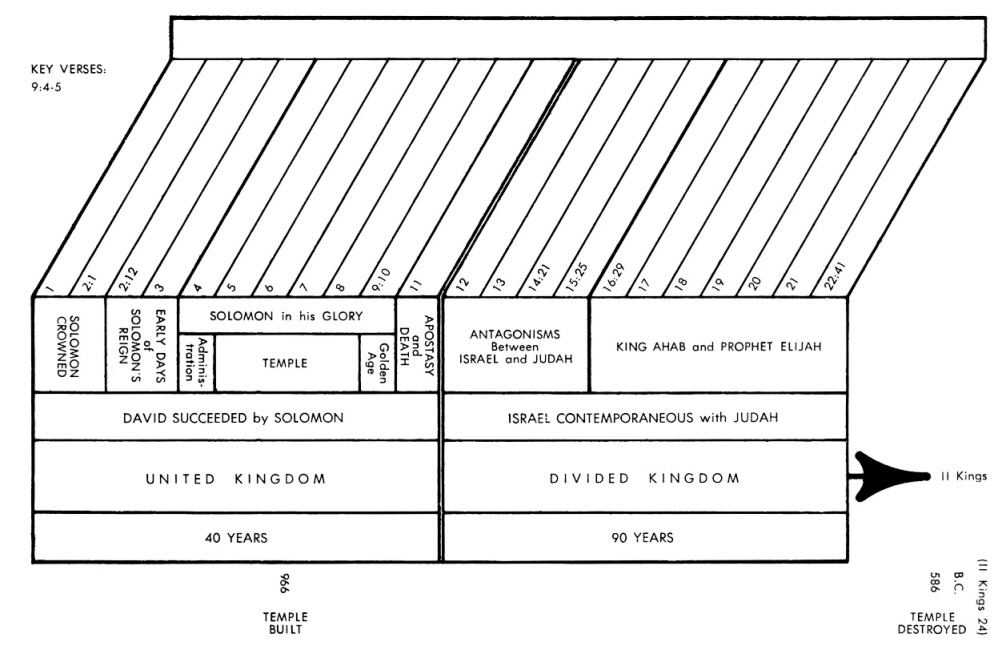
Chart from recommended resource Jensen's Survey of the OT - used by permission
1 Kings Chart from Charles Swindoll
THE DOWNWARD SPIRAL
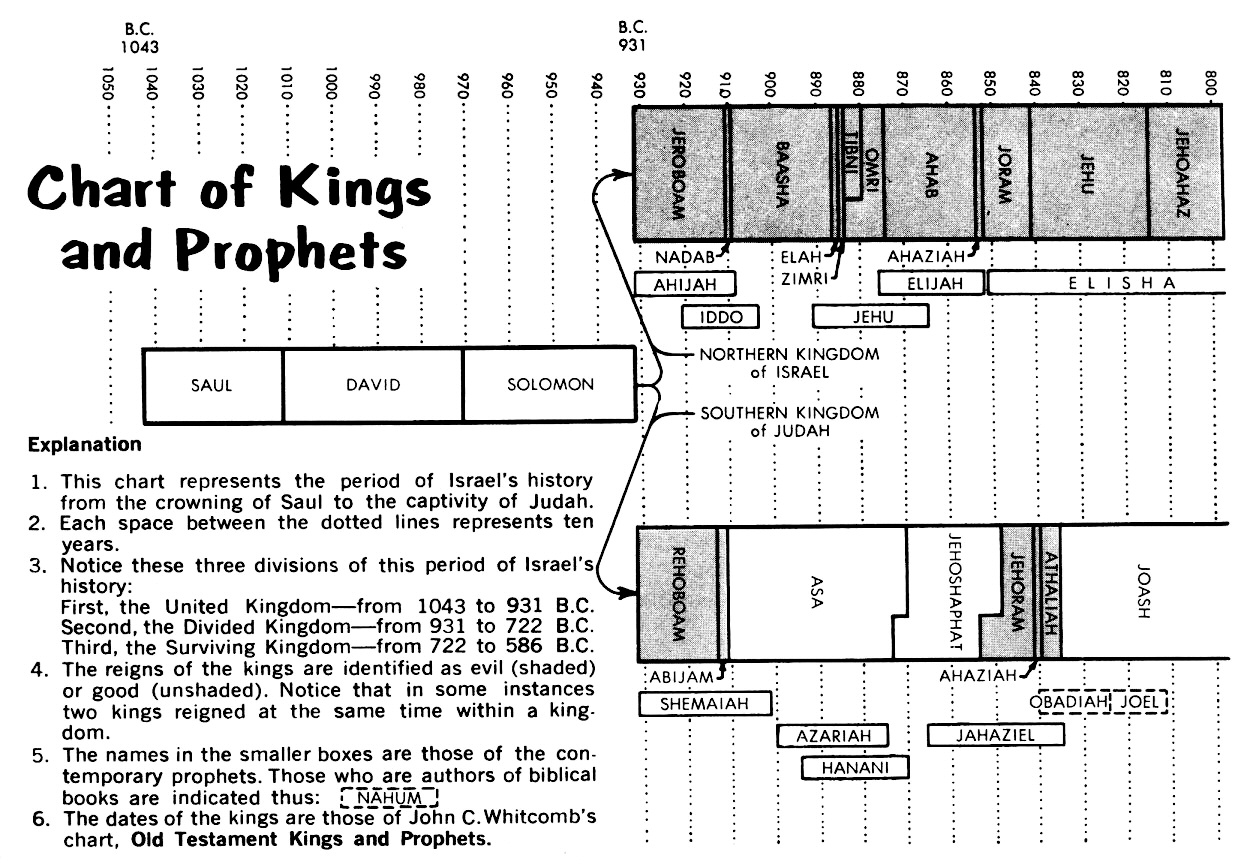
Click to Enlarge
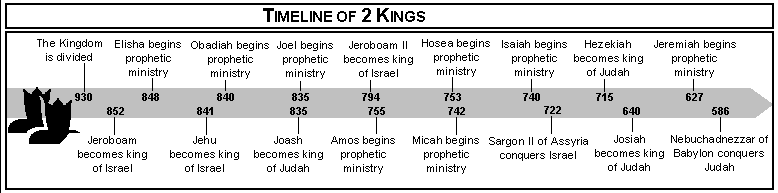
Ryrie Study Bible - Borrow
Click to Enlarge
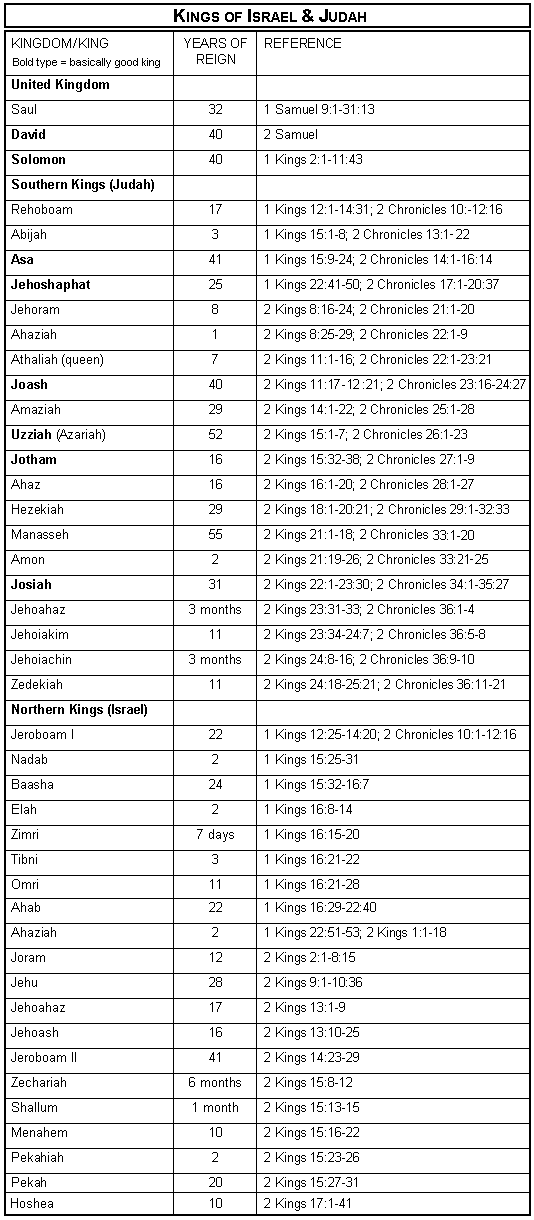
(NOTE: Many consider Amaziah and Hezekiah as "good" kings)
SEE ALSO:
ESV chart - kings of Israel - more information
ESV chart - kings of Judah - more information
Another Chart with Variable Dates for Reigns of Kings
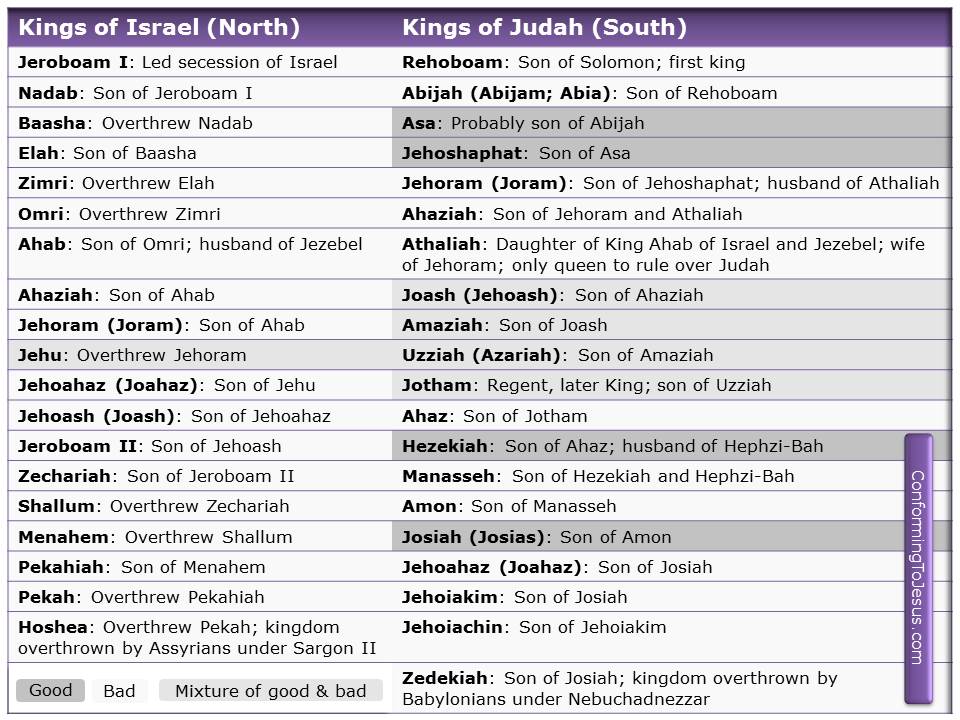
Source: ConformingtoJesus.com
2 Kings 4:1 Now a certain woman of the wives of the sons of the prophets cried out to Elisha, “Your servant my husband is dead, and you know that your servant feared the LORD; and the creditor has come to take my two children to be his slaves.”
- the sons of the prophets: 2Ki 4:38 2:3,5 1Ki 20:35
- servant: Ge 22:12 1Ki 18:3 Ne 7:2 Ps 103:11,17 112:1,2 115:13 147:11 Ec 8:12 12:13 Mal 3:16 4:2 Ac 13:26 Rev 15:4 19:5
- the creditor: Lev 25:39-40,48 Ne 5:2-5 10:31 Jer 34:14 Mt 18:25,30,35 Jas 2:13
Related Passages:
Leviticus 25:39-41 ‘If a countryman of yours becomes so poor with regard to you that he sells himself to you, you shall not subject him to a slave’s service. 40 ‘He shall be with you as a hired man, as if he were a sojourner; he shall serve with you until the year of jubilee. 41 ‘He shall then go out from you, he and his sons with him, and shall go back to his family, that he may return to the property of his forefathers.
Ecclesiastes 8:12 Although a sinner does evil a hundred times and may lengthen his life, still I know that it will be well for those who fear God, who fear Him openly.
Philippians 4:19 And my God will supply all your needs according to His riches in glory in Christ Jesus.
2 Corinthians 9:8 And God is able to make all grace abound to you, so that always having all sufficiency in everything, you may have an abundance for every good deed;
Proverbs 9:10 The fear of the LORD is the beginning of wisdom, And the knowledge of the Holy One is understanding.
Psalm 112:1 Praise the LORD! How blessed is the man who fears the LORD, Who greatly delights in His commandments.
Job 1:1 There was a man in the land of Uz whose name was Job; and that man was blameless, upright, fearing God (NOTE THE EFFECT OF FEARING GOD) and turning away from evil.
Psalm 34:17 The righteous cry, and the LORD hears And delivers them out of all their troubles.
Psalm 34:18 The LORD is near to the brokenhearted And saves those who are crushed in spirit.
Psalm 37:25 I have been young and now I am old, Yet I have not seen the righteous forsaken Or his descendants begging bread.
Psalm 68:5 A father of the fatherless and a judge for the widows, Is God in His holy habitation.
James 1:27 Pure and undefiled religion in the sight of our God and Father is this: to visit orphans and widows in their distress, and to keep oneself unstained by the world.
NOW TO ANOTHER STORY OF
A WIDOW'S DIRE STRAITS
Hampton Keathley III - Elisha’s prophetic ministry, which is especially highlighted in chapters 4-8, clearly demonstrates that God cares for His people and that He sometimes works in sovereign and mighty ways that extend far beyond that which we are able to do or think as He reaches out to meet needs according to His will.
Now - In context marks a change or next step, in this case new story about the prophet Elisha. Eliaha shifts from international conflict to personal adversity, from aid to royalty in dire straits of death from dehydration NOW to aid to those in the dire straits of poverty.
As an aside, one would think the three kings in 2 Kings 3 would have honored or rewarded Elisha for saving their lives and their kingdoms, but there is no such record. Matthew Henry comments "No, the wise man delivered the army, but no man remembered the wise man, Eccl. 9:15. Or, if he had preferment offered him, he declined it: he preferred the honour of doing good in the schools of the prophets before that of being great in the courts of princes. God magnified him, and that sufficed him--magnified him indeed, for we have him here employed in working no fewer than five miracles. (Elisha was not like Diotephes in 3Jn 1:9, cf Lk 22:24) As Keathley says " the prophet Elisha was not concerned with the praise of men nor with position or power or prestige. Though his ministry was filled with miracles they were for edification, not for show. Like the Savior, he came not to be ministered to, but to minister." (Mk 10:45)
A certain woman of the wives of the sons of the prophets cried out (tsaaq; Lxx - boao - crying for help) to Elisha - The widow knew where to go in the time of trouble, not to human means but to God's representative, a good pattern for all of us to imitate! She knew that Elisha's name meant "God is salvation" (or "God saves"). It is interesting that she does not go to the "students" in the school of the prophets, one of whom had been her own husband, but to the prophet of the sons of the prophets, Elisha. He was clearly head and shoulders above all the other prophets, none of whom had been granted the "Elijah-like" power which Elisha possessed. Here we see Elisha functioning like his spiritual father Elijah who also ministered to families (1Ki 17:8-24). As an aside it is clear that the sons of the prophets were not celibate monks, but at least some were married men (note "wives" is plural).
SONS OF THE PROPHETS - 12X/11V - 1 Ki. 20:35; 2 Ki. 2:3; 2 Ki. 2:5; 2 Ki. 2:7; 2 Ki. 2:15; 2 Ki. 4:1; 2 Ki. 4:38; 2 Ki. 5:22; 2 Ki. 6:1; 2 Ki. 9:1; (Acts 3:25 - different context)
Your servant my husband is dead, and you know that your servant feared the LORD - Note her humility identifying herself as "your servant's wife." And yet she is bold to approach Elisha to receive grace recalling Heb 4:16. Even in her insufficiency, she reaches out to Yahweh's sufficiency. Fear of the LORD (see article) characterized the life of her husband and Elisha was fully aware of his godly character. You might ask, well that is fine that he feared Yahweh, but was he "saved" as we might describe him today? While one cannot be dogmatic it is fair to say that in the final proclamation of the Gospel in the Book of the Revelation John records this description "And I saw another angel flying in midheaven, having an eternal gospel to preach to those who live on the earth, and to every nation and tribe and tongue and people; and he said with a loud voice, “Fear God, and give Him glory, because the hour of His judgment has come; worship Him who made the heaven and the earth and sea and springs of waters.” (Rev 14:6-7) Based on John's passage, I think it is fair to say that this man who belonged to the sons of the prophets was a "saved man," as was his wife.
The widow bypasses civil authorities and appeals directly to the prophet, demonstrating confidence that God works through His servants (Ps 34:6; Jer 33:3). Her cry underscores a biblical pattern: those in distress call on the Lord’s representative, anticipating divine intervention (Ex 22:22-23). Scripture consistently calls God’s people to defend widows (James 1:27; Deut 10:18), so her appeal fits God’s heart for the helpless.
And the creditor has come to take my two children to be his slaves - Was the creditor within his rights to enslave the children? Yes under the Mosaic Law a creditor did have a limited legal right to take sons as debt-slaves as a means of repaying the debt (See Lev 25:39-41) However, Exodus 22:22 says “You shall not afflict any widow or orphan." This makes the creditor’s action legally allowed but ethically harsh. And since it within the creditor's rights, the widow's appeal to Elisha assumes that only some divine intervention can prevent it. Elisha (who himself had a servant Gehazi) could pay her debt or led by the Spirit could devise some other way to pay it (which he of course did). In any event Elisha could otherwise not legally prevent the enslavement of her two sons.
🙏 THOUGHT - So as this story unfolds we see a beautiful picture of what the Law permitted, grace redeemed! Does this not remind us of Jesus' words in Luke 4:18NET "The Spirit of the Lord is upon me, because he has anointed me to proclaim good news to the poor (THIS WIDOW WAS POOR!). He has sent me to proclaim release to the captives and the regaining of sight to the blind, to set free those who are oppressed (THIS WIDOWS CHILDREN COULD BE LEGALLY ENSLAVED)." We were all enslaved to SIN and Jesus set us free by paying our debt in full (tetelestai in Jn 19:30).
Warren Wiesbe - According to Hebrew law, a creditor could take the debtor and his children as servants, but he was not to treat them like slaves (Ex. 21:1–11; Lev. 25:29–31; Deut. 15:1–11). It would be heartbreaking for this woman to lose her husband to death and her two sons to servitude, but God is the “judge of the widows” (Deut. 10:18; Ps. 68:5; 146:9) and He sent Elisha to help her.
Patterson - However inhumane this might seem, the creditor was within his rights; for Mosaic Law allowed him to enslave the debtor and his children as far as the Year of Jubilee in order to work off a debt.” (Borrow Expositor's Bible Commentary page 182)
Neo-Assyrian tablets (7th c. BC, British Museum BM 82748) record creditors seizing children, corroborating the realism of the widow’s fear.
Charles Spurgeon on my husband (a prophet) is dead - The best of men may die in poverty—here is the widow of a prophet left in destitution. We must not hastily censure those who leave their families unprovided for—circumstances may have rendered it impossible for the breadwinner to do more than supply the pressing needs of the hour. Yet assuredly it is sad to see the widow of so worthy a man in such straits! A widow, and especially the widow of a prophet of the Lord—our concern for her is tender. Her husband had been among the persecuted, and having been by oppression, deprived of all that he had, it came to pass that when he died he left his wife and children in distress—from which I gather that holy men may be in the worst of circumstances, and yet it will be no proof that the Lord has forsaken them. We may not judge a person’s character by his position in life! Certainly, poverty is no sign of divine grace, for there are many who bring themselves to it by their own wickedness; but on the other hand, wealth is no sign of divine favor—for many there are who will have their portion in this life, only, and have no inheritance in the life everlasting! (full sermon The Filling of Empty Vessels)
Believer's Study Bible - The Mosaic Law authorized that creditors could claim the service of debtors until the Year of Jubilee (Lev. 25:40).
Notable takeaways from this passage - God sees the afflicted (Ge 16:13; Pr 15:3). He honors those who fear Him, even after death (Ps 112:1–2). He safeguards the vulnerable, especially widows and orphans (Ps 68:5; Dt 10:18). He answers cries for mercy (Ps 145:19; 1Pe 5:7). He works within legal realities yet overrides them with grace, preventing bondage. If God intervened for one obscure widow, He remains faithful to every believer today (Heb 13:8). Our needs may appear impossible, but heavenly resources are limitless (Phil 4:19). We need to remember that our first step in crisis, like this widow, should be cry out to the Lord. Hebrews 2:18 says "For since He Himself was tempted in that which He has suffered, He is able to come to the aid (boetheo = to come running upon hearing our cry!) of those who are (present tense - contintually, passive voice - being) tempted (tested).
John Walton - debt slavery. Because of the fragile nature of the environment in much of the ancient Near East, farmers and small landowners often found themselves in debt. Their problems could magnify if a drought and resulting poor harvests continued over more than one year, and they could be forced to sell their land, goods and eventually even their family and themselves into debt slavery. Israelite law takes this situation into account by providing a fair period of labor service to the creditor as well as a time limit on servitude for the debt slave. No one could serve more than six years, and when slaves were freed they went out debt-free. This would have been a good solution for some, but without their land to return to, many may have chosen to remain in the service of their creditor or to move to the cities to find jobs or to join the military. (Page 389 IVP Background OT)
Hampton Keathley III sees several principles from these verses:
Each one of us are personally known and loved of God;
we are the personal objects of His love
(1) Though she is not identified in the text and was not on the “who’s who” list of Israel’s prominent people (as most of us are not), the principle is she was not unknown to God. Each one of us are personally known and loved of God; we are the personal objects of His love.
Psalm 147:4 He counts the number of the stars; He gives names to all of them.
Psalm 50:11 I know every bird of the mountains, And everything that moves in the field is Mine.
Matthew 6:26-30 Look at the birds of the air, that they do not sow, neither do they reap, nor gather into barns, and yet your heavenly Father feeds them. Are you not worth much more than they? 27 And which of you by being anxious can add a single cubit to his life’s span? 28 And why are you anxious about clothing? Observe how the lilies of the field grow; they do not toil nor do they spin, 29 yet I say to you that even Solomon in all his glory did not clothe himself like one of these. 30 But if God so arrays the grass of the field, which is alive today and tomorrow is thrown into the furnace, will He not much more do so for you, O men of little faith?
Matthew 10:29-31 Are not two sparrows sold for a cent? And yet not one of them will fall to the ground apart from your Father. 30 But the very hairs of your head are all numbered. 31 Therefore do not fear; you are of more value than many sparrows.
2 Timothy 2:19 Nevertheless, the firm foundation of God stands, having this seal, “The Lord knows those who are His,” and, “Let everyone who names the name of the Lord abstain (aorist imperative see our need to depend on the Holy Spirit to obey) from wickedness.”
Our needs are never unknown to our sovereign Lord. Though our God is transcendent, above and sovereign over this world, He is also immanent, very much involved with His creation and with His people and the details of their lives. This will be clearly emphasized in the story of the ax head that will follow in 2Kings 6:1-7. Since her husband was one who feared the Lord and since she appealed to the prophet, she was certainly a believer, an Old Testament saint who had a relationship with God. As an Old Testament believer she was the special recipient of God’s very personal care as one of His special children (Phil 4:19).
God usually meets the needs of His people through people,
especially believers ministering to other believers
(2) Though her appeal here was ultimately to the Lord, she sought help through Elisha. Her appeal was based on two facts: (a) as one of the sons of the prophets, her husband had been a servant and student of Elisha, and (b) her husband had revered (had been faithful to) the Lord. This scenario reminds us of how God usually meets the needs of His people through people, especially believers ministering to other believers. That we have such a caring responsibility to one another is one of the great themes of the New Testament (cf 1Jn 3:17,18), but this especially draws attention to our need to be more involved in the needs of those in our personal care or in our ministry.
Galatians 6:9-10. And let us not lose heart (see hortatory subjunctive) in doing good, for in due time we shall reap if we do not grow weary. 10 So then, while we have opportunity, let us do good to all men, and especially to those who are of the household of the faith.
Her plight is spelled out in her statement, “and the creditor has come to take my two children to be his slaves.” That her husband was a man who revered the Lord indicates the problem she faced was not caused by her husband’s folly, but by circumstances imposed upon him as a believer in this day of apostasy. According to the Old Testament Law, a person in debt and without the means of repayment or collateral could be forced into bondage as a servant (or his sons) until the year of Jubilee. The sons would have to work off their father’s debt (Lev. 25:39ff).
QUESTION - What was the school of prophets? GOTQUESTIONS.ORG
ANSWER - The Old Testament mentions a school of prophets in 1 Samuel 19:18–24 and in 2 Kings 2 and 4:38–44 (some translations say “company of prophets” or “sons of the prophets”). Also, the prophet Amos possibly mentions a prophetic school in stating his credentials (or lack thereof) to Amaziah the priest: “I was neither a prophet nor the son of a prophet” (Amos 7:14).
First Samuel 19 relates an account in which King Saul sends messengers to arrest David. When these men encountered a company of prophets under Samuel’s leadership, the king’s men also prophesied. This happened three times. Saul himself then went, and he, too, prophesied, leading people to ask, “Is Saul also among the prophets?” (1 Samuel 19:24), which became a saying in those days.
The “group of prophets” in 1 Samuel 19 was clearly comprised of students of the prophet Samuel. These students were likely Levites who served in roles related to the tabernacle and ceremonial worship. The content of their “prophesies” is not specified. Their messages could have been general teachings from God’s laws in the Books of Moses, or they could have included additional revelation.
In 2 Kings 2 Elijah is traveling with Elisha, and a group of prophets from Bethel tells Elisha that Elijah would be taken from him that day (verse 3). Another group of prophets at Jericho repeats the prophecy (verse 5), and a third group of prophets near the Jordan River also delivers the same message (verse 7). This third group of 50 men may have been a subset of the group of prophets at Jericho. After Elijah was taken up into heaven, Elisha reluctantly sends 50 of these prophets to search for Elijah for three days (verses 15–18).
In 2 Kings 4:38–41 Elisha is in Gilgal during a time of famine. Elisha miraculously changes an inedible stew into a comestible dish for the group of prophets there. Chapter 4 ends with Elisha’s turning 20 loaves of bread into more than enough food for 100 people. Nothing else is mentioned about this school of prophets, though it is clear they lived together in some kind of community and were known as sons of the prophets who worshiped the Lord.
These groups of men were likely leaders among those 7,000 Israelites who had not bowed down to Baal, as God had told Elijah (1 Kings 19:18). There were at least three schools or communities of these prophets and possibly more, consisting of men who were devoted to God and served Him. They followed the teachings of Samuel, Elijah, and Elisha during the time of the prophets and were known as their “students.”
QUESTION - Who was Elisha in the Bible? GOTQUESTIONS.ORG
ANSWER - Elisha, whose name means "God is salvation," was the successor of Elijah in the office of the prophet in Israel (1 Kings 19:16, 19–21; 2 Kings 5:8). He was called to follow Elijah in 1 Kings 19:19, and he spent the next several years as the prophet’s protégé, until Elijah was taken into heaven. At that time, Elisha began his ministry, which lasted about 60 years, spanning the reigns of kings Jehoram, Jehu, Jehoahaz, and Joash.
The initial call of Elisha is instructive. After a mighty display of God’s power against the prophets of Baal and a return of the rain after a long drought, Queen Jezebel sought Elijah’s life. Afraid, the prophet fled. He was refreshed by an angel and prepared for a forty-day journey to Mount Horeb. There, Elijah confessed that he believed himself to be the only faithful prophet remaining. God told Elijah to go back home, anoint Hazael king of Aram, Jehu king of Israel, and Elisha to succeed him as prophet. God said, "Jehu will put to death any who escape the sword of Hazael, and Elisha will put to death any who escape the sword of Jehu" (1 Kings 19:17). He also reassured Elijah that there were 7,000 remaining who had not bowed to Baal.
Elijah obeyed God’s word and found Elisha, who was plowing with a pair of oxen at the time. Elijah put his cloak around Elisha—a sign that Elijah’s responsibilities would fall on Elisha, and Elisha left his oxen and ran after the prophet. Elisha asked only to say goodbye to his family and then would return to Elijah. Elisha went back, slaughtered his oxen and burnt his equipment, gave the meat to the people, then followed Elijah as his servant. Elisha responded to the call immediately. He completely removed himself from his former life—essentially hosting a celebration and leaving himself no option to return to his oxen. Not only did Elisha leave his former life, he became a servant in his new life (1 Kings 19:21).
Elisha seemed to love Elijah like he would a father. He refused to leave Elijah before Elijah was taken into heaven, despite Elijah’s telling Elisha to remain behind. Elijah permitted Elisha to stay with him, and he asked what he could do for his protégé before he left. Elisha requested a double portion of Elijah’s spirit. This was not a greedy request but rather one indicating that Elisha wanted to be considered as Elijah’s son. Elijah told Elisha that, if he saw Elijah when he was taken, then the double portion would be Elisha’s. Elisha did, indeed, see the chariot of fire and horses of fire that separated the men, and he saw Elijah taken to heaven in a whirlwind. Elisha picked up Elijah’s cloak and walked to the Jordan River. Elisha struck the water with the cloak, and it divided, just as it had done for Elijah. The other prophets who witnessed this recognized that Elijah’s spirit now rested on Elisha. As God had decreed, Elisha would now be His prophet to the people (2 Kings 2:1–18).
As God had told Elijah on the mountain, it was during Elisha’s ministry that organized Baal worship was eradicated (2 Kings 10:28). In his ministry Elisha traveled widely and served as an adviser to kings, a companion of the common people, and a friend of both Israelites and foreigners.
There are many well-known accounts of Elisha’s service as prophet. He healed the waters of Jericho (2 Kings 2:19–21) and was jeered by youths upon whom he called a curse resulting in their death by mauling bears (2 Kings 2:23–25). He multiplied a widow’s oil (2 Kings 4:1–7). He prophesied a son for a wealthy Shunammite family who hosted him and later resurrected that same son (2 Kings 4:8–37). Elisha also removed poison from a pot of stew (2 Kings 4:38–41) and multiplied twenty barley loaves to feed one hundred men (2 Kings 4:42–44). He cured Naaman of leprosy (2 Kings 5) and made a borrowed ax head float (2 Kings 6:1–7). The miracles Elisha performed are, for the most part, acts of helpfulness and blessing. Others strongly resemble some of the miracles of Christ, such as the multiplying of food (Matthew 16:9–10) and the healing of lepers (Luke 17:11–19).
Elisha offered counsel to the king of Israel. One incident tells of Elisha warning the king about the king of Aram’s movements. When the king of Aram found out it was Elisha foiling his plans, he sought to capture the prophet. When Elisha’s servant, Gehazi, saw the Arameans that had come against them, he was afraid. But Elisha told him not to be afraid because "those who are with us are more than those who are with them.' And Elisha prayed, 'Open his eyes, Lord, so that he may see.' Then the Lord opened the servant’s eyes, and he looked and saw the hills full of horses and chariots of fire all around Elisha" (2 Kings 6:16–17). One cannot help but recall how Elisha had seen similar chariots of fire when Elijah was taken to heaven. Elisha then prayed for the Arameans to be struck with blindness. Elisha led them to Samaria, the capital of Israel, before asking the Lord to open their eyes. The king of Israel wondered if he should kill the captives, but Elisha counseled him to prepare food for them instead. When they were finished with the feast, the Aramians returned to their master, and Aram ceased raiding Israel. Elisha also prophesied other events of national and international importance regarding Israel and Syria.
King Jehoash, or Joash, was reigning at the time of Elisha’s death. The king visited Elisha while the prophet was ill and wept over him. Elisha instructed Jehoash to get a bow and arrows and shoot them out the window. When Jehoash did so, Elisha told him this was God’s arrow of victory over Aram. Elisha then told the king to strike the ground with the arrows, but Jehoash stopped after only three times. Elisha was angered. Had Jehoash struck the ground five or six times, he would have completely destroyed Aram but would now only defeat them three times (2 Kings 13:14–19).
Of Elisha’s death, 2 Kings 13:20 simply says, "Elisha died and was buried." But the passage goes on to talk about Moabite raiders who came to Israel every spring: "Once while some Israelites were burying a man, suddenly they saw a band of raiders; so they threw the man’s body into Elisha’s tomb. When the body touched Elisha’s bones, the man came to life and stood up on his feet" (2 Kings 13:21). It seems that God chose to demonstrate His power through the prophet even after his death.
Jesus spoke of Elisha in Luke 4:27. The people had rejected Jesus in Nazareth and He told them that "no prophet is accepted in his hometown" (Luke 4:24). Jesus said there were many lepers in Israel in Elisha’s time, yet only Naaman, a Syrian, was cured.
A study of the life of Elisha will reveal the prophet’s humility (2 Kings 2:9; 3:11), his obvious love for the people of Israel (2 Kings 8:11—12), and his faithfulness in a lifelong ministry. Elisha was obedient to God’s call, following Elijah eagerly and faithfully. Elisha clearly believed God and trusted Him. Elisha sought after God, and through him God worked powerfully.
Dale Ralph Davis - it was a revelation to the remnant in Israel that Yahweh, Israel’s God and our God, is the help of the helpless and of the nameless. That is the anchor point; Here was a woman in double desperation. She had lost her husband by death and, as if that grief weren’t enough, she is going to lose her sons by insolvency. Now that she is a widow her sons are her means of support, her lifeline; but they can be nothing of the kind when they are hauled off into debt slavery. We cannot say that the creditor was necessarily harsh—we do not know. Possibly he was simply operating within his rights. The lads would have to work off the debt, which must have been substantial. This widow, however, is dealing with more than death and destitution. There is an aggravation in her desperation. Note her words: ‘And you know that your servant was fearing Yahweh, but the creditor is coming …’ Her husband had been faithful to Yahweh and to his true worship in a time when such fidelity could cost something. It may have been during the regime of Ahab, when Jezebel liquidated Yahweh loyalists with such gusto (cf. 1 Kings 16:29–34; 18:4, 13). If not, there was always the religious ‘status quo’ in the northern kingdom—the perverted state-sponsored worship at Bethel (1 Kings 12:25–33). But this disciple of Elisha and servant of Yahweh had bucked the religious trends of the day; he swam against the stream of his culture and government. And yet his loved ones face disaster. Do you feel the rub she expresses? . . . Insofar as this woman appeals to Elisha, Yahweh’s servant, she appeals to Yahweh; as she casts her burden on Elisha she casts it on Yahweh. And so we see a familiar combination: she is in trouble and she believes. . . She has access to God in her troubles. You may have no particular status, but have you thought of what you have, if, through Jesus, you have the privilege of access and can bring your troubles to God? What a mercy Psalm 142:2 describes! (Borrow 2 Kings : the power and the fury page 54)
Robert Hawker - The creditor is come to take unto him my two sons to be bondmen.—2 Kings 4:1.
MY soul! how doth this affect thee? Art thou in debt? By nature and by practice thou wast miserably so, unless the debt be cancelled. As a creature, and as a sinful creature, thou art in thyself for ever insolvent. Thou hast nothing to pay, and art shut up in a total impossibility ever to pay. And how much owest thou unto my Lord? Alas! my soul, thou owest millions of debts to thy Almighty Creditor. The law thou hast broken: justice demands retribution, conscience condemns, Satan accuses; and the Creditor is come to take, not thy two sons only, but both thy two parts, soul and body, to the prison of death and hell, unless some Almighty Surety hath stept in and paid the dreadful debt, that thou mayest be free. At death, and at judgment that follows, the everlasting release, or the everlasting imprisonment, will take place. And who knows whether the decision may not be to-morrow; nay, whether the same sentence as went forth to the rich man in the gospel is not already gone forth concerning thee—“This night thy soul shall be required of thee?” Pause, my soul! Is it not high time to flee to the Prophet, even to the Prince of the prophets, the Lord Jesus, to tell him thy case, and to seek his deliverance? Hark! doth he say, as the prophet did to the poor woman, “What shall I do for thee? Tell me what thou hast in the house?” Is not Jesus with thee? Is not his fulness suited to thy emptiness? Hast thou him with thee in the house? Shut then the door: bring, bring, my soul, all thy empty vessels—Jesus will fill them all. Nor will his bounty stay until that all thy vessels be filled; nay, every vessel will fail before that his grace fails. And when thou art full of Jesus, live on Jesus, and see that Jesus hath paid thy Almighty Creditor, and left enough for thee to live on for ever. Oh! the rapture and the joy when the Almighty Creditor comes, at midnight, or at cock-crowing, or in the morning, to know the dreadful debt is paid, and to hear him say, “Deliver him from going down to the pit; I have found a ransom!”
Roger Campbell - The Mother Who Struck Oil at Home 2 Kings 4:1–7
I. Introduction
A. Mothers and their Many Responsibilities
1. Who can number them all?
2. Yet mothers are equipped by God for this task
3. Motherhood was the first command of God to Eve
B. The Added Responsibilities of Widowhood
1. The increased load when the husband is gone
2. Such is the case in the text before us
II. Body
A. This Mother Knew where to go in the Time of Need (v. 1)
1. The preacher’s widow
a. Wife of one of the sons of the prophets
b. About this departed preacher
(1) Must have been a man of faith. Served under Elisha
(2) Must have been fearless. He didn’t have any money
(3) Must have been hard working. He died young
2. The Problems: Death and debts
a. The two great burdens of life
b. The creditor comes to foreclose on the boys to be bondmen
3. The widow went quickly to seek the wisdom and help of God
4. Blessed is the mother who knows where to go when her family is in need
B. This Mother found the Answer to her Need was Right at Home (vv. 2–4)
1. Elisha considering her problem: “What shall I tell thee?”
2. Elisha’s searching question: “What hast thou in the house?”
a. A good question for all mothers today
b. A husband who loves you? Food enough for today?
c. Money for this week’s groceries?
d. This mother had none of these things
3. The negative answer: “Thy handmaid hath not anything”
a. Mothers and others with this attitude are miserable
b. “Others get new things, I am deprived. Poor me!”
4. The Startling Discovery: “Save A Little Pot of Oil.” A Positive Move
a. Literally “an anointing of oil”
b. But this was the turning point
c. How long has it been since you counted your blessings?
d. Rediscovering the house, the family, the furniture, love
5. The answer for lifting your burden may be right at home
C. This Mother Found that the Possibilities are Unlimited When you Allow God to Use what you have (vv. 4–7)
1. Heeding the message of Elisha in faith
2. Involving her sons in the act of faith
a. Sent them borrowing
b. Thinking big! “Borrow not a few”
c. Expecting the answer
3. The closed doors. The thrilling moment
a. God took what she had and multiplied it
b. Filling all the borrowed vessels
4. What God will do with what you have
a. A boy’s lunch
b. Moses’ rod
c. David’s sling
III. Conclusion
A. Whatever you have is Enough for God to Use
B. What Hast Thou in the House?
A.B.Simpson: “Our God has boundless resources. The only limit is in us. Our asking, our thinking, our praying are too small. Our expectations are too limited.”
THE MIRACLE OIL 2 Kings 4:1–17 - Croft Pentz
God always blesses those who dare to trust Him. We should trust God regardless of circumstances; have faith when there seems to be no hope; trust God at all times.
1. THE PROBLEM—v. 1
2. THE PERSON—vv. 2–4
3. THE POURING—vv. 5–7
4. THE PREPARATION—vv. 8–11
5. THE PROMISE—vv. 12–17
God still performs miracles. Allow Him to work in and through you. He will do great things for you. Notice these promises: Jeremiah 33:3; Ephesians 3:20.
From Rags to Riches By Denis Lyle
Scripture: 2 Kings 4:1–7, especially verse 7: Then she came and told the man of God. And he said, “Go, sell the oil and pay your debt; and you and your sons live on the rest.”
Introduction: Have you ever felt like throwing in the towel and quitting? Have you ever come to your wit’s end? Are you there now, ready to give up? When the curtain lifts in 2 Kings chapter 4, a scene of misery, impoverishment, and despair is brought before us. As the story progresses, however, this widow finds the way from rags to riches.
1. The Trouble Was Brought to Elisha (v. 1).
By turning to God’s prophet, Elisha, this woman was turning to God in her trouble; Elisha was God’s representative (Heb. 1:1). She brought her problems to Elisha fervently, she “cried out” indicating her desperation. She also stated her problems frankly, honestly relating the facts. She conveyed her problems fully, telling her whole story to Elisha. Do you bring your problems to the Lord this way? Let’s take a look at her problems:
A. There Was Death in the Family (v. 1). Her human provider, her human protector, her human partner was gone and she felt it! The Hebrew language contains at least 30 words that describe various kinds of trouble. What kind of trouble are you in? Have you brought that trouble and laid it at the Savior’s feet?
B. There Was Debt in the Family (v. 1). This woman had seen all her belongings sold to meet the demands of her creditor, and now she faced the dreadful possibility of having to part with her two sons. All that was left in her home was a pot of oil! Is your problem financial? Worried about your job or your business? This family faced death, debt, and possibly:
C. There Was Doubt in the Family (v. 1). The language of verse 1 hints that this woman was perplexed, perhaps even questioning God’s wisdom in allowing such affliction to fall upon her home. Are your circumstances causing you to question His Wisdom and doubt His Love?
2. The Truth Was Taught by Elisha (vv. 2–4).
Here was a preacher with a genuine concern for this widow (see Ps. 68:5; 146:9; Deut. 10:18). Do you have a heart of compassion and a hand of practical helpfulness for orphans and widows (1 Tim. 5:3; James 1:27)? Elisha gave this widow his full attention. At this stage, however, the situation does not look promising, for she has but a little flask containing a little oil! This proved to be the key to the situation! God, through Elisha, was trying to teach her principles we should also learn:
A. She Had to Do as She Was Told (vv. 5–6). Notice the widow obeyed immediately after instructions were given, implicitly despite the unusual instructions, and inclusively, following his orders step-by-step. Do you take God at His word this way?
B. She Had to Use What She Had (vv. 5–6). It seemed silly, pouring out her few fluid ounces of oil from one vessel to another, but she used what she had. She stepped out with little, which God turned into much (see Luke 17:6). Do you feel too small to accomplish anything? God delights in using little things for His big purposes.
C. She Had to Prepare in Abundance (vv. 3–6). Elisha told her to prepare for abundance. Today we think that a church of 250 people is a big church. We often think small; we believe small and our expectations are trivial. Our expectancy may be the only limitation on what God is prepared to do for us!
3. The Triumph Was Wrought for Elisha (v. 7).
She returned to Elisha with her story of victory. Imagine the headlines in the local newspaper: “Company Widow Discovers Oil!” This was a woman who:
A. Proved the Adequacy of God. This woman went from house to house with her small vessels, until one day, there were no more vessels to fill!
B. Proved the Ability of God (v. 7). She found that God was able to meet her critical need, to pay her debt, her constant need, to pay daily living expenses, and her collective need, to provide for her family.
John Bisagno - Elisha 2 Kings 4:1–7
1. He Who Seeks God’s Will Finds Much More Than He Seeks
Like Solomon, Elisha received the privilege of asking for an extraordinary gift. If you could have anything, what would it be? Far too many of us would consider our own personal need or desire and would ask for something with short term benefits. Elisha’s request was not for position or wealth, but for power. “Let me inherit a double portion of your spirit,” Elisha asked Elijah. Though it was not Elijah’s to give, this great prophet and mentor gave his student the promise that it was possible. “If you see me when I am taken from you, it will be yours.…” What was Elisha really seeking? Was he trying to be even more successful than Elijah? I don’t think so—I believe Elisha wanted even more of God than he had witnessed in Elijah’s life, and what he had seen in Elijah was powerful.
The power that filled all the empty pots of a Samaritan widow came from an anointing that meant more to him than life. Could he have known that a double portion of power would translate into saving the two lives of the widow’s sons? Probably not! Can we ever know just how God’s power is going to be used in our lives? Definitely not! But he who seeks God with all his heart finds much more than he seeks. David reminded us of this in Psalms 37:4 when he wrote, “Delight yourself in the Lord and He will give you the desires of your heart.” Our Lord tells us, as recorded in Matthew 6:33, “Seek first the Kingdom of God and His righteousness, and all these things will be provided for you.” Seek God with all your heart, soul, mind, and strength, and leave the results to Him.
2. God Meets Us at the Most Common Point of Our Need
How often in Scripture do we see a God who starts with nothing? The widow was a very poor woman, indeed. She had nothing in the house—no food, no resources, no discretionary funds, nothing with which to barter for the life of her sons. Obviously she had borrowed before. Apparently she had been faithful to return what she borrowed. She was a nice woman, and the neighbors were eager to help. They freely gave, but this woman was about to learn what God can do with nothing. In fact, it was as if Elisha was saying to her, “You do not yet have enough nothingness, so go borrow all the emptiness you can and see what happens when you really get empty.”
Is God interested in cooking oil? Does He care about the basics of life such as cooking supper, making wedding receptions happy, and church picnics that run out of food? He certainly does. Does it matter to Him that I pray for help to pass an examination, find a parking place, or know His will about a small purchase? Indeed it does. He cares about every detail of our life and wants the best for us in each. God meets us at the most common point of our need. Perhaps our problem is that we have too much. In fact, I think it is safe to say that if you are not experiencing God’s presence and provision in your life, you may not be empty enough.
I once read the story of a man named Richard who spent fourteen years in Romanian captivity, in solitary confinement because of his faith in Christ. Other Christians were housed in the prison, and in the early years of incarceration they worked out a system of communication by tapping on the sewer pipes. One of the Christian prisoners sent a message to Richard suggesting they celebrate communion. Richard was heartbroken. He would have loved to have communion, but there were no elements to represent the body and blood of Christ. When he tapped out a message explaining the dilemma, he received this reply: “God specializes in taking nothing and making it something; let’s have communion.” When Richard was released from prison he testified that his most meaningful times were those moments when he pictured the bread in his hands and broke it and tapped to the next cell, “Take and eat in remembrance of me.” God always meets us at our most common point of need, and He specializes in our emptiness!
3. The Size of Your Faith Determines the Size of Your Blessing
The widow’s actions showed she believed, but how much did she believe? How many empty pots did she borrow? Thirty? Three hundred? Three thousand? The story doesn’t say, but I’m guessing the number was based on the amount of faith she was willing to risk. After all, if the God of Elisha didn’t come through, it would simply be more work and more embarrassment to return all those borrowed pots!
We have a faith reservoir inside each of us, and its size determines our capacity for blessing. I once owned a vehicle that had a forty-two gallon gas tank. It took forever to fill up, but the good news was that I could almost travel forever without having to refuel. Wouldn’t it be wonderful to develop a faith reservoir that was being continually filled by the presence and provision of God! We can do that when we realize that our Heavenly Father is the giver of all gifts and that He is ready to bless our lives when we reach out to Him in faith. This is the message of Scripture time and time again. Whether it is a little boy’s lunch or the water pots at a Galilean wedding reception, God is interested in building our faith. Never forget this: When the widow ran out of pots, the oil stopped flowing. As long as there was something to fill, God kept pouring the oil.
Each believer is a vessel that God can fill to overflowing. The question is simple: Are we empty enough of ourselves to be continually full of Him? Humble yourself each day under the hand of God, rest in His presence, and be in awe of what He does in your life, and through you, in the lives of others.
James Smith - THE WIDOW’S OIL; OR, GRACE SUFFICIENT 2 KINGS 4:1–7
“It may be hard to gain, and still
To keep a lowly, steadfast heart,
Yet he who loses has to fill
A harder and a truer part.”
—Procter.
Seasons of affliction are common to all, but only the children of God have wonders wrought for them in such experiences. It is on the cloudy day that the rainbow of His promise is most easily seen. There is always a fruitful “afterwards” to those whose souls are exercised in the day of trouble (Heb. 12:11). It was while the Israelites were in the desert that they saw the glory of God’s goodness in giving them bread from Heaven and water from the flinty rock. This widow of one of the sons of the prophets has been brought into deep water, but see how God in His infinite grace and power was able to supply all her need. Observe the order—
I. Destitution Confessed. “She cried, saying, The creditor is come to take my two sons to be bondsmen” (v. 1). Her husband is dead, and being hopelessly in debt, her sons, who are her only hope for the future, are about to be sold. What a sorrowful plight! Yet she honestly confesses the whole truth. Such were some of us when the law as a merciless creditor came suddenly upon us, saying, “Pay me that thou owest” (Matt. 18:28), and when we discovered that we had “nothing wherewith to pay” (Luke 7:42), that we were already “sold under sin.” Being shut up to faith, what else could we do but cry unto Him who is the true Elisha, “the mighty to save?”
II. Grace Offered. “What shall I do for thee?” (v. 2). Elisha, as God’s representative, flings back, as it were, the door of heavenly privilege that she might ask what she will. It was the offer of grace sufficient for all her need. So poor was she that she had nothing in the house “save a pot of oil.” But poverty is no obstacle in the presence of Almighty grace and fullness (Luke 18:41). It is those who think that they have need of nothing who shut the Saviour outside of their lives (Rev. 3:20). What shall I do for thee? “Open thy mouth wide, and I will fill it” (Psa. 81:10).
III. Preparation Needed. “Go, borrow thee vessels, empty vessels, not a few” (v. 3). As yet, she had no room for the great blessing God was about to give her. It is wonderful how even our neighbours, by their kindness or otherwise, may supply us with that which will enrich us with heavenly blessing. The borrowing of empty vessels was an exercise of faith. She believed that she might see. It was so with the Israelites when they made the “valley full of ditches” (2 Kings 3:16–20). The relative value of each vessel to her was according to its capacity for receiving. This is also God’s manner of dealing with His vessels of grace (2 Cor. 12:10).
IV. Faith Rewarded. “She poured out, and the vessels were filled” (vv. 5, 6). It was a great crisis in this woman’s life when she “shut the door upon her and her sons,” and ventured, as in the presence of God alone, to claim the promise by faith. When one has made up his or her mind to “shut the door” and definitely prove God, there will surely be a marvellous outpouring of the oil of the Holy Spirit (Matt. 6:6). She could not make the oil, any more than we can manufacture the saving grace of God, but she could hold the vessel and trust God to cause the outflow. Her faith was rewarded to the very uttermost, for every empty vessel was filled.
V. Blessing Hindered. “There was not a vessel more; and the oil stayed” (v. 6). As long as there was an empty vessel, and faith to use the gift of God, there was no lack. His grace was made sufficient. We are never straitened in God, but always in ourselves, when the flow of His blessing is stayed. Whenever our conscious weakness gives place to self-satisfaction, then the oil of His Spirit’s power is hindered and arrested (Micah 2:7). The blessings of His grace, although in Him there is infinite fullness, yet are they too precious to be poured out and spilt where there is not the empty vessel of a needy heart. Grace can only be given to meet a real need (2 Cor. 12:9). There are those who talk joyfully of the times past, when the God-given oil flowed freely. But why is it stayed now? (Judges 16:20). No more emptiness!
VI. Deliverance Accomplished. “Go, sell the oil, and pay thy debt” (v. 7). Having received the gift of God, she is able now to meet all the claims of the creditor. She and her sons were saved by grace alone. The claims of a broken law can only be fully met by us through the infinite grace of God brought to us by Jesus Christ; by that love of God which is shed abroad in our hearts by the Holy Ghost, and which is the “fulfilling of the law.” If these sons were asked how they were saved from bondage, they could truly say, by the “gift of God.” It is not otherwise with us (John 3:16).
VII. Provision Made. “Live thou and thy children of the rest” (v. 7). The oil, which saved them from debt and slavery, was also to sustain them day by day. The children of Israel were not only saved by the blood of the lamb, but sustained by feasting on it (Exod. 12:8). Christ came not only to redeem us from the curse of the law, but also to satisfy us daily, as the “bread of God” which came down from Heaven. Live thou and thy children by faith upon the Son of God, who paid all thy debt upon Calvary’s Cross. What is still left, through His grace for thee and thine, is sufficient for all your needs, both for time and eternity.
2 Kings 4:2 Elisha said to her, “What shall I do for you? Tell me, what do you have in the house?” And she said, “Your maidservant has nothing in the house except a jar of oil.”
- What shall I: 2Ki 2:9 6:26,27 Mt 15:34 Joh 6:5-7 Ac 3:6 2Co 6:10
- jar of oil: 1Ki 17:12 Jas 2:5
LET'S START WITH
WHAT YOU HAVE
Elisha said to her, “What shall I do for you? - NIV = "How can I help you?" Elisha acting as God's representative (2Ki 3:11) had just spoken with kings but as a man of God, as His emissary, Elisha, like God, is available to the poor as well as the rich (cf Ps 46:1). God shows no favoritism, and this should be the response of all the people of God (cf Jas 2:1-9). Elisha is not asking out of ignorance, but to begin eliciting her faith. It reminds me of Jesus' question to the blind man in Mk 10:51 "What do you want Me to do for you?” (cf Mt 20:32) God often asks questions not to gain information, but to awaken faith. The widow knew Elisha was a man of God and in effect is seeking God's provision through God's representative.
🙏 THOUGHT - This may seem like a simple application, yet James reminds us pointedly, “You do not have because you do not ask” (Jas 4:2). If we fail to bring our needs before God, should we really expect Him to respond? Scripture is not advocating a shallow “name it, claim it” approach to prayer, but a humble, dependent coming to God as our Father and as His children, asking in faith, in submission to His will, and ultimately for His glory. Are you in dire straits? Have you humbled yourself and gone to your Father, trusting Him with your need and resting in His wisdom and willing to wait on His timing?
Tell me, what do you have in the house?” - The text records no answer from her. Elisha apparently knew her need before she even expressed it reminding us that God knows our need before we even ask Him (Mt 6:8). This question is a hinge point for the entire miracle. Elisha's question guards against passivity and shows that faith partners with obedience.
Someone once told me that when you come to the place where you have nothing left but God, you will find that God is enough! (cf 2Co 12:9, Ps 73:25, 26)
John Butler adds that “Instead of volunteering to give her aid at once, as most persons would have done, carried away by an overpowering impulse of compassion at the recital of the tale of sorrow; like a wise and judicious friend, he inquires how far she herself has the power to avert the threatened calamity … His assistance must be based upon her own assistance. He will help her to help herself. (Elisha The Miracle Prophet - Bible Biography Series)
Matthew Henry says, “The best method of charity, and the greatest kindness one can do to poor people … is … to help them into a way of improving what little they have by their own industry and ingenuity.”
Little is much
when God is in it.
And she said, “Your maidservant has nothing in the house except a jar of oil.” - Your maidservant again shows her humility and submission, an attitude we also see with Hannah in her distress (1Sa 1:11). Nothing underscores her genuine destitution, like the Macedonian believers’ “extreme poverty” (2Co 8:2). Note the word "except" for this would be the word that opened the door to God's provision. NET = "a small jar of olive oil." The widow says, “nothing… except”. God says, “That is enough.” Many think this jar refers to a small flask used for anointing oil. In any event note the principle that God's way is often to begin with the little we have at hand. One thinks of Moses' staff (Ex 4:2), David's sling, Gideon's small army, widow of Zarephath's handful of flour (1Ki 17:12), five loaves and two fishes to feed 5000 (Jn 6:9).
A single jar became the seed for multiplication (Luke 6:38) and her willingness to surrender it released abundance far beyond natural limits (cf Eph 3:20).
God’s mercy does not ignore what little we possess,
but multiplies it when it is yielded to Him.
ILLUSTRATION OF NO FAVORITISM - A Chicago bank once asked for a letter of recommendation on a young Bostonian being considered for employment. The Boston investment house could not say enough about the young man. His father, they wrote, was a Cabot; his mother was a Lowell. Further back was a happy blend of Saltonstalls, Peabodys, and others of Boston’s finest families. His recommendation was given without hesitation. Several days later, the Chicago bank sent a note saying the information supplied was altogether inadequate. It read: “We are not contemplating using the young man for breeding purposes. Just for work.”
What God Gives and Will Give - Franklin Noble
What shall I do for thee? Tell me, what hast thou in the house?—2 Kings 4:2.
Jewish tradition and Christian are full of legends of the help of prophets and saints, but those legends commonly show no more than the maxims of good sense and sound morality. But the stories of the Bible have a deeper lesson, and lead us into the life helped and inspired by God. This beautiful story teaches the commonplace lesson that we should look rather at the things we have than at what we lack, and develop out of what we have the supply of our need. But it enshrines greater and loftier lessons which add to common wisdom the higher wisdom of true religion—the higher light of God and His heaven.
I. It reminds us that it is God who has given us what we have, and in it a pledge of more.
The crust on the table is but a meager supply for our hunger, but it came from God, His providence assuring the growth of the grain, its gathering and grinding and baking, and so putting into it a series of helpful acts which we can hardly think will stop there.
The crust on the table makes its demand on good teeth and appetite to eat it, and we might say upon butter to eat with it and some wholesome drink. The strength it nourishes in us needs intelligent direction on our part, and an opportunity of useful work, and the, ability to see and use this includes something worth doing and a spirit responsive to its appeal; nor should we fail of intelligent gratitude to Him who provides all these. The mere crust we almost lose sight of in the connected series, but in the series each connected part has its essential place, and so the crust reaches out and up into large thoughts and lofty purposes.
These thoughts will not seem fanciful if we consider that in so simple a matter as a crust or the lack of it is involved so much of human life, and of divine and miraculous action, and even of the great trial of the mighty Son of God.
II. It is a most interesting thing that this widow, in her poverty and want, was not forgetting the high ideas of life which were hers as an Israelite, and her boys’ as heirs of their father’s manliness.
The widow knew when she thought what God had done in giving her the vessel of oil, that He had given it into her control as He had not given her her wants. She could believe He would do more with it, and she knew that she could do something with it, and it behooved her to think of what she could do. God gives what we have that we may make it effective in the largest and most loving way. The widow was chiefly concerned lest her boys should be made bondmen; and their freedom and education in all manliness was her constant care. Such is our care for our children, and that we may be effective fathers and mothers and neighbors and citizens is the work God has in view in His gifts to us. Toward such useful ends we must develop what God has given us, and where His gift falls short He will surely make it good. His purpose will not fail through any meagerness in His provision.
III. That God has given us the crust assures us that He will give us the bread of life.
Our Saviour, after feeding the multitude near the lake shore, reproached them with their eagerness for “the bread that perisheth,” and bade them ask for the true bread that comes down from heaven. If we ought to hunger for that bread, we may not doubt that God will give it in answer to our work and prayer. A man’s idea of the bread of life will depend upon his idea of life. Let us remember that it was true not only of Israel in the desert that “man did eat angel’s food,” nor was that prophet’s widow the only one of God’s children, who doing all she could herself, and doing it with a good heart, found her prayers answered far beyond what she had asked or thought.
IV. God’s help will bring us into right fellowship with Him and with men.
No matter whether we are happy or unhappy, if we are all the while moving Godward, His gifts and our activity are all for this personal relation. “I have not called you servants, but friends,” said Christ.
Should God help one of us continually with miraculous gifts it would fill him with pride and other men with envy, and a class so helped would be a hateful religious aristocracy. But God brings us into brotherhood with impartial love for all His children, and when Christ gave special blessing to a man, He commonly said, “See thou tell no man,” just as the prophet bade this widow “shut the door.” That little neighborhood of “Sons of the prophets” was not to be divided by envy at her blessing.
Our common notions of heaven make us unduly exalt rest and honor from others, and unduly fear everyday work and difficult. God is no Oriental monarch enthroned in splendid idleness. If He is in us, close at hand in our trials, we may feel sure that these trials are good for us. The poor widow’s worthy ambition for her sons was nobler than the spirit of helpless dependence which would have been fostered by singling her out as one to live without toil. Christ said, “My Father worketh hitherto, and I work,” and every follower of Christ is called into a brotherhood with Him in toil and anxiety for the welfare of kindred and friends. So Christ truly lifts us up near to Himself, nearer to the spirit of heaven as it really is, and nearer to God.
J J Knapp - A Pot of Oil 2 Kings 4:2
What a large place widows occupy in the heart of the Lord is evident from the history of our text of today. The need had greatly risen for that woman. She had lost her husband. He had left her nothing but debts. Now the cruel creditor had come and demanded payment. His debtor had been a man who feared God and had not light-heartedly entered into difficulties, but even that was no reason for this merciless creditor to give respite. He threatened that if he would not be paid what he was owed, he would obtain his money by taking both the sons of this widow as bondsmen. In this emergency the woman turned to Elijah, and this man of God became the instrument in the Lord’s hand to provide relief. He asked her what she had in her house, and upon the woman’s answer, that she had nothing in the house but one pot of oil, he made her bring in borrowed empty vessels inside her house, and when the woman poured out her one pot of oil into them, the oil was miraculously multiplied.
Here we receive a lesson in Christian charity. Also to us sometimes needy widows come to utter their complaints, and often we wonder in perplexity like Elijah: “What shall I do for thee?” because it is not always easy to offer adequate and wise counsel. Therefore, take note of Elijah’s wisdom. He did not just pay off her debts, but he sought a connection in the one pot of oil that she still had in her house. Then he put her to work with the little she had, because he did not pour the oil in the empty vessels but she had to do that herself. In that brave effort in the faith that the Lord would command His blessing, the oil was multiplied miraculously,—she could start a business in oil, and earn her livelihood in the way of honest labour.
Is it not delightful? Begin by asking the needy: “What do you have? What can you do? What are you fit to do? What is your particular ability?” That must be the starting point of all successful support. The little talent that was discovered in this way,—that must be used, that must be taken advantage of, that must be aroused. The needy so easily sit down in a false passivity, and complain so soon, that they have nothing but a single pot of oil, with which they cannot do any thing anyway. Therefore it is necessary, first of all, to stimulate the resilience, to teach them to put bold hands to the plow, and to make them feel that God the Lord provides as a rule seldom something completely new to bring about salvation, but rather, that by His blessing He will multiply the little that is still there.
Harry Ironside - “And Elisha said unto her, What shall I do for thee? Tell me, what hast thou in the house? And she said, Thine handmaid hath not any thing in the house, save a pot of oil”—2 Kings 4:2.
The poor widow who came to Elisha for help little realized that she possessed already all that was necessary to meet every need under the good hand of God. That pot of oil represented the grace of God as ministered in the power of the Holy Spirit As long as there were empty vessels to receive it, the oil was not stayed. And so it is today. God has given to everyone of us the riches of His grace which we may use as the need arises, and the supply will never fail until it can be truly said that “There is not a vessel more.” It is but an Old Testament way of saying, “My God shall supply all your need according to His riches in glory by Christ Jesus.”
“In the heart of London city,
‘Mid the dwellings of the poor,
These bright golden words were uttered,
“I HAVE CHRIST! What want I more?”
Spoken by a lonely woman,
Dying on a garret floor,
Having not one earthly comfort—
‘I HAVE CHRIST! What want I more?’
You may have much gold and grandeur,
Yet by God be reckoned poor;
He alone has riches truly
WHO HAS CHRIST, though nothing more.”
2 Kings 4:3 Then he said, “Go, borrow vessels at large for yourself from all your neighbors, even empty vessels; do not get a few.
CSB Then he said, "Go and borrow empty containers from everyone-- from all your neighbors. Do not get just a few.
NKJ Then he said, "Go, borrow vessels from everywhere, from all your neighbors-- empty vessels; do not gather just a few.
NET He said, "Go and ask all your neighbors for empty containers. Get as many as you can.
ESV Then he said, "Go outside, borrow vessels from all your neighbors, empty vessels and not too few.
NIV Elisha said, "Go around and ask all your neighbors for empty jars. Don't ask for just a few.
NLT And Elisha said, "Borrow as many empty jars as you can from your friends and neighbors.
YLT And he saith, 'Go, ask for thee vessels from without, from all thy neighbours -- empty vessels -- let them not be few;
- vessels at large: 2Ki 3:16 Joh 2:7
- do not get a few, 2Ki 13:18,19 Ps 81:10 Joh 16:24
FAITH MAKES ROOM
FOR GOD'S ABUNDANCE
Then he said, “Go, borrow vessels at large (outside) for yourself from all your neighbors, even empty vessels - NET - "He said, "Go and ask all your neighbors for empty containers. Get as many as you can." Don't read this too fast. Go is a command showing that the widow must move her feet before she sees God move His hand. What are the three instructions (first two are commands) regarding vessels? (1) Go and gather from all the neighbors (which would be humbling). (2) Gather empty vessels. (3) Get as many as you can.
Iron Age II excavation layers at Tel Reḥov, Megiddo, and Hazor have yielded thousands of small-necked oil jars, confirming that widows and debt-threatened families in 9th-century B.C. Israel would normally possess only a few vessels, seldom enough to settle a debt.
Notice Elisha did not tell why she was to borrow vessels. She is taking Elisha at his word for the word of the Lord was with him. She believed the word of God from Elisha, but surely did not undersand it at this point. Genuine faith is not passive, but obedient even when the outcome is unseen (cf Heb 11:1, 2Co 5:7). Imagine what went through the widow's head as she heard these words. Had she used human reasoning, she might have thought "Borrowing is what got me in this fine mess!" "I do not have enough oil for my little flask, so why go borrow vessels?" or "The neighbors will think I'm crazy (this would be the test of ridicule for her faith)." We do not see any push back from her. Notice that she is specifically to gather empty vessels. They had to be empty, symbolizing how God fills those who come before Him with nothing but need. One is reminded of Lk 1:53 “HE HAS FILLED THE HUNGRY WITH GOOD THINGS; And sent away the rich empty-handed."
David Guzik - Elisha made this woman commit herself in faith to God’s provision. To borrow vessels in this manner invited awkward questions, but she did as the word of God through His prophet commanded her.
Spurgeon on empty vessels - Empty vessels! Remember this. Emptiness is eligibility! Want of natural goodness proves your need of God’s grace, and that need is your capacity to receive.
The jars must be empty, ready to be filled—a picture echoed when Jesus told servants, “Fill the jars with water” before turning it to wine (John 2:7). God delights in filling emptiness: “He satisfies the thirsty and fills the hungry with good things” (Psalm 107:9). By borrowing, she admits her need, yet she also positions herself for overflow, much like the trench-digging command that preceded a miraculous supply of water (2 Kings 3:16-17).
C H Irwin on ridicule she may have received - We must learn not to mind what people will say of us when we are doing God’s work. There are some people who object to everything. There are some people who are always raising difficulties. Those who raise the difficulties and make the objections are generally those who do the least and give the least. Never mind them. Make sure that your work is God’s work. Consider it prayerfully and carefully before you undertake it. And then, having made sure that it is God’s work … turn not aside to the right hand or to the left. Trust in God to carry you and your work safely through, and to crown your labors with success” (Quoted by Butler)
John Butler on borrow - This reminds us of the story of the lady who was in an auto accident and had her car damaged quite severely. Her lawyer asked her if she wanted to sue for damages. Not understanding legal language, she responded by saying she had had enough damages, what she needed was repairs. So it was with the widow. She had had enough borrowing. But borrowing was what Elisha said to do. It was a real test. She could argue that people would not lend to her because she was already in debt beyond her means. But if God says to borrow, then folk will be willing to lend. When God commands, God enables.
Do not get a few - NET = "Get as many as you can" which was his an open-ended invitation for her to think big. We soon see why Elisha said this. This reminds me of the words from Newton's hymn...
Come, My Soul, Thy Suit Prepare
Thou art coming to a King,
Large petitions with thee bring;
For His grace and power are such,
None can ever ask too much.
God's supply
exceeds our plea!
The text does not recount her going throughout her village and asking to borrow vessels, but from the following text it is clear she obeyed Elisha's strange commands (Go and borrow are both commands). Her obedience reflects the fact that although she could not fully grasp the meaning of the commands, she had enough faith in Elisha as God's prophet, that she walked by faith not by sight to the neighbor's houses. Faith obeys before it sees (Heb 11:1). As we shall see the scope of her faith will set the ceiling on her blessing. Elisha urges her to think big because God is "big" and “is able to do exceedingly abundantly above all we ask or imagine” (Eph 3:20). God uses similar language in Malachi 3:10 declaring “test Me now in this,” says the LORD of hosts, “if I will not open for you the windows of heaven and pour out for you a blessing until it overflows.” Had she limited her collection, the oil would have stopped sooner; faith plans for more than enough, not barely enough.
Spurgeon - the way in which this woman was delivered was one which proved, and exercised, and strengthened her faith. She had to go and borrow empty vessels from her neighbors. That was a strange proceeding; empty oil jars would seem to be useless lumber in her house. Her neighbors, also, might make remarks upon her singular conduct.
Spurgeon applies empty vessels - “A full Christ is for empty sinners, and for empty sinners only, and as long as there is a really empty soul in a congregation so long will a blessing go forth with the word, and no longer. It is not our emptiness, but our fullness which can hinder the outgoings of free grace.”
🙏 THOUGHT - 2 Kings 4:3 invites us to act promptly, come empty, engage community, and expect abundance. Obedience opens the door, emptiness creates capacity, fellowship broadens witness, and bold faith determines the size of the miracle.
Elisha's command to GO - Scripture regularly ties God’s provision to obedience in motion—
- Abram was told, “Go from your country…” (Genesis 12:1);
- Naaman was told, “Go, wash in the Jordan seven times” (2 Kings 5:10)
- The disciples (that's you and me) were told, “Go therefore and make disciples” (Matthew 28:19).
Each instance highlights that faith is demonstrated, not just discussed. God often says “GO” before He will “SHOW.” Obedience is the bridge between God's promise and God's provision. Faith is rarely proven in stillness; it is revealed in motion, because obedience unlocks what faith alone cannot. Like Elisha’s widow, blessing often flows after the command is obeyed. For the widow, going meant stepping out into the unseen while still broke and bereaved, trusting the Lord who “directs the steps of the righteous” (Ps 37:23).
John Butler - Testing Our Faith
“Go, borrow thee vessels abroad of all thy neighbors, even empty vessels; borrow not a few.” (2 Kings 4:3)
DURING the days of Elisha, a widow woman came into dire need. Her husband, a student in the prophets’ school, had died. The widow was left with a large debt she could not pay. When the creditors were about to take her two sons for slaves to pay the debt, she appealed to Elisha for help. His answer is in our verse. He told her to borrow a number of empty vessels. After she got them, they were filled with oil from her cruet of oil through a miracle by Elisha. Then she sold the oil and got out of debt. Elisha’s orders, given in our verse, to borrow the vessels gave her a real test of faith which comes to all of us. We see the test in the precept to borrow, the place to borrow, and the plenty to borrow.
Precept to borrow. “Go, borrow.” This command did not seem to make sense to the widow, for her problem (debt) was caused by borrowing (her husband had borrowed before he died). But the command was to borrow vessels. God’s commands sometimes go against our reasoning and circumstances. But that tests our faith to see if our faith is in the Word of God or if it is in our reasoning and circumstances.
Place to borrow. “Of all thy neighbors.” Neighbors can be nosy. They would ask this widow many questions as to why she wanted all these vessels. Her answer would likely be scorned and laughed at. This would be a real test of her faith. Was her faith strong enough to survive ridicule? Many will not do as God says for fear that men will mock and laugh at them. But if our faith is to help us, we must trust God’s Word regardless of what others say or think.
Plenty to borrow. “Not a few.” It would be a test to borrow, another test to borrow from her neighbors, but still another test to borrow a great number of vessels. Little faith would want to borrow just a few vessels from a few neighbors and then run home before they got inquisitive. But great faith will do all that is commanded. Great faith will go all the way with the Lord. It will not hold back. It will be totally committed to Him.
C H Spurgeon - “Go out and borrow empty containers from all your neighbors. Do not get just a few.”
The best of people may die in poverty. We must not hastily censure those who leave their families unprovided for; circumstances may have rendered it impossible for the breadwinner to do more than supply the pressing wants of the hour. We may not judge a person’s character by his position in life. Certainly poverty is no sign of divine grace, for many bring themselves to it by their own wickedness. But wealth is no sign of divine favor, for many will have their portion in this life only, with no inheritance in the life everlasting. As a general rule piety is more often found among the poor than among the rich, and in persecuting times it is almost of absolute necessity that a clean conscience should involve poverty. We should be more concerned to act like a Christian in our present condition than to escape from it. Remember, however poor we are, our Master was poorer; and whatever else we have not, we still have a share in his love. Yet God was pleased to ordain by his servant a way of escape for the poor woman. The little oil she had in the house was to be multiplied till there should be enough, when sold, to pay her debts. If in our distress we take our trouble to God, he will deliver us. This woman is not a solitary instance; she is one of a great multitude for whom the Lord has worked graciously. It is the rule of God’s providence that his children should cry to him in the day of trouble and that he should be gracious to them and deliver them. Rest assured that the Lord, who daily provides for the millions of fish in the sea and the myriads of birds in the air will not suffer his own children to perish for lack of the things of this life.
Hampton Keathley III - There are some important lessons for us here:
(1) The number of empty vessels brought into the house showed the woman’s faith, obedience, and her submission to God and His promise to her through the prophet.
(2) If we find that the supply of God stops, then either the need has been supplied according to His will, or there are no more empty vessels. If she had brought only a few, that would suggest there was insufficient faith, obedience or submission to God as her sovereign Lord and supplier of her need.
Note that she was not requested to gather a specific number of vessels; God wanted her to act in faith. For this reason Elisha warned, “do not get a few.” In other words, bring as many as you have faith that God will fill. Through the prophet, God was telling her (and us), “Believe me for your total need. Don’t skimp on my ability and willingness to do super abundantly to meet your need” (Eph. 3:20-21). “The limitation was not in the supply of oil but in the lack of empty vessels to be filled. We can always come in faith to God’s abundance of grace with our empty vessels to receive of His fullness of grace.”40
(3) God’s supply would be (and was) as large as her faith and obedience, without greediness. The moment we become greedy and selfish in our request, we not only stop the flow of God’s provision (Jam. 4:3), but we end up going in circles like a dog chasing his tail.
A man in Dallas had a Rolls Royce with an expensive phone in it. His friend in Houston saw it and decided he too should have such a beautiful car with his own private phone. So he saved for a year and finally accumulated enough to get his expensive car with his own private phone. Immediately, he called his friend in Dallas and said, “Bob, this is Bill in Houston calling from my Rolls Royce.” Bob then replied, “Hi Bill, can you hold a minute? One of my other car phones is ringing.”
The widow woman was to consider all of her needs--her debts, living expenses, ministry--and then act in faith accordingly, but without a spirit of greediness which, for one thing, would demonstrate, not faith in the Lord, but in what He supplied. Do I seek God, the Giver because I want to know Him, or do I seek the gifts God gives as though He were simply my genie?
A little girl accompanied her mother to the country store where, after the mother had made a purchase, the clerk invited the child to help herself to a handful of candy. The youngster held back. “What’s the matter? Don’t you like candy?” asked the clerk. The child nodded, and smilingly, the clerk put his hand into the jar and dropped a generous portion into the little girls’ handbag.
Afterward the mother asked her daughter why she had not taken the candy when the clerk first offered some to her. “Because his hand was bigger than mine,” replied the little girl.
I believe this godly woman brought vessels sufficient for her needs and stopped before greed took over. The amount of vessels was limited by the size of her room. God has promised to meet our need, but not our greed. But I wonder what I would have done? Would I have gone out and borrowed and borrowed until my whole house and yard was full?
“And you shall go in and shut the door behind you . . .” (vs. 4). The closed door suggests the principle of privacy. What she did was to be done without distractions so she and her sons could focus on the Lord and set their hearts upon Him in faith. To be alone with God is one of the vital needs of any believer in any time, but it is especially true in the days in which we live with all the noise and extreme busyness. One of the reasons we often do not see God multiplying our gifts and abilities is because we fail to get alone with Him individually and corporately to call upon Him and to focus our hearts upon His grace and supply.
Furthermore, Elisha’s absence when the miracle took place would demonstrate that the power came from God alone, not Elisha. This was certainly designed to encourage her to greater faith and dependence on the Lord. Devout faith and obedience produces an abundance of spiritual blessings.
C H Spurgeon - The filling of empty vessels
‘Even empty vessels; borrow not a few.’ 2 Kings 4:3
If our children are not converted, is it not, in some cases, the fact that we have not prayed for them as we should? We have not brought them before God in supplication, and if they remain unconverted and worldly, how can we wonder? Let us not leave the empty vessels unfilled. Come, friends, think of the unconverted at home. You have still some unsaved ones; mention them again and again in prayer by name, and cease not to pray, for Christ’s grace ceases not to flow, and the efficacy of prayer is not stayed. Do not cease to pray till all the family is converted, till there is not another vessel left. Let us do the same with our neighbours. Are we sufficiently earnest before God with regard to them? Might we not expect to see a great change in London, if the districts wherein we dwell were oftener on our hearts in prayer? You have heard of the great revival which followed Jonathan Edwards’ marvellous sermon upon ‘Sinners in the hands of an angry God.’ That sermon was marvellous in its effects. The power of that sermon may be traced to the fact that a number of Christian people had met together some days before and prayed that God would send a blessing with the minister who was to preach on that occasion. Their prayer put power into Jonathan Edwards’ sermon, and so sinners were converted. If we were to take up villages, hamlets and towns, and pray for them with earnest, believing faith, God might prosper instrumentalities that are now unblessed, and ministers, who are now sowing seed that never springs up, might have to tell of a joyful harvest. They might not know the reason, but those who prevailed with God would be able to solve the riddle. Prayer to the Most High would be a quiet setting of the empty vessel under the running oil, and without noise it would be filled. Let us see what we can do in this matter.
John Butler - FAITH TESTED 2 Kings 4:3
“Go, borrow thee vessels abroad of all thy neighbors, even empty vessels; borrow not a few” (2 Kings 4:3).
When Elisha was ministering, a widow came to him who had a great need. Her husband had died leaving the family in great debt and unable to pay the debt. Creditors were coming to take her boys for slaves to help solve the debt problem. She appealed to Elisha for help. Our text is the instruction he gave to the women to solve her problems and keep the creditors off her door step.
FIRST—THE PRECEPT FOR BORROWING
“Go, barrow thee vessels.” We note two things about this precept.
• The perplexity of the precept. “Go borrow.” Elisha did not tell her why until her first told her the precept. The precept therefore would be very perplexing. The widows’ problems were a result of borrowing. And why did she need to borrow empty vessels. This did not sound like solving her problems. God often acts in a way that is puzzling to us but His wisdom must be accepted by faith as well as His Words. Puzzling precepts are often given to solve our problems. Obey them, even if perplexing,. if you want your problems solves.
• The principle in the precept. God never blesses in a way that will make us lazy or irresponsible. Therefore the widow will be required to put forth some effort if she wants the blessing. Her problem will not be solved if she refuses to get up as do as commanded.
SECOND—THE PLACE OF BORROWING
“Of all thy neighbors.” Neighbors can be very nosy. They would ask the widow many questions. She would not be able to answer all their questions and the answers she gave would so astound them that they would think the widow was off her rocker. Faith does not always make us look wise and practical. But live by faith anyway.
THIRD—THE PLENTY IN BORROWING
“Not a few.” It would be a test to borrow, another test to borrow from her neighbors, but sill another test to borrow a great number of vessels. Little faith would borrow just a few vessels from a few neighbors then hurry home before they asked too many questions. But great faith will do all that God commands and not hold back because of not understanding the reason.
FOURTH—THE PREREQUISITE IN THE BORROWING
“Empty vessels.” The widow needed filled vessels. Filled with food and money etc. But Elisha said “empty vessels.” The widow’s situation was one of lack, of emptiness. It would seem then that in her situation she needed filled vessels. But empty vessels were the only kind that would help her. To disobey this part of the directive would have hindered her from receiving the full blessing God would give her. The same is true in our life. We must be empty of disobedience, of sin, of evil if God is going to bless us. The more room we have for God the more room we have for blessings.
2 Kings 4:4 “And you shall go in and shut the door behind you and your sons, and pour out into all these vessels, and you shall set aside what is full.”
- go in and shut : 2Ki 4:32,33 1Ki 17:19,20 Isa 26:20 Mt 6:6 Mk 5:40 Ac 9:40
- pour out into all these vessels: Mk 6:37-44 8:5-9 Joh 2:7-9 6:11 Eph 3:20
Related Passages:
Matthew 6:6 “But you, when you pray, go into your inner room, close your door and pray to your Father who is in secret, and your Father who sees what is done in secret will reward you.
FAITH AND MIRACLE
BEHIND CLOSED DOORS
And you shall go in and shut the door behind you and your sons - Clearly Elisha is instructing her to have a private encounter with God. The miracle was not meant to be a public spectacle but a personal expression of trust and obedience.
And pour out into all these vessels The widow is not told to pour once, but to keep pouring—repeatedly—into every empty vessel available. Elisha was testing her trust in God’s sufficiency and power over natural limitation (a little oil in the flask). It explains how faith was to act step-by-step and how God’s provision would be recognized and honored. Faith here is not passive belief; it is obedience that continues as long as there is capacity to receive. God’s provision matching human capacity. The oil does not flow in advance or apart from action; it flows as she pours. God supplies what obedience requires, but never apart from obedience. The miracle is experienced in the act of trusting.
THOUGHT - Notice as is so commonly seen in the Bible, there is a mysterious juxtaposition of God's sovereignty (provision of oil) and man's (woman's) responsibility (to pour). I like to think of this as the Paradoxical Principle of 100% Dependent and 100% Responsible, bad math but accurate theology!
And you shall set aside what is full. Each filled vessel is to be removed from the pouring process. This is not wasteful abundance but orderly provision. The limit of the miracle is not God’s supply, but human readiness to receive. This verse teaches that God’s provision flows through obedient faith, fills every available capacity, and calls for wise stewardship and the miracle continues only as long as faith makes room for it.
David Guzik - Elisha told the woman to take what she had - one jar of oil (all that she had) - and to pour that out in faith into the borrowed vessels. As she did this the oil miraculously kept pouring from the original vessel until all the borrowed vessels were filled. At the end of it, she had a lot of oil.
But her faith, when exercised, was equal to the emergency;
she did what she was commanded to do!...
Spurgeon - She had to shut the door that no curious eyes might watch her, and she had then, with full confidence in God, to take her one pot of oil, and go on pouring out from it into the empty vessels till they were all filled! Unbelief might have said to her, “That is a wild proceeding! How can you fill these vessels out of that one little jar? There is but very little oil to begin with, and certainly that cannot be enough to fill all these borrowed jars! The prophet has mocked you! He is exposing you to the jests and jeers of all your neighbors!” But her faith, when exercised, was equal to the emergency; she did what she was commanded to do! She did it in faith, and the result answered the end. God takes care to deliver His servants in ways that exercise their faith. He would not have them be little in faith, for faith is the wealth of the heavenly life. He desires that the trial of faith should be carried on till faith grows strong and comes to full assurance. The sycamore fig never ripens into sweetness unless it is bruised, and the same is true of faith! Expect, O tried believer, that God will bring you through, but do not expect Him to bring you through in the way that human reason would suggest, for that would provide no development for faith. Be not laying tracks for God— “He plants His footsteps in the sea, Provides no chariots for the Eternal One— “He rides upon the storm.”
Donald Wiseman - The point of the story is obviously to show God’s love for under-privileged people. As David writes in one of his psalms: “A father to the fatherless, a defender of widows, is God in his holy dwelling.” In this case, God defended this poor widow from the greed of her creditors, who had hoped to find an easy target. These people were, evidently, members of the same group Jesus would later condemn when He said to the Pharisees: “They devour widows’ houses and for a show make lengthy prayers. Such men will be punished most severely.”
Streams in the Desert - Thou shalt shut the door upon thee and upon thy sons.” (2 Kings 4:4)
THEY were to be alone with God, for they were not dealing with the laws of nature, nor human government, nor the church, nor the priesthood, nor even with the great prophet of God, but they must needs be isolated from all creatures, from all leaning circumstances, from all props of human reason, and swung off, as it were, into the vast blue inter-stellar space, hanging on God alone, in touch with the fountain of miracles.
Here is a part in the programme of God’s dealings, a secret chamber of isolation in prayer and faith which every soul must enter that is very fruitful.
There are times and places where God will form a mysterious wall around us, and cut away all props, and all the ordinary ways of doing things, and shut us up to something Divine, which is utterly new and unexpected, something that old circumstances do not fit into, where we do not know just what will happen, where God is cutting the cloth of our lives on a new pattern, where He makes us look to Himself.
Most religious people live in a sort of treadmill life, where they can calculate almost everything that will happen, but the souls that God leads out into immediate and special dealings, He shuts in where all they know is that God has hold of them, and is dealing with them, and their expectation is from Him alone.
Like this widow, we must be detached from outward things and attached inwardly to the Lord alone in order to see His wonders.—Soul Food.
In the sorest trials God often makes the sweetest discoveries of Himself.—Gems.
“God sometimes shuts the door and shuts us in,
That He may speak, perchance through grief or pain,
And softly, heart to heart, above the din,
May tell some precious thought to us again.”
2 Kings 4:5 So she went from him and shut the door behind her and her sons; they were bringing the vessels to her and she poured.
- she went: 2Ki 5:11 1Ki 17:15,16 Lu 1:45 Heb 11:7,8
THE DOOR WAS SHUT BUT
WINDOWS OF HEAVEN OPEN
So she went from him - So Elisha is not even present when the miracle takes place. He made the widow carry out the entire process. Her promptness stresses her obedient faith, her immediate action with no delay, debate, or attempt to negotiate a different (more humanly logical) plan.
And shut the door behind her and her sons - The closed door marked the beginning, not the end. And again we see her obedience to Elisha's instruction, not hesitating, not asking why, just obeying. Not only does the widow witness this miraculous production of oil but her sons also see it which must have encouraged their faith.
They were bringing the vessels to her and she poured - Poured in the Septuagint is the verb epicheo (cause to flow, pour over) in the imperfect tense picturing her pouring again and again, every time her sons brought another vessel. Every new container called forth another act of faith, and every act of faith was met with fresh provision. The imperfect tense beautifully captures the rhythm of the miracle. The sons kept bringing; she kept pouring. There was no pause to check the jar, no hesitation to calculate how much remained. Her obedience was ongoing, moment by moment, sustained by confidence that God’s supply would continue as long as there was room to receive. The Hebrew parsing of "she poured" (hophal or possibly piel participle) concurs with the Septuagint and means "She was pouring" or "the one pouring" (describing an ongoing action) The form of the Hebrew verb indicates a continuous action: they were bringing the vessels to her, and she was continually pouring
Elisha as a foreshadowing of Jesus Christ - Elisha functions as a type of Christ: a redeemer who cancels debt (Colossians 2:14). The widow’s sons, threatened with slavery, parallel humanity enslaved to sin but set free by the Son (John 8:34, 36). The miracle anticipates Christ’s definitive liberation achieved at the empty tomb (Romans 6:4).
2 Kings 4:6 When the vessels were full, she said to her son, “Bring me another vessel.” And he said to her, “There is not one vessel more.” And the oil stopped.
- when the vessels: 2Ki 4:43,44 Mt 9:29 Mt 13:58 Mt 14:20 Mt 15:37 Lu 6:19 2Ch 6:12,13
- the oil stopped: 2Ki 13:19 Jos 5:12 1Ki 17:14 Joh 6:12
Related Passages:
2 Kings 4:43; 44 His attendant said, “What, will I set this before a hundred men?” But he said, “Give them to the people that they may eat, for thus says the LORD, ‘They shall eat and have some left over.’” 44 So he set it before them, and they ate and had some left over, according to the word of the LORD.
Matthew 9:29 Then He touched their eyes, saying, “It shall be done to you according to your faith.”
Matthew 13:58 And He did not do many miracles there because of their unbelief.
2 Kings 13:19 So the man of God (ELISHA) was angry with him and said, “You should have struck five or six times, then you would have struck Aram until you would have destroyed it. But now you shall strike Aram only three times.”
GOD'S SUPPLY AS
LARGE AS HER FAITH
When the vessels were full, she said to her son, “Bring me another vessel.” Her request reveals expectant faith in action. The widow speaks as one who has already seen God provide and therefore assumes the supply will continue. As long as there were empty vessels, the oil continued to flow without interruption. Her request shows that faith does not merely believe once; it continues to ask, continues to act, and continues to make room for God’s provision.
The measure of our obedience often sets the capacity for God’s outpouring,
few jars, little oil; many jars, abundant oil.
The miracle did not cease because the source was exhausted, but because the capacity to receive was gone. When the last vessel was filled and there were no more containers available, the oil stopped. God’s provision proved to be perfectly sufficient, yet precisely measured to the obedience and preparation that had preceded it.
THOUGHT - By way of application -- Am I living as a filled vessel, self-satisfied and self-confident, or as an empty vessel, daily coming to the Lord with humble expectation that He is will continue to pour forth His grace? See Filled with His Spirit/Richly Indwelt with His Word
And he said to her, “There is not one vessel more.” And the oil stopped. The son’s simple statement—“There is not one vessel more”—marks the turning point of the miracle. God’s supply did not fail—capacity did. The limit was not with God, but with the number of vessels gathered. The supply ended exactly where the preparation ended. The oil did not spill wastefully, nor did it fall short; it ceased at the precise moment its purpose was fulfilled. This teaches a profound lesson: God’s grace and power are not constrained by scarcity on His part, but often by readiness on ours. The flow continues where there is room to receive. When faith ceases to prepare, provision ceases to pour—not because God is unwilling, but because His work is complete within the bounds of obedient faith. The oil did not stop because God ran out, but because there were no empty vessels left.”
David Guzik The miracle was given according to the measure of her previous faith in borrowing vessels. She borrowed enough so the excess oil was sold and provided money to pay the debt to the creditor and to provide for the future. Had she borrowed more, more would have been provided; had she gathered less, less would have been provided.
Spurgeon makes an interesting application - “If she borrowed few vessels, she would have but little oil; if she borrowed many vessels they should all be filled, and she should have much oil. She was herself to measure out what she should have; and I believe that you and I, in the matter of spiritual blessings from God, have more to do with the measurement of our mercies than we think. We make our blessings little, because our prayers are little.”
Henry Morris - This was a miracle of creation, requiring the unique creative power of God Himself, superseding the universal physical law of mass conservation.
Warren Wiersbe - The amount of oil she received was limited by the number of vessels she had, and that was controlled by her faith. (See also 2Ki 13:10–19.) “According to your faith let it be to you” (Mt. 9:29NKJV). (Bible Exposition Commentary page 682)
August Konkel: The story of God’s provision is told without embellishment. Elisha asks two questions about the widow’s need and resources, to which she responds. He then tells her what to do, and she dutifully obeys. The provision of oil takes place behind closed doors, with only the woman and her sons present. The oil is a divine gift that is not dependent on the presence of the man of God and cannot be viewed as some kind of trick. The unusual form of the verb “pour” seems to indicate that the oil is made to pour continuously until all the jars are filled (v. 5). No details are given following Elisha’s final instruction (v. 7), but it may be assumed that the woman obeys without question. Her debts are paid, and her family remains together. (1 and 2 Kings - Page 413)
Alexander Maclaren - “You have God in the measure in which you desire Him. Only remember that the desire that brings God must be more than a feeble, fleeting wish. Wishing is one thing; willing is quite another. Lazily wishing and strenuously desiring are two entirely different postures of mind; the former gets nothing and the latter gets everything, gets God, and with God all that God can bring.”
Robert Hawker - 2 Kings 4:6.
DO I not see Jesus and his fulness here? His giving out never ceaseth, until we have no more empty vessels to receive. And surely it is but proper the oil of grace should stay when there are no more souls to be supplied. Pity indeed would it be, that any thing so precious should be spilt on the ground. My soul, art thou not poor as this poor woman? Is the creditor come to take thee for bondage? Cry mightily to Jesus, the Lord God of the prophets. And wilt thou borrow vessels to receive his bounty? Borrow not a few; for every vessel must fail before that Jesus fails. Hast thou filled all? See then that thy Almighty Creditor is paid from Jesus’ bounty; for he hath paid all thy debt: and see that thou live henceforth on Jesus’ fulness. Oh, bountiful Lord! let me learn from hence sweet lessons of faith. There is no narrowness in thee, but all fulness. All thou hast, moreover, is for sinners. And, precious Lord! art thou not glorified in giving out to sinners? Is it not thy glory, thy delight, so to do? Art thou not pleased when sinners come to thee? Oh, for grace to come to thee, and to know and believe that it is thy glory and thy pleasure to receive them. Indeed, indeed thou keepest open house—an open hand, an open heart. Lord, give me daily, hourly, to come empty to thee to be filled, with grace here, and glory hereafter!
F B Meyer - 2 Kings 4:6 And the oil stayed.
What a sorrowful confession! There was no reason why it should stay. There was as much oil as ever, and the power which had made so much could have gone on without limit or exhaustion. The only reason for the ceasing of the oil was in the failure of the vessels. The widow and her sons had secured only a limited number of vessels, and therefore there was only a limited supply of the precious oil.
This is why so many of God’s promises are unfilled in your experience.— In former days you kept claiming their fulfillment; frequently you brought God’s promises to Him and said, “Do as Thou hast said.” Vessel after vessel of need was brought empty and taken away full. But of late years you have refrained, you have rested on your oars, you have ceased to bring the vessels of your need. Hence the dwindling supply.
This is why your life is not so productive of blessing as it might be.— You do not bring vessels enough. You think that God has wrought as much through you as He can or will. You do not expect Him to fill the latter years of your life as He did the former. You can trust Him for two sermons a week, but not the five or six.
This is why the blessing of a revival stays in its course.— As long as the missioner remains with us, we can look for the continuance of blessing. But after awhile we say, Let the services stop; they have run their course, and fulfilled their end. And forthwith the blessing stops in mid-flow. Let us go on pleading with the unsaved, and bringing the empty vessels of our poor effort for God to fill them up to the full measure of their capacity.
2 Kings 4:7 Then she came and told the man of God. And he said, “Go, sell the oil and pay your debt, and you and your sons can live on the rest.”
- pay: Ps 37:21 Ro 12:17 Php 4:8 1Th 2:9,10 4:12 2Th 3:7-12
GOD PAID THE DEBT AND
PROVIDED FOR THE FUTURE
Then she came and told the man of God. And he said, “Go, sell the oil and pay your debt, After the miracle was complete, the widow did not act independently or impulsively. She returned to “the man of God” seeking his direction. This detail is significant. The miracle had supplied abundance, but wisdom was still needed for stewardship of God's provision. God not only provided, but He also guided the widow in how to use what He provided. The threat of her sons being taken as slaves is removed. God’s provision meets the pressing need fully and decisively. Faith does not merely produce relief, but in this case produces real deliverance from potential enslavement of her sons.
The miracle removed bondage
and restored dignity.
And you and your sons can live on the rest - Elisha does not stope with instructions regarding her debt. God’s grace extended beyond rescue to sustainment. The miracle was not merely enough to cancel yesterday’s burden but was sufficient to support tomorrow’s life. The widow and her sons are not left scrambling again, but are given stability which shows the tenderness of God’s care. He is concerned not only with emergencies, but with ongoing life. He did not merely cancel her debt, but supplied enough for life beyond the emergency.
Warren Wiersbe - The Lord doesn’t always perform miracles of this kind to help us pay our debts, but He does meet our needs if we trust and obey. If we give everything to Him, He can make a little go a long way. This miracle also reminds us of the greatest miracle of all, the gracious forgiveness of our debts to the Lord through faith in Jesus Christ (Luke 7:36–50; Eph. 1:7; Col. 2:13). It didn’t cost Elisha anything for God to provide the needed money to pay the debt, but it cost Jesus Christ His life to be able forgive us our sins. (Bible Exposition Commentary page 682)
Donald Wiseman: One lesson implied by the historian here is that God does not fail as the God of the widow and fatherless (Deut. 10:18; Jas 1:27) as do some earthly rulers. (Tyndale Old Testament Commentary : 1 and 2 Kings)
Dale Ralph Davis - God's Overflowing Kindness - The widow gets all her cues from ‘the man of God.’ He gives her three commands: sell, pay, live. Sell the oil, pay the debts, live on the leftovers. Yahweh grants an abundance far beyond the immediate need: ‘and you and your sons can live on the rest.’ Yahweh had his eye on both the immediate emergency (debt) and the ongoing need (sustenance). We shouldn’t be surprised. It is Yahweh’s way to do more than we ask, to meet not only present need but continuing need. (Borrow 2 Kings : the power and the fury page 58)
Hampton Keathley III - Application
FOR INDIVIDUALS
Elisha was a man who had a heart for serving others whether wealthy or poor. He did not minister to people based on how they might promote him or provide for him. He was only concerned that people might know and experience God’s grace and power in their lives. How available am I to do the same?
Like the poor widow, we all have certain needs--spiritual, emotional, and physical, but God knows those needs completely and He cares about them personally. Our most fundamental need is to come to him in faith, but with empty vessels that He might multiply our lives according to His purposes. While trusting Him to meet our need and never our greed, let us come not with just a few vessels. In other words, let’s not limit our loving and gracious God by our lack of faith and obedience to Him. He is the One who is able to do superabundantly above all we ask or think, but He has promised to do as the Psalmist said, in due season, in His own timing according to His perfect understanding.
FOR THE CHURCH
Local bodies of believers have many needs--both spiritual and physical, both large and small. We live in a world which is basically antagonistic to the work of God, but the problem we face is not in God’s supply of the oil or in people’s ability to meet needs. The real problem lies in our faith, in our obedience and submission corporately and individually.
Please note the emphasis here: As earthen vessels, we must empty ourselves of wrong mental attitudes, priorities, pursuits, or goals, and present ourselves as vessels of God to be filled (controlled) by the word and the Spirit of God. If our lives are cluttered with bad mental attitudes, with grumbling, with selfishness, preoccupation with the things of the world and there is indifference to God’s work, God may stop the supply of oil. And one reason the supply is stopped is that believers stop coming to Him. Carnal believers do not seek the cause of God and the supply of God, they are too caught up with their own world.
I believe this must begin with an evaluation of our own stewardship of giving, believing God that our giving will not be our lack. This means evaluating our own use of the funds God has allowed us to have. We need to begin with the oil we have individually and corporately.
But this also means in addition to our own financial responsibilities with the oil we have, looking to God to supply from other sources according to the wealth of His might, if that is what is needed. We must not turn this around and ignore the responsibility we have with our resources. It is our responsibility to ask God to multiply those resources for the purpose of greater giving and not simply pray for a miracle. In other words, we can’t simply pray for God to supply the oil, and ignore our responsibility to use the oil we have. We must first take the oil we have, trust God to multiply it, and then as the Lord supplies, not only pay our debts, and expenses, but give unto the Lord a return on His investment in us.
Remember, the oil was a very valuable commodity and stands for the valuable resources God has given us whether talents, spiritual gifts, physical abilities, or financial blessings, etc. Let us not limit the Lord. Let’s believe God. Let’s bring empty vessels, and not a few.
C I Scofield - THE WIDOW’S OIL INCREASED (2 Kings 4:1–7)
I. The Analysis
1. The Cry of Need (verse 1).—This widow and this widow’s prophet alike believed that Jehovah would in some way show Himself the husband of the widow and the Father of the fatherless.
2. The Divine Method of Supply (verse 2).—See “The Heart of the Lesson.”
3. The Triumphant Answer to the Cry of Need (verses 3–7).—There is always the mark of abundance upon God’s answers. He is a great God, and does not bestow like a miser, but like a king.
II. The Heart of the Lesson
The incident related in this lesson is in itself but one of the evidences of the power and love of God as shown in His providences, in which Scripture abounds. But there are certain details which clearly point toward great principles of the divine government, and these principles are permanent and therefore well worth our learning.
The first is that God begins with what we have. “Thine handmaid hath not anything in the house, save a pot of oil.” But that pot of oil, plus the creative power of God. was quite enough. It is the principle underlying the miracle of the loaves and fishes: “We have here but five loaves and two small fishes, but what are they among so many?” They were enough and more than enough, when Jesus had added to them His power. But the point is that He began with what the disciples had. Most Christian lives are, so far as human eye can see, barren and unfruitful. May it not well be largely because we are saying within ourselves that if only we had more time, or money, or capacity, or gift, we would do great things for God, while God is only asking that what we have shall be brought to Him to multiply?
A man once told Mr. Moody that he was asking God for money to care for five thousand orphans; and Mr. Moody said: “Friend, begin with one; you could take care of one, could you not? Well, find that one, and turn your home into an orphanage.” Mr. Moody began the great Northfield Seminary in his own home, a plain New England farm house.
It is the old story of Moses protesting his lack of eloquence while all the time he held in his hand the old shepherd’s crook which, cast down before God and then taken up again at God’s command, became that “rod of God” with which Israel was delivered. It is the old story of Shamgar’s ox goad, and Dorcas’ needle.
There is the story of the winning of a great prize at a flower show by a poor woman who lived in an attic and had but one flower in a pot. But she tended that one flower and kept it in the sun, and watered it and fertilized it until it was more beautiful than any flower in any nobleman’s conservatory. Every believer has some gift of the Spirit (1 Cor. 12:7–27), and the Lord lays upon none of us any greater burden than just to use that gift.
And a second great principle of the divine outworking is that He multiplies as we pour out. Somewhere in Europe I saw a painting of the miracle of the water made wine at Cana, and the artist had caught the very secret of matter, for the liquid left the vessels water, crystal clear, and entered the water pots wine, ruby red. It was transformed between the vessel it left and the vessel it entered. The sun’s rays traverse millions of miles of space black as blackest midnight and inconceivably cold, and it is only when they strike upon the atmosphere of earth that they burst into a glory of light and warmth. If we now add to these two truths the significance of the element used in this miracle, oil, we shall have a deeply important lesson all told out. For oil is constantly the symbol of the Holy Spirit. Every believer has received the Spirit, contains the Spirit (1 Cor. 6:19; Rom. 8:9; 1 John 2:20, 27)—a mighty fact big with possibilities in life and service. But Christ, using another symbol of the Spirit, water, teaches that the manifestation of the Spirit is not stagnation, but motion—the upspringing fountain, the outflowing rivers. When, then, we exercise our gift, however small it may seem, the Spirit Himself moves. The whole secret of true service, and of multiplied power and blessing lies, then, in that question, “What hast thou in the house … pour out into all those vessels.”
Alan Carr: When You Reach the End of Your Rope
2Ki 4:1 -- GOD KNOWS OUR PROBLEMS
- There Was Despair In Her Family
- There Was Death In Her Family
- There Was Debt In Her Family
- There Was Devotion In Her Family
2Ki 4:2-4 – GOD RELEASES OUR POTENTIAL
2Ki 4:2a How God Erases Our Faith
2Ki 4:2b-5 How God Expands Our Faith
- 2Ki 4:2b He Expands Our Faith Personally
- 2Ki 4:3 He Expands Our Faith Publically
- 2Ki 4:4-5 He Expands Our Faith Privately
2Ki 4:5-7 – GOD GIVES OUR PROVISION
- 2Ki 4:5 The Lesson Of God’s Provision
- 2Ki 4:6 The Limit Of God’s Provision
- 2Ki 4:7 The Largeness Of God’s Provision
Brian Bell - A POOR WIDOW’S OIL MULTIPLIED (1-7) God cares for the poor
-
- How much we miss when we don’t go to Him about our temporal wants. He is the God of the widow.
- A creditor was about to make her two sons slaves to satisfy a debt.
- Biblical law regulated the seizure of wives and children as payment for debt (Exod 21:7). Owners were to free slaves in the Year of Jubilee (Lev 25:39-42).
- How does this 1st miracle illustrate the working of faith? [# of vessels = amount of faith]
- Do you think it was easy for the woman to do what Elisha asked her to do? [a lil embarrassing?]
- The oil went on pouring so long as there were vessels.
- Would God have kept pouring oil if there was 4 more vessels, or 40?
- More vessels, more supply.
- Think about it...Jesus fills our empty vessels w/the HS.
- We’re encouraged to refill as often as we desire.
- No limit to number or size...He will fill afresh.
- He only laments when there are no more vessels to fill.
- God’s only limitation is that which we impose by our unbelief.
- His oil will never cease, just keep bringing your vessel to Him.
- What lesson is this for you in your own life?
- My God shall supply all your need. Phil.4:19
2 Kings 4:8 Now there came a day when Elisha passed over to Shunem, where there was a prominent woman, and she persuaded him to eat food. And so it was, as often as he passed by, he turned in there to eat food.
- there came a day, 2Ki 4:11,18, Job 1:6, Job 1:13; Job 2:1.
- Shunem: 2Ki 4:12 Jos 19:18 1Sa 28:4 1Ki 1:3
- a prominent woman: 2Sa 19:32 Job 1:3 32:9 Lu 1:15
- she persuaded him: Ge 19:3 Jdg 19:20 Pr 7:21 Lu 14:23 24:29 Ac 16:15
YOU NEVER KNOW WHAT
TODAY HOLDS
Now - In context again this word marks a change or next step, in this case a new story and more miracles from the prophet Elisha.
There came a day - YLT = "And the day cometh" (same time phrase in 2Ki 4:11 and 2Ki 4:18) NKJV = "Now it happened one day." As we frequently say, things do not just "happen to happen" but are always orchestrated by God in His sovereign, providentially perfect timing! That was true then and is true today! Scripture marks this as a specific, literal day because our God works in real time, not vague legend (cf. Lk 1:3–4). Divine appointments in fact often begin on an ordinary day (cf. Acts 10:3, 9). The timing rests in God’s providence, just as “when the fullness of time came” Christ arrived (Gal 4:4), so He orchestrates moments for His servants. These truths should motivate us to frequently (even daily) pray Psalm 90:12 "So teach us to number our days, that we may present to You a heart of wisdom," because you never know what each day holds, but you do know Who holds each day (Ps 139:16, Ps 31:15, Pr 27:1, Mt 6:34)! The call to each of us is to enter each day with clean hands and a pure heart so that we might see the glory of the Lord that day should He choose to demonstrate Himself to us. Live holy lives and you will live joyfully and expectantly!
When Elisha passed over to Shunem (See Shunem on map below) Elisha was a Ps 37:23 man whose "steps...(were) established by the LORD."
Where there was a prominent woman - She was wealthy and influential, but unnamed, emphasizing her character over her title (cf Pr 31:10-12). As the story unfolds she would prove that she was not only great in social standing, but that she was great in spiritual perception! Her story will demonstrate the principle that God values faithful individuals regardless of gender or public recognition (cf. Lk 8:2,3; Acts 16:14,15).
James Rosscup points out "She is “great” (PROMINENT) in several possible details: in hospitality, supplying food and a special room for Elisha and his servant Gehazi to lodge; in hardiness, being a woman of action and risk in a time of danger (22–24); in devotion, motivated to serve the Lord by serving the visitors (9–10); and gratitude to God (37)." (An Exposition on Prayer: Genesis to 2 Chronicles)
And she persuaded him to eat food - NET = she insisted" Note this first evidence of her spiritual perception (see second, third)-- she noticed Elisha often passed this way presumably on his ministry trips. Literally "she laid hold on him." This phrase depicts "active (not passive) hospitality" (cf Abraham Ge 18:3-5) So not only was she wealthy, but she was hospitable. Hebrews 13:3 instructs us "Do not neglect to show hospitality to strangers, for by this some have entertained angels (OR PROPHETS) without knowing it." While Elisha was most likely not a total stranger to her, it is interesting that in the land Israel which had largely turned away from worship of Yahweh, she was willing to host a servant of Yahweh.
And so it was, as often as he passed by, he turned in there to eat food - This woman's initial kindness matured into an ongoing relationship with the man of God. In the ancient world, to share a meal was to share life, loyalty, and even covenant (see note on covenant, cf Ge 26:30, Ex 24:9-11). The table in the ancient world was never neutral and always meant something. Their shared meals likely included conversation about God’s works, building her faith for the miracle that follows
The generous man (woman) will be prosperous,
And he who waters will himself (herself) be watered.
--Proverbs 11:25
🙏 THOUGHT- This verse urges all believers to be alert and ready to recognize divine appointments (not seeing them as "irritating interruptions!"), to practice hospitality, and to trust that simple kindness can often cultivate fertile ground for God’s greater works in the future. Have you experienced this in your life? It's those "accidental encounters" where I have often seen God's hand most clearly and gloriously. Remember that God often reveals His providence through unplanned encounters, but such opportunities often come quietly and pass by quickly. Let your daily watchword be "Carpe Diem," Seize the Day. This is "Coram Deo" living before the face of God, seizing the day, because "Tempus Fugit". (cf Col 4:5-6).
Adoniram Judson, the famed missionary to Burma, spent long, tiresome years translating the Bible for that people group. He was eventually put into prison because of his work, and while there his wife died. After being released, he contracted a serious disease that sapped what little energy he had left. Nevertheless he prayed,
"Lord, let me finish my work. Spare me long enough to put the saving Word into the hands of the people….The motto of every missionary, whether preacher, printer, or schoolmaster, ought to be "Devoted for life." Amen and Amen! And let us way with Paul...
"But I do not consider my life of any account as dear to myself, so that I may finish (teleioo - accomplish) my course (dromos - race) and the ministry which I received from the Lord Jesus, to testify solemnly of the gospel of the grace of God." (Acts 20:24, cf 2Ti 4:7) Beloved, it's to soon to quit!
Shunem ("double resting place", "two resting-places") - a little village in the tribe of Issachar, to the north of Jezreel (at the eastern end of the Valley of Jezreel on the southwest slope of the hill of Moreh) and south of Mount Gilboa (Josh. 19:18), where the Philistines encamped when they came against Saul (1 Sam. 28:4), and where Elisha was hospitably entertained by a rich woman of the place. On the sudden death of this woman's son she hastened to Carmel, 20 miles distant across the plain, to tell Elisha, and to bring him with her to Shunem. There, in the "prophet's chamber," the dead child lay; and Elisha entering it, shut the door and prayed earnestly: and the boy was restored to life (2 Kings 4:8-37). This woman afterwards retired during the famine to the low land of the Philistines; and on returning a few years afterwards, found her house and fields in the possession of a stranger. She appealed to the king at Samaria, and had them in a somewhat remarkable manner restored to her (comp. 2 Kings 8:1-6). The town is listed in Egyptian itineraries and shows remains from the Iron Age.
Wiersbe - Shunem was about twenty miles northwest of Abelmeholah, Elisha’s hometown, and twenty-five miles or so beyond Shunem was Mount Carmel (see v. 25). The average traveler on foot could cover fifteen to twenty miles per day, so Shunem was the perfect halfway point for Elisha whenever he went to Mount Carmel to pray, meditate, and seek the Lord in a new way. Since Mount Carmel was a very special place because of Elijah’s ministry, perhaps there was also a school of the prophets there. (Page 682 Bible Exposition Commentary - Old Testament)
QUESTION - What is the story of Elisha and the Shunammite woman? GOTQUESTIONS.ORG
ANSWER - 2 Kings 4 records the account of Elisha and the Shunammite woman. The woman is described as a wealthy married woman in the village of Shunem. She had no child. This woman got permission from her husband to set up a guest room for Elisha, acknowledging Elisha as a true prophet and holy man of God. Elisha often passed that way in his travels, and he stayed in the guest room. Today, many churches have a “prophet’s chamber” for traveling evangelists and other servants of God to stay in free of charge.
Elisha asked his servant, Gehazi, how he could help the woman in return for her hospitality. Gehazi mentioned that she had no son and her husband was old. Elisha then called the woman and told her she would have a son by that time next year.
The prophecy was fulfilled, and the woman had a child, but the story was not over. Several years later, the child came down with some kind of sickness, and he died that same day in his mother’s lap. She immediately left to find Elisha and asked him to come heal her son. Elisha came back with the woman to Shunem.
2 Kings 4:32–35 describes what happened next: “When Elisha came into the house, he saw the child lying dead on his bed. So he went in and shut the door behind the two of them and prayed to the LORD. Then he went up and lay on the child, putting his mouth on his mouth, his eyes on his eyes, and his hands on his hands. And as he stretched himself upon him, the flesh of the child became warm. Then he got up again and walked once back and forth in the house, and went up and stretched himself upon him. The child sneezed seven times, and the child opened his eyes.”
Later, in 2 Kings 8:1, we read, “Now Elisha had said to the woman whose son he had restored to life, ‘Arise, and depart with your household, and sojourn wherever you can, for the LORD has called for a famine, and it will come upon the land for seven years.’” She left with her family for seven years and then returned. Upon her return, she discovered that she had lost her land due to her supposed desertion of the property. But God performed yet another miracle in her life:
“And at the end of the seven years, when the woman returned from the land of the Philistines, she went to appeal to the king for her house and her land. Now the king was talking with Gehazi the servant of the man of God, saying, ‘Tell me all the great things that Elisha has done.’ And while he was telling the king how Elisha had restored the dead to life, behold, the woman whose son he had restored to life appealed to the king for her house and her land. And Gehazi said, ‘My lord, O king, here is the woman, and here is her son whom Elisha restored to life.’ And when the king asked the woman, she told him. So the king appointed an official for her, saying, ‘Restore all that was hers, together with all the produce of the fields from the day that she left the land until now’” (2 Kings 8:3–6).
The Shunammite woman’s heartfelt hospitality to Elisha and simple, sincere faith led to an amazing series of events. Elisha was certainly blessed. And God abundantly blessed the woman’s life during a difficult period in Israel. Still today, God often uses His people’s humble acts of service to bless both the giver and the receiver.
James Smith - THE GREAT SHUNAMMITE; OR, FEATURES OF A CHRISTIAN WOMAN 2 KINGS 4:8–37
Shunem lay on the road between Samaria and Carmel, where was a school of the prophets. How refreshing would the little chamber and the Shunammite’s care be after a weary tramp of thirty miles in the heat and over the warm dust of an eastern road. The Lord has many a way of digging wells of refreshing for heavenly pilgrims. Those who give even a cup of cold water in the name of a disciple, like this good Shunammite, they shall not lose their reward. This woman was great in the sight of the Lord.
Observe wherein her greatness consisted. She was:
I. Benevolent. “She constrained him to eat bread” (v. 8). The love of God is not in our heart if our charity acts only like an echo. The love of Christ did not wait to be solicited (Rom. 5:8).
II. Discerning. “I perceive that this is a holy man of God” (v. 9). Being herself pure in heart, she could see God in the prophet (Matt. 5:8). Pride and self-conceit so blind the minds of some that they cannot distinguish between a prophet and a profligate. Devotion is branded as cant (John 10:20).
III. Contented. “What is to be done for thee?” she answered, “I dwell among mine own people” (v. 13). A grumbling wife makes a cloudy home. Godliness, with contentment, is great gain. The divine recipe for discontent is given in Hebrews 13:5, 6.
IV. Sober-minded. She said, “Thou man of God, do not lie unto thine handmaid” (v. 16). The promise of a son seemed too much for her to expect. So she reminded Elisha that he was a man of God, and as such he should not flatter for favour. In her soul she hated unreality, and loved the truth. She would have been poor company for clamouring gossips.
V. Submissive. She said, “It shall be well” (v. 23). Although her beloved child had died, with impressive resignation she said, “It shall be well.” The greatest of all Sufferers, when in the flood of affliction, “opened not His mouth,” knowing that “It shall be well.” Ye have heard of the patience of Job.
VI. Believing. When asked, “Is it well with the child?” she answered, “It is well.” It is easy saying, “It is well,” while the tide of prosperity continues to flow. It takes faith to say it amidst the gloom of death (Job 13:15). Doubtless this is one of the women we read of in Hebrews 11:35. Faith is always rewarded.
VII. Persevering. “I will not leave thee” (v. 30). She had faith in the prophet, and would not go without a blessing. Think of the effect of Jacob’s faith (Gen. 32:26). We have no unjust judge to deal with; then why do we prevail so seldom? (Luke 18).
VIII. Successful. He said, “Take up thy son. She went in and fell at his feet” (v. 37). She was not so taken up with the blessing as to forget the blesser. Mother, beware lest you be more concerned about the prosperity of your family than the honour of your Lord and Master (Matt. 6:33).
A Home with a Difference By Dr. Denis Lyle
Scripture: 2 Kings 4:8–17, especially verse 10
Let us make a small upper room on the wall; and let us put a bed for him there, and a table and a chair and a lampstand; so it will be, whenever he comes to us, he can turn in there.
Introduction: Our Scripture today features a well-heeled middle class couple, who seem to have everything: a large house, a secure income, a happy marriage, and all of their material needs met. Their home is an example to us; we should always use our blessings to bless others. Let’s look at some of the characteristics of this “Home with a Difference.”
1. A Holiness Known by this Home (vv. 8–10).
Geographically, Shunem was in the North of Israel in the Valley of Esdraelon. It was between Samaria and Carmel along a road that Elisha was accustomed to traveling. A notable woman would stop him as he passed, urging him to eat (v. 8). She went to much trouble to be hospitable because she knew he was a holy man of God (v. 9). She did not designate him as a nice man, a popular, or brilliant, or successful man of God; she was touched with the godliness of his life in a time of moral depravity. We note this about Elisha:
A. His Godly Life Was Distinctive. How did she perceive the prophet’s holiness? Did she find him at prayer? Did she see him immersed in the Word? Was it his conversation and conduct? She could certainly see God in the prophet somehow. Do people at school, home, or work perceive that we are holy men and women of God? Do our conversation and conduct measure up?
B. His Godly Life Was Impressive. This woman was impressed enough to have her husband build him a separate room in her house! As Christians, we are constantly under the scrutiny of others: do they see Christ in us?
C. His Godly Life Was Extensive. Stopping by this house time and time again, Elisha must have had an incredible impact, a consistency about his holiness that impressed this woman. Are we living consistently holy lifestyles, or do we simply put on a mask when at church or among Christians?
2. A Helpfulness That Was Found in This Home (vv. 8–10).
Scripture describes this woman as “notable,” which can be translated as “wealthy.” Instead of hoarding her wealth, she freely gave to this man of God.
A. She Provided for Him Practically. Notice that she didn’t attempt to impress him with her wealth, but simply provided him with food and shelter (vv. 8–10). She was committed to the ministry of hospitality, not to entertaining him. This ministry should be characteristic of us (see 1 Tim. 3:2; Titus 1:8; 1 Pet. 4:9).
B. She Provided for Him Regularly. This was no fleeting mood of kindness, which suddenly came upon her and suddenly disappeared. This was a commitment. We should share such a commitment.
C. She Provided for Him Spiritually. Along with meeting his practical needs, many suggest that the room had spiritual significance: the bed represents his spiritual rest, the table, his spiritual food, the stool represents communion, and the candlestick represents testimony. Perhaps this is the case, but either way, the room certainly provided a solitary place for his prayer and meditation.
3. A Happiness That Was Brought to This Home (vv. 11–17).
When Elisha inquired of what he could do in return for her, she responded saying, “I dwell among my own people” (v. 13). In other words, “Thanks but I have all I need.” She was content! Elisha found out that she lacked one thing, the sunshine of a child’s presence and the music of a child’s voice.
A. Her Service Was Noticed. This woman didn’t have ulterior motives; she didn’t want to brag to others about her ministry or to have Elisha give her any special treatment. The Lord urged Elisha to go the extra mile in finding out how he could bless her (v. 14). He noticed her generosity and humility. Is this the way we minister to others, or do we attempt to be flashy or to get something out of it for ourselves (see Luke 17:10).
B. Her Service Was Rewarded. Verse 17 tells us, “… the woman conceived, and bore a son.” Remember Jesus’ words, “He who receives a prophet in the name of a prophet shall receive a prophet’s reward” (Matt. 10:41a NKJV). God rewards genuine hospitality (see also Heb. 13:2).
Conclusion: Is your home filled with holiness, hospitality, and happiness? We will only achieve these things if all the possessions, even our very homes and lives, are completely surrendered to the Lord’s service.
2 Kings 4:9 She said to her husband, “Behold now, I perceive that this is a holy man of God passing by us continually.
- she said: Pr 31:10,11 1Pe 3:1
- this is: Mt 5:16 1Th 2:10 Tit 1:8 2Pe 1:21 3:2
- holy man of God: De 33:1 1Ki 13:1 17:18,24 1Ti 6:11
A WIFE'S DISCERNING
SPIRIT
She said to her husband - Clearly she was a Pr 31:10-12 woman who her husband respected. And she has a spiritual insight that her husband does not seem to have (at least nothing is said in the text). After 55 years of being married to a godly wife I encourage all husbands to pay close attention to your godly wife! This prominent but childless family was soon to be blessed by God.
Behold (hinneh; Lxx - idou) now, I perceive (yada - knowledge gained by experience) that this is a holy (qāḏôšh) man of God passing by us continually - Here we see the second evidence of the Shunammite's spiritual perception in recognizing Elisha was a man of God. Behold signals urgency - pay attention, something spiritually weighty is happening. Her statement moves step-by-step from respectful dialogue with her husband, through careful observation, to a settled conviction that Elisha is God’s holy servant. Her discernment grew because she showed Elisha hospitality and with repeated exposure discerned his godly character.
It is interesting that another unnamed man of God came to Manoah and his barren wife and promised them a son and she gave birth to Samson (Jdg 13:6-8)
Behold (02009) hinneh s an interjection meaning behold, look, now; if. "It is used often and expresses strong feelings, surprise, hope, expectation, certainty, thus giving vividness depending on its surrounding context." (Baker) Hinneh generally directs our mind to the text, imploring the reader to give it special attention. In short, the Spirit is trying to arrest our attention! And so hinneh is used as an exclamation of vivid immediacy (e.g., read Ge 6:13)! Hinneh is a marker used to enliven a narrative, to express a change a scene, to emphasize an idea, to call attention to a detail or an important fact or action that follows (Isa 65:17, Ge 17:20, 41:17). The first use of hinneh in Ge 1:29 and second in Ge 1:31 - "And God saw all that He had made, and behold, it was very good. And there was evening and there was morning, the sixth day."
Spurgeon reminds us that "Behold is a word of wonder; it is intended to excite admiration. Wherever you see it hung out in Scripture, it is like an ancient sign-board, signifying that there are rich wares within, or like the hands which solid readers have observed in the margin of the older Puritanic books, drawing attention to something particularly worthy of observation." I would add, behold is like a divine highlighter, a divine underlining of an especially striking or important text. It says in effect "Listen up, all ye who would be wise in the ways of Jehovah!"
Man of God - 73x - Deut. 33:1 = MOSES; Jos. 14:6; Jdg. 13:6; Jdg. 13:8; 1 Sam. 2:27; 1 Sam. 9:6; 1 Sam. 9:7; 1 Sam. 9:8; 1 Sam. 9:10; 1 Ki. 12:22; 1 Ki. 13:1; 1 Ki. 13:4; 1 Ki. 13:5; 1 Ki. 13:6; 1 Ki. 13:7; 1 Ki. 13:8; 1 Ki. 13:11; 1 Ki. 13:12; 1 Ki. 13:14; 1 Ki. 13:21; 1 Ki. 13:26; 1 Ki. 13:29; 1 Ki. 13:31; 1 Ki. 17:18; 1 Ki. 17:24; 1 Ki. 20:28; 2 Ki. 1:9; 2 Ki. 1:10; 2 Ki. 1:11; 2 Ki. 1:12; 2 Ki. 1:13; 2 Ki. 4:7; 2 Ki. 4:9; 2 Ki. 4:16; 2 Ki. 4:21; 2 Ki. 4:22; 2 Ki. 4:25; 2 Ki. 4:27; 2 Ki. 4:40; 2 Ki. 4:42; 2 Ki. 5:8; 2 Ki. 5:14; 2 Ki. 5:15; 2 Ki. 5:20; 2 Ki. 6:6; 2 Ki. 6:9; 2 Ki. 6:10; 2 Ki. 6:15; 2 Ki. 7:2; 2 Ki. 7:17; 2 Ki. 7:18; 2 Ki. 7:19; 2 Ki. 8:2; 2 Ki. 8:4; 2 Ki. 8:7; 2 Ki. 8:8; 2 Ki. 8:11; 2 Ki. 13:19; 2 Ki. 23:16; 2 Ki. 23:17; 1 Chr. 23:14; 2 Chr. 8:14; 2 Chr. 11:2; 2 Chr. 25:7; 2 Chr. 25:9; 2 Chr. 30:16; Ezr. 3:2; Neh. 12:24; Neh. 12:36; Ps. 90:1; Jer. 35:4; 1 Tim. 6:11; 2 Tim. 3:17
In Scripture, a man of God is a person set apart by God, submitted to God’s Word, and sent to speak and act on God’s behalf, marked not by position or popularity but by faithfulness, holiness, and obedience. He stands under God’s authority before he stands before people, listens before he speaks, and obeys before he acts. A man of God handles the Word accurately, speaks truth without compromise, intercedes for others, and lives with integrity so that his life reinforces his message. His power does not come from himself but from dependence on God's Spirit. His ministry often confronts sin, comforts the afflicted, and calls God’s people to return to covenant faithfulness. Whether confronting kings or caring for widows, the man of God is recognized not by titles or crowds, but by a life that consistently reflects the presence, power, person and purposes of Yahweh.
🙏 THOUGHT - To all you men out there - if others described your life, would they say that you are a man of God? Even more importantly, when God looks at your life, does He see a man of God, a man whose life is wholly His? As an aside, I have to look in the mirror each morning also! Here are the only NT passages that use man of God for you to ponder - 1 Timothy 6:11; 2 Timothy 3:17 (What makes a man of God from these two verse? Be sure and include 2Ti 3:16!) Of course, women should also be open to the question "Are you a woman of God?"
2 Kings 4:10 “Please, let us make a little walled upper chamber and let us set a bed for him there, and a table and a chair and a lampstand; and it shall be, when he comes to us, that he can turn in there.”
- Let us: Isa 32:8 Mt 10:41,42 25:40 Mk 9:41 Lu 8:3 Ro 12:13 Heb 10:24 Heb 13:2 1Pe 4:9,10
- a little walled upper chamber An {aleeyah,} or {oleah,} as the Arabs call it; a small back house annexed to the principal dwelling, in which the prophet could live in a great privacy as in his own house, and to which he could retire at pleasure, without breaking in upon the private affairs of the family, or being in his turn interrupted by them in his devotions. Jdg 3:20. 1Ki 17:19
Related Passages:
1 Kings 17:19 (NOTE PARALLELS WITH ELIJAH AND ELIJAH AND DEAD SONS) He said to her, “Give me your son.” Then he took him from her bosom and carried him up to the upper room where he was living, and laid him on his own bed.
WIFE'S EXHORTATION TO
PROVIDE HOUSING
Please - This woman takes the initiative and wisely appeals rather than commands her husband. She discerned a need without being asked and her request was well thought out to meet Elisha's daily requirement for rest, study, writing, and light. Third she shows her spiritual perception was seeking to serve the man of God and in so doing in effect serving Yahweh (in a land where most had apostasized).
Let us make a little walled upper chamber (aliyyah) and let us set a bed for him there, and a table and a chair and a lampstand; and it shall be, when he comes to us, that he can turn in there - Little walled upper chamber refers to "a fully walled upper room." An “upper room” offered privacy and honor, similar to Elijah’s use of an upper chamber in 1 Kings 17:19. This woman's hospitality became a standing invitation, not a one-time gesture.
By making room for God’s prophet, they make room for God Himself, and blessing follows. While these words would be uttered centuries later by Jesus, they were surely true in principle in Elisha's time. Our Lord declared “He who receives a prophet in the name of a prophet shall receive a prophet’s reward; and he who receives a righteous man in the name of a righteous man shall receive a righteous man’s reward." (Mt 10:41).
🙏 THOUGHT - Have you ever provided a room for a missionary or other worker of God? This woman's actions should challenge all of us to alert to the needs of pastors, missionaries, and teachers, asking God for eyes to see what would refresh them, willingly offering specific, quality help, including lodging, meals, study space, transportation, etc, without waiting for a formal request. I would suggest that (like happened with this woman and happened to me when we housed God's workers) you can expect God to use your open door to deepen your own faith and to bring blessing you never anticipated.
Upper chamber (05944) aliyyah refers to an upper room, a chamber, a parlor. It is used of a rooftop chamber or room (Jdg. 3:20, 23-25; Jer. 22:13, 14); an upper room over a gate (2Sa 18:33]).
Derived from ʿālāh, "to ascend," ʿălîyāh means "upper room," "room in an upper floor." This room was usually built on the top of a flat roof. Such rooms could be found on the top of ordinary houses. Elijah took the widow's son who had died and placed him in the upper room of the home. Here he prayed for him and God revived him (1 Ki. 17:19, 23). The Shunammite woman prepared an upper room—with a bed, table and chair, and a lampstand—for Elisha to rest in during his travels through the area (2 Ki. 4:10f).
The noun could also refer to the upper room on the top of a palace. Eglon, the king of Moab, was sitting alone in his cool roof chamber when the Israelite judge Ehud killed him (Jdg. 3:20). Ehud escaped because Eglon's servants took a long time to discover his body, thinking that he was relieving himself in his upper room (vv. 23, 25). Judah's kings were warned about building grand palaces with upper rooms without justice, that is, by failing to pay a just wage to the laborers (Jer. 22:13f). Ahaziah fatally injured himself by falling through the lattice floor of the upper room of his Samarian palace (2 Ki. 1:2). Upper rooms were also found on the Temple and above the city gates (2 Sam. 18:33; 1 Chr. 28:11; 2 Chr. 3:9).
The noun ʿălîyāh may also refer to an area that is exalted in the heavenly floodwater. In Ps. 104:3, 13, God builds this upper place and sends water onto the mountains from this lofty height. Here the upper room from which God operates is symbolic of his care over all his works.
Finally, ʿălîyāh refers to a location in the city of Jerusalem, "the corner balcony." This location identifies the extent of the boundaries within which the goldsmiths worked to make repairs, that is, "from the Inspection gate and as far as the corner balcony" (Neh. 3:31f). (Complete Biblical Library)
ALIYYAH - 19V - chamber over(1), roof chamber(4), upper chamber(4), upper chambers(2), upper room(4), upper rooms(4). Jdg. 3:20; Jdg. 3:23; Jdg. 3:24; Jdg. 3:25; 2 Sam. 18:33; 1 Ki. 17:19; 1 Ki. 17:23; 2 Ki. 1:2; 2 Ki. 4:10; 2 Ki. 4:11; 2 Ki. 23:12; 1 Chr. 28:11; 2 Chr. 3:9; Neh. 3:31; Neh. 3:32; Ps. 104:3; Ps. 104:13; Jer. 22:13; Jer. 22:14
Hospitality in the Ancient Near East was not a mere courtesy; it was a covenantal obligation grounded in Genesis 18:1-8 and codified in the Mosaic law (Leviticus 19:33-34). Archaeological excavation at Tel Reḥov (stratum IV, mid-ninth century BC, the period of Elisha) has revealed multi-room mud-brick houses with external staircases leading to flat roofs—matching the structural description of a roof-chamber (ʿăliyya). In Ugaritic texts (14th century BC) a permanent “upper room” is reserved for honored guests and deities, underscoring the cultural prestige of such provision.
John Walton - room on the roof. The typical Israelite house of the Iron Age was what is referred to as the “four-room house.” On the ground floor it featured a room that stretched the whole width of the house. The front section was divided into three parallel rooms perpendicular to the back room. The center of these three was often an open courtyard area. Most of these houses are believed to have had second stories, though these are rarely preserved for archaeologists’ view. The particular architectural terminology used in this verse remains obscure. (Page 389 IVP Background OT)
James Smith - A MISSIONARY’S EQUIPMENT 2 KINGS 4:10
This woman, great in soul, and probably in wealth, suggested to her husband sacrificing the most cherished part of the Eastern home for the comfort of the prophet Elisha. Her husband seconded the handsome proposition, and it was carried into effect. It is interesting to note the articles of furniture she considered necessary for the prophet’s comfort. In what they remind us of we have the essentials for home and foreign missionary work. Unless we possess what these articles stand for, we cannot be useful workers for the Lord.
I. Bed. Which speaks to us of rest. This is the first necessity. In fact, if we do not enjoy rest from the burden of guilt and an uneasy conscience, we cannot be workers. Only Christ can give rest. Does He not say, “Come unto Me … and I will give you rest?”
II. Table. Which speaks to us of communion. Communion with Christ should follow receiving from Him rest. Pray note, not the table first, and then rest. No; that would never do. And yet there are many who teach that this is the proper order. Such say, “Unless we partake of the Sacrament we cannot be saved.” Neither the Lord Jesus nor any of the apostles taught this! We refuse to re-arrange these articles to please anyone. God’s order must be observed. At the same time, may we not urge upon those who have rest, the necessity of the table of the Lord! It is our duty and privilege to go to the Lord’s Table to remember the Lord’s death till He come.
Then again, now that rest is your enjoyment, do not forget that He desires you to have communion and blessed fellowship with Him day by day; that is, the table to follow the bed. Do not come short of His purposes, nor be satisfied with anything less than His best.
III. Stool. This comes third, and speaks to us of discipleship. How important it is that we should frequently sit at His feet to be taught of Him. What about the daily devotional study of the Scriptures? Then what about the daily closer study of some portion of the Holy Book? Ah, the discipleship position is important. This will fit us for the fourth.
IV. Candlestick. This speaks to us of witness-bearing, shining for Jesus in the dark and gloomy places, where our light is most needed.
2 Kings 4:11 One day he came there and turned in to the upper chamber and rested.
One day he came there and turned in to the upper chamber (aliyyah) and rested - One day - see discussion of significance of "day" in notes on 2Ki 4:8. This verse shows that the Shunammite woman’s hospitality had become established and trusted. The room had become a recognized place of rest and ministry for the man of God. The upper chamber (aliyyah) was a quiet, set-apart space, removed from daily noise and activity providing privacy, a place for reflection, prayer and restoration. The text implies Elisha was physically weary, underscoring his humanity and the demands of prophetic ministry in a land that esteemed Baal worship over Yahweh worship. Rested in the Septuagint is koimao which signifies Elisha was not just resting but was actually asleep.
2 Kings 4:12 Then he said to Gehazi his servant, “Call this Shunammite.” And when he had called her, she stood before him.
- Gehazi: 2Ki 4:29-31 5:20-27 8:4,5
- servant: 2Ki 3:11 1Ki 18:43 19:3 Ac 13:5
THE CALL THAT CHANGED THE
SHUNAMMITE'S LIFE
Then - Marks progression in the narrative. Awakened from sleep or rest.
He said to Gehazi his servant, “Call this Shunammite.” - The rest had done Elisha well. At some point the Spirit had spoken to him about what was soon to transpire. Have you ever received a phone call or text message that changed your life? This hospitable Shunammite woman did. Hopefully your call/text was as positive as hers!
And when he had called her, she stood before him - She was wealthy and prominent but not aloof and so she responds to the call of the man of God.
QUESTION - Who was Gehazi in the Bible? | GotQuestions.org
ANSWER - Gehazi is mentioned in the Bible a few times, in the book of 2 Kings, as the servant of Elisha the prophet. Gehazi is featured in a story about a Shunammite woman’s dead child whom Elisha raised to life (2 Kings 4:18–37) and later in a story about how the king of Israel restored that same woman’s stolen property to her (2 Kings 8:1–6). But the most well-known story about Gehazi concerns a sin he committed, the cover-up he attempted, and the punishment that followed (2 Kings 5:15–27).
The story of Gehazi’s downfall starts with a man named Naaman who commanded the army of Syria. Naaman was a mighty warrior, but had an incurable skin disease called leprosy (2 Kings 5:1). Elisha the prophet healed Naaman of his leprosy by the power of the Lord (verse 14), and Naaman praised God and offered Elisha a gift, which Elisha refused to accept (verse 16). Naaman departed for Syria, but Elisha’s servant Gehazi ran after him and told a lie in order to get Naaman’s gift for himself. In his lie, Gehazi invoked his master’s name, making it appear as if Elisha wanted the gift after all: “My master sent me to say, ‘Two young men from the company of the prophets have just come to me from the hill country of Ephraim. Please give them a talent of silver and two sets of clothing’” (verse 22). Naaman was only too glad to comply—he was happy to be able to give something out of gratitude for his healing—and he urged Gehazi to take twice as much silver as he had asked for. Gehazi went home with the silver and the garments, which he hid. Later, when Gehazi came before Elisha, he lied again in response to Elisha’s direct question as to where he had been (verse 25). It soon became apparent that Elisha knew the truth, its having been revealed to him by God: “Was not my spirit with you when the man got down from his chariot to meet you?” (verse 26). Then came Gehazi’s punishment: “Naaman’s leprosy will cling to you and to your descendants forever” (verse 27). And, just like that, Gehazi was a leper.
Elisha asked Gehazi an important rhetorical question: “Is this the time to take money or to accept clothes—or olive groves and vineyards, or flocks and herds, or male and female slaves?” (2 Kings 5:26). His point was that the miracles of God cannot be bought. The power of God in our lives is not meant for personal enrichment, and God’s servants should not be doing ministry for the sake of earthly rewards. Every one of us should remember that it is not money that cares for our needs—it is God (Hebrews 13:5).
Gehazi witnessed a miracle, an undeniable display of God’s power that involved the redemption of a man’s health, life, and soul. But all he could think about was money. Naaman needed to see the grace of God in the free and abundant blessing he received; Gehazi destroyed grace by demanding payment.
“The love of money is a root of all kinds of evil” (1 Timothy 6:10), and “you cannot serve both God and money” (Luke 16:13). After years of seemingly faithful service, Gehazi fell. His sin began in the heart, as he coveted what Naaman was offering. Other sins soon followed in a series of lies. Gehazi would have been wise to heed Moses’ warning of long ago, “You may be sure that your sin will find you out” (Numbers 32:23).
2 Kings 4:13 He said to him, “Say now to her, ‘Behold, you have been careful for us with all this care; what can I do for you? Would you be spoken for to the king or to the captain of the army?’” And she answered, “I live among my own people.”
- you have been careful: Mt 10:40-42 Lu 9:3-5 Ro 16:2,6 Php 4:18,19 1Th 5:12,13 2Ti 1:16-18 Heb 6:10
- spoken for to the king: 2Ki 3:15-18 8:3-6 Ge 14:24 2Sa 19:32-38
- to the captain (KJV): 2Ki 9:5 2Sa 19:13 1Ki 2:32
- I dwell (KJV): 1Ti 6:6-8 Heb 13:5
- among mine (KJV): 2Ki 8:1 Ru 1:1-4 Ps 37:3
ELISHA'S WILLINGNESS TO
SPEAK TO POWERFUL MEN
He said to him, “Say now to her, ‘Behold (hinneh), you have been careful for us with all this care - CSB = "Look, you've gone to all this trouble for us." NET = "Tell her, 'Look, you have treated us with such great respect."
what can I do for you? Would you be spoken for to the king or to the captain of the army?’” - While King Jehoram was a fan of Baal worship, he knew that Elisha had saved his life, for without water in the desert (2Ki 3:1-27+) he would have died. The same thought probably applies to the captain of the army. They both owed Elisha some favors!
And she answered, “I live among my own people.” - NLT paraphrases her reply = "No," she replied, "my family takes good care of me" NET nicely picks up the sense = "I'm quite secure." In other words, "I don't need any favors from King Jehoram or the captain of the army." The phrase "I live among my own people,” highlights contentment and independence from the royal court and instability of Jehoram’s reign.
Robert Hawker - 2 Kings 4:13.
What an interesting account, though short, is here given of the Shunammite. The sacred historian calls her a great woman; and she here manifests that she had a great mind. What she had done for the prophet, she sought no recompense for. Neither the favours of the king, nor the captain of his host, were of any value to her and her husband. Dwelling with content in what she had, and “among her own people,” was in her view enough of earthly enjoyment. But is there not a spiritual improvement to be made of this passage? Do not the people of our God dwell alone? And have they not been from everlasting so appointed, in the purposes of God their Father, and chosen in Christ, and called? They may, and indeed they ought, to desire to be spoken for to the King, the captain of the Lord’s host, as a people near to himself. Yes! I would say, let me be spoken for, that I may always live under an abiding sense of my Lord’s presence, and his love; and that my constant views of him, and his gracious tokens of kindness to me, may be my daily enjoyment. Methinks I would always be spoken for to him, in this point of view, and always myself be speaking to him; and tell my Lord that one smile of his, one whisper to assure me of my interest in him, and my love for him, and his love for me, will be more grateful than all the revenues of the earth. Here, like the Shunammite, would I centre all my desires. And while living upon Jesus, it will be my happiness also to “dwell among mine own people,” who, like myself, keep aloof from all unnecessary acquaintance and connection with the world, to “enjoy fellowship with the Father, and with his Son Jesus Christ!”
2 Kings 4:14 So he said, “What then is to be done for her?” And Gehazi answered, “Truly she has no son and her husband is old.”
- no son Ge 15:2-3 Ge 17:17 Ge 18:10-14 Ge 25:21 30:1 Jdg 13:2 1Sa 1:2,8 Lu 1:7
Related Passages:
Genesis 18:14 “Is anything too difficult for the LORD? At the appointed time I will return to you, at this time next year, and Sarah will have a son.”
GEHAZI'S INSIGHTFUL
RESPONSE TO ELISHA
So he said, “What then is to be done for her?” The Shunammite had refused political favors (v.13) and has asked for nothing, so Elisha presses the matter: How can God’s kindness be expressed to someone who will not advocate for herself? This highlights a biblical pattern—God often initiates blessing apart from human asking (cf. Mt 6:8).
And Gehazi answered, “Truly she has no son and her husband is old - Gehazi shows sensitivity to this barren woman. Notice he does not say "no child" (like the KJV renders it) but specifically "no son." (Hebrew - "ben"; Lxx = "little boy") In the ancient world, childlessness was not merely emotional pain but a social and economic vulnerability—no heir, no future security, no continuity of name or inheritance when widowed. The added note that her husband is old underscores human impossibility and "father time" has seemingly closed the door on his hope of being a father. Like the Bible's other barren women, Sarah (Ge 17:17), Rebekah (Ge 25:21), Hannah (1Sa 1:2,8), Manoah's wife (Jdg 13:2) and Elizabeth (Lk 1:7), this woman stands at the edge of impossibility, which is precisely where God’s promise and power are most clearly displayed, for man's extremity is God's opportunity!
The Shunammite's greatest need was not comfort or influence, but life where none seemed possible—and God was about to act, not because she asked, but because He is gracious (neither she nor her husband asked).
2 Kings 4:15 He said, “Call her.” When he had called her, she stood in the doorway.
SHUNAMMITE IN THE DOORWAY
ON THE TRHRESHOLD OF A NEW LIFE
He said, “Call her.” When he had called her, she stood in the doorway - Elisha does not summon her directly, but has Gehazi call her. Don't miss that she stands in the doorway, not entering the room. The doorway is a threshold space, neither fully inside nor outside. Her position reflects humility and deference, especially appropriate when approaching God's prophet. She does not presume intimacy or privilege, despite her generosity.
There is also a touch of symbolism here for as she stands in the doorway, she in effect stands between her ordinary life and God’s impending promise. What is about to be spoken will alter her future, yet she remains composed, reserved, and receptive. Let us remember that she had asked for nothing (v.13), and yet now stands poised to receive a word that will radically alter her life.
2 Kings 4:16 Then he said, “At this season next year you will embrace a son.” And she said, “No, my lord, O man of God, do not lie to your maidservant.”
- At this season next year: Ge 17:21 18:10,14
- you will embrace a son Ge 17:16,17 Lu 1:13,30,31
- No, my lord, O man of God 2Ki 2:19
- do not lie: 2Ki 4:28 5:10,11 Ge 18:12-15 1Ki 17:18 18:9 Ps 116:11 Lu 1:18-20
ELISHA PROMISES A
SON WITHIN THE YEAR
Then he said, “At this season next year you will embrace a son.” - Notice that Elisha gives a specific, time-bound promise, which reminds us of the promise to Abraham (and Sarah) in Genesis 18:10. Remember that Jehoshaphat's description of Elisha was "The word of the LORD is with him." (2Ki 3:12). Elisha's words do not reflect wishful thinking but a word from the LORD, directly answering the unspoken need Gehazi had identified (2Ki 4:14), showing that God addresses needs we may be too wounded to voice. She had never asked for a child!
And she said, “No, my lord, O man of God, do not lie to your maidservant.” Her response is not unbelief but guarded vulnerability. “Do not lie” reveals a heart that has likely learned to live without hope in order to survive disappointment. She is not rejecting God’s power, but is pleading not to have hope cruelly awakened only to be crushed again. The titles lord and man of God affirm her respect and recognition of Elisha’s authority, even as she struggles to receive the promise. It is interesting that unlike Zechariah, she is not rebuked (Lk 1:18–20) for her reply and the promise stands. In short, while God is offering new life where hope had been laid to rest, the Shunammite's plea reveals how costly it can be to hope again, even when the man of God is the one speaking.
Dale Ralph Davis: What to do for the woman who has everything? Gehazi has an idea. He informs Elisha of two facts: the woman has no son and her husband is old. So Elisha announces God’s gift: ‘At this season, about this time next year, you shall embrace a son’ (v. 16, esv). The woman thinks this incredible (v. 16b), but the Bible doesn’t; it continues on in its laconic, ‘of-course’ style: ‘So the woman became pregnant and gave birth to a son’ just when and as Elisha had predicted (v. 17)....2 Kings 4 is unique among all these instances of the ‘barren woman’ pattern. In all other cases either the birth of the child is essential for continuing a covenant people or the child becomes a significant leader in a time of crisis for Israel. Had Isaac and Jacob not been born, the slender line of the covenant people would have gone extinct. Without Joseph, Jacob’s family would have perished in famine. Samson was at least a wild boar in the Philistines’ vineyard that kept them from ever relaxing. Samuel proved to be the glue that held Israel together during the turbulent transition to monarchy. And John the Baptist (of Elizabeth) prepared a people for the long-expected Jesus. None of this applies in 2 Kings 4. Obviously, the birth of this child is not essential to national continuity; there are plenty of Israelite kids floating around. Nor does he become an outstanding leader or prominent figure in Israel’s life. He probably farmed the home place and died again. We don’t even have his name. What’s the point? That sometimes Yahweh gives such a gift not because he will fulfill some grand redemptive-historical function but simply because he wants to make a woman happy with a child. Sometimes it’s far simpler than we imagine. (Borrow 2 Kings : the power and the fury)
2 Kings 4:17 The woman conceived and bore a son at that season the next year, as Elisha had said to her.
- Ge 21:1 1Sa 1:19,20 Ps 113:9 Lu 1:24,25,36 Heb 11:11
GOD'S SOVEREIGNTY
OVER LIFE
The woman conceived and bore a son - Her conception and birth are attributed not to chance or human capability but to the outworking of God’s word spoken through His servant Elisha. This was an example of amazing grace given in spite of no request on her part.
At that season the next year The timing at that season the next year directly mirrors Elisha’s promise (2Ki 4:16), underscoring the fact God acts precisely, not vaguely.
As Elisha had said to her - This phrase as Elisha does not exalt the prophet but validates the reliability of God’s Word through His prophets (see 2Pe 1:21). Elisha speaks as the mouthpiece of the LORD and the fulfillment confirms that the promise was divine in origin. Scripture repeatedly stresses the pattern that what God says, He does, Moses recording "God is not a man, that He should lie, Nor a son of man, that He should repent; Has He said, and will He not do it? Or has He spoken, and will He not make it good?" (Nu 23:19).
Warren Wiersbe - How many blessings husbands with nominal faith have received because of the dedication of their godly wives! The promise was fulfilled and the woman gave birth to a son. Grace brought life where once there had been no life. (Bible Exposition Commentary page 682)
Robert Morgan - Is It Well with the Child? - From This Verse
Marcus and Narcissa Whitman crossed the Continental Divide on July 4, 1836, en route to Oregon to evangelize the Northwest. Narcissa was beautiful, blue eyes, radiant face, hair “like the gold of the sunset.” Her diary records their adventures as they forded swollen streams, climbed steep mountains, clung to narrow paths, bounced over rough trails, and evaded warring Indians. Reaching Oregon at last, they built a primitive hut and began their mission.
On her twenty-first birthday, Narcissa gave birth to a daughter, and little Alice Clarissa soon became the joy of her life. “My Clarissa is my own little companion,” she wrote, “and dear daughter.”
On Sunday, June 23, 1839, Marcus took little Clarissa into the garden after church services. They cut a rhubarb stalk, and shortly afterward the little girl ran to the kitchen for drinking cups. Marcus, meanwhile, had settled down to read. Suddenly they grew aware that Clarissa was missing. They raced to the river where others joined the search. An old Indian swam into the water to look among the tree roots and emerged with her body.
They buried Clarissa in a peaceful spot just north of the compound. A friend preached the funeral service from 2 Kings 4:26, a text often used at the funerals of children, for the child in this Scripture had also died, but was soon to be raised: “‘Is it well with the child?’ And she answered, ‘It is well.’ ”
“Lord, it is right; it is right,” Narcissa wrote. “She is not mine, but Thine; she has only been lent to me for a little season, and now, dearest Savior, Thy will be done.”
Marcus and Narcissa were separated from their little girl for only eight years. In 1847, a band of hostile Indians attacked the compound, and the little family was reunited in heaven.
2 Kings 4:18 When the child was grown, the day came that he went out to his father to the reapers.
- to the reapers: Ru 2:4
THE SON GOES OUT
TO THE FIELDS
When the child was grown - He is called a child suggesting he is still relatively young and she could still hold him in her lap (2Ki 4:20) and even carry his limp body upstairs to Elisha's bed (2Ki 4:21). The Septugint has paidarion which is the diminutive of pais and signifies a "little boy." (In NT paidarion only in Jn 6:9)
The day came - This is the third occurrence of this time phrase in this story (2Ki 4:8, 4:11, 4:18). See discussion of significance of "day" in notes on 2Ki 4:8.
That he went out to his father to the reapers - Depending on what was being reaped the time of year would have been late Spring (barley harvest - April-May) or early Summer (wheat harvest - May-June) Harvest days were well know to be long, physically demanding, with prolonged sun exposure, often beginning early and continuing under the rising sun. Children sometimes came to the fields bringing food, observing, or simply being near their parents but were especially vulnerable to the intense heat. This context strongly suggests the child
James Smith - LIFE THROUGH THE LIVING; OR, HOW TO WIN SOULS 2 KINGS 4:18–35
“I am young, happy, and free.
I can devote myself; I have a life to give.”
—Browning.
That was a dark and cloudy day for this woman of Shunem, when her only son died suddenly on her knees “at noon” (v. 20). In her distress she hastens to him through whom she had been blessed, whose promise she had already tested. “Call upon Me in the day of trouble, and I will deliver you, and ye shall glorify Me.” This far-seeing woman would neither trust the prophet’s servant nor the staff on which he leaned, her faith was in himself (v. 30). It would be good for every troubled one to learn the same lesson. Christ Himself is the source of blessing, not His servant, nor even the staff of His Word. Without the Spirit of Life, even the Word on which He leaned as on a staff will be powerless to waken the dead in sin (2 Cor. 3:6). It was undoubtedly the will of God that this child of promise should be raised and restored. We have here two efforts made to do this—the one a complete failure, the other a perfect success.
I. Gehazl, or the Failure of Formalism. This man seems to be typical of a class of Christian workers that are not uncommon in our own days. He was—
1. OBEDIENT. He was ready to run at any moment at his master’s bidding. He has a powerful conviction that he ought to obey (v. 26). No man is more important than he is when about his master’s business. He is faithful to the letter of the word, “saluting no man by the way” (v. 29). He will magnify his office if he should never be the means of helping a soul out of the darkness of death into the light of life.
2. UNSYMPATHETIC. He had no word of encouragement for this sorrowful woman, but would have “thrust her away,” had not his gracious master said, “Let her alone” (v. 27). He had no eye to see a “vexed soul,” but was quick to discern anything irregular or disorderly in her manner. He would stick up for rule and order, even when burdened souls are agonising for the Spirit of Life. He is the brother of those who are destitute of spiritual discernment, and who work for the master because they are paid for it.
3. PRAYERLESS. “Go thy way, and lay my staff upon the face of the child” (v. 29). It would appear that Elisha sent his servant with his staff, either to test the woman’s faith, to humble the servant’s pride, or perhaps just to get rid of him for the time being. At anyrate, Gehazi went off with the staff, and was evidently so full of self-importance and conceit that he felt no need of crying to God for His mighty power to accompany his effort in trying to awaken the dead. Self-confidence is inconsistent with the prayer of faith.
4. POWERLESS. “The child is not awaked” (v. 31) It was the prophet’s staff right enough, but the prophet was awanting. It is not enough that ye preach the truth, the mere letter of the Word will not raise the dead any more than the staff of the prophet. It is the Spirit that quickeneth. We may lay the very Word of Christ, like a staff, upon the face of a congregation fifty times a year, but none will be “awaked” unless there is the prayer of faith and the laying on of ourselves for the salvation of men. Those who think that they are doing their duty by going through the form of religious service are not likely to see the dead raised by their instrumentality.
II. Elisha, or the Victory of Faith. The manner of this man of God is in sharp contrast to the formalism of his heartless servant. There was—
1. REAL SYMPATHY. His heart was deeply stirred on behalf of the sorrowing woman (v. 27). He felt keenly the great importance of the occasion, although the Lord had hid the secret of it from him. Until the heart of the servant of God is moved with compassion by that cry of need, so often raised at our own feet through sin and death, there is little hope of that servant ever accomplishing any great deliverance in the Name of God.
2. BELIEVING PRAYER. “He went in and shut the door, and prayed unto the Lord” (v. 33). Human sympathy is good, but not enough to meet the needs of the case. Brotherly love is sweet, but brotherly love will not raise the dead. It is the man in whose heart the love of God is who is most deeply conscious of his own weakness, and of the need of the forthputting of the power of God. We can say our prayers when we don’t expect anything special to be done; but if we would see souls delivered from the dominion of death, there must be a definite dealing with the Living God for this one thing (Matt. 6:6).
3. PERSONAL CONSECRATION. “He went in and stretched himself upon the child” (v. 34). It was not his staff or anything else that he possessed, but himself that he gave for the carrying out of this great work. Was not the Lord Jesus Christ stretching Himself upon the face of this dead world’s need when He submitted to be stretched upon the Cross? Christ gave Himself for us; Elisha gave himself for the child. There is no other way of winning souls but by believing prayer and personal consecration to the work. The spiritually dead need the embracing of the living (Acts 20:10). Embrace them in your heart’s affections and in your prayer of faith before God. Give thyself to the work, and look to God for the life-giving power. Son of man, can these bones live? Thou knowest. Prophesy (Ezek. 37:3, 4).
4. GOOD SUCCESS. “The child opened his eyes” (v. 35). He believed and laboured to see the goodness of God in his revival, and he saw it. He went forth, as it were, weeping in sympathy, bearing the precious seed of believing prayer and self-sacrificing effort, and he comes back rejoicing, bringing the sheaf of victory with him. Believe, and thou shalt see the glory of God in raising the dead (John 11:40). Sometimes preachers are led to say, like the despairing Corinthians, “How are the dead raised up?” (1 Cor. 15:35). Let us learn here that they are not raised up by the application of forms and ordinances and dead works, but by the power of the Living God, through a living, believing, consecrated life. All life has its source in the living. Spontaneous generation is unknown, both in nature and in grace.
2 Kings 4:19 He said to his father, “My head, my head.” And he said to his servant, “Carry him to his mother.”
- My head: Job 14:1,2 Jer 4:19
A SEVERE HEADACHE
PRESAGES SON'S DEATH
He said to his father, “My head, my head.” And he said to his servant, “Carry him to his mother.” - Considering the intensity of the sun in Israel and the fact what he went out into the fields in late Spring or early Summer, it is possible that he suffered a heat stroke, because one of the symptoms is severe headache and unsteady gait (which might explain the charge to carry him to his mother.)
2 Kings 4:20 When he had taken him and brought him to his mother, he sat on her lap until noon, and then died.
- his mother: Isa 49:15 66:13 Lu 7:12
- and then died: Ge 22:2 37:3,5 1Ki 17:17 Eze 24:16-18 Lu 2:35 Joh 11:3,5,14
THE DEATH OF THE
PROMISED SON
When he had taken him and brought him to his mother, he sat on her lap until noon, and then died - Of course it difficult to not think forward to the death of another promised Son on the Cross, a Son Who would also come back to life. But unlike this restoration of life in the Old Testament, Jesus would be resurrected, becoming the firstborn from the dead, which indicates His resurrection was unique and paved the way for all subsequent resurrections.
2 Kings 4:21 She went up and laid him on the bed of the man of God, and shut the door behind him and went out.
- the bed: 2Ki 4:10 1Ki 17:19
SHUNAMMITE LAUNCHES PLAN
BY PLACIN DEAD SON ON PROPHET'S BED
She went up and laid him on the bed of the man of God, and shut the door behind him and went out - The text does not explain why she laid the son's corpse on Elisha's bed. Since this room was clearly connected with God's presence through His prophet Elisha, she may have been symbolically placing the crisis in God's hands. She does not seek human help. She likely remembers that this son of promise existed by Elisha's word of promise (2Ki 4:16). I am reminded of Job's famous words " The LORD gave and the LORD has taken away. Blessed be the name of the LORD." (Job 1:21). Shutting the door would prevent intrusion by others, including her husband who would surely seek to bury the lad quickly. One could say she shut her son in with God. That these maneuvers represent acts of faith is supported by the fact that she went out to seek God's prophet. While we do not want to be too speculative, her actions suggest that she believes that the story is not finished. In the ancient middle east when a person died, it was imperative that they be buried quickly to prevent decay that would occur quickly in this hot climate. Clearly, the Shunammite has other plans (and hopes) in mind!
What might give the Shunammite hope that Elisha would restore her son? While we cannot be dogmatic, it is very possible that this woman knew of the famous raising of another dead son by the prophet Elijah who said to another mother in Zarephath (Gentile territory north of Israel about 20 years earlier)...
"Give me your son.” Then he took him from her bosom and carried him up to the upper room where he was living, and laid him on his own bed." 20 He called to the LORD and said, “O LORD my God, have You also brought calamity to the widow with whom I am staying, by causing her son to die?” 21 Then he stretched himself upon the child three times, and called to the LORD and said, “O LORD my God, I pray You, let this child’s life return to him.” 22 The LORD heard the voice of Elijah, and the life of the child returned to him and he revived. (1Ki 17:19-22)
Was not the Shunammite's laying of her dead son on Elisha's bed an act of faith? I personally think it was, for there is no other logical reason to explain her unusual action. Gotquestions adds that "God requires faith (Hebrews 11:6). The (Zarephath) widow’s miracle only came after she prepared a meal for Elijah—an act of sincere faith on her part."
QUESTION: What is the story of Elijah and the widow of Zarephath? GOTQUESTIONS.ORG
ANSWER: 1 Kings 17 introduces the prophet Elijah and gives the account of his dealings with a widow from Zarephath. The chapter notes that the Lord was withholding rain from Israel (verse 1). The drought was in judgment of the nation’s rampant idolatry, led by the royal couple Ahab and Jezebel. In verse 8, the Lord commanded Elijah to go to Zarephath, a town outside of Israel, where a widow would provide food for him. He obeyed, finding a woman gathering sticks. He said to her, “Bring me a little water in a vessel, that I may drink,” and, “Bring me a morsel of bread in your hand” (verses 10–11).
The widow, however, was in great need herself. She responded, “As the LORD your God lives, I have nothing baked, only a handful of flour in a jar and a little oil in a jug. And now I am gathering a couple of sticks that I may go in and prepare it for myself and my son, that we may eat it and die” (verse 12). She expected the meal she was about to fix to be the last for her family. She had no other prospect than to die of starvation.
Elijah’s answer was surely a test of her faith. He told her that she was to make some food for him, anyway, using the last of her ingredients for him. He added a promise: “For thus says the LORD, the God of Israel, ‘The jar of flour shall not be spent, and the jug of oil shall not be empty, until the day that the LORD sends rain upon the earth’” (1 Kings 17:14). The widow’s faith was evident in her obedience. And God was faithful to His promise: “She and he and her household ate for many days. The jar of flour was not spent, neither did the jug of oil become empty, according to the word of the LORD that he spoke by Elijah” (verses 15–16). The widow’s food supply was supernaturally extended, as promised.
Elijah stayed there for some time, living in an upper room of the widow’s house. The woman’s son later died of an illness and, in her anger and grief, she blamed Elijah for his death—she assumed God was judging her for her sin (1 Kings 17:17–18). But Elijah cried out to God: “Lord my God, let this boy’s life return to him!” (verse 21), and the child was restored to life. When the woman saw this, she said, “Now I know that you are a man of God and that the word of the Lord from your mouth is the truth” (verse 24).
This account is also mentioned in the New Testament. Early in His ministry, Jesus was speaking in the synagogue of His hometown, Nazareth. He said, “In truth, I tell you, there were many widows in Israel in the days of Elijah, when the heavens were shut up three years and six months, and a great famine came over all the land, and Elijah was sent to none of them but only to Zarephath, in the land of Sidon, to a woman who was a widow” (Luke 4:25–26). Jesus’ point was that no prophet is accepted in his hometown. Just as Elijah found more faith outside of Israel than within it, Jesus found little faith in His boyhood home. As if to prove His point, the people of Nazareth grew enraged and attempted to throw Jesus off a cliff (Luke 4:29).
The account of Elijah and the widow of Zarephath offers many insights. First, God often uses unlikely people and sources to accomplish His purposes. Second, God’s mercy extends to all people, both Jews and Gentiles, and the Sidonian widow was blessed for her faith (see Acts 10:34–35). Third, God requires faith (Hebrews 11:6). The widow’s miracle only came after she prepared a meal for Elijah—an act of sincere faith on her part.
2 Kings 4:22 Then she called to her husband and said, “Please send me one of the servants and one of the donkeys, that I may run to the man of God and return.”
- I may run: 2Ki 4:24,26 Joh 11:3 Ac 9:38
THE SHUNAMMITE
WOMAN'S URGENCY
Then she called to her husband and said, “Please send me one of the servants and one of the donkeys, that I may run to the man of God and return - "so I can go see the prophet quickly and then return" (2Ki 4:22NET) Notice that apparently she did not tell her husband that their child had died. And he may have assumed the fact that she was leaving meant the son was safe and alive. She asks for immediate means to travel, not time to mourn or explain. The verb “run” is surprising since she is actually going to ride. Clearly it pictures her haste and resolve. In ancient Israel, the donkey was the fastest practical transport for distance travel and Mt Carmel was about 20 miles away, a distance that could possibly be covered in a day on the donkey. Her purpose is to retrieve Elisha and her declaration that she (they) would return expresses her expectation that this would occur. Without saying it openly, her words imply hope that the situation is not final. Faith seems to be shaping her language and her actions, emphasizing once again that faith is an "action word."
2 Kings 4:23 He said, “Why will you go to him today? It is neither new moon nor sabbath.” And she said, “It will be well.”
- new moon: Nu 10:10 28:11 1Ch 23:31 Isa 1:13-15
- well (shalom): Heb. peace, 2Ki 4:26

SHALOM!
He said, “Why will you go to him today? It is neither new moon nor sabbath.” Why go see the prophet if it's not a religious holiday? In Israel, new moon festivals and Sabbaths were customary times for seeking prophetic instruction, worship, and counsel (cf. Amos 8:5). The husband’s question reflects normal expectations: there is no scheduled religious reason to consult the man of God today. His thinking is orderly, calendar-driven, and conventional.
The woman's statement teaches that God is not confined to appointed times like new moon nor sabbath. While God ordained Sabbaths and festivals, He is accessible at all times, especially in crisis. Faith does not wait for a calendar but moves immediately toward God in the time of need (Heb 4:16). There is a subtle contrast between the husband and his wife for he asks in effect why now? The Shunamite woman answers in faith, because God is always available and He can be trusted.
And she said, “It will be well (shalom).” - The words "it will be" are added by the translators. The translations actually are a paraphrase as she did not say in effect "the situation will be fine." CSB - "Everything is all right." NLT = "It will be all right." Literally her response to her husband is the common Hebrew greeting "Peace!" The Septuagint is the Greek word eirene which literally is a state of peace and especially in the Hebrew sense in greetings signifying welfare and health. She is not denying the facts or expressing superficial optimism. Her exclamation does suggest she has faith that all is not lost as she makes her plan to retrieve Elisha. She does not say the child is alive or nothing is wrong, but seems to indicate that the situation rests safely in God’s hands.
Warren Wiersbe has an insightful comment on why she had not told her husband the child was dead -- "No doubt she feared her husband would order instant burial, for nobody wants a corpse in the house during the hot harvest season. Her husband wondered why she wanted to see Elisha when it wasn’t a special holy day, but her only reply was, “Peace—shalom.” (Bible Exposition Commentary page 682)
As a pathologist, I would add that in relatively hot conditions (not to mention that heat stroke if that was the cause greatly accelerates degeneration of internal organs so that they even become almost like "mush"), decay would have set in quickly. And then add the 20 miles trip she made to Mount Carmel and the return trip, which together would have been at least 48 hours. Theorectically, the corpse would have been in advanced state of decay and even malodorous by the time they arrived from Mount Carmel. In light of these medical facts, I would suggest there was some supernatural intervention even before God gave the child life through Elisha's actions.
John Walton - New moon or Sabbath. Keyed to their use of a lunar calendar, ancient Israelites marked the first day of the month, with its “new moon” phase, as a festival day (every 29-30 days). As on the Sabbath, all work was to cease (see Amos 8:5), and there were sacrifices to be made (Num 28:11-15). In the monarchy period, the king became a prominent figure in these celebrations (see Ezek 45:17). New Moon festivals were also prominent in Mesopotamia from late in the third millennium down to the Neo-Babylonian period in the middle of the first millennium B.C. This would have been a convenient opportunity for people to consult a seer to seek an oracle, which might explain the connection between Elisha and these holy days.(Page 389 IVP Background OT)
Well (07965) shalom from salam/salem/shalam = to be safe, sound, healthy, perfect, complete [1Ki 7:51, Neh 6:18]) signifies a sense of well-being and harmony both within and without - Completeness, wholeness, peace, health, welfare, safety, soundness, tranquility, prosperity, fullness, rest, harmony; the absence of agitation or discord, a state of calm without anxiety or stress. The root meaning of shalom is to be whole or sound and this leads to translations that speak of completeness, wholeness, well-being, welfare and peace. Shalom also includes the idea of vigour and vitality in all dimensions of life. In short, shalom speaks of holistic ("holy") health for our souls and spirits.
Kenneth Hemphill notes that shalom "means much more than the cessation of violence and hostility. There is a considerable difference between peace and a truce. It is glorious good news that Jehovah is peace… The idea behind the word shalom is wholeness and harmony in relationship with God. Peace is the deepest desire and need of the human heart. When you find yourself wondering where is the blessing of God's presence in your life, you need to remember that He is Jehovah Shalom (The LORD our Peace). He desires to bring peace if you will simply return to Him. (Borrow this excellent little book and read it devotionally and it will speak to your heart beloved - The Names of God - highly recommended)
QUESTION: What was the significance of the new moon in Bible times? GOTQUESTIONS.ORG
ANSWER: The significance of the new moon in Bible times is that it marked the beginning of a new month (the Hebrew calendar is lunar-based), and it was a time when the Israelites were to bring an offering to God. The beginning of the month was known not by astronomical calculations but by the testimony of messengers appointed to watch for the first visible appearance of the new moon. As soon as the first sliver was seen, the fact was announced throughout the whole country by signal fires on the mountaintops and the blowing of trumpets. The Hebrew word for “month” (hodesh) literally means “new moon.”
In Numbers 28:11, the New Moon offering is commanded for the first time: “On the first of every month, present to the Lord a burnt offering of two young bulls, one ram and seven male lambs a year old, all without defect.” Each of the animal sacrifices was to be accompanied by a grain offering and a drink offering (verses 12–14). In addition to burnt offerings, a goat was to be sacrificed to the Lord as a sin offering (verse 15). The New Moon festival marked the consecration to God of each new month in the year. New Moon festivals were marked by sacrifices, the blowing of trumpets over the sacrifices (Numbers 10:10), the suspension of all labor and trade (Nehemiah 10:31), and social or family feasts (1 Samuel 20:5).
As with any religious ritual, there was a danger of observing the New Moon festivals without a true heart to follow God. Later in their history, the Israelites continued to observe the New Moon festivals outwardly, even after their hearts had turned cold toward God. They readily parted with their bulls and lambs and goats, but they would not give up their sins. They relied on the outward observations to cleanse them, even though there was still evil in their hearts. God had severe words for such hypocrisy: “Stop bringing meaningless offerings! Your incense is detestable to me. New Moons, Sabbaths and convocations—I cannot bear your worthless assemblies. Your New Moon feasts and your appointed festivals I hate with all my being. They have become a burden to me; I am weary of bearing them” (Isaiah 1:13–14). Sin is hateful to God, and no amount of ritual or ceremony or sacrament can make up for a sinful heart. “Behold, you delight in truth in the inward being” (Psalm 51:6 ESV; see also Hosea 6:6).
Observance of New Moon festivals and their sacrifices is no longer required. When the perfect Sacrifice, the spotless Lamb of God, appeared, He rendered the observation of these ordinances no longer necessary. All the righteous requirements of the Law were fulfilled by Him (Matthew 5:17), and His work on the cross means that no longer are sacrifices for sin required. Paul reminds us of this fact: “Do not let anyone judge you by what you eat or drink, or with regard to a religious festival, a New Moon celebration or a Sabbath day. These are a shadow of the things that were to come; the reality, however, is found in Christ” (Colossians 2:16–17).
2 Kings 4:24 Then she saddled a donkey and said to her servant, “Drive and go forward; do not slow down the pace for me unless I tell you.”
- Then she saddled Ex 4:20 1Sa 25:20 1Ki 13:13,23
- Drive: 1Sa 25:19
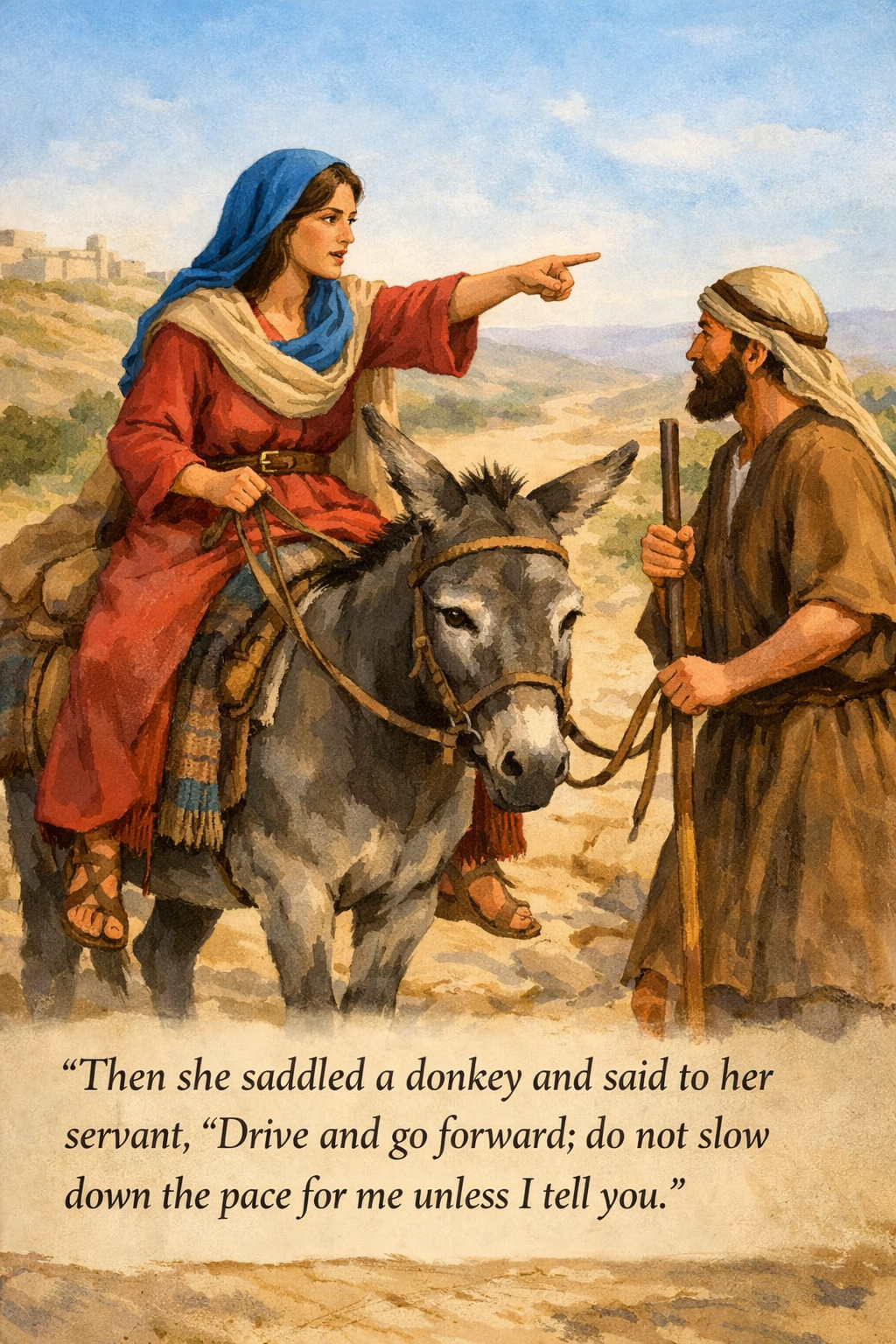
Let's Go, Let God
SHUNAMMITE SADDLED
AND SINGLE-MINDED
Then she saddled a donkey She saddles the donkey herself, wasting no time and delegating nothing unnecessarily. Faith moves decisively toward God’s help, the man of God.
and said to her servant “Drive and go forward - This underscores single-minded urgency. The verb conveys firm, continuous motion. There is no allowance for hesitation, discussion, or distraction. Her focus is fixed: reach the man of God as quickly as possible.
Do not slow down the pace for me unless I tell you - This reveals her remarkable self-discipline and resolve. Though she is a woman traveling a long distance, likely under emotional strain, she refuses comfort, delay, or pity. She governs her emotions so they do not govern her obedience.
TSK on a donkey: These animals were not anciently, as now, used only by the lower classes, but were in general use among the noble and chief personages of the East, and it was not unusual for even the husband to walk by the side of his wife while thus riding; the driver, as was the custom, following. The Shunammite, when she went to the prophet, did not desire so much attendance; but only requested her husband to send her an ass and its driver.
2 Kings 4:25 So she went and came to the man of God to Mount Carmel. When the man of God saw her at a distance, he said to Gehazi his servant, “Behold, there is the Shunammite.

Possible Route from Shunem to Mt Carmel Source: Martin Young
SHUNAMMITE ARRIVES
AT MT CARMEL
So she went and came to the man of God - ESV = "So she set out and came." The Septuagint says "she rode and came." Went and came describe her perseverance and follow-through. Despite distance (it is about 20 miles), fatigue, and grief, she completes the journey.
To Mount Carmel. Mt Carmel was closely associated with Elijah and the public vindication of the LORD over Baal (1 Kings 18). By going there, she seeks the man of God in a place marked by God’s proven power, reinforcing that her hope rests in the LORD, not in circumstance.
When the man of God saw her at a distance Elisha recognizes her at a distance. This shows familiarity and attentiveness, that she is not anonymous to him. As a shepherd-like figure, he is watching the horizon, ready to respond. The man of God is portrayed as one who is available and observant, not aloof. More importantly, it suggests God’s awareness precedes her words. Before she explains her need, she is already seen and identified. She is approaching rapidly and purposefully, not wandering casually. From afar, Elisha can already tell that this is not an ordinary visit. The distance emphasizes that her resolve is visible even before she arrives.
God sees His people and their needs even while they are still “far off”
before the crisis is spoken and before help is requested.
he said to Gehazi his servant, “Behold (hinneh) there is the Shunammite - Behold (hinneh - LOOK! SEE! PAY ATTENTION!) signals expectation that something significant is unfolding. The use of Behold (hinneh) implies unexpectedness and concern, because the Shunammite woman would not normally appear at Mount Carmel without reason. Her presence is out of pattern, and the word hinneh flags this as a situation requiring immediate response. Behold (hinneh) invites the reader to pause and watch what God is about to do. Many pivotal moments in Scripture are introduced with hinneh (e.g., Ge 22:7; Isa 7:14), marking divine action or revelation.
QUESTION - What is the significance of Mount Carmel in the Bible? GOTQUESTIONS.ORG
ANSWER - Rather than being a single mountain, Mount Carmel is actually a high, wooded mountain ridge. In the Bible, Mount Carmel is best known as the site of the prophet Elijah’s dramatic showdown with 850 pagan prophets.
Carmel means “vineyard,” “orchard,” or “garden” and reflects the fertile beauty of Mount Carmel’s picturesque slopes. The mountainous ridge starts on the Mediterranean coast in the northwest part of Israel at the south shore of the Bay of Acre. From there, the range runs southeast down to the plain of Dothan. Running along the northeast side of the ridge is the Valley of Jezreel. At its highest point, Mount Carmel reaches over 1,700 feet above sea level.
Most notably, Mount Carmel is the scene of a spectacular head-to-head confrontation between the false prophets of Baal and Asherah and the One True God of Israel. The episode takes place during one of Israel’s worst times of crisis under King Ahab. To please his wife, Jezebel, Ahab set up an altar to Baal at the top of Mount Carmel. Baal, the favorite deity of Jezebel, was reputed to be the god of rain and vegetation.
In 1 Kings 17:1–24, Elijah the Tishbite enters the story as an emissary of the Lord. The prophet confronts Ahab and predicts a drought in response to Ahab and Jezebel’s unholy devotion to Baal. When the end of the drought neared, to prove that the Lord God was the only true God, Elijah proposes a contest. All of Israel was summoned to Mount Carmel to witness the confrontation between Elijah and the false prophets of Baal and Asherah (1 Kings 18:19). The match would show whose god was able to send fire from heaven to consume their offerings. The prophets of Baal prayed all day and cut themselves violently to get Baal’s attention, but no one answered (verses 28–29).
By evening it was Elijah’s turn. He rebuilt the ruined altar of God that existed on Mount Carmel. He set the offering on top of the wood and then drenched the whole thing with water and prayed aloud: “LORD, the God of Abraham, Isaac and Israel, let it be known today that you are God in Israel and that I am your servant and have done all these things at your command. Answer me, LORD, answer me, so these people will know that you, LORD, are God, and that you are turning their hearts back again” (1 Kings 18:36–37). God answered with a spectacular display of fire from heaven, consuming the offering, licking up the sodden wood as well as every drop of water that had been poured over the altar. Even the rocks of the altar were consumed. The people fell on their faces, proclaiming, “The Lord, he is God; the Lord, he is God” (1 Kings 18:39). Elijah then ordered the people to execute the 850 false prophets according to the Mosaic Law (Deuteronomy 13).
It seems that the prophet Elisha later used Mount Carmel as a home base (2 Kings 4:25). From ancient times, Mount Carmel has been regarded as a holy place and a symbol of beauty and fertility. In the tribal divisions, Mount Carmel was part of the territory of (western) Manasseh. Like the region of upper Galilee, Mount Carmel received plentiful rainfall in biblical times, producing lush, beautiful forests and rich grasslands on the lower slopes suitable for grazing. Isaiah associates God’s glorious restoration of redeemed humanity with the “splendor of Carmel” (Isaiah 35:2). Solomon compares the head of his beloved with the beauty and nobility of Mount Carmel (Song of Solomon 7:5).
Related Resource:
C I Scofield - ELISHA AND THE SHUNAMITE (2 Kings 4:25–37)
I. The Analysis
1. The Faith of the Shunamite (verses 25, 26).—The woman’s answer, “It is well,” was a sublime instance of true faith. Her child lay dead, but she could still say, “It is well.”
2. The Sorrow Told Out (verses 27, 28).—Faith says, “It is well” in the very instant that faith grasps as it were the feet of God to tell Him all the sorrowful story.
3. The Fruitless Errand (verses 29–32).—See “The Heart of the Lesson.”
4. The Effective Service (verses 32–37).—See “The Heart of the Lesson.”
II. The Heart of the Lesson
The intensely vital character of true Christian service is the heart of things here. There is a vast deal of so-called Christian service which is naught but sending a servant with a dead stick. If there is a need somewhere we proceed to organize. A society is formed, or at least a committee. These require chairmen, secretaries, treasurers, and, above all, much, very much, talk. Then these chairmen, secretaries and treasurers are supposed to be in “Christian service,” and all the rest of us, who are not officers, but “belong,” are also supposed to be in “Christian service.” If it is a home affair the “service” consists in holding stated meetings of the society or committee, and in more or less zealous efforts to induce others to “join.” As some one has wittily said, “We have a lookout committee, but not a go-out committee.”
If it is a foreign affair we send some one, after a farewell meeting somewhat after the fashion of that which Elisha held for Gehazi. What a “charge” that was! “Gird up thy loins, and take thy staff in thine hand, and go thy way: if thou meet any man salute him not.” How impressive! The staff we send by our Gehazi has been fashioned and polished during three years in a theological seminary. Thank God many a Gehazi finds a better one, a living and life-giving staff in the Word of God—but we do not require him to have this staff, but only that.
And when, equipped well or ill, we once send Gehazi we practically wash our hands of him. A few pray for him, a few send him of their substance, but for the immense majority of us, he is a forgotten Gehazi. And all this, and more of like method and quality, we call Christian service. And Christian service it truly is for him who, in real devotedness to Christ, goes; and Christian service it truly is for those who, in ceaseless prayer, and in sacrificial gifts, are really, in the sent one stretching themselves upon the spiritually dead ones to whom he has gone—but for us! Alas, what mockery!
True service costs, and costs vitally—costs life itself. Not a dead staff but a living heart laid upon a dead heart—that counts, and that, be it repeated, costs.
When the woman in the Syrian street touched the swaying hem of Christ’s seamless robe as He walked, she was instantly healed. What else? The Lord of life stopped. “Who hath touched me? for I perceive that virtue is gone out of me.” The woman was healed, but it cost, cost vitality.
An American woman whose giving is the giving of a princess of the kingdom of God, said to me: “It is so easy just to sign checks if one happens to have money at the bank, but I don’t think that counts unless we find a way to give ourselves, too.”
And we must remember the terms of our commission, “Go ye.” Doubtless the Lord knew that the church would soon come to read that personal imperative, “Send Gehazi,” but nevertheless what He actually said was “Go ye.” One does not recall that he ever, when message bearing was in question, asked a disciple to ask another disciple to go.
All this does not mean that some measure of organization is not necessary to some spheres of Christian service. Good order and efficiency sometimes requires this; but it does mean that in so far as we are not ourselves losing our lives in this service that we may find them again, we are mere senders of Gehazi. For He who said of Himself, “except a corn of wheat fall into the ground and die it abideth alone but if it die it bringeth forth much fruit,” said in the next breath, “if any man will save his life he shall lose it, but if he lose his life for my sake and the Gospel’s he shall find it again.”
2 Kings 4:26 “Please run now to meet her and say to her, ‘Is it well with you? Is it well with your husband? Is it well with the child?’” And she answered, “It is well.”
- Please run now to meet her: Zec 2:4
- Is it well with you: Ge 29:6 37:14 1Sa 17:18 Mt 10:12,13 Ac 15:36
- It is well: 2Ki 4:23 Lev 10:3 1Sa 3:18 Job 1:21,22 Ps 39:9
A DEEP "WELL"
PASSAGE!
Please run now to meet her Elisha’s command to Gehazi to “run” shows immediate concern and pastoral urgency.
And say to her, ‘Is it well (shalom) with you? Is it well (shalom) with your husband? Is it well (shalom) with the child?’ Shalom speaks of wholeness, peace, and well-being. Elisha is asking whether things are intact at every level—personally, relationally, and spiritually.
And she answered, “It is well (shalom) “It is well” is the heart of the verse. This is not denial or deception; the reader knows the child has died. Rather, it is a confession of faith and restraint. She refuses to entrust her deepest grief to Gehazi, who represents secondary help. This time she determined to speak directly to Elisha and not through an intermediary (cf. 2Ki 4:13). She reserves the truth for the man of God himself, through whom God’s Word promising her a son had previously come.
James Smith - THE LITTLENESS OF GEHAZI. 2 Kings 4.
Gehazi never shines in the sacred narrative. He is an illustration of what a servant should not be. He fails at every step.
I. Lack of Sympathy (26). Why was she so curt with Gehazi. Was there an utter lack of sympathy? It is hard for selfish indifference to carry tender words without freezing them. A lesson for us servants of the Lord.
II. Lack of Imagination (27). He was a slave to the proprieties. Poor, weak, phlegmatic, unimaginative soul! "The Lord hath hid it from me." Elisha was usually in the Lord's secrets.
III. Lack of Faith (29 to 31). Why send Gehazi? To arrest corruption or to bring life again? The vanity of all outward ceremonial is here evidenced.
IV. Lack of Personal Touch (34 to 35). If we would be a blessing to others there must be close personal and sympathetic touch. This is symbolic of the closeness of approach to our nature, dead in sins, which the Lord of life makes in His Incarnation and continual drawing near to us. The day is coming in the Upper Chamber when parted ones shall meet.
C H Spurgeon - “ ‘Is your son all right?’ And she answered, ‘Everything’s all right.’ ”
Perhaps she answered this way because she had faith that soon her son would be restored. But I think rather it was because she was persuaded that whatever might have become of his spirit, he was safe in the keeping of God, happy beneath the shadow of his wings. Therefore, not fearing that he was lost, having no suspicion whatever that he was cast away from the place of bliss—for that suspicion would have prevented her giving such an answer—she said, “Yes, the child is dead, but everything’s all right.” Let every mother and father know assuredly that it is well with the child if God has taken him away from us in his infant days. We may never have heard his declaration of faith—he was not capable of such a thing. He was not baptized into the Lord Jesus Christ, not buried with him in baptism. He was not capable of giving that “pledge of a good conscience toward God” (1Pt 3:21). Nevertheless, we may rest assured on the basis of the goodness of God that it is well with the child, well in a higher and a better sense than it is well with us—well without limitation, well without exception, well infinitely, “well” eternally. Infants are not saved by their innocence. They enter heaven by the same way we do; they are received in the name of Christ. A child is saved because he is elect. In the compass of election in the Lamb’s book of life will be found written millions of souls who only appear on earth and then stretch their wings for heaven. They are saved, too, because they were redeemed by the precious blood of Jesus Christ, who shed his blood for all his people, bought them with the same price with which he redeemed their parents, and therefore are they saved because Christ was sponsor for them and suffered in their place. No doubt in some mysterious manner God’s Spirit regenerates the infant soul, and it enters into glory to be a partaker of the inheritance of the saints in light, just as John the Baptist was filled with the Holy Spirit from his mother’s womb, and the same occurred to Jeremiah.
Streams in the Desert - “Is it well with thy husband? Is it well with the child? And she answered, It is well.” (2 Kings 4:26.)
“Be strong, my soul?
Thy loved ones go
Within the veil. God’s thine, e’en so;
Be strong.
“Be strong, my soul!
Death looms in view.
Lo, here thy God! He’ll bear thee through;
Be strong.”
FOR sixty-two years and five months I had a beloved wife, and now, in my ninety-second year I am left alone. But I turn to the ever present Jesus, as I walk up and down in my room, and say, “Lord Jesus, I am alone, and yet not alone—Thou art with me, Thou art my Friend. Now, Lord, comfort me, strengthen me, give to Thy poor servant everything Thou seest he needs.” And we should not be satisfied till we are brought to this, that we know the Lord Jesus Christ experimentally, habitually to be our Friend: at all times, and under all circumstances, ready to prove Himself to be our Friend. —George Mueller.
Afflictions cannot injure when blended with submission.
Ice breaks many a branch, and so I see a great many persons bowed down and crushed by their afflictions. But now and then I meet one that sings in affliction, and then I thank God for my own sake as well as his. There is no such sweet singing as a song in the night. You recollect the story of the woman who, when her only child died, in rapture looking up, as with the face of an angel, said, “I give you joy, my darling.” That single sentence has gone with me years and years down through my life, quickening and comforting me. —Henry Ward Beecher.
“E’en for the dead I will not bind my soul to grief;
Death cannot long divide.
For is it not as though the rose that climbed my garden wall
Has blossomed on the other side?
Death doth hide,
But not divide;
Thou art but on Christ’s other side!
Thou art with Christ, and Christ with me;
In Christ united still are we.”
2 Kings 4:27 When she came to the man of God to the hill, she caught hold of his feet. And Gehazi came near to push her away; but the man of God said, “Let her alone, for her soul is troubled within her; and the LORD has hidden it from me and has not told me.”
- him by his feet, Mt 28:9 Lu 7:38
- And Gehazi came near to push her away: Mt 15:23 20:31 Mk 10:13 Joh 4:27 12:4-6
- Let her alone: Mk 14:6 Joh 12:7
- for her soul is troubled within her 1Sa 1:10 Job 10:1 Pr 14:10 18:14
- the LORD has hidden it from me 2Ki 6:12 Ge 18:17 2Sa 7:3 Am 3:7 Joh 15:15
FALLING DOWN
AT ELISHA'S FEET
When she came to the man of God to the hill, she caught hold of his feet - Although she had said she was "Well," she now takes a posture of desperation, humility, and urgent appeal. In the ancient world, grasping someone’s feet was an act of supplication, often associated with pleading for mercy or help. She is not being disrespectful; she is casting herself fully on God’s mercy, expressed through God’s servant. Words have failed her—her grief now speaks through action.
And Gehazi came near to push her away This action reflects Gehazi's misunderstanding and formality. As the attendant, he likely sees her behavior as improper or disruptive.
but the man of God said, “Let her alone, for her soul is troubled within her- Elisha reveals pastoral discernment and tenderness. Elisha recognizes deep inner anguish (literally, “her soul is bitter”). He does not rebuke, interrogate, or correct her posture. Instead, he protects her access, showing that true servants of God make room for honest pain.
and the LORD has hidden it from me and has not told me - Elisha’s admission is profoundly important theologically. It shows that prophets are dependent, not omniscient, God reveals what He chooses, when He chooses and even great men of God must walk by faith, not constant insight.
Warren Wiersbe - Gehazi's attitude toward the woman’s coming reveals a dark streak in his character that shows up even more in the next chapter (v. 27; see Matt. 15:23; 19:13- 15). Perhaps the woman and her servant intruded on their afternoon siesta. But Elisha discerned that something was wrong that the Lord hadn’t revealed to him. (Bible Exposition Commentary page 683)
2 Kings 4:28 Then she said, “Did I ask for a son from my lord? Did I not say, ‘Do not deceive me’?”
- Did I ask for a son: Ge 30:1
- Do not: 2Ki 4:16
HER HONEST GRIEF
BEFORE GOD'S MAN
Then she said, “Did I ask for a son from my lord? - Indeed she did not ask for a son. She reminds Elisha that she never sought this blessing; it was initiated by God’s word, not her desire.
Did I not say, ‘Do not deceive me’?” The phrase “do not deceive me” reaches back to Elisha’s original promise (2 Ki 4:16). She is not accusing him of lying; she is saying, “You warned me not to awaken hope falsely—and now that hope seems crushed.” Her grief flows from trust once extended and now seemingly broken.
James Rosscup "Prayer probably is the intent in 2Ki 4:28. What the woman says in her heartbreak voiced in questions is no doubt beginning to broach her longing for the main thing—that God will restore her son. She comes to Elisha, yet as in many passages where people come to a person close to God, the spirit is to reach via the person to the God who is able. (An Exposition on Prayer: Genesis to 2 Chronicles)
2 Kings 4:29 Then he said to Gehazi, “Gird up your loins and take my staff in your hand, and go your way; if you meet any man, do not salute him, and if anyone salutes you, do not answer him; and lay my staff on the lad’s face.”
- Gird up your loins: 2Ki 9:1 1Ki 18:46 Eph 6:14 1Pe 1:13
- take my staff : 2Ki 2:14 Ex 4:17
- salute him: Lu 10:4
- lay my staff: 2Ki 2:8,14 Ex 7:19,20 14:16 Jos 6:4,5 Ac 3:16 19:12

GEHAZI SENT ON
A "MARATHON"
Then he said to Gehazi, “Gird up your loins - Gird your loins is an idiom meaning prepare for swift, strenuous action. Long robes were tucked in to allow running. Elisha is calling for immediate, unhindered obedience—this is no time for delay or deliberation.
And take my staff in your hand, and go your way if you meet any man, do not salute him, and if anyone salutes you, do not answer him - Elisha's instruction underscores single-minded urgency, not rudeness. In the ancient world, greetings were lengthy social rituals. Elisha’s point is: do not let even good customs slow the mission. When life is at stake, obedience must be focused and prompt.
And lay my staff on the lad’s face - By sending his staff with Gehazi, Elisha is testing whether representative action—authority exercised at a distance—will suffice. The command reflects a legitimate expectation that God can work through means, as Luke described in Acts 19:12 where "handkerchiefs or aprons (related to the extraordinary miracles by the hands of Paul - Acts 19:11) were even carried from his body to the sick, and the diseases left them and the evil spirits went out."
John Walton - laying staff on boy’s face. There is no other reference to a prophet being equipped with a staff (the rod of Moses is a different Hebrew word), and the other passages where this word is used speak only of a nondescript stick used for support—often a crutch or cane. From verse 31 it would appear that Elisha and Gehazi considered it possible that the staff would revive the boy. In Akkadian incantation texts a staff is sometimes the instrument by which exorcisms against the asakku demons (bringing disease and fever) are effected. (Page 390 IVP Background Commentary OT)
2 Kings 4:30 The mother of the lad said, “As the LORD lives and as you yourself live, I will not leave you.” And he arose and followed her.
- As the Lord: 2Ki 2:2,4
- I will not: Ex 33:12-16 Ru 1:16-18
Related Passages:
2 Kings 2:2; 4; 6 Elijah said to Elisha, “Stay here please, for the LORD has sent me as far as Bethel.” But Elisha said, “As the LORD lives and as you yourself live, I will not leave you.” So they went down to Bethel. (2:4) Elijah said to him, “Elisha, please stay here, for the LORD has sent me to Jericho.” But he said, “As the LORD lives, and as you yourself live, I will not leave you.” So they came to Jericho. (2:6) Then Elijah said to him, “Please stay here, for the LORD has sent me to the Jordan.” And he said, “As the LORD lives, and as you yourself live, I will not leave you.” So the two of them went on.
SHUNAMMITE STICKS
TO ELISHA
The mother of the lad said, “As the LORD lives - This is a formal oath formula in the Old Testament (cf. 1 Sam 1:26; 17:55). By invoking the living God, the woman anchors her resolve. It is interesting to note that without knowing it, the Shunammite woman had repeated the very oath Elisha had sworn to Elijah when the latter asked him to leave (2Ki 2:2, 4, 6 = "As the LORD lives and as you yourself live, I will not leave you.”). The woman’s determination and the sound of his own words to Elijah surely helped persuade Elisha to follow her back to Shunem.
and as you yourself live, I will not leave you.” - As you yourself live binds Elisha personally to the vow. She is saying, “As surely as God is alive and you stand before me as His servant, I will not let you go.” She believes that God’s help will come through God’s presence, not at a distance. She presses for the man of God himself, believing that the God who gave life through Elisha’s word must now act personally to restore it.
James Rosscup suggests that "Verse 30, as well, is prayer in the form of an oath. The woman makes a pledge, a strong one, appealing to the reality of God’s life and Elisha’s life. She intends with determination to stay right with this prophet as he goes to help her son. (An Exposition on Prayer: Genesis to 2 Chronicles)
And he arose and followed her. - This signals Elisha’s recognition of the situation’s gravity. He does not argue or delay. The prophet rises—language often associated with decisive obedience—and goes with her. Faith’s insistence is met by compassionate action.
As the LORD lives - 35x/35v - Jdg. 8:19; Ruth 3:13; 1 Sam. 14:39; 1 Sam. 14:45; 1 Sam. 19:6; 1 Sam. 20:3; 1 Sam. 20:21; 1 Sam. 25:26; 1 Sam. 26:10; 1 Sam. 26:16; 1 Sam. 28:10; 1 Sam. 29:6; 2 Sam. 4:9; 2 Sam. 12:5; 2 Sam. 14:11; 2 Sam. 15:21; 1 Ki. 1:29; 1 Ki. 2:24; 1 Ki. 22:14; 2 Ki. 2:2; 2 Ki. 2:4; 2 Ki. 2:6; 2 Ki. 4:30; 2 Ki. 5:16; 2 Ki. 5:20; 2 Chr. 18:13; Jer. 4:2; Jer. 5:2; Jer. 12:16; Jer. 16:14; Jer. 16:15; Jer. 23:7; Jer. 23:8; Jer. 38:16; Hos. 4:15
2 Kings 4:31 Then Gehazi passed on before them and laid the staff on the lad’s face, but there was no sound or response. So he returned to meet him and told him, “The lad has not awakened.”
- no sound: 1Sa 14:37 28:6 Eze 14:3 Mt 17:16-21 Mk 9:19-29 Ac 19:13-17
- response, 1Ki 18:26,29
- not awakened: Job 14:12 Da 12:2 Mk 5:39 Joh 11:11,43,44 Eph 5:14
ELISHA'S STAFF FAILS
TO RESTORE LIFE
Then Gehazi passed on before them and laid the staff on the lad’s face - NET = "Now Gehazi went on ahead of them." Gehazi does precisely what Elisha commanded—he goes ahead, lays the staff on the boy’s face—yet nothing happens.
When the prophet himself reached the house, he entered, shut the door (cf. 2Ki 4:4, 5), and prayed to Yahweh (v. 33). For the first time in chapter four, Elisha directly petitions Yahweh to intervene. Then Elisha lay down on top of the boy’s body, his mouth, eyes, and hands exactly opposite those of the boy. When Elisha had done this twice (vv. 34–35), the boy sneezed seven times and opened his eyes (v. 35). The seven sneezes were not dying gasps for air; they showed that the lad had completely revived. Elisha had Gehazi summon the Shunammite to his upper room (v. 36). The woman entered, fell at Elisha’s feet, and bowed prostrate, an ancient gesture showing him the highest respect. Like Elijah, Elisha had demonstrated Yahweh’s power over life and death (cf. 1 Kings 17:17–24).
But there was no sound or response - The repeated phrase “no sound or response” emphasizes complete lifelessness. This confirms beyond doubt that the child is truly dead and that the situation remains humanly impossible. And keep in mind this is at least 48 hours after the son had died. The failure of Elisha's exposes the limits of symbolic or delegated power. The staff represented prophetic authority, but authority symbols are not magical. God’s power is not automatic, mechanical, or transferable by objects alone. The miracle will not come through a method, a tool, or a proxy.
So he returned to meet him Presumably Elisha and the Shunammite are on the road back home and not far from Shunem and as Gehazi retraced his steps he meets them.
And told him, “The lad has not awakened (qits; Lxx = egeiro).” - "The child did not wake up." (2Ki 4:31NET) My paraphrase (as explained below) would be something like "The child was not resurrected (revived) by your staff." The NLT is not an accurate paraphrase = "The child is still dead," because the verb awakened (qits; Lxx = egeiro) means to wake up or be aroused. It is notable that this verb is used in Isa 26:19 and Da 12:2 to depict resurrection, these verses being some of the key OT passages of this reality. The Septuagint translates awakened (qits) with the Greek verb egeiro used to refer to resurrection of Christ in 1Co 6:14 "Now God has not only raised (egeiro) the Lord, but will also raise us up through His power."
Gehazi tells Elisha his staff did not produce a "resurrection." Gehazi's use of this gentle term awakened (qits) rather than "he's still dead," (like the NLT misreads it) underscores the fact that life has not yet returned but prepares the reader for a greater work still to come. It heightens expectation for if the lesser means failed, only direct divine intervention remains.
God sometimes allows well-intended efforts to fail in order to clarify where true power lies. The delay is purposeful. It strips away confidence in technique and forces complete reliance on God acting personally through His chosen servant.
Awakened (07019) qits means to wake, to wake up, to arouse. With the exception of Isa. 18:6, which may reflect a homonymous root, qîts is always found in the Hiphil (causative) stem. Qîts is a by-form of yāqats, "to awaken," and is identified with the Arabic cognate yagiza. One Ugaritic tablet tells of El inviting the gods to a banquet, attempting "to awaken" them.
QITS - 19V - awake(13), awakened(2), awakens(2), awakes(1), awoke(2). 1 Sam. 26:12; 2 Ki. 4:31; Job 14:12; Ps. 3:5; Ps. 17:15; Ps. 35:23; Ps. 44:23; Ps. 59:5; Ps. 73:20; Ps. 139:18; Prov. 6:22; Prov. 23:35; Isa. 26:19; Isa. 29:8; Jer. 31:26; Ezek. 7:6; Dan. 12:2; Joel 1:5; Hab. 2:19
Gilbrant - Most frequently, qîts is used to indicate arousal from sleep, either self-initiated or caused by an outside agent. Ordinarily, the reference is to awakening naturally. The psalmist lay down to sleep confident that he would awaken safely in the morning, "for the Lord sustained me" (Ps. 3:5). When he awakened, the expectation was that God would be present with him (Ps. 139:18). If wisdom is heeded, it will give direction for the day: "When you awake, it shall talk with you" (Prov. 6:22).
In some cases, the context is that of a dream. The wicked fade as does a dream when a person awakens (Ps. 73:20). A hungry man dreams of food and water only to awaken hungry and thirsty (Isa. 29:8). Jeremiah's particular divine revelation occurred in the form of a dream, and he awoke refreshed (Jer. 31:26).
At times, the individual or agent asks why God is not responding to his need and prayer. Expressing urgency, the Hiphil imperative is employed in these situations, "to stir or awaken." Elsewhere, with regard to Israel's sad plight, the psalmist cries, "O Lord? arise, cast us not off for ever" (Ps. 44:23). An appeal is made to God to deal with the heathen (Ps. 59:5).
The one occurrence in the Qal stem (Isa. 18:6) is in an oracle against Cush (during Isaiah's day a Cushite established Egypt's Twenty-Fifth Dynasty). Representative of nations opposed to God's people, its judgment is portrayed in vivid imagery—birds feasting upon the leftover stalks of the cut fruit.
Qîts is employed with sarcasm one other time in a condemnation of idolatry, "Woe unto him who says to the wood, Awake" (Hab. 2:19). Four times this verb refers to the stupor or sleep of drunkenness (Prov. 23:35; Jer. 51:39, 57; Joel 1:5). Those in such a condition are admonished to change, prodded cynically in Prov. 23:35, "When will I wake up so I can find another drink?" (NIV).
Several occurrences of qîts address death and resurrection (2Ki 4:31; Job 14:12; Isa. 26:19; Jer. 51:39, 57; Da. 12:2). In Jeremiah, God himself, the Commander of an army, will inflict a drunkenness ("a perpetual sleep," Jer. 51:39, 57) upon Babylon's forces and its captains. Elisha's servant, Gehazi, reported the death of the Shunammite's son with the words, "The child is not awaked" (2 Ki. 4:31). Unrighteousness or darkness will be swept away when the psalmist meets the Lord while in prayer. Hinted at is the thought that God will be met, not only in an earthly temple, but ultimately in its heavenly counterpart (Ps. 17:15).
While the doctrine of an afterlife was not fully understood in OT times, a belief in a kind of shadowy existence after death was held even by Israel's pagan neighbors. Job asked whether a man at life's end, after lying down, would again "awake" (Job 14:12) and "live again" (v. 14). Daniel 12:2 speaks more clearly of a future resurrection, "And many of them that sleep in the dust of the earth shall awake." (Complete Biblical Library)
2 Kings 4:32 When Elisha came into the house, behold the lad was dead and laid on his bed.
- the lad: 1Ki 17:17 Lu 8:52,53 Joh 11:17
A SOBERING
CONFIRMATION
When Elisha came into the house, behold (hinneh) the lad was dead - Behold grabs the reader's full attention and confirms the boy’s death beyond doubt. He was not merely sick or unconscious but he had died, emphasizing the hopelessness of the situation from a human point of view. This is a sobering confirmation and a deliberate narrative pause that prepares the reader for what God alone must do next.
And laid on his bed - The fact that the boy is laid on Elisha’s bed, not buried (as one would expect in a hot climate with no embalmers and no morgue coolers), shows the mother believes that God could still act through His prophet. She had not prepared him for burial but placed him in the prophet’s room, symbolizing her hope in divine intervention. The child who was given by God’s promise through Elisha has been returned to the place associated with God’s word and God’s servant. This picture visually declares that this life began by God’s word and must now be restored by God’s power. God often waits until impossibility is undeniable before acting. Human help has failed, symbols have failed, and only the living God can act. The child lies where God’s promise was first spoken, silently declaring that the God who gives life must now give it again.
2 Kings 4:33 So he entered and shut the door behind them both and prayed to the LORD.
- shut the door: 2Ki 4:4 Mt 6:6
- prayed: 2Ki 5:11 6:17,18,20 1Ki 17:20,21 18:26,27 Joh 11:41,42 Ac 9:40 Jas 5:13-18
Related Passages:
2 Kings 4:4-5 “And you shall go in and shut the door behind you and your sons, and pour out into all these vessels, and you shall set aside what is full.” 5 So she went from him and shut the door behind her and her sons; they were bringing the vessels to her and she poured.
Matthew 6:6 (THIS IS EXACTLY WHAT ELISHA DID!) “But you, when you pray, go into your inner room, close your door and pray to your Father who is in secret, and your Father who sees what is done in secret will reward you.
James 5:13-18 Is anyone among you suffering? Then he must pray. Is anyone cheerful? He is to sing praises. 14 Is anyone among you sick? Then he must call for the elders of the church and they are to pray over him, anointing him with oil in the name of the Lord; 15and the prayer offered in faith will restore the one who is sick, and the Lord will raise him up, and if he has committed sins, they will be forgiven him. 16 Therefore, confess your sins to one another, and pray for one another so that you may be healed. The effective prayer of a righteous man can accomplish much. 17 Elijah was a man with a nature like ours, and he prayed earnestly that it would not rain, and it did not rain on the earth for three years and six months. 18 Then he prayed again, and the sky poured rain and the earth produced its fruit.
ELISHA SHUTS DOOR
AND GOES TO GOD'S THRONE
So he entered and shut the door (cf. 2Ki 4:4, 5) behind them both - Elisha deliberately excludes distractions, spectators, and even the grieving mother. Behind them both highlights the starkness of the scene—a living prophet alone with a dead child. Humanly speaking, nothing more can be done.
And prayed to the LORD - This is crucial. Elisha does not presume power, recite formulas, or rely on past successes. He appeals directly to God, acknowledging that life belongs to the LORD alone. The miracle that follows will be the answer to prayer, not the result of technique.
James Rosscup "Shutting himself in with the boy upstairs, Elisha prayed. His supplication to God. Only three were inside the closed door. The son lay on the prophet’s guest bed, cold and lifeless. Elisha exercised himself in an agony of prayer. And the hearing God was present. Much was at stake. The woman’s greatness in the many ways might have pushed at Elisha’s thoughts, may have been a part of the prayer. “Lord, you know how she …” could well have been an affirmation as he cried out. It is so human, so natural, so frequent in Scripture. Also tugging at his heart could be the thought that it was his promise from God that gave her this boy; and the mother honored him as a “man of God.” When she had reached him with her heartbreak to summon him here now, she had reminded him. Hope for a son was his initiative; she had urged that he not build up her hopes to let her down (28). He had not; God had not. Now the room was filled with the soft—or loudly passionate?—pleading of a man who knew what it was to call on the God of the impossible. Elisha had asked for judgment on trouble-makers defying God, and God had brought it. He had asked for water where there was no water, and streams had flowed. He had asked for a son when the woman’s husband was old and could give no son, and God had given a son against the odds. Now Elisha interceded for the impossible again—life from the dead. (An Exposition on Prayer: Genesis to 2 Chronicles)
2 Kings 4:34 And he went up and lay on the child, and put his mouth on his mouth and his eyes on his eyes and his hands on his hands, and he stretched himself on him; and the flesh of the child became warm.
- 1Ki 17:21 Ac 20:10
Related Passages:
1 Kings 17:21 (ELIJAH AT ZAREPHATH) Then he stretched himself upon the child three times, and called to the LORD and said, “O LORD my God, I pray You, let this child’s life return to him.”
Acts 20:10 But Paul went down and fell upon him (EUTYCHUS MEANS "FORTUNATE"!), and after embracing him, he said, “Do not be troubled, for his life is in him.”

Elisa Preparing to Restore Life
DIVINE MOUTH TO
MOUTH RESUSCITATION
And he went up and lay on the child, and put his mouth on his mouth and his eyes on his eyes and his hands on his hands, and he stretched himself on him - Elisha’s physical posture—mouth to mouth, eyes to eyes, hands to hands—signifies identification and intercession, not ritual power. He places himself fully over the child, as if standing in the gap between death and life. This mirrors Elijah’s earlier action (1 Kings 17:21), intentionally linking Elisha to his prophetic predecessor and showing continuity in God’s work. Elisha's action communicates his total personal involvement. Elisha does not keep distance or rely on symbols. He gives himself wholly to the task, demonstrating that God’s servant must sometimes enter fully into another’s suffering. It is a picture of compassionate engagement, not detached spirituality.
And he stretched himself on him - This action emphasizes persistence and earnest prayer, not a momentary gesture. The Hebrew suggests sustained effort. This was not instantaneous; Elisha remained in this posture until God acted. Scripture shows that some answers to prayer require perseverance (cf. Luke 18:1).
And the flesh of the child became warm - The boy's body heat was the first sign of returning life, but this was not yet full restoration as shown by the context. Warmth indicated that God had begun the work (as a doctor this suggests blood was beginning to flow into the extremities), even though the miracle is not complete. This miracle shows that God's deliverance came in stages
James Rosscup - As Elijah had done, Elisha presses his warm body to the cold, pallid body. God can even use means when He chooses—He can work without means or in cooperation with them—and the prophet now did all he could to participate with the Lord. The boy’s body grew warm. (An Exposition on Prayer: Genesis to 2 Chronicles)
This verse makes clear that the power is God’s alone. Elisha’s actions and his body heat did not cause life but accompany prayerful dependence on the LORD (2Ki 4:33). God alone reverses death. In short, God Alone was restoring life through humble, persevering prayer and personal involvement, and this true "resurrection power" flows solely from the Throne of Grace, not from methods, manipulation, objects or human effort.
See discussion of "divine mouth to mouth resuscitation" the secret of revival!
John Walton - Here is an example of a ridiculous comment which is thoroughly unbiblical - In Mesopotamian incantation literature the touching of part to part is a means by which demons exercise power over their intended victims—it is the idiom of possession. In this belief, vitality or life force can be transferred from one body to the other by contact of each part. By imitating the procedure believed to be used by demons (ED: IMO THIS IS ABSURD! IF ANYTHING ELISHA WAS MIMICKING ELIJAH 1Ki 17:21!), the prophet is able, through the power of Yahweh (notice the prayer), to drive the demons out and restore the boy’s life. This is often considered to be one of the clearest cases of sympathetic magic in the Bible. (Page 390 IVP Background Commentary OT)
2 Kings 4:35 Then he returned and walked in the house once back and forth, and went up and stretched himself on him; and the lad sneezed seven times and the lad opened his eyes.
- the lad opened his eyes 2Ki 8:1,5 13:21 1Ki 17:22 Lu 7:14,15 8:55 Joh 11:43,44 Ac 9:40
ELISHA'S PAUSE
THAT REFRESHES
This scene in 2 Kings 4:35 describes the completion of God’s life-giving work and teaches key lessons about persevering prayer, God’s timing, and unmistakable restoration.
Then he returned and walked in the house once back and forth - Elisha's actions show pause, persistence, and continued dependence on God. Elisha does not assume the work is finished when the child’s flesh becomes warm (2Ki 4:34). He steps away, likely praying, waiting, and listening, modeling that God’s servants must sometimes pause between petitions and continue seeking the LORD until His purpose is complete.
And went up and stretched himself on him - Elisha's action indicates renewed intercession. Elisha repeats the act of stretching out on the child, showing that faith persists when the answer is partial. This reflects a biblical pattern. God sometimes brings deliverance progressively, drawing His servants into sustained prayer rather than instant resolution.
And the lad sneezed seven times - Sneezing is a clear, physical sign of returning life and breath. The number seven, often associated with completeness in Scripture, signals that the restoration is full and God-ordained, not accidental or partial. One wonders if Elisha counted the number of sneezes?!
And the lad opened his eyes - The opened eyes confirmed complete revival and conscious life. This is not mere "mouth to mouth" resuscitation. The child is fully restored. Eyes opening in Scripture often symbolize return to life, awareness, and restored relationship.
In Elisha's actions we see that God’s power works in His time, not ours. Partial answers call for continued prayer, not retreat. True life comes unmistakably from the LORD. God completed His life-giving work through persistent prayer, transforming initial signs of warmth into full restoration, so that there could be no doubt: the LORD alone had awakened the dead.
James Rosscup - His success in restoring the life. Elisha went downstairs, walked in the house a single time, pacing back and forth, possibly praying even in this. He kept at his vigil. Again he climbed to the boy and stretched his body upon him to bring warmth. A sneeze … ahhh, praise the Lord! Another sneeze … a third … seven of them! Elisha bent over the boy, his heart pounding, his eyes moist, his mind racing with gratitude. The boy’s eyelids flickered, he opened his eyes, alive from the dead, and stared up at the man of God. Praise God! Elisha felt like leaping for joy. He may have. Spinning, he reached the stairs, shouted down to Gehazi. “Call this Shunammite.” The woman seemed catapulted up to her son. Something wonderful had happened, it must be. She burst into the room, and her eyes fell on her beloved. Elisha, eyes still glistening, spoke in quiet but confident invitation. “Take up your son.”
She gasped, felt the rush of emotion, and was filled with gratitude. She fell at the feet of God’s man, man of prayer, and bent to the floor in worship of the Lord. Her heart was lost in wonderment at God and respect for such a man as this.
Principles of prayer are evident. One is to pray believing God, as Elisha surely did for the son to be born. As a prophet he was even a special instrument to receive God’s word. Today, the one who would pray in step with God needs to fill the life with proper meditations on His word. God wants the prayer warrior to believe that nothing is too hard for Him, but He works according to His will. He aims for the asking to be in submission to the plan He desires. Second, be flexible since not every situation is the same. In some cases God has brought the dead back to life. In many, He does not. Third, realize that a time out can be all right, and then a new surge in prayer as when Elisha left the boy and soon came back to pray again.
(An Exposition on Prayer: Genesis to 2 Chronicles)
QUESTION - How many people were raised from the dead in the Bible? GOTQUESTIONS.ORG
ANSWER - The Bible records several accounts of people being raised from the dead. Every time a person is raised from the dead, it is a stupendous miracle, showing that the God who is Himself the Source of Life has the ability to give life to whom He will—even after death. The following people were raised from the dead in the Bible:
The widow of Zarephath’s son (1 Kings 17:17–24). Elijah the prophet raised the widow of Zarephath’s son from the dead. Elijah was staying in an upper room of the widow’s house during a severe drought in the land. While he was there, the widow’s son became ill and died. In her grief, the woman brought the body of her son to Elijah with the assumption that his presence in her household had brought about the death of her boy as a judgment on her past sin. Elijah took the dead boy from her arms, went to the upper room, and prayed, “Lord my God, let this boy’s life return to him!” (verse 21). Elijah stretched himself out on the boy three times as he prayed, and “the Lord heard Elijah’s cry, and the boy’s life returned to him, and he lived” (verse 22). The prophet brought the boy to his mother, who was filled with faith in the power of God through Elijah: “Now I know that you are a man of God and that the word of the Lord from your mouth is the truth” (verse 24).
The Shunammite woman’s son (2 Kings 4:18–37). The prophet Elisha raised the Shunammite woman’s son from the dead. Elisha regularly stayed in Shunem in an upper room prepared for him by this woman and her husband. One day, while Elisha was at Mount Carmel, the couple’s young son died. The woman carried the body of her son to Elisha’s room and laid it on the bed (verse 21). Then, without even telling her husband the news, she departed for Carmel to find Elisha (verses 22–25). When she found Elisha, she pleaded with him to come to Shunem. Elisha sent his servant, Gehazi, ahead of them with instructions to lay Elisha’s staff on the boy’s face (verse 31). As soon as Elisha and the Shunammite woman arrived back home, Elisha went to the upper room, shut the door, and prayed. Then he stretched out on top of the boy’s body, and the body began to warm (verse 34). Elisha arose, walked about the room, and stretched himself out on the body again. The boy then sneezed seven times and awoke from death (verse 35). Elisha then delivered the boy, alive again, to his grateful mother (verses 36–37).
The man raised out of Elisha’s grave (2 Kings 13:20–21). Elisha is connected with another miracle that occurred after his death. Sometime after Elisha had died and was buried, some men were burying another body in the same area. The grave diggers saw a band of Moabite raiders approaching, and, rather than risk an encounter with the Moabites, they threw the man’s body into Elisha’s grave. Scripture records that, “when the body touched Elisha’s bones, the man came to life and stood up on his feet” (verse 21).
The widow of Nain’s son (Luke 7:11–17). This is the first person Jesus raised from the dead. As the Lord approached the town of Nain, He met a funeral procession leaving the city. In the coffin was a young man, the only son of a widow. When Jesus saw the procession, “his heart went out to [the woman] and he said, ‘Don’t cry’” (verse 13). Jesus came close and touched the coffin and spoke to the dead man: “Young man, I say to you, get up!” (verse 14). Obeying the divine order, “the dead man sat up and began to talk” (verse 15). The mourning was turned to awe and praise: “God has come to help his people,” the people said (verse 16).
Jairus’ daughter (Luke 8:40–56). Jesus also showed His power over death by raising the young daughter of Jairus, a synagogue leader. The Lord was surrounded by crowds when Jairus came to Him, begging Him to visit his house and heal his dying twelve-year-old daughter (verses 41–42). Jesus began to follow Jarius home, but on the way a member of Jarius’ household approached them with the sad news that Jairus’ daughter had died. Jesus turned to Jarius with words of hope: “Don’t be afraid; just believe, and she will be healed” (verse 50). Upon arriving at Jarius’ house, Jesus took the girl’s parents, Peter, James, and John and entered the room where the body lay. There, “he took her by the hand and said, ‘My child, get up!’ Her spirit returned, and at once she stood up” (verses 54–55). Jesus and His disciples then left the girl, alive and well, with her astonished parents.
Lazarus of Bethany (John 11). The third person that Jesus raised from the dead was His friend Lazarus. Word had come to Jesus that Lazarus was ill, but Jesus did not go to Bethany to heal him. Instead, He told His disciples, “This sickness will not end in death. No, it is for God’s glory so that God’s Son may be glorified through it” (verse 4). A couple days later, Jesus told His disciples that Lazarus had died, but He promised a miracle: “I am going there to wake him up” (verse 11). When Jesus reached Bethany, four days after Lazarus’ death, Lazarus’ grieving sisters both greeted Jesus with the same words: “Lord, if you had been here, my brother would not have died” (verses 21 and 32). Jesus, speaking to Martha, promised to raise Lazarus from the dead (verse 23) and proclaimed Himself to be “the resurrection and the life” (verse 25). Jesus asked to see the grave. When He got to the place, He commanded the stone to be rolled away from the tomb (verse 39), and He prayed (verses 41–42) and “called in a loud voice, ‘Lazarus, come out!’” (verse 43). Just as Jesus had promised, “the dead man came out” (verse 44). The result of this miracle was that God was glorified and “many of the Jews who had come to visit Mary, and had seen what Jesus did, believed in him” (verse 45). Others, however, refused to believe in Jesus and plotted to destroy both Jesus and Lazarus (John 11:53; 12:10).
Various saints in Jerusalem (Matthew 27:50–53). The Bible mentions some people who were raised from the dead en masse at the time of the death of Christ. When Jesus died, “the earth shook, the rocks split and the tombs broke open” (verses 51–52). Those open tombs remained open until the third day. At that time, “the bodies of many holy people . . . were raised to life. They came out of the tombs after Jesus’ resurrection and went into the holy city and appeared to many people” (verses 52–53). On the day that Jesus was raised to life, these saints were also raised and became witnesses in Jerusalem of the life that only Jesus can give.
Tabitha (Acts 9:36–43). Tabitha, whose Greek name was Dorcas, was a believer who lived in the coastal city of Joppa. Her return to life was performed by the apostle Peter. Dorcas was known for “always doing good and helping the poor” (verse 36). When she died, the believers in Joppa were filled with sadness. They laid the body in an upper room and sent for Peter, who was in the nearby town of Lydda (verses 37–38). Peter came at once and met with the disciples in Joppa, who showed him the clothing that Dorcas had made for the widows there (verse 39). Peter sent them all out of the room and prayed. Then “turning toward the dead woman, he said, ‘Tabitha, get up.’ She opened her eyes, and seeing Peter she sat up. He took her by the hand and helped her to her feet” (verses 40–41). The overjoyed believers received their friend, and the news spread quickly throughout the city. “Many people believed in the Lord” as a result (verse 42).
Eutychus (Acts 20:7–12). Eutychus was a young man who lived (and died and lived again) in Troas. He was raised from the dead by the apostle Paul. The believers in Troas were gathered in an upper room to hear the apostle speak. Since Paul was leaving town the next day, he spoke late into the night. One of his audience members was Eutychus, who sat in a window and, unfortunately, fell asleep. Eutychus slipped out of the window and fell three stories to his death (Acts 20:9). Paul went down and “threw himself on the young man and put his arms around him” (verse 10). Eutychus came back to life, went upstairs, and ate a meal with the others. When the meeting finally broke up at daylight, “the people took the young man home alive and were greatly comforted” (Acts 20:12).
Jesus’ resurrection is the first permanent return to life;
everyone else who had been raised to life died again
Jesus (Mark 16:1–8). Of course, any list of people raised from the dead must include Jesus Christ. His death and resurrection are the focal point of Scripture and the most important events in the history of the world. The resurrection of Jesus is notably different from other events in which people rose from the dead: Jesus’ resurrection is the first permanent return to life; everyone else who had been raised to life died again. Lazarus died twice; Jesus rose, nevermore to die. In this way, Jesus is “the firstfruits of those who have fallen asleep” (1 Corinthians 15:20). Jesus’ resurrection justifies us (Romans 4:25) and ensures our eternal life: “Because I live, you also will live” (John 14:19).
QUESTION: Is raising the dead still possible today? GOTQUESTIONS.ORG
ANSWER: The Bible records multiple occasions of people being literally raised from the dead. In the Old Testament, the prophet Elijah cried out to God and saw the widow’s son restored to life (1 Kings 17:22). Elisha also raised the Shunammite’s son (2 Kings 4:33–36) and, astonishingly, a dead man was revived when his body came into contact with Elisha’s bones (2 Kings 13:21). In the New Testament, Jesus raised Jairus’ daughter (Luke 8:40–56), the widow’s son at Nain (Luke 7:11–17), and Lazarus from the tomb after four days (John 11:43–44). After Jesus’ crucifixion, even more remarkable events occurred: “The tombs also were opened. And many bodies of the saints who had fallen asleep were raised” (Matthew 27:52, ESV). The apostles were also given power over death: Peter raised Tabitha (Acts 9:40–41), and Paul raised Eutychus (Acts 20:9–12).
These accounts demonstrate beyond doubt that bringing the dead to life is not beyond God’s power. Scripture affirms, “Jesus Christ is the same yesterday and today and forever” (Hebrews 13:8). Since the character and power of God do not change, it follows that raising the dead remains possible today if God so chooses. There is no indication in Scripture that He has permanently withdrawn this ability from His sovereign purposes. Instead, we are told that “with God all things are possible” (Matthew 19:26).
The question, then, is not can God raise the dead—He certainly can—but does He still raise the dead today? Some believers in different parts of the world share testimonies of apparent resurrections in answer to fervent prayer. While such accounts are difficult to verify, the biblical principle remains true: “The prayer of a righteous person is powerful and effective” (James 5:16). The same God who raised Jesus from the dead is alive and working in the world today. According to Ephesians 1:19–20, the resurrection power that raised Christ “is for us who believe.”
It is important to remember, however, that God’s miracles are always accomplished according to His will, not our demands. In John 11, Jesus permitted Lazarus to die so that a greater glory could be displayed through his resurrection. Likewise, in some cases today, God may glorify Himself by granting miraculous intervention. At other times, He may choose to display His glory in providing comfort, sustaining grace, or pointing us to the ultimate hope of the final resurrection. As Paul testifies, “We despaired of life itself. . . . But this happened that we might not rely on ourselves but on God, who raises the dead” (2 Corinthians 1:8–9).
For Christians, the ultimate assurance is not whether temporary earthly resurrections occur, but in the guaranteed, final resurrection when Christ returns. Jesus promised, “I am the resurrection and the life. The one who believes in me will live, even though they die” (John 11:25). The resurrection of Jesus Christ is the greatest demonstration that death has already been defeated and that all who belong to Him will one day be raised to eternal life.
Therefore, while not common and always subject to God’s sovereign will, raising the dead is still within the realm of God’s power today. When He chooses to act in such ways, these miracles point to His authority over life and death and serve as a foretaste of the glorious day when “‘He will wipe every tear from their eyes. There will be no more death’ or mourning or crying or pain, for the old order of things has passed away” (Revelation 21:4). Until that day, believers should continue to pray boldly, trust humbly, and place their confidence in the One who raised Christ from the dead and will raise us also with Him (2 Corinthians 4:14).
2 Kings 4:36 He called Gehazi and said, “Call this Shunammite.” So he called her. And when she came in to him, he said, “Take up your son.”
- Call this Shunammite: 2Ki 4:12
- Take up: 1Ki 17:23 Lu 7:15 Heb 11:35
Related Passages:
1 Kings 17:23 Elijah took the child and brought him down from the upper room into the house and gave him to his mother; and Elijah said, “See, your son is alive.”
Luke 7:15 (WIDOW OF NAIN'S SON) The dead man sat up and began to speak. And Jesus gave him back to his mother.
MOTHER AND SON
REUNITED IN LIFE
He called Gehazi and said, “Call this Shunammite.” So he called her. Elisha again uses Gehazi to call the Shunammite, maintaining the same orderly, respectful mediation seen earlier (2Ki 4:15). There is no dramatic announcement or public display. God’s greatest works here are marked by calm authority, not spectacle.
James Rosscup - The boy’s eyelids flickered, he opened his eyes, alive from the dead, and stared up at the man of God. Praise God! Elisha felt like leaping for joy. He may have. Spinning, he reached the stairs, shouted down to Gehazi. “Call this Shunammite.” (An Exposition on Prayer: Genesis to 2 Chronicles)
And when she came in to him - This action signals that the crisis has reached resolution. Earlier she stood in the doorway; now she is invited fully inside. The movement from threshold to entrance mirrors her journey from promise, to loss, to restoration.
He said, “Take up your son.” - The command is simple, tender, and definitive. Elisha does not explain the process or draw attention to himself. He gives the child back exactly as Elijah did earlier (1Ki 17:23), emphasizing that the miracle’s purpose is restoration, not display. This story illustrates the words of the writer of Hebrews who stated "Women received back their dead by resurrection; and others were tortured, not accepting their release, so that they might obtain a better resurrection." (Hebrews 11:35)
What God gave by promise (2Ki 4:17), allowed to be tested (2Ki 4:18–28), and restored by His power (2Ki 4:32–35) is now returned intact. God’s work is not finished until the gift is placed back into the mother’s arms. God’s saving work aims at restoration to relationship, not amazement, and that faith’s long journey ends with grace quietly handed back where it belongs.
James Rosscup - The woman seemed catapulted up to her son. Something wonderful had happened, it must be. She burst into the room, and her eyes fell on her beloved. Elisha, eyes still glistening, spoke in quiet but confident invitation. “Take up your son.” (An Exposition on Prayer: Genesis to 2 Chronicles)
2 Kings 4:37 Then she went in and fell at his feet and bowed herself to the ground, and she took up her son and went out.
- fell at his feet (KJV): 2Ki 4:27 2:15 1Ki 17:24
Related Passages:
1 Kings 17:19-25 (ELIJAH REVIVES WIDOW OF ZAREPHATH'S SON) He said to her, “Give me your son.” Then he took him from her bosom and carried him up to the upper room where he was living, and laid him on his own bed. 20 He called to the LORD and said, “O LORD my God, have You also brought calamity to the widow with whom I am staying, by causing her son to die?” 21 Then he stretched himself upon the child three times, and called to the LORD and said, “O LORD my God, I pray You, let this child’s life return to him.” 22 The LORD heard the voice of Elijah, and the life of the child returned to him and he revived. 23 Elijah took the child and brought him down from the upper room into the house and gave him to his mother; and Elijah said, “See, your son is alive.” 24 Then the woman said to Elijah, “Now I know that you are a man of God and that the word of the LORD in your mouth is truth.”

A SECOND EXAMPLE
OF RESTORING LIFE
Then she went in and fell at his feet and bowed herself to the ground - The Shunammite's falling at Elisha’s feet and bowing to the ground is an act of thanksgiving and reverence, not worship of the prophet himself. She is honoring the God who acted through His servant. Throughout the story she spoke little; now her gratitude is expressed through posture rather than words. True awe often renders speech unnecessary. Earlier she clung to Elisha’s feet in anguish (2Ki 4:27); now she bows at his feet in thanksgiving. The same posture frames the story—first in grief, now in praise—showing that God has carried her from desperation to devotion.
And she took up her son - This signals full restoration. The child is no longer laid on the prophet’s bed, but is returned to his rightful place in his mother’s care. God’s work is complete not when life is restored in private, but when relationships are restored in public reality.
And went out - There is no fanfare but a simple return to ordinary life, and yet of course a life forever changed. She leaves the room physically the same way she entered earlier, but not the same woman spiritually! She exits carrying not only her son, but a deeper faith and knowledge of God’s faithfulness and His power over death. She provides a good reminder that the goal of miracles is not spectacle, but thankful hearts and renewed lives.
Recall that Elisha had asked for a "double portion" of Elijah's spirit on him (which was tantamount to what a firstborn son would receive - 2Ki 2:9) and here we see a restoration of life miracle very similar to that performed by his spiritual father Elijah (see above).
Today, the one who would pray in step with God needs
to fill the life with proper meditations on His word.
God wants the prayer warrior to believe that
nothing is too hard for Him, but He works according to His will.
James Rosscup - She gasped, felt the rush of emotion, and was filled with gratitude. She fell at the feet of God’s man, man of prayer, and bent to the floor in worship of the Lord. Her heart was lost in wonderment at God and respect for such a man as this. Principles of prayer are evident. One is to pray believing God, as Elisha surely did for the son to be born. As a prophet he was even a special instrument to receive God’s word. Today, the one who would pray in step with God needs to fill the life with proper meditations on His word. God wants the prayer warrior to believe that nothing is too hard for Him, but He works according to His will. He aims for the asking to be in submission to the plan He desires. Second, be flexible since not every situation is the same. In some cases God has brought the dead back to life. In many, He does not. Third, realize that a time out can be all right, and then a new surge in prayer as when Elisha left the boy and soon came back to pray again. (An Exposition on Prayer: Genesis to 2 Chronicles)
2 Kings 4:38 When Elisha returned to Gilgal, there was a famine in the land. As the sons of the prophets were sitting before him, he said to his servant, “Put on the large pot and boil stew for the sons of the prophets.”
- Elisha: 2Ki 2:1 1Sa 7:16,17 Ac 10:38 15:36
- there was a famine in the land: 2Ki 8:1 Lev 26:26 De 28:22-24,38-40 2Sa 21:1 Jer 14:1-6 Eze 14:13 Lu 4:25
- As the sons of the prophets: 2Ki 2:3 1Sa 19:20
- were sitting: Pr 8:34 Lu 2:46 8:35,38 10:39 Ac 22:3
- Put on the large pot Mk 6:37 8:2-6 Lu 9:13 Joh 21:5,9

Israel and Judah in 2 Kings
(Source: ESV maps)
ELISHA SEEKS TO FEED
THE PROPHETS PHYSICALLY
When Elisha returned to Gilgal there was a famine in the land (ISRAEL - Northern Kingdom) - The setting of a famine establishes need and scarcity. Gilgal was one of the centers where the sons of the prophets (prophetic disciples) gathered. This is almost certainly not the Gilgal located near Jericho but another Gilgal located in the hills south of Samaria and nother of Bethel. (See explanation) A famine meant not only hunger but vulnerability and uncertainty. The text reminds us that God’s servants are not exempt from hardship, even while they are in God’s will (read Acts 14:22).
Gotquestions.org says "There are at least two locations named Gilgal in the Bible. There was a Gilgal just west of the Jordan River near Jericho (Joshua 5:9, 13) and one nearer Bethel (2 Kings 2:1–2). Some scholars believe there was a third place named Gilgal near Mount Gerizim and Mount Ebal (Deuteronomy 11:29–30). The meaning of the name Gilgal is “rolling.”
As the sons of the prophets were sitting before him - This description implies instruction and discipleship. Elisha is functioning as a spiritual father and teacher, feeding them with God’s word even when material resources are scarce. The physical hunger mirrors the ongoing need for spiritual nourishment, reminding us of Jesus' powerful words that "MAN SHALL NOT LIVE ON BREAD ALONE, BUT ON EVERY WORD THAT PROCEEDS OUT OF THE MOUTH OF GOD." (Mt 4:4)
He said to his servant (GEHAZI), “Put on (command) the large pot and boil stew for the sons of the prophets - This command is very ordinary. In other words, Elisha does not begin with a miracle but with call to obedient, practical action. Faith does not ignore reality or wait passively; it acts with what is available, trusting God to meet the need through simple obedience. Note the large pot suggests communal care. Elisha is focused on providing for the whole community. Remember it is a time of famine, and he begins by saying "Soups on!" In short, Elisha leads with faith rather than fear, modeling confidence that God can bless them even in a physical famine.
James Smith - DEATH IN THE POT 2 KINGS 4:38–41
“Life is too short to waste in critic peep or cynic bark,
Quarrel or reprimand: ’twill soon be dark.
Up! mind thine own aim, and God speed the mark.”
—Emerson.
Elisha came back to Gilgal, from whence he started his memorable journey with Elijah (chap. 2:1). The sons of the prophets are “sitting before him,” and although there was a “dearth in the land,” there seemed to be no dearth in their souls. After Elisha had finished his lecture to the students he gave orders to his servant to “set on the great pot.” Seeing that “all Scripture is given by inspiration of God, and is profitable for doctrine,” we may surely look for some profitable doctrine in this miraculous healing of the poisoned food. We would not dare to say that the pot is a type of the “faith once delivered unto the saints,” but it might be profitable for us to look at it as an illustration of it.
I. The Great Pot. Like the faith once delivered unto the saints—
1. IT WAS COMMON PROPERTY. It belonged to no one in particular, but was the property of the whole school of prophets, and every one was bound to care for it. The Gospel ministry has not been committed to any individual or sect, but is the property of the whole Church of God.
2. IT WAS THE CENTRE OF A COMMON INTEREST. Especially at dinner time, they all received out of the one pot. In this time of famine there was no other source whereby their hunger could be appeased. What the great pot meant to their empty stomachs the Gospel of God should mean to our hungry souls. The Gospel is always a centre of interest to those who are experiencing a dearth in their land.
II. The Startling Discovery. “O thou man of God, there is death in the pot.” The poison of death had got into the pot, although—
1. IT WAS PUT IN UNINTENTIONALLY. The man who went out and gathered his lap full of wild gourds and shred them into the pot knew them not. They looked harmless, and so their pernicious character was not discovered. Seeing that these were new things and their nature unknown to them, surely they ought to have been tested before they were passed as wholesome food. Because a man claims to be a son of the Church, that is no reason why he should be allowed to empty the wild gourds of his “destructive criticism” into the Gospel pot. He may be doing it, like this son of the prophet, with an honourable purpose, but it is poisonous all the same. The man who put them in was not more blameworthy than those who consented to him doing it. They were all alike guilty, for we read that “they knew them not.”
2. IT SPOILED ALL THAT WAS IN THE POT. There were, no doubt, many good and wholesome things in the pot, but when this new death-working element was introduced it vitiated the whole. The good things lost all their virtue in the presence of this powerful deadly thing. Do we wonder that the truths of the Gospel are being neutralised in our days, when so many new, unproven, and poisonous theories are being shred into the Gospel ministry. The general effect is just the same as the wild gourds in the pot—the whole is spoiled, and nobody is the better of it. The Gospel will never be helped by our putting into it things that we know not.
3. IT PUT AN END TO THEIR EATING. As soon as they discovered that the contents were polluted at once they gave up taking it. They could not satisfy themselves with poisoned food. Who would blame them for refusing all that was in the pot when once they had found out that there was “harm” in it? Who shall ever be able to satisfy their conscience with a poisoned Gospel? As soon as men believe that the Word of God is untrustworthy they will cease to take it. The inevitable consequence of allowing the self-gathering and pernicious thoughts of men to mingle with the pure, soul-satisfying thoughts of God is to taint the whole with poison and make it an unpalatable mixture good for nothing.
4. IT WAS INSTANTLY REPORTED. They did not whisper to one another to say nothing about it, and that it would come all right in the end. Immediately they tasted it they cried out, “O man of God, there is death in the pot.” They never thought of attempting to minimise the mischief wrought by praising the good qualities of the man who had gathered the “wild gourds.” Actuated by common sense, they said the sooner this deadly thing is exposed and removed the better.
III. The Effectual Remedy. The prophet’s answer was, “Then bring meal.” The meal was cast into the pot, “and there was no harm in the pot.” The—
1. MEANS APPOINTED. “Meal.” That which was perfectly sound and wholesome. The emblem of a pure Gospel. But the meal had to be cast “into the pot.” It could not save the pottage by remaining in the barrel. It must be brought into contact with those evils which it is meant to heal. Moreover, the meal must be accompanied with the power of God, for, of itself, it could never counteract the destructive influence of the deadly gourds. So it is with the pure, nutritious Gospel of Christ. It is not enough to cast it into the deadly pots of men’s minds; unless it is accompanied with the transforming power of the Holy Spirit, the death-working power of error and sin will not be overcome. The sons of the prophets were not asked to make the meal, they had but to bring it.
2. RESULTS PRODUCED. “There was no harm in the pot.” The evil had been overcome with the good. The meal, like the incorruptible seed of the Word in the heart, puts all right, and gives these hungry souls a satisfying feast. The Gospel of Christ is the power of God to every one that believeth; for “the foolishness of God is wiser than men” (1 Cor. 1:25).
2 Kings 4:38-44 More Than Enough— by David H. Roper
[God] is able to do exceedingly abundantly above all that we ask or think. —Ephesians 3:20
It was an unexpected provision in a time of need. The prophet Elisha, like others in Israel, was hard-pressed by the famine. But the prophet determined that he must share with other needy Israelites the 20 loaves of barley bread he had just received (2 Kings 4:42-44). Elisha’s servant questioned the wisdom of setting the food before 100 hungry men, for there was not enough to go around.
Nevertheless, Elisha issued a command to feed his fellow prophets, adding a promise that this scanty provision would be enough: “Thus says the Lord: ‘They shall eat and have some left over’” (v.43).
True to God’s word, when Elisha’s servant set the loaves before the people, “they ate and had some left over” (v.44). There was enough—and more than enough. A similar thing happened when Jesus fed 5,000 with 5 barley loaves and 2 small fish (John 6:1-14). These examples suggest the principle: When God gives, He is able to give more than enough.
When we sense that God is asking us to serve Him in a new or unfamiliar way, we should never say no simply because we feel inadequate. “We have only a few loaves,” we may say. But the Lord replies, “Trust Me. They are more than enough.”
What matter though our loaves be few?
Alike the little and the much
When He shall add to what we have
His multiplying touch. —Flint
We always have enough when God is our supply
2 Kings 4:39 Then one went out into the field to gather herbs, and found a wild vine and gathered from it his lap full of wild gourds, and came and sliced them into the pot of stew, for they did not know what they were.
- wild vine: Isa 5:4 Jer 2:21 Mt 15:13 Heb 12:15

Citrullus colocynthis
DANGEROUS GOURDS
FOR THE STEW
Then one went out into the field to gather herbs - This action demonstrates initiative born of need. Because of the famine (2Ki 4:38), food is scarce, so one of the prophetic disciples goes searching for anything edible. His action is not rebellious or careless but is well-intentioned to assure survival.
And found a wild vine - Now we see risk introduced. In the ancient Near East, many plants looked edible but were dangerously deceptive (reminds me of mushrooms which look good but are poison).
and gathered from it his lap full of wild gourds (paqquot) The likely plant here (paqquot colocynth, often called “wild gourds”) resembled food but was toxic. Scarcity often forces people to make decisions with incomplete knowledge. He gathers a large quantity, assuming usefulness based on appearance. This underscores a key lesson: plenty does not equal safety, and sincerity does not guarantee wisdom.
and came and sliced them into the pot of stew, for they did not know what they were - The danger is not malice but the man's ignorance. No one intended harm, yet the entire community is put at risk. The verse teaches that unknowing error can be just as deadly as intentional wrongdoing, especially in desperate seasons.
Gourds (06598) paqquot - Occurring once in the OT, in plural form (2 Ki. 4:39), the Hebrew term paqquʿōth means "buds" "gourds." It is related to the unattested root pq' defined as "to burst," "to crack" or "to shatter." Fresh vegetation, which is fragile, was found by one of Elisha's students. In context it refers to poisonous gourds growing in the wild, capable of causing death to humans (2 Ki. 4:39).
John Walton adds "The poisonous ingredient is generally considered the yellow gourds known as colocynths, popularly referred to today as apples of Sodom. They can be fatal. (Page 390 IVP Background Commentary OT)
TSK has this note on the wild gourds - The Hebrew word paqquot (ED: Related to the unattested root pq' defined as "to burst," "to crack" or "to shatter.") in Chaldee, to burst, and in Syriac, to crack, thunder, is generally supposed to be the fruits of the coloquintida, or colocynth; whose leaves are large, placed alternately, very much like those of the vine, whence it might be called a wild vine: the flowers are white, and the fruit of the gourd kind, of the size of a large apple, and when ripe, of a yellow colour, and a pleasant and inviting appearance. It ranks among vegetable poisons, as all intense bitters do; but, judiciously employed, it is of considerable use in medicine. It is said that the fruit, when ripe, is so full of wind that it bursts, and throws its liquor and seeds to a great distance: and if touched, before it breaks of itself, it flies open with an explosion, and discharges its foetid contents in the face of him who touched it.
2 Kings 4:40 So they poured it out for the men to eat. And as they were eating of the stew, they cried out and said, “O man of God, there is death in the pot.” And they were unable to eat.
- O man of God: 2Ki 4:9 1:9,11,13 De 33:1 1Ki 17:18
- death: Ex 10:17 15:23 Mk 16:18
WHAT APPEARED TO BRING LIFE
INSTEAD BROUGHT DEATH
So they poured it out for the men to eat. - This action shows that the problem was not immediately visible. The stew looked normal and was served in good faith. This highlights a sobering truth: some dangers are not obvious at first glance, especially in times of scarcity.
And as they were eating of the stew, they cried out (tsaaq; Lxx - anaboao related to boao which means to cry out for help, to cry out in anguish) and said - The danger was quickly revealed through tasting. The toxic gourds did not announce themselves beforehand, but the harm became evident only once the stew was tasted. Scripture often uses such moments to show that human judgment can fail even after careful effort.
“O man of God, there is death in the pot - This statement is both literal and theological. Literally, the stew was poisonous and life-threatening. Theologically, their appeal recognizes that only God’s servant can help. They do not discard the pot in anger or try to fix it themselves; they run to the man of God, acknowledging that the solution lies beyond human skill.
And they were unable to eat - This underscores complete helplessness. Hunger remains, famine continues, but the food meant to sustain them was deadly. The verse intentionally leaves them suspended between need and danger, setting the stage for God alone to act through His prophet in the next verse.
In this we see that what appeared to bring life instead brought death, exposing the limits of human knowledge and effort, and driving God’s people to confess their need. It teaches that only the LORD can identify and remove hidden death, especially when it has entered unnoticed into what was meant to nourish and sustain.
2 Kings 4:40. - Robert Hawker
It was at a time of great famine, that the prophet Elisha ministered among the sons of the prophet at Gilgal; no wonder, therefore, that their diet was reduced to a dinner of herbs. During the season of persecution in our kingdom, somewhat more than a century and a half since, there was a spiritual famine, not of bread or of water, but of hearing the word of the Lord; and so precious was the word of the Lord in those days, that our good old fathers used to remark, “bread and water, with the gospel, was choice fare.” We find, in the household of Elisha, that wild gourds, by the ignorance of him that gathered the herbs, were served up in the pottage of the people, which, as soon as they were discovered, occasioned the cry to the prophet, “O thou man of God, there is death in the pot.” And is there not death in the pot when any matters of a poisonous quality are mingled and served up to God’s people with the word of his grace? Surely, the springs of all spiritual food and life are in Jesus, his blood, his righteousness, his finished salvation, the graces of his Holy Spirit, and the rest and dependence upon God the Father’s covenant, love, and mercy in him; these are the only food of the soul, by which it can be nourished. To drop these rich and savoury truths, whereby the soul is kept alive to God, and brought nigh to God in Christ; or, what is the same thing, to mingle, like the wild gourds of the field, the righteousness of the creature, as made partly the means of salvation, with this only wholesome food of the soul; may surely cause the believing soul to cry out, “O thou man of God, there is death in the pot!” I charge it upon thee, my soul, this evening, in the view of this scripture, concerning the sons of the prophets, that thou take heed to receive not mingled things for the good old fare of the gospel. The smallest introduction to error is as one that letteth out water. Where the person of Jesus, his work and glory, are neglected to be set forth, there will be death in the pot, whatever else be substituted in the place. A real believer cannot live in his soul’s health a day, no more than a labouring man in his body, where the food suited to each is not given. And it surely were a pity, when there is such an infinite fulness in Christ, to substitute any thing for him. See to it then, my soul, that all thy food be Jesus, and let “all thy fresh springs be in him.” Remember the promise, for in the saddest times of dearth, if Jesus be looked to, it never can fail. “They shall be abundantly satisfied with the fatness of thy house, and thou shalt make them drink of the river of thy pleasures: for with thee is the fountain of life.” (Psalm 36:8, 9.)
2 Kings 4:41 But he said, “Now bring meal.” He threw it into the pot and said, “Pour it out for the people that they may eat.” Then there was no harm in the pot.
- He threw it : 2Ki 2:21 5:10 6:6 Ex 15:25 Joh 9:6 1Co 1:25
- Then there was no harm in the pot: Ac 28:5
THE MEAL DIVINELY
PURIFIES THE MEAL!
But he said, “Now bring meal.” - The meal (flour) is intentionally ordinary, for flour has no natural power to neutralize poison. This makes it clear that the miracle is not chemical but divine. God chooses a common substance so no one mistakes the means for the power. The lesson is unmistakable and it is that the LORD heals, while the object used to heal only obeys, so to speak. Elisha’s command “bring meal” shows that faith acts even when the action seems insufficient. He does not discard the pot or start over but addresses the very place where death has entered. Rememeber, Elisha has just been face to face (literally) with death in Shunem. So as in Shunem, we see that God’s solution will transforms death to life just as it did at Shunem.
He threw it into the pot and said, “Pour it out for the people that they may eat.” Elisha's action parallels other biblical moments where God uses symbolic acts alongside His word (cf. Ex15:25). His command Pour it out indicates he has heard from Yahweh that the deadly poison has been removed or countered. The power is released not by the substance but by the word of the LORD spoken through His servant.
Then there was no harm in the pot - In this instance, the miracle is total and complete. The stew is not merely less dangerous but is now fully safe. God does not manage death but He removes it entirely. What was once deadly becomes nourishing again.
John Walton on meal - Flour or meal was believed to possess magical power able to remove evil magic. It is often used in magical incantations and rituals in the ancient Near East, but not quite in this way. Sometimes a flour paste is used to make a figurine that is then used in a magical ritual. Other times the flour is sprinkled in a circle around something that the ritual is to be performed on. As is often the case, Elisha is using procedures that would have some familiarity with the world of magic, but never quite in the common way or with the ritualistic elements. (Page 390 IVP Background Commentary OT)
2 Kings 4:42 Now a man came from Baal-shalishah, and brought the man of God bread of the first fruits, twenty loaves of barley and fresh ears of grain in his sack. And he said, “Give them to the people that they may eat.”
- Baalshalisha: 1Sa 9:4,7
- bread: 2Ki 4:38 Ex 23:16 De 12:6 26:2-10 1Sa 9:7 2Ch 11:13,14 Pr 3:9,10 1Co 9:11 Ga 6:6
- of barley: 2Ki 7:1,16-18 De 8:8 32:14 Joh 6:9,13
FIRST FRUITS BELONG
TO YAHWEH
Now a man came from Baal-shalishah - Notice that the name of the place contains “Baal,” a reminder that Elisha’s ministry is operating in enemy territory still marked by idolatry. Yet even there, God is at work moving a faithful individual to honor the LORD. The man brings his gift not to a shrine or king, but to the man of God, acknowledging where true spiritual authority lies.
THOUGHT - Remember God always has a remnant of genuine believers (cf 1Ki 19:18 and in the godless world today) even in the midst of overt paganism, idolatry apostasy (this sounds a bit "modern")! So if you feel alone as a disciple of Christ, recognize that you are not alone! There is a remnant of true Christ followers in America and in whatever country you live in.
And brought the man of God bread of the first fruits - According to the Law (cf. Lev 23:10; Nu 18:12–13), firstfruits belonged to the LORD and supported His servants. In a time of famine, this offering represents faith-filled generosity—giving to God first, even when resources are scarce. The man trusts that honoring God will not leave him empty.
Twenty loaves of barley and fresh ears of grain in his sack - This is a modest amount of barley. Barley was the food of the poor, and the quantity is clearly insufficient for a large group (the sons of the prophets). The text intentionally highlights small supply versus great need.
And he said, “Give them to the people that they may eat.” - Elisha's command is an act of faith, not logical arithmetic. He does not hoard the gift, reserve it for himself, or calculate scarcity. He trusts that what is offered to God and shared in obedience will be enough. This anticipates later biblical patterns, most notably Jesus feeding the multitudes (John 6:1-71), where insufficiency becomes abundance in God’s hands (His sufficiency)!
Elisha teaches us that faith honors God first, so that generosity can even flow in famine, and God delights to take small offerings surrendered to Him and use them to meet the needs of many. (cf the saints in Macedonia - 2Cor 8:1-4, 2Co 9:8)
Believer's Study Bible - Offerings consisting of the firstfruits of the harvest properly belonged to the priests and Levites (Deut. 18:1-6). That such offerings should be given to the sons of the prophets demonstrates the respected place they occupied among the God-fearing people in Israel. This miracle may be compared with those of Jesus in Matt. 14:13-21; 15:32-39.
TSK Note - the husk thereof (KJV) (fresh ears of grain): Parched corn, or corn to be parched; full ears before they are ripe, parched on the fire: a very frequent food in the East. The loaves were probably extremely small, as their loaves of bread still are in eastern countries. But small as this may appear, it would be a considerable present in the time of famine; though very inadequate to the number of persons. Baal-shalisha, of which the person who made this seasonable present was an inhabitant, was situated, according to Eusebius and Jerome, fifteen miles north of Diospolis, or Lydda.
An Anonymous Benefactor By Dr. Denis Lyle
Scripture: 2 Kings 4:42–44, especially verse 43 Give it to the people, that they may eat; for thus says the LORD: “They shall eat and have some left over” (NKJV)
Introduction: Have you not discovered that God’s provision always comes at the right time and often from an unexpected place? Try for a moment to put yourself in the position of Elisha and these trainee prophets at Gilgal. For seven long years, famine had plagued the land (8:1). No doubt, the faith of the sons of the prophets was being tested. This little community at Gilgal had been delivered from the danger of unwholesome stew but their troubles were not yet over. In a climate of economic deprivation and shortages the natural reaction is predictable: selfishness and covetousness!
1. A Donation for Elisha (v. 42).
In verse 42, we read about a kind-hearted stranger, of whom we know nothing other than what is told us in these verses. There’s enough to indicate that here was a man who had a heart for the Lord’s servant in his time of need and who went to some trouble to minister to him in his season of distress. The Lord cares and provides for His people (see Phil. 4:19). Let’s look at the gift that was brought. There was something:
A. Scriptural about It. This man brought his firstfruits to Elisha (v. 42). Concerning firstfruits, we read in Exodus 23:19 (NKJV), “The first of the firstfruits of your land you shall bring into the house of the LORD your God” (see also Num. 18:8–13). Remember that during this time Baal worship and idolatry had been established in the land (1 Kin. 12:28, 16:31; 2 Kin. 3:3). This servant boycotted the corruption to bring his firstfruits to the servant of the Lord. Do we go against the tide, against our materialism and self-service to sacrifice for God’s purposes?
B. Sacrificial about It. The man also saw his responsibility to God despite the needs his family may have had, and the drought that had taken place. Surely, he had needs and could have hoarded this wealth.
2. A Demand from Elisha (v. 43).
Elisha might have easily reasoned that he had no responsibility to share this gift. Many Christians have that reasoning, saying “I’ll tithe after my loans are paid,” or, “After my children leave the house, I’ll have money to tithe.” Elisha gave generously during such time of need. Notice the interaction between Elisha and his servant.
A. The Attitude Conveyed to His Servant. What had been sacrificially given to Elisha was now sacrificially given to others. Why has God been so good to us? Paul tells us that we have provisions to do His good work (2 Cor. 9:8). Have you received a promotion at work? Have you prospered in business? The Lord blesses us so that we might bless others.
B. The Challenge Presented by His Servant (v. 43). What Elisha was given would only feed ten people at the most. His servant surely thought there would be nothing left for himself. Do you believe that your tithe or offering will leave you with less than enough? The Bible opposes this teaching (see Prov. 11:24, 25). Small faith produces tight fists; people who clinch their money do not cling to faith.
C. The Scripture Was Confirmed for His Servant (v. 43). Elisha shows us that his life was lived for the Lord and for others. He trusted God for the supernatural, to multiply the little food he was given. He anticipated not only sufficiency, but also surplus, and indeed there was. God is always liberal in His giving (James 1:5). What’s your faith like in times of crisis? Are you fully persuaded that what God has promised He will provide?
3. A Distribution by Elisha (v. 44).
Notice how the story ends. Elisha supplies the needs of the people. This story relays the Old Testament counterpart to the New Testament’s feeding of the 5,000 (Matt. 14:16). Not one person went hungry. Everyone was satisfied. God can do this in us today (2 Cor. 9:8). Not only this, but the provision surpassed the needs of the people. God meets sacrificial giving with supernatural blessing (see Phil. 4:18). This farmer came to feed a prophet and fed 100 others! We never know how God will use what we give.
Conclusion: Will you give what you have to the Lord? He will take it, bless it, multiply it, and use it to the blessing of His people, for His kingdom’s sake.
2 Kings 4:43 His attendant said, “What, will I set this before a hundred men?” But he said, “Give them to the people that they may eat, for thus says the LORD, ‘They shall eat and have some left over.’”
- His attendant: 2Ki 4:12
- What: Mt 14:16,17 15:33,34 Mk 6:37-39 8:4 Lu 9:13 Joh 6:9
- They shall eat: Mt 14:20 15:37 16:8-10 Mk 6:42,43 8:20 Lu 9:17 Joh 6:11-13
Related Passages:
Matthew 14:20 and they all ate and were satisfied. They picked up what was left over of the broken pieces, twelve full baskets.
John 6:13 So they gathered them up, and filled twelve baskets with fragments from the five barley loaves which were left over by those who had eaten.
WITH GOD LITTLE
IS MUCH!
His attendant said, “What, will I set this before a hundred men?” - Elisha's attendant’s question voices reasonable skepticism. He looks at the facts which contrast a small amount of food versus a large number of people. His response is not rebellion but natural thinking shaped by scarcity, the the same mindset seen earlier with the oil and the stew. Scripture often allows such objections to surface so that God’s power can be seen clearly by contrast. Our extremity is His opportunity!
But he said, “Give them to the people that they may eat, for thus says the LORD - Elisa does not argue quantities or possibilities. Istead, he appeals to the word of the LORD: “for thus says the LORD.” Provision here rests not on resources, logistics, or optimism, but on revelation from Yahweh! Faith is grounded in what God has said, not in what seems sufficient. Oh, to eat more of His Word daily!
They shall eat and have some left over - Note Elisha's confidence in God and His Word! God does not merely promise enough. He promises abundance beyond need. Leftovers are the unmistakable sign that this is God’s doing, not clever distribution of smaller portions. Scarcity thinking expects depletion. God promises surplus and satiety!
Notice the pattern which is obedient distribution precedes multiplication. Elisha commands the food to be given before there is evidence it will suffice. Provision follows obedience, not the other way around. This anticipates Jesus’ feeding miracles, where the crowd eats and leftovers remain (Matt 14:20; John 6:13).
2 Kings 4:44 So he set it before them, and they ate and had some left over, according to the word of the LORD.
THE LORD'S LEFTOVERS ARE
BETTER THAN THE WORLD'S FEAST
So he set it before them - This clause highlights obedient action. The servant does exactly what Elisha commanded, despite earlier doubts (v.43). Faith is now expressed not in argument but in simple obedience. The miracle does not begin with multiplication in the pot, but with distribution in trust.
and they ate and had some left over - This surplus confirms divine abundance. God does not merely meet the need, but He exceeds it (cf Eph 3:20) The presence of leftovers is crucial for it removes any suspicion that the people simply rationed carefully. Surplus is the signature of God’s provision, proving the outcome could not be explained by human management.
According to the word of the LORD - This phrase of course marks is the theological centerpiece. The verse does not say according to Elisha or according to the size of the offering, but according to God’s spoken word. The miracle rests entirely on the reliability of what God said. Scripture repeatedly emphasizes this truth: God does exactly what He declares. Notice that obedient faith confirms the truthfulness of God’s word, and that when God speaks, provision follows, often with abundance that leaves no doubt the LORD has acted.
In a sense this closing verse summarizes the entire chapter, for in it we see that Yahweh gives life where there was death, Yahweh brings fullness where there was famine and Yahweh proves faithful to His word in every circumstance
G Campbell Morgan - According to the word of the Lord- 2 Kings 4.44.
In this chapter we have four instances in the ministry of Elisha, in which we see him carrying on his beneficent work among the people; his provision for the need of the widow, whose creditors were threatening her; his kindness to the Shunammite woman, who had shown him hospitality; his healing of the pottage at Gilgal; and his feeding of a hundred men with twenty loaves. The words we have noted are connected with the last of these incidents, and primarily have reference to it alone. But they apply with equal force to all the rest. The ministry of this man was wholly a ministry of the word of Jehovah. He had no other burden. Everything he did was in obedience to that word, and in interpretation of it in the life of the nation. By all this activity, he was demonstrating to those who had the spiritual capacity to apprehend, how good and beneficent were the thoughts and intentions of God concerning His people. During all this time Elisha was at the head of the prophetic schools, and, as he journeyed from place to place, was known as the messenger of God. His deeds were expositions of his message. His life was that of the utmost simplicity. This is evident from the provision made for his entertainment by the wealthy Shunammite woman. His apartment was a chamber on the wall, containing a bed, and a table, a stool and a candlestick. Yet that life was full o1; dignity, as the attitude of the people toward him testifies. A ministry "according to the word of Jehovah," interpreting the will of God, and illustrating it by deeds of goodness, is independent of all save the simplest ways of life; but it is ever full of sublime influence.