2 Kings 5:2
2 Kings 5:3
2 Kings 5:4
2 Kings 5:5
2 Kings 5:6
2 Kings 5:7
2 Kings 5:8
2 Kings 5:9
2 Kings 5:10
2 Kings 5:11
2 Kings 5:12
2 Kings 5:13
2 Kings 5:14
2 Kings 5:15
2 Kings 5:16
2 Kings 5:17
2 Kings 5:18
2 Kings 5:19
2 Kings 5:20
2 Kings 5:21
2 Kings 5:22
2 Kings 5:23
2 Kings 5:24
2 Kings 5:25
2 Kings 5:26
2 Kings 5:27
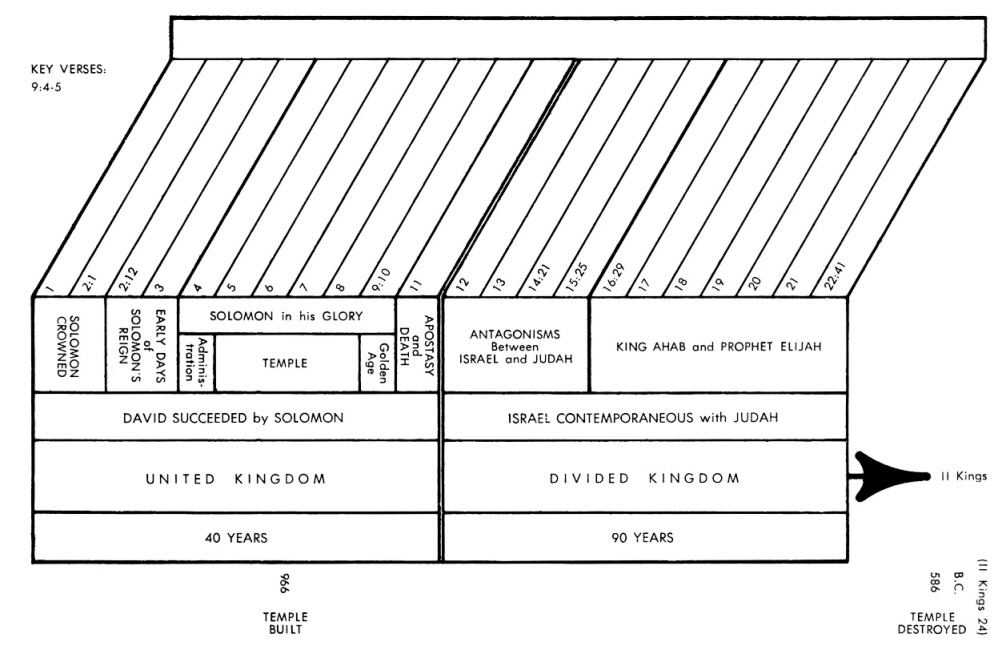
Chart from recommended resource Jensen's Survey of the OT - used by permission
1 Kings Chart from Charles Swindoll
THE DOWNWARD SPIRAL
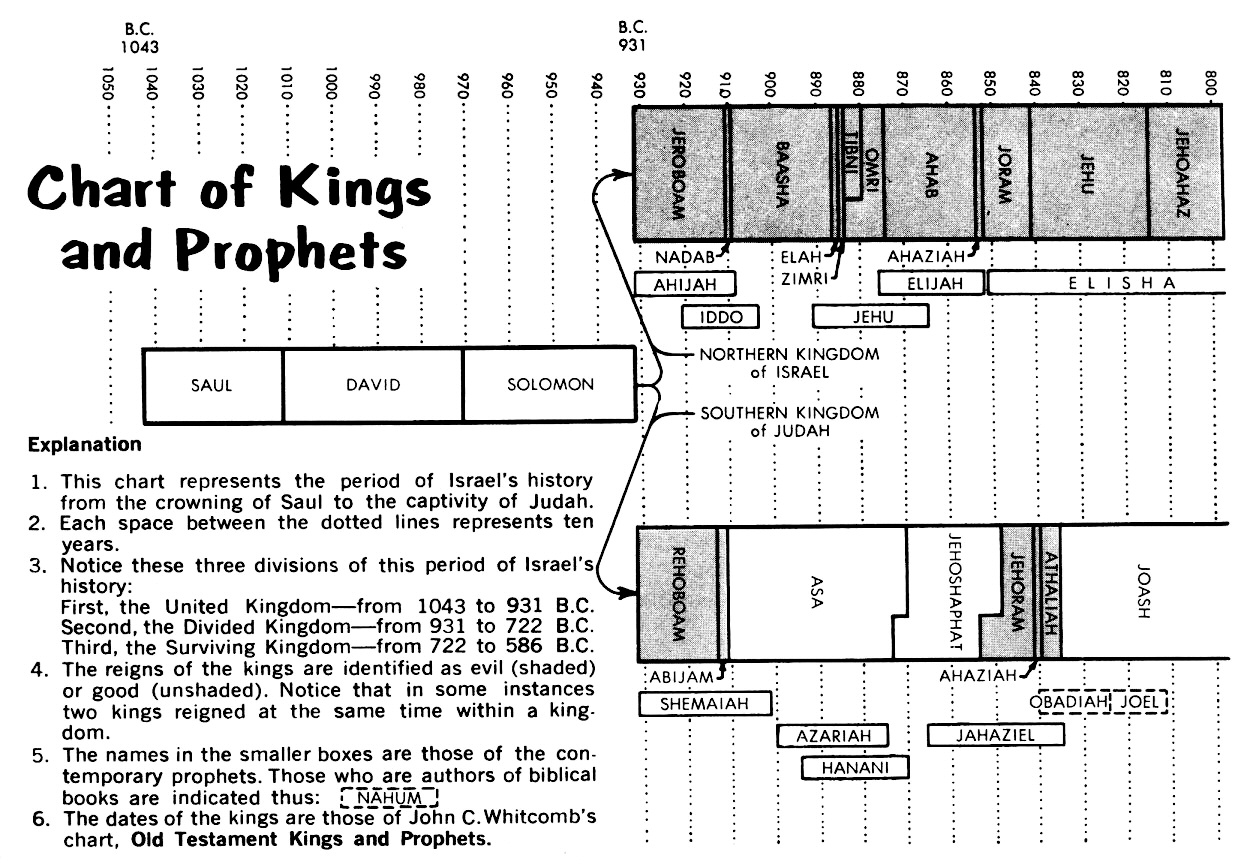
Click to Enlarge
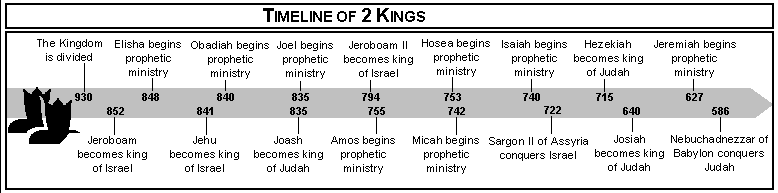
Ryrie Study Bible - Borrow
Click to Enlarge
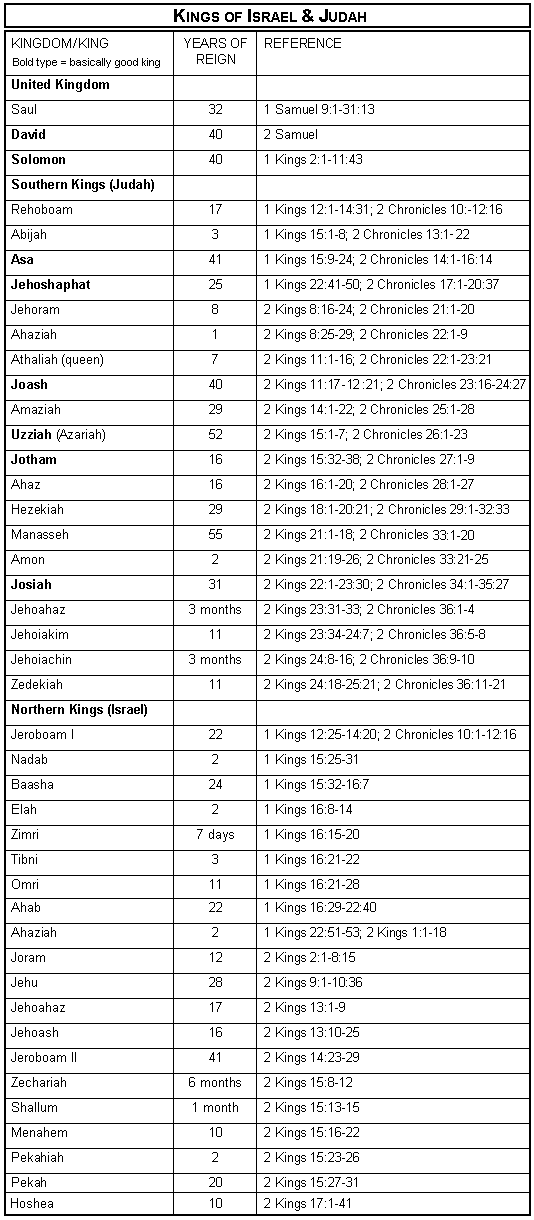
(NOTE: Many consider Amaziah and Hezekiah as "good" kings)
SEE ALSO:
ESV chart - kings of Israel - more information
ESV chart - kings of Judah - more information
Another Chart with Variable Dates for Reigns of Kings
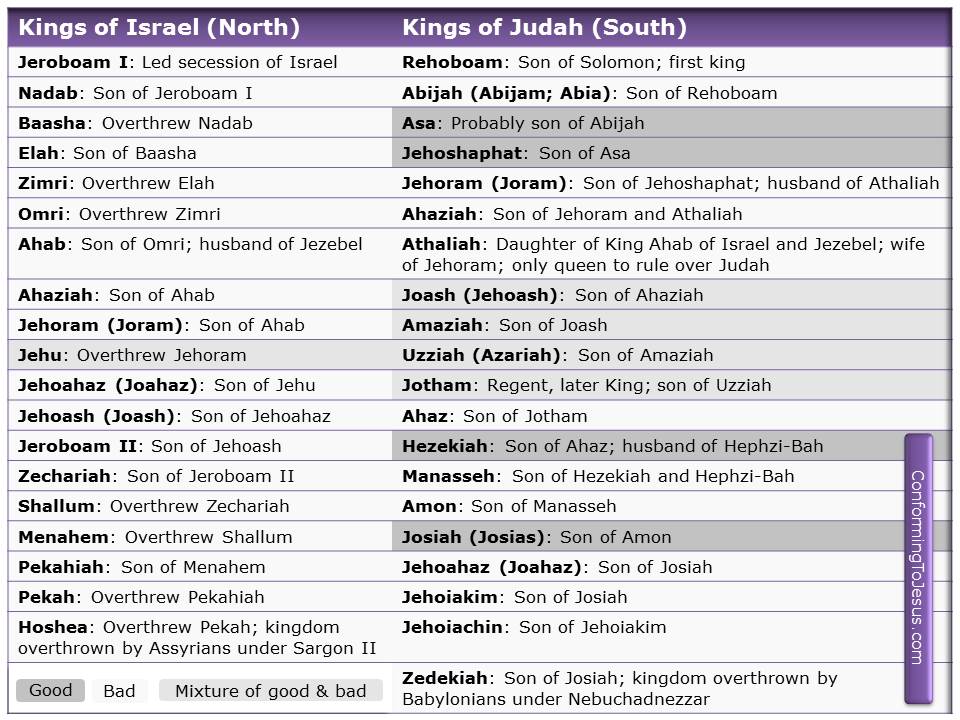
Source: ConformingtoJesus.com
2 Kings 5:1 Now Naaman, captain of the army of the king of Aram, was a great man with his master, and highly respected, because by him the LORD had given victory to Aram. The man was also a valiant warrior, but he was a leper.
- Naaman: Lu 4:27
- a great: 2Ki 4:8 Ex 11:3 Es 9:4 10:3
- highly respected, Heb. lifted up, or accepted in countenance
- by him the LORD had given victory Pr 21:31 Isa 10:5,6 Jer 27:5,6 De 2:37 Joh 19:11 Ro 15:18
- a leper: 2Ki 5:27 7:3 Lev 13:2,3,44-46 Nu 12:10-12 2Sa 3:29 2Ch 26:19-23 2Co 12:7
Related Passages:
Daniel 1:1-2 In the third year of the reign of Jehoiakim king of Judah, Nebuchadnezzar king of Babylon came to Jerusalem and besieged it. 2 The Lord gave Jehoiakim king of Judah into his hand, along with some of the vessels of the house of God; and he brought them to the land of Shinar, to the house of his god, and he brought the vessels into the treasury of his god.
Daniel 2:21 “It is He (YAHWEH) Who changes the times and the epochs; He removes kings and establishes kings; He gives wisdom to wise men And knowledge to men of understanding.
Luke 4:27 (JESUS' WORDS BEFORE THEY TRIED TO KILL HIM IN NAZARETH!) “And there were many lepers in Israel in the time of Elisha the prophet; and none of them was cleansed, but only Naaman the Syrian.”

Naaman Captain of Aram's Army
NAAMAN A GREAT WITH
A GREAT MALADY
Now Naaman (means "pleasantness"), captain of the army of the king of Aram (Syria - Ben-Hadad II 860–841 B.C.; Arameans) - The scene shifts again, from Israel to Syria, and from Israelites to a Syrian captain. Naaman is not a minor officer but the highest military commander of one of Israel’s chief enemies. Naaman was commander of the army of the king of Aram, Ben-Hadad II (860–841 BC - see below).
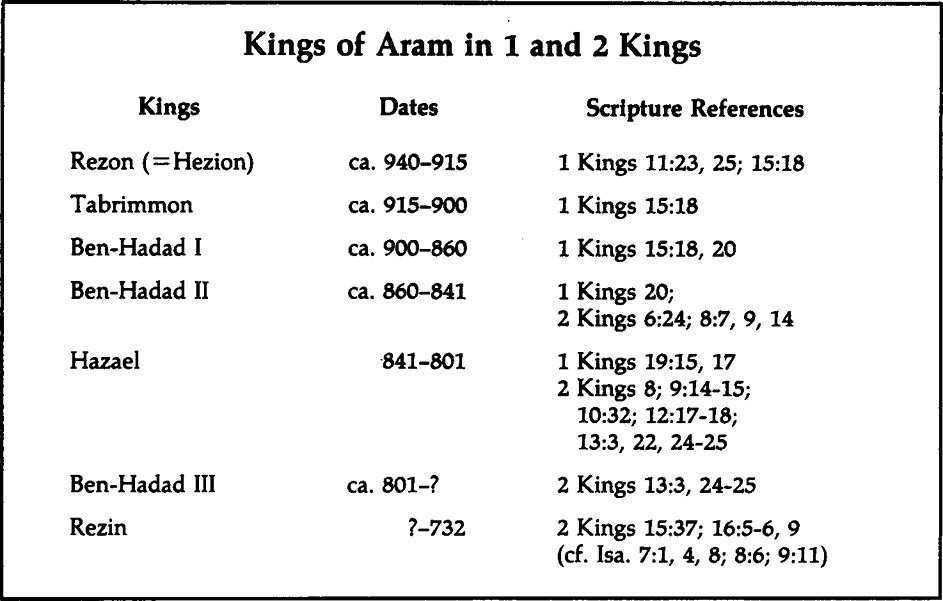
Source: Borrow Bible Knowledge Commentary (page 509)
Was a great man with his master ('adon;Lxx - kurios), and highly respected (“one whose face is lifted” - honored) - Heb "was a great man before his master and lifted up with respect to the face." This description emphasizes Naaman’s favor and honor in the eyes of his king so that humanly speaking, Naaman is successful, admired, and indispensable.
Because - Term of explanation. This one is easy to interrogate and answer. What's the writer explaining?
By him the LORD (Jehovah) had given victory (teshuah; Lxx - soteria - deliverance) to Aram - God, not Aram’s so called gods, is credited with Aram’s military success (cf Da 2:21+. This statement asserts God’s absolute sovereignty, even governing international affairs and granting victory even to pagan nations for His purposes. Military success does not imply spiritual approval, but divine control. Did you catch the pattern we see throughout the Bible? What does By him the LORD indicate? This is a clear description of Human Responsibility ("by him") and Divine Sovereignty ("LORD had given"), a pattern I refer to as the Paradoxical Principle of 100% Dependent and 100% Responsible abbreviated 100/100, probably bad math but good theology. We see this pattern very clearly in Solomon's Psalm 127:1 "Unless the LORD builds the house, They labor in vain who build it; Unless the LORD guards the city, The watchman keeps awake in vain." Do you see it? Try to build without the LORD (cf Mt 7:26,27)! Try to guard without the LORD! His part! Our part!
ESV Study Bible - It was common throughout the ancient Near East for peoples to claim that their gods had given them victory in battle, but the claim here is of a distinctively monotheistic kind; here (as always in the Bible) Israel’s God is responsible for victory or defeat in battles, no matter which gods may be worshiped by the victorious or defeated peoples (cf. Da 1:1-2). The vanquished here are not specified but may have included Israel, which was defeated at Ramoth-gilead in 1 Kings 22:29-36. The general by whom God had given the Syrians victory on this occasion was himself a leper (Heb. metsora‘); he suffered from some kind of disfigurement of the skin (but not necessarily what is known by modern people as “leprosy”; see note on Luke 5:12), rendering him ritually unclean from an Israelite point of view (cf. Leviticus 13-14; Num. 12:1-15; 2Sa 3:28-29). (BORROW ESV Study Bible)
The man was also a valiant (chayil) warrior (gibbor; Lxx - dunatos) - Naaman’s success was not accidental but providential, having been shaped by God’s unseen hand and His sovereign purposes long before His need became apparent.
Anything Naaman accomplished was because the LORD was working through him.
Even his victories came from the Lord's hand.
--Moody Bible Commentary
But - This is a strong term of contrast. In fairness the word "BUT" is added by the translation (and other modern translations - NET, ESV, NLT) as it fits with the context. C H Spurgeon once said that the little word “BUT” is a very useful pause for all of us very busy saints of God. "Amen" or "O My!"(See HOW UNDERSTANDING ONE WORD CAN CHANGE THE WAY YOU READ THE BIBLE). In the present context this single little HINGE WORD literally resulted in a dramatic change in this Gentile's life not only on earth but for all eternity. All based on one little word...BUT!
He was a leper (tsara) - Now we see that the writer's abrupt contrast in effect turns the description of this great man upside down. As noted below Naaman's Leprosy might not be the type of Leprosy we think of today (Hansen's Disease) but could be a number of dermatological conditions (see Lev 13:1-46). If Naaman truly had full blown Hansen's Disease, it would have been difficult for him to fulfill his duties as captain of the Aramean army. In any event Skin Disorders of any kind would bring fear and stigma in ancient cultures. It appears that leprosy rendered Naaman ritually unclean and socially vulnerable. He could conquer enemies on the battlefield, but could not conquer the condition on his own skin. And as this drama unfolds, remember Who just happened to allow this skin condition to afflict Naaman!
🙏 THOUGHT - God is in full control, which could be good news or bad news to you, depending on whether you are resisting His will or resting in it. (See Providence) Do you believe God is in full control? He is! Play Twila Paris' God is In Control.
History marches on
There is a bottom line drawn across the ages
Culture can make its plan
Oh, but the line never changes
No matter how the deception may fly
There is one thing that has always been true
It will be true foreverGod is in control
We believe that His children will not be forsaken
God is in control
We will choose to remember and never be shaken
There is no power above or beside Him, we know
God is in control, oh God is in control
🙏 THOUGHT - Paul Apple applies this truth asking "By the way, what is your hideous birthmark? What is your leprosy? What problem are you trying to conceal? What hurt are you trying to cover up? What prevents you from getting close to other people? Where do you need to be touched?"
Warren Wiersbe has the interesting note that "The Prophet Elijah is named twenty-nine times in the New Testament while Elisha is named only once. “And many lepers were in Israel in the time of Elisha the prophet, and none of them was cleansed except Naaman the Syrian” (Luke 4:27+, NKJV). (Bible Exposition Commentary)
Dale Ralph Davis says (as do a number of other commentaries) that Naaman's skin disorder "was not necessarily Hansen’s disease (ED: THERE ARE ABOUT 225 CASES EACH YEAR IN U.S.), i.e., modern leprosy, but may have been some form of psoriasis or scabies or other skin disease. This seems to be the case with Naaman, for when Gehazi received Naaman’s ‘leprosy’ he was ‘as snow’ (2Ki 11:27) and the lesions of Hansen’s disease are never white." (BORROW 2 Kings - Davis entitles 2Ki 5 "Grace Goes International")
🙏 THOUGHT - The message of this verse is that the omnipotent LORD Alone grants success (not just in military endeavors, but all of life!), yet no amount of success can shield a person from human frailty. Naaman’s greatness cannot cure him, and his power cannot save him. The stage is set for a story in which God humbles human pride and shows that true cleansing comes not through status or strength, but through obedient faith in the word of the LORD. In summary (and you may bristle at this statement - I did before I was born again! "I worked hard for everything we have" I once told my believing wife as I pounded my fist on the kitchen counter!) God is sovereign over all genuine success. He allows and even gives success. We as His creation are never truly independent of Him, even in achievement "so that, just as it is written, “LET HIM WHO BOASTS, BOAST IN THE LORD.” (1Co 1:31)
Tony Merida on this introduction to Naaman - This is a remarkable illustration of God’s total sovereignty. Yahweh controls Aramean politics and all “foreign affairs” around the world. God was not merely the God of Israel. He was and is the God of the nations. The psalmist says, “The earth and everything in it, the world and its inhabitants, belong to the LORD” (Ps 24:1). Davis says, “Yahweh is both the God of the church and Lord of the world. Yahweh draws near to his people but that doesn’t mean he allows pagans to run around unsupervised” (2 Kings, 86). Indeed, it shouldn’t surprise us that Naaman’s success came at Yahweh’s pleasure. (Exalting Jesus in 1 & 2 Kings)
Peter Leithert - The story of Naaman’s conversion is one of the most detailed and one of the most sociologically and psychologically rich conversion stories in the Bible. Almost for the first time, the Bible depicts the change of mind and heart, as well as the change of status, that occurs when a sinner turns to the God of Israel. Naaman’s conversion involves a change of status that makes him acceptable before God. (See 1 & 2 Kings Brazos Theological Commentary on the Bible - Page 126)
Victory (salvation, deliverance, help)(08668)(teshuah from yasha' = save, deliver, help) means a deliverance, a victory, safety, salvation, preservation from harm. Teshuah is often in the context of military conflict (Jdg. 15:18; 1Sa 11:13; 1Ch 11:14). While victory was usually not obtained through human means (Ps 33:17; 108:12; 146:3; Pr21:31), safety came through a multitude of counselors (Pr 11:14; 24:6). The primary Source of deliverance is God (2Ch 6:41 = "O LORD God, be clothed with salvation"; Ps 119:81 = "My soul languishes for Your salvation; I wait for Your word."; Ps 144:10 = "Who gives salvation to kings, Who rescues David His servant from the evil sword."). The deliverance of the Lord is described by the prophets during the troubled times (Isa. 45:17; 46:13; Jer. 3:23; Lam. 3:26 = "It is good that he waits silently For the salvation of the LORD.").
Valiant (wealth, strength, riches, army) (02428) chayil strength, wealth, army. This word has the basic idea of strength and influence. C P Weber - In the sense of "strength," "power," or "might" in general, ḥayil is used about twenty times: of God (Psalm 59:11), from God (Ps 18:32), physical strength of a man (Eccles. 10:10), or even of plant life (Joel 2:22). As wealth is often related to power, ḥayil is thus used to mean "wealth" about thirty times being translated "wealth," "riches," "substance," or "goods." It may be the wealth of a nation (Tyre, Ezekiel 28:4-5) an individual (e.g. Job 31:25), the wicked (Job 15:29), or from God (Dt. 8:18, etc.). Approximately eighty-five times ḥayil is used as an attribute of people.
CHAYIL IN 1-2 KINGS/CHRONICLES - 1Ki. 1:42; 1Ki. 1:52; 1Ki. 10:2; 1Ki. 11:28; 1Ki. 15:20; 1Ki. 20:1; 1Ki. 20:19; 1Ki. 20:25; 2Ki. 2:16; 2Ki. 5:1; 2Ki. 6:14; 2Ki. 6:15; 2Ki. 7:6; 2Ki. 9:5; 2Ki. 11:15; 2Ki. 15:20; 2Ki. 24:14; 2Ki. 24:16; 2Ki. 25:1; 2Ki. 25:5; 2Ki. 25:10; 2Ki. 25:23; 2Ki. 25:26; 1Chr. 5:18; 1Chr. 5:24; 1Chr. 7:2; 1Chr. 7:5; 1Chr. 7:7; 1Chr. 7:9; 1Chr. 7:11; 1Chr. 7:40; 1Chr. 8:40; 1Chr. 9:13; 1Chr. 10:12; 1Chr. 11:22; 1Chr. 11:26; 1Chr. 12:8; 1Chr. 12:21; 1Chr. 12:25; 1Chr. 12:28; 1Chr. 12:30; 1Chr. 18:9; 1Chr. 20:1; 1Chr. 26:6; 1Chr. 26:7; 1Chr. 26:8; 1Chr. 26:9; 1Chr. 26:30; 1Chr. 26:31; 1Chr. 26:32; 1Chr. 28:1; 2Chr. 9:1; 2Chr. 13:3; 2Chr. 14:8; 2Chr. 14:9; 2Chr. 16:4; 2Chr. 16:7; 2Chr. 16:8; 2Chr. 17:2; 2Chr. 17:13; 2Chr. 17:14; 2Chr. 17:16; 2Chr. 17:17; 2Chr. 23:14; 2Chr. 24:23; 2Chr. 24:24; 2Chr. 25:6; 2Chr. 26:11; 2Chr. 26:12; 2Chr. 26:13; 2Chr. 26:17; 2Chr. 28:6; 2Chr. 32:21; 2Chr. 33:14
Warrior (mighty) (01368) (gibbor cp related verb gabar = be strong, accomplish, excel, prevail) is from a root which is commonly associated with warfare and has to do with the strength and vitality of the successful warrior. And thus this adjective means powerful, strong, brave, mighty. Warrior. Hero. Mighty man (cp "mighty [gibbor] men of David" - 2Sa 23:8). See discussion of this word group from TWOT - Gibbor Word Group
Leper (06879) tsara (from tsaraath = leprosy)means to be struck with leprosy, to be leprous
TSARA - 20X/18V - being a leper(1), leper(12), lepers(1), leprous(6). Exod. 4:6; Lev. 13:44; Lev. 13:45; Lev. 14:2; Lev. 14:3; Lev. 22:4; Num. 5:2; Num. 12:10; 2 Sam. 3:29; 2 Ki. 5:1; 2 Ki. 5:11; 2 Ki. 5:27; 2 Ki. 7:3; 2 Ki. 7:8; 2 Ki. 15:5; 2 Chr. 26:20; 2 Chr. 26:21; 2 Chr. 26:23
Elmer Martens (TWOT online) - While usually rendered leper or leprous, the term "leper" is not correct medically, since ṣāraʿat refers to a wider range of skin diseases (cf. "malignant skin disease," NEB). For convenience, however, the term "leper" can be retained.
A person with leprosy, apart from the telltale malignant raw flesh and white hair, was to be otherwise identified by torn clothes, announcement of "unclean" when in the streets and was to live isolated from the community. Four persons are named in the OT as becoming leprous. Not counting Moses (Exodus 4:6; cf. also 2 Kings 7:3), there were Miriam (Numbers 12:10), Uzziah (2 Kings 15:5), Gehazi (2 Kings 5:27) and Naaman, the Syrian (2 Kings 5:1).
God may inflict the disease of ṣāraʿat as punishment for sins such as jealousy (cf. Miriam), anger, and lack of full compliance with God's commands (cf. Uzziah), and covetousness (cf. Gehazi). One must not conclude, however, that all sickness is a result of an individual's sin (cf. Job; Luke 13:1-5; John 9:1-7).
ṣāraʿat was not necessarily incurable (cf. 2 Kings 5:7). Leprosy by contrast, was likely incurable (Leviticus 13). In any event, healing of Sdra at could serve as a sign of divine power (Exodus 4:6; 2 Kings 5:8).
The isolation of a leprous person was doubtless a sanitary measure in order to avoid further contagion. That a priest in Israel's theocracy was to diagnose the illness does not mean that today's clergy should become health officers. But the principle of God's concern for the health of bodies is not only self-evident but remains an enduring principle (cf. Jesus, Matthew 8:2-3).
Diseases with eruptions affecting the skin are sometimes mild, sometimes, as in smallpox, scarlet fever, etc., both dangerous and highly contagious. The only effective control in antiquity would have been isolation. Only the Hebrew laws had this very valuable provision.
ṣaraʿat is found primarily (twenty times) in the two chapters that govern the diagnoses and the cleaning measures for one who had become unclean (tāmēʾ, Leviticus 13, 14). In the nature of a contagion, ṣāraʿat refers not only to eruptions on the skin but to mildew or mold in clothing (Leviticus 13:47-52) or in houses (Leviticus 14:34-53); therefore obviously the word is not specific for leprosy. The determination by the priest of an individual as unclean meant separation from the community, and ceremonial unfitness to enter the temple (cf. 2 Chron. 26:21). The cleansing measures to be performed upon recovery involved a ritual with two birds, which ritual according to KD was necessary for restoration to the community (Leviticus 14:2-9). An additional set of offerings followed, notably the guilt offering, perhaps because disease is ultimately to be linked with sin (Leviticus 14:10-20).
There is no Scriptural warrant
for regarding leprosy as a type of sinThere is no Scriptural warrant for regarding leprosy as a type of sin, though the analogy can be helpful for illustrative purposes.
Bibliography: Harris, R. Laird, Man-God's Eternal Creation, Moody, 1971, pp. 142-43. Browne, S. G., "Leper, Leprosy," in WBE, II, pp. 1026-27. (Theological Wordbook of the Old Testament - TWOT)
QUESTION - Why is leprosy talked about so much in the Bible?
ANSWER - In the Bible, the word leprosy is mentioned upwards of 40 times, depending on the Bible version being used. Leprosy was common in Bible times, and the many references to it were well understood by those who lived in unsanitary conditions. The main reason why leprosy is talked about so much in the Bible is that it is a graphic illustration of sin’s destructive power. In ancient Israel leprosy was a powerful object lesson of the debilitating influence of sin in a person’s life.
God had given the Israelites very specific instructions on how to deal with leprosy and other skin infections (Leviticus 13). Anyone suspected of having this disease had to go to a priest for examination (Leviticus 13:2-3). If found to be infected, “the leprous person who has the disease shall wear torn clothes and let the hair of his head hang loose, and he shall cover his upper lip and cry out, ‘Unclean, unclean.’ He shall remain unclean as long as he has the disease. He is unclean. He shall live alone. His dwelling shall be outside the camp” (Leviticus 13:45-46). The leper then was considered utterly unclean—physically and spiritually.
Incurable by man, many believed God inflicted the curse of leprosy upon people for the sins they committed. In fact, those with leprosy were so despised and loathed that they were not allowed to live in any community with their own people (Numbers 5:2). Among the sixty-one defilements of ancient Jewish laws, leprosy was second only to a dead body in seriousness. A leper wasn’t allowed to come within six feet of any other human, including his own family. The disease was considered so revolting that the leper wasn’t permitted to come within 150 feet of anyone when the wind was blowing. Lepers lived in a community with other lepers until they either got better or died. This was the only way the people knew to contain the spread of the contagious forms of leprosy.
The Bible records the story of a leper who was the first to be healed by Jesus (Matthew 8:2-4). The key lesson to be learned from this incident is that sin defiles us in the sight of God, but through Christ, we can be healed of the plague of sin that separates us from God. God loathes sin; it is repulsive to Him. Sin bans us from the presence of God because God will not allow sinful man in His sight and presence (Psalm 5:5; Habakkuk 1:13; Revelation 21:27). This is not only true of sins with a sexual connotation that are normally regarded as filthy and repulsive, but it includes all forms of disobedience and rebellion (1 Samuel 15:23; Proverbs 15:9). All sin is abhorrent to God. But those who have been redeemed from sin by grace through faith in Christ (Ephesians 2:8-9) can stand in God’s presence in full confidence that we are accepted “in the Beloved,” and we praise Him for the grace He extends to us for that purpose (Ephesians 1:5-7).
When we’ve captured a glimpse of the holiness and purity of God, we have to exclaim as did the prophet Isaiah, “Woe to me … I am ruined! For I am a man of unclean lips, and I live among a people of unclean lips, and my eyes have seen the King, the LORD Almighty” (Isaiah 6:5). Our attitude toward sin in the light of our Savior should echo the words of Peter: “Go away from me, Lord; I am a sinful man!” (Luke 5:1-8). Another key lesson we learn from the leper in Matthew’s Gospel is that just as the leper did, we can confidently approach Jesus in all our need, with all our sin and defilement. When we plead for cleansing and forgiveness, He will not turn us away (Hebrews 4:16; Psalm 103:12).
D L Moody - DID you ever ask yourselves which is the worse—the leprosy of sin, or the leprosy of the body? For my own part, I would a thousand times sooner have the leprosy of the body eating into my eyes, and feet, and arms! I would rather be loathsome in the Sight of my fellow-men than die with the leprosy of sin in my soul, and be banished from God forever! The leprosy of the body is bad, but the leprosy of sin is a thousand times worse. It has cast angels out of heaven. It has ruined the best and strongest men that ever lived in the world. Oh, how it has pulled men down!
🙏 THOUGHT - Leprosy is not inherently a symbol of sin in Scripture, nor is it ever treated as automatic evidence of personal guilt; rather, it is first a real physical affliction. At the same time, the Bible sometimes uses leprosy illustratively in specific contexts to convey deeper spiritual truths without implying that every sufferer is personally guilty of specific sin, but only where the text itself makes that theological connection. In this way, leprosy can serve as a powerful picture of sin’s defiling and isolating effects without implying that all who suffer are sinners or under divine judgment. Compare Jesus' words in John 9:1-3 - "As He passed by, He saw a man blind from birth. And His disciples asked Him, “Rabbi, who sinned, this man or his parents, that he would be born blind?” Jesus answered, “It was neither that this man sinned, nor his parents; but it was so that the works of God might be displayed in him."
Let me sum it up - While leprosy itself is not synonymous with sin, the Bible often employs it as a vivid illustration of sin’s corrupting, isolating, and incurable nature and its effect of separation.
G. Campbell Morgan explained in his Westminster Pulpit Leviticus 14:1–2 sermon: “Sin, like leprosy, ultimately renders its victim insensible to the pain of his own disease… Why was the leper separated not only from man but from God also as to outward worship? Surely because it was a symbol of sin, and there must be recognition of the fact that sin cuts a man off from fellowship with God.”
Naaman (2 Kings 5:1) - Charles Inglis
I. HIS CHARACTER.
Described as
1. A great man.
2. An honorable man.
3. A victorious man.
4. A leprous man.
II. HIS MISTAKES.
1. He went to purchase instead of receiving a gift. v. 5.
2. He went intending to be cleansed in his own way. v. 12.
3. He went away in a rage. v. 12.
III. HIS CHANGE.
1. The means were simple. “Go and wash.” v. 10.
2. But effectual. “He was clean.” v. 14.
IV. HIS CONFESSION.
“Behold now I know.…” v. 15.
Adrian Rogers 2Kings 5:1-14 Facing the Problem of Pride see page 39
Introduction
A. National Ruin Comes by Pride
B. Domestic Ruin Comes by Pride
C. Financial Ruin Comes by Pride
D. Spiritual Ruin Comes by Pride
E. Eternal Ruin Comes by Pride
I. Naaman’s Marvelous Character
A. He Was a Capable Leader
B. He Was a Conquering Leader
C. He Was a Courageous Leader
II. Naaman’s Miserable Condition
A. Leprosy Was a Fearful Disease
B. Leprosy Was a Fatal Disease
C. Leprosy Was a Figurative Disease
III. Naaman’s Miraculous Cure
A. He Heard of God
1. She Was a Captive Maid
2. She Was a Compassionate Maid
3. She Was a Courageous Maid
B. He Was Humbled of God
1. God Takes Away His Trust in Human Resources
2. God Takes Away His Trust in Human Reputation
3. God Takes Away His Trust in Human Reason
a. Pride Hates a Fixed Standard of Right and Wrong
b. Pride Hates the Idea That Jesus Christ Is the One and Only Savior of the World
c. Pride Hates the Idea That You Are Saved by Grace and Grace Alone
C. He Was Healed of God
1. There Was Repentance
2. There Was Reliance
3. There Was Renewal
Conclusion
Adrian Rogers - God’s Blessing to the Obedient Man 2 Kings 5:1-14 - see page 52
Introduction
I. The Prerequisite for Obedience
II. The Priority of Obedience
A. Human Reason Is Not a Substitute for Obedience
B. Human Resources Are Not a Substitute for Obedience
C. Human Reputation Is No Substitute for Obedience
III. The Perfection of Obedience
IV. The Power of Obedience
A. The Blessing of Plenty
B. The Blessing of Peace
C. The Blessing of Protection
D. The Blessing of Power
E. The Blessing of Purity
F. The Blessing of Perception
G. The Blessing of the Presence of God
Conclusion
Don’t tell me you’re trusting God; don’t tell me that you’re saved; don’t tell me you’re going to heaven if the faith that you have has not transformed your life and if you’re not obeying the Lord. It’s not enough, dear friend, to quote the promises without obeying the commandments of our Lord.
Trust and obey, for there’s no other way
To be happy in Jesus, but to trust and obey.
—JOHN H. SAMMIS
A Most Unlikely Evangelist - By Denis Lyle
Scripture: 2 Kings 5:1–14, especially verse 3: Then she said to her mistress, “If only my master were with the prophet who is in Samaria! For he would heal him of his leprosy.”
Introduction: If I were to ask this congregation, “What kind of Christian does God use?” I believe the answer would be as varied as the people gathered here. We tend to believe God only uses the “perfect person,” but we discover a delightful truth in Scripture God uses little people in big ways.
1. A Strange Mystery. The days in which this “little maid,” lived were hard and cruel. There was continual warfare between Ben-Hadad, King of Syria, and the King of Israel. The army of Israel was then dispersed and no longer resisted Syria. The result was that marauding bands of Syrians continually invaded the borders of Israel and carried away whatever they wanted (see 1 Kin. 6:24; 20:1; 22:34; 22:36). In our text, a little maid was taken. What a strange mystery, a kidnapping allowed by God, who guards Israel (Ps. 121:4).
2. Her Home Was Shattered (v. 2). Can you enter into the feelings of these parents who had their young daughter ruthlessly snatched from them? How would you feel as a mother or father if your daughter was kidnapped? Would you not be sorely tried by this mysterious providence, asking, “Why?” Are you anguished today about something tragic that just doesn’t make sense? God works through tragedy.
3. A Hand Was Shaping (v. 15). This event, which seemed to originate in the will of man, was the start of a divine plan through which Naaman was physically and spiritually healed! God had a purpose in this trial. We cannot always trace Gods providential dealings in our lives, but we can be sure that God will always work for our good (Rom. 8:28).
4. A Simple Testimony (v. 3). Although this girl was small in stature she was big in heart! She could have easily harbored bitterness against her captor. Instead she directed Naaman toward God’s prophet. Where did such faith come from? No doubt this child had often heard the story of God’s dealings with her fathers. She must have listened intently as they spoke of the prophet that was in Samaria. Are you seeking to instill the truths of God’s Word into the minds and hearts of your children (Deut. 6:7)? This captive maid, because she had been taught to trust and know God, was the means of bringing salvation to the home of her captivity, and of raising up a testimony for God which rang through the whole land of Syria
Note:
5. How Courageous She Was. In the midst of this pagan nation, she pointed her master towards God’s representative (see Heb. 1:1), His prophet Elisha. This was true of Daniel, who was loyal to God in pagan Babylon (see Dan. 1:8). What about you? Are you being tested at college? At work? We’re either conformers to outside pressure or transformers controlled by the inward power of God. Which are you?
6. How Compassionate She Was. This maid was an unwilling captive in Naaman’s household, yet she could not bear to see her master suffer. She did not return a curse but a blessing to her captors! How do you react to your jerk of a boss? Your pushy landlord? Our compassion towards “enemies” just may soften the hardest of hearts (see Ro 12:20).
7. How Confident She Was. There’s not even a hint of doubt in her words! Leprosy had no cure, yet she was confident in her God’s power!
8. A Supernatural Recovery (vv. 4–15). Naaman was healed of leprosy and brought to know God (vv. 14–15). It all began with a maid in captivity who moved her mistress (v. 3); her mistress moved a servant (v. 4); the servant moved the King of Syria (v. 5); the King of Syria moved the King of Israel (v. 7); the King of Israel moved Elisha (v. 8). The result was that Naaman was delivered from leprosy and idolatry. Talk about a most unlikely evangelist! She was the first link in the chain that eventually brought Naaman to the place of salvation.
R E Neighbour - “Now Naaman … was a great man, … and honorable, … he was also a mighty man in valour, out he was a leper.” (2 Ki. 5:1.)
He was noted for his valor, was a great man in his place,
He was honored by his master, was the savior of his race,
He was captain, yet, a leper, leaving all his power behind,
When men praised him, he was sighing as of one to death assigned;
His achievements and their glory paled, as death his soul did chide,
All seemed dark and dreadful to him as the future opened wide.
Sinner, learn this day thy lesson; come to Christ, do not delay,
He alone can make thee happy, change thy darkness into day.
Human greatness, and honor, and might among men, all pale and fade away when disease and death stretch forth their relentless hands.
How many spend their money for that which is not bread, and their labor for that which satisfieth not.
We need a new standard in establishing the values of life. Let the Savior ask again, “What will it profit a man if he gain the whole world and lose his own soul?”
There is another lesson to learn. It is this: how helpless is human greatness, and honor, and might to redeem us from sin and death!
These things utterly fail us, and cannot save us from sin. “There is none other name given under heaven, and among men, whereby we must be saved.”
A noble conqueror,
And mighty in his deed,
His “greatness” did no more
Than mock him in his need:
‘Tis Christ alone can save
The sinner from his sin,
‘Tis He alone can give
A perfect peace within.
Great men are not always wise, neither do the aged understand judgment. Great men need a Savior as well as the men of no repute. Nobility is of great value among men, but nobility cannot save.
Why is it that not many who are great or noble are called? It must be because they trust too much in themselves.
James Smith - NAAMAN, THE LEPER 2 KINGS 5:1–15
“Man should be humble: you are very proud,
And God dethroned has doleful plagues for such.”
—Browning.
Naaman, the leper, occupies pretty much the same place in the Old Testament as the “Prodigal Son” does in the New. The story is both well-known and well-worn, and has been the means of bringing the light of salvation into many a soul. These are wonderful words of life, let us tell them over again. See here a—
I. Blighted Life. Naaman had almost all that a man of the world could wish in the way of honour, and fame, and success, but there was a sore in his life that all the praise and wealth of the world could not heal—“he was a leper” (v. 9). Like the rich young ruler, there were many things which he did not lack, but he did lack “one thing”—purity. He was unclean. Wherever sin has dominion, it casts its withering blight over the whole character; but not until it becomes a conscious presence does it mar the false peace of the heart.
II. Faithful Testimony. This “little maid” had evidently profited by her godly upbringing. The God of “the prophet that was in Samaria” was to her an Almighty Saviour. She had convictions that were both real and deep, and she was not afraid to speak them out. “Would God that my lord were with the prophet that is in Samaria, for he would recover him of his leprosy” (v. 3). This was a simple, child-like testimony, but it is the kind of testimony that is everywhere needed, and that is sure to be blessed. It was the testimony of faith given at the right time and in the right spirit. “We speak that we do know.” This “little maid” was the first “girl preacher.”
III. False Interpretation. “The king of Syria said, Go, and I will send a letter unto the king of Israel.” So Naaman departed. Sent by a king to a king, and taking with him the princely gift of something like the value of £12,000, seemed to them the proper way to go about the matter of salvation from the curse of leprosy (vv. 5, 6). Yes, this is that “worldly wisdom” which completely sets aside that Gospel of Grace preached by the little maid, and which is still preached through Jesus Christ. “It is not by works of righteousness which we have done, but according to His mercy He saves us” (Luke 18:13, 14). Those guided by mere natural wisdom make no allowance for the grace of God. They will not buy “without money” (Isa. 55:1).
IV. Merciful Message. “Go and wash in Jordan seven times, … and thou shalt be clean” (vv. 8–10). Nothing but trouble and disappointment could come by going to the king instead of the prophet. There was none other Name given among men whereby he could be saved (Acts 4:12). The means was within easy reach. “Wash in Jordan.” The promise was sure. “Thou shalt be clean.” The prophet kept himself out of sight that Naaman’s faith might be in God and not in man. The true herald of the Gospel does not seek the honour of men, but he will have a definite message of certain salvation for every anxious inquirer. “Believe in the Lord Jesus Christ, and thou shalt be saved.”
V. Rebellious Spirit. “Naaman was wroth, … and went away in a rage” (vv. 11, 12). Why did this God-sent message of salvation from the lips of the prophet come to his heart like a spear thrust instead of a healing balm? Because of his pride and false notions of the God of salvation. He said, “I thought he will surely come out to ME,” etc. No, that proud “I” and that haughty leprous “me” must be broken down before God’s saving power can be enjoyed. The simple message of the Gospel of Christ cuts at the roots of all preconceived opinions and self-efforts of men. Naaman, or any other man, may wash as often as he likes in the “rivers of Damascus,” but there is no regenerating virtue in them, because there God hath not put his promise. All our own works are godless, therefore utterly powerless to save us.
VI. Surrendered Will. “Then went he down and dipped himself seven times in Jordan” (v. 14). Then! When? After he had been reasoned with by his sensible servants. These simple-minded men were quick to see that their master, the “mighty man in valour,” was stumbling at the simplicity of the remedy. He was quite prepared to do “some great thing,” but not this self-abasing foolish thing. But he changed his mind, and “then went down” with the definite purpose of putting the Word of God given to him through the prophet to the test. As soon as his mind was made up to accept this new way of cleansing, the rest was easily and quickly done. His going down was the evidence that he had now believed the message of grace sent him. The faith that does not lead to a personal acceptance of Christ is a dead faith. “Ye will not come to Me that ye might have life” (John 5:40).
VII. Changed Man. “His flesh came again like unto the flesh of a little child, and he was clean” (v. 14). He became a new creature through the obedience of faith (Matt. 18:3). His faith was also evidenced by a cleansed life. “The flesh of a little child” signifies not only perfect cleansing from his foul disease, but the renewing of his youth. What a perfect illustration this is of the wonder-working power of the Gospel of Christ! “If any man be in Christ he is a new creation: old things have passed away; behold, all things have become new.” This great change was followed, as it ever should be, by an open confession. “Behold, now I know that there is no God in all the earth but in Israel” (v. 15). Truly may those, who have been loosed from their sins by the Blood of Christ, say, like the king of old, “There is no other God that can deliver after this sort” (Dan. 3:29). “Ye shall be witnesses unto Me.”
The Sequence of Salvation By Melvin Worthington
SCRIPTURE: 2 Kings 5:1–19
INTRODUCTION: Salvation is an instantaneous event that culminates a sequential process. This process includes the facts we embrace, the feelings we experience, the faith we exercise, and the fruit we exhibit. The story of Naaman serves as illustration of the sequential process that leads to an instantaneous conversion.
1. Naaman’s Condition (vv. 1–7). Naaman’s character, condition, captive, and communication are recorded.
2. Naaman’s Cure (vv. 8–10). God’s man gave God’s message to Naaman.
3. Naaman’s Choice (vv. 11–14). Naaman was filled with wrath at the message of the prophet. He fully weighed his options. He finally willingly obeyed the prophet’s word.
4. Naaman’s Cleansing (vv. 14–19). Naaman’s obedience to God’s message resulted in complete cleansing.
CONCLUSION: Intellectually, emotionally, and volitionally we respond to God’s message. The proper response brings instant cleansing.
Dwight L Moody - NAAMAN 2 KINGS 5
WE are told in this chapter, that we have just read, that he was a great man, but he was a leper, and that spoiled him. He was a successful man, yet he was a leper; he was a very valiant man, but he was a leper; he was a very noble man, yet he was a leper. What a blight that must have cast on his path. It must have haunted him day and night. He was a leper, and there was no physician in Syria that could help him. It was an incurable disease, and I suppose he thought he would have to go down to the grave with that loathsome disease. We read that several companies had gone down to the land of Israel and brought down to Syria some poor captives, and among them was a little girl, who was sent to wait on Mrs. Naaman. I can imagine the little maid had a praying mother who had taught her to love the Lord, and when she got down there she was not ashamed to own her religion—she was not ashamed to acknowledge her Lord. One day, while waiting on her mistress, I can think of her saying, “Would to God your husband was in Samaria. There is a prophet there who could cure him.” I can imagine her looking at the girl when she said this: “What! a man in Israel can cure my husband? you must be dreaming. Did you ever hear of a man being cured of the leprosy?” “No,” the girl might have said; “but that is nothing. Why, the prophet in Samaria has cured many people worse than your husband.” And perhaps she told him about the poor woman who had such an increase of oil, and how her two boys were saved from slavery by the prophet; and how he had raised the child of that poor woman from the dead, and “if the prophet can raise anybody from the dead he can cure your husband.” This girl must have had something about her to make those people listen to her; she must have shown her religion in her life; her life must have been consistent with her religion to make them believe her. We read that Naaman has faith in her word, and he goes to the king and tells him what he intends to do. And the king says: “I will tell you what I will do. I will give you letters to the king of Israel, and, of course, if any cure is to be effected, the king will know how to obtain it.” Like a great many men nowadays, they think if there is anything to be got, it is to be got from the king and not from his subjects. And so you see this man starting out to the king of Israel with all his letters and a large doctor’s bill. I can not find just how much it was, but it must have been something like five hundred thousand dollars. The sum was a very large one likely. He was going to be liberal. He was not going to be small. Well, he got all his money and letters together, and started. There was no small stir as Naaman swept through the gates of Syria that day with his escort. He reaches Samaria, and sends a messenger to the king, announcing his arrival. The messenger delivers the letter to the king, and the first thing he does is to open the letter and begin to read it. I can see his brow knit as he goes on. “What is this?” he exclaims. “What does this mean? This man means war—this Assyrian king means to have a war with me. Whoever heard of such a thing as a man cured of leprosy?” and he rent his mantle. Every one knew something was wrong when the king rent his mantle, and the news spread through the streets that they were on the eve of a war. The air was filled with war; everybody was talking about it. No doubt the news had gone abroad that the great general of Assyria was in the city, and he was the cause of the rumors; and by and by it reached the prophet Elisha that he (the king) had rent his mantle, and he wanted to know the cause. When he had heard what it was, he just told the king to “send him to me.” Now you see the major-general riding up in grand style to the prophet’s house. He probably lived in a small and obscure dwelling. Perhaps Naaman thought he was doing Elisha a great favor by calling on him. He had an idea that he was honoring this man, who had no influence or position. So he rides up. A messenger is sent in to announce Major-General Naaman, of Damascus. But the prophet doesn’t even see him. He simply tells the servant to say to him, “Go and wash in the Jordan seven times.” When the messenger comes to Naaman and tells him this, he is as mad as anything. He considers it a reflection upon him—as if he hadn’t kept his person clean. “Does the man mean to insinuate that I haven’t kept my body clean? can’t I wash myself in waters of Damascus? We’ve much better waters than they have here. Why, if we had the Jordan in Syria, we’d look upon it as a ditch. The idea—wash in that contemptible river.” He’s as full of rage as he can be; and he said, “Behold, I thought.” That’s the way with sinners; they always say they thought. In this expression we can see he had thought of some plan, had marked out a way for the Lord to heal him. That is the way with nearly every man and woman in Chicago. They’ve got a plan drawn out, and because God does not come and save them according to their plan, they don’t take Him. Keep this in mind: “My ways are not your ways, nor my thoughts your thoughts.” If you look for Him to come in that direction, He will come the other way. “My ways are not your ways.” He thought. My friends, no man gets into the kingdom of God till he gives up his thoughts. God never saved a man till he gave up his own thoughts and took up God’s. Yes, Naaman thought that the moment the prophet knew he was outside, he would come out and bow and scrape, and say he was glad to see such a great and honorable man from Syria. Instead of that, he merely sent out a messenger to tell him to go and wash in Jordan seven times.
When we were in Glasgow we had an employer converted, and he wanted to get a man in his employ to come to our meetings, but he wouldn’t come. If he was going to be converted he wouldn’t be converted by those meetings. You know when a Scotchman gets an idea into his head he is the most stubborn man you can find. He was determined he wouldn’t be converted by Moody and Sankey. Like a good many here, they say, “If I am going to be converted I ain’t going to be converted down in that old Tabernacle.” The employer talked and talked to this man, but couldn’t get him to come. Well, we left Glasgow and got away up to the north of Scotland—in Inverness, and he sent this man up there on business, thinking he might be induced to go into the meetings. One night we were singing, “On the banks of that beautiful river,” and he happened to be passing and wondered where the sweet sounds were coming from. He came up finally, and I happened to be preaching that night on the very text, “I thought.” He listened, and soon did not know exactly where he was. He was convicted; he was converted and became a Christian. “I thought” how many people have said, “I’ll never be converted by these meetings;” “I’ll never be converted in the Baptist Church;” “I’ll never be converted in the Presbyterian Church.” A man makes up his mind not to go there, and he goes. A man must yield his own way to that of God. Now, you can see all along that Naaman’s thoughts were altogether different from those of God’s. He was going to get the grace of God by showing favors, and a good many men now think they can buy their way into the kingdom of God. My friends, we can not buy the favor of Heaven with money. If you get a seat in the kingdom of Heaven, you have to accept salvation as a gift.
Then another thing he thought. He thought he could get what he wanted by taking letters to the king, not the prophet. The little maid told him of the prophet, yet he was going to pass the prophet by. How many people would go into the kingdom of God if it wasn’t for pride? He was too proud to go to the prophet. But Pride, if you will allow me the expression, got a knock on the head on this occasion. It was a terrible thing for him to think of obeying—going down to the Jordan and dipping seven times. He had got better rivers in Damascus, in his own wisdom, and says, “Can I not wash there and be clean?” He was angry, but when he got over it he listened to his servants. I would rather see people mad than see them go to sleep. I would rather see a man get as mad as possible at anything that I may say than send him to sleep. When a man’s asleep there’s no chance of reaching him, but if he is mad we may get at him. It is a good thing for a man to get mad sometimes, for when he cools off he generally listens to reason. So his servant came to him and said, “Suppose he had bid thee do some great thing, wouldst thou not have done it?” Probably had he told him to take cod liver oil for ten years he’d have done it. If he had told him that he wanted as much money as Naaman had brought up, that would have been all right. But the idea of literally doing nothing—just to go down to Jordan and wash himself—it was so far below his calculations that he thought he was being imposed upon. It is so in our days. How many people expect to get salvation by some sudden shock, some great event happening to them, or some sudden flash of light to break upon them. Some think that God’s plan of salvation requires months to find out. They go on stumbling over its simplicity. And so his servant said, “If the prophet had bid thee do some great thing, wouldst thou not have done it? Wouldn’t you just better go down and wash yourself in the Jordan?” Perhaps he said, “If I go down to the Jordan and am not cured, what will my enemies say when I go back to Damascus?” But he was influenced by the servant, and he went. That was one good thing in Naaman’s character—he was influenced by a humble messenger. A good many people won’t accept a messenger because he is not refined, and cultured, and educated. My friends, never mind who brings the message. It is the message you want, not the messenger. If a boy was to bring me a telegraphic message with good news, I wouldn’t notice the boy, wouldn’t look to see whether he was white or black. It would be the message I would want. And so it was with Naaman. It was a little Hebrew girl that first told him to come to Samaria, and now he was told to wash by his servant. So down he goes and dips into the waters. The first time he rose he says, “I’d just like to see how much my leprosy has gone.” And he looks, but not a bit has left him. “Why, I’m not going to get rid of my leprosy in this way; this is absurd.” “Well,” said the servant, “do just as the man of God tells you; obey him.” And this is just what we are told to do in the Scriptures, to obey Him. The first thing we have to learn is obedience. Disobedience was the pit that Adam fell into, and we have to get out of it by obedience. Well, he goes into the water a second time. If some Chicago Christians had been there, they would have asked, sneeringly, “Well, how do you feel now?” He didn’t see that he was any better, and down he went a third time; but when he looked at himself he had just as much leprosy as ever. Down he goes a fourth, fifth, and sixth time. He looks at himself, but not a speck of it is removed. “I told you this,” he says to his servant; “look’e here; I’m just the same as ever.” “But,” says the servant, “you must just do what the man of God tells you to do—go down seven times.” He takes the seventh plunge, and comes out. He looks at himself, and behold, his flesh is as that of a little child. He says to his servant, “Why, I never felt as good as I do to-day. I feel better than if I had won a great battle. Look! I’m perfectly cleansed. Oh, what a great day this is for me. The leprosy has gone.” The waters to him had been as death and judgment, and he had come out resurrected—his flesh as that of a little child. I suppose he got into his chariot, and away he went to the man of God. He had lost his temper, he had lost his pride, and he had lost his leprosy. That is the way now. If a man will only lose his pride, he will soon see his leprosy disappear. The leprosy will go away with his pride. I believe the greatest enemies of men in this world are unbelief and pride. I believe hundreds and thousands in Chicago would press into the kingdom of God if it were not for their pride. He goes back to the man of God, and takes his silver and gold. He offers him money. “I don’t want your money,” replies the prophet. If he had taken money it would have spoiled the beautiful story. Naaman had to take back everything he brought from Damascus but his leprosy. The only thing that the sinner has got that God wants is his sins, and if you let Him take them to-night, He will. Get rid of your leprosy; He will take it. Never mind your feelings. No soul in this audience will go down to the dark caverns if he is willing to obey God. And now the question comes to you all, Will you obey Him? You haven’t got to go a thousand miles away and dip into a Jordan, but just believe where you sit—believe on the Lord Jesus Christ. “Come unto Me all ye that labor and are heavy laden, and I will give you rest.” Is there anything to hinder you from obeying God now? He will give you power to accept Him. Do you believe He would offer you salvation without giving you the power to obey Him? Don’t go from this hall with any such delusion, my friends. Don’t go home with this leprosy, thinking that you can not get rid of it. If sin is better to you, then, of course, hold on to it—if leprosy is worth more to you than to be purified, then keep it. Naaman could have gone back with his leprosy if he hadn’t met that prophet, and gone down to Jordan. If you go out without accepting Him, you go out as a sinner, and if death comes, as it may, suddenly upon you, there is no assurance in the Bible that you can pass through the pearly gates. There is no leprosy there. You must leave it here. If a leper was to get into the kingdom of Heaven, all Heaven would be affected by him. There is a fountain opened in the House of David for the lepers. This night you can be saved if you will. The door is open—on the hinge; the battle is fought on this fact, if you will—not because you can’t.
Oh, but you say, “I’ve tried.” Naaman might have said, “I have tried,” too. Probably he had tried all the physicians in his country, but Naaman couldn’t get cured. He couldn’t cure himself. When Christ said to that man who had a withered hand hanging at his side, “Stretch out thy hand,” he might have said, “I’ve tried to stretch it out for twenty years, and I can’t do it.” But when the command was given him, the power came also. All that was wanted was the will of the man. My friends, if you don’t accept the Gospel and obey it, and you go down to death, there is not a ray of hope that you will escape the punishment held out in the Bible. There is not a word in the Bible to lead you to believe that you will escape condemnation if you go down to the grave with that leprosy. Do you think, I ask again, that He will ask you to repent and accept eternal life without giving you the power? The moment you obey, that moment the blessing comes. Who will accept Him? I wish I could believe for you all, but I can not. I would have you all come into the kingdom of God. One of two things you have got to do—either accept the remedy He offers you, and be saved, or spurn the remedy as Naaman was going to do, and go home with your sins. May God open your eyes to see the necessity of being saved by this great remedy.
2 Kings 5:1–14 - Diane Matthews Drawing Closer to God: 365 Daily Meditations on Questions ...
The Aramean army commander rode away in a rage. Why had he ever listened to his Israelite slave girl’s advice to seek healing from Elisha? What a wasted trip! Instead of showing the proper respect, Elisha had sent out a messenger – with an insulting message. Naaman had expected some type of dignified cleansing ceremony, but Elisha simply told him to dip himself in the Jordan River seven times. How could bathing in such a muddy little river do any good? His hometown had two rivers far superior to any in Israel. “Couldn’t I wash in them and be clean?” he asked.
His devoted servants urged him to reconsider. After all, they reasoned, if Elisha had asked him to do something difficult or complicated, wouldn’t he have done it? Why shouldn’t he try this simple thing? Naaman swallowed his pride and obeyed the prophet’s instructions. God not only healed his disease but restored his skin to a youthful condition.
Many people discount the gospel message because of its simplicity, preferring to explore what seem like more sophisticated ways to “find God.” Salvation requires us to put aside our pride and admit we can’t do anything to save ourselves: God has done it all. Even after becoming a Christian, pride can still wreak havoc in our relationship with God and with other people.
The desire to do things our own way instead of God’s way can lead us into disobedience and sin. And, like Naaman, we may become incensed when someone doesn’t give us the respect we feel is due us. God promises to honor those who replace their self-will with an attitude of humility. If we don’t deal with our pride, we’ll miss out on God’s blessings, just as Naaman almost missed out on his healing.
A person’s pride will humiliate him, but a humble spirit gains honor. Proverbs 29:23
Ask yourself: How does my pride interfere with my daily walk with God?
Brian Bell - Intro: Thank God for your Leprosy
- How much do you know about the Lepers in the bible? (Q&A)
- What (former) leper of Bethany entertained Jesus in his home? Simon (Mark 14:3)
- What king of Judah was a leper until the day of his death? Uzziah (2 Chron.26:21)
- What captain of the armies of Syria was a leper? Naaman (2 Kings 5:1)
- What prophetess became a snow-white leper for a short time? Miriam (Numb.12:10)
- Who put his hand into his bosom and, drawing it out, found it leprous? Moses (Ex.4:6)
- Who became a leper after he lied to the prophet Elisha? Gehazi (2 Kings 5:27)
- Who told Moses to send lepers away from the Israelite camp? The Lord (Num 5:1-4)
- What is the greatest number of lepers Jesus healed at any one time? 10 (Lk. 17:12)
-
- It is possible to serve God in a foreign land, in a pagan profession, heathen home?
- Joseph served in Egypt. Esther in Persia. This young Jewish maiden in Syria.
- Daniel showed us not only how to live in...but how to abound in Babylon.
- Which area of your life would you call your Egypt, Persia, Syria, Babylon...where you have been called to serve in?
- Don’t complain about where God puts you; just ask Him to use you while you’re there
- Babylon’s are usually for a season. But in Daniels case it was his whole earth season.
- Through her intervention...she starts this providential ball rolling that will effect her Master’s life forever.
- She uses the phrase he would heal him (3) (lit.) he will gather. Referring to readmission of the leper into society after being quarantined.
- She sought the peace of the home to which she was carried captive.
- Jer.9:7 And seek the peace of the city where I have caused you to be carried away captive, and pray to the Lord for it; for in its peace you will have peace.
- But I’m just...a little slave girl. Servants play major rule in this miracle…The young Jewish girl gets Naaman to visit Elisha. Naaman’s servants encourage him to see the prophet which bring about his healing.
- Lesson: no matter who you are, or where you are, God can use your service.
- Don’t forsake your post in a godless house, in a difficult workplace. Look for your Naaman. Pray peace upon that place.
- What would you say if you were counseling her? You just heard she was ripped from her childhood home. Stolen from her country into a foreign land. Forced to work as a servant girl. How would you counsel this unexplainable disaster with no relief in sight?
- Yet God enabled her to bring about a great deliverance, that would be written down, & brought inspiration to tens of thousands.
- She rose above her sorrows, & by faith brought victory out of defeat.
- Also, this is an example of the promise God gave to Abraham, that Israel would be a blessing to the nations.
- It is possible to serve God in a foreign land, in a pagan profession, heathen home?
- LESSONS FROM NAAMAN THE LEPER (1-19)
- (1a) By him the Lord had given victory to Syria - we see the hand of God was guiding heathen as well as Hebrew history.
- The story of Naaman’s leprosy shows that God’s power and concern extended outside of Israel. Which Jesus makes a point of in the NT. Jesus made it clear, that from the beginning, God was concerned not only with Israel, but with gentiles as well.
- (1b) ...but a leper - he had everything that this world could give, with one exception, health. But he was a leper.
- His beautiful uniform and his mighty victories could not disguise, hide, nor mask the fact that Naaman was a walking dead-man. He had an incurable disease. [every lost sinner can see himself here]
- There is a lot of evenness in our earthly lives, more than we think, but there is also a but in every life which is meant to bring us to God.
- Do you see the main thing in the whole story that brought about his salvation...his leprosy. Is all disease then bad?
- (5,6) The king of Syria thought the king of Israel could bring about this healing...but the days of Israel’s kings representing Jehovah had passed away.
- (7,8) Naaman really doesn’t need the Syrian King, nor the king of Israel. He needs the King of Kings.
- See, the Syrian king doesn’t get who the healer is, Naaman doesn’t get that, & neither does the Israelite king.
- Ex.15:26 If you will listen carefully to the voice of the Lord your God and do what is right in his sight, obeying his commands and keeping all his decrees, then I will not make you suffer any of the diseases I sent on the Egyptians; for I am the Lord who heals you. Jehovah Rapha, the God who heals.
- Do need a healing today? Physical, emotional, social, financial, spiritual. HE is the great physician. What in your life needs a touch?
- (11,15) Naaman came dangerously near returning home on healed.
- I said to myself/I thought (11) will wreck us. Note the difference in vs.15 indeed now I know.
- (11) Doesn’t he know who I am - some pride needs to be broken...and Elisha’s on it.
- Elisha treated him like any ordinary center.
- (15) Naaman responded by offering Elisha a lavish gift. His method of expressing Gratitude.
- He was so thankful, he returned 20 miles out of his way to say thank you.
- (15) The man of God - I want your name there as the man/woman of God.
- That’s better than any other title. That’s our goal. Not, the really really cunning, crafty, clever successful business man or woman. Not, the most amazing mom who makes the best lunches. Not, the most amazing mom who works a hundred hours a week.
- But say, your name....the man/woman of God. Try it on for size. Speak prophetically to yourself. Thats who your are in Christ. That’s who you are, not the who you used to be, not who you once were.
- That’s better than any other title. That’s our goal. Not, the really really cunning, crafty, clever successful business man or woman. Not, the most amazing mom who makes the best lunches. Not, the most amazing mom who works a hundred hours a week.
- (17) A little Dirt Can’t Hurt
- Two mule loads of dirt - Naaman wants holy ground with him so that he can have Yahweh with him while outside Israel.
- The request reflects a belief that Israel’s territory belonged to Yahweh, while other nations were under the dominion of other, lesser gods.
- Imperfect faith: His faith was still imperfect. Brand new believer. Elisha doesn’t say no to the dirt. He knows its not a hill to die on (pun intended). He didn’t need a lecture, nor a theology lesson.
- Note: don’t wack new believers in the face w/your 10lb King Jimmy family bible.
- (18) Naaman now believes in Yahweh and vows to never sacrifice to another god, but his official duties require that he accompany his elderly king into the temple of Rimmon.
- Again, Elisha says what? Shalom Alechem (or alech) Go in peace.
- (1a) By him the Lord had given victory to Syria - we see the hand of God was guiding heathen as well as Hebrew history.
LEPER, LEPROSY - Dictionary of Biblical Imagery page 1716
The biblical word traditionally translated “leprosy” does not (at least usually) refer to what we call leprosy (Hansen’s disease) but rather covers a variety of skin diseases, including the different forms of psoriasis and vitiligo (both of which make the skin white, cf. 2 Kings 5:27). The leprosy in Leviticus that contaminates clothing or a house is mold or mildew (Lev 13:47–59; 14:33–57).
These diseases are associated with uncleanness and entail segregation from others (cf. Num 5:2; 2 Kings 15:5; 2 Chron 26:16–21). But that segregation is not complete isolation; for although Leviticus 13:46 might mean that lepers should live by themselves, in both Testaments lepers have dealings with other people (cf. 2 Kings 7:3; Mk 14:3). One nowhere reads of leper colonies. On the contrary, lepers advertise their presence by wearing ragged clothing, looking unkempt and crying, “Unclean, unclean” (Lev 13:45).
The legislation on leprosy, which makes unpleasant reading, appears in Leviticus 13–14. It is addressed to priests and is intended to give them the expertise to diagnose when a skin eruption is truly leprous. It also instructs what rituals should be performed upon remission. There is nothing said about hygiene or treatment.
Lepers are the living dead. In Numbers 12:12 the flesh of the leper is “as of one dead,” and in Job 18:13 Job’s skin “is consumed, the firstborn of death consumes his limbs” (RSV). When the unnamed king of Israel is asked to heal a leper, he responds with, “Am I God, to kill and to make alive, that this man sends words to me to cure a man of his leprosy?” (2 Kings 5:7 RSV).
Leprosy can be a divine punishment, as in Numbers 12:9–16 (Miriam; cf. Deut 24:8–9), 2 Kings 5:27 (Gehazi) and 2 Chronicles 26:20 (King Uzziah; cf. Lev 14:34). But God in his mercy also heals lepers. Instances include Numbers 12 (Miriam’s seven-day leprosy), 2 Kings 5:1–14 (Elisha heals Naaman), Mark 1:40–45 (Jesus heals an unnamed leper) and Luke 17:11–19 (Jesus heals ten Samaritan lepers).
Because of the dreadful effects of leprosy and the isolation it brings, many see it as a picture of sin. But that is not a primary connotation in Scripture. It far more symbolizes the tragic element of life and human vulnerability.
When Elisha declares, “Let him [Naaman] come now to me, that he may know that there is a prophet in Israel” (2 Kings 5:8), the implication is that only a prophet can heal leprosy. This is consistent with the circumstance that it is Moses, Elisha and Jesus who heal lepers in the Bible. It also helps explain Matthew 11:5 and Luke 7:22, where Jesus refers to his ability to heal lepers as a sign that he is “the coming one” (although Mt 10:8 also gives the authority to heal lepers to the disciples).
The beggar in Jesus’ parable of the rich man and Lazarus (Lk 16:19–31) is said to have “sores” that the dogs lick. Although the text is silent on the matter, tradition has specified his disease as leprosy. This explains the designation of medieval leper houses as “Lazaries,” the depiction of Lazarus of Bethany as a leper (for he has often been conflated with the figure in Luke’s parable) and the use of “Lazarushian” as an adjective for leprous conditions (as in Kipling’s words about Gunga Din having “Lazarushian leather”).
QUESTION - What can we learn from the story of Elisha and Naaman? GOTQUESTIONS.ORG
ANSWER - Naaman was the commander of Syria’s (Aram’s) army and well regarded as a military man, but he had leprosy. His Israelite servant girl suggested he go to Elisha to be healed. Naaman left for Israel, taking a large gift with him and a letter from Ben-hadad, the king of Syria, asking the king of Israel to heal Naaman (2 Kings 5:1–6). The king of Israel’s reaction was panic—how could anyone heal leprosy? The king of Israel thought Ben-hadad was trying to start a fight (2 Kings 5:7).
When the prophet Elisha heard of the king’s distress, he sent to the king, saying, “Why have you torn your clothes? Let him come now to me, that he may know that there is a prophet in Israel” (2 Kings 5:8). Naaman then came to Elisha’s house with his chariots, gifts, and servants.
Elisha did not even come out to greet Naaman. Instead, he sent a message to wash in the Jordan River seven times to be healed. “Naaman was angry and went away, saying, ‘Behold, I thought that he would surely come out to me and stand and call upon the name of the LORD his God, and wave his hand over the place and cure the leper. Are not Abana and Pharpar, the rivers of Damascus, better than all the waters of Israel? Could I not wash in them and be clean?’ So he turned and went away in a rage” (2 Kings 5:11–12).
Naaman’s servants urged him to reconsider, and Naaman wisely did. After dipping himself in the Jordan River seven times, he was completely healed as Elisha had said. In fact, “his flesh was restored and became clean like that of a young boy” (2 Kings 5:14). Naaman returned to Elisha and said, “Behold, I know that there is no God in all the earth but in Israel; so accept now a present from your servant” (verse 15). Elisha refused the gift and sent the Syrian commander away in peace.
However, Elisha’s servant, Gehazi, followed Naaman and deceitfully asked for a gift in Elisha’s name. Naaman gave him “two talents of silver in two bags, with two changes of clothing” (2 Kings 5:23). Gehazi hid the loot and returned home, where Elisha confronted him. Gehazi lied again to cover the matter. The Lord had given Elisha insight, and the prophet told Gehazi, “Therefore the leprosy of Naaman shall cling to you and to your descendants forever” (verse 27). Gehazi immediately contracted leprosy.
Much can be learned from this account.
First, there is a clear contrast between the faith of the young servant girl, who knew of Elisha and believed in his power; and the distress of Israel’s king, who did not even think of Elisha and fretted over his own lack of power.
Second, we have a contrast between the pomp of Naaman and the lowliness of Elisha. Naaman came to be healed carrying rich gifts in fine chariots; Elisha had no such finery, just the power of God. Naaman’s pride was almost his undoing: too proud and stubborn to follow the prophet’s simple instructions, he almost bypassed the blessing that God had in store. We, too, should obey the Word of God, even when God’s way does not make sense to us.
Also, those who serve God do not do so for financial gain but out of love and simple obedience to the Lord. Elisha refused the princely gift offered to him. God is a giver, not a taker, and His gifts cannot be bought. Naaman’s healing from leprosy is a wonderful picture of our salvation from sin—freely bestowed by the grace of God in response to faith (Ephesians 2:8–9).
Gehazi’s greed and deception are warnings to us. The Bible warns us against “pursuing dishonest gain” (Titus 1:7). We are called to be honest in all of our dealings, knowing that God sees everything and will judge accordingly. We can be sure that our sins will find us out (Numbers 32:23).
Jesus used the story of Naaman and Elisha as an illustration of Israel’s problem of unbelief. In Luke 4:27, Jesus tells the crowd in the synagogue of Nazareth, “There were many in Israel with leprosy in the time of Elisha the prophet, yet not one of them was cleansed—only Naaman the Syrian.” The lepers of Israel overlooked the healing that could have been theirs through Elisha, so God healed a Syrian instead. In the same way, the Israelites of Jesus’ day were missing the Power right in front of their eyes. But God is no respecter of persons (Acts 10:34–35), and the Gentiles eventually received the gospel that Israel rejected.
2 Kings 5:2 Now the Arameans had gone out in bands and had taken captive a little girl from the land of Israel; and she waited on Naaman’s wife.
- gone out in bands: 2Ki 6:23 2Ki 13:20 Jdg 9:34 1Sa 13:17-18
- waited on: Heb. was before, Ps 123:2
Related Passages:
1 Corinthians1:26-29 (SPEAKING OF BELIEVERS BUT APROPOS TO NAAMAN AND THIS SLAVE GIRL) For consider your calling, brethren, that there were not many wise according to the flesh, not many mighty, not many noble; 27 but God has chosen the foolish things of the world to shame the wise, and God has chosen the weak things of the world to shame the things which are strong, 28 and the base things of the world and the despised God has chosen, the things that are not, so that He may nullify the things that are, 29 so that no man may boast before God.
2 Kings 6:23 So he prepared a great feast for them; and when they had eaten and drunk he sent them away, and they went to their master. And the marauding bands of Arameans did not come again into the land of Israel.
2 Kings 13:20 Elisha died, and they buried him. Now the bands of the Moabites would invade the land in the spring of the year.

Ancient Aram Northeast of Israel
A NAMELESS ISRAELI GIRL
CAPTURED AND ENSLAVED
Now the Arameans had gone out in bands - Note on the map above a lengthy boundary between Aram (Syria) and Israel which would have made border raids easy and commonplace (cf 2Ki 6:8, 2Ki 6:23). It is interesting to note that Aram made an all out invasion of Israel in 2Ki 6:24-7:20. One has to wonder if Naaman was still the captain of the Arameans?
And had taken captive a little girl from the land of Israel; and she waited on Naaman’s wife - It would be easy to miss the hand of God in this verse in contrast to the "big events" in 2Ki 5:1, but as noted above our sovereign God is in full control of all events, all the time! And so here we see the "small event" of an Israeli girl "just happening" to be the maidservant of Naaman's wife. What a striking contrast between Naaman in verse 1 and this little slave girl in verse 2. This contrast exposes a central biblical truth: God’s power does not flow through rank, but through faith. God bypasses status and speaks through a servant. He ignores military glory and honors simple faith. Though powerless by worldly standards, this little girl became God’s instrument, while Naaman, rich in rank and influence, remained helpless apart from grace. So watch now as God providentially and patiently unfolds His redemptive plan in the life of the pagan Naaman.
A nameless Israelite girl in the right place at the right time
to accomplish His purposes and bring glory to Him.
J Vernon McGee on this nameless little girl from the land of Israel - To me she is as great as Queen Esther, Ruth the Moabite girl, Bathsheba, Sarah, Rebekah, and Rachel. This little maid "waited on Naaman's wife." (See Thru the Bible History of Israel 1 and 2 Kings)
Dale Ralph Davis - "Now the whole story hangs on this little lass and yet we don’t even know her name.....in Yahweh’s providence, in this story everything hangs on this little girl, on her tragic servitude. Without her Naaman would never have been healed. People are often brought into the kingdom of God at great cost to other people. Sometimes the means God uses to bring people to himself seem … well, so incidental. A little captive girl. Or a discarded book. Arno C. Gaebelein sent a free copy of his first book, Studies in Zechariah, to every rabbi in greater New York City and never received an acknowledgement from any of them. After a while, however, a young Hebrew Christian began to attend one of Gaebelein’s meetings. He had been secretary to a well-known rabbi. The rabbi had tossed Studies in Zechariah into the waste basket, but the secretary had fished it out, read it, and trusted Christ!2 Yahweh’s sovereignty is so fascinating.....Do you see how in two verses this text teaches you that both international politics (2Ki 5:1) and individual circumstances (2Ki 5:2), both world affairs (2Ki 5:1) and personal dilemmas (2Ki 5:2) are under Yahweh’s sway? Both the big picture and the minor details belong to him. His sway extends from parliaments and war departments to the doorknobs and phone calls and parking places of life. For Yahweh there is no tension between Isaiah 66:1 and Matthew 10:29. (BORROW 2 Kings - Davis entitles 2Ki 5 "Grace Goes International")
Hampton Keathley on the story of Naaman - Here, then, is a classic illustration of God’s Love, of how He reaches out to a people in utter darkness and uses their afflictions to draw them to Himself if they will only respond to His pre-salvation work of grace wherein God seeks to bring men to repentance (Rom 2:4).
2 Kings 5:3 She said to her mistress, “I wish that my master were with the prophet who is in Samaria! Then he would cure him of his leprosy.”
NET She told her mistress, "If only my master were in the presence of the prophet who is in Samaria! Then he would cure him of his skin disease."
BGT (Lxx) ἡ δὲ εἶπεν τῇ κυρίᾳ αὐτῆς ὄφελον ὁ κύριός μου ἐνώπιον τοῦ προφήτου τοῦ θεοῦ τοῦ ἐν Σαμαρείᾳ τότε ἀποσυνάξει αὐτὸν ἀπὸ τῆς λέπρας αὐτοῦ
LXE And she said to her mistress, O that my lord were before the prophet of God in Samaria; then he would recover him from his leprosy.
CSB She said to her mistress, "If only my master would go to the prophet who is in Samaria, he would cure him of his skin disease."
ESV She said to her mistress, "Would that my lord were with the prophet who is in Samaria! He would cure him of his leprosy."
NIV She said to her mistress, "If only my master would see the prophet who is in Samaria! He would cure him of his leprosy."
NLT One day the girl said to her mistress, "I wish my master would go to see the prophet in Samaria. He would heal him of his leprosy."
- I wish that my master: Nu 11:29 Ac 26:29 1Co 4:8
- he would: 2Ki 5:8 Mt 8:2,3 11:5 Lu 17:12-14

FEARLESS FAITH
BEHIND ENEMY LINES!
She said to her mistress - This emphasizes this young girl's humble status as a slave and the fact that humanly speaking, she has no power, position, or security. On the other hand, Biblically, her role in the drama emphasizes that God often advances His purposes through voices the world considers insignificant. I would characterize this girl's words as "holy boldness," because her boldness could have cost her her life. Yet it is fair to deduce from her words that she had knowledge of the power of the one true and living God. In other words, she had either heard about or seen with her own eyes the miracles Yahweh had performed through Elisha’s ministry.
It is remarkable, how this young girl was more concerned with God’s glory than with her own welfare. The very fact that Naaman and his wife listened to this young girl and heeded her counsel reveals the respect they both had for her. She must have served with excellence, giving a good pattern for believers of all ages who are providentially placed in situations with unbelievers. This young girl shows no evidence of a bitter or angry spirit. Even though she had lost everything (possibly even her parents in the raids), she made the choice to love those who had enslaved her. She put into practice the words Jesus uttered centuries late "I say to you who hear, love your enemies, do good to those who hate you." (Lk 6:27, cf Ro 12:14)
I wish that my master ('adon; Lxx - kurios) were with the prophet (nabiy; Lxx - prophetes) who is in Samaria (Elisha had a house in Samaria 2Ki 6:32) then he would cure him of his leprosy - She is not saying that she wishes Naaman were a captive in Israel, but because she is acquainted with the exploits of Elisha (such as the story of restoring life to the Shunammite's son) she reasons that Elisha could cure Naaman's dermatological disease. We know from Lk 4:27 none of the lepers in Israel had been cured of leprosy, so she had never seen this miraculous cure, but nevertheless she believes it is possible! So in spite of the fact that she is suffering displacement and enslavement, she still believes in the LORD’s ability to heal even the captain of the army that captured her. What a remarkable display of God's mercy and grace by this young woman, nameless on earth but honored forever in heaven!
It is also worth noting the paradox that Samaria was the capital of the northern kingdom, a place associated with idolatry and corruption. And yet God’s light and saving power was present in dark Samaria in the figure of His prophet Elisha (cf a similar purpose for believers today = Php 2:15; Mt 5:14-16), demonstrating that God's grace is able to function even in compromised settings.
Her statement is not giving magical powers to Elisha but recognizes that this man of God had God's authority and power to carry out miracles. The Israeli girl's simple wish would become the doorway for Naaman's miraculous healing. God used the quiet faith of this young servant girl to point a mighty warrior toward true healing, showing that faithfulness, not position, is what God uses to move His redemptive purposes forward.
🙏 THOUGHT - Let this young girl’s example encourage you to persevere in faith, even when you find yourself in difficult or oppressive circumstances. She had every reason to grow bitter or silent, yet she remained faithful to the LORD and willing to speak of His power. God is an "Ephesians 3:20" God and can use simple, obedient faith, offered even in the midst of hardship, in ways far beyond what we could imagine or expect.
She was small in position,
but great in purpose.
William MacDonald - This girl illustrates how a person of no importance in the eyes of the world, by being in a key place and showing loyalty to God, can influence the course of the history of salvation. D. L. Moody comments: "A little maid said a few words that made a commotion in two kingdoms. God honored her faith by doing for Naaman, the idolater, what he had not done for any in Israel. See Lk 4:27. How often has the finger of childhood pointed grown-up persons in the right direction. The maid boasted of God that he would do for Naaman what he had not done for any in Israel (ED: ACTUALLY SHE DID NOT SAY THAT - JESUS SAID IT IN Lk 4:27) ; and God honored her faith." (Borrow Believer's Bible Commentary)
J. Hampton Keathley III: Though small, weak, and insignificant, this little girl knew the omnipotent and sovereign Lord of the universe with whom there was healing. She was willing to point others to the most significant Being of the universe, YAHWEH OF ISRAEL, who alone could cure Naaman’s disease. Why do you suppose Naaman listened to her? After all what could a slave know? May I suggest that he listened because perhaps her life spoke volumes! Her life had been such a testimony that it gave credibility to her words.
Phillip G Ryken - This little maiden had five marks against her; she was at a quintuple disadvantage. First, she was a foreigner, a member of the despised and alien tribe of Israel living in Syria. Second, she was a slave. True, she served in Naaman’s great house. But having suffered captivity, her life and liberty were not her own. Third, she was a youth in a culture that valued the wisdom of the old and looked down on the inexperience of the young. Fourth, she was a female in a society that gave every prerogative to males. Finally, she was nameless. This poor little alien slave girl was not even important enough to have her name written down. She had no home, no freedom, no experience, no power, and no identity. She was the lowest person on the social scale. Compared to Naaman the Valiant, therefore, she counted for nothing. Yet the little girl’s life counted for God.....The young maiden is one of the boldest evangelists in the Bible. “You’re too little,” her big brother would probably have said—if she had one. But she was not too little to be used by God, because her faith was massive. She had a child’s unquestioning trust in the grace of God. Not even slavery had shaken her faith. She had not the slightest doubt that God had the power to cure Naaman’s disease (2 Kings)
A Person Of Influence by David C. McCasland
She said to her mistress, “If only my master were with the prophet who is in Samaria! For he would heal him of his leprosy.” —2 Kings 5:3
If you Google “person of influence,” the search will take you to various lists of “the most influential people in the world.” These lists usually include political leaders; business entrepreneurs and athletes; along with people in science, the arts, and entertainment. You will not find the names of cooks and cleaners who work for them. Yet those in so-called lowly positions often influence the people they serve.
The story of Naaman, a high-ranking military commander, includes two kings and a prophet of God (2 Kings 5:1-15). Yet it was the servants in the background whose words led to Naaman being cured of leprosy, a career-ending, life-changing disease. A young servant girl taken captive from Israel told Naaman’s wife that a prophet in Samaria could heal him (vv.2-3). When Elisha’s instructions to bathe in the Jordan River angered Naaman, his servants urged him to follow the prophet’s orders. The result was Naaman’s restoration to health and his declaration, “Now I know that there is no God in all the earth, except in Israel” (v.15).
What a beautiful picture of our role as followers of Jesus Christ! We are called to be people of influence—the Lord’s servants who point others to the One whose touch can change their lives.
Lord, I would like to live a life of influence like Naaman’s servant girl—to be brave and bold to touch the lives of others by pointing them to You. Fill me, Holy Spirit, with Your power. Christ sends us out to bring others in. (Reprinted by permission from Our Daily Bread Ministries. Please do not repost the full devotional without their permission.)
J J Knapp - A Timid Witness 2Ki. 5:3
How unsearcheable but also how glorious are God’s ways. Here was this Jewish girl, taken captive from her country by Syrian troops to be sold as a slave and so to enter into service in the important household of Naaman, the captain of the host of Syria, who was plagued with leprosy. Seen from this angle all was misery for the girl. However, later on it proved that this painful destiny became a means in God’s hand to not only cure Naaman, but above all to build an altar for the only true God in the heathen country. Seen from this angle it became all glory.
This little, young daughter, whose name is not given, whose condition was not very exalted, and whose labour was barely noticed by the outside world, became a blessing for the household she served in, a blessing also for the country she sojourned in as a stranger. She did not become so by loudly proclaiming her faith and by making a show of her piety, but by being a humble witness. Behold closely this intimate scene inside the house of Naaman. Obviously the young daughter managed to win the heart of her mistress. There was something familiar in the relationship between the two, even though they belonged to different spheres of life. Naaman’s wife did not keep herself highheartedly silent, but she spoke openheartedly with her about the great suffering that had come upon Naaman. Now hear with what sharing love the Jewish girls answers: “Would God my lord were with the prophet that is in Samaria! for he would recover him of his leprosy!”Is it not true, that was not a sermon that was weightily presented; it was not a direct attack upon her mistress to bring her to conversion; according to the sound of it, it was little more than a word of natural compassion; yet the mentioning of the prophet who is in Samaria contains a slight gesture, a, oh very humble, pointing to the God of Israel who has power to kill and to make alive.
Were such a quiet piety increasingly found amongst our servants, who live in important households, where the Name of the Lord is not known. Let it start by winning the trust of the mistress with kindness and helpfulness. Let them share wholeheartedly in the cares and the needs of the household, instead of taking a more or less hostile attitude that precludes all closeness. And then at the appropriate time a single humble word of faith, a timid counsel, a shy witness, a glance upward, a tender referring to the compassionate Christ!
Tony Merida tells a personal story related to LEPROSY - See Exalting Jesus in 1 & 2 Kings
A few years ago some guys from our church went to Nigeria on a mission trip. The trip included medical missions, orphan care, theological training, and a visit to a leper colony. I will never forget the day we pulled into the isolated place where a group of lepers was living. We spent our initial time visiting with them. We went hut to hut, sitting down with these wonderful individuals, hearing their stories, and asking them about their faith. Some of them had no toes or fingers. They dwelt in sad-looking huts, trying to survive on limited food resources. The locals wouldn’t allow the lepers’ kids to leave the colony, so the colony was filled with kids also. Of course, the kids latched on to us and celebrated as we handed out candy. The sights, sounds, smells, conversations, and touches caused us all to be emotional.
I wasn’t prepared for what happened next. A local chaplain gathered everyone to the center of the village and said, “Now pastor Tony will preach.” That was news to me! I didn’t know I was preaching. I didn’t even have a Bible. And what on earth can you say to a group of dying lepers? I decided simply to quote Romans 8:18–31 as best as I could and encourage these individuals, many of whom were followers of Jesus. As I spoke about suffering and future glory, the people began to worship. I have a picture of a lady standing behind me with her arms lifted up in the air as I told the villagers that all of us are dying, lepers and non-lepers alike. But soon Jesus will come to make all things new, and this fallen world will give way to indescribable glory. We had a powerful time of worship, and Romans 8 came with fresh application to us all.....
Elisha’s ministry included “previews of Jesus.” We have already noted that their ministries have numerous similarities. Once again we see that to be true. In 2 Kings 5 we read of the prophet Elisha healing a leper. His healing points us to the ultimate Prophet and Great Physician, who on one particular occasion healed 10 lepers, giving a sign of the ultimate restoration that will one day come fully.
We were spiritual lepers
until Christ cleansed us from sin
Naaman’s cleansing provides a vivid illustration of the power of the gospel. His physical healing is only part of the whole story. What we witness here is an amazing conversion of one who had been outside the faith. God graciously saves a leper from a deadly physical condition and ultimately from eternal judgment. Naaman eventually confesses, “I know there’s no God in the whole world except in Israel” (2 Kgs 5:15). So now you see, this isn’t simply an encouraging tale for sick people. This is a story that we can all identify with. As believers, we were spiritual lepers until Christ cleansed us from sin.
Indeed, this story reminds us that no one is too bad to come to Christ for salvation. There is real gospel hope in this dusty old story. My good friend and colleague Nate Akin illustrates this glorious gospel truth with the following story. One Sunday, in the response time following a pastor’s sermon, a lady began to weep as she filled out a response card at the front of the worship center. The pastor went and sat next to her in order to learn more about her situation. She took the card she had filled out and said, “You see my name?”
“Yes,” the pastor said.
She replied, “You see that ‘Mrs.’ in front of my name?” The pastor affirmed. She went on, “I’m no ‘Mrs.’ I’ve never been married. I write ‘Mrs.’ in front of my name on account of my little baby boy. When he was born, I said in my heart, ‘I’m going to raise him in that wonderful First Baptist Church in Dallas.’ So I began bringing him into the nursery, and I began attending the services, and I’ve been listening to you preach, and today I felt I wanted to become a Christian and become a member of the congregation.”
“But,” she said, “Since I have come and since I’ve been seated here, I’ve been thinking about my life as a prostitute. I’ve been thinking about what I’ve done, and if you knew me, and if these people knew me, you would not want the likes of me in this church.”
Of course, the pastor told her otherwise. The truth is, we aren’t unlike this woman. We have a fundamental problem. We are all unclean. Paul puts it like this:
There is no one righteous, not even one. There is no one who understands; there is no one who seeks God. All have turned away; all alike have become useless. There is no one who does what is good, not even one. (Rom 3:10–12)
2 Kings 5:4 Naaman went in and told his master, saying, “Thus and thus spoke the girl who is from the land of Israel.”
- and told his master: 2Ki 7:9-11 Mk 5:19 16:9,10 Joh 1:42-46 4:28,29 1Co 1:26,27
Related Passages:
Proverbs 16:24 “Pleasant words are a honeycomb, Sweet to the soul and healing to the bones.” (IN THIS CASE HEALING TO THE SKIN AND HEART!)
Proverbs 15:23 “A man has joy in an apt answer, And how delightful is a timely word!”
Ecclesiastes 12:11 “The words of wise men (OR YOUNG FAITHFUL SERVANT GIRLS) are like goads, and masters of these collections are like well-driven nails; they are given by one Shepherd.”
Colossians 4:6 (THE SERVANT GIRL'S WORDS SHOULD CHALLENGE NT BELIEVERS) Let your speech always be with grace, as though seasoned with salt, so that you will know how you should respond to each person.
Ephesians 4:29 Let no unwholesome word proceed (present imperative with a negative see our need to depend on the Holy Spirit to obey) from your mouth, but only such a word as is good for edification according to the need of the moment, so that it will give grace to those who hear.

WHEN A FAITHFUL WORD
REACHES THE THRONE
Either Naaman overheard the Israelite maidservant speaking to his wife or his wife related the little girl's wish. Whichever is true, the fact is that Naaman acted on the words of a slavegirl. As the story unfolds we see Naaman has "pride problems" but in fairness, we see a glimmer of humility in his willingness to act on the little Jewish girl's words. Perhaps it is more desperation than humility, but I think there was still a component of humility in his willingness to approach the king.
Naaman went in and told his master - The term his master most naturally refers to the king before whom he was speaking. And keep in mind who Naaman is! He is a commander accustomed to issuing orders, not receiving counsel and especially not from a young servant girl. His entire life has been shaped by authority, rank, and unquestioned obedience from others. Yet here, at the very outset of the story, Naaman listens. This seemingly small detail signals the first quiet stirrings of humility. Long before he will be told to wash in the Jordan, Naaman is already being asked to bend, to receive rather than command, to listen rather than assert, and to heed truth from an unexpected and socially insignificant voice. God often begins His work of humbling a proud heart not with dramatic commands, but with simple invitations to listen. (See my testimony to God's grace) Naaman’s healing will ultimately require obedience, but it begins with something even more basic which is a willingness to hear wisdom from the least likely messenger (cf Jas 1:19, 20, 21).
Saying, “Thus and thus spoke the girl - This is a Hebrew idiom meaning “she spoke in this manner” or “she said such-and-such.” The phrase summarizes her message without embellishment. Naaman does not exaggerate or reinterpret her words, but faithfully reports them. This indicates that her testimony carried weight and clarity, even though she herself had no social standing. Of course, we need to remember that God is directing these events behind the scenes.
God often uses ordinary testimony
to move extraordinary events.
Who is from the land of Israel - The irony is striking, for here we see hope of healing for Aram’s greatest warrior comes not from his own powerful nation, but from Israel, the very people Aram had repeatedly oppressed and raided. The hand that Aram wounded will become the very hand God uses to heal. This moment reveals a profound truth that God’s grace is not hampered by political borders, ethnic hostility, or military rivalry. Through the quiet faith of a captive Israelite girl and the ministry of Elisha, the Lord extends mercy across enemy lines, demonstrating that His saving power flows through faithful witnesses, not national strength. Naaman’s healing stands as a living rebuke to human pride and a testimony to divine sovereignty, for here the God of Israel shows Himself to be the God of all the earth, dispensing grace where He wills, even to an enemy commander.
🙏 THOUGHT - The servant girl’s words remind us that God delights to take gracious, truthful words spoken in humility and use them far beyond the speaker’s position, power, or expectations. May we all be like the early church who after praying were "all filled with the Holy Spirit and began to speak the word of God with boldness." (Acts 4:31)
Warren Wiersbe - Naaman didn’t realize it, the Lord had already worked on his behalf by giving him victory over the Assyrians. Jehovah is the covenant God of Israel, but He is also Lord of all the nations and can use any person, saved or unsaved, to accomplish His will (see Isa. 44:28; 45:13; Ezek. 30:24–25). The Lord also did a gracious thing when He permitted Naaman to bring the captive Jewish girl into his house to be his wife’s maid. The girl was a slave, but because she trusted the God of Israel, she was free. Even more, she was a humble witness to her mistress. Her words were so convincing that the woman told her husband and he in turn informed the king. Never underestimate the power of a simple witness, for God can take words from the lips of a child and carry them to the ears of a king. (Bible Exposition Commentary - page 685)
William MacDonald - “…the maid that is of the land of Israel.” (2 Ki. 5:4)
A person doesn’t have to be known by name in order to accomplish great exploits for God. In fact, some of the people in the Bible who won immortal fame are not identified by their names.
There were the three men who brought water to David from the well of Bethlehem (2 Sam. 23:13-17). David considered this act of devotion so remarkable that he would not drink the water but poured it out as a holy offering. But the men are unnamed.
We do not know the name of the great woman of Shunem (2 Ki. 4:8-17) but she will always be remembered for building a prophet’s chamber for Elisha.
It was an anonymous Jewish maid whose advice sent Naaman to Elisha to be healed of leprosy (2 Ki. 5:3-14). God knows her name, and that is all that matters.
Who was the woman who anointed the head of Jesus (Mt.26:6-13)? Matthew does not give her name, but her fame is announced in the words of our Lord, “Verily I say unto you, Wheresoever this gospel shall be preached in the whole world, there shall also this, that this woman hath done, be told for a memorial of her” (v. 13).
The poor widow who cast her two mites into the treasury is another of “God’s unknowns” (Lu. 21:2). She illustrates the truth that it’s wonderful how much you can do for God if you don’t care who gets the credit.
Then, of course, there was the lad who gave his five loaves and two fishes to the Lord and saw them multiplied so that they fed 5000 men plus women and children (John 6:9). We don’t know his name but what he did will never be forgotten.
A final illustration! Paul sent two brothers to Corinth with Titus in connection with a collection for the poor saints in Jerusalem. He does not give their names but he eulogizes them as messengers of the churches and the glory of Christ (2 Cor. 8:23).
As Gray looked at the tombstones of obscure people in a country churchyard, he wrote:
Full many a flower is born to blush unseen,
And waste its sweetness in the desert air.
With God, however, nothing is wasted. He knows the names of all those who serve Him anonymously, and He will reward in a manner that is worthy of Himself.
2 Kings 5:5 Then the king of Aram said, “Go now, and I will send a letter to the king of Israel.” He departed and took with him ten talents of silver and six thousand shekels of gold and ten changes of clothes.
- go: Ge 11:3,7 Ec 2:1 Isa 5:5 Jas 4:13 5:1
- and took: 2Ki 8:8,9 Nu 22:7,17,18 24:11-13 1Sa 9:8 1Ki 13:7 22:3 Ac 8:18-20
- ten changes: Ge 45:22 Jdg 14:12 Jas 5:2-3

Caveat: Note Naaman travels to Elisha at Gilgal not
correct as 2Ki 5:3 says "the prophet who is in Samaria"
KING ARAM OKAYS
NAAMAN'S VISIT TO SAMARIA
Then the king of Aram said, “Go now, and I will send a letter to the king of Israel.” - King of Aram gives decisive approval. Note the fact that the king will send a letter to another king assumes they are convinced that the real power is confined to the royal courts. However there is one glaring omission in this royal narrative. Both the king and Naaman appear to have missed the simplicity of little girl's words for there is no mention of the prophet in Samaria. And so the king of Aram treats the matter as a diplomatic and political issue rather than as a spiritual one. The Aramean king assumes that healing, if it is to happen, must be through official power channels of the royal courts as shown in the next verse which says "I have sent Naaman my servant to you, that YOU MAY CURE HIM of his leprosy."
Naaman comes prepared to pay,
but as we see he was not prepared to obey!
He departed and took with him ten talents of silver and six thousand shekels of gold and ten changes of clothes - Both the king and his military commander assumed that healing could be bought, that divine favor could be secured through wealth, status, or political leverage. Their response reveals a pagan mindset that treats power and riches as currency even in spiritual matters, failing to recognize that the healing God gives is an act of sovereign grace, not a transaction to be negotiated or purchased.
This incredible amount of wealth gives us a window into Naaman's heart who thinks he can purchase the cure for his leprosy. In the ancient near east seeking help from priests or holy men often did involve a payment of some type. In this case the amounts recorded represent an enormous sum, suitable for a king’s treasury rather than a personal gift, for ten talents of silver (about 750 pounds) and six thousand shekels of gold (about 150 pounds) would be worth by some estimates up to six million U.S. dollars today (Walton thinks more like 750 billion dollars). For comparison King Omri of Israel had purchased Samaria for only two talents of silver (1Ki 16:24), so ten talents was a huge number in that day. Walton adds "One can get an idea of the proportions by understanding that a typical wage would have been ten silver shekels per year, and one gold shekel would purchase one ton of grain."
The clothing was typically a symbol of honor and reward and reflected the expectation that Naaman (who did not yet understand grace) felt his healing could be purchased or earned. He reminds me of James' description of the rich and famous of whom he wrote "Your riches have rotted and your garments have become moth-eaten. Your gold and your silver have rusted; and their rust will be a witness against you and will consume your flesh like fire. It is in the last days that you have stored up your treasure!" What a rebuke to wealth! WOE! (James 5:2-3) Naaman comes prepared to pay, but was not prepared to obey! His lavish gifts revealed his confidence in his resources rather than in free gift of the LORD (cf Ro 3:23,24).
Naaman's "theology" was totally humanistic. He thought healing could be bought and did not understand that God's grace is free and cannot be earned or bought. He thought power would impress God, failing to realize humlity and obedience ("trust and obey") is what pleases God (cf 1Sa 15:22, Ps 51:16,17). He thought status mattered, but missed the key truth (until later) that faith in God's Word is what matters. The good news is that while Naaman arrived rich and leprous, he would soon leave poor in spirit (Mt 5:3) but completely clean. And little did Naaman know that he would indeed be famous throughout the world, for as John Butler writes this is "the most well-known, the most written about, and the most preached about experience of Elisha...which concerns the healing of Naaman from leprosy." (John Butler - Elisha Miracle Prophet)
Jeff Brown - THE BLUNDER OF A GREAT GENERAL 2 Kings 5:1–14
Introduction: Here is a man of valor, a Great General—but, a leper. As we study his actions, we see five blunders, typical of the sinner seeking salvation apart from Christ.
I. HE OFFERED THE WRONG PRICE.
1. Ten talents of silver and 6,000 pieces of gold to purchase his cleansing, 2Ki 5:5 …
2. This was a fortune but not enough to purchase his cleansing …
3. Salvation cannot be purchased—the price has already been paid …One must accept that price …
II. HE WENT TO THE WRONG PERSON.
1. Went to the king of Israel, 2Ki 5:6–7 …
2. The little maid, said, “Prophet,” 2Ki 5:3 …
3. Jesus Christ, God’s Prophet, alone can save …
III. HE WENT TO THE WRONG PLACE—stood at the door, 2Ki 5:9 …
1. So near, yet so far …
2. Almost there, but not altogether …
3. Many are near salvation, yet lost …
(a) Convicted but not converted …
(b) Convinced but not surrendered …
IV. HE WANTED TO USE THE WRONG PRESCRIPTION.
1. “I thought He would surely come out to me,” 2Ki 5:11 …Doctor, I want you to heal me, but I want you to do it my way …
2. Elisha said, “Go, wash seven times in Jordan” …
3. He wanted his way—wanted to wash in other waters …
4. The only water with cleansing power is the water of life given by Jesus …
5. This is God’s remedy …
V. HE HAD THE WRONG PASSION—“He went away in a rage.”
But he turned again—went down—was cleansed …
Was cleansed when he followed God’s prescription …
Conclusion: Many today are as dangerously afflicted as was Naaman—spiritual lepers.
1. In the words of the servant—“If he had commanded some great thing” …
2. Jesus is the person of salvation …
3. The cross is the place of salvation …
4. The blood is the prescription for salvation …
Donna Avant in her devotional To Those Who Feel Locked Up writes (click for full devotional)
What are actions I can take based on this young slave girl’s story?
1. Accept a biblical view of suffering. “Now if we are children, then we are heirs—heirs of God and co-heirs with Christ, if we indeed share in his sufferings in order that we may also share in his glory” (Romans 8:17). Suffering is not fun. But God’s Word again and again declares that suffering will accomplish His purposes. Embracing this one truth will enable me to react in a Christlike manner.
2. Choose my attitude during captivity. As I shared earlier, the slave girl showed no evidence of griping, grumbling, or complaining. I believe she chose to have an attitude of thankfulness for what was before her, and not bemoaning what could have been. Daily, John and I are verbalizing what we are thankful for. Again, not easy, but it is possible by the power of Christ.
3. Choose to do the next thing. The girl made a decision to serve. Serving others is not glamorous, not easy. Yet I believe every day she woke up, she did the next thing in front of her. What is the next thing He is asking of me? It may be to clean the kitchen or read a book to a child. Just do the next thing. (This point is expanded in the chapter on suffering in the book my husband and I recently released, Yes Changes Everything.)
4. Choose to have a schedule. Servants had precise schedules in those days. This girl knew what time to wake up, what time to fix breakfast, what time her mistress would walk in the garden. During times of crisis, we need a schedule. We are creatures of habit. We feel out of control because our daily routines have been interrupted. However, we can make a new routine. Schedules and routines especially help children during a time of crisis. It gives them security to know what is coming next.
My prayer during this captivity is that I may be more concerned with God’s glory than I am with my own welfare. May I seek to love those around me by serving them with an unselfish spirit.
What will be the results of our captivity? God used this young Jewish girl to save Naaman and remind the entire Syrian nation who the one true God is.
What will the results of your captivity be?
2 Kings 5:6 He brought the letter to the king of Israel, saying, “And now as this letter comes to you, behold, I have sent Naaman my servant to you, that you may cure him of his leprosy.”
KING OF ARAM TREATS HEALING
AS A POLITICAL TRANSACTION
He brought the letter to the king of Israel, saying, “And now as this letter comes to you, behold, (hinneh; Lxx - idou) I have sent Naaman my servant to you, that you may cure him of his leprosy.” - As alluded to above the statement “That you may cure him of his leprosy,” reveals a serious misunderstanding, since the king assumes the power to heal resides in Israel’s monarchy rather than in the LORD Who works through His prophet. From a historical perspective the king of Aram's words reflect the belief in the ancient Near East, that kings were often viewed as semi-divine figures or as mediators of divine power. Aram’s king speaks as if healing were a matter that King Jehoram can effect. In short, the letter transforms Naaman's personal need for mercy into a political demand, which sets up the king of Israel for his shocked reaction.
To the Jewish mind, it would have seemed utterly unthinkable that the grace of God should be displayed in a setting like this. The Syrians were Gentiles—strangers to God's covenant (Eph 2:13)—and among Israel’s more persistent and dangerous enemies. From Israel’s perspective, they merited divine judgment, not divine favor. Compounding the offense, Naaman himself was a leper, a condition that rendered a person ceremonially unclean and socially isolated under the strict regulations of Leviticus 13–14. Lepers were excluded from normal Jewish community life and stood as living symbols of defilement and separation.
And yet, it was precisely against this bleak and unlikely backdrop—an enemy nation, a Gentile commander, and a man marked by ritual uncleanness—that God chose to reveal the wideness of His grace and the depth of His mercy. What the King of Israel viewed as an impossible situation became the very stage upon which the Lord demonstrated that His saving power is not confined by ethnicity, politics, or ceremonial boundaries. God’s grace moved deliberately into enemy territory, reaching a man no one in Israel would have expected or would even want God to save (cf Jonah in Jonah 4:1-11).
Behold (02009) hinneh is an interjection meaning behold, look, now; if. "It is used often and expresses strong feelings, surprise, hope, expectation, certainty, thus giving vividness depending on its surrounding context." (Baker) Hinneh generally directs our mind to the text, imploring the reader to give it special attention. In short, the Spirit is trying to arrest our attention! And so hinneh is used as an exclamation of vivid immediacy (e.g., read Ge 6:13)! Hinneh is a marker used to enliven a narrative, to express a change a scene, to emphasize an idea, to call attention to a detail or an important fact or action that follows (Isa 65:17, Ge 17:20, 41:17). The first use of hinneh in Ge 1:29 and second in Ge 1:31 - "And God saw all that He had made, and behold, it was very good. And there was evening and there was morning, the sixth day." Hinneh is oftn used in the idiom "Here I am" in Ge 22:1, 7,11 Ge 27:1,18, Ge 31:11, Ge 46:2 Ex 3:4 1Sa 3:4, 3:16, 12:3, 2Sa 1:7, Isa 52:6, Isa 58:9. Hinneh is used most often to point out people but also to point out things (Ge 31:41, 17:4). God uses hinneh to grab man's attention before He brings destruction (Ge 6:13, 17). God uses hinneh when He establishes covenants (Ge 9:9, 15:12, 17 [when Jehovah cut the Abrahamic covenant], Ge 17:4, cp Ge 28:13, 15), when He provided a sacrificial substitute for Isaac (foreshadowing His giving us His only Son!) (Ge 22:13). Hinneh marks the "chance (The Providence of God)" arrival of Boaz at the field where Ruth was gleaning (Ru 2:4-read about this "chance romance" - Indeed, "Behold!"). Hinneh is used to announce the Lord’s sending of a child as a sign and a prophecy of Immanuel-Emmanuel, the Messiah (Isa. 7:14). In fact W E Vine says that it is notable that when behold (hinneh) is used in Isaiah, it always introduces something relating to future circumstances.
Spurgeon reminds us that "Behold is a word of wonder; it is intended to excite admiration. Wherever you see it hung out in Scripture, it is like an ancient sign-board, signifying that there are rich wares within, or like the hands which solid readers have observed in the margin of the older Puritanic books, drawing attention to something particularly worthy of observation." I would add, behold is like a divine highlighter, a divine underlining of an especially striking or important text. It says in effect "Listen up, all ye who would be wise in the ways of Jehovah!"
Hinneh is translated in the Septuagint with the interjection idou (strictly speaking a command in the second person aorist imperative, middle voice) a demonstrative particle (used 1377 times in the Septuagint and NT) which is found especially in the Gospels of Matthew and Luke "and giving a peculiar vivacity to the style by bidding the reader or hearer to attend to what is said: "Behold! See! Lo!" (Thayer) The command is calling for urgent attention. Do this now! Don't delay! It could be loosely paraphrased "Pay attention!" or "Listen up!" to arouse attention and introduce a new and extraordinary fact of considerable importance.
2 Kings 5:7 When the king of Israel read the letter, he tore his clothes and said, “Am I God, to kill and to make alive, that this man is sending word to me to cure a man of his leprosy? But consider now, and see how he is seeking a quarrel against me.”
CSB When the king of Israel read the letter, he tore his clothes and asked, "Am I God, killing and giving life that this man expects me to cure a man of his skin disease? Think it over and you will see that he is only picking a fight with me."
- that he tore: 2Ki 11:14 18:37 19:1 Nu 14:6 Jer 36:24 Mt 26:65 Ac 14:14
- Am I God: Ge 30:2 De 32:39 1Sa 2:6 Da 2:11 Ho 6:1
- see how: 1Ki 20:7 Lu 11:54
Related Passages:
Deuteronomy 32:39 “‘See now that I, I am He, And there is no god besides Me; It is I who put to death and give life. I have wounded and it is I who heal, And there is no one who can deliver from My hand.
1 Samuel 2:6 “The LORD kills and makes alive; He brings down to Sheol and raises up.
2 Kings 2:12 Elisha saw it and cried out, “My father, my father, the chariots of Israel and its horsemen!” And he saw Elijah no more. Then he took hold of his own clothes and tore them in two pieces.
2 Kings 6:30 When the king heard the words of the woman, he tore his clothes–now he was passing by on the wall–and the people looked, and behold, he had sackcloth beneath on his body.
2 Kings 11:14 She looked and behold, the king was standing by the pillar, according to the custom, with the captains and the trumpeters beside the king; and all the people of the land rejoiced and blew trumpets. Then Athaliah tore her clothes and cried, “Treason! Treason!”

JEHORAM BECOMES UNGLUED:
RENDS HIS GARMENTS, NOT HIS HEART
When the king of Israel read the letter, he tore (qara; Lxx - diarregnumi) his clothes (cf 2Ki 11:14, 18:37, 19:1 Nu 14:6) - King Jehoram becomes unglued! Tearing clothes was a sign among the Jews of mourning, grief loss or great distress and it is the latter sign in Jehoram's case! We have to read on to see why Jehoram is so "bent out of shape."
TECHNICAL NOTE: There is a play on words in the Hebrew where "read" (qara) is very similar to "tore" or rend (qara), so that the king's reading quickly led to rending! Note also that tore (qara) in the last use in the Hebrew Bible, in Joel 2:13, describes Yahweh's command to "REND your heart and not your garments.” This is what King Jehoram should have rent instead of his clothes!
J Vernon McGee - The message had been sent to the wrong person. The king of Israel read the message, but it should have gone to Elisha. (See Thru the Bible History of Israel 1 and 2 Kings)
God’s sovereignty was on his lips,
but not in his heart.
And said, “Am I God (Elohim), to kill and to make alive (chayah) - Jehoram saw the king of Aram's letter as calling him to in effect put himself in a role he knew only God could fill. Thus Jehoram paradoxically declares truth which is a Bilblically correct but he does so with the wrong spirit. The king rightly acknowledges that only God has power over life and death (cf. Dt 32:39), recognizing God’s authority in theory, yet in practice failing to act as though that God is near or willing to help.
🙏 THOUGHT- The tragic principle is that one can know about God and yet not truly know God, a widespread problem in America where many claim to be "Christian," but they do not truly know Jesus (cf Mt 7:21-23).
Jehoram seems to know some "theology" (only God can heal) but does not know the God of that theology. God’s sovereignty was on his lips, but not in his heart. One wonders if Jehoram had obeyed the instructions God gave for the kings of Israel to read the Torah "all the days of his life" (Dt 17:18,19). I seriously doubt it, but he gets this Biblical truth from somewhere! And can we not see the good hand of the LORD in this interchange? It is as if Yahweh is calling Jehoram to act on the theology he knows and turn to God Who Alone can "put to death and give life." But instead Jehoram rends his clothes, failing to rend his heart in humility and repentance, and thereby missing an opportunity to truly know Yahweh. The sad irony of this story is that the Israelite servant girl has more confidence in Yahweh than does the king of Israel!
Recall the last time we saw Jehoram mention God (he actually used the covenant name LORD = Jehovah = Yahweh) was when he falsely accused the LORD of bringing about the destruction of the three kings (2Ki 3:10) and then he doubled down with the same accusation speaking to God's prophet! (2Ki 3:13).
Correct theology
does not equate with saving faith!.
That this man is sending word to me to cure a man of his leprosy? - King Jehoram assumes the request is directed to him personally, for his focus is entirely political, and he completely dismisses Elisha (who he surely had heard of as doing miraculous deeds). Jehoram's silence about the prophet Elisha underscores what we already knew from 2Ki 3:3 (clung to the sins of Jeroboam), that Jehoram is spiritually dead and blind.
As noted in 2 Kings 3:9-20, Jehoram, king of Israel, had already witnessed God’s grace and mercy through God's prophet Elisha when humanly speaking all hope was lost for the allied armies in the Edomite desert. Yet sadly that gracious clearly miraculous deliverance left no lasting mark on his heart, neither humbling him nor leading him to genuine faith.
🙏 THOUGHT - So much for the skeptics today who say that if they saw miracles, they would believe in Jesus! No they would not! John writes "But though He had performed so many signs before them, yet they were not believing in Him." (Jn 12:37) By contrast, the unnamed little maid without position, privilege, or repeated exposure to miracles responded with simple, confident trust in the God of Israel. Her faith shines all the more brightly against the spiritual dullness of a king who had seen much but believed little.
But consider now, and see how he is seeking a quarrel against me - CSB = "Think it over and you will see that he is only picking a fight with me." NET = "Certainly you must see that he is looking for an excuse to fight me!" Jehoram interprets the king of Aram's letters, etc, as a provocation, and he assumes that failure to heal Naaman indicates Aram is trying to pick a fight as he had done with Joram’s father Ahab (cf. 1Ki 20:1–3). Sadly Jehoram does not even consider seeking help from the prophet Elisha who lived in Samaria at that time.
The narrator contrasts the impotence of kings
to the power of Yahweh’s prophet.
Peter Leithart comments - The king of Israel (JEHORAM/JORAM) knows that only God cures lepers, but he, like his brother (AHAZIAH in 2Ki 1:2), forgets that there is a God in Israel Who can heal and that this God works through His prophet. In its initial stages, the story undermines the wisdom of the wise (1Cor 1:19, 20, 21), the power of the powerful. Naaman is impotent to heal himself, as is his king. Israel’s king is no help either. Once again, the narrator contrasts the impotence of kings to the power of Yahweh’s prophet. (See 1 & 2 Kings - Page 194)
As Dale Ralph Davis points out regarding King Jehoram - You can be part of—or over—the people of the covenant and not have the faith of the covenant. Is this king not a warning to you? You may be numbered among God’s outward people and yet live life without God. Your name may be on a church roll and yet you do not seek for him, long for him, or thirst for him. You do not cast your anxieties upon him. You may be a long-standing Presbyterian (or some other variety) and have no faith in the Lord Jesus Christ at all. We may profess God and yet live life without him. (Borrow 2 Kings: The Power and the Fury page 88)
Tore (rend, cut) (07167) qara means to tear or rip apart, as when Reuben and Jacob tore their clothes when they realized Joseph was gone from the pit (Ge 37:29, 34; cf Ex. 28:32; Jer. 36:23, 24, Nu 14:6 = Joshua and Caleb's reaction to Israel's grumbling about the promised land; Josh 7:6 = Joshua's reaction to their defeat at Ai; Jdg 11:35 = Jephthah's reaction when he saw his daughter who he had to offer to the Lord to keep a vow; of David when he heard of Saul's death 2 Sa 1:11; of Tamar in mourning for being violated - 2 Sa 13:19; David's reaction 2 Sa 13:31; of Elisha when Elijah departed - 2 Ki 2:12, cf 2 Ki 5:7, 8, 6:30, 11:14, 2 Ki 18:37, 19:1, 22:11,22:19 = Josiah when he heard the words from the book of God which had been lost in the house of God! O my, does this describe much of the American church?; Ezra 9:3, 5; Mordecai's reaction when he heard the ruling to kill all the Jews in Persia - Esther 4:1; Job 2:12 = when Job's friends saw his sad state!; Isa 36:22, 37:1). Of the priest tearing a faded mark from a garment (Lev 13:56). Of the king cutting Jeremiah's scroll (Jer 36:23) but refusing to "rend their garments." (Jer 36:24)
A literal and figurative use in Saul's tearing Samuel's robe after Samuel told him the Lord would tear the kingdom from him (1 Sa 15:27, 28, cf 1 Sa 28:17, 1 Ki 14:8, 2 Ki 17:21). Rending of one's clothes could be a sign of mourning or fear (Ge 44:13; 1 Sa 4:12). Qara is used figuratively here in Joel 2:13 of rending one's heart. Other figurative uses includes of tearing away a king's authority (1 Ki 11:11-13 "So the LORD said to Solomon, "Because you have done this, and you have not kept My covenant and My statutes, which I have commanded you, I will surely tear the kingdom from you, and will give it to your servant."), of God's tearing the heavens (Isa. 64:1), of tearing apart one's eyes with cosmetics - "you enlarge your eyes with paint" (Jer 4:30). Qara can describe building a house - "cut out its windows"(Jer. 22:14). Qara in the passive means to be torn apart, torn up (Ex 39:23; 1 Ki 13:3, 5). Qara describes the LORD giving a sign by splitting the altar (1 Ki 13:3, 5). Qara describes the tearing, ripping of wild beasts In Ps. 35:15 "they slandered me" is more literally "they tore at me." In Hos. 13:8 qara compares the Lord's action against Israel - "There I will also devour them like a lioness,as a wild beast would tear them."
One of my favorite (convicting) literal uses of qara is in the description of Job. This is the type of reaction God is calling for from Israel.
Then Job arose and tore his robe and shaved his head, and he fell to the ground and worshiped. 21 He said, “Naked I came from my mother’s womb, And naked I shall return there. The LORD gave and the LORD has taken away. Blessed be the name of the LORD.” (Job 1:20-21)
One of my favorite figurative uses of qara is a great prayer (you might pause and pray it now) in Isaiah
Oh, that You would rend the heavens and come down, that the mountains might quake at Your presence– 2 As fire kindles the brushwood, as fire causes water to boil– To make Your name known to Your adversaries, That the nations may tremble at Your presence! (Isaiah 64:1-2)
The last use of qara in the OT is here in Joel 2:13 and it is the only use that specifically speaks of rending one's heart.
Rend Your Heart, Not Your Garments
When Scripture calls us to repentance, it consistently presses past the visible and confronts the invisible. In Book of Joel 2:13, the Lord commands, “Rend your heart and not your garments.” In the ancient world, tearing one’s clothes was a public sign of grief, alarm, or repentance—but God exposes how easily outward gestures can substitute for inward change. A torn garment can be dramatic; a torn heart is costly.
True repentance is not theatrical sorrow or religious performance (2Co 7:9,10). It is an internal breaking—where pride yields, excuses fall silent, and self-rule is relinquished. God is not impressed by the volume of our remorse, the visibility of our rituals, or the intensity of our emotion if the heart remains intact and unyielded. What He seeks is not display, but surrender.
The beauty of this call is what follows in Joel 2:13: “For He is gracious and compassionate, slow to anger, abounding in lovingkindness.” God invites heart-rending not to crush us, but to restore us. When the heart is torn from sin, it is opened to grace. Outward religion may impress others, but inward repentance invites God Himself to heal, forgive, and restore.
- Am I more concerned with appearing repentant or with actually being transformed?
- Have I torn my garments before God while carefully protecting my heart?
God does not heal hearts that pretend to be broken—
but He never turns away a heart that truly is.
The Baouli people of West Africa describe repentance this way: "It hurts so much I want to quit it."
Genuine repentance (See in depth word studies on The verb Repent = metanoeo; the noun Repentance = metanoia) hurts our pride and wounds our ego. But it's a necessary and healing hurt.
John Calvin said,
"Let everyone search himself and he will find that he labors under this evil—that he would rather rend his garment than his heart." Calvin was thinking of the time God brought His people Israel to repentance by sending a vast army of locusts to invade the land. The insects consumed all vegetation and stripped fruit trees and gardens bare. Man and animals languished under the effects of this widespread devastation. The prophet Joel seized the occasion to call Israel to repentance, to "rend your heart, and not your garments."
According to the record, they heeded his warning and turned from their sin (Joel 3:18, 19).
Sometimes we find ourselves hemmed in by economic or domestic pressures. And sometimes accidents or natural tragedies disrupt our lives. Through these events we recognize our need for God. It's as if He is saying, "Examine your life and conduct. Are you walking with Me, obeying My commands, putting Me first?"
God pleads with us to "rend our heart" when we sin so He can relieve our pain and show Himself as a gracious God, ready to forgive, slow to anger, and full of mercy. —D. J. De Haan (Reprinted by permission from Our Daily Bread Ministries. Please do not repost the full devotional without their permission.)
Repentance is sorrow for the deed,
not for being caught.
QUESTION: What did it mean to tear one's clothes in the Bible? | GotQuestions.org
ANSWER: The tearing of one’s clothes is an ancient tradition among the Jews, and it is associated with mourning, grief, and loss. The first mention of someone tearing his garments is in Genesis. “When Reuben returned to the cistern and saw that Joseph was not there, he tore his clothes” (Genesis 37:29). A short time later, “Jacob tore his clothes, put on sackcloth and mourned for his son many days” (Genesis 37:34) when he thought that Joseph had been killed.
Other biblical examples of men who tore their clothes to express pain and sorrow include David, when Saul and Jonathan were killed (2 Samuel 1:11–12); Elisha, when Elijah was taken up into heaven (2 Kings 2:11–12); Job, when he was bereft of all he possessed (Job 1:20); Jephthah, when he learned the result of his rash vow (Judges 11:34–35); Mordecai, when he learned of Haman’s plot to destroy the Jews (Esther 4:1); Ahab, when Elijah pronounced a judgment against him (1 Kings 21:27); and Paul and Barnabas, when the people of Lystra began to worship them (Acts 14:14).
Sometimes, the tearing of one’s clothes was accompanied by other signs of humility and grief, such as shaving one’s head (Job 1:20), throwing dust on oneself (Job 2:12), and wearing sackcloth (2 Samuel 3:31).
There were times when people should have torn their garments but did not. The prophet Jeremiah received the Word of God concerning a soon-coming judgment on Judah. Jeremiah faithfully wrote the prophecy in a scroll and delivered it to King Jehoiakim. The king listened to the first part of the prophecy, but then he took a knife, cut the scroll in pieces, and burned it in a brazier (Jeremiah 36:23). This impious act was met with chilling stoicism from his aides: “The king and all his attendants who heard all these words showed no fear, nor did they tear their clothes” (verse 24). If ever there was a time to tear one’s clothes, this was it; but these men had no fear of God, no remorse, no conviction of sin.
It is interesting that the high priest was not allowed to tear his clothes: “The high priest, the one among his brothers who has had the anointing oil poured on his head and who has been ordained to wear the priestly garments, must not . . . tear his clothes” (Leviticus 21:10). The special nature of the high priestly office dictated a separation from some of the common customs, including that of mourning.
Tearing one’s clothes was a public and powerful expression of grief in ancient times. The practice is continued today in the Jewish practice of keriah. Today’s ritual is less spontaneous and more regulated: the garment is cut by a rabbi at a funeral service, as the bereaved recite words relating to God’s sovereignty. One tradition says that the mourner must tear the clothing over the heart—a sign of a broken heart.
More important than outward shows of grief are true sorrow for sin and genuine repentance of the heart. The prophet Joel relayed God’s command: “Rend your heart and not your garments” (Joel 2:13). The One who sees the heart requires more than external ritual. And the command came with a promise: “Return to the LORD your God, for he is gracious and compassionate, slow to anger and abounding in love, and he relents from sending calamity” (Joel 2:13; cf. Psalm 34:18).
2 Kings 5:8 It happened when Elisha the man of God heard that the king of Israel had torn his clothes, that he sent word to the king, saying, “Why have you torn your clothes? Now let him come to me, and he shall know that there is a prophet in Israel.”
- his clothes: 2Ki 5:7 2Sa 3:31
- let him come: 2Ki 5:3,15 1:6 1Ki 17:24 18:36,37
- and he shall: Ex 11:8 Ro 11:13 Eze 2:5 Ho 12:13
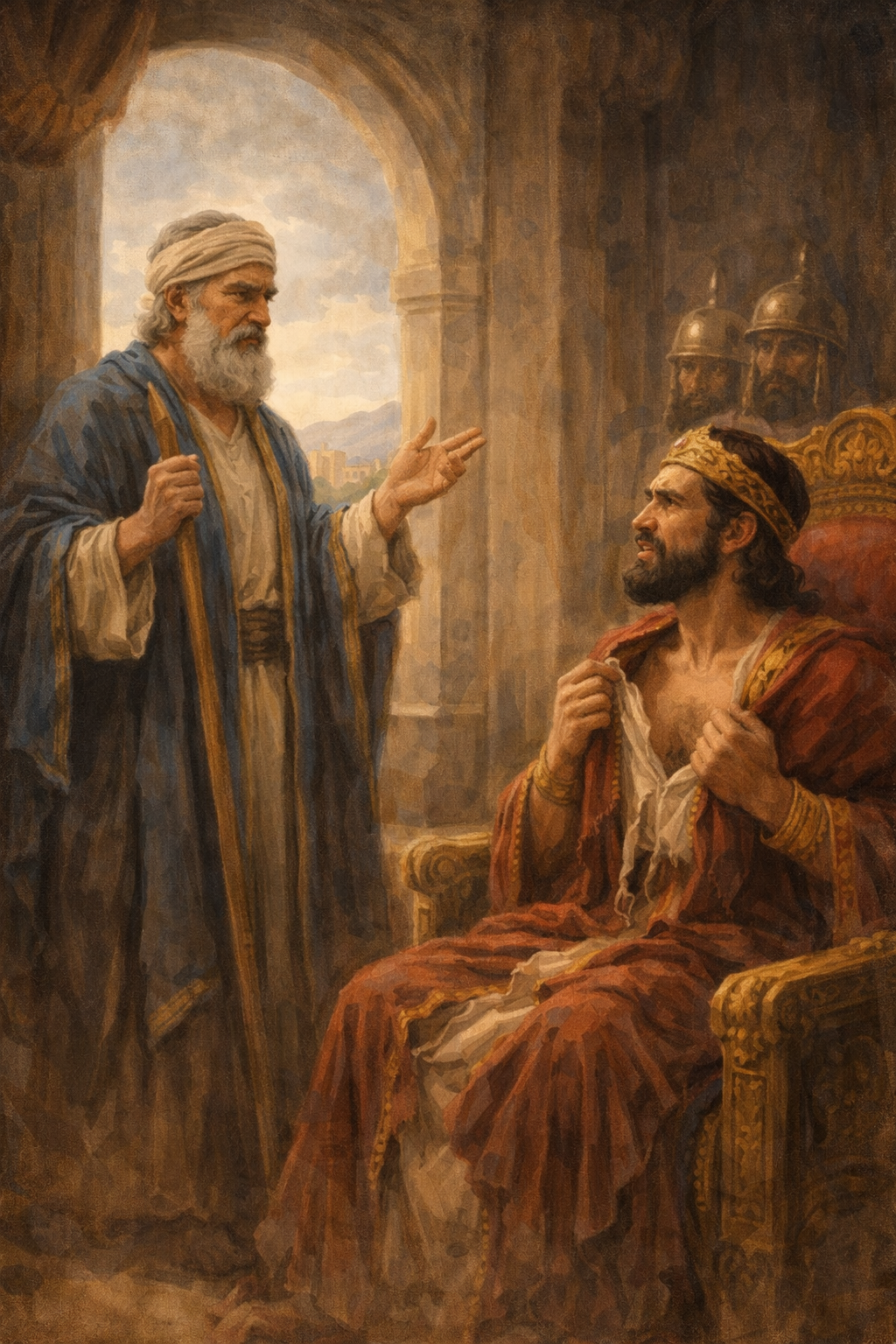
Elisha Sends Message to King
THE KING'S FEAR OF CONFLICT
THE PROPHET'S CONFIDENCE IN GOD
It happened - As we see throughout the Bible nothing "just happens", that is nothing happens by chance, for everything is orchestrated by the sovereignty of God as was this encounter between the man of God and the king.
John Butler adds that "Luck, chance, and accident are not valid terms or philosophies for the believer. (ED: nor the unbeliever for that matter!) The Word of God teaches Divine design in life’s events which should encourage the believer." (Elisha Miracle Prophet)
When Elisha the man of God heard that the king of Israel had torn (qara; Lxx - diarregnumi) his clothes - How had he heard? One might propose that Elisha was in touch with the affairs of the royal court and he heard of the king of Israel’s reaction. Alternatively, I submit Elisha was in touch with another royal court in Heaven and heard from God of this foreign visitor (cf 2Ki 5:26). So regardless of how he heard, Elisha's reaction was not one of distress as was King Jehoram's reaction. What's the difference? Elisha knows God and what He can do, while Jehoram does know God can heal (surely he knows the story of the Shunammite's son), but he does not know the One Who heals.
🙏 THOUGHT - It's like so many in America today, even in those who sit in pews on Sunday. They know ABOUT Jesus, but sadly they do not truly know Him and do not have a personal relationship with Him that affects their daily life (and more importantly, their eternal life)! To those who think they know Him but do not truly know Him, the tragedy of tragedies is they will claim Him as "Lord" but He will deny He knows them and sentences them to eternal punishment! (Mt 7:21, 22, 23).
That he sent word to the king, saying, “Why have you torn (qara; Lxx - diarregnumi) your clothes? - Elisha's question is not a request for information but a gentle rebuke wrapped in prophetic authority. The king’s torn clothes symbolize panic, guilt, and theological confusion for he assumed the request to heal Naaman was a political trap and implicitly confesses his helplessness. Elisha’s message exposes the problem that the king has interpreted the crisis politically instead of theologically. By tearing his clothes, the king acts as though Israel has no access to divine help. Elisha's question should have reminded him that God has not left His people without a witness. Elisha’s question re-centers the issue on God’s power, not royal power. Healing was never a king’s (even good kings) responsibility. Jehoram's reaction reveals a failure to remember the presence of a living prophet and therefore a living God in Israel. In effect, Elisha is saying, “Why despair as though God were absent?” Finally, the question prepares the way for revelation. The king’s fear becomes the stage for God’s glory, for Elisha immediately adds that Naaman should come to him “that he may know there is a prophet in Israel.” What looked like a national crisis is actually a divine opportunity not for diplomacy, but for testimony to the glory of Jehovah.
What looks like a threat
can become a testimony.
Now let him come to me, and he shall know (yada; Lxx - ginosko) that there is a prophet (nabiy; Lxx - prophetes) in Israel - No answer to Elisha's question is recorded, so either the king explained his clothes rending episode or God revealed it to him. In any event, Elisha requests an audience with Naaman the Aramean. Elisha does not seek self-promotion but God-exaltation. His ultimate purpose is that the Gentiles, Naaman and the king of Aram, would know there is a true God not just in Israel but in Aram. In short, the issue is not just about Naaman’s healing, but more importantly about God’s witness. Elisha desires that the pagan Gentiles would come to know (savingly) that the living God is present and active in His world, even when Israel’s own king has forgotten this truth.
TECHNICAL NOTE - He shall know (yada; Lxx - ginosko) that there is a prophet (nabiy) in the Septuagint (Lxx) is written as a command saying "Let Naiman, I pray thee, come (aorist imperative) to me, and let him know (ginosko in aorist imperative) that there is a prophet in Israel." Both yada and ginosko convey the idea of knowledge obtained by experience. Indeed, this "prophecy" by the prophet Elisha regarding "a prophet" would come to pass for the pagan Naaman through the divinely given words of the prophet Elisha would come to experience Yahweh's power and would come to truly know God as not just his physical Hearler, but more significantly as his spiritual Healer!
- LESSONS FROM ELISHA THE MAN OF GOD (2Ki 5:8-19)
- Elisha’s instructions to wash in Jordan River echoed in Jesus’s instructions to a blind man to wash in the pool of Siloam (John 9).
- Elisha’s attitude in this chapter was from beginning to end 1 of dignified loyalty to God.
- First in his message to the King who was filled with fear.
- Next his message to the wealthy leper calling for his submission/ humility.
- Next in his biblical confrontation with his servant. Where did you go Gehazi?
- And finally in his absolute refusal to take any personal reward for what had been brought about by God.
- LESSONS FROM GEHAZI THE LIAR (2Ki 5:20-27)
- Now we understand why 2Ki 5:5-7 talk about the money that was brought. The story is emphasizing healing can’t be obtained by influence or wealth.
- The important Commander must learn to receive it as a gift, in a humble, obedient, and believing spirit.
- But here, Gehazi robbed God of Glory by asking Naaman for gifts. The Syrians would now think that they had to pay for God to get His help.
- Gehazi became poor by becoming rich.
- *He ruined the message of grace by his sin.
- Gehazi received the leprosy of Naaman. And passed it down to his children.
- Gehazi is the sad counterpart of Judas.
- Like the traitor, he revealed the hardening effect that association with pure goodness may have on human conscience. [the bible says bad company corrupts...but we also sometimes see association with pure goodness sometimes hardens]
- In the bible leprosy is used as a picture of sin.
- Gehazi became a leper because of covetousness and deception.
- Miriam became a leper because of criticism and envy (Nu12).
- King Uzziah became a leper because of pride (2 Chron.26:16-23)
- If God did this to people today, would you be a leper?
- The hidden sins of the Spirit are dangerous.
- Now we understand why 2Ki 5:5-7 talk about the money that was brought. The story is emphasizing healing can’t be obtained by influence or wealth.
2 Kings 5:9 So Naaman came with his horses and his chariots and stood at the doorway of the house of Elisha.
- 2Ki 3:12 6:32 Isa 60:14 Ac 16:29,30,37-39

Note "Leprous" Rash on Naaman's Arm
NAAMAN'S PRIDE PAUSES
AT THE DOOR OF GRACE
So Naaman came with his horses and his chariots - At least King Jehoram has enough practical sense to send Naaman to Elisha. Imagine the imposing picture of this entourage of horses and chariots. Naaman's coming would signal the arrival of status, power, and self-importance, none of which would impress the man of God! As a high-ranking military commander, he comes the way important people come, with a display of visible strength including his horses and his chariots (note not just one chariot!). Naaman's arrival reminds me of David's words in Psalm 20:7 that "Some boast in chariots and some in horses, But we will boast in the name of the LORD, our God."
🙏 THOUGHT - Are you impressed by men's "horses and chariots," (folks who drive Bentleys, Mazzerattis, Porsches, etc) which are only fleeting manifestations of their passing earthly power and prestige (cf 1Jn 2:17, 1Co 7:31b, Jas 1:10,11)? Don't be, but remember you are destined to be a king who will reign on the earth! (Rev 5:10, Rev 1:6KJV, Rev 20:6). And be assured that our God is not impressed! This valiant warrior, Naaman, likely assumes that his greatness will be met with open arms by the lowly prophet and that his healing will proceed in a manner befitting his power and prestige. But God had no intention of accommodating his pride.
And stood at the doorway - It is important to note that Naaman does not even go inside of Elisha's house. There is a message here, for while Naaman is physically close to help, by being unwilling to humble himself and enter Elisha's simple abode, he demostrates that he is not yet ready to receive divine healing.
🙏 THOUGHT - What a striking contrast emerges between the humble posture of the Shunammite woman, who stood quietly in the doorway awaiting the prophet’s word (2Ki 4:15), and the prideful stance of Naaman, who stood at the doorway expecting recognition, ceremony, and treatment befitting his rank. One posture waits in faith while the other waits with demands. One stands receptive while the other stands resistant. Who do you identify with, dear reader—the one who waits humbly for God to speak, or the one who expects God to conform to your personal expectations? Do I approach God humbly and receptive to His word, or confidently certain of how He should act? When God’s answer comes in an unexpected form, do I submit or do I resent and resist it?
Of the house of Elisha - So we see the contrast between Naaman's grand arrival and the humble setting (Elisha’s simple house) which exposes a key theme that God is not impressed by status or stature. Naaman expects a dramatic reception (2Ki 5:11), but neither God nor his prophet will not cater to his grandiose desire.
Naaman pauses at the threshold, where
his pride delays what God's grace freely gives.
The verse pictures the truth that human greatness can bring a person to the threshold of God’s help, but only willingness to humble oneself will bring them into the bright light of His grace, for as James writes "God gives a greater grace. Therefore it says, “GOD IS OPPOSED (antitasso - present tense = continually arrays himself, as in battle, against...in this case proud men like Naaman - WOE!) TO THE PROUD, BUT GIVES GRACE TO THE HUMBLE.” (Jas 4:6). Naaman paused at the threshold, so that his pride delayed what God's grace desired to freely give.
James Bolick - SUBMITTING UNTO GOD 2 KINGS 5:1–4, 9–14
INTRODUCTION. The story of Naaman; the great general of the Syrian Army. He was a great man with his master—a mighty man of valor—a national hero; but—he was a leper.
As a leper, he was a type of the sinner, as leprosy in the Bible is a type of sin.
I. AS A LEPER HE LIKE THE SINNER WAS UNCLEAN. Lev. 13:44 cp. Ps. 14:3; Isa. 64:6; Rom. 3:13–18. HE WAS ALSO MARKED FOR DEATH. Cp. Rom. 6:23; Ezek. 18:4.
II. HE WAS AN AWAKENED LEPER—LIKE MANY AWAKENED SINNER.
A. Some of you have been awakened to the fact that you are a sinner.
B. When you hear the Word you have been awakened to the fact that you are lost. John 15:22–24.
III. HE WAS MISERABLE IN HIS CONDITION—SO IS THE CONVICTED SINNER.
A. He was soon to be shut out of his home—away from his loved ones. Forced to cry “unclean—unclean.” Lev. 13:45.
B. Sinner is miserable—when he really sees himself as God sees him. Note Prov. 13:15.
IV. HE WAS WILLING TO GO FAR AND DO MUCH TO BE CURED IN HIS OWN WAY. 2 Kings 5:5.
A. Letter from the king. v. 5.
B. 10 talents of silver
C. 6000 pieces of gold.
D. 10 suits of clothes.
E. Sinner is willing to do penance, good works in order to ride to heaven in the chariot of his own making. Note: Titus 3:5. Salvation by works is an impossibility. Rom. 4:3, 4, 13, 17–24. Rom. 10:10–13.
V. HE WAS DISSATISFIED WITH THE REMEDY PROPOSED. 2 Kings 5:10–12.
A. The great general was wroth—because he was humiliated. (He despised the muddy waters of Jordan) Cp. Matt. 18:3.
B. God’s way is the only way. John 14:6. “You are not favoring God—you are being favored.”
C. God’s way of salvation by Grace—
1. Strips the sinner of self-righteousness.
2. Lays bare his wicked heart.
3. Forces him to side with God—against himself. John 5:44.
VI. HE WAS SHUT UP TO ONE REMEDY.
A. It was dip in the Jordan or die. 2 Kings 5:10. Sinner it is believe or perish. John 3:18.
B. Others could plead with him—but could not dip for him. 2 Kings 5:13.
VII. HE SUBMITTED TO GOD’S WAY, 2 Kings 5:14.
“When the SINNER will do as GOD BIDS HIM DO—He will be SAVED. John 3:14, 15; Acts 16:30, 31, 34.
2 Kings 5:10 Elisha sent a messenger to him, saying, “Go and wash in the Jordan seven times, and your flesh will be restored to you and you will be clean.”
- sent a messenger: Mt 15:23-26
- wash: 2Ki 2:21 3:16 4:41 Joh 9:7 1Co 6:11
- seven times: Lev 14:7,16,51 16:14,19 Nu 19:4,19 Jos 6:4,13-16
- thy flesh: 2Ki 5:14 Ex 4:6,7
Related Passages:
John 9:6-7 When He had said this, He spat on the ground, and made clay of the spittle, and applied the clay to his eyes, 7 and said to him, “Go, wash in the pool of Siloam” (which is translated, Sent). So he went away and washed, and came back seeing.
Leviticus 13:1-6 Then the LORD spoke to Moses and to Aaron, saying, 2 “When a man has on the skin of his body a swelling or a scab or a bright spot, and it becomes an infection of leprosy on the skin of his body, then he shall be brought to Aaron the priest or to one of his sons the priests. 3 “The priest shall look at the mark on the skin of the body, and if the hair in the infection has turned white and the infection appears to be deeper than the skin of his body, it is an infection of leprosy; when the priest has looked at him, he shall pronounce him unclean. 4 “But if the bright spot is white on the skin of his body, and it does not appear to be deeper than the skin, and the hair on it has not turned white, then the priest shall isolate him who has the infection for seven days. 5 “The priest shall look at him on the seventh day, and if in his eyes the infection has not changed and the infection has not spread on the skin, then the priest shall isolate him for seven more days. 6 “The priest shall look at him again on the seventh day, and if the infection has faded and the mark has not spread on the skin, then the priest shall pronounce him clean; it is only a scab. And he shall wash his clothes and be clean.
Leviticus 14:7-9 “He shall then sprinkle seven times the one who is to be cleansed from the leprosy and shall pronounce him clean, and shall let the live bird go free over the open field. 8 “The one to be cleansed shall then wash his clothes and shave off all his hair and bathe in water and be clean. Now afterward, he may enter the camp, but he shall stay outside his tent for seven days. 9 “It will be on the seventh day that he shall shave off all his hair: he shall shave his head and his beard and his eyebrows, even all his hair. He shall then wash his clothes and bathe his body in water and be clean.
COMPLETE OBEDIENCE YIELDS
COMPLETE RESTORATION & CLEANSING
Elisha sent a messenger to him - Was this Gehazi? The text leaves him nameless. Notice that in sending his messenger Elisha does not grant Naaman the dignity of a personal greeting, which was guaranteed to insult Naaman's pride! The prophet is not impressed by Naaman's entourage and is unwilling in to show him honor. You wonder what this did to Naaman's pride? Clearly this was humbling to Naaman, who was accustomed to being honored.
Peter Leithert has a slightly different interpretation on why Elisha sends Gehazi to the door - When Naaman first arrives to see Elisha, Elisha speaks to him through his intermediary, Gehazi, another indication that Elisha’s house is the “temple site” to which the unclean cannot draw near. After Naaman is cleansed, Elisha permits him to come “before” him, into his presence (2Ki 5:15). As in the story of the Shunammite, the “doorway” (2Ki 5:9) is again a symbol of birth (as in Ge 18), foreshadowing Naaman’s rebirth. Turning to Yahweh makes him acceptable to God, able to come into the presence of Elisha to speak with the prophet of the Lord. Though dead in his leprous state, Naaman is made alive together with Christ. (See 1 & 2 Kings - Page 193)
COMMANDS FROM GOD
WITH PROMISES FROM GOD
Saying, “Go and wash in the Jordan seven times - Now comes the critical test of obedience. Just two commands. Simple. Uncomplicated. But to Naaman they were humbling and beneath him. Besides, the Jordan River was muddy and unimpressive compared to the clear rivers of Syria (2Ki 5:12).
God chooses what is ordinary and even offensive to human pride to show that healing comes by submission to His Word, not superiority of a river. The issue was not water quality but "faith quantity," and would he obey? It would not be washing by the water of the river that would heal him but washing by the water of the Word! (Eph 5:26) The number seven signifies completeness and divine sufficiency (see Lev 14:7-9). Naaman must submit fully, not partially. One dip would show curiosity but seven dips requires perseverance in trust, even when nothing changes the first 6 times. One is reminded of the orders to Joshua to march around Jericho 7 times and with full obedience the city fell just as God had promised (Jos 6:13-16).
SEVEN IN 1-2 KINGS - 1Ki. 2:11; 1Ki. 6:6; 1Ki. 6:38; 1Ki. 7:17; 1Ki. 8:65; 1Ki. 11:3; 1Ki. 16:15; 1Ki. 18:43; 1Ki. 20:29; 2Ki. 3:9; 2Ki. 4:35; 2Ki. 5:10; 2Ki. 5:14; 2Ki. 8:1; 2Ki. 8:2; 2Ki. 8:3; 2Ki. 11:21; 2Ki. 24:16
And your flesh will be restored to you and you will be clean (cf. Lev 13:6, 17, 23, 28, 37, 39)- Elisha's faith is in the Word he received from God. If the seven fold condition is met, Naaman would receive the two fold promise, physical restoration and spiritual cleansing. Leprosy made Naaman ceremonially unclean and God’s promise addresses both body and soul.
Ray Dillard sums this up and applies it to the gospel - ‘Wash in the Jordan and be cured of leprosy.’ What a preposterous idea! I can’t think of anything more ridiculous! Well, maybe one thing is more ridiculous—the idea that putting your trust and faith in a man executed on a cross almost two thousand years ago can give you a renewed life now, forgiveness from sin, resurrection from the dead, and eternal life. Now that beats all! (Faith in the Face of Apostasy)
Iain Provan compares the similarities of the miracle with the Shunammite woman and Naaman beginning with the number seven, a "numerical link...with the story of the Shunammite woman in 2Ki 4:8–37, whose son, in the course of his “healing,” sneezed seven times (Hb. šeḇaʿ peʿāmîm, 2Ki 4:35). This is by no means the only link between these two narratives. Both involve Elisha, Gehazi and a “great” person in need (cf. “great [NIV’s well-to-do] woman” in 2Ki 4:8; “great man” in 2Ki 5:1); in both, intermediaries interpose themselves between the prophet and the great person (2Ki 4:11–16, 25–27; 2Ki 5:9–12, 19–22), though with varying results; in both, we find question and answer concerning whether all is well, with the answer disguising the truth (2Ki 4:26; 5:21–22); in both, the king and the commander of the army appear as the epitome of wealth and power (2Ki 4:13; 5:4–12). (See 1 & 2 Kings)
Tim Grissom - In his book The Secret Place of Thunder, author John Starke observes: “Our culture teaches us that the most important things about us are what can be performed before others. Jesus, on the other hand, teaches us that the most important things about us are practiced in secret.”
We give up a great deal trying to go public with our obedience when Jesus prefers it to be an intimate connection between Him and ourselves.
Naaman didn’t understand this. Here was a man with a serious problem, but he wanted a certain kind of solution to it … something flashy and newsworthy. The kind of ordeal that podcasts and miniseries are made of.
But the solution God offered him through the prophet Elisha wasn’t flashy at all, just … simple: “Go and wash in the Jordan [river] seven times, and your flesh shall be restored, and you shall be clean” (2 Kings 5:10 ESV).
Simply obey a simple command. That’s all Naaman had to do. Accept it and be healed, or try to turn it into a spectacle and keep the leprosy.
And, like Naaman, if we truly want to be freed and healed, we will need to move into the quiet place of simple obedience. (Simple Obedience)
Vance Havner - The Seventh Dip
Naaman was an able captain in the Syrian army, in good standing with King Ben-hadad, but he was a leper. When he took off his decorations at night and looked at his decaying body, his military glory departed. He came to Elisha to be healed and that man of God did not even come out to meet him but simply commanded, "Go and wash in Jordan seven times" (2 Kings 5:10). Naaman lost his temper, "Dip in Jordan, that dirty creek! We have Abana and Pharpar in Syria!" (cf. v.12). His companions persuaded him to give it a try, but when he had gone down and up six times there was no sign of a miracle. They might have begun to wonder whether their captain had been "taken" by a false prophet. But on the seventh dip Naaman's flesh became as the flesh of a child!
Faith must be
followed by obedience.
The miracle happened at the end of complete obedience. If the blind man sent by Jesus to the pool of Siloam, his eyes covered with mud, had not felt his way down the street in simple obedience, he would have died a blind man. John McNeill preached about this incident and shouted to his congregation, "Aye, and some of you have had the mud applied again and again, you have heard sermon after sermon, but you've never done the next thing and you're blinder than you ever were before!" Faith must be followed by obedience.
Philip, the evangelist, fresh out of great meetings in Samaria, might have seen no point in walking a desert road, but there was a eunuch down that road who needed to be saved. Complete obedience brought the miracle! When God bids you dip in Jordan, wash in Siloam, or walk a desert trail, the victory lies at the end of that venture. When God says, "Go!" that is not a suggestion but a command!
P G Matthew - Go, wash yourself seven times in the Jordan . . . and you will be cleansed.—2 Kings 5:10
The Lord of Israel will never heal an arrogant sinner who thinks he is better than others. In God’s view, there is only one class of sinners: the worst class. Whether publican or Pharisee, the Jewish Saul or the Syrian leper Naaman, every sinner must repent and believe in Jesus Christ. No proud sinner will ever be saved unless he first humbles himself and trusts in Christ alone.
In 2 Kings 5, we read that Naaman came to Elisha with his own view of salvation. Asserting that he was a “first-class” sinner, he thought he should come through a different gate than others. He wanted a more dignified gospel, not the gospel of the cross. No, Naaman. You must surrender totally to God’s way of salvation.
God had to humble the arrogant Naaman. So instead of sending Elisha personally to greet him, he sent Elisha’s servant Gehazi with the following message: “Mr. Naaman, it is clear that you are a leper. Here is the cure for your leprosy. Go down to the Jordan River—not to the rivers of Damascus, which you think have cleaner water—and immerse yourself in the Jordan seven times, and you will be healed.”
Naaman was offended because Elisha did not give him preferential treatment. In fact, he almost missed his healing because of his pride. His wise servants, though, persuaded him to heed the prophet’s counsel. And so he humbled himself, went to the Jordan, and stripped off his regalia, displaying his leprosy for all to see. He immersed himself in the muddy waters of the Jordan seven times, according to the word of the man of God. Where there is obedience, there is faith. Where there is faith, there is obedience. And as he obeyed, Naaman was cured of his leprosy.
If we seek salvation our own way, whether in materialism, philosophy, science, good deeds, or in any other religion, we will not find it. Jesus Christ alone is Savior. “Salvation is found in no one else, for there is no other name under heaven given to men by which we must be saved” (Acts 4:12).
I urge you, do not be offended by the gospel and die in your sins. Follow Naaman into the river Jordan. Call upon the name of the Lord, and be washed clean.
2 Kings 5:11 But Naaman was furious and went away and said, “Behold, I thought, ‘He will surely come out to me and stand and call on the name of the LORD his God, and wave his hand over the place and cure the leper.’
- Naaman: Pr 13:10 Mt 8:8 15:27 Lu 14:11
- went away: Pr 1:32 Mt 19:22 Joh 6:66-69 13:20 Heb 12:25
- Behold: Pr 3:7 Isa 55:8,9 Joh 4:48 1Co 1:21-25 2:14-16 3:18-20
"I WANT HEALING"
BUT "MY WAY"
But (dramatic term of contrast) Naaman was furious and went away and - Naaman's reaction exposes the real disease is not the skin but the heart pride as shown by his angry reaction. shaped by expectation—and explains why God’s simple command offended him. Naaman expected personal attention and public honor. When Elisha did not come out himself, Naaman felt insulted. His fury shows that the issue is no longer leprosy but self-importance.
What offended Naaman was not the
difficulty of obedience, but its simplicity.
Warren Wiersbe quoting Dr. Donald Grey Barnhouse, “Everybody has the privilege of going to heaven God’s way or going to hell their own way.” The Lord had already been working on Naaman’s pride, and there was more to come. King Joram wasn’t able to heal him, the prophet didn’t come to court or even come out to greet him, and he had to dip in the dirty Jordan River, not once, but seven times. And he a great general and second in command over the nation of Syria! “Ah, that is just the trouble,” said evangelist D. L. Moody when preaching on this passage. “He had marked out a way of his own for the prophet to heal him, and was mad because he didn’t follow his plans.” Is it any different today? People want to be saved from their sins by participating in a religious ritual, joining a church, giving money to the church, reforming their lives, doing good works, and a host of other substitutes for putting faith in Jesus Christ. “Not by works of righteousness which we have done, but according to his mercy he saved us” (Titus 3:5). (Bible Exposition Commentary)
Christ sends none away empty
but those who are full of themselves.
—Donald Gray Barnhouse
Said, “Behold (hinneh; Lxx - idou), I thought Sometimes we can over think things. Naaman in his pride had already scripted how God should work. When Elisha's method did not match his imagination, disappointment turned to rage. Naaman was willing to be healed, but just not on God’s terms. His anger reveals how close someone can be to blessing and still walk away because of unwillingness to submit and obey. One wonders how many people in hell will have come so close to eternal life only to refuse it and turn away?
Adrian Rogers (page 55) on I thought - Naaman tried to substitute human reason for obedience....He had it all figured out, how it ought to be done: “I thought.” And God said one thing, and he substituted his human reasoning for God’s Word. And how foolish we are! Friend, when we read something in the Bible and it’s a plain command of God, whether we understand it or not, we ought to obey it. The Bible is not first and foremost a book to be explained; it is first and foremost a book to be believed and obeyed. And, dear friend, whether you understand it or not, when God says it, you just simply obey it. And don’t substitute human reasoning for obedience.
Doesn't this prophet know
who I am?
He will surely come out to me and stand and call on the name of the LORD his God, and wave his hand over the place and cure the leper - Naaman mentions 4 steps (come out, stand, call, wave). Naaman expected a dramatic ritual culminating in Elisha standing and invoking the LORD’s Name, simultanesously performing a hand waving. Naaman’s expectations reflect pagan assumptions about healing including incantations, gestures, and spectacle.
Dale Ralph Davis on what Naaman "thought" would occur - Naaman had already written God’s script for him. He expected a regular piece of ancient Near Eastern faith-healing complete with all the shouting and razzle-dazzle.10 He wanted something more entertaining than a mere word of promise. We are not so far from Naaman. How often we already have our idea of how God ought to operate. When he doesn’t mesh with our expectations, we become ‘disappointed’ with God. (Borrow 2 Kings: The Power and the Fury page 90)
Naaman's reaction reminds me of Paul's words in 1Co 2:14 "But a natural man does not accept the things of the Spirit of God, for they are foolishness to him; and he cannot understand them, because they are spiritually appraised." Ultimately, the only way Naaman would truly understand Elisha's unusual "spiritual prescription" for healing was by the Spirit opening his mind to understand. The work of the Spirit was just as necessary in the OT as in the NT (cf Jn 3:5-8)
David Guzik - Naaman had it all figured out. In his great need, he anticipated a way God would work, and he was offended when God didn’t work the way he expected.
Naaman needed to hear the words of Yahweh in Isaiah long before Isaiah ever penned it.
Isaiah 55:8-9 For My thoughts are not your thoughts, Nor are your ways My ways,” declares the LORD. 9 “For as the heavens are higher than the earth, So are My ways higher than your ways And My thoughts than your thoughts.
🙏 THOUGHT - God does not negotiate His wisdom to accommodate human pride. Naaman’s rage (2Ki 5:11–12) was the emotional backlash of a man discovering that God’s ways did not conform to his expectations. Pride must descend—be humbled—before the will of God can be received. Healing came only when Naaman surrendered his pride and embraced God’s way, when he stopped reasoning and began obeying. To obey is better than sacrifice (1Sa 15:22)
C H Spurgeon - “I was telling myself: He will surely come out, stand and call on the name of the LORD his God, and wave his hand over the place and cure the skin disease.”
Preconceived ideas of what ought to be the Lord’s mode of action are injurious, even to those who have true faith in God, and yet they are frequently indulged. We map out beforehand the path of providence and the method of his mercy, forgetting that the Lord’s footsteps are not known. When the Lord does not choose to act according to our notions, we cry, half indignantly, “I thought he would surely act otherwise.” This folly is seen in believers sometimes in reference to their way to heaven. They are like the children of Israel when they came out of Egypt; there is a straight road to Canaan—why are they not allowed to take it? Instead, they are led round about; their course is in turn progressive, retrograde, and standing still—to the right and to the left, forward and retreat. Does not providence often perplex us and run counter not only to our wishes but also to our deliberate judgment? That which seems to be the best does not happen to us, while that which appears to be distressingly injurious overtakes us. Our forecasts do not come true, our daydreams are not realized, and our schemes for life are not carried out. We have ventured to propose such inquiries, but we have not been able to answer them; it is as well that we should not, for our business is not the solution of problems but the performance of precepts. Let us cease from our own wisdom and leave all arrangements in the hand of our heavenly Father. Our thoughts are vanity; his thoughts are precious.
C H Spurgeon - ‘I thought’
‘I thought.’ 2 Kings 5:11
There are a great many things which men can discover, and the inventiveness of the human mind about earthly things appears to have scarcely any limit; but, with regard to heavenly things the natural man has not the faculty of discerning, never made a discovery yet and never will. Whatever is known of God is made known by God. Upon the face of nature the existence of God is written, but we look in vain for any indication of a plan of salvation. Jesus alone is the Saviour; how can you imagine that his way of saving can be known to men except as he has revealed it? I will ask you a question. Suppose you were sick of a mysterious and fatal disorder and a skilful physician was recommended to you, would you expect to foresee that physician’s mode of action? Would you go to him and then hesitate to accept his advice because it was contrary to what you had supposed it would be? If so, I can only say that you must be very foolish to go to a physician at all. Why not heal yourself? Your case is complicated, and here is a surgeon who, by long experience and wonderful skill, has acquired power to deal with your disorder. Do you insist upon it that he shall only operate as you approve? Is he to use knife, lancet, band and splint at your dictation? If so, you had better dispense with him and call in a nurse who has never studied the art, but is quite able to do your bidding, for you are surgeon to yourself. Unconverted friend, your case is one in which you cannot help yourself, and none but Jesus can save you. How can you expect to invent for yourself a plan of salvation? You are bidden to become Christ’s disciple—do you expect to know more than your Master? Are you to teach him, or is he to teach you?
R E Neighbour - Hindrances to Deliverance
"But Naaman was wroth, and went away, and said, Behold, I thought, He will surely come out to me, and stand, and call on the name of the LORD his God, and strike his hand over the place, and recover the leper" (II Kings 5:11).
Just as satan hinders a sinner from getting saved so does he hinder a saint from getting victory. The children of Israel were God's covenant people, but they were dwelling in Egypt. God wanted them to dwell in Canaan. That was the land of their heritage. Pharaoh sought in every way to keep them back. He refused to let them go, and finally when they were delivered under the mighty hand of God, he pursued them to bring them back, or else to destroy them in the way.
No man has ever sought deliverance from his sinful self life that satan did not try to block the way. Let us follow the hindrances in Naaman's case to get some helpful lessons as to satan's tactics in the present day.
1. Naaman sought help from man. He tried all the doctors, all the means that Syria afforded. How do we know? We know, because we know the ways of man. The woman who was diseased sought to the physicians, and was none better. Of course, there are diseases that the physicians can help; there are also some they cannot help. There are some things that man can do, in deliverance from carnal self. We grant it. But how impotent is man to bring a full deliverance from the sinful self.
Not only did Naaman seek help from man, in Syria, but he also sought help from man in Israel. He went to the king, instead of to the Prophet. The king rent his clothes. How helpless was he to deliver Naaman. Neither can man, sinner nor saint, impart to the struggling saint or sinner, the healing they need.
2. Naaman sought help from means. He looked to his presents, his splendid changes of garments, his silver and his gold, his position, and his power, to help him on to victory. Poor man. How useless were all of these. They could not get him anywhere with God. The Christian may try in vain to substitute gifts, and service, and splendor of array, for simple faith in God — but he will not thus get victory.
3. Naaman sought help from methods. He said: "The Prophet will come down and rub his hands over the leper." Let us throw such conceptions to the winds. Why should we dictate to God how things should be done? Why tie the Holy Spirit down to channels of our choosing? Men, means, methods — let them all be gone. What we want is Christ. What we want is power Divine. The touch of the hand of God.
Os Hillman - SIMPLY OBEY 2 KINGS 5:11
Naaman was an army general who needed healing from leprosy. A young servant girl suggested that the prophet Elisha could heal him. He followed her advice, and Elisha sent a message to him to do the following: “Go, wash yourself seven times in the Jordan, and your flesh will be restored and you will be cleansed” (2 Kings 5:10).
Like many of us, Naaman expected God to perform his miracle through Elisha in a dramatic and “religious” way. The instructions that came instead must have seemed ridiculous to him. Sometimes we fail to recognize that God can work through a simple act of obedience that may seem unrelated to our problem.
God told Joshua to walk around Jericho seven times to win the battle. Jesus put mud on a man's eyes to heal his blindness. Peter was told to catch a fish to find the money to pay his taxes.
Sometimes in order to receive a breakthrough from God, we need to change our diet or go see a doctor to see a change in our health. Sometimes we need to change the way we are doing our work to get a breakthrough in our careers.
Samuel the prophet told King Saul that obedience is better than sacrifice. He was right. Learning to listen to the Lord and following His instructions are the keys to success in life with God. Sometimes God chooses the dramatic, and sometimes He chooses the ordinary. In either case, both are miracles because God is the God over all creation.
Ask Him what steps you are to take for your breakthrough.
2 Kings 5:12 “Are not Abanah and Pharpar, the rivers of Damascus, better than all the waters of Israel? Could I not wash in them and be clean?” So he turned and went away in a rage.
- better: 2Ki 5:17 2:8,14 Jos 3:15-17 Eze 47:1-8 Zec 13:1 14:8 Mk 1:9
PRIDE PREFERRED
WATER IN ARAM
Are not Abanah and Pharpar, the rivers of Damascus, better than all the waters of Israel? - This statement exposes his national pride, misplaced logic, and resistance to God’s authority. From a human standpoint, he is right: the rivers of Damascus were larger and cleaner than the Jordan which could be muddy and unimpresive. His reasoning shows a common spiritual error of judging God’s instructions by natural superiority instead of divine authority. What matters is not which water is better, but what is the word from God.
Warren Wiersbe “He thought his healing would come from the water, so it was logical that the better the water, the better the healing. He would rather have his own way and travel over a hundred miles than obey God’s way and go thirty-two miles! He was so close to salvation and yet so far away! (Bible Exposition Commentary)
Could I not wash in them and be clean?” Notice that he fails to mention the two part promise of restoration and cleansing. Elisha had promised that the leprosy will be healed (2Ki 5:10), but Naaman heard only that the waters of the Jordan will “cleanse” him (2Ki 5:12). Naaman's question shows that he believes cleansing is his idea, his method (not necessarily 7 times), his choice (not the Jordan but one of the rivers of Syria). He wants the result God promised without the obedience God required. This is the heart of the issue: substituting our preferred way for God’s commanded way.
In effect, Naaman was willing to keep his leprosy rather than obey the terms laid out by God. In his mind, the words of the prophet were absurd and demeaning.
So he turned and went away in a rage. Naaman said in effect it's my way or I'll hit the highway! Naaman was so close but this story shows how easily pride can turn proximity into distance. Rage is the emotional outburst of entrenched self-will when God refuses to conform to human expectations. It erupts when pride collides with divine sovereignty, when the heart insists on its own terms and resents a God Who will not be manipulated, impressed, or negotiated with.
David Guzik - Because his expectation of how God should work was crushed, Naaman wanted nothing to do with Elisha. If the answer was in washing in a river, Naaman knew there were better rivers in his own land.
God’s command confronted Naaman's pride, because true cleansing comes only by trusting and obeying what God says, even when it offends one's sense of superiority.
Phillip G Ryken - Similarly, many people object to the particularity of Christianity. “Why can’t we be saved through some other religion?” they wonder. The answer is that God saves us on his terms, not ours, and the way he has chosen to save us is through the life-giving sacrifice of his Son, and no other way. And yet, like Naaman, many skeptics criticize the narrowness of the gospel.(2 Kings)
ABANA [ăbˊə nə] (Heb. ˒aḇānâ; Q ˒amānâ; cf. RSV mg., KJV mg. “AMANA”). A river in Syria, now called the Barada. From its Anti-lebanon sources the Abana flows south and southeast toward Damascus. Near ancient Abila (a town in Abilene, about 27 km. [17 mi.] west of Damascus) the spring ˓Ain Fijeh joins it to double its size. Then the river runs through a gorge to the Ghutah plain, where it divides into seven main branches and a few smaller ones. The city of Damascus arose amid the fields and gardens of this extremely fertile, well-irrigated plain, near the edge of the much-traveled Syrian desert. When Elisha told the Syrian commander Naaman that seven washings in the Jordan river would cure his leprosy, Naaman exclaimed: “Are not Abana and Pharpar, the rivers of Damascus, better than all the waters of Israel? Could I not wash in them, and be clean?” (2 Kgs. 5:12). Perhaps Naaman was thinking not only of the clearness of the Syrian rivers but also of their sacredness to his fellow countrymen. (Borrow Erdman's Bible Dictionary)
Robert Morgan - 2 Kings 5:1-14 - See All to Jesus: A Year of Devotions - Page 346
Aren't Abana and Pharpar, the rivers of Damascus, better than all the waters of Israel? Could I not wash in them and be clean? 2 Kings 5:12
General Naaman of Syria was a great warrior, but he was a leper and there wasn't a doctor in Damascus who could help him. A little Israeli servant girl in his household—we don't know her name—recommended he consult the prophet Elisha, who, in turn, sent him to dip seven times in the Jordan River. Naaman was disgusted. "Aren't my hometown rivers better than all the waters of Israel?" he asked. But he went anyway, and his skin was restored like that of a child.
The Chickamauga is a river in North Georgia, and it's also a battlefield. The Battle of Chickamauga was fought between the Army of Tennessee and the Army of the Cumberland in September of 1863, and some historians say that it represented the last real opportunity for the Confederacy to win the Civil War. There were thirty-five thousand casualities and more than four thousand fatalities. The ironic thing is that Chickamauga is a Cherokee word. It means, literally, "the River of Blood."
If we want forgiveness and everlasting life, we have to go to God's Chickamauga—the River of Blood—and there we can wash away our guilt and stain.
O Fount of grace redeeming,
O River ever streaming,
From Jesus' wounded side.
—From an ancient Latin hymn
2 Kings 5:13 Then his servants came near and spoke to him and said, “My father, had the prophet told you to do some great thing, would you not have done it? How much more then, when he says to you, ‘Wash, and be clean’?”
- his servants: 2Ki 5:3 1Sa 25:14-17 1Ki 20:23,31 Job 32:8,9 Jer 38:7-10
- My father: 2Ki 2:12 6:21 13:14 Ge 41:43 Mal 1:6 Mt 23:9 1Co 4:15
- how much rather: 1Co 1:21,27
- Wash: 2Ki 5:10 Ps 51:2,7 Isa 1:16 Joh 13:8 Ac 22:16 Eph 5:26,27 Tit 3:5 Heb 10:22 1Pe 3:21 Rev 7:14
ANOTHER ANONYMOUS
SERVANT "SAVES THE DAY!"
Then his servants came near and spoke to him and said - It is deeply ironic that Naaman’s skin is quite literally saved (pun unavoidable) through the faithful witness of two servants: first, a solitary Israelite girl, and then his own Aramean servants, both of whom perceive what the powerful commander initially cannot. This appeal from Naaman’s servants is the final turning point in the story, revealing how their humble counsel exposed pride and rescued their master from self-destruction. It is clear that God is using these servants in this drama of redemption and that too would be somewhat humbling -- for the second in command of Aram to listen to his own servants! One recalls the words of God in Isaiah 1:18 "Come now, and let us reason together,” Says the LORD."
My father, “My father”is striking. It is a term of respect, affection, and gentle authority. Instead of confronting Naaman harshly, they lower his defenses. Wisdom often reaches proud hearts through humility, not force.
The humble have once again exhibited
more insight than the exalted.
-- Iain Provan
Had the prophet told you to do some great thing, would you not have done it? - There logic is simple and accurate. They point out that Naaman (a valiant warrior) was willing to attempt something difficult, costly, or heroic, but stumbled over something simple and humbling. This reveals a human tendency in all of us for we tend to prefer impressive acts over submissive obedience! Had Elisha asked Naaman to do something great, he would have capitulated and that would only increase his pride problem. It's like I always tell my students "K.I.S.S." - "Keep It Simple Stupid!" Simpe and yet humbling!
Warren Wiersbe quips that "When Naaman told his story back in Syria and got to this point, his friend would say, “You did what?” Faith that doesn’t lead to obedience isn’t faith at all." (Bible Exposition Commentary page 686)
David Guzik - Thank God for faithful subordinates who will speak to their superiors in such a way. Naaman was obviously angry, yet they were bold enough to give him the good advice he needed to hear. The servants of Naaman used a brilliantly logical approach. If Elisha had asked Naaman to sacrifice 100 or 1,000 animals to the God of Israel, Naaman would have done it immediately. Yet because his request was easy to do and humbling, Naaman first refused.
Donald Wiseman - The aim (dip 7 times) was to teach him humility and faith. A great man may expect some great thing (v. 13, NRSV, REB ‘something difficult’) while God often tests us with small things. (See 1 and 2 Kings: An Introduction and Commentary - Page 222)
How much more then - If Naaman would obey a hard command (as from his king), how irrational is it to reject an easy one? What does he have to lose. The servants reveal (without actually saying it) that the issue is not effort, but pride. God’s command threatens Naaman’s ego and even his standing before those under him. But here those under him actually encourage him. Did they truly believe a seven dip act would heal his skin? The text does not say. Personally, I doubt it, and I rather see their willingness to boldly speak up as being energized behind the scenes by the Holy Spirit. Had they not spoken up, Naaman would not have dipped and been saved. God, Author of salvation, makes sure he dips (in my opinion).
When he says to you, ‘Wash, and be clean’?” The servants rightly refocus attention on the prophet’s word, not the method. They are absolutely correct that the healing is attached to obedience to what Elisha spoke from the LORD, not to the impressiveness of the act. So here we see that God sometimes uses the voices beneath us to correct what pride blinds us to. Naaman’s healing nearly failed not because of leprosy, but because his pride resisted being humbled. God used humble servants with no status to save a powerful man from himself. The words of the servants saving Naaman remind me of the words of a humble donkey who God used to save Balaam from being killed by the Angel of the LORD (Nu 22:27-31)!
🙏 THOUGHT - Whose voice have I been tempted to dismiss simply because it comes from someone “beneath” me in status, age, or experience? Has pride ever caused me to resist a simple act of obedience because it felt beneath my dignity? Do I evaluate counsel by who gives it or by whether it aligns with God’s Word? In what areas of my life might God be speaking through unexpected or overlooked people? Could my spiritual growth be stalled not by ignorance, but by an unwillingness to humble myself?
C H Spurgeon - A serious remonstrance 2 Kings 5:13
It is a sad discovery the unbeliever makes when he feels that his self-righteousness has vanished, and all his fair white linen is suddenly turned to masses of spiders’ webs, to be swept away. But what must be the fate of such a man at the bar of God? I think I see the King coming in his glory, and the last tremendous morning dawn. When the King sits on his glory-throne, where are the self-righteous? Where are they? I cannot see them. Where are they? Come, Pharisee, come and tell the Lord that you did fast twice in the week, and then was not even as the Tax-collector! There sits the Tax-collector at the right hand of the judge! Come and say that you were cleaner and more holy than he! But where is the wretch? Where is he? Come here, you proud and ostentatious ones, who said you had no need to be washed in the blood; come and tell the Judge so; tell him he made a mistake; tell him that the Saviour was only needed to be a make-weight and assistant to those who could help themselves! But where are they? Why, they were dressed so finely; can those poor, naked, shivering wretches be the boasting professors we used to know? Yes. Hear them as they cry to the rocks to fall on them and the hills to cover them, to hide them from the presence of the great Judge whom in their lifetime they insulted by putting their poor merits in comparison with the boundless wealth and merit of Christ’s blood. May it never be your lot nor mine to commit the blasphemy of preferring the labour of our hands to the handiwork of Christ.
2 Kings 5:14 So he went down and dipped himself seven times in the Jordan, according to the word of the man of God; and his flesh was restored like the flesh of a little child and he was clean.
- went down: Job 31:13 Pr 9:9 25:11,12 Eze 47:1-9 Zec 13:1 14:8
- according to: 2Ch 20:20 Joh 2:5 Heb 11:7,8
- his flesh: 2Ki 5:10 Job 33:25
- and he was clean: Lu 4:27 5:13 Titus 2:14
Related Passages:
Matthew 18:3 and said, “Truly I say to you, unless you are converted and become like children, you will not enter the kingdom of heaven.
Hebrews 11:7-8 (NOTE THAT GENUINE FAITH OBEYS) By faith (TRUST) Noah, being warned by God about things not yet seen, in reverence prepared an ark (OBEDIENCE) for the salvation of his household, by which he condemned the world, and became an heir of the righteousness which is according to faith. 8 By faith (TRUST) Abraham, when he was called, obeyed (OBEDIENCE) by going out to a place which he was to receive for an inheritance; and he went out, not knowing where he was going.
Titus 2:14 (JESUS) Who gave Himself for us to redeem us from every lawless deed, and to purify (katharizo - THOROUGHLY CLEANSE) for Himself a people for His own possession, zealous for good deeds.
James 4:10 Humble yourselves in the presence of the Lord, and He will exalt you.
2 Kings 4:35 Then he returned and walked in the house once back and forth, and went up and stretched himself on him; and the lad sneezed seven times and the lad opened his eyes.
1 Kings 18:43-45 He said to his servant, “Go up now, look toward the sea.” So he went up and looked and said, “There is nothing.” And he said, “Go back” seven times. 44 It came about at the seventh time, that he said, “Behold, a cloud as small as a man’s hand is coming up from the sea.” And he said, “Go up, say to Ahab, ‘Prepare your chariot and go down, so that the heavy shower does not stop you.’” 45 In a little while the sky grew black with clouds and wind, and there was a heavy shower. And Ahab rode and went to Jezreel.

Note Naaman's Skin has Cleared So this
Must be the Seventh Dip!
DOWN, DOWN, DOWN
PRIDE IS HUMBLED
So he went down - The direction down is more than physical for it also symbolize Naaman's humbling submission. Naaman does not simply comply outwardly but he relinquishes control. His physical descent into the Jordan mirrors his spiritual descent from pride, and healing follows his humble opedience. Note his obedience is in a sense two fold - he had to first go down to the Jordan and secondly, he had to dip (but since it was 7 times, one might say he had to obey 7 times!).
The way to rise in the kingdom is to descend
and humility is that ladder.
And dipped (tabal; Lxx - baptizo) himself seven times in the Jordan - What is interesting is the paradox that in the NT we are called to be baptized but that is after we believe (See Baptism in NT)! Naaman is called to "baptize" (tabal; Lxx - baptizo) himself in order to be cleansed! Naaman complies, demonstrating his complete obedience. Don't miss the important truth -- Genuine faith obeys. If he had said I believe 7 dips will cure me but he failed to obey, or said "Six should suffice" there would have been no healing. Partial obedience would have meant total failure. Won't it be interesting to ask him someday, how were you feeling when those first six dips brought no visible change in your skin? As noted above, seven signifies fullness and completion. Naaman obeys exactly as instructed, not partially or symbolically. Faith is not just intellectual, but results in unhesitating obedience to God’s Word. (See James 2:14-26 on faith without works does not work!).
🙏 THOUGHT - Naaman is an excellent illustration of the vital association of faith and obedience. (see discussion of "obedience of faith" in Ro 1:5, Ro 16:26) Some teachings today, even in evangelical circles, say if you simply "believe" in Jesus, you are clean forever, regardless of whether or not you subsequently demonstrate any fruit of repentance (cf Mt 3:8). Some call this the deadly teaching of easy believism. This genre of teaching is also similar to what is taught in so-called free grace theology. BEWARE! (Acts 17:11). The old hymn is still the best theology - "Trust AND obey, for there is no other way to be happy in Jesus but to Trust AND obey!" May the church of Jesus Christ not depart from "the ancient paths, where the good way is, and walk in it and...find rest for (their) souls," as depicted in the hymn Trust AND obey (Jer 6:16). In Jesus' Name. Amen.
According to the word of the man of God - This is key. It grounds the miracle on the authority of God's Word, not on the water or the method. The Jordan had no inherent healing power. The number seven had no healing power. The cleansing happened because Naaman submitted to God’s spoken Word and obeyed the commands delivered through Elisha. Naaman simply trusted and obeyed!
Pride nearly kept Naaman from
what obedience freely gave him.
Iain Provan makes an excellent point - Healing has not come via a semi-magical wave of the prophetic hand (2Ki 5:11). It has been delivered by the living LORD, at a distance from the prophet. It is the directness of God’s action that has convinced Naaman of God’s reality—and it was necessary to take him to the Jordan if he was to experience that directness. Ambiguity would have remained, had Elisha been involved. (See 1 & 2 Kings - Page 37)
David Guzik - Naaman did exactly what Elisha told him to do. Therefore we can say that each dunk in the Jordan was a step of faith, trusting in the word of God through His prophet. Spurgeon saw Naaman attacked by two enemies: Proud Self, who internally demanded that Elisha come out and see him, and Evil Questioning, who questioned why he should wash in the Jordan when he had better rivers back in his homeland. Naaman overcame these two enemies and did what God told him to do.
Naaman ‘plunged’ in the River Jordan.
This signified total obedience to the divine word.
--Wiseman
Peter Leithert Naaman’s “dipping” in the Jordan is the effective ritual sign of this change of status. Just as the washings of the Levitical system cleanse from various forms of defilement, so Naaman is cleansed and brought near through washing. Because he is a Gentile, Naaman’s baptism is a particularly apt sign of Christian baptism, which marks out a new community of worshipers in which the distinction of Jew and Gentile is utterly dissolved (Gal 3:26–29). Naaman shows an admirable grasp of the implications of his baptism. Having been baptized, he realizes that he is exclusively devoted to Yahweh and promises to worship no other gods (2Ki 5:17). (See 1 & 2 Kings - Page 193)
CAVEAT - Although one might say Naaman was "saved by baptism" it should be clearly understood that water baptism as practiced in the New Testament does not save a person. According to Scripture, salvation is by grace through faith in Jesus Christ alone not by any work, ritual, or outward act, including baptism (Eph 2:8-9) Water baptism is an important act of obedience, but it is not the means of salvation. It is a public declaration of the inward reality that a person has already been saved by faith in Christ.
And his flesh was restored like the flesh of a little child This descripion is of physical healing, but as Naaman soon testifies, he has experienced spiritual healing. This is total renewal not merely cured skin, but a new heart. What disease had destroyed, God completely renewed. Does not that statement like the flesh of a little child conger up the image of being born again (Jn 3:5,7)? And I think in the context, Naaman was in effect "born again," although of course not like we are in the New Testament, because he did not receive the indwelling Spirit. One is reminded of Jesus' words in Mt 18:3 "Truly I say to you, unless you are converted and become like (little) children, you will not enter the kingdom of heaven."
Naaman was not healed because the river was powerful;
he was healed because God honors humble obedience.
D. L. Moody quipped “He lost his temper; then he lost his pride; then he lost his leprosy; that is generally the order in which proud rebellious sinners are converted.”
And he was clean (taher; Lxx - katharizo) - Leprosy made Naaman ceremonially unclean. God's Word made him clean, restoring him physically and socially. Spiritually he was not restored but renewed, made brand new, similar to what happens to New Testament believer, Paul writing "if anyone is in Christ, he is a (BRAND) new creature; the old things passed away; behold, (BRAND) new things have come." (2Co 5:17). Notice the fact that Elisha was not even present when the miraculous cleansing occurred which further emphasize the truth that all the credit, all the glory, goes to Yahweh, the Healer, Jehovah Rapha. The use of katharizo for clean recalls the true of 1Jn 1:7 where John writes "if we walk in the Light as He Himself is in the Light, we have fellowship with one another, and the blood of Jesus His Son cleanses (katharizo - present tense - continually cleanses) us from all sin." Hallelujah!
In summary, God’s cleansing comes not through status, logic, or effort, but through trusting and obeying what He has spoken, and God does not merely patch what is broken but He makes it brand new.
Dipped (02881) tabal means to physically dip, as a priest would dip his fingers, a live bird, cedar wood, hyssop, and scarlet yarn into blood for various ceremonies (Lev. 4:6, 17; 9:9; 14:6, 51). A clean person was to dip hyssop in water and sprinkle it for purification on unclean persons or things (Nu 19:18).
TABAL - 16V - Gen. 37:31; Exod. 12:22; Lev. 4:6; Lev. 4:17; Lev. 9:9; Lev. 14:6; Lev. 14:16; Lev. 14:51; Num. 19:18; Deut. 33:24; Jos. 3:15; Ruth 2:14; 1 Sam. 14:27; 2 Ki. 5:14; 2 Ki. 8:15; Job 9:31
Ralph Alexander - TWOT - The verb conveys the immersion of one item into another: bread in vinegar (Ruth 2:14), feet in water (Joshua 3:15), a coat in blood (Genesis 37:31). baptō is the common LXX rendering of this root.
"Dipping" is employed in Israel's religious ritual of cleansing. (See 1 Samuel 14:7 for dipping in the literal sense). In the sin offering, whereby the sinner's (individual or national) iniquity is atoned, the priest dips his finger into the blood of the sacrificial animal and sprinkles it before the veil or places it upon he altar's horns (Leviticus 4:6, 17; Leviticus 9:9). The sinner is identified with the animal's blood shed as a representation of the death paid for the sin. Hebrews 9:19-22 draws on this figure of cleansing by blood. Similarly, blood was placed on the doorposts at Passover, representing the lamb's blood shed substitutionally for the first born (Exodus 12:22). Identification is also conveyed in the cleansing ritual for lepers (Leviticus 14:6, 16, 51; 2 Kings 5:14) and the dead (Numbers 19:18). Hyssop, or the priest's finger, is dipped in water or oil, cleansing agents, and sprinkled upon the unclean object to identify it as cleansed.
Job 9:31 employs the root to represent Bildad "plunging" Job into the filthy pit of accusations. Blessing is depicted by "dipping" one's feet in oil (Deut. 33:24; cf. Job 29:6). (See online Theological Wordbook of the Old Testament)
Clean (cleanse, purify) (02891) taher commonly refers to ritual purity or cleanness in the OT. In fact except for Job 37:21 and Mal 3:3, taher almost exclusively of ritual or moral purity. To be clean, be pure, innocent, righteous. To make clean, purify. To be cleansed Taher is the antonym of the Hebrew word "tame" (unclean) Those who contracted impurity, tame', were not permitted to participate in the rituals until they were purified (ev 22:4-7). Disqualification might be due to afterbirth (Lv 12:7, 8) or other bodily discharges (Lev 15:13). Priests were to be medical examiners to determine when lepers were 'cleansed" (Lv 14:8ff.). In the first use in (Gen 35:2) we read "So Jacob said to his household and to all who were with him, “Put away the foreign gods which are among you, and purify yourselves and change your garments;
Taher is translated in Septuagint with the verb katharizo which means literally to thoroughly cleanse for sacred use or figuratively of ritual cleansing, making levitically clean, as foods. It was used of of healing of diseases that render ceremonially unclean, as leprosy cleanse, make ritually clean.
"And a leper came to Jesus, beseeching Him and falling on his knees before Him, and saying, “If You are willing, You can make me clean (katharizo).” 41 Moved with compassion, Jesus stretched out His hand and touched him, and *said to him, “I am willing; be cleansed (katharizo).” (Mk 1.40-41)
Iain Provan - Various NT themes are evoked here, all clustering around the question of conversion. New birth is required to see the kingdom of God (John 3:1–8), which is inhabited by little children (those who humbly serve) and not by the great or the wealthy (Matt. 18:1–5; 19:13–15; Mark 9:33–37; 10:13–16; Luke 9:46–48; 18:15–17). The rite of passage into new life is a washing that makes one truly clean (Rom. 6:1–5; 1 Cor. 6:11; Col. 2:11–15; Titus 3:4–7). Naaman embodies new life, and Gehazi embodies the old, crying “LORD, LORD” (2Ki 5:20) while his actions reveal where his heart really lies (Mt. 6:19–24; 7:21–23). From this point of view, Jehoram’s words about life and death in relation to Naaman (2Ki 5:7) begin to look prophetic.(See 1 & 2 Kings)
R E Neighbour- Naaman 2 Kings 5:14
We wish to discover from the Word of God three things concerning Naaman, the captain of the host of Syria. These three things will come under the general theme and key verse of the whole lesson. As we study, let us remember that he that exalteth himself, shall be abased, but he that humbleth himself shall be exalted.
1. Naaman's pride. Naaman was a great man with his master, and he was honorable. He was also a mighty man of valor. As captain of the host of Syria, he had proven himself a victorious leader. We grant that all of this might be true, without Naaman's being overwhelmed with pride.
However, the very method of approach as Naaman came to Elisha manifested his proud spirit. He came with his horses and with his chariots and stood at the door of Elisha. He came saying within himself, "The Prophet will surely come out unto me and wave his hands over the place and recover the leper."
The Prophet, however, refused even to see Naaman. He sent Gehazi out saying, "Go and wash in Jordan seven times."
The pride of Naaman is seen again in his sarcastic reference to the muddy waters of the Jordan.
Naaman's servants knew of his pride for they said unto him, "My father, if the Prophet had bid thee do some great thing, wouldest thou not have done it?"
2. Naaman's humiliation. "Then went he down, and dipped himself seven times in Jordan." This was indeed a perfection of humility because it was "seven times." Naaman had to learn that the only way to get up is to get down; that the way to live is to die; that the way to be exalted is to be abased.
If the sinner wants to get to God, he must humble himself. God's choicest fruit never hangs on the high limbs. It hangs low; it can be plucked easier from one's knees than from his feet.
3. Naaman exalted. After the captain of Syria's hosts had dipped himself — had gone down seven times into the Jordan, the Lord healed him, and his flesh became again like unto the flesh of a little child, and he was clean.
No wonder that Naaman magnified the God of Israel, no wonder he said, "There is no god in all the earth like unto Him."
He who wants God's blessing must be willing to lie low in humility before the Lord.
Jack Hayford - Steps of Obedience 2 Kings 5:14
Naaman would not have known anything about God’s healing power had it not been for an Israelite girl serving in his household. One day she told his wife of Jehovah God’s willingness to heal his leprosy. He went to visit the prophet Elisha, and health was given to him as he took the steps of obedience the prophet prescribed. And thus, a pagan general became a worshiper of Jehovah (2 Kings 5:17–19).
Believers do well when they recognize both the saving and healing power of Jesus. God knows how to deal with each person. Naaman was instructed to dip seven times in the Jordan River, and this displeased him. His human brashness and hidden pride surfaced, but his obedience and submission opened the way to health.
The commands of the Lord are so simple and attainable! As He instructed the Israelites in the wilderness to “look and live” (Num. 21:8) to receive their healing, so here the command is simply “wash and be clean.”
F B Meyer - 2 Kings 5:14—Like unto the flesh of a little child
Is there any fabric woven on the loom of time to be compared in perfect beauty to the flesh of a little child, on which, as yet, no scar or blemish can be traced? So sweet, so pure, so clean. It was a wonderful combination, that the strong muscles and make of the mighty man of war should blend with the flesh of a child. But this may be ours also, if we will let the hand of Jesus pass over our leprous-smitten souls. At this moment, if you let Him, He will touch you and say, “Be clean,” and immediately the leprosy will depart, and you will return to the days of your youth—not forgiven only, but cleansed—not pardoned only, but clad in the beauty of the Lord your God, which He will put on you.
We do not count a little child to be free from the taint of sin. It is conceived in sin, and inherits the evil tendencies of our fallen race. Its innocence of evil is not holiness. Jesus gives us more than innocence, He makes us pure and holy. But there are other childlike qualities which our Savior gives. The humility of a little child, who is unconscious of itself, and who is not perpetually looking for admiration. The unselfishness of a little child, who seeks its companion to share its luxuries and games. The trust of a little child, which so naturally clings to a strong and loving heart, willing to follow anywhere, to believe in anything. The love of a little child, who responds to every endearment with sunny laughter and soft caresses.
There is a great difference between childish and childlike. The former is put away, as we grow up into Christ: the latter we grow into, as we become more like our Lord. The oldest angels are the youngest: the ripest saints are the most childlike.
2 Kings 5:15 When he returned to the man of God with all his company, and came and stood before him, he said, “Behold now, I know that there is no God in all the earth, but in Israel; so please take a present from your servant now.”
- he returned: Lu 17:15-18
- now I know: 2Ki 5:8 Jos 2:9-11 9:9,24 1Sa 17:46,47 1Ki 18:36 Isa 43:10,11 Isa 44:6,8 45:6 Jer 10:10,11 16:19-21 Da 2:47 Da 3:29 Da 4:34 Da 6:26,27 Ro 10:10
- a blessing: Ge 33:11 1Sa 25:27 2Co 9:5
Related Passages:
Luke 17:15-18 (ONE GRATEFUL HEALED LEPER) Now one of them, when he saw that he had been healed, turned back, glorifying God with a loud voice, 16 and he fell on his face at His feet, giving thanks to Him. And he was a Samaritan. 17 Then Jesus answered and said, “Were there not ten cleansed? But the nine–where are they? 18 “Was no one found who returned to give glory to God, except this foreigner?”
Daniel 3:29 “Therefore I make a decree that any people, nation or tongue that speaks anything offensive against the God of Shadrach, Meshach and Abed-nego shall be torn limb from limb and their houses reduced to a rubbish heap, inasmuch as there is no other god who is able to deliver in this way.”
Daniel 4:34 “But at the end of that period, I, Nebuchadnezzar, raised my eyes toward heaven and my reason returned to me, and I blessed the Most High and praised and honored Him Who lives forever; For His dominion is an everlasting dominion, And His kingdom endures from generation to generation.
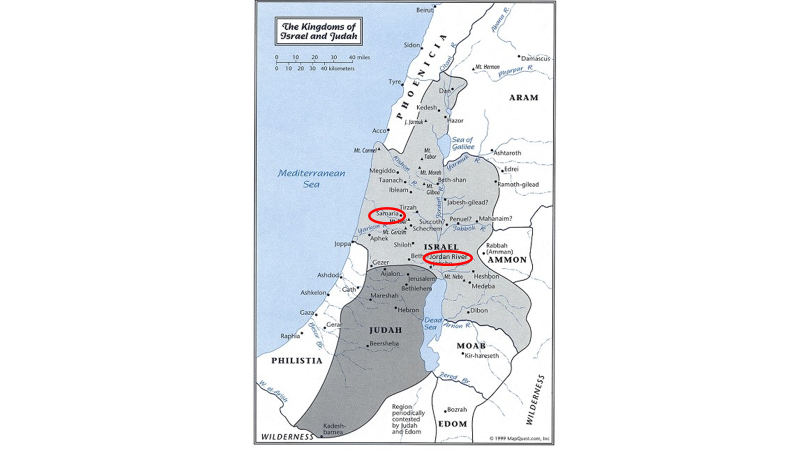
Naaman's journey from Samaria to Jordan River
NAAMAN'S CONFESSION
OF GOD
When he returned to the man of God with all his company - Note the map above identifying Samaria and the Jordan River. It is easy to miss the phrase when he returned which shows Naaman's effort to obey Elisha's command, for his entourage first had to travel at least 30 miles from Samaria to the Jordan River. After dipping and being restored, he turned around and returned to Elisha's house in Samaria. The point is that Naaman had to make a choice of his will to go to the Jordan River (this was the beginning of his faith which was demonstrated in action) and after his healing he chose to return and give thanks. Why? Yes, externally he had clear skin, but now internally he had (in my opinion from the context) a circumcised heart (see circumcision of the heart). Earlier, Naaman stood at the doorway in pride, but now he comes back intentionally in gratitude and humility. His faith and obedience had produced not only healing, but reorientation, for he returned with a grateful heart to acknowledge Yahweh, not to demand anything from Elisha.
In front of all his company underscores the public nature of Naaman's confession, which in effect is what Christian baptism symbolizes (a public confession of Christ). Naaman is no longer concerned with appearances or national pride. He is willing for his entourage to witness his declaration of loyalty to Yahweh, showing that true faith is not ashamed to be seen (cf Mt 10:33, 2Ti 2:12)
And came and stood before him, he said, “Behold (hinneh; Lxx - idou) now, I know (yada; Lxx - ginosko) that there is no God in all the earth, but in Israel - Behold (hinneh; Lxx - idou) signifies Naaman is calling for everyone to listen up and hear what he has to say. It is a remarkable statement for a Gentile military commander. This is not mere politeness or theological flattery, but is proclamation of exclusive allegiance to Yahweh. Naaman moves from believing God can heal to confessing Yahweh Alone is God. The miracle has accomplished its deepest aim, revelation leading to faith (cf Ro 10:17), and faith transforming Naaman into a new man who we will one day meet in Heaven. Oh, the conversations we can look forward to! And think about the irony of this idol worshiper renouncing all false gods and idols of Syria. What an indictment his testimony was against the idol-worshiping King Jehoram and most of the Israelites in the northern kingdom.
Dale Ralph Davis points out regarding Naaman's confession - Would that Elisha could have gotten more Israelites to believe that! King Ahaziah (read 2 Kings 1:3, 6, 16) never could get it into his head. But here is an Aramaean who declares the only true God exists in Israel. (Borrow 2 Kings: The Power and the Fury page 88)
One is reminded of the idol worshipping pagans in Thesslonica who "turned to God from idols to serve a living and true God (PERFECT ILLUSTRATION OF REPENTANCE EVEN AS NAAMAN HAD EXPERIENCED), 10 and to wait for His Son from heaven, whom He raised from the dead, that is Jesus, who rescues us from the wrath to come." (1Th 1:9-10)
Recall Elisha's earlier prophecy (2Ki 5:8) predicting that Naaman would come to know (yada; Lxx - ginosko) by experience that there is a prophet (nabiy; Lxx - prophetes) in Israel. Now by extension, Naaman does come to know (yada; Lxx - ginosko) that not only is there a prophet in Israel, but more importantly, that there is a living and true God Who is over all the earth.
David Guzik - This was a fine display of gratitude. Naaman was like the one leper out of the ten Jesus healed who came back to thank Jesus (Lk 17:12-19). He was also a foreigner, like the one thankful leper of Luke 17. Before, Naaman expected the prophet to come to him. Now he returned to the man of God and stood before him. Now I know that there is no God in all the earth, except in Israel: It wasn’t just the healing that persuaded Naaman of this. It was the healing connected with the word of the prophet. Together, this was convincing evidence to Naaman that the God Elisha represented was the true God in all the earth.
God’s grace cannot be bought,
but gratitude graciously responds.
So (term of conclusion) please take a present from your servant ('ebed; Lxx - doulos - see note) now - Clearly, Naaman is not attempting to purchase favor, for he has already received favor. In the ancient world, gifts were expressions of gratitude, and by offering Elisha a gift, Naaman is acknowledging that he has received something priceless—far more valuable than any material offering—and therefore wishes to bestow a token of his gratitude. Gratitude is warranted, but gifts are not given as payback (cf Lk 17:12-19). Notice also that to substantiate the fact that Naaman is indeed a “new man,” he demonstrates his newly acquired humility by willingly submitting himself to Elisha and calling himself his servant ('ebed; Lxx - doulos)
Doulos speaks of submission to one's master. In the New Testament the doulos had no life of his own, no will of his own, no purpose of his own and no plan of his own. All was subject to his master. The bondservant's every thought, breath, and effort was subject to the will of his master. In sum, the picture of a bondservant is one who is absolutely surrendered and totally devoted to his master.
🙏 THOUGHT - Did you notice the dramatic change in the Naaman's mode of addressing Elisha? Five times in 2Ki 5:15-18 he now refers to himself as Elisha's servant (2Ki 5:15, 17, 18)! Talk about a changed man compared to 2Ki 5:11,12! That's the power of the good news he had received, a foreshadowing of the good news of the Gospel of Jesus Christ. Dear reader, if you claim to be a follower of Christ and yet have failed to experience radical changes in your thinking and behavior (not perfection, but at least direction) (cf 2Co 5:17), then you need to read and heed 2Cor 13:5 "Test (peirazo - present imperative) yourselves to see if you are in the faith; examine (dokimazo - present imperative) yourselves! Or do you not recognize this about yourselves, that Jesus Christ is in you–unless indeed you fail the test?"
In summary, the verse means that Naaman’s healing led to genuine faith, public confession, and grateful devotion. He returns not as a proud general, but as a humbled worshiper, declaring that the God of Israel alone is God—and worthy of allegiance and gratitude.
Warren Wiersbe - It was natural for him to want to reward Elisha, but had the prophet accepted the gift, he would have taken the credit to himself and robbed God of glory. God saves us “to the praise of the glory of His grace” (Eph. 1:6, 12, 14). He also would have given Naaman, a new convert, the impression that his gifts had something to do with his salvation. Abraham had refused the gifts from the king of Sodom (Ge 14:17–24), Daniel would refuse the king’s offer (Da 5:17), and Peter and John would reject Simon’s money (Acts 8:18–24) (Bible Exposition Commentary page 686)
John Butler - After being a recipient of a tremendous gift of healing, he wanted to show his gratitude. When God does a work of grace for a person, miserliness is not one of the fruits; but generosity is. Stingy givers indicate they may lack the real thing in their hearts. (Elisha Miracle Prophet)
2 Kings 5:16 But he said, “As the LORD lives, before whom I stand, I will take nothing.” And he urged him to take it, but he refused.
- As the Lord: 2Ki 3:14 1Ki 17:1 18:15
- I will take : 2Ki 5:20,26 Ge 14:22,23 1Ki 13:8 Da 5:17 Mt 10:8 Ac 8:18-20 Ac 20:33-35 1Co 6:12 10:32,33 2Co 11:9,10 12:14
ELISHA REFUSES GIFT
FROM NAAMAN
But (term of contrast) he said, “As the LORD (Jehovah - Yahweh) lives, before whom I stand This is Elisha's solemn declaration of accountability to God. Elisha locates his ministry in God’s presence (before whom I stand), not before kings, generals, or benefactors. He is reminding Naaman (and the reader) that his loyalty and service are willingly, unconditionally rendered to (and would be rewarded by) the living LORD, and was not motivated by desire for earthly honor or reward. The miracle was not a service rendered, but a gift freely given by God.
I will take nothing - Elisha's refusal safeguards the essence of grace which means bestowal of unmerited favor. Naaman has just confessed exclusive faith in the God of Israel (2Ki 5:15). If Elisha accepted payment, it could leave the wrong impression that healing, and God’s favor, could be purchased. Elisha refuses so there is no possiblity of confusion of the truth that what God gives by grace cannot be bought by men. Elisha didn’t want Naaman to leave thinking he had paid God. He wanted him to leave knowing God had paid everything.
Elisha protected God’s reputation
by refusing man’s reward.
And he urged him to take it, but he refused - Elisha’s continued refusal heightens the contrast (especially the contrast soon to be seen with his servant Gehazi!) Naaman wants to respond according to normal cultural expectations of exchange. Elisha models integrity, removing even the appearance of profiteering. By refusing the gift, he ensures that God Alone receives the glory, and that Naaman’s faith rests on truth, not obligation. This recalls the words of Psalm 115:1 "Not to us, O LORD, not to us, but to Your name give glory cecause of Your lovingkindness, because of Your truth."
Iain Provan - He refuses to accept any gift; for that is to trade in Naaman’s old currency. It is the living LORD, and not Elisha, Who must take center stage. Naaman’s (See 1 & 2 Kings - Page 37)
John Butler - Elisha wants to make it emphatic to Naaman that the blessings of God are of grace. We cannot buy them. It is a lesson man has a hard time learning, but one that is vital to learn. Elisha, as a prophet, certainly had material needs and would have been helped by these gifts. But Elisha’s refusal of the gift shows that the spiritual well-being of Naaman was more important than Elisha’s material well-being. It is more important that Naaman learn of grace than that Elisha improve his bank account! This does not teach us that we should turn down every gift, as Elisha certainly did not; for he accepted a guest room and other gifts at other times. But it teaches us that there are times when we must refuse gifts because of the possible adverse effects it will cause to receive the gift. Paul also refused gifts at times because receiving them could have done spiritual harm (2 Corinthians 11:8, 9). But to refuse a gift like this requires great spirituality—something which many ministers, churches, and religious colleges do not have. Some are more interested in the well-being of their coffers than the well-being of their converts. Accepting gifts can condone sin and cause the givers to draw erroneous conclusions about their ways, such as Oral Roberts gleefully accepting a million dollar gift from a dog track owner. Elisha really demonstrates character here. Too bad his servant, Gehazi, did not pay attention. (Elisha Miracle Prophet)
In summary, God’s saving power is freely given, never sold, and true servants of God refuse anything that might compromise God's grace or obscure His glory. (unlike the prosperity gospel preachers)
The Reformation began partly when Martin Luther objected to the Roman Catholic practice of selling indulgences, an abuse that implied God’s forgiveness and favor could be purchased, negotiated, or mediated by human transaction. Luther rightly discerned that such practices obscured the gospel itself, for God’s means of grace are never for sale. Grace, by definition, is God’s free and sovereign gift, received by faith alone and never earned by money, merit, or ritual. Whenever human systems attempt to attach a price, a performance, or a preferred method to divine blessing, the gospel is no longer grace but commerce, and salvation is subtly shifted from God’s mercy to human control.
“How could you accept silver or clothes?” 2 Kings 5:15–27 - Dianne Matthews - Drawing Closer to God: 365 Daily Meditations on Questions
My husband and I had decided to stop and see what the inside of a casino looked like; now I couldn’t wait to get out. It wasn’t quite like what the billboards with the smiling models had portrayed. The background music combined with the rhythmic noises of the slot machines to create a hypnotic beat. Countless rows of people sat holding their change on their laps, staring at the machines as if hypnotized, all hoping to strike it rich.
Gehazi saw a chance to strike it rich when his master refused to accept a gift from Naaman. After Elisha left, Gehazi pretended that Elisha had changed his mind and asked for seventy-five pounds of silver and two sets of clothes.
Naaman, filled with gratitude for being healed of a serious skin disease, insisted on giving twice as much silver.
As soon as Gehazi hid the plunder, Elisha questioned him. “I didn’t go anywhere,” Gehazi lied. But Elisha exposed Gehazi’s deception and greed.
“How could you accept silver, clothes, olive orchards, vineyards, sheep, cattle, or slaves? Naaman’s skin disease will cling to you and your descendants permanently!”
The Bible warns us to fight against the temptation to try to get something for nothing and the desire to want what we don’t have. Greed is included in a list of sins to avoid in Romans 1:29 and many other passages. Since our culture constantly bombards us with the pressure to buy, we must always be on our guard. Always wanting more keeps us from enjoying what we already have. God wants us to learn to be content with what he provides for us. Once we adopt that attitude, we’ll understand that we’ve already struck it rich.
He told the people, “Be careful to guard yourselves from every kind of greed.” Luke 12:15
Ask yourself: Does my attitude reflect greed or contentment with what God provides?
2 Kings 5:17 Naaman said, “If not, please let your servant at least be given two mules’ load of earth; for your servant will no longer offer burnt offering nor will he sacrifice to other gods, but to the LORD.
- of earth: 2Ki 5:12 Ro 14:1
- will no longer offer burnt offering Ac 26:18 1Th 1:9 1Pe 4:3
Related Passages:
Exodus 20:24 ‘You shall make an altar of earth for Me, and you shall sacrifice on it your burnt offerings and your peace offerings, your sheep and your oxen; in every place where I cause My name to be remembered, I will come to you and bless you.
NAAMAN RENOUNCES IDOLATRY
AND PLEDGES ALLEGIANCE TO YAHWEH
Naaman said, “If not, please let your servant at least be given two mules’ load of earth - Here Naaman voices a conscience-bothering concern to Elisha. His knowledge of God is still limited, and his request reveals a sincere but immature faith. Naaman’s request reflects an ancient, superstitious worldview that associated specific deities with specific lands (e.g., Chemosh in Moab, Rimmon in Aram). To leave a land, therefore, was to leave that god behind. Naaman now believes that the LORD is uniquely the God of Israel and thus desires soil from Israel so that, back in Syria, he may worship the LORD on ground he associates with Yahweh.
Naaman does not yet fully grasp the very truth he had just declared in 2Ki 5:15, that the LORD is God of all the earth, not bound to geography. Any dirt in Aram is still God's dirt! What Naaman does correctly understand is that the LORD Alone is worthy of worship.
In addition, one wonders what Naaman would say when others—perhaps even the king—ask what this soil represents. Would he explain that it testifies to his newfound faith in the God of Israel? I will leave the answer to that question blank: ________!
For your servant ('ebed; Lxx - doulos - see note) will no longer offer burnt offering ('olah) nor will he sacrifice to other gods, but to the LORD - He renounces polytheism outright. Naaman's request shows a decisive break with idolatry. Naaman clearly states that he will no longer offer sacrifices to other gods, but only to the LORD. This is the heart of the verse. The soil is not magical; it is a symbol of exclusive allegiance. His loyalty has shifted permanently.
James Rosscup writes "Naaman resolves to honor God alone with burnt offerings (17). Genuine prayer with consuming the whole offering each new time would involve devoting the sacrificing life itself anew entirely to the Lord, Naaman could without hypocrisy respect Syrian religious forms in courtesy to others. But he would worship only God in his heart in public and in private. An example of God’s servant honoring Him even amid duties to others opposing Him is Obadiah (1Ki 18:3, 4, 13). This principle is also true of Daniel (Da 6:10), Nehemiah for a time (Neh 2:1–4) and Esther. (Exposition of Prayer)
🙏 THOUGHT - Naaman's committment to Yahweh reminds us that God values direction more than perfection. Naaman is moving away from idols and towards the living God, even if he still carries assumptions shaped by his former worldview. God's grace does not wait for flawless theology, but as seen in tis story, welcomes humble obedience even in seed form.
John Butler adds "He suddenly has convictions in an area which previously did not seem to him as wrong. One wonders about those who claim to be saved, but whose convictions do not seem to change much. However, lack of change may verily indicate lack of conversion." (Elisha Miracle Prophet)
Note that again Naaman calls himself Elisha's servant, signifying his humility and submission. The proud general who once raged at God’s command now speaks as a worshiper who wants to live faithfully, even if imperfectly.
The verse highlights an important biblical principle: God receives sincere faith even when one's understanding is still developing (CALLED PROGRESSIVE SANCTIFICATION - WE ARE ALL WORKS IN PROGRESS!). Naaman’s grasp of God’s omnipresence (not restricted to the land of Israel!) will mature, but God honors the direction of his heart now. What matters most is not his perfect theology, but his genuine repentance, repentant loyalty and obedient intent.
🙏 THOUGHT - Naaman teaches us that old worldviews (OR HABITS) do not vanish instantly. Genuine conversion is often followed by gradual transformation and clarification, not instant comprehension. God always honors the heart that repents and turns toward Him, even when that person's understanding is incomplete (I'm still learning after 40 years of walking with Jesus!) Where might my faith still be shaped by assumptions from my former way of thinking (AND HABITS)? How patient am I with others whose faith is sincere but still immature?
Sanctified Dirt - Michael Heiser 2 Kings 5:17
Elisha’s healing of Naaman the leper, commander of the army of the king of Syria, is a familiar story to many (2 Kgs 5:1–27). Naaman hears that Elisha, the prophet of Israel, can heal him, so he makes the trip. When the two meet, Elisha tells him rather dismissively that he needs to take a bath in the Jordan River. Naaman doesn’t take this well and prepares to go home. At the behest of some servants, he consents to dip himself in the Jordan. He is miraculously healed by the simple act. The display of power, so transparently without sacrifice or incantation, awakens Naaman to the fact that Yahweh of Israel is the true God. Here’s where the story usually ends in our telling, but that would result in the omission of one very odd detail—what Naaman asks to take back home.
In 2 Kings 5:15–19 the elated Naaman returns to Elisha and begs him to take payment for healing him. Elisha repeatedly refuses. Finally, before embarking for Syria, Naaman makes a strange request: to load two mules with dirt to take back with him.
Dirt? I can think of a few favors I would ask of a prophet in a receptive mood, but dirt certainly isn’t one of them. The request is so odd that it’s hard to avoid wondering if Naaman needed some other kind of therapy. Why would he ask for dirt?
But Naaman was completely in his right mind. In 2 Kings 5:17, Naaman follows the request with an explanation: “for from now on your servant will not offer burnt offering or sacrifice to any god but the LORD.” The dirt and Naaman’s new allegiance to the God of Israel are related. Naaman was a man with significant duties in his home country. He couldn’t stay in Israel, but he could take Israel with him. Why would he want to?
The dirt which is Yahweh’s domain
is holy ground.
Naaman’s unusual request stems from the ancient—and biblical—conception that the earth is the locale for a cosmic turf war. Naaman wanted dirt from Israel because Israel was Yahweh’s territory. The dirt which is Yahweh’s domain is holy ground.
The idea of “holy ground” is an important element of Israelite theology. This phrase is used when Moses is in the presence of the Angel of the LORD and the God of Israel at the burning bush (Ex 3:1–5+) and when Joshua meets the Angel of the LORD (Josh 5:15). More broadly, the idea derives from Deuteronomy 32:8–9 (compare Deut 4:19–20), where we learn that when God divided up the nations at the Tower of Babel, they were allotted to “the sons of God.”2 The nations of the world were, in effect, disinherited by Yahweh as His own earthly family. Immediately after Babel, Yahweh called Abraham and the nation of Israel was created. Israel was therefore “Yahweh’s portion” (Deut 32:9), whereas all the other nations belong to the sons of God whom Israel was forbidden to worship. As a result, Israel was holy ground; the territory of every other nation was not. The rest of the Old Testament is the story of God’s intention to reclaim every nation on earth.
Elisha understood Naaman’s request and granted it without hesitation. He knew the request came from a sincere theological change of heart. Naaman believed that “There [was] no God in all the earth but in Israel” (2 Kgs 5:15) and wanted to return to his homeland with holy ground. Even though he would still have to help his aged king bow before Rimmon, Naaman wanted Elisha to know his heart belonged only to the God of Elisha.
Dale Ralph Davis notes that "Others have engaged in soil transport. After the American Revolution, Lafayette ‘carried home with him a quantity of American soil sufficient for a grave, and was buried in it when he died in 1834’ (borrow Barbara Tuchman, The First Salute [New York: Alfred A. Knopf, 1988], 292).
2 Kings 5:18 “In this matter may the LORD pardon your servant: when my master goes into the house of Rimmon to worship there, and he leans on my hand and I bow myself in the house of Rimmon, when I bow myself in the house of Rimmon, the LORD pardon your servant in this matter.”
KJV In this thing the LORD pardon thy servant, that when my master goeth into the house of Rimmon to worship there, and he leaneth on my hand, and I bow myself in the house of Rimmon: when I bow down myself in the house of Rimmon, the LORD pardon thy servant in this thing.
NKJ "Yet in this thing may the LORD pardon your servant: when my master goes into the temple of Rimmon to worship there, and he leans on my hand, and I bow down in the temple of Rimmon-- when I bow down in the temple of Rimmon, may the LORD please pardon your servant in this thing."
NET May the LORD forgive your servant for this one thing: When my master enters the temple of Rimmon to worship, and he leans on my arm and I bow down in the temple of Rimmon, may the LORD forgive your servant for this."
BGT καὶ ἱλάσεται κύριος τῷ δούλῳ σου ἐν τῷ εἰσπορεύεσθαι τὸν κύριόν μου εἰς οἶκον Ρεμμαν προσκυνῆσαι αὐτὸν καὶ ἐπαναπαύσεται ἐπὶ τῆς χειρός μου καὶ προσκυνήσω ἐν οἴκῳ Ρεμμαν ἐν τῷ προσκυνεῖν αὐτὸν ἐν οἴκῳ Ρεμμαν καὶ ἱλάσεται δὴ κύριος τῷ δούλῳ σου ἐν τῷ λόγῳ τούτῳ
LXE And l let the Lord be propitious to thy servant when my master goes into the house of Remman to worship there, and he shall lean on my hand, and I shall bow down in the house of Remman when he bows down in the house of Remman; even let the Lord, I pray, be merciful to thy servant in this matter.
CSB However, in a particular matter may the LORD pardon your servant: When my master, the king of Aram, goes into the temple of Rimmon to worship and I, as his right-hand man, bow in the temple of Rimmon-- when I bow in the temple of Rimmon, may the LORD pardon your servant in this matter."
ESV In this matter may the LORD pardon your servant: when my master goes into the house of Rimmon to worship there, leaning on my arm, and I bow myself in the house of Rimmon, when I bow myself in the house of Rimmon, the LORD pardon your servant in this matter."
NIV But may the LORD forgive your servant for this one thing: When my master enters the temple of Rimmon to bow down and he is leaning on my arm and I bow there also--when I bow down in the temple of Rimmon, may the LORD forgive your servant for this."
NLT However, may the LORD pardon me in this one thing: When my master the king goes into the temple of the god Rimmon to worship there and leans on my arm, may the LORD pardon me when I bow, too."
YLT For this thing Jehovah be propitious to thy servant, in the coming in of my lord into the house of Rimmon to bow himself there, and he was supported by my hand, and I bowed myself in the house of Rimmon; for my bowing myself in the house of Rimmon Jehovah be propitious, I pray thee, to thy servant in this thing.'
- and I bow: 2Ki 17:35 Ex 20:5 1Ki 19:18
- the Lord pardon: 2Ch 30:18,19 Jer 50:20
BESEECHING YAHWEH FOR
MERCY AND FORGIVENESS
Here we see Naaman's sensitive conscience asking forgiveness in advance.
In this matter may the LORD (Jehovah --Yahweh; Lxx - kurios - Lord, Master) pardon (shalach; Lxx - hilaskomai) your servant ('ebed; Lxx - doulos - see note): when my master (KING OF ARAM) goes into the house of Rimmon to worship (shachah; Lxx - proskuneo) there, and he leans on my hand and I bow (shachah; Lxx - proskuneo) myself in the house of Rimmon, when I bow (shachah; Lxx - proskuneo) myself in the house of Rimmon, the LORD pardon your servant ('ebed; Lxx - doulos) in this matter - Naaman explained that part of his "job description" as captain in Aram was to enter the temple of the idol Rimmon. In participating in the king's idol worship, the king’s hand would be on him as the king bowed down. Clearly Naaman would also have to genuflex in order for the king to maintain contact with his arm. Naaman is saying that his bowing is in deference to the false god Rimmon, but that his loyalty was to the LORD. Naaman recognizes that this external action might appear to contradict his internal allegiance, and this troubles him and prompts his request for a "preemptive pardon."
Notice Naaman uses the covenant Name, LORD (Jehovah --Yahweh; Lxx - kurios - Lord, Master) suggesting he already has some understanding of the Lordship of God.
Naaman is a new believer,
not a theologian.
-- Philip G Ryken
Iain Provan - The Syrian god Rimmon (another name for Hadad, the god of storm and thunder) is now clearly understood to be a mere idol, and Naaman’s “worship” of Rimmon will be restricted to those unavoidable occasions when he is found in Rimmon’s temple in the course of official duties (v. 18; cf. 2 Kgs. 7:2, 17). (See 1 & 2 Kings - Page 37)
Warren Wiersbe adds that "Naaman was willing to perform this ritual outwardly, but he wanted Elisha to know that his heart would not be in it. Naaman anticipated that his healing and his changed life would have an impact on the royal court and eventually lead to the king’s conversion. Instead of criticizing believers who serve in public offices, we need to pray for them, because they face very difficult decisions." (Bible Exposition Commentary page 687)
The LORD pardon (shalach; Lxx - hilaskomai - show kindness & compassion, be merciful, propitiate) your servant in this matter - This shows Naaman's tender conscience, and his new found loyalty to Yahweh. Clearly, he is not asking for permission to worship another god. In 2Ki 5:17, he had vowed exclusive worship of Yahweh. And so he is asking for pardon regarding involuntary, vocational involvement in a setting that does not reflect his true faith in Yahweh.
His bowing is not devotional
but occupational
In his request, Naaman rightly distinguishes external posture from internal loyalty. He knows that his heart no longer belongs to the false god Rimmon. He is saying his bowing is not devotional but occupational (an "occupational hazard" of an Aramean captain). This distinction of external/internal matters because the Scripture consistently teaches that God looks at the heart (cf. 1Sa 16:7). In other words, Naaman might bow physically, but he had already bowed his heart spiritually to Yahweh. His heart posture was evidence of the legitimacy of his faith.
Philip G Ryken draws an interesting conclusion - This is one example of being “in” the world without being “of” the world (see Jn 15:19)—something that all of us are called to work out in our own cultural context, without compromising the core of our Christian convictions.
Daniel didn’t live in an ideal world either but God didn’t reject him. In fact He used him mightily, for he served under 5 secular kings! God sustained him. God knows how to preserve His people in complicated surroundings.
This verse portrays that Naaman's faith is in transition, still forming. Naaman brings the dilemma honestly to God, seeking His mercy rather than rationalizing his compromise.
🙏 THOUGHT - There is a principle here that can be applied to new believers and those whose faith may not as strong as another believer. A believer with weaker faith may face difficult moral and ethical tensions, especially in the New Testament where idolatry was widespread (including eating of meat offered to idols). One is reminded of Paul's words to the saints in Rome...
Now accept (present imperative see our need to depend on the Holy Spirit to obey) the one who is weak in faith, but not for the purpose of passing judgment on his opinions. 2 One person has faith that he may eat all things, but he who is weak eats vegetables only. 3 The one who eats is not to regard with contempt the one who does not eat, and the one who does not eat is not to judge the one who eats, for God has accepted him. 4 Who are you to judge the servant of another? To his own master he stands or falls; and he will stand, for the Lord is able to make him stand. 5 One person regards one day above another, another regards every day alike. Each person must be fully convinced in his own mind. 6 He who observes the day, observes it for the Lord, and he who eats, does so for the Lord, for he gives thanks to God; and he who eats not, for the Lord he does not eat, and gives thanks to God. 7 For not one of us lives for himself, and not one dies for himself; 8for if we live, we live for the Lord, or if we die, we die for the Lord; therefore whether we live or die, we are the Lord’s. 9 For to this end Christ died and lived again, that He might be Lord both of the dead and of the living. 10 But you, why do you judge your brother? Or you again, why do you regard your brother with contempt? For we will all stand before the judgment seat of God.(Ro 14:1-10).
Bow (prostrate, worship) (07812) shachah means to bow down, to prostrate oneself, to crouch, to fall down, to humbly beseech, to do reverence, to worship. The idea is to assume a prostrate position as would in paying homage to royalty (Ge 43:28) or to God (Ge 24:26, Ps 95:6).
In the first use in Genesis (which has most of the uses - 21v), when Abraham saw "three men (one of Whom was most likely the pre-incarnate Christ)… standing opposite him… he ran from the tent door to meet them and bowed (shachah) himself to the earth (Ge 18:2, cp Lot bowing to the two angels - Ge 19:1) It is used to describe Joseph's brother's sheaves which "bowed down to my sheaf.” (Ge 37:7) When God told Abraham to sacrifice his son, he told his men to remain for they would go to "worship and return to you." (Ge 22:5) Joshua bowed down to the "Captain of the host of the LORD," (Joshua 5:14) almost assuredly a preincarnate appearance of Messiah. In Josh 23:7, 16 Joshua warned Israel NOT to bow down to the idols of the land, but in Jdg 2:12, 17, 19 that is exactly what they did!
SHACHAH is translated in the Septuagint in 2Ki 5:8 with the verb proskuneo from pros = before + kuneo = kiss or adore) means to prostrate oneself in homage before another in the full sense of worship, not mere reverence or courtesy. When Jesus Christ was born into this world, He was attended and worshipped by angels. (Lu 2:13f). Proskuneo represents the most common Near Eastern act of adoration and reverence and also carries the idea of profound awe and respect. Some believe that the root word kuneo may be related to kuon which is the Greek word for dog and which then could be picturing a dog licking his master's hand.
The word proskuneo literally means to kiss toward someone, to throw a kiss in token of respect or homage, to prostrate oneself in homage, to do reverence to, to adore and so to worship and show respect. Now whether or not that is what NAAMAN would be expected to do as he bowed down to RIMMON is not clear. In the ancient Oriental (especially Persia) the mode of salutation between persons of equal rank was to kiss each other on the lips. When the difference of rank was slight, they kissed each other on the cheek. When one was much inferior, he fell upon his knees touched his forehead to the ground or prostrated himself, and as he was bowing down he would be throwing kisses toward the superior. It is this latter mode of salutation that is intended by the Greek writers in the use of the verb proskuneo .
Pardon (forgive) (05545) salach (See another study) means to free from or release from something and so to pardon, to forgive, to spare. God's offer of pardon and forgiveness to sinners. Salach is never used of people forgiving each other but used of God forgiving. Jehovah Himself announces, in response to Moses' prayers for Israel, that He has forgiven Israel at two of their darkest moments, the golden calf incident and the murmuring at Kadesh Barnea (Ex 34:9; Nu 14:19-20).
Vine adds that "The basic meaning (of salach) undergoes no change throughout the Old Testament. God is always the subject of “forgiveness.” No other Old Testament verb means “to forgive,” although several verbs include “forgiveness” in the range of meanings given a particular context (e.g., naca and awon in Ex. 32:32; kapar in Ezek. 16:63)… Most occurrences of calach are in the sacrificial laws of Leviticus and Numbers.
SALACH - 47X/46V - Forgive(19), forgiven(13), pardon(12), pardoned(2), pardons(1). Exod. 34:9; Lev. 4:20; Lev. 4:26; Lev. 4:31; Lev. 4:35; Lev. 5:10; Lev. 5:13; Lev. 5:16; Lev. 5:18; Lev. 6:7; Lev. 19:22; Num. 14:19; Num. 14:20; Num. 15:25; Num. 15:26; Num. 15:28; Num. 30:5; Num. 30:8; Num. 30:12; Deut. 29:20; 1Sa 15:25; 1Ki. 8:30; 1Ki. 8:34; 1Ki. 8:36; 1Ki. 8:39; 1Ki. 8:50; 2Ki. 5:18; 2Ki. 24:4; 2Chr. 6:21; 2Chr. 6:25; 2Chr. 6:27; 2Chr. 6:30; 2Chr. 6:39; 2Chr. 7:14; Ps. 25:11; Ps. 103:3; Isa. 55:7; Jer. 5:1; Jer. 5:7; Jer. 31:34; Jer. 33:8; Jer. 36:3; Jer. 50:20; Lam. 3:42; Da 9:19; Amos 7:2
2 Kings 5:19 He said to him, “Go in peace.” So he departed from him some distance.
- he said: Mt 9:16,17 Joh 16:12 1Co 3:2 Heb 5:13,14
- Go in peace: Ex 4:18 1Sa 1:17 25:35 Mk 5:34 Lu 7:50 8:48
- he departed from him some distance Ge 35:16
Related Passages:
Isaiah 26:3 (ELISHA IN EFFECT SAID THIS TO NAAMAN) The steadfast of mind You will keep in perfect peace (shalom, shalom)., Because he trusts in You.

ELISHA'S BLESSING
OF SHALOM
He (ELISHA) said to him, “Go in peace (shalom).” In response to Naaman’s ethical dilemma described in the previous verse, it is striking that Elisha neither rebukes him nor delivers a moral lecture. Instead, Elisha sends Naaman away with a blessing of peace (shalom)—a word that speaks of wholeness, well-being, and restored harmony. This blessing assures Naaman that his newly expressed faith will not be nullified by the difficult circumstances he must now navigate in his public duties. Naaman departs not in confusion or fear, but reconciled, cleansed, and accepted by the LORD. Elisha’s response should not be read as an endorsement of idolatry; rather, it reflects pastoral wisdom that entrusts Naaman’s future obedience to the grace of God Who has already transformed his heart.
Just like Jesus said to forgiven sinners, “Go in peace.” No added burden. No lecture. No chain of guilt. Grace sends people away lighter, not heavier.
Wiersbe adds "What a witness he could be in that dark land—and Naaman’s servant girl would join him!"
Yahweh’s grace didn’t only heal Naaman of his leprosy
but made him a faithful, fearful worshiper.
-- Dale Ralph Davis
So he departed from him some distance - He came as a man whose skin was spotted and whose "sins (were) as scarlet," but he departed as one whose skin and sins were both made "as white as snow." (Play chorus "White As Snow") (Isaiah 1:18 - contrast another "white as snow" in 1Ki 5:27) He hesitated with Elisha's first command to GO (2Ki 5:10), but now, as a changed man (because he went), he gladly submits to Elisha's second command to GO.
🙏 THOUGHT - As an aside there are actually three commands to "GO" in this chapter (2Ki 5:5, 10, 19) which might make an interesting sermon outline. For example...
GO with Your Need – 2 Kings 5:5
- Naaman goes with wealth, rank, and expectations.
- Truth: We often begin our spiritual journey trusting what we bring rather than whom we seek.
- When I come to God, am I relying more on what I bring—my resources, position, or solutions—than on Whom I am seeking?
GO and Obey – 2 Kings 5:10
- This command strips Naaman of pride.
- Healing is attached not to status, but submission.
- Truth: Obedience often offends pride before it releases power.
- Is there a command of God I resist because it offends my pride or contradicts my expectations of how He should work?
GO in Peace – 2 Kings 5:19
- Naaman leaves cleansed, humbled, and changed.
- He departs not just healed, but reconciled.
- Truth: God does not merely heal bodies; He restores hearts.
- Do I live as someone who has merely received help from God, or as one who has been truly transformed and reconciled by Him?
Peace (07965) shalom signifies a sense of wholeness, harmony both within and without, well-being, prosperity, and security, all associated with God's presence with His people. Completeness, wholeness, peace, health, welfare, safety, soundness, tranquility, prosperity, fullness, rest, harmony; the absence of agitation or discord, a state of calm without anxiety or stress.
Kenneth Hemphill notes that shalom "means much more than the cessation of violence and hostility. There is a considerable difference between peace and a truce. It is glorious good news that Jehovah is peace… The idea behind the word shalom is wholeness and harmony in relationship with God. Peace is the deepest desire and need of the human heart. When you find yourself wondering where is the blessing of God's presence in your life, you need to remember that He is Jehovah Shalom. He desires to bring peace if you will simply return to Him. (Borrow this excellent little book and read it devotionally and it will speak to your heart beloved - The Names of God- Ken Hemphill- highly recommended)
Dale Ralph Davis - Naaman not only lost his leprosy that day at the Jordan—he lost his paganism as well. And this is clear (to recap) from his attitude, confession, resolution, and sensitivity. God’s work leaves clear evidence. It’s like the lad near Sandfields (Dr. Lloyd-Jones’ first pastorate) who told his teacher about the dinner his family had enjoyed one noon—gravy, potatoes, meat, cabbage, even rice pudding. Then he explained it all: ‘My father has been converted.’ What he had spent on Friday night to booze himself silly he now brought home to feed his family.18 Or there was a domestic servant who wanted to join the Metropolitan Tabernacle and Spurgeon was quizzing her about her faith. When he pressed her for evidence that Christ had changed her, she blushed, and admitted, ‘Well, I sweep under the mats now.’ In one case it may be cabbage and rice pudding, in another a broom under mats, but God’s transforming work leaves traces in its wake. (Borrow 2 Kings: The Power and the Fury page 94)
2 Kings 5:20 But Gehazi, the servant of Elisha the man of God, thought, “Behold, my master has spared this Naaman the Aramean, by not receiving from his hands what he brought. As the LORD lives, I will run after him and take something from him.”
- Gehazi: 2Ki 4:12,31,36 Mt 10:4 Joh 6:70 12:6 13:2 Ac 8:18,19
- my master: Pr 26:16 Lu 16:8 Joh 12:5,6 Ac 5:2
- as the Lord lives: 2Ki 6:31 Ex 20:7 1Sa 14:39
- and take: Ex 20:17 Ps 10:3 Jer 22:17 Hab 2:9 Lu 12:15 1Ti 6:9-11 2Ti 4:10 Titus 1:7 1Pe 5:2 2Pe 2:14,15

A SAD TURN - BAIT SET
GEHAZI HOOKED!
A fish does not bite the hook immediately. It circles the bait… looks at it… considers it… then, fixated, it lunges. By the time Gehazi “ran after,” his heart had already bitten! Flee the bait! Fast!
But - Term of contrast marking a very sad turn of events!
🙏 THOUGHT - This chapter is remarkable for containing two strategic BUTS, each signaling a decisive change of direction—two lives altered for all eternity. The first BUT in 2 Kings 5:1 introduces Naaman’s leprosy, a wound that became the doorway to humility, faith, and life. The second BUT, here, exposes Gehazi’s greed, a sin that hardened his heart and sealed his ruin. One BUT led to cleansing and salvation; the other to corruption and judgment. A single word BUT, yet it marked the difference between eternal life received and eternal life lost. (See discussion of BUT)
Gehazi, the servant (na'ar) of Elisha the man of God, Gehazi’s identity—“the servant of Elisha the man of God”—heightens the tragedy. He stands close to holy things and has witnessed God’s power firsthand, yet proximity to grace has not produced integrity. This verse reminds us that nearness to ministry is not the same as submission to God.
TECHNICAL NOTE - It is interesting that the Hebrew word for servant here is not 'ebed (Lxx doulos - see note), but is the Hebrew word na'ar which means a young slave or attendant.
It is possible to be close to the work of God and to the people of God
but to be far from the heart of God.
-- Gary Inrig
Warren Wiersbe "While Naaman was seeking to live the truth and please the Lord, Elisha’s servant was wallowing in deception and unholy desires. “Thou shalt not covet” is the last of the Ten Commandments (Ex. 20:17), but when you break this one commandment, you tempt yourself to break the other nine. Covetous people will make idols out of material wealth, bear false witness, steal, dishonor God’s name, abuse their parents, and even murder. Gehazi had been decaying in his spiritual life, and this was the climax. He had pushed away the woman whose son died (2Ki 4:27), and he had no power to raise the boy to life (2Ki 4:31). Now his covetousness took control, it led to lying, and it finally resulted in Gehazi becoming a leper. The disease on the outside typified the decay on the inside" (Bible Exposition Commentary page 687)
Thought - NIV has "said to himself." I like that sense, as clearly in context Gehazi is beginning to hatch a "get rich quick" scheme in his mind to cash in on the act of God! (cf Simeon in Acts 8:18-24) He should have stopped thinking, which reminds me of the pattern in James which says "each one is tempted when he is carried away and enticed by his own lust. Then when lust has conceived, it gives birth to sin; and when sin is accomplished, it brings forth death. Do not be deceived, my beloved brethren." (James 1:14-16). In short, Gehazi had been deceived by sin and the lust for riches. The hook has been set in his mouth and it was only a matter of time before he would be yanked in by the Divine Fisherman!
🙏 THOUGHT - Note the two uses of THOUGHT in this chapter, the first by Naaman (2Ki 5:11) and the second by Gehazi (2Ki 5:20). Both men THOUGHT—but one allowed his thinking to be corrected by God, while the other trusted his own reasoning against God. Naaman’s thoughts were humbled and healed; Gehazi’s thoughts were indulged and condemned. The chapter quietly teaches that what we do with our thoughts before God determines whether grace will transform us or expose us. Am I approaching God with preconceived ideas about how He must act, as Naaman did, or am I willing to submit my thinking to His Word? How do I respond when God’s way offends my pride or simplicity? What private thoughts am I nurturing that could become public consequences?
Warren Wiersbe - When he refused the gifts, Elisha hadn’t been “easy” on Naaman but had taught the young believer a difficult lesson. Gehazi was measuring his master’s conduct the way the world would measure it, not the way God measured it. Like our Lord’s disciples when Mary anointed Jesus, he asked, “Why this waste?” (Mark 14:3–9), only in Gehazi’s situation, it was a wasted opportunity to get wealth. He actually believed he would be a better and a happier man if he took some gifts from Naaman and that he had the right to do it. “Take heed and beware of covetousness, for one’s life does not consist in the abundance of the things he possesses” (Luke 12:15 nkjv). (Bible Exposition Commentary page 687)
Behold (hinneh; Lxx - idou) - This interjection emphasizes how set the eyes of his heart were focused on riches. The thinking (thought) led inevitable to the beholding (sight). Sin had garnered the attention of his heart. Gehazi didn’t stumble into greed — he stared into it.
My master has spared this Naaman the Aramean Now his old self begins to control Gehazi's thinking as lust is conceived and will soon bring forth overt sin. He is rationalizing why taking a few riches from Naaman would not be wrong. Gehazi is reframing Elisha's faithfulness to God as utter foolishness, showing how greed colors one's powers of reasoning.
Naaman “the Aramean” - Gehazi's description of Naaman implies his ethnic contempt for the Aramean, providing him further justification for getting payment from this Gentile who benefited from Elisha. Gehazi resents that a Gentile enemy received grace without payment. Gehazi's heart is exposed for resenting grace bestowed on someone he rationalizes is unworthy of that grace, forgetting that no one is worthy of God's grace!
By not receiving from his hands what he brought - Gehazi is perturbed that Elisha deliberately refused to accept any gift, payment, or reward from Naaman, even though Naaman urgently offered what he had brought (silver, gold, and garments). This exposes Gehazi’s heart as fundamentally opposite to Elisha’s as well as to God’s grace. Gehazi’s faulty reasoning shows his heart is out of alignment with his master’s values. He has been servant to the man of God, but he himself does not seem to have learned to be a man of God!
As the LORD (Jehovah Yahweh) lives - (Contrast Elisha legitimate use of Yahweh's Name in 2Ki 5:16) “As the LORD lives” is chilling. Why? Because Gehazi is in effect invoking God’s great Name Jehovah (Yahweh) to justify his sin! This is religious language weaponized for personal gain.
I will run after him and take something from him The sin is now fully birthed in his mind. Clearly it shows premeditation. This is not a momentary lapse but a deliberate decision that began with a THOUGHT (see above). Gehazi intends to undo what God had just taught through Elisha's refusal of the gifts - healing and salvation cannot be bought.
Think of temptation like a chain:
THOUGHT — “It would be nice to have…”
GAZE — “I keep thinking about it…”
GRASP — “I must have it…”
Gehazi never broke the chain. Before Eve took the forbidden fruit, Scripture says she first saw it, considered it desirable, fixed attention on it. Then she took. So did Gehazi. His eye lingered; his heart locked; his hand followed. In Joshua 7:21 we see the pathogenesis of Achan's "ache"
when I SAW among the spoil a beautiful mantle from Shinar and two hundred shekels of silver and a bar of gold fifty shekels in weight, then I COVETED them and TOOK them; and behold, they are CONCEALED in the earth inside my tent with the silver underneath it (cf Gehazi's concealment in 2Ki 5:24).”
In summary, Gehazi allows greed to reinterpret grace, uses God’s name to justify sin, chose profit over truth and exchanged liberty fo leprosy.
Servant (05288) na'ar means boy (Ge 19:4),infant (Ex 2:6, 2Sa 12:16), lad, servant (Zebah in 2Sa 16:1), youth, young man, mature young man (Absalom - 2Sa 14:21, 18:5). The basic meaning of naʿar is "youth," over against an older man. At times it may signify a very young child (Isa 7:16). It can be one old enough to serve in battle (Ge 14:24, 1Sa 21:2, 30:13, 17). A helper carrying armor (1Sa 14:1). Young male servant (Ge 18:7, 22:3). In Esther 2:2 it referred to attendant of the king. A young man, a lad, a young boy was not capable of ruling a land (Eccl. 10:16). Na'ar figuratively describes Israel in its formative early years (Hos. 11:1) Naʿar can denote a servant (Ge. 18:7; 22:3, 5, 19; Nu 22:22; Jdg. 7:10f; 1Sa 9:3; 2Ki. 4:12, 25, 2Ki 5:20) or, in a more general sense, a follower or attendant (Ge 14:24; 2Sa 2:14).
In 2Ki 5:20 the Septuagint translates with paidarion (diminutive of pais) which refers to a little boy, a young slave, a child, but even a youth who is no longer a child (Ge 37:30)
QUESTION - Who was Gehazi in the Bible? | GotQuestions.org
ANSWER - Gehazi is mentioned in the Bible a few times, in the book of 2 Kings, as the servant of Elisha the prophet. Gehazi is featured in a story about a Shunammite woman’s dead child whom Elisha raised to life (2 Kings 4:18–37) and later in a story about how the king of Israel restored that same woman’s stolen property to her (2 Kings 8:1–6). But the most well-known story about Gehazi concerns a sin he committed, the cover-up he attempted, and the punishment that followed (2 Kings 5:15–27).
The story of Gehazi’s downfall starts with a man named Naaman who commanded the army of Syria. Naaman was a mighty warrior, but had an incurable skin disease called leprosy (2 Kings 5:1). Elisha the prophet healed Naaman of his leprosy by the power of the Lord (verse 14), and Naaman praised God and offered Elisha a gift, which Elisha refused to accept (verse 16). Naaman departed for Syria, but Elisha’s servant Gehazi ran after him and told a lie in order to get Naaman’s gift for himself. In his lie, Gehazi invoked his master’s name, making it appear as if Elisha wanted the gift after all: “My master sent me to say, ‘Two young men from the company of the prophets have just come to me from the hill country of Ephraim. Please give them a talent of silver and two sets of clothing’” (2Ki 5:22).
Naaman was only too glad to comply—he was happy to be able to give something out of gratitude for his healing—and he urged Gehazi to take twice as much silver as he had asked for. Gehazi went home with the silver and the garments, which he hid. Later, when Gehazi came before Elisha, he lied again in response to Elisha’s direct question as to where he had been (2Ki 5:25). It soon became apparent that Elisha knew the truth, its having been revealed to him by God: “Was not my spirit with you when the man got down from his chariot to meet you?” (2Ki 5:26). Then came Gehazi’s punishment: “Naaman’s leprosy will cling to you and to your descendants forever” (2Ki 5:27). And, just like that, Gehazi was a leper.
Elisha asked Gehazi an important rhetorical question: “Is this the time to take money or to accept clothes—or olive groves and vineyards, or flocks and herds, or male and female slaves?” (2 Kings 5:26). His point was that the miracles of God cannot be bought. The power of God in our lives is not meant for personal enrichment, and God’s servants should not be doing ministry for the sake of earthly rewards. Every one of us should remember that it is not money that cares for our needs—it is God (Hebrews 13:5).
Gehazi witnessed a miracle, an undeniable display of God’s power that involved the redemption of a man’s health, life, and soul. But all he could think about was money. Naaman needed to see the grace of God in the free and abundant blessing he received; Gehazi destroyed grace by demanding payment.
“The love of money is a root of all kinds of evil” (1 Timothy 6:10), and “you cannot serve both God and money” (Luke 16:13). After years of seemingly faithful service, Gehazi fell. His sin began in the heart, as he coveted what Naaman was offering. Other sins soon followed in a series of lies. Gehazi would have been wise to heed Moses’ warning of long ago, “You may be sure that your sin will find you out” (Numbers 32:23).
James Scudder - The Price of Greed 2 Kings 5:20
I recently read an article profiling recent lottery winners. I was dismayed to find that most of them were more unhappy after they struck it rich than before. And the money they had earnestly coveted was the very thing that destroyed their marriages, their careers, and even left some bankrupt. They were paying the consequences for their greed.
It reminded me of a story in 2 Kings. Gehazi, the faithful servant of Elisha, fell prey to the dangerous desire for more. Elisha was offered a sizeable gift for healing the Syrian general, Naaman. The man of God politely thanked the officer, but turned down the gift. “Well,” Gehazi thought, “If my master doesn’t want the gift, I’ll take it.” So he ran after Naaman and lied, telling him that Elisha indeed would accept the offer. Gehazi then took the gift and kept it for himself.
But, Gehazi didn’t get very far. Elisha, having been told by God, immediately rebuked the servant. God then struck the greedy servant with leprosy. Everything he had ever accomplished was destroyed that day because of greed.
Sadly, many people make the same mistake as Gehazi. They are so blinded by their desire for more. Their car is never fancy enough. Their house is never big enough. Their job is never important enough. They are always angling for a better position.
When we let our desires run unchecked, we are headed down the slippery slope of greed and away from the center of God’s Will.
God divided the hand into fingers so that money could slip through. -- Martin Luther
James Smith - GEHAZI; OR, SIN FOUND OUT 2 KINGS 5:20–27
“My very thoughts are selfish, always building
Mean castles in the air;
I use my love of others for a gilding
To make myself look fair.
Alas! no speed in life can snatch us wholly
Out of self’s hateful sight.”
—Faber.
Every attempt to build a God-pleasing character on the foundation of self-interest is to build a “castle in the air.” These castles only look substantial in the eyes of the foolish builders, they have actually no existence in the sight of God. Take heed where you build as well as what you build (Matt. 7:26, 27). Gehazi tried this kind of castle-building, but was doomed to a fearful disappointment. Mark his—
I. Special Privilege. He was “the servant of Elisha, the man of God” (v. 20). The name Gehazi means a “valley of vision,” and very fitly represents his honourable position. Many a vision of the power and goodness of God did he get through the acts and words of his divinely-anointed master. Although he lived and moved in a spiritual atmosphere, yet it seemed to be with all the pride and self-importance of an unconverted beadle. Spiritual influences and opportunities have about as little effect on some souls as the sunshine has on a toad. They can sit for years under a Gospel ministry and yet be nothing the better of it in the end.
II. Selfish Purpose. “As the Lord liveth, I will run after him and take somewhat off him” (v. 20). No doubt the temptation was exceptionally great to a covetous man. Here was an unprecedented opportunity of making himself rich without robbing his master just by inventing a simple plausible pretence. But this “I will” of his was an act of rebellion against the spirit and honour of his master and of his God. In a few moments, and within the domain of his own soul, was the battle between good and evil fought, which resulted in the surrender of his will to do the evil thing. In making such a decision he revealed a sinful distrust in God; a desire to usurp His providence. “The love of money is the root of all evil.”
III. Deceitful Work. As soon as his mind was made up to do this dastardly deed he goes into it with all earnestness, so he runs after Naaman, and begins his lying tale with “My master hath sent me,” etc. (vv. 21, 22). After the poison had entered his heart, his first utterance is a lie against his master. No servant of Christ can act falsely without bringing grief to his Master’s heart, even if it should not at the time cast any dishonour upon His Name in the eyes of men. As soon as the love of money strikes its roots into the heart, covetousness and falsehood must appear in the life as seen by God. Satan is an unchangeable adept in the black art of lying (Acts 5:3). Resist him.
IV. Seeming Success. His plan to get for himself the silver and the garments succeeded beyond his expectation. Instead of getting one talent of silver he got two, and, moreover, two of Naaman’s servants to carry the spoil back to his own house. How very fortunate (v. 23). What are his thoughts as he walks behind those servants carrying the bags and garments all for his own use? Does it pay to be a hypocrite? Are bags of silver and garments of beauty sufficient compensation for a violated conscience? To be clothed in purple robes and to fare sumptuously every day is not the Kingdom of God (Luke 16:19). “The Kingdom of God is righteousness, and peace, and joy in the Holy Ghost.” Asaph said, “I was envious when I saw the prosperity of the wicked.… Until I went into the sanctuary of God, then understood I their end” (Psa. 73:3–17). Will the eternal end justify the means? Will success atone for sin?
V. Unexpected Discovery. “He went in and stood before his master” as he had often done before, and as if nothing had happened to mar their fellowship or hinder his service. Have we never been guilty of the same thing in seeking to maintain our standing before our Master while there is unconfessed sin in the heart? Be not deceived, God is not mocked. Be sure your sin will find you out in rendering you unfit for service. Elisha said unto him, “Whence comest thou?” and Gehazi said, “Thy servant went no whither” (v. 25). Here is an attempt at self-justification, the fatal refuge of a backslider. He that covereth his sins shall not prosper, but he that confesseth and forsaketh his sins shall find mercy. Elisha’s words must have come with a pride-withering effect when he said, “Went not mine heart with thee?… Is it a time to receive money?” etc. (v. 26). His secret sin is naked and bare before the eyes of his master. Does not the heart of our Lord and Master always go with us? Must we not stand before Him too to give an account of the deeds done in the body? Shall our final appearing bring shame or reward? Is this a time to be seeking after selfish gain and honour when we ought to be seeking only the glory of God? “Ye are not your own” (1 Cor. 6:19).
VI. Terrible Punishment. “He went out from his presence a leper as white as snow.” His covetousness led him to err from the faith, and to pierce himself through with many sorrows (1 Tim. 6:10).
(1) There was the sorrow of a personal humiliation and shame. “He was a leper.”
(2) The sorrow of being alienated from his master. “He went out from his presence.”
(3) The sorrow of bringing his offspring into the same condemnation. “The leprosy of Naaman shall cleave unto thee and unto thy seed” (v. 27). No man liveth unto himself. Gehazi, having loved this present world, and having denied God for greed of gain, seems to have become a castaway from the service of God.
“What shall it profit a man if he shall gain the whole world and lose his soul?”
What is a man profited in the end if he lays up treasures on earth and is not rich towards God?
And what shall it profit his children though, if they inherit his earthly riches, they also inherit his earthly spirit?
2 Kings 5:21 So Gehazi pursued Naaman. When Naaman saw one running after him, he came down from the chariot to meet him and said, “Is all well?”
- he came down from the chariot: Lu 7:6,7 Ac 8:31 10:25,26
- Is all well: Heb. Is there peace, 2Ki 4:26 9:17-22
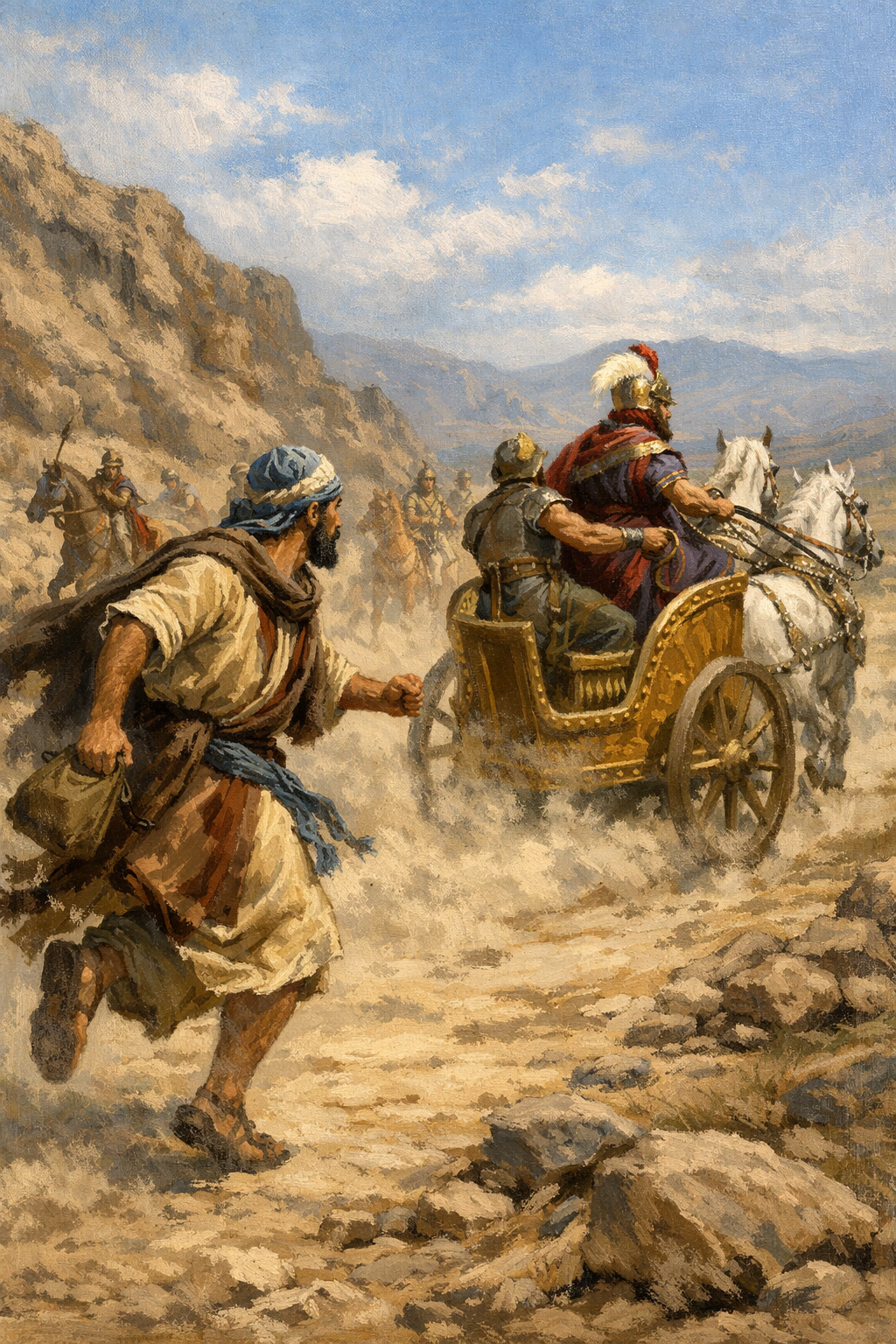
Gehazi Pursuing Naaman
GEHAZI'S DECEITFUL
PLOT UNFOLDS
So - Term of conclusion. Gehazi's fleshly THOUGHT (see above) had begun to germinate and would soon reap corrupt fruit! (Gal 6:7,8).
Gehazi pursued Naaman. Now Gehazi's sinful desire is in full control of his being. His running after Naaman demonstrated his intention to follow through on his evil plan. Gehazi is running after riches in order to reverse Elisha’s refusal. Gehazi moves quickly as greed presses him forward. Remember that Naaman is riding away on his chariot limo, meaning Gehazi had to "fly" to catch up. Greed is a great motivator and Gehazi was greatly motivated lest Naaman's chariots filled with riches get out of reach.
When Naaman saw one running after him, he came down from the chariot to meet him - Is not this irony striking? Naaman, who earlier arrived in pride and anger, now humbles himself and steps down from his chariot as a gesture of respect toward Elisha’s servant, Gehazi. Naaman is clearly a changed man—humbled, grateful, and marked by genuine faith. Gehazi, by contrast, is driven by greed and is about to become a “changed” man of a very different sort. In a tragic reversal, the two effectively exchange conditions: the cleansed foreigner departs free of leprosy, while the privileged servant of the prophet will soon bear it! God is not mocked!
Warren Wiersbe - For a Syrian general to show such deference to a Jewish servant was certainly an indication that God had wrought a change in his heart (Bible Exposition Commentary page 687)
And said, “Is all well? (shalom) Naaman's question reveals his sincere concern. His question suggests he likely assumes that something may be wrong with Elisha. The man who once stormed off in rage now shows concern which underscores the genuineness of his spiritual transformation.
The newly healed Gentile acts with humility and integrity, while the prophet’s servant is acting with deception. This stark contrast prepares the reader for the seriousness of Gehazi’s sin and sets up a powerful contrast between a healed outsider and a corrupt insider.
2 Kings 5:22 He said, “All is well. My master has sent me, saying, ‘Behold, just now two young men of the sons of the prophets have come to me from the hill country of Ephraim. Please give them a talent of silver and two changes of clothes.’”
- All is well. My master: 1Ki 13:18 Isa 59:3 Jer 9:3,5 Joh 8:44 Ac 5:3,4 Rev 21:8
- two young men of the sons of the prophets: 2Ki 2:3 1Ki 20:35
- give them: 2Co 12:16-18
- a talent: 2Ki 5:5 Ex 38:24-28 1Ki 20:39
LIAR, LIAR
PANTS ON FIRE!
He said, “All is well (shalom) - This is a lie. All is not well with Gehazi's heart! This shows how easily spiritual language can be used to conceal one's sinful desires.
Warren Wiersbe - When a man’s heart is filled with greed and his lips are filled with lies, he is far from enjoying shalom, which means “peace, well-being, fulfillment, prosperity, safety.” (Bible Exposition Commentary page 687)
My master has sent me - Here is lie number two, for Elisha had not sent him. Gehazi uses this lie as the foundation for his deception. Gehazi borrows Elisha's prophetic authority. Gehazi trades on Elisha’s integrity to gain Naaman's trust.
Saying, ‘Behold (hinneh; Lxx - idou) - Note this is the second time Gehazi has used this interjection Behold which calls for focused attention. This time he is calling for Naaman's focused attention.
Just now two young men of the sons of the prophets have come to me from the hill country of Ephraim - Now comes lie number three. Gehazi invents a story about “two young men of the sons of the prophets” which is calculated to sound plausible and compassionate. It appeals to Naaman's sense of generosity for ministry and community need. Gehazi exploits charity and religious concern to justify greed, a particularly grievous distortion of faith.
Warren Wiersbe - In carrying out his evil plan, Gehazi not only used God’s name in vain, but he also used God’s work as a “cloak of covetousness” (1 Thess. 2:1–6). Using Elisha’s name, he lied to Naaman when he asked for gifts for two sons of the prophets from Bethel and Gilgal. (Bible Exposition Commentary page 687)
Please give them a talent of silver and two changes of clothes - A talent reveals escalating covetousness because a talent of silver was a relatively large sum. Notice the escalation of his lust, for earlier said he would take something (2Ki 5:20) has grown into grand larceny (so to speak). Don't miss the subtle principle here - Sin once germinated rarely remains small. The moment greed is entertained in the mind, it begins to multiply.
Exposure to God’s power does
not guarantee a transformed heart
Observe how this verse completes the moral reversal of the chapter. Naaman, the former pagan ignorant of God, has become truthful and generous. On the other hand, Gehazi, the insider exposed to God's power through Elisha, becomes deceitful and grasping. The narrative underscores a sad but sobering truth that exposure to God’s power does not guarantee a transformed heart.

Templeton on Left
Graham on Right
🙏 THOUGHT - Have you ever heard of Charles Templeton? Like Gehazi, he witnessed God’s power firsthand during remarkable revival meetings in America and Europe—experiences he shared with another young evangelist named Billy Graham. Both men saw the evident work of God, yet their paths ultimately diverged. Templeton later abandoned the faith he once proclaimed(cf Heb 6:4-6), while Graham embraced God, and as they say, the rest is history. If you don't know the rest of the story, take a moment to read, weep and/or be warned by The Tragic Tale of Charles Templeton.
In short: The verse shows that Gehazi knowingly lies, misuses prophetic authority, exploits religious compassion, and enlarges his greed, in effect turning God’s free grace into a means of personal gain. It is a warning that religious words without integrity can become instruments of profound spiritual harm. The preachers of properity gospel may become rich now (cf Joel Osteen's net worth in 2025 estimated at $50 million!), but God's "leprosy" will be befall them in the future!
2 Kings 5:23 Naaman said, “Be pleased to take two talents.” And he urged him, and bound two talents of silver in two bags with two changes of clothes and gave them to two of his servants; and they carried them before him.
- Be pleased 1Ki 20:7 Lu 11:54
- Be pleased: 2Ki 5:16 2:17
- Be pleased2Ki 12:10
- they carried them before him. Isa 30:6
NAAMAN BELIEVES
GEHAZI'S LIE
Naaman said, “Be pleased to take two talents.” Naaman’s insistence to take two talents reveals a heart transformed by grace. He is not bargaining or suspicious but eager to give. His generosity flows from his new heart of gratitude, not from obligation. The healed man wants to honor God’s servant, unaware that he is being deceived.
And he urged him, and bound two talents of silver in two bags with two changes of clothes and gave them to two of his servants - NET = "He gave them to two of his servants and they carried them for Gehazi." NLT = "sent two of his (NAAMAN'S) servants to carry the gifts for Gehazi." Notice the one talent of 2Ki 5:22 has now increased to two talents. So not only is Naaman being more generous, he also provided two of his own Aramean servants to help carry the load. So now one talent has been increased to two talents, which would have fed Gehazi's greed even more.
🙏 THOUGHT - The increase of talents reminds me of the words of Pr 30:15 which say "the leech has two daughers, 'Give,' 'Give'!" These two daughters ‘Give, Give’ personify greed as two offspring that constantly cry out for more. The doubling of “Give” emphasizes the general truth that the relentless nature of greed never pauses and indulgence is never satisfied. It never says "Enough!" In Hebrew wisdom style, the ‘Give, Give’ image teaches that greed multiplies its demands. Once indulged, it does not quiet down but it creates new mouths to feed! WOE! Who are your "daughters?" What desire in my life is most likely to say, “Give, give” instead of “Enough”? Where have I confused need with greed? And here is the most sobering question - What thought have I been indulging that is quietly increasing its demands?
2 Kings 5:24 When he came to the hill, he took them from their hand and deposited them in the house, and he sent the men away, and they departed.
- deposited them in the house: Jos 7:1,11,12,21 1Ki 21:16 Isa 29:15 Hab 2:6 Zec 5:3,4
Related Passages:
Joshua 7:11 (STORY OF ACHAN) “Israel has sinned, and they have also transgressed My covenant which I commanded them. And they have even taken some of the things under the ban and have both stolen and deceived. Moreover, they have also put them among their own things.
GEHAZI'S GREED MOVES FROM
DECEIT TO CONCEALMENT
When he came to the hill Gehazi apparently travels from a public to a private space. Gehazi ensures he is out of sight before acting further. Sin often seeks seclusion once it has been acquired what it sought. And so now what was pursued openly is hidden deliberately.
He took them from their hand Naaman's two servants who carried the gifts might draw attention, so Gehazi quickly removes the evidence from them.
Secret sin on earth is
open scandal in heaven.
And deposited them in the house - Gehazi does not put the goods in some public place, but with premeditation puts the stolen treasure in the house, presumably his home. This is a plain attempt to secure and conceal his ill-gotten gains and keep it hidden from his master Elisha. Gehazi's treasure now concealed, he was convinced he had committed the "perfect crime." Proverbs 28:13 which says "He who conceals his transgressions will not prosper, but he who confesses and forsakes them will find compassion." Gehazi should have read this wise saying and confess rather than conceal.
Nothing is more offensive to God than that men
should cover their covetousness with a cloak of religion.
And he sent the men away, and they departed This action completes Gehazi's cover-up. Gehazi carefully hides the evidence of his deceit, moving from greed to concealment, seemingly oblivious to the truth that secrecy before people offers no protection from "the eyes of the LORD (which) are in every place, watching the evil and the good." (Pr 15:3)
2 Kings 5:25 But he went in and stood before his master. And Elisha said to him, “Where have you been, Gehazi?” And he said, “Your servant went nowhere.”
- stood before: Pr 30:20 Eze 33:31 Mt 26:15,16,21-15 Joh 13:2,26-30
- Where: 2Ki 20:14 Ge 3:8,9 4:9 16:8
- Your servant: 2Ki 5:22 Ac 5:3,4
GEHAZI REAPPEARS
BEFORE ELISHA
This exchange in 2 Kings 5:25 exposes the climax of Gehazi’s deceit and highlights the contrast between human concealment and divine knowledge.
But he went in and stood before his master. Now Gehazi resumes his role as innocent servant and outwardly, everything appears normal. Gehazi’s sin is marked by deliberate hypocrisy, for here he carefully maintains the appearance of faithfulness while concealing his corrupt heart. He continues in religious service, standing before Elisha as though nothing had happened, deceived into thinking that he could now use spiritual proximity as a cover for his sin.
Hypocrites may hide their sins from men,
but God sees through every disguise
And Elisha said to him, “Where have you been, Gehazi?” God often begins judgment with a gentle question. Elisha wasn’t asking for information; he was opening Gehazi’s conscience. Elisha has clearly heard from God, and he already knows the answser, but he is giving Gehazi an opportunity to confess his sin. God often confronts sin this way, not to trap, but to offer a chance for confession and repentance as in David's sin with Bathsheba when confronted by the prophet Nathan (2Sa 12:1-7, 13).
And he said, “Your servant went nowhere - Gehazi again tells a bold-faced lie. He compounds theft with falsehood and does so to the face of God’s prophet. The use of deferential language (“your servant”) intensifies the irony. In truth his words of humility mask his deceitful heart.
Observe how we can track the progress of sin (like you track your Amazon delieveries): What began as desire (2Ki 5:20) moved to deceit and lies (2Ki 5:22–23), then to concealment (2Ki 5:24), and now to a lying denial. Each step deepens the separation between Gehazi and the truth. As someone has well said
Sin will take you further than you ever wanted to stray and
keep you longer than you ever intended to stay, and
cost you a more than you ever dreamed you would pay.
The verse shows that Gehazi completes his downward spiral into sin by lying outright, choosing denial over repentance, completely unaware that God already knows the truth and has graciously given him one last opportunity to confess.
J J Knapp - Whence, Gehazi? 2Ki. 5:25
The love of money is called in Scripture the root of all evil and that is not too strong an expression. Gehazi shows us that indeed many varied evils sprout from that hidden, but tough and lively root. When he heard that the prophet refused to take a present from Naaman, so that this converted heathen would understand properly that the obtained mercy was given him in grace, Gehazi’s greed was kindled. The evil one stole out of the house, hurried after Naaman, offered him crafty lies, through which he even wove pious thoughts by dreaming up the story of the sons of the prophets; afterwards he brought his spoil into safety, appeared with a brazen face before his master, who was made aware of everything by inner revelation, and he brought his impudence so far that upon the conscientious question of Elisha: “Whence comest thou, Gehazi?”he answered calmly: “Thy servant went no whither.”
This thirst for money, that made Gehazi force his conscience, slumbers in every sinner’s heart, even though it may not burn equally fiercely within every one. To walk in deceitful ways to multiply possessions, to use misleading means to lure the innocent into a trap, to apply false advertising and to project illusionary profits,—all this belongs to the paths of Gehazi, upon which an honest man may not even set a single foot. To the gold that was obtained fraudulently, cleaves a curse, that continues till posterity. That frightful curse turned visibly outward in Gehazi: the leprosy of Naaman cleaved unto him, so that he stood white as snow before the face of the world as one singled out. However, observe how it is added that this curse would cleave to his posterity into all eternity! Stolen goods do not profit but they drive out the blessing of God from our house until our children and grandchildren, because even if no human eye has witnessed our deceitful ways, before the Lord our God we stand unmasked.
Whence comest thou, Gehazi?What is the way behind us in dealing and walk, in consumption and business? If it is a way of sin and deceit, of greed that made us commit unrighteousness, of fraudulent means to enrich ourselves, oh, let us then not answer like the evil one, that we went no whither, and that every thing is in order before God. It is better to confess our guilt before Him, who also places our secret sins before Him in the light of His countenance, because where there is sincere confession of guilt, there will be a desire for mercy, and where there is a desire for mercy, there is Jesus Christ with the redeeming blood of the cross and with the Spirit of regeneration.
2 Kings 5:26 Then he said to him, “Did not my heart go with you, when the man turned from his chariot to meet you? Is it a time to receive money and to receive clothes and olive groves and vineyards and sheep and oxen and male and female servants?
NET Elisha replied, "I was there in spirit when a man turned and got down from his chariot to meet you. This is not the proper time to accept silver or to accept clothes, olive groves, vineyards, sheep, cattle, and male and female servants.
CSB But Elisha questioned him, "Wasn't my spirit there when the man got down from his chariot to meet you? Is it a time to accept money and clothes, olive orchards and vineyards, sheep and oxen, and male and female slaves?
NIV But Elisha said to him, "Was not my spirit with you when the man got down from his chariot to meet you? Is this the time to take money, or to accept clothes, olive groves, vineyards, flocks, herds, or menservants and maidservants?
NLT But Elisha asked him, "Don't you realize that I was there in spirit when Naaman stepped down from his chariot to meet you? Is this the time to receive money and clothing, olive groves and vineyards, sheep and cattle, and male and female servants?
YLT 2 Kings 5:26 And he saith unto him, 'My heart went not when the man turned from off his chariot to meet thee; is it a time to take silver, and to take garments, and olives, and vines, and flock, and herd, and men-servants, and maid-servants?
- he said: Ps 63:11 Pr 12:19,22 Ac 5:9
- Did not my heart go with you: 2Ki 6:12 1Co 5:3 Col 2:5
- Is it a time: 2Ki 5:16 Ge 14:23 Ec 3:1-8 Mt 10:8 Ac 20:33,35 1Co 9:11,12 2Co 11:8-12 2Th 3:8,9
Related Passages:
Numbers 32:23 (GEHAZI SHOULD HAVE READ THIS VERSE) “But if you will not do so, behold, you have sinned against the LORD, and be sure your sin will find you out.
Proverbs 5:22 His own iniquities will capture the wicked, and he will be held with the cords of his sin.
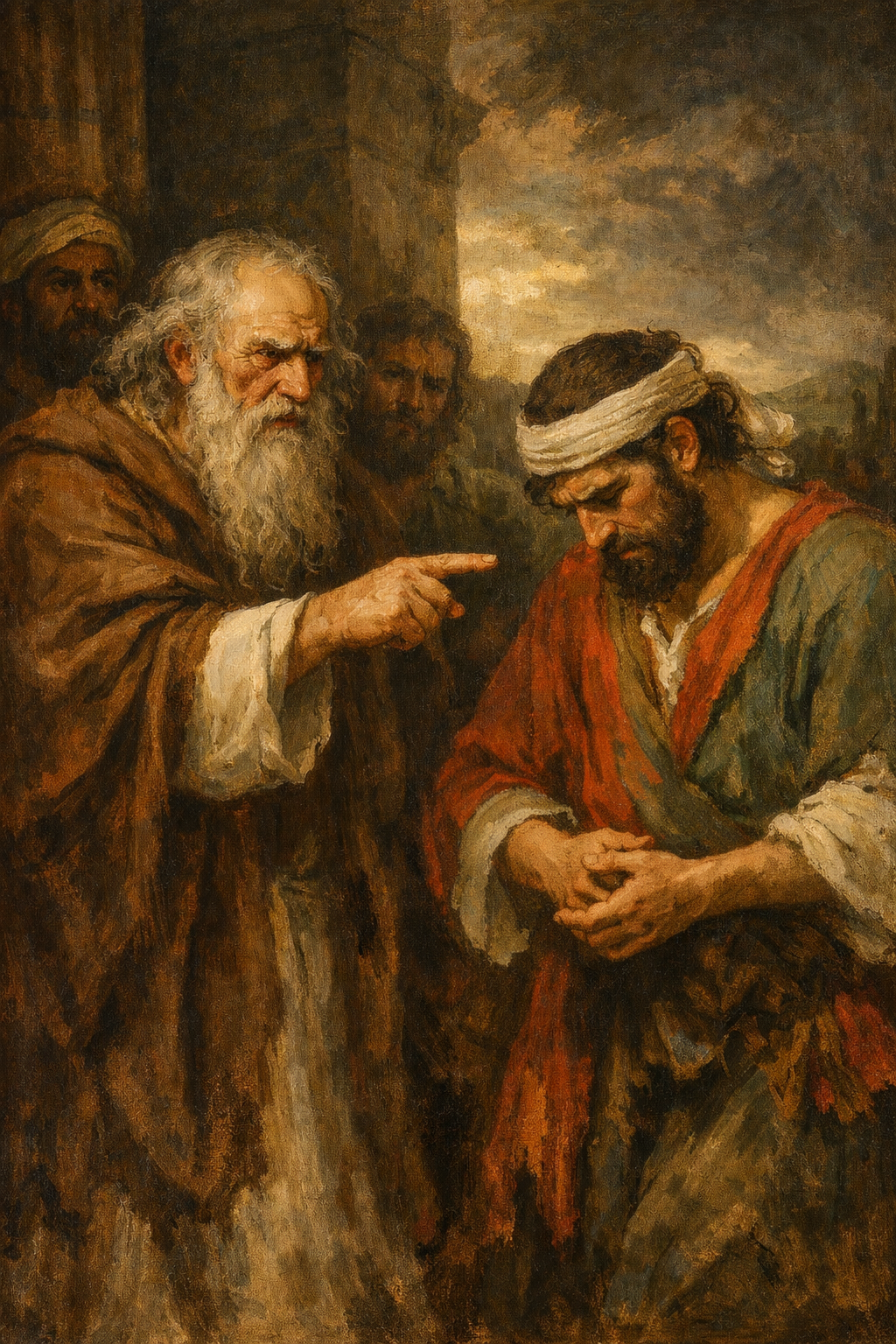
THE CONFRONTATION:
ELISHA'S PIERCING REBUKE
Then he said to him, “Did not my heart go with you - NLT - "Don't you realize that I was there in spirit." Elisha had received divine revelation. He reveals he knew exactly what transpired between Gehazi and Naaman. Gehazi may have hidden his actions from people, but nothing is hidden from God and by extension in this case, the man of God!
When the man turned from his chariot to meet you? - NLT "when Naaman stepped down from his chariot to meet you?" Elisha even replays the specific detail of Naaman coming down from his chariot to greet Gehazi. By now Gehazi's pulse is surely beginning to race! This specific detail strips Gehazi of every excuse and exposes his lie “Your servant went nowhere.” (2Ki 5:25).
Is it a time to receive money? - Elisha’s question is not about timing in general, but about spiritual appropriateness of Gehazi's interaction with Naaman. Elisha is saying in effect that this was a time to showcase God's grace to Naaman and not profit from Naaman's healing. God had just revealed His grace to a Gentile, making clear that cleansing and salvation are free gifts. To profit from that moment would distort God’s character and cheapen grace.
And to receive clothes and olive groves and vineyards and sheep and oxen and male and female servants Elisha's long list shows that the prophet knew exactly what Gehazi intended to do with the stolen wealth. Gehazi envisioned an elegant lifestyle and status. God had seen these ambitions in Gehazi's heart and revealed them to Elisha who exposed the trajectory of Gehazi's greed.
A man may have his hand with the prophet,
and yet his heart with the world.
Warren Wiersbe - Elisha not only saw what his servant had done, but he saw into his servant’s heart and knew why he did it. Gehazi longed to be a wealthy man with land, flocks and herds, expensive clothing, and servants to obey his orders. He wasn’t content to labor by the side of Elisha the prophet; he wanted to have security and comfort (ED: GEHAZI REMINDS ME OF DEMAS - 2Ti 4:10). There’s certainly nothing wrong with being wealthy, if that’s God’s will for your life, for Abraham and Isaac were wealthy and so was David. But it is wrong to get that wealth through deceit and to make that wealth your god. Gehazi used the ministry God gave him as a means of deceiving Naaman, and that is contrary to God’s will (1Th 2:1–6; 2Co 2:17; 2Co 4:2). (Bible Exposition Commentary page 688)
Gary Inrig comments that Elisah "made clear to Gehazi that his disrespect for God and his word had been found out. It was futile to try to deceive a man who was getting his information from a divine source. Even more, it was God’s glory that was being tarnished. To enrich oneself by cashing in on an act of God was reprehensible. And Gehazi would pay the price." (See Holman Old Testament Commentary - 1 & 2 Kings)
Gehazi's sin is reminiscent of Achan's sin (I realize I am repeating this cross reference but the principle bears repeating!) even showing similar progression - saw, coveted, took, concealed!
So Achan (when his sin was exposed - see Nu 32:23!) answered Joshua and said, "Truly, I have sinned against the LORD, the God of Israel, and this is what I did: when I saw among the spoil a beautiful mantle from Shinar and two hundred shekels of silver and a bar of gold fifty shekels in weight, then I coveted them and took them; and behold, they are concealed in the earth inside my tent with the silver underneath it." (Joshua 7:20, 21)
The Security Camera - A man steals in what he thinks is an empty store at night. The next day, the owner calmly shows him the security footage. Gehazi thought no one saw… but heaven has cameras everywhere!
He who is greedy for gain troubles his own house. Pr 15:27
Advertisers constantly appeal to consumer greed, trying to convince us that we need their products. An executive of an electronics firm boasted that his company had created the demand for transistor radios. He said, "When we introduced pocket radios years ago, nobody needed them, so they didn't sell. We had to convince the consumer that he needed our products. Sales have boomed ever since."
The desire for more and more money, things, or power isn't unique to our day. Thousands of years ago, Gehazi, Elisha's servant, saw a chance to get money from wealthy Naaman. He would be able to buy clothing, olive groves, vineyards, sheep and oxen, and servants (2 Kings 5:26). Greed took over.
We are all susceptible to the powerful grip of greed. We must often pray "Lord, help me to be most concerned about how I can please You, not how I can gain more for myself."—D. J. DeHaan (Reprinted by permission from Our Daily Bread Ministries. Please do not repost the full devotional without their permission.)
GREEDY PEOPLE ALWAYS LOSE MORE THAN THEY GAIN.
2 Kings 5:27 “Therefore, the leprosy of Naaman shall cling to you and to your descendants forever.” So he went out from his presence a leper as white as snow.
- leprosy: 2Ki 5:1 Jos 7:25 Isa 59:2,3 Ho 10:13 Mal 2:3,4,8,9 Mt 27:3-5 Ac 5:5,10 8:20 1Ti 6:10 2Pe 2:3
- to your descendants forever.: 1Sa 2:30-36 2Sa 3:29
- a leper: 2Ki 15:5 Ex 4:6 Nu 12:10
Related Passages:
2 Samuel 3:28-29 Afterward when David heard it, he said, “I and my kingdom are innocent before the LORD forever of the blood of Abner the son of Ner. 29 “May it fall on the head of Joab and on all his father’s house; and may there not fail from the house of Joab one who has a discharge, or who is a leper, or who takes hold of a distaff, or who falls by the sword, or who lacks bread.”
Mark 8:34-37 (GEHAZI EXCHANGED RICHES FOR HIS SOUL!) And He summoned the crowd with His disciples, and said to them, “If anyone wishes to come after Me, he must deny himself, and take up his cross and follow Me. 35 “For whoever wishes to save his life will lose it, but whoever loses his life for My sake and the gospel’s will save it. 36 “For what does it profit a man to gain the whole world, and forfeit his soul? 37 “For what will a man give in exchange for his soul?
Joshua 7:25 Joshua said, “Why have you troubled us? The LORD will trouble you this day.” And all Israel stoned them with stones; and they burned them with fire after they had stoned them with stones.
Acts 5:5; 10 And as he heard these words, Ananias fell down and breathed his last; and great fear came over all who heard of it. (5:10) And immediately she (SAPPHIRA) fell at his feet and breathed her last, and the young men came in and found her dead, and they carried her out and buried her beside her husband.
1 Timothy 6:10 For the love of money is a root of all sorts of evil, and some by longing for it have wandered away from the faith and pierced themselves with many griefs. (AN APT DESCRIPTION OF GEHAZI'S PUNISHMENT)
2 Peter 2:3 and in their greed they will exploit you with false words (EXACTLY WHAT GEHAZI DID!); their judgment from long ago is not idle, and their destruction is not asleep.
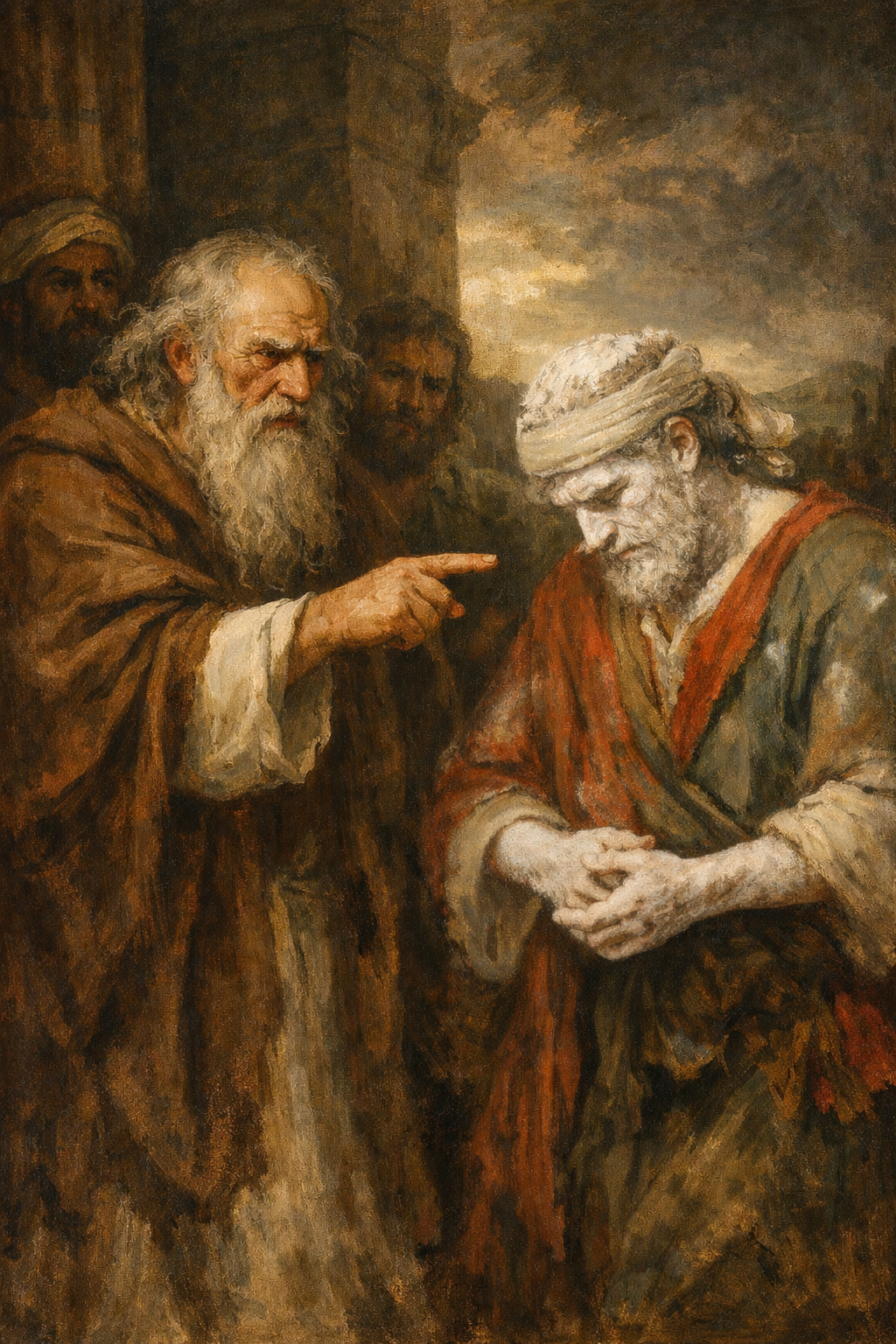
Compare to picture above before judgment
Now White As Snow!
HIDDEN SIN BECOMES
PUBLIC JUDGMENT
Therefore (term of conclusion) signals direct consequence. Gehazi’s punishment is not arbitrary, but flows logically from his actions of greed, deception, misuse of God’s name, and distortion of grace. What he sought to gain by Naaman’s healing now becomes his undoing.
Gehazi sought to clothe himself with wealth;
God clothed him with leprosy!
The leprosy (tsaraath) of Naaman shall cling (dabaq) to you - How ironic. Gehazi coveted what Naaman brought but now "inherits" what Naaman lost. The verb cling (dabaq) means God's judgment would "stick like glue" to Gehazi. Gehazi thought one lie would purchase comfort; instead it purchased a lifetime of misery. Sin promises freedom but delivers chains (cf Heb 3:13, Heb 11:25).
He reached for silver and
received skin disease instead.
Do you see the irony - Gehazi intended to attach wealth to himself through deceit. God responds by attaching leprosy to him instead! The result is a reversal. What Gehazi sought as gain became loss. What he grasped for became a curse. This story fits classic biblical irony in which God exposes the heart by reversing outcomes...
- Haman, in Esther 7:9-10 The instrument of Haman’s pride (gallows) becomes the means of his exposure and death.
- Achan in Joshua 7:20–26, What Achan buried in secrecy is uncovered, and the troubler becomes the troubled.
- Ananias and Sapphira in Acts 5:11-11 Their attempt to appear generous exposes a heart of deception, resulting in sudden death.
He grasped for gain—and was gained
judgment for himself and his family.
Gary Inrig comments that "As the story comes to an end, Naaman and Gehazi have traded places. The pagan who humbled himself to submit to God’s word through his prophet had found healing. The servant of the prophet who had disrespected God’s word had tasted the bitterness of judgment. The God of compassion who heals the trusting is also the God of justice who will clear the guilty." (See Holman Old Testament Commentary - 1 & 2 Kings)
And to your descendants forever This judgment shows the seriousness of the offense. This is not merely personal failure but a public, representative sin. Gehazi stood as the servant of the man of God Elisha and therefore as a visible representative of the God of Israel. He was held to higher standard of accountability. His actions threatened God’s witness to the Gentile nations, especially at the moment when Naaman had just confessed faith in the LORD alone. The judgment underscores that corrupting grace at a missionary moment is especially grievous. WOE!
So he went out from his presence Naaman once went away in rage, then returned in humility and was cleansed. Gehazi now goes away permanently separated, not from Elisha only, but from the privileges of service. His physical leprosy symbolized his spiritual exclusion.
Gehazi could no longer be Elisha’s servant;
he had lost his ministry.
Warren Wiersbe - Gehazi had hoped to leave great wealth to his descendants, but instead, he left great shame and sorrow for years to come. In Israel, lepers were considered unclean and weren’t allowed to be in the community and live normal lives. Gehazi could no longer be Elisha’s servant; he had lost his ministry. “Not greedy for money” is one of the qualifications for God’s servants (1Ti 3:3). One of the marks of the last days is that people will love money more than they love God or other people (2Ti 3:1–5). (Bible Exposition Commentary page 688)
A leper as white as snow - This completes the reversal. Naaman’s flesh had become like that of a little child (2Ki 5:14). Gehazi’s flesh becomes visibly marked by disease. The story closes with the stark contrast of a Gentile outsider cleansed and brought near and an Israelite insider corrupted and sent away! God is not mocked. Whatever a man sows he will reap. Gehazi had sown to the lusts of his flesh and now reaped corruption. One has to seriously doubt that we will see Gehazi among the redeemed in Heaven.
THOUGHT - There is a bit of a play on words for "white as snow" was a description of restoration in Isaiah 1:18, but here is a picture of judgment!
Donald Wiseman - That Naaman’s leprosy will cling to Gehazi and to his descendants for ever illustrates the punishment, foretold in Exodus 20:5 and visited on Achan’s family (Josh. 7:24–26), as on those who break the commandment prohibiting the making of idols (here the love of money and possessions). (See 1 and 2 Kings: An Introduction and Commentary - Page 222)
To reiterate Gehazi inherited the very judgment from which Naaman was delivered, because he turned God’s free grace into a means of personal gain. It is a solemn warning that to exploit grace is to invite judgment, and that nearness to holy things offers no protection when the heart is corrupt! WOE!
Greed may not make us leprous, at least not on the surface, but it will damage our hearts and spirits as certainly as leprosy ruined Gehazi’s skin and ministry. Beware of Greed. Jesus warned...
“Beware (horao - present imperative see our need to depend on the Holy Spirit to obey), and be on your guard (phulasso - present imperative see our need to depend on the Holy Spirit to obey) against every form of greed; for (EXPLAINS WHY!) not even when one has an abundance does his life consist of his possessions.” (Luke 12:15)
Herbert Lockyer - The question may arise, was such an act of severity wholly deserved, or was the punishment imposed excessive? What we must bear in mind is that Elisha pronounced, inspired judgment upon the sin of Gehazi, and that covetousness and lying in the Bible are never spared. Gehazi’s sin was committed under the cloak of religion. Not only so, his greed could have reduced Elisha and the God whose servant he was to the level of the Syrian priests and deities. So Gehazi’s punishment was swift. “He who had sought and obtained the reward which Elisha had declined became himself a leper, white as snow.” (BORROW All the Miracles of the Bible page 122)
The Boomerang of Sin - Like a boomerang thrown in confidence, sin is launched thinking it will only benefit us… but it always curves back. Gehazi threw deceit expecting wealth to return; instead, judgment returned and clung to him.
The Inheritance Nobody Wants - We often think of passing down houses, land, or legacy. Gehazi passed down leprosy. Our sin never stays private; it shapes families, homes, churches, and generations.
The Firecracker in the Hand - Sin is like lighting a firecracker while still holding it. You think you can drop it in time… but Gehazi held on too long. The explosion happened in his own life.
Naaman began as a leper and left cleansed and blessed.
Gehazi began close to God’s prophet and left a leper… cursed.
Grace embraced. Grace rejected.
God reverses destinies.
Those far may be brought near; those near can fall far.
The Mask That Refuses to Come Off - Hypocrisy is like gluing a mask to your face. At first it hides your real condition. Then you can’t take it off. Gehazi pretended loyalty to Elisha and devotion to God… until the lie became permanent.
G Campbell Morgan - The leprosy therefore of Naaman shall cleave unto thee. -2 Kings 5.27
This was the punishment of a man who in answer to selfish desire, obtained advantage to himself and lied to his master. The deepest wrong in the action of Gehazi was that it involved the Divine witness which had been borne to the Syrian, Naaman, by the action of the little serving maid in his house, and the prophet Elisha. Their action had been wholly disinterested, and for the glory of God. The child had witnessed to the power of her God through His prophet, and that in a desire to bring help to her suffering master. Here the motive and the method were right. Elisha's attitude throughout was that of dignified loyalty to God. Because of this, he had resolutely refused to accept any-thing in the nature of personal reward for that which had been wrought by the hand of God. To these, Gehazi stood in direct contrast. Governed by selfish desire, he made capital of the work of God, to seek personal enrichment. The judgment was swift and terrible. The story searches the soul like an acid. While we clearly see, and intellectually condemn, the sin of Gehazi, when we allow the whole of the facts, especially those of the motives which moved him, to investigate our deepest life, we surely realize how much we are in danger of falling into the same sin. To exploit a beneficent and healing act of God for our own material and personal advantage, is a grievous wrong, principally in that it devitalizes the testimony to the grace of God which such an act is intended to bear.