2 Kings 14:2
2 Kings 14:3
2 Kings 14:4
2 Kings 14:5
2 Kings 14:6
2 Kings 14:7
2 Kings 14:8
2 Kings 14:9
2 Kings 14:10
2 Kings 14:11
2 Kings 14:12
2 Kings 14:13
2 Kings 14:14
2 Kings 14:15
2 Kings 14:16
2 Kings 14:17
2 Kings 14:18
2 Kings 14:19
2 Kings 14:20
2 Kings 14:21
2 Kings 14:22
2 Kings 14:23
2 Kings 14:24
2 Kings 14:25
2 Kings 14:26
2 Kings 14:27
2 Kings 14:28
2 Kings 14:29
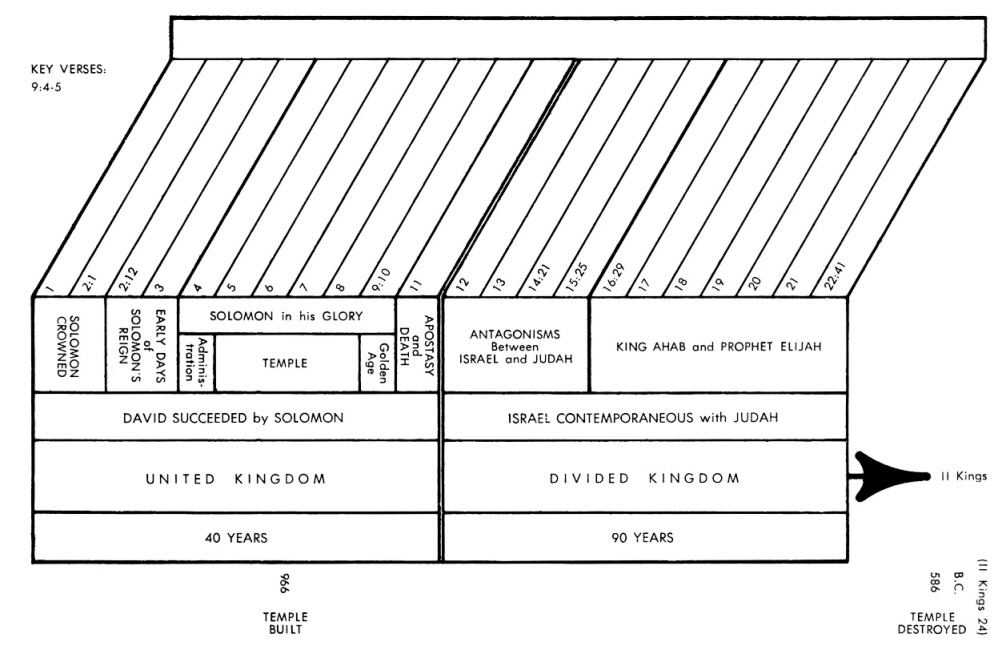
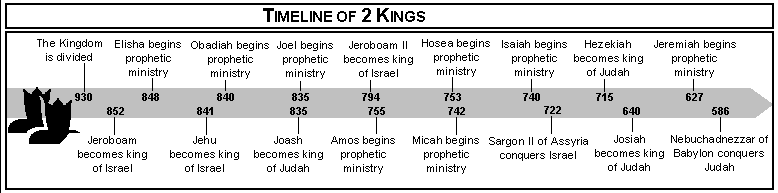
Chart from recommended resource Jensen's Survey of the OT - used by permission
1 Kings Chart from Charles Swindoll

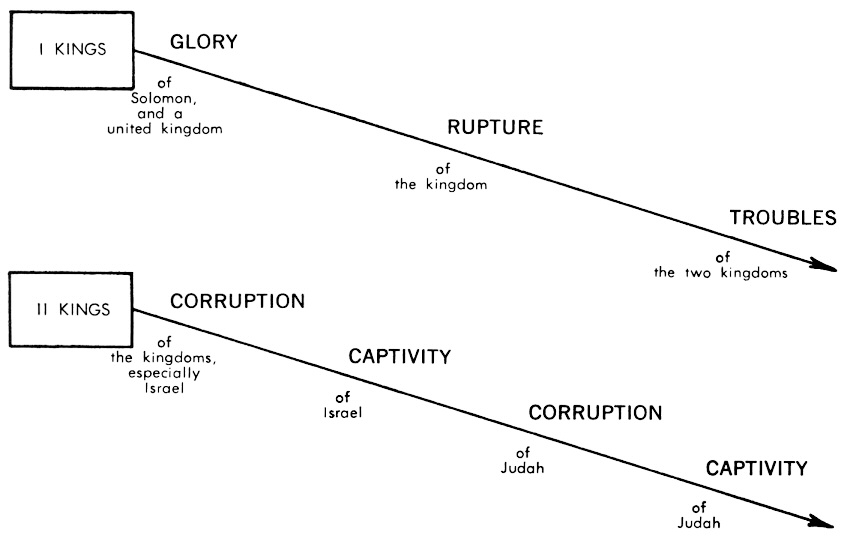
THE DOWNWARD SPIRAL
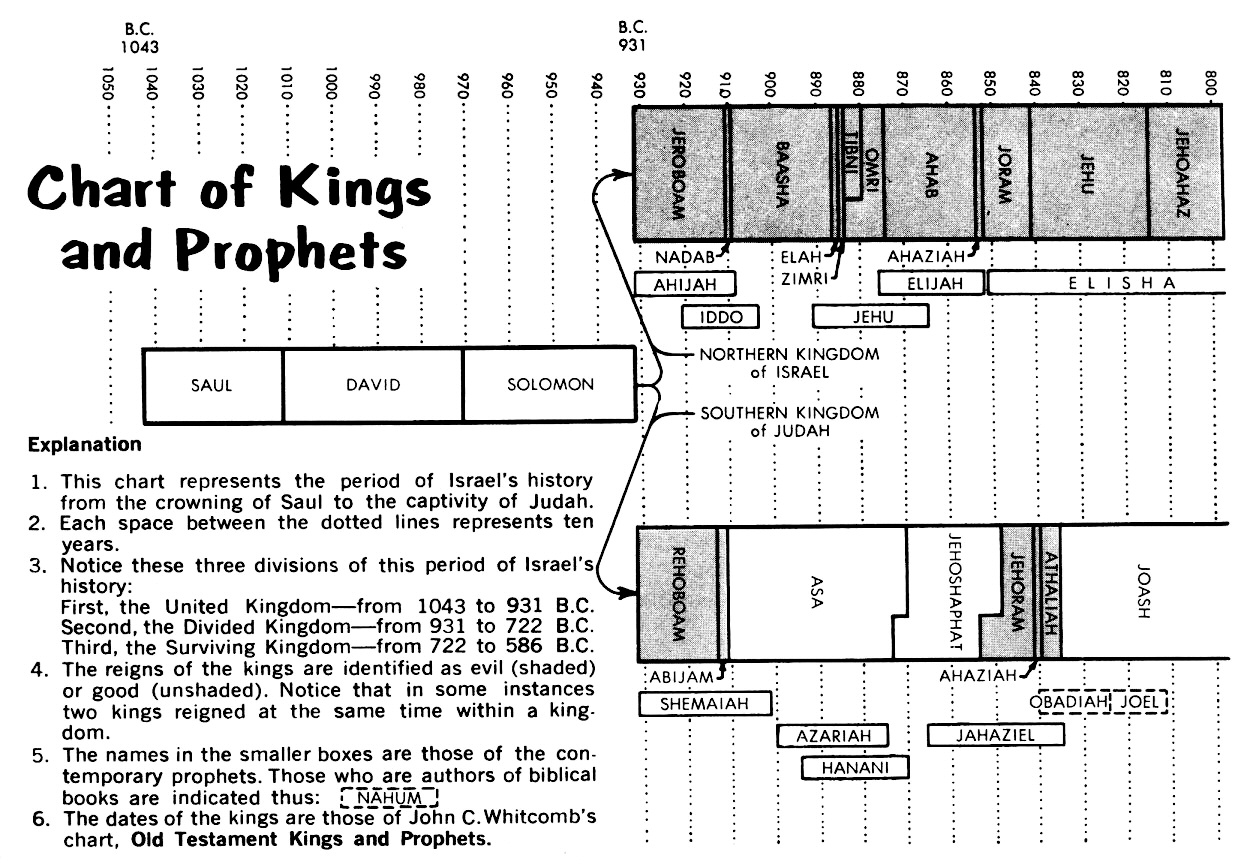
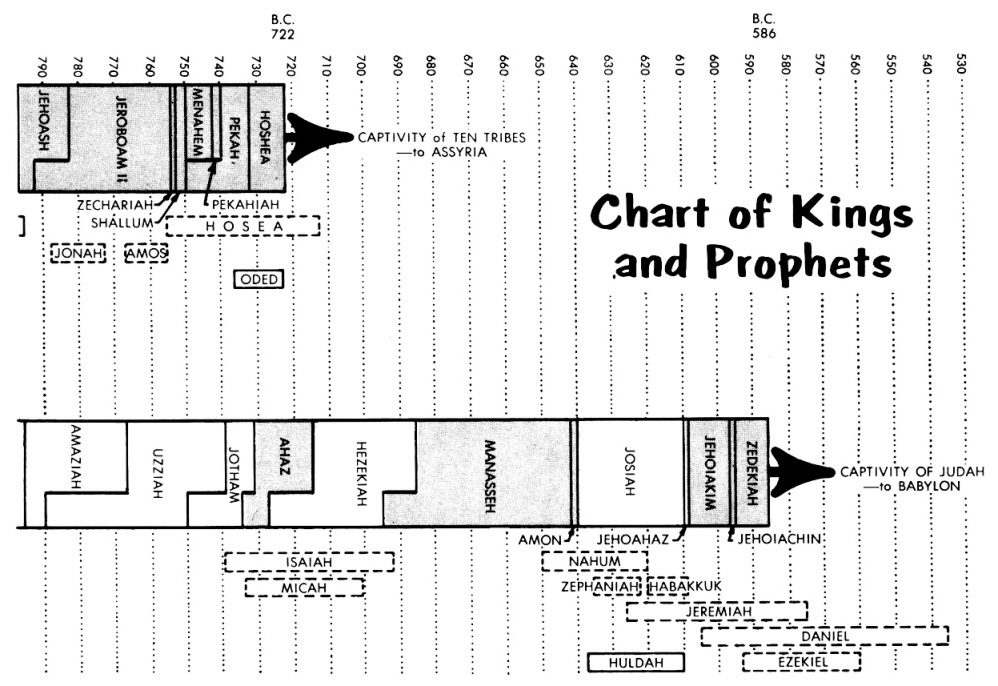
Click to Enlarge
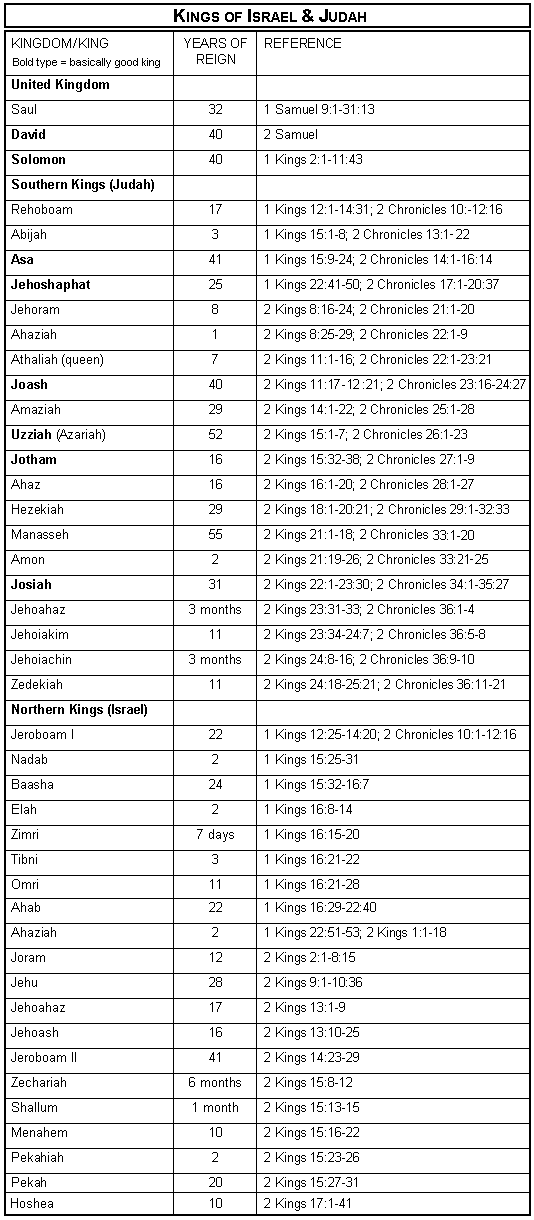
Ryrie Study Bible - Borrow
Click to Enlarge
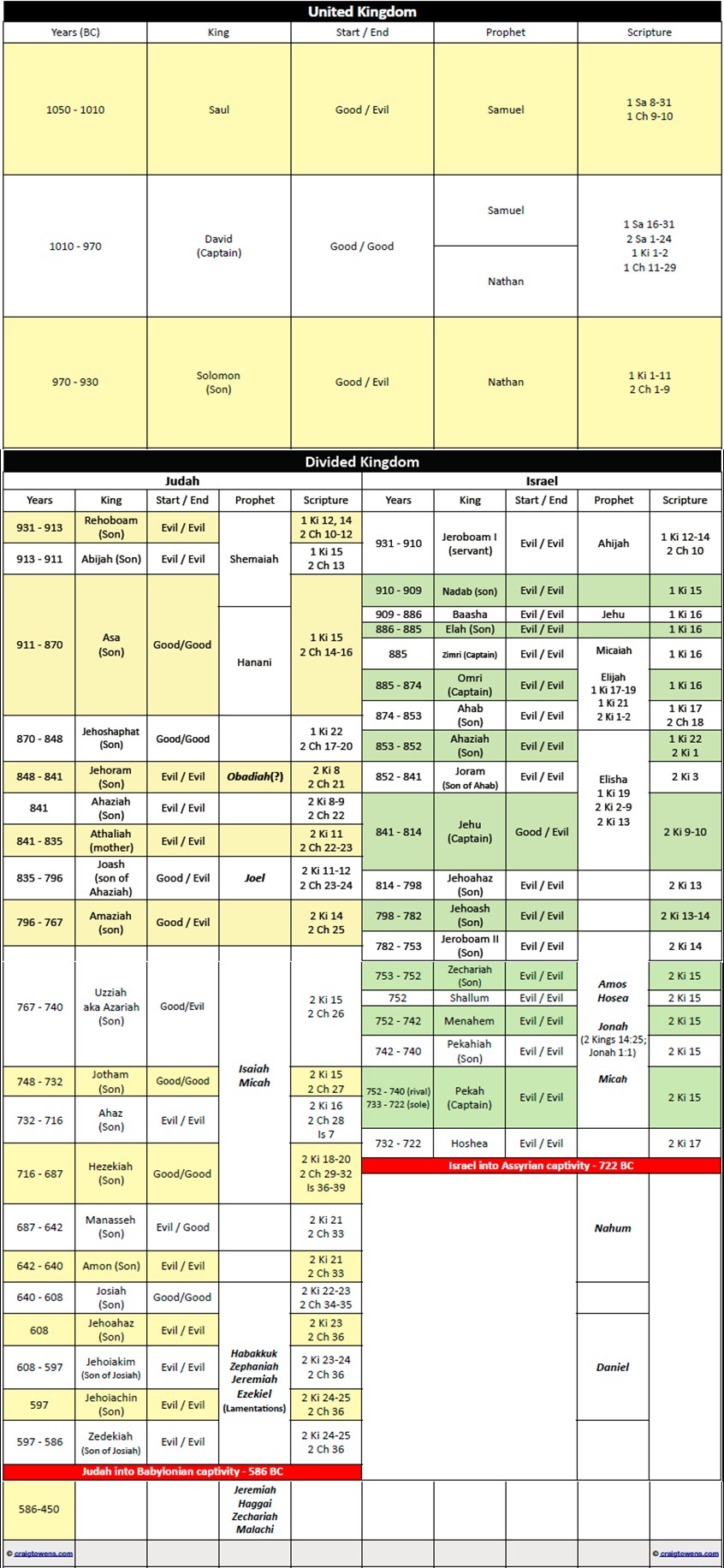
(NOTE: Many consider Amaziah and Hezekiah as "good" kings)
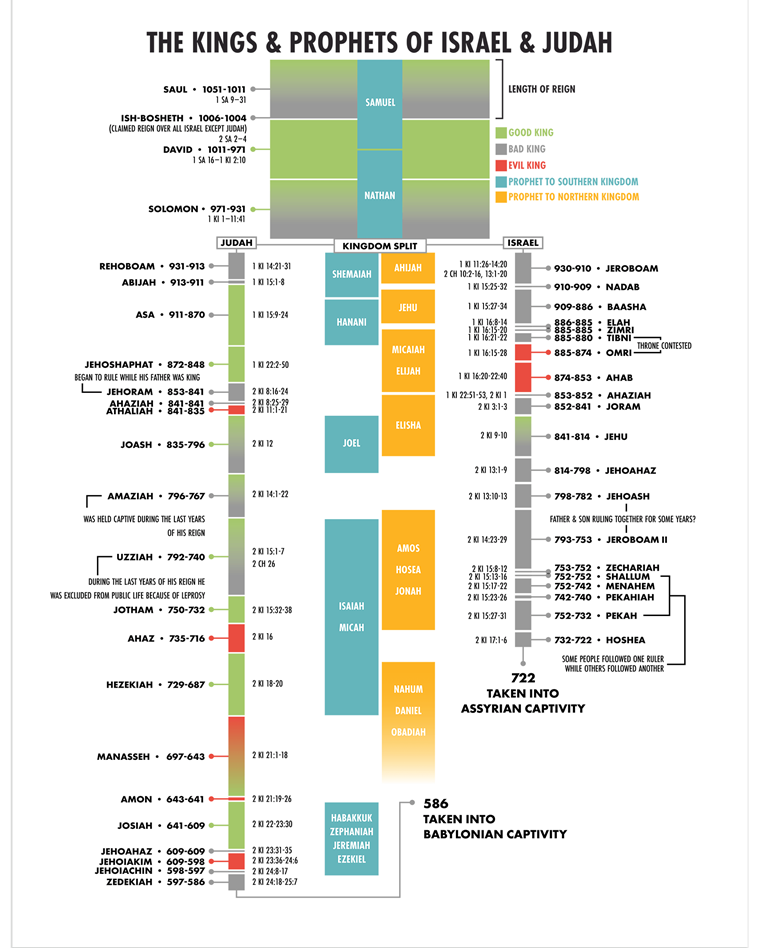
SEE ALSO:
ESV chart - kings of Israel - more information
ESV chart - kings of Judah - more information
Another Chart with Variable Dates for Reigns of King
2 Kings 14:1 In the second year of Joash son of Joahaz king of Israel, Amaziah the son of Joash king of Judah became king.
AMAZIAH ASCENDS TO
THRONE IN JUDAH
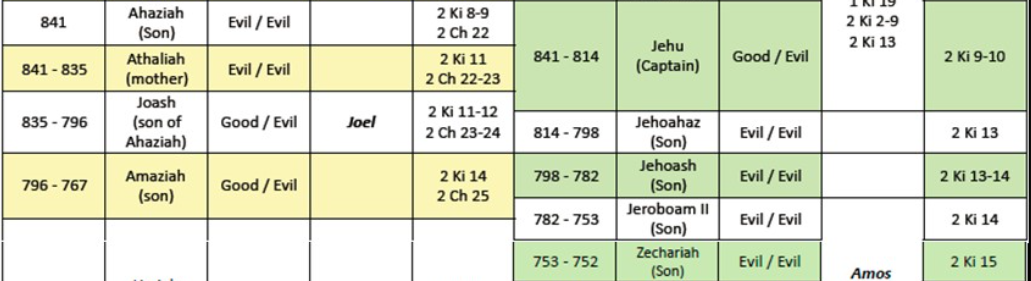
In the second year of Joash son of Joahaz king of Israel, Amaziah the son of Joash king of Judah became king - Remember both kings named Joash are also called Jehoash. Joash (Jehoash) king of Israel reigned 798–782 BC. Joash (Jehoash) king of Judah reigned 835–796 BC.
Amaziah reigned over Judah 796 to 767 BC. and details of his reign are recorded in 2 Kings 14 and 2 Chronicles 25. There are no parallel passages in 2 Chronicles 25 for 2 Kings 14:1.
NET NOTE - The name Joahaz is an alternate form of Jehoahaz. The referent here is Joash of Judah (see 2Ki 12:21), not Joash of Israel, mentioned earlier in the verse.
QUESTION - Who was King Joash in the Bible? | GotQuestions.org
ANSWER - TWO KINGS NAMED JOASH
The story of King Joash of Judah starts with that of King Jehu of Israel. Anointed king of Israel by Elisha, Jehu was tasked with destroying King Ahab’s descendants and wiping out Baal worship in the land (2 Kings 9). 1 Kings 21:25–26 gives the reason for the judgment: “There was never anyone like Ahab, who sold himself to do evil in the eyes of the Lord, urged on by Jezebel his wife. He behaved in the vilest manner by going after idols, like the Amorites the Lord drove out before Israel.” God had told Ahab, through Elijah, “I am going to bring disaster on you. I will wipe out your descendants and cut off from Ahab every last male in Israel—slave or free, . . . because you have aroused my anger and have caused Israel to sin” (1 Kings 21:21–22). Ahab responded to the prophecy with mourning and in humility, so God relented, saying that He would not bring the disaster in Ahab’s time but during his son’s reign. Jehu was God’s instrument to fulfill the prophecy.
After Jehu was anointed king over Israel, he set out against Joram, a son of Ahab and the current king of Israel. Ahaziah (different from the other son of Ahab who initially succeeded him) was king of Judah at the time and was with Joram. Judah’s Ahaziah, however, “followed the ways of the house of Ahab and did evil in the eyes of the Lord, as the house of Ahab had done, for he was related by marriage to Ahab’s family” (2 Kings 8:27). Jehu killed both Ahaziah and Joram; executed Ahab’s wife, Jezebel; killed Ahab’s descendants; and “wiped out Baal from Israel” (2 Kings 10:28, ESV). Unfortunately, Jehu himself did not walk in the ways of God, but, since he had been faithful to God’s call to rid Israel of Baal worship, God promised that four generations of his line would be king of Israel (2 Kings 10:30).
King Joash of Judah first comes on the scene when Athaliah, the mother of King Ahaziah, whom Jehu had killed, took charge of Judah. Athaliah killed all of the royal family she could find in Judah in order to secure the throne for herself. However, Athaliah missed one of her grandsons—the infant Joash. The evil queen’s daughter (or possibly step-daughter) rescued young Joash and his nurse, and the child was hidden for six years in the temple while Athaliah reigned in Judah (2 Kings 11:1–3). In the seventh year, the priest Jehoiada revealed Joash to the captains of the guards. The priest made an agreement with them to provide protection to the temple and the rightful king, and Jehoiada brought Joash out into public and anointed him as king (2 Kings 11:4–12). The people of Judah rejoiced over Joash’s appointment. Upon hearing the noise of the ceremony, Queen Athaliah rushed to the temple, crying, "Treason! Treason!” By Jehoiada’s command, Athaliah was captured by the guards, removed from the temple, and put to death (2 Kings 11:13–16). “Jehoiada then made a covenant between the Lord and the king and people that they would be the Lord’s people. He also made a covenant between the king and the people” (2 Kings 11:17). The people tore down the temple of Baal, watchmen were set over the Lord’s temple, and, at the age of seven, Joash took the throne (2 Kings 11:18–21).
2 Kings 12:1–3 says that Joash “reigned in Jerusalem forty years. . . . Joash did what was right in the eyes of the Lord all the years Jehoiada the priest instructed him.” Second Kings 12 goes on to describe various financial dealings of Joash. King Joash’s main achievement was making repairs to the temple (2 Kings 12:4–16). He also used a monetary gift to dissuade King Hazael of Aram (Syria) from attacking Jerusalem (2 Kings 12:17–18).
The tragedy of King Joash of Judah is that, after his mentor and guardian, Jehoiada, died, he began listening to wicked advisers. Joash revived Baal and Asherah worship in Judah (2 Chronicles 24:17–19). God sent prophets to warn Joash, but he did not listen to them. Finally, the prophet Zechariah, son of the priest Jehoiada, brought God’s word to Joash, but the king callously ordered the son of his old friend to be stoned to death (2Ch 24:19–22). Joash’s reign did not end peacefully: “His officials conspired against him and assassinated him at Beth Millo, on the road down to Silla” (2 Kings 12:20). Joash’s son Amaziah took over the throne, and Amaziah “did what was right in the eyes of the Lord,” but, the Bible notes, he was more like his father Joash than his ancestor David (2 Kings 14:3–4). Interestingly, Amaziah interacted with the other King Joash in the Bible.
King Joash of Israel began his reign in the thirty-seventh year of the reign of King Joash of Judah, so there was some overlap. King Amaziah started ruling Judah in the second year of King Joash of Israel. Amaziah of Judah battled against the Edomites and then challenged Joash of Israel to battle (2 Kings 14:7–8). Joash refused, essentially telling Amaziah he was needlessly stirring up trouble (2 Kings 14:9–10). Amaziah did not heed the warning, and Joash of Israel defeated Judah in battle. 2 Chronicles 25:20 says that Judah’s defeat was “because they sought the gods of Edom.”
Second Kings records another of Joash of Israel’s military victories. When Joash’s father, Jehoahaz, was reigning, King Hazael of Aram (the same king that Joash of Judah had kept from attacking Jerusalem) oppressed Israel (2 Kings 13:22). “But the Lord was gracious to them and had compassion and showed concern for them because of his covenant with Abraham, Isaac and Jacob. To this day he has been unwilling to destroy them or banish them from his presence” (2 Kings 13:23). When the prophet Elisha was sick and near to death, King Joash of Israel visited the prophet, apparently disconcerted over the military situation in Israel (2 Kings 13:14). Elisha instructed Joash to shoot arrows out of the open window. The prophet then proclaimed, “The Lord’s arrow of victory, the arrow of victory over Aram! . . . You will completely destroy the Arameans at Aphek” (2 Kings 13:17). Elisha next instructed Joash to strike the ground with the arrows. Joash did so but stopped after three strikes. “The man of God was angry with him and said, ‘You should have struck the ground five or six times; then you would have defeated Aram and completely destroyed it. But now you will defeat it only three times’” (2 Kings 13:19). When Hazael died and his son, Ben-hadad, took over, Joash did defeat him three times. Israel was able to recover cities that previously had been taken from them (2 Kings 13:24–25).
King Joash of Israel ruled for sixteen years and “did evil in the eyes of the Lord and did not turn away from any of the sins of Jeroboam son of Nebat, which he had caused Israel to commit; he continued in them” (2 Kings 13:11). After he died, Joash of Israel was succeeded by his son Jeroboam II (2 Kings 14:16).
QUESTION - Who was King Amaziah in the Bible? | GotQuestions.org
ANSWER - Amaziah ("Jehovah is mighty" OR “Yahweh is strength”) was a king of the southern kingdom of Judah from 796 to 767 BC. He succeeded his father, King Joash, who was originally a righteous king but turned aside later in life and was assassinated by his own officials (2 Kings 12:20–21). One of Amaziah’s first acts was to bring justice upon the murderers of his father (2 Kings 14:5).
The Bible summarizes Amaziah’s reign thus: “He did what was right in the eyes of the LORD, but not as his father David had done” (2 Kings 14:3). One of Amaziah’s failings was that, while he led the people of Judah in worshiping the Lord, he failed to remove the high places where people continued to sacrifice and burn incense in violation of God’s instruction to offer sacrifices in Jerusalem (2Ki 14:4; cf. Dt 12:13–14). Amaziah later conquered the Edomites and foolishly brought back their gods and sacrificed to them. This idolatry resulted in an unnamed prophet coming to Amaziah and rebuking him. Amaziah insolently resisted the prophet’s words, saying to him, “Since when have I made you the king’s counselor?” (2 Chronicles 25:16, NLT). The prophet was not to be intimidated, however. He told King Amaziah, “I know that God has determined to destroy you, because you have done this and have not listened to my counsel” (verse 16).
Amaziah’s defeat of the Edomites (2Ki 14:7, 10) had made him overconfident, so he sent a challenge to King Jehoash of Israel to meet him in battle (2 Kings 14:8; 2 Chronicles 25:17). Jehoash recognized Amaziah’s arrogance and refused the challenge, knowing that he could easily defeat the smaller territory of Judah (2 Kings 14:9–10; 2 Chronicles 25:18–19). But Amaziah would not back down, and so Jehoash attacked, defeating the army of Judah and capturing Amaziah. Amaziah was taken to Jerusalem where Jehoash plundered the temple before returning to Samaria (2 Kings 14:14; 2 Chronicles 25:24).
Amaziah could have had a long, successful reign
had he continued following the Lord,
But his story became another cautionary tale
of the fate of the kings who turned aside to idolatry.
After Jehoash died, Amaziah lived another 15 years. It is unknown whether he returned to rule in Jerusalem, but, in any case, the men of Judah were conspiring against him, causing him to flee to Lachish in southwestern Judah. But the assassins sent after Amaziah found him and killed him. “He was brought back by horse and was buried with his ancestors in the City of Judah” (2 Chronicles 25:28). Amaziah could have had a long, successful reign had he continued following the Lord, but his story became another cautionary tale of the fate of the kings who turned aside to idolatry.
2 Kings 14:2 He was twenty-five years old when he became king, and he reigned twenty-nine years in Jerusalem. And his mother’s name was Jehoaddin of Jerusalem.
Parallel Passage:
2 Chronicles 25:1 Amaziah was twenty-five years old when he became king, and he reigned twenty-nine years in Jerusalem. And his mother’s name was Jehoaddan of Jerusalem.
AMAZIAH SUCCEDS
SLAIN FATHER JOSIAH
He was twenty-five years old when he became king, and he reigned twenty-nine years in Jerusalem. And his mother’s name was Jehoaddan of Jerusalem Amaziah is the son of Joash, succeeding to the throne on the murder of his father (2Ki 12:20, 21, 2Ch 24:25, 26) (see chart above). He was the eighth king of the separate kingdom of Judah and reigned over Judah for 29 years from 796 to 767 BC. Details of his reign are recorded in 2 Kings 14 and 2 Chronicles 25. Amaziah's name means "Jehovah is mighty" or "strengthened by Jehovah" or "the strength of the Lord."
2 Kings 14:3 He did right in the sight of the LORD, yet not like David his father; he did according to all that Joash his father had done.
- he did: 2Ki 12:2 1Ki 11:4 15:3 2Ch 25:2,3
- he did according: 2Ch 24:2,17 25:14-16 Jer 16:19 Zec 1:4-6 1Pe 1:18
Parallel Passage:
2 Chronicles 25:2 (BOLD ONLY IN CHRONICLES) He did right in the sight of the LORD, yet not with a whole heart.
AMAZIAH NOT LIKE DAVID
THE "GOLD STANDARD"
He did right (yashar) in the sight of the LORD - NET = "He did what the LORD approved." See note below. This is a good start and tells us that Amaziah was not an openly wicked king.
The description in the sight of the LORD reminds me of the Hanani's words to King Asa who had initially trusted God for deliverance but later trusted in his own strength (cf 2Ch 16:7,8) - “For the eyes of the LORD move to and fro throughout the earth that He may strongly support those whose heart is completely (shalem) His. You have acted foolishly in this. Indeed, from now on you will surely have wars.” (2 Chr. 16:9) Note that completely (shalem) describes a whole heart (same word is used in 2Ch 25:2), one that Yahweh will strongly support. Oh, God give each of us reading these passages in 2 Kings a passion for a whole heart in Christ, that perseveres to the end. Amen!
Doing right in the sight of the LORD means living under divine oversight, knowing that God sees every act and every motive. It is a life of reverent accountability before a holy God. As we might say today it is living Coram Deo-Before the Face of God. Sadly, as the rest of Amaziah's story shows, a good beginning does not guarantee a good finish.
🙏 THOUGHT - Are you living Coram Deo-Before the Face of God, remembering that our life will ultimately be evaluated at the Bema Seat of Christ, not by what men see, but what the LORD sees. When God takes the measure of a man or woman, He doesn't but a "tape measure" around your head to see how much you know, but He puts it around your heart to see how much you obey! (cf Pr 4:23)
Bob Utley - "He did right in the sight of the Lord" This is the first Judean king since Asa (cf. 1 Kgs. 15:11) that this phrase is used in connection with.
NET NOTE - Heb “he did what was proper in the eyes of the LORD.”
Yet - Term of contrast. This is a sad contrast which limits how "right" he was before God. Amaziah's obedience fell short of the Davidic ideal.
Not like David his father - David is the gold standard for Judah’s kings (and also for us beloved - Acts 13:22), a man who was not sinless, but who was wholeheartedly devoted to Yahweh (1Ki 11:4b, 1Ki 15:3, 1Ch 29:9), was responsive to rebuke and willing to repent (this is a key for any "godly" man or woman) and did not tolerate rival worship. Obviously Father means royal ancestor, not immediate parent. Amaziah did not have a whole heart like David.
When Kings says a ruler was “not like David,” it signals that something essential was missing, not merely actions, but orientation of heart. In the case of Amaziah (and others like him), the narrative explains how this deficiency plays out. He obeyed God so long as obedience aligned with his interests, but later trusted military strength over divine counsel, acted proudly after success, adopted foreign gods after victory and refused prophetic correction. Thus, he did right, but not consistently, not humbly, not persevering to the end of his race.
Bob Utley - "yet not like his father, David" Notice the qualification. From 2 Chronicles we learn that he did not follow after the Lord completely with all his heart, all his life, as David did (cf. 2 Chr. 25:2). David had admonished Solomon to do this (cf. 1 Chr. 28:8-9; 29:19). Obedience to the Mosaic Covenant and love towards YHWH (i.e., Deut. 6:5; 10:12) were crucial!
Life Application Study Bible - Amaziah did what was right on the outside, but inside he often resented what he had to do. His obedience was at best halfhearted.
He did according to all that Joash his father had done - NET = "He followed the example of his father Joash." How had his father Joash done? Joash began well but finished poorly. He was faithful while his mentor Jehoiada the priest was alive (2Ch 24:2), but he became spiritually compromised by listening to counsel of his officials (2Ch 24:17). He also allowed the high places to remain (2Ki 12:3), served the Asherim (2Ch 24:17, 18), refused to listen to God's prophets (2Ch 24:19) and even murdered Jehoiada's son Zechariah, his childhood friend (2Ch 24:20,21,22). Joash's reign ended in not only moral but political failure (2Ch 24:24-27)This was the legacy his father Joash left Amaziah!
Bob Utley - "he did according to all that Joash his father had done" There are great similarities between Amaziah and Joash.
- They both started out committed to YHWH.
- They both fell away in their later years.
- They both disregarded prophetic messages.
- They both were killed by conspirators of their own households.
🙏 THOUGHT - Beloved you may have begun well and if so you certainly want to end well (cf 2Ti 4:7-8, 1Co 9:24-27, Php 3:12-14, and my life verse Acts 20:24). Remember that the Christian life is not a hundred-yard dash but a lifelong marathon. The finish line is not conversion but glorification and the prize is not earthly applause but the ‘Well done’ of the Master. (Mt 25:21) Father enable us finish well Lord, by the power of Your Word and Spirit, for Your glory and through the blood of Your Lamb. Amen
Bob Utley on "did what was right in the sight of the Lord" This is an idiomatic expression for the kings of Judah (and possibly of Israel, i.e., Jeroboam I) who acted faithfully, like David (1 Kgs. 15:3) in keeping and promoting obedience to the Mosaic Law (cf. Deut. 6:16-18; 12:28; 13:18).
- Jeroboam I of Israel ‒ condition of YHWH's blessing: obedience to His covenant ‒ 1 Kgs. 11:33,38; 14:8, but he did not
- Asa (initially) ‒ 1 Kgs. 15:11; 2 Chr. 14:2
- Jehoshaphat (mostly) ‒ 1 Kgs. 22:43; 2 Chr. 20:32
- Jehu ‒ 2 Kgs. 10:30
- Jehoash (initially) ‒ 2 Kgs. 12:2
- Joash (initially) ‒ 2 Chr. 24:2
- Amaziah ‒ 2 Kgs. 14:2; 2 Chr. 25:2
- Jotham ‒ 2 Kgs. 15:33; 2 Chr. 27:2
- Ahaz ‒ 2 Kgs. 16:2; 2 Chr. 28:1 (negative)
- Hezekiah ‒ 2 Kgs. 18:3; 2 Chr. 29:2; 31:20
- Josiah ‒ 2 Kgs. 22:2
G. Campbell Morgan - comment on "not with a whole heart" in parallel passage 2 Chr 25.2
These words give us the key to all that follows in the story of Amaziah. The general aim of the man was right, but execution was spoiled by imperfection. Nothing is wholly satisfactory to God save the perfect heart, because nothing else can possibly produce the best in man. His punishment of his father's murderers was tempered with justice. The imperfection of his heart was manifested in his alliance with Israel; and then again his right desire, in the readiness with which he obeyed the voice of the prophet, and broke off that alliance, even at cost to himself. Returning from his conquest over the Edomites, he brought back with him the gods of his defeated foes. Again the prophet visited him, and the unutterable folly of such action is revealed in the question asked: "Why hast thou sought after the gods of the people, which have not delivered their own people out of thy hand 1" Punishment for this followed in the defeat of Judah by Israel. What, then we may ask, as we consider this story of Amaziah, is a perfect heart? The root idea of the Hebrew word rendered "perfect" is that of being whole or complete. An imperfect heart is a divided heart. Imperfection of heart consists in incomplete surrender. Some chamber of the temple is closed against the true Indweller. It is retained for self. What it was in the case of Amaziah we are not told, but the fact is patent, that notwithstanding the general rightness of the direction of his life, either through personal indulgence, or ambition, or carelessness, his whole heart was not set upon doing the will of God. Within the fortress, one apartment possessed by the foe is ever the gravest peril. Sooner or later, the dweller in that chamber opens the door for foes without.
DID RIGHT IN THE SIGHT OF THE LORD - OCCURS 10 TIMES, ONLY IN KINGS & CHRONICLES - 2 Ki. 12:2; 2 Ki. 14:3; 2 Ki. 15:3; 2 Ki. 18:3; 2 Ki. 22:2; 2 Chr. 25:2; 2 Chr. 26:4; 2 Chr. 27:2; 2 Chr. 29:2; 2 Chr. 34:2
This expression means that a king’s actions were evaluated by God’s standard, not merely by political success, popular opinion, or outward reform. The phrase “in the sight of the LORD” (cf CORAM DEO) underscores that this assessment comes from Yahweh Himself, who sees motives, loyalties, and long-term faithfulness—not just external behavior. (cf 2Sa 16:7+, 1Co 4:5+)
Right (03477) yashar from the verb yashar = to be smooth, straight or right) is an adjective that means straight; reliable, level, pleasing; upright; righteous. Yashar only rarely is used literally of that which is straight (Ezek 1:7). Yashar can refer to something physical like a path, but even in those uses is often a metaphorical description of one's conduct or behavior (Ps 107:7). Most uses refer to that which is right in an ethical or an emotional sense, as agreeable or pleasing. It is fitting that God is the standard of yashar (what is "straight") (Ps 92:15, called the "Upright One" - Isa 26:7). God's Word is described as upright (right) (Ps 19:7) as are His judgments (Ps 119:137) and His way (Ps 107:7). "God made men upright (Ge 1:27), but they have sought out many devices." (Eccl 7:29)
Yashar is frequently used to describe our moral/ethical heart as "upright in heart" (Ps 7:10, 11:2, 32:11, 36:10, 64:10, 94:15, 97:11, 111:1, 125:4) (See all uses in Psalms and Proverbs below). Indeed, the upright "will behold His face" (Ps 11:7), will experience gladness (Ps 97:11), will be gathered together in the assembly (Ps 111:1), will be blessed (Ps 112:2), will be given light in times of darkness (Ps 112:4), will dwell in God's presence (Ps 140:13, cp Pr 2:21), have access to God's sound wisdom (Pr 2:7), will experience intimacy with the Most High God (Pr 3:32), will be guided by their integrity (Pr 11:3), will be delivered by their righteousness (Pr 11:6), will be delivered by their words (Pr 12:6), will see their tents flourish (Pr 14:11). "The highway of the upright is to depart from evil." (Pr 16:17)
YASHAR IN KINGS AND CHRONICLES - 1 Ki. 11:33; 1 Ki. 11:38; 1 Ki. 14:8; 1 Ki. 15:5; 1 Ki. 15:11; 1 Ki. 22:43; 2 Ki. 10:3; 2 Ki. 10:15; 2 Ki. 10:30; 2 Ki. 12:2; 2 Ki. 14:3; 2 Ki. 15:3; 2 Ki. 15:34; 2 Ki. 16:2; 2 Ki. 18:3; 2 Ki. 22:2; 2 Chr. 14:2; 2 Chr. 20:32; 2 Chr. 24:2; 2 Chr. 25:2; 2 Chr. 26:4; 2 Chr. 27:2; 2 Chr. 28:1; 2 Chr. 29:2; 2 Chr. 29:34; 2 Chr. 31:20; 2 Chr. 34:2
Norman Geisler - 2 KINGS 14:3, 7—Why is Amaziah commended for abhorring Edomites when God said not to do so? When Critics Ask
PROBLEM: The record says that Amaziah did “what was right in the sight of the Lord” (v. 3) and that “he killed ten thousand Edomites in the Valley of Salt” (v. 7). This is in spite of the fact that the law commanded, “You shall not abhor an Edomite, for he is your brother” (Deut. 23:7).
SOLUTION: It should be observed in response to this objection, first of all, that although Amaziah’s life was commended in general, the passage does not explicitly approve of this particular action. In fact, even his general commendation is not without stated reservation by God (cf. v. 3).
Second, the text does not state that he killed Edomites because he “abhorred” them. It may have been an act of just retaliation. His other act of vengeance was in accord with the Law of Moses, inasmuch as he did not kill the children for their father’s sins (cf. v. 6).
2 Kings 14:4 Only the high places were not taken away; the people still sacrificed and burned incense on the high places.
- the high places: 2Ki 12:3 15:4,35
Parallel Passage:
No parallel in 2 Chronicles 25
Related Passages:
Deuteronomy 12:13-14 “Be careful that you do not offer your burnt offerings in every cultic place you see, 14 but in the place which the LORD chooses in one of your tribes, there you shall offer your burnt offerings, and there you shall do all that I command you.
Jeremiah 2:20 “For long ago I broke your yoke And tore off your bonds; But you said, ‘I will not serve!’ For on every high hill And under every green tree You have lain down as a harlot.
THE HIGH PLACES
PERSIST
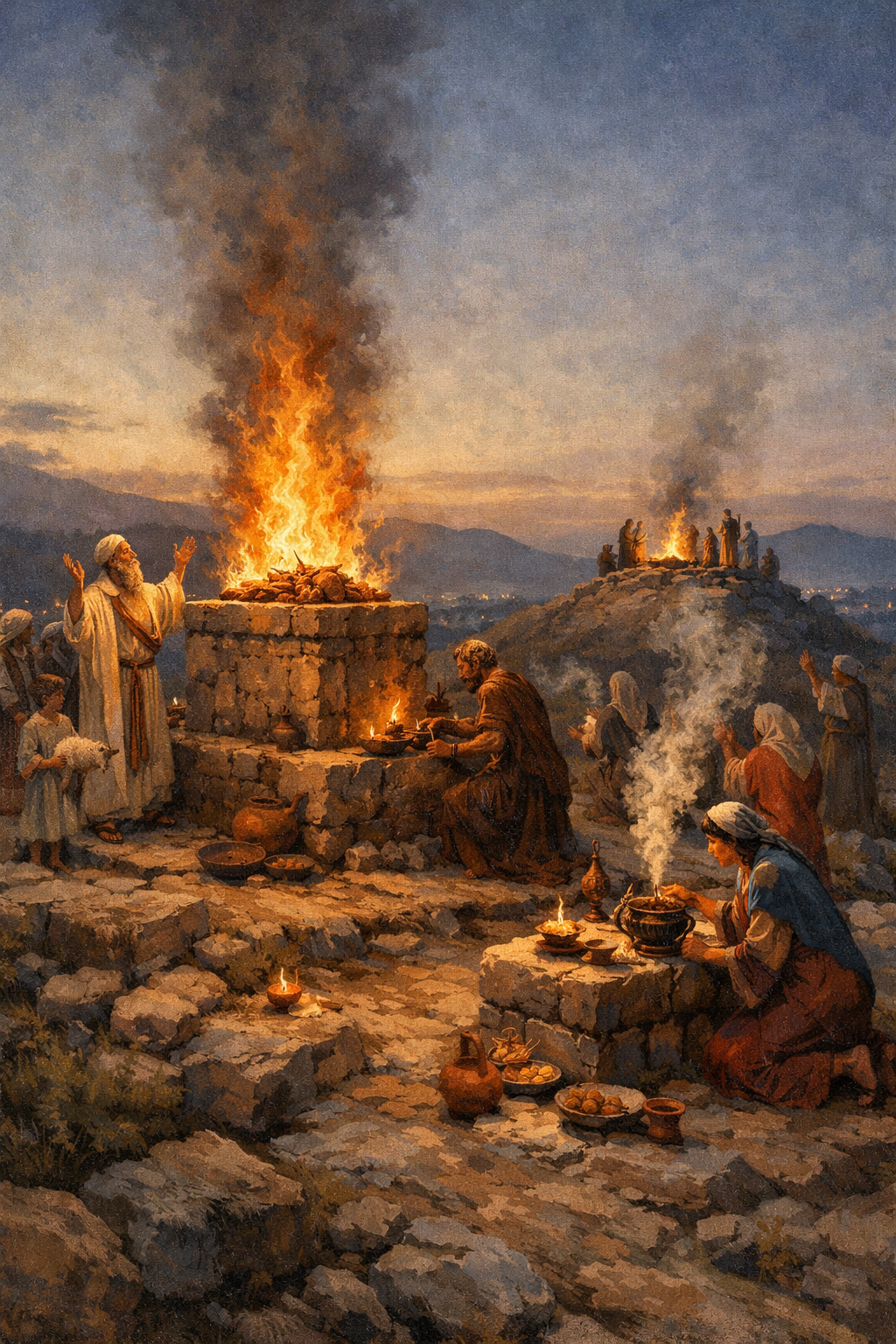
Only the high places were not taken away; the people still sacrificed and burned incense on the high places - This fact is not recorded in the parallel passages in 2 Chronicles 25. Judah had not fully submitted to God’s appointed way of worship. Old habits die slowly, even after revival. Compromise often survives in familiar, tolerated forms. What God permits temporarily, He still expects to be corrected eventually. These high places were where the people worshiped Yahweh rather than pagan deities but they were potential sources for the entrance of pagan practices into Israel’s worship and they were not ordained by Yahweh.
A sad phrase that is repeated again and again (speaking of Israel and Judah) is "the high places were not taken away" (1Ki 15:14, 2Chr 15:17 = King Asa but notice he did remove some of them - 2Chr 14:3, 5, 1Ki 22:43, 2Chr 20:33 = King Jehoshaphat, 2Ki 12:3 = King Jehoash, 2Ki 14:4 = King Amaziah, 2Ki 15:4 = King Azariah, 2Ki 15:35 = King Jotham son of Uzziah and look what his son did in 2Ki 16:1-4!, 2Chr 20:33). In many of these passages the context was of a king doing "spiritual house cleaning" so to speak and yet still failing to remove the high places. Isn't sin that way? We confess one or two sins but we have a little pet sin (better a "venomous viper") that we just don't have the heart to kill! God grant us spiritual eyes and hearts to learn from Israel's mistakes. Amen! Some kings like Hezekiah (1Ki 18:4, 2Chr 31:1, Isa 36:7) and Josiah (2Ki 23:4,8, 13, 15, 19-20, 2Chr 34:3 cp prophecy about Josiah 300 years earlier = 1Ki 13:2) did destroy the high places, but in Hezekiah's case his own son Manasseh rebuilt them (2Ki 21:1-2, 3, 2Chr 33:3) and in Josiah's case the people rebuilt them!
🙏 THOUGHT - Do you (I) have any persistent "high places" in our life, things that are preventing us from experiencing what Jesus desires for each of us - to have life and have it abundantly (Jn 10:10b)?
Warren Wiersbe on high places - The only thing Joash and Jehoiada didn’t do was remove the high places in Judah, the local shrines where the people worshipped the Lord. They were supposed to go to the temple to worship (Deut. 12), but during the dark days of Athaliah’s reign, the temple had been ignored and even allowed to decay.
Bob Utley - "the high places" These were local places of worship (BDB 119). Originally they were not condemned but with the rise of a mandated central shrine in Jerusalem, they became identified with Ba'al worship. Not until Hezekiah (2 Kgs. 18:4) were the high places destroyed (cf. 1 Kgs. 15:14; 22:43; 2 Kgs. 12:3; 14:4; 15:4,35). It was not until the time of Hezekiah (cf. 2 Kgs. 18:4) that these local shrines were obliterated and outlawed. The reason that they were so difficult to deal with is because during the period of Judges, they were sanctioned by YHWH and yet over the period of time, they came to be worship centers for Ba'al.
High places (01116) bamah Six activities seem to be related to high places -- burning of incense, sacrificing, eating of sacrificial meals, praying, prostitution, child sacrifice (cf. bama in the valley, Je 7:31). The first use in Lev 26:30 is God's declaration to Israel "I will destroy your high places." In Dt 32:13 speaking of Jacob (Israel) He declared "He made him ride on the high places of the earth," so clearly some uses of bamah are not negative. In a similar use God says Israel "you will tread upon their (Israel's enemies') high places." Another positive use is Psalm 18:33 where David declared Jehovah "makes my feet like hinds' feet, And sets me upon my high places." (cp Hab 3:19 - NET Note = David "compares his agility in battle to the ability of a deer to negotiate rugged, high terrain without falling or being injured.", cp Isa 58:14) We see he effect of Israel's high places on Jehovah in Ps 78:58 = "For they provoked Him with their high places and aroused His jealousy with their graven images."
BAMAH - 91V - Lev. 26:30; Num. 22:41; Num. 33:52; Deut. 32:13; Deut. 33:29; 1 Sam. 9:12; 1 Sam. 9:13; 1 Sam. 9:14; 1 Sam. 9:19; 1 Sam. 9:25; 1 Sam. 10:5; 1 Sam. 10:13; 2 Sam. 1:19; 2 Sam. 1:25; 2 Sam. 22:34; 1 Ki. 3:2; 1 Ki. 3:3; 1 Ki. 3:4; 1 Ki. 11:7; 1 Ki. 12:31; 1 Ki. 12:32; 1 Ki. 13:2; 1 Ki. 13:32; 1 Ki. 13:33; 1 Ki. 14:23; 1 Ki. 15:14; 1 Ki. 22:43; 2 Ki. 12:3; 2 Ki. 14:4; 2 Ki. 15:4; 2 Ki. 15:35; 2 Ki. 16:4; 2 Ki. 17:9; 2 Ki. 17:11; 2 Ki. 17:29; 2 Ki. 17:32; 2 Ki. 18:4; 2 Ki. 18:22; 2 Ki. 21:3; 2 Ki. 23:5; 2 Ki. 23:8; 2 Ki. 23:9; 2 Ki. 23:13; 2 Ki. 23:15; 2 Ki. 23:19; 2 Ki. 23:20; 1 Chr. 16:39; 1 Chr. 21:29; 2 Chr. 1:3; 2 Chr. 1:13; 2 Chr. 11:15; 2 Chr. 14:3; 2 Chr. 14:5; 2 Chr. 15:17; 2 Chr. 17:6; 2 Chr. 20:33; 2 Chr. 21:11; 2 Chr. 28:4; 2 Chr. 28:25; 2 Chr. 31:1; 2 Chr. 32:12; 2 Chr. 33:3; 2 Chr. 33:17; 2 Chr. 33:19; 2 Chr. 34:3; Job 9:8; Ps. 18:33; Ps. 78:58; Isa. 14:14; Isa. 15:2; Isa. 16:12; Isa. 36:7; Isa. 58:14; Jer. 7:31; Jer. 17:3; Jer. 19:5; Jer. 26:18; Jer. 32:35; Jer. 48:35; Ezek. 6:3; Ezek. 6:6; Ezek. 16:16; Ezek. 20:29; Ezek. 36:2; Hos. 10:8; Amos 4:13; Amos 7:9; Mic. 1:3; Mic. 1:5; Mic. 3:12; Hab. 3:19
2 Kings 14:5 Now it came about, as soon as the kingdom was firmly in his hand, that he killed his servants who had slain the king his father.
- that he killed: Ge 9:6 Ex 21:12-14 Nu 35:33
- his servants: 2Ki 12:20-21 2Ch 25:3,4
Parallel Passage:
2 Chronicles 25:3 Now it came about as soon as the kingdom was firmly in his grasp, that he killed his servants who had slain his father the king.
Related Passage:
2 Kings 12:20-21 His servants arose and made a conspiracy and struck down Joash at the house of Millo as he was going down to Silla. 21 For Jozacar the son of Shimeath and Jehozabad the son of Shomer, his servants, struck him and he died; and they buried him with his fathers in the city of David, and Amaziah his son became king in his place.
Proverbs 16:12 It is an abomination for kings to commit wicked acts, For a throne is established on righteousness.
JUSTICE WITH
RESTRAINT
Now it came about, as soon as the kingdom was firmly in his hand (yad ~ power) - The ancient Near East was often filled with power struggles during leadership transitions. When a king was assassinated, the government might be unstable. At first, after a king’s father was assassinated (as Amaziah’s father Joash was), the new ruler’s position often was weak — conspirators might still be in positions of power. Once Amaziah had “firmly grasped” the kingdom, he had the strength, stability, and legitimacy to act decisively. In other words, after his succession was no longer uncertain and any political rivals or instability had been dealt with (or would soon be dealt with as in this verse), Amaziah could act freely to carry out justice or implement reforms. This restraint was likely political and moral wisdom. Acting too soon could ignite civil war. Waiting until security allowed justice to proceed in order mirrors Proverbs 16:32.
NET NOTE - Heb “when the kingdom was secure in his hand.”
TSK has an interesting thought on kingdom was firmly in his hand - No doubt those wicked men, Jozachar and Jehozabad, who murdered his father, had considerable influence; and therefore he found it dangerous to bring them to justice, till he was assured of the loyalty of his other officers: when this was clear, he called them to an account, and justly put them to death for treason and murder; for, if even these conspirators against Joash intended to avenge upon him the death of Zechariah, they acted without a commission from that God "to whom vengeance belongeth."
That he killed his servants who had slain the king his father (2Ki 12:20-21) - Amaziah took avenged his father Joash's murder, putting to death Jozacar the son of Shimeath and Jehozabad the son of Shomer. Amaziah’s early actions showed obedience to God’s law. Even when executing justice, he limited his vengeance to the guilty as described in the next verse. Once empowered, Amaziah chose initially to obey the Law of Moses — a righteous beginning — but later drifted from full devotion to God.
Raymond Dillard: Amaziah may have been motivated to avenge the death of his father when he executed the assassins; however, his own consolidation of power and elimination of potential rivals may also have been a factor. (2 Chronicles, Volume 15)
2 Kings 14:6 But the sons of the slayers he did not put to death, according to what is written in the book of the Law of Moses, as the LORD commanded, saying, “The fathers shall not be put to death for the sons, nor the sons be put to death for the fathers; but each shall be put to death for his own sin.”
- The fathers: De 24:16 Eze 18:4,20
Parallel Passage:
2 Chronicles 25:4 However, he did not put their children to death, but did as it is written in the law in the book of Moses, which the LORD commanded, saying, “Fathers shall not be put to death for sons, nor sons be put to death for fathers, but each shall be put to death for his own sin.”
Related Passages:
Deuteronomy 24:16 “Fathers shall not be put to death for their sons, nor shall sons be put to death for their fathers; everyone shall be put to death for his own sin.
Ezekiel 18:4; 20 “Behold, all souls are Mine; the soul of the father as well as the soul of the son is Mine. The soul who sins will die....18:20 “The person who sins will die. The son will not bear the punishment for the father’s iniquity, nor will the father bear the punishment for the son’s iniquity; the righteousness of the righteous will be upon himself, and the wickedness of the wicked will be upon himself.
AMAZIAH OBEYS MOSES
SONS OF SLAYERS SURVIVE
But (term of contrast) - In the ancient near east it was common practice to wipe out the family of political opponents, but Amaziah did an "about face" and refused to carry out this practice.
The sons of the slayers he did not put to death, according to what is written in the book of the Law of Moses, as the LORD commanded, saying, “The fathers shall not be put to death for the sons, nor the sons be put to death for the fathers; but each shall be put to death for his own sin - Amazian has at least some grasp of the Torah and willingness to adhere to it, for not slaying sons for father's sins was in accord with the law of Deut. 24:16. Note repeat of not put to death for emphasis.
TECHNICAL NOTE: This reference to the passage in Deuteronomy clearly refutes the false belief that it was not written until much later than Moses time. Some hold Torah was written in the 7th century B.C. (the dominant view - c. 622 BC) and others even later in the 6th–5th century B.C., proposing that Deuteronomy was edited or compiled during or after the Babylonian exile.. Both of these late daes are refuted by the fact that Amaziah reigned 796 to 767 BC, which would have been over 100 years before critics claim Deuteronomy was written.
NET NOTE - Heb “as it is written in the scroll of the law of Moses which the LORD commanded, saying.”
Bob Utley - "the sons of the slayers he did not kill" The reason for this was the verse in the Law of Moses (i.e., Deut. 24:16) which does not allow a son to bear the punishment of his father. This is surprising,in light of Exod. 20:5; Deut. 5:9,10. However, it perfectly fits Jer. 31:29-30; Ezekiel 18. There is a tension in the OT between corporality and individualism (NIDOTTE, vol. 3, p. 678, #4). One's sins do affect the whole (i.e., Joshua 7; Isaiah 53). But also personal faith and covenant obedience affects this issue (i.e., blood feuds between families).
Bob Utley - "in the book of the law of Moses" The specific quote is from Deut. 24:16. Modern scholars have speculated on the formation of the OT and postulated several authors/editors. I reject this J, E, P, D theory of Welhousen, but I do believe there were editors involved in the formation of the OT we have today. The MT was not completed until the ninth century A.D.! MOSES' AUTHORSHIP OF THE PENTATEUCH PENTATEUCH SOURCE CRITICISM (J,E,D,P)
F B Meyer - 2 Kings 14:6 Every man shall be put to death for his own sin.
So ran the law of Moses. It forbade the imposition of punishment on the relatives of the wrong-doer, but it had no mercy on him. “The soul that sinneth, it shall die,” was the succinct and conclusive verdict of the older law, in this reflecting the spirit and letter of one yet older, which ran, “The day that thou eatest thereof, thou shalt surely die.”
First, we were dead in our sins.— Ephesians 2:5 puts this beyond all doubt. In the sight of God, all who walk according to the course of this world, and obey the prince that now worketh in the children of this world, are dead in trespasses and sins. However much they may be alive as to their souls, they are dead as to their spirits, entirely destitute of the life of God.
Second, we have died for our sins.— 2 Corinthians 5:14–15 (R. V.) establishes this fact, and shows that in Jesus, we who believe in Him, are reckoned to have died in Him when He bore our sins in His own body on the tree. In God’s estimate, His death is imputed to us; so that we are reckoned as having satisfied, in Jesus, the demands of a broken law. It has no more to ask.
Third, we must die to our sin.— Romans 6:11. Reckon that you have died, and whenever sin arises, to menace or allure you, point back to the grave, and argue that since you died in Christ, you have passed altogether beyond its jurisdiction, for you have yielded your members as weapons of righteousness unto God. And having been crucified with Christ, you now no longer live, but Christ liveth in you. Let it become your daily habit to place the grave of Jesus between yourself and all allurements of the world, the flesh. and the devil.
Related Resource:
- Should Children Be Punished for Their Parents’ Sins? - See page 150 in Walter Kaiser's Hard Sayings
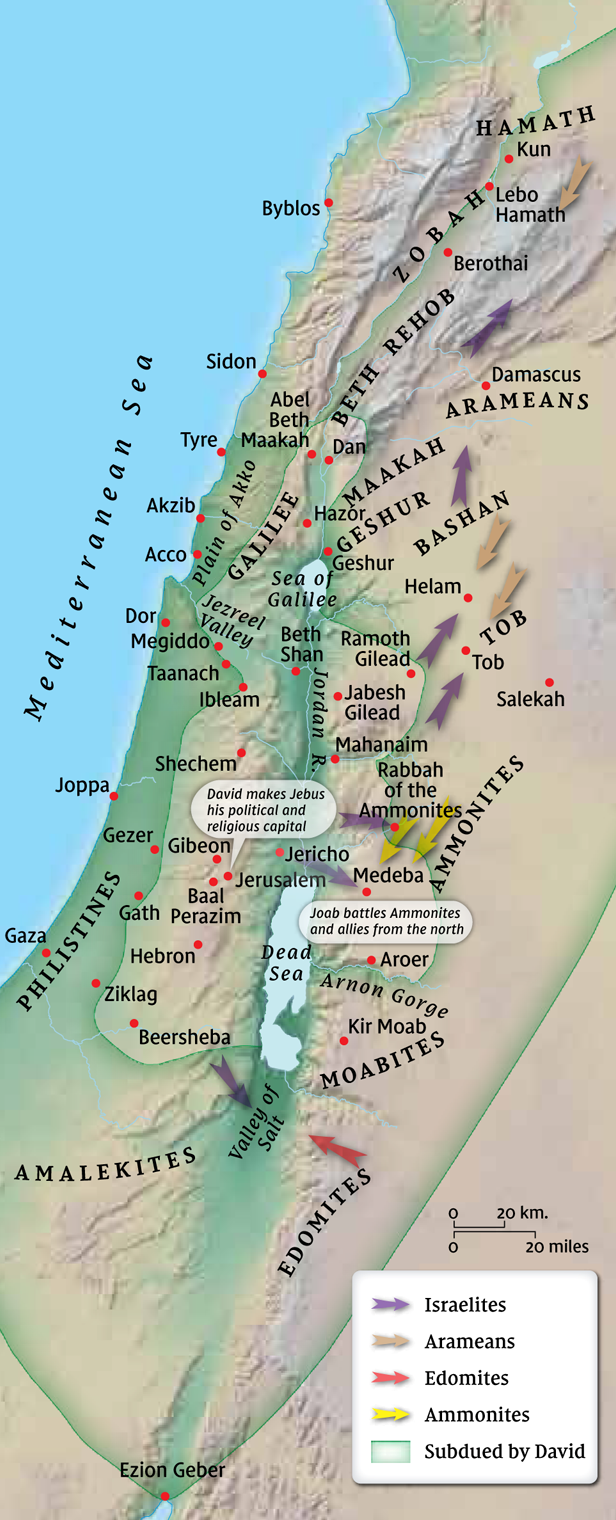
2 Kings 14:7 He killed of Edom in the Valley of Salt 10,000 and took Sela by war, and named it Joktheel to this day.
- Killed: 2Ki 8:20-22 2Ch 25:11,12
- the Valley of Salt: 2Sa 8:13 1Ch 18:12 Ps 60:1
- Joktheel: Jos 15:38
Parallel Passages: (BOLD ONLY IN CHRONICLES)
2 Chronicles 25:5-10 Moreover, Amaziah assembled Judah and appointed them according to their fathers’ households under commanders of thousands and commanders of hundreds throughout Judah and Benjamin; and he took a census of those from twenty years old and upward and found them to be 300,000 choice men, able to go to war and handle spear and shield.
6 He hired also 100,000 valiant warriors out of Israel for one hundred talents of silver.
7 But a man of God came to him saying, “O king, do not let the army of Israel go with you, for the LORD is not with Israel nor with any of the sons of Ephraim.
8 “But if you do go, do it, be strong for the battle; yet God will bring you down before the enemy, for God has power to help and to bring down.”
9 Amaziah said to the man of God, “But what shall we do for the hundred talents which I have given to the troops of Israel?” And the man of God answered, “The LORD has much more to give you than this.”
10 Then Amaziah dismissed them, the troops which came to him from Ephraim, to go home; so their anger burned against Judah and they returned home in fierce anger.2 Chronicles 25:11-16 Now Amaziah strengthened himself and led his people forth, and went to the Valley of Salt and struck down 10,000 of the sons of Seir. 12 The sons of Judah also captured 10,000 alive and brought them to the top of the cliff and threw them down from the top of the cliff, so that they were all dashed to pieces. 13 But the troops whom Amaziah sent back from going with him to battle, raided the cities of Judah, from Samaria to Beth-horon, and struck down 3,000 of them and plundered much spoil. 14 Now after Amaziah came from slaughtering the Edomites, he brought the gods of the sons of Seir, set them up as his gods, bowed down before them and burned incense to them. 15 Then the anger of the LORD burned against Amaziah, and He sent him a prophet who said to him, “Why have you sought the gods of the people who have not delivered their own people from your hand?” 16 As he was talking with him, the king said to him, “Have we appointed you a royal counselor? Stop! Why should you be struck down?” Then the prophet stopped and said, “I know that God has planned to destroy you, because you have done this and have not listened to my counsel.”
Related Passages:
2 Kings 8:20 In his days Edom revolted from under the hand of Judah, and made a king over themselves.
Valley of Salt at Southern End of Dead Sea
NIV Study Bible
AMAZIAH'S VICTORY
OVER EDOM
He killed of Edom in the Valley of Salt (just south of Dead Sea in map above) 10,000 - David had killed 18,000 in the Valley of Salt (2Sa 8:13, 1Ch 18:12), 2Sa 8 describing multiple victories for King David, but these did not lead to pride as with Amaziah. For Amaziah, this victory would mark a turning point and begin the tragic decline in his spiritual life as described in the following passages.
And took Sela (modern day Petra) by war, and named it Joktheel to this day - It appears that Amaziah gave God as least some of the credit in his victory because as explained below the name Joktheel means "subdued by God." Unfortunately in addition to the 10,000 struck down by war, Amaziah's forces slaughtered 10,000 more who had been captured alive - "The sons of Judah also captured 10,000 alive and brought them to the top of the cliff and threw them down from the top of the cliff, so that they were all dashed to pieces." (2Ch 25:12). The act of throwing captives from a cliff was brutal and shocking, even in the ancient world. Today we would call that a "war crime," and it clearly revealed growng darkness in the heart of King Amaziah and his increasing departure from God’s character, which underscores the earlier description of Amaziah's behavior as "not like David his father" (2Ki 14:3) and "not with a whole heart" (2Ch 25:2)
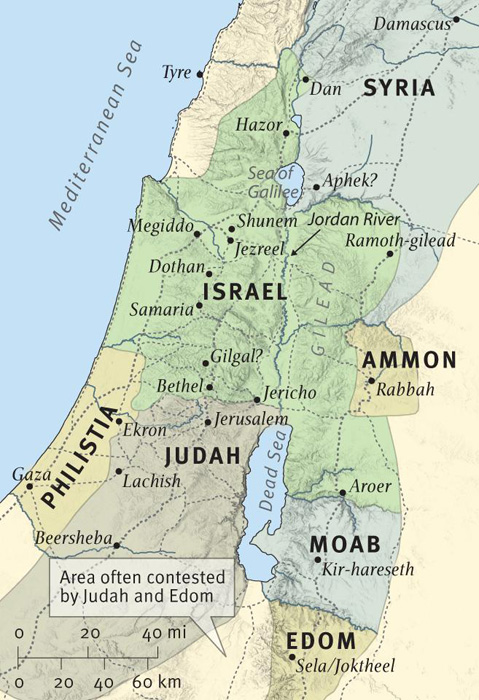
Enlarge to show Joktheel
Directly beneath "EDOM"
Even though the Edomites were enemies, the excessive violence echoes the very sins God warned Israel against — arrogance and bloodlust. The Lord reminded His people repeatedly that vengeance belongs to Him alone “It is mine to avenge; I will repay,” declares the LORD." (Dt 32:35) and “Do not repay evil with evil or insult with insult, but with blessing, because to this you were called.” (1Pe 3:9)
Bob Utley - Edom was a vassal state under Judah for a long period of time (cf from time of David 2Sa 8:14) but had recently regained independence (cf. 2Ki 8:20).
Frederick Mabie: During Amaziah’s reign, the Assyrian Empire begins to decline, which facilitates a time of peace and prosperity for Judah and Israel. (1 and 2 Chronicles)
Easton's Bible Dictionary helps us understand why Amaziah renamed Sela (Petra) as Joktheel - Amaziah, king of Judah, undertook a great expedition against Edom (2 Chr. 25:5-10), which was completely successful. He routed the Edomites and slew vast numbers of them. So wonderful did this victory appear to him that he acknowledged that it could have been achieved only by the special help of God, and therefore he called Selah (q.v.), their great fortress city, by the name of Joktheel (2 Kings 14:7).
Raymond Dillard: On the whole the record of Amaziah’s reign is a negative one. Apart from the brief, but clouded, victory over Edom as a reward for his obedience to the prophetic warning, the passage does not record any of the usual repertoire of indications of divine favor; rather, it is a study in opposites.
- Instead of royal building programs, the walls of Jerusalem are destroyed;
- instead of wealth from the people and surrounding nations, the king is plundered;
- instead of a large family, there are hostages; instead of peace, war;
- instead of victory, defeat; instead of loyalty from the populace and long life, there is conspiracy and regicide.
The Chronicler’s message for the restoration community was clear—to those rebuilding Jerusalem and restoring its walls, the Chronicler sounded again the central demand of exclusive loyalty in Israel’s covenant with its Lord. (2 Chronicles, Volume 15)
Norman Geisler - DEUTERONOMY —How could Moses have written this when biblical criticism claims it was written many centuries later?
PROBLEM: According to this verse, “these are the words which Moses spoke.” However, many biblical critics claim that Deuteronomy was written in the third century B.C., many centuries after Moses’ time.
SOLUTION: There are many arguments that support the claim that Moses wrote the Book of Deuteronomy.
- First, there is the repeated claim of the book that “these are the words of Moses (Dt 1:1; 4:44; 29:1). To deny this is to claim the book is a total fraud.
- Second, Joshua, Moses’ immediate successor, attributed the Book of Deuteronomy to Moses, exhorting the people of Israel to “observe to do … all the law which Moses … commanded” (Josh. 1:7).
- Three, the remainder of the OT attributes Deuteronomy to Moses (cf. Judges. 3:4; 1 Kings 2:3; 2 Kings 14:6; Ezra 3:2; Neh. 1:7; Ps. 103:7; Dan. 9:11; Mal. 4:4).
- Fourth, Deuteronomy is the book of the Law most quoted in the NT, often with words like “Moses truly said” (Acts 3:22), “Moses says” (Rom. 10:19), or “it is written in the law of Moses” (1 Cor. 9:9).
- Fifth, our Lord quoted the Book of Deuteronomy (Dt 6:13, 16) as the authoritative Word of God when He resisted the devil (Matt. 4:7, 10), and He also directly attributed it to the hand of Moses, saying, “Moses said” (Mark 7:10) or “Moses wrote” (Luke 20:28).
- Sixth, the geographical and historical details of the book display a firsthand acquaintance such as Moses would have had.
- Seventh, scholarly studies of the form and content of Near Eastern covenants indicate that Deuteronomy is from the period of Moses (see Meredith Kline, Treaty of the Great King, Eerdmans, 1963).
- In addition to all of this, the apparent references within the book to a later period are easily explained (see comments on Deut. 2:10–12). Of course, the last chapter of Deuteronomy, being about Moses’ death (chap. 34) was probably written by his successor Joshua, in accordance with the custom of the day (When Critics Ask)
QUESTION - Who were the Edomites? | GotQuestions.org
ANSWER - The Edomites were the descendants of Esau, the firstborn son of Isaac and the twin brother of Jacob. In the womb, Esau and Jacob struggled together, and God told their mother, Rebekah, that they would become two nations, with the older one serving the younger (Genesis 25:23). As an adult, Esau rashly sold his inheritance to Jacob for a bowl of red soup (Genesis 25:30-34), and he hated his brother afterward. Esau became the father of the Edomites and Jacob became the father of the Israelites, and the two nations continued to struggle through most of their history. In the Bible, “Seir” (Joshua 24:4), “Bozrah” (Isaiah 63:1) and “Sela” (2 Kings 14:7) are references to Edom’s land and capital. Sela is better known today as Petra.
The name “Edom” comes from a Semitic word meaning “red,” and the land south of the Dead Sea was given that name because of the red sandstone so prominent in the topography. Esau, because of the soup for which he traded his birthright, became known as Edom, and later moved his family into the hill country of the same name. Genesis 36 recounts the early history of the Edomites, stating that they had kings reigning over them long before Israel had a king (Genesis 36:31). The religion of the Edomites was similar to that of other pagan societies who worshiped fertility gods. Esau’s descendants eventually dominated the southern lands and made their living by agriculture and trade. One of the ancient trade routes, the King’s Highway (Numbers 20:17) passed through Edom, and when the Israelites requested permission to use the route on their exodus from Egypt, they were rejected by force.
Because they were close relatives, the Israelites were forbidden to hate the Edomites (Deuteronomy 23:7). However, the Edomites regularly attacked Israel, and many wars were fought as a result. King Saul fought against the Edomites, and King David subjugated them, establishing military garrisons in Edom. With control over Edomite territory, Israel had access to the port of Ezion-Geber on the Red Sea, from which King Solomon sent out many expeditions. After the reign of Solomon, the Edomites revolted and had some freedom until they were subdued by the Assyrians under Tiglath-pileser.
During the Maccabean wars, the Edomites were subjugated by the Jews and forced to convert to Judaism. Through it all, the Edomites maintained much of their old hatred for the Jews. When Greek became the common language, the Edomites were called Idumaeans. With the rise of the Roman Empire, an Idumaean whose father had converted to Judaism was named king of Judea. That Idumaean is known in history as King Herod the Great, the tyrant who ordered a massacre in Bethlehem in an attempt to kill the Christ child (Matthew 2:16-18).
After Herod’s death, the Idumaean people slowly disappeared from history. God had foretold the destruction of the Edomites in Ezekiel 35, saying, “As you rejoiced over the inheritance of the house of Israel, because it was desolate, so I will deal with you; you shall be desolate, Mount Seir, and all Edom, all of it. Then they will know that I am the Lord” (Ezekiel 35:15). Despite Edom’s constant efforts to rule over the Jews, God’s prophecy to Rebekah was fulfilled: the older child served the younger, and Israel proved stronger than Edom.
Related Resource:
QUESTION - What is the significance of the city of Sela? gotquestions.org
ANSWER - The city of Petra is not mentioned in the Bible by that name; rather, it is called by its Hebrew name, Sela in Isaiah 16:1 and 2 Kings 14:7. Both Petra and Sela mean “rock,” an appropriate name, since much of the city is carved into sandstone cliffs. Petra is located about fifty miles south of the Dead Sea and 170 miles southwest of modern Amman, Jordan.
EDITORIAL NOTE: UTLEY POINTS OUT the exact site of "Sela" is unknown.
- Perhaps the capital of Edom (LXX). Today it is a famous archaeological site and tourist attraction, later called Petra (i.e., Nabatean capital). See 2 Chr. 25:5-15 for a fuller account of the taking of this capital city.
- Possibly a city on the King's Highway called "Sila" (Tyndale OT Commentary, p. 244).
- Possibly an unidentified Amorite border fortress (cf. Jdgs. 1:35; NIDOTTE, vol. 3, p. 267).
- Possibly an unknown place in Moab (cf. Isa. 16:1).
Petra’s main access is via a narrow crevice called the Siq, which winds for about a mile through mountainous terrain. The Siq provided an excellent natural defense for Petra’s inhabitants. Many moviegoers are familiar with the Siq and the treasury building of Petra, which were featured in the 1989 film Indiana Jones and the Last Crusade.
Petra was in the land of the Edomites, who were descendants of Esau. Israel and Edom were constantly at odds, starting with Edom’s refusal to allow Moses and the Israelites passage through their land on their way to Canaan (Numbers 20:18-21). During the kingdom years, King Saul and King David both fought the Edomites (1 Samuel 14:47; 2 Samuel 8:13-14). During the reign of King Jehoshaphat, Edom invaded Judah and was repelled (2 Chronicles 20). Later, King Amaziah fought against Edom, and he took control of Petra, renaming it “Joktheel” (2 Kings 14:7).
When King Nebuchadnezzar of Babylon destroyed Jerusalem in 586 BC, the Edomites gave aid and comfort to the enemy (Psalm 137:7). For this, they were strongly condemned by the prophets Isaiah, Jeremiah, and Obadiah (Isaiah 34:5-8; Jeremiah 49:16-18).
For centuries, Petra seemed secure in its unassailable fortress of rock, but today its ruins lie uninhabited, in fulfillment of the prophetic word: “‘As Sodom and Gomorrah were overthrown, along with their neighboring towns,’ says the LORD, ‘so no one will live there; no people will dwell in it’” (Jeremiah 49:18).
2 Kings 14:8 Then Amaziah sent messengers to Jehoash, the son of Jehoahaz son of Jehu, king of Israel, saying, “Come, let us face each other.”
- Amaziah: 2Ch 25:17-24
- Come: 2Ki 14:11 2Sa 2:14-17 Pr 13:10 17:14 18:6 20:18 25:8
Parallel Passage:
2 Chronicles 25:17 (TEXT IN BOLD ONLY IN CHRONICLES) Then Amaziah king of Judah took counsel and sent to Joash the son of Jehoahaz the son of Jehu, the king of Israel, saying, “Come, let us face each other.”
AMAZIAH CHALLENGES
JEHOAHAZ TO WAR
Then Amaziah sent messengers to Jehoash, the son of Jehoahaz son of Jehu, king of Israel, saying, “Come, let us face each other.” - This face to face, mano on mano, is not an invitation to break bread and share a cup of tea! The NLT paraphrase expresses it accurately "Come and meet me in battle!"
Fresh off a victory over Edom and in light of the raiding of Judah by Israelite (Ephraimite) mercenaries it seems that Amaziah is, as we say today, "picking a fight!" Notice that little phrase added in Chronicles (not in the Kings parallel) took counsel! This reminds me of King Rehoboam who took counsel with elders and then young men and listened to the latter. (1Ki 12:8,9, 2Ch 10:6-11) and the result was a divided kingdom!!! There is no evidence Amaziah sought God's "counsel" which one should always do when making a major (even minor) decision!
NET NOTE - Heb “let us look at each other [in the] face.” The expression refers here to meeting in battle. See 2Ki 14:11.
John Olley: The foolhardy arrogance of Amaziah continued as he sought confrontation with Joash of Israel. (ESV Expository Commentary,)
David Guzik: He had reason to believe he would be successful. He had recently assembled a 300,000 man army that killed 20,000 men in a victory over Edom (2 Chronicles 25:5, 11-12). King Joash (Jehoahaz) of Israel seemed very weak, having only 50 horsemen, 10 chariots, and 10,000 foot soldiers after being defeated by the Syrians (2 Kings 13:7).
Bob Utley - "Come, let us face each other" Josephus (Antiq. 9.9.1) tells us this was an attempt by Amaziah to unite the people of God. However, from 2 Chr. 25:13, it may be just an attempt to get revenge on the deeds of the 100,000 Israeli mercenaries that Amaziah hired and then sent home. The phrase itself is an idiom for "let us meet for battle." Amaziah had experienced victory over Edom by prophetic announcement and a small number of soldiers. Obviously YHWH's hand was with him but Amaziah assumed, falsely, this would always be the case (Josephus, Antiq. 9.9.1).
How Amaziah made an expedition against the Edomites and Amalekites, and conquered them; but when he afterwards made war against Joash, he was beaten and not long after was slain; and Uzziah succeeded in the government.
1. [An. 840.] Now in the second year of the reign of Joash over Israel, Amaziah reigned over the tribe of Judah at Jerusalem. His mothers name was Jehoaddan, who was born at Jerusalem. He was exceeding careful of doing what was right, and this when he was very young. But when he came to the management of affairs, and to the government, he resolved that he ought first of all to avenge his father Jehoash; and to punish those his friends that had laid violent hands upon him. So he seized upon them all, and put them to death: yet did he execute no severity on their children; but acted therein according to the laws of Moses, who did not think it just to punish children for the sins of their fathers. After this he chose him an army out of the tribe of Judah and Benjamin, of such as were in the flower of their age, and about twenty years old. And when he had collected about three hundred thousand of them together, he set captains of hundreds over them. He also sent to the King of Israel, and hired an hundred thousand of his soldiers, for an hundred talents of silver: for he had resolved to make an expedition against the nations of the Amalekites, and Edomites, and Gebalites. But as he was preparing for his expedition, and ready to go out to the war, a Prophet gave him counsel to dismiss the army of the Israelites; because they were bad men; and because God foretold that he should be beaten, if he made use of them as auxiliaries: but that he should overcome his enemies, tho’ he had but a few soldiers, when it so pleased God. And when the King grudged at his having already paid the hire of the Israelites, the Prophet exhorted him to do what God would have him; because he should thereby obtain much wealth from God. So he dismissed them, and said that he still freely gave them their pay, and went himself with his own army, and made war with the nations before mentioned: and when he had beaten them in battel, he slew of them ten thousand, and took as many prisoners alive: whom he brought to the great rock which is in Arabia, and threw them down from it headlong. He also brought away a great deal of prey, and vast riches from those nations. But while Amaziah was engaged in this expedition, those Israelites whom he had hired, and then dismissed, were very uneasy at it; and taking their dismission for an affront, as supposing that this would not have been done to them but out of contempt, they fell upon his Kingdom, and proceeded to spoil the countrey as far as Beth-horon; and took much cattle, and slew three thousand men.
2. [About An. 827.] Now upon the victory which Amaziah had gotten, and the great acts he had done, he was puffed up; and began to overlook God, who had given him the victory: and proceeded to worship the gods he had brought out of the countrey of the Amalekites. So a Prophet came to him, and said, that “He wondred how he could esteem these to be Gods, who had been of no advantage to their own people, who paid them honours; nor had delivered them from his hands; but had overlooked the destruction of many of them, and had suffered themselves to be carried captive: for that they had been carried to Jerusalem in the same manner as any one might have taken some of the enemy alive, and led them thither.” This reproof provoked the King to anger; and he commanded the Prophet to hold his peace, and threatened to punish him if he meddled with his conduct. So he replied, “That he should indeed hold his peace: but foretold withal, that God would not overlook his attempts for innovation.” But Amaziah was not able to contain himself under that prosperity which God had given him; although he had affronted God thereupon: but in a vein of insolence he wrote to Joash, the King of Israel, and “Commanded that he and all his people should be obedient to him, as they had formerly been obedient to his progenitors, David and Solomon: and he let him know that if he would not be so wise as to do what he commanded him, he must fight for his dominion.” To which message Joash returned this answer in writing: “King Joash to King Amaziah. There was a vastly tall cypress tree in Mount Lebanon, as also a thistle: this thistle sent to the cypress tree, to give the cypress tree’s daughter in marriage to the thistle’s son. But as the thistle was saying this, there came a wild beast, and trod down the thistle. And this may be a lesson to thee, not to be so ambitious; and to have a care, lest upon thy good success in the fight against the Amalekites, thou growest so proud, as to bring dangers upon thy self, and upon thy Kingdom.
3. [An. 811.] When Amaziah had read this letter, he was more eager upon this expedition: which, I suppose, was by the impulse of God, that he might be punished for his offence against him. But as soon as he led out his army against Joash, and they were going to join battel with him, there came such a fear and consternation upon the army of Amaziah, as God, when he is displeased, sends upon men; and discomfited them, even before they came to a close fight. Now it happened, that as they were scattered about by the terror that was upon them, Amaziah was left alone, and was taken prisoner by the enemy. Whereupon Joash threatened to kill him, unless he would persuade the people of Jerusalem to open their gates to him, and receive him and his army into the city. Accordingly Amaziah was so distressed, and in such fear of his life, that he made his enemy to be received into the city. So Joash overthrew a part of the wall, of the length of four hundred cubits; and drove his chariot through the breach into Jerusalem, and led Amaziah captive along with him. By which means he became master of Jerusalem, and took away the treasures of God, and carried off all the gold and silver that was in the King’s palace; and then freed the King from captivity, and returned to Samaria. Now these things happened to the people of Jerusalem in the fourteenth year of the reign of Amaziah, who after this had a conspiracy made against him by his friends, and fled to the city Lachish; and was there slain by the conspirators, who sent men thither to kill him. So they took up his dead body, and carried it to Jerusalem, and made a royal funeral for him. This was the end of the life of Amaziah: because of his innovations in religion, and his contempt of God; when he had lived fifty four years, and had reigned twenty nine.18 He was succeeded by his son, whose name was Uzziah.
2 Kings 14:9 Jehoash king of Israel sent to Amaziah king of Judah, saying, “The thorn bush which was in Lebanon sent to the cedar which was in Lebanon, saying, ‘Give your daughter to my son in marriage.’ But there passed by a wild beast that was in Lebanon, and trampled the thorn bush.
- The thistle: Judges 9:8-15 2Sa 12:1-4 1Ki 4:33 Eze 20:49
Parallel Passage:
2 Chronicles 25:18 Joash the king of Israel sent to Amaziah king of Judah, saying, “The thorn bush which was in Lebanon sent to the cedar which was in Lebanon, saying, ‘Give your daughter to my son in marriage.’ But there passed by a wild beast that was in Lebanon and trampled the thorn bush.
JEHOASH'S PARABOLIC
RESPONSE TO AMAZIAH
Jehoash king of Israel sent to Amaziah king of Judah, saying, “The thorn bush which was in Lebanon sent to the cedar which was in Lebanon, saying, ‘Give your daughter to my son in marriage.’ But there passed by a wild beast that was in Lebanon, and trampled the thorn bush. Jehoash tried to cut Amaziah down to size with this parable: A thistle tried to make himself equal with a cedar tree until a wild beast accidently stepped on him and stopped his ambitious plans. Likewise Amaziah should stay home and be content with his little trophies.
NET NOTE - Judah is the thorn in the allegory. Amaziah’s success has deceived him into thinking he is on the same level as the major powers in the area (symbolized by the cedar). In reality he is not capable of withstanding an attack by a real military power such as Israel (symbolized by the wild animal).
Dilday: The thistle, imagining himself to be equal with the cedar, presumptuously suggested a marriage alliance between them. The difference between the two was made obvious when a wild beast passed through and crushed the thistle underfoot. Of course the beast was powerless to injure the cedar. (1, 2 Kings - Volume 9)
Bob Utley - 14:9-10 Agricultural parables or riddles were common in the ANE. This one from the king of Israel warns the king of Judah not to think too highly of himself after his defeat of Edom (cf. v. 10; 2 Chr. 25:11-13). The king of Judah was acting like his army was equal to the army of Israel. Maybe Amaziah was counting on the intervention of YHWH. "Give your daughter to my son in marriage" This imagery deals with the supposed equality between Israel and Judah. Amaziah (the thorn bush) considered himself an equal to Jehoash (the cedar), but in reality was not.
J.A. Thompson: Jehoash’s fable about the arrogant thistle is similar to Jotham’s allegory about the thornbush in Judges 9:7-15. The Chronicler viewed pride as a grievous sin and can be heard speaking through Jehoash. To have supposed that a victory over Edom was a warrant for attacking Jehoash and a guarantee of another victory was arrogant and foolish. Amaziah would be wiser to remain at home. His action would bring about his own downfall and that of his nation Judah as well (cf. 2Chr 26:16). (See 1, 2 Chronicles: An Exegetical and Theological Exposition)
2 Kings 14:10 “You have indeed defeated Edom, and your heart has become proud. Enjoy your glory and stay at home; for why should you provoke trouble so that you, even you, would fall, and Judah with you?”
- heart: De 8:14 2Ch 26:16 32:25 Pr 16:18 Eze 38:2,5,17 Da 5:20-23 Hab 2:4 Jas 4:6
- glory: Ex 8:9 Jer 9:23,24 Jas 1:9
- why should: 2Ch 35:21 Pr 3:30 15:18 17:14 20:3 25:8 26:17 Lu 14:31,32
Parallel Passage:
2 Chronicles 25:15 Then the anger of the LORD burned against Amaziah, and He sent him a prophet who said to him, “Why have you sought the gods of the people who have not delivered their own people from your hand?”
2 Chronicles 25:19 “You said, ‘Behold, you have defeated Edom.’ And your heart has become proud in boasting. Now stay at home; for why should you provoke trouble so that you, even you, would fall and Judah with you?”
Proverbs 16:18 Pride goes before destruction, And a haughty spirit before stumbling.
Deuteronomy 8:17-18 Otherwise, you may say in your heart, (Idea is "Beware lest you say in your heart") ‘My power and the strength of my hand made me this wealth.’ 18 “But you shall remember the LORD your God, for it is He who is giving you power to make wealth, that He may confirm His covenant which He swore to your fathers, as it is this day.
Proverbs 21:31 The horse is prepared for the day of battle, But victory belongs to the LORD.
JEHOASH CALLS OUT
AMAZIAH'S PRIDE
You have indeed defeated Edom, (2Ch 25:14) - This is an intensified grammatical feature (i.e., an INFINITIVE ABSOLUTE and a PERFECT VERB from the same root, BDB 645, KB 697, Hiphil). (Utley)
Victory without humility
leads to ruin.
and your heart has become proud - More literally "your heart has lifted you up." Jehoash is not exactly the most spiritually astute man on the block, but in this case he nails Amaziah's sin of pride (note the middle letter of the word pride, and same with sin = "I").
NET NOTE - Heb “and your heart has lifted you up.”
Enjoy your glory (kabad - command to glory) and stay (another command to stay) at home - This was more wise spiritual advice (in form of 2 commands) from this overall ungodly king of Israel! Two parts (1) glory in your glory and (2) stay put in Jerusalem!
NET You thoroughly defeated Edom and it has gone to your head! Gloat over your success, but stay in your palace. Why bring calamity on yourself? Why bring down yourself and Judah along with you?"
For - Term of explanation. What is Jehoash explaining?
Why should you provoke trouble so that you, even you, would fall, and Judah with you - The question is somewhat rhetorical. He is saying if you come against me, that will provoke trouble. And adds that two dominoes would tumble - Amaziah and Judah. He is almost speaking like a prophet at this point and in fact 2Ch 25:20 makes that very point that Jehoash's warning "was from God." In effect, this would have been the third prophet Amaziah had encountered and he would prove to have a low reception rate, listening only to the first unnamed prophet. Pride is driving his fleshly desire to defeat Jehoash.
NET NOTE - Heb “Why get involved in calamity and fall, you and Judah with you?”
When Jehoash said, “You have indeed defeated Edom,” he was not honoring Amaziah but diagnosing his pride. He urged Amaziah to rest content but Amaziah would not listen and as Jehoash predicted, he fell, along with Judah.
🙏 THOUGHT - Does Amaziah's fall not stir us to heed Paul's timeless command in 1Co 10:12 "Therefore let him who thinks he stands (CONTINUALLY) take heed (present imperative see our need to depend on the Holy Spirit to obey) that he does not fall."
Pride blinds the heart, deafens the ears, and ends in shame
just as Amaziah’s story demonstrates.
2 Kings 14:11 But Amaziah would not listen. So Jehoash king of Israel went up; and he and Amaziah king of Judah faced each other at Beth-shemesh, which belongs to Judah.
- Amaziah: 2Ch 25:16,20
- Beth-shemesh: Jos 19:38 21:16 1Sa 6:9-19
Parallel Passage:
2 Chronicles 25:20-21 (ONLY IN 2 CHRONICLES PARALLEL) But Amaziah would not listen, for it was from God, that He might deliver them into the hand of Joash because they had sought the gods of Edom. 21 So Joash king of Israel went up, and he and Amaziah king of Judah faced each other at Beth-shemesh, which belonged to Judah
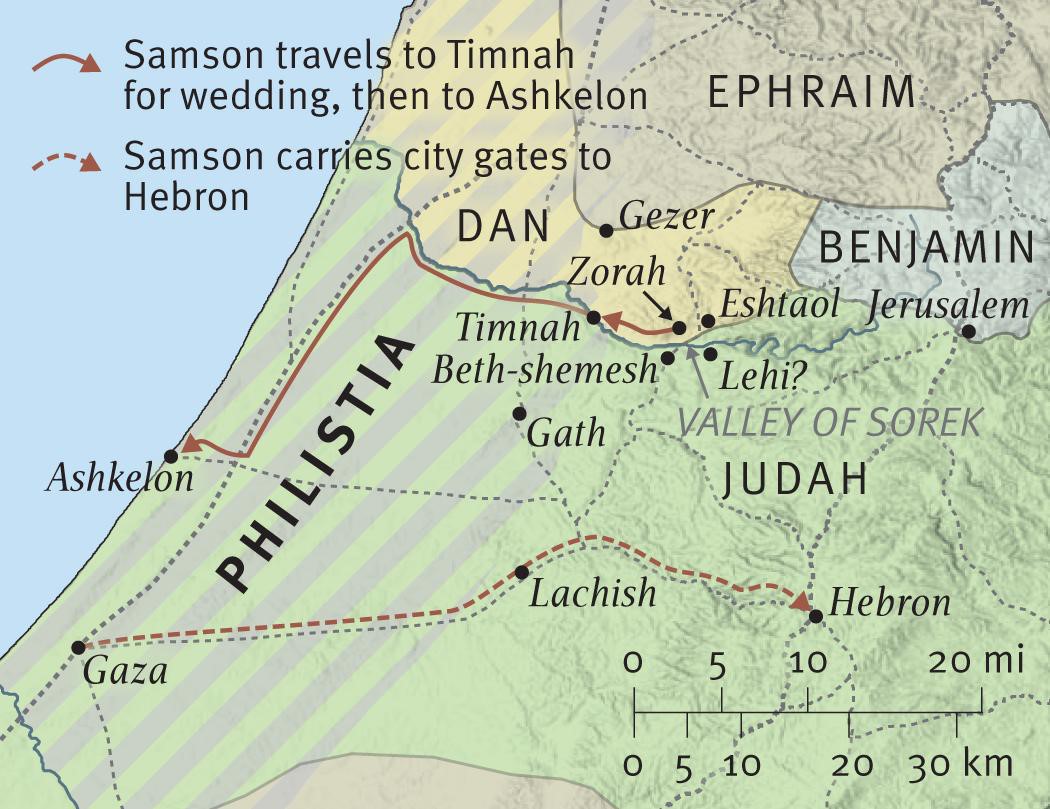
LOCATION OF BETH-SHEMESH
(ESV Study Bible)
AMAZIAH NEEDS
A "HEARING AID!"
But - Term of contrast. Oh my, when the heart is filled with pride, the mind is empty of common sense and the ears stopped up to words of truth.
Amaziah would not listen (shama; LXX - akouo) This is what pride will do to your ears! Jehoash was broadcasting on the FM Band but the only thing Amaziah could hear was the AM Band, for that is where his hard heart was tuned. It reminds me of Stephen's words in Acts 7:51 “You men who are stiff-necked and uncircumcised in heart and ears are always resisting the Holy Spirit; you are doing just as your fathers did (AKA AMAZIAH)."
Amaziah had trouble hearing and heeding and needed a divine hearing aid. Three times we see him deaf to wise words - 2Ki 14:11 = not listen to King Jehoash, 2Ch 25:16 = not listen to unnamed prophet; 2Ch 25:20 = to warning from God.
So Jehoash king of Israel went up; and he and Amaziah king of Judah faced each other at Beth-shemesh, which belongs to Judah - Note that they face off in battle on Amaziah's turf which should have given him an advantage. It might have except for the fact that God was orchestrating His hand of discipline on the back side of Amaziah!
NET NOTE - Heb “looked at each other [in the] face.”
Bob Utley - "Beth-shemesh" This place name (BDB 112) means "house of the sun." This shows the worship of the sun at one time was a common feature of the land of Canaan. This site was about 15 miles west of Jerusalem. Jehoash attacked Judah first and came from the coastal plain where he could use his chariots.
Listen (hear, obey, understand)(08085) shama means to hear (Adam and Eve hearing God = Ge 3:8, 10, Ge 18:10 = "overheard"), to listen (Ge 3:17, Ge 16:2 [= this was a big mistake and was the origin of Jews and Arabs!] Ex 6:9,16:20, 18:19, Webster's 1828 on "listen" = to hearken; to give ear; to attend closely with a view to hear. To obey; to yield to advice; to follow admonition) and since hearing/listening are often closely linked to obedience, shama is translated obey (1 Sa 15:22, Ge 22:18, 26:5, 39:10, Ex 19:5, disobedience = Lev 26:14, 18, 21, 27) or to understand. KJV translates shama "hearken" (196x) a word which means to give respectful attention. Of God's hearing in general or hearing our prayers (Hab 1:2, Ps 66:18, click here for more in the Psalms, cf God's hearing in Zeph 2:8, Ge 16:11, 17:20, 30:17, 22, Ge 21:17, 29:33, 30:6, 17, 22; Ex 2:24, Ex 16:8, 9, 12, Nu 11:1, 12:2). Shama means “to hear intelligently and attentively and respond appropriately." In other words to hear does not convey the idea of "in one ear and out the other!"
The most famous use is the so-called "Shema" in Dt 6:4 “Hear, (a command, in Greek Lxx = present imperative - habitually, continually) O Israel! The LORD is our God, the LORD is one!" 5 “You shall love the LORD your God with all your heart and with all your soul and with all your might.
SHAMA IN KINGS AND CHRONICLES - 1Ki. 1:11; 1Ki. 1:41; 1Ki. 1:45; 1Ki. 2:42; 1Ki. 3:9; 1Ki. 3:11; 1Ki. 3:28; 1Ki. 4:34; 1Ki. 5:1; 1Ki. 5:7; 1Ki. 5:8; 1Ki. 6:7; 1Ki. 8:28; 1Ki. 8:29; 1Ki. 8:30; 1Ki. 8:32; 1Ki. 8:34; 1Ki. 8:36; 1Ki. 8:39; 1Ki. 8:42; 1Ki. 8:43; 1Ki. 8:45; 1Ki. 8:49; 1Ki. 8:52; 1Ki. 9:3; 1Ki. 10:1; 1Ki. 10:6; 1Ki. 10:7; 1Ki. 10:8; 1Ki. 10:24; 1Ki. 11:21; 1Ki. 11:38; 1Ki. 12:2; 1Ki. 12:15; 1Ki. 12:16; 1Ki. 12:20; 1Ki. 12:24; 1Ki. 13:4; 1Ki. 13:26; 1Ki. 14:6; 1Ki. 15:20; 1Ki. 15:21; 1Ki. 15:22; 1Ki. 16:16; 1Ki. 17:22; 1Ki. 19:13; 1Ki. 20:8; 1Ki. 20:12; 1Ki. 20:25; 1Ki. 20:31; 1Ki. 20:36; 1Ki. 21:15; 1Ki. 21:16; 1Ki. 21:27; 1Ki. 22:19; 1Ki. 22:28; 2Ki. 3:21; 2Ki. 5:8; 2Ki. 6:30; 2Ki. 7:1; 2Ki. 7:6; 2Ki. 9:30; 2Ki. 10:6; 2Ki. 11:13; 2Ki. 13:4; 2Ki. 14:11; 2Ki. 16:9; 2Ki. 17:14; 2Ki. 17:40; 2Ki. 18:12; 2Ki. 18:26; 2Ki. 18:28; 2Ki. 18:31; 2Ki. 18:32; 2Ki. 19:1; 2Ki. 19:4; 2Ki. 19:6; 2Ki. 19:7; 2Ki. 19:8; 2Ki. 19:9; 2Ki. 19:11; 2Ki. 19:16; 2Ki. 19:20; 2Ki. 19:25; 2Ki. 20:5; 2Ki. 20:12; 2Ki. 20:13; 2Ki. 20:16; 2Ki. 21:9; 2Ki. 21:12; 2Ki. 22:11; 2Ki. 22:13; 2Ki. 22:18; 2Ki. 22:19; 2Ki. 25:23; 1Chr. 10:11; 1Chr. 14:8; 1Chr. 14:15; 1Chr. 15:16; 1Chr. 15:19; 1Chr. 15:28; 1Chr. 16:5; 1Chr. 16:42; 1Chr. 17:20; 1Chr. 18:9; 1Chr. 19:8; 1Chr. 28:2; 1Chr. 29:23; 2Chr. 5:13; 2Chr. 6:19; 2Chr. 6:20; 2Chr. 6:21; 2Chr. 6:23; 2Chr. 6:25; 2Chr. 6:27; 2Chr. 6:30; 2Chr. 6:33; 2Chr. 6:35; 2Chr. 6:39; 2Chr. 7:12; 2Chr. 7:14; 2Chr. 9:1; 2Chr. 9:5; 2Chr. 9:6; 2Chr. 9:7; 2Chr. 9:23; 2Chr. 10:2; 2Chr. 10:15; 2Chr. 10:16; 2Chr. 11:4; 2Chr. 13:4; 2Chr. 15:2; 2Chr. 15:8; 2Chr. 16:4; 2Chr. 16:5; 2Chr. 18:18; 2Chr. 18:27; 2Chr. 20:9; 2Chr. 20:20; 2Chr. 20:29; 2Chr. 23:12; 2Chr. 24:17; 2Chr. 25:16; 2Chr. 25:20; 2Chr. 28:11; 2Chr. 29:5; 2Chr. 30:20; 2Chr. 30:27; 2Chr. 33:13; 2Chr. 34:19; 2Chr. 34:26; 2Chr. 34:27; 2Chr. 35:22;
2 Kings 14:12 Judah was defeated by Israel, and they fled each to his tent.
- fled: 1Sa 4:10 2Sa 18:17 1Ki 22:36
Parallel Passage:
2 Chronicles 25:22 Judah was defeated by Israel, and they fled each to his tent.
AMAZIAH'S DEFEAT
BY THE HAND OF GOD
Judah was defeated by Israel, and they fled each to his tent - A human king, Jehoash, had defeated Amaziah, but the truth is that it was King Yahweh Who had defeated Amaziah.
Bob Utley "they fled each to his tent" This is an idiom that came from the wilderness wandering experience. The Judeans did not live in tents at this time but had retained the phrase as an idiom for returning home or being relieved of military service. The rest of vv. 12-14 describes the price Judah paid for the return of its Davidic king alive.
2 Kings 14:13 Then Jehoash king of Israel captured Amaziah king of Judah, the son of Jehoash the son of Ahaziah, at Beth-shemesh, and came to Jerusalem and tore down the wall of Jerusalem from the Gate of Ephraim to the Corner Gate, 400 cubits.
- Amaziah: 2Ki 25:6 2Ch 33:11 36:6,10 Job 40:11,12 Pr 16:18 29:23 Isa 2:11,12 Da 4:37 Lu 14:11
- gate of Ephraim: 2Ch 25:23,24 Ne 8:16 12:39
- the corner: Jer 31:38 Zec 14:10
Parallel Passage:
2 Chronicles 25:23 Then Joash king of Israel captured Amaziah king of Judah, the son of Joash the son of Jehoahaz, at Beth-shemesh, and brought him to Jerusalem and tore down the wall of Jerusalem from the Gate of Ephraim to the Corner Gate, 400 cubits.
2 Kings 12:20-21 (ASSASSINATION OF JOASH OF JUDAH) His servants arose and made a conspiracy and struck down Joash at the house of Millo as he was going down to Silla. 21 For Jozacar the son of Shimeath and Jehozabad the son of Shomer, his servants, struck him and he died; and they buried him with his fathers in the city of David, and Amaziah his son became king in his place.
LOCATION OF BETH-SHEMESH
(ESV Study Bible)
AMAZIAH CAPTURED
JERUSALEM'S WALL BREACHED
Then Jehoash king of Israel captured Amaziah king of Judah, the son of Jehoash the son of Ahaziah, at Beth-shemesh - God was using Jehoash as His instrument of divine discipline against Amaziah.
And came to Jerusalem - From the map above, Jehoash and his army marched east to Jerusalem.
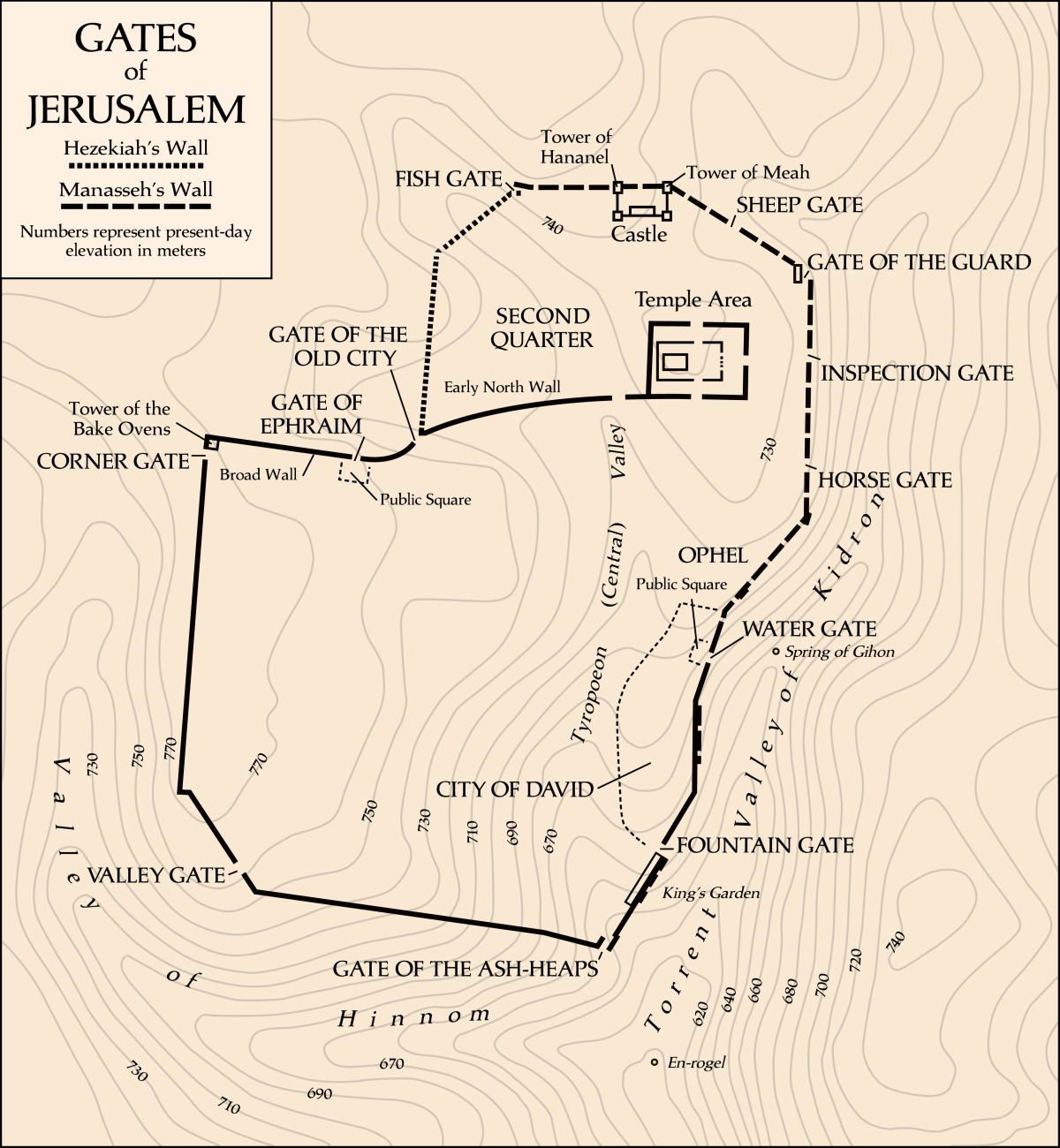
Gates of Jerusalem
and tore down the wall of Jerusalem from the Gate of Ephraim to the Corner Gate, 400 cubits - 400 cubits ≈ 580 to 680 feet (175-205 meters), a little more than the length of two football fields (American-style). In upper left part of the old city diagram above you can locate the two gates referred to by the writer. This "hole" in the wall would have been relatively substantial. The Gate of Ephraim (named that because it faced north to Ephraim) was a strategic gate, controlling access from the northern kingdom of Israel into Judah’s capital. In later texts (e.g., Nehemiah), it appears closely associated with the Valley Gate area. There is irony here for a gate named for Ephraim (another name for Israel) becomes the entry point through which the northern kingdom of Israel humiliates Judah.
As shown on the diagram, the Corner Gate stood at the northwestern corner of Jerusalem’s wall, where the north wall met the west wall. It functioned as a key defensive junction and was frequently mentioned as a reference point for wall length (cf. Zech 14:10) The tearing down of the wall was not a token gesture, but represented a major military demolition, a public act of domination and a calculated humiliation of Judah and Amaziah! Breaking a city wall in the ancient world meant the city was defenseless and the king was disgraced. Amaziah’s pride resulted in a very public breach literally and spiritually. The king who would not listen now watches his city wall collapse!
Jerusalem’s breached walls stood as a concrete (excuse the bad pun!) illustration of the proverb, “Pride goes before destruction,” (Pr 16:18) as Amaziah’s pride led directly to Judah’s humiliation.
Bob Utley - "came to Jerusalem and tore down the wall of Jerusalem from the Gate of Ephraim to the Corner Gate" (IN THE DIAGRAM OF THE CITY ABOVE) Notice the northern wall during Solomon's reign. This is the wall that Jehoash tore down. This made the city of Jerusalem absolutely defenseless. Josephus tells us that Jerusalem opened her gates to the northern king on the threat of Amaziah's death....we are talking about a 600 foot section of wall. Josephus tells us the wall was removed so completely that Jehoash drove his chariot through the breech.
"Whereupon Joash threatened to kill him, unless he would persuade the people of Jerusalem to open their gates to him, and receive him and his army into the city. Accordingly Amaziah was so distressed, and in such fear of his life, that he made his enemy to be received into the city. So Joash overthrew a part of the wall, of the length of four hundred cubits; and drove his chariot through the breach into Jerusalem, and led Amaziah captive along with him. By which means he became master of Jerusalem, and took away the treasures of God, and carried off all the gold and silver that was in the King’s palace; and then freed the King from captivity, and returned to Samaria." (Josephus Antiq. 9.9.3)
2 Kings 14:14 He took all the gold and silver and all the utensils which were found in the house of the LORD, and in the treasuries of the king’s house, the hostages also, and returned to Samaria.
- all the gold: 2Ki 24:13 25:15 1Ki 7:51 14:26 15:18
- and hostages: 2Ki 18:23
Parallel Passage:
2 Chronicles 25:24 (BOLD ONLY IN CHRONICLES) He took all the gold and silver and all the utensils which were found in the house of God with Obed-edom, and the treasures of the king’s house, the hostages also, and returned to Samaria.
ISRAEL SACKS TEMPLE
AND KING'S HOUSE
He took all the gold and silver and all the utensils which were found in the house of the LORD, and in the treasuries of the king’s house, the hostages also, and returned to Samaria - There is a hint of geographic (even theological) irony here for Jerusalem, the place of Jehovah's worship and the capital of the southern kingdom was plundered by Jehoash, taking temple and kingly treasure and Judean people to Samaria, the place of false worship and the capital of the northern kingdom.
Bob Utley - "He took all the gold and silver" There was not much left for Hazael's siege earlier had taken most of the booty (cf. 2 Kgs. 12:18). "the hostages" This is the first mention in the OT of hostages being taken (cf. 2 Chr. 25:24; NIDOTTE, vol. 3, p. 517, #9). These may have been relatives of Amaziah to ensure his peaceful actions. The Expositor's Bible Commentary, p. 230, asserts that Amaziah was, himself, taken to Ssamaria and released only years later, at the death of Jehoash, King of Israel.
2 Kings 14:15 Now the rest of the acts of Jehoash which he did, and his might and how he fought with Amaziah king of Judah, are they not written in the Book of the Chronicles of the Kings of Israel?
- the rest: 2Ki 10:34,35 13:12 1Ki 14:19,20
Parallel Passages:
None in Chronicles
2 Kings 13:12 Now the rest of the acts of Joash and all that he did and his might with which he fought against Amaziah king of Judah, are they not written in the Book of the Chronicles of the Kings of Israel?
A STRANGE
REPETITION
Now the rest of the acts of Jehoash which he did, and his might and how he fought with Amaziah king of Judah, are they not written in the Book of the Chronicles of the Kings of Israel - This book in the royal record of the events in the reign, but is neither inspired or preserved for our review. Clearly, it appears the writer had access to the facts, but he chose only what the Spirit inspired him to record (cf 2Pe 1:21).
NET NOTE - Jehoash and Joash are alternate forms of the same name. Heb “As for the rest of the events of Jehoash, and all which he did and his strength, [and] how he fought with Amaziah king of Judah, are they not written on the scroll of the events of the days of the kings of Israel?”
The Book of the Chronicles appears to have been a court chronicle or state annals kept by royal scribes in the northern kingdom of Israel. Think of it as the king’s archive—records of reigns, events, wars, policies, and notable acts. It is tanatamount to saying “More details exist, but they’re in the official records, not in this inspired summary.”
Bob Utley - 14:15-16 This small paragraph seems to be out of place. It breaks into a context about Amaziah. It is a repeat from 2 Kgs. 13:12-13.
2 Kings 14:16 So Jehoash slept with his fathers and was buried in Samaria with the kings of Israel; and Jeroboam his son became king in his place.
- Jehoash: 2Sa 7:12 1Ki 1:21
- was buried: 2Ki 13:9
- Jeroboam: 2Ki 13:13 Ho 1:1 Am 1:1 7:10,11
Parallel Passages:
None in Chronicles
2 Kings 13:13 So Joash slept with his fathers, and Jeroboam sat on his throne; and Joash was buried in Samaria with the kings of Israel.
ANOTHER UNUSUAL
REPETITION
So Jehoash (Joash) slept (euphemism for died and buried) with his fathers and was buried in Samaria with the kings of Israel; and Jeroboam his son became king in his place - Jehoash "descends" and Jeroboam II "ascends."
NET NOTE - Heb “lay down with his fathers.” See notes on whether this refers to "SOUL SLEEP."
Bob Utley - 14:15-16 This small paragraph seems to be out of place. It breaks into a context about Amaziah. It is a repeat from 2 Kgs. 13:12-13.
2 Kings 14:17 Amaziah the son of Joash king of Judah lived fifteen years after the death of Jehoash son of Jehoahaz king of Israel.
- Amaziah: 2Ki 14:1,2,23 13:10 2Ch 25:25-28
Parallel Passage:
2 Chronicles 25:25 And Amaziah, the son of Joash king of Judah, lived fifteen years after the death of Joash, son of Jehoahaz, king of Israel.
LAST DAYS
OF AMAZIAH
Amaziah the son of Joash king of Judah lived fifteen years after the death of Jehoash son of Jehoahaz king of Israel - So Amaziah outlives the king who defeated him. This chronological note does more than mark time; it underscores the lingering consequences of Amaziah’s pride and defeat. Though Amaziah survived his disastrous confrontation with Jehoash of Israel, his remaining years were not marked by recovery or renewed strength, but by decline, instability, and growing opposition. Amaziah lived fifteen years after the death of Jehoash of Israel, but those years were not a period of restoration. They were years lived under the shadow of a self-inflicted defeat. His pride, refusal to listen to God’s word, and reckless challenge to Israel had already broken his reign. What a tragic way to end a life that had a relatively good beginning!
2 Kings 14:18 Now the rest of the acts of Amaziah, are they not written in the Book of the Chronicles of the Kings of Judah?
- 2Ki 13:8,12 1Ki 11:41 14:29
Parallel Passage:
2 Chronicles 25:26 (BOLD ONLY IN CHRONICLES) Now the rest of the acts of Amaziah, from first to last, behold, are they not written in the Book of the Kings of Judah and Israel?
THE USUAL REGAL
EPITAPH
Now the rest of the acts of Amaziah, are they not written in the Book of the Chronicles of the Kings of Judah - The author of Kings frequently closes the account of each monarch with a formula (SEE 15 times below). A similar phrase is also used for the northern kingdom “Now the rest of the acts of Jeroboam, how he made war and how he reigned, behold, they are written in the Book of the Chronicles of the Kings of Israel.” (1Ki 14:19) Both of these phrases serve as historical citations pointing the reader to other official archives that contained full royal records. These were not the same as 1 and 2 Chronicles that we have in our Bibles today. We see a similar allusion to the reign of Solomon in 1Ki 11:41 referring to "the book of the acts of Solomon."
The inspired author of Kings used these citations to remind readers that what he had written was a theological summary, not a full civil chronicle. His purpose was to trace Israel’s and Judah’s spiritual faithfulness or unfaithfulness to God, leading to exile. Henry Morris says that there were at least twenty historical documents available to the Chronicler, indicating a rich scribal tradition in ancient Israel.
While those detailed archives are gone, the Holy Spirit ensured that everything necessary for faith and godliness remains preserved in Scripture. “The grass withers, the flower fades,but the word of our God stands forever.” (Isaiah 40:8) So even though the royal annals have been lost to time, the Word of the LORD, which interprets those events and reveals God’s justice, mercy, and sovereignty, endures forever.
In summary, the biblical historian signals that his account is rooted in real, verifiable records, not legend. This reminds me of the closing words in the Gospel of John "And there are also many other things which Jesus did, which if they were written in detail, I suppose that even the world itself would not contain the books that would be written." (Jn 21:25)
THE BOOK OF THE CHRONICLES OF THE KINGS OF JUDAH - 15 TIMES - 1 Ki. 14:29; 1 Ki. 15:7; 1 Ki. 15:23; 1 Ki. 22:45; 2 Ki. 8:23; 2 Ki. 12:19; 2 Ki. 14:18; 2 Ki. 15:6; 2 Ki. 15:36; 2 Ki. 16:19; 2 Ki. 20:20; 2 Ki. 21:17; 2 Ki. 21:25; 2 Ki. 23:28; 2 Ki. 24:5
2 Kings 14:19 They conspired against him in Jerusalem, and he fled to Lachish; but they sent after him to Lachish and killed him there.
- they made: 2Ki 12:20,21 15:10,14,25,30 21:23 2Ch 25:27,28
- fled to Lachish: Jos 10:31 Mic 1:13
Parallel Passage:
2 Chronicles 25:27 (BOLD ONLY IN CHRONICLES) From the time that Amaziah turned away from following the LORD they conspired against him in Jerusalem, and he fled to Lachish; but they sent after him to Lachish and killed him there.
Map to Locate Lachish South & West of Jerusalem
(ESV Study Bible)
CONSPIRACY AGAINST AND
ASSASSINATION OF AMAZIAH
They - The identity of "they" is not stated either here or in the parallel passage and had apparently been in the works for some time according to 2Ch 25:27 which suggests the conspiracy had its onset "from the time that Amaziah turned away from following the LORD." Amaziah's foolish Edomite idolatry cost him dearly in a number of ways. We can choose our sin, but we cannot choose the consequences of our sin!
Conspired (qashar) against him in Jerusalem - This was an internal conspiracy. There is no evidence that there was an incursion by conspirators from the northern kingdom. Again like father, like son...
2Ki 12:20-21 His servants arose and made a conspiracy and struck down Joash at the house of Millo as he was going down to Silla. 21 For Jozacar the son of Shimeath and Jehozabad the son of Shomer, his servants, struck him and he died; and they buried him with his fathers in the city of David, and Amaziah his son became king in his place.
And he fled to Lachish - Lachish is about 30 miles southwest of Jerusalem and shown in the map above.
But they sent after him to Lachish and killed him there - NET picks up the sense of the text = "But they sent assassins after him and they killed him there." The fact that the "they" did not go to Lachish themselves suggests these were reasonably high officials in positions of authority. Romans 6:23 was just as true in the OT as in the NT Paul writing that " the wages of sin is death."
Bob Utley - "They conspired against him in Jerusalem" This is said by the rabbis to be because of his idolatry related to his defeat of Edom (cf. 2 Chr. 25:27).
It is not surprising that Amaziah went to this town,
since it was in the line of defense surrounding Jerusalem.
John Walton - Lachish (Tell ed-Duweir) was a major fortress city in the Judahite Shephelah. It is not surprising that Amaziah went to this town, since it was in the line of defense surrounding Jerusalem. Both the Assyrians and the Babylonians captured Lachish in their invasions of Judah in the eighth and seventh centuries B.C. Located about thirty miles southwest of Jerusalem, the site covers some thirty acres. (IVP Background Commentary - OT - page 444)
Andrew Hill: It is likely that Amaziah’s false worship is the catalyst that bonds a group of conspirators from Judah to plot Amaziah’s assassination for some fifteen years. It is unclear as to who these men of Judah are, but most likely it is a coalition of priests along with civil and military leaders similar to the one that elevated Joash to the throne of Judah. (First and Second Chronicles)
Mark Boda: The conspiracy broke out within the court in Jerusalem, the center of his power, so he was forced to flee to one of his fortified cities guarding one of the key valleys between the coastal plain and Jerusalem. But there would be no fleeing the prophetic word, or he was killed there. (1-2 Chronicles)
Christopher Knapp: Lachish was the first of the cities of Judah to adopt the idolatries of the kingdom of Israel (‘the beginning of the sin to the daughter of Zion: for the transgressions of Israel were found in thee,’ Micah 1:13), and it was natural for the idolatrous Amaziah to seek an asylum there. (Summary of Amaziah's Life)
Adam Clarke: He no doubt became very unpopular after having lost the battle with the Israelites; the consequence of which was the dismantling of Jerusalem, and the seizure of the royal treasures, with several other evils. It is likely that the last fifteen years of his reign were greatly embittered: so that, finding the royal city to be no place of safety, he endeavoured to secure himself at Lachish; but all in vain, for thither his murderers pursued him; and he who forsook the Lord was forsaken by every friend, perished in his gainsaying, and came to an untimely end.
Conspired (bind, tie, knit)(07194) qashar essentially means binding or tying something to something else and could be used of binding men. Literally = binding or tying something up (Ge 38:28; Josh. 2:18, 21; Jer.51:63). Figuratively attacking or fastening something on (Isa. 49:18); "bind the chains of the Pleiades" constellation (Job 38:31). Connect a wall (Neh. 4:6, 8). Figuratively of Jacob's soul bound with Benjamin (Ge. 44:30); of Jonathan's soul bound to David's (1Sa 18:1); of forming a conspiracy (translated conspired 19x, conspirators 2x) or an alliance against someone (1Ki. 15:27; 1Ki 16:20; 2Ki. 9:14). Binding of moral or spiritual teachings to oneself (Dt. 6:8; 11:18; Pr. 3:3; 6:21; 7:3). (The Complete Word Study Dictionary – Old Testament)
Leonard Coppes - Men can be bound together (inseparably) in love (Genesis 44:30; 1 Samuel 18:1) or conspiracy (1 Kings 16:9). Treasonous pacts if exposed were met with denunciation (2 Chron. 23:13), and even death (2 Samuel 15:12; 2 Kings 17:4). It is noteworthy that in evil days prophets who declared God's counsel were accused of treason (Amos 7:10; Isaiah 8:12) by the real enemies of the theocracy (Young, E. J., Isaiah, Eerdmans, 1967, I, p. 311)—the leaders of Israel (Isaiah 8:13f.; Jeremiah 11:9). (Here is a link to the TWOT)
Lachish (means impregnable, invincible) a city lying south of Jerusalem, on the borders of Simeon, and belonging to the Amorites, the king of which joined with four others, at the invitation of Adonizedek king of Jerusalem, to chastise the Gibeonites for their league with Israel. (Joshua 10:3,5) They were routed by Joshua at Beth-horon, and the king of Lachish fell a victim with the others under the trees at Makkedah. ver. (Joshua 10:26) The destruction of the town shortly followed the death of the king. vs. (Joshua 10:31-33) In the special statement that the attack lasted two days, in contradistinction to the other cities which were taken in one (see ver. 35), we gain our first glimpse of that strength of position for which Lachish was afterward remarkable. Lachish was one of the cities fortified and garrisoned by Rehoboam after the revolt of the northern kingdom. (2 Chronicles 11:9) In the reign of Hezekiah it was one of the cities taken by Sennacherib. This siege is considered by Layard and Hincks to be depicted on the slabs found by the former in one of the chambers of the palace at Kouyunjik. After the return from captivity, Lachish with its surrounding "fields" was reoccupied by the Jews. (Nehemiah 11:30)
LACHISH - 22V- Jos. 10:3; Jos. 10:5; Jos. 10:23; Jos. 10:31; Jos. 10:32; Jos. 10:33; Jos. 10:34; Jos. 10:35; Jos. 12:11; Jos. 15:39; 2 Ki. 14:19; 2 Ki. 18:14; 2 Ki. 18:17; 2 Ki. 19:8; 2 Chr. 11:9; 2 Chr. 25:27; 2 Chr. 32:9; Neh. 11:30; Isa. 36:2; Isa. 37:8; Jer. 34:7; Mic. 1:13
- A city. King of, besieges Gibeon, Josh. 10:5.
- Captured by Joshua, Josh. 10:31, 32.
- Allotted to Judah, Josh. 15:39.
- Fortified by Rehoboam, 2 Chr. 11:9.
- Assassination of Amaziah at, 2 Kin. 14:19.
- Besieged by Seacherib, 2 Kin. 18:13-17; 19:8; 2 Chr. 32:9; by Nebuchadnezzar, Jer. 34:7.
- Prophecy concerning, Mic. 1:13.
2 Kings 14:20 Then they brought him on horses and he was buried at Jerusalem with his fathers in the city of David.
- he was buried: 2Ki 8:24 9:28 12:21 1Ki 2:10 11:43 2Ch 21:20 26:23 33:20
Parallel Passage:
2 Chronicles 25:28 (BOLD ONLY IN CHRONICLES) Then they brought him on horses and buried him with his fathers in the city of Judah.
AMAZIAH'S CORPSE CARRIED
AND BURIED IN JERUSALEM
Then they brought him on horses and he was buried at Jerusalem with his fathers in the city of David The phrase “brought him on horses” likely refers to a royal transport of his body back to Jerusalem. Although Amaziah had been assassinated, his descendants and officials still treated him with the honor that was given to a king. So in death Amaziah received a measure of respect. The people recognized his royal office, though they disapproved of his royal failures! Being buried “with his fathers” was an honor generally reserved for those in the royal line of David. It meant inclusion in the royal tombs, even if one’s life had not been fully righteous. Later, some corrupt kings (like Ahaz) were buried in Jerusalem but not in the tombs of the kings (2Ch 28:27).
2 Kings 14:21 All the people of Judah took Azariah, who was sixteen years old, and made him king in the place of his father Amaziah.
- Azariah: 2Ki 15:13 2Ch 26:1, Uzziah, Mt 1:8,9, Ozias
- made him king: 2Ki 21:24 1Ch 3:12
Parallel Passage:
2 Chronicles 26:1 And all the people of Judah took Uzziah, who was sixteen years old, and made him king in the place of his father Amaziah.
PEACEFUL TRANSITION FROM
AMAZIAH TO AZARIAH
All the people of Judah took Azariah (Uzziah), who was sixteen years old, and made him king in the place of his father Amaziah - This describes a peaceful transition revealing that the monarchy remained stable under God’s sovereign hand, even when individual kings perished in disgrace.
It is interesting to note that Amaziah is not named in Matthew’s genealogy, but his bloodline is certainly included, for Uzziah is descended physically through him (Mt 1:8,9). In other words, Jesus’ ancestry still passes through Amaziah’s line, even though Matthew condenses the record.
2 Kings 14:22 He built Elath and restored it to Judah after the king slept with his fathers.
- Elath: Elath, the Ala or Elana of the Greek and Roman writers, was a celebrated port situated at the extremity of the eastern branch of the Red Sea, hence called the Elanitic Gulf, ten miles east from Petra, according to Eusebius, and 150 Roman miles from Gaza, according to Pliny, but 1,260 stadia, or 157 miles, according to Strabo and Marcianus Herecleota. It is now called Akaba, and is nothing but a tower or castle, surrounded by a large grove of date trees, the residence of a governor, dependent on him of Grand Cairo. 2Ki 16:6 De 2:8 1Ki 9:26 2Ch 26:2, Eloth
Parallel Passage:
2 Chronicles 26:2 He built Eloth and restored it to Judah after the king slept with his fathers.
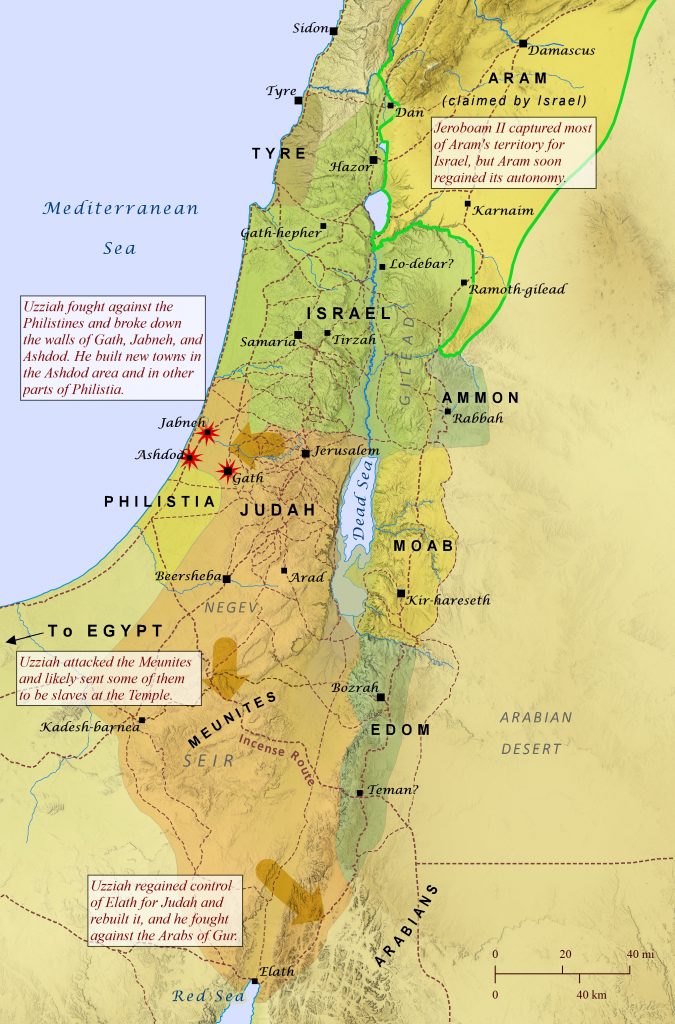
Elath Port on Red Sea
AZARIAH REBUILDS &
RESTORES ELATH
He built Elath and restored it to Judah after the king (Amaziah) slept (euphemism for death) with his fathers The first work of young Uzziah was constructive. Control of Edom had been lost by King Jehoram but King Amaziah had defeated the Edomites and presumably gained some degree of control which would include access to the Red Sea port of Elath. Judah had enough control to allow building and restoring of Elath (see bottom of map for port on the Red Sea -- this water is also known as the Gulf of Aqaba).
Bob Utley - 14:22 "He built Elath" This means Azariah, or possibly Amaziah, fortified this important seaport to the south of Judah on the Red Sea. Solomon had opened up this sea route and Azariah was reestablishing his influence over this whole southern area.
ELATH - A seaport on the Red Sea in the territory of Edom. It is named along with Ezion-geber in the account of Israel's journey round the land of Edom (Dt 2:8). When David conquered Edom, Elath passed into the hands of Israel (2 Sam 8:14). It was a position of great importance in connection with the trade with South Arabia and Ophir. Here the merchant fleets of Solomon and Jehoshaphat were fitted out, and hence, they sailed (1 Ki 9:26; 2 Ch 8:17; 1 Ki 22:48). In the reign of Jehoram, son of Jehoshaphat, Edom shook off the hand of Judah (2 Ki 8:20), but under Amaziah and Uzziah it was again subdued (2 Ki 14:7,10,22). Finally it was taken from Ahaz by Rezin, king of Syria. The Jews were driven out and the Syrians (Edomites?) took permanent possession (2 Ki 16:6). It is identical with the modern `Aqaba, at the head of the gulf of that name.
2 Kings 14:23 In the fifteenth year of Amaziah the son of Joash king of Judah, Jeroboam the son of Joash king of Israel became king in Samaria, and reigned forty-one years.
- the fifteenth: 2Ki 14:17
- Jeroboam: 2Ki 14:27 Ho 1:1 Am 1:1 7:9-11
Parallel Passages:
None in Chronicles
JEROBOAM II LONGEST
REIGNING KING OF ISRAEL
In the fifteenth year of Amaziah the son of Joash king of Judah, Jeroboam the son of Joash king of Israel became king in Samaria, and reigned forty-one years - Note on the chart above the dates for Jeroboam II are 782-753 BC, which clearly would not add up to 41 years, the longest recorded reign of any Northern King. Therefore most writers propose that there was a coregency with his father Jehoash/Joash that began circa 793 BC.
The geopolitical landscape was interestin, because Jeroboam II ruled during a window of international weakness. Aram (Syria) was declining after Hazael and Ben-hadad died and Assyria was temporarily distracted by internal problems. This allowed Israel to expand its borders dramatically, to recover territory “from Lebo-hamath to the Sea of the Arabah” (2Ki 14:25) and to experience unmatched political and economic prosperity
QUESTION - Who was King Jeroboam II in the Bible? | GotQuestions.org
ANSWER - King Jeroboam II stands as a significant yet often overlooked figure in the Bible and the history of ancient Israel. His reign was marked by military success, territorial expansion, and economic prosperity but was overshadowed by spiritual decline and social injustice. As the fourteenth king of the northern kingdom of Israel, Jeroboam II’s reign is recorded in 2 Kings 14:23–29 and referenced in the prophetic writings of Amos, Hosea, and Jonah. King Jeroboam II ruled from approximately 786 to 746 BC, a period when the ten northern tribes of Israel reached their pinnacle of wealth and power yet teetered on the brink of collapse.
For context, let us first pinpoint King Jeroboam II in the Bible within the broader history of ancient Israel. After the reign of King Solomon, who was David’s son and the second king of Israel, the united monarchy split into two kingdoms: Judah in the south and Israel in the north. The first king of the northern kingdom of Israel was named Jeroboam (see 1 Kings 11:26–43). Over time, the northern kingdom experienced frequent shifts in leadership and dynastic turmoil. King Jeroboam II was a grandson of Jehu, who had established a new dynasty in the northern kingdom after overthrowing the house of Ahab.
King Jeroboam II’s father was Joash, who had restored some stability to the kingdom and initiated the process of reclaiming Israel’s lost territory from its neighbors, particularly the Arameans (also known as Syrians). Upon his father’s death, Jeroboam II inherited both the throne and ongoing conflicts with foreign powers.
King Jeroboam II reigned in Israel for forty-one years (2 Kings 14:23), the longest of any northern king. By this time, more than a century had passed since the death of the first King Jeroboam. The Bible states that Jeroboam II “did evil in the eyes of the Lord and did not turn away from any of the sins of Jeroboam son of Nebat” (2 Kings 14:24). Nevertheless, Jeroboam II led Israel through a period of relative political stability and economic growth not seen since the days of Solomon.
One of Jeroboam II’s most notable achievements was the expansion of Israel’s borders: “He was the one who restored the boundaries of Israel from Lebo Hamath to the Dead Sea, in accordance with the word of the Lord, the God of Israel, spoken through his servant Jonah son of Amittai, the prophet from Gath Hepher” (2 Kings 14:25). Jeroboam II successfully reclaimed territory that had been lost to Israel’s enemies. This restoration fulfilled a prophetic promise and brought Israel back to its greatest extent since the reign of Solomon.
The Assyrian Empire, usually a formidable threat, was undergoing a period of internal weakness during the reign of King Jeroboam II. Thus, Israel flourished militarily without the constant pressure of foreign invasion. With increased security and control over trade routes, Israel also experienced significant economic growth. Archaeological evidence from sites like Samaria and Megiddo reveals luxurious buildings and artifacts from this period. The upper classes grew wealthy, merchants prospered, and urban life expanded. However, Israel’s good fortune was not evenly distributed.
Beneath the surface of national success lay social and religious abuses. Amos, a prophet from Judah, delivered a message of judgment to Israel during the prosperous era of King Jeroboam II. His prophecies noted a concern for social justice and insisted that true worship must be accompanied by righteousness. Amos painted a vivid picture of the self-indulgent elite and condemned the exploitation of the poor, corruption in the courts, and the perversion of worship (see Amos 2:6–8; 4:1–3; 5:10–12; 6:4–7, 11–14; 8:4–6). Despite Israel’s apparent security, Amos predicted that disaster awaited them due to their disregard for God’s law.
The prophet Hosea also condemned the nation’s idolatry and moral decay (see Hosea 9:1—10:15). Although the people observed the outward forms of worship, their hearts were far from God. Hosea’s prophecies spanned the final days of King Jeroboam II and extended into the subsequent decline of Israel. Hosea described the nation as an unfaithful spouse, warning that their idolatry and injustices would ultimately lead to destruction and exile.
After the death of Jeroboam II, Israel entered a period of rapid decline. His son, Zechariah, reigned only six months before being assassinated, bringing an end to the dynasty of Jehu (2 Kings 15:8–12). The kingdom descended into chaos, marked by frequent coups and instability.
The life of King Jeroboam II in the Bible serves as a sobering reminder that outward success does not always equate to spiritual well-being, particularly when justice, faithfulness, and spiritual integrity are lacking. Sadly, Israel’s prosperity under Jeroboam II masked an inner putrefaction, and God’s warnings through the prophets went largely unheeded. Within a few decades, the Assyrian Empire recovered its strength and ultimately conquered Israel in 722 BC, leading to the exile of the ten northern tribes.
2 Kings 14:24 He did evil in the sight of the LORD; he did not depart from all the sins of Jeroboam the son of Nebat, which he made Israel sin.
- in the sight: 2Ki 21:6 Ge 38:7 De 9:18 1Ki 21:25
- he departed: 2Ki 13:2,6,11 1Ki 12:28-31 Ps 106:20
Parallel Passages:
None in Chronicles
JEROBOAM II PROSPERS
DESPITE PRACTICING EVIL!
He did evil in the sight of the LORD; he did not depart from all the sins of Jeroboam the son of Nebat, which he made Israel sin - This is a very significant statement in view of the fact that King Jeroboam II had the longest (and one of the most prosperous) reigns of any of the kings of the Northern Kingdom. In other words, while there was unmatched political and economic prosperity, spiritually the nation remained apostate.
Outward success does not always equate to spiritual well-being, particularly
when justice, faithfulness, and spiritual integrity are lacking
Bob Utley - 14:24 "he did not depart from all the sins of Jeroboam the son of Nebat" This refers to Jeroboam I. He was an exiled Ephraimite labor leader who led the northern ten tribes in revolt against Rehoboam, Solomon's son, in 922 B.C. He was the first king of Israel. The sin referred to is his establishing of the golden calf worship in Dan and Bethel. This was not idolatry initially, for the calves represented YHWH (i.e., Exodus 32), but it was the sin of making graven images (i.e., Exod. 20:4) and distracting his people from worshiping at the only true temple in Jerusalem. However, these two northern shrines quickly became associated with fertility worship.
Gotquestions makes the point that "The life of King Jeroboam II in the Bible serves as a sobering reminder that outward success does not always equate to spiritual well-being, particularly when justice, faithfulness, and spiritual integrity are lacking. Sadly, Israel’s prosperity under Jeroboam II masked an inner putrefaction, and God’s warnings through the prophets went largely unheeded. Within a few decades, the Assyrian Empire recovered its strength and ultimately conquered Israel in 722 BC, leading to the exile of the ten northern tribes."
One other important observation on Jeroboam II’s long reign and Israel's prosperity is that his reign overlaps with three prophets of God, Jonah (2 Kgs 14:25), Amos and Hosea. This is a crucial point it shows that in spite of Israel’s greatest outward success there were some of the strongest prophetic warnings in Scripture! God knew the Assyrians would soon rise to power and take Israel into exile so in the midst of impending wrath, so God was warning Israel! God remembered mercy by sending His prophets to speak truth and call Israel to repentance.
2 Kings 14:25 He restored the border of Israel from the entrance of Hamath as far as the Sea of the Arabah, according to the word of the LORD, the God of Israel, which He spoke through His servant Jonah the son of Amittai, the prophet, who was of Gath-hepher.
- from the entrance of Hamath: Nu 13:21 34:7,8 Eze 47:16-18 Am 6:14
- the sea: Ge 14:3 De 3:17
- Jonah: Jon 1:1 Mt 12:39,40 16:4, Jonas
- Gath-hepher: Jos 19:13, Gittah-hepher
Parallel Passages:
None in Chronicles
Note Hamath in far North
YAHWEH'S INSTRUMENT
RESTORES BORDERS
He restored the border of Israel from the entrance of Hamath as far as the Sea of the Arabah - See the map for the boundary of the Kingdom of Jeroboam II from entrance of Hamath (FAR NORTH) as far as the Sea of the Arabah (Dead Sea).
Bob Utley - 14:25 "the entrance of Hamath" This is always referred to as the northern limits of the promised land (cf. Num. 34:8; Josh. 13:5; Jdgs. 3:3; and 1 Kgs. 8:65). This would parallel the dimensions of Solomon's kingdom. "the sea of Arabah" This refers to the Dead Sea (cf. Deut. 3:17; Josh. 3:16; 12:3).
According to the word of the LORD, the God of Israel, which He spoke - What happened according to the Word of the LORD? What happened is that under Jeroboam II's leadership for 41 years, after decades of military weakness and oppression by Aram‑Damascus, Israel miraculously regained strength and borders were expanded roughly from the northern tip of modern Syria to the Dead Sea. The critical point the writer is making is that this remarkable expansion of Israel’s territory and power did not occur by chance or political genius. It was the direct fulfillment of a divine word given earlier by the prophet Jonah. To say it another way, Israel's territorial victories were the demonstration of God’s faithfulness to His own word.
Through His servant Jonah the son of Amittai, the prophet, who was of Gath-hepher - This reference to the prophet Jonah is the only Old‑Testament reference to Jonah outside his own book, linking his prophetic ministry directly to the reign of Jeroboam II. This description is fascinating for when we think of Jonah, we usually recall his reluctant mission to Nineveh (Jonah 1–4). But before that mission, Jonah had already served as a prophet to Israel during Jeroboam II’s reign. Note God calls Jonah His servant, the same phrase used to describe Moses (Joshua 1:2) and David (2Sa 7:8)
🙏 THOUGHT - God is still looking for servants like these OT saints. We may not be prophets or giant killers like they were, but His Spirit has gifted each disciple with a gift (or gifts) by which we can be His servant in the New Testament (1Co 12:7, 11). The question is, are you functioning faithfully as His servant, energized by His spirit to fruitfully utilize your gift for His Kingdom and His glory. If you are not using your gift, then begin today! Eternity is a long time. How sad for a follower of Christ to waste their gift, when they could use it to bear fruit that will last throughout eternity (cf Jn 15:16). I don't know exactly what the reward to faithful servants will look like, but I have no doubt they will be exceeding, abundantly beyond all that we could ask, think or even imagine now, given the limits of our finite minds. DON'T WASTE YOUR LIFE on the empty bobbles and trivial trinkets of this world, for as John says "The world is passing away, and also its lusts; but the one who does the will of God lives forever." (1Jn 2:17, cf Mt 6:19,20, 21).
Bob Utley - Jonah the son of Amittai" Jonah was a northern prophet. His name and the name of his father were rare names (cf. Jonah 1:1). Nineveh was the capital of Assyria (NIDOTTE, vol. 4, pp. 798-801).
Henry Morris - Jonah. This passage clearly proves the historicity of the prophet Jonah. Liberal theologians and skeptics generally have denied the truth of the story of Jonah and the whale, arguing that it was merely a parable. According to this record, however, Jonah was well-known as a prophet in Israel in addition to his prophetic missionary journey to Nineveh, the capital of the large and dangerous Assyrian empire.
2 Kings 14:26 For the LORD saw the affliction of Israel, which was very bitter; for there was neither bond nor free, nor was there any helper for Israel.
- saw the affliction: 2Ki 13:4 Ex 3:7,9 Judges 10:16 Ps 106:43-45 Isa 63:9
- not any shut: De 32:36 1Ki 14:10 21:21
Parallel Passages:
None in Chronicles
TOTAL NATIONAL
HELPLESSNESS
For - Term of explanation. Here the writer is explaining what Yahweh chose to use Jeroboam II to deliver Israel.
NET - The LORD saw Israel's intense suffering; everyone was weak and incapacitated and Israel had no deliverer.
The LORD saw the affliction (oniy) of Israel, which was very bitter - This reveals the divine motive behind Israel’s deliverance. Before any action is taken, the text emphasizes what the LORD perceived. God’s intervention begins not with Israel’s repentance, but with His compassionate awareness of their condition. The verb signals more than observation; it conveys attentive concern that moves toward response. Israel’s pain was not hidden, ignored, or beneath God’s notice.
The LORD's awareness of Israel's condition reminds one of when Israel was born as a nation, Moses recording "The LORD said, “I have surely seen the affliction of My people who are in Egypt, and have given heed to their cry because of their taskmasters, for I am aware of their sufferings....9 “Now, behold, the cry of the sons of Israel has come to Me (HE NOT ONLY SAW BUT HE HEARD); furthermore, I have seen the oppression with which the Egyptians are oppressing them. (Exodus 3:7, 9)
NET NOTE - Heb “for the LORD saw the very bitter affliction of Israel.” This translation assumes an emendation of מֹרֶה (moreh), which is meaningless here, to ַהמַּר (hammar), the adjective “bitter” functioning attributively with the article prefixed. This emendation is supported by the LXX, Syriac Peshitta, and Vulgate. Another option would be מַר הוּא (mar hu’), “it was bitter.”
For (term of explanation) there was neither bond nor free - He is explaining what Israel affliction was so bitter. Bond nor free is an expression of totality. It’s a way of saying “The nation was so devastated that every class of society, from top to bottom, was oppressed or destroyed.” The enslaved could not rise. The free could not rescue. The strong were as helpless as the weak. The nation had no human deliverer. As we might say today, Israel had hit rock bottom! God’s rescue of Israel by providing deliverance through Jeroboam II did not come because Israel was strong enough to recover, but because Israel was too weak to survive. God spared Israel not because it was righteous, but because it was utterly ruined.
Nor was there any helper ('azar; LXX - boetheo) for Israel. This phrase underscores Israel’s utter helplessness at that moment in her history. Humanly speaking, there was no one to come to Israel’s aid—no ally, no deliverer, no military power, no righteous king, no neighboring nation willing or able to intervene. Israel stood isolated, weakened, and exposed, crushed by long years of oppression. The word helper points to the absence of any external or internal source of rescue. Israel had no savior figure rising up (as in the days of the judges), no covenant partner stepping in, and no strength left in herself. Her condition was not merely difficult, but it was desperate.
NET NOTE - Heb “[there was] none but the restrained, and [there was] none but the abandoned, and there was no deliverer for Israel.” On the meaning of the terms עָצוּר (’atsur) and עָזוּב (’azur), see the NET NOTE at 1 Kgs 14:10.
This makes the writer's statement intentionally bleak. It strips away every illusion of self-rescue so that what follows shines more brightly: Yahweh alone becomes Israel’s help. Indeed, His Name is Jehovah Ezer: The LORD our Helper. The verse prepares the reader to see that Israel’s survival and recovery do not come from repentance, reform, or renewed faithfulness, but from God’s compassion and covenant mercy.
Bob Utley - 14:26-27 This is the theological reasoning for Jeroboam II's success (cf. Neh. 9:19-35). These chapters are a good example of the type of theological history recorded in Samuel, Kings, and Chronicles. It must be remembered that it is not history as we know it today, but selected history with a theological interpretation.
Affliction (06040) oniy from anah = to be bowed down) describes the state of pain caused by affliction miser, a state of oppression or extreme discomfort, physically, mentally, or spiritually.
ONIY - 37V - afflicted*(1), affliction(33), great pains(1), misery(2).Gen. 16:11; Gen. 29:32; Gen. 31:42; Gen. 41:52; Exod. 3:7; Exod. 3:17; Exod. 4:31; Deut. 16:3; Deut. 26:7; 1 Sam. 1:11; 2 Sam. 16:12; 2 Ki. 14:26; 1 Chr. 22:14; Neh. 9:9; Job 10:15; Job 30:16; Job 30:27; Job 36:8; Job 36:15; Job 36:21; Ps. 9:13; Ps. 25:18; Ps. 31:7; Ps. 44:24; Ps. 88:9; Ps. 107:10; Ps. 107:41; Ps. 119:50; Ps. 119:92; Ps. 119:153; Prov. 31:5; Isa. 48:10; Lam. 1:3; Lam. 1:7; Lam. 1:9; Lam. 3:1; Lam. 3:19
2 Kings 14:27 The LORD did not say that He would blot out the name of Israel from under heaven, but He saved them by the hand of Jeroboam the son of Joash.
- said not: 2Ki 13:23 Ho 1:6
- blot out: Ex 32:32,33 De 9:14 25:19 29:20 Ps 69:28 Ro 11:2-12 Rev 3:5
- he saved: 2Ki 5:1 13:5 Ho 1:7 Tit 3:4-6
Parallel Passages:
None in Chronicles
THE MERCIFUL RESTRAINT
OF YAHWEH WITH ISRAEL
The LORD did not say that He would blot out the name of Israel from under heaven - To blot out the name of Israel from under heaven would signify the erasure of Israel’s identity, memory, and place among the nations. It would mean not merely defeat or exile, but the end of Israel as a people. Such judgment would have been fully justified. Israel had persisted for generations in the sins of Jeroboam son of Nebat, rejecting God’s law, corrupting worship, and ignoring prophetic warnings. Yet the text emphasizes that God had not spoken such a final word. The absence of that declaration is itself an act of grace.
NET NOTE The phrase “from under heaven” adds emphasis to the verb “blot out” and suggest total annihilation. For other examples of the verb מָחָה (makhah), “blot out,” combined with “from under heaven,” see Exod 17:14; Deut 9:14; 25:19; 29:20.
But don't miss what the writer is not saying - he is not saying that Israel had repented or that judgment had been cancelled. Judgment was still coming, but not obliteration.
Bob Utley - 14:27 "He would blot out the name of Israel" This phrase occurs only here and Dt. 9:14; 29:19. This is a Hebrew idiom for complete destruction. It was possibly related to the lists of citizens of a community. Moses used similar imagery in Ex 32:32-33. See NIDOTTE, vol. 2, pp. 913-914.
But (term of contrast - instead of annihilation, deliverance) He saved (delivered, rescued) them by the hand of Jeroboam the son of Joash - This is fascinating for it highlights a striking paradox at the heart of Israel’s history that God delivers His people through a deeply flawed king.
Saved does not imply spiritual renewal or repentance, but national preservation, rescue from extinction, political collapse, and foreign domination. The deliverance originates with God's compassion, not in merit of their king because the writer has already stated Jeroboam II did not depart from all the sins of Jeroboam the son of Nebat. Salvation here is completely an act of grace toward a helpless people, not a reward for obedience, for they were a disobedient people. Israel was saved from total destruction, but not from eventual judgment. The same reign that saw unprecedented expansion also witnessed the prophetic warnings of Jonah, Amos, and Hosea, all of whom announced that prosperity without repentance would only delay, not cancel, exile.
By the hand of Jeroboam. indicates the king is God's instrument in the deliverance, not the source of the deliverance. God chose to work through a king whose heart remained compromised, demonstrating that Yahweh’s sovereignty is not limited by human unfaithfulness. Jeroboam’s military successes, territorial recoveries, and political strength were real (and they were all substantial), but they were the means, not the cause.
Walter Kaiser on God's use of Jeroboam II as His instrument of salvation writes "in less than twenty-five years Jeroboam II was able to take a nation that was just about ready to die and turn it into one of the great powers of his day. The wealth and economic turnaround were so dramatic that it became a matter of concern for the prophets as they inveighed against those who “adorned [their] houses with ivory,” both “winter house” and “summer house” (Amos 3:15). In fact, so prosperous had they become that their wives were said to “lie on beds inlaid with ivory and lounge on [their] couches … din[ing] on choice lambs … strum[ing] away on [their] harps like David and improvis[ing] on musical instruments, … drink[ing] wine by the bowlful and us[ing] the finest lotions, but … not [being] griev[ed] over the ruin of Joseph” (Amos 6:4–6). Hosea had warned as well (12:8) that “Ephraim boasts,/ ‘I am rich; I have become wealthy./ With all my wealth they will not find in me/ any iniquity or sin.’ ” But Samaria, unknown to its inhabitants, was a “fading flower,” whose “glorious beauty” was about to be “laid low” (Isa. 28:1).
2 Kings 14:28 Now the rest of the acts of Jeroboam and all that he did and his might, how he fought and how he recovered for Israel, Damascus and Hamath, which had belonged to Judah, are they not written in the Book of the Chronicles of the Kings of Israel?
- the rest: 2Ki 14:15
- Damascus: 2Sa 8:6 1Ki 11:24 1Ch 18:5,6 2Ch 8:3,4
- belonged to Judah: These places belonged to Judah by David's conquest, (2 Sa 3:11,) but had been repossessed by the Syrians.
Parallel Passages:
None in Chronicles
SHORT EPITAPH
OF A LONG REIGN
Now the rest of the acts of Jeroboam and all that he did and his might - In 7 verses the writer has summarized the longest reign of any northern king, so obviously many details have been left out.
NET NOTE Heb “As for the rest of the events of Jeroboam, and all which he did and his strength, [and] how he fought and how he restored Damascus and Hamath to Judah in Israel, are they not written on the scroll of the events of the days of the kings of Israel?” The phrase “to Judah” is probably not original; it may be a scribal addition by a Judahite scribe who was trying to link Jeroboam’s conquests with the earlier achievements of David and Solomon, who ruled in Judah. The Syriac Peshitta has simply “to Israel.” M. Cogan and H. Tadmor (II Kings [AB], 162) offer this proposal, but acknowledge that it is “highly speculative.”
How he fought and how he recovered for Israel, Damascus and Hamath, which had belonged to Judah - Jeroboam II waged military campaigns which were effective in restoring Israel's border and recapturing northern regions once held under David and Solomon.
Notice one again we see a clear juxtaposition of God's sovereignty and man's responsibility even this ungodly man! God had seen Israel's affliction and He had sent His servant Jonah to prophecy of days of prosperity, and enabled by Jehovah, Jeroboam II fulfilled the prophecy. See "Paradoxical Principle of 100% Dependent and 100% Responsible".
We see this pattern clearly in Solomon's only psalm, Ps 127:1 (Psalm 72 also has a superscription “of Solomon,” but many scholars understand it as written for Solomon (possibly by David), God's part, man's part...
Unless the LORD builds the house, They labor in vain who build it;
Unless the LORD guards the city, The watchman keeps awake in vain.
Which had belonged to Judah - This refers to territories originally ruled by the united kingdom under David’s throne.
are they not written in the Book of the Chronicles of the Kings of Israel - See discussion of this Book in 2Ki 14:18
2 Kings 14:29 And Jeroboam slept with his fathers, even with the kings of Israel, and Zechariah his son became king in his place.
- Zachariah: 2Ki 15:8
Parallel Passages:
None in Chronicles
Related Passage:
2 Kings 10:30 The LORD said to Jehu, “Because you have done well in executing what is right in My eyes, and have done to the house of Ahab according to all that was in My heart, your sons of the fourth generation shall sit on the throne of Israel.”
JEROBOAM II DESCENDS
ZECHARIAH ASCENDS
And Jeroboam slept (euphemism for died and buried) with his fathers, even with the kings of Israel, and Zechariah his son became king in his place - Note that slept emphasizes continuity not annihilation. The expression softens the finality of death while affirming its certainty: the most powerful king of Israel’s later history ultimately shares the same fate as all before him. Note that Jeroboam slept is not alluding to the false teaching of SOUL SLEEP.
The transition clause and Zechariah his son became king in his place marks continuity but also marks completion or fulfillment of prophecy! Recall that the LORD had promised Jehu that his sons would sit on Israel’s throne to the fourth generation (2Ki 10:30). With Jeroboam II’s death, that promise reaches its final stage with Zechariah's ascension to the throne.
NET NOTE The MT has simply “with the kings of Israel,” which appears to stand in apposition to the immediately preceding “with his fathers.” But it is likely that the words “and he was buried in Samaria” have been accidentally omitted from the text. See 13:13 and 14:16.
Norman Geisler - 2 KINGS 14:29—Are the dead asleep or conscious? When Critics Ask
PROBLEM: As in this passage, the Bible often speaks of death as the time when one “sleeps with his fathers” (e.g., 1 Kings 2:10; 11:21, 43; 14:20, KJV). Jesus said, “Lazarus sleeps” (John 11:11) when he was “dead” (John 11:14). Paul speaks of believers who have “fallen asleep” in the Lord (1 Thes. 4:13; cf. 1 Cor. 15:51). Yet, in other places, the Bible speaks of persons being conscious in the presence of God after they die (cf. 2 Cor. 5:8; Phil. 1:23; Rev. 6:9).
SOLUTION: The first set of verses refers to the body, and the second set to the soul. “Sleep” is an appropriate figure of speech for the death of the body since death is only temporary, awaiting the resurrection when the body will be awakened from its sleep. Further, both sleep and death have the same posture, lying down.
The Bible is very clear about the fact that the believer’s soul (spirit) survives death (Luke 12:4), is consciously present with the Lord (2 Cor. 5:8) in a better place (Phil. 1:23) where other souls are talking (Matt. 17:3) and even praying (Rev. 6:9–10). Likewise, the unbeliever’s soul is in a place of conscious torment (Matt. 25:41; Luke 16:22–26; Rev. 19:20–20:15).
QUESTION - What does the Bible say about soul sleep? | GotQuestions.org
ANSWER - “Soul sleep” is a belief that after a person dies his or her soul “sleeps” until the resurrection and final judgment. The concept of soul sleep is not biblical.
It’s true that, in some places, the Bible speaks of those who have died as being asleep. Daniel 12:2 describes the resurrection as the time when “multitudes who sleep in the dust of the earth will awake.” The New Testament speaks of believers who are “asleep” in Jesus. In 1 Corinthians 15:6, Paul speaks of those who are “still living,” in contrast to those who have “fallen asleep” (see also verses 18 and 20). Luke relates the death of Stephen with the words, “He fell asleep” (Acts 7:60), much the same as how Jesus describes Lazarus in John 11:11 and Jairus’s daughter in Luke 8:52. So, for those who expect a resurrection, sleep is a metaphor for death.
Death is a “sleep” for the believer because it is temporary; the resurrection is the “awakening.” But what exactly is it that sleeps, and what is awakened? It is the body, not the soul. A body, when dead, appears to be resting in sleep, and that gives rise to the metaphorical usage of sleep. But the soul does not sleep. The moment we experience physical death, our souls are transferred to a different place. For believers, to be absent from the body is to be present with the Lord (2 Corinthians 5:6–8; Philippians 1:23). For unbelievers, death means everlasting punishment in hell (Luke 16:22–23).
Until the final resurrection, there is a temporary heaven—paradise (Luke 23:43; 2 Corinthians 12:4)—and a temporary hell—Hades (Revelation 1:18; 20:13–14). According to Jesus’ account in Luke 16:19–31, neither in paradise nor in Hades are people sleeping. The three individuals in Jesus’ story—Lazarus, Abraham, and the rich man—are quite conscious and active in the afterlife, prior to the resurrection.
Moses and Elijah were not “sleeping” when they appeared with Jesus on the mount of transfiguration. Far from it. They were “talking with Jesus” (Matthew 17:3). Luke gives some additional detail, relating the subject of their conversation: “They spoke about his departure, which he was about to bring to fulfillment at Jerusalem” (Luke 9:31).
In Revelation 6, John sees “the souls of those who had been slain” in heaven (verse 9). These souls are not sleeping; rather, they are crying out “in a loud voice, ‘How long, Sovereign Lord, holy and true, until you judge the inhabitants of the earth and avenge our blood?’” (verse 10). They are given white robes and “told to wait a little longer” (verse 11). Nothing in this heavenly scene hints at a state of unconsciousness, oblivion, or sleep prior to the resurrection. The souls in heaven are wide awake.
Still, it can be said that a person’s body is “sleeping” while his soul is in paradise or Hades. And that is just how the Bible pictures it. At the resurrection, the body is “awakened” and transformed into the everlasting body a person will possess forever, whether in heaven or hell. The redeemed, made righteous by the blood of Christ, will inhabit the new heaven and new earth (Revelation 21:1). The unredeemed, who remain in their sin, will be thrown into the lake of fire (Revelation 20:11–15).
Present-day advocates of the doctrine of soul sleep include Seventh-day Adventists, Jehovah’s Witnesses, Christadelphians, and some others.
Related Resources: