2 Kings 17:2
2 Kings 17:3
2 Kings 17:4
2 Kings 17:5
2 Kings 17:6
2 Kings 17:7
2 Kings 17:8
2 Kings 17:9
2 Kings 17:10
2 Kings 17:11
2 Kings 17:12
2 Kings 17:13
2 Kings 17:14
2 Kings 17:15
2 Kings 17:16
2 Kings 17:17
2 Kings 17:18
2 Kings 17:19
2 Kings 17:20
2 Kings 17:21
2 Kings 17:22
2 Kings 17:23
2 Kings 17:24
2 Kings 17:25
2 Kings 17:26
2 Kings 17:27
2 Kings 17:28
2 Kings 17:29
2 Kings 17:30
2 Kings 17:31
2 Kings 17:32
2 Kings 17:33
2 Kings 17:34
2 Kings 17:35
2 Kings 17:36
2 Kings 17:37
2 Kings 17:38
2 Kings 17:39
2 Kings 17:40
2 Kings 17:41
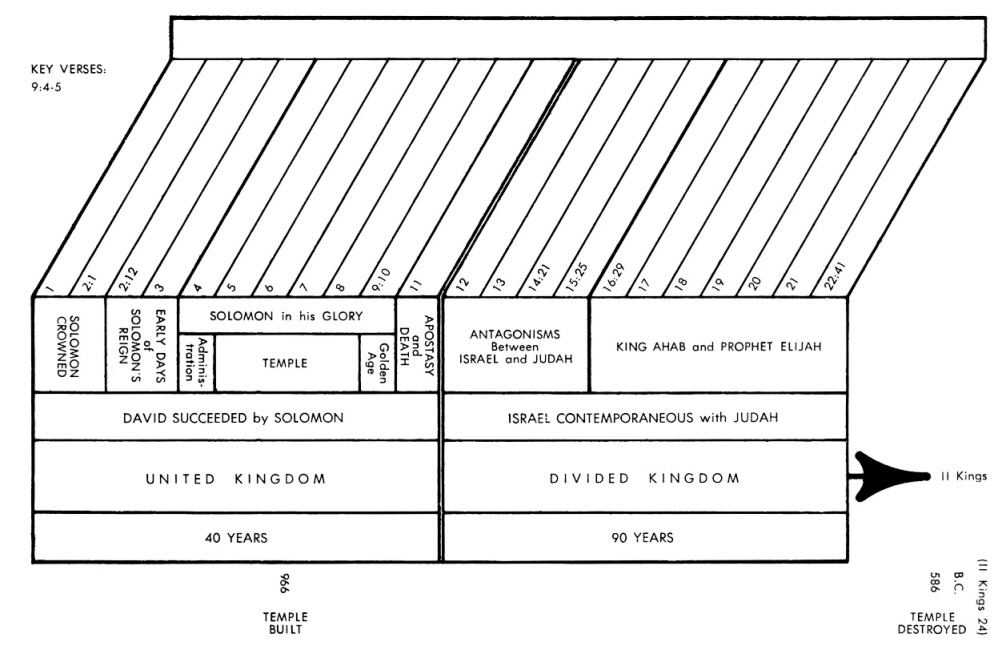
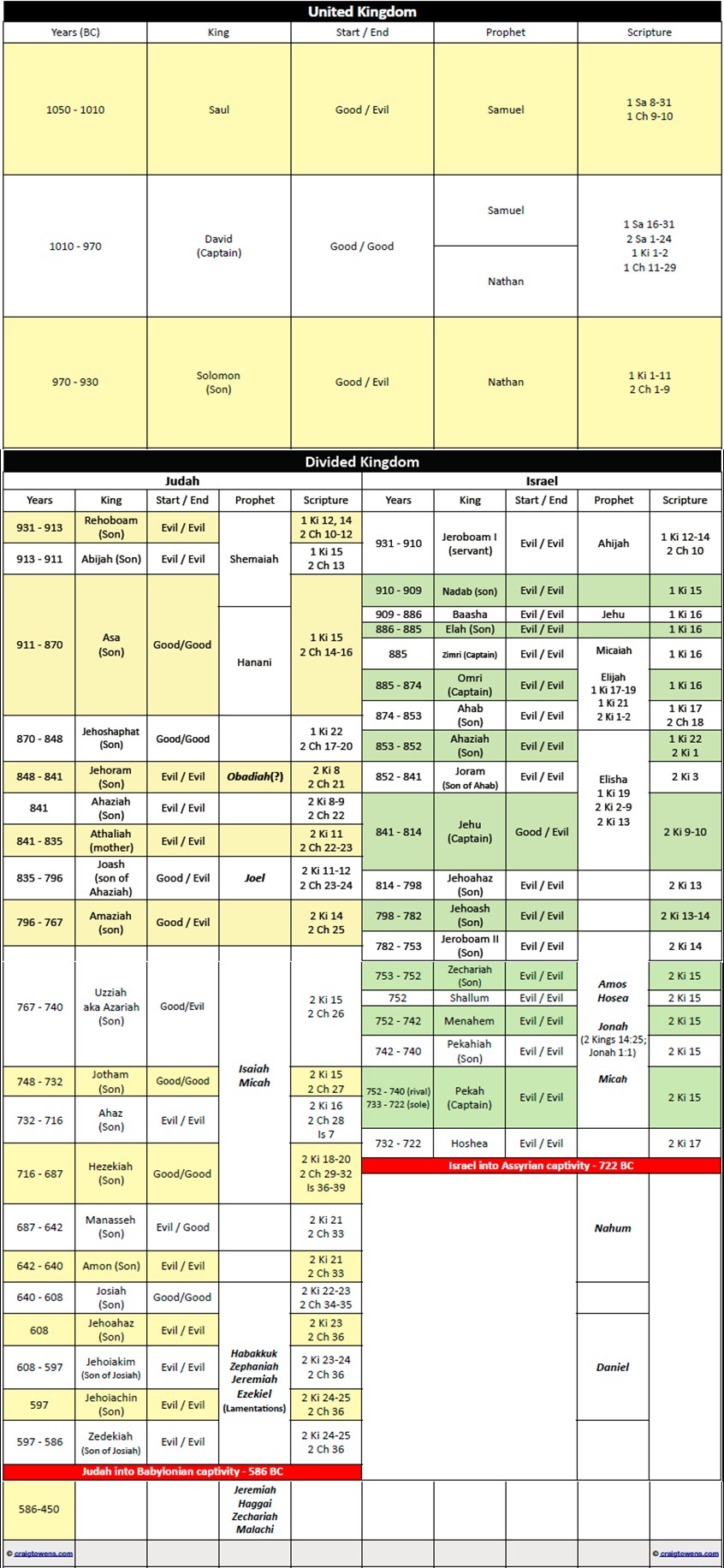
Chart from recommended resource Jensen's Survey of the OT - used by permission
1 Kings Chart from Charles Swindoll

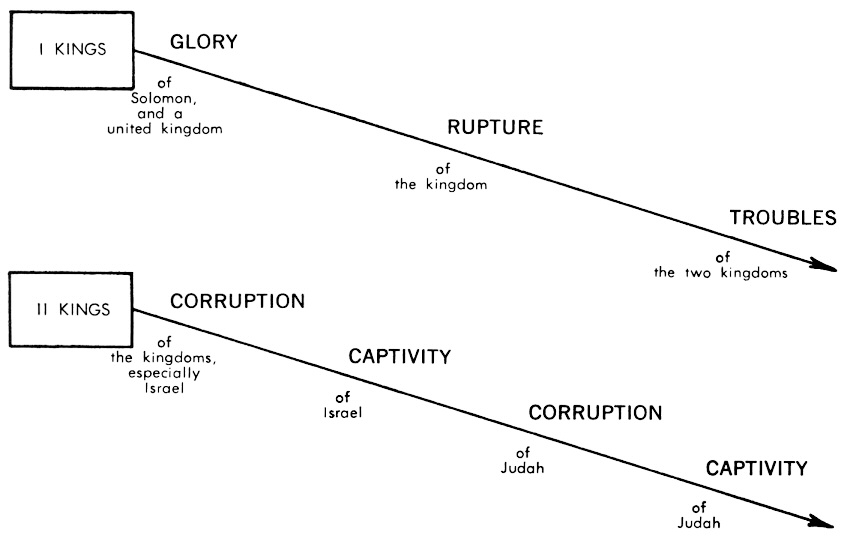
THE DOWNWARD SPIRAL
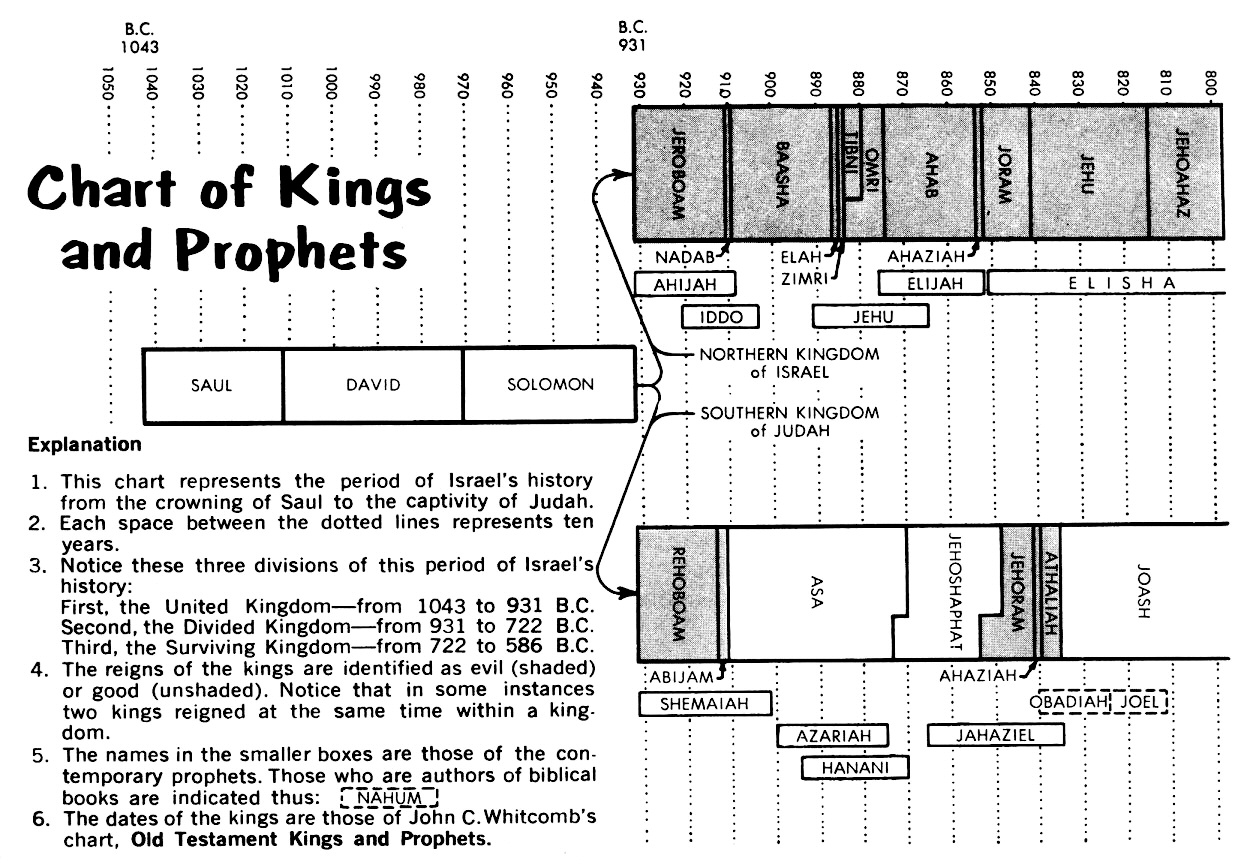
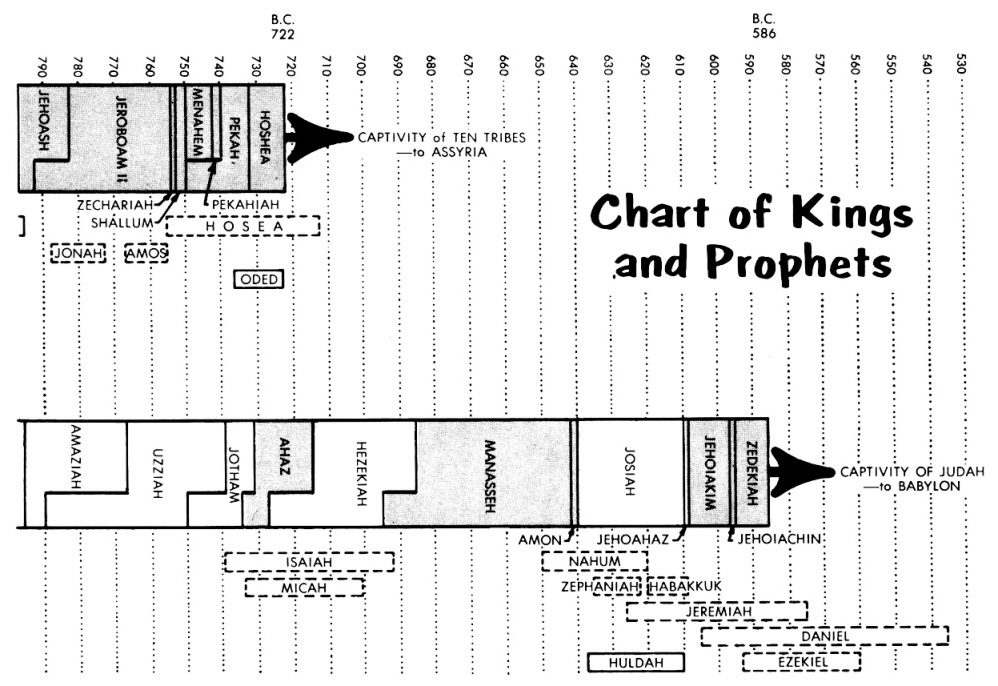
Click to Enlarge
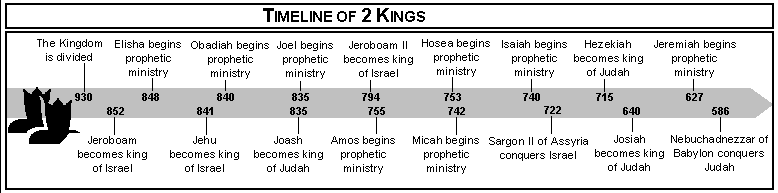
Ryrie Study Bible - Borrow
Click to Enlarge
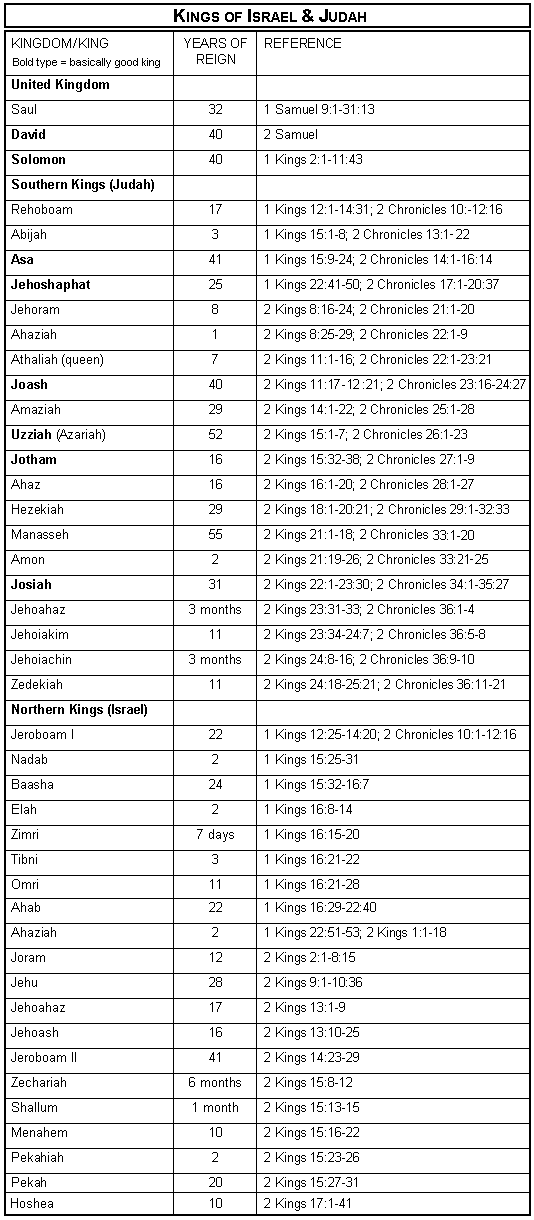
(NOTE: Many consider Amaziah and Hezekiah as "good" kings)
SEE ALSO:
ESV chart - kings of Israel - more information
ESV chart - kings of Judah - more information
Another Chart with Variable Dates for Reigns of King
2 Kings 17:1 In the twelfth year of Ahaz king of Judah, Hoshea the son of Elah became king over Israel in Samaria, and reigned nine years.
- In the twelfth: In ch. 15:30, this is said to be "the twentieth year of Jotham," which Calmet thus reconciles: "Hosea conspired against Pekah, the 20th year of the reign of this prince, which was the 18th of Jotham, king of Judah. Two years after this, that is, the 4th of Ahaz and the 20th of Jotham, Hosea made himself master of a part of the kingdom, according to ch. 15:30. Finally, the 12th year of Ahaz, Hosea had peaceable possession of the whole kingdom, agreeably to ch. 17:1."
- Hoshea: "After an interregnum, ch. 15:30; 18:9." 2Ki 17:1
- 2 Kings 17 Resources
Related Passage:
2 Kings 15:30 And Hoshea the son of Elah made a conspiracy against Pekah the son of Remaliah, and struck him and put him to death and became king in his place, in the twentieth year of Jotham the son of Uzziah.
Bob Utley explains - "In the twelfth year of Ahaz" Notice 2 Kgs. 15:30 dates Hoshea to the reign of Jotham, Ahaz's father. This can be explained by a co-reign.
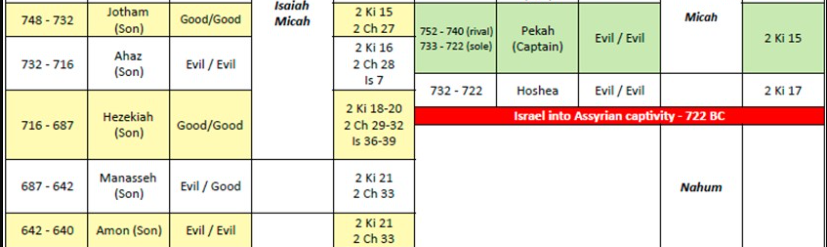
HOSHEA ASCENDS AFTER
ASSASSINATION OF PEKAH
In the twelfth year of Ahaz king of Judah, Hoshea the son of Elah became king over Israel in Samaria, and reigned nine years. - Hoshea's name means "salvation" or "deliverance." Hoshea conspiried agaiinst Pekah, assassinated him and took his place (2Ki 15:30). Hoshea’s reign began circa 732 BC, marking the final chapter in the history of the northern kingdom of Israel. In that year, Hoshea son of Elah became king over Israel in Samaria and reigned nine years. Ultimately, Hoshea’s rule ended in 722 BC, when Assyria captured Samaria and brought the kingdom of Israel to an end through conquest and exile thus fulfilling the warnings long proclaimed by the prophets. In the chart above it is clear that Hoshea is the last king of the Northern Kingdom (Israel, Ephraim).
John Walton -chronology. Hoshea became king in 732 - B.C. as a result of the Assyrian decimation of much of the northern kingdom. The synchronisms between the northern and southern kingdoms during this period are very complex, and there are no easy resolutions. It is generally supposed that there were several coregencies that are one cause of the apparent confusion. Assyrian king Tiglath-Pileser III claims in his annals to have put Hoshea on the throne of Judah.
John Olley - The sum total of King Hoshea’s contribution to the biblical narrative is gathered in these verses: he may not have been as evil as some of his predecessors, but he was even more foolish. Despite being the king of a small, recently conquered nation. Hoshea leads Israel into a confrontation with the Assyrian superpower, with immediate and disastrous consequences. Israel is no more. Just like that. (ESVEC)
BIG IDEA: PRIVILEGED ISRAEL FINALLY FACES CAPTIVITY AND EXILE FOR HER COVENANT UNFAITHFULNESS AND PERSISTENT IDOLATRY
Paul House: A long time has passed since the prophet Ahijah told the wife of Jeroboam I that idolatry would lead to Israel’s exile (1 Kgs 14:14–16). Over these two hundred years Israel has seemed determined to make this prophecy come to pass. No reform occurs. No real repentance emerges. No leader calls a halt to pagan worship. No prophet is taken seriously. Thus the spare, unadorned description of Samaria’s fall is dramatic only in the sense that it is Israel’s final scene. God’s grace alone has delayed the fall this long. (BORROW 1, 2 Kings PAGE 340)
1 Kings 14:14-16+ “Moreover, the LORD will raise up for Himself a king over Israel who will cut off the house of Jeroboam this day and from now on. 15 “For the LORD will strike Israel, as a reed is shaken in the water; and He will uproot Israel from this good land which He gave to their fathers, and will scatter them beyond the Euphrates River, because they have made their Asherim, provoking the LORD to anger. 16 “He will give up Israel on account of the sins of Jeroboam, which he committed and with which he made Israel to sin.”
Dale Ralph Davis: I was recently reading a discussion by Walter Kaiser in which he stated, ‘Whenever we are at a loss as to what we should preach on a passage, we will never go wrong if we focus on God, his actions and his requirements.’ I propose we approach verses 7–23 this way. This passage breaks down into three distinct parts, a reference to ‘provoking’ (or ‘exasperating,’ Heb. kā‘as) Yahweh coming near the end of the one section (v. 11b) and at the end of another section (v. 17b). So our divisions are: verses 7–12, 13–17, and 18–23. Each of these begins with a distinct theological affirmation: Yahweh brought Israel up from Egypt (v. 7); Yahweh warned Israel by his prophets (v. 13); and Yahweh was very angry with Israel—enough to banish them from his presence (v. 18). (BORROW 2 Kings : the power and the fury PAGE 244)
Iain Provan: The “uprooting” and “scattering” of Israel (1 Kgs. 14:15) has long been delayed because of God’s promises and character (2 Kgs. 10:30; 13; 14:23–29). God has continually saved (Hb. yšʿ) it from its enemies: through Elisha, through Jeroboam (2 Kgs. 14:27), through other unnamed saviors (2 Kgs. 13:5). There have been signs in the preceding chapters, however, that deliverance is now at an end, that the “exile” of 2 Kings 13:5 was a dry run for a now imminent main event. The most recent act of “salvation,” in fact (16:7–9, cf. “save me,” yšʿ, in 16:7) was in reality an act of judgment upon Israel that brought the Assyrian king to within striking distance of Samaria (15:29). The third siege of the city (cf. 1 Kgs. 20:1ff.; 2 Kgs. 6:24ff.) will be the last. There will be no prophet like Elisha to announce God’s intervention. The king will stand alone. And though his name promises much (Hoshea, “salvation”), he— unlike the prophet—will have no power to fulfill its promise. (SEE 1 & 2 Kings (Understanding the Bible Commentary Series) - Page 50)
Charles Swindoll - Incremental Compromise - 2 Kings 17:1-23 - How did Israel fall? One year at a time, one king at a time, as they ignored God's Word, silenced His messengers, and allowed their kings to go on in their wicked rule. Once you begin to pick up the lifestyle of the world around you, you start looking for ways to make concessions (cf Ro 12:2). You start wanting to please them rather than stand against them. At the end of the road it is easy to see what has gone wrong. But the key is to pay attention all along the way (cf Heb 3:6, 14, Jas 1:12). One day at a a time (Ps 90:12), one year at at time, the people of God stilll must exercise their faith and stand against evil!
QUESTION - Who was King Hoshea in the Bible? | GotQuestions.org
ANSWER - Hoshea son of Elah became king of the northern kingdom of Israel in 732 BC after assassinating King Pekah, son of Remaliah. Hoshea reigned 9 years. He was a wicked king, but not as wicked as previous kings of Israel (2 Kings 17:2). Hoshea was the last king of Israel before the nation’s destruction by Assyria.
King Pekah had fought with the Assyrians but lost territory to Tiglath-Pileser, king of Assyria. So when Hoshea took the throne from Pekah, he was a vassal to Shalmaneser king of Assyria and was required to pay heavy tribute (2 Kings 17:3). In a bid for freedom and independence, Hoshea rebelled against Assyria and stopped paying the tribute, appealing to Egypt for help. This move was a failure. When Shalmaneser discovered King Hoshea’s treachery, he threw Hoshea into prison (2Ki 17:4). The Assyrian army then invaded all of Hoshea’s land. The capital, Samaria, was besieged for three years and eventually captured. The Israelites were then deported to Assyria and settled in Halah, Gozen on the Harbor River, and in the towns of the Medes. As most of the northern kingdom of Israel had already been conquered, this deportation effectively destroyed the entire kingdom (ED: PRIOR DEPORTATIONS = 2Ki 15:29 = Galilee, Naphtali, and Gilead) Israel’s destruction partly fulfilled the prophecy of Isaiah 7:16.
On the surface this may sound like the usual intrigues of kings, but the Bible makes it clear that the Assyrians’ takeover of Israel and the Israelites’ subsequent exile was God’s judgment on His people for their great sin. In spite of all the Lord had done for them, the Israelites had turned from God and worshiped false gods, setting up high places and burning incense to idols (2 Kings 17:7–11). God had sent prophets, including Elijah and Elisha, to warn the Israelites, but the people persisted in their idolatry. God had meant for Israel to be set apart as a holy people (Leviticus 20:26; 2 Kings 17:15), but instead they had assimilated the idolatrous practices of the societies they had conquered. God had given them many chances to turn back to Him, but they ignored all the prophets who warned them to turn from their evil ways. Because of their rebelliousness, “the LORD removed them from His presence” (2 Kings 17:23) in fulfillment of Moses’ warning in Deuteronomy 30:17–18.
Several years after the capture of King Hoshea and the destruction of the northern kingdom, the southern kingdom of Judah fell to Nebuchadnezzar, king of Babylon (2 Kings 25:1–4). The capital city of Jerusalem was destroyed, including its walls and the temple of the Lord (verses 8–10). Judah was taken into captivity and exiled for 70 years, just as the Lord had promised as judgment for sin. However, in His mercy, God promised to preserve His people and eventually bring them back to the land He had promised them (Ezekiel 11:14–17).
Related Resource:
QUESTION - When and how was Israel conquered by the Assyrians?
ANSWER - Assyria’s conquest of the northern kingdom of Israel began approximately 740 BC under King Pul. 1 Chronicles 5:26 notes,
“So the God of Israel stirred up the spirit of Pul king of Assyria, the spirit of Tiglath-pileser king of Assyria, and he took them into exile, namely, the Reubenites, the Gadites, and the half-tribe of Manasseh, and brought them to Halah, Habor, Hara, and the river Gozan, to this day.”
These tribes, located east of the Jordan River, were the first ones conquered by Assyria.
Nearly 20 years later, about 722 BC, the capital city, Samaria, was overtaken by the Assyrians under Shalmaneser V. After first forcing tribute payments, Shalmaneser later laid siege to the city when it refused to pay. Following a three-year siege, 2 Kings 17:5-6 notes that, “in the ninth year of Hoshea, the king of Assyria captured Samaria, and he carried the Israelites away to Assyria and placed them in Halah, and on the Habor, the river of Gozan, and in the cities of the Medes.” And in 701 BC the Assyrians marched south into Judah; however, they were unable to capture Jerusalem due to the Lord’s intervention (2 Chronicles 32:22).
The Lord had long warned Israel of judgment, going all the way back to Moses’ stern warning in Deuteronomy 28:62–65. 2 Kings 17:13 says, “Yet the LORD warned Israel and Judah by every prophet and every seer.” Many attempts had been made to turn the people back to the Lord, including efforts by Elijah and Elisha, two of the greatest prophets in Israel’s history.
2 Kings 17:15–17 describes the many ways in which Israel sinned against the Lord, leading to His judgment upon the land:
“They despised his statutes and his covenant that he made with their fathers and the warnings that he gave them. They went after false idols and became false, and they followed the nations that were around them, concerning whom the LORD had commanded them that they should not do like them. And they abandoned all the commandments of the LORD their God, and made for themselves metal images of two calves; and they made an Asherah and worshiped all the host of heaven and served Baal. And they burned their sons and their daughters as offerings and used divination and omens and sold themselves to do evil in the sight of the LORD, provoking him to anger.”
Israel broke the Law, worshiped other gods—even burning their children as offerings—and used divination as part of their godless lifestyle.
2 Kings 17:18 notes,
“Therefore the LORD was very angry with Israel and removed them out of his sight. None was left but the tribe of Judah only.”
Though a remnant remained in the north, the nation of Israel was under Assyrian rule, and tens of thousands were deported and made servants in Assyria.
Further, the Assyrians began to populate Israel with people from other nations they had defeated. 2Ki 17:24 says,
“And the king of Assyria brought people from Babylon, Cuthah, Avva, Hamath, and Sepharvaim, and placed them in the cities of Samaria instead of the people of Israel. And they took possession of Samaria and lived in its cities.”
The descendants of these foreigners and the remnant of Israel were later simply called “Samaritans.” During the time of Christ, the Samaritans were despised as an “unclean” people because of their mixed ancestry and rejection of temple-based worship.
Tiglath-Pileser III (also called Tilgath-pilneser; Assyrian Tukulti-apal-Ešarra; r. 745–727 BC) was one of Assyria’s greatest kings and the dominant Near Eastern power during the reigns of Menahem, Pekah, and Hoshea of Israel and Uzziah, Jotham, and Ahaz of Judah. Identified in Scripture both as Tiglath-Pileser and as Pul, he exacted tribute from Menahem, invaded the northern kingdom under Pekah, and carried away large portions of Israel—including Galilee, Naphtali, and Transjordan—into Assyrian captivity (2 Kings 15:19, 29; 1 Chronicles 5:26). When Ahaz of Judah appealed to him for help against the Syro-Ephraimite coalition, Tiglath-Pileser crushed Damascus, killed Rezin, deported its people, and forced Israel’s allies to withdraw, though Ahaz’s submission proved spiritually disastrous (2 Kings 16:7–10; 2 Chronicles 28:19–21). His annals confirm and expand the biblical record, naming multiple Hebrew kings and showing that his reign marked the decisive beginning of Israel’s exile; he was succeeded in 727 BC by Shalmaneser IV.
F B Meyer - 2 Kings 17:1-6 Hoshea in Israel. --
The measure of their iniquities was now full. Israel in vain sought to avert its fate by appealing, not to the Lord, but to the king of Egypt. But Egypt was no match for the powerful kingdom which was arising on the banks of the Euphrates. To lean upon Pharaoh was to trust a broken reed. What agony must have been endured during the three years' siege! Shalmaneser changed the inhabitants (2 Kings 17:6 and 2 Kings 17:24), a policy which was continued by Esarhaddon (Ezra 4:2). The object was to keep the country tilled, and to make rebellion less likely and easy. But, after all, the Assyrian was the rod of the Divine justice (Isa. 10:5).
D A Carson - SECOND KINGS 17 IS A DEFINING moment in Old Testament history. The northern kingdom of Israel comes to an end as a political entity. The trigger for this last step in the destruction of the nation is a piece of deceit perpetrated by her last king, Hoshea. While nominally maintaining her allegiance to Assyria (the regional superpower), Hoshea opened negotiations with Egypt, still an impressive political and military power, in the hope that Israel could come under her umbrella under better terms. Shalmaneser, king of Assyria, could only interpret this as treason and destroyed Samaria, the capital of Israel (2Ki 17:1–6). He transported the leading Israelites to Assyria and then, as the end of the chapter makes clear, imported pagans from elsewhere in the empire, who intermingled with the poor Israelites left behind.
The rest of the chapter provides us with two explicit explanations, and a subtler, implicit one.
First, the ultimate reason for the destruction of the nation was not political or military, but religious and theological (2Ki 17:7–17). The nation of Israel succumbed to idolatry (ED: SEE NOTE). While maintaining superficial allegiance to the living God, they “secretly” built up pagan high places—as if the all-seeing God could be deceived! Asherah poles and Baal worship multiplied. The people ignored the prophets God sent them. “They followed worthless idols and themselves became worthless” (2 Kings 17:15; cf. Jer. 2:5). Rejecting the temple in Jerusalem, they constructed two calf idols. They worshiped astrological deities, messed around in the occult, and finally sank into the abominable practice of child sacrifice to Molech. “So the LORD was very angry with Israel and removed them from his presence” (2Ki 17:18).
Second, this chapter explains the origins of the syncretistic religion of Samaria (2Ki 17:24–41). The immigrant pagans mingled with the remaining Jews of the land. Racially and theologically, the results were mixed. Despite warnings from God (in the form of rampaging lions—no longer found in that part of the world, but at one time plentiful), the best this breed can muster is pathetic: they “worshiped the LORD, but they also served their own gods” (2Ki 17:33). This is the background to the “Samaritans” we come across in Jesus’ day.
The third explanation is only implicit. It is obvious only when this chapter is read in the flow of canonical development. Fallen humanity is judged at the Flood; only a few survive. The patriarchs of the nascent Jewish nation end up in slavery. When God delivers them, their unbelief delays their entry into the Promised Land. The period of the Judges ends in debauchery, corruption, decay. And now the period of the monarchy is winding up in similar shame.
God help us:
we need a more radical answer than these.
BORROW - For the Love of God, Combined Edition, Volumes One and Two PAGE 334
2 Kings 17:2 He did evil in the sight of the LORD, only not as the kings of Israel who were before him.
- not as the kings: 2Ki 3:2 10:31 13:2,11 15:9,18,24 2Ch 30:5-11
- 2 Kings 17 Resources
A QUALIFIED
INDICTMENT OF HOSHEA
He did evil in the sight of the LORD (Coram Deo), only not as the kings of Israel who were before him - The writer gives a restrained yet still sobering evaluation of Hoshea son of Elah. The foundational sin of Jeroboam, state-sponsored worship at Bethel and Dan, remained intact under his reign. Hoshea's idolatry was "relative," (if there can be such a thing!) Hoshea did not pursue idolatry with the same intensity or aggressiveness as his predecessors. Unlike kings such as Ahab, he is not associated with Baal zeal, widespread persecution of Yahweh’s prophets, or deliberate expansion of pagan cults. His sin was marked more by spiritual passivity and political compromise than overt pagan zeal, yet this moderation proved insufficient. The verdict underscores a tragic truth: lesser evil is still evil, and partial restraint cannot replace genuine repentance or avert divine judgment.
Partial restraint from evil is not the same as obedience
Moderation in sin does not substitute for faithfulness to the LORD
Partial disobedience is still disobedience. In other words, partial disobedience is not a lesser form of obedience but a complete failure to obey, because God requires wholehearted submission, not selective compliance. Obeying where it is convenient while withholding obedience where it is costly still places the human will above God’s authority—and that, in essence, is disobedience.
Bob Utley - "only not as the kings of Israel who were before him" This is a unique phrase. Rabbis say that 2 Chr. 30:11,18 reflects why. He removed guards on the road to Jerusalem and allowed his people to go to the temple in Jerusalem. But this makes no sense for a pro-Assyrian vassal.
Warren Wiersbe - An English proverb says, “Consider well who you are, where you came from, what you do and where you are going.” The first two considerations were easily answered in both Israel and Judah, for both nations would have said, “We are God’s chosen people, descendants of our father Abraham.” As for the third question, both kings would have had to admit, “We do what our wicked predecessors did.” King Ahaz of Judah didn’t follow the godly example of his ancestor David, and Hoshea, king of Israel, imitated the wicked kings that ruled before him. They were free to make these decisions, but they were not free to change the consequences of their decisions, which brings us to the fourth question, “Where are you going?” For both rulers, God’s answer was clear: “You and your people are plunging rapidly toward judgment and ruin.” Solomon’s words were about to be proved in both kingdoms: “Righteousness exalts a nation, but sin is a reproach to any people” (Pr 14:34nkjv).
2 Kings 17:3 Shalmaneser king of Assyria came up against him, and Hoshea became his servant and paid him tribute.
- Shalmaneser: 2Ki 18:9 Ho 10:14, Shalman
- king of Assyria: 2Ki 15:19,29 16:7 18:13 19:36,37 Isa 7:7,8 10:5,6,11,12
- and Hoshea: 2Ki 16:8 18:14-16,31
- tribute, 2Sa 8:2,6
- 2 Kings 17 Resources
ASSRYIAN SHALMANESER
DEFEATS HOSHEA
Shalmaneser king of Assyria came up against him - NET = "Threatened him" CSB = "attacked him" NIV = "came up to attack" Came up against him conveys more than a military movement; it signals the overwhelming pressure of Assyrian power bearing down on a weakened and faithless kingdom.
and Hoshea became his servant and paid him tribute (minchah) - NET = "Became his subject" CSB = "Became his vassal" This describes Israel’s forced submission to Assyrian overlordship, as Hoshea acknowledged Shalmaneser’s supremacy and reduced the northern kingdom to vassal status. The payment of tribute signified political dependence and humiliation, revealing that Hoshea who refused to serve the LORD would now be forced to serve a pagan empire in order to preserve a fragile and temporary peace. It reminds me of Bob Dylan's song "Gotta Serve Somebody."
Tribute (offering) (04503) minchah means a gift (given to another without compensation = Ge 32:13, 2Ki 8:8), tribute ( payment by one ruler or nation to another in acknowledgment of submission or as the price of protection = Jdg 3:14, 2Sa 8:2; Hos 10:6) or offering (as a gift offered to God). The most common sense by far in the OT is as an offering (usually "grain offering" in the NAS but it could refer to animal offerings Ge 4:3-5 or "sacrifices" in general Isa 19:21).
Shalmaneser V (Hebrew שַׁלְמַנְאֶסֶר, Shalmanʾeṣer; Strong’s H8022; meaning commonly given as “fire-worshipper,” with proposed nuances such as peace, binding, or retribution) was an Assyrian king who succeeded Tiglath-Pileser III and reigned briefly ca. 727–722 BC; he invaded the northern kingdom of Israel during the reign of Hoshea, compelled him to pay tribute, then returned when Hoshea rebelled by seeking Egyptian support, captured Hoshea, and laid siege to Samaria for three years, a campaign recorded in 2Ki 17:3–6 and 2Ki 18:9–11, though it remains uncertain whether Shalmaneser completed the conquest himself or died before the city fell, since Sargon II later claimed the final capture of Samaria and the deportation of its inhabitants; the Bible mentions him as the Assyrian king responsible for Israel’s overthrow, while extrabiblical records are sparse, leaving open questions about his lineage, the end of his reign, and whether “Shalman” in Hosea 10:14 is an abbreviated reference to him.
Chuck Smith - IDOLATRY - ITS CAUSES & CURE
Fallen humanity prefers tangible
substitutes it can see and controlSermon Summary - Idolatry arises because God has made humanity subject to a profound sense of emptiness, and when the living God is no longer consciously worshiped, that vacuum demands to be filled; since worshiping the invisible God requires faith, fallen humanity prefers tangible substitutes it can see and control, clinging even to relics of past blessings (as when Hezekiah destroyed the bronze serpent) rather than to God Himself, thereby replacing the Creator with created things in direct disobedience to His Word. Although idolatry may feel natural, it is forbidden because any idol limits and distorts the infinite, omnipresent God, reducing Him to manageable boundaries and fostering false beliefs—that God cannot see, cannot reach, or that judgment can be escaped. The inevitable result is slavery: what promises freedom instead enslaves, consuming time, draining resources, sapping strength, and ultimately leading to captivity, just as Israel learned. The cure, therefore, is a renewed consciousness of God through a living encounter with Him, enthroning Christ at the center of life and heeding His Word, for only restored communion with the living God can displace idols and free the soul before the final call of grace passes unheard.
ADDITIONAL NOTE - Idolatry ultimately flows from human sinfulness and the tendency toward self-worship, a powerful and lifelong temptation that only those indwelt by the Holy Spirit can truly resist. Modern idols are rarely physical objects but include pursuits such as money, success, comfort, relationships, entertainment, or even redefined ideas of God that suit personal desires; whether sinful or seemingly good, anything that displaces God becomes an idol and results in separation from Him. People often turn to idols for security or escape, but these substitutes leave the soul empty, distort the true nature of God, and cannot satisfy the eternal longing placed in the human heart. Only a right relationship with God through Jesus Christ fulfills that longing, while all idolatrous pursuits ultimately lead to futility, bondage, and destruction rather than life and hope.
Intro: The nation Israel is no more cities destroyed; men murdered; women ravished; remainder taken captive why? Idolatry. Idol - "that upon which the affections are passionately set." Covetousness which is idolatry.
I. IDOLATRY - ITS CAUSE.
A. "God has made man subject unto emptiness."
1. Man's attempt to fill that emptiness.
B. Difficulty of worshipping the invisible.
1. Missouri adage "show me."
C. Loss of consciousness of God.
1. We hold to relics or reminders of better days.
a. Hezekiah - brass serpent.
2. A vacuum cannot exist in nature - seek to fill.
a. Take God out of the center of man's life create vacuum the man will replace - God with idol.
D. Idol shows desire to regain that which was lost.
E. Disobedience to word of God vs. 13.
II. IF IDOLATRY A NATURAL PENCHANT OF MAN, WHY FORBIDDEN?
A. God is limitless.
1. The minute you create an idol, defined boundaries.
B. God's infinite nature defies visible representation.
1. His omnipresence.
III. THE RESULTS OF IDOLATRY.
A. Limited concepts of God.
1. He cannot see everywhere.
2. He cannot reach everywhere.
B. False concepts of God.
1. I can hide.
2. I can escape the judgment.
C. Eventual slavery - Israel went into captivity.
1. "I am free to do as I please."
2. To exercise that freedom the wrong way will lead to captivity.
a. Extreme illustration - taking heroin.
b. I become a slave to my idol.
It demands my time.
It drains my finances.
It saps my energies.
IV. ITS CURE.
A. A renewed experience with God.
1. Because a part of the cause is the loss of consciousness, the cure is in a renewed consciousness.
a. Paul on Mars Hill "In Him we live, we move, we have our being.
2. Let Christ sit on the throne of your life.
B. Give heed to God's Word.
How can you go on another day in sin thinking someday with Christ you will begin - O will you hear above the world's loud din, God's final call, God's final call.
2 Kings 17:4 But the king of Assyria found conspiracy in Hoshea, who had sent messengers to So king of Egypt and had offered no tribute to the king of Assyria, as he had done year by year; so the king of Assyria shut him up and bound him in prison.
- But the king of Assyria found conspiracy in Hoshea: 2Ki 24:1,20 Eze 17:13-19
- king of Egypt: 2Ki 18:21 Isa 30:1-4 31:1-3 Eze 17:15
- had offered no tribute : 2Ki 18:14,15
- shut him up and bound him in prison.: 2Ki 25:7 2Ch 32:11 Ps 149:7,8
- 2 Kings 17 Resources
Related Passages:
Hosea 7:11 So Ephraim has become like a silly dove, without sense; They call to Egypt, they go to Assyria.
Hosea 9:3 They will not remain in the LORD’S land, But Ephraim will return to Egypt, And in Assyria they will eat unclean food.
Hosea 11:5 They will not return to the land of Egypt; But Assyria–he will be their king Because they refused to return to Me.
Hosea 12:1 Ephraim feeds on wind (PURSUING EMPTY HOPES), And pursues the east wind continually; He multiplies lies and violence. Moreover, he makes a covenant with Assyria, And oil is carried to Egypt.
OUTWARD SUBMISSION TO ASSYRIA
SECRET OVERTURES TO EGYPT
But the king of Assyria found conspiracy (qesher) in Hoshea - NET = "The king of Assyria discovered that Hoshea was planning a revolt." Shalmaneser uncovered Hoshea's treachery, attempting a secret alliance with Egypt.
Roughly 724 years after the LORD had delivered them from Egypt, they were now heading back into bondage, an irony thick with judgment, for Israel had become like the very nations they once drove out of Canaan and was now seeking help from the same land from which God had redeemed them; instead of political maneuvering, what Israel needed was spiritual repentance—to turn back to the LORD, humble themselves, pray, and seek His face—exactly as God had promised in 2 Chronicles 7:14,
Who had sent messengers to So, king of Egypt, and had offered no tribute to the king of Assyria as he had done year by year - NET = "had not sent his annual tribute to the king of Assyria" Hoshea’s move functioned like a catalyst in a chemical reaction, accelerating Israel’s trajectory toward inevitable and total defeat. “So king” was probably Osorkon IV, a weak pharaoh of Egypt ruling in the Nile Delta during the late 8th century BC.
God had repeatedly warned His people not to rely on foreign alliances for security. Through the prophet Isaiah, He declared, “Woe to those who go down to Egypt for help and rely on horses, who trust in chariots because they are many… but do not look to the Holy One of Israel or consult the LORD!” (Isaiah 31:1). Hoshea’s conspiracy with Egypt was not merely political rebellion against Assyria, but was spiritual rebellion against God, Who alone was Israel’s protector.
So (a bad term of conclusion) the king of Assyria shut him up and bound him in prison - Note - Differentiate "So, king of Egypt" from "so the king of Assyria"! ET = "So the king of Assyria arrested him and imprisoned him." This marks the collapse of his kingship, as the Assyrian ruler swiftly arrested and imprisoned him, stripping him of power and demonstrating the inevitable end of political compromise and covenant unfaithfulness.
Bob Utley - "found conspiracy in Hoshea. . .So king of Egypt" Hosea 7:11; 9:3; 11:5; 12:1 reflect Hoshea looking for help from Egypt. However, during this period Egypt was torn by inner struggles between native dynasties (i.e., Tefnekht, 24th dynasty) and Ethiopian influences (Piankhy). Hoshea's pro-Assyrian proclivity did not last long! This change occurred at the time of Tiglath-pileser III's death (727 B.C.)
Bob Utley - "shut him up and bound him in prison" Hoshea was imprisoned when he appeared before Shalmaneser V. This happened before Samaria was besieged.
John Walton - relations between Hoshea and Assyria. Because of the reestablishment of Egyptian power in the Levant, Hoshea saw fit to negotiate with Egypt in order to be free of Assyrian power. The Egyptian king So has not been absolutely identified, but Osorkon IV who ruled in the eastern delta region of Egypt (Tanis, Bubastis) from 730 to 715 B.C. has been considered a likely match. Nonetheless, Hoshea’s appeal to Egypt was unsuccessful. It is not certain exactly when Hoshea was arrested by the Assyrians (or deported). The records of the brief reign of Shalmaneser V (ruled 727–722) are comparatively poor. Sargon II (ruled 721–705) mentions the Samarians (i.e. Israelites) but not a king, suggesting that the king may have already been deported.
Hoshea turned to So, the king of Egypt, in a desperate attempt to revolt against Assyria and stop paying tribute, but this act of misplaced trust marks the point at which God announces Israel’s impending captivity: roughly 724 years after the LORD had delivered them from Egypt, they were now heading back into bondage, an irony thick with judgment, for Israel had become like the very nations they once drove out of Canaan and was now seeking help from the same land from which God had redeemed them; instead of political maneuvering, what Israel needed was spiritual repentance—to turn back to the LORD, humble themselves, pray, and seek His face—exactly as God had promised in 2 Chronicles 7:14, “if My people who are called by My name will humble themselves, and pray and seek My face, and turn from their wicked ways, then I will hear from heaven, and will forgive their sin and heal their land.”
Conspiracy (treason)(07195) qesher from qashar = to bind, league together, conspire) means conspiracy a secret plan by a group to do something unlawful or harmful. Absalom's conspiracy to take the kingdom from his father, David (2Sa 15:12); the conspiracy of the servants of Joash (2Ki. 12:20) and others (2Ki. 14:19; 15:15; 2Ch 25:27). The Israelites had made a conspiracy to sin against the Lord (Jer. 11:9), and the prophets were part of it as well (Ezek 22:25). Qesher refers to the treason of Zimri against Elah (1Ki 16:20). The treason of Jehoiada the priest that overthrew evil Athaliah (2Ki 11:14; 2Ch 23:13). Isa. 8:12, refers to "a conspiracy with treasonable intent". Qesher is translated in 2Sa 15:12 with sustremma in the Septuagint, a noun which means anything twisted up together, a body of men, a crowd, a band, a conspiracy.
Qesher - conspiracy(10), treason(4) 2 Sam. 15:12; 1 Ki. 16:20; 2 Ki. 11:14; 2 Ki. 12:20; 2 Ki. 15:15; 2 Ki. 15:30; 2 Ki. 17:4; 2 Chr. 23:13; Isa. 8:12; Jer. 11:9; Ezek. 22:25
Gleason Archer - Are there not historical inaccuracies in Kings and Chronicles, such as “So, King of Egypt” and “Zerah the Ethiopian,” of whom there is no record in secular sources (cf. 2 Kings 17; 2 Chron. 14)?
The plainest and shortest answer to this question is that there are no proven inaccuracies in any of the historical records in Scripture. The second observation to make is that if a historical statement in the Bible is factually true, it does not require any corroboration from secular sources to become true. This is a basic canon of logic. Undoubtedly there are multitudes of events that have taken place in earlier times that have never been recorded either in sacred or secular written sources. They nevertheless actually took place, even though they were not recorded. And if an event was recorded only in a nonscriptural document, it needs no attestation from Scripture to preserve it from being a non-event. And, of course, the reverse is true. An episode that actually took place became a fact of history whether or not it was recorded in an extrabiblical source.
The only way to justify skepticism of scriptural veracity when it records names or events not found in extant secular accounts is to establish that the Bible is demonstrably inferior to all other ancient sources in the matter of its trustworthiness. To assume that the failure up until now to find a mention of Zerah or So in any pagan document proves that they never existed is to fall into a blatant non sequitur quite unworthy of true scholarship. Those who follow such a criterion in their handling of scriptural testimony should be reminded that the number of such unverified names and events has been sharply reduced by the archaeological discoveries of the last 150 years. Back in 1850, for example, many learned scholars were confidently denying the historicity of the Hittites and the Horites of Sargon II of Assyria and Belshazzar of Chaldean Babylon, or even of Sodom and Gomorrah. Yet all of these have more recently become accepted by the scholarly world because of their appearance in ancient documents discovered within the last fifteen decades of archaeological investigation.
The skeptical approach toward the historical statements of Scripture has thus been proven to be completely unjustified. This furnishes strong evidence that the cynical suspicion toward the Bible’s accuracy is basically unfounded and that a far sounder approach—considering the excellent record of Bible history in the light of archaeological discovery—would be to assume that any biblical notice is accurate and dependable until proven false. Up until now, so far as this writer is aware, there is no biblical record that has ever been proven false by any evidence exhumed by the excavator’s spade.
It is not altogether certain that So (Sôʾ), the king mentioned in 2 Kings 17:4 as a potential ally of Hoshea of Samaria, during the final years of its existence in the 720s B.C., is the name of a king at all. The Hebrew text could be translated as follows: “He [i.e., ‘Hoshea’] sent to Sais [the name of the Egyptian capital city at that time], the king of Egypt.” During that time the king of Egypt was named Tefnakht (ca. 730–720) and he made his headquarters in Sais. (This is suggested by K.A. Kitchen in his article on “So” in J.D. Douglas, ed., New Bible Dictionary [Grand Rapids: Eerdmans, 1962], p. 1201.)
It is true that no mention of Zerah the Ethiopian (Heb., kûšî) has yet turned up in any ancient text outside the Bible itself (2 Chron. 14:9–15). Apparently he was not a reigning monarch of Egypt during the time of king Asa of Judah (910–869), since none of the Egyptian rulers bore such a name during that period. K.A. Kitchen (The Third Intermediate Period in Egypt [Warminster: Aris & Phillips, 1973]) estimates the date of the Battle of Mareshah to be about 897 B.C., which would have been the twenty-eighth year of Pharaoh Osorkon I (who was of a Libyan dynasty rather than a Cushite). But Kitchen (ibid., P. 309) says: “By 897 B.C. Osorkon I was already an old man, and so he may well have sent a general of Nubian [or Cushite] extraction to lead a force into Palestine.… However, Zerah proved no match for the Judean king, and so we have no trace of a triumphal relief of Osorkon to adorn anew the temple walls of Egypt”—as Osorkon’s father, Sheshonq (Shishak) had done back in the days of Rehoboam.
Norman Giesler - 2 KINGS 17:4—How can this verse mention a king of Egypt named “So” when there are no records of such a king?
PROBLEM: When Shalmaneser king of Assyria came to do battle with Hoshea king of Israel, Shalmaneser discovered a conspiracy which Hoshea had begun when he “sent messengers to So, king of Egypt” (2 Kings 17:4). However, besides this statement in the Bible, there are no records of a king of Egypt named So. Is this an error?
SOLUTION: The name translated “So” can also be translated “Sais” which was the name of the capital city of Tefnakht the king of Egypt at the time Hoshea ruled in Israel. Thus the passage should read, “He [Hoshea] sent to Sais, to the king of Egypt.” The word “So” in the NKJV is not the name of the king of Egypt, but of the capital city of the kingdom of Egypt. There is no error here.
- See When Critics Ask
Usermaatre Osorkon, designated Osorkon IV, was an ancient Egyptian pharaoh during the late Third Intermediate Period. Long considered the last king of the 22nd Dynasty, he was de facto little more than ruler in Tanis and Bubastis, in Lower Egypt and is now generally grouped in the Tanite 23rd Dynasty. He is generally – though not universally – identified with the King Shilkanni (Akkadian: 𒅆𒅋𒃶𒉌) mentioned by Assyrian sources, and with the biblical So, King of Egypt (Hebrew: סוֹא Sōʾ) mentioned in the second Books of Kings (2 Kings 17:4).
Related Resource:
2 Kings 17:5 Then the king of Assyria invaded the whole land and went up to Samaria and besieged it three years.
- the king: 2Ki 18:9
- three years: 2Ki 25:1-3 Jer 52:4,5
- 2 Kings 17 Resources
THE BEGINNING
OF THE END
Then - This marks a continuation of the Assyrian campaign, not two separate invasions. Verse 4 records the cause of Assyria’s attack which Hoshea’s rebellion and alliance with Egypt, while verse 5 describes the result of that rebellion, which was the Assyrian invasion and siege of Samaria.
The king of Assyria invaded the whole land and went up to Samaria and besieged it three years The king of Assyria who invaded Israel and besieged Samaria was Shalmaneser V, who ruled from 727–722 BC. However, the city’s final capture was completed shortly after by his successor, Sargon II, according to Assyrian records.
ARCHAEOLOGICAL NOTE: In multiple inscriptions Sargon claims that he was the one who conquered Israel, deporting the people and resettled Samaria with those from other lands he had conquered. For example, in the Calah Summary Inscription, Sargon boasts: “[The Sa]marians, who had come to an agreement with a [hostile?] king not to do service or to render tribute to me, did battle. In the strength of the great gods, my lords, I fought with them; 27,280 people, together with [their] char[iots] and the gods in whom they trust, I counted as spoil…I organized a royal contingent from among them and the rest of them I settled in Assyria. I resettled Samaria more (densely) than before (and) brought there people from the lands of my conquest.” In Sargon’s inscription, we see confirmation of Hoshea’s rebellion and his reliance on a hostile king (So, King of Egypt – 2 Ki 17:4), as described in the Bible. (SEE THE FULL NOTE - Sargon II: An Archaeological Biography)
Bob Utley - "besieged it three years" The siege of Samaria started under Shalmaneser V but ended under his son, Sargon II. Samaria was naturally well fortified on a high ridge with only one natural entrance.
John Walton - 17:5–6. the fall of Samaria. The Assyrian sources describe the “ravaging” of Samaria (c. 724–721), which may have denoted the entire land. Some archaeological evidence for the destruction has been found at the Israelite city of Shechem. This accords with the typical Assyrian strategy of wasting the territory of a particular state and then surrounding the main city, which had now been cut off from its resources. Both Sennacherib and Nebuchadnezzar II used this policy against Jerusalem. The fact that the siege of Samaria lasted three years although the Assyrians were unmatched in siege warfare shows that it was heavily fortified. The city fell in 722/721. Although Shalmaneser III is given credit for the conquest of Samaria in the Bible, his successor Sargon II claimed the credit in the Assyrian annals. Sargon also claims to have rebuilt the city.
R C Sproul - Israel’s Last Chance
The king of Assyria invaded the entire land, marched against Samaria and laid siege to it for three years. [2 Kings 17:5]
Jehu’s dynasty lasted longer than did any other in northern Israel. He reigned for 28 years, his son Jehoahaz for seventeen years, his grandson Jehoash for sixteen years, and his great-grandson Jeroboam II for forty-one years. This long period of relative stability enabled the remnant church to develop. During the reign of Jeroboam II, three great prophets emerged from the remnant: Hosea, Amos, and Jonah.
That Jehoash would name his son Jeroboam (or perhaps that Jeroboam took that as his own throne name) indicates that the official state religion of Israel continued to be the syncretistic combination of Baalism and Yahwism. This kind of semi-Baalism perpetually violated the second commandment, for it involved idols and images in the supposed worship of Yahweh. The second commandment states that those who worship through images will feel God’s wrath to the third and fourth generations, and it was in the fourth generation after Jehu that his line was broken off: The son of Jeroboam II, Zechariah, reigned only six months before being overthrown in a coup.
Throughout the reign of Jeroboam II, the remnant prophets, Hosea and Amos, warned that if there were no repentance, God would destroy the nation. Jonah preached repentance to Assyria, and that nation temporarily turned to the Lord. As a result, Assyria was built up culturally and became a powerful nation, the scourge God would use against Israel.
Because Israel did not repent, God cursed her with disastrous civil wars. Shallum slew Zechariah and reigned one month. Menahem slew Shallum and reigned for ten years. During his reign Assyria decapitalized the nation. Menahem’s son Pekahiah reigned for two years. Pekah slew Pekahiah and reigned for twenty years. Assyria raided again during Pekah’s reign and took several key cities. Hoshea slew Pekah, and made peace with Assyria. Then he secretly made a treaty with Egypt, and Assyria besieged Samaria, killed Hoshea in the ninth year of his reign, and destroyed the nation of northern Israel.
During these years, however, the faithful members of the remnant church moved south at the invitation of Judah’s kings and were spared.
Coram Deo God protects his church, sometimes with stability and growth and sometimes by moving her out of the way of judgment. God also gives nations opportunities to repent, but if they don’t, he eventually gives them over to expressions of his judgment. God has not changed, nor have his ways. As you follow national and world news developments, can you see evidences of God’s hand still at work?
For further study: 2 Chronicles 6:14–26; 7:14; Psalm 88:13; Ezekiel 18
2 Kings 17:6 In the ninth year of Hoshea, the king of Assyria captured Samaria and carried Israel away into exile to Assyria, and settled them in Halah and Habor, on the river of Gozan, and in the cities of the Medes.
- the king of Assyria: 2Ki 18:9-12 Ho 1:6,9 13:16, foretold
- carried: Lev 26:32,33,38 De 4:25-28 28:36,64 Dt 29:27-28 30:18 1Ki 14:15,16 Am 5:27
- Halah: 2Ki 19:12 1Ch 5:26 Isa 37:12,13
- the Medes: Isa 13:17 21:2 Da 5:28
- 2 Kings 17 Resources
Related Passages:
2 Kings 18:9-12 Now in the fourth year of King Hezekiah, which was the seventh year of Hoshea son of Elah king of Israel, Shalmaneser king of Assyria came up against Samaria and besieged it. 10 At the end of three years they captured it; in the sixth year of Hezekiah, which was the ninth year of Hoshea king of Israel, Samaria was captured. 11 Then the king of Assyria carried Israel away into exile to Assyria, and put them in Halah and on the Habor, the river of Gozan, and in the cities of the Medes, 12 because they did not obey the voice of the LORD their God, but transgressed His covenant, even all that Moses the servant of the LORD commanded; they would neither listen nor do it.
Deuteronomy 29:27-28 ‘Therefore, the anger of the LORD burned against that land, to bring upon it every curse which is written in this book; 28 and the LORD uprooted them from their land in anger and in fury and in great wrath, and cast them into another land, as it is this day.’
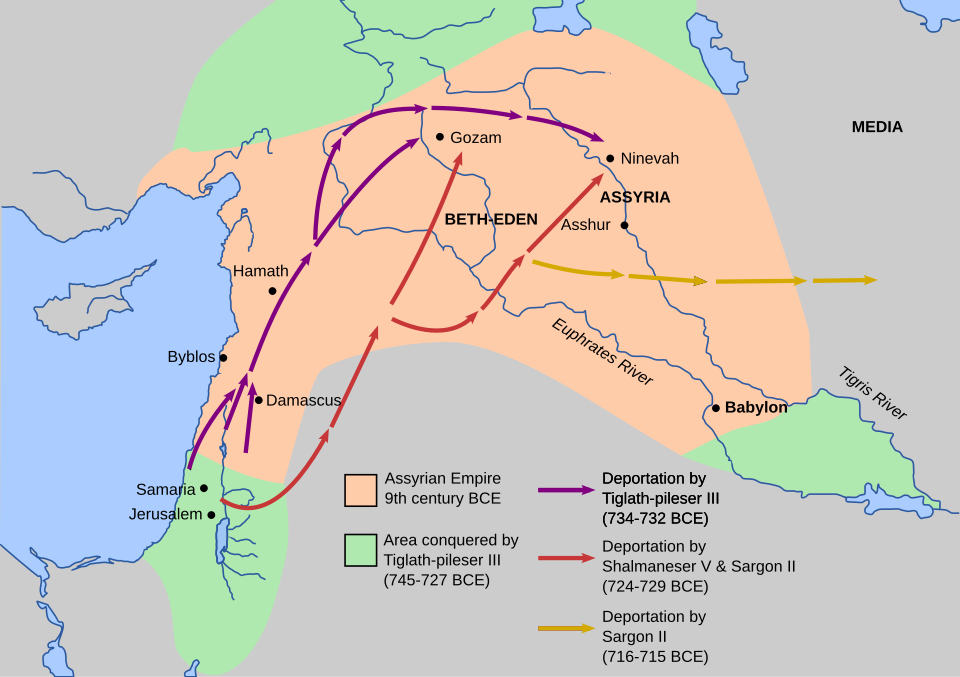
Deportations by Tiglath-Pileser III (734-732 BC)
by Shalmaneser V - Fall of Samaria 722 BC
In the ninth year of Hoshea, the king of Assyria captured Samaria and carried Israel away into exile to Assyria, and settled them in Halah and Habor, on the river of Gozan, and in the cities of the Medes. After three years of siege, Samaria fell to the Assyrians, and the days of Israel as a sovereign power were over (18:10). Many of the Israelites were taken captive and deported to Assyrian cities (v. 23; 18:11). Sargon II (722-705 B.C.), who succeeded Shalmaneser V, took credit for the victory and boasted that he carried away 27,290 people from Samaria. See map above for locations of exile.
TECHNICAL NOTE: Roger Young “When Was Samaria Captured? The Need for Precision in Biblical Chronologies.” (JETS, 44/4, December 2004, 577-95),
Bob Utley - "captured Samaria" Assyrian records say that 27,290 people were exiled from the capital alone. "into exile in Assyria" They were taken to the northern area of the Euphrates valley. This was the fall of national Israel in 722 B.C. See Contextual Insights, B. And NIDOTTE, vol. 4, pp. 595-600. Josephus (Antiq. 9.14.1) gives several dates related to this exile. (1) 947 years after the exodus (2) 800 years after Joshua (3) 247 years, seven months, and seven days after the split between Solomon's son Rehoboam and Jeroboam I
John Walton - policy of deportation. The Assyrian deportation policies had been in effect for nearly four centuries by this time. Sargon claimed to have deported 27,290 people from Samaria. The record is not clear as to whether these were all men and whether they came from the land of Samaria or just the main city. The Assyrian king claimed that he took enough men to form a regiment of fifty chariots. The Assyrians also had a policy of relocating other conquered peoples into Samarian territory (though Tiglath-Pileser appears to have departed from that policy by not repopulating Galilee in 733). Sargon claims to have repopulated the city of Samaria with other deportees. The deportation policy was intended to remove from conquered peoples anything that they might rally in defense of. If they have no land and no nation, and their ethnic identity has been compromised (through forced assimilation), there is no identity to fight for.
Sargon II (r. 722–705 BC), whose name appears in Assyrian inscriptions as Šarru-kīn (“the legitimate king” or “[the god] has established the king”), rose to power after the death of Shalmaneser V, likely as a usurper, and deliberately adopted the illustrious name of the ancient Sargon of Akkad to legitimize his rule; early in his reign he completed the conquest of the northern kingdom of Israel, claiming to have captured Samaria, deported 27,280 inhabitants, and reduced Israel to an Assyrian province (2 Kgs 17:6; 2Ki 18:9–12), though Scripture mentions him by name only in connection with the capture of Ashdod (Isa 20:1). One of Assyria’s most formidable warrior-kings (See map of his empire), he crushed revolts and carried out far-reaching campaigns against Babylonia, Elam, Media, Armenia, Cappadocia, Syria, Palestine, Arabia, and the Egyptian frontier, eventually expelling Merodach-baladan from Babylon and assuming royal authority there. He also left a lasting architectural legacy by founding the royal capital Dur-Sharrukin (Khorsabad) near Nineveh, from which he ruled at the height of Assyrian power, until his assassination by one of his own soldiers in 705 BC, after which the throne passed to his son Sennacherib. (See also Wikipedia)

Chuck Smith - "THE REASON WHY"
When a nation or people abandon God’s Word, replace Him with false gods,
and call evil good, judgment inevitably follows,SERMON SUMMARY - Israel’s fall into captivity was not accidental but the direct result of persistent, willful rebellion against God: they sinned by fearing other gods, tolerating God without giving Him first place, violating the first and second commandments through idolatry, rejecting His covenant, ignoring prophetic warnings, and pursuing empty pagan practices that ultimately left them spiritually and morally bankrupt. God had clearly warned them in His Law that such disobedience would lead to judgment, so they could plead neither ignorance nor surprise when He removed His protection and delivered them into the hands of their enemies. Their descent followed a tragic progression—idolatry, moral corruption, the worship of pleasure, and finally the sacrifice of their own children—until God declared, “It is enough.” The lesson is sobering: when a nation or people abandon God’s Word, replace Him with false gods, and call evil good, judgment inevitably follows, for God does not forsake His people without cause, but only after they have persistently forsaken Him.
Intro. In the ninth year of Hoshea the king of Assyria took Samaria, and carried Israel away into Assyria. Thus the writer records the death of the nation. Why would God forsake His people? Why would He allow their enemies to triumph over them?
I. THE SCRIBE THAT RECORDED THIS HISTORY IS CAREFUL TO GIVE TO US THE REASONS WHY THEY WERE FORSAKEN BY GOD AND WENT INTO CAPTIVITY.
A. Vs. 7 The children of Israel had sinned against Jehovah their God.
1. They feared or reverenced other gods.
a. The first commandment was "Thou shalt have no other gods before Me."
b. They had a place for God in their lives, but it was not first.
c. The fact that you are here this morning shows that you have made a place for God in your life, but does He have the first, place above all others?
d. Is this the extent of your relationship with Him, a couple hours on Sunday morning?
2. Vs. 10 They set up images of Asherah.
a. The second commandment was Thou shalt not make any graven image to bow down to them.
b. Asherah was an idol of a female deity.
3. They did wicked things that provoked the Lord to anger. vs 11
4. They would not listen to the warnings of the messengers of God.
5. They rejected the covenant that God had made with them.
a. Note they not God broke the covenant.
b. God had given them His law and warned them:
LEV 26:14 But if you will not hearken unto me, and will not do all these commandments;
LEV 26:15 And if you shall despise My statutes, or if your soul abhor My judgments, so that you will not do all my commandments, but you break My covenant:
6. In verse 15 we read: And they rejected His statutes, and His covenant that He made with their fathers, and His testimonies which He testified against them;
LEV 26:17 I also will do this unto you; I will set My face against you, and you shall be slain before your enemies: they that hate you shall reign over you;
7. This is exactly what has happened to them. They have been slain by their enemies and taken captive.
8. They could not plead ignorance, nor could they deny that they had not been warned.
II. THEY PURSUED EMPTINESS AND BECAME EMPTY. VS. 15
A. God has put in every man a need and a thirst for God.
1. David said, "My soul thirsts for the living God."
2. This is true of all men.
3. What is tragic is the empty things by which men see to slake this thirst.
a. They feel that perhaps the thirst can be quenched through things, so they amass all kinds of things. But ultimately find them empty. Their philosophy is he who dies with the most toys wins.
b. They pursue pleasure, it ultimately leaves them empty.
c. There is one empty pursuit after another, as they seek to fill the recognized void in their lives, but there is no lasting satisfaction in empty things.
B. They went after the ways of the heathen that were round about them.
1. A few years back we did a series of videos titled "The Pagan Invasion."
2. Through this series we sought to show how that the United States has slowly become paganized.
a. The New Age movement is not new, it is ancient Hinduism in a new garb.
b. The worship of mother earth and the forces of nature is nothing more than Animism practiced by primitive cultures.
c. Worshipping and serving the creature, more than the Creator.
C. They made a grove. The Hebrew word translated grove is Asherah. She was the female goddess of reproduction.
1. Whenever you read in the Old Testament of them making a grove, it is making an idol that represented the goddess Asherah. The idols were a form of pornography and designed to arouse the sexual passions.
2. People were becoming highly stimulated sexually.
3. What happens when a society is exposed to seductive pictures? They become highly sexually aroused?
4. The Bible warns us that if we sow to our flesh, we will reap of the flesh.
5. When people make sex their god, and sex outside of marriage becomes a common expected thing suddenly you have many unwanted pregnancies.
D. Now you have a real social problem.
1. What to do with all of these unwanted babies?
2. You have men who do not want to take the responsibility of having to support a child that they fathered.
3. Rather than turning to the commandment of God and cease such activity, you have people advocating the right of a mother to end the life of her unwanted child, and politicians who make that as one of their major planks in order to be elected to office.
4. It those days, they did not have abortion clinics, nor morning after pills.
5. They had to carry the baby full term and give birth to the child.
6. But then they wanted to get rid of the child so they would build big bon fires and throw the unwanted child into the fires.
a. That is what the scripture is speaking about when it says that they cause their sons and their daughters to pass through the fires.
b. It was the human sacrifice of their offspring to their god of pleasure and lust.
7. This was the final stage of their rebellion against the laws of God.
8. This is the point where God said, it's enough, and God removed His hand of protection from them and the nation went into captivity to their enemies.
E. We read, "Therefore the Lord was very angry with Israel and He removed them out of His sight."
III. I SEE STARTLING SIMILARITIES BETWEEN THE NATION OF ISRAEL AND THE UNITED STATES.
A. God had brought the nation from the oppression and bondage of Egypt into a land where they were free to worship their God.
B. Even as God brought our pilgrim fathers from the religious bondage of the State church of England to a land where they were free to worship God after the dictates of their own hearts.
C. They established the new nation on the laws of God, it was to be a nation that recognized and honored God. As one of the founding fathers of the new nation, Joshua said to the people, "As for me and my house, we will serve the Lord."
D. Our founding fathers also saw that the strength of the nation was in proportion to its relationship with God, so they sought to incorporate into the constitution those provisions that would guarantee the freedom for a man to worship God after the dictates of his own heart.
1. There was never an intent of freedom from religion, as has been interpreted by the opinions handed down by the Supreme Court.
2. The whole idea was freedom of religion. No state church. You could worship in whatever church you pleased. No one saying that you had to abide the rules of one church.
E. Look how the decisions of the Supreme Court have slowly corrupted our nation and have brought us on the verge of destruction.
1. The decision that the constitution guaranteed a person freedom from religion, thus restricting any positive instruction of the our children in the public schools from any moral values that might be based on Biblical principals.
a. The ordered removal of the ten commandments from the classrooms.
b. No more baccalaureate services for the graduating seniors.
c. No singing of Christmas Carols, in fact Christmas vacation is now winter break and Easter vacation is now spring break for we do not want to suggest anything that might refer to Christianity, for it might offend someone who wants to be free from religion.
d. And just look what is happening on the spring breaks. Drunken sexual orgies leading to more unwanted pregnancies, and more business for the abortion mills.
e. In the Friday edition of USA Today there was an article that spoke of the need to begin a program of teaching the children of the dangers of unprotected sex, so they began to design a program for 7th graders, then they discovered that children begin their sexual practices at the age of nine today.
2. Next our Supreme Court under the guise of and their interpretation of freedom of speech they opened the doors for a flood of pornography to fill our land. Because they were unable to define obscenity, nothing is obscene. We are in an anything goes society.
3. Next the removal of laws that restricted certain types of sexual activity so that consenting adults are free to do whatever their fantasies might dictate.
F. The result is the same as the nation of Israel. You have a society where sex has become the god of the people and we have sex pushed at us from every quarter. You can hardly watch the news anymore on TV without some sexually titillating feature being presented, if not in the news section in the advertising which consumes 1/3 of the time.
1. Thus with the nation living in a state of high sexual arousal, and the laws granting us the freedom to explore as we please, we again are faced with a plethora of unwanted pregnancies.
a. Thus it was important to go back to the Supreme Court to to get a decision on the Roe vs Wade so that abortion is a chosen option for any woman who does not want to carry her unwanted child full term. This has now become the shame of the nation that has now legally murdered some 40,000,000 babies.
2. About the only difference between us and the ancient Israelites is that we burn the babies to death in the womb with the saline solution before they are born, rather than throwing them in the fires after they have been born.
G. Therefore you can be sure that the righteous God that punished Israel and gave them over to be ruled by their enemies will not spare our nation from the judgments to come.
H. I would like to say that the Supreme Court is wrongly titled for it is not the Supreme Court. They do not make the final determination of what is right and wrong, the Bible that they do not want taught to our children in our public schools teaches the true laws of God, and one day those justices who have liberalized men from the laws of God will face the true Supreme Court and will be found guilty.
I. Because it might be the law of our land it does not make it right in the sight of God. And it is His decision that you need to be concerned about. Jesus said, Mt 10:28 And fear not them which kill the body, but are not able to kill the soul: but rather fear him which is able to destroy both soul and body in hell.
2 Kings 17:7 Now this came about because the sons of Israel had sinned against the LORD their God, who had brought them up from the land of Egypt from under the hand of Pharaoh, king of Egypt, and they had feared other gods
- the sons of Israel had sinned : Dt 31:16,17,29 32:15-52 Jos 23:16 Jud 2:14-17 2Ch 36:14-16 Ne 9:26 Ps 106:35-41 Eze 23:2-16 Ho 4:1-3 8:5-14
- against the LORD their God: 2Ki 16:2 1Ki 11:4 15:3 2Ch 36:5
- which had: Ex 20:2
- they had feared other gods 2Ki 17:35 Jer 10:5
- 2 Kings 17 Resources
Related Passages:
Exodus 20:2 “I am the LORD your God, who brought you out of the land of Egypt, out of the house of slavery.
Deuteronomy 31:16 (YAHWEH PROPHESIED ISRAEL'S REBELLION EVEN BEFORE THEY ENTERED THE PROMISED LAND) The LORD said to Moses, “Behold, you are about to lie down with your fathers; and this people will arise and play the harlot with the strange gods of the land, into the midst of which they are going, and will forsake Me and break My covenant which I have made with them.
Deuteronomy 31:17 (YAHWEH EVEN PROPHESIED THE PUNISHMENT) “Then My anger will be kindled against them in that day, and I will forsake them and hide My face from them, and they will be consumed, and many evils and troubles will come upon them; so that they will say in that day, ‘Is it not because our God is not among us that these evils have come upon us?’
Deuteronomy 31:29 (MOSES EVEN FOREWARNS THE NATION OF THEIR COMING APOSTASY) “For I know that after my death you will act corruptly and turn from the way which I have commanded you; and evil will befall you in the latter days, for you will do that which is evil in the sight of the LORD, provoking Him to anger with the work of your hands.”
Psalm 115:10-13 (FEAR THE LORD) O house of Aaron, trust in the LORD; He is their help and their shield. 11 You who fear the LORD, trust in the LORD; He is their help and their shield. 12 The LORD has been mindful of us; He will bless us; He will bless the house of Israel; He will bless the house of Aaron. 13 He will bless those who fear the LORD, The small together with the great.
THE REASON FOR
ISRAEL'S EXILE IN 722 BC
Now this came about because - This is a pivotal, nation shaking term of explanation (an explanation that gives a lengthy litany of sins from 2Ki 17:7-18)! This introduces a solemn statement of cause and effect, marking what follows as a multiple verse divine recital of the reasons why God finally had to uproot His chosen people from the promised land and send them into captivity under the cruel Assyrians.
Before going into a long list of specific sins, 2 Kings 18:12 sums up 4 general sins explaining why Israel was taken into captivity...
because (1) they did not obey the voice of the LORD their God, but (2) transgressed His covenant, even all that Moses the servant of the LORD commanded; (3) they would neither listen nor (4) do it.
From the very beginning of the Northern Kingdom and its first king Jeroboam I, God had given the people crystal clear warnings (including a prophetic promise of future exile) which should have stimulated national repentance...
“For the LORD will strike Israel, as a reed is shaken in the water; and He will uproot Israel from this good land which He gave to their fathers, and will scatter them beyond the Euphrates River, because they have made their Asherim, provoking the LORD to anger. “He will give up Israel on account of the sins of Jeroboam, which he committed and with which he made Israel to sin.” (1Ki 14:15-16).
The sons of Israel had sinned (chata'; LXX - hamartano) - Sin alone is bad enough. But they sinned against Jehovah, sinning not sporadically but with a settled pattern of rebellion, persistent disobedience, spiritual infidelity, and rejection of Yahweh's authority. The responsibility is squarely placed on Israel, emphasizing that the coming disaster did not result from strength of the Assyrian army, but from their willful, continual violation of the conditional Mosaic covenant they had vowed to keep with Jehovah (Read Ex 24:3,7)
Against the LORD their God - Notice the phrase their God, which does not imply that the nation as a whole enjoyed a personal, saving relationship with Yahweh (though a remnant did - 1Ki 19:18), but rather identifies Israel as His covenant people, His chosen nation. By using this covenantal designation, the LORD their God, the text intensifies the seriousness of their sin! Israel did not rebel against an unknown or distant deity, but against the very LORD Who had bound Himself to them by covenant promise. Their offense and unfaithfulness to covenant , therefore, was not mere religious error, but willful betrayal, making their guilt all the more severe. See related discussion of Israel the Wife of Jehovah.
Bob Utley - The fall of Samaria and the northern kingdom was not because of the power of the Assyrian gods or the Assyrian army but because of YHWH's judgment on them because of their repeated, unrepentant idolatry!
Who had brought them up from the land of Egypt from under the hand (yad ~ "power") of Pharaoh, king of Egypt - What should have been a continual source of gratitude and motivation to live holy as He is holy, seems have been all but forgotten by the rebellious nation. This serves to heighten Israel's guilt for they are sinning against the very One Who redeemed them from slavery and oppression. Notice the repetition of from the land of Egypt and from under the hand of Pharaoh which serves to intensify the reminder of how complete and costly that deliverance was. Yahweh had broken the strongest political power of the day and liberated them by His Own mighty hand. The irony is that they rebelled against the LORD, forgetting the very salvation He had brought them into existence as a nation.
And they had feared (yare; LXX - phobeo) other gods (elohim) - Misdirected fear was a foundational flaw, for they were called to fear only Jehovah! Fear of course in this context is not referring primarilty to dread (although a little "holy dread" is not a bad thing!), but to reverence and awe of Yahweh which undergirds trust in Him, this faith in turn manifesting itself in obedience (1Sa 15:22). In short, Israel was to fear God only. Instead they feared other (no) gods, as seen in their bowing before lifeless idols of wood and stone that could neither save nor speak! (Ps 115) Jehovah should have been on the throne of their hearts (just as Christ is to be on the throne of believer's hearts today) but they in effect dethroned Him in favor of what was empty and worthless. Does Jesus have any rivals for your loyalty and trust?
Paul House: 2Ki 17:7-13 Now the author summarizes why Israel has fallen. None of these reasons should surprise readers, for they have been mentioned over and over again. Israel’s most fundamental error all along has been covenant breaking, the most obvious manifestation of which is idolatry. The people forgot the exodus and all it stood for: God’s power and grace, God’s acts on their behalf, and their responsibility to reciprocate God’s goodness with faith, undivided allegiance, and pure worship. Instead, they worshiped local deities, adopted corrupt ethical practices, and ignored the Lord’s prophets who were sent to warn them. By the time God’s patience was exhausted and judgment fell, the rebellion was two hundred years old, thus fully mature. (BORROW 1, 2 Kings PAGE 340)
Harry Shields on 2 Kings 17:7-17 - This section is the low point of 1 and 2 Kings. Besides telling what happened, it also gives information on why it happened—the disaster that came on Israel and was yet to come on Judah (v. 19). The primary reason for defeat and exile was a failure to fear the Lord in accord with His covenant (cf. vv. 36-37). Following the description of Hoshea’s demise, this chapter can be divided into three sections: (1) Israel’s sinful choices (vv. 7-17); (2) the Lord’s response to those choices (vv. 18-23); and (3) the ongoing sins that corrupted the land (vv. 24-41). (Moody Bible Commentary page 542)
Sinned (02398) chata' fundamentally means “to miss the mark,” whether literally, as of expert slingers who “did not miss” their target (Jdg 20:16), or morally, as failing to walk in the way God has set (Pr 19:2). From this basic idea arises its dominant theological sense: moral failure toward God or others, missing God’s standard and incurring guilt or loss (Gen 20:6, 9; 39:9; 43:9). Scripture consistently defines sin as covenantal violation—transgressing what the LORD has commanded, as seen in Israel’s disobedience at Ai (Josh 7:11) and in unintentional acts contrary to God’s law (Lev 4:27). In a striking irony, the intensive (Piel) stem can mean “to cleanse” or “to de-sin,” referring to ritual purification (Exod 29:36; Num 8:21; 19:12–13, 20), a usage poignantly echoed in David’s plea, “Purify me…and I shall be clean” (Ps 51:7), and later fulfilled typologically in inward cleansing through Christ (Heb 10:22).
The Septuagint often renders ḥāṭāʾ with hamartano, likewise meaning to miss the mark, to wander from the right path, underscoring that sin is a deviation from God’s truth and will rather than merely a mistake. Altogether, Scripture presents sin as failing, erring, bearing guilt, and forfeiting what is right before God—yet also anticipates God’s gracious provision for cleansing and restoration.
Feared (03372) yare is a verb meaning to fear, to be afraid (Ge 3:10), to respect, to reverence, to be terrified, to be awesome, to be feared, to make afraid, to frighten. The most common translations are to be afraid, to fear, to fear God. On one had yare conveys the sense of threat to one's life, but on the other it can express the idea of reverence and deep respect (as in Ps 25:14). In the OT fear of the Lord involves a person's total response to the Lord. It is notable that more than 75% of the over 370 uses of yare are in the context of reverencing the Lord. In English our word reverence (from Latin reverentia "awe, respect," from revereri "to stand in awe of, respect, honor, fear, be afraid of; revere,") refers to a feeling of profound respect for someone or something, and with yare in the OT as noted this is most often to God. The classic use is Pr 1:7 "The fear (yare) of the LORD is the beginning of knowledge." Notice that a genuine holy fear of the Lord is often equated with believers (e.g. Mal 3:16, Mal 4:2, Eccl 8:12-13, cf the last worldwide proclamation of the Gospel which says "Fear God..." - Rev 14:6-7)
The fear of the Lord is a reverent, affectionate awe of God that recognizes His holiness, majesty, authority, and grace, and responds with humble obedience and watchful devotion. Scripture presents it as the foundation of all true wisdom and spiritual life—the starting point of knowing God rightly and living rightly before Him. Far from being slavish terror, it is a filial fear that coexists with love: love draws us toward what pleases God, while fear restrains us from what dishonors Him. Rooted in a true knowledge of God’s character, the fear of the Lord produces practical holiness, hatred of evil, confidence, protection, intimacy with God, and blessing both now and eternally. From Genesis to Revelation, the Bible teaches that those who fear the Lord walk in wisdom, enjoy God’s friendship, and find life, while the absence of this fear leads to spiritual blindness and ruin. In short, the fear of the Lord is not opposed to grace but is essential to a healthy, obedient, joyful, and enduring relationship with God.
YARE IN KINGS & CHRONICLES - 1Ki. 1:50; 1Ki. 1:51; 1Ki. 3:28; 1Ki. 8:40; 1Ki. 8:43; 1Ki. 17:13; 1Ki. 18:3; 1Ki. 18:12; 1Ki. 19:3; 2Ki. 1:15; 2Ki. 4:1; 2Ki. 6:16; 2Ki. 10:4; 2Ki. 17:7; 2Ki. 17:25; 2Ki. 17:28; 2Ki. 17:32; 2Ki. 17:33; 2Ki. 17:34; 2Ki. 17:35; 2Ki. 17:36; 2Ki. 17:37; 2Ki. 17:38; 2Ki. 17:39; 2Ki. 17:41; 2Ki. 19:6; 2Ki. 25:24; 2Ki. 25:26; 1Chr. 10:4; 1Chr. 13:12; 1Chr. 16:25; 1Chr. 17:21; 1Chr. 22:13; 1Chr. 28:20; 2Chr. 6:31; 2Chr. 6:33; 2Chr. 20:3; 2Chr. 20:15; 2Chr. 20:17; 2Chr. 32:7; 2Chr. 32:18;
Related Resource:
One writer (What the Bible Teaches – 1 and 2 Kings.) says "Three succinct statements highlight the main reasons why final judgment fell on the northern kingdom:
- “they served idols” (v.12)
- “they would not hear” (v.14)
- “they left all the commandments of the Lord their God” (v.16).
SHORT EXCURSUS ON IDOLATRY - Idolatry, biblically defined as giving worship, devotion, or allegiance to anything other than the one true God, stands in direct violation of the covenant requirement of exclusive loyalty to the LORD (Exod 20:3–5; Deut 5:7), a loyalty so absolute that Israel was forbidden even to acknowledge the names of false gods (Exod 23:13) or form alliances that would entice the heart away from Him. Scripture consistently portrays idolatry as a heart-level deception that leads people to turn aside, serve other gods, and bow in worship, a recurring pattern throughout Israel’s history documented in the historical books and denounced relentlessly by the prophets (e.g., Deut 11:16; Josh 23:16; Jer 11:10; Hos 2–3). Though idols themselves are powerless objects of wood and stone, God repeatedly demonstrated their impotence and His own supremacy, as seen in the humiliation of Dagon before the ark (1 Sam 5:1–5) and the defeat of Baal on Mount Carmel (1 Kgs 18:19–40), affirming that He alone is worthy of worship and will not share His glory (Isa 42:8). The consequences of idolatry were severe and covenantal: the LORD’s anger would be kindled, the heavens would be shut so there was no rain, the land would cease to produce, and the people would perish from the good land given to them (Lev 26:19; Deut 28:24; 11:17; Josh 23:13), revealing that God’s covenant allowed no middle ground—obedience brought life, disobedience brought death (Deut 30:15,19; Ps 1). Because fallen humanity proved incapable of sustaining the obedience required under the Mosaic Covenant (Josh 24:19; Gal 3:10), the Law ultimately exposed the need for a new covenant grounded in God’s mercy and transforming power rather than human performance (Jer 31:31–34; Ezek 36:22–36; Rom 3:23; 5:12–21). Thus idolatry, whether ancient or modern, remains a profound offense against God, rooted in the heart and demanding repentance, since true worship belongs to Him alone.
Related Resource:
- Why is idol worship such a powerful temptation?
- See excellent 7+ page discussion in the Dictionary Of Biblical Imagery
Chuck Smith - "THE DEATH OF A NATION"
SUMMARY - In 722 BC Israel ceased to exist as a nation because it sinned against the LORD who had established it, delivered it from Egypt, given it the land, and intended it to be a living testimony of the blessing of serving God. Instead of remaining centered on God’s law and presence, Israel turned to fear and serve other gods, conforming to the surrounding culture, abandoning God’s standards, and pursuing emptiness—becoming empty themselves. Though God repeatedly sent prophets to warn them and allowed early defeats as merciful calls to repentance, they refused to listen, misread their history, trusted human strength, and attributed their former greatness to themselves rather than to God. As a result, having forsaken the LORD, they were left without His protection and swiftly collapsed. The lesson drawn is a sobering parallel: when any nation abandons God in favor of self-made idols such as prosperity, power, or materialism, ignores divine warnings, and places confidence in its own strength, it places itself on the same path toward spiritual and national ruin.
Intro: In 722 B.C., Israel ceased to exist as a nation. The Assyrians had carried them away as captives. The once great and Godly nation has fallen. What brought death to this nation?
I. GOD'S INDICTMENT AGAINST ISRAEL.
A. They sinned against the Lord their God.
1. Nations can sin as well as individuals.
2. They missed the mark, they failed to be what God wanted them to be.
a. God wanted them to be a living example to the world of the value and blessing of serving God.
3. Israel was a nation that was established by God.
a. He brought them out of Egypt.
b. He subdued their enemies and gave them the land.
4. It was a nation established in God.
a. God's law was the law of the land.
b. God was at the center and in the heart of the nation.
B. They began to fear, reverence and serve other gods.
1. Forsaking the God who made them, they began to worship gods they had made.
a. They sought to live as the world around them.
1. To follow its fashions and standards.
2. God has said, "Be not conformed to this world," yet they were.
2. They began to put the true and living God out of their national life.
a. They forsook His laws.
b. They established their own godless standards.
3. Following after emptiness they became empty.
II. GOD'S ATTEMPT TO TURN THEM FROM THE CERTAIN PATH OF
DESTRUCTION.
A. He sent prophets and seers with warnings.
1. Turn from your wickedness.
2. Turn back to God.
B. He allowed them to begin to taste the bitterness of defeat in battle as a warning.
C. They would not listen to the prophets.
1. They did not believe the warnings of God.
D. Having now forsaken God, God has now forsaken them.
1. Without God, they have no strength.
2. They misinterpreted their history.
a. They ignored that it was God that made them strong.
b. They attributed the greatness to free enterprise or democracy.
c. They began to trust in their military strength.
3. Without God's help they immediately were defeated. The nation died.
III. THE DEADLY PARALLEL.
A. America was established as one nation under God, the founding fathers knew who that God was.
1. It was God who made our nation great, it was God who made our nation strong.
2. As a nation, we have sinned against God. We have begun to worship other gods.
a. Prosperity, success, happiness, materialism.
b. Forsaking the God who made us, we are serving gods we have made.
B. God has been sending some strong warning signals.
1. Korea, Vietnam, Iran.
2. We were once great as the Lion the King of the beast. Feared and respected.
F B Meyer 2 Kings 17:7-23 The Divine indictment against Israel. --
This chapter reads like a page from the records of the great white throne. God humbles Himself to explain the reasons for His treatment of His people. He shows that it was not without cause that He dealt with them as He did. The story of Israel's sins, in spite of His earnest entreaties, the melancholy record of God-rejection and neck-hardening, of divination and enchantment, of faithlessness and disobedience, is set down without omission or compromise; and side by side is the golden tissue of goodness and mercy. It is a strange contrast. And yet if the true story of our inner experience could be written, how much there would be in common between it and this. Let us ponder those deep expressions, "they sold themselves to do evil" (2 Kings 17:17); "Jeroboam drove Israel from following the Lord" (2 Kings 17:21). Note also the expression in 2 Kings 17:15, that we become like the objects we follow (Ps. 115:6-note). Israel was never restored; but remained dispersed among the nations, many of them being added to the Church in after days, as addressed in 1 Peter 1:1, 2-note (see R.V.).
2 Kings 17:8 and walked in the customs of the nations whom the LORD had driven out before the sons of Israel, and in the customs of the kings of Israel which they had introduced.
- walked in the customs of the nations: 2Ki 16:3,10 21:2 Lev 18:3,27-30 De 12:30,31 18:9 1Ki 12:28 1Ki 16:31-33 21:26 Ps 106:35 Jer 10:2
- of the kings of Israel which they had introduced: Ho 5:11 Mic 6:16
- 2 Kings 17 Resources
WALKING LIKE
THE CANAANITES
and walked in the customs of the nations whom the LORD had driven out before the sons of Israel - Israelites imitated the sinful practices and idol worship of the pagan nations that the LORD had previously expelled from the land, specifically the CANAANITES, thereby abandoning His covenant and provoking His judgment.
🙏 THOUGHT - This indictment reminds me of Romans 12:2 which warns believers in effect about the "customs of the nations" Paul commanding "And do not be conformed to this world, but be transformed by the renewing of your mind, so that you may prove what the will of God is, that which is good and acceptable and perfect. ."
Bob Utley - "walked" This is an idiom for lifestyle. It was based on God's word to Abraham's descendants as a well worn, straight, smooth, clear path (i.e., Ps. 1:1; 16:11; 89:15; 119:105; 139:24; Isa. 5:2; 1 John 1:7). God's will was not hidden but clearly revealed in the Mosaic Covenant.
And in the customs of the kings of Israel which they had introduced - So the root cause was not just the pagan Canaanites but the ethnic Israelites, specifically their kings! How important are leaders to a nation? That's a rhetorical question. Jdg 5:2 says "That the leaders led in Israel, That the people volunteered, Bless the LORD!" Pr 14:34 says "Righteousness exalts a nation, But sin is a disgrace to any people." Yes the kings of Israel led the nation into spiritual darkness and the people like dumb sheep followed their kings! The ungodly leadership of the kings of Israel proved the truth of the proverb that "sin is a disgrace to any people."
Thomas Constable on the the kings of Israel - Israel had suffered for 209 years under 20 different kings from 9 different families, sometimes called dynasties. The heads of these ruling families were Jeroboam I (two kings), Baasha (two kings), Zimri (two kings), Omri (four kings), Jehu (five kings), Shallum (one king), Menahem (two kings), Pekah (one king), and Hoshea (one king). Seven of these kings died at the hands of assassins: Nadab, Elah, Jehoram, Zechariah, Shallum, Pekahiah, and Pekah. All of them were evil. They did not comply with the will of Yahweh as contained in the Mosaic Law and the revelations of His prophets.
(ED: Constable's note emphasizes that Yahweh had been incredibly patient with Israel for over two centuries! But the stiffened their necks and refused to repent even with warning after warning!)
J Vernon McGee adds "The Lord had been very patient with these people. Over a period of over two hundred years (after the division of the kingdom) the Lord had given them every opportunity and ample time to return to Him. But they did not. They continually went off into idolatry. The Word of God is very clear that he sent them into captivity because they insisted on worshiping other gods. (Thru the Bible - – Thru The Bible)
In short, this divine indictment underscores that the corrupt religious practices being condemned did not originate with the people alone but were instituted and legitimized by Israel’s own rulers. Like king, like people! From the time of Jeroboam I onward, the kings of the northern kingdom deliberately introduced unauthorized worship, most notably the golden calves at Bethel and Dan and in effect enforced these innovations as state policy (so much for "separation of church and state!"). What began with Jeroboam I as a political strategy to secure loyalty apart from Jerusalem became an entrenched, corrupted religious system, passed down and normalized by successive kings. Thus, Israel’s sin was royal-led rebellion against Yahweh, making the nation’s guilt deeper because the very leaders appointed to shepherd the people instead led them astray.
CANAANITES - The Canaanites is the name given to 7 nations (see below) of the Semitic descendants of Canaan, the son of Ham (Gen 9:18–25; 10:15–19), who spread westward to occupy the fertile plains, valleys, and coastal regions of the land later known as Canaan—stretching from Lebanon to the Brook of Egypt and from the Mediterranean to the Jordan Valley (Gen 10:19; Num 13:29; 34:1–12)—where they developed powerful city-states such as Tyre and Sidon and became renowned as merchants and seafarers, giving the name “Canaanite” the sense of “trader” (Job 41:6; Prov 31:24; Zeph 1:11). Scripture uses the term both narrowly for lowland dwellers and broadly for multiple peoples inhabiting the land, including Hittites, Amorites, Jebusites, Perizzites, Hivites, and Girgashites (Exod 3:8, 17; Deut 7:1; Judg 1:9–10). Because of their entrenched idolatry, centered on local manifestations of Baal worship (Lev 18:25–28; 20:23), God decreed their removal to give the land to Abraham’s descendants (Gen 12:6–7; 15:18), commanding Israel to dispossess them progressively (Exod 23:23, 29; Deut 7:22–23), a task only partially fulfilled, leaving remnants who later troubled Israel during the period of the Judges and beyond (Josh 17:12–18; Judg 1:27–36; 3:1–3).
The Seven Nations of Canaan were a group of peoples descended from Canaan, the son of Ham, who inhabited the Promised Land before Israel’s return and were designated in Scripture as objects of Israel’s conquest (e.g., Deut 7:1–2). When listed individually, they include the Canaanites, Amorites, Girgashites, Hittites, Hivites, Jebusites, and Perizzites, with “Canaanites” functioning both as a collective label and as one specific group among them.
2 Kings 17:9 The sons of Israel did things secretly which were not right against the LORD their God. Moreover, they built for themselves high places in all their towns, from watchtower to fortified city.
KJV And the children of Israel did secretly those things that were not right against the LORD their God, and they built them high places in all their cities, from the tower of the watchmen to the fenced city.
NKJ Also the children of Israel secretly did against the LORD their God things that were not right, and they built for themselves high places in all their cities, from watchtower to fortified city.
NET The Israelites said things about the LORD their God that were not right. They built high places in all their cities, from the watchtower to the fortress.
BGT καὶ ὅσοι ἠμφιέσαντο οἱ υἱοὶ Ισραηλ λόγους οὐχ οὕτως κατὰ κυρίου θεοῦ αὐτῶν καὶ ᾠκοδόμησαν ἑαυτοῖς ὑψηλὰ ἐν πάσαις ταῖς πόλεσιν αὐτῶν ἀπὸ πύργου φυλασσόντων ἕως πόλεως ὀχυρᾶς
LXE and in those of the children of Israel as many as secretly practised customs, not as they should have done, against the Lord their God: {1) Gr. cloaked matters}
CSB The Israelites secretly did what was not right against the LORD their God. They built high places in all their towns from watchtower to fortified city.
ESV And the people of Israel did secretly against the LORD their God things that were not right. They built for themselves high places in all their towns, afrom watchtower to fortified city.
NIV The Israelites secretly did things against the LORD their God that were not right. From watchtower to fortified citya they built themselves high places in all their towns.
NLT The people of Israel had also secretly done many things that were not pleasing to the LORD their God. They built pagan shrines for themselves in all their towns, from the smallest outpost to the largest walled city.
YLT and the sons of Israel do covertly things that are not right against Jehovah their God, and build for them high places in all their cities, from a tower of the watchers unto the fenced city,
NJB The Israelites spoke slightingly of Yahweh their God. They built themselves high places wherever they lived, from watchtower to fortified town.
- The sons of Israel did things secretly: De 13:6 27:15 Job 31:27 Eze 8:12
- from watchtower to fortified city 2Ki 18:8 Ho 12:11
- 2 Kings 17 Resources
Related Passages:
Ezekiel 8:12 (THIS ACTUALLY REFERS TO THE SOUTHERN KINGDOM) Then He said to me, “Son of man, do you see what the elders of the house of Israel are committing in the dark, each man in the room of his carved images? For they say, ‘The LORD does not see us; the LORD has forsaken the land.’”
The sons of Israel did things secretly which were not right against the LORD their God - This statement refers to Israel’s hidden, deliberate disobedience, sins practiced covertly rather than openly, during the period leading up to the fall of the northern kingdom. In 2 Kings 17:9, it summarizes a pattern in which the people privately adopted idolatrous practices, false worship, and covenant violations while maintaining a public appearance of normal religious life. The phrase “did things secretly” highlights intentional concealment, quick implies that the people of Israel knew these actions were wrong “against the LORD their God” yet persisted anyway. In context, it points especially to unauthorized worship sites, idols, and pagan customs (2Ki 17:10–12), revealing a divided heart and a willful breach of the covenant—sins that ultimately brought God’s judgment and exile.
Outwardly the people were still identifying as God’s covenant people, but inwardly and privately they were engaging in idolatry and sin. It was "secret" in the sense that they thought they could hide their sins and disobedience from God, but Scripture consistently teaches that nothing is hidden from His sight (Ps 139:11–12, Pr 15:3, Heb 4:13).
NET NOTE on did things secretly - (NET Bible translates it "said things about the LORD their God that were not right") The meaning of the verb וַיְחַפְּאוּ (vayékhappé’u), translated here “said,” is uncertain. Some relate it to the verbal root חָפַה (khafah), “to cover,” and translate “they did it in secret” (see BDB 341 s.v. חָפָא). However, the pagan practices specified in the following sentences were hardly done in secret. Others propose a meaning “ascribe, impute,” which makes good contextual sense but has little etymological support (see HALOT 339 s.v. חפא). In this case Israel claimed that the LORD authorized their pagan practices.
Harry Shields on did things secretly - has the idea of “ascribing” things to the Lord that simply were not true—the kind of things Jeroboam did when he implied that it was acceptable to the Lord for Israel to worship the bulls he had constructed at Bethel and Dan (Patterson and Austel, “1 and 2 Kings,” 249 = "וַיְחַפְּאוּ (wayeḥappeʾû, “[the Israelites] secretly did”) reveals that Israel’s motives were blatantly perverse, feigning worship of God while secretly doing things contrary to his clear instructions."). This reveals that God’s people feigned worship, but were actually rebelling against God by their forbidden religious practices (Moody Bible Commentary page 542)
Keil on did things secretly writes, “by worshipping God in ways of their own invention (they) concealed the nature of the revealed God, and made Jehovah like the idols”.
C T Lacey on did things secretly writes "Other commentators submit that they were seeking to keep their idolatry hidden from the Lord by combining it with aspects of the true worship of Him. Wiersbe suggests, “Israel began with secret worship of idols, but this eventually became public, and Jehovah was acknowledged as one god among many”. Whatever the correct interpretation of v.9 might be, the examples that follow of the things that the children of Israel introduced would appear to suggest that they were dressing up their worship with things that were alien to the Mosaic ordinances and thereby concealing the Lord in such a way that He was no longer visible as the one true God, e.g. “they built them high places in all their cities, from the tower of the watchman to the fenced city. And they set them up images and groves in every high hill, and under every green tree” (vv.9-10). The use of the words “all” and “every” make it clear that such places were widespread throughout the kingdom and worship no longer centred on the temple in Jerusalem. “The tower of the watchmen” was situated in the lonely outpost of the city, whereas “the fenced city” is a reference to the most populated area. The marks of idol worship therefore were plain to see throughout the length and breadth of the cities in Israel. The burning of incense ought to have been reserved for the incense altar in the temple in Jerusalem; however, like the surrounding heathen nations, the children of Israel were burning incense in the numerous high places (v.11). They provoked the Lord and therefore fully merited His anger against them (v.11). The Lord’s word was clear, “Ye shall not do this thing” (v.12); therefore they could not claim that they were ignorant of His demand for their undivided loyalty (cp. Deut 12:4, 31). (What the Bible Teaches – 1 and 2 Kings)
Moreover, they built for themselves high places in all their towns, from watchtower to fortified city - The phrase “watchtower to fortified city” is biblical, poetic language describing the full range of a land’s defenses, from the smallest outpost to the strongest urban stronghold. It emphasizes totality so that nothing is excluded. This is a tragic testimony to how thoroughly idolatry permeated the land, erecting worship sites on natural hills or man-made stone platforms in virtually every city, fort, and village, so that rebellion against the LORD became not occasional but omnipresent.
Bob Utley - "they built for themselves high places in all their towns" Canaanite worship involved imitation magic (i.e., fertility acts representing the fertility of nature). The male god was Ba'al the storm/rain god of the Ugaritic pantheon, represented by an uplifted phallic symbol, a rock. The female goddess was represented by a likeness of the "tree of life" (i.e., a carved pole or live tree). See Roland deVaux, Ancient Israel, pp. 284-288). FERTILITY WORSHIP OF THE ANE
John Walton - high places. The picture portrayed in the biblical narrative is that prior to the construction of the temple in Jerusalem, sacrifice and religious ritual commonly took place at local shrines or bamoth. They were constructed for this purpose and in most cases appear to be an installation that could be entered and within which cultic activity took place (see the comment on 1 Sam 9:12–13). Many of them may have had an urban setting, although this does not preclude their existence outside city walls on near by hills. Their actual appearance and the furnishings associated with the high places are unknown, but the large number of references to them as sacrificial sites suggests that some may have been quite elaborate. Eventually the monarchy and the Jerusalem priesthood attempted to suppress the use of the high places because of their desire to emphasize Solomon’s temple as “the place which Yahweh will choose” and to eliminate the syncretism that thrived at the high places. For more information on high places, see the comments on Deuteronomy 12:2–3.
2 Kings 17:10 They set for themselves sacred pillars and Asherim on every high hill and under every green tree,
- They set for themselves2Ki 16:4 Ex 34:13 Lev 26:1 1Ki 14:23 Isa 57:5
- Asherim on every high hill : De 16:21 Mic 5:14
- under every green tree, 2Ki 16:4 1Ki 14:23 De 12:2,3
- 2 Kings 17 Resources
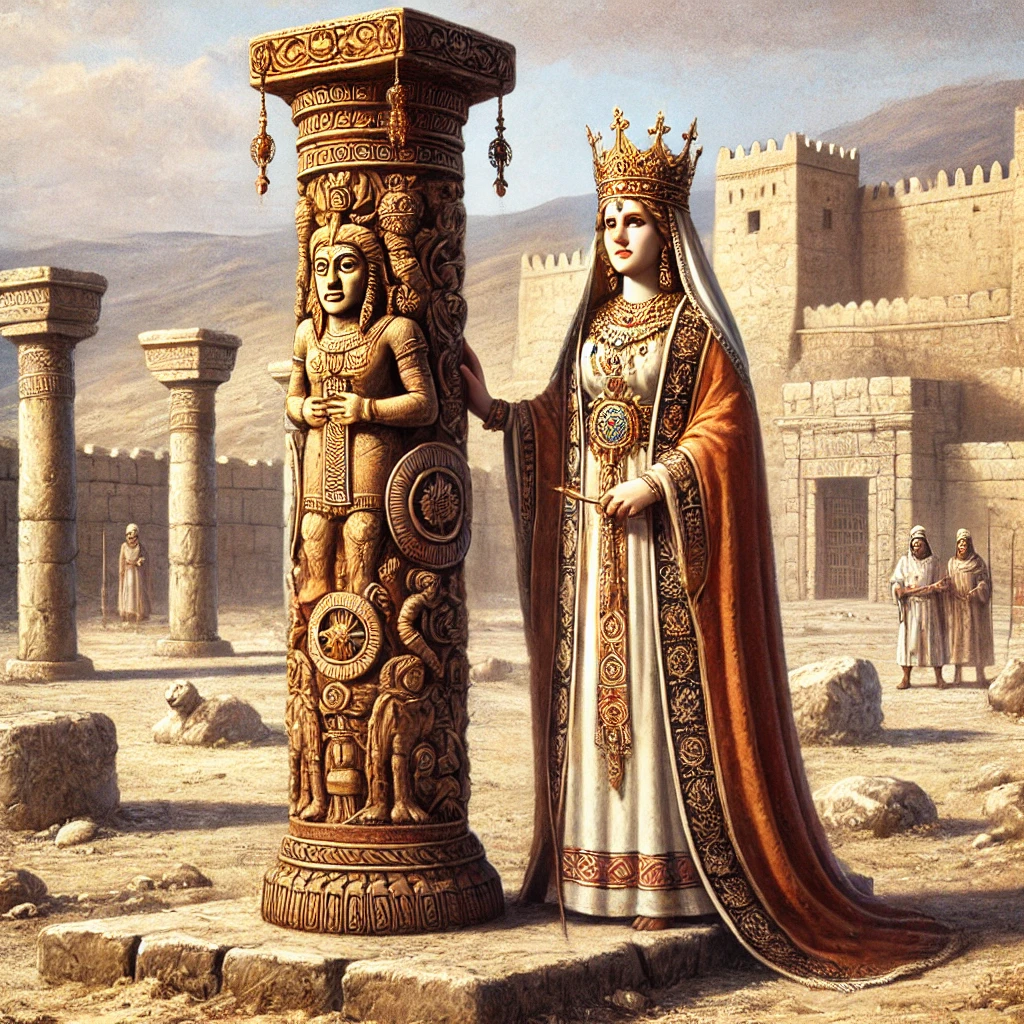
Evil Jezebel by an Asherim
A NATIONAL "EPIDEMIC"
OF GROSS IDOL WORSHIP
They set for themselves sacred pillars (matstsebah) and Asherim (asherah) on every high hill and under every green tree - Note the phrase set for themselves which indicates deliberate, self-willed autonomy in worship. Israel was not acting out of ignorance, accident, or coercion, but out of intentional choices. This exposes the root of idolatry which is not merely false gods per se, but the willful rejection of God’s right to define worship, revealing a heart that no longer listens to God but acts independently of Him (Isa 53:6; Jdg 21:25).
Notice next the repetition of the adjective every which implies no exceptions. Every (high hill...green tree) signifies total saturation of the land underscoring the fact that idolatry was not isolated, occasional, or limited to a few locations, but pervasive and comprehensive, spreading like a deadly virus across the entire land and touching every sphere of Israel’s religious life!
Bob Utley - "sacred pillars" These were uplifted stone pillars representing male genitalia. "Asherim" These were wooden poles/trees, representing the female goddess. She is also known as Asherah, Astarte, Anath. "every green tree" This refers to the sacred nature of groves of trees in a semi-arid land (cf. 2Ki 16:4; 2Ch 28:4; Jer. 2:20; 3:6,13; 17:2; Ezek 6:13; Hos 4:13). See NIDOTTE, vol. 3, p. 1153. SPECIAL TOPIC: TREES
John Walton - sacred stones. Standing stones or maṣṣebot were apparently a common feature of Canaanite religion and also appear as memorials in a number of Israelite covenantal contexts (see Ex 24:3–8; Josh 24:25–27). Their association with Asherah, Baal and other Canaanite deities is the basis for their being condemned as a rival and threat to Yahweh worship. Archaeologists have discovered sacred stones at Gezer, Dan, Hazor and Arad. In the latter two cases, they are clearly within a sacred precinct and part of the cultic practices at these sites. The Hazor stones include incised representations of upraised arms and a sun disk. The stones at Dan are in the gateway, and the clear remains of the presentation of votive offerings were evident. ASHERIM One common feature of Canaanite worship and of syncretized Israelite worship on “high places” and in city shrines is the erection of Asherah poles. There is some uncertainty about whether these were simply wooden poles, erected to symbolize trees or perhaps containing a carved image of the fertility goddess, or whether they were a part of a sacred grove. The reference here to Asherah poles beside “every spreading tree,” seems to indicate that these were poles erected for cultic purposes rather than planted trees. As the consort of El, Asherah was a popular goddess whose worship is mentioned in Ugaritic texts (1600–1200). Her prominent appearance in the biblical narrative indicates that her cult was a major rival to Yahweh worship. Pictures on seals excavated in Palestine show Asherah as a stylized tree in the Iron Age. For more information see the comments on Exodus 34:13 and Judges 6:25.
Pillars (04676)(matstsebah from natsab = to take a stand) means something set upright, most often "a standing, unhewn block of stone utilized for religious and memorial purposes. Pillars could function either as legitimate memorials to God or as forbidden symbols of idolatry, depending on their purpose and use. Jacob set up a stone pillar to commemorate a divine encounter (Gen 28:18, 22), and Moses erected an altar with twelve pillars at Sinai to represent Israel’s tribes before the LORD (Exod 24:4), showing that pillars could serve as reminders of God’s covenant acts. Over time, however, pillars became closely associated with pagan worship, especially devotion to Baal, and were frequently adopted by Israel in direct violation of God’s commands (1 Kgs 14:23; 2 Kgs 3:2; 10:26–27; 18:4; 23:14; Mic 5:13). As a result, what began as a neutral or even sacred symbol was corrupted into an instrument of idolatry, prompting prophetic condemnation and royal reforms aimed at their destruction.
Sacred pillars in pagan worship were very likely understood symbolically as male fertility markers, especially in Baal cults, but the Bible’s concern is not perverted anatomical detail but perverted covenant loyalty. God forbade them because they embodied fertility religion, false worship, and reliance on created powers rather than the LORD, who alone gives life and blessing (Deut 11:16–17; Hos 10:1–2).
MATSTSEBAH - 33V - Gen. 28:18; Gen. 28:22; Gen. 31:13; Gen. 31:45; Gen. 31:51; Gen. 31:52; Gen. 35:14; Gen. 35:20; Exod. 23:24; Exod. 24:4; Exod. 34:13; Lev. 26:1; Deut. 7:5; Deut. 12:3; Deut. 16:22; 2 Sam. 18:18; 1 Ki. 14:23; 2 Ki. 3:2; 2 Ki. 10:26; 2 Ki. 10:27; 2 Ki. 17:10; 2 Ki. 18:4; 2 Ki. 23:14; 2 Chr. 14:3; 2 Chr. 31:1; Isa. 6:13; Isa. 19:19; Jer. 43:13; Ezek. 26:11; Hos. 3:4; Hos. 10:1; Hos. 10:2; Mic. 5:13
Asherim (0842) Asherah refers both to the Canaanite fertility goddess and to the wooden cult objects (poles) that symbolized her presence, objects that were deliberately manufactured, carved, set up, and sometimes even placed within the temple itself, yet always condemned by Scripture (Judg 6:25–26; 1 Kgs 14:15, 23; 2 Kgs 21:7). These poles were made of wood, could be cut down and burned, and were typically positioned beside Baal altars on high places under leafy trees, reflecting Canaanite fertility worship (Exod 34:13; Deut 12:3; 16:21). While some texts clearly use Asherah to denote the goddess herself (Judg 3:7; 1 Kgs 18:19; 2 Kgs 23:4), others refer to the cultic object associated with her worship, sometimes even incorporated illicitly into Yahweh worship but never approved by God (2 Kgs 21:7; 23:6). Historically, Asherah (ʾṯrt) was widely venerated in the ancient Near East as the consort of El and “mother of the gods,” later associated with Baal, and her cult gained particular prominence during the divided monarchy under royal influence, especially through Jezebel (1 Kgs 18:19). Despite periodic reforms under kings like Asa and Hezekiah, the Asherah cult repeatedly resurfaced, illustrating a persistent pattern of apostasy in Israel and Judah and underscoring Scripture’s consistent hostility toward both the goddess and her symbols as illegitimate and corrupting forms of worship.
ASHERAH - 40V - Exod. 34:13; Deut. 7:5; Deut. 12:3; Deut. 16:21; Jdg. 3:7; Jdg. 6:25; Jdg. 6:26; Jdg. 6:28; Jdg. 6:30; 1 Ki. 14:15; 1 Ki. 14:23; 1 Ki. 15:13; 1 Ki. 16:33; 1 Ki. 18:19; 2 Ki. 13:6; 2 Ki. 17:10; 2 Ki. 17:16; 2 Ki. 18:4; 2 Ki. 21:3; 2 Ki. 21:7; 2 Ki. 23:4; 2 Ki. 23:6; 2 Ki. 23:7; 2 Ki. 23:14; 2 Ki. 23:15; 2 Chr. 14:3; 2 Chr. 15:16; 2 Chr. 17:6; 2 Chr. 19:3; 2 Chr. 24:18; 2 Chr. 31:1; 2 Chr. 33:3; 2 Chr. 33:19; 2 Chr. 34:3; 2 Chr. 34:4; 2 Chr. 34:7; Isa. 17:8; Isa. 27:9; Jer. 17:2; Mic. 5:14
2 Kings 17:11 and there they burned incense on all the high places as the nations did which the LORD had carried away to exile before them; and they did evil things provoking the LORD.
- and there they burned incense on all the high places: 1Ki 13:1 2Ch 28:25 Jer 44:17
- provoking the LORD.: 2Ki 21:6 Ps 78:56-58
- 2 Kings 17 Resources
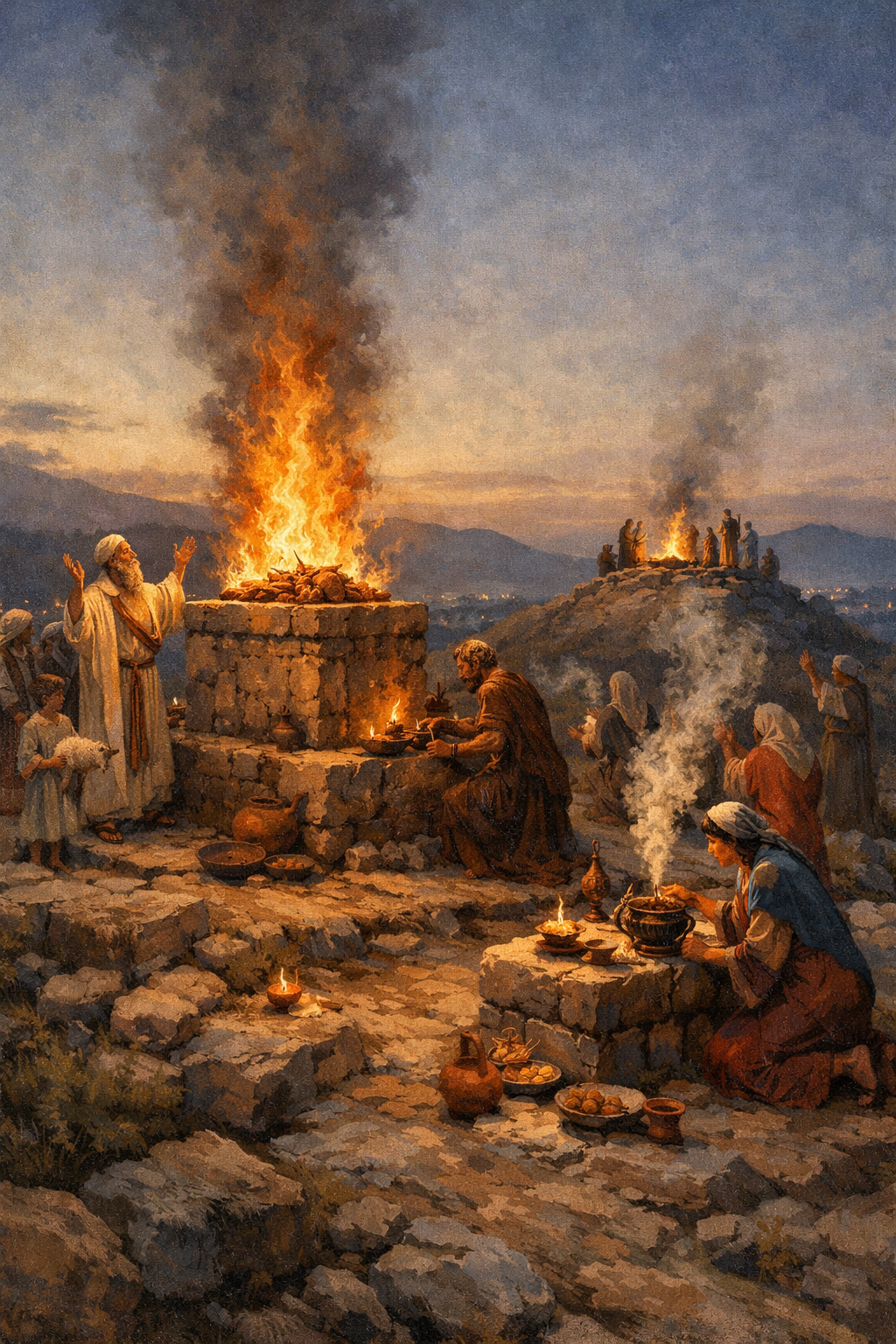
Incense on a High Place
BURNED INCENSE ON
HIGH PLACES
and there they burned incense on all the high places (bamah) as the nations did which the LORD had carried away to exile before them - This passage continues the litany documenting Israel’s tragic apostasy. Notice the "all" again. This evil practice was widespread and represented a deliberate imitation of the idolatrous practices of the very nations the LORD had previously judged and "spewed" out of the land (cf Lev 18:25, 28). Incense was intended for God’s sanctuary (Ex 30:7-9), but was brazenly offered at forbidden sites in direct violation of God’s commands (Dt 12:2–4). This imitation of the nations represented a breach of the Mosaic Covenant and exposed Israel’s spiritual adultery against Yahweh, their covenant “spouse.” (See Israel the Wife of Jehovah) And by adopting the sins that had brought exile on the pagans, Israel ensured the same fate for itself. This is a clear warning that compromise with the world inevitably leads to spiritual ruin.
and they did evil things provoking (kāʿas) the LORD - The all-inclusive phrase evil things summarizes Israel’s spiritual collapse as deliberate, covenant-breaking rebellion rather than mere moral weakness. It refers to persistent idolatry and disobedience carried out in conscious defiance of God’s revealed will. Provoking the LORD describes the righteous response of a holy God whose exclusive claim to Israel’s worship was repeatedly violated (Ex 20:3–5; Dt 32:16–17).
Bob Utley - "they did evil things provoking the Lord" The VERB kāʿas (Hiphil INFINITIVE CONSTRUCT) occurs often in Kings. 1 Kgs. 14:9,15; 15:30; 16:2,7,13,26; 21:22; 22:53; 2 Kgs. 17:11,17; 21:6,15; 22:17; 23:19,26 also note 2 Chr. 28:25; 33:6; 34:25
John Walton - 17:11. burning incense as pagan ritual. Incense was used for a variety of reasons in the extrabiblical world. The Phoenicians used it to prepare the body of the king for future life. One inscription from Byblos has a king describing himself as lying on incense. It was also used in the cult of the dead at Canaanite Ugarit. In Mesopotamia, incense was used for dedicatory and propitiatory offerings. They believed that the incense helped transport prayers to the deity, who would then inhale the incense. All of these practices were condemned by the writers of Scripture.
Provoking (to anger) (03707) kāas conveys intense emotional agitation—to vex, provoke, incite, or stir up to a heated condition that issues in action—and is far stronger than the English “to be angry.” It appears most often in the Hiphil (causative) stem, frequently describing how idolatry and covenant unfaithfulness provoke the LORD to anger (e.g., 1 Kgs 14:9; Ps 106:29; Ezek 8:17), with the resulting anger (ʾap̱) leading to decisive judgment (Deut 9:18; 2 Kgs 23:26; Jer 7:20). In Deuteronomy 32, Israel’s apostasy provokes God’s jealousy and wrath, kindling a “fire” of judgment—famine, plague, enemies—yet these responses are purposeful, aiming to humble, correct, and restore a faithless people (Deut 32:16–39). The verb also describes God’s reaction to the sins of Jeroboam—golden calves, illicit priesthood, counterfeit feasts—which provoked divine judgment on his dynasty (1 Kgs 12–14; 16). Prophets like Jeremiah and Ezekiel apply kāʿas to concrete acts of rebellion (turning from God, sun worship, political alliances), underscoring that deliberate disobedience invites a holy response. In a noncausative sense, kāʿas means to be angry, and Scripture warns humans against quick temper (Eccl 7:9), noting that unchecked wrath brings ruin (Job 5:2), though it can also describe the wicked’s anger at righteousness (2 Chr 16:10; Neh 4:1; Ps 112:10). Overall, kāʿas most often frames a theological reality: God’s holy nature is provoked by the faithlessness of those closest to Him, and His measured, loving responses are designed not merely to punish but to produce repentance and restoration (Hos 12:14).
KAAS - 53v - anger(3), angry(4), demoralized*(1), make me angry(1), provoke(5), provoke him to anger(2), provoke me to anger(8), provoke them to anger(1), provoked(7), provoked him to anger(2), provoked me to anger(2), provoked the to anger(1), provoked to anger(1), provoking(7), provoking him to anger(2), provoking me to anger(4), provoking the to anger(1), spite(2), trouble(1), vexation(1), vexed(1). Deut. 4:25; Deut. 9:18; Deut. 31:29; Deut. 32:16; Deut. 32:21; Jdg. 2:12; 1 Sam. 1:6; 1 Sam. 1:7; 1 Ki. 14:9; 1 Ki. 14:15; 1 Ki. 15:30; 1 Ki. 16:2; 1 Ki. 16:7; 1 Ki. 16:13; 1 Ki. 16:26; 1 Ki. 16:33; 1 Ki. 21:22; 1 Ki. 22:53; 2 Ki. 17:11; 2 Ki. 17:17; 2 Ki. 21:6; 2 Ki. 21:15; 2 Ki. 22:17; 2 Ki. 23:19; 2 Ki. 23:26; 2 Chr. 16:10; 2 Chr. 28:25; 2 Chr. 33:6; 2 Chr. 34:25; Neh. 4:1; Neh. 4:5; Ps. 78:58; Ps. 106:29; Ps. 112:10; Eccl. 5:17; Eccl. 7:9; Isa. 65:3; Jer. 7:18; Jer. 7:19; Jer. 8:19; Jer. 11:17; Jer. 25:6; Jer. 25:7; Jer. 32:29; Jer. 32:30; Jer. 32:32; Jer. 44:3; Jer. 44:8; Ezek. 8:17; Ezek. 16:26; Ezek. 16:42; Ezek. 32:9; Hos. 12:14
2 Kings 17:12 They served idols, concerning which the LORD had said to them, “You shall not do this thing.”
- concerning which: Ex 20:3-5 34:14 Lev 26:1 De 4:19 5:7-9
- You shall not do this thing: De 4:15-19,23-25 12:4
- 2 Kings 17 Resources
WHAT YOU WORSHIP
YOU WILL SERVE
They served (abad; LXX - latreuo - conveys sense of worship) idols - Ponder this accusation a moment. These supposedly intelligent people actually became enslaved to things which are dead and are not gods, becoming their slaves!
Concerning which the LORD had said to them, “You shall not do this thing - This warning could not have been much clearer! The phrase highlights that Israel’s downfall came from willful disobedience, as they knowingly practiced the very idolatry the LORD had explicitly forbidden, rejecting His clear commands against worshiping other gods (Ex 20:3–5; Dt 12:31). It underscores that their judgment was not due to ignorance but conscious covenant betrayal, making their exile the just outcome of deliberate defiance
Bob Utley - "You shall not do this" This is an allusion to Ex 20:4,23; 34:17; Lev. 19:4; 26:1; Deut. 4:15-19; 5:8-9; 27:15. There was only one God! ISRAEL'S MANDATED RESPONSE TO CANAANITE FERTILITY WORSHIP
2 Kings 17:13 Yet the LORD warned Israel and Judah through all His prophets and every seer, saying, “Turn from your evil ways and keep My commandments, My statutes according to all the law which I commanded your fathers, and which I sent to you through My servants the prophets.”
- Yet the LORD warned : Dt 8:19 Dt 31:21 Ne 9:29,30 Ps 50:7 81:8,9 Jer 42:19 Ac 20:21
- Israel and Judah: 2Ch 36:15,16 Jer 3:8-11 Ho 4:15
- all His prophets , Heb. the hand of all, De 4:26 Jos 23:16 Jud 6:10 10:11-14 1Sa 12:7-15 Isa 1:5-15,21-24 Jer 5:29-31 Zec 1:3-6
- and every seer: 1Sa 9:9 1Ch 29:29
- Turn from your evil ways Isa 1:16-20 55:6,7 Jer 7:3-7 18:11 25:4,5 35:15 Eze 18:31 Ho 14:1 2Pe 3:9
- keep My commandments: Jer 7:22,23 26:4-6
- 2 Kings 17 Resources
Related Passages:
Deuteronomy 8:19 (“It shall come about if you ever forget the LORD your God and go after other gods and serve them and worship them, I testify against you today that you will surely perish.
Deuteronomy 31:21 “Then it shall come about, when many evils and troubles have come upon them, that this song will testify before them as a witness (for it shall not be forgotten from the lips of their descendants); for I know their intent which they are developing today, before I have brought them into the land which I swore.”
Deuteronomy 30:17-18 “But if your heart turns away and you will not obey, but are drawn away and worship other gods and serve them, 18 I declare to you today that you shall surely perish. You will not prolong your days in the land where you are crossing the Jordan to enter and possess it.
Hosea 1:4-9 And the LORD said to him, “Name him Jezreel; for yet a little while, and I will punish the house of Jehu for the bloodshed of Jezreel, and I will put an end to the kingdom of the house of Israel. 5 “On that day I will break the bow of Israel in the valley of Jezreel.” 6 Then she conceived again and gave birth to a daughter. And the LORD said to him, “Name her Lo-ruhamah, for I will no longer have compassion on the house of Israel, that I would ever forgive them. 7 “But I will have compassion on the house of Judah and deliver them by the LORD their God, and will not deliver them by bow, sword, battle, horses or horsemen.” 8 When she had weaned Lo-ruhamah, she conceived and gave birth to a son. 9 And the LORD said, “Name him Lo-ammi, for you are not My people and I am not your God.”
Amos 5:27 “Therefore, I will make you go into exile beyond Damascus,” says the LORD, whose name is the God of hosts.
Micah 1:6 For I will make Samaria a heap of ruins in the open country, Planting places for a vineyard. I will pour her stones down into the valley And will lay bare her foundations.
YAWHEH'S AMAZING
LONGSUFFERING
Yet - YET ("but nevertheless," "in spite of that") introduces a strong contrast. In the present passage it highlights God’s gracious patience, showing that despite Israel’s persistent rebellion, He continued to warn and call them to repentance through His prophets before bringing judgment.
The LORD warned Israel and Judah - Note that the writer includes both the Northern and Southern kingdom because by this time in Judah's history she was infected with northern idols and was also drifting toward judgment and exile.
Through all His prophets and every seer - Both of these groups of men functioned as God's "mouth pieces," speaking God's words to the uncircumcised ears (Acts 7:51) of the people of both nations.
Saying, “Turn (shub/sub; LXX - apostrepho = turn away from) from your evil ways and keep (shamar - guard, observe; LXX - phulasso - guard like a watchman) My commandments, My statutes according to all the law which I commanded your fathers, and which I sent to you through My servants ('ebed; LXX - doulos) the prophets - The first command Turn calls for the the people of both nations to repent from their evil ways and return to Yahweh. The second command keep calls for the people of both nations to carefully observe and guard God's commandments, etc, which by implication clearly means to obey them. God had spoken and Moses had written the commandments on Mt Sinai but God continued to call His people back to him through His servants the prophets. It is worth noting that the idea of servant is found frequently in this chapter, but with different masters! Notice the contrast of those who were servants of idols (2Ki 17:12,16, 33, 35, 41) and the prophets who were servants of God (2Ki 17:13, 23).
🙏 THOUGHT - Everyone serves somebody! Who is your master? Are you a slave to some subtle form of idolatry (modern version) or are you a bondslave (doulos) of Jesus? Bob Dylan was right - Gotta Serve Somebody!
Bob Utley - Turn This is the VERB (Qal IMPERATIVE) which is often a call to repentance (i.e., a turning from and a turning to). REPENTANCE (OT) "commandments. . .statutes" A further list is found in 2Ki 17:34. All of these terms refer to the Mosaic Law, which was meditated by the prophets.
2 Kings 17:14 However, they did not listen, but stiffened their neck like their fathers, who did not believe in the LORD their God.
- stiffened their neck: De 31:27 2Ch 36:13 Pr 29:1 Isa 48:4 Jer 7:26 Ro 2:4,5 Heb 3:7,8
- did not believe : De 1:32 Ps 78:22,32 106:24 Heb 3:12
- 2 Kings 17 Resources
Related Passages:
Deuteronomy 31:27 (MOSES IS GIVING THE 2ND GENERATION A PROPHETIC WARNING!) “For I know your rebellion and your stubbornness; behold, while I am still alive with you today, you have been rebellious against the LORD; how much more, then, after my death?
Deuteronomy 10:16 (THESE CLEAR INSTRUCTIONS WERE GIVEN TO THE 2ND GENERATION ALMOST 700 YEARS EARLIER) “So circumcise your heart, and stiffen your neck no longer. (See Circumcision of the Heart)
2 Chronicles 30:8 “Now do not stiffen your neck like your fathers, but yield to the LORD and enter His sanctuary which He has consecrated forever, and serve the LORD your God, that His burning anger may turn away from you.
Nehemiah 9:16-17 But they, our fathers, acted arrogantly; They became stubborn (qashah)(literally "hardened their necks") and would not listen to Your commandments. 17 “They refused to listen, And did not remember Your wondrous deeds which You had performed among them; So they became stubborn (qashah)(literally "hardened their necks") and appointed a leader to return to their slavery in Egypt. But You are a God of forgiveness, Gracious and compassionate, Slow to anger and abounding in lovingkindness; And You did not forsake them.
Nehemiah 9:29 And admonished them in order to turn them back to Your law. Yet they acted arrogantly and did not listen to Your commandments but sinned against Your ordinances, By which if a man observes them he shall live. And they turned a stubborn shoulder and stiffened (qashah) their neck, and would not listen.
Psalm 95:8 Do not harden (qashah) your hearts, as at Meribah, As in the day of Massah in the wilderness,
Proverbs 29:1 A man who hardens (qashah) his neck after much reproof Will suddenly be broken beyond remedy.
Jeremiah 7:26 “Yet they did not listen to Me or incline their ear, but stiffened (qashah) their neck; they did more evil than their fathers.
Jeremiah 17:23 “Yet they did not listen or incline their ears, but stiffened (qashah) their necks in order not to listen or take correction.
Jeremiah 19:15 “Thus says the LORD of hosts, the God of Israel, ‘Behold, I am about to bring on this city and all its towns the entire calamity that I have declared against it, because they have stiffened (qashah) their necks so as not to heed My words.’”
STIFFENED NECKS
AND UNBELIEVING HEARTS
However, they did not listen - Oh yes, they heard, but they refused to heed! Like our saying "in one ear and out the other!"
But stiffened (qashah; LXX - skleruno + notos = back) their neck like their fathers, who did not believe in the LORD their God - Note the progression (continuing from previous verse) God spoke in various ways (Heb 1:1) to the people. They heard His words but chose not to receive them. They then chose to stiffen their necks (became stubborn), and in the final stage they steadfastly refused to believe in the LORD their God. He was "their God" because He had chosen them and bound them by covenant, but they did not accept Him as their God (by faith). In short, they were not His God in the sense of being in a personal relationship with Him.
Stephen addressing the Jews antagonistic to the Gospel in Jerusalem boldly called them out, declaring words that parallel the description in this passage in Kings
“You men who are stiff-necked (sklerotrachelos - first word in Greek for emphasis!) and uncircumcised in (aperitmetos - figuratively a "covering" over their) heart and ears are always resisting the Holy Spirit; you are doing just as your fathers did (aka, most of the Northern and Southern Kingdoms!). (Acts 7:51)
Bob Utley - "stiffened their neck like their fathers" This is a repeated theme. See Deut. 31:27. The term is a combination of "neck" and "stiff" or "hard". Israel is often described by this unflattering combination (cf. Exod. 32:8; 33:3,5; 34:9; Deut. 9:6,13; 31:27). The VERB is used in Deut. 10:16; 2 Kgs. 17:14; Neh. 9:16,17,29; Jer. 7:26; 17:23; 19:15. The same thought is expressed in Isa. 48:4 and Ezek. 2:4; 3:7. In a sense vv. 27-29 is a prophecy, based on the past actions of Israel. This same kind of prophecy is also found in Josh. 24:19-20. Israel's best efforts were not enough. The first covenant would fail to restore the intended intimacy between YHWH and His highest creation (i.e., mankind) in the Garden of Eden. It would take a New Covenant (cf. Jer. 31:31-34; Ezek. 36:22-38) based on YHWH's actions. Mankind was incurably rebellious (cf. Gen. 6:5; 8:21; Jer. 17:9).
Bob Utley - "who did not believe in the Lord their God" What a shocking verse! The covenant people did not "believe" in YHWH! Belief is shown by obedience (i.e., Dt. 6:3; Lk 6:46) (ED: OBEDIENCE DOES NOT SAVE BUT DEMONSTRATES THAT ONE IS SAVED). The LXX takes this phrase to mean "as the generations past, the Israelites became more and more disobedient."
Stiffened (07185)(qashah) means to be hard, to be hardened, to be stiff-necked. Coppes writes that "The root qāshî apparently arose from an agricultural milieu. It emphasizes, first, the subjective effect exerted by an overly heavy yoke, which is hard to bear, and secondarily, the rebellious resistance of oxen to the yoke." (TWOT) Qashah thus refers to something difficult - severe labor (Ge 35:16, 17); cruel wrath (Ge 49:7), hardened spirit (Dt 2:30); neck (not to be) stiff (Dt 10:16); severe hand (1 Sa 5:7); harsh words (2 Sa 19:43); heavy yoke (1 Ki 12:4, 2 Chr 10:4); stiffened (hardened) neck (2 Ki 17:14, 2 Chr 30:8, 36:13, Jer 7:26, 17:23, 19:15); hardened heart (Ps 95:8; Pr 28:14, cf hardened neck - Pr 29:1); hard-pressed (Isa 8:21). This passage gives a good picture of the meaning of qashah speaking of Israel which often stiffened their neck to Yahweh or His prophets - "“Yet they did not listen to Me or incline their ear, but stiffened their neck; they did more evil than their fathers." (Jer 7:26). So a stiffened neck (or hardened heart) does not listen but does evil! Woe! God keep all of us from falling into the deadly trap of a stiff neck or hard heart to Your loving truth, grace, and mercy in Jesus' Name. Amen
2 Kings 17:15 They rejected His statutes and His covenant which He made with their fathers and His warnings with which He warned them. And they followed vanity and became vain, and went after the nations which surrounded them, concerning which the LORD had commanded them not to do like them.
- they rejected: Jer 8:9
- his covenant: Ex 24:6-8 De 29:10-15,25,26 Jer 31:32
- warnings: De 6:17,18 2Ch 36:15,16 Ne 9:26,29,30 Jer 44:4,23
- vanity: De 32:21,31 1Sa 12:21 1Ki 16:13 Ps 115:8 Jer 10:8,15 Joh 2:8
- became vain: Jer 2:5 Ro 1:21-23 1Co 8:4
- concerning whom: 2Ki 17:8,11,12 De 12:30,31 2Ch 33:2,9
- 2 Kings 17 Resources
Related Passages:
Leviticus 26:15-16 (CONDITIONAL IF/THEN WARNING PROMISE) if, instead, you reject (māʾas; LXX = prosochthizo = to be offended, very upset over something someone has done) My statutes, and if your soul abhors My ordinances so as not to carry out all My commandments, and so break My covenant, 16 I, in turn, will do this to you: I will appoint over you a sudden terror, consumption and fever that will waste away the eyes and cause the soul to pine away; also, you will sow your seed uselessly, for your enemies will eat it up.
Leviticus 26:43-44 ‘For the land will be abandoned by them, and will make up for its sabbaths while it is made desolate without them. They, meanwhile, will be making amends for their iniquity, because they rejected (māʾas ;LXX = prosochthizo = to be offended, very upset over something someone has done) My ordinances and their soul abhorred My statutes. 44 ‘Yet in spite of this, when they are in the land of their enemies, I will not reject (māʾas) them, nor will I so abhor them as to destroy them, breaking My covenant with them; for I am the LORD their God.
Romans 1:21-23 (THIS IS AN EXCELLENT DESCRIPTION OF ISRAEL) For even though they knew God, they did not honor Him as God or give thanks, but they became futile (mataioo - empty) in their speculations, and their foolish heart was darkened. 22 Professing to be wise, they became fools, 23 and exchanged the glory of the incorruptible God for an image in the form of corruptible man and of birds and four-footed animals and crawling creatures.
ISRAEL'S REJECTION
OF GOD'S COVENANT
(AND) - The Hebrew has "wa-" the waw-consecutive, moving the narrative forward and should have an "AND" in English as in the 2Ki 17:15YLT and in the NAS77. You say "so what?" The point is the Spirit is piling up the accusations against Israel in 2Ki 17:7-17, one after another another and the AND serves to show this connection (NOTE repetition of "AND" - 2Ki 17:8, 9, 10, 11, 12, 15, 16, 29x in only 10 verses!) The Spirit like a prosecuting attorney is giving one sin after another so that the "jury" (us the readers) is left with no doubt that Israel is "guilty as charged" of high crimes and misdemeanors against the Most High and Holy God! When used in passages like 2 Kings 17:15, the AND (wa-) does not describe passive neglect or ignorance, but active rejection, showing that Israel knowingly spurned God’s statutes, covenant, and warnings. The form stresses historical action: they actually did this, repeatedly and willfully.
They rejected (māʾas) His statutes and His covenant (beriyth) which He made with their fathers (Mosaic, not Abrahamic Covenant) and His warnings with which He warned them - Rejected is an ugly word. Israel not only went after idols, the absolutely rejected God and especially His covenant, in this context referring to the "marriage covenant" (as I like to call it), the Mosaic Covenant. In Exodus 24:3, 7 they in effect said "I DO" just as the bride does in the marriage covenant. But here the Spirit says they adamantly rejected their "marriage vows" the Hebrew verb even conveying the sense that they DESPISED those covenant vows!
KEY WORD - REJECTED - Rejected (māʾas) is a strong, ugly word, especially in the context of "marriage" and is used here for rejecting God’s law, covenant and warnings (2Ki 17:15). Māʾas is used elsewhere for DESPISING "the pleasant (Promised) land" (Ps 106:24, Nu 14:31). In 1Sa 15:23 Samuel accuses Saul of several sins Israel was clearly gulity of declaring "For rebellion is as the sin of divination (2Ki 17:17), And insubordination is as iniquity and idolatry. Because you have rejected (māʾas) the WORD OF THE LORD, He has also rejected (māʾas) you from being king." (cf 1Sa 15:26, Jer 6:19) Finally, and worst of all, Israel actually DESPISED Yahweh Himself! (Nu 11:20) In 1Sa 8:7 God tells Samuel "Listen to the voice of the people in regard to all that they say to you, for they have not rejected (māʾas) you, but they have rejected (māʾas) Me from being king over them!" (also 1Sa 10:19). In summary, Israel like a stubborn calf, REJECTED all divine restraints, ultimately rejecting Yahweh Himself and what seemed to them at the beginning as "freedom" now ends in bondage, loss and divine judgment, rejecting (māʾas) "all the descendants of Israel and afflicted them and gave them into the hand of plunderers, until He had cast them out of His sight." (2Ki 17:20,cf the verdict on Judah in 2Ki 23:27 = "I will cast off [reject - māʾas] Jerusalem...and the Temple")! One final rejection should be noted, for all the previous rejections are foreshadowing the greatest rejection Ps 118:22 describing "The STONE which the builders rejected (māʾas; LXX = apodokimazo - regard as unworthy after testing) Has become the CHIEF CORNER STONE." In sum, in all of Israel's rejections, ultimately it was Yeshua, their Messiah, Whom they REJECTED!
They rejected...His covenant - Why do I say the Mosaic Covenant? The surrounding context emphasizes statutes, commandments, and prophetic warnings (2Ki 17:13–14), language that clearly reflects the covenant given at Sinai (Ex 19–24; Dt 4:13; 28). Furthermore, The blessings and curses framework, especially what is being described in 2 Kings 17, exile from the land, directly corresponds to the covenant sanctions outlined in Leviticus 26 and Deuteronomy 28–30, which are Mosaic covenant provisions. The Abrahamic Covenant (Ge 12; Ge 15; Ge 17) was unconditional in its ultimate promises (land, seed, blessing), whereas the Mosaic Covenant was conditional, tied to obedience within the land. Israel’s exile in 722 BC represents enforcement of Mosaic covenant curses, not annulment of the Abrahamic promises (cf Lev 26:33).
And they followed vanity (hebel; LXX - mataios) and became vain (habal; LXX - mataioo) This translation misses the gist of the passage, which is that vanity is a reference to idols. Thus the NET renders it "They paid allegiance to worthless idols, and so became worthless to the LORD. (2Ki 17:15NET) This description echoes a central theme in both the Old and New Testaments: that when people turn from the living God to false gods, they not only betray Him but also degrade themselves. The Hebrew word vanity (hebel; LXX - mataios) literally means “vapor” or “nothingness.” The idea is that idols have no substance, and when people worship them, they become like what they serve, empty, powerless, and without true spiritual life in this present life and the life to come! Israel’s sin was not only that they rejected God’s commandments, but that they exchanged His glory for the emptiness of idols or as Paul says they "exchanged the glory of the incorruptible God for an image in the form of corruptible man and of birds and four-footed animals and crawling creatures." (Ro 1:23) By devoting themselves to “worthless” gods, they robbed themselves of the purpose and dignity that come from knowing and serving the one true God.
NET NOTE Heb “they followed after the worthless thing/things and became worthless.” There is an obvious wordplay on the verb “became worthless” and the noun “worthless thing”, which is probably to be understood collectively and to refer to idols as it does in Jer 8:19; 10:8; 14:22; Jonah 2:8.
Those who make them will become like them,
Everyone who trusts in them.
Psalm 115:4-8 is a great commentary on this passage - "Their idols are silver and gold, The work of man’s hands. 5 They have mouths, but they cannot speak; They have eyes, but they cannot see; 6 They have ears, but they cannot hear; They have noses, but they cannot smell; 7 They have hands, but they cannot feel; They have feet, but they cannot walk; They cannot make a sound with their throat. 8 Those who make them will become like them, Everyone who trusts in them."
🙏 THOUGHT - This passage teaches the unchangeable biblical principle that a person becomes like what he/she worships. That truth deserves careful reflection: take a look at yourself in the mirror and your own life and honestly ask yourself, “WHAT DO I WORSHIP?” Beloved, your answer (and mine) will profoundly shape who you are and the direction of your life. Are your following "vanity" or following Jesus? Your choice will make all the difference, both in this life and the life to come! What we revere, we reflect!
Their hearts and actions became
as hollow as the idols they honored.
This same truth appears in Jeremiah 2:5, where the Lord laments, “What injustice did your fathers find in Me, that they went far from Me and walked after emptiness (hebel; LXX - mataios) and became empty?” Here again, turning from God to “emptiness” results in moral and spiritual degradaton and soul corruption. The people’s worthlessness in God's sight did not mean they lost intrinsic human value as His image-bearers, but that they became useless for His intended purpose—to be a holy nation reflecting His glory. Their hearts and actions became as hollow as the idols they honored.
Devotion to anything other than God always diminishes the soul,
while faithfulness to Him restores value, purpose, and life
Israel’s unfaithfulness turned them from being vessels of His glory into vessels of emptiness. Their hearts, once meant for worshiping the living God, were filled with nothingness. The consequence was not only national ruin but personal exile from the very presence of the Lord who had loved and redeemed them. To say it another way, their hearts were divided, given to lifeless gods who could not save. The natural result was spiritual emptiness. What they worshiped, falsehood and vanity, began to define them. This passage stands as both a warning and a truth for all generations: devotion to anything other than God always diminishes the soul, while faithfulness to Him restores value, purpose, and life. As Psalm 16:4 declares, “The sorrows of those who have bartered for another god will be multiplied,” but those who remain devoted to the Lord find fullness of joy in His presence.
And went after the nations which surrounded them - Went after conveys the picture of imitation. Israel chased after the nations’ gods, lifestyles, and values. Israel's departure was not a passive drift but an active decision to adopt the world’s ways. They exchanged their divine mission, to bless all nations through obedience to God’s Word (Ge 12:2–3), for the false security and sensuality of paganism. In doing so, they reversed their calling. Instead of influencing the nations toward truth, they were influenced toward corruption.
NET NOTE on went after - Heb “They went [or, ‘followed’] after.” This idiom probably does not mean much if translated literally. It is found most often in Deuteronomy or in literature related to the covenant. It refers in the first instance to loyalty to God and to His covenant or His commandments (1 Kgs 14:8; 2 Chr 34:31) with the metaphor of a path or way underlying it (Deut 11:28; 28:14). To “follow other gods” was to abandon this way and this loyalty (to “abandon” or “forget” God, Jdg 2:12; Hos 2:13) and to follow the customs or religious traditions of the pagan nations (2Ki 17:15). The classic text on “following” God or another god is 1Ki 18:18, 21 where Elijah taunts the people with “halting between two opinions” whether the LORD was the true God or Baal was. The idiom is often found followed by “to serve and to worship” or “they served and worshiped” such and such a god or entity (Jer 8:2; 11:10; 13:10; 16:11; 25:6; 35:15).
Yahweh had warned Israel about this very danger declaring “When you enter the land which the LORD your God gives you, you shall not learn to imitate the detestable things of those nations” (Dt 18:9). Yet throughout Israel’s history, from making a golden calf in the wilderness (Ex 32:1-8) to serving Baal under Ahab, the people desired the religion and pleasure of the world more than the holiness of God. Ultimately, Israel went after other nations because they rejected the sufficiency and goodness of God and His authority.
Israel was delivered from the nation of Egypt to be "a kingdom of priests and a holy nation" (Ex 19:6). Instead of fulfilling they divine destiny, Israel made the tragic decision to abandon their distinct identity as God’s chosen people and imitate the pagan cultures around them. Rather than remaining holy, set apart for God’s purposes, they pursued the customs, practices, and beliefs of the surrounding nations that did not know the LORD. This was not merely an issue of cultural assimilation, but was a spiritual betrayal, spiritual adultery. Israel exchanged their covenant relationship with the living God for conformity with the godless world. (See Israel the Wife of Jehovah)
🙏 THOUGHT - Went after the nations encapsulates one of the greatest temptations faced by God’s people in every generation—the pull to conform to the world. Paul commanded believers "do not be conformed (present imperative with a negative see our need to depend on the Holy Spirit to obey) to this world, but be transformed (present imperative) by the renewing of your mind, so that you may prove what the will of God is, that which is good and acceptable and perfect." (Ro 12:2) Note that both commands are present tense, indicating that conformity is an ongoing threat that requires constant vigilance, for pursuing the world’s approval instead of God’s inevitably leads to emptiness and a loss of an understanding of why we were created and then "re-created" in Christ as His poeima, His masterpiece (cf Eph 2:10).
Concerning which the LORD had commanded them not to do like them - God had clearly instructed His people to separate themselves from the practices of the nations when they entered Canaan. Leviticus 18:3-4 instructed them to "not do what is done in the land of Egypt where you lived, nor are you to do what is done in the land of Canaan where I am bringing you; you shall not walk in their statutes. ‘You are to perform My judgments and keep My statutes, to live in accord with them; I am the LORD your God." The tragedy is that Israel was supposed to be different and to be a living testimony of God’s holiness and righteousness to all nations.
🙏 THOUGHT - This verse also reminds us that the people of God are called to be “a holy nation” (1 Peter 2:9), set apart in conduct, belief, and love. When God’s people “go after the nations,” they lose the light they were meant to shine. But when they walk in obedience, they reveal to the world that the Jesus Alone is worthy of worship and trust. Beloved, may God's Spirit empower you to "let your light shine before men in such a way that they may see your good works, and glorify your Father who is in heaven." (Mt 5:16)
Bob Utley - "rejected" This VERB (Qal IMPERFECT [ED: This tense expresses incomplete or unfolding action, which is ongoing, repeated, or not yet brought to completion.] with waw) means "to reject" or "refuse." The Dead Sea Scrolls translation takes this as a Akkadian root for "breaking an oath." These covenant Israelites had sworn that they would follow YHWH's revelation (i.e., Mosaic law) but they did not, did not, did not, did not! It was not ignorance or lack of information but self-willed disobedience.
Bob Utley - "they followed vanity and became vain" This is the use of a VERB and NOUN of the same root. (1) vain ‒ BDB 210 I (2)became vain ‒ BDB 211, KB 236, Qal IMPERFECT with waw The root basically means "vapor" or "breath." It is used repetitively in Ecclesiastes (see full note at Eccl. 1:2). Notice how Jeremiah uses this term for idolatry (cf. Jer. 2:5; 10:3,15; 16:19). Idols are unreal!
Rejected ((03988) ma'as means to reject, to despise, to abhor, to refuse. The primary idea is to treat as loathsome (that which is repulsive, detestable, causing disgust). The first use in Lev 26:15 (Lev 26:43 - LXX = prosochthizo = to be offended, very upset over something someone has done) is of Israel who is warned not to "reject My statutes." And yet later God says "when they are in the land of their enemies, I will not reject them, nor will I so abhor them as to destroy them, breaking My covenant with them; for I am the LORD their God." (Lev 26:44). The KJV translate as despise 25, refuse 9, reject 19, abhor 4, become loathsome 1, melt away 1, misc 17; 76
Ma'as is used of men rejecting God's law, ordinances or statutes (2Ki 17:15, Lev 26:15, 43, Isa 5:24, Ezek 5:6, 20:13, 16, 24, Amos 2:4. Saul rejected God's word - 1Sa 15:26. Isa 30:12, cp Hos 4:6), of rejecting Him (Nu 11:20 = Lxx = apeitheo - disobeyed, refused to believe, 1Sa 10:19), the promised land by the first generation (Nu 14:31, cp Ps 106:23). God told Samuel "they have not rejected you, but they have rejected Me from being king over them." (1Sa 8:7) 2Ki 17:20 says Jehovah "rejected all the descendants of Israel." (cp Hos 9:17) Used of Jehovah saying He would "cast off Jerusalem." (2Ki 23:27 contrast Jer 31:38-40) We are not to "despise the discipline of the Almighty." (Job 5:17, Pr 3:11, 15:32) After Job sees God, he says "therefore I retract and I repent in dust and ashes." (Job 42:6) Used of a reprobate (Ps 15:4). In a clear Messianic prophecy Psalm 118:22 = "The stone which the builders rejected (apodokimazo - regard as unworthy after testing) Has become the chief corner stone." Evil should be refused or rejected (Isa 7:15, 16).
Used 10/67 times in Jeremiah - Jer 2:37; 4:30; 6:19, 30; 7:29; 8:9; Jer 14:19; 31:37; Jer 33:24, 26 There is considerable irony in the use of this Hebrew word ma'as in Jeremiah. It is used to describe the people who had "cast off" (rejected) God's law (Jer 6:19) and the "word of the LORD" (Jer 8:9). It is used 3 times of Jehovah rejecting the people (Jer 6:30; 7:29; 33:24). Here in Jer 31:37 and in Jer 33:26 Jehovah uses the same word (ma'as) declaring He will never reject (cast off) them! How great and everlasting are His lovingkindnesses!
MAAS - 67V - abhorred(1), cast them away(1), cast away(1), cast off(2), completely rejected(1), despise(6), despised(4), despises(2), despising(1), disdained(1), refuse(2), reject(8), rejected(37), rejects(1), reprobate(1), retract(1), utterly rejected(1), waste away(1). Lev. 26:15; Lev. 26:43; Lev. 26:44; Num. 11:20; Num. 14:31; Jdg. 9:38; 1 Sam. 8:7; 1 Sam. 10:19; 1 Sam. 15:23; 1 Sam. 15:26; 1 Sam. 16:1; 1 Sam. 16:7; 2 Ki. 17:15; 2 Ki. 17:20; 2 Ki. 23:27; Job 5:17; Job 7:16; Job 8:20; Job 9:21; Job 10:3; Job 19:18; Job 30:1; Job 31:13; Job 34:33; Job 36:5; Job 42:6; Ps. 15:4; Ps. 36:4; Ps. 53:5; Ps. 78:59; Ps. 78:67; Ps. 89:38; Ps. 106:24; Ps. 118:22; Prov. 3:11; Prov. 15:32; Isa. 5:24; Isa. 7:15; Isa. 7:16; Isa. 8:6; Isa. 30:12; Isa. 31:7; Isa. 33:8; Isa. 33:15; Isa. 41:9; Isa. 54:6; Jer. 2:37; Jer. 4:30; Jer. 6:19; Jer. 6:30; Jer. 7:29; Jer. 8:9; Jer. 14:19; Jer. 31:37; Jer. 33:24; Jer. 33:26; Lam. 5:22; Ezek. 5:6; Ezek. 20:13; Ezek. 20:16; Ezek. 20:24; Ezek. 21:10; Ezek. 21:13; Hos. 4:6; Hos. 9:17; Amos 2:4; Amos 5:21
Vanity (futility, idols, breath, delusion, worthless, emptiness)(01892) hebel means to vanity, emptiness, meaninglessness; idols. The first OT use refers to idols (Dt 32:21, cf 1 Ki 16:13, 26, Jer 8:19; Jer 10:8, 15; Jer 14:22 Jer 51:18; Jonah 2:9; Ps 31:6), a fitting word picture for the worthlessness of idols!
Scripture uses hebel to declare that life and all human achievements
are fleeting and hollow apart from reverent dependence on the eternal God.
The Hebrew word hebel portrays the fleeting, insubstantial nature of human life and pursuits, literally meaning “breath” and emphasizing transience, as seen in statements such as “my days are but a breath” (Job 7:16; cf. Ps 39:5–6, 11; 144:4). Because what is temporary cannot compare with what is eternal, hebel naturally extends to the ideas of vanity, emptiness, and worthlessness, describing pursuits that promise meaning but cannot deliver it, including ill-gotten wealth (Pr 21:6), physical beauty (Pr 31:30), youth (Eccl 11:10), and misplaced trust in human systems or simplistic views of divine justice (Eccl 8:12–14). In Ecclesiastes, where the term appears with striking frequency, hebel captures both the shortness of life and the frustration of seeking fulfillment in work, possessions, or moral order apart from God, concluding that “all is vanity” (Eccl 1:2; 2:11; 6:12). The word also denotes idols, empty substitutes for the living God (Deut 32:21; Jer 10:3, 15), and to “walk after hebel” is to pursue what is ultimately empty, as Israel did to its own ruin (2 Kgs 17:15; Jer 2:5). Together, Scripture uses hebel to declare that life and all human achievements are fleeting and hollow apart from reverent dependence on the eternal God.
HEBEL - 62V - breath(5), delusion(2), emptily(1), emptiness(2), fleeting(2), fraud(1), futile(1), futility(13), idols(7), mere breath(2), nothing(1), useless(1), vain(3), vainly(1), vanity(19), vanity of vanities(3), vapor(1), worthless(2). Deut. 32:21; 1 Ki. 16:13; 1 Ki. 16:26; 2 Ki. 17:15; Job 7:16; Job 9:29; Job 21:34; Job 35:16; Ps. 31:6; Ps. 39:5; Ps. 39:6; Ps. 39:11; Ps. 62:9; Ps. 78:33; Ps. 94:11; Ps. 144:4; Prov. 13:11; Prov. 21:6; Prov. 31:30; Eccl. 1:2; Eccl. 1:14; Eccl. 2:1; Eccl. 2:11; Eccl. 2:15; Eccl. 2:17; Eccl. 2:19; Eccl. 2:21; Eccl. 2:23; Eccl. 2:26; Eccl. 3:19; Eccl. 4:4; Eccl. 4:7; Eccl. 4:8; Eccl. 4:16; Eccl. 5:7; Eccl. 5:10; Eccl. 6:2; Eccl. 6:4; Eccl. 6:9; Eccl. 6:11; Eccl. 6:12; Eccl. 7:6; Eccl. 7:15; Eccl. 8:10; Eccl. 8:14; Eccl. 9:9; Eccl. 11:8; Eccl. 11:10; Eccl. 12:8; Isa. 30:7; Isa. 49:4; Isa. 57:13; Jer. 2:5; Jer. 8:19; Jer. 10:3; Jer. 10:8; Jer. 10:15; Jer. 14:22; Jer. 16:19; Jer. 51:18; Lam. 4:17; Jon. 2:8
Became vain (01891) habal - The denominative verb occurs five times in the Old Testament—four times in the Qal and once in the Hiphil (Jeremiah 23:16)—and carries the idea of becoming vain, empty, or void, even “to talk of nothing” or be filled with false hopes. This meaning is especially clear in the parallel passages of Jeremiah 2:5 and 2 Kings 17:15, where Israel “went after vanities and became vain” (NIV: “They followed worthless idols and became worthless themselves”), illustrating two inexorable principles: people inevitably take on the character of what they worship, and false gods ultimately destroy their worshipers. Scripture repeatedly links this verb with the rejection of God’s covenant and statutes, resulting in empty pursuits (2 Kings 17:15; Psalm 62:11; Jeremiah 2:5), foolish and futile words and actions (Job 27:12), and, most pointedly, the deceptive messages of false prophets who “make you vain,” that is, “fill you with false hopes” (Jeremiah 23:16).
HABAL - 5V - act foolishly(1), became empty(1), became vain(1), leading you into futility(1), vainly hope(1). 2 Ki. 17:15; Job 27:12; Ps. 62:10; Jer. 2:5; Jer. 23:16
2 Kings 17:16 They forsook all the commandments of the LORD their God and made for themselves molten images, even two calves, and made an Asherah and worshiped all the host of heaven and served Baal.
- molten images: Ex 32:4,8 1Ki 12:28 Ps 106:18-20 Isa 44:9,10
- made an Asherah : 2Ki 17:10 1Ki 14:15,23 15:13 16:33
- worshipped: De 4:19 Jer 8:2
- Baal: 2Ki 10:18-28 11:18 1Ki 16:31 22:53
- 2 Kings 17 Resources
Related Passages:
Jeremiah 16:10-12 (JEREMIAH REITERATES TO JUDAH THE SAME CHARGE OF FORSAKING YAHWEH) “Now when you tell this people all these words, they will say to you, ‘For what reason has the LORD declared all this great calamity against us? And what is our iniquity, or what is our sin which we have committed against the LORD our God?’ 11 “Then you are to say to them, ‘It is because your forefathers have forsaken Me,’ declares the LORD, ‘and have followed other gods and served them and bowed down to them; but Me they have forsaken and have not kept My law. 12 ‘You too have done evil, even more than your forefathers; for behold, you are each one walking according to the stubbornness of his own evil heart, without listening to Me. (ED: NOTE JEREMIAH DRAWS A DIRECT LINK BETWEEN FORSAKING GOD'S COMMANDMENTS AND FORSAKING GOD HIMSELF!)
Deuteronomy 4:19 (WARNING ABOUT WORSHIPING HOST OF HEAVEN) “And beware not to lift up your eyes to heaven and see the sun and the moon and the stars, all the host of heaven, and be drawn away and worship them and serve them, those which the LORD your God has allotted to all the peoples under the whole heaven.
Acts 7:42 “But God turned away and delivered them up to serve the host of heaven; as it is written in the book of the prophets, ‘IT WAS NOT TO ME THAT YOU OFFERED VICTIMS AND SACRIFICES FORTY YEARS IN THE WILDERNESS, WAS IT, O HOUSE OF ISRAEL?
THE ROTTEN FRUIT OF
FORSAKING GOD'S COMMANDS
They forsook ('azab; LXX - egkataleipo = leave behind, abandon, desert) all (how many?) the commandments of the LORD their God - Note the adjective ALL! To forsake means to deliberately abandon or turn away from something known and once held. This verse reveals that Israel’s rebellion was complete. Their forsaking was not a momentary lapse but reflected generations of willful disobedience. They did not merely neglect some of God’s laws but rejected ALL of them in both heart and behavior. It marks a total departure from the covenant relationship established between the LORD and His people. Yahweh had warned them repeatedly that obedience to His commandments was the foundation of His blessing (see Dt 6:17,18). In Dt 32:47 Moses told Israel God's Word "is not an idle (empty, vain) word for you; indeed it is your life." This is why forsaking all the commandments was tantamount to forsaking life itself, certainly life as God meant His holy nation to experience!
Forsook ('azab; LXX - egkataleipo = leave behind, abandon, desert) all the commandments of the LORD their God reveals the seriousness of sin as more than isolated wrong acts, for ultimatly it is a breach of relationship. When the Israelites turned from God’s commandments, they were not merely breaking rules, but were betraying the very One Who had delivered them from Egypt, provided for them in the wilderness, and blessed their nation.
God had clearly warned Israel with an IF/THEN conditional clause of the penalty for forsaking Him declaring
“But IF you turn away and forsake My statutes and My commandments which I have set before you, and go and serve other gods and worship them, 20 THEN I will uproot you from My land which I have given you, and this house which I have consecrated for My name I will cast out of My sight and I will make it a proverb and a byword among all peoples. (2Ch 7:19-20)
🙏 THOUGHT - Spiritually, this verse serves as a solemn warning for all who claim to know God but disregard His Word. The same pattern of forsaking Him occurs whenever people choose self-will, comfort, or cultural approval over obedience to Scripture. Jesus summarized the response He desires for us to have toward His law when He said, “If you love Me, you will keep (obey) My commandments” (John 14:15). Obedience is never legalism when it flows from love, but is the natural response of a heart devoted to God. But forsaking His commandments, as Israel did, is the sure mark of a heart that has turned away. The verse reminds us that God’s commandments are not burdens (1Jn 5:3) but blessings, and forsaking them always leads to loss of fellowship with Him, while faithfulness to them leads to life and communion with Him. How's your "obedience quotient" been this week?
And made for themselves molten images (massekah) - Here the Spirit gives us a vivid summary of the specific forms of idolatry that marked the northern kingdom of Israel’s rebellion against God. This verse describes the culmination of centuries of sin beginning with Jeroboam I, who feared that his people might return to worship at the Temple in Jerusalem, and so set up two molten images of golden calves (1Ki 12:28-30). The molten images represent the beginning of Israel’s state-sponsored idolatry, a corruption so complete that every generation after Jeroboam continued in it until the nation collapsed.
And made an Asherah (Asherah) - Israel made this wooden idol or pole used to honor the Canaanite goddess Asherah, considered the consort of the fertility god Baal. Worship to her involved immorality, ritual prostitution, and other abominations that defiled the people. God had expressly forbidden this practice in Dt 16:21 "“You shall not plant for yourself an Asherah of any kind of tree beside the altar of the LORD your God, which you shall make for yourself." By making an Asherah, Israel not only defied God’s commands but introduced sexual immorality into their religious life, turning what should have been pure worship into depraved pagan ritual filled with abominations too obscene to even describe!
And worshiped (shachah; LXX - proskuneo) all the host of heaven - This refers to the worship of celestial bodies, the sun, moon, and stars, which was common in the ancient Near East. This practice reflected the belief that heavenly objects were divine powers that controlled human destiny. Yet this, too, was explicitly forbidden. Dt 4:19 warned "And beware not to lift up your eyes to heaven and see the sun and the moon and the stars, all the host of heaven, and be drawn away and worship them and serve them (ED: IMAGINE ACTUALLY SERVING INANIMATE OBJECTS), those which the LORD your God has allotted to all the peoples under the whole heaven." By worshiping the host of heaven, the Israelites abandoned the Creator for created things, echoing the same downward moral and spiritual spiral later described in Ro 1:25, where people “exchanged the truth of God for a lie, and worshiped and served the creature rather than the Creator.”
NET NOTE - host of heaven - The phrase כָל צְבָא הַשָּׁמַיִם (khol tséva’ hashamayim), traditionally translated “all the host of heaven,” refers to the heavenly lights, including stars and planets. In 1 Kgs 22:19 these heavenly bodies are pictured as members of the Lord’s royal court or assembly, but many other texts view them as the illegitimate objects of pagan and Israelite worship.
The phrase “host of heaven” appears frequently in Scripture and, depending on the context, refers either to the vast company of angels who serve God or to the celestial bodies He created, yet in every case emphasizes God’s absolute sovereignty over all that is in the heavens. Most often, it denotes the angelic army of God, as in Ps 148:1–2, and in Luke 2:13–14, where “a multitude of the heavenly host” praises God at Christ’s birth. It is also seen in the heavenly court scene of 1Ki 22:19, where “all the host of heaven” stand before the LORD, ready to carry out His will. In other passages, however, the “host of heaven” refers to the sun, moon, and stars, especially in warnings against idolatry, as in Dt 4:19 and Acts 7:42, where Israel is rebuked for worshiping the heavenly bodies rather than their Creator. Whether angelic or cosmic, Scripture consistently affirms that all the host of heaven belong to God and are under His rule, for “You have made heaven, the heaven of heavens, with all their host … and the host of heaven worships You” (Nehemiah 9:6).
And served (abad - become a slave of; LXX - latreuo) Baal (ba'al) - This refers to Israel's incessant devotion to the Canaanite storm and fertility god. Baal worship was one of the greatest religious corruptions in Israel’s history. Baal worship demanded sacrifices, sometimes even the offering of children, and other practices described as detestable by God (Jer 19:5). By serving Baal, Israel became indistinguishable from the pagan nations around them, fully reversing their calling to be a holy people set apart for God’s glory (Lev 20:26).
Turning away from the commands of the LORD inevitably
leads to the worship of falsehood and to ruin.
Spiritually, this verse teaches a sobering truth about the human heart: when it turns from the true God, it does not become neutral—it fills the void with false gods and destructive substitutes. Israel did not stop worshiping; they simply redirected their worship toward what was unworthy. Every idol—whether ancient or modern—demands devotion but offers emptiness. This verse encapsulates the total idolatry of a nation that once knew God. It stands as both a record of Israel’s fall and a timeless warning that turning away from the commands of the LORD inevitably leads to the worship of falsehood and to ruin. True worship, by contrast, belongs only to the Creator, who alone is worthy of glory, honor, and obedience
Bob Utley - "the host of heaven" Moses had warned against this in Deut. 4:19; 17:2-3. Manasseh also worshiped the sun, moon, and stars (cf. 2 Kgs. 21:3,5; 2 Chr. 33:5). "made their sons and their daughters pass through the fire" This refers to the worship of the fertility god Molech (cf. Lev. 18:211; 20:2-5; Deut. 12:31; also 2 Kgs. 17:31). He was a Phoenician deity taken over by the Canaanites. Little children were burned to death in his honor to insure fertility of crops, herds, and humans. Modern scholarship thinks the word refers to a type of sacrifice, not a title for a deity. MOLECH
Bob Utley - "practiced divination" See SPECIAL TOPIC: DIVINATION. The MT has the VERB (BDB 638 II, KB 690, Piel IMPERFECT; NIDOTTE, vol. 3, p. 84). This root is the same as "serpent." It came to be associated with hearing voices and, thereby, interpreting signs. I have included my exegetical note from Deut. 18:10. Deut. 18:10 "one who interprets omens" The meaning of this term (BDB 638 II, KB 690) is uncertain. In Syrian it means "to murmur an obscure incantation" (KB 690). The root has several usages: (1) serpent ‒ BDB 638 I (2) VERB in Piel only, (BDB 638 II) meaning : (a) practice divination (b) observe signs/omens (3) copper/bronze ‒ BDB 638 III (4) unknown ‒ BDB 638 IV See full note at Gen. 44:5. "sold themselves to do evil" This VERB (BDB 569, KB 581, Hithpael IMPERFECT) is used as a contrast to YHWH "purchasing them." They were "redeemed" covenant people bought by God but they had "sold" themselves into the superstition and slavery of idolatry.
John Walton - unacceptable worship practice. The molten images of calves or bulls were typical cult items in Canaan. Calf images have been found at a number of sites in this region (for more information see comments on 1 Kings 12:28). Worship of the starry hosts refers worship of the celestial gods (sun god, moon god and Venus particularly; in Babylonia, Shamash, Sin and Ishtar respectively), who were primary in most ancient religions. Controlling the calendar and time, seasons and weather, they were viewed as the most powerful of the gods. They provided signs by which omens were read and they looked down on all. The Zodiac is not yet known at this time. For information concerning Baal see comments on Judges 2:11–13. Evidence for “passing [or burning] children through the fire” outside of Scripture is scant but known in the Assyrian and Aramean world (see comment on Deut 18:10). Divination and enchantments were also well-known in Mesopotamia. Divination assumed that there was knowledge to be gained about the activities and motives of the gods through the use of various indicators (such as entrails of sacrificed animals). Thousands of omens and incantations have been uncovered in the past one hundred and fifty years of archaeological research.
Forsook (left) (05800) 'azab fundamentally means to depart from, leave behind, abandon, or reject, whether in physical, relational, moral, or covenantal terms, and it is used broadly across Scripture for leaving persons, places, or objects (e.g., Gen 44:22; 2 Kgs 8:6; Gen 39:12–13). Theologically, its most serious use describes Israel’s deliberate abandonment of the LORD and His covenant—forsaking God, His commandments, wisdom, righteousness, and covenant loyalty—which inevitably led to idolatry and judgment (Deut 28:20; Jdg 2:12–13; 2 Kgs 17:16; Jer 2:17). In contrast, Scripture consistently affirms that God does not ultimately forsake His covenant responsibilities or His people, though He may temporarily withdraw His protective presence as discipline for covenant violation (Deut 31:6–8, 17; Isa 54:7). Thus, ʿāzab exposes the gravity of human unfaithfulness while highlighting the faithfulness of God, for to forsake the LORD is to abandon life and blessing, whereas to forsake sin and wrath is the path to restoration and obedience (Ps 37:8; Prov 28:13).
Worshiped (bowed down, prostrated themselves) (07812) shachah means to bow down, to prostrate oneself, to crouch, to fall down, to humbly beseech, to do reverence, to worship. The idea is to assume a prostrate position as would in paying homage to royalty (Ge 43:28) or to God (Ge 24:26, Ps 95:6). In the first use in Genesis (which has most of the uses - 21v), when Abraham saw "three men (one of Whom was most likely the pre-incarnate Christ)… standing opposite him… he ran from the tent door to meet them and bowed (shachah) himself to the earth (Ge 18:2, cp Lot bowing to the two angels - Ge 19:1) It is used to describe Joseph's brother's sheaves which "bowed down to my sheaf.” (Ge 37:7) When God told Abraham to sacrifice his son, he told his men to remain for they would go to "worship and return to you." (Ge 22:5) Joshua bowed down to the "Captain of the host of the LORD," (Joshua 5:14) almost assuredly a preincarnate appearance of Messiah. In Josh 23:7, 16 Joshua warned Israel NOT to bow down to the idols of the land, but in Jdg 2:12, 17, 19 that is exactly what they did!
The English word prostrate is defined as being stretched out with one's face on the ground in adoration or submission. It is not just that the person has fallen down but pictures them lying at length or with their body extended on the ground and so lying in a posture which is reflective of genuine humility and/or adoration.
The Hebrew verb shāchāh means “to bow down, prostrate oneself, or worship” and occurs more than 170 times in the Old Testament, reflecting its deep cultural and theological significance. First appearing in Genesis 18:2, where Abraham bowed to the messengers of the LORD, the word commonly denotes physical homage offered to one possessing authority, whether a human superior—such as David before Saul (1 Sam 24:8), Ruth before Boaz (Ruth 2:10), or Joseph’s brothers in his dream (Gen 37:5, 9–10)—or God Himself, where the act becomes true worship (1 Sam 15:25; Jer 7:2). The verb frequently appears in the Hithpael stem, emphasizing a voluntary, self-humbling action, vividly illustrated in Exodus 34:8: “Moses made haste, bowed his head toward the earth, and worshiped.” While shāchāh rightly describes worship of the LORD (Gen 22:5; Exod 4:31; 12:27; Judg 7:15), Scripture also uses it to condemn idolatry, as people bow before false gods, idols, sacred sites, or celestial bodies (Exod 20:5; Deut 4:19; Isa 44:15, 17). Whether directed toward God or misdirected toward idols, prostration conveys the worshiper’s acknowledged powerlessness before one deemed supreme, a posture mirrored in ancient political and social customs (Gen 42:6; 2 Sam 14:33; 1 Kgs 1:16), but given its highest and rightful meaning only when expressed before the living LORD.
The LXX translates WORSHIP here with the picturesque verb proskuneo (from pros = before + kuneo = kiss or adore) means to prostrate oneself in homage before another in the full sense of worship, not mere reverence or courtesy. When Jesus Christ was born into this world, He was attended and worshipped by angels. (Lu 2:13f). Proskuneo represents the most common Near Eastern act of adoration and reverence and also carries the idea of profound awe and respect. Some believe that the root word kuneo may be related to kuon which is the Greek word for dog and which then could be picturing a dog licking his master's hand.
The word proskuneo literally means to kiss toward someone, to throw a kiss in token of respect or homage, to prostrate oneself in homage, to do reverence to, to adore and so to worship and show respect. In the ancient Oriental (especially Persia) the mode of salutation between persons of equal rank was to kiss each other on the lips. When the difference of rank was slight, they kissed each other on the cheek. When one was much inferior, he fell upon his knees touched his forehead to the ground or prostrated himself, and as he was bowing down he would be throwing kisses toward the superior. It is this latter mode of salutation that is intended by the Greek writers in the use of the verb proskuneo .
Baal (proper noun)(01168) ba'al Lord,Owner, possessor, husband: As a proper noun, Baal refers to the Canaanite fertility god whose worship repeatedly ensnared Israel and provoked the LORD’s judgment, despite repeated acts of divine deliverance and reform. From Elijah’s dramatic confrontation with and slaughter of Baal’s prophets on Mount Carmel (1 Kings 18:18–40), to Jehu’s seemingly thorough eradication of Baal worship in the northern kingdom (2 Kings 10:18–28), Scripture shows that external reforms did not cure Israel’s deeper heart-idolatry. Gideon was first required to tear down his father’s altar to Baal before God used him to deliver Israel from Moab (Judges 6:25–32), yet tragically, after Gideon’s death, “the sons of Israel again played the harlot with the Baals” (Judges 8:33), confirming the deceitfulness of the human heart (Jeremiah 17:9). This cycle defines much of Israel’s history: though Israel at times “removed the Baals and the Ashtaroth and served the LORD alone” (1 Samuel 7:4), they repeatedly backslid (1 Samuel 12:10). Judges 2:11–13 summarizes the pattern—forsaking the LORD to serve Baal, exchanging the living God for lifeless masters—while 2 Kings 17:6, 16 explains that persistent Baal worship was a central reason God sent the northern kingdom into Assyrian exile. Judah learned nothing from Israel’s fall, as Manasseh rebuilt Baal worship (2 Kings 21:3), necessitating later reforms under Josiah (2 Kings 23:4–5; 2 Chronicles 34:4), and the prophets repeatedly indicted Judah for sacrificing to Baal, prophesying by Baal, and even burning children as offerings (Jeremiah 2:8, 23; 7:9; 9:14; 19:5; 23:13, 27; 32:35). Hosea captures the horror succinctly: “The more they called them, the more they went from them; they kept sacrificing to the Baals” (Hosea 11:2), a sober warning that idols must be radically uprooted, for what we bow to will inevitably become our master.
2 Kings 17:17 Then they made their sons and their daughters pass through the fire, and practiced divination and enchantments, and sold themselves to do evil in the sight of the LORD, provoking Him.
- they caused: 2Ki 16:3 21:6 Lev 18:21 2Ch 28:3 Ps 106:37,38 Eze 20:26,31 Eze 23:37,39
- used: 2Ki 21:6 De 18:10-12 2Ch 33:6 Isa 8:19 47:9,12,13 Jer 27:9 Mic 5:12 Ac 16:16 Ga 5:26
- sold: 1Ki 21:20,25 Isa 50:1
- in the sight: 2Ki 17:11 21:6
- 2 Kings 17 Resources
Related Passages:
Ezekiel 33:11 “Say to them, ‘As I live!’ declares the Lord GOD, ‘I take no pleasure in the death of the wicked, but rather that the wicked turn from his way and live. Turn back, turn back from your evil ways! Why then will you die, O house of Israel?’
WHEN A NATION SELLS ITSELF TO EVIL:
FULL MORAL & SPIRITUAL COLLAPSE
Then - This marks progression in the narrative. In this case it marks even greater "devolution" in their sin! It describes the lowest point of Israel’s moral and spiritual corruption, summarizing the depth of their rebellion and idolatry.
They made their sons and their daughters pass through the fire - This refers to child sacrifice, one of the most abominable practices of Canaanite religion. Children were burned or offered in fire to the false god Molech, supposedly for blessing or protection. They forgot, ignored or despised God's clear prohibition in Leviticus 18:21 ‘You shall not give any of your offspring to offer them to Molech, nor shall you profane the name of your God; I am the LORD."
And practiced divination (qesem) and enchantments (nachash) - This refers to consulting occult powers, seeking knowledge, or manipulating fate through sorcery, omens, or spirit communication. These were practices explicitly forbidden in Dt 18:10–12 - "There shall not be found among you anyone who makes his son or his daughter pass through the fire, one who uses divination, one who practices witchcraft, or one who interprets omens, or a sorcerer, 11or one who casts a spell, or a medium, or a spiritist, or one who calls up the dead. 12 “For whoever does these things is detestable to the LORD; and because of these detestable things the LORD your God will drive them out before you." y turning to the supernatural arts of the pagan world, Israel showed their lack of trust in the living God’s wisdom, guidance, and sovereignty. This was not mere superstition—it was an act of spiritual treason, as they looked to demonic sources of power instead of the One who had revealed Himself to them through His Word and prophets.
And sold themselves to do evil in the sight of the LORD - This expression reveals that the people’s rebellion was not occasional but total and voluntary. To “sell oneself” means to surrender one’s will and conscience completely, aligning oneself with evil for selfish gain. It describes enslaving one's self to sin. This same phrase is used of King Ahab in 1Ki 21:20+, when Elijah confronts him, saying, “You have sold yourself to do evil in the sight of the LORD.” It implies a deliberate exchange: trading righteousness and truth for sin and corruption. The choice to serve idols and practice sorcery was not forced upon Israel—they willingly enslaved themselves to sin, rejecting their covenant freedom in God for spiritual bondage.
In the sight of the LORD, provoking Him - God saw everything evil and everything evil stirred His righteous anger! Dt 32:16-17 describes the same dynamic “They made Him jealous with strange gods; with abominations they provoked Him to anger. They sacrificed to demons who were not God.”
🙏 THOUGHT - This verse teaches us all a very important and timeless truth (and warning) that persistence in sin progressively hardens one's heart. Israel’s descent into child sacrifice and sorcery was not sudden but the result of years of rejecting God’s Word, imitating surrounding nations, and dulling their conscience. As Ro 1:21–24 explains, when people turn from the true God, their hearts become darkened, and eventually, “God gave them over in the lusts of their hearts to impurity.” What began as compromise ended as chaos. This truth begs the question -- is there some "pet sin" I am clinging to, not realizing that it is progressively hardening my heart?
Divination (07081) qesem is a masculine noun meaning divination, denoting illicit cultic practices used to seek hidden knowledge or determine the future through omens, rituals, or supernatural means, practices common among pagan nations but strictly forbidden in Israel (Deut 18:10) and condemned as serious rebellion against the LORD (1 Sam 15:23; 2 Kgs 17:17). Derived from the verb qāsam and widely attested in Semitic cognates, the term encompasses activities such as consulting objects or signs (e.g., lots, arrows, household idols, or ritual examination) and even the fee paid for such services (Num 22:7). Scripture exposes false prophets who claimed divine authority while practicing divination, declaring their messages fraudulent and promising their removal (Jer 14:14; Ezek 13:6, 23). While Proverbs can use qesem metaphorically for an authoritative “decision” or “oracle” (Prov 16:10), the dominant biblical usage underscores a pagan attempt to manipulate outcomes or discern choices apart from God, sometimes by casting lots, all of which Yahweh rejects as a substitute for obedient reliance on His revealed will.
Enchantments (05172) nachash not to be confused with Hebrew word for serpent nachash = "Because of the similarity of nacḥash to nācḥāsh meaning "snake," some make a connection to snake charming. The verb often linked to the hissing similarity between enchanters and serpents means to practice divination or observe signs and appears only in the intensive Piel stem, describing an attempt to discern hidden knowledge through omens rather than revelation. Its first biblical use occurs when Laban tells Jacob, “I have divined that the LORD has blessed me on your account” (Gen 30:27), and its strongest grammatical emphasis appears in Genesis 44:5, 15, where the infinitive absolute plus finite verb portrays Joseph as claiming—ironically and for his brothers’ sake—that he could divine by means of a special cup. Although such practices were widespread throughout the ancient Near East and included interpreting natural, political, or ritual anomalies such as unusual animal livers, Scripture consistently condemns them, outlawing divination in the Law (Lev 19:26; Deut 18:10), denouncing it as a cause of Israel’s exile (2 Kgs 17:17), and associating it with grievous apostasy under kings like Manasseh (2 Kgs 21:6; 2 Chr 33:6), because Israel was to seek God’s will through legitimate prayer and prophetic revelation rather than occult signs.
QUESTION - What does the Bible say about divination? - GotQuestions.org
ANSWER - The word divination comes from the Latin divinare, meaning “to foresee” or “to be inspired by a god.” To practice divination is to uncover hidden knowledge by supernatural means. It is associated with the occult and involves fortune-telling or soothsaying, as it used to be called.
From ancient times, people have used divination to gain knowledge of the future or as a way to make money. The practice continues as those who claim supernatural insight read palms, tea leaves, tarot cards, star charts, and more.
God tells us His view of divination in Deuteronomy 18:10: “There shall not be found among you . . . anyone who practices divination or tells fortunes or interprets omens” (ESV). First Samuel 15:23 compares rebellion to the “sin of divination.”
Practicing divination is listed as one of the reasons for Israel’s exile (2 Kings 17:17). Jeremiah 14:14 spoke of the false prophets of the time, saying, “They are prophesying to you a lying vision, worthless divination, and the deceit of their own minds” (ESV). So, compared to God’s truth, divination is false, deceitful, and worthless.
As Luke traveled with Paul and Silas in the city of Philippi, he recorded an encounter with a diviner: “We were met by a slave girl who had a spirit of divination and brought her owners much gain by fortune-telling” (Acts 16:16, ESV). The girl’s ability to penetrate mysteries was due to a demon that controlled her. Her masters received “much gain” from their slave. Paul eventually exorcised the demon (verse 18), freeing the girl from her spiritual bondage and angering the slave owners (verse 19).
Divination in any form is sin. It is not harmless entertainment or an alternate source of wisdom. Christians should avoid any practice related to divination, including fortune-telling, astrology, witchcraft, tarot cards, necromancy, and spell-casting. The spirit world is real, but it is not innocent. According to Scripture, those spirits that are not the Holy Spirit or angels are evil spirits.
Christians need not fear the spirits involved in divination; neither are Christians to seek wisdom from them. The Christian’s wisdom comes from God (James 1:5).
2 Kings 17:18 So the LORD was very angry with Israel and removed them from His sight; none was left except the tribe of Judah.
- removed: 2Ki 13:23 23:27 De 29:20-28 32:21-26 Jos 23:13,15 Jer 15:1 Ho 9:3
- the tribe: 1Ki 11:13,32,36 12:20 Ho 11:12
- 2 Kings 17 Resources
Related Passages:
Nehemiah 9:30-31 “However, You bore with them for many years, And admonished them by Your Spirit through Your prophets, Yet they would not give ear. Therefore You gave them into the hand of the peoples of the lands. 31“Nevertheless, in Your great compassion You did not make an end of them or forsake them, For You are a gracious and compassionate God.
GOD'S JUDGMENT
FINALLY FALLS ON ISRAEL
So - Term of conclusion, marking the inevitable result of everything described in the preceding verses. Israel persistently rejected God’s covenant, ignored prophetic warnings, practiced idolatry, and provoked the LORD to anger (2Ki 17:7–17), THEREFORE the LORD’s judgment fell. SO (or "therefore") gathers the entire indictment into a single judicial verdict, indicating judgment was not sudden, arbitrary, or excessive, but the just, unavoidable outcome of long-term rebellion.
The LORD was very angry (anaph) with Israel - Anger here is not irrational fury but is God’s settled opposition to sin
And removed them from His sight To be “in God’s sight” often represented a place of blessing, favor, and closeness to His presence. Being removed means being cast out from fellowship with Him, divine rejection because of unrepentant sin. This parallels Ge 3:23, 24, when Adam and Eve were driven out of Eden because of disobedience. Just as God’s holiness cannot coexist with sin, so now He removed His sinful people from before Him. Israel's exile from His sight prefigures the final separation that sin brings to all sinful people unless they repent and receive Messiah as Savior.
None was left except the tribe of Judah - In simple terms the writer is saying the 10 northern tribes were removed leaving only the southern kingdom remained, which included the tribes of Judah and Benjamin.
This verse serves as a sobering reminder that God’s patience, though long, is not limitless. Israel's persistent sin and unrepentant idolatry invited Yahweh's hand of judgment.
Bob Utley - "removed them from His sight" As YHWH removed the sinful Canaanites (cf. Gen. 15:12-21), now He removes sinful Israel (cf. vv. 18,20,23), as He would later exile sinful Judah (cf. v. 19; Leviticus 26; Deuteronomy 28). The Mosaic covenant was conditional. There are conseuqences to disobedience in time and eternity.
Angry (0599) anaph means to be angry, enraged, or to breathe through the nose (see note on aph). The word derives its meaning from the heavy breathing and snorting typical of anger. Anaph is only of God's anger or displeasure with His people: Moses (Dt. 1:37; 4:21); Aaron (Dt. 9:20); Solomon (1 Ki. 11:9); and Israel (Dt. 9:8; 1 Ki. 8:46; 2 Ki. 17:18; Ps. 60:1; Ps 79:5). Each of these men (and the nation) provoked God's anger. Psalm 2:12, refers to the anger of Messiah.
Anaph is used in Scripture to describe both human appeals for God to relent from anger and the actual expression of the LORD’s righteous wrath toward covenant violation. In its Qal form, it frequently appears in prayers and laments that plead for God’s anger to be restrained or reversed (Ps 79:5; Ezra 9:14), while in the Hithpael form it describes God’s manifested anger—literally, His “showing Himself angry”—especially in response to Israel’s persistent disobedience (1 Kgs 11:9; 2 Kgs 17:18). The term is closely linked to the Hebrew word for “nose” or “nostril,” reflecting the vivid anthropomorphic imagery of flaring nostrils as a sign of anger (Ps 2:12; Isa 12:1). Scripture applies this word primarily in three contexts: God’s anger against His covenant people as a whole (Deut 9:8; Ps 60:1; 1 Kgs 8:46–49), His anger toward covenant leaders who failed in responsibility (Deut 1:37; 9:20; 1 Kgs 11:9), and His judicial response that culminated in national judgment, such as the exile of the northern kingdom (2 Kgs 17:18). At the same time, the Bible balances this depiction with the recurring affirmation that the LORD is “slow to anger,” highlighting His patience and longsuffering even when His holiness requires judgment (Exod 34:6; Num 14:18).
2 Kings 17:19 Also Judah did not keep the commandments of the LORD their God, but walked in the customs which Israel had introduced.
- Also Judah: 1Ki 14:22,23 2Ch 21:11,13 Jer 2:28 Jer 3:8-11 Eze 16:51-52 Eze 22:2-16 23:4-13
- walked: 2Ki 8:18,27 16:3
- 2 Kings 17 Resources
Related Passages:
Jeremiah 3:6-11 (ISRAEL'S JUDGMENT HAS NO IMPACT ON JUDAH) Then the LORD said to me in the days of Josiah the king, “Have you seen what faithless Israel did? She went up on every high hill and under every green tree, and she was a harlot there. 7 “I thought, ‘After she has done all these things she will return to Me’; but she did not return, and her treacherous sister Judah saw it. 8 “And I saw that for all the adulteries of faithless Israel, I had sent her away and given her a writ of divorce, yet her treacherous sister Judah did not fear; but she went and was a harlot also. 9 “Because of the lightness of her harlotry, she polluted the land and committed adultery with stones and trees. 10 “Yet in spite of all this her treacherous sister Judah did not return to Me with all her heart, but rather in deception,” declares the LORD. 11 And the LORD said to me, “Faithless Israel has proved herself more righteous than treacherous Judah.
JUDAH'S SIN FOLLOWS
SAME PATTERN AS ISRAEL
Also - This word broadens the scope of judgment from the northern kingdom (Israel) to the southern kingdom (Judah). It signifies continuation—showing that Judah, though spared for a time, ultimately followed the same sinful path as her sister kingdom. Tthe also reveals that Judah was not innocent or exempt from guilt; she too rebelled against God’s covenant. This closes any illusion that Judah remained faithful simply because she still had the temple in Jerusalem or the Davidic line of kings and shows that Israel’s sin was not isolated, but was likely a highly contagious fatal virus that spread into Judah, producing the same impending consequence. When God’s people witness the consequences of sin in others yet persist in it themselves, they ALSO place themselves under His discipline.
Judah did not keep the commandments of the LORD their God - Judah saw God's judgment on Israel but it had no effect. They still deliberately failed to obey the moral and covenant laws given through Moses. Even though Judah witnessed Israel’s judgment for disobedience, she did not learn from it. Instead, she repeated the same sins—forsaking God’s commands, embracing pagan practices, and disregarding the covenant that had once defined her as God’s special people.
but walked in the customs which Israel had introduced - Note the spiritual dynamic - first Judah did not keep the commandments which tell one how to walk in a manner pleasing to God. Without these guides and restraints Judah walked like Israel. Walked refers to Judah’s habitual way of life, their continuous course of action. Instead of walking in the paths of righteousness (e.g., Ps 1:1–2), Judah followed Israel’s wicked example. The customs of Israel refers to their corrupt religious influence which shows how sin spreads (even geographically) when it is tolerated.
There is a lesson for all of us - seeing another person’s judgment for sin does not guarantee repentance in ourselves. Even with Israel’s destruction as a warning, Judah did not change. Judah’s imitation of Israel’s sin shows that without genuine repentance and love for God’s Word, people naturally gravitate toward the same rebellion that ensnared others.
TAKEAWAY - The verse stands as a timeless warning that watching others fall should drive us toward repentance, not repetition, and that obedience to God’s Word remains the only safeguard against moral and spiritual collapse. As Proverbs 14:12 teaches, “There is a way which seems right to a man, but its end is the way of death.”
Bob Utley - This verse refers to Judah when all surrounding verses refer to Israel. The Jewish Study Bible suggests this chapter is of composite origin. (1) two authors combined (2) later editor (3) later scribe. The "until this day" of 2Ki 17:23 probably refers to the time of, and a bit later than, the fall of Judah. Judah was conquered by Nebuchadnezzar several times: 669, 590, 586, 582 B.C. The temple fell in 586 B.C.
2 Kings 17:20 The LORD rejected all the descendants of Israel and afflicted them and gave them into the hand of plunderers, until He had cast them out of His sight.
- rejected: 2Ki 17:15 1Sa 15:23,26 16:1 Jer 6:30 Ro 11:1,2
- all the descendants: 1Ch 16:13 Ne 9:2 Isa 45:25 Jer 31:36,37 33:24-26 46:28
- gave them into: 2Ki 13:3,7 15:18-20,29 18:9 2Ch 28:5,6 Ne 9:27,28
- until he had cast: 2Ki 17:18 De 11:12 Jon 1:3,10 Mt 25:41 2Th 1:9
- 2 Kings 17 Resources
Related Passages:
Hosea 4:6 My people are destroyed for lack of knowledge. Because you have rejected knowledge, I also will reject you from being My priest. Since you have forgotten the law of your God, I also will forget your children.
CONSEQUENCES OF
REJECTED GRACE
The LORD rejected (maas; LXX - apotheo) all the descendants of Israel - Divine justice finally came after over 200 years of pleading from God’s prophets. Yahweh withdrew His protective presence and favor from the nation. Rejected carries the sense of spurning or casting away something that has proven faithless. This does not mean God annulled His eternal promises to Abraham or erased His plan for Israel; rather, He removed the nation from its special covenant privilege because they persistently rejected Him.
And afflicted them - This describes the suffering God allowed to Israel through foreign oppression, military defeat, famine, and ultimately exile. This was not meaningless cruelty; it was the outworking of God’s justice designed to awaken the people to repentance. God’s afflictions were both corrective and judicial—lovingly intended to bring the people back, but ultimately confirming judgment when they refused to listen.
The same concept appears in Amos 4:10–11 "“I sent a plague among you after the manner of Egypt; I slew your young men by the sword along with your captured horses, And I made the stench of your camp rise up in your nostrils; Yet you have not returned to Me,” declares the LORD. 11 “I overthrew you, as God overthrew Sodom and Gomorrah, And you were like a firebrand snatched from a blaze; Yet you have not returned to Me,” declares the LORD."
And gave them into the hand of plunderers God allowed enemy nations to dominate Israel as an act of divine chastening. Judges 2:14 expresses this same idea: “The anger of the LORD burned against Israel, and He gave them into the hands of plunderers who plundered them.” The “plunderers” were not autonomous forces acting outside of God’s control; they were instruments of His sovereign justice. In this case, the Assyrian Empire became the tool by which God carried out His judgment against the northern kingdom, fulfilling the warnings recorded in Deuteronomy 28:49–50 that disobedience would bring a foreign nation against Israel.
Until He had cast them out of His sight - This is perhaps the most tragic part of the verse. Throughout Scripture, to be “before the Lord’s face” or “in His sight” means to dwell in His presence and enjoy His favor. For God to “cast them out of His sight” signifies being expelled from the place of His blessing. This expulsion mirrors humanity’s earlier exile from Eden after sin in Ge 3:23–24. It was not that God ceased being omnipresent or aware of His people, but that His covenant presence, the intimacy of His watchful care, was removed. The land of Canaan, once called “the LORD’s inheritance,” was the place where His presence and blessings were expressed. Being ejected from it meant being removed from fellowship with Him. Israel’s rejection of God led to their rejection by God—not because He is unmerciful, but because His holiness cannot abide ongoing rebellion. Yet even in this rejection, mercy remains. God’s discipline was never meant for annihilation but for purification and future restoration. Hosea 1:9–10 declares that though Israel would be called “not My people,” one day they would again be called “sons of the living God.” The Apostle Paul reaffirms this in Romans 11:1–2, saying, “God has not rejected His people whom He foreknew.”
TAKEAWAY - persistent disobedience and idolatry lead to separation from the presence and favor of God. What happened to Israel is a vivid illustration of what sin does to any heart—it distances us from the One who gives life. Yet through Jesus Christ, God’s grace restores what sin destroys. Whereas Israel was “cast out of His sight,” those who trust in Christ are invited forever into God’s presence, as Ephesians 1:6 says, “He freely bestowed His grace on us in the Beloved.”
Bob Utley - Notice what YHWH did to the descendants of Jacob/Israel because of their idolatry. (1) rejected ‒ BDB 549, KB 550, Qal IMPERFECT with waw (2) afflicted ‒ BDB 776, KB 853, Piel IMPERFECT with waw (3) gave them into the hands of plunderers ‒ BDB 678, KB 733, Qal IMPERFECT with waw (4) cast them from His sight ‒ BDB 1020, KB 1527, Hiphil PERFECT (5) v. 21, drove Israel away (see note at v. 21) The covenant people were especially guilty because of their covenant advantages (cf. Rom. 9:4)! The Mosaic covenant was conditional (i.e., Leviticus 26; Deuteronomy 28-30)!
2 Kings 17:21 When He had torn Israel from the house of David, they made Jeroboam the son of Nebat king. Then Jeroboam drove Israel away from following the LORD and made them commit a great sin.
- When He had torn Israel 1Ki 11:11,31 14:8 Isa 7:17
- they made Jeroboam 1Ki 12:19,20 2Ch 10:15-19
- Jeroboam drove: 1Ki 12:20,28-30 14:16 2Ch 11:11,15
- a great sin: Ge 20:9 Ex 32:21 1Sa 2:17,24 Ps 25:11 Joh 19:11
- 2 Kings 17 Resources
JEROBOAM'S SIN BRINGS
GREAT SIN, SHAME & SEPARATION
When He had torn Israel from the house of David - This refers to the separation of the 10 northern tribes from 2 tribes south which occurred in 931 BC. He had torn indicates this tearing was done by the sovereign will and power of the LORD. God Himself permitted the breakup of the united kingdom as discipline for Solomon’s compromise with idolatry. 1 Kings 11:31 records the prophet Ahijah saying to Jeroboam, “Thus says the LORD, the God of Israel, ‘Behold, I will tear the kingdom out of the hand of Solomon and give you ten tribes.’” The tearing away of Israel from the house of David was therefore not an accident of politics but an act of divine judgment.
They (the 10 northern tribes) made Jeroboam the son of Nebat king Notice the combination of God's sovereignty (He tore) and Israel choice of Jeroboam. God gave Jeroboam an extraordinary promise in 1 Kings 11:38—that if he would walk in God’s ways and keep His commandments, God would build him an enduring dynasty. Tragically, Jeroboam did the opposite, turning this opportunity into a national tragedy. Jeroboam's one act of compromise corrupt generations. His fear of losing control replaced trust in God’s promises. His decision to mix politics and religion without obedience led to idolatry that endured for over 200 years.
Then Jeroboam drove Israel away from following the LORD - Out of fear that his subjects might return their loyalty to David’s line if they continued to worship at the temple in Jerusalem, Jeroboam created a counterfeit religion. He set up golden calves in Bethel and Dan, declared them to be the gods that brought Israel out of Egypt, and instituted his own priesthood, feasts, and sacrifices (1 Kings 12:26–33) In doing so, he effectively replaced the worship of the true God with idolatry. The verb drove indicates Jeroboam's active role in leading the people astray. Jeroboam did not just allow sin, but he actually propagated sin as well as institutionalizing it.
And made them commit a great sin - Jeroboam influenced the hearts of the people by turning them from true worship and thereby made them sin. Every king who followed Jeroboam in the northern kingdom is judged by this same standard. The biblical record repeatedly says they “walked in the sins of Jeroboam the son of Nebat” (1 Kings 15:34, 2 Kings 10:29). This great sin is the institutionalized idolatry introduced by Jeroboam I through the worship of the golden calves at Bethel and Dan.
Bob Utley - The separation of the United Monarchy was due to the sin of Solomon and Rehoboam. But now the northern kingdom is totally rejected and exiled (mainly because of the two golden calves of Jeroboam I, cf. v. 22). "drove Israel away" The MT has the VERB (BDB 621, KB 671, Hiphil IMPERFECT with waw, which occurs only here), meaning "drive away," but the Masoretic scholars suggested a similar root (BDB 623, KB 673, Hiphil IMPERFECT with waw), meaning "thrust out" or "push away." Was this exile the fault of Jeroboam I's (leadership) or Israel's (people)—yes!
Paul House: 21-23 Of course, Jeroboam I receives the most blame for Israel’s religious decline. He takes the people away from the Davidic dynasty, institutes a new religion, and generally sets in motion destructive behaviors that become permanent. As God promises in Leviticus 26 and Deuteronomy 27– 28, these sins can only lead to exile. Ultimately, then, Jeroboam I leads Israel to division from each other, from the Lord, and from the land. (BORROW 1, 2 Kings PAGE 340)
2 Kings 17:22 The sons of Israel walked in all the sins of Jeroboam which he did; they did not depart from them
- walked in all the sins: 2Ki 3:3 10:29,31 13:2,6,11 15:9
- 2 Kings 17 Resources
THE WALK THAT
ENDS IN EXILE
The sons of Israel walked in all the sins of Jeroboam which he did - Walked in means they patterned their behavior after Jeroboam's sins. The expression “in all the sins of Jeroboam which he did” emphasizes the totality (ALL) of their rebellion. Israel didn’t merely stumble occasionally, but willingly embraced every aspect of his false religion. Jeroboam main sins were replacing the God-ordained priesthood with unqualified men of his own choosing, altered the place of worship away from the temple in Jerusalem, and instituted counterfeit festivals to replace those commanded by God (1 Kings 12:31–33).
they did not depart from them - This points to Israel's stubborn persistence in Jeroboam's sin, even in the face of repeated warnings from God's prophets (2Ki 17:13-14). Their stubborn persistence in sin showed that their idolatry wasn’t just a political or cultural practice, but it was a problem with their hearts.
2 Kings 17:23 until the LORD removed Israel from His sight, as He spoke through all His servants the prophets. So Israel was carried away into exile from their own land to Assyria until this day.
- until the LORD removed Israel from His sight: 2Ki 17:18,20
- as He spoke through all His servants the prophets: 2Ki 17:13 1Ki 13:2 1Ki 14:16 Ho 1:4-9 Am 5:27 Mic 1:6
- So Israel was carried away into exile 2Ki 17:6 18:11,12
- 2 Kings 17 Resources
Related Passages:
Deuteronomy 30:17-18 “But if your heart turns away and you will not obey, but are drawn away and worship other gods and serve them, 18 I declare to you today that you shall surely perish. You will not prolong your days in the land where you are crossing the Jordan to enter and possess it.
Hosea 1:4-9 And the LORD said to him, “Name him Jezreel; for yet a little while, and I will punish the house of Jehu for the bloodshed of Jezreel, and I will put an end to the kingdom of the house of Israel. 5 “On that day I will break the bow of Israel in the valley of Jezreel.” 6 Then she conceived again and gave birth to a daughter. And the LORD said to him, “Name her Lo-ruhamah, for I will no longer have compassion on the house of Israel, that I would ever forgive them. 7 “But I will have compassion on the house of Judah and deliver them by the LORD their God, and will not deliver them by bow, sword, battle, horses or horsemen.” 8 When she had weaned Lo-ruhamah, she conceived and gave birth to a son. 9 And the LORD said, “Name him Lo-ammi, for you are not My people and I am not your God.”
Amos 5:27 “Therefore, I will make you go into exile beyond Damascus,” says the LORD, whose name is the God of hosts.
Micah 1:6 For I will make Samaria a heap of ruins in the open country, Planting places for a vineyard. I will pour her stones down into the valley And will lay bare her foundations.
YAHWEH FOLLOWS THROUGH
OF HIS WARNING OF EXILE
UNTIL - This is a significant time marker here, a "terminus mark" that signals the end point of God’s forbearance with the northern kingdom—the moment when long-warned judgment finally fell. God had been patient with Israel for over 200 years. Until marks the end of His patience. However, “until” does not mean God’s patience ceased to exist as a divine attribute, nor that mercy was exhausted in an absolute sense. Rather, it marks the end of patience with Israel’s continued existence in the land under the Mosaic Covenant.
The LORD removed (sur) Israel from His sight - This is a repeat of 2Ki 17:18. God is omniscient so He did not cease seeing the people of Israel, but it does mean He withdrew His fellowship, favor, and protective presence from them because of their persistent rebellion and idolatry. This judgment was the fulfillment of covenant warnings God had spoken through Moses centuries earlier. In Dt 31:17, God had warned, “Then my anger will be kindled against them in that day, and I will forsake them and hide my face from them, and they will be devoured.” The removal of His presence symbolized a broken relationship, a separation caused by unrepented sin.
There seems to be a "theological wordplay" with the Hebrew verb sur which sharpens the force of the divine judgment in 2Ki 17:22-23. In 2Ki 17:22 sur is used to describe Israel "did not depart from (sur)" the sins of Jeroboam while in 2Ki 17:23 the judgment says "the LORD removed (sur) Israel from." The irony is striking and intentional. In other words, because Israel would not turn away from (sur) sin, God turned Israel away from (sur) the land. What Israel refused to do morally and spiritually, God did judicially and geographically! The wordplay thus reinforces the justice of God’s action -- Israel's exile was not arbitrary but the exact, measured consequence of Israel’s unyielding refusal to turn back.
As He spoke through all His servants the prophets - As He spoke indicates Israel's exile was not unexpected or accidental but unfolded exactly as God had spoken in His revealed Word. From the earliest prophets onward, God had made His expectations and the consequences of rebellion abundantly clear, as discussed in 2Ki 17:13. Over and over, the prophets appealed to the people with both words of judgment and mercy. All His servants the prophets reminds us that the prophetic voice was not isolated or rare. It represents a long and continuous line of divine messengers, men like Elijah, Elisha, Amos, Hosea, and others, whom God raised up throughout Israel’s history. As Amos 3:7 testifies“Surely the Lord GOD does nothing unless He reveals His secret counsel to His servants the prophets.”
This statement also underscores an essential biblical truth that God’s judgment on Israel did not come without repeated warning. Before the northern kingdom was taken into exile by Assyria, the LORD had graciously and persistently sent His prophets to call the people back to covenant faithfulness, highlighting both God’s patience in giving His Word and Israel’s guilt in refusing to heed it.
So - A solemn term of conclusion to over 200 years of rebellion and divine patience.
Israel was carried away into exile from their own land to Assyria until this day - The phrase their own land emphasizes that the land was not merely real estate but was God's covenant gift (a "wedding gift" if you will for His bride Israel). From the days of Abraham, God had promised this land to His descendants (Ge 17:8), but the gift was conditional upon their faithfulness to Him. By turning to idols, Israel effectively forfeited the privilege of remaining in God’s presence within the land. As Leviticus 18:28 warned, “If you defile the land, it will vomit you out as it vomited out the nations that were before you.” The exile was therefore both just and symbolic. Israel turned from Yahweh, so now Yahweh turns from them. Turn about is fair play (especially if you are Yahweh)!
The Assyrians removed most of the population from the land of Israel and scattered them across their vast empire, placing them in foreign territories like Halah, Habor, and the cities of the Medes (as specified in 2 Kings 17:6).
The phrase until this day likely refers to the time when the author of Kings was writing, long after the events took place. It underscores the permanence of the disaster from a human perspective. Unlike Judah’s later exile to Babylon, from which a remnant returned, the northern tribes of Israel never came back as a unified nation. Historically they became known as “the lost ten tribes.”
2 Kings 17:24 The king of Assyria brought men from Babylon and from Cuthah and from Avva and from Hamath and Sepharvaim, and settled them in the cities of Samaria in place of the sons of Israel. So they possessed Samaria and lived in its cities.
- The king of Assyria brought men Ezr 4:2-10
- Babylon: 2Ki 17:30 2Ch 33:11
- Ava: 2Ki 17:31 18:31 Isa 37:13, Ivah
- Hamath: 2Ki 19:13 Isa 10:9 36:19
- and lived in its cities.: 2Ki 17:6 Mt 10:5
- 2 Kings 17 Resources
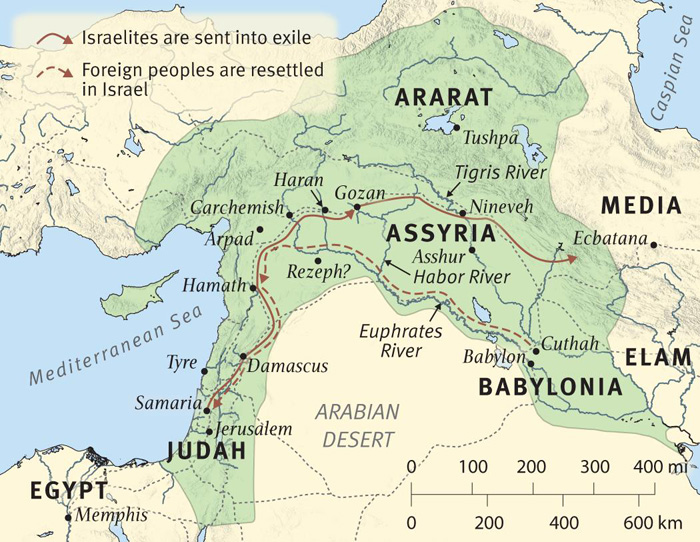
Fall of Samaria 722 BC; Israel Resettled
Source: ESV Global Study Bible
ASSYRIAN DEPORTATION &
RESETTLEMENT POLICY
The king of Assyria brought men from Babylon and from Cuthah and from Avva and from Hamath and Sepharvaim, and settled them in the cities of Samaria in place of the sons of Israel. So they possessed Samaria and lived in its cities - A common Assyrian policy was as “deportation and resettlement.” It was designed to prevent rebellion by scattering conquered peoples and breaking their national and religious unity. These foreigners were placed “in the cities of Samaria instead of the sons of Israel,” meaning that Gentile settlers now occupied Israelite homes, farms, and towns. Samaria, which had been at the heart of the northern kingdom, became a mix of populations and religions.
John Walton - resettlement of Samaria. Although the king of Assyria is not mentioned here, Assyrian sources claim that Sargon II reorganized the area in 720 B.C. These same texts do not cite the specific people groups that were deported to Samaria. However, some Arab tribes were transported to Samaria within five years of the reorganization. Babylon was under Assyrian control during this period. Cuthah is identified with Tell Ibrahim, twenty miles northeast of Babylon. Avva is now identified with the town of Awa (Ama, Akkadian, Amatu in eastern Babylonia). Hamath was the major Aramean city on the Orontes River in Syria. Sepharvayim has been tentatively identified as Sipirani, south of Nippur, though Shabarain in Syria is still a possibility. Whatever the case, Assyrian policy was to resettle an area with a diverse population.
F B Meyer 2 Kings 17:24-41 The story of the new settlers. --
When Israel was taken from the land it was peopled by mongrel races from Babylon (which was already under the power of Assyria), and from other places. Every nation served its own gods, and at the same time gave some kind of allegiance to Jehovah as the local protecting deity of the land whom it was necessary to propitiate. It is a strange story; and yet there are many among us who, while really following the idols of their own evil hearts, give a nominal reverence to the name of God, partly because they think it polite, and partly because they wish to maintain a fair appearance among their fellows. They go to a place of worship with the intention of appeasing God; while they make for themselves many an idol besides (Matt. 6:24-note; 1John 5:21).
2 Kings 17:25 At the beginning of their living there, they did not fear the LORD; therefore the LORD sent lions among them which killed some of them.
- they did not fear the LORD: 2Ki 17:28,32,34,41 Jos 22:25 Jer 10:7 Da 6:26 Jon 1:9
- the LORD sent lions 2Ki 2:24 1Ki 13:24 20:36 Jer 5:6 15:3 Eze 14:15,21
- 2 Kings 17 Resources
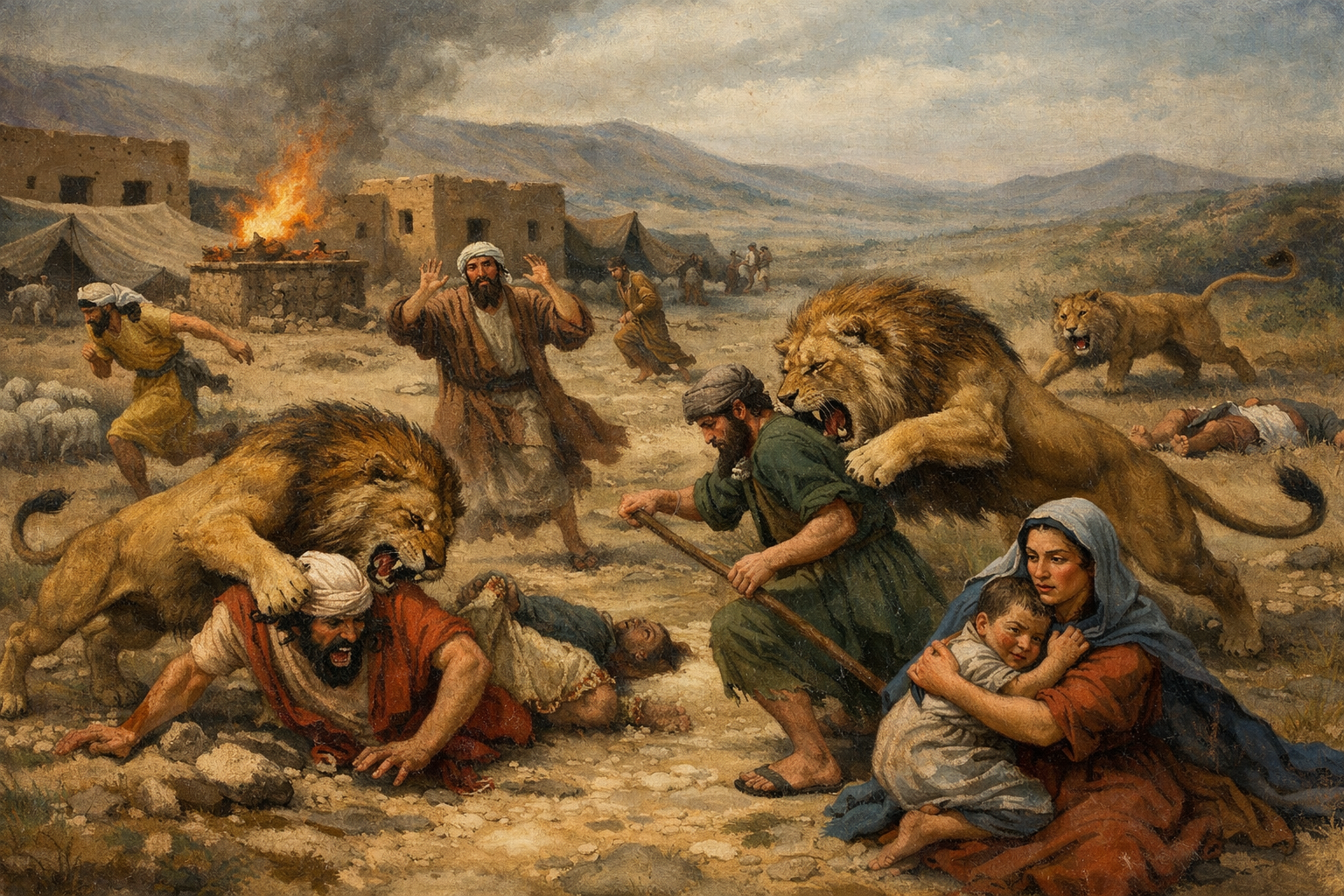
LORD SENDS LIONS
TO CREATE FEAR OF HIM
At the beginning of their living there, they did not fear (yare; LXX - phobeo) the LORD - From 2Ki 17:24 the peoples resettling Israel were all Gentiles. These groups brought their own gods and religious practices with them and “did not fear the LORD” meaning they had no reverence, obedience, or worship toward the true God of Israel. But the land still belonged to Yahweh and He demanded reverence and honor. To “fear the LORD” means to acknowledge Him with holy reverence and obedience. These new settlers ignored and/or were unaware of the authority and holiness of the land, treating the land as if it belonged to their false gods.
Therefore - Term of conclusion. Based on the fact that the settlers did not fear Yahweh, God sought to remedy their lack of fear.
The LORD sent lions among them which killed some of them - Yahweh is the God of all creation and just as He controlled the Assyrian leaders to remove the Israelites, now He exerts His sovereign control over the animals in order to engender some holy fear mixed with dread, in view of the face that some settlers were killed. Proverbs 1:7 teaches, “The fear of the LORD is the beginning of knowledge; fools despise wisdom and instruction.” The lions remind us that God’s presence is not to be taken lightly.
Bob Utley - Some people from southern Assyria (i.e., Babylon) were resettled in Samaria. They, too, sinned against YHWH. He sent lions among them (cf. Lev. 16:21-22). Canaan was YHWH's land. SPECIAL TOPIC: LIONS
John Walton - God-sent lions. Ravaging wild beasts were considered one of the typical scourges that deity would send as punishment. As early as the Gilgamesh Epic in Mesopotamia the god Ea had reprimanded Enlil for not sending lions to ravage the people rather than using something as dramatic as a flood. The gods used wild beasts along with disease, drought and famine to reduce the human population. A common threat connected to negative omens in the Assyrian period was that lions and wolves would rage through the land. In like manner devastation by wild animals was one of the curses invoked for treaty violation (see also Deut 32:24).
EXCURSUS ON LIONS IN SCRIPTURE - In Scripture, lions serve as a dominant metaphor for royal authority, power, judgment, protection, danger, and ultimate victory, reflecting their status as the supreme predator: Israel and its tribes are compared to lions (Ge 49:9; Dt. 33:22; Micah 5:8), David and Israel’s heroes display lion-like courage (1Sa 17:34–37; 2Sa 1:23), and Solomon’s throne is guarded by lions symbolizing royal authority (1K- 10:19–20), while prophets use lions to depict enemies, terror, royal wrath, and hostile empires such as Neo-Babylon (Job 4:10; Ps. 7:2; 10:9; 17:12; 22:13,21; Pr. 19:12; 20:2; 22:13; 26:13; 28:15; Jer. 4:7; 5:6; 25:32–38; 49:19–22; 50:17,44; 51:38; Lam. 3:10; Joel 1:6). YHWH Himself is portrayed as a lion who both delivers and judges—roaring in covenantal judgment (Isa. 31:4; Amos 1:2; 3:8; Hos. 5:14; 13:7–8) yet also roaring in redemptive restoration (Hos. 11:10–11; Joel 3:16), a roar that marks the climactic moment of decisive action (cf. Job 37:3–5; Jer. 25:30). Lions may also represent oppression of God’s people and corrupt leadership (Jer. 12:8; Ezek. 19; Ezek. 22:25; Zeph. 3:3), while Satan himself is likened to a threatening but ultimately defeated roaring lion (1 Pet. 5:8; cf. Eph. 6:11–16; Rom. 8:37). God’s absolute sovereignty over lions is displayed when He shuts their mouths to preserve Daniel (Dan. 6:16, 21–22), and His throne is attended by cherubim bearing a lion’s face, symbolizing divine strength and dominion (Ezek. 10:14). These strands converge in Christ, who is first seen in humility as the Lamb (Luke 2:7; Isa. 53:7; John 1:36) yet revealed in glory as the Lion of the tribe of Judah—the conquering King of kings (Gen. 49:9; Rev. 5:5; 19:16)—whose reign culminates in a restored creation where the lion is tamed and peace prevails (Isa. 11:6; 65:25; cf. Gen. 1:30).
Related Resource:
- See excellent 3 page discussion on LIONS in the Dictionary of Biblical Imagery - page 1740
C H Spurgeon - SHAM CONVERSION First, then, let us observe these Samaritans in THEIR FIRST ESTATE. They were brought, very likely much against their will, from different parts of the Assyrian empire, and they were put down as colonists in the various towns which had formerly been occupied by the tribes of Israel. There they were compelled to dwell. They do not appear to have had any reverence for God at all. They were wholly indifferent. “They feared not the Lord;” they scarcely knew his name, and they seem to have made no inquiries. They found that the land was good, and they tilled it; the vines were fruitful, and they pruned them; the houses were built, and they inhabited them; and thus they settled down. What did it matter to them about Jehovah? Who was he and what was he? No doubt there had been a people living there who more or less had reverenced his name, but what was that to them? They were strangers. It had never crossed their mind that they should be interfered with at all in the matter of worshipping Jehovah, and so they lived altogether carelessly and indifferently. How many there are that are doing the same to-day: many who are thoughtless altogether about divine things: taken up with trifles: occupied only with the things of this life. It does not seem to enter into their heads that they are immortal—that they will have to live in another state. As to their having a Creator and one who daily preserves them in life, no doubt they believe it, but they are not concerned about it. Practically they say, “Who is the Lord that we should obey his voice?” That was the condition of these Samaritans at the first. They were altogether indifferent to the matter. It never troubled them at all.
They had no fear of God. They may have heard of some that trembled at Jehovah, but they never trembled. Perhaps they heard that he was a God whose worship was very troublesome, whose laws were very strict, whose subjects often had to mourn because they rebelled, and hence they did not want to know too much about him, lest they should be drawn into the same exercise of heart and have to confess the same sins and fall into the same sorrows. They knew not and they did not want to know. They were not troubled. (See full message SHAM CONVERSION)
Spurgeon's Sermon Notes - 2 Kings 17:25, 33, 34—“And so it was at the beginning of their dwelling there, that they feared not the Lord: therefore the Lord sent lions among them, which slew some of them.” “They feared the Lord, and served their own gods, after the manner of the nations whom they carried away from thence. “Unto this day they do after the former manners: they fear not the Lord, neither do they after their statutes, or after their ordinances, or after the law and commandment which the Lord commanded the children of Jacob, whom he named Israel.”
It is as needful to warn you against the false as to urge you to the true. Conversion, which is a divine change, is imitated, and the spurious palmed off as genuine. This answers the devil’s purpose in several ways; it eases the conscience of the double-minded, adulterates the church, injures its testimony, and dishonours true religion.
I. THEIR FIRST ESTATE. “They feared not the Lord.”
1. They had little or no religion of any sort.
2. They were not troubled about serving the true God.
3. Probably they even ridiculed Jehovah and his people.
4. But they were near a God-fearing people, and near to king Hezekiah, under whom there had been a great revival. Such influence creates a great deal of religiousness.
II. THEIR SHAM CONVERSION. “They feared the Lord.”
1. They were wrought upon by fear only: the “lions” were their evangelists, and their teeth were cutting arguments.
2. They remained in ignorance of the character of Jehovah, and only wished to know “the manner of the god of the land.” Outside religion is enough for many; they care not for God himself.
3. They were instructed by an unfaithful priest; one of those who had practised calf-worship, and now failed to rebuke their love of false gods. Such persons have much to answer for.
4. They showed their conversion by outward observances, multiplying priests, and setting up altars on high places.
5. But their conversion was radically defective: for—
There was no repentance.
No expiatory sacrifice was offered on God’s one altar.
The false gods were not put away. “Every nation made gods of their own” (verse 29). While sin reigns grace is absent.
They showed no love to God. They feared, but did not trust or love.
They rendered no obedience to him. Even their worship was will-worship. “They feared the Lord, and served their own gods”: a very significant distinction.
They did not abandon false trusts: they looked not to the Lord.
Give cases.
The religious drunkard. See him weep! Hear him talk! He has a dread of God, but he serves Bacchus.
The unchaste hypocrite, whose real worship goes to the vilest lusts, and yet he dreads to be found out.
The pious Sabbath-breaker. Very devout, but serves out poison on Sundays, or prefers recreation to regeneration.
The saintly skinflint. He has “a saving faith” in the worst sense.
The slandering professor. Under pretence of greater holiness he abuses the righteous.
III. THEIR REAL STATE. “They fear not the Lord.”
1. They own him not as God alone. The admission of other gods is apostacy from the true God. He will be all or nothing.
2. They do not really obey him; for else they would quit their idols, sins, and false trusts.
3. He has no covenant with them. They ignore it altogether.
4. He has not wrought salvation for them.
5. They act so as to prove that they are not his. See the future history of these Samaritans in the book of Nehemiah, of which these are the items:—
They desire to unite with Israel for the sake of advantage;
They become enemies when refused;
They grow proud and judge the true Israel. They say they are better than “those who profess so much.” They measure the corn of the sincere with the bushel of their own deceit.
In real conversion there must be
Idol-breaking. Sin and self must be abandoned.
Concentration. Our only God must be adored and served.
Christ-trusting. His one sacrifice must be presented and relied upon.
Full surrender. Our heart must yield to God and delight in his ways.
2 Kings 17:26 So they spoke to the king of Assyria, saying, “The nations whom you have carried away into exile in the cities of Samaria do not know the custom of the god of the land; so he has sent lions among them, and behold, they kill them because they do not know the custom of the god of the land.”
- and placed: 2Ki 17:24
- know not: 2Ki 17:27 1Sa 8:9 10:25 Am 8:14
- 2 Kings 17 Resources
CRISIS FOR NEW
SETTLERS OF ISRAEL
So Term of conclusion. The previous passage describes lions on the loose with some fatal attacks, calling for a conclusive resolution.
they spoke to the king of Assyria, saying, “The nations whom you have carried away into exile in the cities of Samaria do not know the custom of the god of the land so he has sent lions among them- The problem for the new settlers was not knowing God's law (custom). Clearly these are godless pagans pleading their case because they presume the lions are sent by the god of the land (an ancient Near East superstition that each land had its own resident god).
And behold, they kill them because they do not know the custom of the god of the land - The pagans explain the lion attacks are occuring because they do not know how the god of the land of Israel operates. These superstitious people want to appease the god of the land, just as they vainly attempt to do with the gods of their native lands.
Bob Utley - The king of Assyria interpreted this as these new people did not know the customs "of the god (gods) of the land." In the ANE each god had its own land. This was a false worldview but it was what they thought. Therefore, the king took Israelite priests (i.e., YHWH and Ba'al mixed priests; notice he returned to Bethel) and returned them to Canaan to teach the new people the "proper" customs. But these new people brought their own customs of idolatry with them and refused to fear the Lord. R. K. Harrison, Old Testament Times, p. 305, speculates that this priest (vv. 27-28) was the beginning of the traditions related to the famous Samaritan Pentateuch.
John Walton - 17:25–29. syncretism in Samaria. Assyrian inscriptions from the age of Sargon II state that the new settlers were taxed as if they were Assyrians. Furthermore, they were instructed in the proper way to revere God and king. Most groups in antiquity believed that gods had jurisdiction over precise geographic areas. Thus Yahweh had ownership of Samaria and was worthy of worship. Nonetheless the settlers brought their own deities. In the open-ended thinking that accompanied ancient polytheism, there was always room for more gods. If a god had demonstrated power, it would be dangerous not to acknowledge him (see comment on Josh 2:11). Sargon had effected a religious syncretism in the area, with the express purpose of lessening the impact of nationalistic tendencies.
2 Kings 17:27 Then the king of Assyria commanded, saying, “Take there one of the priests whom you carried away into exile and let him go and live there; and let him teach them the custom of the god of the land.”
- one of the priests: Judges 17:13 1Ki 12:31 13:2 2Ch 11:15
- 2 Kings 17 Resources
KING OF ASSYRIA'S
SOLUTION TO LION CRISIS
Then the king of Assyria commanded saying, “Take there one of the priests whom you carried away into exile and let him go and live there; and let him teach them the custom of the god of the land - The king of Assryria seeks to solve the problem of the "angry god" of Israel by taking a pagan worldview, in effect treating the LORD as one of many deities who could be appeased through proper customs. Imagine the job of one Jewish priest teaching thousands of pagans about Yahweh!
2 Kings 17:28 So one of the priests whom they had carried away into exile from Samaria came and lived at Bethel, and taught them how they should fear the LORD.
- in Bethel: 1Ki 12:29-32
- taught them: Isa 29:13 Mt 15:14
- 2 Kings 17 Resources
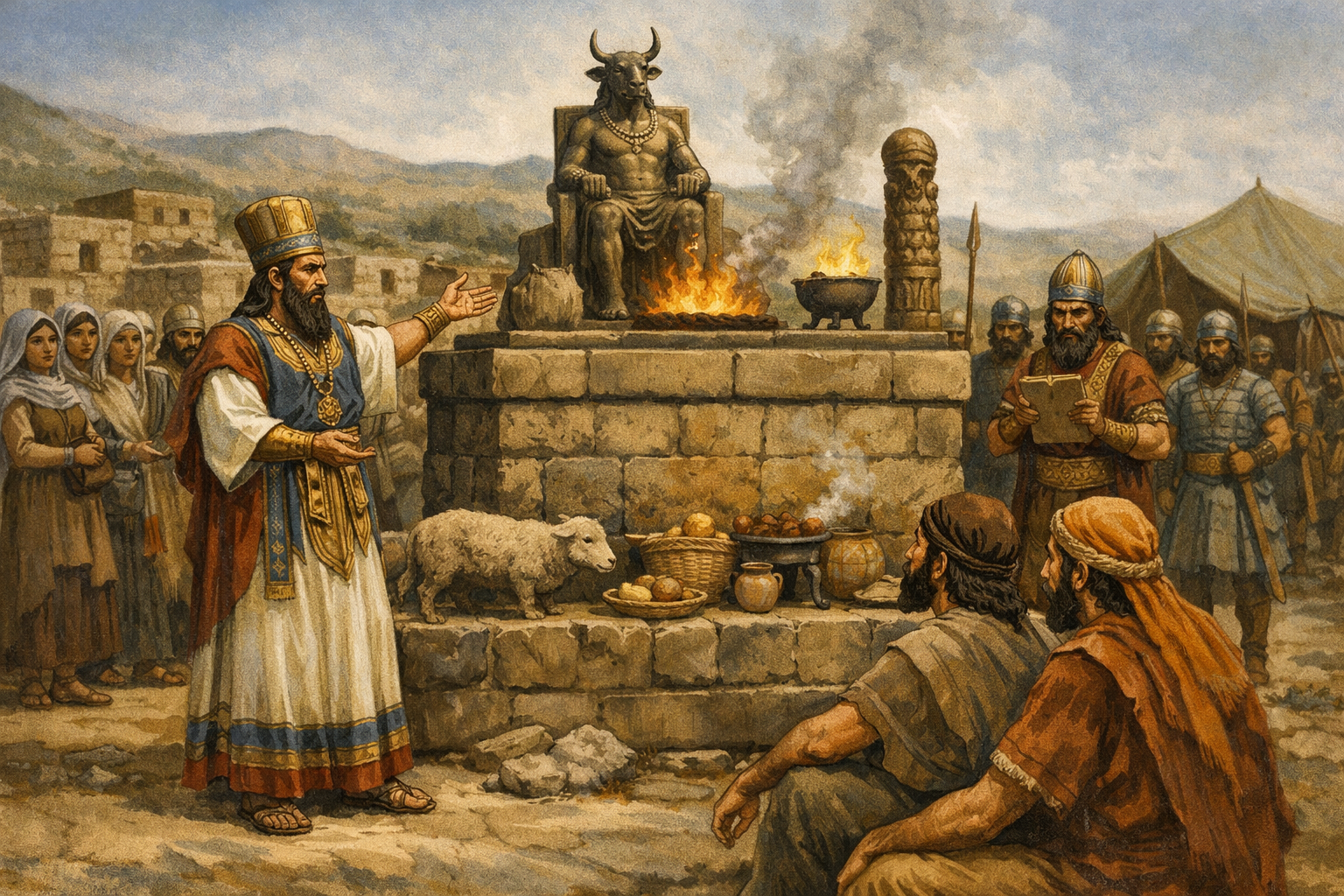
JEWISH PRIEST COMES TO
TEACH FEAR OF THE LORD
So one of the priests whom they had carried away into exile from Samaria came and lived at Bethel, and taught them how they should fear (yare; LXX - phobeo) the LORD - It is interesting that this priest came to Bethel, a center of false worship (1Ki 12:28-29). If this priest had received his "training" in Bethel, one has to wonder how orthodox were his teachings. It follows that whatever this priest taught the pagans was not genuine reverence for the LORD. And from the following passages, it is clear that he did not teach them enough truth to counteract the effect of their idolatry!
David Guzik suggests "The priesthood of the kingdom of Israel was corrupt, but the king of Assyria did not know and was not interested in the pure religion of Israel. Therefore this nameless, corrupt priest taught the new inhabitants of the land a corrupt religion. Certainly, it had elements of the true faith in it; but at the same time it was corrupted by the centuries of state-sponsored idolatry that reigned in Israel."
2 Kings 17:29 But every nation still made gods of its own and put them in the houses of the high places which the people of Samaria had made, every nation in their cities in which they lived.
- made gods: Ps 115:4-8 135:15-18 Isa 44:9-20 Jer 10:3-5 Ho 8:5,6 Mic 4:5 Ro 1:23
- 2 Kings 17 Resources
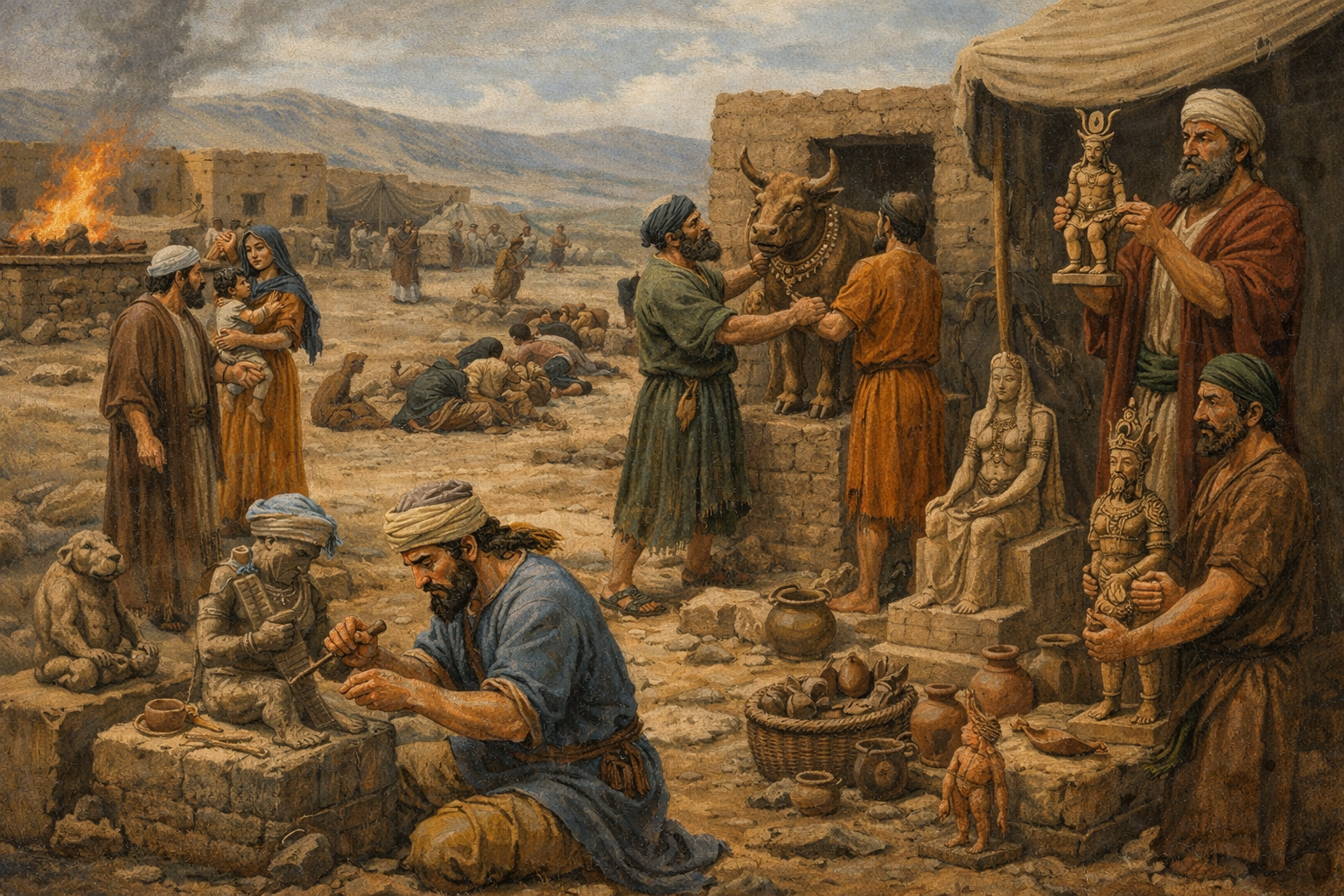
A NOD TO YAHWEH THEN
"BUSINESS AS USUAL"
But - Term of contrast. So on one hand a priest at Bethel taught about how to fear the LORD however here we see but marking the contrast with what was taught and what was practiced. In other words the priest's instruction did not lead to exclusive or genuine worship. In other words this BUT reveals syncretism or a divided loyalty where Yahweh is acknowledged but not obeyed exclusively.
Every nation still made gods of its own and put them in the houses of the high places (bamah) which the people of Samaria had made, every nation in their cities in which they lived - True fear of Yahweh should have caused the people to discard their idols but clearly the priest's teaching failed to have that impact. Clearly his teaching had a major deficit. And a priest from apostate Israel would have been comfortable with syncretism as that is what he had practiced all his life. God had removed the idol worshiping Israelites but as a result of the unorthodox teaching of the priest the land was once again filled with a plethora of idols.
TECHNICAL NOTE - The people of Samaria. Hebrew literally reads "Samaritans" and it is translated this way by KJV, NKJV, YLT, NJB, RSV, NAB and ESV (Also in the Septuagint). This is the only time in the OT they are called "Samaritans", Greek = Samarites the same Greek word used 9x in the New Testament - Matt. 10:5; Lk. 9:52; Lk. 10:33; Lk. 17:16; Jn. 4:9; Jn. 4:39; Jn. 4:40; Jn. 8:48; Acts 8:25. But see the NET NOTE below...
NET NOTE - Heb “Samaritans.” This refers to the Israelites who had been deported from the land.
The resettled pagans did not abandon their false religions, but simply added a superficial form of Yahweh-worship to their existing idolatries. They “still” practiced everything they had done before, which shows that their hearts were unchanged. The act of “putting them in the houses of the high places” refers to the reuse of Israel’s pagan shrines, altars originally built by the apostate Israelites who had fallen into idolatry long before the exile. These “high places” were supposed to have been destroyed according to God’s command (Dt 12:2–4), but instead they became the centers of continued idol worship. The new inhabitants didn’t rebuild temples to their go from scratch but simply placed their idols in the very shrines the former residents had used for false worship. Sin, in other words, filled the vacuum left by half-hearted reform.
BSB - The mixing of foreign people within the former land of Israel brought about religious havoc. The foreigners brought with them their own native ideas of religious worship (vv. 30-32). This resulted in a mixed religion in which both the false gods and Yahweh were worshipped (v. 41, which explains the apparent discrepancy between vv. 32 and 34). The mixing of populations also resulted in mixed marriages between the Israelites left in the land and the new foreign people. The descendants of these marriages came to be called Samaritans (cf. John 4:9, note). They gradually assumed the nature of a religious sect rather than a nation, and they came to occupy an important position in the later history of Palestine (cf. Luke 9:52, note).
2 Kings 17:30 The men of Babylon made Succoth-benoth, the men of Cuth made Nergal, the men of Hamath made Ashima,
DOCUMENTATION OF THE
PLETHORA OF PAGAN DEITIES
The men of Babylon made Succoth-benoth, the men of Cuth made Nergal, the men of Hamath made Ashima,
John Walton - 17:30–31. list of gods. The deity Succoth Benoth is not known from Mesopotamian sources. Benoth may be Banitu (fem. “the creator”), often used as a term for Ishtar. Nergal was the Mesopotamian god of plagues and of the underworld. His principal cult center was in fact at Cutha (twenty miles northeast of Babylon). Ashima is known from an inscription from Teima in Arabia as well as from some Aramaic personal names, but nothing is known about the deity. The Avvites are now identified with the town of Awa (Ama, Akkadian, Amatu in eastern Babylonia). Nibhaz and Tartak have been identified with the Elamite deities Ibnahaza and Dirtaq (Dakdadra). Adrammelech is thought to represent Addir-Melek. Addir is a title meaning “mighty one” and is applied to both Baal and Yahweh. Melek means king and would refer to the divine king. Lastly, Anammelech is believed to represent an assimilation of the Canaanite goddess, Anat (or her male counterpart, An) with Melek (a title often applied to the West Semitic deity Athtar). Little is known of these last two gods, but some associate them with the god Molech (see comments on Lev 18:21; Deut 18:10).
Bob Utley - 17:30-32 These verses mention several idols that these new people from Babylon, who had been settled in Samaria, made (Qal PERFECT).
- Succoth-benoth ‒See online Anchor Bible Dictionary (search for name of god) Hebrew uncertain
- possibly first word linked to Sukkuth of Amos 5:26
- "booths of girls," which would refer to the cultic prostitution of ANE fertility cults
- a scribal pun on Marduk's female counterpart, Sarpanitu (Expositor's Bible Commentary, p. 251). If this is true, the other names are probably purposely misspelled.
- benoth may be Banitu, the female creator goddess of the ANE, Ishtar
- Nergal ‒ See online Anchor Bible Dictionary (search for name of god) the Sumerian god of the underworld who was worshiped at Cutha in Babylon
- Ashuma ‒See online Anchor Bible Dictionary (search for name of god), possibly
- a Syrian fertility goddess, like Anat, Astarte, or Asherah (cf. Amos 8:14)
- a city in Elam named Amate. This fits the southern/eastern provinces of Assyria better (i.e., Elam and Babylon)
- Nibhaz ‒ See online Anchor Bible Dictionary (search for name of god), are a pair of gods from Elam or Syria
- Tartak ‒ See online Anchor Bible Dictionary (search for name of god)for current conjectures but no certain identification. Possible purposeful misspelling of Atargatis, a Syrian goddess
- Adrammelech ‒ See online Anchor Bible Dictionary (search for name of god) possibly may refer to fire god of the city of Sippar
- See online Anchor Bible Dictionary (search for name of god) ABD, vol. 1, p. 223
- a purposeful misspelling of the name of the Syrian god, Hadad
- Anu, a Sumerian sky god
- Melech, a type of sacrifice and not the name of the god Molech
- purposeful misspelling of Canaanite fertility gods/goddesses (i.e., An and Anat)
2 Kings 17:31 and the Avvites made Nibhaz and Tartak; and the Sepharvites burned their children in the fire to Adrammelech and Anammelech the gods of Sepharvaim.
- the Avites: 2Ki 17:24 Ezr 4:9
- burnt their children: 2Ki 17:17 Lev 18:21 De 12:28,31
- 2 Kings 17 Resources
MORE PAGAN GODS
MORE CHILD SACRIFICE
and the Avvites made Nibhaz and Tartak; and the Sepharvites burned their children in the fire to Adrammelech and Anammelech the gods of Sepharvaim - One would have thought the practice of burning children to false gods would have been eradicated by the exile of the apostate Israelites, but clearly the practice was continued by some of the pagans.
2 Kings 17:32 They also feared the LORD and appointed from among themselves priests of the high places, who acted for them in the houses of the high places.
- made unto themselves: 1Ki 12:31 13:33
- the houses of the high places: 2Ki 17:29 23:19 1Ki 13:31
- 2 Kings 17 Resources
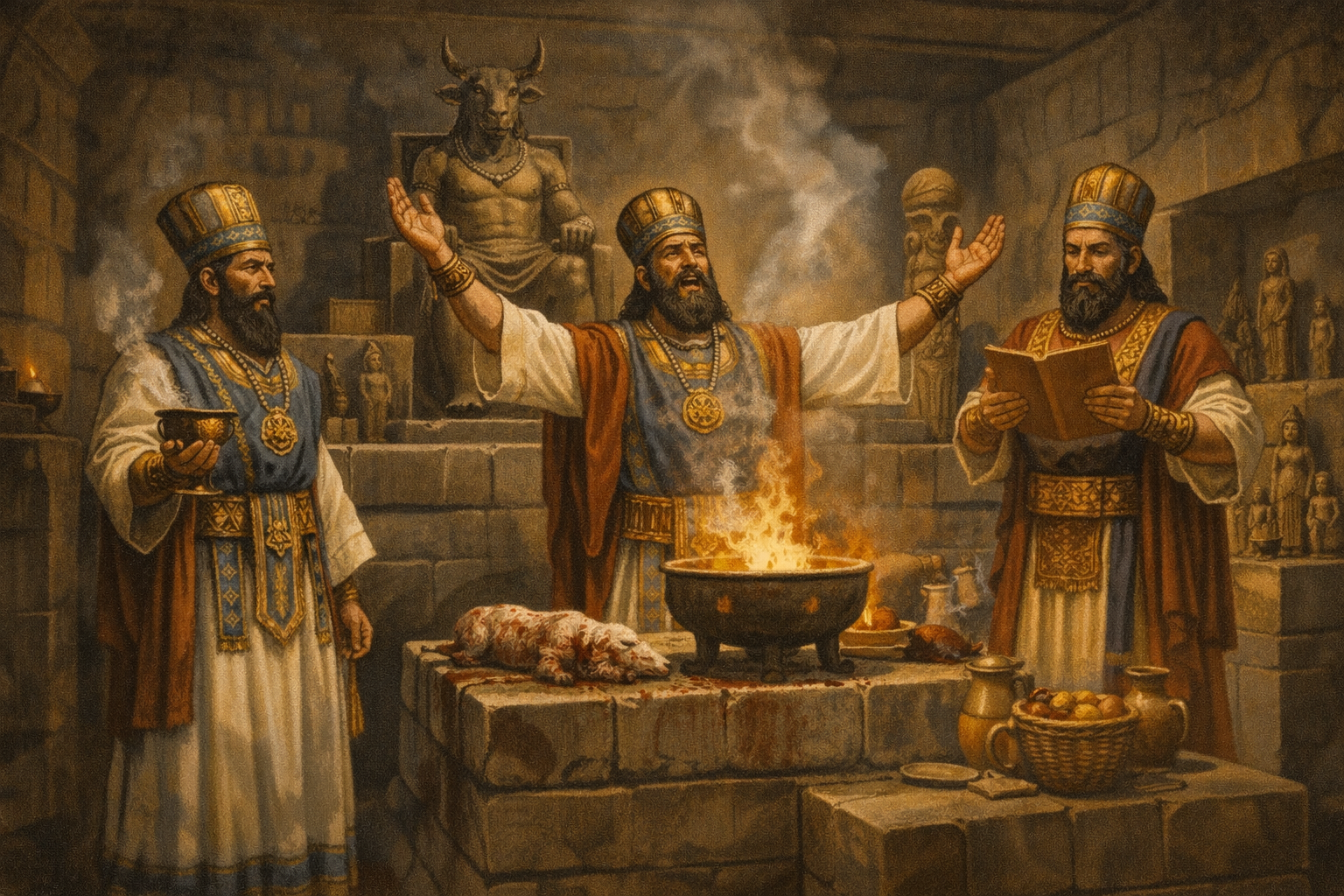
SYNCRETISTIC RELIGION
COMES INTO ISRAEL
They also feared (yare; LXX - phobeo) the LORD and appointed from among themselves priests of the high places, who acted for them in the houses of the high places - Fear of the LORD here can hardly be genuine Biblical fear, for such fear causes one to turn from evil, but these people turned toward the evil of idolatry. They have respected Yahweh as the "Lion King" Who could appese the beasts of the wilderness but they only did so to avoid being clawed to death by a lion! This plethora of men appointed priests is a perversion of God's word calling for only Levites to be priests. These men‑appointed priests conducted sacrifices at “the high places,” local shrines and hilltop altars long associated with idol worship, instead of at the temple God had chosen. Their actions reflected a misguided attempt to merge Yahweh worship with their old religious customs. This false worship is an example of religious syncretism (see next verse) mixing elements of true faith with false religion. They wanted the Lord’s protection without giving Him exclusive devotion.
The houses of the high places (also in 2 Kings 17:29) were shrine structures built at local worship sites, not ordinary homes. Presumably they functioned as localized temples where priests officiated and sacrifices, incense, and rituals were performed, often in imitation of pagan worship rather than according to the Law of Moses (2Ki 17:33).
Bob Utley - Israel (cf. Jeroboam I in 1 Kgs. 12:31; 13:33) appointed common people to act as priests instead of the family of Levi. Probably most of the Levitical priests returned to Judah at the splitting of the United Monarchy in 922 B.C. (ED: AND IF THERE HAD BEEN ANY REMAINING IN ISRAEL OVER THE 200 YEARS THEY WERE OBVIOUSLY CORRUPT AND LIKELY IN EXILE).
2 Kings 17:33 They feared the LORD and served their own gods according to the custom of the nations from among whom they had been carried away into exile.
- They feared: 2Ki 17:41 1Ki 18:21 Ho 10:2 Zep 1:5 Mt 6:24 Lu 16:13
- 2 Kings 17 Resources
THE FOLLY OF HALF-
HEARTED RELIGION
They feared(yare; LXX - phobeo) the LORD and served their own gods according to the custom of the nations from among whom they had been carried away into exile - This verse is almost a perfect description of syncretism, in this context mixing big "G" God with little "g" gods producing not harmony but a confused and corrupted form of worship. God has placed within every human heart a God-shaped vacuum, and if that space is not filled by worship of the true God, it will inevitably be filled by something else, in this case of mixture of true and false.
THOUGHT - “Are you sure this is not a true description of your own position? You pay an outward deference to God by attending his house, and acknowledging his day, whilst you are really prostrating yourself before other shrines.” - F B Meyer
Spurgeon - Is not worldly piety, or pious worldliness, the current religion of England? They live among godly people, and God chastens them, and they therefore fear him, but not enough to give their hearts to him. They seek out a trimming teacher who is not too precise and plain-spoken, and they settle down comfortably to a mongrel faith, half truth, half error, and a mongrel worship half dead form, and half orthodoxy.”
These descriptions of "mixed up" religion remind me of the Lord's words in Isaiah 29:13 (speaking to Jews but applicable to Samaritan syncretism)...
Then the Lord said, “Because this people draw near with their words and honor Me with their lip service, but they remove their hearts far from Me, and their reverence for Me consists of tradition learned by rote.
Bob Utley - This verse implies that these new people, like the Israelites, tried to merge the worship of YHWH (i.e., the Mosaic covenant mediated by the prophets) with other pagan deities and practices (i.e., vv. 40-41). They just added YHWH to their pantheon. These new people will, in time, become the Samaritans of the NT.
Defenders Study Bible - their own gods. The new inhabitants of Samaria, after the Israelites had been carried away into Assyria, soon became a mixed nation--partly composed of Israeli blood and partly of many other tribes, all of which were pagan (2 Kings 17:24). Consequently, their religion became a strange mixture of worship of Jehovah and of various pagan gods. These people became the Samaritans of New Testament times, despised by their Jewish half-brothers. Except for scattered individuals, the exiled Israelites never returned to their homeland.
C H Spurgeon - SHAM CONVERSION —2 Kings 17:25, 33, 34. (NOTE: THIS IS ONLY THE INTRODUCTION TO THIS SERMON - CLICK HERE TO READ THE ENTIRE SERMON OR HERE FOR AUDIO - THIS IS AN IMPORTANT TOPIC IN OUR DAY WHERE "EASY BELIEVISM" HAS MANY SOULS DUPED INTO THINKING THEY ARE HEADING FOR HEAVEN WHEN IN TRUTH THEY MAY BE ON THERE WAY TO HELL!)
2 Kings 17:25; 33; 34 At the beginning of their living there, they did not fear the LORD; therefore the LORD sent lions among them which killed some of them. (17:33) They feared the LORD and served their own gods according to the custom of the nations from among whom they had been carried away into exile. (17:34) To this day they do according to the earlier customs: they do not fear the LORD, nor do they follow their statutes or their ordinances or the law, or the commandments which the LORD commanded the sons of Jacob, whom He named Israel;
THE world is full of deceptions and counterfeits. We have had to protect ourselves by law against adulterations of the commonest articles of diet, but all the laws in the world will not be able to protect us against the constant, the almost universal deceit which is found in daily life. Men seem continually to be set on making the worse appear the better: putting the bitter for the sweet and the sweet for the bitter. If any man shall go through this world with his eyes shut, believing all that he hears, he will find himself the dupe of a thousand knaves. You must keep your eyes open; you must carry a test with you by which you shall be able to discern between things that differ, or else in the ordinary affairs of life you will soon be brought to bankruptcy and poverty.
In the highest regions also, where we have to do with spiritual and eternal things, there are even worse cheats than anywhere else. That old enemy of God and man, who is rightly said to be a liar from the beginning, takes care to use falsehood in order, if it were possible, to deceive even the very elect. If there is a Christ, he sets up an antichrist. If there is a church of Christ, he makes a world’s church that shall mimic it. If there is a gospel, he too comes with his good news and sets up “another gospel, which is not another.” In the matters which concern the inner man—in the work of the Holy Spirit upon the soul—Satan is an adept at deception there also. He can imitate repentance with remorse. He can match faith with credulity. He can mimic assurance with presumption. He can give us the pleasures of this world instead of the joy of the Lord, and instead of a simple confidence in Christ he can offer us that which may look remarkably like it, and yet, after all, be confidence in self. Hence, one of the very first things that a man has to do if he would be right at last, is to search his own heart, to test and try that which he supposes to be there whether it be the work of God or no; whether his spot be the spot of God’s children or only a vile imitation of it.
Conversion which is absolutely necessary to salvation—conversion by which man turns from sin to righteousness, from self to Christ, from the world to heaven, from rebellion to obedience—conversion which we must all experience if we are to be right towards God, for “except ye be converted and become as little children ye shall not enter into the kingdom of heaven”—conversion, too, has been mimicked in many ways. In this discourse we are going to look at one instance in which the false has been put for the true, in order that by the light of that instance, as by a beacon, we may be warned off this dangerous rock. Another man’s shipwreck ought always to be a beacon to us, so where these Samaritans failed, let us take heed unto ourselves lest we fall after the same fashion.
We shall have three points which will follow the order of the narrative. We shall look, first, at their first estate: “They feared not the Lord”; secondly, their sham conversion: “They feared the Lord and served their own gods”; thirdly, their real state while they professed thus to be converted: “They feared not the Lord.”......
Now, secondly, we come to THEIR CONVERSION. In the 33rd verse we read, “They feared the Lord,” but there is a very ugly “and” after it which shows that it was a sham conversion. “They feared the Lord and served their own gods.” Still, it was a sort of conversion; it meant at any rate an outward change. How came it about? If you read the chapter, as we have done just now, you will find that their conversion was caused entirely by terror......
But you see in all these cases there was no sense of having done wrong. There was no desire to do right. It was the lions, the lions, the lions, the lions. If there had been no lions there would have been no religion. If there had been no lions there would have been no seeking the Lord. If there had been no lions there would have been no wanting to know the manner of the god of the land. Such men have no desire after God, nothing of the kind. The thing that drives them is just that awful lion: the dread of death is upon them, and the dread of something after death, the judgment to come—nothing else. Now some are really brought to God by terrors, but many are only brought into a condition of sham conversion; the root of their religion has been nothing else but the lions......
Further, these people were not only led to their conversion by fear: not only was their conversion marred by ignorance; but probably also they were instructed by an unfaithful priest. The king of Assyria sent them one of the priests that he might teach them the religion. One of the priests whom they had carried away from Samaria came and dwelt in Bethel and taught them how they should fear the Lord. It looks very suspicious, that dwelling in Bethel. I suspect he taught them worship of the calves of Bethel....
One good test (ED: OF A FAITHFUL PRIEST) I will give you; see whether they search and probe you; rest assured that the Lord has not sent those that speak smooth words and never trouble your conscience or make you search yourselves
C H Spurgeon - SHAM CONVERSION
EXCURSUS ON SYNCRETISM - Syncretism comes from the Greek συγκρητισμός (synkrētismós), a term originally associated with Κρῆτες (Krētes, “Cretans”) and derived from σύν (syn, “together”) + Κρήτη (Krētē, “Crete”). In its earliest sense, it referred to the practice of the often-divided people of Crete setting aside internal differences and “standing together” against a common enemy. The word was later used figuratively to describe the combining or reconciling of disparate beliefs, practices, or systems, and in early Christian and theological usage it took on a negative nuance, denoting the blending of incompatible religious elements, especially the mixing of biblical faith with pagan or foreign beliefs.
Syncretism is the uniting of two religious beliefs, without their being fully integrated with each other, and often involving compromise, illogical eclecticism, uncritical acceptance of mutually inconsistent principles, or incorporation of undigested lumps of doctrine or practice
Syncretism, particularly in religion, is the blending of different belief systems into a hybrid faith, a practice that Scripture consistently condemns because it alters and dilutes God’s revealed truth. Syncretism seeks to reconcile differing beliefs, yet such fusion cannot coexist with biblical Christianity, which demands exclusive loyalty to the one true God. Israel’s history vividly illustrates this danger, as the people repeatedly attempted to worship the LORD while also serving pagan gods, a compromise Scripture calls spiritual adultery (2 Kings 17:33; Exod 20:3). The same pattern appears today when Christianity is mixed with New Age spirituality, Eastern practices, or secular philosophies, creating a “faith” that feels inclusive but denies biblical authority and the uniqueness of Christ (John 14:6). Scripture makes clear that light cannot fellowship with darkness (2 Cor 6:14–16); therefore, true worship requires wholehearted devotion to God alone, for syncretism is not harmless accommodation but false worship that replaces obedience with human preference (Deut 6:5). Jesus gives us a good passage that applies to syncretism declaring "“No one can serve two masters; for either he will hate the one and love the other, or he will be devoted to one and despise the other. You cannot serve God and wealth." (Mt 6:24+).
“Let me be right, and let there be no mistake about it;
but do not let me try to be both right and wrong, washed and filthy,
white and black, a child of God and a child of Satan.”
-- C H Spurgeon
James Smith - SIGNS OF IDOLATRY
“They feared the Lord, and served their own gods” (2 Kings 17:33).
The religion of some is like the skin of the chamelon that changes its colour according to the hues of circumstances. Those Assyrian settlers in Israel wanted to know the “God of the land” where they now dwelt, but clung to their own god. We are serving our own gods when we—
I. Give God only one day out of seven. Attending to the outward forms of religion once a week. Reading the Bible on Sunday and denying its every claim all the other six days. Selfishness on Saturday means selfishness on Sunday.
II. Only give to God what costs us nothing. The question is: Can I afford it? not: Does the lord need it? The time that hangs heavy on us, the money I will not miss. The scraps of our lives, but not ourselves.
III. Are more interested in our daily business than in the cause of Christ. “Seek first the kingdom of God” (Matt. 6:33). Our daily avocation should not be departed from, but should be our service for the Lord.
IV. Are more anxious for the praise of men than the praise of God. The Pharisees, and all such eye-servants, have already their reward, the empty bubbles of human applause.
V. Are more concerned about our own good name than the honour of God. When we are indignant at a wrong (perhaps imaginary) done to ourselves or our friends, and utterly indifferent to all the dishonour and reproach done to the Son of God.
VI. Are more anxious for happiness than for usefulness. What would an earthly master think of a servant whose chief object was not to please him, but to get self-gratification at his cost.
VII. Are more anxious for smooth preaching than faithful preaching. Those who preach the Gospel must also reprove, rebuke, and exhort. In God we see both “Goodness and severity” (Rom. 11:22). There are opposites in the works of God just as there are in His Word and character. Light and darkness, summer and winter, fire and water, herbs that heal and herbs that kill, snakes among flowers. As in nature so in grace. An ark for every deluge. The pillar of cloud was darkness to the Egyptians but light to the Israelites. Jesus Christ is both a Lamb and a Lion. “God is love,” but also “God is a consuming fire.”
SUMMARY - The tragic contradiction described in “They feared the LORD, and served their own gods” (2 Kings 17:33) exposes a divided heart that professes reverence for God while clinging to rival loyalties. Idolatry reveals itself when devotion is selective and convenient—when God is given only fragments of time, costless leftovers, or outward forms rather than wholehearted obedience; when daily pursuits, human approval, personal reputation, comfort, or happiness are prized above Christ and His kingdom (Matt. 6:33). It appears when usefulness to God is eclipsed by self-gratification, and when smooth, affirming preaching is preferred over faithful proclamation that rebukes and exhorts, forgetting that God’s character holds both goodness and severity (Rom. 11:22). Such religion, like a chameleon, adapts to circumstances but never truly surrenders, honoring God in name while denying Him the throne of the heart.
OUR DAILY BREAD - A Christian youth organization in Singapore learned that the local horse-racing club wanted to donate a significant sum of money to its work. The gift would be helpful, but the organization had taken a position against gambling. Now it had to decide whether accepting money from a racing club that derived its revenue from gambling would compromise its commitment to Christ.
Zerubbabel, Jeshua, and the heads of the families of Israel faced a similar dilemma. They were being offered help to rebuild the temple by Assyrian settlers in the land who had intermarried with remnants of the tribes of Israel. Later known as Samaritans, these people were adversaries of Israel (Ezra 4:1). Zerubbabel’s response was decisive: “We alone will build to the Lord God.” Why such exclusivity? In 2 Kings 17:33, we learn that those who offered help “feared the Lord, yet served their own gods.”
We need to be reminded often of the first commandment: “You shall have no other gods before Me” (Exodus 20:3). Although the Lord can use even unbelievers to accomplish His purposes, we are never to compromise our loyalty to Him. By our words and our actions we must show that we worship Him and Him only.
The dearest idol I have known,
Whate'er that idol be,
Help me to tear it from Thy throne
And worship only Thee.
—Cowper
There are many ways to worship God,
but only one God to worship.
2 Kings 17:34 To this day they do according to the earlier customs: they do not fear the LORD, nor do they follow their statutes or their ordinances or the law, or the commandments which the LORD commanded the sons of Jacob, whom He named Israel;
- they do not fear the LORD 2Ki 17:25,27,28,33
- whom He named Israel: Ge 32:28 33:20 35:10 1Ki 11:31 18:11 Isa 48:1
- 2 Kings 17 Resources
SUMMARY OF SPIRITUAL
CONDITION OF SAMARITAN SETTLERS
To this day they do according to the earlier customs - They do according to customs not commandments!
They do not fear (yare; LXX - phobeo) the LORD - Earlier it said they had a "fear the LORD" (2Ki 17:25, 28) but that was a "tongue in cheek" kind of fear! It was all external and at most ritual but without any heart change. In this verse the fear described is genuine reverential awe of Yahweh, something they clearly do not possess.
These religious settlers remind me of the words of Paul in 2 Timothy 3:5 where he describes men who were "holding to a form (morphosis) of godliness, although they have denied its power; Avoid (present imperative see our need to depend on the Holy Spirit to obey) such men as these." Indeed, these syncretistic worshipers were only going through the motions (a form of godliness), but they had absolutely no spiritual power. Imagine wasting your time on such an utterly foolish and futile system of worship, going through the motions but experiencing no genuine communion with your Creator! Jesus was very clear (speaking to a Samaritan woman) declaring to her "God is spirit, and those who worship Him must worship in spirit and truth.” (Jn 4:24)
Nor do they follow their statutes or their ordinances or the law or the commandments which the LORD commanded the sons of Jacob, whom He named Israel - The writer of Kings makes a clear contrast between what God required and what the people practiced. God had entered into a covenant with “the sons of Jacob, whom He named Israel,” commanding them to worship Him alone and to keep His statutes. The specific phrase “statutes… ordinances… law… and commandments” emphasizes the completeness of God’s revealed will given through Moses. Deuteronomy 6:13‑14 had clearly warned Israel, “It is the LORD your God you shall fear. Him you shall serve and by his name you shall swear. You shall not go after other gods.” Yet, instead of repentance and obedience, these settlers continued in “the earlier customs” of idol worship inherited from their nations.
TECHNICAL NOTE - Some writers feel he is still addressing the "Samaritans" in 2Ki 17:34-41 while a number of writers feel the writer is now addressing Israelites. E.g., note the phrase in 2Ki 17:38 "The covenant I have made with you, you shall not forget..." which cannot be Samaritans who had no covenant. (See the interesting note below by Mordecai Cogan who divides 2Ki 17:24-41 into 2 units, one to the mixed settlers and the other to sons of Jacob. I can certainty see Cogan's points that support his argument and I would tend to favor his analysis of 2Ki 17:34-41. I will leave it for you dear Berean (Acts 17:11) regarding how you handles the last section of 2 Kings 17.
David Guzik - The area of the northern kingdom of Israel was not re-occupied by Judah before their own subjugation and conquest by the Babylonian empire. This mixed religion first promoted by the Assyrians continued for many centuries in Samaria, existing even until New Testament times. It seems that God was more lenient with these Samaritans of corrupt belief than He was with disobedient Israel. This teaches us that those with more revelation from God are held to stricter account before Him.. Yet, 2 Chronicles 30:10-19 shows us that in the days of King Hezekiah of Judah, there were some worshippers of the true God among the area that was formerly the northern kingdom of Israel. Some responded to his invitation to celebrate Passover in Jerusalem.
Mordecai Cogan: This section, like the previous one, divides structurally and thematically into two units:
(UNIT 1.) 2Ki 17:24–33 tell of the foreign settlers brought to Samaria over a period of decades and the circumstances under which they adopted Israelite religious practices. In addition to the renewed yhwh cult at Beth-el, they continue to worship the gods of their homelands.
(UNIT 2.) 2Ki 17:34–40 condemn the “sons of Jacob” for their abandonment of yhwh’s Teaching.
2Ki 17:41 rounds off both units, by resuming unit 1. (Note the same procedure above in v. 23, which resumes v. 6.)
Unit 2 is independent of unit 1 and should be seen within the larger context of 2 Kgs 17, particularly the homily in 2Ki 17:7–23. There one reads that the abandonment of the teaching led to Israel’s removal from the land “until this day.” The phrase “until this day” is taken up again in 2Ki 17:34 by means of Wiederaufnahme—“resumptive repetition”—and marks unit 2 as the continuation of 2Ki 17:23, its subject being the Israelites after the fall of Samaria. The view expressed in unit 2 states: Even after punishment—i.e., exile—Israel persisted in following “their earlier practices” and sought no return to yhwh.
Therefore suggestions to see unit 2 as a late, postexilic addendum further condemning the mixed ritual of the settlers in Samaria already excoriated in unit 1, cannot be accepted. It is highly unlikely that any postexilic writer would speak of the foreigners as “sons of Jacob,” bound by the covenant obligations of the torah (2Ki 17:34, 35, 37). Furthermore idolatry among the residents of Samaria is never an issue in the literature of the Persian period. Even when the Samarians represent themselves as worshippers of yhwh for many generations (Ezra 4:2), reference is not made to the mixed cult depicted in 2 Kgs 17:24–33. Their rejection by the returnees from Babylonian exile is based rather on their ethnic foreignness. Therefore unit 1, as well, should not be regarded as a postexilic polemic.
Both units should be seen against the background of Josiah’s cultic reforms and his expansion into the former territory of the northern kingdom. Josiah moved into Samaria to destroy the altar in Bethel and purge the other cities of their bāmôt-shrines (2 Kgs 23:15–19). The priests who served at these sites were slaughtered (v. 20), as one would slaughter pagan priests under the law of ḥerem. Who else but the priests “appointed” to serve at the shrines of the new settlers (cf. 2Ki 17:32) would be so treated? To further legitimize Josiah’s claim as the heir to northern Israel, the author of unit 2 discredits the Israelite exiles, who by their continued idolatry forfeit any rights to their former inheritance.
2 Kings 17:35 with whom the LORD made a covenant and commanded them, saying, “You shall not fear other gods, nor bow down yourselves to them nor serve them nor sacrifice to them.
- With whom: 2Ki 17:15 Ex 19:5,6 24:6-8 De 29:10-15 Jer 31:31-34 Heb 8:6-13
- charged them: Ex 20:4,5 34:12-17 De 4:23-27 13:1-18 Jos 23:7,16
- fear other gods: Jdg 6:10 Jer 10:5
- 2 Kings 17 Resources
WRONG FEAR
With whom the LORD made (karath) a covenant (beriyth) - "Cut a covenant" - This is referring to the Mosaic Covenant as shown by the following command. Passages like this would clearly be addressed to Jews, not to the mixed Samaritans.
NET NOTE - That is, the descendants of Jacob/Israel
and commanded them, saying, “You shall not fear (yare; LXX - phobeo) other gods (elohim), nor bow down (shachah; LXX - proskuneo) yourselves to them nor serve (abad; LXX - latreuo) them nor sacrifice (zabach) to them - This last section repeats fear several times, wrong fear here, but right fear in the next verse below.
2 Kings 17:36 “But the LORD, who brought you up from the land of Egypt with great power and with an outstretched arm, Him you shall fear, and to Him you shall bow yourselves down, and to Him you shall sacrifice.
- an outstretched arm: Ex 6:6 9:15 De 5:15 Jer 32:21 Ac 4:30
- him shall ye fear: Lev 19:32 De 6:13 10:20 12:5,6,11,12 Mt 10:28 Rev 15:4
- 2 Kings 17 Resources
RIGHT FEAR
But the LORD, Who brought you up from the land of Egypt with great power and with an outstretched arm, Him you shall fear(yare; LXX - phobeo), and to Him you shall bow yourselves down (shachah; LXX - proskuneo), and to Him you shall sacrifice (zabach) - Passages like this would clearly be addressed to Jews, not to the imported pagans.
Bob Utley - This verse describes YHWH's great redemptive promise (cf. Gen. 15:12-21) and act (the exodus). The imagery comes from Exod. 32:11; Deut. 4:34; 5:15; 7:19; 9:29; 11:2; Ps. 136:12. Notice the three aspects of the worship of YHWH. fear Him; bow down to Him; sacrifice to Him; This is exactly what Israel was doing to pagan gods (cf. v. 35).
2 Kings 17:37 “The statutes and the ordinances and the law and the commandment which He wrote for you, you shall observe to do forever; and you shall not fear other gods.
- the statutes: Lev 19:37 De 4:44,45 5:31-33 6:1,2 12:32 1Ch 29:19 Ps 19:8-11 Ps 105:44,45
- wrote for you: De 31:9,11 Ne 9:13,14
- and ye shall not: 2Ki 17:35
- 2 Kings 17 Resources
WRONG FEAR
The statutes and the ordinances and the law and the commandment which He wrote for you, you shall observe to do forever; and you shall not fear (yare; LXX - phobeo) other gods - From the exodus in v36, the writer moves to Mt Sinai and giving of the Law. Again the group being addressed here is surely Jewish, not the pagan settlers brought in to re-populate Israel.
Bob Utley - "which He wrote for you" This could refer to two things. (1) YHWH writing the Ten Commandments with His own finger (cf. Exod. 24:12; 31:18; 32:16; 34:1) (2) Moses writing down YHWH's instructions (cf. Exod. 17:14; 24:4; 34:27; Num. 33:2) "you shall observe to do forever" Obedience is crucial! The vast majority of covenants are conditional (cf. Lev. 18:26; 22:31; Deut. 4:2,40; 6:2; 26:16; 1 Kgs. 2:3; Ps. 105:45; Ezek. 11:20).
2 Kings 17:38 “The covenant that I have made with you, you shall not forget, nor shall you fear other gods.
- forget: De 4:23 6:12 8:14-18
- 2 Kings 17 Resources
WRONG FEAR
The covenant (beriyth) that I have made (karath) with you, you shall not forget, nor shall you fear (yare; LXX - phobeo) other gods - He reiteratest the Mosaic Covenant, in a sense a "marriage covenant" (Ex 24:1-12). Again reminding the Jews of what they had been given. Because they had the covenant, first they should remember it and this will remind them not to fear other gods.
2 Kings 17:39 “But the LORD your God you shall fear; and He will deliver you from the hand of all your enemies.”
- the LORD: 2Ki 17:36 1Sa 12:24 Isa 8:12-14 Jer 10:7 Mt 10:28 Lu 1:50
- he shall deliver: Ne 9:27 Lu 1:71,74,75
- 2 Kings 17 Resources
RIGHT FEAR
But - Term of contrast, contrasting wrong fear and right fear.
The LORD your God - Yahweh is Israel's God, even if they are not believing in Him. He is not the God of the pagan settlers.
You shall fear (yare; LXX - phobeo); and He will deliver (natsal; LXX - exaireo) you from the hand (yad ~ powre) of all (how many?) your enemies - The message here is fear God and you won't need to fear men (or your enemies).
Deliver (05337) natsal means to deliver or rescue, typically by the superior power of one overcoming another, often expressed as deliverance from the “hand” (power) of an adversary (Ge 32:11; Hos 2:10), underscoring that idols and human strength are unable to save (1 Sa 12:21; Ps 33:16); it describes God’s preserving rescue in Jacob’s plea and encounter (Ge 32:11, 30), Joseph’s protection (Ge 37:21–22), Moses as deliverer and Yahweh’s redemptive purpose for Israel (Ex 2:19; 3:8; 6:6), the sparing at Passover (Ex 12:27), and repeated acts of salvation from enemies (Ex 18:4, 8–10; Dt 23:14; 32:39; Josh 24:10; Jdg 6:9; 8:34; 1 Sa 7:14), including specific cases such as Rahab’s appeal (Josh 2:13), Joshua’s protection of the Gibeonites (Josh 9:26), Phinehas averting judgment (Josh 22:31), Gideon’s victory (Jdg 9:17), and David’s cry for release from transgressions (Ps 39:8); the verb also denotes taking from another’s control—plundering or stripping (Ex 12:36; Ex 3:22; Ex 33:6), safeguarding an escaped slave (Dt 23:15), or not having God’s word taken from one’s mouth (Ps 119:43)—and Proverbs affirms that righteousness delivers (Pr 10:2; 11:4, 6; 12:6), anticipating the saving righteousness found in Christ; in the Psalms, nāṣal frequently appears as an urgent plea for rescue from enemies and threats as well as from fear (Ps 34:4), troubles and afflictions (Ps 34:17; 54:7), guilt and bloodshed (Ps 39:8; 51:14), death and peril (Ps 56:13; 69:14; 91:3; 107:6; 120:2; 144:7), and for the deliverance of the needy (Ps 72:12).
2 Kings 17:40 However, they did not listen, but they did according to their earlier custom.
- they did: Jer 13:23
- but they did: 2Ki 17:8,12,34 De 4:28
- 2 Kings 17 Resources
UNCIRCUMCISED EARS
AND HEARTS
However, they did not listen (shama) - They heard the words but they did not heed the words. This seems to indicate the Jews, but see the contrast.
But they did according to their earlier custom (mishpat/mispat) - This would imply this refers to the settlers not the Jews deported but see NET NOTE below. It is difficult to be dogmatic.
NET NOTE - This refers to the foreigners whom the king of Assyria settled in the land (see v. 35a).
2 Kings 17:41 So while these nations feared the LORD, they also served their idols; their children likewise and their grandchildren, as their fathers did, so they do to this day.
- So while these nations feared the LORD: 2Ki 17:32,33 Jos 24:14-20 1Ki 18:21 Zep 1:5 Mt 6:24 Rev 3:15,16
- so they do to this day: Ezr 4:1-3
- 2 Kings 17 Resources
SYNCRETISTIC FEAR IS
DOUBLE MINDED FEAR!
So while these nations feared (yare; LXX - phobeo) the LORD, they also served their idols - This clearly refers to the pagan nations who had been imported to repopulate the Northern Kingdom. These people had been taught something about the LORD by an Israelite priest (verse 27), and they outwardly acknowledged Him, but they never abandoned their old gods. God desires undivided devotion, and only when His people turn fully to Him can they experience the blessings of His covenant.
🙏 THOUGHT - How's your "attention span?" Spiritually speaking is it double-minded? Or is it laser focused on Yahweh/Jesus? If it is only partial attention to the Holy One, then it is very likely you are missing the fullness of blessings that He desires to pour out on your life. This world easily seduces and ensnares us, in effect shortening our "attention span" on the Most High God. Enabled by the Spirit we need to sincerely pray "TEACH me your way, O LORD, and I will walk in your truth; GIVE me an undivided heart, that I may fear your Name." (Ps 86:11NIV)
NOTE: Although teach and give are both commands in the Hebrew, it is not as if we are issuing a command to God. In Hebrew, imperatives are the normal way to express earnest petitions, not merely orders. Biblical Hebrew has no separate verb form meaning “please do this if You are willing.” Intensity, urgency, and humility are carried by context, not by a different mood. Thus, an imperative addressed to God often functions as a supplicatory plea, not a demand. In Psalm 86:11, David is not asserting rights but is confessing need. He cannot walk in God’s truth unless God teaches him, and he cannot fear God’s Name unless God gives him an undivided heart. The imperatives underscore human inability, not human authority.
The phrase “they feared the LORD” suggests that they fearted the LORD outwardly, and may have even recognized His power and perhaps may have sought to appease Him, but “they also served their idols” showing that their fear was not true reverence but mere superstition. It also shows that inwardly their hearts remained divided and as Jesus clearly taught "you cannot serve two masters" (Mt 6:24). They tried to blend the worship of the true God with the worship of false gods, which is clearly a form of syncretism that God had repeatedly forbidden.
Deuteronomy 6:13-14 “You shall fear only the LORD your God; and you shall worship Him and swear by His name. 14 “You shall not follow other gods, any of the gods of the peoples who surround you,
James 4:8 addressed this divided loyalty commanding his readers...
"Draw near (aorist imperative see our need to depend on the Holy Spirit to obey) to God and He will draw near to you. Cleanse (aorist imperative) your hands, you sinners; and purify (aorist imperative) your hearts, you double-minded (dipsuchos - literally "two souls" or "two minds")
Their children likewise and their grandchildren, as their fathers did, so they do to this day This emphasizes how deeply entrenched this pattern of compromise became. It was not just a single generation’s sin—it became a cultural and religious inheritance. Each generation repeated the same divided worship, proving that without wholehearted devotion to God, idolatry naturally perpetuates itself. This echoes the warning of Exodus 20:5, where God said He would visit “the iniquity of the fathers on the children to the third and the fourth generation of those who hate me.”
Bob Utley - The power of family or national traditions is very strong. This is why Israel was told to train her sons and daughters in the worship of YHWH (cf. Deut. 4:9,10; 6:7,20-25; 11:19; 31:13,32-46; also note Exod. 10:2; 12:26; 13:8,14). "idols"
Spurgeon on so they do to this day - "SO DO THEY unto this day," said the writer of the Book of Kings, who has long since passed away unto his fathers. Were he alive now he might say concerning the spiritual descendants of these Samaritans, "So do they unto this day." This base union of fearing God and serving other gods is by no means obsolete. Alas, it is too common everywhere, and to be met with where you might least expect it. From generation to generation there have been Mongrel Religionists, who have tried to please both God and the devil, and have been on both sides, or on either side, as their interest led them. Some of these wretched blenders are always hovering around every congregation, and my hope is that I may convince the consciences of some here present that they themselves are guilty, and that of them it might be said, as of these Assyrian immigrants, "They feared the Lord, and served their own gods." My sermon will by no means be an essay upon an extinct race, but it may be placed among "the present-day papers," for "so do they unto this day." He that hath ears to hear, let him hear, and to whomsoever the word shall apply let its rebuke be taken home, and through the teaching of the Holy Spirit may it produce decisive results. (See full sermon Mongrel religion)
QUESTION - Who were the Samaritans? | GotQuestions.org
ANSWER - The Samaritans occupied the country formerly belonging to the tribe of Ephraim and the half-tribe of Manasseh. The capital of the country was Samaria, formerly a large and splendid city. When the ten tribes were carried away into captivity to Assyria, the king of Assyria sent people from Cutha, Ava, Hamath, and Sepharvaim to inhabit Samaria (2 Kings 17:24; Ezra 4:2-11). These foreigners intermarried with the Israelite population that was still in and around Samaria. These “Samaritans” at first worshiped the idols of their own nations, but being troubled with lions, they supposed it was because they had not honored the God of that territory. A Jewish priest was therefore sent to them from Assyria to instruct them in the Jewish religion. They were instructed from the books of Moses, but still retained many of their idolatrous customs. The Samaritans embraced a religion that was a mixture of Judaism and idolatry (2 Kings 17:26-28). Because the Israelite inhabitants of Samaria had intermarried with the foreigners and adopted their idolatrous religion, Samaritans were universally despised by the Jews.
Additional grounds for animosity between the Israelites and Samaritans were the following:
1. The Jews, after their return from Babylon, began rebuilding their temple. While Nehemiah was engaged in building the walls of Jerusalem, the Samaritans vigorously attempted to halt the undertaking (Nehemiah 6:1-14).
2. The Samaritans built a temple for themselves on “Mount Gerizim,” which the Samaritans insisted was designated by Moses as the place where the nation should worship. Sanballat, the leader of the Samaritans, established his son-in-law, Manasses, as high priest. The idolatrous religion of the Samaritans thus became perpetuated.
3. Samaria became a place of refuge for all the outlaws of Judea (Joshua 20:6-7; 21:21). The Samaritans willingly received Jewish criminals and refugees from justice. The violators of the Jewish laws, and those who had been excommunicated, found safety for themselves in Samaria, greatly increasing the hatred which existed between the two nations.
4. The Samaritans received only the five books of Moses and rejected the writings of the prophets and all the Jewish traditions.
From these causes arose an irreconcilable difference between them, so that the Jews regarded the Samaritans as the worst of the human race (John 8:48) and had no dealings with them (John 4:9). In spite of the hatred between the Jews and the Samaritans, Jesus broke down the barriers between them, preaching the gospel of peace to the Samaritans (John 4:6-26), and the apostles later followed His example (Acts 8:25).
ADDENDUM - SAMARITAN PENTATEUCH - The Samaritan Pentateuch is the form of the Mosaic Law preserved and used exclusively by the Samaritans, who, after being excluded by the post-exilic Jews from participation in Jerusalem worship, established their own sanctuary on Mount Gerizim and organized a temple-centered system of worship modeled on Jerusalem’s. They accepted only the Law of Moses as divinely authoritative, referring to it simply as “the Law,” read as a unified work (though later divided into five books for priestly convenience). Written in an ancient Hebrew (Samaritan) script likely reflecting pre-exilic letter forms, the Samaritan Pentateuch differs textually from the Masoretic Hebrew in numerous places; in roughly two thousand variants, the Septuagint agrees with the Samaritan reading, and some New Testament citations reflect the same alignment. Certain differences appear to be deliberate emendations—either to resolve perceived historical or theological difficulties (e.g., adjustments to genealogical ages, or Genesis 2:2 reading “the sixth day” to safeguard Sabbath theology) or to support Samaritan doctrinal emphases, most notably readings that highlight Gerizim’s centrality.
A classic example is Exodus 12:40, where the Samaritan (and LXX) includes both Canaan and Egypt in the 430-year sojourn, a reading echoed in Galatians 3:17. The origin of the Samaritan Pentateuch remains debated, commonly attributed either to inheritance from the northern tribes or to transmission associated with the Gerizim sanctuary, but its value for textual criticism of the Pentateuch is widely recognized.
F B Meyer - These nations feared the Lord, and served their graven images.
It was a curious mixture. These people had come from Babylon, Hamath, and Sepharvaim, and were settled in the land from which Israel was deported. In their desire to propitiate the God of the country, they added His worship to that of their own gods (2 Kings 17:32), though they did not really fear Him (2 Kings 17:34). There was an outward recognition of the God of Israel, which was worse than useless. Are you sure this is not a true description of your own position? You pay an outward deference to God by attending His house, and acknowledging His day, whilst you are really prostrating yourself before other shrines. The one originates in a superstitious fear, a desire to stand well with your fellows; but it is in the direction of the other that your heart really goes. You come as His people come, sit as His people sit, kneel as His people kneel; but your heart is far apart, and you only do as you do that you may follow your own evil ways with less fear of discovery.
With all of us there is too much of this double worship; but let it be clearly understood that it is only apparent, not real. No man ever really serves two masters, or worships two gods. Whatever conflicts with God in heart or life is our chosen god. Whatever appears to share our heart with God really holds our heart. God will never be in competition with another. He must either be all or none.
The soul that endeavors to divide its service between Jehovah on the first day, and its graven images all the other days of the week, might as well discontinue its religious observances, for they count for nothing: except to blind it to its true condition.
C H Spurgeon - Mongrel religion 2 Kings 17:41
The greatest curse, perhaps, that ever visited the world came upon it in this way. Certain vain-glorious preachers desired to convert the world at a stroke, and to make converts without the work of the Spirit. They saw the people worshipping their gods, and thought that if they could call these by the names of saints and martyrs, the people would not mind the change, and so they would be converted. The idea was to Christianize heathenism. They virtually said to idolaters, ‘Now, good people, you may keep on with your worship, and yet you can be Christians at the same time. This image of the Queen of heaven at your door need not be moved. Light the lamp still; only call the image “our Lady,” and “the Blessed Virgin.” Here is another image; don’t pull it down, but change its name from Jupiter to Peter.’ Thus with a mere change of names they perpetuated idolatry: they set up their altars in the groves, and upon every high hill, and the people were converted, without knowing it, to a baser heathenism than their own. They wanted priests, and, lo, there they were, robed like those who served at the altars of Jupiter. The people saw the same altars, sniffed the same incense, kept the same holy days and observed the same carnivals as before, and called everything by Christian names. Hence came what is now called the Roman Catholic religion, which is simply fearing God and serving other gods. Every village has its own peculiar saint, and often its own particular black or white image of the Virgin, with miracles and wonders to sanctify the shrine. This evil spread so universally that Christianity seemed in danger of extinction from the prevalence of idolatry, and it would have utterly expired had it not been of God, and had he not once more put forth his hand and raised up reformers, who cried out, ‘there is one God, and one mediator between God and men’.
Norman Giesler - 2 KINGS 17:41—How could the nations fear the true God and serve false gods?
PROBLEM: This text says plainly that “these nations feared the Lord” (cf. v. 32). Yet this same passage claims that they “served their own gods” (v. 33). Isn’t this a flat contradiction?
SOLUTION: Not all verbal contradictions are actual contradictions (see comments on Ps. 53:5). This is a good example of using the same word (“fear”) in different senses (see also comments on 1 John 4:18). The contrasting senses in which they feared God is revealed in verse 41: “So these nations feared the Lord, yet served their carved images.” In other words, they feared God in general, but not on this particular matter. They did not cease being monotheists, but they were idolatrous ones.
- See When Critics Ask