Hebrews 13:1
Hebrews 13:2
Hebrews 13:3
Hebrews 13:4
Hebrews 13:5
Hebrews 13:6
Hebrews 13:7
Hebrews 13:8
Hebrews 13:9
Hebrews 13:10
Hebrews 13:11
Hebrews 13:12
Hebrews 13:13
Hebrews 13:14
Hebrews 13:15
Hebrews 13:16
Hebrews 13:17
Hebrews 13:18
Hebrews 13:19
Hebrews 13:20
Hebrews 13:21
Hebrews 13:22
Hebrews 13:23
Hebrews 13:24
Hebrews 13:25
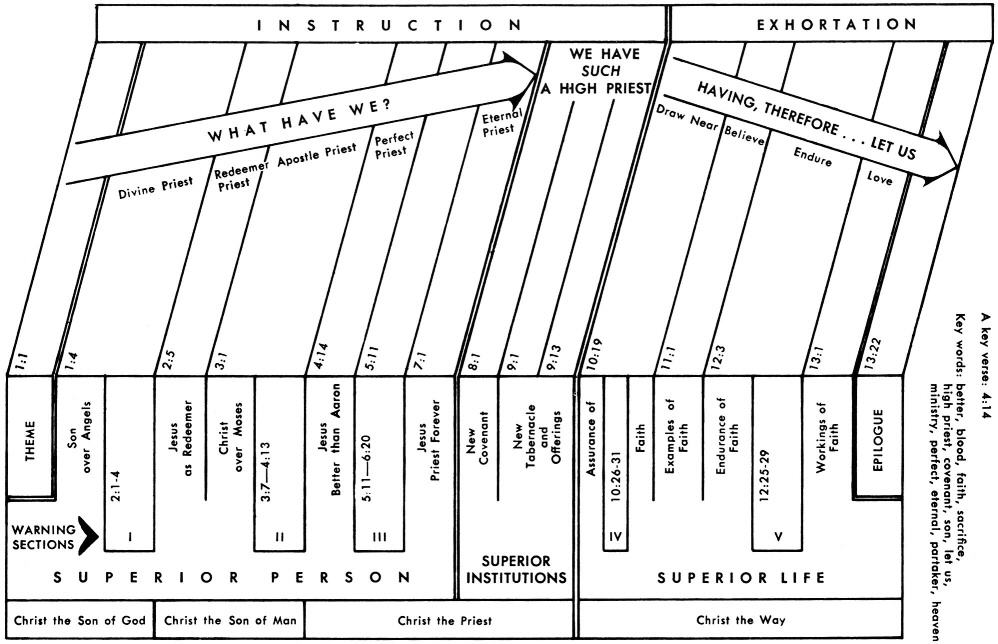
CONSIDER JESUS OUR GREAT HIGH PRIEST
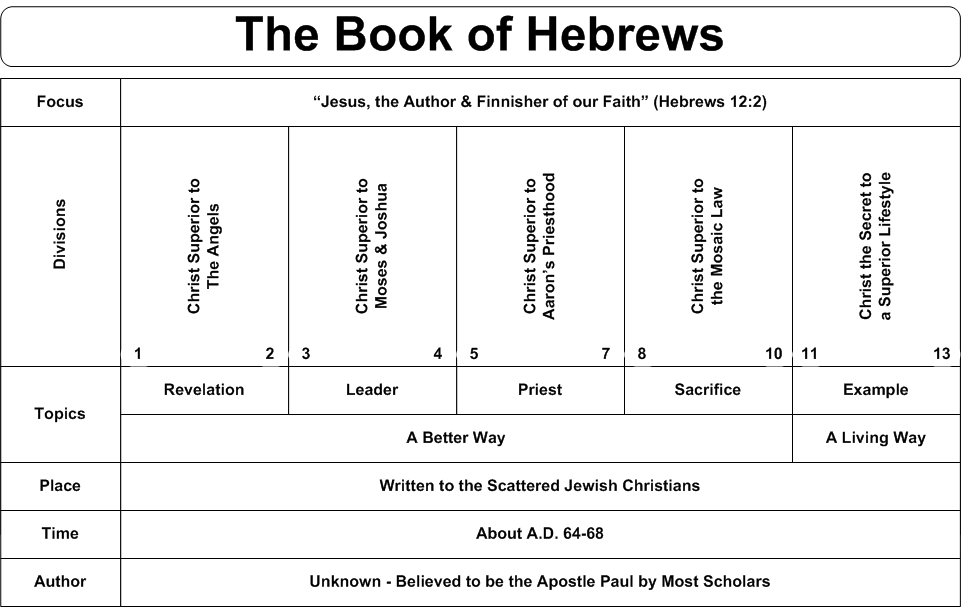
Click chart to enlarge
Charts from Jensen's Survey of the NT - used by permission
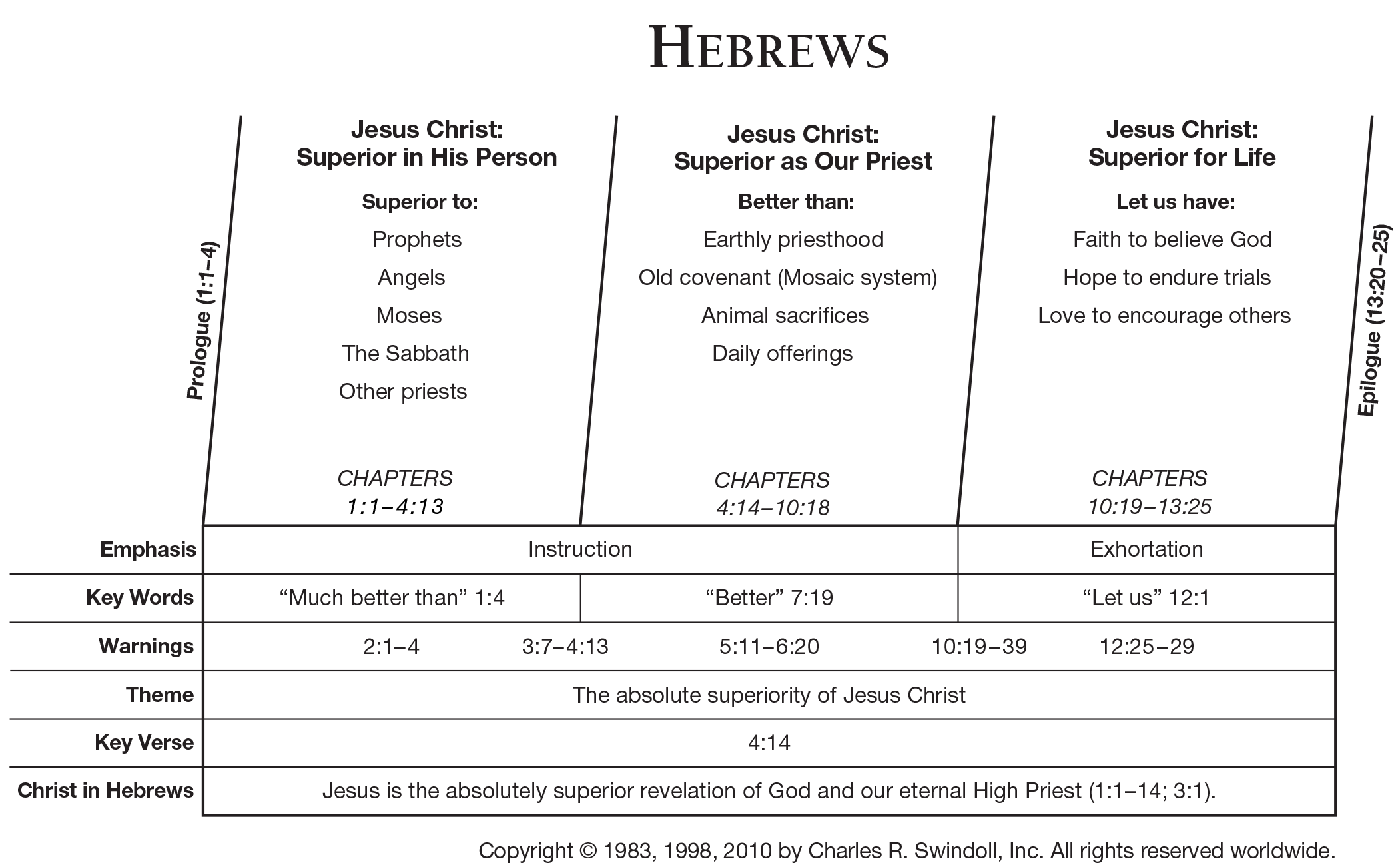
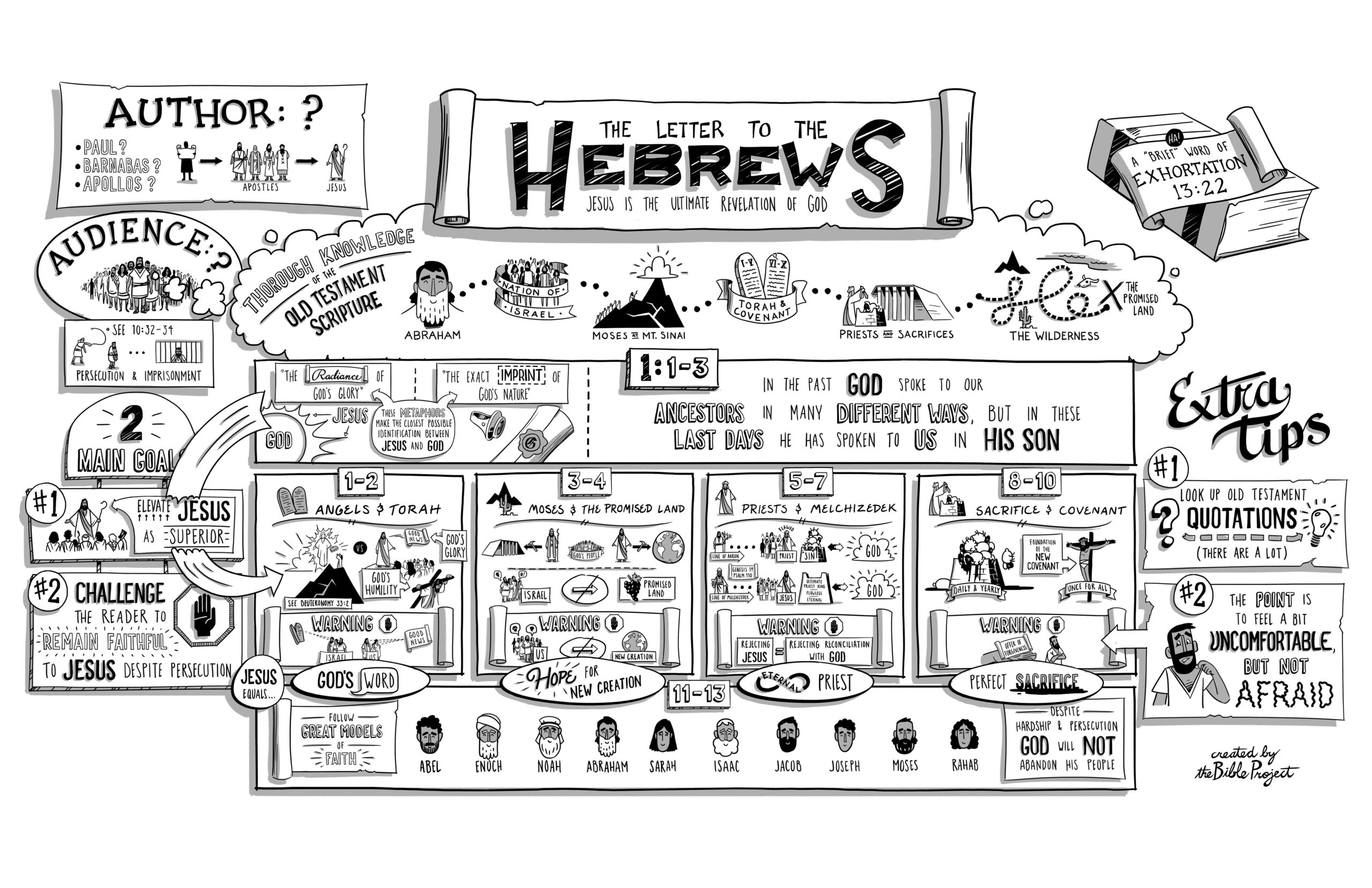
Swindoll's Chart, Interesting Pictorial Chart of Hebrews, Another Chart
|
The Epistle |
||||
| INSTRUCTION Hebrews 1-10:18 |
EXHORTATION Hebrews 10:19-13:25 |
|||
| Superior Person of Christ Hebrews 1:1-4:13 |
Superior Priest in Christ Hebrews 4:14-10:18 |
Superior Life In Christ Hebrews 10:19-13:25 |
||
| BETTER THAN PERSON Hebrews 1:1-4:13 |
BETTER PRIESTHOOD Heb 4:14-7:28 |
BETTER COVENANT Heb 8:1-13 |
BETTER SACRIFICE Heb 9:1-10:18 |
BETTER LIFE |
| MAJESTY OF CHRIST |
MINISTRY OF CHRIST |
MINISTERS FOR CHRIST |
||
|
DOCTRINE |
DUTY |
|||
|
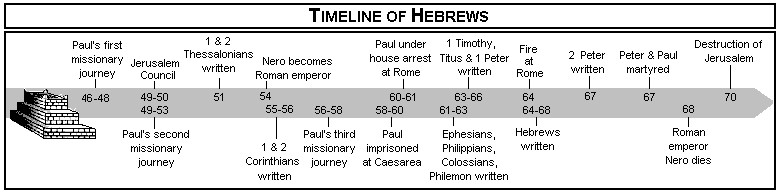
DATE WRITTEN: |
||||

See ESV Study Bible "Introduction to Hebrews"
(See also MacArthur's Introduction to Hebrews)
Borrow Ryrie Study Bible
Hebrews 13:20 Now the God of peace, who brought up from the dead the great Shepherd of the sheep through the blood of the eternal covenant, even Jesus our Lord, (NASB: Lockman)
Greek: O de theos tes eirenes, o anagagon (AAPMSN) ek nekron ton poimena ton probaton ton megan en aimati diathekes aioniou, ton kurion emon Iesoun,
Amplified: Now may the God of peace [Who is the Author and the Giver of peace], Who brought again from among the dead our Lord Jesus, that great Shepherd of the sheep, by the blood [that sealed, ratified] the everlasting agreement (covenant, testament) (Amplified Bible - Lockman)
My Amplified Paraphrase: “Now may the God of peace—the God Who restores, reconciles, and brings wholeness where sin has shattered life—the One who brought up from the dead our Lord Jesus, vindicating His sacrifice and demonstrating His eternal victory over death—that great Shepherd of the sheep, Who lovingly guards, guides, feeds, rescues, and tends His flock—through the blood of the eternal covenant, the once-for-all sacrifice that secured an unbreakable, everlasting relationship between God and His people—
(for continuity here is Hebrews 13:21) may He Himself equip you fully, supplying everything needed, shaping your character, strengthening your hands, and aligning your will, so that you may do His will, living in obedience and delighting in His purposes, as He works in us—by His Spirit, not our strength— that which is pleasing in His sight, producing in us a life that honors Him, through Jesus Christ, our Mediator and enabling Lord, to whom be the glory forever and ever. Amen.”
Barclay: May the God of peace, who brought up from among the dead the great shepherd of the sheep with the blood of the eternal covenant, it is our Lord Jesus I mean, (Westminster John Knox Press)
ESV: Now may the God of peace who brought again from the dead our Lord Jesus, the great shepherd of the sheep, by the blood of the eternal covenant, (ESV)
KJV: Now the God of peace, that brought again from the dead our Lord Jesus, that great shepherd of the sheep, through the blood of the everlasting covenant,
NET: Now may the God of peace who by the blood of the eternal covenant brought back from the dead the great shepherd of the sheep, our Lord Jesus Christ, (NET Bible)
NIV: May the God of peace, who through the blood of the eternal covenant brought back from the dead our Lord Jesus, that great Shepherd of the sheep, (NIV - IBS)
NLT: Now may the God of peace-- who brought up from the dead our Lord Jesus, the great Shepherd of the sheep, and ratified an eternal covenant with his blood-- (NLT - Tyndale House)
Phillips: Now the God of peace, who brought back from the dead that great shepherd of the sheep, our Lord Jesus, by the blood of the everlasting agreement, (Phillips: Touchstone)
Wuest: Now the God of peace, the One who brought up out from among the dead the Shepherd of the sheep, the Great One, in the blood of an eternal testament, our Lord Jesus,
YLT: And the God of the peace, who did bring up out of the dead the great shepherd of the sheep -- in the blood of an age-during covenant -- our Lord Jesus,
- The God of peace: Ro 15:33 Ro 16:20 1Co 14:33 2Co 13:11 Php 4:9 1Th 5:23 2Th 3:16
- Brought up (resurrected): Acts 2:24,32 3:15 4:10 5:30 10:40,41 13:30 17:31 Ro 1:4 Ro 4:24,25 Ro 8:11 1Co 6:14 15:15 2Co 4:14 Ga 1:1 Ep 1:20 Col 2:12 1Th 1:10 1Pe 1:21
- Great Shepherd: Ps 23:1 Ps 80:1 Isa 40:11 Is 63:11 Eze 20:37, Eze 34:23 37:24 Jn 10:11,14 1Pe 2:25 1Pe 5:4)
Related Passages:
Romans 10:7+ or ‘WHO WILL DESCEND INTO THE ABYSS?’ (that is, to bring Christ up [anago] from the dead).”
John 14:27+ “Peace I leave with you; My peace I give to you; not as the world gives do I give to you. Do not let your heart be troubled, nor let it be fearful.
John 16:33+ “These things I have spoken to you, so that in Me you may have peace. In the world you have tribulation, but take courage; I have overcome the world.”
Romans 6:4 Therefore we have been buried with Him through baptism into death, so that as Christ was raised from the dead through the glory of the Father, so we too might walk in newness of life.
1 Corinthians 15:20 But now Christ has been raised from the dead, the first fruits of those who are asleep.
Colossians 2:12 having been buried with Him in baptism, in which you were also raised up with Him through faith in the working of God, Who raised Him from the dead.
Psalm 23:1+ A Psalm of David. The LORD is my shepherd, I shall not want.
Isaiah 40:11 Like a shepherd He will tend His flock, In His arm He will gather the lambs And carry them in His bosom; He will gently lead the nursing ewes.
John 10:11, 14-15+ “I am the good shepherd; the good shepherd lays down His life for the sheep....14 “I am the good shepherd, and I know My own and My own know Me, 15 even as the Father knows Me and I know the Father; and I lay down My life for the sheep.
1 Peter 2:25+ For you were continually straying like sheep, but now you have returned to the Shepherd and Guardian of your souls.
1 Peter 5:4+ And when the Chief Shepherd appears, you will receive the unfading crown of glory.
Isaiah 53:6-7+ All of us like sheep have gone astray, Each of us has turned to his own way; But the LORD has caused the iniquity of us all To fall on Him. 7 He was oppressed and He was afflicted, Yet He did not open His mouth; Like a lamb that is led to slaughter, And like a sheep that is silent before its shearers, So He did not open His mouth.
Ezekiel 34:11-16 (A PROPHECY FOR ISRAEL IN THE FUTURE) For thus says the Lord GOD, “Behold, I Myself will search for My sheep and seek them out. 12 “As a shepherd cares for his herd in the day when he is among his scattered sheep, so I will care for My sheep and will deliver them from all the places to which they were scattered on a cloudy and gloomy day. 13 “I will bring them out from the peoples and gather them from the countries and bring them to their own land; and I will feed them on the mountains of Israel, by the streams, and in all the inhabited places of the land. 14 “I will feed them in a good pasture, and their grazing ground will be on the mountain heights of Israel. There they will lie down on good grazing ground and feed in rich pasture on the mountains of Israel. 15 “I will feed My flock and I will lead them to rest,” declares the Lord GOD. 16 “I will seek the lost, bring back the scattered, bind up the broken and strengthen the sick; but the fat and the strong I will destroy. I will feed them with judgment. Ezek. 34:23; 37:24).
POWERFUL PRAYER FOR
BLESSING FROM GOD OF PEACE
Hebrews 13:20–21 stands among the most powerfully worded blessings in all of Scripture. In these verses the writer gathers up his deepest pastoral concern for the readers’ spiritual growth and highlights the great realities that make such growth possible: the God of peace, the blood of the eternal covenant, the resurrection of Jesus, His shepherding care for His flock, the indwelling life of God, the equipping work of the Spirit, the aim of living in a way that pleases God, and the eternal glory and Lordship of Christ. All of this is woven together in one glorious outpouring of blessing—full of rich theology, tender encouragement, and confident certainty.
🙏 THOUGHT - Let me encourage you to commit Hebrews 13:20, 21 to memory, so that you may meditate deeply on its rich theology and regularly approach the throne of grace (Heb 4:16+), confidently praying this great prayer for yourself and interceding for the saints within your sphere of influence. And remember that prayers offered according to the will of God will assuredly be answered by God (see 1Jn 5:14,15+). If you would like more motivation, one of the most respected Bible teachers Ray Stedman adds that " Verses 20–21 must rank among the most powerfully worded blessings found in the Scripture."
Now (de) marks the writers transition from exhortation to his final benediction (Latin - bene = well + dicere = to speak) with a prayer that that invokes God’s active help for the saints to fulfill the commands he had just given. Supernatural commands always necessitate a supernatural power Source! The author has just finished a series of pastoral commands and personal requests (Heb 13:1–19). By using the word Now, he shifts from exhorting the readers to praying for them. NOW connects the benediction to his own personal prayer request (Heb 13:19). Having asked them "pray for me," he says NOW "I will pray for you."
James Rosscup astutely points out that "Having just asked for the intercessory support of others, the writer now intercedes for them." Chrysostom adds the writer "first ask their prayers (He 13:18), then prays for all blessing on them." Charles Spurgeon chimes in "As if to show that he did not ask of them what he was not himself willing to give, he utters this most wonderful prayer for them. He may confidently say to his congregation “Pray for me” who genuinely from his soul prays for them."
James Rosscup adds that "Two prayer passages in the verses that end the book are both intercessory in nature, here and in v. 25. This present prayer is intercessory (for God to “equip you”), and also petitionary (“working in us”), then it concludes with praise." The prayer flows in two great channels.Encouragement in God’s Past Work.
Charles Haddon Spurgeon - What the apostle was anxious to receive he was careful to bestow, and therefore he proceeded in the words of our text to plead for his brothers. From this we learn that if we desire others to pray for us we must set the example of praying for them. We cannot expect to be benefited by other men’s prayers unless the spirit of supplication dwells in us also. In this matter the Lord will give to us good measure pressed down, shaken, overflowing (Luke 6:38+), according as we give unto others. Other hearts shall be stirred up to intercede for us if we ourselves are diligent in intercession. Pray, if you would be prayed for. (Sermon)
The God of Peace (eirene) - He does not pray "may the peace of God" but "may the God of peace" the One able to make peace with sinners. This moniker would likely recall to most of the Hebrew readers the the sweet, refreshing breeze of the beautiful Hebrew word shalom (~ completeness, wholeness, harmony, fulfillment). "God alone is able to grant the kind of wholeness and healing—mentally, emotionally, spiritually, and socially—the beaten-up recipients of Hebrews needed." (Swindoll) God of peace means that He is either the source of peace (and gives peace) or that He Himself is characterized by peace. Both of course are true, but in context it is more logical to see Him as the Source from which peace flows to the saints. In other words, this title emphasizes that peace is not just something God gives, but is Who He is. His very nature is one of order, wholeness, and reconciliation, not confusion or chaos (1Co 14:33+). The title God of peace also reinforces the writer's argument that Jesus has offered the final, definitive “peace offering”—a sacrifice the Levitical priests were still presenting in the Temple. Their offerings merely foreshadowed the eternal peace secured by the once-for-all sacrifice of our Great High Priest (Heb 10:10–14+). The writer then highlights Christ’s resurrection, which served as the Father’s own divine exclamation point (!), publicly affirming His full satisfaction (propitiation) with this final “peace offering.” This recalls Paul’s declaration in Colossians 1:20+ that God purposed “through Him (Christ) to reconcile all things to Himself (God the Father), having made peace (eirēnē) through the blood of His cross.” Indeed, only a reconciled people could possibly receive the rich blessing expressed in the prayer that follows. As an aside, we do well to remember that the Old Testament saints—though they received real forgiveness—never enjoyed perfect peace of conscience (Heb 9:9–10; 9:14), a blessing we under the New Covenant far too easily take for granted.
This Name, God of peace, would have been encouraging to these Hebrew Christians who had experienced anything but peace from their persecutors! In other words this very Name, God of peace, would have spoken volumes to these weary saints, for this Name emphasizes that their peace clearly did not come from their circumstances, but from the God Who is Himself peace and Who gives inward peace as well as outward protection to those with whom He is in covenant. And while the God of peace in context refers specifically to God the Father, it is clear that the Father accomplishes His work through His Son, the Great Shepherd (and by the Spirit of Christ). It is through the Son’s once-for-all sacrifice that reconciliation and true peace were eternally secured, and therefore He alone is able to proclaim and impart the promise of peace to His people (see Jn 14:27+, Jn 16:33+).
In the context of what the writer has been expounding on the better priesthood of Christ and the better covenant (the new), this title for God is in part a reference to the peace Paul described in Romans 5 writing "Therefore (Ro 4:25+) having been justified by faith, we have peace WITH God through (THINK OF HIS MEDIATORIAL PRIESTHOOD) our Lord Jesus Christ." (Ro 5:1+) The thought of peace also recalls Paul's description in Eph 6:15+ "having shod YOUR FEET WITH THE PREPARATION OF THE GOSPEL OF PEACE."
James Rosscup describes another aspect of the peace of God asking "What peace is it that God gives? It is best to see both peace WITH God through His saving work that makes believers forever secure (Ro. 5:1+; Ro 8:28–39+), and the practical benefit of this in the peace OF God, i.e. the peace that God distills in the heart (Phil. 4:7+). that He gives for a daily sense of well-being. The latter is peace in calm composure that flows from the former. This is tranquility in dwelling on God’s sufficiency, serene adequacy that He gives to enable a sense of poise. The two aspects form a composite unity even as they are distinct, and both are vital, coming from God who provides peace for His people. (An Exposition on Prayer)
R C H Lenski on God of peace - “The God of the peace,” peace with the article in the sense of “the divine peace,” names him as the fountain of this schalom and conceives this εἰρήνη or peace objectively as the state or condition that is established by him, into which we enter, in which we dwell, which we are given to enjoy. It is “the peace” of God in the soteriological sense as the apposition shows. (Borrow Hebrews Commentary)
Philip E Hughes on God of peace - It is the God of this peace, which speaks forgiveness and acceptance to man at the very heart of his being and which should permeate the whole of his existence in all its relationships and vicissitudes, whom our author invokes here....The price of our peace was the blood of Jesus, that is, the sacrifice of the incarnate Son on the cross. The proof of the acceptance of this sacrifice on our behalf is His resurrection from the grave and His exaltation to the right hand of the Majesty on high (Heb. 1:3; 12:2), whereby He is declared to be Lord of all (Phil. 2:8–10). Had He not shed His blood for us He could not be our Savior. Had He not been brought again from the dead He could be neither Savior nor Lord. (A Commentary on the Epistle to the Hebrews)
Leon Morris on God of peace - Peace connotes the fullest prosperity of the whole man, taking up as it does the OT concept of the Hebrew shalom (see Heb 7:2+). Here it reminds us that it is God in Whom all our prosperity is centered. There is no well-rounded life that does not depend on him. The expression is especially suitable in view of what the epistle discloses of the condition of the readers. They have had to cope with some form of persecution and were still not free from opposition. They were tempted to go back from Christianity and have had to be warned of the dangers of apostasy. They may have had doubts about who their true leaders were. It is well for them to be reminded that real peace is in God. (BORROW Expositor's Bible Commentary)
Wuest adds the writer "speaks of God as the God of peace. The context here speaks of the substitutionary atonement of Messiah on the Cross, and the above expression reminds us of Paul’s words in Colossians 1:20, “Having made peace through the blood of His Cross.” That which separated a holy God from sinful man, namely, sin, was put away at the Cross. The death of Messiah paid for sin, satisfied the righteous demands of the broken law, and made it possible for God to bestow mercy on the basis of justice satisfied. We have an echo of all this in Ephesians 2:17, “And came and preached peace to you who are far off (the Gentiles) and to them that are nigh (the Jews).” (Hebrews - Wuest's word studies from the Greek New Testament)
John Phillips has an interesting comment on God of peace - War with God was begun, as far as man is concerned, in the Garden of Eden. Peace means that the war is over (Ro 5:10). God is the God of peace; only He can bring peace to the troubled heart and to a warning world. To turn one’s back upon Christ is to turn away from any hope of peace, for the Lord Jesus is “God’s great peace offer to men” (Luke 2:14+). Here, incidentally, is another oblique warning to the Hebrews not to turn away from God’s Son and thus reject His offer of peace. (Borrow Exploring Hebrews)
Paul uses this great title God of peace several times and along with fact that prayers are frequently found at the end of the Pauline epistles, which some lends credence to Paul as the author of Hebrews (see note on authorship).
Now the God of peace be with you all. Amen. (Ro 15:33+)
And the God of peace will soon crush Satan under your feet. The grace of our Lord Jesus be with you. (Ro 16:20+)
Comment: This verse offers a clear allusion to the promise (the protoevangelium) of Ge 3:15+, anticipating the final victory of Christ over Satan, when the Seed of the woman will crush the head of that old serpent [see Re 20:2+, Re 20:10+]. In the meantime, believers, who also in a sense are the woman's seed, can achieve local victories over Satan and his wiles by resisting him "steadfast in the faith" [1Pe 5:9+]. If we resist him with Scripture as Jesus did, testing and refuting his enticements with the Word (Mt 4:4,7,10+), then he will flee from us [James 4:7+], just as he did from Jesus, "until an opportune time" (Luke 4:13+)
God is not a God of confusion but of peace, as in all the churches of the saints. (1Cor 14:33+)
Comment: Confusion here refers to churches with uncontrolled and disorderly manifestations of tongues and supposed prophecies.
Finally, brethren, rejoice, be made complete, be comforted, be like-minded, live in peace; and the God of love and peace shall be with you. (2Cor 13:11+)
The things you have learned and received and heard and seen in me, practice these things; and the God of peace shall be with you. (Php 4:9+)
Now may the God of peace Himself sanctify you entirely; and may your spirit and soul and body be preserved complete, without blame at the coming of our Lord Jesus Christ. (1Thes 5:23+)
Now may the Lord of peace Himself continually grant you peace in every circumstance. The Lord be with you all! (2Thes 3:16+)
For all mankind there is only one of two choices, either to know God as "a consuming fire" (Heb 12:29+, cf Heb 10:31+) or to know God as "the God of peace", for…
Outside of Christ there is no peace…
Only those in Christ know peace
Like a River Glorious
Stayed upon Jehovah,
Hearts are fully blessed;
Finding, as He promised,
Perfect peace and rest.
--Frances Ridley Havergal
Do you know the "God of Peace" as your Lord and Savior? If not consider reading Billy Graham's online book entitled how to have Peace With God.
HE IS ALIVE!
Brought up (anago) from (ex - out of) the dead (nekros) - Jesus died a real death and was for a time among the dead. Clearly this is a reference to the resurrection of Jesus Christ from (out of) the dead. Brought up (anago) is not a common verb used for resurrection (egeiro more common) but it is very picturesque for it means to cause to go up from a lower place to a higher. Anago emphasizes movement upward, a divine “lifting,” an elevation from death to life, if you will.
Jesus truly died and entered the realm of the dead, and for a time was numbered among them. The phrase clearly points to the resurrection of Jesus Christ from (out of) the dead. Brought up (anago) is not the standard verb for resurrection (that would be egeiro), but it is wonderfully vivid. Anago was often used as a nautical term, meaning to bring a vessel up from the land to the deep water and put to sea (interesting to think about in context of the resurrection). Anagō means “to cause to go up from a lower place to a higher,” conveying upward movement—an elevation, a divine “lifting.” Resurrection is portrayed as an ascent, a divine upward movement. The writer is stressing not merely that Jesus came back to life, but that God the Father actively lifted Him up, raising Him to a higher, exalted position. It pictures the Father raising the Son from death to life, a deliberate ascent from the grave to resurrection glory. This picture aligns beautifully with Hebrews’ frequent imagery of Jesus ascending into the heavenly sanctuary as High Priest (Heb 4:14; Heb 9:11–12; Heb 10:12).
The prepostion from (ek) means more than out of highlighting the realm out of which Jesus emerged, out from among the dead. from (ek) marks a decisive separation from that realm. Finally, from (ek) describes a deliverance that only God could accomplish. The phrase signals not merely that Jesus was in the realm of the dead, but that He was brought out from it in triumph, leaving behind the domain of death, never to die again. Paul writes "that Christ, having been raised from the dead, is never to die again; death no longer is master over Him." (Romans 6:9+).
The dead (nekros) in this context with identifies this as the sphere or realm of death. Dead (nekros) is in the plural (so more literally "form among the dead ones") which generally refers not simply to corpses and here emphasizes resurrection out of all the dead, showing Jesus truly entered death’s realm and then was brought out from it (cf Ro 6:4+, 1Co 15:20+, Col 2:12+). Dead in the plural describes the domain of the dead, the collective company of those in the grave and emphasizes the full reality of Christ’s physical death—He truly entered death, the same realm into which all humans go. But unlike all others, He did not remain there; He was brought up (anago) from out of (ek) that realm, never to return to corruption (Acts 13:34–35). Christ’s resurrection was a real, bodily resurrection from among others who remained dead at that moment, Jesus becoming the firstfruits, guaranteeing that all united to Him by faith would also rise to eternal life (1 Cor 15:22, 23+, 2Co 4:14+, Ro 8:11+, Eph 5:14+).
In summary, the writer intentionally chooses this upward-movement verb (anago) to connect Christ’s resurrection with His ascension (since anagō often describes upward movement toward God), His exaltation as the Great Shepherd, the Father’s vindication of His “peace offering” sacrifice, and the inauguration of the “eternal covenant.” The resurrection is the Father’s public declaration “The sacrifice of My Son is accepted, sufficient, final, and eternally effective.”
Notice how the writer arranges the benediction from resurrection to shepherding to equipping making it is a "resurrection-powered" blessing. If God “brought up” Jesus from among the dead, raising Him out of the lowest place, lifting Him to the highest place, enthroning Him as the Great Shepherd, then the same God is fully able to “equip you in every good thing” (Heb 13:21). The resurrection is the guarantee of the believer’s enablement. To say it another way, the God of peace Who did the greatest thing (raising Jesus out of death) can surely do the lesser thing (equip you to do His will - Heb 13:21).
Marvin Vincent points out that this is "The only direct reference in the epistle to the resurrection of Christ. Heb 6:2 refers to the resurrection of the dead generally. Anagein of raising the dead, only Ro 10:7. "
Spurgeon - We believe that Jesus assuredly died, and that He was buried in the tomb of Joseph of Arimathea, but that on the third day He rose again and departed the tomb, no more to die. This we most firmly believe to be a matter of fact; not a fiction, or a piece of poetry, but a matter of fact, like any other reliable history, and we accept it without question.
Simon Kistemaker makes an interesting comment that tends to make Paul less likely to be the author - He (writer) cannot claim to be a witness of Jesus’ resurrection (ED: PAUL OF COURSE WAS - Acts 9:3-6+). As a second-generation believer, he heard the gospel from the immediate followers of Jesus (Heb 2:3). The author, then, briefly states that God raised Jesus from the dead and links this reference to Jesus’ office. (Borrow Hebrews Commentary)
Henry Morris - The same Greek word (anago) is used in Acts 16:39. As the magistrates brought out Paul and Silas from the prison, so did God bring forth the Lord Jesus from death and the grave. This is the only direct reference to Christ's resurrection in the book of Hebrews, although inferences and applications of that great event abound throughout the book. (Hebrews 13)
The great Shepherd (poimen) of the sheep (probaton) - It is notable that the designation of Jesus as a Shepherd is striking because in Jesus' day shepherds were not considered prestigious and were often viewed as untrustworthy. Yet the writer of Hebrews deliberately calls Christ the “great Shepherd,” effectively giving the metaphor an exalted status! Jesus is great in comparison with all other shepherds—who, beside Him, fade into insignificance—and He is therefore utterly unique. This description of Jesus as shepherd would conger up to the Jewish readers the frequent Old Testament allusions (prophecies) to God as their Shepherd. For example, when the religious shepherds of Israel failed to shepherd the sheep (Ezek 34:2-10, Isa 56:11, Jer 23:1, Jer 50:6), God promised a coming Shepherd-King (Ezek 34:11–16), the Messiah as Shepherd (Micah 5:4+), a promise Jesus fulfilled in John 10:11-15+. Indeed, the writer does not designate Jesus as merely “A shepherd,” but as “THE Shepherd—the great One,” underscoring His utterly unique status and supreme, incomparable role among all who shepherd God’s people and the One Who fulfilled the OT prophectic promises to Israel.
Grant Osborne on great Shepherd adds in light of the poor shephers in Israel's history "in longing for faithful leaders for the nation, the concept came to be associated with the coming of Messiah in Second Temple Judaism, as well as the New Testament (for example, John 10:11–18; 1 Pet 2:25). (See Hebrews Verse by Verse)
Regarding the adjective great (megas), Jesus is “great” in at least three ways: (1) Great in His Qualification. He is the divine Son and utterly righteous. Unlike earthly shepherds, He is both man and God, able to save and to intercede (Heb. 7:25). (2) Great in His Sacrifice: He became “the Shepherd Who was struck” (Zechariah 13:7; Matthew 26:31). By His blood — “the blood of the eternal covenant” — He purchased His flock, securing eternal redemption. (3) Great in His Exaltation: God “brought Him again from the dead” (Heb 13:20), and now He shepherds His people not in weakness but in resurrection power. The greatness of Jesus reminds me of an old praise song "If you wanna be great in God's kingdom, learn to be the servant of all."
Warren Wiersbe adds "As the Good Shepherd, Jesus Christ died for the sheep (John 10:11). As the Great Shepherd, He lives for the sheep in heaven today, working on their behalf. As the Chief Shepherd, He will come for the sheep at His return (1 Peter 5:4). Our Shepherd cares for His own in the past, present, and future. He is the same yesterday, today, and forever! (Heb 13:8) Our Great High Priest is also our Great Shepherd. When He was on earth, He worked for us when He completed the great work of redemption (John 17:4). Now that He is in heaven, He is working in us to mature us in His will and bring us to a place of spiritual perfection. We will never reach that place until He returns (1 John 2:28–3:3); but while we are waiting, we are told to continue to grow. (Bible Exposition Commentary)
Swindoll points out that "This association between Jesus as “our Lord” and as the “great Shepherd” is a final strong affirmation of the deity of Christ."
Simon Kistemaker on great Shepherd - In effect, the metaphor of the shepherd who dies for his sheep is equivalent to that of the high priest who offers himself as a sacrifice for his people. Especially the adjective great is telling, for the writer of Hebrews calls Jesus the great high priest (4:14). The two concepts, then, complement each other, although as Guthrie observes, “There is a tender aspect to the shepherd figure which is not as vivid in the high priest.” (Borrow Hebrews Commentary)
A. W. Pink explains "There are three main passages in the N.T. where Christ is viewed in this particular character. He is "the good Shepherd" (John 10:11) in death, the "great Shepherd" in resurrection, and the "chief Shepherd" in glory (1 Peter 5:4). The "great Shepherd" of the sheep calls attention to the excellency of His person, while the "chief Shepherd" emphasizes His superiority over all His under-shepherds or pastors, the One from whom they receive their authority. How jealously the Holy Spirit guarded the glory of Christ at every point: He is not only the "Shepherd" but "that great Shepherd," just as He is not only High Priest, but our "great High Priest" (Hebrews 4:14), and not merely King, but "the King of kings." (Hebrews 13:20-21 Commentary)
R C H Lenski on great Shepherd - Israel had other shepherds, but they died and passed on; this Shepherd is “the Great One” (note “Great High Priest” in Heb 4:14+) because God “brought Him again from the dead” by a glorious resurrection and did this “in connection with blood of an eternal testament.”....No other shepherd like this one did Israel ever have. (Borrow Hebrews Commentary)
C H Spurgeon distinguishes great Shepherd from good Shepherd - He is not the great Shepherd when He dies; He is the good Shepherd. He is the great Shepherd when He is brought again from the dead. In resurrection you perceive His greatness. He lies in the grave slumbering; He is the good Shepherd then, having laid down His life for the sheep. Life appears again in Him, the stone is rolled away, the watchmen are seized with terror, and He comes out the risen one, no more the dying—now He is the great Shepherd. In the covenant we are the sheep; the Lord Jesus is the Shepherd. You cannot make a covenant with sheep—they have not the ability to covenant. But you can make a covenant with the Shepherd for them, and so, glory be to God, though we had gone astray like lost sheep, we belonged to Jesus. He made a covenant on our behalf, and stood for us before the living God. It is very beautiful to trace the shepherds through the Old Testament, and to see Christ as Abel, the witnessing shepherd, pouring out the blood that cried from the ground; as Abraham, the separating shepherd, leading out his flock into the strange country where they dwelt alone; as Isaac, the quiet shepherd, digging wells for his flock, and feeding them in peace in the midst of the enemies; as Jacob, the shepherd who is surety for the sheep, who earns them all by long toils and weariness, separates them, and walks in the midst of them to Canaan, preserving them by his own lone midnight prayers. There, too, we see our Lord as Joseph, the shepherd who is head over Egypt for the sake of Israel, of whom his dying father said, “From there is the Shepherd, the Rock of Israel” (Gen 49:24). Head over all things for His church, the King who governs all the world for the sake of His elect, the great Shepherd of the sheep, who for their sakes has all power committed unto His hands. Then follows Moses, the chosen shepherd, who led his people through the wilderness up to the promised land, feeding them with manna and giving them drink from the smitten rock—what a wide theme for reflection here! And then there is David, the type of Jesus, reigning in the covenanted inheritance over his own people as a glorious king in the midst of them all. All these together enable us to see the varied glories of “that great Shepherd of the sheep.”
Johann Bengel quipped that "God brought the Shepherd; the Shepherd brings the flock. He brought Him from the depths, and set Him on high, where He may be seen by all. The apostle does not conclude, before he made mention of the resurrection of Christ. "The Great Shepherd of the sheep" (is) an appropriate appellation. You, says he, many ministers, He 13:17; but He is the Minister of all. I am absent from you, He 13:19; but God is not absent, nor will He be wanting to you. The allusion is to Isa 63:11, and by this allusion, the apostle at the very end of the epistle again and again prefers Christ to Moses, of whom Isaiah is speaking in the passage quoted above. (Gnomon of the New Testament)
Charles Simeon (Don't recognize his name? Then see John Piper's excellent biographical sketch) writes that
The very name which (the author) here assigns to God is deserving of particular notice—Under the Old-Testament dispensation, Jehovah was more generally called “the LORD of hosts (of armies):” but, under the New Testament, He is commended to us rather under the endearing character of the “God of Peace.” Between Him and us a reconciliation has been effected, by the mediation of His dear Son and so perfect is that reconciliation, that nothing but love is felt in His bosom towards us. In truth, every one of his attributes (See Summary of the Attributes of God) finds in this mystery its sublimest exercise; so that he is altogether a “God of Peace;” not having any more of adverse feeling towards us, than if mercy had been his only attribute.
But what has He done to assure our souls of “peace?” To death and the grave had Jesus been consigned as our Surety and our Substitute. And, if He had continued in the grave, however we might believe that He had undertaken for us, we could have no assurance that His sufferings had been accepted in our behalf. But Jehovah, having “brought him again from the dead,” has given us a proof, that what the Lord Jesus has done and suffered for us, has been effectual for our complete redemption.
Now we see, that “that great Shepherd of the sheep,” who “had laid down his life for them,” (Ed: The Shepherd became a Lamb! Jn 1:29, cp He 9:28+, 1Pe 2:24+) is re-invested with His office, which during His imprisonment in the grave seemed to have been suspended; and “all power is given to him,” to “save to the uttermost” (He 7:25KJV+) all who are brought into His fold, and committed to His care. Now we know, that whatever they need for protection, for sustenance, for healing, shall assuredly be imparted to them in "the hour of need:” (He 4:16+, Ezek. 34:11, 12, 13, 14, 15, 16, 23, 24) “the lambs shall be carried in his bosom; and he will gently lead them that are with young;” (Is 40:11) and of those entrusted to Him, He will lose not so much as one: no power in the universe shall ever pluck them from His hands (Jn 10:27, 28, 29, 30). (Hebrews 13:20, 21 Christian Principles Improved in Prayer)
Phil Newton comments that "Two clear truths must stand out in our minds as we consider the power of God to raise the dead. First, the fact of the resurrection declares that God has accepted the death of Christ as sufficient for our eternal salvation. The blood of bulls and goats cannot take away sin. But how do we know that God accepted the blood of Christ as atonement for our sins? It is by the fact that He "brought up from the dead the great Shepherd of the sheep"! No other sacrificial victim was raised from the dead! All of the bulls and goats were temporary, but what Christ has done is final, complete, and eternal (He 10:10, 11, 12, 13, 14+). Second, because the "great Shepherd of the sheep" has been brought up from the dead, the sheep will follow! That is why we can wait for "a kingdom which cannot be shaken" (He 12:28+), and can seek "the city which is to come" (He 13:14+). Christ's resurrection gives us hope, vision, and assurance of God's power to save us eternally, and to bring us finally into His presence forever. (Hebrews 13:20-25 A Benediction for the New Year)
Related Resources:
- Is the resurrection of Jesus Christ true? | GotQuestions.org
- Why should I believe in Christ's resurrection? | GotQuestions.org
- Where was Jesus between His death and resurrection?.
- Why is the truth of the bodily resurrection of Jesus Christ so important?
Of the sheep (probaton) - Sheep are helpless without a shepherd. The sheep of Christ are those whom the Great Shepherd personally owns, guards, guides, and lays down His life for. The writer intentionally chooses the common biblical metaphor of sheep to emphasize several truths. The sheep belong to Him as emphasized by the genitive (“of the sheep”) which signals possession. Jesus is not a shepherd of some flock; He is the Shepherd of His own sheep a flock purchased with His blood (Acts 20:28; John 10:14). He provides for their care and protection, imagery which recalls the OT shepherd motif (Ps 23:1-5; Ezek 34:1-31), where the shepherd is responsible for the sheep’s safety, nourishment, restoration, and rescue. Sheep survive only because of the shepherd, which highlights our utter dependence on Him. Shepherd also speaks of His intimacy and close relationship to His sheep. In John 10, Jesus describes His sheep as those who “know His voice” and whom He “calls by name, so that the Shepherd knows each sheep personally. Sheep are vulnerable, prone to wander, and unable to defend themselves. By calling us “sheep,” the author underscores the need for the Shepherd’s ongoing ministry described in Heb 13:21 “to equip you… working in us.
Peace (1515) (eirene from verb eiro = to join or bind together that which has been separated) literally pictures the binding or joining together again of that which had been separated or divided and thus setting at one again, a meaning convey by the common expression of one “having it all together”. It follows that peace is the opposite of division or dissension. Peace as a state of concord and harmony is the opposite of war. Peace was used as a greeting or farewell corresponding to the Hebrew word shalom - "peace to you".
EIRENE IN HEBREWS - Heb. 7:2; Heb. 11:31; Heb. 12:14; Heb. 13:20;
Hebrews 7:2 to whom also Abraham apportioned a tenth part of all the spoils, was first of all, by the translation of his name, king of righteousness, and then also king of Salem, which is king of peace.
Hebrews 11:31 By faith Rahab the harlot did not perish along with those who were disobedient, after she had welcomed the spies in peace.
Hebrews 12:14 Pursue peace with all men, and the sanctification without which no one will see the Lord.
Hebrews 13:20 Now the God of peace, who brought up from the dead the great Shepherd of the sheep through the blood of the eternal covenant, even Jesus our Lord,
Brought up (321) (anago from ana = up, again + ago = bring or lead) literally describes movement from a lower to a higher point, in context clearly a description of the Resurrection. In ancient Greece, anago was used as a nautical term meaning to put out to sea, to set sail (See Acts 13:13; 28.11 Lk 8:22; passive voice = to be carried up). In Acts 7:41 anago is used of offering up a sacrifice, which is fascinating for in the present passage the author uses anago to describe the raising up (resurrection) of the slain Sacrifice Who was once for all time offered up as the Sacrificial Lamb! Paul uses anago as an allusion to the resurrection in Ro 10:7+. In secular use anago was often as a nautical term, to bring a vessel up from the land to the deep water; to put to sea (Acts 27:5, 12) and "set sail" in Acts 18:21, 20:3, 13; Acts 21:1,2, 21; Acts 28:10,11)
ANAGO - 23V - bring(2), brought(5), launched(1), led(2), put out to sea(4), putting out to sea(1), set sail(7), setting sail(1). Matt. 4:1; Lk. 2:22; Lk. 4:5; Lk. 8:22; Acts 7:41; Acts 9:39; Acts 12:4; Acts 13:13; Acts 16:11; Acts 16:34; Acts 18:21; Acts 20:3; Acts 20:13; Acts 21:1; Acts 21:2; Acts 27:2; Acts 27:4; Acts 27:12; Acts 27:21; Acts 28:10; Acts 28:11; Ro 10:7; Heb. 13:20
Gilbrant - Anagō is a combination of the preposition ana, “up” and the verb agō (70), “to lead.” As opposed to the simpler agō, anagō can refer to leading up to a higher place, or leading up to be judged, as a criminal is brought before a court. In the middle voice however, anagō came to be used for traveling by sea.
Anagō is used rather frequently in the Septuagint, particularly with reference to God bringing up the Israelites from Egypt, and of David bringing the ark up to Jerusalem after it is returned from the Philistines.
In the New Testament, Matthew and Luke both use anagō with reference to Jesus’ temptation; Matthew to refer to Jesus being led up into the wilderness (Mt 4:1), and Luke to refer to Satan leading Jesus up to a high mountain and showing Him the kingdoms of the world (Lk 4:5). It is also used in Ro 10:7 and Heb 13:20 in conjunction with ek nekrōn, “from the dead,” to refer to resurrection, or being brought up from the dead. Luke used anagō in Acts 12:4 in the sense of being brought up for trial, and also used it frequently in the middle voice to record traveling by sea (Acts 13:13; 16:11; 18:21; 27:21; 28:11). (Complete Biblical Library)
Shepherd (4166) (poimen; A T Robertson says poimen is from a root meaning to protect) (See verb poimaino = to shepherd) literally describes one who cares for a flock. One who herds, feeds, and tends a flock. A herdsman. A sheep herder. The main responsibility of the shepherd was to keep the flock intact, to protect and to provide for the sheep. Metaphorically poimen described one who assumes leadership or guardianship over a group of believers. As alluded to above, this title is applied to Jesus in several passages (Mt 26:31, Mk 14:27, Jn 10:11, 14, 16, 1Pe 2:25). A shepherd is one who carries out oversight, protecting, leading, encouraging, discipling, guarding, guiding and feeding ("feed and lead"). English dictionaries say that "to shepherd" means to guide, direct or guard in the manner of a shepherd.
Eadie commenting on poimen in Ephesians 4:11 says "The image of a shepherd with his flock pictures the relation of a spiritual leader to those committed to his charge.
Barclay comments that "Pastor is the Latin word for a shepherd. At this time the Christian Church was no more than a little island in a sea of paganism. The people who came into it were only one remove from their heathen lives; they were in constant danger of relapsing into heathenism; and the duty of the pastor was to shepherd his flock and keep them safe. (Barclay, W: The Daily Study Bible Series, Rev. ed. Philadelphia: The Westminster Press)
Related Resource: Dictionary article on Pastor
Ephesians 4:11 applies poimen metaphorically to the shepherd leader or pastor (NAS, ESV) of a flock of believers.
Webster says that our English word pastor is derived from from Latin pastor herdsman, from pascere to feed. The more conservative 1828 Webster defines pastor as "A minister of the gospel who has the charge of a church and congregation, whose duty is to watch over the people of his charge, and instruct them in the sacred doctrines of the Christian religion." Nelson's New illustrated Bible Dictionary defines pastor as "the feeder, protector, and guide, or shepherd, of a flock of God’s people in New Testament times."
Although not using the actual noun poimen, the implied shepherd in Lk 15:4-7 (cp Mt 18:12-14) is a figure for God Himself.
Larry Richards writes that "The verb poimaino means "to act as a shepherd," "to feed and care for the flock." In the Judaism of the first century, the occupation of a shepherd was considered demeaning, and shepherds were generally despised. However, the NT itself reflects the attitude of the OT, and the metaphor continues to be used to represent God's love for his people. (Richards, L O: Expository Dictionary of Bible Words: Regency)
In the Near East the citizens in a country were referred to as “herd” and the king as “shepherd,” and the OT and NT pick up this imagery. Because shepherds were the sole source of provision, protection, and control for sheep, in ancient Near Eastern usage “shepherd” came to be a term descriptive of political leaders. The law codes of Lipit-ishtar and Hammurabi each refer to the ruler as the divinely appointed shepherd of his people.
Jesus is the ultimate example of a "Good Shepherd" Who leads the sheep and protects the sheep (Jn 10:1-13) even to being willing to lay down His life. Jesus' willingness to die for His flock contrasts with hirelings who don't care for the sheep and will depart when the wolves come, leaving the sheep to be ravaged and destroyed. Jesus passes the responsibility of shepherding the flock to Peter (see John 21:15-17 = "Shepherd My sheep") and Peter passes on this same command to the leaders in each church.
Ralph Earle writes that a shepherd/pastor not only feeds, but also tends "the flock in every way… So a pastor should not only feed his flock each Sunday on the Word of God but tend his flock during the week… it is a great responsibility!… Homer, in his Iliad, refers to "pastors of the people" (poimena laon). The pastor is to be the shepherd of his flock… For pastors we would like to suggest a series of three sermons. The first would be on Psalm 22, depicting the Good Shepherd (John 10) who gives His life for the sheep. The second would be based on Psalm 23, where we see the Great Shepherd (Heb. 13:20) caring for His sheep. The third would be on Psalm 24, the Chief Shepherd in glory. (Word Meanings in the New Testament)
Wayne Detzler writes that shepherding was usually "delegated to a slave according to Josephus, who wrote about the time of the apostles. Earlier, in the writings of Homer, the word was used to describe royal rulers, who cared for and "shepherded" their people. In fact Homer said: "All kings are shepherds of the people." His authority supposedly rested on his ability to care for the people. Plato picked up the same idea, and asserted that the rulers of the emerging city states must "shepherd" their people. In the Septuagint Greek Old Testament this word is applied to leaders of every kind. The famous patriarchs of the Old Testament were shepherds, as is seen in the lives of Job, Abraham, Isaac, and Joseph. Furthermore, David was the model of a shepherd-king. From his pen came a great description of Jehovah as the Shepherd of His people (Ps. 23). The Messiah would also be the Shepherd of those who follow Him (Ezek. 34:23)… In one of the most famous discourses in the entire New Testament, Jesus described Himself as the Good Shepherd (John 10:1-18). The teaching implicit in this discourse is profound. It forms the whole concept of the Good Shepherd in the New Testament. The sheep willingly follow the Shepherd, but they will not come after a false shepherd (Jn 10:5). He protects them by lying down at the door of the fold (Jn 10:7). They follow Him, because they know His voice (Jn 10:4). All pretend-shepherds are dangerous, but the Good Shepherd died for the sheep (Jn 10:7-14). There are still sheep to be brought into His fold (Jn 10:16). The entire program of Christ, from the Cross to the crown, is summarized in this discourse. (New Testament Words in Today's Language).
TDNT - abridged online - The Palestinian Shepherd. Tending flocks and herds is an important part of the Palestinian economy in biblical times. The sheep and cattle have to roam widely, and caring for them is an independent and responsible job that can even involve danger. The Ancient Near East. Shepherd is a common designation for rulers and combines a number of associated tasks or attributes (e.g., in Babylon, Assyria, and Egypt). The gods may also be viewed as shepherds; thus Amun is a strong drover who guards his cattle. The OT. God is early called the Shepherd of Israel who goes before the flock (Ps. 68:7), guides it (Ps. 23:3), leads it to food and water (Ps. 23:2), protects it (Ps. 23:4), and carries its young (Is. 40:11). Embedded in the living piety of believers, the metaphor brings out the fact that the people is sheltered in God.
Marvin Vincent has a lengthy note on the related verb poimaino writing that "The word involves the whole office of the shepherd — guiding, guarding, folding, as well as feeding. Hence appropriate and often applied to the guides and guardians of others. Homer calls kings “the shepherds of the people.” To David the people said, “The Lord said to thee, Thou shalt feed (as a shepherd) my people Israel” (2 Sa 5:2; compare Ps. 78:70, 71, 72). God is often called a shepherd (Gen. 48:15; Ps. 23:1; 77:20; 80:1; Is. 40:11; Ezek. 34:11–31). Jesus calls himself the good shepherd (John 10:11). Peter, who is bidden by Jesus to shepherd his sheep (John 21:16, poimaine, Rev., tend), calls him the Shepherd of Souls (1 Peter 2:25- +), and the Chief Shepherd (1 Peter 5:4+); and in the Epistle to the Hebrews (Hebrews 13:20+), he is styled the great Shepherd of the sheep. In Revelation 2:27+, rule is literally to shepherd (Revelation 19:15+); but Christ will shepherd his enemies, not with the pastoral crook, but with a sceptre of iron. Finally, Jesus will perpetuate this name and office in heaven among his redeemed ones, for “the Lamb, which is in the midst of the throne, shall be their shepherd (Revelation 7:17+). In this verse the word governor is in harmony with the idea of shepherding, since the word hegoumenos originally means one who goes before, or leads the way, and suggests Christ’s words about the good shepherd in John 10:3, 4+: “He calleth his own sheep by name, and leadeth them out… He goeth before them, and the sheep follow him.” (1Peter 5: Greek Word Studies)
Related Resources:
Poimen - 18x in 17v in NAS - pastors(1), shepherd(13), shepherds(4).
Matthew 9:36 Seeing the people, He felt compassion for them, because they were distressed and dispirited like sheep without a shepherd.
Matthew 25:32 "All the nations will be gathered before Him; and He will separate them from one another, as the shepherd separates the sheep from the goats;
Matthew 26:31 (cp Mk 14:27) Then Jesus said to them, "You will all fall away because of Me this night, for it is written, 'I WILL STRIKE DOWN THE SHEPHERD, AND THE SHEEP OF THE FLOCK SHALL BE SCATTERED.'
Comment: An allusion to the crucifixion of Jesus, the Chief Shepherd.
Mark 6:34 When Jesus went ashore, He saw a large crowd, and He felt compassion for them because they were like sheep without a shepherd; and He began to teach them many things.
Comment: The picture of sheep without a shepherd is a recipe for disaster in the pasture. Notice what the Great Shepherd does for the sheep. Sheep need food and so He feeds them, teaching them "many things." Modern shepherds of the flock should do no less than follow in the Chief Shepherd's footsteps (1Pe 2:21). Dear pastor (shepherd), are you feeding your flock with pure food which will stabilize their walk and grow them into maturity? Nothing substitutes for the pure milk of the Word. In fact there will be no growth without intake of the pure Word of God. The result? The flock becomes like sheep without a shepherd and all manner of spiritual maladies will infect such a flock. Remember that you will have to give an account for failing to feed the flock (Heb 13:17, cp Lk 16:2, Ro 14:12, 2Cor 5:10, 11, 1Peter 5:4).
Mark 14:27 And Jesus said to them, "You will all fall away, because it is written, 'I WILL STRIKE DOWN THE SHEPHERD, AND THE SHEEP SHALL BE SCATTERED.'
A T Robertson: A common figure in Palestine. The sheep are usually white and the goats black. There are kids (eriphōn, eriphia) which have grazed together. The goats devastate a field of all herbage. “Indeed they have extirpated many species of trees which once covered the hills” (Tristram, Natural History of the Bible, pp. 89f.). The shepherd stands at the gate and taps the sheep to go to the right and the goats to the left.
Luke 2:8 In the same region there were some shepherds staying out in the fields and keeping (phulasso = to guard or protect. Present tense = continual vigilance - a good word to pastors over "sheep with souls!") watch (Greek = phulake = act of guarding) over their flock by night. (Literally - "keeping the night-watches.")
Comment: Observe the role of literal shepherds regarding animals. How greater responsibility and accountability is there for a shepherd keeping watch over human souls in this present darkness!
Henry Morris has an interesting note: It is unlikely that shepherds would be abiding in their fields in late December. Furthermore, the 70-mile journey from Nazareth to Bethlehem would probably have been too difficult for Mary in the winter. A more probable time would be late September, the time of the annual Feast of Tabernacles, when such travel was commonly accepted. Thus, it is rather commonly believed (though not certain) that Jesus' birth was around the last of September. The conception of Christ, however, may have taken place in late December of the previous year. Our Christmas celebration may well be recognized as an honored observation of the incarnation of "the Word made flesh" (John 1:14).
Luke 2:15 When the angels had gone away from them into heaven, the shepherds began saying to one another, "Let us go straight to Bethlehem then, and see this thing that has happened which the Lord has made known to us."
Luke 2:18 And all who heard it wondered at the things which were told them by the shepherds.
Luke 2:20 The shepherds went back, glorifying and praising God for all that they had heard and seen, just as had been told them.
John 10:2 "But he who enters by the door is a shepherd of the sheep.
John 10:11 "I am the good shepherd; the good shepherd lays down His life for the sheep.
Comment: "Note repetition of the article, “the shepherd the good one.”" (A T Robertson) Jesus' openly predicts His death "for the sheep" or in their place, a clear allusion to His substitutionary atonement on the Cross. Two contrasts are apparent in this passage. Shepherding sheep in Palestine was dangerous and if the shepherd was killed the shepherd's sheep would most likely would lose their lives. In contrast this Good Shepherd's death results in eternal life for His sheep! Another striking contrast is that the thief in John 10:10 takes the life of the sheep, while here the Good Shepherd lays down His life for the sheep.
John 10:12 "He who is a hired hand, and not a shepherd, who is not the owner of the sheep, sees the wolf coming, and leaves the sheep and flees, and the wolf snatches them and scatters them.
John 10:14 "I am the good shepherd, and I know My own and My own know Me,
John 10:16 "I have other sheep, which are not of this fold; I must bring them also, and they will hear My voice; and they will become one flock with one shepherd.
Ephesians 4:11+ And He gave some as apostles, and some as prophets, and some as evangelists, and some as pastors and teachers,
Hebrews 13:20 Now the God of peace, who brought up from the dead the great Shepherd of the sheep through the blood of the eternal covenant, even Jesus our Lord,
1 Peter 2:25+ For you were continually straying like sheep, but now you have returned to the Shepherd and Guardian of your souls.
Comment: Jesus is the Shepherd watches over and provides for the welfare of His flock.
1 Peter 5:4+ And when the Chief Shepherd appears, you will receive the unfading crown of glory.
Comment: Chief Shepherd is the only Biblical use of the Greek noun archipoimen (arche = chief + poimen) clearly referring to Jesus Christ as the Head over His Flock, the Church.
Poimen - 65v in the non-apocryphal Septuagint - Gen 4:2; 13:7f; 26:20; 29:8; 38:12, 20; 46:32, 34; 47:3; Ex 2:17, 19; Nu 27:17; 1 Sam 25:7; 2 Sam 24:17; 1Kgs 22:17; 2Kgs 10:12; 2 Chr 18:16; Job 1:16; 24:2; Eccl 12:11; Song 1:8; Isa 13:20; 32:14; 40:11; 63:11; Jer 2:8; 3:1, 3, 15; 6:3; 10:21; 12:10; 22:22; 23:1, 4; 25:34ff; 33:12; 43:12; 49:19; 50:6, 44; 51:23; Ezek 34:2, 5, 7, 8, 9, 10, 12, 23; 37:24; Amos 1:2; 3:12; Mic 5:5; Nah 3:18; Zech 10:3; 11:3, 5, 8, 15f; 13:7
Genesis 4:2 And again, she gave birth to his brother Abel. And Abel was a keeper (Lxx = poimen) of flocks, but Cain was a tiller of the ground.
Comment: Abel was occupied as shepherd over the flocks (sheep).
Jeremiah 2:8ESV The priests did not say, 'Where is the LORD?' Those who handle the law did not know me; the shepherds (Lxx = poimen) transgressed against me; the prophets prophesied by Baal and went after things that do not profit.
Comment: The shepherds or rulers of Israel (for the most part) did not know Jehovah.
Ezekiel 34:23 "Then I will set over them one shepherd, My servant David, and he will feed them; he will feed them himself and be their shepherd. 24 "And I, the LORD, will be their God, and My servant David will be prince among them; I, the LORD, have spoken.
Comment: Poimen in this passage is taken by many as a reference to the "greater David", the "Son of David", the Messiah, Who will reign over all the earth. While there is no question Messiah will reign as King of kings, even that phrase presupposes that there will be other "kings". In addition, let us compare Scripture with Scripture (always the best commentary!) Jeremiah 30:9 and Hosea 3:5.
Jeremiah 30:9 'But they shall serve the LORD their God and David their king, whom I will raise up for them.
Comment on Jeremiah 30:9: First, who is "they"? In context, Jeremiah is describing the time of Jacob's distress (Jer 30:7 - synonymous with the 3.5 year Great Tribulation) out of which 1/3 of the nation of Israel will be saved (Jer 30:8 compared with Zech 13:9). Believing Israel will enter into the next age, the Millennium. Just as in Ezekiel 34:24, Jeremiah also describes two individuals "the LORD their (believing Israel's) God" and "David their king." Further, Jeremiah says that David will be raised up for them (cp Da 12:13 - a promise to Daniel of resurrection at end of this present age, prior to the Messianic Age). What would be the role of a literally resurrected David? It is not unreasonable to assume that a literal resurrected David will shepherd Israel as their king. Ezekiel 34:24 specifically says he will be a prince or ruler over them (believing Israel). David as Israel's greatest king will rule over Israel as their king will be subject to the King of kings, the Messiah.
Henry Morris commenting on Ezekiel 34:24: In the millennial kingdom… it seems that David himself, resurrected from the dead with the other Old Testament saints… will sit upon the physical throne in Jerusalem (Jer 30:9; Ezekiel 37:24,25).
Sheep (4263) probaton from probaíno = to go before, walk ahead) is literally something that walks forward (a quadruped) and in context refers to a sheep. One of the most famous uses of probaton in the Septuagint is in Isaiah 53:6-7+ "All of us like sheep have gone astray, Each of us has turned to his own way; But the LORD has caused the iniquity of us all To fall on Him. He was oppressed and He was afflicted, Yet He did not open His mouth; Like a lamb that is led to slaughter, And like a sheep that is silent before its shearers, So He did not open His mouth. "
Gilbrant - The New Testament also uses probaton literally of sheep and figuratively of mankind. An excellent portrayal of this double use is found in John 10 where in verses 1-4 Jesus described the literal condition of sheep and then in verses 7-16,26,27 applied it figuratively to mankind. In the literal sense there are sheep who fall into a pit (Matthew 12:11,12), the one lost sheep (Matthew 18:12; Luke 15:4), and those sold in the temple for sacrifice (John 2:14,15). Figuratively, probaton is used of false prophets (Matthew 7:15), the multitudes for which Jesus felt compassion (Matthew 9:36; Mark 6:34; cf. Numbers 27:17), the house of Israel (Matthew 10:6; 15:24), Jesus’ disciples (as sheep in the midst of wolves, Matthew 10:16), the righteous who inherit the Kingdom (Matthew 25:32,33), and the Church (John 21:16,17; Hebrews 13:20). (Complete Biblical Library Greek-English Dictionary)
Zodhiates summarizes probaton - Generally, tá próbata were animals, but especially smaller animals such as sheep and goats (Matt. 7:15, "in the dress of sheep" [a.t.]; Mt 9:36; 10:16; 12:11, 12; 18:12; Mark 6:34; Luke 15:4, 6; John 2:14, 15; 10:1-4, 12, 13; Acts 8:32; Rom. 8:36; 1 Pet. 2:25; Rev. 18:13; Sept.: Gen. 12:16; 13:5; Ex. 12:3ff). In Attic and NT usage sheep are distinguished from goats (Matt. 25:32, 33). Figuratively of those under the care and watch of someone as sheep under a shepherd (Mt. 10:6; 15:24; 26:31; Mk 14:27; Jn 10:7, 8, 11, 15, 16; 21:16, 17; Heb. 13:20). (Borrow Complete Word Study Dictionary)
Gilbrant - Probaton denotes the domestic sheep used for religious sacrifice, food, and clothing. In classical Greek it is used generally to refer to four-footed domesticated animals such as horses and oxen, to smaller animals like sheep and goats, and especially for sheep in Attic Greek. Epictetus used probaton figuratively of men who needed guidance (Discourses 1.23.7; cf. Isaiah 53:6).(Ibid)
SHEEP IN DICTIONARY OF BIBLICAL IMAGERY - Sheep are the most frequently mentioned animal in the Bible, with nearly four hundred references if we include references to flocks. Additionally, the figure of the shepherd receives approximately one hundred references. This prominence grows out of two phenomena—the importance of sheep to the nomadic and agricultural life of the Hebrews, and the qualities of sheep and shepherds that made them particularly apt sources of metaphor for spiritual realities. Sheep were a central part of the Israelite economy from the earliest days (Gen 4:2). Abraham, Isaac, Moses, David and Amos were all shepherds (Gen 12:16; 26:14; Ex 3:1; 2 Sam 7:8; Amos 1:1). Shepherds were not always men; shepherdesses include Rebekah (Gen 29:9) and the daughters of Jethro (Ex 2:16). Raised for both food (milk and meat) and wool, sheep were a natural part of life in the arid eastern Mediterranean because they can survive with a minimum of water and grass and can be moved to new grazing and watering areas during dry times (see PASTURE). Sheep also figured prominently in the OT sacrificial system. Conditions of shepherding in ancient Palestine provide the foundation for figurative references. These conditions were very different from most modern practices. Sheep were not fenced in and left to fend for themselves. Instead they were totally dependent on shepherds for protection, grazing, watering, shelter and tending to injuries. In fact, sheep would not survive long without a shepherd. Sheep are not only dependent creatures; they are also singularly unintelligent, prone to wandering and unable to find their way to a sheepfold even when it is within sight. (CLICK HERE FOR THE FULL ARTICLE ON SHEEP).
ILLUSTRATION - In 1555, Nicholas Ridley (martyr) was burned at the stake because of his witness for Christ. On the night before Ridley's execution, his brother offered to remain with him in the prison chamber to be of assistance and comfort. Nicholas declined the offer and replied that he meant to go to bed and sleep as quietly as ever he did in his life. Because he knew the peace of God, he could rest in the strength of the everlasting arms of his Lord to meet his need. So can we!
J. Ligon Duncan: Seven Things that undergird our ability to live the Christian Life – Hebrews 13:20-25
I. The Peace of God
II. The Power of God
III. The Providence of God
IV. The Propitiation provided by God
V. Everything Good: God’s good work in you makes your good work possible
VI. Everything good: Through Jesus Christ
VII. Everything Good: for His glory
Brian Bell - A PRAYER & AN APPEAL (Hebrews 13:20-25)
Peace is not the absence of trouble,
but the presence of God.
- This lovely benediction captures a number of the major themes of the epistle (e.g., peace, blood, covenant, resurrection, Shepherd, equipping).
- With such marvelous resources as these, who can excuse any failure to become the man or woman God intends you to be? (Ray Stedman; pg.158)
- A PRAYER (Hebrews 13:20,21)
- He asked for prayer and now prays for them.
- C. He extends Peace, Care and Promise to us.
- PEACE - The God of Peace [5 times in the NT]
- Divine tranquility. His personal Shalom.
- Jer.29:11 I know the thoughts that I think toward you, says the LORD, thoughts of shalom and not of evil.
- And this promise of peace was given to the children of Israel in the beginning of the Babylonian captivity.
- Peace is not the absence of trouble, but the presence of God.
- Slide17b No storm need to sink you Christian. Jesus said, Do not let your hearts be troubled and do not be afraid.
- CARE - The great (risen) Shepherd of the sheep
- There are 3 separate titles given to Christ, the Shepherd:
- The Good Shepherd who dies for the sheep [John 10:11; Ps. 22]
- The Great Shepherd who perfects the sheep [hear; Ps. 23]
- The Chief Shepherd who will come for the sheep [1Pet.5:4; Ps. 24]
- Dr. Bob Smith Philosophy professor at Bethel College in Minnesota makes a humorous point to his classes that sheep are the prima facie evidence against evolution. Sheep are so unintelligent & obtuse & defenseless, they could not have possibly evolved – the only way they could have survived is with a shepherd.
- Jesus took this term and applied it to Himself when he said, And Jesus, when He came out, saw a great multitude and was moved with compassion for them, because they were like sheep not having a shepherd. (Mt 9:36, Mk 6:34)
- He lives not only to give us life but also to tend us (care/look after), so we may bring Him glory.
- There are 3 separate titles given to Christ, the Shepherd:
- PROMISE - Through the blood of the everlasting covenant. [an eternal promise]
- This was the blood-shedding Christ Who made the covenant, procured the covenant, and sealed the covenant.
- PEACE - The God of Peace [5 times in the NT]
QUOTABLE QUOTE - Someone has said (I cannot find the source of the quote) that these two verses in Hebrews 13:20, 21 "must rank among the most powerfully worded blessings found in the Scripture. They gather up the passionate concern of the writer for his readers’ spiritual growth and stress the major factors that make such growth possible: the God of peace, the blood of the eternal covenant, the resurrection of Jesus, His Shepherd care for His sheep, the indwelling life of God Himself, the equipping of the Spirit, the aim to please God, and the eternal glory and Lordship of Jesus. It is all there in one glorious outpouring of good wishes and confident certainty. (And all God's people said "Amen! Thank You Lord!")
Andrew Murray - PRAYING TO PLEASE GOD
And now, may the God of peace, who brought again from the dead our Lord Jesus, equip you with all you need for doing his will HEBREWS 13:20
Hebrews 10:7–10 speaks about Christ doing God’s will as the cause of our redemption, the deep root in which our life stands. Further along, Hebrews 10:36 speaks about us—Christians—patiently doing God’s will even in the trials of this earth.
The prayer quoted above shows us how God’s will can be done in our lives. The same God who demonstrated His will in Christ for our redemption is working out that will in us, too. What God did in Christ is the pledge of what He will do in us. Christ doing the will of God secures our doing that will, too.
All that is said about the Lord Jesus refers to the previous teaching of this Epistle. It teaches about the covenant, the blood of the covenant, the exaltation of the throne, Christ as the Priest-King, the great Shepherd of the sheep. And now it says that the God of peace who did it all—who gave Christ to do His will and die on the cross, then raised Him from the dead—will equip us to do His will.
Surely this benediction, prayed for all of us, teaches us in a very practical way both how to pray and how to be prayed for.
C H Spurgeon - The blood of the everlasting covenant
“The blood of the everlasting covenant.” Hebrews 13:20
With regard to Christ, his precious blood shed in Gethsemane, in Gabbatha and Golgotha, is the fulfilment of the covenant. By this blood sin is cancelled; by Jesus’ agonies justice is satisfied; by his death the law is honoured; and by that precious blood in all its mediatorial efficacy, and in all its cleansing power, Christ fulfils all that he stipulated to do on behalf of his people towards God. Oh, believer, look to the blood of Christ, and remember that there is Christ’s part of the covenant carried out. And now, there remains nothing to be fulfilled but God’s part, there is nothing for thee to do; Jesus has done it all; there is nothing for free will to supply; Christ has done everything that God can demand. The blood is the fulfilment of the debtor’s side of the covenant, and now God becomes bound by his own solemn oath to show grace and mercy to all whom Christ has redeemed by his blood. With regard to the blood in another respect, it is to God the Father the bond of the covenant. When I see Christ dying on the cross, I see the everlasting God from that time, if I may use the term of him who ever must be free, bound by his own oath and covenant to carry out every stipulation. Does the covenant say, “A new heart will I give you, and a right spirit will I put within you?” It must be done, for Jesus died, and Jesus’ death is the seal of the covenant. Does it say, “I will sprinkle pure water upon you and you shall be clean; from all your iniquities will I cleanse you?” Then it must be done, for Christ has fulfilled his part.
Don Fortner - Hebrews 13:20 ‘The everlasting covenant’
Read Psalm 89:3–4, 19–37
Before the world was, when God dwelt alone in the bliss of his own ineffable glory, the three persons of the blessed Trinity held a council of peace and established an everlasting covenant of grace, by which the everlasting salvation of God’s elect and the glory of God in their salvation were guaranteed.
God the Father voluntarily agreed to save a people whom he had chosen in his own everlasting love. God the Son willingly agreed to be Surety for those people whom he and his Father loved. He volunteered to come in human flesh to obey the law as our Representative, establishing righteousness in the earth, and to suffer the penalty of the law as our Substitute, satisfying the justice of God for our sins. The Son of God asked the Father for the souls of his beloved people, to trust into his hands their immortal souls, their eternal salvation and the very glory of the eternal Godhead. And the Father, looking on his Son in absolute confidence, gave his Son all the host of his elect and declared them to be in Christ redeemed, justified, sanctified and glorified. God the Holy Spirit joyfully agreed to come in the fullness of time to each of those people who were chosen of the Father and for whom the Son had become Surety. He volunteered to regenerate them, call them, give them faith in Christ and preserve them unto the day of resurrection and everlasting glory.
Thus before the world began, God Almighty sovereignty arranged and secured the salvation of every sinner who would be saved by his grace. This is what God promised in that covenant: ‘They shall be my people, and I will be their God: and I will give them one heart, and one way, that they may fear me for ever, for the good of them, and of their children after them: and I will make an everlasting covenant with them, that I will not turn away from them, to do them good; but I will put my fear in their hearts, that they shall not depart from me’ (Jer. 32:38–40).
Character Made Up of Morsels—Heb. 13:20, 21.
I have just-come across a letter from an eminent clergyman to his son who was then in college, and is now one of the most successful business men in New York.
“It is easy, my son, to tell you how to be happy. Set your heart on God. Say to yourself, God made me, and has a right to me, and shall have my whole heart. Make it your business to prepare to be useful. Do nothing merely because you love to, unless it be right, and wise, and good. Do nothing that you will have to deny you did. Do nothing that you will be ashamed of having done. Do right. Do unto others as you would that they should do to you. Be the best scholar you can be. Lose no time; time is money.
“Read your Bible daily, and every day pray for heavenly wisdom. Refuse to be found in the company of vile men. Remember that character is made up of morsels; and every look and gesture, word, and smile, and frown, constitutes each its distinct morsels of that character.
“O my son, you can not cease to be till the sun goes out, and time runs out, and eternity wears out, and God shall cease to be. Now, one that must live so long, and whose happiness through all that long life depends wholly on character, can not take too much pains in forming that character just right. I embrace religion, of course, in my calculation respecting character. What will render us estimable in the sight of God, as well as in the sight of men, is above all price.
“It will soon be too late. The college character is fixed the first year; and the character for life fixed in college, and the character for eternity fixed in early life. Now you must love your Maker, or what can you love? must care for what he says, or whom can you care for or what? How tremendous are the months that are now rolling over you!—months that will tell on your character and destiny, when myriads of ages have rolled away.”
Daily Light on the Daily Path - Our Lord Jesus, the great shepherd of the sheep.
The chief Shepherd.—“I am the good shepherd. I know my own and my own know me. . . . My sheep hear my voice, and I know them, and they follow me. I give them eternal life, and they will never perish, and no one will snatch them out of my hand.” The Lord is my shepherd; I shall not want. He makes me lie down in green pastures. He leads me beside still waters. He restores my soul. He leads me in paths of righteousness for his name’s sake.
All we like sheep have gone astray; we have turned—every one—to his own way; and the Lord has laid on him the iniquity of us all.—“I am the good shepherd. The good shepherd lays down his life for the sheep.”—“I will seek the lost, and I will bring back the strayed, and I will bind up the injured, and I will strengthen the weak.”—For you were straying like sheep, but have now returned to the Shepherd and Overseer of your souls.
Heb. 13:20; 1 Pet. 5:4; John 10:14, 27–28; Ps. 23:1–3; Isa. 53:6; John 10:11; Ezek. 34:16; 1 Pet. 2:25
J J Knapp - The Great Shepherd of the Sheep Hebrews 13:20
The God of peace,—that is the Name by which we may call upon the most high Majesty, since He has called from death the great Shepherd of the sheep, the Shepherd who gave His life for the sheep, the great Shepherd, who is great according to His divine being, great according to the unlimited love of His heart, great in power and majesty, great in patience with His rebellious sheep, above all great, because He made the God of righteousness to be the God of peace.
The great Shepherd of the sheep, behold the Name, that our Lord Jesus Christ still bears after the resurrection, a Name in which is contained a world of tender faithfulness and guarding care. If He were only great in that He is sitting, clothed in power and glory, at the right hand of God the almighty Father, we would be frightened. However, since there is in Him a shepherd’s heart while He is on His throne, and the sceptre of His majesty is the lovely rod of the shepherd, all hindrances disappear, and we look up to Him in trust. We are led by the hand of a Shepherd, we are watched by the eye of a Shepherd, kept by the faithfulness of a Shepherd, comforted by the love of a Shepherd, of the great Shepherd of the sheep. The greatness in Him refers to His power, the shepherd-like to His kind mercifulness. Who would not gladly bow under His rod, walk in His ways, surrender to His care? Who would not voluntarily start to sing the psalm of the great Shepherd: “The LORD is my shepherd, I shall not want?”
The God of peace and the great Shepherd of the sheep! Two names in one breath, from which an unfathomable charm radiates to the restless sinner’s heart. They are moving in their loveliness, and allure by the love that shines from them. However, to be moved is not enough. Whoever is gathered in faith under the rod of the great Shepherd of the sheep, listens also to the prayer of the apostle: “Now the God of peace, that brought again from the dead our Lord Jesus, that great shepherd of the sheep, through the blood of the everlasting covenant, make you perfect in every good work to do his will, working in you that which is wellpleasing in his sight.” In doing His will it shall appear whether we have truly found peace with God by the blood of the eternal covenant. It is a will rich in love, because God is love. It is, even when we least comprehend it, a will that purposes our salvation, because, however incomprehensible and impossible His ways may be, He is the God of peace and of a complete salvation. His will be done by us on earth, as it is done by the angels of God in heaven! His Name be honoured by us in all things! His Kingdom come first of all in our heart,—the Kingdom of peace of the God of peace!
THE GREAT SHEPHERD—SATISFACTION GUARANTEED
HERE IS the Great Shepherd because He rose again from the dead, Heb. 13:20. We must not forget that He is the Good Shepherd, because He laid down His life, John 10:11, and the Chief Shepherd because He is coming back, 1 Pet. 5:4. There are so many ways in which this psalm can be enjoyed, but here we shall see how the truths of this psalm affect every side of our lives.
Beneath Me, v. 2, not just pastures, but green pastures and only the best for the feeding of the soul. “He maketh me to lie down”: sometimes we have to lie down in order to look up.
Beside Me, v. 2, “still waters” to calm the troubled breast. The restlessness of the world is portrayed in its art, music, speech, conduct and attitude as if it is looking for something it cannot find. Having Christ, we shall not want.
Leads Me, v. 3. Unlike the shepherds of the western world, the shepherd in the middle east will lead his sheep rather than drive them. A leader must lead. The leaders in the assemblies today must lead and not follow behind.
With Me, v. 4. We may talk about Christ in many places, but when we are in the valley, we talk to Him, for where there is a shadow there must be a light.
Before Me, v. 5. Can we still accept and believe that the Lord is able to feed us in the wilderness? Are we content with the things that we have? Notice where the table is!
Around me, v. 5. The table is in the presence of our enemies. As in the world but not of it, we are surrounded by hostility.
Above Me, v. 5, “thou anointest my head with oil”. Oil to soothe in the heat of the day, and to treat wounds, speaking of the work of the Holy Spirit. It is not a stagnant pool but a cup that runneth over that others may see what I have.
After Me, v. 6. The Great Shepherd leads, and goodness and mercy bring up the rear. This is not an occasional blessing, but a blessing that pursues me “all the days of my life”.
Ahead of Me, v. 6, “and I will dwell in the house of the Lord for ever”. The path may be rough and narrow, and dangerous at times, but we are surely getting there!
Look to the Son, and the shadows will fall behind. (D.R.)
The Shepherd - Joni E Taeda
…our Lord Jesus, that great Shepherd of the sheep… —Hebrews 13:20
Phillip Keller, a shepherd (and also an author), once wrote,
The day I bought my first thirty ewes, my neighbor and I sat on the dusty corral rails that enclosed the sheep pens and admired the choice, strong, well-bred ewes that had become mine. Turning to me he handed me a large, sharp, killing knife and remarked tersely, “Well, Phillip, they’re yours. Now you’ll have to put your mark on them.”
I knew exactly what he meant. Each sheep-man has his own distinctive earmark which he cuts into one or the other of the ears of his sheep. In this way, even at a distance, it is easy to determine to whom the sheep belongs. It was not the most pleasant procedure to catch each ewe in turn and lay her ear on a wooden block then notch it deeply with the razor-sharp edge of the knife. There was pain for both of us. But from our mutual suffering an indelible lifelong mark of ownership was made that could never be erased. And from then on every sheep that came into my possession would bear my mark.3
As a sheep of the Good Shepherd, you bear his mark, a cross. It may be painful, but it’s your mark of identification with your Shepherd. Ask yourself, “Do I recognize his right and claim over me? Do I respond to his authority? Bear the mark he’s given me?” If you do, you can exalt with the psalmist and say, “The Lord is my Shepherd!”
If his mark seems difficult to bear, remember: “He tends his flock like a shepherd: He gathers the lambs in his arms and carries them close to his heart; he gently leads those that have young” (Isa. 40:11).
Lord, I remember how you came to earth to give your life for us—all we are like sheep who have gone astray. Thank you for being our Shepherd. And thank you for laying your life down for your sheep—you, the Lamb of God.
THE SHEPHERD WHO HAS PROMISED TO SEE US THROUGH NIV, Once-A-Day: Walk with Jesus: 365 Days in the New Testament
Our Lord Jesus [is the] great Shepherd of the sheep. HEBREWS 13:20
Sheep have never been noted for their ability to fend for themselves. They are prone to wander, defenseless in the face of danger, easily “fleeced.” What the sheep lack, their shepherd must supply. This is no less true when the sheep are Christians.
The image of Christ as Shepherd is a consistent—and comforting—picture from the pages of Scripture: Psalm 23, John 10, Ezekiel 34.
H. A. Ironside offers these encouraging reminders about Jesus, your great Shepherd.
WALK WITH H. A. IRONSIDE
“The shepherd character of our Lord Jesus suggests loving care for his own. He has given us many pictures of his Shepherd-service.
“As the Good Shepherd he died for us. As the Great Shepherd he is ever watching over us. As the Chief Shepherd he will gather us all about himself when he comes again.
“His promises are sufficient for every difficulty. Yet in times of stress we forget them all, and worry and fret as though we had to meet all our problems ourselves, instead of trusting in his love and wisdom to undertake for us. He has promised to see us through.
“The One to whom we have committed our souls is more than a match for all that may rise against us. He is the unfailing shepherd, having our best interests in view. His glory and our blessing are indissolubly linked together.”
WALK CLOSER TO GOD
In Ezekiel 34 God harshly rebuked Israel’s shepherds for failing to do their job, and he gave his own description of the Good Shepherd: “I will tend them in a good pasture … I myself will tend my sheep and have them lie down … I will search for the lost and bring back the strays. I will bind up the injured and strengthen the weak” (Ezekiel 34:14–16).
That’s good news for sheep who are prone to wander!
John MacArthur on author and date of Hebrews - The author of Hebrews is unknown. Paul, Barnabas, Silas, Apollos, Luke, Philip, Priscilla, Aquila, and Clement of Rome have been suggested by different scholars, but the epistle’s vocabulary, style, and various literary characteristics do not clearly support any particular claim. It is significant that the writer includes himself among those people who had received confirmation of Christ’s message from others (Heb 2:3). That would seem to rule out someone like Paul who claimed that he had received such confirmation directly from God and not from men (Gal. 1:12). Whoever the author was, he preferred citing OT references from the Greek OT (LXX) rather than from the Hebrew text. Even the early church expressed various opinions on authorship, and current scholarship admits the puzzle still has no solution. Therefore, it seems best to accept the epistle’s anonymity. Ultimately, of course, the author was the Holy Spirit (2 Pet. 1:21+).
The use of the present tense in Hebrews 5:1–4; 7:21,23,27,28; 8:3–5,13; 9:6–9,13,25; 10:1,3,4,8,11; and Heb 13:10,11 would suggest that the Levitical priesthood and sacrificial system were still in operation when the epistle was composed. Since the temple was destroyed by General (later Emperor) Titus Vespasian in A.D. 70, the epistle must have been written prior to that date. In addition, it may be noted that Timothy had just been released from prison (Heb 13:23) and that persecution was becoming severe (Heb 10:32–39; 12:4; 13:3). These details suggest a date for the epistle around A.D. 67–69. (Introduction to Hebrews)
A REAL LIFE ILLUSTRATION OF "PEACE" - Jim Walton was translating the NT for the Muinane people of La Sabana in the jungles of Colombia. But he was having trouble with the word peace. During this time, Fernando, the village chief, was promised a 20-minute plane ride to a location that would have taken him 3 days to travel by walking. The plane was delayed in arriving at La Sabana, so Fernando departed on foot. When the plane finally came, a runner took off to bring Fernando back. But by the time he had returned, the plane had left. Fernando was livid because of the mix-up. He went to Jim and launched into an angry tirade. Fortunately, Walton had taped the chief's diatribe. When he later translated it, he discovered that the chief kept repeating the phrase, "I don't have one heart." Jim asked other villagers what having "one heart" meant, and he found that it was like saying, "There is nothing between you and the other person." That, Walton realized, was just what he needed to translate the word peace. To have peace with God means that there is nothing--no sin, no guilt, no condemnation--that separates us. And that peace with God is possible only through Christ (Ro 5:1+). Do you have "one heart" with God today?
Phil Newton on meaning of PEACE - We would be foolish to think that every person is concerned about peace or understands it. William Bates, a 17th century Puritan pastor that was ejected with 2500 other ministers due to their non-conformity to church law, preached his final sermon to his church on this text. Difficult days lay ahead for him and his church, and he knew they all needed to rest in "the God of peace." With the Day of Ejection there was not only loss of position but also loss of income and stability. Some 3000 nonconformists were put to death and 60,000 families faced ruin with the ironclad rule of Charles II and his demand for all England to conform to the rituals of the Book of Common Prayer. Many of the ministers were destitute because of this, but not without peace. Bates remarked, "There is a false peace which doth not arise from the knowledge of a man's happiness, but from the ignorance of this misery" [i.e., presumption toward God and the misery of not knowing the peace of God]. And then he explains, "They are only capable of true peace, by the knowledge of that which is false" [Farewell Sermons, SDG, 165]. (Hebrews 13:20-25 A Benediction for the New Year)
Note the many wonderful appellations of God in the New Testament. Not only is He "the God of peace" but He is also…
- The God of Israel (Mt 15:31)
- The God Abraham, the God of Isaac and the God of Jacob (Mt 22:32, Acts 3:13)
- (Not) The God of the dead but of the living (Mt 22:32)
- The God of glory (Acts 7:2)
- The God of patience and consolation (Ro 15:5KJV, Ro 15:5NAS)
- The God of hope (Ro 15:13)
- The God of all comfort (2Co 1:3)
- The God of love and peace (2Co 13:11)
- The God of our Lord Jesus Christ (Ep 1:17)
- The God of all grace (1Pe 5:10)
- The God of heaven (Re 11:13, Re 16:11)
- The God of the spirits of the prophets (Re 22:6)
Related Resources: In Scripture Name = Character. For a life changing study consider studying the Name of the LORD (Note the "promise" in Pr 18:10+ ). You will discover a study of God's Names is essentially a "short course" on His Attributes and I can assure you it will not be drudgery but a delight!
- Jehovah Roi: The Lord is My Shepherd - Part 1
- Jehovah Roi: The Lord is My Shepherd- Part 2
- Name of the LORD is a Strong Tower: Summary
- Name of the LORD is a Strong Tower: Why Should You Study It?
- Jehovah: I Am
- Jehovah Ezer: The LORD our Helper:
- Jehovah Jireh: The LORD Will Provide:
- Jehovah Rapha: The LORD our Healer
- Jehovah Sabaoth, LORD of hosts
- Jehovah Sabaoth: Part 2
- Jehovah Mekeddeshem: LORD Who Sanctifies
- Jehovah Nissi: The LORD Our Banner
- Jehovah Nissi: Exposition of Exodus 17:8-16
- Jehovah Shalom -Part 1: The LORD our Peace
- Jehovah Shalom - Part 2
- Jehovah Shammah - The LORD is There
- Elohim: My Creator
- El Elyon: Most High God - Sovereign Over All
- Adonai - My Lord, My Master
- El Roi: God Who Sees
- EL Shaddai - God Almighty
- Our Stronghold sermon by C H Spurgeon on Pr 18:10
THROUGH THE BLOOD OF THE ETERNAL COVENANT EVEN JESUS OUR LORD: en haimati diathekes aioniou ton kurion hemon Iesoun:
- The Blood: He 9:20 He 10:22 Ex 24:8 Zec 9:11 Mt 26:28 Mk 14:24 Lk 22:20
- Eternal: 2Sa 23:5 1Ch 16:17 Isa 55:3 61:8 Jer 32:40 Eze 37:26
- Covenant: He 9:16, 17
Related Passages:
Hebrews 9:22 And according to the Law, one may almost say, all things are cleansed with blood, and without shedding of blood there is no forgiveness.
Hebrews 8:6+ But now He has obtained a more excellent ministry, by as much as He is also the mediator of a better covenant, which has been enacted on better promises.
THE BLOOD COVENANT
ENDURES FOREVER!
Through the blood (haima) of the eternal (aionios) covenant (diatheke) even Jesus our Lord (kurios) - Through the blood (haima) explains how the God of peace brought up (raised) the Great Shepherd from the dead (blood was the means) and how He secured peace and covenant blessings for His people. In Scripture, blood represents life given up in substitutionary atonement (Lev 17:11+, Mt 26:28+, Heb 9:22+). Thus the resurrection of Christ in Heb 13:20 is grounded in His atoning death. The God of peace brought Him up because His sacrificial blood fully satisfied divine justice.
Ray Stedman - the blood of the eternal covenant recalls all the writer has said in chapters 8–10 about the opening of a new and living way to God;
The eternal (aionios) covenant (diatheke) identifies Christ’s blood as the ratifying seal of the new covenant (Jer 31:31–34; Luke 22:20). It is surprising that this is the only time in Hebrews the covenant is called eternal. (along with only mention of resurrection and Jesus as Shepherd). It is an eternal covenant because it is eternal in origin being rooted in the eternal counsel of the Triune God (cf. Eph 1:4–7, Rev 13:8+). It is eternal in effect so that its blessings (forgiveness, new hearts, the indwelling Spirit, and final glory) can never be revoked. It is eternal in scope because it secures a salvation that endures forever (Heb 5:9; Heb 7:25). The eternal covenant is permanent and will never be replaced (Hebrews 8:13) The eternal covenant presents a striking contrast with the Old Covenant (some might still be tempted to return to) which was temporary, external, priest-dependent, and marked by repeated sacrifices. The eternal covenant is unbreakable, internal, Spirit-empowered, and grounded in a once-for-all sacrifice of the precious blood of Christ and never needs repeating (cf "paid in full" = "it is finished" Jn 19:30+). The eternal covenant secures our eternal redemption (Heb 9:12+) and eternal inheritance (Heb 9:15+). The eternal covenant fulfills God's promise to Israel that He would make an everlasting covenant with them and would not turn away from them, putting the fear of Him in their hearts so that they would not turn away from Him (Jer 32:40+ see New Covenant in the Old Testament).
If you have entered into this binding eternal New Covenant by grace through faith (Eph 2:8-9+), your salvation is forever secure. Stated another way, your salvation is eternally assured in Christ Who eternally bears the "covenant" marks (scars) which will forever testify to the everlasting nature of His covenant with those released from their sins by His blood (cp Rev 5:6+, Rev 1:5+)! You ABSOLUTELY CANNOT LOSE YOUR SALVATION (assuming you were genuinely saved)!
Spurgeon - The work He has done has pleased the Father, and therefore He has brought Him back from among the dead. His acceptance is ours: we are accepted in the Beloved (Eph 1:6). We make with God, after conversion, a covenant of gratitude; we come to Him sensible of what He has done for us, and we devote ourselves to Him. We set our seal to that covenant when in baptism we are united with His church. Day by day, as often as we come around the table of the breaking of bread, we renew the vow of our covenant, and thus we have personal intimacy with God. I cannot pray to Him except through the covenant of grace, and I know that I am not His child unless I am His: first through the covenant whereby Christ purchased me, and secondly through the covenant by which I have given up myself and dedicated all that I am and all that I have to Him.
John MacArthur - By that cross an eternal covenant was made (cf. Zech. 9:11; Ezek. 37:26). So the blood of Jesus our Lord is eternally powerful (unlike the repeated, temporary Old Covenant sacrifices) and satisfactory to God, thus He brought Him up from the dead. (See Hebrews Commentary - Page 451)
Henry Morris says "that "the blood of the covenant" is counted "an unholy thing" by apostates (He 10:29), but it sealed the new covenant as "everlasting." (Defender's Study Bible)
Kenneth Wuest - The words “through the blood of the everlasting covenant” are in a construction called in the Greek, the locative of sphere (SEE locative of sphere). The New Testament is called the eternal one, in contrast to the First Testament which was of a transitory nature. It was within the sphere of the eternal covenant that Messiah, having died for sinful man, was raised up from among those who are dead. He could not be a high priest after the order of Melchisedec if He were not raised from the dead. Sinful man needs a living Priest to give life to the believing sinner, not a dead priest merely to pay for his sins. Thus, it was provided within the New Testament that the priest who offered Himself for sacrifice, would be raised from the dead. We have a prophetic type of this in Aaron’s rod that budded. (Hebrews )
Marvin Vincent has a lengthy note on everlasting covenant - The phrase eternal covenant is Common in the Septuagint (LXX); see Ge. 9:16; 17:19; Lev 24:8; 2Sa 23:5; Jer. 39:40; Ezek 16:60. Const. with the great shepherd of the sheep. It may be granted that the raising of Christ from the dead, viewed as the consummation of the plan of salvation, was in the sphere of the blood of the covenant; nevertheless, the covenant is nowhere in the NT associated with the resurrection, but frequently with death, especially in this epistle. See Mt 26:28; Lk 22:20; Heb. 9:15, 16, 17+, He 9:20+. The connection of the blood of the covenant with Christ’s pastoral office gives a thoroughly scriptural sense, and one which exactly fits into the context. Christ becomes the great shepherd solely through the blood of the covenant. Compare Acts 20:28. Through this is brought about the new relation of the church with God described in He 8:10ff. This tallies perfectly with the conception of “the God of peace”; and the great Shepherd will assert the power of the eternal covenant of reconciliation and peace by perfecting His flock in every good work to do his will, working in them that which is well pleasing in his sight. With this agree Jer 50:5, 19; Ezek 34:25, and the entire chapter, see especially Ezek 34:12, 13,1 4, 15, 23, 31. In these verses the Shepherd of the Covenant appears as guiding, tending his flock, and leading them into fair and safe pastures. Comp. Isa. 63:11, 12, 13, 14, and Rev 7:17+
(even) Jesus our Lord (kurios) - This final phrase identifies Jesus as the one who mediates and fulfills the eternal covenant. He is not only the sacrificial Lamb but also the risen Lord and Shepherd (Hebrews 13:20). He is our Lord – meaning He has authority over us as believers. He is the mediator of the new covenant (Hebrews 9:15). He is the guarantor of a better covenant (Hebrews 7:22). By calling Him “our Lord,” the author of Hebrews reminds us that Jesus is not only the One Who died for us, but the One Who now rules over us, intercedes for us, and shepherds us.
And so we can summarize this great passage - God the Father, the “God of peace,” raised Jesus from the dead. Jesus, the “great Shepherd,” laid down His life for the sheep (John 10:11). His blood sealed the eternal covenant, securing forgiveness, transformation, and eternal life. As our Lord, He now reigns and intercedes for us (Hebrews 7:25).
What a friend we have in Jesus,
All our sins and griefs to bear!
What a privilege to carry
Everything to God in prayer!
O what peace we often forfeit,
O what needless pain we bear,
All because we do not carry
Everything to God in prayer!
—Joseph Scriven
Blood (129) haima is literally the red fluid that circulates in the heart, arteries, capillaries, and veins of a vertebrate animal carrying nourishment and oxygen to and bringing away waste products from all parts of the body and thus is essential for the preservation of life. Haima gives us English words like hemorrhage (Gk - haimorragia from haimo- + rragia from regnuo - to burst) English derivatives inclue hematology (study of blood) and "leukemia" which is from leuco (white) plus haima (blood), which is fitting as leukemia is a disease that affects the white blood cells. Derivatives of haima are : haimatekchusía (130), shedding of blood; haimorroéō (131), to hemorrhage. Haima was used to describe “descent” or “family” in ancient times. “To shed blood” is to destroy life.
Blood (haima) refers to blood as the basis of life or what constitutes the life of an individual. Jehovah explained that "the life of the flesh is in the blood, and I have given it to you on the altar to make atonement for your souls; for it is the blood by reason of the life that makes atonement.' (Lev 17:11+)
Blood is the basic component of a living organism. The shedding of Christ's blood (death) was the penalty price for sin. What was foreshadowed (shadow) in the Levitical system was realized (substance) at the Cross when the Son of God laid down His life in death and ransomed men from sin. His precious blood paid the ransom price for our redemption once and for all (Cf "Paid in full" = John 19:30+ 1Pe 1:18+; Rev 5:9+, Ro 3:24+; Ro 3:25+) Blood was also used in the cleansing rites on the annual day of atonement (Lev 16:1-5, 6-34+). (Related Resource: See discussion of Kinsman Redeemer) Compare the eternal covenant to that prophesied in Jer 32:40 - And I will make an everlasting covenant with them that I will not turn away from them, to do them good; and I will put the fear of Me in their hearts so that they will not turn away from Me." The everlasting covenant ("An august epithet" - Bengel) in Jeremiah 32:40 is the New Covenant (New Testament) sealed by the blood of the Lamb.
Zodhiates adds that "haima is used to denote life given up or offered as an atonement since, in the ritual of sacrifice, special emphasis is laid upon it as the material basis of the individual life. The life of the animal offered for propitiation appears in the blood separated from the flesh which the Jews were forbidden to eat (Ge. 9:4; Lev. 3:17; 17:10-14; Deut. 12:23; Heb. 9:7-13, 18-25; 11:28; 13:11). This life is, on the one hand, in the blood, presented to God; on the other hand by sprinkling, appropriated to man (Heb. 9:7, 19, 20). This blood thus becomes the blood of the covenant or testament (see diathekē) which God commanded to us (Heb. 9:20). (BORROW The Complete Word Study Dictionary: New Testament)
HAIMA IS A KEYWORD IN HEBREWS - 22X OUT OF 97X IN NT - Heb. 2:14; Heb. 9:7; Heb. 9:12; Heb. 9:13; Heb. 9:14; Heb. 9:18; Heb. 9:19; Heb. 9:20; Heb. 9:21; Heb. 9:22; Heb. 9:25; Heb. 10:4; Heb. 10:19; Heb. 10:29; Heb. 11:28; Heb. 12:4; Heb. 12:24; Heb. 13:11; Heb. 13:12; Heb. 13:20
Hebrews 2:14 Therefore, since the children share in flesh and blood,
Hebrews 9:7 only the high priest enters once a year, not without taking blood,
Hebrews 9:12 and not through the blood of goats and calves, but through His own blood
Hebrews 9:13 For if the blood of goats and bulls
Hebrews 9:14 how much more will the blood of Christ, who through the eternal Spirit offered Himself
Hebrews 9:18 even the first covenant was not inaugurated without blood.
Hebrews 9:19 he took the blood of the calves and the goats
Hebrews 9:20 saying, “THIS IS THE BLOOD OF THE COVENANT WHICH GOD COMMANDED YOU
Hebrews 9:21 he sprinkled both the tabernacle and all the vessels of the ministry with the blood
Hebrews 9:22 almost say, all things are cleansed with blood,
Hebrews 9:22 and without shedding of blood there is no forgiveness.
Hebrews 9:25 high priest enters the holy place year by year with blood that is not his own.
Hebrews 10:4 For it is impossible for the blood of bulls and goats to take away sins.
Hebrews 10:19 confidence to enter the holy place by the blood of Jesus,
Hebrews 10:29 has regarded as unclean the blood of the covenant by which he was sanctified
Hebrews 11:28 By faith he kept the Passover and the sprinkling of the blood
Hebrews 12:4 have not yet resisted to the point of shedding blood
Hebrews 12:24 Jesus, the mediator of a new covenant, and to the sprinkled blood
Hebrews 12:24 which speaks better than the blood of Abel.
Hebrews 13:11 For the bodies of those animals whose blood is brought into the holy place
Hebrews 13:12 He might sanctify the people through His own blood
Hebrews 13:20 the great Shepherd of the sheep through the blood of the eternal covenant
Spurgeon has the following sermons related to blood…
- Exodus 12:13 The Blood
- Hebrews 12:24-25 The Blood Of Sprinkling
- Hebrews 12:24-25 The Blood Of Sprinkling
- Hebrews 13:20 The Blood Of The Everlasting Covenant
- Hebrews 9:19-20 The Blood Of The Testament
- Hebrews 9:22 Blood-Shedding
Eternal (166) (aionios from aion) means perpetual eternal, everlasting, without beginning or end (as of God), that which is always.
Eternal is a key word (see description) used 6x in 6v in the book of Hebrews:
Covenant (1242) (diatheke from dia = two + tithemi = to place pictures that which is placed between two Thus, a covenant is something placed between two, an arrangement between two parties.) was a commonly used in the Greco-Roman world to define a legal transaction in settling an inheritance. Diatheke denotes an irrevocable decision, which cannot be cancelled by anyone. A prerequisite of its effectiveness before the law is the death of the disposer and thus diatheke was like a "final will and testament". In reference to the divine covenants, such as the Abrahamic covenant, diatheke is not a covenant in the sense that God came to agreement or compromise with fallen man as if signing a contract. Rather, it involves declaration of God’s unconditional promise to make Abraham and his seed the recipients of certain blessings.
DIATHEKE IN HEBREWS - Heb. 7:22; Heb. 8:6; Heb. 8:8; Heb. 8:9; Heb. 8:10; Heb. 9:4; Heb. 9:15; Heb. 9:16; Heb. 9:17; Heb. 9:20; Heb. 10:16; Heb. 10:29; Heb. 12:24; Heb. 13:20
Hebrews 7:22 so much the more also Jesus has become the guarantee of a better covenant.
Hebrews 8:6 But now He has obtained a more excellent ministry, by as much as He is also the mediator of a better covenant, which has been enacted on better promises.
Hebrews 8:8 For finding fault with them, He says, “BEHOLD, DAYS ARE COMING, SAYS THE LORD, WHEN I WILL EFFECT A NEW COVENANT WITH THE HOUSE OF ISRAEL AND WITH THE HOUSE OF JUDAH;
Hebrews 8:9 NOT LIKE THE COVENANT WHICH I MADE WITH THEIR FATHERS ON THE DAY WHEN I TOOK THEM BY THE HAND TO LEAD THEM OUT OF THE LAND OF EGYPT; FOR THEY DID NOT CONTINUE IN MY COVENANT, AND I DID NOT CARE FOR THEM, SAYS THE LORD.
Hebrews 8:10 “FOR THIS IS THE COVENANT THAT I WILL MAKE WITH THE HOUSE OF ISRAEL AFTER THOSE DAYS, SAYS THE LORD: I WILL PUT MY LAWS INTO THEIR MINDS, AND I WILL WRITE THEM ON THEIR HEARTS. AND I WILL BE THEIR GOD, AND THEY SHALL BE MY PEOPLE.
Hebrews 9:4 having a golden altar of incense and the ark of the covenant covered on all sides with gold, in which was a golden jar holding the manna, and Aaron’s rod which budded, and the tables of the covenant;
Hebrews 9:15 For this reason He is the mediator of a new covenant, so that, since a death has taken place for the redemption of the transgressions that were committed under the first covenant, those who have been called may receive the promise of the eternal inheritance.
Hebrews 9:16 For where a covenant is, there must of necessity be the death of the one who made it.
Hebrews 9:17 For a covenant is valid only when men are dead, for it is never in force while the one who made it lives.
Hebrews 9:20 saying, “THIS IS THE BLOOD OF THE COVENANT WHICH GOD COMMANDED YOU.”
Hebrews 10:16 “THIS IS THE COVENANT THAT I WILL MAKE WITH THEM AFTER THOSE DAYS, SAYS THE LORD: I WILL PUT MY LAWS UPON THEIR HEART, AND ON THEIR MIND I WILL WRITE THEM,” He then says,
Hebrews 10:29 How much severer punishment do you think he will deserve who has trampled under foot the Son of God, and has regarded as unclean the blood of the covenant by which he was sanctified, and has insulted the Spirit of grace?
Hebrews 12:24 and to Jesus, the mediator of a new covenant, and to the sprinkled blood, which speaks better than the blood of Abel.
Hebrews 13:20 Now the God of peace, who brought up from the dead the great Shepherd of the sheep through the blood of the eternal covenant, even Jesus our Lord,
Related Resources:
- Covenant: Abrahamic versus Mosaic
- Covenant: New Covenant in the Old Testament
- Covenant: Why the New is Better
- Covenant: Abrahamic vs Old vs New
SALVATION IS
BASED ON COVENANT
Charles Simeon encourages us to notice how the writer of Hebrews…
brings together, for the purpose of more deeply impressing our minds, and more largely unfolding to us the great mysteries of redemption. Here he traces up every thing to a covenant; a covenant made from all eternity between the Father and the Son, and in due season ratified and confirmed with the Redeemer’s blood. In that covenant, the Son of God engaged to assume our nature; and in that nature, to expiate our guilt by His own obedience unto death (Php 2:8+). The Father promised to accept His vicarious sacrifice, and to give Him a people who should be His joy and His glory through eternal ages.
In accordance with this covenant, Christ had laid down His life: and in agreement with it, the Father had now raised Him from the dead, and empowered Him to perfect the work He had undertaken. What a field of mysterious information is here opened to our view!
Every thing connected with our salvation is traced up to an everlasting covenant.
(Simon now asks a series of rhetorical questions) Is God reconciled to us, and become a “God of peace?” Has He, under this character, “raised from the dead the Lord Jesus?” Has He, for the accomplishment of His gracious purposes, invested His dear Son with “the pastoral office,” and committed us to Him as “His sheep?” All has been effected in conformity with an everlasting covenant, and from respect to that blood by which the covenant was confirmed.
And does not all this, at the same time that it opens to us the most mysterious truths, give us an assurance which nothing else could convey?
Yes, verily: for if the Lord Jesus were to suffer one of His sheep to be plucked out of His hand, or the Father were to refuse to impart to us one atom of what the Saviour has purchased for us, the covenant itself would be broken. But that covenant cannot be broken: and therefore every one, who believes in Christ, may be assured, that God is to him a “God of peace;” and that the reconciliation which has been effected shall never finally be dissolved. (Hebrews 13:20, 21 Christian Principles Improved in Prayer)
(Ed comment/question: If it is true that everything connected with our salvation can be traced to God's eternal covenant, does it not behoove believers to set aside some time and seriously study the essence of what is involved in covenant? I can vouch for the fact that the truths about covenant are not just informational but have the potential to be radically transformational in your life dear believer! See my brief testimony of the "miraculous" transformation that occurred in our marriage as the Spirit began to work on my wife and myself, specifically illumining our heart and mind regarding the liberating, reassuring truth of God's covenant - Covenant: As It Relates to Marriage)
Jerry Bridges - Hebrews 13:20–21
The title “God of peace” is only peaceful toward us because of the priesthood and sacrifice of “our Lord Jesus, the great shepherd of the sheep” and mediator “of the eternal covenant.” Because Christ’s blood atoned for our sins, God’s just anger was turned away, propitiated for us. Appeased and pacified because His holy justice was perfectly and eternally satisfied, He is no longer hostile and alienated; instead, He is friendly and intimate.
All this stands in stark contrast to those items often brought by misguided sinners to God in an attempt to pacify Gim and cause Gim to become peaceful toward them: self-sacrifice, self-abasement, self-loathing, self-righteousness, self-improvement, good excuses, good works, gifts, and service. None of that can begin to change our personal standing before a holy God Who is rightfully angry about even a single sin. All such attempts to please or appease God apart from Christ will fail. But the sinless life and sacrifice of Christ succeeded where we could not; and His finished work of atonement on our behalf is all we will ever need to enter and remain in relationship with “the God of peace.”
Christ represents as the priest
of His own sacrifice
The hard evidence of Christ’s success for us in living a perfect life and dying on our behalf consists of this: He was “brought again from the dead.” Christ’s actual, historical resurrection is indeed the ultimate proof that God is now a “God of peace” toward those Christ represents as the priest of His own sacrifice. Of course, God is now forever peaceful toward the Son. And because of that fact, He is peaceful toward those in Christ—the sheep for which He is the Great Shepherd. It is interesting to note that this is the only time in his letter that the author uses the shepherd metaphor. While he could have used it in many places, he saves it until the end. Perhaps it is for emphasis. Perhaps it is for comfort.
The writer then moves to reestablish a mighty truth—that progressive sanctification is only “by the blood of the eternal covenant,” as if this fact is worth repeating one more time, lest we forget. He firmly asserts that it is only on the basis of Christ’s great atonement that “the God of peace,” the great resurrector of “the great shepherd of the sheep,” will move to “equip [us] with everything good that [we] may do his will, working in us that which is pleasing in his sight, through Jesus Christ, to whom be glory forever and ever. Amen.”
He does not leave us to our own devices to transform ourselves
into his image by white-knuckled willpower or
other expressions of foolish self-sufficiency
Amen and amen because this means that with Christ as our representative, we are never on our own. He does not leave us to our own devices to transform ourselves into his image by white-knuckled willpower or other expressions of foolish self-sufficiency. He will “equip us . . . to do his will.” Furthermore, he will “work in us that which is pleasing in his sight” through Christ. Paul provides similar affirmation, declaring, “I am sure of this, that he who began a good work in you will bring it to completion at the day of Jesus Christ” (Phil. 1:6+) and, “for it is God who works in you, both to will and to work for his good pleasure” (Phil. 2:13NLT+).
Oh how important, no, how vital, this is! We must embrace and savor this truth about the unbreakable connectedness to God first through the atonement and second to God’s own further work in us. Otherwise we risk insulting both the cross of Christ and the power of the Holy Spirit by attempting to do it ourselves, on our own, by our own strength. (Gal 3:3+) What pride emanates from such an approach; it robs Christ of His due glory! No! No! No! To Him be the “glory forever and ever.” He deserves it and will have it. We do not deserve it, and we never will. If it were not for His offering, we would be nothing more than condemned criminals like Satan. If not for His ongoing work in us (ED: BY HIS SPIRIT - 2Co 3:18+), we would never grow at all. We would never be justified, we would never be sanctified, we would never be glorified (ED: SEE Three Tenses of Salvation). Because Christ died once for all, in our place, as our Substitute, He is our boast, our glory, and our sufficiency. He is all we have and all we need (Col 3:11+). (See The Great Exchange)
F B Meyer - Our Daily Walk - THE GREAT SHEPHERD - IT IS most comforting that our Heavenly Father is "the God of Peace.'" He is the God of the gentle zephyr, of the evening glow, of the mother's brooding care; and may be trusted by His gentleness and patience to make us great. Bruised reeds are not trampled beneath His feet, and the smoking flax is fanned into a flame. Do not be afraid of God--He is the God of Peace!
He brought again from the dead our Lord Jesus, that great Shepherd of the sheep. As our Lord descended into the Valley of Death, He breathed His departing spirit into the Father's hands. He knew that the path of life would unfold before Him. He knew that the Father's welcome awaited Him. And God did not fail Him! However low He went, when He descended into Hades, the Everlasting Arms were always beneath Him; and Him did God raise up, having loosed the pangs of death, because it was not possible that He should be holden of it.
And will God do less for the Flock! There are many of the sheep that have been scattered in the cloudy and dark days. Will every sheep and lamb be recovered, and led to the green pastures and beside the quiet waters of Paradise? Yes, every one! The great Shepherd would not be content if one were missing of those whom the Father has given Him (Jn 10:28, 29). Remember His own parable of the Shepherd who left the ninety and nine to recover the one. If you have come to Him by your will and choice, you are included in the Father's gift.
We are secure in the position which His grace has given us. It is secured not only by the promise of God, but sealed by the Blood of the Cross. That is the meaning of the words: "The Great Shepherd of the sheep, through the blood of the eternal covenant." Note that word eternal, which carries us back to the timeless past, when this compact was made. We may therefore humbly believe that our names are written in the Book of Life of the Lamb slain from before the foundation of the world (Rev 13:8+; Rev 21:27+). But we are saved to save others! It is thus that we make our calling and election sure (2Pe 1:10+).
PRAYER - We thank Thee, O blessed Master, not only that Thou hast cleansed us from our sins, but that Thou hast entered into, and ratified by Thy precious blood, the eternal covenant which has made us Thine for ever. AMEN.
PEACE OF PARDON—Not a Mere Forgetfulness - I have spilled the ink over a bill and so have blotted it till it can hardly be read, but this is quite another thing from having the debt blotted out, for that cannot be till payment is made. So a man may blot his sins from his memory, and quiet his mind with false hopes, but the peace which this will bring him is widely different from that which arises from God's forgiveness of sin through the satisfaction which Jesus made in his atonement. Our blotting is one thing, God's blotting out is something far higher.— Spurgeon in Feathers for Arrows
Robert Neighbour - The Good Shepherd, the Great Shepherd, the Chief Shepherd
- "The Good Shepherd giveth His life for the sheep" (John 10:11).
- "The God of peace, Who brought again from the dead that Great Shepherd of the sheep, our Lord Jesus Christ" (Heb. 13:20).
- "And when the Chief Shepherd shall appear, ye shall receive a crown of glory that fadeth not away" (I Peter 5:4).
1. Jesus Christ, dying, is the Good Shepherd. On Calvary He gives His life for the sheep. The hireling who is not the shepherd seeth the wolves coming and fleeth; but Christ Who loved His sheep, dies in their behalf — Christ, in dying, is more than the Shepherd; He is the door to the sheepfold.
When any seek to enter into the sheepfold by any other door, the same are "thieves and robbers."
2. Jesus Christ our risen and ascended Lord, is the Great Shepherd of the sheep. He loved the Church, and He bought it with His Blood; certainly, He has a right to pastor His own flock.
The Church has no other "head," than the Great Shepherd of the sheep. Among the sheep themselves there are no lords: "All ye are brethren." Pastors, teachers, and evangelists, elders and deacons, are no more than servants of the flock. They are not to "lord it over God's heritage," but, they are to be an ensample of the flock, and to serve the flock, taking the oversight, not for the love of money, but with a ready mind.
The risen and seated Christ is the Great Shepherd of His flock. He tells the "undershepherds" how to lead His flock and to feed His flock and to seek out the sick of His flock, and how to bring the wandering sheep back to the fold.
3. Jesus Christ, coming again, is the Chief Shepherd of the flock. When He comes, He will lead His flock to everlasting pastures. Even now we can anticipate His coming and hear Him saying: "Fear not, little flock, for it is your Father's good pleasure to give you the Kingdom."
GOD'S WILL
And He said, Abba, Father, all things are possible unto Thee. Take away this cup from Me; neverthe¬less, not what I will, but what Thou wilt. Mark 14:36
Years ago a minister was called to the home of a widow whose teenage daughter was the apple of her eye. She told the preacher that at the age of 3 the girl had been very ill, and the doctors said she would die. The mother admitted that she had accused God of cruelty and had prayed that He spare her daughter. She told Him she could never trust Him again if He did not do as she asked. God granted her request, in spite of what the doctors had said. For the next 13 years, she was her mother's pride and joy. But then she began to associate with bad companions. At the age of 17 she got into real trouble and broke her mother's heart. The tragic end of the story was told to the minister by that weeping woman when he arrived at her home that day. "My Janie is dead! She took her own life last night, and I found her in her room this morning." After several minutes of convulsive sobbing, she concluded, "0 Pastor, how I wish God had taken her when she was 3 years old! How I wish I had yielded to God's will and not insisted on having my own way!"
For ye ought to say, If the Lord will, we shall live, and do this, or that. James 4:15
When John Henry Jowett was a young man, he was so intent on pursuing a law career that he didn't consult the Lord about his vocation. One day he met a former Sunday school teacher, who asked him what he was going to do with his many talents. Jowett replied that he was studying to be a lawyer. Disappointed, his friend said, "I've prayed for years that you'd go into the ministry." This startled the brilliant young student and set him to thinking. Later Jowett wrote, "I then sought God's will in prayer and reverently obeyed His call. Now, after 35 years in His service, I can say that I've never regretted my choice."
For Further Study: Matthew 12:50; John 6:38-40; Romans 12:1,2; Hebrews 13:20,21; James 4:13-17.
HEBREWS 13:20, 21
A brilliant young concert pianist was performing for the first time in public. The audience sat enthralled as beautiful music flowed from his disciplined fingers. The people could hardly take their eyes off this young virtuoso. As the final note faded, the audience burst into applause. Everyone was standing—except one old man up front. The pianist walked off the stage crestfallen. The stage manager praised the performance, but the young man said, "I was no good, it was a failure." The manager replied, "Look out there, everyone is on his feet except one old man!" "Yes," said the youth dejectedly, "but that one old man is my teacher."
Whether we work in the limelight or labor unnoticed behind the scenes, when we do our task with faith, diligence, thankfulness, and caring, God is pleased. But more wonderful still, He helps us by "working in [us] what is well pleasing in His sight through Jesus Christ" (Heb. 13:21). —D. J. D.
WHEN YOU DO WHAT YOU PLEASE, DOES WHAT YOU DO PLEASE GOD?
Who's Your Shepherd?
I own a marvelous little book written nearly a quarter of a century ago by a former shepherd, Philip Keller. He titled the book A Shepherd Looks at Psalm Twenty-Three, He tells about his experience as a shepherd in east Africa. The land adjacent to his was rented out to a tenant shepherd who didn't take very good care of his sheep: his land was overgrazed, eaten down to the ground; the sheep were thin, diseased by parasites, and attacked by wild animals. Keller especially remembered how the neighbor's sheep would line up at the fence and blankly stare in the direction of his green grass and his healthy sheep, almost as if they yearned to be delivered from their abusive shepherd. They longed to come to the other side of the fence and belong to him.
Christians understand that the identity of the shepherd is everything. It is wonderful to be able to say, "The Lord is my shepherd." —Leith Anderson, "The Lord Is My Shepherd,"
Out to Pastor
When our daughter Cassie turned two, my husband, Andy, and I wanted to teach her responsibility so we began adopting orphaned lambs. Cassie and I would bottle-feed each lamb until it was big enough to eat on its own.
One summer, when Cassie was four, Andy brought home a dozen lambs. Three times a day, we would feed warm bottles of milk to the baby sheep.
Many weeks went by. Finally, it was time to wean the lambs.
"It's time for the sheep to go to pasture," I told Cassie. Without hesitation, Cassie said, "And pastor will take good care of them, too."
Tozer - Shepherd or Lord?
The gradual disappearance of the idea and feeling of majesty from the Church is a sign and a portent. Our God has now become our servant to wait on our will. "The Lord is MY shepherd," we say, instead of "The Lord is my SHEPHERD," and the difference is as wide as the world. —A.W. Tozer, Born After Midnight
A W Tozer laments that the Church has slowly lost its deep sense of God’s grandeur, transcendence, holiness, and sovereign rule. When the Church ceases to tremble before God’s majesty, it begins to reshape God into something smaller, safer, and more manageable. This loss of awe is “a sign and a portent”—a bad sign of spiritual decline. “Our God has now become our servant to wait on our will” This means that instead of approaching God as the Lord, people begin to treat Him as a divine butler—someone whose role is to fulfill our desires: “Fix my problems”, “Make my life easier”, “Bless my plans”, “Serve my goals”. It’s a reversal of roles. Instead of believers submitting to God’s will, they expect God to submit to theirs. MY shepherd, reflects a self-centered Christianity. “My” becomes the main idea. God is mainly valuable because He serves me. "my SHEPHERD" reflects a God-centered Christianity. “Lord” and “Shepherd” are the main ideas. The believer is comforted not by self-focus but by the character and majesty of God. The author is saying that when the Church loses its sense of God’s majesty, it becomes self-centered, turning God from a sovereign Lord into a personal attendant—and this subtle shift in emphasis changes everything.
THE GREAT SHEPHERD by Kay Arthur
“Now the God of peace, that brought again from the dead our Lord Jesus, that great shepherd of the sheep, through the blood of the everlasting covenant.” HEBREWS 13:20
If you are ever going to know the Shepherd’s care, you must first realize your great need for a shepherd. If any animal God created ever needed a shepherd, it is sheep! And I truly believe that God created sheep so we could see what we are like.
Learning about sheep can be very humbling and very eye-opening! To learn about sheep is to see how greatly we, as sheep, need our Shepherd. It makes you cast yourself on Him in total dependence, and that is where we are meant to live!
Sheep are the dumbest of all animals. Because of this they require constant attention and meticulous care. They are helpless, timid, feeble animals that have little means of self-defense. If they do not have the constant care of a shepherd they will go the wrong way, unaware of the dangers at hand. If they are not led to proper pastures, they will obliviously eat or drink things that are disastrous to them. Not only that, they will literally live their lives in a rut if the shepherd does not lead them to new pastures. Sheep easily fall prey to other animals, and, when they do, they are virtually defenseless without their shepherd to protect them. Sheep can also become cast down and, in that state, panic and die. And so because sheep are sheep, they need shepherds to care for them.
You, beloved, are the sheep of His pasture. It was for you that God “brought up from the dead the great Shepherd of the sheep through the blood of the eternal covenant, even Jesus our Lord” (Hebrews 13:20 NASB) and through Him, beloved, He will “equip you in every good thing to do His will, working in us that which is pleasing in His sight” (Hebrews 13:21 NASB).
Oh, precious sheep, take a good look at your life. How can you make it on your own? Can you see your need for a Shepherd?
David Roper - The Good Shepherd
Warm-up: Ezekiel 34:1–31
I myself will search for my sheep and look after them.
Ezekiel 34:11
I’ve been a shepherd all my life. When I was younger, living down in the cedar breaks of Texas, I had a small hand of Shropshires. Now that I’m in Idaho, I have another flock.
My shepherding experience has taught me that sheep come in all varieties—there are the little ones that have to be carried, the cripples that can’t keep up, the nursing ewes that won’t be hurried, and the little black sheep that are always on the outside. There are the bellwethers that always want to be out front, and the bullies that butt and push to get their own way.
There are those that graze their way into
lostness, and others that deliberately flee from the shepherd.
There are those that are afraid to follow, and those that delight to be led.
All need a good shepherd.
It was Ezekiel’s task to care for Israel’s exiles, dispersed throughout the world. He said, “they were scattered because there was no shepherd, and when they were scattered they became food for all the wild animals. [They] wandered over all the mountains and on every high hill. They were scattered over the whole earth, and no one searched or looked for them” (Ezek 34:5–6).
Their disbanding was their own fault, of course—the result of years of indifference, and then resistance, to God. They were described as those who had looked to their own idols and shed blood, had defiled their neighbors’ wives, and had done “detestable things” (Ezek 33:26). That’s why they were now disenfranchised and scattered around the world.
Yet Ezekiel said that no matter what Israel had done they were still God’s sheep, and the Good Shepherd would go looking for them (Ezek 34:11). “I will search for the lost and bring back the strays,” he said (Ezek 34:16).
Truly good shepherds don’t look down on lost sheep, it seems. They look after them. Even if the sheep aren’t thinking about the shepherd at all, or even if they are and don’t want him, he pursues them to the ends of the world.
Furthermore, Ezekiel said, when Israel’s Good Shepherd found His sheep he looked after them: “As a shepherd looks after his scattered flock, when he is with them, so will I look after my sheep” (Ezek 34:12). He scrutinized every animal for the signs of hounding and abuse, the wounds and residue of their resistance.
And then the Good Shepherd promised to do what Israel’s other shepherds were unwilling to do: “I will bind up the injured and strengthen the weak” (Ezek 34:16).
He had compassion on the afflicted and the handicapped, on those wounded by their own sin. He encouraged those who were weak and likely to stray; He protected them from those who would drive them away from the flock, the fold, and the goodness of the Shepherd. All that the Good Shepherd did for His own.
But, as Ezekiel says, there was more. Another Good Shepherd was on the way. This one would be one with the Father, making tangible His pastoral compassion: “I will place over them one [unique] shepherd, my servant David, and he will tend them; he will tend them and be their shepherd. I the LORD will be their God, and my servant David will be prince among them. I the LORD have spoken (Ezekiel 34:23–24).
Another Good Shepherd! Not David revisited but David’s long-awaited Son, our Lord Jesus, “that great Shepherd of the sheep” (Hebrews 13:20). He too saw God’s wayward flock as “sheep without a shepherd,” had compassion on them, and “began teaching them many things” (Mark 6:34). He, like his Father, “came to seek and to save what was lost” (Luke 19:10). The “lost” in this case, were the publicans, sinners, and scalawags who sat with Zacchaeus and befriended Jesus.
He’s the one who left the “ninety-nine on the hills” and went “to look for the one that wandered off,” forever establishing the value of one soul and the Father’s unwillingness that “any of these little ones should be lost” (Matthew 18:12–14). His love for one vagrant was enough to send Him to earth.
His otherness, His separation from sin did not and does not cause Him to separate Himself from sinners. He doesn’t distance Himself from us when we disappoint Him nor does He relinquish us when we flee. Lost sheep are not doomed. He follows us into our darkness, where, perhaps, we hoped to elude Him, and He gathers us in before we can escape. He is the Good Shepherd who lays down His life for the sheep—errant sheep (cf. John 10:1–18), or, as Paul said, “While we were still sinners, Christ died for us” (Romans 5:8).
I have a lot to learn about shepherding. If I would be a good shepherd I must care not only for those who meekly follow but also for those who do not. Like Father and Son, I must be the friend and shepherd of sinners and gather them in—the objectionable, the obnoxious, the corrupted men and women, the bad little boys and girls. They’re all the lost God sent His Son to save.
But, as old shepherds tell me, no one can learn to be a good shepherd; it’s a profession that cannot be taught. One must be born to it.
If I want the knack, then, it must be born in me—conceived by the only Good Shepherd worthy of the name. Any tenderness, any caring, any love for the lost is first in His heart—then He puts it in mine.
Augustine, after years of tossing to and fro, found peace with God by hearing a little child say, "Take up, and read." I suppose that the child was singing to itself, and hardly knew what it was saying as it repeated to itself the two words—"Tolle, lege; tolle, lege; tolle, lege." "Take up, and read." That voice struck the ear of the perplexed thinker as though it were the voice of God, and he took the Scripture, and read the Scripture, and no sooner had he read it than he found Christ. I would entreat each one of you to do this, in order that you may find rest for your soul. Believe what is revealed in Holy Scripture. — Barbed Arrows from the Quiver of C. H. Spurgeon
Peace—uplifting. The compass on board an iron steam-vessel is placed aloft, so that it may not be so much influenced by the metal of the ship: though surrounded by that which would put it out of place, the needle faithfully adheres to the pole, because it is set above misleading influence. So with the child of God when the Lord has given him peace: he is lifted beyond the supremacy of his sorrowful surroundings, and his heart is delivered from its sad surroundings.— Barbed Arrows from the Quiver of C. H. Spurgeon
Hebrews 13:21 equip you in every good thing to do His will, working in us that which is pleasing in His sight, through Jesus Christ, to whom be the glory forever and ever. Amen. (NASB: Lockman)
Greek: katartisai (3SAAO) umas en panti agatho eis to poiesai (AAN) to thelema autou, poion (PAPMSN) en emin to euareston enopion autou dia Iesou CHristou, o e doca eis tous aionas [ton aionon]; amen.
Amplified: Strengthen (complete, perfect) and make you what you ought to be and equip you with everything good that you may carry out His will; [while He Himself] works in you and accomplishes that which is pleasing in His sight, through Jesus Christ (the Messiah); to Whom be the glory forever and ever (to the ages of the ages). Amen (so be it). (Amplified Bible - Lockman)
My Amplified Paraphrase: (May the God of peace) equip you…”fully equip, furnish, and supply you (prepare, make fit, align to proper order) with every grace, strength, skill, desire, and resource that is needed to actually do His will (not merely to know it, but to practice it) working (work in you, energize you, and bring about within you) that which is pleasing and delightful to Him—the thoughts He approves,
the motives He purifies, the deeds He inspires— all of this through Jesus Christ, the One Who is both the source and the channel of every God-pleasing work in His people. To Him—the risen Shepherd, the eternal Son— be glory, honor, praise, and supremacy forever and ever, to the ages of the ages. Amen—may it be so, and may it continue to be so.Barclay: equip you with every good thing that you may do his will and may he create in you through Jesus Christ that which is well-pleasing in his sight. To him be glory for ever and ever. Amen. (Westminster John Knox Press)
ESV: equip you with everything good that you may do his will, working in us that which is pleasing in his sight, through Jesus Christ, to whom be glory forever and ever. Amen. (ESV)
KJV: Make you perfect in every good work to do his will, working in you that which is wellpleasing in his sight, through Jesus Christ; to whom be glory for ever and ever. Amen.
NET: equip you with every good thing to do his will, working in us what is pleasing before him through Jesus Christ, to whom be glory forever. Amen. (NET Bible)
NIV: equip you with everything good for doing his will, and may he work in us what is pleasing to him, through Jesus Christ, to whom be glory for ever and ever. Amen. (NIV - IBS)
NLT: may he equip you with all you need for doing his will. May he produce in you, through the power of Jesus Christ, every good thing that is pleasing to him. All glory to him forever and ever! Amen. (NLT - Tyndale House)
Phillips: equip you thoroughly for the doing of his will! May he effect in you everything that pleases him through Jesus Christ, to whom be glory for ever and ever. (Phillips: Touchstone)
Wuest: equip you in every good thing to do His will, doing that in you which is well pleasing in His sight through Jesus Christ, to whom be the glory forever and ever. Amen. (Eerdmans)
YLT: make you perfect in every good work to do His will, doing in you that which is well-pleasing before Him, through Jesus Christ, to whom is the glory -- to the ages of the ages! Amen.
- KJV = "Make you perfect": He 12:23 Dt 32:4 Ps 138:8 Jn 17:23 Eph 3:16-19 Col 1:9-12 4:12 1Th 3:13 5:23 2Th 2:17 1Pe 5:10
- every: 2Co 9:8 Eph 2:10 Php 1:11 2Th 2:17 1Ti 5:10
- to do: He 10:36 Mt 7:21 12:50 21:31 Jn 7:17 Ro 12:2 1Th 4:3 1Pe 4:2 1Jn 2:17
- working: Php 2:13
- pleasing: He 13:16 Ro 12:1 14:17,18 Php 4:18 Col 3:20 1Jn 3:22
- through: Joh 16:23,24 Eph 2:18 Php 1:11 4:13 Col 3:17 1Pe 2:5
- to whom: Ps 72:18,19 Ro 16:27 Ga 1:5 Php 2:11 1Ti 1:17 6:16 2Ti 4:18 1Pe 5:11 2Pe 3:18 Jude 1:25 Rev 4:6 5:9,13
Related Passages:
John 17:23+ I in them and You in Me, that they may be perfected in unity (CHRIST IN US IS HOW WE MAY BE PERFECTED), so that the world may know that You sent Me, and loved them, even as You have loved Me.
2 Peter 1:3+ seeing that His divine power has granted to us everything pertaining to life and godliness, through the true knowledge of Him who called us by His own glory and excellence.
PRAYER FOR READERS
TO DO GOD'S WILL
Simon Kistemaker - “May God … equip you.” The first part of the benediction consists of a summary of what God has done in Christ; the second reveals what God is doing in Christ’s people. A plaque with simple wording adorns a wall in our family room. Every member of the family can testify to the truthfulness of the wording. Here is the text.... (BORROW Hebrews Commentary)
The will of God
can never lead you
where the grace of God
cannot keep you.
Equip (katartizo - aorist optative) you in every (no exceptions) good (agathos sense of being beneficial) thing to do (poieo) His will (thelema) - NEB = “make you perfect in all goodness." From the context the prayer is an appeal (optative mood = a desire, a request) to the God of peace to equip them, making them complete, restoring them so that they can realize their intended purpose, preparing them to carry out their "good works" in Christ Jesus (Eph 2:10+)(to glorify God - see Westminster Catechism #1).
Kistemaker - "God strengthens man so that shortcomings may be overcome. He supplies us with every good thing so that we may be able to do his will."
W E Vine makes an good point regarding the contrast between the Old and New Covenants - The wish (optative of "equip") stands in contrast to the unfulfilled pledges of Israel who had said, “All that the Lord hath said will we do and be obedient.” (Ex 24:7+) Under the new covenant the power is bestowed with the will. Sinless perfection is not intended (1Jn 1:8).
Steven Cole notes equip (katartizo) - was used outside of the Bible to describe putting a bone back into place. It means to restore something so that it can realize its intended purpose. As sinners, we’re wounded and broken. By our own efforts, we could never put our lives back together so that they would be useful to the holy God. But what we cannot do, God does! He mends the torn places in our lives. He sets the broken bones, so that they will heal. He does not do this so that we can live for ourselves, but rather so that we can “in every good thing … do His will.” (God Our Provider)
Note the juxtaposition of God's sovereignty (equip) and man's responsibility (do His will). God equips us but we must still do the work! The Bible never teaches the perverted doctrine of "Let go, let God." Yes, we are to "let God" (provide the power) but we are to "join God" in accomplishing His will! To emphasize "Let God" results in passivity. To emphasize our working out His will (without depending on His power and provision) is to accomplish nothing of eternal value. Jesus was very clear that apart from Him we can do NOTHING that will endure eternity!
That God would equip believers so they might be made ready to fulfill their purpose! We see this same principle even in the OT, for Joshua's responsiblity was to not let the law depart from his mouth, but to meditate on it daily and God would do His part in equipping Joshua in every good thing to do His will and to step out onto the territory that was already his by God's promise (Joshua 1:3+).
God working in us enables us to work with Him
and thus to perform the purpose of His will.
Philip E Hughes on Equip (katartizo) you...working in us - The new man in Christ is a man restored to the harmonious integrity of his humanity. (The verb καταρτίζειν means to re-articulate what has been dislocated, to restore to a state of functional perfection.) The new creation is at the same time the re-creation; for redemption means reintegration and reconciliation (2 Cor. 5:17ff.+). And just as being cannot be divorced from doing, so the creature is redeemed not only to be a new man but also to do the works that spring from and make manifest the new nature, which means specifically to do God’s will, for the performance of the divine will is the proper function of every creature. Yet this “doing” is not the doing of the creature only, but at the same time the doing of the Creator; for it is the God of peace who is said here to be working, or doing,46 in you that which is pleasing in his sight. That is to say, the harmony which is restored to man derives from the fact that, thanks to the mediation of our divine-human High Priest—hence the addition, through Jesus Christ (cf. 2 Cor. 5:19+)—there is a restoration of harmony between man and God. The union of the divine will and the human will is the true harmony of creation. This is by no means the eclipse of the human will but, on the contrary, its fulness and its perfection. God working in us enables us to work with Him and thus to perform the purpose of His will. “This is the will of God,” Aquinas comments, “that we should will what God wills; for otherwise we have no good will. But God’s will is our good.” What could be more sublimely satisfying than humanity so dignified as to be united with the will and the work of God?....The Christian’s service of God, therefore, is not passive submission but willing, joyful, and cooperative obedience. Thus in Christ the lifeline which connects the creature to the Creator and his eternal purposes is restored. This, too, is the way of genuine Christ-likeness; it is the true following of the Master. For when the Son came into the world it was with the affirmation, “Lo, I have come to do thy will, O God” (Heb. 10:7). His testimony was, “I always do what is pleasing to him” (Jn. 8:29). And it is by virtue of that divine will that “we have been sanctified through the offering of the body of Jesus Christ once for all” (Heb. 10:10). No wonder our author breaks into the doxology: to whom be glory for ever and ever!—for the spontaneous glorification of our Redeemer God is itself an evidence of the union of the will of man with the will of his Creator (See A Commentary on the Epistle to the Hebrews - Page 590)
The same verb is used below to describe God's "working" (poieo) in us so that we can "do" (poieo) what pleases Him. Clearly He equips (katartizo) us and then He works (poieo) in us, enabling us to do His will. Mystery of mysteries which should evoke a loud "Hallelujah! Amen!" I am reminded of Romans 11:36+ "For from Him and through Him and to Him are all things (WORKING IN US SO WE CAN WORK OUT HIS WILL). To Him be the glory forever. Amen."
We are to do,
yet all the while God is doing.
R C H Lenski on equip and do - To do his will (effective aorist infinitive) is not a matter which we are able to accomplish. All the admonitions that are addressed to the readers in this epistle are not to be understood in this way. God must fit us out in an effective manner (aorist), in fact, he must then continue doing (present participle) in us the thing that is well-pleasing in his eyes. We are to do, yet all the while God is doing. This is the blessed concursus of grace. This very epistle exhibits it: through it God is doing his work in the readers; and so by doing it the readers will do his will, and thus God will produce in them the thing that is pleasing before him. This phrase is Hebraistic but juridical, “well-pleasing” when we stand before him in order to be judged. (Borrow Hebrews Commentary)
The successful Christian life is
the result of God’s action upon us.
Homer Kent on equip and do - May He equip you is a reminder that the successful Christian life is the result of God’s action upon us. Equip (katartizo) denotes putting in order, mending, restoring, or preparing. Only when God equips believers are they really qualified to perform every good thing which their Christian commitment requires. The doing of God’s will, the highest ideal of human life and the duty of every person, is made possible by God’s doing in us what is required. He does not require the impossible. God has made full provision for victorious living for every person who will submit himself to God’s control. The life which is well-pleasing in His sight must utilize the mediatorship of Jesus Christ, however, for it is not through the ceremonies of the Old Testament system that men may establish a true relationship with God. (Borrow Hebrews Commentary)
Charles Swindoll on equip (katartizo) “is often used of mending what is broken and torn, and some see a reference to putting right what was amiss in the spiritual life of the readers. A prayer that God would put things right would be quite in place. But in this context perhaps the meaning is ‘supply you with what you need to live the Christian life.’ ” Possibly both ideas are in view here. If some of the Hebrew believers had been backsliding from a state they were once in, the author’s prayer would be that they be restored to their original standing. If others were lacking anything needed to carry out God’s will more effectively and efficiently, the prayer would be that God would provide what they were lacking. (Swindoll is quoting Morris in Insights on Hebrews - Page 228)
What a difference it would make in our lives if we would turn
Hebrews 13:20–21 into a personal prayer each day.
Warren Wiersbe on equip (katartizo) - Our Saviour in heaven wants to equip us for life on earth. Tenderly, He wants to set the “broken bones” in our lives so that we might walk straight and run our life-races successfully. He wants to repair the breaks in the nets (cf use in Mt 4:21+) so that we might catch fish and win souls. He wants to equip us for battle and outfit us so that we will not be battered in the storms of life. In brief, He wants to mature us so that He can work in us and through us that which pleases Him and accomplishes His will. How does He equip us? By tracing this word katartizo in the New Testament, we can discover the tools that God uses to mature and equip His children. He uses the Word of God (2Ti 3:16–17+ ED: V17 USES RELATED exartizo) and prayer (1 Thes. 3:10+ - katartizo) in the fellowship of the local church (Eph. 4:11–12+ ED: V12 USES RELATED WORD katartismos). He also uses individual believers to equip us and mend us (Gal. 6:1+ - katartizo). Finally, He uses suffering to perfect His children (1 Peter 5:10+ - katartizo), and this relates to what we learned from Hebrews 12 about chastening. What a difference it would make in our lives if we would turn Hebrews 13:20–21 into a personal prayer each day. “Lord, make me perfect in every good work to do Thy will. Work in me that which is well-pleasing in Thy sight. Do it through Jesus Christ and may He receive the glory.” The basis for this marvelous work is “the blood of the everlasting covenant” (Heb. 13:20). This is the New Covenant that was discussed in Hebrews 8, a covenant based on the sacrifice discussed in Hebrews 10. Because this New Covenant was a part of God’s eternal plan of salvation, and because it guarantees everlasting life, it is called “the everlasting covenant.” But apart from the death of Jesus Christ, we can share in none of the blessings named in this profound benediction. (Bible Exposition Commentary)
Leon Morris on do and working - It is also interesting to notice the juxtaposition of “doing his will” and “may he work in us.” From one point of view a deed is the deed of man, but from another it is God working in and through His servant. We should not overlook the significance of the word “us.” As he has done so often, the writer links himself with his readers. He looks for God to do His perfect work in them and in him alike. He is not aloof and a special case; he needs the grace of God as much as they do. (Borrow Expositor's Bible Commentary page 1013)
Newton writes that katartizo "is a common word in the New Testament, variously translated as "prepared" (He 10:5+, He 11:3+), "complete" (1Th 3:10+), and "restore" (Gal 6:1). It implies that something is lacking, defective, or faulty and must be repaired or restored to usefulness. The word was used for setting a broken bone and repairing a torn fishing net. Equip" appeals to the God who has justified us through Christ to provide everything necessary, in every area of life, to follow faithfully in doing God's will. The "prayer-wish" (portative mood) supplicates God, based on new covenant promises, to work in such a way that the believer will be adequately prepared "in every good thing to do His will… Think of what this meant to these weak, struggling believers. While they felt themselves inadequate for what lay ahead, they were now assured that God through Christ has come to their aid. Like a broken fishing net that cannot hold its catch without someone outside of it mending it, we stand torn, broken, and demoralized by the world and our own weakness. But our God carefully takes the needle and netting, and weaves it wisely into the torn places of our lives, bringing us to wholeness and usefulness. Are you weakened by the wear and tear of the world? Do you feel yourself incapable of living unto the Lord and doing His will? Then see that He meets you in your weakness, and equips you through the Word of God, the sufficiency of the gospel, the ministry of the Holy Spirit, fellowship of the Church, and the blessings of the ordinances to do His will. " (Ed: Brethren, is this not an excellent prayer we might pray frequently for one another?) (Hebrews 13:20-25 A Benediction for the New Year)
Spurgeon - The expression should be rendered, “Make you fully complete,” or “fully fitted” to do His will. We ought to request earnestly that we may be qualified, adapted, and suited to be used of God for the performance of His will. The original Greek word (though I have not noticed that expositors observe it, yet anyone turning to the lexicon will see it) properly means to reset a bone that is dislocated. The meaning of the text is this: by the fall, all our bones are out of joint for the doing of the Lord’s will. The desire of the apostle is that the Lord will set the bones in their places, and thus make us able with every faculty and in every good work to do His will.
John MacArthur - It is the God of this power and the power of this God that enable those who love Him to do His will. “Not that we are adequate in ourselves to consider anything as coming from ourselves, but our adequacy is from God, Who also made us adequate as servants of a new covenant, not of the letter but of the Spirit; for the letter kills, but the Spirit gives life.” (2 Cor. 3:5,6+). (See Hebrews Commentary - Page 451)Ray Stedman - equip you with every thing good speaks of the spiritual gifts imparted by the Spirit, mentioned in 2:4; work[ing] in us what is pleasing to him looks back to 13:15–16, the worship and service of God’s people....With such marvelous resources as these, who can excuse any failure to become the man or woman God intends you to be? We may well adopt for our own the words of J. I. Packer: “My task is not to dizzy myself by introspecting or speculating to find (if I can) what lies at the outer reaches of consciousness, nor to pursue endless, exquisite stimulation in the hope of new exotic ecstasies. It is, rather, to know and keep my place in God’s cosmic hierarchy, and in that place to spend my strength in serving God and men” (See Packer's devotional)Spurgeon - God in Christ Jesus, by His almighty grace, must raise us up together with Christ. He who brought again from the dead our Lord Jesus Christ must stoop down to lift us up from the grave of sin, and quicken us into life eternal, or we shall never think His thoughts or follow His ways (Isa 55:8). Into the light where He dwells we can never come except by the operations of His divine Spirit. Jesus says, “No one comes to the Father except through me” (John 14:6) and “No one is able to come to me unless the Father who sent me draws him” (John 6:44). The Holy Ghost must make us alive out of our trespasses and sins, deliver us from the ways in which we walk according to the course of this world, and redeem us from the dominion of the carnal mind, which is enmity against God. By sanctification He must deliver us from our indwelling corruption, and continue the process till He conforms us perfectly to the image of the peerless Son of God. He will work likeness to Jesus in all believers, and it shall be said of us, “They are blameless” (Rev 14:5). Christ Himself shall say, “They will walk with me in white, because they are worthy” (Rev 3:4).
F B Meyer - Our Daily Walk - DISLOCATED LIMBS - THE GREEK word here rendered perfect (He 13:21KJV) really means "to put in joint, to complete." In his original creation man's will was intended to register the Will of God, to say Yes to it, and to pass the divine impulses and commandments to the rest of our being. Sometimes on board ship, before the phone made it possible for the captain to speak to every part of the ocean-liner, I have heard Him quietly utter his orders to a subordinate officer beside him, who in turn repeated them in a loud voice through a speaking-trumpet or tube. That intermediary may represent the will which was intended to receive its directions from the Will of God, and pass them throughout the economy of our being. Such was our Lord's attitude throughout His earthly life. He said: "My meat is to do the will of Him that sent Me"; "I seek not My own will, but the will of Him that sent Me"; "Nevertheless, not as I will, but as Thou wilt."
But in the Fall, the dominance of God's will and the loyal response of man's will became disorganized; and the human will instead of functioning in harmony with the Will of God, began to obey the will of the flesh in its grosser or more refined forms. Not what God wills, but what 'T' Hill, has become the working principle of the great majority. Thus it has come about that the will, by constant misuse, has become dislocated, warped, "out of joint." Tennyson says: "Our wills are ours to make them Thine!" Just so, but they are too stubborn for some of us to manage. Hence the suggestion that we should pass the matter over to the "God of Peace, who brought again from the dead our Lord Jesus."
Sometimes at football (British soccer), or on the ice, a player may lose his balance, or be tripped up, and in the fall his shoulder may become dislocated. His arm is still in the body, but out of joint, so that it hangs useless by his side, until the surgeon by one strong wrench forces the bone back into its proper place. Is not that true of us? We are in the Body of Christ by redeeming grace, but we need to be set, i.e., to be brought into articulated union with the Will of God in Christ Jesus.
THOUGHT - Let us humbly ask the great Surgeon of sods, by the pressure of His strong and gentle hands, here and now, to joint our wayward wills with the Will of God, and then to work in us and through us that which is well-pleasing in His sight!
PRAYER - Gracious Father! I yield to Thee my will and desires, my members and faculties, the life of my body, the thoughts of my heart, and the aspirations of my spirit--perfect, I pray Thee, that which concerneth me. AMEN.
Related Passages:
Hebrews 11:5–6+ (PLEASING IN HIS SIGHT) By faith Enoch was taken up so that he would not see death; AND HE WAS NOT FOUND BECAUSE GOD TOOK HIM UP; for he obtained the witness that before his being taken up he was pleasing to God. 6 And without faith it is impossible to please Him, for he who comes to God must believe that He is and that He is a rewarder of those who seek Him.
Hebrews 12:28NET+ (PLEASING IN HIS SIGHT) So since we are receiving an unshakable kingdom, let us give thanks, and through this let us offer worship pleasing to God in devotion and awe.
Hebrews 13:16+ (PLEASING IN HIS SIGHT) And do not neglect doing good and sharing, for with such sacrifices God is pleased.
2 Corinthians 5:9-10+ Therefore we also have as our ambition, whether at home or absent, to be pleasing to Him. 10 For we must all appear before the judgment seat of Christ, so that each one may be recompensed for his deeds in the body, according to what he has done, whether good or bad.
Philippians 2:12+ (MAN'S RESPONSIBILITY) So then, my beloved, just as you have always obeyed, not as in my presence only, but now much more in my absence, work out (katergazomai - present imperative see our need to depend on the Holy Spirit to obey) your salvation with fear and trembling; (See in depth discussion of Php 2:12-13 - J Ligon Duncan says these are "one of the most important passages in all of the Bible about how we grow in grace, how we become more like Jesus Christ."
Philippians 2:13NLT+ (GOD'S SOVEREIGNTY - HIS PROVISION) For God (THE SPIRIT OF CHRIST) is working (energeo in present tense - continually energizing) in you, giving you the desire to obey him and the power to do what pleases him.
GOD WORKS IN
SO WE CAN WORK OUT
Working (poieo - present tense) in us that which is pleasing (euarestos) in His sight (enopion) through (dia) Jesus Christ, to Whom be the glory (doxa) forever (aion) and ever (aion). Amen ( amen) - Working (poieo) in the present tense indicates the God of peace is continually working in the believer's life.
Bengel says "God doing, we will do. God fits us for doing. (2Pe 1:3+)."
Working in us means the Christian life is not us living "like Jesus" (as suggested by the acronym "What Would Jesus Do") trying to do our best for Him but is the Spirit of Christ living in and through us enabling us to do supernaturally what we cannot do naturally. This simple truth is the key to understanding and appropriating the Christ Life. The idea is that we cannot live this Christian life supernaturally but He did live it enabled by the Spirit and He will live it through us by His Spirit (See Walking Like Jesus Walked!). That is supernatural life and is what the world needs to see, for when they see us living that way, they will see Him, Christ in us the hope of glory (Col 1:27b+). The Spirit of Christ now living in each believer enables us to do what He has commanded us to do (see our need to depend on the Holy Spirit to obey).
🙏 THOUGHT - We must come to the end of ourselves and realize that we cannot live the life Christ lived unless He lives it through us, in the Spirit's power, and for His Father's glory. The trap we so often fall into is trying to "clean ourselves up" so that we appear more holy. We stop going to R-Rated movies, stop cursing, etc, and think that because we have abandoned a few behaviors we are "better". This behavior borders on legalism, living by keeping rules or a set of do's and don'ts. The Christian life is no longer a matter of stopping some things and starting some others. Our ability to sin or not is the result of the Holy Spirit in us creating in us the desire and empowering us to be like Christ (Php 2:13NLT+, cf Ro 8:13+).
The "separation" from the world and who we present our members to (Ro 6:13+, Ro 6:19+, Ro 12:1+; Ro 12:2+) is a daily (cf Mk 8:34,35+ - see Spurgeon's Related Note), even moment by moment, choice which is led and empowered by the Holy Spirit (Ro 8:14+, Gal 5:18+). With the discernment of the mind of Christ (Php 1:9, 10+, cf 1Co 2:16b+) we "cooperate" with the Spirit (filled with the Spirit like a "drunk" man is controlled by what fills him - Eph 5:18+, cf "filled with the Word" Col 3:16+ - See table). We have to continually, daily die to the flesh (death to self), saying "YES" to Jesus (Note the order in Jn 3:30+ HE must increase and WE must decrease, cf same pattern in Ro 13:14+) and "NO" to what the sinful flesh strongly desires (cf Ro 6:12, 13, 14+, , 1Pe 2:11+) and then we begin to experience His Spirit living Christ's life through us as did the apostle Paul (Gal 2:20+).
John MacArthur - The thing we must contribute to the Christian life is willing yieldedness. All we have to do is open the channel of our wills and let God’s power work through us (ED: I WOULD SUBMIT THAT THIS INVOVES A SUPERNATURAL INTERACTION, FOR THE HOLY SPIRIT MUST FIRST WORK IN OUR HEARTS TO MAKE US WILLING [Php 2:13NLT+], BUT WE STILL HAVE TO MAKE A CONSCIOUS CHOICE OF OUR WILL - IS THIS NOT A GREAT MYSTERY OF HOW GOD'S SOVEREIGNTY/PROVISION INTERACTS WITH OUR HUMAN RESPONSIBILITY!). “Now He who supplies seed to the sower and bread for food, will supply and multiply your seed for sowing and increase the harvest of your righteousness” (2 Cor. 9:10+). We can work out our salvation because God is at work in us “both to will and to work for His good pleasure” (Phil. 2:12–13+). Because Christ does the work, He deserves the credit and praise, to whom be the glory forever and ever. Amen. (See Hebrews Commentary - Page 451)
Donald Guthrie - The complementary ideas that you may do his will and that of God working in you that which is pleasing to his sight show a combination of human and divine action. . As Westcott here says, ‘The work of God makes man’s work possible’.25 There is a similar thought in Philippians 2:12–13. The whole process of doing God’s will can be achieved only through Jesus Christ, which completely removes any grounds for satisfaction in merely human achievement. (Borrow Hebrews Commentary page 278)
Spurgeon on working in us - The promise is a double promise when it is confirmed in Jesus. Though we are poor and worthless creatures, yet we can say with David, “Yet not so is my house with God, for he made an everlasting covenant, arranging everything” (2Sa 23:5).
Vine - Amen is a Hebrew word (Hebrew = amen). When said by God it means “it is and shall be so”: when said by men it means “so let it be.” The Lord Jesus often used it (translated “verily”) to introduce new revelations of the mind of God. In John’s Gospel it is always repeated, but not elsewhere. Once in the New Testament it is a title of Christ, Revelation 3:14+, because through Him the purposes of God are established. (Ibid)
We see a similar "juxtaposition" of God's sovereignty and man's responsibility in the following passages…
For this purpose (context = Col 1:28+ = to present every man complete [~spiritual maturity] in Christ ) also (First Paul describes his responsibility, his effort) I labor (kopiao = to the point of weariness), striving (agonizomai) (Now Paul explains how he is able to accomplish the work of God for His glory) ACCORDING TO HIS POWER (energeia ~ "divine energy"), which mightily works (energeo and present tense = THIS IS THE HOLY SPIRIT CONTINUALLY "ENERGIZING" His bondservant to accomplish that which pleases Him in His sight) within me. (Col 1:29+)
But by the grace of God I am what I am, and His grace toward me did not prove vain; but I labored (kopiao) even more than all of them, yet not I, but the grace of God with me.(1 Co 15:10)
THOUGHT: Again we see this mysterious but very real juxtaposition of man's responsibility and God's sovereignty and sufficiency. Mark it down, beloved of God, there is absolutely no other way to live the "victorious Christian life"!
You must go down to death as Jesus did,
and be buried with Him, that you may rise with Him....
There must be in you the death of all carnal power and strength,
or the power of God cannot be revealed in you..
Charles Spurgeon on "death to self" - The work described in this text must be fashioned in us by the Spirit of God. Jesus is the model to which we are to be conformed. You must go down to death as Jesus did, and be buried with Him, that you may rise with Him. There must be in you the death of all carnal power and strength, or the power of God cannot be revealed in you. You must know the depths as Moses did, even the depths wherein proud self-sufficiency is drowned; you must be baptized in the cloud and in the sea. You must have over you the sentence of condemnation; you must own in your own soul that there dwells in your flesh no good thing, and that you are condemned under the law. Then there must be fashioned in you a quickening, a coming to life, a coming up out of the place of condemnation and death. Happy is he who has come forth from the tomb of his former vain conversation, leaving the graveclothes of worldliness and sin behind, coming up to be clothed with a heavenly mind, and to lead a new life, secret and divine as that of the risen Savior, and like the ascended Lord; for He has “raised us together and seated us together in the heavenly places in Christ Jesus” (Eph 2:6+). “For you have died, and your life is hidden with Christ in God” (Col 3:3+). Have you realized this? You may have been buried in baptism (ED: HE IS REFERRING TO WATER BAPTISM WHICH SAVES NO ONE!), but were you at that time a partaker of your Lord’s death (Ro 6:6+, Ro 6:11+)? You had no right to be buried if you were not dead (ED: IN OTHER WORDS, IF YOU WERE NOT CRUCIFIED WITH HIM - WHICH ALL WHO BELIEVE IN JESUS HAVE EXPERIENCED). Did you really know that death had passed upon you before you were buried with your Savior? And now do you feel the life of God within you, urging you to newness (kainotes) of life (Ro 6:4+, Ro 7:6+)? If so, it (ED: I WOULD SAY "IT" EQUATES TO THE INDWELLING SPIRIT - cf 2Co 3:5+, Jn 6:63+) will daily lift you to something nobler and better until you shall be ultimately raised to dwell where you shall never again be defiled by sin—where Satan shall be bruised under your feet, and the God of peace shall reign (ED: THIS WILL ONLY BE TRUE IN OUR GLORIFICATION). When you shall dwell in perfect holiness, you shall reign in perfect peace. May He Who brought our Lord Jesus from the grave to glory bring you also along the upward way until you are with Him and like Him forever. (Read the entire sermon The God of Peace and Our Sanctification = I HAVE ADDED SCRIPTURES AND EDITORIAL NOTES)
CORAM
DEO
in His sight (enopion) calls to mind the Latin phrase Coram Deo meaning "Before the face of God".=
Phil Newton elaborates on the significance of "in His sight" - Here is the implication. God is so working in our lives through his providential dealings in the details of life that we might do the things that He finds well-pleasing before His face. It is as though you were staring in the face of God, and He finds great pleasure in what you are doing because He has worked it in you. Now the key to this is found in the covenant keeping God "working in us." I never cease to be amazed at the wonder that the transcendent God saves us and continues working in us! In that same vein, Paul exhorted the Philippians to work out their salvation, to give zealous attention to it, but to remember, "it is God who is at work in you, both to will and to work for His good pleasure" (Php 2:12+, Php 2:13+,). Both the desire-to will-and the ability-to work-is found in what God is doing in the believer. So every detail of your life has some bearing on the way God is working in you as a Christian so that you might do the things that are pleasing before His face. He works providentially in ways we see and cannot see, to enable us, strengthen us, refine us, teach us, shape us, reform us, renew us, and refresh us all for the purpose of doing "that which is pleasing in His sight." How does the Lord do this? The Westminster Shorter Catechism answers the question, "What are God's works of providence?" "God's works of providence are, His most holy, wise, and powerful preserving and governing all His creatures, and all their actions" [Q. 11]. Because He has worked redemptively in your life, He continues to work (cp Php 1:6+) to sanctify (Ed: He sets apart from the profane things of earth and the pure things of Heaven) your desires, ambitions, motives, delights, actions, and conversations so that all might be to His pleasure and glory. (Hebrews 13:20-25 A Benediction for the New Year)
Ray Stedman sums up this section writing that "With such marvelous resources as these, who can excuse any failure to become the man or woman God intends you to be? We may well adopt for our own the words of J. I. Packer: “My task is not to dizzy myself by introspecting or speculating to find (if I can) what lies at the outer reaches of consciousness, nor to pursue endless, exquisite stimulation in the hope of new exotic ecstasies. It is, rather, to know and keep my place in God’s cosmic hierarchy, and in that place to spend my strength in serving God and men” (Your Father Loves You. Ed. and compiled by Jean Watson. Wheaton, Ill.: Harold Shaw. 1986). (Hebrews 13:20-21 A Gathered-Together Prayer)
Though (dia) Jesus Christ (See a simple study of through Christ) - Here is a key point that might be easily missed. Though (dia) means by means of so that the equipping and working are all accomplished through Jesus Christ.
As Lenski says Jesus Christ "is the Alpha and Omega of all God’s saving work and of our work as this is wrought by God. The Savior is mentioned three times in this prayer-wish." (Borrow Hebrews Commentary)
Dods notes that it is "through Jesus, now reigning as Christ, that all grace is bestowed on His people."
To Whom be the glory (doxa) forever (aion) and ever (aion). Amen ( amen) - While some interpret the Whom to refer to the Father, in context (and noting the nearest antecedent) it appears to refer to the glory of Jesus Christ. This termination of praise and glory directed at Jesus Christ would also be consistent with the entire letter which repeatedly seeks to magnify Jesus Christ as the Jewish readers' great High Priest. Even as the writer began immediately in chapter 1 (Heb 1:1-3+) to elevate Jesus Christ, it is fitting that like a "divine bookend" he closes with similar exaltation. Note how the phrase forever (aion) and ever (aion) forms a nice parallel with eternal (aionios from aion) aspect of the covenant in Heb 13:20.
Simon Kistemaker on to Whom is the glory directed to in this prayer, to God or to Jesus? - "To Whom be glory.” Translations vary, because in the original Greek it is not clear whether glory ought to be attributed to God or to Jesus Christ. Some commentators think that because God is the subject in the benediction, the author means to say that God should receive the glory. Moreover, in greetings and benedictions glory is given to God (Rom. 11:36; 16:27; Gal. 1:5; Eph. 3:21; Phil. 4:20; 1 Tim. 1:17; Jude 25). But some of them ascribe glory to Jesus Christ (2 Tim. 4:18; 2 Peter 3:18; Rev. 1:6; 4:11). In the benediction in Hebrews, the flow of the sentence seems to indicate that Jesus Christ should receive the glory. Obviously the formula itself is the stock phrase “glory for ever and ever. Amen.” And, therefore, the writer may not have intended a clear choice. For him they are the familiar words at the conclusion of a benediction. Amen, so let it be! (BORROW Hebrews Commentary)
Lenski on forever (aion) and ever (aion) - The phrase: εἰς τοὺς αἰῶνας τῶν αἰώνων = “to all eternity.” “The eons of the eons” is really a superlative which is formed by adding the genitive to the accusative. While these expressions are terms that indicate time, the multiplication eons of eons is the Greek way of indicating “eternity,” which is also a term that indicates time. Human language has no other kind of term or terms to express what is not time in any sense, what is in reality the opposite of all time and is, therefore, inconceivable to the human mind. (Borrow Hebrews Commentary)
There is no time of day or night,
No place on land or sea
That God, whose eye is never dim,
Does not see you and me.
--DJD
To know that God sees us brings
both conviction and comfort
(cp Pr 5:21+, Pr 15:3, 2Chr 16:9)
Equip (2675) (katartizo from katá = with + artízō = to adjust, fit, finish, in turn from ártios = fit, complete) means to fit or join together and so to mend or repair. Katartizo conveys the fundamental idea of putting something into its appropriate condition so it will function well. It conveys the idea of making whole by fitting together, to order and arrange properly. When applied to that which is weak and defective, it denotes setting right what has gone wrong, to restore to a former condition, whether mending broken nets or setting broken bones.
Katartízō is the same word the writer uses to describe God preparing the world (He 11:3+). If God can katartizo world out of things not seen by His spoken WORD, He is certainly able to equip us whatever task He has for us to do (Ep 2:10+). What God requires He inspires and empowers!
Paul uses a related verb exartizo describing the power of the Living Word to equip the saint for service writing that "All Scripture is inspired by God and profitable for teaching, for reproof , for correction, for training in righteousness so that the man of God may be adequate, equipped (exartizo = to completely outfit, furnish fully) for every good work." (2Ti 3:16, 17+)
Wiersbe on katarizo - This is an unfamilar word to us, but it was familiar to the people who received this letter. The doctors knew it because it meant “to set a broken bone.” To fishermen it meant “to mend a broken net” (see Matt. 4:21). To sailors it meant “to outfit a ship for a voyage.” To soldiers it meant “to equip an army for battle.” (Bible Exposition Commentary)
Katartizo means to make fitted or equipped for a duty or function, to make someone completely adequate or sufficient for something, to thoroughly prepare something to meet demands, to supply that which is missing. Wuest adds that katartízō "has in it the idea of equipping something or preparing it for future use." Vincent says that katartízō "signifies to readjust, restore, set to rights, whether in a physical or a moral sense." Westcott writes that the word "includes the thoughts of the harmonious combination of different powers, the supply of that which is defective, and the amendment of that which is faulty. Hiebert notes that katartízō can also mean "to bring to completion a process of making whole already begun" as in Jesus statement that "A pupil is not above his teacher; but everyone, after he has been fully trained (katartízō), will be like his teacher. (Luke 6:40)
Katartízō was used in secular Greek to describe a trainer who adjusts parts of the body, as a surgical term of the setting of a broken bone or putting a dislocated limb back in place or of the repairing and refitting of a damaged vessel (ship). Katartízō is used in other contexts of the strengthening or sustaining of a worn down people, of the mixing of medicine or of politicians appeasing factions and restoring unity (used by Herodotus for composing civil disorder) Like a doctor setting a broken bone, God will mend our broken lives and make us whole. Katartízō was sometimes used metaphorically of restoring harmony among quarreling factions in a dispute.
Katartizo - 13x/13v complete(1), equip(1), fully trained(1), made complete(2), mending(2), perfect(1), prepared(4), restore(1). Mt 4:21; 21:16; Mk 1:19; Lk 6:40; Ro 9:22+; 1Co 1:10; 2Co 13:11; Gal 6:1; 1Th 3:10+; Heb 10:5+, He 11:3+; He 13:21; 1Pe 5:10+.
Hebrews 10:5+ Therefore, when He comes into the world, He says, “SACRIFICE AND OFFERING YOU HAVE NOT DESIRED, BUT A BODY YOU HAVE PREPARED FOR ME;
Hebrews 11:3+ By faith we understand that the worlds were prepared by the word of God, so that what is seen was not made out of things which are visible.
Hebrews 13:21 equip you in every good thing to do His will, working in us that which is pleasing in His sight, through Jesus Christ, to whom be the glory forever and ever. Amen.
Considering that because of sin, we are all "spiritually broken" (even believers still possess the fallen, anti-God tendency, the NT calls the flesh), Matthew's use of katartizo is interesting
Going on from there He saw two other brothers, James the son of Zebedee, and John his brother, in the boat with Zebedee their father, mending their nets; and He called them. (Matthew 4:21)
Comment: In this passage James and John were preparing their equipment so that they might catch fish, which was their "good deed" as fishermen. If fishermen can't function well without proper equipment in the natural realm, how much greater is the believer's need for God's equipping in the supernatural realm! The Gospel of the grace of God (Acts 20:24) has "mended" us and by His Spirit has made us whole in Christ , our Source of the strengthening grace (2Ti 2:1+, 2Co 12:9+, 1Co 15:10) we need His amazing, all sufficient grace continually in order that we might worship and work in a manner pleasing to Him in all respects. In 1Co 1:10 note the antithesis of "divisions" with "be made complete" (katartizo, KJV "may be perfected"). One (divisions caused by men) tears down, while the other (equipping caused by God) builds up. Will we ever learn?
Optative Mood - The optative mood is the mood of desire, wish, possibility, or polite request. It conveys something not certain, not actual, but potential or desired. It is rare in the NT—only 68 uses—and typically appears in: Prayers or wishes, polite or deferential requests, hypothetical or remote possibilities, blessings or benedictions, indirect discourse. In English it often comes across as: “may it be…” “would that…” “if perhaps…” “might…” Examples: 1 Thessalonians 5:23 “Now may the God of peace Himself sanctify you entirely" Romans 15:5 - "Now may the God who gives perseverance and encouragement grant you to be of the same mind with one another according to Christ Jesus,
Good (18) (agathos) means intrinsically good, inherently good in quality but with the idea of good which is also profitable, useful, benefiting others, benevolent (marked by or disposed to doing good). Agathos is that which is good in its character, beneficial in its effects and/or useful in its action.
Do...working (4160) (poieo) means to accomplish.
Vine adds that "this desire, which gathers up the preceding exhortations throughout the chapter, could be fulfilled only by the power of God in Christ. The wish stands in contrast to the unfulfilled pledges of Israel who had said, “All that the Lord hath said will we do and be obedient.” Under the new covenant the power is bestowed with the will. Sinless perfection is not intended; katartízō means to fit, to prepare. (Collected writings of W. E. Vine)
Will (2307) (thelema from thelo = to will with the "-ma" suffix indicating the result of the will = "a thing willed") generally speaks of the result of what one has decided. One sees this root word in the feminine name "Thelma." In its most basic form, thelema refers to a wish, a strong desire, and the willing of some event. (NOTE: See discussion of related word boule for additional comments relating to thelema). Thelema has both an objective meaning (“what one wishes to happen” or what is willed) and a subjective connotation (“the act of willing or desiring”). The word conveys the idea of desire, even a heart’s desire, for the word primarily expresses emotion instead of volition. Thus God’s will is not so much God’s intention, as it is His heart’s desire.
Most of the NT uses of thelema (over 3/4's) refer to God's will and signify His gracious disposition toward something (See THE WILL OF GOD). God's will usually refers to what He has decreed, but occasionally God's will refers to what He desires but has not decreed (Mt 18:14). Of the remainder of the uses of thelema twice refers to the will of the exalted Christ (Acts 21:14, Ep 5:17+), once to the will of the devil (2Ti 2:26+) and 12 times to human will most often in contrast to God's will (eg Lk 23:25, Jn 1:13, Ep 2:3+). Paul was an apostle only because it was the will (thelema) of God - 1Cor 1:1, 2Cor 1:1, Ep 1:1+, Col 1:1+, 2Ti 1:1+.
Zodhiates says that thelema is the "Will, not to be conceived as a demand, but as an expression or inclination of pleasure towards that which is liked, that which pleases and creates joy. When it denotes God's will, it signifies His gracious disposition toward something. Used to designate what God Himself does of His own good pleasure. (BORROW The Complete Word Study Dictionary: New Testament)
Vine - Man is able to resist the will, the thelema, of God, but whatever takes place God’s determinate counsel, boulema, is never prevented from fulfillment. Thelema, when used of God, signifies a gracious design (cp. Ro 2:18; 12:2; 15:32); the similar word boulema denotes a determined resolve (see Ro 9:19). To do the will of God, then, is to yield ourselves to the accomplishment of His designs for us by obeying Him in all that He has revealed to faith, cp. Ro 1:17; He 11:3. But since neither the desire, nor the power, to do the will of God, dwells naturally in the believer, God works in Him “both to will and to work of His good pleasure,” Php 2:13, cp. He 13:21 and 1Co 12:6. This, however, does not relieve the believer of his responsibility, for he is to “understand what the will of the Lord is,” Ep 5:17, and understanding it, he is to do it from the heart, Ep 6:6. (Collected writings of W. E. Vine)
THELEMA IN HEBREWS - Heb. 10:7; Heb. 10:9; Heb. 10:10; Heb. 10:36; Heb. 13:21
Hebrews 10:7 “THEN I SAID, ‘BEHOLD, I HAVE COME (IN THE SCROLL OF THE BOOK IT IS WRITTEN OF ME) TO DO YOUR WILL, O GOD.’”
Hebrews 10:9 then He said, “BEHOLD, I HAVE COME TO DO YOUR WILL.” He takes away the first in order to establish the second.
Hebrews 10:10 By this will we have been sanctified through the offering of the body of Jesus Christ once for all.
Hebrews 10:36 For you have need of endurance, so that when you have done the will of God, you may receive what was promised.
Hebrews 13:21 equip you in every good thing to do His will, working in us that which is pleasing in His sight, through Jesus Christ, to whom be the glory forever and ever. Amen.
Pleasing (2101)(euarestos from eu = good, well + arestos = pleasing, desirable, proper, fit, agreeable from arésko = to please or be pleasing/acceptable to) means that which causes someone, in this case God the Father, to be pleased. It is something which God well approves, which He finds eminently satisfactory or extra-ordinarily pleasing (because it is initiated by the Spirit, done in Christ [Jn 15:5+] and for the glory of the Father [Mt 5:16+]).
Euarestos - 9x/9v acceptable(3), pleasing(3), well-pleasing(3) - Ro 12:1+, Ro 12:2+; Ro 14:18+; 2Co 5:9+; Ep 5:10+; Php 4:18+; Col 3:20+; Titus 2:9+; He 13:21.
In His sight (1799) (enopion from en = in + ops = face, eye, countenance) literally means in the face of, in front of, before, in the sight of, in context in front of God. This adverb is also used in Heb 4:13+ ("no creature hidden from His sight")
James Smith - PLEASING GOD.
"Ye ought to please God" (1 Thess. 4:1).
I. Those who are not pleasing God.
1. They that live ONLY FOR THEMSELVES are not pleasing God. "We ought not to please ourselves, for even Christ pleased not Himself" (Rom. 15:1-3). Self is all the god that many worship.
2. They that only seek to PLEASE MEN are not pleasing God. "Do I seek to please men? If I yet pleased men, I should not be the servant of Christ" (Gal. 1:10).
3. They that are IN THE FLESH cannot please God. "But ye are not in the flesh, but in the Spirit" (Rom. 8:8, 9).
4. They that have NO FAITH cannot please God. "Without faith it is impossible to please Him" (Heb. 11:6). A man might have faith in the minister, in the Church, and Bible, and yet have no faith in God.
II. Those who are pleasing God.
1. Those who ASK RIGHT THINGS from God. "David asked for an understanding heart to discern between good and bad, and the speech pleased the Lord" (1 Kings 3:9, 10).
2. Those who are SEPARATED FOR GOD. "No man that warreth entangleth himself, that he may please Him who hath chosen him" (2 Tim. 2:4). How numerous are the entanglements!
3. Those who are WHOLLY YIELDED TO GOD. Now God "working in you that which is well-pleasing in His sight" (Heb. 13:20, 21).
4. Those who WALK WITH GOD. "Enoch walked with God" (Gen. 5:24), "and he pleased God" (Heb. 11:5).
5. Those who PRAISE GOD. "I will praise the Name of God. This also shall please the Lord" (Psa. 69:30, 31). All singing is not praising. God judgeth the heart.
III. Promises to those who please God.
1. "Their ENEMIES shall be at peace with them" (Prov. 16:7). This is a different thing from being at peace with our enemies. They surrender.
2. Their PRAYERS shall be answered (1 John 3:22). If we are always doing what pleases Him we may always expect what we ask.
3. Their NAME shall be everlasting (Isa. 56:4, 5). "Choose the things that please Me, and I will give an everlasting name." "They shall be called by His Name, and His Name endureth for ever."
Ray Pritchard on equip in Heb 13:21
In context this word means that God will do whatever it takes to give us whatever we need, whenever we need it, so that we can do his will. Let me say that in reverse: God will never call you to do anything without also giving you the tools you need to do the job. Sometimes people say, “God helps those who help themselves.” But that is not biblical. It would be more proper to say that “God helps those who can’t help themselves.” God will never call us to do something without also (and at the same time) equipping us to do it. Never. He simply will not do it.
John Piper - You have a God who works in you what is needed to please him. - Hebrews 13:20–21
He wants to leave us with no mistake and no uncertainty that our covenant relationship with him is eternal. So he reminds us that the very essence of the new covenant, and what makes it new, is that God keeps his side, and God keeps our side. He not only equips you with resources for doing his will, he “works in you what is pleasing in his sight,” namely, persevering faith—for “without faith it is impossible to please God” (11:6). He causes us freely and joyfully to use the resources he gives.
You are secure not because you are strong, but because God is sovereign and because God is faithful to his new covenant promises. “I will put My Spirit within you and cause you to walk in My statutes” (Ezekiel 36:27). All the exhortations to persevere in this book God will fulfil in those who are his. This is my only hope to be a faithful minister of the gospel and a Christian until I die.
Hebert Lockyer notes that the author "prayed thus because the glory of God demands it, and our own happiness depends upon conformity to the will of God; and because obedience to His will is essential to our holiness and usefulness. It is sadly possible to be doing God's work and yet not be doing His will.
Let us not be afraid of the word "perfect" (USED IN KJV) used here. Many of us are more afraid of the doctrine of perfection than we are of the practice of imperfection. The word is translated "fitted" (Romans 9:22), "prepared" (Hebrews 10:5), "framed" (Hebrews 11:3), "restore" (Galatians 6:1), "mend" (Mark 1:19). At the heart of the term there is the idea of being "fit." This is what the apostle prays for here. He wanted those Hebrew converts to be "fit," ready to do God's will or to suffer for it. He had in mind "not a perfection of doing, but a perfection to do."
"There are four pillars of strength on which this temple of Paul's prayer rests," says E. W. Moore:
1. The covenant of grace provides it.
Progress, power and perfection can only be ours "through the blood of the everlasting covenant." We cannot get out of our sin apart from the blood (Heb 12:14)—we cannot get anything out of heaven except through the blood (Heb 13:20)—we cannot get into heaven when we come to leave this earth without the blood (Heb 13:12, 14).
2. The Resurrection of Christ exemplifies it.
The power that raised Jesus from the dead is at our disposal, and pledged to work in us to will and to do of God's good pleasure.
3. The indwelling of Christ insures it.
By His Spirit, He is working in us. Without this inner impulse and force we cannot accomplish His plan and purpose.
4. The God of peace undertakes it.
Among the divine titles, this is one of the most blessed. Dwelling in peace, God wants His children to be like Himself. Peace means "to join," and this is what God is working for, to harmonize all discordant elements in, and among, His people, bringing them into oneness with Himself and with each other.
Summary - E. W. Moore beautifully observes that this great prayer rests on four mighty pillars of divine strength: the covenant of grace, which secures every step of our spiritual progress “through the blood of the everlasting covenant,” granting us cleansing from sin, access to heaven’s blessings, and entrance into glory itself; the resurrection of Christ, whose triumphant power now works in us, enabling both the desire and the doing of God’s good pleasure; the indwelling Christ, whose Spirit provides the inner energy without which no divine purpose can be fulfilled; and the God of peace, who lovingly undertakes to harmonize every discord within and among His people, joining our lives to His own character and making us reflect the peace in which He eternally dwells. These four pillars together form the unshakable foundation upon which Paul’s confident prayer for the believer’s growth and sanctification securely stands.
G Campbell Morgan - Now the God of peace . . . make you perfect.—Heb. 13.20-21
This is the ultimate prayer of the writer of this wonderful letter, on behalf of those for whom he had been setting forth the glories and perfections of God's speech, to men through the Son. The verb, to make perfect, here, is not the one employed usually in reference to the perfecting of the saints. It is one that suggests the bestowment of complete equipment, the making fit; and here, as so constantly, the reason for the fitness, the purpose of the equipment, is the doing of His will, which includes "every good thing" as a means of rendering service. It is to that end that God ever speaks to men. In times past He had spoken to the fathers through the prophets, and by His Word they had received the promises; and believing them, they had served their generation by the will of God. Now He speaks through the Son more completely, yea finally, and that still in order that in Him the message may prevail in making those who hear it fit for all life and service. In this connection, therefore, He refers to God as "the God of Peace." He is in Himself the God of Peace. It is only as men hear His word and live by it, that they can know peace. His final word to men came through His Son, Who is the Lord Jesus, the great Shepherd, Who gathers the sheep into the fold, and leads them in the way of peace. This He does through the blood of the eternal covenant, and by God's raising of Him from the dead. In Him the God of Peace perfectly equips all believing souls, so that each may confidently say I nothing lack if I am His, And He is mine for ever.
A W Tozer - Explore God’s High Purposes in Salvation Evenings with Tozer: Daily Devotional Readings - Page 153
Make you perfect in every good work to do his will, working in you that which is wellpleasing in his sight, through Jesus Christ.… Hebrews 13:21
There seems to be a great throng of professing Christians in our churches today whose total and amazing testimony sounds like this: “I am thankful for God’s plan in sending Christ to the cross to save me from hell.”
I am convinced that it is a cheap, low-grade and misleading kind of Christianity that impels people to rise and state: “Because of sin I was deeply in debt—and God sent His Son, who came and paid all my debts.”
Of course believing Christian men and women are saved from the judgment of hell and it is a reality that Christ our Redeemer has paid the whole slate of debt and sin that was against us. But what does God say about His purposes in allowing Jesus to go to the cross and to the grave? What does God say about the meaning of death and resurrection for the Christian believer?
Surely we know the Bible well enough to be able to answer that: God’s highest purpose in the redemption of sinful humanity was based in His hope that we would allow Him to reproduce the likeness of Jesus Christ in our once-sinful lives!
So, acknowledging this, we are able to humbly testify with the Apostle Paul: “I have been crucified with Christ—and the life which I now live in the flesh I live by the faith of the Son of God!”
Listen to this beautiful song sung by
Michael Card and Darwin Hobbs
Written in 1868 by H W Baker
The King of Love My Shepherd Is
The King of love my shepherd is,
whose goodness faileth never.
I nothing lack if I am his,
and he is mine forever.
Where streams of living water flow,
my ransomed soul he leadeth;
and where the verdant pastures grow,
with food celestial feedeth.
Perverse and foolish, oft I strayed,
but yet in love he sought me;
and on his shoulder gently laid,
and home, rejoicing, brought me.
In death's dark vale I fear no ill,
with thee, dear Lord, beside me;
thy rod and staff my comfort still,
thy cross before to guide me.
5Thou spreadst a table in my sight;
thy unction grace bestoweth;
and oh, what transport of delight
from thy pure chalice floweth!
And so through all the length of days,
thy goodness faileth never;
Good Shepherd, may I sing thy praise
within thy house forever.
James Smith - He Worketh in us that which is Pleasing to God.
"It is God (Holy Ghost) that worketh in you both to will and to do of His good pleasure" (Phil. 2:13). "Working in you that which is well-pleasing in His sight through Jesus Christ (Heb. 13:21). The only life worth living is a life well-pleasing in His sight, and this not by might, nor by power, but by My Spirit, saith the Lord (Zech 4:6). To this end have we been redeemed; for this purpose the Spirit of God has come that we might live holy, blameless, victorious, and God-pleasing lives. This is achieved, not by our striving, but through His working in us. My soul, be thou as clay in the hands of this Divine Potter, and He will work this great and good work in thee.
Daily Light on the Daily Path - Now may the God of peace . . . equip you with everything good that you may do his will.
Finally, brothers, rejoice. Aim for restoration, comfort one another, agree with one another, live in peace; and the God of love and peace will be with you.
By grace you have been saved through faith. And this is not your own doing; it is the gift of God, not a result of works, so that no one may boast.—Every good gift and every perfect gift is from above, coming down from the Father of lights with whom there is no variation or shadow due to change.
Work out your own salvation with fear and trembling, for it is God who works in you, both to will and to work for his good pleasure.—Be transformed by the renewal of your mind, that by testing you may discern what is the will of God, what is good and acceptable and perfect.—Filled with the fruit of righteousness that comes through Jesus Christ, to the glory and praise of God.
Not that we are sufficient in ourselves to claim anything as coming from us, but our sufficiency is from God.
Heb. 13:20–21; 2 Cor. 13:11; Eph. 2:8–9; James 1:17; Phil. 2:12–13; Rom. 12:2; Phil. 1:11; 2 Cor. 3:5
Chris Tiegren - On Mission with God
May he work in us what is pleasing to him.HEBREWS 13:21
IN WORD Are you on a mission with God? It’s an important question to ask, isn’t it? Our God looked upon this rebellious race and saw a world festering with need. He saw brokenness and pain, despair and disease, and sin and rebellion. He saw a lost race. How did He respond? He met the need. It was His nature to do so—He’s driven by love and mercy.
That’s not all. He has given us His nature. Not only did He meet our deepest needs, He has drawn us into His redemptive work. We aren’t just recipients of His grace, we are ministers of it. We labor together with Him.
The eyes of the biblical God search His creation, and when He finds brokenness, He points it out. All around us are hurting people and sinful lifestyles. The God who sent Jesus into this world to save us sends us into this world to further His mission. Why? Because He wants to work through us to meet the needs. The God of compassion, mercy, peace, and hope wants to use us as instruments of compassion, mercy, peace, and hope. He doesn’t often reveal Himself out of context. Instead, He reveals Himself through His people.
That’s the picture of the New Testament church. God has drawn us into partnership with Him to demonstrate that our salvation is complete. Redemption wasn’t just about getting us right with Him, it’s about getting us completely in sync with Him. We are to reflect Him in every way that He has revealed Himself, and part of our reflection is to have a zealous compassion for those who need Him. He works in us to accomplish His will, because by being like Him, we glorify Him.
IN DEED So the question remains. God has revealed Himself to you in some degree, but the issue now is whether He is revealing Himself through you. And for a world in desperate, screaming need of a God who cares, your answer to the question is critical: Are you on a mission with God?
We do the works, but God works
in us the doing of the works.
—AUGUSTINE
F B Meyer - Hebrews 13:21 Make you perfect in every good work to do his will.
To perfect is to adjust, to put in joint, to articulate us with the living Savior. It may be described as a surgical operation. Too many of those who are in the Body of Christ are not in living articulate union with Him. Hence the writer asks that we may be properly jointed with Christ.
The Agent of this process. — The God of Peace. Let us not be afraid of Him, as though He must use some terrible anguish, some heartrending grief. He will not shrink from this, if all other methods fail; but He prefers to achieve his purpose by gentle, tender, peaceful means. He is the God of the summer evening; of the bursting spring; of the slumber of the little babe.
The Guarantee that He will perform this process. — He brought again from the dead our Lord Jesus, that Great Shepherd of the sheep; and surely the power which achieved that bringing again is capable of any demand that may be made on it. Will He do so much for the Shepherd, and neglect the flock? Will He give Him the victory, and forsake those for whom He won it? In bringing the Shepherd did He not pledge Himself by the most solemn sanctions to do all that needed doing for the weakest of his sheep?
The Object of this process. — He adjusts us, that all which is well pleasing in his sight may be readily fulfilled in and through our yielded natures. When the helmsman is right with the captain, the boat will naturally take the course that the captain selects. When the machinery is adjusted with the motive power, the pulse of the piston will be felt away at the furthest loom, with the smallest amount of leakage and the largest of result.
Charles Simeon discusses the blessing upon his readers which the writer "solicits" from God (He 13:21) noting first that
Here also is a singular accumulation of words to convey what might have been stated in a much shorter space. But the (writer's) mind was so full, that he could not but dilate upon the subject which so strongly engaged his thoughts. His general request was, that God would make them holy, and enable them to please Him who had so mercifully accepted them to his favour. But,
1. He first expresses the extent of his desire for them—“This,” says he in another place, “is my wish, even your perfection.” (2Co 13:9) He would have us “perfect in every good work.”
The whole soul has been so disorganized, in relation to all spiritual things, that it is incapable of rendering to God the obedience due to Him. Hence he prays, that we may be “fitted,” by a renovation and concentration of all our powers, for the execution of God’s holy will.
He would not have us to render any partial services, but an obedience perfect and entire.
He would have us engage “in every good work,” of whatever kind it be; without regarding either the difficulty of performing it, or the danger to which the performance of it may expose us. We should know no authority but God’s; no standard but God’s:
His will should be both the rule and the reason of every thing that we do.
And who that views God as reconciled towards him in the Son of His love would wish to curtail any one duty, or to reduce the standard which is here proposed? I am sure, that a knowledge of God, as a “God of peace,” cannot fail to engender in us the desires here expressed by the (writer), or of stimulating us to the attainment of a perfect conformity to the Divine will.
2. He next suggests the only means by which that desire can be accomplished—It is “God Who must work in us both to will and to do.” (Php 2:13+)
Without the operation of His Holy Spirit in us, we cannot even think a good thought. (Ed: Do you believe that! There can be no doubt when one compares Jn 15:5!)
Hence the Apostle prays, that God will “work in us that which is well-pleasing in his sight.”
In addition to holy principles instilled into our minds, there must be powerful energies imparted to our souls:
for, as soon might a body, every joint of which was dislocated, perform the common offices of life, as we with our fallen powers effect the will of God in all holy obedience.
We must not hope “to please God”
by any thing undertaken in our own strength.
Nor indeed, however it be wrought in us, can anything come up with acceptance before God, except “through Jesus Christ.” His blood must cleanse our very best actions from the defilement that attends them; and His intercession must obtain for them the favour of our God. Except as coming before Him in this way, God could not look upon the very best action of the best of men: “He is of purer eyes than to behold” with complacency any service that we can render, till it has been purified and presented by Christ Himself. And I wish you to notice how carefully the (writer) strives to impress this upon our minds, where a common writer would never have thought of suggesting any such idea.
You will notice, also, how full of gratitude the (writer) is to that Saviour Who has thus reconciled us unto God, and procured for us the acceptance of our unworthy services. In truth, the (writer) can scarcely ever mention Christ without expatiating upon His excellencies, and offering to Him some ascription of praise. Here, apparently without necessity, the (writer) adds, “To him be glory and dominion for ever and ever: Amen.”
And who amongst us has not his soul attuned to this divine and heavenly strain? Who, in the view of Him as reconciling us to God, and as executing towards us the office of a Shepherd, and as procuring for us God’s favourable acceptance both of our persons and our services; who, I say, does not add his “Amen” to this; and desire, from his inmost soul, that all “glory and dominion” may be given to Him by all His creatures, both in heaven and earth?
REAL
HOLINESS
From the whole of this subject we may learn,
1. What we should aspire after—We can scarcely conceive any thing more comprehensive of real holiness, of holiness in its utmost possible extent, than the words before us. This is what the (writer) desired in behalf of all the Christian Church: and this is what every Christian should aspire after for himself.
Beloved brethren, indeed Christianity does not consist in notions of any kind. Doubtless its foundation is laid on truths revealed by Almighty God: but it must have a superstructure, a superstructure high as heaven itself; for “our conversation must be in heaven,” (Php 3:20KJV, Php 3:20NASB+) whither our Saviour Christ is gone before. I pray you, do not attempt to lower the standard of God’s requirements.
Let your labour be for “every good work;”
Your rule, “his revealed will;”
Your delight, “whatsoever is pleasing in his sight:”
Desire nothing less than this; and aim at nothing less: but seek to be “holy as God himself is holy,” (1Pe 1:15, 16+, Lv 11:44, 45) and “perfect as God himself is perfect.” (Mt 5:48+)
2. How it is to be attained—It is not by any worldly principles that such holiness can be acquired:
it is by a discovery and reception of evangelical truth,
even by the Gospel only:
And the more fully that Gospel is understood, the more influential shall we find it on our hearts and lives.
It (an understanding of the Gospel) banishes servile fear:
it establishes the dominion of gratitude and love:
it stimulates to high and noble exertions:
it renders suffering itself a ground of joy, when sustained in the cause of our adorable Lord and Master.
It even assimilates us to Christ himself.
What was there which He did not do to effect a reconciliation between God and us? And what will not His followers do to express their love to Him? Behold St. Paul.
“For the knowledge of Christ, he accounted all things but dung and dross.”
He was ready to die at any time, and in any manner, for the sake of Christ. In like manner will the saving knowledge of Christ operate on us also. Let this, then, be remembered by us, that
Christian principle alone
will lead to Christian practice.
And in order to our advancement in the divine life, let us seek to know Christ (cp Php 3:10+, Col 1:28+): for then only shall we be conformed to His image (Ro 8:29+), when we behold His glory (cp He 12:2+), and the glory of God the Father shining forth in Him. (Hebrews 13:20, 21 Christian Principles Improved in Prayer)
F B Meyer - The Closing Prayer - Hebrews 13:20-21.
THROUGHOUT this Epistle, the inspired writer has been appealing to man. Through successive paragraphs he has poured forth a burning stream of argument, remonstrance, or appeal; now opening the full peal of Sinai's thunders, and now the wail of Calvary's broken heart, and finally summoning the most honored names in Hebrew story to enforce his words. All this is over now. He can say no more. The plowing and sowing and harrowing are alike complete. He must turn from earth to heaven, from man to God; and leave his converts and his work with that glorious Being whose cause he had striven so faithfully to plead, and who alone could crown his labors with success. There are many splendid outbursts of prayer beginning these Epistles; but amongst them all, it is impossible to find one more striking or beautiful than this.
I. THE BURDEN OF THE PRAYER
Is that these Hebrew Christians may be made perfect to do God's will. The word "perfect" means to set in joint, or articulate. Naturally, we are out of joint, or, at the best, work stiffly; but the ideal of Christian living is to be so perfectly "set" that God's purposes may be easily and completely realized in us. There is no higher aim in life than to do the will of God. It was the supreme object for which our Saviour lived. This brought him from heaven. This determined his every action. This fed his inner life with hidden meat. This cleared and lit up his judgment. This led him with unfaltering decision into the valley of death. This was the stay and solace of his spirit as he drank the bitter cup of agony. Throughout his mortal life his one glad shout of assurance and victory was, "I delight to do thy will, O my God; yea, thy law is within my heart." And human lives climb up from the lowlands to the upland heights just in proportion as they do the will of God on earth as it is done in heaven. If every reader of these lines would resolve from this moment to do the will of God in the very smallest things-with scrupulous care, counting nothing insignificant, shrinking from no sacrifice, evading no command-life would assume entirely a new aspect. There might be a momentary experience of suffering and pain; but it would be succeeded by the light of resurrection, and the new song of heaven, stealing like morning through the chambers of the soul.
God is love; to do his will is to scatter love in handfuls of blessing on a weary world. God is light; to do his will is to tread a path that shines more and more unto the perfect day. God is life; to do his will is to eat of the Tree of Life, and live forever, and to drink deep draughts of the more abundant life which Jesus gives. God is the God of hope; to do his will is to be full of all joy and peace, and to abound in hope. God is the God of all comfort; to do his will is to be comforted in all our tribulation by the tender love of a mother. God is the God of peace; to do his will is to learn the secret inner calm, which no storm can reach, no tempest ruffle. God is the God of truth; to do his will is to be on the winning side, and to be assured of the time when he will bring out our righteousness as the light, and our judgment as the noonday. Why will you not, my readers, who have followed these chapters thus far to the last, resolve from this moment that your will shall henceforth say "Yes" to God's will, and that you will live out what be wills and works within? Probably, at the very outset, you will be tested by your attitude to some one thing. Do not try to answer all the suggestions or inquiries that may be raised tumultuously within, but deal immediately and decisively with that single item. Dare to say, with respect to it, "I will thy will, O my God." And immediately the gate will open into the rapture of a new life. But remember that his will must be done in every work to which you put your hands; and then every work will be good. We cannot tell how the mysterious promptings of our will are able to express themselves in our limbs and members. We only know that what we will in ourselves is instantly wrought out through the wonderful machinery of nerve and muscle. And we are quick to perceive when, through some injury or dislocation, the mandate of the will fails to be instantly and completely fulfilled. Nor do we rest content until the complete communication is restored. But in all this there is a deep spiritual analogy. We are members, through grace, of the body of Christ. The will lies with him; and if we were living as we ought, we should be incessantly conscious of its holy impulses, withdrawing us from this, or prompting us to that. Our will would not be obliterated, but would elect to work in perpetual obedience and subordination to the will of its King. Alas! this is not our case. We are too little sensible of those holy impulses. On rare occasions we realize and yield to them. But how many of them fail to reach or move us, because we are out of joint! What prayer could better befit our lips than that the God of peace, the true surgeon of souls, would put us in joint, to do his will, with unerring accuracy, promptitude, and completeness!
II. MARK THE GUARANTEES THAT THIS PRAYER SHALL BE REALIZED
The appeal is made to the God of peace. He whose nature is never swept by the storms of desire or unrest; whose one aim is to introduce peace into the heart and life; whose love to us will not brook disappointment in achieving our highest blessedness, he must undertake this office; he will do it most tenderly and delicately; nor will he rest until the obstruction to the inflow of his nature is removed, and there is perfect harmony between the promptings of his will and our immediate and joyous response.
He brought again from the dead our Lord Jesus, that great Shepherd of the sheep. To have given us a Shepherd was much; but to have given us so great a Shepherd is marvelous. He is the great Shepherd who died, just as he is the good Shepherd who knows his flock, and the chief Shepherd who is coming again. He is great, because of the intrinsic dignity of his nature; because of his personal qualifications to save and bless us; because of the greatness of his unknown sufferings; and because of the height of glory to which the Father hath exalted him. The words "brought again" are very expressive. They contain the idea of "brought up." More is meant than the reanimation of the dead body of Christ. There is included, also, his exaltation by the right hand of God, to be a Prince and a Saviour. And, surely, if our God has given us such a Shepherd, and raised him to such a glory, that he may help us the more efficiently, there is every reason why we should confidently count on his doing all that may needed in us, as he has done all that was needed for us.
He will certainly respect the everlasting covenant, which has been sealed with blood. God has entered into an eternal covenant with us to be our God and Friend. That covenant, which does not depend on anything in us, but rests on his own unchanging nature, has been ratified by the precious blood of his Son. As the first covenant was sealed by the sprinkled blood of slain beasts, so the second was sealed by the precious blood of Christ. "This is my blood of the new testament, which is shed for many for the remission of sins." Thus spoke our Saviour on the eve of his death, with a weight of meaning which this Epistle was needed to explain. And is it likely that he who has entered into such a covenant with our souls-a covenant so everlasting, so divine, so solemn-will ever go back from it, or allow anything to remain undone which may be needed to secure its perfect and efficient operation? It cannot be! We may count, without the slightest hesitation, on the God of peace doing all that is required to perfect us in every good work to do his will.
III. THE DIVINE METHOD
Will be to work in us. It is necessary first that we should be adjusted so that there may be no waste or diversion of the divine energy. When that is done, then it will begin to pass into and through us in mighty tides of power. "God working in you." It is a marvelous expression! We know how steam works mightily within the cylinder, forcing up and down the ponderous piston. We know how sap works mightily within the branches, forcing itself out in bud and leaf and blossom. We read of a time when men and women were so possessed of devils that they spoke and acted as the inward promptings led them. These are approximations to the conception of the text, which towers infinitely beyond. Have we not all been conscious of some of these workings? They do not work in us mightily as they did in the Apostle Paul, because we have not yielded to them as he did. Still, we have known them when the breath of holy resolution has Swept through our natures; or we have conceived some noble purpose; or have been impelled to some deed of self-sacrifice for others. These are the workings of God within the heart, not in the tornado only, but in the zephyr; not in the thunder alone, but in the still small voice. Every sigh for the better life, every strong and earnest resolution, every determination to leave the nets and fishing-boats to follow Jesus, every appetite for fellowship, every aspiration heavenward-all these are the result of God's in-working. How careful we should be to gather up every divine impulse, and translate it into action! We must work out what he works in. We must labor according to his working, which works in us mightily. We must be swift to seize the fugitive and transient expression, embodying it in the permanent act. It does not seem so difficult to live and work for God when it is realized that the eternal God is energizing within. You cannot be sufficiently patient to that querulous invalid, your patience is exhausted; but God is working his patience within you: let it come out through you. You cannot muster strength for that obvious Christian duty; but God is working that fruit in your innermost nature; be content to let it manifest itself by you. You are incompetent to sustain that Christian work, with its manifold demands; but stand aside, and let the eternal God work in and through you, to do by his strength what you in your weakness cannot do. The Christian is the workshop of God. In that mortal but renewed nature the divine Artisan is at work, elaborating products of exquisite beauty and marvelous skill. Would that we might be less eager to give the world ourselves, and more determined that there should be a manifestation through all the gateways of our being of the wondrous in-working of the God of peace! Then we might say, with some approach to the words of our Lord, to such as demand evidences of his resurrection and life, "How sayest thou, Prove to me the resurrection of Jesus? the words which I speak, I speak not of myself; but my Saviour, who dwelleth in me, he doeth the works."
III. THE RESULT
Will be that we shall be well-pleasing in his sight, through Jesus Christ. Our good works can never be the ground of our acceptance or justification. The very best of them can only please God through Jesus Christ. Our purest tears need washing again in his blood. Our holiest actions need to be cleansed ere they can be viewed by a holy God. Our best prayers and gifts need to be laid on the altar which sanctifies all it touches. We could not stand before God for a moment, save by that one sufficient substitutionary sacrifice, once offered by Jesus on the cross, and now pleaded by him before the throne. At the same time, our Father is pleased with our obedient loyalty to his will. He gives us this testimony, that we please him; as Enoch did, who walked with him before the flood. And it should be the constant ambition of our lives so to walk as to please him, and to obtain from him a faint echo of those memorable words which greeted our Saviour as he stepped upon the waters of Baptism: "This is my beloved Son, in whom I am well pleased."
To Him be glory forever and ever!
Directly the soul is right with God, it becomes a vehicle for God; and thus a revenue of glory begins to accrue to God, which ceases not, but augments as the years roll by. And the time will never come when the spirit shall not still pour forth its glad rejoicings to the glory of him to whom is due the praise of all. If your life is not bringing glory to God, see to it that at once you set to work to ascertain the cause. Learning it, let it be dealt with forthwith. Hand yourself over to God to make you and keep you right. And thus begin a song of love and praise, which shall rise through all coming ages, to the Father who chose you in Christ, to the Saviour who bought you with his blood, and to the Spirit who sanctifies the heart; one adorable Trinity, to whom be the glory forever and ever, Amen. (Hebrews 13:20-21: The Closing Prayer from The Way into the Holiest)
One of the strange ironies of human existence is that all of us are weak and needy, but we try to project the impression that we’re strong and self-sufficient. I’m sure that pride is at the root of this, but it’s still strange to observe. We’re like the emperor in the familiar story, proudly strutting down the street to show off our new clothes, when in fact we’re stark naked.
For example, every one of us is physically frail, but we act as if we’re going to live forever. Even if you’re young and in good health, there are many ways that you could die before this day is over. When we visit Marla’s mother, who lives in a community of mostly retired people, I’m always amazed at the way that all of the old geezers are desperately trying to keep it all together. I’m quickly becoming an old geezer myself, and I’m all for trying to stay in shape as long as I’m able. But watching these people gives me the distinct impression that they’re closing their eyes to the fact that they’re going to die in just a few years.
Every one of us is financially frail and needy. Again, someone may protest, “I’ve got adequate investments and properties that I own that will more than meet my future needs. I’ve got a great job with seniority.” I’m sure that Saddam Hussein had similar thoughts about a year before we invaded Iraq! But his investments and job security didn’t do him much good then. Jesus warned about the man who thought that he had achieved financial security, but God demanded his soul of him that very night (Luke 12:15, 16, 17, 18, 19, 20, 21).
Our bodies and our finances are only two areas, but pick any area of life that you wish, and the conclusions are the same: you are weak, vulnerable, and needy. Emotionally, maybe you’re doing great today, but tomorrow a series of tragedies could hit you as they hit Job, and you would be shattered. Nothing in this life is a sure basis for security-except for God! He designed it that way so that we would be driven to trust in Him for every need. But in spite of the obvious truth of this, we madly scramble to find our security in other things.
The church of Laodicea thought that they had it together. They said, “I am rich and have become wealthy and have need of nothing.” God had a slightly different opinion: “you do not know that you are wretched and miserable and poor and blind and naked” (Rev 3:17+). There could hardly be a greater contrast! How could a church think that they were rich, wealthy, and in need of nothing, and yet God sees them as wretched, miserable, poor, blind, and naked?
The irony is, when we see ourselves as God sees us, recognizing our desperate need for Him, and cry out to Him, He is ready to flood us with His abundant blessings. As Mary acknowledged, “He has filled the hungry with good things; and sent away the rich empty-handed” (Luke 1:53). When we come hungry to God, He fills us. When we think we’re rich and don’t need God, He sends us away empty-handed. This is great news-that the only requirement for receiving God’s abundant blessings is to come to Him as a desperate, needy sinner and ask for mercy. He delights to provide for those who rely on Him.
The author of Hebrews has just acknowledged his need by asking his readers for prayer (He 13:18, 19). Now, he returns the favor by praying for his readers in this wonderful benediction. We can sum it up by saying,
God, who has provided everything for our salvation through Jesus Christ (2Pe 1:3+), through Him will also provide all that we need to live for His glory.
God has promised to do everything that is in these two verses, and yet the author prays that it would be so. God has ordained that prayer is the way for us to lay hold of His promises. Prayer acknowledges that we’re needy and that God is mighty to provide. When He does provide, He gets the glory because we know that He did it.
1. God has provided everything for our salvation through Jesus Christ (He 13:20).
The author succinctly gives five aspects of our salvation:
A. God has provided peace between Himself and fallen sinners.
The author refers to God as “the God of peace.” People desperately seek peace for their souls in many ways, but true peace can only come through being reconciled to God. The Bible teaches that we are born in rebellion against God. Our sins make us enemies of God, who is absolutely holy. Paul writes of those who are outside of Christ, “the mind set on the flesh is hostile toward God; for it does not subject itself to the law of God, for it is not even able to do so, and those who are in the flesh cannot please God” (Ro 8:7, 8+). James (Jas 4:4+) writes that “friendship with the world is hostility toward God.”
People who are God’s enemies often do not recognize their true spiritual condition, because Satan has blinded their minds (2Co 4:4). One of the first signs that God is at work in your heart is that you begin to see your sin and guilt before God (2Co 4:6). You recognize that there is no way that you can atone for your own sin. You wonder if there is any way that you can have true peace with God. The great news of the Bible is, Yes! That’s why Jesus Christ came. Paul wrote (2Co 5:19) “that God was in Christ reconciling the world to Himself, not counting their trespasses against them….” Before we explore how He did that, note…
B. God has provided the great Shepherd of the sheep that we needed.
This is the only time in Hebrews that the author refers to Jesus as our Shepherd, but that metaphor is used often of Him. Jesus referred to Himself as “the good shepherd,” who “lays down His life for the sheep” (John 10:11). Here, the author has just referred to the leaders of the congregation as those who “keep watch over your souls” (Heb. 13:17). But even the best of leaders are imperfect shepherds at best. Jesus is “the great Shepherd,” who does not lose any of the sheep that the Father has given to Him. He said (John 10:28, 29, 30),
“I give eternal life to them, and they will never perish; and no one will snatch them out of My hand. My Father, who has given them to Me, is greater than all; and no one is able to snatch them out of My Father’s hand. I and the Father are one.”
Phillip Keller, in his excellent A Shepherd Looks at Psalm 23 [Zondervan], shows that domestic sheep are some of the most helpless animals in the world. They literally cannot survive without a shepherd. They need him to guard them from predators, to lead them to pasture, to provide quiet sources of pure water, and many other necessities. In fact, they can even get stuck on their backs, with their legs flailing the air, and die in that position, if the shepherd does not come along and set them upright! Someone has humorously pointed out that domestic sheep disprove the evolutionary dogma of the survival of the fittest! The Bible calls us “sheep” to point out what should be obvious, but what we often deny, that we cannot survive without the good Shepherd. God graciously sent His Son, the Lord Jesus Christ, to be our good Shepherd.
C. God has provided by putting that Shepherd to death for our sins.
Our verse mentions “death” and “blood.” As the author has shown, in His death Jesus fulfilled all that the Old Testament sacrifices pointed toward. God instituted those sacrifices to provide a temporary solution for the sins of the Jewish people. The wages of sin is death, and because He is just, God cannot simply forgive sins without the penalty being paid. “Without shedding of blood there is no forgiveness” (Heb 9:22+). The blood of animals could never totally atone for sins (He 10:1, 2, 3, 4+). What those sacrifices could not do, Jesus did. As the eternal Son of God, He took on human flesh, perfectly obeyed God’s law, and then offered Himself as the just payment for the sins of His people. Isaiah 53:4, 5, 6 prophesied of Jesus’ death on our behalf:
Surely our griefs He Himself bore, and our sorrows He carried; yet we ourselves esteemed Him stricken, smitten of God and afflicted. But He was pierced through for our transgressions, He was crushed for our iniquities; the chastening for our well-being fell upon Him, and by His scourging we are healed. All of us like sheep have gone astray, each of us has turned to his own way; but the Lord has caused the iniquity of us all to fall on Him.
Thus the God of peace has provided the way for us to have peace with Him by sending the great Shepherd and putting Him to death for our sins. But He did not remain in the grave:
D. God has provided by raising that Shepherd from the dead, thus confirming His covenant.
There is a sense in which Jesus laid down His life and took it up again by His own authority (John 10:18). But in another sense, the Father raised Jesus from the dead by His mighty power (Acts 2:24; 3:15, 4:10, 26; 5:30; Ep 1:20+). The phrase, “through [or, by] the blood of the eternal covenant” is connected with God’s bringing Jesus up from the dead. The resurrection confirmed God’s acceptance of Jesus’ death as ratification of the new covenant, in which He said, “I will be merciful to their iniquities, and I will re-member their sins no more” (Heb. 8:12+). The covenant is eternal in the sense that it never will be invalidated or superseded. Jesus’ shed blood is the final, complete sacrifice for our sins (Heb. 10:14, 15, 16, 17, 18+).
The bodily resurrection of Jesus from the dead is the solid foundation of the Christian faith. If you can disprove it, there is no basis for Christianity, and you should live for all the pleasure you can get in this life (1Co 15:12, 13, 14, 15, 16, 17, 18, 19, 32). But the uniform witness of the apostles, who were transformed from dejected and disillusioned men after the crucifixion into bold witnesses, was that Jesus is risen bodily. They saw Him, they touched Him, they ate with Him, and He taught them for 40 days before He ascended into heaven. He promised to return bodily. If these things are just the wish fulfillments of a bunch of deluded men, then Christianity is false. If these witnesses spoke the truth, then Jesus is the risen Lord.
E. God has provided Jesus, who is our Lord.
The last phrase of He 13:20 identifies the great Shepherd of the sheep as “Jesus our Lord.” This shows both the humanity and deity of the Savior. Jesus is His human name, born of the virgin Mary through the power of the Holy Spirit. As a man, He could die on the cross as the substitute for human sinners. “Lord” is a title for the sovereign God. As God in human flesh, Jesus’ death could do what the death of animals never could do: permanently take away our sins (He 10:10+, He 10:14+, He 10:18+).
The author uses the first person plural pronoun, “our Lord.” The Bible is clear that while Jesus is Lord of all, He is not the Lord of all in the same way. He is the Lord of some in the sense that He is their Judge, who will condemn them. He is Lord of others in the sense of being their Savior. Those are the only two options. If Jesus is not your Lord personally, because you have trusted in Him as your Savior from sin, and submitted to Him as the rightful Sovereign of your life, then you will face Him someday as the Judge who will impose the just penalty of eternal separation from Him because of your sins.
Now is the day of salvation (2Co 6:2), when every sinner may find mercy at the cross. At death or when Jesus returns will be the day of judgment, when those who have not submitted to Jesus as Lord will cry out to the mountains and rocks, “Fall on us and hide us from the presence of Him who sits on the throne, and from the wrath of the Lamb” (Rev. 6:16+).
So the first part of the author’s benediction shows that God has provided everything for our salvation through Jesus our Lord. But, He does not just save us from His judgment and then leave us to fend for ourselves.
2. God will also provide all that we need to live for His glory (He 13:21).
The verb, equip, is in the Greek optative mood, which ex-presses a desire or wish. The sense is, “May the God of peace equip you….” There are four facets to this:
A. God will equip us in every good thing to do His will.
Imagine the parents of a newborn bringing their little bundle home from the hospital. They carry him from room to room, explaining, “There’s the refrigerator. Help yourself when you’re hungry. There’s the bathroom. It’s all there for you: toilet, shower, sink. Your bedroom is in here. Just make sure that you change the sheets each week and make your bed. If you ever need anything, let us know. We’ll see what we can do.”
Thankfully, no earthly parents would ever think of doing that, and God does not do that, either. As Paul explains in Ro 8:32+,
“He who did not spare His own Son, but delivered Him over for us all, how will He not also with Him freely give us all things?”
There is one sense in which evil men killed Jesus. But in another sense, God put His own Son to death for us (Ps 22:15; Is 53:4, 10; Acts 2:23; 4:27, 28). If God made that greatest provision for us while we were yet sinners, won’t He now provide all that we need to live for Him and serve Him for His glory?
“To do God’s will” is to be like Jesus, because He came to do God’s will (Heb. 10:7). This is a lifelong process that is never complete in this life. But the point here is that the same mighty power that raised Jesus from the dead equips us to do God’s will and to live for His glory.
The King James Version translated equip as make you perfect, but that conveys a wrong sense. The Greek verb is used of mending torn nets (Mt. 4:21). It was used outside of the Bible to describe putting a bone back into place. It means to restore something so that it can realize its intended purpose. As sinners, we’re wounded and broken. By our own efforts, we could never put our lives back together so that they would be useful to the holy God. But what we cannot do, God does! He mends the torn places in our lives. He sets the broken bones, so that they will heal. He does not do this so that we can live for ourselves, but rather so that we can “in every good thing … do His will.” His Word shows us the things that “are pleasing in His sight,” so that we can walk in them.
B. God will work in us that which is pleasing in His sight.
God equips or restores us, and then He works in us. But this does not mean that we are completely passive in the process. Our text conveys what Paul wrote (Phil 2:12b+, Php 2:13+), “work out your salvation with fear and trembling; for it is God who is at work in you, both to will and to work for His good pleasure.” God saves us by His sovereign grace, not by anything we do. Both saving faith and repentance are His gift, not something that comes from within us (Php 1:29+; Acts 11:18; 2Ti 2:25+). Having saved us, He blesses us with every spiritual blessing in Christ (Eph. 1:3+). He works in us, motivating and empowering us to do His will. And yet at the same time, we must work in cooperation with Him. Ephesians 2:8, 9+ Ep 2:10+ puts it all together,
For by grace you have been saved through faith; and that not of yourselves, it is the gift of God; not as a result of works, so that no one may boast. For we are His workmanship, created in Christ Jesus for good works, which God prepared before-hand so that we would walk in them.
God saved us by His grace, and He prepared the very works that we should do for Him beforehand. But, we have to walk in them. Our aim every day, beginning on the thought level, should be, “God, I want to please You because of Your abundant grace that You have shown me. Empower me today to do that which is pleasing in Your sight.”
Thus God will equip us in every good thing to do His will, working in us that which is pleasing in His sight.
C. God works these things through Jesus Christ.
The author adds (He 13:21), “through Jesus Christ.” As we saw in our study of 13:15, everything in the Christian life is “through Him.” (See discussion of through Him = through Christ) We are saved because “He chose us in Him before the foundation of the world” (Eph. 1:4+). He “blessed us with every spiritual blessing in the heavenly places in Christ” (Eph. 1:3+). Someone has added up the phrase “in Christ” (See discussion of in Christ ) or “in Christ Jesus” in Paul’s writings and found that it occurs 169 times (cited by R. Kent Hughes Hebrews- An Anchor for the Soul, Volume 2). What a glorious truth, that if you have trusted Christ, everything that is true of Him is true of you! All of His riches are yours to enjoy!
Imagine that you were a poor orphan in Africa and the billionaire, Bill Gates, adopted you and included you in his will as the only heir. Suddenly, all of the riches of the richest man in the world are yours because you are in his family. Far better than the riches of Bill Gates, which will perish, are God’s riches in Jesus Christ, which endure throughout eternity! And they are yours in Him!
D. God and the Lord Jesus Christ get all of the glory.
Grammatically, “to whom” may refer either to God or to Jesus Christ, and scholars are divided over which is preferable. But since the Father and the Son are one, they both get the glory in our salvation. As Revelation 5:13+ puts it,
To Him who sits on the throne, and to the Lamb, be blessing and honor and glory and do-minion forever and ever.
Salvation is not about us. The Christian life is not about us. It’s all about God’s glory and the glory of Jesus, the Lamb of God, who gave Himself for our sins. If you are not living daily to glorify God for His great salvation in Jesus Christ, you are living for an insignificant purpose. God created you so that you would live to glorify Him by enjoying Him forever. “Amen” means, “So be it!”
Conclusion - Someone has written (source unknown), Empty hands I lifted to Him and He filled them with a store Of His own transcendent riches till my hands could hold no more. And at last I comprehended, with my mind so slow and dull That God could not pour His riches into hands already full.
Has God opened your eyes to your need for Christ? If so, let go of everything else and lay hold of Jesus Christ. He is that “treasure hidden in the field, which a man found and hid again; and from joy over it he goes and sells all that he has and buys that field” (Matt. 13:44). He is that pearl of great value for which a merchant “sold all that he had and bought it” (Matt. 13:45, 46). In Him, God has provided all that you need for salvation from His judgment. In Him, God has provided all that you need to live in a manner that is pleasing unto Him, for His glory. Make sure that your faith rests in the risen great Shepherd, even Jesus our Lord!
Discussion Questions
1. Why are people who are headed for judgment blind to their desperate need for Christ (2Co 4:4)? Other than prayer, how can we help them to see the truth?
2. “Good” people are often the most difficult to reach with the gospel. Agree/disagree? Why? (See Luke 18:18-27.)
3. How can we know the balance between God’s power and our own efforts in serving Him (Phil 2:12b+, Php 2:13+)?
4. Why must pleasing God begin on the thought level? See Heb 4:13+; 1Th 2:4+. (Hebrews 13:20-21 God Our Provider)
Andrew Murray - The God of Peace - And What He Will Do In Us - Hebrews 13:20-21 from "Holiest of All"
THE Epistle began by telling us that in 'all that Christ is and does it is God speaking in us. The great work of Christ is to bring us to God; His death and His blood, His ascension and sitting on the throne, all mean one thing--our being brought nigh to dwell in God's presence. And with what object? That God may have us, to perfect us, and work in us that which is well-pleasing in His sight. Let no one think that the entrance into the Holiest is the end, it is only the beginning of the true Christian life. It brings us into the right place and the right position, in which God now, in His divine power, can work out His own power in us, can make us in full truth one with Christ, can work the likeness of Christ into us.
We have reached the close of the Epistle. The writer gathers up all his teaching in the two verses of this beautiful closing prayer. As in It he commits his readers to God, the mention of God's name calls up all that he has said of God's work, and the first of the two verses is a summing up of all that God has done for us to bring us to Himself. Then follows, in the second the prayer, with its promise of all that we can count upon this God to do in us, that we may live worthy of Him. He points to the work God has done for us, as the ground and pledge of what He will do in us. The Epistle has revealed to us God in Christ; it seeks to send us out into life with the assurance that as wonderful and mighty and perfect as was the work of God in Christ for us, will be His work through Christ, by the Spirit, in us. Let each one who has listened to the call Let us draw nigh, remember that he has been brought to God, that God may now reveal Christ in Him, and, as completely as He perfected Christ, perfect each one of us to do His will. The more we look to what God has done in Christ, as the pledge of what He will do in us, with the more confidence will our faith accept and expect it. And the more our desire is set upon the wonderful work God is yet to do in us, the more will our heart be fixed in adoration on God Himself as our hope and our joy.
The God of peace. This is the name by which we are invited to call upon and trust our God. Peace is the opposite of enmity, of war, of care, of unrest. Where everything is finished and perfect, there is peace and rest. God hath set the Holiest open for us, in token that we may enter into His rest, and trust Him to perfect His work in us. The peace of God, which passeth all understanding, can now keep our hearts and minds by Christ Jesus. Peace, an end of all care and fear and separation, has been proclaimed; the God of peace is now waiting to do His work in us.
Who brought again from the dead the great Shepherd of the sheep, in the blood of the everlasting covenant. The Epistle has nowhere directly made mention of the resurrection of Christ. But this was not needful: all its teaching was based upon the fact that He who died and shed His blood is now living in heaven. We have studied the Epistle in vain, and we shall in vain attempt to live the true Christian life, if we have not learnt that our salvation is not in the death of Jesus but in His life---in His death only as the gate to the risen life. And so the God of peace, whom we are now invited to trust in, is spoken of as He who raised Jesus, the Shepherd of the sheep, who gave His life for them, from the dead. Scripture ever points to the resurrection as the mightiest part of God's mighty power; the God of the resurrection is to be the God in whom we trust for the work to be done in us. He has raised Christ, as the Shepherd, who watches and tends His sheep, through whom He will do His work.
In the blood of the everlasting covenant. We know how the blood has been coupled in the Epistle with the redemption of transgressions, the opening of the entrance into heaven, and the cleansing of the heart from all conscience of sin. Were it not for that blood-shedding Christ had never risen from the dead. In that blood, even the blood of the everlasting covenant, which could only be made after there had been a redemption for transgressions, God raised Jesus from the dead. It was the blood that sealed the covenant, by which the covenant blessings of perfect pardon, of the law written in the heart, and direct fellowship with God were secured to us. It was the blood that had conquered sin and death and hell, that could give the entrance into heaven, and cleanse the sinner's heart for the reception and experience of the heavenly life. And as those who are sprinkled with this blood, the secret of resurrection power; we are invited to trust the God of the resurrection to work in us.
The God of peace, who hath raised Jesus from the dead in the blood of the covenant, make you perfect in every good work to do His will. The God who perfected His Son through suffering to do His will, until He raised Him in triumph over death to His own right hand--O soul! this same God is waiting to do this same work in thee in the same power. What He did in Christ for thee is all for Size sake of what He is now day by day to do in thee. All that thou hast learnt Of the wonders of His redeeming work, and His receiving thee into the Holiest, is that thou mightest now confidently trust and expect Him to take possession of thee and perfect His work within thee Oh, let us draw nigh and enter in, in the restful, adoring assurance that God will perfect us in every good thing.
1. Peace is rest. To know the God of peace is to enter the rest of God. And until the soul rests in Him in Sabbath peace, God cannot do His higher, His perfect work.
2. The work of the Father and the Son for us find their completion in the work of the Holy Spirit within us. All the objective revelation is for the sake of the subjective experience, the mighty power of God working in the heart of His child what He longs to see. It is in what God makes us, that the power of the redemption in Christ is proved.
3. By faith. Here more than ever this must be our watchword. Faith that sees and accepts and dwells in all God has done for us in Christ, and then counts upon His faithfulness and power to make it all real within us in Christ through the Spirit.
4. As it was through the Spirit that god wrought that perfect work in Christ by which fallen human nature, as He had taken it upon Himself, was redeemed and raised up and glorified, so nothing can make us partakers of that redeeming and quickening power but that same Spirit, truly living and working in our soul and body, in the same manner as it did in the humanity of Christ. (Andrew Murray's - "Holiest of All")